WO2019188827A1 - 一体押出成形体の組立体、建築用部材及び一体押出成形体の組立体の製造方法 - Google Patents
一体押出成形体の組立体、建築用部材及び一体押出成形体の組立体の製造方法 Download PDFInfo
- Publication number
- WO2019188827A1 WO2019188827A1 PCT/JP2019/012198 JP2019012198W WO2019188827A1 WO 2019188827 A1 WO2019188827 A1 WO 2019188827A1 JP 2019012198 W JP2019012198 W JP 2019012198W WO 2019188827 A1 WO2019188827 A1 WO 2019188827A1
- Authority
- WO
- WIPO (PCT)
- Prior art keywords
- assembly
- integrally extruded
- coating layer
- integrally
- integral
- Prior art date
- Legal status (The legal status is an assumption and is not a legal conclusion. Google has not performed a legal analysis and makes no representation as to the accuracy of the status listed.)
- Ceased
Links
Images

Classifications
-
- B—PERFORMING OPERATIONS; TRANSPORTING
- B29—WORKING OF PLASTICS; WORKING OF SUBSTANCES IN A PLASTIC STATE IN GENERAL
- B29C—SHAPING OR JOINING OF PLASTICS; SHAPING OF MATERIAL IN A PLASTIC STATE, NOT OTHERWISE PROVIDED FOR; AFTER-TREATMENT OF THE SHAPED PRODUCTS, e.g. REPAIRING
- B29C48/00—Extrusion moulding, i.e. expressing the moulding material through a die or nozzle which imparts the desired form; Apparatus therefor
- B29C48/15—Extrusion moulding, i.e. expressing the moulding material through a die or nozzle which imparts the desired form; Apparatus therefor incorporating preformed parts or layers, e.g. extrusion moulding around inserts
-
- B—PERFORMING OPERATIONS; TRANSPORTING
- B29—WORKING OF PLASTICS; WORKING OF SUBSTANCES IN A PLASTIC STATE IN GENERAL
- B29C—SHAPING OR JOINING OF PLASTICS; SHAPING OF MATERIAL IN A PLASTIC STATE, NOT OTHERWISE PROVIDED FOR; AFTER-TREATMENT OF THE SHAPED PRODUCTS, e.g. REPAIRING
- B29C48/00—Extrusion moulding, i.e. expressing the moulding material through a die or nozzle which imparts the desired form; Apparatus therefor
- B29C48/16—Articles comprising two or more components, e.g. co-extruded layers
- B29C48/18—Articles comprising two or more components, e.g. co-extruded layers the components being layers
-
- E—FIXED CONSTRUCTIONS
- E04—BUILDING
- E04C—STRUCTURAL ELEMENTS; BUILDING MATERIALS
- E04C2/00—Building elements of relatively thin form for the construction of parts of buildings, e.g. sheet materials, slabs, or panels
- E04C2/02—Building elements of relatively thin form for the construction of parts of buildings, e.g. sheet materials, slabs, or panels characterised by specified materials
- E04C2/08—Building elements of relatively thin form for the construction of parts of buildings, e.g. sheet materials, slabs, or panels characterised by specified materials of metal, e.g. sheet metal
-
- E—FIXED CONSTRUCTIONS
- E04—BUILDING
- E04F—FINISHING WORK ON BUILDINGS, e.g. STAIRS, FLOORS
- E04F11/00—Stairways, ramps, or like structures; Balustrades; Handrails
- E04F11/18—Balustrades; Handrails
-
- F—MECHANICAL ENGINEERING; LIGHTING; HEATING; WEAPONS; BLASTING
- F16—ENGINEERING ELEMENTS AND UNITS; GENERAL MEASURES FOR PRODUCING AND MAINTAINING EFFECTIVE FUNCTIONING OF MACHINES OR INSTALLATIONS; THERMAL INSULATION IN GENERAL
- F16B—DEVICES FOR FASTENING OR SECURING CONSTRUCTIONAL ELEMENTS OR MACHINE PARTS TOGETHER, e.g. NAILS, BOLTS, CIRCLIPS, CLAMPS, CLIPS OR WEDGES; JOINTS OR JOINTING
- F16B5/00—Joining sheets or plates, e.g. panels, to one another or to strips or bars parallel to them
- F16B5/02—Joining sheets or plates, e.g. panels, to one another or to strips or bars parallel to them by means of fastening members using screw-thread
-
- F—MECHANICAL ENGINEERING; LIGHTING; HEATING; WEAPONS; BLASTING
- F16—ENGINEERING ELEMENTS AND UNITS; GENERAL MEASURES FOR PRODUCING AND MAINTAINING EFFECTIVE FUNCTIONING OF MACHINES OR INSTALLATIONS; THERMAL INSULATION IN GENERAL
- F16B—DEVICES FOR FASTENING OR SECURING CONSTRUCTIONAL ELEMENTS OR MACHINE PARTS TOGETHER, e.g. NAILS, BOLTS, CIRCLIPS, CLAMPS, CLIPS OR WEDGES; JOINTS OR JOINTING
- F16B5/00—Joining sheets or plates, e.g. panels, to one another or to strips or bars parallel to them
- F16B5/10—Joining sheets or plates, e.g. panels, to one another or to strips or bars parallel to them by means of bayonet connections
-
- F—MECHANICAL ENGINEERING; LIGHTING; HEATING; WEAPONS; BLASTING
- F16—ENGINEERING ELEMENTS AND UNITS; GENERAL MEASURES FOR PRODUCING AND MAINTAINING EFFECTIVE FUNCTIONING OF MACHINES OR INSTALLATIONS; THERMAL INSULATION IN GENERAL
- F16B—DEVICES FOR FASTENING OR SECURING CONSTRUCTIONAL ELEMENTS OR MACHINE PARTS TOGETHER, e.g. NAILS, BOLTS, CIRCLIPS, CLAMPS, CLIPS OR WEDGES; JOINTS OR JOINTING
- F16B7/00—Connections of rods or tubes, e.g. of non-circular section, mutually, including resilient connections
- F16B7/18—Connections of rods or tubes, e.g. of non-circular section, mutually, including resilient connections using screw-thread elements
Definitions
- the present invention relates to an assembly in which an integrally extruded body containing a metal core material is combined, a building member using the assembly, and a method for producing an assembly of the integrally extruded body.
- Patent Document 1 Japanese Patent Laid-Open No. 2002-120333.
- This integral extruded body has a base material made of a metal such as aluminum and a coating layer that is extrusion-coated on the base material.
- the integral extrusion molding of the structure in which the said coating layer contains at least a thermoplastic synthetic resin, especially polyethylene and wood flour is known. Since such an integrally extruded body contains wood powder in the covering layer, a high-quality wood texture can be obtained.
- integrally extruded body increases the cost of producing a mold for extrusion molding when the width direction, which is a direction orthogonal to the extrusion direction, increases.
- an integral extrusion molded body exceeding a predetermined width is known as a wide integral extrusion molded body by combining a plurality of narrow integral extrusion molded bodies.
- the wide monolithic extrudate formed by combining a plurality of narrow monolithic extrudates has a problem that the boundary portions of the monolithic extrudates are conspicuous from the outside, resulting in poor appearance.
- the coating layer of the integrally extruded body is formed of a synthetic resin layer containing wood powder and is relatively soft. For this reason, it is difficult to fix with sufficient strength simply by combining a plurality of integrally extruded bodies. In addition, if the fixing with sufficient strength cannot be realized, there is a problem that the boundary of the integrally extruded molded body becomes more conspicuous.
- the technical problem to be solved by the present invention is to use a monolithic extrusion molded body in which a coating layer is provided on at least a part of a metal core material, and to provide a wide monolithic extrusion molding having an excellent appearance at low cost.
- An object is to provide a body assembly, a building member using the assembly, and a method of manufacturing the assembly.
- the present invention provides an assembly of an integrally extruded body having the following configuration and a building member using the assembly.
- a plurality of integrally extruded bodies having a synthetic resin coating layer containing wood powder on a part of the surface of a metal core material with their joint surfaces facing each other.
- An assembly of combined integral extrusions The integral extruded body has an exposed surface adjacent to the joint surface and exposed to the outside during the assembly, and edges formed between the joint surfaces are in close contact with each other, and an exposed surface of each integral extruded body during the assembly.
- the coating layer is formed so as to reach the joint surface from the exposed surface through the edge and cover at least a part of the joint surface;
- the core material of the integral extrusion-molded body is a coating for preventing peeling of the end portion of the coating layer at a position where the depth distance from the edge of each joint surface is different.
- layer protection ribs An assembly of the integrally extruded body according to the first or second aspect, wherein the coating layer has an end located on the joining surface prevented from being contacted by the coating layer protective rib.
- the coating layer of the integrally extruded article has a thickness of 0.7 to 5 mm, and the adhesive layer has a thickness of 0.05 to 0.5 mm.
- the joining surface is provided with a contact portion from the edge toward the central portion in the thickness direction, and a gap portion is formed in the central portion in the thickness direction from the contact portion.
- the above-mentioned integral extrusion molded body can be used as a building material such as a decorative material for construction, a handrail for construction, a face grid for security, a deck material, and a balcony louver.
- the present invention provides a plurality of integrally extruded molded bodies having a synthetic resin coating layer containing wood powder on a part of the surface of a metal core, and the edges of the exposed surfaces exposed to the outside during use.
- the manufacturing method of the assembly of an integral extrusion molding is provided.
- the sanding process is preferably performed in a direction along the edge of the exposed surface.
- the present invention it is possible to obtain a wide monolithic extruded product assembly by combining a plurality of monolithic molded products in which a coating layer is provided on at least a part of the metal core material. Therefore, it can be made inexpensive compared with manufacturing a wide integral extruded body.
- the plurality of integrally extruded molded bodies are in contact with each other at the edges, and a shape is obtained in which the exposed surfaces of each integrally extruded molded body are continuous between the edges without any step during the assembly. Moreover, it can fix with sufficient intensity
- each integral extrusion molded body at the time of the combination is a sanding portion formed integrally, the boundary between adjacent integral extrusion molded bodies is difficult to be visually recognized, and has a wide appearance. It is possible to obtain an assembly of an integrally extruded body and a building member using the assembly.
- FIG. 1 is a perspective view schematically showing a configuration of an assembly of an integrally extruded body according to an embodiment of the present invention.
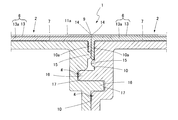
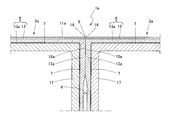
- FIG. 2 is an enlarged cross-sectional view of a joined portion of a plurality of integrally extruded bodies used in the assembly of the integrally extruded body of FIG.
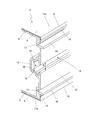
- FIG. 3 is an enlarged perspective view showing a configuration of a fixing mechanism formed on the joint surface of the integrally extruded body of FIG.
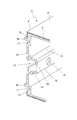
- FIG. 4 is an enlarged perspective view seen from another angle showing the configuration of the fixing mechanism formed on the joint surface of the integrally extruded body of FIG.
- FIG. 1 is a perspective view schematically showing a configuration of an assembly of an integrally extruded body according to an embodiment of the present invention.
- FIG. 2 is an enlarged cross-sectional view of a joined portion of a plurality of integrally extruded bodies used in the assembly of the integrally extruded body of FIG.
- FIG. 3 is an enlarged perspective
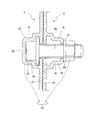
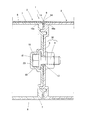
- FIG. 5 is a partially enlarged cross-sectional view showing a state where the assembly of the integrally extruded product according to the present embodiment is fixed using bolts and nuts.
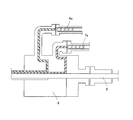
- FIG. 6 is a cross-sectional view schematically showing the configuration of a co-extrusion type monolithic extrusion molding machine for producing the monolithic extrusion molding constituting the assembly of the monolithic extrusion molding according to the embodiment of the present invention.
- FIG. 7 is a partial enlarged cross-sectional view schematically showing another example of the peel-off preventing structure for the integrally extruded product according to the present embodiment.
- FIG. 8 is an enlarged cross-sectional view of a joint portion of a plurality of integrally extruded bodies used in an assembly of integrally extruded bodies according to another embodiment of the present invention.
- the assembly 1 of the integrally extruded body according to the present embodiment has a configuration in which two integrally extruded bodies 2 are combined and fixed in a state where the joint surfaces 10 are in close contact with each other.
- integral extrusion refers to the process of extruding the material of the coating layer applied to the surface of the core material while feeding out the core material, and simultaneously coating the core material that has been fed into the core material in order. It means to become.
- a molded body formed by integral extrusion molding is referred to as an integral extrusion molded body.
- all the cross sections orthogonal to an extrusion direction become the same shape on the characteristic of manufacture.
- “without a step” means that a plurality of members are designed and fixed by combining a plurality of members so that the height of the boundary where the edges of the joint surfaces of the plurality of members are in close contact with each other is the same. This means that the surface including the boundary where the edge of the joint surface is in close contact sometimes becomes flush, and includes a case where a slight level difference occurs at the boundary where the edge of the joint surface is in close contact due to a dimensional error during manufacturing.
- the extrusion direction M of the integrally extruded body is perpendicular to the extrusion direction M and along the joining surface 10.
- a direction perpendicular to both the thickness direction T, the extrusion direction M, and the thickness direction T is defined as a width direction W.
- the plurality of integrally extruded molded bodies 2 have a cylindrical shape with a plurality of cross sections, and all have the same structure.
- the plurality of integrally extruded bodies 2 are combined in a state where the joint surfaces 10 of the outer peripheral surfaces are in close contact with each other, and are fixed by bolts 3 and nuts 4 inserted into the fixture storage grooves 12 that open to the joint surfaces 10. It is fixed by the member 30. That is, the surface other than the joint surface 10 of the integrally extruded body 2 among the surfaces constituting the integrally extruded body 1 is the exposed surface 11.
- the exposed surface 11 includes an upper and lower exposed surface 11a that is adjacent to the bonding surface 10 and extends in the width direction W in the cross-sectional shape, and a side exposed surface 11b that faces the bonding surface 10 and extends in the thickness direction T in the cross-sectional shape. That is, the integrally extruded assembly 1 has a rectangular cross-sectional shape as a whole and has a joint surface 10 extending in the thickness direction T at the center in the width direction W.
- the integral extruded body 2 has an edge 14 extending linearly along the extrusion direction M between the upper and lower exposed surfaces 11a and the joint surface 10.
- the boundary 9 where the edges 14 of the two integrally extruded bodies 2 are in close contact with each other is continuous without a step. Further, the boundary 9 is processed to the extent that it cannot be recognized from the outside by a sanding processing unit 13 (see FIG. 2), which will be described later, attached to the surface of the upper and lower exposed surface 11a.
- the clearance gap (g) is provided in the center side of the thickness direction T rather than the contact part 10a.
- the integrally extruded body 2 has a coating layer 6 on the outside of the core material 5, and further has an adhesive layer 7 between the coating layer 6 and the core material 5.
- the covering layer 6 and the adhesive layer 7 are arranged in a state of being laminated on the surface of the core material 5, and continuously in the extrusion direction M of the integrally extruded body 2. It is formed.
- the adhesive layer 7 is located between the coating layer 6 and the core material 5.
- the covering layer 6 and the adhesive layer 7 are formed on the entire exposed surface 11 of the core material 5 and at least a part of the bonding surface 10. In the embodiment shown in FIGS. 1 and 2, it is provided on a part of the joint surface 10.
- the coating layer 6 provided on the bonding surface 10 is the contact portion 10a.
- the core material 5 of the integrally extruded body 2 is made of a metal such as aluminum or an aluminum alloy, stainless steel, galvanized steel, or copper.
- the core material 5 is preferably aluminum or an aluminum alloy from the viewpoints of lightness and workability required as a building member.
- the hollow or solid core material 5 made of aluminum or aluminum alloy can be formed by extrusion molding of aluminum or aluminum alloy.
- extrusion molding is useful for the production of the core material 5 having various different cross-sections such as a hollow shape, a U-shape or an L-shape.
- “made of aluminum” includes “made of aluminum alloy” in its category.
- the cross section of the core material 5 is a core material cross section in a direction perpendicular to the extrusion direction of the core material.
- the aluminum portion has a thickness of 0.8 to 5.0 mm.
- a thickness of 1.1 to 3.0 mm is preferable from the viewpoint of aluminum rigidity and extrusion processability.
- the whole dimension in case the core material 5 has a hollow or solid form is not restrict
- the core width direction W preferably has a length of 20 mm or more, and preferably 30 mm or more, because rigidity and surface decoration as a building member are required.
- Core material 5 is configured to be hollow or solid.
- the cross-sectional shape is not particularly limited. Further, for example, as shown in FIG. 1, in addition to the shape in which the cross-sectional shape having two vertical exposed surfaces 11 a in the thickness direction T is configured as a hollow rectangle, the vertical exposed surface is only on one side of the joint surface 10 in the cross section. A shape such as a so-called U-shaped cross section having 11a may be used.
- the cross-sectional shape of the core material 5 is not particularly limited, and may be, for example, a polygonal shape of a triangle or more, or a shape formed in an arc shape other than the joint surface.
- the core material 5 is not limited to a shape in which each surface is configured flat as shown in FIGS. 1 and 2.
- the exposed surface 11 may have an uneven shape in which a part of the thickness is different.
- the covering layer 6 and the adhesive layer 7 are provided on at least a part of the exposed surface 11 and the bonding surface 10 of the core material 5.
- the coating layer 6 has an appearance like wood, and in order to improve the surface decoration of the integrally extruded body 2, the surface other than the exposed outer surface, for example, a U-shaped cross section. In the case of the constructed integrally extruded body, it may be provided on the inner surface that is visible from the outside during use.
- the assembly 1a may be configured.
- the covering layer 6 and the adhesive layer 7 are provided not only on the exposed surface 11 but also on the entire bonding surface 10.
- the integral extruded body 2a constituting the assembly 1a may have such a structure. Such a configuration is advantageous in terms of cost because the existing mold can be diverted.
- the joint surface 10 is provided with a contact portion 10 a from the edge 14 toward the central portion in the thickness direction T. And it is preferable to form a clearance gap (g) in the center part of the thickness direction T from the said contact part 10a.
- This gap portion (g) can be provided by easily renovating the existing mold and making the thickness of the coating layer 6 thicker on the edge 14 side than the central portion in the thickness direction T.
- the end of the coating layer 6 positioned on the joint surface 10 of the integrally extruded body 2 according to the present embodiment is prevented from being contacted from the outside by the coating layer protection ribs 15 formed on the core material 5. The peeling of the coating layer 6 is prevented.
- the covering layer 6 is a resin layer containing at least a base resin and wood powder.
- a polyolefin-based resin can be preferably used as the base resin.
- the polyolefin-based resin is a homopolymer or copolymer containing one or more ⁇ -olefins as monomers.
- the ⁇ -olefin include ⁇ -olefins having 2 to 8, preferably 2 to 6 carbon atoms such as ethylene, propylene, isobutylene and hexene.
- Preferred ⁇ -olefins are ethylene and propylene.
- the polyolefin resin may contain a monomer other than ⁇ -olefin as a monomer. Examples of such other monomers include vinyl ester monomers such as vinyl acetate.
- polyolefin resins include polyolefins such as polyethylene, polypropylene, and ethylene-propylene copolymers, and ethylene vinyl acetate copolymers.
- Preferred polyolefin-based resins are polyolefins, particularly polyethylene and polypropylene.
- the polyolefin resin can be produced by a conventionally known method such as a suspension polymerization method or a solution polymerization method. Or polyolefin resin can also be obtained as a commercial item. In particular, as the polyolefin-based resin, a recycled product derived from a discarded polyolefin product can be used. As a commercial item of unsaturated carboxylic acid-modified polyolefin resin, for example, trade name Umex (registered trademark) 1010 (manufactured by Sanyo Chemical Industries, Ltd.) can be used.
- Umex registered trademark
- 1010 manufactured by Sanyo Chemical Industries, Ltd.
- the base resin does not prevent the base resin from containing other resins than the polyolefin resin.
- the other resin include acrylonitrile butadiene styrene resin.
- wood powder wood such as cedar, cypress, and baitsuga, and a material obtained by pulverizing the end material and waste material of such wood, or sawdust is preferably used.
- wood powders can be made of a material that has passed through a 10-500 mesh sieve. More preferred is a material that passes through a 60-100 mesh screen. It is preferable to use milled wood and waste materials as wood powder because the environmental load is reduced.
- the content of the wood powder is 5 to 50 parts by weight, preferably 10 to 40 parts by weight, based on 100 parts by weight of the polyolefin resin.
- the covering layer 6 may be a single layer or may be composed of two or more layers.
- the multilayer coating layer 6 can be installed by simultaneously forming two or more layers simultaneously in the formation process of the coating layer 6 described later.
- the thickness of the coating layer 6 is not particularly limited as long as the object of the present invention is achieved, and is preferably 0.7 to 5 mm from the viewpoint of adhesiveness, appearance, and productivity. That is, since the siding process described later is performed, when the thickness is less than 0.7 mm, the appearance is not good, for example, the underlying aluminum alloy is exposed on the surface. Moreover, since problems, such as peeling at the time of use, arise, it is not preferable to make it thicker than 5 mm. From the viewpoint of further improving the texture of the wood when touched and the adhesion of the coating layer, the thickness of the coating layer 6 is preferably 1 to 3 mm, particularly preferably 1.5 to 2.5 mm. When the coating layer 6 is a multilayer type, the total thickness thereof may be in the above range.
- the adhesive layer 7 is preferably made of a resin containing a polyolefin resin containing epoxy.
- a resin containing a polyolefin resin containing epoxy is a copolymer obtained by polymerizing at least an ⁇ -olefin and an epoxy group-containing unsaturated monomer.
- the thickness of the adhesive layer is not particularly limited as long as the object of the present invention is achieved, and is preferably 0.05 to 0.5 mm, more preferably 0.1 to 0.00 mm from the viewpoint of adhesiveness and productivity. 3 mm.
- the integrated extrusion molded body 2 of the present invention has the coating layer 6 and the adhesive layer 7 as the core material 5 simultaneously with the extrusion molding of the coating layer 6 and the adhesive layer 7 in terms of productivity, long product molding, and constant product characteristics. It is manufactured by a so-called integral extrusion method.
- integral extrusion method For example, in the co-extrusion type integrated extrusion molding machine shown in FIG. 6, the materials forming the adhesive layer and the coating layer were respectively extruded from the respective extruders (6a and 7b in FIG. 6) for melting and kneading.
- the resin is laminated in one die 8 and at the same time, these layers are sequentially coated on the fed core material 5 to be integrated. Once integrated, it is usually cooled and cut to the desired length.
- one extruder is used for each of the coating layer 6 and the adhesive layer 7.
- the present invention is not limited to this, and when the coating layer 6 is multilayered, an extruder is used according to the number of the extruders. Can be installed as appropriate.
- the extruded resin is hatched.
- the thus configured core material 5 has a cross section of the same shape along the extrusion direction, and the coating layer 6 and the adhesive layer 7 are formed in a shape according to the die 8 at the time of extrusion.
- FIG. 2 to FIG. 5 are partially enlarged views showing the structure 1 of the integrally extruded body 1 and the structure of the integrally extruded body 2 constituting the assembly 1 according to the present embodiment.
- the integral extruded body 2 constituting the integral extruded body assembly 1 has an edge 14 formed between the exposed surface 11a adjacent to the joint surface 10 and exposed to the outside during the assembly and the joint surface 10.
- the said exposed surface 11a of each integral extrusion molding has the shape which continues without a level
- the assembly 1 of the integrally extruded body includes an integrally extruded molding in which the upper and lower exposed surfaces 11 a including at least the boundary 9 between the edges 14 are continuously formed on the surface of the coating layer 6.
- a sanding portion 13 is formed integrally with the body.
- the thickness dimension of the sanding process part 13 is not specifically limited. However, it is preferable to leave the non-processed part 13a in which the sanding process part 13 is not arrange
- the sanding part 13 is formed by roughing the surface of the coating layer 6 using a file or the like along the direction along the boundary 9, that is, along the extrusion direction.
- irregularities are formed on the surface of the coating layer 6, and the exposed surface 11 can have a woodgrain appearance.
- the sanding process conceals the boundary 9 between the two integrally extruded bodies 2 and makes it difficult to visually recognize from the outside, in addition to making the exposed surface 11 have a woodgrain appearance.
- the coating layer 6 located at the edge 14 formed between the exposed surface 11a and the joint surface 10 is used. Adhesion between each other can be ensured. Further, by arranging the coating layer 6 made of a synthetic resin only on a part of the bonding surface 10, the metal core material 5 is brought into close contact with the bonding surface 10. It is possible to reduce the rattling between the integrally extruded bodies 2 due to deformation.
- the integrally extruded body 2 has a coating layer protective rib 15 on the joint surface 10 as a configuration for preventing peeling at the end of the coating layer 6.
- the coating layer protection rib 15 prevents the end of the coating layer 6 disposed on the bonding surface 10 from coming into contact with the outside in the thickness direction T. By preventing the end portion of the covering layer 6 from coming into contact with the outside, peeling from the end portion of the covering layer 6 can be prevented.
- the coating layer protection ribs 15 formed on the integrally extruded body 2 are different in depth distance from the exposed surface 11a, that is, the distance in the thickness direction T, and are provided at positions that do not interfere with each other when the integrally extruded body 2 is assembled. ing.
- the integral extruded body 2 is provided with displacement preventing portions 16 and 17 that prevent the integral extruded molded body 2 from being displaced in the thickness direction T on the back side in the thickness direction of the covering layer protection rib 15 of the joint surface 10. It has been.
- the shift prevention unit 16 includes a shift prevention projection 16 and a shift prevention recess 17.
- the displacement prevention protrusion 16 and the displacement prevention recess 17 are unevenness applied to the joint surface 10 and prevent the displacement in the thickness direction of the integrally extruded body 2 by fitting each other.
- the integrally extruded body 2 accommodates a fixing member 30 that accommodates a fixing member 30 that fixes the adjacent integrally extruded body 2 in a state of being in close contact with the central portion in the thickness direction of the joint surface 10.
- the unit 18 is provided.
- the fixing member accommodating portion 18 is formed in a U-shaped cross section attached so as to surround the fixing member accommodating groove 12 opened in the joint surface 10.
- the fixing member housing portion 18 includes a pair of bolt support walls 19 extending in the width direction from both ends of the fixture housing groove 12 and an intermediate wall 20 that connects the ends of the bolt support walls 19.
- the dimension B in the thickness direction of the opening of the fixture housing groove 12 is such that the head 3a cannot pass in the axial direction through the leg 3b of the bolt 3.
- the pair of bolt support walls 19 support the head 3a of the bolt 3 inserted into the fixture housing groove 12 with the thickness direction interposed therebetween. That is, the distance A between the bolt support walls 19 is an interval at which the head 3a of the bolt 3 cannot rotate in the axial direction of the bolt.
- the intermediate wall 20 functions as a support surface that supports the nut 4 attached to the other integrally extruded body 2.
- the intermediate wall 20 is provided with a through hole 21 through which the leg 3b of the bolt 3 can penetrate at a predetermined position.
- the through-hole 21 can also be provided only in the intermediate wall 20 of the other integral extrusion molding 2. That is, the through hole is formed in the intermediate wall 20 of the integrally extruded molded body 2 on at least one side.
- the bolt 3 housed between the bolt support walls 19 of one of the integrally extruded bodies 2 is in a state in which the leg portion 3 b projects from the fixture housing groove 12 to the outside of the contact surface 10. .
- the bolt leg 3b supported by one integral extrusion 2 passes through the fixture housing groove 12 of the other integral extrusion and passes through the through hole 21 of the intermediate wall 20.
- the leg 3b of the bolt 3 penetrating through the through hole 21 of the intermediate wall 20 is screwed with the nut 4 located on the surface of the intermediate wall 20 of the other integral extrusion molded body.
- the two integrally extruded molded bodies 2 are fixed by the fixing member 30 constituted by the bolt 3 and the nut 4.
- the assembly 1 of the integrally extruded body according to the present embodiment is manufactured as follows. First, a plurality of integrally extruded molded bodies 2 having the above-described configuration are manufactured by extrusion molding. In the present embodiment, the plurality of integrally extruded molded bodies 2 have the same structure. In addition, the integral extruded body 2 has no sanding portion formed on the exposed surface 11.
- the fixing bolt 3 is inserted into the fixing member accommodating portion 18 of one integral extrusion molded body.
- the bolt 3 housed between the bolt support walls 19 of the one integrally extruded body 2 has the leg portion 3b protruding from the fixture housing groove 12 to the outside of the contact surface 10.
- the leg portion of the bolt 3 is passed through the through hole 21 of the other integral extruded body 2.
- the positions of the two integrally extruded bodies 2 in the extrusion direction may be shifted, but before the bolts 3 and the nuts 4 are fixed, the positions of the two integral extruded bodies 2 in the direction of extrusion are aligned. do.
- the shift preventing portions 16 and 17 formed on the close contact surface 10 have the same cross-sectional shape in the extrusion direction, it is possible to easily align the integral extrusion molded body 2 in the extrusion direction.
- the joint surfaces 10 are opposed to each other so that the edges 14 of the exposed surfaces 11 exposed to the outside in use are brought into close contact with each other.
- the nut 4 is attached to the leg 3 b of the bolt 3 that has passed through the through hole 21 of the other integral extruded body 2, and the two integral extruded bodies 2 are fixed by a fixing member 30 including the bolt 3 and the nut 4.
- the exposed surface 11 is subjected to sanding, and the sanding part 13 is integrally formed on the exposed surfaces of the two integral extrusions 2.
- the sanding process is performed along the extrusion direction of the integrally extruded body 2, thereby making it difficult to visually recognize the boundary 9 between the integrally extruded bodies 2 from the outside.
- the integrally extruded molded product assembly 1 of the present embodiment includes building materials, architectural handrails, crime prevention face grids, deck materials, building members such as balcony louvers, and members such as furniture, furniture, and lighting fixtures. Useful as. In particular, it is possible to conceal the boundary 9 by combining a plurality of integral extruded bodies 2 with a wide building member, and by a sanding processing portion integrally formed on the exposed surface 11 of the plurality of integral extruded bodies 2. it can. For this reason, the assembly 1 of the integrally extruded body according to the present embodiment is useful as an inexpensive wide building material.
- a wide width can be obtained by combining a plurality of integrally extruded bodies having a coating layer provided on only a part of the metal core material.
- An assembly of integrally molded products can be obtained. Therefore, it can be made inexpensive compared with manufacturing a wide integral extruded body.
- the plurality of extruded molded bodies have a shape in which the edges are in close contact with each other, and the exposed surface of each integrally extruded molded body is continuous without a step between the edges during the assembly, and the coating layer is a joint surface. Since it is located only in the part, it can be fixed with sufficient strength by fixing the core material.
- an assembly 1 of a wide integral extrusion body it can be handled by combining three or more integral extrusion bodies 2, and the assembly 1 of various width integral extrusion bodies. Can be easily formed.
- each integral extrusion molded body at the time of the combination is a sanding portion formed integrally, the boundary between adjacent integral extrusion molded bodies is difficult to be visually recognized, and has a wide appearance. It is possible to obtain an assembly of an integrally extruded body and a building member using the assembly.
- this invention is not limited to the said embodiment, It can implement in another various aspect.
- the two monolithic extrusions need not have exactly the same structure, but can have different securing mechanisms.
- the support wall 19 and the intermediate wall 20 are formed only on one integral extruded body 2 to which the bolt 3 is fixed, and the other integral extruded body 2 has a fixture storage groove. Only 12 may be formed.
Landscapes
- Engineering & Computer Science (AREA)
- General Engineering & Computer Science (AREA)
- Mechanical Engineering (AREA)
- Architecture (AREA)
- Civil Engineering (AREA)
- Structural Engineering (AREA)
- Steps, Ramps, And Handrails (AREA)
- Panels For Use In Building Construction (AREA)
- Floor Finish (AREA)
- Connection Of Plates (AREA)
- Mutual Connection Of Rods And Tubes (AREA)
- Finishing Walls (AREA)
- Extrusion Moulding Of Plastics Or The Like (AREA)
Priority Applications (1)
| Application Number | Priority Date | Filing Date | Title |
|---|---|---|---|
| JP2020509986A JP7213233B2 (ja) | 2018-03-26 | 2019-03-22 | 一体押出成形体の組立体、建築用部材及び一体押出成形体の組立体の製造方法 |
Applications Claiming Priority (2)
| Application Number | Priority Date | Filing Date | Title |
|---|---|---|---|
| JP2018-057610 | 2018-03-26 | ||
| JP2018057610 | 2018-03-26 |
Publications (1)
| Publication Number | Publication Date |
|---|---|
| WO2019188827A1 true WO2019188827A1 (ja) | 2019-10-03 |
Family
ID=68061587
Family Applications (1)
| Application Number | Title | Priority Date | Filing Date |
|---|---|---|---|
| PCT/JP2019/012198 Ceased WO2019188827A1 (ja) | 2018-03-26 | 2019-03-22 | 一体押出成形体の組立体、建築用部材及び一体押出成形体の組立体の製造方法 |
Country Status (2)
| Country | Link |
|---|---|
| JP (1) | JP7213233B2 (https=) |
| WO (1) | WO2019188827A1 (https=) |
Cited By (1)
| Publication number | Priority date | Publication date | Assignee | Title |
|---|---|---|---|---|
| WO2022124286A1 (ja) * | 2020-12-09 | 2022-06-16 | 倉敷紡績株式会社 | 一体押出成形体 |
Citations (5)
| Publication number | Priority date | Publication date | Assignee | Title |
|---|---|---|---|---|
| JPS49107807U (https=) * | 1972-12-29 | 1974-09-13 | ||
| JPS5745509U (https=) * | 1980-08-30 | 1982-03-13 | ||
| JPS6259668U (https=) * | 1985-10-02 | 1987-04-13 | ||
| JPH04327007A (ja) * | 1991-04-24 | 1992-11-16 | Nippon Filing Co Ltd | 棚パネル結合具および棚パネル結合構造 |
| JP2008080753A (ja) * | 2006-09-29 | 2008-04-10 | Kurabo Ind Ltd | 一体押出成形体および建築用部材 |
-
2019
- 2019-03-22 JP JP2020509986A patent/JP7213233B2/ja active Active
- 2019-03-22 WO PCT/JP2019/012198 patent/WO2019188827A1/ja not_active Ceased
Patent Citations (5)
| Publication number | Priority date | Publication date | Assignee | Title |
|---|---|---|---|---|
| JPS49107807U (https=) * | 1972-12-29 | 1974-09-13 | ||
| JPS5745509U (https=) * | 1980-08-30 | 1982-03-13 | ||
| JPS6259668U (https=) * | 1985-10-02 | 1987-04-13 | ||
| JPH04327007A (ja) * | 1991-04-24 | 1992-11-16 | Nippon Filing Co Ltd | 棚パネル結合具および棚パネル結合構造 |
| JP2008080753A (ja) * | 2006-09-29 | 2008-04-10 | Kurabo Ind Ltd | 一体押出成形体および建築用部材 |
Cited By (3)
| Publication number | Priority date | Publication date | Assignee | Title |
|---|---|---|---|---|
| WO2022124286A1 (ja) * | 2020-12-09 | 2022-06-16 | 倉敷紡績株式会社 | 一体押出成形体 |
| JPWO2022124286A1 (https=) * | 2020-12-09 | 2022-06-16 | ||
| JP7821123B2 (ja) | 2020-12-09 | 2026-02-26 | 倉敷紡績株式会社 | 一体押出成形体 |
Also Published As
| Publication number | Publication date |
|---|---|
| JPWO2019188827A1 (ja) | 2021-04-22 |
| JP7213233B2 (ja) | 2023-01-26 |
Similar Documents
| Publication | Publication Date | Title |
|---|---|---|
| US6345481B1 (en) | Article with interlocking edges and covering product prepared therefrom | |
| US6675545B2 (en) | Connecting system for surface coverings | |
| CN1095911C (zh) | 具有互锁边缘的表面铺装制品 | |
| CN108430762B (zh) | 用于板状材料的边缘型材和板状材料 | |
| CN106660096B (zh) | 弯曲加工品 | |
| US20140102017A1 (en) | Door jamb member, door jamb assembly incorporating same and kit therefor | |
| JP7213233B2 (ja) | 一体押出成形体の組立体、建築用部材及び一体押出成形体の組立体の製造方法 | |
| US20200141123A1 (en) | Wall panel with assymetrically rabbeted edges | |
| JP7074521B2 (ja) | 一体押出成形体の組立体及び建築用部材 | |
| JP6834661B2 (ja) | スパンドレルパネル | |
| JP5054743B2 (ja) | 庇 | |
| JP6934736B2 (ja) | 一体押出成形体及び建築用部材 | |
| EP4274970B1 (en) | A set of panels provided with a mechanical locking device for locking a first panel to a second panel at a corner | |
| JP6741240B2 (ja) | フェンス | |
| US20160167250A1 (en) | Extrusion-coated articles with end-caps | |
| JP2026004948A (ja) | 格子状外装材 | |
| JP3980575B2 (ja) | 室内用建具およびその製造方法 | |
| CA2967459C (en) | Wall panel with asymmetrically rabbeted edges | |
| JP2009144354A (ja) | 枠材 | |
| WO2026024551A1 (en) | Elongated element with embedded reinforcement | |
| JP3851466B2 (ja) | 戸パネルの製造方法 | |
| HK1231810A1 (en) | Bent product | |
| JP2010089658A (ja) | 車両用内装部品 | |
| JP2012041746A (ja) | 幅木用見切り材 | |
| HK1031245A (en) | Article with interlocking edges and covering product prepared therefrom |
Legal Events
| Date | Code | Title | Description |
|---|---|---|---|
| 121 | Ep: the epo has been informed by wipo that ep was designated in this application |
Ref document number: 19777789 Country of ref document: EP Kind code of ref document: A1 |
|
| ENP | Entry into the national phase |
Ref document number: 2020509986 Country of ref document: JP Kind code of ref document: A |
|
| NENP | Non-entry into the national phase |
Ref country code: DE |
|
| 122 | Ep: pct application non-entry in european phase |
Ref document number: 19777789 Country of ref document: EP Kind code of ref document: A1 |