WO2019188751A1 - リチウム複合酸化物、二次電池用正極活物質及び二次電池 - Google Patents
リチウム複合酸化物、二次電池用正極活物質及び二次電池 Download PDFInfo
- Publication number
- WO2019188751A1 WO2019188751A1 PCT/JP2019/011996 JP2019011996W WO2019188751A1 WO 2019188751 A1 WO2019188751 A1 WO 2019188751A1 JP 2019011996 W JP2019011996 W JP 2019011996W WO 2019188751 A1 WO2019188751 A1 WO 2019188751A1
- Authority
- WO
- WIPO (PCT)
- Prior art keywords
- composite oxide
- lithium composite
- lithium
- secondary battery
- positive electrode
- Prior art date
- Legal status (The legal status is an assumption and is not a legal conclusion. Google has not performed a legal analysis and makes no representation as to the accuracy of the status listed.)
- Ceased
Links
Images




Classifications
-
- C—CHEMISTRY; METALLURGY
- C01—INORGANIC CHEMISTRY
- C01G—COMPOUNDS CONTAINING METALS NOT COVERED BY SUBCLASSES C01D OR C01F
- C01G53/00—Compounds of nickel
-
- H—ELECTRICITY
- H01—ELECTRIC ELEMENTS
- H01M—PROCESSES OR MEANS, e.g. BATTERIES, FOR THE DIRECT CONVERSION OF CHEMICAL ENERGY INTO ELECTRICAL ENERGY
- H01M4/00—Electrodes
- H01M4/02—Electrodes composed of, or comprising, active material
- H01M4/36—Selection of substances as active materials, active masses, active liquids
- H01M4/48—Selection of substances as active materials, active masses, active liquids of inorganic oxides or hydroxides
- H01M4/50—Selection of substances as active materials, active masses, active liquids of inorganic oxides or hydroxides of manganese
- H01M4/505—Selection of substances as active materials, active masses, active liquids of inorganic oxides or hydroxides of manganese of mixed oxides or hydroxides containing manganese for inserting or intercalating light metals, e.g. LiMn2O4 or LiMn2OxFy
-
- H—ELECTRICITY
- H01—ELECTRIC ELEMENTS
- H01M—PROCESSES OR MEANS, e.g. BATTERIES, FOR THE DIRECT CONVERSION OF CHEMICAL ENERGY INTO ELECTRICAL ENERGY
- H01M4/00—Electrodes
- H01M4/02—Electrodes composed of, or comprising, active material
- H01M4/36—Selection of substances as active materials, active masses, active liquids
- H01M4/48—Selection of substances as active materials, active masses, active liquids of inorganic oxides or hydroxides
- H01M4/52—Selection of substances as active materials, active masses, active liquids of inorganic oxides or hydroxides of nickel, cobalt or iron
- H01M4/525—Selection of substances as active materials, active masses, active liquids of inorganic oxides or hydroxides of nickel, cobalt or iron of mixed oxides or hydroxides containing iron, cobalt or nickel for inserting or intercalating light metals, e.g. LiNiO2, LiCoO2 or LiCoOxFy
-
- Y—GENERAL TAGGING OF NEW TECHNOLOGICAL DEVELOPMENTS; GENERAL TAGGING OF CROSS-SECTIONAL TECHNOLOGIES SPANNING OVER SEVERAL SECTIONS OF THE IPC; TECHNICAL SUBJECTS COVERED BY FORMER USPC CROSS-REFERENCE ART COLLECTIONS [XRACs] AND DIGESTS
- Y02—TECHNOLOGIES OR APPLICATIONS FOR MITIGATION OR ADAPTATION AGAINST CLIMATE CHANGE
- Y02E—REDUCTION OF GREENHOUSE GAS [GHG] EMISSIONS, RELATED TO ENERGY GENERATION, TRANSMISSION OR DISTRIBUTION
- Y02E60/00—Enabling technologies; Technologies with a potential or indirect contribution to GHG emissions mitigation
- Y02E60/10—Energy storage using batteries
Definitions
- the present invention relates to a lithium composite oxide, a positive electrode active material for a secondary battery, and a secondary battery.
- the lithium composite oxide is used as a positive electrode active material for lithium secondary batteries.
- Lithium secondary batteries have already been put into practical use as small power sources for cellular phones and notebook computers. Furthermore, application is also attempted in medium-sized or large-sized power sources such as automobile applications and power storage applications. Thus, with the expansion of the application range, it is an important issue to improve the performance of the lithium secondary battery.
- Patent Document 1 describes that in order to improve the capacity of a battery using an LNMO type lithium composite oxide, the content of the additive was reduced and a dense lithium composite oxide film with few voids was manufactured. Has been.
- Non-Patent Document 1 has a theoretical capacity of 147 mAh / g when used as a positive electrode active material with a lower cutoff potential of 3.5 V (vs. Li + / Li). .
- the present invention has been made in view of the above circumstances, and an object thereof is to provide a lithium composite oxide having a reversible capacity of about 250 mAh / g, a positive electrode active material for a secondary battery using the same, and a secondary battery.
- the present invention includes the following [1] to [11].
- the first aspect of the present invention provides the lithium composite oxide described in [1].
- a lithium composite oxide having a spinel structure, wherein a general formula indicating a chemical composition is represented by the following formula (1).
- Li 1 + z Ni a Mn 2-y Mb Cu y O 4-x F x (1) [In the general formula (1), 0 ⁇ a ⁇ 0.6, 0 ⁇ b ⁇ 0.2, 0 ⁇ y ⁇ 1, 0 ⁇ x ⁇ 1, 0 ⁇ z 1.0, where x and Except when both y are 0; M is one or more metal elements selected from the group consisting of Ti, V, Cr, Fe, Co, Zu, and Sn.
- the lithium composite oxide of the first aspect preferably includes the following features.
- the lithium composite oxide has an octahedral crystal structure having a (111) plane as a main surface, and at least one vertex of the octahedral crystal structure includes a truncated surface.
- Lithium composite oxide [3] The lithium composite oxide has an octahedral crystal structure having a (111) plane as a main surface, and at least one ridge of the octahedral crystal structure includes a cut surface.
- the lithium composite oxide has an octahedral crystal structure having a (111) plane as a main surface, and at least one inclined surface of the octahedral crystal structure has a step-and-terrace structure.
- [6] The lithium composite oxide according to any one of [1] to [4], wherein 0 ⁇ x ⁇ 1 in the formula (1).
- [7] The lithium composite oxide according to any one of [1] to [4], wherein 0 ⁇ y ⁇ 1 and 0 ⁇ x ⁇ 1 in the formula (1).
- the second aspect of the present invention provides the following positive electrode active material for a secondary battery.
- a positive electrode active material for a secondary battery comprising the lithium composite oxide according to any one of [1] to [7].
- the third aspect of the present invention provides the following secondary battery.
- a secondary battery comprising the secondary battery positive electrode active material according to [8].
- the present invention provides the following lithium composite oxide. [10] The lithium composite oxide according to any one of [1] to [4], wherein x is 0.025 ⁇ x ⁇ 0.1.
- a lithium composite oxide having a capacity of 250 mAh / g or more, a positive electrode active material for a secondary battery using the same, and a secondary battery.
- Produced in example, of LiNi 0.5 Mn 1.5-y Cu y O 4-x F x crystals is a diagram showing a Raman spectrum of each composition. It is a figure which shows a charging / discharging curve about the said crystal manufactured in the Example. It is a figure which shows the result of discharge capacity about the said crystal manufactured in the Example. It is a figure which shows initial stage discharge capacity about the said crystal manufactured in the Example. It is a figure which shows the change of the discharge capacity with respect to the frequency of charging / discharging cycles about the said crystal
- the LNMO type lithium composite oxide has a nickel / manganese ordered arrangement type (hereinafter sometimes referred to as “P4332 type”) or a nickel / manganese irregular arrangement type (hereinafter referred to as “Fd-3m”).
- P4332 type nickel / manganese ordered arrangement type
- Fd-3m nickel / manganese irregular arrangement type
- the P4332 type lithium composite oxide has an advantage that it has a large capacity when used as a lithium secondary battery and can be a long-life battery. On the other hand, there is a disadvantage that electron conductivity is low.
- the Fd-3m type lithium composite oxide has an advantage in that the electron conductivity can be increased when used as a lithium secondary battery. On the other hand, there is a disadvantage that it is not suitable for a battery having a small capacity and a long life.
- both the high capacity characteristics that are the advantages of the P4332 type and the high electron conductivity characteristics that are the advantages of the Fd-3m type Preferably it can be done.
- the lithium composite oxide of the present invention is characterized in that the general formula indicating the chemical composition is represented by the formula (1).
- the lithium composite oxide of the present invention preferably has a spinel crystal structure.
- a spinel structure is one type of crystal structure belonging to a cubic system.
- the lithium composite oxide of this embodiment performs either one or both of control of the cation space by Cu ion substitution and control of the anion space by F ion substitution. Thereby, the ordered arrangement of nickel / manganese is stabilized, and the crystal structure can be suppressed from phase transition from cubic to tetragonal. As a result, the lithium ion storage site increases and a lithium composite oxide having a capacity of 250 mAh / g or more can be obtained.
- the present embodiment is a lithium composite oxide having a spinel structure, in which the general formula indicating the chemical composition is represented by the following formula (1).
- Li 1 + z Ni a Mn 2-y Mb Cu y O 4-x F x (1) [In the general formula (1), 0 ⁇ a ⁇ 0.6, 0 ⁇ b ⁇ 0.2, 0 ⁇ y ⁇ 1, 0 ⁇ x ⁇ 1, 0 ⁇ z ⁇ 1.0, where x and Except when both y are 0; M is one or more metal elements selected from the group consisting of Ti, V, Cr, Fe, Co, Zu, and Sn. ]
- the first embodiment is an embodiment that performs either one or both of control of cation space by Cu ion substitution and control of anion space by F ion substitution.
- a ⁇ 0.5 is preferable.
- 0 ⁇ y ⁇ 0.5 is preferable.
- 0.6 ⁇ z ⁇ 0.8 is preferable.
- 0 ⁇ x ⁇ 0.5 is preferable.
- 0 ⁇ b ⁇ 0.1 is preferable.
- M is one or more metal elements selected from the group consisting of Ti, V, Cr, Fe, Co, Zu, and Sn.
- a may be any of 0 ⁇ a ⁇ 0.10, 0.10 ⁇ a ⁇ 0.40, and 0.40 ⁇ a ⁇ 0.60.
- b may be any of 0 ⁇ b ⁇ 0.08, 0.08 ⁇ b ⁇ 0.13, and 0.13 ⁇ b ⁇ 0.20.
- y may be any of 0 ⁇ y ⁇ 0.30, 0.30 ⁇ y ⁇ 0.60, and 0.60 ⁇ y ⁇ 1.00.
- x may be any of 0 ⁇ x ⁇ 0.30, 0.30 ⁇ x ⁇ 0.60, and 0.60 ⁇ x ⁇ 1.00.
- z is any of 0 ⁇ z ⁇ 1.0, 0.50 ⁇ z ⁇ 0.60, 0.60 ⁇ z ⁇ 0.80, and 0.80 ⁇ z ⁇ 1.00. It may be.
- the lithium composite oxide of the present embodiment preferably has an octahedral crystal structure whose main surface corresponds to the (111) plane.
- the octahedral crystal structure may be a regular octahedral crystal structure or an octahedral crystal structure having strain. In this embodiment, it is preferable that at least one vertex of the octahedral crystal structure has a truncated surface.
- the vertex having a truncated surface is preferably 2 or more, and more preferably 3 or more. Moreover, all the vertices of the octahedral crystal structure may have a truncated surface, may be 7 or less, and may be 6 or less.
- the truncated surface means a surface formed by cutting away the vertex of a polyhedron. In this embodiment, it is preferable that at least one ridge of the octahedral crystal structure has a cut ridge surface.
- the ridge having a cut ridge surface is preferably 2 or more, and more preferably 3 or more.
- all the ridges of the octahedral crystal structure may have a cut ridge surface, may be 11 or less, and may be 10 or less.
- the cut ridge surface means a surface formed by cutting a polyhedral ridge.
- the “step terrace structure” means a plurality of flat terraces arranged so as to be parallel to each other through a step along the main surface of the crystal, and a step that is a step sub that connects the terraces. This means a micro stepped structure.
- all the inclined planes of the octahedral crystal structure may have a step / terrace structure, or may be 7 or less, or 6 or less.
- at least one vertex of the octahedral crystal structure has a truncated surface, and at least one inclined surface of the octahedral crystal structure has a step-terrace structure. It is preferable.
- the crystal structure of the lithium composite metal oxide of the present embodiment is such that at least one ridge of the octahedral crystal structure has a cut edge surface, and at least one inclined surface of the octahedral crystal structure has a step-and-terrace structure. It is preferable.
- At least one vertex of the octahedral crystal structure has a truncated surface, and at least one edge of the planar crystal structure has a truncated surface, and It is preferable that at least one inclined surface of the plane crystal structure has a step-and-terrace structure.
- the crystal structure of the lithium composite oxide of this embodiment can be confirmed by observing it using a scanning electron microscope or a transmission electron microscope.
- the crystal structure of the lithium composite oxide of the present embodiment has a crystal structure having a truncated face appearing in an octahedron having a (111) plane, and a crystal structure having a ridge face appearing in an octahedron having a (111) face Or a structure having a step-and-terrace structure on at least one inclined surface of the octahedral crystal structure, a lithium ion desorption reaction during charging of a lithium secondary battery, and a lithium ion occlusion reaction during discharge Is considered to occur stably.
- the present embodiment is a lithium composite oxide having a spinel structure, in which the general formula indicating the chemical composition is represented by the following formula (1) -1.
- Li 1 + z Ni a Mn 2-y Mb Cu y O 4-x F x (1) -1 [In General Formula (1) -1, 0 ⁇ a ⁇ 0.6, 0 ⁇ b ⁇ 0.2, 0 ⁇ y ⁇ 1, 0 ⁇ x ⁇ 1, and 0 ⁇ z ⁇ 1.0.
- M is one or more metal elements selected from the group consisting of Ti, V, Cr, Fe, Co, Zu, and Sn. ]
- the cation space is controlled by Cu ion substitution.
- the preferred range of each symbol is the same as that described in the above formula (1).
- the nickel / manganese ordered arrangement is stabilized, the lithium ion storage site is increased, and a lithium composite oxide having a capacity of 250 mAh / g or more can be obtained.
- the present embodiment is a lithium composite oxide having a spinel structure, in which the general formula indicating the chemical composition is represented by the following formula (1) -2.
- M is one or more metal elements selected from the group consisting of Ti, V, Cr, Fe, Co, Zu, and Sn. ]
- the anion space is controlled by F ion substitution.
- the preferred range of each symbol is the same as that described in the above formula (1).
- the present embodiment is a lithium composite oxide having a spinel structure, in which the general formula indicating the chemical composition is represented by the following formula (1) -3.
- Li 1 + z Ni a Mn 2-y Cu y O 4-x F x (1) -3 [In General Formula (1), 0 ⁇ a ⁇ 0.6, 0 ⁇ y ⁇ 1, 0 ⁇ x ⁇ 1, and 0 ⁇ z ⁇ 1.0. ]
- the fourth embodiment is an embodiment that performs both control of the cation space by Cu ion substitution and control of the anion space by F ion substitution.
- the preferred range of each symbol is the same as that described in the above formula (1).
- the phase transition to tetragonal crystal can be suppressed by controlling both the cation and anion spaces and precisely designing the site containing excess lithium ions.
- the crystal phase of the lithium composite oxide of this embodiment can be identified by the XRD method.
- a lithium compound, a precursor containing at least manganese and nickel, and a reaction accelerator (flux) are represented by the formulas (1), (1) -1 to (1).
- a reaction accelerator (flux) are represented by the formulas (1), (1) -1 to (1).
- ) -3 to obtain a lithium mixture by mixing so as to obtain a composition ratio represented by ⁇ 3, and a firing step of firing the lithium mixture obtained in the mixing step.
- a lithium compound, a precursor containing at least manganese and nickel, a precursor containing copper as necessary, and a reaction accelerator (flux) are mixed.
- the mixing method is not particularly limited, and a general mixer can be used.
- a shaker mixer, a V blender, a ribbon mixer, a Julia mixer, a Ladige mixer, or the like can be used, and it is sufficient that they are sufficiently mixed so that no fine powder is generated.
- the lithium compound used by this embodiment can be selected as needed.
- Preferred examples include one or more anhydrides selected from the group consisting of lithium hydroxide, lithium chloride, lithium nitrate and lithium carbonate, and the one or more hydrates.
- -Precursor containing at least manganese and nickel The precursor containing at least manganese and nickel used in the present embodiment can be selected as necessary.
- Manganese and nickel may be included in different compounds.
- the precursor containing manganese can include at least one of manganese nitrate hexahydrate, manganese sulfate pentahydrate, and manganese chloride tetrahydrate.
- Examples of the precursor containing nickel include at least one of nickel nitrate hexahydrate, nickel sulfate pentahydrate, and nickel chloride tetrahydrate. Precursors containing both manganese and nickel may be used. In addition, this invention is not limited only to the said example. -Precursor containing copper
- the precursor containing copper which can be used by this embodiment can be selected as needed. Examples of the precursor containing copper include copper nitrate trihydrate, copper sulfate trihydrate, and copper chloride dihydrate.
- reaction accelerator (flux) used in the present embodiment can be selected as necessary.
- Examples include carbonates such as Cs 2 CO 3 , CaCO 3 , MgCO 3 , SrCO 3, and BaCO 3 , sulfates such as K 2 SO 4 and Na 2 SO 4 , fluorides such as NaF, KF, and NH 4 F. It is done.
- KCl, K 2 CO 3 and K 2 SO 4 are preferable.
- Two or more reaction accelerators can be used in combination. When using 2 or more types, the ratio can be selected arbitrarily.
- the method, conditions, amount and timing of incorporating the reaction accelerator into the mixture are not particularly limited and can be selected as necessary.
- a reaction accelerator may be added when a precursor containing at least manganese and nickel is mixed with a lithium compound. The reaction accelerator may remain in the fired lithium composite oxide, or may be removed by washing, evaporation, or the like.
- the firing step a mixture of the precursor, lithium compound, and reaction accelerator, which are raw materials, is fired to obtain a bulk of lithium composite oxide that is a fired product.
- the holding temperature in a baking process can be selected arbitrarily, as an example, it is mentioned that it is the range of 650 degreeC or more and 900 degrees C or less, for example. More preferably, it is 700 degreeC or more and 850 degrees C or less.
- the holding time at the holding temperature can be arbitrarily selected, and is, for example, 0.1 to 20 hours, preferably 0.5 to 8 hours.
- the heating rate up to the holding temperature can be arbitrarily selected, and is, for example, 50 ° C. to 400 ° C./hour.
- the rate of temperature decrease from the holding temperature to room temperature can be arbitrarily selected, but is usually 10 ° C. to 400 ° C./hour.
- the firing atmosphere air, oxygen, nitrogen, argon, or a mixed gas thereof can be used. That is, an atmosphere such as an inert gas, a neutral gas, or an oxidizing gas can be used as necessary, but an air atmosphere is preferable.
- the lithium composite oxide obtained by firing preferably has a composition represented by the following general formula.
- Li 1 + z Ni a Mn m1 M b O 4- ⁇ (2) [In General Formula (1), 0 ⁇ a ⁇ 0.6, 0 ⁇ b ⁇ 0.2, 0 ⁇ m1 ⁇ 1, 0 ⁇ ⁇ ⁇ 4, and 0 ⁇ z ⁇ 1.0.
- M is one or more metal elements selected from the group consisting of Ti, V, Cr, Fe, Co, Zu, and Sn.
- the lithium composite oxide may be oxygen deficient.
- the lithium composite oxide obtained as described above can be further subjected to a second baking step as necessary. In the second firing step, the lithium composite oxide can be fired by mixing with one or both of a compound containing fluorine and a compound containing copper.
- the compound containing fluorine can be arbitrarily selected, and examples thereof include lithium fluoride, aluminum fluoride, and zinc fluoride.
- the compound containing copper can be arbitrarily selected, and examples thereof include copper nitrate trihydrate, copper sulfate trihydrate, and copper chloride dihydrate.
- the holding temperature in the second baking can be arbitrarily selected, and as an example, it is 300 ° C. or higher and 1000 ° C. or lower, 400 ° C. or higher and 900 ° C. or lower, and 500 ° C. or higher and 800 ° C. or lower.
- the time for holding at the holding temperature can be arbitrarily selected, and is, for example, 0.5 hours to 20 hours, 2 hours to 15 hours.
- the temperature rising rate up to the holding temperature can be arbitrarily selected, but the temperature rising rate is usually preferably 50 ° C./hour or more and 400 ° C./hour or less, and the temperature lowering rate from the holding temperature to room temperature is usually 10 ° C. It is preferably at least 400 ° C./hour.
- the firing atmosphere air, oxygen, nitrogen, argon, or a mixed gas thereof can be used. That is, an atmosphere such as an inert gas, a neutral gas, or an oxidizing gas can be used. You may change the atmosphere on the way.
- baking may be performed in an air atmosphere, and then baking may be performed in an oxygen atmosphere.
- the obtained mass of lithium composite oxide is crushed by a pulverizer such as a roll mill as necessary, washed to remove residual lithium components and reaction accelerators, and dried.
- the dry powder is crushed by a roll mill or the like as necessary.
- crushing refers to dispersing or unraveling the agglomerated particles.
- a lithium composite oxide substituted and doped with copper can be obtained.
- an oxygen-deficient lithium composite oxide can be obtained by firing under atmospheric conditions or low oxygen conditions.
- the obtained mass of lithium composite oxide is crushed by a pulverizer such as a roll mill as necessary, washed to remove residual lithium components and reaction accelerators, and dried.
- the dry powder is crushed by a roll mill or the like as necessary.
- crushing refers to dispersing or unraveling the agglomerated particles.
- the particle size of the obtained lithium composite oxide particles can be arbitrarily selected.
- the particle size of a single particle (primary particle) may be 0.1 ⁇ m or more and 2.0 ⁇ m or less, may be 0.2 ⁇ m or more and 1.9 ⁇ m or less, and more preferably 0.3 ⁇ m or more and 1.8 ⁇ m or less.
- the particle size of the primary particles can be obtained from an image obtained by a scanning electron microscope.
- the shape of the obtained lithium composite oxide can be arbitrarily selected, for example, it may be an octahedral shape, a substantially octahedral shape, or an octahedral shape or a substantially octahedral shape having a truncated face and / or a ridge face. It's okay. These oxides may be porous.
- the positive electrode for secondary battery of this embodiment is not limited except having the above-described lithium composite oxide of the present invention.
- the positive electrode of this embodiment can be manufactured by first adjusting the positive electrode mixture containing the lithium composite oxide, the conductive material and the binder of the present invention.
- a carbon material As the conductive material included in the positive electrode of the present embodiment, a carbon material can be used.
- the carbon material include graphite powder, carbon black (for example, acetylene black), and a fibrous carbon material. Since carbon black is fine and has a large surface area, the addition of a small amount to the positive electrode mixture can increase the conductivity inside the positive electrode and improve the charge / discharge efficiency and output characteristics. However, if too much is added, both the binding force between the positive electrode mixture and the positive electrode current collector by the binder and the binding force inside the positive electrode mixture are lowered, which causes an increase in internal resistance. Therefore, it is preferably used in an appropriate amount.
- thermoplastic resin As the binder included in the positive electrode of the present embodiment, a thermoplastic resin can be used.
- thermoplastic resin include polyvinylidene fluoride (hereinafter sometimes referred to as PVdF), polytetrafluoroethylene (hereinafter sometimes referred to as PTFE), tetrafluoroethylene, hexafluoropropylene, and fluoride.
- Fluorine resins such as vinylidene copolymers, propylene hexafluoride / vinylidene fluoride copolymers, tetrafluoroethylene / perfluorovinyl ether copolymers; polyolefin resins such as polyethylene and polypropylene;
- usable organic solvents include amine solvents such as N, N-dimethylaminopropylamine and diethylenetriamine; ether solvents such as tetrahydrofuran; ketone solvents such as methyl ethyl ketone; methyl acetate And amide solvents such as dimethylacetamide and N-methyl-2-pyrrolidone (hereinafter sometimes referred to as NMP).
- amine solvents such as N, N-dimethylaminopropylamine and diethylenetriamine
- ether solvents such as tetrahydrofuran
- ketone solvents such as methyl ethyl ketone
- amide solvents such as dimethylacetamide and N-methyl-2-pyrrolidone (hereinafter sometimes referred to as NMP).
- the lithium secondary battery of the present invention is not limited except that the above-described lithium composite oxide of the present invention is used. That is, the lithium secondary battery of the present invention can have the same configuration as a conventionally known lithium secondary battery except that it has the above-described positive electrode for a lithium secondary battery.
- the lithium secondary battery of the present invention can be configured to have a positive electrode, a negative electrode, an electrolytic solution, and other necessary members.
- Electrode active material compounds capable of inserting and extracting lithium ions can be used alone or in combination.
- compounds that can occlude and release lithium ions include metal materials such as lithium, alloy materials containing titanium, silicon, tin, etc., graphite, coke, organic polymer compound fired bodies, or carbon materials such as amorphous carbon
- ceramic materials such as silicon oxide, LiCoN, CuO, and V 2 O 5 can be used. These active materials can be used not only alone but also as a mixture of two or more thereof.
- a titanium-containing oxide for example, TiO 2 (B) which is bronze-structured titanium oxide, Li 4 Ti 5 O 12 which is lithium titanate
- a lithium metal foil when used as the negative electrode active material, it can be formed by pressure bonding the lithium foil to the surface of a current collector made of a metal such as copper.
- the negative electrode active material When an alloy material or a carbon material is used as the negative electrode active material, the negative electrode active material, a binder, a conductive additive, etc. are mixed in a solvent such as water or N-methylpyrrolidone, and then made of a metal such as copper. It can be applied and formed on a current collector.
- the binder is preferably formed of a polymer material, and is preferably a material that is chemically and physically stable in the atmosphere in the lithium secondary battery.
- PVDF polyvinylidene fluoride
- PTFE polytetrafluoroethylene
- EPDM ethylene-propylene-diene copolymer
- SBR styrene-butadiene rubber
- NBR acrylonitrile-butadiene rubber
- PI polyimide
- examples of the conductive assistant include ketjen black, acetylene black, carbon black, graphite, carbon nanotube, carbon fiber, graphene, and amorphous carbon.
- conductive polymer polyaniline, polypyrrole, polythiophene, polyacetylene, polyacene and the like can be exemplified.
- the electrolyte is a medium that transports charge carriers such as ions between the positive electrode and the negative electrode.
- the electrolyte is physically, chemically, and electrically stable in an atmosphere in which a lithium ion secondary battery is used. Is desirable.
- the electrolytic solution can be arbitrarily selected, and LiBF 4 , LiPF 6 , LiCF 3 SO 3 , LiN (CF 3 SO 2 ) 2 , LiN (C 2 F 5 SO 2 ) 2 , LiN (CF 3 SO 2 ) ( An electrolytic solution in which at least one selected from C 4 F 9 SO 2 ) is used as a supporting electrolyte and dissolved in an organic solvent is preferable.
- the organic solvent can be arbitrarily selected, and examples thereof include propylene carbonate, ethylene carbonate, 1,2-dimethoxyethane, dimethyl carbonate, diethyl carbonate, ethyl methyl carbonate, tetrahydrofuran, 2-methyltetrahydrofuran, tetrahydropyran, and mixtures thereof.
- an electrolytic solution containing a carbonate solvent is preferable because of its high stability at high temperatures.
- a solid polymer electrolyte containing the above electrolyte in a solid polymer such as polyethylene oxide, or a solid electrolyte such as ceramic or glass having lithium ion conductivity can also be used.
- the separator is a member that achieves both electrical insulation and ion conduction.
- the separator also serves to hold the liquid electrolyte.
- the separator include porous synthetic resin films, particularly porous films made of polyolefin polymers (polyethylene, polypropylene) and glass fibers, and nonwoven fabrics.
- the separator has a larger size than the positive electrode and the negative electrode for the purpose of ensuring the insulation between the positive electrode and the negative electrode.
- the positive electrode, negative electrode, electrolyte, separator, etc. are generally housed in some case.
- the case is not particularly limited and can be made of a known material and form. That is, the lithium secondary battery of the present invention is not particularly limited in its shape, and can be used as batteries having various shapes such as a coin shape, a cylindrical shape, and a square shape. Further, the case of the lithium secondary battery of the present invention is not limited, and can be used as various types of batteries such as a metal or resin case that can retain its outer shape, a soft case such as a laminate pack, and the like. .
- Example 1 A LiNi 0.5 Mn 1.5-y Cu y O 4 ⁇ x F x crystal, which is a copper / fluorine co-substituted lithium composite oxide, was grown using the LiCl—KCl flux by the following method.
- an oxygen-deficient copper-substituted lithium composite oxide was manufactured as follows. Lithium chloride as the lithium source of the lithium composite oxide, nickel nitrate hexahydrate as the nickel source, manganese nitrate hexahydrate as the manganese source, copper nitrate trihydrate as the copper source, Li: Ni: Mn : Cu was mixed so that the molar ratio was 1.0: 0.50: 1.49: 0.01.
- the flux a mixed solution of lithium chloride and potassium chloride was used.
- the amount of flux was about 5 times by weight with respect to the solute. These were put into an alumina crucible. Place the crucible in an electric furnace and heat in an air atmosphere under the conditions of heating temperature: 15 ° C./min, holding time: 10 hours, holding temperature: 700 ° C., cooling rate: 200 ° C./hour, stop temperature: 500 ° C. Processed. After the heat treatment, the flux was removed by immersion in warm water. As a result, an oxygen-deficient copper-substituted lithium composite oxide of LiNi 0.5 Mn 1.49 Cu 0.01 O 4- ⁇ was obtained.
- the crystal phase was identified by XRD method, and the crystal morphology was evaluated by FE-SEM. In addition, space groups were identified by Raman spectroscopy. The results are shown in FIG. In addition, for the sake of comparison, the conditions for the amount of the lithium fluoride mixture used in the production were changed to produce those having different F ratios. For comparison, a compound not containing Cu and Fe was also produced and evaluated.
- Example 2 Production and evaluation of fluorine-substituted lithium composite oxide Lithium chloride as the lithium source of the lithium composite oxide, nickel nitrate hexahydrate as the nickel source, manganese nitrate hexahydrate as the manganese source, Li: Ni: Mn LiNi 0.5 Mn 1.45 Cu 0.05 O 4-a Fa (by a method similar to that in Example 1 except that the molar ratio was 1.0: 0.50: 1.5. A fluorine-substituted lithium composite oxide of 0 ⁇ a ⁇ 1) was obtained. The crystal phase was identified by XRD method, and the crystal morphology was evaluated by FE-SEM. In addition, space groups were identified by Raman spectroscopy. The results are shown in FIG. In Example 2, a copper source having a different ratio was produced by changing the condition of the amount of the copper source used in the production.
- FIG. 1 shows a Raman spectrum of each composition of the LiNi 0.5 Mn 1.5-y Cu y O 4 ⁇ x F x crystal.
- the amount of F substitution such as LiNi 0.5 Mn 1.49 Cu 0.01 O 3.95 F 0.05 and LiNi 0.5 Mn 1.49 Cu 0.01 O 3.975 F 0.025 is small.
- sharpening of the Raman spectrum attributed to the ordered arrangement of Ni / Mn was observed. Stabilization of the P4332 type structure was confirmed. From the above results, it was found that in the co-substitution, the P4332 type structure is stabilized within an extremely narrow composition range even though it contains oxygen deficiency.
- FIG. 3 shows the discharge capacity after repeating the charge / discharge test for 200 cycles with a current density of 150 mAh / g for a representative sample of the example. It was found that the coulombic efficiency was maintained at 97% or more and 99.5% or more as compared with the initial capacity. For this reason, it can be said that there is almost no deterioration of the electrode and the electrolytic solution due to the oxidative decomposition of the electrolytic solution in the high potential region.
- a charge / discharge test was performed on representative samples having different compositions and space groups in the examples under conditions different from the above. Specifically, at 25 ° C., the current density with respect to the positive electrode is set to 30 mAh / g with respect to the weight of the positive electrode active material, and the battery is charged until 4.8 and then discharged until 2.5 V is measured. A charge / discharge test was conducted. The results of determining the initial discharge capacity are summarized in FIG.
- the diffraction lines include diffraction lines belonging to both cubic and tetragonal crystals, and the results of summarizing changes in the lattice constant with respect to the potential are summarized in FIG. It can be seen that the lattice constant does not change even when the cubic phase is 3 V or less. On the other hand, the tetragonal phase changed greatly depending on the F substitution amount. The F 0.1 crystals was found that the lattice constant variation of tetragonal than F 0.05 crystal is reduced.
- FIG. 8A is a scanning electron micrograph of the lithium composite oxide represented by the above-described formula (1) -1 as a general formula indicating the chemical composition.
- the sample of the lithium composite oxide used for the measurement is LiNi 0.5 Mn 1.49 Cu 0.01 O 3.95 F 0.05 . It can be seen from FIG. 8A that the lithium composite oxide particles have a substantially regular octahedral shape.
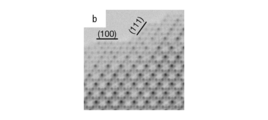
- FIG. 8B is a transmission electron micrograph of the sample.
- FIG. 8B shows that the lithium composite oxide particles have a complete crystal structure.
- the (111) crystal plane and the (100) crystal plane appeared in the TEM image.
- FIG. 8C shows an example of a three-dimensional structure of crystal grains.
- the crystal grains in the illustrated example have a substantially regular octahedral shape including an inclined surface composed of ⁇ 111 ⁇ planes and a truncated top surface of ⁇ 100 ⁇ planes.
- the present invention can provide a lithium composite oxide having a capacity of 250 mAh / g or more, a positive electrode active material for a secondary battery using the same, and a secondary battery.
Landscapes
- Chemical & Material Sciences (AREA)
- Inorganic Chemistry (AREA)
- Chemical Kinetics & Catalysis (AREA)
- Electrochemistry (AREA)
- General Chemical & Material Sciences (AREA)
- Organic Chemistry (AREA)
- Battery Electrode And Active Subsutance (AREA)
- Inorganic Compounds Of Heavy Metals (AREA)
Abstract
本発明は、250mAh/g程度の可逆容量を持つリチウム複合酸化物、これを用いた二次電池用正極活物質及び二次電池を提供することを目的とする。 本発明は、スピネル型構造を有するリチウム複合酸化物であって、化学組成を示す一般式が下記式(1)で示されることを特徴とするリチウム複合酸化物に関する。 Li1+zNiaMn2-yMbCuyO4-xFx ・・・(1) [一般式(1)中、0<a≦0.6、0≦b≦0.2、0≦y≦1、0≦x≦1、0≦z≦1.0であり、但し、xとyが共に0の場合を除く;Mは、Ti、V、Cr、Fe、Co、Zu、Snからなる群より選択される1種以上の金属元素である。]
Description
本発明は、リチウム複合酸化物、二次電池用正極活物質及び二次電池に関する。
本願は、2018年3月30日に、日本に出願された特願2018-066494号に基づき優先権を主張し、その内容をここに援用する。
本願は、2018年3月30日に、日本に出願された特願2018-066494号に基づき優先権を主張し、その内容をここに援用する。
リチウム複合酸化物は、リチウム二次電池の正極活物質として用いられている。リチウム二次電池は、既に携帯電話用途やノートパソコン用途などの小型電源として実用化されている。更に自動車用途や電力貯蔵用途などの中型、又は大型電源においても適用が試みられている。このように適用範囲の拡大に伴い、リチウム二次電池の性能を向上させることは重要な課題である。
スピネル型Ni置換マンガン酸リチウムとその派生化合物は、高電位、低コスト、さらには非毒性のため、リチウムイオン電池用の電極材料として魅力的な材料である。スピネル型Ni置換マンガン酸リチウムについては様々な研究が行われている。
例えば、特許文献1には、LNMO型のリチウム複合酸化物を用いた電池の容量を向上させるため、添加剤の含有量を削減し、空隙の少ない緻密なリチウム複合酸化膜を製造したことが記載されている。
例えば、特許文献1には、LNMO型のリチウム複合酸化物を用いた電池の容量を向上させるため、添加剤の含有量を削減し、空隙の少ない緻密なリチウム複合酸化膜を製造したことが記載されている。
非特許文献1に記載のリチウム複合酸化物は、カットオフ電位下限を3.5V(vs.Li+/Li)として、正極活物質として使用した場合の理論上の容量は、147mAh/gである。
Marilena Mancini et al,A High-Voltage and High-Capacity Li1+xNi0.5Mn1.5O4 Cathode Material: From Synthesis to Full Lithium-Ion Cells ChemSusChem 2016,9,1843-1849
カットオフ下限電位範囲を2.5V(vs.Li+/Li)以下まで拡張することにより、約200mAh/gの比容量が得られることが知られているが、リチウムイオンを過剰に吸蔵すると、結晶構造が立方晶から正方晶に相転移するという課題があった。
本発明は上記事情に鑑みてなされたものであって、250mAh/g程度の可逆容量を持つリチウム複合酸化物、これを用いた二次電池用正極活物質及び二次電池を提供することを目的とする。
本発明は下記の[1]~[11]を包含する。
本発明の第一の態様は、[1]に述べるリチウム複合酸化物を提供する。
[1]スピネル型構造を有するリチウム複合酸化物であって、化学組成を示す一般式が下記式(1)で示されることを特徴とするリチウム複合酸化物。
Li1+zNiaMn2-yMbCuyO4-xFx ・・・(1)
[一般式(1)中、0<a≦0.6、0≦b≦0.2、0≦y≦1、0≦x≦1、0≦z≦1.0であり、但し、xとyが共に0の場合を除く;Mは、Ti、V、Cr、Fe、Co、Zu、Snからなる群より選択される1種以上の金属元素である。]
第一の態様のリチウム複合酸化物は、以下の特徴を好ましく含む。
[2]前記リチウム複合酸化物は、(111)面を主面とする八面体結晶構造を有し、前記八面体結晶構造の少なくとも一つの頂点は切頂面を備える、[1]に記載のリチウム複合酸化物。
[3]前記リチウム複合酸化物は、(111)面を主面とする八面体結晶構造を有し、前記八面体結晶構造の少なくとも一つの稜は切稜面を備える、[1]又は[2]に記載のリチウム複合酸化物。
[4]前記リチウム複合酸化物は、(111)面を主面とする八面体結晶構造を有し、前記八面体結晶構造の少なくとも一つの傾斜面は、ステップ・テラス構造を備える、[1]~[3]のいずれか1つに記載のリチウム複合酸化物。
[5]前記式(1)において0<y≦1である、[1]~[4]のいずれか1つに記載のリチウム複合酸化物。
[6]前記式(1)において0<x≦1である、[1]~[4]のいずれか1つに記載のリチウム複合酸化物。
[7]前記式(1)において、0<y≦1かつ0<x≦1である、[1]~[4]のいずれか1つに記載のリチウム複合酸化物。
本発明の第二の態様は、以下の二次電池用正極活物質を提供する。
[8][1]~[7]のいずれか1つに記載のリチウム複合酸化物を含む二次電池用正極活物質。
本発明の第三の態様は、以下の二次電池を提供する。
[9][8]に記載の二次電池用正極活物質を備える二次電池。
さらに、本発明は以下のリチウム複合酸化物を提供する。
[10]前記xが0.025≦x≦0.1である、[1]~[4]のいずれか1つに記載のリチウム複合酸化物。
[11]LiNi0.5Mn1.49Cu0.01O4.0、LiNi0.5Mn1.45Cu0.05O4.0、LiNi0.5Mn1.49Cu0.01O3.9F0.1、LiNi0.5Mn1.49Cu0.01O3.95F0.05、LiNi0.5Mn1.49Cu0.01O3.975F0.025、及びLiNi0.5Mn1.45Cu0.05O3.95F0.05、から選択される少なくとも一つの化合物である、[1]~[4]のいずれか1つに記載のリチウム複合酸化物。
本発明の第一の態様は、[1]に述べるリチウム複合酸化物を提供する。
[1]スピネル型構造を有するリチウム複合酸化物であって、化学組成を示す一般式が下記式(1)で示されることを特徴とするリチウム複合酸化物。
Li1+zNiaMn2-yMbCuyO4-xFx ・・・(1)
[一般式(1)中、0<a≦0.6、0≦b≦0.2、0≦y≦1、0≦x≦1、0≦z≦1.0であり、但し、xとyが共に0の場合を除く;Mは、Ti、V、Cr、Fe、Co、Zu、Snからなる群より選択される1種以上の金属元素である。]
第一の態様のリチウム複合酸化物は、以下の特徴を好ましく含む。
[2]前記リチウム複合酸化物は、(111)面を主面とする八面体結晶構造を有し、前記八面体結晶構造の少なくとも一つの頂点は切頂面を備える、[1]に記載のリチウム複合酸化物。
[3]前記リチウム複合酸化物は、(111)面を主面とする八面体結晶構造を有し、前記八面体結晶構造の少なくとも一つの稜は切稜面を備える、[1]又は[2]に記載のリチウム複合酸化物。
[4]前記リチウム複合酸化物は、(111)面を主面とする八面体結晶構造を有し、前記八面体結晶構造の少なくとも一つの傾斜面は、ステップ・テラス構造を備える、[1]~[3]のいずれか1つに記載のリチウム複合酸化物。
[5]前記式(1)において0<y≦1である、[1]~[4]のいずれか1つに記載のリチウム複合酸化物。
[6]前記式(1)において0<x≦1である、[1]~[4]のいずれか1つに記載のリチウム複合酸化物。
[7]前記式(1)において、0<y≦1かつ0<x≦1である、[1]~[4]のいずれか1つに記載のリチウム複合酸化物。
本発明の第二の態様は、以下の二次電池用正極活物質を提供する。
[8][1]~[7]のいずれか1つに記載のリチウム複合酸化物を含む二次電池用正極活物質。
本発明の第三の態様は、以下の二次電池を提供する。
[9][8]に記載の二次電池用正極活物質を備える二次電池。
さらに、本発明は以下のリチウム複合酸化物を提供する。
[10]前記xが0.025≦x≦0.1である、[1]~[4]のいずれか1つに記載のリチウム複合酸化物。
[11]LiNi0.5Mn1.49Cu0.01O4.0、LiNi0.5Mn1.45Cu0.05O4.0、LiNi0.5Mn1.49Cu0.01O3.9F0.1、LiNi0.5Mn1.49Cu0.01O3.95F0.05、LiNi0.5Mn1.49Cu0.01O3.975F0.025、及びLiNi0.5Mn1.45Cu0.05O3.95F0.05、から選択される少なくとも一つの化合物である、[1]~[4]のいずれか1つに記載のリチウム複合酸化物。
本発明によれば、250mAh/g以上の容量を持つリチウム複合酸化物、これを用いた二次電池用正極活物質及び二次電池を提供することができる。
以下に、本発明を実施するための好ましい例について詳細に説明する。以下の説明は、発明の趣旨をより良く理解させるために具体的に説明するものであり、特に指定のない限り、本発明を限定するものではない。本発明の範囲内において、特に制限の無い限り、必要に応じて、数、量、材料、形状、位置、種類などを、変更、追加、省略、及び/又は交換することも可能である。
<リチウム複合酸化物>
LNMO型のリチウム複合酸化物は、合成条件によって、ニッケル/マンガン規則配列型(以下、「P4332型」と記載することがある。)、又はニッケル/マンガン不規則配列型(以下、「Fd-3m型」と記載することがある。)の空間群をもつ結晶が生成する。
P4332型のリチウム複合酸化物は、リチウム二次電池として用いた場合に容量が大きく、長寿命の電池とすることができるという長所がある。一方、電子伝導性が低いという短所がある。
Fd-3m型のリチウム複合酸化物は、リチウム二次電池として用いた場合に電子伝導率を高くできるという長所がある。一方、容量が小さく、長寿命の電池には不向きであるという短所がある。
<リチウム複合酸化物>
LNMO型のリチウム複合酸化物は、合成条件によって、ニッケル/マンガン規則配列型(以下、「P4332型」と記載することがある。)、又はニッケル/マンガン不規則配列型(以下、「Fd-3m型」と記載することがある。)の空間群をもつ結晶が生成する。
P4332型のリチウム複合酸化物は、リチウム二次電池として用いた場合に容量が大きく、長寿命の電池とすることができるという長所がある。一方、電子伝導性が低いという短所がある。
Fd-3m型のリチウム複合酸化物は、リチウム二次電池として用いた場合に電子伝導率を高くできるという長所がある。一方、容量が小さく、長寿命の電池には不向きであるという短所がある。
高容量で、サイクル特性に優れたリチウム二次電池に有用なリチウム複合酸化物を製造するにあたり、P4332型の長所である高容量特性と、Fd-3m型の長所である高い電子伝導特性を両立できることが好ましい。
本発明のリチウム複合酸化物は、化学組成を示す一般式が、式(1)で表されることを特徴とする。本発明のリチウム複合酸化物は、スピネル型結晶構造を好ましく有する。スピネル型構造とは、立方晶系に属する結晶構造の1種である。本実施形態のリチウム複合酸化物は、Cuイオン置換によるカチオン空間の制御と、Fイオン置換によるアニオン空間の制御の、いずれか一方又は両方を行う。これにより、ニッケル/マンガンの規則配列が安定化し、結晶構造が立方晶から正方晶に相転移することを抑制できる。この結果、リチウムイオンの収納サイトが増大し、250mAh/g以上の容量を持つリチウム複合酸化物とすることができる。
≪第1実施形態≫
本実施形態は、スピネル型構造を有するリチウム複合酸化物であって、化学組成を示す一般式が下記式(1)で示されるリチウム複合酸化物である。
Li1+zNiaMn2-yMbCuyO4-xFx ・・・(1)
[一般式(1)中、0<a≦0.6、0≦b≦0.2、0≦y≦1、0≦x≦1、0≦z≦1.0であり、但し、xとyが共に0の場合を除く;Mは、Ti、V、Cr、Fe、Co、Zu、Snからなる群より選択される1種以上の金属元素である。]
本実施形態は、スピネル型構造を有するリチウム複合酸化物であって、化学組成を示す一般式が下記式(1)で示されるリチウム複合酸化物である。
Li1+zNiaMn2-yMbCuyO4-xFx ・・・(1)
[一般式(1)中、0<a≦0.6、0≦b≦0.2、0≦y≦1、0≦x≦1、0≦z≦1.0であり、但し、xとyが共に0の場合を除く;Mは、Ti、V、Cr、Fe、Co、Zu、Snからなる群より選択される1種以上の金属元素である。]
第1実施形態は、Cuイオン置換によるカチオン空間の制御と、Fイオン置換によるアニオン空間の制御のいずれか一方又は両方を行う実施形態である。
上記式(1)において、a≧0.5が好ましい。
上記式(1)において、0≦y≦0.5が好ましい。
上記式(1)において、0.6≦z≦0.8が好ましい。
上記式(1)において、0≦x≦0.5が好ましい。
上記式(1)において、0≦b≦0.1が好ましい。
Mは、Ti、V、Cr、Fe、Co、Zu、Snからなる群より選択される1種以上の金属元素である。
上記式(1)において、aは、0<a≦0.10、0.10<a≦0.40、及び0.40<a≦0.60のいずれであってもよい。
上記式(1)において、bは、0≦b≦0.08、0.08≦b≦0.13、及び0.13≦b≦0.20のいずれであってもよい。
上記式(1)において、yは、0≦y≦0.30、0.30≦y≦0.60、及び0.60≦y≦1.00のいずれであってもよい。
上記式(1)において、xは、0≦x≦0.30、0.30≦x≦0.60、及び0.60≦x≦1.00のいずれであってもよい。
上記式(1)において、zは、0≦z≦1.0、0.50≦z≦0.60、0.60≦z≦0.80、及び0.80≦z≦1.00のいずれであってもよい。
本実施形態のリチウム複合酸化物は、主面が(111)面に相当する八面体結晶構造を有することが好ましい。
八面体結晶構造は、正八面体結晶構造であってもよく、歪みを有する八面体結晶構造であってもよい。
本実施形態において、八面体結晶構造の少なくとも一つの頂点は切頂面を有することが好ましい。
切頂面を有する頂点は、2以上が好ましく、3以上がより好ましい。また、八面体結晶構造のすべての頂点が切頂面を有していてもよく、7以下であってもよく、6以下であってもよい。
切頂面とは、多面体の頂点が切除されたことにより形成された面を意味する。
本実施形態において、八面体結晶構造の少なくとも一つの稜は切稜面を有することが好ましい。
切稜面を有する稜は、2以上が好ましく、3以上がより好ましい。また、八面体結晶構造のすべての稜が切稜面を有していてもよく、11以下であってもよく、10以下であってもよい。
切稜面とは、多面体の稜が切除されたことにより形成された面を意味する。
本実施形態において、八面体結晶構造の少なくとも一つの傾斜面は、ステップ・テラス構造を備えることが好ましい。
ここで「ステップ・テラス構造」とは、結晶の主面に沿って段差を介して互いに並列するように配設された平坦な複数のテラスと、各テラス間をつなぐ段サブであるステップとからなるミクロな階段状構造を意味する。
本実施形態において、ステップ・テラス構造を備える傾斜面は、2以上が好ましく、3以上がより好ましい。また、八面体結晶構造のすべての傾斜面がステップ・テラス構造を有していてもよく、7以下であってもよく、6以下であってもよい。
本実施形態のリチウム複合金属酸化物の結晶構造は、八面体結晶構造の少なくとも一つの頂点は切頂面を備え、かつ、八面体結晶構造の少なくとも一つの傾斜面は、ステップ・テラス構造を備えることが好ましい。
本実施形態のリチウム複合金属酸化物の結晶構造は、八面体結晶構造の少なくとも一つの稜は切稜面を備え、かつ、八面体結晶構造の少なくとも一つの傾斜面は、ステップ・テラス構造を備えることが好ましい。
本実施形態のリチウム複合金属酸化物の結晶構造は、八面体結晶構造の少なくとも一つの頂点は切頂面を備え、かつ、面体結晶構造の少なくとも一つの稜は切稜面を備えることが好ましい。
本実施形態のリチウム複合金属酸化物の結晶構造は、八面体結晶構造の少なくとも一つの頂点は切頂面を備え、かつ、面体結晶構造の少なくとも一つの稜は切稜面を備え、かつ、八面体結晶構造の少なくとも一つの傾斜面は、ステップ・テラス構造を備えることが好ましい。本実施形態のリチウム複合酸化物の結晶構造は、走査型電子顕微鏡又は透過型電子顕微鏡を用いて観察することにより、確認できる。
本実施形態のリチウム複合酸化物の結晶構造が、(111)面を持つ八面体に出現する切頂面を有する結晶構造、(111)面を持つ八面体に出現する切稜面を有する結晶構造、又は八面体結晶構造の少なくとも一つの傾斜面に、ステップ・テラス構造を備える構造であると、リチウム二次電池の充電時におけるリチウムイオンの脱離反応と、放電時におけるリチウムイオンの吸蔵反応とが安定に起こると考えられる。
上記式(1)において、a≧0.5が好ましい。
上記式(1)において、0≦y≦0.5が好ましい。
上記式(1)において、0.6≦z≦0.8が好ましい。
上記式(1)において、0≦x≦0.5が好ましい。
上記式(1)において、0≦b≦0.1が好ましい。
Mは、Ti、V、Cr、Fe、Co、Zu、Snからなる群より選択される1種以上の金属元素である。
上記式(1)において、aは、0<a≦0.10、0.10<a≦0.40、及び0.40<a≦0.60のいずれであってもよい。
上記式(1)において、bは、0≦b≦0.08、0.08≦b≦0.13、及び0.13≦b≦0.20のいずれであってもよい。
上記式(1)において、yは、0≦y≦0.30、0.30≦y≦0.60、及び0.60≦y≦1.00のいずれであってもよい。
上記式(1)において、xは、0≦x≦0.30、0.30≦x≦0.60、及び0.60≦x≦1.00のいずれであってもよい。
上記式(1)において、zは、0≦z≦1.0、0.50≦z≦0.60、0.60≦z≦0.80、及び0.80≦z≦1.00のいずれであってもよい。
本実施形態のリチウム複合酸化物は、主面が(111)面に相当する八面体結晶構造を有することが好ましい。
八面体結晶構造は、正八面体結晶構造であってもよく、歪みを有する八面体結晶構造であってもよい。
本実施形態において、八面体結晶構造の少なくとも一つの頂点は切頂面を有することが好ましい。
切頂面を有する頂点は、2以上が好ましく、3以上がより好ましい。また、八面体結晶構造のすべての頂点が切頂面を有していてもよく、7以下であってもよく、6以下であってもよい。
切頂面とは、多面体の頂点が切除されたことにより形成された面を意味する。
本実施形態において、八面体結晶構造の少なくとも一つの稜は切稜面を有することが好ましい。
切稜面を有する稜は、2以上が好ましく、3以上がより好ましい。また、八面体結晶構造のすべての稜が切稜面を有していてもよく、11以下であってもよく、10以下であってもよい。
切稜面とは、多面体の稜が切除されたことにより形成された面を意味する。
本実施形態において、八面体結晶構造の少なくとも一つの傾斜面は、ステップ・テラス構造を備えることが好ましい。
ここで「ステップ・テラス構造」とは、結晶の主面に沿って段差を介して互いに並列するように配設された平坦な複数のテラスと、各テラス間をつなぐ段サブであるステップとからなるミクロな階段状構造を意味する。
本実施形態において、ステップ・テラス構造を備える傾斜面は、2以上が好ましく、3以上がより好ましい。また、八面体結晶構造のすべての傾斜面がステップ・テラス構造を有していてもよく、7以下であってもよく、6以下であってもよい。
本実施形態のリチウム複合金属酸化物の結晶構造は、八面体結晶構造の少なくとも一つの頂点は切頂面を備え、かつ、八面体結晶構造の少なくとも一つの傾斜面は、ステップ・テラス構造を備えることが好ましい。
本実施形態のリチウム複合金属酸化物の結晶構造は、八面体結晶構造の少なくとも一つの稜は切稜面を備え、かつ、八面体結晶構造の少なくとも一つの傾斜面は、ステップ・テラス構造を備えることが好ましい。
本実施形態のリチウム複合金属酸化物の結晶構造は、八面体結晶構造の少なくとも一つの頂点は切頂面を備え、かつ、面体結晶構造の少なくとも一つの稜は切稜面を備えることが好ましい。
本実施形態のリチウム複合金属酸化物の結晶構造は、八面体結晶構造の少なくとも一つの頂点は切頂面を備え、かつ、面体結晶構造の少なくとも一つの稜は切稜面を備え、かつ、八面体結晶構造の少なくとも一つの傾斜面は、ステップ・テラス構造を備えることが好ましい。本実施形態のリチウム複合酸化物の結晶構造は、走査型電子顕微鏡又は透過型電子顕微鏡を用いて観察することにより、確認できる。
本実施形態のリチウム複合酸化物の結晶構造が、(111)面を持つ八面体に出現する切頂面を有する結晶構造、(111)面を持つ八面体に出現する切稜面を有する結晶構造、又は八面体結晶構造の少なくとも一つの傾斜面に、ステップ・テラス構造を備える構造であると、リチウム二次電池の充電時におけるリチウムイオンの脱離反応と、放電時におけるリチウムイオンの吸蔵反応とが安定に起こると考えられる。
以下に第一実施形態の更に好ましい例である、第2~4実施形態を述べる。
≪第2実施形態≫
本実施形態は、スピネル型構造を有するリチウム複合酸化物であって、化学組成を示す一般式が下記式(1)-1で示されるリチウム複合酸化物である。
Li1+zNiaMn2-yMbCuyO4-xFx ・・・(1)-1
[一般式(1)-1中、0<a≦0.6、0≦b≦0.2、0<y≦1、0≦x≦1、0≦z≦1.0である。Mは、Ti、V、Cr、Fe、Co、Zu、Snからなる群より選択される1種以上の金属元素である。]
≪第2実施形態≫
本実施形態は、スピネル型構造を有するリチウム複合酸化物であって、化学組成を示す一般式が下記式(1)-1で示されるリチウム複合酸化物である。
Li1+zNiaMn2-yMbCuyO4-xFx ・・・(1)-1
[一般式(1)-1中、0<a≦0.6、0≦b≦0.2、0<y≦1、0≦x≦1、0≦z≦1.0である。Mは、Ti、V、Cr、Fe、Co、Zu、Snからなる群より選択される1種以上の金属元素である。]
第2実施形態は、Cuイオン置換によるカチオン空間の制御を行う実施形態である。
上記式(1)-1において、各記号の好ましい範囲については上記式(1)において説明した内容と同様である。
上記式(1)-1において、各記号の好ましい範囲については上記式(1)において説明した内容と同様である。
Cuイオン置換によるカチオン空間の制御を行うことで、ニッケル/マンガン規則配列が安定化し、リチウムイオンの収納サイトが増大し、250mAh/g以上の容量を持つリチウム複合酸化物とすることができる。
≪第3実施形態≫
本実施形態は、スピネル型構造を有するリチウム複合酸化物であって、化学組成を示す一般式が下記式(1)-2で示されるリチウム複合酸化物である。
Li1+zNiaMn2-yMbCuyO4-xFx ・・・(1)-2
[一般式(1)中、0<a≦0.6、0≦b≦0.2、0≦y≦1、0<x≦1、0≦z≦1.0である。Mは、Ti、V、Cr、Fe、Co、Zu、Snからなる群より選択される1種以上の金属元素である。]
本実施形態は、スピネル型構造を有するリチウム複合酸化物であって、化学組成を示す一般式が下記式(1)-2で示されるリチウム複合酸化物である。
Li1+zNiaMn2-yMbCuyO4-xFx ・・・(1)-2
[一般式(1)中、0<a≦0.6、0≦b≦0.2、0≦y≦1、0<x≦1、0≦z≦1.0である。Mは、Ti、V、Cr、Fe、Co、Zu、Snからなる群より選択される1種以上の金属元素である。]
第3実施形態は、Fイオン置換によるアニオン空間の制御を行う実施形態である。
上記式(1)-2において、各記号の好ましい範囲については上記式(1)において説明した内容と同様である。
上記式(1)-2において、各記号の好ましい範囲については上記式(1)において説明した内容と同様である。
Fイオン置換によるアニオン空間の制御を行うことで、酸化還元反応に寄与しない安定なMn3+が生成すると考えられる。さらにアニオン空間を制御することにより、リチウムイオンの伝導経路が変化し、リチウムイオンの収納サイトが増大し、250mAh/g以上の容量を持つリチウム複合酸化物とすることができる。
≪第4実施形態≫
本実施形態は、スピネル型構造を有するリチウム複合酸化物であって、化学組成を示す一般式が下記式(1)-3で示されるリチウム複合酸化物である。
Li1+zNiaMn2-yCuyO4-xFx ・・・(1)-3
[一般式(1)中、0<a≦0.6、0<y≦1、0<x≦1、0≦z≦1.0である。]
本実施形態は、スピネル型構造を有するリチウム複合酸化物であって、化学組成を示す一般式が下記式(1)-3で示されるリチウム複合酸化物である。
Li1+zNiaMn2-yCuyO4-xFx ・・・(1)-3
[一般式(1)中、0<a≦0.6、0<y≦1、0<x≦1、0≦z≦1.0である。]
第4実施形態は、Cuイオン置換によるカチオン空間の制御と、Fイオン置換によるアニオン空間の制御をともに行う実施形態である。
上記式(1)-3において、各記号の好ましい範囲については上記式(1)において説明した内容と同様である。
本実施形態によれば、カチオン・アニオンの両空間を制御し、過剰リチウムイオンを収納するサイトを精密設計することにより、正方晶への相転移を抑制できる。
上記式(1)-3において、各記号の好ましい範囲については上記式(1)において説明した内容と同様である。
本実施形態によれば、カチオン・アニオンの両空間を制御し、過剰リチウムイオンを収納するサイトを精密設計することにより、正方晶への相転移を抑制できる。
本実施形態のリチウム複合酸化物の結晶相は、XRD法により同定できる。
<リチウム複合酸化物の製造方法>
本実施形態のリチウム複合酸化物の製造方法は、リチウム化合物と、少なくともマンガン及びニッケルを含む前駆体と、反応促進剤(フラックス)とを、前記式(1)、(1)-1~(1)-3で表される組成比となるように混合し、リチウム混合物を得る混合工程と、混合工程で得られたリチウム混合物を焼成する焼成工程とを含む。
本実施形態のリチウム複合酸化物の製造方法は、リチウム化合物と、少なくともマンガン及びニッケルを含む前駆体と、反応促進剤(フラックス)とを、前記式(1)、(1)-1~(1)-3で表される組成比となるように混合し、リチウム混合物を得る混合工程と、混合工程で得られたリチウム混合物を焼成する焼成工程とを含む。
[混合工程]
混合工程では、リチウム化合物と、少なくともマンガン及びニッケルを含む前駆体と、必要に応じて銅を含む前駆体と、反応促進剤(フラックス)とを混合する。混合方法としては、特に限定されることはなく、一般的な混合機を使用することができる。たとえば、シェーカミキサ、Vブレンダ、リボンミキサ、ジュリアミキサ、レーディゲミキサなどを使用することができ、微粉が発生しない程度に十分に混合されればよい。
混合工程では、リチウム化合物と、少なくともマンガン及びニッケルを含む前駆体と、必要に応じて銅を含む前駆体と、反応促進剤(フラックス)とを混合する。混合方法としては、特に限定されることはなく、一般的な混合機を使用することができる。たとえば、シェーカミキサ、Vブレンダ、リボンミキサ、ジュリアミキサ、レーディゲミキサなどを使用することができ、微粉が発生しない程度に十分に混合されればよい。
・リチウム化合物
本実施形態で使用するリチウム化合物は、必要に応じて選択できる。好ましい例として、水酸化リチウム、塩化リチウム、硝酸リチウムおよび炭酸リチウムからなる群より選ばれる1種以上の無水物並びに該1種以上の水和物を挙げることができる。
・少なくともマンガン及びニッケルを含む前駆体
本実施形態で使用する少なくともマンガン及びニッケルを含む前駆体は、必要に応じて選択できる。マンガンとニッケルは異なる化合物に含まれても良い。好ましい例として、マンガンを含む前駆体として、硝酸マンガン六水和物、硫酸マンガン五水和物、塩化マンガン4水和物の少なくとも1種を挙げることができる。ニッケルを含む前駆体として、硝酸ニッケル六水和物、硫酸ニッケル五水和物、塩化ニッケル四水和物の少なくとも1種を挙げることができる。マンガン及びニッケルの両方を含む前駆体を用いてもよい。なお本発明は上記例のみには限定されない。
・銅を含む前駆体
本実施形態で使用できる銅を含む前駆体は必要に応じて選択できる。銅を含む前駆体として、硝酸銅三水和物、硫酸銅三水和物、塩化銅二水和物を挙げることができる。
本実施形態で使用するリチウム化合物は、必要に応じて選択できる。好ましい例として、水酸化リチウム、塩化リチウム、硝酸リチウムおよび炭酸リチウムからなる群より選ばれる1種以上の無水物並びに該1種以上の水和物を挙げることができる。
・少なくともマンガン及びニッケルを含む前駆体
本実施形態で使用する少なくともマンガン及びニッケルを含む前駆体は、必要に応じて選択できる。マンガンとニッケルは異なる化合物に含まれても良い。好ましい例として、マンガンを含む前駆体として、硝酸マンガン六水和物、硫酸マンガン五水和物、塩化マンガン4水和物の少なくとも1種を挙げることができる。ニッケルを含む前駆体として、硝酸ニッケル六水和物、硫酸ニッケル五水和物、塩化ニッケル四水和物の少なくとも1種を挙げることができる。マンガン及びニッケルの両方を含む前駆体を用いてもよい。なお本発明は上記例のみには限定されない。
・銅を含む前駆体
本実施形態で使用できる銅を含む前駆体は必要に応じて選択できる。銅を含む前駆体として、硝酸銅三水和物、硫酸銅三水和物、塩化銅二水和物を挙げることができる。
・反応促進剤(フラックス)
本実施形態で使用する反応促進剤(フラックス)は、必要に応じて選択できる。具体的には、NaCl、KCl、RbCl、CsCl、CaC12、MgCl2、SrCl2、LiCl、BaCl2及びNH4Clなどの塩化物、Na2CO3、K2CO3、Rb2CO3、Cs2CO3、CaCO3、MgCO3、SrCO3及びBaCO3などの炭酸塩、K2SO4、Na2SO4などの硫酸塩、NaF、KF、NH4Fなどのフッ化物、等が挙げられる。
この中でも、KCl、K2CO3、K2SO4が好ましい。また、反応促進剤を2種以上併用することもできる。2種以上を使用する場合はその比率は任意に選択できる。
反応促進剤を混合物に含有させる方法や条件や量やタイミングは特に限定されず、必要に応じて選択できる。例えば、少なくともマンガン及びニッケルを含む前駆体をリチウム化合物と混合するときに反応促進剤を添加すればよい。
反応促進剤は、焼成後のリチウム複合酸化物に残留していてもよく、洗浄、蒸発等により除去されていてもよい。
本実施形態で使用する反応促進剤(フラックス)は、必要に応じて選択できる。具体的には、NaCl、KCl、RbCl、CsCl、CaC12、MgCl2、SrCl2、LiCl、BaCl2及びNH4Clなどの塩化物、Na2CO3、K2CO3、Rb2CO3、Cs2CO3、CaCO3、MgCO3、SrCO3及びBaCO3などの炭酸塩、K2SO4、Na2SO4などの硫酸塩、NaF、KF、NH4Fなどのフッ化物、等が挙げられる。
この中でも、KCl、K2CO3、K2SO4が好ましい。また、反応促進剤を2種以上併用することもできる。2種以上を使用する場合はその比率は任意に選択できる。
反応促進剤を混合物に含有させる方法や条件や量やタイミングは特に限定されず、必要に応じて選択できる。例えば、少なくともマンガン及びニッケルを含む前駆体をリチウム化合物と混合するときに反応促進剤を添加すればよい。
反応促進剤は、焼成後のリチウム複合酸化物に残留していてもよく、洗浄、蒸発等により除去されていてもよい。
[焼成工程]
焼成工程では、原料である、前記前駆体、リチウム化合物および反応促進剤の混合物を焼成することにより、焼成物であるリチウム複合酸化物の塊状物を得る。
焼成工程における保持温度は任意に選択できるが、一例としては、例えば650℃以上900℃以下の範囲であることが挙げられる。より好ましくは700℃以上850℃以下である。
前記保持温度で保持する時間は任意に選択できるが、例えば、0.1~20時間であり、好ましくは0.5~8時間である。
前記保持温度までの昇温速度は任意に選択できるが、例えば50℃~400℃/時である。
前記保持温度から室温までの降温速度は任意に選択できるが、通常10℃~400℃/時である。
また、焼成の雰囲気としては、大気、酸素、窒素、アルゴンまたはそれらの混合ガスを用いることがきる。すなわち、不活性ガス、中性ガス、酸化性ガスなどの雰囲気下を必要に応じて使用することができるが、大気雰囲気が好ましい。
焼成で得られた、リチウム複合酸化物は、以下の一般式で示される組成を有することが好ましい。
Li1+zNiaMnm1MbO4-δ ・・・(2)
[一般式(1)中、0<a≦0.6、0≦b≦0.2、0≦m1≦1、0≦δ≦4、0≦z≦1.0である。Mは、Ti、V、Cr、Fe、Co、Zu、Snからなる群より選択される1種以上の金属元素である。]
上記リチウム複合酸化物は、酸素欠損型であってもよい。
上記のように得られたリチウム複合酸化物は、必要に応じて、さらに第二の焼成工程を実施することもできる。
第二の焼成工程においては、リチウム複合酸化物は、フッ素を含む化合物、銅を含む化合物のいずれか一方又は両方と混ぜて、焼成を行うことができる。この時上記フラックスを組み合わせて使用することも好ましい。フッ素を含む化合物は任意に選択できるが、例えば、フッ化リチウム、フッ化アルミニウム、フッ化亜鉛などを挙げることができる。
銅を含む化合物は任意に選択できるが、例えば、硝酸銅三水和物、硫酸銅三水和物、塩化銅二水和物などを挙げることができる。
第二の焼成における保持温度は任意に選択できるが、一例としては、300℃以上1000℃以下、400℃以上900℃以下、500℃以上800℃以下である。
前記保持温度で保持する時間は任意に選択できるが、例えば0.5時間以上20時間以下、2時間以上15時間以下である。
前記保持温度までの昇温速度は任意に選択できるが昇温速度は、通常50℃/時間以上400℃/時間以下であることが好ましく、前記保持温度から室温までの降温速度は、通常10℃/時間以上400℃/時間以下であることが好ましい。 また、焼成の雰囲気としては、大気、酸素、窒素、アルゴンまたはそれらの混合ガスを用いることがきる。すなわち、不活性ガス、中性ガス、酸化性ガスなどの雰囲気下を使用することができる。途中で、雰囲気を切り替えても良い。例えば、大気雰囲気下で焼成を行い、次に、酸素雰囲気下で焼成を行っても良い。
得られたリチウム複合酸化物の塊状物は、必要に応じてロールミル等の解砕機にて解砕され、残留リチウム成分や反応促進剤を除去するために洗浄され、乾燥に付される。
なお、乾燥粉末は、必要に応じロールミル等により解砕される。ここで、解砕とは、凝集粒子を分散することや、解きほぐすことをいう。
焼成工程では、原料である、前記前駆体、リチウム化合物および反応促進剤の混合物を焼成することにより、焼成物であるリチウム複合酸化物の塊状物を得る。
焼成工程における保持温度は任意に選択できるが、一例としては、例えば650℃以上900℃以下の範囲であることが挙げられる。より好ましくは700℃以上850℃以下である。
前記保持温度で保持する時間は任意に選択できるが、例えば、0.1~20時間であり、好ましくは0.5~8時間である。
前記保持温度までの昇温速度は任意に選択できるが、例えば50℃~400℃/時である。
前記保持温度から室温までの降温速度は任意に選択できるが、通常10℃~400℃/時である。
また、焼成の雰囲気としては、大気、酸素、窒素、アルゴンまたはそれらの混合ガスを用いることがきる。すなわち、不活性ガス、中性ガス、酸化性ガスなどの雰囲気下を必要に応じて使用することができるが、大気雰囲気が好ましい。
焼成で得られた、リチウム複合酸化物は、以下の一般式で示される組成を有することが好ましい。
Li1+zNiaMnm1MbO4-δ ・・・(2)
[一般式(1)中、0<a≦0.6、0≦b≦0.2、0≦m1≦1、0≦δ≦4、0≦z≦1.0である。Mは、Ti、V、Cr、Fe、Co、Zu、Snからなる群より選択される1種以上の金属元素である。]
上記リチウム複合酸化物は、酸素欠損型であってもよい。
上記のように得られたリチウム複合酸化物は、必要に応じて、さらに第二の焼成工程を実施することもできる。
第二の焼成工程においては、リチウム複合酸化物は、フッ素を含む化合物、銅を含む化合物のいずれか一方又は両方と混ぜて、焼成を行うことができる。この時上記フラックスを組み合わせて使用することも好ましい。フッ素を含む化合物は任意に選択できるが、例えば、フッ化リチウム、フッ化アルミニウム、フッ化亜鉛などを挙げることができる。
銅を含む化合物は任意に選択できるが、例えば、硝酸銅三水和物、硫酸銅三水和物、塩化銅二水和物などを挙げることができる。
第二の焼成における保持温度は任意に選択できるが、一例としては、300℃以上1000℃以下、400℃以上900℃以下、500℃以上800℃以下である。
前記保持温度で保持する時間は任意に選択できるが、例えば0.5時間以上20時間以下、2時間以上15時間以下である。
前記保持温度までの昇温速度は任意に選択できるが昇温速度は、通常50℃/時間以上400℃/時間以下であることが好ましく、前記保持温度から室温までの降温速度は、通常10℃/時間以上400℃/時間以下であることが好ましい。 また、焼成の雰囲気としては、大気、酸素、窒素、アルゴンまたはそれらの混合ガスを用いることがきる。すなわち、不活性ガス、中性ガス、酸化性ガスなどの雰囲気下を使用することができる。途中で、雰囲気を切り替えても良い。例えば、大気雰囲気下で焼成を行い、次に、酸素雰囲気下で焼成を行っても良い。
得られたリチウム複合酸化物の塊状物は、必要に応じてロールミル等の解砕機にて解砕され、残留リチウム成分や反応促進剤を除去するために洗浄され、乾燥に付される。
なお、乾燥粉末は、必要に応じロールミル等により解砕される。ここで、解砕とは、凝集粒子を分散することや、解きほぐすことをいう。
リチウム化合物と、少なくともマンガン及びニッケルを含む前駆体と、銅を含む前駆体と、反応促進剤(フラックス)とを混合して焼成することにより、Mn2+又はMn3+が、Cu2+又はCu3+に置換され、銅がドープされたリチウム複合酸化物を得ることができる。また、大気雰囲気条件又は低酸素条件で焼成することにより、酸素欠損型のリチウム複合酸化物を得ることができる。
酸素欠損型リチウム複合酸化物と、フッ素を含む化合物とを混合して反応させることにより、酸素原子の一部をフッ素原子に置換したリチウム複合酸化物を得ることができる。
酸素欠損型リチウム複合酸化物と、フッ素を含む化合物とを混合して反応させることにより、酸素原子の一部をフッ素原子に置換したリチウム複合酸化物を得ることができる。
得られたリチウム複合酸化物の塊状物は、必要に応じてロールミル等の解砕機にて解砕され、残留リチウム成分や反応促進剤を除去するために洗浄され、乾燥に付される。
なお、乾燥粉末は、必要に応じロールミル等により解砕される。ここで、解砕とは、凝集粒子を分散することや、解きほぐすことをいう。
得られたリチウム複合酸化物の粒子の粒径は任意に選択できる。例えば粒子単体(一次粒子)の粒径は0.1μm以上2.0μm以下であってもよく、0.2μm以上1.9μm以下であってもよく、0.3μm以上1.8μm以下がより好ましい。一次粒子の粒径は、走査型電子顕微鏡により得られた画像から得ることができる。得られたリチウム複合酸化物の形状は任意に選択できるが、例えば、八面体形状、概略八面体形状、又は、切頂面及び/又は切稜面を有する八面体形状又は概略八面体形状であってよい。これら酸化物は多孔質であってもよい。
なお、乾燥粉末は、必要に応じロールミル等により解砕される。ここで、解砕とは、凝集粒子を分散することや、解きほぐすことをいう。
得られたリチウム複合酸化物の粒子の粒径は任意に選択できる。例えば粒子単体(一次粒子)の粒径は0.1μm以上2.0μm以下であってもよく、0.2μm以上1.9μm以下であってもよく、0.3μm以上1.8μm以下がより好ましい。一次粒子の粒径は、走査型電子顕微鏡により得られた画像から得ることができる。得られたリチウム複合酸化物の形状は任意に選択できるが、例えば、八面体形状、概略八面体形状、又は、切頂面及び/又は切稜面を有する八面体形状又は概略八面体形状であってよい。これら酸化物は多孔質であってもよい。
<二次電池用正極活物質>
本実施形態の二次電池用正極は、上記した本発明のリチウム複合酸化物を有すること以外は限定されるものではない。
本実施形態の正極は、まず本発明のリチウム複合酸化物、導電材およびバインダーを含む正極合剤を調整することで製造することができる。
本実施形態の二次電池用正極は、上記した本発明のリチウム複合酸化物を有すること以外は限定されるものではない。
本実施形態の正極は、まず本発明のリチウム複合酸化物、導電材およびバインダーを含む正極合剤を調整することで製造することができる。
(導電材)
本実施形態の正極が有する導電材としては、炭素材料を用いることができる。炭素材料として黒鉛粉末、カーボンブラック(例えばアセチレンブラック)、繊維状炭素材料などを挙げることができる。カーボンブラックは、微粒で表面積が大きいため、少量を正極合剤中に添加することにより正極内部の導電性を高め、充放電効率および出力特性を向上させることができる。ただし、多く入れすぎるとバインダーによる正極合剤と正極集電体との結着力、および正極合剤内部の結着力がいずれも低下し、かえって内部抵抗を増加させる原因となる。よって適切な量で使用されることが好ましい。
本実施形態の正極が有する導電材としては、炭素材料を用いることができる。炭素材料として黒鉛粉末、カーボンブラック(例えばアセチレンブラック)、繊維状炭素材料などを挙げることができる。カーボンブラックは、微粒で表面積が大きいため、少量を正極合剤中に添加することにより正極内部の導電性を高め、充放電効率および出力特性を向上させることができる。ただし、多く入れすぎるとバインダーによる正極合剤と正極集電体との結着力、および正極合剤内部の結着力がいずれも低下し、かえって内部抵抗を増加させる原因となる。よって適切な量で使用されることが好ましい。
(バインダー)
本実施形態の正極が有するバインダーとしては、熱可塑性樹脂を用いることができる。
この熱可塑性樹脂の例としては、ポリフッ化ビニリデン(以下、PVdFということがある。)、ポリテトラフルオロエチレン(以下、PTFEということがある。)、四フッ化エチレン・六フッ化プロピレン・フッ化ビニリデン系共重合体、六フッ化プロピレン・フッ化ビニリデン系共重合体、四フッ化エチレン・パーフルオロビニルエーテル系共重合体などのフッ素樹脂;ポリエチレン、ポリプロピレンなどのポリオレフィン樹脂;を挙げることができる。
本実施形態の正極が有するバインダーとしては、熱可塑性樹脂を用いることができる。
この熱可塑性樹脂の例としては、ポリフッ化ビニリデン(以下、PVdFということがある。)、ポリテトラフルオロエチレン(以下、PTFEということがある。)、四フッ化エチレン・六フッ化プロピレン・フッ化ビニリデン系共重合体、六フッ化プロピレン・フッ化ビニリデン系共重合体、四フッ化エチレン・パーフルオロビニルエーテル系共重合体などのフッ素樹脂;ポリエチレン、ポリプロピレンなどのポリオレフィン樹脂;を挙げることができる。
正極合剤をペースト化する場合、用いることができる有機溶媒としては、N,N―ジメチルアミノプロピルアミン、ジエチレントリアミンなどのアミン系溶媒;テトラヒドロフランなどのエーテル系溶媒;メチルエチルケトンなどのケトン系溶媒;酢酸メチルなどのエステル系溶媒;ジメチルアセトアミド、N-メチル-2-ピロリドン(以下、NMPということがある。)などのアミド系溶媒;が挙げられる。
<リチウム二次電池>
本発明のリチウム二次電池は、上記した本発明のリチウム複合酸化物を用いること以外は限定されるものではない。
すなわち、本発明のリチウム二次電池は、上記したリチウム二次電池用正極を有すること以外は、従来公知のリチウム二次電池と同様の構成とすることができる。本発明のリチウム二次電池は、正極、負極、電解液、その他必要な部材を有する構成とすることができる。
本発明のリチウム二次電池は、上記した本発明のリチウム複合酸化物を用いること以外は限定されるものではない。
すなわち、本発明のリチウム二次電池は、上記したリチウム二次電池用正極を有すること以外は、従来公知のリチウム二次電池と同様の構成とすることができる。本発明のリチウム二次電池は、正極、負極、電解液、その他必要な部材を有する構成とすることができる。
(負極)
負極の活物質としては、リチウムイオンを吸蔵及び放出できる化合物を単独乃至は組み合わせて用いることができる。リチウムイオンを吸蔵及び放出できる化合物の一例としては、リチウム等の金属材料、チタン、ケイ素、スズ等を含有する合金材料、グラファイト、コークス、有機高分子化合物焼成体又は非晶質炭素等の炭素材料、その他、酸化ケイ素、LiCoN、CuO、V2O5などのセラミックス材料が挙げられる。
これらの活物質は単独で用いるだけでなく、これらを複数種類混合して用いることもできる。これらの物質のうち、負極活物質として、チタン含有酸化物(たとえば、ブロンズ構造の酸化チタンであるTiO2(B)、チタン酸リチウムであるLi4Ti5O12)を用いることが好ましい。
例えば、負極活物質としてリチウム金属箔を用いる場合、銅等の金属からなる集電体の表面にリチウム箔を圧着することで形成できる。
負極の活物質としては、リチウムイオンを吸蔵及び放出できる化合物を単独乃至は組み合わせて用いることができる。リチウムイオンを吸蔵及び放出できる化合物の一例としては、リチウム等の金属材料、チタン、ケイ素、スズ等を含有する合金材料、グラファイト、コークス、有機高分子化合物焼成体又は非晶質炭素等の炭素材料、その他、酸化ケイ素、LiCoN、CuO、V2O5などのセラミックス材料が挙げられる。
これらの活物質は単独で用いるだけでなく、これらを複数種類混合して用いることもできる。これらの物質のうち、負極活物質として、チタン含有酸化物(たとえば、ブロンズ構造の酸化チタンであるTiO2(B)、チタン酸リチウムであるLi4Ti5O12)を用いることが好ましい。
例えば、負極活物質としてリチウム金属箔を用いる場合、銅等の金属からなる集電体の表面にリチウム箔を圧着することで形成できる。
また、負極活物質として合金材料、炭素材料を用いる場合は、負極活物質と結着材、導電助剤等を水、N-メチルピロリドン等の溶媒中で混合した後、銅等の金属からなる集電体上に塗布され形成することができる。上記結着材としては、高分子材料から形成されることが望ましく、リチウム二次電池内の雰囲気において化学的・物理的に安定な材料であることが望ましい。
例えば、ポリフッ化ビニリデン(PVDF)、ポリテトラフルオロエチレン(PTFE)、エチレン-プロピレン-ジエン共重合体(EPDM)、スチレン-ブタジエンゴム(SBR)、アクリロニトリル-ブタジエンゴム(NBR)、ポリイミド(PI)、フッ素ゴム等が挙げられる。
また導電助剤としては、ケッチェンブラック、アセチレンブラック、カーボンブラック、グラファイト、カーボンナノチューブ、カーボンファイバー,グラフェン,非晶質炭素等などが例示できる。また、導電性高分子ポリアニリン、ポリピロール、ポリチオフェン、ポリアセチレン、ポリアセンなどが例示できる。
また導電助剤としては、ケッチェンブラック、アセチレンブラック、カーボンブラック、グラファイト、カーボンナノチューブ、カーボンファイバー,グラフェン,非晶質炭素等などが例示できる。また、導電性高分子ポリアニリン、ポリピロール、ポリチオフェン、ポリアセチレン、ポリアセンなどが例示できる。
電解液は、正極及び負極の間のイオンなどの荷電担体の輸送を行う媒体であり、特に限定しないが、リチウムイオン二次電池が使用される雰囲気下で物理的、化学的、電気的に安定なものが望ましい。
(電解液)
例えば、電解液としては任意に選択でき、LiBF4、LiPF6、LiCF3SO3、LiN(CF3SO2)2、LiN(C2F5SO2)2、LiN(CF3SO2)(C4F9SO2)の中から選ばれた1種以上を支持電解質とし、これを有機溶媒に溶解させた電解液が好ましい。
例えば、電解液としては任意に選択でき、LiBF4、LiPF6、LiCF3SO3、LiN(CF3SO2)2、LiN(C2F5SO2)2、LiN(CF3SO2)(C4F9SO2)の中から選ばれた1種以上を支持電解質とし、これを有機溶媒に溶解させた電解液が好ましい。
有機溶媒としては任意に選択でき、プロピレンカーボネート、エチレンカーボネート、1,2-ジメトキシエタン、ジメチルカーボネート、ジエチルカーボネート、エチルメチルカーボネート、テトラヒドロフラン、2-メチルテトラヒドロフラン、テトラヒドロピラン等及びこれらの混合物が例示できる。中でもカーボネート系溶媒を含む電解液は、高温での安定性が高いことから好ましい。また、ポリエチレンオキサイドなどの固体高分子に上記の電解質を含んだ固体高分子電解質やリチウムイオン伝導性を有するセラミック、ガラス等の固体電解質も使用可能である。
正極と負極との間には、電気的な絶縁作用とイオン伝導作用とを両立する部材であるセパレータを介装することが望ましい。電解質が液状である場合にはセパレータは、液状の電解質を保持する役割をも果たす。セパレータとしては、多孔質合成樹脂膜、特にポリオレフィン系高分子(ポリエチレン、ポリプロピレン)やガラス繊維からなる多孔質膜、不織布が例示できる。更に、セパレータは、正極及び負極の間の絶縁を担保する目的で、正極及び負極よりも更に大きい形態を採用することが好ましい。
正極、負極、電解質、セパレータなどは何らかのケース内に収納することが一般的である。ケースは、特に限定されるものではなく、公知の材料、形態で作成することができる。すなわち、本発明のリチウム二次電池は、その形状には特に制限を受けず、コイン型、円筒型、角型等、種々の形状の電池として使用できる。また、本発明のリチウム二次電池のケースについても限定されるものではなく、金属製あるいは樹脂製のその外形を保持できるケース、ラミネートパック等の軟質のケース等、種々の形態の電池として使用できる。
以下、実施例により本発明をより具体的に説明するが、本発明は以下の実施例に限定されるものではない。
<実施例1>
以下の方法により、LiCl-KClフラックスを用いて、銅、フッ素共置換リチウム複合酸化物である、LiNi0.5Mn1.5-yCuyO4-xFx結晶を育成した。
以下の方法により、LiCl-KClフラックスを用いて、銅、フッ素共置換リチウム複合酸化物である、LiNi0.5Mn1.5-yCuyO4-xFx結晶を育成した。
・銅、フッ素共置換リチウム複合酸化物の製造および評価
最初に、酸素欠損型銅置換リチウム複合酸化物を、以下のように製造した。
リチウム複合酸化物のリチウム源として塩化リチウムを、ニッケル源として硝酸ニッケル六水和物を、マンガン源として硝酸マンガン六水和物を、カッパー源として硝酸銅三水和物を、Li:Ni:Mn:Cuのモル比が1.0:0.50:1.49:0.01となるように混合した。
最初に、酸素欠損型銅置換リチウム複合酸化物を、以下のように製造した。
リチウム複合酸化物のリチウム源として塩化リチウムを、ニッケル源として硝酸ニッケル六水和物を、マンガン源として硝酸マンガン六水和物を、カッパー源として硝酸銅三水和物を、Li:Ni:Mn:Cuのモル比が1.0:0.50:1.49:0.01となるように混合した。
フラックスとして、塩化リチウムと塩化カリウムの混合液を用いた。フラックスの量は溶質に対して重量比で約5倍とした。これらをアルミナ製のるつぼに投入した。るつぼを電気炉内に入れ、大気雰囲気下で、加熱温度:15℃/分、保持時間:10時間、保持温度:700℃、冷却速度:200℃/時間、停止温度:500℃の条件で加熱処理をした。加熱処理後、温水に浸漬してフラックスを除去した。これにより、LiNi0.5Mn1.49Cu0.01O4‐δの酸素欠損型銅置換リチウム複合酸化物を得た。
次に、前記で得られたLiNi0.5Mn1.49Cu0.01O4‐δの酸素欠損型銅置換リチウム複合酸化物と、塩化カリウムとフッ化リチウムの混合物(混合比= モル比で1:1)とを、大気雰囲気下、800℃で10時間焼成した。酸素欠損型銅置換リチウム複合酸化物と前記混合物の比はモル比で1:1とした。
さらに、酸素雰囲気下、700℃で10時間焼成し、実施例1では、目的のLiNi0.5Mn1.49Cu0.01O4-aFa(0≦a≦1)で示される、銅、フッ素共置換リチウム複合酸化物を得た。XRD法により結晶相を同定し、FE-SEMにより結晶の形態を評価した。加えて、ラマン分光法により空間群を同定した。図1に結果を示す。なお、比較のために、製造におけるフッ化リチウム混合物の使用量の条件を変えて、Fの比率が異なるものも製造した。また比較として、CuとFeを含まない化合物も製造し評価した。
さらに、酸素雰囲気下、700℃で10時間焼成し、実施例1では、目的のLiNi0.5Mn1.49Cu0.01O4-aFa(0≦a≦1)で示される、銅、フッ素共置換リチウム複合酸化物を得た。XRD法により結晶相を同定し、FE-SEMにより結晶の形態を評価した。加えて、ラマン分光法により空間群を同定した。図1に結果を示す。なお、比較のために、製造におけるフッ化リチウム混合物の使用量の条件を変えて、Fの比率が異なるものも製造した。また比較として、CuとFeを含まない化合物も製造し評価した。
<実施例2>
・フッ素置換リチウム複合酸化物の製造および評価
リチウム複合酸化物のリチウム源として塩化リチウムを、ニッケル源として硝酸ニッケル六水和物を、マンガン源として硝酸マンガン六水和物をLi:Ni:Mnのモル比が1.0:0.50:1.5となるように混合した以外は、実施例1と同様の手法によりLiNi0.5Mn1.45Cu0.05O4-aFa(0≦a≦1)のフッ素置換リチウム複合酸化物を得た。XRD法により結晶相を同定し、FE-SEMにより結晶の形態を評価した。加えて、ラマン分光法により空間群を同定した。図1に結果を示す。なお、実施例2では、製造におけるカッパー源の使用量の条件を変えて、Cuの比率が異なるものも製造した。
・フッ素置換リチウム複合酸化物の製造および評価
リチウム複合酸化物のリチウム源として塩化リチウムを、ニッケル源として硝酸ニッケル六水和物を、マンガン源として硝酸マンガン六水和物をLi:Ni:Mnのモル比が1.0:0.50:1.5となるように混合した以外は、実施例1と同様の手法によりLiNi0.5Mn1.45Cu0.05O4-aFa(0≦a≦1)のフッ素置換リチウム複合酸化物を得た。XRD法により結晶相を同定し、FE-SEMにより結晶の形態を評価した。加えて、ラマン分光法により空間群を同定した。図1に結果を示す。なお、実施例2では、製造におけるカッパー源の使用量の条件を変えて、Cuの比率が異なるものも製造した。
・二次電池の製造
得られた活物質、デンカブラック、PVDFを90:5:5%の質量比で混合し、タップ密度を3.0g/cm3に調整した多孔質合剤電極をアルミ集電箔上に作製した。
対極にリチウム金属、セパレータにセルガード#2400、電解液には1MのLiPF6を含むEC-DMCを用いて、R2032型コインセルを作製した。
得られた活物質、デンカブラック、PVDFを90:5:5%の質量比で混合し、タップ密度を3.0g/cm3に調整した多孔質合剤電極をアルミ集電箔上に作製した。
対極にリチウム金属、セパレータにセルガード#2400、電解液には1MのLiPF6を含むEC-DMCを用いて、R2032型コインセルを作製した。
・定電流充放電特性の評価
上記コインセルを用いて、カットオフ電位範囲4.8V-2.5V(vs Li+/Li)、0.2C相当の電流密度条件で、定電流充放電特性を評価した。図2に結果を示す。
上記コインセルを用いて、カットオフ電位範囲4.8V-2.5V(vs Li+/Li)、0.2C相当の電流密度条件で、定電流充放電特性を評価した。図2に結果を示す。
・電子状態解析
DFT計算による構造最適化および電子状態解析を行った。これらは,計算ソフトVienna Ab-initio Simulation Package(VASP)を用いておこなった。
計算条件として,PAW法及びGGA-PBEsol+U(Ni:U =6.0eV[1]、Mn:U = 3.9eV[1])を使用した。
56原子を含む8LiNi0.5Mn1.5O4スーパーセルを用いて、Cu2+とF-を共置換したLiNi0.5Mn1.5-yCuyO4-xFxの相安定性の評価、およびLi組成の異なる類似体の生成エネルギーの計算と電子状態解析から脱挿入機構を、計算科学的に予測した。
DFT計算による構造最適化および電子状態解析を行った。これらは,計算ソフトVienna Ab-initio Simulation Package(VASP)を用いておこなった。
計算条件として,PAW法及びGGA-PBEsol+U(Ni:U =6.0eV[1]、Mn:U = 3.9eV[1])を使用した。
56原子を含む8LiNi0.5Mn1.5O4スーパーセルを用いて、Cu2+とF-を共置換したLiNi0.5Mn1.5-yCuyO4-xFxの相安定性の評価、およびLi組成の異なる類似体の生成エネルギーの計算と電子状態解析から脱挿入機構を、計算科学的に予測した。
図1に、LiNi0.5Mn1.5-yCuyO4-xFx結晶の各組成のラマンスペクトルを示す。図1に示すように、X=0.1組成では、すなわち、LiNi0.5Mn1.49Cu0.01O3.9F0.1では、ラマンスペクトルのブロード化が認められた。
これは、P4332型構造の不安定化によるFd-3m構造への転移を意味する。
一方、LiNi0.5Mn1.49Cu0.01O3.95F0.05やLiNi0.5Mn1.49Cu0.01O3.975F0.025などのF置換量の少ない組成では、Ni/Mnの規則配列に帰属されるラマンスペクトルの先鋭化が見られた。P4332型構造の安定化が確認された。以上の結果から、共置換体においては、酸素欠損を含んでいるにも関わらず、極めて狭い組成範囲内でP4332型構造が安定化されることがわかった。
これは、P4332型構造の不安定化によるFd-3m構造への転移を意味する。
一方、LiNi0.5Mn1.49Cu0.01O3.95F0.05やLiNi0.5Mn1.49Cu0.01O3.975F0.025などのF置換量の少ない組成では、Ni/Mnの規則配列に帰属されるラマンスペクトルの先鋭化が見られた。P4332型構造の安定化が確認された。以上の結果から、共置換体においては、酸素欠損を含んでいるにも関わらず、極めて狭い組成範囲内でP4332型構造が安定化されることがわかった。
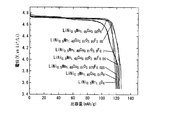
コインセルを用いての評価において、開回路電圧が安定した後、25℃で正極に対する電流密度を正極活物質重量に対して30mAh/gとして4.8となるまで充電し、その後3.5Vとなるまで放電した。この時の放電容量を測定する充放電試験を行い、得られた充放電曲線を図2に示す。X=0.1組成という、過剰のF置換により、4.0V付近に屈曲線が現れた。この結果は、上記図1の結果から予測される、過剰F置換により誘発されるP4332型構造の不安定化とFd-3m構造への転移という結果と、一致する。また、いずれも放電容量は概ね理論容量を達成した。
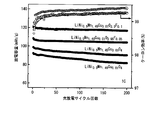
図3には、実施例の代表的なサンプルについて、電流密度を150mAh/gとして充放電試験を200サイクル繰り返した後の、放電容量を示す。初回容量と比較して97%以上、クーロン効率は99.5%以上を維持していることがわかった。
このため、高電位領域における電解液の酸化分解による電極および電解液の劣化はほとんどないと言える。
このため、高電位領域における電解液の酸化分解による電極および電解液の劣化はほとんどないと言える。
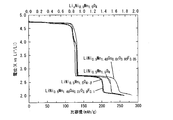
さらに空間群の効果を明らかにするために、実施例の組成と空間群の異なる代表的なサンプルについて、上記とは異なる条件で、充放電試験を行った。具体的には、25℃で正極に対する電流密度を正極活物質重量に対して30mAh/gとして、4.8となるまで充電し、その後2.5Vとなるまで放電した時の放電容量を測定する、充放電試験を行った。その初期放電容量を求めた結果を図4にまとめた。
図4に示されるように、4.8V-2.5V範囲のカットオフ電位範囲では、アニオン、カチオンの置換効果、さらにその空間群が比容量とサイクル特性に顕著に影響し、最大で250mAh/gの可逆容量が得られた。カチオン・アニオンの両空間を制御することにより、リチウムイオンを収納するサイト数を精密設計できることがわかった。
さらに実施例の2つの化合物につて、上記と同じ4.8V-2.5V範囲のカットオフ電位範囲条件で、50回の繰り返し充放電試験を繰り返した。その充放電サイクル回数に対する放電容量の変化を、図5にまとめた。アニオン、カチオンの置換効果、さらにその空間群が比容量とサイクル特性に顕著に影響し、LiNi0.5Mn1.49Cu0.01O3.9F0.1結晶で、90%以上の容量維持率が得られた。
この結果を理解するために、任意の電位で充電状態を規定し、電池を解体して取り出した正極のX線回折測定結果を、図6にまとめた。Cu置換量を固定し、F置換量のみ異なるサンプルを比較した結果、置換量に依存することなく2.7V付近で正方晶由来の回折線が出現した。さらに2θ=18°付近の(111)面に帰属される回折線の分裂が検出された。ただし、それら正方晶由来の回折線の出現や(111)面に帰属される回折線の分裂の程度は異なり、F0.1結晶ではF0.05結晶よりも程度は小さかった。このことから、過剰リチウムイオンの挿入にともなう正方晶への相転移を抑制できることがわかった。
さらに図6の結果を解析した。回折線には立方晶と正方晶の両方に帰属される回折線が含まれており、電位に対する格子定数変化をまとめた結果を図7にまとめた。立方晶相は3V以下でも格子定数に変化はないことがわかる。一方で、正方晶相はF置換量によって大きく様相がかわった。F0.1結晶ではF0.05結晶よりも正方晶の格子定数変化が小さくなることがわかった。
また,過剰リチウムイオンをスピネル格子内に収納した際におこる格子の膨張について、a、b、c方位それぞれについて、第一原理DFT計算から予測した。その結果、アニオン、カチオンの両空間を精密設計することによって、3価のマンガンイオンの生成にともなうヤーン・テラー歪み方向が三方向に分散されることがわかった。これにより過剰のリチウムイオンを格子内に収納しても、正方晶に相転移せずに立方晶領域を拡大できたと言える。
<実施例3>
・銅、フッ素共置換リチウム複合酸化物の結晶構造
前述した方法によって作製した銅、フッ素共置換リチウム複合酸化物の結晶構造をSEM及びTEMにより調べた。
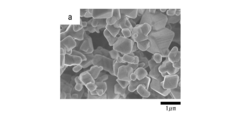
図8Aは、化学組成を示す一般式が前述した式(1)-1で示されるリチウム複合酸化物についての走査型電子顕微鏡写真である。
測定に使用したリチウム複合酸化物のサンプルは、LiNi0.5Mn1.49Cu0.01O3.95F0.05である。
図8Aからリチウム複合酸化物の粒子が略正八面体の形態からなることがわかる。
図8Bは前記サンプルについての透過型電子顕微鏡写真である。
図8Bはリチウム複合酸化物の粒子が完全な結晶構造を備えていることを示す。TEM像に(111)結晶面と、(100)結晶面が表れていた。
図8Cは結晶粒子の立体構造例を示す。図示例の結晶粒子は{111}面からなる傾斜面と、{100}面の切頂面を備える略正八面体形状をなしていた。
<実施例3>
・銅、フッ素共置換リチウム複合酸化物の結晶構造
前述した方法によって作製した銅、フッ素共置換リチウム複合酸化物の結晶構造をSEM及びTEMにより調べた。
図8Aは、化学組成を示す一般式が前述した式(1)-1で示されるリチウム複合酸化物についての走査型電子顕微鏡写真である。
測定に使用したリチウム複合酸化物のサンプルは、LiNi0.5Mn1.49Cu0.01O3.95F0.05である。
図8Aからリチウム複合酸化物の粒子が略正八面体の形態からなることがわかる。
図8Bは前記サンプルについての透過型電子顕微鏡写真である。
図8Bはリチウム複合酸化物の粒子が完全な結晶構造を備えていることを示す。TEM像に(111)結晶面と、(100)結晶面が表れていた。
図8Cは結晶粒子の立体構造例を示す。図示例の結晶粒子は{111}面からなる傾斜面と、{100}面の切頂面を備える略正八面体形状をなしていた。
本発明は、250mAh/g以上の容量を持つリチウム複合酸化物、これを用いた二次電池用正極活物質及び二次電池を提供できる。
Claims (11)
- スピネル型構造を有するリチウム複合酸化物であって、化学組成を示す一般式が下記式(1)で示されることを特徴とするリチウム複合酸化物。
Li1+zNiaMn2-yMbCuyO4-xFx ・・・(1)
[一般式(1)中、0<a≦0.6、0≦b≦0.2、0≦y≦1、0≦x≦1、0≦z≦1.0であり、但し、xとyが共に0の場合を除く;Mは、Ti、V、Cr、Fe、Co、Zu、Snからなる群より選択される1種以上の金属元素である。] - 前記リチウム複合酸化物は、(111)面を主面とする八面体結晶構造を有し、
前記八面体結晶構造の少なくとも一つの頂点は切頂面を備える、請求項1に記載のリチウム複合酸化物。 - 前記リチウム複合酸化物は、(111)面を主面とする八面体結晶構造を有し、
前記八面体結晶構造の少なくとも一つの稜は切稜面を備える、請求項1又は2に記載のリチウム複合酸化物。 - 前記リチウム複合酸化物は、(111)面を主面とする八面体結晶構造を有し、
前記八面体結晶構造の少なくとも一つの傾斜面は、ステップ・テラス構造を備える、請求項1~3のいずれか1項に記載のリチウム複合酸化物。 - 前記式(1)において0<y≦1である、請求項1~4のいずれか1項に記載のリチウム複合酸化物。
- 前記式(1)において0<x≦1である、請求項1~4のいずれか1項に記載のリチウム複合酸化物。
- 前記式(1)において、0<y≦1かつ0<x≦1である、請求項1~4のいずれか1項に記載のリチウム複合酸化物。
- 請求項1~7のいずれか1項に記載のリチウム複合酸化物を含む二次電池用正極活物質。
- 請求項8に記載の二次電池用正極活物質を備える二次電池。
- 前記xが0.025≦x≦0.1である、請求項1~4のいずれか1項に記載のリチウム複合酸化物。
- LiNi0.5Mn1.49Cu0.01O4.0、LiNi0.5Mn1.45Cu0.05O4.0、LiNi0.5Mn1.49Cu0.01O3.9F0.1、LiNi0.5Mn1.49Cu0.01O3.95F0.05、LiNi0.5Mn1.49Cu0.01O3.975F0.025、及びLiNi0.5Mn1.45Cu0.05O3.95F0.05、から選択される少なくとも一つの化合物である、請求項1~4のいずれか1項に記載のリチウム複合酸化物。
Priority Applications (1)
| Application Number | Priority Date | Filing Date | Title |
|---|---|---|---|
| JP2020509941A JP7323940B2 (ja) | 2018-03-30 | 2019-03-22 | リチウム複合酸化物、二次電池用正極活物質及び二次電池 |
Applications Claiming Priority (2)
| Application Number | Priority Date | Filing Date | Title |
|---|---|---|---|
| JP2018066494 | 2018-03-30 | ||
| JP2018-066494 | 2018-03-30 |
Publications (1)
| Publication Number | Publication Date |
|---|---|
| WO2019188751A1 true WO2019188751A1 (ja) | 2019-10-03 |
Family
ID=68058939
Family Applications (1)
| Application Number | Title | Priority Date | Filing Date |
|---|---|---|---|
| PCT/JP2019/011996 Ceased WO2019188751A1 (ja) | 2018-03-30 | 2019-03-22 | リチウム複合酸化物、二次電池用正極活物質及び二次電池 |
Country Status (2)
| Country | Link |
|---|---|
| JP (1) | JP7323940B2 (ja) |
| WO (1) | WO2019188751A1 (ja) |
Cited By (1)
| Publication number | Priority date | Publication date | Assignee | Title |
|---|---|---|---|---|
| JP2024174513A (ja) * | 2023-06-05 | 2024-12-17 | トヨタ自動車株式会社 | 新規電極活物質の探索方法 |
Citations (3)
| Publication number | Priority date | Publication date | Assignee | Title |
|---|---|---|---|---|
| JP2016025009A (ja) * | 2014-07-22 | 2016-02-08 | トヨタ自動車株式会社 | リチウム二次電池用正極活物質およびその利用 |
| JP2017033817A (ja) * | 2015-08-04 | 2017-02-09 | 日立化成株式会社 | リチウムイオン二次電池用正極活物質、リチウムイオン二次電池用正極材料及びリチウムイオン二次電池 |
| JP2017171548A (ja) * | 2016-03-24 | 2017-09-28 | 国立大学法人信州大学 | リチウム複合酸化物、リチウム二次電池用正極活物質及びリチウム二次電池 |
-
2019
- 2019-03-22 WO PCT/JP2019/011996 patent/WO2019188751A1/ja not_active Ceased
- 2019-03-22 JP JP2020509941A patent/JP7323940B2/ja active Active
Patent Citations (3)
| Publication number | Priority date | Publication date | Assignee | Title |
|---|---|---|---|---|
| JP2016025009A (ja) * | 2014-07-22 | 2016-02-08 | トヨタ自動車株式会社 | リチウム二次電池用正極活物質およびその利用 |
| JP2017033817A (ja) * | 2015-08-04 | 2017-02-09 | 日立化成株式会社 | リチウムイオン二次電池用正極活物質、リチウムイオン二次電池用正極材料及びリチウムイオン二次電池 |
| JP2017171548A (ja) * | 2016-03-24 | 2017-09-28 | 国立大学法人信州大学 | リチウム複合酸化物、リチウム二次電池用正極活物質及びリチウム二次電池 |
Non-Patent Citations (2)
| Title |
|---|
| LIU, JIANHONG ET AL.: "Synthesis and electrochemical properties of LiNi0. 5-xCuxMn1.5-yAlyO4 (x=0, 0. 05, y=0, 0. 05) as 5V spinel materials", JOURNAL OF POWER SOURCES, vol. 240, 15 October 2013 (2013-10-15), pages 95 - 100, XP028577115 * |
| ZETTSU: "Dual elemental substitution effects of li-rich high-voltage spinel crystals cathodes on their reversible specific capacity", THE 58 TH BATTERY SYMPOSIUM IN JAPAN, 13 November 2017 (2017-11-13), pages 65 * |
Cited By (2)
| Publication number | Priority date | Publication date | Assignee | Title |
|---|---|---|---|---|
| JP2024174513A (ja) * | 2023-06-05 | 2024-12-17 | トヨタ自動車株式会社 | 新規電極活物質の探索方法 |
| JP7794175B2 (ja) | 2023-06-05 | 2026-01-06 | トヨタ自動車株式会社 | 新規電極活物質の探索方法 |
Also Published As
| Publication number | Publication date |
|---|---|
| JP7323940B2 (ja) | 2023-08-09 |
| JPWO2019188751A1 (ja) | 2021-04-08 |
Similar Documents
| Publication | Publication Date | Title |
|---|---|---|
| CN108923044B (zh) | 含掺杂的镍酸盐化合物的组合物 | |
| JP5870930B2 (ja) | 複合金属酸化物、当該複合金属酸化物の製造方法、ナトリウム二次電池用正極活物質、ナトリウム二次電池用正極、及びナトリウム二次電池 | |
| TWI597885B (zh) | 正極材料、與將其使用於正極之鋰二次電池 | |
| JP5035834B2 (ja) | リチウムマンガン複合酸化物 | |
| JP6168603B2 (ja) | リチウムイオン電池用の正極活物質およびその製造方法 | |
| JP5765705B2 (ja) | 複合金属酸化物、ナトリウム二次電池用正極活物質、ナトリウム二次電池用正極、及びナトリウム二次電池 | |
| Park et al. | Effects of a dopant on the electrochemical properties of Li4Ti5O12 as a lithium-ion battery anode material | |
| JP7721880B2 (ja) | リチウムイオン二次電池用正極活物質、及び、その製造方法 | |
| JP7723205B2 (ja) | 活電極物質 | |
| JP7500433B2 (ja) | Li及びMnに基づくフッ素化酸化物 | |
| CN111864194A (zh) | 用于可再充电锂电池的正极活性物质、制备其的方法和包括其的可再充电锂电池 | |
| JP7233011B2 (ja) | 正極活物質および二次電池 | |
| CN105390736A (zh) | 非水电解质二次电池 | |
| JP2016100058A (ja) | ナトリウムイオン電池用負極活物質、ナトリウムイオン電池用負極及びナトリウムイオン電池 | |
| Xie et al. | Facile Synthesis and characterization of Li4Ti5O12 as anode material for lithium ion batteries | |
| WO2019189801A1 (ja) | 正極活物質、それを用いた正極及び二次電池、並びに正極活物質の製造方法 | |
| JP2013254709A (ja) | 電極材料及びそれを用いた蓄電池 | |
| JP7304080B2 (ja) | リチウム複合酸化物、二次電池用電極材料、二次電池及びリチウム複合酸化物の製造方法 | |
| WO2016157745A1 (ja) | 正極材料,非水電解質二次電池用正極及び非水電解質二次電池 | |
| JP7323940B2 (ja) | リチウム複合酸化物、二次電池用正極活物質及び二次電池 | |
| Heidari et al. | Li 0.33 La 0.56 TiO 3, a novel coating to improve the electrochemical properties and safety of NCM523 cathode materials for Li-ion batteries | |
| Wu et al. | Synthesis and electrochemical properties of spinel-type Li4Mn5− xTixO12 materials | |
| JP2014013745A (ja) | 非水系電池及び非水系電池システム | |
| Fan et al. | Structure and electrochemical performance of modificated LiMn2O4 by S-Co codoping and nano SiO2 surface coating | |
| Elong et al. | Ti Doped LiMn1/3Co1/3Ni1/3O2 for Li-ion battery application |
Legal Events
| Date | Code | Title | Description |
|---|---|---|---|
| 121 | Ep: the epo has been informed by wipo that ep was designated in this application |
Ref document number: 19774857 Country of ref document: EP Kind code of ref document: A1 |
|
| ENP | Entry into the national phase |
Ref document number: 2020509941 Country of ref document: JP Kind code of ref document: A |
|
| 122 | Ep: pct application non-entry in european phase |
Ref document number: 19774857 Country of ref document: EP Kind code of ref document: A1 |