WO2019181587A1 - 近赤外線吸収性組成物、近赤外線吸収性膜及び固体撮像素子用イメージセンサー - Google Patents
近赤外線吸収性組成物、近赤外線吸収性膜及び固体撮像素子用イメージセンサー Download PDFInfo
- Publication number
- WO2019181587A1 WO2019181587A1 PCT/JP2019/009571 JP2019009571W WO2019181587A1 WO 2019181587 A1 WO2019181587 A1 WO 2019181587A1 JP 2019009571 W JP2019009571 W JP 2019009571W WO 2019181587 A1 WO2019181587 A1 WO 2019181587A1
- Authority
- WO
- WIPO (PCT)
- Prior art keywords
- infrared
- compound
- general formula
- infrared absorbing
- group
- Prior art date
- Legal status (The legal status is an assumption and is not a legal conclusion. Google has not performed a legal analysis and makes no representation as to the accuracy of the status listed.)
- Ceased
Links
Images
Classifications
-
- C—CHEMISTRY; METALLURGY
- C08—ORGANIC MACROMOLECULAR COMPOUNDS; THEIR PREPARATION OR CHEMICAL WORKING-UP; COMPOSITIONS BASED THEREON
- C08K—Use of inorganic or non-macromolecular organic substances as compounding ingredients
- C08K5/00—Use of organic ingredients
- C08K5/56—Organo-metallic compounds, i.e. organic compounds containing a metal-to-carbon bond
-
- G—PHYSICS
- G02—OPTICS
- G02B—OPTICAL ELEMENTS, SYSTEMS OR APPARATUS
- G02B5/00—Optical elements other than lenses
- G02B5/20—Filters
- G02B5/208—Filters for use with infrared or ultraviolet radiation, e.g. for separating visible light from infrared and/or ultraviolet radiation
-
- C—CHEMISTRY; METALLURGY
- C07—ORGANIC CHEMISTRY
- C07C—ACYCLIC OR CARBOCYCLIC COMPOUNDS
- C07C305/00—Esters of sulfuric acids
- C07C305/02—Esters of sulfuric acids having oxygen atoms of sulfate groups bound to acyclic carbon atoms of a carbon skeleton
- C07C305/04—Esters of sulfuric acids having oxygen atoms of sulfate groups bound to acyclic carbon atoms of a carbon skeleton being acyclic and saturated
- C07C305/10—Esters of sulfuric acids having oxygen atoms of sulfate groups bound to acyclic carbon atoms of a carbon skeleton being acyclic and saturated being further substituted by singly-bound oxygen atoms
-
- C—CHEMISTRY; METALLURGY
- C07—ORGANIC CHEMISTRY
- C07F—ACYCLIC, CARBOCYCLIC OR HETEROCYCLIC COMPOUNDS CONTAINING ELEMENTS OTHER THAN CARBON, HYDROGEN, HALOGEN, OXYGEN, NITROGEN, SULFUR, SELENIUM OR TELLURIUM
- C07F1/00—Compounds containing elements of Groups 1 or 11 of the Periodic Table
- C07F1/08—Copper compounds
-
- C—CHEMISTRY; METALLURGY
- C07—ORGANIC CHEMISTRY
- C07F—ACYCLIC, CARBOCYCLIC OR HETEROCYCLIC COMPOUNDS CONTAINING ELEMENTS OTHER THAN CARBON, HYDROGEN, HALOGEN, OXYGEN, NITROGEN, SULFUR, SELENIUM OR TELLURIUM
- C07F9/00—Compounds containing elements of Groups 5 or 15 of the Periodic Table
- C07F9/02—Phosphorus compounds
- C07F9/06—Phosphorus compounds without P—C bonds
- C07F9/08—Esters of oxyacids of phosphorus
- C07F9/09—Esters of phosphoric acids
-
- C—CHEMISTRY; METALLURGY
- C07—ORGANIC CHEMISTRY
- C07F—ACYCLIC, CARBOCYCLIC OR HETEROCYCLIC COMPOUNDS CONTAINING ELEMENTS OTHER THAN CARBON, HYDROGEN, HALOGEN, OXYGEN, NITROGEN, SULFUR, SELENIUM OR TELLURIUM
- C07F9/00—Compounds containing elements of Groups 5 or 15 of the Periodic Table
- C07F9/02—Phosphorus compounds
- C07F9/28—Phosphorus compounds with one or more P—C bonds
- C07F9/38—Phosphonic acids [RP(=O)(OH)2]; Thiophosphonic acids ; [RP(=X1)(X2H)2(X1, X2 are each independently O, S or Se)]
-
- C—CHEMISTRY; METALLURGY
- C07—ORGANIC CHEMISTRY
- C07F—ACYCLIC, CARBOCYCLIC OR HETEROCYCLIC COMPOUNDS CONTAINING ELEMENTS OTHER THAN CARBON, HYDROGEN, HALOGEN, OXYGEN, NITROGEN, SULFUR, SELENIUM OR TELLURIUM
- C07F9/00—Compounds containing elements of Groups 5 or 15 of the Periodic Table
- C07F9/02—Phosphorus compounds
- C07F9/28—Phosphorus compounds with one or more P—C bonds
- C07F9/38—Phosphonic acids [RP(=O)(OH)2]; Thiophosphonic acids ; [RP(=X1)(X2H)2(X1, X2 are each independently O, S or Se)]
- C07F9/40—Esters thereof
-
- C—CHEMISTRY; METALLURGY
- C08—ORGANIC MACROMOLECULAR COMPOUNDS; THEIR PREPARATION OR CHEMICAL WORKING-UP; COMPOSITIONS BASED THEREON
- C08G—MACROMOLECULAR COMPOUNDS OBTAINED OTHERWISE THAN BY REACTIONS ONLY INVOLVING UNSATURATED CARBON-TO-CARBON BONDS
- C08G65/00—Macromolecular compounds obtained by reactions forming an ether link in the main chain of the macromolecule
- C08G65/02—Macromolecular compounds obtained by reactions forming an ether link in the main chain of the macromolecule from cyclic ethers by opening of the heterocyclic ring
- C08G65/32—Polymers modified by chemical after-treatment
- C08G65/321—Polymers modified by chemical after-treatment with inorganic compounds
- C08G65/326—Polymers modified by chemical after-treatment with inorganic compounds containing sulfur
-
- C—CHEMISTRY; METALLURGY
- C08—ORGANIC MACROMOLECULAR COMPOUNDS; THEIR PREPARATION OR CHEMICAL WORKING-UP; COMPOSITIONS BASED THEREON
- C08G—MACROMOLECULAR COMPOUNDS OBTAINED OTHERWISE THAN BY REACTIONS ONLY INVOLVING UNSATURATED CARBON-TO-CARBON BONDS
- C08G65/00—Macromolecular compounds obtained by reactions forming an ether link in the main chain of the macromolecule
- C08G65/02—Macromolecular compounds obtained by reactions forming an ether link in the main chain of the macromolecule from cyclic ethers by opening of the heterocyclic ring
- C08G65/32—Polymers modified by chemical after-treatment
- C08G65/321—Polymers modified by chemical after-treatment with inorganic compounds
- C08G65/327—Polymers modified by chemical after-treatment with inorganic compounds containing phosphorus
-
- C—CHEMISTRY; METALLURGY
- C08—ORGANIC MACROMOLECULAR COMPOUNDS; THEIR PREPARATION OR CHEMICAL WORKING-UP; COMPOSITIONS BASED THEREON
- C08K—Use of inorganic or non-macromolecular organic substances as compounding ingredients
- C08K5/00—Use of organic ingredients
- C08K5/0008—Organic ingredients according to more than one of the "one dot" groups of C08K5/01 - C08K5/59
- C08K5/0041—Optical brightening agents, organic pigments
-
- C—CHEMISTRY; METALLURGY
- C09—DYES; PAINTS; POLISHES; NATURAL RESINS; ADHESIVES; COMPOSITIONS NOT OTHERWISE PROVIDED FOR; APPLICATIONS OF MATERIALS NOT OTHERWISE PROVIDED FOR
- C09K—MATERIALS FOR MISCELLANEOUS APPLICATIONS, NOT PROVIDED FOR ELSEWHERE
- C09K3/00—Materials not provided for elsewhere
-
- G—PHYSICS
- G02—OPTICS
- G02B—OPTICAL ELEMENTS, SYSTEMS OR APPARATUS
- G02B1/00—Optical elements characterised by the material of which they are made; Optical coatings for optical elements
- G02B1/04—Optical elements characterised by the material of which they are made; Optical coatings for optical elements made of organic materials, e.g. plastics
-
- G—PHYSICS
- G02—OPTICS
- G02B—OPTICAL ELEMENTS, SYSTEMS OR APPARATUS
- G02B5/00—Optical elements other than lenses
- G02B5/20—Filters
- G02B5/22—Absorbing filters
- G02B5/223—Absorbing filters containing organic substances, e.g. dyes, inks or pigments
-
- H—ELECTRICITY
- H10—SEMICONDUCTOR DEVICES; ELECTRIC SOLID-STATE DEVICES NOT OTHERWISE PROVIDED FOR
- H10F—INORGANIC SEMICONDUCTOR DEVICES SENSITIVE TO INFRARED RADIATION, LIGHT, ELECTROMAGNETIC RADIATION OF SHORTER WAVELENGTH OR CORPUSCULAR RADIATION
- H10F39/00—Integrated devices, or assemblies of multiple devices, comprising at least one element covered by group H10F30/00, e.g. radiation detectors comprising photodiode arrays
- H10F39/80—Constructional details of image sensors
- H10F39/805—Coatings
-
- H—ELECTRICITY
- H10—SEMICONDUCTOR DEVICES; ELECTRIC SOLID-STATE DEVICES NOT OTHERWISE PROVIDED FOR
- H10F—INORGANIC SEMICONDUCTOR DEVICES SENSITIVE TO INFRARED RADIATION, LIGHT, ELECTROMAGNETIC RADIATION OF SHORTER WAVELENGTH OR CORPUSCULAR RADIATION
- H10F39/00—Integrated devices, or assemblies of multiple devices, comprising at least one element covered by group H10F30/00, e.g. radiation detectors comprising photodiode arrays
- H10F39/80—Constructional details of image sensors
- H10F39/804—Containers or encapsulations
-
- H—ELECTRICITY
- H10—SEMICONDUCTOR DEVICES; ELECTRIC SOLID-STATE DEVICES NOT OTHERWISE PROVIDED FOR
- H10F—INORGANIC SEMICONDUCTOR DEVICES SENSITIVE TO INFRARED RADIATION, LIGHT, ELECTROMAGNETIC RADIATION OF SHORTER WAVELENGTH OR CORPUSCULAR RADIATION
- H10F39/00—Integrated devices, or assemblies of multiple devices, comprising at least one element covered by group H10F30/00, e.g. radiation detectors comprising photodiode arrays
- H10F39/80—Constructional details of image sensors
- H10F39/806—Optical elements or arrangements associated with the image sensors
Definitions
- the present invention relates to a near-infrared absorbing composition, a near-infrared absorbing film using the same, and an image sensor for a solid-state imaging device, and more specifically, dispersibility of a metal complex, in particular, a copper complex, and dispersion when mixed with moisture
- the present invention relates to a near-infrared absorbing composition excellent in stability (moisture resistance), a near-infrared absorbing film using the same, and an image sensor for a solid-state imaging device including the near-infrared absorbing film.
- CCDs and CMOS image sensors which are solid-state image pickup devices for color images, have been used in video cameras, digital still cameras, mobile phones with camera functions, etc., and these solid-state image pickup devices have a near-infrared wavelength at the light receiving part. Since a silicon photodiode having sensitivity to light in the region is used, it is necessary to correct visibility, and a near-infrared cut filter is often used.
- Patent Document 1 As a dispersion medium for the phosphonic acid copper complex, one kind of solvent is applied in Patent Document 1, one kind of specific solubilizer is applied in Patent Document 2, and one is specified in Patent Document 3.
- Patent Document 3 In order to improve the quality, for example, improve the storage stability, by applying one kind of the above solvent, as the near-infrared absorbing composition, a resin that is a binder with respect to the phosphonic acid copper salt
- the binder It has been found that the dispersion stability of the near-infrared absorbing composition in the stage before the addition of the resin greatly affects the final quality.
- Patent Document 4 discloses an optical filter including a near-infrared light absorbing layer containing a copper complex obtained by a reaction between a phosphate ester compound having an ethylene oxide structure or a phosphate ester compound having a propylene oxide structure and a copper compound.
- a copper complex obtained by a reaction between a phosphate ester compound having an ethylene oxide structure or a phosphate ester compound having a propylene oxide structure and a copper compound.
- the present invention has been made in view of the above problems and situations, and its solution is excellent near-infrared light absorption ability, dispersibility of metal complexes, particularly copper complexes, and dispersion stability when mixed with water (
- the present invention relates to a near-infrared absorbing composition with improved moisture resistance, a near-infrared absorbing film formed using the composition, and an image sensor for a solid-state imaging device including the near-infrared absorbing film.
- the present inventor is a near-infrared absorbing composition containing a near-infrared absorber and a solvent, and the near-infrared absorber is a component (A).
- the near-infrared absorber is a component (A).
- A a component comprising a compound having a structure represented by the following general formula (I) and a metal ion
- (B) a component and a compound having a structure represented by the following general formula (I) and a metal compound.
- the near-infrared absorbing composition characterized in that it contains at least one component among the metal complexes to be obtained, has excellent near-infrared light absorbing ability, and dispersibility of the metal complex constituting the near-infrared absorbing composition And a near-infrared absorbing composition with improved dispersion stability (moisture resistance) when mixed with moisture, a near-infrared absorbing film formed using the composition, and an image for a solid-state imaging device comprising the near-infrared absorbing film Realize sensor It found that can Rukoto, have completed the present invention.
- a near-infrared absorbing composition containing a near-infrared absorber and a solvent, The near-infrared absorbing composition contains at least one of the following (A) component and the following (B) component.
- Component Component comprising a compound having a structure represented by the following general formula (I) and a metal ion
- B Component: Reaction of a compound having a structure represented by the following general formula (I) with a metal compound
- Z represents a structural unit selected from the following formulas (Z-1) to (Z-3). * In the above formulas (Z-1) to (Z-3) represents a binding site, and is bonded to O in the above general formula (I).
- R 21 to R 24 each represent a hydrogen atom or an alkyl group having 1 to 4 carbon atoms.
- the compound having the structure represented by the general formula (I) has at least one partial structure satisfying the following condition (i) and at least one partial structure satisfying the following condition (ii) at the same time.
- R 21 to R 24 are all hydrogen atoms.
- At least one of R 21 to R 24 is an alkyl group having 1 to 4 carbon atoms.
- l represents the number of partial structures that satisfy the condition (i), and is a number from 1 to 10.
- m represents the number of partial structures that satisfy the condition (ii), and is a number from 1 to 10.
- the compound having the structure represented by the general formula (I) contains a monoester and a diester, and the molar ratio of the monoester is in the range of 20 to 95%.
- the near-infrared absorptive composition as described in any one of the above.
- the general formula (I) has at least one partial structure that satisfies the following condition (i) and at least one partial structure that satisfies the following condition (iii):
- R 21 to R 24 are all hydrogen atoms.
- any one of R 21 to R 24 is an alkyl group having 1 to 4 carbon atoms, and the remaining three are hydrogen atoms.
- An image sensor for a solid-state imaging device comprising the near-infrared absorbing film according to Item 11.
- a near-infrared absorbing composition having excellent near-infrared light absorption ability, improved dispersibility of metal complexes, particularly copper complexes, and improved dispersion stability (moisture resistance) when mixed with water, and
- membrane can be provided.
- the near-infrared absorbing composition of the present invention is a near-infrared absorbing composition containing a near-infrared absorber and a solvent, and the near-infrared absorber includes the following component (A) and the following component (B). It contains at least one component.
- Component Component comprising a compound having a structure represented by the general formula (I) and a metal ion
- B Component: Reaction of a compound having a structure represented by the general formula (I) with a metal compound
- the metal complex formed by the reaction of the compound having the structure represented by the general formula (I) with the metal compound has an extinction coefficient. It is considered that high near-infrared absorption characteristics are expressed.
- the compound having the structure represented by the general formula (I) is characterized by containing not only an ethylene oxide structure (condition (i)) but also an alkyl-substituted ethylene oxide structure (condition (ii)).
- an alkyl-substituted ethylene oxide structure has a large number of diastereomeric components because a substituent (R 21 to R 24 ) exists in the compound having the structure represented by the general formula (I). Become.
- a substituent R 21 to R 24
- dispersion stability can be further enhanced.
- condition (ii) when only an alkyl-substituted ethylene oxide structure (condition (ii)) is contained, the complex formation with the metal does not proceed smoothly due to the steric hindrance of the substituents (R 21 to R 24 ).
- an ethylene oxide structure is also included in the same compound structure (condition (i)). It is possible to form a finely dispersed state, and it is presumed that the visible light transmittance can be secured by this finely dispersed state.
- the compound containing only the ethylene oxide structure preferentially forms a complex with the metal.
- the dispersion stability at the time of mixing cannot be improved.
- a copper complex is preferable, and a phosphate ester copper complex is particularly preferable because it has more excellent dispersibility and near-infrared cut stability.
- a ligand capable of forming a complex with a copper ion it is preferable to contain a ligand capable of forming a complex with a copper ion.
- a phosphonic acid compound in combination as a ligand, more excellent stability over time, for example, copper complex particles It is preferable at the point which can obtain the near-infrared absorptive composition which has the dispersion stability of this, and near-infrared cut stability.
- the near-infrared absorbing composition of the present invention is a near-infrared absorbing composition containing a near-infrared absorber and a solvent, and the near-infrared absorber is represented by the general formula (I) as the component (A).
- a component comprising a compound having a structure and a metal ion, and (B) at least one component of a metal complex obtained by reaction of the compound having the structure represented by the general formula (I) with the metal compound It is characterized by containing.
- This feature is a technical feature common to the inventions according to the following embodiments.
- the metal constituting the metal ion or the metal complex is copper from the viewpoint that the effect intended by the present invention can be further expressed.
- This is preferable in terms of obtaining external light absorption ability, dispersibility of the metal complex, and dispersion stability (moisture resistance) when mixed with moisture.
- the compound having the structure represented by the general formula (I) is a compound having the structure represented by the general formula (II). It is preferable in that it can be further improved by the property.
- the compound having the structure represented by the general formula (I) includes a monoester and a diester, and the molar ratio of the monoester is in the range of 20 to 95%. And dispersion stability when stored under various conditions are preferable.
- the general formula (I) has at least one partial structure that satisfies the condition (i) and at least one partial structure that satisfies the condition (iii) at the same time. It is preferable in that the dispersion stability (resistance to heat and humidity) at the time can be further improved.
- the average particle diameter of the metal complex is 50 nm or less from the viewpoint that a more excellent visible light transmittance and near infrared light absorption ability can be obtained.
- l and m in the general formula (I) are each a number within the range of 1 to 3, so that the dispersibility of the metal complex is better and the dispersion stability when stored under various conditions. Is preferable in that it can be further improved.
- a phosphonic acid compound from the viewpoint of obtaining more excellent dispersion stability (resistance to heat and humidity), visible light permeability and near infrared light absorption ability.
- a near infrared absorption modifier having an absorption maximum wavelength in the wavelength range of 650 to 800 nm is contained in that a more excellent near infrared absorption ability can be obtained.
- acetic acid within a range of 1 to 100 mol% with respect to the content of the metal provides durability (thermal humidity resistance) and a desired spectral spectrum in the near infrared region. preferable.
- ⁇ representing a numerical range is used in a sense including numerical values described before and after the numerical value as a lower limit value and an upper limit value.
- the near-infrared absorptive composition of this invention contains a near-infrared absorber and a solvent,
- the said near-infrared absorber contains at least 1 component among the (A) component and (B) component which are mentioned later. It is characterized by that.
- the near-infrared absorber which concerns on this invention contains at least 1 component among the following (A) component and the following (B) component, It is characterized by the above-mentioned.
- (A) component a component comprising a compound having a structure represented by the following general formula (I) and a metal ion
- (B) component The component which consists of a metal complex obtained by reaction with the compound and metal compound which have a structure represented with the following general formula (I).
- R represents an alkyl group having 1 to 20 carbon atoms or an aryl group having 6 to 20 carbon atoms, and R may further have a substituent.
- Z represents a structural unit selected from the following formulas (Z-1), (Z-2), and (Z-3). * Described in the above formulas (Z-1) to (Z-3) represents a binding site, and is bonded to O in the above general formula (I).
- the structural unit selected from the above (Z-1), (Z-2) and (Z-3) is preferably (Z-1) or (Z-2) from the viewpoint of dispersibility of the metal complex. is there.
- the diester and the monoester are preferably a mixture, and the monoester molar ratio of the monoester and the diester is preferably in the range of 20 to 95%.
- l represents the number of partial structures that satisfy condition (i) described later, and is a number from 1 to 10.
- m represents the number of partial structures that satisfy the condition (ii) described later, and is a number from 1 to 10.
- the alkyl group having 1 to 20 carbon atoms represented by R may be linear or branched, and examples thereof include a methyl group, an ethyl group, an n-propyl group, and isopropyl.
- Each alkyl group may further have a substituent. From the viewpoint of dispersibility and moisture resistance of the metal complex, an alkyl group having 6 to 16 carbon atoms is preferable.
- Examples of the aryl group having 6 to 20 carbon atoms represented by R include a phenyl group, a mesityl group, a tolyl group, a xylyl group, a naphthyl group, an anthryl group, an azulenyl group, an acenaphthenyl group, a fluorenyl group, and a phenanthryl group.
- An indenyl group, a pyrenyl group, a biphenylyl group, and the like, and a phenyl group, a naphthyl group, a fluorenyl group, a phenanthryl group, a biphenylyl group, and a fluorenonyl group are preferable.
- Each aryl group may further have a substituent.
- R may have include, for example, an alkyl group (for example, a methyl group, an ethyl group, a trifluoromethyl group, and an isopropyl group), an alkoxy group (for example, a methoxy group and an ethoxy group), and a halogen atom.
- an alkyl group for example, a methyl group, an ethyl group, a trifluoromethyl group, and an isopropyl group
- an alkoxy group for example, a methoxy group and an ethoxy group
- R 21 to R 24 each represents a hydrogen atom or an alkyl group having 1 to 4 carbon atoms, and examples thereof include a methyl group, an ethyl group, an n-propyl group, and an n-butyl group.
- a methyl group is particularly preferable.
- At least one partial structure satisfying the following condition (i) and at least one partial structure satisfying the condition (ii) is characterized by having at the same time.
- R 21 to R 24 are all hydrogen atoms.
- At least one of R 21 to R 24 is an alkyl group having 1 to 4 carbon atoms.
- R 21 to R 24 is an alkyl group having 1 to 4 carbon atoms and two are the alkyl group, three are the alkyl group, four Includes structures where all are alkyl groups. From the viewpoint of dispersibility of the metal complex, it is preferable that only one of them is an alkyl group having 1 to 4 carbon atoms.
- the partial structure satisfying the condition (i) is an ethylene oxide structure in which R 21 to R 24 are all hydrogen atoms, has a high complex-forming ability with a metal, and contributes to enhancing dispersibility.
- the condition (ii) is an alkyl-substituted ethylene oxide structure, which has a large number of components and contributes to enhancing the dispersion stability at the time of moisture mixing due to the entropy effect.
- l represents the number of partial structures in which R 21 to R 24 defined in the above condition (i) are all hydrogen atoms, and the number is in the range of 1 to 10, preferably Within the range of 1-3.
- m represents the number of partial structures in which at least one of R 21 to R 24 defined in the above condition (ii) is an alkyl group having 1 to 4 carbon atoms, and the number is in the range of 1 to 10 Preferably, it is within the range of 1 to 3.
- L and m represent the average added moles of the ethylene oxide structure and the alkyl-substituted ethylene oxide structure, respectively.
- the compound having the structure represented by the general formula (I) has at least one partial structure satisfying the following condition (i) and at least one partial structure satisfying the following condition (iii) at the same time. Is preferred.
- R 21 to R 24 are all hydrogen atoms.
- any one of R 21 to R 24 is an alkyl group having 1 to 4 carbon atoms, and the remaining three are hydrogen atoms.
- the alkyl group represented by the condition (iii) is a methyl group, it is a compound having an ethylene oxide structure and a propylene oxide structure in the same structure.
- the “ethylene oxide structure” means a repeating unit structure of polyethylene oxide, that is, a structure in which ethylene oxide which is a three-membered cyclic ether is opened.
- the “propylene oxide structure” refers to a repeating unit structure of polypropylene oxide, that is, a structure in which propylene oxide which is a three-membered cyclic ether is opened.
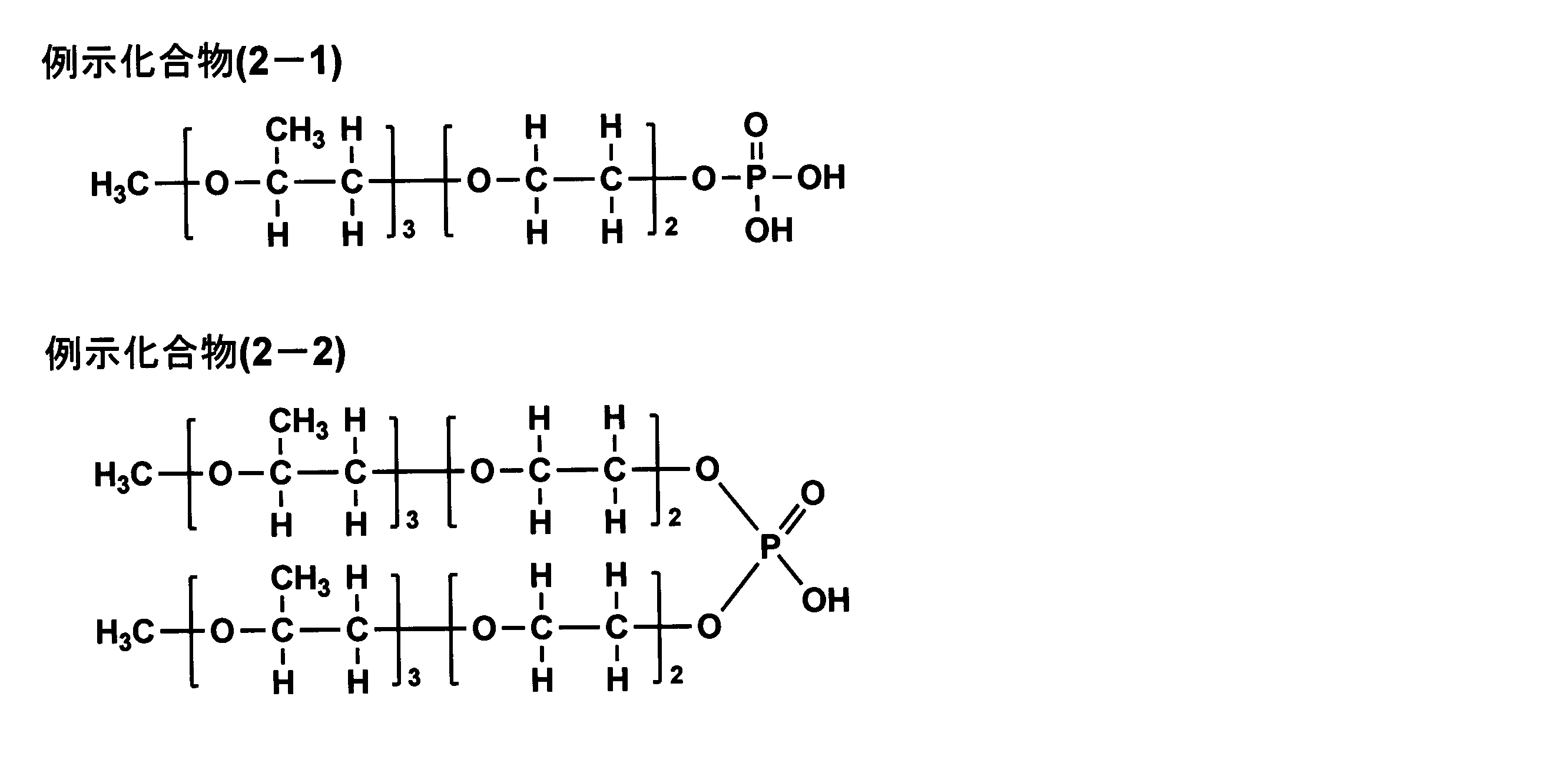
- the compound is represented by the structure of an exemplary compound (2-1) in which Z is Z-2 and an exemplary compound (2-2) in which Z is Z-1.
- the monoester ratio is 50%, and Exemplified Compound (2-1) and Exemplified Compound (2-2) are contained in the same molar amount.
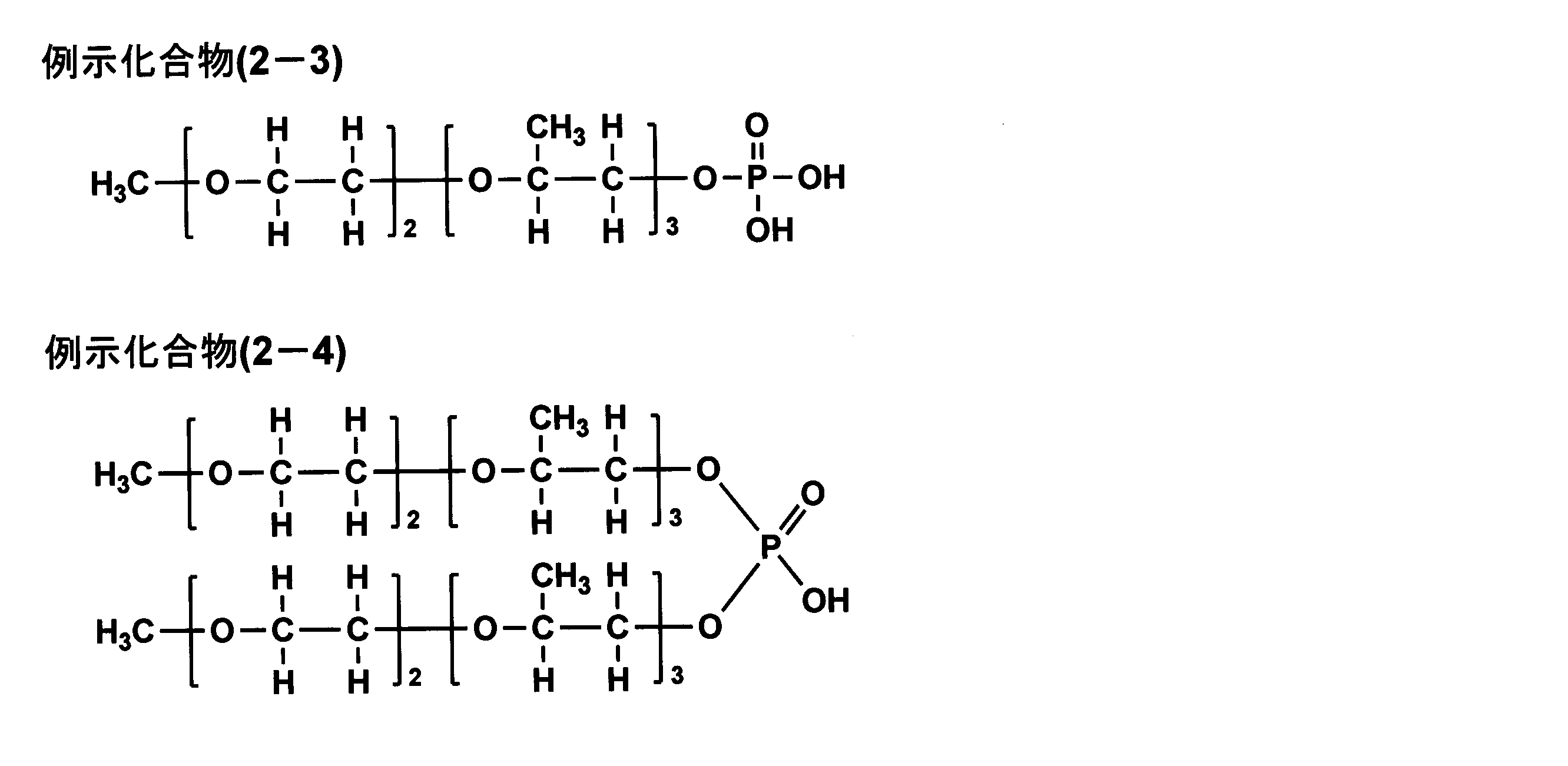
- the order of the ethylene oxide structure and the alkyl-substituted ethylene oxide structure in the exemplified compound 2 can be arbitrarily changed by the synthesis method.
- the exemplified compounds (2-3) and (2-4) shown below can be used.
- the order of the ethylene oxide structure and the alkyl-substituted ethylene oxide structure is not particularly limited, and compounds in which each structure is randomly arranged are also included in the compounds defined in the present invention.
- Examples of the compound having the structure represented by the general formula (I) according to the present invention include JP-A-2005-255608, JP-A-2015-000396, JP-A-2015-000970, and JP-A-2015-178072. Can be synthesized with reference to known methods described in Japanese Patent Application Laid-Open No. 2005-178073, Japanese Patent No. 4422866, and the like.
- Examples of the metal species applicable to the metal ion in the component (A) or the metal complex as the component (B) include those that form complexes belonging to Groups I to VIII of the periodic table. And polyvalent metals. Specifically, for example, aluminum, cobalt, chromium, copper, iron, magnesium, manganese, nickel, tin, titanium, zinc and the like can be mentioned, among which nickel, copper, chromium, cobalt and zinc are preferable, Most preferably, copper is used.
- species as a complex
- copper which can supply a bivalent copper ion as a copper salt Salt.
- Copper salt of organic acid, hydrate or hydrate of copper salt of organic acid such as copper oxide, copper chloride, copper sulfate, copper nitrate, copper phosphate, basic copper sulfate, basic copper carbonate Copper salts, hydrates or hydrates of inorganic acid copper salts; copper hydroxide.
- Metal complex The method for synthesizing the metal complex obtained by the reaction of the compound having the structure represented by the general formula (I) and the metal compound according to the present invention is described in, for example, Japanese Patent No. 4422866 and Japanese Patent No. 5953222. The method that can be applied.
- the general formula (I) according to the present invention is bonded to a metal ion by a coordination bond and / or an ionic bond via a phosphate group or a sulfonic acid group represented by Z. It is dissolved or dispersed in the near-infrared absorbing film surrounded by I).
- copper ions a typical example of which is a metal species
- near infrared light is selectively absorbed by electronic transition between d orbitals of copper ions.
- the content of phosphorus atoms in the near-infrared absorbing film is preferably 1.5 or less with respect to 1 mol of copper ions, more preferably 0.3 to 1 .3, that is, when the molar ratio of phosphorus atoms to copper ions (hereinafter referred to as “P / Cu”) is 0.3 to 1.3, the moisture resistance of the near-infrared absorbing film and the near-infrared It was confirmed that it is very suitable from the viewpoint of the moisture resistance of the absorptive film and the dispersibility of copper ions in the near-infrared absorptive film.
- the content ratio of the copper ions in the near-infrared absorbing film is less than the above lower limit value, sufficient near-infrared light absorption is obtained when the thickness of the near-infrared absorbing film is made thinner than about 1 mm. Tend to be difficult.
- the content ratio of the copper ions exceeds the above upper limit value, it tends to be difficult to disperse the copper ions in the near-infrared absorbing film.
- (About acetic acid) In the near-infrared absorptive composition of this invention, it is 1 with respect to the metal which comprises the metal ion which comprises the (A) component which a near-infrared absorber contains, or the metal compound in the metal complex which comprises (B) component. It is preferable to contain acetic acid in the range of ⁇ 100 mol%.
- acetic acid is produced.
- durability thermal humidity resistance
- the average particle diameter of metal complex is preferably in the range of 1 to 200 nm, more preferably in the range of 1 to 100 nm, and in the range of 1 to 50 nm. Particularly preferred.
- the average particle diameter of the metal complex referred to in the present invention can be determined, for example, by a dynamic light scattering method using ELSZ-1000ZS, a zeta potential / particle diameter measurement system manufactured by Otsuka Electronics Co., Ltd. as a measuring device. .
- a metal complex particle is taken with a transmission electron microscope (magnification 500,000 to 2,000,000 times), an electron micrograph is taken, the projected area of the particle is measured, and the measured value is equivalent to the area of a circle. It is also possible to measure the diameter as a particle diameter, measure 100 particles, and obtain the arithmetic average value as an average particle diameter.
- the near-infrared absorbing composition of the present invention preferably contains a phosphonic acid compound, a phosphoric acid compound, a sulfonic acid compound or each metal complex compound, and particularly preferably contains a phosphonic acid described below. .
- phosphoric acid compounds include 1) phosphoric acid methyl ester, 2) phosphoric acid ethyl ester, 3) phosphoric acid n-propyl ester, 4) phosphoric acid i-propyl ester, 5) phosphoric acid n-butyl ester, and 6) t-butyl phosphate.
- sulfonic acid compound examples include compounds described in JP-A-2015-430638.
- the near-infrared absorbing composition of the present invention preferably contains a phosphonic acid compound having a structure represented by the following general formula (1).
- R 1 represents a branched, linear or cyclic alkyl group, alkenyl group, alkynyl group, aryl group or allyl group having 1 to 30 carbon atoms, and at least one hydrogen atom Substituted with a halogen atom, an oxyalkyl group, a polyoxyalkyl group, an oxyaryl group, a polyoxyaryl group, an acyl group, an aldehyde group, a carboxyl group, a hydroxyl group, or a group having an aromatic ring It does not have to be.
- Examples of the phosphonic acid compound having the structure represented by the general formula (1) include ethylphosphonic acid, propylphosphonic acid, butylphosphonic acid, pentylphosphonic acid, hexylphosphonic acid, octylphosphonic acid, 2-ethylhexylphosphonic acid, 2-chloroethylphosphonic acid, 3-bromopropylphosphonic acid, 3-methoxybutylphosphonic acid, 1,1-dimethylpropylphosphonic acid, 1,1-dimethylethylphosphonic acid, 1-methylpropylphosphonic acid, benzenephosphonic acid, 4-methoxyphenylphosphonic acid and the like can be mentioned, and an example thereof is exemplified as the following compounds (H-1) to (H-8).
- the phosphonic acid constituting the copper phosphonate complex is preferably at least one alkylphosphonic acid selected from the following phosphonic acid group.
- examples of the metal constituting the phosphonic acid metal complex include those that form complexes belonging to Groups I to XIV of the periodic table, and are monovalent and polyvalent metals.
- aluminum, cobalt, chromium, copper, iron, magnesium, manganese, nickel, tin, titanium, zinc and the like can be mentioned, among which nickel, copper, chromium, cobalt and zinc are preferable, Most preferably, copper is used.
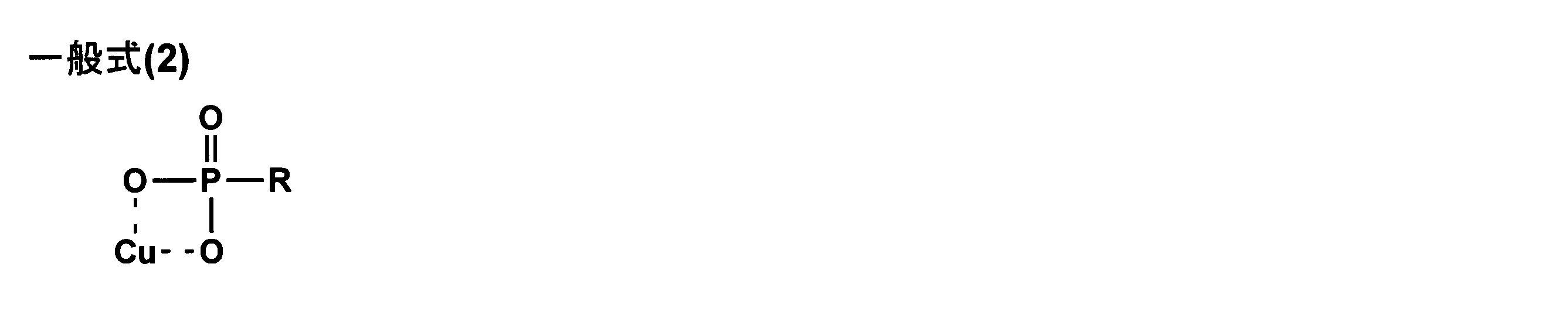
- the copper phosphonate complex has a structure represented by the following general formula (2).
- R is an alkyl group, a phenyl group, or a benzyl group.
- a copper salt capable of supplying divalent copper ions is used.
- a copper salt capable of supplying divalent copper ions is used.
- Copper salt of organic acid, hydrate or hydrate of copper salt of organic acid such as copper oxide, copper chloride, copper sulfate, copper nitrate, copper phosphate, basic copper sulfate, basic copper carbonate Copper salts, hydrates or hydrates of inorganic acid copper salts; copper hydroxide.
- the phosphonic acid constituting the phosphonic acid copper complex is preferably an alkylphosphonic acid, such as an ethylphosphonic acid copper complex, a propylphosphonic acid copper complex, a butylphosphonic acid copper complex, and a pentylphosphonic acid copper complex.
- an alkylphosphonic acid such as an ethylphosphonic acid copper complex, a propylphosphonic acid copper complex, a butylphosphonic acid copper complex, and a pentylphosphonic acid copper complex.
- Hexylphosphonic acid copper complex Hexylphosphonic acid copper complex, octylphosphonic acid copper complex, 2-ethylhexylphosphonic acid copper complex, 2-chloroethylphosphonic acid copper complex, 3-bromopropylphosphonic acid copper complex, 3-methoxybutylphosphonic acid copper complex, 1, Examples thereof include a 1-dimethylpropylphosphonic acid copper complex, a 1,1-dimethylethylphosphonic acid copper complex, and a 1-methylpropylphosphonic acid copper complex.
- the solvent that can be used in the near-infrared absorbing composition of the present invention is not particularly limited, but may include hydrocarbon solvents, and more preferably aliphatic hydrocarbon solvents and aromatic hydrocarbons. Preferable examples include a solvent and a halogen solvent.
- aliphatic hydrocarbon solvent examples include acyclic aliphatic hydrocarbon solvents such as hexane and heptane, cycloaliphatic hydrocarbon solvents such as cyclohexane, and alcohol solvents such as methanol, ethanol, n-propanol, and ethylene glycol.
- examples include solvents, ketone solvents such as acetone and methyl ethyl ketone, ether solvents such as diethyl ether, diisopropyl ether, tetrahydrofuran, 1,4-dioxane, and ethylene glycol monomethyl ether.
- aromatic hydrocarbon solvent examples include toluene, xylene, mesitylene, cyclohexylbenzene, isopropylbiphenyl, and the like.
- halogen solvent examples include methylene chloride, 1,1,2-trichloroethane, chloroform and the like.
- examples include cyclohexylbenzene. Of these, toluene and tetrahydrofuran are preferred from the viewpoints of boiling point and solubility.
- At least one of the solvents is preferably a solvent having a structure represented by the following general formula (3) and having a molecular weight of 190 or less.
- R 1 represents a hydrogen atom or a monovalent to tetravalent organic group
- R 2 represents an alkylene group having 2 to 4 carbon atoms
- R 3 represents a hydrogen atom, an alkyl group or an acyl group
- Is an integer from 0 to 10
- b is an integer from 1 to 4.
- a is preferably an integer of 1 to 10.
- the structures represented in parentheses may be the same or different.
- a compound in which b is 1 is preferable.
- R 1 is a hydrogen atom, an acyl group having 2 to 10 carbon atoms, a linear or branched chain having 1 to 10 carbon atoms, or a molecular weight of 190 or less.
- R 2 represents an alkylene group having 2 to 4 carbon atoms, and n represents 1 to 10.
- the carbon number of the acyl group is preferably 2 to 10.
- the alkyl group preferably has 1 to 15 carbon atoms.
- the aryl group or aralkyl group preferably has 6 to 20 carbon atoms.
- the number of carbon atoms of the alkylene group represented by R 2 is preferably 2 to 3, more preferably 2.
- the acyl group represented by R 1 includes a divalent acid group derived from a dicarboxylic acid, such as a 2-ethylbutanoyl group, a (meth) acryloyl group, a propionyl group. , Butyryl group, valeryl group, isovaleryl group, hexanoyl group, heptanedioyl group. Among these, (meth) acryloyl group and 2-ethylhexanoyl group are preferable.
- Examples of the alkyl group represented by R 1 include a methyl group, an ethyl group, a propyl group, a butyl group, an amyl group, a hexyl group, and a nonyl group. Among these, a methyl group and a lauryl group are preferable. Furthermore, the aryl group or aralkyl group represented by R 1 is preferably a phenyl group or a 4-nonylphenyl group. Furthermore, as the alkylene group represented by R 2 , an ethylene group, a propylene group, a butylene group, and a tetramethylene group are preferable. By adopting such a group, the solubility and dispersibility of the phosphate ester containing copper in the resin can be remarkably improved.
- solvents that can be used in combination with the solvent having the structure represented by the general formula (3) include, for example, dioxyethylene lauryl ether, trioxyethylene lauryl ether, tetraoxyethylene lauryl ether, pentane having a molecular weight exceeding 190.
- the ratio of the solid content with respect to the near-infrared absorbing composition is within the range of 5 to 30% by mass, so that an appropriate concentration of solid matter (for example, copper complex particles) is obtained, and particle aggregation during the storage period This is preferable in that the property is suppressed, and more excellent temporal stability (dispersion stability of the copper complex particles and near infrared absorption ability) can be obtained. More preferably, it is within the range of 10 to 20% by mass.
- near-infrared absorption modifier In the near-infrared absorbing composition of the present invention, it is possible to add at least one near-infrared absorption adjusting agent having an absorption maximum wavelength in the wavelength region of 650 to 800 nm as an additive for adjusting the absorption waveform. It is preferable from the viewpoint. As the near-infrared absorption adjusting agent applied to the present invention, it is preferable to apply a near-infrared absorbing dye having an absorption maximum wavelength in a wavelength range of 650 to 800 nm.
- Suitable near-infrared absorbing dyes for the present invention include, for example, cyanine dyes, squarylium dyes, croconium dyes, azo dyes, anthraquinone dyes, naphthoquinone dyes, phthalocyanine dyes, naphthalocyanine dyes, quaterylene dyes, dithiol metal complex dyes, and the like. be able to. Among them, phthalocyanine dyes, naphthalocyanine dyes, and quaterrylene dyes are particularly preferable because they sufficiently absorb near infrared rays, have high visible light transmittance, and high heat resistance.
- phthalocyanine compound examples include, for example, JP-A No. 2000-26748, JP-A No. 2000-63691, JP-A No. 2001-106869, JP-A No. 2004-149752, JP-A No. 2004-18561, Examples include compounds described in JP-A-2005-220060, JP-A-2007-169343, JP-A-2016-204536, JP-A-2016-218167, and the like, and according to the methods described in these publications Can be synthesized.
- quaterrylene dye examples include compounds described in JP-A-2008-009206 and JP-A-2011-225608, and can be synthesized according to the methods described in these publications.
- the near-infrared absorbing dye is also available as a commercial product.
- FDR002, FDR003, FDR004, FDR005, FDN001 above, manufactured by Yamada Chemical Co., Ltd.
- Excolor TX-EX720, Excolor TX-EX708K above, Nippon Shokubai
- Lumogen IR765, Lumogen IR788 aboveve, manufactured by BASF
- ABS694, IRA735, IRA742, IRA751, IRA764, IRA788, IRA800 (above, made by Exciton), elite5548, ePolyt5768, ePolyt5768S80 , VIS695A, NIR700B, NIR735B, NIR757A, NIR762A, NIR775B, NIR778A, NIR78 C, NIR783I, NIR790B, NIR795A (from QCR solutions) DLS740A, DLS740B, DLS740C, D
- the addition amount of the near-infrared absorbing dye is preferably in the range of 0.01 to 0.1% by mass with respect to 100% by mass of the near-infrared absorber constituting the near-infrared absorbing composition.
- the addition amount of the near-infrared absorbing dye is 0.01% by mass or more with respect to 100% by mass of the near-infrared absorber, the near-infrared absorption can be sufficiently increased, and if it is 0.1% by mass or less. The visible light transmittance of the obtained near-infrared absorbing composition is not impaired.
- the near-infrared absorbing composition of the present invention preferably further contains an ultraviolet absorber in addition to the near-infrared absorber and the solvent from the viewpoint of spectral characteristics and light resistance.
- an ultraviolet absorber For example, a benzotriazole type ultraviolet absorber, a benzophenone type ultraviolet absorber, a salicylic acid ester type ultraviolet absorber, a cyanoacrylate type ultraviolet absorber, a triazine type ultraviolet absorber, etc. are mentioned. Can do.
- benzotriazole ultraviolet absorber examples include 5-chloro-2- (3,5-di-sec-butyl-2-hydroxylphenyl) -2H-benzotriazole, (2-2H-benzotriazol-2-yl) ) -6- (linear and side chain dodecyl) -4-methylphenol and the like.
- Benzotriazole-based UV absorbers can also be obtained as commercial products, for example, there are TINUVIN series such as TINUVIN109, TINUVIN171, TINUVIN234, TINUVIN326, TINUVIN327, TINUVIN328, and TINUVIN928, all of which are commercially available from BASF It is a product.
- benzophenone ultraviolet absorber examples include 2-hydroxy-4-benzyloxybenzophenone, 2,4-benzyloxybenzophenone, 2,2′-dihydroxy-4-methoxybenzophenone, 2-hydroxy-4-methoxy-5
- salicylic acid ester UV absorber examples include phenyl salicylate and p-tert-butyl salicylate.
- cyanoacrylate-based ultraviolet absorbers examples include 2′-ethylhexyl-2-cyano-3,3-diphenyl acrylate, ethyl-2-cyano-3- (3 ′, 4′-methylenedioxyphenyl) -acrylate, and the like. Is mentioned.
- triazine ultraviolet absorbers examples include 2- (2′-hydroxy-4′-hexyloxyphenyl) -4,6-diphenyltriazine.
- TINUVIN477 As a commercial item of a triazine type ultraviolet absorber, TINUVIN477 (made by BASF) is mentioned, for example.
- the addition amount of the ultraviolet absorber is preferably in the range of 0.1 to 5.0% by mass with respect to 100% by mass of the near infrared absorber constituting the near infrared absorbing composition.
- the addition amount of the ultraviolet absorber is 0.1% by mass or more with respect to 100% by mass of the near-infrared absorber, the light resistance can be sufficiently improved, and if it is 5.0% by mass or less, it is obtained. The visible light transmittance of the obtained near infrared ray absorbing composition is not impaired.
- ⁇ Near-infrared absorbing film and its application field ⁇ One feature of the present invention is that a near-infrared absorbing film is formed using the near-infrared absorbing composition of the present invention.
- the near-infrared absorbing film of the present invention is obtained by adding a matrix resin to the near-infrared absorbing composition according to the present invention, and, for example, fine particles of a metal complex, and if necessary, a phosphonic acid metal complex, for example, The copper phosphonate complex is dispersed.
- a matrix resin for example, fine particles of a metal complex, and if necessary, a phosphonic acid metal complex, for example, The copper phosphonate complex is dispersed.
- At least one near infrared dye having an absorption maximum wavelength in the wavelength region of 650 to 800 nm can be added.
- the near-infrared absorbing film forming coating solution having the above-described configuration is applied onto the substrate by a wet coating method using spin coating or a dispenser to form a near-infrared absorbing film. Thereafter, the coating film is cured by performing a predetermined heat treatment on the coating film to form a near-infrared absorbing film.
- the matrix resin used for forming the near-infrared absorbing film is a resin that is transparent to visible light and near-infrared light and can disperse fine particles of a metal complex or a copper phosphonate complex.
- a metal complex or a copper phosphonate complex is a substance having a relatively low polarity and is well dispersed in a hydrophobic material.
- the matrix resin for forming the near-infrared absorbing film a resin having an acrylic group, an epoxy group, or a phenyl group can be used. Among these, it is particularly preferable to use a resin having a phenyl group as the matrix resin of the near-infrared absorbing film.
- the matrix resin of the near infrared absorbing film has high heat resistance.
- polysiloxane silicone resin is difficult to thermally decompose, has high transparency with respect to visible light and near infrared light, and has high heat resistance, and therefore has advantageous characteristics as a material for an image sensor for a solid-state imaging device.
- polysiloxane as the matrix resin of the near-infrared absorbing film.
- Polysiloxanes that can be used as the matrix resin for the near-infrared absorbing film are commercially available.
- KR-255, KR-300, and KR-2621-1 are silicone resins manufactured by Shin-Etsu Chemical Co., Ltd. KR-211, KR-311, KR-216, KR-212, and KR-251.
- additives can be applied to the near-infrared absorbing film of the present invention as long as the object and effects of the present invention are not impaired.
- sensitizers, crosslinking agents, curing accelerators, fillers, thermosetting Accelerators, thermal polymerization inhibitors, plasticizers and the like, and adhesion promoters to the substrate surface and other auxiliary agents for example, conductive particles, fillers, antifoaming agents, flame retardants, leveling agents, A peeling accelerator, an antioxidant, a fragrance, a surface tension adjusting agent, a chain transfer agent, etc.
- auxiliary agents for example, conductive particles, fillers, antifoaming agents, flame retardants, leveling agents, A peeling accelerator, an antioxidant, a fragrance, a surface tension adjusting agent, a chain transfer agent, etc.
- properties such as the stability and film properties of the target near-infrared absorbing film can be adjusted.
- the near-infrared absorbing composition of the present invention can be made into a liquid wet coating solution, for example, a near-infrared absorbing film such as a near-infrared ray is formed by a simple process of forming a film by spin coating. A cut filter can be easily manufactured.
- the near-infrared absorptive film of the present invention includes, for example, a visibility correction member for CCD, CMOS or other light receiving element, a photometric member, a heat ray absorbing member, a composite optical filter, a lens member (glasses, sunglasses, goggles).
- optical system optical waveguide system
- fiber member optical fiber
- noise cut member display cover or display filter
- display cover or display filter such as plasma display front plate, projector front plate, light source heat ray cut member, color tone correction member, illumination brightness adjustment member
- optical communication functional devices such as optical elements (optical amplification elements, wavelength conversion elements, etc.), Faraday elements, and isolators, optical disk elements, and the like.
- Applications of the near-infrared absorbing film having the near-infrared absorbing composition of the present invention are particularly for near-infrared cut filters on the light-receiving side of a solid-state imaging device substrate (for example, near-infrared cut filters for wafer level lenses), solids It is characterized in that it is applied to an image sensor for a solid-state image sensor, such as a near infrared cut filter on the back surface side (the side opposite to the light receiving side) of the image sensor substrate.
- the near-infrared absorbing film of the present invention By applying the near-infrared absorbing film of the present invention to an image sensor for a solid-state image sensor, visible part transmittance, near-infrared part absorption efficiency, heat resistance and humidity resistance, and the like can be improved.
- the near-infrared absorbing film (near-infrared cut filter) of the present invention is specifically provided on an image sensor for a solid-state image sensor.
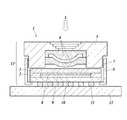
- FIG. 1 is a schematic cross-sectional view showing a configuration of a camera module including a solid-state imaging device equipped with an infrared cut filter which is a near infrared absorbing film of the present invention.
- the camera module 1 shown in FIG. 1 is connected to a circuit board 12 that is a mounting board via solder balls 11 that are connecting members.
- the camera module 1 is provided on the first main surface side (light receiving side) of the solid-state image sensor substrate 10 and the solid-state image sensor substrate 10 provided with the image sensor section 13 on the first main surface of the silicone substrate.
- Each member is bonded by adhesives 2 and 7.
- the present invention is a method of manufacturing a camera module having a solid-state image sensor substrate and an infrared cut filter disposed on the light-receiving side of the solid-state image sensor substrate.
- a near-infrared absorbing film can be formed by spin-coating an infrared absorbing liquid composition.
- the near-infrared absorbing film is formed on the planarizing layer 8 by spin-coating the near-infrared absorbing composition of the present invention to form the infrared cut filter 9. .
- the incident light L from the outside passes through the imaging lens 4, the glass substrate 3, the infrared cut filter 9, and the planarization layer 8 in order, and then reaches the imaging device portion of the solid-state imaging device substrate 10. It has become.
- the camera module 1 is connected to the circuit board 12 via a solder ball 11 (connection material) on the second main surface side of the solid-state image pickup device substrate 10.
- Example 1 Preparation of near-infrared absorbing composition >> (Preparation of near-infrared absorbing composition 1) A near-infrared absorbing composition 1 was prepared according to the following method.
- Sex compositions 15-23 were prepared.
- the ligand compound (* 1) used for the preparation of the near-infrared absorbing composition 23 described in Table V is A-26 described in Table 1 of paragraph (0021) of JP-A-2015-43063. It is.
- each evaluation sample A diluted with toluene was prepared so that the particle concentration (solid content concentration) of the metal complex as particles was 1.0 mass%.
- each evaluation sample A was measured by a dynamic light scattering method using a zeta potential / particle size measurement system ELSZ-1000ZS manufactured by Otsuka Electronics Co., Ltd. as a measuring device.
- the average particle size immediately after preparation measured by the above method was ranked according to the following criteria.
- A The average particle diameter is 50 nm or less.
- O The average particle diameter is in the range of more than 50 nm and 100 nm or less.
- ⁇ The average particle diameter is in the range of more than 100 nm and 200 nm or less. Is over 200 nm [Evaluation of spectral transmittance] Using each evaluation sample A prepared by measuring the average particle diameter, spectral transmittance in the wavelength range of 300 to 1200 nm was measured with a spectrophotometer V-570 manufactured by JASCO Corporation as a measuring device. Next, the spectral transmittances at 500 nm as the visible region and 700 nm and 800 nm as the near infrared region were evaluated.
- the transmittance at 500 nm of the near-infrared absorbing composition measured by the above method was ranked according to the following criteria, and the transmittance in the visible region was evaluated.
- the maximum transmittance T max2 in the visible light region (400 to 750 nm) after storage was measured with a spectrophotometer V-570 manufactured by JASCO Corporation in the same manner as described above.
- the same maximum transmittance T max1 of the sample A immediately after preparation was measured by the method, the maximum transmittance T max2 of decline of the visible light transmittance of the sample B after storage to the maximum transmittance T max1 (T max1 - Tmax2 ) was determined, and the visible light transmittance after storage was ranked according to the following criteria, and this was used as a measure of heat and humidity resistance.
- the near-infrared absorbing composition of the present invention is more excellent in visible light transmittance stability than the comparative example even when stored for a long period of time in a high temperature environment where moisture coexists.
- the above-described overall characteristics are further improved, and further, the near-infrared absorbing compositions 24 to 27 are improved.
- the above-mentioned overall characteristics are further improved by adding a specific near-infrared absorbing dye.
- the near-infrared absorbing composition of the present invention is suppressed from decreasing the average transmittance of the visible part when stored in a high-temperature environment, which is caused by aggregation of metal complex particles due to the influence of heat and humidity. It is understood that the near-infrared absorbing composition of the present invention is particularly excellent in stability under hot and humid storage.
- Example 2 ⁇ Quantification of acetic acid content ⁇ About the near-infrared absorptive compositions 1-27 prepared in Example 1, toluene and ultrapure water were added and stirred for 10 minutes, and then the aqueous layer was separated by centrifugation and filtered through a 0.45 ⁇ m filter. Then, acetate ions were detected using a capillary electrophoresis apparatus (CAPI-3300 manufactured by Otsuka Electronics Co., Ltd.), and the content (mol) was quantified by a calibration curve.
- CAPI-3300 manufactured by Otsuka Electronics Co., Ltd.
- the content (mol%) of acetic acid with respect to the metal (mol) contained in the near-infrared absorbing composition was determined.
- the near-infrared absorbing compositions 1-27 All were confirmed to be in the range of 1-100 mol%.
- Example 2 About the near-infrared absorptive composition 18 prepared in Example 1, after adding toluene and ultrapure water and carrying out vibration stirring for 10 minutes, the water layer was fractionated by centrifugation operation and 0.45 micrometer filter filtration was performed. Thereafter, acetic acid ions were detected using a capillary electrophoresis apparatus (CAPI-3300 manufactured by Otsuka Electronics Co., Ltd.), and the acetic acid was quantified using a calibration curve. As a result, the amount of acetic acid was 82 mol% relative to the metal (in this case, copper). there were.
- a capillary electrophoresis apparatus CAI-3300 manufactured by Otsuka Electronics Co., Ltd.
- acetic acid was added to the near-infrared absorbing composition 18 to adjust the acetic acid content to 92 mol% (18-2), 102 mol% (18-3) and Samples 18-2, 18-3, and 18-4 adjusted to 132 mol% (18-4) were prepared (the original sample was designated 18-1).
- the results 18-1 to 18-2 have extremely good performance (evaluation rank)) with a decrease in visible light transmittance.
- No. 3 confirmed that the above-mentioned performance had almost good performance (evaluation rank ⁇ ), but for 18-4, a slight decrease in visible region transmittance was confirmed, and the evaluation rank was ⁇ .
- Example 3 For the near-infrared absorbing composition 19 prepared in Example 1, the solvent was distilled off so that the solid content concentration was 20% by mass, 30% by mass, and 35% by mass, and the near-infrared absorbing composition 19- As a result of preparing a, 19-b and 19-c and visually observing the appearance, the near-infrared absorbing compositions 19, 19-a and 19-b were in the form of a smooth solution. In composition 19-c, thixotropic properties were confirmed, and an increase in viscosity was confirmed.
- Example 4 Provide of near-infrared absorbing film> A polysiloxane silicone resin (KR-255, manufactured by Shin-Etsu Chemical Co., Ltd.) was added to each near infrared absorbing composition prepared in Example 1 and stirred to prepare a coating solution for forming a near infrared absorbing film. . The prepared coating solution was applied onto a substrate by spin coating to produce near-infrared absorbing films 1-27.
- KR-255 manufactured by Shin-Etsu Chemical Co., Ltd.
- the near-infrared absorbing film was subjected to a predetermined heat treatment to cure the coating film, and near-infrared cut filters 1 to 27 applicable to an image sensor for a solid-state imaging device were produced.
- the near-infrared cut filter using the near-infrared absorbing film of the present invention is It was confirmed that no haze was generated and the same good spectral characteristics as before storage were exhibited.
- the near-infrared absorbing composition of the present invention is excellent in near-infrared light absorbing ability, dispersibility of metal complexes, particularly copper complexes, and dispersion stability (moisture resistance) when mixed with water, video cameras, digital still cameras, It can be suitably used for a near-infrared cut filter in a CCD or CMOS image sensor, which is a solid-state imaging device applied to a mobile phone with a camera function.
Landscapes
- Chemical & Material Sciences (AREA)
- Organic Chemistry (AREA)
- Health & Medical Sciences (AREA)
- Physics & Mathematics (AREA)
- General Physics & Mathematics (AREA)
- Optics & Photonics (AREA)
- Life Sciences & Earth Sciences (AREA)
- Molecular Biology (AREA)
- Biochemistry (AREA)
- General Health & Medical Sciences (AREA)
- Medicinal Chemistry (AREA)
- Polymers & Plastics (AREA)
- Chemical Kinetics & Catalysis (AREA)
- Toxicology (AREA)
- Engineering & Computer Science (AREA)
- Materials Engineering (AREA)
- Inorganic Chemistry (AREA)
- General Chemical & Material Sciences (AREA)
- Optical Filters (AREA)
- Organic Low-Molecular-Weight Compounds And Preparation Thereof (AREA)
- Studio Devices (AREA)
Abstract
Description
前記近赤外線吸収剤が、下記(A)成分及び下記(B)成分のうち少なくとも1つの成分を含有していることを特徴とする近赤外線吸収性組成物。
(B)成分:下記一般式(I)で表される構造を有する化合物と金属化合物との反応により得られる金属錯体からなる成分


2.前記金属イオン又は前記金属錯体を構成する金属が、銅であることを特徴とする第1項に記載の近赤外線吸収性組成物。

(B)成分:前記一般式(I)で表される構造を有する化合物と金属化合物との反応により得られる金属錯体からなる成分
本発明の近赤外線吸収性組成物では、前記一般式(I)で表される構造を有する化合物と金属化合物との反応により形成される金属錯体が、吸光係数の高い近赤外線吸収特性を発現すると考えられる。前記一般式(I)で表される構造を有する化合物は、エチレンオキシド構造(条件(i))のみでなく、アルキル置換されたエチレンオキシド構造(条件(ii))を含んでいることが特徴である。エチレンオキシド構造に対し、アルキル置換されたエチレンオキシド構造は、前記一般式(I)で表される構造を有する化合物において、置換基(R21~R24)が存在するため、ジアステレオマー成分数が多くなる。その結果、エントロピー効果により、凝集が抑制され、水分混入時における分散安定性を高くすることができる。また、置換基(R21~R24)の疎水的な効果も追加されるため、分散安定性を更に高くすることができる。
本発明の近赤外線吸収性組成物は、近赤外線吸収剤と溶媒を含有し、当該近赤外線吸収剤は、後述する(A)成分及び(B)成分のうち少なくとも1つの成分を含有していることを特徴とする。
本発明に係る近赤外線吸収剤は、下記(A)成分及び下記(B)成分のうち少なくとも1つの成分を含有していることを特徴とする。
(B)成分:下記一般式(I)で表される構造を有する化合物と金属化合物との反応により得られる金属錯体からなる成分。
はじめに、本発明に係る下記一般式(I)で表される構造を有する化合物について説明する。


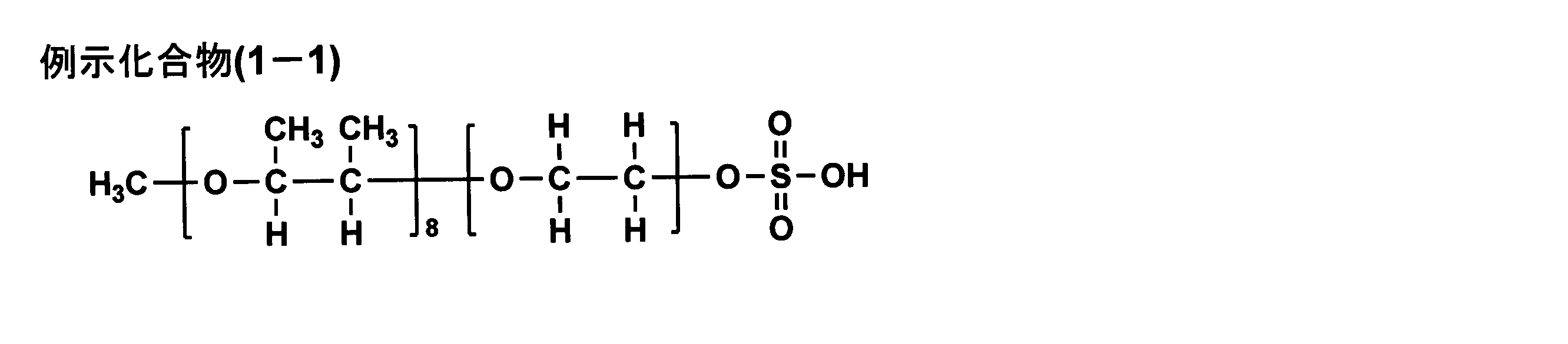
例示化合物1は、下記の表Iに示すように、
R:メチル基、
条件(i):R21~R24=H
条件(ii):R21=H、R22=メチル基、R23=メチル基、R24=H
Z:Z-3
l:1.0
m:8.0
の構造を有しているが、例えば、下記の例示化合物(1-1)の構造で表される。

例示化合物2は、下記の表Iに示すように、
R:メチル基、
条件(i):R21~R24=H
条件(ii):R21=H、R22=H、R23=メチル基、R24=H
Z:Z-1、Z-2
l:2.0
m:3.0
の構造を有しているが、ZがZ-2である例示化合物(2-1)と、ZがZ-1である例示化合物(2-2)の構造で表される。
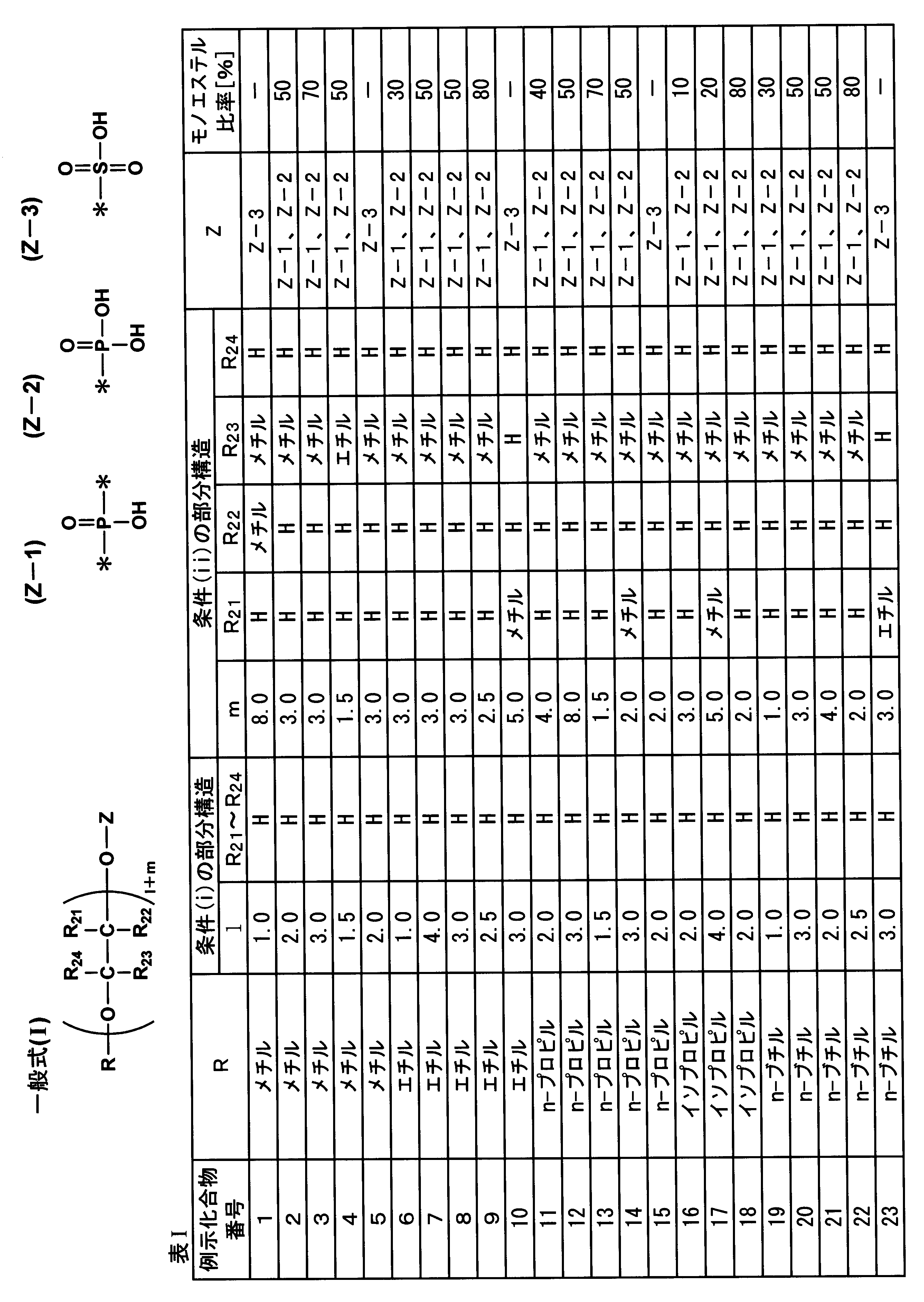
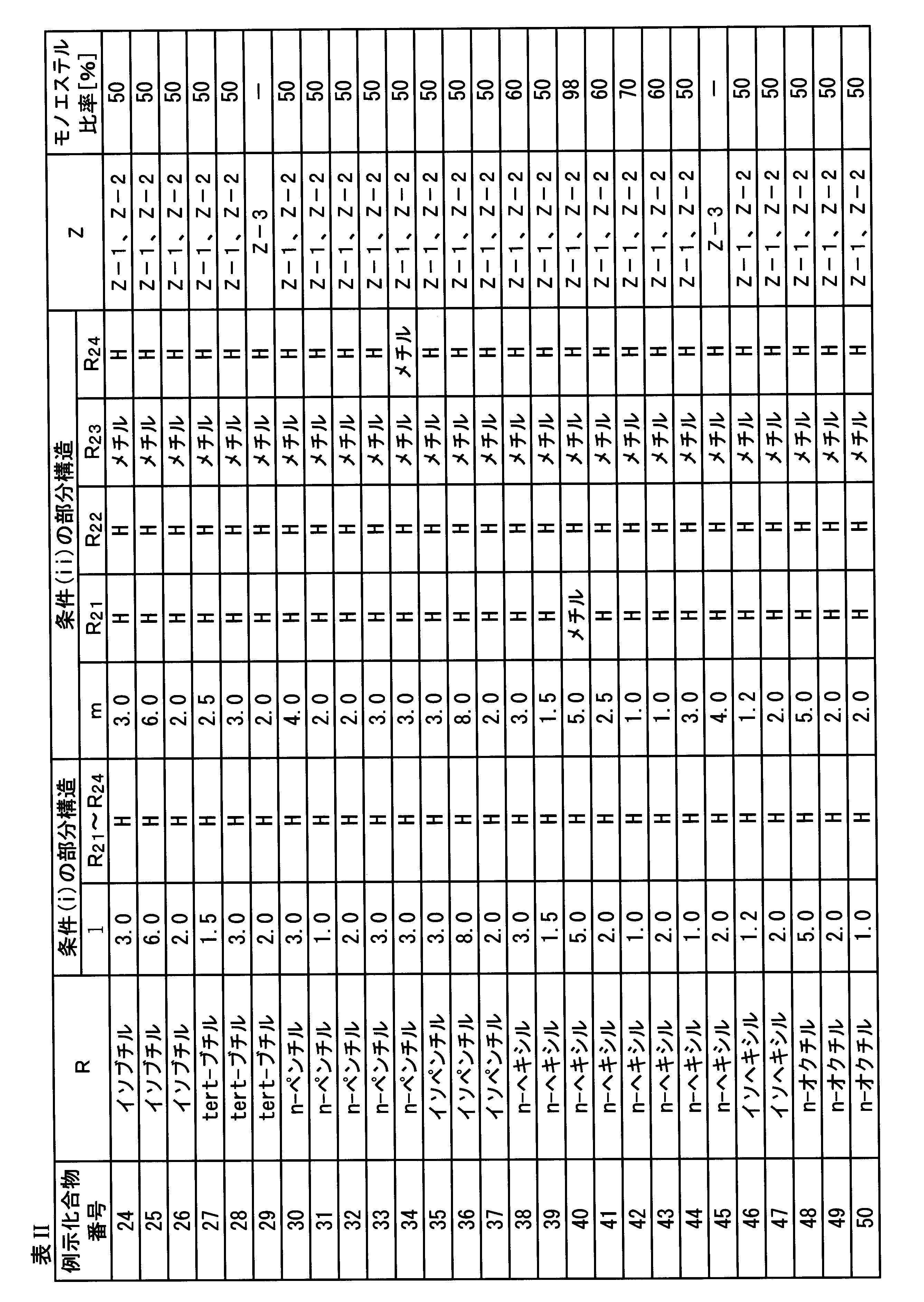
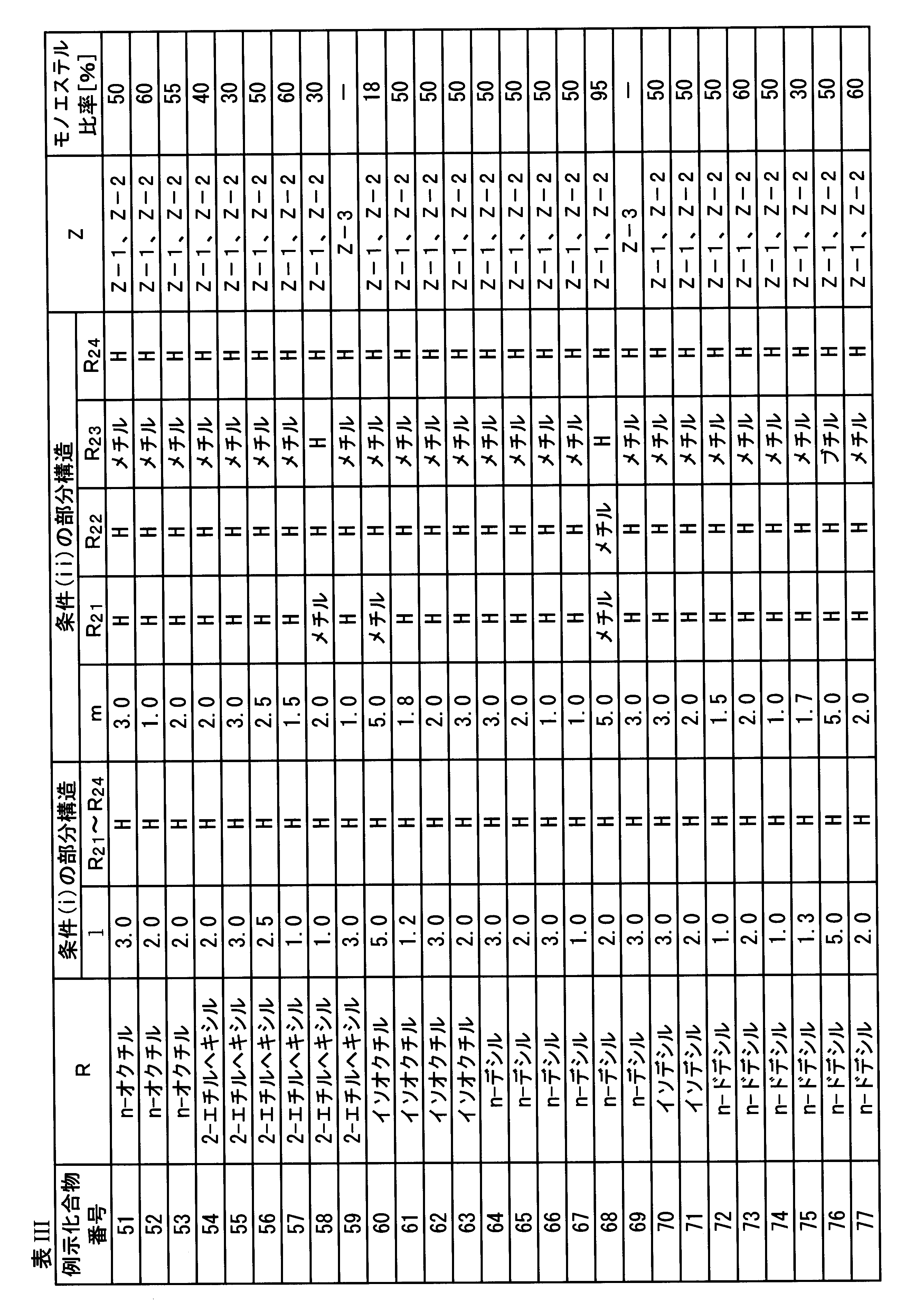

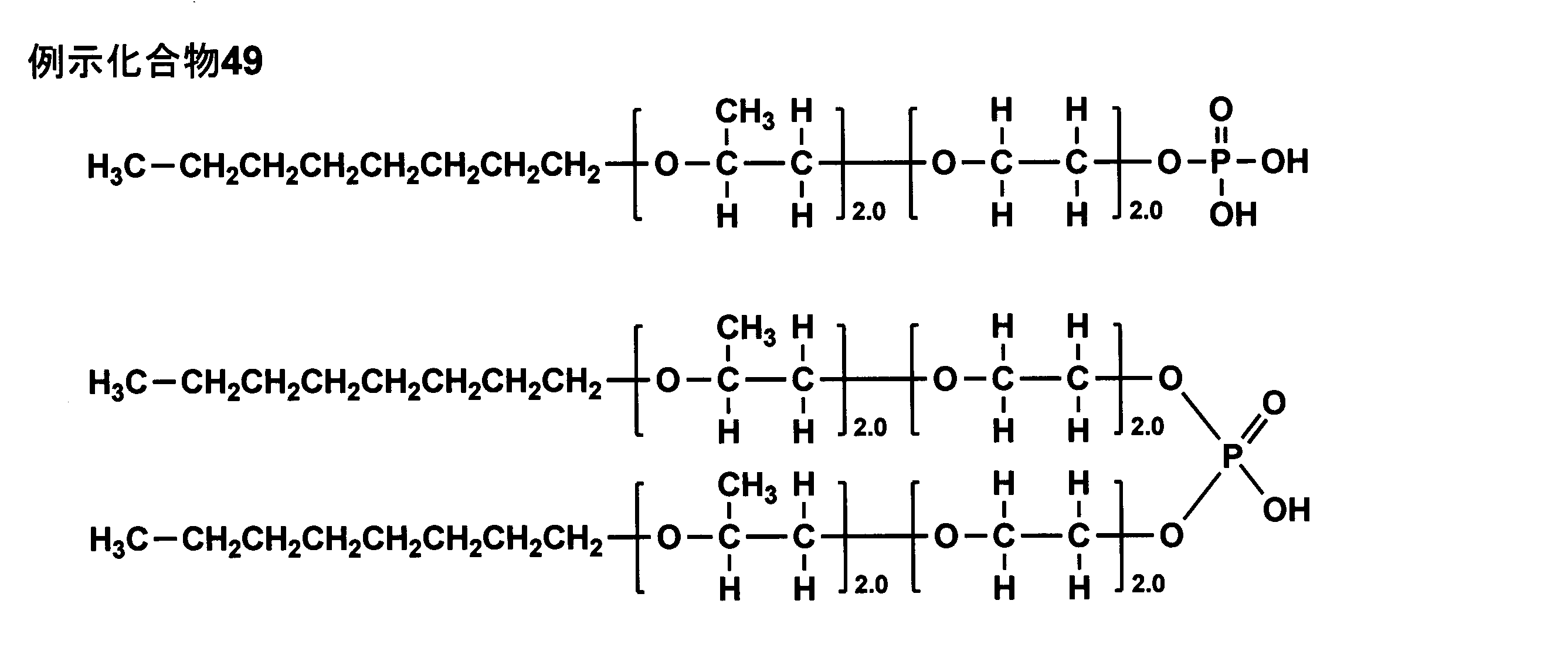
次いで、本発明に係る一般式(i)で表される構造を有する化合物の合成の代表例を挙げるが、本発明はこれらの合成方法に限定されない。
n-オクタノール130g(1.0モル)をオートクレーブに入れ、水酸化カリウムを触媒とし、圧力147kPa、温度130℃の条件で、プロピレンオキシド116g(2.0モル)を付加させた後、エチレンオキサイド88g(2.0モル)を付加させた。
2-エチルヘキサノール130g(1.0モル)をオートクレーブに入れ、水酸化カリウムを触媒とし、圧力147kPa、温度130℃の条件で、プロピレンオキシド145g(2.5モル)を付加させた後、エチレンオキサイド110g(2.5モル)を付加させた。
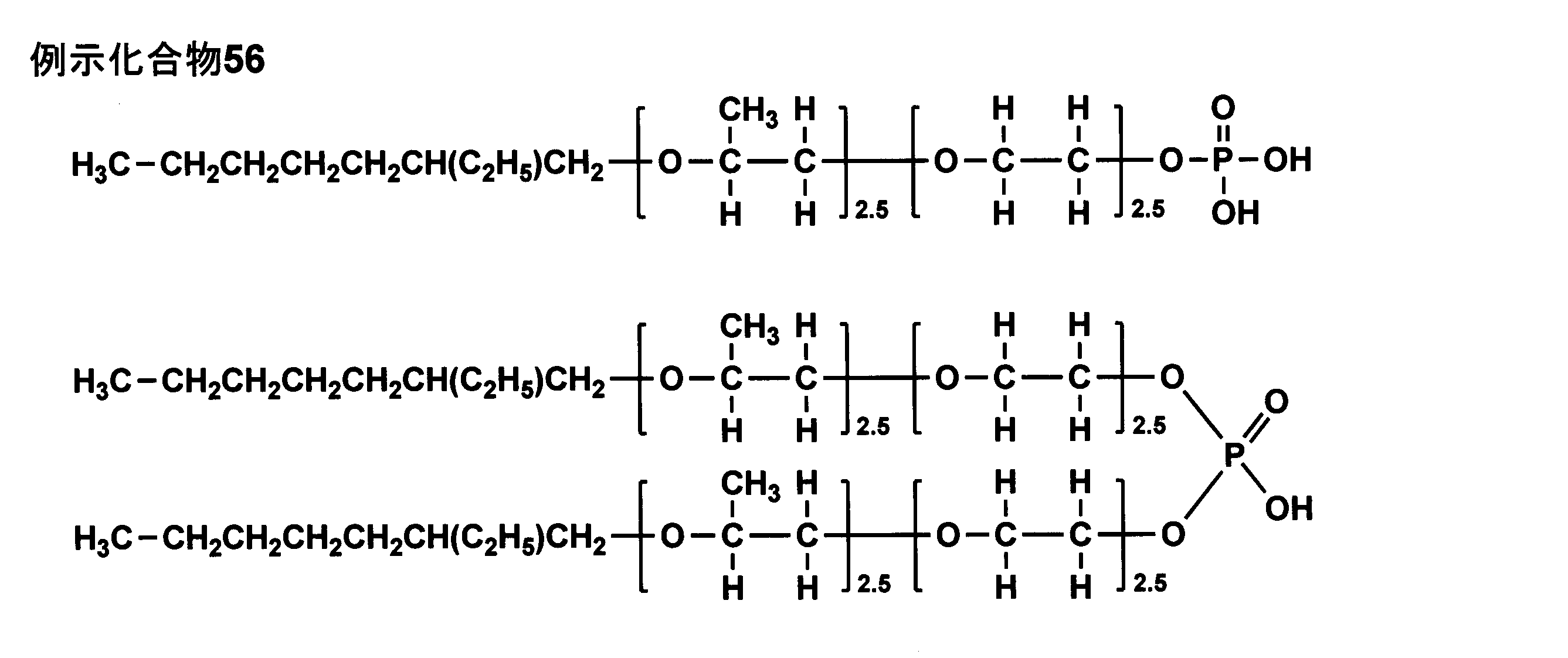
2-エチルヘキサノール130g(1.0モル)をオートクレーブに入れ、水酸化カリウムを触媒とし、圧力147kPa、温度130℃の条件で、プロピレンオキシド58g(1.0モル)を付加させた後、エチレンオキサイド132g(3.0モル)を付加させた。

本発明に係る近赤外線吸収剤においては、前述のとおり、前記一般式(I)で表される構造を有する化合物と金属イオンからなる(A)成分と、前記一般式(I)で表される構造を有する化合物と金属化合物との反応により得られる金属錯体からなる(B)成分のうち、少なくとも1つの成分を含有していることを特徴とする。
本発明に係る一般式(I)で表される構造を有する化合物と金属化合物との反応により得られる金属錯体の合成方法については、例えば、特許第4422866号公報、特許第5953322号公報に記載されている方法を適用することができる。
本発明の近赤外線吸収性組成物においては、近赤外線吸収剤が含有する(A)成分を構成する金属イオン、又は(B)成分を構成する金属錯体における金属化合物を構成する金属に対し、1~100モル%の範囲内の酢酸を含有することが好ましい。
本発明に係る上記金属錯体においては、その平均粒径が1~200nmの範囲内であることが好ましく、1~100nmの範囲内であることがより好ましく、1~50nmの範囲内であることが特に好ましい。
本発明の近赤外線吸収性組成物においては、ホスホン酸化合物、リン酸化合物、スルホン酸化合物又は各々の金属錯体化合物を含むことが好ましいが、特に、以下に説明するホスホン酸を含有することが好ましい。
リン酸化合物としては、例えば
1)リン酸メチルエステル
2)リン酸エチルエステル
3)リン酸n-プロピルエステル
4)リン酸i-プロピルエステル
5)リン酸n-ブチルエステル
6)リン酸t-ブチルエステル
7)リン酸n-ペンチルエステル
8)リン酸n-ヘキシルエステル
9)リン酸2-エチルヘキシルエステル
10)リン酸n-へプチルエステル
11)リン酸n-オクチルエステル
12)リン酸シクロヘキシルエステル
等を挙げることができる。
スルホン酸化合物としては、例えば、特開2015-430638号公報記載の化合物などが挙げられる。
本発明の近赤外線吸収性組成物においては、下記一般式(1)で表される構造を有するホスホン酸化合物を含むことが好ましい。

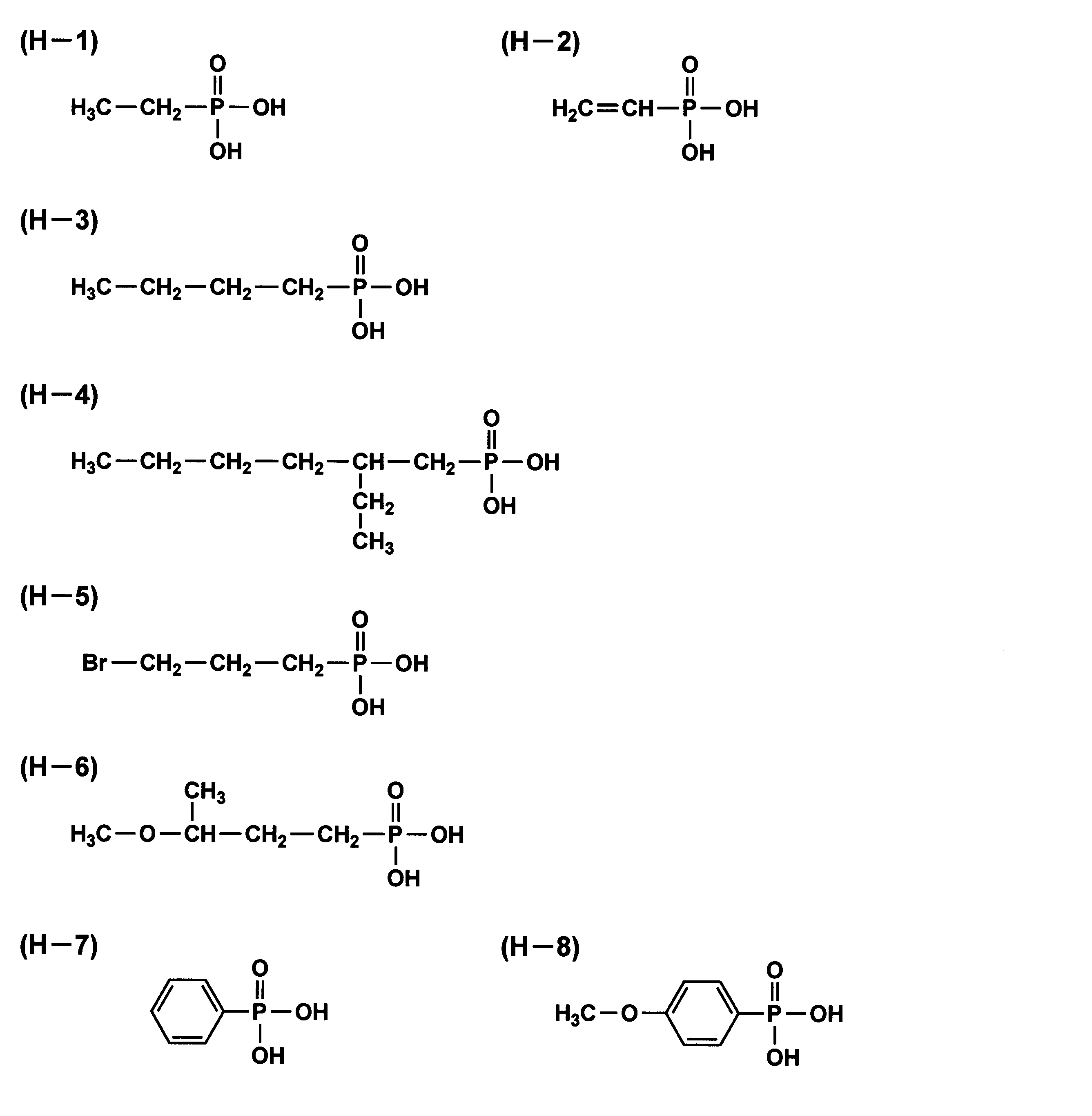
2:エチルホスホン酸
3:プロピルホスホン酸
4:ブチルホスホン酸
5:ペンチルホスホン酸
6:ヘキシルホスホン酸
7:オクチルホスホン酸
8:2-エチルヘキシルホスホン酸
9:2-クロロエチルホスホン酸
10:3-ブロモプロピルホスホン酸
11:3-メトキシブチルホスホン酸
12:1,1-ジメチルプロピルホスホン酸
13:1,1-ジメチルエチルホスホン酸
14:1-メチルプロピルホスホン酸
〈ホスホン酸金属錯体〉
次いで、本発明に好適なホスホン酸金属錯体について説明する。
次いで、本発明の近赤外線吸収性組成物の調製に適用可能な溶媒について説明する。

2)PGEEA:プロピレングリコールモノエチルエーテルアセテート(分子量:146)
3)PGBEA:プロピレングリコールモノブチルエーテルアセテート(分子量:174)
4)エチレングリコールジアセテート(分子量:146)
5)エチレングリコールジグリシジルエーテル(分子量:174)
6)エチレングリコールモノメチルエーテルアセテート(分子量:118)
7)エチレングリコールモノエチルエーテルアセテート(分子量:132)
8)エチレングリコールモノブチルエーテルアセテート(分子量:160)
9)エチレングリコールジブチルエーテル(分子量:174)
10)エチレングリコールモノアセテート(分子量:104)
11)エチレングリコールモノイソプロピルエーテル(分子量:104)
12)エチレングリコールモノエチルエーテル(分子量:90)
13)エチレングリコールモノメトキシメチルエーテル(分子量:106)
14)グリセリン1,3-ジアセテート(分子量:176)
15)グリセリン1,2-ジメチルエーテル(分子量:120)
16)グリセリン1,3-ジメチルエーテル(分子量:120)
17)グリセリン1,3-ジエチルエーテル(分子量:148)
18)2-クロロ-1,3-プロパンジオール(分子量110)
19)3-クロロ-1,2-プロパンジオール(分子量110)
20)ジエチレングリコールエチルメチルエーテル(分子量:148)
21)ジエチレングリコールジメチルエーテル(分子量:134)
22)ジエチレングリコールモノエチルエーテルアセテート(分子量:176)
23)ジエチレングリコールモノブチルエーテル(分子量:162)
24)ジエチレングリコールモノメチルエーテル(分子量:120)
25)ジプロピレングリコール(分子量:134)
26)ジプロピレングリコールモノプロピルエーテル(分子量:176)
27)トリエチレングリコール(分子量:150)
28)トリエチレングリコールジメチルエーテル(分子量:178)
29)トリエチレングリコールモノエチルエーテル(分子量:178)
30)トリエチレングリコールモノメチルエーテル(分子量:164)
31)プロピレングリコール(分子量:76)
32)プロピレングリコールモノエチルエーテル(分子量:104)
上記分散剤の中でも、特に、1)~17)、20)~24)、26)、28)~30)、32)で示す分散剤が好ましい。
上記一般式(3)で表される構造を有する溶媒と併用可能なその他の溶媒としては、例えば、分子量が190を超えるジオキシエチレンラウリルエーテル、トリオキシエチレンラウリルエーテル、テトラオキシエチレンラウリルエーテル、ペンタオキシエチレンラウリルエーテル、ヘキサオキシエチレンラウリルエーテル、ヘプタオキシエチレンラウリルエーテル、オクタオキシエチレンラウリルエーテル、ノナオキシエチレンラウリルエーテル、デカオキシエチレンラウリルエーテル、ウンデカオキシエチレンラウリルエーテル、ドデカオキシエチレンラウリルエーテル、トリデカオキシエチレンラウリルエーテル、テトラデカオキシエチレンラウリルエーテル等のエーテル系化合物や、ジエチレングリコールジメタクリレート(NKエステル2G、新中村化学工業社製、分子量:242)、トリエチレングリコールジメタクリレート(分子量286)、ポリエチレングリコール#200ジメタクリレート(NKエステル4G、新中村化学工業社製、分子量:330)、トリプロピレングリコールプロピルエーテル、トリエチレングリコールビス(2-エチルヘキサネート)(アクロス社製)、1,3-ブチレングリコールジメタクリレート等を挙げることができる。
本発明の近赤外線吸収性組成物においては、吸収波形調整用の添加剤として、650~800nmの波長域に吸収極大波長を有する近赤外線吸収調整剤を少なくとも1種添加することが、分光特性の観点から好ましい。本発明に適用する近赤外線吸収調整剤としては、650~800nmの波長域に吸収極大波長を有する近赤外線吸収色素を適用することが好ましい。
本発明の近赤外線吸収性組成物においては、近赤外線吸収剤と溶媒の他に、紫外線吸収剤をさらに含有していることが、分光特性及び耐光性の観点から好ましい。
本発明においては、本発明の近赤外線吸収性組成物を用いて、近赤外線吸収性膜を形成することを一つの特徴とする。
本発明の近赤外線吸収性膜には、本発明の目的効果を損なわない範囲で、その他の添加剤を適用することができ、例えば、増感剤、架橋剤、硬化促進剤、フィラー、熱硬化促進剤、熱重合禁止剤、可塑剤などが挙げられ、更に基材表面への密着促進剤及びその他の助剤類(例えば、導電性粒子、充填剤、消泡剤、難燃剤、レベリング剤、剥離促進剤、酸化防止剤、香料、表面張力調整剤、連鎖移動剤など)を併用してもよい。
本発明の近赤外線吸収性膜は、例えば、CCD用、CMOS用又は他の受光素子用の視感度補正部材、測光用部材、熱線吸収用部材、複合光学フィルター、レンズ部材(眼鏡、サングラス、ゴーグル、光学系、光導波系)、ファイバ部材(光ファイバ)、ノイズカット用部材、プラズマディスプレイ前面板等のディスプレイカバー又はディスプレイフィルター、プロジェクタ前面板、光源熱線カット部材、色調補正部材、照明輝度調節部材、光学素子(光増幅素子、波長変換素子等)、ファラデー素子、アイソレータ等の光通信機能デバイス、光ディスク用素子等を構成するものとして好適である。
《近赤外線吸収性組成物の調製》
(近赤外線吸収性組成物1の調製)
下記の方法に従って、近赤外線吸収性組成物1を調製した。
上記近赤外線吸収性組成物1の調製において、酢酸銅に代えて、同モルの酢酸ニッケルを用いた以外は同様にして、近赤外線吸収性組成物2を調製した。
上記近赤外線吸収性組成物1の調製において、酢酸銅に代えて、同モルの酢酸コバルトを用いた以外は同様にして、近赤外線吸収性組成物3を調製した。
上記近赤外線吸収性組成物1の調製において、例示化合物1に代えて、表Vに記載の同モルの各例示化合物を用いた以外は同様にして、近赤外線吸収性組成物4~14を調製した。
上記近赤外線吸収性組成物1の調製において、一般式(I)で表される化合物として、例示化合物1の27%を表Vに記載した各例示化合物(同モル)に変更し、前記酢酸銅溶液に対して、各例示化合物をTHF35mLに溶解した溶液を、15分かけて撹拌しながら滴下し、30分撹拌後に残りの73%を表Vに示した各配位子化合物(同モル)に変更したTHF溶液45mLを15分かけて滴下した。そのまま室温で16時間撹拌した後、アニソール238.97gを加え、55~90℃の環境で3時間かけて溶媒であるTHFを揮発させて固形分が10質量%となるようにして、近赤外線吸収性組成物15~23を調製した。
上記近赤外線吸収性組成物4の調製において、例示化合物40を、表Vに示した例示化合物91に変更して、前記酢酸銅溶液に滴下、室温で16時間撹拌した後に表Vに示した近赤外線吸収調整剤として、近赤外線吸収色素であるFDR004(極大吸収波長:716nm、山田化学工業社製)を9.04mg添加し、さらにアニソール238.97gを加え、55~90℃の環境で3時間かけて溶媒であるTHFを揮発させて固形分が10質量%となるようにして、近赤外線吸収性組成物24を調製した。
上記近赤外線吸収性組成物17の調製において、例示化合物56を表Vに示した例示化合物53に変更して、前記酢酸銅溶液に滴下、室温で16時間撹拌した後に表Vに示した近赤外線吸収調整剤として、近赤外線吸収色素であるFDR004(極大吸収波長:716nm、山田化学工業社製)を9.04mg添加し、さらにアニソール238.97gを加え、55~90℃の環境で3時間かけて溶媒であるTHFを揮発させて固形分が10質量%となるようにして、近赤外線吸収性組成物25を調製した。
上記近赤外線吸収性組成物25の調製において、例示化合物53を表Vに示した例示化合物57に変更して、前記酢酸銅溶液に滴下、室温で16時間撹拌した後に表Vに示した近赤外線吸収調整剤として、近赤外線吸収色素であるFDR004を9.04mgと、LumogenIR765(BASF社製)を21.59mg用いた以外は同様にして、近赤外線吸収性組成物26を調製した。
上記近赤外線吸収性組成物21の調製において、例示化合物77を表Vに示した例示化合物67に変更して、前記酢酸銅溶液に滴下、室温で16時間撹拌した後に表Vに示した近赤外線吸収調整剤として、近赤外線吸収色素であるFDR004を9.04mgと、LumogenIR765(BASF社製)を21.59mg用いた以外は同様にして、近赤外線吸収性組成物27を調製した。
上記近赤外線吸収性組成物1の調製において、例示化合物1に代えて、同モルの比較化合物1を用いた以外は同様にして、近赤外線吸収性組成物28を調製した。
R:n-ドデシル基、
条件(i):R21~R24=H
Z:Z-1、Z-2(モノエステル比率50%)
l:3.0
m:0
(近赤外線吸収性組成物29の調製)
上記近赤外線吸収性組成物1の調製において、例示化合物1に代えて、同モルの比較化合物2を用いた以外は同様にして、近赤外線吸収性組成物29を調製した。
R:n-ドデシル基、
条件(ii):R21=H、R22=H、R23=メチル基、R24=H
Z:Z-1、Z-2(モノエステル比率50%)
l:0
m:3.0
(近赤外線吸収性組成物30の調製)
上記近赤外線吸収性組成物1の調製において、例示化合物1に代えて、同モルの比較化合物1+比較化合物2(組成比1:1)を用いた以外は同様にして、近赤外線吸収性組成物30を調製した
上記調製した各近赤外線吸収性組成物の詳細を、表Vに示す。

上記調製した各近赤外線吸収性組成物について、下記の方法に従って、粒径、可視部及び近赤外部の透過率及び熱湿度耐性の評価を行った。
上記調製した近赤外線吸収性組成物1~30について、粒子である金属錯体の粒子濃度(固形分濃度)が1.0質量%となるように、トルエンで希釈した各評価サンプルAを調製した。
○:平均粒径が、50nm超、100nm以下の範囲内である
△:平均粒径が、100nm超、200nm以下の範囲内である
×:平均粒径が、200nm超である
〔分光透過率の評価〕
上記平均粒径の測定で調製した各評価サンプルAを用い、測定装置として日本分光社製の分光光度計V-570により、300~1200nmの波長域範囲における分光透過率を測定した。次いで、可視部領域として500nm、近赤外部領域として700nm及び800nmにおける分光透過率について、評価を行った。
上記方法で測定した近赤外線吸収性組成物の500nmにおける透過率を、下記の基準に従ってランク付けを行い、可視部領域の透過率評価を行った。
○:最大透過率が、90%以上、95%未満である
△:最大透過率が、80%以上、90%未満である
×:最大透過率が、80%未満である
(近赤外部領域における透過率評価)
上記方法で測定した近赤外線吸収性組成物の700nm及び800nmにおける透過率を、下記の基準に従ってランク付けを行い、近赤外部領域の透過率評価を行った。
○:最大透過率が、5%以上、10%未満である
△:最大透過率が、10%以上、20%未満である
×:最大透過率が、20%以上である
〔熱湿度耐性の評価〕
近赤外線吸収性組成物の原液5ml及び純水0.03gを、ガラス容器に収納し、窒素ガスを充填した状態で密閉し、この容器を、65℃恒温槽中で撹拌しながらで5日間保存した後、上記と同様の方法で、保存液の近赤外線吸収性組成物の濃度が1.0質量%となるように、トルエンで希釈した保存処理後のサンプルBを調製した。
○:可視光透過率の低下幅が、1.0%以上、3.0%未満である
△:可視光透過率の低下幅が、3.0%以上、5.0%未満である
×:可視光透過率の低下幅が、5.0%以上である
以上により得られた結果を、表VIに示す。

《酢酸量の定量》
実施例1で調製した近赤外線吸収性組成物1~27について、各々トルエンと超純水を加えて10分振動撹拌した後、遠心分離操作により水層を分取し、0.45μmのフィルター濾過を行った後、キャピラリー電気泳動装置(大塚電子株式会社製CAPI-3300)を用いて酢酸イオンを検出し、検量線により含有量(モル)を定量した。
上記方法で求めた酢酸量の測定結果の一例を以下に示す。
実施例1で調製した近赤外線吸収性組成物19について、その固形分濃度を20質量%、30質量%、35質量%になる様に溶媒を留去して、近赤外線吸収性組成物19-a、19-b及び19-cを調製し、その外観を目視観察した結果、近赤外線吸収性組成物19、19-a及び19-bはサラサラした溶液状であったが、近赤外線吸収性組成物19-cにおいてはチキソ性が確認され、粘度上昇が確認された。
《近赤外線吸収性膜の作製》
実施例1で調製した各近赤外線吸収性組成物に、ポリシロキサンシリコーン樹脂(KR-255、信越化学工業社製)を加えて撹拌して、近赤外線吸収性膜形成用の塗布液を調製した。調製した塗布液をスピンコーティングにより基板上に塗布して近赤外線吸収性膜1~27を作製した。
2、7 接着剤
3 ガラス基板
4 撮像レンズ
5 レンズホルダー
6 遮光兼電磁シールド
8 平坦化層
9 近赤外線吸収性膜(近赤外線カットフィルター)
10 固体撮像素子基板
11 ハンダボール
12 回路基板
13 撮像素子部
Claims (12)
- 近赤外線吸収剤と溶媒を含有する近赤外線吸収性組成物であって、
前記近赤外線吸収剤が、下記(A)成分及び下記(B)成分のうち少なくとも1つの成分を含有していることを特徴とする近赤外線吸収性組成物。
(A)成分:下記一般式(I)で表される構造を有する化合物と金属イオンからなる成分
(B)成分:下記一般式(I)で表される構造を有する化合物と金属化合物との反応により得られる金属錯体からなる成分


R21~R24はそれぞれ水素原子又は炭素数が1~4のアルキル基を表す。
ただし、一般式(I)で表される構造を有する化合物は、下記条件(i)を満たす部分構造と、下記条件(ii)を満たす部分構造とを、それぞれ少なくとも1つ同時に有する。
条件(i):R21~R24が全て水素原子である。
条件(ii):R21~R24の少なくとも1つが、炭素数が1~4のアルキル基である。
一般式(I)において、lは、上記条件(i)を満たす部分構造の数を表し、1~10の数である。mは、上記条件(ii)を満たす部分構造の数を表し、1~10の数である。〕 - 前記金属イオン又は前記金属錯体を構成する金属が、銅であることを特徴とする請求項1に記載の近赤外線吸収性組成物。
- 前記一般式(I)で表される構造を有する化合物が、下記一般式(II)で表される構造を有する化合物であることを特徴とする請求項1又は請求項2に記載の近赤外線吸収性組成物。

- 前記一般式(I)で表される構造を有する化合物が、モノエステルとジエステルを含み、モノエステルのモル比率が20~95%の範囲内であることを特徴とする請求項1から請求項3までのいずれか一項に記載の近赤外線吸収性組成物。
- 前記一般式(I)は、下記条件(i)を満たす部分構造と、下記条件(iii)を満たす部分構造とを、それぞれ少なくとも1つ同時に有することを特徴とする請求項1から請求項4までのいずれか一項に記載の近赤外線吸収性組成物。
条件(i):R21~R24が全て水素原子である。
条件(iii):R21~R24のいずれか1つが、炭素数が1~4のアルキル基であり、残りの3つが水素原子である。 - 前記一般式(I)におけるl及びmが、それぞれ1~3の範囲内の数であることを特徴とする請求項1から請求項5までのいずれか一項に記載の近赤外線吸収性組成物。
- 前記金属錯体の平均粒径が、50nm以下であることを特徴とする請求項1から請求項6までのいずれか一項に記載の近赤外線吸収性組成物。
- ホスホン酸化合物を含有することを特徴とする請求項1から請求項7までのいずれか一項に記載の近赤外線吸収性組成物。
- 650~800nmの波長範囲内に吸収極大波長を有する近赤外線吸収調整剤を含有することを特徴とする請求項1から請求項8までのいずれか一項に記載の近赤外線吸収性組成物。
- 前記金属イオン又は前記金属化合物を構成する金属に対し、1~100モル%の範囲内の酢酸を含有することを特徴とする請求項1から請求項9までのいずれか一項に記載の近赤外線吸収性組成物。
- 請求項1から請求項10までのいずれか一項に記載の近赤外線吸収性組成物を用いたことを特徴とする近赤外線吸収性膜。
- 請求項11に記載の近赤外線吸収性膜を具備することを特徴とする固体撮像素子用イメージセンサー。
Priority Applications (4)
| Application Number | Priority Date | Filing Date | Title |
|---|---|---|---|
| JP2020508211A JP7156366B2 (ja) | 2018-03-23 | 2019-03-11 | 近赤外線吸収性組成物、近赤外線吸収性膜及び固体撮像素子用イメージセンサー |
| CN201980020396.7A CN111919147B (zh) | 2018-03-23 | 2019-03-11 | 近红外线吸收性组合物、近红外线吸收性膜及固体摄像元件用图像传感器 |
| US16/981,195 US11971563B2 (en) | 2018-03-23 | 2019-03-11 | Near-infrared absorbing composition, near-infrared absorbing film, and image sensor for solid-state imaging element |
| KR1020207026095A KR102468173B1 (ko) | 2018-03-23 | 2019-03-11 | 근적외선 흡수성 조성물, 근적외선 흡수성 막 및 고체 촬상 소자용 이미지 센서 |
Applications Claiming Priority (2)
| Application Number | Priority Date | Filing Date | Title |
|---|---|---|---|
| JP2018-055498 | 2018-03-23 | ||
| JP2018055498 | 2018-03-23 |
Publications (1)
| Publication Number | Publication Date |
|---|---|
| WO2019181587A1 true WO2019181587A1 (ja) | 2019-09-26 |
Family
ID=67986164
Family Applications (1)
| Application Number | Title | Priority Date | Filing Date |
|---|---|---|---|
| PCT/JP2019/009571 Ceased WO2019181587A1 (ja) | 2018-03-23 | 2019-03-11 | 近赤外線吸収性組成物、近赤外線吸収性膜及び固体撮像素子用イメージセンサー |
Country Status (5)
| Country | Link |
|---|---|
| US (1) | US11971563B2 (ja) |
| JP (1) | JP7156366B2 (ja) |
| KR (1) | KR102468173B1 (ja) |
| CN (1) | CN111919147B (ja) |
| WO (1) | WO2019181587A1 (ja) |
Cited By (1)
| Publication number | Priority date | Publication date | Assignee | Title |
|---|---|---|---|---|
| JP2022053617A (ja) * | 2020-09-25 | 2022-04-06 | コニカミノルタ株式会社 | 近赤外線吸収性組成物、近赤外線カットフィルター、固体撮像素子用イメージセンサー及びカメラモジュール |
Families Citing this family (1)
| Publication number | Priority date | Publication date | Assignee | Title |
|---|---|---|---|---|
| JP7831028B2 (ja) * | 2022-03-11 | 2026-03-17 | コニカミノルタ株式会社 | 近赤外線吸収性組成物、近赤外線吸収性硬化膜及び光学部材 |
Citations (6)
| Publication number | Priority date | Publication date | Assignee | Title |
|---|---|---|---|---|
| JP2000007871A (ja) * | 1998-06-23 | 2000-01-11 | Kureha Chem Ind Co Ltd | 樹脂組成物およびその製造法、光学フィルターおよびこれを備えた装置、熱線吸収フィルター、光ファイバーおよび眼鏡レンズ |
| JP2001154015A (ja) * | 1999-09-16 | 2001-06-08 | Kureha Chem Ind Co Ltd | 光学フィルタ及びその製造方法 |
| JP2002006101A (ja) * | 2000-06-27 | 2002-01-09 | Kureha Chem Ind Co Ltd | 光学材料 |
| JP2011213832A (ja) * | 2010-03-31 | 2011-10-27 | Fujifilm Corp | 黒色硬化性組成物、遮光膜及びその製造方法、並びに固体撮像素子 |
| WO2014126192A1 (ja) * | 2013-02-14 | 2014-08-21 | 富士フイルム株式会社 | 赤外線吸収組成物ないしは赤外線吸収組成物キット、これを用いた赤外線カットフィルタ及びその製造方法、並びに、カメラモジュール及びその製造方法 |
| JP2015043063A (ja) * | 2013-02-19 | 2015-03-05 | 富士フイルム株式会社 | 近赤外線吸収性組成物、これを用いた近赤外線カットフィルタおよびその製造方法、並びに、カメラモジュールおよびその製造方法 |
Family Cites Families (12)
| Publication number | Priority date | Publication date | Assignee | Title |
|---|---|---|---|---|
| JPS4926699B1 (ja) | 1970-12-19 | 1974-07-11 | ||
| DE69824299T2 (de) | 1997-08-26 | 2004-10-21 | Kureha Chemical Ind Co Ltd | Kupfer-enthaltende phosphorsäureester-derivate und verfahren zu ihrer herstellung, nahinfrarot-aborber, und im nahinfrarot absorbierende acrylharzzubereitungen |
| JP2000248259A (ja) * | 1999-02-25 | 2000-09-12 | Kureha Chem Ind Co Ltd | 近赤外光吸収性組成物及び該組成物を用いたディスプレイ前面板 |
| US7332257B2 (en) * | 2003-07-11 | 2008-02-19 | Asahi Glass Company, Limited | Composition for optical film, and optical film |
| WO2005012424A1 (ja) * | 2003-07-31 | 2005-02-10 | Kureha Chemical Industry Company, Limited | 樹脂組成物、シート状樹脂組成物及び積層体 |
| AU2005221948A1 (en) | 2004-03-10 | 2005-09-22 | Kureha Corporation | Solubilizer and composition containing same |
| JP2014026070A (ja) * | 2012-07-26 | 2014-02-06 | Fujifilm Corp | 近赤外線吸収性組成物、これを用いた近赤外線カットフィルタ及びその製造方法、並びに、カメラモジュール及びその製造方法 |
| JP5946389B2 (ja) * | 2012-07-27 | 2016-07-06 | 富士フイルム株式会社 | 近赤外線吸収性組成物、これを用いた近赤外線カットフィルタ及びその製造方法、並びに、カメラモジュール及びその製造方法 |
| JP5890805B2 (ja) | 2012-07-27 | 2016-03-22 | 富士フイルム株式会社 | 近赤外線吸収性組成物、これを用いた近赤外線カットフィルタ及びその製造方法、並びに、カメラモジュール及びその製造方法 |
| JP6016518B2 (ja) * | 2012-08-21 | 2016-10-26 | 富士フイルム株式会社 | 近赤外線吸収剤、近赤外線吸収性組成物、これらを用いた近赤外線カットフィルタ及びその製造方法、カメラモジュール及びその製造方法、ならびに、近赤外線吸収剤の製造方法 |
| JP6178148B2 (ja) * | 2013-05-23 | 2017-08-09 | 富士フイルム株式会社 | 近赤外線吸収性組成物、これを用いた近赤外線カットフィルタおよびその製造方法、並びに、カメラモジュールおよびその製造方法 |
| TW201600574A (zh) * | 2014-06-30 | 2016-01-01 | Fujifilm Corp | 近紅外線吸收性組成物、近紅外線截止濾波器、近紅外線截止濾波器的製造方法、固體攝像元件、照相機模組 |
-
2019
- 2019-03-11 JP JP2020508211A patent/JP7156366B2/ja active Active
- 2019-03-11 CN CN201980020396.7A patent/CN111919147B/zh active Active
- 2019-03-11 WO PCT/JP2019/009571 patent/WO2019181587A1/ja not_active Ceased
- 2019-03-11 KR KR1020207026095A patent/KR102468173B1/ko active Active
- 2019-03-11 US US16/981,195 patent/US11971563B2/en active Active
Patent Citations (6)
| Publication number | Priority date | Publication date | Assignee | Title |
|---|---|---|---|---|
| JP2000007871A (ja) * | 1998-06-23 | 2000-01-11 | Kureha Chem Ind Co Ltd | 樹脂組成物およびその製造法、光学フィルターおよびこれを備えた装置、熱線吸収フィルター、光ファイバーおよび眼鏡レンズ |
| JP2001154015A (ja) * | 1999-09-16 | 2001-06-08 | Kureha Chem Ind Co Ltd | 光学フィルタ及びその製造方法 |
| JP2002006101A (ja) * | 2000-06-27 | 2002-01-09 | Kureha Chem Ind Co Ltd | 光学材料 |
| JP2011213832A (ja) * | 2010-03-31 | 2011-10-27 | Fujifilm Corp | 黒色硬化性組成物、遮光膜及びその製造方法、並びに固体撮像素子 |
| WO2014126192A1 (ja) * | 2013-02-14 | 2014-08-21 | 富士フイルム株式会社 | 赤外線吸収組成物ないしは赤外線吸収組成物キット、これを用いた赤外線カットフィルタ及びその製造方法、並びに、カメラモジュール及びその製造方法 |
| JP2015043063A (ja) * | 2013-02-19 | 2015-03-05 | 富士フイルム株式会社 | 近赤外線吸収性組成物、これを用いた近赤外線カットフィルタおよびその製造方法、並びに、カメラモジュールおよびその製造方法 |
Cited By (3)
| Publication number | Priority date | Publication date | Assignee | Title |
|---|---|---|---|---|
| JP2022053617A (ja) * | 2020-09-25 | 2022-04-06 | コニカミノルタ株式会社 | 近赤外線吸収性組成物、近赤外線カットフィルター、固体撮像素子用イメージセンサー及びカメラモジュール |
| US12024632B2 (en) | 2020-09-25 | 2024-07-02 | Konica Minolta, Inc. | Near infrared absorbing composition, near infrared cut filter, solid state image sensor, and camera module |
| JP7552193B2 (ja) | 2020-09-25 | 2024-09-18 | コニカミノルタ株式会社 | 近赤外線吸収性組成物、近赤外線吸収性膜、近赤外線カットフィルター、固体撮像素子用イメージセンサー及びカメラモジュール |
Also Published As
| Publication number | Publication date |
|---|---|
| US20210026053A1 (en) | 2021-01-28 |
| KR102468173B1 (ko) | 2022-11-16 |
| JP7156366B2 (ja) | 2022-10-19 |
| KR20200119851A (ko) | 2020-10-20 |
| CN111919147B (zh) | 2022-04-26 |
| JPWO2019181587A1 (ja) | 2021-04-01 |
| US11971563B2 (en) | 2024-04-30 |
| CN111919147A (zh) | 2020-11-10 |
Similar Documents
| Publication | Publication Date | Title |
|---|---|---|
| JP7655361B2 (ja) | 近赤外線吸収性組成物、近赤外線吸収性膜及び固体撮像素子用イメージセンサー | |
| JP7099251B2 (ja) | 近赤外線吸収性組成物、近赤外線吸収性膜及び固体撮像素子用イメージセンサー | |
| CN116348555B (zh) | 近红外线吸收组合物、膜、滤光器和图像传感器 | |
| CN114252946B (zh) | 近红外线吸收性组合物、近红外线截止滤光片、固体摄像元件用图像传感器及相机模块 | |
| JP7156366B2 (ja) | 近赤外線吸収性組成物、近赤外線吸収性膜及び固体撮像素子用イメージセンサー | |
| CN113614195B (zh) | 近红外线吸收性组合物、近红外线吸收性膜及固体摄像元件用图像传感器 | |
| TW202346373A (zh) | 近紅外線吸收性組成物、近紅外線吸收性硬化膜及光學構件 | |
| JP7103213B2 (ja) | 近赤外線吸収性組成物、近赤外線吸収性膜及び固体撮像素子用イメージセンサー | |
| JP7103362B2 (ja) | 近赤外線吸収性組成物及び近赤外線吸収性膜の製造方法 | |
| TW202509176A (zh) | 近紅外線吸收性組成物、近紅外線吸收性硬化膜及光學構件 | |
| CN112334796B (zh) | 近红外线吸收性组合物、近红外线吸收性膜以及固体摄像元件用图像传感器 |
Legal Events
| Date | Code | Title | Description |
|---|---|---|---|
| 121 | Ep: the epo has been informed by wipo that ep was designated in this application |
Ref document number: 19771140 Country of ref document: EP Kind code of ref document: A1 |
|
| ENP | Entry into the national phase |
Ref document number: 2020508211 Country of ref document: JP Kind code of ref document: A |
|
| ENP | Entry into the national phase |
Ref document number: 20207026095 Country of ref document: KR Kind code of ref document: A |
|
| NENP | Non-entry into the national phase |
Ref country code: DE |
|
| 122 | Ep: pct application non-entry in european phase |
Ref document number: 19771140 Country of ref document: EP Kind code of ref document: A1 |