WO2019130656A1 - 電子写真機器用導電性ロール - Google Patents
電子写真機器用導電性ロール Download PDFInfo
- Publication number
- WO2019130656A1 WO2019130656A1 PCT/JP2018/031881 JP2018031881W WO2019130656A1 WO 2019130656 A1 WO2019130656 A1 WO 2019130656A1 JP 2018031881 W JP2018031881 W JP 2018031881W WO 2019130656 A1 WO2019130656 A1 WO 2019130656A1
- Authority
- WO
- WIPO (PCT)
- Prior art keywords
- conductive
- protective layer
- roll
- rubber elastic
- shaft
- Prior art date
- Legal status (The legal status is an assumption and is not a legal conclusion. Google has not performed a legal analysis and makes no representation as to the accuracy of the status listed.)
- Ceased
Links
Images

Classifications
-
- G—PHYSICS
- G03—PHOTOGRAPHY; CINEMATOGRAPHY; ANALOGOUS TECHNIQUES USING WAVES OTHER THAN OPTICAL WAVES; ELECTROGRAPHY; HOLOGRAPHY
- G03G—ELECTROGRAPHY; ELECTROPHOTOGRAPHY; MAGNETOGRAPHY
- G03G15/00—Apparatus for electrographic processes using a charge pattern
- G03G15/02—Apparatus for electrographic processes using a charge pattern for laying down a uniform charge, e.g. for sensitising; Corona discharge devices
- G03G15/0208—Apparatus for electrographic processes using a charge pattern for laying down a uniform charge, e.g. for sensitising; Corona discharge devices by contact, friction or induction, e.g. liquid charging apparatus
- G03G15/0216—Apparatus for electrographic processes using a charge pattern for laying down a uniform charge, e.g. for sensitising; Corona discharge devices by contact, friction or induction, e.g. liquid charging apparatus by bringing a charging member into contact with the member to be charged, e.g. roller, brush chargers
- G03G15/0233—Structure, details of the charging member, e.g. chemical composition, surface properties
-
- B—PERFORMING OPERATIONS; TRANSPORTING
- B32—LAYERED PRODUCTS
- B32B—LAYERED PRODUCTS, i.e. PRODUCTS BUILT-UP OF STRATA OF FLAT OR NON-FLAT, e.g. CELLULAR OR HONEYCOMB, FORM
- B32B1/00—Layered products having a non-planar shape
- B32B1/08—Tubular products
-
- B—PERFORMING OPERATIONS; TRANSPORTING
- B32—LAYERED PRODUCTS
- B32B—LAYERED PRODUCTS, i.e. PRODUCTS BUILT-UP OF STRATA OF FLAT OR NON-FLAT, e.g. CELLULAR OR HONEYCOMB, FORM
- B32B15/00—Layered products comprising a layer of metal
- B32B15/04—Layered products comprising a layer of metal comprising metal as the main or only constituent of a layer, which is next to another layer of the same or of a different material
- B32B15/046—Layered products comprising a layer of metal comprising metal as the main or only constituent of a layer, which is next to another layer of the same or of a different material of foam
-
- B—PERFORMING OPERATIONS; TRANSPORTING
- B32—LAYERED PRODUCTS
- B32B—LAYERED PRODUCTS, i.e. PRODUCTS BUILT-UP OF STRATA OF FLAT OR NON-FLAT, e.g. CELLULAR OR HONEYCOMB, FORM
- B32B15/00—Layered products comprising a layer of metal
- B32B15/04—Layered products comprising a layer of metal comprising metal as the main or only constituent of a layer, which is next to another layer of the same or of a different material
- B32B15/06—Layered products comprising a layer of metal comprising metal as the main or only constituent of a layer, which is next to another layer of the same or of a different material of natural rubber or synthetic rubber
-
- B—PERFORMING OPERATIONS; TRANSPORTING
- B32—LAYERED PRODUCTS
- B32B—LAYERED PRODUCTS, i.e. PRODUCTS BUILT-UP OF STRATA OF FLAT OR NON-FLAT, e.g. CELLULAR OR HONEYCOMB, FORM
- B32B15/00—Layered products comprising a layer of metal
- B32B15/04—Layered products comprising a layer of metal comprising metal as the main or only constituent of a layer, which is next to another layer of the same or of a different material
- B32B15/08—Layered products comprising a layer of metal comprising metal as the main or only constituent of a layer, which is next to another layer of the same or of a different material of synthetic resin
- B32B15/092—Layered products comprising a layer of metal comprising metal as the main or only constituent of a layer, which is next to another layer of the same or of a different material of synthetic resin comprising epoxy resins
-
- B—PERFORMING OPERATIONS; TRANSPORTING
- B32—LAYERED PRODUCTS
- B32B—LAYERED PRODUCTS, i.e. PRODUCTS BUILT-UP OF STRATA OF FLAT OR NON-FLAT, e.g. CELLULAR OR HONEYCOMB, FORM
- B32B15/00—Layered products comprising a layer of metal
- B32B15/18—Layered products comprising a layer of metal comprising iron or steel
-
- B—PERFORMING OPERATIONS; TRANSPORTING
- B32—LAYERED PRODUCTS
- B32B—LAYERED PRODUCTS, i.e. PRODUCTS BUILT-UP OF STRATA OF FLAT OR NON-FLAT, e.g. CELLULAR OR HONEYCOMB, FORM
- B32B25/00—Layered products comprising a layer of natural or synthetic rubber
- B32B25/02—Layered products comprising a layer of natural or synthetic rubber with fibres or particles being present as additives in the layer
-
- B—PERFORMING OPERATIONS; TRANSPORTING
- B32—LAYERED PRODUCTS
- B32B—LAYERED PRODUCTS, i.e. PRODUCTS BUILT-UP OF STRATA OF FLAT OR NON-FLAT, e.g. CELLULAR OR HONEYCOMB, FORM
- B32B25/00—Layered products comprising a layer of natural or synthetic rubber
- B32B25/04—Layered products comprising a layer of natural or synthetic rubber comprising rubber as the main or only constituent of a layer, which is next to another layer of the same or of a different material
- B32B25/042—Layered products comprising a layer of natural or synthetic rubber comprising rubber as the main or only constituent of a layer, which is next to another layer of the same or of a different material of natural rubber or synthetic rubber
-
- B—PERFORMING OPERATIONS; TRANSPORTING
- B32—LAYERED PRODUCTS
- B32B—LAYERED PRODUCTS, i.e. PRODUCTS BUILT-UP OF STRATA OF FLAT OR NON-FLAT, e.g. CELLULAR OR HONEYCOMB, FORM
- B32B25/00—Layered products comprising a layer of natural or synthetic rubber
- B32B25/04—Layered products comprising a layer of natural or synthetic rubber comprising rubber as the main or only constituent of a layer, which is next to another layer of the same or of a different material
- B32B25/045—Layered products comprising a layer of natural or synthetic rubber comprising rubber as the main or only constituent of a layer, which is next to another layer of the same or of a different material of foam
-
- B—PERFORMING OPERATIONS; TRANSPORTING
- B32—LAYERED PRODUCTS
- B32B—LAYERED PRODUCTS, i.e. PRODUCTS BUILT-UP OF STRATA OF FLAT OR NON-FLAT, e.g. CELLULAR OR HONEYCOMB, FORM
- B32B25/00—Layered products comprising a layer of natural or synthetic rubber
- B32B25/04—Layered products comprising a layer of natural or synthetic rubber comprising rubber as the main or only constituent of a layer, which is next to another layer of the same or of a different material
- B32B25/08—Layered products comprising a layer of natural or synthetic rubber comprising rubber as the main or only constituent of a layer, which is next to another layer of the same or of a different material of synthetic resin
-
- B—PERFORMING OPERATIONS; TRANSPORTING
- B32—LAYERED PRODUCTS
- B32B—LAYERED PRODUCTS, i.e. PRODUCTS BUILT-UP OF STRATA OF FLAT OR NON-FLAT, e.g. CELLULAR OR HONEYCOMB, FORM
- B32B25/00—Layered products comprising a layer of natural or synthetic rubber
- B32B25/12—Layered products comprising a layer of natural or synthetic rubber comprising natural rubber
-
- B—PERFORMING OPERATIONS; TRANSPORTING
- B32—LAYERED PRODUCTS
- B32B—LAYERED PRODUCTS, i.e. PRODUCTS BUILT-UP OF STRATA OF FLAT OR NON-FLAT, e.g. CELLULAR OR HONEYCOMB, FORM
- B32B25/00—Layered products comprising a layer of natural or synthetic rubber
- B32B25/16—Layered products comprising a layer of natural or synthetic rubber comprising polydienes homopolymers or poly-halodienes homopolymers
-
- B—PERFORMING OPERATIONS; TRANSPORTING
- B32—LAYERED PRODUCTS
- B32B—LAYERED PRODUCTS, i.e. PRODUCTS BUILT-UP OF STRATA OF FLAT OR NON-FLAT, e.g. CELLULAR OR HONEYCOMB, FORM
- B32B25/00—Layered products comprising a layer of natural or synthetic rubber
- B32B25/18—Layered products comprising a layer of natural or synthetic rubber comprising butyl or halobutyl rubber
-
- B—PERFORMING OPERATIONS; TRANSPORTING
- B32—LAYERED PRODUCTS
- B32B—LAYERED PRODUCTS, i.e. PRODUCTS BUILT-UP OF STRATA OF FLAT OR NON-FLAT, e.g. CELLULAR OR HONEYCOMB, FORM
- B32B27/00—Layered products comprising a layer of synthetic resin
- B32B27/06—Layered products comprising a layer of synthetic resin as the main or only constituent of a layer, which is next to another layer of the same or of a different material
- B32B27/065—Layered products comprising a layer of synthetic resin as the main or only constituent of a layer, which is next to another layer of the same or of a different material of foam
-
- B—PERFORMING OPERATIONS; TRANSPORTING
- B32—LAYERED PRODUCTS
- B32B—LAYERED PRODUCTS, i.e. PRODUCTS BUILT-UP OF STRATA OF FLAT OR NON-FLAT, e.g. CELLULAR OR HONEYCOMB, FORM
- B32B27/00—Layered products comprising a layer of synthetic resin
- B32B27/16—Layered products comprising a layer of synthetic resin specially treated, e.g. irradiated
-
- B—PERFORMING OPERATIONS; TRANSPORTING
- B32—LAYERED PRODUCTS
- B32B—LAYERED PRODUCTS, i.e. PRODUCTS BUILT-UP OF STRATA OF FLAT OR NON-FLAT, e.g. CELLULAR OR HONEYCOMB, FORM
- B32B27/00—Layered products comprising a layer of synthetic resin
- B32B27/28—Layered products comprising a layer of synthetic resin comprising synthetic resins not wholly covered by any one of the sub-groups B32B27/30 - B32B27/42
- B32B27/283—Layered products comprising a layer of synthetic resin comprising synthetic resins not wholly covered by any one of the sub-groups B32B27/30 - B32B27/42 comprising polysiloxanes
-
- B—PERFORMING OPERATIONS; TRANSPORTING
- B32—LAYERED PRODUCTS
- B32B—LAYERED PRODUCTS, i.e. PRODUCTS BUILT-UP OF STRATA OF FLAT OR NON-FLAT, e.g. CELLULAR OR HONEYCOMB, FORM
- B32B27/00—Layered products comprising a layer of synthetic resin
- B32B27/30—Layered products comprising a layer of synthetic resin comprising vinyl (co)polymers; comprising acrylic (co)polymers
- B32B27/308—Layered products comprising a layer of synthetic resin comprising vinyl (co)polymers; comprising acrylic (co)polymers comprising acrylic (co)polymers
-
- B—PERFORMING OPERATIONS; TRANSPORTING
- B32—LAYERED PRODUCTS
- B32B—LAYERED PRODUCTS, i.e. PRODUCTS BUILT-UP OF STRATA OF FLAT OR NON-FLAT, e.g. CELLULAR OR HONEYCOMB, FORM
- B32B27/00—Layered products comprising a layer of synthetic resin
- B32B27/34—Layered products comprising a layer of synthetic resin comprising polyamides
-
- B—PERFORMING OPERATIONS; TRANSPORTING
- B32—LAYERED PRODUCTS
- B32B—LAYERED PRODUCTS, i.e. PRODUCTS BUILT-UP OF STRATA OF FLAT OR NON-FLAT, e.g. CELLULAR OR HONEYCOMB, FORM
- B32B27/00—Layered products comprising a layer of synthetic resin
- B32B27/42—Layered products comprising a layer of synthetic resin comprising condensation resins of aldehydes, e.g. with phenols, ureas or melamines
-
- B—PERFORMING OPERATIONS; TRANSPORTING
- B32—LAYERED PRODUCTS
- B32B—LAYERED PRODUCTS, i.e. PRODUCTS BUILT-UP OF STRATA OF FLAT OR NON-FLAT, e.g. CELLULAR OR HONEYCOMB, FORM
- B32B5/00—Layered products characterised by the non- homogeneity or physical structure, i.e. comprising a fibrous, filamentary, particulate or foam layer; Layered products characterised by having a layer differing constitutionally or physically in different parts
- B32B5/18—Layered products characterised by the non- homogeneity or physical structure, i.e. comprising a fibrous, filamentary, particulate or foam layer; Layered products characterised by having a layer differing constitutionally or physically in different parts characterised by features of a layer of foamed material
-
- B—PERFORMING OPERATIONS; TRANSPORTING
- B32—LAYERED PRODUCTS
- B32B—LAYERED PRODUCTS, i.e. PRODUCTS BUILT-UP OF STRATA OF FLAT OR NON-FLAT, e.g. CELLULAR OR HONEYCOMB, FORM
- B32B5/00—Layered products characterised by the non- homogeneity or physical structure, i.e. comprising a fibrous, filamentary, particulate or foam layer; Layered products characterised by having a layer differing constitutionally or physically in different parts
- B32B5/22—Layered products characterised by the non- homogeneity or physical structure, i.e. comprising a fibrous, filamentary, particulate or foam layer; Layered products characterised by having a layer differing constitutionally or physically in different parts characterised by the presence of two or more layers which are next to each other and are fibrous, filamentary, formed of particles or foamed
- B32B5/32—Layered products characterised by the non- homogeneity or physical structure, i.e. comprising a fibrous, filamentary, particulate or foam layer; Layered products characterised by having a layer differing constitutionally or physically in different parts characterised by the presence of two or more layers which are next to each other and are fibrous, filamentary, formed of particles or foamed at least two layers being foamed and next to each other
-
- B—PERFORMING OPERATIONS; TRANSPORTING
- B32—LAYERED PRODUCTS
- B32B—LAYERED PRODUCTS, i.e. PRODUCTS BUILT-UP OF STRATA OF FLAT OR NON-FLAT, e.g. CELLULAR OR HONEYCOMB, FORM
- B32B7/00—Layered products characterised by the relation between layers; Layered products characterised by the relative orientation of features between layers, or by the relative values of a measurable parameter between layers, i.e. products comprising layers having different physical, chemical or physicochemical properties; Layered products characterised by the interconnection of layers
- B32B7/04—Interconnection of layers
- B32B7/12—Interconnection of layers using interposed adhesives or interposed materials with bonding properties
-
- F—MECHANICAL ENGINEERING; LIGHTING; HEATING; WEAPONS; BLASTING
- F16—ENGINEERING ELEMENTS AND UNITS; GENERAL MEASURES FOR PRODUCING AND MAINTAINING EFFECTIVE FUNCTIONING OF MACHINES OR INSTALLATIONS; THERMAL INSULATION IN GENERAL
- F16C—SHAFTS; FLEXIBLE SHAFTS; ELEMENTS OR CRANKSHAFT MECHANISMS; ROTARY BODIES OTHER THAN GEARING ELEMENTS; BEARINGS
- F16C13/00—Rolls, drums, discs, or the like; Bearings or mountings therefor
-
- G—PHYSICS
- G03—PHOTOGRAPHY; CINEMATOGRAPHY; ANALOGOUS TECHNIQUES USING WAVES OTHER THAN OPTICAL WAVES; ELECTROGRAPHY; HOLOGRAPHY
- G03G—ELECTROGRAPHY; ELECTROPHOTOGRAPHY; MAGNETOGRAPHY
- G03G15/00—Apparatus for electrographic processes using a charge pattern
- G03G15/06—Apparatus for electrographic processes using a charge pattern for developing
- G03G15/08—Apparatus for electrographic processes using a charge pattern for developing using a solid developer, e.g. powder developer
- G03G15/0806—Apparatus for electrographic processes using a charge pattern for developing using a solid developer, e.g. powder developer on a donor element, e.g. belt, roller
- G03G15/0818—Apparatus for electrographic processes using a charge pattern for developing using a solid developer, e.g. powder developer on a donor element, e.g. belt, roller characterised by the structure of the donor member, e.g. surface properties
-
- G—PHYSICS
- G03—PHOTOGRAPHY; CINEMATOGRAPHY; ANALOGOUS TECHNIQUES USING WAVES OTHER THAN OPTICAL WAVES; ELECTROGRAPHY; HOLOGRAPHY
- G03G—ELECTROGRAPHY; ELECTROPHOTOGRAPHY; MAGNETOGRAPHY
- G03G15/00—Apparatus for electrographic processes using a charge pattern
- G03G15/14—Apparatus for electrographic processes using a charge pattern for transferring a pattern to a second base
- G03G15/16—Apparatus for electrographic processes using a charge pattern for transferring a pattern to a second base of a toner pattern, e.g. a powder pattern, e.g. magnetic transfer
- G03G15/1665—Apparatus for electrographic processes using a charge pattern for transferring a pattern to a second base of a toner pattern, e.g. a powder pattern, e.g. magnetic transfer by introducing the second base in the nip formed by the recording member and at least one transfer member, e.g. in combination with bias or heat
- G03G15/167—Apparatus for electrographic processes using a charge pattern for transferring a pattern to a second base of a toner pattern, e.g. a powder pattern, e.g. magnetic transfer by introducing the second base in the nip formed by the recording member and at least one transfer member, e.g. in combination with bias or heat at least one of the recording member or the transfer member being rotatable during the transfer
- G03G15/1685—Structure, details of the transfer member, e.g. chemical composition
-
- B—PERFORMING OPERATIONS; TRANSPORTING
- B32—LAYERED PRODUCTS
- B32B—LAYERED PRODUCTS, i.e. PRODUCTS BUILT-UP OF STRATA OF FLAT OR NON-FLAT, e.g. CELLULAR OR HONEYCOMB, FORM
- B32B2250/00—Layers arrangement
- B32B2250/02—2 layers
-
- B—PERFORMING OPERATIONS; TRANSPORTING
- B32—LAYERED PRODUCTS
- B32B—LAYERED PRODUCTS, i.e. PRODUCTS BUILT-UP OF STRATA OF FLAT OR NON-FLAT, e.g. CELLULAR OR HONEYCOMB, FORM
- B32B2255/00—Coating on the layer surface
- B32B2255/10—Coating on the layer surface on synthetic resin layer or on natural or synthetic rubber layer
-
- B—PERFORMING OPERATIONS; TRANSPORTING
- B32—LAYERED PRODUCTS
- B32B—LAYERED PRODUCTS, i.e. PRODUCTS BUILT-UP OF STRATA OF FLAT OR NON-FLAT, e.g. CELLULAR OR HONEYCOMB, FORM
- B32B2255/00—Coating on the layer surface
- B32B2255/20—Inorganic coating
- B32B2255/205—Metallic coating
-
- B—PERFORMING OPERATIONS; TRANSPORTING
- B32—LAYERED PRODUCTS
- B32B—LAYERED PRODUCTS, i.e. PRODUCTS BUILT-UP OF STRATA OF FLAT OR NON-FLAT, e.g. CELLULAR OR HONEYCOMB, FORM
- B32B2255/00—Coating on the layer surface
- B32B2255/26—Polymeric coating
-
- B—PERFORMING OPERATIONS; TRANSPORTING
- B32—LAYERED PRODUCTS
- B32B—LAYERED PRODUCTS, i.e. PRODUCTS BUILT-UP OF STRATA OF FLAT OR NON-FLAT, e.g. CELLULAR OR HONEYCOMB, FORM
- B32B2255/00—Coating on the layer surface
- B32B2255/28—Multiple coating on one surface
-
- B—PERFORMING OPERATIONS; TRANSPORTING
- B32—LAYERED PRODUCTS
- B32B—LAYERED PRODUCTS, i.e. PRODUCTS BUILT-UP OF STRATA OF FLAT OR NON-FLAT, e.g. CELLULAR OR HONEYCOMB, FORM
- B32B2264/00—Composition or properties of particles which form a particulate layer or are present as additives
- B32B2264/10—Inorganic particles
-
- B—PERFORMING OPERATIONS; TRANSPORTING
- B32—LAYERED PRODUCTS
- B32B—LAYERED PRODUCTS, i.e. PRODUCTS BUILT-UP OF STRATA OF FLAT OR NON-FLAT, e.g. CELLULAR OR HONEYCOMB, FORM
- B32B2264/00—Composition or properties of particles which form a particulate layer or are present as additives
- B32B2264/10—Inorganic particles
- B32B2264/102—Oxide or hydroxide
-
- B—PERFORMING OPERATIONS; TRANSPORTING
- B32—LAYERED PRODUCTS
- B32B—LAYERED PRODUCTS, i.e. PRODUCTS BUILT-UP OF STRATA OF FLAT OR NON-FLAT, e.g. CELLULAR OR HONEYCOMB, FORM
- B32B2264/00—Composition or properties of particles which form a particulate layer or are present as additives
- B32B2264/10—Inorganic particles
- B32B2264/107—Ceramic
-
- B—PERFORMING OPERATIONS; TRANSPORTING
- B32—LAYERED PRODUCTS
- B32B—LAYERED PRODUCTS, i.e. PRODUCTS BUILT-UP OF STRATA OF FLAT OR NON-FLAT, e.g. CELLULAR OR HONEYCOMB, FORM
- B32B2264/00—Composition or properties of particles which form a particulate layer or are present as additives
- B32B2264/10—Inorganic particles
- B32B2264/107—Ceramic
- B32B2264/108—Carbon, e.g. graphite particles
-
- B—PERFORMING OPERATIONS; TRANSPORTING
- B32—LAYERED PRODUCTS
- B32B—LAYERED PRODUCTS, i.e. PRODUCTS BUILT-UP OF STRATA OF FLAT OR NON-FLAT, e.g. CELLULAR OR HONEYCOMB, FORM
- B32B2266/00—Composition of foam
- B32B2266/02—Organic
- B32B2266/0207—Materials belonging to B32B25/00
-
- B—PERFORMING OPERATIONS; TRANSPORTING
- B32—LAYERED PRODUCTS
- B32B—LAYERED PRODUCTS, i.e. PRODUCTS BUILT-UP OF STRATA OF FLAT OR NON-FLAT, e.g. CELLULAR OR HONEYCOMB, FORM
- B32B2307/00—Properties of the layers or laminate
- B32B2307/20—Properties of the layers or laminate having particular electrical or magnetic properties, e.g. piezoelectric
- B32B2307/202—Conductive
-
- B—PERFORMING OPERATIONS; TRANSPORTING
- B32—LAYERED PRODUCTS
- B32B—LAYERED PRODUCTS, i.e. PRODUCTS BUILT-UP OF STRATA OF FLAT OR NON-FLAT, e.g. CELLULAR OR HONEYCOMB, FORM
- B32B2307/00—Properties of the layers or laminate
- B32B2307/30—Properties of the layers or laminate having particular thermal properties
- B32B2307/306—Resistant to heat
-
- B—PERFORMING OPERATIONS; TRANSPORTING
- B32—LAYERED PRODUCTS
- B32B—LAYERED PRODUCTS, i.e. PRODUCTS BUILT-UP OF STRATA OF FLAT OR NON-FLAT, e.g. CELLULAR OR HONEYCOMB, FORM
- B32B2307/00—Properties of the layers or laminate
- B32B2307/50—Properties of the layers or laminate having particular mechanical properties
- B32B2307/51—Elastic
-
- B—PERFORMING OPERATIONS; TRANSPORTING
- B32—LAYERED PRODUCTS
- B32B—LAYERED PRODUCTS, i.e. PRODUCTS BUILT-UP OF STRATA OF FLAT OR NON-FLAT, e.g. CELLULAR OR HONEYCOMB, FORM
- B32B2307/00—Properties of the layers or laminate
- B32B2307/70—Other properties
- B32B2307/714—Inert, i.e. inert to chemical degradation, corrosion
- B32B2307/7145—Rot proof, resistant to bacteria, mildew, mould, fungi
-
- B—PERFORMING OPERATIONS; TRANSPORTING
- B32—LAYERED PRODUCTS
- B32B—LAYERED PRODUCTS, i.e. PRODUCTS BUILT-UP OF STRATA OF FLAT OR NON-FLAT, e.g. CELLULAR OR HONEYCOMB, FORM
- B32B2307/00—Properties of the layers or laminate
- B32B2307/70—Other properties
- B32B2307/724—Permeability to gases, adsorption
- B32B2307/7242—Non-permeable
- B32B2307/7244—Oxygen barrier
-
- B—PERFORMING OPERATIONS; TRANSPORTING
- B32—LAYERED PRODUCTS
- B32B—LAYERED PRODUCTS, i.e. PRODUCTS BUILT-UP OF STRATA OF FLAT OR NON-FLAT, e.g. CELLULAR OR HONEYCOMB, FORM
- B32B2307/00—Properties of the layers or laminate
- B32B2307/70—Other properties
- B32B2307/726—Permeability to liquids, absorption
- B32B2307/7265—Non-permeable
-
- B—PERFORMING OPERATIONS; TRANSPORTING
- B32—LAYERED PRODUCTS
- B32B—LAYERED PRODUCTS, i.e. PRODUCTS BUILT-UP OF STRATA OF FLAT OR NON-FLAT, e.g. CELLULAR OR HONEYCOMB, FORM
- B32B2307/00—Properties of the layers or laminate
- B32B2307/70—Other properties
- B32B2307/732—Dimensional properties
-
- B—PERFORMING OPERATIONS; TRANSPORTING
- B32—LAYERED PRODUCTS
- B32B—LAYERED PRODUCTS, i.e. PRODUCTS BUILT-UP OF STRATA OF FLAT OR NON-FLAT, e.g. CELLULAR OR HONEYCOMB, FORM
- B32B2457/00—Electrical equipment
Definitions
- the present invention relates to a conductive roll for electrophotographic equipment.
- a conductive roll such as a charging roll, a developing roll, a transfer roll, and a toner supply roll is disposed around a photosensitive drum.
- a conductive roll one having a conductive elastic layer on the outer periphery of a core metal is known.
- Patent Document 1 discloses a conductive roll having a conductive elastic layer containing a rubber containing a halogen atom on the outer periphery of a conductive support shaft.
- Patent No. 466252 gazette
- the core metal may generally be any conductive metal, and the material is not limited in this respect.
- iron or stainless steel is used as the base material in view of cost and processability. Is often used.
- the conductive elastic layer contains a halogen atom, there is a problem that rust easily occurs on a core metal having iron or stainless steel as a base material. It is also conceivable to suppress the occurrence of rust by plating the base metal of the metal core, but increasing the plating thickness to obtain stable rust resistance increases the cost.
- the plating is Ni plating, a pinhole defect is likely to occur, and rust is hard to be suppressed at this defect.
- the conductive elastic layer containing a halogen atom is bonded to the outer periphery of the conductive support shaft by a conductive adhesive having a phenol resin, an epoxy resin and a conductive agent.
- a conductive adhesive having a phenol resin, an epoxy resin and a conductive agent.
- the problem to be solved by the present invention is to provide a conductive roll for an electrophotographic apparatus, which is excellent in the rust prevention of a shaft made of a core metal.
- a conductive roll for electrophotographic equipment comprises a shaft made of a core metal, a protective layer formed on the outer periphery of the shaft, and a conductive formed on the outer periphery of the protective layer.
- Material obtained by melt-mixing the following (a) to (c): a conductive rubber elastic layer, the conductive rubber elastic layer containing a rubber containing a halogen atom, and the protective layer It consists of a crosslinked body of a composition containing (A) Multifunctional maleimide compound having two or more maleimide groups (b) benzoxazine compound (c) epoxy resin
- the composition preferably further comprises (d) silica particles.
- the primary particle diameter of (d) is preferably in the range of 5 to 30 nm.
- the content of the (d) is preferably in the range of 50 to 100 parts by mass with respect to a total of 100 parts by mass of the (a) to (c).
- the (c) preferably contains a trifunctional epoxy resin. It is preferable that an adhesive layer containing a phenol resin be provided between the protective layer and the conductive rubber elastic layer.
- the adhesive layer preferably contains an electron conductive agent.
- the protective layer preferably contains an electron conductive agent.
- the content of the electron conductive agent in the protective layer is preferably in the range of 7.5 to 15 parts by mass with respect to 100 parts by mass of the total of (a) to (c).
- the composition further includes (d) silica particles
- the barrier property of the protective layer is improved, and the rust prevention property of the shaft is improved.
- the primary particle diameter of (d) is in the range of 5 to 30 nm
- the barrier properties of the protective layer are improved, and the corrosion resistance of the shaft is improved.
- the content of (d) is in the range of 50 to 100 parts by mass with respect to the total 100 parts by mass of (a) to (c)
- adhesion of the protective layer to the shaft and prevention of the shaft Excellent balance with the improvement effect of rust.
- the adhesiveness between a axial body and a conductive rubber elastic body layer will improve.
- the protective layer contains an electron conductive agent, the adhesion between the shaft and the conductive rubber elastic layer is improved.
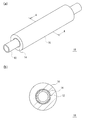
- FIG. 1 is an external perspective view (a) and a radial direction sectional view (sectional view along line AA) (b) of a conductive roll for an electrophotographic apparatus according to an embodiment of the present invention.
- a conductive roll for an electrophotographic apparatus comprises a shaft 12 made of a core metal and a shaft 12
- a protective layer 14 formed on the outer periphery and a conductive rubber elastic layer 16 formed on the outer periphery of the protective layer 14 are provided.
- the protective layer 14 is in contact with both the shaft 12 and the conductive rubber elastic layer 16.
- the shaft 12 generally needs to have conductivity, and the material is not limited in this respect, but in the present invention, iron or stainless steel is used as the base material in view of cost and processability. Is used.
- the shaft 12 may be made of only a base material, or may be configured to have one or two or more metal layers formed by plating or the like on the surface of the base material.
- the metal layer in this case is formed from the viewpoint of, for example, enhancing the corrosion resistance and enhancing the adhesion to the protective layer 14. From the viewpoint of cost, it is preferable that the shaft body 12 is made of only the base material, but from the viewpoint of excellent corrosion resistance and excellent adhesion with the protective layer 14, the shaft body 12 is a metal on the surface of the base material. A configuration having one or more layers is preferable.
- the metal layer formed on the surface of the base material is made of a conductive metal. Nickel etc. are mentioned as a metal of such a metal layer. And, from the viewpoint of workability, adhesion and the like, the metal layer formed on the surface of the base material is preferably formed by plating. Plating includes electroless plating and electrolytic plating, but electroless plating is preferable from the viewpoint of excellent uniformity of film thickness and few defects such as pinholes.
- the thickness of the metal layer formed on the surface of the base material is preferably relatively thick (specifically, 10 ⁇ m or more) from the viewpoints of excellent corrosion resistance, excellent adhesion to the protective layer 14, etc. However, it is preferable that the thickness is 3 ⁇ m or less from the viewpoint of cost because the cost is increased accordingly.
- the shape of the shaft 12 is not particularly limited as long as the shaft 12 can be configured, and may be a round rod made of a solid body, or a cylindrical shape in which the inside is hollowed out It is also good.
- the conductive rubber elastic layer 16 contains a rubber containing a halogen atom.
- the rubber containing a halogen atom is preferably contained as a main component of the conductive rubber elastic layer 16.
- Examples of the rubber containing a halogen atom include epichlorohydrin rubber, chloroprene rubber, chlorinated butyl rubber, chlorosulfonated polyethylene rubber and the like.
- the conductive rubber elastic layer 16 can contain, in addition to the rubber component, a conductive agent (an electronic conductive agent, an ion conductive agent) for enhancing the conductivity.
- one or more additives such as an extender, a reinforcing agent, a processing aid, an antioxidant, a plasticizer, a UV absorber, and a lubricant can be contained.
- Examples of the electron conductive agent include carbon black, graphite, potassium titanate, iron oxide, conductive titanium oxide, conductive zinc oxide, and conductive tin oxide.
- Examples of the ion conductive agent include quaternary ammonium salts, borates, surfactants and the like.
- the thickness of the conductive rubber elastic layer 16 is not particularly limited, but it is usually formed to be about 0.1 to 10 mm, preferably 1 to 5 mm.
- the conductive rubber elastic layer 16 preferably has a volume specific resistivity in the range of 1.0 ⁇ 10 5 to 5.0 ⁇ 10 8 ⁇ ⁇ cm from the viewpoint of excellent conductivity and the like.
- the conductive rubber elastic layer 16 may be a solid non-foam, or a sponge-like foam.
- the protective layer 14 covers the outer peripheral surface of the shaft body 12 made of a core metal, and protects (suppresses) contact of water, oxygen, halogen ions, hydrogen ions and the like with the outer peripheral surface of the shaft body 12. It also functions as an adhesive between the shaft 12 and the conductive rubber elastic layer 16.
- the protective layer 14 is made of a cross-linked body of a composition containing a material obtained by melt mixing the following (a) to (c).
- (b) benzoxazine compound (c) epoxy resin
- the polyfunctional maleimide compound used in the present invention is a compound having two or more maleimide groups, and can be represented by the following general formula (1).
- R 1 is a k-valent organic group
- R 2 and R 3 are a hydrogen atom or a monovalent organic group.
- the organic group may be a hydrocarbon group composed of only C and H, or may be a group containing a hetero atom such as N, O, S or the like in addition to C and H and a halogen atom.
- k is an integer of 2 or more, preferably an integer of 2 to 10.
- R 2 and R 3 may be the same as or different from each other.
- examples of R 1 include an alkylene group and an arylene group.
- examples of the alkylene group include those having 1 to 20 carbon atoms.
- the alkylene group may, for example, be a chain alkylene group or a cyclic alkylene group.
- the chain alkylene group may be linear or branched.
- strand-shaped alkylene group a methylene group, ethylene group, hexamethylene group etc. are mentioned.
- the arylene group is one having 1 to 20 carbon atoms.
- a phenylene group, a methyl phenylene group, etc. are mentioned.
- examples of the organic group of R 2 and R 3 include an alkyl group or an aryl group having 1 to 20 carbon atoms.
- the alkyl group is a methyl group, an ethyl group, a propyl group or the like.
- the aryl group is a phenyl group, a substituted phenyl group, a naphthyl group, a substituted naphthyl group or the like.
- polyfunctional maleimide compound for example, N, N'-ethylenebismaleimide, N, N'-hexamethylenebismaleimide, N, N '-(1,3-phenylene) bismaleimide, N, N' -[1,3- (2-methylphenylene)] bismaleimide, N, N '-(1,4-phenylene) bismaleimide, bis (4-maleimidophenyl) methane, bis (3-methyl-4-maleimidophenyl) ) Methane, bis (4-maleimidophenyl) ether, bis (4-maleimidophenylsulfone, bis (4-maleimidophenyl) sulfide, bis (4-maleimidophenyl) ketone, bis (4-maleimidocyclohexyl) methane, 1,4 -Bis (4-maleimidophenyl) cyclohexane and 1,4-bis (4-maleimidomethyl) ester Rohexane
- n and m indicate the number of repeating units, and the average value is 0 to 10.
- a methylene group is a group bonded to the 2- or 3-position of an aromatic ring, and R is a substituent bonded to one or more arbitrary positions at which the methylene group is not bonded.
- R an alkyl group having 1 to 20 carbon atoms, an aryl group and the like can be mentioned.
- the benzoxazine compounds used in the present invention are compounds having a benzoxazine ring in the molecule.
- the benzoxazine compound is not particularly limited, but a compound having two or more benzoxazine rings in one molecule is preferable from the viewpoint of the crosslinkability, the curability, and the like of the protective layer 14.
- Specific examples of the benzoxazine compound include, for example, Fa-type benzo obtained by the reaction of a bisphenol compound with an amine compound (for example, aniline etc.) and formaldehyde, such as bisphenol A-type benzoxazine compound, bisphenol F-type benzoxazine compound, etc.
- Examples include Pd-type benzoxazine compounds obtained by the reaction of a phenyldiamine compound, a phenol compound, and formaldehyde, such as an oxazine compound and a diaminodiphenylmethane-type benzoxazine compound. As these, commercially available ones can be used. These are non-polymers. Among the Fa-type benzoxazine compounds and the Pd-type benzoxazine compounds, the Pd-type benzoxazine compounds are preferable from the viewpoint of being more excellent in heat resistance.
- a bisphenol F-type benzoxazine compound which is a Fa-type benzoxazine compound has a structure as represented by the following formula (4). This is obtained by the reaction of bisphenol F, aniline and formaldehyde.
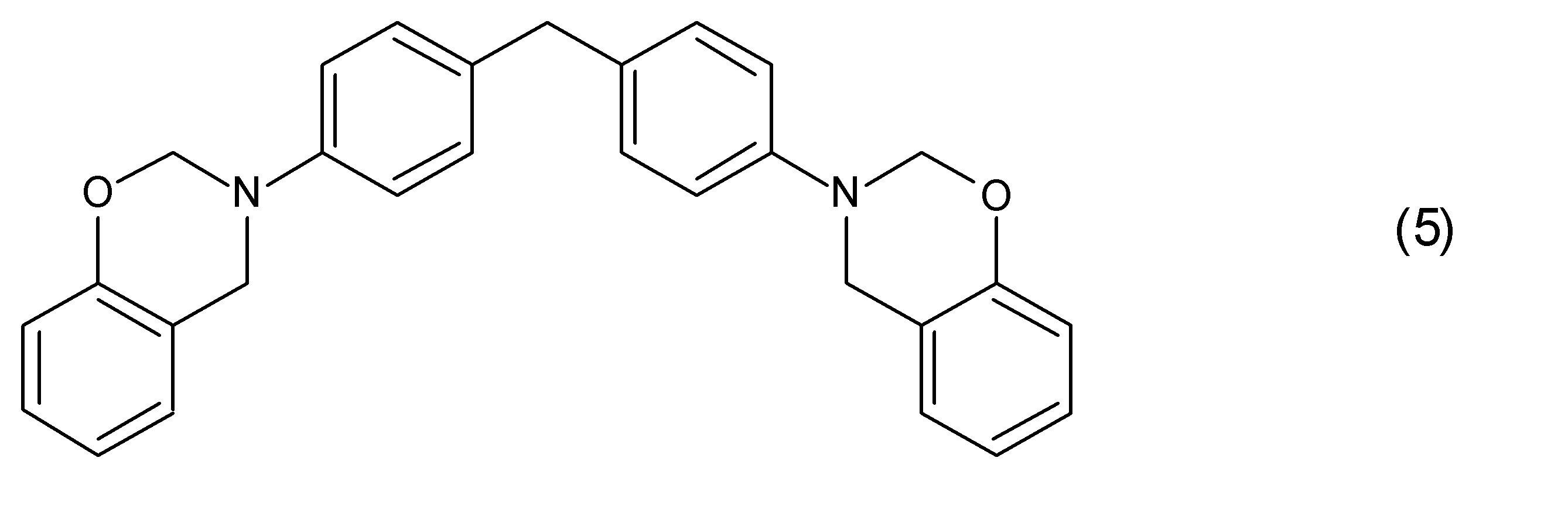
- the Pd-type benzoxazine compound has a structure as represented by the following formula (5). This is obtained by the reaction of 4,4'-methylenedianiline with phenol and formaldehyde.
- the epoxy resin used in the present invention can increase the adhesion of the protective layer 14 to the shaft 12 made of metal.
- the epoxy resin used in the present invention is not particularly limited, for example, bisphenol type epoxy resin, novolac type epoxy resin, alicyclic epoxy resin, glycidyl esters, glycidyl amines, heterocyclic epoxy resin, Brominated epoxy resin etc. are mentioned.
- bisphenol-type epoxy resins include bisphenol A-type epoxy resins, bisphenol F-type epoxy resins, and bisphenol S-type epoxy resins.
- novolac epoxy resins include phenol novolac epoxy resins, cresol novolac epoxy resins, bisphenol A novolac epoxy resins, and dicyclopentadiene novolac epoxy resins.
- alicyclic epoxy resin 3,4-epoxy-6-methylcyclohexylmethyl-3,4-epoxy-6-methylcyclohexanecarboxylate, 3,4-epoxycyclohexylmethyl-3,4-epoxycyclohexanecarboxylate, 1-Epoxyethyl-3,4-epoxycyclohexane and the like.
- glycidyl esters include phthalic acid diglycidyl ester, tetrahydrophthalic acid diglycidyl ester, and dimer acid glycidyl ester.
- Examples of glycidyl amines include tetraglycidyldiaminodiphenylmethane, triglycidyl P-aminophenol, N, N-diglycidyl aniline and the like.
- heterocyclic epoxy resin 1,3-diglycidyl-5,5-dimethylhydantoin, triglycidyl isocyanurate and the like can be mentioned.
- brominated epoxy resins include tetrabromobisphenol A epoxy resin, tetrabromobisphenol F epoxy resin, brominated cresol novolac epoxy resin, brominated phenol novolac epoxy resin, and the like.
- the epoxy resin used in the present invention preferably contains a trifunctional epoxy resin. As a result, the degree of crosslinking increases, so the heat resistance of the protective layer 14 is improved. Then, an adhesive layer containing a phenol resin can be formed.
- the epoxy resin used in the present invention may be composed of only a trifunctional epoxy resin, or may be composed of a combination of a trifunctional epoxy resin and a bifunctional or monofunctional epoxy resin.
- the protective layer 14 may contain silica particles, a conductive agent, and the like, as necessary. Moreover, you may contain the leveling agent, antioxidant, a processing agent, a stabilizer, etc.
- the silica particles are preferably nano-order sized nanoparticles from the viewpoint of dispersibility, uniformity and the like. More specifically, those having a primary particle diameter in the range of 5 to 30 nm are preferable.
- the content of the (d) silica particles is preferably in the range of 50 to 100 parts by mass with respect to a total of 100 parts by mass of (a) to (c). More preferably, it is in the range of 50 to 80 parts by mass.
- the conductive agent examples include an electron conductive agent and an ion conductive agent.
- the electron conductive agent examples include carbon black, graphite, potassium titanate, iron oxide, conductive titanium oxide, conductive zinc oxide, and conductive tin oxide.
- the ion conductive agent examples include quaternary ammonium salts, borates, surfactants and the like.
- the content of the electron conductive agent is preferably in the range of 7.5 to 15 parts by mass with respect to 100 parts by mass in total of (a) to (c).
- the protective layer 14 can be formed using a composition for forming a protective layer.
- the composition for forming a protective layer comprises a material obtained by melt mixing the above (a) to (c) and a low boiling point solvent for dissolving the material obtained by melt mixing the above (a) to (c) Including.
- low boiling point solvents include methyl ethyl ketone (MEK), methyl isobutyl ketone (MIBK), cyclohexane and the like.
- the composition for protective layer formation may contain the said silica particle, the said electrically conductive agent, a leveling agent, an antioxidant, a processing agent, a hardening accelerator, a stabilizer, etc. as needed.
- imidazoles such as 2-methylimidazole, 2-ethyl-4-methylimidazole, 2-heptimidazole; amines such as triethanolamine, triethylenediamine, N-methylmorpholine; triphenylphosphine, tris Organic phosphines such as tolyl phosphine; tetraphenyl boron salts such as tetraphenyl phosphonium tetraphenyl borate and triethyl ammonium tetraphenyl borate; 1,8 diazabicyclo (5,4,0) undecen-7 and its derivatives; naphthenic acid Examples thereof include organic metal salts such as lead, lead stearate, zinc naphthenate, tin oleate, manganese naphthenate, cobalt tephenoate and cobalt octylate.
- These curing accelerators may be used alone or in combination of two or more, and if necessary, an organic
- the composition for forming a protective layer can be prepared as follows. First, the above (a) to (c) are melt mixed. The melt mixing of (a) to (c) can be carried out by blending at least (a) to (c) and heating and mixing them. At this time, if necessary, the above-mentioned silica particles, the above-mentioned conductive agent, leveling agent, antioxidant, processing agent, stabilizer and the like may be blended together and heated and mixed. However, the curing accelerator is not blended at the time of this melt mixing. This is to prevent the cross-linking reaction of the polyfunctional maleimide compound or the epoxy resin from proceeding.
- the heating temperature at the time of melting and mixing may be equal to or higher than the temperature at which the mixture of (a) to (c) is melted.
- the temperature may be 100 ° C. or higher.
- the temperature can be 150 ° C. or higher.
- 400 degrees C or less is preferable. More preferably, it is 200 ° C. or less.
- the heating and mixing time is not particularly limited, but may be about 0.1 to 10 minutes after the mixture of (a) to (c) is melted.
- the heating and mixing means include mixers such as kneaders and twin-screw extruders.
- the material obtained by melt-mixing the above (a) to (c) is dissolved in the low boiling point solvent.
- heating may be performed to a predetermined temperature, or may be performed at normal temperature.
- the heating temperature is a temperature lower than the boiling point of the low boiling point solvent, and is preferably 100 ° C. or less. More preferably, it is 80 ° C. or less.
- the curing accelerator may be added to the solution after the material obtained by melt mixing the above (a) to (c) is dissolved in the above low boiling point solvent.
- the polyfunctional maleimide compound of (a) generally has poor solubility in a low boiling point general-purpose organic solvent.
- the obtained material can be dissolved in the low boiling point solvent. It is presumed that this is because (a) and (b) react with each other during the melt mixing of (a) to (c) to change to a compound having high solubility.
- a ring-opening reaction occurs by heating to form a molecule having a phenol group.
- the resulting phenolic group reacts with the unsaturated bond of (a) to form a bond.
- the compound thus obtained is presumed to be highly soluble.
- the obtained material is an uncrosslinked material because of its solubility.
- the obtained material can be dissolved in a low boiling point general-purpose organic solvent by melt-mixing (a) to (c). And thereby, the uniform coating liquid used as the precursor for forming the protective layer 14 can be formed, and since precipitation of (a) with low solubility in this coating liquid can be suppressed, The barrier property of the protective layer 14 to be formed is high. Further, (b) forms a phenol group by heating and functions as a cross-linking agent of (c), but melts and mixes (a) to (c) to form a bond with (a) ing. For this reason, an interpenetrating polymer network (IPN structure) of an epoxy resin and a bismaleimide resin is formed in the protective layer 14 after curing.
- IPN structure interpenetrating polymer network
- the chemical stability of the protective layer 14 is improved, and the barrier property is improved.
- the barrier property is improved as compared with a film of an epoxy resin alone, a film of a phenol resin alone, a film of an epoxy resin using a phenol resin as a crosslinking agent, etc., water, oxygen, halogen ions, hydrogen ions, etc. Is excellent in the effect of protecting (suppressing) contact with the outer peripheral surface of the shaft 12.
- the compounding amount of (a) is not particularly limited, but is preferably in the range of 50 to 90 parts by mass with respect to 100 parts by mass in total of (a), (b) and (c). More preferably, it is in the range of 50 to 80 parts by mass, still more preferably in the range of 55 to 75 parts by mass.
- the compounding amount of (b) is not particularly limited, but is preferably in the range of 10 to 40 parts by mass with respect to 100 parts by mass in total of (a), (b) and (c). More preferably, it is in the range of 10 to 30 parts by mass, further preferably in the range of 10 to 25 parts by mass.
- the blending amount of (c) is not particularly limited, but is preferably in the range of 1.0 to 30 parts by mass with respect to 100 parts by mass in total of (a), (b) and (c). More preferably, it is in the range of 5.0 to 30 parts by mass, still more preferably in the range of 10 to 30 parts by mass.
- the conductive roll 10 can be manufactured by forming the protective layer 14 on the outer periphery of the shaft body 12 and forming the conductive rubber elastic layer 16 on the outer periphery of the protective layer 14.
- the protective layer 14 can be formed by performing a predetermined heat treatment after applying the composition for forming a protective layer on the outer periphery of the shaft 12.
- the heat treatment for forming the protective layer 14 is heated to a temperature at which the material obtained by melt mixing the above (a) to (c) crosslinks, that is, a temperature at which both the epoxy resin and the bismaleimide resin crosslink. It is done by.
- the low boiling point solvent is distilled off from the coating before the crosslinking reaction proceeds.
- the heating temperature in the heat treatment is preferably 150 to 250.degree.
- the heating time is preferably 30 to 60 minutes.
- the conductive rubber elastic layer 16 can be formed by forming a conductive rubber composition for forming the conductive rubber elastic layer 16 into a layer. Molding of the conductive rubber composition can be performed by extrusion molding or molding. The conductive rubber composition is crosslinked and cured by heating or the like during extrusion molding or molding.
- the conductive rubber composition contains a rubber containing the above-mentioned halogen atom.
- a crosslinking agent electronic conductive agent, ion conductive agent
- an extender electronic conductive agent, ion conductive agent
- an extender electronic conductive agent, ion conductive agent
- an extender electronic conductive agent, ion conductive agent
- an extender electronic conductive agent, ion conductive agent
- a reinforcing agent electronic conductive agent, ion conductive agent
- an extender electronic conductive agent, ion conductive agent
- a reinforcing agent electronic conductive agent, ion conductive agent
- a processing aid electronic conductive agent, ion conductive agent
- an antioxidant e.g., a plasticizer
- ultraviolet ray absorption e.g., ultraviolet ray absorption
- a protective layer comprising a cross-linked body of a composition containing a material obtained by melt-mixing the above (a) to (c) on the outer periphery of the shaft 12 made of a core metal. Since the 14 is provided, the conductive rubber elastic layer is improved by improving the adhesion between the shaft 12 and the protective layer 14 by the epoxy resin, and by improving the chemical stability by the IPN structure of the epoxy resin and the bismaleimide resin. The generation of rust on the shaft body 12 can be suppressed by the halogen atom contained in 16.
- the composition containing the material obtained by melt-mixing the above (a) to (c) further includes (d) silica particles
- the barrier properties of the protective layer 14 will be improved, and the rust prevention of the shaft 12 Improves the quality.
- the primary particle diameter of (d) is in the range of 5 to 30 nm
- the barrier property of the protective layer 14 is improved, and the anticorrosion property of the shaft 12 is improved.
- the content of (d) is in the range of 50 to 100 parts by mass with respect to the total of 100 parts by mass of the above (a) to (c)
- the adhesion of the protective layer 14 to the shaft 12 and the shaft 12 Excellent balance with the effect of improving the rust resistance.
- the protective layer 14 contains an electron conductive agent, the adhesion between the shaft 12 and the conductive rubber elastic layer 16 is improved.
- the conductive roll 10 is provided with a shaft 12, a protective layer 14 formed on the outer periphery of the shaft 12, and a conductive rubber elastic layer 16 formed on the outer periphery of the protective layer 14.
- the conductive roll for an electrophotographic apparatus according to the present invention is not limited to this configuration.
- an adhesive layer may be provided between the protective layer 14 and the conductive rubber elastic layer 16.
- FIG. 2 is a radial cross-sectional view of a conductive roll for an electrophotographic apparatus according to another embodiment of the present invention.
- a conductive roll for electrophotographic apparatus comprises a shaft 12 made of a core metal, and a shaft 12. And an adhesive layer 18 formed on the outer periphery of the protective layer 14 and a conductive rubber elastic layer 16 formed on the outer periphery of the adhesive layer 18.
- the protective layer 14 is in contact with both the shaft 12 and the adhesive layer 18.
- the adhesive layer 18 is in contact with both the protective layer 14 and the conductive rubber elastic layer 16.
- the conductive roll 20 is different from the conductive roll 10 only in the presence or absence of the adhesive layer 18, and the other parts are the same as the conductive roll 10, and thus the description thereof is omitted.
- the adhesive layer 18 adheres between the protective layer 14 and the conductive rubber elastic layer 16.
- the adhesive layer 18 can be formed using an adhesive composition containing an adhesive component. More specifically, after the adhesive composition is applied to the outer periphery of the protective layer 14 formed on the outer periphery of the shaft 12, the adhesive layer is formed on the outer periphery of the protective layer 14 by drying, curing and crosslinking as necessary. 18 can be formed.
- the conductive rubber elastic layer 16 forms the conductive rubber composition on the outer periphery of the adhesive layer 18 or the outer periphery of the adhesive composition applied to the outer periphery of the protective layer 14.
- an adhesive component of the adhesive composition a phenol resin adhesive, an epoxy resin adhesive, a nitrile rubber adhesive, an acrylic resin adhesive, a polyurethane adhesive, a styrene-butadiene adhesive, a natural rubber adhesive Agents and the like.
- the adhesive component only one of them may be used, or two or more of them may be used in combination.
- the adhesive component of the adhesive composition is preferably a vulcanized adhesive from the viewpoint of being able to function as the adhesive layer 18 by being cured by heat or pressure at the time of vulcanization of the conductive rubber elastic layer 16.
- a vulcanized adhesive a phenol resin adhesive, an epoxy resin adhesive, a nitrile rubber adhesive and the like can be mentioned from the above-mentioned adhesive components.
- a phenol resin-based adhesive is preferable.
- the adhesive composition can optionally contain a conductive agent (electronic conductive agent, ionic conductive agent) for imparting conductivity.
- a conductive agent electroconductive agent, ionic conductive agent
- the same one as described in the protective layer 14 can be mentioned.
- a vulcanizing agent crosslinking agent
- a vulcanization accelerator e.g., a vulcanization accelerator
- a vulcanization auxiliary e.g., a vulcanization auxiliary
- an extender e.g., a vulcanization accelerator
- a vulcanization auxiliary e.g., vulcanization auxiliary
- the adhesive composition can be adjusted in viscosity using a solvent in consideration of coating properties.
- the solvent include methyl ethyl ketone (MEK), methyl isobutyl ketone (MIBK) and the like.
- the thickness of the adhesive layer 18 is not particularly limited, but is preferably 100 ⁇ m or less from the viewpoint that the influence of the volume resistivity of the adhesive layer 18 becomes large. More preferably, it is 10 ⁇ m or less. Moreover, it is preferable that it is 1 micrometer or more from a viewpoint that it is excellent in adhesive force. More preferably, it is 5 ⁇ m or more.
- the volume specific resistivity of the adhesive layer 18 is not particularly limited, it is in the range of 1.0 ⁇ 10 2 to 5.0 ⁇ 10 5 ⁇ ⁇ cm from the viewpoint of excellent conductivity and the like. Is preferred.
- the adhesive layer 18 between the protective layer 14 and the conductive rubber elastic layer 16 by having the adhesive layer 18 between the protective layer 14 and the conductive rubber elastic layer 16, the adhesiveness between the shaft body 12 and the conductive rubber elastic layer 16 is obtained. Improve. When the adhesive layer 18 contains a phenol resin, the adhesiveness is particularly excellent. When the adhesive layer 18 contains an electron conductive agent, the adhesion between the shaft 12 and the conductive rubber elastic layer 16 is improved.
- the protective layer 14 is provided in contact with both the shaft 12 and the conductive rubber elastic layer 16, but in the present invention, if the adhesion is sufficiently ensured, One or more layers other than the adhesive layer 18 may be provided between the shaft body 12 and the protective layer 14 or between the protective layer 14 and the conductive rubber elastic layer 16. Similarly in the conductive roll 20, one or more other layers may be provided between the shaft 12 and the protective layer 14 or between the protective layer 14 and the adhesive layer 18.
- the conductive roll 10 is composed of the shaft 12, the protective layer 14, and the conductive rubber elastic layer 16 in one layer, but in the present invention, for the purpose of resistance adjustment, component migration prevention, etc.
- Another conductive rubber elastic layer may be provided between the protective layer 14 and the conductive rubber elastic layer 16 or one or more layers on the outer periphery of the conductive rubber elastic layer 16.
- a surface layer may be provided on the outer periphery of the conductive rubber elastic layer 16 for the purpose of protecting the surface, imparting an electrical property or the like, and the surface of the conductive rubber elastic layer 16. May be subjected to surface modification treatment.
- one or more other conductive rubber elastic layers are provided between the adhesive layer 18 and the conductive rubber elastic layer 16 or on the outer periphery of the conductive rubber elastic layer 16 It is also good.
- a surface layer may be provided on the outer periphery of the conductive rubber elastic layer 16, and the surface of the conductive rubber elastic layer 16 is subjected to a surface modification treatment. It is also good.
- the main material of the surface layer is not particularly limited, and examples thereof include polyamide (nylon) based, acrylic based, urethane based, silicone based and fluorine based polymers. These polymers may be modified. Examples of the modifying group include N-methoxymethyl group, silicone group and fluorine group.
- carbon black, carbon nanotube, graphite, c-TiO 2 , c-ZnO, c-SnO 2 (c- means conductivity), ion conductive agent (quaternary) to impart conductivity.
- conductive agents such as ammonium salts, borates, surfactants and the like can be added as appropriate.
- various additives may be added as appropriate.
- a surface modification method a method of irradiating UV or electron beam, a surface modifier capable of reacting with unsaturated bond of the conductive rubber elastic layer 16 or halogen, for example, isocyanate group, hydrosilyl group, amino group, halogen Examples thereof include a method of contacting with a compound containing a reactive group such as a group and a thiol group.
- the conductive roll according to the present invention can be used as a conductive roll such as a charging roll, a developing roll, a transfer roll, and a toner supply roll of an electrophotographic apparatus such as a copying machine, a printer, and a facsimile.
- Non-crosslinked powder containing powder ⁇ VG 3101L made by PRINTEC, trifunctional epoxy resin ⁇ colloidal silica: "MEK-ST-40" made by Nissan Chemical Industries, Ltd., solid content concentration 40% by mass, primary particle diameter 10 to 15 nm, dispersion medium : MEK -Carbon black dispersion: "# 273" manufactured by Gokuko Dye Co., Ltd., solid content concentration 17 mass%, average particle diameter d50: 0.2
- -Phenolic adhesive "Mallock U-20" manufactured by Toyo Kagaku Kenkyusho, conductive agent, solid content concentration 18 to 22% by mass, dispersion medium: MEK
- Example 1 Preparation of composition for forming protective layer> The composition for protective layer formation was prepared by dissolving HR3070 in MEK so that solid content concentration might be 30 mass%.
- ⁇ Preparation of conductive roll> The composition for forming a protective layer is applied to the outer periphery of a core metal (shaft) having 3 ⁇ m of nickel plated on iron base material ( ⁇ 8 mm) and sufficiently dried, and then the coated film is heat cured at a predetermined temperature (crosslinking ) To form a protective layer (10 ⁇ m) on the outer periphery of the shaft.
- the shaft having the protective layer formed thereon is set in a mold of a pipe-shaped molding die, and the conductive rubber composition is injected into the mold and then heated at 180 ° C. for 30 minutes to form a conductive rubber composition.
- the product was vulcanized and cured to form a conductive rubber elastic layer (3 mm) on the outer periphery of the protective layer.
- a conductive roll was obtained.
- Example 2 A conductive roll was obtained in the same manner as Example 1, except that the components described in Table 1 were used instead of HR3070 in the preparation of the composition for forming a protective layer.
- Example 4 A conductive roll was obtained in the same manner as Example 1, except that in the preparation of the composition for forming a protective layer, colloidal silica was further blended.
- Example 5 A conductive roll was obtained in the same manner as in Example 4 except that an adhesive layer was formed between the protective layer and the conductive rubber elastic layer in the preparation of the conductive roll. Specifically, after a material for forming an adhesive layer is applied to the outer periphery of the formed protective layer and sufficiently dried, the shaft body is set in a mold of a pipe-shaped molding die to make the conductive rubber elastic layer By molding, an adhesive layer (8 ⁇ m) was formed on the outer periphery of the protective layer, and a conductive rubber elastic layer (3 mm) was formed on the outer periphery of the adhesive layer.
- Example 6 A conductive roll was obtained in the same manner as in Example 5 except that a carbon black dispersion was further added in the preparation of the composition for forming a protective layer.
- Example 2 A conductive roll was obtained in the same manner as Example 6, except that HR3040 was used instead of HR3070 in the preparation of the composition for forming a protective layer.
- Adhesive 1 60 parts by mass of novolac type phenol resin, 20 parts by mass of bisphenol A type epoxy resin, 20 parts by mass of carbon black and 400 parts by mass of MEK were mixed, and adhesive 1 was prepared by stirring at room temperature.
- a conductive roll was produced in the same manner as Example 1, except that the adhesive 1 was used instead of the composition for forming a protective layer.
- those with no rust on the outer peripheral surface of the shaft are particularly good “ ⁇ ", and those with point rust at one or two points on the outer peripheral surface of the shaft are good” ⁇ ", the shaft Defects " ⁇ "where point-like rust was generated at 3 to 5 locations on the outer peripheral surface of the shaft, and particularly” bad "where point-like rust was generated at 6 or more locations on the outer peripheral surface of the shaft ".
- Comparative Example 1 only has a protective layer composed of an epoxy resin and an adhesive layer composed of a phenol resin as the organic component between the shaft made of a core metal and the conductive rubber elastic layer containing a halogen atom. Although the adhesion is satisfactory, the occurrence of rust is not sufficiently suppressed. Comparative Example 2 uses the composition containing the above (a) to (c) in the formation of the protective layer, but the above (a) to (c) are not melt mixed and the adhesiveness is satisfactory. , The occurrence of rust is not sufficiently suppressed.
- Comparative Example 3 only a layer consisting of a phenol / epoxy adhesive 1 is formed between a shaft made of a core metal and a conductive rubber elastic layer containing halogen atoms, so the adhesion is satisfactory. However, the occurrence of rust has not been sufficiently suppressed.
- the composition containing the above (a) to (c) is used in the formation of the protective layer, and the above (a) to (c) are melt mixed.
- both adhesion and suppression of rust are satisfied.
- the control effect of rust improves by mix
- adhesion is improved by blending an electron conductive agent.
Landscapes
- Physics & Mathematics (AREA)
- General Physics & Mathematics (AREA)
- Engineering & Computer Science (AREA)
- Mechanical Engineering (AREA)
- Plasma & Fusion (AREA)
- General Engineering & Computer Science (AREA)
- Electrophotography Configuration And Component (AREA)
- Electrostatic Charge, Transfer And Separation In Electrography (AREA)
- Rolls And Other Rotary Bodies (AREA)
- Laminated Bodies (AREA)
- Dry Development In Electrophotography (AREA)
Abstract
芯金からなる軸体の防錆性に優れる電子写真機器用導電性ロールを提供すること。 芯金からなる軸体12と、軸体12の外周に形成された保護層14と、保護層14の外周に形成された導電性ゴム弾性体層16と、を備え、導電性ゴム弾性体層16が、ハロゲン原子を含むゴムを含有し、保護層14が、下記(a)~(c)を溶融混合して得られた材料を含む組成物の架橋体からなる電子写真機器用導電性ロール10とする。 (a)マレイミド基を2個以上有する多官能マレイミド化合物 (b)ベンゾオキサジン化合物 (c)エポキシ樹脂
Description
本発明は、電子写真機器用導電性ロールに関するものである。
電子写真方式を採用する複写機、プリンター、ファクシミリなどの電子写真機器において、感光ドラムの周囲には、帯電ロール、現像ロール、転写ロール、トナー供給ロールなどの導電性ロールが配設されている。導電性ロールとしては、芯金の外周に導電性弾性層を有するものが知られている。例えば特許文献1には、導電性支持軸の外周にハロゲン原子を含有するゴムを含有している導電性弾性層を有する導電性ロールが示されている。
導電性ロールにおいて、芯金としては、一般に導電性を有するものであればよく、この点から材料が限定されることはないが、コストや加工性などから、鉄またはステンレスを母材とするものが用いられることが多い。しかし、導電性弾性層にハロゲン原子が含まれると、鉄またはステンレスを母材とする芯金に錆が発生しやすいという問題があった。芯金の母材にめっきを施すことで錆の発生を抑えることも考えられるが、安定した防錆性を得るためにめっきを厚くするとコストが増加する。また、そのめっきがNiめっきの場合、ピンホールの欠陥が発生しやすく、この欠陥において錆が抑えられにくい。
特許文献1では、ハロゲン原子が含まれる導電性弾性層を、フェノール樹脂、エポキシ樹脂および導電剤を有する導電性接着剤によって導電性支持軸の外周に接着している。しかし、この構成では、鉄またはステンレスを母材とする芯金において錆の発生を抑えることは十分ではなかった。
本発明が解決しようとする課題は、芯金からなる軸体の防錆性に優れる電子写真機器用導電性ロールを提供することにある。
上記課題を解決するため本発明に係る電子写真機器用導電性ロールは、芯金からなる軸体と、前記軸体の外周に形成された保護層と、前記保護層の外周に形成された導電性ゴム弾性体層と、を備え、前記導電性ゴム弾性体層が、ハロゲン原子を含むゴムを含有し、前記保護層が、下記(a)~(c)を溶融混合して得られた材料を含む組成物の架橋体からなることを要旨とするものである。
(a)マレイミド基を2個以上有する多官能マレイミド化合物
(b)ベンゾオキサジン化合物
(c)エポキシ樹脂
(a)マレイミド基を2個以上有する多官能マレイミド化合物
(b)ベンゾオキサジン化合物
(c)エポキシ樹脂
前記組成物は、さらに(d)シリカ粒子を含むことが好ましい。前記(d)の一次粒子径は、5~30nmの範囲内であることが好ましい。前記(d)の含有量は、前記(a)~(c)の合計100質量部に対し50~100質量部の範囲内であることが好ましい。前記(c)は、3官能のエポキシ樹脂を含むことが好ましい。前記保護層と前記導電性ゴム弾性体層との間には、フェノール樹脂を含む接着層が設けられていることが好ましい。前記接着層は、電子導電剤を含むことが好ましい。前記保護層は、電子導電剤を含むことが好ましい。前記保護層における電子導電剤の含有量は、前記(a)~(c)の合計100質量部に対し7.5~15質量部の範囲内であることが好ましい。
本発明に係る電子写真機器用導電性ロールによれば、芯金からなる軸体の外周に上記(a)~(c)を溶融混合して得られた材料を含む組成物の架橋体からなる保護層が設けられていることから、導電性ゴム弾性体層に含まれるハロゲン原子によって軸体に錆が発生するのを抑えることができる。
上記組成物がさらに(d)シリカ粒子を含むと、保護層のバリア性が向上し、軸体の防錆性が向上する。また、上記(d)の一次粒子径が5~30nmの範囲内であると、保護層のバリア性が向上し、軸体の防錆性が向上する。また、上記(d)の含有量が上記(a)~(c)の合計100質量部に対し50~100質量部の範囲内であると、軸体に対する保護層の接着性と軸体の防錆性の向上効果とのバランスに優れる。
そして、上記(c)が3官能のエポキシ樹脂を含むと、保護層の耐熱性が向上する。このため、フェノール樹脂を含む接着層を形成することができる。そして、保護層と導電性ゴム弾性体層との間にフェノール樹脂を含む接着層が設けられていると、軸体と導電性ゴム弾性体層の間の接着性が向上する。
そして、上記接着層が電子導電剤を含むと、軸体と導電性ゴム弾性体層の間の接着性が向上する。また、上記保護層が電子導電剤を含むと、軸体と導電性ゴム弾性体層の間の接着性が向上する。
以下、本発明の実施形態について図面を用いて詳細に説明する。
図1は、本発明の一実施形態に係る電子写真機器用導電性ロールの外観斜視図(a)および径方向断面図(A-A線断面図)(b)である。
図1に示すように、本発明の一実施形態に係る電子写真機器用導電性ロール(以下、単に導電性ロール10ということがある)は、芯金からなる軸体12と、軸体12の外周に形成された保護層14と、保護層14の外周に形成された導電性ゴム弾性体層16と、を備える。導電性ロール10において、保護層14は、軸体12と導電性ゴム弾性体層16の両方に接している。
軸体12は、一般に導電性を有するものであればよく、この点から材料が限定されることはないが、コストや加工性などから、本発明においては、鉄またはステンレスを母材とするものが用いられる。軸体12は、母材のみで構成されていてもよいし、母材の表面にめっきなどによって形成される金属層を1層あるいは2層以上有する構成であってもよい。この場合の金属層は、防錆性を高める、保護層14との密着性を高めるなどの観点から形成される。コストの観点では、軸体12は母材のみで構成されるほうが好ましいが、防錆性に優れる、保護層14との密着性に優れるなどの観点から、軸体12は母材の表面に金属層を1層あるいは2層以上有する構成が好ましい。
母材の表面に形成される金属層は、導電性を有する金属からなる。このような金属層の金属としては、ニッケルなどが挙げられる。そして、施工性、密着性等の観点から、母材の表面に形成される金属層は、めっきによって形成されることが好ましい。めっきには、無電解めっきと電解メッキがあるが、膜厚の均一性に優れる、ピンホール等の欠陥が少ないなどの観点から、無電解めっきが好ましい。
母材の表面に形成される金属層の厚みは、防錆性に優れる、保護層14との密着性に優れるなどの観点から、比較的厚いほうが好ましい(具体的には、10μm以上である)が、その分、コストが高くなるため、コストの観点から、3μm以下であることが好ましい。
軸体12の形状は、軸体12を構成できる形状であれば特に限定されるものではなく、中実体よりなる丸棒状であってもよいし、内部を中空にくり抜かれた円筒状であってもよい。
導電性ゴム弾性体層16は、ハロゲン原子を含むゴムを含有する。ハロゲン原子を含むゴムは、導電性ゴム弾性体層16の主成分として含まれることが好ましい。ハロゲン原子を含むゴムとしては、エピクロルヒドリンゴム、クロロプレンゴム、塩素化ブチルゴム、クロロスルホン化ポリエチレンゴムなどが挙げられる。導電性ゴム弾性体層16は、ゴム成分以外に、導電性を高めるための導電剤(電子導電剤、イオン導電剤)を含むことができる。また、ゴム成分以外に、増量剤、補強剤、加工助剤、酸化防止剤、可塑剤、紫外線吸収剤、滑剤などの添加剤を1種または2種以上含むことができる。
電子導電剤としては、カーボンブラック、グラファイト、チタン酸カリウム、酸化鉄、導電性酸化チタン、導電性酸化亜鉛、導電性酸化スズなどが挙げられる。イオン導電剤としては、第四級アンモニウム塩、ホウ酸塩、界面活性剤などが挙げられる。
導電性ゴム弾性体層16の厚さは、特に限定されるものではないが、通常、0.1~10mm程度に形成され、好ましくは1~5mmである。導電性ゴム弾性体層16は、導電性に優れるなどの観点から、体積固有抵抗率が1.0×10⁵~5.0×10⁸Ω・cmの範囲内であることが好ましい。導電性ゴム弾性体層16は、ソリッド状の非発泡体であってもよいし、スポンジ状等の発泡体であってもよい。
保護層14は、芯金からなる軸体12の外周表面を覆って、水や酸素、ハロゲンイオン、水素イオン等が軸体12の外周表面に接触するのを保護(抑制)するものである。また、軸体12と導電性ゴム弾性体層16の間を接着するものとしても機能する。保護層14は、下記(a)~(c)を溶融混合して得られた材料を含む組成物の架橋体からなる。
(a)マレイミド基を2個以上有する多官能マレイミド化合物
(b)ベンゾオキサジン化合物
(c)エポキシ樹脂
(a)マレイミド基を2個以上有する多官能マレイミド化合物
(b)ベンゾオキサジン化合物
(c)エポキシ樹脂
本発明で用いられる多官能マレイミド化合物は、マレイミド基を2個以上有する化合物であり、下記一般式(1)で示すことができる。

式(1)中、R1はk価の有機基であり、R2,R3は水素原子または1価の有機基である。有機基は、CおよびHのみから構成される炭化水素基であってもよいし、CおよびHの他にN,O,Sなどのヘテロ原子やハロゲン原子を含む基であってもよい。kは、2以上の整数であり、2~10の整数が好ましい。R2,R3は、互いに同一の基であってもよいし、異なる基であってもよい。
式(1)中、R1としては、アルキレン基、アリーレン基などが挙げられる。アルキレン基は、炭素数1~20のものが挙げられる。アルキレン基は、鎖状アルキレン基、環状アルキレン基が挙げられる。鎖状アルキレン基は、直鎖状、分岐鎖状のいずれであってもよい。鎖状アルキレン基としては、メチレン基、エチレン基、ヘキサメチレン基などが挙げられる。アリーレン基は、炭素数1~20のものが挙げられる。アリーレン基としては、フェニレン基、メチルフェニレン基などが挙げられる。
式(1)中、R2,R3の有機基としては、炭素数1~20の、アルキル基またはアリール基が挙げられる。アルキル基は、メチル基、エチル基、プロピル基などである。アリール基は、フェニル基、置換フェニル基、ナフチル基、置換ナフチル基などである。
このような多官能マレイミド化合物としては、例えば、N,N’-エチレンビスマレイミド、N,N’-ヘキサメチレンビスマレイミド、N,N’-(1,3-フェニレン)ビスマレイミド、N,N’-[1,3-(2-メチルフェニレン)]ビスマレイミド、N,N’-(1,4-フェニレン)ビスマレイミド、ビス(4-マレイミドフェニル)メタン、ビス(3-メチル-4-マレイミドフェニル)メタン、ビス(4-マレイミドフェニル)エーテル、ビス(4-マレイミドフェニルスルホン、ビス(4-マレイミドフェニル)スルフィド、ビス(4-マレイミドフェニル)ケトン、ビス(4-マレイミドシクロヘキシル)メタン、1,4-ビス(4-マレイミドフェニル)シクロヘキサン、1,4-ビス(4-マレイミドメチル)シクロヘキサン、1,4-ビス(マレイミドメチル)ベンゼン、1,3-ビス(3-マレイミドフェノキシ)ベンゼン、ビス[4-(4-マレイミドフェノキシ)フェニル]メタン、1,1-ビス[4-(3-マレイミドフェノキシ)フェニル]エタン、1,1-ビス[4-(4-マレイミドフェノキシ)フェニル]エタン、1,2-ビス[4-(3-マレイミドフェノキシ)フェニル]エタン、1,2-ビス[4-(4-マレイミドフェノキシ)フェニル]エタン、2,2-ビス[4-(4-マレイミドフェノキシ)フェニル]プロパン、2,2-ビス[4-(3-マレイミドフェノキシ)フェニル]ブタン、2,2-ビス[4-(3-マレイミドフェノキシ)フェニル]ブタン、2,2-ビス[4-(3-マレイミドフェノキシ)フェニル]-1,1,1,3,3,3ヘキサフルオロプロパン、2,2-ビス[4-(4-マレイミドフェノキシ)フェニル]-1,1,1,3,3,3ヘキサフルオロプロパン、4,4’-ビス(3-マレイミドフェノキシ)ビフェニル、4,4’-ビス(4-マレイミドフェノキシ)ビフェニル、ビス[4-(3-マレイミドフェノキシ)フェニル]ケトン、ビス[4-(4-マレイミドフェノキシ)フェニル]ケトン、ビス[4-(3-マレイミドフェノキシ)フェニル]スルフィド、ビス[4-(4-マレイミドフェノキシ)フェニル]スルフィド、ビス[4-(3-マレイミドフェノキシ)フェニル]スルホキシド、ビス[4-(4-(マレイミドフェノキシ)フェニル]スルホキシド、ビス[4-(3-マレイミドフェノキシ)フェニル]スルホン、ビス[4-(4-マレイミドフェノキシ)フェニル]スルホン、ビス[4-(3-マレイミドフェノキシ)フェニル]エーテル、ビス[4-(4-マレイミドフェノキシ)フェニル]エーテル、1,4-ビス[4-(4-マレイミドフェノキシ)-α,α-ジメチルベンゼン]ベンゼン、1,3-ビス[4-(4-マレイミドフェノキシ)-α,α-ジメチルベンゼン]ベンゼン、1,4-ビス[4-(3-マレイミドフェノキシ)-α,α-ジメチルベンゼン]ベンゼン、1,3-ビス[4-(3-マレイミドフェノキシ)-α,α-ジメチルベンゼン]ベンゼン、1,4-ビス[4-(4-マレイミドフェノキシ)-3,5-ジメチル-α,α-ジメチルベンゼン]ベンゼン、1,3-ビス[4-(4-マレイミドフェノキシ)-3,5-ジメチル-α,α-ジメチルベンゼン]ベンゼン、1,4-ビス[4-(3-マレイミドフェノキシ)-3,5-ジメチル-α,α-ジメチルベンゼン]ベンゼン、1,3-ビス[4-(3-マレイミドフェノキシ)-3,5-ジメチル-α,α-ジメチルベンゼン]ベンゼンなどを挙げることができる。
また、多官能マレイミド化合物としては、上記する非重合体だけでなく、下記一般式(2)(3)で示す重合体も挙げることができる。
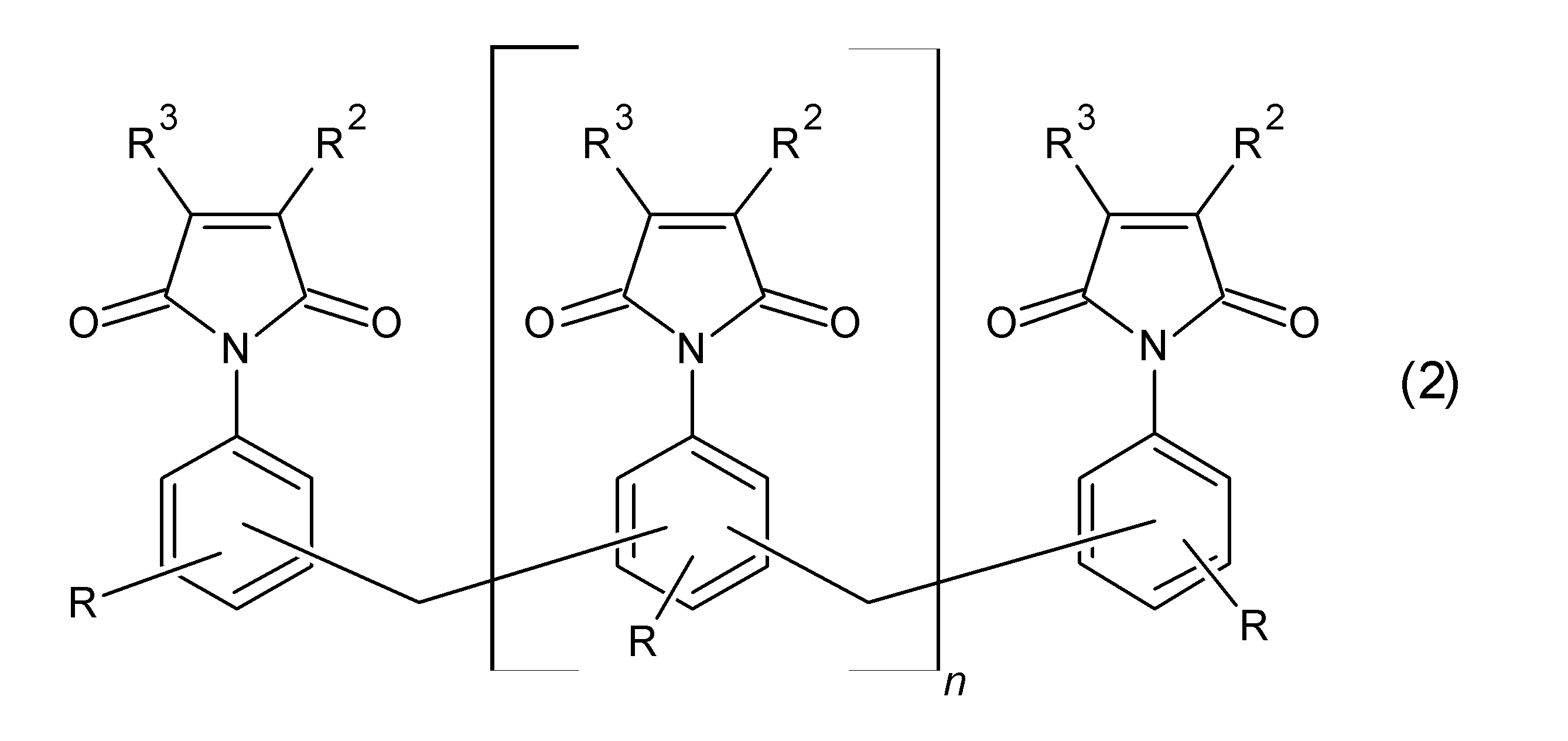
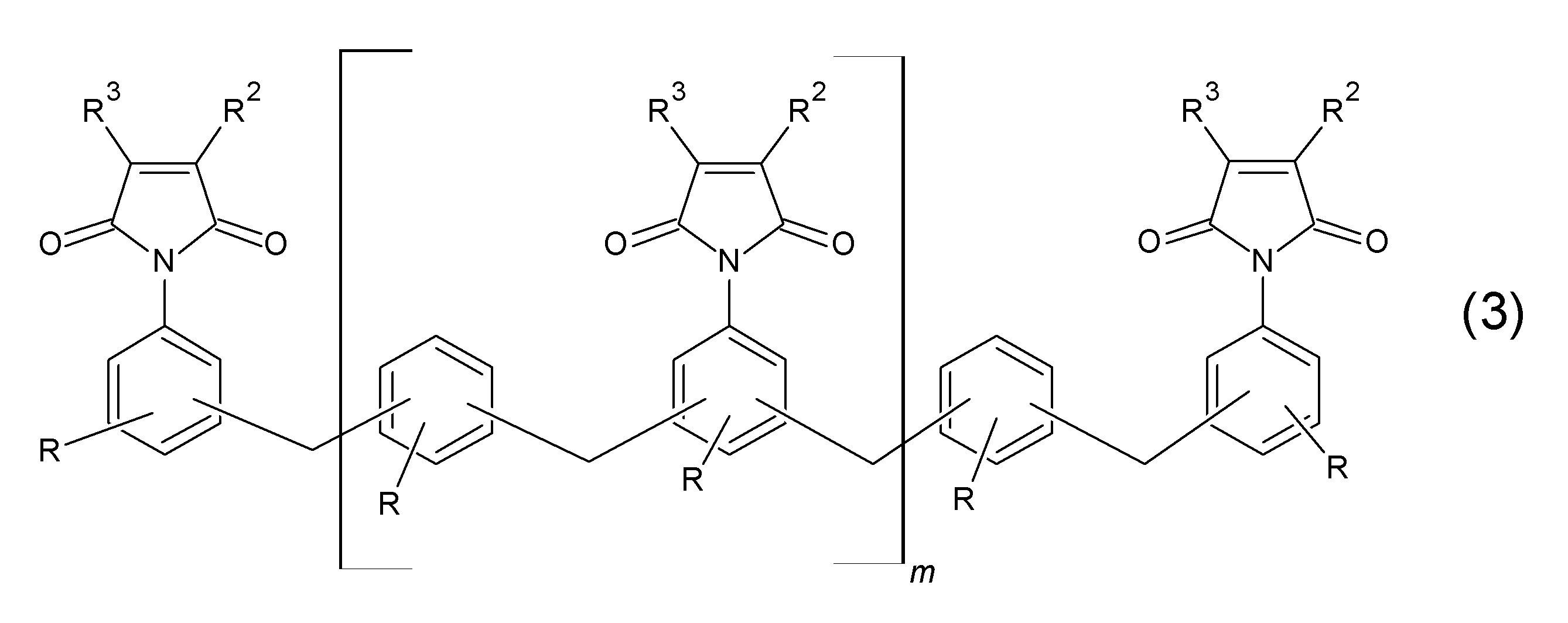
式(2)(3)において、n,mは、繰り返し単位数を示し、平均値で0~10である。式(2)(3)において、メチレン基は芳香環の2位または3位に結合する基であり、Rはメチレン基が結合していない任意の位置に1または2以上結合する置換基である。Rとしては、炭素数1~20の、アルキル基、アリール基などが挙げられる。
本発明で用いられるベンゾオキサジン化合物は、分子内にベンゾオキサジン環を有する化合物である。ベンゾオキサジン化合物としては、特に限定されるものではないが、保護層14の架橋性、硬化性などの観点から、1分子内に2個以上のベンゾオキサジン環を有する化合物が好ましい。ベンゾオキサジン化合物の具体例としては、例えば、ビスフェノールA型ベンゾオキサジン化合物、ビスフェノールF型ベンゾオキサジン化合物などのように、ビスフェノール化合物とアミン化合物(例えば、アニリン等)とホルムアルデヒドの反応によって得られるFa型ベンゾオキサジン化合物や、ジアミノジフェニルメタン型ベンゾオキサジン化合物などのように、フェニルジアミン化合物とフェノール化合物とホルムアルデヒドの反応によって得られるPd型ベンゾオキサジン化合物が挙げられる。これらは市販品として入手可能なものを使用可能である。これらは、非重合体である。Fa型ベンゾオキサジン化合物とPd型ベンゾオキサジン化合物のうちでは、耐熱性により優れるなどの観点から、Pd型ベンゾオキサジン化合物が好ましい。
例えば、Fa型ベンゾオキサジン化合物であるビスフェノールF型ベンゾオキサジン化合物は、以下の式(4)のような構造を有する。これは、ビスフェノールFとアニリンとホルムアルデヒドの反応によって得られるものである。

例えば、Pd型ベンゾオキサジン化合物は、以下の式(5)のような構造を有する。これは、4,4’-メチレンジアニリンとフェノールとホルムアルデヒドの反応によって得られるものである。
本発明で用いられるエポキシ樹脂は、金属からなる軸体12への保護層14の密着性を高いものとすることができる。本発明で用いられるエポキシ樹脂は、特に限定されるものではないが、例えば、ビスフェノール型エポキシ樹脂、ノボラック型エポキシ樹脂、脂環式エポキシ樹脂、グリシジルエステル類、グリシジルアミン類、複素環式エポキシ樹脂、臭素化エポキシ樹脂などが挙げられる。ビスフェノール型エポキシ樹脂としては、ビスフェノールA型エポキシ樹脂、ビスフェノールF型エポキシ樹脂、ビスフェノールS型エポキシ樹脂等が挙げられる。ノボラック型エポキシ樹脂としては、フェノールノボラック型エポキシ樹脂、クレゾールノボラック型エポキシ樹脂、ビスフェノールAノボラック型エポキシ樹脂、ジシクロペンタジエンノボラック型エポキシ樹脂等が挙げられる。脂環式エポキシ樹脂としては、3,4-エポキシ-6-メチルシクロヘキシルメチル-3,4-エポキシ-6-メチルシクロヘキサンカルボキシレート、3,4-エポキシシクロヘキシルメチル-3,4-エポキシシクロヘキサンカルボキシレート、1-エポキシエチル-3,4-エポキシシクロヘキサン等が挙げられる。グリシジルエステル類としては、フタル酸ジグリシジルエステル、テトラヒドロフタル酸ジグリシジルエステル、ダイマー酸グリシジルエステル等が挙げられる。グリシジルアミン類としては、テトラグリシジルジアミノジフェニルメタン、トリグリシジルP-アミノフェノール、N,N-ジグリシジルアニリン等が挙げられる。複素環式エポキシ樹脂としては、1,3-ジグリシジル-5,5-ジメチルヒダントイン、トリグリシジルイソシアヌレート等が挙げられる。臭素化エポキシ樹脂としては、テトラブロモビスフェノールA型エポキシ樹脂、テトラブロモビスフェノールF型エポキシ樹脂、ブロム化クレゾールノボラック型エポキシ樹脂、ブロム化フェノールノボラック型エポキシ樹脂等が挙げられる。
本発明で用いられるエポキシ樹脂は、3官能のエポキシ樹脂を含むことが好ましい。これにより、架橋度が大きくなるため、保護層14の耐熱性が向上する。そうすると、フェノール樹脂を含む接着層を形成することができる。本発明で用いられるエポキシ樹脂は、3官能のエポキシ樹脂のみで構成されていてもよいし、3官能のエポキシ樹脂と2官能または1官能のエポキシ樹脂との組み合わせで構成されていてもよい。
保護層14は、必要に応じて、シリカ粒子や導電剤などを含んでいてもよい。また、レベリング剤、酸化防止剤、加工剤、安定剤などを含んでいてもよい。
(d)シリカ粒子は、分散性、均一性などの観点から、ナノオーダーサイズのナノ粒子であることが好ましい。より具体的には、一次粒子径が5~30nmの範囲内のものが好ましい。保護層14において、(d)シリカ粒子の含有量は、(a)~(c)の合計100質量部に対し50~100質量部の範囲内であることが好ましい。より好ましくは50~80質量部の範囲内である。
導電剤としては、電子導電剤、イオン導電剤などが挙げられる。電子導電剤としては、カーボンブラック、グラファイト、チタン酸カリウム、酸化鉄、導電性酸化チタン、導電性酸化亜鉛、導電性酸化スズなどが挙げられる。イオン導電剤としては、第四級アンモニウム塩、ホウ酸塩、界面活性剤などが挙げられる。保護層14において、電子導電剤の含有量は、(a)~(c)の合計100質量部に対し7.5~15質量部の範囲内であることが好ましい。
保護層14は、保護層形成用組成物を用いて形成することができる。保護層形成用組成物は、上記(a)~(c)を溶融混合して得られた材料および上記(a)~(c)を溶融混合して得られた材料を溶解する低沸点溶媒を含む。低沸点溶媒としては、メチルエチルケトン(MEK)、メチルイソブチルケトン(MIBK)、シクロヘキサンなどが挙げられる。保護層形成用組成物は、必要に応じて、上記シリカ粒子、上記導電剤、レベリング剤、酸化防止剤、加工剤、硬化促進剤、安定剤などを含んでいてもよい。
硬化促進剤としては、2-メチルイミダゾール、2-エチル-4-メチルイミダゾール、2-ヘプタイミダゾール等のイミダゾール類;トリエタノールアミン、トリエチレンジアミン、N-メチルモルホリン等のアミン類;トリフェニルホスフィン、トリトリルホスフィン等の有機ホスフィン類;テトラフェニルホスホニウムテトラフェニルボレート、トリエチルアンモニウムテトラフェニルボレート等のテトラフェニルボロン塩類;1,8-ジアザービシクロ(5,4,0)ウンデセン-7及びその誘導体;ナフテン酸鉛、ステアリン酸鉛、ナフテン酸亜鉛、オレイン酸錫、ナフテン酸マンガン、テフテン酸コバルト、オクチル酸コバルト等の有機金属塩等が挙げられる。これらの硬化促進剤は単独で用いても2種以上を併用してもよく、また必要に応じて有機過酸化物やアゾ化合物等を併用することもできる。
保護層形成用組成物は、次のようにして調製することができる。まず、上記(a)~(c)を溶融混合する。上記(a)~(c)の溶融混合は、少なくとも(a)~(c)を配合し、これを加熱混合することにより行うことができる。この際、必要に応じて、上記シリカ粒子、上記導電剤、レベリング剤、酸化防止剤、加工剤、安定剤などを一緒に配合して加熱混合してもよい。ただし、硬化促進剤は、この溶融混合時には配合しない。多官能マレイミド化合物やエポキシ樹脂の架橋反応を進行させないためである。
溶融混合時の加熱温度は、上記(a)~(c)の混合物が溶融する温度以上であればよい。例えば100℃以上の温度とすることができる。また、150℃以上の温度とすることができる。また、その加熱温度は、400℃以下が好ましい。より好ましくは200℃以下である。加熱混合の時間は、特に限定されるものではないが、(a)~(c)の混合物が溶融状態になってから0.1~10分程度であればよい。加熱混合手段としては、ニーダー、二軸押出機などの混合機が挙げられる。(a)~(c)の溶融混合状態が形成された後は、例えば5~100℃の環境下などで自然冷却するか、例えば-20~80℃の冷媒を用いて強制冷却することによって冷却することで、固体状の材料が得られる。固体状の材料は、粉砕機を用いて粉砕し、ドライ状態で保存することができる。
次いで、上記(a)~(c)を溶融混合して得られた材料を上記低沸点溶媒に溶解させる。この際、所定の温度に加熱してもよいし、常温下で行ってもよい。溶解に際し、加熱を行う場合、その加熱温度は上記低沸点溶媒の沸点よりも低い温度であり、100℃以下であることが好ましい。より好ましくは80℃以下である。硬化促進剤は、上記(a)~(c)を溶融混合して得られた材料を上記低沸点溶媒に溶解させた後、その溶液に添加するとよい。以上により、保護層形成用組成物を調製することができる。
(a)の多官能マレイミド化合物は、一般に低沸点の汎用有機溶媒への溶解性が悪い。しかし、本発明のように、(a)~(c)を溶融混合すると、得られた材料は、上記低沸点溶媒に溶解することができる。これは、(a)~(c)の溶融混合時に、(a)と(b)が反応して溶解性の高い化合物に変化しているためと推察される。(b)は、加熱によって開環反応が起こり、フェノール基を有する分子となる。これにより生じたフェノール基が(a)の不飽和結合と反応し、結合を形成する。こうして得られた化合物が、溶解性の高いものと推察される。得られた材料は、その溶解性から、未架橋の材料である。
このように、(a)~(c)を溶融混合することで、得られた材料は低沸点の汎用有機溶媒に溶解することができる。そして、これにより、保護層14を形成するための前駆体となる均一の塗布用液を形成することができ、この塗布用液において溶解性の低い(a)の析出が抑えられるため、これによって形成される保護層14のバリア性が高いものとなる。また、(b)は、加熱によってフェノール基を形成し、(c)の架橋剤として機能するものであるが、(a)~(c)を溶融混合することで(a)と結合を形成している。このため、硬化後に保護層14においてエポキシ樹脂とビスマレイミド樹脂の相互侵入高分子網目(IPN構造)が形成される。これにより、保護層14の化学的安定性が向上するため、バリア性が向上する。このように、エポキシ樹脂単独の膜やフェノール樹脂単独の膜、フェノール樹脂を架橋剤としたエポキシ樹脂の膜などと比較して、バリア性が高いものとなり、水や酸素、ハロゲンイオン、水素イオン等が軸体12の外周表面に接触するのを保護(抑制)する効果に優れる。
上記(a)の配合量は、特に限定されるものではないが、(a)(b)(c)の合計100質量部に対し、50~90質量部の範囲内が好ましい。より好ましくは50~80質量部の範囲内、さらに好ましくは55~75質量部の範囲内である。また、上記(b)の配合量は、特に限定されるものではないが、(a)(b)(c)の合計100質量部に対し、10~40質量部の範囲内が好ましい。より好ましくは10~30質量部の範囲内、さらに好ましくは10~25質量部の範囲内である。また、上記(c)の配合量は、特に限定されるものではないが、(a)(b)(c)の合計100質量部に対し、1.0~30質量部の範囲内が好ましい。より好ましくは5.0~30質量部の範囲内、さらに好ましくは10~30質量部の範囲内である。
導電性ロール10は、軸体12の外周に保護層14を形成し、保護層14の外周に導電性ゴム弾性体層16を形成することにより作製することができる。
保護層14は、上記保護層形成用組成物を軸体12の外周に塗布した後、所定の熱処理を行うことにより、形成することができる。保護層14を形成する際の熱処理は、上記(a)~(c)を溶融混合して得られた材料が架橋する温度、すなわち、エポキシ樹脂およびビスマレイミド樹脂の両方が架橋する温度に加熱することによって行われる。上記低沸点溶媒は、上記架橋反応が進行する前に塗膜から留去される。熱処理における加熱温度は、150~250℃が好ましい。また、加熱時間は30~60分が好ましい。
導電性ゴム弾性体層16は、導電性ゴム弾性体層16を形成するための導電性ゴム組成物を層状に成形することにより形成することができる。導電性ゴム組成物の成形は、押出成形あるいは型成形により行うことができる。導電性ゴム組成物は、押出成形時あるいは型成形時の加熱等により、架橋・硬化される。
導電性ゴム組成物は、上記ハロゲン原子を含むゴムを含む。また、必要に応じて、架橋剤、架橋助剤、架橋促進剤、上記導電剤(電子導電剤、イオン導電剤)、増量剤、補強剤、加工助剤、酸化防止剤、可塑剤、紫外線吸収剤、滑剤などの添加剤を1種または2種以上含むことができる。導電性ゴム組成物は、これらを混練することにより調製することができる。
以上の構成の導電性ロール10によれば、芯金からなる軸体12の外周に上記(a)~(c)を溶融混合して得られた材料を含む組成物の架橋体からなる保護層14が設けられていることから、エポキシ樹脂による軸体12と保護層14の接着性の向上、エポキシ樹脂とビスマレイミド樹脂のIPN構造による化学的安定性の向上などにより、導電性ゴム弾性体層16に含まれるハロゲン原子によって軸体12に錆が発生するのを抑えることができる。
そして、上記(a)~(c)を溶融混合して得られた材料を含む組成物がさらに(d)シリカ粒子を含むと、保護層14のバリア性が向上し、軸体12の防錆性が向上する。この際、(d)の一次粒子径が5~30nmの範囲内であると、保護層14のバリア性が向上し、軸体12の防錆性が向上する。また、(d)の含有量が上記(a)~(c)の合計100質量部に対し50~100質量部の範囲内であると、軸体12に対する保護層14の接着性と軸体12の防錆性の向上効果とのバランスに優れる。また、保護層14が電子導電剤を含むと、軸体12と導電性ゴム弾性体層16の間の接着性が向上する。
上記導電性ロール10は、軸体12と、軸体12の外周に形成された保護層14と、保護層14の外周に形成された導電性ゴム弾性体層16と、を備えるものであるが、本発明に係る電子写真機器用導電性ロールは、この構成に限定されるものではない。例えば、保護層14と導電性ゴム弾性体層16の間に接着層を有するものであってもよい。
図2は、本発明の他の実施形態に係る電子写真機器用導電性ロールの径方向断面図である。
図2に示すように、本発明の他の実施形態に係る電子写真機器用導電性ロール(以下、単に導電性ロール20ということがある)は、芯金からなる軸体12と、軸体12の外周に形成された保護層14と、保護層14の外周に形成された接着層18と、接着層18の外周に形成された導電性ゴム弾性体層16と、を備える。導電性ロール20において、保護層14は、軸体12と接着層18の両方に接している。接着層18は、保護層14と導電性ゴム弾性体層16の両方に接している。
導電性ロール20は、導電性ロール10と比較して、接着層18の有無のみが相違し、これ以外については導電性ロール10と同様であるため、その説明を省略する。
接着層18は、保護層14と導電性ゴム弾性体層16の間を接着するものである。接着層18は、接着成分を含む接着剤組成物を用いて形成することができる。より具体的には、軸体12の外周に形成した保護層14の外周に接着剤組成物を塗布した後、必要により乾燥、硬化、架橋処理を行うことにより、保護層14の外周に接着層18を形成することができる。この場合、導電性ゴム弾性体層16は、接着層18の外周、あるいは、保護層14の外周に塗布した接着剤組成物の外周に、導電性ゴム組成物を成形する。
接着剤組成物の接着成分としては、フェノール樹脂系接着剤、エポキシ樹脂系接着剤、ニトリルゴム系接着剤、アクリル樹脂系接着剤、ポリウレタン系接着剤、スチレン-ブタジエン系接着剤、天然ゴム系接着剤などが挙げられる。接着剤成分としては、これらのうちの1種のみを用いてもよいし、2種以上を組み合わせて用いてもよい。
接着剤組成物の接着成分は、導電性ゴム弾性体層16の加硫時の熱や圧力などで硬化して接着層18として機能できるなどの観点から、加硫接着剤であることが好ましい。加硫接着剤としては、上記の接着成分から、フェノール樹脂系接着剤、エポキシ樹脂系接着剤、ニトリルゴム系接着剤などが挙げられる。これらのうちでは、導電性ゴム弾性体層16を形成するゴムと保護層14の接着性などの観点から、フェノール樹脂系接着剤が好ましい。
接着剤組成物には、必要に応じて、導電性を付与するための導電剤(電子導電剤、イオン導電剤)を含めることができる。導電剤としては、保護層14において記載したものと同じものを挙げることができる。また、接着剤組成物には、必要に応じて、加硫剤(架橋剤)、加硫促進剤、加硫助剤(架橋助剤)、増量剤、補強剤、加工助剤、酸化防止剤、可塑剤、紫外線吸収剤、滑剤などの添加剤を1種または2種以上含めることができる。
接着剤組成物は、塗布性を考慮して、溶剤を用いて粘度調整することができる。溶剤としては、メチルエチルケトン(MEK)、メチルイソブチルケトン(MIBK)などが挙げられる。
接着層18の厚さは、特に限定されるものではないが、接着層18の体積固有抵抗率の影響が大きくなるなどの観点から、100μm以下であることが好ましい。より好ましくは10μm以下である。また、接着力に優れるなどの観点から、1μm以上であることが好ましい。より好ましくは5μm以上である。接着層18の体積固有抵抗率は、特に限定されるものではないが、導電性に優れるなどの観点から、1.0×10²~5.0×10⁵Ω・cmの範囲内であることが好ましい。
以上の構成の導電性ロール20によれば、保護層14と導電性ゴム弾性体層16の間に接着層18を有することで、軸体12と導電性ゴム弾性体層16の間の接着性が向上する。接着層18がフェノール樹脂を含むと、特にその接着性に優れる。そして、接着層18が電子導電剤を含むと、軸体12と導電性ゴム弾性体層16の間の接着性が向上する。
導電性ロール10においては、保護層14は軸体12と導電性ゴム弾性体層16の両方に接して設けられているが、本発明においては、密着性が十分に確保されるのであれば、軸体12と保護層14の間や、保護層14と導電性ゴム弾性体層16の間に、接着層18以外の他の層を1層以上備えていてもよい。導電性ロール20においても同様で、軸体12と保護層14の間や、保護層14と接着層18の間に、他の層を1層以上備えていてもよい。
また、導電性ロール10は、軸体12と、保護層14と、導電性ゴム弾性体層16を1層有するものからなるが、本発明においては、抵抗調整、成分移行防止などの理由で、他の導電性ゴム弾性体層が、保護層14と導電性ゴム弾性体層16の間あるいは導電性ゴム弾性体層16の外周に1層以上設けられていてもよい。さらに、導電性ゴム弾性体層16の外周には、表面を保護する、電気的特性等を付与するなどの理由で、表層が設けられていてもよいし、導電性ゴム弾性体層16の表面に表面改質処理が施されていてもよい。導電性ロール20においても同様で、他の導電性ゴム弾性体層が、接着層18と導電性ゴム弾性体層16の間あるいは導電性ゴム弾性体層16の外周に1層以上設けられていてもよい。また、導電性ロール20においても同様で、導電性ゴム弾性体層16の外周に表層が設けられていてもよいし、導電性ゴム弾性体層16の表面に表面改質処理が施されていてもよい。
表層の主材料としては、特に限定されるものではなく、ポリアミド(ナイロン)系、アクリル系、ウレタン系、シリコーン系、フッ素系のポリマーなどを挙げることができる。これらのポリマーは、変性されたものであっても良い。変性基としては、例えば、N-メトキシメチル基、シリコーン基、フッ素基などを挙げることができる。
表層には、導電性付与のため、カーボンブラック、カーボンナノチューブ、グラファイト、c-TiO2、c-ZnO、c-SnO2(c-は、導電性を意味する。)、イオン導電剤(4級アンモニウム塩、ホウ酸塩、界面活性剤など)などの従来より公知の導電剤を適宜添加することができる。また、必要に応じて、各種添加剤を適宜添加しても良い。
表面改質方法としては、UVや電子線を照射する方法、導電性ゴム弾性体層16の不飽和結合やハロゲンと反応可能な表面改質剤、例えば、イソシアネート基、ヒドロシリル基、アミノ基、ハロゲン基、チオール基などの反応活性基を含む化合物と接触させる方法などを挙げることができる。
本発明に係る導電性ロールは、複写機、プリンター、ファクシミリなどの電子写真機器の、帯電ロール、現像ロール、転写ロール、トナー供給ロールなどの導電性ロールとして用いることができる。
以下、実施例を用いて本発明を詳細に説明するが、本発明はこの構成に限定されるものではない。
<保護層形成用材料>
・HR3070:プリンテック製、上記(a)~(c)の溶融混合物を含む未架橋の粉体
・HR3032:プリンテック製、上記(a)~(c)の溶融混合物を含む未架橋の粉体
・HR3053:プリンテック製、上記(a)~(c)の溶融混合物を含む未架橋の粉体
・HR3040:プリンテック製、上記(a)~(c)の混合物(加熱混練していないもの)を含む未架橋の粉体
・VG3101L:プリンテック製、3官能エポキシ樹脂
・コロイダルシリカ:日産化学工業製「MEK-ST-40」、固形分濃度40質量%、一次粒子径10~15nm、分散媒:MEK
・カーボンブラック分散液:御国色素株式会社製「#273」、固形分濃度17質量%、平均粒子径d50:0.2μm、分散媒:MEK
・HR3070:プリンテック製、上記(a)~(c)の溶融混合物を含む未架橋の粉体
・HR3032:プリンテック製、上記(a)~(c)の溶融混合物を含む未架橋の粉体
・HR3053:プリンテック製、上記(a)~(c)の溶融混合物を含む未架橋の粉体
・HR3040:プリンテック製、上記(a)~(c)の混合物(加熱混練していないもの)を含む未架橋の粉体
・VG3101L:プリンテック製、3官能エポキシ樹脂
・コロイダルシリカ:日産化学工業製「MEK-ST-40」、固形分濃度40質量%、一次粒子径10~15nm、分散媒:MEK
・カーボンブラック分散液:御国色素株式会社製「#273」、固形分濃度17質量%、平均粒子径d50:0.2μm、分散媒:MEK
<接着層形成用材料>
・フェノール系接着剤:東洋科学研究所製「メタロックU-20」、導電剤入り、固形分濃度18~22質量%、分散媒:MEK
・フェノール系接着剤:東洋科学研究所製「メタロックU-20」、導電剤入り、固形分濃度18~22質量%、分散媒:MEK
<導電性ゴム組成物の調製>
エピクロルヒドリンゴム(ECO)[日本ゼオン製「HydrinT3106」]100質量部と、加硫剤として硫黄[鶴見化学工業(株)製]0.5質量部と、加硫助剤として酸化亜鉛2種[三井金属工業(株)製]5.0質量部及びハイドロタルサイト[協和化学工業(株)製、商品名「DHT4A」]10.0質量部、加硫促進剤A[三新化学工業(株)製、商品名「サンセラーCZ」]1.0質量部、加硫促進剤B[大内新興化学工業(株)製、商品名「アクセルTBT」]1.0質量部、イオン導電剤としてトリブチルエチルアンモニウム・スルホビナート(第4級アンモニウム塩)1.0質量部とを、ニーダーで混練して導電性ゴム組成物を得た。
エピクロルヒドリンゴム(ECO)[日本ゼオン製「HydrinT3106」]100質量部と、加硫剤として硫黄[鶴見化学工業(株)製]0.5質量部と、加硫助剤として酸化亜鉛2種[三井金属工業(株)製]5.0質量部及びハイドロタルサイト[協和化学工業(株)製、商品名「DHT4A」]10.0質量部、加硫促進剤A[三新化学工業(株)製、商品名「サンセラーCZ」]1.0質量部、加硫促進剤B[大内新興化学工業(株)製、商品名「アクセルTBT」]1.0質量部、イオン導電剤としてトリブチルエチルアンモニウム・スルホビナート(第4級アンモニウム塩)1.0質量部とを、ニーダーで混練して導電性ゴム組成物を得た。
(実施例1)
<保護層形成用組成物の調製>
固形分濃度が30質量%となるようにHR3070をMEKに溶解させることにより、保護層形成用組成物を調製した。
<保護層形成用組成物の調製>
固形分濃度が30質量%となるようにHR3070をMEKに溶解させることにより、保護層形成用組成物を調製した。
<導電性ロールの作製>
鉄製母材(φ8mm)にニッケルめっきを3μm施した芯金(軸体)の外周に保護層形成用組成物を塗布し、十分に乾燥させた後、塗膜を所定の温度で加熱硬化(架橋)させることにより、軸体の外周に保護層(10μm)を形成した。次いで、保護層を形成した軸体をパイプ状成形金型の型内にセットし、導電性ゴム組成物をその型内に注入した後、180℃で30分間加熱することにより、導電性ゴム組成物を加硫・硬化させて、保護層の外周に導電性ゴム弾性体層(3mm)を形成した。以上により、導電性ロールを得た。
鉄製母材(φ8mm)にニッケルめっきを3μm施した芯金(軸体)の外周に保護層形成用組成物を塗布し、十分に乾燥させた後、塗膜を所定の温度で加熱硬化(架橋)させることにより、軸体の外周に保護層(10μm)を形成した。次いで、保護層を形成した軸体をパイプ状成形金型の型内にセットし、導電性ゴム組成物をその型内に注入した後、180℃で30分間加熱することにより、導電性ゴム組成物を加硫・硬化させて、保護層の外周に導電性ゴム弾性体層(3mm)を形成した。以上により、導電性ロールを得た。
(実施例2~3)
保護層形成用組成物の調製においてHR3070に代えて表1に記載の成分を用いた以外は実施例1と同様にして導電性ロールを得た。
保護層形成用組成物の調製においてHR3070に代えて表1に記載の成分を用いた以外は実施例1と同様にして導電性ロールを得た。
(実施例4)
保護層形成用組成物の調製において、さらにコロイダルシリカを配合した以外は実施例1と同様にして導電性ロールを得た。
保護層形成用組成物の調製において、さらにコロイダルシリカを配合した以外は実施例1と同様にして導電性ロールを得た。
(実施例5)
導電性ロールの作製において保護層と導電性ゴム弾性体層の間に接着層を形成した以外は実施例4と同様にして導電性ロールを得た。具体的には、形成した保護層の外周に接着層形成用材料を塗布し、十分に乾燥させた後、軸体をパイプ状成形金型の型内にセットして導電性ゴム弾性体層の成形を行うことにより、保護層の外周に接着層(8μm)を形成し、接着層の外周に導電性ゴム弾性体層(3mm)を形成した。
導電性ロールの作製において保護層と導電性ゴム弾性体層の間に接着層を形成した以外は実施例4と同様にして導電性ロールを得た。具体的には、形成した保護層の外周に接着層形成用材料を塗布し、十分に乾燥させた後、軸体をパイプ状成形金型の型内にセットして導電性ゴム弾性体層の成形を行うことにより、保護層の外周に接着層(8μm)を形成し、接着層の外周に導電性ゴム弾性体層(3mm)を形成した。
(実施例6)
保護層形成用組成物の調製において、さらにカーボンブラック分散液を配合した以外は実施例5と同様にして導電性ロールを得た。
保護層形成用組成物の調製において、さらにカーボンブラック分散液を配合した以外は実施例5と同様にして導電性ロールを得た。
(比較例1)
保護層形成用組成物としてエポキシ樹脂(VG3101L)をそのまま用いた以外は実施例6と同様にして導電性ロールを得た。
保護層形成用組成物としてエポキシ樹脂(VG3101L)をそのまま用いた以外は実施例6と同様にして導電性ロールを得た。
(比較例2)
保護層形成用組成物の調製においてHR3070に代えてHR3040を用いた以外は実施例6と同様にして導電性ロールを得た。
保護層形成用組成物の調製においてHR3070に代えてHR3040を用いた以外は実施例6と同様にして導電性ロールを得た。
(比較例3)
<接着剤1の調製>
ノボラック型フェノール樹脂60質量部、ビスフェノールA型エポキシ樹脂20質量部、カーボンブラック20質量部、MEK400質量部を配合し、室温で攪拌することにより接着剤1を調製した。
<接着剤1の調製>
ノボラック型フェノール樹脂60質量部、ビスフェノールA型エポキシ樹脂20質量部、カーボンブラック20質量部、MEK400質量部を配合し、室温で攪拌することにより接着剤1を調製した。
<導電性ロールの作製>
保護層形成用組成物に代えて接着剤1を用いた以外は実施例1と同様にして、導電性ロールを作製した。
保護層形成用組成物に代えて接着剤1を用いた以外は実施例1と同様にして、導電性ロールを作製した。
作製した各導電性ロールを用い、錆の抑制と接着の評価を行った。評価方法は以下の通りである。その結果を表1に示す。
(錆の抑制評価(製品評価))
作製した導電性ロールを50℃×95%RHの湿熱槽に放置し、30日後、軸体における錆の発生状況を目視にて確認した。軸体の外周面に錆が全く発生しなかったものを特に良好「◎」、軸体の外周面に1~2箇所で錆が発生していたものを良好「○」、軸体の外周面に3~5箇所で錆が発生していたものを不良「△」、軸体の外周面に6箇所以上で錆が発生していたものを特に不良「×」とした。
作製した導電性ロールを50℃×95%RHの湿熱槽に放置し、30日後、軸体における錆の発生状況を目視にて確認した。軸体の外周面に錆が全く発生しなかったものを特に良好「◎」、軸体の外周面に1~2箇所で錆が発生していたものを良好「○」、軸体の外周面に3~5箇所で錆が発生していたものを不良「△」、軸体の外周面に6箇所以上で錆が発生していたものを特に不良「×」とした。
(錆の抑制評価(塩水噴霧試験))
保護層の耐食性評価用として鉄製母材(φ8mm)にニッケルめっきを3μm施した芯金(軸体)に保護層のみ施工したサンプルを用意した。このサンプルをJIS Z2731記載の中性塩水噴霧試験にて試験し、240h後の錆発生状態を評価した。軸体の外周面に錆が全く発生しなかったものを特に良好「◎」、軸体の外周面に1~2箇所で点状の錆が発生していたものを良好「○」、軸体の外周面に3~5箇所で点状の錆が発生していたものを不良「△」、軸体の外周面に6箇所以上で点状の錆が発生していたものを特に不良「×」とした。
保護層の耐食性評価用として鉄製母材(φ8mm)にニッケルめっきを3μm施した芯金(軸体)に保護層のみ施工したサンプルを用意した。このサンプルをJIS Z2731記載の中性塩水噴霧試験にて試験し、240h後の錆発生状態を評価した。軸体の外周面に錆が全く発生しなかったものを特に良好「◎」、軸体の外周面に1~2箇所で点状の錆が発生していたものを良好「○」、軸体の外周面に3~5箇所で点状の錆が発生していたものを不良「△」、軸体の外周面に6箇所以上で点状の錆が発生していたものを特に不良「×」とした。
(接着評価)
作製した導電性ロールを80℃×90%RHの湿熱槽に放置し、30日後、軸体と導電性ゴム弾性体層の間の接着状態を確認した。初期から接着していないものを特に不良「×」、30日以内で剥がれが生じたものを不良「△」、30日後では剥がれが生じていないものの、手で引き剥がすことが容易であったものを良好「○」、30日後では剥がれが生じておらず、また、手で引き剥がすことも容易ではなかったものを特に良好「◎」とした。
作製した導電性ロールを80℃×90%RHの湿熱槽に放置し、30日後、軸体と導電性ゴム弾性体層の間の接着状態を確認した。初期から接着していないものを特に不良「×」、30日以内で剥がれが生じたものを不良「△」、30日後では剥がれが生じていないものの、手で引き剥がすことが容易であったものを良好「○」、30日後では剥がれが生じておらず、また、手で引き剥がすことも容易ではなかったものを特に良好「◎」とした。
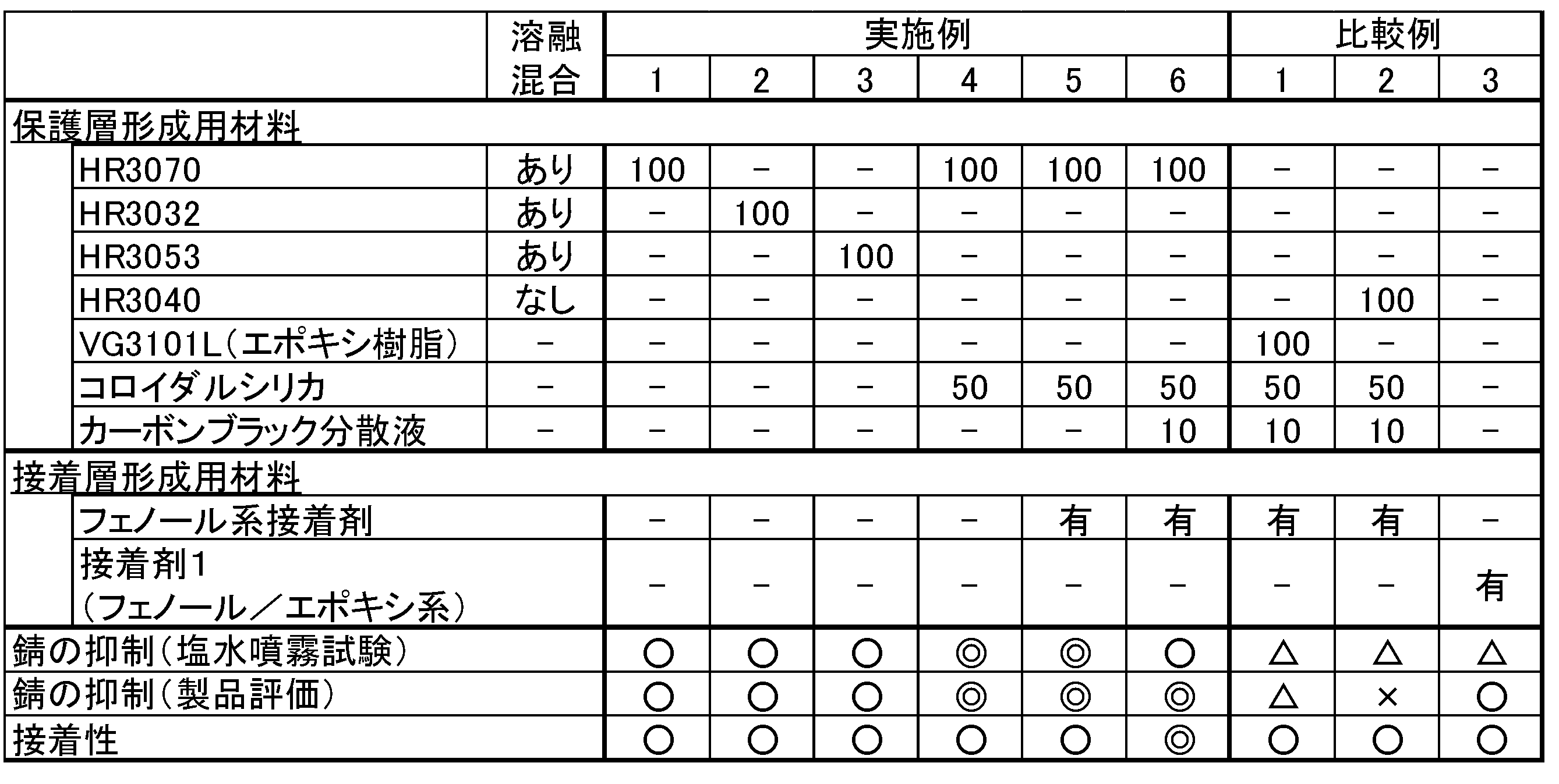
比較例1は、芯金からなる軸体とハロゲン原子を含む導電性ゴム弾性体層の間に、有機成分がエポキシ樹脂からなる保護層と接着成分がフェノール樹脂からなる接着層を有するだけなので、接着性は満足するものの、錆の発生が十分に抑えられていない。比較例2は、保護層の形成において上記(a)~(c)を含む組成物を用いているが、上記(a)~(c)は溶融混合されておらず、接着性は満足するものの、錆の発生が十分に抑えられていない。比較例3は、芯金からなる軸体とハロゲン原子を含む導電性ゴム弾性体層の間に、フェノール/エポキシ系の接着剤1からなる層が形成されているだけなので、接着性は満足するものの、錆の発生が十分に抑えられていない。
これに対し、実施例は、保護層の形成において上記(a)~(c)を含む組成物を用いており、また、上記(a)~(c)は溶融混合されている。このため、接着性と錆の抑制をともに満足する結果となった。そして、実施例同士の比較では、シリカ粒子を配合することで、錆の抑制効果が向上することがわかる。また、電子導電剤を配合することで、接着性が向上することがわかる。
以上、本発明の実施形態について詳細に説明したが、本発明は上記実施例に何ら限定されるものではなく、本発明の要旨を逸脱しない範囲で種々の改変が可能である。
Claims (9)
- 芯金からなる軸体と、前記軸体の外周に形成された保護層と、前記保護層の外周に形成された導電性ゴム弾性体層と、を備え、
前記導電性ゴム弾性体層が、ハロゲン原子を含むゴムを含有し、
前記保護層が、下記(a)~(c)を溶融混合して得られた材料を含む組成物の架橋体からなることを特徴とする電子写真機器用導電性ロール。
(a)マレイミド基を2個以上有する多官能マレイミド化合物
(b)ベンゾオキサジン化合物
(c)エポキシ樹脂 - 前記組成物が、さらに(d)シリカ粒子を含むことを特徴とする請求項1に記載の電子写真機器用導電性ロール。
- 前記(d)の一次粒子径が5~30nmの範囲内であることを特徴とする請求項2に記載の電子写真機器用導電性ロール。
- 前記(d)の含有量が、前記(a)~(c)の合計100質量部に対し50~100質量部の範囲内であることを特徴とする請求項2または3に記載の電子写真機器用導電性ロール。
- 前記(c)が、3官能のエポキシ樹脂を含むことを特徴とする請求項1から4のいずれか1項に記載の電子写真機器用導電性ロール。
- 前記保護層と前記導電性ゴム弾性体層との間には、フェノール樹脂を含む接着層が設けられていることを特徴とする請求項1から5のいずれか1項に記載の電子写真機器用導電性ロール。
- 前記接着層が、電子導電剤を含むことを特徴とする請求項6に記載の電子写真機器用導電性ロール。
- 前記保護層が、電子導電剤を含むことを特徴とする請求項1から7のいずれか1項に記載の電子写真機器用導電性ロール。
- 前記保護層における電子導電剤の含有量が、前記(a)~(c)の合計100質量部に対し7.5~15質量部の範囲内であることを特徴とする請求項8に記載の電子写真機器用導電性ロール。
Priority Applications (2)
| Application Number | Priority Date | Filing Date | Title |
|---|---|---|---|
| CN201880024777.8A CN110494810B (zh) | 2017-12-26 | 2018-08-29 | 电子照相设备用导电性辊 |
| US16/677,618 US10691038B2 (en) | 2017-12-26 | 2019-11-07 | Conductive roller for electrophotographic equipment |
Applications Claiming Priority (2)
| Application Number | Priority Date | Filing Date | Title |
|---|---|---|---|
| JP2017248643A JP6918691B2 (ja) | 2017-12-26 | 2017-12-26 | 電子写真機器用導電性ロール |
| JP2017-248643 | 2017-12-26 |
Related Child Applications (1)
| Application Number | Title | Priority Date | Filing Date |
|---|---|---|---|
| US16/677,618 Continuation US10691038B2 (en) | 2017-12-26 | 2019-11-07 | Conductive roller for electrophotographic equipment |
Publications (1)
| Publication Number | Publication Date |
|---|---|
| WO2019130656A1 true WO2019130656A1 (ja) | 2019-07-04 |
Family
ID=67063333
Family Applications (1)
| Application Number | Title | Priority Date | Filing Date |
|---|---|---|---|
| PCT/JP2018/031881 Ceased WO2019130656A1 (ja) | 2017-12-26 | 2018-08-29 | 電子写真機器用導電性ロール |
Country Status (4)
| Country | Link |
|---|---|
| US (1) | US10691038B2 (ja) |
| JP (1) | JP6918691B2 (ja) |
| CN (1) | CN110494810B (ja) |
| WO (1) | WO2019130656A1 (ja) |
Families Citing this family (4)
| Publication number | Priority date | Publication date | Assignee | Title |
|---|---|---|---|---|
| CN110900953A (zh) * | 2019-12-13 | 2020-03-24 | 益阳市思创传动部件制造有限公司 | 一种挤注型胶辊的生产方法 |
| CN111845129B (zh) * | 2020-07-21 | 2021-07-30 | 平田精密器材(深圳)有限公司 | 一种应用于彩色打印机的防滑驱动轴结构 |
| JP7717874B1 (ja) * | 2024-02-21 | 2025-08-04 | 住友理工株式会社 | 電子写真機器用導電性ロール |
| JP2026036816A (ja) * | 2024-08-21 | 2026-03-06 | 住友理工株式会社 | 電子写真機器用導電性ロール |
Citations (7)
| Publication number | Priority date | Publication date | Assignee | Title |
|---|---|---|---|---|
| US20060019207A1 (en) * | 2004-07-21 | 2006-01-26 | Kouta Fukui | Photothermographic material and image forming method |
| JP2006096969A (ja) * | 2004-09-06 | 2006-04-13 | Teijin Chem Ltd | 帯電防止性樹脂組成物 |
| JP2006208447A (ja) * | 2005-01-25 | 2006-08-10 | Canon Inc | 導電性ローラ及びその製造方法、画像形成装置 |
| JP2006273931A (ja) * | 2005-03-28 | 2006-10-12 | Teijin Chem Ltd | 難燃性樹脂組成物 |
| JP2008255214A (ja) * | 2007-04-04 | 2008-10-23 | Teijin Chem Ltd | 芳香族ポリカーボネート樹脂組成物 |
| JP2009197056A (ja) * | 2008-02-19 | 2009-09-03 | Teijin Chem Ltd | 導電性樹脂成形用材料 |
| JP2017523256A (ja) * | 2014-05-22 | 2017-08-17 | サイテック インダストリーズ インコーポレイテッド | 強化剤として使用するための官能化重合体粒子 |
Family Cites Families (9)
| Publication number | Priority date | Publication date | Assignee | Title |
|---|---|---|---|---|
| JP3022859B1 (ja) * | 1998-12-16 | 2000-03-21 | 株式会社金陽社 | 導電性ロール及びその製造方法 |
| JP4354189B2 (ja) * | 2003-01-30 | 2009-10-28 | 東海ゴム工業株式会社 | 現像ロール |
| US7680439B2 (en) * | 2006-12-19 | 2010-03-16 | Lexmark International, Inc. | Interference fit sleeved foam charge rolls and composite materials |
| JP2008262051A (ja) * | 2007-04-12 | 2008-10-30 | Fuji Xerox Co Ltd | 導電性ロール、クリーニングロール、クリーニングユニット、プロセスカートリッジ、及び画像形成装置 |
| JP4918612B2 (ja) * | 2009-12-24 | 2012-04-18 | キヤノンファインテック株式会社 | 画像形成装置 |
| CN103265791B (zh) * | 2013-05-29 | 2015-04-08 | 苏州生益科技有限公司 | 一种用于集成电路的热固性树脂组合物及使用其制作的半固化片及层压板 |
| US9120913B2 (en) * | 2013-09-30 | 2015-09-01 | Hitachi Metals, Ltd. | Elastic composite material and mold product using the same |
| CN104676141B (zh) * | 2015-03-04 | 2018-11-20 | 上海云逸能源系统有限公司 | 复合材料管道 |
| JP6574643B2 (ja) * | 2015-08-26 | 2019-09-11 | 株式会社沖データ | 画像形成装置 |
-
2017
- 2017-12-26 JP JP2017248643A patent/JP6918691B2/ja active Active
-
2018
- 2018-08-29 WO PCT/JP2018/031881 patent/WO2019130656A1/ja not_active Ceased
- 2018-08-29 CN CN201880024777.8A patent/CN110494810B/zh active Active
-
2019
- 2019-11-07 US US16/677,618 patent/US10691038B2/en active Active
Patent Citations (8)
| Publication number | Priority date | Publication date | Assignee | Title |
|---|---|---|---|---|
| US20060019207A1 (en) * | 2004-07-21 | 2006-01-26 | Kouta Fukui | Photothermographic material and image forming method |
| JP2006058853A (ja) * | 2004-07-21 | 2006-03-02 | Fuji Photo Film Co Ltd | 熱現像感光材料および画像形成方法 |
| JP2006096969A (ja) * | 2004-09-06 | 2006-04-13 | Teijin Chem Ltd | 帯電防止性樹脂組成物 |
| JP2006208447A (ja) * | 2005-01-25 | 2006-08-10 | Canon Inc | 導電性ローラ及びその製造方法、画像形成装置 |
| JP2006273931A (ja) * | 2005-03-28 | 2006-10-12 | Teijin Chem Ltd | 難燃性樹脂組成物 |
| JP2008255214A (ja) * | 2007-04-04 | 2008-10-23 | Teijin Chem Ltd | 芳香族ポリカーボネート樹脂組成物 |
| JP2009197056A (ja) * | 2008-02-19 | 2009-09-03 | Teijin Chem Ltd | 導電性樹脂成形用材料 |
| JP2017523256A (ja) * | 2014-05-22 | 2017-08-17 | サイテック インダストリーズ インコーポレイテッド | 強化剤として使用するための官能化重合体粒子 |
Also Published As
| Publication number | Publication date |
|---|---|
| US20200073274A1 (en) | 2020-03-05 |
| US10691038B2 (en) | 2020-06-23 |
| JP6918691B2 (ja) | 2021-08-11 |
| CN110494810A (zh) | 2019-11-22 |
| JP2019113776A (ja) | 2019-07-11 |
| CN110494810B (zh) | 2022-04-29 |
Similar Documents
| Publication | Publication Date | Title |
|---|---|---|
| US10691038B2 (en) | Conductive roller for electrophotographic equipment | |
| KR102261598B1 (ko) | 에폭시 수지 접착제 | |
| JP6155416B1 (ja) | 電子写真機器用帯電ロール | |
| WO2018181849A1 (ja) | 繊維強化複合材料用エポキシ樹脂組成物、繊維強化複合材料及び成形体 | |
| CN109923481B (zh) | 电子照相设备用带电构件以及电子照相设备用带电构件的制造方法 | |
| JP5687135B2 (ja) | 電子写真機器用導電性ゴム組成物およびこれを用いた電子写真機器用帯電ロール | |
| JP6266096B2 (ja) | ピラジン含有化合物を含むエポキシ樹脂 | |
| JP2014065811A (ja) | 電子写真機器用導電性ゴム組成物およびこれを用いた電子写真機器用導電性部材 | |
| WO2012026355A1 (ja) | 電子写真機器用導電性部材 | |
| JP5641523B2 (ja) | 電子写真機器用無端ベルト | |
| JP6082622B2 (ja) | 電子写真機器用導電性ゴム組成物およびこれを用いた電子写真機器用帯電ロール | |
| JP7319907B2 (ja) | 電子写真機器用導電性ロール | |
| JP5255880B2 (ja) | 電子写真機器用導電性ロール | |
| JP2007009124A (ja) | 帯電防止エポキシ樹脂組成物及び成形体 | |
| JP2007155769A (ja) | 導電性ゴムローラ | |
| JP7409932B2 (ja) | 電子写真機器用導電性ロール | |
| JP2010066307A (ja) | 電子写真機器用無端ベルト | |
| JP5968005B2 (ja) | 電子写真機器用導電性組成物 | |
| JP6850094B2 (ja) | 電子写真機器用導電性ロール | |
| WO2019106929A1 (ja) | 電子写真機器用帯電部材 | |
| JP7788483B2 (ja) | 電子写真機器用帯電ロール | |
| JP7132883B2 (ja) | 電子写真機器用導電性ロール | |
| CN110753883A (zh) | 电子照相设备用带电构件 | |
| JP5097061B2 (ja) | 電子写真機器用導電性ロール | |
| JP2023067019A (ja) | 電子写真機器用帯電ロールおよび電子写真機器用帯電ロールの製造方法 |
Legal Events
| Date | Code | Title | Description |
|---|---|---|---|
| 121 | Ep: the epo has been informed by wipo that ep was designated in this application |
Ref document number: 18895133 Country of ref document: EP Kind code of ref document: A1 |
|
| NENP | Non-entry into the national phase |
Ref country code: DE |
|
| 122 | Ep: pct application non-entry in european phase |
Ref document number: 18895133 Country of ref document: EP Kind code of ref document: A1 |