WO2019098288A1 - 抗腫瘍剤及び配合剤 - Google Patents
抗腫瘍剤及び配合剤 Download PDFInfo
- Publication number
- WO2019098288A1 WO2019098288A1 PCT/JP2018/042327 JP2018042327W WO2019098288A1 WO 2019098288 A1 WO2019098288 A1 WO 2019098288A1 JP 2018042327 W JP2018042327 W JP 2018042327W WO 2019098288 A1 WO2019098288 A1 WO 2019098288A1
- Authority
- WO
- WIPO (PCT)
- Prior art keywords
- glutathione
- inhibitor
- aldehyde dehydrogenase
- agent
- reducing agent
- Prior art date
- Legal status (The legal status is an assumption and is not a legal conclusion. Google has not performed a legal analysis and makes no representation as to the accuracy of the status listed.)
- Ceased
Links
Images





Classifications
-
- A—HUMAN NECESSITIES
- A61—MEDICAL OR VETERINARY SCIENCE; HYGIENE
- A61K—PREPARATIONS FOR MEDICAL, DENTAL OR TOILETRY PURPOSES
- A61K31/00—Medicinal preparations containing organic active ingredients
- A61K31/12—Ketones
-
- A—HUMAN NECESSITIES
- A61—MEDICAL OR VETERINARY SCIENCE; HYGIENE
- A61K—PREPARATIONS FOR MEDICAL, DENTAL OR TOILETRY PURPOSES
- A61K31/00—Medicinal preparations containing organic active ingredients
- A61K31/13—Amines
- A61K31/135—Amines having aromatic rings, e.g. ketamine, nortriptyline
- A61K31/137—Arylalkylamines, e.g. amphetamine, epinephrine, salbutamol, ephedrine or methadone
-
- A—HUMAN NECESSITIES
- A61—MEDICAL OR VETERINARY SCIENCE; HYGIENE
- A61K—PREPARATIONS FOR MEDICAL, DENTAL OR TOILETRY PURPOSES
- A61K31/00—Medicinal preparations containing organic active ingredients
- A61K31/33—Heterocyclic compounds
- A61K31/395—Heterocyclic compounds having nitrogen as a ring hetero atom, e.g. guanethidine or rifamycins
- A61K31/435—Heterocyclic compounds having nitrogen as a ring hetero atom, e.g. guanethidine or rifamycins having six-membered rings with one nitrogen as the only ring hetero atom
- A61K31/44—Non condensed pyridines; Hydrogenated derivatives thereof
-
- A—HUMAN NECESSITIES
- A61—MEDICAL OR VETERINARY SCIENCE; HYGIENE
- A61K—PREPARATIONS FOR MEDICAL, DENTAL OR TOILETRY PURPOSES
- A61K31/00—Medicinal preparations containing organic active ingredients
- A61K31/33—Heterocyclic compounds
- A61K31/395—Heterocyclic compounds having nitrogen as a ring hetero atom, e.g. guanethidine or rifamycins
- A61K31/435—Heterocyclic compounds having nitrogen as a ring hetero atom, e.g. guanethidine or rifamycins having six-membered rings with one nitrogen as the only ring hetero atom
- A61K31/44—Non condensed pyridines; Hydrogenated derivatives thereof
- A61K31/445—Non condensed piperidines, e.g. piperocaine
- A61K31/4453—Non condensed piperidines, e.g. piperocaine only substituted in position 1, e.g. propipocaine, diperodon
-
- A—HUMAN NECESSITIES
- A61—MEDICAL OR VETERINARY SCIENCE; HYGIENE
- A61K—PREPARATIONS FOR MEDICAL, DENTAL OR TOILETRY PURPOSES
- A61K31/00—Medicinal preparations containing organic active ingredients
- A61K31/63—Compounds containing para-N-benzenesulfonyl-N-groups, e.g. sulfanilamide, p-nitrobenzenesulfonyl hydrazide
- A61K31/635—Compounds containing para-N-benzenesulfonyl-N-groups, e.g. sulfanilamide, p-nitrobenzenesulfonyl hydrazide having a heterocyclic ring, e.g. sulfadiazine
-
- A—HUMAN NECESSITIES
- A61—MEDICAL OR VETERINARY SCIENCE; HYGIENE
- A61K—PREPARATIONS FOR MEDICAL, DENTAL OR TOILETRY PURPOSES
- A61K38/00—Medicinal preparations containing peptides
- A61K38/16—Peptides having more than 20 amino acids; Gastrins; Somatostatins; Melanotropins; Derivatives thereof
- A61K38/17—Peptides having more than 20 amino acids; Gastrins; Somatostatins; Melanotropins; Derivatives thereof from animals; from humans
- A61K38/39—Connective tissue peptides, e.g. collagen, elastin, laminin, fibronectin, vitronectin, cold insoluble globulin [CIG]
-
- A—HUMAN NECESSITIES
- A61—MEDICAL OR VETERINARY SCIENCE; HYGIENE
- A61K—PREPARATIONS FOR MEDICAL, DENTAL OR TOILETRY PURPOSES
- A61K45/00—Medicinal preparations containing active ingredients not provided for in groups A61K31/00 - A61K41/00
- A61K45/06—Mixtures of active ingredients without chemical characterisation, e.g. antiphlogistics and cardiaca
-
- A—HUMAN NECESSITIES
- A61—MEDICAL OR VETERINARY SCIENCE; HYGIENE
- A61P—SPECIFIC THERAPEUTIC ACTIVITY OF CHEMICAL COMPOUNDS OR MEDICINAL PREPARATIONS
- A61P35/00—Antineoplastic agents
-
- A—HUMAN NECESSITIES
- A61—MEDICAL OR VETERINARY SCIENCE; HYGIENE
- A61P—SPECIFIC THERAPEUTIC ACTIVITY OF CHEMICAL COMPOUNDS OR MEDICINAL PREPARATIONS
- A61P43/00—Drugs for specific purposes, not provided for in groups A61P1/00-A61P41/00
-
- C—CHEMISTRY; METALLURGY
- C12—BIOCHEMISTRY; BEER; SPIRITS; WINE; VINEGAR; MICROBIOLOGY; ENZYMOLOGY; MUTATION OR GENETIC ENGINEERING
- C12Q—MEASURING OR TESTING PROCESSES INVOLVING ENZYMES, NUCLEIC ACIDS OR MICROORGANISMS; COMPOSITIONS OR TEST PAPERS THEREFOR; PROCESSES OF PREPARING SUCH COMPOSITIONS; CONDITION-RESPONSIVE CONTROL IN MICROBIOLOGICAL OR ENZYMOLOGICAL PROCESSES
- C12Q1/00—Measuring or testing processes involving enzymes, nucleic acids or microorganisms; Compositions therefor; Processes of preparing such compositions
- C12Q1/02—Measuring or testing processes involving enzymes, nucleic acids or microorganisms; Compositions therefor; Processes of preparing such compositions involving viable microorganisms
-
- G—PHYSICS
- G01—MEASURING; TESTING
- G01N—INVESTIGATING OR ANALYSING MATERIALS BY DETERMINING THEIR CHEMICAL OR PHYSICAL PROPERTIES
- G01N33/00—Investigating or analysing materials by specific methods not covered by groups G01N1/00 - G01N31/00
- G01N33/15—Medicinal preparations ; Physical properties thereof, e.g. dissolubility
-
- G—PHYSICS
- G01—MEASURING; TESTING
- G01N—INVESTIGATING OR ANALYSING MATERIALS BY DETERMINING THEIR CHEMICAL OR PHYSICAL PROPERTIES
- G01N33/00—Investigating or analysing materials by specific methods not covered by groups G01N1/00 - G01N31/00
- G01N33/48—Biological material, e.g. blood, urine; Haemocytometers
- G01N33/50—Chemical analysis of biological material, e.g. blood, urine; Testing involving biospecific ligand binding methods; Immunological testing
Definitions
- the present invention relates to antineoplastic agents and combinations.
- cancer stem cells are highly resistant to various types of stress, and development of drugs targeting cancer stem cells is urgently needed to eradicate cancer.
- the analysis of the molecular mechanisms of cancer stem cell stress tolerance for the development of treatments targeting cancer stem cells has just begun.
- CD44 which is one of the markers of epithelial cancer stem cells, is known as a molecule involved in stress resistance (Cancer Cell. 2011 Mar 8; 19 (3): 387-400). Splice variant forms (hereinafter, CD44v) exist in CD44, and CD44v stably expresses cystine transporter xCT on the cell membrane. Since xCT has a function of taking in cystine into cells, and the incorporated cystine is used for the production of glutathione (GSH), the amount of GSH is increased in cells highly expressing CD44v. Because GSH has a strong antioxidant action and plays a role in reducing cell-induced stress, cancer stem cells that highly express CD44v are considered to be resistant to treatment.
- GSH glutathione
- sulfasalazine alias: salazosulfapyridine, salazopyrine, salicylazosulfapyridine.
- Sulfasalazine is an acidic azo compound of sulfapyridine and 5-aminosalicylic acid (5-ASA), and when orally administered, it is decomposed into sulfapyridine and 5-aminosalicylic acid (5-ASA) by enterobacteria in the intestine Ru.
- 5-ASA is the main active ingredient for the above-mentioned diseases.
- the unaltered sulfasalazine before decomposition has been found to be effective as an antitumor agent, having xCT inhibitory activity (Leukemia vol. 15, pp. 1633-1640, 2001). That is, when sulfasalazine is added to cancer cells, uptake of cystine into cells by xCT is suppressed, glutathione production is reduced, and as a result, resistance to cancer cells is reduced by oxidative stress, and sensitivity to antitumor agents is increased. Do.
- An object of the present invention is to provide novel antitumor agents and combination agents.
- sulfasalazine alone has an antitumor effect on tumors in which undifferentiated tumor cells are mostly, but CD44v on differentiated tumors that include tumor cells exhibiting differentiation characteristics. It has been found that although it reduces cancer stem cells that overexpress, it has no effect on reducing the overall tumor volume. Therefore, for such differentiated tumors, we have made intensive efforts to obtain an antitumor agent for differentiated tumors by developing a drug having an antitumor effect for tumor cells in which sulfasalazine has no antitumor effect.
- One embodiment of the present invention is an antitumor agent containing a glutathione concentration reducing agent or a glutathione S-transferase inhibitor as an active ingredient, which is administered simultaneously with an effective amount of an aldehyde dehydrogenase inhibitor, or an effective amount And an antitumor agent containing an aldehyde dehydrogenase inhibitor as an active ingredient, which is administered simultaneously with the glutathione concentration-reducing agent or the glutathione S-transferase inhibitor.
- Another embodiment of the present invention is a combination drug comprising an aldehyde dehydrogenase inhibitor and a glutathione concentration reducing agent or a glutathione S-transferase inhibitor as active ingredients.
- a further embodiment of the present invention is an antitumor agent containing the above-mentioned combination drug.
- the above-mentioned glutathione concentration-lowering agent is xCT, Thioredoxin-1 (thioredoxin-1: TRX-1), glutamate-cysteine ligase (GCL) (EC 6.3.2.2) (also called ⁇ -glutamylcysteine synthetase), glutathione synthesis It may be an agent that inhibits any activity of the enzyme (EC 6.3.2.3).
- the agent may be an inhibitor of the xCT transporter.
- the inhibitor of the xCT transporter may be sulfasalazine, elastin, or sorafenib.
- the aldehyde dehydrogenase inhibitor may be a compound represented by the following formula (I) or a pharmacologically acceptable salt thereof.
- R 1 is a C 1-6 linear or branched alkyl group
- R 2 and R 3 are independently selected C 1-6 linear or branched alkyl groups, or R 2 and R 3 3 is taken together to form a 4-, 5-, 6-, or 7-membered azacycloalkyl group having the hetero atom N to which they are bonded
- R 4 is hydrogen or halogen.
- a further embodiment of the present invention is a straight-chain or branched alkyl group of C1 ⁇ 6, or R 2 and R 3 is a linear or branched alkyl group of C1 ⁇ 6 are independently selected, and R 2 R 3 taken together form a 4-, 5-, or 6-membered azacycloalkyl group having the heteroatom N as the hetero atom to which they are attached.
- the compound represented by the formula (I) may be diclonine, BAS00363846, STL327701, PHAR033081, PHAR298639 or Aldi-2.
- a further embodiment of the present invention comprises simultaneously administering an aldehyde dehydrogenase inhibitor and a glutathione concentration reducing agent or a glutathione S-transferase inhibitor to tumor cells in vitro, and the growth rate or cell viability of the tumor cells. And a measuring step.
- a further embodiment of the present invention is a method for identifying an aldehyde dehydrogenase inhibitor having a combined effect with a glutathione concentration reducing agent or a glutathione S-transferase inhibitor, wherein the specific glutathione concentration reducing agent or a glutathione S-transferase inhibitor And simultaneously administering a plurality of aldehyde dehydrogenase inhibitors to tumor cells in vitro, and measuring the growth rate or cell viability of the tumor cells.
- a further embodiment of the present invention is a method for identifying a glutathione concentration reducing agent or glutathione S-transferase inhibitor that has a combined effect with an aldehyde dehydrogenase inhibitor, wherein the specific aldehyde dehydrogenase inhibitor is an antitumor agent And simultaneously administering a plurality of glutathione concentration lowering agents or glutathione S-transferase inhibitors to tumor cells in vitro, and measuring the growth rate or cell viability of the tumor cells. is there.
- a further embodiment of the present invention is a method of identifying a tumor cell which exerts a combined effect of an aldehyde dehydrogenase inhibitor and a glutathione concentration reducing agent or a glutathione S-transferase inhibitor, comprising: the aldehyde dehydrogenase inhibitor and glutathione concentration
- a specific method comprising simultaneously administering a specific combination of a hypotensive agent or a glutathione S-transferase inhibitor to a plurality of tumor cells in vitro, and measuring the growth rate or cell viability of the plurality of tumor cells It is.
- the tumor cell may be resistant to a glutathione concentration-reducing agent or a glutathione S-transferase inhibitor.
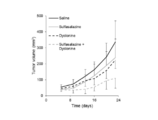
- FIG. 7 is a view showing the combined effect of sulfasalazine, elastin, or BSO and diclonine in various cancer cell lines in one example of the present invention. In one Example of this invention, it is the graph which showed the in-vivo combined effect of sulfasalazine and diclonine.
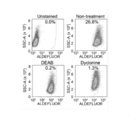
- FIG. 6 is a diagram of experimental results showing the inhibitory effect of ALDH activity by dyclonine in one example of the present invention.
- FIG. 7 is a diagram showing the accumulation effect of HNE (4-HNE; 4-hydroxy-2-nonenal) by the combined use of sulfasalazine and diclonine in one example of the present invention.
- HNE 4-HNE; 4-hydroxy-2-nonenal
- FIG. 6 is a graph showing the combined effect of sulfasalazine, elastin, or BSO and dyclonine in OSC19 cells or sulfasalazine-resistant OSC19 cells in one example of the present invention.
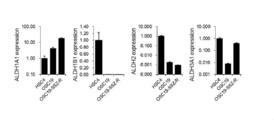
- it is the graph which showed expression of the ALDH gene family in HSC4 cell, OSC19 cell, or sulfasalazine resistant OSC19 cell.
- HNE 4-hydroxy-2-nonenoic acid
- GSH glutathione
- ALDH aldehyde dehydrogenase
- GST glutathione S-transferase
- the effective amount of the aldehyde dehydrogenase inhibitor is an aldehyde dehydrogenase inhibitor in an amount having a combined effect with a glutathione concentration reducing agent as an antitumor activity.
- another embodiment of the present invention is an antitumor agent containing an aldehyde dehydrogenase inhibitor as an active ingredient, which is administered simultaneously with an effective amount of a glutathione concentration-lowering agent.
- the effective amount of the glutathione concentration reducing agent is a glutathione concentration reducing agent having an effect in combination with an aldehyde dehydrogenase inhibitor as an antitumor activity.
- Aldehyde dehydrogenase inhibitors are agents that inhibit the enzyme activity of aldehyde dehydrogenase 2 (aldehyde dehydrogenase 2; ALDH) (EC 1.2.1.10).
- ALDH aldehyde dehydrogenase 2
- the type and isotype of ALDH to be inhibited are not particularly limited, and may be any of ALDH 1-5 and their isotypes.
- Aldehyde dehydrogenase inhibitors used in antitumor agents are not particularly limited, but clopropamide (chlorpropamide), tolbutamide (tolbutamide), diethylaminobenzaldehyde, tetraethylthioperoxydicarbonic diamide, cyanamide (cyanamide), oxyphedrine, citral ( 3,7-dimethyl-2,6-octadienal), coprin (coprine), daidzin, DEAB (4- (Diethylamino) benzaldehyde), gossypol (gossypol), kynurenine metabolites (3-hydroxykynurenine, 3-hydroxycyanuranilic acid) , Kynurenic acid, and indol-3-ylpyruvic acid), molinate (Molinate), nitroglycerin, purgerin (N-benzyl-N-methylprop-2-yn-1-amine) and their analogs, or their pharmacology And salt
- R 1 is a C 1-6 linear or branched alkyl group
- R 2 and R 3 are independently selected C 1-6 linear or branched alkyl groups, or R 2 and R 3 3 is taken together to form a 4-, 5-, 6-, or 7-membered azacycloalkyl group having the hetero atom N to which they are bonded
- R 4 is hydrogen or halogen.
- R 1 is preferably a C 4 to 5 linear or branched alkyl group
- R 2 and R 3 are C 2 alkyl groups, or R 2 and R 3 taken together are the N to which they are bonded is preferably a 6-membered azacycloalkyl group ring to.
- R 1 is straight-chain alkyl group of C4, to the N to which R 2 and R 3 are they are bound together with the hetero atom
- a compound which is a 6-membered azacycloalkyl group is diclonine There.
- Halogen is, F, Cl, I, Br, I is preferred.
- the pharmacologically acceptable salt is not limited as long as it forms a salt with those compounds, and specifically, for example, hydrochloride, sulfate, nitrate, hydrobromide, iodide Addition salts of inorganic acids such as hydrogen chloride, perchlorate and phosphate, oxalate, organic acid addition salts such as maleate, fumarate and succinate, methanesulfonate, ethane sulfone Acid salts, benzenesulfonic acid salts, p-toluenesulfonic acid salts, addition salts of sulfonic acids such as camphorsulfonic acid salts,
- the glutathione concentration reducing agent is an agent that reduces glutathione concentration in cells.
- the glutathione concentration-lowering agent used in these antitumor agents is not limited, but preferred is an agent that inhibits the pathway in which glutathione is produced from cystine that is taken into the cell by xCT, such as xCT, Thioredoxin-1 (thioredoxin-1: TRX-1), glutamate-cysteine ligase (GCL) (EC 6.3.2.2) (also called ⁇ -glutamylcysteine synthetase), or glutathione synthetase (EC 6.3.2.3) It is more preferred that the agent is an inhibitory agent, more preferably an xCT inhibitor.
- the xCT inhibitor is not particularly limited, but is preferably sulfasalazine, elastin, sorafenib, or an anti-xCT antibody.
- a glutathione S-transferase inhibitor is an agent that inhibits the enzyme activity of glutathione S-transferase (EC 2.5. 1. 18), and in particular, HNE (4-HNE; 4-hydroxy-2-nonenal) -An agent that inhibits the activity of converting to GSH.
- the glutathione S-transferase inhibitors are not particularly limited, but glutathione analogs (eg, WO 95/08563, WO 96/40205, WO 99/54346, etc.), ketoprofen, indomethacin, ethacrynic acid, piroprost, anti-GST antibody, dominant negative mutant of GST Etc.
- spontaneous administration of two drugs means not only simultaneous administration in time but also in time as long as the other drug is administered while the effect of one drug remains. It also means to administer each alone.
- two agents containing only one may be simultaneously administered, but two agents may be administered as one dosage form as a combination agent.
- the administration target of the antitumor agent is not particularly limited as long as it is a vertebrate, but is preferably a human cancer patient.
- the tumor to be treated is not particularly limited, but a tumor containing a tumor cell resistant to a glutathione concentration-lowering agent or a glutathione S-transferase inhibitor is preferable.
- the tumor cells may have high expression of aldehyde dehydrogenase.
- the glutathione concentration reducing agent or the glutathione S-transferase inhibitor is preferably an xCT inhibitor, more preferably sulfasalazine.
- Resistant tumor cells are tumor cells that survive in vivo when administered to patients usually at a therapeutic concentration for the usual treatment days, and have a 50% survival rate of 80% or more cell lines in vitro It refers to tumor cells with a survival rate of 90% or more at a concentration below.
- a sulfasalazine-resistant tumor cell is a tumor cell that survives in vivo when administered for 2 weeks at 50-300 ⁇ g ⁇ h / mL of AUC 0-24 in vivo, and in vitro the survival rate is 200 ⁇ M. Refers to 90% or more of tumor cells. It is preferred that the sulfasalazine resistant tumor cells also have low levels of CD44v expression or be negative.
- the gene expression of any of ALDH1A1, ALDH2, ALDH1B1 and ALDH3A1 is expressed at a level 3 times or more, preferably 10 times or more higher than that of OSC19 cells.
- the tumor to be treated may be contaminated with tumor cells expressing CD44v. This is because sulfasalazine has an anti-tumor effect effectively on tumor cells in which CD44v is expressed.
- Tumor cells expressing CD44v may be cells in which CD44v expression can be detected, but highly expressing cells are preferable. In this case, is high expression as high as the average level of ovarian tumor cells? Although it may be high, it is preferably 2 times or more, more preferably 4 times or more, and still more preferably 10 times or more.
- the type of tumor is not particularly limited, but is preferably solid cancer, and is exemplified by colorectal adenocarcinoma, gastric adenocarcinoma, breast adenocarcinoma, lung adenocarcinoma, pancreatic adenocarcinoma, squamous cell carcinoma of the head and neck, ovarian tumor, testicular tumor be able to.
- the antitumor agent may be formulated into tablets, powders, granules, powders, capsules, solutions, emulsions, suspensions and the like by conventional methods. At that time, it is manufactured using pharmaceutically acceptable additives known to those skilled in the art, such as excipients and carriers.
- the antitumor agent may be administered in a manner suitable for an administration subject within the effective amount range.
- the effective amount can be appropriately determined finally by the judgment of a doctor or veterinarian in consideration of the type of dosage form, administration method, age and weight of administration subject, medical condition of administration subject, and the like.
- the dose of the compound per day is preferably 0.1 mg / kg or more, more preferably 1 mg / kg or more, still more preferably 10 mg / kg or more, and 1000 mg / kg or less. Is preferably 300 mg / kg or less, more preferably 100 mg / kg or less.
- the administration method is not particularly limited. For example, it may be orally administered, may be parenterally administered by injection or infusion into the abdominal cavity or vein, or may be directly administered into cancer by injection etc. It is also good.
- One embodiment of the present invention comprises simultaneously administering an aldehyde dehydrogenase inhibitor, a glutathione concentration-reducing agent or a glutathione S-transferase inhibitor to tumor cells in vitro, and a growth rate of a tumor cell to which a drug has been administered. Or a step of measuring cell viability.
- the aldehyde dehydrogenase inhibitor, the glutathione concentration reducing agent, and the glutathione S-transferase inhibitor in this section are in accordance with those described in the "antitumor agent" section.
- the aldehyde dehydrogenase inhibitor and the glutathione concentration reducing agent or the glutathione S-transferase inhibitor have a combined effect on the antitumor activity, a drug combination having a high combined effect can be found by this measurement method. Particularly effective tumor cells can be found for certain drug combinations.
- the growth rate or cell survival rate of a tumor cell to which a specific glutathione concentration reducing agent or a glutathione S-transferase inhibitor and a plurality of aldehyde dehydrogenase inhibitors were simultaneously administered to tumor cells in vitro and the drug was administered By measuring the rate, it is possible to identify an aldehyde dehydrogenase inhibitor that has a combined effect with a specific glutathione concentration reducing agent or glutathione S-transferase inhibitor.
- a specific aldehyde dehydrogenase inhibitor and multiple glutathione concentration reducing agents or glutathione S-transferase inhibitors are simultaneously administered to tumor cells in vitro to measure the growth rate or cell viability of the drug-administered tumor cells.
- a specific combination of an aldehyde dehydrogenase inhibitor and a glutathione concentration reducing agent or a glutathione S-transferase inhibitor is simultaneously administered to a plurality of tumor cells in vitro, and the growth rate or cells of a plurality of tumor cells to which the agent is administered By measuring the survival rate, it is possible to identify a tumor cell that exerts a combined effect of an aldehyde dehydrogenase inhibitor and a glutathione concentration reducing agent or a glutathione S-transferase inhibitor.
- EXPERIMENTAL EXAMPLE 1 Combined Effect of Sulfasalazine and Diclonine (Purpose)
- the combined effect of sulfasalazine and diclonine having the xCT inhibitory effect is shown to reduce the survival rate of sulfasalazine resistant cells.
- the oral squamous cell carcinoma cell line HSC-4 which is a sulfasalazine resistant cell line, was seeded at 2000 cells / well in a 96-well plate, and the culture was started.
- the medium used was DMEM. After 24 hours, the medium was changed to a medium containing 50 ⁇ M dicronine or an equivalent amount of DMSO and 0 ⁇ M (no addition), 50 ⁇ M, 100 ⁇ M, 200 ⁇ M, or 400 ⁇ M sulfasalazine, and the culture was continued for 48 hours.
- FIG. 1 a graph showing the survival rate for each concentration of sulfasalazine was created.
- HSC4 is a sulfasalazine resistant cell line, and sulfasalazine alone has little effect on cell viability. Furthermore, even with diclonine alone (with diclone and with no sulfasalazine added), the survival rate is 80%. However, when both diclonine and sulfasalazine are added, the survival rate becomes less than 10% when the amount of sulfasalazine is 100 ⁇ M or more.
- sulfasalazine and diclonine have a combined effect on the reduction in the survival rate of sulfasalazine resistant cells.
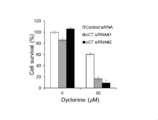
- the oral squamous cell carcinoma cell line HSC-4 cells, a sulfasalazine-resistant cell line, are seeded at 3000 / well in a 96-well plate, and a non-silencing control (Scramble (Sense: UUCUCCGACGUGUCACGUtt (SEQ ID NO: 1), Antisense) : ACGUGACACGUUCGGAGAAtt (SEQ ID NO: 2)) siRNA or xCT specific siRNA (xCT siRNA # 1 Sense: AGAAAUCUGGAGGUCAUUAtt (SEQ ID NO: 3), Antisense: AGAAAUCUGGAGGUCAUUAtt (SEQ ID NO: 4), xCT siRNA # 2 Sense: CCAGAACAUUACAAUAAAUtt (SEQ ID NO: 5) , Antisense: AUUAUUUGUAAUGUCUGGT (SEQ ID NO: 6)) was lipofected using Lipofectamine RNAiMAX
- the medium used was DMEM. After 24 hours, the medium was changed to a medium containing 50 ⁇ M diclonine (solvent: DMSO) or an equivalent amount of DMSO, and the culture was continued for 48 hours. Thereafter, the cell viability was measured using Celltiter-Glo (Promega), and the cell viability of each control (non-silencing control, addition of DMSO) was calculated as 100%. The results are shown in FIG.
- HSC-4 has about 60% cell viability with 50 ⁇ M diclone alone, but only about 10-20% cell viability with 50 ⁇ M diclone when knocked down xCT Do not have.
- Method In a 96-well plate, the cell line shown in FIG. 3 was seeded at 3000 cells / well and culture was started.
- the medium used was DMEM. After 24 hours, replace the medium with 50 ⁇ M dicronine or an equivalent amount of DMSO, 0 ⁇ M (no addition) or 400 ⁇ M sulfasalazine, 0 ⁇ M (no addition) or 5 ⁇ M elastin, 0 ⁇ M (no addition) or 100 ⁇ M BSO, The culture was continued for 48 hours.
- glutathione concentration reducing agents or glutathione S-transferase inhibitors can be used in place of sulfasalazine or elastin.
- Tumor volume (major axis ⁇ (minor axis) 2 ) / 2 Statistical analysis of tumor volume was performed on day 22 by t-test.
- the combined administration of sulfasalazine and diclonine can reduce the growth of sulfasalazine resistant tumors.
- a 10 cm cell culture dish was inoculated with 8 ⁇ 10 5 cells / cell of oral squamous cell carcinoma cell line HSC-4 cells / dish and culture was started.
- the medium used was DMEM. After 24 hours, the medium was replaced with a medium containing 50 ⁇ M diclonine (solvent: DMSO), and cultured for 24 hours. Thereafter, the cells were recovered, and cells having ALDH activity in the presence of N, N-diethylaminobenzaldehyde (DEAB) were stained with ALDEFLUOR kit (STEMCELL Technologies) and analyzed by FACS (in the figure, Dyclonine).
- the cells were not stained with ALDEFLUOR kit without addition of DEAB (Unstained in the figure), replaced with a medium containing an equivalent amount of DMSO without dyclonine and stained with ALDEFLUOR kit (Non-treatment in the figure)
- diclonine has an inhibitory activity of ALDH.
- HSC-4 cells are cultured in a medium containing 50 ⁇ M dicronine or an equivalent amount of DMSO and 0 ⁇ M (without addition) or 400 ⁇ M sulfasalazine in the same manner as in Experimental Example 1, and the treated cells are 4% PFA.
- -Fixed with PBS Furthermore, after permeabilizing the cell membrane with 0.2% Triton X 100-PBS, blocking with 3% BSA-PBS was performed. Thereafter, fluorescent staining was performed using an anti-HNE antibody as a primary antibody and an Alexafluor 488-labeled anti-mouse IgG antibody as a secondary antibody. Similarly, antibody staining was performed using cells incubated with 50 ⁇ MHNE for 30 minutes as a positive control. An observation image with a fluorescence microscope is shown in FIG.
- HNE intracellular HNE at high frequency and high concentration.
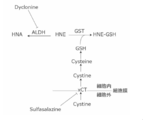
- FIG. 11 there are a plurality of pathways that degrade HNE in cells, and among them, a GST-mediated pathway and an ALDH-mediated degradation pathway It is believed that HNE accumulates in cells by simultaneously inhibiting the two. And because HNE is cytotoxic, it is thought that tumor cells can not grow.
- R 1 is a C 1-6 linear or branched alkyl group
- R 2 and R 3 are independently selected C 1-6 linear or branched alkyl groups, or R 2 and R 3 3 is taken together to form a 4-, 5-, 6-, or 7-membered azacycloalkyl group having the hetero atom N to which they are bonded
- R 4 is hydrogen or halogen.
- R 1 is preferably a C 4 to 5 linear or branched alkyl group
- R 2 and R 3 are C 2 alkyl groups, or R 2 and R 3 taken together are the N to which they are bonded is preferably a 6-membered azacycloalkyl group ring to.
- R 1 is straight-chain alkyl group of C4, to the N to which R 2 and R 3 are they are bound together with the hetero atom
- a compound which is a 6-membered azacycloalkyl group is diclonine There.
- Halogen is, F, Cl, I, Br, I is preferred.
- 25 ⁇ M, 50 ⁇ M, or 100 ⁇ M dyclonine, or 12.5 ⁇ M, 25 ⁇ M, 50 ⁇ M, 100 ⁇ M dyclonine analogue BAS00363846, STL327701, PHAR033081, PHAR298639, or Aldi- HSC-4 cells were cultured in a medium containing 2 (see FIG. 7B for the structural formula) and 0 ⁇ M (no addition) or 100 ⁇ MBSO or 300 ⁇ M sulfasalazine, and cell viability was measured and graphed in FIG. 7A.
- the diclonine analogue (I) having a diclonine skeleton has a combined effect as an xCT inhibitor and an antitumor agent.
- the diclonine backbone is important for interaction with xCT inhibitors.
- Sulfasalazine-sensitive oral squamous cell carcinoma cell line OSC19 was cultured in DMEM medium containing sulfasalazine for 2 months to establish sulfasalazine-resistant OSC19 cells.
- Parent strains of OSC19 cells or OSC19-SSZR cells are seeded at 3000 cells / well in a 96-well plate and cultured for 24 hours, after which the concentrations of sulfasalazine, elastin or BSO shown in FIG. 9 and 50 ⁇ M diclonine (solvent is DMSO)
- the medium was replaced with a medium containing an equal volume of DMSO and cultured for 48 hours.
- the cell viability was measured by Celltiter-Glo (Promega), and the cell viability was calculated with 100% of a control (sulfasalazine, elastin and BSO added, DMSO added) as 100%.
- dyclonine shows a combined effect with a glutathione synthesis inhibitor even in cancer cells that have acquired resistance to xCT inhibitors.
- RNA was extracted from HSC-4 cells, OSC19 cells and OSC19-SSZR cells, and reverse transcription was performed to synthesize complementary DNA. Thereafter, using the obtained complementary DNA as a template, ALDHIAl, by quantitative RT-PCR. The expression levels of ALDHIB1, ALDH2, ALDH3Al and RPS17 were measured. Using the expression level of RPS17 as a reference, the expression level of each ALDH family gene was quantified by the ⁇ Ct method, and is graphed in FIG.
- ALDHIAl was up-regulated in OSC19-SSZR compared to OSC19.
- ALDHIB1 and ALDH2 showed high expression in HSC-4.
- ALDH3Al was highly expressed in HSC4 and OSC19-SSZR.
- expression of ALDH family genes tended to be high in xCT hyposensitive cancer cell lines.
- HNE is degraded by ALDH family genes, so even if xCT inhibitor suppresses degradation to GST, HNE toxicity does not work , XCT inhibitor (see Figure 11).
- Administration of an ALDH inhibitor to such cells increases the sensitivity to the xCT inhibitor, and therefore, an antitumor agent containing an ALDH inhibitor and a glutathione concentration reducing agent or a glutathione S-transferase inhibitor results in expression of an ALDH family gene. It works effectively on high cancer cells.
- the present invention has made it possible to provide novel antitumor agents and combination agents.
Landscapes
- Health & Medical Sciences (AREA)
- Life Sciences & Earth Sciences (AREA)
- Chemical & Material Sciences (AREA)
- General Health & Medical Sciences (AREA)
- Medicinal Chemistry (AREA)
- Pharmacology & Pharmacy (AREA)
- Engineering & Computer Science (AREA)
- Veterinary Medicine (AREA)
- Public Health (AREA)
- Animal Behavior & Ethology (AREA)
- Epidemiology (AREA)
- Organic Chemistry (AREA)
- Immunology (AREA)
- Molecular Biology (AREA)
- Bioinformatics & Cheminformatics (AREA)
- Biomedical Technology (AREA)
- Proteomics, Peptides & Aminoacids (AREA)
- Analytical Chemistry (AREA)
- Zoology (AREA)
- Biochemistry (AREA)
- Physics & Mathematics (AREA)
- Hematology (AREA)
- Biotechnology (AREA)
- Biophysics (AREA)
- Pathology (AREA)
- Wood Science & Technology (AREA)
- General Physics & Mathematics (AREA)
- Microbiology (AREA)
- Food Science & Technology (AREA)
- Chemical Kinetics & Catalysis (AREA)
- General Chemical & Material Sciences (AREA)
- Nuclear Medicine, Radiotherapy & Molecular Imaging (AREA)
- Urology & Nephrology (AREA)
- Genetics & Genomics (AREA)
- General Engineering & Computer Science (AREA)
- Cell Biology (AREA)
- Gastroenterology & Hepatology (AREA)
- Emergency Medicine (AREA)
- Medicines That Contain Protein Lipid Enzymes And Other Medicines (AREA)
- Pharmaceuticals Containing Other Organic And Inorganic Compounds (AREA)
Abstract
有効量のアルデヒド脱水素酵素阻害剤と同時に投与される、グルタチオン濃度低下剤またはグルタチオンS-トランスフェラーゼ阻害剤を有効成分として含有する新規な抗腫瘍剤、または有効量のグルタチオン濃度低下剤またはグルタチオンS-トランスフェラーゼ阻害剤と同時に投与される、アルデヒド脱水素酵素阻害剤を有効成分として含有する新規な抗腫瘍剤、またはアルデヒド脱水素酵素阻害剤とグルタチオン濃度低下剤またはグルタチオンS-トランスフェラーゼ阻害剤とを有効成分として含有する新規な配合剤を提供する。
Description
本発明は、抗腫瘍剤及び配合剤に関する。
がん治療においては、抗がん剤や放射線などの治療に対して抵抗性を持つ細胞が存在することが、再発や転移の原因となり、がんの治療を妨げている。このような治療抵抗性細胞として、近年がん幹細胞の存在が注目されている。がん幹細胞は、各種ストレスに対して耐性が高く、がん幹細胞を標的とした薬剤の開発ががんの根治のためには急務である。しかし、がん幹細胞を標的にした治療の開発のための、がん幹細胞のストレス耐性の分子機構の解析は端緒についたばかりである。
上皮性がん幹細胞のマーカーの一つであるCD44は、そのストレス耐性に関与する分子として知られている(Cancer Cell. 2011 Mar 8;19(3):387-400)。CD44には、スプライスバリアントフォーム(以下、CD44v)が存在し、CD44vが細胞膜上にシスチントランスポーターxCTを安定して発現させる。xCTは細胞内にシスチンを取り込む機能を有し、それによって取り込まれたシスチンはグルタチオン(GSH)の産生に用いられるために、CD44vを高発現している細胞では、GSHの量が増加する。GSHは強力な抗酸化作用を持ち、細胞に生じたストレスを減少させる役割を持つために、CD44vを高発現するがん幹細胞は、治療に対して抵抗性を有するとされる。
一方、潰瘍性大腸炎や関節リウマチの治療に使用されている薬剤に、スルファサラジン(Sulfasalazine)(別名:サラゾスルファピリジン、サラゾピリン、サリチルアゾスルファピリジン)がある。スルファサラジンは、スルファピリジンと5-アミノサリチル酸(5-ASA)の酸性アゾ化合物であり、経口投与すると、腸内で腸内細菌によりスルファピリジンと5-アミノサリチル酸(5-ASA)に分解される。前記疾患に対しては、特に5-ASAが主な有効成分とされている。
近年、分解される前の未変化体のスルファサラジンにxCT阻害作用があり、抗腫瘍剤として有効であることが明らかになった(Leukemia vol.15, pp.1633-1640, 2001)。つまり、スルファサラジンを癌細胞に添加すると、xCTによる細胞内へのシスチンの取り込みが抑制され、グルタチオン産生量が低下し、その結果、癌細胞の酸化ストレス耐性が下がり、抗腫瘍剤への感受性が上昇する。
CD44vを高発現するがん幹細胞に対しても、xCT阻害作用を有するスルファサラジンは有効に増殖を抑制することが知られている(特開2012-144498)。
本発明は、新規な抗腫瘍剤及び配合剤を提供することを課題とするものである。
本発明者らは、スルファサラジンは、未分化な腫瘍細胞がほとんどである腫瘍に対しては単独で抗腫瘍効果を有するが、分化形質を示す腫瘍細胞を含むような分化型腫瘍に対してはCD44vを高発現するがん幹細胞を減少させるものの、腫瘍全体の体積を減少させる効果がないことを見出した。そこで、そのような分化型腫瘍に対し、スルファサラジンが抗腫瘍効果を有しない腫瘍細胞に対して抗腫瘍効果をもつ薬剤を開発することによって分化型腫瘍に対する抗腫瘍剤を得ようと鋭意努力したところ、アルデヒド脱水素酵素阻害剤をスルファサラジンと併用すれば、スルファサラジン単独では効果の弱い腫瘍細胞に対し顕著な抗腫瘍効果があることを見出し、本発明の完成に至った。
本発明の一実施態様は、有効量のアルデヒド脱水素酵素阻害剤と同時に投与される、グルタチオン濃度低下剤またはグルタチオンS-トランスフェラーゼ阻害剤を有効成分として含有する抗腫瘍剤であるか、あるいは有効量のグルタチオン濃度低下剤またはグルタチオンS-トランスフェラーゼ阻害剤と同時に投与される、アルデヒド脱水素酵素阻害剤を有効成分として含有する抗腫瘍剤である。
本発明の他の実施態様は、アルデヒド脱水素酵素阻害剤とグルタチオン濃度低下剤またはグルタチオンS-トランスフェラーゼ阻害剤とを有効成分として含有する配合剤である。
本発明のさらなる実施態様は、上記配合剤を含有する抗腫瘍剤である。
前記グルタチオン濃度低下剤がxCT、Thioredoxin-1(チオレドキシン-1:TRX-1)、glutamate-cysteine ligase(GCL)(EC6.3.2.2)(γ-グルタミルシステイン合成酵素とも呼ばれる)、グルタチオン合成酵素(EC6.3.2.3)のいずれかの活性を阻害する薬剤であってもよい。前記薬剤がxCTトランスポーターの阻害剤であってもよい。前記xCTトランスポーターの阻害剤がスルファサラジン、エラスチン、またはソラフェニブであってもよい。前記アルデヒド脱水素酵素阻害剤が下記式(I)で表される化合物またはその薬理学的に許容される塩であってもよい。
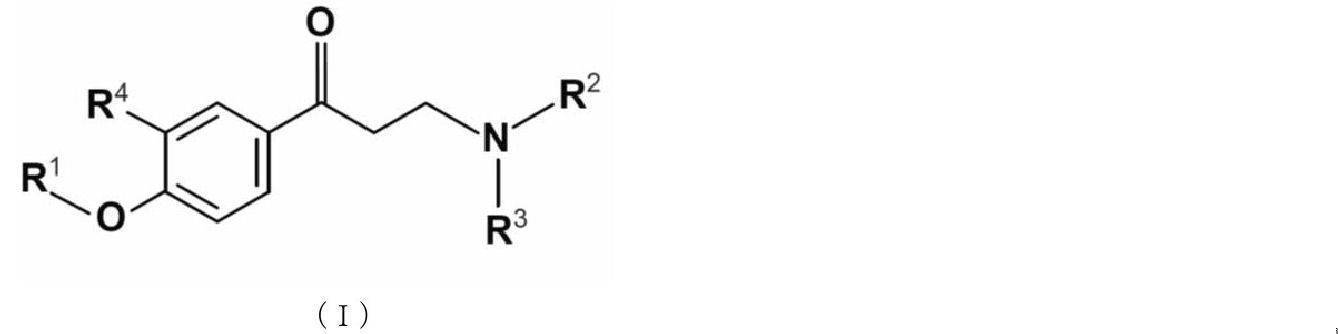
本発明のさらなる実施態様は、C1~6の直鎖または分岐アルキル基であり、R2及びR3は独立して選択されるC1~6の直鎖または分岐アルキル基であるか、R2とR3が一緒になってそれらが結合するNをヘテロ原子とする4員環、5員環、または6員環のアザシクロアルキル基を形成する。)
前記式(I)で表される化合物がジクロニン(Dyclonine)、BAS00363846、STL327701、PHAR033081、PHAR298639、またはAldi-2であってもよい。
本発明のさらなる実施態様は、アルデヒド脱水素酵素阻害剤とグルタチオン濃度低下剤またはグルタチオンS-トランスフェラーゼ阻害剤をin vitroで腫瘍細胞に同時に投与する工程と、前記腫瘍細胞の増殖速度または細胞生存率を測定する工程と、を含む測定方法である。
本発明のさらなる実施態様は、グルタチオン濃度低下剤またはグルタチオンS-トランスフェラーゼ阻害剤と併用効果を有するアルデヒド脱水素酵素阻害剤の特定方法であって、特定のグルタチオン濃度低下剤またはグルタチオンS-トランスフェラーゼ阻害剤と複数のアルデヒド脱水素酵素阻害剤をin vitroで腫瘍細胞に同時に投与する工程と、前記腫瘍細胞の増殖速度または細胞生存率を測定する工程と、を含む特定方法である。
本発明のさらなる実施態様は、アルデヒド脱水素酵素阻害剤と併用効果を有するグルタチオン濃度低下剤またはグルタチオンS-トランスフェラーゼ阻害剤の特定方法であって、抗腫瘍剤である特定のアルデヒド脱水素酵素阻害剤と、複数のグルタチオン濃度低下剤またはグルタチオンS-トランスフェラーゼ阻害剤とをin vitroで腫瘍細胞に同時に投与する工程と、前記腫瘍細胞の増殖速度または細胞生存率を測定する工程と、を含む特定方法である。
本発明のさらなる実施態様は、アルデヒド脱水素酵素阻害剤とグルタチオン濃度低下剤またはグルタチオンS-トランスフェラーゼ阻害剤との併用効果を奏する腫瘍細胞の特定方法であって、アルデヒド脱水素酵素阻害剤とグルタチオン濃度低下剤またはグルタチオンS-トランスフェラーゼ阻害剤の特定の組み合わせをin vitroで複数の腫瘍細胞に同時に投与する工程と、前記複数の腫瘍細胞の増殖速度または細胞生存率を測定する工程と、を含む特定方法である。
上記いずれかの特定方法または測定方法において、前記腫瘍細胞が、グルタチオン濃度低下剤またはグルタチオンS-トランスフェラーゼ阻害剤に耐性であってもよい。
==関連文献とのクロスリファレンス==
本出願は、2017年11月15日付で出願した日本国特許出願2017-220231に基づく優先権を主張するものであり、当該基礎出願を引用することにより、本明細書に含めるものとする。
本出願は、2017年11月15日付で出願した日本国特許出願2017-220231に基づく優先権を主張するものであり、当該基礎出願を引用することにより、本明細書に含めるものとする。
以下、本発明の実施の形態を、実施例を挙げながら詳細に説明する。なお、本発明の目的、特徴、利点、および、そのアイデアは、本明細書の記載により、当業者には明らかであり、本明細書の記載から、当業者であれば容易に本発明を再現できる。以下に記載された発明の実施の形態及び具体的な実施例などは、本発明の好ましい実施態様を示すものであり、例示又は説明のために示されているのであって、本発明をこれらに限定するものではない。本明細書で開示されている本発明の意図並びに範囲内で、本明細書の記載に基づき、様々な改変並びに修飾ができることは、当業者にとって明らかである。
なお、実施の形態及び実施例に特に説明がない場合には、標準的なプロトコール集に記載の方法、あるいはそれを修飾したり、改変したりした方法を用いる。また、市販の試薬キットや測定装置を用いる場合には、特に説明が無い場合、それらに添付のプロトコールを用いる。
==抗腫瘍剤==
本発明の一実施形態は、有効量のアルデヒド脱水素酵素阻害剤と同時に投与される、グルタチオン濃度低下剤を有効成分として含有する抗腫瘍剤である。ここで、有効量のアルデヒド脱水素酵素阻害剤とは、抗腫瘍活性として、グルタチオン濃度低下剤と併用効果を有する量のアルデヒド脱水素酵素阻害剤である。
本発明の一実施形態は、有効量のアルデヒド脱水素酵素阻害剤と同時に投与される、グルタチオン濃度低下剤を有効成分として含有する抗腫瘍剤である。ここで、有効量のアルデヒド脱水素酵素阻害剤とは、抗腫瘍活性として、グルタチオン濃度低下剤と併用効果を有する量のアルデヒド脱水素酵素阻害剤である。
また、本発明の他の実施形態は、有効量のグルタチオン濃度低下剤と同時に投与される、アルデヒド脱水素酵素阻害剤を有効成分として含有する抗腫瘍剤である。ここで、有効量のグルタチオン濃度低下剤とは、抗腫瘍活性として、アルデヒド脱水素酵素阻害剤と併用効果を有する量のグルタチオン濃度低下剤である。
アルデヒド脱水素酵素阻害剤は、アルデヒド脱水素酵素2(アルデヒド脱水素酵素2;ALDH)(EC1.2.1.10)の酵素活性を阻害する薬剤である。阻害対象とするALDHのタイプおよびイソタイプは特に限定されず、ALDH1~5、及びそれらのイソタイプのいずれであってもよい。抗腫瘍剤で使用されるアルデヒド脱水素酵素阻害剤は特に限定されないがクロープロパミド(chlorpropamide)、トルブタミド(tolbutamide)、ジエチルアミノベンズアルデヒド、ジスルフィラム(tetraethylthioperoxydicarbonic diamide)、シアナミド(cyanamide)、オキシフェドリン、シトラル(3,7-dimethyl-2,6-octadienal)、コプリン(coprine)、ダイジン(daidzin)、DEAB(4-(Diethylamino)benzaldehyde)、ゴシポール(gossypol)、キヌレニン代謝物(3-hydroxykynurenine, 3-hydroxyanthranilic acid, kynurenic acid, および indol-3-ylpyruvic acid)、モリネート(Molinate)、ニトログリセリン、パージリン(N-benzyl-N-methylprop-2-yn-1-amine)及びそれらの類縁体、またはそれらの薬理学的に許容される塩が例示できる。特に、以下に示すジクロニン及びジクロニン類縁体(I)が好ましく、図7に示した化合物(BAS00363846、STL327701、PHAR033081、PHAR298639、およびAldi-2)がより好ましい。

なお、薬理学的に許容される塩とは、それらの化合物と塩を形成するものであれば限定されないが、具体的には例えば塩酸塩、硫酸塩、硝酸塩、臭化水素酸塩、ヨウ化水素酸塩、過塩素酸塩、リン酸塩などの無機酸の付加塩、シュウ酸塩、マレイン酸塩、フマル酸塩、コハク酸塩などの有機酸の付加塩、メタンスルホン酸塩、エタンスルホン酸塩、ベンゼンスルホン酸塩、p-トルエンスルホン酸塩、カンファースルホン酸塩などのスルホン酸の付加塩、アミノ酸の付加塩などを挙げることができ、好ましくは塩酸塩、シュウ酸塩、マレイン酸塩、メタンスルホン酸塩である。さらに、それらの化合物またはその薬理学的に許容される塩は、無水物のみならず水和物や結晶多形も含まれることは言うまでもない。
グルタチオン濃度低下剤は、細胞内におけるグルタチオン濃度を低下させる薬剤である。これらの抗腫瘍剤で使用されるグルタチオン濃度低下剤は限定されないが、xCTが細胞内に取り込んだシスチンからグルタチオンが産生される経路を阻害する薬剤が好ましく、xCT、Thioredoxin-1(チオレドキシン-1:TRX-1)、glutamate-cysteine ligase(GCL)(EC6.3.2.2)(γ-グルタミルシステイン合成酵素とも呼ばれる)、グルタチオン合成酵素(EC6.3.2.3)のいずれかの活性を阻害する薬剤であることがより好ましく、xCT阻害剤がより好ましい。xCT阻害剤は特に限定されないが、スルファサラジン、エラスチン、ソラフェニブ、または抗xCT抗体であることが好ましい。
グルタチオンS-トランスフェラーゼ阻害剤は、グルタチオンS-トランスフェラーゼ(EC2.5.1.18)の酵素活性を阻害する薬剤であって、特に、HNE(4-HNE;4-ヒドロキシ-2-ノネナール)をHNE-GSHに変換する活性を阻害する薬剤である。グルタチオンS-トランスフェラーゼ阻害剤は特に限定されないが、グルタチオンアナログ(例えば、WO95/08563、WO96/40205、WO99/54346など)、ケトプロフェン、インドメタシン、エタクリン酸、ピロプロスト、抗GST抗体、GSTのドミナントネガティブ変異体等が挙げられる。
ここで、二つの薬剤を「同時に投与する」とは、時間的に同時に投与することのみならず、一方の薬剤の効果が残っている間に、他方の薬剤を投与する限り、時間的に前後してそれぞれ単独で投与することも意味するものとする。二つの薬剤を同時に投与する場合、一方のみを含有する薬剤を2種類同時に投与してもよいが、配合剤として二つの薬剤を一つの剤形にして投与してもよい。
抗腫瘍剤の投与対象は、脊椎動物であれば特に限定されないが、ヒトのがん患者であることが好ましい。治療対象の腫瘍は特に限定されないが、グルタチオン濃度低下剤またはグルタチオンS-トランスフェラーゼ阻害剤に対して耐性を有する腫瘍細胞を含む腫瘍が好ましい。この腫瘍細胞は、アルデヒド脱水素酵素が高発現していてもよい。グルタチオン濃度低下剤またはグルタチオンS-トランスフェラーゼ阻害剤は、xCT阻害剤であることが好ましく、スルファサラジンであることがより好ましい。耐性を有する腫瘍細胞とは、in vivoでは、患者に通常治療濃度で通常治療日数投与したときに生き残る腫瘍細胞であって、in vitroでは、80%以上の種類の細胞株において生存率が50%以下である濃度で生存率が90%以上の腫瘍細胞をいうものとする。例えば、スルファサラジン耐性腫瘍細胞とは、in vivoでは、患者にAUC0-24が50~300μg・h/mLで約2週間投与したときに生き残る腫瘍細胞であって、in vitroでは、200μMで生存率が90%以上の腫瘍細胞をいうものとする。スルファサラジン耐性腫瘍細胞は、CD44v発現も低レベルであるか、陰性であることが好ましい。アルデヒド脱水素酵素が過剰発現している腫瘍細胞とは、ALDH1A1、ALDH2、ALDH1B1,ALDH3A1のいずれかの遺伝子発現が、OSC19細胞に比較して3倍以上、好ましくは10倍以上高いレベルで発現している細胞をいうものとする。この治療対象の腫瘍には、CD44vが発現している腫瘍細胞が混入していてもよい。CD44vが発現している腫瘍細胞に対しては、スルファサラジンが効果的に抗腫瘍作用を有するからである。CD44vが発現している腫瘍細胞とは、CD44v発現が検出できる細胞であればよいが、高発現している細胞が好ましく、その場合の高発現とは、卵巣腫瘍細胞の平均レベルと同じ程度か高ければよいが、2倍以上高いことが好ましく、4倍以上高いことがより好ましく、10倍以上高いことがさらに好ましい。
腫瘍の種類は特に限定されないが、固形がんであることが好ましく、大腸腺癌、胃腺癌、乳腺癌、肺腺癌、膵腺癌、頭頸部の扁平上皮癌、卵巣腫瘍、精巣腫瘍を例示することができる。
抗腫瘍剤は、通常の方法により、錠剤、粉剤、顆粒剤、散剤、カプセル剤、液剤、乳剤、懸濁剤などに剤形化されてもよい。その際、当業者に知られた薬学的に許容できる添加剤、例えば賦形剤や担体を用いて製造される。
抗腫瘍剤は、有効量の範囲内で、投与対象に対して適した方法で投与すればよい。有効量は、剤形の種類、投与方法、投与対象の年齢や体重、投与対象の病状等を考慮して、最終的には医師または獣医師の判断により適宜決定することができる。例えば、化合物の投与量は1日当たり、0.1mg/kg以上であることが好ましく、1mg/kg以上であることがより好ましく、10mg/kg以上であることがさらに好ましく、1000mg/kg以下であることが好ましく、300mg/kg以下であることがより好ましく、100mg/kg以下であることがさらに好ましい。投与方法は、特に限定されず、例えば、経口投与してもよいし、腹腔内や静脈内への注射や点滴により非経口投与してもよいし、注射等によりがん内に直接投与してもよい。
==腫瘍細胞の増殖速度または細胞生存率の測定方法==
本発明の一実施形態は、アルデヒド脱水素酵素阻害剤と、グルタチオン濃度低下剤またはグルタチオンS-トランスフェラーゼ阻害剤とをin vitroで腫瘍細胞に同時に投与する工程と、薬剤を投与した腫瘍細胞の増殖速度または細胞生存率を測定する工程と、を含む測定方法である。本節におけるアルデヒド脱水素酵素阻害剤、グルタチオン濃度低下剤、グルタチオンS-トランスフェラーゼ阻害剤は、「抗腫瘍剤」の節で詳述したものに準じる。
本発明の一実施形態は、アルデヒド脱水素酵素阻害剤と、グルタチオン濃度低下剤またはグルタチオンS-トランスフェラーゼ阻害剤とをin vitroで腫瘍細胞に同時に投与する工程と、薬剤を投与した腫瘍細胞の増殖速度または細胞生存率を測定する工程と、を含む測定方法である。本節におけるアルデヒド脱水素酵素阻害剤、グルタチオン濃度低下剤、グルタチオンS-トランスフェラーゼ阻害剤は、「抗腫瘍剤」の節で詳述したものに準じる。
アルデヒド脱水素酵素阻害剤と、グルタチオン濃度低下剤またはグルタチオンS-トランスフェラーゼ阻害剤とは、抗腫瘍活性について併用効果を有しているので、この測定方法によって、併用効果の高い薬剤の組み合わせを見出したり、ある薬剤の組み合わせに対し、特に有効な腫瘍細胞を見出したりすることができる。
具体的には、特定のグルタチオン濃度低下剤またはグルタチオンS-トランスフェラーゼ阻害剤と複数のアルデヒド脱水素酵素阻害剤をin vitroで腫瘍細胞に同時に投与し、薬剤を投与した腫瘍細胞の増殖速度または細胞生存率を測定することによって、特定のグルタチオン濃度低下剤またはグルタチオンS-トランスフェラーゼ阻害剤と併用効果を有するアルデヒド脱水素酵素阻害剤を特定することができる。また、特定のアルデヒド脱水素酵素阻害剤と複数のグルタチオン濃度低下剤またはグルタチオンS-トランスフェラーゼ阻害剤をin vitroで腫瘍細胞に同時に投与し、薬剤を投与した腫瘍細胞の増殖速度または細胞生存率を測定することによって、特定のアルデヒド脱水素酵素阻害剤と併用効果を有するグルタチオン濃度低下剤またはグルタチオンS-トランスフェラーゼ阻害剤を特定することができる。あるいは、アルデヒド脱水素酵素阻害剤とグルタチオン濃度低下剤またはグルタチオンS-トランスフェラーゼ阻害剤の特定の組み合わせをin vitroで複数の腫瘍細胞に同時に投与し、薬剤を投与した複数の腫瘍細胞の増殖速度または細胞生存率を測定することにより、アルデヒド脱水素酵素阻害剤とグルタチオン濃度低下剤またはグルタチオンS-トランスフェラーゼ阻害剤との併用効果を奏する腫瘍細胞を特定することができる。
(実験例1)スルファサラジンとジクロニンとの併用効果
(目的)本実験例では、スルファサラジン耐性細胞の生存率低下に関し、xCT阻害効果のあるスルファサラジンとジクロニンとが併用効果を奏することを示す。
(目的)本実験例では、スルファサラジン耐性細胞の生存率低下に関し、xCT阻害効果のあるスルファサラジンとジクロニンとが併用効果を奏することを示す。
(方法)96ウエルプレートに、スルファサラジン耐性細胞株である口腔扁平上皮がん細胞株HSC-4を2000個/ウエルで播種し、培養を開始した。培地は、DMEMを用いた。24時間後、50μMジクロニンまたは等量のDMSOと、0μM(無添加)、50μM、100μM、200μM、または400μMのスルファサラジンを含有した培地に交換し、48時間、培養を続けた。その後、Celltiter-Glo(Promega社)を用いて細胞生存率を測定し、コントロール(DMSO添加、スルファサラジン無添加)の細胞生存数を100%として、各場合の細胞生存率を算出した。図1にスルファサラジンの各濃度に対する生存率を表すグラフを作成した。
(結果)HSC4は、スルファサラジン耐性細胞株であって、スルファサラジン単独では細胞生存率にほとんど影響がない。また、ジクロニン単独(ジクロニン添加、スルファサラジン無添加)でも、80%の生存率を示す。しかしながら、ジクロニンとスルファサラジンを両方添加すると、スルファサラジンが100μM以上で、生存率が10%以下となる。
このように、スルファサラジン耐性細胞の生存率低下に関し、スルファサラジンとジクロニンとが併用効果を奏する。
(実験例2)xCTノックダウンによるジクロニン感受性の変化
(目的)本実験例では、xCT阻害効果のあるスルファサラジンの代わりにxCTをノックダウンしても、同様なジクロニンとの併用効果が得られることを示すことによって、スルファサラジンとジクロニンとが併用効果を有するのは、スルファサラジンのxCT阻害効果を介していることを示す。
(目的)本実験例では、xCT阻害効果のあるスルファサラジンの代わりにxCTをノックダウンしても、同様なジクロニンとの併用効果が得られることを示すことによって、スルファサラジンとジクロニンとが併用効果を有するのは、スルファサラジンのxCT阻害効果を介していることを示す。
(方法)96ウエルプレートにスルファサラジン耐性細胞株である口腔扁平上皮がん細胞株HSC-4細胞を3000個/ウエルで播種し、非サイレンシングコントロール(スクランブル(Sense: UUCUCCGAACGUGUCACGUtt(配列番号1), Antisense: ACGUGACACGUUCGGAGAAtt(配列番号2)))siRNAまたはxCT特異的siRNA(xCT siRNA#1 Sense: AGAAAUCUGGAGGUCAUUAtt(配列番号3), Antisense:AGAAAUCUGGAGGUCAUUAtt(配列番号4), xCT siRNA#2 Sense: CCAGAACAUUACAAAUAAUtt(配列番号5), Antisense: AUUAUUUGUAAUGUUCUGGtt(配列番号6))をLipofectamine RNAiMAX(ThermoFisher Scientific社)を用いてリポフェクトし、培養を開始した。培地はDMEMを用いた。24時間後、50μMジクロニン(溶媒はDMSO)または等量のDMSOを含有する培地に交換し、48時間培養を続けた。その後、Celltiter-Glo(Promega社)を用いて細胞生存率を測定し、コントロール(非サイレンシングコントロール、DMSO添加)の細胞生存率を100%として、それぞれの細胞生存率を算出した。図2に結果を示す。
(結果)HSC-4は、50μMのジクロニン単独では約60%の細胞生存率を有するのに対し、xCTをノックダウンした場合、50μMのジクロニン存在下で、約10~20%の細胞生存率しか有しない。
このように、スルファサラジンとジクロニンとが併用効果を有するのは、スルファサラジンのxCT阻害効果を介している。
(実験例3)各種癌細胞株におけるスルファサラジン、エラスチン、またはBSOとジクロニンとの併用効果
(目的)本実験例では、様々な腫瘍細胞株において、スルファサラジン、xCTの特異的阻害剤であるエラスチン、またはグルタチオン合成阻害剤であるBSOとジクロニンとが併用効果を奏することを示すのと同時に、xCTの阻害がグルタチオン合成阻害を介していることを示す。
(目的)本実験例では、様々な腫瘍細胞株において、スルファサラジン、xCTの特異的阻害剤であるエラスチン、またはグルタチオン合成阻害剤であるBSOとジクロニンとが併用効果を奏することを示すのと同時に、xCTの阻害がグルタチオン合成阻害を介していることを示す。
(方法)96ウエルプレートに、図3に示す細胞株を3000個/ウエルで播種し、培養を開始した。培地は、DMEMを用いた。24時間後、50μMジクロニンまたは等量のDMSOと、0μM(無添加)または400μMのスルファサラジン、0μM(無添加)または5μMのエラスチン、0μM(無添加)または100μMのBSOを含有した培地に交換し、48時間、培養を続けた。その後、Celltiter-Glo(Promega社)を用いて細胞生存率を測定し、コントロール(DMSO添加、ジクロニン無添加)の細胞生存数を100%として、それぞれの細胞生存率を算出した。図3に各場合の細胞生存率を図示した。
(結果)細胞によって大小はあるが、スルファサラジン、エラスチン、またはBSOとジクロニンのいずれの組み合わせにおいても同様な併用効果が観察された。
このように、スルファサラジンやエラスチンによるxCTの阻害は、グルタチオンの合成阻害によって、その抗腫瘍効果を発揮する。従って、スルファサラジンやエラスチンの代わりにグルタチオン濃度低下剤またはグルタチオンS-トランスフェラーゼ阻害剤を用いることができる。
(実験例4)スルファサラジンとジクロニンのin vivoにおける併用効果
(目的)本実験例では、スルファサラジンとジクロニンの併用効果が、in vivoでも観察されることを示す。
(目的)本実験例では、スルファサラジンとジクロニンの併用効果が、in vivoでも観察されることを示す。
(方法)スルファサラジン耐性細胞株である口腔扁平上皮がん細胞株HSC-2細胞の1×10⁶個をヌードマウス皮下に移植し、移植後4日目より生理食塩水、スルファサラジン単独、ジクロニン単独、スルファサラジンとジクロニン両方を1日1回、各薬剤をスルファサラジン400mg/kg、ジクロニン5mg/kgの投与量で腹腔内投与し、22日目まで続けた。3~4日おきに、腫瘍の短径、長径を測定し、以下の式により腫瘍体積を算出し、結果を図4にグラフ化した。
腫瘍体積=(長径×(短径)2)/2
なお、腫瘍体積の統計解析は、22日目にt検定により行った。
なお、腫瘍体積の統計解析は、22日目にt検定により行った。
(結果)図4で示すように、各薬剤単独では、35%程度の腫瘍体積の減少であったが、両方投与すると、70%程度体積が減少した。
このように、スルファサラジンとジクロニンとの併用投与によって、スルファサラジン耐性腫瘍の増殖を低下させることができる。
(実験例5)ジクロニンによるALDHの阻害
(目的)本実験例では、ジクロニンがALDHの阻害活性を有することを示す。
(目的)本実験例では、ジクロニンがALDHの阻害活性を有することを示す。
(方法)10cm細胞培養デイシュに口腔届平上皮がん細胞株HSC-4細胞を8×10⁵個/ディッシュで播種し、培養を開始した。培地は、DMEMを用いた。24時間後、50μMのジクロニン(溶媒はDMSO)を含む培地に交換し、24時間培養した。その後、細胞を回収し、ALDEFLUOR kit(STEMCELL Technologies社)により、N,N-diethylaminobenzaldehyde(DEAB)存在下でのALDH活性を有する細胞を染色し、FACSで解析した(図ではDyclonine)。コントロールとして、DEABを添加せずALDEFLUOR kitで染色しなかったもの(図ではUnstained)、ジクロニンを含まない等量のDMSOを含む培地に交換し、ALDEFLUOR kitで染色したもの(図ではNon-treatment)についての実験結果を示す。なお、陽性細胞の計測については、DEAB存在下でALDEFLUOR kitによる染色を行ったDMSO処理サンプル(図ではDEAB)について陽性細胞がほぼ0%となるようなゲートを作製し、各場合の陽性率を計算した。
(結果)図5に示すように、DMSO処理細胞においてはALDH活性の高い細胞群が25%程度存在しているが、ジクロニン処理細胞および既知のALDH阻害剤であるDEAB処理細胞においてはALDH活性が高い細胞群は1%程度まで抑制されている。
このように、ジクロニンはALDHの阻害活性を有する。
(実験例6)スルファサラジンとジクロニン併用によるHNEの蓄積
(目的)本実験例では、スルファサラジンとジクロニンの併用によって、腫瘍細胞内でのHNEのレベル、及びHNEを蓄積する細胞の頻度が著しく増加することを示す。
(目的)本実験例では、スルファサラジンとジクロニンの併用によって、腫瘍細胞内でのHNEのレベル、及びHNEを蓄積する細胞の頻度が著しく増加することを示す。
(方法)実験例1と同様に、50μMジクロニンまたは等量のDMSOと、0μM(無添加)または400μMのスルファサラジンとを含有した培地でHSC-4細胞を培養し、処理後の細胞を4%PFA-PBSにて固定した。さらに、0.2%TritonX100-PBSにて細胞膜透過処理を行った後、3%BSA-PBSによるブロッキングを行った。その後、1次抗体として抗HNE抗体、2次抗体としてAlexafluor488標識抗マウスIgG抗体を用いて蛍光染色した。ポジティブコントロールとして、50μMHNEで30分インキュベートした細胞を用い、同様に抗体染色を行った。蛍光顕微鏡での観察像を図6に示す。
(結果)ジクロニンまたはスルファサラジンをそれぞれ単独で処理した場合、低頻度で細胞内HNE濃度の増加が観察されるが、スルファサラジンとジクロニンの併用によって、高頻度で高濃度の細胞内HNEの蓄積が観察された。
このように、xCT阻害剤とALDH阻害剤を併用することで、高頻度で高濃度の細胞内HNEの蓄積が観察されるようになる。この理由として、以下の理論に拘泥するものではないが、図11に示すように、細胞内では、HNEを分解する経路が複数存在し、その中でGSTを介する経路とALDHを介する分解経路の二つを同時に阻害することにより、細胞内でHNEが蓄積するものと考えられる。そして、HNEには細胞毒性があるので、腫瘍細胞が増殖できなくなると考えられる。
(実験例7)スルファサラジンまたはBSOとジクロニン類縁体(ジクロニン骨格を有するもの)との併用効果
(目的)ジクロニン骨格を有する下記ジクロニン類縁体(I)は、スルファサラジンまたはBSOとの併用効果を有することを示す。
(目的)ジクロニン骨格を有する下記ジクロニン類縁体(I)は、スルファサラジンまたはBSOとの併用効果を有することを示す。
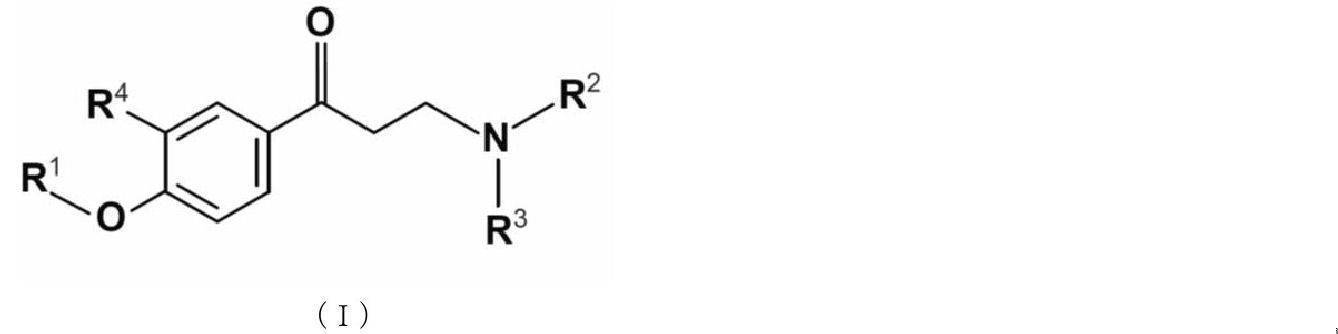
(方法)実験例1と同様に、0μM(無添加)、25μM、50μM、または100μMのジクロニン、又は12.5μM、25μM、50μM、100μMのジクロニン類縁体BAS00363846、STL327701、PHAR033081、PHAR298639、またはAldi-2(構造式は図7B参照)と、0μM(無添加)または100μMBSOまたは300μMスルファサラジンを含有した培地でHSC-4細胞を培養し、細胞生存率を測定して、図7Aにグラフ化した。
(結果)これらの化合物はすべてBSOまたはスルファサラジンとの併用効果を奏した。
このように、ジクロニン骨格を有するジクロニン類縁体(I)は、xCT阻害剤と抗腫瘍剤として併用効果を有する。
(実験例8)BSOとジクロニン類縁体(ジクロニン骨格を有さないもの)との併用効果
(目的)ジクロニン骨格を有さないジクロニン類縁体は、BSOとの併用効果を有さないことを示す。
(目的)ジクロニン骨格を有さないジクロニン類縁体は、BSOとの併用効果を有さないことを示す。
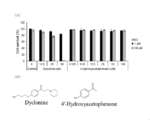
(方法)実験例1と同様に、0μM(無添加)、12.5μM、25μM、または50μMジクロニン、又は3.125μM、6.25μM、12.5μM、25μM、50μM、100μMのジクロニン類縁体(4-hydroxyacetpphenone:構造式は図8B参照)と、0μM(無添加)または100μMBSOを含有した培地でHSC-4細胞を培養し、細胞生存率を測定して、図8Aにグラフ化した。
(結果)ジクロニン骨格を有さないジクロニン類縁体はBSOとの併用効果を奏しなかった。
このように、xCT阻害剤との相互作用には、ジクロニン骨格が重要である。
(実験例9)スルファサラジン耐性OSC19細胞におけるスルファサラジン、エラスチン、またはBSOとジクロニンとの併用効果
(目的)xCT阻害剤に対する耐性を獲得したがん細胞株においてジクロニンがグルタチオン合成阻害剤との併用効果を有することを示す。
(目的)xCT阻害剤に対する耐性を獲得したがん細胞株においてジクロニンがグルタチオン合成阻害剤との併用効果を有することを示す。
(方法)スルファサラジン感受性口腔扁平上皮がん細胞株OSC19をスルファサラジンを含むDMEM培地中で2ケ月間培養し、スルファサラジン耐性OSC19細胞を樹立した。OSC19細胞の親株またはOSC19-SSZR細胞を96ウエルプレートに3000個/ウエルで播種し、24時間培養後、図9に示した濃度のスルファサラジン、エラスチン、またはBSOと、50μMのジクロニン(溶媒はDMSO)または等量のDMSOを含む培地に交換し、48時間培養した。その後、Celltiter-Glo(Promega社)により細胞生存率を測定し、コントロール(スルファサラジン、エラスチンおよびBSO無添加、DMSO添加)を100%として細胞生存率を算出した。
(結果)ジクロニンはOSC19-SSZR細胞においてもスルファサラジン、エラスチンまたはBSOとの併用効果を示した。
このように、ジクロニンはxCT阻害剤に対する耐性を獲得したがん細胞においてもグルタチオン合成阻害剤との併用効果を示す。
(実験例10)スルファサラジン耐性OSC19細胞およびHSC-4におけるALDH遺伝子ファミリーの発現
(目的)xCT阻害剤に対する耐性を有するがん細胞においてALDH遺伝子ファミリーが高発現していることを示す。
(目的)xCT阻害剤に対する耐性を有するがん細胞においてALDH遺伝子ファミリーが高発現していることを示す。
(方法)HSC-4細胞、OSC19細胞およびOSC19-SSZR細胞よりメッセ
ンジャーRNAを抽出し、逆転写反応を行うことにより相補的DNAを合成した。その後、得られた相補的DNAを鋳型とし、定量的RT-PCR法によりALDHIAl、
ALDHIBl、ALDH2、ALDH3AlおよびRPS17の発現量を測定した。RPS17の発現量をリファレンスとして、ΔΔCt法により各ALDHファミリー遺伝子の発現量を定量し、図10にグラフ化した。
ンジャーRNAを抽出し、逆転写反応を行うことにより相補的DNAを合成した。その後、得られた相補的DNAを鋳型とし、定量的RT-PCR法によりALDHIAl、
ALDHIBl、ALDH2、ALDH3AlおよびRPS17の発現量を測定した。RPS17の発現量をリファレンスとして、ΔΔCt法により各ALDHファミリー遺伝子の発現量を定量し、図10にグラフ化した。
(結果)ALDHIAlはOSC19に比較して、OSC19-SSZRにおいて発現が上昇していた。ALDHIBlおよびALDH2はHSC~4に高い発現が認められた。ALDH3AlはHSC4およびOSC19-SSZRにおいて高発現であった。このように、xCT低感受性のがん細胞株においてALDHファミリー遺伝子の発現が高い傾向にあった。
このように、ALDHファミリー遺伝子の発現が高いがん細胞では、ALDHファミリー遺伝子によりHNEを分解しているために、xCT阻害剤によってGSTへの分解を抑制しても、HNEによる毒性は作用せず、xCT阻害剤に耐性を得る(図11参照)。このような細胞にALDH阻害剤を投与すると、xCT阻害剤に対する感受性が上がるので、ALDH阻害剤及びグルタチオン濃度低下剤またはグルタチオンS-トランスフェラーゼ阻害剤を含有する抗腫瘍剤は、ALDHファミリー遺伝子の発現が高いがん細胞にも効果的に作用する。
本発明によって、新規な抗腫瘍剤及び配合剤を提供することができるようになった。
Claims (24)
- 有効量のアルデヒド脱水素酵素阻害剤と同時に投与される、グルタチオン濃度低下剤またはグルタチオンS-トランスフェラーゼ阻害剤を有効成分として含有する抗腫瘍剤。
- 有効量のグルタチオン濃度低下剤またはグルタチオンS-トランスフェラーゼ阻害剤と同時に投与される、アルデヒド脱水素酵素阻害剤を有効成分として含有する抗腫瘍剤。
- 前記グルタチオン濃度低下剤がxCT、Thioredoxin-1(チオレドキシン-1:TRX-1)、glutamate-cysteine ligase(GCL)(EC6.3.2.2)(γ-グルタミルシステイン合成酵素とも呼ばれる)、グルタチオン合成酵素(EC6.3.2.3)のいずれかの活性を阻害する薬剤である、請求項1または2に記載の抗腫瘍剤。
- 前記薬剤がxCTトランスポーターの阻害剤である、請求項3に記載の抗腫瘍剤。
- 前記xCTトランスポーターの阻害剤がスルファサラジン、エラスチン、またはソラフェニブである、請求項4に記載の抗腫瘍剤。
- 前記アルデヒド脱水素酵素阻害剤が下記式(I)で表される化合物またはその薬理学的に許容される塩である、請求項1~5のいずれか1項に記載の抗腫瘍剤。
(式中、R1はC1~6の直鎖または分岐アルキル基であり、R2及びR3は独立して選択されるC1~6の直鎖または分岐アルキル基であるか、R2とR3が一緒になってそれらが結合するNをヘテロ原子とする4員環、5員環、6員環、または7員環のアザシクロアルキル基を形成し、R4は水素またはハロゲンである。)
- 前記式(I)で表される化合物がジクロニン、BAS00363846、STL327701、PHAR033081、PHAR298639、またはAlid-2である、請求項6に記載の抗腫瘍剤。
- アルデヒド脱水素酵素阻害剤とグルタチオン濃度低下剤またはグルタチオンS-トランスフェラーゼ阻害剤とを有効成分として含有する配合剤。
- 前記グルタチオン濃度低下剤がxCTトランスポーターの阻害剤である、請求項8に記載の配合剤。
- 前記xCTトランスポーターの阻害剤がスルファサラジン、エラスチン、またはソラフェニブである、請求項9に記載の配合剤。
- 前記アルデヒド脱水素酵素阻害剤が前記式(I)で表される化合物またはその薬理学的に許容される塩である、請求項8~10のいずれか1項に記載の配合剤。
(式中、R1はC1~6の直鎖または分岐アルキル基であり、R2及びR3は独立して選択されるC1~6の直鎖または分岐アルキル基であるか、R2とR3が一緒になってそれらが結合するNをヘテロ原子とする4員環、5員環、6員環、または7員環のアザシクロアルキル基を形成し、R4は水素またはハロゲンである。)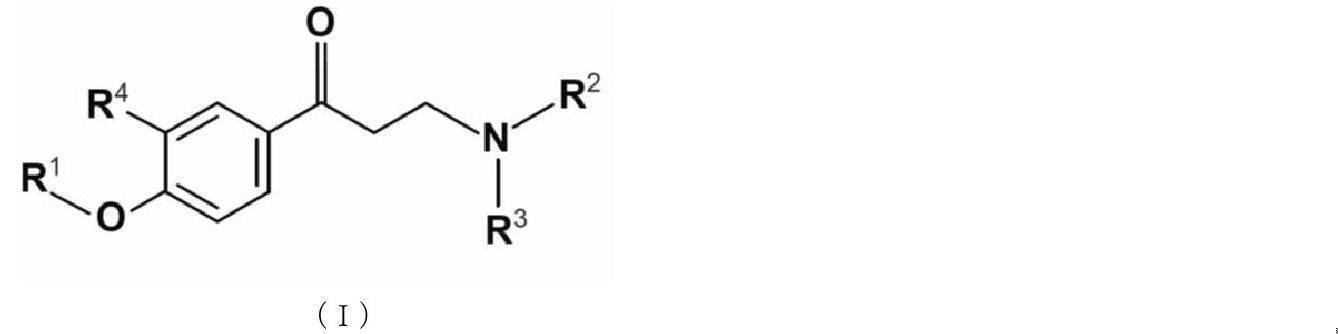
- 前記式(3)で表される化合物がジクロニン、BAS00363846、STL327701、PHAR033081、PHAR298639、またはAlid-2である、請求項11に記載の配合剤。
- 請求項8~12に記載の配合剤を含有する抗腫瘍剤。
- グルタチオン濃度低下剤またはグルタチオンS-トランスフェラーゼ阻害剤に耐性を有する腫瘍細胞を含む腫瘍に対する抗腫瘍剤である、請求項1~7、13のいずれか1項に記載の抗腫瘍剤。
- 前記グルタチオン濃度低下剤がxCT阻害剤である、請求項14に記載の抗腫瘍剤。
- 前記xCT阻害剤がスルファサラジンである、請求項15に記載の抗腫瘍剤。
- 前記腫瘍細胞においてアルデヒド脱水素酵素が高発現している、請求項14~16に記載の抗腫瘍剤。
- 前記腫瘍はCD44vが発現している腫瘍細胞をさらに含む、請求項14~17に記載の抗腫瘍剤。
- アルデヒド脱水素酵素阻害剤とグルタチオン濃度低下剤またはグルタチオンS-トランスフェラーゼ阻害剤をin vitroで腫瘍細胞に同時に投与する工程と、
前記腫瘍細胞の増殖速度または細胞生存率を測定する工程と、を含む測定方法。 - グルタチオン濃度低下剤またはグルタチオンS-トランスフェラーゼ阻害剤と併用効果を有するアルデヒド脱水素酵素阻害剤の特定方法であって、
特定のグルタチオン濃度低下剤またはグルタチオンS-トランスフェラーゼ阻害剤と複数のアルデヒド脱水素酵素阻害剤をin vitroで腫瘍細胞に同時に投与する工程と、
前記腫瘍細胞の増殖速度または細胞生存率を測定する工程と、を含む特定方法。 - アルデヒド脱水素酵素阻害剤と併用効果を有するグルタチオン濃度低下剤またはグルタチオン-S-トランスフェラーゼ阻害剤の特定方法であって、
抗腫瘍剤である特定のアルデヒド脱水素酵素阻害剤と、複数のグルタチオン濃度低下剤またはグルタチオンS-トランスフェラーゼ阻害剤とをin vitroで腫瘍細胞に同時に投与する工程と、
前記腫瘍細胞の増殖速度または細胞生存率を測定する工程と、を含む特定方法。 - アルデヒド脱水素酵素阻害剤とグルタチオン濃度低下剤またはグルタチオンS-トランスフェラーゼ阻害剤との併用効果を奏する腫瘍細胞の特定方法であって、
アルデヒド脱水素酵素阻害剤とグルタチオン濃度低下剤またはグルタチオンS-トランスフェラーゼ阻害剤の特定の組み合わせをin vitroで複数の腫瘍細胞に同時に投与する工程と、
前記複数の腫瘍細胞の増殖速度または細胞生存率を測定する工程と、を含む特定方法。 - 前記腫瘍細胞が、グルタチオン濃度低下剤またはグルタチオンS-トランスフェラーゼ阻害剤に耐性である、請求項19に記載の測定方法。
- 前記腫瘍細胞が、グルタチオン濃度低下剤またはグルタチオンS-トランスフェラーゼ阻害剤に耐性である、請求項20~22のいずれか1項に記載の特定方法。
Priority Applications (3)
| Application Number | Priority Date | Filing Date | Title |
|---|---|---|---|
| JP2019554284A JP7388702B2 (ja) | 2017-11-15 | 2018-11-15 | 抗腫瘍剤及び配合剤 |
| JP2023191878A JP2024023269A (ja) | 2017-11-15 | 2023-11-09 | 抗腫瘍剤及び配合剤 |
| JP2025161179A JP2026001113A (ja) | 2017-11-15 | 2025-09-29 | 抗腫瘍剤及び配合剤 |
Applications Claiming Priority (2)
| Application Number | Priority Date | Filing Date | Title |
|---|---|---|---|
| JP2017-220231 | 2017-11-15 | ||
| JP2017220231 | 2017-11-15 |
Publications (1)
| Publication Number | Publication Date |
|---|---|
| WO2019098288A1 true WO2019098288A1 (ja) | 2019-05-23 |
Family
ID=66539585
Family Applications (1)
| Application Number | Title | Priority Date | Filing Date |
|---|---|---|---|
| PCT/JP2018/042327 Ceased WO2019098288A1 (ja) | 2017-11-15 | 2018-11-15 | 抗腫瘍剤及び配合剤 |
Country Status (2)
| Country | Link |
|---|---|
| JP (3) | JP7388702B2 (ja) |
| WO (1) | WO2019098288A1 (ja) |
Cited By (1)
| Publication number | Priority date | Publication date | Assignee | Title |
|---|---|---|---|---|
| WO2020230701A1 (ja) * | 2019-05-14 | 2020-11-19 | 学校法人 慶應義塾 | 抗腫瘍剤及び配合剤 |
Citations (4)
| Publication number | Priority date | Publication date | Assignee | Title |
|---|---|---|---|---|
| JP2010523476A (ja) * | 2007-03-08 | 2010-07-15 | ザ ボード オブ トラスティーズ オブ ザ リーランド スタンフォード ジュニア ユニバーシティ | ミトコンドリアアルデヒドデヒドロゲナーゼ−2モジュレーター及びその使用方法 |
| JP2012144498A (ja) * | 2011-01-13 | 2012-08-02 | Kinki Univ | 抗腫瘍剤 |
| WO2015115310A1 (ja) * | 2014-01-29 | 2015-08-06 | 学校法人慶應義塾 | がん幹細胞の増殖抑制剤および細胞内活性酸素蓄積誘導剤 |
| JP2016509045A (ja) * | 2013-02-22 | 2016-03-24 | エフ・ホフマン−ラ・ロシュ・アクチェンゲゼルシャフト | がんを治療し、薬剤耐性を防止する方法 |
Family Cites Families (2)
| Publication number | Priority date | Publication date | Assignee | Title |
|---|---|---|---|---|
| US8940311B2 (en) * | 2004-10-21 | 2015-01-27 | Tae-Hong Lim | In situ controlled release drug delivery system |
| KR20180132939A (ko) * | 2016-05-03 | 2018-12-12 | 갈레라 랩스, 엘엘씨 | 암 치료를 위한 조합 요법 |
-
2018
- 2018-11-15 WO PCT/JP2018/042327 patent/WO2019098288A1/ja not_active Ceased
- 2018-11-15 JP JP2019554284A patent/JP7388702B2/ja active Active
-
2023
- 2023-11-09 JP JP2023191878A patent/JP2024023269A/ja active Pending
-
2025
- 2025-09-29 JP JP2025161179A patent/JP2026001113A/ja active Pending
Patent Citations (4)
| Publication number | Priority date | Publication date | Assignee | Title |
|---|---|---|---|---|
| JP2010523476A (ja) * | 2007-03-08 | 2010-07-15 | ザ ボード オブ トラスティーズ オブ ザ リーランド スタンフォード ジュニア ユニバーシティ | ミトコンドリアアルデヒドデヒドロゲナーゼ−2モジュレーター及びその使用方法 |
| JP2012144498A (ja) * | 2011-01-13 | 2012-08-02 | Kinki Univ | 抗腫瘍剤 |
| JP2016509045A (ja) * | 2013-02-22 | 2016-03-24 | エフ・ホフマン−ラ・ロシュ・アクチェンゲゼルシャフト | がんを治療し、薬剤耐性を防止する方法 |
| WO2015115310A1 (ja) * | 2014-01-29 | 2015-08-06 | 学校法人慶應義塾 | がん幹細胞の増殖抑制剤および細胞内活性酸素蓄積誘導剤 |
Non-Patent Citations (5)
| Title |
|---|
| DONGHONG JU. ET AL.: "Dyclonine and alverine citrate enhance the cytotoxic effects of proteasome inhibitor MG 132 on breast cancer", INTERNATIONAL JOURNAL OF MOLECULAR MEDICINE, vol. 23, no. 2, February 2009 (2009-02-01), pages 205 - 209, XP055373412 * |
| KHANNA M. ET AL.: "Discovery for a Novel Class of Covalent Inhibitor for Aldehyde Dehydrogenases", THE JOURNAL OF BIOLOGICAL CHEMISTRY, vol. 286, no. 50, 2011, pages 43486 - 43494, XP055246217, DOI: doi:10.1074/jbc.M111.293597 * |
| OKAZAKI S. ET AL.: "Synthetic lethality of the ALDH3A1 inhibitor dyclonine and xCT inhibitors in glutathione deficiency-resistant cancer cells", ONCOTARGET, vol. 9, no. 73, 18 September 2018 (2018-09-18), pages 33832 - 33843, XP055609820 * |
| PARAJULI B. ET AL.: "Development of Selective Inhibitors for Human Aldehyde Dehydrogenase 3A1(ALDH3A1) for the Enhancement of Cyclophosphamide Cytotoxicity", CHEMBIOCHEM, vol. 15, no. 5, 21 March 2014 (2014-03-21), pages 701 - 712, XP055609817 * |
| SAYA HIDEYUKI ET AL.: "The idea of therapeutic strategy targeted to cancer stem cells of solid cancer", JOURNAL OF THE MOLECULAR TARGETED THERAPY FOR CANCER, vol. 12, no. 3, 2014, pages 262 - 265 * |
Cited By (2)
| Publication number | Priority date | Publication date | Assignee | Title |
|---|---|---|---|---|
| WO2020230701A1 (ja) * | 2019-05-14 | 2020-11-19 | 学校法人 慶應義塾 | 抗腫瘍剤及び配合剤 |
| CN114126652A (zh) * | 2019-05-14 | 2022-03-01 | 学校法人庆应义塾 | 抗肿瘤剂和配合剂 |
Also Published As
| Publication number | Publication date |
|---|---|
| JPWO2019098288A1 (ja) | 2020-12-03 |
| JP2026001113A (ja) | 2026-01-06 |
| JP2024023269A (ja) | 2024-02-21 |
| JP7388702B2 (ja) | 2023-11-29 |
Similar Documents
| Publication | Publication Date | Title |
|---|---|---|
| JP6621501B2 (ja) | 新規癌治療法としてのアリール炭化水素受容体(AhR)改変物質 | |
| JP6539345B2 (ja) | がん治療のための医薬組成物の調製におけるデュロキセチン塩酸塩薬物の使用 | |
| TWI449525B (zh) | 治療癌症之相乘醫藥組合 | |
| ES2713699T3 (es) | 17alfa,21-Diésteres de cortexolona para el uso en el tratamiento de tumores | |
| JP6401317B2 (ja) | がんを治療するためのシステム、方法、および製剤 | |
| JP7683931B2 (ja) | 抗腫瘍剤及び配合剤 | |
| KR20190018486A (ko) | 암의 예방 및/또는 치료를 위한 화합물, 조성물 및 방법 | |
| TW201609094A (zh) | 治療癌症之新穎方法 | |
| JP2026001113A (ja) | 抗腫瘍剤及び配合剤 | |
| US10266490B2 (en) | Radioprotector compounds | |
| JPWO2008139952A1 (ja) | 微小管破壊剤及びそれを含有する癌細胞増殖抑制剤 | |
| WO2017076332A1 (zh) | 具有acc1蛋白调控作用的五环三萜类化合物及其用途 | |
| EP3429572B1 (en) | Combination therapy for proliferative diseases | |
| RU2491938C2 (ru) | Производное изоксазола для лечения рака | |
| US20260007652A1 (en) | Selective Modulators of AhR-Regulated Transcription and Method for Using Such Modulators to Treat Cancer | |
| AU2017380492A1 (en) | Sulfonyl amidine as indoleamine-2,3-dioxygenase inhibitor, and preparation method therefor and use thereof | |
| US10512631B2 (en) | Chalcone compounds | |
| US10058618B2 (en) | PAK1-blocking 1,2,3-triazolyl esters | |
| JP2021004230A (ja) | 急性tリンパ芽球性白血病若しくはリンパ腫、又は急性骨髄性白血病治療用医薬組成物 | |
| WO2022051388A2 (en) | Quinolin-2(1h)-one inhibitors of late sv40 factor | |
| WO2021157613A1 (ja) | ピラゾール誘導体及び医薬組成物 | |
| WO2021043862A1 (en) | Thioridazine derivatives and their use for the treatment of cancer | |
| HK1229695A1 (en) | Novel methods for treating cancer | |
| WO2010139665A1 (en) | Treatment of malignant diseases |
Legal Events
| Date | Code | Title | Description |
|---|---|---|---|
| 121 | Ep: the epo has been informed by wipo that ep was designated in this application |
Ref document number: 18879909 Country of ref document: EP Kind code of ref document: A1 |
|
| ENP | Entry into the national phase |
Ref document number: 2019554284 Country of ref document: JP Kind code of ref document: A |
|
| NENP | Non-entry into the national phase |
Ref country code: DE |
|
| 122 | Ep: pct application non-entry in european phase |
Ref document number: 18879909 Country of ref document: EP Kind code of ref document: A1 |