WO2019065776A1 - 組成物及び硬化物 - Google Patents
組成物及び硬化物 Download PDFInfo
- Publication number
- WO2019065776A1 WO2019065776A1 PCT/JP2018/035789 JP2018035789W WO2019065776A1 WO 2019065776 A1 WO2019065776 A1 WO 2019065776A1 JP 2018035789 W JP2018035789 W JP 2018035789W WO 2019065776 A1 WO2019065776 A1 WO 2019065776A1
- Authority
- WO
- WIPO (PCT)
- Prior art keywords
- group
- meth
- compound
- formula
- ether
- Prior art date
- Legal status (The legal status is an assumption and is not a legal conclusion. Google has not performed a legal analysis and makes no representation as to the accuracy of the status listed.)
- Ceased
Links
- FVKFHMNJTHKMRX-UHFFFAOYSA-N C(CN1)CN2C1=NCCC2 Chemical compound C(CN1)CN2C1=NCCC2 FVKFHMNJTHKMRX-UHFFFAOYSA-N 0.000 description 2
- 0 COc1ccc(C(CC(*)=O)[n]2cncc2)cc1 Chemical compound COc1ccc(C(CC(*)=O)[n]2cncc2)cc1 0.000 description 1
- KWRKHOLIBQPUKT-UHFFFAOYSA-N COc1ccc(C(CC(O)=O)[n]2cncc2)cc1 Chemical compound COc1ccc(C(CC(O)=O)[n]2cncc2)cc1 KWRKHOLIBQPUKT-UHFFFAOYSA-N 0.000 description 1
Classifications
-
- C—CHEMISTRY; METALLURGY
- C08—ORGANIC MACROMOLECULAR COMPOUNDS; THEIR PREPARATION OR CHEMICAL WORKING-UP; COMPOSITIONS BASED THEREON
- C08G—MACROMOLECULAR COMPOUNDS OBTAINED OTHERWISE THAN BY REACTIONS ONLY INVOLVING UNSATURATED CARBON-TO-CARBON BONDS
- C08G59/00—Polycondensates containing more than one epoxy group per molecule; Macromolecules obtained by polymerising compounds containing more than one epoxy group per molecule using curing agents or catalysts which react with the epoxy groups
- C08G59/18—Macromolecules obtained by polymerising compounds containing more than one epoxy group per molecule using curing agents or catalysts which react with the epoxy groups ; e.g. general methods of curing
- C08G59/40—Macromolecules obtained by polymerising compounds containing more than one epoxy group per molecule using curing agents or catalysts which react with the epoxy groups ; e.g. general methods of curing characterised by the curing agents used
-
- C—CHEMISTRY; METALLURGY
- C08—ORGANIC MACROMOLECULAR COMPOUNDS; THEIR PREPARATION OR CHEMICAL WORKING-UP; COMPOSITIONS BASED THEREON
- C08G—MACROMOLECULAR COMPOUNDS OBTAINED OTHERWISE THAN BY REACTIONS ONLY INVOLVING UNSATURATED CARBON-TO-CARBON BONDS
- C08G59/00—Polycondensates containing more than one epoxy group per molecule; Macromolecules obtained by polymerising compounds containing more than one epoxy group per molecule using curing agents or catalysts which react with the epoxy groups
- C08G59/18—Macromolecules obtained by polymerising compounds containing more than one epoxy group per molecule using curing agents or catalysts which react with the epoxy groups ; e.g. general methods of curing
- C08G59/68—Macromolecules obtained by polymerising compounds containing more than one epoxy group per molecule using curing agents or catalysts which react with the epoxy groups ; e.g. general methods of curing characterised by the catalysts used
Definitions
- the present invention relates to a composition suitable as a curable composition, and a cured product of the above composition.
- a curable composition containing a curable compound such as an epoxy compound and a curing agent and a curing catalyst is used in various applications such as adhesive applications, sealing applications of various electronic parts, and matrix forming applications of fiber reinforced composite materials. It is widely used. Such a curable composition is required to further improve the curability (for example, the heat resistance of the obtained cured product) (for example, Patent Document 1).
- Patent Document 2 describes an imidazole compound of a specific structure which gives a metal surface treatment liquid excellent in the effect of suppressing migration and oxidation of the surface of a wiring.
- the present invention aims to provide a composition having excellent curability exemplified by the heat resistance and the like of the obtained cured product, and a composition suitable as a curable composition and a cured product of the above composition. Do.
- the present inventors found that, under the same or different conditions, the novel compound having a plurality of residues promoting the curing of the composition in the molecule is the curing of the composition exemplified by the heat resistance and the like of the resulting cured product. It has been found that it can be improved, and the present invention has been completed.
- the first aspect of the present invention is It is a composition containing the compound represented by following formula (1).
- X m + represents a m-valent counter cation
- R 1 represents an aromatic group which may have a substituent
- R 2 represents an alkylene group which may have a substituent
- R 3 represents a halogen atom, hydroxyl group, mercapto group, sulfide group, silyl group, silanol group, nitro group, nitroso group, sulfonic acid ester group, phosphino group, phosphinyl group, phosphonic acid ester group, or organic group
- M represents an integer of 1 or more
- n represents an integer of 0 or more and 3 or less
- R 2 may combine with R 1 to form a cyclic structure.
- a second aspect of the present invention is a cured product of the composition of the first aspect.
- composition of the present invention is excellent in the curability exemplified by the heat resistance and the like of the resulting cured product, and is suitable as a curable composition. According to the present invention, a cured product excellent in heat resistance can be provided.
- composition which concerns on a 1st aspect contains the compound represented by following formula (1).
- X m + represents a m-valent counter cation
- R 1 represents an aromatic group which may have a substituent
- R 2 represents an alkylene group which may have a substituent
- R 3 represents a halogen atom, hydroxyl group, mercapto group, sulfide group, silyl group, silanol group, nitro group, nitroso group, sulfonic acid ester group, phosphino group, phosphinyl group, phosphonic acid ester group, or organic group
- M represents an integer of 1 or more
- n represents an integer of 0 or more and 3 or less
- R 2 may combine with R 1 to form a cyclic structure.
- the m-valent counter cation X m + is preferably a noncyclic or cyclic nitrogen-containing aliphatic cation, nitrogen-containing aromatic cation or metal cation.
- m is preferably an integer of 1 or more and 3 or less, more preferably 1 or 2, and still more preferably 1.
- the cyclic nitrogen-containing aliphatic cation may contain, as an atom constituting a ring, a hetero atom other than a nitrogen atom (for example, an oxygen atom, a sulfur atom, etc.).
- the non-cyclic or cyclic nitrogen-containing aliphatic cation is preferably represented by any one of the following formulas (2) to (4).
- R 11 to R 14 may each independently have a hydrogen atom, an alkyl group which may have a substituent, a cycloalkyl group which may have a substituent, or a substituent
- a C1-C30 alkyl group is preferable as an alkyl group which may have a substituent.
- the alkyl group which may have a substituent are methyl group, ethyl group, n-propyl group, n-butyl group, n-hexyl group, n-octyl group, n-decyl group, n-dodecyl group Group, n-ocudadecyl group, isopropyl group, isobutyl group, sec-butyl group, tert-butyl group, 1-ethylpentyl group, trifluoromethyl group, 2-ethylhexyl group, phenacyl group, 1-naphthoylmethyl group, 2 -Naphthoylmethyl group, 4-methylsulfanylphenacyl group, 4-phenylsulfanylphenacyl group, 4-dimethylaminophenacyl
- a cycloalkyl group which may have a substituent a cycloalkyl group having 5 to 30 carbon atoms is preferable.
- Specific examples of the cycloalkyl group which may have a substituent include a cyclopentyl group and a cyclohexyl group.
- alkenyl group which may have a substituent an alkenyl group having 2 to 10 carbon atoms is preferable.
- a vinyl group, an allyl group, a styryl group etc. are mentioned as a specific example of the alkenyl group which may have a substituent.
- alkynyl group which may have a substituent an alkynyl group having 2 to 10 carbon atoms is preferable.
- Specific examples of the alkynyl group which may have a substituent include ethynyl group, propynyl group, and propargyl group.
- the aryl group which may have a substituent is preferably an aryl group having 6 to 30 carbon atoms.
- an aralkyl group having 7 to 20 carbon atoms is preferable.
- Specific examples of the aralkyl group which may have a substituent include benzyl group, phenethyl group, ⁇ -naphthylmethyl group, ⁇ -naphthylmethyl group, 2- ⁇ -naphthylethyl group, and 2- ⁇ -naphthylethyl group.
- the heterocyclic group which may have a substituent is preferably an aromatic or aliphatic heterocyclic ring containing a nitrogen atom, an oxygen atom, a sulfur atom or a phosphorus atom.
- the alkyl group which may have a substituent, the cycloalkyl group which may have a substituent, the alkenyl group which may have a substituent, the alkynyl group which may have a substituent, a substituent The hydrogen atom of the aryl group which may have, the aralkyl group which may have a substituent, or the heterocyclic group which may have a substituent may be further substituted by another substituent.
- a halogen atom for example, a fluorine atom, a chlorine atom, a bromine atom, and an iodine atom
- a cyano group for example, a nitro group, an alkoxy group (such as a methoxy group, an ethoxy group, and a tert-butoxy group), Aryloxy group (such as phenoxy group and p-tolyloxy group), orgoxycarbonyl group (such as methoxycarbonyl group, butoxycarbonyl group, phenoxycarbonyl group, vinyloxycarbonyl group, and aryloxycarbonyl group), acyloxy group (such as acetoxy group) , Propionyloxy group, and benzoyloxy group, etc., an acyl group (eg, acetyl group, benzoyl group, isobutyryl group, acryloyl group, methacryloyl group, and methoxalyl group), al
- the linking group when at least two selected from R 11 to R 14 are linked to form a ring, the linking group may be an alkylene group, a cycloalkylene group or a divalent group formed by linking them. It can be mentioned.
- the number of carbon atoms in the linking group is preferably 1 or more and 10 or less.
- the ring formed from at least two selected from R 11 to R 14 may contain an oxygen atom as an atom constituting the ring.
- each R 21 independently represents a hydrogen atom, an alkyl group or a cycloalkyl group
- R 23 each independently represents a hydrogen atom, an alkyl group or a cycloalkyl group
- C (—NR 24 2 ) 2 (4 R 24 s each independently represent a hydrogen atom or an organic group)
- the alkyl group for R 21 to R 23 is preferably an alkyl group having 1 to 10 carbon atoms. Specific examples of the alkyl group include methyl group, ethyl group, propyl group, butyl group, hexyl group, octyl group, decyl group, dodecyl group, ocdadecyl group, isopropyl group, isobutyl group, sec-butyl group and tert-butyl group. And 1-ethyl pentyl and the like.
- the cycloalkyl group for R 21 to R 23 is preferably a cycloalkyl group having 5 to 30 carbon atoms.
- cycloalkyl group examples include a cyclopentyl group and a cyclohexyl group.
- organic group for R 24 include an alkyl group, a cycloalkyl group, an aralkyl group, and an aryl group.
- each R 31 independently represents a hydrogen atom or an organic group, and s represents an integer of 2 or more and 6 or less.
- the organic group for R 31 include an alkyl group, a cycloalkyl group, an aralkyl group, an aryl group and the like.
- the alkyl group, the cycloalkyl group, the aralkyl group, and the aryl group may each have a substituent.
- substituents examples include a halogen atom (for example, a fluorine atom, a chlorine atom, a bromine atom, and an iodine atom), a cyano group, a nitro group, an alkoxy group (such as a methoxy group, an ethoxy group, and a tert-butoxy group), an aryloxy Group (such as phenoxy group and p-tolyloxy group), organooxycarbonyl group (such as methoxycarbonyl group, butoxycarbonyl group, phenoxycarbonyl group, phenoxycarbonyl group, vinyloxycarbonyl group and aryloxycarbonyl group), acyloxy group (such as acetoxy group and propionyl group) Oxy group, and benzoyloxy group etc., Acyl group (Acetyl group, benzoyl group, isobutyryl group, acryloyl group, methacryloyl group, etc.
- alkylsulfanyl group methylsulfanyl group, and tert-butylsulfanyl group
- Arylsulfanyl groups such as phenylsulfanyl and p-tolylsulfanyl
- alkylamino groups such as methylamino and cyclohexylamino
- dialkylamino groups such as dimethylamino, diethylamino, morpholino, and piperidino).
- arylamino groups phenylamino and p-tolylamino groups
- alkyl groups such as methyl, ethyl, tert-butyl and dodecyl groups
- aryl groups phenyl and p-tolyl groups
- Xylyl group cumenyl group, naphthyl group, anthryl group, phenanthryl group etc.
- hydroxy group carboxy group, sulfonamide group, formyl group, mercapto group, sulfo group, mesyl group, p-toluenesulfonyl group, amino group
- each R H independently represents a hydrogen atom or an alkyl group
- R 41 , R 43 , R 45 , R 46 , R 47 , R 48 , R 50 , R 51, and R 52 each independently represent a hydrogen atom, a halogen atom, a cyano group, a nitro group, an alkyl group, a cycloalkyl group, an alkenyl Represents a group or an alkynyl group
- R 42 , R 44 and R 49 each independently represent a hydrogen atom, a halogen atom, an alkyl group, a cycloalkyl group, an alkenyl group or an alkynyl group
- R 41 to R 52 each independently represent a halogen atom, a cyano group or a nitro group May be replaced
- the halogen atom for R 41 to R 52 includes a fluorine atom, a chlorine atom, a bromine atom or an iodine atom.
- the alkyl group for R H and R 41 to R 52 may be a linear alkyl group or a branched alkyl group. Although the carbon atom number of the said alkyl group is not specifically limited, 1 or more and 20 or less are preferable, 1 or more and 10 or less are preferable, and 1 or more and 5 or less are more preferable.
- alkyl group for R H and R 41 to R 52 include a methyl group, an ethyl group, an n-propyl group, an isopropyl group, an n-butyl group, an isobutyl group, a sec-butyl group and a tert-butyl group.
- N-pentyl group isopentyl group, tert-pentyl group, n-hexyl group, n-heptyl group, n-octyl group, 2-ethyl-n-hexyl group, n-nonyl group, n-decyl group, n- Undecyl group, n-dodecyl group, n-tridecyl group, n-tetradecyl group, n-pentadecyl group, n-hexadecyl group, n-heptadecyl group, n-octadecyl group, n-nonadecyl group, and n-icosyl group Be
- the cycloalkyl group for R 41 to R 52 is preferably a cycloalkyl group having 5 to 30 carbon atoms. Specific examples of the cycloalkyl group include a cyclopentyl group and a cyclohexyl group.
- the alkenyl group for R 41 to R 52 an alkenyl group having 2 to 10 carbon atoms is preferable. Specific examples of the alkenyl group include a vinyl group, an allyl group, and a styryl group.
- the alkynyl group for R 41 to R 52 is preferably an alkynyl group having 2 to 10 carbon atoms. Specific examples of the alkynyl group include ethynyl group, propynyl group, and propargyl group.
- the acyclic or cyclic nitrogen-containing aliphatic cation for m-valent counter cation X m + is represented by any one of the following formulas (14) to (16)
- the cation is preferred.
- R H independently represents a hydrogen atom or an alkyl group
- R 53 and R 55 each independently represent an alkyl group or a cycloalkyl group
- R 54 represents an alkylene group, a cycloalkylene group or them
- R 56 represents an alkylene group
- R 53 to R 56 may be each independently substituted with a halogen atom, a cyano group or a nitro group, and at least two R 53 may be substituted.
- R 53 and R 54 may combine with each other to form a ring, and two R 55 may combine with each other to form a ring.
- Specific examples and preferred examples of R H include the same as the specific examples and preferred examples described above.
- Examples of the alkyl group for R H and R 53 to R 55 include the same groups as the specific examples and preferable examples described above as the alkyl group for R H and R 41 to R 52 .
- Examples of the cycloalkyl group for R 53 to R 55 include the same groups as the above-described specific examples and preferable examples of the cycloalkyl group for R 41 to R 52 .
- Examples of the alkylene group for R 56 include alkylene groups having 1 to 5 carbon atoms, such as methylene, ethylene, propylene and butylene.
- the nitrogen-containing aromatic cation for the m-valent counter cation X m + includes a 2,2-bipyridinium skeleton, a 3,3-bipyridinium skeleton, and a 4,4-bipyridinium skeleton in the molecule 2,2-bipyrazinium skeleton, 4,4-biquinolinium skeleton, 4,4-biisoquinolinium skeleton, 4- [2- (4-pyridinium) vinyl] pyridinium skeleton or 4- [4- (4-pyridinium) skeleton Examples thereof include divalent or higher cations having a phenyl] pyridinium skeleton.
- the metal cation for the counter cation X m + is preferably a cation of a metal atom selected from the group consisting of a typical metal element, a transition metal element and a metalloid element or a cation of an atomic group containing the above metal atom.
- Examples of the above-mentioned typical metal elements include alkali metal elements (metal elements consisting of elements other than hydrogen in group 1 of the periodic table, such as sodium and potassium), and metal elements consisting of elements of alkaline earth metal (group 2 of the periodic table)
- metal elements consisting of elements of alkaline earth metal (group 2 of the periodic table)
- magnesium a metal element (for example, zinc) consisting of elements of group 12 of the periodic table
- a metal element for example, aluminum
- elements other than boron in group 13 of the periodic table carbon of group 14 of periodic table
- Metal elements consisting of elements other than silicon (for example, tin), metals of the 15th group consisting of elements other than nitrogen, phosphorus and elements excluding arsenic (for example, antimony), and oxygen and sulfur of the 16th group of the periodic table
- Selenium and metal elements consisting of elements other than tellurium eg, polonium
- transition metal element examples include metal elements (eg, hafnium) composed of elements of Groups 3 to 11 of the periodic table.
- examples of the above semimetal elements include boron, silicon, arsenic, selenium, and tellurium.
- the cation of the atomic group containing the metal atom include an atomic group containing both a metal atom and a nonmetal atom, and specifically, [ZrO] 2+ , [(C 2 H 5 O) Al] 2+ And [(n-C 4 H 9 ) 2 Sn-O-Sn (n-C 4 H 9 ) 2 ] 2+ and the like.
- R 1 represents an aromatic group which may have a substituent.
- the aromatic group which may have a substituent may be an aromatic hydrocarbon group which may have a substituent, or may be an aromatic heterocyclic group which may have a substituent.
- the type of aromatic hydrocarbon group is not particularly limited as long as the object of the present invention is not impaired.
- the aromatic hydrocarbon group may be a monocyclic aromatic group, or may be formed by condensation of two or more aromatic hydrocarbon groups, and two or more aromatic hydrocarbon groups may be a single bond. It may be formed by bonding.
- the aromatic hydrocarbon group is preferably a phenyl group, a naphthyl group, a biphenylyl group, an anthryl group, and a phenanthrenyl group.
- the type of aromatic heterocyclic group is not particularly limited as long as the object of the present invention is not impaired.
- the aromatic heterocyclic group may be a monocyclic group or a polycyclic group.
- the aromatic heterocyclic group is preferably a pyridyl group, a furyl group, a thienyl group, an imidazolyl group, a pyrazolyl group, an oxazolyl group, a thiazolyl group, an isoxazolyl group, an isothiazolyl group, a benzoxazolyl group, a benzothiazolyl group, and a benzoimidazolyl group.
- a substituent which a phenyl group, polycyclic aromatic hydrocarbon group, or aromatic heterocyclic group may have, a halogen atom, a hydroxyl group, a mercapto group, a sulfide group, a silyl group, a silanol group, a nitro group, a nitroso group And sulfino group, sulfo group, sulfonate group, phosphino group, phosphinyl group, phosphono group, phosphonate group, amino group, ammonio group, and organic group.
- the phenyl group, the polycyclic aromatic hydrocarbon group, or the aromatic heterocyclic group has a plurality of substituents, the plurality of substituents may be the same or different.
- the organic group examples include an alkyl group, an alkenyl group, a cycloalkyl group, a cycloalkenyl group, an aryl group, and an aralkyl group.
- the organic group may contain a bond or a substituent other than a hydrocarbon group such as a hetero atom in the organic group.
- the organic group may be linear, branched or cyclic. This organic group is usually monovalent, but can be a divalent or higher organic group when forming a cyclic structure.
- the cyclic structure includes an aliphatic hydrocarbon ring and an aliphatic ring containing a hetero atom.
- the bond contained in the organic group is not particularly limited as long as the effect of the present invention is not impaired, and the organic group is an oxygen atom, a nitrogen atom, a silicon atom, etc.
- the type of the substituent other than a hydrocarbon group is not particularly limited as long as the object of the present invention is not impaired.
- substituents other than hydrocarbon groups include halogen atoms, hydroxyl groups, mercapto groups, sulfide groups, cyano groups, isocyano groups, cyanate groups, isocyanate groups, thiocyanate groups, isothiocyanate groups, silyl groups, silanol groups, and alkoxy groups.
- alkoxycarbonyl group amino group, monoalkylamino group, dialkylaluminum group, monoarylamino group, diarylamino group, carbamoyl group, thiocarbamoyl group, nitro group, nitroso group, carboxylate group, acyl group, acyloxy group, Sulfino group, sulfonic acid ester group, phosphino group, phosphinyl group, phosphonic acid ester group, alkyl ether group, alkenyl ether group, alkyl thioether group, alkenyl thioether group, aryl ether group, and aryl thioether Group, and the like.
- the hydrogen atom contained in the said substituent may be substituted by the hydrocarbon group.
- the hydrocarbon group contained in the above-mentioned substituent may be linear, branched or cyclic.
- a substituent which a phenyl group, a polycyclic aromatic hydrocarbon group, or an aromatic heterocyclic group has, an alkyl group having 1 to 12 carbon atoms, an aryl group having 1 to 12 carbon atoms, and 1 carbon atom
- An alkoxy group having 12 or less carbon atoms, an aryloxy group having 1 to 12 carbon atoms, an arylamino group having 1 to 12 carbon atoms, and a halogen atom are preferable.
- a compound represented by the formula (1) can be easily and inexpensively synthesized, and since the solubility of the compound in water and organic solvents is good, it may be a phenyl group which may have a substituent. , Furyl and thienyl are preferred.
- R 2 is an alkylene group which may have a substituent.
- the substituent which the alkylene group may have is not particularly limited as long as the object of the present invention is not impaired.
- a hydroxyl group, an alkoxy group, an amino group, a cyano group, a halogen atom etc. are mentioned as a specific example of the substituent which the alkylene group may have.
- the alkylene group may be a linear alkylene group or a branched alkylene group, and a linear alkylene group is preferable.
- the carbon atom number of the alkylene group is not particularly limited, but is preferably 1 or more and 20 or less, preferably 1 or more and 10 or less, and more preferably 1 or more and 5 or less.
- the number of carbon atoms of the alkylene group does not include the carbon atom of the substituent bonded to the alkylene group.
- the alkoxy group as a substituent bonded to an alkylene group may be a linear alkoxy group or a branched alkoxy group.
- the carbon atom number of the alkoxy group as a substituent is not specifically limited, 1 or more and 10 or less are preferable, 1 or more and 6 or less are more preferable, and 1 or more and 3 or less are especially preferable.
- the amino group as a substituent bonded to an alkylene group may be a monoalkylamino group or a dialkylamino group.
- the alkyl group contained in the monoalkylamino group or the dialkylamino group may be a linear alkyl group or a branched alkyl group.
- the number of carbon atoms of the alkyl group contained in the monoalkylamino group or the dialkylamino group is not particularly limited, but is preferably 1 or more and 10 or less, more preferably 1 or more and 6 or less, and particularly preferably 1 or more and 3 or less.
- alkylene group suitable as R 2 include methylene group, ethane-1,2-diyl group, n-propane-1,3-diyl group, n-propane-2,2-diyl group, n-butane -1,4-diyl group, n-pentane-1,5-diyl group, n-hexane-1,6-diyl group, n-heptane-1,7-diyl group, n-octane-1,8-diyl group Group, n-nonane-1,9-diyl group, n-decane-1,10-diyl group, n-undecane-1,11-diyl group, n-dodecane-1,12-diyl group, n-tridecane 1,13-diyl group, n-tetradecane-1,14-diyl group, n-p
- R 3 represents a halogen atom, a hydroxyl group, a mercapto group, a sulfide group, a silyl group, a silanol group, a nitro group, a nitroso group, a sulfonic acid ester group, a phosphino group, a phosphinyl group, a phosphonic acid ester group, or an organic group Is an integer of 0 or more and 3 or less.
- n is an integer of 2 or more and 3 or less, plural R 3 s may be the same or different.
- R 3 is an organic group
- the organic group is the same as the organic group which the aromatic group may have as a substituent for R 1 .
- R 3 is an organic group
- an alkyl group an aromatic hydrocarbon group and an aromatic heterocyclic group are preferable.
- the alkyl group a linear or branched alkyl group having 1 to 8 carbon atoms is preferable, and a methyl group, an ethyl group, an n-propyl group, and an isopropyl group are more preferable.
- the aromatic hydrocarbon group a phenyl group, a naphthyl group, a biphenylyl group, an anthryl group and a phenanthrenyl group are preferable, a phenyl group and a naphthyl group are more preferable, and a phenyl group is particularly preferable.
- aromatic heterocyclic group pyridyl group, furyl group, thienyl group, imidazolyl group, pyrazolyl group, oxazolyl group, thiazolyl group, isoxazolyl group, isothiazolyl group, benzoxazolyl group, benzothiazolyl group, and benzimidazolyl group are preferable, Furyl and thienyl are more preferred.
- R 3 is an alkyl group
- the bonding position of the alkyl group on the imidazole ring is preferably any of 2-position, 4-position and 5-position, and more preferably 2-position.
- R 3 is an aromatic hydrocarbon group or an aromatic heterocyclic group
- the bonding position of these groups on imidazole is preferably at the 2-position.
- compounds represented by the above formula (1) are preferable, from the viewpoint of being inexpensive and easily synthesizable, and having excellent solubility in water and organic solvents,
- the compound represented by the formula (1-1) and in which R 2 is a methylene group is more preferable.
- R 4 , R 5 , R 6 , R 7 and R 8 are each independently Hydrogen atoms, halogen atoms, hydroxyl groups, mercapto groups, sulfide groups, silyl groups, silanol groups, nitro groups, nitroso groups, sulfino groups, sulfo groups, sulfo ester groups, phosphino groups, phosphinyl groups, phosphono groups, phosphonic acids ester group, an amino group, an ammonio group, or an organic group, provided that, R 4, R 5, R 6, R 7, and at least one of R 8 is a group other than a hydrogen atom .R 4, R And at least two of R 6 , R 7 and R 8 may combine to form a cyclic structure, and R 2 may combine with R 6 to form a cyclic structure.
- R 4 , R 5 , R 6 , R 7 , and R 8 are organic groups
- the organic groups are the same as the organic groups that R 1 in Formula (1) has as a substituent.
- R 4 , R 5 , R 6 and R 7 are preferably hydrogen atoms from the viewpoint of the solubility of the above compounds in the solvent.
- R 4 , R 5 , R 6 , R 7 and R 8 are preferably the following substituent, and it is particularly preferable that R 8 is the following substituent.
- R 8 is a substituent described below
- R 4 , R 5 , R 6 and R 7 are preferably hydrogen atoms.
- -O-R 9 R 9 is a hydrogen atom or an organic group
- R 9 is an organic group
- the organic group is the same as the organic group that R 1 in Formula (1) has as a substituent.
- an alkyl group is preferable, an alkyl group having 1 to 8 carbon atoms is more preferable, an alkyl group having 1 to 3 carbon atoms is particularly preferable, and a methyl group is most preferable.
- R 4 , R 5 , R 6 , R 7 and R 8 are a group represented by the aforementioned —O—R 9 It is particularly preferable that R 8 be a group represented by —O—R 9 .
- R 8 is a group represented by —O—R 9
- R 4 , R 5 , R 6 and R 7 are preferably hydrogen atoms.
- Preferred specific examples of the compound represented by the formula (1) include the following compounds.
- the base capable of forming the m-valent counter cation X m + is preferably a noncyclic or cyclic nitrogen-containing aliphatic compound, nitrogen-containing aromatic compound or metal atom or an atomic group containing the above-mentioned metal atom.
- Examples of the base capable of forming an m-valent counter cation X m + include the acyclic or cyclic nitrogen-containing aliphatic cation represented by any one of the above formulas (2) to (4), and the above formula (5) to A nitrogen-containing aromatic cation represented by any of (13), a nitrogen-containing aliphatic cation represented by any of the above formulas (14) to (16), or a typical metal element, a transition metal element and a metalloid element It is more preferable that the base be capable of forming a cation of a metal atom selected from the group consisting of or a cation of an atomic group containing the above-mentioned metal atom.
- the compound represented by the above formula (10) As a method of neutralizing the compound represented by the above formula (10) with the above base in a solvent, for example, it is represented by the above formula (10) in a polar solvent under heating to non heating. And a method of mixing the compound and the above base.
- the polar solvent include alcohols, and specific examples include methanol, ethanol, propanol, isopropanol, butanol, tert-butanol and the like.
- the compound represented by the above formula (10) and the above base Under heating, can be dissolved in the above solvent and mixed.
- the heating temperature is, for example, 40 ° C. or more, preferably 50 ° C. or more, more preferably 55 ° C. or more.
- the upper limit of the heating temperature is not particularly limited, but is preferably equal to or less than the boiling point of the solvent. Under no heating, the compound represented by the above formula (10) or the above base may be difficult to dissolve in the solvent. In this case, as the salt formation proceeds, the amount of insoluble matter in the reaction solution may be reduced.
- the method of neutralizing the compound represented by the above formula (10) with the above base in the absence of a solvent can bring the compound represented by the above formula (10) into contact with the above base It is not particularly limited as long as it is a method.
- a specific method for example, a method in which a compound represented by the above-mentioned formula (10) which is an individual and the above-mentioned base which is an individual or a liquid are mixed while being crushed or ground using a mortar etc. Can be mentioned.
- the ratio (molar ratio) of the compound represented by the above formula (10) to the above base is not particularly limited, but the number of moles of the compound represented by the formula (10) is M1, and the m value pair is When the number of moles of the above base giving cation X m + is M2, the value of M1 / (M2 / m) is preferably 20/80 to 80/20, and is 30/70 to 70/30. Is more preferred.
- salt exchange is performed by mixing a compound represented by the above formula (1) in which X m + is a sodium cation or potassium cation, and a base capable of forming an m-valent counter cation X m + other than sodium cation and potassium cation.
- X m + is a sodium cation or potassium cation
- a base capable of forming an m-valent counter cation X m + other than sodium cation and potassium cation.
- the composition according to the first aspect preferably contains a curable compound.
- the curable compound is not particularly limited as long as it can be stably present in the composition until an operation for curing such as heating or exposure is performed, and various curable compounds conventionally known are used. can do.
- the curable compound is selected from the group consisting of a compound having an oxirane ring or an oxetane ring and a vinyl ether compound because it is excellent in stability in the composition and curing reactivity and gives a cured product having good heat resistance. It is preferably at least one compound, and more preferably a compound having an oxirane ring or an oxetane ring.
- a compound having an oxirane ring that is, a compound having an epoxy group (hereinafter simply referred to as “epoxy”, from the viewpoint of being inexpensive and easy to obtain and excellent in curing reactivity. It is preferable that it is a compound ".”
- the epoxy compound is not particularly limited as long as it has an epoxy group.
- the epoxy compound can be selected from various compounds having an epoxy group conventionally incorporated in the curable composition.
- the compound having an epoxy group may be a low molecular compound having a non-polymeric epoxy group, or may be a polymer having an epoxy group.
- a non-polymer having an epoxy group and a polymer having an epoxy group will be described in order.
- Non-polymer having epoxy group can be appropriately selected from various epoxy compounds of the type to be polymerized which are conventionally blended in a curable composition.
- the epoxy compound include bifunctional epoxy resins such as bisphenol A epoxy resin, bisphenol F epoxy resin, bisphenol S epoxy resin, bisphenol AD epoxy resin, naphthalene epoxy resin, and biphenyl epoxy resin; Glycidyl ester type epoxy resins such as dimer acid glycidyl ester and triglycidyl ester; Glycidyl amine type epoxy resins such as tetraglycidyl aminodiphenylmethane, triglycidyl-p-aminophenol, tetraglycidyl metaxylylenediamine, and tetraglycidyl bisaminomethyl cyclohexane Resin; heterocyclic epoxy resin such as triglycidyl isocyanurate; phloroglycino
- cured material formed using the said curable composition is excellent in a mechanical characteristic.
- an aliphatic epoxy compound having an alicyclic epoxy group is preferable because it gives a cured product excellent in transparency and hardness.
- aliphatic epoxy compounds having an alicyclic epoxy group include 2- (3,4-epoxycyclohexyl-5,5-spiro-3,4-epoxy) cyclohexane-meta-dioxane, bis (3,4 -Epoxycyclohexylmethyl) adipate, bis (3,4-epoxy-6-methylcyclohexylmethyl) adipate, 3,4-epoxy-6-methylcyclohexyl-3 ', 4'-epoxy-6'-methylcyclohexanecarboxylate, ⁇ -caprolactone modified 3,4-epoxycyclohexylmethyl-3 ', 4'-epoxycyclohexanecarboxylate, trimethylcaprolactone modified 3,4-epoxycyclohexylmethyl-3', 4'-epoxycyclohexanecarboxylate, ⁇ -methyl- ⁇ -Valerolactone modified 3,4-epo X
- alicyclic epoxy compounds represented by the following formulas (A1) to (A4) are preferable, because they give cured products having excellent transparency and high hardness.
- the alicyclic epoxy compounds represented by the following formulas (A1) to (A2) are more preferable.
- These alicyclic epoxy compounds may be used alone or in combination of two or more.
- Z represents a single bond, -O-, -O-CO-, -S-, -SO-, -SO 2- , -CH 2- , -C (CH 3 ) 2 -,- A divalent group selected from the group consisting of CBr 2 —, —C (CBr 3 ) 2 —, —C (CF 3 ) 2 —, and —Ra 19 —O—CO—, wherein Ra 19 is a carbon atom
- R a1 to R a18 are each independently a group selected from the group consisting of a hydrogen atom, a halogen atom, and an organic group.
- R a1 to R a18 each independently represent a group selected from the group consisting of a hydrogen atom, a halogen atom, and an organic group.
- R a2 and R a10 may be bonded to each other R a13 and R a16 may bond to each other to form a ring, and m a1 is 0 or 1.
- R c1 to R c12 each represent a group selected from the group consisting of a hydrogen atom, a halogen atom, and an organic group.
- R a2 and R a10 combine with each other to form a ring May
- R a1 to R a10 are each independently a group selected from the group consisting of a hydrogen atom, a halogen atom, and an organic group. Even if R a2 and R a8 are bonded to each other, Good.)
- R a1 to R a12 are each independently a group selected from the group consisting of a hydrogen atom, a halogen atom, and an organic group. R a2 and R a10 may be bonded to each other Good.
- R a1 to R a12 are each independently a group selected from the group consisting of a hydrogen atom, a halogen atom, and an organic group.
- R a19 is an alkylene group having 1 to 8 carbon atoms, and is preferably a methylene group or an ethylene group.
- R a1 to R a18 are organic groups
- the organic group is not particularly limited as long as the object of the present invention is not impaired. It may be a group consisting of a halogen atom or a group containing a halogen atom, an oxygen atom, a sulfur atom, a nitrogen atom, a hetero atom such as a silicon atom, as well as a carbon atom and a hydrogen atom.
- the halogen atom include chlorine atom, bromine atom, iodine atom, and fluorine atom.
- an organic group a group consisting of a hydrocarbon group, a carbon atom, a hydrogen atom and an oxygen atom, a halogenated hydrocarbon group, a group consisting of a carbon atom, an oxygen atom and a halogen atom, a carbon atom and a hydrogen atom And the group which consists of an oxygen atom and a halogen atom is preferable.
- the organic group is a hydrocarbon group
- the hydrocarbon group may be an aromatic hydrocarbon group, an aliphatic hydrocarbon group, or a group containing an aromatic skeleton and an aliphatic skeleton.
- the number of carbon atoms in the organic group is preferably 1 or more and 20 or less, more preferably 1 or more and 10 or less, and particularly preferably 1 or more and 5 or less.
- hydrocarbon group examples include methyl group, ethyl group, n-propyl group, isopropyl group, n-butyl group, isobutyl group, sec-butyl group, tert-butyl group, n-pentyl group and n-hexyl group , N-heptyl group, n-octyl group, 2-ethylhexyl group, n-nonyl group, n-decyl group, n-undecyl group, n-tridecyl group, n-tetradecyl group, n-pentadecyl group, n-hexadecyl group And linear alkyl groups such as n-heptadecyl group, n-octadecyl group, n-nonadecyl group and n-icosyl group; vinyl group, 1-propenyl group, 2-n-propenyl
- halogenated hydrocarbon group examples include chloromethyl group, dichloromethyl group, trichloromethyl group, bromomethyl group, dibromomethyl group, tribromomethyl group, fluoromethyl group, difluoromethyl group, trifluoromethyl group, 2, 2 , 2-trifluoroethyl group, pentafluoroethyl group, heptafluoropropyl group, perfluorobutyl group, perfluoropentyl group, perfluorohexyl group, perfluoroheptyl group, perfluorooctyl group, perfluorononyl group, and Halogenated linear alkyl group such as perfluorodecyl group; 2-chlorocyclohexyl group, 3-chlorocyclohexyl group, 4-chlorocyclohexyl group, 2,4-dichlorocyclohexyl group, 2-bromocyclohexyl group, 3-brom
- Specific examples of the group consisting of carbon atom, hydrogen atom and oxygen atom are hydroxy chain such as hydroxymethyl group, 2-hydroxyethyl group, 3-hydroxy-n-propyl group and 4-hydroxy-n-butyl group Alkyl group; hydroxycycloalkyl group such as 2-hydroxycyclohexyl group, 3-hydroxycyclohexyl group, and 4-hydroxycyclohexyl group; 2-hydroxyphenyl group, 3-hydroxyphenyl group, 4-hydroxyphenyl group, 2,3- Hydroxyaryl groups such as dihydroxyphenyl group, 2,4-dihydroxyphenyl group, 2,5-dihydroxyphenyl group, 2,6-dihydroxyphenyl group, 3,4-dihydroxyphenyl group, and 3,5-dihydroxyphenyl group; 2-hydroxyphenylmethyl group, 3-hydroxy And hydroxyaralkyl groups such as phenylmethyl group and 4-hydroxyphenylmethyl group; methoxy group, ethoxy group, n-propoxy group, isopropoxy group
- Linear alkoxy group; vinyloxy group, 1-propenyl A linear alkenyloxy group such as xy group, 2-n-propenyloxy group (allyloxy group), 1-n-butenyloxy group, 2-n-butenyloxy group, 3-n-butenyloxy group; phenoxy group, o-tolyloxy Group, m-tolyloxy group, p-tolyloxy group, ⁇ -naphthyloxy group, ⁇ -naphthyloxy group, biphenyl-4-yloxy group, biphenyl-3-yloxy group, biphenyl-2-yloxy group, anthryloxy group, And aryloxy groups such as phenanthryloxy group; benzyloxy group, phenethyloxy group, ⁇ -naphthylmethyloxy group, ⁇ -naphthylmethyloxy group, ⁇ -naphthylethyloxy group, ⁇ -na
- Each of R a1 to R a18 is preferably independently a group selected from the group consisting of a hydrogen atom, a halogen atom, an alkyl group having 1 to 5 carbon atoms, and an alkoxy group having 1 to 5 carbon atoms, In particular, it is more preferable that all of R a1 to R a18 be hydrogen atoms, from the viewpoint that the cured product obtained using the above-mentioned composition is excellent in mechanical properties.
- R a1 ⁇ R a18 are the same as R a1 ⁇ R a18 in equation (A1).
- R a2 and R a10 are bonded to each other
- R a13 and R a16 are bonded to each other
- R a2 Examples of the divalent group formed when and R a8 bond to each other include —CH 2 — and —C (CH 3 ) 2 —.
- alicyclic epoxy compounds represented by the formula (A2) specific examples of preferable compounds include alicyclic epoxy compounds represented by the following formula (A2-a) and the formula (A2-b) It can be mentioned.
- alicyclic epoxy compounds represented by the formula (A3) specific examples of preferable compounds include Sspiro [3-oxatricyclo [3.2.1.0 2,4 ] octane-6,2 '-Oxirane] and the like.
- alicyclic epoxy compounds represented by the formula (A4) specific examples of suitable compounds include 4-vinylcyclohexene dioxide, dipentene dioxide, limonene dioxide, and 1-methyl-4- (3- (3-) Examples include methyl oxirane-2-yl) -7-oxabicyclo [4.1.0] heptane and the like.
- alicyclic epoxy compounds represented by the formula (A5) specific examples of suitable compounds include 1,2,5,6-diepoxycyclooctane and the like.
- the polymer having an epoxy group may be a polymer obtained by polymerizing a monomer having an epoxy group or a monomer mixture containing a monomer having an epoxy group, and may be a hydroxyl group, a carboxy group or an amino group.
- transduced the epoxy group using the compound which has an epoxy group like an epichlorohydrin may be sufficient with respect to the polymer which has a functional group which has the reactivity, such as, for example.
- partial oxides of polymers having unsaturated aliphatic hydrocarbon groups in side chains such as 1,2-polybutadiene can also be suitably used as polymers having epoxy groups. Such partial oxides include epoxy groups generated by the oxidation of unsaturated bonds contained in side chains.
- a monomer containing an epoxy group-containing monomer or an epoxy group-containing monomer A polymer obtained by polymerizing a body mixture and a partial oxide of a polymer having an unsaturated aliphatic hydrocarbon group in a side chain are preferable.
- the (meth) acrylic acid ester having an epoxy group is a (meth) acrylic acid ester having an alicyclic epoxy group as described later, even if it is a (meth) acrylic acid ester having a linear aliphatic epoxy group It may be.
- the (meth) acrylic acid ester having an epoxy group may contain an aromatic group.
- an aliphatic (meth) acrylic acid ester having a linear aliphatic epoxy group and an aliphatic (meth) acrylic acid ester having a linear aliphatic epoxy group from the viewpoint of transparency of a cured product formed using the curable composition
- the aliphatic (meth) acrylic acid ester which has an alicyclic epoxy group is preferable, and the aliphatic (meth) acrylic acid ester which has an alicyclic epoxy group is more preferable.
- Examples of aliphatic (meth) acrylic acid esters having a linear aliphatic epoxy group include epoxyalkyl (meth) acrylates, and ester groups such as epoxyalkyloxyalkyl (meth) acrylates, etc. And (meth) acrylic acid esters in which a linear aliphatic epoxy group is bonded to an oxy group (—O—) in the above.
- the linear aliphatic epoxy group possessed by such (meth) acrylic acid ester may contain one or more oxy groups (-O-) in the chain.
- the number of carbon atoms in the chain aliphatic epoxy group is not particularly limited, but is preferably 3 or more and 20 or less, more preferably 3 or more and 15 or less, and particularly preferably 3 or more and 10 or less.
- aliphatic (meth) acrylate having a chain aliphatic epoxy group examples include glycidyl (meth) acrylate, 2-methyl glycidyl (meth) acrylate, 3,4-epoxybutyl (meth) acrylate, 6, Epoxy alkyl (meth) acrylates such as 7-epoxyheptyl (meth) acrylate; 2-glycidyloxyethyl (meth) acrylate, 3-glycidyloxy n-propyl (meth) acrylate, 4-glycidyloxy n-butyl (meth) And epoxy alkyloxyalkyl (meth) acrylates such as acrylate, 5-glycidyloxy-n-hexyl (meth) acrylate, 6-glycidyloxy-n-hexyl (meth) acrylate and the like.
- aliphatic (meth) acrylic acid ester having an alicyclic epoxy group examples include compounds represented by the following formulas (a2-1) to (a2-15).
- the compounds represented by the following formulas (a2-1) to (a2-5) are preferable, and the compounds represented by the following formulas (a2-1) to (a2-3) are more preferable.
- R a20 represents a hydrogen atom or a methyl group
- R a21 represents a divalent aliphatic saturated hydrocarbon group having 1 to 6 carbon atoms
- R a22 represents 1 to 10 carbon atoms.
- n1 represents an integer of 0 or more and 10 or less.
- a linear or branched alkylene group such as a methylene group, an ethylene group, a propylene group, a tetramethylene group, an ethylethylene group, a pentamethylene group or a hexamethylene group is preferable.
- R a22 for example, a methylene group, an ethylene group, a propylene group, a tetramethylene group, an ethylethylene group, a pentamethylene group, a hexamethylene group, a phenylene group and a cyclohexylene group are preferable.
- the polymer having an epoxy group either a homopolymer of an (meth) acrylic acid ester having an epoxy group or a copolymer of a (meth) acrylic acid ester having an epoxy group and another monomer is used.
- the content of the unit derived from the (meth) acrylic acid ester having an epoxy group in the polymer having an epoxy group is, for example, 50% by mass or more, and preferably 70% by mass or more, and 80 % By mass or more is more preferable, 90% by mass or more is particularly preferable, and 100% by mass is most preferable.
- the polymer having an epoxy group is a copolymer of (meth) acrylic acid ester having an epoxy group and another monomer
- the other monomer has an unsaturated carboxylic acid or an epoxy group.
- (meth) acrylic acid ester having an epoxy group and other monomers The copolymer of (1) is preferably free of units derived from unsaturated carboxylic acids.
- unsaturated carboxylic acids include (meth) acrylic acid; (meth) acrylic acid amide; crotonic acid; maleic acid, fumaric acid, citraconic acid, mesaconic acid, itaconic acid, anhydrides of these dicarboxylic acids.
- Examples of (meth) acrylates having no epoxy group include methyl (meth) acrylate, ethyl (meth) acrylate, propyl (meth) acrylate, amyl (meth) acrylate, t-octyl (meth) acrylate and the like Linear or branched alkyl (meth) acrylate; chloroethyl (meth) acrylate, 2,2-dimethylhydroxypropyl (meth) acrylate, 2-hydroxyethyl (meth) acrylate, trimethylolpropane mono (meth) acrylate, benzyl Examples include (meth) acrylates, furfuryl (meth) acrylates, and (meth) acrylic esters having a group having an alicyclic skeleton. Among (meth) acrylic esters having no epoxy group, (meth) acrylic esters having a group having an alicyclic skeleton are preferred from the viewpoint of transparency of a cured product formed using the cur
- the alicyclic group constituting the alicyclic skeleton may be monocyclic or polycyclic.
- the monocyclic alicyclic group include a cyclopentyl group and a cyclohexyl group.
- examples of the polycyclic alicyclic group include norbornyl group, isobornyl group, tricyclononyl group, tricyclodecyl group, tetracyclododecyl group and the like.
- Examples of the (meth) acrylic acid ester having a group having an alicyclic skeleton include compounds represented by the following formulas (a3-1) to (a3-8). Among these, the compounds represented by the following formulas (a3-3) to (a3-8) are preferable, and the compounds represented by the following formula (a3-3) or (a3-4) are more preferable.
- R a23 represents a hydrogen atom or a methyl group
- R a24 represents a single bond or a divalent aliphatic saturated hydrocarbon group having 1 to 6 carbon atoms
- R a25 represents a hydrogen atom or the number of carbon atoms 1 or more and 5 or less alkyl groups are shown.
- Ra 24 a single bond or a linear or branched alkylene group such as a methylene group, an ethylene group, a propylene group, a tetramethylene group, an ethylethylene group, a pentamethylene group or a hexamethylene group is preferable.
- R a25 a methyl group or an ethyl group is preferable.
- Examples of (meth) acrylamides include (meth) acrylamide, N-alkyl (meth) acrylamide, N-aryl (meth) acrylamide, N, N-dialkyl (meth) acrylamide, N, N-aryl (meth) acrylamide And N-methyl-N-phenyl (meth) acrylamide, N-hydroxyethyl-N-methyl (meth) acrylamide and the like.
- allyl compounds include allyl acetate, allyl caproate, allyl caprylate, allyl laurate, allyl palmitate, allyl stearate, allyl benzoate, allyl acetoacetate, allyl lactate and other allyl esters; allyloxyethanol; Etc.
- vinyl ethers are hexyl vinyl ether, octyl vinyl ether, decyl vinyl ether, ethyl hexyl vinyl ether, methoxyethyl vinyl ether, ethoxyethyl vinyl ether, chloroethyl vinyl ether, 1-methyl-2,2-dimethylpropyl vinyl ether, 2-ethyl butyl vinyl ether, hydroxy Alkyl vinyl ethers such as ethyl vinyl ether, diethylene glycol vinyl ether, dimethylaminoethyl vinyl ether, diethylaminoethyl vinyl ether, butylaminoethyl vinyl ether, benzyl vinyl ether, tetrahydrofurfuryl vinyl ether; vinyl phenyl ether, vinyl tolyl ether, vinyl chlorophenyl ether, vinyl-2,4- Dichloro And the like; phenyl ether, vinyl naphthyl ether, vinyl aryl
- vinyl esters examples include vinyl butyrate, vinyl isobutyrate, vinyl trimethyl acetate, vinyl diethyl acetate, vinyl barrate, vinyl caproate, vinyl chloroacetate, vinyl dichloroacetate, vinyl methoxy acetate, vinyl butoxy acetate, vinyl Examples include phenyl acetate, vinyl acetoacetate, vinyl lactate, vinyl- ⁇ -phenyl butyrate, vinyl benzoate, vinyl salicylate, vinyl chlorobenzoate, vinyl tetrachlorobenzoate, vinyl naphthoate and the like.
- styrenes examples include styrene; methylstyrene, dimethylstyrene, trimethylstyrene, ethylstyrene, diethylstyrene, isopropylstyrene, butylstyrene, hexylstyrene, cyclohexylstyrene, decylstyrene, benzylstyrene, chloromethylstyrene, trifluoromethylstyrene Alkylstyrenes such as ethoxymethylstyrene and acetoxymethylstyrene; alkoxystyrenes such as methoxystyrene, 4-methoxy-3-methylstyrene and dimethoxystyrene; chlorostyrene, dichlorostyrene, trichlorostyrene, tetrachlorostyrene, pentachlor
- the polymer having an unsaturated aliphatic hydrocarbon in the side chain is not particularly limited, but 1,2-polybutadiene having a vinyl group in the side chain is preferable because of easy availability and synthesis.
- 1,2-polybutadiene having a vinyl group in the side chain is preferable because of easy availability and synthesis.
- an epoxidized polybutadiene having an oxiranyl group and a vinyl group in the side chain is obtained.
- the ratio of the oxiranyl group in such an epoxidized polybutadiene is preferably 10 mol% or more and 70 mol% or less, more preferably 10 mol% or more and 50 mol% or less, with respect to the total number of moles of oxiranyl group and vinyl group More than mol% and 40 mol% are more preferable.
- epoxidized polybutadiene JP-100 and JP-200 commercially available from Nippon Soda Co., Ltd. can be suitably used.
- the molecular weight of the polymer having an epoxy group described above is not particularly limited as long as the object of the present invention is not impaired, but it is preferably 3,000 or more and 30,000 or less as mass average molecular weight in terms of polystyrene. More than 15,000 is more preferable.
- a vinyl ether compound etc. can also be used as a sclerosing
- the vinyl ether compound is not particularly limited as long as it is an organic compound containing one or more vinyl ether groups in the molecule.
- the monovalent or polyvalent organic group which is a mother nucleus to which a vinyl ether group is bonded may be a hydrocarbon group or an organic group containing a hetero atom.
- a hetero atom O, S, N, P, a halogen atom etc. are mentioned.
- the vinyl ether compound a monovinyl ether compound containing one vinyl ether group or a divinyl ether compound containing two vinyl ether groups is preferable from the viewpoint of the synthesis and availability and the transparency and mechanical properties of the cured product, and the divinyl ether compound Is more preferred.
- monovinyl ether compounds include ethyl vinyl ether, n-propyl vinyl ether, n-butyl vinyl ether, n-pentyl vinyl ether, n-hexyl vinyl ether, n-octyl vinyl ether, n-decyl vinyl ether, cyclohexyl vinyl ether, 2-ethyl- Alkyl vinyl ethers or alkoxy alkyl vinyl ethers such as n-hexyl vinyl ether, 2-methoxyethyl vinyl ether, and 2-ethoxyethyl vinyl ether; 2-vinyloxyethanol, 2-vinyloxypropanol, 3-vinyloxypropanol, 2-vinyloxybutanol, 4-vinyloxybutanol, 6-vinyloxyhexanol, 2- (vinyloxyethoxy) ethanol, 2- (vinyloxyethoxy ethyl alcohol) ) Hydroxyl-containing alipha
- divinyl ether compounds include ethylene glycol divinyl ether, diethylene glycol divinyl ether, triethylene glycol divinyl ether, polyethylene glycol divinyl ether, propylene glycol divinyl ether, dipropylene glycol divinyl ether, tripropylene glycol divinyl ether, polypropylene glycol divinyl ether 1,3-propanediol divinyl ether, 1,4-butanediol divinyl ether 1,5-pentanediol divinyl ether, 1,6-hexanediol divinyl ether, 1,8-octanediol divinyl ether, and 1,10- Linear aliphatic divinyl ethers such as decanediol divinyl ether; 1,4-cyclohexanegeo Cycloaliphatic divinyl ethers such as 4-divinyl ether, 1,4-cyclohexanedimethanol diviny
- the content of the curable compound in the composition according to the first aspect is, for example, 40% by mass to 98% by mass with respect to the total mass of the components other than the organic solvent in the composition, 45% by mass More than 96 mass% is preferable, and 50 mass% or more and 95 mass% or less are more preferable.
- the composition according to the first aspect may or may not contain a polymerization initiator, and the polymerization initiator is not particularly limited, and conventionally known photopolymerization initiators can be used. There is no restriction
- the content of the polymerization initiator is preferably 0.5 parts by mass or more and 20 parts by mass or less with respect to 100 parts by mass of the solid content of the composition according to the first aspect.
- the composition according to the first aspect may or may not contain a polymerizable compound, and examples of the polymerizable compound include monofunctional monomers, polyfunctional monomers, and the like.
- monofunctional monomers include (meth) acrylamide, methylol (meth) acrylamide, methoxymethyl (meth) acrylamide, ethoxymethyl (meth) acrylamide, propoxymethyl (meth) acrylamide, butoxymethoxymethyl (meth) acrylamide, N-methylol ( Meta) Acrylamide, N-hydroxymethyl (meth) acrylamide, (meth) acrylic acid, fumaric acid, maleic acid, maleic anhydride, itaconic acid, itaconic acid, citraconic acid, citraconic acid, crotonic acid, 2-acrylamido- 2-Methylpropanesulfonic acid, tert-butyl acrylamidesulfonic acid, methyl (meth) acrylate, ethyl (meth) acrylate,
- the content of the polymerizable compound is preferably 1% by mass to 70% by mass, more preferably 3% by mass to 50% by mass, and still more preferably 5% by mass to 30% with respect to the solid content of the composition according to the first aspect. % Or less is more preferable.
- the composition according to the first aspect may or may not contain an organic solvent.
- the organic solvent for example, ethylene glycol monomethyl ether, ethylene glycol monoethyl ether, ethylene glycol n-propyl ether, ethylene glycol mono n-butyl ether, diethylene glycol monomethyl ether, diethylene glycol monoethyl ether, diethylene glycol mono n-propyl ether Diethylene glycol mono-n-butyl ether, triethylene glycol monomethyl ether, triethylene glycol monoethyl ether, propylene glycol monomethyl ether, propylene glycol monoethyl ether, propylene glycol mono-n-propyl ether, propylene glycol mono-n-butyl ether Propylene glycol monomethyl ether, dip (Poly) alkylene glycol monoalkyl ethers such as pyrene glycol monoethyl ether, dipropylene glycol mono-n-propyl ether
- ketones such as acetone, methyl ethyl ketone, cyclohexanone, methyl isoamyl ketone and 2-heptanone; ethylene glycol, ethylene glycol monoacetate, diethylene glycol, diethylene glycol monoacetate, propylene glycol, propylene glycol monoacetate, dipropylene glycol, dipropylene glycol mono
- Polyhydric alcohols such as monomethyl ether, monoethyl ether, monopropyl ether, monobutyl ether and monophenyl ether of acetate and derivatives thereof; Cyclic ethers such as dioxane; Ethyl formate, methyl lactate, ethyl lactate, methyl acetate, acetic acid Ethyl, butyl acetate, methyl pyruvate, methyl acetoacetate, ethyl acetoacetate, ethyl pyru
- the content of the organic solvent is not particularly limited.
- the content of the organic solvent is preferably such that the solid content concentration of the composition according to the first aspect is 1% by mass to 50% by mass, and more preferably 5% by mass to 30% by mass.
- the above composition may contain various resins or additives as needed.
- the resin include an alkali-soluble resin or a resin whose solubility in a developer (an alkali developer or a solvent developer) is increased by exposure or heating. Moreover, it may have an ethylenically unsaturated group, and may not have an ethylenically unsaturated group.
- Additives include a colorant, a dispersant, a sensitizer, a curing accelerator, a filler, an adhesion promoter, an antioxidant, an ultraviolet absorber, an aggregation inhibitor, a thermal polymerization inhibitor, an antifoaming agent, and a surfactant. Agents and the like.
- the content of the resin may be appropriately adjusted, for example, in the range of 10% by mass or more and 90% by mass or less, preferably 20% by mass, with respect to the entire composition excluding the solvent according to the first aspect. More than 80 mass% or less.
- the addition amount of various additives may be appropriately adjusted, for example, in the range of 0.001% by mass or more and 60% by mass or less with respect to the entire composition excluding the solvent according to the first aspect, and preferably 0.1 It is mass% or more and 5 mass% or less.
- the composition according to the first aspect is prepared by mixing the above-mentioned components with a stirrer. In addition, you may filter using a membrane filter etc. so that the composition which concerns on a 1st aspect prepared may become uniform.
- the composition according to the first aspect is preferably a curable composition.
- the temperature and time for curing the composition are not particularly limited as long as curing proceeds sufficiently, and for example, 100 ° C. or more and 160 ° C. or less
- the composition can be cured at a temperature of about 3 minutes to about 10 minutes.
- the composition according to the first aspect is a composition for forming a protective film for an electronic component such as a liquid crystal display device, an integrated circuit device, a solid-state imaging device, etc., an antistatic film, an interlayer insulating film, a flat film, and an insulating film. It can be used as
- the cured product according to the second aspect is a cured product of the composition of the first aspect.
- cured material which concerns on a 2nd aspect can be used as a protective film for electronic components, such as a liquid crystal display element, an integrated circuit element, a solid-state image sensor, an antistatic film, an interlayer insulation film, a flat film, and an insulation film.
- the thickness is preferably 10 nm or more and 30000 nm or less, more preferably 50 nm or more and 1500 nm or less, and still more preferably 100 nm or more and 1000 nm or less.
- Synthesis Example 1 Synthesis 1 of the Compound Represented by Formula (1)
- Compound A (2.00 g, 8.12 mmol) and methanol (20 g) were added to a 50 ml three-necked flask. The inside of the flask was purged with nitrogen, and then heated at 60 ° C. in a water bath to dissolve Compound A in methanol.
- diazabicycloundecene (DBU; 1.24 g, 8.12 mmol) was added dropwise, and compound A and DBU were reacted at 60 ° C. for 4 hours. After completion of the reaction, the reaction solution was cooled to room temperature (25 ° C.).
- Synthesis Example 2 Synthesis 2 of the Compound Represented by Formula (1)
- Compound A (2.00 g, 8.12 mmol) and methanol (20 g) were added to a 50 ml three-necked flask. The inside of the flask was purged with nitrogen, and then heated at 60 ° C. in a water bath to dissolve Compound A in methanol.
- diazabicyclononene (DBN; 1.11 g, 8.12 mmol) was added dropwise, and compound A and DBN were reacted at 60 ° C. for 4 hours. After completion of the reaction, the reaction solution was cooled to room temperature.
- Synthesis Example 3 Synthesis 3 of the Compound Represented by Formula (1)
- Compound A (2.00 g, 8.12 mmol) and methanol (20 g) were added to a 50 ml three-necked flask. The inside of the flask was purged with nitrogen, and then heated at 60 ° C. in a water bath to dissolve Compound A in methanol. Next, imidazole (IM; 0.55 g, 8.12 mmol) was added, and Compound A and IM were allowed to react at 60 ° C. for 4 hours. After completion of the reaction, the reaction solution was cooled to room temperature.
- IM imidazole
- the raw material compound A alone, imidazole alone, and the obtained compound 3 were respectively measured using an X-ray diffraction measurement apparatus (manufactured by RIGAKU Co., Ltd .; trade name "Full-automatic horizontal multipurpose X-ray diffraction measurement apparatus SmartLab”)
- the X-ray diffraction pattern was measured under the following conditions.
- the compound 3 thus obtained is judged not to be a mere mixture but to be a salt, since it showed a reflection pattern different from any one of the raw materials alone.
- Synthesis Example 5 Synthesis of Compound Represented by Formula (1)
- Compound A (1.50 g, 6.09 mmol) and methanol (9 g) were added to a 20 ml eggplant flask. After the inside of the eggplant flask was replaced with nitrogen, the mixture was heated at 60 ° C. in an oil bath to dissolve compound A in methanol. Next, 1,5,7-triazabicyclo [4,4,0] dec-5-ene (TBD; 0.85 g, 6.09 mmol) is added dropwise according to the above scheme, and Compound A and TBD are heated to 60 ° C. Reaction for 30 minutes. After completion of the reaction, the reaction solution was cooled to room temperature.
- Synthesis Example 7 Synthesis of Compound Represented by Formula (1) Compound A (1.00 g, 4.06 mmol) and methanol (9 g) were added to a 20 ml eggplant flask. After the inside of the eggplant flask was replaced with nitrogen, the mixture was heated at 60 ° C. in an oil bath to dissolve compound A in methanol. Next, imino-tris (dimethylamino) phosphorane (0.72 g, 4.06 mmol) was added dropwise according to the above scheme, and Compound A was reacted with imino-tris (dimethylamino) phosphorane at 60 ° C. for 30 minutes. After completion of the reaction, the reaction solution was cooled to room temperature.
- composition of Example 1 and Comparative Example 1 was prepared by mixing the following epoxy compound, the compound represented by Formula (1), and the comparative compound in the compounding ratio (parts by mass) shown in Table 1 below.
- Heat resistance evaluation The heat resistance evaluation was performed using the compositions of Example 1 and Comparative Example 1.
- the compositions of Example 1 and Comparative Example 1 were applied to a glass substrate and heated at 200 ° C. (5 minutes) to obtain a cured film having a thickness of 1 ⁇ m.
- the resulting cured film was once cooled to room temperature, and then heated again from room temperature to 200 ° C. to confirm the state of the film.
- the cured film of Comparative Example 1 starts to melt at around 140 ° C., but the cured film of Example 1 does not melt and is observed by a differential scanning calorimeter (trade name: DSC-50, manufactured by Shimadzu Corp.) Because no endothermic peak appears, it is considered that a heat-resistant cured film is obtained.
Landscapes
- Chemical & Material Sciences (AREA)
- Health & Medical Sciences (AREA)
- Chemical Kinetics & Catalysis (AREA)
- Medicinal Chemistry (AREA)
- Polymers & Plastics (AREA)
- Organic Chemistry (AREA)
- Epoxy Resins (AREA)
- Compositions Of Macromolecular Compounds (AREA)
- Macromonomer-Based Addition Polymer (AREA)
- Adhesives Or Adhesive Processes (AREA)
- Dental Preparations (AREA)
Abstract
得られる硬化物の耐熱性等により例示される硬化性に優れ、硬化性組成物として好適な組成物及び上記組成物の硬化物を提供すること。 下記式(1)で表される化合物を含む組成物を提供する。下記式(1)中、Xm+はm価の対カチオンを表し、R1は置換基を有していてもよい芳香族基を表し、R2は置換基を有していてもよいアルキレン基を表し、R3は、ハロゲン原子、水酸基、メルカプト基、スルフィド基、シリル基、シラノール基、ニトロ基、ニトロソ基、スルホン酸エステル基、ホスフィノ基、ホスフィニル基、ホスホン酸エステル基、又は有機基を表し、mは1以上の整数を表し、nは0以上3以下の整数を表し、R2はR1と結合して環状構造を形成していてもよい。
Description
本発明は、硬化性組成物として好適な組成物、及び上記組成物の硬化物に関する。
エポキシ化合物等の硬化性化合物と、硬化剤や硬化触媒とを含む硬化性組成物は、接着剤用途、種々の電子部品の封止用途、繊維強化複合材料のマトリックス形成用途等の種々の用途において広く使用されている。かかる硬化性組成物について、硬化性(例えば、得られる硬化物の耐熱性)を更に向上させることが求められている(例えば、特許文献1)。
一方、特許文献2には、マイグレーションや配線表面の酸化の抑制効果に優れる金属表面処理液を与える特定構造のイミダゾール化合物が記載されている。
本発明は、上記従来技術の課題に鑑み、得られる硬化物の耐熱性等により例示される硬化性に優れ、硬化性組成物として好適な組成物及び上記組成物の硬化物の提供を目的とする。
本発明者らは、同一又は異なる条件において、組成物の硬化性を促進する残基を分子内に複数有する新規化合物が、得られる硬化物の耐熱性等により例示される組成物の硬化性を向上し得ることを見出し、本発明を完成するに至った。
本発明の第1の態様は、
下記式(1)で表される化合物を含む組成物である。

(式(1)中、Xm+はm価の対カチオンを表し、R1は置換基を有していてもよい芳香族基を表し、R2は置換基を有していてもよいアルキレン基を表し、R3は、ハロゲン原子、水酸基、メルカプト基、スルフィド基、シリル基、シラノール基、ニトロ基、ニトロソ基、スルホン酸エステル基、ホスフィノ基、ホスフィニル基、ホスホン酸エステル基、又は有機基を表し、mは1以上の整数を表し、nは0以上3以下の整数を表し、R2はR1と結合して環状構造を形成していてもよい。)
本発明の第2の態様は、第1の態様の組成物の硬化物である。
下記式(1)で表される化合物を含む組成物である。
本発明の第2の態様は、第1の態様の組成物の硬化物である。
本発明の組成物は、得られる硬化物の耐熱性等により例示される硬化性に優れ、硬化性組成物として好適である。
本発明によれば、耐熱性に優れる硬化物を提供することができる。
本発明によれば、耐熱性に優れる硬化物を提供することができる。
以下、本発明の実施態様について詳細に説明するが、本発明は、以下の実施態様に何ら限定されるものではなく、本発明の目的の範囲内において、適宜変更を加えて実施することができる。
また、本明細書において、「~」は特に断りがなければ以上から以下を表す。
また、本明細書において、「~」は特に断りがなければ以上から以下を表す。
≪組成物≫
<下記式(1)で表される化合物>
第1の態様に係る組成物は、下記式(1)で表される化合物を含む。
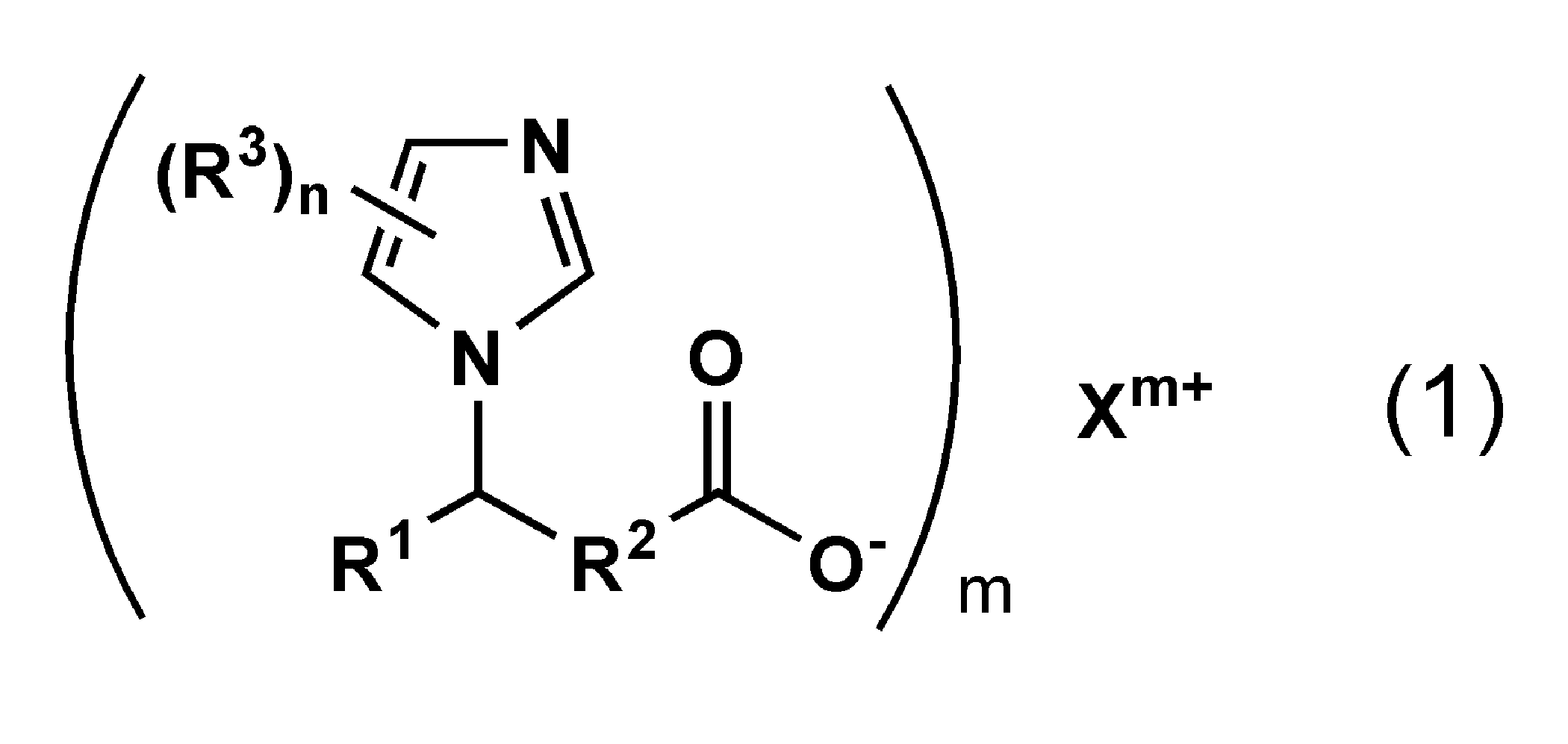
(式(1)中、Xm+はm価の対カチオンを表し、R1は置換基を有していてもよい芳香族基を表し、R2は置換基を有していてもよいアルキレン基を表し、R3は、ハロゲン原子、水酸基、メルカプト基、スルフィド基、シリル基、シラノール基、ニトロ基、ニトロソ基、スルホン酸エステル基、ホスフィノ基、ホスフィニル基、ホスホン酸エステル基、又は有機基を表し、mは1以上の整数を表し、nは0以上3以下の整数を表し、R2はR1と結合して環状構造を形成していてもよい。)
<下記式(1)で表される化合物>
第1の態様に係る組成物は、下記式(1)で表される化合物を含む。
m価の対カチオンXm+は、非環式若しくは環式の含窒素脂肪族カチオン、含窒素芳香族カチオン又は金属カチオンであることが好ましい。mは1以上3以下の整数であることが好ましく、1又は2であることがより好ましく、1であることが更に好ましい。
上記環式の含窒素脂肪族カチオンとしては、環を構成する原子として窒素原子以外のヘテロ原子(例えば、酸素原子、イオウ原子等)を含んでいてもよい。
上記非環式若しくは環式の含窒素脂肪族カチオンとしては、下記式(2)~(4)のいずれかで表されることが好ましい。
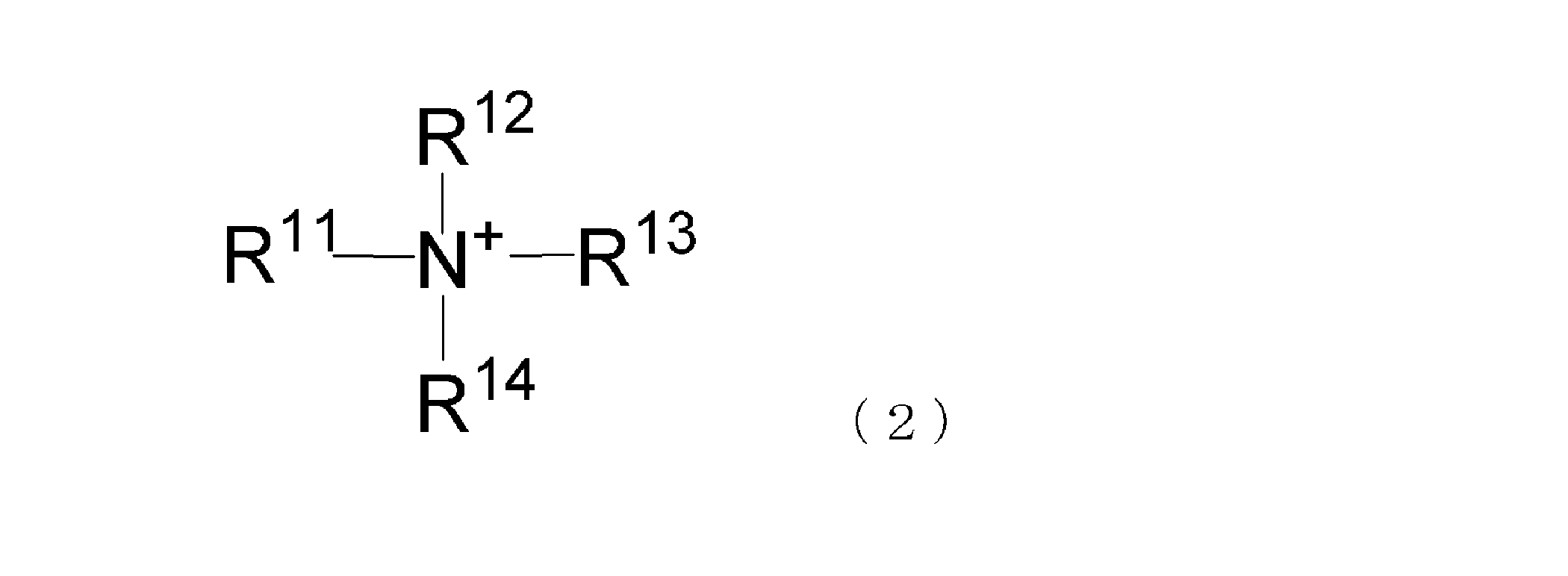
(式(2)中、R11~R14はそれぞれ独立に水素原子、置換基を有してもよいアルキル基、置換基を有してもよいシクロアルキル基、置換基を有してもよいアルケニル基、置換基を有してもよいアルキニル基、置換基を有してもよいアリール基、置換基を有してもよいアラルキル基又は置換基を有してもよい複素環基を表し、R11~R14から選択される少なくとも2つは連結して環を形成していてもよい。)
上記環式の含窒素脂肪族カチオンとしては、環を構成する原子として窒素原子以外のヘテロ原子(例えば、酸素原子、イオウ原子等)を含んでいてもよい。
上記非環式若しくは環式の含窒素脂肪族カチオンとしては、下記式(2)~(4)のいずれかで表されることが好ましい。
式(2)中、置換基を有してもよいアルキル基としては、炭素原子数1以上30以下のアルキル基が好ましい。置換基を有してもよいアルキル基の具体例としては、メチル基、エチル基、n-プロピル基、n-ブチル基、n-ヘキシル基、n-オクチル基、n-デシル基、n-ドデシル基、n-オクダデシル基、イソプロピル基、イソブチル基、sec-ブチル基、tert-ブチル基、1-エチルペンチル基、トリフルオロメチル基、2-エチルヘキシル基、フェナシル基、1-ナフトイルメチル基、2-ナフトイルメチル基、4-メチルスルファニルフェナシル基、4-フェニルスルファニルフェナシル基、4-ジメチルアミノフェナシル基、4-シアノフェナシル基、4-メチルフェナシル基、2-メチルフェナシル基、3-フルオロフェナシル基、3-トリフルオロメチルフェナシル基、及び3-ニトロフェナシル基等が挙げられる。
置換基を有してもよいシクロアルキル基としては、炭素原子数5以上30以下のシクロアルキル基が好ましい。置換基を有してもよいシクロアルキル基の具体例としては、シクロペンチル基、及びシクロヘキシル基等が挙げられる。
置換基を有してもよいシクロアルキル基としては、炭素原子数5以上30以下のシクロアルキル基が好ましい。置換基を有してもよいシクロアルキル基の具体例としては、シクロペンチル基、及びシクロヘキシル基等が挙げられる。
置換基を有してもよいアルケニル基としては、炭素原子数2以上10以下のアルケニル基が好ましい。置換基を有してもよいアルケニル基の具体例としては、ビニル基、アリル基、及びスチリル基等が挙げられる。
置換基を有してもよいアルキニル基としては、炭素原子数2以上10以下のアルキニル基が好ましい。置換基を有してもよいアルキニル基の具体例としては、エチニル基、プロピニル基、及びプロパルギル基等が挙げられる。
置換基を有してもよいアリール基としては、炭素原子数6以上30以下のアリール基が好ましい。置換基を有してもよいアリール基の具体例としては、フェニル基、ビフェニル基、1-ナフチル基、2-ナフチル基、9-アンスリル基、9-フェナントリル基、1-ピレニル基、5-ナフタセニル基、1-インデニル基、2-アズレニル基、9-フルオレニル基、ターフェニル基、クオーターフェニル基、o-、m-、及びp-トリル基、キシリル基、o-、m-、及びp-クメニル基、メシチル基、ペンタレニル基、ビナフタレニル基、ターナフタレニル基、クオーターナフタレニル基、ヘプタレニル基、ビフェニレニル基、インダセニル基、フルオランテニル基、アセナフチレニル基、アセアントリレニル基、フェナレニル基、フルオレニル基、アントリル基、ビアントラセニル基、ターアントラセニル基、クオーターアントラセニル基、アントラキノリル基、フェナントリル基、トリフェニレニル基、ピレニル基、クリセニル基、ナフタセニル基、プレイアデニル基、ピセニル基、ペリレニル基、ペンタフェニル基、ペンタセニル基、テトラフェニレニル基、ヘキサフェニル基、ヘキサセニル基、ルビセニル基、コロネニル基、トリナフチレニル基、ヘプタフェニル基、ヘプタセニル基、ピラントレニル基、及びオバレニル基等が挙げられる。
置換基を有してもよいアルキニル基としては、炭素原子数2以上10以下のアルキニル基が好ましい。置換基を有してもよいアルキニル基の具体例としては、エチニル基、プロピニル基、及びプロパルギル基等が挙げられる。
置換基を有してもよいアリール基としては、炭素原子数6以上30以下のアリール基が好ましい。置換基を有してもよいアリール基の具体例としては、フェニル基、ビフェニル基、1-ナフチル基、2-ナフチル基、9-アンスリル基、9-フェナントリル基、1-ピレニル基、5-ナフタセニル基、1-インデニル基、2-アズレニル基、9-フルオレニル基、ターフェニル基、クオーターフェニル基、o-、m-、及びp-トリル基、キシリル基、o-、m-、及びp-クメニル基、メシチル基、ペンタレニル基、ビナフタレニル基、ターナフタレニル基、クオーターナフタレニル基、ヘプタレニル基、ビフェニレニル基、インダセニル基、フルオランテニル基、アセナフチレニル基、アセアントリレニル基、フェナレニル基、フルオレニル基、アントリル基、ビアントラセニル基、ターアントラセニル基、クオーターアントラセニル基、アントラキノリル基、フェナントリル基、トリフェニレニル基、ピレニル基、クリセニル基、ナフタセニル基、プレイアデニル基、ピセニル基、ペリレニル基、ペンタフェニル基、ペンタセニル基、テトラフェニレニル基、ヘキサフェニル基、ヘキサセニル基、ルビセニル基、コロネニル基、トリナフチレニル基、ヘプタフェニル基、ヘプタセニル基、ピラントレニル基、及びオバレニル基等が挙げられる。
置換基を有してもよいアラルキル基としては、炭素原子数7以上20以下のアラルキル基が好ましい。置換基を有してもよいアラルキル基の具体例としては、、ベンジル基、フェネチル基、α-ナフチルメチル基、β-ナフチルメチル基、2-α-ナフチルエチル基、及び2-β-ナフチルエチル基等が挙げられる。
置換基を有してもよい複素環基としては、窒素原子、酸素原子、硫黄原子、リン原子を含む、芳香族あるいは脂肪族の複素環が好ましい。置換基を有してもよいアラルキル基の具体例としては、、チエニル基、ベンゾ[b]チエニル基、ナフト[2,3-b]チエニル基、チアントレニル基、フリル基、ピラニル基、イソベンゾフラニル基、クロメニル基、キサンテニル基、フェノキサチイニル基、2H-ピロリル基、ピロリル基、イミダゾリル基、ピラゾリル基、ピリジル基、ピラジニル基、ピリミジニル基、ピリダジニル基、インドリジニル基、イソインドリル基、3H-インドリル基、インドリル基、1H-インダゾリル基、プリニル基、4H-キノリジニル基、イソキノリル基、キノリル基、フタラジニル基、ナフチリジニル基、キノキサニリル基、キナゾリニル基、シンノリニル基、プテリジニル基、4aH-カルバゾリル基、カルバゾリル基、β-カルボリニル基、フェナントリジニル基、アクリジニル基、ペリミジニル基、フェナントロリニル基、フェナジニル基、フェナルサジニル基、イソチアゾリル基、フェノチアジニル基、イソキサゾリル基、フラザニル基、フェノキサジニル基、イソクロマニル基、クロマニル基、ピロリジニル基、ピロリニル基、イミダゾリジニル基、イミダゾリニル基、ピラゾリジニル基、ピラゾリニル基、ピペリジル基、ピペラジニル基、インドリニル基、イソインドリニル基、キヌクリジニル基、モルホリニル基、及びチオキサントリル基等が挙げられる。
置換基を有してもよい複素環基としては、窒素原子、酸素原子、硫黄原子、リン原子を含む、芳香族あるいは脂肪族の複素環が好ましい。置換基を有してもよいアラルキル基の具体例としては、、チエニル基、ベンゾ[b]チエニル基、ナフト[2,3-b]チエニル基、チアントレニル基、フリル基、ピラニル基、イソベンゾフラニル基、クロメニル基、キサンテニル基、フェノキサチイニル基、2H-ピロリル基、ピロリル基、イミダゾリル基、ピラゾリル基、ピリジル基、ピラジニル基、ピリミジニル基、ピリダジニル基、インドリジニル基、イソインドリル基、3H-インドリル基、インドリル基、1H-インダゾリル基、プリニル基、4H-キノリジニル基、イソキノリル基、キノリル基、フタラジニル基、ナフチリジニル基、キノキサニリル基、キナゾリニル基、シンノリニル基、プテリジニル基、4aH-カルバゾリル基、カルバゾリル基、β-カルボリニル基、フェナントリジニル基、アクリジニル基、ペリミジニル基、フェナントロリニル基、フェナジニル基、フェナルサジニル基、イソチアゾリル基、フェノチアジニル基、イソキサゾリル基、フラザニル基、フェノキサジニル基、イソクロマニル基、クロマニル基、ピロリジニル基、ピロリニル基、イミダゾリジニル基、イミダゾリニル基、ピラゾリジニル基、ピラゾリニル基、ピペリジル基、ピペラジニル基、インドリニル基、イソインドリニル基、キヌクリジニル基、モルホリニル基、及びチオキサントリル基等が挙げられる。
前述した置換基を有してもよいアルキル基、置換基を有してもよいシクロアルキル基、置換基を有してもよいアルケニル基、置換基を有してもよいアルキニル基、置換基を有してもよいアリール基、置換基を有してもよいアラルキル基又は置換基を有してもよい複素環基の水素原子は更に他の置換基で置換されていてもよい。
そのような置換基としては、ハロゲン原子(例えば、フッ素原子、塩素原子、臭素原子、及びヨウ素原子)、シアノ基、ニトロ基、アルコキシ基(メトキシ基、エトキシ基、及びtert-ブトキシ基等)、アリールオキシ基(フェノキシ基、及びp-トリルオキシ基等)、オルガノキシカルボニル基(メトキシカルボニル基、ブトキシカルボニル基、フェノキシカルボニル基、ビニルオキシカルボニル基、及びアリールオキシカルボニル基等)、アシルオキシ基(アセトキシ基、プロピオニルオキシ基、及びベンゾイルオキシ基等)、アシル基(アセチル基、ベンゾイル基、イソブチリル基、アクリロイル基、メタクリロイル基、及びメトキサリル基等)、アルキルスルファニル基(メチルスルファニル基、及びtert-ブチルスルファニル基等)、アリールスルファニル基(フェニルスルファニル基、及びp-トリルスルファニル基等)、アルキルアミノ基(メチルアミノ基、及びシクロヘキシルアミノ基等)、ジアルキルアミノ基(ジメチルアミノ基、ジエチルアミノ基、モルホリノ基、及びピペリジノ基等)、アリールアミノ基(フェニルアミノ基、p-トリルアミノ基等)、アルキル基(メチル基、エチル基、tert-ブチル基、及びドデシル基等)、アリール基(フェニル基、p-トリル基、キシリル基、クメニル基、ナフチル基、アンスリル基、及びフェナントリル基等)、ヒドロキシ基、カルボキシ基、スルホンアミド基、ホルミル基、メルカプト基、スルホ基、メシル基、p-トルエンスルホニル基、アミノ基、ニトロソ基、トリフルオロメチル基、トリクロロメチル基、トリメチルシリル基、ホスフィニコ基、ホスホノ基、アルキルスルホニル基、アリールスルホニル基、トリアルキルアンモニウム基、ジメチルスルホニウミル基、及びトリフェニルフェナシルホスホニウミル基等が挙げられる。
式(2)中、R11~R14から選択される少なくとも2つが連結して環を形成する場合、連結基としては、アルキレン基、シクロアルキレン基又はそれらを連結してなる2価の基が挙げられる。当該連結基の炭素原子数は1以上10以下が好ましい。R11~R14から選択される少なくとも2つから形成される環は、環を構成する原子として酸素原子を含んでいてもよい。
(R21)2N+=C(NR22
2)2 (3)
(式(3)中、R21はそれぞれ独立に水素原子、アルキル基又はシクロアルキル基を表し、R22はそれぞれ独立に水素原子、アルキル基、シクロアルキル基、-C(=NR23)-NR23 2(3個のR23はそれぞれ独立に水素原子、アルキル基又はシクロアルキル基)、又は、=C(-NR24 2)2(4個のR24はそれぞれ独立に水素原子又は有機基)を表す。)
(式(3)中、R21はそれぞれ独立に水素原子、アルキル基又はシクロアルキル基を表し、R22はそれぞれ独立に水素原子、アルキル基、シクロアルキル基、-C(=NR23)-NR23 2(3個のR23はそれぞれ独立に水素原子、アルキル基又はシクロアルキル基)、又は、=C(-NR24 2)2(4個のR24はそれぞれ独立に水素原子又は有機基)を表す。)
R21~R23についてのアルキル基としては、炭素原子数1以上10以下のアルキル基が好ましい。アルキル基の具体例としては、メチル基、エチル基、プロピル基、ブチル基、ヘキシル基、オクチル基、デシル基、ドデシル基、オクダデシル基、イソプロピル基、イソブチル基、sec-ブチル基、tert-ブチル基、及び1-エチルペンチル基等が挙げられる。
R21~R23についてのシクロアルキル基としては、炭素原子数5以上30以下のシクロアルキル基が好ましい。シクロアルキル基の具体例としては、シクロペンチル基、及びシクロヘキシル基等が挙げられる。
R24についての有機基としては、アルキル基、シクロアルキル基、アラルキル基、及びアリール基等が挙げられる。
式(3)で表されるカチオンとしては、1,2-ジイソプロピル-3-[ビス(ジメチルアミノ)メチレン]グアニジウムカチオン、1-メチルビグアニジウムカチオン、1-n-ブチルビグアニジウムカチオン、1-(2-エチルヘキシル)ビグアニジウムカチオン、1-n-オクタデシルビグアニジウムカチオン、1,1-ジメチルビグアニジウムカチオン、1,1-ジエチルビグアニジウムカチオン、1-シクロヘキシルビグアニジウムカチオン、2-エチル-1,1,3,3-テトラメチルグアニジウムカチオン、1-ベンジルグアニジウムカチオン、1,3-ジベンジルグアニジウムカチオン、1-ベンジル-2,3-ジメチルグアニジウムカチオン、及び1-フェニルグアニジウムカチオン等が挙げられる。これらのカチオンの中では、1,2-ジイソプロピル-3-[ビス(ジメチルアミノ)メチレン]グアニジウムカチオンが好ましい。
R21~R23についてのシクロアルキル基としては、炭素原子数5以上30以下のシクロアルキル基が好ましい。シクロアルキル基の具体例としては、シクロペンチル基、及びシクロヘキシル基等が挙げられる。
R24についての有機基としては、アルキル基、シクロアルキル基、アラルキル基、及びアリール基等が挙げられる。
式(3)で表されるカチオンとしては、1,2-ジイソプロピル-3-[ビス(ジメチルアミノ)メチレン]グアニジウムカチオン、1-メチルビグアニジウムカチオン、1-n-ブチルビグアニジウムカチオン、1-(2-エチルヘキシル)ビグアニジウムカチオン、1-n-オクタデシルビグアニジウムカチオン、1,1-ジメチルビグアニジウムカチオン、1,1-ジエチルビグアニジウムカチオン、1-シクロヘキシルビグアニジウムカチオン、2-エチル-1,1,3,3-テトラメチルグアニジウムカチオン、1-ベンジルグアニジウムカチオン、1,3-ジベンジルグアニジウムカチオン、1-ベンジル-2,3-ジメチルグアニジウムカチオン、及び1-フェニルグアニジウムカチオン等が挙げられる。これらのカチオンの中では、1,2-ジイソプロピル-3-[ビス(ジメチルアミノ)メチレン]グアニジウムカチオンが好ましい。
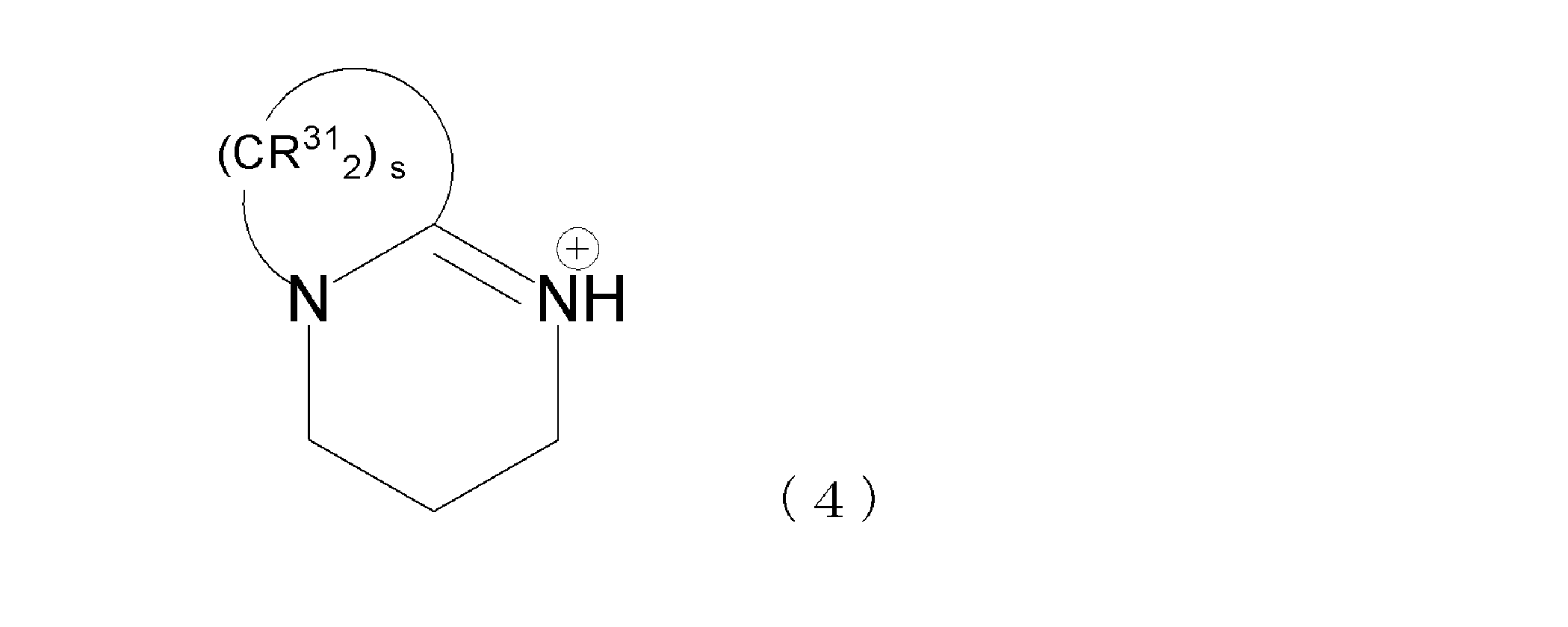
R31についての有機基としては、アルキル基、シクロアルキル基、アラルキル基、アリール基等が挙げられる。上記アルキル基、上記シクロアルキル基、上記アラルキル基、及び上記アリール基は、それぞれ、置換基を有していてもよい。当該置換基としては、ハロゲン原子(例えば、フッ素原子、塩素原子、臭素原子、及びヨウ素原子)、シアノ基、ニトロ基、アルコキシ基(メトキシ基、エトキシ基、及びtert-ブトキシ基等)、アリールオキシ基(フェノキシ基、及びp-トリルオキシ基等)、オルガノキシカルボニル基(メトキシカルボニル基、ブトキシカルボニル基、フェノキシカルボニル基、ビニルオキシカルボニル基、及びアリールオキシカルボニル基等)、アシルオキシ基(アセトキシ基、プロピオニルオキシ基、及びベンゾイルオキシ基等)、アシル基(アセチル基、ベンゾイル基、イソブチリル基、アクリロイル基、メタクリロイル基、及びメトキサリル基等)、アルキルスルファニル基(メチルスルファニル基、及びtert-ブチルスルファニル基等)、アリールスルファニル基(フェニルスルファニル基、及びp-トリルスルファニル基等)、アルキルアミノ基(メチルアミノ基、及びシクロヘキシルアミノ基等)、ジアルキルアミノ基(ジメチルアミノ基、ジエチルアミノ基、モルホリノ基、及びピペリジノ基等)、アリールアミノ基(フェニルアミノ基、及びp-トリルアミノ基等)、アルキル基(メチル基、エチル基、tert-ブチル基、及びドデシル基等)、アリール基(フェニル基、p-トリル基、キシリル基、クメニル基、ナフチル基、アンスリル基、及びフェナントリル基等)、ヒドロキシ基、カルボキシ基、スルホンアミド基、ホルミル基、メルカプト基、スルホ基、メシル基、p-トルエンスルホニル基、アミノ基、ニトロソ基、トリフルオロメチル基、トリクロロメチル基、トリメチルシリル基、ホスフィニコ基、ホスホノ基、アルキルスルホニル基、アリールスルホニル基、トリアルキルアンモニウム基、ジメチルスルホニウミル基、及びトリフェニルフェナシルホスホニウミル基等が挙げられる。
sは3以上5以下の整数であることが好ましく、3又は4であることがより好ましい。
対カチオンXm+についての含窒素芳香族カチオンとしては、下記式(5)~(13)のいずれかで表されるカチオンが好ましい。

(式中、RHは、それぞれ独立に水素原子又はアルキル基を表し、
R41、R43、R45、R46、R47、R48、R50、R51及びR52はそれぞれ独立に水素原子、ハロゲン原子、シアノ基、ニトロ基、アルキル基、シクロアルキル基、アルケニル基又はアルキニル基を表し、
R42、R44及びR49はそれぞれ独立に水素原子、ハロゲン原子、アルキル基、シクロアルキル基、アルケニル基又はアルキニル基を表し、R41~R52はそれぞれ独立にハロゲン原子、シアノ基又はニトロ基で置換されていてもよく、
R41及びR42は互いに結合して環を形成していてもよく、少なくとも2つのR41は互いに結合して環を形成していてもよく、R43及びR44は互いに結合して環を形成していてもよく、2つのR43は互いに結合して環を形成していてもよく、少なくとも2つのR45は互いに結合して環を形成していてもよく、少なくとも2つのR46は互いに結合して環を形成していてもよく、少なくとも2つのR47は互いに結合して環を形成していてもよく、R48及びR49は互いに結合して環を形成していてもよく、少なくとも2つのR48は互いに結合して環を形成していてもよく、少なくとも2つのR50は互いに結合して環を形成していてもよく、少なくとも2つのR51は互いに結合して環を形成していてもよく、少なくとも2つのR52は互いに結合して環を形成していてもよい。)
R41、R43、R45、R46、R47、R48、R50、R51及びR52はそれぞれ独立に水素原子、ハロゲン原子、シアノ基、ニトロ基、アルキル基、シクロアルキル基、アルケニル基又はアルキニル基を表し、
R42、R44及びR49はそれぞれ独立に水素原子、ハロゲン原子、アルキル基、シクロアルキル基、アルケニル基又はアルキニル基を表し、R41~R52はそれぞれ独立にハロゲン原子、シアノ基又はニトロ基で置換されていてもよく、
R41及びR42は互いに結合して環を形成していてもよく、少なくとも2つのR41は互いに結合して環を形成していてもよく、R43及びR44は互いに結合して環を形成していてもよく、2つのR43は互いに結合して環を形成していてもよく、少なくとも2つのR45は互いに結合して環を形成していてもよく、少なくとも2つのR46は互いに結合して環を形成していてもよく、少なくとも2つのR47は互いに結合して環を形成していてもよく、R48及びR49は互いに結合して環を形成していてもよく、少なくとも2つのR48は互いに結合して環を形成していてもよく、少なくとも2つのR50は互いに結合して環を形成していてもよく、少なくとも2つのR51は互いに結合して環を形成していてもよく、少なくとも2つのR52は互いに結合して環を形成していてもよい。)
R41~R52についてのハロゲン原子としては、フッ素原子、塩素原子、臭素原子又はヨウ素原子が挙げられる。
RH及びR41~R52についてのアルキル基としては、直鎖アルキル基であっても、分岐鎖アルキル基であってもよい。当該アルキル基の炭素原子数は特に限定されないが、1以上20以下が好ましく、1以上10以下が好ましく、1以上5以下がより好ましい。
RH及びR41~R52についてのアルキル基として、具体的には、メチル基、エチル基、n-プロピル基、イソプロピル基、n-ブチル基、イソブチル基、sec-ブチル基、tert-ブチル基、n-ペンチル基、イソペンチル基、tert-ペンチル基、n-ヘキシル基、n-ヘプチル基、n-オクチル基、2-エチル-n-ヘキシル基、n-ノニル基、n-デシル基、n-ウンデシル基、n-ドデシル基、n-トリデシル基、n-テトラデシル基、n-ペンタデシル基、n-ヘキサデシル基、n-ヘプタデシル基、n-オクタデシル基、n-ノナデシル基、及びn-イコシル基が挙げられる。
RH及びR41~R52についてのアルキル基としては、直鎖アルキル基であっても、分岐鎖アルキル基であってもよい。当該アルキル基の炭素原子数は特に限定されないが、1以上20以下が好ましく、1以上10以下が好ましく、1以上5以下がより好ましい。
RH及びR41~R52についてのアルキル基として、具体的には、メチル基、エチル基、n-プロピル基、イソプロピル基、n-ブチル基、イソブチル基、sec-ブチル基、tert-ブチル基、n-ペンチル基、イソペンチル基、tert-ペンチル基、n-ヘキシル基、n-ヘプチル基、n-オクチル基、2-エチル-n-ヘキシル基、n-ノニル基、n-デシル基、n-ウンデシル基、n-ドデシル基、n-トリデシル基、n-テトラデシル基、n-ペンタデシル基、n-ヘキサデシル基、n-ヘプタデシル基、n-オクタデシル基、n-ノナデシル基、及びn-イコシル基が挙げられる。
R41~R52についてのシクロアルキル基としては、炭素原子数5以上30以下のシクロアルキル基が好ましい。シクロアルキル基の具体例としては、シクロペンチル基、及びシクロヘキシル基等が挙げられる。
R41~R52についてのアルケニル基としては、炭素原子数2以上10以下のアルケニル基が好ましい。アルケニル基の具体例としては、ビニル基、アリル基、及びスチリル基等が挙げられる。
R41~R52についてのアルキニル基としては、炭素原子数2以上10以下のアルキニル基が好ましい。アルキニル基の具体例としては、エチニル基、プロピニル基、及びプロパルギル基等が挙げられる。
R41~R52についてのアルケニル基としては、炭素原子数2以上10以下のアルケニル基が好ましい。アルケニル基の具体例としては、ビニル基、アリル基、及びスチリル基等が挙げられる。
R41~R52についてのアルキニル基としては、炭素原子数2以上10以下のアルキニル基が好ましい。アルキニル基の具体例としては、エチニル基、プロピニル基、及びプロパルギル基等が挙げられる。
mが2以上の整数である場合、m価の対カチオンXm+についての非環式若しくは環式の含窒素脂肪族カチオンとしては、下記式(14)~(16)のいずれかで表されるカチオンが好ましい。
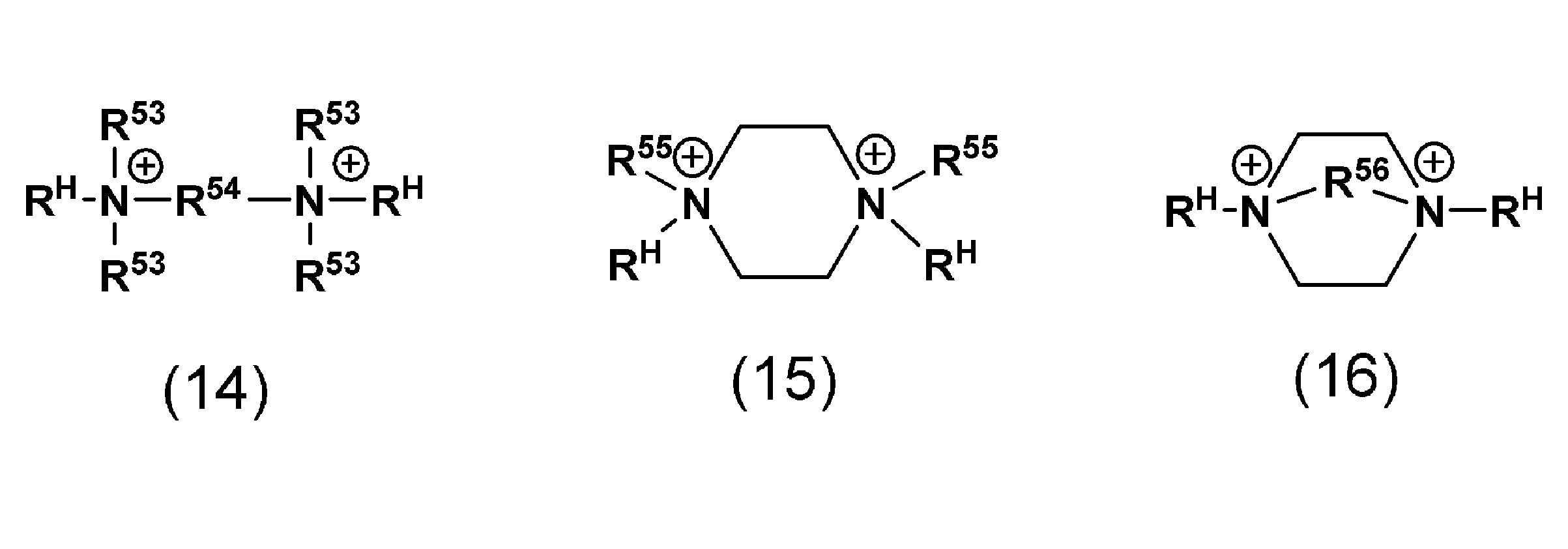
(上記式中、RHは、それぞれ独立に水素原子又はアルキル基を表し、R53及びR55は、それぞれ独立にアルキル基又はシクロアルキル基を表し、R54はアルキレン基、シクロアルキレン基又はそれらを連結してなる2価の基を表し、R56はアルキレン基を表し、R53~R56はそれぞれ独立にハロゲン原子、シアノ基又はニトロ基で置換されていてもよく、少なくとも2つのR53は互いに結合して環を形成していてもよく、R53及びR54は互いに結合して環を形成していてもよく、2つのR55は互いに結合して環を形成していてもよい。)
RHの具体例及び好ましい例としては、上述した具体例及び好ましい例と同様のものが挙げられる。
RH及びR53~R55についてのアルキル基としてはRH及びR41~R52についてのアルキル基として上述した具体例及び好ましい例と同様の基が挙げられる。
R53~R55についてのシクロアルキル基としてはR41~R52についてのシクロアルキル基としては上述した具体例及び好ましい例と同様の基が挙げられる。
R56についてのアルキレン基としては、炭素原子数1以上5以下のアルキレン基が挙げられ、メチレン基、エチレン基、プロピレン基、ブチレン基等が挙げられる。
RHの具体例及び好ましい例としては、上述した具体例及び好ましい例と同様のものが挙げられる。
RH及びR53~R55についてのアルキル基としてはRH及びR41~R52についてのアルキル基として上述した具体例及び好ましい例と同様の基が挙げられる。
R53~R55についてのシクロアルキル基としてはR41~R52についてのシクロアルキル基としては上述した具体例及び好ましい例と同様の基が挙げられる。
R56についてのアルキレン基としては、炭素原子数1以上5以下のアルキレン基が挙げられ、メチレン基、エチレン基、プロピレン基、ブチレン基等が挙げられる。
mが2以上の整数である場合、m価の対カチオンXm+についての含窒素芳香族カチオンとしては、分子中に2,2-ビピリジニウム骨格、3,3-ビピリジニウム骨格、4,4-ビピリジニウム骨格、2,2-ビピラジニウム骨格、4,4-ビキノリニウム骨格、4,4-ビイソキノリニウム骨格、4-[2-(4-ピリジニウム)ビニル]ピリジニウム骨格又は4-[4-(4-ピリジニウム)フェニル]ピリジニウム骨格を有する2価以上のカチオンが挙げられる。
対カチオンXm+についての金属カチオンとしては、典型金属元素、遷移金属元素及び半金属元素からなる群より選択される金属原子のカチオン又は上記金属原子を含む原子団のカチオンであることが好ましい。
上記典型金属元素としては、アルカリ金属元素(周期表1族のうち水素を除く元素からなる金属元素、例えば、ナトリウム、及びカリウム)、アルカリ土類金属元素(周期表2族の元素からなる金属元素、例えば、マグネシウム)、周期表12族の元素からなる金属元素(例えば、亜鉛)、周期表13族のうちホウ素を除く元素からなる金属元素(例えば、アルミニウム)、周期表14族のうち炭素、ケイ素を除く元素からなる金属元素(例えば、スズ)、周期表15族のうち窒素、リン、及びヒ素を除く元素からなる金属元素(例えば、アンチモン)、並びに周期表16族のうち酸素、硫黄、セレン、及びテルルを除く元素からなる金属元素(例えば、ポロニウム)が挙げられる。
上記遷移金属元素としては、周期表3~11族の元素からなる金属元素(例えば、ハフニウム)が挙げられる。
上記半金属元素としては、ホウ素、ケイ素、砒素、セレン、及びテルル等が挙げられる。
上記金属原子を含む原子団のカチオンとしては、金属原子と非金属原子の両方を含む原子団等が挙げられ、具体的には、[ZrO]2+、[(C2H5O)Al]2+、及び[(n-C4H9)2Sn-O-Sn(n-C4H9)2]2+等が挙げられる。
上記典型金属元素としては、アルカリ金属元素(周期表1族のうち水素を除く元素からなる金属元素、例えば、ナトリウム、及びカリウム)、アルカリ土類金属元素(周期表2族の元素からなる金属元素、例えば、マグネシウム)、周期表12族の元素からなる金属元素(例えば、亜鉛)、周期表13族のうちホウ素を除く元素からなる金属元素(例えば、アルミニウム)、周期表14族のうち炭素、ケイ素を除く元素からなる金属元素(例えば、スズ)、周期表15族のうち窒素、リン、及びヒ素を除く元素からなる金属元素(例えば、アンチモン)、並びに周期表16族のうち酸素、硫黄、セレン、及びテルルを除く元素からなる金属元素(例えば、ポロニウム)が挙げられる。
上記遷移金属元素としては、周期表3~11族の元素からなる金属元素(例えば、ハフニウム)が挙げられる。
上記半金属元素としては、ホウ素、ケイ素、砒素、セレン、及びテルル等が挙げられる。
上記金属原子を含む原子団のカチオンとしては、金属原子と非金属原子の両方を含む原子団等が挙げられ、具体的には、[ZrO]2+、[(C2H5O)Al]2+、及び[(n-C4H9)2Sn-O-Sn(n-C4H9)2]2+等が挙げられる。
式(1)中、R1は、置換基を有してもよい芳香族基を表す。置換基を有してもよい芳香族基は、置換基を有してもよい芳香族炭化水素基でもよく、置換基を有してもよい芳香族複素環基でもよい。
芳香族炭化水素基の種類は、本発明の目的を阻害しない範囲で特に限定されない。芳香族炭化水素基は、単環式の芳香族基であってもよく、2以上の芳香族炭化水素基が縮合して形成されていてもよく、2以上の芳香族炭化水素基が単結合により結合して形成されていてもよい。芳香族炭化水素基としては、フェニル基、ナフチル基、ビフェニリル基、アンスリル基、及びフェナンスレニル基が好ましい。
芳香族複素環基の種類は、本発明の目的を阻害しない範囲で特に限定されない。芳香族複素環基は、単環式基であってもよく、多環式基であってもよい。芳香族複素環基としては、ピリジル基、フリル基、チエニル基、イミダゾリル基、ピラゾリル基、オキサゾリル基、チアゾリル基、イソオキサゾリル基、イソチアゾリル基、ベンゾオキサゾリル基、ベンゾチアゾリル基、及びベンゾイミダゾリル基が好ましい。
フェニル基、多環芳香族炭化水素基、又は芳香族複素環基が有してもよい置換基としては、ハロゲン原子、水酸基、メルカプト基、スルフィド基、シリル基、シラノール基、ニトロ基、ニトロソ基、スルフィノ基、スルホ基、スルホン酸エステル基、ホスフィノ基、ホスフィニル基、ホスホノ基、ホスホン酸エステル基、アミノ基、アンモニオ基、及び有機基が挙げられる。フェニル基、多環芳香族炭化水素基、又は芳香族複素環基が複数の置換基を有する場合、当該複数の置換基は、同一であっても異なっていてもよい。
芳香族基が有する置換基が有機基である場合、当該有機基としては、アルキル基、アルケニル基、シクロアルキル基、シクロアルケニル基、アリール基、及びアラルキル基等が挙げられる。この有機基は、該有機基中にヘテロ原子等の炭化水素基以外の結合や置換基を含んでいてもよい。また、この有機基は、直鎖状、分岐鎖状、環状のいずれでもよい。この有機基は、通常は1価であるが、環状構造を形成する場合等には、2価以上の有機基となり得る。
芳香族基が隣接する炭素原子上に置換基を有する場合、隣接する炭素原子上に結合する2つの置換基はそれが結合して環状構造を形成してもよい。環状構造としては、脂肪族炭化水素環や、ヘテロ原子を含む脂肪族環が挙げられる。
芳香族基が有する置換基が有機基である場合に、当該有機基に含まれる結合は本発明の効果が損なわれない限り特に限定されず、有機基は、酸素原子、窒素原子、珪素原子等のヘテロ原子を含む結合を含んでいてもよい。ヘテロ原子を含む結合の具体例としては、エーテル結合、チオエーテル結合、カルボニル結合、チオカルボニル結合、エステル結合、アミド結合、アミノ結合(-NRA-:RAは水素原子又は1価の有機基を示す)ウレタン結合、イミノ結合(-N=C(-RB)-、-C(=NRB)-:RBは水素原子又は1価の有機基を示す)、カーボネート結合、スルホニル結合、スルフィニル結合、及びアゾ結合等が挙げられる。
有機基が有してもよいヘテロ原子を含む結合としては、式(1)で表されるイミダゾール化合物の耐熱性の観点から、エーテル結合、チオエーテル結合、カルボニル結合、チオカルボニル結合、エステル結合、アミド結合、アミノ結合(-NRA-:RAは水素原子又は1価の有機基を示す)ウレタン結合、イミノ結合(-N=C(-RB)-、-C(=NRB)-:RBは水素原子又は1価の有機基を示す)、カーボネート結合、スルホニル結合、及びスルフィニル結合が好ましい。
有機基が炭化水素基以外の置換基である場合、炭化水素基以外の置換基の種類は本発明の目的を阻害しない範囲で特に限定されない。炭化水素基以外の置換基の具体例としては、ハロゲン原子、水酸基、メルカプト基、スルフィド基、シアノ基、イソシアノ基、シアネート基、イソシアネート基、チオシアネート基、イソチオシアネート基、シリル基、シラノール基、アルコキシ基、アルコキシカルボニル基、アミノ基、モノアルキルアミノ基、ジアルキルアルミ基、モノアリールアミノ基、ジアリールアミノ基、カルバモイル基、チオカルバモイル基、ニトロ基、ニトロソ基、カルボキシラート基、アシル基、アシルオキシ基、スルフィノ基、スルホン酸エステル基、ホスフィノ基、ホスフィニル基、ホスホン酸エステル基、アルキルエーテル基、アルケニルエーテル基、アルキルチオエーテル基、アルケニルチオエーテル基、アリールエーテル基、及びアリールチオエーテル基等が挙げられる。上記置換基に含まれる水素原子は、炭化水素基によって置換されていてもよい。また、上記置換基に含まれる炭化水素基は、直鎖状、分岐鎖状、及び環状のいずれでもよい。
フェニル基、多環芳香族炭化水素基、又は芳香族複素環基が有する置換基としては、炭素原子数1以上12以下のアルキル基、炭素原子数1以上12以下のアリール基、炭素原子数1以上12以下のアルコキシ基、炭素原子数1以上12以下のアリールオキシ基、炭素原子数1以上12以下のアリールアミノ基、及びハロゲン原子が好ましい。
R1としては、式(1)で表される化合物を安価且つ容易に合成でき、上記化合物の水や有機溶剤に対する溶解性が良好であることから、それぞれ置換基を有してもよいフェニル基、フリル基、及びチエニル基が好ましい。
式(1)中、R2は、置換基を有してもよいアルキレン基である。アルキレン基が有していてもよい置換基は、本発明の目的を阻害しない範囲で特に限定されない。アルキレン基が有していてもよい置換基の具体例としては、水酸基、アルコキシ基、アミノ基、シアノ基、及びハロゲン原子等が挙げられる。アルキレン基は、直鎖アルキレン基であっても、分岐鎖アルキレン基であってもよく、直鎖アルキレン基が好ましい。アルキレン基の炭素原子数は特に限定されないが、1以上20以下が好ましく、1以上10以下が好ましく、1以上5以下がより好ましい。なお、アルキレン基の炭素原子数には、アルキレン基に結合する置換基の炭素原子を含まない。
アルキレン基に結合する置換基としてのアルコキシ基は、直鎖アルコキシ基であっても、分岐鎖アルコキシ基であってもよい。置換基としてのアルコキシ基の炭素原子数は特に限定されないが、1以上10以下が好ましく、1以上6以下がより好ましく、1以上3以下が特に好ましい。
アルキレン基に結合する置換基としてのアミノ基は、モノアルキルアミノ基又はジアルキルアミノ基であってもよい。モノアルキルアミノ基又はジアルキルアミノ基に含まれるアルキル基は、直鎖アルキル基であっても分岐鎖アルキル基であってもよい。モノアルキルアミノ基又はジアルキルアミノ基に含まれるアルキル基の炭素原子数は特に限定されないが、1以上10以下が好ましく、1以上6以下がより好ましく、1以上3以下が特に好ましい。
R2として好適なアルキレン基の具体例としては、メチレン基、エタン-1,2-ジイル基、n-プロパン-1,3-ジイル基、n-プロパン-2,2-ジイル基、n-ブタン-1,4-ジイル基、n-ペンタン-1,5-ジイル基、n-ヘキサン-1,6-ジイル基、n-ヘプタン-1,7-ジイル基、n-オクタン-1,8-ジイル基、n-ノナン-1,9-ジイル基、n-デカン-1,10-ジイル基、n-ウンデカン-1,11-ジイル基、n-ドデカン-1,12-ジイル基、n-トリデカン-1,13-ジイル基、n-テトラデカン-1,14-ジイル基、n-ペンタデカン-1,15-ジイル基、n-ヘキサデカン-1,16-ジイル基、n-ヘプタデカン-1,17-ジイル基、n-オクタデカン-1,18-ジイル基、n-ノナデカン-1,19-ジイル基、及びn-イコサン-1,20-ジイル基が挙げられる。
R3は、ハロゲン原子、水酸基、メルカプト基、スルフィド基、シリル基、シラノール基、ニトロ基、ニトロソ基、スルホン酸エステル基、ホスフィノ基、ホスフィニル基、ホスホン酸エステル基、又は有機基であり、nは0以上3以下の整数である。nが2以上3以下の整数である場合、複数のR3は、それぞれ同一であっても異なっていてもよい。
R3が有機基である場合、当該有機基は、R1について、芳香族基が置換基として有していてもよい有機基と同様である。
R3が有機基である場合、有機基としては、アルキル基、芳香族炭化水素基、及び芳香族複素環基が好ましい。アルキル基としては、炭素原子数1以上8以下の直鎖状又は分岐鎖状のアルキル基が好ましく、メチル基、エチル基、n-プロピル基、及びイソプロピル基がより好ましい。芳香族炭化水素基としては、フェニル基、ナフチル基、ビフェニリル基、アンスリル基、及びフェナンスレニル基が好ましく、フェニル基、及びナフチル基がより好ましく、フェニル基が特に好ましい。芳香族複素環基としては、ピリジル基、フリル基、チエニル基、イミダゾリル基、ピラゾリル基、オキサゾリル基、チアゾリル基、イソオキサゾリル基、イソチアゾリル基、ベンゾオキサゾリル基、ベンゾチアゾリル基、及びベンゾイミダゾリル基が好ましく、フリル基、及びチエニル基がより好ましい。
R3がアルキル基である場合、アルキル基のイミダゾール環上での結合位置は、2位、4位、及び5位のいずれも好ましく、2位がより好ましい。R3が芳香族炭化水素基及び芳香族複素環基である場合、これらの基のイミダゾール上での結合位置は、2位が好ましい。
上記式(1)で表される化合物の中では、安価且つ容易に合成可能であり、水や有機溶剤に対する溶解性に優れる点から、下記式(1-1)で表される化合物が好ましく、式(1-1)で表され、R2がメチレン基である化合物がより好ましい。

R4、R5、R6、R7、及びR8が有機基である場合、当該有機基は、式(1)におけるR1が置換基として有する有機基と同様である。R4、R5、R6、及びR7は、上記化合物の溶媒に対する溶解性の点から水素原子であるのが好ましい。
中でも、R4、R5、R6、R7、及びR8のうち少なくとも1つは、下記置換基であることが好ましく、R8が下記置換基であるのが特に好ましい。R8が下記置換基である場合、R4、R5、R6、及びR7は水素原子であるのが好ましい。
-O-R9
(R9は水素原子又は有機基である。)
-O-R9
(R9は水素原子又は有機基である。)
R9が有機基である場合、当該有機基は、式(1)におけるR1が置換基として有する有機基と同様である。R9としては、アルキル基が好ましく、炭素原子数1以上8以下のアルキル基がより好ましく、炭素原子数1以上3以下のアルキル基が特に好ましく、メチル基が最も好ましい。
上記式(1-1)で表される化合物の中では、下記式(1-1-1)で表される化合物が好ましい。

(式(1-1-1)において、X、R3、R4、R5、R6、R7、及びR8、m及びnは、R4、R5、R6、R7、及びR8のうち少なくとも1つが水素原子以外の基であること以外は、式(1)と同義である。)
式(1-1-1)で表される化合物の中でも、R4、R5、R6、R7、及びR8のうち少なくとも1つが、前述の-O-R9で表される基であることが好ましく、R8が-O-R9で表される基であるのが特に好ましい。R8が-O-R9で表される基である場合、R4、R5、R6、及びR7は水素原子であることが好ましい。
式(1)で表される化合物の好適な具体例としては、以下の化合物が挙げられる。
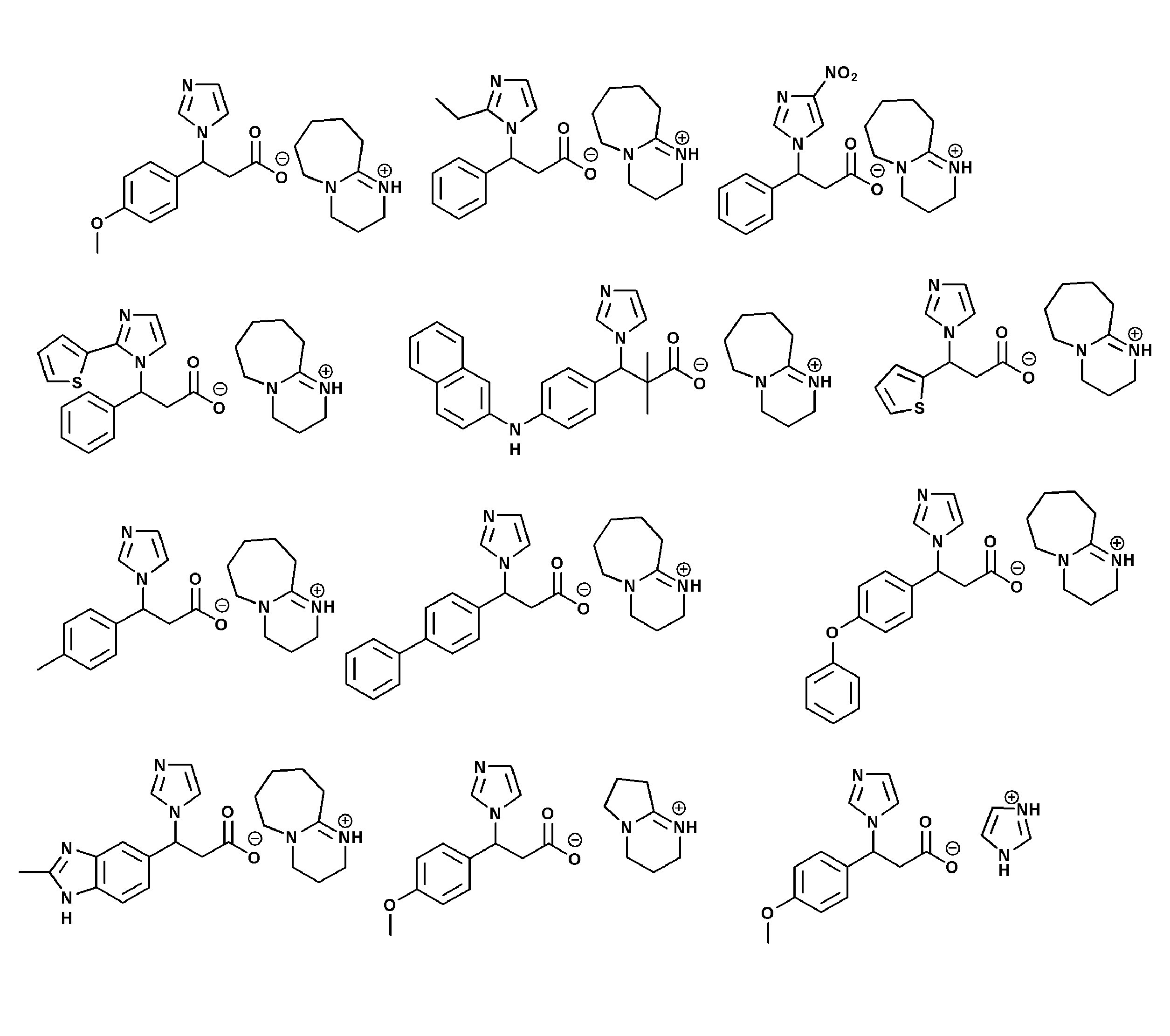

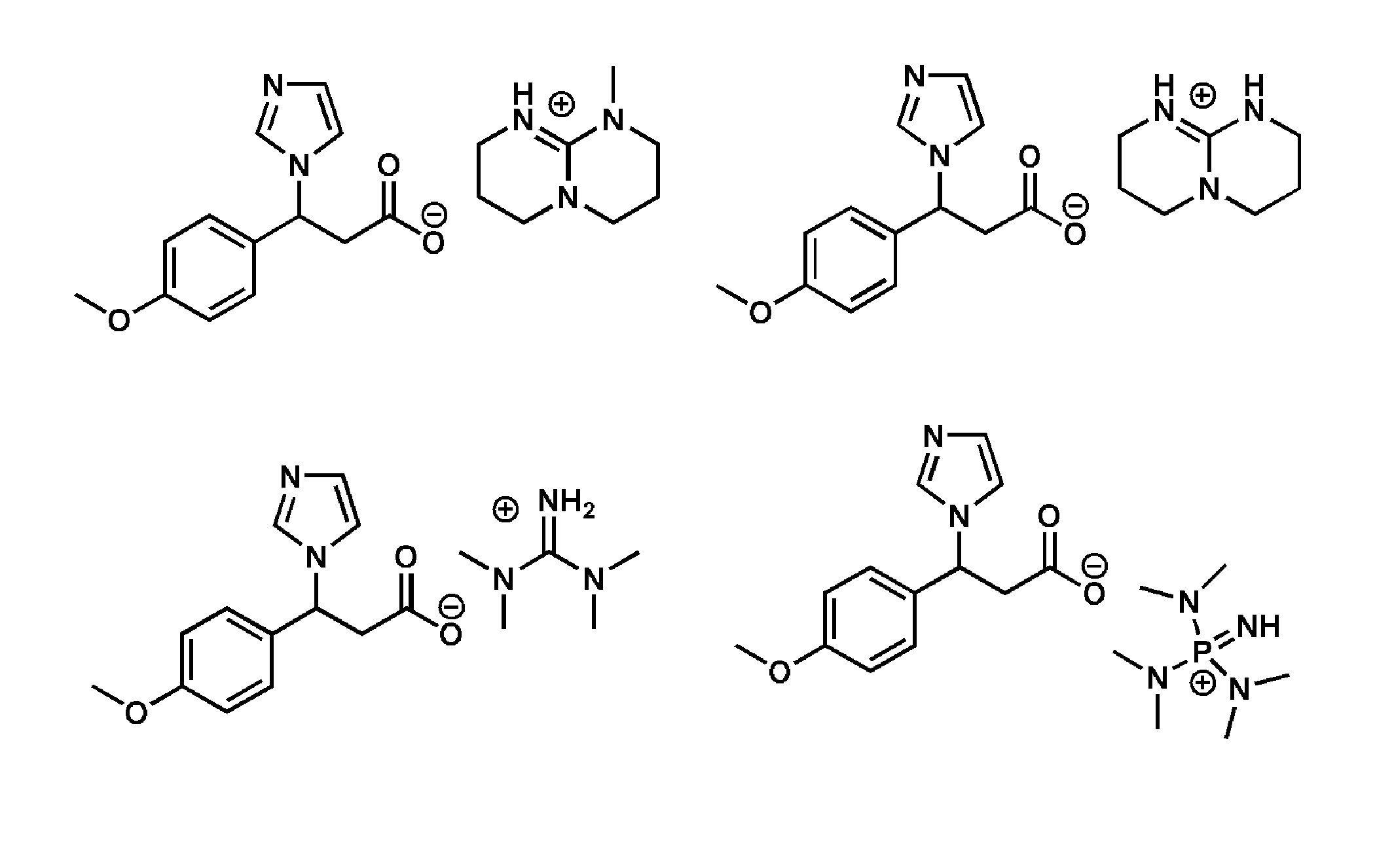
(含有量)
上記組成物における上記式(1)で表される化合物の含有量としては特に制限はない。上記組成物における上記式(1)で表される化合物の含有量は、組成物(溶剤を除く)全体に対して、例えば、1質量%以上80質量%以下が好ましく、2質量%以上40質量%以下がより好ましく、3質量%以上30質量%以下が更に好ましく、3質量%以上15質量%以下が特に好ましい。
上記組成物における上記式(1)で表される化合物の含有量としては特に制限はない。上記組成物における上記式(1)で表される化合物の含有量は、組成物(溶剤を除く)全体に対して、例えば、1質量%以上80質量%以下が好ましく、2質量%以上40質量%以下がより好ましく、3質量%以上30質量%以下が更に好ましく、3質量%以上15質量%以下が特に好ましい。
(上記式(1)で表される化合物の製造方法)
上記式(1)で表される化合物の製造方法としては特に制限はないが、例えば、下記式(10)で表される化合物と、m価の対カチオンXm+を形成し得る塩基とを溶媒の存在下、又は不存在下に中和反応させることにより上記式(1)で表される化合物を製造することができる。

(式(10)中、R1、R2、R3及びnは、式(1)と同義であり、具体例及び好ましい例も同様である。)
上記式(1)で表される化合物の製造方法としては特に制限はないが、例えば、下記式(10)で表される化合物と、m価の対カチオンXm+を形成し得る塩基とを溶媒の存在下、又は不存在下に中和反応させることにより上記式(1)で表される化合物を製造することができる。
m価の対カチオンXm+を形成し得る塩基としては、非環式若しくは環式の含窒素脂肪族化合物、含窒素芳香族化合物又は金属原子若しくは上記金属原子を含む原子団であることが好ましい。
m価の対カチオンXm+を形成し得る塩基としては、上記式(2)~(4)のいずれかで表される非環式若しくは環式の含窒素脂肪族カチオン、上記式(5)~(13)のいずれかで表される含窒素芳香族カチオン、上記式(14)~(16)のいずれかで表される含窒素脂肪族カチオン、又は典型金属元素、遷移金属元素及び半金属元素からなる群より選択される金属原子のカチオン若しくは上記金属原子を含む原子団のカチオンを形成し得る塩基であることがより好ましい。
m価の対カチオンXm+を形成し得る塩基としては、上記式(2)~(4)のいずれかで表される非環式若しくは環式の含窒素脂肪族カチオン、上記式(5)~(13)のいずれかで表される含窒素芳香族カチオン、上記式(14)~(16)のいずれかで表される含窒素脂肪族カチオン、又は典型金属元素、遷移金属元素及び半金属元素からなる群より選択される金属原子のカチオン若しくは上記金属原子を含む原子団のカチオンを形成し得る塩基であることがより好ましい。
上記式(10)で表される化合物と、上記塩基とを溶媒中にて中和反応させる方法としては、加熱下ないし非加熱下において、例えば、極性溶媒中、上記式(10)で表される化合物と、上記塩基とを混合する方法等が挙げられる。
上記極性溶媒としては、アルコールが挙げられ、具体的には、メタノール、エタノール、プロパノール、イソプロパノール、ブタノール、及びtert-ブタノール等が挙げられる。
加熱下において、上記式(10)で表される化合物と、上記塩基とを上記溶媒に溶解して混合することができる。加熱温度は、例えば、40℃以上、好ましくは50℃以上、より好ましくは55℃以上である。加熱時の温度の上限としては特に制限はないが、上記溶媒の沸点以下であることが好ましい。
非加熱下では、上記式(10)で表される化合物又は上記塩基が溶媒に溶解し難い場合がある。この場合、塩形成が進行するに従い、反応液中の不溶物の量が低減し得る。
上記極性溶媒としては、アルコールが挙げられ、具体的には、メタノール、エタノール、プロパノール、イソプロパノール、ブタノール、及びtert-ブタノール等が挙げられる。
加熱下において、上記式(10)で表される化合物と、上記塩基とを上記溶媒に溶解して混合することができる。加熱温度は、例えば、40℃以上、好ましくは50℃以上、より好ましくは55℃以上である。加熱時の温度の上限としては特に制限はないが、上記溶媒の沸点以下であることが好ましい。
非加熱下では、上記式(10)で表される化合物又は上記塩基が溶媒に溶解し難い場合がある。この場合、塩形成が進行するに従い、反応液中の不溶物の量が低減し得る。
上記式(10)で表される化合物と、上記塩基とを溶媒の不存在下に中和反応させる方法は、上記式(10)で表される化合物と、上記塩基とを接触させることができる方法であれば特に限定されない。具体的な方法としては、例えば、常温において、個体である上記式(10)で表される化合物と、個体若しくは液体である上記塩基とを、乳鉢等を用いて粉砕ないしすりつぶしながら混合する方法等が挙げられる。
また、上記式(10)で表される化合物と上記塩基との割合(モル比)としては特に制限はないが、式(10)で表される化合物のモル数をM1とし、m価の対カチオンXm+を与える上記塩基のモル数をM2とする場合に、M1/(M2/m)の値として、20/80~80/20であることが好ましく、30/70~70/30であることがより好ましい。
また、Xm+がナトリウムカチオン、カリウムカチオンである上記式(1)で表される化合物と、ナトリウムカチオン及びカリウムカチオン以外のm価の対カチオンXm+を形成し得る塩基とを混合して塩交換を行うことにより、Xm+がナトリウムカチオン及びカリウムカチオン以外の上記式(1)で表される化合物を製造することもできる。
<硬化性化合物>
第1の態様に係る組成物は、硬化性化合物を含むことが好ましい。
硬化性化合物は、加熱や露光等の硬化のための操作が行われるまで、組成物中で安定して存在可能なものであれば特に限定されず、従来から知られる種々の硬化性化合物を使用することができる。
第1の態様に係る組成物は、硬化性化合物を含むことが好ましい。
硬化性化合物は、加熱や露光等の硬化のための操作が行われるまで、組成物中で安定して存在可能なものであれば特に限定されず、従来から知られる種々の硬化性化合物を使用することができる。
硬化性化合物としては、組成物中での安定性や硬化反応性に優れ、耐熱性が良好な硬化物を与えることから、オキシラン環若しくはオキセタン環を有する化合物及びビニルエーテル化合物よりなる群から選択される少なくとも1つの化合物であることが好ましく、オキシラン環若しくはオキセタン環を有する化合物であることがより好ましい。
オキシラン環又はオキセタン環を有する化合物の中では、安価で入手が容易である点や、より硬化反応性に優れることから、オキシラン環を有する化合物、すなわち、エポキシ基を有する化合物(以下、単に「エポキシ化合物」ともいう。)であることが好ましい。
オキシラン環又はオキセタン環を有する化合物の中では、安価で入手が容易である点や、より硬化反応性に優れることから、オキシラン環を有する化合物、すなわち、エポキシ基を有する化合物(以下、単に「エポキシ化合物」ともいう。)であることが好ましい。
エポキシ化合物としては、エポキシ基を有する限り特に限定されない。エポキシ化合物は、従来から硬化性組成物に配合されているエポキシ基を有する種々の化合物から選択できる。エポキシ基を有する化合物は、非重合体であるエポキシ基を有する低分子化合物であってもよく、エポキシ基を有する重合体であってもよい。以下、エポキシ化合物に関して、エポキシ基を有する非重合体と、エポキシ基を有する重合体とについて順に説明する。
(エポキシ基を有する非重合体)
エポキシ基を有する非重合体としては、従来から硬化性組成物に配合されている、種々の被重合体型のエポキシ化合物から適宜選択できる。エポキシ化合物の好適な例としては、ビスフェノールA型エポキシ樹脂、ビスフェノールF型エポキシ樹脂、ビスフェノールS型エポキシ樹脂、ビスフェノールAD型エポキシ樹脂、ナフタレン型エポキシ樹脂、及びビフェニル型エポキシ樹脂等の2官能エポキシ樹脂;ダイマー酸グリシジルエステル、及びトリグリシジルエステル等のグリシジルエステル型エポキシ樹脂;テトラグリシジルアミノジフェニルメタン、トリグリシジル-p-アミノフェノール、テトラグリシジルメタキシリレンジアミン、及びテトラグリシジルビスアミノメチルシクロヘキサン等のグリシジルアミン型エポキシ樹脂;トリグリシジルイソシアヌレート等の複素環式エポキシ樹脂;フロログリシノールトリグリシジルエーテル、トリヒドロキシビフェニルトリグリシジルエーテル、トリヒドロキシフェニルメタントリグリシジルエーテル、グリセリントリグリシジルエーテル、2-[4-(2,3-エポキシプロポキシ)フェニル]-2-[4-[1,1-ビス[4-(2,3-エポキシプロポキシ)フェニル]エチル]フェニル]プロパン、及び1,3-ビス[4-[1-[4-(2,3-エポキシプロポキシ)フェニル]-1-[4-[1-[4-(2,3-エポキシプロポキシ)フェニル]-1-メチルエチル]フェニル]エチル]フェノキシ]-2-プロパノール等の3官能型エポキシ樹脂;テトラヒドロキシフェニルエタンテトラグリシジルエーテル、テトラグリシジルベンゾフェノン、ビスレゾルシノールテトラグリシジルエーテル、及びテトラグリシドキシビフェニル等の4官能型エポキシ樹脂が挙げられる。
エポキシ基を有する非重合体としては、従来から硬化性組成物に配合されている、種々の被重合体型のエポキシ化合物から適宜選択できる。エポキシ化合物の好適な例としては、ビスフェノールA型エポキシ樹脂、ビスフェノールF型エポキシ樹脂、ビスフェノールS型エポキシ樹脂、ビスフェノールAD型エポキシ樹脂、ナフタレン型エポキシ樹脂、及びビフェニル型エポキシ樹脂等の2官能エポキシ樹脂;ダイマー酸グリシジルエステル、及びトリグリシジルエステル等のグリシジルエステル型エポキシ樹脂;テトラグリシジルアミノジフェニルメタン、トリグリシジル-p-アミノフェノール、テトラグリシジルメタキシリレンジアミン、及びテトラグリシジルビスアミノメチルシクロヘキサン等のグリシジルアミン型エポキシ樹脂;トリグリシジルイソシアヌレート等の複素環式エポキシ樹脂;フロログリシノールトリグリシジルエーテル、トリヒドロキシビフェニルトリグリシジルエーテル、トリヒドロキシフェニルメタントリグリシジルエーテル、グリセリントリグリシジルエーテル、2-[4-(2,3-エポキシプロポキシ)フェニル]-2-[4-[1,1-ビス[4-(2,3-エポキシプロポキシ)フェニル]エチル]フェニル]プロパン、及び1,3-ビス[4-[1-[4-(2,3-エポキシプロポキシ)フェニル]-1-[4-[1-[4-(2,3-エポキシプロポキシ)フェニル]-1-メチルエチル]フェニル]エチル]フェノキシ]-2-プロパノール等の3官能型エポキシ樹脂;テトラヒドロキシフェニルエタンテトラグリシジルエーテル、テトラグリシジルベンゾフェノン、ビスレゾルシノールテトラグリシジルエーテル、及びテトラグリシドキシビフェニル等の4官能型エポキシ樹脂が挙げられる。
第1の態様に係る組成物が硬化性組成物である場合、上記硬化性組成物を用いて形成される硬化物が機械的特性に優れる点から、芳香族基を含まない脂肪族エポキシ化合物も好ましい。脂肪族エポキシ化合物の中では、透明性及び硬度に優れる硬化物を与えることから、脂環式エポキシ基を有する脂肪族エポキシ化合物が好ましい。
脂環式エポキシ基を有する脂肪族エポキシ化合物の具体例としては、2-(3,4-エポキシシクロヘキシル-5,5-スピロ-3,4-エポキシ)シクロヘキサン-メタ-ジオキサン、ビス(3,4-エポキシシクロヘキシルメチル)アジペート、ビス(3,4-エポキシ-6-メチルシクロヘキシルメチル)アジペート、3,4-エポキシ-6-メチルシクロヘキシル-3’,4’-エポキシ-6’-メチルシクロヘキサンカルボキシレート、ε-カプロラクトン変性3,4-エポキシシクロヘキシルメチル-3’,4’-エポキシシクロヘキサンカルボキシレート、トリメチルカプロラクトン変性3,4-エポキシシクロヘキシルメチル-3’,4’-エポキシシクロヘキサンカルボキシレート、β-メチル-δ-バレロラクトン変性3,4-エポキシシクロヘキシルメチル-3’,4’-エポキシシクロヘキサンカルボキシレート、メチレンビス(3,4-エポキシシクロヘキサン)、エチレングリコールのジ(3,4-エポキシシクロヘキシルメチル)エーテル、エチレンビス(3,4-エポキシシクロヘキサンカルボキシレート)、エポキシシクロヘキサヒドロフタル酸ジオクチル、及びエポキシシクロヘキサヒドロフタル酸ジ-2-エチルヘキシル、トリシクロデセンオキサイド基を有するエポキシ樹脂や、下記式(A1)~(A5)で表される化合物が挙げられる。これらの脂環式エポキシ化合物の具体例の中では、透明性に優れ、高硬度の硬化物を与えることから、下記式(A1)~(A4)で表される脂環式エポキシ化合物が好ましく、下記式(A1)~(A2)で表される脂環式エポキシ化合物がより好ましい。これらの脂環式エポキシ化合物は単独で用いても2種以上混合して用いてもよい。
脂環式エポキシ基を有する脂肪族エポキシ化合物の具体例としては、2-(3,4-エポキシシクロヘキシル-5,5-スピロ-3,4-エポキシ)シクロヘキサン-メタ-ジオキサン、ビス(3,4-エポキシシクロヘキシルメチル)アジペート、ビス(3,4-エポキシ-6-メチルシクロヘキシルメチル)アジペート、3,4-エポキシ-6-メチルシクロヘキシル-3’,4’-エポキシ-6’-メチルシクロヘキサンカルボキシレート、ε-カプロラクトン変性3,4-エポキシシクロヘキシルメチル-3’,4’-エポキシシクロヘキサンカルボキシレート、トリメチルカプロラクトン変性3,4-エポキシシクロヘキシルメチル-3’,4’-エポキシシクロヘキサンカルボキシレート、β-メチル-δ-バレロラクトン変性3,4-エポキシシクロヘキシルメチル-3’,4’-エポキシシクロヘキサンカルボキシレート、メチレンビス(3,4-エポキシシクロヘキサン)、エチレングリコールのジ(3,4-エポキシシクロヘキシルメチル)エーテル、エチレンビス(3,4-エポキシシクロヘキサンカルボキシレート)、エポキシシクロヘキサヒドロフタル酸ジオクチル、及びエポキシシクロヘキサヒドロフタル酸ジ-2-エチルヘキシル、トリシクロデセンオキサイド基を有するエポキシ樹脂や、下記式(A1)~(A5)で表される化合物が挙げられる。これらの脂環式エポキシ化合物の具体例の中では、透明性に優れ、高硬度の硬化物を与えることから、下記式(A1)~(A4)で表される脂環式エポキシ化合物が好ましく、下記式(A1)~(A2)で表される脂環式エポキシ化合物がより好ましい。これらの脂環式エポキシ化合物は単独で用いても2種以上混合して用いてもよい。

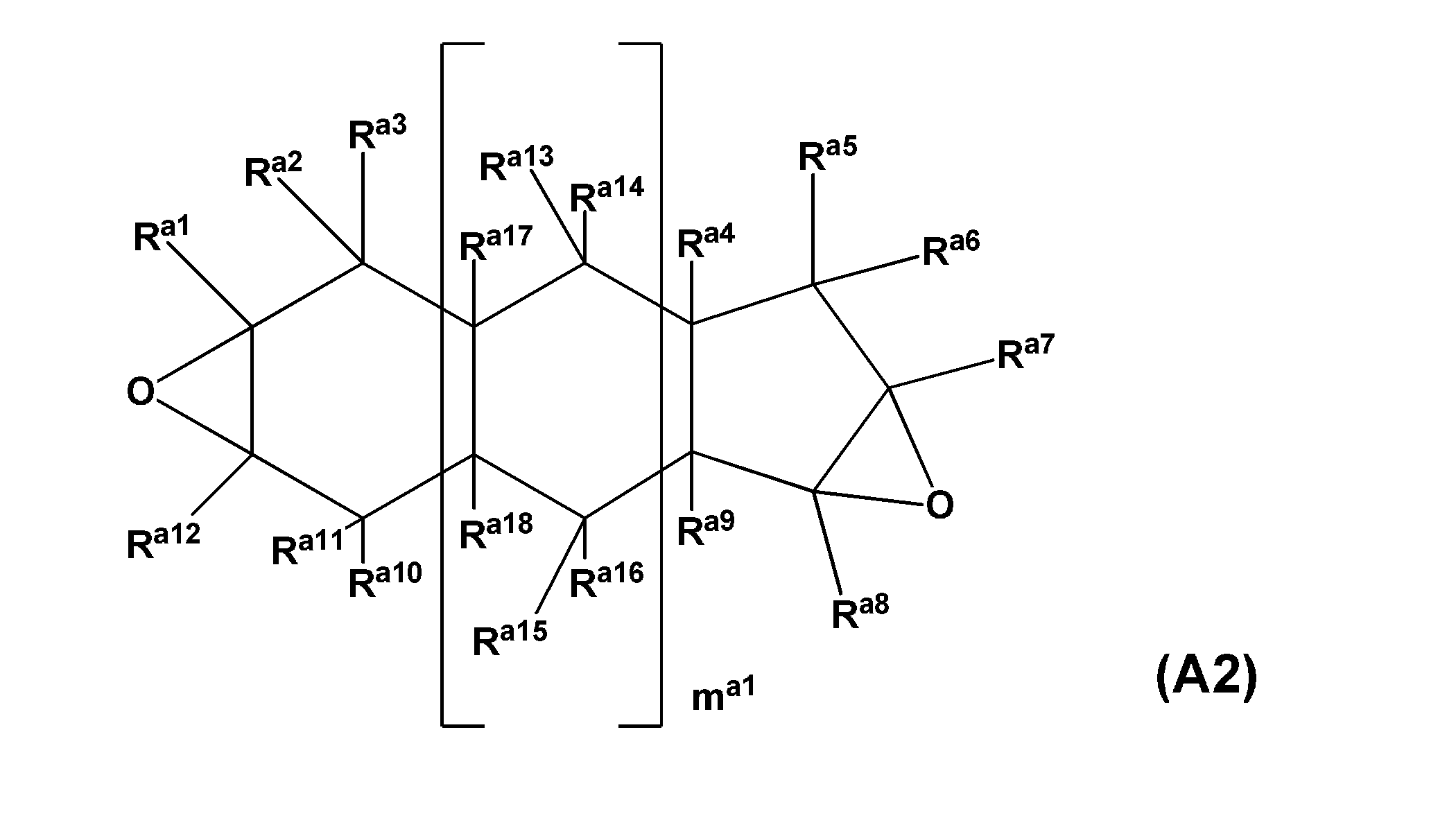
上記式(A2)で表される脂環式エポキシ化合物としては、上記式(A2)におけるma1が0である化合物に該当する、下記式(A2-1)で表される化合物が好ましい。

(式(A2-1)中、Rc1~Rc12は、水素原子、ハロゲン原子、及び有機基からなる群より選択される基である。Ra2及びRa10は互いに結合して環を形成してもよい。)

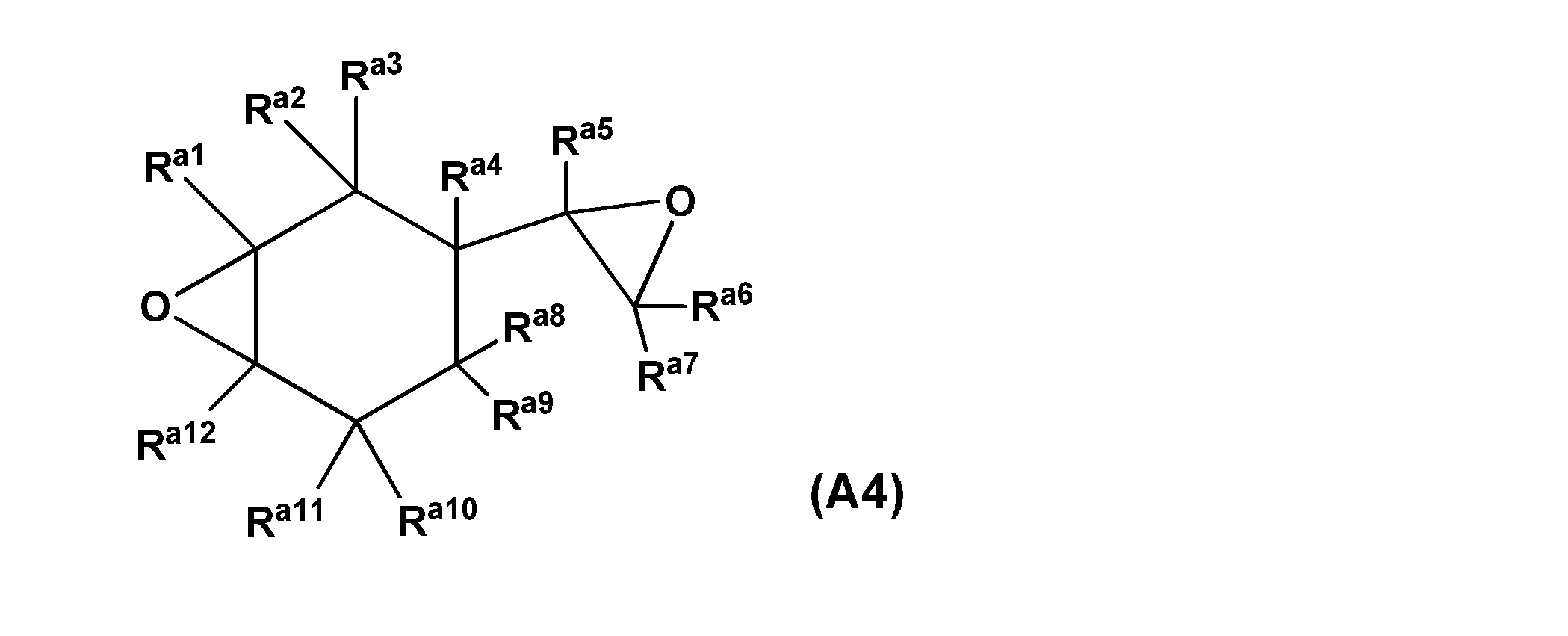
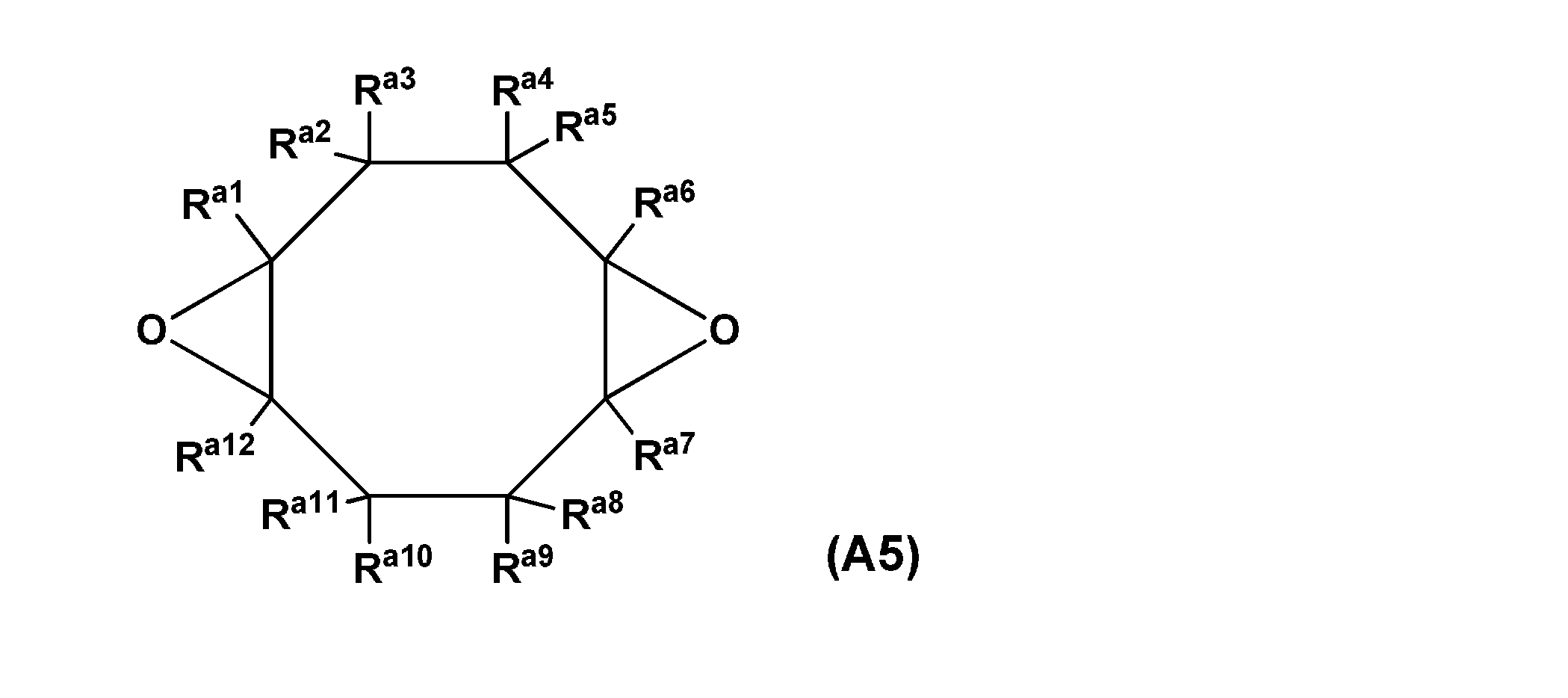
式(A1)中、Ra19は、炭素原子数1以上8以下のアルキレン基であり、メチレン基又はエチレン基であるのが好ましい。
式(A1)~(A5)中、Ra1~Ra18が有機基である場合、有機基は本発明の目的を阻害しない範囲で特に限定されず、炭化水素基であっても、炭素原子とハロゲン原子とからなる基であっても、炭素原子及び水素原子とともにハロゲン原子、酸素原子、硫黄原子、窒素原子、ケイ素原子のようなヘテロ原子を含むような基であってもよい。ハロゲン原子の例としては、塩素原子、臭素原子、ヨウ素原子、及びフッ素原子等が挙げられる。
有機基としては、炭化水素基と、炭素原子、水素原子、及び酸素原子からなる基と、ハロゲン化炭化水素基と、炭素原子、酸素原子、及びハロゲン原子からなる基と、炭素原子、水素原子、酸素原子、及びハロゲン原子からなる基とが好ましい。有機基が炭化水素基である場合、炭化水素基は、芳香族炭化水素基でも、脂肪族炭化水素基でも、芳香族骨格と脂肪族骨格とを含む基でもよい。有機基の炭素原子数は1以上20以下が好ましく、1以上10以下がより好ましく、1以上5以下が特に好ましい。
炭化水素基の具体例としては、メチル基、エチル基、n-プロピル基、イソプロピル基、n-ブチル基、イソブチル基、sec-ブチル基、tert-ブチル基、n-ペンチル基、n-ヘキシル基、n-ヘプチル基、n-オクチル基、2-エチルヘキシル基、n-ノニル基、n-デシル基、n-ウンデシル基、n-トリデシル基、n-テトラデシル基、n-ペンタデシル基、n-ヘキサデシル基、n-ヘプタデシル基、n-オクタデシル基、n-ノナデシル基、及びn-イコシル基等の鎖状アルキル基;ビニル基、1-プロペニル基、2-n-プロペニル基(アリル基)、1-n-ブテニル基、2-n-ブテニル基、及び3-n-ブテニル基等の鎖状アルケニル基;シクロプロピル基、シクロブチル基、シクロペンチル基、シクロヘキシル基、及びシクロヘプチル基等のシクロアルキル基;フェニル基、o-トリル基、m-トリル基、p-トリル基、α-ナフチル基、β-ナフチル基、ビフェニル-4-イル基、ビフェニル-3-イル基、ビフェニル-2-イル基、アントリル基、及びフェナントリル基等のアリール基;ベンジル基、フェネチル基、α-ナフチルメチル基、β-ナフチルメチル基、α-ナフチルエチル基、及びβ-ナフチルエチル基等のアラルキル基が挙げられる。
ハロゲン化炭化水素基の具体例は、クロロメチル基、ジクロロメチル基、トリクロロメチル基、ブロモメチル基、ジブロモメチル基、トリブロモメチル基、フルオロメチル基、ジフルオロメチル基、トリフルオロメチル基、2,2,2-トリフルオロエチル基、ペンタフルオロエチル基、ヘプタフルオロプロピル基、パーフルオロブチル基、及びパーフルオロペンチル基、パーフルオロヘキシル基、パーフルオロヘプチル基、パーフルオロオクチル基、パーフルオロノニル基、及びパーフルオロデシル基等のハロゲン化鎖状アルキル基;2-クロロシクロヘキシル基、3-クロロシクロヘキシル基、4-クロロシクロヘキシル基、2,4-ジクロロシクロヘキシル基、2-ブロモシクロヘキシル基、3-ブロモシクロヘキシル基、及び4-ブロモシクロヘキシル基等のハロゲン化シクロアルキル基;2-クロロフェニル基、3-クロロフェニル基、4-クロロフェニル基、2,3-ジクロロフェニル基、2,4-ジクロロフェニル基、2,5-ジクロロフェニル基、2,6-ジクロロフェニル基、3,4-ジクロロフェニル基、3,5-ジクロロフェニル基、2-ブロモフェニル基、3-ブロモフェニル基、4-ブロモフェニル基、2-フルオロフェニル基、3-フルオロフェニル基、4-フルオロフェニル基等のハロゲン化アリール基;2-クロロフェニルメチル基、3-クロロフェニルメチル基、4-クロロフェニルメチル基、2-ブロモフェニルメチル基、3-ブロモフェニルメチル基、4-ブロモフェニルメチル基、2-フルオロフェニルメチル基、3-フルオロフェニルメチル基、4-フルオロフェニルメチル基等のハロゲン化アラルキル基である。
炭素原子、水素原子、及び酸素原子からなる基の具体例は、ヒドロキシメチル基、2-ヒドロキシエチル基、3-ヒドロキシ-n-プロピル基、及び4-ヒドロキシ-n-ブチル基等のヒドロキシ鎖状アルキル基;2-ヒドロキシシクロヘキシル基、3-ヒドロキシシクロヘキシル基、及び4-ヒドロキシシクロヘキシル基等のヒドロキシシクロアルキル基;2-ヒドロキシフェニル基、3-ヒドロキシフェニル基、4-ヒドロキシフェニル基、2,3-ジヒドロキシフェニル基、2,4-ジヒドロキシフェニル基、2,5-ジヒドロキシフェニル基、2,6-ジヒドロキシフェニル基、3,4-ジヒドロキシフェニル基、及び3,5-ジヒドロキシフェニル基等のヒドロキシアリール基;2-ヒドロキシフェニルメチル基、3-ヒドロキシフェニルメチル基、及び4-ヒドロキシフェニルメチル基等のヒドロキシアラルキル基;メトキシ基、エトキシ基、n-プロポキシ基、イソプロポキシ基、n-ブチルオキシ基、イソブチルオキシ基、sec-ブチルオキシ基、tert-ブチルオキシ基、n-ペンチルオキシ基、n-ヘキシルオキシ基、n-ヘプチルオキシ基、n-オクチルオキシ基、2-エチルヘキシルオキシ基、n-ノニルオキシ基、n-デシルオキシ基、n-ウンデシルオキシ基、n-トリデシルオキシ基、n-テトラデシルオキシ基、n-ペンタデシルオキシ基、n-ヘキサデシルオキシ基、n-ヘプタデシルオキシ基、n-オクタデシルオキシ基、n-ノナデシルオキシ基、及びn-イコシルオキシ基等の鎖状アルコキシ基;ビニルオキシ基、1-プロペニルオキシ基、2-n-プロペニルオキシ基(アリルオキシ基)、1-n-ブテニルオキシ基、2-n-ブテニルオキシ基、及び3-n-ブテニルオキシ基等の鎖状アルケニルオキシ基;フェノキシ基、o-トリルオキシ基、m-トリルオキシ基、p-トリルオキシ基、α-ナフチルオキシ基、β-ナフチルオキシ基、ビフェニル-4-イルオキシ基、ビフェニル-3-イルオキシ基、ビフェニル-2-イルオキシ基、アントリルオキシ基、及びフェナントリルオキシ基等のアリールオキシ基;ベンジルオキシ基、フェネチルオキシ基、α-ナフチルメチルオキシ基、β-ナフチルメチルオキシ基、α-ナフチルエチルオキシ基、及びβ-ナフチルエチルオキシ基等のアラルキルオキシ基;メトキシメチル基、エトキシメチル基、n-プロポキシメチル基、2-メトキシエチル基、2-エトキシエチル基、2-n-プロポキシエチル基、3-メトキシ-n-プロピル基、3-エトキシ-n-プロピル基、3-n-プロポキシ-n-プロピル基、4-メトキシ-n-ブチル基、4-エトキシ-n-ブチル基、及び4-n-プロポキシ-n-ブチル基等のアルコキシアルキル基;メトキシメトキシ基、エトキシメトキシ基、n-プロポキシメトキシ基、2-メトキシエトキシ基、2-エトキシエトキシ基、2-n-プロポキシエトキシ基、3-メトキシ-n-プロポキシ基、3-エトキシ-n-プロポキシ基、3-n-プロポキシ-n-プロポキシ基、4-メトキシ-n-ブチルオキシ基、4-エトキシ-n-ブチルオキシ基、及び4-n-プロポキシ-n-ブチルオキシ基等のアルコキシアルコキシ基;2-メトキシフェニル基、3-メトキシフェニル基、及び4-メトキシフェニル基等のアルコキシアリール基;2-メトキシフェノキシ基、3-メトキシフェノキシ基、及び4-メトキシフェノキシ基等のアルコキシアリールオキシ基;ホルミル基、アセチル基、プロピオニル基、ブタノイル基、ペンタノイル基、ヘキサノイル基、ヘプタノイル基、オクタノイル基、ノナノイル基、及びデカノイル基等の脂肪族アシル基;ベンゾイル基、α-ナフトイル基、及びβ-ナフトイル基等の芳香族アシル基;メトキシカルボニル基、エトキシカルボニル基、n-プロポキシカルボニル基、n-ブチルオキシカルボニル基、n-ペンチルオキシカルボニル基、n-ヘキシルカルボニル基、n-ヘプチルオキシカルボニル基、n-オクチルオキシカルボニル基、n-ノニルオキシカルボニル基、及びn-デシルオキシカルボニル基等の鎖状アルキルオキシカルボニル基;フェノキシカルボニル基、α-ナフトキシカルボニル基、及びβ-ナフトキシカルボニル基等のアリールオキシカルボニル基;ホルミルオキシ基、アセチルオキシ基、プロピオニルオキシ基、ブタノイルオキシ基、ペンタノイルオキシ基、ヘキサノイルオキシ基、ヘプタノイルオキシ基、オクタノイルオキシ基、ノナノイルオキシ基、及びデカノイルオキシ基等の脂肪族アシルオキシ基;ベンゾイルオキシ基、α-ナフトイルオキシ基、及びβ-ナフトイルオキシ基等の芳香族アシルオキシ基である。
Ra1~Ra18は、それぞれ独立に、水素原子、ハロゲン原子、炭素原子数1以上5以下のアルキル基、及び炭素原子数1以上5以下のアルコキシ基からなる群より選択される基が好ましく、特に上記組成物を用いて得られる硬化物が機械的特性に優れる点からRa1~Ra18が全て水素原子であるのがより好ましい。
式(A2)~(A5)中、Ra1~Ra18は、式(A1)におけるRa1~Ra18と同様である。式(A2)及び式(A4)において、Ra2及びRa10が、互いに結合する場合、式(A2)において、Ra13及びRa16が、互いに結合する場合、及び式(A3)において、Ra2及びRa8が、互いに結合する場合に形成される2価の基としては、例えば、-CH2-、-C(CH3)2-が挙げられる。
式(A1)で表される脂環式エポキシ化合物のうち、好適な化合物の具体例としては、下記式(A1-a)、式(A1-b)、及び式(A1-b)で表される脂環式エポキシ化合物や、2,2-ビス(3,4-エポキシシクロヘキサン-1-イル)プロパン[=2,2-ビス(3,4-エポキシシクロヘキシル)プロパン]等を挙げることができる。

式(A2)で表される脂環式エポキシ化合物のうち、好適な化合物の具体例としては、下記式(A2-a)、及び式(A2-b)で表される脂環式エポキシ化合物が挙げられる。

式(A3)で表される脂環式エポキシ化合物のうち、好適な化合物の具体例としては、Sスピロ[3-オキサトリシクロ[3.2.1.02,4]オクタン-6,2’-オキシラン]等が挙げられる。
式(A4)で表される脂環式エポキシ化合物のうち、好適な化合物の具体例としては、4-ビニルシクロヘキセンジオキシド、ジペンテンジオキシド、リモネンジオキシド、及び1-メチル-4-(3-メチルオキシラン-2-イル)-7-オキサビシクロ[4.1.0]ヘプタン等が挙げられる。
式(A5)で表される脂環式エポキシ化合物のうち、好適な化合物の具体例としては、1,2,5,6-ジエポキシシクロオクタン等が挙げられる。
式(A4)で表される脂環式エポキシ化合物のうち、好適な化合物の具体例としては、4-ビニルシクロヘキセンジオキシド、ジペンテンジオキシド、リモネンジオキシド、及び1-メチル-4-(3-メチルオキシラン-2-イル)-7-オキサビシクロ[4.1.0]ヘプタン等が挙げられる。
式(A5)で表される脂環式エポキシ化合物のうち、好適な化合物の具体例としては、1,2,5,6-ジエポキシシクロオクタン等が挙げられる。
(エポキシ基を有する重合体)
エポキシ基を有する重合体は、エポキシ基を有する単量体又はエポキシ基を有する単量体を含む単量体混合物を重合させて得られる重合体であってもよく、水酸基、カルボキシ基、アミノ基等の反応性を有する官能基を有する重合体に対して、例えばエピクロルヒドリンのようなエポキシ基を有する化合物を用いてエポキシ基を導入した重合体であってもよい。また、1,2-ポリブタジエンのような側鎖に不飽和脂肪族炭化水素基を有する重合体の部分酸化物もエポキシ基を有する重合体として好適に使用することができる。かかる部分酸化物は、側鎖に含まれる不飽和結合の酸化により生成したエポキシ基を含む。
エポキシ基を有する重合体は、エポキシ基を有する単量体又はエポキシ基を有する単量体を含む単量体混合物を重合させて得られる重合体であってもよく、水酸基、カルボキシ基、アミノ基等の反応性を有する官能基を有する重合体に対して、例えばエピクロルヒドリンのようなエポキシ基を有する化合物を用いてエポキシ基を導入した重合体であってもよい。また、1,2-ポリブタジエンのような側鎖に不飽和脂肪族炭化水素基を有する重合体の部分酸化物もエポキシ基を有する重合体として好適に使用することができる。かかる部分酸化物は、側鎖に含まれる不飽和結合の酸化により生成したエポキシ基を含む。
入手、調製、重合体中のエポキシ基の量の調整等が容易であることから、エポキシ基を有する重合体としては、エポキシ基を有する単量体又はエポキシ基を有する単量体を含む単量体混合物を重合させて得られる重合体と、側鎖に不飽和脂肪族炭化水素基を有する重合体の部分酸化物とが好ましい。
(エポキシ基を有する単量体又はエポキシ基を有する単量体を含む単量体混合物の重合体)
エポキシ基を有する重合体の中では、調製が容易であることや、硬化性組成物の基材への塗布性等の点から、エポキシ基を有する(メタ)アクリル酸エステルの単独重合体か、エポキシ基を有する(メタ)アクリル酸エステルと他の単量体との共重合体が好ましい。
エポキシ基を有する重合体の中では、調製が容易であることや、硬化性組成物の基材への塗布性等の点から、エポキシ基を有する(メタ)アクリル酸エステルの単独重合体か、エポキシ基を有する(メタ)アクリル酸エステルと他の単量体との共重合体が好ましい。
エポキシ基を有する(メタ)アクリル酸エステルは、鎖状脂肪族エポキシ基を有する(メタ)アクリル酸エステルであっても、後述するような、脂環式エポキシ基を有する(メタ)アクリル酸エステルであってもよい。また、エポキシ基を有する(メタ)アクリル酸エステルは、芳香族基を含んでいてもよい。硬化性組成物を用いて形成される硬化物の透明性の点から、エポキシ基を有する(メタ)アクリル酸エステルの中では、鎖状脂肪族エポキシ基を有する脂肪族(メタ)アクリル酸エステルや、脂環式エポキシ基を有する脂肪族(メタ)アクリル酸エステルが好ましく、脂環式エポキシ基を有する脂肪族(メタ)アクリル酸エステルがより好ましい。
芳香族基を含み、エポキシ基を有する(メタ)アクリル酸エステルの例としては、4-グリシジルオキシフェニル(メタ)アクリレート、3-グリシジルオキシフェニル(メタ)アクリレート、2-グリシジルオキシフェニル(メタ)アクリレート、4-グリシジルオキシフェニルメチル(メタ)アクリレート、3-グリシジルオキシフェニルメチル(メタ)アクリレート、及び2-グリシジルオキシフェニルメチル(メタ)アクリレート等が挙げられる。
鎖状脂肪族エポキシ基を有する脂肪族(メタ)アクリル酸エステルの例としては、エポキシアルキル(メタ)アクリレート、及びエポキシアルキルオキシアルキル(メタ)アクリレート等のような、エステル基(-O-CO-)中のオキシ基(-O-)に鎖状脂肪族エポキシ基が結合する(メタ)アクリル酸エステルが挙げられる。このような(メタ)アクリル酸エステルが有する鎖状脂肪族エポキシ基は、鎖中に1又は複数のオキシ基(-O-)を含んでいてもよい。鎖状脂肪族エポキシ基の炭素原子数は、特に限定されないが、3以上20以下が好ましく、3以上15以下がより好ましく、3以上10以下が特に好ましい。
鎖状脂肪族エポキシ基を有する脂肪族(メタ)アクリル酸エステルの具体例としては、グリシジル(メタ)アクリレート、2-メチルグリシジル(メタ)アクリレート、3,4-エポキシブチル(メタ)アクリレート、6,7-エポキシヘプチル(メタ)アクリレート等のエポキシアルキル(メタ)アクリレート;2-グリシジルオキシエチル(メタ)アクリレート、3-グリシジルオキシ-n-プロピル(メタ)アクリレート、4-グリシジルオキシ-n-ブチル(メタ)アクリレート、5-グリシジルオキシ-n-ヘキシル(メタ)アクリレート、6-グリシジルオキシ-n-ヘキシル(メタ)アクリレート等のエポキシアルキルオキシアルキル(メタ)アクリレートが挙げられる。
脂環式エポキシ基を有する脂肪族(メタ)アクリル酸エステルの具体例としては、例えば下記式(a2-1)~(a2-15)で表される化合物が挙げられる。これらの中でも、下記式(a2-1)~(a2-5)で表される化合物が好ましく、下記式(a2-1)~(a2-3)で表される化合物がより好ましい。


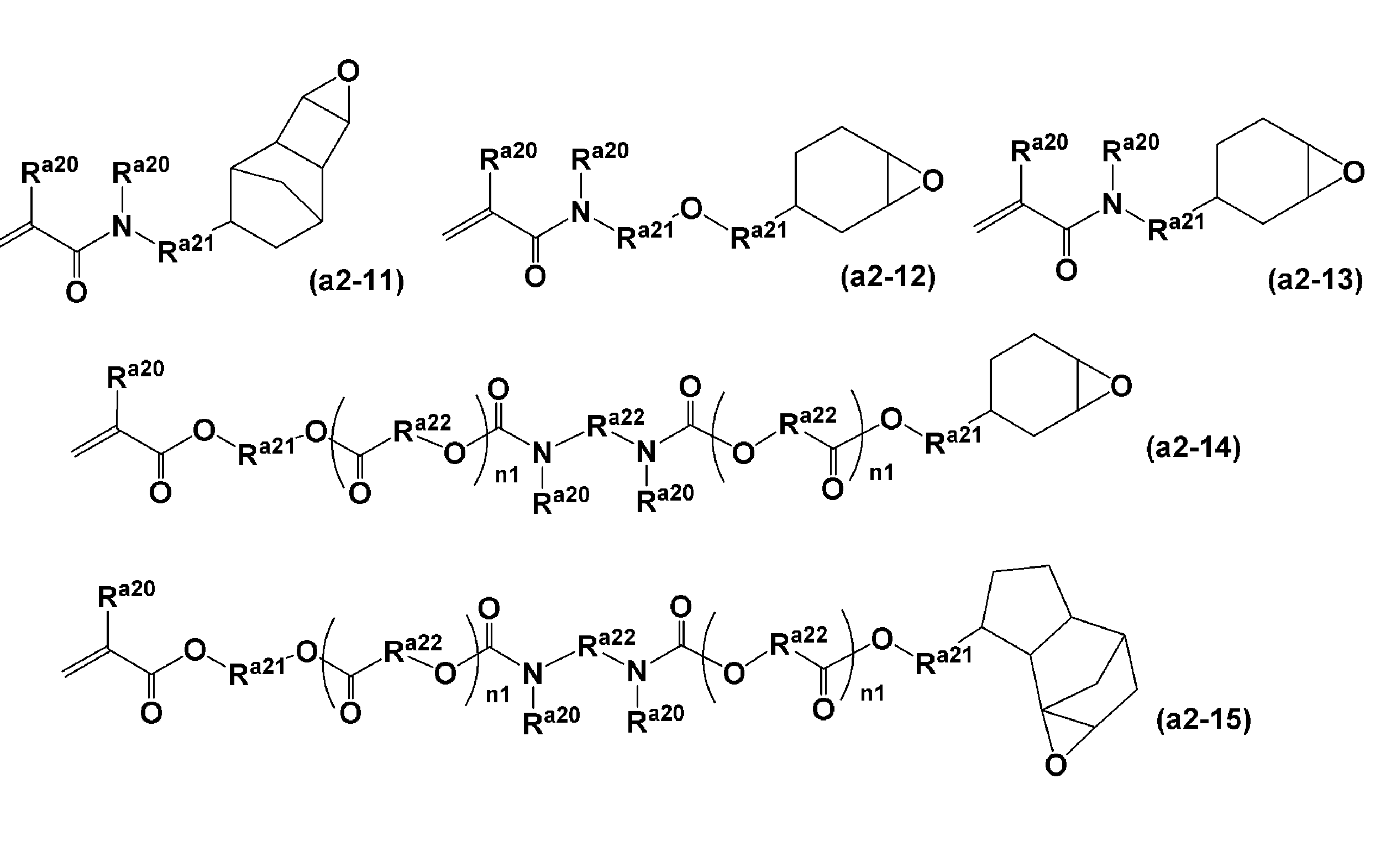
上記式中、Ra20は水素原子又はメチル基を示し、Ra21は炭素原子数1以上6以下の2価の脂肪族飽和炭化水素基を示し、Ra22は炭素原子数1以上10以下の2価の炭化水素基を示し、n1は0以上10以下の整数を示す。Ra21としては、直鎖状又は分枝鎖状のアルキレン基、例えばメチレン基、エチレン基、プロピレン基、テトラメチレン基、エチルエチレン基、ペンタメチレン基、ヘキサメチレン基が好ましい。Ra22としては、例えばメチレン基、エチレン基、プロピレン基、テトラメチレン基、エチルエチレン基、ペンタメチレン基、ヘキサメチレン基、フェニレン基、シクロヘキシレン基が好ましい。
エポキシ基を有する重合体としては、エポキシ基を有する(メタ)アクリル酸エステルの単独重合体、及びエポキシ基を有する(メタ)アクリル酸エステルと他の単量体との共重合体のいずれも用いることができるが、エポキシ基を有する重合体中の、エポキシ基を有する(メタ)アクリル酸エステルに由来する単位の含有量は、例えば、50質量%以上であり、70質量%以上が好ましく、80質量%以上がより好ましく、90質量%以上が特に好ましく、100質量%であるのが最も好ましい。
エポキシ基を有する重合体が、エポキシ基を有する(メタ)アクリル酸エステルと他の単量体との共重合体である場合、他の単量体としては、不飽和カルボン酸、エポキシ基を持たない(メタ)アクリル酸エステル、(メタ)アクリルアミド類、アリル化合物、ビニルエーテル類、ビニルエステル類、スチレン類等が挙げられる。これらの化合物は、単独又は2種以上組み合わせて用いることができる。硬化性組成物の保存安定性や、硬化性組成物を用いて形成される硬化物のアルカリ等に対する耐薬品性の点からは、エポキシ基を有する(メタ)アクリル酸エステルと他の単量体との共重合体は、不飽和カルボン酸に由来する単位を含まないのが好ましい。
不飽和カルボン酸の例としては、(メタ)アクリル酸;(メタ)アクリル酸アミド;クロトン酸;マレイン酸、フマル酸、シトラコン酸、メサコン酸、イタコン酸、これらジカルボン酸の無水物が挙げられる。
エポキシ基を持たない(メタ)アクリル酸エステルの例としては、メチル(メタ)アクリレート、エチル(メタ)アクリレート、プロピル(メタ)アクリレート、アミル(メタ)アクリレート、t-オクチル(メタ)アクリレート等の直鎖状又は分岐鎖状のアルキル(メタ)アクリレート;クロロエチル(メタ)アクリレート、2,2-ジメチルヒドロキシプロピル(メタ)アクリレート、2-ヒドロキシエチル(メタ)アクリレート、トリメチロールプロパンモノ(メタ)アクリレート、ベンジル(メタ)アクリレート、フルフリル(メタ)アクリレート;脂環式骨格を有する基を有する(メタ)アクリル酸エステルが挙げられる。エポキシ基を持たない(メタ)アクリル酸エステルの中では、硬化性組成物を用いて形成される硬化物の透明性の点から、脂環式骨格を有する基を有する(メタ)アクリル酸エステルが好ましい。
脂環式骨格を有する基を有する(メタ)アクリル酸エステルにおいて、脂環式骨格を構成する脂環式基は、単環であっても多環であってもよい。単環の脂環式基としては、シクロペンチル基、シクロヘキシル基等が挙げられる。また、多環の脂環式基としては、ノルボルニル基、イソボルニル基、トリシクロノニル基、トリシクロデシル基、テトラシクロドデシル基等が挙げられる。
脂環式骨格を有する基を有する(メタ)アクリル酸エステルとしては、例えば下記式(a3-1)~(a3-8)で表される化合物が挙げられる。これらの中では、下記式(a3-3)~(a3-8)で表される化合物が好ましく、下記式(a3-3)又は(a3-4)で表される化合物がより好ましい。
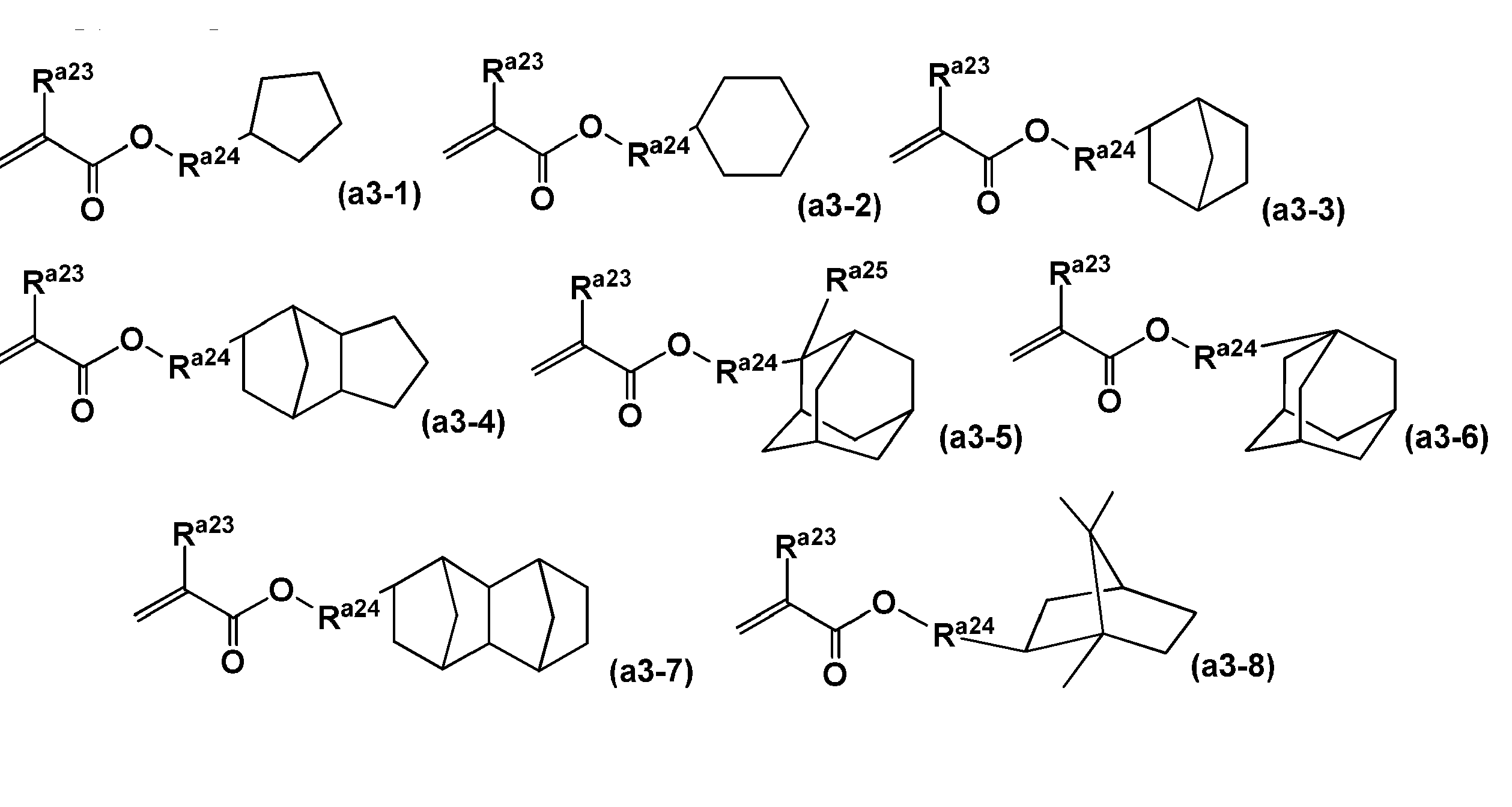
上記式中、Ra23は水素原子又はメチル基を示し、Ra24は単結合又は炭素原子数1以上6以下の2価の脂肪族飽和炭化水素基を示し、Ra25は水素原子又は炭素原子数1以上5以下のアルキル基を示す。Ra24としては、単結合、直鎖状又は分枝鎖状のアルキレン基、例えばメチレン基、エチレン基、プロピレン基、テトラメチレン基、エチルエチレン基、ペンタメチレン基、ヘキサメチレン基が好ましい。Ra25としては、メチル基、エチル基が好ましい。
(メタ)アクリルアミド類の例としては、(メタ)アクリルアミド、N-アルキル(メタ)アクリルアミド、N-アリール(メタ)アクリルアミド、N,N-ジアルキル(メタ)アクリルアミド、N,N-アリール(メタ)アクリルアミド、N-メチル-N-フェニル(メタ)アクリルアミド、N-ヒドロキシエチル-N-メチル(メタ)アクリルアミド等が挙げられる。
アリル化合物の例としては、酢酸アリル、カプロン酸アリル、カプリル酸アリル、ラウリン酸アリル、パルミチン酸アリル、ステアリン酸アリル、安息香酸アリル、アセト酢酸アリル、乳酸アリル等のアリルエステル類;アリルオキシエタノール;等が挙げられる。
ビニルエーテル類の例としては、ヘキシルビニルエーテル、オクチルビニルエーテル、デシルビニルエーテル、エチルヘキシルビニルエーテル、メトキシエチルビニルエーテル、エトキシエチルビニルエーテル、クロロエチルビニルエーテル、1-メチル-2,2-ジメチルプロピルビニルエーテル、2-エチルブチルビニルエーテル、ヒドロキシエチルビニルエーテル、ジエチレングリコールビニルエーテル、ジメチルアミノエチルビニルエーテル、ジエチルアミノエチルビニルエーテル、ブチルアミノエチルビニルエーテル、ベンジルビニルエーテル、テトラヒドロフルフリルビニルエーテル等のアルキルビニルエーテル;ビニルフェニルエーテル、ビニルトリルエーテル、ビニルクロロフェニルエーテル、ビニル-2,4-ジクロロフェニルエーテル、ビニルナフチルエーテル、ビニルアントラニルエーテル等のビニルアリールエーテル;等が挙げられる。
ビニルエステル類の例としては、ビニルブチレート、ビニルイソブチレート、ビニルトリメチルアセテート、ビニルジエチルアセテート、ビニルバレート、ビニルカプロエート、ビニルクロロアセテート、ビニルジクロロアセテート、ビニルメトキシアセテート、ビニルブトキシアセテート、ビニルフエニルアセテート、ビニルアセトアセテート、ビニルラクテート、ビニル-β-フェニルブチレート、安息香酸ビニル、サリチル酸ビニル、クロロ安息香酸ビニル、テトラクロロ安息香酸ビニル、ナフトエ酸ビニル等が挙げられる。
スチレン類の例としては、スチレン;メチルスチレン、ジメチルスチレン、トリメチルスチレン、エチルスチレン、ジエチルスチレン、イソプロピルスチレン、ブチルスチレン、ヘキシルスチレン、シクロヘキシルスチレン、デシルスチレン、ベンジルスチレン、クロロメチルスチレン、トリフルオロメチルスチレン、エトキシメチルスチレン、アセトキシメチルスチレン等のアルキルスチレン;メトキシスチレン、4-メトキシ-3-メチルスチレン、ジメトキシスチレン等のアルコキシスチレン;クロロスチレン、ジクロロスチレン、トリクロロスチレン、テトラクロロスチレン、ペンタクロロスチレン、ブロモスチレン、ジブロモスチレン、ヨードスチレン、フルオロスチレン、トリフルオロスチレン、2-ブロモ-4-トリフルオロメチルスチレン、4-フルオロ-3-トリフルオロメチルスチレン等のハロスチレン;等が挙げられる。
(側鎖に不飽和脂肪族炭化水素基を有する重合体の部分酸化物)
側鎖に不飽和脂肪族炭化水素を有する重合体は特に限定されないが、入手や合成が容易であること等から、側鎖にビニル基を有する1,2-ポリブタジエンが好ましい。1,2-ポリブタジエンを部分的に酸化することによって、側鎖にオキシラニル基とビニル基とを有する、エポキシ化ポリブタジエンが得られる。このようなエポキシ化ポリブタジエンにおけるオキシラニル基の比率は、オキシラニル基とビニル基との総モル数に対して10モル%以上70モル%以下が好ましく、10モル%以上50モル%以下がより好ましく、10モル%以上40モル%以下がより好ましい。エポキシ化ポリブタジエンとしては、日本曹達株式会社より市販される、JP-100、及びJP-200を好適に使用することができる。
側鎖に不飽和脂肪族炭化水素を有する重合体は特に限定されないが、入手や合成が容易であること等から、側鎖にビニル基を有する1,2-ポリブタジエンが好ましい。1,2-ポリブタジエンを部分的に酸化することによって、側鎖にオキシラニル基とビニル基とを有する、エポキシ化ポリブタジエンが得られる。このようなエポキシ化ポリブタジエンにおけるオキシラニル基の比率は、オキシラニル基とビニル基との総モル数に対して10モル%以上70モル%以下が好ましく、10モル%以上50モル%以下がより好ましく、10モル%以上40モル%以下がより好ましい。エポキシ化ポリブタジエンとしては、日本曹達株式会社より市販される、JP-100、及びJP-200を好適に使用することができる。
以上説明した、エポキシ基を有する重合体の分子量は、本発明の目的を阻害しない範囲で特に限定されないが、ポリスチレン換算の質量平均分子量として、3,000以上30,000以下が好ましく、5,000以上15,000以下がより好ましい。
(ビニルエーテル化合物)
硬化性化合物としてはビニルエーテル化合物等も用いることができる。
ビニルエーテル化合物は、分子内に1以上のビニルエーテル基を含む有機化合物であれば特に限定されない。ビニルエーテル基が結合する母核である1価又は多価の有機基は、炭化水素基であってもよく、ヘテロ原子を含む有機基であってもよい。ヘテロ原子としては、O、S、N、P、ハロゲン原子等が挙げられる。
硬化性化合物としてはビニルエーテル化合物等も用いることができる。
ビニルエーテル化合物は、分子内に1以上のビニルエーテル基を含む有機化合物であれば特に限定されない。ビニルエーテル基が結合する母核である1価又は多価の有機基は、炭化水素基であってもよく、ヘテロ原子を含む有機基であってもよい。ヘテロ原子としては、O、S、N、P、ハロゲン原子等が挙げられる。
ビニルエーテル化合物としては、合成や入手の容易さや、硬化物の透明性や機械的特性の点から、ビニルエーテル基を1つ含むモノビニルエーテル化合物又はビニルエーテル基を2つ含むジビニルエーテル化合物が好ましく、ジビニルエーテル化合物がより好ましい。
モノビニルエーテル化合物の具体例としては、エチルビニルエーテル、n-プロピル-ビニルエーテル、n-ブチルビニルエーテル、n-ペンチルビニルエーテル、n-ヘキシルビニルエーテル、n-オクチルビニルエーテル、n-デシルビニルエーテル、シクロヘキシルビニルエーテル、2-エチル-n-ヘキシルビニルエーテル、2-メトキシエチルビニルエーテル、及び2-エトキシエチルビニルエーテル等のアルキルビニルエーテル又はアルコキシアルキルビニルエーテル;2-ビニロキシエタノール、2-ビニロキシプロパノール、3-ビニロキシプロパノール、2-ビニロキシブタノール、4-ビニロキシブタノール、6-ビニロキシヘキサノール、2-(ビニロキシエトキシ)エタノール、2-(ビニロキシエトキシエトキシ)エタノール、ジエチレングリコールモノビニルエーテル、トリエチレングリコールモノビニルエーテル、ポリエチレングリコールモノビニルエーテル、ジプロピレングリコールモノビニルエーテル、トリプロピレングリコールモノビニルエーテル、及びポリプロピレングリコールモノビニルエーテル等の水酸基含有脂肪族ビニルエーテル;1-クロロ-2-ビニロキシエタン、1-クロロ-3-ビニロキシプロパン、1-クロロ-4-ビニロキシ-n-ブタン、1-クロロ-6-ビニロキシ-n-ヘキサン、1-クロロ-2-(ビニロキシエトキシ)-n-プロパン、1-クロロ-2-(ビニロキシエトキシ)プロパン、及び1-クロロ-2-(ビニロキシエトキシエトキシ)エタン等のハロゲン含有ビニルエーテル;ビニルフェニルエーテル、4-ビニロキシトルエン、3-ビニロキシトルエン、2-ビニロキシトルエン、1-ビニロキシ-4-クロロベンゼン、1-ビニロキシ-3-クロロベンゼン、1-ビニロキシ-2-クロロベンゼン、1-ビニロキシ-2,3-ジメチルベンゼン、1-ビニロキシ-2,4-ジメチルベンゼン、1-ビニロキシ-2,5-ジメチルベンゼン、1-ビニロキシ-2,6-ジメチルベンゼン、1-ビニロキシ-3,4-ジメチルベンゼン、1-ビニロキシ-3,5-ジメチルベンゼン、1-ビニロキシナフタレン、2-ビニロキシナフタレン、4-ビニロキシ-1,1’-ビフェニル、3-ビニロキシ-1,1’-ビフェニル、2-ビニロキシ-1,1’-ビフェニル、ベンジルビニルエーテル、6-ビニロキシテトラリン、及び5-ビニロキシテトラリン等の芳香族ビニルエーテルが挙げられる。
ジビニルエーテル化合物の具体例としては、エチレングリコールジビニルエーテル、ジエチレングリコールジビニルエーテル、トリエチレングリコールジビニルエーテル、ポリエチレングリコールジビニルエーテル、プロピレングリコールジビニルエーテル、ジプロピレングリコールジビニルエーテル、トリプロピレングリコールジビニルエーテル、ポリプロピレングリコールジビニルエーテル、1,3-プロパンジオールジビニルエーテル、1,4-ブタンジオールジビニルエーテル1,5-ペンタンジオールジビニルエーテル、1,6-ヘキサンジオールジビニルエーテル、1,8-オクタンジオールジビニルエーテル、及び1,10-デカンジオールジビニルエーテル等の鎖状脂肪族ジビニルエーテル;1,4-シクロヘキサンジオールジビニルエーテル、1,4-シクロヘキサンジメタノールジビニルエーテル、及び2-ビニルオキシ-5-(ビニルオキシメチル)-7-オキサビシクロ[2.2.1]ヘプタン等の環状脂肪族ジビニルエーテル;1,4-ジビニロキシベンゼン、1,3-ジビニロキシベンゼン、1,2-ジビニロキシベンゼン、1,4-ジビニロキシナフタレン、1,3-ジビニロキシナフタレン、1,2-ジビニロキシナフタレン、1,5-ジビニロキシナフタレン、1,6-ジビニロキシナフタレン、1,7-ジビニロキシナフタレン、1,8-ジビニロキシナフタレン、2,3-ジビニロキシナフタレン、2,6-ジビニロキシナフタレン、2,7-ジビニロキシナフタレン、4,4’-ジビニロキシビフェニル、3,3’-ジビニロキシビフェニル、2,2’-ジビニロキシビフェニル、3,4’-ジビニロキシビフェニル、2,3’-ジビニロキシビフェニル、2,4’-ジビニロキシビフェニル、ビスフェノールAジビニルエーテル、1,4-ベンゼンジメタノールジビニルエーテル、1,3-ベンゼンジメタノールジビニルエーテル、1,2-ベンゼンジメタノールジビニルエーテル、及びナフタレン-1,4-ビスメタノールジビニルエーテル等の芳香族ジビニルエーテルが挙げられる。
上記のビニルエーテル化合物の中でも好適なものとしては、下記式で表される化合物が挙げられる。
(硬化性化合物の含有量)
第1の態様に係る組成物における、硬化性化合物の含有量は、組成物中の有機溶剤以外の成分の質量の合計に対して、例えば40質量%以上98質量%以下であり、45質量%以上96質量%以下が好ましく、50質量%以上95質量%以下がより好ましい。
第1の態様に係る組成物における、硬化性化合物の含有量は、組成物中の有機溶剤以外の成分の質量の合計に対して、例えば40質量%以上98質量%以下であり、45質量%以上96質量%以下が好ましく、50質量%以上95質量%以下がより好ましい。
(重合開始剤)
第1の態様に係る組成物は、重合開始剤を含んでいても含んでいなくてよく、重合開始剤としては、特に限定されず、従来公知の光重合開始剤を用いることができる。
重合開始剤の含有量としては特に制限はない。重合開始剤の含有量は、第1の態様に係る組成物の固形分100質量部に対して0.5質量部以上20質量部以下であることが好ましい。
第1の態様に係る組成物は、重合開始剤を含んでいても含んでいなくてよく、重合開始剤としては、特に限定されず、従来公知の光重合開始剤を用いることができる。
重合開始剤の含有量としては特に制限はない。重合開始剤の含有量は、第1の態様に係る組成物の固形分100質量部に対して0.5質量部以上20質量部以下であることが好ましい。
(重合性化合物)
第1の態様に係る組成物は、重合性化合物を含んでいても含んでいなくてよく、重合性化合物としては、単官能モノマー、多官能モノマー等が挙げられる。
単官能モノマーとしては、(メタ)アクリルアミド、メチロール(メタ)アクリルアミド、メトキシメチル(メタ)アクリルアミド、エトキシメチル(メタ)アクリルアミド、プロポキシメチル(メタ)アクリルアミド、ブトキシメトキシメチル(メタ)アクリルアミド、N-メチロール(メタ)アクリルアミド、N-ヒドロキシメチル(メタ)アクリルアミド、(メタ)アクリル酸、フマル酸、マレイン酸、無水マレイン酸、イタコン酸、無水イタコン酸、シトラコン酸、無水シトラコン酸、クロトン酸、2-アクリルアミド-2-メチルプロパンスルホン酸、tert-ブチルアクリルアミドスルホン酸、メチル(メタ)アクリレート、エチル(メタ)アクリレート、ブチル(メタ)アクリレート、2-エチルヘキシル(メタ)アクリレート、シクロヘキシル(メタ)アクリレート、2-ヒドロキシエチル(メタ)アクリレート、2-ヒドロキシプロピル(メタ)アクリレート、2-ヒドロキシブチル(メタ)アクリレート、2-フェノキシ-2-ヒドロキシプロピル(メタ)アクリレート、2-(メタ)アクリロイルオキシ-2-ヒドロキシプロピルフタレート、グリセリンモノ(メタ)アクリレート、テトラヒドロフルフリル(メタ)アクリレート、ジメチルアミノ(メタ)アクリレート、グリシジル(メタ)アクリレート、2,2,2-トリフルオロエチル(メタ)アクリレート、2,2,3,3-テトラフルオロプロピル(メタ)アクリレート、フタル酸誘導体のハーフ(メタ)アクリレート等が挙げられる。これらの単官能モノマーは、単独又は2種以上組み合わせて用いることができる。
第1の態様に係る組成物は、重合性化合物を含んでいても含んでいなくてよく、重合性化合物としては、単官能モノマー、多官能モノマー等が挙げられる。
単官能モノマーとしては、(メタ)アクリルアミド、メチロール(メタ)アクリルアミド、メトキシメチル(メタ)アクリルアミド、エトキシメチル(メタ)アクリルアミド、プロポキシメチル(メタ)アクリルアミド、ブトキシメトキシメチル(メタ)アクリルアミド、N-メチロール(メタ)アクリルアミド、N-ヒドロキシメチル(メタ)アクリルアミド、(メタ)アクリル酸、フマル酸、マレイン酸、無水マレイン酸、イタコン酸、無水イタコン酸、シトラコン酸、無水シトラコン酸、クロトン酸、2-アクリルアミド-2-メチルプロパンスルホン酸、tert-ブチルアクリルアミドスルホン酸、メチル(メタ)アクリレート、エチル(メタ)アクリレート、ブチル(メタ)アクリレート、2-エチルヘキシル(メタ)アクリレート、シクロヘキシル(メタ)アクリレート、2-ヒドロキシエチル(メタ)アクリレート、2-ヒドロキシプロピル(メタ)アクリレート、2-ヒドロキシブチル(メタ)アクリレート、2-フェノキシ-2-ヒドロキシプロピル(メタ)アクリレート、2-(メタ)アクリロイルオキシ-2-ヒドロキシプロピルフタレート、グリセリンモノ(メタ)アクリレート、テトラヒドロフルフリル(メタ)アクリレート、ジメチルアミノ(メタ)アクリレート、グリシジル(メタ)アクリレート、2,2,2-トリフルオロエチル(メタ)アクリレート、2,2,3,3-テトラフルオロプロピル(メタ)アクリレート、フタル酸誘導体のハーフ(メタ)アクリレート等が挙げられる。これらの単官能モノマーは、単独又は2種以上組み合わせて用いることができる。
一方、多官能モノマーとしては、エチレングリコールジ(メタ)アクリレート、ジエチレングリコールジ(メタ)アクリレート、テトラエチレングリコールジ(メタ)アクリレート、プロピレングリコールジ(メタ)アクリレート、ポリプロピレングリコールジ(メタ)アクリレート、ブチレングリコールジ(メタ)アクリレート、ネオペンチルグリコールジ(メタ)アクリレート、1,6-ヘキサングリコールジ(メタ)アクリレート、トリメチロールプロパントリ(メタ)アクリレート、グリセリンジ(メタ)アクリレート、ペンタエリスリトールトリアクリレート、ペンタエリスリトールテトラアクリレート、ジペンタエリスリトールペンタアクリレート、ジペンタエリスリトールヘキサアクリレート、ペンタエリスリトールジ(メタ)アクリレート、ペンタエリスリトールトリ(メタ)アクリレート、ペンタエリスリトールテトラ(メタ)アクリレート、ジペンタエリスリトールペンタ(メタ)アクリレート、ジペンタエリスリトールヘキサ(メタ)アクリレート、2,2-ビス(4-(メタ)アクリロキシジエトキシフェニル)プロパン、2,2-ビス(4-(メタ)アクリロキシポリエトキシフェニル)プロパン、2-ヒドロキシ-3-(メタ)アクリロイルオキシプロピル(メタ)アクリレート、エチレングリコールジグリシジルエーテルジ(メタ)アクリレート、ジエチレングリコールジグリシジルエーテルジ(メタ)アクリレート、フタル酸ジグリシジルエステルジ(メタ)アクリレート、グリセリントリアクリレート、グリセリンポリグリシジルエーテルポリ(メタ)アクリレート、ウレタン(メタ)アクリレート(すなわち、トリレンジイソシアネート)、トリメチルヘキサメチレンジイソシアネートとヘキサメチレンジイソシアネートと2-ヒドロキシエチル(メタ)アクリレートとの反応物、メチレンビス(メタ)アクリルアミド、(メタ)アクリルアミドメチレンエーテル、多価アルコールとN-メチロール(メタ)アクリルアミドとの縮合物等の多官能モノマーや、トリアクリルホルマール等が挙げられる。これらの多官能モノマーは、単独又は2種以上組み合わせて用いることができる。
重合性化合物の含有量としては特に制限はない。重合性化合物の含有量は、第1の態様に係る組成物の固形分に対して1質量%以上70質量%以上が好ましく、3質量%以上50質量%以下がより好ましく、5質量%以上30質量%以下が更に好ましい。
(有機溶剤)
第1の態様に係る組成物は有機溶剤を含んでいても含んでいなくてよい。有機溶剤としては、例えば、エチレングリコールモノメチルエーテル、エチレングリコールモノエチルエーテル、エチレングリコール-n-プロピルエーテル、エチレングリコールモノ-n-ブチルエーテル、ジエチレングリコールモノメチルエーテル、ジエチレングリコールモノエチルエーテル、ジエチレングリコールモノ-n-プロピルエーテル、ジエチレングリコールモノ-n-ブチルエーテル、トリエチレングリコールモノメチルエーテル、トリエチレングリコールモノエチルエーテル、プロピレングリコールモノメチルエーテル、プロピレングリコールモノエチルエーテル、プロピレングリコールモノ-n-プロピルエーテル、プロピレングリコールモノ-n-ブチルエーテル、ジプロピレングリコールモノメチルエーテル、ジプロピレングリコールモノエチルエーテル、ジプロピレングリコールモノ-n-プロピルエーテル、ジプロピレングリコールモノ-n-ブチルエーテル、トリプロピレングリコールモノメチルエーテル、トリプロピレングリコールモノエチルエーテル等の(ポリ)アルキレングリコールモノアルキルエーテル類;エチレングリコールモノメチルエーテルアセテート、エチレングリコールモノエチルエーテルアセテート、ジエチレングリコールモノメチルエーテルアセテート、ジエチレングリコールモノエチルエーテルアセテート、プロピレングリコールモノメチルエーテルアセテート、プロピレングリコールモノエチルエーテルアセテート等の(ポリ)アルキレングリコールモノアルキルエーテルアセテート類;ジエチレングリコールジメチルエーテル、ジエチレングリコールメチルエチルエーテル、ジエチレングリコールジエチルエーテル、テトラヒドロフラン等の他のエーテル類;メチルエチルケトン、シクロヘキサノン、2-ヘプタノン、3-ヘプタノン等のケトン類;2-ヒドロキシプロピオン酸メチル、2-ヒドロキシプロピオン酸エチル等の乳酸アルキルエステル類;2-ヒドロキシ-2-メチルプロピオン酸エチル、3-メトキシプロピオン酸メチル、3-メトキシプロピオン酸エチル、3-エトキシプロピオン酸メチル、3-エトキシプロピオン酸エチル、エトキシ酢酸エチル、ヒドロキシ酢酸エチル、2-ヒドロキシ-3-メチルブタン酸メチル、3-メチル-3-メトキシブチルアセテート、3-メチル-3-メトキシブチルプロピオネート、酢酸エチル、酢酸n-プロピル、酢酸イソプロピル、酢酸n-ブチル、酢酸イソブチル、蟻酸n-ペンチル、酢酸イソペンチル、プロピオン酸n-ブチル、酪酸エチル、酪酸n-プロピル、酪酸イソプロピル、酪酸n-ブチル、ピルビン酸メチル、ピルビン酸エチル、ピルビン酸n-プロピル、アセト酢酸メチル、アセト酢酸エチル、2-オキソブタン酸エチル等の他のエステル類;トルエン、キシレン等の芳香族炭化水素類;N-メチル-2-ピロリドン、N,N-ジメチルホルムアミド、N,N-ジメチルアセトアミド、N,N-ジメチルイソブチルアミド、N,N-ジエチルアセトアミド、N,N-ジエチルホルムアミド、N-メチルカプロラクタム、1,3-ジメチル-2-イミダゾリジノン、ピリジン、及びN,N,N’,N’-テトラメチルウレア等の含窒素極性有機溶剤等が挙げられる。
また、アセトン、メチルエチルケトン、シクロヘキサノン、メチルイソアミルケトン、2-ヘプタノン等のケトン類;エチレングリコール、エチレングリコールモノアセテート、ジエチレングリコール、ジエチレングリコールモノアセテート、プロピレングリコール、プロピレングリコールモノアセテート、ジプロピレングリコール、ジプロピレングリコールモノアセテートのモノメチルエーテル、モノエチルエーテル、モノプロピルエーテル、モノブチルエーテル、モノフェニルエーテル等の多価アルコール類及びその誘導体;ジオキサン等の環式エーテル類;蟻酸エチル、乳酸メチル、乳酸エチル、酢酸メチル、酢酸エチル、酢酸ブチル、ピルビン酸メチル、アセト酢酸メチル、アセト酢酸エチル、ピルビン酸エチル、エトキシ酢酸エチル、メトキシプロピオン酸メチル、エトキシプロピオン酸エチル、2-ヒドロキシプロピオン酸メチル、2-ヒドロキシプロピオン酸エチル、2-ヒドロキシ-2-メチルプロピオン酸エチル、2-ヒドロキシ-3-メチルブタン酸メチル、3-メトキシブチルアセテート、3-メチル-3-メトキシブチルアセテート等のエステル類;トルエン、キシレン等の芳香族炭化水素類;等も挙げることができる。
これらの有機溶剤は、単独又は2種以上組み合わせて用いることができる。
第1の態様に係る組成物は有機溶剤を含んでいても含んでいなくてよい。有機溶剤としては、例えば、エチレングリコールモノメチルエーテル、エチレングリコールモノエチルエーテル、エチレングリコール-n-プロピルエーテル、エチレングリコールモノ-n-ブチルエーテル、ジエチレングリコールモノメチルエーテル、ジエチレングリコールモノエチルエーテル、ジエチレングリコールモノ-n-プロピルエーテル、ジエチレングリコールモノ-n-ブチルエーテル、トリエチレングリコールモノメチルエーテル、トリエチレングリコールモノエチルエーテル、プロピレングリコールモノメチルエーテル、プロピレングリコールモノエチルエーテル、プロピレングリコールモノ-n-プロピルエーテル、プロピレングリコールモノ-n-ブチルエーテル、ジプロピレングリコールモノメチルエーテル、ジプロピレングリコールモノエチルエーテル、ジプロピレングリコールモノ-n-プロピルエーテル、ジプロピレングリコールモノ-n-ブチルエーテル、トリプロピレングリコールモノメチルエーテル、トリプロピレングリコールモノエチルエーテル等の(ポリ)アルキレングリコールモノアルキルエーテル類;エチレングリコールモノメチルエーテルアセテート、エチレングリコールモノエチルエーテルアセテート、ジエチレングリコールモノメチルエーテルアセテート、ジエチレングリコールモノエチルエーテルアセテート、プロピレングリコールモノメチルエーテルアセテート、プロピレングリコールモノエチルエーテルアセテート等の(ポリ)アルキレングリコールモノアルキルエーテルアセテート類;ジエチレングリコールジメチルエーテル、ジエチレングリコールメチルエチルエーテル、ジエチレングリコールジエチルエーテル、テトラヒドロフラン等の他のエーテル類;メチルエチルケトン、シクロヘキサノン、2-ヘプタノン、3-ヘプタノン等のケトン類;2-ヒドロキシプロピオン酸メチル、2-ヒドロキシプロピオン酸エチル等の乳酸アルキルエステル類;2-ヒドロキシ-2-メチルプロピオン酸エチル、3-メトキシプロピオン酸メチル、3-メトキシプロピオン酸エチル、3-エトキシプロピオン酸メチル、3-エトキシプロピオン酸エチル、エトキシ酢酸エチル、ヒドロキシ酢酸エチル、2-ヒドロキシ-3-メチルブタン酸メチル、3-メチル-3-メトキシブチルアセテート、3-メチル-3-メトキシブチルプロピオネート、酢酸エチル、酢酸n-プロピル、酢酸イソプロピル、酢酸n-ブチル、酢酸イソブチル、蟻酸n-ペンチル、酢酸イソペンチル、プロピオン酸n-ブチル、酪酸エチル、酪酸n-プロピル、酪酸イソプロピル、酪酸n-ブチル、ピルビン酸メチル、ピルビン酸エチル、ピルビン酸n-プロピル、アセト酢酸メチル、アセト酢酸エチル、2-オキソブタン酸エチル等の他のエステル類;トルエン、キシレン等の芳香族炭化水素類;N-メチル-2-ピロリドン、N,N-ジメチルホルムアミド、N,N-ジメチルアセトアミド、N,N-ジメチルイソブチルアミド、N,N-ジエチルアセトアミド、N,N-ジエチルホルムアミド、N-メチルカプロラクタム、1,3-ジメチル-2-イミダゾリジノン、ピリジン、及びN,N,N’,N’-テトラメチルウレア等の含窒素極性有機溶剤等が挙げられる。
また、アセトン、メチルエチルケトン、シクロヘキサノン、メチルイソアミルケトン、2-ヘプタノン等のケトン類;エチレングリコール、エチレングリコールモノアセテート、ジエチレングリコール、ジエチレングリコールモノアセテート、プロピレングリコール、プロピレングリコールモノアセテート、ジプロピレングリコール、ジプロピレングリコールモノアセテートのモノメチルエーテル、モノエチルエーテル、モノプロピルエーテル、モノブチルエーテル、モノフェニルエーテル等の多価アルコール類及びその誘導体;ジオキサン等の環式エーテル類;蟻酸エチル、乳酸メチル、乳酸エチル、酢酸メチル、酢酸エチル、酢酸ブチル、ピルビン酸メチル、アセト酢酸メチル、アセト酢酸エチル、ピルビン酸エチル、エトキシ酢酸エチル、メトキシプロピオン酸メチル、エトキシプロピオン酸エチル、2-ヒドロキシプロピオン酸メチル、2-ヒドロキシプロピオン酸エチル、2-ヒドロキシ-2-メチルプロピオン酸エチル、2-ヒドロキシ-3-メチルブタン酸メチル、3-メトキシブチルアセテート、3-メチル-3-メトキシブチルアセテート等のエステル類;トルエン、キシレン等の芳香族炭化水素類;等も挙げることができる。
これらの有機溶剤は、単独又は2種以上組み合わせて用いることができる。
有機溶剤の含有量は特に制限はない。有機溶剤の含有量は第1の態様に係る組成物の固形分濃度が1質量%以上50質量%以下である量が好ましく、5質量%以上30質量%以下である量がより好ましい。
(その他成分)
上記組成物は、必要に応じて、各種の樹脂又は添加剤を含有していてもよい。樹脂としては、アルカリ可溶性樹脂又は露光若しくは加熱されることで現像液(アルカリ現像液又は溶剤現像液)に対する溶解性が高まる樹脂等が挙げられる。またエチレン性不飽和基を有するものであってもよく、エチレン性不飽和基を有さないものであってもよい。添加剤としては、着色剤、分散剤、増感剤、硬化促進剤、充填剤、密着促進剤、酸化防止剤、紫外線吸収剤、凝集防止剤、熱重合禁止剤、消泡剤、及び界面活性剤等が挙げられる。
樹脂の含有量は、第1の態様に係る組成物が、溶媒を除く組成物全体に対して、例えば、10質量%以上90質量%以下の範囲で適宜調整すればよく、好ましくは20質量%以上80質量%以下である。
各種添加剤の添加量は、第1の態様に係る溶剤を除く組成物全体に対して、例えば、0.001質量%以上60質量%以下の範囲で適宜調整すればよく、好ましくは0.1質量%以上5質量%以下である。
上記組成物は、必要に応じて、各種の樹脂又は添加剤を含有していてもよい。樹脂としては、アルカリ可溶性樹脂又は露光若しくは加熱されることで現像液(アルカリ現像液又は溶剤現像液)に対する溶解性が高まる樹脂等が挙げられる。またエチレン性不飽和基を有するものであってもよく、エチレン性不飽和基を有さないものであってもよい。添加剤としては、着色剤、分散剤、増感剤、硬化促進剤、充填剤、密着促進剤、酸化防止剤、紫外線吸収剤、凝集防止剤、熱重合禁止剤、消泡剤、及び界面活性剤等が挙げられる。
樹脂の含有量は、第1の態様に係る組成物が、溶媒を除く組成物全体に対して、例えば、10質量%以上90質量%以下の範囲で適宜調整すればよく、好ましくは20質量%以上80質量%以下である。
各種添加剤の添加量は、第1の態様に係る溶剤を除く組成物全体に対して、例えば、0.001質量%以上60質量%以下の範囲で適宜調整すればよく、好ましくは0.1質量%以上5質量%以下である。
(第1の態様に係る組成物の調製方法)
第1の態様に係る組成物は、上記の各成分を撹拌機で混合することにより調製される。なお、調製される第1の態様に係る組成物が均一なものとなるよう、メンブランフィルタ等を用いて濾過してもよい。
(用途)
第1の態様に係る組成物は、硬化性組成物であることが好ましい。
第1の態様に係る組成物が硬化性組成物である場合、上記組成物を硬化させる際の温度及び時間は、硬化が十分に進行する限り特に限定されないが、例えば、100℃以上160℃以下程度の温度、3分以上10分以下程度の時間で、上記組成物を硬化することができる。なお、上記組成物は低温で硬化可能であるが、高温で硬化させることもできる。
第1の態様に係る組成物は、液晶表示素子、集積回路素子、固体撮像素子等の電子部品用の保護膜、帯電防止膜、層間絶縁膜、平坦膜、絶縁膜を形成するための組成物として用いることができる。
第1の態様に係る組成物は、上記の各成分を撹拌機で混合することにより調製される。なお、調製される第1の態様に係る組成物が均一なものとなるよう、メンブランフィルタ等を用いて濾過してもよい。
(用途)
第1の態様に係る組成物は、硬化性組成物であることが好ましい。
第1の態様に係る組成物が硬化性組成物である場合、上記組成物を硬化させる際の温度及び時間は、硬化が十分に進行する限り特に限定されないが、例えば、100℃以上160℃以下程度の温度、3分以上10分以下程度の時間で、上記組成物を硬化することができる。なお、上記組成物は低温で硬化可能であるが、高温で硬化させることもできる。
第1の態様に係る組成物は、液晶表示素子、集積回路素子、固体撮像素子等の電子部品用の保護膜、帯電防止膜、層間絶縁膜、平坦膜、絶縁膜を形成するための組成物として用いることができる。
≪硬化物≫
第2の態様に係る硬化物は、第1の態様の組成物の硬化物である。
第2の態様に係る硬化物は、液晶表示素子、集積回路素子、固体撮像素子等の電子部品用の保護膜、帯電防止膜、層間絶縁膜、平坦膜、絶縁膜として用いることができる。
硬化物が膜である場合、厚さは、10nm以上30000nm以下であることが好ましく、50nm以上1500nm以下であることがより好ましく、100nm以上1000nm以下であることが更に好ましい。
第2の態様に係る硬化物は、第1の態様の組成物の硬化物である。
第2の態様に係る硬化物は、液晶表示素子、集積回路素子、固体撮像素子等の電子部品用の保護膜、帯電防止膜、層間絶縁膜、平坦膜、絶縁膜として用いることができる。
硬化物が膜である場合、厚さは、10nm以上30000nm以下であることが好ましく、50nm以上1500nm以下であることがより好ましく、100nm以上1000nm以下であることが更に好ましい。
以下に、実施例に基づいて本発明をより詳細に説明する。本発明はこれらの実施例によって限定されない。
〔合成例1〕上記式(1)で表される化合物の合成1
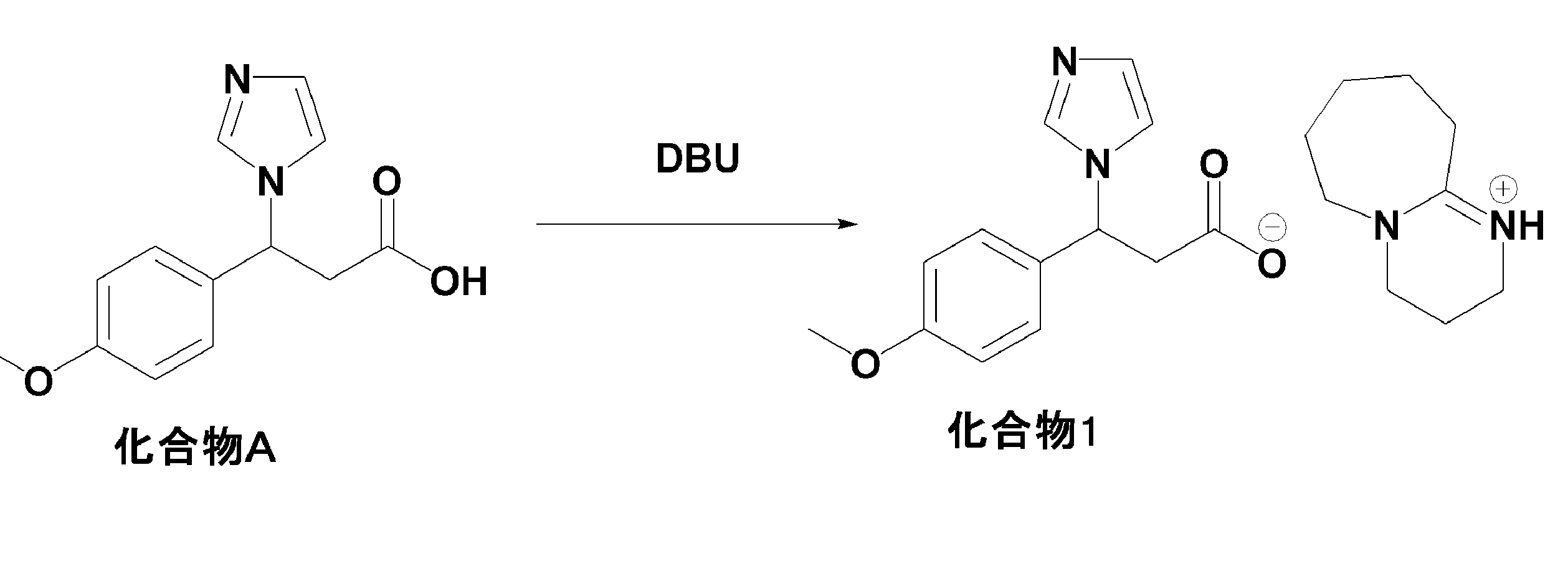
50ml三つ口フラスコに化合物A(2.00g,8.12mmol)とメタノール(20g)とを加えた。フラスコ内を窒素置換した後、ウォーターバスにて60℃にて加温し、化合物Aをメタノールに溶解させた。次に、上記スキームに従いジアザビシクロウンデセン(DBU;1.24g,8.12mmol)を滴下し、化合物AとDBUとを60℃で4時間反応させた。反応終了後、反応液を室温(25℃)まで冷却した。その後、反応液から、ロータリーエバポレーターを用いて溶剤を留去することにより、上記式(1)で表される化合物(化合物1)を得た。(収量=3.27g,収率=95%,黄色粘調液体)
1H-NMR(重DMSO,400MHz):カチオンδ(ppm)=3.48(CH2,2H),3.40(CH2,2H),3.15(CH2,2H),2.65(CH2,2H),1.82(CH2,2H),1.70-1.45(CH2,6H)、
アニオンδ(ppm)=7.70(CH,1H),7.22(Ph,2H),7.15(CH,1H),6.85(Ph,2H),6.80(CH,1H),5.63(CH,1H),3.70(CH3,3H),2.85-2.65(CH2,2H)
1H-NMR(重DMSO,400MHz):カチオンδ(ppm)=3.48(CH2,2H),3.40(CH2,2H),3.15(CH2,2H),2.65(CH2,2H),1.82(CH2,2H),1.70-1.45(CH2,6H)、
アニオンδ(ppm)=7.70(CH,1H),7.22(Ph,2H),7.15(CH,1H),6.85(Ph,2H),6.80(CH,1H),5.63(CH,1H),3.70(CH3,3H),2.85-2.65(CH2,2H)
〔合成例2〕上記式(1)で表される化合物の合成2
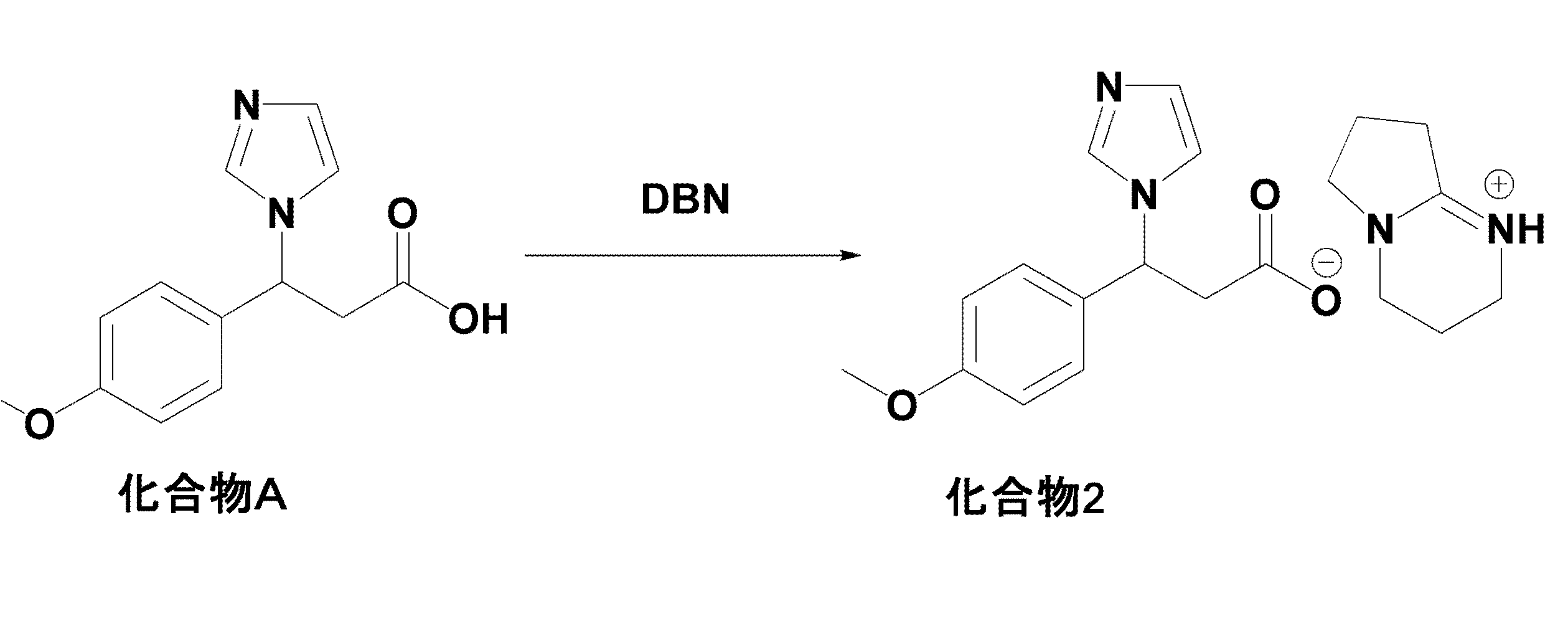
50ml三つ口フラスコに化合物A(2.00g,8.12mmol)とメタノール(20g)とを加えた。フラスコ内を窒素置換した後、ウォーターバスにて60℃にて加温し、化合物Aをメタノールに溶解させた。次に、上記スキームに従いジアザビシクロノネン(DBN;1.11g,8.12mmol)を滴下し、化合物AとDBNとを60℃で4時間反応させた。反応終了後、反応液を室温まで冷却した。その後、反応液から、ロータリーエバポレーターを用いて溶剤を留去することにより、上記式(1)で表される化合物(化合物2)を得た。(収量=2.91g,収率=90%,黄色粘調液体)
1H-NMR(重DMSO,400MHz):カチオンδ(ppm)=3.55(CH2,2H),3.40-3.25(CH2,4H),2.81(CH2,2H),2.00(CH2,2H),1.88(CH2,2H)
アニオンδ(ppm)=7.70(CH,1H),7.22(Ph,2H),7.15(CH,1H),6.85(Ph, 2H),6.80(CH,1H),5.63(CH,1H),3.70(CH3,3H),2.85-2.65(CH2,2H)
1H-NMR(重DMSO,400MHz):カチオンδ(ppm)=3.55(CH2,2H),3.40-3.25(CH2,4H),2.81(CH2,2H),2.00(CH2,2H),1.88(CH2,2H)
アニオンδ(ppm)=7.70(CH,1H),7.22(Ph,2H),7.15(CH,1H),6.85(Ph, 2H),6.80(CH,1H),5.63(CH,1H),3.70(CH3,3H),2.85-2.65(CH2,2H)
〔合成例3〕上記式(1)で表される化合物の合成3
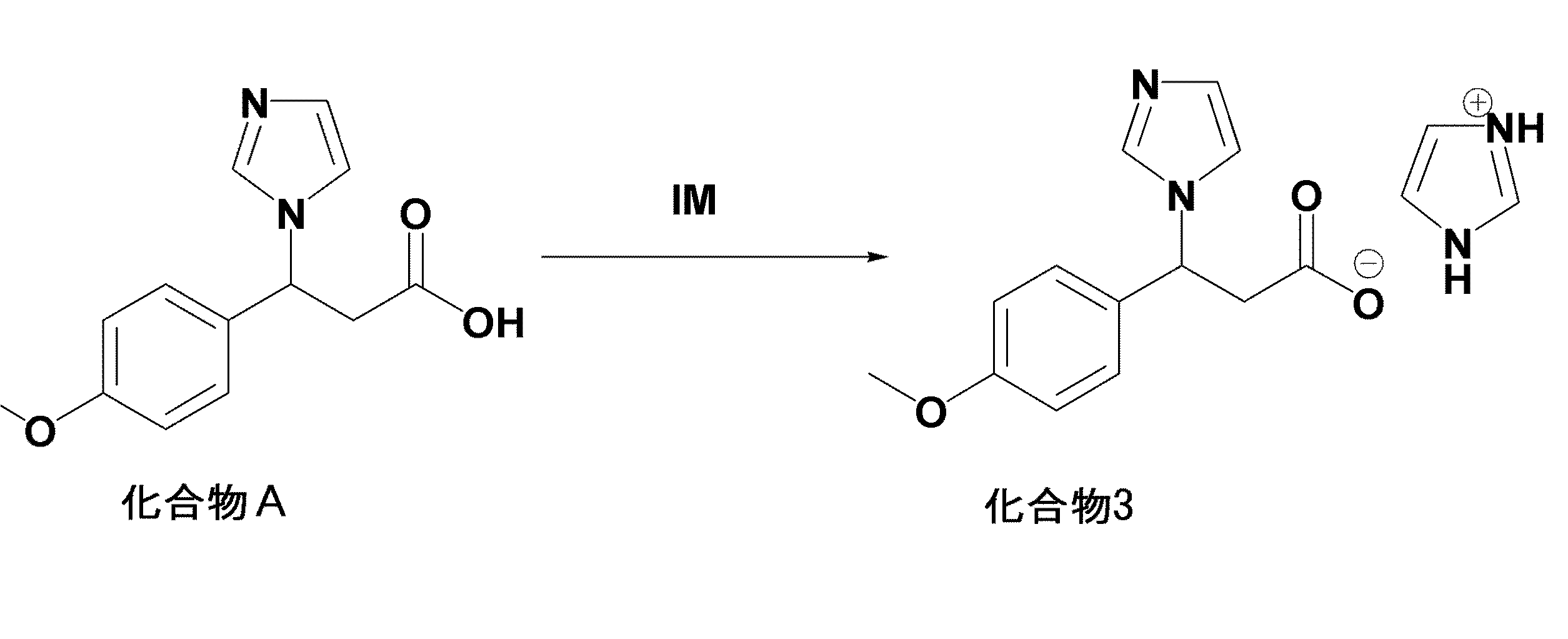
50ml三つ口フラスコに化合物A(2.00g,8.12mmol)とメタノール(20g)とを加えた。フラスコ内を窒素置換した後、ウォーターバスにて60℃にて加温し、化合物Aをメタノールに溶解させた。次に、イミダゾール(IM;0.55g,8.12mmol)を加え、化合物AとIMとを60℃で4時間反応させた。反応終了後、反応液を室温まで冷却した。その後、反応液から、ロータリーエバポレーターを用いて溶剤を留去することにより、上記式(1)で表される化合物(化合物3)を得た。(収量=2.43g,収率=95%,白色固体)
1H-NMR(重DMSO,400MHz):カチオンδ(ppm)=7.03(CH,2H),7.65(CH,1H)
アニオンδ(ppm)=7.86(CH,1H),7.35(3H),6.99(3H),5.70(CH,1H),3.71(CH3,3H),3.35-3.16(CH2,2H)
1H-NMR(重DMSO,400MHz):カチオンδ(ppm)=7.03(CH,2H),7.65(CH,1H)
アニオンδ(ppm)=7.86(CH,1H),7.35(3H),6.99(3H),5.70(CH,1H),3.71(CH3,3H),3.35-3.16(CH2,2H)
原料の化合物A単体、イミダゾール単体、及び得られた化合物3について、それぞれ、X線回折測定装置((株)リガク社製;商品名「全自動水平型多目的X線回折測定装置SmartLab」)を用いて、以下の条件下に、X線回折パターンの測定を行った。得られた化合物3は、原料の各単体のいずれとも異なる反射パターンを示したことから、単なる混合物ではなく、塩であると判断される。
使用X線:回転対陰極型X線発生源由来CuKα線、45kV-200mA
走査速度(2θ):4.0°/min
発散スリット:(2/3)°
散乱スリット:(2/3)°
その他の条件は、パッケージ測定「汎用測定>汎用(集中法)」の標準条件設定による。
使用X線:回転対陰極型X線発生源由来CuKα線、45kV-200mA
走査速度(2θ):4.0°/min
発散スリット:(2/3)°
散乱スリット:(2/3)°
その他の条件は、パッケージ測定「汎用測定>汎用(集中法)」の標準条件設定による。
〔合成例4〕上記式(1)で表される化合物の合成4

20mlナスフラスコに化合物A(1.60g,6.50mmol)とテトラヒドロフラン(3g)とを加えた。ナスフラスコ内を窒素置換した後、オイルバスにて60℃にて加温し、テトラヒドロフランに化合物Aを溶解させた。次に、上記スキームに従い7-メチル-1,5,7-トリアザビシクロ[4.4.0]デカ-5-エン(MTBD;1.00g,6.50mmol)を滴下し、化合物AとMTBDとを60℃で30分反応させた。反応終了後、反応液を室温まで冷却した。その後、反応液から、ロータリーエバポレーターを用いて溶剤を留去することにより、上記式(1)で表される化合物(化合物4)を得た。(収量=2.5g,収率=95%,黄色粘調液体)
1H-NMR(重DMSO,500MHz):カチオンδ(ppm)=9.20(NH,1H),3.27-3.22(6H),3.17-3.15(2H),2.90(CH3,3H),1.92-1.89(2H),1.81-1.79(2H)
アニオンδ(ppm)=7.67(CH,1H),7.21(2H),7.12(1H),6.84(2H),6.79(1H),5.62(CH,1H),3.71(CH3,3H),2.73-2.61(CH2,2H)
1H-NMR(重DMSO,500MHz):カチオンδ(ppm)=9.20(NH,1H),3.27-3.22(6H),3.17-3.15(2H),2.90(CH3,3H),1.92-1.89(2H),1.81-1.79(2H)
アニオンδ(ppm)=7.67(CH,1H),7.21(2H),7.12(1H),6.84(2H),6.79(1H),5.62(CH,1H),3.71(CH3,3H),2.73-2.61(CH2,2H)
〔合成例5〕上記式(1)で表される化合物の合成5
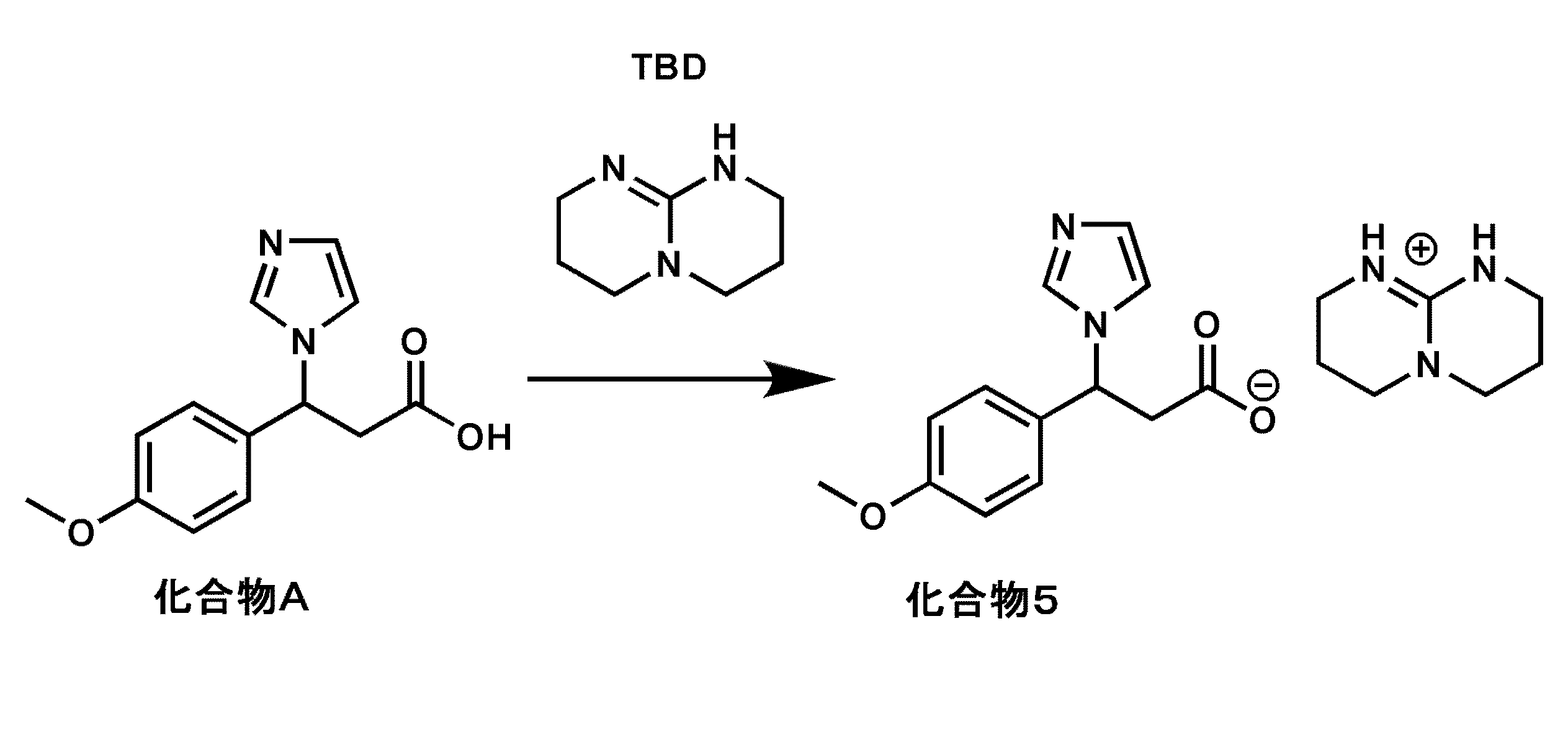
20mlナスフラスコに化合物A(1.50g,6.09mmol)とメタノール(9g)とを加えた。ナスフラスコ内を窒素置換した後、オイルバスにて60℃にて加温し、化合物Aをメタノールに溶解させた。次に、上記スキームに従い1,5,7-トリアザビシクロ[4,4,0]デカ-5-エン(TBD;0.85g,6.09mmol)を滴下し、化合物AとTBDとを60℃で30分反応させた。反応終了後、反応液を室温まで冷却した。その後、反応液から、ロータリーエバポレーターを用いて溶剤を留去することにより、上記式(1)で表される化合物(化合物5)を得た。(収量=2.2g,収率=95%,黄色固体)
1H-NMR(重DMSO,500MHz):カチオンδ(ppm)=10.48(NH,2H),3.22-3.17(4H),3.10-3.07(4H),1.86-1.81(4H)
アニオンδ(ppm)=7.71(CH,1H),7.25(2H),7.17(1H),6.86(2H),6.80(1H),5.65(CH,1H),3.71(CH3,3H),2.87-2.73(CH2,2H)
1H-NMR(重DMSO,500MHz):カチオンδ(ppm)=10.48(NH,2H),3.22-3.17(4H),3.10-3.07(4H),1.86-1.81(4H)
アニオンδ(ppm)=7.71(CH,1H),7.25(2H),7.17(1H),6.86(2H),6.80(1H),5.65(CH,1H),3.71(CH3,3H),2.87-2.73(CH2,2H)
〔合成例6〕上記式(1)で表される化合物の合成6
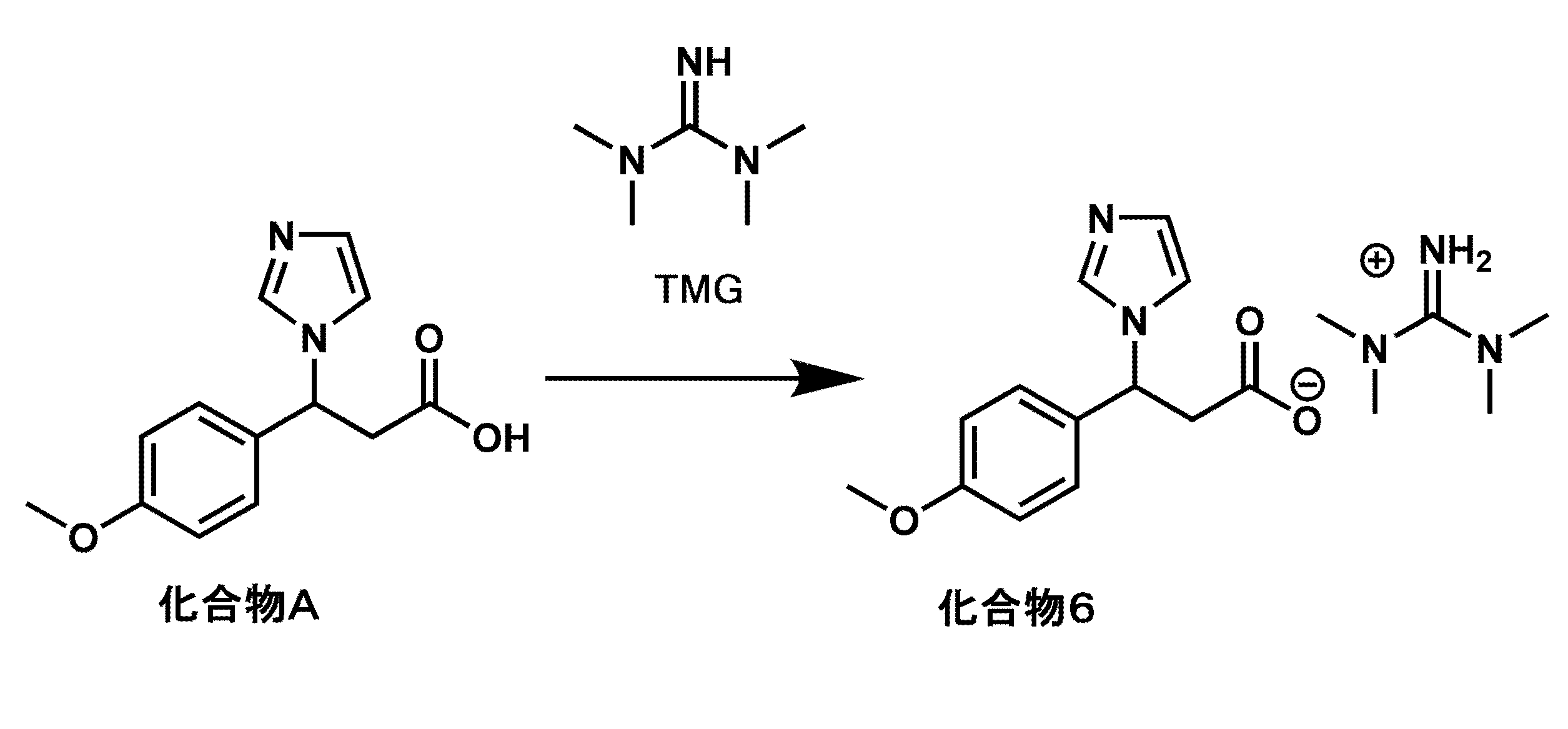
20mlナスフラスコに化合物A(1.50g,6.09mmol)とメタノール(9g)とを加えた。ナスフラスコ内を窒素置換した後、オイルバスにて60℃にて加温し、化合物Aをメタノールに溶解させた。次に、上記スキームに従い1,1,3,3-テトラメチルグアニジン(TMG;0.7g,6.09mmol)を滴下し、化合物AとTMGとを60℃で30分反応させた。反応終了後、反応液を室温まで冷却した。その後、反応液から、ロータリーエバポレーターを用いて溶剤を留去することにより、上記式(1)で表される化合物(化合物6)を得た。(収量=2.2g,収率=100%,黄色固体)
1H-NMR(重DMSO,500MHz):カチオンδ(ppm)=2.84(6H)
アニオンδ(ppm)=7.67(CH,1H),7.21(2H),7.12(1H),6.85(2H),6.79(1H),5.62(CH,1H),3.71(CH3,3H),2.28-2.64(CH2,2H)
1H-NMR(重DMSO,500MHz):カチオンδ(ppm)=2.84(6H)
アニオンδ(ppm)=7.67(CH,1H),7.21(2H),7.12(1H),6.85(2H),6.79(1H),5.62(CH,1H),3.71(CH3,3H),2.28-2.64(CH2,2H)
〔合成例7〕上記式(1)で表される化合物の合成7
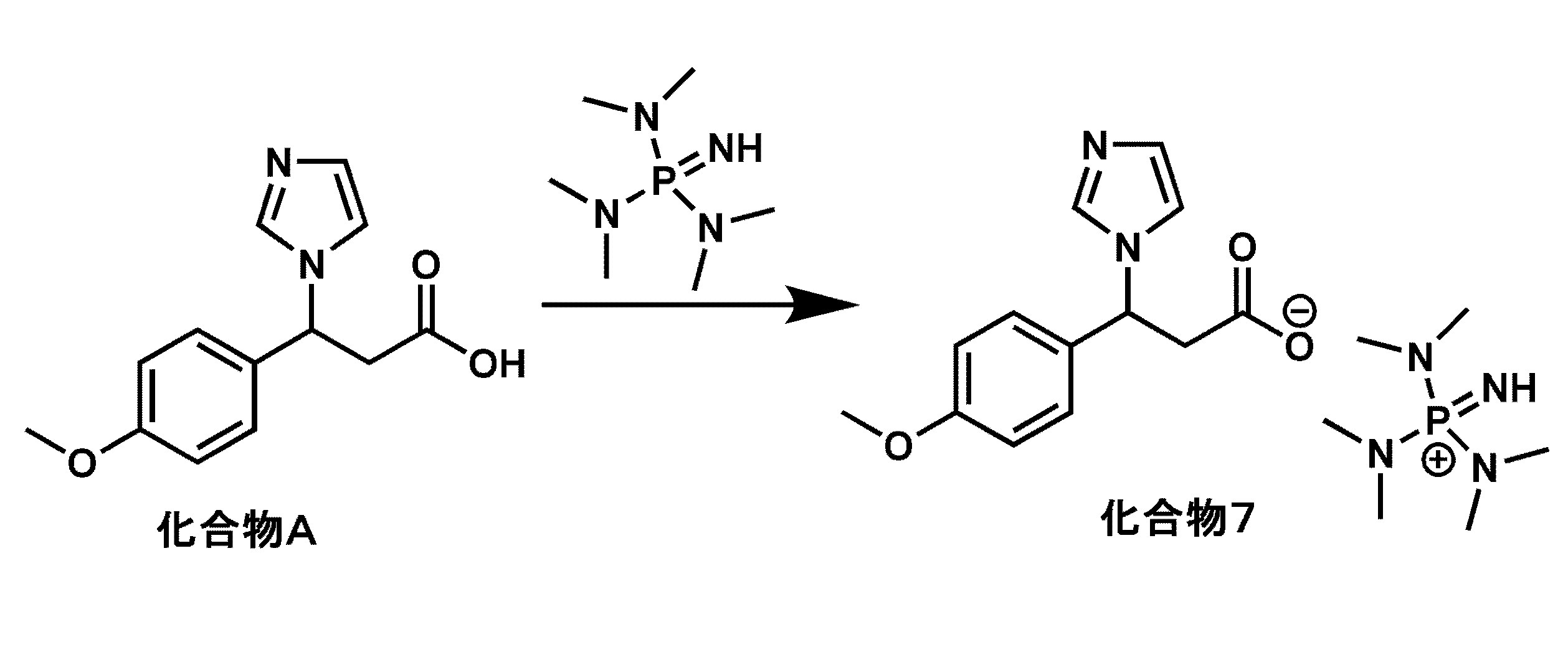
20mlナスフラスコに化合物A(1.00g,4.06mmol)とメタノール(9g)とを加えた。ナスフラスコ内を窒素置換した後、オイルバスにて60℃にて加温し、化合物Aをメタノールに溶解させた。次に、上記スキームに従いイミノ-トリス(ジメチルアミノ)ホスホラン(0.72g,4.06mmol)を滴下し、化合物Aとイミノ-トリス(ジメチルアミノ)ホスホランとを60℃で30分反応させた。反応終了後、反応液を室温まで冷却した。その後、反応液から、ロータリーエバポレーターを用いて溶剤を留去することにより、上記式で表される化合物(化合物7)を得た。(収量=1.7g,収率=98%,黄色固体)
1H-NMR(重DMSO,500MHz):カチオンδ(ppm)=2.63(9H),2.61(9H),
アニオンδ(ppm)=7.65(CH,1H),7.18(2H),7.10(1H),6.84(2H),6.84(1H),5.61(CH,1H),3.71(CH3,3H),2.28-2.64(CH2,2H)
1H-NMR(重DMSO,500MHz):カチオンδ(ppm)=2.63(9H),2.61(9H),
アニオンδ(ppm)=7.65(CH,1H),7.18(2H),7.10(1H),6.84(2H),6.84(1H),5.61(CH,1H),3.71(CH3,3H),2.28-2.64(CH2,2H)
〔組成物の調製〕
下記表1に示した配合比(質量部)で下記エポキシ化合物、式(1)で表される化合物、及び比較化合物を混合し実施例1及び比較例1の組成物を調製した。

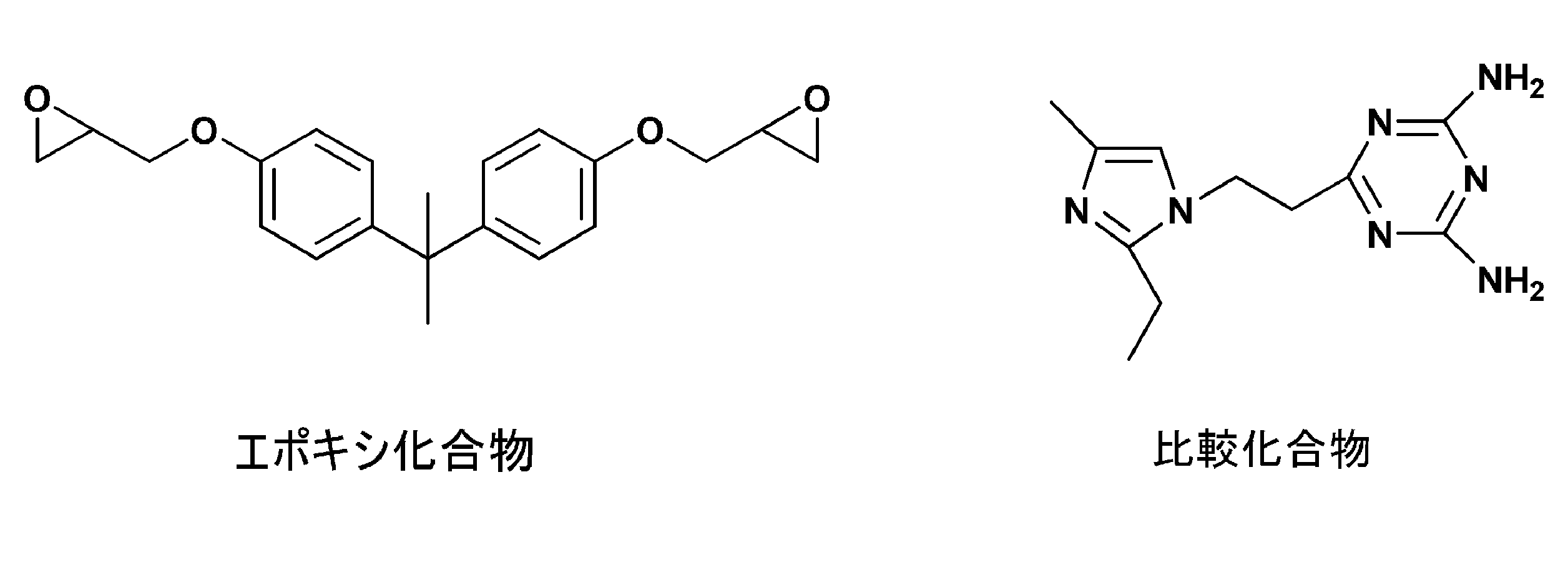
下記表1に示した配合比(質量部)で下記エポキシ化合物、式(1)で表される化合物、及び比較化合物を混合し実施例1及び比較例1の組成物を調製した。
〔耐熱性評価〕
実施例1及び比較例1の組成物を用いて耐熱性評価を行った。
実施例1及び比較例1の組成物を、ガラス基板に塗布して200℃で(5分間)加熱し膜厚1μmの硬化膜を得た。
得られた硬化膜を一度室温まで冷ました後、再び、室温から200℃まで昇温して、膜の状態を確認した。
比較例1の硬化膜は140℃付近で膜が融解し始めたが、実施例1の硬化膜は融解が起こらず、示差走査熱量計(商品名:DSC-50、島津製作所製)による観測においても吸熱ピークが現れなかったため、耐熱性の良好な硬化膜が得られていると考えられる。
実施例1及び比較例1の組成物を用いて耐熱性評価を行った。
実施例1及び比較例1の組成物を、ガラス基板に塗布して200℃で(5分間)加熱し膜厚1μmの硬化膜を得た。
得られた硬化膜を一度室温まで冷ました後、再び、室温から200℃まで昇温して、膜の状態を確認した。
比較例1の硬化膜は140℃付近で膜が融解し始めたが、実施例1の硬化膜は融解が起こらず、示差走査熱量計(商品名:DSC-50、島津製作所製)による観測においても吸熱ピークが現れなかったため、耐熱性の良好な硬化膜が得られていると考えられる。
Claims (5)
- 下記式(1)で表される化合物を含む組成物。

- エポキシ基を有する化合物を更に含む、請求項1に記載の組成物。
- 硬化性組成物である、請求項1又は2に記載の組成物。
- m価の対カチオンXm+が、非環式若しくは環式の含窒素脂肪族カチオン、含窒素芳香族カチオン又は金属カチオンである、請求項1~3のいずれか1項に記載の組成物。
- 請求項1~4のいずれか1項に記載の組成物の硬化物。
Priority Applications (1)
| Application Number | Priority Date | Filing Date | Title |
|---|---|---|---|
| JP2019545586A JP7183170B2 (ja) | 2017-09-29 | 2018-09-26 | 組成物及び硬化物 |
Applications Claiming Priority (2)
| Application Number | Priority Date | Filing Date | Title |
|---|---|---|---|
| JP2017191769 | 2017-09-29 | ||
| JP2017-191769 | 2017-09-29 |
Publications (1)
| Publication Number | Publication Date |
|---|---|
| WO2019065776A1 true WO2019065776A1 (ja) | 2019-04-04 |
Family
ID=65901925
Family Applications (1)
| Application Number | Title | Priority Date | Filing Date |
|---|---|---|---|
| PCT/JP2018/035789 Ceased WO2019065776A1 (ja) | 2017-09-29 | 2018-09-26 | 組成物及び硬化物 |
Country Status (3)
| Country | Link |
|---|---|
| JP (1) | JP7183170B2 (ja) |
| TW (1) | TWI797165B (ja) |
| WO (1) | WO2019065776A1 (ja) |
Cited By (2)
| Publication number | Priority date | Publication date | Assignee | Title |
|---|---|---|---|---|
| KR20190113612A (ko) * | 2018-03-28 | 2019-10-08 | 도쿄 오카 고교 가부시키가이샤 | 수소 배리어제, 수소 배리어막 형성용 조성물, 수소 배리어막, 수소 배리어막의 제조 방법, 및 전자 소자 |
| US11718587B2 (en) * | 2017-09-29 | 2023-08-08 | Tokyo Ohka Kogyo Co., Ltd. | Compound, epoxy curing catalyst and method for producing compound |
Citations (2)
| Publication number | Priority date | Publication date | Assignee | Title |
|---|---|---|---|---|
| JP2016194576A (ja) * | 2015-03-31 | 2016-11-17 | 東京応化工業株式会社 | フォトリソグラフィ用現像液及びレジストパターン形成方法 |
| JP2017149914A (ja) * | 2016-02-26 | 2017-08-31 | 東京応化工業株式会社 | 硬化性樹脂組成物物 |
Family Cites Families (1)
| Publication number | Priority date | Publication date | Assignee | Title |
|---|---|---|---|---|
| DE2430039C2 (de) * | 1974-06-22 | 1983-11-10 | Bayer Ag, 5090 Leverkusen | Climbazol in kosmetischen Mitteln |
-
2018
- 2018-09-26 WO PCT/JP2018/035789 patent/WO2019065776A1/ja not_active Ceased
- 2018-09-26 JP JP2019545586A patent/JP7183170B2/ja active Active
- 2018-09-27 TW TW107134023A patent/TWI797165B/zh active
Patent Citations (2)
| Publication number | Priority date | Publication date | Assignee | Title |
|---|---|---|---|---|
| JP2016194576A (ja) * | 2015-03-31 | 2016-11-17 | 東京応化工業株式会社 | フォトリソグラフィ用現像液及びレジストパターン形成方法 |
| JP2017149914A (ja) * | 2016-02-26 | 2017-08-31 | 東京応化工業株式会社 | 硬化性樹脂組成物物 |
Non-Patent Citations (1)
| Title |
|---|
| MOHAMED, S. GOMAA ET AL.: "Synthesis and Biological Evaluation of 3-(lH-Imidazol-and Triazol-1-yl)-2, 2-dimethyl-3-[4-(naphthalen-2- ylamino) phenyl]propyl Derivatives as Small Molecule Inhibitors of Retinoic Acid 4- Hydroxylase(CYP26", JOURNAL OF MEDICINAL CHEMISTRY, vol. 54, 15 August 2011 (2011-08-15), pages 6803 - 6811, XP055156317, DOI: doi:10.1021/jm200695m * |
Cited By (3)
| Publication number | Priority date | Publication date | Assignee | Title |
|---|---|---|---|---|
| US11718587B2 (en) * | 2017-09-29 | 2023-08-08 | Tokyo Ohka Kogyo Co., Ltd. | Compound, epoxy curing catalyst and method for producing compound |
| KR20190113612A (ko) * | 2018-03-28 | 2019-10-08 | 도쿄 오카 고교 가부시키가이샤 | 수소 배리어제, 수소 배리어막 형성용 조성물, 수소 배리어막, 수소 배리어막의 제조 방법, 및 전자 소자 |
| KR102799584B1 (ko) | 2018-03-28 | 2025-04-23 | 도쿄 오카 고교 가부시키가이샤 | 수소 배리어제, 수소 배리어막 형성용 조성물, 수소 배리어막, 수소 배리어막의 제조 방법, 및 전자 소자 |
Also Published As
| Publication number | Publication date |
|---|---|
| JPWO2019065776A1 (ja) | 2020-09-10 |
| TWI797165B (zh) | 2023-04-01 |
| TW201920117A (zh) | 2019-06-01 |
| JP7183170B2 (ja) | 2022-12-05 |
Similar Documents
| Publication | Publication Date | Title |
|---|---|---|
| JP7316398B2 (ja) | エネルギー感受性組成物、硬化物及び硬化物の製造方法 | |
| JP6832071B2 (ja) | 着色感光性組成物、それによって得られる着色硬化物、表示素子及び着色硬化物の製造方法 | |
| EP3228641B1 (en) | Curable composition | |
| JP6214292B2 (ja) | 硬化性組成物 | |
| JP7183170B2 (ja) | 組成物及び硬化物 | |
| TWI660998B (zh) | 透明絕緣膜形成用組成物 | |
| JP7376347B2 (ja) | 樹脂組成物、硬化物、及びシロキサン変性(メタ)アクリル樹脂 | |
| JP6664164B2 (ja) | 感光性組成物 | |
| JP6266960B2 (ja) | 感エネルギー性組成物 | |
| JP7269881B2 (ja) | 化合物、エポキシ硬化触媒、及び化合物の製造方法 | |
| TWI624727B (zh) | Photosensitive composition, method for producing the photosensitive composition, method for forming a film using the photosensitive composition, method for suppressing adhesion when the photosensitive composition is stored, photopolymerization initiator, and photopolymerization initiator Production method | |
| JP2005171236A (ja) | 不飽和エステル置換ポリマ及びその調整方法 | |
| JP7046948B2 (ja) | 芳香族アミン化合物、エポキシ化合物用硬化剤、硬化性組成物、硬化物、硬化物の製造方法、及び芳香族アミン化合物の製造方法 | |
| JP2020094127A (ja) | 感エネルギー性樹脂組成物、硬化物及び硬化物の製造方法 | |
| JP2021102738A (ja) | 硬化性組成物、硬化物、(メタ)アクリル樹脂、及び化合物 |
Legal Events
| Date | Code | Title | Description |
|---|---|---|---|
| 121 | Ep: the epo has been informed by wipo that ep was designated in this application |
Ref document number: 18860867 Country of ref document: EP Kind code of ref document: A1 |
|
| ENP | Entry into the national phase |
Ref document number: 2019545586 Country of ref document: JP Kind code of ref document: A |
|
| NENP | Non-entry into the national phase |
Ref country code: DE |
|
| 122 | Ep: pct application non-entry in european phase |
Ref document number: 18860867 Country of ref document: EP Kind code of ref document: A1 |