WO2019065467A1 - ブロックイソシアネート組成物、塗料組成物及び塗膜 - Google Patents
ブロックイソシアネート組成物、塗料組成物及び塗膜 Download PDFInfo
- Publication number
- WO2019065467A1 WO2019065467A1 PCT/JP2018/034888 JP2018034888W WO2019065467A1 WO 2019065467 A1 WO2019065467 A1 WO 2019065467A1 JP 2018034888 W JP2018034888 W JP 2018034888W WO 2019065467 A1 WO2019065467 A1 WO 2019065467A1
- Authority
- WO
- WIPO (PCT)
- Prior art keywords
- blocked isocyanate
- group
- compound
- composition
- compounds
- Prior art date
- Legal status (The legal status is an assumption and is not a legal conclusion. Google has not performed a legal analysis and makes no representation as to the accuracy of the status listed.)
- Ceased
Links
- 0 *C(*N=C=O)(*N=C=O)*N=C=O Chemical compound *C(*N=C=O)(*N=C=O)*N=C=O 0.000 description 1
Classifications
-
- C—CHEMISTRY; METALLURGY
- C08—ORGANIC MACROMOLECULAR COMPOUNDS; THEIR PREPARATION OR CHEMICAL WORKING-UP; COMPOSITIONS BASED THEREON
- C08G—MACROMOLECULAR COMPOUNDS OBTAINED OTHERWISE THAN BY REACTIONS ONLY INVOLVING UNSATURATED CARBON-TO-CARBON BONDS
- C08G18/00—Polymeric products of isocyanates or isothiocyanates
- C08G18/06—Polymeric products of isocyanates or isothiocyanates with compounds having active hydrogen
- C08G18/70—Polymeric products of isocyanates or isothiocyanates with compounds having active hydrogen characterised by the isocyanates or isothiocyanates used
- C08G18/72—Polyisocyanates or polyisothiocyanates
-
- C—CHEMISTRY; METALLURGY
- C08—ORGANIC MACROMOLECULAR COMPOUNDS; THEIR PREPARATION OR CHEMICAL WORKING-UP; COMPOSITIONS BASED THEREON
- C08G—MACROMOLECULAR COMPOUNDS OBTAINED OTHERWISE THAN BY REACTIONS ONLY INVOLVING UNSATURATED CARBON-TO-CARBON BONDS
- C08G18/00—Polymeric products of isocyanates or isothiocyanates
- C08G18/06—Polymeric products of isocyanates or isothiocyanates with compounds having active hydrogen
- C08G18/70—Polymeric products of isocyanates or isothiocyanates with compounds having active hydrogen characterised by the isocyanates or isothiocyanates used
- C08G18/72—Polyisocyanates or polyisothiocyanates
- C08G18/77—Polyisocyanates or polyisothiocyanates having heteroatoms in addition to the isocyanate or isothiocyanate nitrogen and oxygen or sulfur
-
- C—CHEMISTRY; METALLURGY
- C08—ORGANIC MACROMOLECULAR COMPOUNDS; THEIR PREPARATION OR CHEMICAL WORKING-UP; COMPOSITIONS BASED THEREON
- C08G—MACROMOLECULAR COMPOUNDS OBTAINED OTHERWISE THAN BY REACTIONS ONLY INVOLVING UNSATURATED CARBON-TO-CARBON BONDS
- C08G18/00—Polymeric products of isocyanates or isothiocyanates
- C08G18/06—Polymeric products of isocyanates or isothiocyanates with compounds having active hydrogen
- C08G18/70—Polymeric products of isocyanates or isothiocyanates with compounds having active hydrogen characterised by the isocyanates or isothiocyanates used
- C08G18/72—Polyisocyanates or polyisothiocyanates
- C08G18/80—Masked polyisocyanates
-
- C—CHEMISTRY; METALLURGY
- C09—DYES; PAINTS; POLISHES; NATURAL RESINS; ADHESIVES; COMPOSITIONS NOT OTHERWISE PROVIDED FOR; APPLICATIONS OF MATERIALS NOT OTHERWISE PROVIDED FOR
- C09D—COATING COMPOSITIONS, e.g. PAINTS, VARNISHES OR LACQUERS; FILLING PASTES; CHEMICAL PAINT OR INK REMOVERS; INKS; CORRECTING FLUIDS; WOODSTAINS; PASTES OR SOLIDS FOR COLOURING OR PRINTING; USE OF MATERIALS THEREFOR
- C09D175/00—Coating compositions based on polyureas or polyurethanes; Coating compositions based on derivatives of such polymers
- C09D175/04—Polyurethanes
Definitions
- the present invention relates to a blocked isocyanate composition, a coating composition and a coating.
- urethane coatings formed from polyurethane coatings have very good flexibility, chemical resistance and stain resistance. Furthermore, a coating film using a non-yellowing polyisocyanate obtained from an aliphatic diisocyanate represented by 1,6-diisocyanatohexane (hereinafter sometimes referred to as “HDI”) as a curing agent is further weather resistant. It is excellent in sex and its demand is increasing. Also, blocked polyisocyanate is obtained by blocking the isocyanate group of the above-mentioned polyisocyanate with a thermally dissociable blocking agent.
- HDI 1,6-diisocyanatohexane
- JP-A-2-620 (TPA oxime) European Patent Application Publication No. 159117 (Pira) Patent No. 4671668
- the blocked isocyanate composition described in Patent Document 1 has a high baking temperature required for curing, and the low-temperature curability is insufficient.
- the block isocyanate composition as described in patent document 2 and 3 has low-temperature curability, there existed a subject in compatibility with the highly polar base agent.
- the present invention has been made in view of the above-mentioned circumstances, and provides a blocked isocyanate composition which is excellent in compatibility with a polar polyol and in which a coating film having low temperature curability and good appearance is obtained.
- the coating composition and coating film which used the said block isocyanate composition are provided.
- the blocked isocyanate composition according to the first aspect of the present invention is at least selected from the group consisting of a triisocyanate compound represented by the following general formula (I) and a diisocyanate compound represented by the following general formula (II) It contains a blocked isocyanate compound obtained from one species and a thermally dissociating blocking agent.
- each of a plurality of Y 1 s independently represents a single bond, or a divalent group having 1 to 20 carbon atoms which may contain one or more selected from the group consisting of an ester structure and an ether structure Is a hydrocarbon group of The plurality of Y 1 may be identical to or different from each other. However, one or more of the plurality of Y 1 contains an ester structure.
- R 1 is a hydrogen atom or a monovalent hydrocarbon group having 1 to 12 carbon atoms.
- Y 2 is a C 1 to C 20 divalent hydrocarbon group containing at least one selected from the group consisting of an ester structure and a carboxylic acid.
- the thermally dissociable blocking agent may be one or more selected from the group consisting of oxime compounds, acid amide compounds, amine compounds, imidazole compounds, triazole compounds and pyrazole compounds.
- the coating composition according to the second aspect of the present invention comprises the blocked isocyanate composition according to the first aspect and an active hydrogen compound.
- the coating film according to the third aspect of the present invention is obtained by curing the coating composition according to the second aspect.
- a blocked isocyanate composition which is excellent in crystallinity, and capable of obtaining a coating film excellent in low temperature curability and appearance. Moreover, the coating composition and coating film which used the said block isocyanate composition can be provided.
- the present embodiment is an example for describing the present invention, and is not intended to limit the present invention to the following contents.
- the present invention can be appropriately modified and implemented within the scope of the gist of the present invention.
- the blocked isocyanate composition according to one embodiment of the present invention is a triisocyanate compound represented by the following general formula (I) (hereinafter sometimes referred to as “triisocyanate compound (I)”), and the following general Blocked isocyanate obtained from at least one member selected from the group consisting of a diisocyanate compound represented by the formula (II) (hereinafter sometimes referred to as “diisocyanate compound (II)”) and a thermally dissociable blocking agent Contains the compound.
- triisocyanate compound (I) a triisocyanate compound represented by the following general formula (I)
- diisocyanate compound (II) hereinafter sometimes referred to as "diisocyanate compound (II)
- thermally dissociable blocking agent Contains the compound.
- each of a plurality of Y 1 s independently represents a single bond, or a divalent group having 1 to 20 carbon atoms which may contain one or more selected from the group consisting of an ester structure and an ether structure Is a hydrocarbon group of The plurality of Y 1 may be identical to or different from each other. However, one or more of the plurality of Y 1 contains an ester structure.
- R 1 is a hydrogen atom or a monovalent hydrocarbon group having 1 to 12 carbon atoms.
- Y 2 is a C 1 to C 20 divalent hydrocarbon group containing at least one selected from the group consisting of an ester structure and a carboxylic acid.
- the blocked isocyanate composition of the present embodiment is excellent in compatibility with the polar polyol, and by using the blocked isocyanate composition of the present embodiment, a coating film having good low temperature curability can be obtained.
- the physical properties and components of the blocked isocyanate composition of the present embodiment will be described in detail below.
- the average number of isocyanate groups (average number of NCO groups) per molecule of blocked isocyanate compound contained in the blocked isocyanate composition of the present embodiment is preferably 2.0 or more and less than 3.0, in view of low temperature curability, and 2.1 or more Less than 3.0 is more preferable, and 2.2 or more and less than 3.0 are particularly preferable.
- the effective NCO content is not particularly limited, but is preferably 15% by mass or more and 35% by mass or less because the low-temperature curability of the resulting coating film becomes better.
- the content is more preferably 17% by mass to 33% by mass, still more preferably 20% by mass to 30% by mass, and particularly preferably 21% by mass to 29% by mass.
- the effective NCO content can be calculated using the following formula (A).
- Effective NCO content [mass%] ⁇ (Content of triisocyanate compound) x (NCO content of triisocyanate compound) ⁇ / (total mass of blocked isocyanate composition) ... (A)
- the blocked isocyanate compound contained in the blocked isocyanate composition of this embodiment is reacted with a thermally dissociable blocking agent and at least one selected from the group consisting of the above triisocyanate compound (I) and diisocyanate compound (II) It is obtained by letting it be blocked.
- thermal dissociation means that the blocking agent bound to the isocyanate group is dissociated by heating to regenerate the isocyanate group.
- the temperature required for dissociation varies depending on the structure of the blocking agent, and is, for example, 40 ° C. to 300 ° C.
- the coating film obtained from the thermally dissociatable block isocyanate tends to be excellent in weather resistance and impact resistance.
- Triisocyanate compound (I) (Y 1 )
- a plurality of Y 1 s each independently include a single bond or one or more selected from the group consisting of an ester structure (—COO—) and an ether structure (—O—) It is a good C1-C20 divalent hydrocarbon group.
- the plurality of Y 1 may be identical to or different from each other. However, one or more of the plurality of Y 1 contains an ester structure.
- One or more of the plurality of Y 1 may, by having an ester structure, a blocked isocyanate composition of this embodiment can increase the reactivity of the isocyanate groups when used as a curing agent of the coating composition.
- Y 1 is a divalent hydrocarbon group having 1 to 20 carbon atoms which does not contain one or more selected from the group consisting of an ester structure and an ether structure
- the divalent hydrocarbon group having 1 to 20 carbon atoms is May be an aliphatic group or an aromatic group.
- the aliphatic group may be linear, branched or cyclic.
- an alkanediyl group (alkylene group), an alkylidene group etc. are mentioned, for example.
- cyclic aliphatic group a cycloalkylene group etc. are mentioned, for example.
- arylene groups such as a phenylene group
- Y 1 is a divalent hydrocarbon group of 1 to 20 carbon atoms containing one or more selected from the group consisting of the ester structure and the ether structure, it is represented by, for example, the following general formula (III): Group (hereinafter sometimes referred to as “group (III)”).
- the bond opposite to- (CH 2 ) n1 -X is bonded to C in the above general formula (I), and the bond opposite to- (CH 2 ) n2 -X is bonded Is bonded to the NCO in the above general formula (I). Further, it is an integer such that 1 ⁇ n1 + n2 ⁇ 20. That is, both n1 and n2 can not be 0, and it is preferable that n2 connected to NCO be 1 or more.
- n1 and n2 are each independently preferably an integer of 0 to 20, more preferably an integer of 0 to 4, and still more preferably an integer of 0 to 2.
- X is an ester or ether structure. Among them, X is preferably an ester structure because the reaction rate is increased.
- the heat resistance of the blocked isocyanate composition of the present embodiment can be further improved.
- the hydrolysis resistance of the blocked isocyanate composition of the present embodiment can be further improved.
- R 1 is a hydrogen atom or a monovalent hydrocarbon group having 1 to 12 carbon atoms.
- the hydrocarbon group in R 1 is not particularly limited, and examples thereof include an alkyl group, an alkenyl group, and an alkynyl group. Among them, a hydrogen atom is preferable as R 1 .
- a preferable triisocyanate compound (I) in which one or more of a plurality of Y 1 have an ester structure specifically, it is disclosed, for example, in Japanese Patent Publication No. 4-1033 (Reference 1).
- GTI Bis (2-isocyanatoethyl) 2-isocyanatoglutarate
- LTI isocyanatoglutarate
- LTI isocyanates
- the molecular weight of the triisocyanate compound is preferably 139 or more and 1000 or less, more preferably 150 or more and 800 or less, and still more preferably 180 or more and 600 or less. It is particularly preferable that it is at least 400.
- the molecular weight of the triisocyanate compound is at least the above lower limit, a coating film having a higher hardness can be obtained from the block isocyanate composition of the present embodiment, and by being at the above upper limit or less, the impact resistance is excellent. A coating can be obtained.
- Y 2 is a divalent hydrocarbon of 1 to 20 carbon atoms containing at least one selected from the group consisting of an ester structure (-COO-) and a carboxylic acid (-COOH) It is a group.
- Y 2 has an ester structure, the reactivity of the isocyanate group when the blocked isocyanate composition of the present embodiment is used as a curing agent for a paint composition can be further enhanced.
- Y 2 is a hydrocarbon group having an ester structure, it is possible to obtain a more excellent heat resistance coating from blocked isocyanate composition according to the present embodiment.
- Examples of the divalent hydrocarbon group having 1 to 20 carbon atoms constituting Y 2 include the same ones as the divalent hydrocarbon groups having 1 to 20 carbon atoms exemplified in the above Y 1 .
- the divalent hydrocarbon group having 1 to 20 carbon atoms constituting Y 2 is preferably an aliphatic group, an alicyclic group or an aromatic group.
- Y 2 is a diisocyanate compound which is a hydrocarbon group having at least one selected from the group consisting of ester structure and carboxylic acid (II), for example, lysine diisocyanate (hereinafter , And may be referred to as “LDI” (molecular weight 212) and the like.
- the triisocyanate compound (I) and diisocyanate compound (II) contained in the blocked isocyanate composition of this embodiment are, for example, isocyanates such as amino acid derivatives Can be obtained.
- amino acid derivatives examples include 2,5-diaminovaleric acid, 2,6-diaminohexanoic acid, aspartic acid, glutamic acid and the like. These amino acid derivatives are diamine monocarboxylic acids or monoamine dicarboxylic acids. Therefore, the number of amino groups can be controlled by esterification of a carboxy group, for example, with an alkanolamine such as ethanolamine, or by esterification of a carboxyl group, for example, with methanol or the like.
- the triamine having an ester group obtained can be converted to a triisocyanate compound or a diisocyanate compound containing an ester structure by phosgenation of an amine or the like.
- Thermally dissociating blocking agent for example, (1) oxime type compound, (2) alcohol type compound, (3) acid amide type compound, (4) acid imide type compound, (5) phenol type compound, (6) amine compounds, (7) active methylene compounds, (8) imidazole compounds, (9) triazole compounds, (10) pyrazole compounds and the like.
- One type of the blocking agent may be used, or two or more types may be used in a desired ratio.
- blocking agent More specific examples include those shown below.
- Oxime-based compounds formaldoxime, acetoaldoxime, acetoxime, methyl ethyl ketoxime, cyclohexanone oxime and the like.
- Alcohol compounds methanol, ethanol, 2-propanol, n-butanol, sec-butanol, 2-ethyl-1-hexanol, 2-methoxyethanol, 2-ethoxyethanol, 2-butoxyethanol and the like.
- Acid amide compounds Acetoanilide, acetic acid amide, ⁇ -caprolactam, ⁇ -valerolactam, ⁇ -butyrolactam and the like.
- Acid imide compounds Succinimide, maleic imide and the like.
- Phenolic compounds phenol, cresol, ethylphenol, butylphenol, nonylphenol, dinonylphenol, styrenated phenol, hydroxybenzoic acid ester and the like.
- Amine compounds diphenylamine, aniline, carbazole, di-n-propylamine, diisopropylamine, isopropylethylamine and the like.
- Active methylene compounds dimethyl malonate, diethyl malonate, diisopropyl malonate, di-tert-butyl malonate, methyl acetoacetate, ethyl acetoacetate, acetylacetone and the like.
- Imidazole compounds imidazole, 2-methylimidazole, 2-ethylimidazole and the like.
- Triazole compounds 1,2,4-triazole, 3-amino-1,2,4-triazole, 3-amino-5-phenyl-1,2,4-triazole, 1,2,3-triazole , 1H-benzotriazole and the like.
- Pyrazole compounds Pyrazole, 3-methylpyrazole, 3,5-dimethylpyrazole and the like.
- oxime compounds oxime compounds, acid amide compounds, amine compounds, imidazole compounds, triazole compounds or pyrazoles from the viewpoint of easy availability, crystallinity of the blocked isocyanate composition, and low temperature curability of the obtained coating film.
- Preferred are compounds based on methyl ethyl ketoxime, diisopropylamine, imidazole or 3,5-dimethylpyrazole.
- the blocked isocyanate compound contained in the blocked isocyanate composition of the present embodiment is reacted with the above-described triisocyanate or diisocyanate and a thermally dissociable blocking agent to block the isocyanate group of the above-described triisocyanate compound or diisocyanate compound And the like.
- the isocyanate groups of the above triisocyanate compound or diisocyanate compound may be entirely or partially blocked, but it is preferable to block all.
- the number of moles of the thermally dissociable blocking agent (the number of moles of the thermally dissociable blocking agent) / (the number of moles of the isocyanate group contained in the triisocyanate) is preferably 1.0 to 1.5.
- the blocking agent is formulated to have the above ratio, the excess or unreacted blocking agent remains.
- the blocking reaction may be carried out without a solvent, and if necessary, an organic solvent having no reactivity with an isocyanate group may be used.
- the organic solvent is not particularly limited, and specific examples thereof include the following.
- Aliphatic hydrocarbon solvents such as hexane, heptane and octane.
- Alicyclic hydrocarbon solvents such as cyclohexane and methylcyclohexane.
- Ketone solvents such as acetone, methyl ethyl ketone, methyl isobutyl ketone and cyclohexanone.
- Ester solvents such as methyl acetate, ethyl acetate, butyl acetate and isobutyl acetate.
- Aromatic solvents such as toluene, xylene, diethylbenzene, mesitylene, anisole, chlorobenzene and the like.
- glycol solvents such as ethylene glycol monoethyl ether acetate, 3-methyl-3-methoxybutyl acetate, propylene glycol monomethyl ether acetate, etc.
- Ether solvents such as diethyl ether, tetrahydrofuran, dioxane and the like.
- Halogenated hydrocarbon solvents such as dichloromethane, 1,2-dichloroethane, chloroform and the like.
- pyrrolidone solvents such as N-methyl-2-pyrrolidone.
- Amide solvents such as N, N-dimethylacetamide, N, N-dimethylformamide and the like.
- sulfoxide solvents such as dimethyl sulfoxide.
- lactone solvents such as ⁇ -butyrolactone.
- amine solvents such as morpholine.
- the above organic solvents may be used alone, or a mixture of two or more may be used. Also, the organic solvent can be removed after the reaction. Also, a catalyst may be used in the blocking reaction. Examples of the catalyst include organic metal salts such as tin, zinc and lead; tertiary amine compounds; alcoholates of alkali metals such as sodium and the like, and the catalyst is not limited thereto.
- the blocked isocyanate composition of this embodiment is a blocked isocyanate compound obtained from the triisocyanate compound (I) and the thermally dissociative blocking agent (hereinafter sometimes referred to as “blocked isocyanate compound (I)”), and It is preferable to include a blocked isocyanate compound (hereinafter sometimes referred to as “blocked isocyanate compound (II)”) obtained from the diisocyanate compound (II) and the thermally dissociative blocking agent.
- the weight ratio of the blocked isocyanate compound (II) to the total weight of the blocked isocyanate compound (I) and the blocked isocyanate compound (II) is preferably 0.2% or more, and 0.5%
- the above is more preferable.
- compatibility with the polar polyol tends to be excellent.
- 10% or less is preferable and 5% or less of the said weight ratio is more preferable.
- the low temperature curability tends to be excellent.
- the blocked isocyanate composition of this embodiment is selected from the group consisting of a structure represented by the following general formula (IV) and an isocyanurate structure, a burette structure, a uretdione structure, an iminooxadiazine dione structure, a urethane structure and an allophanate structure.
- the block isocyanate compound obtained from the polyisocyanate compound containing at least 1 sort (s) and block agent can be included.
- each of a plurality of Y 1 s may be each independently a single bond, or a divalent group having 1 to 20 carbon atoms which may contain one or more selected from the group consisting of an ester structure and an ether structure Is a hydrocarbon group of The plurality of Y 1 may be identical to or different from each other. However, one or more of the plurality of Y 1 contains an ester structure.
- R 1 is a hydrogen atom or a monovalent hydrocarbon group having 1 to 12 carbon atoms.
- Y 1 and R 1 are the same as Y 1 and R 1 in general formula (I) described above.
- the blocked isocyanate composition of the present embodiment further includes a curing accelerating catalyst, an antioxidant, an ultraviolet light absorber, a light stabilizer, a pigment, a leveling agent, and a plasticizer depending on the purpose and application other than the above-described blocked isocyanate compound.
- Various additives such as agents, rheology control agents, surfactants and the like can be included.
- the curing accelerating catalyst is not particularly limited, and examples thereof include the following.
- Tin compounds such as dibutyltin dilaurate, dibutyltin diacetate, dioctyltin dilaurate, dimethyltin dineodecanoate, and bis (2-ethylhexanoate) tin.
- Zinc compounds such as zinc 2-ethylhexanoate and zinc naphthenate.
- Titanium compounds such as titanium 2-ethylhexanoate and titanium diisopropoxy bis (ethylacetonate).
- Cobalt compounds such as cobalt 2-ethylhexanoate and cobalt naphthenate.
- Bismuth compounds such as bismuth 2-ethylhexanoate and bismuth naphthenate.
- Zirconium compounds such as zirconium tetraacetylacetonate, zirconyl 2-ethylhexanoate and zirconyl naphthenate.
- Amine such as triethylamine, pyridine, methylpyridine, benzyldimethylamine, N, N-dimethylcyclohexylamine, N-methylpiperidine, pentamethyldiethylenetriamine, N, N'-endoethylenepiperazine, N, N'-dimethylpiperazine Compound.
- the antioxidant is not particularly limited, and examples thereof include hindered phenol compounds, phosphorus compounds, sulfur compounds and the like.
- the UV absorber is not particularly limited, and examples thereof include benzotriazole compounds, triazine compounds, and benzophenone compounds.
- the light stabilizer is not particularly limited, and examples thereof include hindered amine compounds, benzotriazole compounds, triazine compounds, benzophenone compounds, and benzoate compounds.
- the pigment include, but are not limited to, titanium oxide, carbon black, indigo, quinacridone, pearl mica, aluminum and the like.
- the leveling agent is not particularly limited, and examples thereof include silicone oil and the like. Although it does not specifically limit as said plasticizer, For example, phthalic acid esters, a phosphoric acid type compound, a polyester type compound etc. are mentioned. Although it does not specifically limit as said rheology control agent, For example, a hydroxyethyl cellulose, a urea compound, a microgel etc. are mentioned.
- the surfactant is not particularly limited, and examples thereof include known anionic surfactants, cationic surfactants, and amphoteric surfactants.
- the blocked isocyanate composition of the present embodiment can be obtained by adding the above-described various additives to the above-described blocked isocyanate compound alone or to the above-described blocked isocyanate compound as necessary, and mixing them.
- At least one of a heat dissociable blocking agent and an organic solvent may remain in the blocked isocyanate compound used for producing the blocked isocyanate composition of the present embodiment, and the heat dissociable blocking agent and the organic solvent May be removed, and those consisting only of blocked isocyanate compounds may be used.
- the blocked isocyanate composition of the present embodiment is, for example, a curable composition such as a paint composition, an adhesive composition, an adhesive composition, a casting composition and the like; various surface treatment compositions such as a fiber treatment agent; Various elastomer compositions; Crosslinking agents such as foam compositions; Modifiers; Additives etc.
- a curable composition such as a paint composition, an adhesive composition, an adhesive composition, a casting composition and the like
- various surface treatment compositions such as a fiber treatment agent
- Various elastomer compositions such as foam compositions; Modifiers; Additives etc.
- Examples of the application fields of the pressure-sensitive adhesive composition and the adhesive composition containing the blocked isocyanate composition of the present embodiment include automobiles, building materials, home appliances, woodworking, laminates for solar cells, and the like.
- it is necessary to laminate films and plates of various adherends for liquid crystal displays of household appliances such as televisions, personal computers, digital cameras, mobile phones and the like. Since sufficient adhesiveness or adhesiveness is required between films and plates of various adherends, pressure-sensitive adhesive compositions and adhesive compositions containing the blocked isocyanate composition of the present embodiment are suitably used.
- a member coated with fluorine, urethane or acrylic urethane (V) A cured sealing material such as a silicone-based cured product, a modified silicone-based cured product, or a urethane-based cured product. (Vi) Rubbers such as vinyl chloride, natural rubber and synthetic rubber. (Vii) leathers such as natural leather and artificial leather. (Viii) Fibers such as plant fibers, animal fibers, carbon fibers and glass fibers.
- the paint composition in one embodiment of the present invention contains the above-mentioned blocked isocyanate composition and an active hydrogen compound.
- the coating composition of the present embodiment can obtain a coating film having good low-temperature curability and appearance by containing the above-described blocked isocyanate composition as a curing agent.
- the components other than the blocked isocyanate composition will be described in detail below.
- the active hydrogen compound contained in the paint composition of the present embodiment may be a compound in which two or more active hydrogens are bound in the molecule.
- Specific examples of the active hydrogen compound include polyamines, alkanolamines, polythiols, polyols and the like. Among them, as the active hydrogen compound, a polyol is preferable.
- -Polyamine Although it does not specifically limit as said polyamine, for example, the following is mentioned.
- Diamines such as ethylenediamine, propylenediamine, butylenediamine, triethylenediamine, hexamethylenediamine, 4,4'-diaminodicyclohexylmethane, piperazine, 2-methylpiperazine, isophoronediamine and the like.
- Linear polyamines having three or more amino groups such as bishexamethylenetriamine, diethylenetriamine, triethylenetetramine, tetraethylenepentamine, pentamethylenehexamine, tetrapropylenepentamine and the like.
- alkanolamine Although it does not specifically limit as said alkanolamine, For example, monoethanolamine, diethanolamine, aminoethyl ethanolamine, N- (2-hydroxypropyl) ethylenediamine, mono-, di- (n- or iso-) propanol Examples include amines, ethylene glycol-bis-propylamine, neopentanolamine, methylethanolamine and the like.
- Polythiol The polythiol is not particularly limited, and examples thereof include bis- (2-hydrothioethyloxy) methane, dithioethylene glycol, dithioerythritol, and dithiothreitol.
- -Polyol Although it does not specifically limit as said polyol, For example, polyester polyol, acrylic polyol, polyether polyol, polyolefin polyol, fluorine polyol, polycarbonate polyol, an epoxy resin etc. are mentioned.
- polyester polyol is not specifically limited, For example, it is obtained by the condensation reaction of single or a mixture of dibasic acids, and single or a mixture of polyhydric alcohol.
- the dibasic acid is not particularly limited, but is preferably selected from the group consisting of carboxylic acids such as succinic acid, adipic acid, sebacic acid, dimer acid, maleic anhydride, phthalic anhydride, isophthalic acid and terephthalic acid. Basic acids may be mentioned.
- the polyhydric alcohol is not particularly limited, and specific examples thereof include polyhydric alcohols such as ethylene glycol, propylene glycol, diethylene glycol, neopentyl glycol, trimethylolpropane and glycerin.
- polycaprolactones obtained by ring-opening polymerization of lactones such as ⁇ -caprolactone using polyhydric alcohol can also be used as the polyester polyol.
- the above-mentioned acrylic polyol is not particularly limited, but, for example, one obtained by polymerizing or copolymerizing a single or a mixture of an ethylenic unsaturated bond-containing monomer having a hydroxyl group, or an ethylenic unsaturated bond having the hydroxyl group What copolymerized the single or the mixture of a containing monomer, and the single or a mixture of the other ethylenically unsaturated bond containing monomer which can be copolymerized with this is mentioned.
- the ethylenically unsaturated bond-containing monomer having a hydroxyl group is not particularly limited, and examples thereof include hydroxyethyl acrylate, hydroxypropyl acrylate, hydroxybutyl acrylate, hydroxyethyl methacrylate, hydroxypropyl methacrylate, and methacryl. Acid hydroxybutyl and the like. These may be used alone or in combination of two or more.
- the ethylenic unsaturated bond-containing monomer having a hydroxyl group is preferably hydroxyethyl acrylate or hydroxyethyl methacrylate.
- hydroxyethyl acrylate or hydroxyethyl methacrylate ethylenic unsaturated bond containing monomer copolymerizable with the ethylenic unsaturated bond containing monomer which has the said hydroxyl group.
- the following are mentioned. These may be used alone or in combination of two or more.
- (Iii) unsaturated carboxylic acids such as acrylic acid, methacrylic acid, maleic acid and itaconic acid.
- Unsaturated amides such as acrylamide, methacrylamide, N, N-methylenebisacrylamide, diacetone acrylamide, diacetone methacrylamide, maleic acid amide, maleimide and the like.
- Vinyl monomers such as glycidyl methacrylate, styrene, vinyl toluene, vinyl acetate, acrylonitrile, and dibutyl fumarate.
- Vinyl monomers having a hydrolyzable silyl group such as vinyltrimethoxysilane, vinylmethyldimethoxysilane, ⁇ - (meth) acryloxypropyltrimethoxysilane and the like.
- the polyether polyol is not particularly limited, and can be obtained, for example, using any of the following methods (1) to (3). (1) A method of obtaining polyether polyols by adding an alkylene oxide alone or a mixture to a single or mixture of polyhydroxy compounds using a catalyst.
- Examples of the catalyst include hydroxides (lithium, sodium, potassium and the like), strongly basic catalysts (alcoholate, alkylamine and the like), and the like.
- Examples of the alkylene oxide include ethylene oxide, propylene oxide, butylene oxide, cyclohexene oxide, styrene oxide and the like.
- polyvalent hydroxy compound examples include the following.
- diglycerin ditrimethylolpropane, pentaerythritol, dipentaerythritol and the like.
- Sugar alcohol compounds such as erythritol, D-threitol, L-arabinitol, ribitol, xylitol, sorbitol, mannitol, galactitol, rhamnitol and the like.
- the polyolefin polyol is not particularly limited.
- polybutadiene having 2 or more hydroxyl groups hydrogenated polybutadiene having 2 or more hydroxyl groups, polyisoprene having 2 or more hydroxyl groups, hydrogenated polyisoprene having 2 or more hydroxyl groups Etc.
- the fluorine polyol is not particularly limited, but may be a polyol containing fluorine in the molecule.
- Specific examples of the fluorine polyol include fluoroolefins, cyclovinyl ethers and hydroxyalkyls disclosed in, for example, JP-A-57-34107 (Reference 5) and JP-A-61-275311 (Reference 6).
- Copolymers such as vinyl ether and monocarboxylic acid vinyl ester may be mentioned.
- Polycarbonate polyol Although it does not specifically limit as said polycarbonate polyol, For example, what is obtained by condensation-polymerizing a low molecular weight carbonate compound and the polyhydric alcohol used for the above-mentioned polyester polyol is mentioned.
- the low molecular weight carbonate compound include dialkyl carbonates such as dimethyl carbonate; alkylene carbonates such as ethylene carbonate; and diaryl carbonates such as diphenyl carbonate.
- Epoxy resin is not particularly limited, but, for example, novolac type, glycidyl ether type, glycol ether type, epoxy type of aliphatic unsaturated compound, fatty acid ester type, polyvalent carboxylic acid ester type, aminoglycidyl type, ⁇ - Epoxy resins such as methyl epichrome type, cyclic oxirane type, halogen type and resorcinol type can be mentioned.
- the hydroxyl value of the polyol is preferably 10 mg KOH / g or more and 300 mg KOH / g or less per coating composition from the viewpoint of the crosslink density and mechanical properties in the obtained coating film.
- Molar equivalent ratio of NCO group to active hydrogen group Molar equivalent ratio of NCO group in the blocked isocyanate composition contained in the paint composition of the present embodiment to active hydrogen group in the active hydrogen compound (NCO group / active hydrogen The group) may usually be 10: 1 to 1:10.
- the coating composition of the present embodiment may further contain other curing agents such as a melamine based curing agent and an epoxy based curing agent, in addition to the above-described blocked isocyanate composition and the above-described active hydrogen compound.
- a melamine based curing agent and an epoxy based curing agent in addition to the above-described blocked isocyanate composition and the above-described active hydrogen compound.
- the above-mentioned melamine curing agent is not particularly limited.
- a complete alkyl etherified melamine resin, a methylol group melamine resin, an imino group melamine resin having an imino group in part, and the like can be mentioned as typical ones.
- the paint composition of the present embodiment contains a melamine-based curing agent, it is effective to further contain an acidic compound.
- the acidic compound is not particularly limited, and examples thereof include carboxylic acid, sulfonic acid, acidic phosphoric acid ester, phosphorous acid ester and the like. Although it does not specifically limit as said carboxylic acid, For example, an acetic acid, lactic acid, a succinic acid, an oxalic acid, maleic acid, decane dicarboxylic acid etc. are mentioned.
- sulfonic acid For example, para-toluenesulfonic acid, dodecylbenzenesulfonic acid, dinonyl naphthalene disulfonic acid etc. are mentioned.
- acidic phosphoric acid ester examples include, but not limited to, dimethyl phosphate, diethyl phosphate, dibutyl phosphate, dioctyl phosphate, dilauryl phosphate, monomethyl phosphate, monoethyl phosphate, monobutyl phosphate, monooctyl phosphate and the like.
- the phosphite ester is not particularly limited, and examples thereof include diethyl phosphite, dibutyl phosphite, dioctyl phosphite, dilauryl phosphite, monoethyl phosphite, monobutyl phosphite, monooctyl phosphite and monolauryl phosphite. Fight etc. are mentioned.
- the epoxy curing agent is not particularly limited, and examples thereof include aliphatic polyamines, alicyclic polyamines, aromatic polyamines, acid anhydrides, phenol novolacs, polymercaptans, aliphatic tertiary amines, aromatic tertiary amines, An imidazole compound, a Lewis acid complex, etc. are mentioned.
- Method of producing coating composition Although the manufacturing method of the coating composition of this embodiment is not specifically limited, For example, it manufactures by mixing the above-mentioned block isocyanate composition as a main ingredient, an active hydrogen compound, and also the above-mentioned other additives as needed. be able to.
- the active hydrogen compound and the other additives when mixing the active hydrogen compound and the other additives, as in the case of a powder coating, it may be solventless or may be mixed using a solvent.
- a solvent the thing similar to the organic solvent illustrated in the manufacturing method of the above-mentioned blocked isocyanate compound is mentioned.
- the coating composition according to the present embodiment is applied to various materials by a known coating method such as roll coating, curtain flow coating, spray coating, electrostatic coating, bell coating, etc., as a primer, middle coat or top coat. It is preferably used. Further, the coating composition of the present embodiment is, for example, a precoated metal including a rustproof steel plate, a coated part of an automobile, a coated part of plastic, etc., cosmetic property, weather resistance, acid resistance, rust resistance, chipping resistance, It is also useful as a paint for imparting adhesion and the like.
- the coating film in one embodiment of the present invention is obtained by curing the above-mentioned coating composition.
- the coating film of the present embodiment is excellent in low temperature curability.
- the coating film of the present embodiment can be obtained, for example, by the following method. First, the above-mentioned coating composition is coated to form a coating film using a known method such as roll coating, curtain flow coating, spray coating, bell coating, electrostatic coating and the like. Next, by heating the formed coating film, the thermally dissociable blocking agent bonded to the isocyanate group of the above-mentioned blocked isocyanate compound is dissociated. Next, the thermally dissociable blocking agent is dissociated to react with the active hydrogen in the active hydrogen compound contained in the coating composition, whereby the coating is obtained.
- Effective NCO Content ⁇ (content of triisocyanate compound or polyisocyanate) ⁇ (NCO content of triisocyanate compound or polyisocyanate) ⁇ / (total mass of blocked isocyanate composition) ... (A ')
- ⁇ Weight ratio of blocked isocyanate compound (II)> The ratio of the area value of the blocked isocyanate (II) to the sum of the area values of the blocked isocyanate (I) and the blocked isocyanate (II) was determined by gas chromatograph measurement using GC-2014 manufactured by SHIMADZU. An example of the measurement method is shown below, but since the peak position changes depending on the apparatus used, measurement conditions, and the substance used, it is necessary to perform calibration using a standard substance etc. as appropriate. The specific measurement conditions were as follows.
- ⁇ Evaluation 1 Compatibility with Polar Polyol>
- a block isocyanate composition and a polycarbonate polyol (trade name "Duranol T5620", trade name of Asahi Kasei Corp.) were blended at a solid content ratio of 1: 1, and prepared so as to be 50% of a coating liquid solid content with butyl acetate.
- the prepared coating solution was coated on a glass plate at a dry film thickness of 60 ⁇ m, and the transparency of the coating film after 30 ° C. ⁇ 1 day was measured and evaluated by a haze meter (manufactured by ** company **).
- the evaluation criteria of compatibility with the polar polyol are as follows. (Evaluation criteria for compatibility with polar polyols) ⁇ : less than 0.3 ⁇ : 0.3 or more and less than 0.5 ⁇ : 0.5 or more
- Synthesis Example 1 Synthesis of LTI 122.2 g of ethanolamine, 100 mL of o-dichlorobenzene, and 420 mL of toluene are placed in a four-necked flask equipped with a stirrer, thermometer, and gas inlet tube, and ice-cold hydrogen chloride gas is added It was introduced and ethanolamine was converted to hydrochloride. Next, 182.5 g of lysine hydrochloride was added, the reaction solution was heated to a temperature of 80 ° C., ethanolamine hydrochloride was dissolved, and hydrogen chloride gas was introduced to form lysine dihydrochloride.
- Synthesis Example 2 Synthesis of HDI-Based Polyisocyanate A four-necked flask equipped with a stirrer, thermometer, reflux condenser, and nitrogen blow-in pipe was made into a nitrogen atmosphere, and 500 g of HDI was charged. Added 0.08 g of Capriate. Stirring was then continued at 60 ° C. for 4 hours to allow the reaction to proceed. Then, when the conversion to polyisocyanate was 40% by the measurement of the isocyanate group content and the refractive index of the reaction liquid, 0.2 g of phosphoric acid was added to stop the reaction. Next, after filtering the reaction liquid, unreacted HDI was removed at a first time 160 ° C. (27 Pa) and a second time 150 ° C.
- the viscosity of the obtained HDI-based isocyanurate type polyisocyanate was 2,300 mPa ⁇ s / 25 ° C., and the NCO content was 20.4% by mass.
- Example 1 Production of Blocked Isocyanate Composition 1
- the inside of a four-necked flask equipped with a stirrer, a thermometer, and a gas inlet tube is purged with nitrogen, and 100.0 parts by mass of LTI and 2,6-diisocyanatohexane are used.
- the reaction was carried out by adding acid methyl ester to 0.18 parts by mass and 109.9 parts by mass of 3,5-dimethylpyrazole and stirring at 100 ° C. for 2 hours. After completion of the reaction, 89.1 parts by mass of butyl acetate was added and mixed uniformly to obtain a blocked isocyanate composition 1.
- the proportion by weight of the blocked isocyanate (II) of the obtained blocked isocyanate composition 1 was 0.23%, and the effective NCO content was 22.7%. Further, the compatibility with the polar polyol was ⁇ , and the low temperature curing property was ⁇ .
- Example 2 to 9 and Comparative Examples 1 to 3 Production of Blocked Isocyanate Composition 2 to 12 The same method as in Example 1 was carried out except that the types of isocyanate and blocking agent and the used mass were as shown in Table 1. Using, blocked isocyanate compositions 2-12 were produced. The weight proportions of the blocked isocyanate (II) and the effective NCO content of each of the obtained blocked isocyanate compositions are shown in Table 1 below. Also, the compatibility with the polar polyol and the low temperature curing results are shown in Table 1 below.
- the blocked isocyanate composition of the present embodiment is excellent in compatibility with the polar polyol and that a coating film having good low-temperature curability can be obtained.
- the blocked isocyanate composition of the present embodiment is excellent in compatibility with polar polyols and excellent in low-temperature curing, and therefore, is suitably used as a curing agent in a coating composition.
Landscapes
- Chemical & Material Sciences (AREA)
- Organic Chemistry (AREA)
- Health & Medical Sciences (AREA)
- Chemical Kinetics & Catalysis (AREA)
- Medicinal Chemistry (AREA)
- Polymers & Plastics (AREA)
- Life Sciences & Earth Sciences (AREA)
- Engineering & Computer Science (AREA)
- Materials Engineering (AREA)
- Wood Science & Technology (AREA)
- Paints Or Removers (AREA)
- Polyurethanes Or Polyureas (AREA)
Abstract
本発明は、式(I)(式中、複数あるY1は、それぞれ独立に、単結合、又は、エステル構造等を含んでもよい炭素数1~20の2価の炭化水素基である。複数あるY1は、それぞれ同一であってもよく異なっていてもよい。但し、複数あるY1のうち1つ以上は、エステル構造を含む。R1は、水素原子又は炭素数1~12の1価の炭化水素基である。)で表されるトリイソシアネート化合物、及び、般式(II)(式中、Y2はエステル構造等を含む炭素数1~20の2価の炭化水素基である)で表されるジイソシアネート化合物からなる群から選択される1種以上と、熱解離性ブロック剤とから得られるブロックイソシアネート化合物を含むブロックイソシアネート組成物等を提供する。
Description
本発明は、ブロックイソシアネート組成物、塗料組成物及び塗膜に関する。
本願は、2017年9月29日に、日本に出願された特願2017-190471号に基づき優先権を主張し、その内容をここに援用する。
本願は、2017年9月29日に、日本に出願された特願2017-190471号に基づき優先権を主張し、その内容をここに援用する。
従来、ポリウレタン塗料から形成されるウレタン塗膜は、非常に優れた可撓性、耐薬品性及び耐汚染性を有している。その上、特に1,6-ジイソシアナトヘキサン(以下、「HDI」と称する場合がある)に代表される脂肪族ジイソシアネートから得られる無黄変ポリイソシアネートを硬化剤として用いた塗膜は更に耐候性に優れ、その需要は増加している。
また、上記ポリイソシアネートのイソシアネート基を、熱解離性のブロック剤により封鎖させることでブロックポリイソシアネートが得られる。このブロックポリイソシアネートは、主剤である活性水素化合物と混合しても常温では反応せず、加熱することによりブロック剤が解離し、イソシアネート基が再生されて硬化が進行する。このため、あらかじめ主剤と硬化剤とを混合した状態で貯蔵することが可能となる。上記ブロックイソシアネートの一例として、特許文献1のようなブロックイソシアネート組成物が提案されている。また、比較的低温で架橋塗膜を形成する例として、特許文献2及び3のようなブロックイソシアネート組成物が提案されている。
また、上記ポリイソシアネートのイソシアネート基を、熱解離性のブロック剤により封鎖させることでブロックポリイソシアネートが得られる。このブロックポリイソシアネートは、主剤である活性水素化合物と混合しても常温では反応せず、加熱することによりブロック剤が解離し、イソシアネート基が再生されて硬化が進行する。このため、あらかじめ主剤と硬化剤とを混合した状態で貯蔵することが可能となる。上記ブロックイソシアネートの一例として、特許文献1のようなブロックイソシアネート組成物が提案されている。また、比較的低温で架橋塗膜を形成する例として、特許文献2及び3のようなブロックイソシアネート組成物が提案されている。
しかし、特許文献1に記載のブロックイソシアネート組成物は、硬化に必要な焼付温度が高温であり、低温硬化性が不十分であった。また、特許文献2及び3に記載のブロックイソシアネート組成物は、低温硬化性を有するものの、極性の高い主剤との相溶性に課題があった。
本発明は、上記事情に鑑みてなされたものであって、極性ポリオールとの相溶性に優れ、且つ、低温硬化性及び外観が良好な塗膜が得られるブロックイソシアネート組成物を提供する。また、前記ブロックイソシアネート組成物を用いた塗料組成物及び塗膜を提供する。
本発明は、上記事情に鑑みてなされたものであって、極性ポリオールとの相溶性に優れ、且つ、低温硬化性及び外観が良好な塗膜が得られるブロックイソシアネート組成物を提供する。また、前記ブロックイソシアネート組成物を用いた塗料組成物及び塗膜を提供する。
すなわち、本発明は、以下の態様を含む。
本発明の第1態様に係るブロックイソシアネート組成物は、下記一般式(I)で表されるトリイソシアネート化合物、及び、下記一般式(II)で表されるジイソシアネート化合物からなる群より選択される少なくとも1種と、熱解離性ブロック剤とから得られるブロックイソシアネート化合物を含む。
本発明の第1態様に係るブロックイソシアネート組成物は、下記一般式(I)で表されるトリイソシアネート化合物、及び、下記一般式(II)で表されるジイソシアネート化合物からなる群より選択される少なくとも1種と、熱解離性ブロック剤とから得られるブロックイソシアネート化合物を含む。
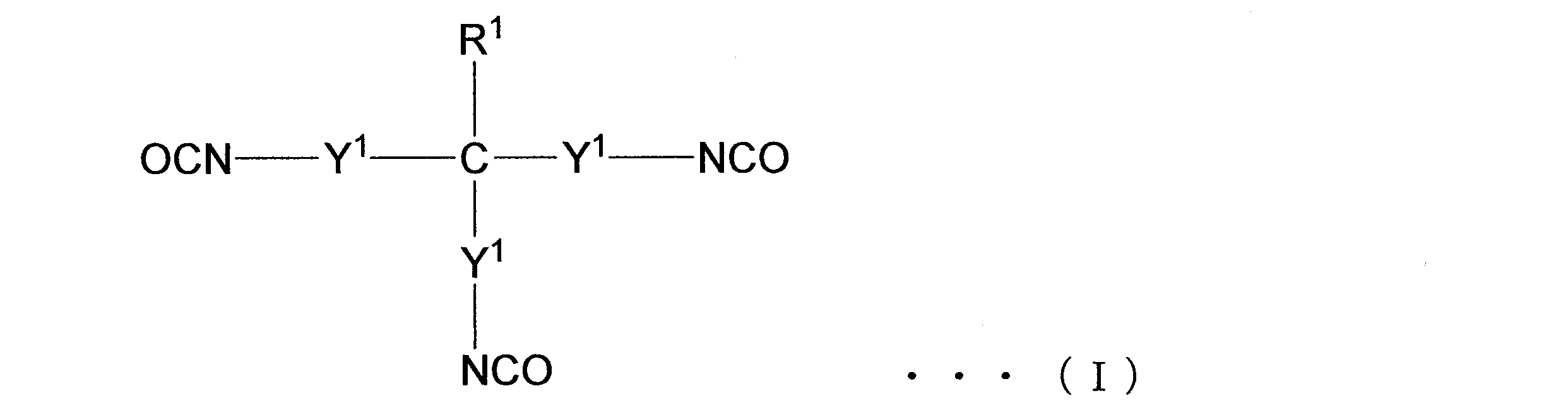

前記熱解離性ブロック剤が、オキシム系化合物、酸アミド系化合物、アミン系化合物、イミダゾール系化合物、トリアゾール系化合物及びピラゾール系化合物からなる群より選ばれる1種以上であってもよい。
本発明の第2態様に係る塗料組成物は、上記第1態様に係るブロックイソシアネート組成物と、活性水素化合物とを含む。
本発明の第3態様に係る塗膜は、上記第2態様に係る塗料組成物を硬化したものである。
本発明の第2態様に係る塗料組成物は、上記第1態様に係るブロックイソシアネート組成物と、活性水素化合物とを含む。
本発明の第3態様に係る塗膜は、上記第2態様に係る塗料組成物を硬化したものである。
上記態様によれば、結晶性に優れ、且つ、低温硬化性及び外観が良好な塗膜が得られるブロックイソシアネート組成物を提供することができる。また、前記ブロックイソシアネート組成物を用いた塗料組成物及び塗膜を提供することができる。
以下、本発明を実施するための形態(以下、単に「本実施形態」という。)について詳細に説明する。以下の本実施形態は、本発明を説明するための例示であり、本発明を以下の内容に限定する趣旨ではない。本発明は、その要旨の範囲内で適宜に変形して実施できる。
≪ブロックイソシアネート組成物≫
本発明の一実施形態に係るブロックイソシアネート組成物は、下記一般式(I)で表されるトリイソシアネート化合物(以下、「トリイソシアネート化合物(I)」と称する場合がある。)、及び、下記一般式(II)で表されるジイソシアネート化合物(以下、「ジイソシアネート化合物(II)」と称する場合がある。)からなる群より選択される少なくとも1種と、熱解離性ブロック剤とから得られるブロックイソシアネート化合物を含む。
本発明の一実施形態に係るブロックイソシアネート組成物は、下記一般式(I)で表されるトリイソシアネート化合物(以下、「トリイソシアネート化合物(I)」と称する場合がある。)、及び、下記一般式(II)で表されるジイソシアネート化合物(以下、「ジイソシアネート化合物(II)」と称する場合がある。)からなる群より選択される少なくとも1種と、熱解離性ブロック剤とから得られるブロックイソシアネート化合物を含む。


本実施形態のブロックイソシアネート組成物は、極性ポリオールとの相溶性に優れ、また本実施形態のブロックイソシアネート組成物を用いることで、低温硬化性が良好な塗膜が得られる。
次いで、本実施形態のブロックイソシアネート組成物の物性及び構成成分について、以下に詳細を説明する。
次いで、本実施形態のブロックイソシアネート組成物の物性及び構成成分について、以下に詳細を説明する。
<物性>
[平均イソシアネート基数(平均NCO基数)]
本実施形態のブロックイソシアネート組成物に含まれるブロックイソシアネート化合物1分子あたりの平均NCO基数(平均官能基数)は、低温硬化性の点で、2.0以上3.0未満が好ましく、2.1以上3.0未満がより好ましく、2.2以上3.0未満が特に好ましい。
[平均イソシアネート基数(平均NCO基数)]
本実施形態のブロックイソシアネート組成物に含まれるブロックイソシアネート化合物1分子あたりの平均NCO基数(平均官能基数)は、低温硬化性の点で、2.0以上3.0未満が好ましく、2.1以上3.0未満がより好ましく、2.2以上3.0未満が特に好ましい。
[有効NCO含有率]
本実施形態のブロックイソシアネート組成物において、有効NCO含有率は、特に制限されないが、得られる塗膜の低温硬化性がより良好となることから、15質量%以上35質量%以下であることが好ましく、17質量%以上33質量%以下であることがより好ましく、20質量%以上30質量%以下であることがさらに好ましく、21質量%以上29質量%以下であることが特に好ましい。
なお、有効NCO含有率は、下記式(A)を用いて算出することができる。
本実施形態のブロックイソシアネート組成物において、有効NCO含有率は、特に制限されないが、得られる塗膜の低温硬化性がより良好となることから、15質量%以上35質量%以下であることが好ましく、17質量%以上33質量%以下であることがより好ましく、20質量%以上30質量%以下であることがさらに好ましく、21質量%以上29質量%以下であることが特に好ましい。
なお、有効NCO含有率は、下記式(A)を用いて算出することができる。
有効NCO含有率[質量%]
={(トリイソシアネート化合物の含有量)×(トリイソシアネート化合物のNCO含有率)}/(ブロックイソシアネート組成物の総質量) ・・・(A)
={(トリイソシアネート化合物の含有量)×(トリイソシアネート化合物のNCO含有率)}/(ブロックイソシアネート組成物の総質量) ・・・(A)
<構成成分>
[ブロックイソシアネート化合物]
本実施形態のブロックイソシアネート組成物に含まれるブロックイソシアネート化合物は、上述のトリイソシアネート化合物(I)及び、ジイソシアネート化合物(II)からなる群から選択される少なくとも1種を、熱解離性ブロック剤と反応させてブロック化することで得られる。
ここで、「熱解離」とは、加熱によってイソシアネート基に結合したブロック剤が解離し、イソシアネート基が再生することを意味する。解離に必要な温度は、ブロック剤の構造によって異なるが、例えば40℃~300℃である。熱解離性ブロックイソシアネートから得られる塗膜は、耐候性、耐衝撃性に優れる傾向にある。
[ブロックイソシアネート化合物]
本実施形態のブロックイソシアネート組成物に含まれるブロックイソシアネート化合物は、上述のトリイソシアネート化合物(I)及び、ジイソシアネート化合物(II)からなる群から選択される少なくとも1種を、熱解離性ブロック剤と反応させてブロック化することで得られる。
ここで、「熱解離」とは、加熱によってイソシアネート基に結合したブロック剤が解離し、イソシアネート基が再生することを意味する。解離に必要な温度は、ブロック剤の構造によって異なるが、例えば40℃~300℃である。熱解離性ブロックイソシアネートから得られる塗膜は、耐候性、耐衝撃性に優れる傾向にある。
・トリイソシアネート化合物(I)
(Y1)
一般式(I)中、複数あるY1は、それぞれ独立に、単結合、又は、エステル構造(-COO-)及びエーテル構造(-O-)からなる群より選択される1種以上を含んでもよい炭素数1~20の2価の炭化水素基である。複数あるY1は、それぞれ同一であってもよく異なっていてもよい。但し、複数あるY1のうち1つ以上は、エステル構造を含む。複数あるY1のうち1つ以上が、エステル構造を有することで、本実施形態のブロックイソシアネート組成物を塗料組成物の硬化剤として使用した際のイソシアネート基の反応性をより高めることができる。
(Y1)
一般式(I)中、複数あるY1は、それぞれ独立に、単結合、又は、エステル構造(-COO-)及びエーテル構造(-O-)からなる群より選択される1種以上を含んでもよい炭素数1~20の2価の炭化水素基である。複数あるY1は、それぞれ同一であってもよく異なっていてもよい。但し、複数あるY1のうち1つ以上は、エステル構造を含む。複数あるY1のうち1つ以上が、エステル構造を有することで、本実施形態のブロックイソシアネート組成物を塗料組成物の硬化剤として使用した際のイソシアネート基の反応性をより高めることができる。
Y1がエステル構造及びエーテル構造からなる群より選択される1種以上を含まない炭素数1~20の2価の炭化水素基である場合、前記炭素数1~20の2価の炭化水素基としては、脂肪族基であってもよく、芳香族基であってもよい。前記脂肪族基は、直鎖状、分岐状又は環状のいずれであってもよい。
前記直鎖状又は分岐状の脂肪族基としては、例えば、アルカンジイル基(アルキレン基)、アルキリデン基等が挙げられる。
前記環状の脂肪族基としては、例えば、シクロアルキレン基等が挙げられる。
前記直鎖状又は分岐状の脂肪族基としては、例えば、アルカンジイル基(アルキレン基)、アルキリデン基等が挙げられる。
前記環状の脂肪族基としては、例えば、シクロアルキレン基等が挙げられる。
前記芳香族基としては、例えば、フェニレン基等のアリーレン基が挙げられる。
また、Y1が前記エステル構造及びエーテル構造からなる群より選択される1種以上を含む炭素数1~20の2価の炭化水素基である場合、例えば、下記一般式(III)で表される基(以下、「基(III)」と称する場合がある」)が挙げられる。
また、Y1が前記エステル構造及びエーテル構造からなる群より選択される1種以上を含む炭素数1~20の2価の炭化水素基である場合、例えば、下記一般式(III)で表される基(以下、「基(III)」と称する場合がある」)が挙げられる。

中でも、n1及びn2はそれぞれ独立して、0~20の整数であることが好ましく、0~4の整数であることがより好ましく、0~2の整数であることがさらに好ましい。
n1及びn2の組み合わせとしては、例えば、n1=0、n2=2の組み合わせ、n1=2、n2=2の組み合わせが好ましい。
基(III)において、Xは、エステル構造又はエーテル構造である。中でも、反応速度が上がることから、Xはエステル構造であることが好ましい。
n1及びn2の組み合わせとしては、例えば、n1=0、n2=2の組み合わせ、n1=2、n2=2の組み合わせが好ましい。
基(III)において、Xは、エステル構造又はエーテル構造である。中でも、反応速度が上がることから、Xはエステル構造であることが好ましい。
また、複数あるY1のうち1つ以上が、エステル構造又はエーテル構造を有する場合、本実施形態のブロックイソシアネート組成物の耐熱性をより向上させることができる。
また、複数あるY1のうち1つ以上が、エーテル構造を有する場合、本実施形態のブロックイソシアネート組成物の耐加水分解性をより向上させることができる。
また、複数あるY1のうち1つ以上が、エーテル構造を有する場合、本実施形態のブロックイソシアネート組成物の耐加水分解性をより向上させることができる。
(R1)
R1は、水素原子、又は、炭素数1~12の1価の炭化水素基である。R1における炭化水素基としては、特に限定されず、アルキル基、アルケニル基、アルキニル基等が挙げられる。中でも、R1としては、水素原子が好ましい。
本実施形態において、複数あるY1のうち1つ以上がエステル構造を有するトリイソシアネート化合物(I)で好ましいものとして具体的には、例えば、特公平4-1033号公報(参考文献1)に開示されているビス(2-イソシアナトエチル)2-イソシアナトグルタレート(以下、「GTI」と称する、分子量311)、特開昭53-135931号公報(参考文献2)に開示されているリジントリイソシアネート(以下、「LTI」と称する、分子量267)等が挙げられる。
R1は、水素原子、又は、炭素数1~12の1価の炭化水素基である。R1における炭化水素基としては、特に限定されず、アルキル基、アルケニル基、アルキニル基等が挙げられる。中でも、R1としては、水素原子が好ましい。
本実施形態において、複数あるY1のうち1つ以上がエステル構造を有するトリイソシアネート化合物(I)で好ましいものとして具体的には、例えば、特公平4-1033号公報(参考文献1)に開示されているビス(2-イソシアナトエチル)2-イソシアナトグルタレート(以下、「GTI」と称する、分子量311)、特開昭53-135931号公報(参考文献2)に開示されているリジントリイソシアネート(以下、「LTI」と称する、分子量267)等が挙げられる。
・トリイソシアネート化合物の分子量
本実施形態において、トリイソシアネート化合物の分子量は、139以上1000以下であること好ましく、150以上800以下であることがより好ましく、180以上600以下であることがさらに好ましく、200以上400以下であることが特に好ましい。
本実施形態において、トリイソシアネート化合物の分子量は、139以上1000以下であること好ましく、150以上800以下であることがより好ましく、180以上600以下であることがさらに好ましく、200以上400以下であることが特に好ましい。
トリイソシアネート化合物の分子量が上記下限値以上であることにより、本実施形態のブロックイソシアネート組成物からより硬度の高い塗膜を得ることができ、上記上限値以下であることにより、耐衝撃性に優れる塗膜を得ることができる。
・ジイソシアネート化合物(II)
(Y2)
一般式(II)中、Y2は、エステル構造(-COO-)及びカルボン酸(-COOH)からなる群より選択される少なくとも1種を含むを含む炭素数1~20の2価の炭化水素基である。Y2がエステル構造を有することで、本実施形態のブロックイソシアネート組成物を塗料組成物の硬化剤として使用した際のイソシアネート基の反応性をより高めることができる。また、Y2がエステル構造を有する炭化水素基であることにより、本実施形態のブロックイソシアネート組成物からより耐熱性に優れた塗膜を得ることができる。
(Y2)
一般式(II)中、Y2は、エステル構造(-COO-)及びカルボン酸(-COOH)からなる群より選択される少なくとも1種を含むを含む炭素数1~20の2価の炭化水素基である。Y2がエステル構造を有することで、本実施形態のブロックイソシアネート組成物を塗料組成物の硬化剤として使用した際のイソシアネート基の反応性をより高めることができる。また、Y2がエステル構造を有する炭化水素基であることにより、本実施形態のブロックイソシアネート組成物からより耐熱性に優れた塗膜を得ることができる。
Y2を構成する炭素数1~20の2価の炭化水素基としては、上記Y1において例示された炭素数1~20の2価の炭化水素基と同様のものが挙げられる。
中でも、Y2を構成する炭素数1~20の2価の炭化水素基としては、脂肪族基、脂環式基又は芳香族基であることが好ましい。
本実施形態において、Y2がエステル構造及びカルボン酸からなる群より選択される少なくとも1種を有する炭化水素基であるジイソシアネート化合物(II)で好ましいものとして具体的には、例えば、リジンジイソシアネート(以下、「LDI」と称する場合がある)(分子量212)等が挙げられる。
中でも、Y2を構成する炭素数1~20の2価の炭化水素基としては、脂肪族基、脂環式基又は芳香族基であることが好ましい。
本実施形態において、Y2がエステル構造及びカルボン酸からなる群より選択される少なくとも1種を有する炭化水素基であるジイソシアネート化合物(II)で好ましいものとして具体的には、例えば、リジンジイソシアネート(以下、「LDI」と称する場合がある)(分子量212)等が挙げられる。
・トリイソシアネート化合物(I)及びジイソシアネート化合物(II)の製造方法
本実施形態のブロックイソシアネート組成物に含まれるトリイソシアネート化合物(I)及びジイソシアネート化合物(II)は、例えば、アミノ酸誘導体等のアミンをイソシアネート化して得ることができる。
本実施形態のブロックイソシアネート組成物に含まれるトリイソシアネート化合物(I)及びジイソシアネート化合物(II)は、例えば、アミノ酸誘導体等のアミンをイソシアネート化して得ることができる。
前記アミノ酸誘導体としては、例えば2,5-ジアミノ吉草酸、2,6-ジアミノヘキサン酸、アスパラギン酸、グルタミン酸等が挙げられる。これらアミノ酸誘導体はジアミンモノカルボン酸又はモノアミンジカルボン酸である。そのため、カルボキシ基を、例えばエタノールアミン等のアルカノールアミンでエステル化、又は、カルボキシル基を、例えばメタノール等でエステル化することで、アミノ基数を制御することができる。得られたエステル基を有するトリアミンは、アミンのホスゲン化等により、エステル構造を含むトリイソシアネート化合物又はジイソシアネート化合物とすることができる。
・熱解離性ブロック剤
ブロック剤としては、例えば、(1)オキシム系化合物、(2)アルコール系化合物、(3)酸アミド系化合物、(4)酸イミド系化合物、(5)フェノール系化合物、(6)アミン系化合物、(7)活性メチレン系化合物、(8)イミダゾール系化合物、(9)トリアゾール系化合物、(10)ピラゾール系化合物等が挙げられる。前記ブロック剤は、1種類を用いてもよいし、2種類以上を所望の割合で用いてもよい。
ブロック剤としては、例えば、(1)オキシム系化合物、(2)アルコール系化合物、(3)酸アミド系化合物、(4)酸イミド系化合物、(5)フェノール系化合物、(6)アミン系化合物、(7)活性メチレン系化合物、(8)イミダゾール系化合物、(9)トリアゾール系化合物、(10)ピラゾール系化合物等が挙げられる。前記ブロック剤は、1種類を用いてもよいし、2種類以上を所望の割合で用いてもよい。
ブロック剤としてより具体的には、以下に示すもの等が挙げられる。
(1)オキシム系化合物:ホルムアルドオキシム、アセトアルドオキシム、アセトオキシム、メチルエチルケトオキシム、シクロヘキサノンオキシム等。
(2)アルコール系化合物:メタノール、エタノール、2-プロパノール、n-ブタノール、sec-ブタノール、2-エチル-1-ヘキサノール、2-メトキシエタノール、2-エトキシエタノール、2-ブトキシエタノール等。
(3)酸アミド系化合物:アセトアニリド、酢酸アミド、ε-カプロラクタム、δ-バレロラクタム、γ-ブチロラクタム等。
(1)オキシム系化合物:ホルムアルドオキシム、アセトアルドオキシム、アセトオキシム、メチルエチルケトオキシム、シクロヘキサノンオキシム等。
(2)アルコール系化合物:メタノール、エタノール、2-プロパノール、n-ブタノール、sec-ブタノール、2-エチル-1-ヘキサノール、2-メトキシエタノール、2-エトキシエタノール、2-ブトキシエタノール等。
(3)酸アミド系化合物:アセトアニリド、酢酸アミド、ε-カプロラクタム、δ-バレロラクタム、γ-ブチロラクタム等。
(4)酸イミド系化合物:コハク酸イミド、マレイン酸イミド等。
(5)フェノール系化合物:フェノール、クレゾール、エチルフェノール、ブチルフェノール、ノニルフェノール、ジノニルフェノール、スチレン化フェノール、ヒドロキシ安息香酸エステル等。
(6)アミン系化合物:ジフェニルアミン、アニリン、カルバゾール、ジ-n-プロピルアミン、ジイソプロピルアミン、イソプロピルエチルアミン等。
(7)活性メチレン系化合物:マロン酸ジメチル、マロン酸ジエチル、マロン酸ジイソプロピル、マロン酸ジ-tert-ブチル、アセト酢酸メチル、アセト酢酸エチル、アセチルアセトン等。
(5)フェノール系化合物:フェノール、クレゾール、エチルフェノール、ブチルフェノール、ノニルフェノール、ジノニルフェノール、スチレン化フェノール、ヒドロキシ安息香酸エステル等。
(6)アミン系化合物:ジフェニルアミン、アニリン、カルバゾール、ジ-n-プロピルアミン、ジイソプロピルアミン、イソプロピルエチルアミン等。
(7)活性メチレン系化合物:マロン酸ジメチル、マロン酸ジエチル、マロン酸ジイソプロピル、マロン酸ジ-tert-ブチル、アセト酢酸メチル、アセト酢酸エチル、アセチルアセトン等。
(8)イミダゾール系化合物:イミダゾール、2-メチルイミダゾール、2-エチルイミダゾール等。
(9)トリアゾール系化合物:1,2,4-トリアゾール、3-アミノ-1,2,4-トリアゾール、3-アミノ-5-フェニル-1,2,4-トリアゾール、1,2,3-トリアゾール、1H-ベンゾトリアゾール等。
(10)ピラゾール系化合物ピラゾール、3-メチルピラゾール、3,5-ジメチルピラゾール等。
(9)トリアゾール系化合物:1,2,4-トリアゾール、3-アミノ-1,2,4-トリアゾール、3-アミノ-5-フェニル-1,2,4-トリアゾール、1,2,3-トリアゾール、1H-ベンゾトリアゾール等。
(10)ピラゾール系化合物ピラゾール、3-メチルピラゾール、3,5-ジメチルピラゾール等。
中でも、入手容易性やブロックイソシアネート組成物の結晶性、及び、得られる塗膜の低温硬化性の点から、オキシム系化合物、酸アミド系化合物、アミン系化合物、イミダゾール系化合物、トリアゾール系化合物又はピラゾール系化合物が好ましく、メチルエチルケトオキシム、ジイソプロピルアミン、イミダゾール又は3,5-ジメチルピラゾールがより好ましい。
[ブロックイソシアネート化合物の製造方法]
本実施形態のブロックイソシアネート組成物に含まれるブロックイソシアネート化合物は、例えば、上述のトリイソシアネートまたはジイソシアネートと、熱解離性ブロック剤とを反応させ、上述のトリイソシアネート化合物またはジイソシアネート化合物のイソシアネート基をブロック化する方法等が挙げられる。
前記ブロック化する反応では、上述のトリイソシアネート化合物またはジイソシアネート化合物のイソシアネート基を全て又は部分的にブロック化してもよいが、全てブロック化することが好ましい。
本実施形態のブロックイソシアネート組成物に含まれるブロックイソシアネート化合物は、例えば、上述のトリイソシアネートまたはジイソシアネートと、熱解離性ブロック剤とを反応させ、上述のトリイソシアネート化合物またはジイソシアネート化合物のイソシアネート基をブロック化する方法等が挙げられる。
前記ブロック化する反応では、上述のトリイソシアネート化合物またはジイソシアネート化合物のイソシアネート基を全て又は部分的にブロック化してもよいが、全てブロック化することが好ましい。
全てのイソシアネート基をブロック化する場合、(熱解離性ブロック剤のモル数)/(トリイソシアネートに含まれるイソシアネート基のモル数)は、1.0~1.5であることが好ましい。上記比率となるようにブロック剤を配合した場合、過剰又は未反応のブロック剤は、残留する。
前記ブロック化する反応は、無溶剤で行ってもよく、必要に応じて、イソシアネート基との反応性を有していない有機溶剤を使用してもよい。
前記ブロック化する反応は、無溶剤で行ってもよく、必要に応じて、イソシアネート基との反応性を有していない有機溶剤を使用してもよい。
前記有機溶剤としては、特に限定されないが、具体的には、例えば、以下に示すもの等が挙げられる。
(i)ヘキサン、ヘプタン、オクタン等の脂肪族炭化水素系溶剤。
(ii)シクロヘキサン、メチルシクロヘキサン等の脂環族炭化水素系溶剤。
(iii)アセトン、メチルエチルケトン、メチルイソブチルケトン、シクロヘキサノン等のケトン系溶剤。
(iv)酢酸メチル、酢酸エチル、酢酸ブチル、酢酸イソブチル等のエステル系溶剤。
(i)ヘキサン、ヘプタン、オクタン等の脂肪族炭化水素系溶剤。
(ii)シクロヘキサン、メチルシクロヘキサン等の脂環族炭化水素系溶剤。
(iii)アセトン、メチルエチルケトン、メチルイソブチルケトン、シクロヘキサノン等のケトン系溶剤。
(iv)酢酸メチル、酢酸エチル、酢酸ブチル、酢酸イソブチル等のエステル系溶剤。
(v)トルエン、キシレン、ジエチルベンゼン、メシチレン、アニソール、クロロベンゼン等の芳香族系溶剤。
(vi)エチレングリコールモノエチルエーテルアセテート、3-メチル-3-メトキシブチルアセテート、プロピレングリコールモノメチルエーテルアセテート等のグリコール系溶剤。
(vii)ジエチルエーテル、テトラヒドロフラン、ジオキサン等のエーテル系溶剤。
(vi)エチレングリコールモノエチルエーテルアセテート、3-メチル-3-メトキシブチルアセテート、プロピレングリコールモノメチルエーテルアセテート等のグリコール系溶剤。
(vii)ジエチルエーテル、テトラヒドロフラン、ジオキサン等のエーテル系溶剤。
(viii)ジクロロメタン、1,2-ジクロロエタン、クロロホルム等のハロゲン化炭化水素系溶剤。
(ix)N-メチル-2-ピロリドン等のピロリドン系溶剤。
(x)N,N-ジメチルアセトアミド、N,N-ジメチルホルムアミド等のアミド系溶剤。
(xi)ジメチルスルホキシド等のスルホキシド系溶剤。
(xii)γ-ブチロラクトン等のラクトン系溶剤。
(xiii)モルフォリン等のアミン系溶剤。
(ix)N-メチル-2-ピロリドン等のピロリドン系溶剤。
(x)N,N-ジメチルアセトアミド、N,N-ジメチルホルムアミド等のアミド系溶剤。
(xi)ジメチルスルホキシド等のスルホキシド系溶剤。
(xii)γ-ブチロラクトン等のラクトン系溶剤。
(xiii)モルフォリン等のアミン系溶剤。
上記有機溶剤は単独で使用してもよく、2種類以上の混合物を使用してもよい。また、有機溶剤は反応後に除去することができる。
また、前記ブロック化する反応において、触媒を使用してもよい。
前記触媒としては、例えば、錫、亜鉛、鉛等の有機金属塩;3級アミン系化合物;ナトリウム等のアルカリ金属のアルコラート等が挙げられ、これらに限定されない。
また、前記ブロック化する反応において、触媒を使用してもよい。
前記触媒としては、例えば、錫、亜鉛、鉛等の有機金属塩;3級アミン系化合物;ナトリウム等のアルカリ金属のアルコラート等が挙げられ、これらに限定されない。
本実施形態のブロックイソシアネート組成物は、トリイソシアネート化合物(I)と熱解離性ブロック剤とから得られるブロックイソシアネート化合物(以下、「ブロックイソシアネート化合物(I)」と称する場合がある。)、及び、ジイソシアネート化合物(II)と熱解離性ブロック剤とから得られるブロックイソシアネート化合物(以下、「ブロックイソシアネート化合物(II)」と称する場合がある。)を含むことが好ましい。
本実施形態のブロックイソシアネート組成物において、ブロックイソシアネート化合物(I)とブロックイソシアネート化合物(II)の総重量に対するブロックイソシアネート化合物(II)の重量割合は、0.2%以上が好ましく、0.5%以上がより好ましい。この下限値以上であることにより、極性ポリオールとの相溶性が優れる傾向にある。また、上記重量割合は、10%以下が好ましく、5%以下がより好ましい。この上限値以下であることにより、低温硬化性が優れる傾向にある。
本実施形態のブロックイソシアネート組成物は、下記一般式(IV)で示される構造と、イソシアヌレート構造、ビュレット構造、ウレトジオン構造、イミノオキサジアジンジオン構造、ウレタン構造及びアロファネート構造からなる群より選ばれる少なくとも1種と、を含むポリイソシアネート化合物と、ブロック剤と、から得られるブロックイソシアネート化合物を含むことができる。

一般式(IV)中、Y1およびR1は、上述した一般式(I)におけるY1およびR1と同じである。
<その他添加剤>
本実施形態のブロックイソシアネート組成物は、上述のブロックイソシアネート化合物の他に、目的及び用途に応じて、さらに、硬化促進触媒、酸化防止剤、紫外線吸収剤、光安定剤、顔料、レベリング剤、可塑剤、レオロジーコントロール剤、界面活性剤等の各種添加剤を含むことができる。
本実施形態のブロックイソシアネート組成物は、上述のブロックイソシアネート化合物の他に、目的及び用途に応じて、さらに、硬化促進触媒、酸化防止剤、紫外線吸収剤、光安定剤、顔料、レベリング剤、可塑剤、レオロジーコントロール剤、界面活性剤等の各種添加剤を含むことができる。
硬化促進触媒としては、特に限定されないが、例えば、以下に示すもの等が挙げられる。
(i)ジブチルスズジラウレート、ジブチルスズジアセテート、ジオクチルスズジラウレート、ジメチルスズジネオデカノエート、ビス(2-エチルヘキサン酸)スズ等のスズ系化合物。
(ii)2-エチルヘキサン酸亜鉛、ナフテン酸亜鉛等の亜鉛化合物。
(iii)2-エチルヘキサン酸チタン、チタンジイソプロポキシビス(エチルアセトナート)等のチタン化合物。
(iv)2-エチルヘキサン酸コバルト、ナフテン酸コバルト等のコバルト化合物。
(v)2-エチルヘキサン酸ビスマス、ナフテン酸ビスマス等のビスマス化合物。
(i)ジブチルスズジラウレート、ジブチルスズジアセテート、ジオクチルスズジラウレート、ジメチルスズジネオデカノエート、ビス(2-エチルヘキサン酸)スズ等のスズ系化合物。
(ii)2-エチルヘキサン酸亜鉛、ナフテン酸亜鉛等の亜鉛化合物。
(iii)2-エチルヘキサン酸チタン、チタンジイソプロポキシビス(エチルアセトナート)等のチタン化合物。
(iv)2-エチルヘキサン酸コバルト、ナフテン酸コバルト等のコバルト化合物。
(v)2-エチルヘキサン酸ビスマス、ナフテン酸ビスマス等のビスマス化合物。
(vi)ジルコニウムテトラアセチルアセトネート、2-エチルヘキサン酸ジルコニル、ナフテン酸ジルコニル等のジルコニウム化合物。
(vii)トリエチルアミン、ピリジン、メチルピリジン、ベンジルジメチルアミン、N,N-ジメチルシクロヘキシルアミン、N-メチルピペリジン、ペンタメチルジエチレントリアミン、N,N’-エンドエチレンピペラジン、N,N’-ジメチルピペラジン等のアミン化合物。
上記酸化防止剤としては、特に限定されないが、例えば、ヒンダードフェノール系化合物、リン系化合物、イオウ系化合物等が挙げられる。
(vii)トリエチルアミン、ピリジン、メチルピリジン、ベンジルジメチルアミン、N,N-ジメチルシクロヘキシルアミン、N-メチルピペリジン、ペンタメチルジエチレントリアミン、N,N’-エンドエチレンピペラジン、N,N’-ジメチルピペラジン等のアミン化合物。
上記酸化防止剤としては、特に限定されないが、例えば、ヒンダードフェノール系化合物、リン系化合物、イオウ系化合物等が挙げられる。
上記紫外線吸収剤としては、特に限定されないが、例えば、ベンゾトリアゾール系化合物、トリアジン系化合物、ベンゾフェノン系化合物等が挙げられる。
上記光安定剤としては、特に限定されないが、例えば、ヒンダードアミン系化合物、ベンゾトリアゾール系化合物、トリアジン系化合物、ベンゾフェノン系化合物、ベンゾエート系等が挙げられる。
上記顔料としては、特に限定されないが、例えば、酸化チタン、カーボンブラック、インディゴ、キナクリドン、パールマイカ、アルミニウム等が挙げられる。
上記光安定剤としては、特に限定されないが、例えば、ヒンダードアミン系化合物、ベンゾトリアゾール系化合物、トリアジン系化合物、ベンゾフェノン系化合物、ベンゾエート系等が挙げられる。
上記顔料としては、特に限定されないが、例えば、酸化チタン、カーボンブラック、インディゴ、キナクリドン、パールマイカ、アルミニウム等が挙げられる。
上記レベリング剤としては、特に限定されないが、例えば、シリコーンオイル等が挙げられる。
上記可塑剤としては、特に限定されないが、例えば、フタル酸エステル類、リン酸系化合物、ポリエステル系化合物等が挙げられる。
上記レオロジーコントロール剤としては、特に限定されないが、例えば、ヒドロキシエチルセルロース、尿素化合物、マイクロゲル等が挙げられる。
上記界面活性剤としては、特に限定されないが、例えば、公知のアニオン界面活性剤、カチオン界面活性剤、両性界面活性剤等が挙げられる。
上記可塑剤としては、特に限定されないが、例えば、フタル酸エステル類、リン酸系化合物、ポリエステル系化合物等が挙げられる。
上記レオロジーコントロール剤としては、特に限定されないが、例えば、ヒドロキシエチルセルロース、尿素化合物、マイクロゲル等が挙げられる。
上記界面活性剤としては、特に限定されないが、例えば、公知のアニオン界面活性剤、カチオン界面活性剤、両性界面活性剤等が挙げられる。
<ブロックイソシアネート組成物の製造方法>
本実施形態のブロックイソシアネート組成物は、上述のブロックイソシアネート化合物単独、又は、上述のブロックイソシアネート化合物に、必要に応じて、上述の各種添加剤を添加し、混合することで得ることができる。
本実施形態のブロックイソシアネート組成物は、上述のブロックイソシアネート化合物単独、又は、上述のブロックイソシアネート化合物に、必要に応じて、上述の各種添加剤を添加し、混合することで得ることができる。
また、本実施形態のブロックイソシアネート組成物の製造に用いられるブロックイソシアネート化合物には、熱解離性ブロック剤及び有機溶剤のうち少なくともいずれかが残留していてもよく、熱解離性ブロック剤及び有機溶剤を除去し、ブロックイソシアネート化合物のみからなるものを用いてもよい。
<用途>
本実施形態のブロックイソシアネート組成物は、例えば、塗料組成物、粘着剤組成物、接着剤組成物、注型剤組成物等の硬化性組成物;繊維処理剤等の各種表面処理剤組成物;各種エラストマー組成物;発泡体組成物等の架橋剤;改質剤;添加剤等として使用することができる。
本実施形態のブロックイソシアネート組成物は、例えば、塗料組成物、粘着剤組成物、接着剤組成物、注型剤組成物等の硬化性組成物;繊維処理剤等の各種表面処理剤組成物;各種エラストマー組成物;発泡体組成物等の架橋剤;改質剤;添加剤等として使用することができる。
本実施形態のブロックイソシアネート組成物を含む粘着剤組成物、接着剤組成物の使用分野としては、例えば、自動車、建材、家電、木工、太陽電池用積層体等が挙げられる。特に、テレビ、パソコン、デジタルカメラ、携帯電話等の家電の液晶ディスプレイ用等の光学部材は、各種機能を発現するため、各種被着体のフィルム及びプレートを積層させる必要がある。各種被着体のフィルム及びプレート間には十分な粘着性又は接着性が要求されることから、本実施形態のブロックイソシアネート組成物を含む粘着剤組成物、接着剤組成物は好適に用いられる。
本実施形態のブロックイソシアネート組成物を含む硬化性組成物等が用いられる被着体としては、特に限定されないが、例えば、以下に示すもの等が挙げられる。
(i)ガラス。
(ii)アルミニウム、鉄、亜鉛鋼板、銅、ステンレス等の各種金属。
(iii)木材、紙、モルタル、石材等の多孔質部材。
(i)ガラス。
(ii)アルミニウム、鉄、亜鉛鋼板、銅、ステンレス等の各種金属。
(iii)木材、紙、モルタル、石材等の多孔質部材。
(iv)フッ素塗装、ウレタン塗装、アクリルウレタン塗装等がされた部材。
(v)シリコーン系硬化物、変性シリコーン系硬化物、ウレタン系硬化物等のシーリング材硬化物。
(vi)塩化ビニル、天然ゴム、合成ゴム等のゴム類。
(vii)天然皮革、人工皮革等の皮革類。
(viii)植物系繊維、動物系繊維、炭素繊維、ガラス繊維等の繊維類。
(v)シリコーン系硬化物、変性シリコーン系硬化物、ウレタン系硬化物等のシーリング材硬化物。
(vi)塩化ビニル、天然ゴム、合成ゴム等のゴム類。
(vii)天然皮革、人工皮革等の皮革類。
(viii)植物系繊維、動物系繊維、炭素繊維、ガラス繊維等の繊維類。
(ix)不織布、ポリエステル、アクリル、ポリカーボネート、トリアセチルセルロース、ポリオレフィン等の樹脂類のフィルム及びプレート。
(x)紫外線硬化型アクリル樹脂層、印刷インキ、UVインキ等のインキ類
(x)紫外線硬化型アクリル樹脂層、印刷インキ、UVインキ等のインキ類
≪塗料組成物≫
本発明の一実施形態における塗料組成物は、上述のブロックイソシアネート組成物と、活性水素化合物とを含む。
本実施形態の塗料組成物は、上述のブロックイソシアネート組成物を硬化剤として含むことで、低温硬化性及び外観が良好な塗膜を得ることができる。
本実施形態の塗料組成物において、ブロックイソシアネート組成物以外の構成成分について、以下に詳細を説明する。
本発明の一実施形態における塗料組成物は、上述のブロックイソシアネート組成物と、活性水素化合物とを含む。
本実施形態の塗料組成物は、上述のブロックイソシアネート組成物を硬化剤として含むことで、低温硬化性及び外観が良好な塗膜を得ることができる。
本実施形態の塗料組成物において、ブロックイソシアネート組成物以外の構成成分について、以下に詳細を説明する。
<構成成分>
[活性水素化合物]
本実施形態の塗料組成物に含まれる活性水素化合物としては、分子内に活性水素が2つ以上結合している化合物であればよい。活性水素化合物として具体的には、例えば、ポリアミン、アルカノールアミン、ポリチオール、ポリオール等が挙げられる。
中でも、活性水素化合物としては、ポリオールが好ましい。
[活性水素化合物]
本実施形態の塗料組成物に含まれる活性水素化合物としては、分子内に活性水素が2つ以上結合している化合物であればよい。活性水素化合物として具体的には、例えば、ポリアミン、アルカノールアミン、ポリチオール、ポリオール等が挙げられる。
中でも、活性水素化合物としては、ポリオールが好ましい。
・ポリアミン
上記ポリアミンとしては、特に限定されないが、例えば、以下のようなものが挙げられる。
(i)エチレンジアミン、プロピレンジアミン、ブチレンジアミン、トリエチレンジアミン、ヘキサメチレンジアミン、4,4’-ジアミノジシクロヘキシルメタン、ピペラジン、2-メチルピペラジン、イソホロンジアミン等のジアミン類。
(ii)ビスヘキサメチレントリアミン、ジエチレントリアミン、トリエチレンテトラミン、テトラエチレンペンタミン、ペンタメチレンヘキサミン、テトラプロピレンペンタミン等の3個以上のアミノ基を有する鎖状ポリアミン類。
上記ポリアミンとしては、特に限定されないが、例えば、以下のようなものが挙げられる。
(i)エチレンジアミン、プロピレンジアミン、ブチレンジアミン、トリエチレンジアミン、ヘキサメチレンジアミン、4,4’-ジアミノジシクロヘキシルメタン、ピペラジン、2-メチルピペラジン、イソホロンジアミン等のジアミン類。
(ii)ビスヘキサメチレントリアミン、ジエチレントリアミン、トリエチレンテトラミン、テトラエチレンペンタミン、ペンタメチレンヘキサミン、テトラプロピレンペンタミン等の3個以上のアミノ基を有する鎖状ポリアミン類。
(iii)1,4,7,10,13,16-ヘキサアザシクロオクタデカン、1,4,7,10-テトラアザシクロデカン、1,4,8,12-テトラアザシクロペンタデカン、1,4,8,11-テトラアザシクロテトラデカン等の環状ポリアミン類。
・アルカノールアミン
上記アルカノールアミンとしては、特に限定されないが、例えば、モノエタノールアミン、ジエタノールアミン、アミノエチルエタノールアミン、N-(2-ヒドロキシプロピル)エチレンジアミン、モノ-、ジ-(n-またはイソ-)プロパノールアミン、エチレングリコールービスープロピルアミン、ネオペンタノールアミン、メチルエタノールアミン等が挙げられる。
・アルカノールアミン
上記アルカノールアミンとしては、特に限定されないが、例えば、モノエタノールアミン、ジエタノールアミン、アミノエチルエタノールアミン、N-(2-ヒドロキシプロピル)エチレンジアミン、モノ-、ジ-(n-またはイソ-)プロパノールアミン、エチレングリコールービスープロピルアミン、ネオペンタノールアミン、メチルエタノールアミン等が挙げられる。
・ポリチオール
上記ポリチオールとしては、特に限定されないが、例えば、ビス-(2-ヒドロチオエチロキシ)メタン、ジチオエチレングリコール、ジチオエリトリトール、ジチオトレイトール等が挙げられる。
・ポリオール
上記ポリオールとしては、特に限定されないが、例えば、ポリエステルポリオール、アクリルポリオール、ポリエーテルポリオール、ポリオレフィンポリオール、フッ素ポリオール、ポリカーボネートポリオール、エポキシ樹脂等が挙げられる。
上記ポリチオールとしては、特に限定されないが、例えば、ビス-(2-ヒドロチオエチロキシ)メタン、ジチオエチレングリコール、ジチオエリトリトール、ジチオトレイトール等が挙げられる。
・ポリオール
上記ポリオールとしては、特に限定されないが、例えば、ポリエステルポリオール、アクリルポリオール、ポリエーテルポリオール、ポリオレフィンポリオール、フッ素ポリオール、ポリカーボネートポリオール、エポキシ樹脂等が挙げられる。
(ポリエステルポリオール)
上記ポリエステルポリオールは、特に限定されないが、例えば、二塩基酸の単独又は混合物と、多価アルコールの単独又は混合物との縮合反応によって得られる。
前記二塩基酸としては、特に限定されないが、例えば、コハク酸、アジピン酸、セバシン酸、ダイマー酸、無水マレイン酸、無水フタル酸、イソフタル酸、テレフタル酸等のカルボン酸からなる群より選ばれる二塩基酸が挙げられる。
また、前記多価アルコールとしては、特に限定されないが、具体的には、エチレングリコール、プロピレングリコール、ジエチレングリコール、ネオペンチルグリコール、トリメチロールプロパン、グリセリン等の多価アルコールが挙げられる。
上記ポリエステルポリオールは、特に限定されないが、例えば、二塩基酸の単独又は混合物と、多価アルコールの単独又は混合物との縮合反応によって得られる。
前記二塩基酸としては、特に限定されないが、例えば、コハク酸、アジピン酸、セバシン酸、ダイマー酸、無水マレイン酸、無水フタル酸、イソフタル酸、テレフタル酸等のカルボン酸からなる群より選ばれる二塩基酸が挙げられる。
また、前記多価アルコールとしては、特に限定されないが、具体的には、エチレングリコール、プロピレングリコール、ジエチレングリコール、ネオペンチルグリコール、トリメチロールプロパン、グリセリン等の多価アルコールが挙げられる。
又は、例えば、ε-カプロラクトン等のラクトン類を、多価アルコールを用いて開環重合して得られるようなポリカプロラクトン類等もポリエステルポリオールとして用いることができる。
(アクリルポリオール)
上記アクリルポリオールとしては、特に限定されないが、例えば、ヒドロキシル基を有するエチレン性不飽和結合含有単量体の単独又は混合物を重合又は共重合したもの、又は、前記ヒドロキシル基を有するエチレン性不飽和結合含有単量体の単独又は混合物と、これと共重合可能な他のエチレン性不飽和結合含有単量体の単独又は混合物とを共重合したものが挙げられる。
(アクリルポリオール)
上記アクリルポリオールとしては、特に限定されないが、例えば、ヒドロキシル基を有するエチレン性不飽和結合含有単量体の単独又は混合物を重合又は共重合したもの、又は、前記ヒドロキシル基を有するエチレン性不飽和結合含有単量体の単独又は混合物と、これと共重合可能な他のエチレン性不飽和結合含有単量体の単独又は混合物とを共重合したものが挙げられる。
上記ヒドロキシル基を有するエチレン性不飽和結合含有単量体としては、特に限定されないが、例えば、アクリル酸ヒドロキシエチル、アクリル酸ヒドロキシプロピル、アクリル酸ヒドロキシブチル、メタクリル酸ヒドロキシエチル、メタクリル酸ヒドロキシプロピル、メタクリル酸ヒドロキシブチル等が挙げられる。これらを単独で用いてもよく、2種類以上を組み合わせて用いてもよい。
中でも、ヒドロキシル基を有するエチレン性不飽和結合含有単量体としては、アクリル酸ヒドロキシエチル又はメタクリル酸ヒドロキシエチルであることが好ましい。
上記ヒドロキシル基を有するエチレン性不飽和結合含有単量体と共重合可能な他のエチレン性不飽和結合含有単量体としては、特に限定されないが、例えば、以下のものが挙げられる。これらを単独で用いてもよく、2種類以上を組み合わせて用いてもよい。
上記ヒドロキシル基を有するエチレン性不飽和結合含有単量体と共重合可能な他のエチレン性不飽和結合含有単量体としては、特に限定されないが、例えば、以下のものが挙げられる。これらを単独で用いてもよく、2種類以上を組み合わせて用いてもよい。
(i)アクリル酸メチル、アクリル酸エチル、アクリル酸プロピル、アクリル酸イソプロピル、アクリル酸-n-ブチル、アクリル酸イソブチル、アクリル酸-n-ヘキシル、アクリル酸シクロヘキシル、アクリル酸-2-エチルヘキシル、アクリル酸ラウリル、アクリル酸ベンジル、アクリル酸フェニル等のアクリル酸エステル。
(ii)メタクリル酸メチル、メタクリル酸エチル、メタクリル酸プロピル、メタクリル酸イソプロピル、メタクリル酸-n-ブチル、メタクリル酸イソブチル、メタクリル酸-n-ヘキシル、メタクリル酸シクロヘキシル、メタクリル酸-2-エチルヘキシル、メタクリル酸ラウリル、メタクリル酸ベンジル、メタクリル酸フェニル等のメタクリル酸エステル。
(ii)メタクリル酸メチル、メタクリル酸エチル、メタクリル酸プロピル、メタクリル酸イソプロピル、メタクリル酸-n-ブチル、メタクリル酸イソブチル、メタクリル酸-n-ヘキシル、メタクリル酸シクロヘキシル、メタクリル酸-2-エチルヘキシル、メタクリル酸ラウリル、メタクリル酸ベンジル、メタクリル酸フェニル等のメタクリル酸エステル。
(iii)アクリル酸、メタクリル酸、マレイン酸、イタコン酸等の不飽和カルボン酸。
(iv)アクリルアミド、メタクリルアミド、N,N-メチレンビスアクリルアミド、ダイアセトンアクリルアミド、ダイアセトンメタクリルアミド、マレイン酸アミド、マレイミド等の不飽和アミド。
(v)メタクリル酸グリシジル、スチレン、ビニルトルエン、酢酸ビニル、アクリロニトリル、フマル酸ジブチル等のビニル系単量体。
(iv)アクリルアミド、メタクリルアミド、N,N-メチレンビスアクリルアミド、ダイアセトンアクリルアミド、ダイアセトンメタクリルアミド、マレイン酸アミド、マレイミド等の不飽和アミド。
(v)メタクリル酸グリシジル、スチレン、ビニルトルエン、酢酸ビニル、アクリロニトリル、フマル酸ジブチル等のビニル系単量体。
(vi)ビニルトリメトキシシラン、ビニルメチルジメトキシシラン、γ-(メタ)アクリロキシプロピルトリメトキシシラン等の加水分解性シリル基を有するビニル系単量体。
(ポリエーテルポリオール)
上記ポリエーテルポリオールとしては、特に限定されないが、例えば、以下(1)~(3)のいずれかの方法等を用いて得ることができる。
(1)触媒を使用して、多価ヒドロキシ化合物の単独又は混合物に、アルキレンオキシドの単独又は混合物を付加して、ポリエーテルポリオール類を得る方法。
(ポリエーテルポリオール)
上記ポリエーテルポリオールとしては、特に限定されないが、例えば、以下(1)~(3)のいずれかの方法等を用いて得ることができる。
(1)触媒を使用して、多価ヒドロキシ化合物の単独又は混合物に、アルキレンオキシドの単独又は混合物を付加して、ポリエーテルポリオール類を得る方法。
前記触媒としては、例えば、水酸化物(リチウム、ナトリウム、カリウム等)、強塩基性触媒(アルコラート、アルキルアミン等)等が挙げられる。
前記アルキレンオキシドとしては、例えば、エチレンオキシド、プロピレンオキシド、ブチレンオキシド、シクロヘキセンオキシド、スチレンオキシド等が挙げられる。
前記アルキレンオキシドとしては、例えば、エチレンオキシド、プロピレンオキシド、ブチレンオキシド、シクロヘキセンオキシド、スチレンオキシド等が挙げられる。
(2)多官能化合物にアルキレンオキシドを反応させて、ポリエーテルポリオール類を得る方法。
前記多官能化合物としては、例えば、エチレンジアミン類等が挙げられる。
前記アルキレンオキシドとしては、(1)で例示されたものと同様のものが挙げられる。
(3)(1)又は(2)で得られたポリエーテルポリオール類を媒体としてアクリルアミド等を重合して、いわゆるポリマーポリオール類を得る方法。
前記多官能化合物としては、例えば、エチレンジアミン類等が挙げられる。
前記アルキレンオキシドとしては、(1)で例示されたものと同様のものが挙げられる。
(3)(1)又は(2)で得られたポリエーテルポリオール類を媒体としてアクリルアミド等を重合して、いわゆるポリマーポリオール類を得る方法。
前記多価ヒドロキシ化合物としては、例えば、以下のものが挙げられる。
(i)ジグリセリン、ジトリメチロールプロパン、ペンタエリスリトール、ジペンタエリスリトール等。
(ii)エリトリトール、D-トレイトール、L-アラビニトール、リビトール、キシリトール、ソルビトール、マンニトール、ガラクチトール、ラムニトール等の糖アルコール系化合物。
(iii)アラビノース、リボース、キシロース、グルコース、マンノース、ガラクトース、フルクトース、ソルボース、ラムノース、フコース、リボデソース等の単糖類。
(i)ジグリセリン、ジトリメチロールプロパン、ペンタエリスリトール、ジペンタエリスリトール等。
(ii)エリトリトール、D-トレイトール、L-アラビニトール、リビトール、キシリトール、ソルビトール、マンニトール、ガラクチトール、ラムニトール等の糖アルコール系化合物。
(iii)アラビノース、リボース、キシロース、グルコース、マンノース、ガラクトース、フルクトース、ソルボース、ラムノース、フコース、リボデソース等の単糖類。
(iv)トレハロース、ショ糖、マルトース、セロビオース、ゲンチオビオース、ラクトース、メリビオース等の二糖類。
(v)ラフィノース、ゲンチアノース、メレチトース等の三糖類。
(vi)スタキオース等の四糖類。
(v)ラフィノース、ゲンチアノース、メレチトース等の三糖類。
(vi)スタキオース等の四糖類。
(ポリオレフィンポリオール)
上記ポリオレフィンポリオールとしては、特に限定されないが、例えば、水酸基を2個以上有するポリブタジエン、水酸基を2個以上有する水素添加ポリブタジエン、水酸基を2個以上有するポリイソプレン、水酸基を2個以上有する水素添加ポリイソプレン等が挙げられる。
上記ポリオレフィンポリオールとしては、特に限定されないが、例えば、水酸基を2個以上有するポリブタジエン、水酸基を2個以上有する水素添加ポリブタジエン、水酸基を2個以上有するポリイソプレン、水酸基を2個以上有する水素添加ポリイソプレン等が挙げられる。
(フッ素ポリオール)
上記フッ素ポリオールとしては、特に限定されないが、分子内にフッ素を含むポリオールであればよい。フッ素ポリオールとして具体的には、例えば、特開昭57-34107号公報(参考文献5)、特開昭61-275311号公報(参考文献6)で開示されているフルオロオレフィン、シクロビニルエーテル、ヒドロキシアルキルビニルエーテル、モノカルボン酸ビニルエステル等の共重合体が挙げられる。
上記フッ素ポリオールとしては、特に限定されないが、分子内にフッ素を含むポリオールであればよい。フッ素ポリオールとして具体的には、例えば、特開昭57-34107号公報(参考文献5)、特開昭61-275311号公報(参考文献6)で開示されているフルオロオレフィン、シクロビニルエーテル、ヒドロキシアルキルビニルエーテル、モノカルボン酸ビニルエステル等の共重合体が挙げられる。
(ポリカーボネートポリオール)
上記ポリカーボネートポリオールとしては、特に限定されないが、例えば、低分子カーボネート化合物と、上述のポリエステルポリオールに用いられる多価アルコールと、を縮重合して得られるものが挙げられる。
前記低分子カーボネート化合物としては、例えば、ジメチルカーボネート等のジアルキルカーボネート;エチレンカーボネート等のアルキレンカーボネート;ジフェニルカーボネート等のジアリールカーボネート等が挙げられる。
上記ポリカーボネートポリオールとしては、特に限定されないが、例えば、低分子カーボネート化合物と、上述のポリエステルポリオールに用いられる多価アルコールと、を縮重合して得られるものが挙げられる。
前記低分子カーボネート化合物としては、例えば、ジメチルカーボネート等のジアルキルカーボネート;エチレンカーボネート等のアルキレンカーボネート;ジフェニルカーボネート等のジアリールカーボネート等が挙げられる。
(エポキシ樹脂)
上記エポキシ樹脂としては、特に限定されないが、例えば、ノボラック型、グリシジルエーテル型、グリコールエーテル型、脂肪族不飽和化合物のエポキシ型、脂肪酸エステル型、多価カルボン酸エステル型、アミノグリシジル型、β-メチルエピクロ型、環状オキシラン型、ハロゲン型、レゾルシン型等のエポキシ樹脂が挙げられる。
上記エポキシ樹脂としては、特に限定されないが、例えば、ノボラック型、グリシジルエーテル型、グリコールエーテル型、脂肪族不飽和化合物のエポキシ型、脂肪酸エステル型、多価カルボン酸エステル型、アミノグリシジル型、β-メチルエピクロ型、環状オキシラン型、ハロゲン型、レゾルシン型等のエポキシ樹脂が挙げられる。
(ポリオールの水酸基価)
前記ポリオールの水酸基価は、得られる塗膜における架橋密度や機械的物性の点で、塗料組成物あたり10mgKOH/g以上300mgKOH/g以下であることが好ましい。
・NCO基と活性水素基とのモル当量比
本実施形態の塗料組成物に含まれるブロックイソシアネート組成物中のNCO基と活性水素化合物中の活性水素基とのモル当量比(NCO基/活性水素基)は、通常、10:1~1:10であればよい。
前記ポリオールの水酸基価は、得られる塗膜における架橋密度や機械的物性の点で、塗料組成物あたり10mgKOH/g以上300mgKOH/g以下であることが好ましい。
・NCO基と活性水素基とのモル当量比
本実施形態の塗料組成物に含まれるブロックイソシアネート組成物中のNCO基と活性水素化合物中の活性水素基とのモル当量比(NCO基/活性水素基)は、通常、10:1~1:10であればよい。
[その他添加剤]
本実施形態の塗料組成物は、上述のブロックイソシアネート組成物及び上述の活性水素化合物の他に、さらに、メラミン系硬化剤、エポキシ系硬化剤等の他の硬化剤を含むことができる。
上記メラミン系硬化剤としては、特に限定されないが、例えば、完全アルキルエーテル化メラミン樹脂、メチロール基型メラミン樹脂、一部にイミノ基を有するイミノ基型メラミン樹脂等が代表的なものとして挙げられる。
本実施形態の塗料組成物は、上述のブロックイソシアネート組成物及び上述の活性水素化合物の他に、さらに、メラミン系硬化剤、エポキシ系硬化剤等の他の硬化剤を含むことができる。
上記メラミン系硬化剤としては、特に限定されないが、例えば、完全アルキルエーテル化メラミン樹脂、メチロール基型メラミン樹脂、一部にイミノ基を有するイミノ基型メラミン樹脂等が代表的なものとして挙げられる。
また、本実施形態の塗料組成物がメラミン系硬化剤を含有する場合は、さらに、酸性化合物を含有することが有効である。
上記酸性化合物としては、特に限定されないが、例えば、カルボン酸、スルホン酸、酸性リン酸エステル、亜リン酸エステル等が挙げられる。
上記カルボン酸としては、特に限定されないが、例えば、酢酸、乳酸、コハク酸、シュウ酸、マレイン酸、デカンジカルボン酸等が挙げられる。
上記スルホン酸としては、特に限定されないが、例えば、パラトルエンスルホン酸、ドデシルベンゼンスルホン酸、ジノニルナフタレンジスルホン酸等が挙げられる。
上記酸性化合物としては、特に限定されないが、例えば、カルボン酸、スルホン酸、酸性リン酸エステル、亜リン酸エステル等が挙げられる。
上記カルボン酸としては、特に限定されないが、例えば、酢酸、乳酸、コハク酸、シュウ酸、マレイン酸、デカンジカルボン酸等が挙げられる。
上記スルホン酸としては、特に限定されないが、例えば、パラトルエンスルホン酸、ドデシルベンゼンスルホン酸、ジノニルナフタレンジスルホン酸等が挙げられる。
上記酸性リン酸エステルとしては、特に限定されないが、例えば、ジメチルホスフェート、ジエチルホスフェート、ジブチルホスフェート、ジオクチルホスフェート、ジラウリルホスフェート、モノメチルホスフェート、モノエチルホスフェート、モノブチルホスフェート、モノオクチルホスフェート等が挙げられる。
上記亜リン酸エステルとしては、特に限定されないが、例えば、ジエチルホスファイト、ジブチルホスファイト、ジオクチルホスファイト、ジラウリルホスファイト、モノエチルホスファイト、モノブチルホスファイト、モノオクチルホスファイト、モノラウリルホスファイト等が挙げられる。
上記亜リン酸エステルとしては、特に限定されないが、例えば、ジエチルホスファイト、ジブチルホスファイト、ジオクチルホスファイト、ジラウリルホスファイト、モノエチルホスファイト、モノブチルホスファイト、モノオクチルホスファイト、モノラウリルホスファイト等が挙げられる。
上記エポキシ系硬化剤としては、特に限定されないが、例えば、脂肪族ポリアミン、脂環族ポリアミン、芳香族ポリアミン、酸無水物、フェノールノボラック、ポリメルカプタン、脂肪族第三アミン、芳香族第三アミン、イミダゾール化合物、ルイス酸錯体等が挙げられる。
<塗料組成物の製造方法>
本実施形態の塗料組成物の製造方法は特に限定されないが、例えば、上述のブロックイソシアネート組成物を主剤として、活性水素化合物、さらに必要に応じて、上述のその他添加物を混合することで製造することができる。活性水素化合物及びその他添加剤を混合する際に、粉体塗料のように、無溶剤であってもよく、溶剤を用いて混合してもよい。溶剤としては、上述のブロックイソシアネート化合物の製造方法において例示された有機溶剤と同様のものが挙げられる。
<塗料組成物の製造方法>
本実施形態の塗料組成物の製造方法は特に限定されないが、例えば、上述のブロックイソシアネート組成物を主剤として、活性水素化合物、さらに必要に応じて、上述のその他添加物を混合することで製造することができる。活性水素化合物及びその他添加剤を混合する際に、粉体塗料のように、無溶剤であってもよく、溶剤を用いて混合してもよい。溶剤としては、上述のブロックイソシアネート化合物の製造方法において例示された有機溶剤と同様のものが挙げられる。
<用途>
本実施形態の塗料組成物は、例えば、ロール塗装、カーテンフロー塗装、スプレー塗装、静電塗装、ベル塗装等の公知の塗装方法により、各種素材に塗装することで、プライマー、中塗り又は上塗りとして好適に使用される。
また、本実施形態の塗料組成物は、例えば、防錆鋼板を含むプレコートメタル、自動車の塗装部、プラスチックの塗装部等に、美粧性、耐候性、耐酸性、防錆性、耐チッピング性、密着性等を付与するための塗料としても有用である。
本実施形態の塗料組成物は、例えば、ロール塗装、カーテンフロー塗装、スプレー塗装、静電塗装、ベル塗装等の公知の塗装方法により、各種素材に塗装することで、プライマー、中塗り又は上塗りとして好適に使用される。
また、本実施形態の塗料組成物は、例えば、防錆鋼板を含むプレコートメタル、自動車の塗装部、プラスチックの塗装部等に、美粧性、耐候性、耐酸性、防錆性、耐チッピング性、密着性等を付与するための塗料としても有用である。
≪塗膜≫
本発明の一実施形態における塗膜は、上述の塗料組成物を硬化させたものである。
本実施形態の塗膜は、低温硬化性が良好である。
本実施形態の塗膜は、例えば、以下の方法で得ることができる。
まず、上述の塗料組成物を、ロール塗装、カーテンフロー塗装、スプレー塗装、ベル塗装、静電塗装等の公知の方法を用いて塗装して塗膜を形成する。次いで、形成された塗膜を加熱することで、上述のブロックイソシアネート化合物のイソシアネート基に結合した熱解離性ブロック剤が解離する。次いで、熱解離性ブロック剤が解離したイソシアネート基と、塗料組成物に含まれる活性水素化合物中の活性水素とが反応することで硬化し、塗膜が得られる。
本発明の一実施形態における塗膜は、上述の塗料組成物を硬化させたものである。
本実施形態の塗膜は、低温硬化性が良好である。
本実施形態の塗膜は、例えば、以下の方法で得ることができる。
まず、上述の塗料組成物を、ロール塗装、カーテンフロー塗装、スプレー塗装、ベル塗装、静電塗装等の公知の方法を用いて塗装して塗膜を形成する。次いで、形成された塗膜を加熱することで、上述のブロックイソシアネート化合物のイソシアネート基に結合した熱解離性ブロック剤が解離する。次いで、熱解離性ブロック剤が解離したイソシアネート基と、塗料組成物に含まれる活性水素化合物中の活性水素とが反応することで硬化し、塗膜が得られる。
以下、本発明を実施例及び比較例に基づいてさらに詳しく説明するが、本発明は、以下の実施例により何ら限定されるものではない。
≪評価項目≫
以下に示す方法に従い、実施例及び比較例で製造されたブロックイソシアネート組成物、該ブロックイソシアネート組成物を含む塗料組成物及び該塗料組成物を硬化して得られた塗膜について、各物性及び各評価を行った。
≪評価項目≫
以下に示す方法に従い、実施例及び比較例で製造されたブロックイソシアネート組成物、該ブロックイソシアネート組成物を含む塗料組成物及び該塗料組成物を硬化して得られた塗膜について、各物性及び各評価を行った。
<ブロックイソシアネート組成物の有効NCO含有率>
有効NCO含有率(質量%)は、下記式(A’)を用いて算出した。
有効NCO含有率
={(トリイソシアネート化合物又はポリイソシアネートの含有量)×(トリイソシアネート化合物又はポリイソシアネートのNCO含有率)}/(ブロックイソシアネート組成物の総質量) ・・・(A’)
有効NCO含有率(質量%)は、下記式(A’)を用いて算出した。
有効NCO含有率
={(トリイソシアネート化合物又はポリイソシアネートの含有量)×(トリイソシアネート化合物又はポリイソシアネートのNCO含有率)}/(ブロックイソシアネート組成物の総質量) ・・・(A’)
<ブロックイソシアネート化合物(II)の重量割合>
SHIMADZU社製GC-2014を用いた、ガスクロマトグラフの測定により、ブロックイソシアネート(I)とブロックイソシアネート(II)の面積値の和に対する、ブロックイソシアネート(II)の面積値の割合により求めた。以下に測定法の例を示すが、用いる装置、測定条件、用いる物質によってピーク位置は変わるので、適宜、標準物質等を用いて校正する必要がある。
具体的な測定条件は以下の通りであった。
装置:GC-2014(SHIMADZU社製)
カラム:DB-1
インジェクション温度:300℃
ディテクション温度:300℃
カラム流量:1.0mL/分
カラム温度:60℃(2分保持)後、300℃まで昇温(10℃/分)、10分保持
内部標準:アニソール
サンプル調製:サンプル0.1g/内部標準0.1g/脱水アセトン5g
SHIMADZU社製GC-2014を用いた、ガスクロマトグラフの測定により、ブロックイソシアネート(I)とブロックイソシアネート(II)の面積値の和に対する、ブロックイソシアネート(II)の面積値の割合により求めた。以下に測定法の例を示すが、用いる装置、測定条件、用いる物質によってピーク位置は変わるので、適宜、標準物質等を用いて校正する必要がある。
具体的な測定条件は以下の通りであった。
装置:GC-2014(SHIMADZU社製)
カラム:DB-1
インジェクション温度:300℃
ディテクション温度:300℃
カラム流量:1.0mL/分
カラム温度:60℃(2分保持)後、300℃まで昇温(10℃/分)、10分保持
内部標準:アニソール
サンプル調製:サンプル0.1g/内部標準0.1g/脱水アセトン5g
<評価1:極性ポリオールとの相溶性>
ブロックイソシアネート組成物とポリカーボネートポリオール(旭化成社の商品名「デュラノールT5620」)とを固形分比1:1で配合し、酢酸ブチルで塗液固形分50%になるように調製した。調製した塗液を乾燥膜厚60μmでガラス板に塗装し、30℃×1日後の塗膜の透明性をヘーズメーター(**社製**)で測定、評価した。極性ポリオールとの相溶性の評価基準は以下のとおりである。
(極性ポリオールとの相溶性評価基準)
○:0.3未満
△:0.3以上0.5未満
×:0.5以上
ブロックイソシアネート組成物とポリカーボネートポリオール(旭化成社の商品名「デュラノールT5620」)とを固形分比1:1で配合し、酢酸ブチルで塗液固形分50%になるように調製した。調製した塗液を乾燥膜厚60μmでガラス板に塗装し、30℃×1日後の塗膜の透明性をヘーズメーター(**社製**)で測定、評価した。極性ポリオールとの相溶性の評価基準は以下のとおりである。
(極性ポリオールとの相溶性評価基準)
○:0.3未満
△:0.3以上0.5未満
×:0.5以上
<評価2:低温硬化性(ゲル分率)>
ポリエステルポリオール(Allnex社の商品名「SETAL6306」)と、ブロックイソシアネート組成物を有効イソシアネート基/水酸基の当量比1.0で配合し、酢酸ブチルで塗液固形分が45重量%になるように調製した。調製した塗液を乾燥膜厚40μmでアルミ板に塗装し、140℃×30分焼付して塗膜を得た。得られた塗膜をアルミニウム板から剥がし、アセトンに23℃で24時間浸漬した後の残膜率を算出し、ゲル分率とした。低温硬化性の評価基準は以下のとおりである。
ポリエステルポリオール(Allnex社の商品名「SETAL6306」)と、ブロックイソシアネート組成物を有効イソシアネート基/水酸基の当量比1.0で配合し、酢酸ブチルで塗液固形分が45重量%になるように調製した。調製した塗液を乾燥膜厚40μmでアルミ板に塗装し、140℃×30分焼付して塗膜を得た。得られた塗膜をアルミニウム板から剥がし、アセトンに23℃で24時間浸漬した後の残膜率を算出し、ゲル分率とした。低温硬化性の評価基準は以下のとおりである。
(低温硬化性の評価基準)
○:ゲル分率が80%以上
△:ゲル分率が75%以上、80%未満
×:ゲル分率が75%未満
○:ゲル分率が80%以上
△:ゲル分率が75%以上、80%未満
×:ゲル分率が75%未満
[合成例1]LTIの合成
撹拌機、温度計、ガス導入管を取り付けた4ツ口フラスコ内にエタノールアミン122.2g、o-ジクロロベンゼン100mL、トルエン420mLを入れ、氷冷化塩化水素ガスを導入し、エタノールアミンを塩酸塩に転換した。次いで、リジン塩酸塩182.5gを添加し、反応液を加熱して80℃まで昇温し、エタノールアミン塩酸塩を溶解させ、塩化水素ガスを導入してリジン二塩酸塩とした。次いで、塩化水素ガスを20から30mL/分で通過させ、反応液を加熱して116℃まで昇温し、水が留出しなくなるまでこの温度を維持した。次いで、生成した反応混合物をメタノール及びエタノールの混合液中で再結晶してリジンβ-アミノエチルエステル三塩酸塩165gを得た。このリジンβ-アミノエチルエステル三塩酸塩100gを微粉末としてo-ジクロロベンゼン1200mLに懸濁させ、かきまぜながら反応液を昇温した。次いで、反応液が120℃に達した時点でホスゲンを0.4モル/時間の速度にて吹込みはじめ、10時間保持した。次いで、反応液を150℃まで昇温し、反応液中のリジンβ-アミノエチルエステル三塩酸塩をほとんど溶解させた。次いで、冷却後ろ過し、減圧下にて溶存ホスゲン及び溶媒を留去した。次いで、真空蒸留することにより、沸点155~157℃/0.022mmHgの無色透明なLTI 80.4gを得た。LTIのNCO含有率は、47.1重量%であった。
撹拌機、温度計、ガス導入管を取り付けた4ツ口フラスコ内にエタノールアミン122.2g、o-ジクロロベンゼン100mL、トルエン420mLを入れ、氷冷化塩化水素ガスを導入し、エタノールアミンを塩酸塩に転換した。次いで、リジン塩酸塩182.5gを添加し、反応液を加熱して80℃まで昇温し、エタノールアミン塩酸塩を溶解させ、塩化水素ガスを導入してリジン二塩酸塩とした。次いで、塩化水素ガスを20から30mL/分で通過させ、反応液を加熱して116℃まで昇温し、水が留出しなくなるまでこの温度を維持した。次いで、生成した反応混合物をメタノール及びエタノールの混合液中で再結晶してリジンβ-アミノエチルエステル三塩酸塩165gを得た。このリジンβ-アミノエチルエステル三塩酸塩100gを微粉末としてo-ジクロロベンゼン1200mLに懸濁させ、かきまぜながら反応液を昇温した。次いで、反応液が120℃に達した時点でホスゲンを0.4モル/時間の速度にて吹込みはじめ、10時間保持した。次いで、反応液を150℃まで昇温し、反応液中のリジンβ-アミノエチルエステル三塩酸塩をほとんど溶解させた。次いで、冷却後ろ過し、減圧下にて溶存ホスゲン及び溶媒を留去した。次いで、真空蒸留することにより、沸点155~157℃/0.022mmHgの無色透明なLTI 80.4gを得た。LTIのNCO含有率は、47.1重量%であった。
[合成例2]HDI系ポリイソシアネートの合成
攪拌機、温度計、環流冷却管、窒素吹き込み管を取り付けた4ツ口フラスコ内を窒素雰囲気にし、HDIを500g仕込み、60℃で撹拌下、テトラメチルアンモニウムカプリエート0.08gを加えた。次いで、60℃で4時間撹拌を継続し、反応を進行させた。次いで、反応液のイソシアネート基含有率及び屈折率測定により、ポリイソシアネートへの転化率が40%になった時点で、リン酸0.2gを添加して反応を停止した。次いで、反応液を濾過後、1回目160℃(27Pa)、2回目150℃(13Pa)で未反応のHDIを除去して、HDI系イソシアヌレート型ポリイソシアネートを得た。得られたHDI系イソシアヌレート型ポリイソシアネートの粘度は2,300mPa・s/25℃であり、NCO含有率は20.4質量%であった。
攪拌機、温度計、環流冷却管、窒素吹き込み管を取り付けた4ツ口フラスコ内を窒素雰囲気にし、HDIを500g仕込み、60℃で撹拌下、テトラメチルアンモニウムカプリエート0.08gを加えた。次いで、60℃で4時間撹拌を継続し、反応を進行させた。次いで、反応液のイソシアネート基含有率及び屈折率測定により、ポリイソシアネートへの転化率が40%になった時点で、リン酸0.2gを添加して反応を停止した。次いで、反応液を濾過後、1回目160℃(27Pa)、2回目150℃(13Pa)で未反応のHDIを除去して、HDI系イソシアヌレート型ポリイソシアネートを得た。得られたHDI系イソシアヌレート型ポリイソシアネートの粘度は2,300mPa・s/25℃であり、NCO含有率は20.4質量%であった。
[実施例1]ブロックイソシアネート組成物1の製造
撹拌機、温度計、ガス導入管を取り付けた4ツ口フラスコ内を窒素置換し、LTIを100.0質量部と2,6-ジイソシアナトヘキサン酸メチルエステルを0.18質量部に、3,5-ジメチルピラゾールを109.9質量部とを添加し、100℃で2時間攪拌して反応を行った。反応終了後、酢酸ブチルを89.1質量部加え、均一になるよう混合し、ブロックイソシアネート組成物1を得た。得られたブロックイソシアネート組成物1のブロックイソシアネート(II)の重量割合は0.23%、有効NCO含有率は22.7%出会った。また、極性ポリオールとの相溶性は△、低温硬化性は○であった。
撹拌機、温度計、ガス導入管を取り付けた4ツ口フラスコ内を窒素置換し、LTIを100.0質量部と2,6-ジイソシアナトヘキサン酸メチルエステルを0.18質量部に、3,5-ジメチルピラゾールを109.9質量部とを添加し、100℃で2時間攪拌して反応を行った。反応終了後、酢酸ブチルを89.1質量部加え、均一になるよう混合し、ブロックイソシアネート組成物1を得た。得られたブロックイソシアネート組成物1のブロックイソシアネート(II)の重量割合は0.23%、有効NCO含有率は22.7%出会った。また、極性ポリオールとの相溶性は△、低温硬化性は○であった。
[実施例2~9及び比較例1~3]ブロックイソシアネート組成物2~12の製造
イソシアネート及びブロック剤の種類及び使用質量が表1に示すとおりとした以外は、実施例1と同様の方法を用いて、ブロックイソシアネート組成物2~12を製造した。得られた各ブロックイソシアネート組成物のブロックイソシアネート(II)の重量割合と有効NCO含有率を、以下の表1に示す。また、極性ポリオールとの相溶性と低温硬化性の結果を、以下の表1に示す。
イソシアネート及びブロック剤の種類及び使用質量が表1に示すとおりとした以外は、実施例1と同様の方法を用いて、ブロックイソシアネート組成物2~12を製造した。得られた各ブロックイソシアネート組成物のブロックイソシアネート(II)の重量割合と有効NCO含有率を、以下の表1に示す。また、極性ポリオールとの相溶性と低温硬化性の結果を、以下の表1に示す。
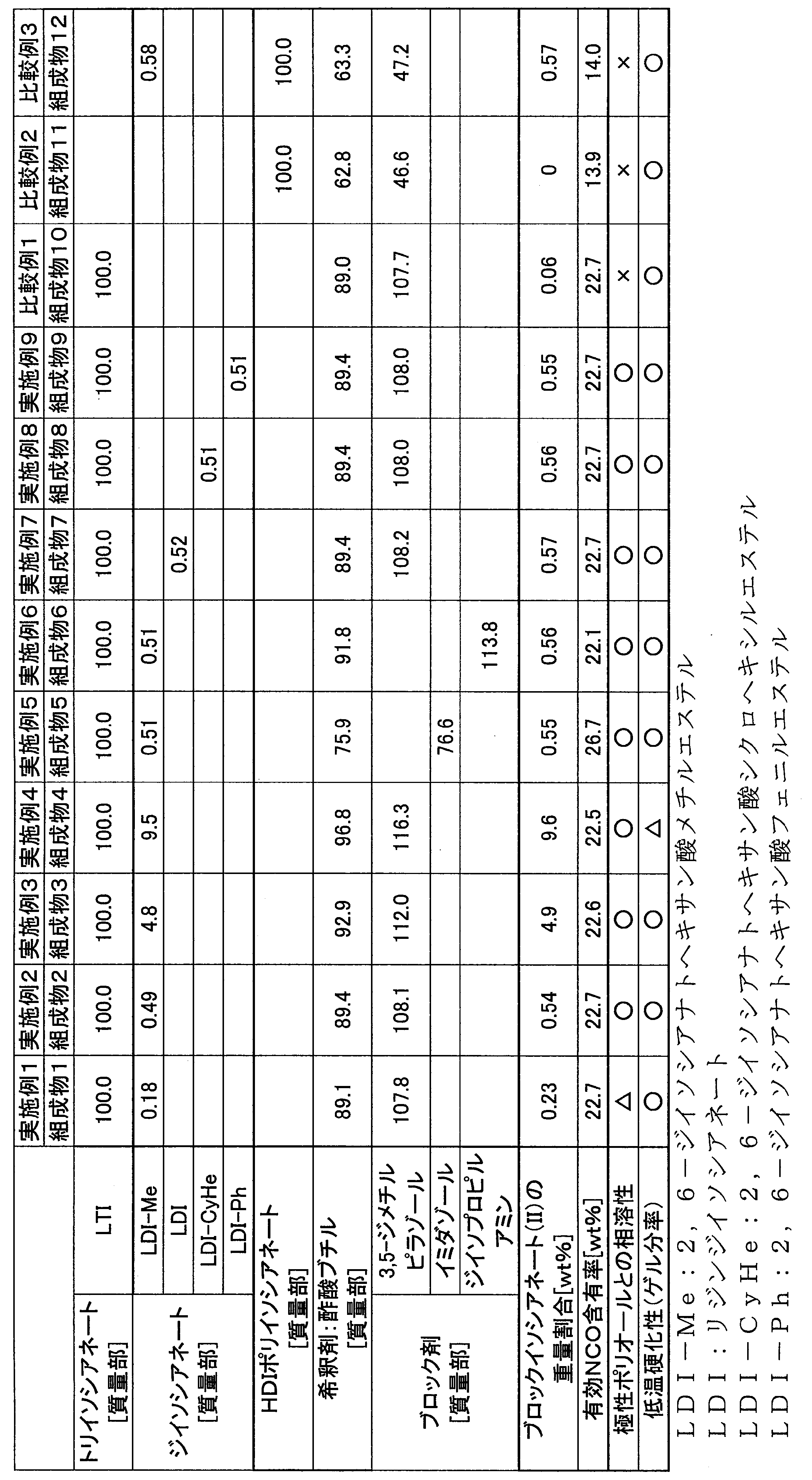
以上のことから、本実施形態のブロックイソシアネート組成物は、極性ポリオールとの相溶性に優れ、且つ、低温硬化性が良好な塗膜が得られることが確認された。
本実施形態のブロックイソシアネート組成物は、極性ポリオールとの相溶性に優れ、且つ、低温硬化製に優れるため、塗料組成物における硬化剤として好適に用いられる。
Claims (6)
- 下記一般式(I)で表されるトリイソシアネート化合物、及び、下記一般式(II)で表されるジイソシアネート化合物からなる群から選択される1種以上と、
熱解離性ブロック剤と
から得られるブロックイソシアネート化合物を含むブロックイソシアネート組成物。
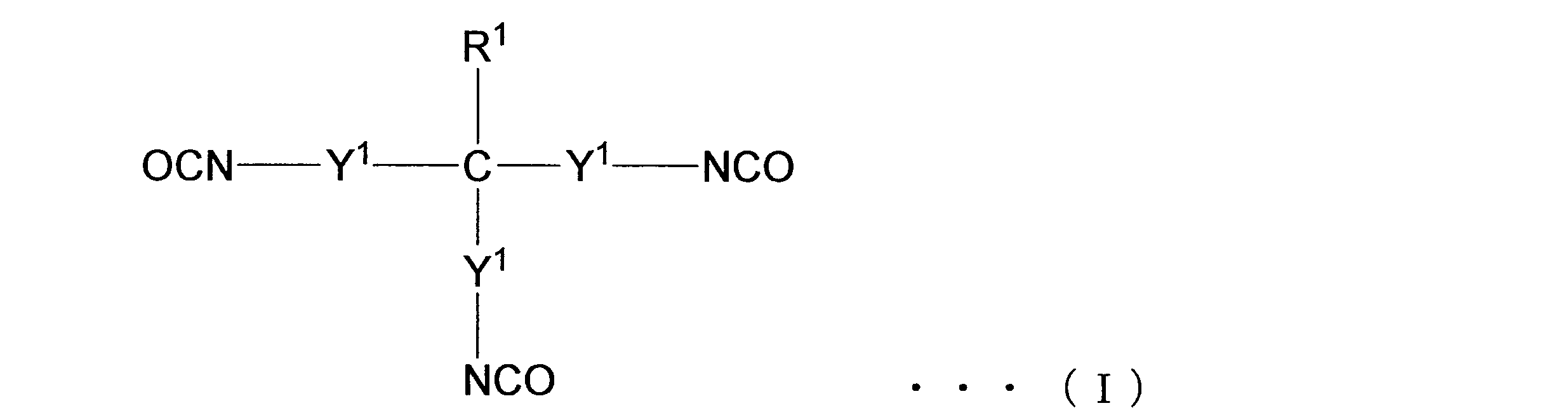

- 前記熱解離性ブロック剤が、オキシム系化合物、酸アミド系化合物、アミン系化合物、イミダゾール系化合物、トリアゾール系化合物及びピラゾール系化合物からなる群より選ばれる1種以上である請求項1に記載のブロックイソシアネート組成物。
- 前記一般式(I)で表されるトリイソシアネート化合物と前記熱解離性ブロック剤とから得られるブロックイソシアネート化合物(I)、及び、
前記一般式(II)で表されるジイソシアネート化合物と前記熱解離性ブロック剤とから得られるブロックイソシアネート化合物(II)
を含む請求項1または2に記載のブロックイソシアネート組成物。 - 前記ブロックイソシアネート化合物(I)と前記ブロックイソシアネート化合物(II)の総重量に対する、前記ブロックイソシアネート化合物(II)の重量割合が、0.2%以上、10%未満である請求項3に記載のブロックイソシアネート組成物。
- 請求項1から4のいずれか一項に記載のブロックイソシアネート組成物と、活性水素化合物とを含む塗料組成物。
- 請求項5に記載の塗料組成物を硬化した塗膜。
Priority Applications (1)
| Application Number | Priority Date | Filing Date | Title |
|---|---|---|---|
| JP2019545039A JP6821823B2 (ja) | 2017-09-29 | 2018-09-20 | ブロックイソシアネート組成物、塗料組成物及び塗膜 |
Applications Claiming Priority (2)
| Application Number | Priority Date | Filing Date | Title |
|---|---|---|---|
| JP2017-190471 | 2017-09-29 | ||
| JP2017190471 | 2017-09-29 |
Publications (1)
| Publication Number | Publication Date |
|---|---|
| WO2019065467A1 true WO2019065467A1 (ja) | 2019-04-04 |
Family
ID=65903200
Family Applications (1)
| Application Number | Title | Priority Date | Filing Date |
|---|---|---|---|
| PCT/JP2018/034888 Ceased WO2019065467A1 (ja) | 2017-09-29 | 2018-09-20 | ブロックイソシアネート組成物、塗料組成物及び塗膜 |
Country Status (2)
| Country | Link |
|---|---|
| JP (1) | JP6821823B2 (ja) |
| WO (1) | WO2019065467A1 (ja) |
Citations (2)
| Publication number | Priority date | Publication date | Assignee | Title |
|---|---|---|---|---|
| JPH07309828A (ja) * | 1994-05-17 | 1995-11-28 | Bayer Ag | 新規なジイソシアネート並びにそれらの製造方法及び使用 |
| JPH09302069A (ja) * | 1996-05-14 | 1997-11-25 | Kyowa Yuka Kk | ブロック化イソシアネート化合物 |
-
2018
- 2018-09-20 JP JP2019545039A patent/JP6821823B2/ja active Active
- 2018-09-20 WO PCT/JP2018/034888 patent/WO2019065467A1/ja not_active Ceased
Patent Citations (2)
| Publication number | Priority date | Publication date | Assignee | Title |
|---|---|---|---|---|
| JPH07309828A (ja) * | 1994-05-17 | 1995-11-28 | Bayer Ag | 新規なジイソシアネート並びにそれらの製造方法及び使用 |
| JPH09302069A (ja) * | 1996-05-14 | 1997-11-25 | Kyowa Yuka Kk | ブロック化イソシアネート化合物 |
Also Published As
| Publication number | Publication date |
|---|---|
| JPWO2019065467A1 (ja) | 2020-04-02 |
| JP6821823B2 (ja) | 2021-01-27 |
Similar Documents
| Publication | Publication Date | Title |
|---|---|---|
| JP6076478B2 (ja) | ポリイソシアネート組成物及びその製造方法、ブロックポリイソシアネート組成物及びその製造方法、樹脂組成物、硬化性樹脂組成物、並びに硬化物 | |
| US10604673B2 (en) | Blocked polyisocyanate composition, one-component coating composition, coating film, and coated article | |
| JP6796155B2 (ja) | ポリイソシアネート組成物及びその製造方法、ブロックポリイソシアネート組成物及びその製造方法、樹脂組成物、並びに硬化物 | |
| JP6595234B2 (ja) | ポリイソシアネート組成物、ブロックポリイソシアネート組成物及びそれらの製造方法 | |
| JP6588203B2 (ja) | ブロックポリイソシアネート組成物 | |
| JP6539106B2 (ja) | ポリイソシアネート組成物及びその製造方法、硬化性組成物、硬化物、並びに硬化樹脂 | |
| WO2007034883A1 (ja) | ポリイソシアネート組成物及びそれを含む塗料組成物 | |
| JPWO2018235896A1 (ja) | ブロックイソシアネート組成物、一液型塗料組成物及び塗膜 | |
| JP6946446B2 (ja) | ブロックポリイソシアネート組成物、一液型コーティング組成物、塗膜及び塗装物品 | |
| JP7058571B2 (ja) | 水分散ブロックポリイソシアネート組成物、水分散体、水系コーティング組成物及びコーティング基材 | |
| JP6849353B2 (ja) | ブロックポリイソシアネート組成物、一液型コーティング組成物、塗膜、及び塗装物品 | |
| JP2018062634A (ja) | ポリイソシアネート組成物、ブロックポリイソシアネート組成物、親水性ポリイソシアネート組成物、塗料組成物、及び塗膜 | |
| JP2017114959A (ja) | ブロックポリイソシアネート組成物、硬化性組成物、及び物品 | |
| JP2018062633A (ja) | ブロックイソシアネート組成物、一液型塗料組成物及び塗膜 | |
| JP6821823B2 (ja) | ブロックイソシアネート組成物、塗料組成物及び塗膜 | |
| JP2017095533A (ja) | ブロックポリイソシアネート組成物、熱硬化性組成物、及び硬化物 | |
| JP6713748B2 (ja) | ブロックポリイソシアネート組成物 | |
| CN119013325A (zh) | 封端异氰酸酯组合物、涂料组合物和涂膜 | |
| JP2021113276A (ja) | ブロックポリイソシアネート組成物、コーティング組成物及びコーティング基材 |
Legal Events
| Date | Code | Title | Description |
|---|---|---|---|
| 121 | Ep: the epo has been informed by wipo that ep was designated in this application |
Ref document number: 18862933 Country of ref document: EP Kind code of ref document: A1 |
|
| ENP | Entry into the national phase |
Ref document number: 2019545039 Country of ref document: JP Kind code of ref document: A |
|
| NENP | Non-entry into the national phase |
Ref country code: DE |
|
| 122 | Ep: pct application non-entry in european phase |
Ref document number: 18862933 Country of ref document: EP Kind code of ref document: A1 |