WO2019059368A1 - 炭酸ガス吸収体およびそれを含む非水電解質蓄電池、並びに炭酸ガスの分離回収方法 - Google Patents
炭酸ガス吸収体およびそれを含む非水電解質蓄電池、並びに炭酸ガスの分離回収方法 Download PDFInfo
- Publication number
- WO2019059368A1 WO2019059368A1 PCT/JP2018/035164 JP2018035164W WO2019059368A1 WO 2019059368 A1 WO2019059368 A1 WO 2019059368A1 JP 2018035164 W JP2018035164 W JP 2018035164W WO 2019059368 A1 WO2019059368 A1 WO 2019059368A1
- Authority
- WO
- WIPO (PCT)
- Prior art keywords
- carbon dioxide
- dioxide gas
- gas absorber
- absorber
- amine
- Prior art date
- Legal status (The legal status is an assumption and is not a legal conclusion. Google has not performed a legal analysis and makes no representation as to the accuracy of the status listed.)
- Ceased
Links
Classifications
-
- B—PERFORMING OPERATIONS; TRANSPORTING
- B01—PHYSICAL OR CHEMICAL PROCESSES OR APPARATUS IN GENERAL
- B01D—SEPARATION
- B01D53/00—Separation of gases or vapours; Recovering vapours of volatile solvents from gases; Chemical or biological purification of waste gases, e.g. engine exhaust gases, smoke, fumes, flue gases, aerosols
- B01D53/14—Separation of gases or vapours; Recovering vapours of volatile solvents from gases; Chemical or biological purification of waste gases, e.g. engine exhaust gases, smoke, fumes, flue gases, aerosols by absorption
-
- B—PERFORMING OPERATIONS; TRANSPORTING
- B01—PHYSICAL OR CHEMICAL PROCESSES OR APPARATUS IN GENERAL
- B01J—CHEMICAL OR PHYSICAL PROCESSES, e.g. CATALYSIS OR COLLOID CHEMISTRY; THEIR RELEVANT APPARATUS
- B01J20/00—Solid sorbent compositions or filter aid compositions; Sorbents for chromatography; Processes for preparing, regenerating or reactivating thereof
- B01J20/22—Solid sorbent compositions or filter aid compositions; Sorbents for chromatography; Processes for preparing, regenerating or reactivating thereof comprising organic material
-
- B—PERFORMING OPERATIONS; TRANSPORTING
- B01—PHYSICAL OR CHEMICAL PROCESSES OR APPARATUS IN GENERAL
- B01J—CHEMICAL OR PHYSICAL PROCESSES, e.g. CATALYSIS OR COLLOID CHEMISTRY; THEIR RELEVANT APPARATUS
- B01J20/00—Solid sorbent compositions or filter aid compositions; Sorbents for chromatography; Processes for preparing, regenerating or reactivating thereof
- B01J20/22—Solid sorbent compositions or filter aid compositions; Sorbents for chromatography; Processes for preparing, regenerating or reactivating thereof comprising organic material
- B01J20/24—Naturally occurring macromolecular compounds, e.g. humic acids or their derivatives
-
- B—PERFORMING OPERATIONS; TRANSPORTING
- B01—PHYSICAL OR CHEMICAL PROCESSES OR APPARATUS IN GENERAL
- B01J—CHEMICAL OR PHYSICAL PROCESSES, e.g. CATALYSIS OR COLLOID CHEMISTRY; THEIR RELEVANT APPARATUS
- B01J20/00—Solid sorbent compositions or filter aid compositions; Sorbents for chromatography; Processes for preparing, regenerating or reactivating thereof
- B01J20/22—Solid sorbent compositions or filter aid compositions; Sorbents for chromatography; Processes for preparing, regenerating or reactivating thereof comprising organic material
- B01J20/26—Synthetic macromolecular compounds
-
- B—PERFORMING OPERATIONS; TRANSPORTING
- B01—PHYSICAL OR CHEMICAL PROCESSES OR APPARATUS IN GENERAL
- B01J—CHEMICAL OR PHYSICAL PROCESSES, e.g. CATALYSIS OR COLLOID CHEMISTRY; THEIR RELEVANT APPARATUS
- B01J20/00—Solid sorbent compositions or filter aid compositions; Sorbents for chromatography; Processes for preparing, regenerating or reactivating thereof
- B01J20/28—Solid sorbent compositions or filter aid compositions; Sorbents for chromatography; Processes for preparing, regenerating or reactivating thereof characterised by their form or physical properties
-
- B—PERFORMING OPERATIONS; TRANSPORTING
- B01—PHYSICAL OR CHEMICAL PROCESSES OR APPARATUS IN GENERAL
- B01J—CHEMICAL OR PHYSICAL PROCESSES, e.g. CATALYSIS OR COLLOID CHEMISTRY; THEIR RELEVANT APPARATUS
- B01J20/00—Solid sorbent compositions or filter aid compositions; Sorbents for chromatography; Processes for preparing, regenerating or reactivating thereof
- B01J20/30—Processes for preparing, regenerating, or reactivating
- B01J20/34—Regenerating or reactivating
-
- C—CHEMISTRY; METALLURGY
- C01—INORGANIC CHEMISTRY
- C01B—NON-METALLIC ELEMENTS; COMPOUNDS THEREOF; METALLOIDS OR COMPOUNDS THEREOF NOT COVERED BY SUBCLASS C01C
- C01B32/00—Carbon; Compounds thereof
- C01B32/50—Carbon dioxide
-
- C—CHEMISTRY; METALLURGY
- C08—ORGANIC MACROMOLECULAR COMPOUNDS; THEIR PREPARATION OR CHEMICAL WORKING-UP; COMPOSITIONS BASED THEREON
- C08K—Use of inorganic or non-macromolecular organic substances as compounding ingredients
- C08K5/00—Use of organic ingredients
- C08K5/04—Oxygen-containing compounds
- C08K5/05—Alcohols; Metal alcoholates
-
- C—CHEMISTRY; METALLURGY
- C08—ORGANIC MACROMOLECULAR COMPOUNDS; THEIR PREPARATION OR CHEMICAL WORKING-UP; COMPOSITIONS BASED THEREON
- C08L—COMPOSITIONS OF MACROMOLECULAR COMPOUNDS
- C08L101/00—Compositions of unspecified macromolecular compounds
- C08L101/02—Compositions of unspecified macromolecular compounds characterised by the presence of specified groups, e.g. terminal or pendant functional groups
-
- Y—GENERAL TAGGING OF NEW TECHNOLOGICAL DEVELOPMENTS; GENERAL TAGGING OF CROSS-SECTIONAL TECHNOLOGIES SPANNING OVER SEVERAL SECTIONS OF THE IPC; TECHNICAL SUBJECTS COVERED BY FORMER USPC CROSS-REFERENCE ART COLLECTIONS [XRACs] AND DIGESTS
- Y02—TECHNOLOGIES OR APPLICATIONS FOR MITIGATION OR ADAPTATION AGAINST CLIMATE CHANGE
- Y02C—CAPTURE, STORAGE, SEQUESTRATION OR DISPOSAL OF GREENHOUSE GASES [GHG]
- Y02C20/00—Capture or disposal of greenhouse gases
- Y02C20/40—Capture or disposal of greenhouse gases of CO2
-
- Y—GENERAL TAGGING OF NEW TECHNOLOGICAL DEVELOPMENTS; GENERAL TAGGING OF CROSS-SECTIONAL TECHNOLOGIES SPANNING OVER SEVERAL SECTIONS OF THE IPC; TECHNICAL SUBJECTS COVERED BY FORMER USPC CROSS-REFERENCE ART COLLECTIONS [XRACs] AND DIGESTS
- Y02—TECHNOLOGIES OR APPLICATIONS FOR MITIGATION OR ADAPTATION AGAINST CLIMATE CHANGE
- Y02P—CLIMATE CHANGE MITIGATION TECHNOLOGIES IN THE PRODUCTION OR PROCESSING OF GOODS
- Y02P20/00—Technologies relating to chemical industry
- Y02P20/151—Reduction of greenhouse gas [GHG] emissions, e.g. CO2
-
- Y—GENERAL TAGGING OF NEW TECHNOLOGICAL DEVELOPMENTS; GENERAL TAGGING OF CROSS-SECTIONAL TECHNOLOGIES SPANNING OVER SEVERAL SECTIONS OF THE IPC; TECHNICAL SUBJECTS COVERED BY FORMER USPC CROSS-REFERENCE ART COLLECTIONS [XRACs] AND DIGESTS
- Y02—TECHNOLOGIES OR APPLICATIONS FOR MITIGATION OR ADAPTATION AGAINST CLIMATE CHANGE
- Y02P—CLIMATE CHANGE MITIGATION TECHNOLOGIES IN THE PRODUCTION OR PROCESSING OF GOODS
- Y02P70/00—Climate change mitigation technologies in the production process for final industrial or consumer products
- Y02P70/50—Manufacturing or production processes characterised by the final manufactured product
Definitions
- the present invention relates to a carbon dioxide gas absorber, a non-aqueous electrolyte storage battery including the carbon dioxide gas absorber, and a method of separating and collecting carbon dioxide gas.
- Mobile terminals such as mobile phones, laptop computers, pad-type information terminals and the like have been remarkable.
- Mobile terminals are required to have more comfortable portability, and along with the rapid progress in downsizing, thinning, weight reduction and high performance, batteries used in portable terminals are also miniaturized, thin, lightweight and High performance is required.
- a lithium ion secondary battery is often used as a secondary battery used for the power supply of such a portable terminal.
- a positive electrode and a negative electrode are provided via a separator, and LiPF 6 , LiBF 4 , LiTFSI (lithium (bis trifluoromethyl sulfonyl imide)), Li FSI (lithium (bis fluorosulfonyl imide) And the like) are housed in a container together with an electrolytic solution in which a lithium salt is dissolved in an organic liquid such as ethylene carbonate.
- LiPF 6 , LiBF 4 , LiTFSI lithium (bis trifluoromethyl sulfonyl imide)
- Li FSI lithium (bis fluorosulfonyl imide) And the like
- the electric double layer capacitor has a structure in which 2 parts of a polarizable electrode sheet are disposed via a separator and housed in a container together with an organic electrolytic solution such as propylene carbonate in which tetraethylammonium tetrafluoroborate is dissolved.
- an organic electrolytic solution such as propylene carbonate in which tetraethylammonium tetrafluoroborate is dissolved.
- non-aqueous electrolyte storage batteries such as non-aqueous electrolyte secondary batteries and electric double layer capacitors
- deterioration or destruction due to outgas generated from the inside during operation becomes a problem.
- methods of heat treatment and aging are generally used, but in these methods, the released gas is likely to be absorbed again by the electrolyte solution and the sealing can, and changes in the environment at the time of operation
- the gas is re-emitted to degrade or destroy the battery.
- carbon dioxide carbon dioxide gas
- an absorber capable of storing outgas is desired.
- Patent Document 1 describes a carbon dioxide absorbing polymer having a repeating unit having a secondary or tertiary amino group and a carbon dioxide absorbent containing 10% by mass or more of water.
- Patent Document 2 describes a gas absorber containing hydrogel particles of a polymer compound having an amino group.
- Such a method of chemically absorbing carbon dioxide in an aqueous solution of an amine-based material can also be used as a storage method of carbon dioxide, and in particular, the action strength with carbon dioxide can be changed by amine species, and re-release Since the carbon dioxide gas can be reduced, it is suitable for storing carbon dioxide gas released inside the electronic device and protecting it from deterioration and destruction.
- the carbon dioxide absorbent disclosed in Patent Document 1 is based on a polymer composed of a secondary or higher amine, it has poor reactivity with carbon dioxide and is not necessarily satisfactory in carbon dioxide absorption. It was not something. Further, the gas absorber disclosed in Patent Document 2 has a small amount of amino groups that can be contained in the hydrogel particles of the polymer compound, and the volume density tends to decrease due to the presence of the particle gaps. The amount of absorption was not always satisfactory.
- the compound having the shape of the particle or the pore and the amino group The distribution of carbon dioxide is not constant, and the absorption or release of carbon dioxide in the gas absorber tends to be uneven, which may cause local deterioration or destruction when used in a non-aqueous electrolyte battery. Furthermore, since it is necessary to heat water with a large specific heat, the carbon dioxide gas separation and recovery method based on gas-liquid reaction involves separating and recovering carbon dioxide gas from a carbon dioxide gas absorbent after absorbing carbon dioxide gas from exhaust gas or the like. The efficiency and operability tend to be inferior to the treatment by solid-gas reaction.
- the object of the present invention is to provide a carbon dioxide gas absorber suitable for a wide range of applications, which can realize a high carbon dioxide gas absorption capacity and can separate and recover carbon dioxide gas stably and efficiently at high temperatures.
- Another object of the present invention is to provide a non-aqueous electrolyte storage battery having stable charge and discharge performance which is resistant to deterioration and destruction of the storage battery due to outgassing generated from the inside of the storage battery.
- a carbon dioxide gas absorber comprising a mixture containing an amine polymer having an amino group in a repeating unit and an alcohol compound, and having a water content of less than 10% by mass.
- the carbon dioxide gas absorbent according to the above [1] which has a carbon dioxide gas discharge temperature of 100 ° C. or more and 300 ° C. or less.
- the amine polymer is selected from the group consisting of polyethyleneimine, polyallylamine, polyacrylamide, polytetramethylene imine, polyvinylamine, dicyandiamide-formalin condensate and dicyandiamide-alkylene (polyamine) condensate.
- the carbon dioxide gas absorber as described in [2].
- a non-aqueous electrolyte storage battery comprising the carbon dioxide gas absorber according to [6].
- the nonaqueous electrolyte storage battery according to the above [7] which is a nonaqueous electrolyte secondary battery.
- the nonaqueous electrolyte storage battery according to [7] which is an electric double layer capacitor.
- the present invention it is possible to provide a carbon dioxide gas absorber suitable for a wide range of applications, which can realize a high carbon dioxide gas absorption capacity, and can separate and recover carbon dioxide gas stably and efficiently at high temperatures. Further, according to the present invention, it is possible to provide a non-aqueous electrolyte storage battery having stable charge and discharge performance which is less likely to cause deterioration or destruction of the storage battery due to outgassing generated from the inside of the storage battery.
- the carbon dioxide gas absorber of the present invention comprises a mixture containing an amine polymer having an amino group in the repeating unit and an alcohol compound.
- an amine polymer refers to a polymer having at least one nitrogen atom to be a primary amine, a secondary amine or a tertiary amine in the main chain and / or side chain of the polymer.
- the amine-based polymer used to construct the carbon dioxide gas absorber of the present invention can be present at a water content of less than 10% by mass as a final carbon dioxide gas absorber composed of a mixture with an alcohol compound (usually a solid).
- the polymer is not particularly limited as long as it is in the form of a polymer, and any conventionally known amine polymer can be used.
- the amine-based polymer may be ethyleneimine, allylamine, vinylformamide, vinylacetamide, acrylamide, amino acid, melamine, urea, primary amine such as vinylpyrrolidone, secondary amine, tertiary amine compound
- primary amine such as vinylpyrrolidone
- secondary amine tertiary amine compound
- naturally-occurring high-molecular compounds such as secondary products of microorganisms may be used.
- the amine-based polymer is a polymer having at least one selected from a primary amino group, a secondary amino group and a tertiary amino group in the repeating unit.
- a polymer may be a polymer having at least one selected from a primary amino group, a secondary amino group and a tertiary amino group in one repeating unit, and such one
- the above repeating unit may be a random, graft or block copolymerized polymer.
- polyethyleneimine, polyallylamine, polyacrylamide, polytetramethyleneimine, polyvinylamine, dicyandiamide-formalin condensate and dicyandiamide-alkylene (polyamine) condensate are more preferred because they are preferred and they are easy to obtain and low in cost. These may be used alone or in combination of two or more.
- the amine polymer preferably contains a primary amino group, and preferably contains at least one of a primary amino group and a secondary amino group and a tertiary amino group. More preferable.
- a primary amino group By containing a primary amino group, the absorption amount to carbon dioxide gas can be increased, and in particular, in an environment with little water (for example, 5% by mass or less with respect to a carbon dioxide gas absorber) or substantially no water Under the environment, the absorption to carbon dioxide can be advantageously improved.
- carbon dioxide gas absorbed can be stably held by containing at least one of the secondary amino group and the tertiary amino group.
- the ratio of the primary amino group contained in the amine polymer is an amine group.
- the content is preferably 25% or more, more preferably 30% or more, and still more preferably 35% or more based on the total amino groups of the polymer.
- the reactivity with a carbon dioxide gas improves that the ratio of a primary amino group is more than the above-mentioned lower limit, and the carbon dioxide gas absorber which has a high amount of absorption to carbon dioxide can be obtained.
- the ratio of the primary amino group is preferably 80% or less with respect to the total amino groups of the amine polymer.
- the carbon dioxide gas absorber contains, as an amine polymer, at least one of a secondary amino group and a tertiary amino group in one molecule in addition to the primary amino group. It is also preferable to include a polymer containing a polymer containing a primary amino group, a secondary amino group and a tertiary amino group in one molecule.
- the amine-based polymer may be a polymer mixture, in which case also a polymer comprising a primary amine and a polymer of a secondary amine and a tertiary amine. What mixed with the polymer containing at least one of them is preferable. Even when two or more types of polymers are combined, it is preferable that the ratio of the primary amino group to the total amino groups in all the amine polymers is in the same range as above.
- the amount of amino groups in the amine-based polymer is preferably 15% by mass or more, and more preferably 25% by mass or more, based on the total amount of the amine-based polymer.
- the amount of amino groups in the amine-based polymer is at least the above lower limit, it becomes easy to secure a carbon dioxide gas absorbable amount in a sufficient range required for various applications, and excellent in carbon dioxide gas absorption and stability retention. It is possible to obtain a carbon dioxide gas absorber.
- the upper limit is not particularly limited because the absorbable amount of carbon dioxide gas tends to increase as the amount of amino groups in the amine-based polymer increases, but the upper limit is usually 90% by mass or less and 80% by mass It is preferable that it is the following and it is more preferable that it is 60 mass% or less. It exists in the tendency to be excellent in processability as it is below the said upper limit.
- the weight average molecular weight of the amine-based polymer is preferably 2000 or more, more preferably 5000 or more, still more preferably 10000 or more, preferably 100000 or less, more preferably 80000 or less More preferably, it is 70000 or less.
- the weight average molecular weight of the amine polymer can be determined, for example, using gel permeation chromatography (GPC).
- the alcohol compound is a compound having at least one hydroxyl group, and in order to obtain a solid carbon dioxide gas absorber, in the present invention, it is preferable to select a solid at normal temperature.
- Such alcohol compounds include, for example, monosaccharides, oligosaccharides, polysaccharides, polyvinyl alcohol and derivatives thereof, and polyphenols and derivatives thereof. These alcohol compounds may be used alone or in combination of two or more.
- the monosaccharides include glucose, fructose, galactose and the like.
- the oligosaccharides include sucrose, sorbitol, xylitol and the like.
- starch and its derivative (s), cellulose, its derivative, etc. are mentioned, for example.
- starch corn starch
- wheat starch potato starch
- tapioca starch rice starch
- rice starch dextrin
- amylose amylopectin
- pullulan high amylose corn starch
- hydroxyalkyl starch such as hydroxypropyl starch
- dihydroxyalkyl starches such as propyl starch
- dihydroxyalkyl pullulan such as dihydroxypropyl pullulan and the like.
- examples of the cellulose and derivatives thereof include regenerated cellulose; powdered cellulose; microcrystalline cellulose; hydroxyalkyl cellulose such as hydroxyethyl cellulose and hydroxypropyl cellulose; and dihydroxyalkyl cellulose such as dihydroxypropyl cellulose.
- a polysaccharide when used as the alcohol compound, its molecular weight varies depending on the number and type of repeating units of the polysaccharide, and is not limited, but it is 5,000 to 1,000,000 in weight average molecular weight Preferably, it is 10000 to 200,000.
- the weight average molecular weight can be determined, for example, using gel permeation chromatography (GPC).
- the alcohol compound is preferably polyvinyl alcohol and derivatives thereof because the alcohol compound has high plasticity and good processability. Moreover, you may use what modified
- the average degree of polymerization is preferably 1000 to 100000, more preferably 1000 to 80000, and still more preferably 1500 to 60000.
- the degree of saponification of polyvinyl alcohol may be, for example, 90 mol% or more, preferably 95 mol% or more, and more preferably 98 mol% or more.
- the carbon dioxide gas absorber of the present invention comprises a mixture containing an amine polymer and an alcohol compound.
- the mixing ratio (mass ratio) of the amine polymer and the alcohol compound in the mixture constituting the carbon dioxide gas absorber is preferably 5: 1 to 1: 5, and more preferably 3: 1 to 1: 3. More preferably, 2: 1 to 1: 1.
- the mixing ratio of the amine polymer and the alcohol compound when the mixing ratio of the amine polymer and the alcohol compound is in the above range, the carbon dioxide gas absorbing performance of the carbon dioxide gas absorber can be enhanced, and mechanical properties such as strength and elongation are obtained. Properties can be improved. In addition, moldability and handling become good.
- the said mixing ratio means the ratio as solid content, respectively.
- the mixture which comprises the carbon dioxide gas absorber of this invention may contain components other than an amine polymer and an alcohol compound.
- Such components include, for example, components to be blended as additives to conventional carbon dioxide gas absorbers, and specifically, dispersion stabilizers, viscosity modifiers, polymers other than amine polymers, and polymers Examples thereof include foams, plasticizers, heat stabilizers (melt stabilizers), deodorants, ultraviolet absorbers, antistatic agents, lubricants, colorants, desiccants, fillers, processing aids, flame retardants, and the like.
- the total amount of the amine polymer and the alcohol compound with respect to the total mass of the mixture is 90% by mass or more as solid content Is preferable, 95% by mass or more is more preferable, and 98% by mass or more is more preferable.
- solid content here means the component except the quantity of solvent, such as water, from the mixture which comprises a carbon dioxide gas absorber.
- the water content of the carbon dioxide gas absorber of the present invention is preferably less than 10% by mass, preferably 8% by mass or less, and 5% by mass or less based on the total mass of the carbon dioxide gas absorber. More preferably, it is particularly preferably 2% by mass or less.
- the lower limit value of the moisture content is not particularly limited, and is usually 0.1% by mass or more, but may be 0% by mass. When the moisture content is 10% by mass or more, it becomes difficult for the carbon dioxide gas absorber to maintain a solid shape.
- the carbon dioxide gas absorbent of the present invention has a low water content as compared with the conventional carbon dioxide gas absorbent, and has high carbon dioxide gas absorbability in the absence of water.
- the carbon dioxide gas absorber of the present invention When the carbon dioxide gas absorber of the present invention is used in a non-aqueous electrolyte storage battery described later, its moisture content is preferably 500 ppm or less, more preferably 400 ppm or less, still more preferably 300 ppm or less, particularly preferably 250 ppm or less.
- the water content is 500 ppm or less, the performance deterioration of the non-aqueous electrolyte storage battery can be suppressed. Therefore, the lower the moisture content of the carbon dioxide gas absorber, the better, and it is ideally 0 ppm. However, from the viewpoint of production efficiency etc., the lower limit is usually 100 ppm or more.
- the moisture content of the carbon dioxide gas absorbent of the present invention is controlled by controlling the amount of water in a mixture containing an amine polymer and an alcohol compound, heating conditions at the time of preparing (forming etc.) the carbon dioxide gas absorber from the mixture, and drying conditions It can adjust by controlling etc.
- the carbon dioxide gas discharge temperature of the carbon dioxide gas absorber of the present invention is preferably 100 ° C. or more, more preferably 120 ° C. or more, still more preferably 140 ° C. or more, particularly preferably 150 ° C. or more, preferably 300 ° C. or less More preferably, it is 250 degrees C or less, More preferably, it is 230 degrees C or less, Especially preferably, it is 220 degrees C or less. It becomes possible to absorb carbon dioxide gas stably and efficiently under high temperature, and to separate and recover it as carbon dioxide gas discharge temperature is more than the above-mentioned lower limit, and it is below the above-mentioned upper limit, decomposition of alcohol compound and amine polymer And thermal degradation can be suppressed.
- the carbon dioxide gas discharge temperature of the carbon dioxide gas absorber can be controlled, for example, by selecting the type, combination, mixing ratio, water content, shape, and the like of the amine polymer and alcohol compound to be used. For example, in order to increase the carbon dioxide gas release temperature, the ratio of primary amines may be increased, or the ratio of alcohol compounds may be increased. On the other hand, in order to lower the carbon dioxide gas release temperature, it is possible to increase the water content, increase the ratio of the total of secondary and tertiary amino groups in the amine polymer, and the like.
- the carbon dioxide gas absorber of the present invention is usually solid, and its shape is not particularly limited, and it may be in the form of a film, a film, a sheet, a fiber, a powder, or the like according to the desired use environment or application. It may be in the form of granules, gels, etc. It is preferably in the form of a film, a film, a sheet, a fiber and a powder, because it is easy to handle and easy to use for various applications.
- the shape of the carbon dioxide gas absorber when the shape of the carbon dioxide gas absorber is a film, film or sheet, its thickness can be appropriately determined according to the environment and application to be used, and may be, for example, 1 to 500 ⁇ m. And 5 to 200 ⁇ m.
- the carbon dioxide gas absorber of the present invention may be produced, for example, by stirring and mixing an amine polymer, an alcohol compound, and other components as necessary, and shaping the obtained mixture into a desired shape or the like. it can.
- the mixture is easily handled by appropriately dissolving the amine polymer and / or the alcohol compound in a solvent such as water and mixing as an aqueous solution.
- the solvent at this time may be appropriately selected depending on the type and amount of the amine polymer and alcohol compound to be used. Examples of the solvent include water, alcohol solvents, dimethyl sulfoxide and the like.
- the stirring and mixing conditions (temperature, time, stirring speed, etc.) at the time of mixing the amine polymer and the alcohol compound may be appropriately determined according to the type and amount of the amine polymer and alcohol compound to be used.
- the mixture is applied onto a substrate, and the solvent is removed by drying, and then the substrate is peeled off, whereby a carbon dioxide gas absorber such as a film, film or sheet can be obtained.
- the substrate is not particularly limited, and, for example, a plastic film such as polyester, a release paper, a metal plate, a glass plate or the like can be used.
- the drying method may, for example, be a natural drying method, a ventilation drying method, a heating drying or a reduced pressure drying method, but since the solvent contained in the mixture can be efficiently removed, it is preferable to heat drying.
- the heating temperature is not particularly limited, and may be, for example, 50 to 150 ° C., and preferably 80 to 120 ° C.
- the drying time may be appropriately adjusted according to the heating temperature etc., and may be, for example, 1 to 60 minutes, preferably 3 to 30 minutes.
- a mixture of an amine polymer and an alcohol compound is heated to a concentration of 40 to 60% by mass to obtain an aqueous solution, and a crosslinking agent such as ammonium sulfate is 0.5 based on the weight of the polyvinyl alcohol polymer It can be manufactured by adding ⁇ 10% by mass, making a spinning stock solution at a temperature of 90 ⁇ 140 ° C., pressurizing it and discharging it from the nozzle hole into air for dry spinning.
- a powdery carbon dioxide gas absorbent can be produced by pulverizing a solid obtained by heating and drying a mixture of (an aqueous solution of) an amine polymer and (an aqueous solution of) an alcohol compound.
- Non-aqueous electrolyte storage battery Since the carbon dioxide gas absorber of the present invention has a low absorbed water content and is usually in a solid state, it can efficiently store the outgas generated from the inside during operation without affecting the performance of the non-aqueous electrolyte storage battery. Therefore, the present invention is directed to a non-aqueous electrolyte storage battery including the carbon dioxide absorbent of the present invention.
- the non-aqueous electrolyte storage battery of the present invention may be in the form of a non-aqueous electrolyte secondary battery, an electric double layer capacitor, a lithium ion capacitor or the like.
- a non-aqueous electrolyte secondary battery generally comprises a positive electrode, a negative electrode, a separator disposed between the positive electrode and the negative electrode, and an electrolyte.
- the non-aqueous electrolyte secondary battery of the present invention can be manufactured using known materials and techniques.
- the positive electrode material may be, for example, TiS 2 , TiS 3 , amorphous MoS 3 , Cu 2 V 2 O 3 , amorphous V 2 O-P 2 Transition metal oxides such as O 5 , MoO 3 , V 2 O 5 and V 6 O 13 and lithium-containing composite metal oxides such as LiCoO 2 , LiNiO 2 , LiMnO 2 and LiMn 2 O 4 can be used.
- Water or organic dispersion medium positive electrode material, conductive additive such as metal powder, conductive polymer, acetylene black, carbon black, and binder such as SBR, NBR, acrylic rubber, hydroxyethyl cellulose, carboxymethyl cellulose, polyvinylidene fluoride, etc.
- conductive additive such as metal powder, conductive polymer, acetylene black, carbon black, and binder such as SBR, NBR, acrylic rubber, hydroxyethyl cellulose, carboxymethyl cellulose, polyvinylidene fluoride, etc.
- Etc. to prepare a slurry for the positive electrode for example, it can be applied to a positive electrode current collector such as aluminum, and the solvent can be dried to form a positive electrode.
- conductive materials such as amorphous carbon, graphite, natural graphite, meso carbon micro beads (MCMB), pitch carbon fiber, carbon black, activated carbon, carbon fiber, hard carbon, soft carbon, mesoporous carbon, polyacene, etc.
- Carbonaceous materials such as polymers, complex metal oxides represented by SiO x , SnO x , LiTiO x and other metal oxides, lithium metals, lithium metals such as lithium alloys, metals such as TiS 2 , LiTiS 2 A compound and a composite material of a metal oxide and a carbonaceous material can be used.
- a slurry for the negative electrode is prepared by mixing the negative electrode material and the same conductive aid and binder as the positive electrode in water, an organic dispersion medium, etc., for example, applying it to a negative electrode current collector such as copper and drying the solvent. Can be used as a negative electrode.
- the electrolytic solution may be liquid or gel as long as it is used for a normal non-aqueous electrolyte secondary battery, and an electrolyte that exhibits the function as a battery may be appropriately selected according to the type of the negative electrode material and the positive electrode material. Good.
- any known lithium salt can be used, for example, LiClO 4, LiBF 6, LiPF 6, LiCF 3 SO 3, LiCF 3 CO 2, LiAsF 6, LiSbF 6, LiB 10 Cl 10, LiAlCl 4, LiCl , LiBr, LiB (C 2 H 5 ) 4 , CF 3 SO 3 Li, CH 3 SO 3 Li, LiCF 3 SO 3 , LiC 4 F 9 SO 3 , Li (CF 3 SO 2 ) 2 N, lower aliphatic carboxylic acids And lithium acid.
- LiClO 4 LiBF 6, LiPF 6, LiCF 3 SO 3, LiCF 3 CO 2, LiAsF 6, LiSbF 6, LiB 10 Cl 10, LiAlCl 4, LiCl , LiBr, LiB (C 2 H 5 ) 4 , CF 3 SO 3 Li, CH 3 SO 3 Li, LiCF 3 SO 3 , LiC 4 F 9 SO 3 , Li (CF 3 SO 2 ) 2 N, lower aliphatic carboxylic acids And lithium acid.
- the solvent (electrolyte solution solvent) for dissolving such an electrolyte is not particularly limited. Specific examples thereof include carbonates such as propylene carbonate, ethylene carbonate, butylene carbonate, dimethyl carbonate, diethyl carbonate and vinylene carbonate; lactones such as ⁇ -butyl lactone; trimethoxymethane, 1,2-dimethoxyethane, diethyl ether, 2 -Ethers such as ethoxyethane, tetrahydrofuran and 2-methyltetrahydrofuran; Sulfoxides such as dimethyl sulfoxide; Oxolanes such as 1,3-dioxolane and 4-methyl-1,3-dioxolane; Nitrogen-containing compounds such as acetonitrile and nitromethane Organic acid esters such as methyl formate, methyl acetate, ethyl acetate, butyl acetate, methyl propionate, and ethyl propionate
- a gel electrolyte solution a nitrile polymer, an acrylic polymer, a fluorine polymer, an alkylene oxide polymer or the like can be added as a gelling agent.
- a non-aqueous electrolyte secondary battery is obtained by stacking the negative electrode and the positive electrode through a separator such as a polypropylene porous film, winding it according to the battery shape, folding it, etc. It can be manufactured by sealing.
- the shape of the battery may be any of known coin type, button type, sheet type, cylindrical type, square type, flat type and the like.
- the installation of the carbon dioxide absorber in the non-aqueous electrolyte secondary battery may be, for example, in the case of a film, film or sheet of carbon dioxide absorber, it may be arranged by laminating together with the electrode and the separator; Alternatively, in the case of powder or the like, it may be mixed with an electrode material or a separator material, and may be disposed in the battery as a part of a component of the electrode or the separator.
- an electric double layer capacitor mainly has a polarizable electrode, an electrolytic solution, and a separator, and has a structure in which a separator is disposed between a pair of electrodes.
- the electric double layer capacitor of the present invention can be manufactured using known materials and techniques.
- the polarizable electrode material for example, it is preferable to use activated carbon in terms of capacitance.
- the carbon material used as the raw material of activated carbon is not particularly limited, and examples thereof include coal, coal pitch, petroleum pitch, thermosetting resin such as phenol, coconut shell and the like.
- the polarizable electrode For the production of the polarizable electrode, known methods can be applied. For example, a commercially available substance known as a binder such as polyvinylidene fluoride or polytetrafluoroethylene or a conductive material such as carbon black may be added to the polarizable electrode material up to about several percent, if necessary. After well-kneaded, it can be molded into an electrode by punching into a required shape after being put into a mold and press-molded or rolled into a sheet. In addition, the kneaded material may be applied to a current collector to form a coated electrode.
- a binder such as polyvinylidene fluoride or polytetrafluoroethylene or a conductive material such as carbon black
- a conductive material such as carbon black
- an organic compound such as alcohol and N-methylpyrrolidone
- a solvent such as water
- a dispersant such as sodium bicarbonate
- various additives may be used.
- glass filter paper non-woven fabric such as polypropylene or nylon, or porous film such as polytetrafluoroethylene can be used.
- electrolyte tetraethylammonium tetrafluoroborate, tetramethylammonium tetrafluoroborate or the like can be used.
- a solvent for dissolving the electrolyte and forming an electrolyte solution carbonates such as ethylene carbonate, dimethyl carbonate, diethyl carbonate and propylene carbonate, nitriles such as acetonitrile, lactones such as ⁇ -butyrolactone and ⁇ -methyl- ⁇ -butyrolactone, Sulfoxides such as dimethylsulfoxide and amides such as dimethylformamide are used.
- Each component constituting the electric double layer capacitor can have the same structure as a known electric double layer capacitor except that the carbon dioxide gas absorber according to the present invention is used.
- a current collector made of aluminum or the like
- the carbon dioxide gas absorber may be placed on the electric double layer capacitor, for example, when the carbon dioxide gas absorber is in the form of a film, a film or a sheet, and may be arranged by laminating together with a polarizable electrode and a separator. Alternatively, in the case of powder or the like, it can be disposed in the battery as a part of constituent members of the polarizable electrode or separator.
- a gas containing carbon dioxide gas is brought into contact with the carbon dioxide gas absorber of the present invention to absorb carbon dioxide gas in the carbon dioxide gas absorber, and the carbon dioxide gas is absorbed. It includes separating and recovering carbon dioxide gas from the carbon dioxide gas absorber. Specifically, for example, the carbon dioxide gas discharge temperature of the carbon dioxide gas absorber into an absorption tower provided with the carbon dioxide gas absorber of the present invention having a film, film, sheet, fiber or powder form.
- the carbon dioxide gas contained in the carbon dioxide gas-containing gas is supplied by supplying the carbon dioxide gas-containing gas controlled to a temperature (for example, 100 ° C.
- the carbon dioxide gas separation and recovery method of the present invention can be carried out from absorption of carbon dioxide gas to separation and recovery in one column by using a solid carbon dioxide gas absorber.
- the contact between the carbon dioxide gas absorber and the carbon dioxide gas-containing gas is preferably performed at a temperature lower than the carbon dioxide gas discharge temperature of the carbon dioxide gas absorber, and more preferably a temperature lower by about 50 to 80 ° C. than the carbon dioxide gas discharge temperature of the absorber.
- the heating for separating and recovering the carbon dioxide absorbed from the carbon dioxide absorber may be performed by direct heating, for example, by blowing of steam, or may be performed by indirect heating using a jacket or the like.
- the heating temperature is preferably equal to or higher than the carbon dioxide gas discharge temperature of the carbon dioxide gas absorber, and more preferably higher by about 10 to 20 ° C. than the carbon dioxide gas discharge temperature.
- the separated carbon dioxide gas may be discharged from the inside of the absorption tower through a recovery discharge line and recovered.
- the carbon dioxide gas absorber after separation of carbon dioxide gas is repeatedly used as a carbon dioxide gas absorber.
- the carbon dioxide-containing gas is not particularly limited, and examples thereof include exhaust gas from a thermal power plant, an iron factory, a chemical plant and the like, biofermented gas, natural gas and the like.
- exhaust gas from a thermal power plant an iron factory, a chemical plant and the like
- biofermented gas natural gas and the like.
- it is also suitable for absorbing carbon dioxide gas in the air.
- the resulting mixture was coated on a 100 ⁇ m polyethylene terephthalate (PET) film to a thickness of 500 ⁇ m, and then dried in an oven at 80 ° C. for 30 minutes.
- PET polyethylene terephthalate
- the polyvinyl alcohol-polyethyleneimine mixed film was peeled off from the PET film to obtain a film-like carbon dioxide gas absorber.
- the film thickness of the mixed film was 60 ⁇ m.
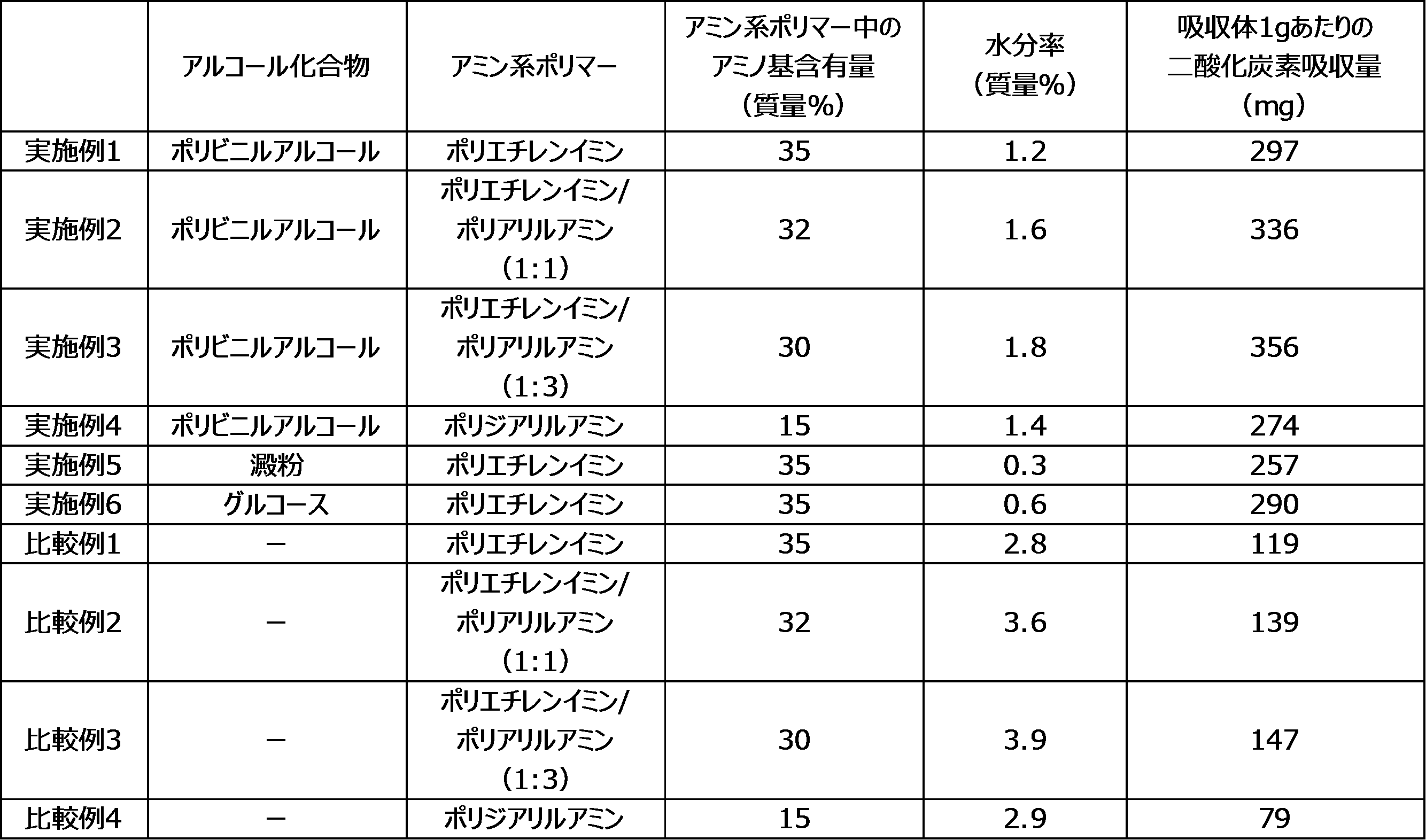
- the moisture content of the obtained carbon dioxide gas absorber was measured according to the following method. After vacuum drying 10 g of the sample for water content measurement at 105 ° C. for 6 hours and 3 hours at 140 ° C., 1 g of the sample is weighed and heated to 140 ° C. with Karl Fischer (manufactured by Mitsubishi Chemical Analytech Co., Ltd.) The moisture absorption was measured below. The moisture content of the film-like carbon dioxide gas absorber obtained in the above (1) was 1.2% by mass.
- a film-like carbon dioxide gas absorber (film thickness: 58 ⁇ m) was obtained in the same manner as in 1.
- the moisture content is 1.6% by mass
- the carbon dioxide emission temperature is 185 ° C.
- the carbon dioxide adsorption amount is the carbon dioxide absorption amount per 1 g of the carbon dioxide absorbent measured by the same method as Example 1. It was 336 mg.
- polyethyleneimine made by Showa Chemical Co., Ltd., undiluted solution
- a film-like carbon dioxide gas absorber (film thickness: 62 ⁇ m) was obtained in the same manner as in Example 1 except that 100 g of a graded amine alone was added.
- the moisture content measured by the same method as Example 1 is. It was 1.4% by mass, the carbon dioxide emission temperature was 165 ° C., and the carbon dioxide absorption was 274 mg per 1 g of the carbon dioxide gas absorber.
- Example 5 Film-like carbon dioxide gas absorber (film thickness) by the same method as in Example 1 except that 1000 g of a 10 mass% starch (made by Wako Pure Chemical Industries, corn origin) aqueous solution was used instead of the 10 mass% polyvinyl alcohol aqueous solution : 61 ⁇ m) was obtained.
- the water content was 0.3% by mass
- the carbon dioxide emission temperature was 155 ° C.
- the carbon dioxide absorption per gram of the carbon dioxide gas absorbent was 257 mg, which were measured by the same method as in Example 1.
- Example 6 Film-like carbon dioxide gas absorber (film thickness: 60 ⁇ m) by the same method as in Example 1 except that 1000 g of a 10 mass% glucose (manufactured by Wako Pure Chemical Industries, Ltd.) aqueous solution was used instead of the 10 mass% polyvinyl alcohol aqueous solution I got The water content was 0.6% by mass, the carbon dioxide emission temperature was 168 ° C., and the carbon dioxide absorption per gram of the carbon dioxide gas absorbent was 290 mg, which was measured by the same method as in Example 1.
- a film-like carbon dioxide gas absorber (film thickness: 60 ⁇ m) was obtained by the same method as in Example 1 except that an aqueous solution of polyethyleneimine was obtained.
- the water content was 2.8% by mass
- the carbon dioxide emission temperature was 180 ° C.
- the carbon dioxide absorption per 1 g of the carbon dioxide gas absorbent was 119 mg, which were measured by the same method as in Example 1.
- Comparative example 4 The same as Example 3 except that water was added to 100 g of polydiallylamine (Nitto Boseki Co., Ltd., weight average molecular weight Mw 5000 secondary amine alone) without adding polyvinyl alcohol to make a polydiallylamine aqueous solution having a solid content of 18% by mass.
- a film-like carbon dioxide gas absorber (film thickness: 62 ⁇ m) was obtained by the method of The water content was 2.9% by mass, the carbon dioxide emission temperature was 164 ° C., and the carbon dioxide absorption per gram of the carbon dioxide gas absorbent was 79 mg, which were measured by the same method as in Example 1.
- Example 7 (1) Preparation of Carbon Dioxide Absorber 1000 g of a 10% by mass aqueous solution of polyvinyl alcohol (Kuraray, PVA-117, average degree of polymerization: 1700, degree of saponification 98-99%) was added to a 5 L flask and stirred by a mechanical stirrer. .
- polyvinyl alcohol Kuraray, PVA-117, average degree of polymerization: 1700, degree of saponification 98-99%
- stirring is continued at 25 ° C for 3 hours for 18 mass%
- a mixed solution of The resulting mixture was coated on a 100 ⁇ m polyethylene terephthalate (PET) film to a thickness of 500 ⁇ m, and then dried in an oven at 80 ° C. for 30 minutes.
- PET polyethylene terephthalate
- the polyvinyl alcohol-polyethyleneimine mixed film was peeled off from the PET film to obtain a film-like carbon dioxide gas absorber.
- the film thickness of the mixed film was 60 ⁇ m.
- the moisture content of the obtained carbon dioxide gas absorber was measured according to the following method. After vacuum-drying 10 g of the sample for moisture content measurement at 105 ° C. for 6 hours and 140 ° C. for 3 hours, 1 g of the sample is weighed in a glove box in an inert atmosphere, and Karl Fischer (Mitsubishi Chemical Analysys It heated at 140 degreeC with the Tech company make, and the amount of moisture absorption was measured under nitrogen stream. The moisture content of the film-like carbon dioxide gas absorber obtained in the above (1) was 215 ppm.
- the slurry for the electrode is prepared by using a solid solution of 10 wt% of SBR as a binder for the negative electrode with respect to 100 parts by weight of natural graphite (DMGS, BYD made) as an active material for the negative electrode.
- a solid content 6.452 parts by weight of Super-P (manufactured by Timcal) as a conductive aid (conductive agent) and 1.075 parts by weight of the solid content are charged into a dedicated container, and a planetary stirrer (ARE-250, It knead
- a bar coater (T101, manufactured by Matsuo Sangyo), coat the obtained slurry on copper foil (C1100H, manufactured by UACJ) as a current collector, and use a hot air dryer (manufactured by Yamato Scientific Co., Ltd.) for 30 minutes at 80 ° C. After primary drying, rolling treatment was carried out using a roll press (manufactured by Takasen). Thereafter, after punching out as a battery electrode ( ⁇ 14 mm), a coated electrode for a coin battery was produced by secondary drying at 120 ° C. for 3 hours under reduced pressure conditions.
- the coated electrode for a battery obtained above was transferred to a glove box (manufactured by Miwa Seisakusho) under an argon gas atmosphere.
- a metal lithium foil (thickness 0.2 mm, ⁇ 16 mm) was used as the positive electrode.
- a polypropylene-based (Celgard # 2400, manufactured by Polypore) was used as a separator.
- a carbon dioxide gas absorber, a coated electrode, a separator, and a positive electrode were laminated in this order.
- a film-like carbon dioxide gas absorber (film thickness: 60 ⁇ m) was obtained in the same manner as in Example 7 except that 50 g of H 2 O was added. The moisture content of the obtained carbon dioxide gas absorber was 238 ppm, and the carbon dioxide emission temperature was 185 ° C.
- a coin-type lithium secondary battery is produced from the film-like carbon dioxide gas absorber by the same method as in Example 7, and the discharge capacity retention ratio is obtained by the same method as in Example 7. I asked for. The results are shown in Table 2.
- polydiallylamine Nito Boshoku
- a coin-type lithium secondary battery is produced from the film-like carbon dioxide gas absorber by the same method as in Example 7, and the discharge capacity retention ratio is obtained by the same method as in Example 7. I asked for. The results are shown in Table 2.
- Comparative example 5 A coin-type lithium secondary battery was produced in the same manner as in Example 7 except that the carbon dioxide gas absorber was not used, and the discharge capacity retention rate was determined in the same manner as in Example 7. The results are shown in Table 2.
- Example 10 (1) Production of Electric Double Layer Capacitor Using the carbon dioxide gas absorber produced in the same manner as in Example 7, an electric double layer capacitor was produced according to the following method. Activated carbon is pulverized to a particle size of 5 to 20 ⁇ m to obtain powdered activated carbon, 80% by weight of the powdered activated carbon, 10% by weight of conductive carbon and 10% by weight of polytetrafluoroethylene (Teflon (registered trademark) 6J, Mitsui-Dupont Chemical Company) % Mixture was kneaded.
- Teflon registered trademark
- 6J Polytetrafluoroethylene
- the resulting kneaded product is formed into a sheet of 300 ⁇ m in thickness by roll rolling, punched into a circle of 2 cm in diameter using a punching device, and dried at 150 ° C. under reduced pressure for 4 hours to form a sheet-like polarizable electrode. Made.
- the obtained polarizable electrode is used as a carbon dioxide gas absorber, current collecting member, polarizable electrode sheet, polypropylene non-woven fabric, polarizable electrode sheet, current collecting member in a stainless steel case in a glove box having a dew point of -80 ° C or less.
- a polarizable electrode is impregnated with a propylene carbonate solution containing 1 mole of tetraethylammonium tetrafluoroborate, and an electric double layer capacitor is formed by caulking and sealing the upper cover of a stainless steel case using a polypropylene insulating gasket.
- a propylene carbonate solution containing 1 mole of tetraethylammonium tetrafluoroborate
- the obtained electric double layer capacitor was evaluated using an electric double layer capacitor evaluation apparatus (manufactured by Hioki Electric Co., Ltd.) at room temperature, up to a final voltage of 3.3 V, 2 mA / cm 2 per electrode surface area , And complementarily charged at a voltage of 3.3 V for 30 minutes under a low voltage, and discharged at a constant current of 2 mA / cm 2 after completion of the complement charge.
- the initial capacitance was determined by a standard method from the discharge curve from 1.2 V to 1.0 V at that time. After the discharge, the battery was similarly charged to 3.3 V at 60 ° C. and stored for 100 hours. After storage, the battery was similarly discharged to determine the capacitance retention rate from the ratio to the initial capacitance. The results are shown in Table 3.
- Example 11 An electric double layer capacitor was produced in the same manner as in Example 10 using the carbon dioxide gas absorber produced in the same manner as in Example 8. The capacitance retention of the obtained electric double layer capacitor was measured by the same method as in Example 10. The results are shown in Table 3.
- Example 12 An electric double layer capacitor was produced in the same manner as in Example 10, using the carbon dioxide gas absorber produced in the same manner as in Example 9. The capacitance retention of the obtained electric double layer capacitor was measured by the same method as in Example 10. The results are shown in Table 3.
- Comparative example 6 An electric double layer capacitor was produced by the same method as in Example 10 except that the carbon dioxide gas absorber was not used, and the capacitance retention of the electric double layer capacitor was determined by the same method as in Example 10. The results are shown in Table 3.
Landscapes
- Chemical & Material Sciences (AREA)
- Chemical Kinetics & Catalysis (AREA)
- Organic Chemistry (AREA)
- Analytical Chemistry (AREA)
- Polymers & Plastics (AREA)
- Health & Medical Sciences (AREA)
- Medicinal Chemistry (AREA)
- Engineering & Computer Science (AREA)
- Inorganic Chemistry (AREA)
- General Chemical & Material Sciences (AREA)
- Oil, Petroleum & Natural Gas (AREA)
- Gas Separation By Absorption (AREA)
- Treating Waste Gases (AREA)
- Solid-Sorbent Or Filter-Aiding Compositions (AREA)
- Compositions Of Macromolecular Compounds (AREA)
- Electric Double-Layer Capacitors Or The Like (AREA)
- Secondary Cells (AREA)
Abstract
本発明は、繰り返し単位中にアミノ基を有するアミン系ポリマーとアルコール化合物とを含む混合物からなり、含水率が10質量%未満である炭酸ガス吸収体、および、前記炭酸ガス吸収体を含む非水電解質蓄電池に関する。
Description
本発明は、炭酸ガス吸収体、および、前記炭酸ガス吸収体を含む非水電解質蓄電池、並びに炭酸ガスの分離回収方法に関する。
近年、携帯電話、ノート型パソコン、パッド型情報端末機器などの携帯端末の普及が著しい。携帯端末にはより快適な携帯性が求められ、小型化、薄型化、軽量化および高性能化が急速に進むに伴い、形態端末に用いられる電池にも、小型化、薄型化、軽量化および高性能化が要求されている。このような携帯端末の電源に用いられる二次電池として、リチウムイオン二次電池が多用されている。リチウムイオン二次電池などの非水電解質電池は、セパレータを介して正極と負極を設置し、LiPF6、LiBF4、LiTFSI(リチウム(ビストリフルオロメチルスルホニルイミド))、LiFSI(リチウム(ビスフルオロスルホニルイミド))のようなリチウム塩をエチレンカーボネート等の有機液体に溶解させた電解液と共に容器内に収納した構造を有する。
また、近年、バックアップ電源、補助電源などとして電気二重層キャパシタが注目を集めており、活性炭の電気二重層キャパシタ用の電極としての性能に着目した開発が広くなされている。活性炭を分極性電極として使用した電気二重層キャパシタは静電容量に優れるため、エレクトロニクス分野の発展と共に、電気デバイス電極用途などの需要も急成長している。さらに、最近では、従来のメモリーバックアップ電源等の小型化に加え、モーター等の補助電源に使われるような大容量製品の開発なども行われている。電気二重層キャパシタは、セパレータを介して2部の分極性電極シートを設置し、テトラエチルアンモニウムテトラフルオロボレートを溶解させたプロピレンカーボネート等の有機電解液と共に容器内に収納した構造を有する。
非水電解質二次電池や電気二重層キャパシタなどの非水電解質蓄電池においては、稼働時に内部から発生するアウトガスによる劣化や破壊が問題となる。アウトガスを放出させるために、熱処理やエージングする方法が一般的に行われているが、これらの方法では、放出したガスが電解液や封止缶に再度吸収されやすく、稼働時の環境の変化によりガスが再放出されて電池を劣化させたり破壊したりする問題がある。特に、二酸化炭素(炭酸ガス)は再吸収されやすく、非水電解質蓄電池において、アウトガスを吸蔵できる吸収体が望まれている。
一方、従来、種々の方法により、火力発電所や製鉄所、化学工場などから排出される排ガス中に含まれる二酸化炭素(炭酸ガス)の分離が行われており、例えば、大規模施設からの排ガス処理に適した方法として、典型的には、アミン化合物を溶解した水溶液中に排ガスを通過させることによりアミンと二酸化炭素を反応させて分離させる方法が知られている。例えば、特許文献1には、第2級または第3級アミノ基を有する繰り返し単位を有する二酸化炭素吸収用ポリマーと、10質量%以上の水を含有する二酸化炭素吸収材が記載されている。また、特許文献2には、アミノ基を有する高分子化合物のヒドロゲル粒子を含むガス吸収体が記載されている。このようなアミン系材料の水溶液に二酸化炭素を化学吸収させる方法は、二酸化炭素の吸蔵方法としても利用でき、特に、アミン種により二酸化炭素との作用強度を変えることが可能であり、再放出を低減することができるため、電子素子の内部で放出された炭酸ガスを吸蔵し、劣化や破壊から保護することに適している。
しかしながら、前記特許文献1に開示される二酸化炭素吸収材は2級以上のアミンで構成されるポリマーに基づくものであるため、二酸化炭素との反応性に乏しく、二酸化炭素の吸収量において必ずしも満足のいくものではなかった。また、前記特許文献2に開示されるガス吸収体は、高分子化合物のヒドロゲル粒子中に含有できるアミノ基の量が少なく、粒子間隙があることにより体積密度が低下する傾向にあり、炭酸ガスの吸収量において必ずしも満足のいくものではなかった。
また、上記特許文献に記載されるような従来の炭酸ガス吸収材は、いずれも水の存在下、アミンと炭酸ガスを反応させることにより炭酸ガスを吸収するものであるため、使用形態が液状や水分を多く含むゲル状となり、その使用環境や用途が限定されやすい。特に、水の存在下での反応を利用するこれらの炭酸ガス吸収体は非水電解質蓄電池において用いる炭酸ガス吸収体として適するものではなく、これらを非水電解質蓄電池用の炭酸ガス吸収体として応用したとしても、前記特許文献1に開示される二酸化炭素吸収材は、吸収した二酸化炭素の放出温度が100℃未満であるため十分な吸蔵性能を得ることが難しい。また、前記特許文献2に開示されるようなアミノ基を有する高分子化合物粒子若しくはアミン系材料を多孔質体に含侵させたガス吸収体では、粒子や細孔の形状およびアミノ基を有する化合物の分布が一定ではなく、ガス吸収体の中で炭酸ガスの吸収または放出に偏りが生じやすいため、非水電解質蓄電池に用いた場合に局所的な劣化や破壊を引き起こす可能性がある。
さらに、比熱の大きい水を加熱する必要があるため、気液反応に基づく炭酸ガスの分離回収方法では、排ガス等から炭酸ガスを吸収した後の炭酸ガス吸収材から炭酸ガスを分離回収する工程における効率性や操作性が、固気反応による処理と比較して劣る傾向にある。
さらに、比熱の大きい水を加熱する必要があるため、気液反応に基づく炭酸ガスの分離回収方法では、排ガス等から炭酸ガスを吸収した後の炭酸ガス吸収材から炭酸ガスを分離回収する工程における効率性や操作性が、固気反応による処理と比較して劣る傾向にある。
したがって、本発明は、炭酸ガスの高い吸収量を実現でき、かつ、高温下で炭酸ガスを安定的かつ効率よく分離回収することのできる、幅広い用途に適する炭酸ガス吸収体を提供することを目的とする。また、本発明は、蓄電池内部から生じるアウトガスによる蓄電池の劣化や破壊が生じ難く、安定な充放電性能を有する非水電解質蓄電池を提供することも目的とする。
本発明者らは、上記課題を解決すべく鋭意検討を行った結果、本発明に到達した。すなわち本発明は、以下の好適な態様を包含する。
[1]繰り返し単位中にアミノ基を有するアミン系ポリマーとアルコール化合物とを含む混合物からなり、含水率が10質量%未満である炭酸ガス吸収体。
[2]炭酸ガス放出温度が100℃以上300℃以下である、前記[1]に記載の炭酸ガス吸収体。
[3]アミン系ポリマーが、ポリエチレンイミン、ポリアリルアミン、ポリアクリルアミド、ポリテトラメチレンイミン、ポリビニルアミン、ジシアンジアミド-ホルマリン縮合物およびジシアンジアミド-アルキレン(ポリアミン)縮合物からなる群から選択される、前記[1]または[2]に記載の炭酸ガス吸収体。
[4]アルコール化合物が、単糖類、少糖類、多糖類、ポリビニルアルコールおよびその誘導体並びにポリフェノールおよびその誘導体からなる群から選択される、前記[1]~[3]のいずれかに記載の炭酸ガス吸収体。
[5]膜状、フィルム状、シート状、繊維状または粉体状である、前記[1]~[4]のいずれかに記載の炭酸ガス吸収体。
[6]含水率が500ppm以下である、前記[1]~[5]のいずれかに記載の炭酸ガス吸収体。
[7]前記[6]に記載の炭酸ガス吸収体を含んでなる非水電解質蓄電池。
[8]非水電解質二次電池である、前記[7]に記載の非水電解質蓄電池。
[9]電気二重層キャパシタである、前記[7]に記載の非水電解質蓄電池。
[10]前記[1]~[6]のいずれかに記載の炭酸ガス吸収体に、炭酸ガスを含有する気体を接触させて炭酸ガスを炭酸ガス吸収体に吸収させること、および炭酸ガスを吸収した前記炭酸ガス吸収体から炭酸ガスを分離回収することを含む、炭酸ガスの分離回収方法。
[1]繰り返し単位中にアミノ基を有するアミン系ポリマーとアルコール化合物とを含む混合物からなり、含水率が10質量%未満である炭酸ガス吸収体。
[2]炭酸ガス放出温度が100℃以上300℃以下である、前記[1]に記載の炭酸ガス吸収体。
[3]アミン系ポリマーが、ポリエチレンイミン、ポリアリルアミン、ポリアクリルアミド、ポリテトラメチレンイミン、ポリビニルアミン、ジシアンジアミド-ホルマリン縮合物およびジシアンジアミド-アルキレン(ポリアミン)縮合物からなる群から選択される、前記[1]または[2]に記載の炭酸ガス吸収体。
[4]アルコール化合物が、単糖類、少糖類、多糖類、ポリビニルアルコールおよびその誘導体並びにポリフェノールおよびその誘導体からなる群から選択される、前記[1]~[3]のいずれかに記載の炭酸ガス吸収体。
[5]膜状、フィルム状、シート状、繊維状または粉体状である、前記[1]~[4]のいずれかに記載の炭酸ガス吸収体。
[6]含水率が500ppm以下である、前記[1]~[5]のいずれかに記載の炭酸ガス吸収体。
[7]前記[6]に記載の炭酸ガス吸収体を含んでなる非水電解質蓄電池。
[8]非水電解質二次電池である、前記[7]に記載の非水電解質蓄電池。
[9]電気二重層キャパシタである、前記[7]に記載の非水電解質蓄電池。
[10]前記[1]~[6]のいずれかに記載の炭酸ガス吸収体に、炭酸ガスを含有する気体を接触させて炭酸ガスを炭酸ガス吸収体に吸収させること、および炭酸ガスを吸収した前記炭酸ガス吸収体から炭酸ガスを分離回収することを含む、炭酸ガスの分離回収方法。
本発明によれば、炭酸ガスの高い吸収量を実現でき、かつ、高温下で炭酸ガスを安定的かつ効率よく分離回収することのできる、幅広い用途に適する炭酸ガス吸収体を提供することができる。また、本発明によれば、蓄電池内部から生じるアウトガスによる蓄電池の劣化や破壊が生じ難く、安定な充放電性能を有する非水電解質蓄電池を提供することができる。
以下、本発明の実施の形態について、詳細に説明する。なお、本発明の範囲はここで説明する実施の形態に限定されるものではなく、本発明の趣旨を損なわない範囲で種々の変更をすることができる。
<炭酸ガス吸収体>
本発明の炭酸ガス吸収体は、繰り返し単位中にアミノ基を有するアミン系ポリマーとアルコール化合物とを含む混合物からなる。
本発明において、アミン系ポリマーとは、ポリマーの主鎖および/または側鎖に、第1級アミン、第2級アミンまたは第3級アミンとなる窒素原子を少なくとも1つ以上有しているポリマーをいう。本発明の炭酸ガス吸収体を構成するために用いられるアミン系ポリマーは、アルコール化合物との混合物からなる最終的な炭酸ガス吸収体として、10質量%未満の含水率で存在し得る(通常、固体状である)ものであれば特に限定されるものではなく、従来公知の任意のアミン系ポリマーを用いることができる。
本発明の炭酸ガス吸収体は、繰り返し単位中にアミノ基を有するアミン系ポリマーとアルコール化合物とを含む混合物からなる。
本発明において、アミン系ポリマーとは、ポリマーの主鎖および/または側鎖に、第1級アミン、第2級アミンまたは第3級アミンとなる窒素原子を少なくとも1つ以上有しているポリマーをいう。本発明の炭酸ガス吸収体を構成するために用いられるアミン系ポリマーは、アルコール化合物との混合物からなる最終的な炭酸ガス吸収体として、10質量%未満の含水率で存在し得る(通常、固体状である)ものであれば特に限定されるものではなく、従来公知の任意のアミン系ポリマーを用いることができる。
本発明において、例えば、アミン系ポリマーは、エチレンイミン、アリルアミン、ビニルホルムアミド、ビニルアセトアミド、アクリルアミド、アミノ酸、メラミン、尿素、ビニルピロリドン等の第1級アミン、第2級アミン、第3級アミン化合物を用いて合成される合成高分子化合物が挙げられる他、天然由来の高分子化合物、例えば微生物の二次生産物などであってもよい。
本発明において、アミン系ポリマーは、繰り返し単位中に第1級アミノ基、第2級アミノ基および第3級アミノ基から選択される少なくとも1種を有するポリマーである。このようなポリマーとしては、1つの繰り返し単位中に第1級アミノ基、第2級アミノ基および第3級アミノ基から選択される少なくとも1種を有するポリマーであってよく、そのような1種以上の繰り返し単位が、ランダム、グラフト、ブロック共重合したポリマーであってもよい。
本発明の炭酸ガス吸収体に用いることのできるアミン系ポリマーとしては、具体的には、例えば、ポリエチレンイミン、ポリプロピレンイミン、ポリブチレンイミン、ポリテトラメチレンイミンなどのアルキレンイミンポリマー、ポリアリルアミン、ポリビニルアミン、ポリアクリルアミド、ジシアンジアミド-ホルマリン縮合物、ジシアンジアミド-アルキレン(ポリアミン)縮合物、ポリリジン、メラミン樹脂、変性メラミン樹脂、メラミン-尿素樹脂、ポリリン酸メラミンなどのアミノ基含有ポリマー;尿素樹脂、エチレン尿素樹脂などが挙げられる。中でも、容易に水溶し、アルコール化合物と混合できる観点から、ポリエチレンイミン、ポリアリルアミン、ポリアクリルアミド、ポリテトラメチレンイミン、ポリビニルアミン、ジシアンジアミド-ホルマリン縮合物およびジシアンジアミド-アルキレン(ポリアミン)縮合物からなる群から選択されるアミン系ポリマーが好ましく、入手が容易であり、低コストであるため、ポリエチレンイミン、ポリアリルアミンおよびポリアクリルアミドから選択されるアミン系ポリマーがより好ましい。これらは単独で用いてもよく、2種以上を組み合わせて用いてもよい。
本発明において、アミン系ポリマーは第1級アミノ基を含んでいることが好ましく、第1級アミノ基と、第2級アミノ基および第3級アミノ基のうち少なくとも1つを含んでいることがより好ましい。第1級アミノ基を含むことにより炭酸ガスに対する吸収量を高めることができ、特に、水が少ない環境下(例えば、炭酸ガス吸収体に対して5質量%以下)または水が実質的に存在しない環境下において、炭酸ガスに対する吸収を有利に向上させることができる。また、第1級アミノ基に加えて、第2級アミノ基および第3級アミノ基のうち少なくとも1つを含んでいることにより吸収した炭酸ガスを安定に保持することができる。アミン系ポリマーが第1級アミノ基の他に、第2級アミノ基および第3級アミノ基のうち少なくとも1つを含む場合、アミン系ポリマーに含まれる第1級アミノ基の割合が、アミン系ポリマーの全アミノ基に対して25%以上であることが好ましく、30%以上であることがより好ましく、35%以上であることがさらに好ましい。第1級アミノ基の割合が前記下限値以上であると、炭酸ガスとの反応性が向上し、炭酸ガスに対する高い吸収量を有する炭酸ガス吸収体を得ることができる。また、吸収した炭酸ガスを安定に保持する観点から、第1級アミノ基の割合は、アミン系ポリマーの全アミノ基に対して80%以下であることが好ましい。
本発明の好ましい一態様において、炭酸ガス吸収体は、アミン系ポリマーとして、第1級アミノ基に加えて、第2級アミノ基および第3級アミノ基のうちの少なくとも1つを一分子内に含むポリマーを含み、第1級アミノ基、第2級アミノ基および第3級アミノ基を一分子内に含むポリマーを含むことも好ましい。また、本発明の別の好ましい一態様において、アミン系ポリマーはポリマー混合物であってもよく、その場合にも、第1級アミンを含むポリマーと、第2級アミンおよび第3級アミンのポリマーのうち少なくとも1つを含むポリマーとを混合したものが好ましい。2種以上のポリマーを組み合わせた場合においても、全アミン系ポリマー中の全アミノ基中、第1級アミノ基の割合が上記と同様の範囲であることが好ましい。
本発明において、アミン系ポリマー中のアミノ基の量は、アミン系ポリマー全量中15質量%以上であることが好ましく、25質量%以上であることがより好ましい。アミン系ポリマー中のアミノ基の量が上記下限以上であると、種々の用途に必要とされる十分な範囲の炭酸ガス吸収可能量を確保しやすくなり、炭酸ガスの吸収性および安定保持に優れた炭酸ガス吸収体を得ることができる。アミン系ポリマー中のアミノ基の量が多くなると炭酸ガスの吸収可能量も多くなる傾向にあるため、その上限は特に限定されるものではないが、通常、90質量%以下であり、80質量%以下であることが好ましく、60質量%以下であることがより好ましい。上記上限以下であると加工性に優れる傾向にある。
本発明において、アミン系ポリマーの重量平均分子量は、好ましくは2000以上であり、より好ましくは5000以上であり、さらに好ましくは10000以上であり、好ましくは100000以下であり、より好ましくは80000以下であり、さらに好ましくは70000以下である。アミン系ポリマーの重量平均分子量が、上記下限値以上であると炭酸ガス吸収体を固体状にし易くなり、上記上限値以下であるとアミン系ポリマー単独で凝固しにくくなるため、混合しやすくなる。なお、アミン系ポリマーの重量平均分子量は、例えば、ゲル浸透クロマトグラフィー(GPC)を用いて求めることができる。
本発明において、アルコール化合物は、少なくとも1つの水酸基を有する化合物であり、固体状の炭酸ガス吸収体を得るために、本発明においては常温で固体のものを選択することが好ましい。そのようなアルコール化合物としては、例えば、単糖類、少糖類、多糖類、ポリビニルアルコールおよびそれらの誘導体、並びにポリフェノールおよびその誘導体等が挙げられる。これらのアルコール化合物は、単独で用いてもよく、2種以上を組み合わせて用いてもよい。
前記単糖類としては、具体的に、例えば、グルコース、フルクトース、ガラクトース等が挙げられる。前記少糖類としては、例えば、サッカロース、ソルビトール、キシリトール等が挙げられる。また、前記多糖類としては、例えば、澱粉およびその誘導体、セルロースおよびその誘導体等が挙げられる。
前記澱粉およびその誘導体としては、例えば、とうもろこし澱粉(コーンスターチ);小麦澱粉;じゃがいも澱粉;タピオカ澱粉;米澱粉;デキストリン;アミロース;アミロペクチン;プルラン;ハイアミロースコーンスターチ;ヒドロキシプロピル澱粉等のヒドロキシアルキル澱粉;ジヒドロキシプロピル澱粉等のジヒドロキシアルキル澱粉;ジヒドロキシプロピルプルラン等のジヒドロキシアルキルプルラン等が挙げられる。
また、前記セルロースおよびその誘導体としては、再生セルロース;粉末セルロース;微結晶セルロース;ヒドロキシエチルセルロース、ヒドロキシプロピルセルロース等のヒドロキシアルキルセルロース;ジヒドロキシプロピルセルロース等のジヒドロキシアルキルセルロース等が挙げられる。
本発明において、アルコール化合物として多糖類を用いる場合、その分子量は、当該多糖類が有する繰り返し単位の数や、種類によって様々であり、限定はされないが、重量平均分子量において5000~1000000であることが好ましく、10000~200000であることがより好ましい。なお、重量平均分子量は、例えばゲル浸透クロマトグラフィー(GPC)を用いて求めることができる。
アルコール化合物として、可塑性が高く、加工性が良好であるため、本発明においてアルコール化合物は、ポリビニルアルコールおよびそれらの誘導体であることが好ましい。また、アミン系ポリマーと相互作用をするようにポリビニルアルコールを変性したものを使用してもよい。
本発明において、アルコール化合物としてポリビニルアルコールを含む場合、その平均重合度は、好ましくは1000~100000であり、より好ましくは1000~80000であり、さらに好ましくは1500~60000である。ポリビニルアルコールの平均重合度が上記範囲にあると、成形加工性やハンドリング性が良好となり、また得られる炭酸ガス吸収体の強度や伸度等の機械的性質を向上させることができる。また、ポリビニルアルコールのケン化度は、例えば90モル%以上であってよく、好ましくは95モル%以上、さらに好ましくは98モル%以上である。ポリビニルアルコールのケン化度が上記範囲にあると、吸湿性が低くハンドリング性が良好である。
本発明の炭酸ガス吸収体は、アミン系ポリマーとアルコール化合物とを含む混合物からなる。炭酸ガス吸収体を構成する混合物におけるアミン系ポリマーとアルコール化合物の混合比率(質量比)は、5:1~1:5であることが好ましく、3:1~1:3であることがより好ましく、2:1~1:1であることがさらに好ましい。炭酸ガス吸収体を構成する混合物において、アミン系ポリマーとアルコール化合物の混合比率が上記範囲内にあると、炭酸ガス吸収体の炭酸ガス吸収性能を高めることができ、強度や伸度等の機械的性質を向上させることができる。また、成形加工性やハンドリング性が良好となる。なお、炭酸ガス吸収体を構成する混合物において、アミン系ポリマーおよび/またはアルコール化合物が水溶液等の形態で混合される場合、上記混合比率は、それぞれ固形分としての比率を意味する。
本発明の炭酸ガス吸収体を構成する混合物は、アミン系ポリマーおよびアルコール化合物以外の成分を含んでいてもよい。そのような成分としては、例えば従来の炭酸ガス吸収体に添加剤として配合されるような成分等が挙げられ、具体的には、分散安定剤、粘度調整剤、アミン系ポリマー以外のポリマー、消泡剤、可塑剤、熱安定剤(溶融安定剤)、脱臭剤、紫外線吸収剤、帯電防止剤、滑剤、着色剤、乾燥剤、充填剤、加工助剤、難燃剤等が挙げられる。
本発明の炭酸ガス吸収体を構成する混合物が、アミン系ポリマーおよびアルコール化合物以外の成分を含む場合、混合物の総質量に対するアミン系ポリマーおよびアルコール化合物の合計量は、固形分として、90質量%以上であることが好ましく、95質量%以上であることがより好ましく、98質量%以上であることがさらに好ましい。なお、ここでいう固形分とは、炭酸ガス吸収体を構成する混合物から水等の溶媒の量を除いた成分のことをいう。
本発明の炭酸ガス吸収体の含水率は、炭酸ガス吸収体の総質量に対して10質量%未満であることが好ましく、8質量%以下であることが好ましく、5質量%以下であることがさらに好ましく、2質量%以下であることが特に好ましい。含水率の下限値は特に限定されるものではなく、通常0.1質量%以上であるが0質量%であってもよい。含水率が10質量%以上である場合、炭酸ガス吸収体が固体形状を維持することが困難になる。本発明の炭酸ガス吸収体は、従来の炭酸ガス吸収体と比較して含水率が低く、水の非存在下において炭酸ガスの高い吸収性を有する。このため、水分量を低くする必要のある環境または水が存在しないことが好ましい環境下、例えば、非水電解質蓄電池、食品用、医薬品用および化粧品用の包装容器など、幅広い用途において好適に用いることができる。また、水を用いず、固体状で使用することができるため、取扱性に優れ、吸収した炭酸ガスの吸収体からの分離回収を容易にすることができるため、例えば、火力発電所、鉄工所、化学工場等の多量の炭酸ガスを排出する大規模設備における炭酸ガスの分離回収システムにおいて好適に使用することができる。
本発明の炭酸ガス吸収体を後述する非水電解質蓄電池に用いる場合、その含水率は、好ましくは500ppm以下、より好ましくは400ppm以下、さらに好ましくは300ppm以下、特に好ましくは250ppm以下である。含水率が500ppm以下であると、非水電解質蓄電池の性能低下の発生を抑えられる。したがって、炭酸ガス吸収体の含水率は低いほど好ましく、理想的には0ppmであるが、生産効率等の観点から、通常その下限値は100ppm以上である。
本発明の炭酸ガス吸収体の含水率は、アミン系ポリマーおよびアルコール化合物を含む混合物における水分量を制御すること、前記混合物から炭酸ガス吸収体を作製(成形等)する際の加熱条件、乾燥条件等を制御すること等により調整することができる。
本発明の炭酸ガス吸収体の炭酸ガス放出温度は、好ましくは100℃以上、より好ましくは120℃以上、さらに好ましくは140℃以上、特に好ましくは150℃以上であり、好ましくは300℃以下であり、より好ましくは250℃以下であり、さらに好ましくは230℃以下であり、特に好ましくは220℃以下である。炭酸ガス放出温度が上記下限値以上であると、高温下で炭酸ガスを安定的かつ効率よく吸収、分離回収することが可能となり、上記上限値以下であると、アルコール化合物およびアミン系ポリマーの分解および熱劣化を抑制することができる。
炭酸ガス吸収体の炭酸ガス放出温度は、例えば、用いるアミン系ポリマーやアルコール化合物の種類、組み合わせ、混合比率、含水率、形状等を選択することにより制御することができる。例えば、炭酸ガス放出温度を高くするためには、第一級アミンの比率を大きくする、アルコール化合物の割合を大きくすることなどが挙げられる。一方、炭酸ガス放出温度を低くするためには、含水率を大きくする、アミン系ポリマー中の第2級および第3級アミノ基の合計の割合を大きくすることなどが挙げられる。
本発明の炭酸ガス吸収体は通常固体であり、その形状は特に限定されるものではなく、所望する使用環境や用途に応じて、膜状、フィルム状、シート状、繊維状、粉体状、顆粒状、ゲル状など種々の形態であってよい。取扱いやすく、種々の用途に利用しやすいため、膜状、フィルム状、シート状、繊維状および粉体状であることが好ましい。
本発明において、炭酸ガス吸収体の形状が膜状、フィルム状またはシート状である場合、その厚みは、使用する環境や用途に応じて適宜決定することができ、例えば1~500μmであってよく、5~200μmであることが好ましい。
本発明の炭酸ガス吸収体は、例えば、アミン系ポリマーとアルコール化合物、必要に応じてその他の成分を撹拌混合し、得られた混合物を所望する形状となるよう成形等することにより製造することができる。アミン系ポリマーおよびアルコール化合物等の混合物を調製する際、アミン系ポリマーおよび/またはアルコール化合物を水等の溶媒に適宜溶解させ、水溶液として混合することにより混合物が取扱い易くなる。この際の溶媒は、用いるアミン系ポリマーやアルコール化合物の種類や量などに応じて適宜選択すればよい。溶媒としては、例えば、水、アルコール系溶媒、ジメチルスルホキシド等が挙げられる。
アミン系ポリマーおよびアルコール化合物を混合する際の撹拌混合条件(温度、時間、撹拌速度等)は、用いるアミン系ポリマーやアルコール化合物の種類や量などに応じて適宜決定すればよい。
次いで、混合物を基材上に塗布し、乾燥により溶媒を除去した後、基材を剥離することにより、膜状、フィルム状またはシート状等の炭酸ガス吸収体を得ることができる。基材としては、特に限定されるものではなく、例えばポリエステルなどのプラスチックフィルム、剥離紙、金属板、ガラス板等を用いることができる。乾燥方法としては、自然乾燥法、通風乾燥法、加熱乾燥および減圧乾燥法等が挙げられるが、混合物に含まれる溶媒を効率よく除去することができるため、加熱乾燥することが好ましい。加熱温度は、特に限定されるものではなく、例えば50~150℃であってよく、80~120℃であることが好ましい。乾燥時間は、加熱温度等により適宜調整すればよく、例えば1~60分であってよく、3~30分が好ましい。
繊維状の炭酸ガス吸収体は、アミン系ポリマーとアルコール化合物の混合物を、濃度40~60質量%で加熱して水溶液とし、硫酸アンモニウム等の架橋剤をポリビニルアルコール系ポリマーの質量に対して0.5~10質量%添加し、温度90~140℃の紡糸原液とし、加圧してノズル孔から空気中に吐出して乾式紡糸することにより製造することができる。また、アミン系ポリマー(の水溶液)とアルコール化合物(の水溶液)の混合物を、加熱乾燥して得られる固形物を粉砕することにより、粉体状の炭酸ガス吸収体を製造することができる。
<非水電解質蓄電池>
本発明の炭酸ガス吸収体は、吸収含水率が低く、通常固体状であるため、非水電解質蓄電池の性能に影響を与えることなく、稼働時に内部から発生するアウトガスを効率的に吸蔵できる。したがって、本発明は、本発明の炭酸ガス吸水体を含む非水電解質蓄電池を対象とする。本発明の非水電解質蓄電池は、非水電解質二次電池、電気二重層キャパシタ、リチウムイオンキャパシタなどの形態であってよい。
本発明の炭酸ガス吸収体は、吸収含水率が低く、通常固体状であるため、非水電解質蓄電池の性能に影響を与えることなく、稼働時に内部から発生するアウトガスを効率的に吸蔵できる。したがって、本発明は、本発明の炭酸ガス吸水体を含む非水電解質蓄電池を対象とする。本発明の非水電解質蓄電池は、非水電解質二次電池、電気二重層キャパシタ、リチウムイオンキャパシタなどの形態であってよい。
非水電解質二次電池は、一般に、正極と負極と、該正極と該負極の間に配置されたセパレータおよび電解液とを有する。本発明の非水電解質二次電池は、公知の材料および技術を用いて製造することができる。例えば、非水電解質二次電池がリチウム二次電池の場合、正極材料として、例えば、TiS2、TiS3、非晶質MoS3、Cu2V2O3、非晶質V2O-P2O5、MoO3、V2O5、V6O13などの遷移金属酸化物やLiCoO2、LiNiO2、LiMnO2、LiMn2O4などのリチウム含有複合金属酸化物などを用いることができる。
正極材料と、金属粉、導電性ポリマー、アセチレンブラック、カーボンブラックなどの導電助剤と、SBR、NBR、アクリルゴム、ヒドロキシエチルセルロース、カルボキシメチルセルロース、ポリフッ化ビニリデンなどのバインダーとを、水や有機分散媒などに混合して正極用スラリーを調製し、例えば、アルミニウム等の正極集電体に塗布して溶媒を乾燥させて正極とすることができる。
負極材料としては、例えば、アモルファスカーボン、グラファイト、天然黒鉛、メソカーボンマイクロビーズ(MCMB)、ピッチ系炭素繊維、カーボンブラック、活性炭、カーボンファイバー、ハードカーボン、ソフトカーボン、メソポーラスカーボン、ポリアセン等の導電性高分子などの炭素質材料、SiOx,SnOx,LiTiOxで表される複合金属酸化物やその他の金属酸化物やリチウム金属、リチウム合金などのリチウム系金属、TiS2、LiTiS2などの金属化合物および、金属酸化物と炭素質材料との複合材料などを用いることができる。
負極材料と、正極と同様の導電助剤およびバインダーとを、水や有機分散媒などに混合して負極用スラリーを調製し、例えば、銅等の負極集電体に塗布して溶媒を乾燥させて負極とすることができる。
電解液は、通常の非水電解質二次電池に用いられるものであれば、液状でもゲル状でもよく、負極材料、正極材料の種類に応じて電池としての機能を発揮するものを適宜選択すればよい。電解質としては、公知のリチウム塩がいずれも使用でき、例えば、LiClO4、LiBF6、LiPF6、LiCF3SO3、LiCF3CO2、LiAsF6、LiSbF6、LiB10Cl10、LiAlCl4、LiCl、LiBr、LiB(C2H5)4、CF3SO3Li、CH3SO3Li、LiCF3SO3、LiC4F9SO3、Li(CF3SO2)2N、低級脂肪族カルボン酸リチウムなどが挙げられる。
このような電解質を溶解させる溶媒(電解液溶媒)は特に限定されるものではない。具体例としてはプロピレンカーボネート、エチレンカーボネート、ブチレンカーボネート、ジメチルカーボネート、ジエチルカーボネート、ビニレンカーボネートなどのカーボネート類;γ-ブチルラクトンなどのラクトン類;トリメトキシメタン、1,2-ジメトキシエタン、ジエチルエーテル、2-エトキシエタン、テトラヒドロフラン、2-メチルテトラヒドロフランなどのエーテル類;ジメチルスルホキシドなどのスルホキシド類;1,3-ジオキソラン、4-メチル-1,3-ジオキソランなどのオキソラン類;アセトニトリルやニトロメタンなどの含窒素化合物類;ギ酸メチル、酢酸メチル、酢酸エチル、酢酸ブチル、プロピオン酸メチル、プロピオン酸エチルなどの有機酸エステル類;リン酸トリエチル、炭酸ジメチル、炭酸ジエチルなどの無機酸エステル類;ジグライム類;トリグライム類;スルホラン類;3-メチル-2-オキサゾリジノンなどのオキサゾリジノン類;1,3-プロパンスルトン、1,4-ブタンスルトン、ナフタスルトンなどのスルトン類などが挙げられ、これらは単独もしくは二種以上混合して使用できる。ゲル状の電解液を用いるときは、ゲル化剤としてニトリル系重合体、アクリル系重合体、フッ素系重合体、アルキレンオキサイド系重合体などを加えることができる。
非水電解質二次電池は、例えば、負極と正極とを、ポリプロピレン多孔膜などのセパレータを介して重ね合わせ、電池形状に応じて巻く、折るなどして、電池容器に入れ、電解液を注入して封口することにより製造することができる。電池の形状は、公知のコイン型、ボタン型、シート型、円筒型、角型、扁平型など何れであってもよい。
非水電解質二次電池への炭酸ガス吸収体の設置は、例えば、炭酸ガス吸収体が膜状、フィルム状またはシート状の場合には、電極およびセパレータとともに積層して配置すればよく、繊維状または粉末状等の場合には、電極材もしくはセパレータ材と混合し、電極やセパレータの構成部材の一部として電池内に配置することができる。
電気二重層キャパシタは、一般に、分極性電極、電解液、およびセパレータを主要構成とし、一対の電極間にセパレータを配置した構造となっている。本発明の電気二重層キャパシタは、公知の材料および技術を用いて製造することができる。分極性電極材料としては、例えば、静電容量の点で活性炭を使用するのが好ましい。活性炭の原料となる炭素材としては、特に制限されるものではないが、石炭、石炭ピッチ、石油ピッチ、フェノールなどの熱硬化性樹脂、ヤシ殻などを例示することができる。
分極性電極の製造は、公知の方法を適用することが可能である。例えば、市販されている、ポリビニリデンフロライド、ポリテトラフロロエチレンなどのバインダーとして知られた物質やカーボンブラックなどの導電性材料を必要に応じて、分極性電極材料に対して数%程度まで加えてよく混練した後、金型に入れて加圧成形した後、または、圧延してシート化した後、必要な形状に打ちぬくことで電極に成形することができる。また、前記混練物を集電体に塗布して塗布電極としてもよい。電極化の際、必要に応じて、アルコールやN-メチルピロリドンなどの有機化合物や水などの溶剤、分散剤、各種添加物を使用してもよい。また、本発明の効果を損なわない範囲で熱を加えることも可能である。
セパレータとしては、ガラス製ろ紙、ポリプロピレン、ナイロンなどの不織布、ポリテトラフルオロエチレンなどの多孔性フィルムを用いることができる。
電解質としてはテトラエチルアンモニウムテトラフロロボレート、テトラメチルアンモニウムテトラフロロボレートなどが使用できる。電解質を溶解し、電解液とする溶媒としてはエチレンカーボネート、ジメチルカーボネート、ジエチルカーボネート、プロピレンカーボネートなどのカーボネート類、アセトニトリルなどのニトリル類、γ-ブチロラクトン、α-メチル-γ-ブチロラクトンなどのラクトン類、ジメチルスルホキシドなどのスルホキシド類、ジメチルフォルムアミドなどのアミド類などが使用される。
電気二重層キャパシタを構成する各構成要素は、本発明による炭酸ガス吸収体を使用する以外は、公知の電気二重層キャパシタと同様の構成とすることができ、例えば、アルミニウムなどからなる集電部材、分極性電極、セパレータ、ポリプロピレン、ポリエチレン、ポリアミド、ポリアミドイミド、ポリブチレンなどから構成されるガスケット、ステンレスなどの素材で構成されるケースが使用される。
電気二重層キャパシタへの炭酸ガス吸収体の設置は、例えば、炭酸ガス吸収体が膜状、フィルム状またはシート状の場合には、分極性電極やセパレータとともに積層して配置すればよく、繊維状または粉末状等の場合には、分極性電極やセパレータの構成部材の一部として電池内に配置することができる。
<炭酸ガスの分離回収方法>
本発明の炭酸ガスの分離回収方法は、本発明の炭酸ガス吸収体に、炭酸ガスを含有する気体を接触させて炭酸ガスを炭酸ガス吸収体に吸収させること、および、炭酸ガスを吸収した前記炭酸ガス吸収体から炭酸ガスを分離回収することを含む。
具体的には、例えば、膜状、フィルム状、シート状、繊維状または粉体状の形態を有する本発明の炭酸ガス吸収体を設置した吸収塔内へ、炭酸ガス吸収体の炭酸ガス放出温度以下(例えば100℃以下)の温度に制御した炭酸ガス含有気体を供給し、吸収塔内に設置した炭酸ガス吸収体に炭酸ガス含有気体を通過させることにより、炭酸ガス含有気体に含まれる炭酸ガスを炭酸ガス吸収体に吸収させる。炭酸ガス吸収体に炭酸ガスを吸収させた後の気体は、吸収塔に設けた排出口等により吸収塔の外へ排出すればよい。次いで、炭酸ガスを吸収した炭酸ガス吸収体を、炭酸ガス吸収体の炭酸ガス放出温度以上の温度に加熱することにより、炭酸ガス吸収体から吸収した炭酸ガスを分離して回収することができる。本発明の炭酸ガスの分離回収方法は、固体状の炭酸ガス吸収体を用いることにより、炭酸ガスの吸収から分離回収までを1つの塔内で行うことができる。このため、一般に、吸収塔内で水の存在下において炭酸ガスの吸収を行い、吸収した炭酸ガスの分離回収を吸収塔とは別の再生塔で行う従来の炭酸ガスの吸収・分離回収方法と比較して効率的であり、複雑な設備を必要としない点においても有利である。
本発明の炭酸ガスの分離回収方法は、本発明の炭酸ガス吸収体に、炭酸ガスを含有する気体を接触させて炭酸ガスを炭酸ガス吸収体に吸収させること、および、炭酸ガスを吸収した前記炭酸ガス吸収体から炭酸ガスを分離回収することを含む。
具体的には、例えば、膜状、フィルム状、シート状、繊維状または粉体状の形態を有する本発明の炭酸ガス吸収体を設置した吸収塔内へ、炭酸ガス吸収体の炭酸ガス放出温度以下(例えば100℃以下)の温度に制御した炭酸ガス含有気体を供給し、吸収塔内に設置した炭酸ガス吸収体に炭酸ガス含有気体を通過させることにより、炭酸ガス含有気体に含まれる炭酸ガスを炭酸ガス吸収体に吸収させる。炭酸ガス吸収体に炭酸ガスを吸収させた後の気体は、吸収塔に設けた排出口等により吸収塔の外へ排出すればよい。次いで、炭酸ガスを吸収した炭酸ガス吸収体を、炭酸ガス吸収体の炭酸ガス放出温度以上の温度に加熱することにより、炭酸ガス吸収体から吸収した炭酸ガスを分離して回収することができる。本発明の炭酸ガスの分離回収方法は、固体状の炭酸ガス吸収体を用いることにより、炭酸ガスの吸収から分離回収までを1つの塔内で行うことができる。このため、一般に、吸収塔内で水の存在下において炭酸ガスの吸収を行い、吸収した炭酸ガスの分離回収を吸収塔とは別の再生塔で行う従来の炭酸ガスの吸収・分離回収方法と比較して効率的であり、複雑な設備を必要としない点においても有利である。
炭酸ガス吸収体と炭酸ガス含有気体との接触は、炭酸ガス吸収体の炭酸ガス放出温度より低い温度で行うことが好ましく、より好ましくは吸収体の炭酸ガス放出温度より50~80℃程度低い温度で接触させる。また、炭酸ガス吸収体から吸収した炭酸ガスを分離回収するための加熱は、例えば、蒸気の吹き込み等により直接加熱して行ってもよく、ジャケットなどにより間接的に加熱して行ってもよい。加熱温度は、炭酸ガス吸収体の炭酸ガス放出温度以上であることが好ましく、より好ましくは炭酸ガス放出温度より10~20℃程度高い温度である。分離された炭酸ガスは、吸収塔内から回収用の排出ラインにより排出し、回収すればよい。炭酸ガスを分離した後の炭酸ガス吸収体は、炭酸ガス吸収体として繰り返し使用される。
炭酸ガス含有気体としては、特に限定されるものではなく、火力発電所、鉄工所、化学工場等からの排ガス、バイオ発酵ガス、天然ガス等が挙げられる。また、食品、医薬品、化粧品等の容器や非水電解質蓄電池等に配置することにより、空気中の炭酸ガスを吸収させるのにも適している。
以下、実施例によって本発明を具体的に説明するが、これらは本発明の範囲を限定するものではない。
1.実施例1
(1)炭酸ガス吸収体の作製
5Lフラスコに10質量%のポリビニルアルコール(クラレ製、PVA-117、平均重合度:1700、ケン化度:98-99%)水溶液1000gを加え、メカニカルスターラーで攪拌した。次いで、ポリエチレンイミン(昭和化学製、原液、重量平均分子量Mw10000、アミン比 1級:2級:3級=35:35:30)を100g添加し、25℃で3時間攪拌を続けて固形分18質量%の混合液を得た。得られた混合液を100μmのポリエチレンテレフタラート(PET)フィルム上に500μmの厚みでコーティングした後、乾燥器内で80℃、30分間乾燥させた。PETフィルムからポリビニルアルコール-ポリエチレンイミン混合膜を剥がしてフィルム状の炭酸ガス吸収体を得た。前記混合膜の膜厚は60μmであった。
(1)炭酸ガス吸収体の作製
5Lフラスコに10質量%のポリビニルアルコール(クラレ製、PVA-117、平均重合度:1700、ケン化度:98-99%)水溶液1000gを加え、メカニカルスターラーで攪拌した。次いで、ポリエチレンイミン(昭和化学製、原液、重量平均分子量Mw10000、アミン比 1級:2級:3級=35:35:30)を100g添加し、25℃で3時間攪拌を続けて固形分18質量%の混合液を得た。得られた混合液を100μmのポリエチレンテレフタラート(PET)フィルム上に500μmの厚みでコーティングした後、乾燥器内で80℃、30分間乾燥させた。PETフィルムからポリビニルアルコール-ポリエチレンイミン混合膜を剥がしてフィルム状の炭酸ガス吸収体を得た。前記混合膜の膜厚は60μmであった。
(2)水分率の測定
得られた炭酸ガス吸収体の水分率を、以下の方法に従い測定した。
水分率測定用サンプル10gを105℃で6時間および140℃で3時間真空乾燥した後、前記サンプル1gを量り取り、カールフィッシャー(三菱化学アナリテック社製)にて140℃に加熱し、窒素気流下に吸湿量を測定した。上記(1)で得られたフィルム状の炭酸ガス吸収体の水分率は、1.2質量%であった。
得られた炭酸ガス吸収体の水分率を、以下の方法に従い測定した。
水分率測定用サンプル10gを105℃で6時間および140℃で3時間真空乾燥した後、前記サンプル1gを量り取り、カールフィッシャー(三菱化学アナリテック社製)にて140℃に加熱し、窒素気流下に吸湿量を測定した。上記(1)で得られたフィルム状の炭酸ガス吸収体の水分率は、1.2質量%であった。
(3)二酸化炭素放出温度の測定
デシケーター中に、上記(1)で得られたフィルム状の炭酸ガス吸収体を1g入れ、二酸化炭素を10g入れ、25℃で1時間保管した後取り出し、示差熱熱重量同時測定装置:TG-DTA、セイコー・インスツルメンツ製)を用いて、炭酸ガス吸収体の二酸化炭素放出温度を測定した。その結果、100℃付近に吸着水放出による熱重量減少と、170℃付近に二酸化炭素放出による熱重量減少が確認された。
デシケーター中に、上記(1)で得られたフィルム状の炭酸ガス吸収体を1g入れ、二酸化炭素を10g入れ、25℃で1時間保管した後取り出し、示差熱熱重量同時測定装置:TG-DTA、セイコー・インスツルメンツ製)を用いて、炭酸ガス吸収体の二酸化炭素放出温度を測定した。その結果、100℃付近に吸着水放出による熱重量減少と、170℃付近に二酸化炭素放出による熱重量減少が確認された。
(4)二酸化炭素吸収量の測定
高圧ガス吸着量測定装置:BELSORP(マイクロトラック・ベル製)を用いて、上記(1)で得られたフィルム状の炭酸ガス吸収体の炭酸ガス吸着量を測定した。炭酸ガス吸収体1gあたりの二酸化炭素吸収量は297mgであった。
高圧ガス吸着量測定装置:BELSORP(マイクロトラック・ベル製)を用いて、上記(1)で得られたフィルム状の炭酸ガス吸収体の炭酸ガス吸着量を測定した。炭酸ガス吸収体1gあたりの二酸化炭素吸収量は297mgであった。
2.実施例2
ポリエチレンイミン(昭和化学製、原液、重量平均分子量Mw10000、アミン比 1級:2級:3級=35:35:30)を100g添加する代わりに、ポリエチレンイミン(昭和化学製、原液、重量平均分子量Mw10000、アミン比 1級:2級:3級=35:35:30)を50gと、ポリアリルアミン(日東紡績製、原液、重量平均分子量Mw15000 1級アミン単独)を50g添加した以外は、実施例1と同様の方法によりフィルム状の炭酸ガス吸収体(膜厚:58μm)を得た。
実施例1と同様の方法により測定した、水分率は1.6質量%であり、二酸化炭素放出温度は185℃であり、炭酸ガス吸着量は、炭酸ガス吸収体1gあたりの二酸化炭素吸収量は336mgであった。
ポリエチレンイミン(昭和化学製、原液、重量平均分子量Mw10000、アミン比 1級:2級:3級=35:35:30)を100g添加する代わりに、ポリエチレンイミン(昭和化学製、原液、重量平均分子量Mw10000、アミン比 1級:2級:3級=35:35:30)を50gと、ポリアリルアミン(日東紡績製、原液、重量平均分子量Mw15000 1級アミン単独)を50g添加した以外は、実施例1と同様の方法によりフィルム状の炭酸ガス吸収体(膜厚:58μm)を得た。
実施例1と同様の方法により測定した、水分率は1.6質量%であり、二酸化炭素放出温度は185℃であり、炭酸ガス吸着量は、炭酸ガス吸収体1gあたりの二酸化炭素吸収量は336mgであった。
3.実施例3
ポリエチレンイミン(昭和化学製、原液、重量平均分子量Mw10000、アミン比 1級:2級:3級=35:35:30)を100g添加する代わりに、ポリエチレンイミン(昭和化学製、原液、重量平均分子量Mw10000、アミン比 1級:2級:3級=35:35:30)を25gと、ポリアリルアミン(日東紡績製、原液、重量平均分子量Mw15000 1級アミン単独)を75g添加した以外は、実施例1と同様の方法によりフィルム状の炭酸ガス吸収体(膜厚:62μm)を得た。
実施例1と同様の方法により測定した、水分率は1.8質量%であり、二酸化炭素放出温度は198℃であり、二酸化炭素吸収量は、炭酸ガス吸収体1gあたり356mgであった。
ポリエチレンイミン(昭和化学製、原液、重量平均分子量Mw10000、アミン比 1級:2級:3級=35:35:30)を100g添加する代わりに、ポリエチレンイミン(昭和化学製、原液、重量平均分子量Mw10000、アミン比 1級:2級:3級=35:35:30)を25gと、ポリアリルアミン(日東紡績製、原液、重量平均分子量Mw15000 1級アミン単独)を75g添加した以外は、実施例1と同様の方法によりフィルム状の炭酸ガス吸収体(膜厚:62μm)を得た。
実施例1と同様の方法により測定した、水分率は1.8質量%であり、二酸化炭素放出温度は198℃であり、二酸化炭素吸収量は、炭酸ガス吸収体1gあたり356mgであった。
4.実施例4
ポリエチレンイミン(昭和化学製、原液、重量平均分子量Mw10000、アミン比 1級:2級:3級=35:35:30)を100g添加する代わりに、ポリジアリルアミン(日東紡績製、重量平均分子量Mw5000 2級アミン単独)を100g添加した以外は、実施例1と同様の方法によりフィルム状の炭酸ガス吸収体(膜厚:62μm)を得た。
実施例1と同様の方法により測定した、水分率は.1.4質量%であり、二酸化炭素放出温度は165℃であり、二酸化炭素吸収量は、炭酸ガス吸収体1gあたり274mgであった。
ポリエチレンイミン(昭和化学製、原液、重量平均分子量Mw10000、アミン比 1級:2級:3級=35:35:30)を100g添加する代わりに、ポリジアリルアミン(日東紡績製、重量平均分子量Mw5000 2級アミン単独)を100g添加した以外は、実施例1と同様の方法によりフィルム状の炭酸ガス吸収体(膜厚:62μm)を得た。
実施例1と同様の方法により測定した、水分率は.1.4質量%であり、二酸化炭素放出温度は165℃であり、二酸化炭素吸収量は、炭酸ガス吸収体1gあたり274mgであった。
5.実施例5
10質量%のポリビニルアルコール水溶液の代わりに、10質量%の澱粉(和光純薬製、とうもろこし由来)水溶液1000gを用いた以外は実施例1と同様の方法によりフィルム状の炭酸ガス吸収体(膜厚:61μm)を得た。
実施例1と同様の方法により測定した、水分率は0.3質量%であり、二酸化炭素放出温度は155℃、炭酸ガス吸収体1gあたりの二酸化炭素吸収量は257mgであった。
10質量%のポリビニルアルコール水溶液の代わりに、10質量%の澱粉(和光純薬製、とうもろこし由来)水溶液1000gを用いた以外は実施例1と同様の方法によりフィルム状の炭酸ガス吸収体(膜厚:61μm)を得た。
実施例1と同様の方法により測定した、水分率は0.3質量%であり、二酸化炭素放出温度は155℃、炭酸ガス吸収体1gあたりの二酸化炭素吸収量は257mgであった。
6.実施例6
10質量%のポリビニルアルコール水溶液の代わりに、10質量%のグルコース(和光純薬製)水溶液1000gを用いた以外は実施例1と同様の方法によってフィルム状の炭酸ガス吸収体(膜厚:60μm)を得た。
実施例1と同様の方法により測定した、水分率は0.6質量%であり、二酸化炭素放出温度は168℃、炭酸ガス吸収体1gあたりの二酸化炭素吸収量は290mgであった。
10質量%のポリビニルアルコール水溶液の代わりに、10質量%のグルコース(和光純薬製)水溶液1000gを用いた以外は実施例1と同様の方法によってフィルム状の炭酸ガス吸収体(膜厚:60μm)を得た。
実施例1と同様の方法により測定した、水分率は0.6質量%であり、二酸化炭素放出温度は168℃、炭酸ガス吸収体1gあたりの二酸化炭素吸収量は290mgであった。
7.比較例1
ポリビニルアルコールを添加せず、ポリエチレンイミン(昭和化学製、原液、重量平均分子量Mw10000、アミン比 1級:2級:3級=35:35:30)に水を加えて、固形分18質量%のポリエチレンイミン水溶液を得たこと以外は、実施例1と同様の方法によってフィルム状の炭酸ガス吸収体(膜厚:60μm)を得た。実施例1と同様の方法により測定した、水分率は2.8質量%であり、二酸化炭素放出温度は180℃、炭酸ガス吸収体1gあたりの二酸化炭素吸収量は119mgであった。
ポリビニルアルコールを添加せず、ポリエチレンイミン(昭和化学製、原液、重量平均分子量Mw10000、アミン比 1級:2級:3級=35:35:30)に水を加えて、固形分18質量%のポリエチレンイミン水溶液を得たこと以外は、実施例1と同様の方法によってフィルム状の炭酸ガス吸収体(膜厚:60μm)を得た。実施例1と同様の方法により測定した、水分率は2.8質量%であり、二酸化炭素放出温度は180℃、炭酸ガス吸収体1gあたりの二酸化炭素吸収量は119mgであった。
8.比較例2
ポリビニルアルコールを添加せず、ポリエチレンイミン(昭和化学製、原液、重量平均分子量Mw10000、アミン比 1級:2級:3級=35:35:30)とポリアリルアミン(日東紡績製、原液、重量平均分子量Mw15000 1級アミン単独)の質量比1:1の混合物に水を加えて、固形分18質量%のポリエチレンイミンとポリアリルアミン水溶液としたこと以外は、実施例2と同様の方法によってフィルム状の炭酸ガス吸収体(膜厚:59μm)を得た。実施例1と同様の方法により測定した、水分率は3.6質量%であり、二酸化炭素放出温度は185℃、炭酸ガス吸収体1gあたりの二酸化炭素吸収量は139mgであった。
ポリビニルアルコールを添加せず、ポリエチレンイミン(昭和化学製、原液、重量平均分子量Mw10000、アミン比 1級:2級:3級=35:35:30)とポリアリルアミン(日東紡績製、原液、重量平均分子量Mw15000 1級アミン単独)の質量比1:1の混合物に水を加えて、固形分18質量%のポリエチレンイミンとポリアリルアミン水溶液としたこと以外は、実施例2と同様の方法によってフィルム状の炭酸ガス吸収体(膜厚:59μm)を得た。実施例1と同様の方法により測定した、水分率は3.6質量%であり、二酸化炭素放出温度は185℃、炭酸ガス吸収体1gあたりの二酸化炭素吸収量は139mgであった。
9.比較例3
ポリビニルアルコールを添加せず、ポリエチレンイミン(昭和化学製、原液、重量平均分子量Mw10000、アミン比 1級:2級:3級=35:35:30)とポリアリルアミン(日東紡績製、原液、重量平均分子量Mw15000 1級アミン単独)の質量比1:3の混合物に水を加えて、固形分18質量%のポリエチレンイミンとポリアリルアミン混合水溶液としたこと以外は、実施例3と同様の方法によってフィルム状の炭酸ガス吸収体(膜厚:62μm)を得た。実施例1と同様の方法により測定した、水分率は3.9質量%であり、二酸化炭素放出温度は191℃、炭酸ガス吸収体1gあたりの二酸化炭素吸収量は147mgであった。
ポリビニルアルコールを添加せず、ポリエチレンイミン(昭和化学製、原液、重量平均分子量Mw10000、アミン比 1級:2級:3級=35:35:30)とポリアリルアミン(日東紡績製、原液、重量平均分子量Mw15000 1級アミン単独)の質量比1:3の混合物に水を加えて、固形分18質量%のポリエチレンイミンとポリアリルアミン混合水溶液としたこと以外は、実施例3と同様の方法によってフィルム状の炭酸ガス吸収体(膜厚:62μm)を得た。実施例1と同様の方法により測定した、水分率は3.9質量%であり、二酸化炭素放出温度は191℃、炭酸ガス吸収体1gあたりの二酸化炭素吸収量は147mgであった。
10.比較例4
ポリビニルアルコールを添加せず、ポリジアリルアミン(日東紡績製、重量平均分子量Mw5000 2級アミン単独)100gに水を加えて、固形分18質量%のポリジアリルアミン水溶液としたこと以外は、実施例3と同様の方法によってフィルム状の炭酸ガス吸収体(膜厚:62μm)を得た。実施例1と同様の方法により測定した、水分率は2.9質量%であり、二酸化炭素放出温度は164℃、炭酸ガス吸収体1gあたりの二酸化炭素吸収量は79mgであった。
ポリビニルアルコールを添加せず、ポリジアリルアミン(日東紡績製、重量平均分子量Mw5000 2級アミン単独)100gに水を加えて、固形分18質量%のポリジアリルアミン水溶液としたこと以外は、実施例3と同様の方法によってフィルム状の炭酸ガス吸収体(膜厚:62μm)を得た。実施例1と同様の方法により測定した、水分率は2.9質量%であり、二酸化炭素放出温度は164℃、炭酸ガス吸収体1gあたりの二酸化炭素吸収量は79mgであった。
11.実施例7
(1)炭酸ガス吸収体の作製
5Lフラスコに10質量%のポリビニルアルコール(クラレ製、PVA-117、平均重合度:1700、ケン化度98-99%)水溶液1000gを加え、メカニカルスターラーで攪拌した。次いで、ポリエチレンイミン(昭和化学製、原液、重量平均分子量Mw10000、アミン比 1級:2級:3級=35:35:30)を100g添加し、25℃で3時間攪拌を続けて18質量%の混合液を得た。得られた混合液を100μmのポリエチレンテレフタラート(PET)フィルム上に500μmの厚みでコーティングした後、乾燥器内で80℃、30分間乾燥させた。PETフィルムからポリビニルアルコール-ポリエチレンイミン混合膜を剥がしてフィルム状の炭酸ガス吸収体を得た。前記混合膜の膜厚は60μmであった。
(1)炭酸ガス吸収体の作製
5Lフラスコに10質量%のポリビニルアルコール(クラレ製、PVA-117、平均重合度:1700、ケン化度98-99%)水溶液1000gを加え、メカニカルスターラーで攪拌した。次いで、ポリエチレンイミン(昭和化学製、原液、重量平均分子量Mw10000、アミン比 1級:2級:3級=35:35:30)を100g添加し、25℃で3時間攪拌を続けて18質量%の混合液を得た。得られた混合液を100μmのポリエチレンテレフタラート(PET)フィルム上に500μmの厚みでコーティングした後、乾燥器内で80℃、30分間乾燥させた。PETフィルムからポリビニルアルコール-ポリエチレンイミン混合膜を剥がしてフィルム状の炭酸ガス吸収体を得た。前記混合膜の膜厚は60μmであった。
(2)水分率の測定
得られた炭酸ガス吸収体の水分率を、以下の方法に従い測定した。
水分率測定用サンプル10gを105℃6時間および140℃3時間にて真空乾燥した後、不活性雰囲気中のグローブボックス内にて前記サンプルの1gを量り取り、ドライ室内でカールフィッシャー(三菱化学アナリテック社製)にて、140℃に加熱し、窒素気流下に吸湿量を測定した。上記(1)で得られたフィルム状の炭酸ガス吸収体の水分率は、215ppmであった。
得られた炭酸ガス吸収体の水分率を、以下の方法に従い測定した。
水分率測定用サンプル10gを105℃6時間および140℃3時間にて真空乾燥した後、不活性雰囲気中のグローブボックス内にて前記サンプルの1gを量り取り、ドライ室内でカールフィッシャー(三菱化学アナリテック社製)にて、140℃に加熱し、窒素気流下に吸湿量を測定した。上記(1)で得られたフィルム状の炭酸ガス吸収体の水分率は、215ppmであった。
(3)二酸化炭素放出温度の測定
デシケーター中に、上記(1)で得られたフィルム状の炭酸ガス吸収体を1g入れ、二酸化炭素を10g入れ、25℃で1時間保管した後取り出し、示差熱熱重量同時測定装置:TG-DTA、セイコー・インスツルメンツ製)を用いて、炭酸ガス吸収体の二酸化炭素放出温度を測定した。その結果、100℃付近に吸着水放出による熱重量減少と、170℃付近に二酸化炭素放出による熱重量減少が確認された。
デシケーター中に、上記(1)で得られたフィルム状の炭酸ガス吸収体を1g入れ、二酸化炭素を10g入れ、25℃で1時間保管した後取り出し、示差熱熱重量同時測定装置:TG-DTA、セイコー・インスツルメンツ製)を用いて、炭酸ガス吸収体の二酸化炭素放出温度を測定した。その結果、100℃付近に吸着水放出による熱重量減少と、170℃付近に二酸化炭素放出による熱重量減少が確認された。
(4)コイン型リチウム二次電池の作製
電極用スラリーの作製は、負極用活物質として天然黒鉛(DMGS、BYD製)100重量部に対して、負極用バインダーとしてSBRの10wt%水溶液を固形分として、6.452重量部、および導電助剤(導電付与剤)としてSuper-P(ティムカル社製)を固形分として1.075重量部、専用容器に投入し、遊星攪拌器(ARE-250、シンキー製)を用いて混練した。スラリー粘度を調整するため、混練時に水を添加して再度混練することによって電極塗工用スラリーを作製した。スラリー中の活物質とバインダーの組成比は固形分として、黒鉛粉末:導電助剤:バインダー組成物=100:1.075:6.452である。
電極用スラリーの作製は、負極用活物質として天然黒鉛(DMGS、BYD製)100重量部に対して、負極用バインダーとしてSBRの10wt%水溶液を固形分として、6.452重量部、および導電助剤(導電付与剤)としてSuper-P(ティムカル社製)を固形分として1.075重量部、専用容器に投入し、遊星攪拌器(ARE-250、シンキー製)を用いて混練した。スラリー粘度を調整するため、混練時に水を添加して再度混練することによって電極塗工用スラリーを作製した。スラリー中の活物質とバインダーの組成比は固形分として、黒鉛粉末:導電助剤:バインダー組成物=100:1.075:6.452である。
バーコーター(T101、松尾産業製)を用いて、得られたスラリーを集電体の銅箔(C1100H、UACJ製)上に塗工し、80℃で30分間熱風乾燥機(ヤマト科学製)にて一次乾燥後、ロールプレス(宝泉製)を用いて圧延処理を行なった。その後、電池用電極(φ14mm)として打ち抜き後、120℃で3時間減圧条件の二次乾燥によってコイン電池用塗工電極を作製した。
上記で得られた電池用塗工電極をアルゴンガス雰囲気下のグローブボックス(美和製作所製)に移送した。正極には金属リチウム箔(厚さ0.2mm、φ16mm)を用いた。また、セパレータとしてポリプロピレン系(セルガード#2400、ポリポア製)を使用した。SUSケース内に炭酸ガス吸収体、塗工電極、セパレータ、正極の順に積層した。電解液として、六フッ化リン酸リチウム(LiPF6)のエチレンカーボネート(EC)とエチルメチルカーボネート(EMC)にビニレンカーボネート(VC)を添加した混合溶媒系(1M-LiPF6、EC/EMC=3/7vol%、VC2wt%)を用いて注入し、コイン電池(2032タイプ)を作製した。
(5)充放電性能の評価
作製したコイン電池を、充放電試験機(TOSCAT3100、東洋システム製)を用いて充放電試験を実施した。コイン電池を25℃の恒温槽に置き、充電はリチウム電位に対して0Vになるまで活物質量に対して0.1C(約0.5mA/cm2)の定電流充電を行い、さらにリチウム電位に対して0.02mAの電流まで0Vの定電圧充電を実施した。次いで、リチウム電位に対して0.1C(約0.5mA/cm2)の定電流放電を1.5Vまで行い、このときの容量を初期放電容量(mAh/g)とした。同様にして充電後、60℃恒温槽にて100時間保管し、初期放電容量と同様にして60℃保管後の放電容量を測定した。60℃保管後放電容量/初期放電容量比から放電容量維持率を求めた。結果を表2に示す。
作製したコイン電池を、充放電試験機(TOSCAT3100、東洋システム製)を用いて充放電試験を実施した。コイン電池を25℃の恒温槽に置き、充電はリチウム電位に対して0Vになるまで活物質量に対して0.1C(約0.5mA/cm2)の定電流充電を行い、さらにリチウム電位に対して0.02mAの電流まで0Vの定電圧充電を実施した。次いで、リチウム電位に対して0.1C(約0.5mA/cm2)の定電流放電を1.5Vまで行い、このときの容量を初期放電容量(mAh/g)とした。同様にして充電後、60℃恒温槽にて100時間保管し、初期放電容量と同様にして60℃保管後の放電容量を測定した。60℃保管後放電容量/初期放電容量比から放電容量維持率を求めた。結果を表2に示す。
12.実施例8
(1)炭酸ガス吸収体の作製
ポリエチレンイミン(昭和化学製、原液、重量平均分子量Mw10000、アミン比 1級:2級:3級=35:35:30)を100g添加する代わりに、ポリエチレンイミン(昭和化学製、原液、重量平均分子量Mw10000、アミン比 1級:2級:3級=35:35:30)を50gと、ポリアリルアミン(日東紡績製、原液、重量平均分子量Mw15000 1級アミン単独)を50g添加した以外は、実施例7と同様の方法によりフィルム状の炭酸ガス吸収体(膜厚:60μm)を得た。得られた炭酸ガス吸収体の水分率は238ppmであり、二酸化炭素放出温度は185℃であった。
(1)炭酸ガス吸収体の作製
ポリエチレンイミン(昭和化学製、原液、重量平均分子量Mw10000、アミン比 1級:2級:3級=35:35:30)を100g添加する代わりに、ポリエチレンイミン(昭和化学製、原液、重量平均分子量Mw10000、アミン比 1級:2級:3級=35:35:30)を50gと、ポリアリルアミン(日東紡績製、原液、重量平均分子量Mw15000 1級アミン単独)を50g添加した以外は、実施例7と同様の方法によりフィルム状の炭酸ガス吸収体(膜厚:60μm)を得た。得られた炭酸ガス吸収体の水分率は238ppmであり、二酸化炭素放出温度は185℃であった。
(2)コイン型リチウム二次電池の作製
フィルム状の炭酸ガス吸収体から、実施例7と同様の方法によりコイン型リチウム二次電池を作製し、実施例7と同様の方法により放電容量維持率を求めた。結果を表2に示す。
フィルム状の炭酸ガス吸収体から、実施例7と同様の方法によりコイン型リチウム二次電池を作製し、実施例7と同様の方法により放電容量維持率を求めた。結果を表2に示す。
13.実施例9
(1)炭酸ガス吸収体の作製
ポリエチレンイミン(昭和化学製、重量平均分子量Mw10000、アミン比 1級:2級:3級=35:35:30)を100g添加する代わりに、ポリジアリルアミン(日東紡績製、重量平均分子量Mw5000 2級アミン単独)を100g添加した以外は、実施例1と同様の方法によりフィルム状の炭酸ガス吸収体(膜厚:60μm)を得た。得られた炭酸ガス吸収体の水分率は228ppmであり、二酸化炭素放出温度は165℃であった。
(1)炭酸ガス吸収体の作製
ポリエチレンイミン(昭和化学製、重量平均分子量Mw10000、アミン比 1級:2級:3級=35:35:30)を100g添加する代わりに、ポリジアリルアミン(日東紡績製、重量平均分子量Mw5000 2級アミン単独)を100g添加した以外は、実施例1と同様の方法によりフィルム状の炭酸ガス吸収体(膜厚:60μm)を得た。得られた炭酸ガス吸収体の水分率は228ppmであり、二酸化炭素放出温度は165℃であった。
(2)コイン型リチウム二次電池の作製
フィルム状の炭酸ガス吸収体から、実施例7と同様の方法によりコイン型リチウム二次電池を作製し、実施例7と同様の方法により放電容量維持率を求めた。結果を表2に示す。
フィルム状の炭酸ガス吸収体から、実施例7と同様の方法によりコイン型リチウム二次電池を作製し、実施例7と同様の方法により放電容量維持率を求めた。結果を表2に示す。
14.比較例5
炭酸ガス吸収体を使用しないこと以外は実施例7と同様の方法によりコイン型リチウム二次電池を作製し、実施例7と同様の方法により放電容量維持率を求めた。結果を表2に示す。
炭酸ガス吸収体を使用しないこと以外は実施例7と同様の方法によりコイン型リチウム二次電池を作製し、実施例7と同様の方法により放電容量維持率を求めた。結果を表2に示す。
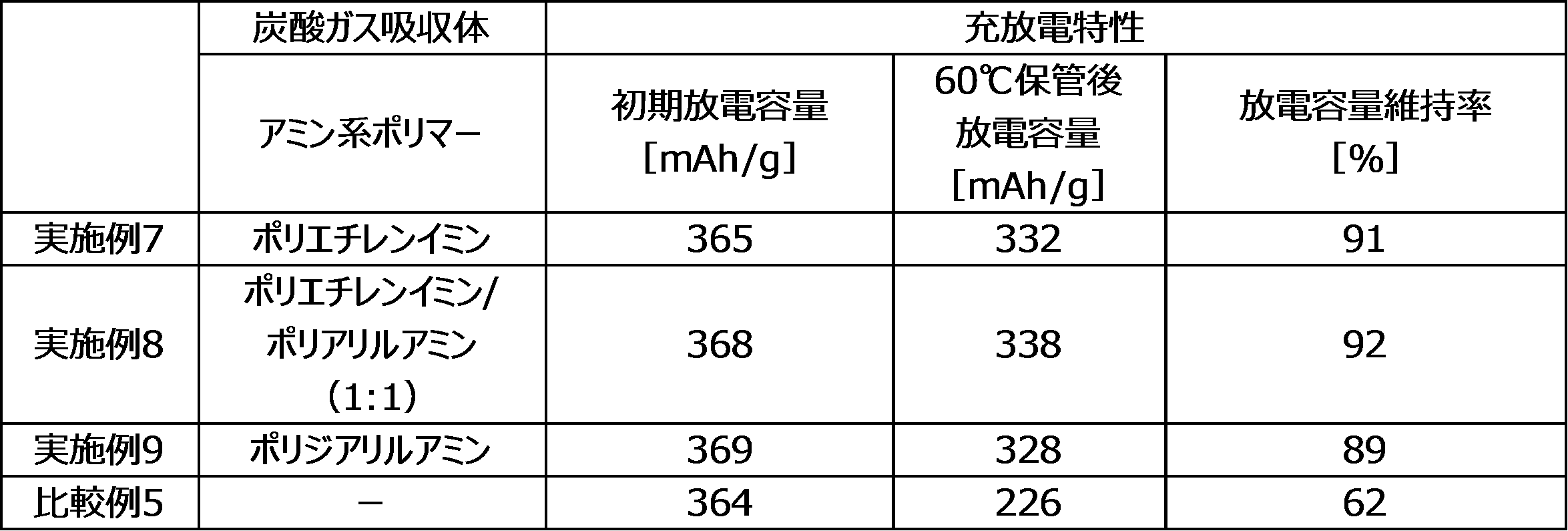
15.実施例10
(1)電気二重層キャパシタの作製
実施例7と同様にして作製した炭酸ガス吸収体を用いて、以下の方法に従い、電気二重層キャパシタを作製した。
活性炭を、粒径5~20μmに粉砕して粉末活性炭とし、該粉末活性炭80重量%、導電性カーボン10重量%およびポリテトラフルオロエチレン(テフロン(登録商標)6J、三井・デュポンケミカル社)10重量%からなる混合物を混練した。得られた混練物を、ロール圧延によって厚さ300μmのシートに成形し、打ち抜き器を用いて直径2cmの円形に打ち抜いた後、減圧下150℃で4時間乾燥させてシート状の分極性電極を作製した。
(1)電気二重層キャパシタの作製
実施例7と同様にして作製した炭酸ガス吸収体を用いて、以下の方法に従い、電気二重層キャパシタを作製した。
活性炭を、粒径5~20μmに粉砕して粉末活性炭とし、該粉末活性炭80重量%、導電性カーボン10重量%およびポリテトラフルオロエチレン(テフロン(登録商標)6J、三井・デュポンケミカル社)10重量%からなる混合物を混練した。得られた混練物を、ロール圧延によって厚さ300μmのシートに成形し、打ち抜き器を用いて直径2cmの円形に打ち抜いた後、減圧下150℃で4時間乾燥させてシート状の分極性電極を作製した。
得られた分極性電極を、露点-80℃以下のグローブボックス中で、ステンレスケースに、炭酸ガス吸収体、集電部材、分極性電極シート、ポリプロピレン不織布、分極性電極シート、集電部材をこの順に積層した後、1モルのテトラエチルアンモニウムテトラフルオロボレートを含有するプロピレンカーボネート溶液を分極性電極に含浸せしめ、ポリプロピレン製の絶縁ガスケットを用いて、ステンレスケースの上蓋にかしめ封印することにより電気二重層キャパシタを作製した。
(2)充放電性能の評価
得られた電気二重層キャパシタについて、電気二重層キャパシタ評価装置(日置電機製)を使用して、室温下、到達電圧3.3Vまで、電極表面積あたり2mA/cm2で定電流充電し、3.3Vで30分、低電圧下で補充電し、補充電完了後に2mA/cm2の定電流で放電した。その際の1.2Vから1.0Vまでの放電カーブから定法にて初期静電容量を求めた。放電後、60℃下で同様に3.3Vまで充電し、100時間保管した。保管後に同様に放電して、初期静電容量との比から静電容量維持率を求めた。結果を表3に示す。
得られた電気二重層キャパシタについて、電気二重層キャパシタ評価装置(日置電機製)を使用して、室温下、到達電圧3.3Vまで、電極表面積あたり2mA/cm2で定電流充電し、3.3Vで30分、低電圧下で補充電し、補充電完了後に2mA/cm2の定電流で放電した。その際の1.2Vから1.0Vまでの放電カーブから定法にて初期静電容量を求めた。放電後、60℃下で同様に3.3Vまで充電し、100時間保管した。保管後に同様に放電して、初期静電容量との比から静電容量維持率を求めた。結果を表3に示す。
16.実施例11
実施例8と同様にして作製した炭酸ガス吸収体を用いて、実施例10と同様の方法により電気二重層キャパシタを作製した。得られた電気二重層キャパシタの静電容量維持率を、実施例10と同様の方法により測定した。結果を表3に示す。
実施例8と同様にして作製した炭酸ガス吸収体を用いて、実施例10と同様の方法により電気二重層キャパシタを作製した。得られた電気二重層キャパシタの静電容量維持率を、実施例10と同様の方法により測定した。結果を表3に示す。
17.実施例12
実施例9と同様にして作製した炭酸ガス吸収体を用いて、実施例10と同様の方法により電気二重層キャパシタを作製した。得られた電気二重層キャパシタの静電容量維持率を、実施例10と同様の方法により測定した。結果を表3に示す。
実施例9と同様にして作製した炭酸ガス吸収体を用いて、実施例10と同様の方法により電気二重層キャパシタを作製した。得られた電気二重層キャパシタの静電容量維持率を、実施例10と同様の方法により測定した。結果を表3に示す。
18.比較例6
炭酸ガス吸収体を使用しないこと以外は実施例10と同様の方法により電気二重層キャパシタを作製し、実施例10と同様の方法により電気二重層キャパシタの静電容量維持率を求めた。結果を表3に示す。
炭酸ガス吸収体を使用しないこと以外は実施例10と同様の方法により電気二重層キャパシタを作製し、実施例10と同様の方法により電気二重層キャパシタの静電容量維持率を求めた。結果を表3に示す。
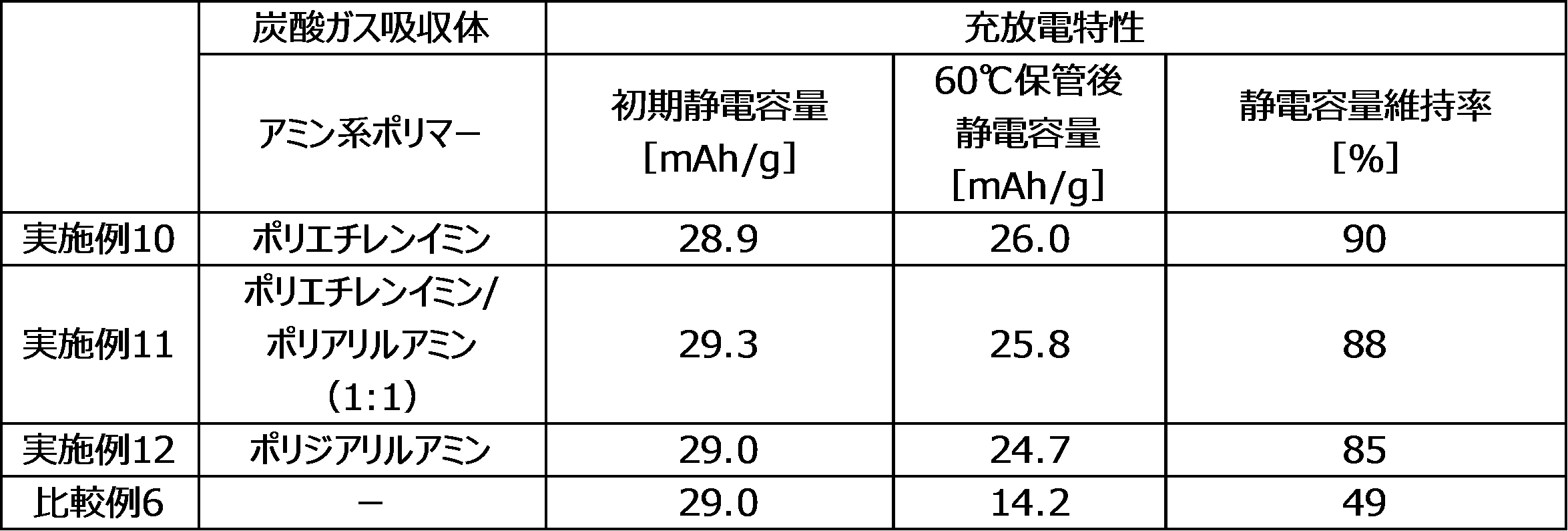
Claims (10)
- 繰り返し単位中にアミノ基を有するアミン系ポリマーとアルコール化合物とを含む混合物からなり、含水率が10質量%未満である炭酸ガス吸収体。
- 炭酸ガス放出温度が100℃以上300℃以下である、請求項1に記載の炭酸ガス吸収体。
- アミン系ポリマーが、ポリエチレンイミン、ポリアリルアミン、ポリアクリルアミド、ポリテトラメチレンイミン、ポリビニルアミン、ジシアンジアミド-ホルマリン縮合物およびジシアンジアミド-アルキレン(ポリアミン)縮合物からなる群から選択される、請求項1または2に記載の炭酸ガス吸収体。
- アルコール化合物が、単糖類、少糖類、多糖類、ポリビニルアルコールおよびその誘導体並びにポリフェノールおよびその誘導体からなる群から選択される、請求項1~3のいずれかに記載の炭酸ガス吸収体。
- 膜状、フィルム状、シート状、繊維状または粉体状である、請求項1~4のいずれかに記載の炭酸ガス吸収体。
- 含水率が500ppm以下である、請求項1~5のいずれかに記載の炭酸ガス吸収体。
- 請求項6に記載の炭酸ガス吸収体を含んでなる非水電解質蓄電池。
- 非水電解質二次電池である、請求項7に記載の非水電解質蓄電池。
- 電気二重層キャパシタである、請求項7に記載の非水電解質蓄電池。
- 請求項1~6のいずれかに記載の炭酸ガス吸収体に、炭酸ガスを含有する気体を接触させて炭酸ガスを炭酸ガス吸収体に吸収させること、および炭酸ガスを吸収した前記炭酸ガス吸収体から炭酸ガスを分離回収することを含む、炭酸ガスの分離回収方法。
Priority Applications (1)
| Application Number | Priority Date | Filing Date | Title |
|---|---|---|---|
| JP2019543738A JPWO2019059368A1 (ja) | 2017-09-25 | 2018-09-21 | 炭酸ガス吸収体およびそれを含む非水電解質蓄電池、並びに炭酸ガスの分離回収方法 |
Applications Claiming Priority (4)
| Application Number | Priority Date | Filing Date | Title |
|---|---|---|---|
| JP2017-183948 | 2017-09-25 | ||
| JP2017183946 | 2017-09-25 | ||
| JP2017183948 | 2017-09-25 | ||
| JP2017-183946 | 2017-09-25 |
Publications (1)
| Publication Number | Publication Date |
|---|---|
| WO2019059368A1 true WO2019059368A1 (ja) | 2019-03-28 |
Family
ID=65810465
Family Applications (1)
| Application Number | Title | Priority Date | Filing Date |
|---|---|---|---|
| PCT/JP2018/035164 Ceased WO2019059368A1 (ja) | 2017-09-25 | 2018-09-21 | 炭酸ガス吸収体およびそれを含む非水電解質蓄電池、並びに炭酸ガスの分離回収方法 |
Country Status (3)
| Country | Link |
|---|---|
| JP (1) | JPWO2019059368A1 (ja) |
| TW (1) | TW201919759A (ja) |
| WO (1) | WO2019059368A1 (ja) |
Cited By (11)
| Publication number | Priority date | Publication date | Assignee | Title |
|---|---|---|---|---|
| JP2021127409A (ja) * | 2020-02-14 | 2021-09-02 | 国立研究開発法人産業技術総合研究所 | カチオン性高分子と還元性を示す糖類を成分とする材料 |
| JPWO2021200348A1 (ja) * | 2020-03-31 | 2021-10-07 | ||
| JP2021166984A (ja) * | 2020-04-13 | 2021-10-21 | 大成建設株式会社 | 気体貯蔵放出化合物 |
| JP2022036774A (ja) * | 2020-08-24 | 2022-03-08 | 大成建設株式会社 | ガス貯蔵放出材料 |
| WO2022103054A1 (ko) * | 2020-11-10 | 2022-05-19 | 주식회사 엘지에너지솔루션 | 가스 포집용 부재를 포함하는 이차 전지 |
| WO2022202152A1 (ja) * | 2021-03-26 | 2022-09-29 | 日東電工株式会社 | ファイバー、繊維シート、ファイバーの製造方法及び酸性ガス吸着装置 |
| CN115445389A (zh) * | 2022-08-02 | 2022-12-09 | 中国石油化工股份有限公司 | 一种VOCs吸收剂及使用其吸收处理VOCs废气的方法 |
| WO2023215875A1 (en) * | 2022-05-06 | 2023-11-09 | Global Thermostat Operations, Llc. | Phenol containing sorbents, systems including sorbents, and methods using the sorbents |
| WO2024034511A1 (ja) * | 2022-08-09 | 2024-02-15 | 株式会社大真空 | 二酸化炭素捕集モジュール |
| CN117695830A (zh) * | 2024-02-04 | 2024-03-15 | 四川益能康生环保科技有限公司 | 一种二氧化碳低温捕集吸收液及其吸收方法 |
| WO2026070110A1 (ja) * | 2024-09-24 | 2026-04-02 | 株式会社村田製作所 | 二酸化炭素吸着材料およびその製造方法 |
Families Citing this family (1)
| Publication number | Priority date | Publication date | Assignee | Title |
|---|---|---|---|---|
| JP7459755B2 (ja) * | 2020-10-20 | 2024-04-02 | 株式会社デンソー | 電気化学セルおよび二酸化炭素回収システム |
Citations (7)
| Publication number | Priority date | Publication date | Assignee | Title |
|---|---|---|---|---|
| JPH04200742A (ja) * | 1990-11-30 | 1992-07-21 | Kuraray Chem Corp | 炭酸ガス吸着剤 |
| WO2010090192A1 (ja) * | 2009-02-04 | 2010-08-12 | リケンテクノス株式会社 | 一酸化炭素を処理するための方法 |
| WO2010101110A1 (ja) * | 2009-03-02 | 2010-09-10 | 三菱製紙株式会社 | 水分吸着剤、除湿用シート状物及び除湿用フィルター材 |
| JP2014195760A (ja) * | 2013-03-29 | 2014-10-16 | 富士フイルム株式会社 | 酸性ガス分離用複合体の製造方法および製造装置 |
| JP2015501204A (ja) * | 2011-10-19 | 2015-01-15 | インディアン インスティテュート オブ テクノロジー マドラス | ポリアニリン−グラファイトナノプレートレット材料 |
| US20160199810A1 (en) * | 2015-01-12 | 2016-07-14 | University Of Southern California | Regenerative adsorbents of modified amines on solid supports |
| WO2016154278A1 (en) * | 2015-03-23 | 2016-09-29 | Basf Corporation | Carbon dioxide sorbents for indoor air quality control |
-
2018
- 2018-09-21 TW TW107133568A patent/TW201919759A/zh unknown
- 2018-09-21 JP JP2019543738A patent/JPWO2019059368A1/ja active Pending
- 2018-09-21 WO PCT/JP2018/035164 patent/WO2019059368A1/ja not_active Ceased
Patent Citations (7)
| Publication number | Priority date | Publication date | Assignee | Title |
|---|---|---|---|---|
| JPH04200742A (ja) * | 1990-11-30 | 1992-07-21 | Kuraray Chem Corp | 炭酸ガス吸着剤 |
| WO2010090192A1 (ja) * | 2009-02-04 | 2010-08-12 | リケンテクノス株式会社 | 一酸化炭素を処理するための方法 |
| WO2010101110A1 (ja) * | 2009-03-02 | 2010-09-10 | 三菱製紙株式会社 | 水分吸着剤、除湿用シート状物及び除湿用フィルター材 |
| JP2015501204A (ja) * | 2011-10-19 | 2015-01-15 | インディアン インスティテュート オブ テクノロジー マドラス | ポリアニリン−グラファイトナノプレートレット材料 |
| JP2014195760A (ja) * | 2013-03-29 | 2014-10-16 | 富士フイルム株式会社 | 酸性ガス分離用複合体の製造方法および製造装置 |
| US20160199810A1 (en) * | 2015-01-12 | 2016-07-14 | University Of Southern California | Regenerative adsorbents of modified amines on solid supports |
| WO2016154278A1 (en) * | 2015-03-23 | 2016-09-29 | Basf Corporation | Carbon dioxide sorbents for indoor air quality control |
Cited By (18)
| Publication number | Priority date | Publication date | Assignee | Title |
|---|---|---|---|---|
| JP2021127409A (ja) * | 2020-02-14 | 2021-09-02 | 国立研究開発法人産業技術総合研究所 | カチオン性高分子と還元性を示す糖類を成分とする材料 |
| JP7497009B2 (ja) | 2020-02-14 | 2024-06-10 | 国立研究開発法人産業技術総合研究所 | カチオン性高分子と還元性を示す糖類を成分とする材料 |
| JPWO2021200348A1 (ja) * | 2020-03-31 | 2021-10-07 | ||
| WO2021200348A1 (ja) * | 2020-03-31 | 2021-10-07 | 株式会社クラレ | 二酸化炭素吸収繊維及びその製造方法 |
| JP7600213B2 (ja) | 2020-03-31 | 2024-12-16 | 株式会社クラレ | 二酸化炭素吸収繊維及びその製造方法 |
| JP7338113B2 (ja) | 2020-04-13 | 2023-09-05 | 大成建設株式会社 | 気体貯蔵放出化合物 |
| JP2021166984A (ja) * | 2020-04-13 | 2021-10-21 | 大成建設株式会社 | 気体貯蔵放出化合物 |
| JP2022036774A (ja) * | 2020-08-24 | 2022-03-08 | 大成建設株式会社 | ガス貯蔵放出材料 |
| JP7484051B2 (ja) | 2020-08-24 | 2024-05-16 | 大成建設株式会社 | ガス貯蔵放出材料 |
| WO2022103054A1 (ko) * | 2020-11-10 | 2022-05-19 | 주식회사 엘지에너지솔루션 | 가스 포집용 부재를 포함하는 이차 전지 |
| US12525661B2 (en) | 2020-11-10 | 2026-01-13 | Lg Energy Solution, Ltd. | Secondary battery comprising gas scavenging member |
| WO2022202152A1 (ja) * | 2021-03-26 | 2022-09-29 | 日東電工株式会社 | ファイバー、繊維シート、ファイバーの製造方法及び酸性ガス吸着装置 |
| WO2023215875A1 (en) * | 2022-05-06 | 2023-11-09 | Global Thermostat Operations, Llc. | Phenol containing sorbents, systems including sorbents, and methods using the sorbents |
| CN115445389A (zh) * | 2022-08-02 | 2022-12-09 | 中国石油化工股份有限公司 | 一种VOCs吸收剂及使用其吸收处理VOCs废气的方法 |
| WO2024034511A1 (ja) * | 2022-08-09 | 2024-02-15 | 株式会社大真空 | 二酸化炭素捕集モジュール |
| CN117695830A (zh) * | 2024-02-04 | 2024-03-15 | 四川益能康生环保科技有限公司 | 一种二氧化碳低温捕集吸收液及其吸收方法 |
| CN117695830B (zh) * | 2024-02-04 | 2024-05-28 | 四川益能康生环保科技有限公司 | 一种二氧化碳低温捕集吸收液及其吸收方法 |
| WO2026070110A1 (ja) * | 2024-09-24 | 2026-04-02 | 株式会社村田製作所 | 二酸化炭素吸着材料およびその製造方法 |
Also Published As
| Publication number | Publication date |
|---|---|
| JPWO2019059368A1 (ja) | 2020-12-03 |
| TW201919759A (zh) | 2019-06-01 |
Similar Documents
| Publication | Publication Date | Title |
|---|---|---|
| JPWO2019059368A1 (ja) | 炭酸ガス吸収体およびそれを含む非水電解質蓄電池、並びに炭酸ガスの分離回収方法 | |
| Bresser et al. | Alternative binders for sustainable electrochemical energy storage–the transition to aqueous electrode processing and bio-derived polymers | |
| KR102664549B1 (ko) | 전기화학 전지용 부동태화제 | |
| KR102054142B1 (ko) | 금속-유기 구조체를 포함하는 리튬 이차전지용 양극 | |
| KR20170045833A (ko) | 다층 구조의 금속 산화물들을 포함하는 양극 활물질 제조용 전구체 및 이를 사용하여 제조된 리튬 이차전지용 양극 활물질 | |
| KR101645773B1 (ko) | 전극 활물질 슬러리 및 이를 포함하는 리튬 이차 전지 | |
| JPWO2006085416A1 (ja) | エネルギーデバイス電極用バインダ樹脂エマルション及びこれを用いたエネルギーデバイス電極並びにエネルギーデバイス | |
| TWI625890B (zh) | 非水電解質電池用黏合劑組成物、以及使用其之非水電解質電池用漿體組成物、非水電解質電池負極、及非水電解質電池 | |
| CN113692661A (zh) | 锂二次电池电极用粘合剂、包含其的锂二次电池用正极和锂二次电池 | |
| CN101405898A (zh) | 非水电解质二次电池 | |
| JP2011165433A (ja) | 二次電池 | |
| CN111066177A (zh) | 锂二次电池用正极和其制造方法 | |
| US20130330636A1 (en) | Nonaqueous electrolyte and nonaqueous electrolyte secondary battery using same | |
| JP2019091577A (ja) | 炭酸ガス発生剤およびそれを用いた非水電解質蓄電池 | |
| JPWO2019240021A1 (ja) | 二次電池用負極材、二次電池用負極、及び二次電池 | |
| US20250201847A1 (en) | Negative electrode binder composition and method for producing the same, negative electrode, and secondary battery | |
| CN116830318A (zh) | 负极粘合剂组合物、负极和二次电池 | |
| WO2023141929A1 (zh) | 电化学装置及电子装置 | |
| JP6597648B2 (ja) | リチウムイオン二次電池の製造方法 | |
| JP2016167443A (ja) | 非水電解液蓄電素子 | |
| JP2019091675A (ja) | リチウムイオン電池用ガス吸収材 | |
| TW201234700A (en) | Process for producing electrodes for lithium-sulfur batteries | |
| KR20210021950A (ko) | 탄소 재료, 도전 보조제, 축전 디바이스용 전극, 및 축전 디바이스 | |
| WO2019097739A1 (ja) | リチウムイオン電池用ガス吸収材 | |
| CN115210915B (zh) | 电化学元件正极用添加剂和包含其的电化学元件正极用组合物以及电化学元件 |
Legal Events
| Date | Code | Title | Description |
|---|---|---|---|
| 121 | Ep: the epo has been informed by wipo that ep was designated in this application |
Ref document number: 18858960 Country of ref document: EP Kind code of ref document: A1 |
|
| ENP | Entry into the national phase |
Ref document number: 2019543738 Country of ref document: JP Kind code of ref document: A |
|
| NENP | Non-entry into the national phase |
Ref country code: DE |
|
| 122 | Ep: pct application non-entry in european phase |
Ref document number: 18858960 Country of ref document: EP Kind code of ref document: A1 |