WO2019017332A1 - ポリシルセスキオキサン系化合物を含む組成物、その製造方法、並びに当該組成物を含む封止材及びフィルム - Google Patents
ポリシルセスキオキサン系化合物を含む組成物、その製造方法、並びに当該組成物を含む封止材及びフィルム Download PDFInfo
- Publication number
- WO2019017332A1 WO2019017332A1 PCT/JP2018/026717 JP2018026717W WO2019017332A1 WO 2019017332 A1 WO2019017332 A1 WO 2019017332A1 JP 2018026717 W JP2018026717 W JP 2018026717W WO 2019017332 A1 WO2019017332 A1 WO 2019017332A1
- Authority
- WO
- WIPO (PCT)
- Prior art keywords
- monomer
- silsesquioxane
- composition
- film
- molecule
- Prior art date
- Legal status (The legal status is an assumption and is not a legal conclusion. Google has not performed a legal analysis and makes no representation as to the accuracy of the status listed.)
- Ceased
Links
Images



Classifications
-
- C—CHEMISTRY; METALLURGY
- C08—ORGANIC MACROMOLECULAR COMPOUNDS; THEIR PREPARATION OR CHEMICAL WORKING-UP; COMPOSITIONS BASED THEREON
- C08G—MACROMOLECULAR COMPOUNDS OBTAINED OTHERWISE THAN BY REACTIONS ONLY INVOLVING UNSATURATED CARBON-TO-CARBON BONDS
- C08G77/00—Macromolecular compounds obtained by reactions forming a linkage containing silicon with or without sulfur, nitrogen, oxygen or carbon in the main chain of the macromolecule
- C08G77/48—Macromolecular compounds obtained by reactions forming a linkage containing silicon with or without sulfur, nitrogen, oxygen or carbon in the main chain of the macromolecule in which at least two but not all the silicon atoms are connected by linkages other than oxygen atoms
- C08G77/50—Macromolecular compounds obtained by reactions forming a linkage containing silicon with or without sulfur, nitrogen, oxygen or carbon in the main chain of the macromolecule in which at least two but not all the silicon atoms are connected by linkages other than oxygen atoms by carbon linkages
-
- C—CHEMISTRY; METALLURGY
- C08—ORGANIC MACROMOLECULAR COMPOUNDS; THEIR PREPARATION OR CHEMICAL WORKING-UP; COMPOSITIONS BASED THEREON
- C08L—COMPOSITIONS OF MACROMOLECULAR COMPOUNDS
- C08L83/00—Compositions of macromolecular compounds obtained by reactions forming in the main chain of the macromolecule a linkage containing silicon with or without sulfur, nitrogen, oxygen or carbon only; Compositions of derivatives of such polymers
- C08L83/14—Compositions of macromolecular compounds obtained by reactions forming in the main chain of the macromolecule a linkage containing silicon with or without sulfur, nitrogen, oxygen or carbon only; Compositions of derivatives of such polymers in which at least two but not all the silicon atoms are connected by linkages other than oxygen atoms
-
- H—ELECTRICITY
- H10—SEMICONDUCTOR DEVICES; ELECTRIC SOLID-STATE DEVICES NOT OTHERWISE PROVIDED FOR
- H10H—INORGANIC LIGHT-EMITTING SEMICONDUCTOR DEVICES HAVING POTENTIAL BARRIERS
- H10H20/00—Individual inorganic light-emitting semiconductor devices having potential barriers, e.g. light-emitting diodes [LED]
- H10H20/80—Constructional details
- H10H20/85—Packages
- H10H20/852—Encapsulations
- H10H20/854—Encapsulations characterised by their material, e.g. epoxy or silicone resins
Definitions
- the present invention relates to a resin composition suitable for a sealing material such as an LED or the like, an optical material, and the like, and in particular to a resin composition containing a polysilsesquioxane-based compound.
- various resins are used as optical materials from the viewpoint of weight reduction and cost.
- molded articles such as polycarbonate and acrylic resin are used as resin lenses from the viewpoint of weight reduction and cost.
- polyester (PET), polyethylene naphthalate (PEN) and the like are used as an optical film and a protective film by taking advantage of transparency.
- a resin sealing agent is used to improve light extraction, and an epoxy resin excellent in heat resistance is often used as the resin.
- Some silicone resins are excellent in light resistance, but generally they are not suitable for molded articles such as optical lenses and films because they have a large linear expansion coefficient, a low Young's modulus, and a high elastic modulus.
- Non-Patent Document 1 Silsesquioxane is a siloxane-based compound in which the main chain skeleton is a Si—O bond, and is expected to obtain a material reflecting its function by introducing various functional groups into the skeleton.
- structures such as cage type, ladder type and random type are known, and Non-Patent Document 1 discloses that polymerization is carried out by reacting cage type POSS with water etc. in the presence of a specific catalyst. It has been described that.
- Patent Documents 1 and 2 disclose a composition for sealing an LED, which contains a ladder-type polysilsesquioxane having R 1 SiO 3/2 as a repeating unit or a silicone oligomer
- Patent Document 3 further discloses: A thermosetting silicone resin which is a reaction product of silsesquioxane and an organopolysiloxane containing an alkenyl group is disclosed, and the use of this resin as a sealing material for a semiconductor device is described.
- the thermal shape stability of the resin for example, the linear expansion coefficient is also an important factor.
- Thermal shape stability is required not only for its own shape stability, but also for a small difference in thermal expansion with the members in contact.
- the coefficient of linear expansion of an epoxy resin, polycarbonate, etc. used for a mounting substrate or the like is less than 100 ( ⁇ 10 -6 / K), and the coefficient of linear expansion of a metal (Cu etc.) Even lower.
- the linear expansion coefficient of the sealing material is large and the difference in thermal expansion with the mounting substrate is large, the heat history is experienced and peeling and displacement are likely to occur between the two.
- Non-Patent Document 1 and Patent Document 1 do not consider these characteristics.
- the organopolysiloxanes described in Patent Documents 1 to 3 are not suitable for molded articles or films although they have applicability as sealing materials.
- An object of the present invention is to provide a novel resin composition which is excellent in optical characteristics and light resistance and has a low linear expansion coefficient.
- a polymer obtained by dehydrogenating a cage silsesquioxane having two or more SiH groups in a molecule and a monomer molecule having two or more hydroxyl groups has transmission characteristics in the ultraviolet and visible regions. It has been found that it has an excellent and low linear expansion coefficient.
- the composition containing the polysilsesquioxane compound of the present invention is subjected to dehydrogenation reaction between cage silsesquioxane having two or more SiH groups in the molecule and a monomer molecule having two or more hydroxyl groups. It is a resin composition containing the compound obtained.
- a monomer having a hydroxyl group is reacted with the Si-H group of silsesquioxane to form a copolymer in which silsesquioxane is linked via the monomer.
- a cage-type silsesquioxane that is light-resistant and heat-resistant, and incorporates it into the polymer molecule, it incorporates a larger amount of rigid structure, and the heat resistance, light resistance, and low thermal expansion resistance as a polymer You can get the effect of
- cage silsesquioxane is simply mixed into the polymer as a filler, it is difficult to add it to a high concentration, and because it is compatible with the solvent and the polymer, it is difficult to obtain the effect of addition due to aggregation, and the refractive index difference In the present invention, such a problem can be solved by polymerizing cage silsesquioxane.
- the molecular structure of the monomer affects the optical properties
- a specific monomer can be used to provide a composition suitable for an optical material.
- FIG. 1 shows examples of molded articles comprising the silsesquioxane polymer-containing composition of the present invention.
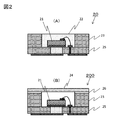
- FIG. 1 shows an example of the light-emitting device which used the silsesquioxane polymer containing composition of this invention as a sealing material or an adhesive agent.
- the graph which shows the relationship between carbon number of alkane diol, and a linear expansion coefficient.
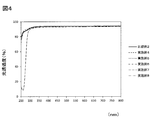
- the figure which shows the transmitted light spectrum of an Example The figure explaining the method to measure mechanical strength.
- the composition of the present invention mainly comprises a silsesquioxane-based polymer obtained by copolymerizing cage silsesquioxane and a monomer having two or more hydroxyl groups in the molecule by a dehydrogenation reaction, and a catalyst for the dehydrogenation reaction or It may contain a small amount of cage silsesquioxane or monomer not used in the reaction. Moreover, when the termination agent which terminates unreacted functional group is added, you may contain the termination agent.
- the cage silsesquioxane used in the present invention is a silsesquioxane of a Q unit whose basic constituent unit is represented by the formula (1).
- Q unit silsesquioxane Q8, Q10 and Q12 are known depending on the number of Si atoms constituting the block, and any of these may be used.
- Q8 will be described as an example.
- the silsesquioxane for Q8 used in the present invention is represented by the formula (2), and one having two or more Si—H groups in the molecule is used.
- octakisdimethylsiloxyoctasilsesquioxane octakis diethylsiloxyoctasilsesquioxane, octakismethylethylsiloxyoctasilsesquioxane and the like can be mentioned.
- Si—H groups When two or more Si—H groups are present in the molecule, they can be combined with silsesquioxane via a diol described later to form a polymer.
- siloxanes other than silsesquioxane for example, 1,1,3,3-tetramethyldisiloxane, 1,1,3,3,5,5-hexamethyltrisiloxane, 1,3,5-trimethylcyclotrisiloxane And siloxane, 2,4,6,8-tetramethylcyclotetrasiloxane, 2,4,6,8,10-pentamethylcyclopentasiloxane and the like.
- siloxanes other than silsesquioxane for example, 1,1,3,3-tetramethyldisiloxane, 1,1,3,3,5,5-hexamethyltrisiloxane, 1,3,5-trimethylcyclotrisiloxane And siloxane, 2,4,6,8-tetramethylcyclotetrasiloxane, 2,4,6,8,10-pentamethylcyclopentasiloxane and the like.
- the amount of siloxane replacing the silsesquioxane should be 4 or less,
- the monomer having two or more hydroxyl groups in the molecule is a monomer which is polymerized by dehydrogenation of the hydroxyl group with the SiH group of the above-mentioned silsesquioxane, specifically, 1,4-butanediol, Aliphatic diols (alkanediols) such as 2,3-butanediol, 1,6-hexanediol, 1,10-decanediol, 1,12-dodecanediol, 1,16-hexadecanediol, 1,4-cyclohexane Alicyclic diols such as diol, 1,3-adamantanediol, aromatic diols such as 1,4-dihydroxybenzene, 1,4-benzenedimethanol, bisphenol M, bisphenol P, 2,6-naphthalenediol, siloxane Diols, such as low molecular weight polyethylene glycol, etc.
- Goma can also be used. However, not only diols having two hydroxyl groups but also monomers having three or more such as triols may be used. Although water can also be used as a diol monomer, a composition having low brittleness as a polymer is difficult to obtain because of its short molecular length.
- alkanediol having a straight chain carbon chain has particularly low light absorption in the near ultraviolet region, and can obtain high transmittance in the near ultraviolet region.
- high transmittance can be realized similarly if it is a monomer having a molecular structure which is less deteriorated by the influence of blue or ultraviolet light.
- These monomers may also contain fluorine in the molecule.
- the number of functional groups (hydroxyl groups) contained in the monomer may be two or more.
- the molecular structure and the length of the monomer have a great influence on the thermal expansion coefficient and the polymer density of the produced polymer.
- the longer the molecular length of the monomer the larger the thermal expansion coefficient due to the influence of the monomer.
- brittleness becomes strong by silsesquioxane.
- the thermal expansion coefficient can be lowered most at the portion corresponding to dodecane diol. This seems to be due to the fact that the polymer molecules are dense with each other because the molecular length of silsesquioxane (Q8) is close to dodecanediol (having 12 carbon atoms).
- the monomer preferably has a molecular length corresponding to an alkanediol monomer having 7 to 20 carbon atoms, preferably 10 to 16 carbon atoms.
- the carbon number By setting the carbon number to 7 or more, the brittleness of the compound obtained by polymerization is suppressed, and no cracking or cracking occurs when processing into a molded article or a film, and resistance to deformation stress is strong.
- the number of carbon atoms to 20 or less, thermal shape stability can be increased, and the coefficient of linear expansion can be suppressed to a low level.
- a monomer 0.5 equivalent or more is preferable with respect to silsesquioxane 1 molecule.
- the amount of monomer molecules By setting the amount of monomer molecules to 0.5 equivalent or more, the composition can be obtained which reduces the monomer molecules and silsesquioxane present alone in the composition and maintains the shape as a molded article or film after molding.
- the amount (molar ratio) of the monomers is less than 0.5, crosslinking is insufficient, and on average, the number of portions where silsesquioxane can not be crosslinked is increased, and the strength of the composition is lowered.
- the molar ratio is preferably 0.5 to n / 2, and most preferably 1 to 2 to suppress brittleness.
- n is the number of SiH groups in the silsesquioxane (wherein n is an integer of 2 or more and less than or equal to the number of vertices of the silsesquioxane).
- SS: OH group 1: 1 to (3/2) n where (3/2) n n n + 2 It is.
- the crosslink density can be adjusted by adjusting the molar ratio of the monomer to the silsesquioxane, whereby a composition tailored to the final application can be obtained.
- dehydrogenation catalysts such as diethylhydroxylamine and platinum-based catalysts can be used.
- diethylhydroxylamine is preferred.
- a terminating agent for terminating the hydroxyl group which is the reaction end in the dehydrogenation reaction a monomer having the same skeleton as that of the above-mentioned monomer molecule may be used, or one monomer having one functional group may be used. Alcohols having a relatively small weight may be used. Furthermore, silazanes such as 1,1,1,3,3,3-hexamethyldisilazane may be used. The terminal agent is added at the final stage of the reaction.
- composition of the present invention is produced by charging the above-described silsesquioxane and monomer molecules into a reaction vessel at a predetermined ratio, adding a dehydrogenation catalyst and a solvent, and carrying out the reaction while stirring under heating. Do.
- the solvent may be a solvent in which at least one of silsesquioxane and a monomer molecule has a solubility.
- a solvent having high solubility of silsesquioxane tetrahydrofuran, toluene, chloroform and the like can be mentioned.
- the reaction temperature is preferably higher than the boiling point of the reaction solvent, but is preferably 65 to 75 ° C. in tetrahydrofuran, and since it reacts with water molecules in the air, it is preferable to carry out in an inert gas atmosphere such as Ar.
- the reaction time is not particularly limited, but the dehydrogenation proceeds by continuing the incubation and stirring for about 1 to 100 hours.
- the reaction may be performed in one step or in multiple steps. In the case of multiple stages, in the first stage reaction, only a part of the siloxane to be charged is reacted, and after completion of the first stage reaction, silsesquioxane is additionally charged.
- the main properties of the resin composition of the present invention are as follows. Light transmittance in the ultraviolet region of 300 nm to 380 nm: 90% or more Linear expansion coefficient (after curing): 170 ppm / K or less
- the resin composition of the present invention is a film having a thickness of 100 ⁇ m
- the linear expansion coefficient is a value obtained by measuring the same film with a sample width of 5 mm and a measurement length of 20 mm with a thermomechanical analyzer (TMA-60 manufactured by Shimadzu Corporation).
- the resin composition of the present invention thus obtained is in the form of a viscous liquid before removal of the solvent, and is cured by heating and removing the solvent after molding, for example, as shown in FIG. It can be formed into an optical film 10 or an optical lens 15 as shown in (C).
- the composition before solvent removal is applied to the substrate 11 to form a thin film, and then the film can be manufactured by drying by heating to remove the solvent.
- Such a film can also function as a protective film for the substrate 11 (FIG. 1 (A)), and when a substrate having a releasable surface is used, it peels from the substrate and It is also possible to obtain a film based on a sesquioxane polymer (FIG. 1 (B)).
- the film or optical lens of the present invention has a high light transmittance from the ultraviolet region to the visible light, so there is no loss of light, and it can be used for the same application as a conventional light transmitting material It is suitable for an optical device which uses a high power, high brightness LED as a light source.
- the resin composition of this invention as a sealing material of optical components, such as LED.
- it can use as a sealing material of the LED element 21 of the light-emitting device 20 as shown to FIG. 2 (A).
- the LED element 21 is mounted on the substrate 25, and the electrode pad formed on the substrate 25 is bonded to the electrode of the LED element 21 with a metal wire such as gold or copper.
- a metal wire such as gold or copper.
- It has a structure in which a wall member 23 having a light reflection surface is disposed around the periphery. After the space surrounded by the wall member 23 is filled with the sealing material 22 by a method such as potting, the sealing material 22 is cured.
- the sealing material may optionally contain a wavelength conversion material such as a phosphor powder.
- the polysilsesquioxane-containing composition of the present invention used as the sealing material 22 has no absorption in the ultraviolet region which is the light emission wavelength of the LED element, the light from the LED is effectively used. Can.
- the difference between the linear expansion coefficient of polysilsesquioxane and the linear expansion coefficient of the metal material for wire bonding or the LED light emitting element is small, peeling off of the sealing material can be suppressed.
- the adhesive 26 for bonding the wall member 23 and the phosphor plate 24 is used.
- the light emitting device shown in FIG. 2 is an example, and the resin composition of the present invention can be used as a sealing material or an adhesive in light emitting devices of various forms.
- the resin composition of the present invention can be used as a substitute for conventional resins such as a coating base material and an insulating coating material covering a mounting base material and a paint other than the above-mentioned applications, taking advantage of the low linear expansion coefficient characteristics. Can. Moreover, it is possible to add and utilize various additives, a pigment, etc. according to the use.
- Example 1 In a 50 mL two-necked eggplant flask, 0.5 g (4.91 ⁇ 10 -4 mol) of octakisdimethylsiloxyoctasilsesquioxane, 0.175 g (9.82 ⁇ 10 -4 mol) of 1,10-decanediol And 5 mL of tetrahydrofuran as a solvent.
- a cooling pipe and an Ar gas introduction pipe are connected to a two-necked eggplant flask, the pressure is maintained at atmospheric pressure under an Ar environment, the two-necked eggplant flask is warmed to 70 ° C. with an oil bath, and the temperature is maintained at 700 rpm with a stirrer using a stirrer.
- the stirring was carried out. After heating and stirring reached steady state, 25 ⁇ L (2.44 ⁇ 10 ⁇ 4 mol) of diethylhydroxylamine was added as a catalyst and allowed to react for 1 hour. Thereafter, the same amounts of octakisdimethylsiloxyoctasilsesquioxane, tetrahydrofuran and diethylhydroxylamine were added and allowed to react for another 2 hours. After the reaction, the solution is concentrated by a rotary evaporator, and the concentrate is applied to a substrate (PTFE film: 0.1 mm thick), spread in a thin film so that the thickness becomes constant by a bar coater, and heated up to 150 ° C. The film was allowed to stand for 90 minutes to form a 100 ⁇ m thick film.
- PTFE film 0.1 mm thick
- Examples 2, 3 and Comparative Example 1 The amount of diethylhydroxylamine as a catalyst is described in Table 1 according to the monomer using alkanediol monomer (9.82 ⁇ 10 -4 mol) of Table 1 instead of 1,10-decanediol of Example 1. A film having a thickness of 100 ⁇ m was produced in the same manner as in Example 1 except for the above.
- the linear expansion coefficients of Examples 1 to 3 all show values of 170 ppm / K or less, which are sufficiently lower than the linear expansion coefficients of 250 to 400 ppm / K of general silicone resins. there were.
- the molecular motion of the linear molecular moiety is easier as the carbon number is longer, and the linear expansion coefficient is considered to be increased.
- the linear expansion coefficient decreased most in the copolymer with silsesquioxane.
- silsesquioxane also affects the linear expansion coefficient, and by using a diol monomer having a molecular length equivalent to that of silsesquioxane, it is possible to suppress an increase in the linear expansion coefficient.
- the polymer of Comparative Example 1 using 1,6-hexanediol having 6 carbon atoms was strong in brittleness, and when formed into a film, the glass-like properties were strong, and the linear expansion coefficient of the film could not be measured. It is considered that this is because the properties of silsesquioxane become stronger and the brittleness becomes stronger as the molecular length of the diol monomer becomes shorter.
- molar ratio 2
- a cooling pipe and an Ar gas introduction pipe are connected to a two-necked eggplant flask, the pressure is maintained at atmospheric pressure under an Ar environment, the two-necked eggplant flask is warmed to 70 ° C. with an oil bath, and the temperature is maintained at 700 rpm with a stirrer using a stirrer. The stirring was carried out. After heating and stirring reached steady state, 5 ⁇ L (4.89 ⁇ 10 ⁇ 5 moles) of diethylhydroxylamine was added as a catalyst and allowed to react for 6 hours.
- octakis dimethylsiloxyoctasilsesquioxane
- tetrahydrofuran diethylhydroxylamine
- the solution is concentrated by a rotary evaporator, and the concentrate is applied to a substrate (PTFE film: 0.1 mm thick), spread in a thin film so that the thickness becomes constant by a bar coater, and heated up to 150 ° C. The film was allowed to stand for 90 minutes to form a 100 ⁇ m thick film.
- Examples 5 to 8 and Comparative Example 2 instead of 1,10-decanediol of Example 4, the alkanediol monomer (9.82 ⁇ 10 -4 mol) of Table 2 is used, and the amount of diethylhydroxylamine as a catalyst is described in Table 2 according to the monomer. A film having a thickness of 100 ⁇ m was produced in the same manner as in Example 4 except for the above.
- Example 6 it was possible to obtain a composition having the Furthermore, also in Example 6 using alkanetriol having three hydroxy groups, it was possible to obtain a composition having the same transmittance as that of alkanediol. Also in Example 8 using a monomer having a linear siloxane structure, high transmittance in the ultraviolet region derived from siloxane was able to be obtained. As described above, it was confirmed that high transmittance, which is the same as that of siloxane, can be obtained also when linear alkanediol and triol are used.
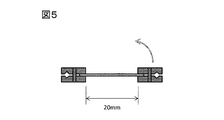
- both ends of the film were pinched and fixed so as to have a width of 20 mm.
- the sample held by the jig has a size of 5 mm ⁇ 20 mm ⁇ 0.1 mm. It was evaluated whether one of the jigs was lifted so that the film was vertical and could be moved to a position where tensile measurement was possible. The results are shown in Table 2. In Table 2, the case of being lifted to the vertical position is " ⁇ ", and the case of breaking before being lifted vertically is "X" (the same applies hereinafter).
- the polymer of Comparative Example 2 using 1,6-hexanediol as a monomer was easily broken at about 10 mm, and it was not possible to conduct tensile measurement.
- the film of Comparative Example 2 which has been cracked is considered to be the one in which the brittle fracture is dominant in the cross section where the fractured surface is cleaved.
- the other Examples 4 to 8 were all able to be lifted to 20 mm. However, since the film was brittle, it could not be measured until tensile measurement.
- Example 13 In Example 4, only octakisdimethylsiloxyoctasilsesquioxane (4.91 ⁇ 10 -4 mol) was used as a siloxane compound, but in Example 13, instead of octakisdimethylsiloxyoctasilsesquioxane. Using 0.25 g (2.46 ⁇ 10 -4 mol) of sun and 0.059 g (2.46 ⁇ 10 -4 mol) of 1,3,5,7-tetramethylcyclotetrasiloxane, the other procedure is carried out In the same manner as in Example 4, a film having a thickness of 100 ⁇ m was produced.
Landscapes
- Chemical & Material Sciences (AREA)
- Health & Medical Sciences (AREA)
- Chemical Kinetics & Catalysis (AREA)
- Medicinal Chemistry (AREA)
- Polymers & Plastics (AREA)
- Organic Chemistry (AREA)
- Silicon Polymers (AREA)
- Compositions Of Macromolecular Compounds (AREA)
- Led Device Packages (AREA)
Abstract
紫外から可視領域の光透過性に優れ、成形性に優れ、成形後の線膨張係数が低い樹脂組成物を提供する。 分子内に2以上のSiH基を持つかご型シルセスキオキサンと、分子内にヒドロキシル基を2以上持つモノマーとを脱水素触媒の存在下で共重合させる。モノマーは分子長がかご型シルセスキオキサンと同程度であることが好ましく、かご型シルセスキオキサンに対し、0.5当量以上用いる。モノマーの量を調整することで、組成物を成形品としたときの密度や脆性を調整することができる。
Description
本発明は、LED等の封止材料や光学材料などに好適な樹脂組成物に関し、特にポリシルセスキオキサン系化合物を含む樹脂組成物に関する。
従来、軽量化やコストの観点から各種の樹脂が光学材料として用いられている。例えば、樹脂レンズとして、軽量化やコストの観点からポリカーボネートやアクリル樹脂などの成形品が用いられている。またポリエステル(PET)、ポリエチレンナフタレート(PEN)などは、透明性を活かし光学フィルムや保護フィルムとして用いられている。さらにLED等の発光装置では、光取出しの向上のために樹脂封止剤が用いられ、その樹脂として耐熱性の優れるエポキシ樹脂が多用されている。
近年のLEDの高出力化に伴い、上記樹脂を用いた光学材料を高出力かつ高輝度のLEDに応用した場合、その光による熱エネルギー、光エネルギーによって急速に劣化が起き、製品寿命が短くなるという問題がある。このため光学材料として用いる樹脂には従来に増して耐光性の向上が求められている。
シリコーン樹脂には耐光性に優れるものもあるが、一般に線膨張係数が大きく、さらにヤング率が低く、弾性率も高いため光学レンズなどの成形品やフィルムには適さない。
一方、熱的・機械的特性の優れる機能性材料として、シルセスキオキサン(POSS)を用いた材料が開発されている(非特許文献1)。シルセスキオキサンは、主鎖骨格がSi-O結合からなるシロキサン系化合物で、骨格に種々の機能性基を導入することで、その機能を反映させた材料を得ることが期待されている。骨格の構造としては、かご型、ハシゴ型、ランダム型などの構造が知られており、非特許文献1にはかご型POSSを特定の触媒の存在下で水等と反応させることにより、ポリマー化することが記載されている。
また特許文献1、2には、R1SiO3/2を繰り返し単位とするハシゴ型ポリシルセスキオキサン或いはそれとシリコーンオリゴマーを含むLED封止用組成物が開示され、さらに特許文献3には、シルセスキオキサンとアルケニル基を含むオルガノポリシロキサンとの反応物である熱硬化型シリコーン樹脂が開示されており、この樹脂を半導体装置の封止材として用いることが記載されている。
J Sol-Gel Sci Technol DOI 10.1007/s10971-016-3998-z "Syntheses of cage octasilicate polymers"
樹脂を光学フィルムや光学レンズ等の成形品等として用いる場合、透明性や耐光性などの性質に加えて、樹脂の熱的形状安定性、例えば線膨張係数も重要な要素となる。熱的形状安定性は、単にそれ自体の形状安定性のみならず、接触する部材との熱膨張差が小さいことが要求される。例えば、実装基板等に用いられるエポキシ樹脂やポリカーボネート等の線膨張係数は100(×10-6/K)未満、封止材に封止される配線である金属(Cu等)の線膨張係数はさらに低い。これに対し封止材料の線膨張係数が大きく、実装基板との熱膨張差が大きいと熱履歴を受けることにより両者の間に剥がれやずれを生じやすくなる。
しかし例えば非特許文献1や特許文献1に記載された材料ではこれらの特性について考慮されていない。また特許文献1~3に記載されたオルガノポリシロキサンは、封止材料としての適用性はあるものの成形品やフィルムには適していない。
本発明は、光学特性や耐光性に優れ、且つ低線膨張係数を持つ新規な樹脂組成物を提供することを課題とする。
本発明は、分子内に2以上のSiH基を持つかご型シルセスキオキサンとヒドロキシル基を2以上持つモノマー分子とを脱水素反応させることで得られるポリマーが、紫外・可視領域での透過特性に優れ、且つ低線膨張係数であることを見出し、なされたものである。
すなわち本発明のポリシルセスキオキサン系化合物を含む組成物は、分子内に2以上のSiH基を持つかご型シルセスキオキサンとヒドロキシル基を2以上もつモノマー分子とを脱水素反応させることで得られる化合物を含む樹脂組成物である。
ヒドロキシル基を持つモノマーをシルセスキオキサンのSi-H基と反応させることで、シルセスキオキサンがモノマーを介してつながった共重合体を形成する。耐光性がありかつ耐熱性を持ち剛直なかご型シルセスキオキサンを用い、ポリマー分子内に取り込むことで、より多くの量の剛直構造を取り込み、ポリマーとしての耐熱性、耐光性、低熱膨張性の効果をえることができる。
かご型シルセスキオキサンを単にフィラーとしてポリマーに混ぜ込むだけでは、高濃度に添加することが難しく、溶媒やポリマーとの相溶性もあるため凝集により添加の効果が得られにくく、また屈折率差による散乱といった問題が起こりうるが、本発明はかご型シルセスキオキサンをポリマー化することで、このような問題を解決することができる。
またモノマーの分子構造は光学特性に影響を与えるが、本発明では、特定のモノマーを用いることで、光学材料に適した組成物を提供することができる。
以下、本発明の組成物とその製造方法の実施形態を説明する。
本発明の組成物は、主として、かご型シルセスキオキサンと分子中にヒドロキシル基を2以上もつモノマーとを脱水素反応により共重合したシルセスキオキサン系ポリマーを含み、脱水素反応の触媒や反応に使われなかったかご型シルセスキオキサンやモノマーの少量を含んでいてもよい。また未反応の官能基を終端させる終端剤を添加した場合には、終端剤を含んでいてもよい。
本発明の組成物は、主として、かご型シルセスキオキサンと分子中にヒドロキシル基を2以上もつモノマーとを脱水素反応により共重合したシルセスキオキサン系ポリマーを含み、脱水素反応の触媒や反応に使われなかったかご型シルセスキオキサンやモノマーの少量を含んでいてもよい。また未反応の官能基を終端させる終端剤を添加した場合には、終端剤を含んでいてもよい。
以下、本発明の組成物に含まれる化合物とその材料となる物質について説明する。
本発明で用いるかご型シルセスキオキサンは、基本構成単位が式(1)で表されるQ単位のシルセスキオキサンである。
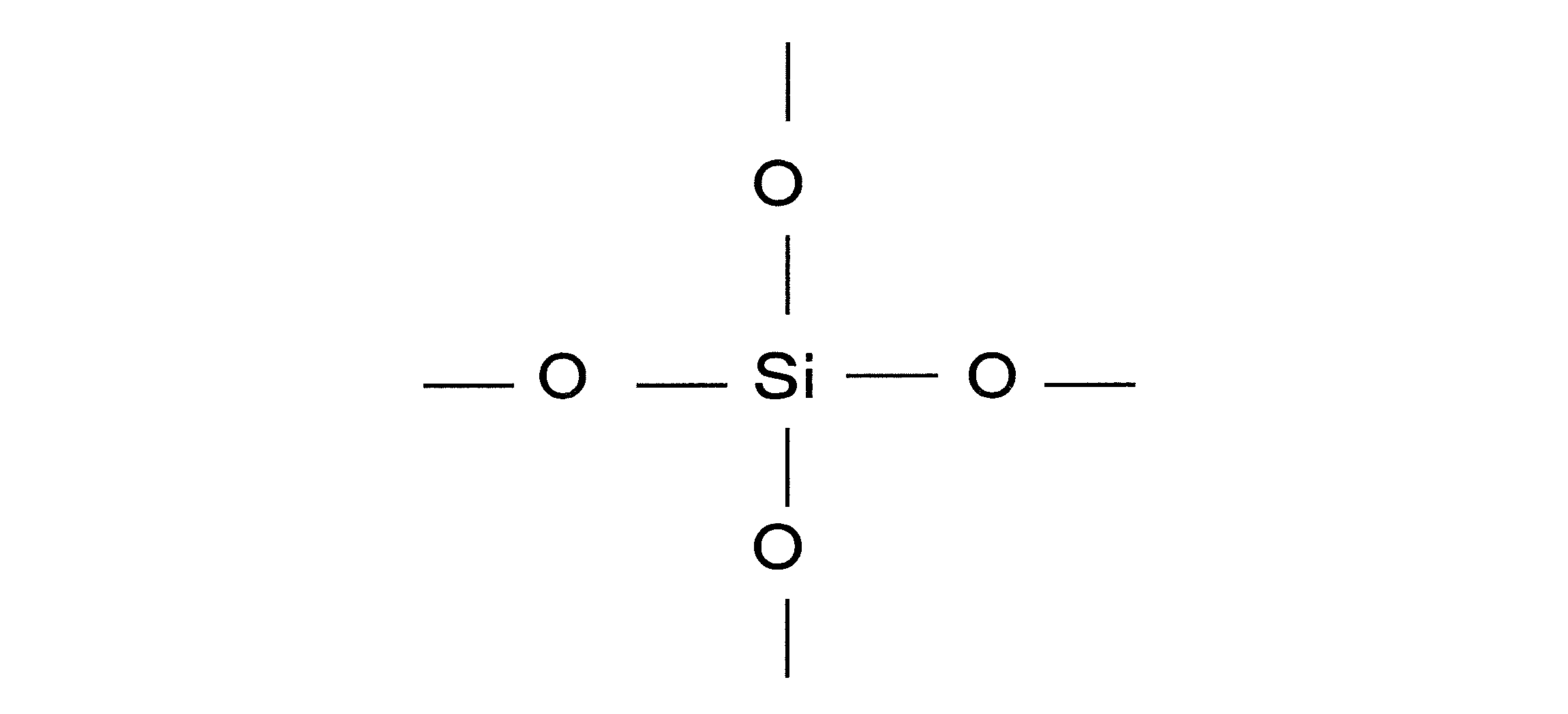
Q単位のシルセスキオキサンには、ブロックを構成するSi原子の数によって、Q8、Q10、Q12が知られており、これらのいずれを用いてもよい。以下の説明では、代表としてQ8を例に説明する。本発明で用いるQ8のシルセスキオキサンは、式(2)で表され、分子中にSi-H基を2つ以上有するものを用いる。
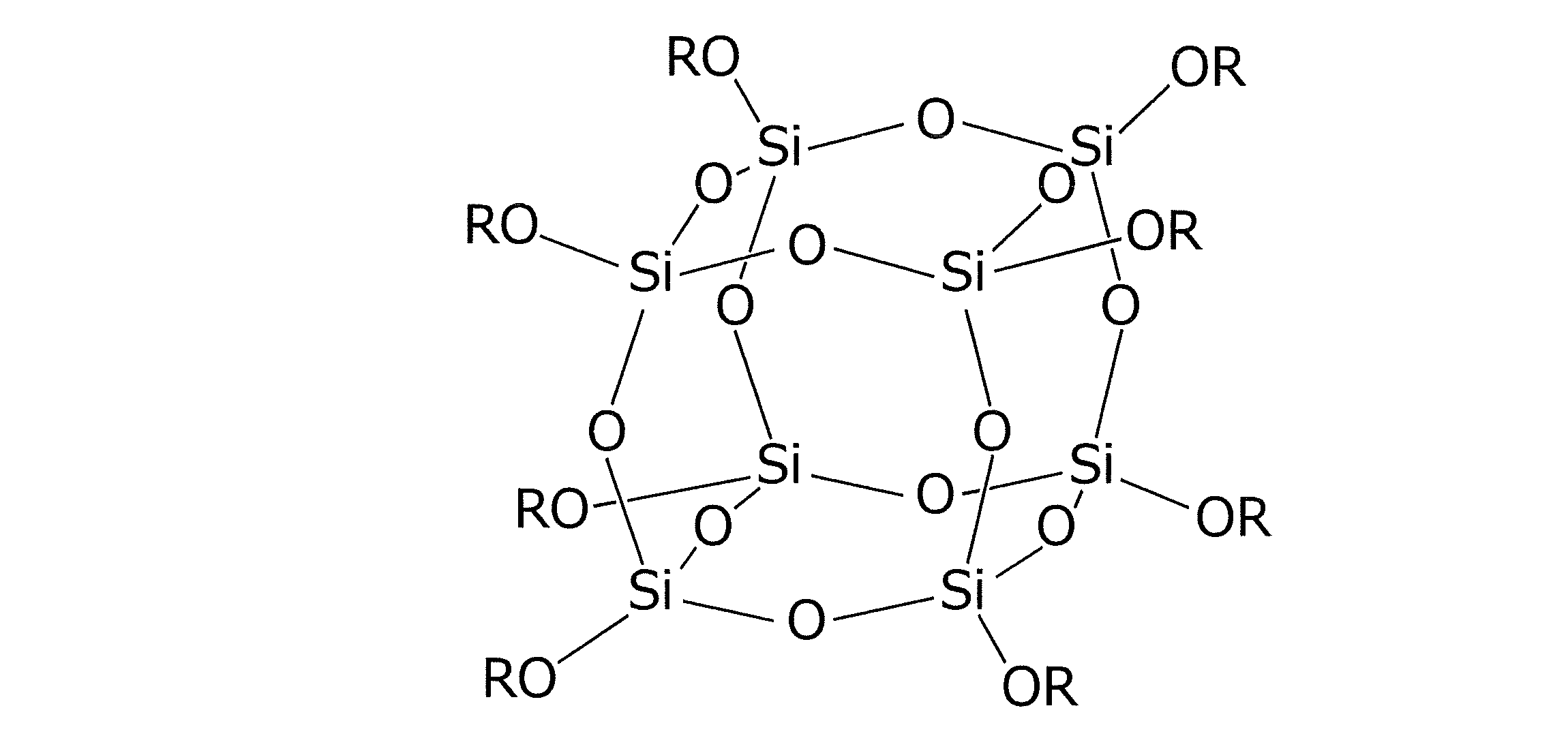
具体的には、オクタキスジメチルシロキシオクタシルセスキオキサン、オクタキスジエチルシロキシオクタシルセスキオキサン、オクタキスメチルエチルシロキシオクタシルセスキオキサンなどが挙げられる。
分子中にSi-H基が2つ以上存在することで、後述するジオールを介して、シルセスキオキサンと結合しポリマーを形成することができる。
なおシルセスキオキサンの一部を、シルセスキオキサン以外のシロキサンで置換してもよい。シルセスキオキサン以外のシロキサンとして、例えば、1,1,3,3-テトラメチルジシロキサン、1,1,3,3,5,5-ヘキサメチルトリシロキサン、1,3,5-トリメチルシクロトリシロキサン、2,4,6,8-テトラメチルシクロテトラシロキサン、2,4,6,8,10-ペンタメチルシクロペンタシロキサンなどが挙げられる。シルセスキオキサンの一部をこのようなシロキサンで置換することにより、組成物の脆性が強くなるのを抑制することができる。シルセスキオキサンを置換するシロキサンの量は、シルセスキオキサンに対するモル比で4以下、好ましくは1以下とする。
分子中にヒドロキシル基を2以上もつモノマーは、そのヒドロキシル基が上述したシルセスキオキサンのSiH基と脱水素結合して、ポリマー化するモノマーであり、具体的には1,4-ブタンジオール、2,3-ブタンジオール、1,6-ヘキサンジオール、1,10-デカンジオール、1,12-ドデカンジオール、1,16-ヘキサデカンジオール等の脂肪族系ジオール(アルカンジオール)、1,4-シクロヘキサンジオール、1,3-アダマンタンジオール等の脂環式ジオール、1,4-ジヒドロキシベンゼン、1,4-ベンゼンジメタノール、ビスフェノールM、ビスフェノールP、2,6-ナフタレンジオール等の芳香族系ジオール、シロキサン系ジオールなどのジオール類、さらに低分子量のポリエチレングリコール等のオリゴマーも用いることができる。ただし、ヒドロキシル基を2もつジオール類に限らず、トリオール類といった3以上もつモノマーでもよい。なお、水もジオールモノマーとして利用可能であるが、分子長が短いことから、ポリマーとして脆性の低い組成物が得られにくい。
このうち、特に直鎖炭素鎖のアルカンジオールは近紫外域での光の吸収が少なく、近紫外域での高い透過率を得ることができる。ただし直鎖炭素鎖のアルカンジオール以外のモノマーであっても、青色や紫外光の影響による劣化が少ない分子構造のモノマーであれば同様に高い透過率を実現できる。またこれらモノマーは分子中にフッ素を含有していてもよい。さらにモノマーに含む官能基(ヒドロキシル基)の数は2つ以上でもよい。
モノマーの分子構造や分子の長さは、生成するポリマーの熱膨張率及びポリマー密度に大きな影響を持つ。例えば、モノマーの分子長が長くなるほど、モノマーの影響により熱膨張係数が大きくなる。また、分子長が短いほど低熱膨張化しやすくなるが、シルセスキオキサンにより脆性が強くなる。アルカンジオールの場合、分子の長さを変えた際にドデカンジオールに相当する部分で最も熱膨張係数を下げることができる。これは、シルセスキオキサン(Q8)の分子長がドデカンジオール(炭素数12)に近いため、ポリマー分子が互いに密になっていることによる効果と思われる。
従ってモノマーはその分子長が、炭素数7~20、好適には炭素数10~16のアルカンジオールモノマーに相当する分子長であることが好ましい。
炭素数を7以上とすることにより、ポリマー化して得られる化合物の脆性が抑制され、成形品やフィルムに加工する際に割れたり、亀裂が入ったりすることがなく、また変形応力に対し強い耐性を示す。また炭素数を20以下とすることにより、熱的な形状安定性が増し、線膨張率係数を低く抑えることができる。
炭素数を7以上とすることにより、ポリマー化して得られる化合物の脆性が抑制され、成形品やフィルムに加工する際に割れたり、亀裂が入ったりすることがなく、また変形応力に対し強い耐性を示す。また炭素数を20以下とすることにより、熱的な形状安定性が増し、線膨張率係数を低く抑えることができる。
モノマーは、シルセスキオキサン1分子に対し、0.5当量以上が好ましい。モノマー分子の量を0.5当量以上とすることで、組成物中に単独で存在するモノマー分子やシルセスキオキサンを減らし、成型後に成形品やフィルムとしての形状を保つ組成物が得られる。但し、モノマーの量(モル比)が0.5未満では架橋が不足し、シルセスキオキサンが平均で2点以上架橋できない部分が多くなり、組成物の強度が低下する。また、モル比がより大きくなると、架橋密度は高くなるが組成物の脆性が強くなり、更に増えると未反応のヒドロキシ基をもつモノマーが増える。従ってモル比は0.5~n/2が好ましく、脆性を抑えるためには1~2が最も好ましい。
具体的には、シルセスキオキサン(SS)に対するモノマーのヒドロキシル基の比で、
SS:OH基=1:1~n
である。ここで、nはシルセスキオキサンのSiH基の数(但し、nは2以上でシルセスキオキサンの頂点の数以下の整数)である。
SS:OH基=1:1~n
である。ここで、nはシルセスキオキサンのSiH基の数(但し、nは2以上でシルセスキオキサンの頂点の数以下の整数)である。
また終端剤として、分子中にヒドロキシル基を1個持つアルコール等を添加する場合を考慮すると、
SS:OH基=1:1~(3/2)n 但し、(3/2)n≧n+2
である。好ましくは、SS:OH基=1:2~n+2、より好ましくはSS:OH基=1:2~4である。SS:OH基を1:2以上とすることにより、フィルムの架橋密度を上げ、熱的及び機械的特性を向上することができる。またSS:OH基を1:4以下とすることで、架橋密度が高すぎて脆性が強くなるのを防止することができる。
SS:OH基=1:1~(3/2)n 但し、(3/2)n≧n+2
である。好ましくは、SS:OH基=1:2~n+2、より好ましくはSS:OH基=1:2~4である。SS:OH基を1:2以上とすることにより、フィルムの架橋密度を上げ、熱的及び機械的特性を向上することができる。またSS:OH基を1:4以下とすることで、架橋密度が高すぎて脆性が強くなるのを防止することができる。
上述した範囲において、シルセスキオキサンに対するモノマーのモル比を調整することにより、架橋密度を調整することができ、それにより最終的な用途に合わせた組成物を得ることができる。
シルセスキオキサンとモノマー分子を脱水素反応させる触媒としては、ジエチルヒドロキシルアミン、白金系触媒など公知の脱水素反応触媒を用いることができる。組成物をそのまま例えば光学材料の封止材や成形品に利用する場合には、ジエチルヒドロキシルアミンが好適である。
脱水素反応において反応端であるヒドロキシル基を終端させるための終端剤としては、上述したモノマー分子と同様の骨格を有し官能基が1つのモノマーを用いてもよいし、メタノールやエタノールなどの分子量が比較的小さいアルコール類を用いてもよい。更には、1,1,1,3,3,3-ヘキサメチルジシラザンといったシラザン類を用いてもよい。なお終端剤は反応の最終段階で添加される。
次に本発明のシルセスキオキサンとモノマー分子との反応生成物であるポリマーを含む組成物の製造方法を説明する。
本発明の組成物は、上述したシルセスキオキサン及びモノマー分子を所定の割合で反応容器に投入するとともに脱水素反応触媒と溶媒を加え、加温下で撹拌しながら反応を行わせることにより製造する。
溶媒としては、シルセスキオキサン及びモノマー分子の少なくとも一方が溶解性を持つ溶媒であればよい。例えばシルセスキオキサンの溶解性が高い溶媒として、テトラヒドロフラン、トルエン、クロロホルムなどが挙げられる。
反応温度は反応溶媒の沸点より高い温度が好ましいが、テトラヒドロフランにおいては65~75℃が好ましく、また空気中の水分子と反応してしまうためAr等の不活性ガス雰囲気で行うことが好ましい。反応時間は特に限定されないが、1~100時間程度、保温と撹拌を継続することにより脱水素反応が進行する。反応は、一段階で行ってもよいし、多段階で行ってもよい。多段階の場合、第一段階の反応では投入すべきシルキオキサンの一部のみを反応させ、第一段階の反応終了後にシルセスキオキサンを追加投入する。
その後、終端剤を添加し、モノマー分子のヒドロキシル基を終端する。最後に必要に応じて溶媒を適宜、蒸発除去し、本発明の樹脂組成物を得る。
本発明の樹脂組成物の主な特性は、以下のとおりである。
300nm~380nmの紫外域の光透過率:90%以上
線膨張係数(硬化後):170ppm/K以下
なお光透過率は、本発明の樹脂組成物を厚み100μmのフィルムとしたときに、このフィルムを透過する光を分光光度計(島津製作所製:UV-3100)で測定した透過光スペクトル(250nm~800nm)から得た値である。また線膨張係数は、同フィルムを試料幅5mm、測定長20mmとして熱機械分析装置(島津製作所製:TMA-60)で測定した値である。
300nm~380nmの紫外域の光透過率:90%以上
線膨張係数(硬化後):170ppm/K以下
なお光透過率は、本発明の樹脂組成物を厚み100μmのフィルムとしたときに、このフィルムを透過する光を分光光度計(島津製作所製:UV-3100)で測定した透過光スペクトル(250nm~800nm)から得た値である。また線膨張係数は、同フィルムを試料幅5mm、測定長20mmとして熱機械分析装置(島津製作所製:TMA-60)で測定した値である。
このようにして得られる本発明の樹脂組成物は、溶媒を除去しない前の状態では、粘性のある液状であり、成形後溶媒を加熱除去することにより硬化し、例えば、図1(A)~(C)に示すような光学フィルム10や光学レンズ15に成形することができる。例えばフィルムの場合、溶媒除去前の組成物を基材11に塗布し、薄膜状にした後、加熱乾燥して溶媒を除去することでフィルムを製造することができる。このようなフィルムは、基材11に対する保護フィルムとして機能することも可能であるし(図1(A))、剥離性表面を持つ基材を用いた場合には、基材から剥離し、シルセスキオキサンのポリマーを主成分とするフィルム(図1(B))を得ることも可能である。
本発明のフィルム或いは光学レンズは、紫外域から可視光まで高い光透過率を有しているので、光の損失がなく、従来の光透過性材料と同様の用途に用いることができ、しかも耐熱性に優れ、高出力且つ高輝度LEDを光源とする光学装置に好適である。
また本発明の樹脂組成物は、粘度を調整し、LED等光学部品の封止材として用いることが可能である。例えば図2(A)に示すような発光装置20のLED素子21の封止材として用いることができる。この発光装置20は、基板25の上にLED素子21を搭載し、基板25に形成された電極パッドとLED素子21の電極とを金や銅などの金属製線材でボンディングし、LED素子21の周囲に光反射面を持つ壁部材23を配置した構造を持つ。壁部材23で囲まれた空間をポッティング等の手法により封止材22で充填した後、封止材22を硬化させる。封止材には、必要に応じて蛍光体粉末等の波長変換材料を含有せしめてもよい。
この発光装置20では、封止材22として用いた本発明のポリシルセスキオキサン含有組成物がLED素子の発光波長である紫外域の吸収がないので、LEDからの光を有効に利用することができる。また、ポリシルセスキオキサンの線膨張係数とワイヤボンディングの金属材料やLED発光素子の線膨張係数との差が小さいので、封止材の剥がれ落ちを抑制できる。
また図2(B)に示すように、LED素子21の上を蛍光体板24などで覆った形状の発光装置200では、壁部材23と蛍光体板24とを接着する接着剤26として、本発明のポリシルセスキオキサン含有組成物を用いることも可能である。なお図2に示す発光装置は、それぞれ一例であって、本発明の樹脂組成物は種々の形態の発光装置において封止材や接着剤として用いることができる。
また図2(B)に示すように、LED素子21の上を蛍光体板24などで覆った形状の発光装置200では、壁部材23と蛍光体板24とを接着する接着剤26として、本発明のポリシルセスキオキサン含有組成物を用いることも可能である。なお図2に示す発光装置は、それぞれ一例であって、本発明の樹脂組成物は種々の形態の発光装置において封止材や接着剤として用いることができる。
さらに本発明の樹脂組成物は、低線膨張係数の特性を生かし、上述した用途の他に、実装基材や実装基材を覆う絶縁コーティング材料、塗料など従来の樹脂に代わる材料として使用することができる。またその用途に応じて、種々の添加物や顔料などを加えて利用することが可能である。
<実施例1>
50mLの二口ナスフラスコに、オクタキスジメチルシロキシオクタシルセスキオキサン0.5g(4.91×10⁻⁴モル)、1,10-デカンジオール0.175g(9.82×10⁻⁴モル)、及び溶媒としてテトラヒドロフラン5mLを投入した。二口ナスフラスコに冷却管とArガス導入管を接続しAr環境下にて圧力を大気圧に保ち、二口ナスフラスコをオイルバスにて70℃に温め、撹拌子にてスターラーで700rpmで保温、撹拌を実施した。保温と撹拌が定常状態に達した後、触媒としてジエチルヒドロキシルアミンを25μL(2.44×10⁻⁴モル)投入し、1時間反応させた。その後、上記と同量のオクタキスジメチルシロキシオクタシルセスキオキサン、テトラヒドロフラン、及びジエチルヒドロキシルアミンを投入し、更に2時間反応させた。反応後、ロータリーエバポレーターにて濃縮を行い、濃縮液を基材(PTFEフィルム:厚さ0.1mm)に塗布し、バーコーターにて厚みが一定になるよう薄膜状に広げ、150℃まで昇温し90分間放置し、厚み100μmのフィルムを作成した。
50mLの二口ナスフラスコに、オクタキスジメチルシロキシオクタシルセスキオキサン0.5g(4.91×10⁻⁴モル)、1,10-デカンジオール0.175g(9.82×10⁻⁴モル)、及び溶媒としてテトラヒドロフラン5mLを投入した。二口ナスフラスコに冷却管とArガス導入管を接続しAr環境下にて圧力を大気圧に保ち、二口ナスフラスコをオイルバスにて70℃に温め、撹拌子にてスターラーで700rpmで保温、撹拌を実施した。保温と撹拌が定常状態に達した後、触媒としてジエチルヒドロキシルアミンを25μL(2.44×10⁻⁴モル)投入し、1時間反応させた。その後、上記と同量のオクタキスジメチルシロキシオクタシルセスキオキサン、テトラヒドロフラン、及びジエチルヒドロキシルアミンを投入し、更に2時間反応させた。反応後、ロータリーエバポレーターにて濃縮を行い、濃縮液を基材(PTFEフィルム:厚さ0.1mm)に塗布し、バーコーターにて厚みが一定になるよう薄膜状に広げ、150℃まで昇温し90分間放置し、厚み100μmのフィルムを作成した。
<実施例2、3、比較例1>
実施例1の1,10-デカンジオールの代わりに、表1のアルカンジオールモノマー(9.82×10⁻⁴モル)を用い、モノマーに応じて、触媒であるジエチルヒドロキシルアミンの量を表1記載のように変えて、それ以外は実施例1と同様にして、厚み100μmのフィルムを作成した。

実施例1の1,10-デカンジオールの代わりに、表1のアルカンジオールモノマー(9.82×10⁻⁴モル)を用い、モノマーに応じて、触媒であるジエチルヒドロキシルアミンの量を表1記載のように変えて、それ以外は実施例1と同様にして、厚み100μmのフィルムを作成した。
[線膨張係数の測定]
実施例1~3のフィルムに対し、熱機械分析装置(島津製作所製:TMA-60)を用いて線膨張係数を測定した。結果を図3のグラフに示す。同グラフにおいて横軸はアルカンジオールモノマーの炭素数、縦軸は線膨張係数(ppm/K)である。
実施例1~3のフィルムに対し、熱機械分析装置(島津製作所製:TMA-60)を用いて線膨張係数を測定した。結果を図3のグラフに示す。同グラフにおいて横軸はアルカンジオールモノマーの炭素数、縦軸は線膨張係数(ppm/K)である。
このグラフからわかるように、実施例1~3の線膨張係数はいずれも170ppm/K以下の値を示し、一般的なシリコーン樹脂の線膨張係数250~400ppm/Kに比べ十分低い線膨張係数であった。また本来は、炭素数が長くなるほど直鎖分子部分の分子運動がしやすく、線膨張係数が増加をすると考えられるが、このシルセスキオキサンポリマーでは、炭素数12の1,12―ドデカンジオールとシルセスキオキサンとの共重合体において最も線膨張係数が低下した。これは、線膨張係数にはシルセスキオキサンの大きさも影響しており、シルセスキオキサンと同等の分子長であるジオールモノマーを用いることで、線膨張係数の増大を抑制できるためと考えられる。なお炭素数6の1,6-ヘキサンジオールを用いた比較例1のポリマーは脆性が強く、フィルム状に成形するとガラスライクな性質が強く、フィルムの線膨張係数を測ることができなかった。これはジオールモノマーの分子長が短いほど、シルセスキオキサンの性質が強くなり、脆性が強くなるためと考えられる。
<実施例4>
50mLの二口ナスフラスコに、オクタキスジメチルシロキシオクタシルセスキオキサン0.5g(4.91×10⁻⁴モル)、1,10-デカンジオール0.175g(9.82×10⁻⁴モル、オクタキスジメチルシロキシオクタシルセスキオキサンに対するモル比(以下単にモル比という)=2)、及びテトラヒドロフラン5mLを投入した。二口ナスフラスコに冷却管とArガス導入管を接続しAr環境下にて圧力を大気圧に保ち、二口ナスフラスコをオイルバスにて70℃に温め、撹拌子にてスターラーで700rpmで保温、撹拌を実施した。保温と撹拌が定常状態に達した後、触媒としてジエチルヒドロキシルアミンを5μL(4.89×10⁻⁵モル)投入し、6時間反応させた。6時間反応させた後に、上記と同量のオクタキスジメチルシロキシオクタシルセスキオキサン)とテトラヒドロフラン、及びジエチルヒドロキシルアミンを投入し、更に12時間反応させた。反応後、ロータリーエバポレーターにて濃縮を行い、濃縮液を基材(PTFEフィルム:厚さ0.1mm)に塗布し、バーコーターにて厚みが一定になるよう薄膜状に広げ、150℃まで昇温し90分間放置し、厚み100μmのフィルムを作成した。
50mLの二口ナスフラスコに、オクタキスジメチルシロキシオクタシルセスキオキサン0.5g(4.91×10⁻⁴モル)、1,10-デカンジオール0.175g(9.82×10⁻⁴モル、オクタキスジメチルシロキシオクタシルセスキオキサンに対するモル比(以下単にモル比という)=2)、及びテトラヒドロフラン5mLを投入した。二口ナスフラスコに冷却管とArガス導入管を接続しAr環境下にて圧力を大気圧に保ち、二口ナスフラスコをオイルバスにて70℃に温め、撹拌子にてスターラーで700rpmで保温、撹拌を実施した。保温と撹拌が定常状態に達した後、触媒としてジエチルヒドロキシルアミンを5μL(4.89×10⁻⁵モル)投入し、6時間反応させた。6時間反応させた後に、上記と同量のオクタキスジメチルシロキシオクタシルセスキオキサン)とテトラヒドロフラン、及びジエチルヒドロキシルアミンを投入し、更に12時間反応させた。反応後、ロータリーエバポレーターにて濃縮を行い、濃縮液を基材(PTFEフィルム:厚さ0.1mm)に塗布し、バーコーターにて厚みが一定になるよう薄膜状に広げ、150℃まで昇温し90分間放置し、厚み100μmのフィルムを作成した。
<実施例5~8、比較例2>
実施例4の1,10-デカンジオールの代わりに、表2のアルカンジオールモノマー(9.82×10⁻⁴モル)を用い、モノマーに応じて、触媒であるジエチルヒドロキシルアミンの量を表2記載のように変えて、それ以外は実施例4と同様にして、厚み100μmのフィルムを作成した。
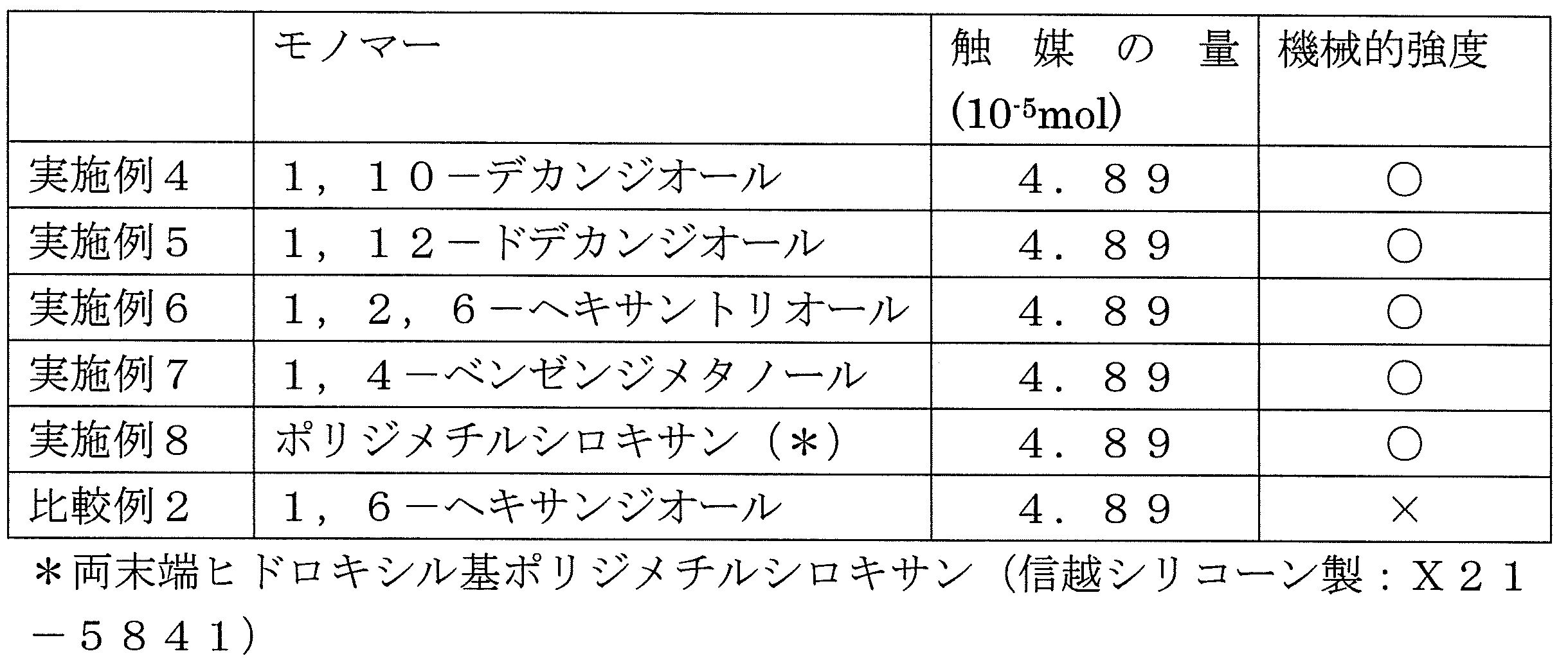
実施例4の1,10-デカンジオールの代わりに、表2のアルカンジオールモノマー(9.82×10⁻⁴モル)を用い、モノマーに応じて、触媒であるジエチルヒドロキシルアミンの量を表2記載のように変えて、それ以外は実施例4と同様にして、厚み100μmのフィルムを作成した。
[透過スペクトルの測定]
得られたフィルムの透過率スペクトルを分光光度計(島津製作所製:UV-3100)により測定した。結果を図4に示す。図4のスペクトルからわかるように、実施例4~8のフィルムは、いずれも380nm以下の紫外域において250nmまで高い透過率を得ることができた。またモノマーの炭素数の違いによる吸収波長帯の変化はほとんどなく、ベンゼン環を含むベンゼンジメタノールを用いた実施例7においてはベンゼン環を含むにも関わらず一定の紫外域においても高い透過率をもつ組成物を得ることができた。さらにヒドロキシ基を3つ持つアルカントリオールを用いた実施例6においても、アルカンジオールと変わらない透過率をもつ組成物を得ることができた。また、直鎖シロキサン構造をもつモノマーを用いた実施例8においてもシロキサン由来の紫外域における高い透過率を得ることができた。このように直鎖のアルカンジオール、トリオールを用いた場合にもシロキサンと変わらない高い透過率を得ることが確認された。
得られたフィルムの透過率スペクトルを分光光度計(島津製作所製:UV-3100)により測定した。結果を図4に示す。図4のスペクトルからわかるように、実施例4~8のフィルムは、いずれも380nm以下の紫外域において250nmまで高い透過率を得ることができた。またモノマーの炭素数の違いによる吸収波長帯の変化はほとんどなく、ベンゼン環を含むベンゼンジメタノールを用いた実施例7においてはベンゼン環を含むにも関わらず一定の紫外域においても高い透過率をもつ組成物を得ることができた。さらにヒドロキシ基を3つ持つアルカントリオールを用いた実施例6においても、アルカンジオールと変わらない透過率をもつ組成物を得ることができた。また、直鎖シロキサン構造をもつモノマーを用いた実施例8においてもシロキサン由来の紫外域における高い透過率を得ることができた。このように直鎖のアルカンジオール、トリオールを用いた場合にもシロキサンと変わらない高い透過率を得ることが確認された。
[機械的強度の測定]
実施例4~実施例8及び比較例2の各フィルムについて、以下の方法で機械的強度(脆性)を評価した。
実施例4~実施例8及び比較例2の各フィルムについて、以下の方法で機械的強度(脆性)を評価した。
線膨張係数の測定に使用した金属固定治具を用い、図5に示すようにフィルム両端をつまみ幅が20mmになるように固定した。治具で挟まれた試料は5mm×20mm×0.1mmの大きさとなる。フィルムが垂直になるように片方の治具を持ち上げ、引張測定が可能な位置に移動できるかを評価した。結果を表2に示す。表2において、垂直な位置に持ち上げられた場合を「○」、垂直に持ち上げる前に割れた場合を「×」とした(以下、同じ)。
表2に示すように、モノマーとして1,6-ヘキサンジオールを用いた比較例2のポリマーは10mm程度で簡単に割れてしまい、引張測定を実施することができなかった。割れた比較例2のフィルムは破断面が劈開されたような断面で脆性破壊が優位なものと考えられる。他の実施例4~実施例8は、いずれも20mmまで持ち上げることができた。但し、フィルムが脆性を持っているため引張測定までは実施できなかった。
<実施例9~実施例12、参考例3>
モノマーの量や種類を表3のように変更し、それ以外は実施例4と同様にして厚み100μmのフィルムを作成した。

モノマーの量や種類を表3のように変更し、それ以外は実施例4と同様にして厚み100μmのフィルムを作成した。
[透過スペクトルの測定]
実施例9~実施例12のフィルムについても実施例4と同様に透過率スペクトルを測定し。結果を、比較例2の結果と共に図6に示す。図6のスペクトルからわかるように、実施例9~12のフィルムは、いずれも380nm以下の紫外域において250nmまで高い透過率を得ることができた。
実施例9~実施例12のフィルムについても実施例4と同様に透過率スペクトルを測定し。結果を、比較例2の結果と共に図6に示す。図6のスペクトルからわかるように、実施例9~12のフィルムは、いずれも380nm以下の紫外域において250nmまで高い透過率を得ることができた。
[機械的強度の測定]
実施例9~実施例12の各フィルムについて、機械的強度(脆性)を実施例4と同様の方法で測定した。その結果を表3に示す。モノマー量が5×10⁻⁴モルに満たない参考例3のフィルムでは、ポリマーの架橋密度が低いためフィルムそのものの引張強度が低いため、フィルムには適していないことがわかった。但し、フィルム以外の用途に適用することは可能である。
実施例9~実施例12の各フィルムについて、機械的強度(脆性)を実施例4と同様の方法で測定した。その結果を表3に示す。モノマー量が5×10⁻⁴モルに満たない参考例3のフィルムでは、ポリマーの架橋密度が低いためフィルムそのものの引張強度が低いため、フィルムには適していないことがわかった。但し、フィルム以外の用途に適用することは可能である。
<実施例13>
実施例4では、シロキサン化合物としてオクタキスジメチルシロキシオクタシルセスキオキサン(4.91×10⁻⁴モル)のみを用いたが、実施例13では、その代わりに、オクタキスジメチルシロキシオクタシルセスキオキサン0.25g(2.46×10⁻⁴モル)と1,3,5,7-テトラメチルシクロテトラシロキサン0.059g(2.46××10-4モル)とを用い、それ以外は実施例4と同様にして厚み100μmのフィルムを作成した。
実施例4では、シロキサン化合物としてオクタキスジメチルシロキシオクタシルセスキオキサン(4.91×10⁻⁴モル)のみを用いたが、実施例13では、その代わりに、オクタキスジメチルシロキシオクタシルセスキオキサン0.25g(2.46×10⁻⁴モル)と1,3,5,7-テトラメチルシクロテトラシロキサン0.059g(2.46××10-4モル)とを用い、それ以外は実施例4と同様にして厚み100μmのフィルムを作成した。
[透過スペクトルの測定]
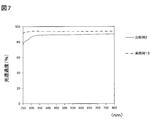
得られたフィルムの透過率スペクトルを測定した。結果を、比較例2の結果と共に図7に示す。図7のスペクトルからわかるように、実施例13のフィルムは、いずれも380nm以下の紫外域において250nmまで高い透過率を得ることができた。シルセスキオキサンの一部代替としてシロキサン構造をもつ環状シロキサンモノマーを導入しても、シロキサン由来の紫外域における高い透過率を得ることができた。このようにシルセスキオキサンの一部代替としてシロキサン構造を導入した場合にも高い透過率を得ることが確認された。
得られたフィルムの透過率スペクトルを測定した。結果を、比較例2の結果と共に図7に示す。図7のスペクトルからわかるように、実施例13のフィルムは、いずれも380nm以下の紫外域において250nmまで高い透過率を得ることができた。シルセスキオキサンの一部代替としてシロキサン構造をもつ環状シロキサンモノマーを導入しても、シロキサン由来の紫外域における高い透過率を得ることができた。このようにシルセスキオキサンの一部代替としてシロキサン構造を導入した場合にも高い透過率を得ることが確認された。
[機械的強度の測定]
シルセスキオキサンの一部代替としてシロキサン構造をもつ環状シロキサンモノマーを導入した場合の機械的強度(脆性)を実施例4と同様の方法で測定した。その結果、割れることなく20mmまで持ち上げることができた。シルセスキオキサンの一部をシロキサン構造に置き換えることで、フィルムとして曲げ耐性が向上していることが確認された。但し、フィルムが脆性を持っているため引張測定までは実施できなかった。
シルセスキオキサンの一部代替としてシロキサン構造をもつ環状シロキサンモノマーを導入した場合の機械的強度(脆性)を実施例4と同様の方法で測定した。その結果、割れることなく20mmまで持ち上げることができた。シルセスキオキサンの一部をシロキサン構造に置き換えることで、フィルムとして曲げ耐性が向上していることが確認された。但し、フィルムが脆性を持っているため引張測定までは実施できなかった。
10・・・フィルム、15・・・光学レンズ、20・・・発光装置、21・・・LED素子、22・・・封止剤、23・・・壁部材、25・・・基板、26・・・接着剤
Claims (11)
- 分子内に2以上のSiH基を持つかご型シルセスキオキサンと、分子内にヒドロキシル基を2以上持つモノマーとを共重合させてなるポリシルセスキオキサン系化合物を含む組成物。
- 請求項1記載の組成物であって、
前記モノマーが、炭素数7以上20以下のアルカンジオールであることを特徴とする組成物。 - 請求項1又は2に記載の組成物であって、
前記モノマーが、複数種のモノマーからなることを特徴とする組成物。 - 請求項1ないし3のいずれか一項に記載の組成物であって、
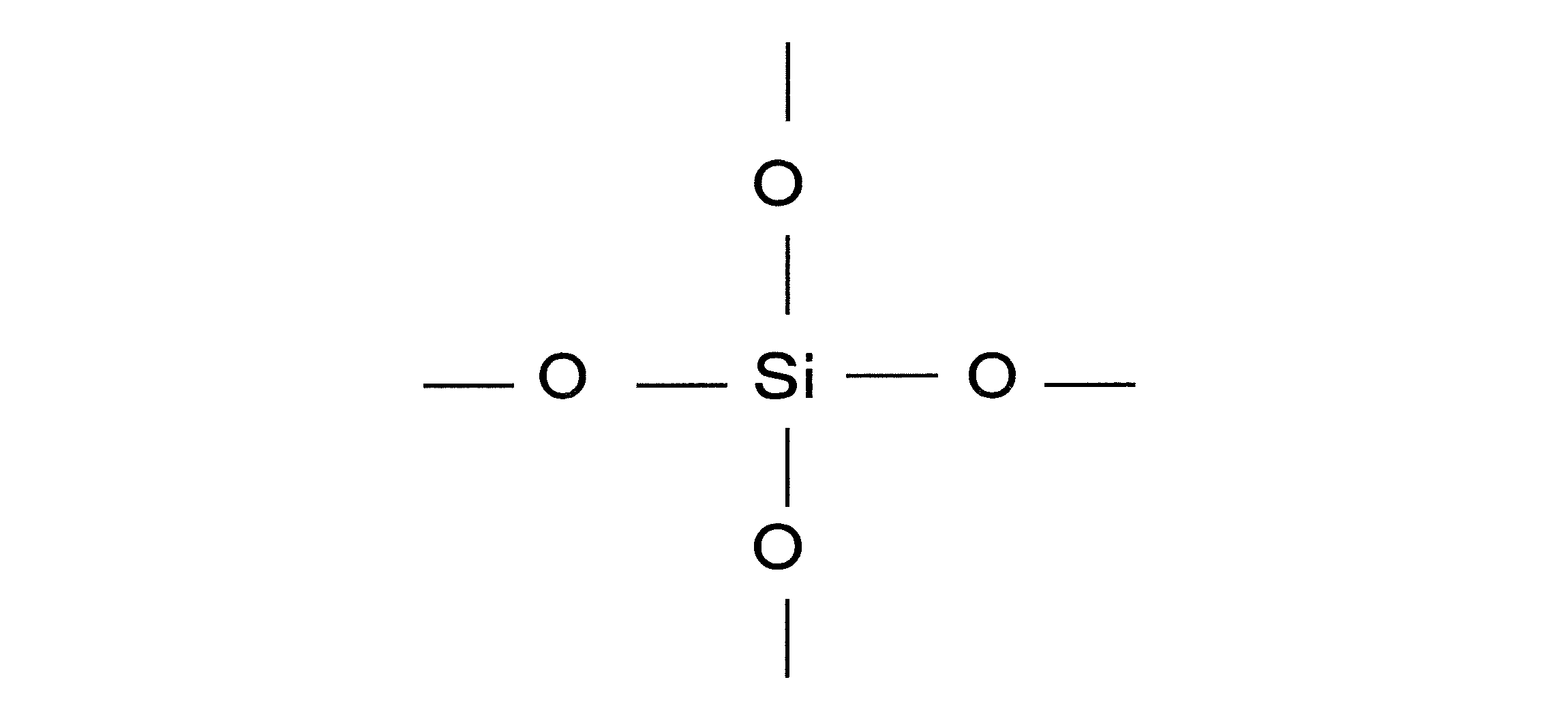
前記かご型シルセスキオキサンが、式(1)の構造単位を持つシルセスキオキサンであることを特徴とする組成物。
- 請求項1ないし4のいずれか一項に記載の組成物であって、
前記かご型シルセスキオキサンと前記モノマーのヒドロキシル基とのモル比は、前記かご型シルセスキオキサンのSiH基の数をn(但し、nはかご型シルセスキオキサンの頂点の数をmとするとき、2≦n≦mを満たす数である)とするとき、1:1~1.5nであることを特徴とする組成物。 - 分子内に2以上のSiH基を持つかご型シルセスキオキサンと、分子内にヒドロキシル基を2以上持つモノマーとを所定のモル比に調整し、前記シルセスキオキサン及び前記モノマーの少なくとも一方が溶解性を持つ溶媒中に混合拡散し、脱水素触媒の存在下で脱水素反応させて共重合するステップを含むポリシルセスキオキサン系化合物の製造方法。
- 請求項6に記載のポリシルセスキオキサン系化合物の製造方法であって、
製造に用いる前記シルセスキオキサンの量より少ない量の前記シルセスキオキサンと、前記モノマーとを、脱水素触媒の存在下で脱水素反応させる第一のステップと、
前記第一のステップの後に、前記シルセスキオキサンの残量と溶媒及び脱水素触媒とを追加して、さらに脱水素反応を進行させて共重合するステップと、を含むポリシルセスキオキサン系化合物の製造方法。 - 請求項6又は7に記載のポリシルセスキオキサン系化合物の製造方法であって、
反応終了前後において、前記シルセスキオキサンの未反応のSiH基を終端する終端剤を添加するステップをさらに含むことを特徴とするポリシルセスキオキサン系化合物の製造方法。 - 請求項6ないし8のいずれか一項に記載のポリシルセスキオキサン系化合物の製造方法であって、
反応終了前後において、前記モノマーの未反応のヒドロキシル基を終端する終端剤を添加するステップをさらに含むことを特徴とするポリシルセスキオキサン系化合物の製造方法。 - 請求項1ないし5のいずれか一項に記載の組成物を成形してなるフィルム。
- 発光素子を封止する封止材であって、請求項1ないし5のいずれか一項に記載の組成物からなる封止材。
Applications Claiming Priority (2)
| Application Number | Priority Date | Filing Date | Title |
|---|---|---|---|
| JP2017-141907 | 2017-07-21 | ||
| JP2017141907A JP2019019287A (ja) | 2017-07-21 | 2017-07-21 | ポリシルセスキオキサン系化合物を含む組成物、その製造方法、並びに当該組成物を含む封止材及びフィルム |
Publications (1)
| Publication Number | Publication Date |
|---|---|
| WO2019017332A1 true WO2019017332A1 (ja) | 2019-01-24 |
Family
ID=65015953
Family Applications (1)
| Application Number | Title | Priority Date | Filing Date |
|---|---|---|---|
| PCT/JP2018/026717 Ceased WO2019017332A1 (ja) | 2017-07-21 | 2018-07-17 | ポリシルセスキオキサン系化合物を含む組成物、その製造方法、並びに当該組成物を含む封止材及びフィルム |
Country Status (2)
| Country | Link |
|---|---|
| JP (1) | JP2019019287A (ja) |
| WO (1) | WO2019017332A1 (ja) |
Citations (2)
| Publication number | Priority date | Publication date | Assignee | Title |
|---|---|---|---|---|
| JP2002069191A (ja) * | 2000-08-31 | 2002-03-08 | Dow Corning Asia Ltd | 水素化オクタシルセスキオキサン−水酸基含有化合物共重合体の製造方法 |
| JP2007291273A (ja) * | 2006-04-26 | 2007-11-08 | Asahi Kasei Corp | 封止材用組成物及び光学デバイス |
-
2017
- 2017-07-21 JP JP2017141907A patent/JP2019019287A/ja active Pending
-
2018
- 2018-07-17 WO PCT/JP2018/026717 patent/WO2019017332A1/ja not_active Ceased
Patent Citations (2)
| Publication number | Priority date | Publication date | Assignee | Title |
|---|---|---|---|---|
| JP2002069191A (ja) * | 2000-08-31 | 2002-03-08 | Dow Corning Asia Ltd | 水素化オクタシルセスキオキサン−水酸基含有化合物共重合体の製造方法 |
| JP2007291273A (ja) * | 2006-04-26 | 2007-11-08 | Asahi Kasei Corp | 封止材用組成物及び光学デバイス |
Non-Patent Citations (1)
| Title |
|---|
| GUNJI TAKAHIRO: "Synthesis of Element-block Polymers from POSS Based on the Solgel Method", CERAMICS JAPAN, vol. 51, no. 11, 1 November 2016 (2016-11-01), pages 765 - 769 * |
Also Published As
| Publication number | Publication date |
|---|---|
| JP2019019287A (ja) | 2019-02-07 |
Similar Documents
| Publication | Publication Date | Title |
|---|---|---|
| CN102892812B (zh) | 液状有机硅化合物、热硬化性树脂组成物及其使用 | |
| EP1947128B1 (en) | Thermosetting resin composition and photosemiconductor encapsulation material | |
| JP5247979B2 (ja) | 透明な硬化物を与えるポリオルガノシロキサン組成物 | |
| US9453105B2 (en) | Epoxy and alkoxysilyl group-containing silsesquioxane and composition thereof | |
| TWI470006B (zh) | 有機矽化合物、含有該有機矽化合物的熱硬化性組成物及光半導體用密封材料 | |
| CN104204862B (zh) | 光导及相关光组件 | |
| EP1801163B1 (en) | Siloxane Encapsulants | |
| TW201533168A (zh) | 聚矽氧凝膠組合物 | |
| CN104204022A (zh) | 固化性环氧树脂组合物 | |
| WO2010090280A1 (ja) | 透明封止材組成物および光半導体素子 | |
| WO2019163686A1 (ja) | 液状有機ケイ素化合物、およびそれを配合した熱硬化性樹脂組成物 | |
| CN117384483A (zh) | 缩合硬化型树脂组合物、硬化物、成形体、及半导体装置 | |
| TW201930474A (zh) | 加成硬化型聚矽氧組成物、硬化物、光學元件 | |
| CN112218912A (zh) | 硅酮固化物的制备方法、硅酮固化物及光学用部件 | |
| CN110835516A (zh) | 固化性组合物、该组合物的固化物及使用了该固化物的半导体装置 | |
| JP7146643B2 (ja) | 硬化性エポキシ樹脂組成物 | |
| TW201641541A (zh) | 有機聚矽氧烷、其製造方法、及硬化性聚矽氧組合物 | |
| JP7158100B2 (ja) | 架橋性オルガノポリシロキサン組成物、その硬化物及びled装置 | |
| CN112898780A (zh) | 具阻水气特性的硅胶薄膜 | |
| TW202000746A (zh) | 矽氧烷聚合物交聯硬化物 | |
| TW201605934A (zh) | 有機聚矽氧烷及其製造方法 | |
| JP7261054B2 (ja) | フッ素含有縮合型オルガノポリシロキサンプレポリマーおよびその硬化体 | |
| WO2019017332A1 (ja) | ポリシルセスキオキサン系化合物を含む組成物、その製造方法、並びに当該組成物を含む封止材及びフィルム | |
| CN112898781A (zh) | 具阻水气特性的硅胶薄膜 | |
| JP6766334B2 (ja) | 有機ケイ素化合物、該有機ケイ素化合物を含む熱硬化性組成物、および光半導体用封止材料 |
Legal Events
| Date | Code | Title | Description |
|---|---|---|---|
| 121 | Ep: the epo has been informed by wipo that ep was designated in this application |
Ref document number: 18834805 Country of ref document: EP Kind code of ref document: A1 |
|
| NENP | Non-entry into the national phase |
Ref country code: DE |
|
| 122 | Ep: pct application non-entry in european phase |
Ref document number: 18834805 Country of ref document: EP Kind code of ref document: A1 |