WO2018199157A1 - マレイミド樹脂組成物、プリプレグ及びその硬化物 - Google Patents
マレイミド樹脂組成物、プリプレグ及びその硬化物 Download PDFInfo
- Publication number
- WO2018199157A1 WO2018199157A1 PCT/JP2018/016785 JP2018016785W WO2018199157A1 WO 2018199157 A1 WO2018199157 A1 WO 2018199157A1 JP 2018016785 W JP2018016785 W JP 2018016785W WO 2018199157 A1 WO2018199157 A1 WO 2018199157A1
- Authority
- WO
- WIPO (PCT)
- Prior art keywords
- group
- mass
- maleimide resin
- parts
- resin composition
- Prior art date
- Legal status (The legal status is an assumption and is not a legal conclusion. Google has not performed a legal analysis and makes no representation as to the accuracy of the status listed.)
- Ceased
Links
Classifications
-
- C—CHEMISTRY; METALLURGY
- C08—ORGANIC MACROMOLECULAR COMPOUNDS; THEIR PREPARATION OR CHEMICAL WORKING-UP; COMPOSITIONS BASED THEREON
- C08L—COMPOSITIONS OF MACROMOLECULAR COMPOUNDS
- C08L79/00—Compositions of macromolecular compounds obtained by reactions forming in the main chain of the macromolecule a linkage containing nitrogen with or without oxygen or carbon only, not provided for in groups C08L61/00 - C08L77/00
- C08L79/04—Polycondensates having nitrogen-containing heterocyclic rings in the main chain; Polyhydrazides; Polyamide acids or similar polyimide precursors
- C08L79/08—Polyimides; Polyester-imides; Polyamide-imides; Polyamide acids or similar polyimide precursors
- C08L79/085—Unsaturated polyimide precursors
-
- C—CHEMISTRY; METALLURGY
- C08—ORGANIC MACROMOLECULAR COMPOUNDS; THEIR PREPARATION OR CHEMICAL WORKING-UP; COMPOSITIONS BASED THEREON
- C08F—MACROMOLECULAR COMPOUNDS OBTAINED BY REACTIONS ONLY INVOLVING CARBON-TO-CARBON UNSATURATED BONDS
- C08F222/00—Copolymers of compounds having one or more unsaturated aliphatic radicals, each having only one carbon-to-carbon double bond, and at least one being terminated by a carboxyl radical and containing at least one other carboxyl radical in the molecule; Salts, anhydrides, esters, amides, imides, or nitriles thereof
- C08F222/36—Amides or imides
- C08F222/40—Imides, e.g. cyclic imides
- C08F222/404—Imides, e.g. cyclic imides substituted imides comprising oxygen other than the carboxy oxygen
-
- C—CHEMISTRY; METALLURGY
- C08—ORGANIC MACROMOLECULAR COMPOUNDS; THEIR PREPARATION OR CHEMICAL WORKING-UP; COMPOSITIONS BASED THEREON
- C08F—MACROMOLECULAR COMPOUNDS OBTAINED BY REACTIONS ONLY INVOLVING CARBON-TO-CARBON UNSATURATED BONDS
- C08F216/00—Copolymers of compounds having one or more unsaturated aliphatic radicals, each having only one carbon-to-carbon double bond, and at least one being terminated by an alcohol, ether, aldehydo, ketonic, acetal or ketal radical
- C08F216/12—Copolymers of compounds having one or more unsaturated aliphatic radicals, each having only one carbon-to-carbon double bond, and at least one being terminated by an alcohol, ether, aldehydo, ketonic, acetal or ketal radical by an ether radical
-
- C—CHEMISTRY; METALLURGY
- C08—ORGANIC MACROMOLECULAR COMPOUNDS; THEIR PREPARATION OR CHEMICAL WORKING-UP; COMPOSITIONS BASED THEREON
- C08G—MACROMOLECULAR COMPOUNDS OBTAINED OTHERWISE THAN BY REACTIONS ONLY INVOLVING UNSATURATED CARBON-TO-CARBON BONDS
- C08G73/00—Macromolecular compounds obtained by reactions forming a linkage containing nitrogen with or without oxygen or carbon in the main chain of the macromolecule, not provided for in groups C08G12/00 - C08G71/00
- C08G73/06—Polycondensates having nitrogen-containing heterocyclic rings in the main chain of the macromolecule
- C08G73/10—Polyimides; Polyester-imides; Polyamide-imides; Polyamide acids or similar polyimide precursors
- C08G73/12—Unsaturated polyimide precursors
- C08G73/121—Preparatory processes from unsaturated precursors and polyamines
-
- C—CHEMISTRY; METALLURGY
- C08—ORGANIC MACROMOLECULAR COMPOUNDS; THEIR PREPARATION OR CHEMICAL WORKING-UP; COMPOSITIONS BASED THEREON
- C08J—WORKING-UP; GENERAL PROCESSES OF COMPOUNDING; AFTER-TREATMENT NOT COVERED BY SUBCLASSES C08B, C08C, C08F, C08G or C08H
- C08J5/00—Manufacture of articles or shaped materials containing macromolecular substances
- C08J5/04—Reinforcing macromolecular compounds with loose or coherent fibrous material
-
- C—CHEMISTRY; METALLURGY
- C08—ORGANIC MACROMOLECULAR COMPOUNDS; THEIR PREPARATION OR CHEMICAL WORKING-UP; COMPOSITIONS BASED THEREON
- C08J—WORKING-UP; GENERAL PROCESSES OF COMPOUNDING; AFTER-TREATMENT NOT COVERED BY SUBCLASSES C08B, C08C, C08F, C08G or C08H
- C08J5/00—Manufacture of articles or shaped materials containing macromolecular substances
- C08J5/24—Impregnating materials with prepolymers which can be polymerised in situ, e.g. manufacture of prepregs
-
- C—CHEMISTRY; METALLURGY
- C08—ORGANIC MACROMOLECULAR COMPOUNDS; THEIR PREPARATION OR CHEMICAL WORKING-UP; COMPOSITIONS BASED THEREON
- C08K—Use of inorganic or non-macromolecular organic substances as compounding ingredients
- C08K7/00—Use of ingredients characterised by shape
- C08K7/02—Fibres or whiskers
-
- C—CHEMISTRY; METALLURGY
- C08—ORGANIC MACROMOLECULAR COMPOUNDS; THEIR PREPARATION OR CHEMICAL WORKING-UP; COMPOSITIONS BASED THEREON
- C08J—WORKING-UP; GENERAL PROCESSES OF COMPOUNDING; AFTER-TREATMENT NOT COVERED BY SUBCLASSES C08B, C08C, C08F, C08G or C08H
- C08J2379/00—Characterised by the use of macromolecular compounds obtained by reactions forming in the main chain of the macromolecule a linkage containing nitrogen with or without oxygen, or carbon only, not provided for in groups C08J2361/00 - C08J2377/00
- C08J2379/04—Polycondensates having nitrogen-containing heterocyclic rings in the main chain; Polyhydrazides; Polyamide acids or similar polyimide precursors
- C08J2379/08—Polyimides; Polyester-imides; Polyamide-imides; Polyamide acids or similar polyimide precursors
Definitions
- the present invention relates to a maleimide resin composition, a prepreg, and a cured product thereof. Specifically, for high-reliability semiconductor encapsulant use, electrical / electronic component insulation material use, and various composite materials use such as laminate (printed wiring glass fiber reinforced composite material) and CFRP (carbon fiber reinforced composite material), The present invention relates to a maleimide resin composition useful for various adhesive applications, various coating applications, structural members, and the like, a prepreg, and a cured product thereof.
- thermosetting mainly paper-based paper-phenolic resin, glass cloth-based glass cloth-epoxy resin, etc. Resin is used.
- thermosetting resins are known to have high reliability because they exhibit characteristics such as high heat resistance and dimensional stability due to their unique cross-linking structure.
- new demands for thermosetting resins are increasing, such as high-density mounting of printed wiring boards, improved heat resistance due to higher multi-layer configurations, and lower dielectric constant and lower dielectric loss tangent due to high-speed communication demand.
- Cross-linking structures are beginning to be needed.
- the dielectric loss tangent requires a characteristic of 0.010 or less, particularly 0.007 or less.
- moisture is one of the factors that greatly deteriorate the dielectric characteristics, so a lower water absorption is required (Non-Patent Document 2).
- Non-patent Document 3 when used for a substrate of a high-performance communication semiconductor package, it is preferable to clear heat resistance of 170 ° C. or higher, particularly heat resistance of solder reflow in recent years, and Tg higher than the reflow temperature is required. Therefore, the required characteristics of this market are becoming very high (Non-patent Document 3).
- the fiber reinforced composite material is composed of matrix resin and reinforcing fibers such as carbon fiber, glass fiber, alumina fiber, boron fiber and aramid fiber, and generally has light weight and high strength characteristics.
- Such fiber-reinforced composite materials include insulating materials for electrical and electronic parts and laminated boards (printed wiring boards, build-up boards, etc.), aerospace materials such as passenger aircraft bodies and wings, and machine tool members represented by robot hand arms.
- CFRP carbon fiber reinforced composite materials
- Maleimide resin is widely known as a matrix resin that has high heat resistance and can withstand a use environment of 200 ° C. or higher.
- a bismaleimide compound is used, but since a molded product becomes brittle, various modifiers have been developed to improve this.
- various modifications have been performed.
- a modified butadiene resin in which a meth (acryloyl) group is introduced into a cyanate ester resin composition Patent Document 1
- Patent Document 2 butadiene-acrylonitrile copolymer
- Patent Document 2 butadiene-acrylonitrile copolymer
- Patent Document 2 butadiene-acrylonitrile copolymer
- these methods alleviate the brittleness, but all have a problem in that a decrease in heat resistance and mechanical strength cannot be avoided.
- Patent Document 4 is a resin obtained by heating and melting and mixing o, o'-diallylbisphenol A, which is liquid at room temperature, with 4,4'-diphenylmethane bismaleimide, and impregnating the carbon fiber sheet without solvent. It is possible.
- a maleimide resin composition containing a maleimide resin having a functional group exceeding bifunctionality and a compound having a methallyl group has an electrical property in the cured product,
- the inventors have found that it has excellent low hygroscopicity (low water absorption) and heat resistance, and has completed the present invention.
- a maleimide resin having N maleimide groups (N is an integer and the average value is larger than 2), a compound represented by the following formula (1), and the following formulas (3-1) to (3- 7)
- R 2 independently represents a methallyl group or a hydrogen atom.
- R 3 independently represents a methallyl group, a hydrogen atom, an alkyl group having 1 to 10 carbon atoms or an aromatic group. (It has a structure represented by any one of formulas (2-1) to (2-11), a1 represents an integer of 1 to 4)
- R 2 is .A2 + 1 representing the .A2 is an integer of 1 to 4 represent the same as R 2 in the formula (1) represents an integer of 1-5. * Represents a bonding position.
- each R 2 independently represents a methallyl group or a hydrogen atom.
- Each R 3 independently represents a methallyl group, a hydrogen atom, an alkyl group having 1 to 10 carbon atoms or an aromatic group.
- A is — O—,> NR 4 or —C (R 4 ) 2 —, wherein R 4 each independently represents a hydrogen atom, an alkyl group having 1 to 10 carbon atoms or an aromatic group, a3 is an integer of 1 to 4
- A3-1 represents an integer of 1 to 3.
- a3-2 represents an integer of 1 to 2.
- n1 is an integer, and an average value thereof represents 1 ⁇ n1 ⁇ 5.
- a plurality of R 1 s each independently represent a hydrogen atom, an alkyl group having 1 to 10 carbon atoms, or an aromatic group.
- A4 represents 1 to 3.
- n2 is an integer; (The average value represents 1 ⁇ n2 ⁇ 5.)
- [3] The maleimide resin composition according to [1] or [2], which contains a radical polymerization initiator, [4]
- a prepreg in which the maleimide resin composition according to any one of [1] to [4] is held on a sheet-like fiber base material and is in a semi-cured state; [6] A cured product of the maleimide resin composition according to any one of [1] to [4], [7] A cured product of the prepreg according to [5] above, About.
- the maleimide resin composition of the present invention has electrical properties, particularly low hygroscopicity (low water absorption) and heat resistance in the cured product, the insulating material for electrical and electronic parts and laminated boards (printed wiring boards, build-up boards) Etc.) and various composite materials including CFRP, adhesives, paints and the like.
- the maleimide resin composition of the present invention will be described below.
- the maleimide resin composition of the present invention contains a maleimide resin having N maleimide groups (hereinafter also simply referred to as “maleimide resin”) (N is an integer and the average value is greater than 2).
- the maleimide resin that can be used in the present invention is not particularly limited as long as it is a maleimide resin having an average number of maleimide groups exceeding 2 in one molecule.
- maleimide resin examples include polyfunctional maleimide compounds obtained by the reaction of 3,4,4′-triaminodiphenylmethane, triaminophenol and the like with maleic anhydride, tris- (4-aminophenyl) -phosphate, Trismaleimide compounds such as tris (4-aminophenyl) -phosphate, maleimide compounds obtained by reaction of tos (4-aminophenyl) -thiophosphate with maleic anhydride, trismaleimide compounds such as tris (4-maleimidophenyl) methane, bis (3 , 4-dimaleimidophenyl) methane, tetramaleimide benzophenone, tetramaleimide naphthalene, tetramaleimide compounds such as maleimide obtained by reaction of triethylenetetramine with maleic anhydride, phenol novolac maleimide resin, isopropylidenebis (Phenoxyphenylmaleimide) phenyl
- polyaminopolymaleimide resins obtained by adding aromatic diamines to these polymaleimides can also be used.
- novolak-type maleimide resins have a molecular weight distribution and thus have high varnish stability, and are therefore suitable for kneading with methallyl resins. These may use a commercially available thing and can also manufacture using a well-known method.
- R 1 s each independently represent a hydrogen atom, an alkyl group having 10 to 10 carbon atoms, or an aromatic group.
- A4 represents 1 to 3.
- a4 + 1 represents 1 to 4)
- N3 is an integer, and an average value thereof represents 1 ⁇ n3 ⁇ 8, and
- Z represents a structure represented by any one of the formulas (2-1) to (2-11).
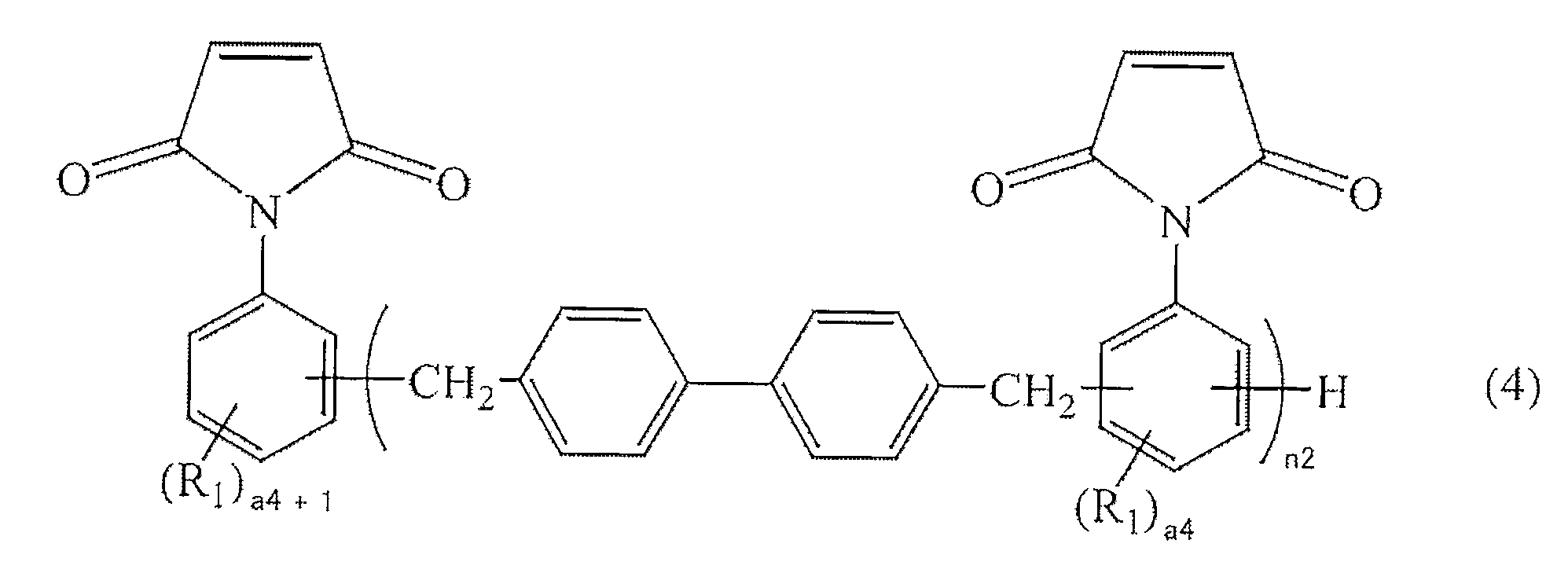
- a maleimide resin represented by the following formula (4) or a polymaleimide resin represented by the above formula (5) may be mentioned.
- R 1 s each independently represent a hydrogen atom, an alkyl group having 1 to 10 carbon atoms or an aromatic group.
- A4 represents 1 to 3.
- a4 + 1 represents 1 to 4)
- N2 is an integer, and the average value represents 1 ⁇ n2 ⁇ 5.
- Examples of the alkyl group having 1 to 10 carbon atoms for R 1 in the above formulas (4) and (5) include a methyl group, an ethyl group, an n-propyl group, an iso-propyl group, an n-butyl group, and an iso-butyl group.
- a methyl group is preferred.
- Examples of the aromatic group in R 1 in the above formulas (4) and (5) include an aromatic hydrocarbon group such as a phenyl group, a biphenyl group, an indenyl group, a naphthyl group, an anthryl group, a fluorenyl group, and a pyrenyl group, and furanyl.
- an aromatic hydrocarbon group such as a phenyl group, a biphenyl group, an indenyl group, a naphthyl group, an anthryl group, a fluorenyl group, and a pyrenyl group, and furanyl.
- n2 in the formula (4) is an integer, and represents an average value of 1 ⁇ n ⁇ 5.
- n2 is preferably 1 to 10, more preferably 2 to 8, and particularly preferably 2 to 4.
- the value of n2 can be calculated from the value of the weight average molecular weight determined by the gel permeation chromatography (GPC) measurement of the maleimide resin, but approximately from the GPC measurement result of the compound as the raw material. It can be considered that it is almost equivalent to the calculated value of n2.
- the maleimide resin used in the present invention one having a melting point and a softening point can be used.
- a melting point it is preferably 200 ° C. or lower, and when it has a softening point, it is preferably 150 ° C. or lower. If the melting point or softening point is too high, the possibility of gelation increases during mixing, which is not preferable.
- maleimide resins may be commercially available or can be synthesized by known methods. Below, the manufacturing method of maleimide resin represented by said Formula (4) is demonstrated.
- the method for producing the maleimide resin represented by the formula (4) is not particularly limited, and any known method known as a method for synthesizing a maleimide compound may be used.
- a compound of the following formula (6) is required as a precursor thereof.
- a patent document Japanese Patent Laid-Open No. 3-100016
- a patent document Japanese Patent Laid-B-8-16151
- reactions of anilines with dihalogenomethyl compounds and dialkoxymethyl compounds and anilines and bishalogenomethylbiphenyls or A compound of the formula (6) is obtained by reacting with bisalkoxymethylbiphenyls.
- R 1 s each independently represent a hydrogen atom, an alkyl group having 1 to 10 carbon atoms or an aromatic group.
- A4 represents 1 to 3.
- a4 + 1 represents 1 to 4)
- N2 is an integer, and the average value represents 1 ⁇ n2 ⁇ 5.
- Examples of the alkyl group having 1 to 10 carbon atoms and the aromatic group for R 1 in the formula (6) include the same as those exemplified as R 1 in the formula (4) and the formula (5), respectively. .
- anilines used for the production of the compound of formula (6) include aniline, 2-methylaniline, 3-methylaniline, 4-methylaniline, 2-ethylaniline, 3-ethylaniline, 4-ethylaniline, 2 , 3-dimethylaniline, 2,4-dimethylaniline, 2,5-dimethylaniline, 2,6-dimethylaniline, 3,4-dimethylaniline, 3,5-dimethylaniline, 2-propylaniline, 3-propylaniline 4-propylaniline, 2-isopropylaniline, 3-isopropylaniline, 4-isopropylaniline, 2-ethyl-6-methylaniline, 2-sec-butylaniline, 2-tert-butylaniline, 4-butylaniline, 4 -Sec-butylaniline, 4-tert-butylaniline, 2,6-diethyl Alkyl-substituted anilines having one or more alkyl groups having 1 to 5 carbon atoms, such
- Examples include aniline. These may be used alone or in combination of two or more.
- Examples of the bishalogenomethyl biphenyls or bisalkoxymethyl biphenyls used include 4,4′-bis (chloromethyl) biphenyl, 4,4′-bis (bromomethyl) biphenyl, and 4,4′-bis (fluoromethyl).
- Biphenyl 4,4'-bis (iodomethyl) biphenyl, 4,4'-dimethoxymethylbiphenyl, 4,4'-diethoxymethylbiphenyl, 4,4'-dipropoxymethylbiphenyl, 4,4'-diisopropoxy
- Examples include methylbiphenyl, 4,4′-diisobutoxymethylbiphenyl, 4,4′-dibutoxymethylbiphenyl, 4,4′-di-tert-butoxymethylbiphenyl, and the like. These may be used alone or in combination of two or more.
- the amount of bishalogenomethylbiphenyls or bisalkoxymethylbiphenyls used is 0.05 to 0.8 moles, preferably 0.1 to 0.6 moles per mole of anilines used.
- an acidic catalyst such as hydrochloric acid, phosphoric acid, sulfuric acid, formic acid, zinc chloride, ferric chloride, aluminum chloride, p-toluenesulfonic acid, methanesulfonic acid and the like may be used. These may be used alone or in combination of two or more.
- the amount of the catalyst used is usually 0.1 to 0.8 mol, preferably 0.5 to 0.7 mol, based on 1 mol of the aniline to be used. Viscosity does not become too high and stirring becomes easy, and when it is 0.1 or more, the progress of the reaction is not delayed.
- the reaction may be carried out using an organic solvent such as toluene or xylene, if necessary, or without solvent.
- the water is removed from the system by azeotropic distillation.
- bishalogenomethylbiphenyls or bisalkoxymethylbiphenyls are added at 40 to 100 ° C., preferably 50 to 80 ° C. over 1 to 5 hours, preferably 2 to 4 hours, and then the solvent is removed from the system.
- the temperature is raised and the reaction is carried out at 180 to 240 ° C., preferably 190 to 220 ° C. for 5 to 30 hours, preferably 10 to 20 hours.
- diphenylamine which is a by-product at this stage, varies depending on the amount of catalyst, the ratio of raw materials used, temperature, time, etc. Usually 2 to 10% by mass is contained in the resin. Diphenylamine cannot be removed under conditions where aniline is distilled off. Diphenylamine can be removed by blowing steam or an inert gas such as a large amount of nitrogen gas under reduced pressure by heating at a temperature equal to or higher than the boiling point of aniline.
- diphenylamine When diphenylamine is contained in the maleimide resin composition of the present invention, for example, when used for a curing reaction with a maleimide resin, it becomes a terminal end of a molecular chain, and if the content is large, a curing network is not sufficiently formed. There is a possibility that the mechanical strength will be significantly reduced.
- diphenylamine when diphenylamine is contained in the aromatic amine resin represented by the formula (6), diphenylamine remains as it is after maleimidation and remains in the cured product as it is without contributing to the reaction. Bleed out and thermal decomposition resistance may decrease. Therefore, the diphenylamine content is usually 1% by mass or less, preferably 0.5% by mass or less, more preferably 0.2% by mass or less.
- the softening point of the aromatic amine resin represented by the formula (6) is preferably 65 ° C. or less, and more preferably 60 ° C. or less.
- the softening point is 65 ° C. or lower, the viscosity of the maleimidized resin does not increase, and carbon fibers and glass fibers are easily impregnated. If the viscosity is lowered by increasing the dilution solvent, the resin may not adhere sufficiently.
- the maleimide resin of the formula (4) can be obtained by reacting the compound of the formula (6) with maleic anhydride in the presence of a solvent and a catalyst.
- Patent Document Japanese Patent Laid-Open No. 3-100016
- a method described in Japanese Patent Application Laid-Open No. 61-229863 As the solvent used in the reaction, it is necessary to remove water generated during the reaction from the system, and therefore a water-insoluble solvent is used.
- aromatic solvents such as toluene and xylene
- aliphatic solvents such as cyclohexane and n-hexane
- ethers such as diethyl ether and diisopropyl ether
- ester solvents such as ethyl acetate and butyl acetate, methyl isobutyl ketone and cyclopentanone
- water-insoluble solvent an aprotic polar solvent may be used in combination.
- the catalyst is an acidic catalyst and is not particularly limited, and examples thereof include p-toluenesulfonic acid, hydroxy-p-toluenesulfonic acid, methanesulfonic acid, sulfuric acid, and phosphoric acid.
- maleic acid is dissolved in toluene, an N-methylpyrrolidone solution of the compound of formula (6) is added with stirring, and then p-toluenesulfonic acid is added to remove water generated under reflux conditions from the system. While doing the reaction.
- the amount of maleimide resin is preferably 5 to 50% by mass based on the total amount of resin in the maleimide resin composition. More preferably, it is 10 to 50% by mass, and particularly preferably 20 to 50% by mass. In the case of the above range, in the physical properties of the cured product, mechanical strength and peel strength are high, dielectric loss tangent is low, and heat resistance tends to be high.
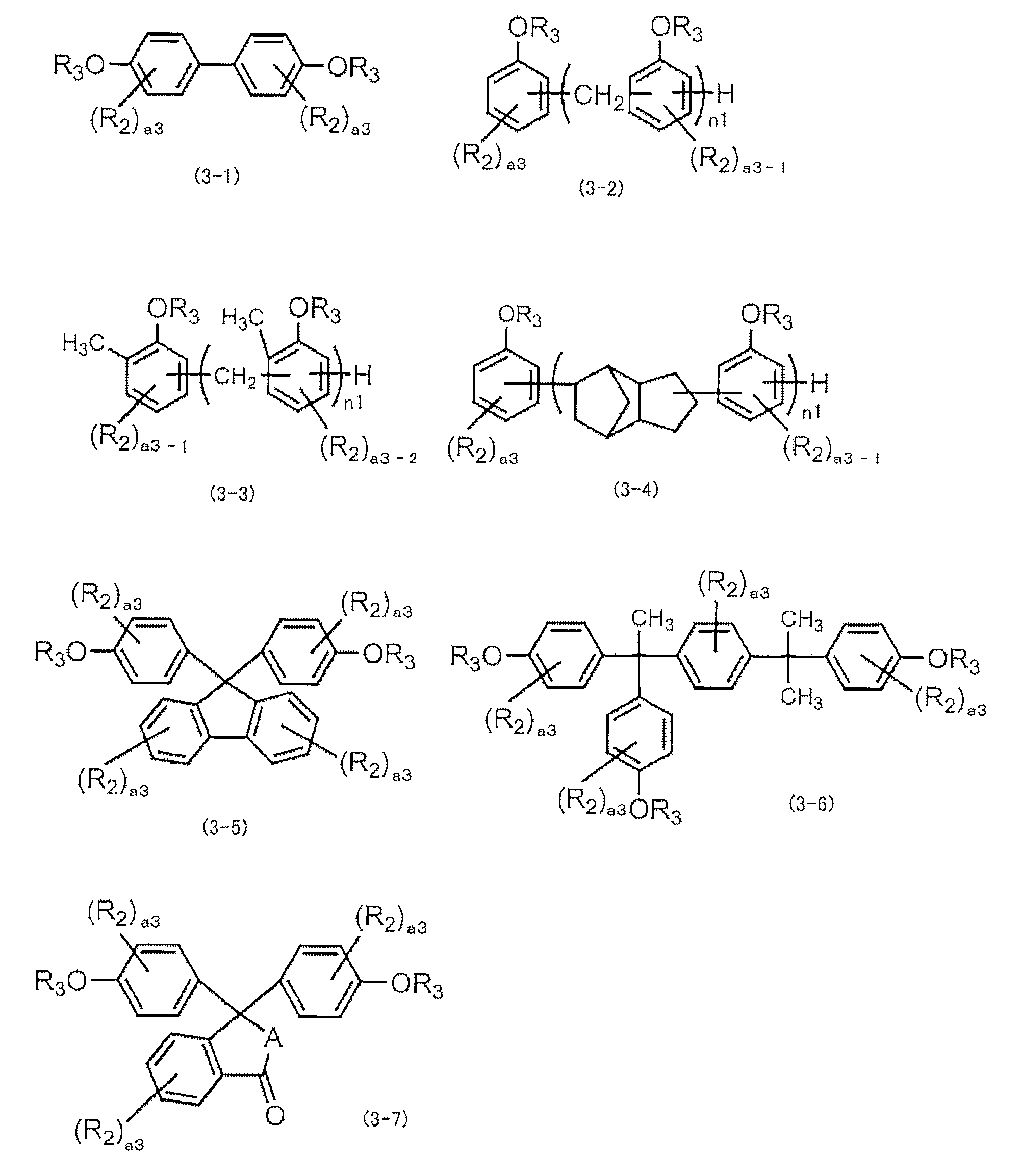
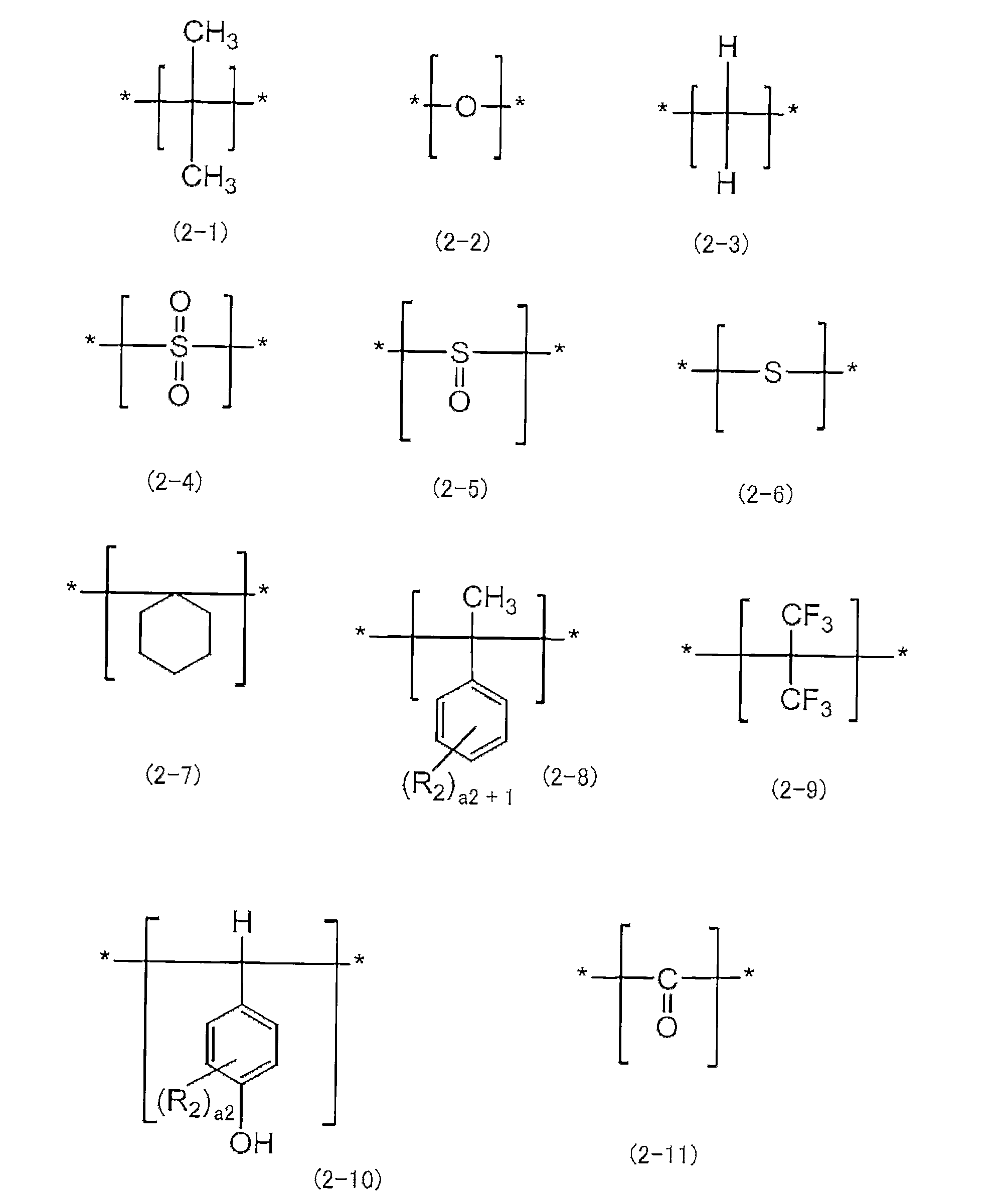
- the maleimide resin composition of the present invention includes a compound represented by the following formula (1) and a compound represented by any of the following formulas (3-1) to (3-7) (hereinafter simply referred to as “methallyl group-containing compound”). At least one of them.
- R 2 independently represents a methallyl group or a hydrogen atom.
- R 3 independently represents a methallyl group, a hydrogen atom, an alkyl group having 1 to 10 carbon atoms or an aromatic group. (It has a structure represented by any one of formulas (2-1) to (2-11), a1 represents an integer of 1 to 4)
- R 2 is .A2 is .A2 + 1 represents an integer of 1 to 4 represent the same as R 2 in the formula (1) represents an integer of 1-5. * Represents a bonding position.
- each R 2 independently represents a methallyl group or a hydrogen atom.
- Each R 3 independently represents a methallyl group, a hydrogen atom, an alkyl group having 1 to 10 carbon atoms or an aromatic group.
- A is — O—,> NR 4 or —C (R 4 ) 2 —, wherein R 4 each independently represents a hydrogen atom, an alkyl group having 1 to 10 carbon atoms or an aromatic group, a3 is an integer of 1 to 4
- A3-1 represents an integer of 1 to 3.
- a3-2 represents an integer of 1 to 2.
- n1 is an integer, and an average value thereof represents 1 ⁇ n1 ⁇ 5.
- the methallyl group-containing resin used in the present invention is mixed with a maleimide group, a cured product having lower hygroscopicity and better dielectric properties can be obtained than allyl group-containing resins and propenyl group-containing resins having the same skeleton.
- polar groups are not generated, so that it is possible to suppress an increase in water absorption (wetness) accompanying an improvement in heat resistance.
- R 3 is a methallyl group.
- it is not the definition of one molecular unit of the corresponding compound, but means an average of a plurality of molecules of the corresponding compound.
- the proportion of the methallyl group can be confirmed by an analyzer such as high performance liquid chromatography (HPLC).
- the alkyl group having 1 to 10 carbon atoms for R 3 includes a methyl group, an ethyl group, an n-propyl group, an iso-propyl group, n -Butyl, iso-butyl, tert-butyl, sec-butyl, n-pentyl, i-pentyl, amyl, n-hexyl, cyclopentyl, cyclohexyl, octyl, 2- An ethylhexyl group, a nonyl group, a decyl group, etc. are mentioned. A methyl group is preferred.
- Examples of the aromatic group represented by R 3 in the formulas (1) and (3) include an aromatic hydrocarbon group such as a phenyl group, a biphenyl group, an indenyl group, a naphthyl group, an anthryl group, a fluorenyl group, and a pyrenyl group, and a furanyl group.
- an aromatic hydrocarbon group such as a phenyl group, a biphenyl group, an indenyl group, a naphthyl group, an anthryl group, a fluorenyl group, and a pyrenyl group, and a furanyl group.
- n1 can be calculated from the value of the weight average molecular weight obtained by the measurement of gel permeation chromatography (GPC) of the methallyl group-containing compound, it is approximately the measurement of the GPC of the compound as a raw material. It can be considered to be almost equivalent to the value of n calculated from the result.
- GPC gel permeation chromatography
- the total chlorine content of the methallyl group-containing compound is preferably 500 ppm or less, more preferably 300 ppm or less, and particularly preferably 100 ppm or less.
- the softening point of the methallyl group-containing compound is preferably 120 ° C. or lower.
- the compatibility with the solvent is good, and therefore, it is easy to remove the salt by washing or the like, and there is no concern about corrosion, which is preferable.
- the method for producing the compound represented by the formula (1) or the compound represented by any one of the formulas (3-1) to (3-7) is not particularly limited. It may be produced by any known method known as a synthesis method of a ruether compound.
- Japanese Patent Application Laid-Open No. 2003-104923 discloses an allyl ether obtained by reacting a polyphenol compound with an allyl halide such as allyl chloride, allyl bromide or methylallyl chloride using a base such as an alkali metal hydroxide. Is disclosed.
- phenol resin used as a raw material
- examples of the phenol resin used as a raw material include a reaction product of phenol and 4,4′-bis (chloromethyl) -1,1′-biphenyl, phenol and 4,4′-bis (methoxymethyl) -1,1′- Reaction product of biphenyl, reaction product of phenol and hydroxybenzaldehyde, reaction product of phenol and salicylaldehyde or parahydroaldehyde, reaction product of phenol and 1,4'-bischloromethylbenzene, phenol and 1,4 ' Preferred examples include, but are not limited to, a reaction product of bismethoxymethylbenzene, a reaction product of phenol and dicyclopentadiene, a reaction product of phenol and formaldehyde, and a reaction product of cresol and formaldehyde.
- methallyl halide for example, methallyl chloride
- methallyl chloride it is preferable to use one having a small amount of the polymer.
- methallyl chloride tends to polymerize to polymethallyl chloride.
- the residual polymethallyl chloride not only increases the total chlorine content, but also contributes to an increase in the molecular weight of the methallyl ether compound, and may leave a trace amount of gel in the product.
- polymethallyl chloride compounds can be easily confirmed by gas chromatography or the like, and the specific amount is a polymer of 1.0 area% or less with respect to the methallyl chloride monomer in the area ratio. More preferably, it is 0.5 area% or less, More preferably, it is 0.2 area% or less, Most preferably, it is 0.05 area% or less.
- the purity of methallyl chloride is preferably 90 area% or more, more preferably 97 area% or more, and particularly preferably 99 area% or more.
- the amount of methallyl chloride used is usually 1.0 to 1.15 mol, preferably 1.0 to 1.10, relative to 1 mol of hydroxyl group of the phenolic resin (hereinafter also referred to simply as “raw phenolic resin”). Mole, more preferably 1.0 to 1.05 mole.
- the base that can be used for etherifying methallyl chloride is preferably an alkali metal hydroxide, and specific examples thereof include sodium hydroxide and potassium hydroxide.
- the aqueous solution may be used, but in the present invention, it is particularly preferable to use a solid material formed into a flake shape from the viewpoint of solubility and handling.
- the amount of the alkali metal hydroxide used is usually 1.0 to 1.15 mol, preferably 1.0 to 1.10 mol, more preferably 1.0 to 1 mol, based on 1 mol of the hydroxyl group of the starting phenol resin. 0.05 mole.
- quaternary ammonium salt such as tetramethylammonium chloride, tetramethylammonium bromide or trimethylbenzylammonium chloride may be added as a catalyst.
- the amount of the quaternary ammonium salt used is usually 0.1 to 15 g, preferably 0.2 to 10 g, per 1 mol of hydroxyl group in the raw material phenol mixture.
- an aprotic polar solvent such as dimethyl sulfoxide (hereinafter referred to as “DMSO”), dimethylformamide, dimethylacetamide, dimethylimidazolidinone, N-methylpyrrolidone is preferable, and dimethyl sulfoxide is particularly used as a solvent.
- DMSO dimethyl sulfoxide
- the amount of the aprotic polar solvent used is preferably 20 to 300% by mass, more preferably 25 to 250% by mass, and particularly preferably 25 to 200% by mass with respect to the total mass of the phenol resin.
- the aprotic polar solvent is not useful for purification such as washing with water, and it is not preferable to use it in a large amount. Moreover, since the boiling point is high and removal of the solvent is difficult, a large amount of energy is consumed, so that it is not preferable that the amount is too large.
- alcohols such as methanol, ethanol and isopropyl alcohol.
- a non-aqueous solvent such as methyl ethyl ketone, methyl isobutyl ketone, and toluene can be used in combination, but the use of 100% by mass or less with respect to dimethyl sulfoxide is preferable. Particularly preferred is 0.5 to 50% by mass.
- the reaction temperature is usually 30 to 90 ° C, preferably 35 to 80 ° C. In particular, in the present invention, it is preferable to raise the reaction temperature in two or more steps for higher purity etherification.
- the first stage is particularly preferably 35 to 50 ° C.
- the second stage is particularly preferably 45 to 70 ° C.
- the reaction time is usually 0.5 to 10 hours, preferably 1 to 8 hours, particularly preferably 1 to 5 hours. If the reaction time is 0.5 hours or more, the reaction proceeds sufficiently, and if the reaction time is 10 hours or less, a by-product is not formed, which is preferable.
- the content of the compound having a methallyl group in the maleimide resin composition of the present invention can be appropriately set according to the type of the compound to be used, and is not particularly limited. From the viewpoint of the fluidity of the maleimide resin composition and the heat resistance of the cured product obtained by curing the maleimide resin composition, the content of the compound having a methallyl group is 5 to 30% by mass with respect to the total amount of the composition. The content is preferably 7 to 25% by mass. By setting the content ratio of the compound having a methallyl group to 5 to 30% by mass with respect to the total amount of the composition, a relatively low temperature molding is possible, and a thermosetting resin composition having a viscosity can be easily obtained. The cured product having high heat resistance tends to be easily obtained.
- the maleimide resin composition of the present invention may contain a radical polymerization initiator (hereinafter also simply referred to as “catalyst”) as necessary.
- radical polymerization initiators include benzoin compounds such as benzoin and benzoin methyl, acetophenone compounds such as acetophenone, 2,2′-dimethoxy-2-phenylacetophenone, thioxanthone compounds such as thioxanthone and 2,4-diethylthioxanthone, Bisazide compounds such as 4,4′-diazidochalcone, 2,6-bis (4′-azidobenzal) cyclohexanone, 4,4′-diazidobenzophenone, azobisisobutyronitrile, 2,2′-azobispropane Azo compounds such as hydrazone, 2,5-dimethyl-2,6-di (t-butylperoxy) hexane, 2,5′-dimethyl-2,5′-
- the content of the radical polymerization initiator in the maleimide resin composition can be appropriately set according to the type of the radical polymerization initiator to be used, and is not particularly limited. From the viewpoint of achieving both the curing acceleration effect and the heat resistance of the cured product, the amount is preferably 0.01 to 5 parts by mass, more preferably 0.05 to 4 parts by mass with respect to 100 parts by mass of the maleimide resin composition. More preferably, it is 0.1 to 3 parts by mass. If the amount of the radical polymerization initiator is too small, it may cause curing failure, and if it is too large, the cured material properties of the resin composition may be adversely affected.
- the maleimide resin composition of the present invention can be used in combination with a curing accelerator in addition to a radical polymerization initiator, if necessary.
- curing accelerators examples include 2-methylimidazole, 2-ethylimidazole, 2-phenylimidazole, 2-ethyl-4-methylimidazole, 2-undecylimidazole, 1-cyanoethyl-2-ethyl-4-methylimidazole.
- Phosphines such as amines, triphenylphosphine, tributylphosphine, trioctylphosphine and organometallic salts such as tin octylate, zinc octylate, dibutyltin dimaleate, zinc naphthenate, cobalt naphthenate, tin oleate, Zinc, aluminum chloride, include organometallic compounds such as metal chlorides such as tin chloride, benzoyl peroxide, dicumyl peroxide, there is a methyl ethyl ketone peroxide, etc. t- butyl perbenzoate organic peroxide.
- the amount of the curing accelerator is preferably added in an amount of 0.01 to 20% by mass, more preferably 0.01 to 10% by mass with respect to the maleimide resin.
- a cyanate ester compound can also be blended in the maleimide resin composition of the present invention.
- a conventionally well-known cyanate ester compound can be used as a cyanate ester compound which can be mix
- Specific examples of cyanate ester compounds include polycondensates of phenols and various aldehydes, polymers of phenols and various diene compounds, polycondensates of phenols and ketones, and polycondensations of bisphenols and various aldehydes. Examples include, but are not limited to, cyanate ester compounds obtained by reacting a product with cyanogen halide. These may be used alone or in combination of two or more.
- cyanate ester compounds described in Japanese Patent Application Laid-Open No. 2005-264154 are particularly preferable as cyanate ester compounds because they are excellent in low moisture absorption, flame retardancy, and dielectric properties.
- any one or more of a flame retardant, a filler, and an additive can be blended as necessary.
- a filler which are selected from a metal complex salt, activated carbon, a layered clay mineral, a metal oxide, etc. are mentioned.
- a metal composite salt a hydrotalcite-like compound is preferable.
- the hydrotalcite-like compound is a compound represented by the general formula [M 2+ 1 ⁇ X M 3+ X (OH) 2 ] [A n ⁇ X / n ⁇ mH 2 O], and M 2+ and M 3+ are Divalent and trivalent metal ions, and A n ⁇ X / n represents an interlayer anion.
- a typical hydrotalcite is a compound represented as Mg 6 Al 2 (OH) 16 CO 3 .4H 2 O.
- the Kyoward series a product of Kyowa Chemical Industry Co., Ltd., is effective as a commercial product. Examples include Kyoword 500, Kyoword 1000, Kyoword 700, Kyoword 600, Kyoword 200, Kyoword 2000, and the like.
- Kyoto word 500, Kyoto word 1000, etc. are preferable.
- activated carbon which can be used, chemical activated carbon is preferable.
- the chemical activated charcoal is not particularly limited as long as it has been treated with, for example, zinc chloride, phosphoric acid, etc., but the product activated with zinc chloride is particularly preferable because it may introduce chlorine into the product.
- Phosphoric acid activated charcoal Phosphoric acid activated charcoal.
- activated carbon obtained by a physical method that is made porous with water vapor, air, carbon dioxide, etc., can be used in combination with chemically activated carbon depending on the conditions to be treated. A proportion exceeding 50% by mass with respect to the amount of is preferable.
- the raw material include wood (sawdust, etc.), coal (lignite, peat, coal, etc.), coconut shell, phenol resin, etc.
- wood is particularly preferred.
- Commercially available products include Futamura Chemical Co., Ltd., Dazai series (CG, CW, G, QW, S, ACF, etc. series), Ajinomoto Fine Techno Hokuetsu series (SD, BA, F, ZN, Y-180C, H -10CL, H-8CL, G-10F, CL-K, etc. series), Shirataka (C, LGK-400, G series, DO series, Wc, Sx, WHA, etc.), Nihon Enviro Chemicals Co., , Etc.
- PK series PKDA series, ELORIT, AZO, DARCO series, HYDRODACO series, PETRODARCO, GAC, series, GCN, C GRAN, ROW, ROY, ROX, RO, RB, R, R., etc.
- EXTRA SORBNORIT, GF series, CNR, ROZ, RBAA, RBHG, RZN, RGM, SX, SA, D10, VETERINAIR, PN, ZN, SA-SW, W, GL, SAM, HB PLUS, EUR, USP, CA , CG, GB, CAP SUPER, CGP SUPER, S-51 series, HDB, HDC, HDR, HDW, GRO SAFE, FM-1, PAC series, Kuraray Co., Ltd., RP-20, YP-17D, etc. Can be mentioned.
- the clay mineral is preferably a smectite-based layered clay mineral, and examples include bentonite, montmorillonite, beidellite, nontronite, saponite, hectorite, and synthetic smectite.
- Commercially available products are Kunimine Kogyo Co., Ltd .; smecton (synthetic smectite), bentonite (sodium salt type, calcium salt type), Kunipia F (montmorillonite), Hojun Co., Ltd .; , Bengel SH, Bengel A, manufactured by Coop Chemical Co., Ltd .; Lucentite series.
- metal oxide examples include inorganic fillers such as silica, alumina, calcium carbonate, quartz powder, aluminum powder, graphite, talc, clay, iron oxide, titanium oxide, aluminum nitride, asbestos, mica, and glass powder.
- inorganic fillers such as silica, alumina, calcium carbonate, quartz powder, aluminum powder, graphite, talc, clay, iron oxide, titanium oxide, aluminum nitride, asbestos, mica, and glass powder.
- additives include epoxy resin curing agents, polyamide resins, silicone resins, fluorine resins such as polytetrafluoroethylene, acrylic resins such as polymethyl methacrylate, cross-linked products of benzoguanamine, melamine, and formaldehyde, polybutadiene And this modified product, modified product of acrylonitrile copolymer, polyphenylene ether, polystyrene, polyethylene, polyimide, fluororesin, maleimide compound, cyanate ester compound, silicone gel, silicone oil, and inorganic such as silane coupling agent Coloring agents such as surface treatment agents for fillers, mold release agents, carbon black, phthalocyanine blue, and phthalocyanine green can be used.
- the compounding amount of these additives is preferably 1,000 parts by mass or less, more preferably 700 parts by mass or less with respect to 100 parts by mass of the curable resin composition.
- the method for preparing the maleimide resin composition of the present invention is not particularly limited, but each component may be mixed evenly or prepolymerized.
- the methallyl group-containing compound and maleimide resin used in the present invention are prepolymerized by heating in the presence or absence of a catalyst and in the presence or absence of a solvent.
- a methallyl group-containing compound used in the present invention, a maleimide resin, and if necessary, a curing agent such as an amine compound, a maleimide compound, a cyanate ester compound, a phenol resin, an acid anhydride compound, and other additives are added. It may be prepolymerized.
- an extruder for example, an extruder, a kneader, a roll or the like is used in the absence of a solvent, and a reaction vessel with a stirrer is used in the presence of a solvent.
- An organic solvent can be added to the maleimide resin composition of the present invention to form a varnish-like composition (hereinafter simply referred to as varnish).
- varnish a varnish-like composition
- the maleimide resin composition of the present invention is dissolved in a solvent such as toluene, xylene, acetone, methyl ethyl ketone, methyl isobutyl ketone, dimethylformamide, dimethylacetamide, N-methylpyrrolidone to obtain a maleimide resin composition varnish, and glass fiber.
- a cured product of the maleimide resin composition of the present invention is obtained by hot press molding a prepreg obtained by impregnating a substrate such as carbon fiber, polyester fiber, polyamide fiber, alumina fiber, paper, etc. and drying by heating.
- the solvent used here is usually 10 to 70% by mass, preferably 15 to 70% by mass in the mixture of the maleimide resin composition of the present invention and the solvent. Moreover, if it is a liquid composition, the hardened
- the maleimide resin composition of the present invention can also be used as a modifier for film-type compositions. Specifically, it can be used to improve flexibility in the B-stage.
- a film-type resin composition is formed by applying the maleimide resin composition of the present invention on the release film as the maleimide resin composition varnish, removing the solvent under heating, and then performing B-stage formation. Obtained as an adhesive.
- This sheet-like adhesive can be used as an interlayer insulating layer in a multilayer substrate or the like.
- the prepreg of the present invention can be obtained by melting the maleimide resin composition of the present invention with heat, lowering the viscosity, and impregnating it with reinforcing fibers such as glass fiber, carbon fiber, polyester fiber, polyamide fiber, and alumina fiber. Moreover, the prepreg of this invention can also be obtained by impregnating the said varnish in a reinforced fiber and heat-drying.
- the above prepreg is cut into the desired shape, laminated with copper foil if necessary, and then the maleimide resin composition for laminates is heated and cured while applying pressure to the laminate by press molding, autoclave molding, sheet winding molding, etc. By doing so, a laminated board can be obtained.
- a circuit can be formed on a laminated board made by superimposing copper foil on the surface, and a multilayer circuit board can be obtained by superimposing a prepreg or copper foil thereon and repeating the above operation.
- a cured product can be obtained by heat-curing the maleimide resin composition of the present invention.
- the method for curing the maleimide resin composition is not particularly limited.
- the maleimide resin composition is heated to 80 ° C. and cast between two glass plates that have been subjected to release treatment using a spacer having a thickness of 1.5 mm, and primary curing is performed at 170 to 200 ° C. for 2 hours, Thereafter, the primary cured product is removed from the glass plate and post-cured at 230 to 260 ° C. for 2 hours, whereby a cured product (maleimide resin molded product) can be obtained.
- the maleimide resin composition of the present invention can be applied to various uses, and the use is not particularly limited.
- the maleimide resin composition of the present invention is excellent in heat resistance and strength, handleability and production efficiency, it is used in applications requiring such performance, for example, matrix resins for fiber reinforced composite materials and electric and electronic parts. It is particularly useful in the field of sealants and the like.
- GC -Gas chromatography
- Analysis conditions Column HP-5 30m ⁇ 0.32mm ⁇ 0.25 ⁇ m Carrier gas Helium 1.0mL / min Split1 / 50 Injector temperature 300 ° C Detector temperature 300 ° C Oven temperature program After holding at 50 ° C. for 5 minutes, increase the temperature from 50 ° C. to 300 ° C. at 10 ° C./min. Hold at 300 ° C. for 5 minutes.
- Curing heat generation Measurement of curing start temperature, curing heat generation peak top temperature and heat generation end temperature by MDSC measurement Analysis conditions
- Analysis mode MDSC measurement Measuring instrument: Q2000 manufactured by TA-instruments Inc. Temperature rising rate: 3 ° C./min
- acetic acid purity 99.5%, manufactured by Tokyo Chemical Industry Co., Ltd.
- 700 parts by mass of methyl isobutyl ketone was added, washing was repeated, and the aqueous layer became neutral. confirmed.
- MEP1 a compound having a methallyl group
- acetic acid purity 99.5%, manufactured by Tokyo Chemical Industry Co., Ltd.
- 700 parts by mass of methyl isobutyl ketone was added, washing was repeated, and the aqueous layer became neutral. confirmed.
- MEP2 a compound having a methallyl group
- acetic acid purity 99.5%, manufactured by Tokyo Chemical Industry Co., Ltd.
- 700 parts by mass of methyl isobutyl ketone was added, washing was repeated, and the aqueous layer became neutral. confirmed.
- 690 parts by mass of a compound having a methallyl group (hereinafter referred to as “MEP3”) was obtained by distilling off the solvents from the oil layer using a rotary evaporator while bubbling nitrogen under reduced pressure.
- caustic soda purity: 99%, manufactured by Tosoh Corp.
- 72 parts by mass of water were added over 60 minutes.
- the reaction was carried out at 30 to 35 ° C. for 4 hours, at 40 to 45 ° C. for 1 hour, and at 60 to 65 ° C. for 1 hour.
- water, dimethyl sulfoxide and the like were distilled off by heating on a rotary evaporator at 120 ° C. or lower under reduced pressure. And 600 mass parts of methyl isobutyl ketone was added, and water washing was repeated, and it confirmed that the water layer became neutral.
- MEP5 a compound having a methallyl group
- acetic acid purity 99.5%, manufactured by Tokyo Chemical Industry Co., Ltd.
- 700 parts by mass of methyl isobutyl ketone was added, washing was repeated, and the aqueous layer became neutral. confirmed.
- 710 parts by mass of a compound having a methallyl group hereinafter referred to as “MEP6” was obtained by distilling off the solvents from the oil layer using a rotary evaporator while bubbling nitrogen under reduced pressure.
- acetic acid purity 99.5%, manufactured by Tokyo Chemical Industry Co., Ltd.
- 700 parts by mass of methyl isobutyl ketone was added, washing was repeated, and the aqueous layer became neutral. confirmed.
- the solvent was distilled off from the oil layer using a rotary evaporator under nitrogen bubbling under reduced pressure to obtain 510 parts by mass of a compound having a methallyl group (hereinafter referred to as “MEP7”).
- AEP1 a compound having an allyl group
- aromatic amine resin (a1) was obtained by distilling off excess aniline and toluene from the oil layer with a rotary evaporator under heating and reduced pressure (200 ° C., 0.6 KPa). Diphenylamine in the aromatic amine resin (a1) was 2.0%. The obtained resin (a1) was again added in small portions in place of steam blowing in a rotary evaporator under heating and reduced pressure (200 ° C., 4 KPa). As a result, 166 parts of aromatic amine resin (A1) was obtained. The aromatic amine resin (A1) obtained had a softening point of 56 ° C., a melt viscosity of 0.035 Pa ⁇ s, and diphenylamine of 0.1% or less.
- the reaction is carried out at the same temperature for 2 hours, 3 parts of p-toluenesulfonic acid is added, condensed water and toluene azeotroped under reflux conditions are cooled and separated, and only toluene which is an organic layer Was returned to the system and reacted for 20 hours while dehydrating.
- 120 parts of toluene was added, and washing with water was repeated to remove p-toluenesulfonic acid and excess maleic anhydride, followed by heating to remove water from the system by azeotropy.
- the reaction solution was concentrated to obtain a resin solution containing 70% maleimide resin (hereinafter referred to as “MI1”).
- acetic acid purity 99.5%, manufactured by Tokyo Chemical Industry Co., Ltd.
- 700 parts by mass of methyl isobutyl ketone was added, washing was repeated, and the aqueous layer became neutral. confirmed.
- MEP8 a compound having a methallyl group
- Example 1 35 parts by mass of the compound (MEP1) having a methallyl group obtained in Synthesis Example 1 and 65 parts by mass of the maleimide resin (MI1) obtained in Synthesis Example 10 are blended and stirred uniformly at 150 ° C., and then 100 0.5 parts by mass of dicumyl peroxide (Catalyst 1, manufactured by Kayaku Akzo Co., Ltd.) was mixed at 0 ° C., stirred, and uniformly dissolved to obtain a maleimide resin composition of the present invention.
- This maleimide resin composition was cured under curing conditions of 200 ° C. ⁇ 2 hours at 230 ° C. ⁇ 2 hours to obtain a cured product of the present invention.
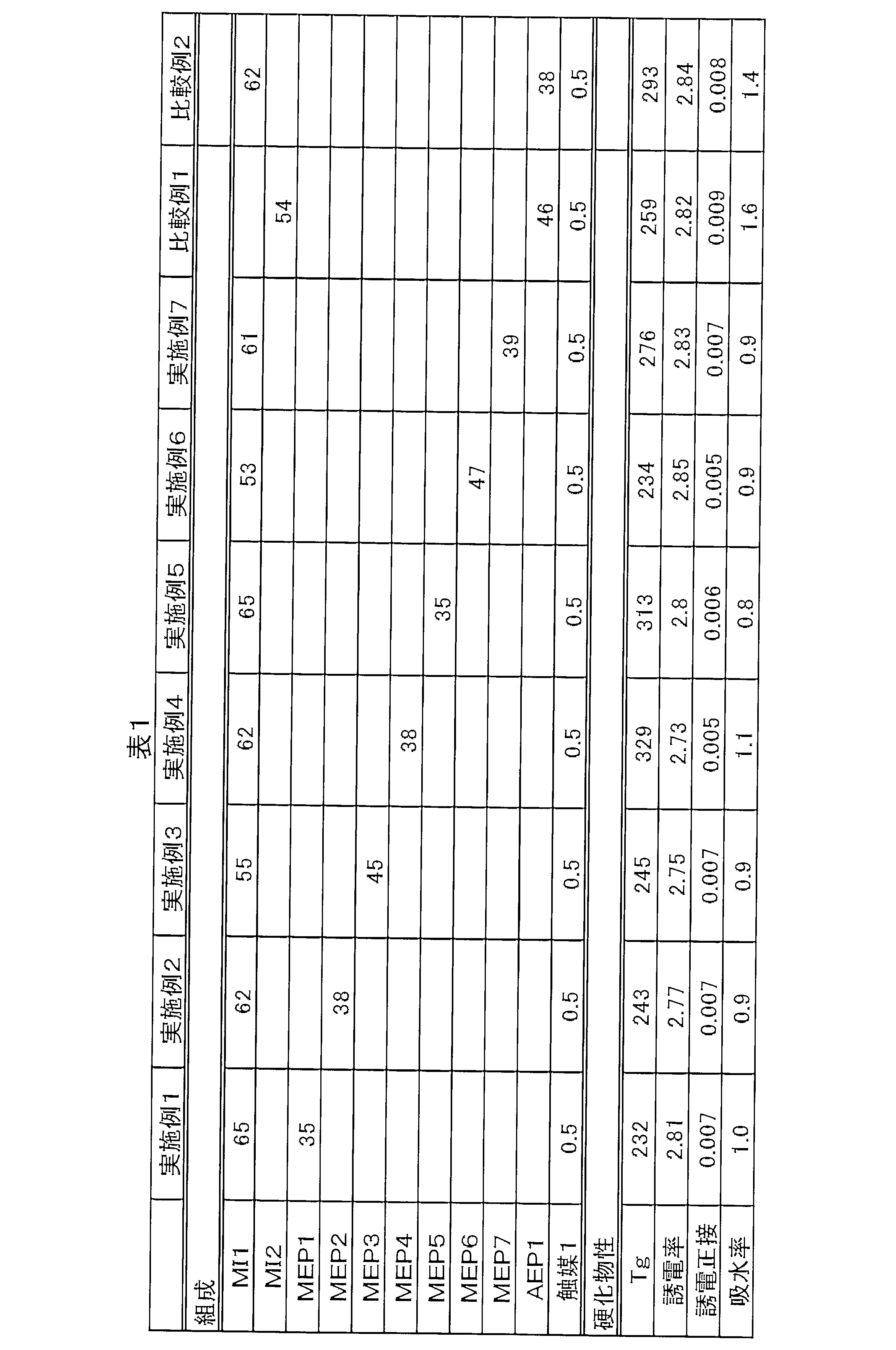
- Table 1 shows the measurement results of the physical properties of the cured product.
- Example 2 38 parts by mass of the compound having a methallyl group (MEP2) obtained in Synthesis Example 2 and 62 parts by mass of the maleimide resin (MI1) obtained in Synthesis Example 10 were blended and stirred uniformly at 150 ° C., and then 100 0.5 parts by mass of dicumyl peroxide (Catalyst 1, manufactured by Kayaku Akzo Co., Ltd.) was mixed at 0 ° C., stirred, and uniformly dissolved to obtain a maleimide resin composition of the present invention.
- This maleimide resin composition was cured under curing conditions of 200 ° C. ⁇ 2 hours at 230 ° C. ⁇ 2 hours to obtain a cured product of the present invention.
- Table 1 shows the measurement results of the physical properties of the cured product.
- Example 3 45 parts by mass of the compound (MEP3) having a methallyl group obtained in Synthesis Example 3 and 55 parts by mass of the maleimide resin (MI1) obtained in Synthesis Example 10 were blended and stirred uniformly at 150 ° C., and then 100 0.5 parts by mass of dicumyl peroxide (Catalyst 1, manufactured by Kayaku Akzo Co., Ltd.) was mixed at 0 ° C., stirred, and uniformly dissolved to obtain a maleimide resin composition of the present invention.
- This maleimide resin composition was cured under curing conditions of 200 ° C. ⁇ 2 hours at 230 ° C. ⁇ 2 hours to obtain a cured product of the present invention.
- Table 1 shows the measurement results of the physical properties of the cured product.
- Example 4 38 parts by mass of the compound having a methallyl group (MEP4) obtained in Synthesis Example 4 and 62 parts by mass of the maleimide resin (MI1) obtained in Synthesis Example 10 were blended and stirred uniformly at 150 ° C., and then 100 0.5 parts by mass of dicumyl peroxide (Catalyst 1, manufactured by Kayaku Akzo Co., Ltd.) was mixed at 0 ° C., stirred, and uniformly dissolved to obtain a maleimide resin composition of the present invention.
- This maleimide resin composition was cured under curing conditions of 200 ° C. ⁇ 2 hours at 230 ° C. ⁇ 2 hours to obtain a cured product of the present invention.
- Table 1 shows the measurement results of the physical properties of the cured product.
- Example 5 35 parts by mass of the compound (MEP5) having a methallyl group obtained in Synthesis Example 5 and 65 parts by mass of the maleimide resin (MI1) obtained in Synthesis Example 10 were blended and stirred uniformly at 150 ° C., and then 100 0.5 parts by mass of dicumyl peroxide (Catalyst 1, manufactured by Kayaku Akzo Co., Ltd.) was mixed at 0 ° C., stirred, and uniformly dissolved to obtain the thermosetting resin composition of the present invention.
- This maleimide resin composition was cured under curing conditions of 200 ° C. ⁇ 2 hours at 230 ° C. ⁇ 2 hours to obtain a cured product of the present invention.
- Table 1 shows the measurement results of the physical properties of the cured product.
- Example 6 47 parts by mass of the compound having a methallyl group (MEP6) obtained in Synthesis Example 6 and 53 parts by mass of the maleimide resin (MI1) obtained in Synthesis Example 10 were blended and stirred uniformly at 150 ° C., and then 100 0.5 parts by mass of dicumyl peroxide (Catalyst 1, manufactured by Kayaku Akzo Co., Ltd.) was mixed at 0 ° C., stirred, and uniformly dissolved to obtain the thermosetting resin composition of the present invention.
- This maleimide resin composition was cured under curing conditions of 200 ° C. ⁇ 2 hours at 230 ° C. ⁇ 2 hours to obtain a cured product of the present invention.
- Table 1 shows the measurement results of the physical properties of the cured product.
- Example 7 39 parts by mass of the compound (MEP7) having a methallyl group obtained in Synthesis Example 7 and 61 parts by mass of the maleimide resin (MI1) obtained in Synthesis Example 10 were mixed and stirred uniformly at 150 ° C., and then 100 ° C. Then, 0.5 part by mass of dicumyl peroxide (Catalyst 1, manufactured by Kayaku Akzo Co., Ltd.) was mixed, stirred, and uniformly dissolved to obtain the maleimide resin composition of the present invention. This maleimide resin composition was cured under curing conditions of 200 ° C. ⁇ 2 hours at 230 ° C. ⁇ 2 hours to obtain a cured product of the present invention. Table 1 shows the measurement results of the physical properties of the cured product.
- dicumyl peroxide Catalyst 1, manufactured by Kayaku Akzo Co., Ltd.
- Comparative Example 1 46 parts by mass of the allyl group-containing compound (AEP1) obtained in Synthesis Example 8, maleimide compound (4,4′-bismaleimide diphenylmethane BMI-1000, manufactured by Daiwa Kasei Kogyo Co., Ltd., hereinafter abbreviated as “MI2”) 54 Mix parts by mass and stir uniformly at 150 ° C., then mix 100 parts by mass of dicumyl peroxide (Catalyst 1, manufactured by Kayaku Akzo Co., Ltd.), stir and dissolve uniformly.
- the maleimide resin composition of the comparative example was obtained.
- the maleimide resin composition was cured under curing conditions of 200 ° C. ⁇ 2 hours at 230 ° C. ⁇ 2 hours to obtain a cured product of a comparative example.
- Table 1 shows the measurement results of the physical properties of the cured product.
- Tg The peak point of tan ⁇ (tan ⁇ MAX) in DMA measurement was defined as Tg.
- Analysis conditions Dynamic viscoelasticity measuring instrument: manufactured by TA-instruments, Q-800 Measurement temperature range: 30 ° C. to 350 ° C. Temperature rate: 2 ° C./min Test piece size: 5 mm ⁇ 50 mm cut out was used (thickness is About 800 ⁇ m).
- ⁇ Dielectric constant test and dielectric loss tangent test> -Using a 1 GHz cavity resonator manufactured by Kanto Electronics Co., Ltd., a test was performed by the cavity resonator perturbation method.
- the cured product of the maleimide resin composition of the present invention exhibits high heat resistance, low water absorption, and low dielectric properties.
- Example 8 A varnish was prepared by adding 35 parts by mass of the compound (MEP1) having a methallyl group obtained in Synthesis Example 1, 65 parts by mass of the maleimide resin (MI1) obtained in Synthesis Example 10, and 100 parts by mass of methyl ethyl ketone (MEK). The obtained varnish was allowed to stand at 25 ° C. for 72 hours, and then the presence or absence of precipitates was confirmed. The results are shown in Table 2.
- Example 9 In addition to 55 parts by mass of the compound having methallyl group (MEP1) obtained in Synthesis Example 1, 45 parts by mass of maleimide resin (BMI-2300, manufactured by Daiwa Kasei Kogyo Co., Ltd., hereinafter referred to as “MI3”) and 100 parts by mass of MEK Created a varnish. The obtained varnish was allowed to stand at 25 ° C. for 72 hours, and then the presence or absence of precipitates was confirmed. The results are shown in Table 2.
- MI3 maleimide resin
- a composition using a maleimide resin having N maleimide groups (N is an integer, the average value being greater than 2) is a maleimide resin having N maleimide groups with high crystallinity. It can be confirmed that the stability of the varnish is higher than that of using varnish.
- the maleimide resin composition of the present invention has electrical properties, particularly low hygroscopicity (low water absorption) and heat resistance in the cured product, the insulating material for electrical and electronic parts and laminated boards (printed wiring boards, build-up boards) Etc.) and various composite materials including CFRP, adhesives, paints and the like.
Landscapes
- Chemical & Material Sciences (AREA)
- Health & Medical Sciences (AREA)
- Chemical Kinetics & Catalysis (AREA)
- Medicinal Chemistry (AREA)
- Polymers & Plastics (AREA)
- Organic Chemistry (AREA)
- Engineering & Computer Science (AREA)
- Materials Engineering (AREA)
- Manufacturing & Machinery (AREA)
- Reinforced Plastic Materials (AREA)
- Addition Polymer Or Copolymer, Post-Treatments, Or Chemical Modifications (AREA)
Abstract
Description
これらの用途においては、低誘電正接、かつ低吸水率、また駆動温度で変化がし難いといった信頼性が求められるため、高い耐熱性が必要となる。特に誘電正接においては、0.010以下、特に0.007以下の特性が必要とされる。また、同時に水分は誘電特性を大幅に悪化させる要因の一つであるため、より低い吸水率が求められる(非特許文献2)。
そこで、本発明は、その硬化物において電気特性、特に優れた低吸湿性(低吸水性)、耐熱性を示すマレイミド樹脂組成物、プリプレグ及びその硬化物を提供することにある。
[1]N個のマレイミド基を有するマレイミド樹脂(Nは整数でありその平均値は2より大きい)と、下記式(1)で表される化合物及び下記式(3-1)~(3-7)のいずれかで表される化合物の少なくともいずれかとを含有するマレイミド樹脂組成物、
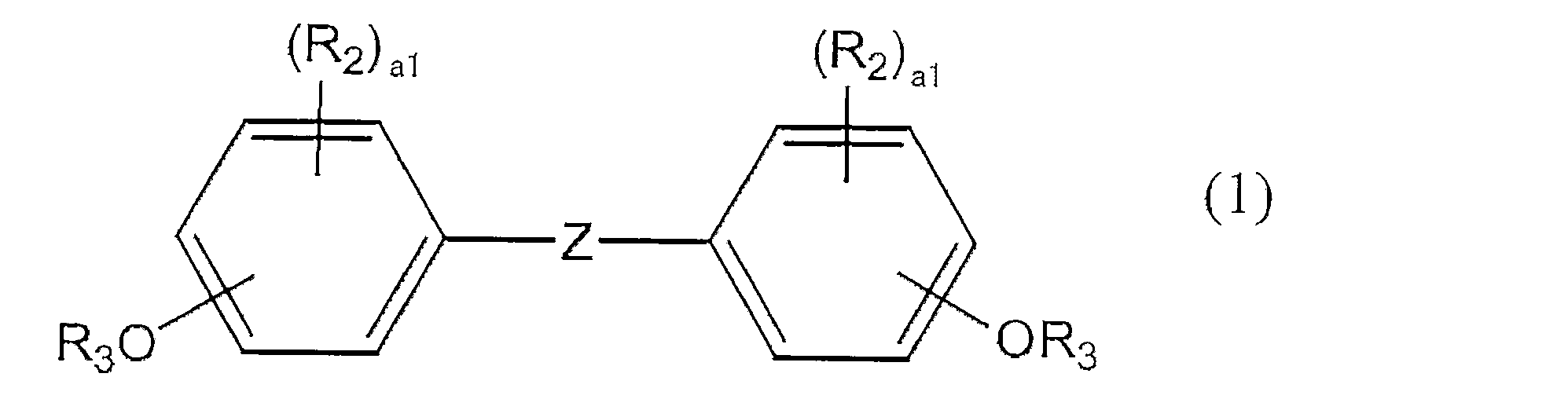
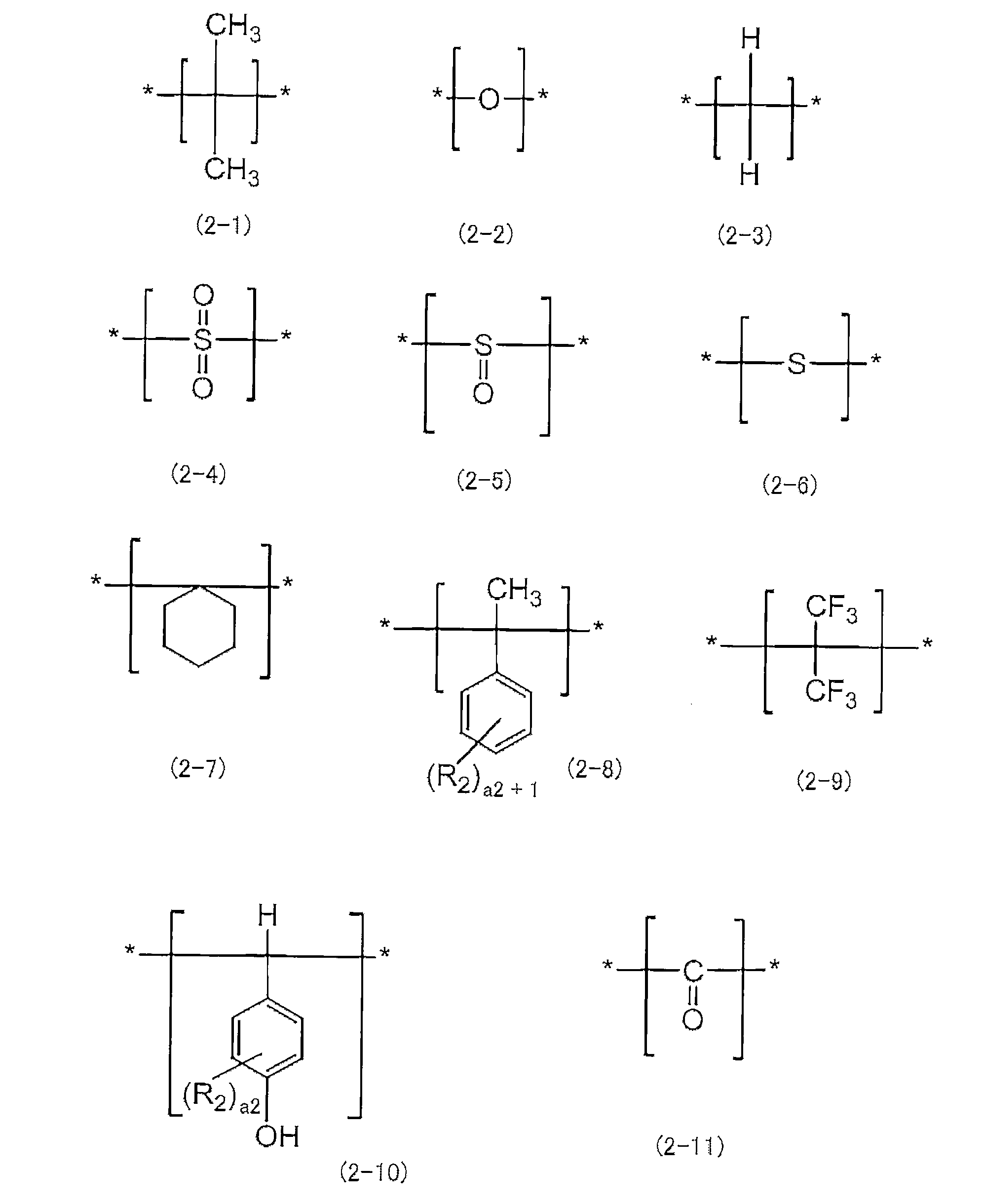

[2]前記マレイミド樹脂が、下記式(4)で表される構造である前項[1]に記載のマレイミド樹脂組成物、
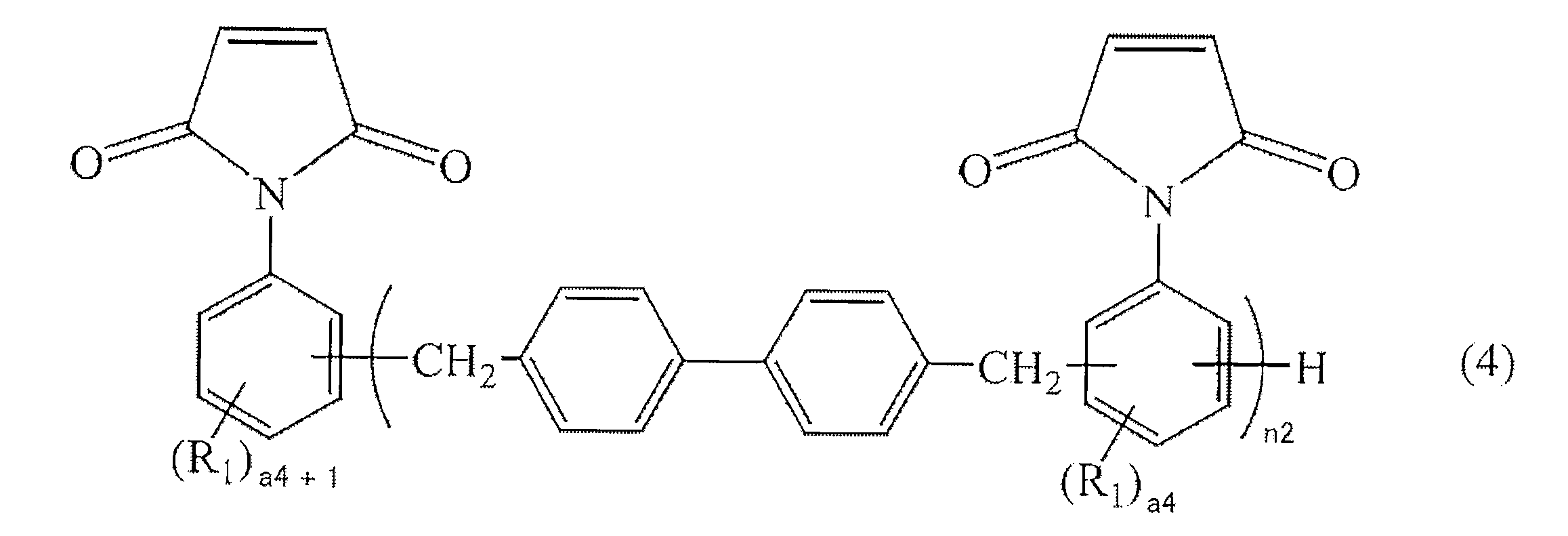
[3]ラジカル重合開始剤を含有する前項[1]又は[2]に記載のマレイミド樹脂組成物、
[4]難燃剤、フィラー及び添加剤のいずれか一種以上を含有する前項[1]~[3]のいずれか一項に記載のマレイミド樹脂組成物、
[5]前項[1]~[4]のいずれか一項に記載のマレイミド樹脂組成物をシート状の繊維基材に保持し、半硬化状態にあるプリプレグ、
[6]前項[1]~[4]のいずれか一項に記載のマレイミド樹脂組成物の硬化物、
[7]前項[5]に記載のプリプレグの硬化物、
に関する。
本発明のマレイミド樹脂組成物は、N個(Nは整数でありその平均値は2より大きい)のマレイミド基を有するマレイミド樹脂(以下、単に「マレイミド樹脂」とも表す)を含有する。
本発明において使用できるマレイミド樹脂は、平均でマレイミド基を1分子内に2を超える個数有するマレイミド樹脂であればよく、特に限定されない。
当該マレイミド樹脂の具体例としては、3,4,4’-トリアミノジフェニルメタン、トリアミノフェノールなどと無水マレイン酸との反応で得られる多官能マレイミド化合物、トリス-(4-アミノフェニル)-ホスフェート、トリス(4-アミノフェニル)-ホスフェート、トス(4-アミノフェニル)-チオホスフェートと無水マレイン酸との反応で得られるマレイミド化合物、トリス(4-マレイミドフェニル)メタン等のトリスマレイミド化合物、ビス(3,4-ジマレイミドフェニル)メタン、テトラマレイミドベンゾフェノン、テトラマレイミドナフタレン、トリエチレンテトラミンと無水マレイン酸との反応で得られるマレイミド等のテトラマレイミド化合物、フェノールノボラック型マレイミド樹脂、イソプロピリデンビス(フェノキシフェニルマレイミド)フェニルマレイミドアラルキル樹脂、ビフェニレン型フェニルマレイミドアラルキル樹脂、式(5)で表されるポリマレイミド、ベンゼンジアルデヒドとアニリンとの縮合により得られるポリアニリンのポリマレイミド等である。また、これらのポリマレイミドに芳香族のジアミンを付加させたポリアミノポリマレイミド樹脂を用いることもできる。更にノボラック型のマレイミド樹脂は分子量分布を有するためワニス安定性が高いため、メタリル樹脂との混練に適している。これらは市販のものを使用してもよく、公知の方法も用いて製造することもできる。


前記式(4)及び式(5)中のR1における芳香族基としては、フェニル基、ビフェニル基、インデニル基、ナフチル基、アントリル基、フルオレニル基、ピレニル基等の芳香族炭化水素基、フラニル基、チエニル基、チエノチエニル基、ピロリル基、イミダゾリル基、ピリジル基、ピラジル基、ピリミジル基、キノリル基、インドリル基及びカルバゾリル基等が挙げられる。
式(4)のポリマレイミド樹脂を製造する場合、その前駆体として下記式(6)の化合物が必要になるが、例えば特許文献(日本国特開平3-100016号公報)及び特許文献(日本国特公平8-16151号公報)にはアニリン類とジハロゲノメチル化合物やジアルコキシメチル化合物との反応が記載されているが、これらと同様の方法を採用してアニリン類とビスハロゲノメチルビフェニル類又はビスアルコキシメチルビフェニル類とを反応させることにより式(6)の化合物が得られる。
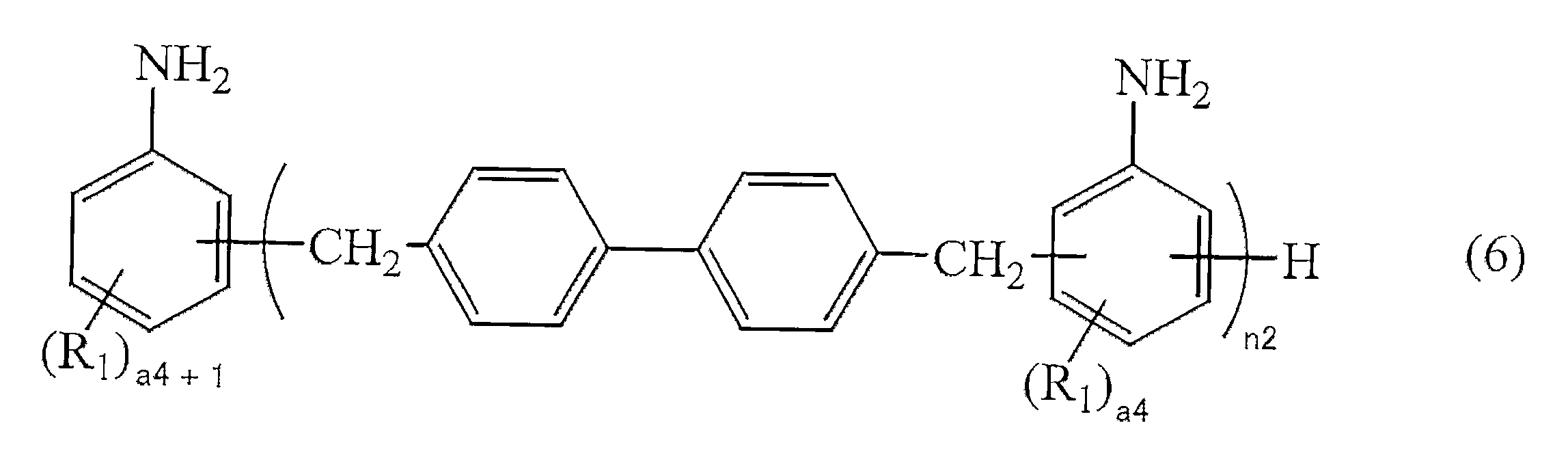
使用されるビスハロゲノメチルビフェニル類またはビスアルコキシメチルビフェニル類としては、4,4’-ビス(クロロメチル)ビフェニル、4,4’-ビス(ブロモメチル)ビフェニル、4,4’-ビス(フルオロメチル)ビフェニル、4,4’-ビス(ヨードメチル)ビフェニル、4,4’-ジメトキシメチルビフェニル、4,4’-ジエトキシメチルビフェニル、4,4’-ジプロポキシメチルビフェニル、4,4’-ジイソプロポキシメチルビフェニル、4,4’-ジイソブトキシメチルビフェニル、4,4’-ジブトキシメチルビフェニル、4,4’-ジ-tert-ブトキシメチルビフェニルなどが挙げられる。これらは単独で用いてもよく、2種以上併用してもよい。ビスハロゲノメチルビフェニル類またはビスアルコキシメチルビフェニル類の使用量は、使用されるアニリン類1モルに対して0.05~0.8モル、好ましくは0.1~0.6モルである。
反応は必要によりトルエン、キシレンなどの有機溶剤を使用して行っても、無溶剤で行っても良い。例えば、アニリン類と溶剤の混合溶液に酸性触媒を添加した後、触媒が水を含む場合は共沸により水を系内から除く。しかる後に40~100℃、好ましくは50~80℃でビスハロゲノメチルビフェニル類またはビスアルコキシメチルビフェニル類を1~5時間、好ましくは2~4時間かけて添加し、その後溶剤を系内から除きながら昇温して180~240℃、好ましくは190~220℃で5~30時間、好ましくは10~20時間反応を行う。反応終了後、アルカリ水溶液で酸性触媒を中和後、油層に非水溶性有機溶剤を加えて廃水が中性になるまで水洗を繰り返し、加熱減圧下で過剰のアニリン類や有機溶剤を留去することにより式(6)の化合物が得られる。日本国特公平8-16151号公報や日本国特許第5030297号公報においては言及されていないが、この段階で副生成物であるジフェニルアミンは、触媒量・原料使用比率・温度・時間等により異なるが、通常樹脂中に2~10質量%含まれる。ジフェニルアミンは、アニリンを留去する条件では除去できない。少なくともアニリンの沸点以上の温度での加熱減圧下での水蒸気や、大量の窒素ガス等の不活性ガスの吹き込みを行うことでジフェニルアミンを除去することができる。
反応で使用する溶剤は反応中に生成する水を系内から除去する必要があるため、非水溶性の溶剤を使用する。例えばトルエン、キシレンなどの芳香族溶剤、シクロヘキサン、n-ヘキサンなどの脂肪族溶剤、ジエチルエーテル、ジイソプロピルエーテルなどのエーテル類、酢酸エチル、酢酸ブチルなどのエステル系溶剤、メチルイソブチルケトン、シクロペンタノンなどのケトン系溶剤などが挙げられるがこれらに限定されるものではなく、2種以上を併用しても良い。
また、前記非水溶性溶剤に加えて非プロトン性極性溶剤を併用することもできる。例えば、ジメチルスルホン、ジメチルスルホキシド、ジメチルホルムアミド、ジメチルアセトアミド、1,3-ジメチル-2-イミダゾリジノン、N-メチルピロリドンなどが挙げられ、2種以上を併用しても良い。非プロトン性極性溶剤を使用する場合は、併用する非水溶性溶剤よりも沸点の高いものを使用することが好ましい。
触媒は酸性触媒で特に限定されないが、p-トルエンスルホン酸、ヒドロキシ-p-トルエンスルホン酸、メタンスルホン酸、硫酸、リン酸等が挙げられる。
例えばマレイン酸をトルエンに溶解し、撹拌下で式(6)の化合物のN-メチルピロリドン溶液を添加し、その後p-トルエンスルホン酸を加えて、還流条件下で生成する水を系内から除去しながら反応を行う。


前記メタリル基の割合は、高速液体クロマトグラフィー(HPLC)等の分析装置により確認することができる。
前記式(1)及び(3)中のR3における芳香族基としては、フェニル基、ビフェニル基、インデニル基、ナフチル基、アントリル基、フルオレニル基、ピレニル基等の芳香族炭化水素基、フラニル基、チエニル基、チエノチエニル基、ピロリル基、イミダゾリル基、ピリジル基、ピラジル基、ピリミジル基、キノリル基、インドリル基及びカルバゾリル基等が挙げられる。
このポリメタリルクロライドの残留は全塩素量を押し上げる要因になるばかりか、メタリルエーテル化合物の分子量の増加に寄与し、製品化の際に微量なゲル物を残すことがある。またこの塩素量を低下させるためには相当量の塩基性物質の追加が必要となり、産業上好ましくないばかりか、系内に毒性の高いメタリルアルコールを生成してしまう。
これらポリメタリルクロライド化合物はガスクロマトグラフィー等で容易に確認が可能であり、具体的な量としてはその面積比でそのメタリルクロライドモノマーに対し、1.0面積%以下の重合物であることが好ましく、より好ましくは0.5面積%以下、さらに好ましくは0.2面積%以下、特に好ましくは0.05面積%以下である。
また、メタリルクロライドの純度としては、90面積%以上が好ましく、97面積%以上がより好ましく、99面積%以上が特に好ましい。
メタリルクロライドの使用量は原料であるフェノール樹脂(以下、単に原料フェノール樹脂とも称する)の水酸基1モルに対して通常1.0~1.15モルであり、好ましくは1.0~1.10モル、より好ましくは1.0~1.05モルである。
アルカリ金属水酸化物の使用量は原料フェノール樹脂の水酸基1モルに対して通常1.0~1.15モルであり、好ましくは1.0~1.10モル、より好ましくは1.0~1.05モルである。
非プロトン極性溶媒の使用量としてはフェノール樹脂の総質量に対し、20~300質量%が好ましく、より好ましくは25~250質量%、特に好ましくは25~200質量%である。非プロトン極性溶媒は水洗等の精製に有用ではなく、大量に使用するのは好ましくない。また沸点が高く、溶剤の除去が困難であるため、多大なエネルギーを消費してしまうため多すぎることは好ましくない。
ラジカル重合開始剤としては、ベンゾイン、ベンゾインメチル等のベンゾイン系化合物、アセトフェノン、2,2’-ジメトキシ-2-フェニルアセトフェノン等のアセトフェノン系化合物、チオキサントン、2,4-ジエチルチオキサントン等のチオキサントン系化合物、4,4’-ジアジドカルコン、2,6-ビス(4’-アジドベンザル)シクロヘキサノン、4,4’-ジアジドベンゾフェノン等のビスアジド化合物、アゾビスイソブチロニトリル、2,2’-アゾビスプロパン、ヒドラゾン等のアゾ化合物、2,5-ジメチル-2,6-ジ(t-ブチルパーオキシ)ヘキサン、2,5’-ジメチル-2,5’-ジ(t-ブチルパーオキシ)ヘキシン-3、ジクミルパーオキサイド等のなど有機過酸化物が挙げられる。
また、日本国特開2005-264154号公報に合成方法が記載されているシアネートエステル化合物は、低吸湿性、難燃性、誘電特性に優れているためシアネートエステル化合物として特に好ましい。
フィラーとしては、特に限定されるものではないが、金属複合塩、活性炭、層状粘土鉱物、金属酸化物から選択される充填剤等が挙げられる。
金属複合塩としてはハイドロタルサイト様化合物が好ましい。ハイドロタルサイト様化合物とは、一般式[M2+ 1-XM3+ X(OH)2][An- X/n・mH2O]で表される化合物であり、M2+とM3+は、2価および3価の金属イオンを、An- X/nは層間陰イオンを表す。具体的には代表的なハイドロタルサイトはMg6Al2(OH)16CO3・4H2Oのように表される化合物である。市販品としては協和化学工業(株)の製品であるキョーワードシリーズが有効である。キョーワード500、キョーワード1000、キョーワード700、キョーワード600、キョーワード200、キョーワード2000等が挙げられる。本発明においては特に含有される成分中、酸化マグネシウム、酸化アルミニウム、二酸化珪素の量比において酸化マグネシウム>酸化アルミニウム、また酸化マグネシウム>二酸化珪素である構成が好ましい。具体的にはキョーワード500や、キョーワード1000などが好ましい。
原料としては木質(おが屑等)、石炭(亜炭、ピート、コール等)、ヤシガラ、フェノール樹脂などが挙げられるが、本発明では特に木質系が好ましい。市販品としてはフタムラ化学(株)製、太閤シリーズ(CG,CW,G,QW、S、ACFなどのシリーズ)、味の素ファインテクノ製 ホクエツシリーズ(SD、BA、F、ZN、Y-180C、H-10CL、H-8CL、G-10F、CL-Kなどのシリーズ)、日本エンバイロケミカルズ(株)製 白鷹(C、LGK-400、Gシリーズ、DOシリーズ、Wc、Sx、WHAなど)、カルボラフィン、など、NORIT(株)製 PKシリーズ、PKDAシリーズ、ELORIT、AZO、DARCOシリーズ、HYDRODARCOシリーズ、PETRODARCO、GAC、シリーズ、GCN、C GRAN、ROW、ROY、ROX、RO、RB、R、R.EXTRA、SORBNORIT、GFシリーズ、CNR、ROZ、RBAA、RBHG、RZN、RGM、SX、SA、D 10、VETERINAIR、PN、ZN、SA-SW、W、GL、SAM、HB PLUS、EUR、USP、CA、CG、GB、CAP SUPER、CGP SUPER、S-51シリーズ、HDB、HDC、HDR、HDW、GRO SAFE、FM-1、PACシリーズなど、クラレ(株)製、RP-20、YP-17Dなどが挙げられる。
また、前記ワニスを、強化繊維に含浸させて加熱乾燥させることにより本発明のプリプレグを得ることもできる。
上記のプリプレグを所望の形に裁断、必要により銅箔などと積層後、積層物にプレス成形法やオートクレーブ成形法、シートワインディング成形法などで圧力をかけながら積層板用マレイミド樹脂組成物を加熱硬化させることにより積層板を得ることができる。
更に、表面に銅箔を重ねてできた積層板に回路を形成し、その上にプリプレグや銅箔等を重ねて上記の操作を繰り返して多層の回路基板を得ることができる。
以下に実施例で用いた各種分析方法について記載する。
得られた吸水液をイオンクロマトにて測定した。
・水酸基当量: JIS K0070に準拠。
・エポキシ当量: JIS K 7236 (ISO 3001) に準拠
・アミン当量:JIS K-7236 付属書Aに記載された方法に準拠
・ジフェニルアミン含量:ガスクロマトグラフィーで測定
・ICI溶融粘度: JIS K 7117-2 (ISO 3219) に準拠
・軟化点: JIS K 7234 に準拠
・全塩素: JIS K 7243-3 (ISO 21672-3) に準拠
解析条件
カラム(Shodex KF-603、KF-602.5、KF-602、KF-601x2)
連結溶離液はテトラヒドロフラン、流速は0.5ml/min.
カラム温度は40℃、検出:RI(示差屈折検出器)
・高速液体クロマトグラフィー(HPLC):
解析条件
カラム ODS2 溶離液はアセトニトリル-水のグラジエント、
カラム温度40℃ 検出UV 274nm、流速 1.0ml/min.
・ガスクロマトグラフィー(GC):
解析条件
カラム HP-5 30m×0.32mm×0.25μm
キャリアガス ヘリウム 1.0mL/min Split1/50
インジェクター温度 300℃
ディテクター温度 300℃
オーブン温度プログラム 50℃で5分保持後、50℃~300℃まで10℃/minで昇温 300℃でそのまま5分間保持。
・硬化発熱:MDSC測定による硬化開始温度、硬化発熱ピークトップ温度及び発熱終了温度の測定
解析条件
解析モード:MDSC測定
測定器:Q2000 TA-instruments社製
昇温速度:3℃/min
撹拌機、還流冷却管、撹拌装置を備えたフラスコに、ジメチルスルホキシド720質量部、ビスフェノールA(水酸基当量120g/eq.軟化点65℃)510質量部、メタリルクロライド(純度99% 純正化学製)486質量部(フェノール樹脂の水酸基1モル当量に対し、1.1モル当量)を加え、27℃に昇温し溶解させた。次いで46.3質量%水酸化ナトリウム水溶液134質量部を内温35℃を超えないようにゆっくり加え、その後にフレーク状の苛性ソーダ(純度 99% 東ソー製)70.0質量部(フェノール樹脂の水酸基1モル当量に対し、1.1モル当量)を60分かけて添加した。そのまま30~35℃で4時間、40~45℃で1時間、55~60℃で1時間反応を行った。
反応終了後、ロータリーエバポレータにて水やジメチルスルホキシド等を留去した。そして、酢酸(純度99.5% 東京化成工業(株)製)30質量部を加えて中和し、メチルイソブチルケトン700質量部を加え、水洗を繰り返し、水層が中性になったことを確認した。その後油層からロータリーエバポレータを用いて、減圧下、窒素バブリングしながら溶剤類を留去することで、メタリル基を有する化合物(以下、「MEP1」と表す)750質量部を得た。
撹拌機、還流冷却管、撹拌装置を備えたフラスコに、ジメチルスルホキシド720質量部、フェノール樹脂(テトラメチルビフェノール 水酸基当量122g/eq.)330質量部、メタリルクロライド(純度99% 東京化成工業製)300質量部(フェノール樹脂の水酸基1モル当量に対し、1.1モル当量)を加え、27℃に昇温し溶解させた。次いで46.3質量%水酸化ナトリウム水溶液134質量部を内温35℃を超えないようにゆっくり加え、その後にフレーク状の苛性ソーダ(純度 99% 東ソー製)70.0質量部(フェノール樹脂の水酸基1モル当量に対し、1.1モル当量)を60分かけて添加した。そのまま30~35℃で4時間、40~45℃で1時間、55~60℃で1時間反応を行った。
反応終了後、ロータリーエバポレータにて水やジメチルスルホキシド等を留去した。そして、酢酸(純度99.5% 東京化成工業(株)製)30質量部を加えて中和し、メチルイソブチルケトン700質量部を加え、水洗を繰り返し、水層が中性になったことを確認した。その後油層からロータリーエバポレータを用いて、減圧下、窒素バブリングしながら溶剤類を留去することで、メタリル基を有する化合物(以下、「MEP2」と表す)470質量部を得た。
撹拌機、還流冷却管、撹拌装置を備えたフラスコに、ジメチルスルホキシド720質量部、フェノール樹脂(フェノール-ジシクロペンタジエン型 水酸基当量178g/eq.軟化点106℃)535質量部、メタリルクロライド(純度99% 東京化成工業製)272質量部(フェノール樹脂の水酸基1モル当量に対し、1.1モル当量)を加え、27℃に昇温し溶解させた。次いで46.3質量%水酸化ナトリウム水溶液134質量部を内温35℃を超えないようにゆっくり加え、その後にフレーク状の苛性ソーダ(純度 99% 東ソー製)70.0質量部(フェノール樹脂の水酸基1モル当量に対し、1.1モル当量)を60分かけて添加した。そのまま30~35℃で4時間、40~45℃で1時間、55~60℃で1時間反応を行った。
反応終了後、ロータリーエバポレータにて120℃以下で加熱減圧下、水やジメチルスルホキシド等を留去した。そして、酢酸(純度99.5% 東京化成工業(株)製)30質量部を加えて中和し、メチルイソブチルケトン700質量部を加え、水洗を繰り返し、水層が中性になったことを確認した。その後油層からロータリーエバポレータを用いて、減圧下、窒素バブリングしながら溶剤類を留去することで、メタリル基を有する化合物(以下、「MEP3」と表す)690質量部を得た。
撹拌機、還流冷却管、撹拌装置を備えたフラスコに、窒素パージを施しながら、ジメチルスルホキシド720質量部、クレゾール樹脂OCN-100℃(水酸基当量120g/eq.軟化点105℃、明和化成工業製)360質量部、メタリルクロライド(純度99% 東京化成工業製)299質量部(クレゾール樹脂の水酸基1モル当量に対し、1.1モル当量)を加え、27℃に昇温し溶解させた。次いで苛性ソーダ(純度 99% 東ソー製)132.0質量部(クレゾール樹脂の水酸基1モル当量に対し、1.1モル当量)と水72質量部を60分間かけて添加した。そのまま30~35℃で4時間、40~45℃で1時間、60~65℃で1時間反応を行った。
反応終了後、ロータリーエバポレータにて120℃以下で加熱減圧下、水やジメチルスルホキシド等を留去した。そして、メチルイソブチルケトン600質量部を加え、水洗を繰り返し、水層が中性になったことを確認した。その後油層からロータリーエバポレータを用いて、減圧下、窒素バブリングしながら溶剤類を留去することで、メタリル基を有する化合物(以下、「MEP4」と表す)523質量部を得た。
撹拌機、還流冷却管、撹拌装置を備えたフラスコに、窒素パージを施しながら、ジメチルスルホキシド720質量部、フェノールノボラック樹脂550PL(水酸基当量97g/eq.軟化点114℃、明和化成工業製)291質量部、アリルクロライド(純度99% 純正化学製)253質量部(フェノールノボラック樹脂の水酸基1モル当量に対し、1.1モル当量)を加え、27℃に昇温し溶解させた。次いで苛性ソーダ(純度 99% 東ソー製)132.0質量部(フェノールノボラック樹脂の水酸基1モル当量に対し、1.1モル当量)と水72質量部を60分かけて添加した。そのまま30~35℃で4時間、40~45℃で1時間、60~65℃で1時間反応を行った。
反応終了後、ロータリーエバポレータにて120℃以下で加熱減圧下、水やジメチルスルホキシド等を留去した。そして、メチルイソブチルケトン600質量部を加え、水洗を繰り返し、水層が中性になったことを確認した。その後油層からロータリーエバポレータを用いて、減圧下、窒素バブリングしながら溶剤類を留去することで、メタリル基を有する化合物(以下、「MEP5」と表す)440質量部を得た。
撹拌機、還流冷却管、撹拌装置を備えたフラスコに、ジメチルスルホキシド720質量部、2-フェニル-3,3ビス(4-ヒドロキシフェニル)フタルイミド(水酸基当量201g/eq.軟化点65℃)590質量部、メタリルクロライド(純度99% 純正化学製)420質量部(フェノール樹脂の水酸基1モル当量に対し、1.1モル当量)を加え、27℃に昇温し溶解させた。次いで46.3質量%水酸化ナトリウム水溶液134質量部を内温35℃を超えないようにゆっくり加え、その後にフレーク状の苛性ソーダ(純度 99% 東ソー製)70.0質量部(フェノール樹脂の水酸基1モル当量に対し、1.1モル当量)を60分かけて添加した。そのまま30~35℃で4時間、40~45℃で1時間、55~60℃で1時間反応を行った。
反応終了後、ロータリーエバポレータにて水やジメチルスルホキシド等を留去した。そして、酢酸(純度99.5% 東京化成工業(株)製)30質量部を加えて中和し、メチルイソブチルケトン700質量部を加え、水洗を繰り返し、水層が中性になったことを確認した。その後油層からロータリーエバポレータを用いて、減圧下、窒素バブリングしながら溶剤類を留去することで、メタリル基を有する化合物(以下、「MEP6」と表す)710質量部を得た。
撹拌機、還流冷却管、撹拌装置を備えたフラスコに、ジメチルスルホキシド720質量部、4,4’-(1-{4-[2-(4-ヒドロキシフェニル)プロパン-2-イル]フェニル}エタン-1,1-ジイル)ジフェノール(水酸基当量150g/eq)370質量部、メタリルクロライド(純度99% 純正化学製)420質量部(フェノール樹脂の水酸基1モル当量に対し、1.1モル当量)を加え、27℃に昇温し溶解させた。次いで46.3質量%の水酸化ナトリウム水溶液134質量部を内温35℃を超えないようにゆっくり加え、その後にフレーク状の苛性ソーダ(純度 99% 東ソー製)70.0質量部(フェノール樹脂の水酸基1モル当量に対し、1.1モル当量)を60分かけて添加した。そのまま30~35℃で4時間、40~45℃で1時間、55~60℃で1時間反応を行った。
反応終了後、ロータリーエバポレータにて水やジメチルスルホキシド等を留去した。そして、酢酸(純度99.5% 東京化成工業(株)製)30質量部を加えて中和し、メチルイソブチルケトン700質量部を加え、水洗を繰り返し、水層が中性になったことを確認した。その後油層からロータリーエバポレータを用いて、減圧下、窒素バブリングしながら溶剤類を留去することで、メタリル基を有する化合物(以下、「MEP7」と表す)510質量部を得た。
撹拌機、還流冷却管、撹拌装置を備えたフラスコに、ジメチルスルホキシド720質量部、ビスフェノールA(水酸基当量120g/eq.軟化点65℃)510質量部、アリルクロライド(純度99% 純正化学製)298.8質量部(フェノール樹脂の水酸基1モル当量に対し、1.1モル当量)を加え、27℃に昇温し溶解させた。次いで46.3質量%水酸化ナトリウム水溶液134質量部を内温35℃を超えないようにゆっくり加え、その後にフレーク状の苛性ソーダ(純度 99% 東ソー製)70.0質量部(フェノール樹脂の水酸基1モル当量に対し、1.1モル当量)を60分かけて添加した。そのまま30~35℃で4時間、40~45℃で1時間、55~60℃で1時間反応を行った。
反応終了後、ロータリーエバポレータにて水やジメチルスルホキシド等を留去した。そして、酢酸(純度99.5% 東京化成工業(株)製)30質量部を加えて中和し、メチルイソブチルケトン700質量部を加え、水洗を繰り返し、水層が中性になったことを確認した。その後油層からロータリーエバポレータを用いて、減圧下、窒素バブリングしながら溶剤類を留去することで、アリル基を有する化合物(以下、「AEP1」と表す)750質量部を得た。
温度計、冷却管、ディーンスターク共沸蒸留トラップ、撹拌機を取り付けたフラスコにアニリン372部とトルエン200部を仕込み、室温で35%塩酸146部を1時間で滴下した。滴下終了後加熱して共沸してくる水とトルエンを冷却・分液した後、有機層であるトルエンだけを系内に戻して脱水を行った。次いで4,4’-ビス(クロロメチル)ビフェニル125部を60~70℃に保ちながら1時間かけて添加し、更に同温度で2時間反応を行った。反応終了後、昇温をしながらトルエンを留去して系内を195~200℃とし、この温度で15時間反応をした。その後冷却しながら30%水酸化ナトリウム水溶液330部を系内が激しく還流しないようにゆっくりと滴下し、80℃以下で昇温時に留去したトルエンを系内に戻し、70℃~80℃で静置した。分離した下層の水層を除去し、反応液の水洗を洗浄液が中性になるまで繰り返した。次いでロータリーエバポレータで油層から加熱減圧下(200℃、0.6KPa)において過剰のアニリンとトルエンを留去することにより芳香族アミン樹脂(a1)173部を得た。芳香族アミン樹脂(a1)中のジフェニルアミンは2.0%であった。
得られた樹脂(a1)を、再びロータリーエバポレータで加熱減圧下(200℃、4KPa)において水蒸気吹き込みの代わりに水を少量づつ滴下した。その結果、芳香族アミン樹脂(A1)166部を得た。得られた芳香族アミン樹脂(A1)の軟化点は56℃、溶融粘度は0.035Pa・s、ジフェニルアミンは0.1%以下であった。
温度計、冷却管、ディーンスターク共沸蒸留トラップ、撹拌機を取り付けたフラスコに無水マレイン酸147部とトルエン300部を仕込み、加熱して共沸してくる水とトルエンを冷却・分液した後、有機層であるトルエンだけを系内に戻して脱水を行った。次に、合成例9で得られた芳香族アミン樹脂(A1)195部をN-メチル-2-ピロリドン195部に溶解した樹脂溶液を、系内を80~85℃に保ちながら1時間かけて滴下した。滴下終了後、同温度で2時間反応を行い、p-トルエンスルホン酸3部を加えて、還流条件で共沸してくる縮合水とトルエンを冷却・分液した後、有機層であるトルエンだけを系内に戻して脱水を行いながら20時間反応を行った。反応終了後、トルエンを120部追加し、水洗を繰り返してp-トルエンスルホン酸及び過剰の無水マレイン酸を除去し、加熱して共沸により水を系内から除いた。次いで反応溶液を濃縮して、マレイミド樹脂(以下、「MI1」と表す)を70%含有する樹脂溶液を得た。
撹拌機、還流冷却管、撹拌装置を備えたフラスコに、ジメチルスルホキシド720質量部、2,2’-ジアリル-4,4’-スルホニルジフェノール(TGSH 水酸基当量263g/eq.軟化点65℃)540質量部、メタリルクロライド(純度99% 東京化成工業製)299質量部(フェノール樹脂の水酸基1モル当量に対し、1.1モル当量)を加え、27℃に昇温し溶解させた。次いで46.3質量%水酸化ナトリウム水溶液134質量部を、内温35℃を超えないようにゆっくり加え、その後にフレーク状の苛性ソーダ(純度 99% 東ソー製)70.0質量部(フェノール樹脂の水酸基1モル当量に対し、1.1モル当量)を60分かけて添加した。そのまま30~35℃で4時間、40~45℃で1時間、55~60℃で1時間反応を行った。
反応終了後、ロータリーエバポレータにて水やジメチルスルホキシド等を留去した。そして、酢酸(純度99.5% 東京化成工業(株)製)30質量部を加えて中和し、メチルイソブチルケトン700質量部を加え、水洗を繰り返し、水層が中性になったことを確認した。その後油層からロータリーエバポレータを用いて、減圧下、窒素バブリングしながら溶剤類を留去することで、メタリル基を有する化合物(以下、「MEP8」と表す)630質量部を得た。
合成例1で得られたメタリル基を有する化合物(MEP1)35質量部、合成例10で得られたマレイミド樹脂(MI1)65質量部を配合し、150℃の条件で均一に攪拌し、その後100℃でジクミルパーオキサイド(触媒1、化薬アクゾ(株)製)を0.5質量部配合し、攪拌し、均一溶解させ、本発明のマレイミド樹脂組成物を得た。このマレイミド樹脂組成物を硬化条件200℃×2時間 230℃×2時間で硬化させ、本発明の硬化物を得た。硬化物の物性の測定結果を表1に示す。
合成例2で得られたメタリル基を有する化合物(MEP2)38質量部、合成例10で得られたマレイミド樹脂(MI1)62質量部を配合し、150℃の条件で均一に攪拌し、その後100℃でジクミルパーオキサイド(触媒1、化薬アクゾ(株)製)を0.5質量部配合し、攪拌し、均一溶解させ、本発明のマレイミド樹脂組成物を得た。このマレイミド樹脂組成物を硬化条件200℃×2時間 230℃×2時間で硬化させ、本発明の硬化物を得た。硬化物の物性の測定結果を表1に示す。
合成例3で得られたメタリル基を有する化合物(MEP3)45質量部、合成例10で得られたマレイミド樹脂(MI1)55質量部を配合し、150℃の条件で均一に攪拌し、その後100℃でジクミルパーオキサイド(触媒1、化薬アクゾ(株)製)を0.5質量部配合し、攪拌し、均一溶解させ、本発明のマレイミド樹脂組成物を得た。このマレイミド樹脂組成物を硬化条件200℃×2時間 230℃×2時間で硬化させ、本発明の硬化物を得た。硬化物の物性の測定結果を表1に示す。
合成例4で得られたメタリル基を有する化合物(MEP4)38質量部、合成例10で得られたマレイミド樹脂(MI1)62質量部を配合し、150℃の条件で均一に攪拌し、その後100℃でジクミルパーオキサイド(触媒1、化薬アクゾ(株)製)を0.5質量部配合し、攪拌し、均一溶解させ、本発明のマレイミド樹脂組成物を得た。このマレイミド樹脂組成物を硬化条件200℃×2時間 230℃×2時間で硬化させ、本発明の硬化物を得た。硬化物の物性の測定結果を表1に示す。
合成例5で得られたメタリル基を有する化合物(MEP5)35質量部、合成例10で得られたマレイミド樹脂(MI1)65質量部を配合し、150℃の条件で均一に攪拌し、その後100℃でジクミルパーオキサイド(触媒1、化薬アクゾ(株)製)を0.5質量部配合し、攪拌し、均一溶解させ、本発明の熱硬化性樹脂組成物を得た。このマレイミド樹脂組成物を硬化条件200℃×2時間 230℃×2時間で硬化させ、本発明の硬化物を得た。硬化物の物性の測定結果を表1に示す。
合成例6で得られたメタリル基を有する化合物(MEP6)47質量部、合成例10で得られたマレイミド樹脂(MI1)53質量部を配合し、150℃の条件で均一に攪拌し、その後100℃でジクミルパーオキサイド(触媒1、化薬アクゾ(株)製)を0.5質量部配合し、攪拌し、均一溶解させ、本発明の熱硬化性樹脂組成物を得た。このマレイミド樹脂組成物を硬化条件200℃×2時間 230℃×2時間で硬化させ、本発明の硬化物を得た。硬化物の物性の測定結果を表1に示す。
合成例7で得られたメタリル基を有する化合物(MEP7)39質量部、合成例10で得られたマレイミド樹脂(MI1)61質量部を配合し150℃の条件で均一に攪拌し、その後100℃でジクミルパーオキサイド(触媒1、化薬アクゾ(株)製)を0.5質量部配合し、攪拌し、均一溶解させ、本発明のマレイミド樹脂組成物を得た。このマレイミド樹脂組成物を硬化条件200℃×2時間 230℃×2時間で硬化させ、本発明の硬化物を得た。硬化物の物性の測定結果を表1に示す。
合成例8で得られたアリル基を有する化合物(AEP1)46質量部、マレイミド化合物(4,4’-ビスマレイミドジフェニルメタン BMI-1000、大和化成工業(株)製 以下「MI2」と略す。)54質量部を配合し150℃の条件で均一に攪拌し、その後100℃でジクミルパーオキサイド(触媒1、化薬アクゾ(株)製)を0.5質量部配合し、攪拌し、均一溶解させ、比較例のマレイミド樹脂組成物を得た。このマレイミド樹脂組成物を硬化条件200℃×2時間 230℃×2時間で硬化させ、比較例の硬化物を得た。硬化物の物性の測定結果を表1に示す。
合成例8で得られたアリル基を有する化合物(AEP1)38重量部、合成例10で得られたマレイミド樹脂(MI1)62重量部を配合し150℃の条件で均一に攪拌し、その後100℃でジクミルパーオキサイド(触媒1、化薬アクゾ(株)製)を0.5重量部配合し、攪拌し、均一溶解させ、本発明のマレイミド樹脂組成物を得た。このマレイミド樹脂組成物を硬化条件200℃×2時間 230℃×2時間で硬化させ、本発明の硬化物を得た。硬化物の物性の測定結果を表1に示す。
・Tg:DMA測定に於けるTanδのピーク点(tanδMAX)をTgとした。
解析条件 動的粘弾性測定器:TA-instruments製、Q-800 測定温度範囲:30℃~350℃ 温速度:2℃/min 試験片サイズ:5mm×50mmに切り出した物を使用した(厚みは約800μm)。
<誘電率試験・誘電正接試験>
・(株)関東電子応用開発製の1GHz空洞共振器を用いて、空洞共振器摂動法にてテストを行った。ただし、サンプルサイズは幅1.7mm×長さ100mmとし、厚さは1.7mmで試験を行った。
<吸水率>
・吸水率:100℃×24h 浸漬させた硬化物の重量増加%。
合成例1で得られたメタリル基を有する化合物(MEP1)35質量部、合成例10で得られたマレイミド樹脂(MI1)65質量部、メチルエチルケトン(MEK)100質量部加えてワニスを作成した。得られたワニスを25℃×72h放置したあとに析出物の有無を確認した。結果を表2に示す。
合成例1で得られたメタリル基を有する化合物(MEP1)55質量部、マレイミド樹脂(BMI-2300、大和化成工業(株)製 以下 「MI3」と略す。)45質量部、MEK100質量部加えてワニスを作成した。得られたワニスを25℃×72h放置したあとに析出物の有無を確認した。結果を表2に示す。
合成例1で得られたメタリル基を有する化合物(MEP1)47質量部、マレイミド化合物(MI2)53質量部、MEK100質量部加えてワニスを作成した。得られたワニスを25℃×72h放置したあとに析出物の有無を確認した。結果を表2に示す。

なお、本出願は、2017年4月28日付で出願された日本国特許出願(特願2017-090437)に基づいており、その全体が引用により援用される。また、ここに引用されるすべての参照は全体として取り込まれる。
Claims (7)
- N個のマレイミド基を有するマレイミド樹脂(Nは整数でありその平均値は2より大きい)と、下記式(1)で表される化合物及び下記式(3-1)~(3-7)のいずれかで表される化合物の少なくともいずれかとを含有するマレイミド樹脂組成物。


- 前記マレイミド樹脂が、下記式(4)で表される構造である請求項1に記載のマレイミド樹脂組成物。
- ラジカル重合開始剤を含有する請求項1又は請求項2に記載のマレイミド樹脂組成物。
- 難燃剤、フィラー及び添加剤のいずれか一種以上を含有する請求項1~請求項3のいずれか一項に記載のマレイミド樹脂組成物。
- 請求項1~請求項4のいずれか一項に記載のマレイミド樹脂組成物をシート状の繊維基材に保持し、半硬化状態にあるプリプレグ。
- 請求項1~4のいずれか一項に記載のマレイミド樹脂組成物の硬化物。
- 請求項5に記載のプリプレグの硬化物。
Priority Applications (3)
| Application Number | Priority Date | Filing Date | Title |
|---|---|---|---|
| KR1020197031013A KR20190137106A (ko) | 2017-04-28 | 2018-04-25 | 말레이미드 수지 조성물, 프리프레그 및 그 경화물 |
| JP2019514571A JPWO2018199157A1 (ja) | 2017-04-28 | 2018-04-25 | マレイミド樹脂組成物、プリプレグ及びその硬化物 |
| CN201880026553.0A CN110546177A (zh) | 2017-04-28 | 2018-04-25 | 顺丁烯二酰亚胺树脂组成物、预浸体及其硬化物 |
Applications Claiming Priority (2)
| Application Number | Priority Date | Filing Date | Title |
|---|---|---|---|
| JP2017-090437 | 2017-04-28 | ||
| JP2017090437 | 2017-04-28 |
Publications (1)
| Publication Number | Publication Date |
|---|---|
| WO2018199157A1 true WO2018199157A1 (ja) | 2018-11-01 |
Family
ID=63919815
Family Applications (1)
| Application Number | Title | Priority Date | Filing Date |
|---|---|---|---|
| PCT/JP2018/016785 Ceased WO2018199157A1 (ja) | 2017-04-28 | 2018-04-25 | マレイミド樹脂組成物、プリプレグ及びその硬化物 |
Country Status (5)
| Country | Link |
|---|---|
| JP (1) | JPWO2018199157A1 (ja) |
| KR (1) | KR20190137106A (ja) |
| CN (1) | CN110546177A (ja) |
| TW (1) | TW201902977A (ja) |
| WO (1) | WO2018199157A1 (ja) |
Cited By (1)
| Publication number | Priority date | Publication date | Assignee | Title |
|---|---|---|---|---|
| CN114729762A (zh) * | 2019-11-26 | 2022-07-08 | 大金工业株式会社 | 机器学习装置、需求控制系统以及空调控制系统 |
Families Citing this family (1)
| Publication number | Priority date | Publication date | Assignee | Title |
|---|---|---|---|---|
| KR102452788B1 (ko) | 2019-10-31 | 2022-10-11 | 주식회사 엘지화학 | 편광판 적층체 및 이의 제조방법 |
Citations (5)
| Publication number | Priority date | Publication date | Assignee | Title |
|---|---|---|---|---|
| JPH02212554A (ja) * | 1989-02-13 | 1990-08-23 | Mitsui Toatsu Chem Inc | 半導体封止用樹脂組成物 |
| JPH05186382A (ja) * | 1992-01-08 | 1993-07-27 | Toagosei Chem Ind Co Ltd | メタリルフェノール化合物 |
| JP2009001783A (ja) * | 2007-05-18 | 2009-01-08 | Nippon Kayaku Co Ltd | 積層板用樹脂組成物、プリプレグ及び積層板 |
| JP2012201816A (ja) * | 2011-03-25 | 2012-10-22 | Mitsubishi Plastics Inc | ポリマレイミド系組成物 |
| WO2016208667A1 (ja) * | 2015-06-25 | 2016-12-29 | 日本化薬株式会社 | エポキシ樹脂組成物およびその硬化物 |
Family Cites Families (7)
| Publication number | Priority date | Publication date | Assignee | Title |
|---|---|---|---|---|
| US4229550A (en) * | 1978-12-11 | 1980-10-21 | Trw Inc. | Flexibilized vinyl polybutadiene maleimide resins |
| JPS57153045A (en) | 1981-03-19 | 1982-09-21 | Mitsubishi Gas Chem Co Inc | Curable resin composition |
| JPS57153046A (en) | 1981-03-19 | 1982-09-21 | Mitsubishi Gas Chem Co Inc | Curable resin composition |
| JPS56157424A (en) | 1980-05-06 | 1981-12-04 | Mitsubishi Gas Chem Co Inc | Curable resin composition |
| JP3573543B2 (ja) | 1995-09-25 | 2004-10-06 | 横浜ゴム株式会社 | 熱硬化性樹脂組成物 |
| CN101166790B (zh) * | 2005-04-28 | 2012-10-03 | Cytec技术有限公司 | 制造性能改善的双马来酰亚胺树脂体系 |
| CN101880363B (zh) * | 2010-07-09 | 2011-09-28 | 苏州大学 | 一种烯丙基化超支化聚苯醚改性双马来酰亚胺树脂及其制备方法 |
-
2018
- 2018-04-25 KR KR1020197031013A patent/KR20190137106A/ko not_active Withdrawn
- 2018-04-25 WO PCT/JP2018/016785 patent/WO2018199157A1/ja not_active Ceased
- 2018-04-25 JP JP2019514571A patent/JPWO2018199157A1/ja active Pending
- 2018-04-25 CN CN201880026553.0A patent/CN110546177A/zh active Pending
- 2018-04-27 TW TW107114387A patent/TW201902977A/zh unknown
Patent Citations (5)
| Publication number | Priority date | Publication date | Assignee | Title |
|---|---|---|---|---|
| JPH02212554A (ja) * | 1989-02-13 | 1990-08-23 | Mitsui Toatsu Chem Inc | 半導体封止用樹脂組成物 |
| JPH05186382A (ja) * | 1992-01-08 | 1993-07-27 | Toagosei Chem Ind Co Ltd | メタリルフェノール化合物 |
| JP2009001783A (ja) * | 2007-05-18 | 2009-01-08 | Nippon Kayaku Co Ltd | 積層板用樹脂組成物、プリプレグ及び積層板 |
| JP2012201816A (ja) * | 2011-03-25 | 2012-10-22 | Mitsubishi Plastics Inc | ポリマレイミド系組成物 |
| WO2016208667A1 (ja) * | 2015-06-25 | 2016-12-29 | 日本化薬株式会社 | エポキシ樹脂組成物およびその硬化物 |
Cited By (1)
| Publication number | Priority date | Publication date | Assignee | Title |
|---|---|---|---|---|
| CN114729762A (zh) * | 2019-11-26 | 2022-07-08 | 大金工业株式会社 | 机器学习装置、需求控制系统以及空调控制系统 |
Also Published As
| Publication number | Publication date |
|---|---|
| KR20190137106A (ko) | 2019-12-10 |
| CN110546177A (zh) | 2019-12-06 |
| TW201902977A (zh) | 2019-01-16 |
| JPWO2018199157A1 (ja) | 2020-03-12 |
Similar Documents
| Publication | Publication Date | Title |
|---|---|---|
| JP5030297B2 (ja) | 積層板用樹脂組成物、プリプレグ及び積層板 | |
| JP6689475B1 (ja) | マレイミド樹脂、硬化性樹脂組成物およびその硬化物 | |
| TWI814899B (zh) | 馬來醯亞胺樹脂、硬化性樹脂組成物及其硬化物 | |
| JP6971222B2 (ja) | 熱硬化性樹脂組成物、プリプレグ及びその硬化物 | |
| JP6789936B2 (ja) | エポキシ樹脂組成物およびその硬化物 | |
| JP6429862B2 (ja) | 芳香族アミン樹脂、マレイミド樹脂、硬化性樹脂組成物およびその硬化物 | |
| JP6764470B2 (ja) | マレイミド樹脂、硬化性樹脂組成物およびその硬化物 | |
| CN115210293B (zh) | 顺丁烯二酰亚胺树脂及其制造方法、顺丁烯二酰亚胺溶液、以及可硬化性树脂组合物及其硬化物 | |
| WO2023032534A1 (ja) | アリルエーテル化合物、樹脂組成物及びその硬化物 | |
| WO2023276760A1 (ja) | アリルエーテル化合物、その樹脂組成物、及びその硬化物、並びにアリルエーテル化合物の製造方法 | |
| JPWO2018199157A1 (ja) | マレイミド樹脂組成物、プリプレグ及びその硬化物 | |
| JP6863679B2 (ja) | 溶液、その製造方法、エポキシ樹脂組成物及び積層板 | |
| WO2025115767A1 (ja) | 熱硬化性エステル樹脂、その製造方法、熱硬化性樹脂組成物、その硬化物、プリプレグ、樹脂シート、積層板、及び回路基板用材料 |
Legal Events
| Date | Code | Title | Description |
|---|---|---|---|
| 121 | Ep: the epo has been informed by wipo that ep was designated in this application |
Ref document number: 18790927 Country of ref document: EP Kind code of ref document: A1 |
|
| ENP | Entry into the national phase |
Ref document number: 2019514571 Country of ref document: JP Kind code of ref document: A |
|
| ENP | Entry into the national phase |
Ref document number: 20197031013 Country of ref document: KR Kind code of ref document: A |
|
| NENP | Non-entry into the national phase |
Ref country code: DE |
|
| 122 | Ep: pct application non-entry in european phase |
Ref document number: 18790927 Country of ref document: EP Kind code of ref document: A1 |