WO2018181558A1 - 組成物、液晶表示装置、電子機器 - Google Patents
組成物、液晶表示装置、電子機器 Download PDFInfo
- Publication number
- WO2018181558A1 WO2018181558A1 PCT/JP2018/012943 JP2018012943W WO2018181558A1 WO 2018181558 A1 WO2018181558 A1 WO 2018181558A1 JP 2018012943 W JP2018012943 W JP 2018012943W WO 2018181558 A1 WO2018181558 A1 WO 2018181558A1
- Authority
- WO
- WIPO (PCT)
- Prior art keywords
- liquid crystal
- polyamic acid
- repeating unit
- group
- alignment film
- Prior art date
- Legal status (The legal status is an assumption and is not a legal conclusion. Google has not performed a legal analysis and makes no representation as to the accuracy of the status listed.)
- Ceased
Links
- 0 CCC(C)(C)N*(C(*C(*C(C)(CC)*=C)=O)=O)I=C Chemical compound CCC(C)(C)N*(C(*C(*C(C)(CC)*=C)=O)=O)I=C 0.000 description 3
- FQXHYMDASGRYSU-UHFFFAOYSA-N CCC(C)(C)NC(C(CC1C(O)=O)C(CC(O)=O)C1C(Nc1ccc(C(C)(CC)CC)cc1)=O)=O Chemical compound CCC(C)(C)NC(C(CC1C(O)=O)C(CC(O)=O)C1C(Nc1ccc(C(C)(CC)CC)cc1)=O)=O FQXHYMDASGRYSU-UHFFFAOYSA-N 0.000 description 1
Images

Classifications
-
- C—CHEMISTRY; METALLURGY
- C09—DYES; PAINTS; POLISHES; NATURAL RESINS; ADHESIVES; COMPOSITIONS NOT OTHERWISE PROVIDED FOR; APPLICATIONS OF MATERIALS NOT OTHERWISE PROVIDED FOR
- C09K—MATERIALS FOR MISCELLANEOUS APPLICATIONS, NOT PROVIDED FOR ELSEWHERE
- C09K19/00—Liquid crystal materials
- C09K19/04—Liquid crystal materials characterised by the chemical structure of the liquid crystal components, e.g. by a specific unit
- C09K19/06—Non-steroidal liquid crystal compounds
- C09K19/08—Non-steroidal liquid crystal compounds containing at least two non-condensed rings
- C09K19/30—Non-steroidal liquid crystal compounds containing at least two non-condensed rings containing saturated or unsaturated non-aromatic rings, e.g. cyclohexane rings
- C09K19/3001—Cyclohexane rings
- C09K19/3003—Compounds containing at least two rings in which the different rings are directly linked (covalent bond)
-
- C—CHEMISTRY; METALLURGY
- C08—ORGANIC MACROMOLECULAR COMPOUNDS; THEIR PREPARATION OR CHEMICAL WORKING-UP; COMPOSITIONS BASED THEREON
- C08G—MACROMOLECULAR COMPOUNDS OBTAINED OTHERWISE THAN BY REACTIONS ONLY INVOLVING UNSATURATED CARBON-TO-CARBON BONDS
- C08G73/00—Macromolecular compounds obtained by reactions forming a linkage containing nitrogen with or without oxygen or carbon in the main chain of the macromolecule, not provided for in groups C08G12/00 - C08G71/00
- C08G73/06—Polycondensates having nitrogen-containing heterocyclic rings in the main chain of the macromolecule
- C08G73/10—Polyimides; Polyester-imides; Polyamide-imides; Polyamide acids or similar polyimide precursors
-
- C—CHEMISTRY; METALLURGY
- C08—ORGANIC MACROMOLECULAR COMPOUNDS; THEIR PREPARATION OR CHEMICAL WORKING-UP; COMPOSITIONS BASED THEREON
- C08L—COMPOSITIONS OF MACROMOLECULAR COMPOUNDS
- C08L79/00—Compositions of macromolecular compounds obtained by reactions forming in the main chain of the macromolecule a linkage containing nitrogen with or without oxygen or carbon only, not provided for in groups C08L61/00 - C08L77/00
- C08L79/04—Polycondensates having nitrogen-containing heterocyclic rings in the main chain; Polyhydrazides; Polyamide acids or similar polyimide precursors
- C08L79/08—Polyimides; Polyester-imides; Polyamide-imides; Polyamide acids or similar polyimide precursors
-
- C—CHEMISTRY; METALLURGY
- C09—DYES; PAINTS; POLISHES; NATURAL RESINS; ADHESIVES; COMPOSITIONS NOT OTHERWISE PROVIDED FOR; APPLICATIONS OF MATERIALS NOT OTHERWISE PROVIDED FOR
- C09K—MATERIALS FOR MISCELLANEOUS APPLICATIONS, NOT PROVIDED FOR ELSEWHERE
- C09K19/00—Liquid crystal materials
- C09K19/04—Liquid crystal materials characterised by the chemical structure of the liquid crystal components, e.g. by a specific unit
- C09K19/38—Polymers
- C09K19/3804—Polymers with mesogenic groups in the main chain
- C09K19/3809—Polyesters; Polyester derivatives, e.g. polyamides
-
- C—CHEMISTRY; METALLURGY
- C09—DYES; PAINTS; POLISHES; NATURAL RESINS; ADHESIVES; COMPOSITIONS NOT OTHERWISE PROVIDED FOR; APPLICATIONS OF MATERIALS NOT OTHERWISE PROVIDED FOR
- C09K—MATERIALS FOR MISCELLANEOUS APPLICATIONS, NOT PROVIDED FOR ELSEWHERE
- C09K19/00—Liquid crystal materials
- C09K19/04—Liquid crystal materials characterised by the chemical structure of the liquid crystal components, e.g. by a specific unit
- C09K19/40—Liquid crystal materials characterised by the chemical structure of the liquid crystal components, e.g. by a specific unit containing elements other than carbon, hydrogen, halogen, oxygen, nitrogen or sulfur, e.g. silicon, metals
- C09K19/406—Liquid crystal materials characterised by the chemical structure of the liquid crystal components, e.g. by a specific unit containing elements other than carbon, hydrogen, halogen, oxygen, nitrogen or sulfur, e.g. silicon, metals containing silicon
-
- C—CHEMISTRY; METALLURGY
- C09—DYES; PAINTS; POLISHES; NATURAL RESINS; ADHESIVES; COMPOSITIONS NOT OTHERWISE PROVIDED FOR; APPLICATIONS OF MATERIALS NOT OTHERWISE PROVIDED FOR
- C09K—MATERIALS FOR MISCELLANEOUS APPLICATIONS, NOT PROVIDED FOR ELSEWHERE
- C09K19/00—Liquid crystal materials
- C09K19/52—Liquid crystal materials characterised by components which are not liquid crystals, e.g. additives with special physical aspect: solvents, solid particles
- C09K19/54—Additives having no specific mesophase characterised by their chemical composition
- C09K19/56—Aligning agents
-
- G—PHYSICS
- G02—OPTICS
- G02F—OPTICAL DEVICES OR ARRANGEMENTS FOR THE CONTROL OF LIGHT BY MODIFICATION OF THE OPTICAL PROPERTIES OF THE MEDIA OF THE ELEMENTS INVOLVED THEREIN; NON-LINEAR OPTICS; FREQUENCY-CHANGING OF LIGHT; OPTICAL LOGIC ELEMENTS; OPTICAL ANALOGUE/DIGITAL CONVERTERS
- G02F1/00—Devices or arrangements for the control of the intensity, colour, phase, polarisation or direction of light arriving from an independent light source, e.g. switching, gating or modulating; Non-linear optics
- G02F1/01—Devices or arrangements for the control of the intensity, colour, phase, polarisation or direction of light arriving from an independent light source, e.g. switching, gating or modulating; Non-linear optics for the control of the intensity, phase, polarisation or colour
- G02F1/13—Devices or arrangements for the control of the intensity, colour, phase, polarisation or direction of light arriving from an independent light source, e.g. switching, gating or modulating; Non-linear optics for the control of the intensity, phase, polarisation or colour based on liquid crystals, e.g. single liquid crystal display cells
- G02F1/133—Constructional arrangements; Operation of liquid crystal cells; Circuit arrangements
- G02F1/1333—Constructional arrangements; Manufacturing methods
- G02F1/1337—Surface-induced orientation of the liquid crystal molecules, e.g. by alignment layers
-
- B—PERFORMING OPERATIONS; TRANSPORTING
- B32—LAYERED PRODUCTS
- B32B—LAYERED PRODUCTS, i.e. PRODUCTS BUILT-UP OF STRATA OF FLAT OR NON-FLAT, e.g. CELLULAR OR HONEYCOMB, FORM
- B32B2457/00—Electrical equipment
- B32B2457/20—Displays, e.g. liquid crystal displays, plasma displays
-
- B—PERFORMING OPERATIONS; TRANSPORTING
- B32—LAYERED PRODUCTS
- B32B—LAYERED PRODUCTS, i.e. PRODUCTS BUILT-UP OF STRATA OF FLAT OR NON-FLAT, e.g. CELLULAR OR HONEYCOMB, FORM
- B32B2457/00—Electrical equipment
- B32B2457/20—Displays, e.g. liquid crystal displays, plasma displays
- B32B2457/202—LCD, i.e. liquid crystal displays
-
- C—CHEMISTRY; METALLURGY
- C09—DYES; PAINTS; POLISHES; NATURAL RESINS; ADHESIVES; COMPOSITIONS NOT OTHERWISE PROVIDED FOR; APPLICATIONS OF MATERIALS NOT OTHERWISE PROVIDED FOR
- C09K—MATERIALS FOR MISCELLANEOUS APPLICATIONS, NOT PROVIDED FOR ELSEWHERE
- C09K19/00—Liquid crystal materials
- C09K19/04—Liquid crystal materials characterised by the chemical structure of the liquid crystal components, e.g. by a specific unit
- C09K19/06—Non-steroidal liquid crystal compounds
- C09K19/08—Non-steroidal liquid crystal compounds containing at least two non-condensed rings
- C09K19/30—Non-steroidal liquid crystal compounds containing at least two non-condensed rings containing saturated or unsaturated non-aromatic rings, e.g. cyclohexane rings
- C09K19/3001—Cyclohexane rings
- C09K19/3003—Compounds containing at least two rings in which the different rings are directly linked (covalent bond)
- C09K2019/3004—Cy-Cy
-
- C—CHEMISTRY; METALLURGY
- C09—DYES; PAINTS; POLISHES; NATURAL RESINS; ADHESIVES; COMPOSITIONS NOT OTHERWISE PROVIDED FOR; APPLICATIONS OF MATERIALS NOT OTHERWISE PROVIDED FOR
- C09K—MATERIALS FOR MISCELLANEOUS APPLICATIONS, NOT PROVIDED FOR ELSEWHERE
- C09K19/00—Liquid crystal materials
- C09K19/04—Liquid crystal materials characterised by the chemical structure of the liquid crystal components, e.g. by a specific unit
- C09K19/06—Non-steroidal liquid crystal compounds
- C09K19/08—Non-steroidal liquid crystal compounds containing at least two non-condensed rings
- C09K19/30—Non-steroidal liquid crystal compounds containing at least two non-condensed rings containing saturated or unsaturated non-aromatic rings, e.g. cyclohexane rings
- C09K19/3001—Cyclohexane rings
- C09K19/3003—Compounds containing at least two rings in which the different rings are directly linked (covalent bond)
- C09K2019/301—Cy-Cy-Ph
-
- C—CHEMISTRY; METALLURGY
- C09—DYES; PAINTS; POLISHES; NATURAL RESINS; ADHESIVES; COMPOSITIONS NOT OTHERWISE PROVIDED FOR; APPLICATIONS OF MATERIALS NOT OTHERWISE PROVIDED FOR
- C09K—MATERIALS FOR MISCELLANEOUS APPLICATIONS, NOT PROVIDED FOR ELSEWHERE
- C09K2323/00—Functional layers of liquid crystal optical display excluding electroactive liquid crystal layer characterised by chemical composition
-
- C—CHEMISTRY; METALLURGY
- C09—DYES; PAINTS; POLISHES; NATURAL RESINS; ADHESIVES; COMPOSITIONS NOT OTHERWISE PROVIDED FOR; APPLICATIONS OF MATERIALS NOT OTHERWISE PROVIDED FOR
- C09K—MATERIALS FOR MISCELLANEOUS APPLICATIONS, NOT PROVIDED FOR ELSEWHERE
- C09K2323/00—Functional layers of liquid crystal optical display excluding electroactive liquid crystal layer characterised by chemical composition
- C09K2323/02—Alignment layer characterised by chemical composition
-
- C—CHEMISTRY; METALLURGY
- C09—DYES; PAINTS; POLISHES; NATURAL RESINS; ADHESIVES; COMPOSITIONS NOT OTHERWISE PROVIDED FOR; APPLICATIONS OF MATERIALS NOT OTHERWISE PROVIDED FOR
- C09K—MATERIALS FOR MISCELLANEOUS APPLICATIONS, NOT PROVIDED FOR ELSEWHERE
- C09K2323/00—Functional layers of liquid crystal optical display excluding electroactive liquid crystal layer characterised by chemical composition
- C09K2323/02—Alignment layer characterised by chemical composition
- C09K2323/023—Organic silicon compound, e.g. organosilicon
-
- C—CHEMISTRY; METALLURGY
- C09—DYES; PAINTS; POLISHES; NATURAL RESINS; ADHESIVES; COMPOSITIONS NOT OTHERWISE PROVIDED FOR; APPLICATIONS OF MATERIALS NOT OTHERWISE PROVIDED FOR
- C09K—MATERIALS FOR MISCELLANEOUS APPLICATIONS, NOT PROVIDED FOR ELSEWHERE
- C09K2323/00—Functional layers of liquid crystal optical display excluding electroactive liquid crystal layer characterised by chemical composition
- C09K2323/02—Alignment layer characterised by chemical composition
- C09K2323/025—Polyamide
-
- C—CHEMISTRY; METALLURGY
- C09—DYES; PAINTS; POLISHES; NATURAL RESINS; ADHESIVES; COMPOSITIONS NOT OTHERWISE PROVIDED FOR; APPLICATIONS OF MATERIALS NOT OTHERWISE PROVIDED FOR
- C09K—MATERIALS FOR MISCELLANEOUS APPLICATIONS, NOT PROVIDED FOR ELSEWHERE
- C09K2323/00—Functional layers of liquid crystal optical display excluding electroactive liquid crystal layer characterised by chemical composition
- C09K2323/02—Alignment layer characterised by chemical composition
- C09K2323/027—Polyimide
-
- G—PHYSICS
- G02—OPTICS
- G02F—OPTICAL DEVICES OR ARRANGEMENTS FOR THE CONTROL OF LIGHT BY MODIFICATION OF THE OPTICAL PROPERTIES OF THE MEDIA OF THE ELEMENTS INVOLVED THEREIN; NON-LINEAR OPTICS; FREQUENCY-CHANGING OF LIGHT; OPTICAL LOGIC ELEMENTS; OPTICAL ANALOGUE/DIGITAL CONVERTERS
- G02F1/00—Devices or arrangements for the control of the intensity, colour, phase, polarisation or direction of light arriving from an independent light source, e.g. switching, gating or modulating; Non-linear optics
- G02F1/01—Devices or arrangements for the control of the intensity, colour, phase, polarisation or direction of light arriving from an independent light source, e.g. switching, gating or modulating; Non-linear optics for the control of the intensity, phase, polarisation or colour
- G02F1/13—Devices or arrangements for the control of the intensity, colour, phase, polarisation or direction of light arriving from an independent light source, e.g. switching, gating or modulating; Non-linear optics for the control of the intensity, phase, polarisation or colour based on liquid crystals, e.g. single liquid crystal display cells
- G02F1/133—Constructional arrangements; Operation of liquid crystal cells; Circuit arrangements
- G02F1/1333—Constructional arrangements; Manufacturing methods
- G02F1/1337—Surface-induced orientation of the liquid crystal molecules, e.g. by alignment layers
- G02F1/133711—Surface-induced orientation of the liquid crystal molecules, e.g. by alignment layers by organic films, e.g. polymeric films
-
- G—PHYSICS
- G02—OPTICS
- G02F—OPTICAL DEVICES OR ARRANGEMENTS FOR THE CONTROL OF LIGHT BY MODIFICATION OF THE OPTICAL PROPERTIES OF THE MEDIA OF THE ELEMENTS INVOLVED THEREIN; NON-LINEAR OPTICS; FREQUENCY-CHANGING OF LIGHT; OPTICAL LOGIC ELEMENTS; OPTICAL ANALOGUE/DIGITAL CONVERTERS
- G02F1/00—Devices or arrangements for the control of the intensity, colour, phase, polarisation or direction of light arriving from an independent light source, e.g. switching, gating or modulating; Non-linear optics
- G02F1/01—Devices or arrangements for the control of the intensity, colour, phase, polarisation or direction of light arriving from an independent light source, e.g. switching, gating or modulating; Non-linear optics for the control of the intensity, phase, polarisation or colour
- G02F1/13—Devices or arrangements for the control of the intensity, colour, phase, polarisation or direction of light arriving from an independent light source, e.g. switching, gating or modulating; Non-linear optics for the control of the intensity, phase, polarisation or colour based on liquid crystals, e.g. single liquid crystal display cells
- G02F1/133—Constructional arrangements; Operation of liquid crystal cells; Circuit arrangements
- G02F1/1333—Constructional arrangements; Manufacturing methods
- G02F1/1337—Surface-induced orientation of the liquid crystal molecules, e.g. by alignment layers
- G02F1/13378—Surface-induced orientation of the liquid crystal molecules, e.g. by alignment layers by treatment of the surface, e.g. embossing, rubbing or light irradiation
- G02F1/133788—Surface-induced orientation of the liquid crystal molecules, e.g. by alignment layers by treatment of the surface, e.g. embossing, rubbing or light irradiation by light irradiation, e.g. linearly polarised light photo-polymerisation
Definitions
- Some embodiments of the present invention relate to a composition, a liquid crystal display device, and an electronic apparatus.
- This application claims priority based on Japanese Patent Application No. 2017-069975 filed in Japan on March 31, 2017, the contents of which are incorporated herein by reference.
- liquid crystal display devices are widely used as portable electronic devices such as smartphones, displays for televisions, personal computers, and the like.
- the liquid crystal display device includes a liquid crystal layer that uses a liquid crystal composition as a forming material and an alignment film that sandwiches the liquid crystal layer.
- the alignment film exhibits an alignment regulating force with respect to the liquid crystal molecules contained in the liquid crystal composition and imparts a predetermined pretilt angle.
- the performance of the alignment film has a great influence on the performance of the liquid crystal display device such as VHR (Voltage Holding Ratio) and contrast of the liquid crystal display device. For this reason, various alignment film forming materials have been studied and proposed so far (see, for example, Patent Document 1).
- the alignment film is also required to be precisely designed with different alignment directions in a narrow area.
- a photo-alignment film is known in which an alignment regulation force according to the direction of light irradiation is imparted by irradiating the photofunctional group of the alignment film with light.
- the alignment film is known to have a multilayer structure in addition to a single layer.
- the alignment film has different properties required for the substrate side and the liquid crystal layer side.
- the degree of freedom in design is increased and high performance can be easily obtained by laminating layers having different properties according to such required physical properties.
- the alignment film having a multilayer structure can be manufactured by producing and laminating each layer.
- a manufacturing process increases and manufacturing cost tends to increase.
- an increase in the number of processes leads to a decrease in yield.
- a technique in which a composition in which alignment film materials corresponding to each layer are mixed is used to form a multi-layered alignment film by separating the layers when the composition is applied to form a film.
- a composition a mixture of a polyamic acid and a polysiloxane having a photofunctional group, and a mixture of a polyamic acid having a photofunctional group and a polyamic acid having no photofunctional group are known.
- alignment film materials using a mixture of a polyamic acid having a photofunctional group and a polyamic acid not having a photofunctional group as a forming material are unlikely to cause layer separation, and have the properties as designed. There are many things that are difficult to obtain. Therefore, further improvement has been demanded.
- Some aspects of the present invention have been made in view of such circumstances, and an object thereof is to provide a novel composition that realizes a high-performance liquid crystal display device. Another object of the present invention is to provide a liquid crystal display device provided with the above composition. Another object is to provide an electronic device including the above-described liquid crystal display device.
- one embodiment of the present invention includes a first polyamic acid and a second polyamic acid, and the first polyamic acid includes at least one of a photoreactive functional group and a vertical alignment group. And the second polyamic acid provides a composition having a repeating unit having an alkoxysilyl group in the side chain.
- the repeating unit having an alkoxysilyl group may be included in an amount of 0.05% by mass or more and 30% by mass or less based on the entire composition.
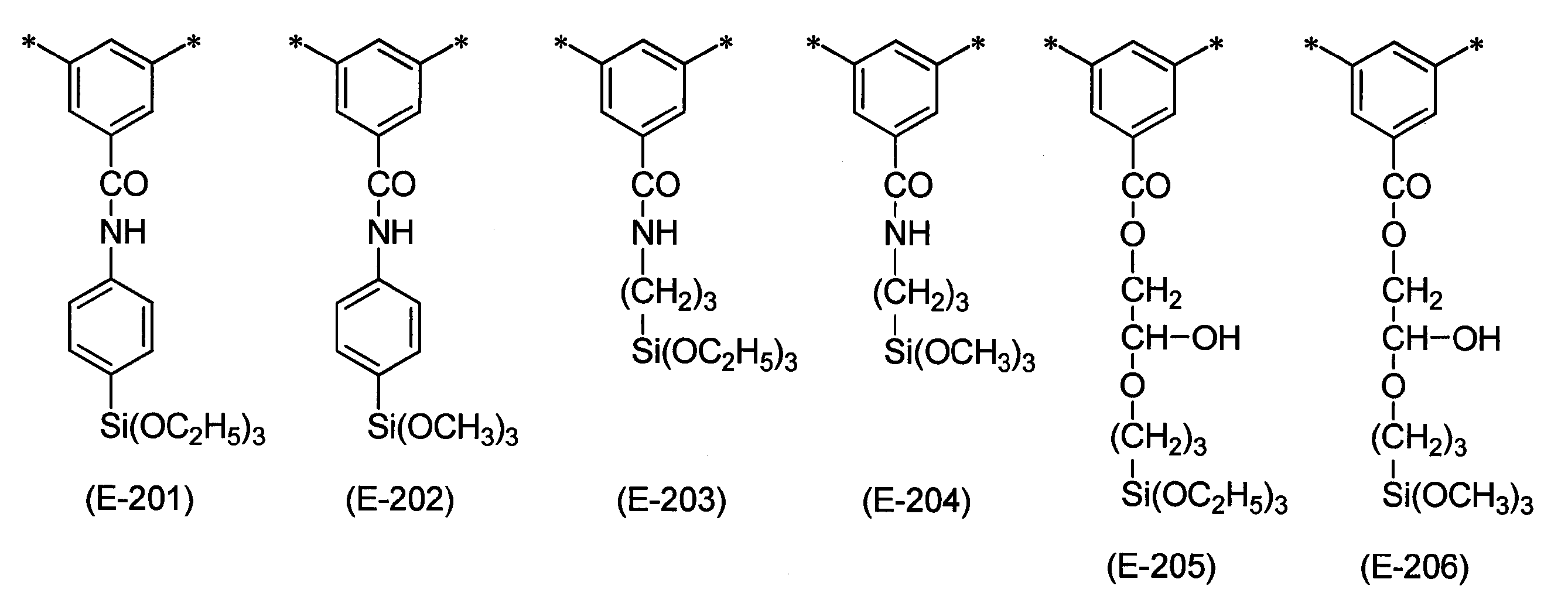
- the repeating unit having an alkoxysilyl group may include at least one group selected from the group consisting of the following formulas (E-201) to (E-206).
- the repeating unit having an alkoxysilyl group may be included in an amount of 2 mol% or more and 30 mol% or less with respect to all repeating units constituting the second polyamic acid.
- the photoreactive functional group may be a group having an azobenzene skeleton or a group having a cyclobutane ring.
- the photoreactive functional group may be included in the main chain of the first polyamic acid.
- One embodiment of the present invention includes a pair of substrates, a liquid crystal layer sandwiched between the pair of substrates, and an alignment film provided on a surface of the pair of substrates on the liquid crystal layer side, At least one of the alignment films of each of the pair of substrates includes a stack including an upper alignment film disposed on the liquid crystal layer side and a lower alignment film provided between the upper alignment film and the substrate.
- the liquid crystal layer includes a positive liquid crystal material
- the upper alignment film includes the first polyamic acid
- the lower alignment film includes the second polyamic acid
- the stacked film includes: A liquid crystal display device using the above composition as a forming material is provided.
- the liquid crystal composition of the liquid crystal layer may include a liquid crystal compound having an alkenyl group.
- the liquid crystal composition may include at least one compound selected from the group consisting of the following formulas (C1) to (C4). (Wherein, a and b are each an integer of 1 to 6 which are independent of each other.)
- one embodiment of the present invention provides an electronic device having the above liquid crystal display device.
- a novel composition that realizes a high-performance liquid crystal display device can be provided.
- a liquid crystal display device including the above composition can be provided.
- an electronic device including the above-described liquid crystal display device can be provided.
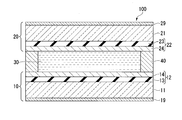
- Sectional drawing which shows the liquid crystal display device of 2nd Embodiment typically.
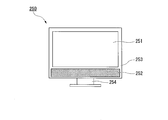
- the schematic diagram which shows the electronic device of 3rd Embodiment.
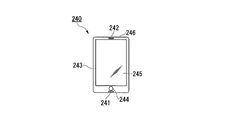
- the schematic diagram which shows the electronic device of 3rd Embodiment.
- composition includes a first polyamic acid and a second polyamic acid.
- the first polyamic acid has at least one of a photoreactive functional group and a vertical alignment group.
- the second polyamic acid has a repeating unit having an alkoxysilyl group in the side chain.
- composition of the present embodiment can be suitably used as a material for forming an alignment film included in a liquid crystal display device. That is, the composition of this embodiment can be suitably formed on the alignment film by applying it on a substrate, heat-treating it, and irradiating it with predetermined light as necessary.
- the first polyimide obtained by intramolecular cyclization (imidization) of the first polyamic acid is positioned on the liquid crystal layer side in the liquid crystal display device, and the alignment regulating power for the liquid crystal composition constituting the liquid crystal layer. Indicates.
- the second polyimide obtained by intramolecular cyclization (imidization) of the second polyamic acid is located on the substrate side in the liquid crystal display device, and is firmly bonded to the substrate as a base layer. Further, the layer composed of the second polyimide is mixed with the layer composed of the first polyimide at the interface and is firmly bonded. Thereby, the layer composed of the first polyimide is firmly bonded to the substrate via the layer composed of the second polyimide.
- the first polyimide obtained by imidizing the first polyamic acid functions as a photo-alignment film or a vertical alignment film in the liquid crystal display device.
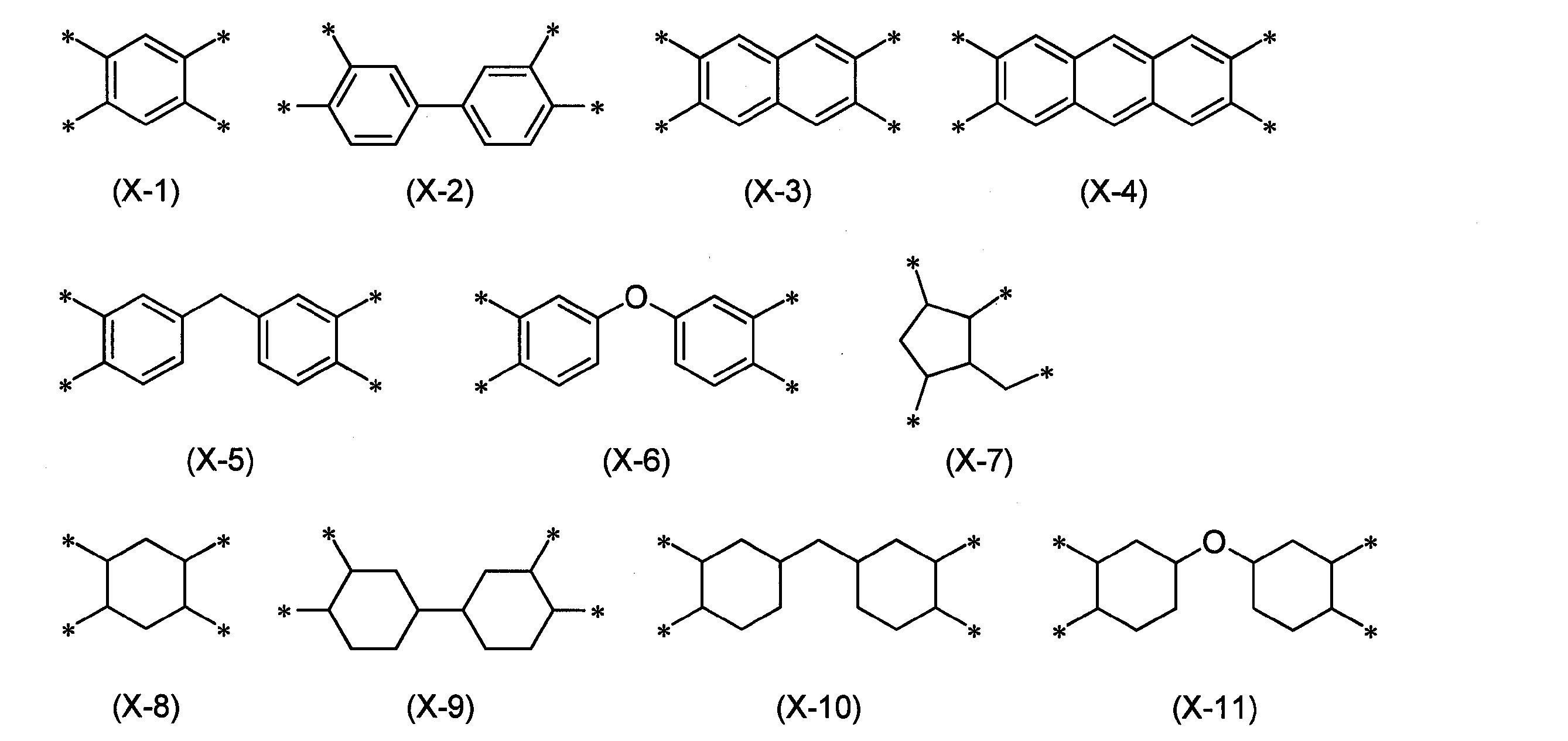
- the first polyamic acid used as the material for forming the photo-alignment film has a polyamic acid skeleton represented by the following formula (10), and X units contained in the polyamic acid are represented by the following formulas (X-1) to (X— 11) and those in which the E unit is represented by the following formulas (E-1) to (E-11) can be shown as basic structures.
- the first polyamic acid is formed by substituting at least one of the X unit and the E unit with a photofunctional group described later.
- examples of the photofunctional group that can be adopted by the X unit include a group having an azobenzene skeleton represented by the following formula (X-101), the following (X— A group having a cyclobutane ring as shown in (102) can be exemplified. That is, a group having an azobenzene skeleton as represented by the following formula (X-101) and a group having a cyclobutane ring as represented by the following (X-102) are included in the main chain of the first polyamic acid.
- examples of the photofunctional group that can be adopted by the E unit include the following formulas (E-101) to (E-106).
- the first polyamic acid used as the vertical alignment film has a polyamic acid skeleton represented by the following formula (11), and X units contained in the polyamic acid are represented by the above formulas (X-1) to (X-11).
- X units contained in the polyamic acid are represented by the above formulas (X-1) to (X-11).
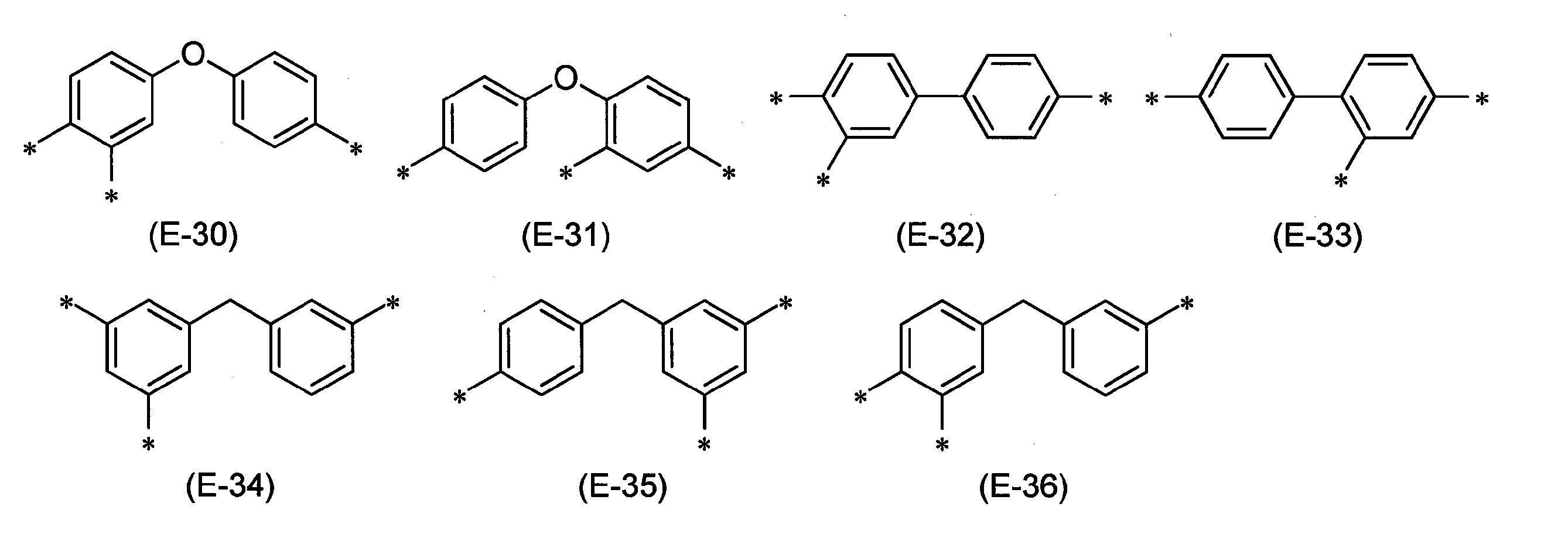
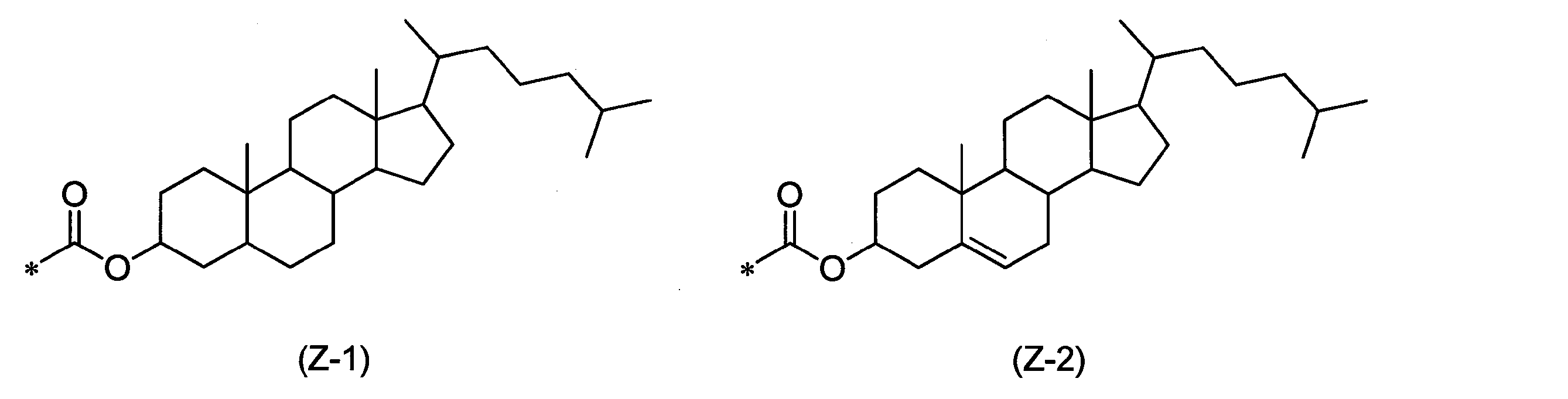
- Some examples include those in which the E unit has the following formulas (E-21) to (E-36), and those in which the Z unit has groups of the following formulas (Z-1) to (Z-7) can do.
- a copolymer of “a repeating unit having an alkoxysilyl group” (hereinafter, repeating unit A) and “a repeating unit having no alkoxysilyl group” (hereinafter, repeating unit B) is used. Can be mentioned.
- the repeating unit A has a polyamic acid skeleton represented by the above formula (11), the X unit contained in the polyamic acid is represented by the above formulas (X-1) to (X-11), and the E unit is the above In addition to those represented by formulas (E-21) to (E-36), those having a side chain (Z unit) represented by the following formula (Z-200) can be further exemplified.
- A represents a divalent organic group.
- R represents an alkyl group having 1 to 6 carbon atoms. A plurality of R may be the same or different.
- A can be exemplified by the following formulas (A-1) to (A-3).
- R is preferably an alkyl group having 1 to 4 carbon atoms, and preferably an alkyl group having 1 or 2 carbon atoms.
- —Si (OR) 3 is preferably a trimethoxysilyl group or a triethoxysilyl group.
- repeating unit A has the above formula (E-21) as an E unit
- examples of the group in which the E unit and the Z unit are bonded include those represented by the following formulas (E-201) to (E-206) Can be illustrated.
- formulas (E-201) to (E-206) having an amide group are formulas (E-205) to (E-204) having no amide group.
- the polarity is higher than 206). Therefore, it is preferable because of its high affinity with the substrate surface and easy distribution on the substrate surface.
- the X unit is imidized by heating to produce a rigid imide group. Therefore, when the X unit has a group corresponding to the above formula (Z-200), the movement of the group corresponding to the formula (Z-200) is easily constrained by the rigid main chain, and it is difficult to exhibit the effects described later. Therefore, in the repeating unit A, the alkoxysilyl group is bonded to the E unit (it is a Z unit).
- the repeating unit B has a polyamic acid skeleton represented by the above formula (10), the X unit contained in the polyamic acid is represented by the following formulas (X-1) to (X-11), and the E unit is represented by Those represented by the formulas (E-1) to (E-11) can be shown.
- the repeating unit A is contained in an amount exceeding 0 mol% with respect to all repeating units constituting the second polyamic acid.
- the repeating unit A is preferably contained in an amount of 2 mol% or more, more preferably 5 mol% or more, based on all repeating units constituting the second polyamic acid.
- the repeating unit A is preferably contained in an amount of 40 mol% or less, more preferably 30 mol% or less, based on all repeating units constituting the second polyamic acid.
- the upper limit value and the lower limit value of the content (mol%) of the repeating unit A in the second polyamic acid can be arbitrarily combined.
- the alkoxysilyl group reacts with the substrate surface and chemically. Bonds and facilitates layer separation.
- the repeating unit A when the repeating unit A is contained in an amount of 40 mol% or less with respect to all the repeating units constituting the second polyamic acid, the resistance of the alignment film is excessively lowered even if the alkoxysilyl group that is a polar group is contained. Therefore, the decrease in VHR can be suppressed.
- the ratio of the second polyamic acid to the total of the first polyamic acid and the second polyamic acid is preferably 5% by mass or more, and preferably 30% by mass or more. More preferably, it is more preferably 50% by mass or more.
- the ratio of the second polyamic acid to the total of the first polyamic acid and the second polyamic acid is preferably 95% by mass or less, more preferably 85% by mass or less, and 80% by mass. More preferably, it is% or less.
- the upper limit value and the lower limit value can be arbitrarily combined.
- composition of the present embodiment has the following effects by being a mixture of the first polyamic acid and the second polyamic acid as described above.
- the alkoxysilyl group of the second polyamic acid is a layer such as a base layer, an overcoat layer, or the like made of a resin material provided on the substrate, an inorganic insulating layer made of a metal oxide, It reacts with the surface of an electrode or the like using a conductive metal oxide as a forming material, and is chemically bonded.
- the second polyamic acid contained in the composition easily forms a layer on the substrate side, and the first polyamic acid is relatively a layer on the side opposite to the substrate with respect to the layer containing the second polyamic acid. Easy to form. Thereby, layer separation tends to proceed on the surface coated with the composition of the present embodiment.
- the first polyamic acid has a photoreactive functional group and a vertical alignment group, and is designed to easily develop an alignment regulating force. For this reason, when the layer separation proceeds suitably by the above mechanism, the polyimide having the first polyamic acid as the forming material is effectively distributed on the liquid crystal layer side, and the alignment control is performed on the liquid crystal composition constituting the liquid crystal layer. It becomes easy to show power.
- the amount of photofunctional groups introduced can be reduced in the alignment film using the composition of the present embodiment.
- a monomer having a photofunctional group or a polymer having a photofunctional group may be eluted into the liquid crystal layer, thereby deteriorating the image quality.
- the monomer having a photofunctional group contained in the alignment film is a liquid crystal layer. May react before or after elution into the liquid crystal layer to produce radicals.
- the generated radical may react with the liquid crystal molecule to generate a radical of the liquid crystal molecule.
- the radicals of the liquid crystal molecules react with surrounding substances to produce ionic compounds.
- the resulting ionic compound reduces the specific resistance of the liquid crystal composition and causes a reduction in VHR.
- the composition according to one aspect of the present invention layer separation between a monomer having a photofunctional group (first polyamic acid) and a monomer having no photofunctional group (second polyamic acid) is possible.
- the photofunctional group to be used is effectively arranged on the liquid crystal layer side. Thereby, even if the usage-amount of a 1st polyamic acid is reduced, a photofunctional group is efficiently arrange
- the amount of the monomer having a photofunctional group can be reduced, and the decrease in VHR due to the reaction of formula (I) can be suppressed. Thereby, a VHR fall can be suppressed, without reducing the specific resistance of a liquid crystal composition.
- the repeating unit having an alkoxysilyl group is preferably contained in an amount of 0.05% by mass to 30% by mass with respect to the entire composition.
- the second polyamic acid reacts with the surface of the substrate and is chemically bonded to facilitate layer separation.
- the repeating unit having an alkoxysilyl group is contained in an amount of 30% by mass or less based on the entire composition, the resistance of the alignment film does not decrease too much even if the alkoxysilyl group that is a polar group is included. Can be suppressed.
- the content rate of the repeating unit provided with the alkoxysilyl group with respect to the whole composition can be measured as follows. First, the first polyamic acid and the second polyamic acid contained in the composition are separated by a known method such as GPC, and each of them is subjected to composition analysis by LC-MS.
- the mass ratio between the first polyamic acid and the second polyamic acid may be a value obtained as a result of fractionation by GPC or the like, and the area of the functional group in the NMR spectrum for each polyamic acid. It may be estimated from the ratio.
- composition of the present embodiment a high-performance liquid crystal display device can be easily realized.
- FIG. 1 is a cross-sectional view schematically showing the liquid crystal display device of the present embodiment.
- the liquid crystal display device 100 of this embodiment includes an element substrate 10, a counter substrate 20, a liquid crystal layer 30, and a seal portion 40.
- the element substrate 10 and the counter substrate 20 correspond to “a pair of substrates” in one embodiment of the present invention.
- the liquid crystal display device 100 of the present embodiment employs an FFS (fringe field switching) device configuration. That is, the liquid crystal display device 100 is a horizontal alignment type liquid crystal display device. Note that the liquid crystal display device according to one embodiment of the present invention is not limited to a horizontal alignment liquid crystal display device, and can be applied to liquid crystal display devices of various alignment methods.
- FFS field switching
- Applicable liquid crystal display device alignment methods include, for example, TN (Twisted Nematic), STN (Super-Twisted Nematic), IPS (In Plane Switching), ECB (Electrically Controlled Birefringence), VA (Vertical Alignment), and MVA ( Multi Vertical Alignment), 4D-VTN (4-Domain Vertical TN), 4D-VECB (4-Domain Vertical ECB).
- the element substrate 10 includes a TFT substrate 11, a first alignment film 12 provided on the surface of the TFT substrate 11 on the liquid crystal layer 30 side, and a first polarizing plate provided on the opposite side of the TFT substrate 11 from the liquid crystal layer 30. 19.
- the TFT substrate 11 has a driving TFT element (not shown).
- the drain electrode, the gate electrode, and the source electrode of the driving TFT element are electrically connected to the pixel electrode, the gate bus line, and the source bus line, respectively.
- Each pixel is electrically connected via an electric wiring of a source bus line and a gate bus line.
- each member of the TFT substrate 11 As a forming material of each member of the TFT substrate 11, a generally known material can be used.
- IGZO a quaternary mixed crystal semiconductor material containing indium (In), gallium (Ga), zinc (Zn), and oxygen (O)
- the resulting semiconductor layer has a small off-leakage current, so that charge leakage is suppressed. Thereby, the rest period after voltage application to the liquid crystal layer can be lengthened. As a result, the number of times of voltage application during the period for displaying an image can be reduced, and the power consumption of the liquid crystal display device can be reduced.
- the TFT substrate 11 may be an active matrix type in which each pixel includes a driving TFT, or may be a simple matrix type liquid crystal display device in which each pixel does not include a driving TFT.
- the first alignment film 12 is an alignment film that uses the composition of the first embodiment as a forming material.
- the first alignment film 12 includes a lower alignment film 13 provided on the surface of the TFT substrate 11 on the liquid crystal layer 30 side, and an upper alignment film 14 provided on the surface of the lower alignment film 13 in contact with the lower alignment film 13. Have.
- the lower alignment film 13 includes the second polyamic acid in the composition of the first embodiment.
- the upper alignment film 14 includes the first polyamic acid in the composition of the first embodiment.
- the first polarizing plate 19 can be of a normally known configuration.
- the counter substrate 20 is provided, for example, on the opposite side of the color filter substrate 21, the second alignment film 22 provided on the surface of the color filter substrate 21 on the liquid crystal layer 30 side, and the liquid crystal layer 30 of the color filter substrate 21. And a second polarizing plate 29.
- the color filter substrate 21 is, for example, a red color filter layer that absorbs part of incident light and transmits red light, a green color filter layer that absorbs part of incident light and transmits green light, and It has a blue color filter layer that partially absorbs and transmits blue light. Further, the color filter substrate 21 may have an overcoat layer covering the surface for the purpose of flattening the substrate surface and preventing elution of the color material component from the color filter layer.
- the second alignment film 22 is an alignment film made of a polymer containing polyimide.
- the second alignment film 22 is, for example, a vertical alignment film.
- the second alignment film 22 is an alignment film that uses the composition of the first embodiment as a forming material.
- the second alignment film 22 includes a lower alignment film 23 provided on the surface of the color filter substrate 21 on the liquid crystal layer 30 side, an upper alignment film 24 provided on the surface of the lower alignment film 23 in contact with the lower alignment film 23, Have
- the lower alignment film 23 contains the second polyamic acid in the composition of the first embodiment.
- the upper alignment film 24 contains the first polyamic acid in the composition of the first embodiment.
- the second polarizing plate 29 As the second polarizing plate 29, a normally known configuration can be used.
- the 1st polarizing plate 19 and the 2nd polarizing plate 29 are crossed Nicol arrangement, for example.
- the liquid crystal layer 30 is made of a liquid crystal composition containing a liquid crystal material.
- the liquid crystal material is a material including liquid crystal molecules having liquid crystallinity.
- the liquid crystal material may be composed of only liquid crystal molecules that exhibit liquid crystal properties alone, and is a composition in which liquid crystal molecules that exhibit liquid crystal properties alone and organic compounds that do not exhibit liquid crystal properties alone are mixed. In addition, the composition as a whole may exhibit liquid crystallinity.
- the liquid crystal material negative liquid crystal having negative dielectric anisotropy is used.
- the liquid crystal material preferably contains liquid crystal molecules having a functional group represented by the following formula (B).
- X1, X2 represents a hydrogen atom, a fluorine atom, or an elementary atom mutually independently.
- m is an integer from 1 to 18.
- Examples of usable liquid crystal molecules include the following formulas (B-1) to (B-5).
- n is an integer of 1 to 18.
- the liquid crystal material preferably contains at least one compound (alkenyl compound) selected from the group consisting of the following formulas (C-1) to (C-4).
- a liquid crystal material containing such an alkenyl compound has improved response speed. Therefore, when a liquid crystal material containing such an alkenyl compound is used for a liquid crystal layer, a high-quality liquid crystal display device can be provided.
- Examples of such a compound include a compound represented by the following formula (C-10).
- the seal portion 40 is sandwiched between the element substrate 10 and the counter substrate 20 and is disposed around the liquid crystal layer 30.
- the seal portion 40 is in contact with a liquid crystal composition that is a material for forming the liquid crystal layer 30, and prevents leakage of the liquid crystal composition.
- the seal part 40 uses a curable resin composition as a forming material.
- the curable resin composition is not particularly limited as long as it has an ultraviolet reactive functional group and a thermally reactive functional group.
- ODF liquid crystal dropping method
- curable resin composition examples include (meth) acrylate and epoxy resin. These resins may be used alone or in combination of two or more.
- (meth) acrylic means acryl or methacryl.
- the (meth) acrylate is not particularly limited, and examples thereof include urethane (meth) acrylate having a urethane bond, epoxy (meth) acrylate derived from a compound having a glycidyl group and (meth) acrylic acid.
- Urethane (meth) acrylate is not particularly limited, and examples thereof include derivatives of diisocyanates such as isophorone diisocyanate and reactive compounds that undergo addition reaction with isocyanates such as acrylic acid and hydroxyethyl acrylate. These derivatives may be chain-extended with caprolactone or polyol.
- Examples of commercially available products include U-122P, U-340P, U-4HA, U-1084A (manufactured by Shin-Nakamura Chemical Co., Ltd.); KRM7595, KRM7610, KRM7619 (manufactured by Daicel UCB) and the like. .
- the epoxy (meth) acrylate is not particularly limited, and examples thereof include epoxy (meth) acrylate derived from epoxy resin such as bisphenol A type epoxy resin and propylene glycol diglycidyl ether and (meth) acrylic acid.
- examples of commercially available products include EA-1020, EA-6320, EA-5520 (above, Shin-Nakamura Chemical Co., Ltd.); Epoxy ester 70PA, Epoxy ester 3002A (above, Kyoeisha Chemical Co., Ltd.) and the like. .
- acrylates include, for example, methyl methacrylate, tetrahydrofurfuryl methacrylate, benzyl methacrylate, isobornyl methacrylate, 2-hydroxyethyl methacrylate, glycidyl methacrylate, (poly) ethylene glycol dimethacrylate, 1,4-butanediol Examples include dimethacrylate, 1,6-hexanediol dimethacrylate, trimethylolpropane triacrylate, pentaerythritol triacrylate, and glycerin dimethacrylate.
- epoxy resin examples include phenol novolac type epoxy resin, cresol novolac type epoxy resin, biphenyl novolac type epoxy resin, trisphenol novolac type epoxy resin, dicyclopentadiene novolac type epoxy resin, bisphenol A type epoxy resin, bisphenol F type epoxy resin.
- resins and glycidylamines examples include resins and glycidylamines.
- phenyl novolac epoxy resins examples include NC-3000S (manufactured by Nippon Kayaku Co., Ltd.).
- Examples of commercially available trisphenol novolac type epoxy resins include EPPN-501H, EPPN-501H (manufactured by Nippon Kayaku Co., Ltd.), and the like.
- Examples of commercially available dicyclopentadiene novolac type epoxy resins include NC-7000L (manufactured by Nippon Kayaku Co., Ltd.).
- Examples of commercially available products of bisphenol A type epoxy resin include Epicron 840S and Epicron 850CRP (manufactured by Dainippon Ink & Chemicals, Inc.).
- Examples of commercially available products of bisphenol F type epoxy resin include Epicoat 807 (manufactured by Japan Epoxy Resin Co., Ltd.) and Epicron 830 (manufactured by Dainippon Ink & Chemicals, Inc.).
- Examples of commercially available 2,2'-diallylbisphenol A type epoxy resins include RE310NM (manufactured by Nippon Kayaku Co., Ltd.).
- Examples of commercially available hydrogenated bisphenol type epoxy resins include Epicron 7015 (manufactured by Dainippon Ink & Chemicals, Inc.).
- Examples of commercially available propylene oxide-added bisphenol A type epoxy resins include epoxy ester 3002A (manufactured by Kyoeisha Chemical Co., Ltd.).
- biphenyl type epoxy resins examples include Epicoat YX-4000H, YL-6121H (above, manufactured by Japan Epoxy Resin Co., Ltd.) and the like.
- naphthalene type epoxy resins examples include Epicron HP-4032 (manufactured by Dainippon Ink & Chemicals, Inc.).
- Examples of commercially available resorcinol type epoxy resins include Denacol EX-201 (manufactured by Nagase ChemteX Corporation).
- glycidylamines examples include Epicron 430 (Dainippon Ink Chemical Co., Ltd.), Epicoat 630 (Japan Epoxy Resin Co., Ltd.), and the like.
- an epoxy / (meth) acrylic resin having at least one (meth) acryl group and epoxy group in one molecule can be suitably used.
- an epoxy / (meth) acrylic resin for example, a compound obtained by reacting a part of the epoxy group of an epoxy resin with (meth) acrylic acid in the presence of a basic catalyst according to a conventional method, bifunctional or higher isocyanate 1
- a compound obtained by reacting 1 ⁇ 2 mol of a (meth) acrylic monomer having a hydroxyl group in a mole and then 1 ⁇ 2 mol of glycidol, a compound obtained by reacting glycidol with a (meth) acrylate having an isocyanate group, etc. can be mentioned.
- As a commercial item of an epoxy / (meth) acrylic resin UVAC1561 (made by Daicel UCB) etc. are mentioned, for example.
- the curable resin composition that is a material for forming the seal portion 40 may contain a silane coupling agent.
- the curable resin composition contains a silane coupling agent, the adhesiveness between the seal portion 40 and the substrate (the element substrate 10 and the counter substrate 20) can be improved.
- the silane coupling agent is not particularly limited.
- ⁇ -aminopropyltrimethoxysilane, ⁇ -mercaptopropyltrimethoxysilane, ⁇ -glycidoxypropyltrimethoxysilane, ⁇ -isocyanatopropyltrimethoxysilane, etc. and an imidazole skeleton and an alkoxysilyl group via a spacer group
- Those composed of an imidazole silane compound having a structure in which are bonded are suitably used. These may be used alone or in combination of two or more.
- the curable resin composition which is a material for forming the seal portion 40, may contain a filler for the purpose of improving the adhesiveness due to the stress dispersion effect, improving the linear expansion coefficient, etc., as long as it does not contradict the purpose of the present invention. .
- the filler that can be used is not particularly limited.
- silica, diatomaceous earth, alumina, zinc oxide, iron oxide, magnesium oxide, tin oxide, titanium oxide, magnesium hydroxide, aluminum hydroxide, magnesium carbonate, barium sulfate, gypsum, calcium silicate, talc, glass beads, sericite activity examples thereof include inorganic fillers such as clay, bentonite, aluminum nitride, and silicon nitride.
- the curable resin composition which is a forming material of the seal portion 40 may contain a gelling agent or a photosensitizer in a photoreaction.
- the liquid crystal display device 100 may have a spacer that is a columnar structure for defining the thickness of the liquid crystal layer 30.
- the first alignment film 12 and the second alignment film 22 are alignment films formed by separating the layers using the composition of the first embodiment as a forming material.
- the upper alignment film includes polyimide derived from the second polyamic acid, which is a material for forming the lower alignment film.
- the lower alignment film does not include polyimide derived from the first polyamic acid which is a material for forming the upper alignment film.
- each layer is formed in this way, for example, when the content of the alkoxysilyl group of the second polyamic acid in the first alignment film 12 is measured in the thickness direction, the upper alignment film 14 and the lower alignment film It becomes discontinuous at the interface with the film 13.
- the content of the alkoxysilyl group of the second polyamic acid in the second alignment film 22 is measured in the thickness direction, it becomes discontinuous at the interface between the upper alignment film 24 and the lower alignment film 23, which is one embodiment of the present invention. This is different from the alignment film in FIG.
- the content of alkoxysilyl groups is away from the TFT substrate 11. Decrease in direction.
- the content of the alkoxysilyl group gradually decreases in the direction away from the color filter substrate 21.
- the analysis target is not limited to the alkoxysilyl group, but may be other substituents as long as traces of the first polyamic acid and the second polyamic acid can be confirmed.
- traces of the first polyamic acid and the second polyamic acid it can be confirmed whether or not the alignment film is produced using the composition according to one embodiment of the present invention. .
- the repeating unit having an alkoxysilyl group is included in an amount of 0.05% by mass to 30% by mass with respect to the entire alignment film. It is preferable.
- the repeating unit having an alkoxysilyl group When the repeating unit having an alkoxysilyl group is contained in an amount of 0.05% by mass or more with respect to the entire alignment film, the lower alignment film reacts with the substrate surface and chemically bonds to facilitate layer separation.
- the repeating unit having an alkoxysilyl group is contained in an amount of 30% by mass or less with respect to the entire alignment film, thereby including an alkoxysilyl group that is a polar group.
- the repeating unit having an alkoxysilyl group is contained in an amount of 30% by mass or less with respect to the entire alignment film, thereby including an alkoxysilyl group that is a polar group.
- the content of the repeating unit having an alkoxysilyl group with respect to the entire alignment film can be measured as follows. First, in the first alignment film 12 or the second alignment film 22, the upper alignment film disposed on the surface side of the alignment film and the lower alignment film disposed on the substrate side of the alignment film are respectively collected. Each of the collected upper alignment film and lower alignment film is subjected to composition analysis by LC-MS.
- the mass of the repeating unit having an alkoxysilyl group is estimated from the area ratio of the functional groups.
- liquid crystal display device having the above-described configuration, a high-performance liquid crystal display device is provided because the alignment film using the above-described composition as a forming material is provided.
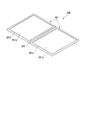
- FIG. 1 ⁇ Electronic equipment> 2 to 5 are schematic views showing the electronic apparatus of the present embodiment.
- An electronic apparatus according to the present embodiment includes the above-described liquid crystal panel and a control device that supplies a driving signal to the liquid crystal panel.
- the display unit 251 includes a display unit 251, a speaker 252, a cabinet 253, a stand 254, and the like.
- the display unit 251 the above-described liquid crystal display device can be preferably applied. Thereby, it is possible to realize a high display quality with a high contrast.
- the 3 includes a voice input unit 241, a voice output unit 242, an operation switch 244, a display unit 245, a touch panel 243, a housing 246, and the like.
- the display unit 245, the above-described liquid display device can be suitably applied. Thereby, it is possible to realize a high display quality with a high contrast.
- a notebook computer 270 illustrated in FIG. 4 includes a display portion 271, a keyboard 272, a touch pad 273, a main switch 274, a camera 275, a recording medium slot 276, a housing 277, and the like.
- the display portion 271 the above-described liquid crystal display device can be suitably applied. Thereby, it is possible to realize a high display quality with a high contrast.
- the mobile electronic device 280 shown in FIG. 5 includes two display units 281 and a hinge mechanism 282 that connects the two display units 281. By having the hinge mechanism 282, the display portion 281 can be folded.
- the display unit 281 includes a display panel 281a and a housing 281b. As the display panel 281a, the above-described liquid crystal panel can be preferably applied. Thereby, it is possible to realize a high display quality with a high contrast.
- a curved lens may be provided on the display unit 281. By providing the lens, the images of the two display units 281 can be displayed seamlessly.
- the electronic device of the present embodiment uses the above-described liquid crystal display device for the display unit, it is possible to realize a high display quality with a high contrast.
- VHR Voltage Holding Ratio
- Example 1-1 A first polyamic acid and a second substrate are formed on one surface of a substrate having an ITO electrode for FFS mode (hereinafter referred to as substrate A) and a counter substrate having no electrode (hereinafter referred to as substrate B). A coating containing a mixture with polyamic acid was applied to form a film.
- a polyamic acid represented by the following formula (101) was used as the first polyamic acid.
- the second polyamic acid a polyamic acid having a repeating unit represented by the following formula (102) and a repeating unit represented by the following formula (103) was used.
- the repeating unit represented by the following formula (102) is “a repeating unit having an alkoxysilyl group”
- the repeating unit represented by the following formula (103) is “a repeating unit not having an alkoxysilyl group”.
- the content of the first polyamic acid was 30% by mass and the content of the second polyamic acid was 70% by mass with respect to the total of the first polyamic acid and the second polyamic acid.
- the content of the repeating unit represented by the formula (102) was 2 mol% with respect to the total of the repeating unit represented by the formula (102) and the repeating unit represented by the formula (103). It was.
- linearly polarized light containing ultraviolet light having a wavelength of 310 to 450 nm was irradiated from the normal direction of the substrate at 2 J / cm 2 .
- the photo-alignment film was formed by baking at 230 ° C. for 40 minutes.
- a sealing material (ultraviolet ray + thermosetting sealing material, product name: Photorec, manufactured by Sekisui Chemical Co., Ltd.) was drawn on the photo-alignment film side of the substrate A. Further, a positive liquid crystal material having a Tni (nematic phase-isotropic phase transition temperature) of 85 ° C. was dropped on the photo-alignment film side of the substrate B.
- Tni nematic phase-isotropic phase transition temperature
- the sealing material was cured by irradiating light containing ultraviolet light having a wavelength of 340 to 450 nm. Further, by heating at 130 ° C. for 40 minutes, the sealing material was thermally cured and the liquid crystal layer was realigned to obtain a test cell (liquid crystal cell) of the liquid crystal display device of Example 1-1.
- Example 1-2 In the second polyamic acid, the content of the repeating unit represented by the formula (102) is 10 mol% with respect to the total of the repeating unit represented by the formula (102) and the repeating unit represented by the formula (103). In the same manner as in Example 1-1, a test cell (liquid crystal cell) of the liquid crystal display device of Example 1-2 was obtained.
- Example 1-3 In the second polyamic acid, the content of the repeating unit represented by the formula (102) is 30 mol% with respect to the total of the repeating unit represented by the formula (102) and the repeating unit represented by the formula (103). In the same manner as in Example 1-1, a test cell (liquid crystal cell) of the liquid crystal display device of Example 1-3 was obtained.
- Example 1-4 In the second polyamic acid, the content of the repeating unit represented by the formula (102) is 40 mol% with respect to the total of the repeating unit represented by the formula (102) and the repeating unit represented by the formula (103). In the same manner as in Example 1-1, a test cell (liquid crystal cell) of the liquid crystal display device of Example 1-4 was obtained.
- Table 1 is a table showing the evaluation results of ⁇ Evaluation 1>.
- Example 1-4 in which the introduction amount of the repeating unit represented by the above formula (102) is 40 mol%, the contrast is improved, but the durability is slightly lowered. Therefore, it was found that the introduction amount of the repeating unit represented by the above formula (102) is preferably less than 40 mol%.
- the introduction amount of the repeating unit represented by the above formula (102) is large, the amount of alcohol produced by the reaction of the silane coupling agent and the carboxylic acid in the polyamic acid increases, which is considered to affect the durability.
- Example 2-1 A coating containing a mixture of the first polyamic acid and the second polyamic acid was applied to one surface of the substrate A and the substrate B to form a film.
- a polyamic acid represented by the following formula (201) was used as the first polyamic acid.
- the repeating unit represented by the following formula (202) is “a repeating unit having an alkoxysilyl group”, and the repeating unit represented by the following formula (203) is “a repeating unit not having an alkoxysilyl group”.
- the content of the first polyamic acid was 20% by mass and the content of the second polyamic acid was 80% by mass with respect to the total of the first polyamic acid and the second polyamic acid.
- the content of the repeating unit represented by the above formula (202) was 2 mol% with respect to the total of the repeating unit represented by the above formula (202) and the repeating unit represented by the above formula (203). It was.
- linearly polarized light including ultraviolet light having a wavelength of 250 to 300 nm was irradiated from the normal direction of the substrate at 200 mJ / cm 2 .
- a photo-alignment film was formed by baking at 200 ° C. for 20 minutes.
- a sealing material (ultraviolet ray + thermosetting sealing material, product name: Photorec, manufactured by Sekisui Chemical Co., Ltd.) was drawn on the optical alignment film side of the substrate A. Further, a positive liquid crystal material having a Tni of 85 ° C. was dropped on the photo-alignment film side of the substrate B.
- the sealing material was cured by irradiating light containing ultraviolet light having a wavelength of 340 to 450 nm. Further, by heating at 130 ° C. for 40 minutes, the sealing material was thermally cured and the liquid crystal layer was realigned to obtain a test cell (liquid crystal cell) of the liquid crystal display device of Example 2-1.
- Example 2-2 In the second polyamic acid, the content of the repeating unit represented by the formula (202) is 10 mol% with respect to the total of the repeating unit represented by the formula (202) and the repeating unit represented by the formula (203). In the same manner as in Example 2-1, a test cell (liquid crystal cell) of the liquid crystal display device of Example 2-2 was obtained.
- Example 2-3 In the second polyamic acid, the content of the repeating unit represented by the formula (202) is 30 mol% with respect to the total of the repeating unit represented by the formula (202) and the repeating unit represented by the formula (203). In the same manner as in Example 2-1, a test cell (liquid crystal cell) of the liquid crystal display device of Example 2-3 was obtained.
- Example 2-4 In the second polyamic acid, the content of the repeating unit represented by the above formula (202) is 40 mol% with respect to the total of the repeating unit represented by the above formula (202) and the repeating unit represented by the above formula (203). In the same manner as in Example 2-1, a test cell (liquid crystal cell) of the liquid crystal display device of Example 2-4 was obtained.
- Table 2 is a table showing the evaluation results of ⁇ Evaluation 2>.
- Example 2-4 in which the repeating unit represented by the above formula (202) is 40 mol%, the contrast is improved, but the durability is slightly lowered. Therefore, it was found that the introduction amount of the repeating unit represented by the above formula (202) is preferably less than 40 mol%.
- Example 3-1 A coating containing a mixture of the first polyamic acid and the second polyamic acid was applied to one surface of the substrate A and the substrate B to form a film.
- a polyamic acid represented by the following formula (301) was used as the first polyamic acid.
- the repeating unit represented by the following formula (302) is “a repeating unit having an alkoxysilyl group”
- the repeating unit represented by the following formula (303) is “a repeating unit not having an alkoxysilyl group”.
- the content of the first polyamic acid was 25% by mass and the content of the second polyamic acid was 75% by mass with respect to the total of the first polyamic acid and the second polyamic acid.
- the content of the repeating unit represented by the above formula (302) was 2 mol% with respect to the total of the repeating unit represented by the above formula (302) and the repeating unit represented by the above formula (303). It was.
- linearly polarized light containing ultraviolet light having a wavelength of 310 to 450 nm was irradiated from the normal direction of the substrate at 2 J / cm 2 .
- baking was carried out at 230 ° C. for 20 minutes to form a photo-alignment film.
- a sealing material (ultraviolet ray + thermosetting sealing material, product name: Photorec, manufactured by Sekisui Chemical Co., Ltd.) was drawn on the photo-alignment film side of the substrate A. Further, a positive liquid crystal material having a Tni of 95 ° C. was dropped on the substrate B on the photo-alignment film side.
- the sealing material was cured by irradiating light containing ultraviolet light having a wavelength of 340 to 450 nm. Further, by heating at 130 ° C. for 40 minutes, the sealing material was thermally cured and the liquid crystal layer was realigned to obtain a test cell (liquid crystal cell) of the liquid crystal display device of Example 3-1.
- Example 3-2 In the second polyamic acid, the content of the repeating unit represented by the above formula (302) is 10 mol% with respect to the total of the repeating unit represented by the above formula (302) and the repeating unit represented by the above formula (303). In the same manner as in Example 3-1, a test cell (liquid crystal cell) of the liquid crystal display device of Example 3-2 was obtained.
- Example 3-3 In the second polyamic acid, the content of the repeating unit represented by the above formula (302) is 30 mol% with respect to the total of the repeating unit represented by the above formula (302) and the repeating unit represented by the above formula (303). In the same manner as in Example 3-1, a test cell (liquid crystal cell) of the liquid crystal display device of Example 3-3 was obtained.
- Example 3-4 In the second polyamic acid, the content of the repeating unit represented by the above formula (302) is 40 mol% with respect to the total of the repeating unit represented by the above formula (302) and the repeating unit represented by the above formula (303). In the same manner as in Example 3-1, a test cell (liquid crystal cell) of the liquid crystal display device of Example 3-4 was obtained.
- Table 3 is a table showing the evaluation results of ⁇ Evaluation 3>.
- Example 3-4 in which the repeating unit represented by the above formula (302) is 40 mol%, the contrast was improved, but the durability was slightly lowered. Therefore, it was found that the introduction amount of the repeating unit represented by the above formula (302) is preferably less than 40 mol%.
- Example 4-1 A coating containing a mixture of the first polyamic acid and the second polyamic acid was applied to one surface of the substrate A and the substrate B to form a film.
- a polyamic acid represented by the following formula (401) was used as the first polyamic acid.
- the second polyamic acid a polyamic acid having a repeating unit represented by the following formula (402) and a repeating unit represented by the following formula (403) was used.
- the repeating unit represented by the following formula (402) is “a repeating unit having an alkoxysilyl group”
- the repeating unit represented by the following formula (403) is “a repeating unit not having an alkoxysilyl group”.
- the content of the first polyamic acid was 20% by mass and the content of the second polyamic acid was 80% by mass with respect to the total of the first polyamic acid and the second polyamic acid.
- the content of the repeating unit represented by the above formula (402) was 30 mol% with respect to the total of the repeating unit represented by the above formula (402) and the repeating unit represented by the above formula (403). It was.
- linearly polarized light including ultraviolet light having a wavelength of 250 to 300 nm was irradiated from the normal direction of the substrate at 200 mJ / cm 2 .
- a photo-alignment film was formed by baking at 200 ° C. for 20 minutes.
- a sealing material (ultraviolet ray + thermosetting sealing material, product name: Photorec, manufactured by Sekisui Chemical Co., Ltd.) was drawn on the photo-alignment film side of the substrate A. Further, a positive type liquid crystal material having a Tni of 71 ° C. was dropped onto the photo-alignment film side of the substrate B.
- the sealing material was cured by irradiating light containing ultraviolet light having a wavelength of 340 to 450 nm. Further, by heating at 130 ° C. for 40 minutes, the sealing material was thermally cured and the liquid crystal layer was realigned to obtain a test cell (liquid crystal cell) of the liquid crystal display device of Example 4-1.
- Comparative Example 4-1 A test cell (liquid crystal cell) of the liquid crystal display device of Comparative Example 4-1 was obtained in the same manner as in Example 4-1, except that a negative liquid crystal material having a Tni of 71 ° C. was used.
- Table 4 is a table showing the evaluation results of ⁇ Evaluation 4>.
- Example 5-1 A first polyamic acid and a second polyamic acid are formed on one surface of a substrate having an ITO electrode for ECB mode (hereinafter referred to as substrate C) and a counter substrate having a common electrode (hereinafter referred to as substrate D). A coating containing a mixture of the above and a film was applied to form a film.
- a polyamic acid represented by the following formula (501) was used as the first polyamic acid.
- the second polyamic acid a polyamic acid having a repeating unit represented by the following formula (502) and a repeating unit represented by the following formula (503) was used.
- the repeating unit represented by the following formula (502) is “a repeating unit having an alkoxysilyl group”
- the repeating unit represented by the following formula (503) is “a repeating unit not having an alkoxysilyl group”.
- the content of the first polyamic acid was 20% by mass and the content of the second polyamic acid was 80% by mass with respect to the total of the first polyamic acid and the second polyamic acid.
- the content of the repeating unit represented by the above formula (502) was 2 mol% with respect to the total of the repeating unit represented by the above formula (502) and the repeating unit represented by the above formula (503). It was.
- a sealing material (ultraviolet ray + thermosetting sealing material, product name: Photorec, manufactured by Sekisui Chemical Co., Ltd.) was drawn on the photo-alignment film side of the substrate C. Further, a negative liquid crystal material having a Tni of 95 ° C. was dropped onto the substrate D on the photo-alignment film side.
- the sealing material was cured by irradiating light containing ultraviolet light having a wavelength of 340 to 450 nm. Further, by heating at 110 ° C. for 40 minutes, the sealing material was thermally cured and the liquid crystal layer was realigned to obtain a test cell (liquid crystal cell) of the liquid crystal display device of Example 4-1.
- Example 5-2 In the second polyamic acid, the content of the repeating unit represented by the above formula (502) is 10 mol% with respect to the total of the repeating unit represented by the above formula (502) and the repeating unit represented by the above formula (503). In the same manner as in Example 5-1, a test cell (liquid crystal cell) of the liquid crystal display device of Example 5-2 was obtained.
- Example 5-3 In the second polyamic acid, the content of the repeating unit represented by the above formula (502) is 30 mol% with respect to the total of the repeating unit represented by the above formula (502) and the repeating unit represented by the above formula (503).
- a test cell (liquid crystal cell) of the liquid crystal display device of Example 5-3 was obtained.
- Example 5-4 In the second polyamic acid, the content of the repeating unit represented by the above formula (502) is 40 mol% with respect to the total of the repeating unit represented by the above formula (502) and the repeating unit represented by the above formula (503). In the same manner as in Example 5-1, a test cell (liquid crystal cell) of the liquid crystal display device of Example 5-4 was obtained.
- Table 5 is a table showing the evaluation results of ⁇ Evaluation 5>.
- Example 5-4 in which the repeating unit represented by the above formula (502) is 40 mol% has a slight decrease in durability although the contrast is improved. Therefore, it was found that the introduction amount of the repeating unit represented by the above formula (502) is preferably less than 40 mol%.
- Some embodiments of the present invention are applied to a composition required to realize a high-performance liquid crystal display device, a liquid crystal display device including the above-described composition, an electronic device including the above-described liquid crystal display device, and the like. Can be applied.
Landscapes
- Chemical & Material Sciences (AREA)
- Organic Chemistry (AREA)
- Crystallography & Structural Chemistry (AREA)
- Engineering & Computer Science (AREA)
- Materials Engineering (AREA)
- Physics & Mathematics (AREA)
- Polymers & Plastics (AREA)
- Medicinal Chemistry (AREA)
- Chemical Kinetics & Catalysis (AREA)
- Health & Medical Sciences (AREA)
- Nonlinear Science (AREA)
- Spectroscopy & Molecular Physics (AREA)
- Mathematical Physics (AREA)
- General Physics & Mathematics (AREA)
- Optics & Photonics (AREA)
- Liquid Crystal (AREA)
Abstract
第1のポリアミック酸と第2のポリアミック酸とを含み、第1のポリアミック酸は、光反応性官能基および垂直配向基の少なくともいずれか一方を有し、第2のポリアミック酸は、側鎖にアルコキシシリル基を備えた繰り返し単位を有する組成物。
Description
本発明のいくつかの態様は、組成物、液晶表示装置、電子機器に関するものである。
本願は、2017年3月31日に、日本に出願された特願2017-069975号に基づき優先権を主張し、その内容をここに援用する。
本願は、2017年3月31日に、日本に出願された特願2017-069975号に基づき優先権を主張し、その内容をここに援用する。
従来、スマートフォン等の携帯型電子機器や、テレビジョン、パーソナルコンピューター等のディスプレイとして、液晶表示装置が広く用いられている。
液晶表示装置は、液晶組成物を形成材料とする液晶層と、液晶層を挟持する配向膜と、を有している。配向膜は、液晶組成物に含まれる液晶分子に対して配向規制力を示し、所定のプレチルト角を付与する。配向膜の性能は、液晶表示装置のVHR(Voltage Holding Ratio、電圧保持率)やコントラスト等、液晶表示装置の性能に大きな影響を与える。
そのため、これまで種々の配向膜の形成材料が検討され、提案されている(例えば、特許文献1参照)
そのため、これまで種々の配向膜の形成材料が検討され、提案されている(例えば、特許文献1参照)
近年の液晶表示装置の高解像度化に伴い、配向膜も狭いエリアで配向方向を異ならせた精密設計されたものが求められている。このような配向膜としては、配向膜が有する光官能基に光照射することにより、光の照射方向に応じた配向規制力を付与した光配向膜が知られている。
一方、配向膜は、単層で形成されたものの他、多層構造のものも知られている。配向膜は、基板側と液晶層側とでそれぞれ求められる物性が異なる。多層構造の配向膜では、このような要求物性に応じ、異なる性質を有する層を積層させることにより、設計の自由度が高まり、高性能なものを得やすいという利点がある。
多層構造の配向膜は、各層ごとに作製し積層させることとすることにより製造可能である。しかし、このような製造方法では、製造工程が増加し、製造コストが増加しやすい。
また、工程が増加することにより歩留まりの低下にもつながる。
また、工程が増加することにより歩留まりの低下にもつながる。
そこで、各層に対応する配向膜材料を混合した組成物を用い、当該組成物を塗布して成膜する際に、層分離させることで多層構造の配向膜とする技術が知られている。このような組成物としては、ポリアミック酸と光官能基を有するポリシロキサンとの混合物や、光官能基を有するポリアミック酸と光官能基を有さないポリアミック酸との混合物が知られている。
これらのうち、光官能基を有するポリアミック酸と光官能基を有さないポリアミック酸との混合物を形成材料として用いる配向膜材料(組成物)については、層分離が生じにくく、設計通りの物性が得られにくいものが多い。そのため、さらなる改良が求められていた。
本発明のいくつかの態様はこのような事情に鑑みてなされたものであって、高性能な液晶表示装置を実現する新規な組成物を提供することを目的とする。また、上述の組成物を備えた液晶表示装置を提供することをあわせて目的とする。また、上述の液晶表示装置を備えた電子機器を提供することをあわせて目的とする。
上記の課題を解決するため、本発明の一形態は、第1のポリアミック酸と第2のポリアミック酸とを含み、前記第1のポリアミック酸は、光反応性官能基および垂直配向基の少なくともいずれか一方を有し、前記第2のポリアミック酸は、側鎖にアルコキシシリル基を備えた繰り返し単位を有する組成物を提供する。
本発明の一形態においては、前記アルコキシシリル基を備えた繰り返し単位は、組成物全体に対し0.05質量%以上30質量%以下含まれる構成としてもよい。
本発明の一形態においては、前記アルコキシシリル基を備えた繰り返し単位は、下記式(E-201)~(E-206)からなる群から選ばれる少なくとも1つの基を含む構成としてもよい。
本発明の一形態においては、前記アルコキシシリル基を備えた繰り返し単位は、前記第2のポリアミック酸を構成する全繰り返し単位に対し2mol%以上30mol%以下含まれる構成としてもよい。
本発明の一形態においては、前記光反応性官能基は、アゾベンゼン骨格を有する基またはシクロブタン環を有する基である構成としてもよい。
本発明の一形態においては、前記光反応性官能基は、前記第1のポリアミック酸の主鎖に含まれている構成としてもよい。
また、本発明の一形態は、一対の基板と、前記一対の基板に挟持された液晶層と、前記一対の基板の前記液晶層側の面に設けられた配向膜と、を有し、前記一対の基板がそれぞれ有する前記配向膜のうち少なくとも一方は、前記液晶層側に配置された上部配向膜と、前記上部配向膜と前記基板との間に設けられた下部配向膜と、を含む積層膜であり、前記液晶層は、ポジ型の液晶材料を含み、前記上部配向膜は前記第1のポリアミック酸を含み、前記下部配向膜は前記第2のポリアミック酸を含み、前記積層膜は、上記の組成物を形成材料とする液晶表示装置を提供する。
本発明の一形態においては、前記液晶層の液晶組成物は、アルケニル基を有する液晶化合物を含む構成としてもよい。
本発明の一形態においては、前記液晶組成物は、下記式(C1)~(C4)からなる群から選ばれる少なくとも1つの化合物を含む構成としてもよい。
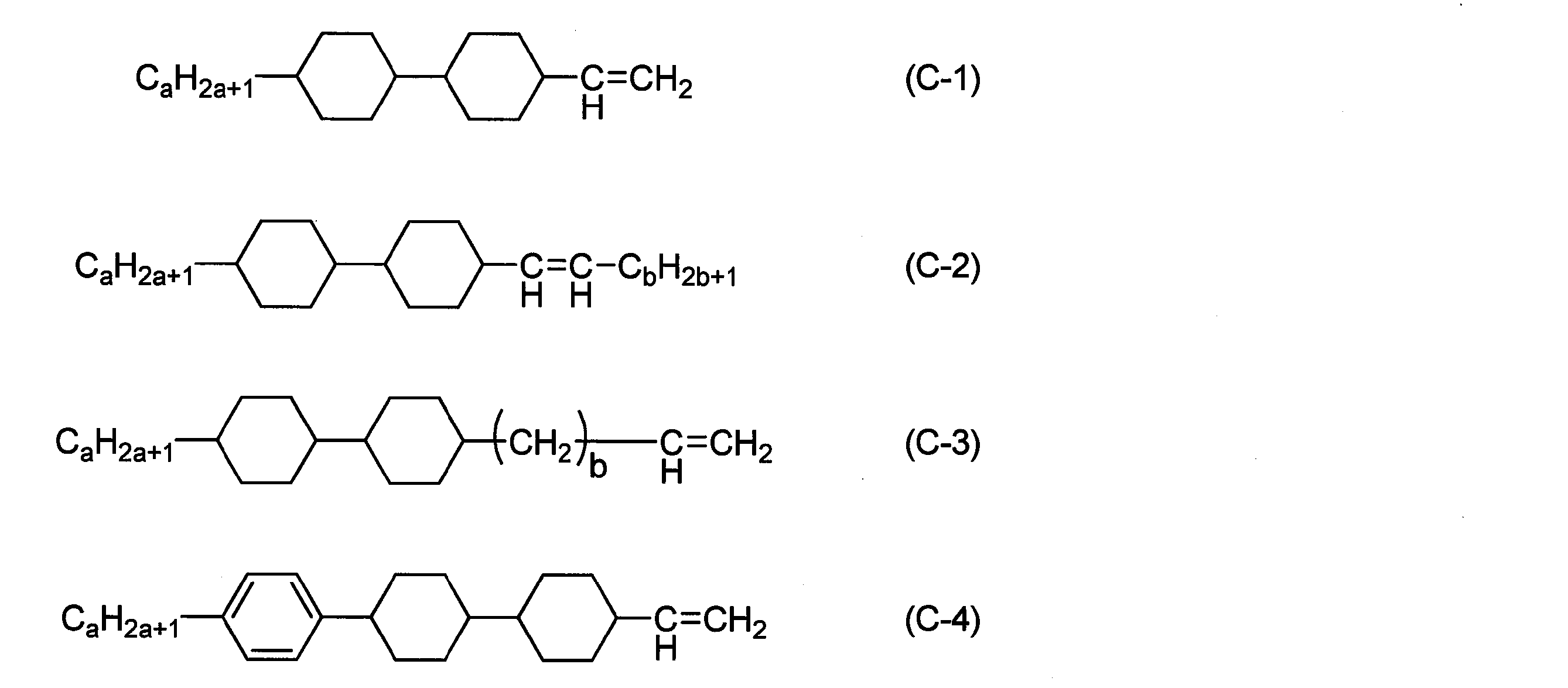
(式中、a,bは、互いに独立した1~6のいずれかの整数である。)
また、本発明の一態様は、上記の液晶表示装置を有する電子機器を提供する。
本発明のいくつかの態様によれば、高性能な液晶表示装置を実現する新規な組成物を提供することができる。また、上述の組成物を備えた液晶表示装置を提供することができる。また、上述の液晶表示装置を備えた電子機器を提供することができる。
[第1実施形態]
<組成物>
本発明の第1実施形態に係る組成物は、第1のポリアミック酸と第2のポリアミック酸とを含む。第1のポリアミック酸は、光反応性官能基および垂直配向基の少なくともいずれか一方を有する。第2のポリアミック酸は、側鎖にアルコキシシリル基を備えた繰り返し単位を有する。
<組成物>
本発明の第1実施形態に係る組成物は、第1のポリアミック酸と第2のポリアミック酸とを含む。第1のポリアミック酸は、光反応性官能基および垂直配向基の少なくともいずれか一方を有する。第2のポリアミック酸は、側鎖にアルコキシシリル基を備えた繰り返し単位を有する。
本実施形態の組成物は、液晶表示装置が有する配向膜の形成材料として好適に用いることができる。すなわち、本実施形態の組成物は、基板上に塗布して熱処理し、さらに必要に応じて所定の光照射をすることにより、好適に配向膜を形成することができる。
第1のポリアミック酸が分子内環化(イミド化)することで得られる第1のポリイミドは、液晶表示装置において液晶層側に位置し、液晶層を構成する液晶組成物に対して配向規制力を示す。
また、第2のポリアミック酸が分子内環化(イミド化)することで得られる第2のポリイミドは、液晶表示装置において基板側に位置し、下地層として基板と強固に結合する。
また、第2のポリイミドで構成される層は、第1のポリイミドで構成される層と界面で混ざり合い、強固に結合する。これにより、第1のポリイミドで構成される層は、第2のポリイミドで構成される層を介して、基板と強固に結合する。
また、第2のポリイミドで構成される層は、第1のポリイミドで構成される層と界面で混ざり合い、強固に結合する。これにより、第1のポリイミドで構成される層は、第2のポリイミドで構成される層を介して、基板と強固に結合する。
(第1のポリアミック酸)
第1のポリアミック酸をイミド化して得られる第1のポリイミドは、液晶表示装置において、光配向膜または垂直配向膜として機能する。
第1のポリアミック酸をイミド化して得られる第1のポリイミドは、液晶表示装置において、光配向膜または垂直配向膜として機能する。
(光配向膜)
光配向膜の形成材料として用いられる第1のポリアミック酸としては、下記式(10)に示すポリアミック酸骨格を有し、ポリアミック酸に含まれるXユニットが下記式(X-1)~(X-11)であるもの、およびEユニットが下記式(E-1)~(E-11)であるものを基本構造として示すことができる。
光配向膜の形成材料として用いられる第1のポリアミック酸としては、下記式(10)に示すポリアミック酸骨格を有し、ポリアミック酸に含まれるXユニットが下記式(X-1)~(X-11)であるもの、およびEユニットが下記式(E-1)~(E-11)であるものを基本構造として示すことができる。

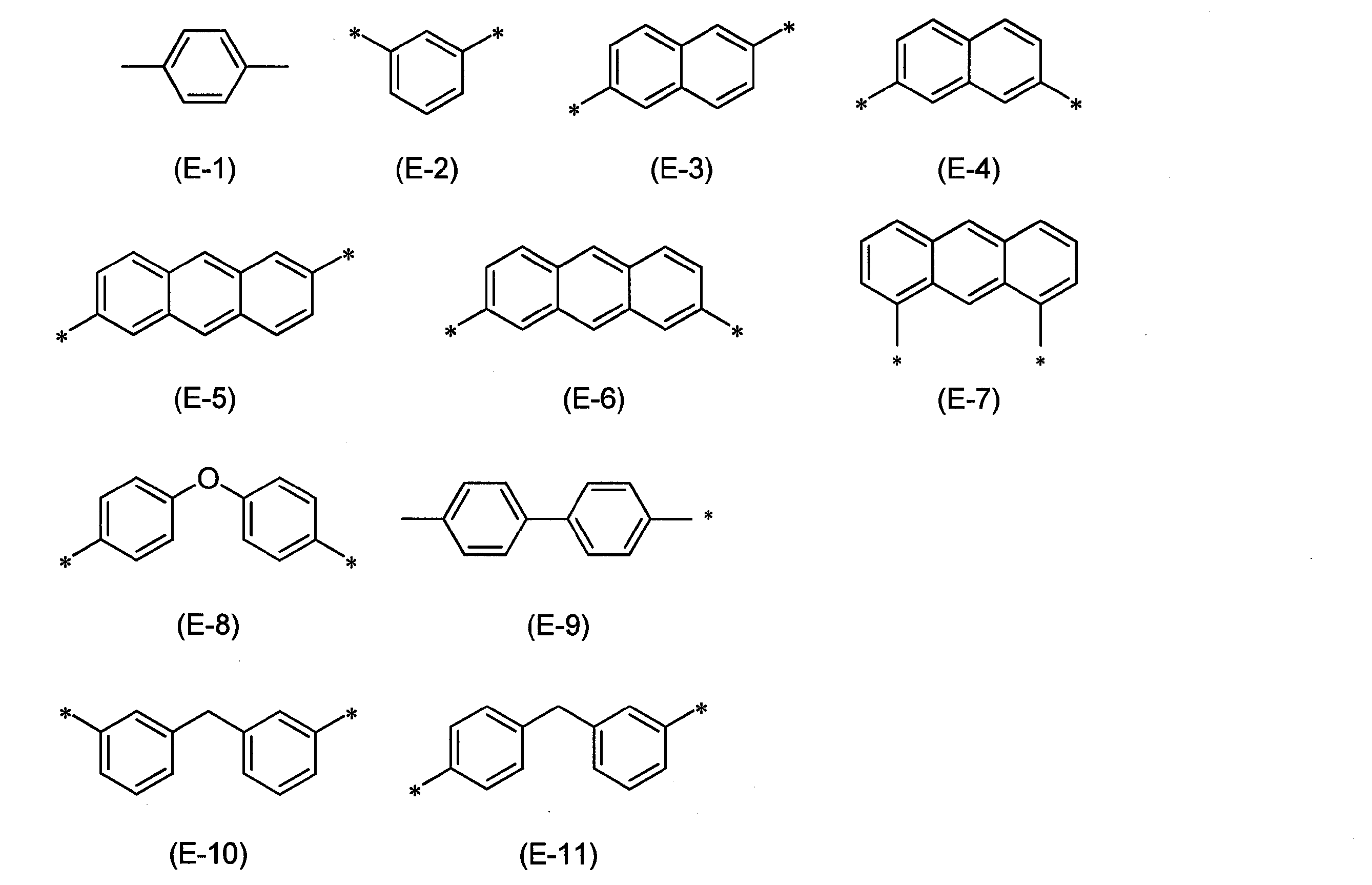
さらに、第1のポリアミック酸は、XユニットおよびEユニットの少なくともいずれか一方を、後述の光官能基と置換してなるものである。
具体的には、上記式(10)に示すポリアミック酸骨格において、Xユニットが採用し得る光官能基としては、下記式(X-101)で示すようなアゾベンゼン骨格を有する基、下記(X-102)で示すようなシクロブタン環を有する基を例示することができる。
すなわち、下記式(X-101)で示すようなアゾベンゼン骨格を有する基、下記(X-102)で示すようなシクロブタン環を有する基は、第1のポリアミック酸の主鎖に含まれている。
すなわち、下記式(X-101)で示すようなアゾベンゼン骨格を有する基、下記(X-102)で示すようなシクロブタン環を有する基は、第1のポリアミック酸の主鎖に含まれている。

また、Eユニットが採用し得る光官能基としては、下記式(E-101)~(E-106)を例示することができる。

(垂直配向膜)
垂直配向膜として用いられる第1のポリアミック酸としては、下記式(11)に示すポリアミック酸骨格を有し、ポリアミック酸に含まれるXユニットが上記式(X-1)~(X-11)であるもの、Eユニットが下記式(E-21)~(E-36)であるものに、さらに、Zユニットに下記式(Z-1)~(Z-7)である基を有するものを例示することができる。
垂直配向膜として用いられる第1のポリアミック酸としては、下記式(11)に示すポリアミック酸骨格を有し、ポリアミック酸に含まれるXユニットが上記式(X-1)~(X-11)であるもの、Eユニットが下記式(E-21)~(E-36)であるものに、さらに、Zユニットに下記式(Z-1)~(Z-7)である基を有するものを例示することができる。




(第2のポリアミック酸)
第2のポリアミック酸としては、「アルコキシシリル基を備えた繰り返し単位」(以下、繰り返し単位A)と、「アルコキシシリル基を備えない繰り返し単位」(以下、繰り返し単位B)との共重合体を挙げることができる。
第2のポリアミック酸としては、「アルコキシシリル基を備えた繰り返し単位」(以下、繰り返し単位A)と、「アルコキシシリル基を備えない繰り返し単位」(以下、繰り返し単位B)との共重合体を挙げることができる。
(繰り返し単位A)
繰り返し単位Aとしては、上記式(11)に示すポリアミック酸骨格を有し、ポリアミック酸に含まれるXユニットが上記式(X-1)~(X-11)であるもの、およびEユニットが上記式(E-21)~(E-36)であるものに、さらに、側鎖(Zユニット)が下記式(Z-200)であるものを例示することができる。
繰り返し単位Aとしては、上記式(11)に示すポリアミック酸骨格を有し、ポリアミック酸に含まれるXユニットが上記式(X-1)~(X-11)であるもの、およびEユニットが上記式(E-21)~(E-36)であるものに、さらに、側鎖(Zユニット)が下記式(Z-200)であるものを例示することができる。

上記式(Z-200)中、Aは、例えば下記式(A-1)~(A-3)を例示することができる。

上記式(A-1)~(A-3)においては、カルボニル基側の結合部位にてEユニットと結合している。
Rは、炭素数1~4のアルキル基であることが好ましく、炭素数1,2のアルキル基であることが好ましい。具体的には、-Si(OR)3は、トリメトキシシリル基、トリエトキシシリル基であることが好ましい。
繰り返し単位Aが、Eユニットとして上記式(E-21)を有する場合、EユニットとZユニットとが結合した基としては、例えば、下記式(E-201)~(E-206)であるものを例示することができる。
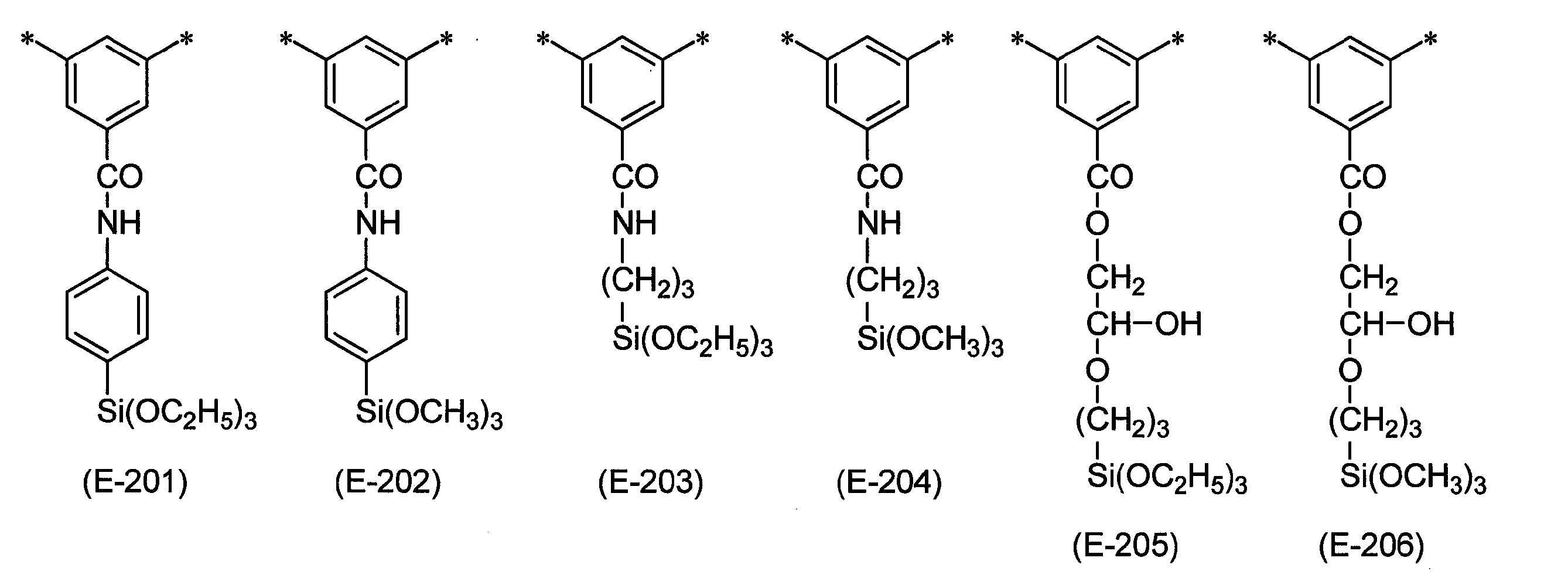
上記式(E-201)~(E-206)のうち、アミド基を有する式(E-201)~(E-204)は、アミド基を有さない式(E-205)~(E-206)よりも極性が高い。そのため、基板表面との親和性が高く、基板表面に分布しやすいことから好ましい。
Xユニットは、加熱によりイミド化し剛直なイミド基を生じる。そのため、Xユニットが上記式(Z-200)に相当する基を有すると、剛直な主鎖により式(Z-200)に相当する基の動きが束縛されやすく、後述の効果を発現し難い。そのため、繰り返し単位Aにおいては、アルコキシシリル基がEユニットに結合している(Zユニットである)。
(繰り返し単位B)
繰り返し単位Bとしては、上記式(10)に示すポリアミック酸骨格を有し、ポリアミック酸に含まれるXユニットが下記式(X-1)~(X-11)であるもの、およびEユニットが下記式(E-1)~(E-11)であるものを示すことができる。
繰り返し単位Bとしては、上記式(10)に示すポリアミック酸骨格を有し、ポリアミック酸に含まれるXユニットが下記式(X-1)~(X-11)であるもの、およびEユニットが下記式(E-1)~(E-11)であるものを示すことができる。
第2のポリアミック酸において、繰り返し単位Aは、第2のポリアミック酸を構成する全繰り返し単位に対して0mol%を超えて含まれている。繰り返し単位Aは、第2のポリアミック酸を構成する全繰り返し単位に対して2mol%以上含まれることが好ましく、5mol%以上含まれることがより好ましい。
また、第2のポリアミック酸において、繰り返し単位Aは、第2のポリアミック酸を構成する全繰り返し単位に対して40mol%以下含まれることが好ましく、30mol%以下含まれることがより好ましい。
第2のポリアミック酸における繰り返し単位Aの含有率(mol%)の上限値および下限値は、任意に組み合わせることができる。
第2のポリアミック酸における繰り返し単位Aの含有率(mol%)の上限値および下限値は、任意に組み合わせることができる。
第2のポリアミック酸において、繰り返し単位Aが、第2のポリアミック酸を構成する全繰り返し単位に対して0mol%を超えて含まれていると、アルコキシシリル基が基板表面に反応して化学的に結合し、層分離しやすくなる。
また、繰り返し単位Aが、第2のポリアミック酸を構成する全繰り返し単位に対して40mol%以下含まれていると、極性基であるアルコキシシリル基を含むとしても、配向膜の抵抗が低下し過ぎることなく、VHRの低下を抑制することができる。
本実施形態の組成物において、第1のポリアミック酸と第2のポリアミック酸との合計に対する第2のポリアミック酸の割合は、5質量%以上であることが好ましく、30質量%以上であることがより好ましく、50質量%以上であることがさらに好ましい。
同様に、第1のポリアミック酸と第2のポリアミック酸との合計に対する第2のポリアミック酸の割合は、95質量%以下であることが好ましく、85質量%以下であることがより好ましく、80質量%以下であることがさらに好ましい。
上記上限値と下限値とは、任意に組み合わせることができる。
上記上限値と下限値とは、任意に組み合わせることができる。
本実施形態の組成物が、上述したような第1のポリアミック酸と、第2のポリアミック酸との混合物であることにより、以下のような効果を奏する。
第1に、本実施形態の組成物を用いて配向膜を成膜する際、基板上に上記組成物を含む塗料を塗布して成膜する。すると、第2のポリアミック酸が有するアルコキシシリル基は、基板上に設けられた樹脂材料を形成材料とする下地層、オーバーコート層等の層や、金属酸化物を形成材料とする無機絶縁層、導電性金属酸化物を形成材料とする電極等の表面と反応し、化学的に結合する。
そのため、組成物に含まれる第2のポリアミック酸は、基板側に層を形成しやすく、相対的に第1のポリアミック酸は、第2のポリアミック酸を含む層に対し基板とは反対側に層を形成しやすい。これにより、本実施形態の組成物を塗布した面において層分離が進行しやすい。
第1のポリアミック酸は、光反応性官能基や垂直配向基を有しており、配向規制力を発現しやすい設計となっている。そのため上記メカニズムで層分離が好適に進行すると、第1のポリアミック酸を形成材料とするポリイミドが、液晶層側に効果的に分布することとなり、液晶層を構成する液晶組成物に対し、配向規制力を示しやすくなる。
その結果、本実施形態の組成物を形成材料とする配向膜を備えた液晶表示装置においては、黒表示時の光漏れを抑制し、バックライトの光を設計通りに透過・非透過させやすくなり、高コントラストの装置とし易くなる。
第2に、本実施形態の組成物を用いて配向膜においては、光官能基の導入量を低減させることができる。光官能基を有するモノマーや光官能基を有するポリマーは、液晶層に溶出することにより、画質が低下するおそれがあった。
以下、画質低下の原因となる反応について下記式(I)を用いて説明する。式(I)では、光官能基を有するモノマーについて示しているが、光官能基を有するポリマーについても同様に考えることができる。
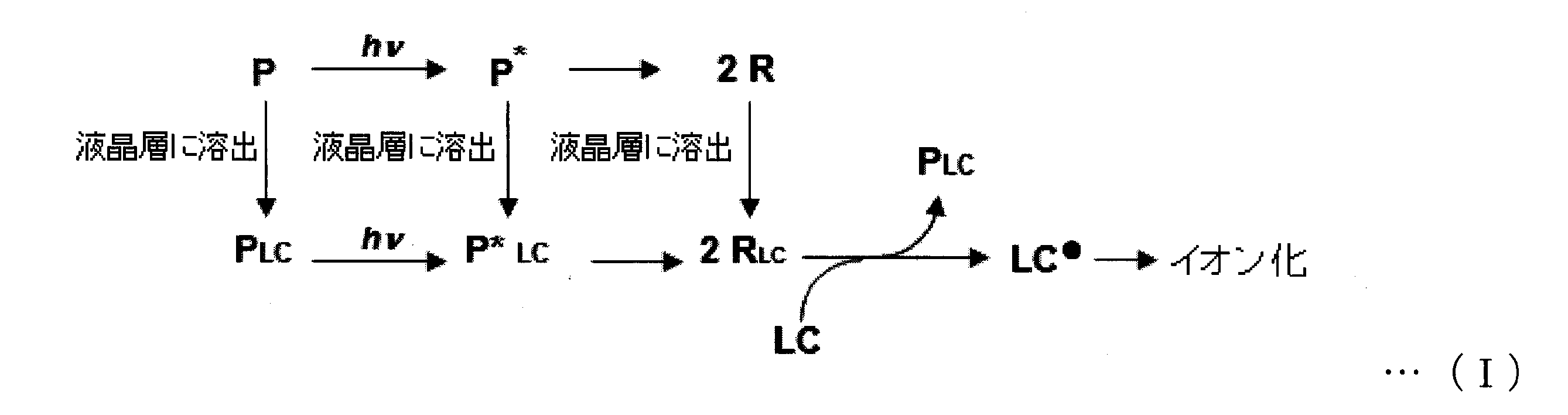
まず、光官能基を有するモノマー(ポリアミック酸)と、光官能基を有さないモノマーとの組成物を用い配向膜を形成した場合、配向膜に含まれる光官能基を有するモノマーは、液晶層に溶出する前、または液晶層に溶出した後に反応し、ラジカルを生じることがある。生じたラジカルは、液晶分子と反応することで、液晶分子のラジカルを生じるおそれがある。液晶分子のラジカルは、周囲の物質と反応してイオン性の化合物を生じる。生じるイオン性の化合物は、液晶組成物の比抵抗を低下させ、VHR低下の原因となる。
一方、式(I)で示される反応を抑制するため、光官能基を有するモノマーの使用量を低減させると、配向規制力が不足し、所望の液晶配向状態を実現できないおそれがあった。
これに対し、本願発明の一態様による組成物によれば、光官能基を有するモノマー(第1のポリアミック酸)と光官能基を有さないモノマー(第2のポリアミック酸)との層分離が効果的に生じるため、使用する光官能基が効果的に液晶層側に配置される。これにより、第1のポリアミック酸の使用量を低減させたとしても、光官能基が効率よく液晶層側に配置され、配向規制力を発現する。
すなわち、本願発明の一態様による組成物によれば、光官能基を有するモノマーの使用量を低減させ、式(I)の反応に起因したVHRの低下を抑制することができる。これにより、液晶組成物の比抵抗を低下させず、VHR低下を抑制することができる。
本実施形態の組成物において、アルコキシシリル基を備えた繰り返し単位は、組成物全体に対し0.05質量%以上30質量%以下含まれることが好ましい。
アルコキシシリル基を備えた繰り返し単位が、組成物全体に対し0.05質量%以上含まれることにより、第2のポリアミック酸は基板表面に反応して化学的に結合し、層分離しやすくなる。
また、アルコキシシリル基を備えた繰り返し単位が、組成物全体に対し30質量%以下含まれることにより、極性基であるアルコキシシリル基を含むとしても、配向膜の抵抗が低下し過ぎることなく、VHRの低下を抑制することができる。
組成物全体に対するアルコキシシリル基を備えた繰り返し単位の含有率は、以下のようにして測定することができる。
まず、組成物に含まれる第1のポリアミック酸と第2のポリアミック酸とをGPC等の公知の方法で分離し、それぞれについてLC-MSで組成分析を行う。
まず、組成物に含まれる第1のポリアミック酸と第2のポリアミック酸とをGPC等の公知の方法で分離し、それぞれについてLC-MSで組成分析を行う。
また、第1のポリアミック酸と第2のポリアミック酸との質量比は、GPC等による分取の結果として得られる値を採用することとしてもよく、各ポリアミック酸についてのNMRスペクトルにおける官能基の面積比から見積もってもよい。
これらの測定結果から、アルコキシシリル基を備えた繰り返し単位の含有率を算出することができる。
したがって、本実施形態の組成物によれば、高性能な液晶表示装置を容易に実現することができる。
[第2実施形態]
以下、図1を参照しながら、本発明の第2実施形態に係る液晶表示装置について説明する。なお、以下の全ての図面においては、図面を見やすくするため、各構成要素の寸法や比率などは適宜異ならせてある。
以下、図1を参照しながら、本発明の第2実施形態に係る液晶表示装置について説明する。なお、以下の全ての図面においては、図面を見やすくするため、各構成要素の寸法や比率などは適宜異ならせてある。
<液晶表示装置>
図1は、本実施形態の液晶表示装置を模式的に示す断面図である。図に示すように、本実施形態の液晶表示装置100は、素子基板10、対向基板20、液晶層30、シール部40を有している。素子基板10および対向基板20は、本発明の一態様における「一対の基板」に該当する。
図1は、本実施形態の液晶表示装置を模式的に示す断面図である。図に示すように、本実施形態の液晶表示装置100は、素子基板10、対向基板20、液晶層30、シール部40を有している。素子基板10および対向基板20は、本発明の一態様における「一対の基板」に該当する。
本実施形態の液晶表示装置100は、FFS(fringe field switching)方式の装置構成を採用している。すなわち、液晶表示装置100は水平配向型の液晶表示装置である。
なお、本発明の一態様による液晶表示装置は、水平配向型の液晶表示装置に限られず、種々の配向方式の液晶表示装置に適用可能である。適用可能な液晶表示装置の配向方式としては、例えば、TN(Twisted Nematic),STN(Super-Twisted Nematic),IPS(In Plane Switching),ECB(Electrically Controlled Birefringence),VA(Vertical Alignment)、MVA(Multi Vertical Alignment)、4D-VTN(4-Domain Vertical TN)、4D-VECB(4-Domain Vertical ECB)が挙げられる。
なお、本発明の一態様による液晶表示装置は、水平配向型の液晶表示装置に限られず、種々の配向方式の液晶表示装置に適用可能である。適用可能な液晶表示装置の配向方式としては、例えば、TN(Twisted Nematic),STN(Super-Twisted Nematic),IPS(In Plane Switching),ECB(Electrically Controlled Birefringence),VA(Vertical Alignment)、MVA(Multi Vertical Alignment)、4D-VTN(4-Domain Vertical TN)、4D-VECB(4-Domain Vertical ECB)が挙げられる。
(素子基板)
素子基板10は、TFT基板11と、TFT基板11の液晶層30側の面に設けられた第1配向膜12と、TFT基板11の液晶層30とは反対側に設けられた第1偏光板19と、を有している。
素子基板10は、TFT基板11と、TFT基板11の液晶層30側の面に設けられた第1配向膜12と、TFT基板11の液晶層30とは反対側に設けられた第1偏光板19と、を有している。
TFT基板11には、不図示の駆動用TFT素子を有している。駆動用TFT素子のドレイン電極、ゲート電極、およびソース電極は、それぞれ画素電極、ゲートバスライン、およびソースバスラインに電気的に接続されている。各画素は、ソースバスライン、ゲートバスラインの電気配線を介して電気的に接続されている。
TFT基板11の各部材の形成材料は、通常知られた材料を用いることができる。駆動用TFTの半導体層の材料としては、IGZO(インジウム(In)、ガリウム(Ga)、亜鉛(Zn)、酸素(O)を含む4元混晶半導体材料)を用いることが好ましい。IGZOを半導体層の形成材料として用いた場合、得られる半導体層ではオフリーク電流が小さいため、電荷のリークが抑制される。これにより、液晶層に電圧印加後の休止期間を長くすることができる。その結果、画像を表示する期間中の電圧印加回数を減らすことができ、液晶表示装置の消費電力を低減することができる。
TFT基板11は、各画素に駆動用TFTを備えるアクティブマトリクス方式であってもよく、各画素が駆動用TFTを備えていない単純マトリクス方式の液晶表示装置であってもよい。
第1配向膜12は、第1実施形態の組成物を形成材料とする配向膜である。第1配向膜12は、TFT基板11の液晶層30側の面に設けられた下部配向膜13と、下部配向膜13に接し下部配向膜13の表面に設けられた上部配向膜14と、を有する。
下部配向膜13は、第1実施形態の組成物における第2のポリアミック酸を含む。
上部配向膜14は、第1実施形態の組成物における第1のポリアミック酸を含む。
上部配向膜14は、第1実施形態の組成物における第1のポリアミック酸を含む。
第1偏光板19は、通常知られた構成のものを用いることができる。
(対向基板)
対向基板20は、例えばカラーフィルタ基板21と、カラーフィルタ基板21の液晶層30側の面に設けられた第2配向膜22と、カラーフィルタ基板21の液晶層30とは反対側に設けられた第2偏光板29と、を有している。
対向基板20は、例えばカラーフィルタ基板21と、カラーフィルタ基板21の液晶層30側の面に設けられた第2配向膜22と、カラーフィルタ基板21の液晶層30とは反対側に設けられた第2偏光板29と、を有している。
カラーフィルタ基板21は、例えば、入射する光の一部を吸収し赤色光を透過させる赤色カラーフィルタ層、入射する光の一部を吸収し緑色光を透過させる緑色カラーフィルタ層、入射する光の一部を吸収し青色光を透過させる青色カラーフィルタ層を有している。
さらに、カラーフィルタ基板21は、基板表面の平坦化とカラーフィルタ層からの色材成分の溶出を防ぐことを目的として、表面を覆うオーバーコート層を有していてもよい。
さらに、カラーフィルタ基板21は、基板表面の平坦化とカラーフィルタ層からの色材成分の溶出を防ぐことを目的として、表面を覆うオーバーコート層を有していてもよい。
第2配向膜22は、ポリイミドを含む重合体を形成材料とする配向膜である。第2配向膜22は、例えば垂直配向膜である。
第2配向膜22は、第1実施形態の組成物を形成材料とする配向膜である。第2配向膜22は、カラーフィルタ基板21の液晶層30側の面に設けられた下部配向膜23と、下部配向膜23に接し下部配向膜23の表面に設けられた上部配向膜24と、を有する。
下部配向膜23は、第1実施形態の組成物における第2のポリアミック酸を含む。
上部配向膜24は、第1実施形態の組成物における第1のポリアミック酸を含む。
上部配向膜24は、第1実施形態の組成物における第1のポリアミック酸を含む。
第2偏光板29は、通常知られた構成のものを用いることができる。第1偏光板19と第2偏光板29とは、例えばクロスニコル配置となっている。
(液晶層)
液晶層30は、液晶材料を含む液晶組成物を形成材料としている。液晶材料は、液晶性を有する液晶分子を含む材料である。
液晶層30は、液晶材料を含む液晶組成物を形成材料としている。液晶材料は、液晶性を有する液晶分子を含む材料である。
液晶材料は、単独で液晶性を発現する液晶分子のみで構成されていてもよく、単独で液晶性を発現する液晶分子と、単独では液晶性を発現しない有機化合物とが混合した組成物であって、組成物全体として液晶性を発現するものであってもよい。液晶材料は、誘電異方性が負のネガ型液晶を用いる。
液晶材料には、下記式(B)で示す官能基を有する液晶分子を含むことが好ましい。

mは、1~18のいずれかの整数である。)
使用可能な液晶分子としては、例えば下記式(B-1)~(B-5)を例示することができる。

また、液晶材料は、下記式(C-1)~(C-4)からなる群から選ばれる少なくとも1つの化合物(アルケニル化合物)を含むことが好ましい。このようなアルケニル化合物を含む液晶材料は、応答速度が向上する。そのため、このようなアルケニル化合物を含む液晶材料を液晶層に用いると、高画質の液晶表示装置を提供することができる。

このような化合物としては、例えば下記式(C-10)で示す化合物を挙げることができる。下記式(C-10)で示す化合物は、上記式(C-1)に示す化合物において、a=3であるものである。

(シール部)
シール部40は、素子基板10、対向基板20に挟持され、かつ液晶層30の周囲に配置されている。シール部40は、液晶層30の形成材料である液晶組成物と接し、液晶組成物の漏洩を防止する。
シール部40は、素子基板10、対向基板20に挟持され、かつ液晶層30の周囲に配置されている。シール部40は、液晶層30の形成材料である液晶組成物と接し、液晶組成物の漏洩を防止する。
シール部40は、硬化性樹脂組成物を形成材料としている。硬化性樹脂組成物としては、紫外線反応性官能基及び熱反応性官能基を有するものであれば特に限定されない。硬化性樹脂組成物を液晶滴下工法(ODF)用のシール剤として用いる際に、速やかに硬化反応が進行し、接着性が良好である事から(メタ)アクリロイル基およびエポキシ基のいずれか一方または両方を有するものが好ましい。
このような硬化性樹脂組成物としては、例えば、(メタ)アクリレート、エポキシ樹脂等が挙げられる。これらの樹脂は単独で用いても良く、2種以上を併用してもよい。なお、本明細書において(メタ)アクリルとは、アクリルまたはメタクリルのことをいう。
上記(メタ)アクリレートとしては特に限定されず、例えば、ウレタン結合を有するウレタン(メタ)アクリレート、グリシジル基を有する化合物と(メタ)アクリル酸とから誘導されるエポキシ(メタ)アクリレート等が挙げられる。
ウレタン(メタ)アクリレートとしては特に限定されず、例えば、イソホロンジイソシアネート等のジイソシアネートと、アクリル酸、ヒドロキシエチルアクリレート等のイソシアネートと付加反応する反応性化合物との誘導体等が挙げられる。これらの誘導体はカプロラクトンやポリオール等で鎖延長させてもよい。市販品としては、例えば、U-122P、U-340P、U-4HA、U-1084A(以上、新中村化学工業社製);KRM7595、KRM7610、KRM7619(以上、ダイセルUCB社製)等が挙げられる。
エポキシ(メタ)アクリレートとしては特に限定されず、例えば、ビスフェノールA型エポキシ樹脂やプロピレングリコールジグリシジルエーテル等のエポキシ樹脂と、(メタ)アクリル酸とから誘導されたエポキシ(メタ)アクリレート等が挙げられる。また、市販品としては、例えば、EA-1020、EA-6320、EA-5520(以上、新中村化学工業社製);エポキシエステル70PA、エポキシエステル3002A(以上、共栄社化学社製)等が挙げられる。
その他の(メタ)アクリレートとしては、例えば、メチルメタクリレート、テトラヒドロフルフリルメタクリレート、ベンジルメタクリレート、イソボルニルメタクリレート、2-ヒドロキシエチルメタクリレート、グリシジルメタクリレート、(ポリ)エチレングリコールジメタクリレート、1,4-ブタンジオールジメタクリレート、1,6-ヘキサンジオールジメタクリレート、トリメチロールプロパントリアクリレート、ペンタエリストールトリアクリレート、グリセリンジメタクリレート等が挙げられる。
エポキシ樹脂としては、例えば、フェノールノボラック型エポキシ樹脂、クレゾールノボラック型エポキシ樹脂、ビフェニルノボラック型エポキシ樹脂、トリスフェノールノボラック型エポキシ樹脂、ジシクロペンタジエンノボラック型エポキシ樹脂、ビスフェノールA型エポキシ樹脂、ビスフェノールF型エポキシ樹脂、2,2’-ジアリルビスフェノールA型エポキシ樹脂、ビスフェノールS型エポキシ樹脂、水添ビスフェノールA型エポキシ樹脂、プロピレンオキシド付加ビスフェノールA型エポキシ樹脂、ビフェニル型エポキシ樹脂、ナフタレン型エポキシ樹脂、レゾルシノール型エポキシ樹脂、グリシジルアミン類等が挙げられる。
フェニルノボラック型エポキシ樹脂の市販品としては、NC-3000S(日本化薬社製)等が挙げられる。
トリスフェノールノボラック型エポキシ樹脂の市販品としては、EPPN-501H、EPPN-501H(以上、日本化薬社製)等が挙げられる。
ジシクロペンタジエンノボラック型エポキシ樹脂の市販品としては、NC-7000L(日本化薬社製)等が挙げられる。
ビスフェノールA型エポキシ樹脂の市販品としては、エピクロン840S、エピクロン850CRP(以上、大日本インキ化学工業社製)等が挙げられる。
ビスフェノールF型エポキシ樹脂の市販品としては、エピコート807(ジャパンエポキシレジン社製)、エピクロン830(大日本インキ化学工業社製)等が挙げられる。
2,2’-ジアリルビスフェノールA型エポキシ樹脂の市販品としては、RE310NM(日本化薬社製)等が挙げられる。
水添ビスフェノール型エポキシ樹脂の市販品としては、エピクロン7015(大日本インキ化学工業社製)等が挙げられる。
プロピレンオキシド付加ビスフェノールA型エポキシ樹脂の市販品としては、エポキシエステル3002A(共栄社化学社製)等が挙げられる。
ビフェニル型エポキシ樹脂の市販品としては、エピコートYX-4000H、YL-6121H(以上、ジャパンエポキシレジン社製)等が挙げられる。
ナフタレン型エポキシ樹脂の市販品としては、エピクロンHP-4032(大日本インキ化学工業社製)等が挙げられる。
レゾルシノール型エポキシ樹脂の市販品としては、デナコールEX-201(ナガセケムテックス社製)等が挙げられる。
グリシジルアミン類としては、エピクロン430(大日本インキ化学工業社製)、エピコート630(ジャパンエポキシレジン社製)等が挙げられる。
また、硬化性樹脂組成物として、1分子内に(メタ)アクリル基とエポキシ基とをそれぞれ少なくとも1つ以上有するエポキシ/(メタ)アクリル樹脂も好適に用いることができる。
エポキシ/(メタ)アクリル樹脂としては、例えば、エポキシ樹脂のエポキシ基の一部分を常法に従って、塩基性触媒の存在下(メタ)アクリル酸と反応させることにより得られる化合物、2官能以上のイソシアネート1モルに水酸基を有する(メタ)アクリルモノマーを1/2モル、続いてグリシドールを1/2モル反応させて得られる化合物、イソシアネート基を有する(メタ)アクリレートにグリシドールを反応させて得られる化合物等が挙げられる。エポキシ/(メタ)アクリル樹脂の市販品としては、例えば、UVAC1561(ダイセルUCB社製)等が挙げられる。
シール部40の形成材料である硬化性樹脂組成物は、シランカップリング剤を含有していてもよい。硬化性樹脂組成物がシランカップリング剤を含有することにより、シール部40と基板(素子基板10、対向基板20)との接着性を向上させることができる。
シランカップリング剤としては特に限定されない。例えば、γ-アミノプロピルトリメトキシシラン、γ-メルカプトプロピルトリメトキシシラン、γ-グリシドキシプロピルトリメトキシシラン、γ-イソシアネートプロピルトリメトキシシラン等や、スペーサー基を介してイミダゾール骨格とアルコキシシリル基とが結合した構造を有するイミダゾールシラン化合物からなるもの等が好適に用いられる。これらは1種のみ用いてもよく、2種以上を併用してもよい。
シール部40の形成材料である硬化性樹脂組成物は、本発明の目的に反しない範囲において、応力分散効果による接着性の改善、線膨張率の改善等の目的でフィラーを含有してもよい。
使用可能なフィラーとしては特に限定されない。例えば、シリカ、珪藻土、アルミナ、酸化亜鉛、酸化鉄、酸化マグネシウム、酸化錫、酸化チタン、水酸化マグネシウム、水酸化アルミニウム、炭酸マグネシウム、硫酸バリウム、石膏、珪酸カルシウム、タルク、ガラスビーズ、セリサイト活性白土、ベントナイト、窒化アルミニウム、窒化珪素等の無機フィラー等が挙げられる。
その他、シール部40の形成材料である硬化性樹脂組成物は、ゲル化剤や、光反応における光増感剤を含んでいてもよい。
その他、液晶表示装置100は、液晶層30の厚さを規定するための柱状構造物であるスペーサを有していてもよい。
上述したように、第1配向膜12、第2配向膜22は、第1実施形態の組成物を形成材料とし、層分離させることにより形成する配向膜である。
仮に、第1配向膜12や第2配向膜22の積層構造を1層ずつ形成して積層すると、上部配向膜には下部配向膜の形成材料である第2のポリアミック酸に由来するポリイミドは含まれず、下部配向膜には上部配向膜の形成材料である第1のポリアミック酸に由来するポリイミドは含まれない。
そのため、このように1層ずつ形成した場合には、例えば第1配向膜12において、第2のポリアミック酸が有するアルコキシシリル基の含有量を厚さ方向に測定すると、上部配向膜14と下部配向膜13との界面において不連続となる。
第2配向膜22において、第2のポリアミック酸が有するアルコキシシリル基の含有量を厚さ方向に測定すると、上部配向膜24と下部配向膜23との界面において不連続となり、本願発明の一態様における配向膜とは異なったものとなる。
対して、上述したような組成物を用い、層分離を利用して層構造を形成した本願発明の一態様における第1配向膜12においては、アルコキシシリル基の含有率は、TFT基板11から遠ざかる方向に漸減する。また、第2配向膜22においては、アルコキシシリル基の含有率は、カラーフィルタ基板21から遠ざかる方向に漸減する。
分析対象としては、アルコキシシリル基に限らず、第1のポリアミック酸や第2のポリアミック酸の痕跡が確認できれば、他の置換基であってもよい。このように、第1のポリアミック酸や第2のポリアミック酸の痕跡を確認することで、配向膜が本願発明の一態様による組成物を用いて作製されたものか否かを確認することができる。
本実施形態の液晶表示装置の第1配向膜12、第2配向膜22のそれぞれにおいて、アルコキシシリル基を備えた繰り返し単位は、配向膜全体に対し0.05質量%以上30質量%以下含まれることが好ましい。
アルコキシシリル基を備えた繰り返し単位が、配向膜全体に対し0.05質量%以上含まれることにより、下部配向膜は基板表面に反応して化学的に結合し、層分離しやすくなる。
また、第1配向膜12、第2配向膜22のそれぞれにおいて、アルコキシシリル基を備えた繰り返し単位が、配向膜全体に対し30質量%以下含まれることにより、極性基であるアルコキシシリル基を含むとしても、配向膜の抵抗が低下し過ぎることなく、VHRの低下を抑制することができる。
第1配向膜12、第2配向膜22のそれぞれにおいて、配向膜全体に対するアルコキシシリル基を備えた繰り返し単位の含有率は、以下のようにして測定することができる。
まず、第1配向膜12または第2配向膜22において、配向膜の表面側に配置される上部配向膜と、配向膜の基板側に配置される下部配向膜とをそれぞれ回収する。回収した上部配向膜、下部配向膜のそれぞれについて、LC-MSで組成分析を行う。
まず、第1配向膜12または第2配向膜22において、配向膜の表面側に配置される上部配向膜と、配向膜の基板側に配置される下部配向膜とをそれぞれ回収する。回収した上部配向膜、下部配向膜のそれぞれについて、LC-MSで組成分析を行う。
また、上部配向膜、下部配向膜についてのNMRスペクトルに基づいて、官能基の面積比からアルコキシシリル基を備えた繰り返し単位の質量を見積もる。
これらの測定結果から、アルコキシシリル基を備えた繰り返し単位の含有率を算出することができる。
以上のような構成の液晶表示装置によれば、上述の組成物を形成材料とする配向膜を備えるため、高性能な液晶表示装置となる。
[第3実施形態]
<電子機器>
図2~図5は、本実施形態の電子機器を示す模式図である。本実施形態の電子機器は、上述した液晶パネルと、前記液晶パネルに駆動信号を供給する制御装置と、を有する。
<電子機器>
図2~図5は、本実施形態の電子機器を示す模式図である。本実施形態の電子機器は、上述した液晶パネルと、前記液晶パネルに駆動信号を供給する制御装置と、を有する。
図2に示す薄型テレビ250は、表示部251、スピーカ252、キャビネット253およびスタンド254等を備えている。表示部251として、上述した液晶表示装置を好適に適用できる。これにより、高コントラストで良好な表示画質を実現することができる。
図3に示すスマートフォン240は、音声入力部241、音声出力部242、操作スイッチ244、表示部245、タッチパネル243および筐体246等を備えている。表示部245として、上述した液表示装置を好適に適用できる。これにより、高コントラストで良好な表示画質を実現することができる。
図4に示すノートパソコン270は、表示部271、キーボード272、タッチパッド273、メインスイッチ274、カメラ275、記録媒体スロット276および筐体277等を備えている。
表示部271として、上述した液晶表示装置を好適に適用できる。これにより、高コントラストで良好な表示画質を実現することができる。
表示部271として、上述した液晶表示装置を好適に適用できる。これにより、高コントラストで良好な表示画質を実現することができる。
図5に示すモバイル電子機器280は、2つの表示部281と、2つの表示部281を接続するヒンジ機構282とを有している。ヒンジ機構282を有することで表示部281を折り畳むことができる。表示部281は、表示パネル281aと、筐体281bとを有している。表示パネル281aとして、上述した液晶パネルを好適に適用できる。これにより、これにより、高コントラストで良好な表示画質を実現することができる。
表示部281の上には曲面レンズを備えていてもよい。レンズを備えることで、2つの表示部281の画像をシームレスに表示することができる。
本実施形態の電子機器は、表示部に上述した液晶表示装置を用いるため、これにより、高コントラストで良好な表示画質を実現することができる。
以上、添付図面を参照しながら本発明に係る好適な実施の形態例について説明したが、本発明は係る例に限定されないことは言うまでもない。上述した例において示した各構成部材の諸形状や組み合わせ等は一例であって、本発明の主旨から逸脱しない範囲において設計要求等に基づき種々変更可能である。
[実施例]
以下に本発明を実施例により説明するが、本発明はこれらの実施例に限定されるものではない。
以下に本発明を実施例により説明するが、本発明はこれらの実施例に限定されるものではない。
後述のように作製した実施例、比較例の液晶セルについて、下記方法により物性評価を行った。
(コントラスト)
トプコン社製SR-UL1輝度計を用い暗室にてコントラストを測定した。
測定温度:25℃、測定波長範囲:380~780nm
トプコン社製SR-UL1輝度計を用い暗室にてコントラストを測定した。
測定温度:25℃、測定波長範囲:380~780nm
(応答特性)
Photal5200(大塚電子)を用いて測定した。
測定温度:25℃、透過率0.5~透過率最大の電圧間で測定
Photal5200(大塚電子)を用いて測定した。
測定温度:25℃、透過率0.5~透過率最大の電圧間で測定
(VHR(Voltage Holding Ratio、電圧保持率))
東陽テクニカ社製6254型VHR測定システムを用いて、1V、70℃条件で測定した。ここで、VHRとは1フレーム期間中に充電された電荷が保持される割合を意味する。VHRが大きい液晶表示装置の方が良品であると判断できる。
東陽テクニカ社製6254型VHR測定システムを用いて、1V、70℃条件で測定した。ここで、VHRとは1フレーム期間中に充電された電荷が保持される割合を意味する。VHRが大きい液晶表示装置の方が良品であると判断できる。
(耐久試験)
得られた各液晶セルを、70℃オーブン内でバックライトからの光に1000時間曝露した。耐久試験前後のVHRを測定し、耐久性を評価した。
得られた各液晶セルを、70℃オーブン内でバックライトからの光に1000時間曝露した。耐久試験前後のVHRを測定し、耐久性を評価した。
<評価1>
(実施例1-1)
FFSモード用のITO電極を有する基板(以下、基板Aと称する。)と、電極を有さない対向基板(以下、基板Bと称する。)との一面に、第1のポリアミック酸と第2のポリアミック酸との混合物を含む塗料を塗布して成膜した。
(実施例1-1)
FFSモード用のITO電極を有する基板(以下、基板Aと称する。)と、電極を有さない対向基板(以下、基板Bと称する。)との一面に、第1のポリアミック酸と第2のポリアミック酸との混合物を含む塗料を塗布して成膜した。
第1のポリアミック酸として、下記式(101)に示すポリアミック酸を用いた。
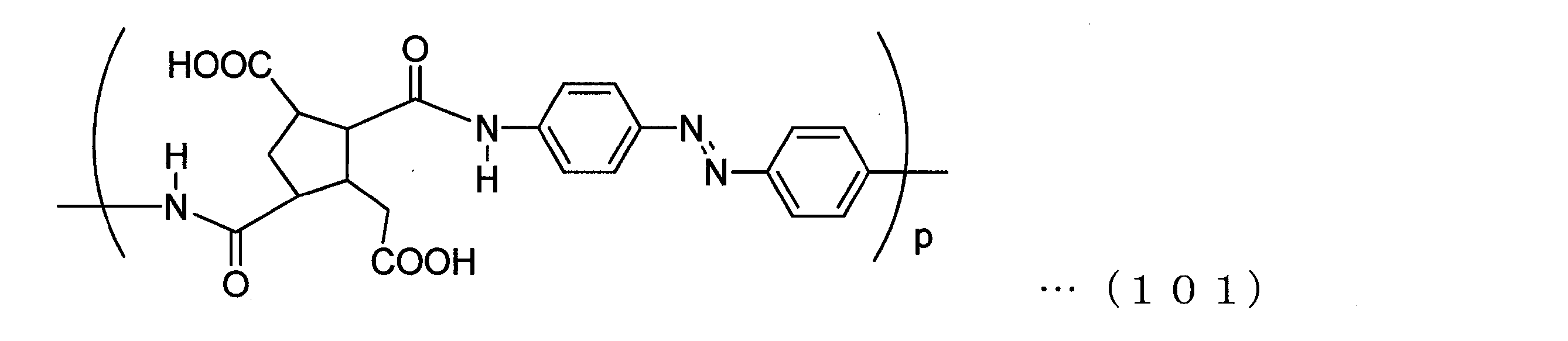
また、第2のポリアミック酸として、下記式(102)に示す繰り返し単位および下記式(103)に示す繰り返し単位を有するポリアミック酸を用いた。下記式(102)に示す繰り返し単位は、「アルコキシシリル基を備えた繰り返し単位」であり、下記式(103)に示す繰り返し単位は、「アルコキシシリル基を備えない繰り返し単位」である。
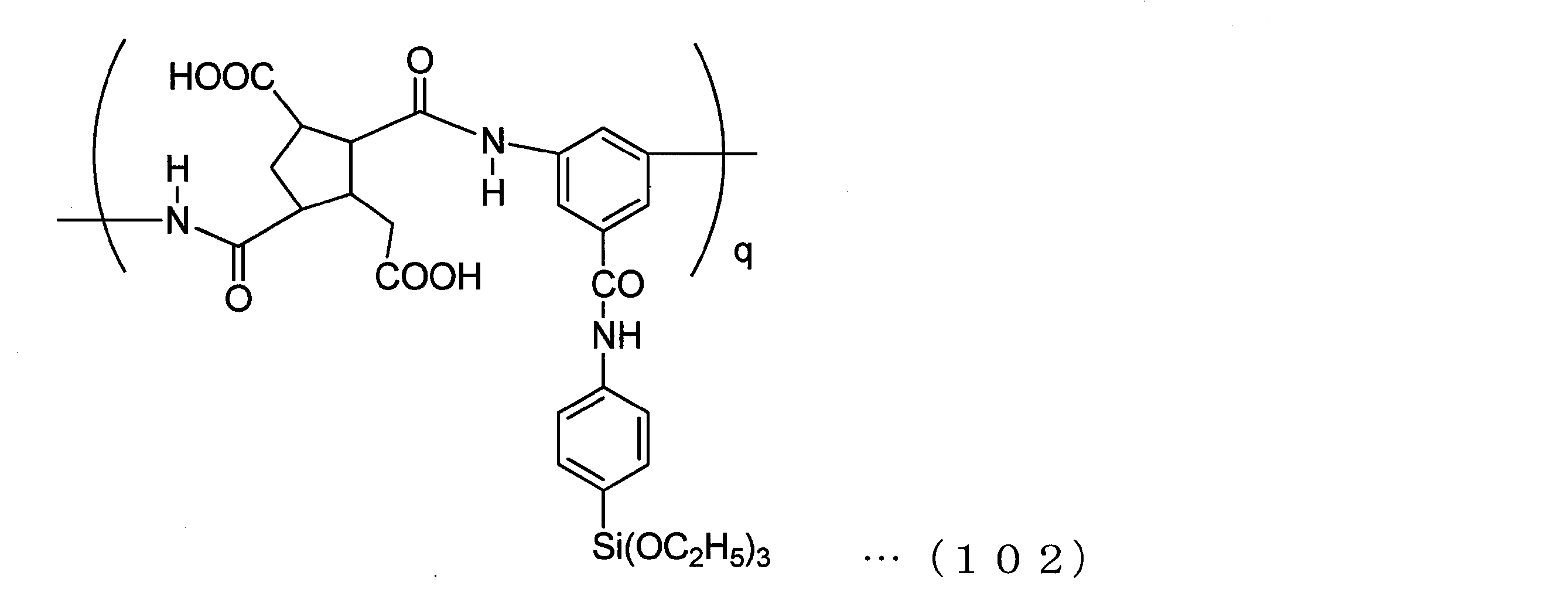

第1のポリアミック酸と第2のポリアミック酸との合計に対し、第1のポリアミック酸の含有率は30質量%、第2のポリアミック酸の含有率は70質量%であった。
また、第2のポリアミック酸において、上記式(102)に示す繰り返し単位および上記式(103)に示す繰り返し単位の合計に対し、上記式(102)に示す繰り返し単位の含有率は2mol%であった。
次いで、80℃で2分焼成した後、波長310~450nmの紫外光を含む直線偏光を、基板法線方向から2J/cm2照射した。
次いで、120℃で20分焼成した後、さらに230℃で40分焼成することで、光配向膜を形成した。
次いで、基板Aの光配向膜側にシール材(紫外線+熱硬化性シール材、製品名:フォトレック、積水化学株式会社製)を描画した。また、基板Bの光配向膜側にTni(ネマチック相-等方相転移温度)が85℃のポジ型液晶材料を滴下した。
真空下にて両基板を貼り合わせた後、シール材に波長340~450nmの紫外光を含む光を照射して硬化させた。さらに、130℃で40分加熱することにより、シール材の熱硬化と、液晶層の再配向処理とを行い、実施例1-1の液晶表示装置のテストセル(液晶セル)を得た。
(実施例1-2)
第2のポリアミック酸において、上記式(102)に示す繰り返し単位および上記式(103)に示す繰り返し単位の合計に対し、上記式(102)に示す繰り返し単位の含有率を10mol%としたこと以外は、実施例1-1と同様にして、実施例1-2の液晶表示装置のテストセル(液晶セル)を得た。
第2のポリアミック酸において、上記式(102)に示す繰り返し単位および上記式(103)に示す繰り返し単位の合計に対し、上記式(102)に示す繰り返し単位の含有率を10mol%としたこと以外は、実施例1-1と同様にして、実施例1-2の液晶表示装置のテストセル(液晶セル)を得た。
(実施例1-3)
第2のポリアミック酸において、上記式(102)に示す繰り返し単位および上記式(103)に示す繰り返し単位の合計に対し、上記式(102)に示す繰り返し単位の含有率を30mol%としたこと以外は、実施例1-1と同様にして、実施例1-3の液晶表示装置のテストセル(液晶セル)を得た。
第2のポリアミック酸において、上記式(102)に示す繰り返し単位および上記式(103)に示す繰り返し単位の合計に対し、上記式(102)に示す繰り返し単位の含有率を30mol%としたこと以外は、実施例1-1と同様にして、実施例1-3の液晶表示装置のテストセル(液晶セル)を得た。
(実施例1-4)
第2のポリアミック酸において、上記式(102)に示す繰り返し単位および上記式(103)に示す繰り返し単位の合計に対し、上記式(102)に示す繰り返し単位の含有率を40mol%としたこと以外は、実施例1-1と同様にして、実施例1-4の液晶表示装置のテストセル(液晶セル)を得た。
第2のポリアミック酸において、上記式(102)に示す繰り返し単位および上記式(103)に示す繰り返し単位の合計に対し、上記式(102)に示す繰り返し単位の含有率を40mol%としたこと以外は、実施例1-1と同様にして、実施例1-4の液晶表示装置のテストセル(液晶セル)を得た。
(比較例1-1)
第2のポリアミック酸において、上記式(102)に示す繰り返し単位および上記式(103)に示す繰り返し単位の合計に対し、上記式(102)に示す繰り返し単位の含有率を0mol%としたこと以外は、実施例1-1と同様にして、比較例1-1の液晶表示装置のテストセル(液晶セル)を得た。
第2のポリアミック酸において、上記式(102)に示す繰り返し単位および上記式(103)に示す繰り返し単位の合計に対し、上記式(102)に示す繰り返し単位の含有率を0mol%としたこと以外は、実施例1-1と同様にして、比較例1-1の液晶表示装置のテストセル(液晶セル)を得た。
表1は、<評価1>の評価結果を示す表である。

評価の結果、上記式(102)で示すような、アルコキシシリル基を有する繰り返し単位を導入することで、コントラストが高くなることが分かった。
アルコキシシリル基を有する繰り返し単位を導入することにより、第1のポリアミック酸を含む層と、第2のポリアミック酸を含む層、との層分離が効果的に生じる。これにより、光配向性官能基が液晶層側により多く分布し、光配向処理(直線偏光UV照射)でより効果的に配向膜分子が配列する。その結果、液晶分子の配向性が向上し、黒表示時の光漏れがより低く抑えられ、より黒く(明度が低く)なると考えられる。
すなわち、アルコキシシリル基を有する繰り返し単位を導入することにより、黒表示時の明度と白表示時の明度との差が拡大し、コントラストが高くなったと考えられる。
また、上記式(102)で示す繰り返し単位の導入量が40mol%である実施例1-4は、コントラストは改善されるものの、耐久性がやや低下することが分かった。
そのため、上記式(102)で示す繰り返し単位の導入量は40mol%未満が好ましいことが分かった。上記式(102)で示す繰り返し単位の導入量が多いと、シランカップリング剤とポリアミック酸中のカルボン酸とが反応することにより生じるアルコール量が増え、耐久性に影響を与えるものと考えられる。
そのため、上記式(102)で示す繰り返し単位の導入量は40mol%未満が好ましいことが分かった。上記式(102)で示す繰り返し単位の導入量が多いと、シランカップリング剤とポリアミック酸中のカルボン酸とが反応することにより生じるアルコール量が増え、耐久性に影響を与えるものと考えられる。
<評価2>
(実施例2-1)
基板Aおよび基板Bの一面に、第1のポリアミック酸と第2のポリアミック酸との混合物を含む塗料を塗布して成膜した。
(実施例2-1)
基板Aおよび基板Bの一面に、第1のポリアミック酸と第2のポリアミック酸との混合物を含む塗料を塗布して成膜した。
第1のポリアミック酸として、下記式(201)に示すポリアミック酸を用いた。
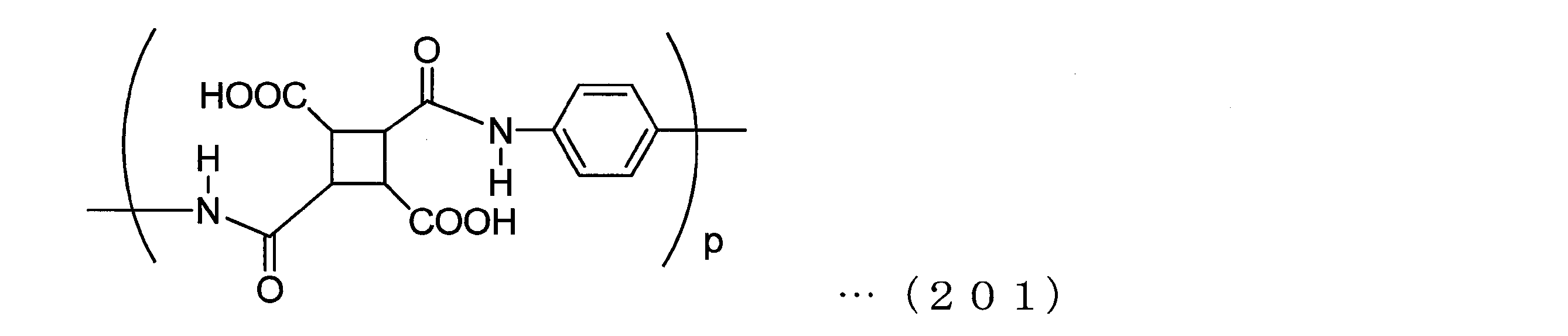
また、第2のポリアミック酸として、下記式(202)に示す繰り返し単位および下記式(203)に示す繰り返し単位を有するポリアミック酸を用いた。下記式(202)に示す繰り返し単位は、「アルコキシシリル基を備えた繰り返し単位」であり、下記式(203)に示す繰り返し単位は、「アルコキシシリル基を備えない繰り返し単位」である。
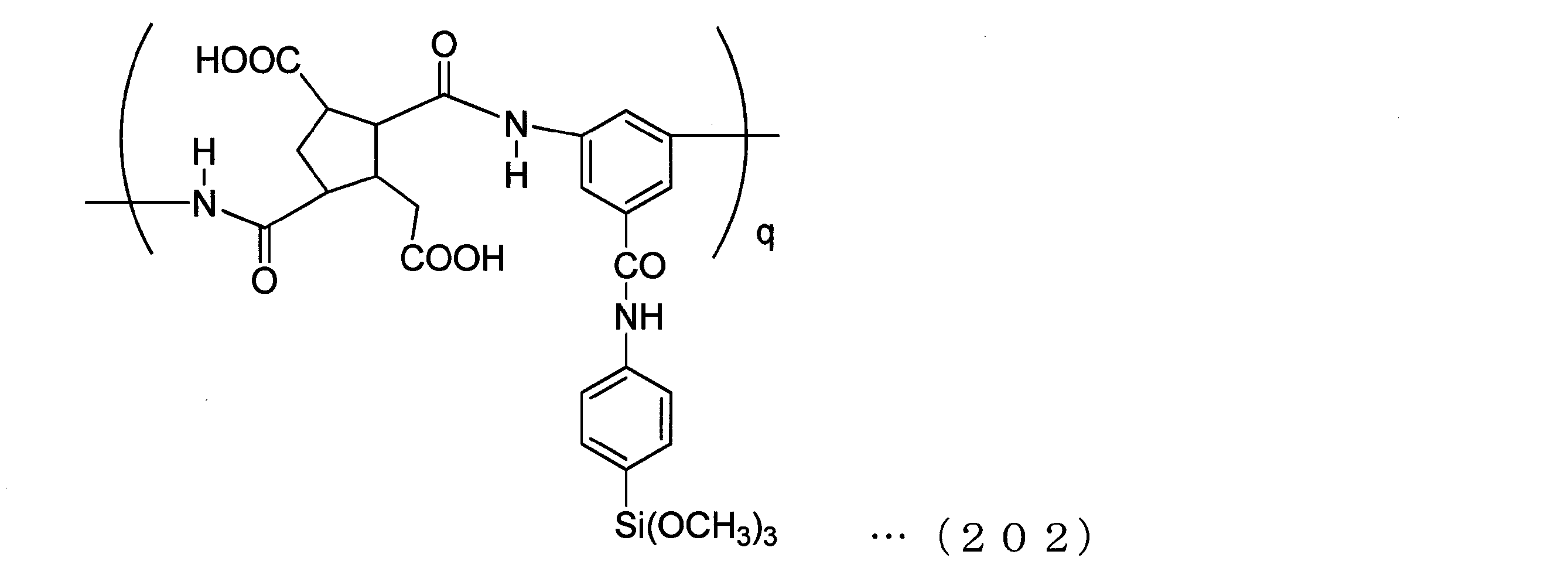
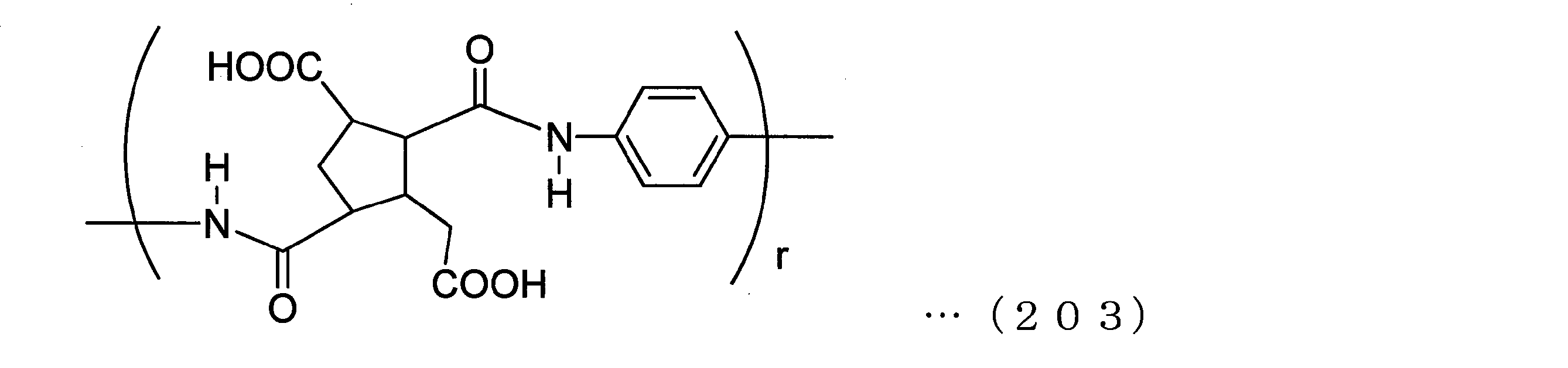
第1のポリアミック酸と第2のポリアミック酸との合計に対し、第1のポリアミック酸の含有率は20質量%、第2のポリアミック酸の含有率は80質量%であった。
また、第2のポリアミック酸において、上記式(202)に示す繰り返し単位および上記式(203)に示す繰り返し単位の合計に対し、上記式(202)に示す繰り返し単位の含有率は2mol%であった。
次いで、80℃で2分焼成し、200℃で40分焼成した後、波長250~300nmの紫外光を含む直線偏光を、基板法線方向から200mJ/cm2照射した。
次いで、200℃で20分焼成することで、光配向膜を形成した。
次いで、基板Aの光配向膜側にシール材(紫外線+熱硬化性シール材、製品名:フォトレック、積水化学株式会社製)を描画した。また、基板Bの光配向膜側にTniが85℃のポジ型液晶材料を滴下した。
真空下にて両基板を貼り合わせた後、シール材に波長340~450nmの紫外光を含む光を照射して硬化させた。さらに、130℃で40分加熱することにより、シール材の熱硬化と、液晶層の再配向処理とを行い、実施例2-1の液晶表示装置のテストセル(液晶セル)を得た。
(実施例2-2)
第2のポリアミック酸において、上記式(202)に示す繰り返し単位および上記式(203)に示す繰り返し単位の合計に対し、上記式(202)に示す繰り返し単位の含有率を10mol%としたこと以外は、実施例2-1と同様にして、実施例2-2の液晶表示装置のテストセル(液晶セル)を得た。
第2のポリアミック酸において、上記式(202)に示す繰り返し単位および上記式(203)に示す繰り返し単位の合計に対し、上記式(202)に示す繰り返し単位の含有率を10mol%としたこと以外は、実施例2-1と同様にして、実施例2-2の液晶表示装置のテストセル(液晶セル)を得た。
(実施例2-3)
第2のポリアミック酸において、上記式(202)に示す繰り返し単位および上記式(203)に示す繰り返し単位の合計に対し、上記式(202)に示す繰り返し単位の含有率を30mol%としたこと以外は、実施例2-1と同様にして、実施例2-3の液晶表示装置のテストセル(液晶セル)を得た。
第2のポリアミック酸において、上記式(202)に示す繰り返し単位および上記式(203)に示す繰り返し単位の合計に対し、上記式(202)に示す繰り返し単位の含有率を30mol%としたこと以外は、実施例2-1と同様にして、実施例2-3の液晶表示装置のテストセル(液晶セル)を得た。
(実施例2-4)
第2のポリアミック酸において、上記式(202)に示す繰り返し単位および上記式(203)に示す繰り返し単位の合計に対し、上記式(202)に示す繰り返し単位の含有率を40mol%としたこと以外は、実施例2-1と同様にして、実施例2-4の液晶表示装置のテストセル(液晶セル)を得た。
第2のポリアミック酸において、上記式(202)に示す繰り返し単位および上記式(203)に示す繰り返し単位の合計に対し、上記式(202)に示す繰り返し単位の含有率を40mol%としたこと以外は、実施例2-1と同様にして、実施例2-4の液晶表示装置のテストセル(液晶セル)を得た。
(比較例2-1)
第2のポリアミック酸において、上記式(202)に示す繰り返し単位および上記式(203)に示す繰り返し単位の合計に対し、上記式(202)に示す繰り返し単位の含有率を0mol%としたこと以外は、実施例2-1と同様にして、比較例2-1の液晶表示装置のテストセル(液晶セル)を得た。
第2のポリアミック酸において、上記式(202)に示す繰り返し単位および上記式(203)に示す繰り返し単位の合計に対し、上記式(202)に示す繰り返し単位の含有率を0mol%としたこと以外は、実施例2-1と同様にして、比較例2-1の液晶表示装置のテストセル(液晶セル)を得た。
表2は、<評価2>の評価結果を示す表である。
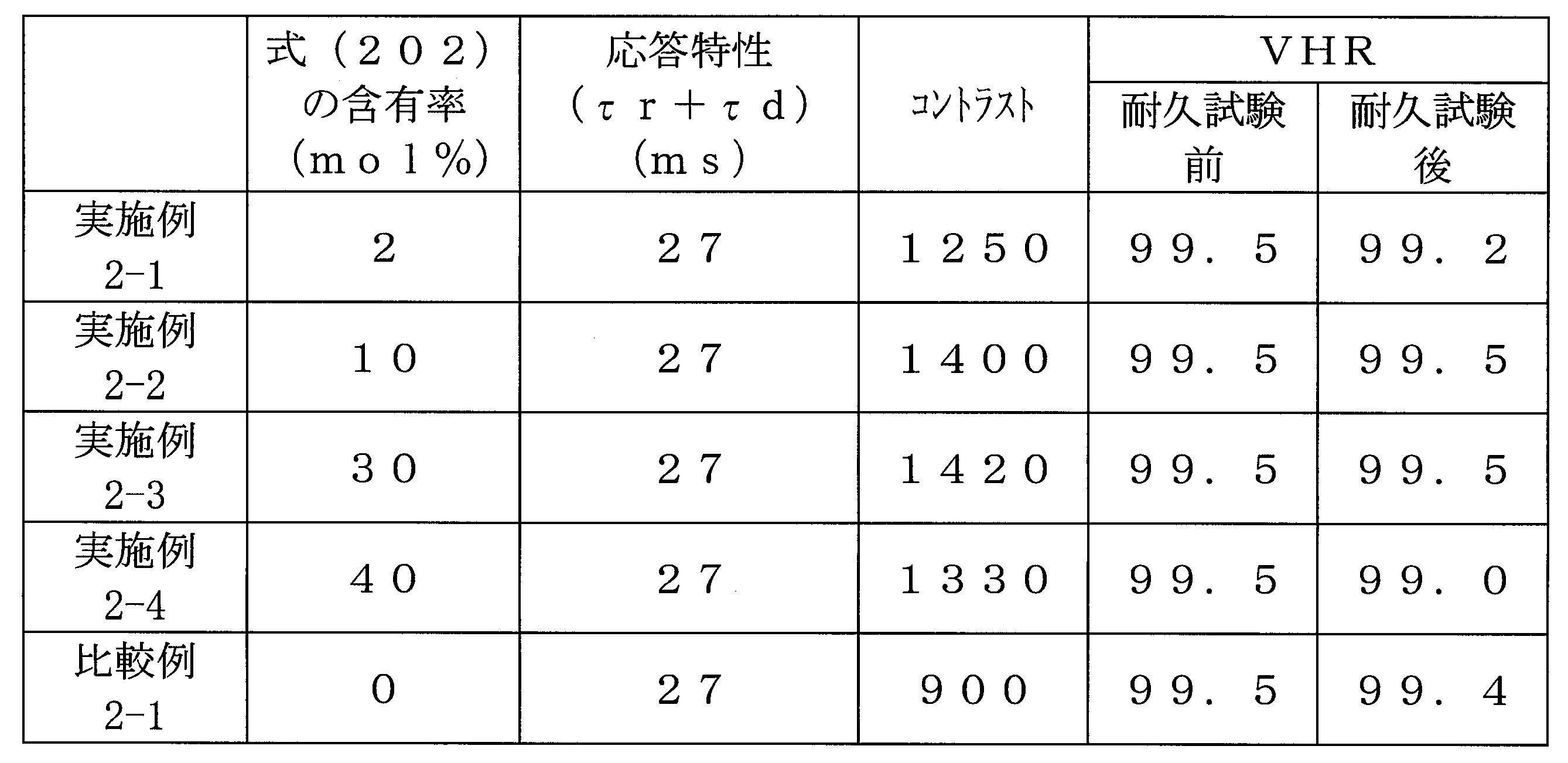
評価の結果、上記式(202)で示すような、アルコキシシリル基を有する繰り返し単位Aを導入することで、コントラストが高くなることが分かった。
また、上記式(202)で示す繰り返し単位が40mol%である実施例2-4は、コントラストは改善されるものの、耐久性がやや低下することが分かった。
そのため、上記式(202)で示す繰り返し単位の導入量は40mol%未満が好ましいことが分かった。
そのため、上記式(202)で示す繰り返し単位の導入量は40mol%未満が好ましいことが分かった。
<評価3>
(実施例3-1)
基板Aおよび基板Bの一面に、第1のポリアミック酸と第2のポリアミック酸との混合物を含む塗料を塗布して成膜した。
(実施例3-1)
基板Aおよび基板Bの一面に、第1のポリアミック酸と第2のポリアミック酸との混合物を含む塗料を塗布して成膜した。
第1のポリアミック酸として、下記式(301)に示すポリアミック酸を用いた。

また、第2のポリアミック酸として、下記式(302)に示す繰り返し単位および下記式(303)に示す繰り返し単位を有するポリアミック酸を用いた。下記式(302)に示す繰り返し単位は、「アルコキシシリル基を備えた繰り返し単位」であり、下記式(303)に示す繰り返し単位は、「アルコキシシリル基を備えない繰り返し単位」である。
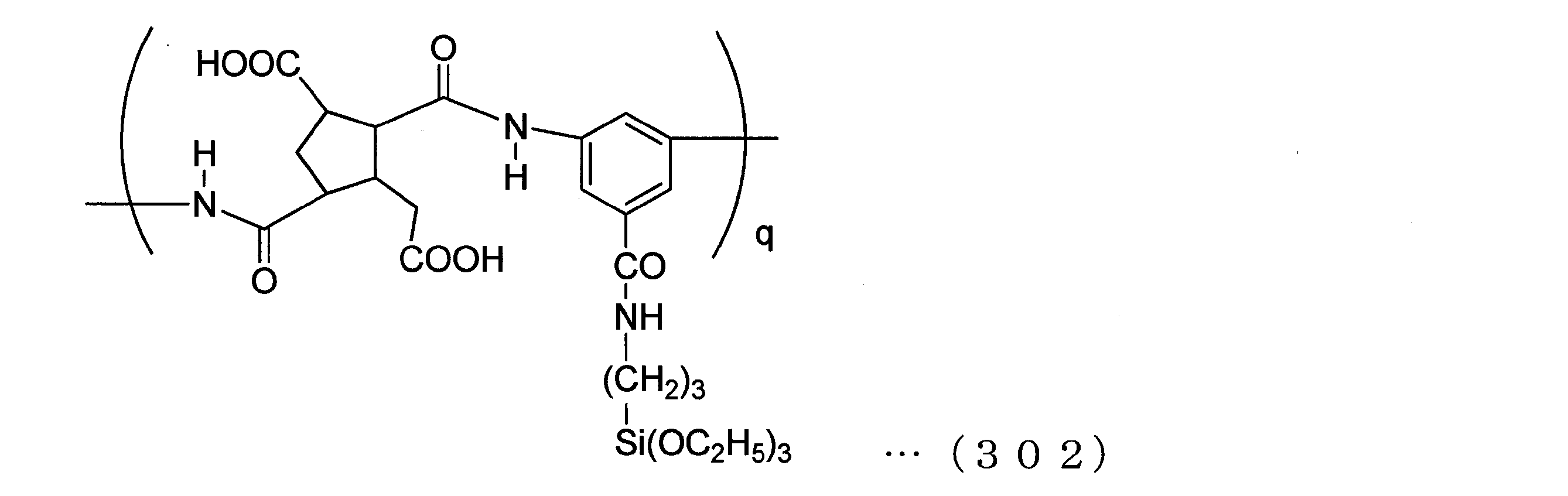
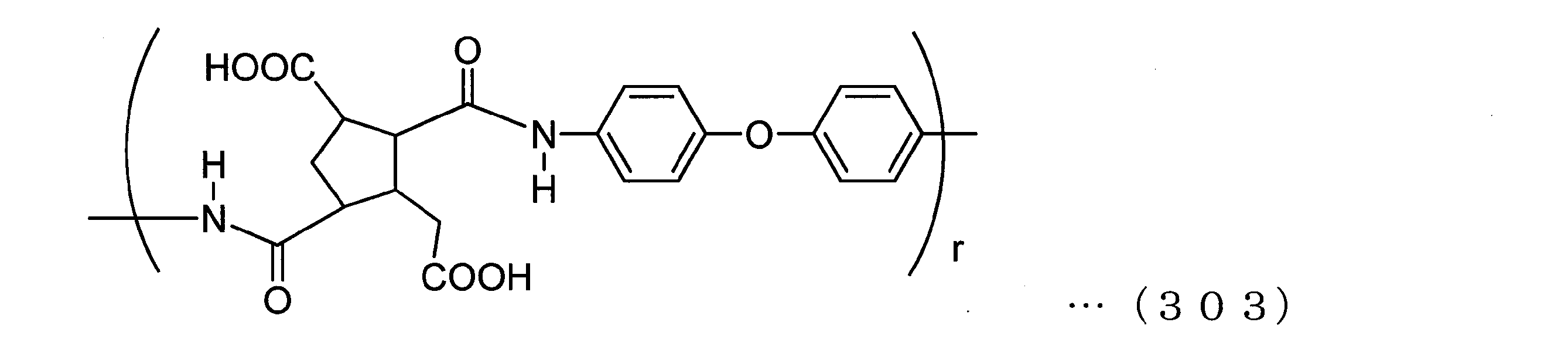
第1のポリアミック酸と第2のポリアミック酸との合計に対し、第1のポリアミック酸の含有率は25質量%、第2のポリアミック酸の含有率は75質量%であった。
また、第2のポリアミック酸において、上記式(302)に示す繰り返し単位および上記式(303)に示す繰り返し単位の合計に対し、上記式(302)に示す繰り返し単位の含有率は2mol%であった。
次いで、80℃で2分焼成した後、波長310~450nmの紫外光を含む直線偏光を、基板法線方向から2J/cm2照射した。
次いで、175℃で20分焼成した後、230℃で20分焼成することで、光配向膜を形成した。
次いで、基板Aの光配向膜側にシール材(紫外線+熱硬化性シール材、製品名:フォトレック、積水化学株式会社製)を描画した。また、基板Bの光配向膜側にTniが95℃のポジ型液晶材料を滴下した。
真空下にて両基板を貼り合わせた後、シール材に波長340~450nmの紫外光を含む光を照射して硬化させた。さらに、130℃で40分加熱することにより、シール材の熱硬化と、液晶層の再配向処理とを行い、実施例3-1の液晶表示装置のテストセル(液晶セル)を得た。
(実施例3-2)
第2のポリアミック酸において、上記式(302)に示す繰り返し単位および上記式(303)に示す繰り返し単位の合計に対し、上記式(302)に示す繰り返し単位の含有率を10mol%としたこと以外は、実施例3-1と同様にして、実施例3-2の液晶表示装置のテストセル(液晶セル)を得た。
第2のポリアミック酸において、上記式(302)に示す繰り返し単位および上記式(303)に示す繰り返し単位の合計に対し、上記式(302)に示す繰り返し単位の含有率を10mol%としたこと以外は、実施例3-1と同様にして、実施例3-2の液晶表示装置のテストセル(液晶セル)を得た。
(実施例3-3)
第2のポリアミック酸において、上記式(302)に示す繰り返し単位および上記式(303)に示す繰り返し単位の合計に対し、上記式(302)に示す繰り返し単位の含有率を30mol%としたこと以外は、実施例3-1と同様にして、実施例3-3の液晶表示装置のテストセル(液晶セル)を得た。
第2のポリアミック酸において、上記式(302)に示す繰り返し単位および上記式(303)に示す繰り返し単位の合計に対し、上記式(302)に示す繰り返し単位の含有率を30mol%としたこと以外は、実施例3-1と同様にして、実施例3-3の液晶表示装置のテストセル(液晶セル)を得た。
(実施例3-4)
第2のポリアミック酸において、上記式(302)に示す繰り返し単位および上記式(303)に示す繰り返し単位の合計に対し、上記式(302)に示す繰り返し単位の含有率を40mol%としたこと以外は、実施例3-1と同様にして、実施例3-4の液晶表示装置のテストセル(液晶セル)を得た。
第2のポリアミック酸において、上記式(302)に示す繰り返し単位および上記式(303)に示す繰り返し単位の合計に対し、上記式(302)に示す繰り返し単位の含有率を40mol%としたこと以外は、実施例3-1と同様にして、実施例3-4の液晶表示装置のテストセル(液晶セル)を得た。
(比較例3-1)
第2のポリアミック酸において、上記式(302)に示す繰り返し単位および上記式(303)に示す繰り返し単位の合計に対し、上記式(302)に示す繰り返し単位の含有率を0mol%としたこと以外は、実施例3-1と同様にして、比較例3-1の液晶表示装置のテストセル(液晶セル)を得た。
第2のポリアミック酸において、上記式(302)に示す繰り返し単位および上記式(303)に示す繰り返し単位の合計に対し、上記式(302)に示す繰り返し単位の含有率を0mol%としたこと以外は、実施例3-1と同様にして、比較例3-1の液晶表示装置のテストセル(液晶セル)を得た。
表3は、<評価3>の評価結果を示す表である。

評価の結果、上記式(302)で示すような、アルコキシシリル基を有する繰り返し単位Aを導入することで、コントラストが高くなることが分かった。
また、上記式(302)で示す繰り返し単位が40mol%である実施例3-4は、コントラストは改善されるものの、耐久性がやや低下することが分かった。
そのため、上記式(302)で示す繰り返し単位の導入量は40mol%未満が好ましいことが分かった。
そのため、上記式(302)で示す繰り返し単位の導入量は40mol%未満が好ましいことが分かった。
<評価4>
(実施例4-1)
基板Aおよび基板Bの一面に、第1のポリアミック酸と第2のポリアミック酸との混合物を含む塗料を塗布して成膜した。
(実施例4-1)
基板Aおよび基板Bの一面に、第1のポリアミック酸と第2のポリアミック酸との混合物を含む塗料を塗布して成膜した。
第1のポリアミック酸として、下記式(401)に示すポリアミック酸を用いた。

また、第2のポリアミック酸として、下記式(402)に示す繰り返し単位および下記式(403)に示す繰り返し単位を有するポリアミック酸を用いた。下記式(402)に示す繰り返し単位は、「アルコキシシリル基を備えた繰り返し単位」であり、下記式(403)に示す繰り返し単位は、「アルコキシシリル基を備えない繰り返し単位」である。

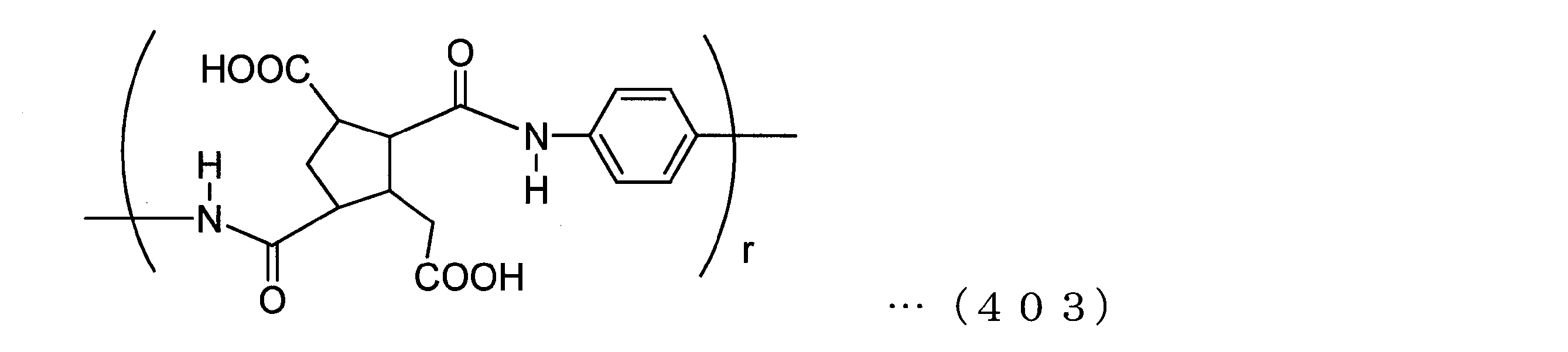
第1のポリアミック酸と第2のポリアミック酸との合計に対し、第1のポリアミック酸の含有率は20質量%、第2のポリアミック酸の含有率は80質量%であった。
また、第2のポリアミック酸において、上記式(402)に示す繰り返し単位および上記式(403)に示す繰り返し単位の合計に対し、上記式(402)に示す繰り返し単位の含有率は30mol%であった。
次いで、80℃で2分焼成し、さらに200℃で40分焼成した後、波長250~300nmの紫外光を含む直線偏光を、基板法線方向から200mJ/cm2照射した。
次いで、200℃で20分焼成することで、光配向膜を形成した。
次いで、基板Aの光配向膜側にシール材(紫外線+熱硬化性シール材、製品名:フォトレック、積水化学株式会社製)を描画した。また、基板Bの光配向膜側にTniが71℃のポジ型液晶材料を滴下した。
真空下にて両基板を貼り合わせた後、シール材に波長340~450nmの紫外光を含む光を照射して硬化させた。さらに、130℃で40分加熱することにより、シール材の熱硬化と、液晶層の再配向処理とを行い、実施例4-1の液晶表示装置のテストセル(液晶セル)を得た。
(比較例4-1)
Tniが71℃のネガ型液晶材料を用いたこと以外は、実施例4-1と同様にして、比較例4-1の液晶表示装置のテストセル(液晶セル)を得た。
Tniが71℃のネガ型液晶材料を用いたこと以外は、実施例4-1と同様にして、比較例4-1の液晶表示装置のテストセル(液晶セル)を得た。
表4は、<評価4>の評価結果を示す表である。

<評価5>
(実施例5-1)
ECBモード用のITO電極を有する基板(以下、基板Cと称する。)と、共通電極を有する対向基板(以下、基板Dと称する。)の一面に、第1のポリアミック酸と第2のポリアミック酸との混合物を含む塗料を塗布して成膜した。
(実施例5-1)
ECBモード用のITO電極を有する基板(以下、基板Cと称する。)と、共通電極を有する対向基板(以下、基板Dと称する。)の一面に、第1のポリアミック酸と第2のポリアミック酸との混合物を含む塗料を塗布して成膜した。
第1のポリアミック酸として、下記式(501)に示すポリアミック酸を用いた。
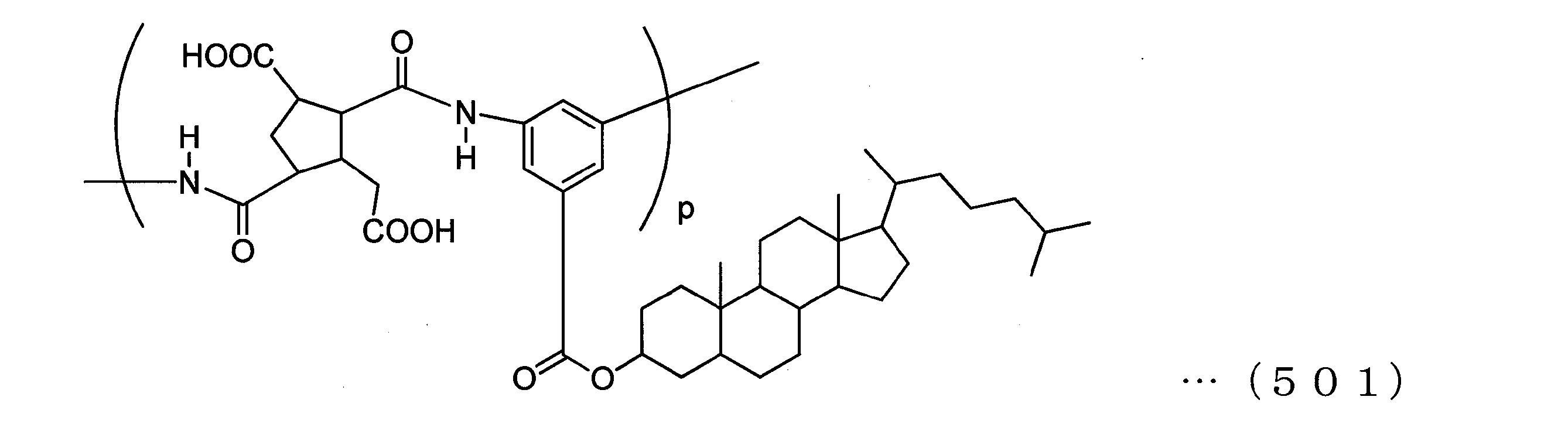
また、第2のポリアミック酸として、下記式(502)に示す繰り返し単位および下記式(503)に示す繰り返し単位を有するポリアミック酸を用いた。下記式(502)に示す繰り返し単位は、「アルコキシシリル基を備えた繰り返し単位」であり、下記式(503)に示す繰り返し単位は、「アルコキシシリル基を備えない繰り返し単位」である。
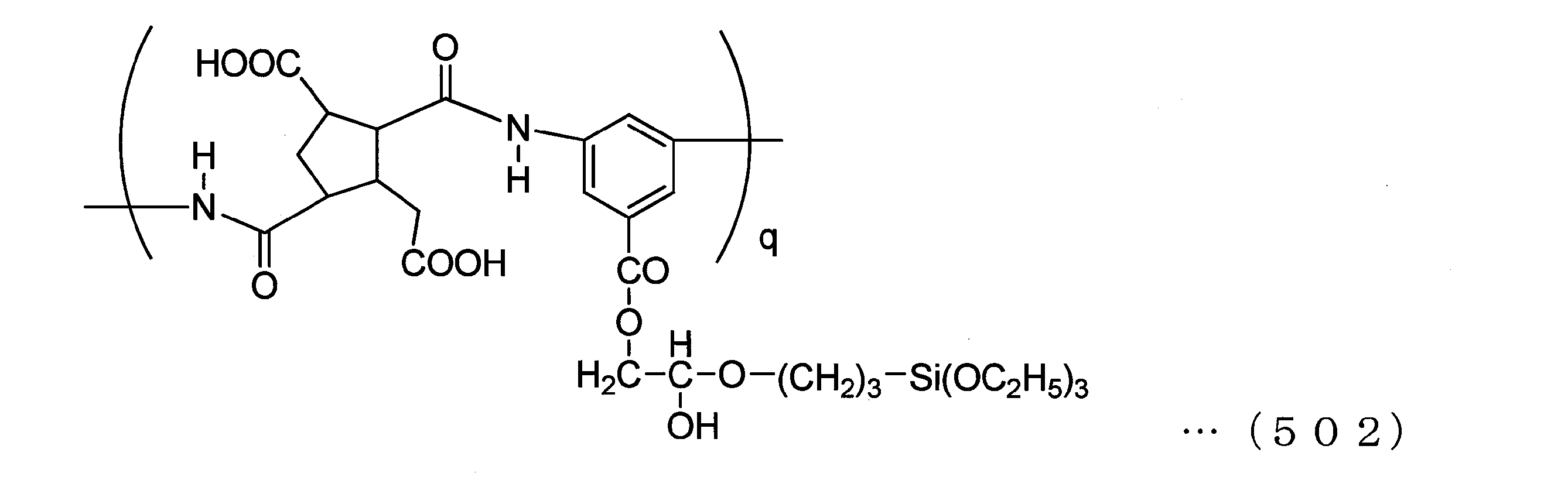

第1のポリアミック酸と第2のポリアミック酸との合計に対し、第1のポリアミック酸の含有率は20質量%、第2のポリアミック酸の含有率は80質量%であった。
また、第2のポリアミック酸において、上記式(502)に示す繰り返し単位および上記式(503)に示す繰り返し単位の合計に対し、上記式(502)に示す繰り返し単位の含有率は2mol%であった。
次いで、80℃で2分焼成した後、ラビング処理を施し、さらに200℃で40分焼成することで、垂直配向膜を形成した。得られた垂直配向膜のプレチルト角は、88.5°であった。
次いで、基板Cの光配向膜側にシール材(紫外線+熱硬化性シール材、製品名:フォトレック、積水化学株式会社製)を描画した。また、基板Dの光配向膜側にTniが95℃のネガ型液晶材料を滴下した。
真空下にて両基板を貼り合わせた後、シール材に波長340~450nmの紫外光を含む光を照射して硬化させた。さらに、110℃で40分加熱することにより、シール材の熱硬化と、液晶層の再配向処理とを行い、実施例4-1の液晶表示装置のテストセル(液晶セル)を得た。
(実施例5-2)
第2のポリアミック酸において、上記式(502)に示す繰り返し単位および上記式(503)に示す繰り返し単位の合計に対し、上記式(502)に示す繰り返し単位の含有率を10mol%としたこと以外は、実施例5-1と同様にして、実施例5-2の液晶表示装置のテストセル(液晶セル)を得た。
第2のポリアミック酸において、上記式(502)に示す繰り返し単位および上記式(503)に示す繰り返し単位の合計に対し、上記式(502)に示す繰り返し単位の含有率を10mol%としたこと以外は、実施例5-1と同様にして、実施例5-2の液晶表示装置のテストセル(液晶セル)を得た。
(実施例5-3)
第2のポリアミック酸において、上記式(502)に示す繰り返し単位および上記式(503)に示す繰り返し単位の合計に対し、上記式(502)に示す繰り返し単位の含有率を30mol%としたこと以外は、実施例5-1と同様にして、実施例5-3の液晶表示装置のテストセル(液晶セル)を得た。
第2のポリアミック酸において、上記式(502)に示す繰り返し単位および上記式(503)に示す繰り返し単位の合計に対し、上記式(502)に示す繰り返し単位の含有率を30mol%としたこと以外は、実施例5-1と同様にして、実施例5-3の液晶表示装置のテストセル(液晶セル)を得た。
(実施例5-4)
第2のポリアミック酸において、上記式(502)に示す繰り返し単位および上記式(503)に示す繰り返し単位の合計に対し、上記式(502)に示す繰り返し単位の含有率を40mol%としたこと以外は、実施例5-1と同様にして、実施例5-4の液晶表示装置のテストセル(液晶セル)を得た。
第2のポリアミック酸において、上記式(502)に示す繰り返し単位および上記式(503)に示す繰り返し単位の合計に対し、上記式(502)に示す繰り返し単位の含有率を40mol%としたこと以外は、実施例5-1と同様にして、実施例5-4の液晶表示装置のテストセル(液晶セル)を得た。
(比較例5-1)
第2のポリアミック酸において、上記式(502)に示す繰り返し単位および上記式(503)に示す繰り返し単位の合計に対し、上記式(502)に示す繰り返し単位の含有率を0mol%としたこと以外は、実施例5-1と同様にして、比較例5-1の液晶表示装置のテストセル(液晶セル)を得た。
第2のポリアミック酸において、上記式(502)に示す繰り返し単位および上記式(503)に示す繰り返し単位の合計に対し、上記式(502)に示す繰り返し単位の含有率を0mol%としたこと以外は、実施例5-1と同様にして、比較例5-1の液晶表示装置のテストセル(液晶セル)を得た。
表5は、<評価5>の評価結果を示す表である。
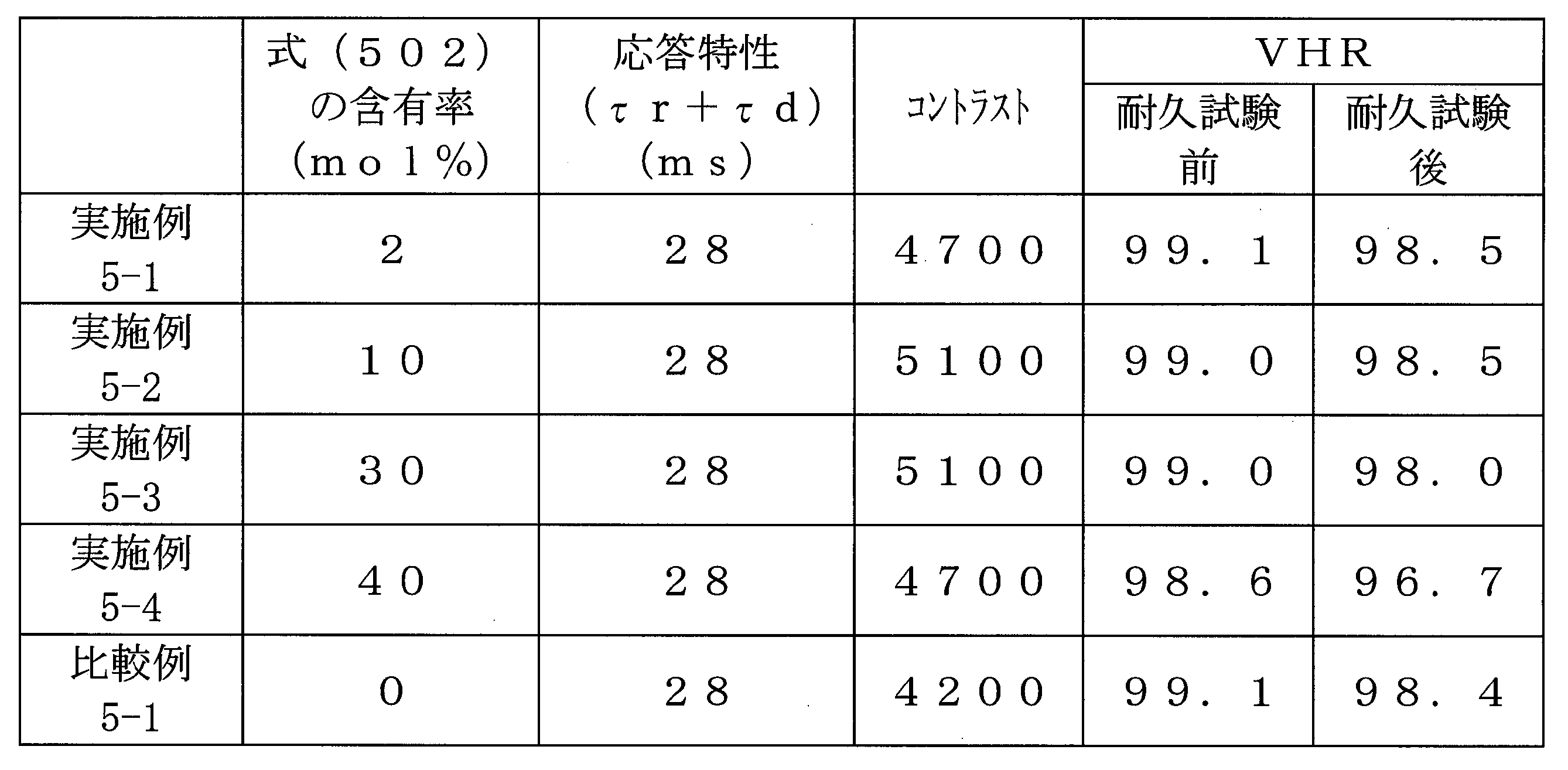
評価の結果、上記式(502)で示すような、アルコキシシリル基を有する繰り返し単位Aを導入することで、コントラストが高くなることが分かった。
また、上記式(502)で示す繰り返し単位が40mol%である実施例5-4は、コントラストは改善されるものの、耐久性がやや低下することが分かった。
そのため、上記式(502)で示す繰り返し単位の導入量は40mol%未満が好ましいことが分かった。
そのため、上記式(502)で示す繰り返し単位の導入量は40mol%未満が好ましいことが分かった。
以上の結果から、本発明の実施例が有用であることが分かった。
本発明のいくつかの態様は、高性能な液晶表示装置を実現することが必要な組成物や、上述の組成物を備えた液晶表示装置や、上述の液晶表示装置を備えた電子機器などに適用することができる。
10…素子基板(一対の基板)、12…第1配向膜、13…下部配向膜、14…上部配向膜、20…対向基板(一対の基板)、22…第2配向膜、23…下部配向膜、24…上部配向膜、30…液晶層、40…シール部、100…液晶表示装置、240…スマートフォン(電子機器)、250…薄型テレビ(電子機器)、270…ノートパソコン(電子機器)、280…モバイル電子機器(電子機器)
Claims (10)
- 第1のポリアミック酸と第2のポリアミック酸とを含み、
前記第1のポリアミック酸は、光反応性官能基および垂直配向基の少なくともいずれか一方を有し、
前記第2のポリアミック酸は、側鎖にアルコキシシリル基を備えた繰り返し単位を有する組成物。 - 前記アルコキシシリル基を備えた繰り返し単位は、組成物全体に対し0.05質量%以上30質量%以下含まれる請求項1に記載の組成物。
- 前記アルコキシシリル基を備えた繰り返し単位は、下記式(E-201)~(E-206)からなる群から選ばれる少なくとも1つの基を含む請求項1または2に記載の組成物。

- 前記アルコキシシリル基を備えた繰り返し単位は、前記第2のポリアミック酸を構成する全繰り返し単位に対し2mol%以上30mol%以下含まれる請求項3に記載の組成物。
- 前記光反応性官能基は、アゾベンゼン骨格を有する基またはシクロブタン環を有する基である請求項1から4のいずれか1項に記載の組成物。
- 前記光反応性官能基は、前記第1のポリアミック酸の主鎖に含まれている請求項5に記載の組成物。
- 一対の基板と、
前記一対の基板に挟持された液晶層と、
前記一対の基板の前記液晶層側の面に設けられた配向膜と、を有し、
前記液晶層は、ポジ型の液晶材料を含み、
前記一対の基板がそれぞれ有する前記配向膜のうち少なくとも一方は、前記液晶層側に配置された上部配向膜と、
前記上部配向膜と前記基板との間に設けられた下部配向膜と、を含む積層膜であり、
前記上部配向膜は前記第1のポリアミック酸を含み、
前記下部配向膜は前記第2のポリアミック酸を含み、
前記積層膜は、請求項1から6のいずれか1項に記載の組成物を形成材料とする液晶表示装置。 - 前記液晶層の液晶組成物は、アルケニル基を有する液晶化合物を含む請求項7に記載の液晶表示装置。
- 前記液晶組成物は、下記式(C1)~(C4)からなる群から選ばれる少なくとも1つの化合物を含む請求項8に記載の液晶表示装置。
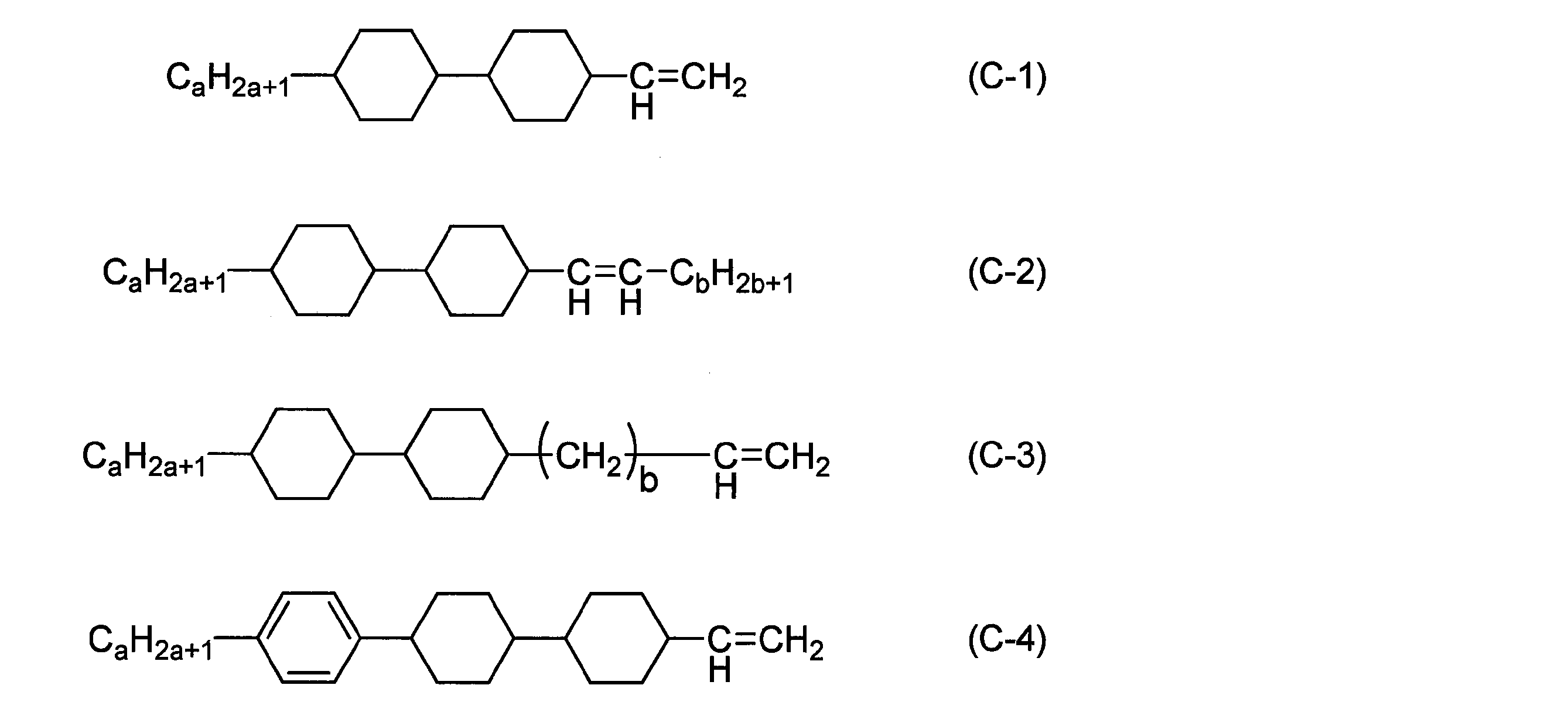
- 請求項7から9のいずれか1項に記載の液晶表示装置を有する電子機器。
Priority Applications (2)
| Application Number | Priority Date | Filing Date | Title |
|---|---|---|---|
| US16/498,288 US20200080001A1 (en) | 2017-03-31 | 2018-03-28 | Composition, liquid crystal display device, and electronic apparatus |
| CN201880021751.8A CN110475821A (zh) | 2017-03-31 | 2018-03-28 | 组合物、液晶显示装置、电子设备 |
Applications Claiming Priority (2)
| Application Number | Priority Date | Filing Date | Title |
|---|---|---|---|
| JP2017069975 | 2017-03-31 | ||
| JP2017-069975 | 2017-03-31 |
Publications (1)
| Publication Number | Publication Date |
|---|---|
| WO2018181558A1 true WO2018181558A1 (ja) | 2018-10-04 |
Family
ID=63677528
Family Applications (1)
| Application Number | Title | Priority Date | Filing Date |
|---|---|---|---|
| PCT/JP2018/012943 Ceased WO2018181558A1 (ja) | 2017-03-31 | 2018-03-28 | 組成物、液晶表示装置、電子機器 |
Country Status (3)
| Country | Link |
|---|---|
| US (1) | US20200080001A1 (ja) |
| CN (1) | CN110475821A (ja) |
| WO (1) | WO2018181558A1 (ja) |
Cited By (1)
| Publication number | Priority date | Publication date | Assignee | Title |
|---|---|---|---|---|
| WO2026069942A1 (ja) * | 2024-09-27 | 2026-04-02 | 三菱瓦斯化学株式会社 | ポリイミド樹脂前駆体組成物及びポリイミドフィルム |
Citations (2)
| Publication number | Priority date | Publication date | Assignee | Title |
|---|---|---|---|---|
| JP2007008977A (ja) * | 2005-06-28 | 2007-01-18 | Shin Etsu Chem Co Ltd | 樹脂溶液組成物、ポリイミド樹脂、及び半導体装置 |
| JP2010070645A (ja) * | 2008-09-18 | 2010-04-02 | Shin-Etsu Chemical Co Ltd | 硬化性ポリイミド系樹脂組成物、ポリイミド樹脂及び半導体装置保護用材料並びに半導体装置 |
Family Cites Families (7)
| Publication number | Priority date | Publication date | Assignee | Title |
|---|---|---|---|---|
| JPH0578573A (ja) * | 1991-05-01 | 1993-03-30 | Yoshio Imai | ポリイミド組成物の製造方法 |
| JP3731229B2 (ja) * | 1995-10-20 | 2006-01-05 | チッソ株式会社 | ポリアミド酸、ポリイミド膜及びこれを用いた液晶配向膜、液晶表示素子 |
| DE69831354T2 (de) * | 1997-11-18 | 2006-06-29 | Matsushita Electric Industrial Co., Ltd., Kadoma | Verfahren zur herstellung von flüssigkristallanzeigen, unter verwendung eines chemisorptionsfilms |
| TW507106B (en) * | 1998-03-11 | 2002-10-21 | Matsushita Electric Industrial Co Ltd | Method for producing an alignment chemisorption monomolecular film |
| EP2131233B1 (en) * | 2007-03-26 | 2017-03-29 | Sharp Kabushiki Kaisha | Liquid crystal display device and polymer for aligning film material |
| JP5034977B2 (ja) * | 2008-01-25 | 2012-09-26 | Jnc株式会社 | 配向膜用組成物 |
| WO2015111136A1 (ja) * | 2014-01-21 | 2015-07-30 | Dic株式会社 | 液晶表示装置 |
-
2018
- 2018-03-28 WO PCT/JP2018/012943 patent/WO2018181558A1/ja not_active Ceased
- 2018-03-28 US US16/498,288 patent/US20200080001A1/en not_active Abandoned
- 2018-03-28 CN CN201880021751.8A patent/CN110475821A/zh active Pending
Patent Citations (2)
| Publication number | Priority date | Publication date | Assignee | Title |
|---|---|---|---|---|
| JP2007008977A (ja) * | 2005-06-28 | 2007-01-18 | Shin Etsu Chem Co Ltd | 樹脂溶液組成物、ポリイミド樹脂、及び半導体装置 |
| JP2010070645A (ja) * | 2008-09-18 | 2010-04-02 | Shin-Etsu Chemical Co Ltd | 硬化性ポリイミド系樹脂組成物、ポリイミド樹脂及び半導体装置保護用材料並びに半導体装置 |
Cited By (1)
| Publication number | Priority date | Publication date | Assignee | Title |
|---|---|---|---|---|
| WO2026069942A1 (ja) * | 2024-09-27 | 2026-04-02 | 三菱瓦斯化学株式会社 | ポリイミド樹脂前駆体組成物及びポリイミドフィルム |
Also Published As
| Publication number | Publication date |
|---|---|
| US20200080001A1 (en) | 2020-03-12 |
| CN110475821A (zh) | 2019-11-19 |
Similar Documents
| Publication | Publication Date | Title |
|---|---|---|
| EP2963489B1 (en) | Curved display device | |
| JP5711091B2 (ja) | 配向膜、配向膜形成用組成物、および液晶表示装置 | |
| US20130010244A1 (en) | Liquid crystal display and method of manufacturing the same | |
| WO2004108790A1 (ja) | 硬化性樹脂組成物、液晶表示素子用シール剤及び液晶表示素子 | |
| JP2004294605A (ja) | 液晶パネル | |
| US9465244B2 (en) | Liquid crystal display | |
| EP2993516B1 (en) | Liquid crystal display device | |
| JP6811261B2 (ja) | 液晶表示装置、電子機器 | |
| US20060240198A1 (en) | Curing resin composition, sealing material for liquid crystal display device and liquid crystal display device | |
| KR20160002599A (ko) | 곡면형 표시 장치 및 이의 제조방법 | |
| US20190271867A1 (en) | Method of producing liquid crystal display device and alignment film material | |
| WO2018221360A1 (ja) | 液晶表示装置、及び、液晶表示装置の製造方法 | |
| CN109791326B (zh) | 液晶显示装置的设计方法、制造方法及液晶显示装置 | |
| WO2017094572A1 (ja) | 液晶封止用シール剤及び液晶表示装置 | |
| CN104603682B (zh) | 液晶显示装置及其制造方法 | |
| KR101569129B1 (ko) | 액정 표시 장치 | |
| WO2018181558A1 (ja) | 組成物、液晶表示装置、電子機器 | |
| KR20190008172A (ko) | 액정 표시 소자용 시일제, 상하 도통 재료, 및, 액정 표시 소자 | |
| TW201819505A (zh) | 液晶顯示元件用密封劑、上下導通材料及液晶顯示元件 | |
| TW201835163A (zh) | 液晶元件及其製造方法 | |
| JP2024134142A (ja) | 液晶配向剤、液晶配向膜及びその製造方法、並びに液晶素子及びその製造方法 | |
| US11319488B2 (en) | Liquid crystal display device, method for manufacturing liquid crystal display device, and electronic apparatus | |
| CN109541855B (zh) | 液晶单元及液晶显示装置 | |
| WO2018216769A1 (ja) | 組成物および液晶表示装置 | |
| CN109791328B (zh) | 液晶显示装置及液晶显示装置的制造方法 |
Legal Events
| Date | Code | Title | Description |
|---|---|---|---|
| 121 | Ep: the epo has been informed by wipo that ep was designated in this application |
Ref document number: 18775629 Country of ref document: EP Kind code of ref document: A1 |
|
| NENP | Non-entry into the national phase |
Ref country code: DE |
|
| 122 | Ep: pct application non-entry in european phase |
Ref document number: 18775629 Country of ref document: EP Kind code of ref document: A1 |
|
| NENP | Non-entry into the national phase |
Ref country code: JP |