WO2018143140A1 - フシコクシン化合物 - Google Patents
フシコクシン化合物 Download PDFInfo
- Publication number
- WO2018143140A1 WO2018143140A1 PCT/JP2018/002825 JP2018002825W WO2018143140A1 WO 2018143140 A1 WO2018143140 A1 WO 2018143140A1 JP 2018002825 W JP2018002825 W JP 2018002825W WO 2018143140 A1 WO2018143140 A1 WO 2018143140A1
- Authority
- WO
- WIPO (PCT)
- Prior art keywords
- group
- substituted
- unsubstituted
- compound
- hydrogen atom
- Prior art date
- Legal status (The legal status is an assumption and is not a legal conclusion. Google has not performed a legal analysis and makes no representation as to the accuracy of the status listed.)
- Ceased
Links
- 0 C[C@](CN**)C(C[C@@]1*)=C([C@]2O*)[C@@]1(C)/C=C1/[C@@](*)(COC)CC[C@]1[C@@](C)[C@]2O Chemical compound C[C@](CN**)C(C[C@@]1*)=C([C@]2O*)[C@@]1(C)/C=C1/[C@@](*)(COC)CC[C@]1[C@@](C)[C@]2O 0.000 description 1
Images


Classifications
-
- A—HUMAN NECESSITIES
- A01—AGRICULTURE; FORESTRY; ANIMAL HUSBANDRY; HUNTING; TRAPPING; FISHING
- A01G—HORTICULTURE; CULTIVATION OF VEGETABLES, FLOWERS, RICE, FRUIT, VINES, HOPS OR SEAWEED; FORESTRY; WATERING
- A01G7/00—Botany in general
- A01G7/06—Treatment of growing trees or plants, e.g. for preventing decay of wood, for tingeing flowers or wood, for prolonging the life of plants
-
- A—HUMAN NECESSITIES
- A01—AGRICULTURE; FORESTRY; ANIMAL HUSBANDRY; HUNTING; TRAPPING; FISHING
- A01N—PRESERVATION OF BODIES OF HUMANS OR ANIMALS OR PLANTS OR PARTS THEREOF; BIOCIDES, e.g. AS DISINFECTANTS, AS PESTICIDES OR AS HERBICIDES; PEST REPELLANTS OR ATTRACTANTS; PLANT GROWTH REGULATORS
- A01N45/00—Biocides, pest repellants or attractants, or plant growth regulators, containing compounds having three or more carbocyclic rings condensed among themselves, at least one ring not being a six-membered ring
- A01N45/02—Biocides, pest repellants or attractants, or plant growth regulators, containing compounds having three or more carbocyclic rings condensed among themselves, at least one ring not being a six-membered ring having three carbocyclic rings
-
- A—HUMAN NECESSITIES
- A01—AGRICULTURE; FORESTRY; ANIMAL HUSBANDRY; HUNTING; TRAPPING; FISHING
- A01N—PRESERVATION OF BODIES OF HUMANS OR ANIMALS OR PLANTS OR PARTS THEREOF; BIOCIDES, e.g. AS DISINFECTANTS, AS PESTICIDES OR AS HERBICIDES; PEST REPELLANTS OR ATTRACTANTS; PLANT GROWTH REGULATORS
- A01N47/00—Biocides, pest repellants or attractants, or plant growth regulators containing organic compounds containing a carbon atom not being member of a ring and having no bond to a carbon or hydrogen atom, e.g. derivatives of carbonic acid
- A01N47/08—Biocides, pest repellants or attractants, or plant growth regulators containing organic compounds containing a carbon atom not being member of a ring and having no bond to a carbon or hydrogen atom, e.g. derivatives of carbonic acid the carbon atom having one or more single bonds to nitrogen atoms
- A01N47/10—Carbamic acid derivatives, i.e. containing the group —O—CO—N<; Thio analogues thereof
- A01N47/12—Carbamic acid derivatives, i.e. containing the group —O—CO—N<; Thio analogues thereof containing a —O—CO—N< group, or a thio analogue thereof, neither directly attached to a ring nor the nitrogen atom being a member of a heterocyclic ring
-
- A—HUMAN NECESSITIES
- A01—AGRICULTURE; FORESTRY; ANIMAL HUSBANDRY; HUNTING; TRAPPING; FISHING
- A01N—PRESERVATION OF BODIES OF HUMANS OR ANIMALS OR PLANTS OR PARTS THEREOF; BIOCIDES, e.g. AS DISINFECTANTS, AS PESTICIDES OR AS HERBICIDES; PEST REPELLANTS OR ATTRACTANTS; PLANT GROWTH REGULATORS
- A01N47/00—Biocides, pest repellants or attractants, or plant growth regulators containing organic compounds containing a carbon atom not being member of a ring and having no bond to a carbon or hydrogen atom, e.g. derivatives of carbonic acid
- A01N47/08—Biocides, pest repellants or attractants, or plant growth regulators containing organic compounds containing a carbon atom not being member of a ring and having no bond to a carbon or hydrogen atom, e.g. derivatives of carbonic acid the carbon atom having one or more single bonds to nitrogen atoms
- A01N47/28—Ureas or thioureas containing the groups >N—CO—N< or >N—CS—N<
-
- A—HUMAN NECESSITIES
- A61—MEDICAL OR VETERINARY SCIENCE; HYGIENE
- A61K—PREPARATIONS FOR MEDICAL, DENTAL OR TOILETRY PURPOSES
- A61K31/00—Medicinal preparations containing organic active ingredients
- A61K31/70—Carbohydrates; Sugars; Derivatives thereof
- A61K31/7028—Compounds having saccharide radicals attached to non-saccharide compounds by glycosidic linkages
- A61K31/7034—Compounds having saccharide radicals attached to non-saccharide compounds by glycosidic linkages attached to a carbocyclic compound, e.g. phloridzin
- A61K31/704—Compounds having saccharide radicals attached to non-saccharide compounds by glycosidic linkages attached to a carbocyclic compound, e.g. phloridzin attached to a condensed carbocyclic ring system, e.g. sennosides, thiocolchicosides, escin, daunorubicin
-
- A—HUMAN NECESSITIES
- A61—MEDICAL OR VETERINARY SCIENCE; HYGIENE
- A61P—SPECIFIC THERAPEUTIC ACTIVITY OF CHEMICAL COMPOUNDS OR MEDICINAL PREPARATIONS
- A61P35/00—Antineoplastic agents
-
- C—CHEMISTRY; METALLURGY
- C07—ORGANIC CHEMISTRY
- C07C—ACYCLIC OR CARBOCYCLIC COMPOUNDS
- C07C233/00—Carboxylic acid amides
- C07C233/01—Carboxylic acid amides having carbon atoms of carboxamide groups bound to hydrogen atoms or to acyclic carbon atoms
- C07C233/16—Carboxylic acid amides having carbon atoms of carboxamide groups bound to hydrogen atoms or to acyclic carbon atoms having the nitrogen atom of at least one of the carboxamide groups bound to a carbon atom of a hydrocarbon radical substituted by singly-bound oxygen atoms
- C07C233/17—Carboxylic acid amides having carbon atoms of carboxamide groups bound to hydrogen atoms or to acyclic carbon atoms having the nitrogen atom of at least one of the carboxamide groups bound to a carbon atom of a hydrocarbon radical substituted by singly-bound oxygen atoms with the substituted hydrocarbon radical bound to the nitrogen atom of the carboxamide group by an acyclic carbon atom
-
- C—CHEMISTRY; METALLURGY
- C07—ORGANIC CHEMISTRY
- C07H—SUGARS; DERIVATIVES THEREOF; NUCLEOSIDES; NUCLEOTIDES; NUCLEIC ACIDS
- C07H15/00—Compounds containing hydrocarbon or substituted hydrocarbon radicals directly attached to hetero atoms of saccharide radicals
- C07H15/20—Carbocyclic rings
- C07H15/24—Condensed ring systems having three or more rings
Definitions
- the present invention relates to a fusicoccin compound.
- the 14-3-3 protein is a protein that exists throughout eukaryotic organisms, and is known to be included in a part of information transmission pathways including cancer-related factors in mammals.
- fusicoccin hereinafter sometimes referred to as “FC”
- FC A fusicoccin A
- the FC A or fusicoccin compound, which is an analog thereof, binds to 14-3-3 protein and thus has high utility value as a pharmaceutical product.
- 14-3-3 proteins are known to interact with a number of phosphorylated proteins with specific sequences, and fusicoccin compounds bind to the interface between 14-3-3 and phosphorylated proteins And has a function (PPI stabilization function) that enhances protein-protein interaction (hereinafter also referred to as “PPI”).
- PPI stabilization function that enhances protein-protein interaction
- 3′-deacetylfusicoccin A (hereinafter sometimes referred to as “3′-deAc FC A”), which is a natural product, is usually used.
- 3′-deAc FC A 3′-deacetylfusicoccin A
- a compound showing a PPI stabilizing effect other than the fusicoccin compound has been discovered, it is known that the PPI stabilizing effect is weaker than that of a natural fusicoccin compound (for example, non-fusicocin compound) No compound exceeding the activity of natural products has been reported.
- the present invention is intended to solve the above-described problems, and an object thereof is to provide a compound that can improve the PPI stabilization effect.
- the present inventors have found that a compound having a specific group introduced at the 19-position of a fusicoccin compound has a PPI stabilizing effect even when compared with a natural fusicoccin compound. It was found that it can be improved.
- the present invention has been completed by further research based on such knowledge. That is, the present invention includes the following configurations.
- Y represents a carbonyl group, a sulfonyl group, or a substituted or unsubstituted alkylene group.
- R 1 and R 2 are the same or different and each represents a hydrogen atom or a hydroxyl group.
- R 3 is a hydrogen atom, a substituted or unsubstituted aminoalkyl group, or general formula (2):
- R 5 represents a hydrogen atom or a substituted or unsubstituted alkyl group.
- R 6 represents a hydrogen atom.
- R 5 and R 6 may combine to form a substituted or unsubstituted alkylene group. * Indicates a bond.
- R 4a represents a substituted or unsubstituted alkyl group, a substituted or unsubstituted (hetero) cycloalkyl group, a substituted or unsubstituted alkoxy group, a substituted or unsubstituted (hetero) aryl group, or a substituted or unsubstituted amino group.
- Item 2 The fusicoccin compound according to Item 1, wherein Y is a carbonyl group.
- Item 3 The fusicoccin compound according to Item 2, wherein R 4a is a substituted or unsubstituted alkyl group, or a substituted or unsubstituted cycloalkyl group.
- Item 4. The fusicoccin compound according to any one of Items 1 to 3, wherein R 1 is a hydroxyl group and R 2 is a hydrogen atom.
- Item 5 The fusicoccin compound according to any one of Items 1 to 4, wherein R 3 is a group represented by General Formula (2).
- Y represents a carbonyl group, a sulfonyl group, or a substituted or unsubstituted alkylene group.
- R 1 and R 2 are the same or different and each represents a hydrogen atom or a hydroxyl group.
- R 3 is a hydrogen atom, a substituted or unsubstituted aminoalkyl group, or general formula (2):
- R 5 represents a hydrogen atom or a substituted or unsubstituted alkyl group.
- R 6 represents a hydrogen atom.
- R 5 and R 6 may combine to form a substituted or unsubstituted alkylene group. * Indicates a bond.
- the group represented by these is shown.
- R 4 represents a substituted or unsubstituted alkyl group, a substituted or unsubstituted (hetero) cycloalkyl group, a substituted or unsubstituted alkoxy group, a substituted or unsubstituted (hetero) aryl group, or a substituted or unsubstituted amino group.
- Y represents a carbonyl group, a sulfonyl group, or a substituted or unsubstituted alkylene group.
- R 1 and R 2 are the same or different and each represents a hydrogen atom or a hydroxyl group.
- R 3 is a hydrogen atom, a substituted or unsubstituted aminoalkyl group, or general formula (2):
- R 5 represents a hydrogen atom or a substituted or unsubstituted alkyl group.
- R 6 represents a hydrogen atom.
- R 5 and R 6 may combine to form a substituted or unsubstituted alkylene group. * Indicates a bond.
- the group represented by these is shown.
- R 4 represents a substituted or unsubstituted alkyl group, a substituted or unsubstituted (hetero) cycloalkyl group, a substituted or unsubstituted alkoxy group, a substituted or unsubstituted (hetero) aryl group, or a substituted or unsubstituted amino group.
- the pharmaceutical containing the fusicoccin compound represented by these is shown.
- Item 9 The medicine according to Item 8, which is a cancer cell growth inhibitor.
- Y represents a carbonyl group, a sulfonyl group, or a substituted or unsubstituted alkylene group.
- R 1 and R 2 are the same or different and each represents a hydrogen atom or a hydroxyl group.
- R 3 is a hydrogen atom, a substituted or unsubstituted aminoalkyl group, or general formula (2):
- R 5 represents a hydrogen atom or a substituted or unsubstituted alkyl group.
- R 6 represents a hydrogen atom.
- R 5 and R 6 may combine to form a substituted or unsubstituted alkylene group. * Indicates a bond.
- the group represented by these is shown.
- R 4 represents a substituted or unsubstituted alkyl group, a substituted or unsubstituted (hetero) cycloalkyl group, a substituted or unsubstituted alkoxy group, a substituted or unsubstituted (hetero) aryl group, or a substituted or unsubstituted amino group.
- Y represents a carbonyl group, a sulfonyl group, or a substituted or unsubstituted alkylene group.
- R 1 and R 2 are the same or different and each represents a hydrogen atom or a hydroxyl group.
- R 3 is a hydrogen atom, a substituted or unsubstituted aminoalkyl group, or general formula (2):
- R 5 represents a hydrogen atom or a substituted or unsubstituted alkyl group.
- R 6 represents a hydrogen atom.
- R 5 and R 6 may combine to form a substituted or unsubstituted alkylene group. * Indicates a bond.
- R 4 represents a substituted or unsubstituted alkyl group, a substituted or unsubstituted (hetero) cycloalkyl group, a substituted or unsubstituted alkoxy group, a substituted or unsubstituted (hetero) aryl group, or a substituted or unsubstituted amino group.
- a method for preventing or treating cancer which comprises ingesting or administering an effective amount of a fusicoccin compound represented by:
- Y represents a carbonyl group, a sulfonyl group, or a substituted or unsubstituted alkylene group.
- R 1 and R 2 are the same or different and each represents a hydrogen atom or a hydroxyl group.
- R 3 is a hydrogen atom, a substituted or unsubstituted aminoalkyl group, or general formula (2):
- R 5 represents a hydrogen atom or a substituted or unsubstituted alkyl group.
- R 6 represents a hydrogen atom.
- R 5 and R 6 may combine to form a substituted or unsubstituted alkylene group. * Indicates a bond.
- R 4 represents a substituted or unsubstituted alkyl group, a substituted or unsubstituted (hetero) cycloalkyl group, a substituted or unsubstituted alkoxy group, a substituted or unsubstituted (hetero) aryl group, or a substituted or unsubstituted amino group.
- the PPI stabilization effect can be dramatically improved by introducing a specific group at position 19 of the fusicoccin compound.
- (hetero) cycloalkyl group means a cycloalkyl group or a heterocycloalkyl group.
- the “(hetero) aryl group” means an aryl group or a heteroaryl group.
- “containing” is a concept including any of “comprise”, “consisting essentially”, and “consisting of”. is there.
- Fusicoccin Compound The fusicoccin compound of the present invention has the general formula (1):
- Y represents a carbonyl group, a sulfonyl group, or a substituted or unsubstituted alkylene group.
- R 1 and R 2 are the same or different and each represents a hydrogen atom or a hydroxyl group.
- R 3 is a hydrogen atom, a substituted or unsubstituted aminoalkyl group, or general formula (2):
- R 5 represents a hydrogen atom or a substituted or unsubstituted alkyl group.
- R 6 represents a hydrogen atom.
- R 5 and R 6 may combine to form a substituted or unsubstituted alkylene group. * Indicates a bond.
- the group represented by these is shown.
- R 4 represents a substituted or unsubstituted alkyl group, a substituted or unsubstituted (hetero) cycloalkyl group, a substituted or unsubstituted alkoxy group, a substituted or unsubstituted (hetero) aryl group, or a substituted or unsubstituted amino group.
- fusicoccin compounds of the present invention compounds other than the compound in which Y is a carbonyl group, R 1 is a hydroxyl group, R 2 is a hydrogen atom, R 3 is a group represented by the general formula (2), and R 4 is an epoxy group That is, the general formula (1A):
- R 4a represents a substituted or unsubstituted alkyl group, a substituted or unsubstituted (hetero) cycloalkyl group, a substituted or unsubstituted alkoxy group, a substituted or unsubstituted (hetero) aryl group, or a substituted or unsubstituted amino group.
- R 1 is a hydroxyl group
- R 2 is a hydrogen atom
- R 3 is a group represented by the general formula (2), the case where R 4a is an epoxy group is excluded.
- any of a linear alkylene group and a branched alkylene group can be employed.
- This alkylene group may have a substituent.
- substituents examples include a halogen atom (a fluorine atom, a chlorine atom, a bromine atom, an iodine atom, etc.), a haloalkyl group (a trifluoromethyl group, etc.), a cycloalkyl group described later, a heterocycloalkyl group described later, an alkoxy group described later, Examples include an aryl group described later, a heteroaryl group described later, and an amino group described later.
- the number of substituents is not particularly limited, and may be 1 to 6, particularly 1 to 3.
- Y is preferably a carbonyl group from the viewpoint of PPI stabilization effect.
- R 1 is a hydrogen atom or a hydroxyl group, and a hydroxyl group is preferable from the viewpoint of ease of synthesis and the like.
- R 2 is a hydrogen atom or a hydroxyl group, and is preferably a hydrogen atom from the viewpoint of ease of synthesis.
- the aminoalkyl group represented by R 3 is not particularly limited, and is an alkyl group having an amino group at the terminal, such as an aminomethyl group, an aminoethyl group, amino n-propyl. And amino C1-6 alkyl groups such as an amino n-butyl group. This aminoalkyl group may have a substituent.
- substituents examples include a halogen atom (a fluorine atom, a chlorine atom, a bromine atom, an iodine atom, etc.), an alkyl group described below, a cycloalkyl group described below, a heterocycloalkyl group described below, an alkoxy group described below, an aryl group described below, Examples include a heteroaryl group described later, an amino group described later, and the like.
- the number of substituents is not particularly limited, and may be 1 to 6, particularly 1 to 3.
- R 3 is a group represented by the general formula (2)
- any of a linear alkyl group and a branched alkyl group can be employed, for example, methyl group, ethyl And C1-6 alkyl groups such as a group, n-propyl group, isopropyl group, n-butyl group, isobutyl group, sec-butyl group, tert-butyl group, n-pentyl group and n-hexyl group.
- This alkyl group may have a substituent.
- substituents examples include a halogen atom (fluorine atom, chlorine atom, bromine atom, iodine atom, etc.), alkenyl group (vinyl group, allyl group, etc.), a cycloalkyl group described later, a heterocycloalkyl group described later, and an alkoxy group described later. And an aryl group described later, a heteroaryl group described later, an amino group described later, and the like.
- the number of substituents is not particularly limited, and may be 1 to 6, particularly 1 to 3. As such R 5 , from the viewpoint of ease of synthesis, PPI stabilization effect, etc.
- the alkylene group includes a linear alkylene group and a branched group. Any chain alkylene group may be employed, and examples thereof include C1-6 alkylene groups such as methylene group, ethylene group, trimethylene group, propylene group, propylidene group, isopropylidene group, and tetramethylene group. This alkylene group may have a substituent.
- substituents examples include a halogen atom (fluorine atom, chlorine atom, bromine atom, iodine atom, etc.), a cycloalkyl group described later, a heterocycloalkyl group described later, an alkoxy group described later, an aryl group described later, and a heteroaryl group described later. And amino groups described below.
- the number of substituents is not particularly limited, and may be 1 to 6, particularly 1 to 3.
- the anticancer activity can be particularly improved, and the group represented by the general formula (2) is employed. If so, the PPI stabilization effect can be particularly improved.
- any of a linear alkyl group and a branched alkyl group can be employed.
- a methyl group, an ethyl group, n And C1-6 alkyl groups such as -propyl group, isopropyl group, n-butyl group, isobutyl group, sec-butyl group, tert-butyl group, n-pentyl group, n-hexyl group and the like.
- This alkyl group may have a substituent.
- substituents examples include a halogen atom (a fluorine atom, a chlorine atom, a bromine atom, an iodine atom, etc.), the alkyl group, a haloalkyl group (such as a trifluoromethyl group), a cycloalkyl group described later, a heterocycloalkyl group described later, An alkoxy group, an aryl group described later, a heteroaryl group described later, an amino group described later, and the like.
- the number of substituents is not particularly limited, and may be 1 to 6, particularly 1 to 3.
- examples of the cycloalkyl group represented by R 4 and R 4a include cycloalkyl groups such as a cyclopropyl group, a cyclobutyl group, a cyclopentyl group, a cyclohexyl group, and an adamantyl group (preferably And a cycloalkyl group having 3 to 10 carbon atoms, particularly 5 to 8 carbon atoms, etc.
- the cycloalkyl group may have a substituent, such as a halogen atom (fluorine atom, chlorine atom).
- the number of substituents in the case of having a substituent is not particularly limited, and may be 1 to 6, particularly 1 to 3. it can.
- examples of the heterocycloalkyl group represented by R 4 and R 4a include an aziridinyl group, an epoxy group, a thiylyl group, an azetidinyl group, an oxetanyl group, a pyrrolidinyl group, a tetrahydrofuranyl group, Examples thereof include heterocycloalkyl groups having 2 to 9 carbon atoms containing one or more of nitrogen atom, oxygen atom, sulfur atom and the like such as tetrahydrothienyl group, piperidinyl group, tetrahydropyranyl group, piperazinyl group and morpholinyl group.
- This heterocycloalkyl group may have a substituent.
- substituents include a halogen atom (fluorine atom, chlorine atom, bromine atom, iodine atom, etc.), the alkyl group, haloalkyl group (trifluoromethyl group, etc.), the cycloalkyl group, the heterocycloalkyl group, and an alkoxy described later.
- a halogen atom fluorine atom, chlorine atom, bromine atom, iodine atom, etc.
- the alkyl group haloalkyl group (trifluoromethyl group, etc.)
- cycloalkyl group the heterocycloalkyl group
- an alkoxy described later described later
- an aryl group described later a heteroaryl group described later, an amino group described later, and the like.
- the number of substituents is not particularly limited, and may be 1 to 6, particularly 1 to 3.
- examples of the alkoxy group represented by R 4 and R 4a include a methoxy group, an ethoxy group, an n-propoxy group, an isopropoxy group, an n-butoxy group, an isobutoxy group, sec And acyclic aliphatic alkoxy groups such as -butyloxy group and tert-butyloxy group (preferably acyclic aliphatic alkoxy groups having 1 to 10 carbon atoms, particularly 3 to 6 carbon atoms).
- an acyclic linear aliphatic alkoxy group can also be employ
- This alkoxy group may have a substituent.
- the substituent include a halogen atom (a fluorine atom, a chlorine atom, a bromine atom, an iodine atom, etc.), the alkyl group, a haloalkyl group (a trifluoromethyl group, etc.), the cycloalkyl group, the heterocycloalkyl group, and the alkoxy group.
- the number of substituents is not particularly limited, and may be 1 to 6, particularly 1 to 3.
- examples of the aryl group represented by R 4 and R 4a include a phenyl group, a tolyl group (o-tolyl group, m-tolyl group, p-tolyl group), and a xylyl group. (2,3-xylyl group, 2,4-xylyl group, 2,5-xylyl group, 2,6-xylyl group, 3,4-xylyl group, 3,5-xylyl group), naphthyl group, etc. .
- This aryl group may have a substituent.
- substituents examples include a halogen atom (a fluorine atom, a chlorine atom, a bromine atom, an iodine atom, etc.), the alkyl group, a haloalkyl group (a trifluoromethyl group, etc.), the cycloalkyl group, the heterocycloalkyl group, and the alkoxy group.
- a halogen atom a fluorine atom, a chlorine atom, a bromine atom, an iodine atom, etc.
- alkyl group a haloalkyl group (a trifluoromethyl group, etc.)
- a haloalkyl group a trifluoromethyl group, etc.
- the aryl group, the heteroaryl group described below, and the amino group described below is not particularly limited, and may be 1 to 6, particularly 1 to 3.
- examples of the heteroaryl group represented by R 4 and R 4a include a pyrrolyl group, a furanyl group, a thienyl group, an imidazolyl group, a pyrazolyl group, an oxazolyl group, an isoxazolyl group, and a thiazolyl group.
- This heteroaryl group may have a substituent.
- substituents examples include a halogen atom (a fluorine atom, a chlorine atom, a bromine atom, an iodine atom, etc.), the alkyl group, a haloalkyl group (a trifluoromethyl group, etc.), the cycloalkyl group, the heterocycloalkyl group, and the alkoxy group.
- a halogen atom a fluorine atom, a chlorine atom, a bromine atom, an iodine atom, etc.
- the alkyl group a haloalkyl group (a trifluoromethyl group, etc.)
- cycloalkyl group a trifluoromethyl group, etc.
- cycloalkyl group a trifluoromethyl group, etc.
- the aryl group, the heteroaryl group, the amino group described later, and the like the number of substituents is not particularly limited, and may be 1 to 6, particularly 1 to 3.
- the amino group represented by R 4 and R 4a may have a substituent.
- the substituent include a halogen atom (a fluorine atom, a chlorine atom, a bromine atom, an iodine atom, etc.), the alkyl group, a haloalkyl group (a trifluoromethyl group, etc.), the cycloalkyl group, the heterocycloalkyl group, and the alkoxy group.
- the number of substituents is not particularly limited, and may be 1 to 2, particularly 1.
- R 4 and R 4a an alkyl group (especially methyl group, isopropyl group, tert-butyl group, etc.) or a cycloalkyl group (especially cyclopropyl group) from the viewpoint of ease of synthesis, PPI stabilizing effect, etc. Etc.), and an unsubstituted C1-4 alkyl group or an unsubstituted C3-5 cycloalkyl group is more preferable.
- a methyl group is most preferable.
- the fusicoccin compound of the present invention can be synthesized, for example, according to the following reaction formula.
- the starting materials (compound (3) and compound (8)) can be synthesized, for example, according to a report (Mol. BioSyst., 9, 940-943 (2013)). It can also be synthesized from the corresponding tosylate using an azide compound (such as sodium azide) and an acid (such as hydrochloric acid).
- Step 1 Compound (3) ⁇ Compound (4); Compound (8) ⁇ Compound (9)
- Compound (4) can be obtained by reacting compound (3) with a phosphorus compound.
- compound (9) can be obtained by reacting compound (8) with a phosphorus compound.
- Examples of the phosphorus compound include phosphine, phosphite, and phosphine oxide.
- phosphine include triphenylphosphine (PPh 3 ), tri-p-tolylphosphine (P (p-tolyl) 3 ), tris (4-fluorophenyl) phosphine (P (pFC 6 H 4 ) 3 ), tris (4-trifluoromethylphenyl) phosphine (P (p-CF 3 -C 6 H 4 ) 3 ), trimethylphosphine, triethylphosphine and the like can be mentioned.
- Examples of the phosphite include trimethyl phosphite and triethyl phosphite.
- Examples of the phosphine oxide include triphenylphosphine oxide (POPh 3 ), tri-p-tolylphosphine oxide (PO (p-tolyl) 3 ), tris (4-fluorophenyl) phosphine oxide (PO (pFC 6 H 4 ) 3 ), tris (4-trifluoromethylphenyl) phosphine oxide (PO (p-CF 3 -C 6 H 4 ) 3 ), trimethylphosphine oxide, triethylphosphine oxide and the like.
- phosphine is preferable and triphenylphosphine is more preferable from the viewpoint of yield and the like.
- the amount of the phosphorus compound used is preferably from 2 to 20 mol, more preferably from 3 to 10 mol, based on 1 mol of the compound (3) or (8) from the viewpoint of yield and the like.
- the reaction can usually be performed in a reaction solvent (tetrahydrofuran, anisole, 1,4-dioxane, ethers such as cyclopentyl methyl ether), and the reaction atmosphere is an inert gas atmosphere (nitrogen gas atmosphere, argon gas atmosphere, etc.)
- the reaction temperature may be any of heating, room temperature, and cooling, and is preferably 30 to 100 ° C.
- the reaction time is not particularly limited, and is preferably 5 minutes to 24 hours.
- purification can be performed according to a conventional method, or the next step can be proceeded without purification.
- Step 2 Compound (4) ⁇ Compound (5); Compound (9) ⁇ Compound (10)
- Compound (5) can be obtained by reacting compound (4) with a desired salt (acid halide, sulfonyl halide, halogenated formate, isocyanate, etc.).
- compound (10) can be obtained by reacting compound (9) with a desired salt (acid halide, sulfonyl halide, halogenated formate, isocyanate, etc.).
- the amount of salt used is preferably 1 to 5 mol, more preferably 1.5 to 3 mol, per 1 mol of compound (4) or (9) from the viewpoint of yield and the like.
- a base an amine compound such as diethylamine, triethylamine, diisopropylamine, cyclohexyldimethylamine; water, etc.
- alkali metal hydroxides such as sodium oxide and potassium hydroxide.
- the amount of the base used is preferably 2 to 10 mol, more preferably 3 to 5 mol, relative to 1 mol of the compound (4) or (9).
- alcohol methanol, ethanol, etc.
- the alcohol is preferably used in an excess amount (for example, 5 to 20 mol) relative to 1 mol of the compound (4) or (9).
- the reaction can usually be performed in a reaction solvent (tetrahydrofuran, anisole, 1,4-dioxane, ethers such as cyclopentyl methyl ether), and the reaction atmosphere is an inert gas atmosphere (nitrogen gas atmosphere, argon gas atmosphere, etc.)
- the reaction temperature may be any of heating, room temperature, and cooling, and is preferably 0 to 50 ° C.
- the reaction time is not particularly limited and is preferably 5 minutes to 24 hours.
- purification can be performed according to a conventional method, or the next step can be proceeded without purification.
- Step 3 Compound (5) ⁇ Compound (6)
- Compound (6) can be obtained by reacting compound (5) with an acid (such as a strong acid such as trifluoroacetic acid).
- an acid such as a strong acid such as trifluoroacetic acid
- it can be used as a reaction solvent by using a liquid as the acid.
- the amount of acid used is preferably excessive with respect to compound (5).
- the reaction atmosphere is preferably an inert gas atmosphere (nitrogen gas atmosphere, argon gas atmosphere, etc.)
- the reaction temperature can be any of heating, room temperature, and cooling, preferably 0 to 50 ° C.
- the reaction time is not particularly limited 5 minutes to 24 hours are preferred.
- purification can be performed according to a conventional method, or the next step can be proceeded without purification.
- Step 4 (Compound (6) ⁇ Compound (7)) Reacting the compound (6) with a dialkoxyalkane (di (C1-6 alkoxy) C1-6 alkane such as 2,2-dimethoxypropane) in the presence of an acid catalyst (pyridinium p-toluenesulfonate, etc.)
- a dialkoxyalkane di (C1-6 alkoxy) C1-6 alkane such as 2,2-dimethoxypropane
- an acid catalyst pyridinium p-toluenesulfonate, etc.
- the amount of dialkoxyalkane used is preferably from 2 to 20 mol, more preferably from 3 to 10 mol, based on 1 mol of the compound (6) from the viewpoint of yield and the like.
- the amount of the acid catalyst used is preferably from 0.05 to 0.5 mol, more preferably from 0.1 to 0.3 mol, based on 1 mol of the compound (6), from the viewpoint of yield and the like.
- the reaction can usually be performed in a reaction solvent (tetrahydrofuran, anisole, 1,4-dioxane, ethers such as cyclopentyl methyl ether), and the reaction atmosphere is an inert gas atmosphere (nitrogen gas atmosphere, argon gas atmosphere, etc.)
- the reaction temperature may be any of heating, room temperature, and cooling, and is preferably 0 to 50 ° C.
- the reaction time is not particularly limited and is preferably 5 minutes to 24 hours.
- the compound (7) can be obtained by performing purification treatment according to a conventional method as necessary.
- the compounds (5) to (7) and (10) thus obtained are all fusicoccin compounds of the present invention.
- fusicoccin compounds bind to 14-3-3 protein and enhance the interaction (PPI) between 14-3-3 protein and phosphorylated protein.
- the fusicoccin compound of the present invention can remarkably enhance the stability of the protein-protein interaction (PPI) as compared with conventionally known fusicoccin compounds.
- phosphorylated proteins that enhance the stability of protein-protein interaction include, for example, plasma membrane H + -ATPase 2 (PMA2), insulin receptor substrate 1 (IRS1), cystic fibrosis transmembrane conductance regulator (CFTR), estrogen Examples include receptor ⁇ (ER ⁇ ) and NudC domain-containing protein 1 (NUDCD1).
- Fusicoccin compounds are known to have anticancer activity (see, for example, Biochem. Biophys. Res. Comm., 238, 758-763 (1997), etc.). Fusicoccin compounds are also known to have plant hormone activity (Physiol. Plant., 31, 149-152 1 (1974)). Furthermore, fusicoccin compounds are also known to be able to treat cystic fibrosis (see, for example, Proc. Natl. Acad. Sci. U.S.A., 113, p. E1152-E1161 (2016). Etc.).
- the fusicoccin compound of the present invention has a higher anticancer activity (especially cancer cell proliferation) than the conventionally known fusicoccin compounds because the stability of the protein-protein interaction described above is remarkably enhanced as compared with conventional fusicoccin compounds. Inhibitory activity), plant hormone activity (especially seed germination activity) and cystic fibrosis therapeutic activity.
- the fusicoccin compound of the present invention can be used as a medicine (in particular, an anticancer agent (cancer cell growth inhibitor, etc.), a cystic fibrosis therapeutic agent, etc.) or a seed germination promoter.
- the fusicoccin compound of the present invention When used as an active ingredient of a medicament, such a medicament is used in addition to the fusicoccin compound of the present invention, as well as pharmaceutically acceptable additives such as fillers, extenders, binders, and moisturizers. , Disintegrants, surfactants, lubricants and other commonly used diluents or excipients may also be included. For example, these additives may be used as necessary, and the fusicoccin compound of the present invention is generally used. It can be obtained by blending into a pharmaceutical preparation.
- pharmaceutically acceptable additives such as fillers, extenders, binders, and moisturizers.
- Disintegrants, surfactants, lubricants and other commonly used diluents or excipients may also be included.
- these additives may be used as necessary, and the fusicoccin compound of the present invention is generally used. It can be obtained by blending into a pharmaceutical preparation.
- the administration route of the medicament of the present invention is not limited, and can be administered by a method according to the form of the preparation, the age and sex of the patient, the state of the disease, and other conditions.
- tablets, pills, solutions, suspensions, emulsions, granules and capsules can be administered orally.
- the injection can be administered intravenously, intramuscularly, intradermally, subcutaneously or intraperitoneally. Suppositories can be administered rectally.
- the dosage of the pharmaceutical agent of the present invention is not particularly limited as long as it is an effective amount that exhibits a medicinal effect, but usually, the weight of the fusicoccin compound of the present invention, which is an active ingredient, is generally 0.1 per day in the case of oral administration. ⁇ 1000 mg / kg body weight, preferably 0.5 to 50 mg / kg body weight per day, and 0.01 to 100 mg / kg body weight, preferably 0.1 to 10 mg / kg body weight per day for parenteral administration.
- the above dose is preferably administered once a day or divided into 2 to 3 times a day, and may be appropriately increased or decreased depending on the age, disease state and symptoms.
- cancer can be prevented or treated by ingesting or administering an effective amount of the fusicoccin compound of the present invention.
- types of diseases involving effective cancer cells include acute promyelocytic leukemia, lung adenocarcinoma, ovarian cancer, pancreatic cancer, brain tumor and the like.
- the target plant of the seed germination promoter of the present invention is not particularly limited.
- seeds that can promote germination are widely applicable to plants such as angiosperms (dicotyledonous plants, monocotyledonous plants, etc.), gymnosperms, moss plants, and fern plants.
- plants such as angiosperms (dicotyledonous plants, monocotyledonous plants, etc.), gymnosperms, moss plants, and fern plants.
- plants such as angiosperms (dicotyledonous plants, monocotyledonous plants, etc.), gymnosperms, moss plants, and fern plants.
- Specific examples include eggplants such as tomatoes, peppers, peppers, eggplants, cucumbers, pumpkins, melons, watermelons and other cucumbers, cabbage, broccoli, Chinese cabbage and other vegetables, celery, parsley, lettuce, etc.
- Leek such as leek, onion, garlic, soybeans, peanuts, beans such as green beans, peas, azuki bean, other fruit vegetables such as strawberries, straight roots such as radish, turnip, carrot, burdock, taro, cassava, potato Potatoes such as sweet potatoes and potatoes, soft vegetables such as asparagus, spinach and honey bees, flower buds such as eustoma, stock, carnation and chrysanthemum, cereals such as rice and corn, turf such as bentgrass and corn, rape , Oil crops such as peanuts, sugar crops such as sugar cane and sugar beet, cotton Textile crops such as rush, feed crops such as clover, sorghum and dent corn, deciduous fruit trees such as apples, pears, grapes and peaches, citrus fruits such as Satsuma mandarin, lemon and grapefruit, satsuki, azalea and cedar And the like.
- the seed germination promoter of the present invention may be the fusicoccin compound itself of the present invention, but may contain various additives in addition to the fusicoccin compound of the present invention depending on the dosage form, application mode, and the like.
- the content ratio of the fusicoccin compound of the present invention in the seed germination promoter is not particularly limited. Specifically, 0.0001 to 100% by mass, preferably about 0.01 to 50% by mass is exemplified.
- the dosage form of the seed germination promoter of the present invention is not particularly limited as long as it is an agriculturally acceptable dosage form.
- liquid agent, solid agent, powder agent, granule, granule, wettable powder, flowable agent, emulsion, paste agent, dispersant and the like can be mentioned.
- the additive is not particularly limited as long as it is an agriculturally acceptable additive.
- examples thereof include carriers, surfactants, thickeners, extenders, binders, vitamins, antioxidants, pH adjusters, volatilization inhibitors, and dyes.
- the application mode of the seed germination promoter of the present invention is not particularly limited as long as it is a known mode (or a mode developed in the future) as a usage mode of an agrochemical. Examples thereof include spraying, dripping, coating, mixing and dissolution in a plant growth environment (in soil, water, solid medium, liquid medium, etc.).
- the present invention will be specifically described based on examples, but the present invention is not limited to these examples.
- the natural products 3′-deacetyl fusicoccin A (3′-deAc FC A) and fusicoccin J (FC J) were used as compounds 1 and 2.
- Compound 18 was synthesized according to the previous report (Mol. BioSyst., 9, 940-943 (2013)).
- Compound 20 was synthesized according to a report (Chem.hemBiol., 20, 583-593 (2013)).
- fusicoccin A aglycone was synthesized according to a previously reported (Chem. Biol., 20, 583-593 (2013)) and used as compound 23.
- Me represents a methyl group.
- Ph represents a phenyl group.
- Me represents a methyl group.
- Ts represents a tosyl group.
- Me represents a methyl group.
- Et represents an ethyl group.
- Ac represents an acetyl group.
- Compound 6 Yield quantitative, ESI-HRMS m / z calcd for C 37 H 61 NO 10 Na [M + Na] + 702.4188, found 702.4188.
- Compound 7 Yield 88%, ESI-HRMS m / z calcd for C 38 H 63 NO 10 Na [M + Na] + 716.4344, found 716.4345.
- Compound 8 yield 96%, ESI-HRMS m / z calcd for C 39 H 63 NO 10 Na [M + Na] + 728.4344, found 728.4344.
- Compound 9 yield quantitative, ESI-HRMS m / z calcd for C 39 H 57 NO 10 Na [M + Na] + 722.3875, found 722.3875.
- Compound 10 yield quantitative, ESI-HRMS m / z calcd for C 38 H 61 NO 11 Na [M + Na] + 730.4137, found 730.4138.
- Compound 11 yield 91%, ESI-HRMS m / z calcd for C 38 H 56 N 2 O 10 Na [M + Na] + 723.3827, found 723.3826.
- Compound 12 yield quantitative, ESI-HRMS m / z calcd for C 36 H 54 N 2 O 10 SNa [M + Na] + 729.3391, found 729.3392.
- Compound 13 yield quantitative, ESI-HRMS m / z calcd for C 33 H 55 NO 11 SNa [M + Na] + 696.3388, found 696.3389.
- Compound 14 yield quantitative, ESI-HRMS m / z calcd for C 34 H 55 NO 11 Na [M + Na] + 676.3667, found 676.3668.
- Compound 15 yield quantitative, ESI-HRMS m / z calcd for C 35 H 58 N 2 O 10 Na [M + Na] + 689.3984, found 689.3986.
- Example 2 Synthesis of compound 16
- Me represents a methyl group.
- Ac represents an acetyl group.
- Me represents a methyl group.
- Ac represents an acetyl group.
- Toluene / tert-butyl alcohol mixed solvent (4: 1, 5 mL) was added to compound 16 (19.7 mg, 0.0346 mmol), and the solvent was distilled off under reduced pressure to remove water in the system.
- THF tetrahydrofuran
- PPTS pyridinium p-toluenesulfonate
- PPTS pyridinium p-toluenesulfonate
- Me represents a methyl group.
- Ph represents a phenyl group.
- Ac represents an acetyl group.
- Et represents an ethyl group.
- Test Example 1 Binding Test The peptide binding test was performed using 10 mM 4- (2-hydroxyethyl) -1-piperazineethanesulfonic acid (HEPES; pH 7.4), 150 mM NaCl, 0.1% tween 20, and 0.5 mM Tris (2-carboxyethyl). ) Using a buffer having the composition of phosphine (TCEP). As the protein, human 14-3-3 ⁇ protein expressed and purified from E. coli was used.
- HEP 4- (2-hydroxyethyl) -1-piperazineethanesulfonic acid
- TCEP phosphine
- FIG. 1 shows the PPI stabilization effect of the phosphopeptides FAM-RSHpSV 2 -COOH and 14-3-3 ⁇ protein in the presence of 0.50 ⁇ M of each fusicoccin compound.
- Table 1 shows the PPI stabilization effect of fusicoccin compounds 1 and 3 in the presence of 100 ⁇ M of a plurality of phosphorylated peptides.
- Table 2 shows the PPI stabilization effect of the phosphopeptides FAM-RSHpSV- COOH and 14-3-3 ⁇ protein in the presence of 100 ⁇ M of the fusicoccin compound 22 and fusicoccin A aglycon (fusicoccin compound 23).
- Test Example 2 Ovarian cancer cell OVCAR3 growth inhibitory activity test in combination with interferon alpha (Cancer Lett., 293, 198-206, (2010).) . Specifically, the test was conducted as follows. 1. Ovarian cancer cells OVCAR3 were cultured to 80-90% confluent (medium; RPMI1640, 10% FCS). 2. The medium of OVCAR3 was discarded and washed with ( ⁇ ) PBS (8 mL ⁇ 1). 3. (-) PBS was discarded and Trypsin-1 mM EDTA (1.5 mL) was added. 4. Incubate at 37 ° C for 5 minutes, add medium (6.0 mL), loosen the cells, and count the number of cells. 5.
- MTS assay CellTiter 96 (registered trademark) AQueous One Solution Assay kit
- Dye solution was diluted 10 times with optiMEM (solution A).
- OptiMEM solution A
- Medium in each well was aspirated and solution A was added.
- 3. Incubate for 90 minutes at 37 ° C, and absorbance was measured with a plate reader (490nm).
- Test Example 3 A seed germination activity test was performed with reference to a previous report (Physiol. Plant., 31, 149-152 (1974)). Specifically, the test was conducted as follows. 1. 2.0 mL of 2.0 ppm germination inhibitor (+/-) abscisic acid (ABA) aqueous solution or ultrapure water was added to the petri dish. 2. To a petri dish containing 2 mL of ABA aqueous solution, 2 ⁇ L of a 1 mM DMSO solution of fusicoccin compound (fusicoccin compound 1 or 9) was added. In addition, 2 ⁇ L of DMSO was added to a petri dish containing ultrapure water or an ABA aqueous solution to obtain water control and ABA control.
- ABA abscisic acid
- Test example 4 MD simulation Desmond package (ver4.4) [Bowers KJ, Chow E., Xu H., Dror RO, Eastwood MP, Gregersen BA, Klepeis JL, Kolossvary I., Moraes MA, Sacerdoti FD, Salmon JK, Shan Y., Shaw DE (2006) Scalable algorithms for molecular dynamics simulations on commodity clusters. In SC '06. Proceedings of the 2006 ACM / IEEE conference on Supercomputing. New York, USA.
- the initial structure of the simulation is Maestro, a molecular modeling software based on a three-component complex crystal structure (PDB ID: 3P1S) consisting of 14-3-3 ⁇ , phosphorylated peptide (KRRKpSV- COOH ) and fusicoccin A (fusicoccin compound 1).
- PDB ID: 3P1S three-component complex crystal structure
- KRRKpSV- COOH phosphorylated peptide
- fusicoccin A fusicoccin compound 1
- a Desmond system builder was used to create a simulation BOX by generating a solvent (NaCl 150 mM aqueous solution) and sodium ions to neutralize the charge in the system in the range of 10 mm around the complex.
- TIP4P was used as the water model
- OPLS 2005 was used as the force field.
- a 50 ns simulation was performed under conditions of NPT ensemble 310K and 1.01325bar.
- Figure 4 shows the frequency of each trajectry analyzed by the Desmond Simulation Interaction Diagram tool, extracting the 19-position acetamide group of fusicoccin compound 3 and the acetoxy group of fusicoccin compound 1 and each amino acid residue. Shown in In FIG.
Landscapes
- Life Sciences & Earth Sciences (AREA)
- Health & Medical Sciences (AREA)
- Chemical & Material Sciences (AREA)
- General Health & Medical Sciences (AREA)
- Organic Chemistry (AREA)
- Engineering & Computer Science (AREA)
- Wood Science & Technology (AREA)
- Environmental Sciences (AREA)
- Agronomy & Crop Science (AREA)
- Plant Pathology (AREA)
- Zoology (AREA)
- Pest Control & Pesticides (AREA)
- Dentistry (AREA)
- Biodiversity & Conservation Biology (AREA)
- Ecology (AREA)
- Molecular Biology (AREA)
- Medicinal Chemistry (AREA)
- Pharmacology & Pharmacy (AREA)
- Animal Behavior & Ethology (AREA)
- Public Health (AREA)
- Veterinary Medicine (AREA)
- Forests & Forestry (AREA)
- Botany (AREA)
- Chemical Kinetics & Catalysis (AREA)
- General Chemical & Material Sciences (AREA)
- Biochemistry (AREA)
- Biotechnology (AREA)
- Genetics & Genomics (AREA)
- Nuclear Medicine, Radiotherapy & Molecular Imaging (AREA)
- Epidemiology (AREA)
- Pharmaceuticals Containing Other Organic And Inorganic Compounds (AREA)
- Acyclic And Carbocyclic Compounds In Medicinal Compositions (AREA)
- Organic Low-Molecular-Weight Compounds And Preparation Thereof (AREA)
- Agricultural Chemicals And Associated Chemicals (AREA)
- Saccharide Compounds (AREA)
Abstract
一般式(1A): [式中、Yはカルボニル基、スルホニル基又は置換若しくは非置換アルキレン基;R1及びR2は同一又は異なって、水素原子又は水酸基;R3は水素原子、置換若しくは非置換アミノアルキル基、又は一般式(2): (式中、R5は水素原子又は置換若しくは非置換アルキル基;R6は水素原子;R5とR6とは結合して置換若しくは非置換アルキレン基を形成してもよい。*は結合手を示す。) で表される基;R4aは置換若しくは非置換アルキル基、置換若しくは非置換(ヘテロ)シクロアルキル基、置換若しくは非置換アルコキシ基、置換若しくは非置換(ヘテロ)アリール基、置換若しくは非置換アミノ基;Yがカルボニル基、R1が水酸基、R2が水素原子、R3が一般式(2)で表される基である場合はR4aがエポキシ基である場合を除く。] で表されるフシコクシン化合物は、PPI安定化効果を向上させることができる。
Description
本発明は、フシコクシン化合物に関する。
14-3-3タンパク質は、真核細胞生物全般にわたって存在しているタンパク質であり、ほ乳類では、がん関連因子を含む情報伝達経路の一部に含まれることが知られている。一方、フシコクシン(以下、「FC」と言うこともある。)Aは、植物病原真菌Phomopsis amygdaliによって産生されるジテルペングリコシドである。このFC A又はその類縁体であるフシコクシン化合物は14-3-3タンパク質と結合することから、医薬品としての利用価値も高い。
14-3-3タンパク質は、特定の配列を有する数多くのリン酸化タンパク質と相互作用することが知られており、フシコクシン化合物は、14-3-3タンパク質とリン酸化タンパク質との間のインターフェースに結合し、タンパク質間相互作用(以下、「PPI」と言うこともある)を増強する機能(PPI安定化機能)を有する。
このようなフシコクシン化合物としては、天然物である3'-デアセチルフシコクシンA(以下、「3'-deAc FC A」と言うこともある)が通常使用されているが、さらにタンパク質間相互作用の安定性を増強することが求められている。このような状況下、フシコクシン化合物以外にも、PPI安定化効果を示す化合物は発見されているものの、天然のフシコクシン化合物と比較してPPI安定化効果は弱いことが知られており(例えば、非特許文献1参照)、天然物の活性を上回る化合物は報告されていない。
Angew. Chem. Int. Ed., 49, 4129 (2010)
本発明は、上記のような課題を解決しようとするものであり、PPI安定化効果を向上させることができる化合物を提供することを目的とする。
本発明者らは、上記課題を解決すべく、鋭意研究をおこなった結果、フシコクシン化合物の19位に特定の基を導入した化合物が、天然のフシコクシン化合物と比較してもPPI安定化効果を著しく向上させることができることを見出した。本発明は、このような知見に基づき、さらに研究を重ね完成したものである。即ち、本発明は、以下の構成を包含する。
項1.一般式(1A):
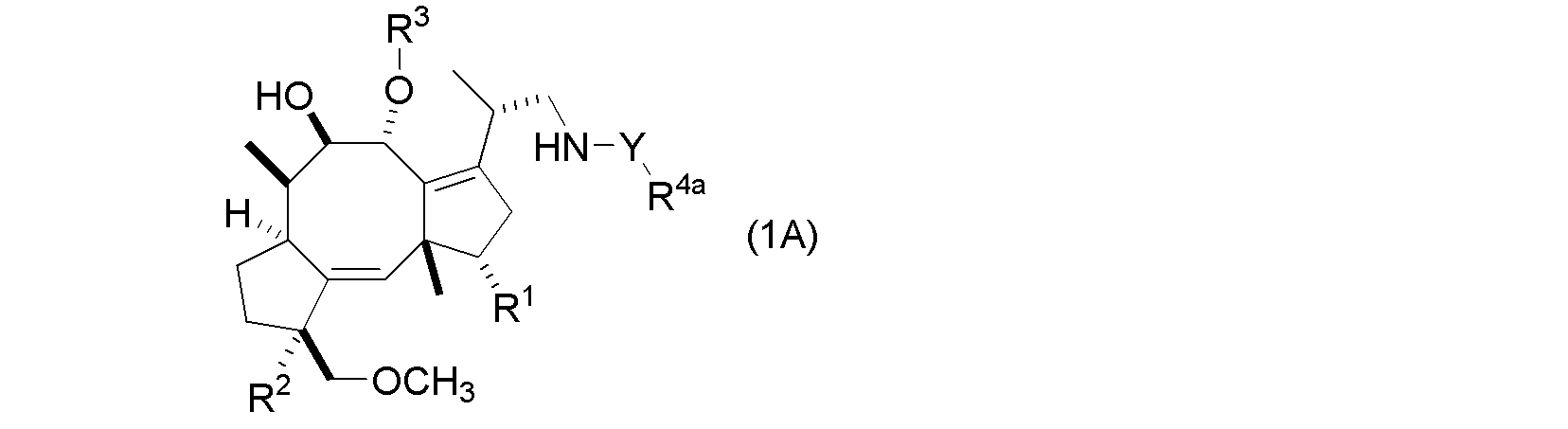
[式中、Yはカルボニル基、スルホニル基又は置換若しくは非置換アルキレン基を示す。R1及びR2は同一又は異なって、水素原子又は水酸基を示す。R3は水素原子、置換若しくは非置換アミノアルキル基、又は一般式(2):

(式中、R5は水素原子又は置換若しくは非置換アルキル基を示す。R6は水素原子を示す。R5とR6とは結合して置換若しくは非置換アルキレン基を形成してもよい。*は結合手を示す。)
で表される基を示す。R4aは置換若しくは非置換アルキル基、置換若しくは非置換(ヘテロ)シクロアルキル基、置換若しくは非置換アルコキシ基、置換若しくは非置換(ヘテロ)アリール基、置換若しくは非置換アミノ基を示す。ただし、Yがカルボニル基、R1が水酸基、R2が水素原子、R3が一般式(2)で表される基である場合はR4aがエポキシ基である場合を除く。]
で表されるフシコクシン化合物。
で表される基を示す。R4aは置換若しくは非置換アルキル基、置換若しくは非置換(ヘテロ)シクロアルキル基、置換若しくは非置換アルコキシ基、置換若しくは非置換(ヘテロ)アリール基、置換若しくは非置換アミノ基を示す。ただし、Yがカルボニル基、R1が水酸基、R2が水素原子、R3が一般式(2)で表される基である場合はR4aがエポキシ基である場合を除く。]
で表されるフシコクシン化合物。
項2.Yがカルボニル基である、項1に記載のフシコクシン化合物。
項3.R4aが置換若しくは非置換アルキル基、又は置換若しくは非置換シクロアルキル基である、項2に記載のフシコクシン化合物。
項4.R1が水酸基でありR2が水素原子である、項1~3のいずれかに記載のフシコクシン化合物。
項5.R3が一般式(2)で表される基である、項1~4のいずれかに記載のフシコクシン化合物。
項6.R5が

[式中、*は結合手を示す。]
で表される基である、項5に記載のフシコクシン化合物。
で表される基である、項5に記載のフシコクシン化合物。
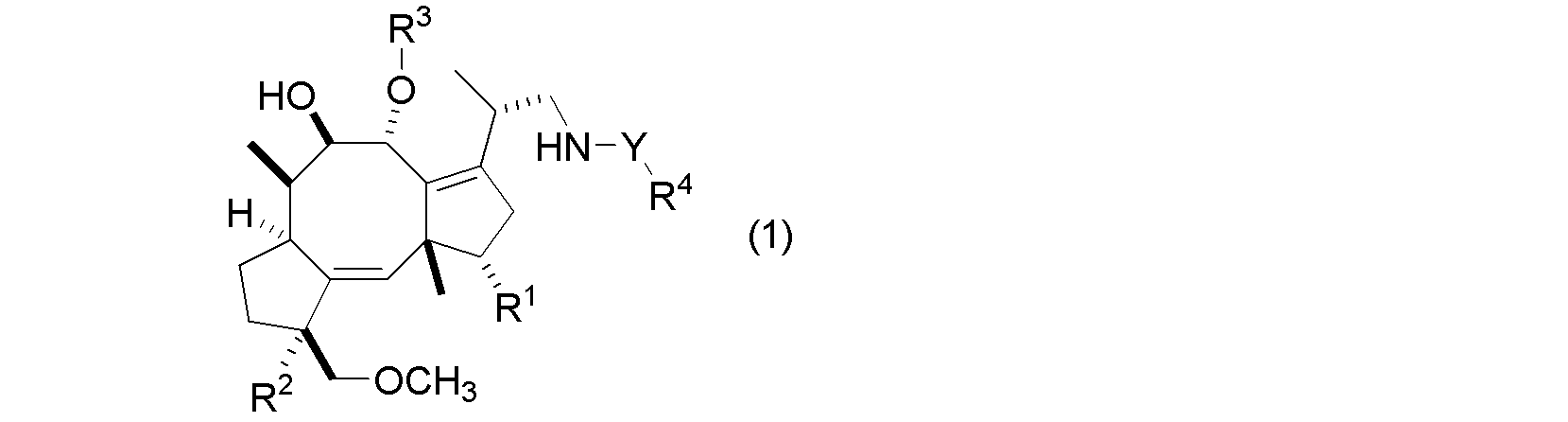
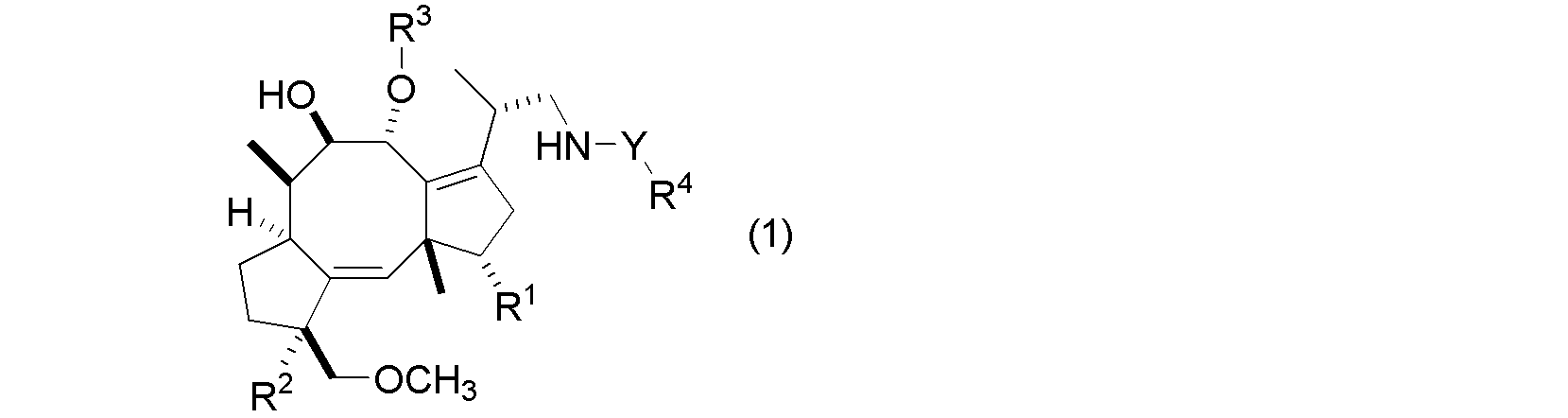
項7.一般式(1):

[式中、Yはカルボニル基、スルホニル基又は置換若しくは非置換アルキレン基を示す。R1及びR2は同一又は異なって、水素原子又は水酸基を示す。R3は水素原子、置換若しくは非置換アミノアルキル基、又は一般式(2):

(式中、R5は水素原子又は置換若しくは非置換アルキル基を示す。R6は水素原子を示す。R5とR6とは結合して置換若しくは非置換アルキレン基を形成してもよい。*は結合手を示す。)
で表される基を示す。R4は置換若しくは非置換アルキル基、置換若しくは非置換(ヘテロ)シクロアルキル基、置換若しくは非置換アルコキシ基、置換若しくは非置換(ヘテロ)アリール基、置換若しくは非置換アミノ基を示す。]
で表されるフシコクシン化合物を含有する、14-3-3タンパク質とリン酸化タンパク質との相互作用増強剤。
で表される基を示す。R4は置換若しくは非置換アルキル基、置換若しくは非置換(ヘテロ)シクロアルキル基、置換若しくは非置換アルコキシ基、置換若しくは非置換(ヘテロ)アリール基、置換若しくは非置換アミノ基を示す。]
で表されるフシコクシン化合物を含有する、14-3-3タンパク質とリン酸化タンパク質との相互作用増強剤。
項8.一般式(1):

[式中、Yはカルボニル基、スルホニル基又は置換若しくは非置換アルキレン基を示す。R1及びR2は同一又は異なって、水素原子又は水酸基を示す。R3は水素原子、置換若しくは非置換アミノアルキル基、又は一般式(2):

(式中、R5は水素原子又は置換若しくは非置換アルキル基を示す。R6は水素原子を示す。R5とR6とは結合して置換若しくは非置換アルキレン基を形成してもよい。*は結合手を示す。)
で表される基を示す。R4は置換若しくは非置換アルキル基、置換若しくは非置換(ヘテロ)シクロアルキル基、置換若しくは非置換アルコキシ基、置換若しくは非置換(ヘテロ)アリール基、置換若しくは非置換アミノ基を示す。]
で表されるフシコクシン化合物を含む医薬。
で表される基を示す。R4は置換若しくは非置換アルキル基、置換若しくは非置換(ヘテロ)シクロアルキル基、置換若しくは非置換アルコキシ基、置換若しくは非置換(ヘテロ)アリール基、置換若しくは非置換アミノ基を示す。]
で表されるフシコクシン化合物を含む医薬。
項9.がん細胞増殖抑制剤である、項8に記載の医薬。
項10.一般式(1):
[式中、Yはカルボニル基、スルホニル基又は置換若しくは非置換アルキレン基を示す。R1及びR2は同一又は異なって、水素原子又は水酸基を示す。R3は水素原子、置換若しくは非置換アミノアルキル基、又は一般式(2):

(式中、R5は水素原子又は置換若しくは非置換アルキル基を示す。R6は水素原子を示す。R5とR6とは結合して置換若しくは非置換アルキレン基を形成してもよい。*は結合手を示す。)
で表される基を示す。R4は置換若しくは非置換アルキル基、置換若しくは非置換(ヘテロ)シクロアルキル基、置換若しくは非置換アルコキシ基、置換若しくは非置換(ヘテロ)アリール基、置換若しくは非置換アミノ基を示す。]
で表されるフシコクシン化合物を含有する、種子発芽促進剤。
で表される基を示す。R4は置換若しくは非置換アルキル基、置換若しくは非置換(ヘテロ)シクロアルキル基、置換若しくは非置換アルコキシ基、置換若しくは非置換(ヘテロ)アリール基、置換若しくは非置換アミノ基を示す。]
で表されるフシコクシン化合物を含有する、種子発芽促進剤。
項11.一般式(1):
[式中、Yはカルボニル基、スルホニル基又は置換若しくは非置換アルキレン基を示す。R1及びR2は同一又は異なって、水素原子又は水酸基を示す。R3は水素原子、置換若しくは非置換アミノアルキル基、又は一般式(2):

(式中、R5は水素原子又は置換若しくは非置換アルキル基を示す。R6は水素原子を示す。R5とR6とは結合して置換若しくは非置換アルキレン基を形成してもよい。*は結合手を示す。)
で表される基を示す。R4は置換若しくは非置換アルキル基、置換若しくは非置換(ヘテロ)シクロアルキル基、置換若しくは非置換アルコキシ基、置換若しくは非置換(ヘテロ)アリール基、置換若しくは非置換アミノ基を示す。]
で表されるフシコクシン化合物の有効量を摂取又は投与する、がんの予防又は治療方法。
で表される基を示す。R4は置換若しくは非置換アルキル基、置換若しくは非置換(ヘテロ)シクロアルキル基、置換若しくは非置換アルコキシ基、置換若しくは非置換(ヘテロ)アリール基、置換若しくは非置換アミノ基を示す。]
で表されるフシコクシン化合物の有効量を摂取又は投与する、がんの予防又は治療方法。
項12.医薬(特にがん細胞増殖抑制剤)を製造するための、一般式(1):

[式中、Yはカルボニル基、スルホニル基又は置換若しくは非置換アルキレン基を示す。R1及びR2は同一又は異なって、水素原子又は水酸基を示す。R3は水素原子、置換若しくは非置換アミノアルキル基、又は一般式(2):

(式中、R5は水素原子又は置換若しくは非置換アルキル基を示す。R6は水素原子を示す。R5とR6とは結合して置換若しくは非置換アルキレン基を形成してもよい。*は結合手を示す。)
で表される基を示す。R4は置換若しくは非置換アルキル基、置換若しくは非置換(ヘテロ)シクロアルキル基、置換若しくは非置換アルコキシ基、置換若しくは非置換(ヘテロ)アリール基、置換若しくは非置換アミノ基を示す。]
で表されるフシコクシン化合物の使用。
で表される基を示す。R4は置換若しくは非置換アルキル基、置換若しくは非置換(ヘテロ)シクロアルキル基、置換若しくは非置換アルコキシ基、置換若しくは非置換(ヘテロ)アリール基、置換若しくは非置換アミノ基を示す。]
で表されるフシコクシン化合物の使用。
本発明によれば、フシコクシン化合物の19位に特定の基を導入することにより、PPI安定化効果を劇的に向上させることができる。
本明細書において、「(ヘテロ)シクロアルキル基」は、シクロアルキル基又はヘテロシクロアルキル基を意味する。本明細書において、「(ヘテロ)アリール基」は、アリール基又はヘテロアリール基を意味する。また、本明細書において、「含有」は、「含む(comprise)」、「実質的にのみからなる(consist essentially of)」、及び「のみからなる(consist of)」のいずれも包含する概念である。
1.フシコクシン化合物
本発明のフシコクシン化合物は、一般式(1):
本発明のフシコクシン化合物は、一般式(1):
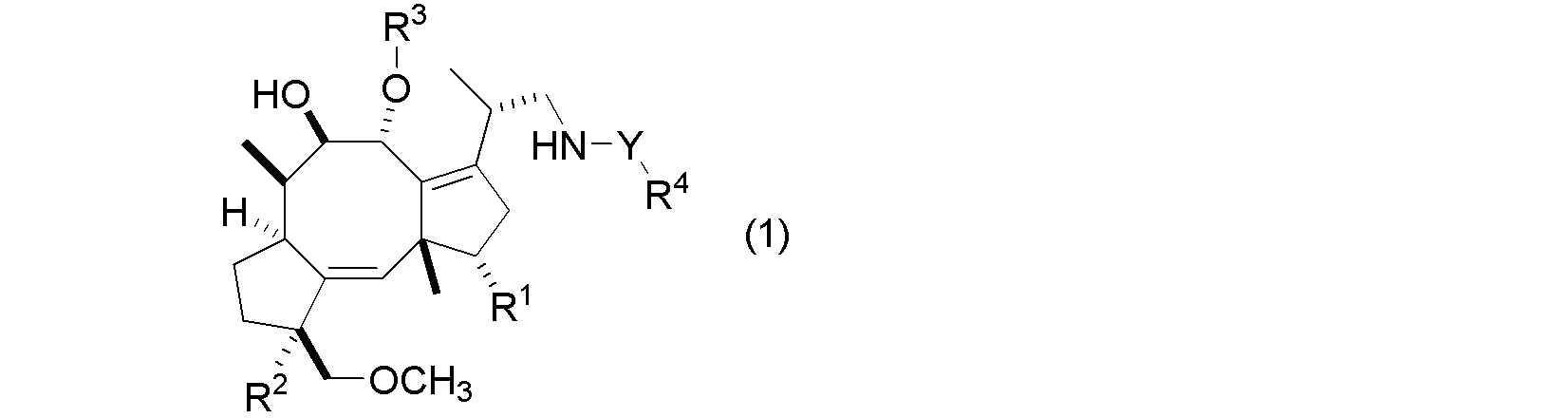
[式中、Yはカルボニル基、スルホニル基又は置換若しくは非置換アルキレン基を示す。R1及びR2は同一又は異なって、水素原子又は水酸基を示す。R3は水素原子、置換若しくは非置換アミノアルキル基、又は一般式(2):

(式中、R5は水素原子又は置換若しくは非置換アルキル基を示す。R6は水素原子を示す。R5とR6とは結合して置換若しくは非置換アルキレン基を形成してもよい。*は結合手を示す。)
で表される基を示す。R4は置換若しくは非置換アルキル基、置換若しくは非置換(ヘテロ)シクロアルキル基、置換若しくは非置換アルコキシ基、置換若しくは非置換(ヘテロ)アリール基、置換若しくは非置換アミノ基を示す。]
で表される化合物である。
で表される基を示す。R4は置換若しくは非置換アルキル基、置換若しくは非置換(ヘテロ)シクロアルキル基、置換若しくは非置換アルコキシ基、置換若しくは非置換(ヘテロ)アリール基、置換若しくは非置換アミノ基を示す。]
で表される化合物である。
この本発明のフシコクシン化合物のうち、Yがカルボニル基、R1が水酸基、R2が水素原子、R3が一般式(2)で表される基、R4がエポキシ基である化合物以外の化合物、つまり、一般式(1A):

[式中、Y、R1、R2及びR3は前記に同じである。R4aは置換若しくは非置換アルキル基、置換若しくは非置換(ヘテロ)シクロアルキル基、置換若しくは非置換アルコキシ基、置換若しくは非置換(ヘテロ)アリール基、置換若しくは非置換アミノ基を示す。ただし、Yがカルボニル基、R1が水酸基、R2が水素原子、R3が一般式(2)で表される基である場合はR4aがエポキシ基である場合を除く。]
で表されるフシコクシン化合物は、文献未記載の新規化合物である。
で表されるフシコクシン化合物は、文献未記載の新規化合物である。
一般式(1)及び(1A)において、Yで示されるアルキレン基としては、直鎖状アルキレン基及び分岐鎖状アルキレン基のいずれも採用でき、例えば、メチレン基、エチレン基、トリメチレン基、プロピレン基、プロピリデン基、イソプロピリデン基、テトラメチレン基等のC1-6アルキレン基が挙げられる。このアルキレン基は、置換基を有していてもよい。置換基としては、ハロゲン原子(フッ素原子、塩素原子、臭素原子、ヨウ素原子等)、ハロアルキル基(トリフルオロメチル基等)、後述のシクロアルキル基、後述のヘテロシクロアルキル基、後述のアルコキシ基、後述のアリール基、後述のヘテロアリール基、後述のアミノ基等が挙げられる。置換基を有する場合の置換基の数は、特に制限されず、1~6個、特に1~3個とすることができる。
一般式(1)及び(1A)において、Yとしては、PPI安定化効果の観点からカルボニル基が好ましい。
一般式(1)及び(1A)において、R1は水素原子又は水酸基であり、合成の容易さ等の観点から水酸基が好ましい。
一般式(1)及び(1A)において、R2は水素原子又は水酸基であり、合成の容易さ等の観点から水素原子が好ましい。
一般式(1)及び(1A)において、R3で示されるアミノアルキル基としては、特に制限はなく、末端にアミノ基を有するアルキル基、例えば、アミノメチル基、アミノエチル基、アミノn-プロピル基、アミノn-ブチル基等のアミノC1-6アルキル基が挙げられる。このアミノアルキル基は、置換基を有していてもよい。置換基としては、ハロゲン原子(フッ素原子、塩素原子、臭素原子、ヨウ素原子等)、後述のアルキル基、後述のシクロアルキル基、後述のヘテロシクロアルキル基、後述のアルコキシ基、後述のアリール基、後述のヘテロアリール基、後述のアミノ基等が挙げられる。置換基を有する場合の置換基の数は、特に制限されず、1~6個、特に1~3個とすることができる。
R3が一般式(2)で表される基である場合、R5で示されるアルキル基としては、直鎖状アルキル基及び分岐鎖状アルキル基のいずれも採用でき、例えば、メチル基、エチル基、n-プロピル基、イソプロピル基、n-ブチル基、イソブチル基、sec-ブチル基、tert-ブチル基、n-ペンチル基、n-ヘキシル基等のC1-6アルキル基が挙げられる。このアルキル基は、置換基を有していてもよい。置換基としては、ハロゲン原子(フッ素原子、塩素原子、臭素原子、ヨウ素原子等)、アルケニル基(ビニル基、アリル基等)、後述のシクロアルキル基、後述のヘテロシクロアルキル基、後述のアルコキシ基、後述のアリール基、後述のヘテロアリール基、後述のアミノ基等が挙げられる。置換基を有する場合の置換基の数は、特に制限されず、1~6個、特に1~3個とすることができる。このようなR5としては、合成の容易さ、PPI安定化効果等の観点から、

[式中、*は結合手を示す。]
で表される基が好ましい。
で表される基が好ましい。
R3が一般式(2)で表される基であって、R5とR6とが結合して置換若しくは非置換アルキレン基を形成する場合、アルキレン基としては、直鎖状アルキレン基及び分岐鎖状アルキレン基のいずれも採用でき、例えば、メチレン基、エチレン基、トリメチレン基、プロピレン基、プロピリデン基、イソプロピリデン基、テトラメチレン基等のC1-6アルキレン基が挙げられる。このアルキレン基は、置換基を有していてもよい。置換基としては、ハロゲン原子(フッ素原子、塩素原子、臭素原子、ヨウ素原子等)、後述のシクロアルキル基、後述のヘテロシクロアルキル基、後述のアルコキシ基、後述のアリール基、後述のヘテロアリール基、後述のアミノ基等が挙げられる。置換基を有する場合の置換基の数は、特に制限されず、1~6個、特に1~3個とすることができる。
このようなR3としては、置換若しくは非置換アミノアルキル基を採用すれば抗がん活性(癌細胞増殖抑制活性)を特に向上させることができ、一般式(2)で表される基を採用すればPPI安定化効果を特に向上させることができる。
一般式(1)及び(1A)において、R4及びR4aで示されるアルキル基としては、直鎖状アルキル基及び分岐鎖状アルキル基のいずれも採用でき、例えば、メチル基、エチル基、n-プロピル基、イソプロピル基、n-ブチル基、イソブチル基、sec-ブチル基、tert-ブチル基、n-ペンチル基、n-ヘキシル基等のC1-6アルキル基が挙げられる。このアルキル基は、置換基を有していてもよい。置換基としては、ハロゲン原子(フッ素原子、塩素原子、臭素原子、ヨウ素原子等)、前記アルキル基、ハロアルキル基(トリフルオロメチル基等)、後述のシクロアルキル基、後述のヘテロシクロアルキル基、後述のアルコキシ基、後述のアリール基、後述のヘテロアリール基、後述のアミノ基等が挙げられる。置換基を有する場合の置換基の数は、特に制限されず、1~6個、特に1~3個とすることができる。
一般式(1)及び(1A)において、R4及びR4aで示されるシクロアルキル基としては、例えば、シクロプロピル基、シクロブチル基、シクロペンチル基、シクロヘキシル基、アダマンチル基等のシクロアルキル基(好ましくは炭素数3~10、特に炭素数5~8のシクロアルキル基等が挙げられる。このシクロアルキル基は、置換基を有していてもよい。置換基としては、ハロゲン原子(フッ素原子、塩素原子、臭素原子、ヨウ素原子等)、前記アルキル基、ハロアルキル基(トリフルオロメチル基等)、前記シクロアルキル基、後述のヘテロシクロアルキル基、後述のアルコキシ基、後述のアリール基、後述のヘテロアリール基、後述のアミノ基等が挙げられる。置換基を有する場合の置換基の数は、特に制限されず、1~6個、特に1~3個とすることができる。
一般式(1)及び(1A)において、R4及びR4aで示されるヘテロシクロアルキル基としては、例えば、アジリジニル基、エポキシ基、チイラニル基、アゼチジニル基、オキセタニル基、ピロリジニル基、テトラヒドロフラニル基、テトラヒドロチエニル基、ピペリジニル基、テトラヒドロピラニル基、ピペラジニル基、モルホリニル基等の窒素原子、酸素原子、硫黄原子等の1種以上を含む炭素数2~9のヘテロシクロアルキル基等が挙げられる。このヘテロシクロアルキル基は、置換基を有していてもよい。置換基としては、ハロゲン原子(フッ素原子、塩素原子、臭素原子、ヨウ素原子等)、前記アルキル基、ハロアルキル基(トリフルオロメチル基等)、前記シクロアルキル基、前記ヘテロシクロアルキル基、後述のアルコキシ基、後述のアリール基、後述のヘテロアリール基、後述のアミノ基等が挙げられる。置換基を有する場合の置換基の数は、特に制限されず、1~6個、特に1~3個とすることができる。
一般式(1)及び(1A)において、R4及びR4aで示されるアルコキシ基としては、例えば、メトキシ基、エトキシ基、n-プロポキシ基、イソプロポキシ基、n-ブトキシ基、イソブトキシ基、sec-ブチルオキシ基、tert-ブチルオキシ基等の非環式脂肪族アルコキシ基(好ましくは炭素数1~10、特に炭素数3~6の非環式脂肪族アルコキシ基)等が挙げられる。なお、非環式脂肪族アルコキシ基を採用する場合、非環式直鎖脂肪族アルコキシ基を採用することもでき、非環式分岐鎖脂肪族アルコキシ基を採用することもできる。このアルコキシ基は、置換基を有していてもよい。置換基としては、ハロゲン原子(フッ素原子、塩素原子、臭素原子、ヨウ素原子等)、前記アルキル基、ハロアルキル基(トリフルオロメチル基等)、前記シクロアルキル基、前記ヘテロシクロアルキル基、前記アルコキシ基、後述のアリール基、後述のヘテロアリール基、後述のアミノ基等が挙げられる。置換基を有する場合の置換基の数は、特に制限されず、1~6個、特に1~3個とすることができる。
一般式(1)及び(1A)において、R4及びR4aで示されるアリール基としては、例えば、フェニル基、トリル基(o-トリル基、m-トリル基、p-トリル基)、キシリル基(2,3-キシリル基、2,4-キシリル基、2,5-キシリル基、2,6-キシリル基、3,4-キシリル基、3,5-キシリル基)、ナフチル基等が挙げられる。このアリール基は、置換基を有していてもよい。置換基としては、ハロゲン原子(フッ素原子、塩素原子、臭素原子、ヨウ素原子等)、前記アルキル基、ハロアルキル基(トリフルオロメチル基等)、前記シクロアルキル基、前記ヘテロシクロアルキル基、前記アルコキシ基、前記アリール基、後述のヘテロアリール基、後述のアミノ基等が挙げられる。置換基を有する場合の置換基の数は、特に制限されず、1~6個、特に1~3個とすることができる。
一般式(1)及び(1A)において、R4及びR4aで示されるヘテロアリール基としては、例えば、ピロリル基、フラニル基、チエニル基、イミダゾリル基、ピラゾリル基、オキサゾリル基、イソオキサゾリル基、チアゾリル基、イソチアゾリル基、ピリジル基、ピラジル基、ピリミジル基、ピリダジル基、インドリル基、ベンゾフラニル基、ベンゾチエニル基、ベンゾイミダゾリル基、キノリル基、イソキノリル基、フタラジル基、プテリジル基等が挙げられる。このヘテロアリール基は、置換基を有していてもよい。置換基としては、ハロゲン原子(フッ素原子、塩素原子、臭素原子、ヨウ素原子等)、前記アルキル基、ハロアルキル基(トリフルオロメチル基等)、前記シクロアルキル基、前記ヘテロシクロアルキル基、前記アルコキシ基、前記アリール基、前記ヘテロアリール基、後述のアミノ基等が挙げられる。置換基を有する場合の置換基の数は、特に制限されず、1~6個、特に1~3個とすることができる。
一般式(1)及び(1A)において、R4及びR4aで示されるアミノ基は、置換基を有していてもよい。置換基としては、ハロゲン原子(フッ素原子、塩素原子、臭素原子、ヨウ素原子等)、前記アルキル基、ハロアルキル基(トリフルオロメチル基等)、前記シクロアルキル基、前記ヘテロシクロアルキル基、前記アルコキシ基、前記アリール基、前記ヘテロアリール基等が挙げられる。置換基を有する場合の置換基の数は、特に制限されず、1~2個、特に1個とすることができる。
なかでも、R4及びR4aとしては、合成の容易さ、PPI安定化効果等の観点から、アルキル基(特にメチル基、イソプロピル基、tert-ブチル基等)又はシクロアルキル基(特にシクロプロピル基等)が好ましく、非置換C1-4アルキル基又は非置換C3-5シクロアルキル基がより好ましい。特に、メチル基が最も好ましい。
このような条件を満たす本発明のフシコクシン化合物としては、例えば、

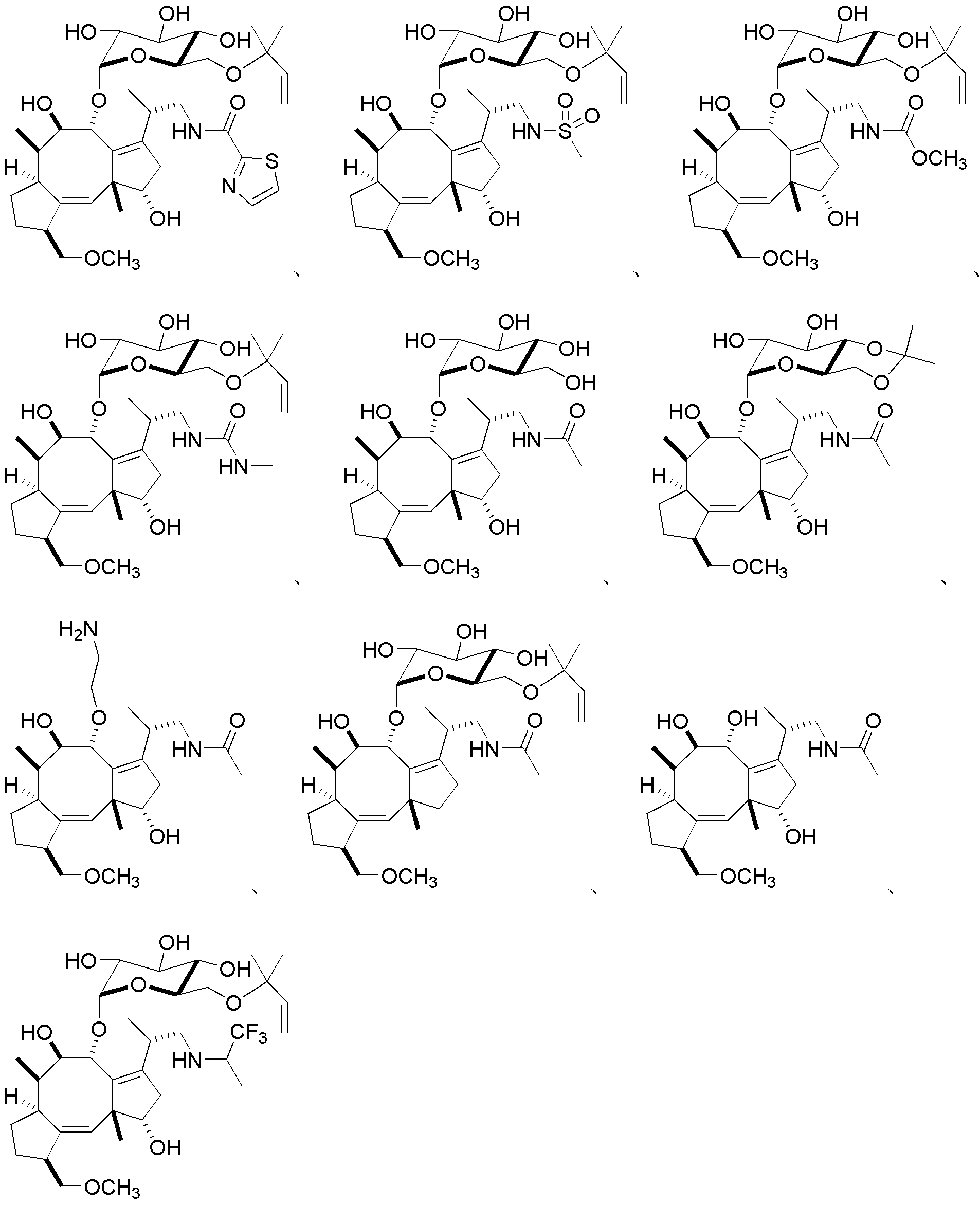
等が挙げられ、

等が好ましい。
2.フシコクシン化合物の製造方法
本発明のフシコクシン化合物は、例えば、以下の反応式にしたがって合成することができる。なお、出発物質(化合物(3)及び化合物(8))は、例えば、既報(Mol. BioSyst., 9, 940-943 (2013))にしたがって合成することができる。また、対応するトシレートから、アジ化合物(アジ化ナトリウム等)及び酸(塩酸等)を使用して合成することもできる。
本発明のフシコクシン化合物は、例えば、以下の反応式にしたがって合成することができる。なお、出発物質(化合物(3)及び化合物(8))は、例えば、既報(Mol. BioSyst., 9, 940-943 (2013))にしたがって合成することができる。また、対応するトシレートから、アジ化合物(アジ化ナトリウム等)及び酸(塩酸等)を使用して合成することもできる。
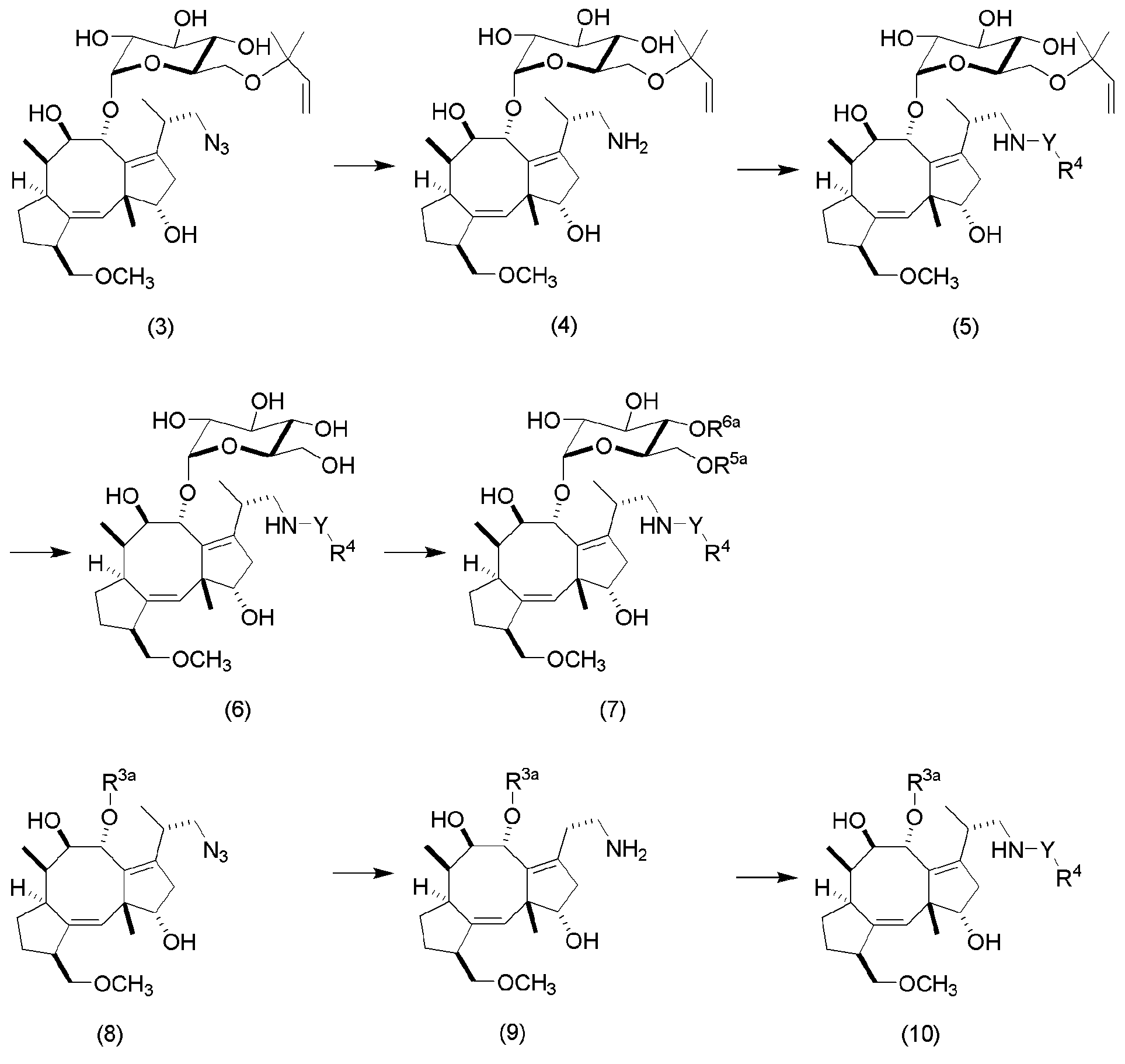
[式中、R3a、R4及びYは前記に同じである。R5aとR6aとは結合して置換若しくは非置換アルキレン基を形成する。]
(2-1)工程1(化合物(3)→化合物(4);化合物(8)→化合物(9))
化合物(3)とリン化合物とを反応させることで化合物(4)を得ることができる。また、化合物(8)とリン化合物とを反応させることで化合物(9)を得ることができる。
(2-1)工程1(化合物(3)→化合物(4);化合物(8)→化合物(9))
化合物(3)とリン化合物とを反応させることで化合物(4)を得ることができる。また、化合物(8)とリン化合物とを反応させることで化合物(9)を得ることができる。
リン化合物としては、ホスフィン、ホスファイト、ホスフィンオキシド等が挙げられる。ホスフィンとしては、例えば、トリフェニルホスフィン(PPh3)、トリ-p-トリルホスフィン(P(p-tolyl)3)、トリス(4-フルオロフェニル)ホスフィン(P(p-F-C6H4)3)、トリス(4-トリフルオロメチルフェニル)ホスフィン(P(p-CF3-C6H4)3)、トリメチルホスフィン、トリエチルホスフィン等が挙げられる。ホスファイトとしては、例えば、亜リン酸トリメチル、亜リン酸トリエチル等が挙げられる。ホスフィンオキシドとしては、例えば、トリフェニルホスフィンオキシド(POPh3)、トリ-p-トリルホスフィンオキシド(PO(p-tolyl)3)、トリス(4-フルオロフェニル)ホスフィンオキシド(PO(p-F-C6H4)3)、トリス(4-トリフルオロメチルフェニル)ホスフィンオキシド(PO(p-CF3-C6H4)3)、トリメチルホスフィンオキシド、トリエチルホスフィンオキシド等が挙げられる。これらのなかでも、収率等の観点から、ホスフィンが好ましく、トリフェニルホスフィンがより好ましい。
リン化合物の使用量は、収率等の観点から、化合物(3)又は(8)1モルに対して2~20モルが好ましく、3~10モルがより好ましい。
反応は、通常、反応溶媒(テトラヒドロフラン、アニソール、1,4-ジオキサン、シクロペンチルメチルエーテル等のエーテル等)中で行うことができ、反応雰囲気は不活性ガス雰囲気(窒素ガス雰囲気、アルゴンガス雰囲気等)が好ましく、反応温度は加熱下、室温下及び冷却下のいずれも採用でき30~100℃が好ましく、反応時間は特に制限はなく5分~24時間が好ましい。
反応終了後は、常法にしたがって精製処理を行うこともできるし、精製せずに次の工程を進めることもできる。
(2-2)工程2(化合物(4)→化合物(5);化合物(9)→化合物(10))
化合物(4)と所望の塩(酸ハロゲン物、ハロゲン化スルホニル、ハロゲン化ギ酸エステル、イソシアン酸エステル等)とを反応させることで化合物(5)を得ることができる。また、化合物(9)と所望の塩(酸ハロゲン物、ハロゲン化スルホニル、ハロゲン化ギ酸エステル、イソシアン酸エステル等)とを反応させることで化合物(10)を得ることができる。なお、酸ハロゲン化物(酸塩化物等)を使用した場合はYがカルボニル基である化合物を得ることができ、ハロゲン化スルホニル(スルホニルクロリド等)を使用した場合はYがスルホニル基である化合物を得ることができ、ハロゲン化ギ酸エステル(クロロギ酸エステル等)を使用した場合はYがカルボニル基でR4がアルコキシ基である化合物を得ることができ、イソシアン酸エステルを使用した場合はYがカルボニル基でR4が置換若しくは非置換アミノ基である化合物を得ることができる。
化合物(4)と所望の塩(酸ハロゲン物、ハロゲン化スルホニル、ハロゲン化ギ酸エステル、イソシアン酸エステル等)とを反応させることで化合物(5)を得ることができる。また、化合物(9)と所望の塩(酸ハロゲン物、ハロゲン化スルホニル、ハロゲン化ギ酸エステル、イソシアン酸エステル等)とを反応させることで化合物(10)を得ることができる。なお、酸ハロゲン化物(酸塩化物等)を使用した場合はYがカルボニル基である化合物を得ることができ、ハロゲン化スルホニル(スルホニルクロリド等)を使用した場合はYがスルホニル基である化合物を得ることができ、ハロゲン化ギ酸エステル(クロロギ酸エステル等)を使用した場合はYがカルボニル基でR4がアルコキシ基である化合物を得ることができ、イソシアン酸エステルを使用した場合はYがカルボニル基でR4が置換若しくは非置換アミノ基である化合物を得ることができる。
塩の使用量は、収率等の観点から、化合物(4)又は(9)1モルに対して1~5モルが好ましく、1.5~3モルがより好ましい。
なお、塩として酸塩化物等の酸性物質を使用する場合は、系中で発生するハロゲン化水素を捕捉するためにあわせて塩基(ジエチルアミン、トリエチルアミン、ジイソプロピルアミン、シクロヘキシルジメチルアミン等のアミン化合物;水酸化ナトリウム、水酸化カリウム等のアルカリ金属水酸化物等)も使用することが好ましい。この場合の塩基の使用量は、化合物(4)又は(9)1モルに対して2~10モルが好ましく、3~5モルがより好ましい。
また、本工程でエステルを形成しようとする場合はアルコール(メタノール、エタノール等)を添加することが好ましい。この場合のアルコールの使用量は、化合物(4)又は(9)1モルに対して過剰量(例えば5~20モル)とすることが好ましい。
反応は、通常、反応溶媒(テトラヒドロフラン、アニソール、1,4-ジオキサン、シクロペンチルメチルエーテル等のエーテル等)中で行うことができ、反応雰囲気は不活性ガス雰囲気(窒素ガス雰囲気、アルゴンガス雰囲気等)が好ましく、反応温度は加熱下、室温下及び冷却下のいずれも採用でき0~50℃が好ましく、反応時間は特に制限はなく5分~24時間が好ましい。
反応終了後は、常法にしたがって精製処理を行うこともできるし、精製せずに次の工程を進めることもできる。
(2-3)工程3(化合物(5)→化合物(6))
化合物(5)と酸(トリフルオロ酢酸等の強酸等)とを反応させることで化合物(6)を得ることができる。この場合、酸として液体を使用することで反応溶媒としても使用することができる。この場合、酸の使用量は、化合物(5)に対して過剰量とすることが好ましい。反応雰囲気は不活性ガス雰囲気(窒素ガス雰囲気、アルゴンガス雰囲気等)が好ましく、反応温度は加熱下、室温下及び冷却下のいずれも採用でき0~50℃が好ましく、反応時間は特に制限はなく5分~24時間が好ましい。
化合物(5)と酸(トリフルオロ酢酸等の強酸等)とを反応させることで化合物(6)を得ることができる。この場合、酸として液体を使用することで反応溶媒としても使用することができる。この場合、酸の使用量は、化合物(5)に対して過剰量とすることが好ましい。反応雰囲気は不活性ガス雰囲気(窒素ガス雰囲気、アルゴンガス雰囲気等)が好ましく、反応温度は加熱下、室温下及び冷却下のいずれも採用でき0~50℃が好ましく、反応時間は特に制限はなく5分~24時間が好ましい。
反応終了後は、常法にしたがって精製処理を行うこともできるし、精製せずに次の工程を進めることもできる。
(2-4)工程4(化合物(6)→化合物(7))
化合物(6)とジアルコキシアルカン(2,2-ジメトキシプロパン等のジ(C1-6アルコキシ)C1-6アルカン)とを、酸触媒(ピリジニウムp-トルエンスツホナート等)の存在下に反応させることで化合物(7)を得ることができる。
化合物(6)とジアルコキシアルカン(2,2-ジメトキシプロパン等のジ(C1-6アルコキシ)C1-6アルカン)とを、酸触媒(ピリジニウムp-トルエンスツホナート等)の存在下に反応させることで化合物(7)を得ることができる。
ジアルコキシアルカンの使用量は、収率等の観点から、化合物(6)1モルに対して2~20モルが好ましく、3~10モルがより好ましい。
酸触媒の使用量は、収率等の観点から、化合物(6)1モルに対して0.05~0.5モルが好ましく、0.1~0.3モルがより好ましい。
反応は、通常、反応溶媒(テトラヒドロフラン、アニソール、1,4-ジオキサン、シクロペンチルメチルエーテル等のエーテル等)中で行うことができ、反応雰囲気は不活性ガス雰囲気(窒素ガス雰囲気、アルゴンガス雰囲気等)が好ましく、反応温度は加熱下、室温下及び冷却下のいずれも採用でき0~50℃が好ましく、反応時間は特に制限はなく5分~24時間が好ましい。
反応終了後は、必要に応じて常法にしたがって精製処理を行い、化合物(7)を得ることができる。
このようにして得られた化合物(5)~(7)及び(10)はいずれも本発明のフシコクシン化合物である。
3.フシコクシン化合物の用途
上記のとおり、フシコクシン化合物は、14-3-3タンパク質と結合し、14-3-3タンパク質とリン酸化タンパク質との間の相互作用(PPI)を増強する。特に、本発明のフシコクシン化合物は、従来から知られているフシコクシン化合物と比較しても、このタンパク質間相互作用(PPI)の安定性を飛躍的に増強させることができる。なお、タンパク質間相互作用の安定性が増強されるリン酸化タンパク質としては、例えば、plasma membrane H+-ATPase 2 (PMA2), insulin receptor substrate 1 (IRS1), cystic fibrosis transmembrane conductance regulator (CFTR), estrogen receptor α (ERα), NudC domain-containing protein 1 (NUDCD1)等が挙げられる。
上記のとおり、フシコクシン化合物は、14-3-3タンパク質と結合し、14-3-3タンパク質とリン酸化タンパク質との間の相互作用(PPI)を増強する。特に、本発明のフシコクシン化合物は、従来から知られているフシコクシン化合物と比較しても、このタンパク質間相互作用(PPI)の安定性を飛躍的に増強させることができる。なお、タンパク質間相互作用の安定性が増強されるリン酸化タンパク質としては、例えば、plasma membrane H+-ATPase 2 (PMA2), insulin receptor substrate 1 (IRS1), cystic fibrosis transmembrane conductance regulator (CFTR), estrogen receptor α (ERα), NudC domain-containing protein 1 (NUDCD1)等が挙げられる。
フシコクシン化合物は、抗がん活性を有することが知られている(例えば、Biochem. Biophys. Res. Commun., 238, 758-763 (1997)等参照)。また、フシコクシン化合物は、植物ホルモン用活性を有することも知られている(Physiol. Plant., 31, 149-152 (1974))。さらに、フシコクシン化合物は、嚢胞性線維症を治療できることも知られている(例えば、Proc. Natl. Acad. Sci. U.S.A., 113, p. E1152-E1161 (2016).等参照)。本発明のフシコクシン化合物は、上記のタンパク質間相互作用の安定性が従来のフシコクシン化合物よりも著しく増強されるため、従来から知られているフシコクシン化合物よりも高い抗がん活性(特にがん細胞増殖抑制活性)、植物ホルモン用活性(特に種子発芽活性)及び嚢胞性線維症治療活性を有する。具体的には、本発明のフシコクシン化合物は、医薬(特に抗がん剤(がん細胞増殖抑制剤等)、嚢胞性線維症治療剤等)や種子発芽促進剤として使用することができる。
本発明のフシコクシン化合物を医薬の有効成分として使用する場合、かかる医薬は、本発明のフシコクシン化合物の他、薬学的に許容される添加物、例えば、充填剤、増量剤、結合剤、付湿剤、崩壊剤、表面活性剤、滑沢剤等の通常用いられる希釈剤又は賦形剤も含むことができ、例えば、これらの添加剤を必要に応じて使用し、本発明のフシコクシン化合物を一般的な医薬製剤に配合することにより得ることができる。
本発明の医薬の投与経路は限定されず、製剤の形態、患者の年齢及び性別、疾患の状態並びにその他の条件に応じた方法で投与することができる。例えば、錠剤、丸剤、液剤、懸濁剤、乳剤、顆粒剤及びカプセル剤を経口で投与することができる。注射剤は静脈内、筋肉内、皮内、皮下若しくは腹腔内に投与することができる。坐剤は直腸内に投与することができる。
本発明の医薬の投与量は、薬効を発現する有効量であれば特に限定されないが、通常は、有効成分である本発明のフシコクシン化合物の重量として、一般に経口投与の場合には一日あたり0.1~1000mg/kg体重、好ましくは一日あたり0.5~50mg/kg体重であり、非経口投与の場合には一日あたり0.01~100mg/kg体重、好ましくは0.1~10mg/kg体重である。上記投与量は1日1回又は2~3回に分けて投与するのが好ましく、年齢、病態、症状により適宜増減してもよい。
また、本発明のフシコクシン化合物の有効量を摂取又は投与することで、がんの予防又は治療を行うこともできる。特に、有効ながん細胞が関与する疾病の種類としては急性前骨髄性白血病、肺腺癌、卵巣癌、膵臓癌、脳腫瘍等が挙げられる。
また、本発明のフシコクシン化合物を種子発芽促進剤の有効成分として使用する場合、本発明の種子発芽促進剤の対象植物は特に制限されない。発芽を促進できる種子の種類としては、例えば、被子植物(双子葉植物、単子葉植物等)、裸子植物、コケ植物、シダ植物等の植物に対して広く適用できる。具体例としては、トマト、ピーマン、トウガラシ、ナス等のナス類、キュウリ、カボチャ、メロン、スイカ等のウリ類、キャベツ、ブロッコリー、ハクサイ等の菜類、セルリー、パセリー、レタス等の生菜・香辛菜類、ネギ、タマネギ、ニンニク等のネギ類、ダイズ、ラッカセイ、インゲン、エンドウ、アズキ等の豆類、イチゴ等のその他果菜類、ダイコン、カブ、ニンジン、ゴボウ等の直根類、サトイモ、キャッサバ、バレイショ、サツマイモ、ナガイモ等のイモ類、アスパラガス、ホウレンソウ、ミツバ等の柔菜類、トルコギキョウ、ストック、カーネーション、キク等の花卉類、イネ、トウモロコシ等の穀物類、ベントグラス、コウライシバ等の芝類、ナタネ、ラッカセイ等の油料作物類、サトウキビ、テンサイ等の糖料作物類、ワタ、イグサ等の繊維料作物類、クローバー、ソルガム、デントコーン等の飼料作物類、リンゴ、ナシ、ブドウ、モモ等の落葉性果樹類、ウンシュウミカン、レモン、グレープフルーツといった柑橘類、サツキ、ツツジ、スギ等の木本類等が挙げられる。これらの植物の他、ストライガ属、ハマウツボ属等の寄生植物にも有効である。例えば、寄生植物の宿主となる植物が周辺にいない環境下で施用すれば、発芽した寄生植物は寄生できずに枯死することとなり、これにより土壌を浄化することも可能である。
本発明の種子発芽促進剤は、本発明のフシコクシン化合物そのものでもよいが、本発明のフシコクシン化合物に加えて、剤形、施用態様等に応じて種々の添加剤を含んでいてもよい。種子発芽促進剤中の本発明のフシコクシン化合物の含有割合は、特に限定されない。具体的には、0.0001~100質量%、好ましくは0.01~50質量%程度が例示される。
本発明の種子発芽促進剤の剤形は、農学的に許容される剤形である限り特に限定されない。例えば、液剤、固形剤、粉剤、顆粒剤、粒剤、水和剤、フロアブル剤、乳剤、ペースト剤、分散剤等が挙げられる。
添加剤は、農学的に許容される添加剤である限り特に限定されない。例えば、担体、界面活性剤、増粘剤、増量剤、結合剤、ビタミン類、酸化防止剤、pH調整剤、揮散抑制剤、色素等が挙げられる。
本発明の種子発芽促進剤の施用態様は、農薬の使用態様として公知の態様(或いは将来開発される態様)である限り特に限定されない。例えば、散布、滴下、塗布、植物生育環境中(土壌中、水中、固形培地中、液体培地中等)への混合や溶解等が挙げられる。
実施例に基づいて、本発明を具体的に説明するが、本発明は、これらのみに限定されるものではない。なお、天然物である3'-デアセチルフシコクシンA(3'-deAc FC A)及びフシコクシンJ(FC J)を化合物1及び2として使用した。化合物18は、既報(Mol. BioSyst., 9, 940-943 (2013).)にしたがい合成した。また、化合物20は、既報(Chem. Biol., 20, 583-593 (2013).)にしたがい合成した。さらに、フシコクシンAアグリコンは、既報(Chem. Biol., 20, 583-593 (2013).)にしたがい合成し、化合物23として使用した。
合成例1:化合物19の合成

式中、Meはメチル基を示す。Phはフェニル基を示す。
化合物18(110mg, 0.177mmol)をテトラヒドロフラン(THF; 1.0mL)に溶かし、得られる溶液に水0.1mL、トリフェニルホスフィン(232mg, 0.885mmol)を加え、封管中で60℃に加熱、攪拌した。3時間後、さらに水0.1mLを追加し60℃で2日間攪拌した。溶媒を減圧留去し、シリカゲルカラムクロマトグラフィーにより精製し、化合物19(97.2mg, 0.163mmol, 93%)を得た。
[数1]
1H-NMR (CD3OD) δ: 5.84 (1H, dd, J = 17.6, 10.8 Hz), 5.40 (1H, s), 5.16 (1H, dd, J = 17.6, 1.1 Hz), 5.11 (1H, dd, J = 10.8, 1.1 Hz), 4.95 (1H, d, J = 3.7 Hz), 3.98 (1H, dd, J = 10.1, 4.1 Hz), 3.89 (1H, d, J = 10.1 Hz), 3.84 (1H, dd, J = 9.4, 6.9 Hz), 3.64 (1H, ddd, J = 9.8, 5.9, 2.3 Hz), 3.62 (1H, dd, J = 9.6, 8.9 Hz), 3.56 (1H, dd, J = 9.8, 2.3 Hz), 3.42 (1H, dd, J = 9.6, 3.7 Hz), 3.42 (1H, dd, J = 9.8, 5.9 Hz), 3.38-3.28 (2H, m), 3.34 (3H, s), 3.23 (2H, dd, J = 9.8, 8.9 Hz), 3.11-3.01 (1H, m), 2.84-2.74 (2H, m), 2.74 (1H, dd, J = 12.4, 4.6 Hz), 2.57 (1H, dd, J = 12.4, 9.2 Hz), 2.22 (1H, dd, J = 14.6, 6.9 Hz), 2.02 (1H, dd, J = 14.4, 9.4 Hz), 2.00-1.91 (2H, m), 1.64-1.48 (3H, m), 1.25 (3H, s), 1.04 (2H, d, J = 6.9 Hz), 0.85 (3H, d, J = 6.9 Hz). 13C-NMR (CD3OD) δ:145.12, 143.12, 142.68, 139.19, 128.03, 114.49, 103.55, 82.64, 79.89, 78.91, 77.11, 76.69, 75.06, 73.63, 73.56, 72.15, 64.04, 58.84, 54.31, 49.92, 46.73, 43.1, 42.73, 37.41, 36.72, 36.55, 28.37, 26.36, 26.29, 24.47, 15.83, 9.91.
合成例2:化合物21の合成
1H-NMR (CD3OD) δ: 5.84 (1H, dd, J = 17.6, 10.8 Hz), 5.40 (1H, s), 5.16 (1H, dd, J = 17.6, 1.1 Hz), 5.11 (1H, dd, J = 10.8, 1.1 Hz), 4.95 (1H, d, J = 3.7 Hz), 3.98 (1H, dd, J = 10.1, 4.1 Hz), 3.89 (1H, d, J = 10.1 Hz), 3.84 (1H, dd, J = 9.4, 6.9 Hz), 3.64 (1H, ddd, J = 9.8, 5.9, 2.3 Hz), 3.62 (1H, dd, J = 9.6, 8.9 Hz), 3.56 (1H, dd, J = 9.8, 2.3 Hz), 3.42 (1H, dd, J = 9.6, 3.7 Hz), 3.42 (1H, dd, J = 9.8, 5.9 Hz), 3.38-3.28 (2H, m), 3.34 (3H, s), 3.23 (2H, dd, J = 9.8, 8.9 Hz), 3.11-3.01 (1H, m), 2.84-2.74 (2H, m), 2.74 (1H, dd, J = 12.4, 4.6 Hz), 2.57 (1H, dd, J = 12.4, 9.2 Hz), 2.22 (1H, dd, J = 14.6, 6.9 Hz), 2.02 (1H, dd, J = 14.4, 9.4 Hz), 2.00-1.91 (2H, m), 1.64-1.48 (3H, m), 1.25 (3H, s), 1.04 (2H, d, J = 6.9 Hz), 0.85 (3H, d, J = 6.9 Hz). 13C-NMR (CD3OD) δ:145.12, 143.12, 142.68, 139.19, 128.03, 114.49, 103.55, 82.64, 79.89, 78.91, 77.11, 76.69, 75.06, 73.63, 73.56, 72.15, 64.04, 58.84, 54.31, 49.92, 46.73, 43.1, 42.73, 37.41, 36.72, 36.55, 28.37, 26.36, 26.29, 24.47, 15.83, 9.91.
合成例2:化合物21の合成
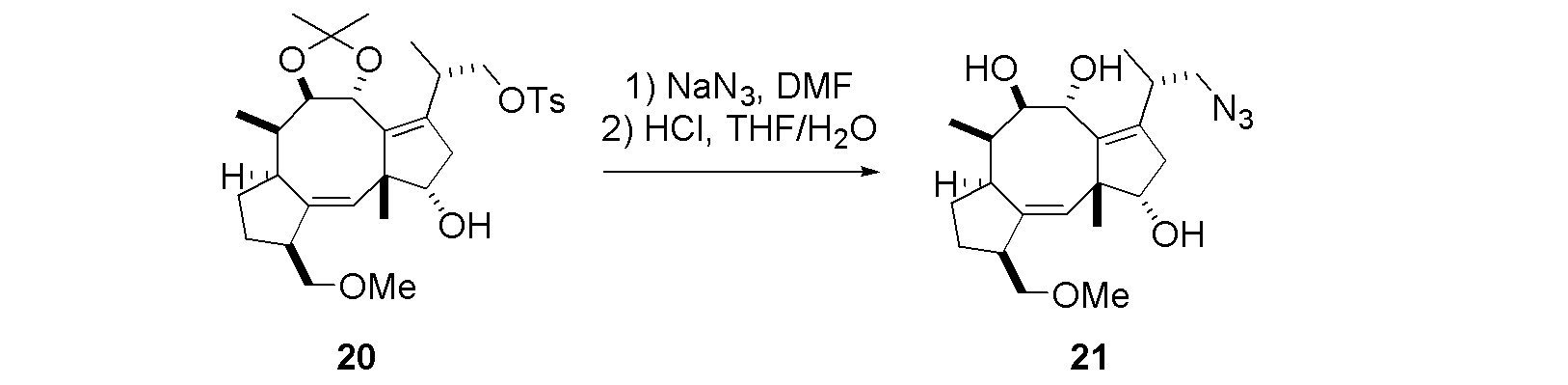
式中、Meはメチル基を示す。Tsはトシル基を示す。
化合物20(139mg, 0.247mmol)をジメチルホルムアミド(DMF; 10mL)に溶かし、アジ化ナトリウム(130mg, 2.0mmol)を加え、72時間120℃で加熱及び攪拌した。反応終了後、室温まで冷却し、DMFを減圧留去した後、残渣をジエチルエーテルと飽和炭酸水素ナトリウム水溶液で溶媒抽出を行った。有機層を水で洗浄後、硫酸ナトリウムで乾燥し、溶媒を減圧留去した。残渣をテトラヒドロフラン(THF; 8mL)に溶かし、2N塩酸(2mL)を加え、24時間50℃で加熱及び攪拌した。室温に冷却後、トリエチルアミン(1mL)を加え、溶媒を減圧留去した。残渣をシリカゲルカラムクロマトグラフィーにより精製し、化合物21(70.4mg, 0.179mmol, 72%)を得た。
[数2]
1H-NMR (CDCl3) δ: 5.36 (1H, s), 3.98 (1H, d, J = 10.1 Hz), 3.83 (1H, dd, J = 6.2, 5.5 Hz), 3.77 (1H, dd, J = 10.1, 4.6 Hz), 3.45-3.28 (6H, m), 3.36 (3H, s), 2.98-2.86 (1H, br m), 2.85-2.70 (2H, m), 2.42 (1H, dd, J = 15.3, 6.2 Hz), 2.14 (1H, dd, J = 15.3, 5.5 Hz), 2.05-1.84 (3H, m), 1.75-1.50 (3H, m), 1.21 (3H, s), 1.01 (3H, d, J = 5.0 Hz), 0.88 (3H, d, J = 6.9 Hz).
13C-NMR (CDCl3) δ: 146.98, 143.29, 139.31, 125.24, 79.25, 78.45, 75.96, 66.93, 58.67, 55.86, 55.04, 47.83, 41.59, 41.44, 36.09, 35.91, 33.45, 28.12, 24.41, 15.54, 9.79.
ESI-HRMS m/z calcd for C21H33N3O4Na [M+Na]+ 414.2363, found 414.2365.
実施例1:化合物3~15の合成
代表例として、化合物3の合成法を示す。
1H-NMR (CDCl3) δ: 5.36 (1H, s), 3.98 (1H, d, J = 10.1 Hz), 3.83 (1H, dd, J = 6.2, 5.5 Hz), 3.77 (1H, dd, J = 10.1, 4.6 Hz), 3.45-3.28 (6H, m), 3.36 (3H, s), 2.98-2.86 (1H, br m), 2.85-2.70 (2H, m), 2.42 (1H, dd, J = 15.3, 6.2 Hz), 2.14 (1H, dd, J = 15.3, 5.5 Hz), 2.05-1.84 (3H, m), 1.75-1.50 (3H, m), 1.21 (3H, s), 1.01 (3H, d, J = 5.0 Hz), 0.88 (3H, d, J = 6.9 Hz).
13C-NMR (CDCl3) δ: 146.98, 143.29, 139.31, 125.24, 79.25, 78.45, 75.96, 66.93, 58.67, 55.86, 55.04, 47.83, 41.59, 41.44, 36.09, 35.91, 33.45, 28.12, 24.41, 15.54, 9.79.
ESI-HRMS m/z calcd for C21H33N3O4Na [M+Na]+ 414.2363, found 414.2365.
実施例1:化合物3~15の合成
代表例として、化合物3の合成法を示す。
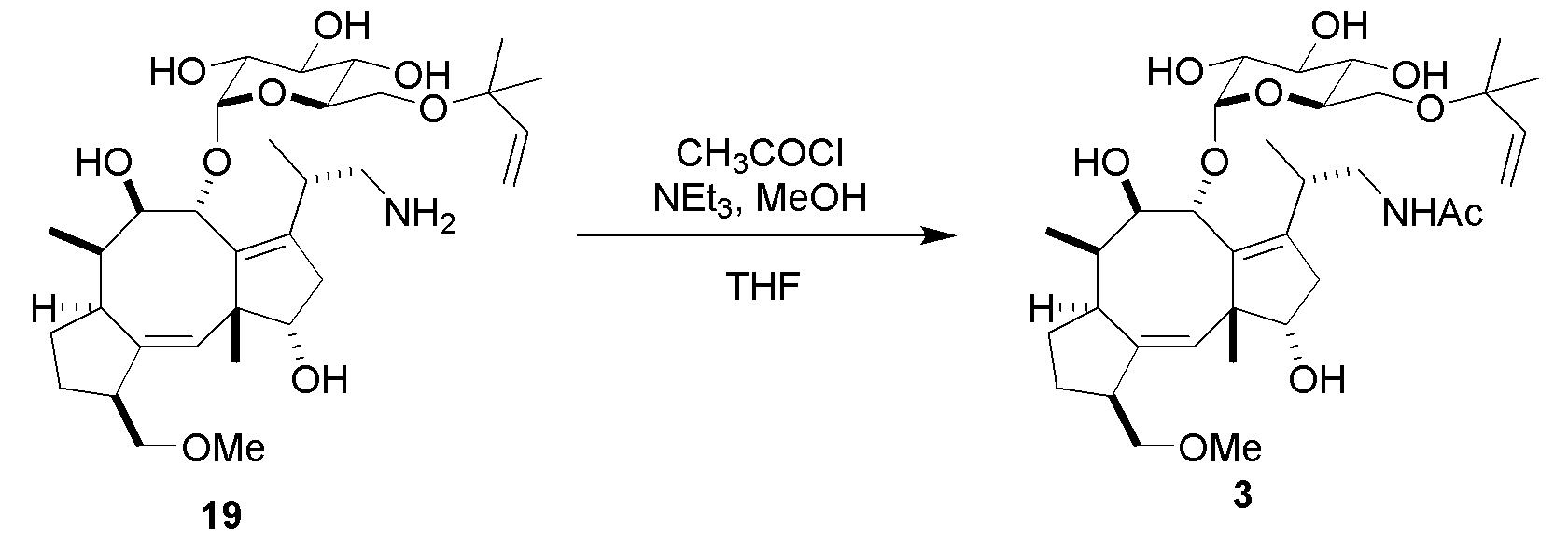
式中、Meはメチル基を示す。Etはエチル基を示す。Acはアセチル基を示す。
化合物19(10mg, 0.017mmol)をテトラヒドロフラン(THF; 2.0mL)に溶かし、得られる溶液にトリエチルアミン(8.2μL, 0.077mmol)、メタノール(7.6μL, 0.17mmol)、及びアセチルクロリド(2.7μL, 0.038mmol)を加えて室温で撹拌した。3時間後、メタノール1.0mLを加えて30分放置した。溶媒を減圧留去し、シリカゲルカラムクロマトグラフィーにより精製し、化合物3(10.4mg, 0.016mmol, 96%)を得た。
[数3]
1H-NMR (CDCl3) δ: 6.33 (1H, br s), 6.12 (minor rotamer, 1H, br s), 5.83 (minor rotamer, 1H, dd, J = 17.9, 10.3 Hz), 5.81 (1H, dd, J = 17.9, 10.3 Hz), 5.34 (1H, s), 5.13 (1H, d, J = 17.9 Hz), 5.13 (1H, d, J = 10.3 Hz), 5.11 (minor rotamer, 1H, d, J = 17.9 Hz), 5.11 (minor rotamer, 1H, d, J = 11.7 Hz), 5.05 (1H, d, J = 4.1 Hz), 4.55 (1H, br s), 4.14 (1H, br s), 4.02 (minor rotamer, 1H, d, J = 11.0 Hz), 3.94 (minor rotamer, 1H, dd, J = 11.0, 4.1 Hz), 3.93 (1H, dd, J = 10.3, 4.1 Hz), 3.90 (1H, d, J = 10.3 Hz), 3.85 (1H, t, J = 9.3 Hz), 3.82-3.77 (1H, m), 3.67 (2H, ddd, J = 9.0, 4.5, 4.5 Hz), 3.66 (2H, dd, J = 5.1, 4.8 Hz), 3.61 (1H, dd, J = 9.6, 3.4 Hz), 3.57-3.52 (1H, m), 3.52-3.49 (2H, m), 3.45-3.36 (3H, m), 3.37 (3H, s), 3.28-3.17 (1H, m), 2.91-2.83 (1H, m), 2.83-2.75 (2H, m), 2.41 (1H, dd, J = 15.4, 5.8 Hz), 2.40 (minor rotamer, 1H, dd, J = 16.1, 4.5 Hz), 2.22 (minor rotamer, 1H, dd, J = 16.1, 3.1 Hz), 2.16 (1H, dd, J = 15.4, 4.8 Hz), 2.03 (minor rotamer, 1H, s), 2.03 (3H, s), 2.02-1.98 (1H, m), 1.97-1.89 (1H, m), 1.73-1.66 (1H, m), 1.64-1.53 (2H, m), 1.28 (3H, s), 1.27 (3H, s), 1.23 (3H, s), 1.09 (minor rotamer, 3H, d, J = 6.2 Hz), 1.05 (3H, d, J = 6.9 Hz), 0.92 (minor rotamer, 3H, d, J = 6.9 Hz), 0.89 (3H, d, J = 6.9 Hz).
13C-NMR (CDCl3) δ: 171.21, 147.45, 143.46, 140.59, 139.15, 125.62, 114.26, 101.01, 79.20, 78.32, 76.31, 76.09, 75.74, 73.64, 72.29, 71.56, 62.83, 58.72, 56.17, 53.78, 47.71, 44.31, 41.79, 41.28, 36.79, 36.05, 32.95, 28.25, 25.80, 25.48, 24.67, 23.31, 15.98, 10.08, 9.94 (minor rotamer).
なお、他の化合物(化合物4~15)は同様に、化合物19を原料に対応する酸塩化物(化合物3~12)、スルホニルクロリド(化合物13)、クロロギ酸エステル(化合物14)、イソシアン酸エステル(化合物15)を用いて合成した。
1H-NMR (CDCl3) δ: 6.33 (1H, br s), 6.12 (minor rotamer, 1H, br s), 5.83 (minor rotamer, 1H, dd, J = 17.9, 10.3 Hz), 5.81 (1H, dd, J = 17.9, 10.3 Hz), 5.34 (1H, s), 5.13 (1H, d, J = 17.9 Hz), 5.13 (1H, d, J = 10.3 Hz), 5.11 (minor rotamer, 1H, d, J = 17.9 Hz), 5.11 (minor rotamer, 1H, d, J = 11.7 Hz), 5.05 (1H, d, J = 4.1 Hz), 4.55 (1H, br s), 4.14 (1H, br s), 4.02 (minor rotamer, 1H, d, J = 11.0 Hz), 3.94 (minor rotamer, 1H, dd, J = 11.0, 4.1 Hz), 3.93 (1H, dd, J = 10.3, 4.1 Hz), 3.90 (1H, d, J = 10.3 Hz), 3.85 (1H, t, J = 9.3 Hz), 3.82-3.77 (1H, m), 3.67 (2H, ddd, J = 9.0, 4.5, 4.5 Hz), 3.66 (2H, dd, J = 5.1, 4.8 Hz), 3.61 (1H, dd, J = 9.6, 3.4 Hz), 3.57-3.52 (1H, m), 3.52-3.49 (2H, m), 3.45-3.36 (3H, m), 3.37 (3H, s), 3.28-3.17 (1H, m), 2.91-2.83 (1H, m), 2.83-2.75 (2H, m), 2.41 (1H, dd, J = 15.4, 5.8 Hz), 2.40 (minor rotamer, 1H, dd, J = 16.1, 4.5 Hz), 2.22 (minor rotamer, 1H, dd, J = 16.1, 3.1 Hz), 2.16 (1H, dd, J = 15.4, 4.8 Hz), 2.03 (minor rotamer, 1H, s), 2.03 (3H, s), 2.02-1.98 (1H, m), 1.97-1.89 (1H, m), 1.73-1.66 (1H, m), 1.64-1.53 (2H, m), 1.28 (3H, s), 1.27 (3H, s), 1.23 (3H, s), 1.09 (minor rotamer, 3H, d, J = 6.2 Hz), 1.05 (3H, d, J = 6.9 Hz), 0.92 (minor rotamer, 3H, d, J = 6.9 Hz), 0.89 (3H, d, J = 6.9 Hz).
13C-NMR (CDCl3) δ: 171.21, 147.45, 143.46, 140.59, 139.15, 125.62, 114.26, 101.01, 79.20, 78.32, 76.31, 76.09, 75.74, 73.64, 72.29, 71.56, 62.83, 58.72, 56.17, 53.78, 47.71, 44.31, 41.79, 41.28, 36.79, 36.05, 32.95, 28.25, 25.80, 25.48, 24.67, 23.31, 15.98, 10.08, 9.94 (minor rotamer).
なお、他の化合物(化合物4~15)は同様に、化合物19を原料に対応する酸塩化物(化合物3~12)、スルホニルクロリド(化合物13)、クロロギ酸エステル(化合物14)、イソシアン酸エステル(化合物15)を用いて合成した。
[数4]
化合物3: 収率96%, ESI-HRMS m/z calcd for C34H55NO10Na [M+Na]+ 660.3718 , found 660.3710.
化合物4: 収率 定量的, ESI-HRMS m/z calcd for C36H57NO10Na [M+Na]+ 686.3875 , found 686.3859.
化合物5: 収率 定量的, ESI-HRMS m/z calcd for C36H59NO10Na [M+Na]+ 688.4031 , found 688.4033.
化合物6: 収率 定量的, ESI-HRMS m/z calcd for C37H61NO10Na [M+Na]+ 702.4188 , found 702.4188.
化合物7: 収率88%, ESI-HRMS m/z calcd for C38H63NO10Na [M+Na]+ 716.4344 , found 716.4345.
化合物8: 収率96%, ESI-HRMS m/z calcd for C39H63NO10Na [M+Na]+ 728.4344 , found 728.4344.
化合物9: 収率 定量的, ESI-HRMS m/z calcd for C39H57NO10Na [M+Na]+ 722.3875 , found 722.3875.
化合物10: 収率 定量的, ESI-HRMS m/z calcd for C38H61NO11Na [M+Na]+ 730.4137 , found 730.4138.
化合物11: 収率91%, ESI-HRMS m/z calcd for C38H56N2O10Na [M+Na]+ 723.3827 , found 723.3826.
化合物12: 収率 定量的, ESI-HRMS m/z calcd for C36H54N2O10SNa [M+Na]+ 729.3391 , found 729.3392.
化合物13: 収率 定量的, ESI-HRMS m/z calcd for C33H55NO11SNa [M+Na]+ 696.3388 , found 696.3389.
化合物14: 収率 定量的, ESI-HRMS m/z calcd for C34H55NO11Na [M+Na]+ 676.3667 , found 676.3668.
化合物15: 収率 定量的, ESI-HRMS m/z calcd for C35H58N2O10Na [M+Na]+ 689.3984 , found 689.3986.
実施例2:化合物16の合成
化合物3: 収率96%, ESI-HRMS m/z calcd for C34H55NO10Na [M+Na]+ 660.3718 , found 660.3710.
化合物4: 収率 定量的, ESI-HRMS m/z calcd for C36H57NO10Na [M+Na]+ 686.3875 , found 686.3859.
化合物5: 収率 定量的, ESI-HRMS m/z calcd for C36H59NO10Na [M+Na]+ 688.4031 , found 688.4033.
化合物6: 収率 定量的, ESI-HRMS m/z calcd for C37H61NO10Na [M+Na]+ 702.4188 , found 702.4188.
化合物7: 収率88%, ESI-HRMS m/z calcd for C38H63NO10Na [M+Na]+ 716.4344 , found 716.4345.
化合物8: 収率96%, ESI-HRMS m/z calcd for C39H63NO10Na [M+Na]+ 728.4344 , found 728.4344.
化合物9: 収率 定量的, ESI-HRMS m/z calcd for C39H57NO10Na [M+Na]+ 722.3875 , found 722.3875.
化合物10: 収率 定量的, ESI-HRMS m/z calcd for C38H61NO11Na [M+Na]+ 730.4137 , found 730.4138.
化合物11: 収率91%, ESI-HRMS m/z calcd for C38H56N2O10Na [M+Na]+ 723.3827 , found 723.3826.
化合物12: 収率 定量的, ESI-HRMS m/z calcd for C36H54N2O10SNa [M+Na]+ 729.3391 , found 729.3392.
化合物13: 収率 定量的, ESI-HRMS m/z calcd for C33H55NO11SNa [M+Na]+ 696.3388 , found 696.3389.
化合物14: 収率 定量的, ESI-HRMS m/z calcd for C34H55NO11Na [M+Na]+ 676.3667 , found 676.3668.
化合物15: 収率 定量的, ESI-HRMS m/z calcd for C35H58N2O10Na [M+Na]+ 689.3984 , found 689.3986.
実施例2:化合物16の合成
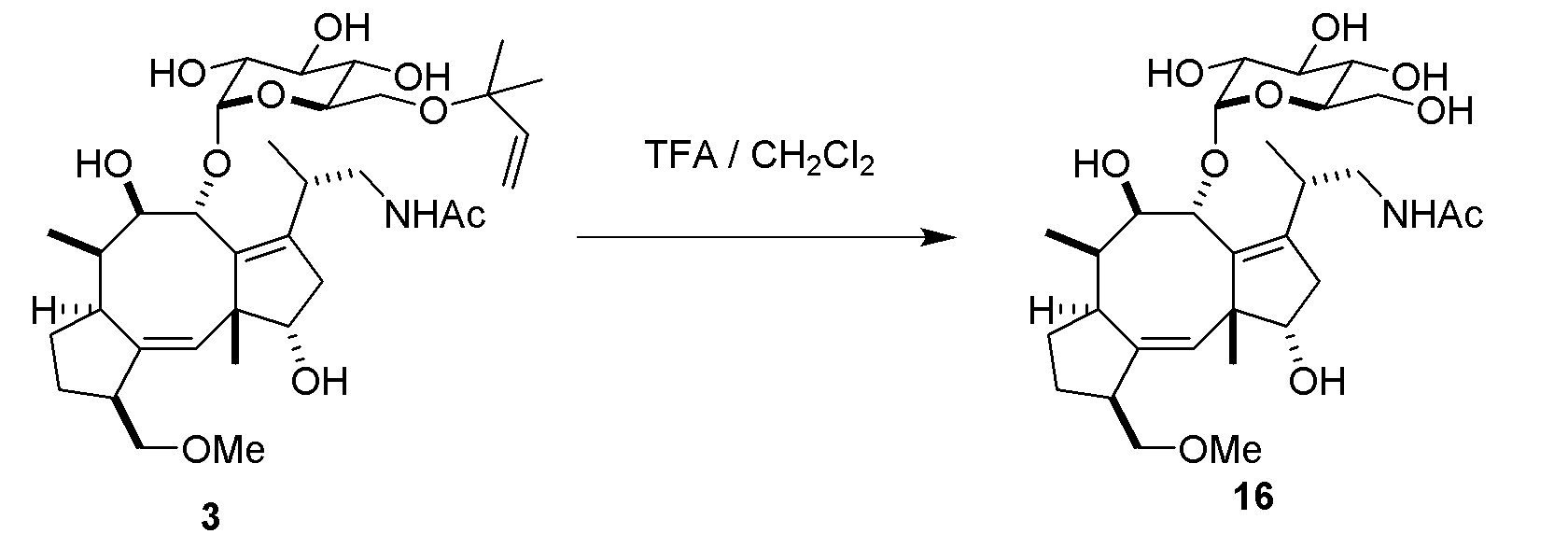
式中、Meはメチル基を示す。Acはアセチル基を示す。
化合物3(40.4mg, 0.0633mmol)をジクロロメタン(2.0mL)に溶かし0℃に冷却した。冷却した溶液にトリフルオロ酢酸(1.0mL)を滴下し、10分間攪拌後、室温に戻して、そのまま3時間攪拌した。トルエン(10mL)を加え、溶媒を減圧留去した後、残渣をシリカゲルカラムクロマトグラフィーにより精製し、化合物16(31.0mg, 0.0544mmol, 86%)を得た。
[数5]
1H-NMR (CD3OD) δ: 5.38 (1H, s), 4.97 (1H, d, J = 4.1 Hz), 3.94 (2H, dd, J = 10.1, 3.7 Hz), 3.89 (2H, d, J = 10.1 Hz), 3.76 (1H, dd, J = 9.6, 6.9 Hz), 3.74 (1H, dd, J = 9.6, 9.6 Hz), 3.72 (1H, dd, J = 11.9, 3.7 Hz), 3.68 (1H, dd, J = 11.9, 2.7 Hz), 3.62 (1H, ddd, J = 9.6, 3.7, 2.7 Hz), 3.45 (1H, dd, J = 9.6, 4.1 Hz), 3.35 (1H, dd, J = 9.6, 9.6 Hz), 3.35-3.11 (4H, m), 3.33 (3H, s), 2.84-2.69 (2H, m), 2.27 (1H, dd, J = 14.7, 6.9 Hz), 2.02 (1H, dd, J = 14.7, 9.6 Hz), 2.00 (3H, s), 2.00-1.89 (2H, m), 1.99 (3H, s), 1.63-1.47 (3H, m), 1.21 (3H, s), 1.01 (3H, d, J = 6.0 Hz), 0.83 (3H, d, J = 6.9 Hz).
13C-NMR (CD3OD) δ: 173.57, 142.95, 142.80, 139.10, 127.91, 103.52, 82.65, 79.69, 78.83, 77.08, 74.82, 74.23, 73.70, 71.43, 62.17, 61.55, 58.83, 54.33, 45.08, 42.69, 36.67, 36.51, 34.97, 28.37, 24.24, 22.76, 22.70 (minor rotamer), 16.16, 14.46, 9.95.
ESI-HRMS m/z calcd for C29H47NO10Na [M+Na]+ 592.3092, found 592.3090.
実施例3:化合物17の合成
1H-NMR (CD3OD) δ: 5.38 (1H, s), 4.97 (1H, d, J = 4.1 Hz), 3.94 (2H, dd, J = 10.1, 3.7 Hz), 3.89 (2H, d, J = 10.1 Hz), 3.76 (1H, dd, J = 9.6, 6.9 Hz), 3.74 (1H, dd, J = 9.6, 9.6 Hz), 3.72 (1H, dd, J = 11.9, 3.7 Hz), 3.68 (1H, dd, J = 11.9, 2.7 Hz), 3.62 (1H, ddd, J = 9.6, 3.7, 2.7 Hz), 3.45 (1H, dd, J = 9.6, 4.1 Hz), 3.35 (1H, dd, J = 9.6, 9.6 Hz), 3.35-3.11 (4H, m), 3.33 (3H, s), 2.84-2.69 (2H, m), 2.27 (1H, dd, J = 14.7, 6.9 Hz), 2.02 (1H, dd, J = 14.7, 9.6 Hz), 2.00 (3H, s), 2.00-1.89 (2H, m), 1.99 (3H, s), 1.63-1.47 (3H, m), 1.21 (3H, s), 1.01 (3H, d, J = 6.0 Hz), 0.83 (3H, d, J = 6.9 Hz).
13C-NMR (CD3OD) δ: 173.57, 142.95, 142.80, 139.10, 127.91, 103.52, 82.65, 79.69, 78.83, 77.08, 74.82, 74.23, 73.70, 71.43, 62.17, 61.55, 58.83, 54.33, 45.08, 42.69, 36.67, 36.51, 34.97, 28.37, 24.24, 22.76, 22.70 (minor rotamer), 16.16, 14.46, 9.95.
ESI-HRMS m/z calcd for C29H47NO10Na [M+Na]+ 592.3092, found 592.3090.
実施例3:化合物17の合成
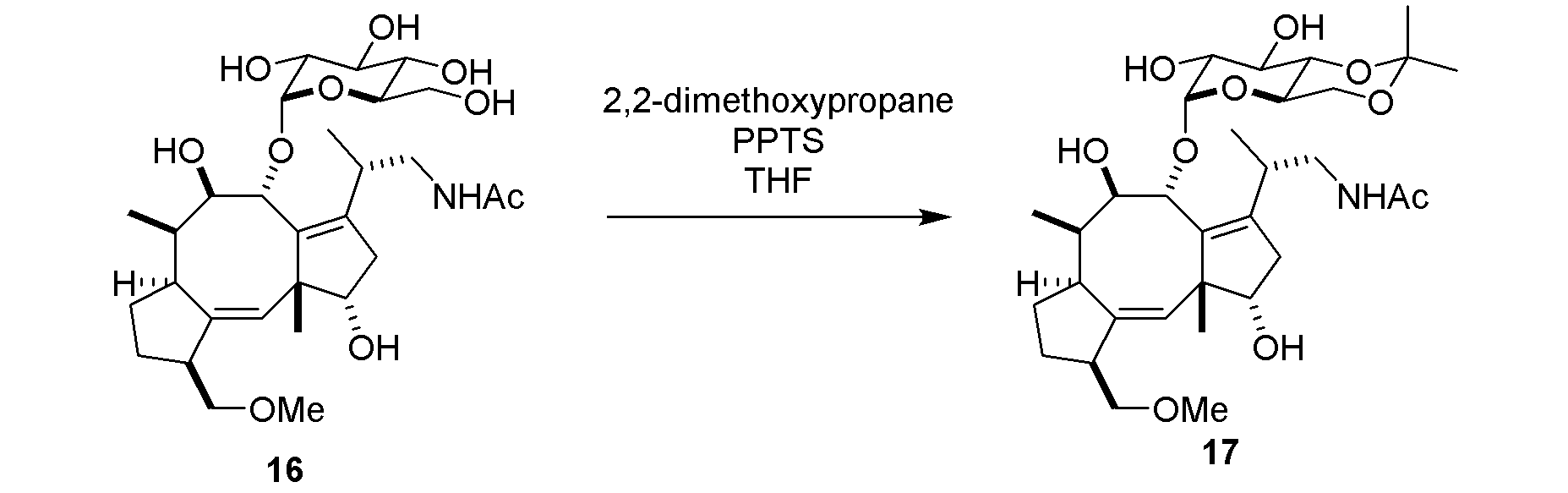
式中、Meはメチル基を示す。Acはアセチル基を示す。
化合物16(19.7mg, 0.0346mmol)にトルエン/tert-ブチルアルコール混合溶媒(4: 1, 5mL)を加え、溶媒を減圧留去して系中の水分を除去した。これに、アルゴン雰囲気下テトラヒドロフラン(THF; 2.0mL)、2,2-ジメトキシプロパン(21μL, 0.171mmol)、及びピリジニウムp-トルエンスルホナート(PPTS, 2.1mg, 8.4μmol)を加え室温で4時間攪拌した。反応後にトリエチルアミンを加え反応を停止し、溶媒を減圧留去した後、残渣をシリカゲルカラムクロマトグラフィーにより精製して、化合物17(13.9mg, 0.0228mmol, 66%)を得た。
[数6]
1H-NMR (CDCl3) δ: 6.40 (1H, br s), 5.32 (1H, s), 5.12 (1H, br s), 5.09 (1H, d, J = 4.1 Hz), 4.21 (1H, br s), 4.15 (1H, br s), 3.97 (3H, dd, J = 10.1, 4.6 Hz), 3.95 (3H, dd, J = 9.2, 9.2 Hz), 3.90 (3H, d, J = 10.1 Hz), 3.77 (5H, dd, J = 5.5, 3.8 Hz), 3.73-3.67 (2H, m), 3.62 (5H, dd, J = 9.2, 4.1 Hz), 3.56-3.48 (2H, m), 3.42 (1H, dd, J = 9.2, 9.2 Hz), 3.41-3.25 (3H, m), 3.34 (3H, s), 3.02-2.89 (1H, m), 2.85-2.71 (2H, m), 2.44 (1H, dd, J = 16.0, 5.5 Hz), 2.18 (1H, dd, J = 16.0, 3.8 Hz), 2.05-1.95 (1H, m), 2.00 (3H, s), 1.94-1.82 (1H, m), 1.78-1.65 (1H, m), 1.65-1.50 (2H, m), 1.48 (5H, s), 1.38 (3H, s), 1.15 (3H, s), 0.99 (3H, d, J = 6.4 Hz), 0.88 (4H, d, J = 6.9 Hz).
13C-NMR (CDCl3) δ: 170.75, 148.98, 140.87, 139.60, 125.90, 100.57, 99.69, 78.33, 78.16, 76.20, 73.92, 73.40, 73.24, 71.12, 64.02, 62.20, 58.73, 57.40, 47.42, 44.59, 41.86, 41.26, 36.97, 36.24, 32.20, 29.01, 28.57, 24.67, 23.41, 19.07, 15.37, 10.00.
ESI-HRMS m/z calcd for C32H51NO10Na [M+Na]+ 632.3405, found 632.3403.
実施例4:化合物22の合成
1H-NMR (CDCl3) δ: 6.40 (1H, br s), 5.32 (1H, s), 5.12 (1H, br s), 5.09 (1H, d, J = 4.1 Hz), 4.21 (1H, br s), 4.15 (1H, br s), 3.97 (3H, dd, J = 10.1, 4.6 Hz), 3.95 (3H, dd, J = 9.2, 9.2 Hz), 3.90 (3H, d, J = 10.1 Hz), 3.77 (5H, dd, J = 5.5, 3.8 Hz), 3.73-3.67 (2H, m), 3.62 (5H, dd, J = 9.2, 4.1 Hz), 3.56-3.48 (2H, m), 3.42 (1H, dd, J = 9.2, 9.2 Hz), 3.41-3.25 (3H, m), 3.34 (3H, s), 3.02-2.89 (1H, m), 2.85-2.71 (2H, m), 2.44 (1H, dd, J = 16.0, 5.5 Hz), 2.18 (1H, dd, J = 16.0, 3.8 Hz), 2.05-1.95 (1H, m), 2.00 (3H, s), 1.94-1.82 (1H, m), 1.78-1.65 (1H, m), 1.65-1.50 (2H, m), 1.48 (5H, s), 1.38 (3H, s), 1.15 (3H, s), 0.99 (3H, d, J = 6.4 Hz), 0.88 (4H, d, J = 6.9 Hz).
13C-NMR (CDCl3) δ: 170.75, 148.98, 140.87, 139.60, 125.90, 100.57, 99.69, 78.33, 78.16, 76.20, 73.92, 73.40, 73.24, 71.12, 64.02, 62.20, 58.73, 57.40, 47.42, 44.59, 41.86, 41.26, 36.97, 36.24, 32.20, 29.01, 28.57, 24.67, 23.41, 19.07, 15.37, 10.00.
ESI-HRMS m/z calcd for C32H51NO10Na [M+Na]+ 632.3405, found 632.3403.
実施例4:化合物22の合成
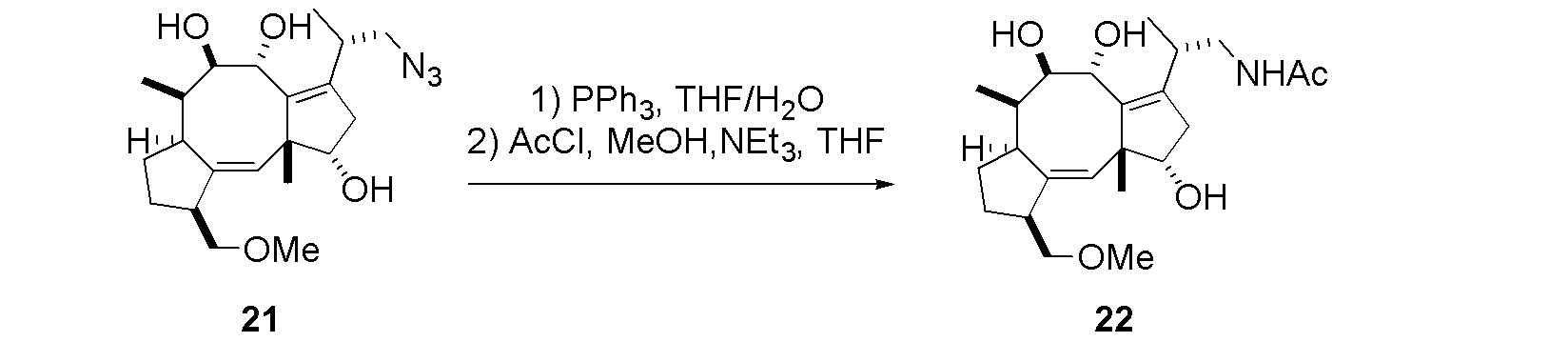
式中、Meはメチル基を示す。Phはフェニル基を示す。Acはアセチル基を示す。Etはエチル基を示す。
化合物21(28.9mg, 0.0738mmol)をテトラヒドロフラン(THF; 2.5 mL)に溶かし、トリフェニルホスフィン(52.6mg, 0.201mmol)、及び水(0.5mL)を加えた。24時間50℃で加熱及び攪拌し、溶媒を減圧留去し、さらにトルエン共沸により残渣から水を除去した。残渣をTHF(2.5mL)に溶かし、溶液を0℃に冷却し、メタノール(50μl, 1.2mmol)、トリエチルアミン(40μl, 0.28mmol)、アセチルクロリド(10μl, 0.28mmol)を加え、1時間0℃で攪拌した。炭酸水素ナトリウム水溶液を加え反応を停止し、そのまま30分攪拌した。酢酸エチルを加え、溶媒抽出を行い、有機層を飽和食塩水で洗浄後、硫酸ナトリウムで乾燥し、溶媒を減圧留去した。残渣をシリカゲルカラムクロマトグラフィーにより精製し、化合物22(23.8mg, 0.0584mmol, 79%)を得た。
[数7]
1H-NMR (CDCl3)δ: 7.05 (1H, br s), 5.37 (1H, dd, J = 1.8, 1.8 Hz), 4.05 (1H, d, J = 10.1 Hz), 3.86 (1H, dd, J = 10.1, 4.6 Hz), 3.77 (1H, dd, J = 6.0, 5.0 Hz), 3.43-3.34 (2H, m), 3.36 (3H, s), 3.31-3.20 (3H, m), 3.00-2.95 (1H, m), 2.90-2.77 (2H, m), 2.43 (1H, dd, J = 15.6, 6.0 Hz), 2.13-2.07 (1H, m), 2.12 (1H, dd, J = 15.6, 5.0 Hz), 2.02-1.91 (2H, m), 1.88 (3H, s), 1.76-1.50 (3H, m), 1.16 (3H, s), 1.02 (3H, d, J = 6.0 Hz), 0.89 (3H, d, J = 7.3 Hz). 13C-NMR (CDCl3) δ: 170.50, 146.12, 140.92, 140.53, 125.88, 79.37, 78.06, 75.97, 67.14, 58.65, 55.81, 47.65, 43.56, 42.78, 41.57, 36.13, 35.77, 31.81, 28.07, 24.38, 22.70, 16.07, 9.70. ESI-HRMS m/z calcd for C23H37NO5Na [M+Na]+ 430.2564, found 430.2564.
後述の試験例で使用した化合物を以下に示す。
1H-NMR (CDCl3)δ: 7.05 (1H, br s), 5.37 (1H, dd, J = 1.8, 1.8 Hz), 4.05 (1H, d, J = 10.1 Hz), 3.86 (1H, dd, J = 10.1, 4.6 Hz), 3.77 (1H, dd, J = 6.0, 5.0 Hz), 3.43-3.34 (2H, m), 3.36 (3H, s), 3.31-3.20 (3H, m), 3.00-2.95 (1H, m), 2.90-2.77 (2H, m), 2.43 (1H, dd, J = 15.6, 6.0 Hz), 2.13-2.07 (1H, m), 2.12 (1H, dd, J = 15.6, 5.0 Hz), 2.02-1.91 (2H, m), 1.88 (3H, s), 1.76-1.50 (3H, m), 1.16 (3H, s), 1.02 (3H, d, J = 6.0 Hz), 0.89 (3H, d, J = 7.3 Hz). 13C-NMR (CDCl3) δ: 170.50, 146.12, 140.92, 140.53, 125.88, 79.37, 78.06, 75.97, 67.14, 58.65, 55.81, 47.65, 43.56, 42.78, 41.57, 36.13, 35.77, 31.81, 28.07, 24.38, 22.70, 16.07, 9.70. ESI-HRMS m/z calcd for C23H37NO5Na [M+Na]+ 430.2564, found 430.2564.
後述の試験例で使用した化合物を以下に示す。
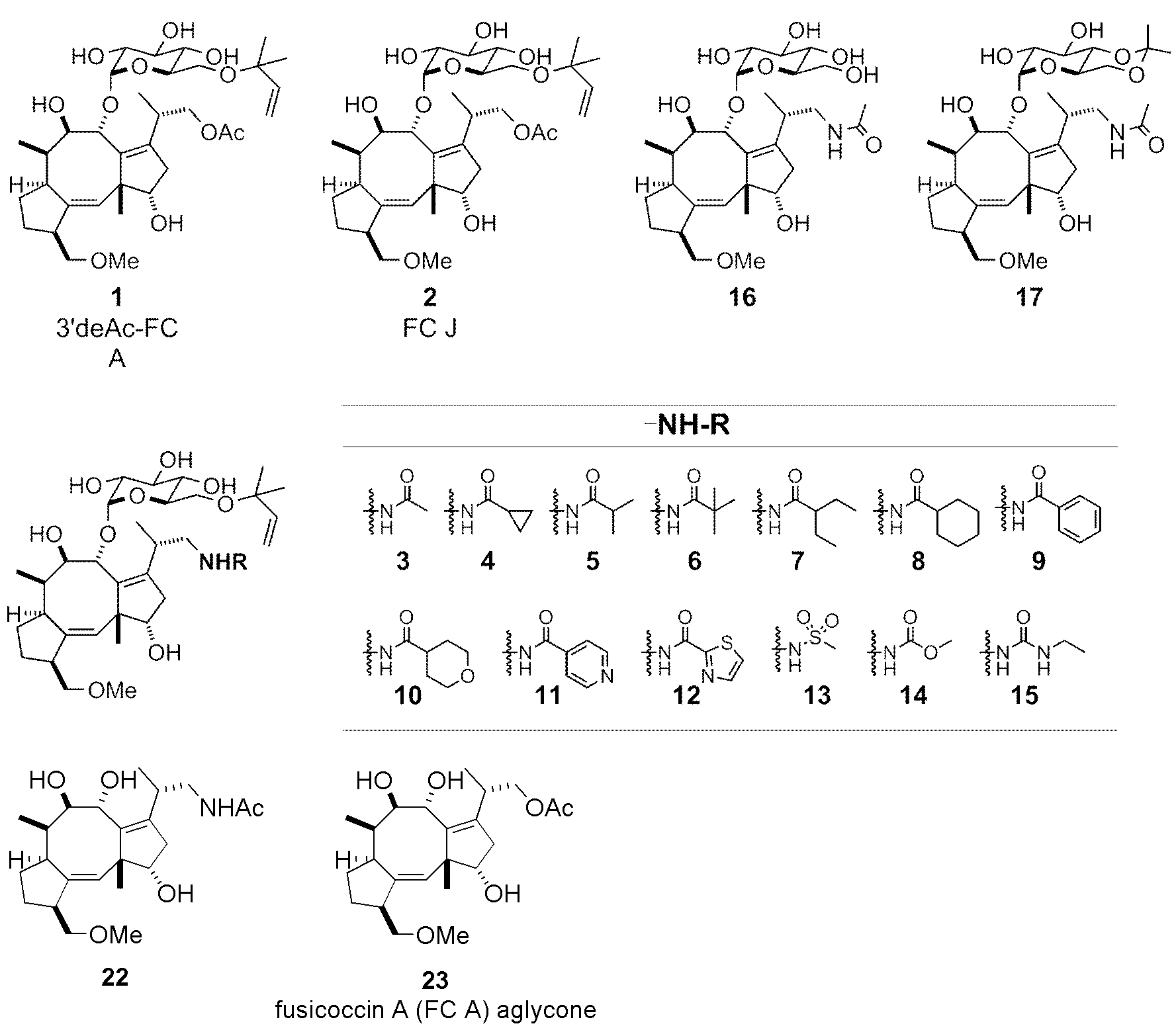
試験例1:結合試験
ペプチドの結合試験は10mM4-(2-ヒドロキシエチル)-1-ピペラジンエタンスルホン酸(HEPES; pH7.4)、150mM NaCl, 0.1% tween20、及び0.5mMトリス(2-カルボキシエチル)ホスフィン(TCEP)の組成を有する緩衝液を用いて行った。タンパク質には、大腸菌から発現精製した、ヒト14-3-3ζタンパク質を用いた。14-3-3結合蛍光標識ペプチドにはFAM-RSHpSX-COOH又はFAM-RSHpSXP-COOH(FAM; 5-カルボキシフルオレセイン-アミノヘキシル, pS; リン酸化セリン, X; 任意のアミノ酸)の配列を有するペプチドを用いた。384wellマイクロプレートの各wellに蛍光標識リン酸化ペプチド1.0nmol/L, フシコクシン誘導体0.50μmol/L又は100μmol/L、DMSO8%(v/v)の終濃度となるように14-3-3タンパク質の濃度を変化させた溶液を調製し、蛍光偏光強度を測定した(励起波長470nm及び蛍光波長535nm)。フシコクシン誘導体存在下、及びDMSOコントロールそれぞれにおいて得られたプロットに対して、グラフ解析ソフトウェアsigma plotのone site bindモードで、滴定曲線のフィッテングを行い、タンパク質とリン酸化ペプチドとの解離定数を算出した。DMSOコントロールで算出されたペプチドの解離定数KDpepをフシコクシン誘導体存在下で得られる見かけの解離定数KDappで割った値S = KDpep/KDappをタンパク質間相互作用安定化の指標として用いた。各フシコクシン化合物0.50μM存在下における、リン酸ペプチドFAM-RSHpSV-COOHと14-3-3ζタンパク質のPPI安定化効果を図1に示す。また、複数のリン酸化ペプチドに対するフシコクシン化合物1及び3 の化合物100μM存在下におけるPPI安定化効果を表1に示す。また、フシコクシン化合物22及びフシコクシンAアグリコン(フシコクシン化合物23)の化合物100μM存在下におけるリン酸ペプチドFAM-RSHpSV-COOHと14-3-3ζタンパク質のPPI安定化効果を表2に示す。
ペプチドの結合試験は10mM4-(2-ヒドロキシエチル)-1-ピペラジンエタンスルホン酸(HEPES; pH7.4)、150mM NaCl, 0.1% tween20、及び0.5mMトリス(2-カルボキシエチル)ホスフィン(TCEP)の組成を有する緩衝液を用いて行った。タンパク質には、大腸菌から発現精製した、ヒト14-3-3ζタンパク質を用いた。14-3-3結合蛍光標識ペプチドにはFAM-RSHpSX-COOH又はFAM-RSHpSXP-COOH(FAM; 5-カルボキシフルオレセイン-アミノヘキシル, pS; リン酸化セリン, X; 任意のアミノ酸)の配列を有するペプチドを用いた。384wellマイクロプレートの各wellに蛍光標識リン酸化ペプチド1.0nmol/L, フシコクシン誘導体0.50μmol/L又は100μmol/L、DMSO8%(v/v)の終濃度となるように14-3-3タンパク質の濃度を変化させた溶液を調製し、蛍光偏光強度を測定した(励起波長470nm及び蛍光波長535nm)。フシコクシン誘導体存在下、及びDMSOコントロールそれぞれにおいて得られたプロットに対して、グラフ解析ソフトウェアsigma plotのone site bindモードで、滴定曲線のフィッテングを行い、タンパク質とリン酸化ペプチドとの解離定数を算出した。DMSOコントロールで算出されたペプチドの解離定数KDpepをフシコクシン誘導体存在下で得られる見かけの解離定数KDappで割った値S = KDpep/KDappをタンパク質間相互作用安定化の指標として用いた。各フシコクシン化合物0.50μM存在下における、リン酸ペプチドFAM-RSHpSV-COOHと14-3-3ζタンパク質のPPI安定化効果を図1に示す。また、複数のリン酸化ペプチドに対するフシコクシン化合物1及び3 の化合物100μM存在下におけるPPI安定化効果を表1に示す。また、フシコクシン化合物22及びフシコクシンAアグリコン(フシコクシン化合物23)の化合物100μM存在下におけるリン酸ペプチドFAM-RSHpSV-COOHと14-3-3ζタンパク質のPPI安定化効果を表2に示す。
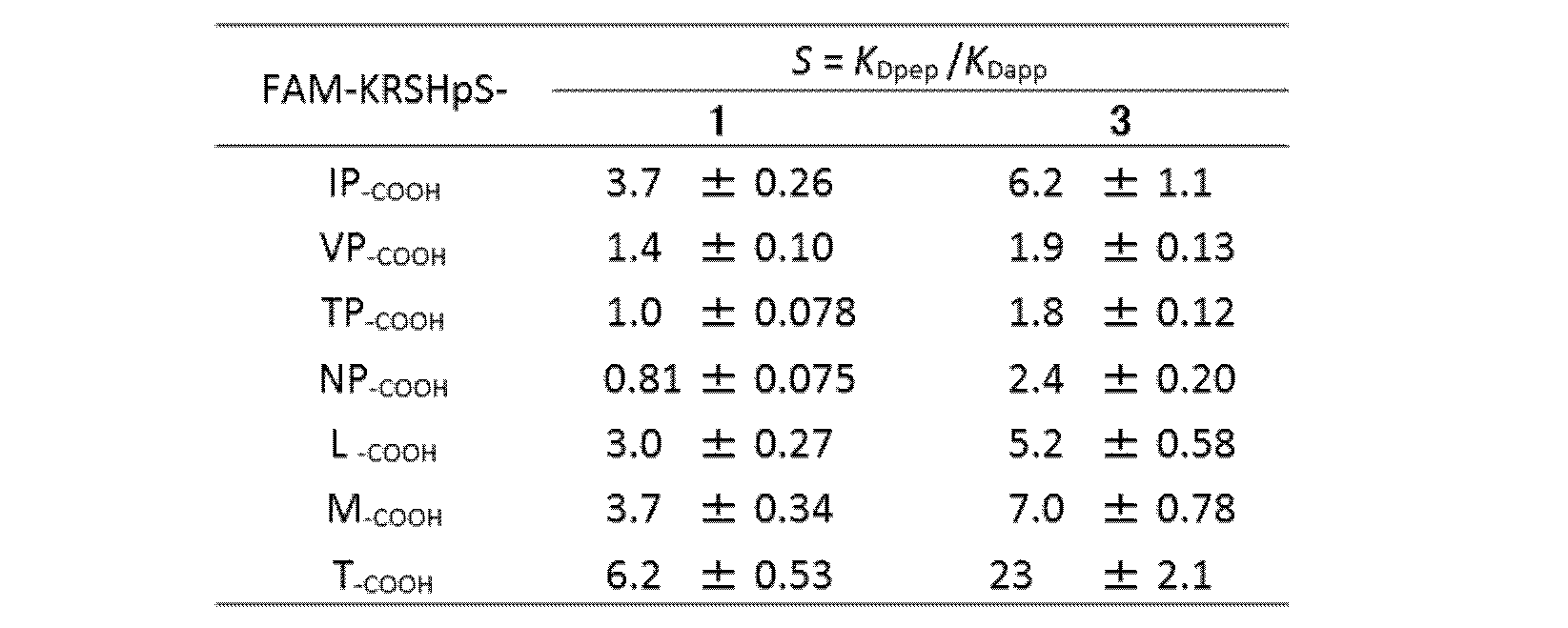

試験例2:インターフェロンαとの併用による卵巣がん細胞OVCAR3増殖抑制活性試験
既報(Cancer Lett., 293, 198-206, (2010).)を参考に、がん細胞増殖抑制活性試験を行った。具体的には、以下のとおり試験を行った。
1. 卵巣がん細胞OVCAR3を80~90% confluentまで培養した(medium; RPMI1640, 10%FCS)。
2. OVCAR3のmediumを捨て、(-)PBS (8mL × 1)で洗浄した。
3. (-)PBSを捨て、Trypsin-1mM EDTA (1.5mL)を加えた。
4. 37℃で5分間incubateしmedium (6.0mL)を加え、細胞をほぐした後、細胞数を計測した。
5. medium (RPMI1640, 10% FCS)を加え、conc. 5×10⁴cells/mLに希釈し細胞を96well plateに蒔いた(0.1mL/ well)。
6. 37℃で24時間incubateした。
7. +IFNα Medium(1600U/mL) 50μLを加え、さらに化合物をMediumで希釈し各wellに50μL加えた。
8. 7日間incubateした後、以下の条件でMTS assayを行った。
Final; IFNα 400U/mL compound 0, 0.625, 1.25, 2.5, 5, 10, 20, 40μM
Stock Solution:
10×IFNα stock solution...1×105U/mL in PBS
Compounds(化合物4又はフシコクシンA(フシコクシン化合物1))...40mM in DMSO
なお、IFNα contorolは、化合物を加えなかった。
既報(Cancer Lett., 293, 198-206, (2010).)を参考に、がん細胞増殖抑制活性試験を行った。具体的には、以下のとおり試験を行った。
1. 卵巣がん細胞OVCAR3を80~90% confluentまで培養した(medium; RPMI1640, 10%FCS)。
2. OVCAR3のmediumを捨て、(-)PBS (8mL × 1)で洗浄した。
3. (-)PBSを捨て、Trypsin-1mM EDTA (1.5mL)を加えた。
4. 37℃で5分間incubateしmedium (6.0mL)を加え、細胞をほぐした後、細胞数を計測した。
5. medium (RPMI1640, 10% FCS)を加え、conc. 5×10⁴cells/mLに希釈し細胞を96well plateに蒔いた(0.1mL/ well)。
6. 37℃で24時間incubateした。
7. +IFNα Medium(1600U/mL) 50μLを加え、さらに化合物をMediumで希釈し各wellに50μL加えた。
8. 7日間incubateした後、以下の条件でMTS assayを行った。
Final; IFNα 400U/mL compound 0, 0.625, 1.25, 2.5, 5, 10, 20, 40μM
Stock Solution:
10×IFNα stock solution...1×105U/mL in PBS
Compounds(化合物4又はフシコクシンA(フシコクシン化合物1))...40mM in DMSO
なお、IFNα contorolは、化合物を加えなかった。
MTS assay(CellTiter 96(登録商標)AQueous One Solution Assay kit)
1. Dye solutionをoptiMEMで10倍希釈した(溶液A)。
2. 各wellのmediumを吸引し、溶液Aを加えた。
3. 37℃で90分間incubateし、plate readerで吸光度を測定した(490nm)。
1. Dye solutionをoptiMEMで10倍希釈した(溶液A)。
2. 各wellのmediumを吸引し、溶液Aを加えた。
3. 37℃で90分間incubateし、plate readerで吸光度を測定した(490nm)。
結果を図2に示す。
試験例3:種子発芽活性試験
既報(Physiol. Plant., 31, 149-152 (1974).)を参考に、種子発芽活性試験を行った。具体的には、以下のとおり試験を行った。
1. シャーレに2.0ppmの発芽抑制因子(+/‐)アブシシン酸(ABA)水溶液又は超純水を2.0mL加えた。
2. ABA水溶液2mLの入ったシャーレにフシコクシン化合物(フシコクシン化合物1又は9)の1mM DMSO溶液2μLを加えた。また、超純水 、又はABA水溶液の入ったシャーレにDMSO2μLを加え、water control及びABA controlとした。
3. 1シャーレあたり25粒のレタス種子(サニーレタス、Lactuca sativa var. crispa)を並べ、25℃暗所に置き、12時間後に発芽した種子数を数え、全種子数に対する発芽率を求めた(1化合物につきシャーレ2つ;種子50粒)。
既報(Physiol. Plant., 31, 149-152 (1974).)を参考に、種子発芽活性試験を行った。具体的には、以下のとおり試験を行った。
1. シャーレに2.0ppmの発芽抑制因子(+/‐)アブシシン酸(ABA)水溶液又は超純水を2.0mL加えた。
2. ABA水溶液2mLの入ったシャーレにフシコクシン化合物(フシコクシン化合物1又は9)の1mM DMSO溶液2μLを加えた。また、超純水 、又はABA水溶液の入ったシャーレにDMSO2μLを加え、water control及びABA controlとした。
3. 1シャーレあたり25粒のレタス種子(サニーレタス、Lactuca sativa var. crispa)を並べ、25℃暗所に置き、12時間後に発芽した種子数を数え、全種子数に対する発芽率を求めた(1化合物につきシャーレ2つ;種子50粒)。
結果を図3に示す。
試験例4:MDシミュレーション
MDシミュレーションには、Desmond package(ver4.4)[Bowers K.J., Chow E., Xu H., Dror R.O., Eastwood M.P., Gregersen B.A., Klepeis J.L., Kolossvary I., Moraes M.A., Sacerdoti F.D.,Salmon J.K., Shan Y., Shaw D.E. (2006) Scalable algorithms for molecular dynamics simulations on commodity clusters. In SC ‘06. Proceedings of the 2006 ACM/IEEE conference on Supercomputing. New York, USA.]を使用した。シミュレーションの初期構造は、14-3-3σとリン酸化ペプチド(KRRKpSV-COOH)及びフシコクシンA(フシコクシン化合物1)からなる三者複合体結晶構造(PDB ID: 3P1S)を基に、分子モデリングソフトMaestroを用いて3’位アセトキシ基をヒドロキシ基に変更しフシコクシン化合物1の結合モデルを作成した。さらに、このフシコクシン化合物1のモデルのフシコクシン19位酸素原子を窒素原子に置き換え、プロトン付加することでフシコクシン化合物3の結合モデルとした。それぞれのモデルに対しDesmond system builder を用いて複合体の周囲10Åの範囲に溶媒(NaCl 150mM水溶液)と系内の電荷を中和するためのナトリウムイオンを発生させシミュレーションBOXを作成した。水のモデルとしてTIP4Pを使用し、力場にはOPLS 2005を用いた。production phaseはNPTアンサンブル310K、1.01325barの条件で50nsのシミュレーションを実行した。Desmond Simulation Interaction Diagram toolによって各Trajectryを解析し、フシコクシン化合物3の19位アセトアミド基、及びフシコクシン化合物1のアセトキシ基と各アミノ酸残基との相互作用を抽出し、その頻度を表した図を図4に示す。図4では、フシコクシン化合物3の19位アセトアミド基、又はフシコクシン化合物1のアセトキシ基がシミュレーション中に相互作用したアミノ酸残基を全て書き出している。この結果から、フシコクシン化合物3では、フシコクシン化合物1の場合はほとんど見られなかった、19位アセトアミド基とアスパラギン酸残基(Asp215)との間の相互作用が強いことから、本発明のタンパク質間相互作用安定化効果の大幅な増強の根本的な要因は、19位のアミド基とアスパラギン酸残基との相互作用によるものであると解釈することができる。
MDシミュレーションには、Desmond package(ver4.4)[Bowers K.J., Chow E., Xu H., Dror R.O., Eastwood M.P., Gregersen B.A., Klepeis J.L., Kolossvary I., Moraes M.A., Sacerdoti F.D.,Salmon J.K., Shan Y., Shaw D.E. (2006) Scalable algorithms for molecular dynamics simulations on commodity clusters. In SC ‘06. Proceedings of the 2006 ACM/IEEE conference on Supercomputing. New York, USA.]を使用した。シミュレーションの初期構造は、14-3-3σとリン酸化ペプチド(KRRKpSV-COOH)及びフシコクシンA(フシコクシン化合物1)からなる三者複合体結晶構造(PDB ID: 3P1S)を基に、分子モデリングソフトMaestroを用いて3’位アセトキシ基をヒドロキシ基に変更しフシコクシン化合物1の結合モデルを作成した。さらに、このフシコクシン化合物1のモデルのフシコクシン19位酸素原子を窒素原子に置き換え、プロトン付加することでフシコクシン化合物3の結合モデルとした。それぞれのモデルに対しDesmond system builder を用いて複合体の周囲10Åの範囲に溶媒(NaCl 150mM水溶液)と系内の電荷を中和するためのナトリウムイオンを発生させシミュレーションBOXを作成した。水のモデルとしてTIP4Pを使用し、力場にはOPLS 2005を用いた。production phaseはNPTアンサンブル310K、1.01325barの条件で50nsのシミュレーションを実行した。Desmond Simulation Interaction Diagram toolによって各Trajectryを解析し、フシコクシン化合物3の19位アセトアミド基、及びフシコクシン化合物1のアセトキシ基と各アミノ酸残基との相互作用を抽出し、その頻度を表した図を図4に示す。図4では、フシコクシン化合物3の19位アセトアミド基、又はフシコクシン化合物1のアセトキシ基がシミュレーション中に相互作用したアミノ酸残基を全て書き出している。この結果から、フシコクシン化合物3では、フシコクシン化合物1の場合はほとんど見られなかった、19位アセトアミド基とアスパラギン酸残基(Asp215)との間の相互作用が強いことから、本発明のタンパク質間相互作用安定化効果の大幅な増強の根本的な要因は、19位のアミド基とアスパラギン酸残基との相互作用によるものであると解釈することができる。
Claims (10)
- 一般式(1A):


で表される基を示す。R4aは置換若しくは非置換アルキル基、置換若しくは非置換(ヘテロ)シクロアルキル基、置換若しくは非置換アルコキシ基、置換若しくは非置換(ヘテロ)アリール基、置換若しくは非置換アミノ基を示す。ただし、Yがカルボニル基、R1が水酸基、R2が水素原子、R3が一般式(2)で表される基である場合はR4aがエポキシ基である場合を除く。]
で表されるフシコクシン化合物。 - Yがカルボニル基である、請求項1に記載のフシコクシン化合物。
- R4aが置換若しくは非置換アルキル基、又は置換若しくは非置換シクロアルキル基である、請求項2に記載のフシコクシン化合物。
- R1が水酸基でありR2が水素原子である、請求項1~3のいずれかに記載のフシコクシン化合物。
- R3が一般式(2)で表される基である、請求項1~4のいずれかに記載のフシコクシン化合物。
- R5が

で表される基である、請求項5に記載のフシコクシン化合物。 - 一般式(1):
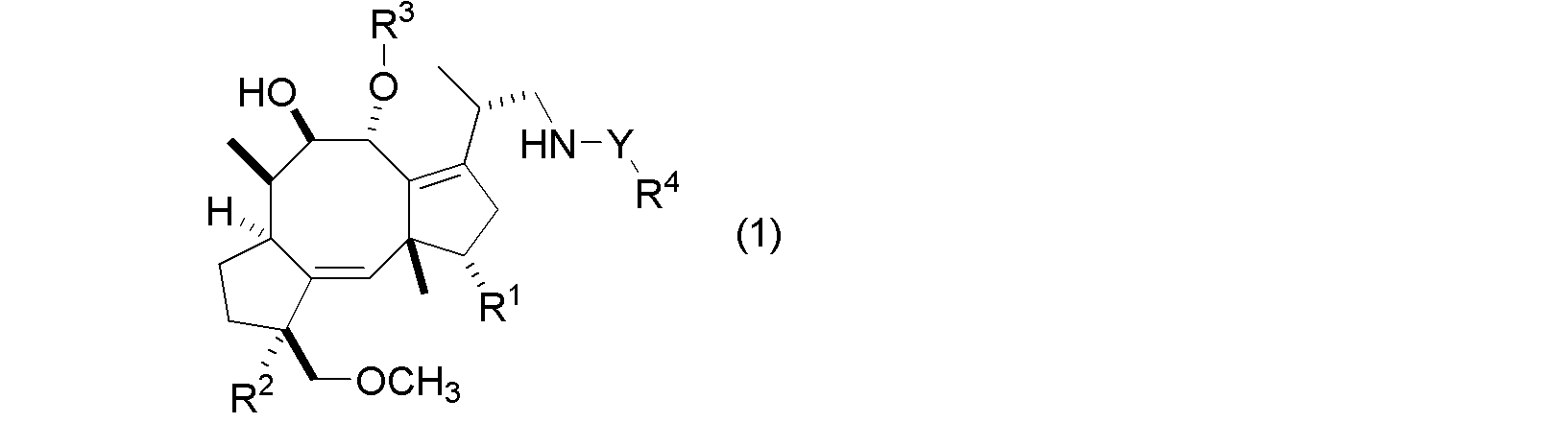

で表される基を示す。R4は置換若しくは非置換アルキル基、置換若しくは非置換(ヘテロ)シクロアルキル基、置換若しくは非置換アルコキシ基、置換若しくは非置換(ヘテロ)アリール基、置換若しくは非置換アミノ基を示す。]
で表されるフシコクシン化合物を含有する、14-3-3タンパク質とリン酸化タンパク質との相互作用増強剤。 - 一般式(1):
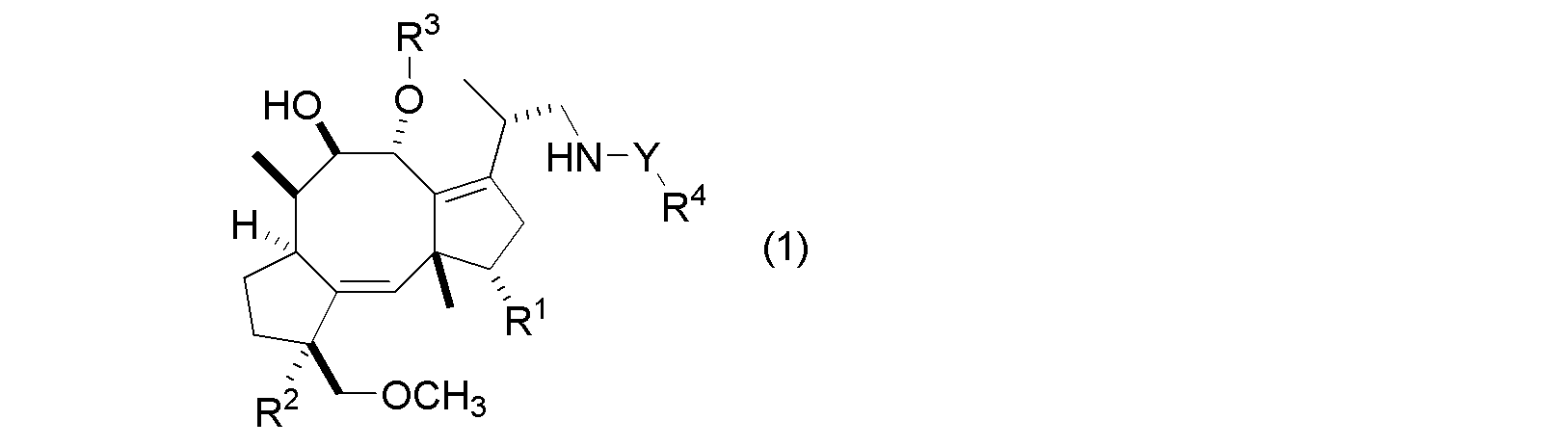

で表される基を示す。R4は置換若しくは非置換アルキル基、置換若しくは非置換(ヘテロ)シクロアルキル基、置換若しくは非置換アルコキシ基、置換若しくは非置換(ヘテロ)アリール基、置換若しくは非置換アミノ基を示す。]
で表されるフシコクシン化合物を含む医薬。 - がん細胞増殖抑制剤である、請求項8に記載の医薬。
- 一般式(1):


で表される基を示す。R4は置換若しくは非置換アルキル基、置換若しくは非置換(ヘテロ)シクロアルキル基、置換若しくは非置換アルコキシ基、置換若しくは非置換(ヘテロ)アリール基、置換若しくは非置換アミノ基を示す。]
で表されるフシコクシン化合物を含有する、種子発芽促進剤。
Priority Applications (1)
| Application Number | Priority Date | Filing Date | Title |
|---|---|---|---|
| JP2018565533A JPWO2018143140A1 (ja) | 2017-01-31 | 2018-01-30 | フシコクシン化合物 |
Applications Claiming Priority (2)
| Application Number | Priority Date | Filing Date | Title |
|---|---|---|---|
| JP2017015640 | 2017-01-31 | ||
| JP2017-015640 | 2017-01-31 |
Publications (1)
| Publication Number | Publication Date |
|---|---|
| WO2018143140A1 true WO2018143140A1 (ja) | 2018-08-09 |
Family
ID=63040779
Family Applications (1)
| Application Number | Title | Priority Date | Filing Date |
|---|---|---|---|
| PCT/JP2018/002825 Ceased WO2018143140A1 (ja) | 2017-01-31 | 2018-01-30 | フシコクシン化合物 |
Country Status (2)
| Country | Link |
|---|---|
| JP (1) | JPWO2018143140A1 (ja) |
| WO (1) | WO2018143140A1 (ja) |
Cited By (2)
| Publication number | Priority date | Publication date | Assignee | Title |
|---|---|---|---|---|
| JP2022132203A (ja) * | 2021-02-26 | 2022-09-07 | 国立大学法人信州大学 | フシコクシンを含む植物生産増強剤 |
| JP2023501721A (ja) * | 2019-11-19 | 2023-01-18 | クラリアント・インターナシヨナル・リミテツド | アブシジン酸の溶媒和物およびアブシジン酸を含有する液体組成物 |
Citations (3)
| Publication number | Priority date | Publication date | Assignee | Title |
|---|---|---|---|---|
| WO2008010324A1 (fr) * | 2006-07-19 | 2008-01-24 | Osaka University | Dérivé 12-désoxyfusicoccine et agent induisant une différentiation des cellules le contenant en tant que substance active |
| WO2010090234A1 (ja) * | 2009-02-06 | 2010-08-12 | 国立大学法人大阪大学 | 12-デオキシフシコクシン糖鎖改変誘導体およびその用途 |
| WO2013031975A1 (ja) * | 2011-08-31 | 2013-03-07 | Dairi Tohru | フシコクシンaの生合成中間体の製造方法、およびその合成酵素 |
-
2018
- 2018-01-30 WO PCT/JP2018/002825 patent/WO2018143140A1/ja not_active Ceased
- 2018-01-30 JP JP2018565533A patent/JPWO2018143140A1/ja active Pending
Patent Citations (3)
| Publication number | Priority date | Publication date | Assignee | Title |
|---|---|---|---|---|
| WO2008010324A1 (fr) * | 2006-07-19 | 2008-01-24 | Osaka University | Dérivé 12-désoxyfusicoccine et agent induisant une différentiation des cellules le contenant en tant que substance active |
| WO2010090234A1 (ja) * | 2009-02-06 | 2010-08-12 | 国立大学法人大阪大学 | 12-デオキシフシコクシン糖鎖改変誘導体およびその用途 |
| WO2013031975A1 (ja) * | 2011-08-31 | 2013-03-07 | Dairi Tohru | フシコクシンaの生合成中間体の製造方法、およびその合成酵素 |
Non-Patent Citations (5)
| Title |
|---|
| HAN, L. ET AL.: "Preprints DVD of The 96th CSJ Annual Meeting", THE CHEMICAL SOCIETY OF JAPAN, 2016 * |
| MAKI, T. ET AL.: "Chemical ligation of epoxide-containing fusicoccins and peptide fragments guided", MOL. BIOSYST., vol. 9, no. 5, 2013, pages 940 - 943, XP055530425 * |
| NOZAKI, MASAKATSU ET AL., MEDICINAL CHEMISTRY, 1995, pages 98 , 99 * |
| OHKANDA, J. ET AL.: "Module Assembly for Designing Multivalent Mid-Sized Inhibitors of Protein-Protein Interactions", CHEM. REC., vol. 13, 2013, pages 561 - 575, XP055291202 * |
| WERMUTH, C. G., THE PRACTICE OF MEDICINAL CHEMISTRY, vol. 1, 1998, pages 241 - 243 , 253, 254 * |
Cited By (3)
| Publication number | Priority date | Publication date | Assignee | Title |
|---|---|---|---|---|
| JP2023501721A (ja) * | 2019-11-19 | 2023-01-18 | クラリアント・インターナシヨナル・リミテツド | アブシジン酸の溶媒和物およびアブシジン酸を含有する液体組成物 |
| US12338216B2 (en) | 2019-11-19 | 2025-06-24 | Clariant International Ltd | Solvates of abscisic acid and liquid compositions containing abscisic acid |
| JP2022132203A (ja) * | 2021-02-26 | 2022-09-07 | 国立大学法人信州大学 | フシコクシンを含む植物生産増強剤 |
Also Published As
| Publication number | Publication date |
|---|---|
| JPWO2018143140A1 (ja) | 2019-11-21 |
Similar Documents
| Publication | Publication Date | Title |
|---|---|---|
| IL284775A (en) | Molecules for use in pest control, and intermediates, preparations, and related processes | |
| TWI515184B (zh) | 紫杉烷衍生物製備改良方法 | |
| CZ20021890A3 (cs) | Pyrazolkarboxamidy a pyrazolthioamidy, způsob jejich přípravy a jejich pouľití jako fungicidních prostředků | |
| CN103044395B (zh) | 含有地氯雷他定结构的氨基酸类衍生物、其制备方法和用途 | |
| Shan et al. | Acaricidal and insecticidal efficacy of new esters derivatives of a natural coumarin osthole | |
| EA019414B1 (ru) | Новые микробиоциды | |
| JP4673061B2 (ja) | 化学化合物 | |
| JP6797379B2 (ja) | カケロマイシンおよびその誘導体の製造方法 | |
| JPWO2018143140A1 (ja) | フシコクシン化合物 | |
| CN110028477B (zh) | 一类布雷菲德菌素a的4-位拼合氮芥衍生物的制备方法和用途 | |
| CN103664978A (zh) | 一种卤苯基芳香胺取代去甲斑蝥素及其制备方法和应用 | |
| CN104370982A (zh) | 一类山荷叶素衍生物及其制备方法和用途 | |
| CN115894607B (zh) | 一种抗肿瘤的苯丙氨酸缬氨酰衍生物及其制备方法 | |
| CN1200608C (zh) | 吴茱萸吲哚类生物碱在制备防治或抗稻瘟病的药物中的应用 | |
| EP3040338B1 (en) | Novel microbial product having antifungal activity | |
| JP5170608B2 (ja) | アフラトキシン生産阻害剤、及びそれを用いたアフラトキシン汚染防除方法 | |
| JPH11228542A (ja) | 新規抗真菌剤 | |
| CN109553558B (zh) | 一种含硒化合物及其抗肿瘤用途 | |
| Abbas et al. | Synthesis, Characterization, Antioxidant, Antimicrobial, Cytotoxic, Anticancer, Leishmanicidal, Anti-inflammatory Activities and Docking Studies of Heterocyclic 1, 3, 4-oxadiazoles and 4-amino-1, 2, 4-triazoles Derivatives. | |
| RU2856587C2 (ru) | Производное сесквитерпена, его фармацевтическая композиция, а также способ их приготовления и применения | |
| CN119504633B (zh) | 一种含1,3,4-噁/噻二唑的桃柁酚类衍生物、其制备方法及用途 | |
| CN103724321A (zh) | 一氧化氮和硫化氢供体型苯酞衍生物及其制备方法和用途 | |
| CN109206389A (zh) | 异土木香内酯衍生物,其药物组合物及其用途 | |
| Zuccolo | New approaches in the discovery of natural product-based agrochemicals | |
| CN108003054A (zh) | 一种含二苯醚的菊酰胺化合物及其制备方法与应用 |
Legal Events
| Date | Code | Title | Description |
|---|---|---|---|
| 121 | Ep: the epo has been informed by wipo that ep was designated in this application |
Ref document number: 18747459 Country of ref document: EP Kind code of ref document: A1 |
|
| ENP | Entry into the national phase |
Ref document number: 2018565533 Country of ref document: JP Kind code of ref document: A |
|
| NENP | Non-entry into the national phase |
Ref country code: DE |
|
| 122 | Ep: pct application non-entry in european phase |
Ref document number: 18747459 Country of ref document: EP Kind code of ref document: A1 |