WO2018105982A1 - 재조합 단백질의 개선된 정제 방법 - Google Patents
재조합 단백질의 개선된 정제 방법 Download PDFInfo
- Publication number
- WO2018105982A1 WO2018105982A1 PCT/KR2017/014123 KR2017014123W WO2018105982A1 WO 2018105982 A1 WO2018105982 A1 WO 2018105982A1 KR 2017014123 W KR2017014123 W KR 2017014123W WO 2018105982 A1 WO2018105982 A1 WO 2018105982A1
- Authority
- WO
- WIPO (PCT)
- Prior art keywords
- protein
- sodium
- factor
- recombinant
- periplasm
- Prior art date
- Legal status (The legal status is an assumption and is not a legal conclusion. Google has not performed a legal analysis and makes no representation as to the accuracy of the status listed.)
- Ceased
Links
Images

Classifications
-
- C—CHEMISTRY; METALLURGY
- C07—ORGANIC CHEMISTRY
- C07K—PEPTIDES
- C07K1/00—General methods for the preparation of peptides, i.e. processes for the organic chemical preparation of peptides or proteins of any length
- C07K1/14—Extraction; Separation; Purification
-
- C—CHEMISTRY; METALLURGY
- C07—ORGANIC CHEMISTRY
- C07K—PEPTIDES
- C07K1/00—General methods for the preparation of peptides, i.e. processes for the organic chemical preparation of peptides or proteins of any length
- C07K1/14—Extraction; Separation; Purification
- C07K1/16—Extraction; Separation; Purification by chromatography
- C07K1/18—Ion-exchange chromatography
-
- C—CHEMISTRY; METALLURGY
- C07—ORGANIC CHEMISTRY
- C07K—PEPTIDES
- C07K1/00—General methods for the preparation of peptides, i.e. processes for the organic chemical preparation of peptides or proteins of any length
- C07K1/14—Extraction; Separation; Purification
- C07K1/16—Extraction; Separation; Purification by chromatography
- C07K1/20—Partition-, reverse-phase or hydrophobic interaction chromatography
-
- C—CHEMISTRY; METALLURGY
- C07—ORGANIC CHEMISTRY
- C07K—PEPTIDES
- C07K1/00—General methods for the preparation of peptides, i.e. processes for the organic chemical preparation of peptides or proteins of any length
- C07K1/14—Extraction; Separation; Purification
- C07K1/34—Extraction; Separation; Purification by filtration, ultrafiltration or reverse osmosis
-
- C—CHEMISTRY; METALLURGY
- C07—ORGANIC CHEMISTRY
- C07K—PEPTIDES
- C07K1/00—General methods for the preparation of peptides, i.e. processes for the organic chemical preparation of peptides or proteins of any length
- C07K1/14—Extraction; Separation; Purification
- C07K1/36—Extraction; Separation; Purification by a combination of two or more processes of different types
-
- C—CHEMISTRY; METALLURGY
- C07—ORGANIC CHEMISTRY
- C07K—PEPTIDES
- C07K14/00—Peptides having more than 20 amino acids; Gastrins; Somatostatins; Melanotropins; Derivatives thereof
- C07K14/435—Peptides having more than 20 amino acids; Gastrins; Somatostatins; Melanotropins; Derivatives thereof from animals; from humans
- C07K14/575—Hormones
- C07K14/61—Growth hormone [GH], i.e. somatotropin
Definitions
- the present invention relates to a method for purifying recombinant protein with high yield and high purity from recombinant E. coli expressing the recombinant protein in periplasm.
- human growth hormone is a protein hormone with a molecular weight of about 21,500 Daltons consisting of 191 amino acid residues. Since the human growth hormone is extracted and purified from the human pituitary gland, many studies have been conducted. For example, Beck et al. Studied the metabolic effects of human growth hormone on humans for the first time, and Raven revealed in clinical trials that human growth hormone is effective in treating pituitary dwarfism. It has been. Recently, human growth hormone has been used for the treatment of Turner's Syndrome, and its indication is increasing.
- International Patent Publication No. WO86 / 01229 discloses a method of removing methionine by treating dipeptidyl aminopeptides I on a human growth hormone having N-terminus attached methionine. The method has the disadvantage of further adding a process for removing methionine.
- European Patent Nos. 55942, 20142 and 114695 disclose a method for producing a natural human growth hormone using extracellular expression in Escherichia coli, and these methods have a disadvantage in that the expression amount is small.
- a method of producing natural human growth hormone using yeast has been reported, but there is a concern of unwanted glycation.
- production of human growth hormone using a method for producing cells may be contaminated by impurities derived from host cells or culture materials, and thus, a high-purity pharmaceutical product must be subjected to a difficult purification process.
- E. coli when E. coli is used as a host, most human growth hormones are insoluble and accumulate in the cytoplasm. Therefore, they are very inefficient because they must be obtained in an activated form through a refolding process.
- a partially reduced state, intermolecular disulfide conjugates, or wrong disulfide conjugates are caused, which makes it difficult to remove them again, loss of titer, and removal of unwanted variants such as misfolding are very difficult. do.
- methionine added at the N-terminus, which is the translation initiation, and it is very difficult to remove it from the production process, resulting in loss of titer and yield.
- the production of human growth hormone using the secretion production method to periplasm can be obtained in the form of solubilized natural type human growth hormone without methionine at the N-terminus.
- the amount of protein in the periplasm is less than 10% relative to the protein in the whole cytoplasm, it can be purified much more easily, and the process of crushing cells is unnecessary, such as sugars and nucleic acids in the cytoplasm. There is an advantage of minimizing contamination.
- protein production in periplasm has a relatively low expression level, making it difficult to industrialize.
- the specific purification of the recombinant protein expressed in the periplasm may be difficult due to the rupture of the cell itself during pretreatment such as osmotic shock before purification.
- One embodiment embodying the present invention is a method of purifying the desired recombinant protein expressed in periplasm from recombinant E. coli with high yield and high purity.
- the purification method comprises the steps of: (i) adding a buffer solution containing sucrose to the isolated recombinant E. coli cells expressing the desired recombinant protein into the periplasm, followed by centrifugation or microfiltering to precipitate the cells.
- the cell precipitate is treated with a solution having a lower osmotic pressure than a buffer containing sucrose, to obtain an extract containing a periplasm protein; (ii) adding a salt or a chaotropic agent to the extract obtained in step (i) to perform a centrifugation or microfilter to obtain a supernatant containing periplasm protein; (iii) subjecting the supernatant obtained in step (ii) to hydrophobic interaction column chromatography to elute the fraction comprising the desired recombinant protein; And (iv) applying the fraction eluted in the hydrophobic interaction column chromatography of step (iii) to ion exchange chromatography.
- the purification method (1) by adding a buffer containing a chaotropic agent to the isolated recombinant E. coli cells expressing the desired recombinant protein into the periplasm, the periplasmic protein Obtaining an extract comprising a; (2) centrifuging or microfiltering the extract obtained in step (1) to obtain a supernatant containing periplasm protein; (3) applying the supernatant obtained in step (2) to hydrophobic interaction column chromatography to elute the fraction containing the desired recombinant protein; And (4) applying the fraction eluted in the hydrophobic interaction column chromatography of step (3) to ion exchange chromatography.
- the step (i) of the purification method comprises the steps of (a) culturing the recombinant E. coli expressing the desired recombinant protein into the periplasm, and then performing centrifugation or microfilter to obtain the cells; And (b) adding a buffer solution containing sucrose to the isolated recombinant E. coli cells, followed by centrifugation or microfilter to obtain a cell precipitate, and the osmotic pressure is higher than that of the buffer solution containing sucrose in the cell precipitate. By treating the low solution, to obtain an extract comprising the periplasmic protein.
- the solution having a lower osmotic pressure than the buffer solution containing sucrose is characterized in that the distilled water.
- step (ii) of the purification method is a step of increasing cell cohesion when performing centrifugation or microfiltering. It is characterized by.
- the step of increasing the cell cohesion may be to increase the cohesion of the cell precipitate to reduce the turbidity of the supernatant when performing centrifugation or micro-filter.
- step of adding the chaotropic agent (chaotropic agent) of step (1) of the purification method extracting the protein in the periplasm, the cell outer wall by the chaotropic preparation It is a step of extracting the periplasm protein by crushing or modifying the, and may yield similar yield to the step (i).
- Such increase in cell cohesion may be an advantage of easier removal of cell-derived impurities into pellets and may enhance specific extraction of proteins expressed into periplasm.
- the salt or chaotropic formulation is characterized in that it has a conductivity of 50 mS / cm ⁇ 300 mS / cm.
- the salt or chaotropic preparation is sodium chloride, sodium sulfate, ammonium sulfate, barium sulfate, calcium sulfate, magnesium sulfate, sodium hydrogen carbonate, sodium carbonate, ammonium chloride, sodium fluoride, sodium nitrite , Calcium phosphate, sodium sulfide, barium chloride, calcium chloride, magnesium bromide, calcium carbonate, potassium sulfate, sodium acetate, sodium citrate, sodium bromide, sodium thiocyanate, sodium phosphate, sodium dioxycholate, ammonium acetate, hydrogen carbonate Ammonium, Ammonium Chloride, Tris-HCl, Tris Phosphate, Nonidet P-40, Lubrol PX, Octyl Glucoside, Tween 80, Polyethylene Glycol, Polyethylenimine, Acetone, Triton X-100, Guanidine-hydrochloric
- the salt or chaotropic formulation of step (ii) of the purification method is characterized in that the conductivity is added to have a 50 mS / cm ⁇ 300 mS / cm.
- the step (1) of the purification method comprises the steps of (a) culturing the recombinant E. coli expressing the desired recombinant protein into the periplasm and then performing centrifugation or microfilter to obtain the cells; And (b) adding a buffer solution containing a chaotropic agent to the isolated recombinant E. coli cells to obtain an extract containing periplasmic protein.
- the chaotropic formulation of the purification method (1) is characterized in that it has a conductivity of 50 mS / cm ⁇ 300 mS / cm.
- chaotropic agent of the purification method (1) is guanidine-hydrochloric acid (Gu-HCl).
- the recombinant protein is a hormone, cytokine, interleukin, interleukin binding protein, enzyme, antibody, growth factor, transcription regulator, blood factor, vaccine, structural protein, ligand protein or receptor , Cell surface antigen or receptor antagonist.
- the recombinant protein is glucagon-like peptide-1 (GLP-1), glucagon, GIP (Gastric inhibitory polypeptide), auxintomodulin, Xenin, insulin, CCK ( Incretins that regulate blood sugar and weight in the stomach or intestine, such as Cholecystokinin amylin, gastrin, ghrelin, and peptide YY; Adipokines secreted from fat, such as leptin, adiponectin, adiponin, adipolin, apelin, cartonectin; Neuropeptides (neuropeptides) that are secreted from the brain, such as Keithpeptin and Nesfatin-1; Peptides or proteins secreted from the muscles such as irisin, myonectin, decorin, follistatin, and muslin; Vasoactive intestinal peptides, natriuretic
- the recombinant protein is human growth hormone, interferon-alpha, granulocyte colony stimulating factor, erythrocyte producing factor, blood factor, insulin, auxintomodulin, glucagon-like peptides, exendin And respective derivatives.
- the recombinant protein is characterized in that the human growth hormone.
- the hydrophobic interaction column chromatography of step (iii) or (3) of the purification method is characterized in that it is performed once or twice.
- it may be twice, but is not limited as long as it can increase the purification yield.
- the purification method according to any one of the preceding embodiments, wherein the functional groups of the ion exchange chromatography resin of step (iv) or (4) of the purification method are methylsulfonate (S), sulfopropyl (SP), carboxymethyl (CM), sulfoethyl (SE) and poly aspartic acid.
- the purification method according to any one of the preceding embodiments, wherein the functional groups of the ion exchange chromatography resin of step (iv) or (4) of the purification method are quaternary ammonium (Q), quaternary aminoethyl (QAE), di Ethylaminoethyl (DEAE), polyethyleneimine (PEI), dimethylaminomethyl (DMAE), and trimethylaminoethyl (TMAE).
- a recombinant protein having the same function as that expressed in the human body in simple, high yield and high purity without a separate activation process can be obtained, for example, a natural human growth hormone.
- variants of recombinant protein expressed in E. coli, for example, variants of human growth hormone are efficiently removed.
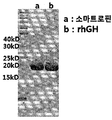
- Figure 1 is a photograph showing the SDS-PAGE results of purified human growth hormone protein (a: control somatropin, b: purified growth hormone sample (rhGH).
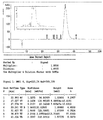
- Figure 2 is a graph showing the results of performing reverse phase high pressure chromatography of purified human growth hormone.
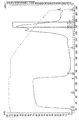
- FIG. 3 is a graph showing propyl (Poly HI-Propyl, Avantor) column chromatography, hydrophobic interaction column chromatography.
- Figure 4 is a graph showing anion (SourceQ, GE) column chromatography, anion exchange column chromatography.
- the purification method comprises (i) adding a buffer solution containing sucrose to the isolated recombinant E. coli cells expressing the recombinant protein of interest into the periplasm, followed by centrifugation or microfiltering to carry out the cells.
- step (ii) not only increases the cell cohesion in the extract, but also lowers the turbidity of the supernatant, thereby increasing the purification yield of the protein.
- Such a purification method comprises (i) culturing recombinant E. coli expressing the recombinant protein in a periplasm and centrifuging to obtain a cell precipitate, and adding a buffer solution containing a saccharide such as sucrose to the cell precipitate, followed by centrifugation.
- a cell precipitate distilled water was added to the cell precipitate to obtain a periplasm protein, (ii) a salt or chaotropic sample such as sodium chloride was added and centrifuged to obtain a supernatant containing periplasm protein, and (iii) the The supernatant obtained in (ii) may be carried out by a method for purifying recombinant protein, which comprises the step of performing hydrophobic interaction and (iv) ion exchange chromatography in sequence, but not limited thereto. Way).
- the other purification method comprises the steps of: (1) adding a buffer solution containing a chaotropic agent to the isolated recombinant E. coli cells expressing the desired recombinant protein into the periplasm, and extract containing the periplasmic protein. Obtaining a; (2) centrifuging or microfiltering the extract obtained in step (1) to obtain a supernatant containing periplasm protein; (3) applying the supernatant obtained in step (2) to hydrophobic interaction column chromatography to elute the fraction containing the desired recombinant protein; And (4) applying the fraction eluted in the hydrophobic interaction column chromatography of step (3) to ion exchange chromatography (second purification method).
- Purification method of the present invention is added to the isolated E. coli cells expressing the recombinant protein into the periplasm, the sucrose-containing buffer solution, centrifugation, distilled water is added to obtain an extract containing the periplasm protein salt
- a method (first purification method) comprising the step of centrifuging by adding a chaotropic agent or a periplasmic protein by adding a buffer solution containing a carotropic agent to the isolated E. coli cells expressing the recombinant protein into the periplasm. It may be carried out by a method (second purification method) comprising the step of obtaining an extract comprising a, but is not limited thereto.
- Recombinant Escherichia coli used in the present invention expresses a recombinant protein of interest in a periplasm for the purposes of the present invention, and is transformed into an expression vector comprising a fusion gene encoding a fusion protein in which a secreted sequence and the protein of interest are fused.
- Recombinant E. coli For example, it may be recombinant E. coli transformed with an expression vector including a fusion gene encoding a fusion protein to which human growth hormone is fused, but is not limited thereto.
- the recombinant E. coli may be expressed in E. coli transformed with an expression vector fused with a modified secretion sequence of E. coli thermostable enterotoxin II and human growth hormone, but is not limited thereto.
- the various recombinant proteins of the present invention and various secreted sequences capable of moving the fused recombinant protein, such as the modified secreted sequence of thermostable enterotoxin II, into a periplasm are fused with the recombinant protein of interest. It may have been. For example, it may be a secretion sequence of SEQ ID NO: 1, but is not limited thereto.
- the recombinant protein may be a hormone, a cytokine, an interleukin, an interleukin binding protein, an enzyme, an antibody, a growth factor, a transcriptional regulator, a blood factor, a vaccine, a structural protein, a ligand protein or a receptor, a cell surface antigen, or a receptor antagonist. This is not restrictive.
- the recombinant protein may include glucagon-like peptide-1 (GLP-1), glucagon, gastric inhibitory polypeptide (GIP), auxintomodulin, xenin, insulin, CCK (Cholecystokinin) amylin, Incretins that control blood sugar and weight in the stomach or intestine, such as gastrin, ghrelin, and peptide YY; Adipokines secreted from fat, such as leptin, adiponectin, adiponin, adipolin, apelin, cartonectin; Neuropeptides (neuropeptides) that are secreted from the brain, such as Keithpeptin and Nesfatin-1; Peptides or proteins secreted from the muscles such as irisin, myonectin, decorin, follistatin, and muslin; Vasoactive intestinal peptides, natriuretic peptides, neutrophil increasing factor (G-CSF)
- the recombinant protein may be human growth hormone, interferon-alpha, granulocyte colony stimulating factor, erythropoietin, blood factor, insulin, auxintomodulin, glucagon-like peptides, exendin, and derivatives thereof.
- human growth hormone but is not limited thereto.
- the recombinant Escherichia coli In order to express a recombinant protein of interest, such as a human growth hormone, into the periplasm of the recombinant Escherichia coli, the recombinant Escherichia coli is transformed into bacto-tryptone, yeast extract, NaCl, phosphate buffer, trace metal, glucose, MgCl It can be fermented in a fermenter added with 2 , but is not limited thereto. In addition, it can be fed-batch by injecting the bacto-yeast extract and glucose. Such a medium composition is suitable for high concentration culture of recombinant E. coli and high expression of recombinant protein from the E. coli to the periplasm. In addition, a culture method capable of expressing the recombinant protein in general recombinant E. coli is included without limitation.
- the term "culture” means growing the microorganisms in suitably controlled environmental conditions. Cultivation process of the present application can be made according to the appropriate medium and culture conditions known in the art. This culture process can be easily adjusted and used by those skilled in the art according to the strain selected. In the above method, the step of culturing the microorganism is not particularly limited thereto, and may be performed by a known batch culture method, continuous culture method, fed-batch culture method, or the like.
- the medium and other culture conditions used for the cultivation of the microorganism of the present application may be any medium that is used for the cultivation of ordinary Escherichia microorganisms without any particular limitation, but specifically, the microorganism of the present invention may be suitable carbon source, nitrogen source, personnel In a conventional medium containing inorganic compounds, amino acids and / or vitamins, and the like, it can be cultured under aerobic conditions while controlling temperature, pH and the like.
- the carbon source herein includes carbohydrates such as glucose, fructose, sucrose, maltose, mannitol, sorbitol and the like; Alcohols such as sugar alcohols, glycerol, pyruvic acid, lactic acid, citric acid and the like; Amino acids such as organic acids, glutamic acid, methionine, lysine, and the like, and the like, but are not limited thereto.
- natural organic nutrients such as starch hydrolysates, molasses, blackstrap molasses, rice winters, cassava, sugar cane residues and corn steep liquor can be used, specifically glucose and sterilized pretreated molasses (ie, reducing sugars).
- Carbohydrates such as converted molasses) and the like, and other appropriate amounts of carbon sources may be used in various ways without limitation. These carbon sources may be used alone or in combination of two or more thereof.
- nitrogen source examples include inorganic nitrogen sources such as ammonia, ammonium sulfate, ammonium chloride, ammonium acetate, ammonium phosphate, anmonium carbonate, and ammonium nitrate; Organic nitrogen sources such as amino acids such as glutamic acid, methionine, glutamine, etc., peptones, NZ-amines, meat extracts, yeast extracts, malt extracts, corn steep liquor, casein hydrolysates, fish or their degradation products, skim soy cakes or their degradation products Can be used. These nitrogen sources may be used alone or in combination of two or more kinds, but are not limited thereto.
- inorganic nitrogen sources such as ammonia, ammonium sulfate, ammonium chloride, ammonium acetate, ammonium phosphate, anmonium carbonate, and ammonium nitrate
- Organic nitrogen sources such as amino acids such as glutamic acid, methionine, glutamine, etc., peptones, NZ-amines
- the personnel may include a first potassium phosphate, a second potassium phosphate, or a sodium-containing salt corresponding thereto.
- a first potassium phosphate sodium chloride, calcium chloride, iron chloride, magnesium sulfate, iron sulfate, manganese sulfate, calcium carbonate and the like may be used, and other amino acids, vitamins and / or suitable precursors may be used, but are not limited thereto.
- These media or precursors may be added batchwise or continuously to the culture, but are not limited thereto.
- compounds such as ammonium hydroxide, potassium hydroxide, ammonia, phosphoric acid, sulfuric acid and the like can be added to the culture in an appropriate manner during the culturing of the microorganisms to adjust the pH of the culture.
- antifoaming agents such as fatty acid polyglycol esters can be used to suppress bubble generation.
- oxygen or oxygen-containing gas may be injected into the culture, or nitrogen, hydrogen, or carbon dioxide gas may be injected without injecting gas to maintain anaerobic and unaerobic conditions.
- the temperature of the culture may be 30 ° C to 40 ° C, more specifically 35 ° C to 37 ° C, but is not limited thereto.
- the incubation period may continue until the desired amount of useful substance is obtained, specifically, may be from 35 hours to 45 hours, but is not limited thereto.
- the recombinant E. coli secretes various desired recombinant proteins, such as naturally occurring human growth hormone, without the addition of additional methionine at the amino terminus to periplasm.
- the recombinant E. coli culture thus obtained is centrifuged to obtain cell precipitates.
- the cell precipitate was added with a buffer solution containing sucrose and then centrifuged to obtain a cell precipitate, and a solution having a lower osmotic pressure than the buffer solution containing sucrose was added to the cell precipitate, for example, distilled water, followed by centrifugation or microfilter. Is carried out to obtain a supernatant containing the periplasm protein.
- a solution having a lower osmotic pressure than the sucrose-containing buffer may be distilled water, for example, but a solution capable of extracting periplasmic protein by osmotic pressure is included without limitation.
- periplasmic proteins including recombinant proteins of interest, such as human growth hormone, are extracted by osmotic pressure.
- the cells are contracted due to the treatment of the sucrose-containing buffer, for example, the buffer solution containing 10% to 30% sucrose, and then expanded due to the distilled water treatment, thereby extracting through the cell membrane.
- the osmotic extraction may use an organic solvent such as acetone and butanol in addition to sucrose, but is not limited thereto.
- a supernatant containing periplasm protein may be obtained by adding a salt such as sodium chloride or a chaotropic agent to the extract and performing centrifugation or microfilter, but the present invention is not limited thereto.
- the step of adding the salt or chaotropic agent of step (ii) of the purification method of the present invention is characterized in that the step of increasing cell cohesion when performing centrifugation or microfiltering.
- the step of increasing the cell cohesion may be to increase the cohesion of the cell precipitate to reduce the turbidity of the supernatant when performing centrifugation or micro-filter.
- the salt or chaotropic formulation may have a conductivity of 50 mS / cm to 300 mS / cm, specifically 100 mS / cm to 200 mS / cm, more specifically 150 mS / cm to 250 mS / cm, but It is not limited.
- the salt or chaotropic formulation of step (ii) of the purification method has a conductivity of 50 mS / cm to 300 mS / cm, specifically 100 mS / cm to 200 mS / cm, more specifically 150 mS / cm to 250 mS / Injecting to have a cm, but is not limited thereto.
- Sodium chloride may be 1 M to 3 M, but is not limited thereto. This increases the cohesiveness of the cell precipitate and reduces the turbidity of the supernatant after centrifugation or microfilter. This has the advantage of removing the cell-derived impurities more easily with pellets and improves the specific extraction of proteins expressed in periplasm. In addition, improved cohesiveness of cell precipitates can be pretreated with osmotic shock for purification, regardless of the stability of the outer membrane of cells expressing recombinant proteins with periplasm and expression state. Yield improvement can be expected.
- Salt or chaotropic preparations for improving the cohesiveness of cell precipitates are specifically guanidine hydrochloric acid (Gu-HCl), urea, potassium chloride, ammonium sulfate, butanol, ethanol, lithium perchlorate, acetic acid in addition to sodium chloride.
- guanidine hydrochloric acid urea
- potassium chloride ammonium sulfate
- butanol ethanol
- lithium perchlorate acetic acid in addition to sodium chloride.
- Lithium (Lithium acetate), magnesium chloride, phenol, propanol, sodium dodeceyl sulfate (SDS), thiourea (Thiourea), and the like may be used, but are not limited thereto.
- the salt or chaotropic preparation includes materials that can improve cell cohesion in the extract without limitation, for example, sodium chloride, sodium sulfate, ammonium sulfate, barium sulfate, calcium sulfate, magnesium sulfate, sodium bicarbonate, sodium carbonate , Ammonium chloride, sodium fluoride, sodium nitrite, calcium phosphate, sodium sulfide, barium chloride, calcium chloride, magnesium bromide, calcium carbonate, potassium sulfate, sodium acetate, sodium citrate, sodium bromide, sodium thiocyanate, sodium phosphate, Sodium dioxycholate, ammonium acetate, ammonium bicarbonate, ammonium chloride, Tris-HCl, tris phosphate, Nonidet P-40, Lubrol PX, octyl glucoside, Tween80, polyethylene glycol, Polyethylenimine, Acetone, Triton X-100, Guanidine-HC
- salt of the present invention refers to a salt in a form capable of improving the cell cohesion among salts in which a cation and an anion are formed by an electrostatic attraction.
- metal salts salts with organic bases, salts with inorganic acids, salts with organic acids, salts with basic or acidic amino acids, and the like.
- the metal salt may be an alkali metal salt (sodium salt, potassium salt, etc.), alkaline earth metal salt (calcium salt, magnesium salt, barium salt, etc.), aluminum salt, or the like;
- Salts with organic base include salts with triethylamine, pyridine, picoline, 2,6-lutidine, ethanolamine, triethanolamine, cyclohexylamine, dicyclohexylamine, N, N-dibenzylethyldiamine, and the like.
- Salts with inorganic acids can be salts with hydrochloric acid, hydrobromic acid, nitric acid, sulfuric acid, phosphoric acid, and the like;
- Salts with organic acids can be salts with formic acid, acetic acid, trifluoroacetic acid, phthalic acid, fumaric acid, oxalic acid, tartaric acid, maleic acid, citric acid, succinic acid, methanesulfonic acid, benzenesulfonic acid, p-toluenesulfonic acid, and the like;
- Salts with basic amino acids can be salts with arginine, lysine, ornithine and the like;
- Salts with acidic amino acids may be, but are not limited to, salts with aspartic acid, glutamic acid, and the like.
- the salt may be sodium chloride
- the chaotropic agent may be guanidine-hydrochloric acid (Gu-HCl).
- a supernatant containing periplasmic protein is extracted by adding a buffer solution containing chaotropic agent to the cell precipitate and performing centrifugation or microfiltering. Can be obtained.
- the chaotropic formulation of step (2) of the purification method has a conductivity of 50 mS / cm to 300 mS / cm, specifically 100 mS / cm to 200 mS / cm, more specifically 150 mS / cm to 250 mS / cm It may be to be added to have, but is not limited thereto.
- the chaotropic agent for extracting the periplasmic protein in step (2) of the purification method is urea, potassium chloride, ammonium sulfate, SDS (Sodium) in addition to guanidine hydrochloric acid (Gu-HCl). dodeceyl sulfate), thiourea, and the like can be used, but is not limited thereto.
- chaotropic agents capable of extracting proteins in periplasm include without limitation, for example, sodium chloride, sodium sulfate, ammonium sulfate, barium sulfate, calcium sulfate, magnesium sulfate, sodium bicarbonate, sodium carbonate, ammonium chloride, Sodium fluoride, sodium nitrite, calcium phosphate, sodium sulfide, barium chloride, calcium chloride, magnesium bromide, calcium carbonate, potassium sulfate, sodium acetate, sodium citrate, sodium bromide, sodium thiocyanate, sodium phosphate, sodium dioxycholate , Ammonium acetate, ammonium bicarbonate, ammonium chloride, Tris-HCl, tris phosphate, NP-40 (Nonidet P-40), rubrol PX, octyl glucoside, tween80, polyethylene glycol, polyethyleneimine, acetone , Triton X-100, Guanidine-
- the cells are extracted from the protein in the periplasm by treatment with a buffer solution containing guanidine-hydrochloric acid (Gu-HCl), for example, a buffer solution containing 0.5M to 3M guanidine-hydrochloric acid (Gu-HCl). do.
- a buffer solution containing guanidine-hydrochloric acid for example, a buffer solution containing 0.5M to 3M guanidine-hydrochloric acid (Gu-HCl).
- extraction with the chaotropic agent may use a buffer solution including an agent such as urea, potassium chloride, ammonium sulfate, sodium dodeceyl sulfate (SDS), or thiourea (Thiourea), but It is not limited.
- the hydrophobic interaction column chromatography of step (iii) or (3) of the purification method is characterized in that it is performed once or twice.
- it may be twice, but is not limited as long as it can increase the purification yield.
- the hydrophobic interaction column chromatography to be performed may be different from each other, or when using two or more times to use the resin of the same functional group, but is not limited thereto.
- hydrophobic interaction column first chromatography hydrophobic interaction column second chromatography and ion exchange column chromatography are sequentially performed to perform high purity recombinant recombination.
- Protein may be purified, but is not limited thereto.
- the functional group of the hydrophobic interaction column chromatography resin is one selected from the group consisting of phenyl, octyl, (iso) propyl, butyl and ethyl It may be, but is not limited thereto.
- a column having a phenyl function may be used, but is not limited thereto.
- Chromatographic conditions maintain the pH in the range of 6.0 to 9.0, specifically 6.5 to 9.0, more specifically 7.0 to 9.0, more specifically 7.0 to 8.5, more specifically pH 7.5 to 8.5, It may be eluted with a buffer solution having a concentration of 500 mM or less, but is not limited thereto.
- a column having a propyl functional group may be used, and the chromatography conditions include pH in the range of 6.0 to 9.0, specifically 6.5 to 9.0, more specifically 7.0 to 9.0, more specifically It can be eluted with a buffer solution having a salt concentration of 2 M or less while maintaining the range of 7.0 to 8.5, more specifically pH 7.5 to 8.5, but is not limited thereto.
- the functional group of the ion exchange chromatography resin of step (iv) or (4) of the purification method is methylsulfonate (S), sulfopropyl (SP), carboxymethyl (CM). ), Sulfoethyl (SE) and poly aspartic acid may be one selected from the group consisting of, but is not limited thereto. Also selected from the group consisting of quaternary ammonium (Q), quaternary aminoethyl (QAE), diethylaminoethyl (DEAE), polyethyleneimine (PEI), dimethylaminomethyl (DMAE), and trimethylaminoethyl (TMAE) It can be one of them.
- a column having a Q functional group may be used in the ion exchange column chromatography, and the chromatographic conditions may be pH in the range of 6.0 to 9.0, specifically 6.5 to 9.0, more specifically 7.0 to 9.0, and more specifically. It can be eluted with a buffer having a salt concentration of 200 mM or less, while maintaining the range of 7.0 to 8.5, more specifically pH 7.0 to 8.0, but is not limited thereto.
- the recombinant protein may be a human growth hormone, and confirmed the superiority of the effect of increasing the purification yield 1.5 to 3 times or more than the method disclosed in the existing Korean Patent No. 10-0443890.
- Example 1 Sucrose Contained Buffer solution Human growth hormone protein purification method using 1
- Sterile LB medium was cultured with E. coli BL21 (DE3) strain transformed with an expression vector fused with a modified secretion sequence of Escherichia coli E. coli (MKKTIAFLLA SMFVFSIATN AYA, SEQ ID NO: 1) and human growth hormone, a representative recombinant protein.
- MKKTIAFLLA SMFVFSIATN AYA SEQ ID NO: 1
- human growth hormone a representative recombinant protein.
- the culture was incubated in a 50 liter fermentor containing Bacterium-Tryptone, yeast extract, NaCl, phosphate buffer, trace metal, glucose, MgCl 2, and the like.
- pH was 6.8 after the start of the culture at pH 6.7, fed-batch was started.
- 100 g / l of Bacterium-Yeast Extract and 385 g / l of Glucose were added, and when OD reached 70-80, 140 g / l of Bacterium-Yeast Extract and 264 g / l of Glucose were added and fermented for 42 to 45 hours. .
- the fermentation broth was centrifuged at 12,300g to obtain the cells and stored at -70 °C.
- Human growth hormone expressed and produced in Example 1-1 is present in the periplasm of recombinant E. coli by secretion sequences linked in the expression vector.
- human growth hormone present in periplasm is referred to as periplasm protein.
- Example 1-1 10 g of Escherichia coli cells obtained in Example 1-1 were added to 150 ml of a room temperature buffer solution (20% sucrose, 1 mM EDTA, 30 mM Tris, pH 7.5), stirred for 90 minutes, and then continuously centrifuged at 12,300 g. The pellet was separated and collected. 150 mL of distilled water at 4-8 degreeC was added to this pellet again, and it stirred at 4-8 degreeC for 1 hour. Thereafter, sodium chloride was added to a concentration of about 2 M (conductivity of about 100 to 200 mS / cm), and the pellet was removed by continuous centrifugation at 12,300 g, and the supernatant containing the periplasm protein was collected. .
- a room temperature buffer solution 20% sucrose, 1 mM EDTA, 30 mM Tris, pH 7.5
- the supernatant was filtered using a 0.2 ⁇ m filter.
- chaotropic agents such as guanidine-hydrochloric acid
- the concentration was about 2 M (conductivity of about 150-250 mS / cm).
- the supernatant was collected by centrifugation, and the cohesion of the cells was higher than that of sodium chloride, resulting in a low turbidity of the supernatant. This has the advantage of more easily removing the cell-derived impurities into the pellet and the effect of improving the extraction of the protein expressed in the periplasm.
- the step of removing the salt was further performed to perform hydrophobic interaction column chromatography.
- butyl-Sepharose fast flow (Butyl-Sepharose fast flow, GE, USA) column chromatography was performed as follows.
- the supernatant was adsorbed onto a butyl-sepharose column (10 ⁇ 24 mm, Pall, USA) previously equilibrated with buffer 1 (2.2 M sodium chloride, 50 mM Tris, pH 8.0) for hydrophobic interaction column chromatography. Proteins which were not washed were removed by washing with the same buffer sufficiently, and eluted by the stepwise addition of the elution solution (10 mM Tris, pH 8.0) for hydrophobic interaction column chromatography.
- buffer 1 2.2 M sodium chloride, 50 mM Tris, pH 8.0
- a 5 M sodium chloride solution was added to the fraction obtained in Example 1-3 so that the sodium chloride concentration of the fraction was 2 M.
- the adsorbed protein was then adsorbed onto a propyl column (10 ⁇ 28 mm, Pall, USA) previously equilibrated with hydrophobic interaction column chromatography buffer 2 (2 M sodium chloride, 50 mM Tris, pH 8.0).
- the solution was sufficiently washed out with buffer and eluted by the stepwise addition of the eluent for hydrophobic interaction column chromatography (10 mM Tris, pH 8.0).
- the eluted fractions were subjected to electrophoresis analysis to collect fractions with a purity of 95% or more.
- anion (Source Q, GE, USA) column chromatography which is anion exchange column chromatography, was performed as follows.
- Example 1-5 The final eluted fraction in Example 1-5 was analyzed by electrophoresis with SDS-PAGE (12% NuPAGE, Novex, USA) to analyze the purity of human growth hormone, and the results are shown in FIG. 1.
- a is a control somatropin (Somatropin, Pfizer, USA)
- b is a purified human growth hormone. Purified human growth hormone showed a purity of at least equivalent to that of control somatropin on SDS-PAGE.
- Human growth hormone was expressed and produced as in Example 1-1, which is present in the periplasm of recombinant E. coli by secretion sequences linked in the expression vector.
- human growth hormone present in periplasm is referred to as periplasm protein.
- Example 2 2 g of Escherichia coli cells obtained in Example 2-1 were added to 15 ml of a room temperature buffer solution (2 M guanidine-hydrochloric acid, 30 mM Tris, pH 7.0, conductivity 131 mS / cm) and stirred at 4 to 8 ° C. for 4 hours. Thereafter, pellets were removed by continuous centrifugation at 12,300 g, and the supernatant containing the periplasmic protein was collected. The supernatant was filtered using a 0.2 ⁇ m filter. The filtered supernatant was exchanged into 10 mM Tris (pH 7.5) buffer using a Sephadex G25 column (GE, USA).
- a room temperature buffer solution 2 M guanidine-hydrochloric acid, 30 mM Tris, pH 7.0, conductivity 131 mS / cm
- Example 2-2 5 M sodium chloride solution was added to the supernatant obtained in Example 2-2 so that the sodium chloride concentration of the supernatant was 2.2 M.
- the mixture was then adsorbed onto a pre-equilibrated propyl column (10 ⁇ 28 mm, Pall, USA) with buffer 1 (2.2 M sodium chloride, 50 mM Tris, pH 8.0) for hydrophobic interaction column chromatography.
- the solution was sufficiently washed out with buffer and eluted by the stepwise addition of the eluent for hydrophobic interaction column chromatography (10 mM Tris, pH 8.0). Profile column chromatography is shown in FIG. 3.
- anion (Source Q, GE, USA) column chromatography which is anion exchange column chromatography, was performed as follows.
- Example 2-3 Fractions obtained in Example 2-3 were exchanged into 10 mM Tris pH 7.5 buffer using Sephadex G25 column (GE, USA). The buffer exchanged sample was introduced into an anion column (15 ⁇ 13 mm, Pall) previously equilibrated with anion exchange column chromatography buffer 1 (10 mM Tris, pH 7.5), and then adsorbed. Elution was carried out with solution 2 (10 mM Tris, 0.25 M sodium chloride, pH 7.5) in steps. Anion column chromatography performed in Examples 2-4 is shown in FIG. 4.
- Example 2-4 The final eluted fractions in Example 2-4 were analyzed for purity using a reverse phase high pressure liquid chromatography (RP-HPLC) column (Vydac 214TP54), and the purity was 96.0%.
- RP-HPLC reverse phase high pressure liquid chromatography
- the purification method of the present invention comprising the step of increasing the cohesive force of the cells present in the supernatant suggests that the method of purifying the recombinant protein in high yield and high purity compared to the method of purifying the existing recombinant protein.
- the method of the present invention suggests that a process that can effectively purify both a method using a buffer solution containing sucrose or the like or a method using a direct chaotropic agent is established.
- it suggests that it is possible to obtain an intact protein having activity in vivo without a separate refolding process.
Landscapes
- Chemical & Material Sciences (AREA)
- Organic Chemistry (AREA)
- Health & Medical Sciences (AREA)
- Life Sciences & Earth Sciences (AREA)
- Medicinal Chemistry (AREA)
- Molecular Biology (AREA)
- Biochemistry (AREA)
- Biophysics (AREA)
- General Health & Medical Sciences (AREA)
- Genetics & Genomics (AREA)
- Proteomics, Peptides & Aminoacids (AREA)
- Analytical Chemistry (AREA)
- Endocrinology (AREA)
- Engineering & Computer Science (AREA)
- Water Supply & Treatment (AREA)
- Toxicology (AREA)
- Zoology (AREA)
- Gastroenterology & Hepatology (AREA)
- Preparation Of Compounds By Using Micro-Organisms (AREA)
- Peptides Or Proteins (AREA)
Abstract
본 발명은 재조합 대장균으로부터 재조합 단백질을 별도의 활성화 공정 없이 변형체를 포함하지 않으면서 고수율 및 고순도로 정제하는 방법에 관한 것으로, 재조합 단백질을 페리플라즘 내에서 발현하는 재조합 대장균으로부터 재조합 단백질을 고수율 및 고순도로 정제하는 방법에 관한 것이다.
Description
본 발명은 재조합 단백질을 페리플라즘 내에서 발현하는 재조합 대장균으로부터 재조합 단백질을 고수율 및 고순도로 정제하는 방법에 관한 것이다.
다양한 치료제로 사용될 수 있는 다양한 단백질 치료 의약품 들은 재조합 단백질로 제조하는 연구뿐만 아니라 이의 임상에로의 적용 및 상용화가 계속되고 있다.
이 중 재조합 단백질 중 한 예인, 인간 성장 호르몬은 191개의 아미노산 잔기로 구성된 분자량 약 21,500 달톤의 단백질 호르몬이다. 상기 인간 성장 호르몬은 인간 뇌하수체에서 추출 정제된 이후, 많은 연구가 진행되어 왔다. 예를 들어, 벡트 등은 사람에 대한 인간 성장 호르몬의 대사 효과 등을 처음 연구하였으며, 라벤은 임상시험을 통해 인간 성장 호르몬이 뇌하수체성 왜소증의 치료 효과가 있음을 밝혔으며 현재까지 이러한 왜소증 치료에 사용되어 오고 있다. 최근 인간 성장 호르몬은 터너 증후군(Turner's Syndrome)의 치료에도 사용되고 있으며, 그 적응증이 확대되고 있는 추세이다.
이러한 유용성에도 불구하고, 종래 인간 성장 호르몬은 사람의 뇌하수체에서 직접 추출 정제하는 방법에 의해 얻을 수 있었으므로 생산량이 매우 제한되었다. 이에 따라, 인간 성장 호르몬을 유전자 재조합 방법으로 대량생산하는 방법이 시도되었다. 고델 등이 처음으로 유전자 재조합 방법으로 인간 성장 호르몬을 생산한 바 있으나, 이 호르몬은 천연형 인간 성장 호르몬과 비교할 때 N-말단에 메티오닌 잔기가 하나 더 붙어있는 192개 아미노산으로 구성되어 있으며, 이로 인해 항체 생성률의 증가 등의 부작용이 우려되고 있다. 따라서 인체 내에서 발현되는 것과 동일한 기능을 가지는 천연형 인간 성장 호르몬의 개발이 요구되고 있다.
천연형 인간 성장 호르몬을 얻기 위해, 국제특허 공개공보 제 WO86/01229 호에는 N-말단에 메티오닌이 붙은 인간 성장 호르몬에 디펩티딜 아미노펩티데이즈 I을 처리하여 메티오닌을 제거하는 방법이 개시되어 있으나, 이 방법은 메티오닌을 제거하기 위한 공정이 더 추가되는 단점이 있다. 또한 유럽 특허 제55942호, 제20142호 및 제114695호에는 대장균에서 세포외 발현을 이용한 천연형 인간 성장 호르몬의 제조 방법이 개시되어 있는데, 이 방법들은 그 발현량이 적은 단점이 있다. 또한 효모를 이용하여 천연형 인간 성장 호르몬을 생산하는 방법도 보고된 바 있으나, 이 방법에도 원치 않는 당쇄화의 우려가 있다.
특히, 균체 내 생산 방법을 이용한 인간 성장 호르몬의 생산은 숙주 세포 또는 배양 물질에 유래하는 불순물에 의해 오염될 수 있어 고순도 의약품을 정제하기 위해서는 까다로운 정제 공정을 거쳐야 한다. 뿐만 아니라, 대장균을 숙주로 사용하는 경우 대부분의 인간 성장 호르몬은 불용성 물질로 세포질 내에 축적되므로 리폴딩 공정을 거쳐 활성화된 형태로 얻어야 하므로 매우 비효율적이다. 특히 이 공정 중에 부분적으로 환원된 상태, 분자간 이황화 결합체 또는 잘못된 이황화 결합체 등이 유발되어 이들을 다시 제거하여야 하는 어려움이 있으며, 역가의 손실이 많고, 미스 폴딩(misfolding) 같은 원치 않는 변이체의 제거가 매우 어렵게 된다. 또한 번역 개시부인 N-말단에 메티오닌이 부가된 형태로 생산되고, 생산 공정에서 이를 제거하는 것은 매우 어려우며 이로 인한 역가 및 수율의 손실이 있다.
한편, 페리플라즘으로의 분비 생산 방법을 이용한 인간 성장 호르몬의 생산은 N-말단에 메티오닌이 없는 천연형 인간 성장 호르몬을 가용화 형태로 얻을 수 있다. 또한, 페리플라즘 내의 단백질 양이 전체 세포질 내의 단백질에 비해 상대적으로 적은 10% 미만이므로 훨씬 더 용이하게 정제할 수 있으며, 세포를 파쇄하는 공정이 불필요하게 되므로 세포질 내에 존재하는 당류 및 핵산류 등의 오염을 최소화하는 장점이 있다.
그러나 페리플라즘 내에서의 단백질 생산은 발현량이 상대적으로 낮아 산업화에 어려움이 있다. 특히, 페리플라즘으로의 단백질 고 발현 시 발현 세포 외막의 불안정성에 의해 정제 전 삼투 충격 등의 전처리 시 세포 자체의 파열로 인한 페리플라즘 내 발현된 재조합 단백질의 특정한 정제가 어려울 수 있으므로, 발현된 단백질을 고수율 및 고순도로 정제할 수 있는 효율적인 방법이 여전히 요구되고 있다.
본 발명의 목적은 재조합 대장균으로부터 페리플라즘 내로 발현된 목적하는 재조합 단백질을 고수율 및 고순도로 정제하는 방법을 제공하는 것이다.
본 발명을 구현하는 하나의 양태는 재조합 대장균으로부터 페리플라즘 내로 발현된 목적하는 재조합 단백질을 고수율 및 고순도로 정제하는 방법이다.
하나의 구체예에서 상기 정제 방법은 (i) 목적하는 재조합 단백질을 페리플라즘 내로 발현하는 분리된 재조합 대장균 균체에 수크로즈가 함유된 완충용액을 가한 후, 원심분리 또는 마이크로필터를 수행하여 세포 침전물을 수득하고, 상기 세포 침전물에 수크로즈가 함유된 완충용액에 비해 삼투압이 낮은 용액을 처리하여, 페리플라즘 단백질을 포함하는 추출액을 수득하는 단계; (ii) 상기 (i) 단계에서 수득한 추출액에 염 또는 카오트로픽 제제 (chaotropic agent)를 첨가하여 원심분리 또는 마이크로필터를 수행하여 페리플라즘 단백질을 포함하는 상등액을 수득하는 단계; (iii) 상기 (ii) 단계에서 수득한 상등액을 소수성 상호작용 컬럼 크로마토그래피에 적용하여, 목적하는 재조합 단백질을 포함하는 분획물을 용출하는 단계; 및 (iv) 상기 (iii) 단계의 소수성 상호작용 컬럼 크로마토그래피에서 용출된 분획물을 이온 교환 크로마토그래피에 적용하는 단계를 포함하는, 목적하는 재조합 단백질의 정제 방법일 수 있다.
다른 하나의 구체예에서, 상기 정제 방법은 (1) 목적하는 재조합 단백질을 페리플라즘 내로 발현하는 분리된 재조합 대장균 균체에 카오트로픽 제제 (chaotropic agent)가 함유된 완충용액을 가하여, 페리플라즘 단백질을 포함하는 추출액을 수득하는 단계; (2) 상기 (1) 단계에서 수득한 추출액을 원심분리 또는 마이크로필터를 수행하여 페리플라즘 단백질을 포함하는 상등액을 수득하는 단계; (3) 상기 (2) 단계에서 수득한 상등액을 소수성 상호작용 컬럼 크로마토그래피에 적용하여, 목적하는 재조합 단백질을 포함하는 분획물을 용출하는 단계; 및 (4) 상기 (3) 단계의 소수성 상호작용 컬럼 크로마토그래피에서 용출된 분획물을 이온 교환 크로마토그래피에 적용하는 단계를 포함하는, 목적하는 재조합 단백질의 정제 방법일 수 있다.
하나의 구체예에서, 상기 정제 방법의 (i) 단계는 (a) 목적하는 재조합 단백질을 페리플라즘 내로 발현하는 재조합 대장균을 배양한 후 원심분리 또는 마이크로필터를 수행하여 균체를 수득하는 단계; 및 (b) 분리된 재조합 대장균 균체에 수크로즈가 함유된 완충용액을 가한 후, 원심분리 또는 마이크로필터를 수행하여 세포 침전물을 수득하고, 상기 세포 침전물에 수크로즈가 함유된 완충용액에 비해 삼투압이 낮은 용액을 처리하여, 페리플라즘 단백질을 포함하는 추출액을 수득하는 단계에 의해 수행되는 것을 특징으로 한다.
앞선 구체예 중 어느 하나에 따른 정제방법으로서, 상기 수크로즈가 함유된 완충용액에 비해 삼투압이 낮은 용액은 증류수인 것을 특징으로 한다.
앞선 구체예 중 어느 하나에 따른 정제방법으로서, 상기 정제 방법의 (ii) 단계의 염 또는 카오트로픽 제제 (chaotropic agent)를 첨가하는 단계는, 원심분리 또는 마이크로필터 수행시 세포 응집력을 증가시키는 단계인 것을 특징으로 한다. 상기 세포 응집력을 증가시키는 단계는 세포 침전물의 응집력이 증가하여 원심분리나 마이크로 필터를 수행 시 상등액의 탁도를 감소시키는 것일 수 있다.
앞선 구체예 중 어느 하나에 따른 제제방법으로서, 상기 정제방법의 (1) 단계의 카오트로픽 제제 (chaotropic agent)를 첨가하는 단계는, 페리플라즘내 단백질을 추출하는 단계로 카오트로픽 제제에 의해 세포 외벽의 파쇄 혹은 변형을 일으켜 페리플라즘 단백질을 추출하는 단계이며, 상기 (i) 단계와 유사한 수득율을 보일 수 있다.
이와 같은 세포 응집력 증가는 세포 유래 불순물을 보다 용이하게 펠렛으로 제거할 수 있는 장점과 페리플라즘 내로 발현된 단백질의 특정한 추출을 향상시키는 것일 수 있다.
앞선 구체예 중 어느 하나에 따른 정제방법으로서, 상기 염 또는 카오트로픽 제제는 50 mS/cm ~ 300 mS/cm 전도도를 갖는 것을 특징으로 한다.
앞선 구체예 중 어느 하나에 따른 정제방법으로서, 상기 염 또는 카오트로픽 제제는 염화나트륨, 황산나트륨, 황산암모늄, 황산바륨, 황산칼슘, 황산마그네슘, 탄산수소나트륨, 탄산나트륨, 염화암모늄, 플루오르화나트륨, 아질산나트륨, 인산칼슘, 황화나트륨, 염화바륨, 염화칼슘, 브로민화마그네슘, 탄산칼슘, 황산칼륨, 아세트산 나트륨, 시트르산나트륨, 브로민화나트륨, 티오시안산 나트륨, 인산나트륨, 소듐 디옥시콜레이트, 아세트산 암모늄, 탄산수소암모늄, 염화 암모늄, Tris-HCl, 트리스 인산염, NP-40(Nonidet P-40), 루브롤 PX(Lubrol PX), 옥틸 글루코시드, 트윈80, 폴리에틸렌 글리콜, 폴리에틸렌이민, 아세톤, 트리톤 X-100, 구아니딘-염산 (Gu-HCl), 우레아, 염화 칼륨, 암모늄 설페이트, 부탄올, 에탄올, 과염소산 리튬(Lithium perchlorate), 아세트산 리튬(Lithium acetate), 염화마그네슘, 염화알루미늄 (AlCl3), 페놀, 프로판올, SDS (Sodium dodeceyl sulfate), 또는 티오요소 (Thiourea)인 것을 특징으로 한다.
앞선 구체예 중 어느 하나에 따른 정제방법으로서, 상기 염은 염화나트륨이며, 상기 카오트로픽 제제는 구아니딘-염산 (Gu-HCl)인 것을 특징으로 한다.
앞선 구체예 중 어느 하나에 따른 정제방법으로서, 상기 정제 방법의 (ii) 단계의 염 또는 카오트로픽 제제는 전도도가 50 mS/cm ~ 300 mS/cm을 갖도록 투입하는 것을 특징으로 한다.
다른 하나의 구체예에서, 상기 정제 방법의 (1) 단계는 (a) 목적하는 재조합 단백질을 페리플라즘 내로 발현하는 재조합 대장균을 배양한 후 원심분리 또는 마이크로필터를 수행하여 균체를 수득하는 단계; 및 (b) 분리된 재조합 대장균 균체에 카오트로픽 제제 (chaotropic agent)가 함유된 완충용액을 가하여, 페리플라즘 단백질을 포함하는 추출액을 수득하는 단계에 의해 수행되는 것을 특징으로 한다.
앞선 구체예 중 어느 하나에 따른 정제방법으로서, 상기 정제 방법 (1)의 카오트로픽 제제는 50 mS/cm ~ 300 mS/cm 전도도를 갖는 것을 특징으로 한다.
앞선 구체예 중 어느 하나에 따른 정제방법으로서, 상기 정제 방법 (1)의 카오트로픽 제제는 트윈80, 폴리에틸렌 글리콜, 폴리에틸렌이민, 트리톤 X-100, 구아니딘-염산 (Gu-HCl), 우레아, 암모늄 설페이트, SDS (Sodium dodeceyl sulfate), 또는 티오요소 (Thiourea)인 것을 특징으로 한다.
앞선 구체예 중 어느 하나에 따른 정제방법으로서, 상기 정제 방법 (1)의 카오트로픽 제제는 구아니딘-염산 (Gu-HCl)인 것을 특징으로 한다.
앞선 구체예 중 어느 하나에 따른 정제방법으로서, 상기 재조합 단백질은 호르몬, 사이토카인, 인터루킨, 인터루킨 결합 단백질, 효소, 항체, 성장인자, 전사조절인자, 혈액인자, 백신, 구조단백질, 리간드 단백질 또는 수용체, 세포표면항원 또는 수용체 길항물질인 것을 특징으로 한다.
앞선 구체예 중 어느 하나에 따른 정제방법으로서, 상기 재조합 단백질은 글루카곤 유사 펩타이드-1(GLP-1), 글루카곤, GIP(Gastric inhibitory polypeptide), 옥신토모듈린, 제닌(Xenin), 인슐린, CCK(Cholecystokinin) 아밀린(amylin), 가스트린(gastrin), 그렐린(ghrelin), PYY(peptide YY) 등과 같이 위나 장에서 혈당과 체중을 조절하는 인크레틴류(incretins); 렙틴(Leptin), 아디포넥틴(adiponectin), 아디포린(adipolin), 아페린(apelin), 카르토넥틴(cartonectin)과 같이 지방질(adipose)에서 분비되는 아디포카인류(adipokines); 키스펩틴(Kisspeptin), 네스파틴-1(Nesfatin-1)과 같이 뇌에서 분비되는 뉴로펩타이드류(neuropeptides); 이리신(Irisin), 마이오넥틴(myonectin), 데코린(decorin), 폴리스타틴(follistatin), 머슬린(musclin)과 같이 근육(muscle)에서 분비되는 펩타이드 혹은 단백질류; 혈관작동성장펩타이드(Vasoactive intestinal peptide), 나트륨이뇨펩타이드류(natriuretic peptides), 호중구 증가 인자(G-CSF), 인간 성장 호르몬(hGH), 에리스로포이에틴(EPO), 성장 호르몬 방출 호르몬, 성장 호르몬 방출 펩타이드, 인터페론, 인터페론 수용체, 지프로테인 관련수용체(G protein-coupled receptor), 인터루킨류, 인터루킨 수용체, 효소류, 인터루킨 결합 단백질, 사이토카인 결합 단백질, 마크로파지 활성인자, 마크로파지 펩타이드, B 세포인자, T 세포인자, 단백질 A, 알러지 억제인자, 세포 괴사 당단백질, 면역독소, 림포독소, 종양 괴사인자, 종양 억제인자, 전이 성장인자, 알파-1 안티트립신, 알부민, α-락트알부민, 아포리포단백질-E, 고 당쇄화 적혈구 생성인자, 안지오포에이틴류, 헤모글로빈, 트롬빈, 트롬빈 수용체 활성 펩타이드, 트롬보모듈린, 혈액인자 VII, VIIa, VIII, IX, 및 XIII, 플라즈미노젠 활성인자, 피브린-결합 펩타이드, 유로키나제, 스트렙토키나제, 히루딘, 단백질 C, C-반응성 단백질, 레닌 억제제, 콜라게나제 억제제, 수퍼옥사이드 디스뮤타제, 혈소판 유래 성장인자, 상피세포 성장인자, 표피세포 성장인자, 안지오스타틴, 안지오텐신, 골 형성 성장인자, 골 형성 촉진 단백질, 칼시토닌, 아트리오펩틴, 연골 유도인자, 엘카토닌, 결합조직 활성인자, 조직인자 경로 억제제, 여포 자극 호르몬, 황체 형성 호르몬, 황체 형성 호르몬 방출 호르몬, 신경 성장인자, 부갑상선 호르몬, 릴랙신, 씨크레틴, 소마토메딘, 인슐린 유사 성장인자, 부신피질 호르몬, 콜레시스토키닌, 췌장 폴리펩타이드, 가스트린 방출 펩타이드, 코티코트로핀 방출인자, 갑상선 자극호르몬, 오토탁신, 락토페린, 미오스타틴, 세포표면항원, 바이러스 유래 백신 항원, 단일클론 항체, 다중클론 항체 및 항체 단편으로 이루어진 군으로부터 선택되는 것을 특징으로 한다.
앞선 구체예중 어느 하나에 따른 정제방법으로서, 상기 재조합 단백질은 인간 성장 호르몬, 인터페론-알파, 과립구 콜로니자극인자, 적혈구 생성인자, 혈액인자, 인슐린, 옥신토모듈린, 글루카곤-유사 펩타이드류, 엑센딘류 및 각각의 유도체인 것을 특징으로 한다.
앞선 구체예 중 어느 하나에 따른 정제방법으로서, 상기 재조합 단백질은 인간 성장 호르몬인 것을 특징으로 한다.
앞선 구체예 중 어느 하나에 따른 정제방법으로서, 상기 정제 방법의 (iii) 단계 또는 (3) 단계의 소수성 상호작용 컬럼 크로마토그래피는 1회 혹은 2회 수행되는 것을 특징으로 한다. 그 예로, 2회 일 수 있으나, 정제 수율을 높일 수 있는 한 제한되지 않는다.
앞선 구체예 중 어느 하나에 따른 정제방법으로서, 2회 이상 수행시 상기 소수성 상호작용 컬럼 크로마토그래피는 각각 서로 다르거나, 동일한 작용기의 수지를 이용하는 것을 특징으로 한다.
앞선 구체예 중 어느 하나에 따른 정제방법으로서, 상기 소수성 상호작용 컬럼 크로마토그래피 수지의 작용기가 페닐(phenyl), 옥틸(octyl), (이소)프로필((iso)propyl), 부틸(butyl) 및 에틸(ethyl)로 이루어진 군으로부터 선택되는 것 중 하나인 것을 특징으로 한다.
앞선 구체예 중 어느 하나에 따른 정제방법으로서, 상기 정제 방법의 (iv) 단계 또는 (4) 단계의 이온 교환 크로마토그래피 수지의 작용기가 메틸설포네이트 (S), 설포프로필 (SP), 카르복시메틸 (CM), 설포에틸 (SE) 및 폴리아스파르트산(Poly aspartic acid)로 이루어진 군으로부터 선택되는 것 중 하나인 것을 특징으로 한다.
앞선 구체예 중 어느 하나에 따른 정제방법으로서, 상기 정제 방법의 (iv) 단계 또는 (4) 단계의 이온 교환 크로마토그래피 수지의 작용기가 쿼터너리암모늄 (Q), 쿼터너리아미노에틸 (QAE), 디에틸아미노에틸 (DEAE), 폴리에틸렌이민 (PEI), 디메틸아미노메틸(DMAE), 및 트리메틸아미노에틸 (TMAE)으로 이루어진 군으로부터 선택되는 것 중 하나인 것을 특징으로 한다.
본 발명의 방법에 따르면 별도의 활성화 공정 없이 간단하면서도 고수율 및 고순도로 인체 내에서 발현되는 것과 동일한 기능을 가지는 재조합 단백질, 그 예로 천연형 인간 성장 호르몬 등을 얻을 수 있다. 특히 본 발명의 방법에 따르면, 대장균 내에서 발현되는 재조합 단백질의 변형체들, 그 예로 인간 성장 호르몬의 변형체들이 효율적으로 제거된다.
도 1은 정제된 인간 성장 호르몬 단백질의 SDS-PAGE 결과를 보여주는 사진이다 (a: 대조군인 소마트로핀(Somatropin), b: 정제된 성장 호르몬 시료 (rhGH).
도 2는 정제된 인간 성장 호르몬의 역상 고압 크로마토그래피를 수행한 결과를 보여주는 그래프이다.
도 3은 소수성 상호작용 컬럼 크로마토그래피인, 프로필(Poly HI-Propyl, Avantor사) 컬럼 크로마토그래피를 보여주는 그래프이다.
도 4는 음이온 교환 컬럼 크로마토그래피인, 음이온(SourceQ, GE사) 컬럼 크로마토그래피를 보여주는 그래프이다.
본 발명을 실시하기 위한 보다 구체적인 내용을 설명하면 다음과 같다. 한편, 본원에서 개시되는 각각의 설명 및 실시형태는 각각의 다른 설명 및 실시 형태에도 적용될 수 있다. 즉, 본원에서 개시된 다양한 요소들의 모든 조합이 본 발명의 범주에 속한다. 또한, 하기 기술되는 구체적인 서술에 의하여 본 발명의 범주가 제한된다고 할 수 없다.
본 발명을 구현하기 위한 하나의 양태로서, 재조합 대장균으로부터 페리플라즘 내로 발현된 목적하는 재조합 단백질을 고수율 및 고순도로 정제하는 방법을 제공한다.
하나의 구체예에서, 상기 정제 방법은 (i) 목적하는 재조합 단백질을 페리플라즘 내로 발현하는 분리된 재조합 대장균 균체에 수크로즈가 함유된 완충용액을 가한 후, 원심분리 또는 마이크로필터를 수행하여 세포 침전물을 수득하고, 상기 세포 침전물에 수크로즈가 함유된 완충용액에 비해 삼투압이 낮은 용액을 처리하여, 페리플라즘 단백질을 포함하는 추출액을 수득하는 단계; (ii) 상기 (i) 단계에서 수득한 추출액에 염 또는 카오트로픽 제제 (chaotropic agent)를 첨가하여 원심분리 또는 마이크로필터를 수행하여 페리플라즘 단백질을 포함하는 상등액을 수득하는 단계; (iii) 상기 (ii) 단계에서 수득한 상등액을 소수성 상호작용 컬럼 크로마토그래피에 적용하여, 목적하는 재조합 단백질을 포함하는 분획물을 용출하는 단계; 및 (iv) 상기 (iii) 단계의 소수성 상호작용 컬럼 크로마토그래피에서 용출된 분획물을 이온 교환 크로마토그래피에 적용하는 단계를 포함하는, 목적하는 재조합 단백질의 정제 방법일 수 있다.
상기 (ii) 단계에서 염 또는 카오트로픽 제제를 첨가하는 단계는 추출액 내의 세포 응집력을 증가시킬 뿐 아니라, 상등액의 탁도를 낮추어, 단백질의 정제 수율을 높일 수 있다.
이와 같은 정제 방법은 (i) 재조합 단백질을 페리플라즘내로 발현하는 재조합 대장균을 배양한 후 원심분리하여 세포 침전물을 얻고, 상기 세포 침전물에 수크로즈등의 당류가 함유된 완충용액을 가한 후 원심분리하여 세포 침전물을 얻고 이 세포 침전물에 증류수를 가하여 페리플라즘 단백질을 얻고, (ii) 염화나트륨 등의 염 혹은 카오트로픽 시료을 투입하고 원심분리하여 페리플라즘 단백질을 포함하는 상등액을 얻고, (iii) 상기 (ii)에서 얻은 상등액을 소수성 상호작용 및 (iv) 이온 교환 크로마토그래피를 차례로 수행하는 단계를 포함하는 것을 특징으로 하는 재조합 단백질의 정제 방법에 의해 수행될 수 있으나, 이에 제한되지 않는다(제 1 정제방법).
다른 하나의 구체예에서 상기 다른 정제 방법은 (1) 목적하는 재조합 단백질을 페리플라즘 내로 발현하는 분리된 재조합 대장균 균체에 카오트로픽 제제가 함유된 완충용액을 가하여, 페리플라즘 단백질을 포함하는 추출액을 수득하는 단계; (2) 상기 (1) 단계에서 수득한 추출액을 원심분리 또는 마이크로필터를 수행하여 페리플라즘 단백질을 포함하는 상등액을 수득하는 단계; (3) 상기 (2) 단계에서 수득한 상등액을 소수성 상호작용 컬럼 크로마토그래피에 적용하여, 목적하는 재조합 단백질을 포함하는 분획물을 용출하는 단계; 및 (4) 상기 (3) 단계의 소수성 상호작용 컬럼 크로마토그래피에서 용출된 분획물을 이온 교환 크로마토그래피에 적용하는 단계를 포함하는, 목적하는 재조합 단백질의 정제 방법일 수 있다(제2 정제방법).
본 발명의 정제방법은 수크로즈가 함유된 완충용액을, 재조합 단백질을 페리플라즘 내로 발현하는 분리된 대장균 균체에 가하고 원심분리 후, 증류수를 가하여 페리플라즘 단백질을 포함하는 추출액을 수득 후, 염 또는 카오트로픽 제제를 첨가하여 원심분리하는 단계를 포함하는 방법 (제1 정제방법) 또는 재조합 단백질을 페리플라즘 내로 발현하는 분리된 대장균 균체에 카로트로픽 제제가 함유된 완충용액을 가하여 페리플라즘 단백질을 포함하는 추출액을 수득하는 단계를 포함하는 방법 (제2 정제 방법)에 의해 수행될 수 있으나, 이에 제한되지 않는다.
이하, 본 발명을 상세히 설명한다.
본 발명에 사용되는 재조합 대장균은 본 발명의 목적상 목적하는 재조합 단백질을 페리플라즘내로 발현하는 것으로, 분비 서열과 목적하는 단백질이 융합된 융합 단백질을 코딩하는 융합 유전자를 포함하는 발현 벡터로 형질전환된 재조합 대장균이다. 그 예로, 인간 성장 호르몬이 융합된 융합 단백질을 코딩하는 융합 유전자를 포함하는 발현벡터로 형질전환된 재조합 대장균일 수 있으나, 이에 제한되지 않는다.
상기 재조합 대장균은 대장균의 열안정성 엔테로톡신 II의 변형된 분비 서열과 인간 성장 호르몬이 융합된 발현 벡터로 형질전환된 대장균에서 발현될 수 있으나, 이에 한정되지 않는다. 구체적으로, 본 발명의 다양한 목적하는 재조합 단백질과 열안정성 엔테로톡신 II의 변형된 분비 서열과 같은, 융합된 목적하는 재조합 단백질을 페리플라즘으로 이동시킬 수 있는 다양한 분비 서열과 목적하는 재조합 단백질이 융합된 것일 수 있다. 그 예로 서열번호: 1의 분비 서열일 수 있으나 이에 제한되지 않는다.
상기 재조합 단백질은 호르몬, 사이토카인, 인터루킨, 인터루킨 결합 단백질, 효소, 항체, 성장인자, 전사조절인자, 혈액인자, 백신, 구조단백질, 리간드 단백질 또는 수용체, 세포표면항원 또는 수용체 길항 물질 등 일 수 있으나, 이에 제한되지 않는다. 구제적으로, 상기 재조합 단백질은 글루카곤 유사 펩타이드-1(GLP-1), 글루카곤, GIP(Gastric inhibitory polypeptide), 옥신토모듈린, 제닌(Xenin), 인슐린, CCK(Cholecystokinin) 아밀린(amylin), 가스트린(gastrin), 그렐린(ghrelin), PYY(peptide YY) 등과 같이 위나 장에서 혈당과 체중을 조절하는 인크레틴류(incretins); 렙틴(Leptin), 아디포넥틴(adiponectin), 아디포린(adipolin), 아페린(apelin), 카르토넥틴(cartonectin)과 같이 지방질(adipose)에서 분비되는 아디포카인류(adipokines); 키스펩틴(Kisspeptin), 네스파틴-1(Nesfatin-1)과 같이 뇌에서 분비되는 뉴로펩타이드류(neuropeptides); 이리신(Irisin), 마이오넥틴(myonectin), 데코린(decorin), 폴리스타틴(follistatin), 머슬린(musclin)과 같이 근육(muscle)에서 분비되는 펩타이드 혹은 단백질류; 혈관작동성장펩타이드(Vasoactive intestinal peptide), 나트륨이뇨펩타이드류(natriuretic peptides), 호중구 증가 인자(G-CSF), 인간 성장 호르몬(hGH), 에리스로포이에틴(EPO), 성장 호르몬 방출 호르몬, 성장 호르몬 방출 펩타이드, 인터페론, 인터페론 수용체, 지프로테인 관련수용체(G protein-coupled receptor), 인터루킨류, 인터루킨 수용체, 효소류, 인터루킨 결합 단백질, 사이토카인 결합 단백질, 마크로파지 활성인자, 마크로파지 펩타이드, B 세포인자, T 세포인자, 단백질 A, 알러지 억제인자, 세포 괴사 당단백질, 면역독소, 림포독소, 종양 괴사인자, 종양 억제인자, 전이 성장인자, 알파-1 안티트립신, 알부민, α-락트알부민, 아포리포단백질-E, 고 당쇄화 적혈구 생성인자, 안지오포에이틴류, 헤모글로빈, 트롬빈, 트롬빈 수용체 활성 펩타이드, 트롬보모듈린, 혈액인자 VII, VIIa, VIII, IX, 및 XIII, 플라즈미노젠 활성인자, 피브린-결합 펩타이드, 유로키나제, 스트렙토키나제, 히루딘, 단백질 C, C-반응성 단백질, 레닌 억제제, 콜라게나제 억제제, 수퍼옥사이드 디스뮤타제, 혈소판 유래 성장인자, 상피세포 성장인자, 표피세포 성장인자, 안지오스타틴, 안지오텐신, 골 형성 성장인자, 골 형성 촉진 단백질, 칼시토닌, 아트리오펩틴, 연골 유도인자, 엘카토닌, 결합조직 활성인자, 조직인자 경로 억제제, 여포 자극 호르몬, 황체 형성 호르몬, 황체 형성 호르몬 방출 호르몬, 신경 성장인자, 부갑상선 호르몬, 릴랙신, 씨크레틴, 소마토메딘, 인슐린 유사 성장인자, 부신피질 호르몬, 콜레시스토키닌, 췌장 폴리펩타이드, 가스트린 방출 펩타이드, 코티코트로핀 방출인자, 갑상선 자극호르몬, 오토탁신, 락토페린, 미오스타틴, 세포표면항원, 바이러스 유래 백신 항원, 단일클론 항체, 다중클론 항체 및 항체 단편으로 이루어진 군으로부터 선택되는 것일 수 있다.
보다 구체적으로, 상기 재조합 단백질은 인간 성장 호르몬, 인터페론-알파, 과립구 콜로니자극인자, 적혈구 생성인자, 혈액인자, 인슐린, 옥신토모듈린, 글루카곤-유사 펩타이드류, 엑센딘류 및 각각의 유도체일 수 있으며, 그 예로, 인간 성장 호르몬일 수 있으나, 이에 제한되지 않는다.
상기 재조합 대장균의 페리플라즘 내로 목적하는 재조합 단백질, 그 예로 인간 성장 호르몬과 같은 재조합 단백질을 발현시키기 위하여, 상기 재조합 대장균을 박토-트립톤, 효모추출물, NaCl, phosphate buffer, trace metal, 글루코스, MgCl2 등이 첨가된 발효조에서 발효할 수 있으나, 이에 제한되지 않는다. 또한 박토-효모추출물과 글루코스를 투입하여 유가식 배양(fed-batch) 할 수 있다. 이러한 배지 조성은 재조합 대장균의 고농도 배양과 대장균에서 재조합 단백질의 페리플라즘에로의 고발현에 적합하며 이외에도 일반적인 재조합 대장균에서 재조합 단백질을 발현할 수 있는 배양 방법은 제한없이 포함된다.
본원에서 용어, "배양"은 상기 미생물을 적당히 조절된 환경 조건에서 생육시키는 것을 의미한다. 본원의 배양 과정은 당업계에 알려진 적당한 배지와 배양조건에 따라 이루어질 수 있다. 이러한 배양 과정은 선택되는 균주에 따라 당업자가 용이하게 조정하여 사용할 수 있다. 상기 방법에 있어서, 상기 미생물을 배양하는 단계는, 특별히 이에 제한되지 않으나, 공지된 회분식 배양방법, 연속식 배양방법, 유가식 배양방법 등에 의해 수행될 수 있다. 본원의 미생물의 배양에 사용되는 배지 및 기타 배양 조건은 통상의 에스케리키아속 미생물의 배양에 사용되는 배지라면 특별한 제한 없이 어느 것이나 사용할 수 있으나, 구체적으로는 본원의 미생물을 적당한 탄소원, 질소원, 인원, 무기화합물, 아미노산 및/또는 비타민 등을 함유한 통상의 배지 내에서 호기성 조건 하에서 온도, pH 등을 조절하면서 배양할 수 있다.
본원에서 상기 탄소원으로는 글루코오스, 프룩토오스, 수크로오스, 말토오스, 만니톨, 소르비톨 등과 같은 탄수화물; 당 알코올, 글리세롤, 피루브산, 락트산, 시트르산 등과 같은 알코올; 유기산, 글루탐산, 메티오닌, 리신 등과 같은 아미노산 등이 포함될 수 있으나, 이에 제한되지 않는다. 또한, 전분 가수분해물, 당밀, 블랙스트랩 당밀, 쌀겨울, 카사버, 사탕수수 찌꺼기 및 옥수수 침지액 같은 천연의 유기 영양원을 사용할 수 있으며, 구체 적으로는 글루코오스 및 살균된 전처리 당밀(즉, 환원당으로 전환된 당밀) 등과 같은 탄수화물이 사용될 수 있으며, 그 외의 적정량의 탄소원을 제한 없이 다양하게 이용할 수 있다. 이들 탄소원은 단독으로 사용되거나 2 종 이상이 조합되어 사용될 수 있다.
상기 질소원으로는 암모니아, 황산암모늄, 염화암모늄, 초산암모늄, 인산암모늄, 탄산안모늄, 질산암모늄 등과 같은 무기질소원; 글루탐산, 메티오닌, 글루타민 등과 같은 아미노산, 펩톤, NZ-아민, 육류 추출물, 효모 추출물, 맥아 추출물, 옥수수 침지액, 카세인 가수분해물, 어류 또는 그의 분해생성물, 탈지 대두 케이크 또는 그의 분해 생성물 등과 같은 유기 질소원이 사용될 수 있다. 이들 질소원은 단독으로 사용되거나 2 종 이상이 조합되어 사용될 수 있으나, 이에 제한되지 않는다.
상기 인원으로는 인산 제1칼륨, 인산 제2칼륨, 또는 이에 대응되는 소디움-함유 염 등이 포함될 수 있다. 무기화합물로는 염화나트륨, 염화칼슘, 염화철, 황산마그네슘, 황산철, 황산망간, 탄산칼슘 등이 사용될 수 있으며, 그 외에 아미노산, 비타민 및/또는 적절한 전구체 등이 포함될 수 있으나, 이에 제한되지 않는다. 이들 배지 또는 전구체는 배양물에 회분식 또는 연속식으로 첨가될 수 있으며, 이에 제한되지 않는다.
본원에서, 미생물의 배양 중에 수산화암모늄, 수산화칼륨, 암모니아, 인산, 황산 등과 같은 화합물을 배양물에 적절한 방식으로 첨가하여, 배양물의 pH를 조정할 수 있다. 또한, 배양 중에는 지방산 폴리글리콜 에스테르와 같은 소포제를 사용하여 기포 생성을 억제할 수 있다. 또한, 배양물의 호기 상태를 유지하기 위하여, 배양물 내로 산소 또는 산소 함유 기체를 주입하거나 혐기 및 미호기 상태를 유지하기 위해 기체의 주입 없이 혹은 질소, 수소 또는 이산화탄소 가스를 주입할 수 있다.
배양물의 온도는 30℃ 내지 40℃일 수 있으며, 보다 구체적으로는 35℃ 내지 37℃일 수 있으나 이에 제한되지 않는다. 배양 기간은 원하는 유용 물질의 생성량이 수득될 때까지 계속될 수 있으며, 구체적으로는 35 시간 내지 45 시간일 수 있으나 이에 제한되지 않는다.
상기 재조합 대장균은 아미노 말단에 추가의 메티오닌이 첨가되지 않은 천연형 인간 성장 호르몬과 같은 다양한 목적하는 재조합 단백질을 페리플라즘으로 분비한다. 이렇게 얻어진 재조합 대장균 배양액을 원심분리하여 세포 침전물을 얻는다.
이 세포 침전물에 수크로즈가 함유된 완충용액을 가한 후 원심분리하여 세포 침전물을 얻고 이 세포 침전물에 수크로즈가 함유된 완충용액에 비해 삼투압이 낮은 용액, 그 예로 증류수를 가한 후 원심분리 또는 마이크로 필터를 수행하여 페리플라즘 단백질을 포함하는 상등액을 얻는다. 상기 수크로즈가 함유된 완충용액에 비해 삼투압이 낮은 용액은 그 예로, 증류수일 수 있으나, 삼투압에 의해 페리플라즘 단백질을 추출할 수 있는 용액은 제한 없이 포함된다. 이 과정에서 인간 성장 호르몬 등 목적하는 재조합 단백질을 포함한 페리플라즘 단백질들이 삼투압에 의해 추출된다.
구체적으로 세포는 수크로즈가 함유된 완충용액, 예를 들어 10% 내지 30% 수크로즈가 함유된 완충용액의 처리로 인해 수축되었다가 증류수 처리로 인해 팽창하며 이로 인해 세포막을 통해 추출된다. 상기 삼투압 추출에는 수크로즈 이외에 아세톤, 부탄올과 같은 유기용매를 사용할 수도 있으나, 이에 제한되지 않는다.
추출액에 염화나트륨 등의 염이나 카오트로픽 제제를 투입하고 원심분리 혹은 마이크로 필터를 수행하여 페리플라즘 단백질이 포함된 상등액을 얻을 수 있으나, 이에 제한되지 않는다.
하나의 구체예에서, 본 발명의 정제 방법의 (ii) 단계의 염 또는 카오트로픽 제제 (chaotropic agent)를 첨가하는 단계는, 원심분리 또는 마이크로필터 수행시 세포 응집력을 증가시키는 단계인 것을 특징으로 한다. 상기 세포 응집력을 증가시키는 단계는 세포 침전물의 응집력이 증가하여 원심분리나 마이크로 필터를 수행 시 상등액의 탁도를 감소시키는 것일 수 있다.
상기 염 또는 카오트로픽 제제는 50 mS/cm ~ 300 mS/cm 전도도, 구체적으로 100 mS/cm ~ 200 mS/cm 전도도, 보다 구체적으로 150 mS/cm ~ 250 mS/cm를 갖는 것일 수 있으나, 이에 제한되지 않는다.
상기 정제 방법의 (ii) 단계의 염 또는 카오트로픽 제제는 전도도가 50 mS/cm ~ 300 mS/cm, 구체적으로 100 mS/cm ~ 200 mS/cm, 보다 구체적으로 150 mS/cm ~ 250 mS/cm을 갖도록 투입하는 것일 수 있으나, 이에 제한되지 않는다.
염화나트륨은 1 M 내지 3 M일 수 있으나, 이에 제한되지 않는다. 이에 의해 세포 침전물의 응집성이 증가하여 원심분리나 마이크로 필터 후 상등액의 탁도가 감소한다. 이는 세포 유래 불순물을 보다 용이하게 펠렛으로 제거할 수 있는 장점과 페리플라즘에 발현된 단백질의 특정한 추출을 향상 시키는 효과가 있다. 또한, 세포 침전물의 응집성 향상은 재조합 단백질을 페리플라즘으로 발현한 세포의 외막 (outer membrane) 의 안정성, 발현 상태와 상관없이 일정하게 정제를 위한 삼투 충격 (Osmotic shock) 등의 전처리가 가능하며 그에 따른 수율 향상을 기대할 수 있다.
세포 침전물의 응집성 향상을 위한, 염 또는 카오트로픽 제제는 구체적으로는 염화나트륨 이외에 구아니딘 염산(Gu-HCl), 우레아 (urea), 염화 칼륨, 암모늄 설페이트, 부탄올, 에탄올, 과염소산 리튬(Lithium perchlorate), 아세트산 리튬(Lithium acetate), 염화마그네슘, 페놀, 프로판올, SDS (Sodium dodeceyl sulfate), 및 티오요소 (Thiourea) 등이 사용될 수 있으나, 이에 제한되지 않는다.
구체적으로, 상기 염 또는 카오트로픽 제제는 추출물 내의 세포 응집성을 향상시킬 수 있는 물질은 제한없이 포함되며, 그 예로, 염화나트륨, 황산나트륨, 황산암모늄, 황산바륨, 황산칼슘, 황산마그네슘, 탄산수소나트륨, 탄산나트륨, 염화암모늄, 플루오르화나트륨, 아질산나트륨, 인산칼슘, 황화나트륨, 염화바륨, 염화칼슘, 브로민화마그네슘, 탄산칼슘, 황산칼륨, 아세트산 나트륨, 시트르산나트륨, 브로민화나트륨, 티오시안산 나트륨, 인산나트륨, 소듐 디옥시콜레이트, 아세트산 암모늄, 탄산수소암모늄, 염화 암모늄, Tris-HCl, 트리스 인산염, NP-40(Nonidet P-40), 루브롤 PX(Lubrol PX), 옥틸 글루코시드, 트윈80, 폴리에틸렌 글리콜, 폴리에틸렌이민, 아세톤, 트리톤 X-100, 구아니딘-염산 (Gu-HCl), 우레아, 염화 칼륨, 암모늄 설페이트, 부탄올, 에탄올, 과염소산 리튬(Lithium perchlorate), 아세트산 리튬(Lithium acetate), 염화마그네슘, 염화알루미늄 (AlCl3), 페놀, 프로판올, SDS (Sodium dodeceyl sulfate), 또는 티오요소 (Thiourea)일 수 있다.
본 발명의 용어 "염"은 양이온과 음이온이 정전기적 인력에 의해 결합하고 있는 형태의 물질인 염 중에서도 상기 세포 응집성을 향상시킬 수 있는 형태의 염을 의미한다. 통상적으로 금속염, 유기염기와의 염, 무기산과의 염, 유기산과의 염, 염기성 또는 산성 아미노산과의 염 등이 될 수 있다. 예를 들어, 금속염으로는 알칼리 금속염(나트륨염, 칼륨염 등), 알칼리 토금속염(칼슘염, 마그네슘염, 바륨염 등), 알루미늄염 등이 될 수 있고; 유기염기와의 염으로는 트리에틸아민, 피리딘, 피콜린, 2,6-루티딘, 에탄올아민, 트리에탄올아민, 시클로헥실아민, 디시클로헥실아민, N,N-디벤질에틸디아민 등과의 염이 될 수 있으며; 무기산과의 염으로는 염산, 브롬화수소산, 질산, 황산, 인산 등과의 염이 될 수 있고; 유기산과의 염으로는 포름산, 아세트산, 트리플루오로아세트산, 프탈산, 푸마르산, 옥살산, 타르타르산, 말레인산, 시트르산, 숙신산, 메탄술폰산, 벤젠술폰산, p-톨루엔술폰산 등과의 염이 될 수 있으며; 염기성 아미노산과의 염으로는 아르기닌, 라이신, 오르니틴 등과의 염이 될 수 있고; 산성 아미노산과의 염으로는 아스파르트산, 글루탐산 등과의 염이 될 수 있으나, 이에 제한되지 않는다.
그 예로, 상기 염은 염화나트륨이며, 상기 카오트로픽 제제는 구아니딘-염산 (Gu-HCl)일 수 있다.
페리플라즘 단백질을 추출하는 또 하나의 구체예에서 세포 침전물에 카오트로픽 제제가 함유된 완충용액을 가하여 페리플라즘 단백질을 추출하고, 원심분리 또는 마이크로 필터를 수행하여 페리플라즘 단백질을 포함하는 상등액을 얻을 수 있다.
상기 정제 방법의 (2) 단계의 카오트로픽 제제는 전도도가 50 mS/cm ~ 300 mS/cm, 구체적으로 100 mS/cm ~ 200 mS/cm, 보다 구체적으로 150 mS/cm ~ 250 mS/cm을 갖도록 투입하는 것일 수 있으나, 이에 제한되지 않는다.
다른 또 하나의 구체예에서 상기 정제 방법의 (2) 단계에서 페리플라즘 단백질을 추출하기 위한 카오트로픽 제제는 구아니딘 염산(Gu-HCl) 이외에 우레아 (urea), 염화 칼륨, 암모늄 설페이트, SDS (Sodium dodeceyl sulfate), 및 티오요소 (Thiourea) 등이 사용될 수 있으나, 이에 제한되지 않는다.
구체적으로, 페리플라즘내의 단백질을 추출시킬 수 있는 카오트로픽 제제는 제한없이 포함되며, 그 예로, 염화나트륨, 황산나트륨, 황산암모늄, 황산바륨, 황산칼슘, 황산마그네슘, 탄산수소나트륨, 탄산나트륨, 염화암모늄, 플루오르화나트륨, 아질산나트륨, 인산칼슘, 황화나트륨, 염화바륨, 염화칼슘, 브로민화마그네슘, 탄산칼슘, 황산칼륨, 아세트산 나트륨, 시트르산나트륨, 브로민화나트륨, 티오시안산 나트륨, 인산나트륨, 소듐 디옥시콜레이트, 아세트산 암모늄, 탄산수소암모늄, 염화 암모늄, Tris-HCl, 트리스 인산염, NP-40(Nonidet P-40), 루브롤 PX(Lubrol PX), 옥틸 글루코시드, 트윈80, 폴리에틸렌 글리콜, 폴리에틸렌이민, 아세톤, 트리톤 X-100, 구아니딘-염산 (Gu-HCl), 우레아, 염화 칼륨, 암모늄 설페이트, 부탄올, 에탄올, 과염소산 리튬(Lithium perchlorate), 아세트산 리튬(Lithium acetate), 염화마그네슘, 염화알루미늄 (AlCl3), 페놀, 프로판올, SDS (Sodium dodeceyl sulfate), 또는 티오요소 (Thiourea)일 수 있다.
구체적으로 세포는 구아니딘-염산(Gu-HCl)이 함유된 완충용액, 예를 들어 0.5M 내지 3 M 구아니딘-염산(Gu-HCl)이 함유된 완충용액의 처리로 인해 페리플라즘내의 단백질이 추출된다. 상기 카오트로픽 제제에 의한 추출에는 구아니딘-염산(Gu-HCl) 이외에 우레아, 염화 칼륨, 암모늄 설페이트, SDS (Sodium dodeceyl sulfate), 또는 티오요소 (Thiourea) 같은 제제를 포함한 완충용액을 사용할 수도 있으나, 이에 제한되지 않는다.
앞선 구체예 중 어느 하나의 정제방법에서, 상기 정제 방법의 (iii) 단계 또는(3) 단계의 소수성 상호작용 컬럼 크로마토그래피는 1회 혹은 2회 수행되는 것을 특징으로 한다. 그 예로, 2회 일 수 있으나, 정제 수율을 높일 수 있는 한 제한되지 않는다.
상기 수행되는 소수성 상호작용 컬럼 크로마토그래피는 각각 서로 다르거나, 2회 이상 수행시 동일한 작용기의 수지를 이용하는 것일 수 있으나, 이에 제한되지 않는다.
구체적으로, 상기 페리플라즘 단배질을 포함하는 상등액을 수득한 이후, 이어서 소수성 상호작용 컬럼 제1 크로마토그래피, 소수성 상호작용 컬럼 제2 크로마토그래피 및 이온 교환 컬럼 크로마토그래피를 차례로 수행하여 고순도의 재조합 재조합 단백질을 정제 할 수 있으나, 이에 제한되지 않는다.
상기 소수성 상호작용 컬럼 크로마토그래피 수지의 작용기가 페닐(phenyl), 옥틸(octyl), (이소)프로필((iso)propyl), 부틸(butyl) 및 에틸(ethyl)로 이루어진 군으로부터 선택되는 것 중 하나일 수 있으나, 이에 제한되지 않는다.
구체적으로, 소수성 상호작용 컬럼 크로마토그래피에는 페닐 작용기를 갖는 컬럼을 사용할 수 있으나, 이에 제한되지 않는다. 크로마토그래피 조건으로는 pH를 6.0 내지 9.0의 범위, 구체적으로는 6.5 내지 9.0, 더 구체적으로는 7.0 내지 9.0, 더 구체적으로는 7.0 내지 8.5, 더 구체적으로 pH 7.5 내지 8.5의 범위로 유지하면서, 염의 농도가 500 mM 이하인 완충용액으로 용출할 수 있으나, 이에 제한되지 않는다.
상기 소수성 상호작용 컬럼 크로마토그래피에는 프로필 작용기를 갖는 컬럼을 사용할 수 있으며, 크로마토그래피 조건으로는 pH를 6.0 내지 9.0의 범위, 구체적으로는 6.5 내지 9.0, 더 구체적으로는 7.0 내지 9.0, 더 구체적으로는 7.0 내지 8.5, 더 구체적으로는 pH 7.5 내지 8.5의 범위로 유지하면서, 염의 농도가 2 M 이하인 완충용액으로 용출할 수 있으나, 이에 제한되지 않는다.
앞선 구체예 중 어느 하나의 정제방법에서, 상기 정제 방법의 (iv) 단계 또는(4) 단계의 이온 교환 크로마토그래피 수지의 작용기가 메틸설포네이트 (S), 설포프로필 (SP), 카르복시메틸 (CM), 설포에틸 (SE) 및 폴리아스파르트산(Poly aspartic acid)로 이루어진 군으로부터 선택되는 것 중 하나인 것일 수 있으나, 이에 제한되지 않는다. 또한, 쿼터너리암모늄(Q), 쿼터너리아미노에틸 (QAE), 디에틸아미노에틸 (DEAE), 폴리에틸렌이민 (PEI), 디메틸아미노메틸(DMAE), 및 트리메틸아미노에틸 (TMAE)으로 이루어진 군으로부터 선택되는 것 중 하나일 수 있다.
구체적으로, 상기 이온 교환 컬럼 크로마토그래피에는 Q 작용기를 갖는 컬럼을 사용할 수 있으며, 크로마토그래피 조건으로는 pH를 6.0 내지 9.0의 범위, 구체적으로는 6.5 내지 9.0, 더 구체적으로는 7.0 내지 9.0, 더 구체적으로는 7.0 내지 8.5, 더 구체적으로는 pH 7.0 내지 8.0의 범위로 유지하면서, 염의 농도가 200 mM 이하인 완충용액으로 용출할 수 있으나, 이제 제한되지 않는다.
본 발명의 방법에 따르면, 디아미네이션(deamination) 등이 일어난 변이체들이 효율적으로 제거된 목적하는 재조합 단백질을 고수율 및 고순도로 얻을 수 있다. 구체적으로, 상기 재조합 단백질은 인간 성장 호르몬일 수 있으며, 기존의 대한민국 등록 특허인 제10-0443890호에서 개시된 방법보다 정제 수율이 1.5배 내지 3배 이상 증가하는 효과의 우수성을 확인하였다.
이하 본 발명을 하기 예에 의해 보다 상세히 설명한다. 다만, 하기 예는 본 발명을 예시적으로 설명하기 위한 것일 뿐, 하기 예에 의해 본 발명의 범주가 제한되는 것은 아니다.
실시예1
:
수크로즈가
함유된
완충용액을
이용한 인간 성장 호르몬 단백질 정제방법 1
실시예 1-1: 재조합 대장균에서의 발현을 통한 인간 성장 호르몬 단백질의 제조
대장균의 열안정성 엔테로톡신 II의 변형된 분비 서열 (MKKTIAFLLA SMFVFSIATN AYA, 서열번호 1)과 대표적인 재조합 단백질의 일종인 인간 성장 호르몬이 융합된 발현 벡터로 형질전환된 대장균 BL21(DE3) 균주를 멸균 LB배지(박토-트립톤 10 g/l, 박토-효모 추출물 5 g/l, NaCl 10 g/l) 1리터가 들어있는 2리터 플라스크에 접종하여 종균 배양하였다. 이 배양액을 박토-트립톤, 효모추출물, NaCl, 인산 완충용액 (phosphate buffer), 미량의 금속(trace metal), 글루코스, MgCl2 등이 첨가된 50리터 발효기에서 배양하였다. pH 6.7에서 배양 시작 후 pH가 6.8이 되면 유가 배양(fed-batch)을 시작하였다. 박토-효모추출물 100 g/l와 글루코스 385 g/l를 투입하였고, OD가 70~80에 도달하면 박토-효모추출물 140 g/l와 글루코스 264 g/l를 투입하여 최종 42~45시간 발효하였다. 발효가 종료된 후, 발효액을 12,300g로 원심 분리하여 균체를 얻고 -70 ℃에 보관하였다.
본 실시예 1-1에서 발현 및 생산된 인간 성장호르몬은 발현 벡터 내에 연결된 분비 서열에 의해서 재조합 대장균의 페리플라즘에 존재하게 된다. 이하, 페리플라즘 내에 존재하는 인간 성장호르몬은 페리플라즘 단백질이라 지칭한다.
실시예1-2: 페리플라즘 단백질 추출 (단계 1)
상기 실시예 1-1에서 얻은 대장균 균체 10 g을 상온의 완충용액(20% 수크로즈, 1 mM EDTA, 30 mM 트리스, pH 7.5) 150 ㎖에 가하고 90분 동안 교반한 후, 12,300 g으로 연속 원심분리하여 펠렛을 수거하였다. 이 펠렛에 다시 4~8 ℃의 증류수 150 ㎖을 가한 후, 4~8 ℃에서 1 시간 동안 교반하였다. 이후 염화나트륨을 투입하여 약 2 M (전도도 약 100~200 mS/cm) 농도가 되게 한 후, 12,300 g으로 연속 원심분리하여 펠렛 (pellet)을 제거하고, 페리플라즘 단백질이 포함된 상등액을 수거하였다. 상등액을 0.2 ㎛ 필터를 이용하여 필터링 (filtering)을 수행하였다. 상기 염화나트륨 대신 카오트로픽 제제 (구아니딘-염산 등)을 투입할 수 있으며, 농도는 약 2 M (전도도 약 150~250 mS/cm) 이 되게 하였다. 이후 원심분리하여 상등액을 수거하는데 염화나트륨보다 세포의 응집력이 높아져 상층액의 탁도가 낮은 결과를 얻었다. 이는 세포 유래 불순물을 보다 용이하게 펠렛으로 제거할 수 있는 장점과 페리플라즘에 발현된 단백질의 추출을 향상시키는 효과가 있다. 구아니딘-염산을 사용했을 경우, 소수성 상호작용 컬럼 크로마토그래피를 수행하기 위해 염을 제거하는 단계를 추가적으로 수행하였다.
실시예 1-3: 소수성 상호작용 컬럼 제1 크로마토그래피 (단계 2)
상기 실시예 1-2에서 얻은 상등액으로 소수성 상호작용 컬럼 크로마토그래피인, 부틸-세파로스 패스트 플로우(Butyl-Sepharose fast flow, GE사, 미국) 컬럼 크로마토그래피를 다음과 같이 수행하였다.
상등액을 소수성 상호작용 컬럼 크로마토그래피용 완충용액 1 (2.2 M 염화나트륨, 50 mM 트리스, pH 8.0)로 미리 평형화된 부틸-세파로스 컬럼(10×24 mm, Pall사, 미국)에 흡착시킨 후 흡착되지 않은 단백질을 동일 완충용액으로 충분히 세척하여 제거하고, 소수성 상호작용 컬럼 크로마토그래피용 용출용액 (10 mM 트리스, pH 8.0)를 단계적으로 가하여 용출시켰다.
실시예 1-4: 소수성 상호작용 컬럼 제2 크로마토그래피 (단계 3)
상기 실시예 1-3에서 얻은 분획으로, 소수성 상호작용 컬럼 크로마토그래피인, 프로필(Poly HI-Propyl, Avantor사, 미국) 컬럼 크로마토그래피를 다음과 같이 수행하였다.
실시예 1-3에서 얻은 분획에 5 M 염화나트륨 용액을 투입하여 분획의 염화나트륨 농도가 2 M이 되게 하였다. 이후 소수성 상호작용 컬럼 크로마토그래피용 완충용액 2 (2 M 염화나트륨, 50 mM 트리스, pH 8.0)으로 미리 평형화된 프로필 컬럼(10×28 mm, Pall사, 미국)에 흡착시킨 후 흡착되지 않은 단백질을 동일 완충용액으로 충분히 세척하여 제거하고 소수성 상호작용 컬럼 크로마토그래피용 용출용액 (10 mM 트리스, pH 8.0)을 단계적으로 가하여 용출시켰다. 용출된 분획들을 전기영동 분석하여 인간 성장 호르몬의 순도가 95% 이상인 분획을 수집하였다.
실시예 1-5: 음이온 교환 컬럼 크로마토그래피 (단계 4)
상기 실시예 1-4에서 얻은 분획으로, 음이온 교환 컬럼 크로마토그래피인, 음이온(Source Q, GE사, 미국) 컬럼 크로마토그래피를 다음과 같이 수행하였다.
실시예 1-4에서 얻은 분획을 Sephadex G25 컬럼(GE사, 미국)을 이용하여 10 mM 트리스 (pH 7.5) 버퍼로 교환하였다. 버퍼 교환된 시료를 음이온 교환 컬럼 크로마토그래피용 완충용액 1(10 mM 트리스, pH 7.5)으로 미리 평형화된 음이온 컬럼(15×13 mm, Pall사, 미국)에 투입하여 흡착시킨 후 음이온 교환 컬럼 크로마토그래피용 완충용액 2(10 mM 트리스, 0.25 M 염화나트륨, pH 7.5)로 단계적으로 가하여 용출시켰다.
실시예 1-6: 인간 성장 호르몬의 순도 확인 (단계 5)
상기 실시예 1-5에서 최종 용출된 분획을 SDS-PAGE (12% NuPAGE, Novex사, 미국)로 전기영동 분석하여 인간 성장 호르몬의 순도를 분석하였으며, 그 결과를 도 1에 나타내었다.
도 1의 결과인 SDS-PAGE 상에서 a는 대조군인 소마트로핀 (Somatropin, Pfizer사, 미국)이며, b는 정제된 인간 성장 호르몬 이다. 정제된 인간 성장 호르몬은 SDS-PAGE 상에서 대조군인 소마트로핀과 동등 이상의 순도를 나타내었다.
또한 역상 고압 액체 크로마토그래피(RP-HPLC) 컬럼 (Vydac 214TP54)을 이용하여 순도를 분석하였다. 역상 고압 컬럼 크로마토그래피는 유럽 약전(European Pharmacopia)의 방법에 따라 수행하였으며, 그 결과는 도 2에 나타내었다. 도 2에서 알 수 있듯이, 순도는 97.8%를 나타내었다.
실시예
2:
카오트로픽
제제가 함유된
완충용액을
이용한 인간 성장 호르몬 단백질의 정제방법 2
실시예 2-1: 재조합 대장균에서의 발현을 통한 인간 성장 호르몬 단백질의 제조
실시예 1-1과 같이 인간 성장호르몬을 발현 및 생산하였으며 이는 발현 벡터 내에 연결된 분비 서열에 의해서 재조합 대장균의 페리플라즘에 존재하게 된다. 이하, 페리플라즘 내에 존재하는 인간 성장호르몬은 페리플라즘 단백질이라 지칭한다.
실시예
2-2:
페리플라즘
단백질 추출 (단계 1)
상기 실시예 2-1에서 얻은 대장균 균체 2 g을 상온의 완충용액(2 M 구아니딘-염산, 30 mM 트리스, pH 7.0, 전도도 131 mS/cm) 15 ㎖에 가하고 4~8 ℃에서 4 시간 동안 교반한 후, 12,300 g으로 연속 원심분리하여 펠렛 (pellet)을 제거하고, 페리플라즘 단백질이 포함된 상등액을 수거하였다. 상등액을 0.2 ㎛ 필터를 이용하여 필터링 (filtering)을 수행하였다. 필터링을 수행한 상등액을 Sephadex G25 컬럼(GE사, 미국)을 이용하여 10 mM 트리스 (pH 7.5) 버퍼로 교환하였다.
실시예
2-3: 소수성 상호작용
컬럼
크로마토그래피 (단계 2)
상기 실시예 2-2에서 얻은 상등액으로, 소수성 상호작용 컬럼 크로마토그래피인, 프로필(Poly HI-Propyl, Avantor사, 미국) 컬럼 크로마토그래피를 다음과 같이 수행하였다.
실시예 2-2에서 얻은 상등액을 5 M 염화나트륨 용액을 투입하여 상등액의 염화나트륨 농도가 2.2 M이 되게 하였다. 이후 소수성 상호작용 컬럼 크로마토그래피용 완충용액 1(2.2 M 염화나트륨, 50 mM 트리스, pH 8.0)으로 미리 평형화된 프로필 컬럼(10×28 mm, Pall사, 미국)에 흡착시킨 후 흡착되지 않은 단백질을 동일 완충용액으로 충분히 세척하여 제거하고 소수성 상호작용 컬럼 크로마토그래피용 용출용액 (10 mM 트리스, pH 8.0)를 단계적으로 가하여 용출시켰다. 프로필 컬럼 크로마토그래피는 도 3에 나타내었다.
실시예
2-4: 음이온 교환
컬럼
크로마토그래피 (단계 3)
상기 실시예 2-3에서 얻은 분획으로, 음이온 교환 컬럼 크로마토그래피인, 음이온(Source Q, GE사, 미국) 컬럼 크로마토그래피를 다음과 같이 수행하였다.
실시예 2-3에서 얻은 분획을 Sephadex G25 컬럼(GE사, 미국)을 이용하여 10 mM 트리스 (pH 7.5) 버퍼로 교환하였다. 버퍼 교환된 시료를 음이온 교환 컬럼 크로마토그래피용 완충용액 1(10 mM 트리스, pH 7.5)으로 미리 평형화된 음이온 컬럼(15×13 mm, Pall사)에 투입하여 흡착시킨 후 음이온 교환 컬럼 크로마토그래피용 완충용액 2(10 mM 트리스, 0.25 M 염화나트륨, pH 7.5)로 단계적으로 가하여 용출시켰다. 실시예 2-4에서 수행한 음이온 컬럼 크로마토그래피는 도 4에 나타내었다.
실시예
2-5 인간 성장 호르몬의 순도 확인 (단계 4)
상기 실시예 2-4에서 최종 용출된 분획을 역상 고압 액체 크로마토그래피(RP-HPLC) 컬럼 (Vydac 214TP54)을 이용하여 순도를 분석하였으며, 순도는 96.0%이었다.
상기와 같은 결과들은 페리플라즘 내로 분비 발현시키는 재조합 단백질 발현 시스템인 대장균 발현 시스템을 이용하여 재조합 단백질을 제조하는 방법에 있어서, 페리플라즘 단백질을 포함하는 상등액 또는 균체에 염 또는 카오트로픽 제제를 첨가하여, 상등액 내에 존재하는 세포의 응집력을 증가시키는 단계를 포함하는 본 발명의 정제 방법이 기존의 재조합 단백질을 정제하는 방법에 비해 고 수율 및 고순도로 재조합 단백질을 정제하는 방법임을 시사하는 것이다.
더욱이, 본 발명의 방법은 수크로스등을 포함하는 완충용액을 이용하거나, 직접 카오트로픽제제를 이용하는 방법 모두에 있어서 효과적으로 정제할 수 있는 공정을 확립하였음을 시사하는 것이다. 아울러, 별도의 재결합(refolding)과정 없이도, 생체 내에서 활성을 갖는 온전한(intact) 단백질을 수득하는 것이 가능함을 시사하는 것이다.
이상의 설명으로부터, 본 발명이 속하는 기술분야의 당업자는 본 발명이 그 기술적 사상이나 필수적 특징을 변경하지 않고서 다른 구체적인 형태로 실시될 수 있다는 것을 이해할 수 있을 것이다. 이와 관련하여, 이상에서 기술한 실시 예들은 모든 면에서 예시적인 것이며 한정적인 것이 아닌 것으로서 이해해야만 한다. 본 발명의 범위는 상기 상세한 설명보다는 후술하는 특허 청구범위의 의미 및 범위 그리고 그 등가 개념으로부터 도출되는 모든 변경 또는 변형된 형태가 본 발명의 범위에 포함되는 것으로 해석되어야 한다.
Claims (21)
- (i) 목적하는 재조합 단백질을 페리플라즘 내로 발현하는 분리된 재조합 대장균 균체에 수크로즈가 함유된 완충용액을 가한 후, 원심분리 또는 마이크로필터를 수행하여 세포 침전물을 수득하고, 상기 세포 침전물에 수크로즈가 함유된 완충용액에 비해 삼투압이 낮은 용액을 처리하여, 페리플라즘 단백질을 포함하는 추출액을 수득하는 단계;(ii) 상기 (i) 단계에서 수득한 추출액에 염 또는 카오트로픽 제제 (chaotropic agent)를 첨가하여 원심분리 또는 마이크로필터를 수행하여 페리플라즘 단백질을 포함하는 상등액을 수득하는 단계;(iii) 상기 (ii) 단계에서 수득한 상등액을 소수성 상호작용 컬럼 크로마토그래피에 적용하여, 목적하는 재조합 단백질을 포함하는 분획물을 용출하는 단계; 및(iv) 상기 (iii) 단계의 소수성 상호작용 컬럼 크로마토그래피에서 용출된 분획물을 이온 교환 크로마토그래피에 적용하는 단계를 포함하는, 목적하는 재조합 단백질의 정제 방법.
- (1) 목적하는 재조합 단백질을 페리플라즘 내로 발현하는 분리된 재조합 대장균 균체에 카오트로픽 제제가 함유된 완충용액을 가하여 페리플라즘 단백질을 포함하는 추출액을 수득하는 단계;(2) 상기 (1) 단계에서 수득한 추출액을 원심분리 또는 마이크로필터를 수행하여 페리플라즘 단백질을 포함하는 상등액을 수득하는 단계;(3) 상기 (2) 단계에서 수득한 상등액을 소수성 상호작용 컬럼 크로마토그래피에 적용하여, 목적하는 재조합 단백질을 포함하는 분획물을 용출하는 단계; 및(4) 상기 (3) 단계의 소수성 상호작용 컬럼 크로마토그래피에서 용출된 분획물을 이온 교환 크로마토그래피에 적용하는 단계를 포함하는, 목적하는 재조합 단백질의 정제 방법.
- 제1항에 있어서, 상기 (i) 단계는(a) 목적하는 재조합 단백질을 페리플라즘 내로 발현하는 재조합 대장균을 배양한 후 원심분리 또는 마이크로필터를 수행하여 균체를 수득하는 단계; 및(b) 분리된 재조합 대장균 균체에 수크로즈가 함유된 완충용액을 가한 후, 원심분리 또는 마이크로필터를 수행하여 세포 침전물을 수득하고, 상기 세포 침전물에 수크로즈가 함유된 완충용액에 비해 삼투압이 낮은 용액을 처리하여, 페리플라즘 단백질을 포함하는 추출액을 수득하는 단계에 의해 수행되는 것인, 방법.
- 제1항 또는 제3항에 있어서, 상기 수크로즈가 함유된 완충용액에 비해 삼투압이 낮은 용액은 증류수인, 방법.
- 제2항에 있어서, 상기 카오트로픽 제제가 함유된 완충용액을 가하여 페리플라즘내의 단백질을 추출하는 방법.
- 제1항에 있어서, 상기 (ii) 단계의 염 또는 카오트로픽 제제 (chaotropic agent)를 첨가하는 단계는, 원심분리 또는 마이크로필터 수행시 세포 응집력을 증가시키는 단계인 것을 특징으로 하는, 방법.
- 제1항에 있어서, 상기 염 또는 카오트로픽 제제는 50 mS/cm ~ 300 mS/cm 전도도를 갖는 것인, 방법.
- 제2항에 있어서, 상기 카오트로픽 제제는 50 mS/cm ~ 300 mS/cm 전도도를 갖는 것인, 방법.
- 제1항에 있어서, 상기 염 또는 카오트로픽 제제는 염화나트륨, 황산나트륨, 황산암모늄, 황산바륨, 황산칼슘, 황산마그네슘, 탄산수소나트륨, 탄산나트륨, 염화암모늄, 플루오르화나트륨, 아질산나트륨, 인산칼슘, 황화나트륨, 염화바륨, 염화칼슘, 브로민화마그네슘, 탄산칼슘, 황산칼륨, 아세트산 나트륨, 시트르산나트륨, 브로민화나트륨, 티오시안산 나트륨, 인산나트륨, 소듐 디옥시콜레이트, 아세트산 암모늄, 탄산수소암모늄, 염화 암모늄, Tris-HCl, 트리스 인산염, NP-40(Nonidet P-40), 루브롤 PX(Lubrol PX), 옥틸 글루코시드, 트윈80, 폴리에틸렌 글리콜, 폴리에틸렌이민, 아세톤, 트리톤 X-100, 구아니딘-염산 (Gu-HCl), 우레아, 염화 칼륨, 암모늄 설페이트, 부탄올, 에탄올, 과염소산 리튬(Lithium perchlorate), 아세트산 리튬(Lithium acetate), 염화마그네슘, 염화알루미늄 (AlCl3), 페놀, 프로판올, SDS (Sodium dodeceyl sulfate), 및 티오요소 (Thiourea)로 이루어진 군에서 선택된 것인, 방법.
- 제2항에 있어서, 상기 카오트로픽 제제는 트윈80, 폴리에틸렌 글리콜, 폴리에틸렌이민, 트리톤 X-100, 구아니딘-염산 (Gu-HCl), 우레아, 암모늄 설페이트, SDS (Sodium dodeceyl sulfate), 및 티오요소 (Thiourea)로 이루어진 군에서 선택된 것인, 방법.
- 제1항에 있어서, 상기 염은 염화나트륨이며, 상기 카오트로픽 제제는 구아니딘-염산 (Gu-HCl)인 것인, 방법.
- 제2항에 있어서, 상기 카오트로픽 제제는 구아니딘-염산 (Gu-HCl)인 것인, 방법.
- 제1항 또는 제2항에 있어서, 상기 재조합 단백질은 호르몬, 사이토카인, 인터루킨, 인터루킨 결합 단백질, 효소, 항체, 성장인자, 전사조절인자, 혈액인자, 백신, 구조단백질, 리간드 단백질 또는 수용체, 세포표면항원 또는 수용체 길항물질인, 방법.
- 제1항 또는 제2항에 있어서, 상기 재조합 단백질은 글루카곤 유사 펩타이드-1(GLP-1), 글루카곤, GIP(Gastric inhibitory polypeptide), 옥신토모듈린, 제닌(Xenin), 인슐린, CCK(Cholecystokinin) 아밀린(amylin), 가스트린(gastrin), 그렐린(ghrelin), PYY(peptide YY) 등과 같이 위나 장에서 혈당과 체중을 조절하는 인크레틴류(incretins); 렙틴(Leptin), 아디포넥틴(adiponectin), 아디포린(adipolin), 아페린(apelin), 카르토넥틴(cartonectin)과 같이 지방질(adipose)에서 분비되는 아디포카인류(adipokines); 키스펩틴(Kisspeptin), 네스파틴-1(Nesfatin-1)과 같이 뇌에서 분비되는 뉴로펩타이드류(neuropeptides); 이리신(Irisin), 마이오넥틴(myonectin), 데코린(decorin), 폴리스타틴(follistatin), 머슬린(musclin)과 같이 근육(muscle)에서 분비되는 펩타이드 혹은 단백질류; 혈관작동성장펩타이드(Vasoactive intestinal peptide), 나트륨이뇨펩타이드류(natriuretic peptides), 호중구 증가 인자(G-CSF), 인간 성장 호르몬(hGH), 에리스로포이에틴(EPO), 성장 호르몬 방출 호르몬, 성장 호르몬 방출 펩타이드, 인터페론, 인터페론 수용체, 지프로테인 관련수용체(G protein-coupled receptor), 인터루킨류, 인터루킨 수용체, 효소류, 인터루킨 결합 단백질, 사이토카인 결합 단백질, 마크로파지 활성인자, 마크로파지 펩타이드, B 세포인자, T 세포인자, 단백질 A, 알러지 억제인자, 세포 괴사 당단백질, 면역독소, 림포독소, 종양 괴사인자, 종양 억제인자, 전이 성장인자, 알파-1 안티트립신, 알부민, α-락트알부민, 아포리포단백질-E, 고 당쇄화 적혈구 생성인자, 안지오포에이틴류, 헤모글로빈, 트롬빈, 트롬빈 수용체 활성 펩타이드, 트롬보모듈린, 혈액인자 VII, VIIa, VIII, IX, 및 XIII, 플라즈미노젠 활성인자, 피브린-결합 펩타이드, 유로키나제, 스트렙토키나제, 히루딘, 단백질 C, C-반응성 단백질, 레닌 억제제, 콜라게나제 억제제, 수퍼옥사이드 디스뮤타제, 혈소판 유래 성장인자, 상피세포 성장인자, 표피세포 성장인자, 안지오스타틴, 안지오텐신, 골 형성 성장인자, 골 형성 촉진 단백질, 칼시토닌, 아트리오펩틴, 연골 유도인자, 엘카토닌, 결합조직 활성인자, 조직인자 경로 억제제, 여포 자극 호르몬, 황체 형성 호르몬, 황체 형성 호르몬 방출 호르몬, 신경 성장인자, 부갑상선 호르몬, 릴랙신, 씨크레틴, 소마토메딘, 인슐린 유사 성장인자, 부신피질 호르몬, 콜레시스토키닌, 췌장 폴리펩타이드, 가스트린 방출 펩타이드, 코티코트로핀 방출인자, 갑상선 자극호르몬, 오토탁신, 락토페린, 미오스타틴, 세포표면항원, 바이러스 유래 백신 항원, 단일클론 항체, 다중클론 항체 및 항체 단편으로 이루어진 군으로부터 선택되는 것인, 방법.
- 제13항에 있어서, 상기 재조합 단백질은 인간 성장 호르몬, 인터페론-알파, 과립구 콜로니자극인자, 적혈구 생성인자, 혈액인자, 인슐린, 옥신토모듈린, 글루카곤-유사 펩타이드류, 엑센딘류 및 각각의 유도체인, 방법.
- 제1항 또는 제2항에 있어서, 상기 재조합 단백질은 인간 성장 호르몬인, 방법.
- 제1항 또는 제2항에 있어서, 상기 소수성 상호작용 컬럼 크로마토그래피는 1회 또는 2회 수행되는 것인, 방법.
- 제17항에 있어서, 상기 2회 수행되는 소수성 상호작용 컬럼 크로마토그래피는 각각 서로 다른 작용기의 수지를 이용하는 것인, 방법.
- 제1항 또는 제2항에 있어서, 상기 소수성 상호작용 컬럼 크로마토그래피 수지의 작용기가 페닐(phenyl), 옥틸(octyl), (이소)프로필((iso)propyl), 부틸(butyl) 및 에틸(ethyl)로 이루어진 군으로부터 선택되는 것 중 하나인, 방법.
- 제1항 또는 제2항에 있어서, 상기 이온 교환 크로마토그래피 수지의 작용기가 메틸설포네이트 (S), 설포프로필 (SP), 카르복시메틸 (CM), 설포에틸 (SE) 및 폴리아스파르트산(Poly aspartic acid)로 이루어진 군으로부터 선택되는 것 중 하나인, 방법.
- 제1항 또는 제2항에 있어서, 상기 이온 교환 크로마토그래피 수지의 작용기가 쿼터너리암모늄(Q), 쿼터너리아미노에틸 (QAE), 디에틸아미노에틸 (DEAE), 폴리에틸렌이민 (PEI), 디메틸아미노메틸(DMAE), 및 트리메틸아미노에틸 (TMAE)))으로 이루어진 군으로부터 선택되는 것 중 하나인, 방법.
Applications Claiming Priority (4)
| Application Number | Priority Date | Filing Date | Title |
|---|---|---|---|
| KR10-2016-0164620 | 2016-12-05 | ||
| KR20160164620 | 2016-12-05 | ||
| KR20170126421 | 2017-09-28 | ||
| KR10-2017-0126421 | 2017-09-28 |
Publications (1)
| Publication Number | Publication Date |
|---|---|
| WO2018105982A1 true WO2018105982A1 (ko) | 2018-06-14 |
Family
ID=62492279
Family Applications (1)
| Application Number | Title | Priority Date | Filing Date |
|---|---|---|---|
| PCT/KR2017/014123 Ceased WO2018105982A1 (ko) | 2016-12-05 | 2017-12-05 | 재조합 단백질의 개선된 정제 방법 |
Country Status (2)
| Country | Link |
|---|---|
| KR (1) | KR20180064316A (ko) |
| WO (1) | WO2018105982A1 (ko) |
Cited By (3)
| Publication number | Priority date | Publication date | Assignee | Title |
|---|---|---|---|---|
| CN109406248A (zh) * | 2018-09-21 | 2019-03-01 | 武汉戴安生物技术有限公司 | 一种溶血血清样品中血红蛋白的去除方法 |
| CN112638930A (zh) * | 2018-08-31 | 2021-04-09 | 株式会社钟化 | 抗体或抗体样分子的纯化方法 |
| CN115260302A (zh) * | 2022-08-10 | 2022-11-01 | 南方科技大学 | 分离纯化重组Adiponectin蛋白的方法及试剂盒 |
Families Citing this family (2)
| Publication number | Priority date | Publication date | Assignee | Title |
|---|---|---|---|---|
| TWI853823B (zh) | 2018-07-02 | 2024-09-01 | 美商里珍納龍藥品有限公司 | 自混合物製備多肽之系統及方法 |
| CN113072639B (zh) * | 2021-03-16 | 2023-07-04 | 宁波博睿瀚达生物科技有限公司 | 一种高纯度重组水蛭素的纯化方法 |
Citations (3)
| Publication number | Priority date | Publication date | Assignee | Title |
|---|---|---|---|---|
| KR100443890B1 (ko) * | 2001-04-11 | 2004-08-09 | 한미약품 주식회사 | 재조합 대장균으로부터 인간 성장 호르몬의 정제 방법 |
| KR20120045451A (ko) * | 2010-10-29 | 2012-05-09 | 한미사이언스 주식회사 | 재조합 대장균으로부터 인간 과립구 콜로니 자극인자를 정제하는 방법 |
| US20160168554A1 (en) * | 2013-06-17 | 2016-06-16 | Fidia Farmaceutici S.P.A. | Bacterial hyaluronidase and process for its production |
-
2017
- 2017-12-05 KR KR1020170165901A patent/KR20180064316A/ko not_active Withdrawn
- 2017-12-05 WO PCT/KR2017/014123 patent/WO2018105982A1/ko not_active Ceased
Patent Citations (3)
| Publication number | Priority date | Publication date | Assignee | Title |
|---|---|---|---|---|
| KR100443890B1 (ko) * | 2001-04-11 | 2004-08-09 | 한미약품 주식회사 | 재조합 대장균으로부터 인간 성장 호르몬의 정제 방법 |
| KR20120045451A (ko) * | 2010-10-29 | 2012-05-09 | 한미사이언스 주식회사 | 재조합 대장균으로부터 인간 과립구 콜로니 자극인자를 정제하는 방법 |
| US20160168554A1 (en) * | 2013-06-17 | 2016-06-16 | Fidia Farmaceutici S.P.A. | Bacterial hyaluronidase and process for its production |
Non-Patent Citations (1)
| Title |
|---|
| BECKER, G. W. ET AL.: "Expression, Secretion and Folding of Human Growth Hormone in Escherichia Coli: Purification and Characterization", FEES LETTERS, vol. 204, no. 1, August 1986 (1986-08-01), pages 145 - 150, XP025604151 * |
Cited By (7)
| Publication number | Priority date | Publication date | Assignee | Title |
|---|---|---|---|---|
| CN112638930A (zh) * | 2018-08-31 | 2021-04-09 | 株式会社钟化 | 抗体或抗体样分子的纯化方法 |
| JPWO2020045290A1 (ja) * | 2018-08-31 | 2021-08-12 | 株式会社カネカ | 抗体または抗体様分子の精製方法 |
| EP3845548A4 (en) * | 2018-08-31 | 2022-05-25 | Kaneka Corporation | Method for purifying antibody or antibody-like molecule |
| JP7352555B2 (ja) | 2018-08-31 | 2023-09-28 | 株式会社カネカ | 抗体または抗体様分子の精製方法 |
| US12252510B2 (en) | 2018-08-31 | 2025-03-18 | Kaneka Corporation | Method for purifying antibody or antibody-like molecule |
| CN109406248A (zh) * | 2018-09-21 | 2019-03-01 | 武汉戴安生物技术有限公司 | 一种溶血血清样品中血红蛋白的去除方法 |
| CN115260302A (zh) * | 2022-08-10 | 2022-11-01 | 南方科技大学 | 分离纯化重组Adiponectin蛋白的方法及试剂盒 |
Also Published As
| Publication number | Publication date |
|---|---|
| KR20180064316A (ko) | 2018-06-14 |
Similar Documents
| Publication | Publication Date | Title |
|---|---|---|
| WO2018105982A1 (ko) | 재조합 단백질의 개선된 정제 방법 | |
| US8114632B2 (en) | Method of producing biologically active polypeptide having insulinotropic activity | |
| NZ199391A (en) | Chimeric polypeptides comprising a proinsulin sequence,and preparation by recombinant dna technique;production of human insulin | |
| WO2012057529A2 (en) | Method for purifying human granulocyte-colony stimulating factor from recombinant e. coli | |
| WO2018194413A1 (en) | Method for producing dual function proteins and its derivatives | |
| WO1995017510A1 (en) | A method of producing glucagon-like peptide 1 | |
| WO2020130300A1 (ko) | 신규 면역 억제 인터루킨 2 | |
| US8426168B2 (en) | Process for the preparation of recombinant polypeptides | |
| EP3301106B1 (en) | Strong secretory signal peptide enhancing small peptide motif and use thereof | |
| CN102660491A (zh) | 高效表达重组人胰高血糖素样肽-1(1-37)的基因工程菌及其构建方法和应用 | |
| WO2015199441A1 (ko) | 피키아 파스토리스 균주 유래의 목적단백질 분비생산용 단백질융합인자 및 이의 용도 | |
| WO2022010319A1 (ko) | 글루카곤-유사 펩타이드-1 및 인터루킨-1 수용체 길항제를 포함하는 융합단백질 및 이의 용도 | |
| WO2016068428A1 (ko) | 메탄올 자화 효모를 이용한 인터루킨-2 단백질 생산 방법 | |
| WO2025216369A1 (ko) | 온전한 형태의 히알루로니다제의 생산방법 | |
| WO2018004294A9 (ko) | 인간 성장호르몬 변이 단백질 또는 이의 트랜스페린 융합 단백질을 유효성분으로 포함하는 약학적 조성물 | |
| WO2021045292A1 (ko) | Crm197 단백질 발현 방법 | |
| JPS6047685A (ja) | 改良された抗生物質耐性遺伝子 | |
| KR100443890B1 (ko) | 재조합 대장균으로부터 인간 성장 호르몬의 정제 방법 | |
| US7514403B2 (en) | Process for the stabilization of proteins in an aqueous solution comprising cysteine in a concentration between 150 and 220mM | |
| CN118685386B (zh) | 一种蛋白酶变体及其应用 | |
| US20140213756A1 (en) | Liquid insulin compositions and methods of making the same | |
| Kirschner et al. | Gene synthesis, E. coli expression and purification of the bovine growth hormone releasing factor analog,(Leu27, Hse45) bGRF | |
| CA2067304A1 (en) | Superactive grf analogs | |
| WO2017052324A1 (en) | Method of producing immunoglobulin fc region including initial methionine residue | |
| WO2012077849A1 (ko) | 세포표면에서 발현되는 항균 펩타이드 다중합체 |
Legal Events
| Date | Code | Title | Description |
|---|---|---|---|
| 121 | Ep: the epo has been informed by wipo that ep was designated in this application |
Ref document number: 17878858 Country of ref document: EP Kind code of ref document: A1 |
|
| NENP | Non-entry into the national phase |
Ref country code: DE |
|
| 122 | Ep: pct application non-entry in european phase |
Ref document number: 17878858 Country of ref document: EP Kind code of ref document: A1 |