WO2018105604A1 - 調味料成形体、食品及び調味料成形体の製造方法 - Google Patents
調味料成形体、食品及び調味料成形体の製造方法 Download PDFInfo
- Publication number
- WO2018105604A1 WO2018105604A1 PCT/JP2017/043623 JP2017043623W WO2018105604A1 WO 2018105604 A1 WO2018105604 A1 WO 2018105604A1 JP 2017043623 W JP2017043623 W JP 2017043623W WO 2018105604 A1 WO2018105604 A1 WO 2018105604A1
- Authority
- WO
- WIPO (PCT)
- Prior art keywords
- seasoning
- mass
- molded
- molded body
- liquid
- Prior art date
- Legal status (The legal status is an assumption and is not a legal conclusion. Google has not performed a legal analysis and makes no representation as to the accuracy of the status listed.)
- Ceased
Links
Images


Classifications
-
- A—HUMAN NECESSITIES
- A23—FOODS OR FOODSTUFFS; TREATMENT THEREOF, NOT COVERED BY OTHER CLASSES
- A23L—FOODS, FOODSTUFFS OR NON-ALCOHOLIC BEVERAGES, NOT OTHERWISE PROVIDED FOR; PREPARATION OR TREATMENT THEREOF
- A23L27/00—Spices; Flavouring agents or condiments; Artificial sweetening agents; Table salts; Dietetic salt substitutes; Preparation or treatment thereof
-
- A—HUMAN NECESSITIES
- A23—FOODS OR FOODSTUFFS; TREATMENT THEREOF, NOT COVERED BY OTHER CLASSES
- A23L—FOODS, FOODSTUFFS OR NON-ALCOHOLIC BEVERAGES, NOT OTHERWISE PROVIDED FOR; PREPARATION OR TREATMENT THEREOF
- A23L27/00—Spices; Flavouring agents or condiments; Artificial sweetening agents; Table salts; Dietetic salt substitutes; Preparation or treatment thereof
- A23L27/50—Soya sauce
Definitions
- the present invention relates to an edible seasoning molded product containing a liquid seasoning, a food using the seasoning molded product, and a method for producing the seasoning molded product.
- Patent Document 1 discloses a soy sauce film composed of a soy sauce layer and a pullulan layer. This soy sauce film is manufactured by a method in which powdered soy sauce is sprinkled on a wet pullulan film or a soy sauce paste is applied to a dried pullulan film and then pressed with a heated roll.
- Patent Document 2 discloses a seasoning sheet in which a release layer such as paper or a plastic sheet is laminated on a seasoning layer containing a seasoning component such as soy sauce and a water-soluble excipient such as pullulan. Yes.
- Patent Document 3 water-soluble organic polymer compounds such as starch, polysaccharides and proteins are added to sodium chloride and other seasonings, kneaded with water, and then dried to form a film.
- a seasoning molded body is disclosed.
- Patent Document 4 discloses a seasoning sheet obtained by adding a food binder such as protein to a powder seasoning such as chili and pepper and kneading and drying it into a sheet shape. Yes.
- the conventional seasoning molded body is premised on being dissolved in water or soup, it is easy to absorb moisture and is not suitable for applications such as wrapping or wrapping around food. Moreover, when the seasoning molded body manufactured by the conventional method mix
- the present invention provides a seasoning molded body that has the original flavor of a liquid seasoning, is excellent in handleability, and can be eaten as it is, a food, and a method for producing the seasoning molded body. Objective.
- the seasoning molded body according to the present invention contains a liquid seasoning, agar, and one or both of starches and thickening polysaccharides, and has a moisture content of 1.6 to 48.8% by mass.
- the total amount of the agar, the starches and the thickening polysaccharide is 7.4 to 62.0% by mass with respect to the total mass of the dry solid content.
- the liquid seasoning may be soy sauce. In that case, the total amount of nitrogen in the dry solid is, for example, 1.5 to 5.3% by mass.
- the seasoning molded body of the present invention can be a sheet-shaped molded body having a thickness of 5 mm or less, for example.
- the seasoning molded body of the present invention has a breaking strain ratio of 3.1% or more measured by using a cylindrical plunger having a diameter of 1 mm with a creep meter, for example, with an indentation distance of 15 mm.
- the food according to the present invention uses the aforementioned seasoning molded product.
- the method for producing a seasoning molded article according to the present invention is [I] Liquid seasoning: 100 parts by mass of water: 0 to 2440 parts by mass, agar: 1 to 25.4 parts by mass, starches: 1 to 24 parts by mass, and thickening polysaccharide: 1 to A step of blending any one or both of 30 parts by mass to prepare a seasoning composition; [Ii] The seasoning composition is molded into a predetermined shape or dried while being molded, and has a moisture content of 1.6 to 48.8% by mass, and a salt content of 15 per total mass of the dry solid content.
- a step of obtaining a seasoning molded body having a total amount of 7.4 to 62.0% by mass of the agar, the starches and the thickening polysaccharide In the method for producing a seasoning molded body, soy sauce may be used as the liquid seasoning, and a seasoning molded body having a total nitrogen amount in a dry solid content of 1.5 to 5.3% by mass may be obtained.
- soy sauce simply refers to liquid soy sauce, and the same applies to the following description unless otherwise specified.
- a and B are figures which show typically the example of the shape of the seasoning molding of the embodiment of the present invention. It is a flowchart which shows the manufacturing process of the seasoning molded object of embodiment of this invention.
- the seasoning molded product of this embodiment is an edible molded product containing a liquid seasoning, and contains at least a liquid seasoning, agar, starches and / or thickening polysaccharides.
- the seasoning molded product of the present embodiment has a moisture content of 1.6 to 48.8% by mass, a salt content of 15 to 45% by mass based on the total mass of the dry solid, and the agar,
- the total amount of starches and the thickening polysaccharide is 7.4 to 62.0% by mass.
- soy sauce can be used as a liquid seasoning.
- the total nitrogen amount in the dry solid content is 1.5 to 5.3% by mass.
- the liquid seasoning is a main component of the seasoning molded product of the present embodiment, for example, soy sauce, fermented wheat seasoning liquid, amino acid liquid, mirin, liquid dashi, various soy sauces, ponzes, Worcester sauce, medium concentration sauce, etc.
- Various liquid seasonings such as Chinese seasonings such as sauces, ketchup and oyster sauce, and fish sauce can be used. These liquid seasonings may be used alone or in combination of two or more.
- a powdery or granular seasoning may be added to the liquid seasoning as long as the effects of the present invention are not impaired.
- the seasoning molded product of the present embodiment is particularly preferably soy sauce among various liquid seasonings.
- the type of soy sauce is not particularly limited as long as it is a cereal raw material, and may be either raw soy sauce or hot soy sauce, such as tame soy sauce, dark soy sauce, light soy sauce, white soy sauce, re-prepared soy sauce and reduced salt soy sauce. Two or more soy sauces may be used in combination.
- the method for producing the soy sauce used for the seasoning molding of the present embodiment is not particularly limited, for example, those produced by the main brewing method, the new brewing method, the amino acid liquid mixing method, the enzyme treatment liquid mixing method, etc. Can be used. Moreover, things other than cereals may be contained in the raw material of soy sauce. Examples of raw materials other than cereals include salt, sugar, alcohol, shochu, sake, rice fermented seasoning, brewed vinegar, mirin, as described in the “Japanese Agricultural Standards for Soy Sauce” (Ministry of Agriculture, Forestry and Fisheries Notification No. 1218).
- Examples include mirin-like seasonings, thickening stabilizers, acidulants, amino acids, nucleic acids, organic acids, inorganic salts, sweeteners, colorants, preservatives, preparation agents, shelf life improvers, and pH adjusters.
- Agar is a polysaccharide that is extracted from red algae such as prickly pear and crabs, and is a component for maintaining the shape of the seasoning molded product of the present embodiment.
- the flavor of soy sauce changes with the flavor of protein, or a mouth melt
- agar does not affect the flavor of soy sauce and has good melting and crispness when eaten while maintaining the shape of the molded body.
- the kind of agar used for the seasoning molded product of the present embodiment is not particularly limited, and various forms such as powder, flake, solid, rod, and thread can be used.
- Starch When starches are added, the soaking of liquid components such as soy sauce can be suppressed as compared with the case of forming with only agar.
- Starch used for the seasoning molded product of the present embodiment is not particularly limited, and for example, cereal starch, potato starch, legume starch, wild grass starch, stem stalk starch and the like can be used, natural starch However, modified starch may be used, and two or more kinds may be used in combination.
- acetylated phosphoric acid cross-linked starch of potato acetylated adipic acid cross-linked starch of waxy corn, hydroxypropylated phosphoric acid cross-linked starch of potato or tapioca, etc. may be used from the viewpoint of suppressing bleeding. preferable.
- the thickening polysaccharide also has an effect of suppressing the soaking of liquid components such as soy sauce, and is added in place of or with the starches described above.
- the thickening polysaccharide used in the seasoning molded product of the present embodiment may be any that is approved for addition to food, such as guar gum, xanthan gum, tamarind seed gum, locust bean gum, carrageenan, pectin, pullulan, Soy polysaccharides, gum arabic, welan gum and the like can be used, and two or more kinds may be used in combination.
- salt for adjusting the salt content and water for adjusting the water content may be added to the seasoning molded body of the present embodiment within a range that does not affect the effects of the present invention.
- seasonings other than liquids such as sugars, spices, acidulants and powder extracts, and spices such as sesame seeds, wasabi, shiitake mushrooms, bonito, seaweed, kelp, umeboshi, and plums can also be added.
- seasoning molded body of the present embodiment may contain auxiliary materials and additives used in various seasoning compositions such as soups, sauces and dressings.
- fats and oils such as sesame oil and olive oil may be included in an emulsified state, for example.
- the seasoning molded object which has a flavor peculiar to fat is obtained.
- fats and oils may be added and emulsified directly to a seasoning, you may add together with an emulsifier.
- a coloring agent, a natural pigment, or the like may be added to the seasoning molded body of the present embodiment for coloring.
- the moisture content of the seasoning molded product can be adjusted by changing the amount of water added and the drying conditions during production.
- the moisture content of the seasoning molded body can be measured by a normal pressure heat drying method, a reduced pressure heat drying method, a Karl Fischer method, or the like.
- salt content 15 to 45% of the total mass of dry solids
- examples of the salt content contained in the seasoning molded body include salt added for adjustment during production, in addition to salt contained in liquid seasonings such as soy sauce.
- the amount of salt in the seasoning molded product affects the flavor and flexibility. Specifically, when the amount of salt in the dry solid is less than 15% by mass, the salty taste becomes weak and the original flavor of the seasoning cannot be obtained.
- the amount of salt in the seasoning molded body of this embodiment is 15 to 45% by mass based on the total mass of the dry solid.
- the salt content of the seasoning molded product can be adjusted by changing the type of the liquid seasoning or adding sodium chloride separately, and can be measured by potentiometric titration method or Mole method.
- Total amount of agar, starches and thickening polysaccharide 7.4 to 62.0% of the total mass of dry solids
- agar, starch, and thickening polysaccharide are components that maintain the shape of the seasoning molded body and prevent the liquid component from oozing out, but the total amount (total amount) of these components is the dry solid content. If it is less than 7.4% by mass of the total mass, moldability may be deteriorated, and a molded article having a desired shape may not be obtained.
- the total amount of agar, starch and thickening polysaccharide exceeds 62.0% by mass of the total mass of the dry solid, the original flavor of the liquid seasoning becomes weak and the flexibility of the molded article is reduced. Therefore, the total amount of agar, starches and thickening polysaccharide is 7.4 to 62.0% by mass based on the total mass of the dry solid.
- Total nitrogen content 1.5 to 5.3% of the total mass of dry solids
- Nitrogen in the dry solid is mainly derived from soy sauce, and the amount can be adjusted by changing the blending amount of soy sauce. That is, when soy sauce is used for the liquid seasoning, the total nitrogen amount in the seasoning molded product is an indicator of the soy sauce content.
- the total nitrogen amount in the dry solid content is less than 1.5% by mass, the original flavor of the soy sauce becomes weak, and when it exceeds 5.3% by mass, Strengthening may impair the original flavor of soy sauce. Therefore, the total nitrogen amount is 1.5 to 5.3% by mass with respect to the total mass of the dry solid content.
- the total amount of nitrogen in the seasoning molded body can be determined by calculation from, for example, the amount of soy sauce, but can also be directly measured by the Kjeldahl method, the combustion method, or the like.
- the total nitrogen content of the seasoning molded body is higher in the amount of protein source than in general soy sauce in soy sauce containing bonito and other ingredients.
- the range of the total amount of nitrogen described above is a value obtained by subtracting a value derived from a protein source when soy sauce to which a protein source is not added is used.
- FIG. 1A and 1B are diagrams schematically showing a shape example of a seasoning molded body of the present embodiment.
- Examples of the shape of the seasoning molded body of the present embodiment include a sheet shape like the seasoning molded body 1 shown in FIG. 1A and a cup shape like the seasoning molded body 2 shown in FIG. 1B. It is not limited to these, and can be appropriately selected according to the use and purpose.
- the thickness of the seasoning molded body is not particularly limited, but is preferably 5 mm or less from the viewpoint of ease of production.
- the seasoning molded body of the present embodiment preferably has a breaking strain ratio of 3.1% or more measured by a creep distance of 15 mm using a cylindrical plunger having a diameter of 1 mm by a creep meter, more preferably 8. 5% or more.
- the “breaking strain rate” is a value indicating the flexibility of the seasoning molded product, and the distance from when the plunger contacts the sample to be measured until the sample breaks is A (mm), When the pushing distance is B (mm), it is calculated from the following formula 1.
- the indentation distance B is 15 mm regardless of the sample thickness.
- FIG. 2 is a flowchart showing the manufacturing process of the seasoning molded body of the present embodiment.
- a raw material is first mix
- the seasoning composition is formed into a predetermined shape using a mold or the like and dried (step S2).
- Step S1 Preparation of seasoning composition>
- water 0 to 2440 parts by mass
- agar 1 to 25.4 parts by mass
- starches 1 to 24 parts by mass
- Viscous polysaccharides Mix one or both of 1 to 30 parts by mass to obtain a seasoning composition.
- the amount of water exceeds 2440 parts by mass with respect to 100 parts by mass of liquid seasoning, it takes a long time to dry.
- the amount of agar is less than 1 part by weight, the strength decreases and the shape cannot be maintained, and if it exceeds 25.4 parts by weight, The moldability is lowered and it becomes difficult to form into various shapes, and the flexibility is lowered and the texture is also deteriorated.
- Liquid seasoning If the blending amount of starch is less than 1 part by mass with respect to 100 parts by mass, the effect of suppressing the seepage of the liquid component is reduced, and if it exceeds 24 parts by mass, the original flavor of the liquid seasoning becomes weaker, and the flexibility of the molded body decreases. Similarly, when the blending amount of the thickening polysaccharide is less than 1 part by mass with respect to 100 parts by mass of the liquid seasoning, the oozing-out suppression effect of the liquid component is reduced, and when it exceeds 30 parts by mass, The original flavor of the liquid seasoning is weakened and the flexibility of the molded product is lowered.
- the liquid seasoning used here may be pasty or jelly-like, and when agar, starches and thickening polysaccharides are added to the liquid seasoning itself, add it separately from the liquid seasoning. What is necessary is just to adjust suitably the quantity of agar, starch, and thickening polysaccharide.
- Step S2 Molding / Drying>
- the seasoning composition prepared in Step S1 is dried after being molded into a predetermined shape or while being molded, and has a moisture content of 1.6 to 48.8% by mass.
- a seasoning molded body having a salt content of 15 to 45% by mass and a total amount of agar, starches and thickening polysaccharides of 7.4 to 62.0% by mass is obtained.
- the liquid seasoning is soy sauce
- a seasoning molded body having a total nitrogen amount in the dry solid content of 1.5 to 5.3% by mass is obtained.
- the molding and drying method in step S2 is not particularly limited, and can be appropriately selected according to the state of the seasoning composition, the shape of the molded body, and the like. For example, a method in which the seasoning composition is poured into a mold and dried for a predetermined time, a method in which the seasoning composition is dried with a roll while being dried, a method in which the seasoning composition is applied onto a belt and dried can be applied.
- seasoning molded body of this embodiment is not only placed on the ingredients as seasoning, sandwiched between ingredients, or sandwiched ingredients, but also wrapped around ingredients like nori or wrapped around ingredients like rice paper Or you can put ingredients in place of the container. Moreover, you may use the seasoning molded object of this embodiment cut
- the seasoning molded product of the present embodiment uses, for example, rice balls, sushi, bread, sandwiches, hamburgers, canapes, noodles, salads, spring rolls, toppings for boiled foods, fried foods and fried foods, as well as liquid seasonings. It can be used for various foods. In addition, if the amount of salt is adjusted or soup stock or condiment is added, for example, it can be eaten alone as a seasoning molded body as a knob for sake. Furthermore, the seasoning molded body of this embodiment can also be used for seasoning during cooking, as with conventional liquid seasonings.
- the seasoning molded product of this embodiment uses a combination of agar, starches and / or thickening polysaccharides, moisture content, salt content in dry solids, and agar. Since the total amount of starches and thickening polysaccharides is in a specific range, it is possible to suppress oozing of liquid components despite containing liquid seasonings such as soy sauce. As a result, it is possible to realize a liquid seasoning-containing seasoning molded product that is excellent in handleability and can be eaten as it is while maintaining the original flavor of the liquid seasoning.
- the seasoning molded body of the present embodiment is not only difficult to leak liquid components, but also contains a certain amount of moisture, so it is difficult to absorb moisture and has excellent shape retention.
- the seasoning molded body of the present embodiment is flexible and easy to process, it is not only used as a seasoning but also as a seasoning container that can be eaten as it is, and a variety of decorations used when serving dishes. Can be used for applications.
- the seasoning molded product of the present embodiment has no stickiness, it is difficult to adhere to the teeth and oral cavity, and also has an excellent texture and good crispness and melting of the mouth. It is suitable for doing.
- the present invention proposes a new form of seasoning that has not existed in the past, and the seasoning molded product according to the present invention is expected to be applied to various foods in the future.
- a sheet-like seasoning molded body containing a liquid seasoning was prepared by using the seasoning compositions having the formulations shown in Tables 1 to 4 below. , “Flavor”, “flexibility”, and “soaking of liquid components” were evaluated.
- the “ultra-desalted soy sauce” shown in Table 1 above is obtained by subjecting commercially available soy sauce (produced by Kikkoman Foods Co., Ltd.) to a salt content of 4% or less.
- soy sauce is Kikkoman reduced salt soy sauce made by Kikkoman Foods Co., Ltd.
- Nokochi Soy Sauce shown in Table 3 is Kikkoman P Koikuchi soy sauce made by Kikkoman Foods.
- “Taste liquid” shown in Table 4 is an amino acid liquid manufactured by Ajinomoto Co., Inc., and “wheat fermentation seasoning” is fermented umami seasoning F manufactured by Kikkoman Foods Co., Ltd.
- “potato A” of the starches shown in Tables 1 to 4 above is a granulated raw starch of potato
- “potato B” is a potato starch obtained by crosslinking hydroxypropylated phosphate
- “potato C” is an acetylated potato starch.
- Cross-linked phosphoric acid “Tapioca A” is a tapioca starch hydroxypropylated phosphoric acid cross-linked
- “Tapioca B” is a tapioca starch cross-linked with acetylated phosphoric acid
- “Waxy Corn A” is waxy corn starch Acetylated adipic acid crosslinked.
- Flavor The original flavor of liquid seasonings is based on a sensory test conducted by two specialist panels (training period: 10-39 years), and fragrance, umami, salty taste, and comments on the taste of the panel when consumed. evaluated. Specifically, for “scent”, “umami”, and “salty”, about 1 g of each of the sheet-like molded bodies of Examples and Comparative Examples was eaten, and judged to be close to the liquid seasoning used by both of them. ⁇ (good), one (one) judged to be close to the liquid seasoning, ⁇ (possible), and two were judged to be far from the liquid seasoning, ⁇ (impossible). In addition, in the “comment on taste”, those that were strong in the taste did not have the original flavor of the liquid seasoning, and therefore were evaluated as x (impossible) in the overall evaluation.
- Moisture content A sample of about 1 to 2 g was cut out from each sheet-like molded body of Examples and Comparative Examples, and the sample was heated under reduced pressure at 60 ° C. for 3 hours to change the mass before and after heating. The amount was measured. And the moisture content of each sheet-like molded object was computed by making this mass change amount into a moisture content.
- Salt content in dry solid content was calculated from the blending amount of each raw material shown in Tables 1 to 4. Specifically, the amount of salt contained in the soy sauce, salt, and other seasonings used in the preparation of each sheet-shaped molded product of Examples and Comparative Examples was determined by calculation, and other components (agar, It was obtained by dividing by the dry solid content including starches, thickening polysaccharides, etc.).
- Total amount of agar / starch / thickening polysaccharide in dry solid content The total amount of agar / starch / thickening polysaccharide in dry solid content is calculated from the blending amount of each raw material shown in Tables 1-4. did. Specifically, the dry masses of agar, starches and thickening polysaccharides used in the preparation of the sheet-like molded products of Examples and Comparative Examples were calculated, and other components (liquid seasonings calculated separately) were calculated. Divided by the amount of dry solids including salt and the like.
- Total nitrogen content in dry solid content was calculated from the blending amount of each raw material shown in Tables 1 to 4. Specifically, the amount of nitrogen contained in the liquid seasoning used in the production of each sheet-shaped molded body of Examples and Comparative Examples was determined by calculation, and other components (agar, starch, thickening separately calculated) were calculated. It was determined by dividing by the amount of dry solids including polysaccharides, salts, etc.).
- the compacts 101 to 121 were evaluated in the same manner as in the first example.
- the results of Formulation Composition I are shown in Table 11 below, and the results of Formulation Composition II are shown in Table 12 below.
- the moisture content is less than the scope of the present invention.
- the compacts 101, 102, and 112 were not flexible and could not be bent.
- the moisture content exceeds the range of the present invention.
- soaking of soy sauce was confirmed from the entire surface.
- No. which is an embodiment of the present invention.
- the molded products of 103 to 110 and 113 to 120 were flexible and hardly oozed out of liquid components.
- Breaking strain rate The breaking strain rate was measured using a creep meter (RE2-33005, manufactured by Yamaden Co., Ltd.), a 2 kgf (19.62N) load cell (manufactured by Yamaden Co., Ltd.), and a cylindrical plunger with a diameter of 1 mm. It was performed using. Specifically, the sheet-like molded object to be measured is sandwiched between plunger guides having an outer diameter of 48 mm and a hole diameter of 10 mm and placed on a creep meter, and the plunger push-in distance (set value) is set to 15 mm. The plunger was pushed in at a speed of 1 mm / second, and the distance until the molded body broke was measured. Using the measurement results, the breaking strain rate of each molded body was calculated by analysis software (breaking strength analysis BAS-3305W ver. 1.2 ( ⁇ )).
- Tables 14 and 15 also show the evaluation results of flexibility performed by the same method as in the first example for reference.
- the molded article having a breaking strain ratio of 3.1% or more had good flexibility.
Landscapes
- Health & Medical Sciences (AREA)
- Nutrition Science (AREA)
- Life Sciences & Earth Sciences (AREA)
- Chemical & Material Sciences (AREA)
- Engineering & Computer Science (AREA)
- Food Science & Technology (AREA)
- Polymers & Plastics (AREA)
- Seasonings (AREA)
- Soy Sauces And Products Related Thereto (AREA)
Abstract
液体調味料本来の風味を有し、取り扱い性に優れ、そのままの状態で食することが可能な調味料成形体、食品及び調味料成形体の製造方法を提供する。 醤油などの液体調味料を含有する調味料成形体1,2について、液体調味料と、寒天と、澱粉類及び増粘多糖類のいずれか一方又は両方を少なくとも添加し、含水率を1.6~48.8質量%にすると共に、乾燥固形分全質量あたり、塩分量を15~45質量%とし、かつ寒天、澱粉類及び増粘多糖類の総量を7.4~62.0質量%にする。
Description
本発明は、液体調味料を含有する可食性調味料成形体、この調味料成形体を用いた食品及び調味料成形体の製造方法に関する。
従来、醤油や塩などの調味料をシート状に成形した調味料成形体が提案されている。例えば、特許文献1には、醤油層とプルラン層からなる醤油フィルムが開示されている。この醤油フィルムは、湿ったプルランフィルムに粉末状の醤油を振りかけるか、又は乾燥したプルランフィルムに醤油ペーストを塗布した後、加熱されたロールで加圧する方法で製造されている。また、特許文献2には、醤油などの調味料成分とプルランなどの水溶性の賦形剤を含有する調味料層に、紙やプラスチックシートなどの剥離層を積層した調味料シートが開示されている。
一方、特許文献3には、塩化ナトリウムとその他の調味料に、澱粉、多糖類、タンパク質などの水溶性有機高分子化合物を添加し、水を加えて混練した後、乾燥させてフィルム状にした調味料成形体が開示されている。また、特許文献4には、唐辛子や胡椒などの粉末調味料に、タンパク質などの食品用結着剤を添加し、混練したものを、シート状に成形して乾燥した調味料シートが開示されている。
しかしながら、従来の調味料成形体は、水やスープに溶解させることを前提にしているため、吸湿しやすく、食品に巻いたり、包んだりするような用途には不向きである。また、従来の方法で製造された調味料成形体は、醤油のような液体調味料を配合すると、液体成分が浸みだし、表面がべたつくといった問題がある。一方、原料に粉末醤油などのように乾燥により固形化又は粉末化した調味料を使用した場合、液体調味料に比べて風味が劣るという問題がある。
そこで、本発明は、液体調味料本来の風味を有し、取り扱い性に優れ、そのままの状態で食することが可能な調味料成形体、食品及び調味料成形体の製造方法を提供することを目的とする。
本発明に係る調味料成形体は、液体調味料と、寒天と、澱粉類及び増粘多糖類のいずれか一方又は両方とを含有し、含水率が1.6~48.8質量%であり、乾燥固形分全質量あたり、塩分量が15~45質量%であり、かつ前記寒天、前記澱粉類及び前記増粘多糖類の総量が7.4~62.0質量%である。
前記液体調味料は醤油でもよい。その場合、乾燥固形分中の全窒素量は例えば1.5~5.3質量%である。
本発明の調味料成形体は、例えば厚さ5mm以下のシート状成形体とすることができる。
本発明の調味料成形体は、例えばクリープメータにより直径1mmの円柱型プランジャーを用いて、押し込み距離を15mmとして測定した破断歪率が3.1%以上となる。
前記液体調味料は醤油でもよい。その場合、乾燥固形分中の全窒素量は例えば1.5~5.3質量%である。
本発明の調味料成形体は、例えば厚さ5mm以下のシート状成形体とすることができる。
本発明の調味料成形体は、例えばクリープメータにより直径1mmの円柱型プランジャーを用いて、押し込み距離を15mmとして測定した破断歪率が3.1%以上となる。
本発明に係る食品は、前述した調味料成形体を用いたものである。
本発明に係る調味料成形体の製造方法は、
〔i〕 液体調味料:100質量部に対して、水:0~2440質量部と、寒天:1~25.4質量部と、澱粉類:1~24質量部及び増粘多糖類:1~30質量部のいずれか一方又は両方とを配合して調味料組成物を調製する工程と、
〔ii〕 前記調味料組成物を、所定形状に成形した後又は成形しながら乾燥して、含水率が1.6~48.8質量%であり、乾燥固形分全質量あたり、塩分量が15~45質量%であり、かつ前記寒天、前記澱粉類及び前記増粘多糖類の総量が7.4~62.0質量%である調味料成形体を得る工程と、を行う。
この調味料成形体の製造方法では、前記液体調味料として醤油を使用し、乾燥固形分中の全窒素量が1.5~5.3質量%である調味料成形体を得てもよい。
〔i〕 液体調味料:100質量部に対して、水:0~2440質量部と、寒天:1~25.4質量部と、澱粉類:1~24質量部及び増粘多糖類:1~30質量部のいずれか一方又は両方とを配合して調味料組成物を調製する工程と、
〔ii〕 前記調味料組成物を、所定形状に成形した後又は成形しながら乾燥して、含水率が1.6~48.8質量%であり、乾燥固形分全質量あたり、塩分量が15~45質量%であり、かつ前記寒天、前記澱粉類及び前記増粘多糖類の総量が7.4~62.0質量%である調味料成形体を得る工程と、を行う。
この調味料成形体の製造方法では、前記液体調味料として醤油を使用し、乾燥固形分中の全窒素量が1.5~5.3質量%である調味料成形体を得てもよい。
本発明において、単に「醤油」と記載した場合は液体状の醤油を指し、特に断りのない限り、以下の説明においても同様である。
本発明によれば、液体調味料本来の風味を維持しつつ、液体成分の浸みだしを抑制することができ、取り扱い性に優れ、溶解などしなくてもそのままの状態で食することが可能な液体調味料含有調味料成形体を実現することができる。
以下、本発明を実施するための形態について、添付の図面を参照して、詳細に説明する。なお、本発明は、以下に説明する実施形態に限定されるものではない。
本実施形態の調味料成形体は、液体調味料を含有する可食性成形体であり、液体調味料と、寒天と、澱粉類及び/又は増粘多糖類を少なくとも含有する。そして、本実施形態の調味料成形体は、含水率が1.6~48.8質量%であり、乾燥固形分全質量あたり、塩分量が15~45質量%であり、かつ前記寒天、前記澱粉類及び前記増粘多糖類の総量が7.4~62.0質量%である。
また、本実施形態の調味料成形体では、液体調味料として醤油を使用することができる。その場合、乾燥固形分中の全窒素量が1.5~5.3質量%となるようにすることが好ましい。
[液体調味料]
液体調味料は、本実施形態の調味料成形体の主要成分であり、例えば、醤油、小麦発酵調味液、アミノ酸液、みりん、液体だし、各種つゆ類、ぽんず、ウスターソースや中濃ソースなどのソース類、ケチャップ、オイスターソースなどの中華調味料、魚醤など、液体状の種々の調味料を用いることができる。これらの液体調味料は、単独で使用しても、2種以上を組み合わせて使用してもよい。また、液体調味料には、本発明の効果を損なわない範囲で、粉末状や顆粒状の調味料が添加されていてもよい。
液体調味料は、本実施形態の調味料成形体の主要成分であり、例えば、醤油、小麦発酵調味液、アミノ酸液、みりん、液体だし、各種つゆ類、ぽんず、ウスターソースや中濃ソースなどのソース類、ケチャップ、オイスターソースなどの中華調味料、魚醤など、液体状の種々の調味料を用いることができる。これらの液体調味料は、単独で使用しても、2種以上を組み合わせて使用してもよい。また、液体調味料には、本発明の効果を損なわない範囲で、粉末状や顆粒状の調味料が添加されていてもよい。
本実施形態の調味料成形体には、各種液体調味料の中でも、特に醤油が好ましい。醤油は、穀物原料のものであればその種類は特に限定されず、生醤油又は火入れ醤油のいずれでもよく、例えば溜醤油、濃口醤油、淡口醤油、白醤油、再仕込み醤油及び減塩醤油などを用いることができ、2種以上の醤油を組み合わせて使用してもよい。
本実施形態の調味料成形に用いられる醤油の製造方法は、特に限定されるものではなく、例えば本醸造方式、新式醸造方式、アミノ酸液混合方式及び酵素処理液混合方式などにより製造されたものを用いることができる。また、醤油の原料に穀類以外のものが含まれていてもよい。穀物以外の原料としては、例えば「しょうゆの日本農林規格」(農林水産省告示第1218号)に記載されている食塩、砂糖類、アルコール、焼酎、清酒、米発酵調味料、醸造酢、みりん、みりん風調味料、増粘安定剤、酸味料、アミノ酸、核酸、有機酸、無機塩、甘味料、着色料、保存料、製造用剤、日持向上剤及びpH調整剤などが挙げられる。
[寒天]
寒天は、テングサやオゴノリなど紅藻類から抽出される多糖類であり、本実施形態の調味料成形体の形状を維持するための成分である。なお、大豆タンパクなどのタンパク質でも成形体を形成することは可能であるが、タンパク質の風味により醤油の風味が変化したり、口溶けが悪くなったりする。これに対して、寒天は、醤油の風味に影響することがなく、成形体の形状を保持したまま食した場合の口溶けや歯切れがよい。
寒天は、テングサやオゴノリなど紅藻類から抽出される多糖類であり、本実施形態の調味料成形体の形状を維持するための成分である。なお、大豆タンパクなどのタンパク質でも成形体を形成することは可能であるが、タンパク質の風味により醤油の風味が変化したり、口溶けが悪くなったりする。これに対して、寒天は、醤油の風味に影響することがなく、成形体の形状を保持したまま食した場合の口溶けや歯切れがよい。
本実施形態の調味料成形体に用いる寒天の種類は、特に限定されるものではなく、粉末状、フレーク状、固形状、棒状及び糸状など、各種形態のものを使用することができる。
[澱粉類]
澱粉類を添加すると、寒天のみで形成した場合に比べて、醤油などの液体成分の浸みだしを抑制することができる。本実施形態の調味料成形体に用いる澱粉類は、特に限定されるものではなく、例えば穀類澱粉、いも類澱粉、豆類澱粉、野草類澱粉及び幹茎澱粉などを使用することができ、天然澱粉でも加工澱粉でもよく、また2種以上を組み合わせて使用してもよい。
澱粉類を添加すると、寒天のみで形成した場合に比べて、醤油などの液体成分の浸みだしを抑制することができる。本実施形態の調味料成形体に用いる澱粉類は、特に限定されるものではなく、例えば穀類澱粉、いも類澱粉、豆類澱粉、野草類澱粉及び幹茎澱粉などを使用することができ、天然澱粉でも加工澱粉でもよく、また2種以上を組み合わせて使用してもよい。
各種澱粉類の中でも、浸みだし抑制の観点から、特に馬鈴薯のアセチル化リン酸架橋澱粉、ワキシーコーンのアセチル化アジピン酸架橋澱粉、馬鈴薯又はタピオカのヒドロキシプロピル化リン酸架橋澱粉などを使用することが好ましい。
[増粘多糖類]
増粘多糖類も、醤油などの液体成分の浸みだしを抑制する効果があり、前述した澱粉類に代えて又は澱粉類と共に添加される。本実施形態の調味料成形体に用いる増粘多糖類は、食品への添加が認められているものであればよく、例えばグアーガム、キサンタンガム、タマリンドシードガム、ローカストビーンガム、カラギーナン、ペクチン、プルラン、大豆多糖類、アラビアガム及びウェランガムなどを使用することができ、2種以上を組み合わせて使用してもよい。
増粘多糖類も、醤油などの液体成分の浸みだしを抑制する効果があり、前述した澱粉類に代えて又は澱粉類と共に添加される。本実施形態の調味料成形体に用いる増粘多糖類は、食品への添加が認められているものであればよく、例えばグアーガム、キサンタンガム、タマリンドシードガム、ローカストビーンガム、カラギーナン、ペクチン、プルラン、大豆多糖類、アラビアガム及びウェランガムなどを使用することができ、2種以上を組み合わせて使用してもよい。
[その他の成分]
本実施形態の調味料成形体には、前述した各成分に加えて、本発明の効果に影響を与えない範囲で、塩分調整用の食塩や水分調整用の水が添加されていてもよい。また、糖類、香辛料、酸味料及び粉末エキスなどの液体以外の調味料、ごま、わさび、椎茸、鰹節、海苔、昆布、梅干し、スルメなどの薬味を添加することもできる。ただし、薬味を添加する際は、小片状や粉末状のものを用いることが好ましい。更に、本実施形態の調味料成形体は、つゆ類、たれ類及びドレッシングなどの各種調味料組成物に用いられる副原料や添加剤を含有していてもよい。
本実施形態の調味料成形体には、前述した各成分に加えて、本発明の効果に影響を与えない範囲で、塩分調整用の食塩や水分調整用の水が添加されていてもよい。また、糖類、香辛料、酸味料及び粉末エキスなどの液体以外の調味料、ごま、わさび、椎茸、鰹節、海苔、昆布、梅干し、スルメなどの薬味を添加することもできる。ただし、薬味を添加する際は、小片状や粉末状のものを用いることが好ましい。更に、本実施形態の調味料成形体は、つゆ類、たれ類及びドレッシングなどの各種調味料組成物に用いられる副原料や添加剤を含有していてもよい。
本実施形態の調味料成形体には、ゴマ油やオリーブオイルなどの油脂が、例えば乳化した状態で含まれていてもよい。これにより、脂特有の香味を有する調味料成形体が得られる。なお、油脂は、調味料に直接添加して乳化させてもよいが、乳化剤と共に添加してもよい。更に、本実施形態の調味料成形体には、着色のために着色料や天然色素などが添加されていてもよい。
[含水率:1.6~48.8質量%]
調味料成形体に含まれる水分としては、醤油などの原料由来の水や製造時に調整のために添加された水などがある。調味料成形体の含水率が1.6質量%未満の場合、柔軟性がなくなり、取り扱い性が低下すると共に、食感も悪くなる。一方、含水率が48.8質量%を超えると、液体成分が表面に浸みだし、取り扱い性が低下する。よって、本実施形態の調味料成形体では、含水率を1.6~48.8質量%とする。
調味料成形体に含まれる水分としては、醤油などの原料由来の水や製造時に調整のために添加された水などがある。調味料成形体の含水率が1.6質量%未満の場合、柔軟性がなくなり、取り扱い性が低下すると共に、食感も悪くなる。一方、含水率が48.8質量%を超えると、液体成分が表面に浸みだし、取り扱い性が低下する。よって、本実施形態の調味料成形体では、含水率を1.6~48.8質量%とする。
調味料成形体の含水率は、水の添加量や製造時の乾燥条件を変更することで調整することができる。なお、調味料成形体の含水率は、常圧加熱乾燥法、減圧加熱乾燥法及びカールフィッシャー法などにより測定することができる。
[塩分量:乾燥固形分全質量の15~45%]
調味料成形体に含まれる塩分としては、醤油などの液体調味料に含まれる食塩の他に、製造時に調整のために添加された食塩などが挙げられる。調味料成形体中の塩分量は、風味や柔軟性に影響する。具体的には、乾燥固形分中の塩分量が15質量%未満の場合、塩味が弱くなり、その調味料本来の風味が得られない。
調味料成形体に含まれる塩分としては、醤油などの液体調味料に含まれる食塩の他に、製造時に調整のために添加された食塩などが挙げられる。調味料成形体中の塩分量は、風味や柔軟性に影響する。具体的には、乾燥固形分中の塩分量が15質量%未満の場合、塩味が弱くなり、その調味料本来の風味が得られない。
また、乾燥固形分中の塩分量が45質量%を超えると、製造時の乾燥時間が長くなる上、塩味が強くなりすぎて風味が損なわれる。よって、本実施形態の調味料成形体における塩分量は、乾燥固形分全質量あたり15~45質量%とする。なお、調味料成形体の塩分量は、液体調味料の種類を変更したり、別途食塩を添加したりすることで調整可能であり、電位差滴定法やモール法などにより測定することができる。
[寒天、澱粉類及び増粘多糖類の総量:乾燥固形分全質量の7.4~62.0%]
前述したように、寒天、澱粉類及び増粘多糖類は、調味料成形体の形状を維持し、液体成分の浸みだしを防止する成分であるが、これらの総量(合計量)が乾燥固形分全質量の7.4質量%未満であると、成形性が低下し、所望の形状の成形体が得られないことがある。また、寒天、澱粉類及び増粘多糖類の総量が乾燥固形分全質量の62.0質量%を超えると、液体調味料本来の風味が弱くなると共に、成形体の柔軟性が低下する。よって、寒天、澱粉類及び増粘多糖類は、総量が、乾燥固形分全質量あたり7.4~62.0質量%になるようにする。
前述したように、寒天、澱粉類及び増粘多糖類は、調味料成形体の形状を維持し、液体成分の浸みだしを防止する成分であるが、これらの総量(合計量)が乾燥固形分全質量の7.4質量%未満であると、成形性が低下し、所望の形状の成形体が得られないことがある。また、寒天、澱粉類及び増粘多糖類の総量が乾燥固形分全質量の62.0質量%を超えると、液体調味料本来の風味が弱くなると共に、成形体の柔軟性が低下する。よって、寒天、澱粉類及び増粘多糖類は、総量が、乾燥固形分全質量あたり7.4~62.0質量%になるようにする。
[全窒素量:乾燥固形分全質量の1.5~5.3%]
乾燥固形分中の窒素は、主に醤油に由来し、醤油の配合量を変更することで、その量を調整することが可能である。即ち、液体調味料に醤油を用いた場合、調味料成形体における全窒素量は、醤油の含有量の指標となる。醤油を用いた調味料成形体において、乾燥固形分中の全窒素量が1.5質量%未満の場合、醤油本来の風味が弱くなり、また、5.3質量%を超えると、えぐみが強くなって醤油本来の風味が損なわれることがある。よって、全窒素量は、乾燥固形分全質量あたり1.5~5.3質量%とする。
乾燥固形分中の窒素は、主に醤油に由来し、醤油の配合量を変更することで、その量を調整することが可能である。即ち、液体調味料に醤油を用いた場合、調味料成形体における全窒素量は、醤油の含有量の指標となる。醤油を用いた調味料成形体において、乾燥固形分中の全窒素量が1.5質量%未満の場合、醤油本来の風味が弱くなり、また、5.3質量%を超えると、えぐみが強くなって醤油本来の風味が損なわれることがある。よって、全窒素量は、乾燥固形分全質量あたり1.5~5.3質量%とする。
なお、調味料成形体の全窒素量は、例えば醤油の配合量から計算により求めることができるが、ケルダール法や燃焼法などにより直接測定することもできる。また、調味料成形体の全窒素量は、鰹節などのタンパク源が添加されている鰹節入り醤油などでは、一般的な醤油よりもタンパク源の分だけ値が高くなる。このため、前述した全窒素量の範囲は、タンパク源が添加されていない醤油を用いた場合又はタンパク源由来の値を引いた値とする。
[形状・厚さ]
図1A,Bは本実施形態の調味料成形体の形状例を模式的に示す図である。本実施形態の調味料成形体の形状としては、例えば図1Aに示す調味料成形体1のようなシート状、図1Bに示す調味料成形体2のようなカップ状などが挙げられるが、これらに限定されるものではなく、用途や目的に応じて適宜選択することができる。また、調味料成形体の厚さも、特に限定されるものではないが、製造容易性の観点から、5mm以下とすることが好ましい。
図1A,Bは本実施形態の調味料成形体の形状例を模式的に示す図である。本実施形態の調味料成形体の形状としては、例えば図1Aに示す調味料成形体1のようなシート状、図1Bに示す調味料成形体2のようなカップ状などが挙げられるが、これらに限定されるものではなく、用途や目的に応じて適宜選択することができる。また、調味料成形体の厚さも、特に限定されるものではないが、製造容易性の観点から、5mm以下とすることが好ましい。
[破断歪率]
本実施形態の調味料成形体は、クリープメータにより直径1mmの円柱型プランジャーを用いて、押し込み距離15mmで測定した破断歪率が3.1%以上であることが好ましく、より好ましくは8.5%以上である。破断歪率を前述した範囲にすることで、成形体の柔軟性及び取り扱い性が向上し、食材に巻いたり、食材を包んだりすることも可能となる。
本実施形態の調味料成形体は、クリープメータにより直径1mmの円柱型プランジャーを用いて、押し込み距離15mmで測定した破断歪率が3.1%以上であることが好ましく、より好ましくは8.5%以上である。破断歪率を前述した範囲にすることで、成形体の柔軟性及び取り扱い性が向上し、食材に巻いたり、食材を包んだりすることも可能となる。
ここで、「破断歪率」は、調味料成形体の柔軟性を示す値であり、プランジャーが測定対象試料に接触してから試料が破断するまでの距離をA(mm)、プランジャーの押し込み距離をB(mm)としたとき、下記数式1から算出される。なお、本発明においては、試料厚さにかかわらず、押し込み距離B=15mmである。

[製造方法]
次に、本実施形態の調味料成形体の製造方法について説明する。図2は本実施形態の調味料成形体の製造工程を示すフローチャートである。図2に示すように、本実施形態の調味料成形体を製造する場合は、先ず、原料を配合して調味料組成物を調製する(ステップS1)。次に、型などを用いて調味料組成物を所定の形状に成形し、乾燥させる(ステップS2)。
次に、本実施形態の調味料成形体の製造方法について説明する。図2は本実施形態の調味料成形体の製造工程を示すフローチャートである。図2に示すように、本実施形態の調味料成形体を製造する場合は、先ず、原料を配合して調味料組成物を調製する(ステップS1)。次に、型などを用いて調味料組成物を所定の形状に成形し、乾燥させる(ステップS2)。
<ステップS1:調味料組成物の調製>
調味料組成物の調製工程では、液体調味料:100質量部に対して、水:0~2440質量部と、寒天:1~25.4質量部と、澱粉類:1~24質量部及び増粘多糖類:1~30質量部のいずれか一方又は両方を配合して調味料組成物を得る。
調味料組成物の調製工程では、液体調味料:100質量部に対して、水:0~2440質量部と、寒天:1~25.4質量部と、澱粉類:1~24質量部及び増粘多糖類:1~30質量部のいずれか一方又は両方を配合して調味料組成物を得る。
このとき、液体調味料:100質量部に対して、水の配合量が2440質量部を超えると、乾燥に長時間を要する。また、液体調味料:100質量部に対して、寒天の配合量が1質量部未満であると強度が低下して形状を維持することができなくなり、また、25.4質量部を超えると、成形性が低下して各種形状に成形しにくくなる上に、柔軟性が低下し、食感も劣化する。
液体調味料:100質量部に対して、澱粉類の配合量が1質量部未満であると液体成分の浸みだし抑制効果が低下し、また、24質量部を超えると、液体調味料本来の風味が弱くなると共に、成形体の柔軟性が低下する。同様に、液体調味料:100質量部に対して、増粘多糖類の配合量が1質量部未満であると、液体成分の浸みだし抑制効果が低下し、また、30質量部を超えると、液体調味料本来の風味が弱くなると共に、成形体の柔軟性が低下する。
なお、ここで用いる液体調味料は、ペースト状又はジュレ状でもよく、また液体調味料自体に、寒天、澱粉類及び増粘多糖類が添加されている場合は、液体調味料とは別に添加する、寒天、澱粉類及び増粘多糖類の量を適宜調整すればよい。
<ステップS2:成形・乾燥>
成形・乾燥工程では、ステップS1で調製した調味料組成物を、所定形状に成形した後又は成形しながら乾燥して、含水率が1.6~48.8質量%であり、乾燥固形分全質量あたり、塩分量が15~45質量%、かつ寒天、澱粉類及び増粘多糖類の総量が7.4~62.0質量%である調味料成形体を得る。また、液体調味料が醤油である場合は、乾燥固形分中の全窒素量が1.5~5.3質量%の調味料成形体が得られる。
成形・乾燥工程では、ステップS1で調製した調味料組成物を、所定形状に成形した後又は成形しながら乾燥して、含水率が1.6~48.8質量%であり、乾燥固形分全質量あたり、塩分量が15~45質量%、かつ寒天、澱粉類及び増粘多糖類の総量が7.4~62.0質量%である調味料成形体を得る。また、液体調味料が醤油である場合は、乾燥固形分中の全窒素量が1.5~5.3質量%の調味料成形体が得られる。
ステップS2における成形及び乾燥方法は、特に限定されるものではなく、調味料組成物の状態や成形体の形状などに応じて、適宜選択することができる。例えば、調味料組成物を型に流し込んで所定時間乾燥させる方法、調味料組成物を乾燥させながらロールなどで圧延する方法、ベルト上に塗布して乾燥させる方法などを適用することができる。
[使用方法]
本実施形態の調味料成形体は、味付けとして食材の上に載せたり、食材に挟み込んだり又は食材を挟んだりするだけでなく、海苔のように食材に巻いたり、ライスペーパーのように食材を包んだり、容器代わりに食材を入れたりすることができる。また、本実施形態の調味料成形体は、裁断したり、各種形状に切り出し又は変形したりして使用してもよい。
本実施形態の調味料成形体は、味付けとして食材の上に載せたり、食材に挟み込んだり又は食材を挟んだりするだけでなく、海苔のように食材に巻いたり、ライスペーパーのように食材を包んだり、容器代わりに食材を入れたりすることができる。また、本実施形態の調味料成形体は、裁断したり、各種形状に切り出し又は変形したりして使用してもよい。
そして、本実施形態の調味料成形体は、例えばおにぎり、寿司、パン、サンドイッチ、ハンバーガー、カナッペ、麺類、サラダ、春巻き、煮物・炒め物・揚げ物へのトッピングの他、現在液体調味料を使用している各種食品に用いることができる。また、塩分量を調整したり、出汁や薬味などを添加したりすると、例えば酒のつまみとして、調味料成形体単独で食することもできる。更に、本実施形態の調味料成形体は、従来の液体調味料と同様に調理の際の味付けに用いることもできる。
以上詳述したように、本実施形態の調味料成形体は、寒天と、澱粉類及び/又は増粘多糖類とを組み合わせて使用し、含水率と、乾燥固形分中の塩分量と、寒天、澱粉類及び増粘多糖類の総量を特定の範囲にしているため、醤油などの液体調味料を含有しているにも関わらず、液体成分の浸みだしを抑制することができる。その結果、液体調味料本来の風味を維持しつつ、取り扱い性に優れ、そのままの状態で食することが可能な液体調味料含有調味料成形体を実現することができる。
本実施形態の調味料成形体は、液体成分が漏出しにくいだけでなく、一定量の水分を含んでいるため、吸湿しにくく、形態保持性に優れている。また、本実施形態の調味料成形体は、柔軟性があり、加工も容易であるため、調味料としてだけでなく、そのまま食せる味付き容器や、料理の盛りつけ時に使用する飾りなど、様々な用途に使用することができる。これらに加えて、本実施形態の調味料成形体は、べたつきがないため、歯や口腔内に付着しにくく、また、食感に優れ、歯切れや口溶けも良好であるため、そのままの状態で食することに適したものである。
このように、本発明は、従来にはなかった調味料の新たな形態を提案するものであり、本発明に係る調味料成形体は、今後様々な食品への展開が期待される。
以下、実施例及び比較例を挙げて、本発明の効果について具体的に説明する。
(第1実施例)
先ず、本発明の第1実施例として、下記表1~4に示す配合の調味料組成物を用いて、以下に示す方法で、液体調味料を含有するシート状の調味料成形体を作製し、「風味」、「柔軟性」、「液体成分の浸みだし」について評価した。
先ず、本発明の第1実施例として、下記表1~4に示す配合の調味料組成物を用いて、以下に示す方法で、液体調味料を含有するシート状の調味料成形体を作製し、「風味」、「柔軟性」、「液体成分の浸みだし」について評価した。
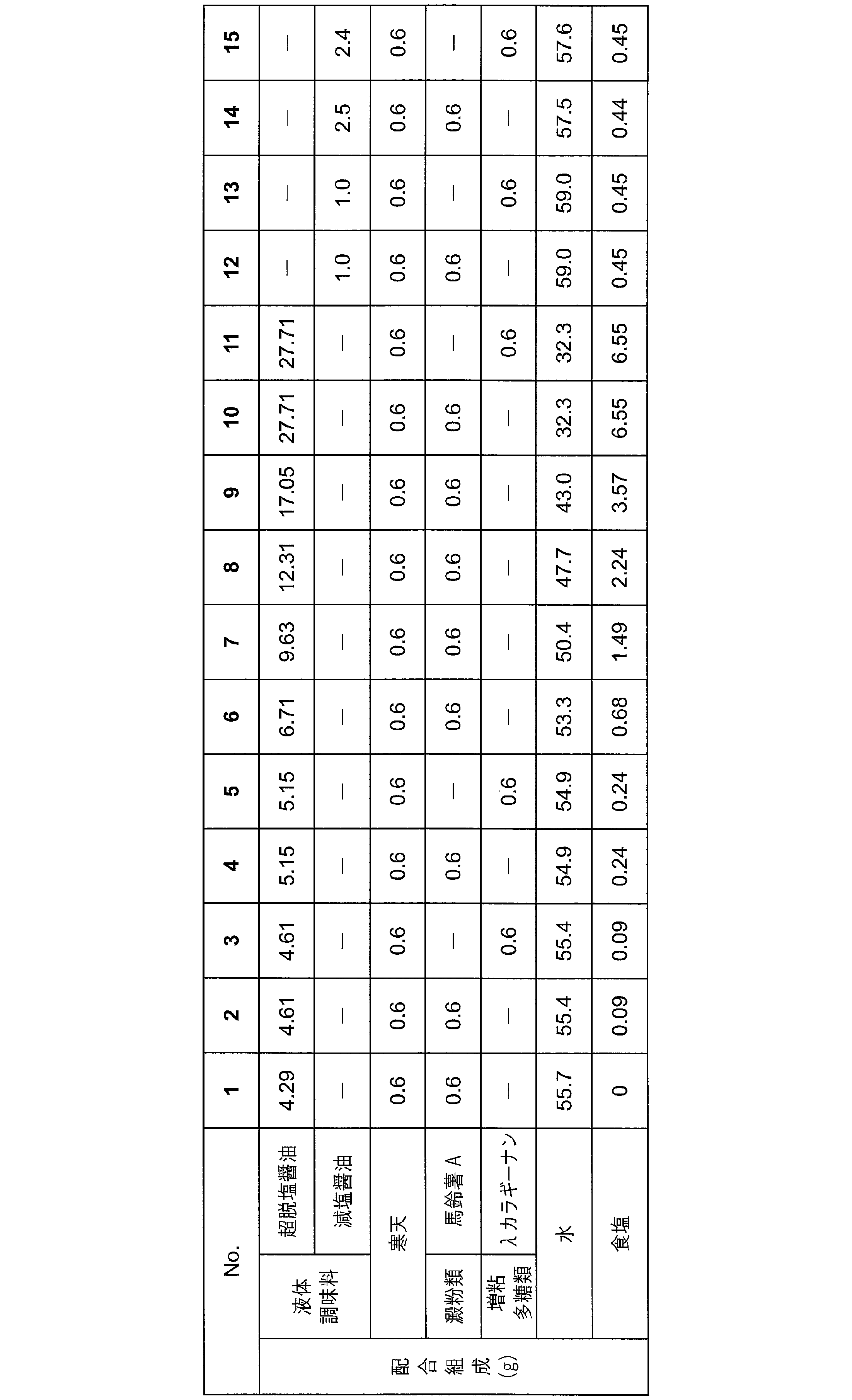
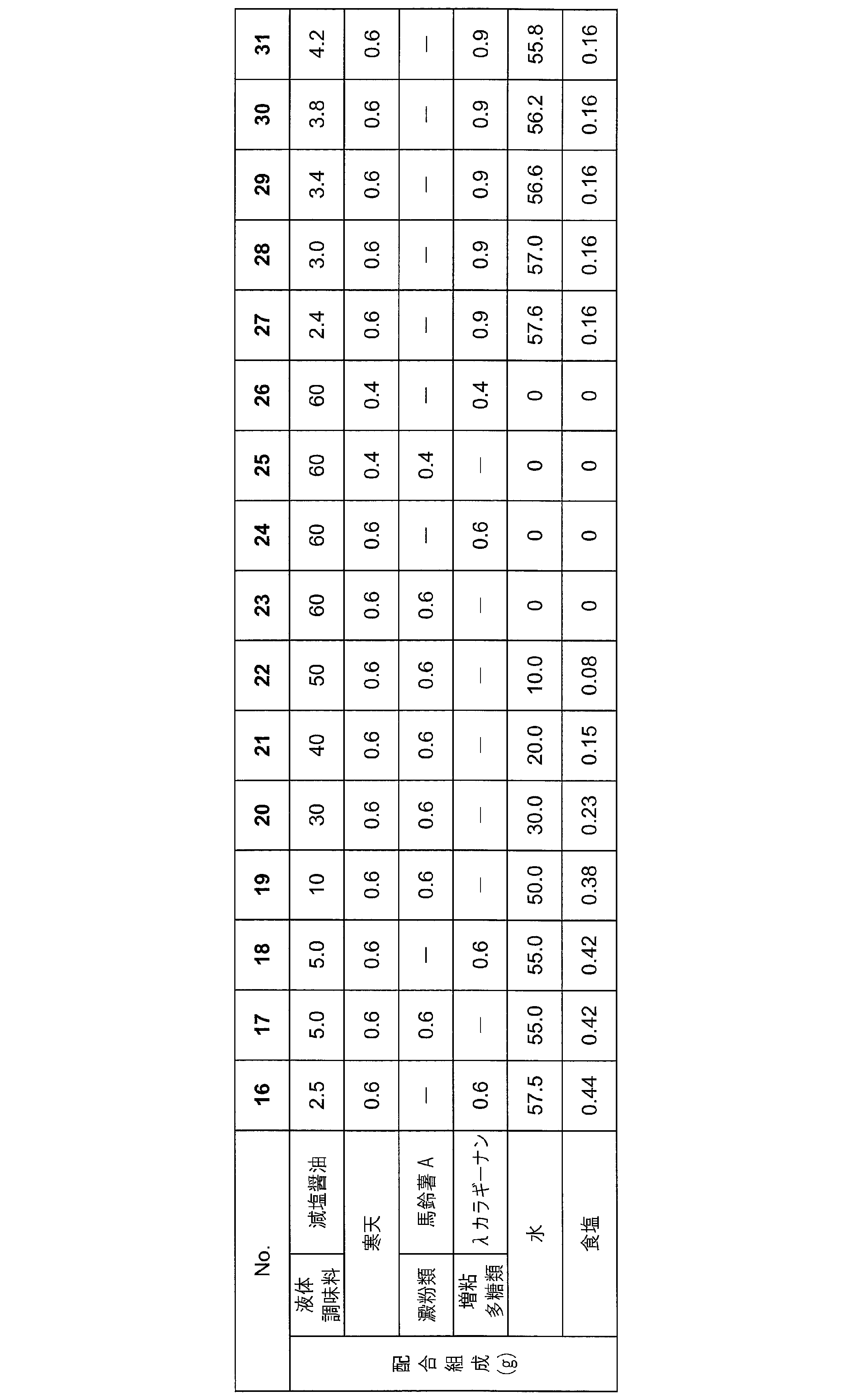
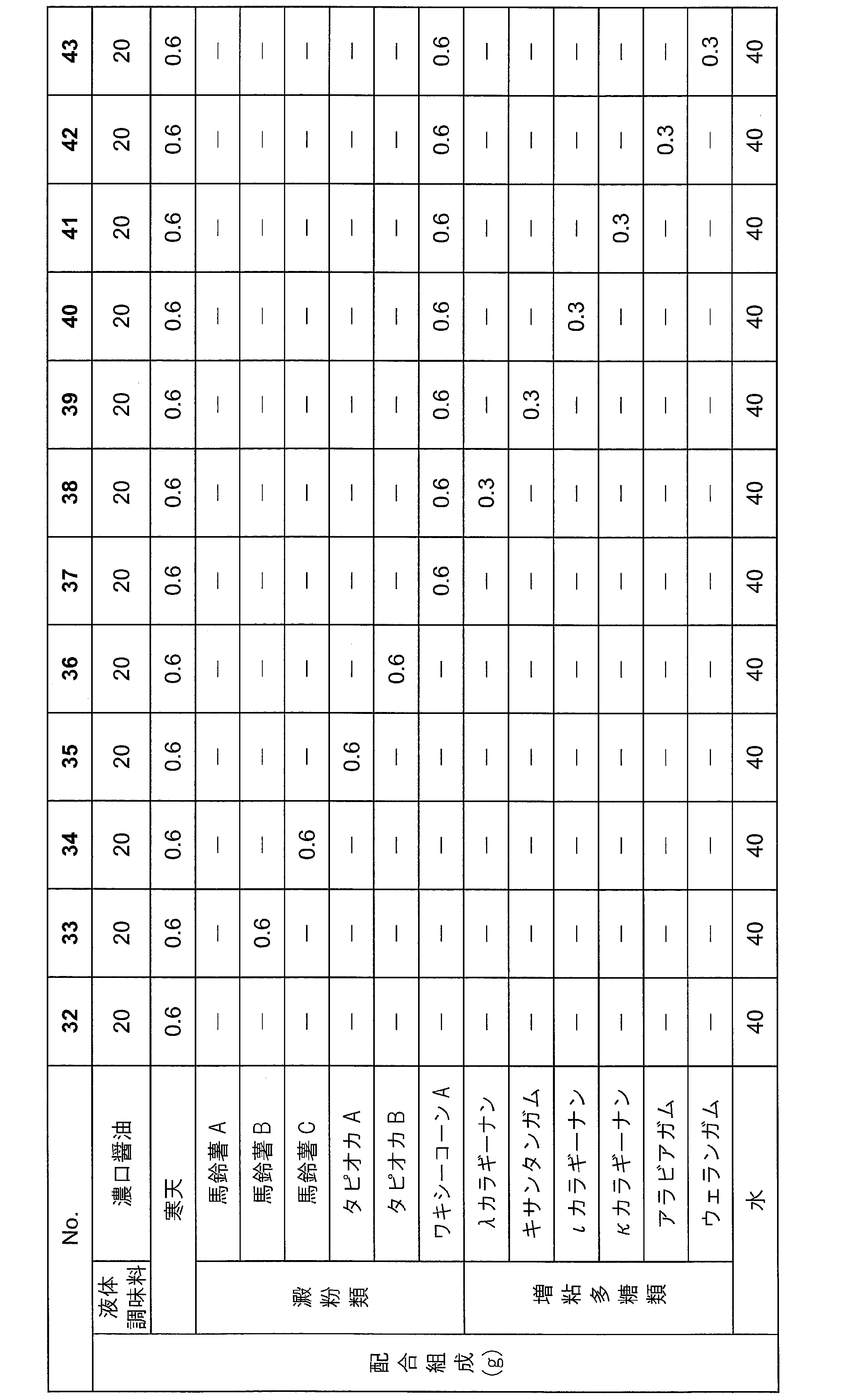
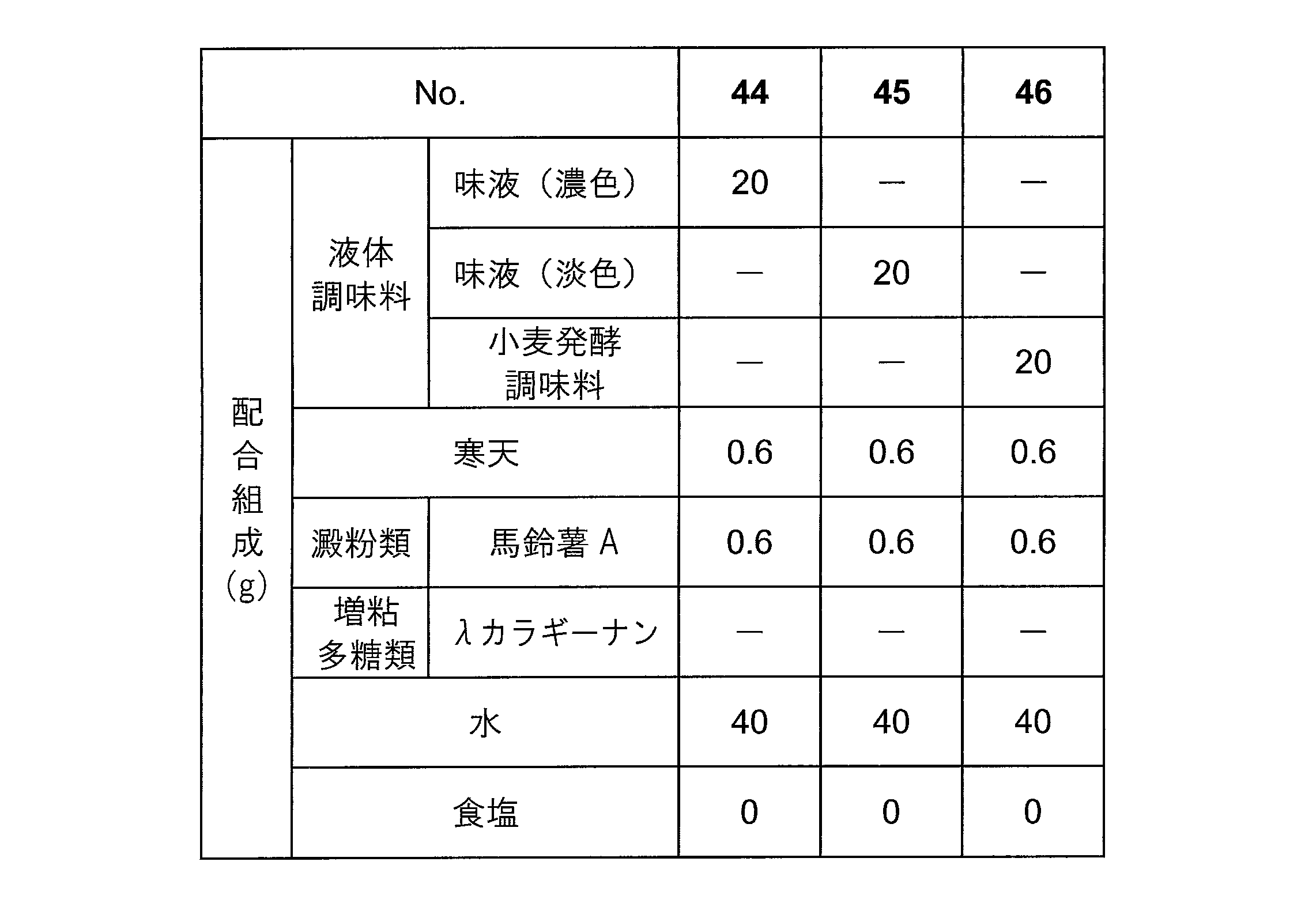
なお、上記表1に示す「超脱塩醤油」は、市販の醤油(キッコーマン食品株式会社製)を塩分が4%以下になるよう脱塩処理したものであり、表1,2に示す「減塩醤油」はキッコーマン食品株式会社製 キッコーマン減塩しょうゆであり、表3に示す「濃口醤油」は、キッコーマン食品株式会社製 キッコーマンPこいくちしょうゆである。また、表4に示す「味液」は、味の素株式会社製のアミノ酸液であり、「小麦発酵調味料」は、キッコーマン食品株式会社製 発酵うまみ調味料Fである。
一方、上記表1~4に示す澱粉類の「馬鈴薯A」は馬鈴薯の造粒生澱粉、「馬鈴薯B」は馬鈴薯澱粉をヒドロキシプロピル化リン酸架橋したもの、「馬鈴薯C」は馬鈴薯澱粉をアセチル化リン酸架橋したもの、「タピオカA」はタピオカ澱粉をヒドロキシプロピル化リン酸架橋したもの、「タピオカB」はタピオカ澱粉をアセチル化リン酸架橋したもの、「ワキシーコーンA」はワキシーコーン澱粉をアセチル化アジピン酸架橋したものである。
<試料の作製>
液体調味料と水の混合溶液に寒天などの粉末原料を添加し撹拌した後、容器を湯煎にかけて液温が85℃になるまで加熱しながら撹拌し、粉末原料を溶解させた。その後、湯煎から容器を取り出し、調製した調味料組成物30gを、底面が136cm2のトレイに流し込み、厚さを均一にして、凝固するまで室温で冷却した。更に、凝固物を別のトレイに移し、通風乾燥機を用いて、80℃の温度条件下で、2時間乾燥させて、シート状成形体を得た。
液体調味料と水の混合溶液に寒天などの粉末原料を添加し撹拌した後、容器を湯煎にかけて液温が85℃になるまで加熱しながら撹拌し、粉末原料を溶解させた。その後、湯煎から容器を取り出し、調製した調味料組成物30gを、底面が136cm2のトレイに流し込み、厚さを均一にして、凝固するまで室温で冷却した。更に、凝固物を別のトレイに移し、通風乾燥機を用いて、80℃の温度条件下で、2時間乾燥させて、シート状成形体を得た。
<評価方法>
(1)風味
液体調味料本来の風味は、専門パネル2名(訓練期間:10~39年)により官能試験を行い、香り、旨み、塩味、摂食した際にパネルが感じた味に関するコメントにより評価した。具体的には、「香り」、「旨み」、「塩味」については、実施例及び比較例の各シート状成形体を約1g摂食し、2名とも用いた液体調味料に近いと判断したものを○(良)、1名だけ液体調味料に近いと判断したものを△(可)、2名とも液体調味料から遠いと判断したものを×(不可)とした。また、「味に関するコメント」において、えぐみが強いとされたものは、液体調味料本来の風味を有しないため、総合評価において×(不可)とした。
(1)風味
液体調味料本来の風味は、専門パネル2名(訓練期間:10~39年)により官能試験を行い、香り、旨み、塩味、摂食した際にパネルが感じた味に関するコメントにより評価した。具体的には、「香り」、「旨み」、「塩味」については、実施例及び比較例の各シート状成形体を約1g摂食し、2名とも用いた液体調味料に近いと判断したものを○(良)、1名だけ液体調味料に近いと判断したものを△(可)、2名とも液体調味料から遠いと判断したものを×(不可)とした。また、「味に関するコメント」において、えぐみが強いとされたものは、液体調味料本来の風味を有しないため、総合評価において×(不可)とした。
なお、官能試験を実施するにあたり、専用パネルに対して、本評価項目の討議と評価訓練を行った。具体的には、各評価項目の特性に対しては、パネル間で討議してもらい、すり合わせを行うことで、各パネリストが共通認識を持つようにした。また、官能試験の妥当性を担保するために、いくつかの調味料成形体を用いて、本パネルに評価訓練をさせ、各パネリストにおける評価の再現性を確認した。これらを行った後、本パネルを用いて、実施例及び比較例のサンプルについて官能試験を行った。
(2)柔軟性
柔軟性は、実施例及び比較例の各シート状成形体から縦3cm、横1cmの大きさの試料を切り出し、その試料の両端を手で持って折り曲げたときの状態で評価した。具体的には、V字状に折り曲げることができたものを○(良)、U字状に折り曲げることはできたが、V字状に(折り目を付けるように)折り曲げると割れたものを△(可)、折り曲げることができずに割れたものを×(不可)とした。
柔軟性は、実施例及び比較例の各シート状成形体から縦3cm、横1cmの大きさの試料を切り出し、その試料の両端を手で持って折り曲げたときの状態で評価した。具体的には、V字状に折り曲げることができたものを○(良)、U字状に折り曲げることはできたが、V字状に(折り目を付けるように)折り曲げると割れたものを△(可)、折り曲げることができずに割れたものを×(不可)とした。
(3)液体成分の浸みだし
液体成分の浸みだしは、実施例及び比較例の各シート状成形体を、温度が25~27℃、相対湿度が70~75%の条件下に2.5時間静置した後、各シート状成形体の上に濾紙を置き、指で軽く押し当てた後、濾紙への醤油の浸みだし(付着)の有無を確認した。その結果、濾紙に醤油の付着が認められなかったものを○(良)、濾紙に斑点状に醤油が付着していたものを△(可)、濾紙のシート状成形体が載置されていた部分全面に醤油が付着していたものを×(不可)とした。
液体成分の浸みだしは、実施例及び比較例の各シート状成形体を、温度が25~27℃、相対湿度が70~75%の条件下に2.5時間静置した後、各シート状成形体の上に濾紙を置き、指で軽く押し当てた後、濾紙への醤油の浸みだし(付着)の有無を確認した。その結果、濾紙に醤油の付着が認められなかったものを○(良)、濾紙に斑点状に醤油が付着していたものを△(可)、濾紙のシート状成形体が載置されていた部分全面に醤油が付着していたものを×(不可)とした。
(4)含水率
実施例及び比較例の各シート状成形体から1~2g程度の試料を切り出し、それを減圧下にて、60℃の温度条件で3時間加熱して、加熱前後の質量変化量を測定した。そして、この質量変化量を水分量として、各シート状成形体の含水率を算出した。
実施例及び比較例の各シート状成形体から1~2g程度の試料を切り出し、それを減圧下にて、60℃の温度条件で3時間加熱して、加熱前後の質量変化量を測定した。そして、この質量変化量を水分量として、各シート状成形体の含水率を算出した。
(5)乾燥固形分中の塩分量
乾燥固形分中の塩分量は、表1~4に示す各原料の配合量から算出した。具体的には、実施例及び比較例の各シート状成形体の作製に用いた醤油、塩、その他の調味料に含まれる塩分量を計算により求め、それを別途算出したその他の成分(寒天、澱粉類、増粘多糖類など)も含む乾燥固形分量で除して求めた。
乾燥固形分中の塩分量は、表1~4に示す各原料の配合量から算出した。具体的には、実施例及び比較例の各シート状成形体の作製に用いた醤油、塩、その他の調味料に含まれる塩分量を計算により求め、それを別途算出したその他の成分(寒天、澱粉類、増粘多糖類など)も含む乾燥固形分量で除して求めた。
(6)乾燥固形分中の寒天・澱粉類・増粘多糖類の総量
乾燥固形分中の寒天・澱粉類・増粘多糖類の総量は、表1~4に示す各原料の配合量から算出した。具体的には、実施例及び比較例の各シート状成形体の作製に用いた寒天、澱粉類及び増粘多糖類の乾燥質量を計算により求め、それを別途算出したその他の成分(液体調味料や塩分など)も含む乾燥固形分量で除して求めた。
乾燥固形分中の寒天・澱粉類・増粘多糖類の総量は、表1~4に示す各原料の配合量から算出した。具体的には、実施例及び比較例の各シート状成形体の作製に用いた寒天、澱粉類及び増粘多糖類の乾燥質量を計算により求め、それを別途算出したその他の成分(液体調味料や塩分など)も含む乾燥固形分量で除して求めた。
(7)乾燥固形分中の全窒素量
乾燥固形分中の全窒素量は、表1~4に示す各原料の配合量から算出した。具体的には、実施例及び比較例の各シート状成形体の作製に用いた液体調味料に含まれる窒素量を計算により求め、それを別途算出したその他の成分(寒天、澱粉類、増粘多糖類、塩分など)も含む乾燥固形分量で除して求めた。
乾燥固形分中の全窒素量は、表1~4に示す各原料の配合量から算出した。具体的には、実施例及び比較例の各シート状成形体の作製に用いた液体調味料に含まれる窒素量を計算により求め、それを別途算出したその他の成分(寒天、澱粉類、増粘多糖類、塩分など)も含む乾燥固形分量で除して求めた。
以上の結果を、下記表5~9にまとめて示す。

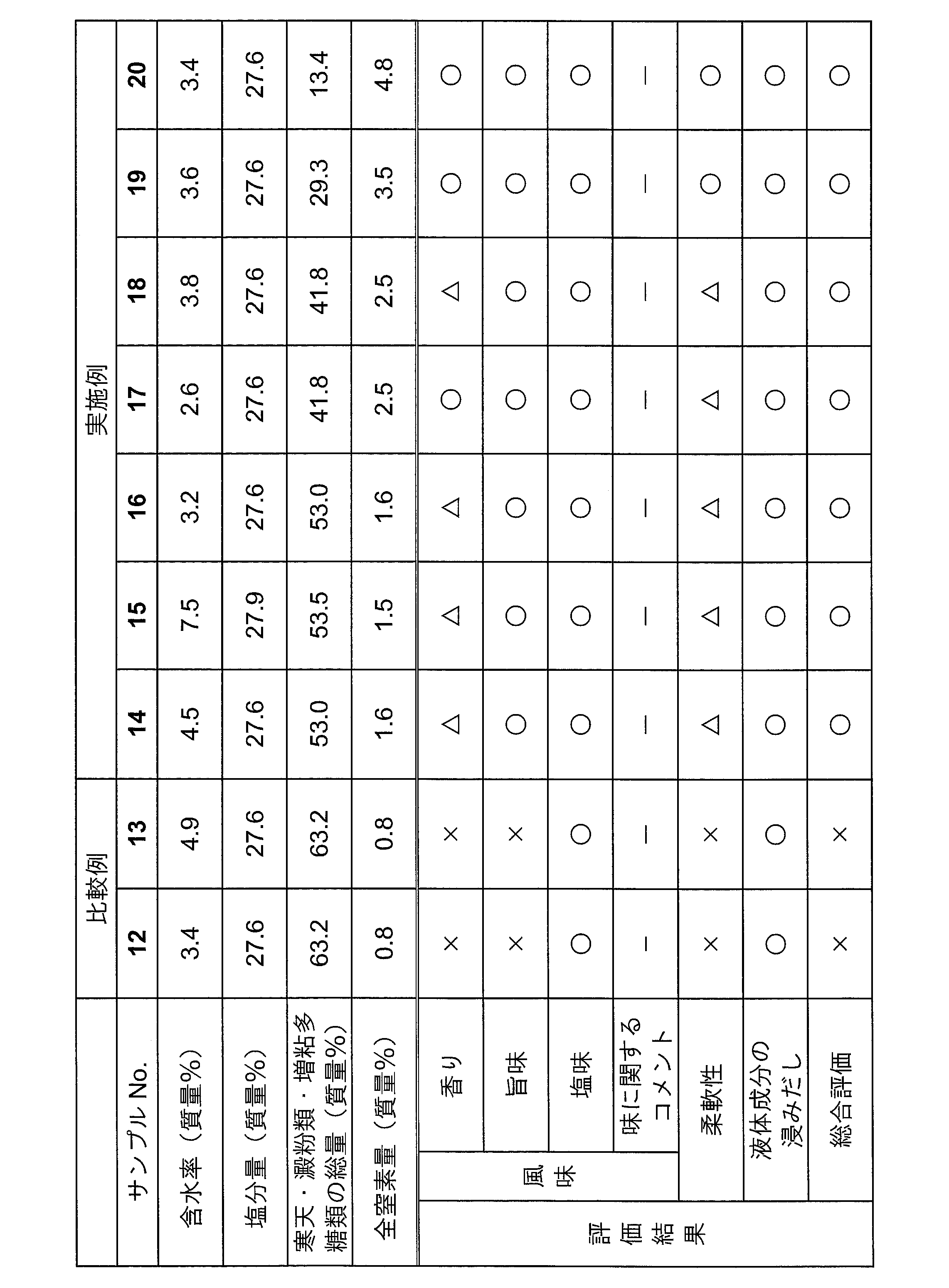
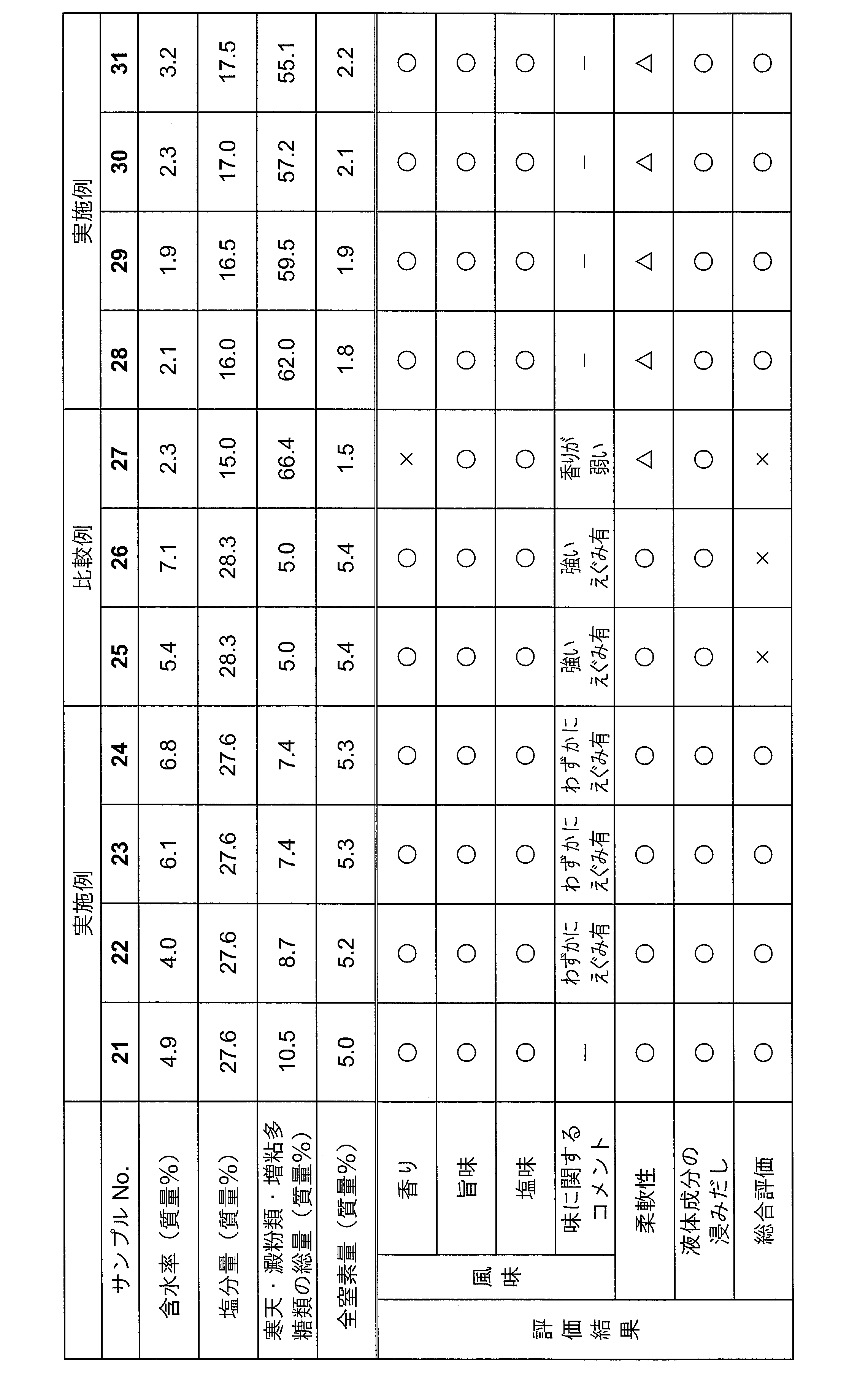
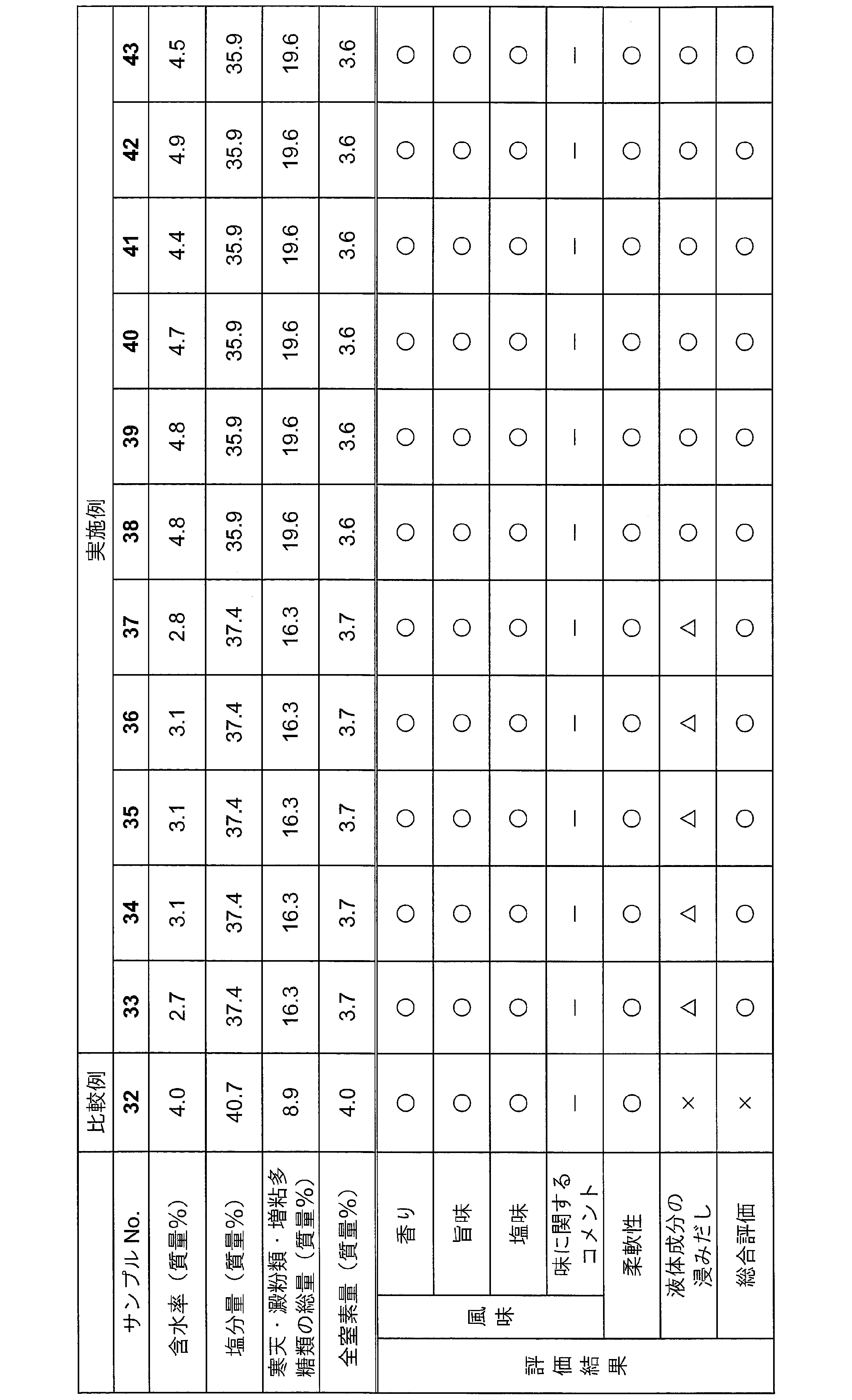

表5に示すNo.1~3の成形体は、塩分量が本発明の範囲よりも低いため醤油本来の風味が失われていた。一方、塩分量が本発明の範囲を超えているNo.10,11の成形体は、塩味がかなり強く、醤油本来の風味は得られなかった。また、表6に示すNo.12,13の成形体は、寒天・澱粉類・増粘多糖類の総量が本発明の範囲を超えているため、柔軟性がなく、折り曲げると割れてしまった。更に、No.12,13の成形体は、全窒素量が低いため、醤油本来の風味も有しないものであった。
表7に示すNo.25,26の成形体は、寒天・澱粉類・増粘多糖類の総量が本発明の範囲に満たないが、シート状成形体の形成は可能であった。しかし、これらの成形体は、全窒素量が高く、強いえぐみがあり、醤油本来の風味が得られなかった。一方、寒天・澱粉類・増粘多糖類の総量が本発明の範囲を超えているNo.27の成形体は、香りが低減していた。また、表8に示すNo.32の成形体は、寒天のみを配合し、澱粉類及び増粘多糖類を含有していないため、全面から醤油の浸みだしが確認された。
これに対して、本発明の実施例であるNo.4~9,14~24,28~31,33~43の成形体は、醤油本来の風味を有し、柔軟性があり、液体成分の浸みだしもほとんどみられなかった。また、表9に示す醤油以外の液体調味料を用いた実施例No.44~46の成形体も同様に、調味料本来の風味を有し、柔軟性があり、液体成分の浸みだしもほとんどみられなかった。
(第2実施例)
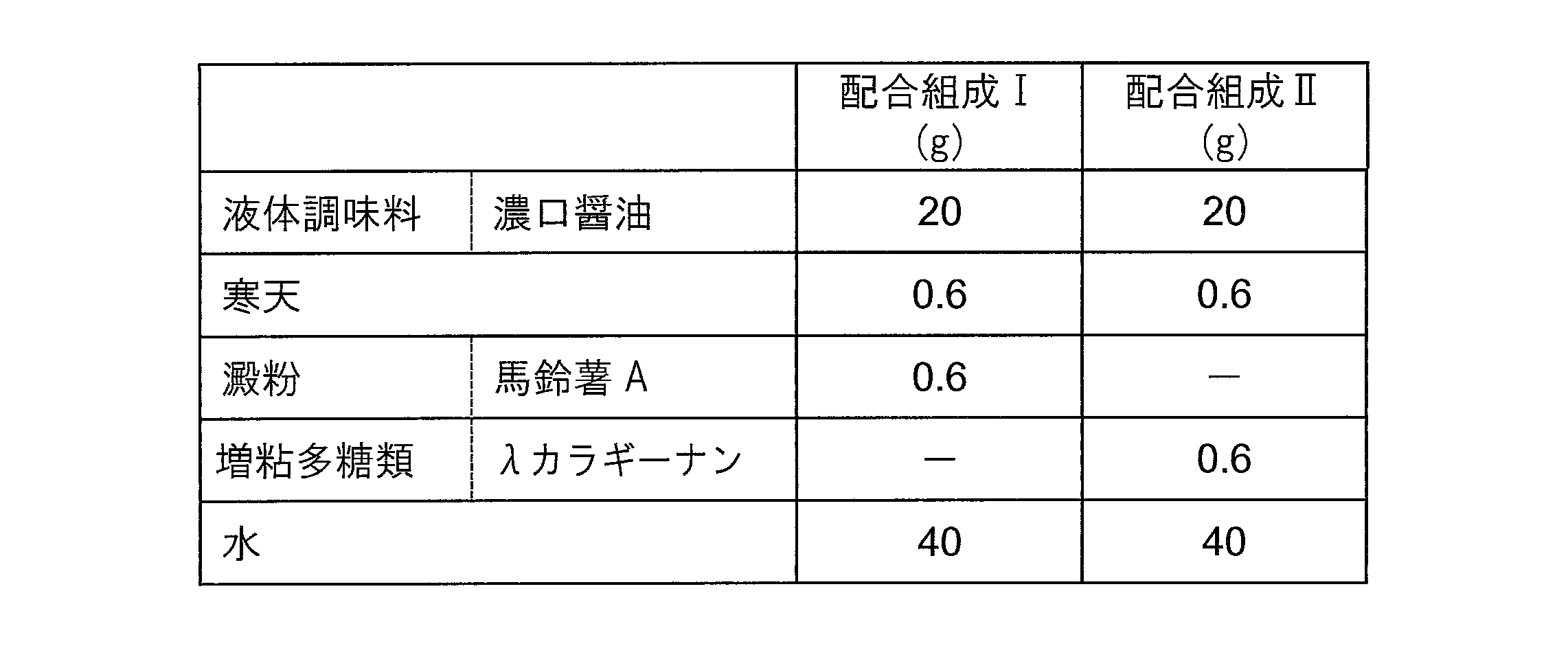
次に、本発明の第2実施例として、下記表10に示す配合組成I,IIで、含水率が異なるシート状の調味料成形体を作製し、「柔軟性」及び「液体成分の浸みだし」について評価した。
次に、本発明の第2実施例として、下記表10に示す配合組成I,IIで、含水率が異なるシート状の調味料成形体を作製し、「柔軟性」及び「液体成分の浸みだし」について評価した。
<試料の作製>
前述した第1実施例と同様の方法で作製したシート状成形体を、更に、60℃の温度条件下で3時間減圧乾燥し、水分量が0%の試料を得た。これを、温度が27.1℃、相対湿度が70~75%の環境下に一定時間放置して吸湿させ、含水量が異なるシート状成形体を得た。
前述した第1実施例と同様の方法で作製したシート状成形体を、更に、60℃の温度条件下で3時間減圧乾燥し、水分量が0%の試料を得た。これを、温度が27.1℃、相対湿度が70~75%の環境下に一定時間放置して吸湿させ、含水量が異なるシート状成形体を得た。
前述した方法で作製したNo.101~121の成形体を、第1実施例と同様の方法で評価した。各調味料成形体の塩分量、寒天・澱粉類・増粘多糖類の総量、全窒素量については、各シート状成形体の作製に用いた原料から、塩分量、寒天・増粘多糖類の総量、窒素量を計算により求め、水分を含む調味料成形体の質量で除することで算出した。配合組成Iの結果を下記表11に、配合組成IIの結果を下記表12にそれぞれ示す。
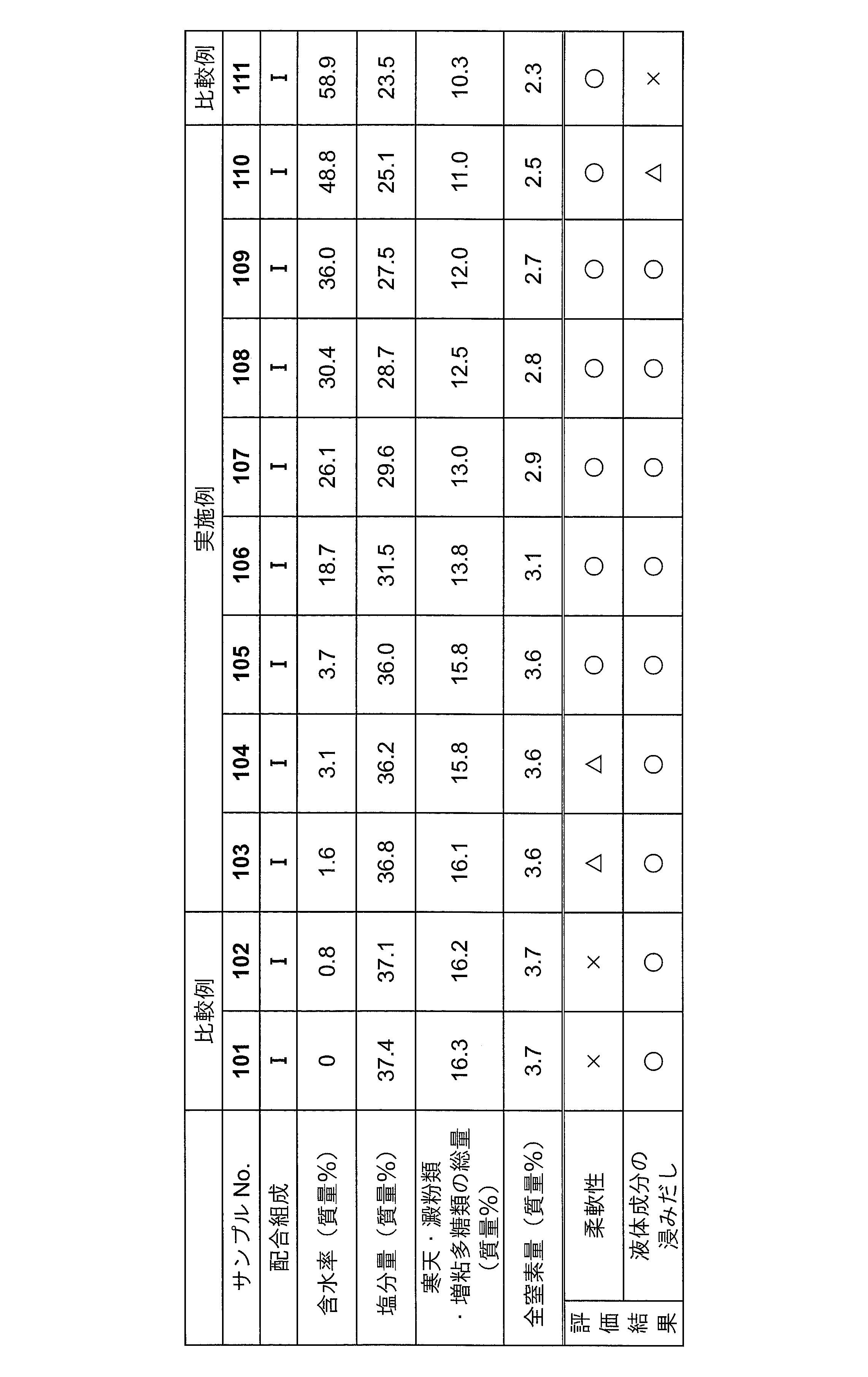
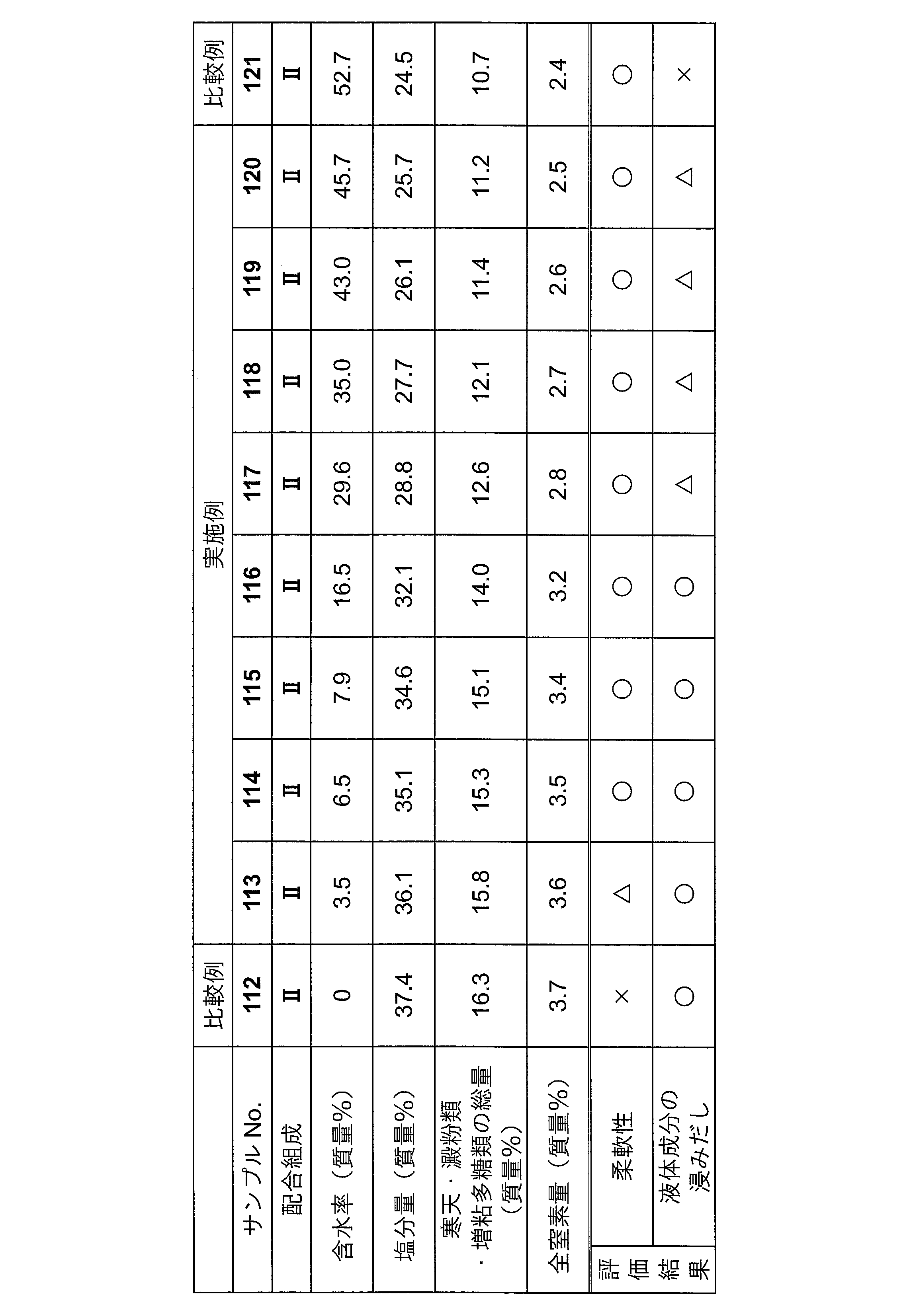
上記表11,12に示すように、含水率が本発明の範囲に満たないNo.101,102,112の成形体は、柔軟性がなく、折り曲げることができなかった。一方、含水率が本発明の範囲を超えているNo.111,121の成形体は、全面から醤油の浸みだしが確認された。これに対して、本発明の実施例であるNo.103~110,113~120の成形体は、柔軟で、液体成分の浸みだしはほとんどなかった。
(第3実施例)
次に、本発明の第3実施例として、前述した第1実施例及び第2実施例で作製した調味料成形体の一部、並びに下記表13に示す配合組成で、厚さを変えて作製したシート状の調味料成形体(サンプルNo.201~209)について、破断歪率を測定し、柔軟性との関係を調べた。
次に、本発明の第3実施例として、前述した第1実施例及び第2実施例で作製した調味料成形体の一部、並びに下記表13に示す配合組成で、厚さを変えて作製したシート状の調味料成形体(サンプルNo.201~209)について、破断歪率を測定し、柔軟性との関係を調べた。

<評価方法>
(1)破断歪率
破断歪率の測定は、クリープメータ(株式会社山電製 RE2-33005)により、2kgf(19.62N)のロードセル(株式会社山電製)及び直径1mmの円柱型プランジャーを用いて行った。具体的には、測定対象のシート状成形体を、外直径48mm、孔径10mmのプランジャーガイドで挟んでクリープメータに設置し、プランジャーの押し込み距離(設定値)を15mmとし、成形体上方から1mm/秒の速度でプランジャーを押し込み、成形体が破断するまでの距離を測定した。その測定結果を用いて、解析ソフトウエア(破断強度解析 BAS-3305W ver.1.2(α))により、各成形体の破断歪率を算出した。
(1)破断歪率
破断歪率の測定は、クリープメータ(株式会社山電製 RE2-33005)により、2kgf(19.62N)のロードセル(株式会社山電製)及び直径1mmの円柱型プランジャーを用いて行った。具体的には、測定対象のシート状成形体を、外直径48mm、孔径10mmのプランジャーガイドで挟んでクリープメータに設置し、プランジャーの押し込み距離(設定値)を15mmとし、成形体上方から1mm/秒の速度でプランジャーを押し込み、成形体が破断するまでの距離を測定した。その測定結果を用いて、解析ソフトウエア(破断強度解析 BAS-3305W ver.1.2(α))により、各成形体の破断歪率を算出した。
(2)厚さ
評価に用いた各成形体の厚さは、マイクロメータ(株式会社ミツトヨ製 MDC-25PXT)を用いて実測した。
評価に用いた各成形体の厚さは、マイクロメータ(株式会社ミツトヨ製 MDC-25PXT)を用いて実測した。
以上の結果を下記表14及び表15に示す。なお、表14及び表15では、参考のために第1実施例と同様の方法で行った柔軟性の評価結果も併せて示す。
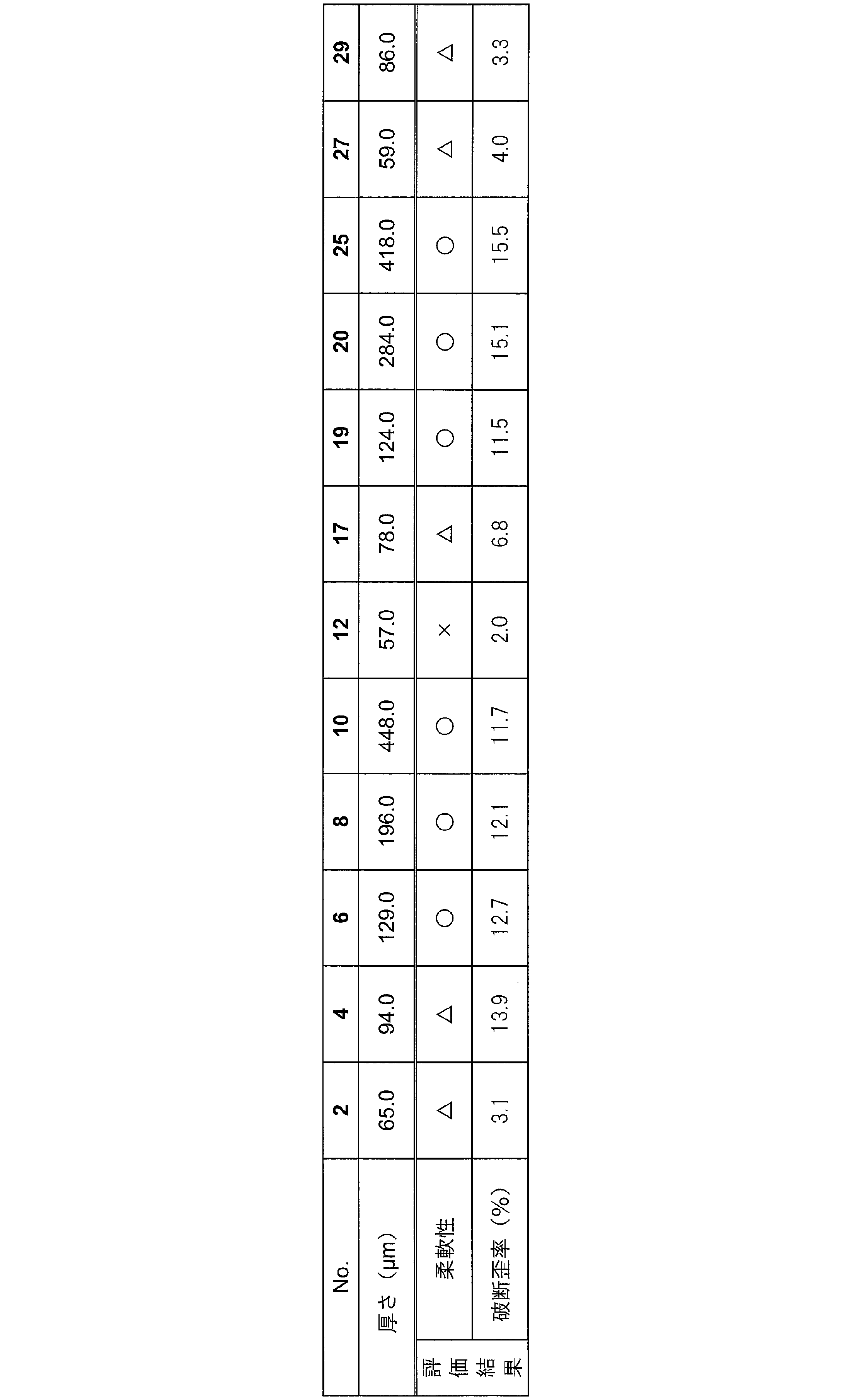

上記表14及び表15に示すように、破断歪率が3.1%以上である成形体は、柔軟性が良好であった。
(第4実施例)
次に、本発明の第4実施例として、液体調味料の種類を変えて、それ以外は前述した第1~第3実施例と同様の方法で調味料成形体を作製した。下記表16及び表17に各成形体の配合組成を示す。
次に、本発明の第4実施例として、液体調味料の種類を変えて、それ以外は前述した第1~第3実施例と同様の方法で調味料成形体を作製した。下記表16及び表17に各成形体の配合組成を示す。


次に、サンプルNo.301~316の成形体を、前述した第1~第3実施例と同様の方法及び条件で評価した。その結果を、下記表18及び表19に示す。


上記表18及び表19に示すように、醤油以外の液体調味料を用いた場合でも、含水率と、乾燥固形分中の塩分量と、寒天、澱粉類及び/又は増粘多糖類の総量を特定の範囲にすることで、風味が良好で、柔軟性を有し、液体成分の浸みだしがない調味料成形体が得られることが確認された。一方、塩分量が本発明の範囲に満たないNo.309,311,315の成形体は、柔軟性及び液体成分の浸みだしについてはその他の成形体と同等であったが、塩味が弱く、調味料としては不適であった。
以上の結果から、本発明によれば、液体調味料本来の風味を有し、取り扱い性に優れ、そのままの状態で食することが可能な調味料成形体を実現できることが確認された。
1、2 調味料成形体
Claims (8)
- 液体調味料と、
寒天と、
澱粉類及び増粘多糖類のいずれか一方又は両方と、
を含有し、
含水率が1.6~48.8質量%であり、
乾燥固形分全質量あたり、塩分量が15~45質量%であり、かつ前記寒天、前記澱粉類及び前記増粘多糖類の総量が7.4~62.0質量%である調味料成形体。 - 前記液体調味料が醤油である請求項1に記載の調味料成形体。
- 乾燥固形分中の全窒素量が1.5~5.3質量%である請求項2に記載の調味料成形体。
- 厚さ5mm以下のシート状成形体である請求項1~3のいずれか1項に記載の調味料成形体。
- クリープメータにより直径1mmの円柱型プランジャーを用いて、押し込み距離を15mmとして測定した破断歪率が3.1%以上である請求項1~4のいずれか1項に記載の調味料成形体。
- 請求項1~5のいずれか1項に記載の調味料成形体を用いた食品。
- 液体調味料:100質量部に対して、水:0~2440質量部と、寒天:1~25.4質量部と、澱粉類:1~24質量部及び増粘多糖類:1~30質量部のいずれか一方又は両方とを配合して調味料組成物を調製する工程と、
前記調味料組成物を、所定形状に成形した後又は成形しながら乾燥して、含水率が1.6~48.8質量%であり、乾燥固形分全質量あたり、塩分量が15~45質量%であり、かつ前記寒天、前記澱粉類及び前記増粘多糖類の総量が7.4~62.0質量%である調味料成形体を得る工程と、
を有する調味料成形体の製造方法。 - 前記液体調味料として醤油を使用し、乾燥固形分中の全窒素量が1.5~5.3質量%である調味料成形体を得る請求項7に記載の調味料成形体の製造方法。
Priority Applications (1)
| Application Number | Priority Date | Filing Date | Title |
|---|---|---|---|
| JP2018525489A JP6434194B2 (ja) | 2016-12-05 | 2017-12-05 | 調味料成形体、食品及び調味料成形体の製造方法 |
Applications Claiming Priority (2)
| Application Number | Priority Date | Filing Date | Title |
|---|---|---|---|
| JP2016-235610 | 2016-12-05 | ||
| JP2016235610 | 2016-12-05 |
Publications (1)
| Publication Number | Publication Date |
|---|---|
| WO2018105604A1 true WO2018105604A1 (ja) | 2018-06-14 |
Family
ID=62491921
Family Applications (1)
| Application Number | Title | Priority Date | Filing Date |
|---|---|---|---|
| PCT/JP2017/043623 Ceased WO2018105604A1 (ja) | 2016-12-05 | 2017-12-05 | 調味料成形体、食品及び調味料成形体の製造方法 |
Country Status (2)
| Country | Link |
|---|---|
| JP (1) | JP6434194B2 (ja) |
| WO (1) | WO2018105604A1 (ja) |
Cited By (1)
| Publication number | Priority date | Publication date | Assignee | Title |
|---|---|---|---|---|
| JP7601561B2 (ja) | 2020-03-31 | 2024-12-17 | キッコーマン株式会社 | 調味料成形体及び食品 |
Citations (4)
| Publication number | Priority date | Publication date | Assignee | Title |
|---|---|---|---|---|
| JPS6019478A (ja) * | 1983-07-11 | 1985-01-31 | Osaka Kagaku Gokin Kk | 醤油フイルム及びその製造法 |
| JPH09504700A (ja) * | 1993-11-08 | 1997-05-13 | クウエスト・インターナシヨナル・ベー・ベー | ゲル化バイオポリマーの懸濁液 |
| JP2007195518A (ja) * | 2006-01-30 | 2007-08-09 | Bioenvelop Agro Inc | 調味料シート及びその製造方法 |
| JP2013066433A (ja) * | 2011-09-22 | 2013-04-18 | Keiwa Inc | 調味料シート及び調味料シートの製造方法 |
-
2017
- 2017-12-05 WO PCT/JP2017/043623 patent/WO2018105604A1/ja not_active Ceased
- 2017-12-05 JP JP2018525489A patent/JP6434194B2/ja active Active
Patent Citations (4)
| Publication number | Priority date | Publication date | Assignee | Title |
|---|---|---|---|---|
| JPS6019478A (ja) * | 1983-07-11 | 1985-01-31 | Osaka Kagaku Gokin Kk | 醤油フイルム及びその製造法 |
| JPH09504700A (ja) * | 1993-11-08 | 1997-05-13 | クウエスト・インターナシヨナル・ベー・ベー | ゲル化バイオポリマーの懸濁液 |
| JP2007195518A (ja) * | 2006-01-30 | 2007-08-09 | Bioenvelop Agro Inc | 調味料シート及びその製造方法 |
| JP2013066433A (ja) * | 2011-09-22 | 2013-04-18 | Keiwa Inc | 調味料シート及び調味料シートの製造方法 |
Cited By (1)
| Publication number | Priority date | Publication date | Assignee | Title |
|---|---|---|---|---|
| JP7601561B2 (ja) | 2020-03-31 | 2024-12-17 | キッコーマン株式会社 | 調味料成形体及び食品 |
Also Published As
| Publication number | Publication date |
|---|---|
| JP6434194B2 (ja) | 2018-12-05 |
| JPWO2018105604A1 (ja) | 2018-12-13 |
Similar Documents
| Publication | Publication Date | Title |
|---|---|---|
| EP3349595B1 (en) | Savoury concentrates with a flowable texture based on two starches | |
| CN103652628A (zh) | 冷冻烹调过的面类及其制造方法 | |
| JP5797441B2 (ja) | 容器入り液状又はペースト状食品組成物、及びその製造方法 | |
| JP6512627B2 (ja) | パン粉付けフライ食品用バッターミックス、バッター、及びパン粉付けフライ食品 | |
| EP3200614B1 (en) | Food concentrate | |
| KR101315826B1 (ko) | 코팅된 해산물을 포함하는 레토르트 식품의 제조방법 및 이에 의해 제조된 레토르트 식품 | |
| JP6434194B2 (ja) | 調味料成形体、食品及び調味料成形体の製造方法 | |
| JP6053420B2 (ja) | 容器入り液状又はペースト状食品組成物 | |
| AU2015327264B2 (en) | Food concentrate | |
| AU2015366444A1 (en) | Savoury concentrates with a jellified texture based on leguminous starch | |
| JP7312436B2 (ja) | 餅様食品 | |
| JP5839537B2 (ja) | サラダ | |
| JP7134604B2 (ja) | 液状調味料 | |
| JP4642806B2 (ja) | 乾燥澱粉麺様食品及びその製造方法 | |
| JP7781500B2 (ja) | カルボナーラ風ソース | |
| WO2014046258A1 (ja) | 容器入り液状又はペースト状又は冷凍食品組成物並びにその製造方法 | |
| JP5654548B2 (ja) | 冷凍クリームソース、および冷凍食品 | |
| JP7488019B2 (ja) | 容器入り液状又はペースト状食品組成物とその製造方法 | |
| JP5875792B2 (ja) | 油揚げ風食品用の衣組成物及び惣菜用材料セット | |
| JP2012139126A (ja) | 加熱殺菌済流動状食品 | |
| JP2021078444A (ja) | 経口組成物 | |
| JP2012217341A (ja) | 風味が向上したカレー、シチュー類又はソース類 | |
| HK40027151A (en) | Ingredient-containing seasoning and method for manufacturing same |
Legal Events
| Date | Code | Title | Description |
|---|---|---|---|
| ENP | Entry into the national phase |
Ref document number: 2018525489 Country of ref document: JP Kind code of ref document: A |
|
| 121 | Ep: the epo has been informed by wipo that ep was designated in this application |
Ref document number: 17878923 Country of ref document: EP Kind code of ref document: A1 |
|
| NENP | Non-entry into the national phase |
Ref country code: DE |
|
| 122 | Ep: pct application non-entry in european phase |
Ref document number: 17878923 Country of ref document: EP Kind code of ref document: A1 |