WO2018088052A1 - ポジ型感光性樹脂組成物及びチタンブラック分散液 - Google Patents
ポジ型感光性樹脂組成物及びチタンブラック分散液 Download PDFInfo
- Publication number
- WO2018088052A1 WO2018088052A1 PCT/JP2017/035021 JP2017035021W WO2018088052A1 WO 2018088052 A1 WO2018088052 A1 WO 2018088052A1 JP 2017035021 W JP2017035021 W JP 2017035021W WO 2018088052 A1 WO2018088052 A1 WO 2018088052A1
- Authority
- WO
- WIPO (PCT)
- Prior art keywords
- group
- titanium black
- positive photosensitive
- photosensitive resin
- mass
- Prior art date
- Legal status (The legal status is an assumption and is not a legal conclusion. Google has not performed a legal analysis and makes no representation as to the accuracy of the status listed.)
- Ceased
Links
Classifications
-
- G—PHYSICS
- G03—PHOTOGRAPHY; CINEMATOGRAPHY; ANALOGOUS TECHNIQUES USING WAVES OTHER THAN OPTICAL WAVES; ELECTROGRAPHY; HOLOGRAPHY
- G03F—PHOTOMECHANICAL PRODUCTION OF TEXTURED OR PATTERNED SURFACES, e.g. FOR PRINTING, FOR PROCESSING OF SEMICONDUCTOR DEVICES; MATERIALS THEREFOR; ORIGINALS THEREFOR; APPARATUS SPECIALLY ADAPTED THEREFOR
- G03F7/00—Photomechanical, e.g. photolithographic, production of textured or patterned surfaces, e.g. printing surfaces; Materials therefor, e.g. comprising photoresists; Apparatus specially adapted therefor
- G03F7/004—Photosensitive materials
-
- G—PHYSICS
- G03—PHOTOGRAPHY; CINEMATOGRAPHY; ANALOGOUS TECHNIQUES USING WAVES OTHER THAN OPTICAL WAVES; ELECTROGRAPHY; HOLOGRAPHY
- G03F—PHOTOMECHANICAL PRODUCTION OF TEXTURED OR PATTERNED SURFACES, e.g. FOR PRINTING, FOR PROCESSING OF SEMICONDUCTOR DEVICES; MATERIALS THEREFOR; ORIGINALS THEREFOR; APPARATUS SPECIALLY ADAPTED THEREFOR
- G03F7/00—Photomechanical, e.g. photolithographic, production of textured or patterned surfaces, e.g. printing surfaces; Materials therefor, e.g. comprising photoresists; Apparatus specially adapted therefor
- G03F7/004—Photosensitive materials
- G03F7/0042—Photosensitive materials with inorganic or organometallic light-sensitive compounds not otherwise provided for, e.g. inorganic resists
- G03F7/0043—Chalcogenides; Silicon, germanium, arsenic or derivatives thereof; Metals, oxides or alloys thereof
-
- G—PHYSICS
- G03—PHOTOGRAPHY; CINEMATOGRAPHY; ANALOGOUS TECHNIQUES USING WAVES OTHER THAN OPTICAL WAVES; ELECTROGRAPHY; HOLOGRAPHY
- G03F—PHOTOMECHANICAL PRODUCTION OF TEXTURED OR PATTERNED SURFACES, e.g. FOR PRINTING, FOR PROCESSING OF SEMICONDUCTOR DEVICES; MATERIALS THEREFOR; ORIGINALS THEREFOR; APPARATUS SPECIALLY ADAPTED THEREFOR
- G03F7/00—Photomechanical, e.g. photolithographic, production of textured or patterned surfaces, e.g. printing surfaces; Materials therefor, e.g. comprising photoresists; Apparatus specially adapted therefor
- G03F7/004—Photosensitive materials
- G03F7/0048—Photosensitive materials characterised by the solvents or agents facilitating spreading, e.g. tensio-active agents
-
- G—PHYSICS
- G03—PHOTOGRAPHY; CINEMATOGRAPHY; ANALOGOUS TECHNIQUES USING WAVES OTHER THAN OPTICAL WAVES; ELECTROGRAPHY; HOLOGRAPHY
- G03F—PHOTOMECHANICAL PRODUCTION OF TEXTURED OR PATTERNED SURFACES, e.g. FOR PRINTING, FOR PROCESSING OF SEMICONDUCTOR DEVICES; MATERIALS THEREFOR; ORIGINALS THEREFOR; APPARATUS SPECIALLY ADAPTED THEREFOR
- G03F7/00—Photomechanical, e.g. photolithographic, production of textured or patterned surfaces, e.g. printing surfaces; Materials therefor, e.g. comprising photoresists; Apparatus specially adapted therefor
- G03F7/004—Photosensitive materials
- G03F7/022—Quinonediazides
- G03F7/023—Macromolecular quinonediazides; Macromolecular additives, e.g. binders
-
- G—PHYSICS
- G03—PHOTOGRAPHY; CINEMATOGRAPHY; ANALOGOUS TECHNIQUES USING WAVES OTHER THAN OPTICAL WAVES; ELECTROGRAPHY; HOLOGRAPHY
- G03F—PHOTOMECHANICAL PRODUCTION OF TEXTURED OR PATTERNED SURFACES, e.g. FOR PRINTING, FOR PROCESSING OF SEMICONDUCTOR DEVICES; MATERIALS THEREFOR; ORIGINALS THEREFOR; APPARATUS SPECIALLY ADAPTED THEREFOR
- G03F7/00—Photomechanical, e.g. photolithographic, production of textured or patterned surfaces, e.g. printing surfaces; Materials therefor, e.g. comprising photoresists; Apparatus specially adapted therefor
- G03F7/004—Photosensitive materials
- G03F7/027—Non-macromolecular photopolymerisable compounds having carbon-to-carbon double bonds, e.g. ethylenic compounds
- G03F7/032—Non-macromolecular photopolymerisable compounds having carbon-to-carbon double bonds, e.g. ethylenic compounds with binders
- G03F7/033—Non-macromolecular photopolymerisable compounds having carbon-to-carbon double bonds, e.g. ethylenic compounds with binders the binders being polymers obtained by reactions only involving carbon-to-carbon unsaturated bonds, e.g. vinyl polymers
-
- G—PHYSICS
- G03—PHOTOGRAPHY; CINEMATOGRAPHY; ANALOGOUS TECHNIQUES USING WAVES OTHER THAN OPTICAL WAVES; ELECTROGRAPHY; HOLOGRAPHY
- G03F—PHOTOMECHANICAL PRODUCTION OF TEXTURED OR PATTERNED SURFACES, e.g. FOR PRINTING, FOR PROCESSING OF SEMICONDUCTOR DEVICES; MATERIALS THEREFOR; ORIGINALS THEREFOR; APPARATUS SPECIALLY ADAPTED THEREFOR
- G03F7/00—Photomechanical, e.g. photolithographic, production of textured or patterned surfaces, e.g. printing surfaces; Materials therefor, e.g. comprising photoresists; Apparatus specially adapted therefor
- G03F7/004—Photosensitive materials
- G03F7/039—Macromolecular compounds which are photodegradable, e.g. positive electron resists
-
- G—PHYSICS
- G03—PHOTOGRAPHY; CINEMATOGRAPHY; ANALOGOUS TECHNIQUES USING WAVES OTHER THAN OPTICAL WAVES; ELECTROGRAPHY; HOLOGRAPHY
- G03F—PHOTOMECHANICAL PRODUCTION OF TEXTURED OR PATTERNED SURFACES, e.g. FOR PRINTING, FOR PROCESSING OF SEMICONDUCTOR DEVICES; MATERIALS THEREFOR; ORIGINALS THEREFOR; APPARATUS SPECIALLY ADAPTED THEREFOR
- G03F7/00—Photomechanical, e.g. photolithographic, production of textured or patterned surfaces, e.g. printing surfaces; Materials therefor, e.g. comprising photoresists; Apparatus specially adapted therefor
- G03F7/16—Coating processes; Apparatus therefor
- G03F7/168—Finishing the coated layer, e.g. drying, baking, soaking
-
- G—PHYSICS
- G03—PHOTOGRAPHY; CINEMATOGRAPHY; ANALOGOUS TECHNIQUES USING WAVES OTHER THAN OPTICAL WAVES; ELECTROGRAPHY; HOLOGRAPHY
- G03F—PHOTOMECHANICAL PRODUCTION OF TEXTURED OR PATTERNED SURFACES, e.g. FOR PRINTING, FOR PROCESSING OF SEMICONDUCTOR DEVICES; MATERIALS THEREFOR; ORIGINALS THEREFOR; APPARATUS SPECIALLY ADAPTED THEREFOR
- G03F7/00—Photomechanical, e.g. photolithographic, production of textured or patterned surfaces, e.g. printing surfaces; Materials therefor, e.g. comprising photoresists; Apparatus specially adapted therefor
- G03F7/20—Exposure; Apparatus therefor
-
- H—ELECTRICITY
- H05—ELECTRIC TECHNIQUES NOT OTHERWISE PROVIDED FOR
- H05B—ELECTRIC HEATING; ELECTRIC LIGHT SOURCES NOT OTHERWISE PROVIDED FOR; CIRCUIT ARRANGEMENTS FOR ELECTRIC LIGHT SOURCES, IN GENERAL
- H05B33/00—Electroluminescent light sources
- H05B33/10—Apparatus or processes specially adapted to the manufacture of electroluminescent light sources
-
- H—ELECTRICITY
- H05—ELECTRIC TECHNIQUES NOT OTHERWISE PROVIDED FOR
- H05B—ELECTRIC HEATING; ELECTRIC LIGHT SOURCES NOT OTHERWISE PROVIDED FOR; CIRCUIT ARRANGEMENTS FOR ELECTRIC LIGHT SOURCES, IN GENERAL
- H05B33/00—Electroluminescent light sources
- H05B33/12—Light sources with substantially two-dimensional [2D] radiating surfaces
-
- H—ELECTRICITY
- H05—ELECTRIC TECHNIQUES NOT OTHERWISE PROVIDED FOR
- H05B—ELECTRIC HEATING; ELECTRIC LIGHT SOURCES NOT OTHERWISE PROVIDED FOR; CIRCUIT ARRANGEMENTS FOR ELECTRIC LIGHT SOURCES, IN GENERAL
- H05B33/00—Electroluminescent light sources
- H05B33/12—Light sources with substantially two-dimensional [2D] radiating surfaces
- H05B33/22—Light sources with substantially two-dimensional [2D] radiating surfaces characterised by the chemical or physical composition or the arrangement of auxiliary dielectric or reflective layers
Definitions
- the present invention relates to a positive photosensitive resin composition, a production method thereof, a titanium black dispersion used for the production, and a partition wall and an insulating film of an organic EL display element.
- a partition material is used in the interval portion of the colored pattern in the display region or the edge of the peripheral portion of the display region in order to improve display characteristics.
- a partition is formed, and the pixel of the organic material is formed between the partitions.
- This partition is generally formed by photolithography using a photosensitive resin composition and has an insulating property. Specifically, the photosensitive resin composition is applied onto a substrate using a coating apparatus, and after removing volatile components by means of heating or the like, it is exposed through a mask.
- Patent Document 1 proposes a method of blackening the partition material using carbon black.
- these radiation-sensitive resin compositions lack the light-shielding property of the cured film, and cannot improve the contrast.
- a positive-type radiation-sensitive resin composition containing an alkali-soluble resin and a quinonediazide compound as disclosed in Patent Document 2 as a radiation-sensitive resin composition that has high resolution and exhibits high light-shielding properties by heat treatment after exposure The composition which added titanium black to the thing is proposed. Although these compositions have sufficient sensitivity and light shielding properties, they are heated at a high temperature in the air in order to enhance the light shielding properties, and use coloration accompanied by oxidative degradation of the resin. This increases the outgas due to the deterioration of the resin, so that the heat resistance is inferior, and it is not suitable for manufacturing an organic EL display device and for stable driving.
- the properties of titanium black are not mentioned and it is difficult to say that the surface smoothness is sufficient.
- the partition material generally, a polyimide resin having excellent insulating properties is used, but in order to make it light-shielding, it is necessary to blacken it.
- a blackened polyimide resin by a lithography method from the viewpoint of storage stability and cost of the photosensitive polyimide, and it is difficult to obtain a good resolution. For this reason, a material that blackens the partition material and satisfies the sensitivity, developability, resolution, and heat resistance has not yet been obtained.
- the present invention has been made based on the above-described circumstances, and the object thereof is positive photosensitivity that can satisfy high development characteristics, developability, resolution, and heat resistance in a blackened partition wall material. It is providing a resin composition and its manufacturing method.
- the present inventors have found that titanium black, a dispersant having an amine value of 5 mgKOH / g or less and an acid value of 20 to 200 mgKOH / g, a solvent having a solubility parameter (SP value) of 10.5 or more, The present inventors have found that a positive photosensitive resin composition containing a binder resin and a quinonediazide compound can satisfy the characteristics of developability, resolution, and heat resistance with high sensitivity in a blackened partition wall material.
- SP value solubility parameter
- the present invention includes the following aspects.
- a positive photosensitive resin composition comprising (D) a binder resin, and (E) a quinonediazide compound.
- the dispersant (B) is 1 to 40 parts by mass and the solvent (C) is 250 to 600 parts by mass based on 100 parts by mass of titanium black (A). Composition.
- the binder resin (D) is (D1) an alkali-soluble copolymer having an alkali-soluble group,
- a partition wall of an organic EL device comprising a cured product of the positive photosensitive resin composition according to any one of [1] to [5].
- An insulating film for an organic EL element comprising a cured product of the positive photosensitive resin composition according to any one of [1] to [5].
- An organic EL device comprising a cured product of the positive photosensitive resin composition according to any one of [1] to [5].
- the present invention it is possible to provide a positive photosensitive resin composition that can satisfy the characteristics of developability, resolution, and heat resistance with high sensitivity in the blackened partition wall material.
- the titanium black dispersion of the present invention comprises (A) titanium black, (B) a dispersant having an amine value of 5 mgKOH / g or less, an acid value of 20 to 200 mgKOH / g, and (C) a solubility parameter of 10.5 or more. Contains solvent.
- the positive photosensitive resin composition of the present invention comprises (A) titanium black, (B) a dispersant having an amine value of 5 mgKOH / g or less and an acid value of 20 to 200 mgKOH / g, and (C) a solubility parameter of 10.5.
- the above solvent, (D) binder resin, and (E) quinonediazide compound are included.
- Titanium Black Titanium black used in the present invention includes a method of heating and reducing a mixture of titanium dioxide and titanium metal in a reducing atmosphere (Japanese Patent Laid-Open No. 49-5432), high-temperature hydrolysis of titanium tetrachloride.
- a method of reducing ultrafine titanium dioxide obtained in the above in a reducing atmosphere containing hydrogen Japanese Patent Laid-Open No. 57-205322
- a method of reducing titanium dioxide or titanium hydroxide at high temperature in the presence of ammonia Japanese Patent Laid-Open No.
- JP-A-61-201610 a method of attaching a vanadium compound to titanium dioxide or titanium hydroxide and reducing it at high temperature in the presence of ammonia
- the present invention is not limited to these.
- Examples of commercially available titanium black include Titanium Black 10S, 12S, 13R, 13M, 13M-C, 13-MT, 16M, UF-8 manufactured by Mitsubishi Materials Corporation, and Tilac D manufactured by Ako Kasei Co., Ltd. Can be mentioned. These titanium blacks may be used alone or in combination of two or more.
- the titanium black (A) is preferably 3 to 30 parts by mass, more preferably 5 to 20 parts by mass, and further preferably 8 to 15 parts by mass based on 100 parts by mass of the binder resin (D). If the content of titanium black (A) is 3 to 30 parts by mass based on 100 parts by mass of the binder resin (D), the desired OD value (optical density) can be obtained.
- the average particle diameter D50 (volume basis) of titanium black (A) in the dispersion is preferably 5 to 100 nm. When the average particle diameter D50 is 5 to 100 nm, high light shielding properties can be obtained.
- the average particle diameter D50 can be measured using a laser diffraction / scattering particle diameter distribution measuring apparatus Microtrac wave (Nikkiso Co., Ltd.).
- phosphates such as trade names DISPERBYK110, DISPERBYK111 (made by Big Chemie Japan Co., Ltd.), trade names such as Disparon PW-36, Disparon DA-375 (made by Enomoto Kasei Co., Ltd.), polyphosphates, and polyester phosphates , Carboxylate-containing polymer dispersants such as polyether phosphate esters, trade names Floren G-700, Florene G-900, Florene GW-1500 (manufactured by Kyoeisha Chemical Co., Ltd.), products Higher fatty acid ester-based dispersants such as the names Azisper PN411 and Azisper PA111 (Ajinomoto Fine Techno Co., Ltd.) can be mentioned.
- Carboxylate-containing polymer dispersants such as polyether phosphate esters
- Floren G-700, Florene G-900, Florene GW-1500 manufactured by Kyoeisha Chemical Co., Ltd.
- a dispersant having no graft chain in the skeleton for example, trade names DISPERBYK110, DISPERBYK111 (manufactured by Big Chemie Japan Co., Ltd.) and the like are preferably used.
- the acid value of the dispersant is 20 to 200 mgKOH / g, preferably 30 to 180 mgKOH / g, more preferably 40 to 150 mgKOH / g.
- the amine value of the dispersant is 5 mgKOH / g or less, preferably 4 mgKOH / g or less, more preferably 3 mgKOH / g or less, and most preferably 0 mgKOH / g.
- the acid value is 20 to 200 mgKOH / g and the amine value is 5 mgKOH / g or less, a good dispersion having an appropriate bond with titanium black can be easily obtained.
- These dispersants may be used alone or in combination of two or more.
- a salt structure dispersant, a dispersant having an ester or ether structure, a dispersant having a pigment affinity group, and the like can be used in combination so long as the effects of the present invention are not impaired.
- Resin components having a functional group such as a hydroxyl group, a carboxyl group, an amino group, and a sulfo group can be used in combination for the purpose of improving compatibility with the binder resin, storage stability, various physical properties, and characteristics.
- the dispersant (B) is preferably contained in an amount of 1 to 40 parts by mass, more preferably 2 to 30 parts by mass, and further preferably 3 to 20 parts by mass with respect to 100 parts by mass of the titanium black (A). If the dispersant is 1 to 40 parts by mass with respect to 100 parts by mass of (A) titanium black, the particles can be dispersed well.
- the amine value means the number of mg of potassium hydroxide equivalent to perchloric acid required to neutralize all basic nitrogen contained in 1 g of a sample, and the measurement method is as follows.
- the sample is dissolved in a mixed solvent of o-nitrotoluene and acetic acid, and titrated with a 0.1 mol / L perchloric acid acetic acid solution using a glass electrode and a reference electrode.
- the relationship between the reading of potentiometer or pH meter and the titration amount of 0.1 mol / L perchloric acid acetic acid solution corresponding to this is plotted, and the inflection point obtained in the titration curve is set as the end point.
- the total amine value is calculated by the amount of 0.1 mol / L perchloric acid acetic acid solution consumed.
- the acid value means the number of mg of potassium hydroxide required for neutralizing free fatty acid, resin acid, etc. contained in 1 g of a sample, and the measurement method includes neutralization titration method and potentiometric titration method. is there.
- the neutralization titration method dissolve the sample in a solvent, add phenolphthalein as an indicator, and titrate with a potassium hydroxide ethanol solution to obtain the acid value.
- (C) Solvent having a solubility parameter (SP value) of 10.5 or more As a dispersion solvent of the titanium black of the present invention, the SP value is 10.5 to 15.0, preferably 10.5 to 13.0. . More preferably, it does not contain a hydroxyl group.
- solvents having an SP value of 10.5 or more include ⁇ -butyrolactone (12.6), N-methyl-2-pyrrolidone (11.3), N, N-dimethylformamide (12.1), N , N-dimethylacetamide (10.8) and the like, among which N-methyl-2-pyrrolidone or ⁇ -butyrolactone is more preferable, and ⁇ -butyrolactone is more preferable.
- the titanium black (A) can be uniformly dispersed. These solvents may be used alone or in combination of two or more.
- Solvent (C) is preferably contained in an amount of 250 to 600 parts by mass, more preferably 300 to 500 parts by mass, and further preferably 350 to 450 parts by mass with respect to 100 parts by mass of titanium black (A).
- the solvent is 250 to 600 parts by mass with respect to 100 parts by mass of titanium black (A)
- appropriate fluidity is obtained and the dispersion state is likely to be good.
- the solubility parameter is defined by the square root of the cohesive energy density of the substance and can be used as a measure for predicting thermodynamic properties during sample mixing. It is possible to use numerical values described in Chemical Handbook Application (Revised 3rd edition, Maruzen, 1980) or 4th edition Experimental Chemistry Course (Maruzen, 1990, p. 186).
- Binder resin used in the positive photosensitive resin composition of the present invention is not particularly limited, but preferably has an alkali-soluble group and is alkali-soluble.
- alkali-soluble group that the binder resin has is not particularly limited, and examples thereof include a carboxyl group, an alcoholic hydroxyl group, a phenolic hydroxyl group, a sulfo group, a phosphoric acid group, and an acid anhydride group. You may use resin to have.
- alkali-soluble means that it can be dissolved in an alkali solution, for example, a 2.38 mass% tetramethylammonium hydroxide aqueous solution.
- binder resin examples include acrylic resin, styrene resin, epoxy resin, amide resin, phenol resin, polyamic acid resin, and those obtained by adding an alkali-soluble group to these resins. These can be used alone or in combination of two or more kinds of resins.
- binder resin having a phenolic hydroxyl group examples include known phenols such as phenol novolac resin, cresol novolac resin, triphenylmethane type phenol resin, phenol aralkyl resin, biphenyl aralkyl phenol resin, and phenol-dicyclopentadiene copolymer resin. Resin.
- the binder resin (D) preferably contains at least one selected from the following components (d1) to (d3).
- Alkali-soluble copolymer of polymerizable monomer having alkali-soluble group and other polymerizable monomer examples include a carboxyl group, an alcoholic hydroxyl group, a phenolic hydroxyl group, a sulfo group, and a phosphate group. And an acid anhydride group.
- An alkali-soluble resin comprising a copolymer of a polymerizable monomer having an alkali-soluble group and another polymerizable monomer is, for example, a polymerizable monomer having an alkali-soluble group and another polymerizable monomer.
- a polymerization initiator and a RAFT agent Reversible Addition Fragmentation Transfer; reversible addition-fragmentation chain transfer agent
- the alkali-soluble copolymer of a polymerizable monomer having an alkali-soluble group and another polymerizable monomer may be one obtained by synthesizing a copolymer by radical polymerization and then adding an alkali-soluble group. .
- Examples of the polymerizable functional group possessed by the polymerizable monomer include radically polymerizable functional groups. Specific examples include CH 2 ⁇ CH—, CH 2 ⁇ C (CH 3 ) —, CH 2 ⁇ CHCO—, CH 2 ⁇ C (CH 3 ) CO—, —OC—CH ⁇ CH—CO—, and the like. it can.
- Examples of the polymerizable monomer having an alkali-soluble group include 4-hydroxystyrene, (meth) acrylic acid, ⁇ -bromo (meth) acrylic acid, ⁇ -chloro (meth) acrylic acid, ⁇ -furyl (meth).
- polymerizable monomers examples include polymerizable styrene derivatives such as styrene, vinyl toluene, ⁇ -methyl styrene, p-methyl styrene, and p-ethyl styrene, acrylamide, acrylonitrile, vinyl n-butyl ether, and the like.
- Vinyl alcohol ethers (meth) acrylic acid alkyl ester, (meth) acrylic acid tetrahydrofurfuryl ester, (meth) acrylic acid dimethylaminoethyl ester, (meth) acrylic acid diethylaminoethyl ester, (meth) acrylic acid glycidyl ester (Meth) acrylic acid esters such as 2,2,2-trifluoroethyl (meth) acrylate, 2,2,3,3-tetrafluoropropyl (meth) acrylate, isobornyl (meth) acrylate, maleic anhydride, Fe Rumareimido include N- substituted maleimide and cyclohexyl maleimide.
- “(meth) acryl” means “acryl” and “methacryl”.
- 4-hydroxyphenyl methacrylate as the polymerizable monomer having an alkali-soluble group, and to use at least one selected from the group consisting of phenylmaleimide and cyclohexylmaleimide as the other polymerizable monomer.
- a resin obtained by radical polymerization of these polymerizable monomers it is possible to improve shape maintainability and developability and contribute to reduction of outgas.
- the polymerization initiator for producing an alkali-soluble copolymer of a polymerizable monomer having an alkali-soluble group and another polymerizable monomer by radical polymerization is not limited to the following, but 2,2 ′ -Azobisisobutyronitrile, 2,2'-azobis (2-methylbutyronitrile), dimethyl 2,2'-azobis (2-methylpropionate), 4,4'-azobis (4-cyanovalerian) Acid), 2,2′-azobis (2,4-dimethylvaleronitrile) (AVN) and other azo polymerization initiators, dicumyl peroxide, 2,5-dimethyl-2,5-di (tert-butylperoxy) ) Hexane, tert-butyl cumyl peroxide, di-tert-butyl peroxide, 1,1,3,3-tetramethylbutyl hydroperoxide, cumene Peroxide polymerization initiators such as idroperoxide having a
- the amount of the polymerization initiator used is generally 0.01 parts by mass or more, 0.05 parts by mass or more, 0.5 parts by mass or more, 40 parts by mass or less, and 100 parts by mass with respect to 100 parts by mass of the polymerizable monomer mixture. It is preferable that it is less than or equal to 15 parts by mass.
- the RAFT agent is not limited to the following, but thiocarbonylthio compounds such as dithioesters, dithiocarbamates, trithiocarbonates, xanthates can be used.
- the RAFT agent can be used in the range of 0.005 to 20 parts by mass and preferably in the range of 0.01 to 10 parts by mass with respect to 100 parts by mass of the total amount of polymerizable monomers.
- the binder resin (D) of the positive photosensitive resin composition of the present invention a radical copolymer of 4-hydroxyphenyl methacrylate and phenylmaleimide and cyclohexylmaleimide or a radical copolymer of 4-hydroxyphenyl methacrylate and cyclohexylmaleimide is used.
- the number average molecular weight is preferably in the range of 1000 to 30000, more preferably in the range of 3000 to 20000, and still more preferably in the range of 10,000 to 15000.
- the molecular weight is 1000 or more, the alkali solubility is appropriate, so that it is suitable as a resin for the photosensitive material.
- the molecular weight is 30000 or less, the developability is good.
- the alkali-soluble resin (d2) is, for example, a compound having at least two epoxy groups in one molecule (hereinafter referred to as “epoxy compound”).
- epoxy compound a compound having at least two epoxy groups in one molecule
- the epoxy group of (A) can be reacted with the carboxyl group of hydroxybenzoic acid. However, the reaction rate is adjusted so that the epoxy group remains.
- the alkali-soluble resin since the alkali-soluble resin has an epoxy group, there is an advantage that chemical resistance, heat resistance, etc. are improved by reacting with a phenolic hydroxyl group during heating and crosslinking. Having a phenolic hydroxyl group has the advantage of being soluble in an alkaline aqueous solution.
- reaction formula 1 An example of a reaction in which one of the epoxy groups of the epoxy compound and a carboxyl group of hydroxybenzoic acid react to form a compound having a phenolic hydroxyl group is shown in the following reaction formula 1.
- Examples of the compound having at least two epoxy groups in one molecule include phenol novolac type epoxy resins, cresol novolac type epoxy resins, bisphenol type epoxy resins, biphenol type epoxy resins, naphthalene skeleton-containing epoxy resins, and alicyclic epoxy resins. And heterocyclic epoxy resins. These epoxy compounds only need to have two or more epoxy groups in one molecule and can be used alone, but may be used in combination of two or more. In addition, since these compounds are a thermosetting type, it cannot be uniquely described from the difference in the presence or absence of an epoxy group, the kind of functional group, a polymerization degree, etc. as common knowledge of those skilled in the art.
- An example of the structure of the novolac type epoxy resin is shown in Formula (1).
- R represents a hydrogen atom or an alkyl group having 1 to 4 carbon atoms
- n represents an integer of 0 to 50.
- phenol novolac type epoxy resin examples include EPICLON (registered trademark) N-770 (manufactured by DIC Corporation), jER (registered trademark) -152 (manufactured by Mitsubishi Chemical Corporation), and the like.
- cresol novolac type epoxy resin examples include EPICLON (registered trademark) N-695 (manufactured by DIC Corporation), EOCN (registered trademark) -102S (manufactured by Nippon Kayaku Co., Ltd.), and the like.
- bisphenol type epoxy resins examples include bisphenol A type epoxy resins such as jER (registered trademark) 828, jER (registered trademark) 1001 (manufactured by Mitsubishi Chemical Corporation), YD-128 (trade name, manufactured by Nippon Steel & Sumikin Chemical Co., Ltd.) Bisphenol F type epoxy resins such as JER (registered trademark) 806 (manufactured by Mitsubishi Chemical Corporation), YDF-170 (trade name, manufactured by Nippon Steel & Sumikin Chemical Co., Ltd.), and the like.
- bisphenol A type epoxy resins such as jER (registered trademark) 828, jER (registered trademark) 1001 (manufactured by Mitsubishi Chemical Corporation), YD-128 (trade name, manufactured by Nippon Steel & Sumikin Chemical Co., Ltd.)
- Bisphenol F type epoxy resins such as JER (registered trademark) 806 (manufactured by Mitsubishi Chemical Corporation), YDF-170 (trade name, manufactured by
- biphenol type epoxy resin examples include jER (registered trademark) YX-4000, jER (registered trademark) YL-6121H (manufactured by Mitsubishi Chemical Corporation), and the like.
- naphthalene skeleton-containing epoxy resin examples include NC-7000 (trade name, manufactured by Nippon Kayaku Co., Ltd.), EXA-4750 (trade name, manufactured by DIC Corporation), and the like.
- Examples of the alicyclic epoxy resin include EHPE (registered trademark) -3150 (manufactured by Daicel Chemical Industries, Ltd.).
- heterocyclic epoxy resin examples include TEPIC (registered trademark), TEPIC (registered trademark) -L, TEPIC (registered trademark) -H, and TEPIC (registered trademark) -S (manufactured by Nissan Chemical Industries, Ltd.). .
- “Hydroxybenzoic acid” refers to a compound in which at least one of the 2-6 positions of benzoic acid is substituted with a hydroxyl group.
- a hydroxyl group For example, salicylic acid, 4-hydroxybenzoic acid, 2,3-dihydroxybenzoic acid, 2,4 -Dihydroxybenzoic acid, 2,5-dihydroxybenzoic acid, 2,6-dihydroxybenzoic acid, 3,4-dihydroxybenzoic acid, 3,5-dihydroxybenzoic acid, 2-hydroxy-5-nitrobenzoic acid, 3-hydroxy Examples thereof include -4-nitrobenzoic acid and 4-hydroxy-3-nitrobenzoic acid, and dihydroxybenzoic acids are preferable from the viewpoint of enhancing alkali developability. These hydroxybenzoic acids can be used alone or in combination of two or more.
- the method for obtaining a compound having an alkali-soluble phenolic hydroxyl group from the epoxy compound and hydroxybenzoic acid is preferably 0.2 to 0.9 equivalent of hydroxybenzoic acid, more preferably 1 equivalent of epoxy group of the epoxy compound. 0.4 to 0.8 equivalent, more preferably 0.5 to 0.7 equivalent is used. If hydroxybenzoic acid is 0.2 equivalent or more, sufficient alkali solubility is expressed, and if it is 0.9 equivalent or less, increase in molecular weight due to side reaction can be suppressed.
- a catalyst may be used to promote the reaction.
- the amount of the catalyst used is 0.1 to 10 parts by mass with respect to 100 parts by mass of the reaction raw material mixture composed of the epoxy compound and hydroxybenzoic acid.
- the reaction temperature is 60 to 150 ° C., and the reaction time is 3 to 30 hours.
- Examples of the catalyst used in this reaction include triethylamine, benzyldimethylamine, triethylammonium chloride, benzyltrimethylammonium bromide, benzyltrimethylammonium iodide, triphenylphosphine, chromium octoate, and zirconium octoate.
- the number average molecular weight of the alkali-soluble resin (d2) having an epoxy group and a phenolic hydroxyl group is preferably in the range of 500 to 8000, more preferably in the range of 1500 to 5000, and in the range of 2000 to 3500. More preferably it is. If the molecular weight is 500 or more, the solubility in an alkaline aqueous solution is appropriate, so that the resin of the photosensitive material is good. If the molecular weight is 8000 or less, the coatability and developability are good.
- (D3) Polyalkenyl phenol resin A polyalkenyl phenol resin is obtained by converting a hydroxyl group of a known phenol resin into an alkenyl ether, and further subjecting the alkenyl ether group to Claisen rearrangement.
- the polyalkenylphenol resin preferably has the structure of the formula (2). By containing such a resin, it is possible to improve the development characteristics of the resulting photosensitive resin composition and to contribute to the reduction of outgas.
- R 1 , R 2 and R 3 are each independently a hydrogen atom or an alkyl group having 1 to 5 carbon atoms, the formula (3)
- R 6 , R 7 , R 8 , R 9 and R 10 are each independently a hydrogen atom, an alkyl group having 1 to 5 carbon atoms, a cycloalkyl group having 3 to 10 carbon atoms, or a carbon atom.
- * in formula (3) represents a bond with a carbon atom constituting an aromatic ring.
- an alkoxy group having 1 to 2 carbon atoms or a hydroxyl group, and at least one of R 1 , R 2 and R 3 is an alkenyl group represented by formula (3).
- Q is an alkylene group represented by the formula —CR 4 R 5 —, a cycloalkylene group having 5 to 10 carbon atoms, a divalent organic group having an aromatic ring, a divalent organic group having an alicyclic condensed ring, or R 4 and R 5 each independently represents a hydrogen atom, an alkyl group having 1 to 5 carbon atoms, an alkenyl group having 2 to 6 carbon atoms, or a cyclohexane having 5 to 10 carbon atoms.
- An alkyl group or an aryl group having 6 to 12 carbon atoms is represented.
- R 1 , R 2 and R 3 in formula (2) are each a hydrogen atom, an alkyl group having 1 to 5 carbon atoms, an alkenyl group represented by formula (3), an alkoxy group having 1 to 2 carbon atoms or a hydroxyl group And at least one of R 1 , R 2 and R 3 is an alkenyl group represented by formula (3).
- R 1 , R 2 and R 3 of the formula (2) specific examples of the alkyl group having 1 to 5 carbon atoms include methyl group, ethyl group, n-propyl group, isopropyl group, n-butyl group, sec -Butyl group, t-butyl group, n-pentyl group and the like can be mentioned.
- Specific examples of the alkoxy group having 1 to 2 carbon atoms include a methoxy group and an ethoxy group.
- R 6 , R 7 , R 8 , R 9 and R 10 are each independently a hydrogen atom, an alkyl group having 1 to 5 carbon atoms, or 5 to 10 carbon atoms.
- a cycloalkyl group or an aryl group having 6 to 12 carbon atoms, and specific examples of the alkyl group having 1 to 5 carbon atoms include a methyl group, an ethyl group, an n-propyl group, an isopropyl group, and an n-butyl group. , Sec-butyl group, t-butyl group, n-pentyl group and the like.
- Examples of the cycloalkyl group having 5 to 10 carbon atoms include cyclopentyl group, cyclohexyl group, methylcyclohexyl group, cycloheptyl group and the like.
- Specific examples of the aryl group having 6 to 12 carbon atoms include a phenyl group, a methylphenyl group, an ethylphenyl group, a biphenyl group, and a naphthyl group.
- Door can be.
- R 6 , R 7 , R 8 , R 9 and R 10 are preferably each independently a hydrogen atom or an alkyl group having 1 to 5 carbon atoms.
- alkenyl group represented by the formula (3) include an allyl group and a methallyl group from the viewpoint of reactivity, and more preferred is an allyl group. And it is most preferable that any one of R 1 , R 2 and R 3 is an allyl group or a methallyl group, and the other two are hydrogen atoms.
- Q in the formula (2) is an alkylene group represented by the formula —CR 4 R 5 —, a cycloalkylene group having 5 to 10 carbon atoms, a divalent organic group having an aromatic ring, or an alicyclic condensed ring.
- R 4 and R 5 are each independently a hydrogen atom, an alkyl group having 1 to 5 carbon atoms, an alkenyl group having 2 to 6 carbon atoms, or the number of carbon atoms.
- alkyl group having 1 to 5 carbon atoms examples include methyl group, ethyl group, n-propyl group, isopropyl group, n-butyl group, sec-butyl group, t-butyl group, n-pentyl group and the like. Can be mentioned.
- alkenyl group having 2 to 6 carbon atoms include vinyl group, allyl group, butenyl group, pentenyl group, hexenyl group and the like.
- Examples of the cycloalkyl group having 5 to 10 carbon atoms include a cyclopentyl group, a cyclohexyl group, a methylcyclohexyl group, and a cycloheptyl group.
- Specific examples of the aryl group having 6 to 12 carbon atoms include a phenyl group, a methylphenyl group, an ethylphenyl group, a biphenyl group, and a naphthyl group.
- R 4 and R 5 are preferably each independently a hydrogen atom or an alkyl group having 1 to 3 carbon atoms, and most preferably a hydrogen atom.
- cycloalkylene group having 5 to 10 carbon atoms include a cyclopentylene group, a cyclohexylene group, a methylcyclohexylene group, and a cycloheptylene group.
- divalent organic group having an aromatic ring include a phenylene group, a tolylene group, a naphthylene group, a biphenylene group, a fluorenylene group, an anthracenylene group, a xylylene group, a 4,4′-methylenediphenyl group, represented by the formula (4). And the like.
- divalent organic group having an alicyclic fused ring examples include a dicyclopentadienylene group.
- Q in formula (2) is —CH as a particularly preferred polyalkenylphenol resin from the viewpoint of alkali developability and outgassing. Those having 2 ⁇ , that is, those having a structure represented by the formula (5) are mentioned.
- R 1 , R 2 and R 3 are the same as in the formula (2).
- Preferred R 1, R 2 and R 3 are the same as the preferred R 1, R 2 and R 3 in Formula (2).
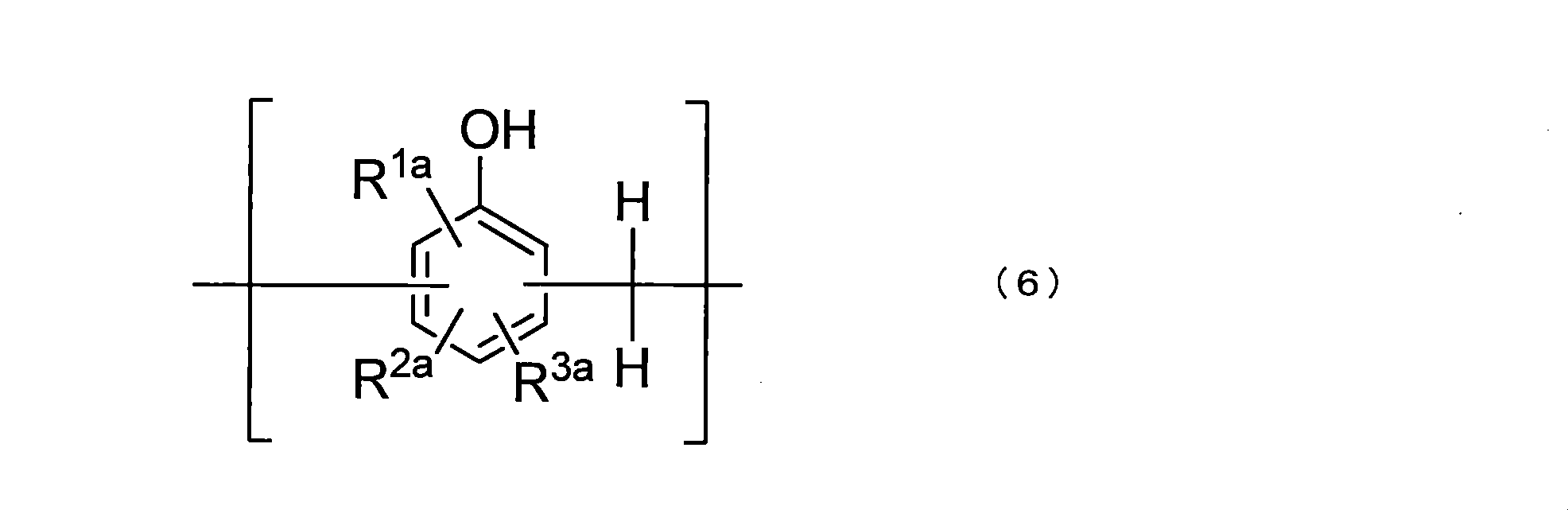
- the structural unit represented by the formula (2) or the formula (5) is preferably 50 to 100 mol% in the polyalkenyl phenol resin, more preferably 70 to 100 mol%, still more preferably 85 to 100 mol%. If the structural unit represented by Formula (2) or Formula (5) is 50 mol% or more in the polyalkenylphenol resin, the heat resistance is improved, which is preferable. Since the phenolic hydroxyl group in the polyalkenyl phenol resin is ionized in the presence of a basic compound and can be dissolved in water, it is necessary that the phenolic hydroxyl group is in a certain amount or more from the viewpoint of alkali developability. Therefore, the polyalkenylphenol resin including the structure of the formula (5) is particularly preferably a polyalkenylphenol resin having a structural unit represented by the formula (5) and a structural unit represented by the formula (6).
- R 1a , R 2a and R 3a each independently represent a hydrogen atom or an alkyl group having 1 to 5 carbon atoms.
- the number of the structural units represented by the formula (5) is x
- the formula (6) When the number of structural units represented is y, 0.5 ⁇ x / (x + y) ⁇ 1, 0 ⁇ y / (x + y) ⁇ 0.5, and (x + y) is preferably 2 to 3000, More preferably, it is 2-2000, and more preferably 2-1000.
- the preferred number average molecular weight is 500 to 5000, more preferably 800 to 3000, and still more preferably 1000 to 1500. If the number average molecular weight is 500 or more, the alkali development speed is appropriate, the resolution is good because the difference in dissolution rate between the exposed and unexposed areas is sufficient, and if it is 5000 or less, the alkali developability is good.
- the binder resin one type of resin may be used alone, or two or more types of resins may be used in combination. Among these, at least one selected from resin components (d1) to (d3) is preferably contained, and at least (d1) and (d2) are more preferably contained.
- the total amount of one or more components selected from (d1) to (d3) with respect to 100 parts by mass of the binder resin (D) is preferably 1 to 100 parts by mass, more preferably 10 to 100 parts by mass, The amount is preferably 30 to 100 parts by mass.
- the heat resistance of the resin composition is good.
- the binder resin (D) can be arbitrarily combined, for example, the resin components (d1) and (d2) are used together, and a plurality of the components (d1) to (d3) can also be used in combination.
- an alkali-soluble copolymer (d1) having an alkali-soluble group an alkali-soluble resin (d2) having an epoxy group and a phenolic hydroxyl group, and a polyalkenylphenol resin (d3) may be used in combination.
- the proportion of the alkali-soluble copolymer (d1) having an alkali-soluble group in the binder resin (D) is 5 to 60% by mass
- the alkali-soluble resin (d2) having an epoxy group and a phenolic hydroxyl group Is preferably 35 to 90% by mass
- the polyalkenylphenol resin (d3) is preferably 5 to 60% by mass.
- the alkali-soluble copolymer (d1) having an alkali-soluble group also corresponds to the alkali-soluble resin (d2) having an epoxy group and a phenolic hydroxyl group
- the alkali-soluble copolymer (d1) having an alkali-soluble group Shall be treated as
- the alkali-soluble copolymer (d1) having an alkali-soluble group also corresponds to the polyalkenylphenol resin (d3), it is handled as an alkali-soluble copolymer (d1) having an alkali-soluble group.
- the alkali-soluble resin (d2) and polyalkenylphenol resin (d3) having an epoxy group and a phenolic hydroxyl group exclude those corresponding to the alkali-soluble copolymer (d1) having an alkali-soluble group.
- the positive photosensitive resin composition of this invention contains a quinonediazide compound as a radiation sensitive compound.
- quinonediazide compounds quinonediazide sulfonic acid is bonded to a polyhydroxy compound with an ester, quinonediazide sulfonic acid is bonded to a polyamino compound, and a quinonediazide sulfonic acid is bonded to a polyhydroxypolyamino compound. Or those having an ester bond and a sulfonamide bond.
- quinonediazide a positive photosensitive resin composition that is sensitive to i-line (365 nm), h-line (405 nm), and g-line (436 nm) of a mercury lamp that is a general ultraviolet ray. it can.
- Polyhydroxy compounds include Bis-Z, BisP-EZ, TekP-4HBPA, TrisP-HAP, TrisP-PA, TrisP-SA, TrisOCR-PA, BisOCHP-Z, BisP-MZ, BisP-PZ, BisP-IPZ, BisOCP-IPZ, BisP-CP, BisRS-2P, BisRS-3P, BisP-OCHP, Methylenetris-FR-CR, BisRS-26X, DML-MBPC, DML-MBOC, DML-OCHP, DML-PCHP, DML-PC , DML-PTBP, DML-34X, DML-EP, DML-POP, dimethylol-BisOC-P, DML-PFP, DML-PSBP, DML-MTrisPC, TriML-P, TriML-35XL, TML-BP, TM -HQ, TML-pp-BPF, TML-BPA, TMOM-BP, HML-TPPHBA, HML-TPHAP (
- quinonediazide compound examples include 1,2-naphthoquinonediazide-4-sulfonic acid ester or 1,2-naphthoquinonediazide-5-sulfonic acid ester of the above polyhydroxy compound.
- the quinonediazide compound generates a carboxyl group through a reaction shown in the following reaction formula 2 when exposed to ultraviolet light or the like.
- production of a carboxyl group enables it to melt
- the content of the quinonediazide compound in the photosensitive resin composition in the present invention varies depending on the quinonediazide compound used, but is preferably 3 to 20 parts by weight, more preferably 5 to 5 parts by weight based on 100 parts by weight of the binder resin (D).
- the amount is 15 parts by mass, more preferably 7 to 10 parts by mass.
- Alkali developability is favorable in it being 3 mass parts or more on the basis of 100 mass parts of binder resin (D). If it is 20 parts by mass or less, the rate of decrease in heating at 300 ° C. or higher is difficult to increase.
- thermosetting agent a surfactant, a colorant other than (A), a solvent other than (C), and the like can be added as optional components.
- the optional component (F) is defined as not applicable to any of (A) to (E).
- thermosetting agent a thermal radical generator
- the thermal radical generator include organic peroxides, and specifically include dicumyl peroxide, 2,5-dimethyl-2,5-di (tert-butylperoxy) hexane, and tert-butyl.
- Organic peroxides such as cumyl peroxide, di-tert-butyl peroxide, 1,1,3,3-tetramethylbutyl hydroperoxide, cumene hydroperoxide, etc. having a 10-hour half-life temperature of 100 to 170 ° C. Can be mentioned.
- the content of the thermosetting agent is preferably 5 parts by mass or less, more preferably 4 parts by mass or less, and further preferably 3 parts by mass or less with respect to 100 parts by mass of the binder resin (D).
- the positive photosensitive resin composition of the present invention further contains a surfactant as an optional component, for example, in order to improve coatability or developability of the coating film. Can do.
- surfactants include polyoxyethylene alkyl ethers such as polyoxyethylene lauryl ether, polyoxyethylene stearyl ether, and polyoxyethylene oleyl ether; polyoxyethylene octyl phenyl ether, polyoxyethylene nonyl phenyl ether Polyoxyethylene aryl ethers such as polyoxyethylene dilaurate, nonoxy surfactants such as polyoxyethylene dialkyl esters such as polyoxyethylene distearate, etc .; Megafac (registered trademark) F-251, F-281 F-430, F-444, R-40, F-553, F-554, F-555, F-556, F-557, F-558 , Manufactured by DIC Corporation), Surflon Fluorine-based surfactants such as S-242, S-243, S-385, S-386, S-420, S-611 (trade names, manufactured by ACG Seimi Chemical Co., Ltd.) Agents; organosiloxane polymers KP323,
- Such a surfactant is blended in an amount of 2 parts by mass or less, more preferably 1 part by mass or less, and further preferably 0.5 parts by mass or less based on 100 parts by mass of the binder resin (D).
- the positive photosensitive resin composition of the present invention may further contain a colorant other than titanium black (A) as an optional component.
- a colorant other than titanium black (A) include dyes, organic pigments, and inorganic pigments, which can be used according to the purpose.
- the content of the colorant other than titanium black (A) is within a range that does not impair the effects of the present invention.
- the dye examples include azo dye, benzoquinone dye, naphthoquinone dye, anthraquinone dye, cyanine dye, squarylium dye, croconium dye, merocyanine dye, stilbene dye, diphenylmethane dye, triphenylmethane dye, fluorane dye, spiropyran dye, phthalocyanine dye, Examples include indigo dyes, fulgide dyes, nickel complex dyes, and azulene dyes.
- pigments include black pigments such as carbon black, carbon nanotubes, acetylene black, graphite, iron black, aniline black, and C.I. I. Pigment Yellow 20, 24, 86, 93, 109, 110, 117, 125, 137, 138, 147, 148, 153, 154, 166, C.I. I. Pigment orange 36, 43, 51, 55, 59, 61, C.I. I. Pigment Red 9, 97, 122, 123, 149, 168, 177, 180, 192, 215, 216, 217, 220, 223, 224, 226, 227, 228, 240, C.I. I. Pigment violet 19, 23, 29, 30, 37, 40, 50, C.I. I. Pigment blue 15, 15: 1, 15: 4, 22, 60, 64, C.I. I. Pigment green 7, C.I. I. And CI pigment brown 23, 25, 26.
- black pigments such as carbon black, carbon nanotubes, acetylene black, graph
- the positive photosensitive resin composition of the present invention is dissolved in a solvent and used in a solution state.
- the positive photosensitive resin composition of the present invention can be adjusted to a viscosity suitable for various coating methods depending on the amount of solvent.
- an appropriate solid content concentration can be adopted.
- the solid content concentration can be 1 to 60% by mass, preferably 3 to 50%, and more preferably 5 to 40%.
- other solvents can be added at 5 mass% or less of the total solvent.
- solvents include, for example, glycol ethers such as ethylene glycol dimethyl ether and ethylene glycol methyl ethyl ether, ethylene glycol alkyl ether acetates such as methyl cellosolve acetate and ethyl cellosolve acetate, diethylene glycol monomethyl ether, diethylene glycol diethyl ether, diethylene glycol dimethyl ether, and diethylene glycol ethyl.
- glycol ethers such as ethylene glycol dimethyl ether and ethylene glycol methyl ethyl ether
- ethylene glycol alkyl ether acetates such as methyl cellosolve acetate and ethyl cellosolve acetate
- diethylene glycol monomethyl ether diethylene glycol diethyl ether
- diethylene glycol dimethyl ether diethylene glycol dimethyl ether
- diethylene glycol ethyl diethylene glycol ethyl
- Diethylene glycols such as methyl ether, propylene glycol alkyl ether acetates such as propylene glycol methyl ether acetate and propylene glycol ethyl ether acetate, aromatic hydrocarbons such as toluene and xylene, methyl ethyl ketone, methyl amyl ketone, cyclohexanone, 4-hydroxy Ketones such as loxy-4-methyl-2-pentanone, ethyl 2-hydroxypropionate, methyl 2-hydroxy-2-methylpropionate, ethyl 2-hydroxy-2-methylpropionate, ethyl ethoxyacetate, ethyl hydroxyacetate Esters such as methyl 2-hydroxy-2-methylbutanoate, methyl 3-methoxypropionate, ethyl 3-methoxypropionate, methyl 3-ethoxypropionate, ethyl 3-ethoxypropionate, ethyl acetate, butyl
- the titanium black dispersion of the present invention comprises (A) titanium black, (B) a dispersant having an amine value of 5 mgKOH / g or less, an acid value of 20 to 200 mgKOH / g, and (C) a solubility parameter of 10.5 or more. It can manufacture by mixing a solvent as an essential component.
- the disperser for crushing and dispersing titanium black is not particularly limited, and ball types such as a ball mill, sand mill, bead mill, paint shaker, rocking mill, kneader, paddle mixer, planetary mixer, Henschel mixer, etc.
- ball types such as a ball mill, sand mill, bead mill, paint shaker, rocking mill, kneader, paddle mixer, planetary mixer, Henschel mixer, etc.
- the roll type such as a blade type and a three-roll mixer, and other examples include a crushing machine, a colloid mill, an ultrasonic wave, a homogenizer, and a rotation / revolution mixer.
- a ball type that can stably and finely disperse in a short time is preferable.
- the material of the ball used in the ball mold include glass, silicon nitride, alumina, zircon, zirconia, and steel.
- As a bead diameter a general shape having a diameter
- the order of addition when preparing the dispersion is not particularly limited, but the following order is desirable in order to obtain a good dispersion.
- the solvent (C) and the dispersant (B) are uniformly dispersed.
- an area with a high concentration of the dispersant is partially generated, and problems such as particle aggregation tend to occur.
- the required amount of titanium black (A) is then placed in the previously prepared solution and finally the beads. When aggregation is observed in titanium black, preliminary dispersion may be performed.
- a binder resin or other resin component may be used for the purpose of compatibility with the resin and suppression of reaggregation of titanium black.
- the positive photosensitive resin composition of the present invention is prepared by first mixing a titanium black (A), a dispersant (B), and a solvent (C) to prepare a titanium black dispersion, and then binder resin (D), quinonediazide. It is preferable that the compound (E) and the optional component (F) are further mixed and produced.
- the method for preparing the titanium black dispersion is as described above.
- the order of mixing the titanium black dispersion and the binder resin, the quinonediazide compound, and the optional component is not particularly limited.
- the binder resin is dissolved in a solvent (C) or a solvent other than (C), ,
- a quinonediazide compound, a titanium black dispersion, and if necessary, additives such as a thermosetting agent and a surfactant can be mixed at a predetermined ratio to prepare a positive photosensitive resin composition in a solution state. .
- the stirrer for mixing the titanium black dispersion with the binder resin, the quinonediazide compound, and the optional components is not particularly limited.
- Ball types such as ball mill, sand mill, bead mill, paint shaker, rocking mill, kneader, paddle Examples include a blade type such as a mixer, a planetary mixer, a Henschel mixer, a roll type such as a three-roll mixer, and a crushing machine, a colloid mill, an ultrasonic wave, a homogenizer, a rotation / revolution mixer, and a mechanical stirrer.
- a mechanical stirrer is preferable because it can be stably mixed in a short time.
- the stirring blade used at the time of stirring can be appropriately selected from a fan, a propeller, a cross, a turbine, a dragonfly type, and the like.
- a resin composition can be obtained by mixing a titanium black dispersion or a binder resin solution and stirring at room temperature for 1 to 10 minutes at a rotational speed of 10 to 1000 rpm.
- composition liquid prepared as described above is preferably filtered before use.
- filtering means include a Millipore filter having a pore diameter of 0.05 to 1.0 ⁇ m.
- the positive photosensitive resin composition of the present invention thus prepared is also excellent in long-term storage stability.
- the positive photosensitive resin composition of the present invention is used for radiation lithography, first, the positive photosensitive resin composition of the present invention is applied to the substrate surface, the solvent is removed by means such as heating, and the coating is performed. A film can be formed.
- the method for applying the positive photosensitive resin composition to the substrate surface is not particularly limited, and various methods such as a spray method, a roll coating method, a slit method, and a spin coating method can be employed.
- the solvent is usually dried by heating (pre-baking) to form a coating film.
- pre-baking heating conditions vary depending on the type of each component, the blending ratio, etc., but it is usually applied by heating at 70 to 130 ° C. for a predetermined time, for example, 1 to 20 minutes on a hot plate or 3 to 60 minutes in an oven.
- a membrane can be obtained.
- the pre-baked coating film is irradiated with radiation (eg, visible light, ultraviolet light, far ultraviolet light, etc.) through a mask having a predetermined pattern (exposure process), and then developed with a developer to remove unnecessary portions.
- radiation eg, visible light, ultraviolet light, far ultraviolet light, etc.
- Exposure process e.g., a predetermined pattern
- developer process e.g., a developer to remove unnecessary portions.
- preferable radiation is ultraviolet to visible light having a wavelength of 250 to 450 nm.
- Examples of the developer include inorganic alkalis such as sodium hydroxide, potassium hydroxide, sodium carbonate, sodium silicate, sodium metasilicate, and aqueous ammonia; primary amines such as ethylamine and n-propylamine; Secondary amines such as n-propylamine; tertiary amines such as triethylamine and methyldiethylamine; alcohol amines such as dimethylethanolamine and triethanolamine; tetramethylammonium hydroxide, tetraethylammonium hydroxide, choline Quaternary ammonium salts such as pyrrole, piperidine, cyclic amines such as 1,8-diazabicyclo [5.4.0] -7-undecene, 1,5-diazabicyclo [4.3.0] -5-nonane Use aqueous solutions of alkalis such as It can be.
- inorganic alkalis such as sodium hydroxide, potassium hydro
- the concentration is not particularly limited but is preferably 0.5 to 5.0% by mass.
- An aqueous solution obtained by adding an appropriate amount of a water-soluble organic solvent such as methanol or ethanol, a surfactant or the like to the alkaline aqueous solution can also be used as a developer.
- the developing time is usually 30 to 180 seconds, and the developing method may be any of a liquid filling method, a shower method, a dipping method and the like. After the development, washing with running water is performed for 30 to 90 seconds, unnecessary portions are removed, and the pattern is formed by air drying with compressed air or compressed nitrogen.
- a coating film can be obtained by heating the pattern at a predetermined temperature, for example, 120 to 350 ° C. for 20 to 200 minutes using a heating device such as a hot plate or oven, but the temperature is raised stepwise. (Heat treatment process).
- the present invention includes (I) a coating step of applying the positive photosensitive resin composition to a substrate, (II) a drying step of removing a solvent in the applied positive photosensitive resin composition, and (III) radiation.
- a method of manufacturing a radiation lithographic structure which includes an exposure step of irradiating through a photomask, (IV) a development step of forming a pattern by alkali development, and (V) a heat treatment step of heating at a temperature of 100 to 350 ° C. be able to. This method can be used for forming the partition walls and the insulating film of the organic EL element.
- a partition wall of an organic EL element made of a cured product of the positive photosensitive resin composition can be obtained.
- an insulating film of an organic EL element made of a cured product of the positive photosensitive resin composition can be obtained.
- the present invention can provide an organic EL device containing a cured product of the positive photosensitive resin composition.
- the obtained solution was dropped into 180 g of 1-methoxy-2-propyl acetate (manufactured by Daicel Corporation) over 1 hour in a 500 mL three-necked flask heated to 85 ° C. in a nitrogen gas atmosphere. The reaction was carried out at 0 ° C. for 3 hours. The reaction solution cooled to room temperature was dropped into 1200 g of toluene to precipitate a polymer. The precipitated polymer was collected by filtration and vacuum dried at 80 ° C. for 7 hours to collect 104.4 g of a white powder. This was dissolved in ⁇ -butyrolactone to obtain a resin liquid having a solid content of 20% by mass (resin liquid 1). The number average molecular weight of the obtained reaction product was 14100, and the weight average molecular weight was 24900.
- allyl acetate manufactured by Showa Denko KK
- 50% water content 5% -Pd / C-STD type metal palladium is dispersed in activated carbon at a content of 5% by mass
- the activated carbon in which the metallic palladium is dispersed is mixed with water so as to be 50% by mass and stabilized by an allylation reaction catalyst, manufactured by N.E.
- phenol novolac type polyallyl ether resin was placed in a 500 mL flask equipped with a mechanical stirrer and diluted with 130 g of ⁇ -butyrolactone (manufactured by Wako Pure Chemical Industries, Ltd.). While stirring at 300 rpm, the temperature was raised to 170 ° C., and the Claisen rearrangement reaction was carried out for 30 hours while confirming the reduction of allyl ether groups by 1 H-NMR. After the reaction, the solution was returned to room temperature and diluted with ⁇ -butyrolactone to a solid content of 20% by mass to obtain a phenol novolac-type polyallylphenol resin solution (resin solution 3).
- the polyallylphenol resin had a hydroxyl group equivalent of 132, a number average molecular weight of 1100, and a weight average molecular weight of 9,900.
- This resin is a polyalkenylphenol resin having a structural unit represented by the formula (5) and a structural unit represented by the formula (6).
- a structural unit represented by the formula (5) among R 1 , R 2 and R 3 , One is an allyl group and the other is a hydrogen atom.
- R 1a , R 2a , and R 3a are hydrogen atoms, x / (x + y) is 0.85, and y / (x + y) Was 0.15.
- the weight average molecular weight and the number average molecular weight were calculated using a calibration curve prepared using a polystyrene standard substance under the following measurement conditions.
- Device name Shodex (registered trademark) GPC-101
- Example 1 1 g of ⁇ -butyrolactone 39 g and dispersant DISPERBYK-111 were added to a 150 cc total drawn screw storage container (made of stainless steel) and mixed. Then, 10 g of titanium black UF-8 with a primary particle size of 20 nm was added and mixed, and then 200 g of zirconia beads for pulverization / dispersion treatment with a diameter of 0.3 mm (trade name: YTZ ball, manufactured by Nikkato Corporation) were added. It was sealed so as not to leak, and this was set on a paint shaker (manufactured by Asada Tekko Co., Ltd.) and dispersed for 10 hours. The obtained dispersion was filtered through a Millipore filter having a pore size of 0.45 ⁇ m and 0.22 ⁇ m to obtain a titanium black dispersion. The resulting titanium black dispersion is hereinafter referred to as Dispersion 1.
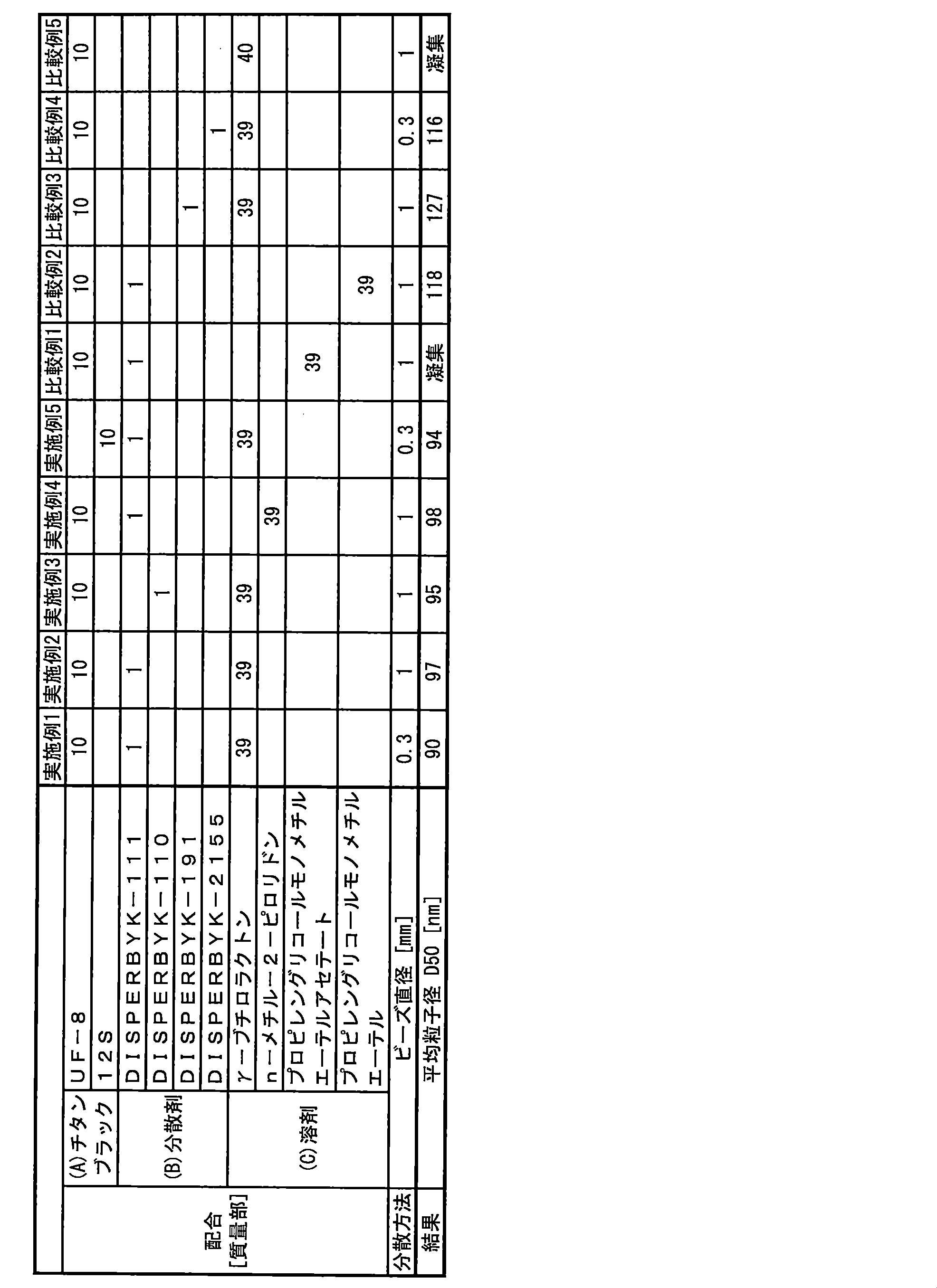
- Examples 2 to 5, Comparative Examples 1 to 5 A titanium black dispersion was obtained in the same procedure as in Example 1 according to the formulation shown in Table 2 and the diameter of the zirconia beads.
- the titanium black dispersions obtained in Examples 2 to 5 are hereinafter referred to as dispersions 2 to 5
- the titanium black dispersions obtained in Comparative Examples 1 to 5 are hereinafter referred to as dispersions C1 to C5.
- Example 6 50 parts by mass of resin liquid 1, 125 parts by mass of resin liquid 2, 15 parts by mass of TS-130A as a quinonediazide compound obtained in Production Examples 1 and 2, and the titanium black dispersion obtained in Example 1 100 parts by mass of 1 and 7.5 parts by mass of a 1% by mass solution of Surflon S-386 (diluted with ⁇ -butyrolactone) as a surfactant were added and further mixed. After confirming that it became uniform, it was filtered through a Millipore filter having a pore diameter of 0.22 ⁇ m to prepare a positive photosensitive resin composition having a solid content concentration of 24%.
- Surflon S-386 diluted with ⁇ -butyrolactone
- Example 7 to 12 and Comparative Examples 6 to 8 A positive photosensitive resin composition was prepared by the same procedure as in Example 6 as shown in Table 3.
- photomasks made of quartz (5 ⁇ m, 10 ⁇ m, 20 ⁇ m, 50 ⁇ m, 100 ⁇ m, 200 ⁇ m, 500 ⁇ m) with an exposure apparatus (trade name Multilight ML-251A / B, manufactured by USHIO INC.) Incorporating an ultra-high pressure mercury lamp 100 mJ / cm ⁇ 2 > was exposed through the one where the space was patterned. The amount of exposure was measured using an ultraviolet integrated light meter (trade name UIT-150 light receiving unit UVD-S365, manufactured by USHIO INC.).
- the exposed coating film was subjected to alkali development with a 2.38 mass% tetramethylammonium hydroxide aqueous solution for 60 seconds using a spin developing device (AD-1200, manufactured by Takizawa Sangyo Co., Ltd.), and evaluated for alkali developability. In observation using an optical microscope (VH-Z250, manufactured by Keyence Corporation), it was determined that there was no residue after alkali development, and that a residue was determined as poor.
- a spin developing device AD-1200, manufactured by Takizawa Sangyo Co., Ltd.
- Evaluation of pattern formability was performed by measuring the line width of the pattern after alkali development. Using an optical microscope (VH-Z250, manufactured by Keyence Corporation), the location where the line width of the photomask line & space pattern was 10 ⁇ m was confirmed with a microscope with a magnification of 1000 times. Evaluation of pattern formability is good if the line width of the line & space pattern of the pattern after alkali development is 1: 1, the line width of the line portion is within ⁇ 10% is acceptable, and the others are defective. Went.
- a glass substrate (size: 100 mm ⁇ 100 mm ⁇ 1 mm) was spin-coated with the positive photosensitive resin compositions of Examples 6 to 12 and Comparative Examples 6 to 8 so as to have a thickness of about 1.5 ⁇ m.
- the solvent was dried by heating for 80 seconds.
- the coating film was obtained by making it harden
- the cured glass coating film was measured with a transmission densitometer (BMT-1, manufactured by Sakata Inx Engineering Co., Ltd.), corrected with the OD value of only the glass, and converted to an OD value per 1 ⁇ m thickness of the coating film.
- the thickness of the coating film was measured using a surface roughness meter (Surfcom 130A, manufactured by Tokyo Seimitsu Co., Ltd.).
- a glass substrate (size: 100 mm ⁇ 100 mm ⁇ 1 mm) was spin-coated with the positive photosensitive resin compositions of Examples 6 to 12 and Comparative Examples 6 to 8 so as to have a thickness of about 1.5 ⁇ m.
- the solvent was dried by heating for 80 seconds.
- Appearance evaluation after pre-baking was performed by visually observing the surface of the coating after drying, with a uniform glossy surface being good, uneven glossiness being acceptable, and light-transmitting holes being defective. .
- the positive photosensitive resin compositions of Examples 6 to 12 and Comparative Examples 6 to 8 were spin-coated on a glass substrate (size 100 mm ⁇ 100 mm ⁇ 1 mm) so that the dry film thickness was about 1.5 ⁇ m, and 120 ° C. The solvent was dried at 80 seconds. Further, exposure was performed at 100 mJ / cm 2 through a quartz photomask with an exposure apparatus (trade name: Multilight ML-251A / B, manufactured by USHIO INC.) Incorporating an ultra-high pressure mercury lamp. The amount of exposure was measured using an ultraviolet integrated light meter (trade name UIT-150 light receiving unit UVD-S365, manufactured by USHIO INC.).
- the exposed coating film was alkali-developed with a 2.38% tetramethylammonium hydroxide aqueous solution for 60 seconds using a spin developing device (AD-1200, manufactured by Takizawa Sangyo Co., Ltd.). Thereafter, a patterned coating film was obtained by curing at 250 ° C. for 60 minutes in a nitrogen gas atmosphere. The surface roughness of the 10 ⁇ m wide pattern of the cured coating film was measured using a surface roughness meter (Surfcom 130A, manufactured by Tokyo Seimitsu Co., Ltd.).
- the liquid had an average particle diameter D50 after the dispersion treatment of 100 nm or less and good dispersibility.
- Examples 6 to 12 which are positive photosensitive resin compositions using the titanium black dispersions of Examples 1 to 5, the appearance after prebaking, alkali developability, pattern formability, pattern linearity, and surface roughness Ra It was found that all points of weight reduction rate were excellent in a well-balanced manner.
- the titanium black dispersions of Comparative Examples 1 to 4 using a dispersant having an amine value of 5 mgKOH / g or more, or a solvent having a solubility parameter (SP value) of less than 10.5, and a comparative example using no dispersant 5, and the positive photosensitive resin compositions of Comparative Examples 6 to 8 were found to be difficult to apply to the blackened barrier rib material, which requires developability and high resolution.
- the black positive photosensitive resin composition of the present invention can be suitably used for positive radiation lithography.
- the organic EL element provided with the partition and the insulating film formed from the black positive photosensitive resin composition of the present invention is suitably used as an electronic component of a display device exhibiting good contrast.
Landscapes
- Physics & Mathematics (AREA)
- General Physics & Mathematics (AREA)
- Spectroscopy & Molecular Physics (AREA)
- Chemical & Material Sciences (AREA)
- Engineering & Computer Science (AREA)
- Metallurgy (AREA)
- Organic Chemistry (AREA)
- Chemical Kinetics & Catalysis (AREA)
- Manufacturing & Machinery (AREA)
- Materials For Photolithography (AREA)
- Electroluminescent Light Sources (AREA)
Abstract
Description
[1](A)チタンブラック、
(B)アミン価が5mgKOH/g以下、酸価が20~200mgKOH/gの分散剤、
(C)溶解度パラメーターが10.5以上の溶媒、
(D)バインダー樹脂、及び
(E)キノンジアジド化合物
を含むポジ型感光性樹脂組成物。
(d1)アルカリ可溶性基を有するアルカリ可溶性共重合体、
(d2)エポキシ基とフェノール性水酸基を有するアルカリ可溶性樹脂、及び
(d3)ポリアルケニルフェノール樹脂
からなる群から選ばれた少なくとも1種を含む、[1]~[4]のいずれかに記載の組成物。
(B)アミン価が5mgKOH/g以下、酸価が20~200mgKOH/gの分散剤、及び
(C)溶解度パラメーターが10.5以上の溶媒
を含むチタンブラック分散液。
(2)前記チタンブラック分散液、(D)バインダー樹脂及び(E)キノンジアジド化合物を混合する工程
をこの順に含むポジ型感光性樹脂組成物の製造方法。
(II)塗布されたポジ型感光性樹脂組成物中の溶媒を除去する乾燥工程、
(III)放射線をフォトマスク越しに照射する露光工程、
(IV)アルカリ現像によりパターン形成する現像工程、及び
(V)100~350℃の温度で加熱する加熱処理工程
を含む放射線リソグラフィー構造物の製造方法。
本発明に使用するチタンブラックとしては、二酸化チタンと金属チタンの混合体を還元雰囲気で加熱し還元する方法(特開昭49-5432号公報)、四塩化チタンの高温加水分解で得られた超微細二酸化チタンを水素を含む還元雰囲気中で還元する方法(特開昭57-205322号公報)、二酸化チタン又は水酸化チタンをアンモニア存在下で高温還元する方法(特開昭60-65069号公報、特開昭61-201610号公報)、二酸化チタン又は水酸化チタンにバナジウム化合物を付着させ、アンモニア存在下で高温還元する方法(特開昭61-201610号公報)等で製造されたものを使用できるがこれらに限定されるものではない。チタンブラックの市販品の例としては、三菱マテリアル株式会社製のチタンブラック10S、12S、13R、13M、13M-C、13-MT、16M、UF-8、赤穂化成株式会社製のTilack Dなどが挙げられる。これらのチタンブラックは1種を用いてもよいし、2種以上を組み合わせてもよい。
本発明のチタンブラックの分散に使用するアミン価が5mgKOH/g以下、酸価が20~200mgKOH/gの分散剤は、公知のものが使用できる。例えば、商品名DISPERBYK110、DISPERBYK111(ビックケミー・ジャパン株式会社製)等、商品名ディスパロンPW-36、ディスパロンDA-375(楠本化成株式会社製)等のリン酸エステル類、ポリリン酸エステル類、リン酸ポリエステル類、ポリエーテルリン酸エステル類等のリン酸系分散剤、商品名フローレンG-700、フローレンG-900、フローレンGW-1500(共栄社化学株式会社製)等のカルボキシル基含有ポリマー系分散剤、商品名アジスパーPN411、アジスパーPA111(味の素ファインテクノ株式会社製)等の高級脂肪酸エステル系分散剤が挙げられる。中でも骨格にグラフト鎖を有しない分散剤、例えば商品名DISPERBYK110、DISPERBYK111(ビックケミー・ジャパン株式会社製)等が好ましく用いられる。
本発明のチタンブラックの分散溶媒としてはSP値が10.5~15.0であり、好ましくは10.5~13.0である。水酸基を含まないことがより好ましい。SP値が10.5以上の溶媒として具体的には、γ-ブチロラクトン(12.6)、N-メチル-2-ピロリドン(11.3)、N,N-ジメチルホルムアミド(12.1)、N,N-ジメチルアセトアミド(10.8)等が挙げられるが、中でもN-メチル-2-ピロリドン又はγ-ブチロラクトンがより好ましく、γ-ブチロラクトンが更に好ましい。SP値が10.5以上である溶媒を使用することで、チタンブラック(A)を均一に分散させることができる。これらの溶媒は、1種を用いてもよいし、2種以上を組み合わせてもよい。
本発明のポジ型感光性樹脂組成物において使用するバインダー樹脂(D)としては、特に限定されないが、アルカリ可溶性基を有しアルカリ可溶性であることが好ましい。
アルカリ可溶性基としては、カルボキシル基、アルコール性水酸基、フェノール性水酸基、スルホ基、リン酸基、酸無水物基等を挙げることができる。アルカリ可溶性基を有する重合性単量体とその他の重合性単量体の共重合体からなるアルカリ可溶性樹脂は、例えば、アルカリ可溶性基を有する重合性単量体とその他の重合性単量体を、重合開始剤及びRAFT剤(Reversible Addition Fragmentation Transfer;可逆的付加開裂型連鎖移動剤)等でラジカル重合させることにより製造することができる。アルカリ可溶性基を有する重合性単量体とその他の重合性単量体のアルカリ可溶性共重合体は、ラジカル重合にて共重合体を合成した後に、アルカリ可溶性基を付加したものであってもよい。
(d2)のアルカリ可溶性樹脂は、例えば、1分子中に少なくとも2個のエポキシ基を有する化合物(以下、「エポキシ化合物」と表記することがある。)のエポキシ基と、ヒドロキシ安息香酸類のカルボキシル基を反応させることで得ることができる。ただし、エポキシ基が残るように反応率を調整する。


ポリアルケニルフェノール樹脂は、公知のフェノール樹脂の水酸基をアルケニルエーテル化し、さらにアルケニルエーテル基をクライゼン転位することにより得られる。ポリアルケニルフェノール樹脂は、式(2)の構造を有することが好ましい。このような樹脂を含有することにより、得られる感光性樹脂組成物の現像特性を向上させるとともに、アウトガスの低減にも寄与することができる。
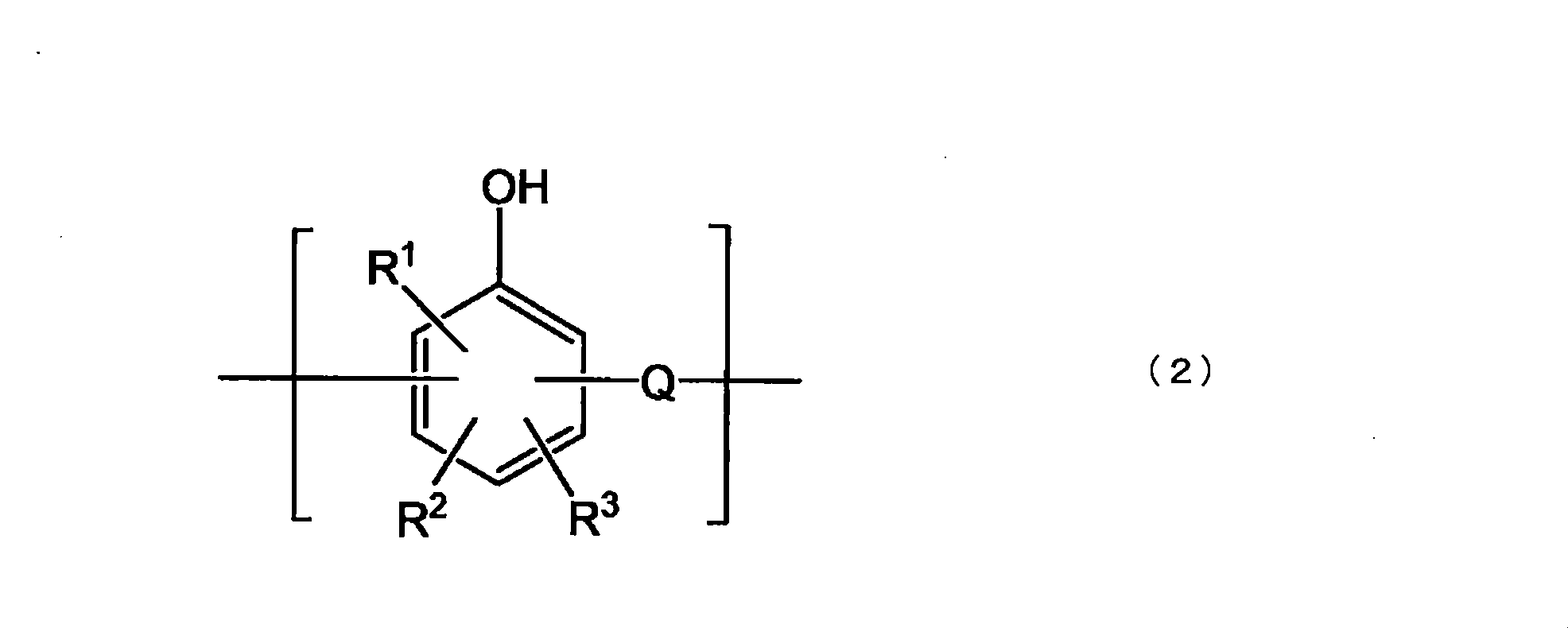

で表されるアルケニル基、炭素原子数1~2のアルコキシ基又は水酸基を表し、かつR1、R2及びR3の少なくとも1つは式(3)で表されるアルケニル基である。Qは式-CR4R5-で表されるアルキレン基、炭素原子数5~10のシクロアルキレン基、芳香環を有する二価の有機基、脂環式縮合環を有する二価の有機基又はこれらを組み合わせた二価基であり、R4及びR5はそれぞれ独立に水素原子、炭素原子数1~5のアルキル基、炭素原子数2~6のアルケニル基、炭素原子数5~10のシクロアルキル基又は炭素原子数6~12のアリール基を表す。式(2)の構造が1分子中に2つ以上存在するときは、それぞれの式(2)の構造は同一でも異なってもよい。


本発明のポジ型感光性樹脂組成物は、感放射線化合物としてキノンジアジド化合物を含有する。キノンジアジド化合物としては、ポリヒドロキシ化合物にキノンジアジドのスルホン酸がエステルで結合したもの、ポリアミノ化合物にキノンジアジドのスルホン酸がスルホンアミド結合したもの、ポリヒドロキシポリアミノ化合物にキノンジアジドのスルホン酸がエステル結合、スルホンアミド結合、又はエステル結合及びスルホンアミド結合したもの等が挙げられる。露光部と未露光部のコントラストの観点から、これらポリヒドロキシ化合物又はポリアミノ化合物の官能基全体の20~100モル%がキノンジアジドで置換されていることが好ましい。このようなキノンジアジド化合物を用いることで、一般的な紫外線である水銀灯のi線(365nm)、h線(405nm)、g線(436nm)に感光するポジ型の感光性樹脂組成物を得ることができる。

本発明のポジ型感光性樹脂組成物は、任意成分として、熱硬化剤、界面活性剤、(A)以外の着色剤、(C)以外の溶媒等を添加することができる。なお、任意成分(F)は(A)~(E)のいずれにも当てはまらないものと定義する。
熱硬化剤としては、熱ラジカル発生剤を使用することができる。好ましい熱ラジカル発生剤としては、有機過酸化物を挙げることができ、具体的にはジクミルパーオキサイド、2,5-ジメチル-2,5-ジ(tert-ブチルパーオキシ)ヘキサン、tert-ブチルクミルパーオキサイド、ジ-tert-ブチルパーオキサイド、1,1,3,3-テトラメチルブチルハイドロパーオキサイド、クメンハイドロパーオキサイド等の10時間半減期温度が100~170℃の有機過酸化物等を挙げることができる。
本発明のポジ型感光性樹脂組成物は、さらに任意成分として、例えば塗布性を向上させるため、或いは塗膜の現像性を向上させるために、界面活性剤を含有することができる。
本発明のポジ型感光性樹脂組成物は、さらに任意成分として、チタンブラック(A)以外の着色剤を含有することができる。このような着色剤は、染料、有機顔料、無機顔料が挙げられるが、目的に合わせて用いることができる。ただし、チタンブラック(A)以外の着色剤の含有量は本発明の効果を損なわない範囲とする。
本発明のポジ型感光性樹脂組成物は、溶媒に溶解されて溶液状態で用いられる。本発明のポジ型感光性樹脂組成物は溶媒量によって種々の塗布方法に適した粘度に調整可能である。使用目的により、適宜の固形分濃度を採用することができるが、例えば、固形分濃度1~60質量%、好ましくは3~50%、さらに好ましくは5~40%とすることができる。溶解度パラメーター(SP値)が10.5以上の溶媒(C)の他に、溶媒全体の5質量%以下で、その他の溶媒を加えることも可能である。
本発明のチタンブラック分散液は、(A)チタンブラック、(B)アミン価が5mgKOH/g以下、酸価が20~200mgKOH/gの分散剤、及び(C)溶解度パラメータが10.5以上の溶媒を必須成分として混合することで製造できる。
本発明のポジ型感光性樹脂組成物は、まず、チタンブラック(A)、分散剤(B)及び溶媒(C)を混合してチタンブラック分散液を作製した後、バインダー樹脂(D)、キノンジアジド化合物(E)、及び任意成分(F)を更に混合して製造することが好ましい。チタンブラック分散液を調製する方法は前述の通りである。
本発明のポジ型感光性樹脂組成物を放射線リソグラフィー用に使用する場合、まず、本発明のポジ型感光性樹脂組成物を基板表面に塗布し、加熱等の手段により溶媒を除去して、塗膜を形成することができる。基板表面へのポジ型感光性樹脂組成物の塗布方法は特に限定されず、例えばスプレー法、ロールコート法、スリット法、回転塗布法等の各種の方法を採用することができる。
[製造例1]アルカリ可溶性基を有するアルカリ可溶性共重合体(d1)の製造
4-ヒドロキシフェニルメタクリレート(昭和電工株式会社製「PQMA」)76.8g、N-フェニルマレイミド(株式会社日本触媒製)14.4g、N-シクロヘキシルマレイミド(株式会社日本触媒製)14.4g、重合開始剤としてV-601(和光純薬工業株式会社製)1.80g、RAFT剤としてS-ドデシル-S′-(α,α′-ジメチル-α″-酢酸)トリチオカルボナート(シグマアルドリッチ製「723010」)1.95gを、1-メトキシ-2-プロピルアセテート(株式会社ダイセル製)180gに完全に溶解させた。得られた溶液を、500mLの3つ口型フラスコ中、窒素ガス雰囲気下で85℃に加熱した1-メトキシ-2-プロピルアセテート(株式会社ダイセル製)180gに1時間かけて滴下し、その後85℃で3時間反応させた。室温まで冷却した反応溶液を1200gのトルエン中に滴下し、重合体を沈殿させた。沈殿した重合体をろ過により回収し、80℃で7時間真空乾燥し白色の粉体を104.4g回収した。これをγ-ブチロラクトンに溶解し、固形分20質量%の樹脂液を得た(樹脂液1)。得られた反応物の数平均分子量は14100、重量平均分子量は24900であった。
300mLの3つ口型フラスコに溶媒としてγ-ブチロラクトン(三菱ケミカル株式会社製)60g、1分子中に少なくとも2個のエポキシ基を有する化合物としてEPICLON(登録商標)N-695(DIC株式会社製クレゾールノボラック型エポキシ樹脂、エポキシ当量210)を42g仕込み、窒素雰囲気下、60℃で溶解させた。そこへヒドロキシ安息香酸類として3,5-ジヒドロキシ安息香酸(和光純薬工業株式会社製)を15.5g(0.10mol、エポキシ1当量に対して0.5当量)、反応触媒としてトリフェニルホスフィン(北興化学工業株式会社製)を0.2g(0.76mmol)追加し、110℃で12時間反応させた。反応溶液を室温に戻し、γ-ブチロラクトンで固形分20質量%に希釈し、溶液をろ過して260g回収した(樹脂液2)。得られた反応物の数平均分子量は2400、重量平均分子量は5600であった。
1000mLの3つ口型フラスコに、炭酸カリウム(日本曹達株式会社製)201g(1.45mol)を純水100gに溶解した溶液、フェノールノボラック樹脂「ショウノール(登録商標)BRN-5834Y」(アイカSDKフェノール株式会社製)100.0g、イソプロピルアルコール(和光純薬工業株式会社製)16gを仕込み、反応器を窒素ガス置換し85℃に加熱した。窒素ガス気流下、酢酸アリル(昭和電工株式会社製)84g(0.84mol)、50%含水5%-Pd/C-STDタイプ(金属パラジウムを活性炭中に5質量%の含有量で分散され、かつ前記金属パラジウムが分散された活性炭を50質量%となるよう水を配合して安定化したアリル化反応の触媒、エヌ・イーケムキャット株式会社製)0.40g(パラジウム:0.188mmol)及びトリフェニルホスフィン(前記パラジウムを含有したアリル化反応触媒の活性化剤、北興化学工業株式会社製)2.45g(9.4mmol)を入れ、窒素雰囲気中、105℃に昇温して4時間反応させた後、酢酸アリル14g(0.14mol)を追添し、1H-NMRでアリルエーテル基の生成を確認しながら加熱を10時間継続した。その後撹拌を停止し、静置することで有機層と水層の二層に分離した。析出している塩が溶解するまで、純水(200g)を添加した後、トルエン200gを加え、80℃以上の温度に保持して白色沈殿が析出していないことを確認した後、Pd/Cを濾過(1μmのメンブレンフィルター(アドバンテック社製KST-142-JAを用いて加圧(0.3MPa))により回収した。この濾滓をトルエン100gで洗浄するとともに、水層を分離した。有機層を水200gで2度洗浄し、水層が中性であることを確認した。有機層を分離後、減圧下、濃縮し、褐色油状物のフェノールノボラック型のポリアリルエーテル樹脂を得た。
装置名:Shodex(登録商標)GPC-101
カラム:Shodex(登録商標)LF-804
移動相:テトラヒドロフラン
流速:1.0mL/min
検出器:Shodex(登録商標)RI-71
温度:40℃
(D)バインダー樹脂として、製造例1~3により合成した樹脂液1~3、及びノボラックフェノール樹脂BRM-595M(アイカSDKフェノール株式会社製)を、再沈殿法にて低分子量成分を除去し、γ-ブチロラクトンで固形分20質量%に調製した樹脂液4を使用した。
(D)バインダー樹脂以外の材料を表1に示す。

[実施例1]
γ-ブチロラクトン39gと分散剤DISPERBYK-111を1g、150ccの総絞りスクリュー式保存容器(ステンレス製)に添加、混合させた。そこへ、一次粒子径が20nmのチタンブラックUF-8を10g入れて混合させた後に直径Φ0.3mmの解砕・分散処理用ジルコニアビーズ(商品名YTZボール、ニッカトー株式会社製)200gを入れて、漏れないように密閉し、これをペイントシェーカー(浅田鉄工株式会社製)にセットして、10時間分散させた。得られた分散液を孔径0.45μm及び0.22μmのミリポアフィルターで濾過し、チタンブラック分散液を得た。得られたチタンブラック分散液を、以下、分散液1という。
表2に記載の配合及び、ジルコニアビーズの直径に従って実施例1と同様の手順でチタンブラック分散液を得た。実施例2~5で得られたチタンブラック分散液を、以下、分散液2~5といい、比較例1~5で得られたチタンブラック分散液を、以下、分散液C1~C5という。
[実施例6]
製造例1~2にて得られた、樹脂液1を50質量部、樹脂液2を125質量部、キノンジアジド化合物としてTS-130Aを15質量部、及び実施例1で得られたチタンブラック分散液1を100質量部、界面活性剤としてサーフロンS-386の1質量%溶液(γ-ブチロラクトンで希釈)7.5質量部を加え、さらに混合を行った。均一になったことを目視で確認した後、孔径0.22μmのミリポアフィルターで濾過し、固形分濃度24%のポジ型感光性樹脂組成物を調製した。
表3の配合の通り実施例6と同様の手順でポジ型感光性樹脂組成物を調製した。
実施例1~5及び比較例1~5で製造したチタンブラック分散液について、チタンブラックの平均粒径の評価を行った。ただし、比較例1及び比較例5のチタンブラック分散液は目視で凝集が確認できたため、測定を行わなかった。結果を表2に示す。
γ-ブチロラクトン20gを秤量し、そこへ分散液を1滴加え、超音波で1分間混合した後、レーザー回折・散乱式 粒子径分布測定装置Nanotrac wave(Ex)(日機装株式会社)のセルを満たし、分散後のチタンブラックの平均粒径D50を測定した。
ガラス基板(大きさ100mm×100mm×1mm)に実施例6~12及び比較例6~8のポジ型感光性樹脂組成物を乾燥膜厚が約1.5μmになるようにスピンコートし、120℃で80秒溶媒を乾燥した。さらに超高圧水銀ランプを組み込んだ露光装置(商品名マルチライトML-251A/B、ウシオ電機株式会社製)で石英製のフォトマスク(5μm、10μm、20μm、50μm、100μm、200μm、500μmのライン&スペースがパターニングされたもの)を介して100mJ/cm2露光した。露光量は紫外線積算光量計(商品名UIT-150 受光部 UVD-S365、ウシオ電機株式会社製)を用いて測定した。露光した塗膜は、スピン現像装置(AD-1200、滝沢産業株式会社製)を用い2.38質量%テトラメチルアンモニウムハイドロオキサイド水溶液で60秒間アルカリ現像を行ない、アルカリ現像性の評価を行った。光学顕微鏡(VH-Z250、株式会社キーエンス製)を用いた観察で、アルカリ現像後の残渣がない場合を良好、残渣があった場合を不良として判定した。
ガラス基板(大きさ100mm×100mm×1mm)に実施例6~12及び比較例6~8のポジ型感光性樹脂組成物を約1.5μmになるようにスピンコートし、ホットプレート上120℃で80秒加熱し溶媒を乾燥した。その後、窒素ガス雰囲気下250℃で60分硬化させることにより塗膜を得た。硬化後のガラス塗膜を透過濃度計(BMT-1、サカタインクスエンジニアリング株式会社製)で測定し、ガラスのみのOD値で補正を行って、塗膜の厚さ1μm当たりのOD値に換算した。なお、塗膜の厚みは表面粗さ計(サーフコム130A、東京精密株式会社製)を用いて測定した。
ガラス基板(大きさ100mm×100mm×1mm)に実施例6~12及び比較例6~8のポジ型感光性樹脂組成物を約1.5μmになるようにスピンコートし、ホットプレート上120℃で80秒加熱し溶媒を乾燥した。プリベイク後の外観評価は乾燥後の塗膜表面を目視観察し、均一な光沢面になっているものを良好、光沢にムラがあるものを可、光の透過するホールがあるものを不良とした。
ガラス基板(大きさ100mm×100mm×1mm)に実施例6~12及び比較例6~8のポジ型感光性樹脂組成物を乾燥膜厚が約1.5μmになるようにスピンコートし、120℃で80秒溶媒を乾燥した。さらに超高圧水銀ランプを組み込んだ露光装置(商品名マルチライトML-251A/B、ウシオ電機株式会社製)で石英製のフォトマスクを介して100mJ/cm2露光した。露光量は紫外線積算光量計(商品名UIT-150 受光部 UVD-S365、ウシオ電機株式会社製)を用いて測定した。露光した塗膜は、スピン現像装置(AD-1200、滝沢産業株式会社製)を用い2.38%テトラメチルアンモニウムハイドロオキサイド水溶液で60秒間アルカリ現像を行なった。その後、窒素ガス雰囲気下250℃で60分硬化させることによりパターン形成された塗膜を得た。硬化後の塗膜の10μm幅のパターンの表面粗さを表面粗さ計(サーフコム130A、東京精密株式会社製)を用いて測定した。
実施例6~12及び比較例6~8のポジ型感光性樹脂組成物をアルミカップに入れ、窒素ガス雰囲気下60℃で30分乾燥後、窒素ガス雰囲気下250℃で60分間加熱することで硬化した。その硬化物を用いTG/DTA7200(株式会社日立ハイテクサイエンス製)を使用して、窒素ガス気流中、昇温速度10℃/分の条件下で室温から300℃まで昇温し、300℃90分保持した場合の重量減少率(%)を測定した。

Claims (12)
- (A)チタンブラック、
(B)アミン価が5mgKOH/g以下、酸価が20~200mgKOH/gの分散剤、
(C)溶解度パラメーターが10.5以上の溶媒、
(D)バインダー樹脂、及び
(E)キノンジアジド化合物
を含むポジ型感光性樹脂組成物。 - 溶媒(C)がγ-ブチロラクトン又はn-メチル-2-ピロリドンである、請求項1に記載の組成物。
- チタンブラック(A)100質量部を基準として、分散剤(B)が1~40質量部、溶媒(C)が250~600質量部である、請求項1又は2に記載の組成物。
- バインダー樹脂(D)100質量部を基準として、チタンブラック(A)が3~30質量部、キノンジアジド化合物(E)が3~20質量部である、請求項1~3のいずれか1項に記載の組成物。
- バインダー樹脂(D)が、
(d1)アルカリ可溶性基を有するアルカリ可溶性共重合体、
(d2)エポキシ基とフェノール性水酸基を有するアルカリ可溶性樹脂、及び
(d3)ポリアルケニルフェノール樹脂
からなる群から選ばれた少なくとも1種を含む、請求項1~4のいずれか1項に記載の組成物。 - (A)チタンブラック、
(B)アミン価が5mgKOH/g以下、酸価が20~200mgKOH/gの分散剤、及び
(C)溶解度パラメーターが10.5以上の溶媒
を含むチタンブラック分散液。 - (1)(A)チタンブラック、(B)アミン価が5mgKOH/g以下、酸価が20~200mgKOH/gの分散剤、及び(C)溶解度パラメーターが10.5以上の溶媒を混合して、チタンブラック分散液を調製する工程、並びに
(2)前記チタンブラック分散液、(D)バインダー樹脂及び(E)キノンジアジド化合物を混合する工程
をこの順に含むポジ型感光性樹脂組成物の製造方法。 - 請求項1~5のいずれか1項に記載の組成物の硬化物。
- (I)請求項1~5のいずれか1項に記載のポジ型感光性樹脂組成物を基材に塗布する塗布工程、
(II)塗布されたポジ型感光性樹脂組成物中の溶媒を除去する乾燥工程、
(III)放射線をフォトマスク越しに照射する露光工程、
(IV)アルカリ現像によりパターン形成する現像工程、及び
(V)100~350℃の温度で加熱する加熱処理工程
を含む放射線リソグラフィー構造物の製造方法。 - 請求項1~5のいずれか1項に記載のポジ型感光性樹脂組成物の硬化物からなる有機EL素子の隔壁。
- 請求項1~5のいずれか1項に記載のポジ型感光性樹脂組成物の硬化物からなる有機EL素子の絶縁膜。
- 請求項1~5のいずれか1項に記載のポジ型感光性樹脂組成物の硬化物を含む有機EL素子。
Priority Applications (2)
| Application Number | Priority Date | Filing Date | Title |
|---|---|---|---|
| JP2018550061A JP7283903B2 (ja) | 2016-11-09 | 2017-09-27 | ポジ型感光性樹脂組成物及びチタンブラック分散液 |
| KR1020197005474A KR102181114B1 (ko) | 2016-11-09 | 2017-09-27 | 포지티브형 감광성 수지 조성물 및 티타늄 블랙 분산액 |
Applications Claiming Priority (2)
| Application Number | Priority Date | Filing Date | Title |
|---|---|---|---|
| JP2016-219082 | 2016-11-09 | ||
| JP2016219082 | 2016-11-09 |
Publications (1)
| Publication Number | Publication Date |
|---|---|
| WO2018088052A1 true WO2018088052A1 (ja) | 2018-05-17 |
Family
ID=62109745
Family Applications (1)
| Application Number | Title | Priority Date | Filing Date |
|---|---|---|---|
| PCT/JP2017/035021 Ceased WO2018088052A1 (ja) | 2016-11-09 | 2017-09-27 | ポジ型感光性樹脂組成物及びチタンブラック分散液 |
Country Status (4)
| Country | Link |
|---|---|
| JP (1) | JP7283903B2 (ja) |
| KR (1) | KR102181114B1 (ja) |
| TW (1) | TWI658328B (ja) |
| WO (1) | WO2018088052A1 (ja) |
Cited By (4)
| Publication number | Priority date | Publication date | Assignee | Title |
|---|---|---|---|---|
| JP2020077642A (ja) * | 2020-01-20 | 2020-05-21 | 昭和電工株式会社 | 感光性樹脂組成物、有機el素子隔壁、及び有機el素子 |
| CN111538209A (zh) * | 2019-02-06 | 2020-08-14 | 昭和电工株式会社 | 感光性树脂组合物、有机el元件间隔壁及有机el元件 |
| WO2021240879A1 (ja) * | 2020-05-28 | 2021-12-02 | 昭和電工株式会社 | 熱硬化性樹脂組成物 |
| US12091553B2 (en) | 2022-02-24 | 2024-09-17 | Samsung Sdi Co., Ltd. | Core-shell dye, near-infrared absorbing composition including the same, and near-infrared absorbing film |
Families Citing this family (3)
| Publication number | Priority date | Publication date | Assignee | Title |
|---|---|---|---|---|
| WO2021246449A1 (ja) * | 2020-06-03 | 2021-12-09 | 昭和電工株式会社 | ポジ型感光性樹脂組成物、及び有機el素子隔壁 |
| KR102834230B1 (ko) * | 2020-06-03 | 2025-07-15 | 닛폰 포리텍쿠 가부시키가이샤 | 포지티브형 감광성 수지 조성물, 및 유기 el 소자 격벽 |
| JPWO2022255171A1 (ja) * | 2021-06-02 | 2022-12-08 |
Citations (7)
| Publication number | Priority date | Publication date | Assignee | Title |
|---|---|---|---|---|
| JPH10265338A (ja) * | 1997-03-21 | 1998-10-06 | Mitsubishi Pencil Co Ltd | アイメイクアップ化粧料 |
| JP2002189290A (ja) * | 2000-09-29 | 2002-07-05 | Nippon Zeon Co Ltd | 絶縁膜形成用感放射線性樹脂組成物及び有機エレクトロルミネッセンス素子用絶縁膜 |
| JP2008039961A (ja) * | 2006-08-03 | 2008-02-21 | Toray Ind Inc | ポジ型感光性樹脂組成物およびそれを用いた有機エレクトロルミネッセンス素子 |
| JP2011089108A (ja) * | 2009-09-28 | 2011-05-06 | Fujifilm Corp | 分散組成物及びその製造方法、遮光性カラーフィルタ用感光性樹脂組成物及びその製造方法、遮光性カラーフィルタ及びその製造方法、並びに固体撮像素子 |
| JP2011095701A (ja) * | 2009-02-19 | 2011-05-12 | Fujifilm Corp | 分散組成物及びその製造方法、遮光性カラーフィルタ用感光性樹脂組成物及びその製造方法、遮光性カラーフィルタ及びその製造方法、並びに該遮光性カラーフィルタを備えた固体撮像素子 |
| JP2013185131A (ja) * | 2012-03-09 | 2013-09-19 | Seiko Epson Corp | 液体組成物および液体噴射装置 |
| JP2015098552A (ja) * | 2013-11-20 | 2015-05-28 | 花王株式会社 | インクジェット記録用水系インク |
Family Cites Families (10)
| Publication number | Priority date | Publication date | Assignee | Title |
|---|---|---|---|---|
| JP2001281440A (ja) | 2000-04-03 | 2001-10-10 | Nippon Zeon Co Ltd | 遮光膜、その製造方法及びその用途 |
| JP2002116536A (ja) | 2000-10-06 | 2002-04-19 | Jsr Corp | 感放射線性樹脂組成物、その硬化物および素子。 |
| JP5073556B2 (ja) | 2008-03-31 | 2012-11-14 | 富士フイルム株式会社 | 感光性樹脂組成物、遮光性カラーフィルター及びその製造方法、並びに固体撮像素子 |
| TWI519899B (zh) | 2009-07-07 | 2016-02-01 | 富士軟片股份有限公司 | 遮光薄膜用著色組成物、遮光圖案、其形成方法、固態影像感應裝置及其製造方法 |
| KR20110109944A (ko) * | 2010-03-29 | 2011-10-06 | 가부시키가이샤 닛폰 쇼쿠바이 | 컬러 필터용 감광성 수지 조성물 |
| CN103261968A (zh) * | 2010-12-20 | 2013-08-21 | 旭硝子株式会社 | 感光性树脂组合物、间隔壁、彩色滤光膜及有机el元件 |
| KR101954114B1 (ko) * | 2011-09-26 | 2019-03-05 | 후지필름 가부시키가이샤 | 감광성 수지 조성물, 경화막의 형성 방법, 경화막, 유기 el 표시 장치, 및 액정 표시 장치 |
| JP5759923B2 (ja) * | 2012-03-30 | 2015-08-05 | 富士フイルム株式会社 | 着色感光性組成物、カラーフィルタ及びその製造方法、並びに表示装置 |
| JP5982177B2 (ja) | 2012-05-23 | 2016-08-31 | 東レ・ファインケミカル株式会社 | アクリル共重合体 |
| JP2016071245A (ja) * | 2014-09-30 | 2016-05-09 | 富士フイルム株式会社 | 感光性樹脂組成物、硬化物及びその製造方法、樹脂パターン製造方法、硬化膜、液晶表示装置、有機el表示装置、並びに、タッチパネル表示装置 |
-
2017
- 2017-09-27 WO PCT/JP2017/035021 patent/WO2018088052A1/ja not_active Ceased
- 2017-09-27 KR KR1020197005474A patent/KR102181114B1/ko active Active
- 2017-09-27 JP JP2018550061A patent/JP7283903B2/ja active Active
- 2017-10-05 TW TW106134327A patent/TWI658328B/zh active
Patent Citations (7)
| Publication number | Priority date | Publication date | Assignee | Title |
|---|---|---|---|---|
| JPH10265338A (ja) * | 1997-03-21 | 1998-10-06 | Mitsubishi Pencil Co Ltd | アイメイクアップ化粧料 |
| JP2002189290A (ja) * | 2000-09-29 | 2002-07-05 | Nippon Zeon Co Ltd | 絶縁膜形成用感放射線性樹脂組成物及び有機エレクトロルミネッセンス素子用絶縁膜 |
| JP2008039961A (ja) * | 2006-08-03 | 2008-02-21 | Toray Ind Inc | ポジ型感光性樹脂組成物およびそれを用いた有機エレクトロルミネッセンス素子 |
| JP2011095701A (ja) * | 2009-02-19 | 2011-05-12 | Fujifilm Corp | 分散組成物及びその製造方法、遮光性カラーフィルタ用感光性樹脂組成物及びその製造方法、遮光性カラーフィルタ及びその製造方法、並びに該遮光性カラーフィルタを備えた固体撮像素子 |
| JP2011089108A (ja) * | 2009-09-28 | 2011-05-06 | Fujifilm Corp | 分散組成物及びその製造方法、遮光性カラーフィルタ用感光性樹脂組成物及びその製造方法、遮光性カラーフィルタ及びその製造方法、並びに固体撮像素子 |
| JP2013185131A (ja) * | 2012-03-09 | 2013-09-19 | Seiko Epson Corp | 液体組成物および液体噴射装置 |
| JP2015098552A (ja) * | 2013-11-20 | 2015-05-28 | 花王株式会社 | インクジェット記録用水系インク |
Cited By (9)
| Publication number | Priority date | Publication date | Assignee | Title |
|---|---|---|---|---|
| CN111538209A (zh) * | 2019-02-06 | 2020-08-14 | 昭和电工株式会社 | 感光性树脂组合物、有机el元件间隔壁及有机el元件 |
| KR20200096859A (ko) * | 2019-02-06 | 2020-08-14 | 쇼와 덴코 가부시키가이샤 | 감광성 수지 조성물, 유기 el 소자 격벽, 및 유기 el 소자 |
| JP2020126822A (ja) * | 2019-02-06 | 2020-08-20 | 昭和電工株式会社 | 感光性樹脂組成物、有機el素子隔壁、及び有機el素子 |
| KR102373040B1 (ko) * | 2019-02-06 | 2022-03-11 | 쇼와 덴코 가부시키가이샤 | 감광성 수지 조성물, 유기 el 소자 격벽, 및 유기 el 소자 |
| US11650499B2 (en) | 2019-02-06 | 2023-05-16 | Showa Denko K.K. | Photosensitive resin composition, organic EL element barrier rib, and organic EL element |
| CN111538209B (zh) * | 2019-02-06 | 2024-05-14 | 日保丽公司 | 感光性树脂组合物、有机el元件间隔壁及有机el元件 |
| JP2020077642A (ja) * | 2020-01-20 | 2020-05-21 | 昭和電工株式会社 | 感光性樹脂組成物、有機el素子隔壁、及び有機el素子 |
| WO2021240879A1 (ja) * | 2020-05-28 | 2021-12-02 | 昭和電工株式会社 | 熱硬化性樹脂組成物 |
| US12091553B2 (en) | 2022-02-24 | 2024-09-17 | Samsung Sdi Co., Ltd. | Core-shell dye, near-infrared absorbing composition including the same, and near-infrared absorbing film |
Also Published As
| Publication number | Publication date |
|---|---|
| TW201830137A (zh) | 2018-08-16 |
| JP7283903B2 (ja) | 2023-05-30 |
| JPWO2018088052A1 (ja) | 2019-09-26 |
| KR102181114B1 (ko) | 2020-11-20 |
| TWI658328B (zh) | 2019-05-01 |
| KR20190034262A (ko) | 2019-04-01 |
Similar Documents
| Publication | Publication Date | Title |
|---|---|---|
| JP7171845B2 (ja) | 樹脂組成物 | |
| JP6684818B2 (ja) | ポジ型感光性樹脂組成物 | |
| JP7283903B2 (ja) | ポジ型感光性樹脂組成物及びチタンブラック分散液 | |
| TWI736307B (zh) | 正型感光性樹脂組成物及有機el元件隔板 | |
| TW202030901A (zh) | 感光性樹脂組成物、有機el元件間隔壁,及有機el元件 | |
| KR20210153012A (ko) | 감광성 수지 조성물, 유기 el 소자 격벽, 및 유기 el 소자 | |
| JP6576386B2 (ja) | 感光性樹脂組成物 | |
| WO2022145187A1 (ja) | 感光性樹脂組成物及び有機el素子隔壁 | |
| JP6700020B2 (ja) | ポジ型感光性樹脂組成物 | |
| JP7687951B2 (ja) | 感光性樹脂組成物、及び有機el素子隔壁 | |
| JP7772589B2 (ja) | ポジ型感光性樹脂組成物、及び有機el素子隔壁 | |
| JP7818943B2 (ja) | 感光性樹脂組成物、及び有機el素子隔壁 | |
| TWI775465B (zh) | 正型感光性樹脂組成物,及有機el元件隔膜 | |
| JP7809652B2 (ja) | 感光性樹脂組成物及び有機el素子隔壁 | |
| WO2022145189A1 (ja) | 感光性樹脂組成物及び有機el素子隔壁 |
Legal Events
| Date | Code | Title | Description |
|---|---|---|---|
| 121 | Ep: the epo has been informed by wipo that ep was designated in this application |
Ref document number: 17869049 Country of ref document: EP Kind code of ref document: A1 |
|
| ENP | Entry into the national phase |
Ref document number: 2018550061 Country of ref document: JP Kind code of ref document: A |
|
| ENP | Entry into the national phase |
Ref document number: 20197005474 Country of ref document: KR Kind code of ref document: A |
|
| NENP | Non-entry into the national phase |
Ref country code: DE |
|
| 122 | Ep: pct application non-entry in european phase |
Ref document number: 17869049 Country of ref document: EP Kind code of ref document: A1 |