WO2018070545A1 - 経口摂取用コリンエステル含有組成物 - Google Patents
経口摂取用コリンエステル含有組成物 Download PDFInfo
- Publication number
- WO2018070545A1 WO2018070545A1 PCT/JP2017/037389 JP2017037389W WO2018070545A1 WO 2018070545 A1 WO2018070545 A1 WO 2018070545A1 JP 2017037389 W JP2017037389 W JP 2017037389W WO 2018070545 A1 WO2018070545 A1 WO 2018070545A1
- Authority
- WO
- WIPO (PCT)
- Prior art keywords
- choline ester
- eggplant
- composition
- blood pressure
- edible plant
- Prior art date
- Legal status (The legal status is an assumption and is not a legal conclusion. Google has not performed a legal analysis and makes no representation as to the accuracy of the status listed.)
- Ceased
Links
Images




Classifications
-
- A—HUMAN NECESSITIES
- A23—FOODS OR FOODSTUFFS; TREATMENT THEREOF, NOT COVERED BY OTHER CLASSES
- A23L—FOODS, FOODSTUFFS OR NON-ALCOHOLIC BEVERAGES, NOT OTHERWISE PROVIDED FOR; PREPARATION OR TREATMENT THEREOF
- A23L33/00—Modifying nutritive qualities of foods; Dietetic products; Preparation or treatment thereof
- A23L33/10—Modifying nutritive qualities of foods; Dietetic products; Preparation or treatment thereof using additives
- A23L33/105—Plant extracts, their artificial duplicates or their derivatives
-
- A—HUMAN NECESSITIES
- A61—MEDICAL OR VETERINARY SCIENCE; HYGIENE
- A61K—PREPARATIONS FOR MEDICAL, DENTAL OR TOILETRY PURPOSES
- A61K31/00—Medicinal preparations containing organic active ingredients
- A61K31/21—Esters, e.g. nitroglycerine, selenocyanates
- A61K31/215—Esters, e.g. nitroglycerine, selenocyanates of carboxylic acids
- A61K31/22—Esters, e.g. nitroglycerine, selenocyanates of carboxylic acids of acyclic acids, e.g. pravastatin
- A61K31/221—Esters, e.g. nitroglycerine, selenocyanates of carboxylic acids of acyclic acids, e.g. pravastatin with compounds having an amino group, e.g. acetylcholine, acetylcarnitine
-
- A—HUMAN NECESSITIES
- A61—MEDICAL OR VETERINARY SCIENCE; HYGIENE
- A61K—PREPARATIONS FOR MEDICAL, DENTAL OR TOILETRY PURPOSES
- A61K36/00—Medicinal preparations of undetermined constitution containing material from algae, lichens, fungi or plants, or derivatives thereof, e.g. traditional herbal medicines
- A61K36/18—Magnoliophyta (angiosperms)
- A61K36/185—Magnoliopsida (dicotyledons)
- A61K36/81—Solanaceae (Potato family), e.g. tobacco, nightshade, tomato, belladonna, capsicum or jimsonweed
-
- A—HUMAN NECESSITIES
- A61—MEDICAL OR VETERINARY SCIENCE; HYGIENE
- A61K—PREPARATIONS FOR MEDICAL, DENTAL OR TOILETRY PURPOSES
- A61K36/00—Medicinal preparations of undetermined constitution containing material from algae, lichens, fungi or plants, or derivatives thereof, e.g. traditional herbal medicines
- A61K36/18—Magnoliophyta (angiosperms)
- A61K36/88—Liliopsida (monocotyledons)
- A61K36/899—Poaceae or Gramineae (Grass family), e.g. bamboo, corn or sugar cane
-
- A—HUMAN NECESSITIES
- A61—MEDICAL OR VETERINARY SCIENCE; HYGIENE
- A61K—PREPARATIONS FOR MEDICAL, DENTAL OR TOILETRY PURPOSES
- A61K47/00—Medicinal preparations characterised by the non-active ingredients used, e.g. carriers or inert additives; Targeting or modifying agents chemically bound to the active ingredient
- A61K47/06—Organic compounds, e.g. natural or synthetic hydrocarbons, polyolefins, mineral oil, petrolatum or ozokerite
- A61K47/08—Organic compounds, e.g. natural or synthetic hydrocarbons, polyolefins, mineral oil, petrolatum or ozokerite containing oxygen, e.g. ethers, acetals, ketones, quinones, aldehydes, peroxides
- A61K47/12—Carboxylic acids; Salts or anhydrides thereof
-
- A—HUMAN NECESSITIES
- A61—MEDICAL OR VETERINARY SCIENCE; HYGIENE
- A61K—PREPARATIONS FOR MEDICAL, DENTAL OR TOILETRY PURPOSES
- A61K9/00—Medicinal preparations characterised by special physical form
- A61K9/08—Solutions
-
- A—HUMAN NECESSITIES
- A61—MEDICAL OR VETERINARY SCIENCE; HYGIENE
- A61K—PREPARATIONS FOR MEDICAL, DENTAL OR TOILETRY PURPOSES
- A61K9/00—Medicinal preparations characterised by special physical form
- A61K9/14—Particulate form, e.g. powders, Processes for size reducing of pure drugs or the resulting products, Pure drug nanoparticles
- A61K9/19—Particulate form, e.g. powders, Processes for size reducing of pure drugs or the resulting products, Pure drug nanoparticles lyophilised, i.e. freeze-dried, solutions or dispersions
-
- A—HUMAN NECESSITIES
- A61—MEDICAL OR VETERINARY SCIENCE; HYGIENE
- A61P—SPECIFIC THERAPEUTIC ACTIVITY OF CHEMICAL COMPOUNDS OR MEDICINAL PREPARATIONS
- A61P9/00—Drugs for disorders of the cardiovascular system
- A61P9/12—Antihypertensives
-
- A—HUMAN NECESSITIES
- A23—FOODS OR FOODSTUFFS; TREATMENT THEREOF, NOT COVERED BY OTHER CLASSES
- A23V—INDEXING SCHEME RELATING TO FOODS, FOODSTUFFS OR NON-ALCOHOLIC BEVERAGES AND LACTIC OR PROPIONIC ACID BACTERIA USED IN FOODSTUFFS OR FOOD PREPARATION
- A23V2002/00—Food compositions, function of food ingredients or processes for food or foodstuffs
Definitions
- the present invention relates to a composition having an antihypertensive action and / or an anti-stress action, comprising a choline ester, which is a compound in which choline and an organic acid are ester-bonded, as an active ingredient, and a method for producing the same.
- acetylcholine is known to be an essential substance for life activity as a mammalian neurotransmitter.
- a blood pressure-lowering substance different from histamine was isolated from the spleen of horses, and the active substance was chemically identified as acetylcholine (Non-patent Document 1).
- the hypotensive substance of ergot is acetylcholine, and it has been confirmed that fungi produce acetylcholine (Non-patent Document 2).
- Acetylcholine is contained in edible plants, edible fungi, royal jelly, milk, etc., acetylcholine is also present in Bacillus subtilis and yeast, and edible plants have been reported to have high acetylcholine content in eggplant and bamboo shoots (non-) Patent Documents 3 to 7).
- Non-patent Documents 8 and 9 Propionylcholine having a propionyl group having one carbon chain longer than the acetyl group was discovered from the spleen of cattle in 1953 (Non-patent Documents 8 and 9). After that, in bull semen, European crayfish, American horseshoe crab, European cockle, Onagi, Murasaki mussel, Honbugai, in the hemolymph and smooth muscle in apple maimai, in the electro-generated tissue culture of millet ray, Propionylcholine production has been confirmed in poplar and birch (Non-Patent Documents 10 to 13).
- Butyrylcholine was discovered from a brain extract in 1954 (Non-Patent Document 14), and it has been shown that it exists in arthropods and mollusks together with acetylcholine and propionylcholine (Non-Patent Document 11). . In addition to propionylcholine and butyrylcholine, several choline esters have been confirmed from mollusks.
- the structure of uronoylcholine is determined from a species of mussel, ⁇ -dimethylacroylcholine (Senesi oil choline) from a species of mussel, acroylcholine from a species of oyster, and imidazolepropionylcholine from a species of mussel. (Non-patent documents 15 to 18).
- the present inventor has studied a blood pressure lowering action and vasodilatory active ingredient contained in fermented duckweed (a fermented lactic acid product of buckwheat plant), and has a fourth main component composed of a plurality of choline esters containing at least acetylcholine and propionylcholine.
- An extraction composition containing a quaternary alkylammonium compound is provided, and it has been shown that purified acetylcholine, propionylcholine, and butyrylcholine have a blood pressure lowering effect when administered orally to a spontaneously hypertensive rat (SHR) ( Patent Documents 1 and 2).
- Non-patent Document 19 an interview form of a medicine containing acetylcholine chloride as an active ingredient
- Yoshie Momogi Acetylcholine in acupuncture plants, Chemical regulation of acupuncture plants, 30 (1), 49-61 (1995) Kawashima Shinichiro, Roots of acetylcholine and non-neural acetylcholine, Basic aging research, 34 (4), 12-24 (2010) Masato Shinoda et al., About the blood flow increase factor in royal jelly, Pharmaceutical Journal, 98 (2), 139-145 (1978) Whittaker VP. Acetylcholine in Milk. Nature 181: 856-857, 1958. Horiuchi Y, Kimura R, Kato N, Fujii T, Seki M, Endo T, Kato T, Kawashima, K.
- an object of the present invention is to provide a novel composition for oral consumption that can be easily orally ingested by humans and has a blood pressure lowering action and a vasodilatory action, using a choline ester such as acetylcholine as an active ingredient. Is to provide food as a good source.
- the present inventor has intensively studied to solve the above-mentioned problems, surprisingly, despite the conventional theory that acetylcholine cannot be administered orally to humans, the choline ester is surprisingly administered by oral administration.
- the present invention has been completed.
- the present invention relates to the following.
- a composition having a blood pressure lowering action and / or an anti-stress action comprising a choline ester as an active ingredient and having a choline ester content of 5 ⁇ g to 50 mg and for oral consumption.
- the composition according to [1] which is a food composition.
- composition according to any one of [1] to [4] which is an extract obtained by extracting an edible plant with ethanol or hydrous ethanol.
- the choline ester does not contain lactoylcholine.
- a method for producing a composition having a blood pressure lowering action and / or an anti-stress action for oral consumption containing a choline ester as an active ingredient wherein an edible plant is made into a freeze-dried powder and / or a hot-air dried powder Distributing said freeze-dried powder and / or hot-air dried powder to a choline ester content of 5 ⁇ g to 50 mg.
- the edible plant is a fruit of Solanum melongena and / or a young shoot of Poaceae, Bambusoideae, Bambuseae.
- the method according to [14] or [15] further comprising heating the edible plant.
- the present invention provides a composition that has a blood pressure lowering effect and can be easily ingested over a long period of time even when it is orally ingested without using choline ester as an active ingredient as an injection. it can.
- a composition comprising a lyophilized powder of an edible plant, it can be processed at a very low cost because it does not require extraction or purification steps.
- a composition comprising a lyophilized powder of an edible plant, it can be processed at a very low cost because it does not require extraction or purification steps.
- it can be heated under certain conditions before lyophilization, and acid can be added before or after lyophilization to increase the stability of the choline ester.
- the composition of the present invention has high safety and can be used as a food composition or a pharmaceutical composition for lowering blood pressure. Further, according to the composition of the present invention, an edible plant (fresh product) carved so as to contain a predetermined amount of choline ester, a edible plant heated or frozen, an edible plant dry powder ( Freeze-dried powder, hot-air dry powder), suspension of the dry powder, extract obtained by extracting choline ester from fresh food, concentrated extract obtained by concentrating the extract, etc. be able to.
- Choline esters act on cholinergic receptors (muscarinic acetylcholine receptor and nicotinic acetylcholine receptor).
- cholinergic receptors muscarinic acetylcholine receptor and nicotinic acetylcholine receptor.
- higher concentrations of acetylcholine than stimulating muscarinic acetylcholine receptors Is required (Non-patent Document 20).
- the blood pressure decreases due to the action of the muscarinic acetylcholine receptor, but this action is thought to predominate the sympathetic nerve activity due to the action of the nicotinic acetylcholine receptor and counteract the action of the muscarinic acetylcholine receptor. .
- the present invention is based on the knowledge that when a choline ester is orally ingested in a very small amount, it exhibits an action different from that ingested in a large amount. That is, although the choline ester in the composition of the present invention is a very small amount compared to 0.1 g / dose for obisort (registered trademark) injection, it sufficiently acts on the muscarinic acetylcholine receptor and exerts a blood pressure lowering effect, Moreover, it is contained in an amount that does not act on the nicotinic acetylcholine receptor and does not counteract such blood pressure lowering action. Since the composition of the present invention has a choline ester content according to the balance of the action of the two receptors, acetylcholine has a blood pressure lowering action by ingestion contrary to the conventional technical common sense that oral administration is impossible.
- an edible plant having a high choline ester content such as eggplant or bamboo shoot
- it is preferable for oral use because the amount of the plant used is small. This means that, for example, if a choline ester content such as lettuce is low, it is necessary to ingest about 7.5 kg or more of fresh weight per day, which is not realistic as a daily intake. Even when lettuce is freeze-dried, the yield is about 3.60%, and it is desirable to take about 270 g per day.
- the daily intake standard amount obtained from the results of animal tests using SHR was only 0.41 g in fresh weight, so that it has a blood pressure lowering effect in an amount that can be continuously ingested every day. Can do.
- the daily intake standard amount can be further reduced. Therefore, even when this is used as a processed food, it can be an extremely rational and economical oral food.
- FIG. 1 is a graph showing the yield of each fresh produce after lyophilization.
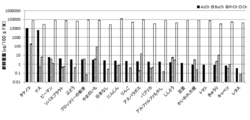
- FIG. 2 is a graph showing each choline ester and choline content of each fresh produce. The vertical axis is a logarithmic scale.
- AcCh Acetylcholine, BuCh: Butyrylcholine, PrCh: Propionylcholine, Ch: Choline.
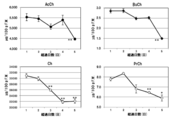
- FIG. 3 is a graph showing changes over time in each choline ester and choline content in fresh eggplant fruits 1 to 5 days after storage at room temperature (first day after p ** ⁇ 0.05, p ** ⁇ 0.01 vs. ).
- AcCh Acetylcholine, BuCh: Butyrylcholine, PrCh: Propionylcholine, Ch: Choline.
- FIG. 1 is a graph showing the yield of each fresh produce after lyophilization.
- FIG. 2 is a graph showing each choline ester and choline content of each fresh produce. The vertical axis is a logarithmic scale.
- FIG. 4 is a graph showing the choline ester content in fresh eggplant fruits at room temperature and on the sixth day of refrigerated storage. (P ** ⁇ 0.05, p ** ⁇ 0.01). The vertical axis is a logarithmic scale.
- AcCh acetylcholine
- BuCh butyrylcholine
- PrCh propionylcholine.
- FIG. 5 is a graph showing the change over time in the amount of acetylcholine due to pH when a sample is used.
- AcCh Acetylcholine.
- FIG. 6 is a graph showing the change over time in the amount of acetylcholine due to pH when eggplant extract is used.
- AcCh Acetylcholine.
- FIG. 7 is a graph showing changes in the amount of acetylcholine in eggplant by heating.
- AcCh Acetylcholine.
- FIG. 8 is a graph showing the results of single oral administration test (systolic blood pressure) of eggplant lyophilized powder containing 1.00 ⁇ 10 ⁇ 9 mol / kg equivalent of acetylcholine to SHR (p * ⁇ 0.05 vs. Pure water administration).
- FIG. 9 is a graph showing the results of a single oral administration test (diastolic blood pressure) of eggplant lyophilized powder containing 1.00 ⁇ 10 ⁇ 9 mol / kg equivalent of acetylcholine to SHR.
- FIG. 10 is a graph showing the results of single oral administration test (heart rate) of eggplant lyophilized powder containing 1.00 ⁇ 10 ⁇ 9 mol / kg equivalent of acetylcholine to SHR.
- FIG. 11 is a graph showing the results of single oral administration test (systolic blood pressure) of eggplant lyophilized powder to WKY rats (p ** ⁇ 0.05, p ** ⁇ 0.01 vs pure water administration).
- FIG. 12 is a graph showing the vascular isometric tension test results of eggplant lyophilizates (p * ⁇ 0.05, p ** ⁇ 0.01 vs lyophilized 20 mesh pass; p # ⁇ 0.05, p ## ⁇ 0.01 vs. hot air drying 20 mesh pass).
- FIG. 13 is a graph showing the results of repeated oral administration tests (systolic blood pressure) of eggplant lyophilized powder to SHR (p ** ⁇ 0.05, p ** ⁇ 0.01 vs. pure water administration).
- FIG. 14 is a graph showing the results of repeated oral administration test (diastolic blood pressure) of eggplant lyophilized powder to SHR (p * ⁇ 0.05 vs pure water administration).
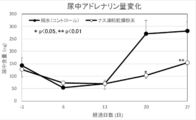
- FIG. 15 is a graph showing the results of repeated oral administration test (change in urinary adrenaline amount) of eggplant lyophilized powder to SHR (p ** ⁇ 0.05, p ** ⁇ 0.01 vs pure water administration).
- FIG. 16 is a graph showing the results of repeated oral administration test (change in urinary noradrenaline amount) of eggplant lyophilized powder to SHR (p * ⁇ 0.05, p ** ⁇ 0.01 vs pure water administration).
- the present invention relates to a composition having an antihypertensive action comprising a choline ester as an active ingredient, and a composition further having an antistress action.
- the composition of the present invention is for oral consumption and may have a choline ester content of 5 ⁇ g to 50 mg.
- the choline ester content is 5 to 500 ⁇ g, preferably 5 to 250 ⁇ g, more preferably 10 to 50 ⁇ g, and particularly preferably 25 ⁇ g.
- Such choline ester content is preferable, for example, when used for a subject with hypertension.
- the choline ester content may be 5 ⁇ g to 50 mg, preferably 500 ⁇ g to 50 mg, more preferably 500 ⁇ g to 5 mg.
- Such choline ester content is preferable, for example, when used for a subject who is healthy (not hypertensive) but has high blood pressure.
- the composition of the present invention may be a food composition or a pharmaceutical composition.
- the composition of the present invention may be a pharmaceutical composition for lowering blood pressure and / or antistress.
- the choline ester which is an active ingredient of the composition of the present invention any of those derived from animals, those derived from plants, and those derived from microorganisms can be used. It is preferable to use edible plants.
- the edible plant is not particularly limited as long as it contains a choline ester.
- Examples of edible plants include cucumbers, tomatoes, paprika, peppers, eggplant, asparagus, yam potatoes, cabbage, lettuce, carrots, apples, fermented rice, Japanese none, grapes, squid radishes, broccoli, alfalfa, beans seedlings, buckwheat And bamboo shoots.
- Solanum ⁇ ⁇ melongena, Solanum melongena, Poaceae, Bambusoideae, Bambuseae are preferred, especially the fruits of Solanum melongena Young shoots of Poaceae, Bambusoideae, Bambuseae are preferred.
- the fountains such as Senshu Mizusu, Bantensu, Goryo Salad Yuzu (also known as Bijin), Higurashi Saki, Ocho Choshi, Chikuyo are preferred and can be eaten raw.
- Water eggplant, batten eggplant, giraffe salad eggplant, and rubber gourd are preferred. Particularly preferred is Higarasaki.
- choline ester examples include acetylcholine, butyrylcholine, propionylcholine, lactoylcholine, and the like, and a composition containing one or more of these may be used.
- the composition of the present invention contains one or more selected from the group consisting of acetylcholine, butyrylcholine and propionylcholine, and does not contain lactoylcholine.
- the daily intake of choline ester is adjusted to a predetermined range.
- the content of choline ester is adjusted to 5 to 125 ⁇ g, preferably 10 to 75 ⁇ g, particularly preferably 15 to 50 ⁇ g in one package, and it is once to several times a day (preferably about three times). ) Can be taken orally.
- the total of choline esters may be adjusted to the above range by a plurality of packages. In this case, the choline ester concentration is 5 to 2500 ⁇ g / g.
- the daily intake of choline ester is adjusted to be larger than the above numerical range, for example, 5 ⁇ g to 50 mg, preferably 500 ⁇ g to 12.5 mg, more preferably 500 ⁇ g to 1.25 mg.
- the choline ester concentration may be 500 to 250 mg / g.
- the composition of the present invention is adjusted to a predetermined choline ester content.
- a product obtained by adjusting the choline ester content and cutting a fresh produce, a frozen product, a freeze-dried product, or an extract can be used.
- the composition of the present invention is preferably a composition comprising a lyophilized powder and / or extract of an edible plant.
- the composition of the present invention is divided into one-day portions so as to have a choline ester content to be ingested in a day, vacuum packs, etc. in order to prevent deterioration of quality and browning of pulp. It may be individually wrapped. Moreover, it is preferable that the composition of this invention is frozen processing.
- the composition of the present invention is preferably part or all of the frozen processed Solanum melongena fruit.
- the present invention relates to a method for producing a composition having a blood pressure lowering action and / or an anti-stress action for ingestion, comprising a choline ester as an active ingredient.
- the edible plant is made into lyophilized powder and / or hot air dried powder or extract, and the lyophilized powder and / or hot air dried powder or extract is distributed so that the choline ester content becomes a predetermined amount.
- the predetermined amount may be 5 ⁇ g to 250 mg, preferably 5 ⁇ g to 50 mg, more preferably 10 ⁇ g to 50 mg.
- the predetermined amount may be, for example, 5 to 500 ⁇ g, 5 to 250 ⁇ g, 10 to 50 ⁇ g, or 25 ⁇ g.
- the method of the present invention can further comprise heating the edible plant. Heating can be performed by boiling in a microwave oven or hot water. For example, when heating in a microwave oven of 550 W, heating is performed for 1 to 15 minutes, preferably 2 to 10 minutes, more preferably 4 to 6 minutes per 100 g of edible plants. In addition, when boiling in hot water, it is preferable to heat in hot water of 90 to 100 ° C. Thus, by heating an edible plant, it can sterilize and can increase the choline ester in an edible plant.
- the method of the present invention is characterized in that, in one aspect, the edible plant is further subjected to heat treatment (bactericidal action and choline ester increasing action), usually by freeze-drying or hot-air drying to avoid spoilage by microorganisms. To do.
- the method of the present invention may further include suspending lyophilized powder and / or hot-air dried powder of edible plants in water and adding an acid to the resulting suspension.
- the pH of the suspension to which the acid has been added is adjusted to, for example, 5.5 to 4.5, preferably 5.4 to 4.6.
- the choline ester is stabilized and a composition (suspension) excellent in long-term storage can be obtained.
- the present invention also relates to a method for producing an extract having a blood pressure lowering action and / or an anti-stress action for oral consumption, comprising a choline ester as an active ingredient.
- the method of the present invention comprises extracting an edible plant or lyophilized powder and / or hot air dried powder of an edible plant with ethanol or hydrous ethanol. More specifically, in the method of the present invention, ethanol or water-containing ethanol is added to lyophilized powder and / or hot-air dried powder of edible plants, or ethanol is added to fresh edible plants and ground to remove residues.
- the resulting extract enriched in choline ester can be included.
- the ethanol concentration of the hydrous ethanol is not particularly limited, but can be appropriately selected from the viewpoint of the extraction rate and concentration rate of the choline ester.
- the ethanol concentration of the hydrous ethanol may be, for example, 10% (w / w) or more, preferably 10 to 99% (w / w), more preferably 25 to 60% (w / w). Or 95% (w / w) or more, particularly preferably 30 to 60% (w / w) or 99% (w / w) or more.
- L-ascorbic acid may be added to ethanol or water-containing ethanol used for extraction, for example, 1 to 5 wt%, preferably 3 wt%.
- the method of the present invention may comprise adjusting the choline ester content of the extract to 5 ⁇ g to 50 mg.
- the present invention also relates to a composition having a blood pressure lowering action and / or an anti-stress action for oral intake, comprising a choline ester produced by the above method as an active ingredient.
- the dry powder according to the composition of the present invention is preferably a powder that has passed through an appropriate mesh sieve.
- the composition of the present invention is preferably composed of, for example, a freeze-dried powder and / or a hot-air dried powder that can pass through a 20-mesh sieve.
- the hot-air dry powder can be prepared by, for example, drying an edible plant by exposing it to hot air at about 90 ° C. for about 1 to 2 hours, and pulverizing it into a powder.
- composition of the present invention can be used as an active ingredient of various functional health foods or pharmaceutical compositions.
- food it can be used as a food composition in combination with an appropriate food additive.
- it is not limited to such a composition for food, but it can be ingested on a daily basis as a beverage by blending with green tea, black tea, oolong tea, miscellaneous tea, etc. Can also be provided.
- it can also be used as a so-called supplement as an appropriate dosage form according to the following pharmaceutical preparation.
- a pharmaceutical product it can be used in various dosage forms in accordance with a normal dispensing method in combination with an appropriate pharmaceutical additive.
- dosage forms include oral preparations such as solid preparations such as powders, granules, capsules, pills and tablets, liquids such as liquids, suspensions and emulsions.
- composition of the present invention When used as a food, it can be used not only as a general food and drink, but also as a functional health food that exhibits a specific function to promote health.
- Specific forms in this case include capsules, tablets, powders, granules and the like containing the composition of the present invention as an active ingredient, bakery foods such as bread, cakes and cookies, sauces, Seasonings such as soup, dressing, mayonnaise, dairy products such as milk, yogurt, cream, confectionery such as chocolate, candy, or green tea, tea, oolong tea, barley tea, millet tea, fruit juice, vegetable drink, milk drink And various beverages such as soft drinks and carbonated drinks.
- the dose varies depending on the ratio of each component, and also varies depending on various factors such as the age, weight, sex, symptom, and administration method of the patient.
- the choline ester content can generally be selected in the range of 5 ⁇ g to 50 mg, and in one embodiment in the range of 5 ⁇ g to 500 ⁇ g.
- the administration frequency can be divided into once to several times a day.
- the amount of intake when the composition of the present invention is used as a food can be selected according to the case of oral administration of the pharmaceutical product.
- the dose and frequency of administration are not particularly limited, so the purpose of maintaining health, taste, and palatability should be considered unless particularly serious symptoms occur. And you may select intake, without being limited to said range.
- Extraction method Sample preparation Fresh agricultural products (analytical samples) were washed with tap water immediately after they were obtained. After wiping off the moisture, only the edible portion was sliced with a knife to a width of 1 to 3 cm as necessary. The edible portion was lyophilized with a freeze dryer (FDU-2000, Tokyo Rika Kikai Co., Ltd.). The freeze-dried product was pulverized with a mill mixer (MASTER, Tokyo Unicom Co., Ltd.) to form a powder.
- FDU-2000 Tokyo Rika Kikai Co., Ltd.
- the freeze-dried product was pulverized with a mill mixer (MASTER, Tokyo Unicom Co., Ltd.) to form a powder.
- the weak acid cation exchange cartridge Inert Sep CBA 100 mg / 1 mL (GL Sciences Inc.) was used for the solid phase extraction cartridge.
- the solid phase extraction cartridge activated with methanol (1 mL) and pure water (1 mL) was equilibrated with 10 mM phosphate buffer (8 mL), and then the extraction sample prepared in (3) (about 600 ⁇ L) was added. Stabilized with 10 mM phosphate buffer (600 ⁇ L), washed with pure water (2.5 mL), and eluted with hydrochloric acid (500 ⁇ L).
- the choline compound mixed solution was prepared as shown in Table 3, and the addition concentration of each choline compound stock solution was determined based on the analysis result of the sample without addition of the choline compound mixed solution (Table 2-A).
- the choline compound stock solution was diluted with LC / MS / MS analysis solvent to prepare each concentration. When there was a choline compound that was not detected, only an equivalent amount of LC / MS / MS analysis solvent not containing the compound was added.
- LC / MS / MS analysis (1) LC / MS / MS analysis conditions The column used was YMC-Triart PFP (4.6 mm ⁇ 250 mm, 5 ⁇ m, YMC). Water containing 0.01% formic acid-33% methanol was used as the analysis solvent, the flow rates were 0.5 mL / min (LC), 0.3 mL / min (MS), the injection volume was 50 ⁇ L, the separation temperature was 40 ° C., and the analysis time.
- AcCh in the eggplant extract was unstable under neutral conditions, and more than half of it was degraded in 3 days, and almost all of AcCh was degraded in 12 days. It is relatively stable under acidic conditions, and at pH 5.4 to 4.6, 88% or more of AcCh remained even after 12 days, but in a solution adjusted to pH 3.5 with acetic acid, 24.6% AcCh after 12 days. Was disassembled.
- AcCh in eggplant was stably present at room temperature under acidic conditions of pH 5.4 to 4.6. From the above results, the choline ester in agricultural products such as eggplant can be further stabilized by adjusting the pH to 5.5 to 4.5 by adding an organic acid or the like. If the pH is within this range when the suspension is formed, the acid may be added at an appropriate time.
- acetylcholinesterase (EC number 3.1.1.7), which is a cholinesterase, affects the cholineester content.
- acetylcholinesterase is widely present in plants.
- the decrease in AcCh shown in Table 8 is thought to be mainly due to degradation by acetylcholinesterase. It was considered that more AcCh was decomposed at neutral pH close to the optimum pH 8.0 to 8.5 of acetylcholinesterase, and degradation of AcCh was suppressed at a low pH at which the enzyme activity decreased.
- Eggplant extract preparation test Eggplant extract was prepared using eggplant freeze-dried powder and fresh eggplant.
- An extract preparation method using eggplant freeze-dried powder is as follows. Weigh eggplant freeze-dried powder (1 g) into a centrifuge tube (50 mL capacity), add 10-fold weight (10 g) of a 10% to 100% solvent with varying EtOH concentration by 10%, and shake at room temperature at 3000 rpm for 30 minutes. After stirring, the mixture was filtered to obtain a supernatant. The supernatant was transferred to an eggplant flask (200 mL), pure water (10 g) was added, and the mixture was concentrated using an evaporator.
- the eggplant extract is a water-soluble semi-solid material in which choline ester is concentrated more than freeze-dried powder and / or hot-air dried powder.
- L-ascorbic acid is added to make the solution acidic and the oxidation is suppressed, it is possible to stabilize the choline ester and prevent color change during the extraction process.
- the choline esters in the eggplant lyophilized powder is AcCh, and the AcCh content is 2.25 mg / gD. W. Met.
- the dosage was 0.065 mg / kg of eggplant lyophilized powder corresponding to AcCh1.00 ⁇ 10 ⁇ 9 mol (0.146 ⁇ g) / kg, and it was orally administered once to 6 SHRs.
- the administration test of AcCh preparation 1.00 ⁇ 10 ⁇ 9 mol / kg was conducted in the same manner to measure the systolic blood pressure.
- the control group received water only under the same conditions.
- the eggplant lyophilized powder administration group caused a significant systolic blood pressure lowering effect (p ⁇ 0.05) 3 to 9 hours after administration, and the maximum blood pressure decrease was ⁇ 17 after 9 hours administration. .8 mmHg, -10.0 mmHg compared with the control group, and showed a blood pressure lowering effect almost the same as the administration of acetylcholine 1.00 ⁇ 10 ⁇ 9 mol / kg.
- the diastolic blood pressure also tended to decrease, and the maximum blood pressure decrease was ⁇ 11.3 mmHg 9 hours after administration, and ⁇ 8.3 mmHg compared with the control group.
- the heart rate tended to be lower than that of the control group 3 hours after administration, but thereafter showed an upward trend until 9 hours after administration.
- the blood pressure lowering effect by oral administration of eggplant was confirmed.
- the effective daily AcCh dose to SHR after 12 hours fast is 1.00 ⁇ 10 ⁇ 9 mol (0.146 ⁇ g) / kg, but the effective daily AcCh dose to non-fasted SHR is a repeated oral study Was a 1.00 ⁇ 10 ⁇ 8 mol (1.46 ⁇ g) / kg in which a significant blood pressure increase inhibitory effect was observed (Non-patent Document 21).
- the AcCh dose that causes SHR in this normal state to cause a blood pressure lowering effect when taken orally was extrapolated to humans using Kreber's law (Non-patent Document 22).
- the metabolic rate of mammals is proportional to the third power of the body weight, and assuming that the body weight of SHR is 370 g and the body weight of human is 60 kg, 45.4 times the effective dose of SHR is estimated as the human effective dose. It is. That is, the AcHR intake of SHR causing blood pressure lowering action is 3.70 ⁇ 10 ⁇ 9 mol (0.540 ⁇ g) per day, and the effective human dose per day is 1.68 ⁇ 10 ⁇ 7 mol (24.5 ⁇ g). )
- the present inventor has already found a blood pressure lowering action and a vasodilating action of fermented duckweed (a fermented lactic acid product of buckwheat plant), and contains and purified choline esters of AcCh, BuCh, LaCh, PrCh as active ingredients. It has been clarified that when AcCh, BuCh, PrCh is orally administered to SHR once, it exhibits a blood pressure lowering effect (Patent Documents 1 and 2). Further studies were conducted to examine the hypotensive effect of oral administration of choline esters in humans.
- a normal high blood pressure person and a person with hypertensive I (6 males, 6 females, 33-63 years old) drink fermented duck-containing beverage (containing 25 ⁇ g choline ester per bottle) daily for 4 weeks I let you.
- the blood pressure lowering effect was confirmed at a dose very close to the effective dose obtained by extrapolating the effective dose of AcCh causing blood pressure lowering effect by SHR to humans according to Kreber's law.
- the blood pressure lowering effect was greatly attenuated at 2.00 ⁇ 10 ⁇ 9 mol (0.292 ⁇ g) / kg.
- This AcCh dose is extrapolated to humans using Kleber's law (Non-patent Document 22), and the lower limit of the effective human dose per day is 3.36 ⁇ 10 ⁇ 8 mol (4.91 ⁇ g).
- the blood pressure lowering effect was greatly attenuated at 2.00 ⁇ 10 ⁇ 7 mol (29.2 ⁇ g) / kg.
- the upper limit of the effective human dose per day is 3.36 ⁇ 10 ⁇ 6 mol (491 ⁇ g). Therefore, the effective human dose per day for hypertensives having genetic characteristics such as SHR was estimated to be in the range of 5 to 500 ⁇ g.
- the choline ester dose causing the blood pressure lowering effect can be finally determined in consideration of the human effective dose estimated as described above and the amount of choline ester derived from a diet other than the composition of the present invention.
- the dosage was 0.065 mg / kg of eggplant lyophilized powder (corresponding to AcCh1.00 ⁇ 10 ⁇ 9 mol (0.146 ⁇ g) / kg) and 6.5 mg / kg (AcCh1.00 ⁇ 10 ⁇ 7 mol (14 Equivalent to 6 ⁇ g) / kg).
- the results of a single oral administration test of eggplant lyophilized powder to WKY rats are shown in FIG.
- eggplant fruit lyophilized product obtained by freeze-drying eggplant fruit sliced to a width of 1 to 3 cm and sterilized by heating (about 90 ° C., about 5 minutes), or hot-air dried (about 90 ° C., about 1-2)
- the dried eggplant fruit hot-air product obtained by (hour) was pulverized with a mill mixer (MASTER, Tokyo Unicom Co., Ltd.) to form a powder.
- Each crushed sample was passed through a stainless steel sieve (JIS standard, 20 mesh), passed through 20 mesh pass, and passed through 20 mesh on, fresh eggplant fruit crushed 20 mesh pass (sample 1), fresh Eggplant fruit pulverized product 20 mesh on (sample 2), freeze dried powder 20 mesh pass (sample 3), freeze dried powder 20 mesh on (sample 4), hot air dried powder 20 mesh pass (sample 5), hot air dried powder 20 mesh On (sample 6) was prepared.
- Blood vessel isometric tension measurement was performed as follows. Male 14-week-old SHR (body weight: 320 to 346 g) was subjected to laparotomy and exsanguination under ether anesthesia, and the thoracic aorta was rapidly removed. The excised aorta was immersed in physiological saline, and the blood was thoroughly washed out. Then, connective tissue and adipose tissue attached to blood vessels were removed in a Krebs-Henseleit solution, and a ring specimen having a width of about 2 to 3 mm was prepared.
- an isometric tension testing device UFER UC-05A, Iwashiya Kishimoto Medical Industry Co., Ltd., Kyoto
- a static tension of 1.0 g Loaded and allowed the ring specimen to stabilize for 60 minutes.
- phenylephrine PE, 0.3 ⁇ M
- AcCh final concentration 100 ⁇ M
- the blood vessels were contracted again with the contracting agent PE (0.3 ⁇ M) to confirm that the contraction reached the maximum, and the final concentration of AcCh was 10 ⁇ 9 , 10 ⁇ 8 , 10 ⁇ 7 , 10 ⁇ 6.
- Each eggplant pulverized sample suspended in Krebs-Henseleit solution was added so as to be 5 , 10 ⁇ 6 , 10 ⁇ 5.5 , and 10 ⁇ 5 M.
- Expansion rate (%) ⁇ maximum tension (g) ⁇ tension when adding sample (g) ⁇ / maximum tension (g)
- Table 14 shows the eggplant crushed sample concentrations added so that the final AcCh concentrations are 10 ⁇ 9 , 10 ⁇ 8 , 10 ⁇ 7 , 10 ⁇ 6.5 , 10 ⁇ 6 , 10 ⁇ 5.5 , and 10 ⁇ 5 M.
- the freeze-dried yield of the fresh eggplant fruit pulverized product used in this test was 6.0%.
- the highest concentration was 19 mg / mL.
- the contents of chlorogenic acids and ⁇ -aminobutyric acid (GABA) that may affect vasodilation other than choline esters are 0.56 mg / g FW and 0.24 mg / g FW, respectively.
- the maximum expansion rate was 80% when an eggplant ground sample (6.2 ⁇ 10 ⁇ 2 mg / mL) with an AcCh concentration of 10 ⁇ 6 M was added.
- the hot-air dry powder 20 mesh pass that showed the strongest vasodilatory effect was obtained by adding eggplant ground sample (7.2 ⁇ 10 ⁇ 4 mg / mL) so that the AcCh concentration in the chamber was 10 ⁇ 8 M.
- Dose-dependent significant vasodilation was shown, and at higher concentrations it was slightly vasodilated, although slightly contracted.
- the maximum expansion rate was 78% when an eggplant ground sample (7.2 ⁇ 10 ⁇ 2 mg / mL) with an AcCh concentration of 10 ⁇ 6 M was added. From these results, the strong vasodilatory effect of the dried eggplant powder was
- samples 4 and 6 showed significant vasodilation (AcCh concentration of 10 ⁇ 7 M (freeze-dried powder 8.9 ⁇ 10 ⁇ 3 mg / mL, hot-air dry powder 9.8 ⁇ 10 ⁇ 3 mg / mL)). p ⁇ 0.05), and the maximum expansion rate was 57% freeze-dried powder and 50% hot-air dry powder when the eggplant crushed sample with an AcCh concentration of 10 ⁇ 5 M was added. Comparing the vasodilatory effects of sample 3 and sample 4, when sample 3 was added, a significantly strong vasodilatory effect was confirmed from an AcCh concentration of 10 ⁇ 8 M, and a vasodilatory effect of 10 ⁇ 8 M was 6.5. It was twice.
- Samples 1 and 2 showed significant vasodilation (p ⁇ 0.05) from 10 ⁇ 6 M (1.4 mg / mL) and 10 ⁇ 6.5 M (0.59 mg / mL), respectively, in the AcCh concentration. Although shown, the vasodilator action was weaker than that of the dry powder, and it became clear that the 20 mesh pass dry powder exerted a high effect in the living body.
- EC 50 is an index representing the strength of the biological action of the test sample.
- the vasodilatory EC 50 in the main test of Sample 3 is 0.015 mg / mL, and a significantly stronger activity is recognized than the eggplant pulverized product other than Sample 5, the activity intensity is 467 times that of Sample 1, and Sample 2 660 times, 16 times that of Sample 4, and 26 times that of Sample 6.
- the EC 50 of Sample 5 that exhibited the next strong vasodilatory action was 0.027 mg / mL, and a significantly stronger activity was observed than the ground eggplant other than Sample 3, and the strength of the activity was that of Sample 1. They were 259 times, 367 times of sample 2, 9 times of sample 4, and 14 times of sample 6. From the above results, it was concluded that dried eggplant powder finer than 20 mesh has a strong vasodilatory action.
- the blood pressure (systolic phase, diastolic phase) was measured in the same manner as in [Experiment 9] above, on the 7th, 14th, 21st and 28th days before the start of the test and after the start of the test. Each measurement was repeated three times, and an average value ⁇ standard error (Mean ⁇ SE) was determined.
- Urinary catecholamine was quantified using a urine sample the day before blood pressure measurement. From the day before the start of repeated oral administration, collection of urine samples for 24 hours was started. Urine was collected once a day using a urine collection container to which 5N hydrochloric acid (1 mL) was added and the amount of urination was measured. The obtained urine was stored frozen at ⁇ 80 ° C. until measurement.
- Urinary catecholamines consist of an HPLC system (Prominence HPLC system, Shimadzu Corporation, Kyoto: System controller: CBM-20A, liquid feeding unit: LC-20AD, column oven: CTO-10A) and an electrochemical detector (ECD, Using GL Sciences Inc., ED723 diamond electrode), quantification was repeated three times under the following conditions, and an average value ⁇ standard error (Mean ⁇ SE) was determined.
- HPLC system Prominence HPLC system, Shimadzu Corporation, Kyoto: System controller: CBM-20A, liquid feeding unit: LC-20AD, column oven: CTO-10A
- ECD electrochemical detector
- the test group showed significantly lower systolic blood pressure on the 14th, 21st, and 28th days of the test, and the diastolic blood pressure on the 28th day than the control group.
- Noradrenaline is a neurotransmitter released from the sympathetic nerve endings, and adrenaline is produced by converting noradrenaline in the adrenal glands.
- These catecholamines act on adrenergic receptors and are involved in the control of various organs and metabolic systems. The released catecholamine acts on the effector that the nerve reaches, and partly moves into the blood to affect the whole body. Blood catecholamines are metabolized and inactivated, but some are excreted in the urine as they are. Therefore, the amount of urinary catecholamine is an index of sympathetic nerve activity in the living body. In other words, as a result of increased sympathetic nerve activity and active activity, the amount of urinary catecholamine increases. Sympathetic nerves promote arousal, attack, defense and escape behavior.
- Catecholamines released by increased sympathetic nerve activity act on vascular adrenergic alpha receptors, causing blood vessels to contract and increase blood pressure. Therefore, it is considered that the catecholamine decrease due to suppression of sympathetic nerve activity is deeply involved in the blood pressure lowering mechanism of orally ingested choline esters.
- catecholamine is known as a stress index.
- Catecholamine (adrenaline, noradrenaline, dopamine) is adopted as an index of the antistress action in the body of the antistress composition containing ⁇ -carotene as an active ingredient, and the antistress action is shown by a significant decrease in catecholamine by the intake of the composition (Patent Document 3).
- the urinary catecholamine amount was significantly reduced by ingestion of eggplant lyophilized powder, and it can be said that the ingestion of eggplant lyophilized powder suppressed sympathetic nerve activity and exerted an anti-stress effect. That is, an anti-stress effect by ingesting eggplant freeze-dried powder was observed.
- the vasodilatory effect of Experiment 11 is caused by the action of choline esters contained in eggplant on muscarinic acetylcholine receptors (Non-patent Document 25). This anti-stress effect is also thought to be the result of choline esters contained in eggplant acting on muscarinic acetylcholine receptors, suppressing sympathetic nerve activity and inhibiting catecholamine release from nerve depletion.
- Extracts and processed foods made from eggplant containing ester are considered to have anti-stress action.
- the hypotensive and anti-stress effects caused by the suppression of sympathetic nerve activity by orally ingested choline esters are closely related to each other. Therefore, the difference in choline ester dosage between SHR and WKY rats, where blood pressure lowering action was observed, is also applied to anti-stress action.
- composition of the present invention has a remarkable blood pressure lowering action, and by containing this as an active ingredient, a functional indication food or a therapeutic drug for hypertension or the like can be produced.
Landscapes
- Health & Medical Sciences (AREA)
- Life Sciences & Earth Sciences (AREA)
- Chemical & Material Sciences (AREA)
- Natural Medicines & Medicinal Plants (AREA)
- Engineering & Computer Science (AREA)
- General Health & Medical Sciences (AREA)
- Veterinary Medicine (AREA)
- Public Health (AREA)
- Animal Behavior & Ethology (AREA)
- Pharmacology & Pharmacy (AREA)
- Medicinal Chemistry (AREA)
- Epidemiology (AREA)
- Mycology (AREA)
- Botany (AREA)
- Polymers & Plastics (AREA)
- Microbiology (AREA)
- Food Science & Technology (AREA)
- Alternative & Traditional Medicine (AREA)
- Chemical Kinetics & Catalysis (AREA)
- Medical Informatics (AREA)
- Nutrition Science (AREA)
- Bioinformatics & Cheminformatics (AREA)
- General Chemical & Material Sciences (AREA)
- Biotechnology (AREA)
- Heart & Thoracic Surgery (AREA)
- Cardiology (AREA)
- Nuclear Medicine, Radiotherapy & Molecular Imaging (AREA)
- Organic Chemistry (AREA)
- Oil, Petroleum & Natural Gas (AREA)
- Emergency Medicine (AREA)
- Medicines Containing Plant Substances (AREA)
- Coloring Foods And Improving Nutritive Qualities (AREA)
- Acyclic And Carbocyclic Compounds In Medicinal Compositions (AREA)
- Medicinal Preparation (AREA)
- Dairy Products (AREA)
- Pharmaceuticals Containing Other Organic And Inorganic Compounds (AREA)
- Steroid Compounds (AREA)
Abstract
本発明の課題は、アセチルコリンなどのコリンエステルを有効成分としながら、ヒトが簡易に経口摂取でき、血圧降下作用および/または抗ストレス作用を有する組成物を提供することである。 本発明の課題は、アセチルコリンなどのコリンエステルを、ヒトが簡易に経口摂取でき、血圧降下作用および血管拡張作用を有する新規な経口摂取用組成物を提供すること、そのために有用な供給源となる食品を提供することにある。
Description
本発明は、コリンと有機酸がエステル結合した化合物であるコリンエステルを有効成分とする血圧降下作用および/または抗ストレス作用を有する組成物およびその製造方法に関する。
コリンエステルの中で、アセチルコリンは哺乳類の神経伝達物質として生命活動に不可欠な物質であることが知られている。また、1929年に、ウマの脾臓からヒスタミンとは異なる血圧降下物質が単離され、その活性物質がアセチルコリンであることが化学的に同定された(非特許文献1)。さらに、麦角の血圧降下物質がアセチルコリンであることが解明され、菌類がアセチルコリンを産生することが確認されている(非特許文献2)。アセチルコリンは、食用植物、食用菌類、ローヤルゼリー、牛乳等に含まれており、枯草菌、酵母にもアセチルコリンが存在し、食用植物では、ナスおよびタケノコのアセチルコリン含量が高いことが報告されている(非特許文献3~7)。
また、アセチルコリンの他、複数のコリンエステル類も発見されている。
アセチル基より1つ炭素鎖が長いプロピオニル基を有するプロピオニルコリンは、1953年に牛の脾臓から発見されている(非特許文献8、9)。その後、牡牛の精液中、ヨーロッパザリガニ、アメリカカブトガニ、ヨーロッパザルガイ、オオノガイ、ムラサキイガイ、ホンドブガイ、リンゴマイマイ中の血リンパと平滑筋中、シビレエイの電気発生組織培養中の他、ヘンヨウボク、緑豆、オオバコ、ポプラ、シラカバ中などに、プロピオニルコリン産生が確認されている(非特許文献10~13)。
アセチル基より1つ炭素鎖が長いプロピオニル基を有するプロピオニルコリンは、1953年に牛の脾臓から発見されている(非特許文献8、9)。その後、牡牛の精液中、ヨーロッパザリガニ、アメリカカブトガニ、ヨーロッパザルガイ、オオノガイ、ムラサキイガイ、ホンドブガイ、リンゴマイマイ中の血リンパと平滑筋中、シビレエイの電気発生組織培養中の他、ヘンヨウボク、緑豆、オオバコ、ポプラ、シラカバ中などに、プロピオニルコリン産生が確認されている(非特許文献10~13)。
また、ブチリルコリンについては、1954年に脳抽出物から発見され(非特許文献14)、節足動物、軟体動物中に、アセチルコリン、プロピオニルコリンと共に存在することが示されている(非特許文献11)。
さらに、プロピオニルコリン、ブチリルコリン以外にも軟体動物から、いくつかのコリンエステル類が確認されている。たとえば、ウロカノイルコリンがアクキガイの一種から、ββ-ジメチルアクロイルコリン(セネシオイルコリン)がレイシガイの一種から、アクロイルコリンがエゾバイの一種から、イミダゾールプロピオニルコリンがレイシガイの一種から構造決定されている(非特許文献15~18)。
さらに、プロピオニルコリン、ブチリルコリン以外にも軟体動物から、いくつかのコリンエステル類が確認されている。たとえば、ウロカノイルコリンがアクキガイの一種から、ββ-ジメチルアクロイルコリン(セネシオイルコリン)がレイシガイの一種から、アクロイルコリンがエゾバイの一種から、イミダゾールプロピオニルコリンがレイシガイの一種から構造決定されている(非特許文献15~18)。
本発明者は、発酵キョウバク(ソバ植物体の乳酸発酵物)に含まれる血圧降下作用および血管拡張作用活性成分について研究し、少なくともアセチルコリンとプロピオニルコリンを含む、複数のコリンエステルを主体とした第4級アルキルアンモニウム化合物を含有する抽出組成物を提供し、また精製したアセチルコリン、プロピオニルコリン、ブチリルコリンを高血圧自然発症ラット(SHR)に単回経口投与した場合に血圧降下作用を示すことを明らかにした(特許文献1、2)。一方で、アセチルコリン塩化物を有効成分とする医薬のインタビューフォーム(非特許文献19)に、「アセチルコリンは経口投与すると消化管で分解され、ほとんど吸収されないので、注射剤とした」と記載されているように、これまでコリンエステルのヒトへの適用は注射剤によるもので経口摂取により作用させることについての検討はなされていない。
Dale HH, Dudley HW. The presence of histamine and acetylcholine in the spleen of the ox and the horse. J Physiol 68:97-123, 1929.
Ewins AJ. Acetylcholine, a new active principle of ergot. Biochem J 8:44-49, 1914.
桃木芳枝, 植物におけるアセチルコリン, 植物の化学調節, 30(1), 49-61 (1995)
川島紘一郎, アセチルコリンのルーツと非神経性アセチルコリン, 基礎老化研究, 34(4), 12-24 (2010)
篠田雅人ら, ローヤルゼリー中の血流増加因子について, 薬学雑誌, 98(2), 139-145 (1978)
Whittaker VP. Acetylcholine in Milk. Nature 181:856-857, 1958.
Horiuchi Y, Kimura R, Kato N, Fujii T, Seki M, Endo T, Kato T, Kawashima, K. Evolutional study on acetylcholine expression. Life Sci 72:1745-1756, 2003.
Banister J, Whittaker VP, Wijesundera S. The occurrence of homologues of acetylcholine in ox spleen. J Physiol 121(1):55-71, 1953.
Gardiner JE, Whittaker VP. The identification of propionylcholine as a constituent of ox spleen. Biochem J 58(1):24-29, 1954.
Bishop MR, Sastry BV, Stavinoha WB. Identification of acetylcholine and propionylcholine in bull spermatozoa by integrated pyrolysis, gas chromatography and mass spectrometry. Biochim Biophys Acta 500(2):440-444, 1977.
Wolfgang W, Jutta N, Dettmar W. Distribution of cholinesters and cholinesterases in haemolymphs and smooth muscles of molluscs. Comp Biochem Phys C 61(1):121-131, 1978.
O'Regan S. The synthesis, storage, and release of propionylcholine by the electric organ of Torpedo marmorata. J Neurochem 39(3):764-772, 1982.
Miural GA, Shin TM. Identification of proprionylcholine in higher plants. Physiol Plant 62:341-343, 1984.
Holtz P, Schumann HJ. Butyrylcholine in brain extracts. Naturwissenschaften 41:306, 1954.
Erspamer V, Benati O. Identification of murexine as beta-[imidazolyl-(4)]acrylcholine. Science 117:161-162, 1953.
Keyl MJ, Michaelson IA, Whittaker VP. Physiologically active choline esters in certain marine gastropods and other invertebrates. J Physiol 139:434, 1957.
Whittaker VP. Acrylylcholine: a new naturally occurring pharmacologically active choline ester from Buccinum undatum. Biochem Pharmacol 1(4):342-346, 1959.
Roseghini M. Occurrence of dihydromurexine (imidazole propionylcholine) in the hypobranchial gland of Thais (purpura) haemastoma. Experientia 27(9):1008-1009, 1971.
オビソート(登録商標)注射用0.1gのインタビューフォーム, 2013年1月
最新基礎薬理学(監修:高木敬次郎, 亀山勉, 編集:大石幸子,岡部進, 発行者:廣川書店, 96ページ, 6~10行
日本農芸化学会2016年(平成28年)度大会講演要旨集, 4E076, 2016年3月5日公開.
Kleiber, M. The fire of life. An introduction to animal energetics. New York: Wiley, 1961.
Kim JM, Lee SW, Kim KM, Chang UJ, Song JC, Suh HJ. Anti-stress effect and functionality of yeast hydrolysate SCP-20. Europe Food Res Technol 217(2):168?172, 2003.
Armando I, Carranza A, Nishimura Y, Hoe KL, Barontini M, Terron JA, Falcon-Neri A, Ito T, Juorio AV, Saavedra JM. Peripheral administration of an angiotensin II AT(1) receptor antagonist decreases the hypothalamic-pituitary- adrenal response to isolation Stress. Endocrinology 142(9):3880-3889, 2001.
Nakamura K, Okitsu S, Ishida R, Tian S, Igari N, Amano Y. Identification of natural lactoylcholine in lactic acid bacteria-fermented food.Food Chem 201:185-189, 2016.
本発明者は、ヒトにおいてコリンエステルの経口摂取による利用が可能になれば、身体への負担がなく、安全かつ簡易に血圧降下等を実現できることになるにもかかわらず、ヒトにアセチルコリンを経口で適切に投与する技術および該技術に適切な供給源がいまだ見出されていないことに着目し、これらを明らかにすることが重要であると考えた。
したがって本発明の課題は、アセチルコリンなどのコリンエステルを有効成分としながら、ヒトが簡易に経口摂取でき、血圧降下作用および血管拡張作用を有する新規な経口摂取用組成物を提供すること、そのために有用な供給源となる食品を提供することにある。
したがって本発明の課題は、アセチルコリンなどのコリンエステルを有効成分としながら、ヒトが簡易に経口摂取でき、血圧降下作用および血管拡張作用を有する新規な経口摂取用組成物を提供すること、そのために有用な供給源となる食品を提供することにある。
本発明者は、上記課題を解決すべく鋭意研究を重ねる中で、これまでのアセチルコリンはヒトへの経口投与はできないとの定説にもかかわらず、驚くべきことに、コリンエステルが経口投与によって血圧降下作用および血管拡張作用を示すための適正な用量が存在すること、さらにかかる用量で抗ストレス作用を奏することを見出し、またそのためのコリンエステルを効率よく供給するための原料としての適切な食用植物を発見し、さらに研究を進めた結果、本発明を完成するに至った。
したがって本発明は、以下に関する。
[1] コリンエステルを有効成分とする血圧降下作用および/または抗ストレス作用を有する組成物であって、コリンエステル含量が5μg~50mgであり、経口摂取用である、前記組成物。
[2] 食品組成物である、前記[1]に記載の組成物。
[3] 血圧降下用および/または抗ストレス用の医薬組成物である、前記[1]に記載の組成物。
[1] コリンエステルを有効成分とする血圧降下作用および/または抗ストレス作用を有する組成物であって、コリンエステル含量が5μg~50mgであり、経口摂取用である、前記組成物。
[2] 食品組成物である、前記[1]に記載の組成物。
[3] 血圧降下用および/または抗ストレス用の医薬組成物である、前記[1]に記載の組成物。
[4] コリンエステルが、食用植物由来である、前記[1]~[3]のいずれか一項に記載の組成物。
[5] 食用植物の凍結乾燥粉末および/または熱風乾燥粉末からなる、前記[1]~[4]のいずれか一項に記載の組成物。
[6] 20メッシュの篩を通過できる凍結乾燥粉末および/または熱風乾燥粉末からなる、前記[5]に記載の組成物。
[7] 食用植物をエタノールまたは含水エタノールで抽出してなる抽出物である、前記[1]~[4]のいずれか一項に記載の組成物。
[8] 食用植物が、ナス科ナス属ナス種(Solanum melongena)の果実および/またはイネ科タケ亜科タケ連(Poaceae, Bambusoideae, Bambuseae)の若芽である、前記[4]~[7]のいずれか一項に記載の組成物。
[5] 食用植物の凍結乾燥粉末および/または熱風乾燥粉末からなる、前記[1]~[4]のいずれか一項に記載の組成物。
[6] 20メッシュの篩を通過できる凍結乾燥粉末および/または熱風乾燥粉末からなる、前記[5]に記載の組成物。
[7] 食用植物をエタノールまたは含水エタノールで抽出してなる抽出物である、前記[1]~[4]のいずれか一項に記載の組成物。
[8] 食用植物が、ナス科ナス属ナス種(Solanum melongena)の果実および/またはイネ科タケ亜科タケ連(Poaceae, Bambusoideae, Bambuseae)の若芽である、前記[4]~[7]のいずれか一項に記載の組成物。
[9] コリンエステルが、アセチルコリン、ブチリルコリンおよびプロピオニルコリンからなる群から選択される1種または2種以上を含む、前記[1]~[3]のいずれか一項に記載の組成物。
[10] コリンエステルが、ラクトイルコリンを含まない、前記[9]に記載の組成物。
[11] コリンエステルの濃度が5μg/g~250mg/gであり、かつ、1日の摂取量が、5μg~50mgに調整されてなる、前記[1]~[10]のいずれか一項に記載の組成物。
[12] 冷凍加工されてなる、前記[1]~[11]のいずれか一項に記載の組成物。
[13] 冷凍加工されたナス科ナス属ナス種(Solanum melongena)の果実の一部または全部である、前記[1]~[3]のいずれか一項に記載の組成物。
[10] コリンエステルが、ラクトイルコリンを含まない、前記[9]に記載の組成物。
[11] コリンエステルの濃度が5μg/g~250mg/gであり、かつ、1日の摂取量が、5μg~50mgに調整されてなる、前記[1]~[10]のいずれか一項に記載の組成物。
[12] 冷凍加工されてなる、前記[1]~[11]のいずれか一項に記載の組成物。
[13] 冷凍加工されたナス科ナス属ナス種(Solanum melongena)の果実の一部または全部である、前記[1]~[3]のいずれか一項に記載の組成物。
[14] コリンエステルを有効成分とする経口摂取用の血圧降下作用および/または抗ストレス作用を有する組成物を製造する方法であって、食用植物を凍結乾燥粉末および/または熱風乾燥粉末にすること、凍結乾燥粉末および/または熱風乾燥粉末を、コリンエステル含量が5μg~50mgとなるように分配することを含む、前記方法。
[15] 食用植物が、ナス科ナス属ナス種(Solanum melongena)の果実および/またはイネ科タケ亜科タケ連(Poaceae, Bambusoideae, Bambuseae)の若芽である、前記[14]に記載の方法。
[16] 食用植物を加熱することをさらに含む、前記[14]または[15]に記載の方法。
[17] 食用植物の凍結乾燥粉末および/または熱風乾燥粉末を水に懸濁し、得られた懸濁液に酸を添加することをさらに含む、前記[14]~[16]のいずれか一項に記載の方法。
[18] 酸を添加した懸濁液のpHを5.5~4.5に調整することをさらに含む、前記[17]に記載の方法。
[19] 前記[14]~[18]のいずれか一項に記載の方法で製造された、コリンエステルを有効成分とする経口摂取用の血圧降下作用および/または抗ストレス作用を有する組成物。
[15] 食用植物が、ナス科ナス属ナス種(Solanum melongena)の果実および/またはイネ科タケ亜科タケ連(Poaceae, Bambusoideae, Bambuseae)の若芽である、前記[14]に記載の方法。
[16] 食用植物を加熱することをさらに含む、前記[14]または[15]に記載の方法。
[17] 食用植物の凍結乾燥粉末および/または熱風乾燥粉末を水に懸濁し、得られた懸濁液に酸を添加することをさらに含む、前記[14]~[16]のいずれか一項に記載の方法。
[18] 酸を添加した懸濁液のpHを5.5~4.5に調整することをさらに含む、前記[17]に記載の方法。
[19] 前記[14]~[18]のいずれか一項に記載の方法で製造された、コリンエステルを有効成分とする経口摂取用の血圧降下作用および/または抗ストレス作用を有する組成物。
[20] コリンエステルを有効成分とする経口摂取用の血圧降下作用および/または抗ストレス作用を有する抽出物を製造する方法であって、食用植物を、または、食用植物の凍結乾燥粉末および/または熱風乾燥粉末を、エタノールまたは含水エタノールで抽出することを含む、前記方法。
[21] 食用植物を、または、食用植物の凍結乾燥粉末および/または熱風乾燥粉末を、エタノールで抽出することを含む、前記[20]に記載の方法。
[22] 食用植物を、または、食用植物の凍結乾燥粉末および/または熱風乾燥粉末を、含水エタノールで抽出することを含み、含水エタノールのエタノール濃度が、25~60%(w/w)であるか、または95%(w/w)以上である、前記[20]に記載の方法。
[23] 抽出に用いるエタノールまたは含水エタノールにL-アスコルビン酸が添加されている、前記[20]~[22]いずれか一項に記載の方法。
[24] 抽出物のコリンエステル含量を5μg~50mgに調整することを含む、前記[20]~[23]のいずれか一項に記載の方法。
[25] 前記[20]~[24]のいずれか一項に記載の方法で製造された、コリンエステルを有効成分とする経口摂取用の血圧降下作用および/または抗ストレス作用を有する抽出物。
[21] 食用植物を、または、食用植物の凍結乾燥粉末および/または熱風乾燥粉末を、エタノールで抽出することを含む、前記[20]に記載の方法。
[22] 食用植物を、または、食用植物の凍結乾燥粉末および/または熱風乾燥粉末を、含水エタノールで抽出することを含み、含水エタノールのエタノール濃度が、25~60%(w/w)であるか、または95%(w/w)以上である、前記[20]に記載の方法。
[23] 抽出に用いるエタノールまたは含水エタノールにL-アスコルビン酸が添加されている、前記[20]~[22]いずれか一項に記載の方法。
[24] 抽出物のコリンエステル含量を5μg~50mgに調整することを含む、前記[20]~[23]のいずれか一項に記載の方法。
[25] 前記[20]~[24]のいずれか一項に記載の方法で製造された、コリンエステルを有効成分とする経口摂取用の血圧降下作用および/または抗ストレス作用を有する抽出物。
本発明は、有効成分であるコリンエステルを注射剤とすることなく、経口摂取した場合でも、血圧降下作用を有し、長期間に亘って摂取することが容易である組成物を提供することができる。とくに食用植物の凍結乾燥粉末からなる組成物の場合、抽出や精製の工程を必要としないことから、極めて安価に加工することができる。さらに、コリンエステルを増加させると共に殺菌するために、凍結乾燥前に一定条件で加熱すること、コリンエステルの安定性を増すために凍結乾燥前または後に酸を添加することができる。コリンエステルは食経験が豊富なことから、本発明の組成物は、安全性が高く、食品組成物としても、血圧降下用医薬組成物としても利用することができる。
また、本発明の組成物によれば、食用植物(生鮮物)を所定量のコリンエステルを含有するように切り分けたもの、該食用植物を加熱したものや冷凍したもの、食用植物の乾燥粉末(凍結乾燥粉末、熱風乾燥粉末)、該乾燥粉末の懸濁液、生鮮物からコリンエステルを抽出した抽出物、該抽出物を濃縮した濃縮抽出物など、種々の形態で飲食品や医薬品に利用することができる。
また、本発明の組成物によれば、食用植物(生鮮物)を所定量のコリンエステルを含有するように切り分けたもの、該食用植物を加熱したものや冷凍したもの、食用植物の乾燥粉末(凍結乾燥粉末、熱風乾燥粉末)、該乾燥粉末の懸濁液、生鮮物からコリンエステルを抽出した抽出物、該抽出物を濃縮した濃縮抽出物など、種々の形態で飲食品や医薬品に利用することができる。
コリンエステルは、コリン作動性受容体(ムスカリン性アセチルコリン受容体およびニコチン性アセチルコリン受容体)に作用するところ、ニコチン性アセチルコリン受容体を刺激するには、ムスカリン性アセチルコリン受容体刺激よりも高濃度のアセチルコリンが必要である(非特許文献20)。また、ムスカリン性アセチルコリン受容体の作用で血圧が低下するが、かかる作用は、ニコチン性アセチルコリン受容体の作用で交感神経の活動が優位となり、ムスカリン性アセチルコリン受容体の作用を打ち消してしまうと考えられる。本発明は、コリンエステルを極少量で経口摂取すると、大量に経口摂取した場合と異なる作用を示すとの知見に基づく。すなわち、本発明の組成物におけるコリンエステルは、オビソート(登録商標)注射用0.1g/回に比べて極少量であるが、ムスカリン性アセチルコリン受容体に十分に作用し、血圧降下作用を奏し、しかもニコチン性アセチルコリン受容体には作用せず、かかる血圧降下作用を打ち消すことがない量で含まれている。本発明の組成物では、前記2つの受容体の作用のバランスに応じたコリンエステル含量であるため、アセチルコリンは経口投与できないとされる従来の技術常識に反し、経口摂取による血圧降下作用を奏する。
本発明において、ナスやタケノコなどのコリンエステル含量の高い食用植物を用いた場合、利用する植物体の量が少量で足りるため経口用として好ましい。このことは、例えば、レタスなどのコリンエステル含量の少ないものを選択した場合、生重で1日約7.5kg以上を摂取する必要があり、1日の摂取としても現実的ではない。レタスを凍結乾燥した場合でも、収率が3.60%程度であり、1日約270gを摂取することが望まれる。一方、ナスでは、SHRを用いた動物試験結果から求めた1日摂取目安量が、生重でわずか0.41gであったことから、毎日の継続摂取が可能な量で血圧降下作用を奏することができる。またナスをそのまま、または、加熱して凍結乾燥した場合、1日摂取目安量をさらに少量とすることができる。したがって、これを加工した食品とした場合においても極めて合理的、経済的な経口食品とすることができる。
本発明は、コリンエステルを有効成分とする血圧降下作用を有する組成物、および、該組成物であって、さらに抗ストレス作用を有する組成物に関する。
本発明の組成物は、経口摂取用であり、コリンエステル含量が5μg~50mgであり得る。
本発明の組成物において、コリンエステル含量は、5~500μg、好ましくは5~250μg、さらに好ましくは10~50μg、とくに好ましくは25μgである。かかるコリンエステル含量は、例えば、高血圧症の対象へ用いる場合に好ましい。
また、コリンエステル含量は、5μg~50mg、好ましくは500μg~50mg、さらに好ましくは500μg~5mgであってもよい。かかるコリンエステル含量は、例えば、健常である(高血圧症ではない)が血圧が高めである対象へ用いる場合に好ましい。
本発明の組成物は、経口摂取用であり、コリンエステル含量が5μg~50mgであり得る。
本発明の組成物において、コリンエステル含量は、5~500μg、好ましくは5~250μg、さらに好ましくは10~50μg、とくに好ましくは25μgである。かかるコリンエステル含量は、例えば、高血圧症の対象へ用いる場合に好ましい。
また、コリンエステル含量は、5μg~50mg、好ましくは500μg~50mg、さらに好ましくは500μg~5mgであってもよい。かかるコリンエステル含量は、例えば、健常である(高血圧症ではない)が血圧が高めである対象へ用いる場合に好ましい。
本発明の組成物は、食品組成物または医薬組成物であってもよい。本発明の組成物が医薬組成物の場合、血圧降下用および/または抗ストレス用の医薬組成物であってもよい。
本発明の組成物の有効成分であるコリンエステルは、動物に由来するもの、植物に由来するもの、微生物に由来するもののいずれも用いることができるが、ヒトが食経験のある生物に由来するものを用いることが好ましく、とくに、食用植物由来であることが好ましい。
本発明の組成物の有効成分であるコリンエステルは、動物に由来するもの、植物に由来するもの、微生物に由来するもののいずれも用いることができるが、ヒトが食経験のある生物に由来するものを用いることが好ましく、とくに、食用植物由来であることが好ましい。
食用植物としては、コリンエステルを含有する物であれば、とくに限定されない。食用植物としては、例えば、きゅうり、トマト、パプリカ、ピーマン、ナス、アスパラガス、やまのいも、キャベツ、レタス、にんじん、りんご、ししとう、日本なし、ぶどう、かいわれ大根、ブロッコリー、アルファルファ、豆苗、ソバ、タケノコなどが挙げられる。アセチルコリンの含有量の観点から、ナス科ナス属ナス種(Solanum melongena)、イネ科タケ亜科タケ連(Poaceae, Bambusoideae, Bambuseae)が好ましく、とくにナス科ナス属ナス種(Solanum melongena)の果実および/またはイネ科タケ亜科タケ連(Poaceae, Bambusoideae, Bambuseae)の若芽が好ましい。
ナス科ナス属ナス種(Solanum melongena)の品種のうち、泉州水なす、ばってんなす、広陵サラダ茄子(別名:美男)、ヒゴムラサキ、大長茄子、筑陽などが好ましく、生食可能であることから、泉州水なす、ばってんなす、広陵サラダ茄子、ヒゴムラサキが好ましい。とくに好ましくは、ヒゴムラサキである。
本発明の組成物に含まれ得るコリンエステルとしては、アセチルコリン、ブチリルコリン、プロピオニルコリン、ラクトイルコリンなどが挙げられ、これらのうち、1種または2種以上を含む組成物であってもよい。とくにコリンエステルを植物由来とする場合、本発明の組成物は、アセチルコリン、ブチリルコリンおよびプロピオニルコリンからなる群から選択される1種または2種以上を含み、ラクトイルコリンを含まない。
本発明の組成物は、コリンエステルの1日の摂取量が、所定の範囲に調整されてなる。
例えば、1包装に、コリンエステル含量が5~125μg、好ましくは10~75μg、特に好ましくは15~50μgの範囲に調整されており、それを1日に1回~数回(好ましくは3回程度)経口摂取することができる。また、例えば、複数の包装により、コリンエステルの合計が前記の範囲となるように調整されていてもよい。この場合、コリンエステル濃度は5~2500μg/gとなる。
また、例えば、コリンエステルの1日の摂取量を前記の数値範囲よりも多く調整する場合、すなわち、例えば、5μg~50mg、好ましくは500μg~12.5mg、さらに好ましくは500μg~1.25mgに調整する場合、前記の方法に倣って、1包装あたりのコリンエステル含量を多く調整することが可能である。この場合、コリンエステル濃度は500~250mg/gであってもよい。
例えば、1包装に、コリンエステル含量が5~125μg、好ましくは10~75μg、特に好ましくは15~50μgの範囲に調整されており、それを1日に1回~数回(好ましくは3回程度)経口摂取することができる。また、例えば、複数の包装により、コリンエステルの合計が前記の範囲となるように調整されていてもよい。この場合、コリンエステル濃度は5~2500μg/gとなる。
また、例えば、コリンエステルの1日の摂取量を前記の数値範囲よりも多く調整する場合、すなわち、例えば、5μg~50mg、好ましくは500μg~12.5mg、さらに好ましくは500μg~1.25mgに調整する場合、前記の方法に倣って、1包装あたりのコリンエステル含量を多く調整することが可能である。この場合、コリンエステル濃度は500~250mg/gであってもよい。
本発明の組成物は、所定のコリンエステル含量に調整されている。本発明の組成物には、例えば、コリンエステル含量を調整して、生鮮農産物を切り分けたもの、冷凍したもの、凍結乾燥したものや抽出物などを用いることができる。本発明の組成物は、好ましくは、食用植物の凍結乾燥粉末および/または抽出物からなる組成物である。
本発明の組成物は、1日に摂取するコリンエステル含量となるように、1日分ずつに切り分けたもの、品質の劣化を防止したり、果肉の褐変を防止したりするために真空パックなどで個包装してもよい。
また、本発明の組成物は、冷凍加工されていることが好ましい。冷凍加工により、組成物に混入しているコリンエステラーゼ活性を抑制することができ、コリンエステルを長期間保持することができる。本発明の組成物は、好ましくは、冷凍加工されたナス科ナス属ナス種(Solanum melongena)の果実の一部または全部である。
本発明の組成物は、1日に摂取するコリンエステル含量となるように、1日分ずつに切り分けたもの、品質の劣化を防止したり、果肉の褐変を防止したりするために真空パックなどで個包装してもよい。
また、本発明の組成物は、冷凍加工されていることが好ましい。冷凍加工により、組成物に混入しているコリンエステラーゼ活性を抑制することができ、コリンエステルを長期間保持することができる。本発明の組成物は、好ましくは、冷凍加工されたナス科ナス属ナス種(Solanum melongena)の果実の一部または全部である。
本発明は、一態様において、コリンエステルを有効成分とする経口摂取用の血圧降下作用および/または抗ストレス作用を有する組成物を製造する方法に関する。
当該方法において、食用植物を凍結乾燥粉末および/または熱風乾燥粉末や抽出物にすること、凍結乾燥粉末および/または熱風乾燥粉末や抽出物を、コリンエステル含量が所定の量となるように分配することを含む。
ここで所定の量とは、5μg~250mg、好ましくは5μg~50mg、さらに好ましくは10μg~50mgであってもよい。また、一態様において、所定の量は、例えば、5~500μg、5~250μg、10~50μgまたは25μgであってもよい。
当該方法において、食用植物を凍結乾燥粉末および/または熱風乾燥粉末や抽出物にすること、凍結乾燥粉末および/または熱風乾燥粉末や抽出物を、コリンエステル含量が所定の量となるように分配することを含む。
ここで所定の量とは、5μg~250mg、好ましくは5μg~50mg、さらに好ましくは10μg~50mgであってもよい。また、一態様において、所定の量は、例えば、5~500μg、5~250μg、10~50μgまたは25μgであってもよい。
本発明の方法は、食用植物を加熱することをさらに含むことができる。加熱は、電子レンジや湯中で茹でることによって行うことができる。例えば、550Wの電子レンジで加熱する場合、食用植物100gあたり、1~15分間、好ましくは、2~10分間、さらに好ましくは、4~6分間加熱する。また、湯中で茹でる場合、90~100℃の湯中で加熱することが好ましい。このように食用植物を加熱することによって、殺菌を行うことができると共に、食用植物内のコリンエステルを増加させることができる。
本発明の方法は、一態様において、通常、凍結乾燥または熱風乾燥することで微生物による腐敗が回避されるところ、さらに食用植物を加熱処理(殺菌作用およびコリンエステルの増加作用)することを特徴とする。
本発明の方法は、一態様において、通常、凍結乾燥または熱風乾燥することで微生物による腐敗が回避されるところ、さらに食用植物を加熱処理(殺菌作用およびコリンエステルの増加作用)することを特徴とする。
本発明の方法は、食用植物の凍結乾燥粉末および/または熱風乾燥粉末を水に懸濁し、得られた懸濁液に酸を添加することをさらに含むことができる。酸を添加した懸濁液のpHは、例えば、5.5~4.5、好ましくは、5.4~4.6に調整する。このようにpHを調整することにより、コリンエステルが安定化し、長期保存性に優れた組成物(懸濁液)とすることができる。
本発明はまた、コリンエステルを有効成分とする経口摂取用の血圧降下作用および/または抗ストレス作用を有する抽出物を製造する方法に関する。
本発明の方法は、食用植物を、または、食用植物の凍結乾燥粉末および/または熱風乾燥粉末を、エタノールまたは含水エタノールで抽出することを含む。
より具体的には、本発明の方法は、食用植物の凍結乾燥粉末および/または熱風乾燥粉末にエタノールまたは含水エタノールを加え、または、生鮮の食用植物にエタノールを加えて粉砕して残渣を除いて得られる、コリンエステルを濃縮した抽出物を含むことができる。
本発明の方法は、食用植物を、または、食用植物の凍結乾燥粉末および/または熱風乾燥粉末を、エタノールまたは含水エタノールで抽出することを含む。
より具体的には、本発明の方法は、食用植物の凍結乾燥粉末および/または熱風乾燥粉末にエタノールまたは含水エタノールを加え、または、生鮮の食用植物にエタノールを加えて粉砕して残渣を除いて得られる、コリンエステルを濃縮した抽出物を含むことができる。
含水エタノールで抽出を行う場合、含水エタノールのエタノール濃度は、とくに限定されないが、コリンエステルの抽出率や濃縮率などの観点から、適宜選択し得る。含水エタノールのエタノール濃度は、例えば、10%(w/w)以上であってもよく、10~99%(w/w)が好ましく、さらに好ましくは、25~60%(w/w)であるか、または95%(w/w)以上であり、とくに好ましくは30~60%(w/w)であるか、または99%(w/w)以上である。
抽出に用いるエタノールまたは含水エタノールには、L-アスコルビン酸が添加されていてもよく、例えば、1~5wt%、好ましくは、3wt%で添加されている。
本発明の方法は、抽出物のコリンエステル含量を5μg~50mgに調整することを含んでいてもよい。
抽出に用いるエタノールまたは含水エタノールには、L-アスコルビン酸が添加されていてもよく、例えば、1~5wt%、好ましくは、3wt%で添加されている。
本発明の方法は、抽出物のコリンエステル含量を5μg~50mgに調整することを含んでいてもよい。
本発明はまた、前記の方法で製造されたコリンエステルを有効成分とする経口摂取用の血圧降下作用および/または抗ストレス作用を有する組成物に関する。
本発明の組成物に係る乾燥粉末は、適当なメッシュの篩にかけて、通過した粉末であることが好ましい。本発明の組成物は、例えば、20メッシュの篩を通過できる凍結乾燥粉末および/または熱風乾燥粉末からなるものであることが好ましい。
ここで熱風乾燥粉末は、例えば、食用植物を約90℃の熱風に約1~2時間曝することによって乾燥し、これを粉砕して粉末にすることによって調製することができる。
本発明の組成物に係る乾燥粉末は、適当なメッシュの篩にかけて、通過した粉末であることが好ましい。本発明の組成物は、例えば、20メッシュの篩を通過できる凍結乾燥粉末および/または熱風乾燥粉末からなるものであることが好ましい。
ここで熱風乾燥粉末は、例えば、食用植物を約90℃の熱風に約1~2時間曝することによって乾燥し、これを粉砕して粉末にすることによって調製することができる。
本発明の組成物は、各種の機能性健康食品あるいは医薬品組成物の有効成分として用いることができる。
食品の場合、適当な食品添加物と組み合わせて、食品用組成物として用いることができる。また、このような食品用組成物に限らず、緑茶、紅茶、烏龍茶、雑穀茶等に配合して飲料として、あるいはビスケット、パン、飴等に配合して食品として、日常的に摂取可能な形態で提供することも可能である。また、下記医薬品の調剤に準じて適当な剤形として、所謂サプリメントとして利用することも可能である。
食品の場合、適当な食品添加物と組み合わせて、食品用組成物として用いることができる。また、このような食品用組成物に限らず、緑茶、紅茶、烏龍茶、雑穀茶等に配合して飲料として、あるいはビスケット、パン、飴等に配合して食品として、日常的に摂取可能な形態で提供することも可能である。また、下記医薬品の調剤に準じて適当な剤形として、所謂サプリメントとして利用することも可能である。
医薬品とする場合は、適当な医薬品添加剤と組み合わせて、通常の調剤の手法に従って各種の剤形として用いることができる。このような剤形としては、例えば散剤、顆粒剤、カプセル剤、丸剤、錠剤等の固形製剤、水剤、懸濁剤、乳剤等の液剤等の経口投与剤が挙げられる。
本発明の組成物を食品として用いる場合、一般的な飲食品としてだけでなく、特定の機能を発揮して健康増進を図る機能性健康食品としての使用が挙げられる。
この場合の具体的な形態としては、本発明の組成物を有効成分として含有するカプセル剤、錠剤、粉末剤、顆粒剤等からなるサプリメント類、パン、ケーキ、クッキー等のベーカリー食品類、ソース、スープ、ドレッシング、マヨネーズ等の調味料類、牛乳、ヨーグルト、クリーム類等の乳製品類、チョコレート、キャンデー等の菓子類、あるいは緑茶、紅茶、烏龍茶、麦茶、雑穀茶、果汁、野菜飲料、乳飲料、清涼飲料および炭酸飲料等の各種飲料類等が挙げられる。
この場合の具体的な形態としては、本発明の組成物を有効成分として含有するカプセル剤、錠剤、粉末剤、顆粒剤等からなるサプリメント類、パン、ケーキ、クッキー等のベーカリー食品類、ソース、スープ、ドレッシング、マヨネーズ等の調味料類、牛乳、ヨーグルト、クリーム類等の乳製品類、チョコレート、キャンデー等の菓子類、あるいは緑茶、紅茶、烏龍茶、麦茶、雑穀茶、果汁、野菜飲料、乳飲料、清涼飲料および炭酸飲料等の各種飲料類等が挙げられる。
本発明の組成物を医薬品組成物の有効成分として使用する場合の投与量は、各成分の比率によっても異なり、また、患者の年齢、体重、性別、症状、投与方法などの種々の要因によって異なるが、成人で、1日当たり、経口投与の場合は、概ね、コリンエステル含量が5μg~50mgの範囲、また一態様として5μg~500μgの範囲で選択することができる。また、症状改善の度合いによって、適宜増減することもできる。投与回数としては、1日1回~数回に分けて投与することができる。
本発明の組成物を食品として使用する場合の摂取量は、上記医薬品の経口投与の場合に準じて選択することができる。但し、飲食物の場合は医薬品とは異なり、投与用量および投与回数が特に制限されないことから、特に重篤な症状を発生しない限りにおいて、健康維持という目的、並びに、呈味性、嗜好性を考慮して、上記の範囲に限定されずに摂取量を選択してもよい。
以下に、本発明の実施の態様について実施例および試験例を挙げて説明するが、本発明は以下の例に限定されるものではない。なお、実施例中の各略語の意味は次のとおりである。EN:(2-アミノエチル)トリメチルアンモニウムピバロイルアミド、AcCh:アセチルコリン、BuCh:ブチリルコリン、Ch:コリン、LaCh:ラクトイルコリン、PrCh:プロピオニルコリン。また、以降、EN、AcCh、BuCh、Ch、LaCh、PrChの総称をコリン化合物とする。EtOH:エタノール。
〔実験材料と方法〕
1.分析サンプル
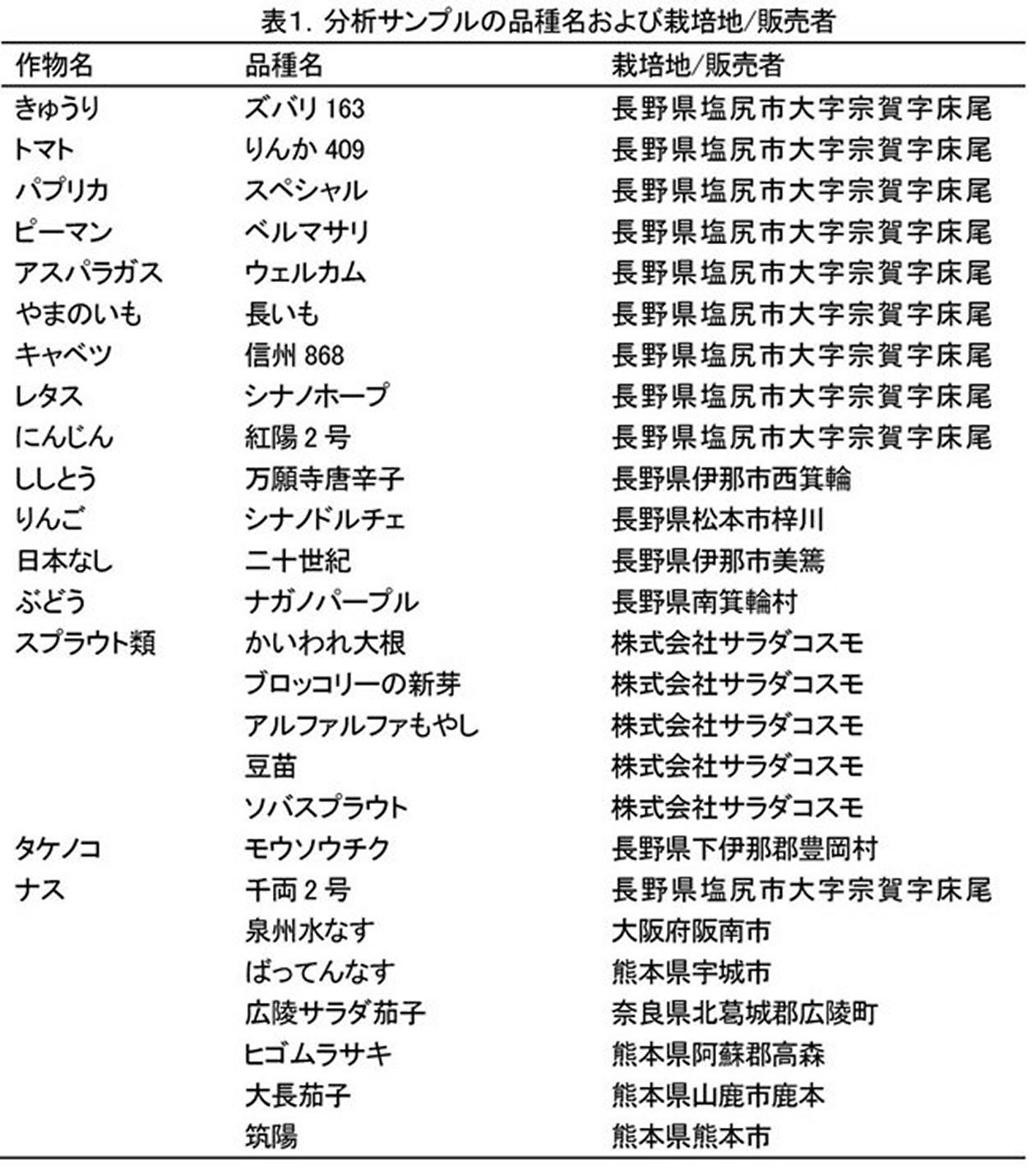
分析サンプルとして、表1に記載の各種農産物を入手した。
1.分析サンプル
分析サンプルとして、表1に記載の各種農産物を入手した。
2.抽出法
(1)試料の調製
生鮮農産物(分析サンプル)は入手後すぐに、水道水で表面を洗浄した。水分を拭き取った後、可食部のみを必要に応じて1~3cm幅に包丁でスライスした。可食部を凍結乾燥機(FDU-2000、東京理化器械(株))で凍結乾燥した。凍結乾燥物はミルミキサー(MASTER、(株)東京ユニコム)で粉砕し、粉末状にした。
(1)試料の調製
生鮮農産物(分析サンプル)は入手後すぐに、水道水で表面を洗浄した。水分を拭き取った後、可食部のみを必要に応じて1~3cm幅に包丁でスライスした。可食部を凍結乾燥機(FDU-2000、東京理化器械(株))で凍結乾燥した。凍結乾燥物はミルミキサー(MASTER、(株)東京ユニコム)で粉砕し、粉末状にした。
(2)試薬の調製
リン酸二水素ナトリウム(59.99mg)とリン酸水素二ナトリウム(70.98mg)を量り取り、純水(100mL)に溶解し、10mMリン酸緩衝液を調製した。
EN(0.80mg)を10mMリン酸緩衝液(1mL)に溶解して800.00μg/mLに調製後、100倍希釈して8.00μg/mLに調製し、EN内部標準とした。
リン酸二水素ナトリウム(59.99mg)とリン酸水素二ナトリウム(70.98mg)を量り取り、純水(100mL)に溶解し、10mMリン酸緩衝液を調製した。
EN(0.80mg)を10mMリン酸緩衝液(1mL)に溶解して800.00μg/mLに調製後、100倍希釈して8.00μg/mLに調製し、EN内部標準とした。
(3)振とう抽出
凍結乾燥物(10mg)を2mLチューブに量り取り、EN内部標準(10μL)を加えた。10mMリン酸緩衝液(190μL)を添加し、ボルテックス(FLX-S、FRONT LAB、アズワン(株))で3分間撹拌した後、遠心分離機(CFM-200、(株)イワキ)で遠心分離(1000×g、室温、3min)し、上清を得た。残渣に再び10mMリン酸緩衝液(200μL)を添加し撹拌、遠心分離、上清採取の操作を2回繰り返した。採取した上清をすべて合わせ(約600μL)、抽出サンプルとした。
凍結乾燥物(10mg)を2mLチューブに量り取り、EN内部標準(10μL)を加えた。10mMリン酸緩衝液(190μL)を添加し、ボルテックス(FLX-S、FRONT LAB、アズワン(株))で3分間撹拌した後、遠心分離機(CFM-200、(株)イワキ)で遠心分離(1000×g、室温、3min)し、上清を得た。残渣に再び10mMリン酸緩衝液(200μL)を添加し撹拌、遠心分離、上清採取の操作を2回繰り返した。採取した上清をすべて合わせ(約600μL)、抽出サンプルとした。
(4)固相抽出
固相抽出カートリッジは弱酸性陽イオン交換カートリッジInert Sep CBA 100 mg/1 mL(ジーエルサイエンス(株))を用いた。メタノール(1mL)、純水(1mL)で活性化した固相抽出カートリッジを10mMリン酸緩衝液(8mL)で平衡化した後、前記(3)で調製した抽出サンプル(約600μL)を添加した。10mMリン酸緩衝液(600μL)で安定化、純水(2.5mL)で洗浄後、塩酸(500μL)で溶出した。
固相抽出カートリッジは弱酸性陽イオン交換カートリッジInert Sep CBA 100 mg/1 mL(ジーエルサイエンス(株))を用いた。メタノール(1mL)、純水(1mL)で活性化した固相抽出カートリッジを10mMリン酸緩衝液(8mL)で平衡化した後、前記(3)で調製した抽出サンプル(約600μL)を添加した。10mMリン酸緩衝液(600μL)で安定化、純水(2.5mL)で洗浄後、塩酸(500μL)で溶出した。
(5)定量サンプル調製
固相抽出で塩酸溶出した溶出液(500μL)を1mLメスフラスコを用いてLC/MS/MS分析溶媒で精確に1mLにフィルアップし、300μLずつ3つに分けた。それぞれに、コリン化合物混合溶液を添加し、溶出液が2倍希釈になるようにLC/MS/MS分析溶媒を加え(表2)、定量サンプルを作成した。
固相抽出で塩酸溶出した溶出液(500μL)を1mLメスフラスコを用いてLC/MS/MS分析溶媒で精確に1mLにフィルアップし、300μLずつ3つに分けた。それぞれに、コリン化合物混合溶液を添加し、溶出液が2倍希釈になるようにLC/MS/MS分析溶媒を加え(表2)、定量サンプルを作成した。
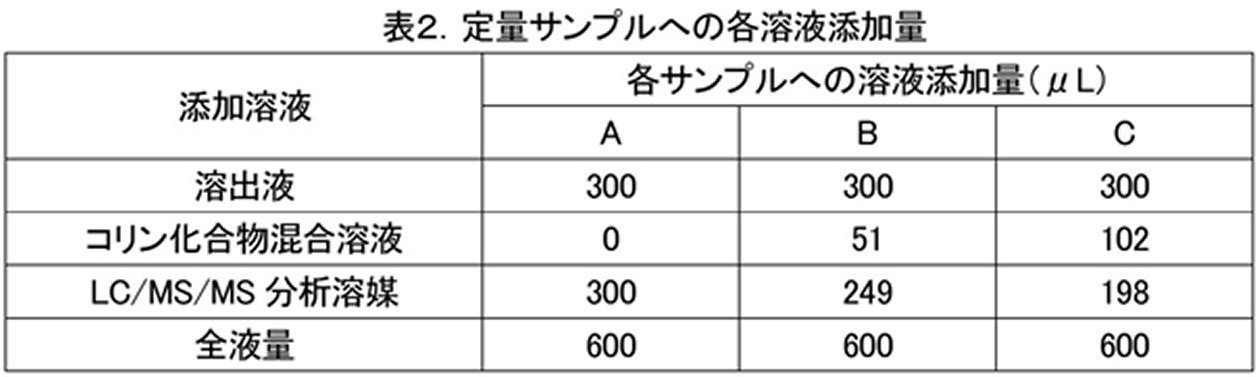
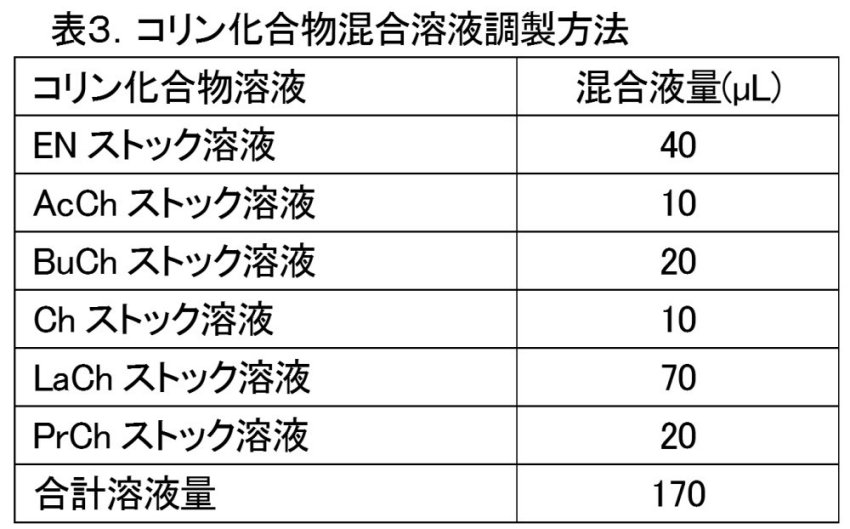
コリン化合物混合溶液は表3のように作成し、コリン化合物混合溶液無添加サンプル(表2-A)の分析結果によって各コリン化合物ストック溶液の添加濃度を決定した。コリン化合物ストック溶液はLC/MS/MS分析溶媒で希釈して各濃度に調製した。検出されなかったコリン化合物があった場合は、その化合物を含まない等量のLC/MS/MS分析溶媒のみを加えた。
3.LC/MS/MS分析
(1)LC/MS/MS分析条件
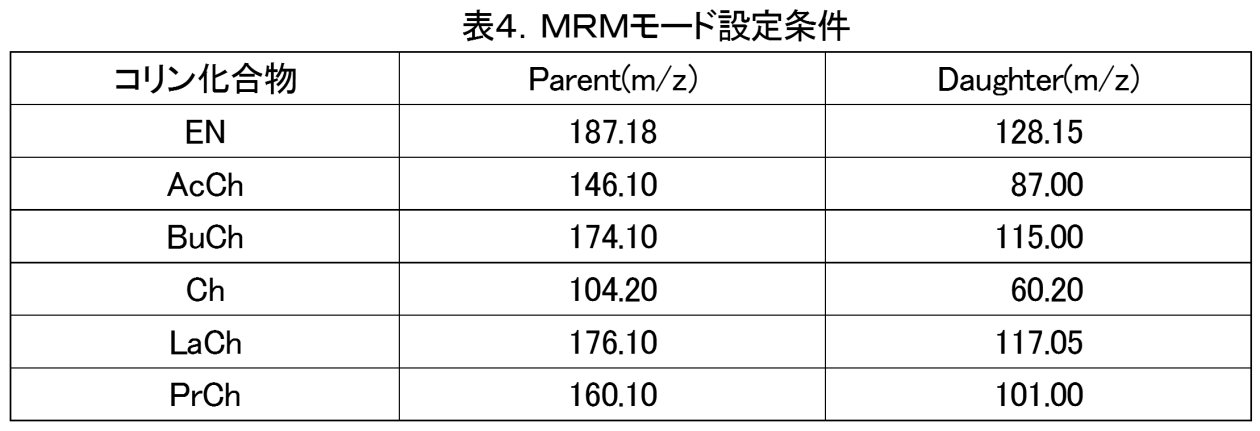
カラムはYMC-Triart PFP(4.6mm×250mm、5μm、(株) ワイエムシィ)を用いた。分析溶媒に0.01%ギ酸-33%メタノール含有水を用い、流速は0.5mL/min(LC)、0.3mL/min(MS)、注入量は50μL、分離温度は40℃、分析時間は30min、イオン化モードはESI+・MRM、Capillary Voltageは3500V、Cone Voltageは10V、Collision Voltageは10V、N2 gas flow(desolvation)は600L/hr、N2 gas flow(cone)は50L/hr、N2 source tempは120℃、N2 desolvation tempが350℃の条件で、ACQUITY UPLC [UPLC, Waters corp.]-Quattro micro API [MS, Waters corp.]を用いて、LC/MS/MS分析を行った。各コリン化合物のMRMモード指定m/zは表4に示した。
(1)LC/MS/MS分析条件
カラムはYMC-Triart PFP(4.6mm×250mm、5μm、(株) ワイエムシィ)を用いた。分析溶媒に0.01%ギ酸-33%メタノール含有水を用い、流速は0.5mL/min(LC)、0.3mL/min(MS)、注入量は50μL、分離温度は40℃、分析時間は30min、イオン化モードはESI+・MRM、Capillary Voltageは3500V、Cone Voltageは10V、Collision Voltageは10V、N2 gas flow(desolvation)は600L/hr、N2 gas flow(cone)は50L/hr、N2 source tempは120℃、N2 desolvation tempが350℃の条件で、ACQUITY UPLC [UPLC, Waters corp.]-Quattro micro API [MS, Waters corp.]を用いて、LC/MS/MS分析を行った。各コリン化合物のMRMモード指定m/zは表4に示した。
(2)標準添加法
LC/MS/MS分析によって得られたクロマトグラフのピーク面積値から検量線を作成し、標準添加法によってコリン化合物を定量した。EN内部標準の検量線から算出した回収率で各コリン化合物濃度を補正し、定量サンプル中の正確なコリン化合物濃度を算出した。得られた濃度を凍結乾燥物中の含量(mg/gD.W.)に換算後、凍結乾燥前後の収率より、新鮮重量100g当たりの各コリン化合物量(μg/100gF.W.)を算出した。
LC/MS/MS分析によって得られたクロマトグラフのピーク面積値から検量線を作成し、標準添加法によってコリン化合物を定量した。EN内部標準の検量線から算出した回収率で各コリン化合物濃度を補正し、定量サンプル中の正確なコリン化合物濃度を算出した。得られた濃度を凍結乾燥物中の含量(mg/gD.W.)に換算後、凍結乾燥前後の収率より、新鮮重量100g当たりの各コリン化合物量(μg/100gF.W.)を算出した。
〔実験1〕新鮮重量と乾燥重量
各種生鮮農産物の新鮮重量と乾燥重量を求め、凍結乾燥前後での収率を算出した。結果を図1に示す。
図1に示すとおり、レタス(シナノホープ)(新鮮重量:79.19g、乾燥重量:2.85g)の収率が3.60%と一番低く、やまのいも(長いも)(新鮮重量:79.76g、乾燥重量:21.23g)の収率が26.62%で一番高かった。多くの農産物の場合、収率は約5~約10%程度であった。
各種生鮮農産物の新鮮重量と乾燥重量を求め、凍結乾燥前後での収率を算出した。結果を図1に示す。
図1に示すとおり、レタス(シナノホープ)(新鮮重量:79.19g、乾燥重量:2.85g)の収率が3.60%と一番低く、やまのいも(長いも)(新鮮重量:79.76g、乾燥重量:21.23g)の収率が26.62%で一番高かった。多くの農産物の場合、収率は約5~約10%程度であった。
〔実験2〕各生鮮農産物中のコリン化合物定量
前述の方法によって、20種類の生鮮農産物からコリン化合物を抽出し、LC/MS/MSでAcCh、Ch、BuCh、PrCh、LaChの5種のコリン化合物の分析をn=3で行った。結果を図2に示す。
AcChおよびChは、試験した全ての農産物から検出された。一方、LaChは試験した全ての農産物から検出されなかった。また、BuChは、トマト、レタス、アルファルファもやし、豆苗、ソバスプラウト、りんご、日本なし、ぶどう、タケノコ以外の農産品から検出された。PrChは、トマト、豆苗以外の農産品から検出された。
本実験での定量の結果、タケノコとナス中からは、他の18種の生鮮農産物の1000倍以上ものAcChが検出された。AcCh含量は、タケノコが最も高かった。
前述の方法によって、20種類の生鮮農産物からコリン化合物を抽出し、LC/MS/MSでAcCh、Ch、BuCh、PrCh、LaChの5種のコリン化合物の分析をn=3で行った。結果を図2に示す。
AcChおよびChは、試験した全ての農産物から検出された。一方、LaChは試験した全ての農産物から検出されなかった。また、BuChは、トマト、レタス、アルファルファもやし、豆苗、ソバスプラウト、りんご、日本なし、ぶどう、タケノコ以外の農産品から検出された。PrChは、トマト、豆苗以外の農産品から検出された。
本実験での定量の結果、タケノコとナス中からは、他の18種の生鮮農産物の1000倍以上ものAcChが検出された。AcCh含量は、タケノコが最も高かった。
〔実験3〕ナス6品種中のコリン化合物定量
実験2でAcChを多く含み生食可能で周年栽培可能なナスにおいて、品種間でのコリン化合物含有量の差を調べた。前述の方法によって、6品種のナスからコリン化合物を抽出し、LC/MS/MSでAcCh、Ch、BuCh、PrCh、LaChの5種のコリン化合物の分析をn=3で行った。結果を表5に示す。
いずれの品種からもLaChは検出されなかった。また、6品種中、ヒゴムラサキが最も多くAcChを含んでいた。
実験2でAcChを多く含み生食可能で周年栽培可能なナスにおいて、品種間でのコリン化合物含有量の差を調べた。前述の方法によって、6品種のナスからコリン化合物を抽出し、LC/MS/MSでAcCh、Ch、BuCh、PrCh、LaChの5種のコリン化合物の分析をn=3で行った。結果を表5に示す。
いずれの品種からもLaChは検出されなかった。また、6品種中、ヒゴムラサキが最も多くAcChを含んでいた。

これまでに、ナス中のAcChは高速液体クロマトグラフィー電気化学検出(HPLC-ECD)法によって定量されており、6.09×10³μg/100gF.W.含まれていることが報告されているが(非特許文献7)、本実験におけるLC/MS/MS分析での定量の結果でもそれと同等のAcCh含有量となった。
〔実験4〕ナス中のコリン化合物含量経時変化
ナスの保存期間は一般に、常温で2~3日、7~10℃で1週間程度とされているが、6℃以下での保存は、果皮がクレーター状に陥没するピッティングや褐変、黒い陥没などの低温障害を起こす可能性があるため推奨されていない。ナス果実の貯蔵適温は10℃以上20℃以下とされている。
本実験では、ナスの品種、ヒゴムラサキを常温保存した場合のコリン化合物量の経時変化を調べるため、新聞紙に包んで常温、暗所に保管し、同一の1個体から1日1回、約10gずつをサンプリングし、別個体を2分割した1つを6日目にサンプリングを行った。また、2分割した別の一つを新聞紙に包んで6日間冷蔵保存したサンプルも用意し、前述の方法によって、コリン化合物を抽出し、LC/MS/MSでAcCh、Ch、BuCh、PrCh、LaChの5種のコリン化合物の分析をn=3で行った。結果を表6、図3および図4に示す。
ナスの保存期間は一般に、常温で2~3日、7~10℃で1週間程度とされているが、6℃以下での保存は、果皮がクレーター状に陥没するピッティングや褐変、黒い陥没などの低温障害を起こす可能性があるため推奨されていない。ナス果実の貯蔵適温は10℃以上20℃以下とされている。
本実験では、ナスの品種、ヒゴムラサキを常温保存した場合のコリン化合物量の経時変化を調べるため、新聞紙に包んで常温、暗所に保管し、同一の1個体から1日1回、約10gずつをサンプリングし、別個体を2分割した1つを6日目にサンプリングを行った。また、2分割した別の一つを新聞紙に包んで6日間冷蔵保存したサンプルも用意し、前述の方法によって、コリン化合物を抽出し、LC/MS/MSでAcCh、Ch、BuCh、PrCh、LaChの5種のコリン化合物の分析をn=3で行った。結果を表6、図3および図4に示す。

いずれにおいてもLaChは検出されなかった。各コリン化合物含有量は保存日数の経過とともに、緩やかに減少する傾向があった(図3)。また、本実験では、冷蔵保存した個体にピッティングなどの低温障害は起こっていなかったが、常温保存の方が冷蔵保存よりもコリンエステル残存量が多かった(図4)。
本実験の結果より、ナスを5日間常温保存すると、コリンエステル含量は日数の経過とともに緩やかに減少する傾向があった。しかし、5日間常温保存した個体内にも1日目の80%以上のAcChが残存していたことから、常温保存時におけるナス中でのAcCh量の急激な変化はなく、安定性は高いと考えられる。
〔実験5〕酸性条件下でのAcCh安定性
ナス中のコリンエステルを、より安定化させるための方法を検討した。一般に、エステル化合物は塩基条件で加水分解されやすく、酸性条件では比較的安定である。また、ナスに含まれるコリンエステルの99%以上はAcChである。そこで、まず、中性または酸性条件でのAcCh標品の濃度変化を経時的に調べた。中性溶液(pH7.0)はリン酸緩衝液で、酸性溶液(pH4.1、pH3.6、pH3.1、pH2.6)は酢酸を添加して調製し、AcCh濃度1.9mg/mLの各pH溶液を、常温(23~25℃)で0、3、6、12日静置した後にAcCh含量を定量した。その結果を表7、図5に示す。
ナス中のコリンエステルを、より安定化させるための方法を検討した。一般に、エステル化合物は塩基条件で加水分解されやすく、酸性条件では比較的安定である。また、ナスに含まれるコリンエステルの99%以上はAcChである。そこで、まず、中性または酸性条件でのAcCh標品の濃度変化を経時的に調べた。中性溶液(pH7.0)はリン酸緩衝液で、酸性溶液(pH4.1、pH3.6、pH3.1、pH2.6)は酢酸を添加して調製し、AcCh濃度1.9mg/mLの各pH溶液を、常温(23~25℃)で0、3、6、12日静置した後にAcCh含量を定量した。その結果を表7、図5に示す。

中性条件では、AcChは時間とともに分解され12日後では約半分に減少した。一方、pH4.1(酢酸濃度0.0015%)では、AcChは安定して存在し12日後にAcCh含量は増加する傾向が見られた。pH4.1~pH3.1で、AcChは12日後でも97%以上が保持され安定して存在することが明らかとなった。pH2.6では、AcChの安定性はやや低下し、12日後の残存率は88%であった。
次に、ナス抽出物中に含まれるAcChの安定性を、中性条件、酸性条件で検討した。中性溶液(pH7.0)はリン酸緩衝液で、酸性溶液(pH5.2、pH5.0、pH4.3、pH3.5)は酢酸を、酸性溶液(pH5.4、pH4.6)はアスコルビン酸を添加して調製し、AcCh濃度0.040mg/mLとなるようにナス抽出物を添加した各pH溶液を、常温(23~25℃)で0、3、6、12日静置した後にAcCh含量を定量した。その結果を表8、図6に示す。
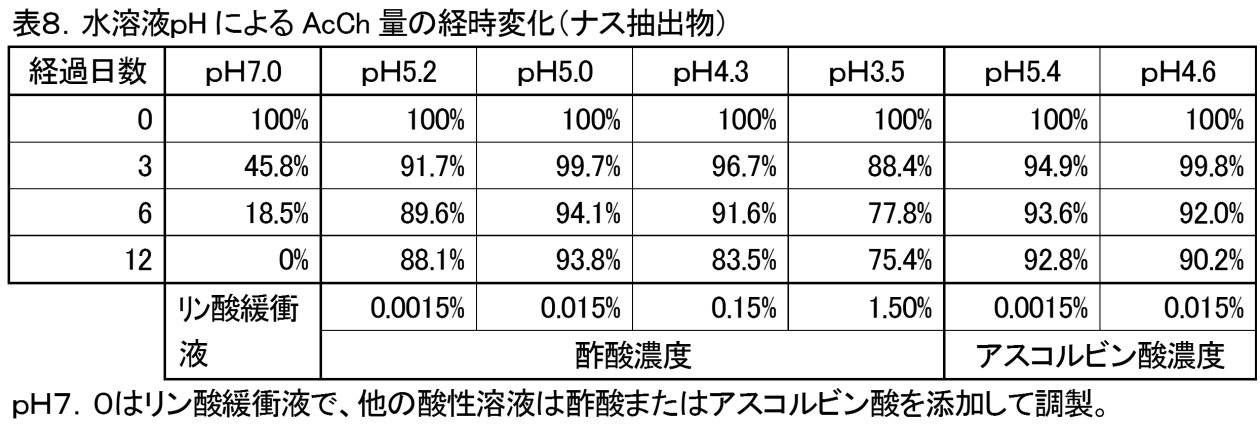
ナス抽出物中のAcChは、中性条件では不安定であり、3日で半分以上、12日でほぼ全てのAcChが分解した。酸性条件では比較的安定であり、pH5.4~4.6では、12日後でも88%以上のAcChが残存したが、酢酸でpH3.5に調整した溶液では12日後に24.6%のAcChが分解された。ナス中のAcChは、室温で、pH5.4~4.6の酸性条件で安定して存在した。
以上の結果から、ナスなど農産物中のコリンエステルは、有機酸等を添加してpHを5.5~4.5に調整すれば、より安定化させることができる。懸濁液としたときにこのpH範囲であれば、酸は適切な時期に添加すればよい。
以上の結果から、ナスなど農産物中のコリンエステルは、有機酸等を添加してpHを5.5~4.5に調整すれば、より安定化させることができる。懸濁液としたときにこのpH範囲であれば、酸は適切な時期に添加すればよい。
〔実験6〕加熱によるナス中のAcCh含量変化
加熱によってナス中のAcCh含量がどのような影響を受けるかを調べるために、代表的な長卵形ナス品種 “竜馬”を厚さ2~3cmに切断し、ラップで包み、時間を変化させて電子レンジ(550W)で加熱後、室温で放冷してから凍結乾燥した試料中のAcCh含量を定量した。また、沸騰水中に投入して5分間茹でた場合のナス中のAcCh含量変化も調べた。これらの加熱処理後、直ちに温度を測定して記録した。結果を、表9、図7に示す。
加熱によってナス中のAcCh含量がどのような影響を受けるかを調べるために、代表的な長卵形ナス品種 “竜馬”を厚さ2~3cmに切断し、ラップで包み、時間を変化させて電子レンジ(550W)で加熱後、室温で放冷してから凍結乾燥した試料中のAcCh含量を定量した。また、沸騰水中に投入して5分間茹でた場合のナス中のAcCh含量変化も調べた。これらの加熱処理後、直ちに温度を測定して記録した。結果を、表9、図7に示す。
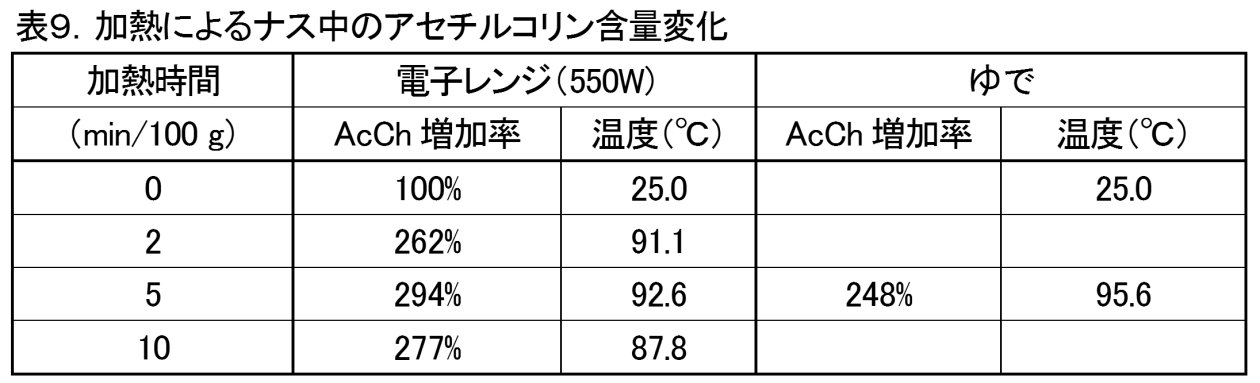
ナス中のコリンエステルは、電子レンジで加熱すると増加することが明らかとなった。100gあたり5分間の加熱が最もAcChを増加させる条件であり非加熱の2.9倍にAcCh含量が増加した。AcCh含量の増加は、100gあたり2分間の加熱で非加熱の2.6倍、100gあたり10分間の加熱で2.8倍であった。100gあたり2分間の加熱で内温が91.1℃に達し、5分間で92.6℃、10分間では水分の蒸発によって87.8℃に低下した。100gあたり5分間の茹で加工では、AcCh含量は2.5倍に増加し、その時の内温は95.6℃であった。
以上の結果から、一般的な加熱加工条件ではAcCh含量は増加し、ある程度安定に保持されると推測された。加工条件が異なっても、温度変化が同様であれば、AcCh含量は増加すると見込まれる。また、この工程で殺菌を行うことが出来る。
以上の結果から、一般的な加熱加工条件ではAcCh含量は増加し、ある程度安定に保持されると推測された。加工条件が異なっても、温度変化が同様であれば、AcCh含量は増加すると見込まれる。また、この工程で殺菌を行うことが出来る。
実験4~6の結果から、コリンエステル分解酵素であるアセチルコリンエステラーゼ(EC番号3.1.1.7)がコリンエステル含量に影響を与えることが明らかとなった。非特許文献3に記載のように、アセチルコリンエステラーゼは、植物に広く存在する。表8で示されたAcCh減少は、アセチルコリンエステラーゼによる分解が主な原因であると考えられる。アセチルコリンエステラーゼの至適pH8.0~8.5に近い中性ではより多くのAcChが分解され、酵素活性が低下する低いpHではAcChの分解が抑制されたものと考えられた。また、加熱すると、アセチルコリンエステラーゼが失活するため、AcChは分解されず、水分が蒸発して濃縮されたと考えられた。つまり、ナスおよびナス加工品では、アセチルコリンエステラーゼを制御する加工技術が重要である。そこで、ナスのアセチルコリンエステラーゼを機能させない冷凍したナスおよびナス加工品のAcCh含量の変化を調べた。
〔実験7〕冷凍生鮮ナスおよび冷凍加熱ナス中のAcCh含量変化試験
生鮮ナス(約10gにカット)および加熱ナス(約10gにカットしたものを100gあたり5分間電子レンジ(550W)加熱)を夫々、-20℃で冷凍し、1か月毎にサンプルを取り出して凍結乾燥した後AcCh含量を定量し、6か月間のAcCh含量変化を調べた。なお、生鮮ナスおよび加熱ナスは、それぞれ同一のナス果実から切り分けたものを使用した。結果を、表10に示す。
生鮮ナス(約10gにカット)および加熱ナス(約10gにカットしたものを100gあたり5分間電子レンジ(550W)加熱)を夫々、-20℃で冷凍し、1か月毎にサンプルを取り出して凍結乾燥した後AcCh含量を定量し、6か月間のAcCh含量変化を調べた。なお、生鮮ナスおよび加熱ナスは、それぞれ同一のナス果実から切り分けたものを使用した。結果を、表10に示す。

生鮮ナスおよび加熱ナス中のAcChは、冷凍することによってほぼ変化せず、冷凍加工によってナス中のコリンエステルを長期間、安定して保持できることが明らかとなった。生鮮ナスでは、冷凍することで、ナス中コリンエステルを分解する要因であるコリンエステラーゼの活性を抑制できた結果である。事前に加熱してコリンエステラーゼを失活させた加熱ナスの結果とほぼ同等のAcCh含量変化であったことからも、冷凍によるコリンエステラーゼ活性抑制が十分であったと考えられる。
〔実験8〕ナス抽出物調製試験
ナス凍結乾燥粉末や生鮮ナスを用いてナス抽出物を調製した。ナス凍結乾燥粉末を用いた抽出物調製法は以下の通りである。
ナス凍結乾燥粉末(1g)を遠沈管(50mL容量)に量りとり10倍重量(10g)の、10~100%まで10%ずつEtOH濃度変化させた溶媒を加え、室温で3000rpm、30分間、振とう攪拌した後、ろ過して上清を得た。上清をナスフラスコ(200mL)に移し、純水(10g)を加えてエバポレーターを用いて濃縮した。液量が1/5程度になったら、内容物を遠沈管(15mL)に完全に移し、凍結乾燥した。凍結乾燥物をナス抽出物とし、収率を求め、前記の「2.抽出法」および「3.LC/MS/MS分析」に記載の方法で定量した。50%EtOHおよびEtOHを用いた抽出ではL-アスコルビン酸を加えて抽出物を調製した。結果を表11に示す。
ナス凍結乾燥粉末や生鮮ナスを用いてナス抽出物を調製した。ナス凍結乾燥粉末を用いた抽出物調製法は以下の通りである。
ナス凍結乾燥粉末(1g)を遠沈管(50mL容量)に量りとり10倍重量(10g)の、10~100%まで10%ずつEtOH濃度変化させた溶媒を加え、室温で3000rpm、30分間、振とう攪拌した後、ろ過して上清を得た。上清をナスフラスコ(200mL)に移し、純水(10g)を加えてエバポレーターを用いて濃縮した。液量が1/5程度になったら、内容物を遠沈管(15mL)に完全に移し、凍結乾燥した。凍結乾燥物をナス抽出物とし、収率を求め、前記の「2.抽出法」および「3.LC/MS/MS分析」に記載の方法で定量した。50%EtOHおよびEtOHを用いた抽出ではL-アスコルビン酸を加えて抽出物を調製した。結果を表11に示す。

生鮮ナスを用いる場合、カットした生鮮ナス(10g)に各濃度のEtOHを添加してミルミキサーで粉砕し、ナス凍結乾燥粉末と同様の方法で調製し、同様にして収率とコリンエステル含量を求めた。添加EtOH重量は、生鮮ナス重量の0.5倍、同量、2倍量とした。また、同量のEtOHを用いた抽出ではL-アスコルビン酸を加えて抽出物を調製した。結果を表12に示す。
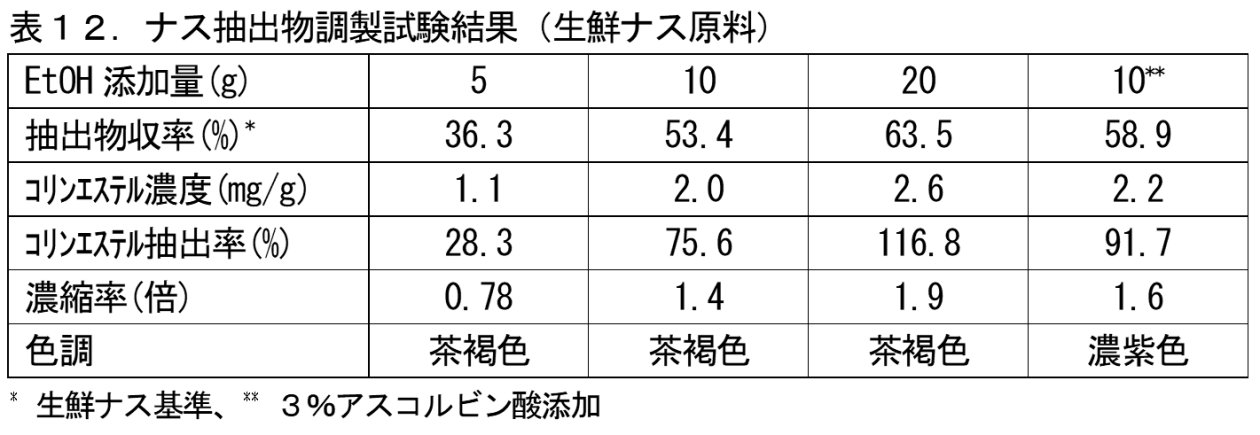
ナス抽出物は、凍結乾燥粉末および/または熱風乾燥粉末よりもコリンエステルが濃縮された水溶性の半固形物である。L-アスコルビン酸を加えて溶液を酸性にすると共に酸化を抑制すると、抽出過程でのコリンエステルの安定化と色調変化防止が可能である。
〔実験9〕ナス凍結乾燥物を用いた高血圧自然発症ラットへの単回経口投与試験
ナス凍結乾燥物を高血圧自然発症ラット(SHR)に単回経口投与し、血圧降下作用を検討した。雄性14週齢SHR(体重324~368g)を、1週間の馴化飼育後、12時間絶食させ、水に懸濁したナス凍結乾燥粉末を、ゾンデを用いて単回経口投与した。ナス凍結乾燥粉末は、大阪府阪南市産・泉州水ナスを水洗、次亜塩素酸で殺菌したものの可食部を凍結乾燥後に細かく粉砕し調製した。ナス凍結乾燥粉末中のコリンエステル類の99%以上はAcChであり、AcCh含量は2.25mg/gD.W.であった。投与量は、AcCh1.00×10-9mol(0.146μg)/kgに相当するナス凍結乾燥粉末量0.065mg/kgとし、6匹のSHRに単回経口投与した。血圧降下作用を比較するためAcCh標品1.00×10-9mol/kgの投与試験を同様にして行い収縮期血圧を測定した。コントロール群には、同様の条件で水のみを投与した。経口投与後、0、3、6、9、24時間後に、非観血式血圧測定器Softron BP-98A(ソフトロン(株)、東京)を用いてテイルカフ法で収縮期血圧、拡張期血圧および心拍数を測定した。ナス凍結乾燥粉末の単回経口投与試験結果を図8~10に示した。
ナス凍結乾燥物を高血圧自然発症ラット(SHR)に単回経口投与し、血圧降下作用を検討した。雄性14週齢SHR(体重324~368g)を、1週間の馴化飼育後、12時間絶食させ、水に懸濁したナス凍結乾燥粉末を、ゾンデを用いて単回経口投与した。ナス凍結乾燥粉末は、大阪府阪南市産・泉州水ナスを水洗、次亜塩素酸で殺菌したものの可食部を凍結乾燥後に細かく粉砕し調製した。ナス凍結乾燥粉末中のコリンエステル類の99%以上はAcChであり、AcCh含量は2.25mg/gD.W.であった。投与量は、AcCh1.00×10-9mol(0.146μg)/kgに相当するナス凍結乾燥粉末量0.065mg/kgとし、6匹のSHRに単回経口投与した。血圧降下作用を比較するためAcCh標品1.00×10-9mol/kgの投与試験を同様にして行い収縮期血圧を測定した。コントロール群には、同様の条件で水のみを投与した。経口投与後、0、3、6、9、24時間後に、非観血式血圧測定器Softron BP-98A(ソフトロン(株)、東京)を用いてテイルカフ法で収縮期血圧、拡張期血圧および心拍数を測定した。ナス凍結乾燥粉末の単回経口投与試験結果を図8~10に示した。
ナス凍結乾燥粉末投与群は、投与3、9時間後にコントロール群と比較して有意な収縮期血圧低下作用(p<0.05)を引き起し、最大血圧低下は投与9時間後の-17.8mmHg、コントロール群と比較して-10.0mmHgであり、アセチルコリン1.00×10⁻⁹mol/kg投与とほぼ同様の血圧降下作用を示した。また、拡張期血圧も低下傾向を示し、最大血圧低下は投与9時間後の-11.3mmHg、コントロール群と比較して-8.3mmHgであった。心拍数は、投与3時間後にはコントロール群よりも低下する傾向がみられたが、その後、投与9時間後まで上昇傾向を示した。こうしてナスの経口投与での血圧降下作用が確認された。
12時間絶食後のSHRへの一日当たりAcCh有効用量は1.00×10⁻⁹mol(0.146μg)/kgであるが、非絶食のSHRへの一日当たりAcCh有効用量は、反復経口投与試験において有意な血圧上昇抑制作用が見られた1.00×10-8mol(1.46μg)/kgであった(非特許文献21)。この通常状態のSHRが経口摂取で血圧降下作用を引き起こすAcCh用量を、クレーバーの法則(非特許文献22)を用いてヒトへ外挿した。クレーバーの法則では、哺乳類代謝量は体重の3/4乗に比例するとされ、SHRの体重が370g、ヒトの体重が60kgと想定すると、SHRの有効用量の45.4倍がヒト有効用量と見積もられる。すなわち、血圧降下作用を引き起こすSHRのAcCh摂取量は一日当たり3.70×10-9mol(0.540μg)であり、一日当たりのヒト有効用量は1.68×10-7mol(24.5μg)となる。
また、本発明者は、既に、発酵キョウバク(ソバ植物体の乳酸発酵物)の血圧降下作用と血管拡張作用を見出し、有効成分としてAcCh、BuCh、LaCh、PrChのコリンエステル類を含み、精製したAcCh、BuCh、PrChをSHRに単回経口投与した場合に、血圧降下作用を示すことを明らかにした(特許文献1および2)。さらに検討を進め、ヒトにおけるコリンエステルの経口投与における血圧降下作用について検討した。
正常高値血圧者およびI度高血圧者(男性6名、女性6名、33~63歳)に、発酵キョウバク含有飲料(1本あたり25μgのコリンエステルを含む)を、毎日1本、4週間にわたって摂取させた。
結果、被験者の収縮期血圧が、摂取前に比べて-11.8mmHg低下(P=0.0080、t検定)した。すなわち、ヒトにおいて、コリンエステルを血圧降下成分として25μg含む発酵キョウバク含有飲料の4週間継続摂取で、有意な血圧降下が認められた。このように、SHRで血圧降下作用を引き起こすAcCh有効用量を、クレーバーの法則でヒトに外挿して求めた有効用量に極めて近い用量で血圧降下作用が確認された。
正常高値血圧者およびI度高血圧者(男性6名、女性6名、33~63歳)に、発酵キョウバク含有飲料(1本あたり25μgのコリンエステルを含む)を、毎日1本、4週間にわたって摂取させた。
結果、被験者の収縮期血圧が、摂取前に比べて-11.8mmHg低下(P=0.0080、t検定)した。すなわち、ヒトにおいて、コリンエステルを血圧降下成分として25μg含む発酵キョウバク含有飲料の4週間継続摂取で、有意な血圧降下が認められた。このように、SHRで血圧降下作用を引き起こすAcCh有効用量を、クレーバーの法則でヒトに外挿して求めた有効用量に極めて近い用量で血圧降下作用が確認された。
非絶食SHRへの反復経口投与試験において2.00×10⁻⁹mol(0.292μg)/kgで血圧降下作用が大きく減弱した。このAcCh用量をクレーバーの法則(非特許文献22)を用いてヒトへ外挿し、一日当たりのヒト有効用量の下限は3.36×10-8mol(4.91μg)となる。同様の試験で2.00×10-7mol(29.2μg)/kgで血圧降下作用が大きく減弱した。このAcCh用量をクレーバーの法則(非特許文献22)を用いてヒトへ外挿した場合、一日当たりのヒト有効用量の上限は3.36×10-6mol(491μg)となる。よって、SHRのような遺伝特性を持つ高血圧者一日当たりのヒト有効用量は5~500μgの範囲と推定された。
血圧降下作用を引き起こすコリンエステル用量は、上記のとおり推定されたヒト有効容量を考慮すると共に、本発明の組成物以外の食事由来のコリンエステルの量を考慮して最終的に決定され得る。
血圧降下作用を引き起こすコリンエステル用量は、上記のとおり推定されたヒト有効容量を考慮すると共に、本発明の組成物以外の食事由来のコリンエステルの量を考慮して最終的に決定され得る。
〔実験10〕ナス凍結乾燥物を用いた正常血圧ラットへの単回経口投与試験
実験9と同様の方法でナス凍結乾燥物をウィスター京都ラット(WKYラット)に単回経口投与して血圧降下作用を検討した。WKYラットは、SHRの親系統であり、試験対照として用いられる高血圧になる遺伝的要因を持つ正常血圧ラットである。使用動物は、雄性14週齢WKYラット(体重320~362g)、実験9と同じナス凍結乾燥粉末を使用した。投与量は、ナス凍結乾燥粉末量0.065mg/kg(AcCh1.00×10-9mol(0.146μg)/kgに相当)および6.5mg/kg(AcCh1.00×10-7mol(14.6μg)/kgに相当)とした。
WKYラットへのナス凍結乾燥粉末の単回経口投与試験結果を図11に示した。
実験9と同様の方法でナス凍結乾燥物をウィスター京都ラット(WKYラット)に単回経口投与して血圧降下作用を検討した。WKYラットは、SHRの親系統であり、試験対照として用いられる高血圧になる遺伝的要因を持つ正常血圧ラットである。使用動物は、雄性14週齢WKYラット(体重320~362g)、実験9と同じナス凍結乾燥粉末を使用した。投与量は、ナス凍結乾燥粉末量0.065mg/kg(AcCh1.00×10-9mol(0.146μg)/kgに相当)および6.5mg/kg(AcCh1.00×10-7mol(14.6μg)/kgに相当)とした。
WKYラットへのナス凍結乾燥粉末の単回経口投与試験結果を図11に示した。
SHRで血圧降下作用が引き起こされたAcCh1.00×10-9mol/kgに相当するナス凍結乾燥粉末投与では、WKYラットの血圧に変化は見られなかった。AcCh1.00×10-7mol/kgに相当するナス凍結乾燥粉末投与で、SHRにおけるAcCh1.00×10-9mol/kgに相当するナス凍結乾燥粉末投与と同等の血圧降下作用が引き起こされた。すなわち、正常血圧のWKYラットで血圧降下作用を引き起こすためには、より多くのナス凍結乾燥粉末が必要であることが明らかとなった。
〔実験11〕ナス粉砕試料を用いた血管等尺性張力測定試験
試験に用いたナス粉砕試料は、次のようにして調製した。大阪府阪南市産・泉州水ナスを水洗、次亜塩素酸で殺菌したものの可食部を1~3cm幅にスライスし、市販フードプロセッサ(クラッシュミルサーIFM-C20G、岩谷産業(株))で粉砕し、ペースト状にした。また、1~3cm幅にスライスし加熱滅菌(約90℃、約5分間)したナス果実を凍結乾燥して得られたナス果実凍結乾燥物、または、熱風乾燥(約90℃、約1~2時間)して得られたナス果実熱風乾燥物を、ミルミキサー(MASTER、(株)東京ユニコム)で粉砕し、粉末状にした。それぞれの粉砕試料を、ステンレス篩(JIS規格、20メッシュ)にかけ、通過したものを20メッシュパス、通過しなかったものを20メッシュオンとし、生鮮ナス果実粉砕物20メッシュパス(試料1)、生鮮ナス果実粉砕物20メッシュオン(試料2)、凍結乾燥粉末20メッシュパス(試料3)、凍結乾燥粉末20メッシュオン(試料4)、熱風乾燥粉末20メッシュパス(試料5)、熱風乾燥粉末20メッシュオン(試料6)を調製した。
試験に用いたナス粉砕試料は、次のようにして調製した。大阪府阪南市産・泉州水ナスを水洗、次亜塩素酸で殺菌したものの可食部を1~3cm幅にスライスし、市販フードプロセッサ(クラッシュミルサーIFM-C20G、岩谷産業(株))で粉砕し、ペースト状にした。また、1~3cm幅にスライスし加熱滅菌(約90℃、約5分間)したナス果実を凍結乾燥して得られたナス果実凍結乾燥物、または、熱風乾燥(約90℃、約1~2時間)して得られたナス果実熱風乾燥物を、ミルミキサー(MASTER、(株)東京ユニコム)で粉砕し、粉末状にした。それぞれの粉砕試料を、ステンレス篩(JIS規格、20メッシュ)にかけ、通過したものを20メッシュパス、通過しなかったものを20メッシュオンとし、生鮮ナス果実粉砕物20メッシュパス(試料1)、生鮮ナス果実粉砕物20メッシュオン(試料2)、凍結乾燥粉末20メッシュパス(試料3)、凍結乾燥粉末20メッシュオン(試料4)、熱風乾燥粉末20メッシュパス(試料5)、熱風乾燥粉末20メッシュオン(試料6)を調製した。
全ての試料は試験に用いるまで-98℃で保存した。試料1および2の中のコリンエステル含量は、凍結乾燥後に細かく粉砕し、前記の「2.抽出法」および「3.LC/MS/MS分析」に記載の方法で定量した。試料3および試料5はそのままの粉末を用いて、前記の「2.抽出法」および「3.LC/MS/MS分析」に記載の方法で定量した。試料4および試料6は細かく粉砕し、前記の「2.抽出法」および「3.LC/MS/MS分析」に記載の方法で定量した。
ナス粉砕試料のコリンエステル類の99%以上はAcChであり、AcCh含量は表13に示す通りであった。

血管等尺性張力測定は以下のようにして行った。
雄性14週齢SHR(体重320~346g)を、エーテル麻酔下でラットを開腹、放血死させ、速やかに胸部大動脈を摘出した。摘出した大動脈を、生理食塩水に浸し、血液をよく洗い流した後、Krebs-Henseleit溶液中で血管に付着した結合組織および脂肪組織を除去し、幅約2~3mmのリング標本を作製した。作製したリング標本は混合ガス(95%O2、5%CO2)を通気したKrebs-Henseleit溶液(119mM NaCl/4.7mM KCI/1.1mM KH2PO4/1.2mM MgSO4/25mM NaHCO3、pH7.4、37oC)を満たした等尺性張力試験装置(UFER UC-05A、いわしや岸本医科産業(株)、京都)のオーガンバス内に取り付け、1.0gの至適静止張力を負荷し、60分間リング標本を安定させた。その後、オーガンバス内にフェニレフリン(PE、0.3μM)を添加し、血管が収縮して安定したところでAcCh(終濃度100μM)を添加し内皮状態に問題がないこと確認した後、Krebs-Henseleit溶液で洗浄し、静止張力に戻した。15分後に再び収縮剤PE(0.3μM)によって血管を収縮させて収縮が最大に達したことを確認して、AcCh終濃度が10-9、10-8、10-7、10-6.5、10-6、10-5.5、10-5Mとなるように、Krebs-Henseleit溶液に懸濁させたそれぞれのナス粉砕試料を加えた。張力変化は、トランスデューサー(UFER UM-20、いわしや岸本医科産業(株))を用いて測定し記録し、下記の式(1)で拡張率(%)を算出し、3回繰り返し試験結果の平均値±標準誤差(Mean±S.E.)を求めた。ナス粉砕試料の血管等尺性張力試験結果を図12に、結果とプロビット法で求めたEC50(50%効果濃度)、統計解析結果と表14に示した。
雄性14週齢SHR(体重320~346g)を、エーテル麻酔下でラットを開腹、放血死させ、速やかに胸部大動脈を摘出した。摘出した大動脈を、生理食塩水に浸し、血液をよく洗い流した後、Krebs-Henseleit溶液中で血管に付着した結合組織および脂肪組織を除去し、幅約2~3mmのリング標本を作製した。作製したリング標本は混合ガス(95%O2、5%CO2)を通気したKrebs-Henseleit溶液(119mM NaCl/4.7mM KCI/1.1mM KH2PO4/1.2mM MgSO4/25mM NaHCO3、pH7.4、37oC)を満たした等尺性張力試験装置(UFER UC-05A、いわしや岸本医科産業(株)、京都)のオーガンバス内に取り付け、1.0gの至適静止張力を負荷し、60分間リング標本を安定させた。その後、オーガンバス内にフェニレフリン(PE、0.3μM)を添加し、血管が収縮して安定したところでAcCh(終濃度100μM)を添加し内皮状態に問題がないこと確認した後、Krebs-Henseleit溶液で洗浄し、静止張力に戻した。15分後に再び収縮剤PE(0.3μM)によって血管を収縮させて収縮が最大に達したことを確認して、AcCh終濃度が10-9、10-8、10-7、10-6.5、10-6、10-5.5、10-5Mとなるように、Krebs-Henseleit溶液に懸濁させたそれぞれのナス粉砕試料を加えた。張力変化は、トランスデューサー(UFER UM-20、いわしや岸本医科産業(株))を用いて測定し記録し、下記の式(1)で拡張率(%)を算出し、3回繰り返し試験結果の平均値±標準誤差(Mean±S.E.)を求めた。ナス粉砕試料の血管等尺性張力試験結果を図12に、結果とプロビット法で求めたEC50(50%効果濃度)、統計解析結果と表14に示した。
式(1)
拡張率(%)={最大張力(g)-サンプル添加時の張力(g)}/最大張力(g)
拡張率(%)={最大張力(g)-サンプル添加時の張力(g)}/最大張力(g)

AcCh終濃度が10-9、10-8、10-7、10-6.5、10-6、10-5.5、10-5Mとなるように加えたナス粉砕試料濃度は表14に示す通りであり、本試験に用いた生鮮ナス果実粉砕物の凍結乾燥収率が6.0%であったことから、生鮮ナス果実粉砕物20メッシュオンの血管等尺性張力試験のナス粉砕物濃度が最も高く、19mg/mLであった。
コリンエステル以外に血管拡張に影響を与える可能性があるクロロゲン酸類とγ-アミノ酪酸(GABA)含量は、それぞれ0.56mg/gFW、0.24mg/gFWであり、この試験系での濃度は、それぞれ11μg/mL、4.8μg/mLであり、それぞれの標品を用いた試験で、これらの濃度で血管への影響は見られなかった。他のナス粉砕物を用いた試験系では、これらの化合物濃度はより低くなるため血管拡張作用への関与は極めて限定的で、コリンエステルが主要な血管拡張成分であると考えられた。
コリンエステル以外に血管拡張に影響を与える可能性があるクロロゲン酸類とγ-アミノ酪酸(GABA)含量は、それぞれ0.56mg/gFW、0.24mg/gFWであり、この試験系での濃度は、それぞれ11μg/mL、4.8μg/mLであり、それぞれの標品を用いた試験で、これらの濃度で血管への影響は見られなかった。他のナス粉砕物を用いた試験系では、これらの化合物濃度はより低くなるため血管拡張作用への関与は極めて限定的で、コリンエステルが主要な血管拡張成分であると考えられた。
全てのナス粉砕試料で、用量依存的に血管拡張作用を示した。最も強い血管拡張作用を示した凍結乾燥粉末20メッシュパス(試料3)は、チャンバー内のAcCh濃度が10-8Mとなるようにナス粉砕試料(6.2×10⁻⁴mg/mL)を添加するとナス凍結乾燥粉末を添加する前と比較して19%の有意な血管拡張(p<0.05)を示し、それ以降10-6M(ナス粉砕試料6.2×10-2mg/mL)まで用量依存の有意な血管拡張を示した、それより高濃度ではやや収縮したものの有意な血管拡張であった。最大拡張率は、AcCh濃度が10-6Mとなるナス粉砕試料(6.2×10-2mg/mL)添加時で80%であった。次に最も強い血管拡張作用を示した熱風乾燥粉末20メッシュパスは、チャンバー内のAcCh濃度が10-8Mとなるようにナス粉砕試料(7.2×10-4mg/mL)を添加するとナス凍結乾燥粉末を添加する前と比較して15%の有意な血管拡張(p<0.05)を示し、それ以降10-6M(ナス粉砕試料7.2×10-2mg/mL)まで用量依存の有意な血管拡張を示した、それより高濃度ではやや収縮したものの有意な血管拡張であった。最大拡張率は、AcCh濃度が10-6Mとなるナス粉砕試料(7.2×10-2mg/mL)添加時で78%であった。これらの結果から、ナス乾燥粉末の強い血管拡張作用が確認された。
一方、試料4および6は、AcCh濃度が10-7M(凍結乾燥粉末8.9×10⁻³mg/mL、熱風乾燥粉末9.8×10-3mg/mL)から有意な血管拡張(p<0.05)を示し、最大拡張率は、AcCh濃度が10-5Mとなるナス粉砕試料添加時で凍結乾燥粉末57%、熱風乾燥粉末50%であった。試料3と試料4の血管拡張作用を比較すると、試料3を添加した場合にAcCh濃度が10-8Mから有意に強い血管拡張作用が確認され、10-8Mの血管拡張作用は6.5倍であった。同様に、試料5の血管拡張作用は試料6よりAcCh濃度が10-8Mから有意に強く、10-8Mの血管拡張作用は7.8倍であった。以上の結果から、試料3および5は、夫々、試料4および6よりも血管拡張作用が強いことが確認された。
また、試料1および2は、それぞれAcCh濃度が10-6M(1.4mg/mL)、10-6.5M(0.59mg/mL)から有意な血管拡張(p<0.05)を示したものの、いずれも乾燥粉末よりも血管拡張作用が弱く、20メッシュパス乾燥粉末が生体で高い効果を発揮することが明らかとなった。
EC50は試験試料の生体作用の強さを表す指標である。試料3の本試験における血管拡張作用EC50は0.015mg/mLであり、試料5以外のナス粉砕物よりも有意に強い活性が認められ、活性の強さは試料1の467倍、試料2の660倍、試料4の16倍、試料6の26倍であった。また、次に強い血管拡張作用を示した試料5のEC50は0.027mg/mLであり、試料3以外のナス粉砕物よりも有意に強い活性が認められ、活性の強さは試料1の259倍、試料2の367倍、試料4の9倍、試料6の14倍であった。
以上の結果から、20メッシュより細かいナス乾燥粉末が強い血管拡張作用を有していると結論付けられた。
以上の結果から、20メッシュより細かいナス乾燥粉末が強い血管拡張作用を有していると結論付けられた。
〔実験12〕ナス凍結乾燥物を用いた反復経口投与試験
ナス凍結乾燥物を高血圧自然発症ラット(SHR)に4週間にわたり、毎日、経口投与し、血圧降下作用を確認すると共に尿中カテコールアミン量の変化を調べて抗ストレス作用を評価した。
雄性6週齢SHR(体重263~286g)を、6日間の順化飼育後、コントロール群(純水投与、n=6)と被験群(ナス凍結乾燥粉末投与、n=6)の2群に分け、室温23±4℃、湿度50±20%、明暗周期12時間(明期5時30分~17時30分)の条件で、個別の代謝ゲージを用いて飼育した。飼料には飼育用標準飼料(MF、オリエンタル酵母工業(株))、飲用水には水道水を用い、それぞれ自由摂取とした。原料ナスには、土佐鷹なす(2月収穫、高知県産)を使用し、前記〔実験9〕の方法でナス凍結乾燥粉末を調製した。ナス凍結乾燥粉末投与量はラット1匹あたり0.82mg/kg(b.w.)(AcCh換算量:10-8mol/kg)とし、ステンレス製経口胃ゾンデを用いて30日間反復経口投与を行った。試験期間中、摂餌量、摂水量を週に2回、体重を週に1回、尿量を毎日測定した。血圧(収縮期、拡張期)を前記〔実験9〕と同様にして、試験開始前および試験開始後7日目、14日目、21日目、28日目に測定した。各測定は3回繰り返し行い、平均値±標準誤差(Mean±S.E.)を求めた。
ナス凍結乾燥物を高血圧自然発症ラット(SHR)に4週間にわたり、毎日、経口投与し、血圧降下作用を確認すると共に尿中カテコールアミン量の変化を調べて抗ストレス作用を評価した。
雄性6週齢SHR(体重263~286g)を、6日間の順化飼育後、コントロール群(純水投与、n=6)と被験群(ナス凍結乾燥粉末投与、n=6)の2群に分け、室温23±4℃、湿度50±20%、明暗周期12時間(明期5時30分~17時30分)の条件で、個別の代謝ゲージを用いて飼育した。飼料には飼育用標準飼料(MF、オリエンタル酵母工業(株))、飲用水には水道水を用い、それぞれ自由摂取とした。原料ナスには、土佐鷹なす(2月収穫、高知県産)を使用し、前記〔実験9〕の方法でナス凍結乾燥粉末を調製した。ナス凍結乾燥粉末投与量はラット1匹あたり0.82mg/kg(b.w.)(AcCh換算量:10-8mol/kg)とし、ステンレス製経口胃ゾンデを用いて30日間反復経口投与を行った。試験期間中、摂餌量、摂水量を週に2回、体重を週に1回、尿量を毎日測定した。血圧(収縮期、拡張期)を前記〔実験9〕と同様にして、試験開始前および試験開始後7日目、14日目、21日目、28日目に測定した。各測定は3回繰り返し行い、平均値±標準誤差(Mean±S.E.)を求めた。
血圧測定前日の尿サンプルを用いて尿中カテコールアミンを定量した。反復経口投与開始の前日から、24時間分の尿サンプルの採取を開始した。5N塩酸(1mL)を加えた採尿容器を用いて1日1回採尿し、排尿量を測定した後、得られた尿は測定まで-80℃で冷凍保存した。分析時に解凍し、尿サンプルを遠心分離(4℃、1000×g、3分間)して得られた上清(200μL)を、MonoSpin(登録商標)PBA(ジーエルサイエンス(株))にアプライし、洗浄後、1%酢酸水溶液(400μL)で溶出し、尿中カテコールアミンを濃縮したものを分析サンプルとした。尿中カテコールアミンは、HPLCシステム(Prominence HPLC system、(株)島津製作所、京都:システムコントローラー:CBM-20A、送液ユニット:LC-20AD、カラムオーブン:CTO-10A)と電気化学検出器(ECD、ジーエルサイエンス(株)、ED723ダイヤモンド電極)を用い、次の条件で定量を3回繰り返し、平均値±標準誤差(Mean±S.E.)を求めた。
カラム:Inertsil ODS-4(4.6×250mm、ジーエルサイエンス(株))
流速:0.8mL/min、分離温度:35℃、標品注入量:20μL
移動相:Acetate-citrate buffer/CH3CN(100/16 v/v)
検出条件:ECD 800mV (参照電極Ag/AgCl)
カラム:Inertsil ODS-4(4.6×250mm、ジーエルサイエンス(株))
流速:0.8mL/min、分離温度:35℃、標品注入量:20μL
移動相:Acetate-citrate buffer/CH3CN(100/16 v/v)
検出条件:ECD 800mV (参照電極Ag/AgCl)
表15、16および17に示すように、飼育期間を通して、体重、尿量、摂水量、総摂餌量では両群に有意な差は見られなかった。

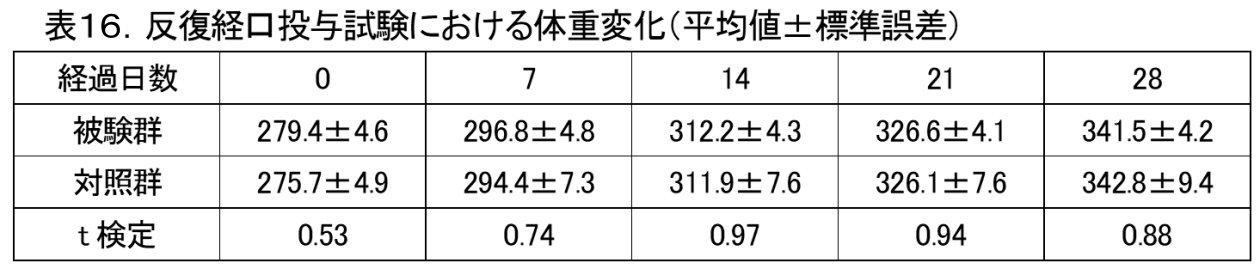

図13および図14に示すように、被験群はコントロール群と比較して、収縮期血圧は試験開始14日、21日、28日目、拡張期血圧は28日目において有意な低値を示し、単回経口投与試験で明らかとなったナス凍結乾燥粉末摂取による血圧降下作用が、反復経口投与試験でも確認された。
図15および図16に示すように、尿に含まれる代表的なカテコールアミンであるアドレナリン、ノルアドレナリン量が、コントロール群と比較して被験群では有意に低下した。尿中アドレナリン量は試験開始後20日と27日目に、尿中ノルアドレナリン量は試験開始後6日と27日目に、被験群はコントロール群よりも有意な低値を示した。
ノルアドレナリンは交感神経終末から放出される神経伝達物質であり、アドレナリンは、ノルアドレナリンが副腎で変換されて生成する。これらのカテコールアミンは、アドレナリン受容体に作用して様々な臓器や代謝系の制御に関与する。放出されたカテコールアミンは、神経が到達している効果器で作用すると共に一部が血中に移行して全身に影響を及ぼす。血中カテコールアミンは代謝され不活性化されるが、そのまま尿中に排出されるものもある。そのため、尿中カテコールアミン量は生体における交感神経活動の指標となる。つまり、交感神経活動が亢進し活発に活動した結果、尿中カテコールアミン量が増加することになる。交感神経は覚醒、攻撃、防御、逃避行動を促進する。交感神経活動の亢進によって放出されるカテコールアミンは、血管のアドレナリンα受容体に作用し、血管を収縮させて血圧上昇を引き起こす。そのため、経口摂取コリンエステルの血圧降下作用メカニズムには、交感神経活動の抑制によるカテコールアミン減少が深く関与していると考えられる。
また、生体は交感神経活動を亢進させてストレスに対応することが知られており、ストレスによってカテコールアミン量は増加する。そのため、カテコールアミンはストレス指標として知られている。
β-カロチンを有効成分とする抗ストレス組成物の、生体での抗ストレス作用の指標としてカテコールアミン(アドレナリン、ノルアドレナリン、ドーパミン)が採用され、組成物摂取によるカテコールアミンの有意な減少によって抗ストレス作用が示されている(特許文献3)。また、酵母加水分解物投与後の拘束ストレスでの、血中アドレナリン(文献ではepinephrineと記載)、血中ノルアドレナリン(文献ではnorepinephrineと記載)レベルの有意な低値によって抗ストレス作用を裏付けている(非特許文献23)。カンデサルタン(アンジオテンシンII 1型受容体拮抗阻害剤)による抗ストレス作用評価では、代謝ケージでの個別飼育ストレスの指標として尿中カテコールアミン(アドレナリン、ノルアドレナリン)が用いられ、それぞれの有意な低値が抗ストレス作用の裏付けとされている。
β-カロチンを有効成分とする抗ストレス組成物の、生体での抗ストレス作用の指標としてカテコールアミン(アドレナリン、ノルアドレナリン、ドーパミン)が採用され、組成物摂取によるカテコールアミンの有意な減少によって抗ストレス作用が示されている(特許文献3)。また、酵母加水分解物投与後の拘束ストレスでの、血中アドレナリン(文献ではepinephrineと記載)、血中ノルアドレナリン(文献ではnorepinephrineと記載)レベルの有意な低値によって抗ストレス作用を裏付けている(非特許文献23)。カンデサルタン(アンジオテンシンII 1型受容体拮抗阻害剤)による抗ストレス作用評価では、代謝ケージでの個別飼育ストレスの指標として尿中カテコールアミン(アドレナリン、ノルアドレナリン)が用いられ、それぞれの有意な低値が抗ストレス作用の裏付けとされている。
実験12で、尿中カテコールアミン量がナス凍結乾燥粉末摂取によって有意に低下したことは、ナス凍結乾燥粉末摂取が交感神経活動を抑制し抗ストレス作用を発揮した結果であるといえる。つまり、ナス凍結乾燥粉末摂取による抗ストレス作用が認められた。実験11の血管拡張作用は、ナスに含まれるコリンエステルがムスカリン性アセチルコリン受容体へ作用して引き起こされる(非特許文献25)。この抗ストレス作用も、ナスに含まれるコリンエステルがムスカリン性アセチルコリン受容体へ作用して、交感神経活動を抑制して神経抹消からのカテコールアミン放出を抑制した結果であると考えられ、一定量のコリンエステルを含むナスを原料とする抽出物および加工食品は抗ストレス作用を有するものと考えられる。経口摂取コリンエステルによる交感神経活動の抑制が引き起こす血圧降下作用および抗ストレス作用は互いに密接に関連している。そのため、血圧降下作用が見られたSHRとWKYラットでのコリンエステル用量の差異は、抗ストレス作用にも適応されるものである。
4.実施の検討
本発明者の研究により、コリンエステルは1日に25μgという極少量の摂取で血圧降下作用が認められている。25μgのAcChを摂取するのに必要な農産物の重量を1日摂取目安量と設定し、実験1および2で定量した生鮮農産物20種の1日摂取目安量を算出した。結果を表18に示す。
本発明者の研究により、コリンエステルは1日に25μgという極少量の摂取で血圧降下作用が認められている。25μgのAcChを摂取するのに必要な農産物の重量を1日摂取目安量と設定し、実験1および2で定量した生鮮農産物20種の1日摂取目安量を算出した。結果を表18に示す。

表18に示すとおり、25μgのAcChを摂取するためには、ナスおよびタケノコ以外の18種の農産物では、非常に多量の摂取を必要とする。例えば、レタスでは、1日約7.5kg以上を摂取する必要があり、1日の摂取としても現実的ではなく、日常的に継続的な摂取は到底不可能である。一方、ナスおよびタケノコは、それぞれ1日摂取目安量がわずか0.41gおよび0.25gであることから、毎日の継続摂取が可能な量で血圧降下作用を示すと期待できる。また、今回の実験に用いたナス7品種のうち、泉州水なす、ばってんなす、広陵サラダ茄子、ヒゴムラサキ、竜馬の5品種は皮がやわらかく、あくが少ないという特徴があり、生食が可能な品種である。生食により摂取する場合は、調理によるコリンエステルの減少を考慮する必要がなくなる。
本発明の組成物は、顕著な血圧降下作用を有しており、これを活性成分として含有させることにより、機能性表示食品あるいは高血圧症等の治療用医薬品を製造することができる。
Claims (25)
- コリンエステルを有効成分とする血圧降下作用および/または抗ストレス作用を有する組成物であって、コリンエステル含量が5μg~50mgであり、経口摂取用である、前記組成物。
- 食品組成物である、請求項1に記載の組成物。
- 血圧降下用および/または抗ストレス用の医薬組成物である、請求項1に記載の組成物。
- コリンエステルが、食用植物由来である、請求項1~3のいずれか一項に記載の組成物。
- 食用植物の凍結乾燥粉末および/または熱風乾燥粉末からなる、請求項1~4のいずれか一項に記載の組成物。
- 20メッシュの篩を通過できる凍結乾燥粉末および/または熱風乾燥粉末からなる、請求項5に記載の組成物。
- 食用植物をエタノールまたは含水エタノールで抽出してなる抽出物である、請求項1~4のいずれか一項に記載の組成物。
- 食用植物が、ナス科ナス属ナス種(Solanum melongena)の果実および/またはイネ科タケ亜科タケ連(Poaceae, Bambusoideae, Bambuseae)の若芽である、請求項4~7のいずれか一項に記載の組成物。
- コリンエステルが、アセチルコリン、ブチリルコリンおよびプロピオニルコリンからなる群から選択される1種または2種以上を含む、請求項1~3のいずれか一項に記載の組成物。
- コリンエステルが、ラクトイルコリンを含まない、請求項9に記載の組成物。
- コリンエステルの濃度が5μg/g~250mg/gであり、かつ、1日の摂取量が、5μg~50mgに調整されてなる、請求項1~10のいずれか一項に記載の組成物。
- 冷凍加工されてなる、請求項1~11のいずれか一項に記載の組成物。
- 冷凍加工されたナス科ナス属ナス種(Solanum melongena)の果実の一部または全部である、請求項1~3のいずれか一項に記載の組成物。
- コリンエステルを有効成分とする経口摂取用の血圧降下作用および/または抗ストレス作用を有する組成物を製造する方法であって、食用植物を凍結乾燥粉末および/または熱風乾燥粉末にすること、凍結乾燥粉末および/または熱風乾燥粉末を、コリンエステル含量が5μg~50mgとなるように分配することを含む、前記方法。
- 食用植物が、ナス科ナス属ナス種(Solanum melongena)の果実および/またはイネ科タケ亜科タケ連(Poaceae, Bambusoideae, Bambuseae)の若芽である、請求項14に記載の方法。
- 食用植物を加熱することをさらに含む、請求項14または15に記載の方法。
- 食用植物の凍結乾燥粉末および/または熱風乾燥粉末を水に懸濁し、得られた懸濁液に酸を添加することをさらに含む、請求項14~16のいずれか一項に記載の方法。
- 酸を添加した懸濁液のpHを5.5~4.5に調整することをさらに含む、請求項17に記載の方法。
- 請求項14~18のいずれか一項に記載の方法で製造された、コリンエステルを有効成分とする経口摂取用の血圧降下作用および/または抗ストレス作用を有する組成物。
- コリンエステルを有効成分とする経口摂取用の血圧降下作用および/または抗ストレス作用を有する抽出物を製造する方法であって、食用植物を、または、食用植物の凍結乾燥粉末および/または熱風乾燥粉末を、エタノールまたは含水エタノールで抽出することを含む、前記方法。
- 食用植物を、または、食用植物の凍結乾燥粉末および/または熱風乾燥粉末を、エタノールで抽出することを含む、請求項20に記載の方法。
- 食用植物を、または、食用植物の凍結乾燥粉末および/または熱風乾燥粉末を、含水エタノールで抽出することを含み、含水エタノールのエタノール濃度が、25~60%(w/w)であるか、または95%(w/w)以上である、請求項20に記載の方法。
- 抽出に用いるエタノールまたは含水エタノールにL-アスコルビン酸が添加されている、請求項20~22のいずれか一項に記載の方法。
- 抽出物のコリンエステル含量を5μg~50mgに調整することを含む、請求項20~23のいずれか一項に記載の方法。
- 請求項20~24のいずれか一項に記載の方法で製造された、コリンエステルを有効成分とする経口摂取用の血圧降下作用および/または抗ストレス作用を有する抽出物。
Priority Applications (6)
| Application Number | Priority Date | Filing Date | Title |
|---|---|---|---|
| CN201780063705.XA CN109890382A (zh) | 2016-10-14 | 2017-10-16 | 经口摄取用含胆碱酯的组合物 |
| JP2018545093A JP7362098B2 (ja) | 2016-10-14 | 2017-10-16 | 経口摂取用コリンエステル含有組成物 |
| US16/341,748 US20220030896A2 (en) | 2016-10-14 | 2017-10-16 | Choline ester-containing composition for oral ingestion |
| JP2022105480A JP7515907B2 (ja) | 2016-10-14 | 2022-06-30 | 経口摂取用コリンエステル含有組成物 |
| JP2024103012A JP7726553B2 (ja) | 2016-10-14 | 2024-06-26 | 経口摂取用コリンエステル含有組成物 |
| JP2025128018A JP2025148617A (ja) | 2016-10-14 | 2025-07-31 | 経口摂取用コリンエステル含有組成物 |
Applications Claiming Priority (2)
| Application Number | Priority Date | Filing Date | Title |
|---|---|---|---|
| JP2016202909 | 2016-10-14 | ||
| JP2016-202909 | 2016-10-14 |
Publications (1)
| Publication Number | Publication Date |
|---|---|
| WO2018070545A1 true WO2018070545A1 (ja) | 2018-04-19 |
Family
ID=61905754
Family Applications (1)
| Application Number | Title | Priority Date | Filing Date |
|---|---|---|---|
| PCT/JP2017/037389 Ceased WO2018070545A1 (ja) | 2016-10-14 | 2017-10-16 | 経口摂取用コリンエステル含有組成物 |
Country Status (4)
| Country | Link |
|---|---|
| US (1) | US20220030896A2 (ja) |
| JP (4) | JP7362098B2 (ja) |
| CN (1) | CN109890382A (ja) |
| WO (1) | WO2018070545A1 (ja) |
Cited By (5)
| Publication number | Priority date | Publication date | Assignee | Title |
|---|---|---|---|---|
| WO2020166494A1 (ja) * | 2019-02-15 | 2020-08-20 | 国立大学法人信州大学 | 血圧低下作用を有するナス由来組成物 |
| JP2020137462A (ja) * | 2019-02-28 | 2020-09-03 | 株式会社ウェルナス | 睡眠を改善するための経口摂取用組成物 |
| WO2021095814A1 (ja) * | 2019-11-15 | 2021-05-20 | 国立大学法人信州大学 | 心理状態改善用組成物、心理状態改善用組成物の製造方法および心理状態改善のためのナスの果実の使用 |
| JP2023069120A (ja) * | 2021-11-05 | 2023-05-18 | 株式会社島津製作所 | 定量分析方法及び定量分析装置 |
| JP7737574B1 (ja) * | 2025-01-17 | 2025-09-10 | 株式会社Adeka | 固結防止剤 |
Citations (1)
| Publication number | Priority date | Publication date | Assignee | Title |
|---|---|---|---|---|
| WO2015147251A1 (ja) * | 2014-03-28 | 2015-10-01 | 国立大学法人信州大学 | 発酵食品抽出組成物 |
Family Cites Families (1)
| Publication number | Priority date | Publication date | Assignee | Title |
|---|---|---|---|---|
| JP3017926B2 (ja) * | 1995-06-16 | 2000-03-13 | 株式会社ヤクルト本社 | 保存可能な野菜搾汁液の製造法 |
-
2017
- 2017-10-16 CN CN201780063705.XA patent/CN109890382A/zh active Pending
- 2017-10-16 US US16/341,748 patent/US20220030896A2/en active Pending
- 2017-10-16 JP JP2018545093A patent/JP7362098B2/ja active Active
- 2017-10-16 WO PCT/JP2017/037389 patent/WO2018070545A1/ja not_active Ceased
-
2022
- 2022-06-30 JP JP2022105480A patent/JP7515907B2/ja active Active
-
2024
- 2024-06-26 JP JP2024103012A patent/JP7726553B2/ja active Active
-
2025
- 2025-07-31 JP JP2025128018A patent/JP2025148617A/ja active Pending
Patent Citations (1)
| Publication number | Priority date | Publication date | Assignee | Title |
|---|---|---|---|---|
| WO2015147251A1 (ja) * | 2014-03-28 | 2015-10-01 | 国立大学法人信州大学 | 発酵食品抽出組成物 |
Non-Patent Citations (7)
| Title |
|---|
| FLUCK, R. A. ET AL.: "Cholinesterases from plant tissues VI. Preliminary characterization of enzymes from Solanum melongena L. and Zea mays L.", BIOCHIMICA ET BIOPHYSICA ACTA, vol. 410, no. 1, 1975, pages 130 - 134, XP023798181, ISSN: 0006-3002, DOI: doi:10.1016/0005-2744(75)90213-2 * |
| HORIUCHI, Y. ET AL.: "Evolutional study on acetylcholine expression", LIFE SCIENCES, vol. 72, no. 15, 28 February 2003 (2003-02-28), pages 1745 - 1756, XP055604279, ISSN: 0024-3205, DOI: 10.1016/S0024-3205(02)02478-5 * |
| IKARASHI, Y. ET AL.: "Study of the Use of the Microwave Magnetic Field for the Rapid Inactivation of Brain Enzymes", THE JAPANESE JOURNAL OF PHARMACOLOGY, vol. 35, no. 4, August 1984 (1984-08-01), pages 371 - 387, XP055604301, ISSN: 1347-3506, DOI: 10.1254/jjp.35.371 * |
| KYORITSU SHUPPAN CO. LTD.: "Section of Acetylcholine", CHEMISTRY DICTIONNARY 1- THE 39TH COMPRESSED PRINT, 1987, pages 107 * |
| MOMONOKI YOSHIE: "Role of Acetylcholine in plants", CHEMICAL REGULATION OF PLANTS, vol. 30, no. 1, 1995, pages 49 - 61, ISSN: 0388-9130 * |
| NAKAI KENGO ET AL.: "Section of Acetylcholine", 1ST EDITION , 5TH PRINT- PHARMACOLOGY, 1982, pages 139 - 140 * |
| WATABE AKIRA ET AL.: "Effect of suppressing increase in blood pressure by repetitive oral administration of acetylcholine to spontaneously hypertensive rat", THE 177TH REGULAR MEETING OF THE CENTRAL BRANCH OF JAPAN SOCIETY FOR BIOSCIENCE, BIOTECHNOLOGY AND AGROCHEMISTRY, 24 September 2016 (2016-09-24), pages 22 - 36, XP055604287, Retrieved from the Internet <URL:http://chubu.jsbba.or.jp/wp-content/uploads/2016/09/177_abstract-1.pdf> [retrieved on 20171110] * |
Cited By (15)
| Publication number | Priority date | Publication date | Assignee | Title |
|---|---|---|---|---|
| WO2020166494A1 (ja) * | 2019-02-15 | 2020-08-20 | 国立大学法人信州大学 | 血圧低下作用を有するナス由来組成物 |
| JPWO2020166494A1 (ja) * | 2019-02-15 | 2021-12-16 | 国立大学法人信州大学 | 血圧低下作用を有するナス由来組成物 |
| JP7691693B2 (ja) | 2019-02-15 | 2025-06-12 | 国立大学法人信州大学 | 血圧低下作用を有するナス由来組成物 |
| JP7337363B2 (ja) | 2019-02-28 | 2023-09-04 | 株式会社ウェルナス | 睡眠を改善するための経口摂取用組成物 |
| JP2020137462A (ja) * | 2019-02-28 | 2020-09-03 | 株式会社ウェルナス | 睡眠を改善するための経口摂取用組成物 |
| WO2020175605A1 (ja) * | 2019-02-28 | 2020-09-03 | 株式会社ウェルナス | 睡眠を改善するための経口摂取用組成物 |
| JP7795802B2 (ja) | 2019-02-28 | 2026-01-08 | 株式会社ウェルナス | 睡眠を改善するための経口摂取用組成物 |
| JP2023169145A (ja) * | 2019-02-28 | 2023-11-29 | 株式会社ウェルナス | 睡眠を改善するための経口摂取用組成物 |
| WO2021095814A1 (ja) * | 2019-11-15 | 2021-05-20 | 国立大学法人信州大学 | 心理状態改善用組成物、心理状態改善用組成物の製造方法および心理状態改善のためのナスの果実の使用 |
| US20220401509A1 (en) * | 2019-11-15 | 2022-12-22 | Shinshu University | Composition For Improving Mental State, Production Method For Composition For Improving Mental State, And Use Of Fruit Of Eggplant For Improving Mental State |
| JP7713635B2 (ja) | 2019-11-15 | 2025-07-28 | 国立大学法人信州大学 | 心理状態改善用組成物、心理状態改善用組成物の製造方法および心理状態改善のためのナスの果実の使用 |
| JPWO2021095814A1 (ja) * | 2019-11-15 | 2021-05-20 | ||
| JP2023069120A (ja) * | 2021-11-05 | 2023-05-18 | 株式会社島津製作所 | 定量分析方法及び定量分析装置 |
| JP7694342B2 (ja) | 2021-11-05 | 2025-06-18 | 株式会社島津製作所 | 定量分析方法及び定量分析装置 |
| JP7737574B1 (ja) * | 2025-01-17 | 2025-09-10 | 株式会社Adeka | 固結防止剤 |
Also Published As
| Publication number | Publication date |
|---|---|
| JP2024114843A (ja) | 2024-08-23 |
| JP7515907B2 (ja) | 2024-07-16 |
| US20200045985A1 (en) | 2020-02-13 |
| CN109890382A (zh) | 2019-06-14 |
| JP7726553B2 (ja) | 2025-08-20 |
| US20220030896A2 (en) | 2022-02-03 |
| JP7362098B2 (ja) | 2023-10-17 |
| JP2022121616A (ja) | 2022-08-19 |
| JPWO2018070545A1 (ja) | 2019-07-25 |
| JP2025148617A (ja) | 2025-10-07 |
Similar Documents
| Publication | Publication Date | Title |
|---|---|---|
| JP7515907B2 (ja) | 経口摂取用コリンエステル含有組成物 | |
| Tzulker et al. | Antioxidant activity, polyphenol content, and related compounds in different fruit juices and homogenates prepared from 29 different pomegranate accessions | |
| Cirilo et al. | Profile and levels of bioactive amines in green and roasted coffee | |
| Islam et al. | Dietary red chilli (Capsicum frutescens L.) is insulinotropic rather than hypoglycemic in type 2 diabetes model of rats | |
| Walkowiak-Tomczak | Characteristics of plums as a raw material with valuable nutritive and dietary properties–a review | |
| KR20220100896A (ko) | 추출물, 소모가능 생성물 및 추출물에서 생물활성 대사산물을 농후화하는 방법 | |
| Kays et al. | Sweetpotato chemistry in relation to health | |
| US20120269913A1 (en) | Crude caffeine complex, improved food products using the crude caffeine complex, and methods of use thereof | |
| Ripari Garrido et al. | Nutritional and bioactive characterization of pistachio—A review with special focus on health | |
| Kumar et al. | A brief overview of the biological activities of faba bean (Vicia faba) | |
| KR20230170698A (ko) | 시르투인 또는 클로토 활성화 또는 발현 증강제, nad+ 증가제, 및 노화 세포 억제제 | |
| Islam | Antimutagenicity of the water extracts, radical scavenging activity, and phenolic acids in the tops of diverse Ipomoea batatas (L.) Lam | |
| US20100047374A1 (en) | Composition for protecting muscle damage | |
| Joseph et al. | Antihyperglycaemic and antioxidant effects of Adenia lobata engl.(Passifloraceae) in streptozotocin-induced diabetic rats | |
| JP2023554187A (ja) | 身体運動パフォーマンスを改善するため方法 | |
| Ci et al. | Suppressive effect of polyphenols from immature pear fruits on blood glucose levels | |
| KR101073624B1 (ko) | 갈대순 분말 또는 이의 추출물을 포함하는 비만 예방 및 개선용, 또는 항산화용 조성물 | |
| KR100710818B1 (ko) | 순무 추출물을 포함하는 당뇨병의 예방 및 치료용 조성물 | |
| KR20220147238A (ko) | 콩 청자 5호를 유효성분으로 포함하는 대사증후군 관련 질환의 예방, 치료 또는 개선용 조성물 | |
| WO2006082743A1 (ja) | 治療剤 | |
| HK40007823A (en) | Choline ester-containing composition for oral ingestion | |
| JP2009167153A (ja) | 血糖値上昇抑制剤 | |
| US20250090564A1 (en) | Bioactives and their uses | |
| Hanagasaki | The preventing method of browning and γ-aminobutyric acid (GABA) contained in Luffa cylindrica Roem. cultivated in Okinawa | |
| KR102342389B1 (ko) | 비선택 제초제 티아페나실에 내성을 갖는 벼 돌연변이 후대 계통 벼 품종 Samkwang(SA)-Tfnl1 및 이의 용도 |
Legal Events
| Date | Code | Title | Description |
|---|---|---|---|
| 121 | Ep: the epo has been informed by wipo that ep was designated in this application |
Ref document number: 17860832 Country of ref document: EP Kind code of ref document: A1 |
|
| ENP | Entry into the national phase |
Ref document number: 2018545093 Country of ref document: JP Kind code of ref document: A |
|
| NENP | Non-entry into the national phase |
Ref country code: DE |
|
| 122 | Ep: pct application non-entry in european phase |
Ref document number: 17860832 Country of ref document: EP Kind code of ref document: A1 |