WO2018070513A1 - 腸管内ラクトバチルス属乳酸菌減少抑制用組成物 - Google Patents
腸管内ラクトバチルス属乳酸菌減少抑制用組成物 Download PDFInfo
- Publication number
- WO2018070513A1 WO2018070513A1 PCT/JP2017/037158 JP2017037158W WO2018070513A1 WO 2018070513 A1 WO2018070513 A1 WO 2018070513A1 JP 2017037158 W JP2017037158 W JP 2017037158W WO 2018070513 A1 WO2018070513 A1 WO 2018070513A1
- Authority
- WO
- WIPO (PCT)
- Prior art keywords
- acid bacteria
- composition
- lactic acid
- lactobacillus
- antibacterial agent
- Prior art date
- Legal status (The legal status is an assumption and is not a legal conclusion. Google has not performed a legal analysis and makes no representation as to the accuracy of the status listed.)
- Ceased
Links
Images


Classifications
-
- A—HUMAN NECESSITIES
- A23—FOODS OR FOODSTUFFS; TREATMENT THEREOF, NOT COVERED BY OTHER CLASSES
- A23C—DAIRY PRODUCTS, e.g. MILK, BUTTER OR CHEESE; MILK OR CHEESE SUBSTITUTES; PREPARATION THEREOF
- A23C21/00—Whey; Whey preparations
- A23C21/02—Whey; Whey preparations containing, or treated with, microorganisms or enzymes
-
- A—HUMAN NECESSITIES
- A23—FOODS OR FOODSTUFFS; TREATMENT THEREOF, NOT COVERED BY OTHER CLASSES
- A23C—DAIRY PRODUCTS, e.g. MILK, BUTTER OR CHEESE; MILK OR CHEESE SUBSTITUTES; PREPARATION THEREOF
- A23C9/00—Milk preparations; Milk powder or milk powder preparations
- A23C9/12—Fermented milk preparations; Treatment using microorganisms or enzymes
-
- A—HUMAN NECESSITIES
- A23—FOODS OR FOODSTUFFS; TREATMENT THEREOF, NOT COVERED BY OTHER CLASSES
- A23L—FOODS, FOODSTUFFS OR NON-ALCOHOLIC BEVERAGES, NOT OTHERWISE PROVIDED FOR; PREPARATION OR TREATMENT THEREOF
- A23L33/00—Modifying nutritive qualities of foods; Dietetic products; Preparation or treatment thereof
- A23L33/10—Modifying nutritive qualities of foods; Dietetic products; Preparation or treatment thereof using additives
-
- A—HUMAN NECESSITIES
- A61—MEDICAL OR VETERINARY SCIENCE; HYGIENE
- A61K—PREPARATIONS FOR MEDICAL, DENTAL OR TOILETRY PURPOSES
- A61K35/00—Medicinal preparations containing materials or reaction products thereof with undetermined constitution
- A61K35/12—Materials from mammals; Compositions comprising non-specified tissues or cells; Compositions comprising non-embryonic stem cells; Genetically modified cells
- A61K35/20—Milk; Whey; Colostrum
-
- A—HUMAN NECESSITIES
- A61—MEDICAL OR VETERINARY SCIENCE; HYGIENE
- A61K—PREPARATIONS FOR MEDICAL, DENTAL OR TOILETRY PURPOSES
- A61K35/00—Medicinal preparations containing materials or reaction products thereof with undetermined constitution
- A61K35/66—Microorganisms or materials therefrom
- A61K35/74—Bacteria
-
- A—HUMAN NECESSITIES
- A61—MEDICAL OR VETERINARY SCIENCE; HYGIENE
- A61K—PREPARATIONS FOR MEDICAL, DENTAL OR TOILETRY PURPOSES
- A61K9/00—Medicinal preparations characterised by special physical form
- A61K9/08—Solutions
-
- A—HUMAN NECESSITIES
- A61—MEDICAL OR VETERINARY SCIENCE; HYGIENE
- A61K—PREPARATIONS FOR MEDICAL, DENTAL OR TOILETRY PURPOSES
- A61K9/00—Medicinal preparations characterised by special physical form
- A61K9/14—Particulate form, e.g. powders, Processes for size reducing of pure drugs or the resulting products, Pure drug nanoparticles
-
- A—HUMAN NECESSITIES
- A61—MEDICAL OR VETERINARY SCIENCE; HYGIENE
- A61K—PREPARATIONS FOR MEDICAL, DENTAL OR TOILETRY PURPOSES
- A61K9/00—Medicinal preparations characterised by special physical form
- A61K9/20—Pills, tablets, discs, rods
-
- A—HUMAN NECESSITIES
- A61—MEDICAL OR VETERINARY SCIENCE; HYGIENE
- A61P—SPECIFIC THERAPEUTIC ACTIVITY OF CHEMICAL COMPOUNDS OR MEDICINAL PREPARATIONS
- A61P1/00—Drugs for disorders of the alimentary tract or the digestive system
-
- A—HUMAN NECESSITIES
- A61—MEDICAL OR VETERINARY SCIENCE; HYGIENE
- A61P—SPECIFIC THERAPEUTIC ACTIVITY OF CHEMICAL COMPOUNDS OR MEDICINAL PREPARATIONS
- A61P29/00—Non-central analgesic, antipyretic or antiinflammatory agents, e.g. antirheumatic agents; Non-steroidal antiinflammatory drugs [NSAID]
Definitions
- the present invention relates to a composition for suppressing the reduction of lactic acid bacteria in the intestinal tract in a subject who is administered an antibacterial drug.
- antibacterial drugs are used for the purpose of treating infections and preventing bacterial infections.
- the adverse effects of the use of antibacterial drugs include deterioration of the intestinal environment due to the use of antibacterial drugs.
- antibacterial drugs By taking antibacterial drugs, not only pathogenic microorganisms but also useful bacteria such as so-called good bacteria such as bifidobacteria and lactic acid bacteria are reduced, and intestinal flora (intestinal flora), that is, intestinal bacterial ecosystem Is said to be adversely affected.
- symptoms such as constipation, diarrhea, nausea and headache occur.
- prebiotics include those in which good bacteria in the intestinal tract such as oligosaccharides and dietary fiber, and good bacteria such as lactic acid bacteria and bifidobacteria are supplemented in the form of capsules.
- Lactobacillus a kind of lactic acid bacteria
- Lactobacillus is widely used as a probiotic cell itself.
- lactic acid bacteria belonging to the genus Lactobacillus are Gram-positive bacilli and are highly sensitive to antibacterial drugs, so that it is reported that they significantly decrease when administered with antibacterial drugs (for example, Non-Patent Document 1). Therefore, it is an important issue to suppress the decrease of Lactobacillus genus lactic acid bacteria in the intestinal tract in subjects administered with antibacterial drugs.
- Non-Patent Document 2 reports that the supernatant filtrate of the Propionibacterium flodendenreich culture specifically propagated Bifidobacteria.
- the bifidobacteria growth-promoting substance did not substantially exhibit the growth-promoting action against intestinal bacteria other than bifidobacteria such as lactic acid bacteria (see Table 1 of Non-Patent Document 2).
- Patent Document 1 the intestinal microflora improvement effect in the larva using the feed composition containing a bifidobacteria growth promotion substance is reported (patent document 1).
- Profec which is a whey fermented product of propionic acid bacteria
- Patent Document 1 when Profec (trademark), which is a whey fermented product of propionic acid bacteria, is ingested by larvae, bifidobacteria in the intestinal tract significantly increase, and the occupancy rate relative to the total number of bacteria Has been reported to increase significantly.
- it was shown that there was no significant increase in Lactobacillus lactic acid bacteria see Table 1 of Example 1 of Patent Document 1).
- no component has been reported so far that significantly propagates Lactobacillus lactic acid bacteria in the intestinal tract.
- An object of the present invention is to provide a composition capable of suppressing the decrease of Lactobacillus lactic acid bacteria in the intestinal tract in a subject to which an antibacterial drug is administered, and a method for suppressing the composition.
- the present inventors recently ingested a whey fermented product from propionic acid bacteria to a patient before or during administration of the antibacterial agent. It was found that the decrease in Lactobacillus genus lactic acid bacteria in the intestinal tract could be significantly suppressed compared to patients who did not take it.
- the present invention is based on such knowledge.
- a composition for suppressing a decrease in lactic acid bacteria in the intestinal tract in a subject to which an antibacterial agent is administered comprising a whey fermented product by propionic acid bacteria.
- the antibacterial agent is penicillin antibacterial agent, cephem antibacterial agent, cephalosporin antibacterial agent, carbapenem antibacterial agent, ⁇ -lactamase inhibitor, oxazolidinone antibacterial agent, new kilononone antibacterial agent, and macro
- the composition according to (1) or (2) which is at least one selected from ride-type antibacterial drugs.
- composition according to any one of (1) to (3) wherein the daily dose is 0.15 to 200 mg / kg body weight in terms of dry mass of the whey fermented product by propionic acid bacteria .
- the composition according to any one of (1) to (4) which is a food composition or a pharmaceutical composition.
- the composition according to any one of (1) to (5) which is in the form of powder, liquid or tablet.
- a method for suppressing a decrease in intestinal Lactobacillus lactic acid bacteria in a subject to which an antibacterial agent is administered comprising allowing the subject to ingest an effective amount of a whey fermented product by propionic acid bacteria.
- the method according to (8) which is a method for ameliorating a disease or condition associated with a decrease in intestinal Lactobacillus lactic acid bacteria caused by administration of an antibacterial drug.
- (11) Use of a whey fermented product by propionic acid bacteria for suppressing the reduction of lactic acid bacteria in the intestinal tract in a subject to which an antibacterial agent is administered.
- composition for inhibiting Lactobacillus lactic acid bacteria reduction is a composition for inhibiting Lactobacillus lactic acid bacteria reduction in a subject to which an antibacterial agent is administered, and includes a whey fermentation product by propionic acid bacteria. Become. When fermented whey by propionic acid bacteria is used as an active ingredient, the intestinal Lactobacillus genus in subjects before, during, or after administration of antibacterial drugs, even though it does not suppress the reduction of intestinal bifidobacteria It is a surprising fact that the decrease in lactic acid bacteria could be significantly suppressed.
- Subject to be administered an antibacterial agent refers to a subject who is scheduled to be administered an antibacterial agent (before administration), a subject who is being administered (during administration), or a subject who has been administered (after administration).
- a subject whose antibacterial agent is to reduce, or have reduced, Lactobacillus lactic acid bacteria in the intestine.
- the subject is preferably a human, but may be other than a human (for example, domestic animals such as horses and cows, rodents, pets such as dogs and cats, appreciation animals kept in zoos, etc.) This aspect is also included in the present invention.
- the antibacterial agent of the present invention is not particularly limited as long as it is an antibacterial agent that is sensitive to Lactobacillus lactic acid bacteria, but is preferably an antibiotic that is sensitive to Lactobacillus lactic acid bacteria. More specific examples include penicillin antibacterial drugs (eg, amoxicillin (AMPC), ampicillin (ABPC)), cephem antibacterial drugs (eg, cefpirom (CPR)), cephalosporin antibacterial drugs (eg, cefradizime ( CAZ)), carbapenem antibiotics (eg, melpenem (MEPM)), ⁇ -lactamase inhibitors, oxazolidinone antibiotics (eg, linezolid (LZD)), new kilononone antibiotics (eg, levofloxacin (LVFX)), Oazufloxacin (PZFX)) and macrolide antibiotics (for example, azithromycin (AZM)), lincomycin antibiotics, aminoglycoside antibiotics, tetra
- the antibacterial agent is preferably a penicillin antibacterial agent (eg, amoxicillin (AMPC), ampicillin (ABPC)), a cephem antibacterial agent (eg, cefpirom (CPR)), a cephalosporin antibacterial agent (eg, cefradizime (CAZ)).
- AMPC amoxicillin
- ABPC ampicillin
- CPR cefpirom
- CAZ cephalosporin antibacterial agent
- Carbapenem antibiotics eg, melpenem (MEPM)
- MEPM melpenem
- ⁇ -lactamase inhibitors e.g, oxazolidinone antibiotics
- LZD linezolid
- new kilononone antibiotics eg, levofloxacin (LVFX), oazuflo) Oxacin (PZFX)
- macrolide antibacterials eg, azithromycin (AZM)
- the administration method of the antibacterial agent is not particularly limited as long as the Lactobacillus genus Lactobacillus in the intestinal tract shows sensitivity.
- the antibacterial agent can be administered from oral intake (or oral administration), enteral administration, gastric fistula, subcutaneous administration, intravenous administration, etc. It can be appropriately selected depending on the subject to which the drug is administered and the use (for example, therapeutic purpose or preventive purpose).
- the method of using the antibacterial agent can be appropriately selected by those skilled in the art depending on the disease, condition, and use of the subject.
- JAID / JAS infection treatment guide 2014 JAID / JAS infection treatment guide / guideline
- a person skilled in the art can appropriately select the method according to the method described in the compilation committee).
- Lactobacillus lactic acid bacteria are Gram-positive rods and are known as a kind of good bacteria. Specific examples of preferable lactic acid bacteria belonging to the genus Lactobacillus include Lactobacillus bulgaricus , L. johnsonii , L. casei , Lactobacillus Lactobacillus, Lactobacillus bulgaricus , Lactobacillus casei , Lactobacillus Paracasei ( L. paracasei ), Lactobacillus gasseri ( L. gasseri ), Lactobacillus helveticus (L. helveticus), Lactobacillus rhamnosus ( L. rhamnosus ), Lactobacillus acidophilus ( L.
- Lactobacillus ⁇ Sarivarius L. salivarius
- Lactobacillus pentosus L. pentosus
- Lactobacillus plantarum L. plantarum
- Lactobacillus brevis L. brevis
- Lactobacillus reuteri L. reuteri
- lact Bacillus sporogenes L. sporogenes I can get lost.
- Lactobacillus lactic acid bacteria are, for example, intestinal regulating (eg, diarrhea, constipation, intestinal regulation for irritable bowel syndrome), immunostimulatory action, Helicobacter pylori eradication, atopy, pollinosis, asthma and other allergy suppression Action, irritable bowel syndrome (IBS) improvement action, lipid metabolism or visceral fat accumulation improvement action, respiratory disease and other infection risk control action, inflammatory colitis improvement action, endometriosis improvement action, It is known to have physiological activities such as a cancer suppressing action, an action for improving stress and QOL, an action for improving diabetes, and an action for improving oxidative stress. Lactobacillus lactic acid bacteria desirably have a certain number of bacteria in the intestinal tract in terms of having the above physiological activity.
- the intestinal Lactobacillus lactic acid bacterium refers to a Lactobacillus lactic acid bacterium contained in the intestinal flora, and is preferably a lactic acid bacterium having a function of maintaining a good balance of the intestinal environment.
- the number of lactic acid bacteria belonging to the genus Lactobacillus in the intestinal tract is preferably 4 or more Log 10 per gram of human feces, more preferably 5 or more Log 10, still more preferably 6 or more Log 10, and more preferably 7 or more Log 10.
- the fermented whey product of propionic acid bacteria used in the present invention can be obtained by culturing propionic acid bacteria using a medium containing whey.
- Propionic acid bacteria is a gram-positive anaerobic bacterium belonging to the genus Propionibacterium, which is a microorganism that produces propionic acid oxygen-freely from sugars, and has been used as a starter for Emmental cheese for a long time. Its safety has been confirmed.
- Examples of the propionic acid bacteria used in the present invention include Propionibacterium freudenreichii , Propionibacterium toeni ( P. thoenii ), Propionibacterium acidipropionici ( P. acidipropionici ) , Propionibacterium genseny ( P. jensenii ), Propionibacterium avidum ( P. avidum ), Propionibacterium acnes ( P.
- Propionibacterium lymphophilum P. lymphophilum
- Pro Pionibacterium granulosam P. granulosam
- Propionibacterium Freudenreich is preferable. These may be used alone or in combination of two or more.
- the propionic acid bacterium is a Bifidobacterium growth-promoting substance (BGS) -producing bacterium belonging to Propionibacterium fluidenreich, for example, Propionibacterium fluidenreich ET-3 (deposit number: FERM-BP) -8115), Propionibacterium Freudenreich ATCC 6207, Propionibacterium Freudenreich ATCC 8262, Propionibacterium Freudenreich IFO 12424, Propionibacterium Freudenheim IFO 12426, Propionibacterium Freuden Reich IFO 12391 may be mentioned, and Propionibacterium Freudenreich ET-3 (deposit number: FERM-BP-8115) is more preferable.
- BGS Bifidobacterium growth-promoting substance
- Whey is also called whey and refers to the remaining transparent yellow-green water-soluble component obtained by removing fat, casein, fat-soluble vitamins and the like from milk.
- the whey used in the present invention includes, for example, a whey stock solution (sweet whey, acid whey, etc.), a concentrate thereof, a dried product (whey powder), a frozen product thereof, a reduced solution thereof, and a dehydrated product.
- the whey is preferably selected from whey stock solution, whey powder, WPC, WPI and their reducing solutions, and their protease degradation products. These may be used alone or in combination of two or more.
- Whey is contained in an amount of protein of preferably 1 to 5% by mass, more preferably 1.5 to 4.0% by mass with respect to the medium.
- the carbohydrate is contained in an amount of 1 to 4% by mass, more preferably 1.5 to 3.0% by mass with respect to the medium.
- the saccharide is preferably a monosaccharide obtained by treating glucose or lactose with lactase.
- the medium may contain components other than whey as long as it can culture gram-positive anaerobic bacteria.
- the amount of protein can be measured and calculated by the Kjeldahl method or the Raleigh method. In the case of the Kjeldahl method, it can be calculated by measuring nitrogen contained in various proteins and multiplying the value by a nitrogen-protein conversion factor (usually 6.25).
- the medium used in the present invention is preferably a medium having a pH of 5 to 8 (preferably 5.5 to 7.5) made of a protease degradation product of a 10% by mass whey powder reducing solution.
- Protease is not particularly limited as long as it can properly degrade whey protein.
- As the medium for example, a 10% by mass whey powder reducing solution decomposed with protease Amano A (Amano Pharmaceutical Co., Ltd.) at 50 ° C. and pH 7.0 can be used.
- Propionic acid bacteria can be cultured aerobically or anaerobically (for example, under N 2 gas pressurization (0.5 kg / cm 2 )) according to a conventional method except that a medium containing whey is used.
- a medium containing whey is used.
- the temperature of the medium is adjusted to 20 to 40 ° C.
- the propionic acid bacterium as a starter is ingested so that the pH is about 6 to 8 and the viable cell count is 10 7 to 10 8 cfu / mL.
- Liquid culture may be performed for a day.
- the concentration of propionic acid bacteria contained in the culture thus obtained reaches about 5 times that of the starter.
- the whey fermented product of the propionic acid bacterium of the present invention at least one of a culture obtained by culturing the propionic acid bacterium, an isolated bacterium itself, a culture solution (culture supernatant), or a mixture thereof is used.
- the whey fermentation product by propionic acid bacteria may be an extract, a lyophilized product, or a diluted product thereof.
- the whey fermented product by propionic acid bacteria may have been subjected to sterilization treatment. Examples of the sterilization step include low temperature sterilization, high temperature sterilization, high temperature short time sterilization, and ultra high temperature instantaneous sterilization.
- Propionibacterium freudenreichii ET-3 (deposit number: FERM BP-8115) Can be used as a whey fermented product of propionic acid bacteria obtained by culturing with 10% by weight whey powder reducing solution, and more preferably, Propionibacterium Freudenreich ET-3 is 10% by weight whey.
- a clean fermented product can be used.
- Such a fermented whey produced by propionic acid bacteria may be synthesized or a commercially available product may be used.
- Examples of commercially available products include Profec (“Profec” (trademark), manufactured by Meiji Co., Ltd.) as a raw material, and this is a specific health mainly having an effect of promoting the growth of bifidobacteria among enteric bacteria. It is approved as an ingredient involved in food products.
- the whey fermented product of the propionic acid bacterium of the present invention may contain a bifidobacteria growth promoting substance (BGS).
- BGS bifidobacteria growth promoting substances
- bifidobacteria growth promoting substances include 1,4-dihydroxy-2-naphthoic acid (DHNA), 2-amino-3-carboxy-1,4-naphthoquinone (2- amino-3-carboxy-1,4-naphthoquinone, ACNQ) and their analogs, including 1,4-naphthoquinone, 2-methyl-1,4-naphthoquinone, 4-amino-2 -Methyl-1-naphthol and 2-amino-3-chloro-1,4-naphthoquinone are included.
- the whey fermented product of the propionic acid bacterium of the present invention contains 1,4-dihydroxy-2
- the fermented whey product of propionic acid bacteria used in the present invention can be used as it is as a composition for suppressing the reduction of Lactobacillus lactic acid bacteria.
- the composition for suppressing the reduction of Lactobacillus lactic acid bacteria of the present invention may contain other orally acceptable components in addition to the fermented whey produced by propionic acid bacteria.
- the other components are not particularly limited as long as they do not interfere with the effects of the present invention, and include excipients, stabilizers, preservatives, wetting agents, emulsifiers, lubricants, sweeteners, coloring agents, flavoring agents, buffering agents, oxidation agents. Examples thereof include additives such as an inhibitor and a pH adjuster.
- the composition for suppressing the reduction of Lactobacillus lactic acid bacteria of the present invention comprises a functional carbohydrate (eg, oligosaccharide or dietary fiber) that serves as food for Lactobacillus lactic acid bacteria.
- a functional carbohydrate eg, oligosaccharide or dietary fiber
- a functional carbohydrate serving as a food for Lactobacillus lactic acid bacteria, it becomes a food for Lactobacillus lactic acid bacteria remaining in the intestinal tract and can promote growth.
- the form of the composition for suppressing Lactobacillus lactic acid bacteria reduction according to the present invention is not particularly limited, and may be any of solid (powder, tablet, etc.), liquid (drink, etc.), and semi-liquid.
- Preferable is powder, tablet or liquid.
- Meiji B.B. G. S. POWDER BGS powder
- Meiji Co., Ltd. Meiji Co., Ltd.
- tablet-like tummy vitality tablet Meiji Co., Ltd.
- liquid YH furore Meiji Co., Ltd.
- the composition for inhibiting the reduction of Lactobacillus lactic acid bacteria of the present invention comprises 1,4-dihydroxy-2-naphthoic acid, protein, carbohydrate (eg, carbohydrate, dietary fiber), optionally. Vitamins and / or minerals (eg, sodium, calcium, phosphorus, magnesium, potassium).
- 1.5 g of the Lactobacillus lactic acid bacteria reduction inhibiting composition of the present invention contains 0.01 to 1000 ⁇ g of 1,4-dihydroxy-2-naphthoic acid, more preferably 0.1 -100 ⁇ g, more preferably 0.5-50 ⁇ g.
- Ingestion of the Lactobacillus lactic acid bacteria reduction inhibitory composition of the present invention can effectively suppress the reduction of Lactobacillus lactic acid bacteria in the intestinal tract in subjects administered with antibacterial drugs.
- the effect of suppressing the decrease of Lactobacillus lactic acid bacteria in the intestinal tract is obtained by quantifying the number of Lactobacillus genus bacteria in the intestinal tract in a subject administered with an antibacterial agent and ingesting the composition of the present invention. It can be evaluated by a comparative test using the number of bacteria as an index in the group that did not take it and the group that did not take it. In such a comparative test, the number of Lactobacillus spp.
- the composition of the present invention has a strong inhibitory activity on the reduction of lactic acid bacteria belonging to the genus Lactobacillus.
- composition for Lactobacillus lactic acid bacteria reduction suppression of this invention contains the whey fermented product by a propionic acid bacterium, it is compatible with various foodstuffs, and can be ingested safely and easily.
- the Lactobacillus lactic acid bacterium decrease-suppressing composition of the present invention is administered simultaneously or sequentially with live bacteria of the genus Lactobacillus.
- Lactobacillus lactic acid bacteria in the intestinal tract in a subject to which an antibacterial agent is administered if the composition for reducing Lactobacillus lactic acid bacteria of the present invention and the living bacteria of the genus Lactobacillus as probiotics are taken simultaneously or sequentially
- the number can be increased and the gut microbiota can be better balanced.
- the composition for inhibiting the reduction of Lactobacillus lactic acid bacteria reduces the number of Lactobacillus lactic acid bacteria in the intestinal tract in a subject to which an antibacterial agent is administered as a whey fermented product by propionic acid bacteria. It is preferable to be composed of a daily intake unit form so as to be an effective amount for suppression.
- the daily intake (dose) is 0.15 to 200 mg / kg body weight in terms of dry mass of the whey fermented product by propionic acid bacteria.
- the representative weight of the subject is estimated to be 60 kg.
- the composition for reducing Lactobacillus lactic acid bacteria according to the present invention in a form packaged in a single intake unit.
- unit packaging forms per intake include forms that define a certain amount in packs, containers, etc., and on the surface thereof, component indication of the intake and the Lactobacillus lactic acid bacteria in the intestinal tract Use indications such as reduction suppression may be attached.
- Suitable examples of such unit package forms include supplements, pharmaceutical preparations and the like.
- the method (or method of administration) for ingesting the composition for inhibiting Lactobacillus genus lactic acid bacteria of the present invention is not particularly limited as long as the effects of the present invention are not hindered, and oral ingestion (or oral administration), tube administration From enteral administration, gastric fistula and the like, it can be appropriately selected depending on the subject and use.
- the Lactobacillus lactic acid bacteria reduction inhibitory composition of the present invention may be ingested by a subject prior to administration of an antibacterial agent, may be ingested by a subject who is administering the antibacterial agent, or after the administration of the antibacterial agent May be ingested by any subject.
- the composition of the present invention is ingested by the subject prior to administration of the antimicrobial agent.
- the period before administration of the antibacterial agent is preferably in consideration of the fact that the longer the intake period of the composition of the present invention, the better the balance of the gut microbiota by the whey fermented product of propionic acid bacteria. Is 1 day before administration, more preferably 3 days, and even more preferably 5 days before administration.
- the composition of the present invention may be ingested by the subject simultaneously with the antibacterial agent, preferably within 72 hours, more preferably within 24 hours. You may ingest sequentially.
- the intake plan of the Lactobacillus lactic acid bacteria reduction inhibitory composition of the present invention is not particularly limited, and can be appropriately set by those skilled in the art according to the age, sex, symptom and condition of the subject.
- a single oral intake unit may be administered to a subject 1 to 10 times per day, but preferably 1 to 3 times per day, more preferably once.
- decrease suppression of this invention can be ingested with a meal.
- the Lactobacillus lactic acid bacteria reduction inhibiting composition of the present invention can be used alone as it is, but the intestinal Lactobacillus lactic acid bacteria decrease in a subject to which an antibacterial agent is administered.
- the suppressive function is exhibited, it can be included as a raw material (material) or additive in various ingestion (oral administration) compositions such as foods and pharmaceuticals, and antibacterial drugs can be administered.
- the composition (for example, pharmaceutical composition and food composition) which has the inhibitory effect in the intestinal Lactobacillus genus lactic acid bacteria reduction
- the Lactobacillus lactic acid bacteria reduction inhibitory composition of the present invention does not impair the taste even when added to a meal, so it can be easily consumed by adding it to a normal meal or beverage. Can do.
- a food for suppressing the reduction of lactic acid bacteria in the intestinal tract in a subject to which an antibacterial agent is administered comprising a whey fermented product of propionic acid bacteria.
- the form of “food” (food composition) is not particularly limited as long as it can be taken orally, such as a solution, a suspension, an emulsion, a powder, and a solid molded product.
- soft drink, fruit juice drink, vegetable drink, soy milk drink, coffee drink, tea drink Beverages such as powdered beverages, concentrated beverages, alcoholic beverages
- flour products such as bread, pasta, noodles, cake mixes, bread crumbs
- Foods are also given health foods, functional foods, dietary supplements, foods for specified health use, foods for the sick, infant formulas, milk powder for pregnant or lactating women, or antibacterial drugs Also included are those classified as foods with a label indicating that they are used for the suppression of the decrease in lactic acid bacteria in the intestinal tract in the subject.
- a medicinal product for inhibiting the reduction of lactic acid bacteria in the intestinal tract in a subject to which an antibacterial agent is administered comprising a whey fermented product of propionic acid bacteria.
- the “medicament” (pharmaceutical composition) is prepared as an oral preparation or a parenteral preparation according to a conventional method using additives that are acceptable for formulation.
- the pharmaceutical is an oral preparation, it should be in the form of a solid preparation such as a tablet, powder, fine granule, granule, capsule, pill or sustained release, or a liquid preparation such as a solution, suspension or emulsion. Can take.
- a pharmaceutical when a pharmaceutical is a parenteral formulation, it can take the form of an injection or a suppository.
- an oral preparation is preferable for a pharmaceutical product.
- additives that are acceptable for formulation include, for example, excipients, stabilizers, preservatives, wetting agents, emulsifiers, lubricants, sweeteners, coloring agents, fragrances, buffers, antioxidants. Agents, pH adjusters and the like.
- the pharmaceutical product of the present invention is a disease that requires suppression of decrease of Lactobacillus lactic acid bacteria in the intestinal tract in a subject who is administered an antibacterial agent, specifically, side effects such as constipation, diarrhea, nausea and headache caused by the administration of the antibacterial agent. It can be used for the treatment or prevention of symptoms.
- the composition for reducing Lactobacillus lactic acid bacteria of the present invention can be easily produced by mixing a whey fermentation product by propionic acid bacteria with other orally acceptable components as desired. Therefore, according to another aspect of the present invention, an intestinal Lactobacillus lactic acid bacterium in a subject to which an antibacterial agent is administered, characterized in that an effective amount of a whey fermentation product by propionic acid bacteria is contained in the composition.
- a method for producing a decrease-suppressing composition is provided.
- a method comprising.
- the method for suppressing the decrease of Lactobacillus genus Lactobacillus in the intestinal tract excludes medical practice for humans.
- the “medical action for humans” means an action that requires a doctor or the like to ingest (administer) a medicine to a human.
- the subject is preferably a healthy person.
- the method for inhibiting the decrease of Lactobacillus lactic acid bacteria in the intestinal tract according to the present invention may be used for improving a disease or a condition associated with a decrease in Lactobacillus genus Lactobacillus in a subject to which an antibacterial agent is administered. Therefore, the method for suppressing the reduction of Lactobacillus lactic acid bacteria in the intestinal tract according to the present invention is a method for ameliorating a disease or condition associated with the decrease in Lactobacillus genus Lactobacillus caused by administration of an antibacterial agent, and more preferably constipation, diarrhea, nausea And a method for improving the accompanying headache.
- “amelioration” includes not only treating an established disease or condition, but also preventing a disease or condition that may be established in the future.
- the effective amount of the whey fermented product by the propionic acid bacterium can be the same as the single intake unit in the above-described composition.
- the use of a whey fermented product by propionic acid bacteria for suppressing the reduction of lactic acid bacteria in the intestinal tract in a subject to which an antibacterial agent is administered.
- the use of the invention is a non-therapeutic use.
- a whey fermented product of propionic acid bacteria for the manufacture of a composition for suppressing the decrease in lactic acid bacteria in the intestinal tract in a subject to which an antibacterial agent is administered.
- the use is for the production of a food or a medicament for inhibiting the reduction of Lactobacillus lactic acid bacteria.
- a whey fermented product of propionic acid bacteria for suppressing a decrease in intestinal Lactobacillus lactic acid bacteria in a subject to which an antibacterial drug is administered.
- Example 1 Preparation of composition (preparation of whey fermentation product with propionic acid) As a starter, 10 mass of Propionibacterium freudenreichii ET-3 (deposit number: FERM BP-8115) so that the viable cell count is 10 7 to 10 8 cfu / mL % Whey powder reduced solution was ingested with protease Amano A (Amano Pharmaceutical Co., Ltd.) at 50 ° C. and pH 7.0, and the culture was made at 35 ° C. and pH 6.0 for 75 hours. . The obtained culture supernatant was sterilized and lyophilized.
- protease Amano A Amano Pharmaceutical Co., Ltd.
- Glucose and dietary fiber-containing dextrin were added to 0.2 g of the lyophilized product to prepare a total amount of 1.5 g of preparation.
- the composition includes 0.03 g protein, 0 g lipid, 0.6 g carbohydrate as carbohydrate, 0.8 g dietary fiber, 2.6 mg sodium, 1.0 mg calcium, 1.3 mg phosphorus, It contained 0.2 mg magnesium and 15.8 mg potassium.
- the obtained preparation was used as the composition of the present invention.
- the preparation was individually packaged in 1.5 g units.
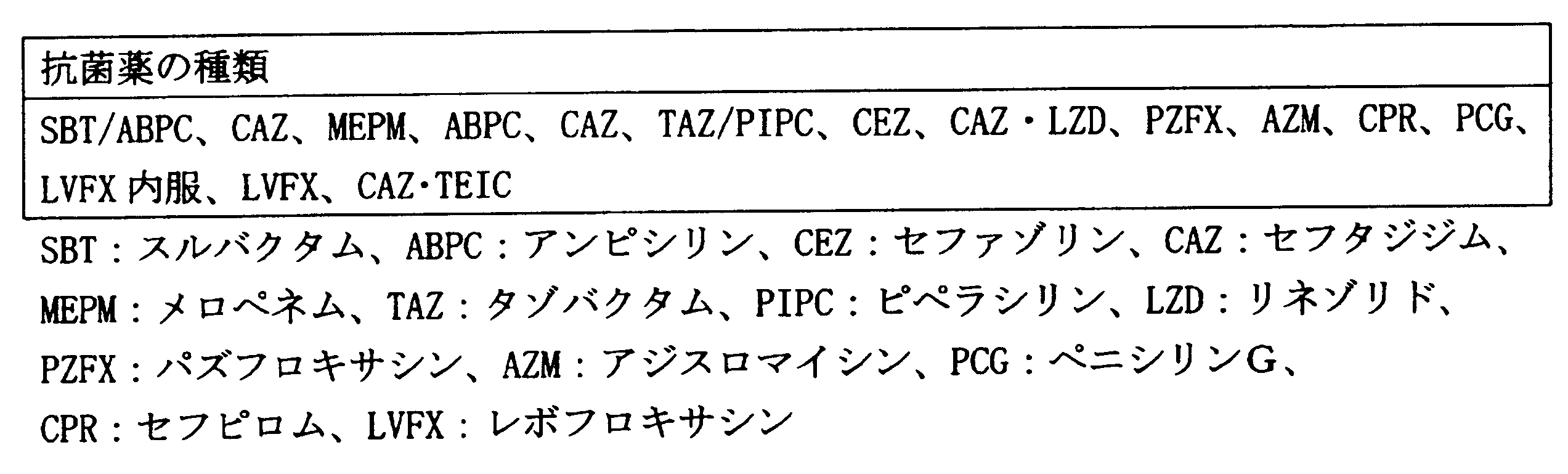
- Example 2 Clinical test (1) Test subjects The clinical test was divided into two groups, a control group and a composition administration group. The test subjects in both groups are severely ill patients (cerebral hemorrhage, trauma, cerebral infarction) who were brought into the Osaka Mishima Critical Care Center. In principle, subjects were managed with tube feeding at the time of hospitalization, and a tube was inserted through the nasal cavity and placed in the stomach. In principle, antibacterial drugs were administered within one week after the start of the study. The antibacterial drugs can be used according to the methods described in the JAID / JAS Infection Treatment Guide 2014 (edited by the JAID / JAS Infection Treatment Guide / Guidelines Committee) according to the disease and condition of the patient. The antibacterial drug listed in 1 was selected and administered.
- the liquid food was administered for 2 weeks.
- the liquid food at least one kind selected from two kinds of Maybalance HP or MEIN (Meiji Co., Ltd.) was used. These do not include ingredients that affect the intestinal flora, especially those that reduce Lactobacillus lactic acid bacteria.
- the composition administration group a liquid food supplemented with the composition obtained in Example 1 (2 packets / day (3 g / day)) was administered for 2 weeks.
- the control group was 46 people, and the composition administration group was 14 people.
- the analysis was conducted by excluding this one person. Therefore, the number of analyses is 45 in the control group and 14 in the composition administration group.
- Table 2 shows the results of the patient background and antibacterial administration days of the analyzed control group and the composition administration group.
- the antibacterial drug administration days were 11.5 ⁇ 3.2 days for the control group and 11.8 ⁇ 2.9 days for the composition administration group, and there was almost no difference between the two groups. In addition, there was almost no difference between the sex ratio and APACHE II.
- the number of Lactobacillus lactic acid bacteria, bifidobacteria and total bacteria were quantified by ABI 7300 Real Time PCR System (Applied Biosystems) at 30 to 55 cycles (temperature, 30 seconds ⁇ 72 ° C., 30 seconds). The number of bacteria was expressed as a logarithmic value of the number of bacteria per gram of stool.
- the before-and-after comparison within each group was analyzed by the corresponding t-test.
- the analysis between the two groups of the control group and the composition administration group was evaluated by comparing the test results of the control group and the composition administration group, and Student's test (equal dispersion) or Welch test (unequal dispersion). ).
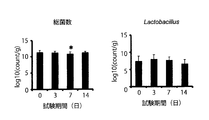
- FIG. 1 is a graph showing changes in the total number of bacteria and the number of Lactobacillus in the stool of the control group.
- the total number of bacteria and the number of bacteria belonging to the genus Lactobacillus decreased significantly from the third day after the start of the test as compared to the start of the test.
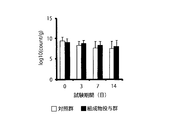
- FIG. 2 shows changes in the total number of bacteria in the stool and the number of Lactobacillus in the composition administration group. In the composition administration group of FIG. 2, no significant decrease was observed in the number of Lactobacillus species during the test period compared to before the start of the test.
- the total number of bacteria decreased significantly on the 7th day after the start of the test compared to before the start of the test, but there was no significant difference between the 3rd and 14th days.
- FIG. 3 the total number of bacteria in the stool and the number of Lactobacillus species in the control group and the composition administration group are compared. Looking at the number of Lactobacillus species in FIG. 3, the control group and the composition administration were almost the same at the start of the test, but the control group compared to the composition administration group from the third day after the start of the test. Is significantly reduced. On the other hand, the total number of bacteria during the test period did not change significantly between the two groups (FIG. 3).
- FIG. 4 is a graph comparing the number of bifidobacteria in the stool of the subject group and the composition administration group. The number of bifidobacteria in FIG. 4 was significantly decreased in the control group and the composition-administered group from the 3rd day after the start of the test compared to the start of the test. In addition, as a result of comparing the number of bifidobacteria in the control group and the composition administration group, no significant change was observed between the two groups.
Landscapes
- Health & Medical Sciences (AREA)
- Life Sciences & Earth Sciences (AREA)
- Chemical & Material Sciences (AREA)
- Animal Behavior & Ethology (AREA)
- Medicinal Chemistry (AREA)
- Pharmacology & Pharmacy (AREA)
- General Health & Medical Sciences (AREA)
- Public Health (AREA)
- Veterinary Medicine (AREA)
- Engineering & Computer Science (AREA)
- Epidemiology (AREA)
- Polymers & Plastics (AREA)
- Microbiology (AREA)
- Food Science & Technology (AREA)
- Nuclear Medicine, Radiotherapy & Molecular Imaging (AREA)
- Bioinformatics & Cheminformatics (AREA)
- Mycology (AREA)
- Organic Chemistry (AREA)
- General Chemical & Material Sciences (AREA)
- Chemical Kinetics & Catalysis (AREA)
- Cell Biology (AREA)
- Pain & Pain Management (AREA)
- Immunology (AREA)
- Virology (AREA)
- Zoology (AREA)
- Biotechnology (AREA)
- Biomedical Technology (AREA)
- Molecular Biology (AREA)
- Nutrition Science (AREA)
- Developmental Biology & Embryology (AREA)
- Rheumatology (AREA)
- Medicines Containing Material From Animals Or Micro-Organisms (AREA)
- Medicinal Preparation (AREA)
- Preparation Of Compounds By Using Micro-Organisms (AREA)
- Dairy Products (AREA)
- Coloring Foods And Improving Nutritive Qualities (AREA)
- Measuring Or Testing Involving Enzymes Or Micro-Organisms (AREA)
Abstract
本発明は、抗菌薬を投与される対象における腸管内ラクトバチルス属乳酸菌の減少を抑制できる組成物およびその抑制方法を提供する。 より詳細には、本発明の組成物は、抗菌薬を投与される対象における腸管内ラクトバチルス属乳酸菌減少抑制用組成物であって、プロピオン酸菌による乳清発酵物を含んでなる。
Description
本特許出願は、2016年10月14日に出願された日本国特許出願2016-202465号に基づく優先権の主張を伴うものであり、かかる先の特許出願における全開示内容は、引用することにより本明細書の一部とされる。
技術分野
本発明は、抗菌薬を投与される対象における腸管内ラクトバチルス属乳酸菌減少抑制用組成物に関する。
本発明は、抗菌薬を投与される対象における腸管内ラクトバチルス属乳酸菌減少抑制用組成物に関する。
背景技術
感染症治療、細菌感染防止などの目的で抗菌薬は数多く使用されている。抗菌薬の使用による弊害として、抗菌薬の服用による腸内環境の悪化が挙げられる。これは、抗菌薬の服用により、病原微生物だけでなく、いわゆる善玉菌であるビフィズス菌や乳酸菌など有用な細菌も減少し、腸内フローラ(腸内細菌叢)、すなわち、腸内細菌の生態系が悪影響を受けるためといわれている。その結果、便秘、下痢、吐き気、頭痛などの症状が発生する。このような弊害の対策として、抗菌薬を摂取する際には、生きた善玉菌そのものを同時に摂取する(プロバイオティクス)および/または善玉菌を増やす成分を同時に摂取すること(プレバイオティクス)が推奨されている。プレバイオティクスの代表例としては、オリゴ糖や食物繊維などの腸管内善玉菌の増殖因子、乳酸菌やビフィズス菌などの善玉菌自体をカプセルなどの形態によりサプリメントとしたものなどが挙げられる。
感染症治療、細菌感染防止などの目的で抗菌薬は数多く使用されている。抗菌薬の使用による弊害として、抗菌薬の服用による腸内環境の悪化が挙げられる。これは、抗菌薬の服用により、病原微生物だけでなく、いわゆる善玉菌であるビフィズス菌や乳酸菌など有用な細菌も減少し、腸内フローラ(腸内細菌叢)、すなわち、腸内細菌の生態系が悪影響を受けるためといわれている。その結果、便秘、下痢、吐き気、頭痛などの症状が発生する。このような弊害の対策として、抗菌薬を摂取する際には、生きた善玉菌そのものを同時に摂取する(プロバイオティクス)および/または善玉菌を増やす成分を同時に摂取すること(プレバイオティクス)が推奨されている。プレバイオティクスの代表例としては、オリゴ糖や食物繊維などの腸管内善玉菌の増殖因子、乳酸菌やビフィズス菌などの善玉菌自体をカプセルなどの形態によりサプリメントとしたものなどが挙げられる。
善玉菌のうちでも、乳酸菌の一種であるLactobacillus(ラクトバチルス属)の細菌は、それ自体プロバイオティクスの菌体として広く利用されている。しかしながら、ラクトバチルス属乳酸菌は、グラム陽性の桿菌であり、抗菌薬の感受性が高いことから、抗菌薬を投与すると著しく減少することが報告されている(例えば、非特許文献1)。したがって、抗菌薬を投与した対象において、腸管内ラクトバチルス属乳酸菌の減少を抑制することは重要な課題である。
一方、近年、新しいプレバイオティクスの成分として、ビフィズス菌増殖促進物質(BGS:Bifidogenic Growth Stimulator)の報告がある(非特許文献2)。具体的には、非特許文献2には、プロピオニバクテリウム・フロイデンライヒ培養物の上清濾液が、ビフィズス菌を特異的に増殖したことが報告されている。しかしながら、ビフィズス菌増殖促進物質は、乳酸菌をはじめとするビフィズス菌以外の腸内細菌に対しては増殖促進作用を実質的に示さなかったことも報告されている(非特許文献2の表1参照)。また、ビフィズス菌増殖促進物質を含有する飼料組成物を用いた、仔畜における腸内菌叢改善作用が報告されている(特許文献1)。具体的には、特許文献1には、プロピオン酸菌による乳清発酵物であるProfec(商標)を仔畜に摂取させると、腸管内のビフィズス菌が有意に増加し、総菌数に対する占有率が著しく増加したことが報告されている。一方で、ラクトバチルス属乳酸菌については有意な増加は生じなかったことが示されている(特許文献1の実施例1の表1参照)。このように、腸管内ラクトバチルス属乳酸菌を有意に増殖させる成分についてはこれまで報告されていない。また、抗菌薬によるラクトバチルス属乳酸菌の減少を抑制するための試みや、その効果的な方法および組成物については、これまで報告されていない。
ヤクルト研究所研究報告集、第30号、1-6、2012
Bioscience Microflora Vol.18(2), 73-80, 1999
本発明は、抗菌薬を投与される対象における腸管内ラクトバチルス属乳酸菌の減少を抑制できる組成物およびその抑制方法を提供することを目的とする。
本発明者らは、今般、ヒトの臨床試験において、プロピオン酸菌による乳清発酵物を、抗菌薬を投与する前または投与中の患者に摂取させたところ、プロピオン酸菌による乳清発酵物を摂取しなかった患者と比較して、腸管内のラクトバチルス属乳酸菌の減少を有意に抑制できることを見出した。本発明はかかる知見に基づくものである。
本発明によれば、以下の発明が提供される。
(1)プロピオン酸菌による乳清発酵物を含んでなる、抗菌薬を投与される対象における腸管内ラクトバチルス属乳酸菌減少抑制用組成物。
(2)前記プロピオン酸菌がプロピオニバクテリウム・フロイデンライヒ(Propionibacterium freudenreichii)である、(1)に記載の組成物。
(3)前記抗菌薬が、ペニシリン系抗菌薬、セフェム系抗菌薬、セファロスポリン系抗菌薬、カルバペネム系抗菌薬、β-ラクタマーゼ阻害剤、オキサゾリジノン系抗菌薬、ニューキロノン系抗菌薬、およびマクロライド系抗菌薬から選択される少なくとも1つのものである、(1)または(2)に記載の組成物。
(4)一日当たりの投与量が、プロピオン酸菌による乳清発酵物の乾燥質量換算として、0.15~200mg/kg体重である、(1)~(3)のいずれかに記載の組成物。
(5)食品組成物または医薬品組成物である、(1)~(4)のいずれかに記載の組成物。
(6)粉末状、液状または錠剤状の形態である、(1)~(5)のいずれかに記載の組成物。
(7)抗菌薬を投与される対象における腸管内ラクトバチルス属乳酸菌減少抑制用組成物の製造のための、プロピオン酸菌による乳清発酵物の使用。
(8)抗菌薬を投与される対象における腸管内ラクトバチルス属乳酸菌の減少抑制方法であって、プロピオン酸菌による乳清発酵物の有効量を上記対象に摂取させることを含んでなる、方法。
(9)抗菌薬投与により生じる腸管内ラクトバチルス属乳酸菌の減少に関連した疾患または状態の改善方法である、(8)に記載の方法。
(10)抗菌薬を投与される対象における腸管内ラクトバチルス属乳酸菌の減少を抑制するための、プロピオン酸菌による乳清発酵物。
(11)抗菌薬を投与される対象における腸管内ラクトバチルス属乳酸菌減少抑制のための、プロピオン酸菌による乳清発酵物の使用。
(1)プロピオン酸菌による乳清発酵物を含んでなる、抗菌薬を投与される対象における腸管内ラクトバチルス属乳酸菌減少抑制用組成物。
(2)前記プロピオン酸菌がプロピオニバクテリウム・フロイデンライヒ(Propionibacterium freudenreichii)である、(1)に記載の組成物。
(3)前記抗菌薬が、ペニシリン系抗菌薬、セフェム系抗菌薬、セファロスポリン系抗菌薬、カルバペネム系抗菌薬、β-ラクタマーゼ阻害剤、オキサゾリジノン系抗菌薬、ニューキロノン系抗菌薬、およびマクロライド系抗菌薬から選択される少なくとも1つのものである、(1)または(2)に記載の組成物。
(4)一日当たりの投与量が、プロピオン酸菌による乳清発酵物の乾燥質量換算として、0.15~200mg/kg体重である、(1)~(3)のいずれかに記載の組成物。
(5)食品組成物または医薬品組成物である、(1)~(4)のいずれかに記載の組成物。
(6)粉末状、液状または錠剤状の形態である、(1)~(5)のいずれかに記載の組成物。
(7)抗菌薬を投与される対象における腸管内ラクトバチルス属乳酸菌減少抑制用組成物の製造のための、プロピオン酸菌による乳清発酵物の使用。
(8)抗菌薬を投与される対象における腸管内ラクトバチルス属乳酸菌の減少抑制方法であって、プロピオン酸菌による乳清発酵物の有効量を上記対象に摂取させることを含んでなる、方法。
(9)抗菌薬投与により生じる腸管内ラクトバチルス属乳酸菌の減少に関連した疾患または状態の改善方法である、(8)に記載の方法。
(10)抗菌薬を投与される対象における腸管内ラクトバチルス属乳酸菌の減少を抑制するための、プロピオン酸菌による乳清発酵物。
(11)抗菌薬を投与される対象における腸管内ラクトバチルス属乳酸菌減少抑制のための、プロピオン酸菌による乳清発酵物の使用。
本発明によれば、プロピオン酸菌による乳清発酵物を用いて、抗菌薬を投与される対象における腸管内のラクトバチルス属乳酸菌の減少を効果的に抑制することができる。
ラクトバチルス属乳酸菌減少抑制用組成物
本発明の組成物は、抗菌薬を投与される対象における腸管内ラクトバチルス属乳酸菌減少抑制用組成物であって、プロピオン酸菌による乳清発酵物を含んでなる。プロピオン酸菌による乳清発酵物を有効成分として用いると、腸管内ビフィズス菌の減少を抑制しないにもかかわらず、抗菌薬を投与する前、投与中、あるいは投与後の対象における腸管内ラクトバチルス属乳酸菌の減少を有意に抑制できたことは意外な事実である。
本発明の組成物は、抗菌薬を投与される対象における腸管内ラクトバチルス属乳酸菌減少抑制用組成物であって、プロピオン酸菌による乳清発酵物を含んでなる。プロピオン酸菌による乳清発酵物を有効成分として用いると、腸管内ビフィズス菌の減少を抑制しないにもかかわらず、抗菌薬を投与する前、投与中、あるいは投与後の対象における腸管内ラクトバチルス属乳酸菌の減少を有意に抑制できたことは意外な事実である。
「抗菌薬を投与される対象」とは、抗菌薬を投与される予定(投与前)の対象、投与されている(投与中の)対象または投与された(投与後の)対象をいい、好ましくは、抗菌薬により腸管内のラクトバチルス属乳酸菌が減少される予定にある、減少しているまたは減少された対象をいう。対象は、好ましくはヒトであるが、ヒト以外(例えば、馬、牛などの家畜、齧歯類、犬、猫などの愛玩動物、動物園などで飼育されている鑑賞動物)であってもよく、本発明にはかかる態様も包含される。
本発明の抗菌薬は、ラクトバチルス属乳酸菌が感受性を示す抗菌薬であれば特に限定されないが、ラクトバチルス属乳酸菌が感受性を示す抗生物質が好ましい。より具体的な例としては、ペニシリン系抗菌薬(例えば、アモキシシリン(AMPC)、アンピシリン(ABPC))、セフェム系抗菌薬(例えば、セフピロム(CPR))、セファロスポリン系抗菌薬(例えば、セフラジジム(CAZ))、カルバペネム系抗菌薬(例えば、メルペネム(MEPM))、β-ラクタマーゼ阻害剤、オキサゾリジノン系抗菌薬(例えば、リネゾリド(LZD))、ニューキロノン系抗菌薬(例えば、レボフロキサシン(LVFX)、オアズフロキサシン(PZFX))、およびマクロライド系抗菌薬(例えば、アジスロマイシン(AZM))の他、リンコマイシン系抗菌薬、アミノグリコシド系抗菌薬、テトラサイクリン系抗菌薬、クロラムフェニコール系抗菌薬、ペプチド系抗菌薬、サルファ剤、抗結核薬、キノロン系抗菌薬、抗ウィルス薬、抗真菌薬が挙げられる。抗菌薬は好ましくは、ペニシリン系抗菌薬(例えば、アモキシシリン(AMPC)、アンピシリン(ABPC))、セフェム系抗菌薬(例えば、セフピロム(CPR))、セファロスポリン系抗菌薬(例えば、セフラジジム(CAZ))、カルバペネム系抗菌薬(例えば、メルペネム(MEPM))、β-ラクタマーゼ阻害剤、オキサゾリジノン系抗菌薬(例えば、リネゾリド(LZD))、ニューキロノン系抗菌薬(例えば、レボフロキサシン(LVFX)、オアズフロキサシン(PZFX))、およびマクロライド系抗菌薬(例えば、アジスロマイシン(AZM))である。
抗菌薬の投与方法は、腸管内ラクトバチルス属乳酸菌が感受性を示せば特に限定されず、例えば、経口摂取(あるいは経口投与)、経腸投与、胃ろう、皮下投与、経静脈投与などから、抗菌薬を投与される対象および用途(例えば、治療目的または予防目的)により、適宜選択することができる。抗菌薬の使用方法は、対象の有している疾患、状態、用途に応じて当業者であれば適宜選択でき、例えば、JAID/JAS感染症治療ガイド2014(JAID/JAS感染症治療ガイド・ガイドライン作成委員会編集)に記載の手法に従って、当業者であれば適宜選択できる。
ラクトバチルス属乳酸菌は、グラム陽性の桿菌であり、善玉菌の一種として知られている。好ましいラクトバチルス属乳酸菌の具体例としては、ヒト臨床試験の結果から、ラクトバチルス・ブルガリカス(Lactobacillus bulgaricus)、ラクトバチルス・ジョンソニ(L. johnsonii)、ラクトバチルス・カゼイ(L. casei)、ラクトバチルス・パラカゼイ(L. paracasei)、ラクトバチルス・ガッセリ(L. gasseri)、ラクトバチルス・ヘルベティカス(L. helveticus)、ラクトバチルス・ラムノサス(L. rhamnosus)、ラクトバチルス・アシドフィラス(L. acidophilus)、ラクトバチルス・サリバリウス(L. salivarius)、ラクトバチルス・ペントーサス(L. pentosus)、ラクトバチルス・プランタラム(L. plantarum)、ラクトバチルス・ブレビス(L. brevis)、ラクトバチルス・ロイテリ(L. reuteri)、ラクトバチルス・スポロゲネス(L. sporogenes)などが挙げられる。ラクトバチルス属乳酸菌は、例えば、整腸作用(例えば、下痢症、便秘、過敏性腸症候群に対する整腸作用)、免疫賦活作用、ピロリ菌の除菌作用、アトピー、花粉症、喘息などのアレルギー抑制作用、過敏性腸症候群(IBS)の改善作用、脂質代謝または内臓脂肪蓄積の改善作用、呼吸器疾患などの感染症リスク抑制作用、炎症性大腸炎の改善作用、子宮内膜症の改善作用、がん抑制作用、ストレスおよびQOLの改善作用、糖尿病改善作用、酸化ストレス改善作用などの生理活性を有することが知られている。ラクトバチルス属乳酸菌は、上記生理活性を有する点でその菌数が一定数腸管内に存在することが望ましい。
腸管内ラクトバチルス属乳酸菌は、腸内細菌叢に含まれるラクトバチルス属乳酸菌をいい、好ましくは、腸内環境を良好なバランスに保つ機能を有する乳酸菌である。腸管内ラクトバチルス属乳酸菌数は、ヒト糞便1g当たりLog104個以上存在することが好ましく、より好ましくはLog105個以上、さらに好ましくはLog106個以上、さらに好ましくはLog107個以上である。
本発明に用いられるプロピオン酸菌による乳清発酵物は、プロピオン酸菌を、乳清を含有する培地を用いて培養することにより得られる。
プロピオン酸菌とは、プロピオニバクテリウム属(Propionibacterium)に属するグラム陽性の嫌気性細菌で、糖類から無酸素的にプロピオン酸を生成する微生物をいい、古くからエメンタールチーズなどのスターターとして利用され、その安全性は確認されている。本発明に用いられるプロピオン酸菌は、例えば、プロピオニバクテリウム・フロイデンライヒ(Propionibacterium freudenreichii)、プロピオニバクテリウム・トエニー(P. thoenii)、プロピオニバクテリウム・アシディプロピオニシ(P. acidipropionici)、プロピオニバクテリウム・ジェンセニー(P. jensenii)、プロピオニバクテリウム・アビダム(P. avidum)、プロピオニバクテリウム・アクネス(P. acnes)、プロピオニバクテリウム・リンホフィラム(P. lymphophilum)、プロピオニバクテリウム・グラニュロサム(P. granulosam)が挙げられ、好ましくは、プロピオニバクテリウム・フロイデンライヒである。これらは1種を用いてよいし、2種以上を組み合わせて用いてもよい。
プロピオン酸菌は、より好ましくは、プロピオニバクテリウム・フロイデンライヒに属するビフィズス菌増殖促進物質(BGS)産生菌であり、例えば、プロピオニバクテリウム・フロイデンライヒ ET-3(寄託番号:FERM-BP-8115)、プロピオニバクテリウム・フロイデンライヒ ATCC 6207、プロピオニバクテリウム・フロイデンライヒ ATCC 8262、プロピオニバクテリウム・フロイデンライヒ IFO 12424、プロピオニバクテリウム・フロイデンライヒ IFO 12426、プロピオニバクテリウム・フロイデンライヒ IFO 12391が挙げられ、さらに好ましくは、プロピオニバクテリウム・フロイデンライヒ ET-3(寄託番号:FERM-BP-8115)である。
プロピオン酸菌は、より好ましくは、プロピオニバクテリウム・フロイデンライヒに属するビフィズス菌増殖促進物質(BGS)産生菌であり、例えば、プロピオニバクテリウム・フロイデンライヒ ET-3(寄託番号:FERM-BP-8115)、プロピオニバクテリウム・フロイデンライヒ ATCC 6207、プロピオニバクテリウム・フロイデンライヒ ATCC 8262、プロピオニバクテリウム・フロイデンライヒ IFO 12424、プロピオニバクテリウム・フロイデンライヒ IFO 12426、プロピオニバクテリウム・フロイデンライヒ IFO 12391が挙げられ、さらに好ましくは、プロピオニバクテリウム・フロイデンライヒ ET-3(寄託番号:FERM-BP-8115)である。
乳清とは、ホエイともよばれ、牛乳から、脂肪分、カゼイン、脂溶性ビタミンなどを除去した残りの透明な黄緑色の水溶性成分をいう。本発明に用いられる乳清として、例えば、ホエイの原液(甘性ホエイ、酸ホエイなど)、その濃縮物、その乾燥物(ホエイ粉)、その凍結物など、およびこれらの還元溶液、ならびに、脱塩ホエイ、ホエイタンパク質濃縮物(WPC)、ホエイタンパク質精製物(WPI)、α―ラクトアルブミン(α-La)、β-ラクトグロブリン(β-Lg)、免疫グロブリン、ラクトフェリンなど、および、これらの還元溶液、これらホエイタンパク質分解物が挙げられる。乳清は、好ましくは、ホエイの原液、ホエイ粉、WPC、WPIおよびこれらの還元溶液、ならびにこれらのプロテアーゼ分解物から選択される。これらは1種を用いてよいし、2種以上を組み合わせて用いてもよい。
乳清は、培地に対して、タンパク質の量として、好ましくは1~5質量%、より好ましくは1.5~4.0質量%で含有される。また、糖質は、培地に対して、1~4質量%、より好ましくは1.5~3.0質量%で含有される。このような培地の組成になるように、乳清の添加量(配合量)を調節したものを用いることができる。糖質は、好ましくは、グルコースまたは乳糖をラクターゼで処理した単糖である。培地は、グラム陽性の嫌気性細菌を培養できる培地であれば、乳清以外の成分を含んでいてもよい。ここで、タンパク質の量は、ケルダール法やローリー法によって測定し算出することができる。ケルダール法の場合には、各種のタンパク質に含まれる窒素を測定し、その値に、窒素-タンパク質換算係数(通常 6.25)を乗じて算出することができる。
本発明に用いられる培地は、好ましくは、10質量%ホエイ粉還元液のプロテアーゼ分解物からなるpH5~8(好適には、5.5~7.5)の培地である。プロテアーゼは、ホエイタンパク質を適度に分解できれば特に限定されない。培地として、例えば、10質量%ホエイ粉還元液をプロテアーゼ アマノA(天野製薬株式会社)で50℃、pH7.0で分解したものを用いることができる。
プロピオン酸菌の培養は、乳清を含有する培地を用いる以外は、常法にしたがって、好気的または嫌気的(例えばN2ガス加圧下(0.5kg/cm2))に培養できる。通常、培地の温度を20~40℃に調製し、pH6~8程度、生菌数が107~108cfu/mLとなるように、スターターとしてのプロピオン酸菌を摂取して、3~4日間、液体培養すればよい。このようにして得られた培養物に含有されるプロピオン酸菌の濃度はスターターの約5倍に達する。
本発明のプロピオン酸菌による乳清発酵物は、プロピオン酸菌の培養により得られた培養物、単離した細菌自体、培養液(培養上清)、またはこれらの混合物の少なくとも一つを用いることができ、プロピオン酸菌による乳清発酵物は、これらの抽出物、凍結乾燥物、または希釈物であってもよい。さらに、プロピオン酸菌による乳清発酵物は殺菌処理を施したものであってもよい。殺菌工程としては、例えば低温保持殺菌、高温保持殺菌、高温短時間殺菌、超高温瞬間殺菌が挙げられる。
本発明の一つの好ましい態様によれば、本発明のプロピオン酸菌による乳清発酵物として、プロピオニバクテリウム・フロイデンライヒ ET-3(Propionibacterium freudenreichii ET-3)(寄託番号:FERM BP-8115)を、10質量%ホエイ粉還元液で培養して得られたプロピオン酸菌による乳清発酵物を用いることができ、より好ましくは、プロピオニバクテリウム・フロイデンライヒ ET-3を、10質量%ホエイ粉還元液のプロテアーゼ アマノA(天野製薬株式会社)で50℃、pH7.0で分解した分解物からなる培地で、35℃、pH6.0で75時間培養して得られたプロピオン酸菌による乳清発酵物を用いることができる。このようなプロピオン酸菌による乳清発酵物は、合成してもよいし、市販品を用いてもよい。市販品としては、例えば、原料としてプロフェック(「Profec」(商標)、株式会社 明治製)が挙げられ、これは、主に腸内細菌の中で特にビフィズス菌の増殖促進作用を持つ、特定保健用食品の関与成分として認可されている。
本発明の一つの態様によれば、本発明のプロピオン酸菌による乳清発酵物は、ビフィズス菌増殖促進物質(BGS)を含んでいてもよい。ビフィズス菌増殖促進物質として、例えば、1,4-ジヒドロキシ-2-ナフトエ酸(1,4-dihydroxy-2-naphthoic acid、DHNA)、2-アミノ-3-カルボキシ-1,4-ナフトキノン(2-amino-3-carboxy-1,4-naphthoquinone、ACNQ)およびこれらの類似体が挙げられ、該類似体には、1,4-ナフトキノン、2-メチル-1,4-ナフトキノン、4-アミノ-2-メチル-1-ナフトールおよび2-アミノ-3-クロロ-1,4-ナフトキノンが含まれる。本発明の好ましい態様によれば、本発明のプロピオン酸菌による乳清発酵物には、1,4-ジヒドロキシ-2-ナフトエ酸が含まれる。
本発明に用いられるプロピオン酸菌による乳清発酵物は、これをそのまま、ラクトバチルス属乳酸菌減少抑制用組成物とすることができる。
本発明のラクトバチルス属乳酸菌減少抑制用組成物は、プロピオン酸菌による乳清発酵物以外に、経口上許容可能な他の成分を含んでいてもよい。他の成分としては、本発明の効果を妨げない限り特に限定されず、賦形剤、安定剤、防腐剤、湿潤剤、乳化剤、滑沢剤、甘味料、着色料、香料、緩衝剤、酸化防止剤、pH調整剤等の添加剤等が挙げられる。
本発明の好ましい態様によれば、本発明のラクトバチルス属乳酸菌減少抑制用組成物は、ラクトバチルス属乳酸菌のエサとなる機能性糖質(例えば、オリゴ糖や食物繊維)を含んでなる。ラクトバチルス属乳酸菌のエサとなる機能性糖質を含むことにより、腸管内に残るラクトバチルス属乳酸菌のエサとなり、増殖を促進することができる。
本発明の好ましい態様によれば、本発明のラクトバチルス属乳酸菌減少抑制用組成物は、ラクトバチルス属乳酸菌のエサとなる機能性糖質(例えば、オリゴ糖や食物繊維)を含んでなる。ラクトバチルス属乳酸菌のエサとなる機能性糖質を含むことにより、腸管内に残るラクトバチルス属乳酸菌のエサとなり、増殖を促進することができる。
また、本発明のラクトバチルス属乳酸菌減少抑制用組成物の形態は、特に限定されず、固形状(粉末状、錠剤状等)、液状(ドリンク剤状等)、半液状のいずれであってもよいが、粉末状、錠剤状または液状が好ましい。このような形態の市販品としては、粉末状である明治B.G.S. POWDER(ビー・ジー・エス・パウダー)(株式会社明治製)、錠剤状であるおなか活力タブレット(株式会社明治製)、液状であるYHフローレ(株式会社明治製)等が挙げられる。
本発明の好ましい態様によれば、本発明のラクトバチルス属乳酸菌減少抑制用組成物には、1,4-ジヒドロキシ-2-ナフトエ酸、タンパク質、炭水化物(例えば、糖質、食物繊維)、場合によって、ビタミンおよび/またはミネラル(例えば、ナトリウム、カルシウム、リン、マグネシウム、カリウム)が含まれる。好ましい態様によれば、本発明のラクトバチルス属乳酸菌減少抑制用組成物1.5g中には、1,4-ジヒドロキシ-2-ナフトエ酸が0.01~1000μg含まれ、より好ましくは0.1~100μg、さらに好ましくは0.5~50μg含まれる。
本発明のラクトバチルス属乳酸菌減少抑制用組成物を摂取すると、抗菌薬を投与される対象における腸管内のラクトバチルス属乳酸菌の減少を効果的に抑制することができる。
腸管内ラクトバチルス属乳酸菌の減少抑制効果は、実施例の例1に記載のように、抗菌薬を投与される対象における腸管内のラクトバチルス属菌数を定量し、本発明の組成物を摂取した群と摂取しない群での、菌数を指標とした比較試験により評価することができる。かかる比較試験では、摂取しない群と比較して本発明の組成物を摂取した群ではラクトバチルス属菌数が有意に高く、かつ、抗菌薬投与前よりラクトバチルス属菌数が増加している場合、本発明の組成物は、強いラクトバチルス属乳酸菌の減少抑制活性を有するものとされる。
腸管内ラクトバチルス属乳酸菌の減少抑制効果は、実施例の例1に記載のように、抗菌薬を投与される対象における腸管内のラクトバチルス属菌数を定量し、本発明の組成物を摂取した群と摂取しない群での、菌数を指標とした比較試験により評価することができる。かかる比較試験では、摂取しない群と比較して本発明の組成物を摂取した群ではラクトバチルス属菌数が有意に高く、かつ、抗菌薬投与前よりラクトバチルス属菌数が増加している場合、本発明の組成物は、強いラクトバチルス属乳酸菌の減少抑制活性を有するものとされる。
また、本発明のラクトバチルス属乳酸菌減少抑制用組成物は、プロピオン酸菌による乳清発酵物を含むことから、さまざまな食材と相性がよく、安全に、かつ簡易に摂取することができる。
本発明の一つの態様によれば、本発明のラクトバチルス属乳酸菌減少抑制用組成物は、ラクトバチルス属の生きた菌と、同時または順次投与することが好ましい。本発明のラクトバチルス属乳酸菌減少抑制用組成物と、プロバイオティクスとしてラクトバチルス属の生きた菌とを同時または順次摂取すれば、抗菌薬を投与される対象における腸管内ラクトバチルス属乳酸菌の菌数を増加することができ、腸内細菌叢のバランスをより良好にすることができる。
本発明の一つの態様によれば、本発明のラクトバチルス属乳酸菌減少抑制用組成物は、プロピオン酸菌による乳清発酵物が抗菌薬を投与される対象における腸管内ラクトバチルス属乳酸菌の減少を抑制するための有効量となるように、1日の摂取量単位の形態から構成されることが好ましい。本発明のラクトバチルス属乳酸菌減少抑制用組成物における上記単位は、一日当たりの摂取量(投与量)が、プロピオン酸菌による乳清発酵物の乾燥質量換算として、0.15~200mg/kg体重となるように摂取されることが望ましく、好ましくは0.65~120mg/kg体重、より好ましくは1.15~70mg/kg体重、さらに好ましくは1.5~20mg/kg体重となるように摂取される。ここで、対象の代表的な体重は、60kgと見積もっている。
さらに、本発明のラクトバチルス属乳酸菌減少抑制用組成物は、1回の摂取量単位で包装された形態で提供することが好ましい。1回の摂取量当たりの単位包装形態としては、パック、容器等で一定量を規定する形態が挙げられ、それらの表面には1回の摂取量の成分表示、および、腸管内ラクトバチルス属乳酸菌減少抑制等の用途表示を付していてもよい。かかる単位包装形態の好適な例としては、サプリメント、医薬製剤等が挙げられる。
本発明のラクトバチルス属乳酸菌減少抑制用組成物を対象に摂取させる方法(あるいは投与する方法)は、本発明の効果を妨げない限り特に限定されず、経口摂取(あるいは経口投与)、経管投与、経腸投与、胃ろうなどから、その対象および用途により、適宜選択することができる。
本発明のラクトバチルス属乳酸菌減少抑制用組成物は、抗菌薬を投与する前の対象に摂取させてもよいし、抗菌薬を投与中の対象に摂取させてもよいし、抗菌薬を投与後の対象に摂取させてもよい。好ましくは、本発明の組成物は、抗菌薬を投与する前の対象に摂取させる。抗菌薬を投与する前の期間は、本発明の組成物の摂取期間が長くなればなるほど、プロピオン酸菌による乳清発酵物によって腸内細菌叢のバランスが改良されることを考慮すれば、好ましくは投与前1日間、より好ましくは3日間、さらに好ましくは投与前5日間である。また、本発明の組成物を投与中の対象に摂取させる場合、本発明の組成物は、抗菌薬と同時に対象に摂取させてもよいし、好ましくは72時間以内、より好ましくは24時間以内に順次摂取させてもよい。
また、本発明のラクトバチルス属乳酸菌減少抑制用組成物の摂取計画は、特に限定されず、対象の年齢、性別、症状および状態に応じて当業者が適宜設定することができる。例えば、対象に対して、1回の経口摂取量単位を1日当たり1~10回投与してもよいが、好ましくは1日当たり1~3回、より好ましくは1回摂取させることが好ましい。また、本発明のラクトバチルス属乳酸菌減少抑制用組成物は、食事とともに摂取することができる。
本発明の一つの実施態様によれば、本発明のラクトバチルス属乳酸菌減少抑制用組成物は、そのまま単独で使用することができるが、抗菌薬を投与される対象における腸管内ラクトバチルス属乳酸菌減少抑制機能が発揮される限りにおいて、食品や医薬品などの種々の経口摂取用(経口投与用)の組成物に対して、原料(素材)や添加剤などとして含ませることもでき、抗菌薬を投与される対象における腸管内ラクトバチルス属乳酸菌減少抑制効果を有する組成物(例えば、医薬組成物や食品組成物)を得ることができる。本発明のラクトバチルス属乳酸菌減少抑制用組成物は、食事に添加しても味を損なわせるものではないため、通常の食事に添加したり、飲料に添加したりして、簡易に摂取することができる。
本発明の好ましい態様によれば、プロピオン酸菌による乳清発酵物を含んでなる、抗菌薬を投与される対象における腸管内ラクトバチルス属乳酸菌減少抑制用食品が提供される。
「食品」(食品組成物)の形態は、溶液、懸濁液、乳濁液、粉末、固体成形物など、経口摂取可能な形態であればよく、特に限定されない。具体的には、即席麺、レトルト食品、缶詰、電子レンジ食品、即席スープ・みそ汁類、フリーズドライ食品などの即席食品類;清涼飲料、果汁飲料、野菜飲料、豆乳飲料、コーヒー飲料、茶飲料、粉末飲料、濃縮飲料、アルコール飲料などの飲料類;パン、パスタ、麺、ケーキミックス、パン粉などの小麦粉製品;飴、キャラメル、チューイングガム、チョコレート、クッキー、ビスケット、ケーキ、パイ、スナック、クラッカー、和菓子、デザート菓子などの菓子類;ソース、トマト加工調味料、風味調味料、調理ミックス、たれ類、ドレッシング類、つゆ類、カレー・シチューの素類などの調味料;加工油脂、バター、マーガリン、マヨネーズなどの油脂類;乳飲料、発酵乳(ヨーグルトなど)、乳酸菌飲料、ナチュラルチーズ、プロセスチーズ類、アイスクリーム類、クリーム類などの乳製品;農産缶詰、ジャム・マーマレード類、シリアルなどの農産加工品;冷凍食品、流動食などが挙げられる。
「食品」(食品組成物)の形態は、溶液、懸濁液、乳濁液、粉末、固体成形物など、経口摂取可能な形態であればよく、特に限定されない。具体的には、即席麺、レトルト食品、缶詰、電子レンジ食品、即席スープ・みそ汁類、フリーズドライ食品などの即席食品類;清涼飲料、果汁飲料、野菜飲料、豆乳飲料、コーヒー飲料、茶飲料、粉末飲料、濃縮飲料、アルコール飲料などの飲料類;パン、パスタ、麺、ケーキミックス、パン粉などの小麦粉製品;飴、キャラメル、チューイングガム、チョコレート、クッキー、ビスケット、ケーキ、パイ、スナック、クラッカー、和菓子、デザート菓子などの菓子類;ソース、トマト加工調味料、風味調味料、調理ミックス、たれ類、ドレッシング類、つゆ類、カレー・シチューの素類などの調味料;加工油脂、バター、マーガリン、マヨネーズなどの油脂類;乳飲料、発酵乳(ヨーグルトなど)、乳酸菌飲料、ナチュラルチーズ、プロセスチーズ類、アイスクリーム類、クリーム類などの乳製品;農産缶詰、ジャム・マーマレード類、シリアルなどの農産加工品;冷凍食品、流動食などが挙げられる。
また、食品には、健康食品、機能性食品、栄養補助食品、特定保健用食品、病者用の食品、乳幼児用の調整粉乳、妊産婦用もしくは授乳婦用の粉乳、または抗菌薬を投与される対象における腸管内ラクトバチルス属乳酸菌減少抑制のために用いられる物である旨の表示を付した食品のような分類のものも包含される。
本発明の別の態様によれば、プロピオン酸菌による乳清発酵物を含んでなる、抗菌薬を投与される対象における腸管内ラクトバチルス属乳酸菌減少抑制用医薬品が提供される。「医薬品」(医薬組成物)とは、製剤化のために許容されうる添加剤を併用して、常法に従って、経口製剤または非経口製剤として調製したものである。医薬品が経口製剤の場合には、錠剤、散剤、細粒剤、顆粒剤、カプセル剤、丸剤、徐放剤などの固形製剤、溶液、懸濁液、乳濁液などの液状製剤の形態をとることができる。また、医薬品が非経口製剤の場合には、注射剤や座剤の形態をとることができる。なお、患者への摂取(投与)の簡易性の点からは、医薬品では、経口製剤であることが好ましい。ここで、製剤化のために許容されうる添加剤には、例えば、賦形剤、安定剤、防腐剤、湿潤剤、乳化剤、滑沢剤、甘味料、着色料、香料、緩衝剤、酸化防止剤、pH調整剤などが挙げられる。本発明の医薬品は、抗菌薬を投与される対象における腸管内ラクトバチルス属乳酸菌の減少抑制を必要とする疾患、具体的には、抗菌薬の投与による便秘、下痢、吐き気、頭痛などの副作用の症状の治療または予防に用いることができる。
本発明のラクトバチルス属乳酸菌減少抑制用組成物は、プロピオン酸菌による乳清発酵物を、所望により経口上許容な他の成分と共に混合して簡易に製造することができる。したがって、本発明の別の態様によれば、プロピオン酸菌による乳清発酵物の有効量を組成物中に含有させることを特徴とする、抗菌薬を投与される対象における腸管内ラクトバチルス属乳酸菌減少抑制用組成物の製造方法が提供される。
また、本発明の別の態様によれば、抗菌薬を投与される対象における腸管内ラクトバチルス属乳酸菌の減少抑制方法であって、プロピオン酸菌による乳清発酵物の有効量を上記対象に摂取させることを含んでなる方法が提供される。ここで、本発明の別の好ましい態様によれば、腸管内ラクトバチルス属乳酸菌の減少抑制方法はヒトに対する医療行為を除くものとされる。ここで、「ヒトに対する医療行為」とは、医師等の処方を必要として、ヒトに対して医薬品を摂取させる(投与する)行為などを意味する。また、上記実施態様において、対象は好ましくは健常者である。
また、本発明の腸管内ラクトバチルス属乳酸菌の減少抑制方法は、抗菌薬を投与される対象における腸管内ラクトバチルス属乳酸菌の減少に関連した疾患または状態の改善に用いてもよい。従って、本発明の腸管内ラクトバチルス属乳酸菌の減少抑制方法は、抗菌薬投与により生じる腸管内ラクトバチルス属乳酸菌の減少に関連した疾患または状態の改善方法であり、より好ましくは便秘、下痢、吐き気およびそれに伴う頭痛の改善方法である。ここで、「改善」とは、確立された疾患または状態を治療することだけでなく、将来確立される可能性のある疾患または状態を予防することをも含む。
抑制方法において、プロピオン酸菌による乳清発酵物の有効量は、上述した組成物における1回の摂取量単位と同様とすることができる。
本発明の一つの実施態様によれば、抗菌薬を投与される対象における腸管内ラクトバチルス属乳酸菌減少抑制のための、プロピオン酸菌による乳清発酵物の使用が提供される。本発明の一つの好ましい実施態様によれば、本発明の使用は、非治療的使用とされる。
本発明の一つの実施形態によれば、抗菌薬を投与される対象における腸管内ラクトバチルス属乳酸菌減少抑制用組成物の製造のための、プロピオン酸菌による乳清発酵物の使用が提供される。本発明の一つの好ましい実施態様によれば、該使用は、ラクトバチルス属乳酸菌減少抑制用食品または医薬品の製造のための使用である。
本発明の一つの実施態様によれば、抗菌薬を投与される対象における腸管内ラクトバチルス属乳酸菌の減少を抑制するための、プロピオン酸菌による乳清発酵物が提供される。
本発明を以下の例によって詳細に説明するが、本発明は、これらに限定されるものではない。
例1:組成物の調製(プロピオン酸による乳清発酵物の調製)
スターターとして、生菌数が107~108cfu/mLとなるように、プロピオニバクテリウム・フロイデンライヒ ET-3(Propionibacterium freudenreichii ET-3)(寄託番号:FERM BP-8115)を、10質量%ホエイ粉還元液をプロテアーゼ アマノA(天野製薬株式会社)で50℃、pH7.0で分解して得られた分解物からなる培地に摂取し、35℃、pH6.0で、75時間培養した。得られた培養上清を、殺菌し、凍結乾燥した。凍結乾燥物0.2gに対して、ブドウ糖、食物繊維含有デキストリンを添加して、総量1.5gの調製物とした。該組成物には、タンパク質が0.03g、脂質が0g、炭水化物として糖質が0.6g、食物繊維が0.8g、ナトリウムが2.6mg、カルシウムが1.0mg、リンが1.3mg、マグネシウムが0.2mg、カリウムが15.8mg含まれていた。
スターターとして、生菌数が107~108cfu/mLとなるように、プロピオニバクテリウム・フロイデンライヒ ET-3(Propionibacterium freudenreichii ET-3)(寄託番号:FERM BP-8115)を、10質量%ホエイ粉還元液をプロテアーゼ アマノA(天野製薬株式会社)で50℃、pH7.0で分解して得られた分解物からなる培地に摂取し、35℃、pH6.0で、75時間培養した。得られた培養上清を、殺菌し、凍結乾燥した。凍結乾燥物0.2gに対して、ブドウ糖、食物繊維含有デキストリンを添加して、総量1.5gの調製物とした。該組成物には、タンパク質が0.03g、脂質が0g、炭水化物として糖質が0.6g、食物繊維が0.8g、ナトリウムが2.6mg、カルシウムが1.0mg、リンが1.3mg、マグネシウムが0.2mg、カリウムが15.8mg含まれていた。
得られた調製物を、本発明の組成物として用いた。調製物は、1.5g単位のアルミ個装とした。
例2:臨床試験
(1)試験対象
臨床試験は対照群と組成物投与群の2群に分けて実施した。両群の試験の被験者は、いずれも大阪府三島救命救急センターに搬入された重症患者(脳出血、外傷、脳梗塞の患者)である。被験者は原則、入院時に経管栄養で管理し、鼻腔よりチューブを挿入して胃に留置した。また、原則、抗菌薬は、試験開始後1週間以内に投与を開始した。なお、抗菌薬は、患者の有していた疾患、状態に応じて、JAID/JAS感染症治療ガイド2014(JAID/JAS感染症治療ガイド・ガイドライン作成委員会編集)に記載の手法に従い、下記表1に挙げられる抗菌薬から選択して投与した。
(1)試験対象
臨床試験は対照群と組成物投与群の2群に分けて実施した。両群の試験の被験者は、いずれも大阪府三島救命救急センターに搬入された重症患者(脳出血、外傷、脳梗塞の患者)である。被験者は原則、入院時に経管栄養で管理し、鼻腔よりチューブを挿入して胃に留置した。また、原則、抗菌薬は、試験開始後1週間以内に投与を開始した。なお、抗菌薬は、患者の有していた疾患、状態に応じて、JAID/JAS感染症治療ガイド2014(JAID/JAS感染症治療ガイド・ガイドライン作成委員会編集)に記載の手法に従い、下記表1に挙げられる抗菌薬から選択して投与した。
対照群と組成物投与群
対照群では、流動食を2週間投与した。流動食としては、メイバランスHPまたはMEIN(株式会社明治)の2種類から選択される少なくとも1種類を用いた。これらには、腸管内細菌叢に対して影響を与える成分、特にラクトバチルス属乳酸菌を減少させる成分は含まれない。一方、組成物投与群では、流動食に例1で得られた組成物(2包/日(3g/日))を添加したものを2週間投与した。対照群は46名、組成物投与群は14名であった。なお、対照群の内1名は、2週間の試験期間中に抗菌薬非投与であったため、この1名を除外して解析を行った。従って、解析人数は、対照群が45名、組成物投与群が14名である。
対照群では、流動食を2週間投与した。流動食としては、メイバランスHPまたはMEIN(株式会社明治)の2種類から選択される少なくとも1種類を用いた。これらには、腸管内細菌叢に対して影響を与える成分、特にラクトバチルス属乳酸菌を減少させる成分は含まれない。一方、組成物投与群では、流動食に例1で得られた組成物(2包/日(3g/日))を添加したものを2週間投与した。対照群は46名、組成物投与群は14名であった。なお、対照群の内1名は、2週間の試験期間中に抗菌薬非投与であったため、この1名を除外して解析を行った。従って、解析人数は、対照群が45名、組成物投与群が14名である。
解析した対照群と組成物投与群の患者背景および抗菌薬投与日数の結果を下記表2に示す。
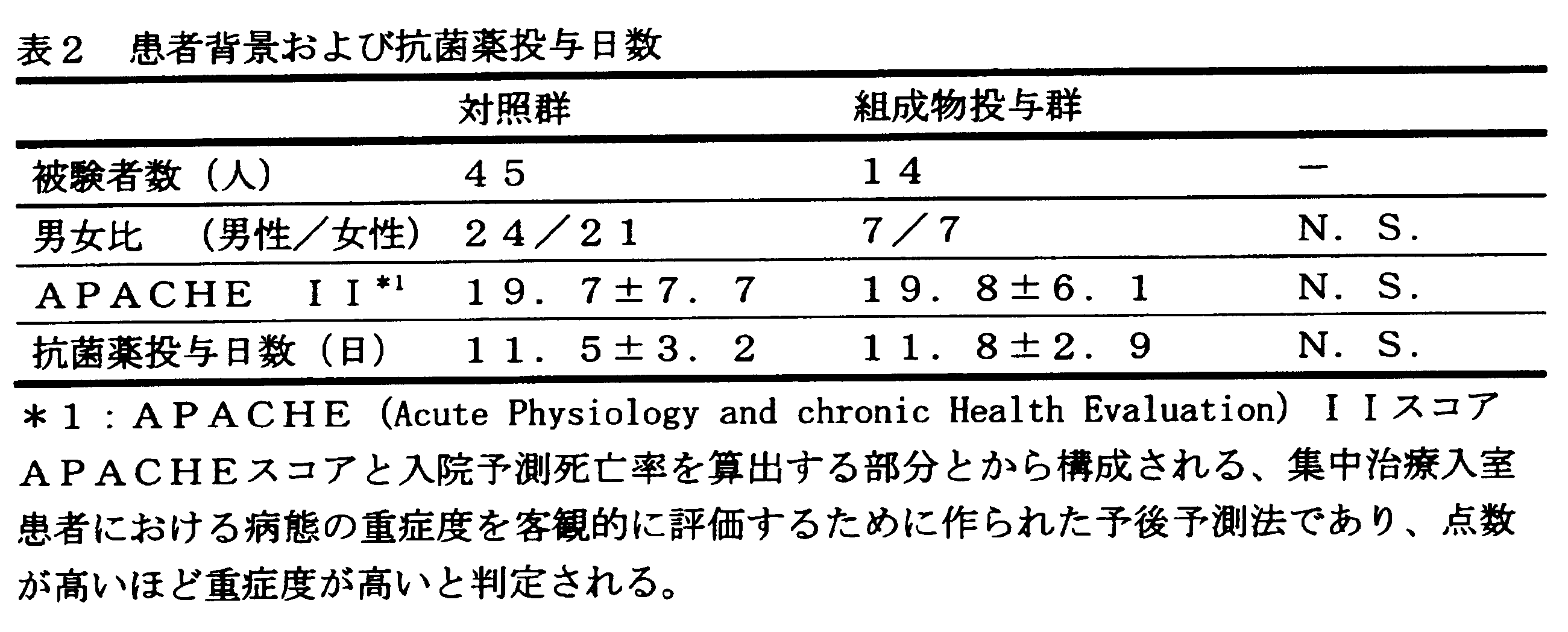
表2に示されるように、抗菌薬投与日数は対照群11.5±3.2日、組成物投与群11.8±2.9日と両群間でほとんど差はなかった。また、男女比とAPACHE IIもほとんど差が見られなかった。
(2)糞便中の菌叢の解析
糞便採取
対照群および組成物投与群では、それぞれ、試験開始(流動食投与)前(0日目)、試験開始後3日目、試験開始後7日目(1週間)、試験開始後14日目(2週間)に糞便採取を実施した。
糞便採取
対照群および組成物投与群では、それぞれ、試験開始(流動食投与)前(0日目)、試験開始後3日目、試験開始後7日目(1週間)、試験開始後14日目(2週間)に糞便採取を実施した。
糞便中の菌叢の解析
採取した糞便は、採取後速やかに-20℃以下に保存した。患者の糞便から糞便中の菌叢DNAを、Multi-Beads Shocker(安井機械株式会社)を用いてQIAamp DNA stool Mini Kit(QIAGEN社)の方法に準じて抽出した。また、リアルタイムPCRの反応は、QuantiTect SYBR Green RT-PCR(QIAGEN社)を用いて、下記表3に記載のプライマーを用いて、95℃、15秒間→(94℃、15秒間→各プライマーのアニーリング温度、30秒間→72℃、30秒間)×30~55サイクルにて、ラクトバチルス属乳酸菌数、ビフィズス菌数および総菌数をABI 7300 Real Time PCR System(Applied Biosystems社)により定量した。菌数は糞便1g当りの菌数の対数値で表記した。
採取した糞便は、採取後速やかに-20℃以下に保存した。患者の糞便から糞便中の菌叢DNAを、Multi-Beads Shocker(安井機械株式会社)を用いてQIAamp DNA stool Mini Kit(QIAGEN社)の方法に準じて抽出した。また、リアルタイムPCRの反応は、QuantiTect SYBR Green RT-PCR(QIAGEN社)を用いて、下記表3に記載のプライマーを用いて、95℃、15秒間→(94℃、15秒間→各プライマーのアニーリング温度、30秒間→72℃、30秒間)×30~55サイクルにて、ラクトバチルス属乳酸菌数、ビフィズス菌数および総菌数をABI 7300 Real Time PCR System(Applied Biosystems社)により定量した。菌数は糞便1g当りの菌数の対数値で表記した。

各群内の前後比較は対応のあるt検定で解析した。また、対照群と組成物投与群の2群間の解析は、対照群と組成物投与群の試験結果を比較することで評価し、Students’ t test(等分散)またはWelch test(不等分散)により解析した。
結果を図1~4に示す。
図1は、対照群の糞便中の総菌数とラクトバチルス属菌数の変化を示したグラフである。図1の対照群では、試験開始後3日目以降で総菌数とラクトバチルス属の菌数ともに試験開始時に比べて有意に減少した。
図2は、組成物投与群の糞便中の総菌数とラクトバチルス属菌数の変化を示している。図2の組成物投与群では、試験開始前に比べて試験期間中ラクトバチルス属菌数に有意な減少はみられなかった。一方、総菌数は、試験開始前に比べて試験開始後7日目で有意に減少したが、3日目と14日目では有意差はなかった。
図3では、対照群および組成物投与群の糞便中の総菌数とラクトバチルス属菌数を比較している。図3のラクトバチルス属菌数をみると、対照群および組成物投与は、試験開始時ではほとんど相違はなかったが、試験開始後3日目以降組成物投与群と比較して対照群の方が有意に減少している。一方、試験期間中の総菌数は両群間で有意な変化は見られなかった(図3)。このように、抗菌薬を投与すると腸管内のラクトバチルス属菌数が減少するが、抗菌薬投与前あるいは投与中に、本発明の組成物を投与すると、腸管内のラクトバチルス属菌数の減少が抑制されることが確認された。
図4は、対象群および組成物投与群の糞便中のビフィズス菌数を比較したグラフである。図4のビフィズス菌数は、対照群と組成物投与群ともに、試験開始後3日目以降、試験開始時に比べて有意に減少した。また、対照群と組成物投与群のビフィズス菌数を比較した結果、両群間で有意な変化は見られなかった。
図1は、対照群の糞便中の総菌数とラクトバチルス属菌数の変化を示したグラフである。図1の対照群では、試験開始後3日目以降で総菌数とラクトバチルス属の菌数ともに試験開始時に比べて有意に減少した。
図2は、組成物投与群の糞便中の総菌数とラクトバチルス属菌数の変化を示している。図2の組成物投与群では、試験開始前に比べて試験期間中ラクトバチルス属菌数に有意な減少はみられなかった。一方、総菌数は、試験開始前に比べて試験開始後7日目で有意に減少したが、3日目と14日目では有意差はなかった。
図3では、対照群および組成物投与群の糞便中の総菌数とラクトバチルス属菌数を比較している。図3のラクトバチルス属菌数をみると、対照群および組成物投与は、試験開始時ではほとんど相違はなかったが、試験開始後3日目以降組成物投与群と比較して対照群の方が有意に減少している。一方、試験期間中の総菌数は両群間で有意な変化は見られなかった(図3)。このように、抗菌薬を投与すると腸管内のラクトバチルス属菌数が減少するが、抗菌薬投与前あるいは投与中に、本発明の組成物を投与すると、腸管内のラクトバチルス属菌数の減少が抑制されることが確認された。
図4は、対象群および組成物投与群の糞便中のビフィズス菌数を比較したグラフである。図4のビフィズス菌数は、対照群と組成物投与群ともに、試験開始後3日目以降、試験開始時に比べて有意に減少した。また、対照群と組成物投与群のビフィズス菌数を比較した結果、両群間で有意な変化は見られなかった。
Claims (11)
- プロピオン酸菌による乳清発酵物を含んでなる、抗菌薬を投与される対象における腸管内ラクトバチルス属乳酸菌減少抑制用組成物。
- 前記プロピオン酸菌がプロピオニバクテリウム・フロイデンライヒ(Propionibacterium freudenreichii)である、請求項1に記載の組成物。
- 前記抗菌薬が、ペニシリン系抗菌薬、セフェム系抗菌薬、セファロスポリン系抗菌薬、カルバペネム系抗菌薬、β-ラクタマーゼ阻害剤、オキサゾリジノン系抗菌薬、ニューキロノン系抗菌薬、およびマクロライド系抗菌薬から選択される少なくとも1つのものである、請求項1または2に記載の組成物。
- 一日当たりの投与量が、プロピオン酸菌による乳清発酵物の乾燥質量換算として、0.15~200mg/kg体重である、請求項1~3のいずれか一項に記載の組成物。
- 食品組成物または医薬品組成物である、請求項1~4のいずれか一項に記載の組成物。
- 粉末状、液状、または錠剤状の形態である、請求項1~5のいずれか一項に記載の組成物。
- 抗菌薬を投与される対象における腸管内ラクトバチルス属乳酸菌減少抑制用組成物の製造のための、プロピオン酸菌による乳清発酵物の使用。
- 抗菌薬を投与される対象における腸管内ラクトバチルス属乳酸菌の減少抑制方法であって、プロピオン酸菌による乳清発酵物の有効量を前記対象に摂取させることを含んでなる、方法。
- 抗菌薬投与により生じる腸管内ラクトバチルス属乳酸菌の減少に関連した疾患または状態の改善方法である、請求項8に記載の方法。
- 抗菌薬を投与される対象における腸管内ラクトバチルス属乳酸菌の減少を抑制するための、プロピオン酸菌による乳清発酵物。
- 抗菌薬を投与される対象における腸管内ラクトバチルス属乳酸菌減少抑制のための、プロピオン酸菌による乳清発酵物の使用。
Priority Applications (1)
| Application Number | Priority Date | Filing Date | Title |
|---|---|---|---|
| CN201780062327.3A CN109803668B (zh) | 2016-10-14 | 2017-10-13 | 用于抑制肠道内乳杆菌属乳酸菌减少的组合物 |
Applications Claiming Priority (2)
| Application Number | Priority Date | Filing Date | Title |
|---|---|---|---|
| JP2016-202465 | 2016-10-14 | ||
| JP2016202465A JP6918465B2 (ja) | 2016-10-14 | 2016-10-14 | 腸管内ラクトバチルス属乳酸菌減少抑制用組成物 |
Publications (1)
| Publication Number | Publication Date |
|---|---|
| WO2018070513A1 true WO2018070513A1 (ja) | 2018-04-19 |
Family
ID=61905637
Family Applications (1)
| Application Number | Title | Priority Date | Filing Date |
|---|---|---|---|
| PCT/JP2017/037158 Ceased WO2018070513A1 (ja) | 2016-10-14 | 2017-10-13 | 腸管内ラクトバチルス属乳酸菌減少抑制用組成物 |
Country Status (4)
| Country | Link |
|---|---|
| JP (1) | JP6918465B2 (ja) |
| CN (1) | CN109803668B (ja) |
| TW (1) | TWI745454B (ja) |
| WO (1) | WO2018070513A1 (ja) |
Cited By (1)
| Publication number | Priority date | Publication date | Assignee | Title |
|---|---|---|---|---|
| CN117050920A (zh) * | 2023-10-10 | 2023-11-14 | 天津创源生物技术有限公司 | 副干酪乳酪杆菌iob413后生元粉活性成分的制备方法及应用 |
Families Citing this family (1)
| Publication number | Priority date | Publication date | Assignee | Title |
|---|---|---|---|---|
| US10626187B2 (en) * | 2016-09-28 | 2020-04-21 | Kite Pharma, Inc. | Antigen binding molecules specific for an anti-CD19 scFv |
Citations (1)
| Publication number | Priority date | Publication date | Assignee | Title |
|---|---|---|---|---|
| WO2012132913A1 (ja) * | 2011-03-29 | 2012-10-04 | 株式会社明治 | クロストリジウム・ディフィシル増殖阻害剤 |
Family Cites Families (1)
| Publication number | Priority date | Publication date | Assignee | Title |
|---|---|---|---|---|
| US20100247500A1 (en) * | 2007-11-27 | 2010-09-30 | Kakuhei Isawa | Agent and method for improving survivability of lactic acid bacterium, and food composition |
-
2016
- 2016-10-14 JP JP2016202465A patent/JP6918465B2/ja active Active
-
2017
- 2017-10-13 CN CN201780062327.3A patent/CN109803668B/zh active Active
- 2017-10-13 WO PCT/JP2017/037158 patent/WO2018070513A1/ja not_active Ceased
- 2017-10-13 TW TW106135099A patent/TWI745454B/zh active
Patent Citations (1)
| Publication number | Priority date | Publication date | Assignee | Title |
|---|---|---|---|---|
| WO2012132913A1 (ja) * | 2011-03-29 | 2012-10-04 | 株式会社明治 | クロストリジウム・ディフィシル増殖阻害剤 |
Non-Patent Citations (3)
| Title |
|---|
| "Fermented whey by Propionibacterium", JAPAN BIFIDUS FONDATION, GLOSSARY OF INTESTINAL MICROBIOLOGY, August 2016 (2016-08-01), XP055604365, Retrieved from the Internet <URL:https://web.archive.org/web/20160805124322/http://bifidus-fund.jp/keyword/kw024.shtml> [retrieved on 20160905] * |
| NARUSHIMA SEIKO ET AL.: "Effect of Propionibacterium Freudenreichi IET-3 culture (Profec) on Dextran Sodium Sulfate - Induced colitis in mice and 2, 4, 6 - Trinitrobenzene sulfonic acid- induced colitis in rats", ULCER RESEARCH, vol. 32, no. 2, 2005, pages 164 - 166 * |
| OKADA, Y ET AL.: "Propionibacterium freudenreichii component 1.4-dihydroxy-2-naphthoic acid (DHNA) attenuates dextran sodium sulphate induced colitis by modulation of bacterial flora and lymphocyte homing", GUT, vol. 55, 2006, pages 681 - 688, XP002666988, DOI: doi:10.1136/GUT.2005.070490 * |
Cited By (2)
| Publication number | Priority date | Publication date | Assignee | Title |
|---|---|---|---|---|
| CN117050920A (zh) * | 2023-10-10 | 2023-11-14 | 天津创源生物技术有限公司 | 副干酪乳酪杆菌iob413后生元粉活性成分的制备方法及应用 |
| CN117050920B (zh) * | 2023-10-10 | 2024-01-30 | 天津创源生物技术有限公司 | 副干酪乳酪杆菌iob413后生元粉活性成分的制备方法及应用 |
Also Published As
| Publication number | Publication date |
|---|---|
| CN109803668A (zh) | 2019-05-24 |
| JP2018062491A (ja) | 2018-04-19 |
| CN109803668B (zh) | 2024-01-09 |
| TWI745454B (zh) | 2021-11-11 |
| TW201818828A (zh) | 2018-06-01 |
| JP6918465B2 (ja) | 2021-08-11 |
Similar Documents
| Publication | Publication Date | Title |
|---|---|---|
| Florou-Paneri et al. | Lactic acid bacteria as source of functional ingredients | |
| KR102548553B1 (ko) | 제지방 체중을 증가시키기 위한 비피더스균 | |
| JPWO2019117212A1 (ja) | ビフィドバクテリウム属細菌を有効成分とする組成物 | |
| JP6849972B2 (ja) | 乳児向けの感染防御剤 | |
| US20250262255A1 (en) | Lactobacilli for treating cardiac dysfunction | |
| JP6781887B2 (ja) | 機能性消化管障害予防及び/又は改善剤 | |
| US10471110B2 (en) | Bifidobacteria for treating cardiac conditions | |
| WO2018190407A1 (ja) | Toll様受容体2活性化用組成物 | |
| JP2019513390A (ja) | 食物、エネルギーおよび/または脂肪の摂取を減少させるためのビフィズス菌(Bifidobacterium) | |
| Caramia et al. | Probiotics: from the ancient wisdom to the actual therapeutical and nutraceutical perspective | |
| JPWO2020116511A1 (ja) | ノロウイルス感染抑制用組成物 | |
| TWI745454B (zh) | 抑制腸道內乳桿菌屬乳酸菌減少用之組成物 | |
| WO2015087919A1 (ja) | 抗菌ペプチド誘導剤 | |
| KR20220008218A (ko) | 염증성 장질환 예방 또는 치료용 조성물 | |
| WO2024121103A1 (en) | Probiotics for treating and/or preventing conditions associated with helicobacter pylory colonization | |
| CN118900639A (zh) | 柯林斯菌属细菌的增殖控制用组合物及其应用 | |
| JPWO2019180965A1 (ja) | 学童期以降の高血糖に起因する疾患の予防のための乳幼児用組成物 | |
| JPWO2019180964A1 (ja) | Fgf21分泌促進用組成物 | |
| KR102687185B1 (ko) | 폴리갈락트론산을 포함하는 장내 균총 개선용 조성물 | |
| HK40008931A (en) | Composition for inhibiting reduction of lactic acid bacteria of genus lactobacillus in intestine | |
| JPWO2017126645A1 (ja) | エンドトキシンの血中移行阻害用組成物 | |
| CN106102756A (zh) | 肺炎球菌感染预防剂 |
Legal Events
| Date | Code | Title | Description |
|---|---|---|---|
| 121 | Ep: the epo has been informed by wipo that ep was designated in this application |
Ref document number: 17860945 Country of ref document: EP Kind code of ref document: A1 |
|
| NENP | Non-entry into the national phase |
Ref country code: DE |
|
| 122 | Ep: pct application non-entry in european phase |
Ref document number: 17860945 Country of ref document: EP Kind code of ref document: A1 |