WO2018062191A1 - 検出キット、検出方法 - Google Patents
検出キット、検出方法 Download PDFInfo
- Publication number
- WO2018062191A1 WO2018062191A1 PCT/JP2017/034764 JP2017034764W WO2018062191A1 WO 2018062191 A1 WO2018062191 A1 WO 2018062191A1 JP 2017034764 W JP2017034764 W JP 2017034764W WO 2018062191 A1 WO2018062191 A1 WO 2018062191A1
- Authority
- WO
- WIPO (PCT)
- Prior art keywords
- substance
- detection
- unit
- signal transmitting
- sample
- Prior art date
- Legal status (The legal status is an assumption and is not a legal conclusion. Google has not performed a legal analysis and makes no representation as to the accuracy of the status listed.)
- Ceased
Links
Images




Classifications
-
- G—PHYSICS
- G01—MEASURING; TESTING
- G01N—INVESTIGATING OR ANALYSING MATERIALS BY DETERMINING THEIR CHEMICAL OR PHYSICAL PROPERTIES
- G01N33/00—Investigating or analysing materials by specific methods not covered by groups G01N1/00 - G01N31/00
- G01N33/48—Biological material, e.g. blood, urine; Haemocytometers
- G01N33/50—Chemical analysis of biological material, e.g. blood, urine; Testing involving biospecific ligand binding methods; Immunological testing
- G01N33/53—Immunoassay; Biospecific binding assay; Materials therefor
- G01N33/543—Immunoassay; Biospecific binding assay; Materials therefor with an insoluble carrier for immobilising immunochemicals
- G01N33/54366—Apparatus specially adapted for solid-phase testing
- G01N33/54386—Analytical elements
- G01N33/54387—Immunochromatographic test strips
- G01N33/54388—Immunochromatographic test strips based on lateral flow
- G01N33/54389—Immunochromatographic test strips based on lateral flow with bidirectional or multidirectional lateral flow, e.g. wherein the sample flows from a single, common sample application point into multiple strips, lanes or zones
-
- G—PHYSICS
- G01—MEASURING; TESTING
- G01N—INVESTIGATING OR ANALYSING MATERIALS BY DETERMINING THEIR CHEMICAL OR PHYSICAL PROPERTIES
- G01N33/00—Investigating or analysing materials by specific methods not covered by groups G01N1/00 - G01N31/00
- G01N33/48—Biological material, e.g. blood, urine; Haemocytometers
- G01N33/50—Chemical analysis of biological material, e.g. blood, urine; Testing involving biospecific ligand binding methods; Immunological testing
- G01N33/53—Immunoassay; Biospecific binding assay; Materials therefor
- G01N33/5308—Immunoassay; Biospecific binding assay; Materials therefor for analytes not provided for elsewhere, e.g. nucleic acids, uric acid, worms, mites
-
- G—PHYSICS
- G01—MEASURING; TESTING
- G01N—INVESTIGATING OR ANALYSING MATERIALS BY DETERMINING THEIR CHEMICAL OR PHYSICAL PROPERTIES
- G01N33/00—Investigating or analysing materials by specific methods not covered by groups G01N1/00 - G01N31/00
- G01N33/48—Biological material, e.g. blood, urine; Haemocytometers
- G01N33/50—Chemical analysis of biological material, e.g. blood, urine; Testing involving biospecific ligand binding methods; Immunological testing
- G01N33/74—Chemical analysis of biological material, e.g. blood, urine; Testing involving biospecific ligand binding methods; Immunological testing involving hormones or other non-cytokine intercellular protein regulatory factors such as growth factors, including receptors to hormones and growth factors
Definitions
- the present invention provides a detection target detection kit and a detection target detection method.
- Patent Document 1 discloses a measurement kit for simply measuring a target substance contained in a test sample.
- a mixed solution obtained by mixing a competitive substance with a test sample containing a target substance is contacted in the order of a competitive capture substance fixed to the kit and a determination substance fixed to the kit. .
- the amount of the target substance is measured by measuring the amount of the reaction product obtained from the competitive substance bound and captured by the determination substance.
- the competitive substance is an antibody that can bind to the target substance, and the competitive capture substance is the target substance or a similar substance, and the target substance is small, the competitive substance is bound and captured by the immobilized competitive capture substance, The amount of competing substance that reaches the determination substance is small. As a result, the amount of the reaction product obtained from the competitive substance that is bound and captured by the determination substance is small.
- the amount of the target substance increases, the amount of the competitive substance that binds to the target substance without binding to the immobilized competitive capture substance increases, so the amount of the competitive substance that reaches the determination substance increases. As a result, the amount of the reactant obtained from the competitive substance that is bound and captured by the determination substance increases. Therefore, it is possible to obtain qualitative information regarding the amount of the target substance.
- the present invention has been made in view of the above-described conventional example, and an object of the present invention is to provide a detection kit for a detection object that has a simpler configuration and a higher degree of design freedom than the conventional one.
- the detection kit according to the present invention provides a plurality of mixtures obtained by introducing an introduction part into which a sample containing a detection object is introduced, the sample introduced and distributed into the introduction part, and a signal transmitting substance capable of transmitting a signal. And a coupling part provided with a binding substance that can selectively bind to the detection object and the signal transmitting substance in each of the mixtures obtained by the plurality of mixing parts, A detection kit for the detection object, provided on a support, wherein the amounts or concentrations of the signal transmitting substances provided in the plurality of mixing units are different from each other.
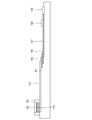
- FIG. 1 is a top view of the detection kit according to the present embodiment
- FIG. 2 is a cross-sectional view of FIG.
- the detection kit according to the present embodiment has at least the introduction unit 102, the mixing unit 105, and the coupling unit 108 on the support 101.
- a sample including a detection target to be semi-quantified is introduced into the introduction unit 102.
- a plurality of mixing sections 105 are provided on the support 101 in order to obtain a mixture of each of the distributed samples introduced into the introducing section 102 and a signal transmitting substance capable of transmitting a signal.
- Each of the plurality of coupling units 108 is provided with a binding substance that can selectively bind to the detection target and the signal transmitting substance.
- the plurality of coupling portions 108 are each provided with a binding substance fixed thereto, and each binding substance is in contact with each mixture obtained by the plurality of mixing sections 105.
- the detection kit according to the present embodiment has a simple configuration as long as at least the binding substance is fixed on the support. Further, the binding substance only needs to be capable of binding to the detection object or the signal transmitting substance, and the design flexibility is high.
- the detection kit according to this embodiment will be described in more detail.
- the introduction unit 102 is upstream and the confirmation unit 109 is downstream, and the sample moves from upstream to downstream.
- the sample introduced into the introduction unit 102 is absorbed by the absorption unit 103 and distributed to the plurality of first transport units 104. It is preferable that the sample introduced into the introduction unit 102 is distributed to the plurality of first transport units 104 in equal amounts. However, even if the same amount is not distributed to the plurality of first transport units 104, the amount of the sample reaching the plurality of mixing units 105 may be the same.
- the absorption unit 103 serves not only to make the amounts of the samples distributed to the plurality of first transport units 104 the same, but also to absorb the sample overflowing from the introduction unit and suppress diffusion.
- the amount of the sample is not only the same as the case of the same, but also when the value of the amount of the other sample falls within the range of 0.95 to 1.05 times the amount of the one sample. Including. Preferably, the value of the amount of the other sample falls within the range of 0.99 to 1.01 times the value of the amount of one sample.
- Each sample that has passed through the plurality of first transport units 104 reaches the plurality of mixing units 105.
- the signal transmitting substance provided in the plurality of mixing units 105 and the sample are mixed to obtain a mixture.
- the signal transmitting substances provided in each of the plurality of mixing units 105 have different amounts or concentrations. Although the case where the amounts are different will be described below, it is more convenient to adjust the concentration when the signal transmitting substance is provided in a solvent.
- the ratio between the detection target object and the signal transmitting substance in each mixture obtained by the plurality of mixing units 105 is different.
- the signal transmitting substance provided in the mixing unit 105 connected to A of the coupling unit 108 to be described later is the largest
- the signal transmitting substance provided in the mixing unit 105 connected to B is the second most
- the mixing unit 105 connected to C It is assumed that there are few signal transmission substances provided.
- the detection target and the signal transmitting substance in the mixture are mixed so as to be dispersed.
- Each mixture that has passed through the plurality of development units 106 reaches the coupling unit 108 via the plurality of second transport units.
- the detection target substance and the signal transmitting substance in the mixture are selectively combined with the binding substance provided in each of the plurality of coupling units 108 (A, B, C).
- the ratios of the detection object and the signal transmitting substance in the mixture that reaches A, B, and C of the plurality of coupling portions 108 are different.
- the magnitudes of signals transmitted from the signal transmitting substances in each of the coupling units 108 are A, B, and C in descending order of signal.
- the number of objects to be detected is small, a large number of signal transmitting substances are coupled to the binding substance provided in the coupling unit 108, and thus the transmitted signal is large.
- the ease of binding to the binding substance is the same for the detection target and the signal transmitting substance, the number of detection targets that bind to the binding substance increases as the number of detection targets increases. The signal to be transmitted becomes smaller.
- the case where the coupling constant is the same includes not only the case where the coupling constant is completely the same, but also the case where the value of the other coupling constant falls within the range of 0.95 to 1.05 times the value of one coupling constant.
- the value of the other coupling constant is in the range of 0.99 to 1.01 times the value of one coupling constant.
- the binding constant is the same as long as the effect of the present invention can be obtained, that is, the binding target and the signal transmitting substance compete with and bind to the binding substance.
- the signal transmitting substances provided in the mixing unit 105 connected to A, B, and C of the coupling unit 108 are 1000, 100, and 10 respectively.
- 10 bonding substances are provided in each of A, B, and C of the bonding portion 108.
- the ease of binding to the binding substance is the same between the detection target and the signal transmitting substance.
- the ratio is 10 for A, 5 for B, and 0 to 1 for C.
- the number of detection objects is 1000
- five, 0 to 1, and 0 to 1 signal transmitting substances bind to the binding substances A, B, and C of the coupling unit 108, respectively.
- the ratio of A is 5, B is 0 to 1, and C is 0 to 1.
- the detection kit according to the present embodiment is a semi-quantitative system having not only qualitative information indicating that there are many or few detection objects but also a certain amount of quantification.
- the range of the amount of the detection target that can be measured can be expanded by making the amount and concentration of the signal transmitting substance provided in each of A, B, and C of the mixing unit 105 different from each other by one digit or more.
- the surplus mixture (sample) that has passed through the coupling unit 108 reaches the confirmation unit 109.
- the confirmation unit 109 can confirm that the sample has passed through each part in the detection kit and can prevent the excess sample from leaking outside.
- the first transport unit, the mixing unit, the developing unit, the second transport unit, and the coupling unit are provided in three, but not limited to three, There may be four or more forms.
- Detection target As an example of the detection target in the present embodiment, biomarkers relating to diseases of the living body, physical condition, degree of stress applied to the living body, and the like can be given.
- the hormonal substances metabolized from within the living body low molecular substances having a molecular weight of 1000 or less are targeted.
- Specific examples include steroidal hormones, amine hormones, nucleosides, and analogs thereof.
- it may be an antigen or an antibody.
- one of the detection target and the binding substance is an antigen, and the other is an antibody.
- the detection target is contained in urine, blood, sweat, tears and the like described later.
- An example of the detection target according to the present embodiment is 8-Oxo-2'-deoxyguanosine (8 oxo-2'deoxyguanosine, hereinafter abbreviated as 8OHdG) having the structure shown in FIG.
- sample containing the detection target examples include urine, blood, sweat, tears, and liquid samples based on these. These samples contain biomarkers and measure the amount thereof to obtain vital signs of the living body.
- mucous membranes, mucus, seawater, and dilute or concentrated liquids that increase or decrease the amount of water contained in these are considered to be low molecular toxins.
- the support 101 is made of plastic, glass, film, or the like, and can be appropriately selected depending on the type of sample, the type of detection object, and the like.
- a rectangular shape having a length of 3 cm to 5 cm and a width of 2 cm to 3 cm in the direction in which the sample moves is preferable for ease of handling, but the type of the detection target, the amount of the signal transmitting substance,
- the width may be widened depending on the density or the number of the first transport units 104. That is, it is preferable that the support has a flat stick shape in the hand from the viewpoint of ease of use.
- Examples of the material constituting the sample introduction portion 102 include those having uniform characteristics such as cellulose filter paper, glass fiber, polyurethane, polyacetate, cellulose acetate, nylon, and cotton cloth.
- the open-cell polyurethane foam can be easily adjusted for hydrophilicity and hydrophobicity, and can be appropriately selected according to the solvent of the sample.
- a highly hydrophilic introduction portion if a highly hydrophilic introduction portion is used, it may be adsorbed by the introduction portion, and the sample may not be smoothly moved to the subsequent coupling portion 108.
- the introduction unit 108 has a structure included in the detection target and a site capable of hydrogen bonding, it is particularly preferable to perform a process for suppressing nonspecific adsorption.
- treatments that suppress non-specific adsorption include the case where a surfactant is provided, the case where an inactive protein is provided, etc.
- the treatment method may be selected in accordance with the characteristics of the detection target in the sample. .
- the absorption unit 103 is provided around the introduction unit 102 so that the sample introduced into the introduction unit 102 is easily distributed to the first transport unit 104 in an equal amount.
- the absorption unit 103 is not necessarily required if the introduction unit 102 itself can be easily distributed to the first transport unit 104 in equal amounts.
- the first transport unit 104 transports the sample from the introduction unit 102 or the absorption unit 103 to the mixing unit 105
- the second transport unit 107 transports the mixture from the mixing unit 105 or the developing unit 106 to the coupling unit 108. It is a part for conveying.
- the first transport unit 104 and the second transport unit 107 may be of the same material or configuration, or may be different. Hereinafter, the first transport unit 104 and the second transport unit 107 may be simply referred to as a transport unit.
- the transport unit can be made of a porous nitrocellulose membrane, a porous cellulose membrane, a nylon membrane, glass fiber, a nonwoven fabric, a cloth, etc., and what is suitable is a so-called filter paper.
- the surface of the transport unit can be selected as appropriate depending on whether the sample is hydrophilic or hydrophobic.
- the transport unit has a site capable of hydrogen bonding with the structure included in the detection target, it is particularly preferable to perform a process for preventing nonspecific adsorption.
- the treatment for preventing nonspecific adsorption include a case where a surfactant is provided, a case where an inactive protein is provided, and the like, which may be selected according to the characteristics of the detection target in the sample.
- the strips corresponding to the transporting portions are arranged at equal intervals below the introduction portion, and the strips are partitioned by a hydrophobic resin such as polyethylene or fluororesin. Or the solution which consists of the above-mentioned resin is apply
- Each of the plurality of mixing units 105 is provided with different amounts of signal transmitting substances. It is preferable that the mixing unit 105 has a configuration in which the inflowing sample and the signal transmitting substance are uniformly dispersed.
- the signal transmitting substance such a material can be used as long as the signal transmitting substance is selectively bonded to a binding substance described later and can transmit a signal.
- the signal transmitting substance in the present embodiment is added with a labeling material capable of transmitting a signal to an external stimulus to the above-described detection object or this type.
- the signal transmitting substance is preferably a compound that does not impair the hydrogen bonding site with the binding substance or that leaves only a minimum of the binding site for the binding substance.
- the signal transmitting substance has the same degree of solubility and dispersibility as the solvent in which the detection target is dissolved or dispersed, and a material that does not have an association property with the detection target is selected. Is preferred.
- the labeling material in the present embodiment only needs to be able to measure and observe the presence of a signal transmitting substance electrically and optically. Not only does the labeling material itself have properties that can be measured and observed electrically or optically, but if a labeling step is added to the subsequent stage as needed, it is possible to add only a reactive group that can be labeled. The purpose can be achieved.
- a light emitting substance such as a metal colloid, a dye, a pigment, or a fluorescent substance can be used as a labeling material.
- a metal colloid, a dye, a pigment, or a fluorescent substance can be used as a labeling material.
- the same metal colloid, carbon-based material, or the like whose conductivity is changed, or that can be provided with magnetic properties may be used.
- the developing unit 106 is provided to mix the detection target and the signal transmitting substance in the mixture so that they are uniformly dispersed while the mixture flowing in from the mixing unit 105 moves to the second transport unit 107. It is done.
- the developing unit 106 is preferably made coarser than the filter medium used in the first transport unit 104. Furthermore, it is preferable that the mesh of the filter medium is large in the order of the first transport unit 104 ⁇ mixing unit 105 ⁇ developing unit 106.
- the coarseness of the filter medium may be selected based on the drainage time shown in JIS P-3810. For example, when the freeness of the first transport unit 104 is 250 seconds, the mixing unit 105 is 160.
- the material for which the developing unit 106 is 100 seconds or less may be selected. This is because the detection target in the sample and the signal transmitting substance are uniformly mixed in the developing unit 106, so that the flow rate of the sample is once reduced and the mixing degree is optimized.
- the binding unit 108 only needs to be a material that can be firmly bonded so that the binding substance does not flow out of the binding part to other parts, and the binding substance has an adsorptivity to a supplemental part for capturing the detection target and the signal transmitting substance. It is preferred to select from materials that do not have For example, when the binding substance is a resin capable of recognizing molecules, it is necessary to use an adhesive that has adhesiveness to the resin and does not melt, and it is preferable to use a casein-based adhesive.
- the binding substance in the present embodiment is a substance that can selectively bind to at least the detection target and the signal transmitting substance.
- the term “bond” is a concept including not only a chemical bond such as a hydrogen bond, a covalent bond, and an ionic bond but also physical adsorption having a bonding force weaker than that of the chemical bond. Specific examples include synthetic polymers, antigens, antibodies, proteins and the like.
- the binding substance according to the present embodiment has a site capable of hydrogen bonding with a low-molecular substance that is a detection target or a signal transmitting substance in its molecular structure, and each part has a hydrogen bond so that each part complements it. It is preferable that the atomic arrangement and the spatial arrangement coincide with each other in at least two places. In addition, if the binding substance has a shape that spatially surrounds the detection target and the signal transmission substance, the ability to capture the detection target and the signal transmission substance can be further improved.
- Examples of the site capable of hydrogen bonding include fluorine, oxygen, nitrogen having high electronegativity and hydrogen covalently bonded to these atoms.
- both the detection target and the signal transmitting substance, and the binding substance complement hydrogen bonds, when either one of the detection target and the binding substance has an atom with a large electronegativity, The other shows the state with hydrogen covalently bonded to those atoms.
- the bonding substance has been described with a focus on hydrogen bonding, but it can also be described by replacing this hydrogen bonding partially or entirely with a covalent bond or an ionic bond.
- the confirmation unit 109 is configured to be able to confirm whether or not the sample introduced into the introduction unit has reached the coupling unit.
- the confirmation unit 109 is a site where the sample introduced into the introduction unit 102 is physically absorbed by the chromatographic movement and absorbs and removes the unreacted signal transmitting substance that is not adsorbed by the coupling unit 108.
- a water-absorbing material such as cellulose filter paper, non-woven fabric, cloth, or cellulose acetate is used.
- the confirmation part may semi-quantify the detection target.
- a surfactant in addition to the signal transmitting substance, a surfactant, a pH adjuster, an organic solvent, a buffer salt, or the like may be applied or added in advance. Any material that adjusts the binding between the detection target and the signal transmitting substance may be applied together with the signal transmitting substance.
- the detection method includes at least the following steps (1) to (4).
- a detection target can be easily detected.
- Example 1 In this example, a urethane foam foam sponge is used for the sample introduction part, the size is 18 mm ⁇ 10 mm, and the thickness is 3 mm. The bottom surface is 5 mm wide and made of nitrocellulose. A pair of filter paper strips (first conveying unit) 104 are arranged in parallel. The filter paper used for this strip is selected based on the freeness measured by JIS P-3810. In this example, filter paper having a drainage time of 200 seconds was used. The fiber surface of the filter paper is subjected to a water repellent treatment with a surfactant in order to prevent the detection target from adhering to the test liquid.
- first transports are provided, and the space between each transport part is filled with polyethylene wax from the lower part of the sponge of the introduction part where the sample is introduced to the confirmation part.
- a pad (mixing unit) 105 impregnated with a membrane having a filtering time of 180 seconds with a signal transmitting substance of a detection target in a sample to which a labeling agent is applied is overlapped with the strip of the first transport unit 104.
- a membrane (developing portion) 106 having a drainage time of 100 seconds is overlaid thereon.
- a membrane 106 having a drainage time of 200 seconds which is the same as that of the first transport unit 104, is further laid down.
- the drainage time of each part is set such that the first transport unit 104> mixing unit 105> deployment unit 106 and the second transport unit 107> deployment unit 106.
- the drainage time of the conveying unit 107 is longer than that of the developing unit 106, which facilitates the uniform mixing of the signal transmitting substance and the detection target, and the detection target in the coupling unit in the subsequent stage. And competitive adsorption of the signal transmitting substance can be performed accurately.
- the binding unit 108 carries resin particles or a thin film containing hydrogen bonding sites that can specifically adsorb the detection target and the signal transmitting substance, and the detection target and the signal transmitting substance are bound to this by the mixing ratio. become.
- a water-soluble dye which will be described later, is used as the signal transmitting substance labeling material, the signal transmitting substance is attached more frequently when the amount of the detection target is small, and the binding portion is colored. In the opposite case, no coloring is observed. Or it becomes difficult to see.
- the detection target when the detection target is discharged from the living body, it is known how much the concentration range changes depending on the state of the living body. Therefore, it is preferable to change the amount and concentration of the signal transmitting substance provided in each of the plurality of mixtures 105 by a power such as 2 times or 4 times based on the normal concentration, preferably 10 times or 100 times. It is increased by a power of 10.
- 8OHdG (8-Oxo-2′-deoxyguanosine) shown in FIG. 4 which is an oxidative metabolite of DNA as a low molecular weight compound contained in human urine
- this 8OHdG is used as a signal transmitting substance.
- a water-soluble dye is used in combination. This is dipped in a pad (mixing unit) 105 and dried.
- gold nanocolloid particles having a diameter of 40 nm are used as the colorant, and those bonded to the 8OHdG by the usual method are used.
- the molarity of the signal transmitting substance described above is adjusted to 3 ⁇ M, 300 nM, and 30 nM so as to correspond to the three strips prepared, and 0.18 ml of the signal transmitting substance solution is prepared. Then, each of the A, B, and C lines is dipped in each pad (mixture) 105 and dried.
- a polymer obtained by copolymerizing a derivative of phenoxazine shown in FIG. 5 with an acrylic acid monomer is used as a binding substance provided in the binding portion.
- the polymer is fixed to a membrane based on nitrocellulose and having a drainage time of 200 seconds using casein to form a joint 108.
- the number of molecules that can be adsorbed in the binding portion is determined by the covering power of the labeling material contained in the signal transmitting substance to be used. Since colloidal gold particles having a diameter of 40 nm are used in this embodiment, a binding substance of 10 7 (pieces / ⁇ m 2 ) per unit area of the binding portion 108 may be provided.
- a polymer adjusted to 2 ⁇ 10 9 (pieces / ⁇ m 2 ) per unit area is used. This polymer is set so as to be impregnated in the middle of the strip of the second conveyance unit 107. Further, a polymer provided with a binding substance equal to or higher than the bonding portion is prepared downstream of the bonding portion 108, and is used as the confirmation portion 9.
- a sample is prepared so that the concentration of 8OHdH is 10 nM, 200 nM, and 1500 nM in artificial urine adjusted to PH 6.8 in a semi-quantitative measurement system (detection kit) for low molecular weight compounds, and the total amount is 0.6 ml in the introduction part Load and keep the detection kit level.
- a sample of 10 nM is put in a few minutes later while keeping it horizontal, only the joint part of the C line is not colored, only the joint part of the A and B lines is colored blue, and the sample is 10 nM. It turns out that it is a density
- Example 2 A system was prepared in the same manner as in Example 1 except that a partition 110 was provided in the sponge layer of the introduction part 102 so that the transmission area was equal.
- a member (absorbing part) 103 capable of absorbing the sample overflowing from the sponge was installed around the introduction part 102.
- This member is made of a known polymer absorber or the like, and when a large amount of sample is put into the introduction part 102 or when it remains on the edge of the introduction part, it can be quickly absorbed to ensure the quantitative property of the introduction part 102.
- the partition plate 110 provided in the introduction unit 102 is provided with three lines for detection of the detection target unit, the partition plate 110 is installed and fills the space divided into three sections by the same material as the upper sponge. .
- Example 1 Further, the signal transmitting substance and the capturing polymer used in Example 1 are provided in the same manner. Next, as in Example 1, three types of samples are prepared and measured.
- the same results can be obtained as detection accuracy, but even if the detection kit is tilted from the horizontal, there is no difference in the results, and even if there are some differences in the operation of the kit, it is equally distributed. It can be confirmed.
- the partition plate 110 is lower than the height of the introduction portion 102 sponge layer, but there is no problem even if it is provided up to the height of the sponge.
- the partition plate instead of the partition plate, it is possible to prepare a rectangular frame provided so as to have an equal amount, and to provide this on the upper portion of the first transport unit 104.
- the detection kit according to the present invention there are few things to be fixed as compared with the conventional one, and the degree of freedom in selecting the material to be used is increased, so the configuration is simpler and the degree of freedom in designing the kit to be measured is higher.
Landscapes
- Health & Medical Sciences (AREA)
- Immunology (AREA)
- Life Sciences & Earth Sciences (AREA)
- Engineering & Computer Science (AREA)
- Molecular Biology (AREA)
- Biomedical Technology (AREA)
- Chemical & Material Sciences (AREA)
- Hematology (AREA)
- Urology & Nephrology (AREA)
- Biotechnology (AREA)
- Biochemistry (AREA)
- Cell Biology (AREA)
- Food Science & Technology (AREA)
- Medicinal Chemistry (AREA)
- Physics & Mathematics (AREA)
- Analytical Chemistry (AREA)
- Microbiology (AREA)
- General Health & Medical Sciences (AREA)
- General Physics & Mathematics (AREA)
- Pathology (AREA)
- Investigating Or Analysing Biological Materials (AREA)
- Endocrinology (AREA)
- Investigating Or Analyzing Non-Biological Materials By The Use Of Chemical Means (AREA)
Abstract
検出対象物を含む試料が導入される導入部(102)と、導入部に導入され、分配された試料と、信号を発信可能な信号発信物質との混合物を得る複数の混合部(105)と、複数の混合部(105)で得られた各々の混合物中の、検出対象物及び信号発信物質に対して、選択的に結合可能な結合物質が設けられた結合部(108)と、が支持体(101)上に設けられた、検出対象物の検出キットであって、複数の混合部(105)に設けられた信号発信物質の量または濃度が互いに異なる。
Description
本発明は検出対象物の検出キット、検出対象物の検出方法を提供するものである。
これまで、血液、尿、涙などに含まれる生体代謝物としてのバイオマーカーの有無や、その量を計測することで、生体のバイタルサインを得るための方法や装置の開発が行われてきた。従来、このようなバイタルサインを得るために、生体より採取されたさまざまな試験試料に対して化学分析を行い、その組成並びに量を計測することが一般的であり、液体クロマトグラフィー等の手法が用いられてきた。しかし、これらの装置は非常に大型であり、簡便に検出する手法や装置が求められていた。
特開2008-32494号公報(特許文献1)では、被験試料に含まれる標的物質を簡便に測定する測定用キットが開示されている。特許文献1に開示の測定用キットは、標的物質を含む被試験試料に競合物質を混合させた混合液を、キットに固定された競合的捕捉物質、キットに固定された判定物質の順に接触させる。そして、判定物質に結合・捕捉された競合物質から得られる反応物の量を測定することで、標的物質の量を測定している。すなわち、競合物質を標的物質に結合しうる抗体、競合的捕捉物質を標的物質もしくはその類似物質とすると、標的物質が少ない場合、競合物質は固定された競合的捕捉物質に結合・捕捉されて、判定物質に到達する競合物質の量は少ない。その結果、判定物質に結合・捕捉される競合物質から得られる反応物の量は少ない。一方、標的物質の量が増えるにつれ、固定された競合的捕捉物質に結合せずに標的物質に結合する競合物質が増えるため、判定物質に到達する競合物質の量が増える。その結果、判定物質に結合・捕捉される競合物質から得られる反応物の量は増える。したがって、標的物質の量に関する定性的な情報を得ることが可能である。
しかし、特許文献1に開示の測定用キットには競合的捕捉物質だけでなく、判定物質も固定しなくてはならず構成が複雑である。また、競合物質は、標的物質と判定物質の両方と結合しうるものに限られるため、キットの設計自由度に関する制約が多くなる。したがって、従来より構成がより単純で、設計自由度がより高い、検出対象物の検出キットが求められていた。
本発明は上記従来例に鑑みなされたものであり、従来に比べて、構成がより単純で、設計自由度がより高い検出対象物の検出キットを提供することを目的とする。
本発明に係る検出キットは、検出対象物を含む試料が導入される導入部と、前記導入部に導入され、分配された前記試料と、信号を発信可能な信号発信物質との混合物を得る複数の混合部と、前記複数の混合部で得られた各々の前記混合物中の、前記検出対象物及び前記信号発信物質に対して、選択的に結合可能な結合物質が設けられた結合部と、が支持体上に設けられた、前記検出対象物の検出キットであって、前記複数の混合部に設けられた前記信号発信物質の量または濃度が互いに異なる検出キット。
(検出キット)
本発明の実施形態に係る検出キットについて説明するが、本発明はこれらに限られない。
本発明の実施形態に係る検出キットについて説明するが、本発明はこれらに限られない。
本実施形態に係る検出キットの一例について図1、2を用いて説明する。図1は本実施形態に係る検出キットの上面図、図2は図1の断面図を示す。
本実施形態に係る検出キットは、支持体101上に導入部102、混合部105、結合部108を少なくとも有する。導入部102には半定量を行う対象となる検出対象物を含む試料が導入される。混合部105は、導入部102に導入されて、分配された各々の試料と、信号を発信可能な信号発信物質との混合物を得るために、支持体101上に複数設けられる。複数の結合部108には、各々、検出対象物及び信号発信物質に対して、選択的に結合可能な結合物質が設けられている。複数の結合部108は、各々に結合物質が固定して設けられ、各々の結合物質が、複数の混合部105で得られた各々の混合物と、接触するような構成となっている。
このように本実施形態に係る検出キットは、少なくとも結合物質が支持体上に固定されていればよく、構成が単純である。また、結合物質は、検出対象物や信号発信物質に結合可能なものであればよく、設計自由度も高い。
本実施形態に係る検出キットについてより詳細に説明する。導入部102を上流、確認部109を下流とし、上流から下流に向けて試料が移動していく。
導入部102に導入された試料は、吸収部103に吸収され、複数の第一の搬送部104に分配される。導入部102に導入された試料は複数の第一の搬送部104に等量ずつ分配される構成が好ましい。但し、複数の第一の搬送部104に互いに同じ量だけ分配されていなくても、複数の混合部105に到達する試料の量が互いに同じであればよい。吸収部103は、複数の第一の搬送部104に分配される試料の量が互いに同一にしやすくするのみならず、導入部からあふれた試料を吸収して拡散を抑制する役割を担う。ここで、試料の量が互いに同一とは、完全同一の場合だけでなく、一方の試料の量の0.95倍から1.05倍の範囲に、他方の試料の量の値が入る場合も含む。好ましくは、一方の試料の量の値の0.99倍から1.01倍の範囲に、他方の試料の量の値が入る場合である。
複数の第一の搬送部104を経た各々の試料は、複数の混合部105に到達する。複数の混合部105に設けられた信号発信物質と試料とが混合され、混合物が得られる。
ここで、複数の混合部105の各々に設けられた信号発信物質は互いにその量または濃度が異なる。以下では量が異なる場合について説明するが、信号発信物質が溶媒に含まれる形で設けられる場合等は、濃度を調整する方が便利である。
信号発信物質の量が互いに異なるため、複数の混合部105で得られる各々の混合物における、検出対象物と信号発信物質との比率が異なる。例えば、後述の結合部108のAにつながる混合部105に設けられた信号発信物質が最も多く、Bにつながる混合部105に設けられた信号発信物質が次に多く、Cにつながる混合部105に設けられた信号発信物質が最も少ない、とする。
混合部105から展開部106を経て第二の搬送部107に移動する中で、混合物中の検出対象物と信号発信物質とが、分散するように混じり合う。複数の展開部106を経た各々の混合物は、複数の第二の搬送部を経て、結合部108に到達する。複数の結合部108(A、B、C)の各々に設けられた結合物質に、混合物中の検出対象物と信号発信物質とが選択的に結合される。複数の結合部108のA、B、Cに到達する混合物における、検出対象物と信号発信物質との比率が異なる。本例では、結合部108に到達する試料のうち、検出対象物に対する信号発信物質の比率が多い順にA、B、Cとなる。そのため、結合部108の各々における信号発信物質から発信される信号の大きさは、信号が大きい順に、A、B、Cとなる。検出対象物が少ない場合、結合部108に設けられた結合物質には多くの信号発信物質が結合するため、発信される信号は大きい。一方、結合物質に対する結合のしやすさ(結合定数)が、検出対象物と信号発信物質とで同一の場合、検出対象物が多くなるにつれて、結合物質に結合する検出対象物が増えるため、発信される信号は小さくなる。ここで、結合定数が同一とは、完全同一の場合だけでなく、一方の結合定数の値の0.95倍から1.05倍の範囲に、他方の結合定数の値が入る場合も含む。好ましくは、一方の結合定数の値の0.99倍から1.01倍の範囲に、他方の結合定数の値が入る場合である。
このようにして、導入部102に導入された試料に含まれる、検出対象物の量の定性的な情報が得られる。なお、結合定数が同じとは、本発明の効果を得られる程度、すなわち、結合物質に対して、検出対象物と信号発信物質とが競合して結合するものであれば良い。
次に、本実施形態に係る検出キットが、試料中の検出対象物を半定量的に検出できる理由について、一例を挙げて説明する。ここで挙げる各数値は本実施形態を理解しやすくするために、わかりやすい数値を挙げている。また、信号の大きさは定性的な関係を示すための一例であるため、単位は示していない。
結合部108のA、B、Cにつながる混合部105に設けられた信号発信物質を、それぞれ、1000個、100個、10個とする。そして、結合部108のA、B、Cにそれぞれ、10個の結合物質が設けられているとする。また、結合物質に対する結合のしやすさ(結合定数)が、検出対象物と信号発信物質とで同じ、と仮定する。
まず、検出対象物が10個の場合、結合部108のA、B、Cの結合物質にはそれぞれ、約10個、約10個、約5個の信号発信物質が結合するため、信号の大きさは概ね、Aは100、Bは10、Cは5という比率となる。
次に、検出対象物が100個の場合、結合部108のA、B、Cの結合物質にはそれぞれ、約10個、5個、0~1個の信号発信物質が結合するため、信号の大きさは概ね、Aは10、Bは5、Cは0~1、という比率となる。
最後に、検出対象物が1000個の場合、結合部108のA、B、Cの結合物質にはそれぞれ、5個、0~1個、0~1個の信号発信物質が結合するため、信号の大きさは概ね、Aは5、Bは0~1、Cは0~1、という比率となる。
したがって、検出対象物が少ない場合は、A、B、Cのいずれからも信号が発信される。検出対象物が多くなると、結合部108のCからの信号がほとんど発信されなくなり、次いで、結合部108のBからの信号が発信されなくなる。検出対象物が非常に多くなると、結合物質に結合するものは、ほとんどが検出対象物となり、結合部108のAからの信号も発信されなくなる。検出対象物が多いことが生体の疾病の兆候である場合や、ストレスが大きい可能性が高いことを意味する場合、本実施形態に係る検出キットからの信号が大きいほど、疾病に罹患していることやストレスが大きい可能性があることを示すことになる。
さらに、混合部105のA、B、Cの各々に設ける信号発信物質の量や濃度を、例えば10のべき乗で異なる(1桁ずつ異なる)ようにすれば、A、B、Cから発信される信号の大きさの変化から、検出対象物の量の1桁程度の変化を、検出することができる。つまり、本実施形態に係る検出キットは、検出対象物が多い、少ないという定性的な情報だけでなく、ある程度の定量性を備えた、半定量のシステムと言える。なお、混合部105のA、B、Cの各々に設ける信号発信物質の量や濃度が互いに1桁以上異なるようにすることで、測定できる検出対象物の量の範囲を広げることができる。結合部108を経た、余りの混合物(試料)は、確認部109に到達する。確認部109は、試料が検出キット内の各部位を経由したことを確認するとともに、余った試料が外に漏れないようにすることができる。
なお、本実施形態に係る検出キットにおいて、第一の搬送部、混合部、展開部、第二の搬送部、結合部は3つ設けられているが、3つに限らず2個の形態や、4個以上の形態であっても良い。
次に、本実施形態に係る検出キットを構成する各部位、及びそれらを構成する各部材の材料等の具体例について説明する。
(検出対象物)
本実施形態における検出対象物の例として、生体の疾病、体調、生体にかかっているストレスの程度などに関わるバイオマーカーを挙げることが出来る。例えば、生体内より代謝されるホルモン系物質の内、分子量が1000以下の低分子物質がその対象となる。具体的には、ステロイド系ホルモン類、アミン系ホルモン類、ヌクレオシド、及びこれらの類縁体等が挙げられる。また、抗原や抗体であってもよい。この場合、検出対象物と結合物質とはいずれか一方が抗原であり、いずれか他方が抗体となる。
本実施形態における検出対象物の例として、生体の疾病、体調、生体にかかっているストレスの程度などに関わるバイオマーカーを挙げることが出来る。例えば、生体内より代謝されるホルモン系物質の内、分子量が1000以下の低分子物質がその対象となる。具体的には、ステロイド系ホルモン類、アミン系ホルモン類、ヌクレオシド、及びこれらの類縁体等が挙げられる。また、抗原や抗体であってもよい。この場合、検出対象物と結合物質とはいずれか一方が抗原であり、いずれか他方が抗体となる。
さらに人工的に合成される低分子化合物の内、生体から代謝されるうるものも挙げられる。また、貝毒の代表されるテトロドトキシンなどの低分子毒物のように生体外部からの取り込みにより重大な疾患を引き起こす物質も挙げられる。
検出対象物は後述する尿、血液、汗、涙等に含まれるものであることが好ましい。
本実施形態に係る検出対象物の例として、図4に示される構造をもつ、8-Oxo-2’-deoxyguanosine(8オキソ2’デオキシグアノシン、以下8OHdGと略すことがある)が挙げられる。
(試料)
検出対象物を含有する試料としては尿、血液、汗、涙およびこれらをもとにする、液体状の試料が挙げられる。これらの試料には、バイオマーカーが含まれその量を計測することで、生体のバイタルサインを得る。
検出対象物を含有する試料としては尿、血液、汗、涙およびこれらをもとにする、液体状の試料が挙げられる。これらの試料には、バイオマーカーが含まれその量を計測することで、生体のバイタルサインを得る。
また、低分子毒物であればこれらを含むと考えられる粘膜、粘液、海水とこれらの内、含有する水の量を増減させた希釈、濃縮液が挙げられる。
(支持体)
支持体101の材質は、プラスチック、ガラス、フィルム等が用いられ、試料の種類、検出対象物の種類等により適宜選択できる。支持体101の寸法や形状については、取り扱いの簡便さからは試料が移動する方向の長さ3cm~5cm、幅2cm~3cmの方形が好ましいが、検出対象物の種類、信号発信物質の量や濃度や、第一の搬送部104の本数により幅を広くしてもよい。すなわち、支持体は、使いやすさの観点から、手に平サイズのスティック形状であることが好ましい。
支持体101の材質は、プラスチック、ガラス、フィルム等が用いられ、試料の種類、検出対象物の種類等により適宜選択できる。支持体101の寸法や形状については、取り扱いの簡便さからは試料が移動する方向の長さ3cm~5cm、幅2cm~3cmの方形が好ましいが、検出対象物の種類、信号発信物質の量や濃度や、第一の搬送部104の本数により幅を広くしてもよい。すなわち、支持体は、使いやすさの観点から、手に平サイズのスティック形状であることが好ましい。
(導入部)
試料の導入部102を構成する部材の材質は、セルロース濾紙、ガラス繊維、ポリウレタン、ポリアセテート、酢酸セルロース、ナイロン、綿布等の均一な特性を有するものが挙げられる。特に連泡ポリウレタンフォームは親水性、疎水性の調整が容易であり、試料の溶媒に合わせて適宜選択することが可能である。なお、水系の試料の場合、親水性が強い導入部を用いるとこれらに吸着してしまい後段の結合部108への試料の移動がスムーズに行われない可能性がある。試料が親水性の場合は、疎水性の導入部、試料が疎水性の場合は、親水性の導入部、のように、試料が親水性か疎水性かを見極めて、導入部の材料を選択することが好ましい。また、導入部108に、検出対象物に含まれる構造と、水素結合可能な部位を有する場合、非特異的な吸着を抑制する処理をすることが特に好ましい。非特異的な吸着を抑制する処理の例として、界面活性剤を設ける場合、不活性蛋白を設ける場合等があげられるが、試料中の検出対象物の特性に合わせて処理方法を選択すればよい。
試料の導入部102を構成する部材の材質は、セルロース濾紙、ガラス繊維、ポリウレタン、ポリアセテート、酢酸セルロース、ナイロン、綿布等の均一な特性を有するものが挙げられる。特に連泡ポリウレタンフォームは親水性、疎水性の調整が容易であり、試料の溶媒に合わせて適宜選択することが可能である。なお、水系の試料の場合、親水性が強い導入部を用いるとこれらに吸着してしまい後段の結合部108への試料の移動がスムーズに行われない可能性がある。試料が親水性の場合は、疎水性の導入部、試料が疎水性の場合は、親水性の導入部、のように、試料が親水性か疎水性かを見極めて、導入部の材料を選択することが好ましい。また、導入部108に、検出対象物に含まれる構造と、水素結合可能な部位を有する場合、非特異的な吸着を抑制する処理をすることが特に好ましい。非特異的な吸着を抑制する処理の例として、界面活性剤を設ける場合、不活性蛋白を設ける場合等があげられるが、試料中の検出対象物の特性に合わせて処理方法を選択すればよい。
(吸収部)
吸収部103は、導入部102に導入された試料が、第一の搬送部104に等量分配されやすくするために、導入部102の周囲に設けられる。但し、導入部102そのものが第一の搬送部104に等量ずつ分配されやすいものであれば、吸収部103は必ずしも必要ない。
吸収部103は、導入部102に導入された試料が、第一の搬送部104に等量分配されやすくするために、導入部102の周囲に設けられる。但し、導入部102そのものが第一の搬送部104に等量ずつ分配されやすいものであれば、吸収部103は必ずしも必要ない。
(第一の搬送部、第二の搬送部)
第一の搬送部104は、試料を導入部102、または吸収部103から混合部105へ搬送するために、第二の搬送部107は、混合物を混合部105または展開部106から結合部108へと搬送するための部位である。第一の搬送部104と第二の搬送部107とは互いに同じ材料や構成であっても、異なっていてもよい。以下では、第一の搬送部104と第二の搬送部107とを単に搬送部と称して説明することがある。
第一の搬送部104は、試料を導入部102、または吸収部103から混合部105へ搬送するために、第二の搬送部107は、混合物を混合部105または展開部106から結合部108へと搬送するための部位である。第一の搬送部104と第二の搬送部107とは互いに同じ材料や構成であっても、異なっていてもよい。以下では、第一の搬送部104と第二の搬送部107とを単に搬送部と称して説明することがある。
搬送部は多孔性ニトロセルロース膜、多孔性セルロース膜、ナイロン膜、ガラス繊維、不織布、布等を用いることができ、好適であるものはいわゆる濾紙である。この搬送部の表面も前述した導入部102と同様に、試料が親水性であるか疎水性であるか、を見極めて適宜選択することができる。さらに、搬送部が、検出対象物に含まれる構造と水素結合可能な部位を有する場合、非特異的な吸着を防止する処理をすることが特に好ましい。非特異的な吸着を防止する処理の例として、界面活性剤を設ける場合、不活性蛋白を設ける場合等があげられるが、試料中の検出対象物の特性に合わせて選択すればよい。
本実施形態では、この搬送部を複数持つことからそれぞれの搬送部に対応するストリップを導入部の下部に等間隔に並べるとともに、それぞれのストリップ間をポリエチレン、フッ素樹脂等の疎水性樹脂で仕切る。あるいは一本のストリップに前述の樹脂からなる溶液を線上に塗布する。それにより、等間隔でかつ隣接するストリップ間での試料である液体の干渉を防止することができる。
(混合部)
複数の混合部105には、各々、互いに量の異なる信号発信物質が設けられる。混合部105は、流入してくる試料と信号発信物質とが均一に分散されるような構成であることが好ましい。
複数の混合部105には、各々、互いに量の異なる信号発信物質が設けられる。混合部105は、流入してくる試料と信号発信物質とが均一に分散されるような構成であることが好ましい。
(信号発信物質)
信号発信物質はそれ自体が後述の結合物質に選択的に結合され、かつ、信号を発信することができるのであれば、そのような材料を用いることができる。それ自体が信号を発信することが出来ない場合、本実施形態における信号発信物質は前述した検出対象物あるいはこの類型物に、外部からの刺激に対して信号を発信可能な標識化材料を付加されたものを用いることが出来る。具体的に、信号発信物質は、結合物質との水素結合部位を損なうことなく、あるいは、結合物質に対する結合部位のみを最小限残した化合物であることが好ましい。さらに信号発信物質が、検出対象物が溶解あるいは分散している溶媒に同程度の溶解性、分散性をもつことが好ましく、かつ検出対象物と会合性をもたないような材料を選択することが好ましい。
信号発信物質はそれ自体が後述の結合物質に選択的に結合され、かつ、信号を発信することができるのであれば、そのような材料を用いることができる。それ自体が信号を発信することが出来ない場合、本実施形態における信号発信物質は前述した検出対象物あるいはこの類型物に、外部からの刺激に対して信号を発信可能な標識化材料を付加されたものを用いることが出来る。具体的に、信号発信物質は、結合物質との水素結合部位を損なうことなく、あるいは、結合物質に対する結合部位のみを最小限残した化合物であることが好ましい。さらに信号発信物質が、検出対象物が溶解あるいは分散している溶媒に同程度の溶解性、分散性をもつことが好ましく、かつ検出対象物と会合性をもたないような材料を選択することが好ましい。
(標識化材料)
本実施形態における標識化材料は電気的、光学的に信号発信物質の存在が計測、観測可能であればよい。標識化材料それ自体がこの電気的あるいは光学的に計測、観測できる特性をもっているだけでなく、必要に応じて後段に標識化工程を付加する場合、標識化が可能な反応基を付加するだけでもその目的を達することが可能となる。
本実施形態における標識化材料は電気的、光学的に信号発信物質の存在が計測、観測可能であればよい。標識化材料それ自体がこの電気的あるいは光学的に計測、観測できる特性をもっているだけでなく、必要に応じて後段に標識化工程を付加する場合、標識化が可能な反応基を付加するだけでもその目的を達することが可能となる。
信号発信物質を光学的に検出する場合、金属コロイド、染料、顔料、蛍光物質等の発光物質を標識化材料として用いることが可能である。電気的に計測する場合、同様の金属コロイド、カーボン系材料等の導電性が変化するもの、あるいは磁気的性質が付与可能なものであっても良い。
(展開部)
展開部106は、混合部105から流入した混合物が第二の搬送部107へと移動する間に、混合物中の検出対象物と信号発信物質とが、均一に分散するように混じり合わせるために設けられる。
展開部106は、混合部105から流入した混合物が第二の搬送部107へと移動する間に、混合物中の検出対象物と信号発信物質とが、均一に分散するように混じり合わせるために設けられる。
展開部106は、第一の搬送部104で使用する濾材よりも目を粗くすることが好ましい。さらに、第一の搬送部104<混合部105<展開部106の順に濾材の目の粗さが大きいことが好ましい。濾材の目の粗さについてはJIS P-3810で示す濾水時間を基準に選択すれば良く、例えば第一の搬送部104の濾水度が250秒であるとした場合、混合部105が160秒、展開部106が100秒以下の素材を選択すればよい。これは前述の展開部106において試料中の検出対象物と信号発信物質が均一に混ざる為に、一旦試料の流速を落とし、混合度合を適正化するためである。
また、均一に混合された混合物を速やかに結合部108へ搬送するために、第二の搬送部107に用いる濾材は反対に、展開部106よりも濾水時間が大きい材料を選択することが好ましい。
(結合部)
結合部108は、結合物質が結合部から他の部位に流出しないよう強固に接着できる材質であれば良く、かつ、結合物質が検出対象物や信号発信物質を捕捉するための補足部位に対する吸着性をもたない材料から選択することが好ましい。例えば結合物質が分子認識可能な樹脂である場合この樹脂に対して接着性を有しかつ、溶融しない接着剤を用いることが必要で、カゼイン系の接着剤を用いることが好適である。
結合部108は、結合物質が結合部から他の部位に流出しないよう強固に接着できる材質であれば良く、かつ、結合物質が検出対象物や信号発信物質を捕捉するための補足部位に対する吸着性をもたない材料から選択することが好ましい。例えば結合物質が分子認識可能な樹脂である場合この樹脂に対して接着性を有しかつ、溶融しない接着剤を用いることが必要で、カゼイン系の接着剤を用いることが好適である。
(結合物質)
本実施形態における結合物質は、少なくとも検出対象物と信号発信物質とに選択的に結合可能な物質である。本明細書において結合とは、水素結合、共有結合、イオン結合等の化学結合だけでなく、化学結合よりは結合力の弱い物理的な吸着を含む概念である。具体的には、合成ポリマー、抗原、抗体、タンパク質等が挙げられる。
本実施形態における結合物質は、少なくとも検出対象物と信号発信物質とに選択的に結合可能な物質である。本明細書において結合とは、水素結合、共有結合、イオン結合等の化学結合だけでなく、化学結合よりは結合力の弱い物理的な吸着を含む概念である。具体的には、合成ポリマー、抗原、抗体、タンパク質等が挙げられる。
本実施形態にかかる結合物質は、その分子構造に検出対象物や信号発信物質である低分子物質と水素結合が可能な部位を有し、それぞれの持つ部位が水素結合を補完しあうように、原子の配列と空間的配置が少なくとも2か所以上で一致しているものが好ましい。また、結合物質が検出対象物や信号発信物質を空間的に取り囲む形状であれば、検出対象物や信号発信物質を捕捉する能力をより向上させることが可能である。
水素結合が可能な部位としては、電気陰性度が大きいフッ素,酸素,窒素と、これらの原子に共有結合した水素等が挙げられる。また、検出対象物や信号発信物質と、結合物質との両者が水素結合を補完しあうとは、検出対象物と結合物質の部位のいずれか一方が、電気陰性度が大きい原子をもつ場合、他方がそれらの原子に共有結合した水素をもつ状態を示している。
以上では、結合物質については水素結合を中心に説明したがこの水素結合を共有結合、イオン結合に部分的にあるいは全部置き換えても説明することができる。
(確認部)
本実施形態において確認部109は、導入部に導入された試料が結合部に達したか否かを確認可能なように構成されている。
本実施形態において確認部109は、導入部に導入された試料が結合部に達したか否かを確認可能なように構成されている。
確認部109は、導入部102に導入された試料が、クロマト移動により物理的に吸収されると共に結合部108に吸着されない未反応の信号発信物質を吸収除去する部位である。確認部109の材料として、セルロース濾紙、不織布、布、セルロースアセテート等の吸水性材料が用いられる。
なお、試料の流路が確認部まで別れている構成であれば、確認部において、検出対象物の半定量を行っても良い。
(添加物質)
また、信号発信物質に加えて、界面活性剤やpH調整剤、有機溶剤、バッファー塩などが合わせて塗布または予め添加されていてもよい。検出対象物と信号発信物質の結合を調整する材料であれば、信号発信物質と合わせて塗布していてもよい。
また、信号発信物質に加えて、界面活性剤やpH調整剤、有機溶剤、バッファー塩などが合わせて塗布または予め添加されていてもよい。検出対象物と信号発信物質の結合を調整する材料であれば、信号発信物質と合わせて塗布していてもよい。
(検出方法)
本実施形態に係る検出方法は、以下の(1)から(4)の工程を少なくとも有する。
(1)検出対象物を含む試料を互いに等量に分配する工程。
(2)互いに等量に分配された試料と、信号発信物質とを混合して混合物を得る工程。
(3)得られた混合物と、検出対象物と信号発信物質に選択的に結合可能な結合物質とを接触させる工程。
(4)結合物質に結合した信号発信物質から発信される信号を測定する工程。
本実施形態に係る検出方法は、以下の(1)から(4)の工程を少なくとも有する。
(1)検出対象物を含む試料を互いに等量に分配する工程。
(2)互いに等量に分配された試料と、信号発信物質とを混合して混合物を得る工程。
(3)得られた混合物と、検出対象物と信号発信物質に選択的に結合可能な結合物質とを接触させる工程。
(4)結合物質に結合した信号発信物質から発信される信号を測定する工程。
本実施形態にかかる検出方法を用いれば、簡便に検出対象物を検出できる。
(実施例1)
本実施例は、試料の導入部にはウレタン製の連泡スポンジを用い、その大きさは18mm×10mmの方形で厚さが3mmのものを用い、その底面に幅5mmでニトロセルロースからなる3本の濾紙ストリップ(第一に搬送部)104を並列に配置している。このストリップに用いた濾紙はJIS P-3810で計測できる濾水度をもとに選択する。本実施例では濾水時間200秒の濾紙を用いた。この濾紙の繊維表面は試験液の染み込みによる検出対象物の付着を防止するために、界面活性剤に依る撥水処理を行う。また、本実施例では第一の搬送を3本設け、それぞれの搬送部間は、試料が導入される導入部のスポンジ下部から確認部までポリエチレンワックスを用いて埋められている。次に、標識剤が付与された試料中の検出対象物の信号発信物質を濾水時間180秒のメンブレンに含浸させたパッド(混合部)105を第一の搬送部104のストリップに重なるように設置する。さらに濾水時間100秒のメンブレン(展開部)106をこれに重ねる。次に、第一の搬送部104と同様の濾水時間200秒のメンブレン106をさらに下方に敷く、これら第一の搬送部104、混合部105、展開部106、第二の搬送部107のメンブレンは接着することなく重ね合わせる。その後、上部からテープなどによって密着性がたもたれるように固定する。
本実施例は、試料の導入部にはウレタン製の連泡スポンジを用い、その大きさは18mm×10mmの方形で厚さが3mmのものを用い、その底面に幅5mmでニトロセルロースからなる3本の濾紙ストリップ(第一に搬送部)104を並列に配置している。このストリップに用いた濾紙はJIS P-3810で計測できる濾水度をもとに選択する。本実施例では濾水時間200秒の濾紙を用いた。この濾紙の繊維表面は試験液の染み込みによる検出対象物の付着を防止するために、界面活性剤に依る撥水処理を行う。また、本実施例では第一の搬送を3本設け、それぞれの搬送部間は、試料が導入される導入部のスポンジ下部から確認部までポリエチレンワックスを用いて埋められている。次に、標識剤が付与された試料中の検出対象物の信号発信物質を濾水時間180秒のメンブレンに含浸させたパッド(混合部)105を第一の搬送部104のストリップに重なるように設置する。さらに濾水時間100秒のメンブレン(展開部)106をこれに重ねる。次に、第一の搬送部104と同様の濾水時間200秒のメンブレン106をさらに下方に敷く、これら第一の搬送部104、混合部105、展開部106、第二の搬送部107のメンブレンは接着することなく重ね合わせる。その後、上部からテープなどによって密着性がたもたれるように固定する。
各部位の濾水時間は、第一の搬送部104>混合部105>展開部106かつ第二に搬送部107>展開部106のように設定する。特に展開部106に比べて、第二に搬送部107の濾水時間が長いことで、信号発信物質と検出対象物が均一に混合されることを促進し、後段における結合部における、検出対象物と信号発信物質との競合的な吸着を正確に行うことができる。
次に混合された検出対象物と信号発信物質を含む試料は、毛細管現象によってストリップ(第二の搬送部)107に運ばれ、結合部108に到達する。結合部108は検出対象物並びに信号発信物質と特異的に吸着可能な水素結合部位を含む樹脂粒子あるいは薄膜が担持されており、これに検出対象物並びに信号発信物質がその混合比率によって結合することになる。信号発信物質の標識化材料として後述する水溶性染料を用いると、検出対象物の量が少ない場合、信号発信物質の付着が多くなり、結合部は着色し、逆の場合は着色が見られないまたは見づらくなる。
ここで、検出対象物が生体内から排出される場合、その濃度の範囲が生体の状態によってどの程度変化することは既知である。そこで、複数の混合物105の各々に設ける信号発信物質は、正常濃度を基準として2倍、4倍のようにべき乗でその量や濃度を変えておくことが良く、好ましくは10倍、100倍というように10のべき乗で増加させておく。
また、試料が人の尿でありこれに含まれる低分子化合物としてDNAの酸化代謝物である図4に示す8OHdG(8-Oxo-2’-deoxyguanosine)を検出する場合、信号発信物質にこの8OHdGに水溶性染料を結合したものが用いられる。これをパッド(混合部)105に浸漬させ、乾燥したものを用いる。本実施形態では着色材として直径40nmの金ナノコロイド粒子を用い前述8OHdGに通常の方法で結合させたものを用いる。次に用意した前述3本のストリップに対応するように前述した信号発信物質のモル濃度が3μM、300nM、30nMになるように調整しそれぞれ信号発信物質の溶液0.18mlをそれぞれ用意する。そして、A,B,Cのライン毎にそれぞれのパッド(混合物)105に浸漬させ、乾燥したものを用意する。
次に結合部に設ける結合物質として、図5に示すフェノキサジンの誘導体をアクリル酸モノマーと共重合したポリマーを用いる。このポリマーをニトロセルロースベースで濾水時間200秒のメンブレンにカゼインを用いて固定し結合部108を形成する。この結合部における前記吸着可能な分子の数は使用する信号発信物質に含まれる標識化材料のカバーリングパワーによって決められる。本実施例では直径40nmの金コロイド粒子を用いるので、結合部108の単位面積当たり107(個/μm2)の結合物質を設ければ良い。本実施例では単位面積当たり2×109(個/μm2)になるように調整したポリマーを用いる。このポリマーは第二の搬送部107のストリップの途中に含浸させる形で設定する。さらにこの結合部108の下流に結合部以上の結合物質が設けられたポリマーを用意し確認部9とする。
このように低分子化合物の半定量計測システム(検出キット)にPH6.8に調整した人工尿に8OHdHの濃度が10nM,200nM,1500nMになるように試料を作成し、導入部に総量0.6ml投入し、検出キットを水平に保つ。水平に保ったままで、数分後に、この時、10nMの試料を投入した場合Cのラインの結合部のみ着色せず、A,Bのラインの結合部のみが青色に着色し、試料が10nMの濃度であることがわかる。次に200nMの試料の場合はAラインのみが着色し、1500nMではBラインがわずかに着色する。次に1000nMの試料を投入したところ、1500nMの場合よりAラインのみが濃く染色し、濃度の桁が同じ場合、検出対象物の量が少ないほど濃く染色することが確認できた。
(実施例2)
導入部102のスポンジ層の内部に透過面積が同等になるように仕切り110を設けた以外は実施例1と同様にシステムを作成した。また、導入部102の周囲にはスポンジからあふれた試料を吸収可能な部材(吸収部)103を設置した。この部材は公知の高分子吸収体などからなり導入部102に投入される試料が多い場合、あるいは導入部の縁に残留している場合これを素早く吸収し、導入部102の定量性を確保できる。導入部102の内部に設けられた仕切り板110は、検出対象部の検出のためのラインを3つ設ける場合、2枚設置され上部のスポンジと同様の材料で3区分された空間を埋めている。
導入部102のスポンジ層の内部に透過面積が同等になるように仕切り110を設けた以外は実施例1と同様にシステムを作成した。また、導入部102の周囲にはスポンジからあふれた試料を吸収可能な部材(吸収部)103を設置した。この部材は公知の高分子吸収体などからなり導入部102に投入される試料が多い場合、あるいは導入部の縁に残留している場合これを素早く吸収し、導入部102の定量性を確保できる。導入部102の内部に設けられた仕切り板110は、検出対象部の検出のためのラインを3つ設ける場合、2枚設置され上部のスポンジと同様の材料で3区分された空間を埋めている。
さらに実施例1において用いた信号発信物質、捕捉ポリマーを同様に設ける。次に実施例1と同様に3種の試料を用意し計測を行う。
この場合、検出精度としては同様の結果が得られるが、さらに検出キットを水平から傾けても、その結果に差異はなく、キットの操作に多少の差異が発生しても、等量分配されていることが確認できる。
図3において、仕切り板110は導入部102スポンジ層の高さに対して低くなっているが、スポンジの高さまで設けても何ら問題はない。あるいは仕切り板ではなく、等量となるように設けられた矩形の枠を用意しこれを第の搬送部104の上部に設けることも可能である。
本発明に係る検出キットによれば、従来に比べて固定すべきものが少なく、用いられる材料の選択の自由度が上がるため、構成がより単純で、測定対象のキットの設計自由度がより高い。
本発明は上記実施の形態に制限されるものではなく、本発明の精神及び範囲から離脱することなく、様々な変更及び変形が可能である。従って、本発明の範囲を公にするために以下の請求項を添付する。
本願は、2016年9月30日提出の日本国特許出願特願2016-193554を基礎として優先権を主張するものであり、その記載内容の全てをここに援用する。
Claims (16)
- 検出対象物を含む試料が導入される導入部と、
前記導入部に導入され、分配された前記試料と、信号を発信可能な信号発信物質との混合物を得る複数の混合部と、
前記複数の混合部で得られた各々の前記混合物中の、前記検出対象物及び前記信号発信物質に対して、選択的に結合可能な結合物質が設けられた結合部と、が支持体上に設けられた、前記検出対象物の検出キットであって、
前記複数の混合部に設けられた前記信号発信物質の量または濃度が互いに異なる検出キット。 - 前記信号発信物質は、前記検出対象物に、信号を発信可能な標識化材料が付加されたものである請求項1に記載の検出キット。
- 前記結合物質に対する前記検出対象物と前記信号発信物質の結合定数が同一である請求項1または2に記載の検出キット。
- 前記導入部の周囲に、前記導入部に導入された試料を吸収する吸収部が設けられている請求項1乃至3のいずれか一項に記載の検出キット。
- 前記導入部と前記混合部との間に、前記試料を搬送するための複数の第一の搬送部が設けられている請求項1乃至4のいずれか一項に記載の検出キット。
- 前記導入部から前記複数の第一の搬送部に分配される前記試料の量が互いに同一である請求項4に記載の検出キット。
- 前記混合部と前記結合部との間に、前記混合物を搬送するための複数の第二の搬送部が設けられている請求項1乃至6のいずれか一項に記載の検出キット。
- 前記混合部と前記第二の搬送部との間に、前記混合部で得られた混合物における前記検出対象物と前記信号発信物質とを均一に分散させるための展開部が設けられている請求項1乃至7のいずれか一項に記載の検出キット。
- 前記結合部で結合しなかった、前記検出対象物及び前記信号発信物質を含む試料を検出することで、前記導入部に導入された前記試料が前記結合部に達したか否かを確認可能な確認部を有する請求項1乃至8のいずれか一項に記載の検出キット。
- 前記検出対象物および前記信号発信物質が水素結合可能な部位を有し、前記結合物質は、前記水素結合可能な部位と水素結合可能な部位を有する請求項1乃至9のいずれか一項に記載の検出キット。
- 前記結合物質は合成ポリマーである請求項1乃至10のいずれか一項に記載の検出キット。
- 前記検出対象物は、ステロイド系ホルモン類、アミン系ホルモン類、ヌクレオシド、及びこれらの類縁体の少なくともいずれか1つである請求項1乃至11のいずれか一項に記載の検出キット。
- 前記検出対象物は8オキソ2’デオキシグアノシンである請求項1乃至12のいずれか一項に記載の検出キット。
- 前記検出対象物と前記結合物質とは、いずれか一方が抗原であり、いずれか他方が抗体である請求項1乃至12のいずれか一項に記載の検出キット。
- 前記複数の混合部に設けられた前記信号発信物質の量または濃度が互いに10のべき乗で異なっている請求項1乃至14のいずれか一項に記載の検出キット。
- 検出対象物の検出方法であって、
前記検出対象物を含む試料を分配する工程と、
分配された前記試料と、信号を発信可能な信号発信物質とを混合して複数の混合物を得る工程と、
前記複数の混合物と、前記検出対象物と前記信号発信物質に選択的に結合可能な結合物質と、を接触させる工程と、
前記結合物質に結合した前記信号発信物質から発信される信号を測定する工程と、
を有する検出方法。
Priority Applications (1)
| Application Number | Priority Date | Filing Date | Title |
|---|---|---|---|
| US16/360,398 US20190302111A1 (en) | 2016-09-30 | 2017-09-26 | Detection kit and detection method |
Applications Claiming Priority (2)
| Application Number | Priority Date | Filing Date | Title |
|---|---|---|---|
| JP2016-193554 | 2016-09-30 | ||
| JP2016193554A JP2018054549A (ja) | 2016-09-30 | 2016-09-30 | 検出キット、検出方法 |
Publications (1)
| Publication Number | Publication Date |
|---|---|
| WO2018062191A1 true WO2018062191A1 (ja) | 2018-04-05 |
Family
ID=61762697
Family Applications (1)
| Application Number | Title | Priority Date | Filing Date |
|---|---|---|---|
| PCT/JP2017/034764 Ceased WO2018062191A1 (ja) | 2016-09-30 | 2017-09-26 | 検出キット、検出方法 |
Country Status (3)
| Country | Link |
|---|---|
| US (1) | US20190302111A1 (ja) |
| JP (1) | JP2018054549A (ja) |
| WO (1) | WO2018062191A1 (ja) |
Citations (6)
| Publication number | Priority date | Publication date | Assignee | Title |
|---|---|---|---|---|
| WO2003029822A1 (en) * | 2001-09-28 | 2003-04-10 | Matsushita Electric Industrial Co., Ltd. | Specific binding analyzer and method of analyzing specific binding |
| US20070243630A1 (en) * | 1997-03-06 | 2007-10-18 | Quidel Corporation | Quantitative lateral flow assays and devices |
| JP2009058507A (ja) * | 2007-09-01 | 2009-03-19 | Inverness Medical Switzerland Gmbh | 共有ゾーンを有する分析デバイス |
| JP2010261912A (ja) * | 2009-05-11 | 2010-11-18 | Bl:Kk | ヒトインフルエンザウイルスh3亜型の免疫学的検出法 |
| JP2011069755A (ja) * | 2009-09-28 | 2011-04-07 | Aloka Co Ltd | 免疫測定方法および装置 |
| JP2013205336A (ja) * | 2012-03-29 | 2013-10-07 | Mitsubishi Chemical Medience Corp | イムノクロマトグラフ用試験具 |
-
2016
- 2016-09-30 JP JP2016193554A patent/JP2018054549A/ja active Pending
-
2017
- 2017-09-26 US US16/360,398 patent/US20190302111A1/en not_active Abandoned
- 2017-09-26 WO PCT/JP2017/034764 patent/WO2018062191A1/ja not_active Ceased
Patent Citations (6)
| Publication number | Priority date | Publication date | Assignee | Title |
|---|---|---|---|---|
| US20070243630A1 (en) * | 1997-03-06 | 2007-10-18 | Quidel Corporation | Quantitative lateral flow assays and devices |
| WO2003029822A1 (en) * | 2001-09-28 | 2003-04-10 | Matsushita Electric Industrial Co., Ltd. | Specific binding analyzer and method of analyzing specific binding |
| JP2009058507A (ja) * | 2007-09-01 | 2009-03-19 | Inverness Medical Switzerland Gmbh | 共有ゾーンを有する分析デバイス |
| JP2010261912A (ja) * | 2009-05-11 | 2010-11-18 | Bl:Kk | ヒトインフルエンザウイルスh3亜型の免疫学的検出法 |
| JP2011069755A (ja) * | 2009-09-28 | 2011-04-07 | Aloka Co Ltd | 免疫測定方法および装置 |
| JP2013205336A (ja) * | 2012-03-29 | 2013-10-07 | Mitsubishi Chemical Medience Corp | イムノクロマトグラフ用試験具 |
Also Published As
| Publication number | Publication date |
|---|---|
| JP2018054549A (ja) | 2018-04-05 |
| US20190302111A1 (en) | 2019-10-03 |
Similar Documents
| Publication | Publication Date | Title |
|---|---|---|
| Tsai et al. | Development a stacking pad design for enhancing the sensitivity of lateral flow immunoassay | |
| EP1957984B1 (en) | Test device for rapid diagnostics | |
| JP2010525322A (ja) | 統合乾燥剤付きの分析装置 | |
| KR101636804B1 (ko) | 분석 방법 및 분석 디바이스 | |
| JP2016520200A (ja) | 可変対象線を具備したラピッドテスト用ストリップ及びそれを用いた診断キット | |
| JPS6343701B2 (ja) | ||
| CN112513613B (zh) | 用于放大侧向流动测定信号的系统、装置和方法 | |
| JPH07503540A (ja) | 半定量結合検定用校正試薬および装置 | |
| KR102133752B1 (ko) | 측방 유동 분석 스트립 | |
| CN107132359B (zh) | 胃蛋白酶原ⅰ和胃蛋白酶原ⅱ检测方法及其试剂盒 | |
| KR20180085577A (ko) | 하이드로젤을 포함하는 부착형 화학 센서 및 그 제조방법 | |
| WO2002037108A1 (en) | Reagent and method for detecting substance | |
| JP6779433B2 (ja) | 検出装置及び検出方法 | |
| TW200305718A (en) | Polyelectrolytic internal calibration system of flow-through assays | |
| JP2010032396A (ja) | バイオセンサ | |
| WO2018062191A1 (ja) | 検出キット、検出方法 | |
| JP2505658B2 (ja) | サンプル流体成分の分析測定用テストキャリヤ | |
| Kim et al. | Sensitive “capillary elisa” via vapor-phase surface modification | |
| JP5726431B2 (ja) | 標的検出装置及び標的検出方法 | |
| US9151753B2 (en) | Method and test strip for detection of residues | |
| US10393664B2 (en) | Point-of-care test system and method for applying a sample | |
| CN101305282B (zh) | 凝集分析法 | |
| WO2011064981A1 (ja) | 免疫測定方法 | |
| JP6312555B2 (ja) | イムノクロマト法における定量範囲を拡大するための方法 | |
| CN100390542C (zh) | 特异结合分析方法和使用该方法的装置 |
Legal Events
| Date | Code | Title | Description |
|---|---|---|---|
| 121 | Ep: the epo has been informed by wipo that ep was designated in this application |
Ref document number: 17856141 Country of ref document: EP Kind code of ref document: A1 |
|
| NENP | Non-entry into the national phase |
Ref country code: DE |
|
| 122 | Ep: pct application non-entry in european phase |
Ref document number: 17856141 Country of ref document: EP Kind code of ref document: A1 |