WO2018026239A1 - 구리의 전기화학적 마이그레이션 방지 첨가제 및 이를 이용한 전기화학적 마이그레이션을 방지하는 방법 - Google Patents
구리의 전기화학적 마이그레이션 방지 첨가제 및 이를 이용한 전기화학적 마이그레이션을 방지하는 방법 Download PDFInfo
- Publication number
- WO2018026239A1 WO2018026239A1 PCT/KR2017/008453 KR2017008453W WO2018026239A1 WO 2018026239 A1 WO2018026239 A1 WO 2018026239A1 KR 2017008453 W KR2017008453 W KR 2017008453W WO 2018026239 A1 WO2018026239 A1 WO 2018026239A1
- Authority
- WO
- WIPO (PCT)
- Prior art keywords
- hydrochloride
- butyl
- chloride
- electrochemical migration
- copper
- Prior art date
- Legal status (The legal status is an assumption and is not a legal conclusion. Google has not performed a legal analysis and makes no representation as to the accuracy of the status listed.)
- Ceased
Links
Images



Classifications
-
- C—CHEMISTRY; METALLURGY
- C23—COATING METALLIC MATERIAL; COATING MATERIAL WITH METALLIC MATERIAL; CHEMICAL SURFACE TREATMENT; DIFFUSION TREATMENT OF METALLIC MATERIAL; COATING BY VACUUM EVAPORATION, BY SPUTTERING, BY ION IMPLANTATION OR BY CHEMICAL VAPOUR DEPOSITION, IN GENERAL; INHIBITING CORROSION OF METALLIC MATERIAL OR INCRUSTATION IN GENERAL
- C23F—NON-MECHANICAL REMOVAL OF METALLIC MATERIAL FROM SURFACE; INHIBITING CORROSION OF METALLIC MATERIAL OR INCRUSTATION IN GENERAL; MULTI-STEP PROCESSES FOR SURFACE TREATMENT OF METALLIC MATERIAL INVOLVING AT LEAST ONE PROCESS PROVIDED FOR IN CLASS C23 AND AT LEAST ONE PROCESS COVERED BY SUBCLASS C21D OR C22F OR CLASS C25
- C23F11/00—Inhibiting corrosion of metallic material by applying inhibitors to the surface in danger of corrosion or adding them to the corrosive agent
- C23F11/08—Inhibiting corrosion of metallic material by applying inhibitors to the surface in danger of corrosion or adding them to the corrosive agent in other liquids
- C23F11/10—Inhibiting corrosion of metallic material by applying inhibitors to the surface in danger of corrosion or adding them to the corrosive agent in other liquids using organic inhibitors
-
- C—CHEMISTRY; METALLURGY
- C23—COATING METALLIC MATERIAL; COATING MATERIAL WITH METALLIC MATERIAL; CHEMICAL SURFACE TREATMENT; DIFFUSION TREATMENT OF METALLIC MATERIAL; COATING BY VACUUM EVAPORATION, BY SPUTTERING, BY ION IMPLANTATION OR BY CHEMICAL VAPOUR DEPOSITION, IN GENERAL; INHIBITING CORROSION OF METALLIC MATERIAL OR INCRUSTATION IN GENERAL
- C23F—NON-MECHANICAL REMOVAL OF METALLIC MATERIAL FROM SURFACE; INHIBITING CORROSION OF METALLIC MATERIAL OR INCRUSTATION IN GENERAL; MULTI-STEP PROCESSES FOR SURFACE TREATMENT OF METALLIC MATERIAL INVOLVING AT LEAST ONE PROCESS PROVIDED FOR IN CLASS C23 AND AT LEAST ONE PROCESS COVERED BY SUBCLASS C21D OR C22F OR CLASS C25
- C23F11/00—Inhibiting corrosion of metallic material by applying inhibitors to the surface in danger of corrosion or adding them to the corrosive agent
- C23F11/08—Inhibiting corrosion of metallic material by applying inhibitors to the surface in danger of corrosion or adding them to the corrosive agent in other liquids
- C23F11/18—Inhibiting corrosion of metallic material by applying inhibitors to the surface in danger of corrosion or adding them to the corrosive agent in other liquids using inorganic inhibitors
-
- H—ELECTRICITY
- H05—ELECTRIC TECHNIQUES NOT OTHERWISE PROVIDED FOR
- H05K—PRINTED CIRCUITS; CASINGS OR CONSTRUCTIONAL DETAILS OF ELECTRIC APPARATUS; MANUFACTURE OF ASSEMBLAGES OF ELECTRICAL COMPONENTS
- H05K3/00—Apparatus or processes for manufacturing printed circuits
- H05K3/22—Secondary treatment of printed circuits
- H05K3/28—Applying non-metallic protective coatings
-
- H—ELECTRICITY
- H05—ELECTRIC TECHNIQUES NOT OTHERWISE PROVIDED FOR
- H05K—PRINTED CIRCUITS; CASINGS OR CONSTRUCTIONAL DETAILS OF ELECTRIC APPARATUS; MANUFACTURE OF ASSEMBLAGES OF ELECTRICAL COMPONENTS
- H05K3/00—Apparatus or processes for manufacturing printed circuits
- H05K3/22—Secondary treatment of printed circuits
- H05K3/28—Applying non-metallic protective coatings
- H05K3/282—Applying non-metallic protective coatings for inhibiting the corrosion of the circuit, e.g. for preserving the solderability
-
- H—ELECTRICITY
- H05—ELECTRIC TECHNIQUES NOT OTHERWISE PROVIDED FOR
- H05K—PRINTED CIRCUITS; CASINGS OR CONSTRUCTIONAL DETAILS OF ELECTRIC APPARATUS; MANUFACTURE OF ASSEMBLAGES OF ELECTRICAL COMPONENTS
- H05K3/00—Apparatus or processes for manufacturing printed circuits
- H05K3/22—Secondary treatment of printed circuits
- H05K3/28—Applying non-metallic protective coatings
- H05K3/285—Permanent coating compositions
Definitions
- the present invention relates to a preventive additive for inhibiting electrochemical migration causing an electrical short circuit of copper and a method for preventing electrochemical migration using a material mixed with such additives.
- the wiring of an electronic component is made of copper, which has good electrical conductivity and thermal conductivity and is inexpensive.
- ECM electrochemical migration
- the ECM reaction mechanism of copper can be distinguished in two steps below.
- ECM of copper is further accelerated by chloride ions.
- EMC or underfill used in the semiconductor packaging process contains chloride ions in the manufacturing process.
- the actual copper metal is exposed to a corrosive environment containing up to several ppm of chloride ions. In the presence of chloride ions in the corrosive environment, the following reaction occurs at the copper anode.
- chloride ions are recirculated to continuously serve as catalysts. This can cause traces of chloride ions to be fatal to the ECM of copper.
- the generation and growth rate of the ECM of copper also depends on environmental factors such as humidity, temperature, electrode spacing, etc.
- environmental factors such as humidity, temperature, electrode spacing, etc.
- this causes additional time and money loss by further processing in conventional metal wiring fabrication and packaging. Therefore, it is time to study to easily prevent the ECM of copper without requiring an additional process.
- One object of the present invention is to provide a preventive additive and a method using the same, which can prevent ECM from occurring in copper metal wiring.
- An electrochemical migration prevention additive of copper is polyethylene glycol (PEG), polypropylene glycol (PPG), imidazole, polyvinylpyrrolidone (PVP) ), Janus Green B (JGB), Benzotriazole (BTA), Poly-diallyldimethylammonium chloride (PolyDADMAC), Thiourea, Dideda Didecyl-dimethylammonium chloride (DDAC), Diazine black (DB), 1-butyl-3-methylimidazolium hydrogen sulfite (1-butyl-3-methylimidazolium hydrogen sulfate ([BMIM] HSO 4 )), Nitrotetrazolium blue chloride (NTBC), 6-aminobenzo-thiazole, N-butyl-methyl pyreridinium bromide (N -butyl-methyl piperidinium bromide (PP 14 Br)), Polyethyleneimine (PEI), 4-Amino-2,1,3-benzo-2,1,3-benz
- a method for preventing electrochemical migration may include polyethylene glycol (PEG), polypropylene glycol (PPG), imidazole, and polyvinylpyrrolidone (PVPP). )), Janus Green B (JGB), Benzotriazole (BTA), Poly-diallyldimethylammonium chloride (PolyDADMAC), Thiourea, Didecyl-dimethylammonium chloride (DDAC), Diazine black (DB), 1-butyl-3-methylimidazolium hydrogen sulfite (1-butyl-3-methylimidazolium hydrogen sulfate ([BMIM] HSO 4 )), nitrotetrazolium blue chloride (NTBC), 6-aminobenzo-thiazole, N-butyl-methyl pyreridinium bromide ( N-butyl-methyl piperidinium bromide (PP 14 Br)), poly Polyethyleneimine (PEI), 4-amino-2,1,3
- the materials may retard at least one of the formation and growth of dendritic crystals between copper metal interconnects, either alone or in combination.
- electrochemical migration can be suppressed by delaying or preventing generation or growth of dendritic crystals occurring between copper metal wirings. This can ultimately prevent short circuits.
- an additive when such an additive is used in combination with an EMC or underfill material in a packaging process such as a semiconductor, the reliability of the semiconductor device can be improved.
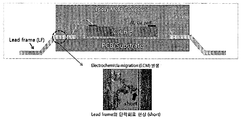
- 1 is a schematic view of a semiconductor package (wire bond) and the image of the corrosion type.
- FIG. 2 is a schematic diagram of a semiconductor package (Flip chip) and the image of the corrosion type.
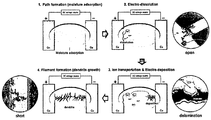
- FIG. 3 is a schematic diagram of an EMC process occurring between copper wires.
- FIG. 4 is a schematic diagram showing growth and inhibition of dendrite.
- FIG. 5 is a graph of the average and standard deviation of ECM time of Experimental Example 1.
- FIG. 6 is a graph showing the length of dendrite versus ECM time of Experimental Example 1.
- FIG. 7 is a graph showing the average and standard deviation of ECM time of Experimental Example 2.
- FIG. 8 is a graph showing the length of dendrite versus ECM time of Experimental Example 2.
- FIG. 9 is a graph showing the average and standard deviation of ECM time of Experimental Example 3.
- FIG. 10 is a graph showing the length of dendrite versus ECM time of Experimental Example 3.
- Shorten. 1 shows a schematic diagram and a corrosion type of a semiconductor package (wire bond). As shown in FIG. 1, electrochemical migration occurs, and short-circuit phenomenon of a lead frame is likely to occur.
- FIG. 2 shows a schematic diagram and corrosion type of a semiconductor package (Flip chip). As shown in Fig. 2, the distance between electrodes is finer, and between bumps, electrochemical migration occurs and short circuiting is also likely to occur.
- 3 shows the ECM mechanism occurring in the copper wiring. As shown in FIG. 3, when moisture is absorbed between the electrodes, dissolution occurs in one electrode, and ions of the electrode metal dissociate. These metal ions are deposited on the other electrode. After deposition, dendrite is generated and eventually a short occurs.
- the inventors of the present invention have added an additive, which is an embodiment of the present invention, to an epoxy mold compound (EMC) or an underfill material, which is a packaging material present between conductors, to dissolve or deposit even if water is absorbed.
- EMC epoxy mold compound
- underfill material which is a packaging material present between conductors
- mass transport refers to the transfer of material that occurs between the bulk solution and the electrode surface during electrode reactions, which is caused by diffusion, and diffusion is known to determine the rate of the reaction. This mass transport means not only growth of the dendrite by charge transport, but also dispersion of the nucleation region for the dendrite to grow through dispersion of the moved metal ions.
- a leveler, a suppressor, and a grain refiner can reduce the short circuit caused by dendrite.
- Dendritic growth is more likely to occur at the peak portion of the micro-rough surface than the trough portion at the micro-rough surface. That is, in order to suppress the growth of dendrite, the role of the leveler, the planarizing agent, and the crystal refiner is very important. A schematic diagram illustrating this is shown in FIG. 4. As shown in Fig. 4A, the dendrite is gradually formed at the peak position. On the other hand, as shown in FIG. 4 (b), when the leveling agent, the leveler and the crystal refiner are present, the growth of the dendrite is suppressed.
- An electrochemical migration prevention additive of copper is polyethylene glycol (PEG), polypropylene glycol (PPG), imidazole, polyvinylpyrrolidone (PVP) ), Janus Green B (JGB), Benzotriazole (BTA), Poly-diallyldimethylammonium chloride (PolyDADMAC), Thiourea, Dideda Didecyl-dimethylammonium chloride (DDAC), Diazine black (DB), 1-butyl-3-methylimidazolium hydrogen sulfite (1-butyl-3-methylimidazolium hydrogen sulfate ([BMIM] HSO 4 )), Nitrotetrazolium blue chloride (NTBC), 6-aminobenzo-thiazole, N-butyl-methyl pyreridinium bromide (N -butyl-methyl piperidinium bromide (PP 14 Br)), Polyethyleneimine (PEI), 4-Amino-2,1,3-benzo-2,1,3-benz
- the electrochemical migration prevention method of copper which is another embodiment of the present invention, prepares one of the above-mentioned prevention additives, and mixes the prepared prevention additives with an epoxy molding compound (EMC) or an underfill material to form a copper metal wiring It is used for the molding of.
- EMC epoxy molding compound
- the materials may retard at least one of the formation and growth of dendritic crystals between copper metal interconnects, either alone or in combination.
- Sodium chloride (NaCl) was used in deionized water having an electrical conductivity of 15 M ⁇ or more as a reference solution for confirming the effect of the present invention, and a solution having a high concentration of chloride ions (chloride ion) was prepared. Since chloride ions accelerate the ionization reaction of the anodic copper metal to promote the ECM phenomenon, the chloride ion solution was set as the accelerated environment in this experiment. The low chloride chloride solution simulated a mild environment and the high chloride chloride solution was corrosive, and additives were added to the accelerated solution to confirm the effect of the invention.
- the drop test is a useful test method for observing ECM in a short time by growing dendrite under severe conditions compared to other test methods. Based on the report that 1000 times of dendrite growth rate difference occurs compared with the commonly used constant temperature and humidity test, the ECM time difference in this experiment result will be effective to prevent the ECM of copper wiring used in the field. Judging. In this experiment, a voltage of 3V was applied in the standby state (atmosphere temperature and atmospheric humidity), and ECM time was measured at the same time.
- FIG. 6 the length of the dendrite growth at every predetermined time in the process of connecting the dendrite was measured and shown in a graph.
- this graph is a graph obtained by calculating the distance when the dendrite is connected between two copper wirings to 1 and calculating the fraction thereof.
- FIG. 6 it can be seen that there is a difference in the timing at which the initial dendrite is generated and the growth rate depending on the solution used in the drop test.
- ECG prevention additives polyethylene glycol, imidazole and benzotriazole were added, ECM was prevented through different mechanisms.
- polyethylene glycol In the case of polyethylene glycol, it takes the longest time to generate a dendrite, which means that it plays a role of delaying the time point at which the initial dendrite is generated.
- the ether group of polyethylene glycol traps copper ions eluted at the anode, thereby preventing the reduction of copper ions at the cathode.
- chloride ions serve as a bridge to copper ion trapping, and thus have a better effect at high concentrations of chloride ions.
- imidazole containing a nitrogen functional group is adsorbed on the convex region of the copper wiring surface to prevent the reduction of copper ions, thereby delaying the growth of the dendrite.
- benzotriazole the time taken for dendritic formation to be longer than that of imidazole, but shorter than polyethylene glycol. This also, like imidazole, was thought to play a role in slowing the growth rate of some dendrites.
Landscapes
- Engineering & Computer Science (AREA)
- Chemical & Material Sciences (AREA)
- Materials Engineering (AREA)
- Mechanical Engineering (AREA)
- Metallurgy (AREA)
- Organic Chemistry (AREA)
- Manufacturing & Machinery (AREA)
- Microelectronics & Electronic Packaging (AREA)
- Inorganic Chemistry (AREA)
- Preventing Corrosion Or Incrustation Of Metals (AREA)
Abstract
본 발명의 일실시예는 전기화학적 마이그레이션 방지 첨가제는 구리 금속 배선 사이에서 발생하는 수지상정의 생성 또는 성장을 지연 또는 방지하여 전기화학적 마이그레이션을 억제할 수 있다. 이를 통하여, 회로의 단락을 궁극적으로 방지할 수 있다. 또한, 이러한 방지 첨가제를, 반도체 등의 패키징 공정의 EMC 또는 언더필 재료와 혼합하여 사용할 경우, 반도체 소자의 신뢰도를 높일 수 있다.
Description
본 발명은 구리의 전기 단락을 유발하는 전기화학적 마이그레이션을 억제하기 위한 방지 첨가제 및 이러한 첨가제를 혼합한 물질을 이용하여 전기화학적 마이그레이션을 방지하는 방법에 관한 것이다.
산업사회가 발전함에 따라 고성능, 고신뢰성 전자부품이 필요하게 되고, 그 적용분야가 크게 확장되고 있다. 따라서 반도체 등 전자부품이 고밀도화되고, 고집적화되고 있다. 이에 따라, 그러한 전자부품에 사용되는 금속 배선이나 접합층의 선폭이나, 간격이 줄어들고 있으며, 그에 따라 새로운 신뢰성 문제가 발생하였다. 전자부품의 배선은 일반적으로 전기전도도 및 열전도도가 좋고, 가격이 저렴한 구리가 사용된다. 그러나, 전자부품의 배선이 수분에 노출되고, 두 배선 간에 전기가 흐르면 회로 상에 ECM(Electrochemical migration)이 발생되며, 이는 전자회로에서 전기적 단락(short)을 유발하여, 전자부품의 수명을 단축시킨다.
구리의 ECM 반응 메커니즘은 아래의 2가지 단계로 구별할 수 있다.
1단계 : 양극 반응
Cu + 4H2O → Cu(OH)2 + O2 + 3H2 ↑
2단계 : 음극 반응
Cu(OH)2
→ CuO ↓ + H2O
이러한 반응이 지속됨에 따라, CuO가 음극에서 양극으로 성장하여 수지상정(dendrite)을 발생시켜 전기적 단락을 유발한다.
또한 구리의 ECM은 클로라이드 이온에 의해 더욱 가속화 된다. 반도체 패키지 공정에서 사용되는 EMC나 언더필은 제조 공정상 클로라이드 이온이 포함된다. 따라서 실제 구리 금속은 수 ppm 이하의 클로라이드 이온이 포함된 부식 환경에 노출된다. 부식 환경에 클로라이드 이온이 존재하는 경우, 구리의 양극에서는 다음과 같은 반응이 발생한다.
Cu + Cl- → CuCl + e-
Cu + 2Cl- → CuCl2 + 2e-
Cu2O + 4HCl → 2H[CuCl2] + H2O
H[CuCl2] → H+ + [CuCl2]-
[CuCl2]- → CuCl2 + e-
CuCl → Cu+ + Cl-
CuCl2 → Cu2+ + 2Cl-
한편 구리의 음극에서는 다음과 같은 반응이 발생한다.
Cu+ + e- → Cu
Cu2+ + 2e- → Cu
위와 같은 반응을 통해 클로라이드 이온은 재 순환되어 지속적으로 촉매의 역할을 한다. 이로 인해 미량의 클로라이드 이온도 구리의 ECM에는 치명적일 수 있다.
또한 구리의 ECM의 발생과 성장 속도는 습도, 온도, 전극 간격 등과 같은 환경적 요소들에 의존한다. ECM을 방지하기 위해서 인접한 금속 배선 층 사이에 폴리머 계열의 물질을 도포하는 방법 등이 존재하나, 이는 종래의 금속 배선 제작 및 패키징에 추가적인 공정을 진행함으로써 시간적, 금전적인 손실을 야기한다. 그래서, 추가적인 공정을 요구하지 않고, 용이하게 구리의 ECM을 방지하기 위한 연구가 필요한 시점이다.
본 발명의 일 목적은 구리 금속 배선에서 발생하기 쉬운 ECM을 방지할 수 있는 방지 첨가제 및 이를 이용한 방법을 제공하고자 한다.
본 발명의 일실시예인 구리의 전기화학적 마이그레이션 방지 첨가제는 폴리에틸렌 글리콜(Polyethylene glycol (PEG)), 폴리프로필렌 글리콜(Polypropylene glycol(PPG)), 이미다졸(Imidazole), 폴리비닐피로리돈(Polyvinylpyrrolidone(PVP)), 야누스 그린 B(Janus Green B (JGB)), 벤조트리아졸(Benzotriazole (BTA)), 폴리-디알릴디메틸암모니움 클로라이드(Poly-diallyldimethylammonium chloride(PolyDADMAC)), 싸이오우레아(Thiourea), 디데실-디메틸암모니움 클로라이드(Didecyl-dimethylammonium chloride (DDAC)), 디아진 블랙(Diazine black (DB)), 1-부틸-3-메틸이미다졸리움 하이드로겐 설파이트(1-butyl-3-methylimidazolium hydrogen sulfate ([BMIM]HSO4)), 니트로테트라졸리움 블루 클로라이드(Nitrotetrazolium blue chloride (NTBC)), 6-아미노벤조-싸이아졸(6-aminobenzo-thiazole), N-부틸-메틸 피레리디늄 브로마이드(N-butyl-methyl piperidinium bromide (PP14Br)), 폴리에틸렌이민(Polyethyleneimine (PEI)), 4-아미노-2,1,3-벤조싸이아디아졸(4-Amino-2,1,3-benzothiadiazole), 데나토니움 벤조에이트(Denatonium benzoate), 브랜치드 4차 암모니움 설팩턴트(Branched quaternary ammonium surfactant), 4-니트로페놀(4-Nitrophenol), 디알릴메틸아민 하이드로클로라이드 및 설파 디옥사이드 혼성 고분자(Diallylmethylamine hydrochloride and sulfur dioxide copolymer), 디알릴아민 하이드로클로라이드 말레산 혼성 고분자(Diallylamine hydrochloride maleic acid copolymer (410C)), 에피클로로하이드린 디알릴아민 하이드로클로라이드 4차 아민 혼성고분자( Epichlorogydrinated diallylamine hydrochloride quaternary amine copolymer (880)), 메틸디알릴아민 하이드로클로라이드 설퍼 디옥사이드 혼성고분자(Methyldiallylamine hydrochloride sulfur dioxide copolymer (220lCl)), 도데실 트리메틸 암모니움 브로마이드(Dodecyltrimethylammoniumbromide (DTAB)), 피리딘(Pyridine), 젤라틴(Gelatin) 중 적어도 하나를 포함하며, 단독 사용 혹은 복합 사용시 구리 금속 배선의 수지상정의 생성 및 성장 중 적어도 하나를 지연시킬 수 있다.
본 발명의 다른 실시예인 전기화학적 마이그레션의 방지방법은 폴리에틸렌 글리콜(Polyethylene glycol (PEG)), 폴리프로필렌 글리콜(Polypropylene glycol(PPG)), 이미다졸(Imidazole), 폴리비닐피로리돈(Polyvinylpyrrolidone(PVP)), 야누스 그린 B(Janus Green B (JGB)), 벤조트리아졸(Benzotriazole (BTA)), 폴리-디알릴디메틸암모니움 클로라이드(Poly-diallyldimethylammonium chloride(PolyDADMAC)), 싸이오우레아(Thiourea), 디데실-디메틸암모니움 클로라이드(Didecyl-dimethylammonium chloride (DDAC)), 디아진 블랙(Diazine black (DB)), 1-부틸-3-메틸이미다졸리움 하이드로겐 설파이트(1-butyl-3-methylimidazolium hydrogen sulfate ([BMIM]HSO4)), 니트로테트라졸리움 블루 클로라이드(Nitrotetrazolium blue chloride (NTBC)), 6-아미노벤조-싸이아졸(6-aminobenzo-thiazole), N-부틸-메틸 피레리디늄 브로마이드(N-butyl-methyl piperidinium bromide (PP14Br)), 폴리에틸렌이민(Polyethyleneimine (PEI)), 4-아미노-2,1,3-벤조싸이아디아졸(4-Amino-2,1,3-benzothiadiazole), 데나토니움 벤조에이트(Denatonium benzoate), 브랜치드 4차 암모니움 설팩턴트(Branched quaternary ammonium surfactant), 4-니트로페놀(4-Nitrophenol), 디알릴메틸아민 하이드로클로라이드 및 설파 디옥사이드 혼성 고분자(Diallylmethylamine hydrochloride and sulfur dioxide copolymer), 디알릴아민 하이드로클로라이드 말레산 혼성 고분자(Diallylamine hydrochloride maleic acid copolymer (410C)), 에피클로로하이드린 디알릴아민 하이드로클로라이드 4차 아민 혼성고분자( Epichlorogydrinated diallylamine hydrochloride quaternary amine copolymer (880)), 메틸디알릴아민 하이드로클로라이드 설퍼 디옥사이드 혼성고분자(Methyldiallylamine hydrochloride sulfur dioxide copolymer (220lCl)), 도데실 트리메틸 암모니움 브로마이드(Dodecyltrimethylammoniumbromide (DTAB)), 피리딘(Pyridine), 젤라틴(Gelatin) 중 적어도 하나를 포함하는 전기화학적 마이그레이션 방지 첨가제를 준비하는 단계; 및 상기 준비된 방지 첨가제를 EMC(Epoxy molding compound) 또는 언더필(Underfill) 물질에 혼합하여, 구리 금속 배선의 몰딩에 이용하는 단계를 포함한다.
상기 물질들은 단독 사용 혹은 복합 사용시 구리 금속 배선 사이에서 수지상정의 생성 및 성장 중 적어도 하나를 지연시킬 수 있다.
본 발명을 통하여, 구리 금속 배선 사이에서 발생하는 수지상정의 생성 또는 성장을 지연 또는 방지하여 전기화학적 마이그레이션을 억제할 수 있다. 이를 통하여, 회로의 단락을 궁극적으로 방지할 수 있다. 또한, 이러한 방지 첨가제를, 반도체 등의 패키징 공정의 EMC 또는 언더필 재료와 혼합하여 사용할 경우, 반도체 소자의 신뢰도를 높일 수 있다.
도 1은 반도체 패키지(wire bond)의 모식도 및 부식유형의 이미지이다.
도 2는 반도체 패키지(Flip chip)의 모식도 및 부식유형의 이미지이다.
도 3은 구리 배선 사이에서 발생되는 EMC 과정에 관한 모식도이다.
도 4는 수지상정의 성장 및 억제를 나타내는 모식도이다.
도 5는 실험예 1의 ECM time의 평균(average) 및 표준 편차(standard deviation)에 대한 그래프이다.
도 6은 실험예 1의 ECM time에 대한 수지상정의 길이를 나타내는 그래프이다.
도 7은 실험예 2의 ECM time의 평균(average) 및 표준 편차(standard deviation)에 대한 그래프이다.
도 8은 실험예 2의 ECM time에 대한 수지상정의 길이를 나타내는 그래프이다.
도 9은 실험예 3의 ECM time의 평균(average) 및 표준 편차(standard deviation)에 대한 그래프이다.
도 10은 실험예 3의 ECM time에 대한 수지상정의 길이를 나타내는 그래프이다.
본 출원에서 사용한 용어는 단지 특정한 실시예를 설명하기 위해 사용된 것으로, 본 발명을 한정하려는 의도가 아니다. 단수의 표현은 문맥상 명백하게 다르게 뜻하지 않는 한, 복수의 표현을 포함한다. 본 출원에서, "포함하다" 또는 "가지다" 등의 용어는 명세서 상에 기재된 특징, 구성요소 등이 존재함을 지정하려는 것이지, 하나 또는 그 이상의 다른 특징들이나 구성요소 등이 존재하지 않거나 부가될 수 없음을 의미하는 것은 아니다.
다르게 정의되지 않는 한, 기술적이거나 과학적인 용어를 포함해서 여기서 사용되는 모든 용어들은 본 발명이 속하는 기술 분야에서 통상의 지식을 가진 자에 의해 일반적으로 이해되는 것과 동일한 의미를 가지고 있다. 일반적으로 사용되는 사전에 정의되어 있는 것과 같은 용어들은 관련 기술의 문맥상 가지는 의미와 일치하는 의미를 가지는 것으로 해석되어야 하며, 본 출원에서 명백하게 정의하지 않는 한, 이상적이거나 과도하게 형식적인 의미로 해석되지 않는다.
상술한 바와 같이, 특히, 반도체 패키지 공정에서, 두 배선 간에 전기가 흐르면, 회로 상에 전기화학적 마이그레이션(eletrochemical migration)이 발생되며, 이는 전자회로에서 전기적 단락(short)을 유발하여, 전자부품의 수명을 단축시킨다. 도 1에 반도체 패키지(wire bond)의 모식도 및 부식유형을 나타내었다. 도 1에 나타낸 바와 같이, 전기화학적 마이그레이션이 발생되고, 리드 프레임(lead frame)의 단락현상이 발생되기 쉽다. 또한, 도 2에 반도체 패키지(Flip chip)의 모식도 및 부식유형을 나타내었다. 도 2에 나타낸 바와 같이, 전극간 거리가 더 미세하며, 범프(bump) 사이에서, 전기화학적 마이그레이션이 발생되고 단락현상이 역시 발생되기 쉽다. 도 3에 구리 배선에서 발생하는 ECM 메커니즘을 나타내었다. 도 3에 나타낸 바와 같이, 전극 사이에서 수분(moisture)이 흡수되면, 일방의 전극에서 용해(dissolution)가 발생하여, 전극 금속의 이온이 해리된다. 이러한 금속 이온들이 타방의 전극에 증착(deposition)하게 된다. 증착 후 성장을 통하여 수지상정(dendrite)이 발생되고 결국 단락(short)이 발생하게 된다.
본 발명자들은 컨덕터(conductor) 사이에 존재하는 패키징 물질인 EMC(Epoxy Mold Compound)나 언더필(Underfill) 물질에, 본 발명의 일실시예인 첨가제를 추가하여 이용하면, 수분을 흡수하더라도, 용해나 증착 반응을 억제하여, 단락 현상이 지연되거나 억제될 수 있음을 착안하여, 본 발명인 전기화학적 마이그레이션을 방지하기 위한 기술을 도출하였다.
또한, 수지상의 증착(dendritic deposition)은 매스 트랜스포트(Mass transport)가 제한되면 발생한다. 매스 트랜스포트는 전극 반응 동안 벌크 솔루션(bulk solution)과 계면(electrode surface) 사이에서 일어나는 물질의 전달을 의미하며, 이는 확산(diffusion)에 의하여 일어나고, 확산이 반응의 속도를 결정한다고 알려져 있다. 이러한 매스 트랜스포트는 전하 트랜스포트(Charge transport)에 의한 수지상정의 성장 뿐만 아니라, 이동한 금속 이온의 분산을 통해 수지상정이 성장하기 위한 핵 생성 영역의 분산을 의미한다. 그리고, 레벨러(leveler), 평탄제 (Suppressor), 결정 미세화제(grain refiner)를 이용하면, 수지상정에 의한 회로 단락을 감소시킬 수 있다고 알려져 있다.
수지상정의 성장은 마이크로-러프(micro-rough)한 표면에서, 피크(peak)부분이 골(trough)부분 보다 증착이 많이 발생한다. 즉, 수지상정의 성장을 억제하기 위하여, 레벨러, 평탄제, 결정 미세화제의 역할이 매우 중요한 것이다. 이를 나타내는 모식도를 도 4에 나타내었다. 도 4(a)와 같이, 피크 위치에 점점 수지상정이 형성된다. 반면에, 도 4(b)와 같이, 평탄제, 레벨러, 결정 미세화제가 존재하는 경우, 수지상정의 성장이 억제된다.
본 발명의 일실시예인 구리의 전기화학적 마이그레이션 방지 첨가제는 폴리에틸렌 글리콜(Polyethylene glycol (PEG)), 폴리프로필렌 글리콜(Polypropylene glycol(PPG)), 이미다졸(Imidazole), 폴리비닐피로리돈(Polyvinylpyrrolidone(PVP)), 야누스 그린 B(Janus Green B (JGB)), 벤조트리아졸(Benzotriazole (BTA)), 폴리-디알릴디메틸암모니움 클로라이드(Poly-diallyldimethylammonium chloride(PolyDADMAC)), 싸이오우레아(Thiourea), 디데실-디메틸암모니움 클로라이드(Didecyl-dimethylammonium chloride (DDAC)), 디아진 블랙(Diazine black (DB)), 1-부틸-3-메틸이미다졸리움 하이드로겐 설파이트(1-butyl-3-methylimidazolium hydrogen sulfate ([BMIM]HSO4)), 니트로테트라졸리움 블루 클로라이드(Nitrotetrazolium blue chloride (NTBC)), 6-아미노벤조-싸이아졸(6-aminobenzo-thiazole), N-부틸-메틸 피레리디늄 브로마이드(N-butyl-methyl piperidinium bromide (PP14Br)), 폴리에틸렌이민(Polyethyleneimine (PEI)), 4-아미노-2,1,3-벤조싸이아디아졸(4-Amino-2,1,3-benzothiadiazole), 데나토니움 벤조에이트(Denatonium benzoate), 브랜치드 4차 암모니움 설팩턴트(Branched quaternary ammonium surfactant), 4-니트로페놀(4-Nitrophenol), 디알릴메틸아민 하이드로클로라이드 및 설파 디옥사이드 혼성 고분자(Diallylmethylamine hydrochloride and sulfur dioxide copolymer), 디알릴아민 하이드로클로라이드 말레산 혼성 고분자(Diallylamine hydrochloride maleic acid copolymer (410C)), 에피클로로하이드린 디알릴아민 하이드로클로라이드 4차 아민 혼성고분자( Epichlorogydrinated diallylamine hydrochloride quaternary amine copolymer (880)), 메틸디알릴아민 하이드로클로라이드 설퍼 디옥사이드 혼성고분자(Methyldiallylamine hydrochloride sulfur dioxide copolymer (220lCl)), 도데실 트리메틸 암모니움 브로마이드(Dodecyltrimethylammoniumbromide (DTAB)), 피리딘(Pyridine), 젤라틴(Gelatin) 중 적어도 하나를 포함하며, 단독 사용 혹은 복합 사용시 구리 금속 배선의 수지상정의 생성 및 성장 중 적어도 하나를 지연시킬 수 있다. 또한, 본 발명의 다른 실시예인 구리의 전기화학적 마이그레이션 방지 방법은 상술한 방지 첨가제 중 하나를 준비하고, 상기 준비된 방지 첨가제를 EMC(Epoxy molding compound) 또는 언더필(Underfill) 물질에 혼합하여, 구리 금속 배선의 몰딩에 이용하는 단계를 포함한다. 상기 물질들은 단독 사용 혹은 복합 사용시 구리 금속 배선 사이에서 수지상정의 생성 및 성장 중 적어도 하나를 지연시킬 수 있다.
이하, 실험예 및 실시예를 통하여 본 발명을 상세히 설명한다.
(실험예 1)
본 발명의 효과를 확인하기 위한 기준 용액으로 전기전도도가 15MΩ 이상인 탈이온수에 염화나트륨(sodium chloride(NaCl))을 사용하여 클로라이드 이온(chloride ion)의 농도가 저농도인 용액과 고농도인 용액을 제작하였다. 클로라이드 이온은 양극 구리 금속의 이온화 반응을 가속화시켜 ECM 현상을 촉진시키므로, 본 실험에서는 클로라이드 이온 용액을 가속 환경으로 설정하였다. 저농도 클로라이드 이온 용액은 mild 한 환경을, 고농도 클로라이드 이온 용액은 corrosive한 환경을 모사하였으며, 이러한 가속 용액에 첨가제를 첨가하여 발명의 효과를 확인하고자 하였다. 본 실험예에서는 폴리에틸렌 글리콜, 이미다졸 및 벤조트리아졸을 가속 용액인 클로라이드 이온 용액에 첨가하여 ECM 방지 첨가제로서 사용하였다. 각 용액은 충분히 교반 후, 안정화를 위하여 충분한 에이징 시간을 부여하였다. 상기와 같이, 준비된 8 종류의 용액을 구리 배선에 떨어뜨려 ECM Time을 측정하는 실험을 각 용액당 5회 이상 실시하였다. 이러한 실험은 물방울 시험(Water drop test)으로서, IPC-TM-650에 준하여 Comb Type으로 제작된 구리 배선에 물방울을 떨어뜨리고, 구리 배선 양쪽에 전압을 인가하여, 두 구리 배선 사이에 수지상정이 연결되는 과정과 시간을 측정하는 평가 방법이다. 물방울 시험은 타 시험 방법과 비교하였을 때, 가혹한 조건으로 수지상정을 성장시켜, 단시간에 ECM을 관찰하는데 유용한 실험방법이다. 일반적으로 사용되는 항온항습시험과 비교하여, 1000배의 수지상정 성장속도 차가 발생한다는 보고에 의거하여, 본 실험 결과에서의 ECM time 차이는 실제 필드에서 사용되는 구리 배선의 ECM을 방지하는데 효과적일 것으로 판단되었다. 본 실험에서는 대기 상태(대기온도, 대기습도)에서 3V의 전압을 인가하여 진행되었고, 이와 동시에 ECM time을 측정하였다.
도 5에 가속 용액과 방지 첨가제 용액에 대한 ECM time의 평균(average) 및 표준 편차(standard deviation)를 나타내었다. 도 5에 나타낸 바와 같이, 저농도 및 고농도의 클로라이드 이온 용액과 비교하여, 폴리에틸렌 글리콜, 이미다졸 벤조트리아졸을 첨가한 용액에서, 수지상정이 생성되기까지 시간이 길게 나타남을 확인할 수 있으며, 그 효과는 클로라이드 이온의 농도에 따라 차이가 발생함을 알 수 있었다.
도 6에 수지상정이 연결되는 과정에서 일정 시간마다 수지상정이 성장하는 길이를 측정하여 그래프로 나타내었다. 또한, 이 그래프는 두 구리 배선 사이에서 수지상정이 연결되었을 때의 거리를 1로 산출하여, 이에 대한 분율로 계산한 그래프이다. 도 6에 나타낸 바와 같이, 물방울 시험에 사용한 용액에 따라 초기 수지상정이 생성되는 시점과 성장하는 속도에 차이가 있음을 알 수 있다. 특히 ECM 방지 첨가제인 폴리에틸렌 글리콜, 이미다졸과 벤조트리아졸을 첨가한 경우, 서로 다른 메커니즘을 통해 ECM을 방지함을 확인할 수 있었다. 폴리에틸렌 글리콜의 경우, 수지상정이 생성되기까지 소요되는 시간이 가장 길게 나타났으며, 이는 초기 수지상정이 생성되는 시점을 지연하는 역할을 수행함을 의미한다. 폴리에틸렌 글리콜의 경우, 폴리에틸렌 글리콜의 에테르 기(ether group)가 양극에서 용출된 구리이온을 트래핑(trapping)함으로써 음극에서 구리 이온이 환원되는 것을 방지한다. 폴리에틸렌 글리콜의 경우 클로라이드 이온이 구리이온 트래핑에 브릿지(bridge) 역할을 하므로, 고농도 클로라이드 이온에서 더 좋은 효과를 나타낸다. 용출되는 구리 이온의 농도가 폴리에틸렌 글리콜의 농도 대비 과포화되면 음극에서 구리 이온의 환원이 발생하여 수지상정이 성장하게 되며, 폴리에틸렌 글리콜의 구리 이온 트래핑이 초기 수지상정의 생성을 억제하는 것으로 판단된다. 반면에, 이미다졸의 경우, 폴리에틸렌 글리콜과 유사하게 수지상정의 생성 시간을 지연시키는 역할을 하였으나, 이보다는 수지상정의 성장을 지연시키는 역할을 수행함을 확인할 수 있었다. 수지상정은 도금 과정이 부분적으로 확산 제어될 때 발생하는 데, 마이크로 단위의 표면조도를 가진 재료는 볼록한 영역이 오목한 영역보다 흡착이 더 많이 발생한다. 질소 작용기(Nitrogen functional group)를 포함하는 이미다졸은 구리 배선 표면의 볼록한 영역에 흡착되어 구리 이온의 환원을 방지하여 수지상정의 성장을 지연시키는 것으로 판단된다. 반면에, 벤조 트리아졸의 경우, 수지상정이 생성되기까지 소요되는 시간은 이미다졸보다는 길었으나, 폴리에틸렌 글리콜보다는 짧았다. 이 역시, 이미다졸처럼 일부 수지상정의 성장 속도를 지연시키는 역할을 하는 것으로 판단되었다.
(실험예 2)
실험예 1과 동일한 실험조건으로 실험을 실시하였고, 가속 용액 2종과 폴리에틸렌 글리콜, 이미다졸, 벤조트리아졸 이외에, 폴리에틸렌 글리콜+이미다졸을 방지 첨가제로 첨가하여 실험하였다. 도 7에, 도 5와 마찬가지로, 가속 용액과 방지 첨가제 용액에 대한 ECM time의 평균(average) 및 표준 편차(standard deviation)를 나타내었다. 또한, 도 8에, 도 6과 마찬가지로 수지상정이 연결되는 과정에서 일정 시간마다 수지상정이 성장하는 길이를 측정하여 그래프로 나타내었다. 실험예 1과 비교하였을 때, 가속 용액에 첨가제를 단독 첨가하는 경우보다, 복합 첨가하는 경우 ECM time이 더 길게 나타나는 것을 확인할 수 있었다. 폴리에틸렌 글리콜+이미다졸은 수지상정이 생성되기까지 소요시간은 폴리에틸렌 글리콜보다 길게 나타났으며, 이미다졸처럼 일부 수지상정의 성장 속도를 지연시키는 역할을 하는 것으로 판단되었다.
(실험예 3)
실험예 1과 동일한 실험조건으로 실험을 실시하였고, 가속 용액 2종과 폴리에틸렌 글리콜, 이미다졸, 벤조트리아졸, 폴리에틸렌 글리콜+이미다졸 이외에 야누스 그린 B+이미다졸, 야누스 그린 B+벤조트리아졸을 방지 첨가제로 첨가하여 실험하였다. 야누스 그린 B의 경우, 가속 용액에 단독 첨가한 경우 ECM time을 증가시키는 효과가 나타나지 않았지만, 이를 다른 첨가제와 복합 첨가하는 경우 ECM time이 증가하는 것을 확인할 수 있었다. 도 8에, 도 5와 마찬가지로, 가속 용액과 방지 첨가제 용액에 대한 ECM time의 평균(average) 및 표준 편차(standard deviation)를 나타내었다. 또한, 도 9에, 도 6과 마찬가지로 수지상정이 연결되는 과정에서 일정 시간마다 수지상정이 성장하는 길이를 측정하여 그래프로 나타내었다. 야누스 그린 B+이미다졸은 수지상정이 생성되기까지 소요시간은 벤조트리아졸과 유사하게 나타났으나, 수지상정의 성장 속도 지연이 다른 용액에 비해 크게 나타났다. 이는 용액 내 야누스 그린 B가 이미다졸의 수지상정 성장 속도 지연 효과를 향상시키기 때문이라고 판단된다. 또한, 야누스 그린 B+벤조트리아졸은 수지상정이 생성되기까지 소요시간이 다른 용액에 비해 크게 나타났다. 이는 용액 내 야누스 그린 B와 벤조트리아졸의 상호 작용에 의한 효과로 판단된다.
상기에서는 본 발명의 바람직한 실시예를 참조하여 설명하였지만, 해당 기술 분야의 숙련된 당업자는 하기의 특허 청구 범위에 기재된 본 발명의 사상 및 영역으로부터 벗어나지 않는 범위 내에서 본 발명을 다양하게 수정 및 변경시킬 수 있음을 이해할 수 있을 것이다.
Claims (3)
- 폴리에틸렌 글리콜(Polyethylene glycol (PEG)), 폴리프로필렌 글리콜(Polypropylene glycol(PPG)), 이미다졸(Imidazole), 폴리비닐피로리돈(Polyvinylpyrrolidone(PVP)), 야누스 그린 B(Janus Green B (JGB)), 벤조트리아졸(Benzotriazole (BTA)), 폴리-디알릴디메틸암모니움 클로라이드(Poly-diallyldimethylammonium chloride(PolyDADMAC)), 싸이오우레아(Thiourea), 디데실-디메틸암모니움 클로라이드(Didecyl-dimethylammonium chloride (DDAC)), 디아진 블랙(Diazine black (DB)), 1-부틸-3-메틸이미다졸리움 하이드로겐 설파이트(1-butyl-3-methylimidazolium hydrogen sulfate ([BMIM]HSO4)), 니트로테트라졸리움 블루 클로라이드(Nitrotetrazolium blue chloride (NTBC)), 6-아미노벤조-싸이아졸(6-aminobenzo-thiazole), N-부틸-메틸 피레리디늄 브로마이드(N-butyl-methyl piperidinium bromide (PP14Br)), 폴리에틸렌이민(Polyethyleneimine (PEI)), 4-아미노-2,1,3-벤조싸이아디아졸(4-Amino-2,1,3-benzothiadiazole), 데나토니움 벤조에이트(Denatonium benzoate), 브랜치드 4차 암모니움 설팩턴트(Branched quaternary ammonium surfactant), 4-니트로페놀(4-Nitrophenol), 디알릴메틸아민 하이드로클로라이드 및 설파 디옥사이드 혼성 고분자(Diallylmethylamine hydrochloride and sulfur dioxide copolymer), 디알릴아민 하이드로클로라이드 말레산 혼성 고분자(Diallylamine hydrochloride maleic acid copolymer (410C)), 에피클로로하이드린 디알릴아민 하이드로클로라이드 4차 아민 혼성고분자( Epichlorogydrinated diallylamine hydrochloride quaternary amine copolymer (880)), 메틸디알릴아민 하이드로클로라이드 설퍼 디옥사이드 혼성고분자(Methyldiallylamine hydrochloride sulfur dioxide copolymer (220lCl)), 도데실 트리메틸 암모니움 브로마이드(Dodecyltrimethylammoniumbromide (DTAB)), 피리딘(Pyridine), 젤라틴(Gelatin) 중 적어도 하나를 포함하며,구리 금속 배선의 수지상정의 생성 및 성장 중 적어도 하나를 지연시키는 전기화학적 마이그레이션 방지 첨가제.
- 폴리에틸렌 글리콜(Polyethylene glycol (PEG)), 폴리프로필렌 글리콜(Polypropylene glycol(PPG)), 이미다졸(Imidazole), 폴리비닐피로리돈(Polyvinylpyrrolidone(PVP)), 야누스 그린 B(Janus Green B (JGB)), 벤조트리아졸(Benzotriazole (BTA)), 폴리-디알릴디메틸암모니움 클로라이드(Poly-diallyldimethylammonium chloride(PolyDADMAC)), 싸이오우레아(Thiourea), 디데실-디메틸암모니움 클로라이드(Didecyl-dimethylammonium chloride (DDAC)), 디아진 블랙(Diazine black (DB)), 1-부틸-3-메틸이미다졸리움 하이드로겐 설파이트(1-butyl-3-methylimidazolium hydrogen sulfate ([BMIM]HSO4)), 니트로테트라졸리움 블루 클로라이드(Nitrotetrazolium blue chloride (NTBC)), 6-아미노벤조-싸이아졸(6-aminobenzo-thiazole), N-부틸-메틸 피레리디늄 브로마이드(N-butyl-methyl piperidinium bromide (PP14Br)), 폴리에틸렌이민(Polyethyleneimine (PEI)), 4-아미노-2,1,3-벤조싸이아디아졸(4-Amino-2,1,3-benzothiadiazole), 데나토니움 벤조에이트(Denatonium benzoate), 브랜치드 4차 암모니움 설팩턴트(Branched quaternary ammonium surfactant), 4-니트로페놀(4-Nitrophenol), 디알릴메틸아민 하이드로클로라이드 및 설파 디옥사이드 혼성 고분자(Diallylmethylamine hydrochloride and sulfur dioxide copolymer), 디알릴아민 하이드로클로라이드 말레산 혼성 고분자(Diallylamine hydrochloride maleic acid copolymer (410C)), 에피클로로하이드린 디알릴아민 하이드로클로라이드 4차 아민 혼성고분자( Epichlorogydrinated diallylamine hydrochloride quaternary amine copolymer (880)), 메틸디알릴아민 하이드로클로라이드 설퍼 디옥사이드 혼성고분자(Methyldiallylamine hydrochloride sulfur dioxide copolymer (220lCl)), 도데실 트리메틸 암모니움 브로마이드(Dodecyltrimethylammoniumbromide (DTAB)), 피리딘(Pyridine), 젤라틴(Gelatin) 중 적어도 하나를 포함하는 전기화학적 마이그레이션 방지 첨가제를 준비하는 단계; 및상기 준비된 방지 첨가제를 상기 물질들을 EMC(Epoxy molding compound) 또는 언더필(Underfill) 물질에 혼합하여, 구리 금속 배선의 몰딩에 이용하는 단계를 포함하는 전기화학적 마이그레이션을 방지하는 방법.
- 제2항에 있어서, 상기 금속 배선 사이에서 수지상정의 생성 및 성장 중 적어도 하나를 지연시키는 전기화학적 마이그레이션을 방지하는 방법.
Applications Claiming Priority (4)
| Application Number | Priority Date | Filing Date | Title |
|---|---|---|---|
| KR20160099331 | 2016-08-04 | ||
| KR10-2016-0099331 | 2016-08-04 | ||
| KR10-2016-0107614 | 2016-08-24 | ||
| KR1020160107614A KR101769716B1 (ko) | 2016-08-04 | 2016-08-24 | 전기화학적 마이그레이션 방지 첨가제 및 이를 이용한 전기화학적 마이그레이션을 방지하는 방법 |
Publications (1)
| Publication Number | Publication Date |
|---|---|
| WO2018026239A1 true WO2018026239A1 (ko) | 2018-02-08 |
Family
ID=59753230
Family Applications (1)
| Application Number | Title | Priority Date | Filing Date |
|---|---|---|---|
| PCT/KR2017/008453 Ceased WO2018026239A1 (ko) | 2016-08-04 | 2017-08-04 | 구리의 전기화학적 마이그레이션 방지 첨가제 및 이를 이용한 전기화학적 마이그레이션을 방지하는 방법 |
Country Status (2)
| Country | Link |
|---|---|
| KR (1) | KR101769716B1 (ko) |
| WO (1) | WO2018026239A1 (ko) |
Cited By (1)
| Publication number | Priority date | Publication date | Assignee | Title |
|---|---|---|---|---|
| US11128268B1 (en) | 2020-05-28 | 2021-09-21 | Nxp Usa, Inc. | Power amplifier packages containing peripherally-encapsulated dies and methods for the fabrication thereof |
Families Citing this family (1)
| Publication number | Priority date | Publication date | Assignee | Title |
|---|---|---|---|---|
| KR102289861B1 (ko) | 2019-07-03 | 2021-08-18 | 대한민국 | 메탈 마이그레이션에 의한 화재 시각화 장치 및 방법 |
Citations (5)
| Publication number | Priority date | Publication date | Assignee | Title |
|---|---|---|---|---|
| JPH10321994A (ja) * | 1997-05-16 | 1998-12-04 | Senju Metal Ind Co Ltd | 電子機器の導電部におけるマイグレーション防止方法 |
| JP2001257451A (ja) * | 2000-03-09 | 2001-09-21 | Matsushita Electric Ind Co Ltd | プリント配線板およびプリント配線板の製造方法 |
| KR20080017309A (ko) * | 2005-05-10 | 2008-02-26 | 다우 코닝 코포레이션 | 전자 장치에서 전자이동을 최소화하는 방법 |
| KR20080032455A (ko) * | 2006-10-10 | 2008-04-15 | 삼성전기주식회사 | 내마이그레이션 잉크 조성물 및 이를 이용하여 제조된전도성 배선 |
| JP2012231035A (ja) * | 2011-04-26 | 2012-11-22 | Fujifilm Corp | 成形回路基板およびその製造方法 |
-
2016
- 2016-08-24 KR KR1020160107614A patent/KR101769716B1/ko active Active
-
2017
- 2017-08-04 WO PCT/KR2017/008453 patent/WO2018026239A1/ko not_active Ceased
Patent Citations (5)
| Publication number | Priority date | Publication date | Assignee | Title |
|---|---|---|---|---|
| JPH10321994A (ja) * | 1997-05-16 | 1998-12-04 | Senju Metal Ind Co Ltd | 電子機器の導電部におけるマイグレーション防止方法 |
| JP2001257451A (ja) * | 2000-03-09 | 2001-09-21 | Matsushita Electric Ind Co Ltd | プリント配線板およびプリント配線板の製造方法 |
| KR20080017309A (ko) * | 2005-05-10 | 2008-02-26 | 다우 코닝 코포레이션 | 전자 장치에서 전자이동을 최소화하는 방법 |
| KR20080032455A (ko) * | 2006-10-10 | 2008-04-15 | 삼성전기주식회사 | 내마이그레이션 잉크 조성물 및 이를 이용하여 제조된전도성 배선 |
| JP2012231035A (ja) * | 2011-04-26 | 2012-11-22 | Fujifilm Corp | 成形回路基板およびその製造方法 |
Cited By (1)
| Publication number | Priority date | Publication date | Assignee | Title |
|---|---|---|---|---|
| US11128268B1 (en) | 2020-05-28 | 2021-09-21 | Nxp Usa, Inc. | Power amplifier packages containing peripherally-encapsulated dies and methods for the fabrication thereof |
Also Published As
| Publication number | Publication date |
|---|---|
| KR101769716B1 (ko) | 2017-08-18 |
Similar Documents
| Publication | Publication Date | Title |
|---|---|---|
| US6444110B2 (en) | Electrolytic copper plating method | |
| Krumbein | Metallic electromigration phenomena | |
| KR100844970B1 (ko) | 전자 장치 용도의 전기적 안정성을 가진 전도성 및 저항성재료 | |
| KR100728852B1 (ko) | 반도체 장치 | |
| US7064068B2 (en) | Method to improve planarity of electroplated copper | |
| US11791248B2 (en) | Coated semiconductor devices | |
| JP2004518022A (ja) | 電子デバイス製造のための金属の電気化学的共析出 | |
| WO2018026239A1 (ko) | 구리의 전기화학적 마이그레이션 방지 첨가제 및 이를 이용한 전기화학적 마이그레이션을 방지하는 방법 | |
| CN115074734B (zh) | 一种铝基材线路板用减铜添加剂及其制备方法和使用方法 | |
| KR20150079077A (ko) | 퀴놀리늄계 평탄제를 포함하는 구리 도금액 및 이를 이용한 구리 도금 방법 | |
| WO2020180016A1 (ko) | 실리콘질화막 식각 조성물 | |
| JP4809546B2 (ja) | 有機溶媒を用いたボイドフリー銅メッキ方法 | |
| US20070205109A1 (en) | Palladium plating solution | |
| KR20140091689A (ko) | 구리 및 구리 합금 에칭용 수성 조성물 | |
| KR101194541B1 (ko) | 주석 또는 주석 합금 도금의 변색 방지제, 및 이를 이용한 회로 기판 및 그 제조방법 | |
| WO2020096374A2 (ko) | 브롬 이온을 포함한 구리 전해도금용 전해질 용액 및 이를 이용한 구리 전해도금 방법 | |
| US11946153B2 (en) | Copper or copper alloy electroplating bath | |
| KR101184558B1 (ko) | 무전해 금속 도금의 전처리제 및 이를 이용한 회로 기판의 제조방법 | |
| US4614963A (en) | Plastics encapsulated electronic devices | |
| US4586990A (en) | Chelating metals | |
| KR102445575B1 (ko) | 도금용 평활제, 이를 포함하는 도금용 조성물 및 구리 배선의 형성방법 | |
| KR102771983B1 (ko) | 구리 도금 조성물, 이를 이용한 구리 도금 방법 및 이에 의해 제조된 기판 | |
| WO2021095909A1 (ko) | 니켈인 합금 도금을 위한 조성물 | |
| US20250226305A1 (en) | Circuit board and semiconductor package comprising same | |
| CN110295382A (zh) | 酸铜整平剂及其应用、铜电镀溶液及其制备方法 |
Legal Events
| Date | Code | Title | Description |
|---|---|---|---|
| 121 | Ep: the epo has been informed by wipo that ep was designated in this application |
Ref document number: 17837290 Country of ref document: EP Kind code of ref document: A1 |
|
| NENP | Non-entry into the national phase |
Ref country code: DE |
|
| 122 | Ep: pct application non-entry in european phase |
Ref document number: 17837290 Country of ref document: EP Kind code of ref document: A1 |