WO2018008945A1 - 교류 전위 변조 마이크로플루이딕 채널을 이용한 압타머 선별 방법 - Google Patents
교류 전위 변조 마이크로플루이딕 채널을 이용한 압타머 선별 방법 Download PDFInfo
- Publication number
- WO2018008945A1 WO2018008945A1 PCT/KR2017/007096 KR2017007096W WO2018008945A1 WO 2018008945 A1 WO2018008945 A1 WO 2018008945A1 KR 2017007096 W KR2017007096 W KR 2017007096W WO 2018008945 A1 WO2018008945 A1 WO 2018008945A1
- Authority
- WO
- WIPO (PCT)
- Prior art keywords
- terthiophene
- microfluidic channel
- poly
- aptamer
- target material
- Prior art date
- Legal status (The legal status is an assumption and is not a legal conclusion. Google has not performed a legal analysis and makes no representation as to the accuracy of the status listed.)
- Ceased
Links
Images


Classifications
-
- G—PHYSICS
- G01—MEASURING; TESTING
- G01N—INVESTIGATING OR ANALYSING MATERIALS BY DETERMINING THEIR CHEMICAL OR PHYSICAL PROPERTIES
- G01N33/00—Investigating or analysing materials by specific methods not covered by groups G01N1/00 - G01N31/00
- G01N33/48—Biological material, e.g. blood, urine; Haemocytometers
- G01N33/50—Chemical analysis of biological material, e.g. blood, urine; Testing involving biospecific ligand binding methods; Immunological testing
- G01N33/53—Immunoassay; Biospecific binding assay; Materials therefor
- G01N33/543—Immunoassay; Biospecific binding assay; Materials therefor with an insoluble carrier for immobilising immunochemicals
- G01N33/54366—Apparatus specially adapted for solid-phase testing
- G01N33/54386—Analytical elements
-
- B—PERFORMING OPERATIONS; TRANSPORTING
- B01—PHYSICAL OR CHEMICAL PROCESSES OR APPARATUS IN GENERAL
- B01L—CHEMICAL OR PHYSICAL LABORATORY APPARATUS FOR GENERAL USE
- B01L3/00—Containers or dishes for laboratory use, e.g. laboratory glassware; Droppers
-
- B—PERFORMING OPERATIONS; TRANSPORTING
- B01—PHYSICAL OR CHEMICAL PROCESSES OR APPARATUS IN GENERAL
- B01L—CHEMICAL OR PHYSICAL LABORATORY APPARATUS FOR GENERAL USE
- B01L3/00—Containers or dishes for laboratory use, e.g. laboratory glassware; Droppers
- B01L3/50—Containers for the purpose of retaining a material to be analysed, e.g. test tubes
- B01L3/502—Containers for the purpose of retaining a material to be analysed, e.g. test tubes with fluid transport, e.g. in multi-compartment structures
- B01L3/5027—Containers for the purpose of retaining a material to be analysed, e.g. test tubes with fluid transport, e.g. in multi-compartment structures by integrated microfluidic structures, i.e. dimensions of channels and chambers are such that surface tension forces are important, e.g. lab-on-a-chip
-
- B—PERFORMING OPERATIONS; TRANSPORTING
- B01—PHYSICAL OR CHEMICAL PROCESSES OR APPARATUS IN GENERAL
- B01L—CHEMICAL OR PHYSICAL LABORATORY APPARATUS FOR GENERAL USE
- B01L3/00—Containers or dishes for laboratory use, e.g. laboratory glassware; Droppers
- B01L3/50—Containers for the purpose of retaining a material to be analysed, e.g. test tubes
- B01L3/502—Containers for the purpose of retaining a material to be analysed, e.g. test tubes with fluid transport, e.g. in multi-compartment structures
- B01L3/5027—Containers for the purpose of retaining a material to be analysed, e.g. test tubes with fluid transport, e.g. in multi-compartment structures by integrated microfluidic structures, i.e. dimensions of channels and chambers are such that surface tension forces are important, e.g. lab-on-a-chip
- B01L3/502715—Containers for the purpose of retaining a material to be analysed, e.g. test tubes with fluid transport, e.g. in multi-compartment structures by integrated microfluidic structures, i.e. dimensions of channels and chambers are such that surface tension forces are important, e.g. lab-on-a-chip characterised by interfacing components, e.g. fluidic, electrical, optical or mechanical interfaces
-
- B—PERFORMING OPERATIONS; TRANSPORTING
- B01—PHYSICAL OR CHEMICAL PROCESSES OR APPARATUS IN GENERAL
- B01L—CHEMICAL OR PHYSICAL LABORATORY APPARATUS FOR GENERAL USE
- B01L3/00—Containers or dishes for laboratory use, e.g. laboratory glassware; Droppers
- B01L3/50—Containers for the purpose of retaining a material to be analysed, e.g. test tubes
- B01L3/502—Containers for the purpose of retaining a material to be analysed, e.g. test tubes with fluid transport, e.g. in multi-compartment structures
- B01L3/5027—Containers for the purpose of retaining a material to be analysed, e.g. test tubes with fluid transport, e.g. in multi-compartment structures by integrated microfluidic structures, i.e. dimensions of channels and chambers are such that surface tension forces are important, e.g. lab-on-a-chip
- B01L3/502753—Containers for the purpose of retaining a material to be analysed, e.g. test tubes with fluid transport, e.g. in multi-compartment structures by integrated microfluidic structures, i.e. dimensions of channels and chambers are such that surface tension forces are important, e.g. lab-on-a-chip characterised by bulk separation arrangements on lab-on-a-chip devices, e.g. for filtration or centrifugation
-
- C—CHEMISTRY; METALLURGY
- C12—BIOCHEMISTRY; BEER; SPIRITS; WINE; VINEGAR; MICROBIOLOGY; ENZYMOLOGY; MUTATION OR GENETIC ENGINEERING
- C12N—MICROORGANISMS OR ENZYMES; COMPOSITIONS THEREOF; PROPAGATING, PRESERVING, OR MAINTAINING MICROORGANISMS; MUTATION OR GENETIC ENGINEERING; CULTURE MEDIA
- C12N15/00—Mutation or genetic engineering; DNA or RNA concerning genetic engineering, vectors, e.g. plasmids, or their isolation, preparation or purification; Use of hosts therefor
- C12N15/09—Recombinant DNA-technology
- C12N15/10—Processes for the isolation, preparation or purification of DNA or RNA
-
- C—CHEMISTRY; METALLURGY
- C12—BIOCHEMISTRY; BEER; SPIRITS; WINE; VINEGAR; MICROBIOLOGY; ENZYMOLOGY; MUTATION OR GENETIC ENGINEERING
- C12N—MICROORGANISMS OR ENZYMES; COMPOSITIONS THEREOF; PROPAGATING, PRESERVING, OR MAINTAINING MICROORGANISMS; MUTATION OR GENETIC ENGINEERING; CULTURE MEDIA
- C12N15/00—Mutation or genetic engineering; DNA or RNA concerning genetic engineering, vectors, e.g. plasmids, or their isolation, preparation or purification; Use of hosts therefor
- C12N15/09—Recombinant DNA-technology
- C12N15/10—Processes for the isolation, preparation or purification of DNA or RNA
- C12N15/1034—Isolating an individual clone by screening libraries
- C12N15/1048—SELEX
-
- G—PHYSICS
- G01—MEASURING; TESTING
- G01N—INVESTIGATING OR ANALYSING MATERIALS BY DETERMINING THEIR CHEMICAL OR PHYSICAL PROPERTIES
- G01N33/00—Investigating or analysing materials by specific methods not covered by groups G01N1/00 - G01N31/00
- G01N33/48—Biological material, e.g. blood, urine; Haemocytometers
- G01N33/50—Chemical analysis of biological material, e.g. blood, urine; Testing involving biospecific ligand binding methods; Immunological testing
- G01N33/53—Immunoassay; Biospecific binding assay; Materials therefor
- G01N33/543—Immunoassay; Biospecific binding assay; Materials therefor with an insoluble carrier for immobilising immunochemicals
-
- G—PHYSICS
- G01—MEASURING; TESTING
- G01N—INVESTIGATING OR ANALYSING MATERIALS BY DETERMINING THEIR CHEMICAL OR PHYSICAL PROPERTIES
- G01N35/00—Automatic analysis not limited to methods or materials provided for in any single one of groups G01N1/00 - G01N33/00; Handling materials therefor
- G01N35/08—Automatic analysis not limited to methods or materials provided for in any single one of groups G01N1/00 - G01N33/00; Handling materials therefor using a stream of discrete samples flowing along a tube system, e.g. flow injection analysis
-
- B—PERFORMING OPERATIONS; TRANSPORTING
- B01—PHYSICAL OR CHEMICAL PROCESSES OR APPARATUS IN GENERAL
- B01L—CHEMICAL OR PHYSICAL LABORATORY APPARATUS FOR GENERAL USE
- B01L2200/00—Solutions for specific problems relating to chemical or physical laboratory apparatus
- B01L2200/10—Integrating sample preparation and analysis in single entity, e.g. lab-on-a-chip concept
-
- B—PERFORMING OPERATIONS; TRANSPORTING
- B01—PHYSICAL OR CHEMICAL PROCESSES OR APPARATUS IN GENERAL
- B01L—CHEMICAL OR PHYSICAL LABORATORY APPARATUS FOR GENERAL USE
- B01L2300/00—Additional constructional details
- B01L2300/06—Auxiliary integrated devices, integrated components
- B01L2300/0627—Sensor or part of a sensor is integrated
- B01L2300/0645—Electrodes
-
- B—PERFORMING OPERATIONS; TRANSPORTING
- B01—PHYSICAL OR CHEMICAL PROCESSES OR APPARATUS IN GENERAL
- B01L—CHEMICAL OR PHYSICAL LABORATORY APPARATUS FOR GENERAL USE
- B01L2300/00—Additional constructional details
- B01L2300/08—Geometry, shape and general structure
- B01L2300/0809—Geometry, shape and general structure rectangular shaped
- B01L2300/0819—Microarrays; Biochips
-
- B—PERFORMING OPERATIONS; TRANSPORTING
- B01—PHYSICAL OR CHEMICAL PROCESSES OR APPARATUS IN GENERAL
- B01L—CHEMICAL OR PHYSICAL LABORATORY APPARATUS FOR GENERAL USE
- B01L2300/00—Additional constructional details
- B01L2300/16—Surface properties and coatings
-
- B—PERFORMING OPERATIONS; TRANSPORTING
- B01—PHYSICAL OR CHEMICAL PROCESSES OR APPARATUS IN GENERAL
- B01L—CHEMICAL OR PHYSICAL LABORATORY APPARATUS FOR GENERAL USE
- B01L2400/00—Moving or stopping fluids
- B01L2400/04—Moving fluids with specific forces or mechanical means
- B01L2400/0403—Moving fluids with specific forces or mechanical means specific forces
- B01L2400/0415—Moving fluids with specific forces or mechanical means specific forces electrical forces, e.g. electrokinetic
Definitions
- the present invention relates to aptamer screening methods using alternating current potential modulation microfluidic channels. More specifically, alternating the AC potential modulation microfluidic channel inner wall with an electrically conductive polymer having a functional functional group to fix the target chemically stably, injecting a random DNA library into the channel, and then applying an alternating voltage to the target material
- the present invention relates to a method for efficiently selecting an aptamer having a high affinity with a target material by inducing a reaction between random DNA libraries in a short time.
- Aptamers are single-stranded DNA or RNA that can specifically bind to targets such as proteins, lipids, and organic inorganic compounds. It forms a unique secondary structure that binds to the target molecule and discovers aptamers through the Systematic Evolution of Ligands by Exponential Enrichment (SELEX) method.
- SELEX Systematic Evolution of Ligands by Exponential Enrichment
- SELEX involves the in vitro selection of a small number of individuals with affinity for a target from a randomly synthesized nucleic acid library, SELEX commonly involves the synthesis, binding and separation of random libraries, and DNA amplification process.
- affinity chromatography method is to select a specific DNA binding specifically to the target material by flowing a random DNA (or RNA) library to the column to which the target material is immobilized, and also by the nitrocellulose membrane method Is a method of obtaining DNA by separating only the DNA complex bound to the target material using a filter.
- the SELEX methods have the advantage of discovering aptamers for low molecular weight materials, but have a disadvantage of low separation efficiency. Therefore, it is necessary to repeat the SELEX process at least 8 to 20 times to increase the aptamer screening efficiency. This repetitive process requires a long time ( ⁇ 30 days), excessive reagents and high costs, and difficult to immobilize low molecular weight target material, which makes it difficult to efficiently separate DNA.
- Microfluidic-based SELEX methods can reduce the SELEX process by 5 to 8 by simplifying the SELEX process and reduce the production time of the aptamer in a short time ( ⁇ 7 days).
- microfluidic devices require a complicated manufacturing process based on polydimethylsiloxane ('PDMS'), and thus require a high production time and cost. There is also the hassle of having to stably place the magnetic beads or sol-gel to which the target material is fixed within the microfluidic channel.
- 'PDMS' polydimethylsiloxane
- An object of the present invention is to provide a method for manufacturing a microfluidic device that can simplify the manufacturing process and reduce the manufacturing cost by using a carbon-based microfluidic channel using a carbon ink mixed with an electrically conductive monomer.
- the present invention provides a method for screening aptamers using an AC potential modulated microfluidic channel that can significantly select aptamers having high affinity with a target material in a single time through a single Selex process.
- the present invention reforms the inner wall of the microfluidic channel into an electrically conductive polymer membrane, fixes the target substance to the polymer membrane, and flows a fluid including a DNA library by applying an alternating current potential to the target material.
- Reaction channel for inducing a reaction;
- a detection channel consisting of a working electrode, an auxiliary electrode, and a reference electrode, and including a detection channel for electrochemically selecting an aptamer reacting with a target material.
- the present invention comprises the steps of preparing an ink in which the electrically conductive monomer and carbon is uniformly mixed; And screen-printing the prepared ink on a substrate to form a carbon-based microfluidic channel, and then bonding the cover to the microfluidic device manufacturing method using alternating current potential modulation.
- the present invention comprises the steps of preparing an ink in which the electroconductive monomer and carbon is uniformly mixed (first step); Screen printing the prepared ink on a substrate to form a carbon-based microfluidic channel (second step); Electrolytically polymerizing the electrically conductive monomer contained in the inner wall of the microfluidic channel by a cyclic current-voltage method to form an electrically conductive polymer membrane and activating functional groups of the formed polymer membrane (step 3); Immobilizing a target material that binds to the DNA to be selected on the electrically conductive polymer membrane in which the functional group is activated (step 4); Injecting a random DNA library into the microfluidic channel to which the target material is immobilized and applying an alternating current potential to induce a reaction between the target material and the random DNA library (step 5); Collecting the aptamer candidate group by selecting specific DNA selectively reacted with the target material after the reaction (sixth step); And applying an alternating potential to the microfluidic channel not modified with the first step
- the present invention is an electrode electrodeposited in order to the gold nanoparticle layer and the electrically conductive polymer film; And it provides a target material detection sensor, comprising a target material detection aptamer fixed to the activated functional group on the electrode.
- the aptamer screening method using the AC potential modulating microfluidic channel according to the present invention has a very low reagent consumption ( ⁇ several ⁇ L), and can greatly simplify the aptamer screening process by using an AC potential modulation technique.
- the fluid flow of the random DNA library moves to a turbulent form having a specific wave, thereby improving the reactivity of the target material and the aptamer, thereby making it possible to select the aptamer very quickly and simply.
- FIG. 1 is a schematic diagram of fabricating an AC potential modulated microfluidic device
- FIG. 2 is a schematic diagram of aptamer selection using an AC potential modulated microfluidic device.
- Figure 4 shows the adsorption time (a) of the PvLDH to the alternating potential modulation microfluidic channel (a), the injection time of the random DNA library (b), the reaction of the target material and the random DNA library according to pH (c), and the temperature conditions Measurement of the optimization conditions for the reaction of the target substance with the library,
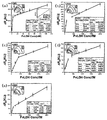
- FIG. 6 shows various PvLDH detection sensors modified with selected LDH1 aptamers (a), LDH2 aptamers (b), LDH3 aptamers (c), LDH4 aptamers (d), and LDH5 aptamers (e). Calibration curve for PvLDH concentration,
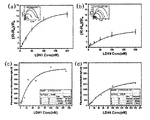
- Figure 7 shows the dissociation constant crystal curve graph of the LDH1 aptamer (a) and LDH4 aptamer (b) using impedance, the dissociation constant crystal curve of LDH1 aptamer (c) and LDH4 aptamer (d) using the fluorescence method It is a graph.
- the inventors of the present invention can significantly simplify the existing Selex process by stably fixing the target material to the inner wall of a carbon-based microfluidic channel modified with an electrically conductive polymer membrane having a functional group.
- the present invention has been completed by discovering that the disadvantages of the microfluidic channel can be overcome.
- the present invention includes a reaction channel for modifying the inner wall of the microfluidic channel into an electrically conductive polymer membrane, fixing the target substance to the polymer membrane, and applying an alternating current potential to flow a fluid including a DNA library to induce a reaction with the target substance; And a detection channel consisting of a working electrode, an auxiliary electrode, and a reference electrode, and including a detection channel for electrochemically selecting an aptamer reacting with a target material.
- the microfluidic channel may be a carbon-based microfluidic channel, but is not limited thereto.
- the electrically conductive polymer is poly-2,2: 5,5-terthiophene-3-benzoic acid (poly- ⁇ 2,2: 5,5-terthiophene-3-benzoic acid ⁇ ; pTTBA '), poly-5, 2-5,2-terthiophene-3-carboxylic acid (poly- ⁇ 5,2-5,2-terthiophene-3-carboxylic acid ⁇ ; 'pTTCA'), poly- ⁇ 4 '-([2, 2 ': 5', 2 ''-terthiophene] -3 ')-[1,1'-biphenyl] -4-carboxylic acid (poly- ⁇ 4'-([2,2 ': 5' , 2 ''-terthiophen] -3'-yl)-[1,1'-biphenyl] -4-carboxylic acid; 'TTBPA'), and poly- ⁇ 4- (2,5-di (terthiophene- 2) -1H-
- the target substance is a malaria biomarker or amyloid-beta protein selected from the group consisting of plasmav vivax lactate dehydrogenase (PvLDH), plasmao falciparum lactate dehydrogenase (PfLDH), plasmao malariae lactate dehydrogenase (PmLDH), and plasmaodium ovale lactate dehydrogenase (PoLDH).
- PvLDH plasmav vivax lactate dehydrogenase
- PfLDH plasmao falciparum lactate dehydrogenase
- PmLDH plasmao malariae lactate dehydrogenase
- PoLDH plasmaodium ovale lactate dehydrogenase
- the present invention comprises the steps of preparing an ink in which the electrically conductive monomer and carbon is uniformly mixed; And screen-printing the prepared ink on a substrate to form a carbon-based microfluidic channel, and then bonding the cover to the microfluidic device manufacturing method using alternating current potential modulation.
- the electrically conductive monomer is 2,2: 5,5-terthiophene-3-benzoic acid (2,2: 5,5-terthiophene-3-benzoic acid; 'TTBA'), 5,2-5,2- Terthiophene-3-carboxylic acid (5,2-5,2-terthiophene-3-carboxylic acid; 'TTCA'), 4 '-([2,2': 5 ', 2' '-terthiophene ] -3 ')-[1,1'-biphenyl] -4-carboxylic acid (4'-([2,2 ': 5', 2 ''-terthiophen] -3'-yl)-[1 , 1'-biphenyl] -4-carboxylic acid; 'TTBPA'), and 4- (2,5-di (terthiophen-2) -1H-pyrrole-1) benzoic acid (4- (2,5-di (thiophen-2-yl) -1H-pyrrol
- the ink may include 1 to 5% by weight of an electrically conductive monomer and the balance of carbon, but is not limited thereto.
- the screen printing may be performed 3 to 7 times, but is not limited thereto.
- the present invention comprises the steps of preparing an ink in which the electroconductive monomer and carbon is uniformly mixed (first step); Screen printing the prepared ink on a substrate to form a carbon-based microfluidic channel (second step); Electrolytically polymerizing the electrically conductive monomer contained in the inner wall of the microfluidic channel by a cyclic current-voltage method to form an electrically conductive polymer membrane and activating functional groups of the formed polymer membrane (step 3); Immobilizing a target material that binds to the DNA to be selected on the electrically conductive polymer membrane in which the functional group is activated (step 4); Injecting a random DNA library into the microfluidic channel to which the target material is immobilized and applying an alternating current potential to induce a reaction between the target material and the random DNA library (step 5); Collecting the aptamer candidate group by selecting specific DNA selectively reacted with the target material after the reaction (sixth step); And applying an alternating potential to the microfluidic channel not modified with the first step
- the electrically conductive monomer is 2,2: 5,5-terthiophene-3-benzoic acid (2,2: 5,5-terthiophene-3-benzoic acid; 'TTBA'), 5,2-5,2- Terthiophene-3-carboxylic acid (5,2-5,2-terthiophene-3-carboxylic acid; 'TTCA'), 4 '-([2,2': 5 ', 2' '-terthiophene ] -3 ')-[1,1'-biphenyl] -4-carboxylic acid (4'-([2,2 ': 5', 2 ''-terthiophen] -3'-yl)-[1 , 1'-biphenyl] -4-carboxylic acid; 'TTBPA'), and 4- (2,5-di (terthiophen-2) -1H-pyrrole-1) benzoic acid (4- (2,5-di (thiophen-2-yl) -1H-pyrrol
- the ink may include 1 to 5% by weight of an electrically conductive monomer and the balance of carbon, but is not limited thereto.
- the third step may be electrolytic polymerization by scanning 1 to 3 times from 0.0V to + 1.2 V by the cyclic current-voltage method, but is not limited thereto.
- the functional group may be any one of a carboxyl group and an amine group, but is not limited thereto.
- the target substance is a malaria biomarker or amyloid-beta protein selected from the group consisting of plasmav vivax lactate dehydrogenase (PvLDH), plasmao falciparum lactate dehydrogenase (PfLDH), plasmao malariae lactate dehydrogenase (PmLDH), and plasmaodium ovale lactate dehydrogenase (PoLDH).
- PvLDH plasmav vivax lactate dehydrogenase
- PfLDH plasmao falciparum lactate dehydrogenase
- PmLDH plasmao malariae lactate dehydrogenase
- PoLDH plasmaodium ovale lactate dehydrogenase
- the target material may be fixed by reacting the target material on the electrically conductive polymer membrane in which the functional group is activated for 8 to 12 hours, but is not limited thereto.
- a random DNA library is injected into the microfluidic channel to which the target material is immobilized for 20 to 40 minutes, and a reaction between the target material and the random DNA library is performed at pH 6.0 to 8.0 and 25 to 40 ° C. May be induced, but is not limited thereto.
- an AC potential of 0.0 V to 3.0 V may be applied at a frequency of 0.0 MHz to 1.0 MHz, but is not limited thereto.
- the present invention is an electrode electrodeposited in order to the gold nanoparticle layer and the electrically conductive polymer film; And it provides a target material detection sensor, comprising a target material detection aptamer fixed to the activated functional group on the electrode.
- the electrically conductive polymer is poly-2,2: 5,5-terthiophene-3-benzoic acid (poly- ⁇ 2,2: 5,5-terthiophene-3-benzoic acid ⁇ ; pTTBA '), poly-5, 2-5,2-terthiophene-3-carboxylic acid (poly- ⁇ 5,2-5,2-terthiophene-3-carboxylic acid ⁇ ; 'pTTCA'), poly- ⁇ 4 '-([2, 2 ': 5', 2 ''-terthiophene] -3 ')-[1,1'-biphenyl] -4-carboxylic acid (poly- ⁇ 4'-([2,2 ': 5' , 2 ''-terthiophen] -3'-yl)-[1,1'-biphenyl] -4-carboxylic acid; 'TTBPA'), and poly- ⁇ 4- (2,5-di (terthiophene- 2) -1H-
- the aptamer may be any one selected from the group consisting of Lactate dehydrogenase (hereinafter referred to as 'LDH') LDH1, LDH2, LDH3, LDH4, and LDH5, but is not limited thereto.
- 'LDH' Lactate dehydrogenase
- the target substance is a malaria biomarker or amyloid-beta protein selected from the group consisting of plasmav vivax lactate dehydrogenase (PvLDH), plasmao falciparum lactate dehydrogenase (PfLDH), plasmao malariae lactate dehydrogenase (PmLDH), and plasmaodium ovale lactate dehydrogenase (PoLDH).
- PvLDH plasmav vivax lactate dehydrogenase
- PfLDH plasmao falciparum lactate dehydrogenase
- PmLDH plasmao malariae lactate dehydrogenase
- PoLDH plasmaodium ovale lactate dehydrogenase
- the carbon-based AC potential modulated microfluidic channel for aptamer selection consists of a reaction channel and a detector channel.
- the detector channel includes a working electrode, a reference electrode, and a counter electrode.
- fabrication of an AC potential modulated microfluidic device is performed by screen printing a total of 5 times of carbon ink including 3 wt% TTBA uniformly on a glass substrate to form a channel of a carbon layer.
- a carbon-based AC potential modulated microfluidic device (size: 76 x 25 mm, separation: 52 mm, detector: 15 mm, flow path width: 95.0 ⁇ m, flow path height: 20 ⁇ m) ) was produced.
- Example 2 AC potential modulation according to the present invention Microfluidic Degeneration of Channels and Aptamer Selection Using the Same
- Figure 2 is a schematic diagram showing the modification process of the carbon-type AC potential modulated microfluidic device composed of an electrically conductive polymer and the aptamer selection process using the same.
- Polymerization of the TTBA-containing microchannel inner wall with pTTBA was performed by injecting 0.1 M PBS buffer into the channel using a microsyringe pump and circulating current-voltage method from 0.0V to +1.2 V. After injection to form a pTTBA membrane through electrolytic polymerization, the flow path was washed with distilled water.
- a 20 mM EDC / NHS solution was injected into the channel to activate the carboxyl group, a pTTBA functional group, and then 1 ⁇ M of PvLDH, a malaria biomarker, was injected into the channel to covalently fix the pTTBA membrane on the inner wall of the channel.
- a random DNA library ( ⁇ 1014 random molecules) forming a two-dimensional structure was injected into the modified channel for 60 minutes at a flow rate of 0.5 ⁇ l / min, followed by alternating the AC voltage generator in a direction perpendicular to the fluid flow. By applying an alternating current potential, an electric field was formed in the channel to select specific DNA that selectively reacted with PvLDH.
- the applied alternating current potentials were conducted at 0.0 MHz to 1.0 MHz and 0.0 V to 3.0 V, and were most effective at 1.0 MHz and 1.0 V.
- the electric field is controlled by the magnitude and frequency of the alternating potential, which enhances the reactivity between specific DNA and PvLDH as random DNA in the fluid passes through the channel in a constant wave form.
- 0.1 M PBS buffer at 95 ° C. was injected at a flow rate of 1 ⁇ l / min to bind the secondary structure bound to PvLDH. After defolding from PvLDH by unfolding the DNA sequence, the aptamer candidate groups of the specific DNA selected in the collection of channels were collected.
- the aptamer candidates of the specific DNA collected were injected into the PvLDH-modified alternating potential modulated microfluidic channel at a flow rate of 1 ⁇ l / min, and the alternating potential was applied according to the molecular weight of the aptamer candidates of the specific DNA collected.
- a potential of 1.1 V was applied to the detection part of the channel to monitor and electrochemical signals of guanine (oxidation potential: 0.6 V) and adenine (oxidation potential: 0.9 V) of DNA to detect and collect aptamer candidates by type.
- a selection aptamer separation curve using a time-current method and a secondary structure of the selected aptamer were identified, and it was confirmed that a total of five aptamer candidate groups of PvLDH screened through the present invention were PCR. Amplification and sequencing confirmed the sequence of the aptamers.
- the step of modifying the pTTBA membrane of the inner wall of the alternating current potential modulation microfluidic channel according to the present invention was confirmed by impedance measurement.
- the impedance change spectrum according to the modification step of the alternating current potential alteration microfluidic channel inner wall was measured, and the impedance measurement was performed in 0.1 M PBS buffer.
- the Rp values of PvLDH ('PvLDH / pTTBA') covalently bound on the pTTBA and pTTBA membranes were 727.32 k ⁇ and 1318.02 k ⁇ , respectively. It can be seen that the surface resistance increased by about 1.8 times by covalently binding PvLDH on the pTTBA membrane through the obtained Rp value, and it was confirmed that PvLDH was successfully immobilized on the pTTBA membrane.
- the Rp value increased to 2559.29 k ⁇ after reaction by injecting a random DNA library into the PvLDH / pTTBA modified channel, indicating that there are aptamer sequences selectively bound to PvLDH.
- the Rp value was reduced to 1465.79 k ⁇ after degassing the aptamers bound to PvLDH / pTTBA using 0.1 M PBS buffer at 95 ° C.
- the target substance PvLDH was successfully modified on the inner wall of the channel, and it was confirmed that the selection of the aptamer specifically reacting with PvLDH was performed very efficiently.
- the optimization conditions such as the adsorption time of the target material, the injection time of the library, the pH and temperature of the target material and the library reaction were investigated. .
- the adsorption time of PvLDH shows the change in impedance after reacting for 10 minutes to 12 hours, and the surface resistance gradually increases as the fixation time of PvLDH increases from 10 minutes to 8 hours. After increasing to, it reached a steady state after 8 hours, so that the adsorption time of PvLDH as a target material was selected as 8 hours.
- FIG. 4 (b) shows an optimization condition of aptamer selection over time when PvLDH is injected with a random DNA library inside a microfluidic channel immobilized on a pTTBA membrane.
- Gold nanoparticles and TTBA were sequentially deposited on the micro array electrodes (hereinafter referred to as 'MAEs') and then dried in a 50 ° C. vacuum oven. Electrolytic polymerization was performed using cyclic voltammetry to form a pTTBA film on the MAEs electrode surface.
- EDC / NHS was injected into the channel to activate the carboxyl group, which is a functional group of pTTBA, and then each of the five aptamers having an amine group (LDH1, LDH2, LDH3, LDH4, and LDH5) was covalently bound on the pTTBA membrane.
- LDH1, LDH2, LDH3, LDH4, and LDH5 was covalently bound on the pTTBA membrane.
- the microarray electrode used a two-electrode screen printed electrode as eight working electrodes (carbon) and one reference electrode (silver).
- FIG. 6 a calibration curve in which PvLDH is quantified by the impedance method using a sensor to which five selected aptamer candidate groups (LDH1, LDH2, LDH3, LDH4, and LDH5) having an amine group are used as a receptor is shown.
- aptamer candidate groups LDH1, LDH2, LDH3, LDH4, and LDH5
- LDH1 has the widest linear range.
- the dissociation constant (K d ) of the aptamer was measured using impedance spectroscopy to evaluate the performance of selectivity between the five aptamers selected according to the present invention and PvLDH.
- gold nanoparticles, pTTBA and PvLDH were electrodeposited in order to produce a sensor.
- the surface resistance according to the concentration (0 to 200 nM) of each aptamer was measured using impedance spectroscopy, and the dissociation constant of the aptamer was calculated by the impedance method through Equation 1 below.
- the dissociation constant value and the comparative evaluation using the conventional fluorescence method was performed simultaneously.
- a graph of dissociation constant curves of LDH1 aptamer and LDH4 aptamer using impedance and fluorescence method, and the dissociation constants of LDH1 and LDH4 through impedance were determined to be 31.37 ⁇ 3.30 and 78.53 ⁇ 5.12 nM.
- the dissociation constants of LDH1 and LDH4 were determined to be 34.0 and 82.8 nM.
- LDH1 and LDH4 calculated by the two methods are consistent.
- LDH1 has a lower dissociation constant than LDH4, indicating that PHLD has the highest selectivity.
- the impedance can be used to determine the dissociation constant of the aptamer more easily and at a lower cost than the conventional fluorescence method.
Landscapes
- Health & Medical Sciences (AREA)
- Chemical & Material Sciences (AREA)
- Life Sciences & Earth Sciences (AREA)
- Engineering & Computer Science (AREA)
- Immunology (AREA)
- General Health & Medical Sciences (AREA)
- Biomedical Technology (AREA)
- Analytical Chemistry (AREA)
- Hematology (AREA)
- Molecular Biology (AREA)
- Physics & Mathematics (AREA)
- Genetics & Genomics (AREA)
- Biotechnology (AREA)
- Biochemistry (AREA)
- Clinical Laboratory Science (AREA)
- Chemical Kinetics & Catalysis (AREA)
- Bioinformatics & Cheminformatics (AREA)
- Microbiology (AREA)
- Urology & Nephrology (AREA)
- Organic Chemistry (AREA)
- Zoology (AREA)
- General Engineering & Computer Science (AREA)
- Pathology (AREA)
- Wood Science & Technology (AREA)
- General Physics & Mathematics (AREA)
- Dispersion Chemistry (AREA)
- Crystallography & Structural Chemistry (AREA)
- Plant Pathology (AREA)
- Biophysics (AREA)
- Cell Biology (AREA)
- Food Science & Technology (AREA)
- Medicinal Chemistry (AREA)
- Bioinformatics & Computational Biology (AREA)
- Measuring Or Testing Involving Enzymes Or Micro-Organisms (AREA)
Abstract
본 발명은 교류 전위 변조 마이크로플루이딕 채널을 이용한 압타머 선별 방법에 관한 것으로서, 상기 방법은 작용기를 가지는 전기전도성 고분자 막으로 개질된 탄소 기반의 마이크로플루이딕 채널 내벽에 공유결합을 통해 안정하게 선별하고자 하는 표적물질을 고정함으로써 기존의 셀렉스 과정을 획기적으로 간소화할 수 있으며, 또한 채널에 교류 전위를 가함으로써 랜덤 DNA 라이브러리의 유체 흐름이 특정 파동을 가지는 난류 형태로 이동하면서 표적물질과 압타머의 반응성을 향상시켜 매우 빠르고 간편하게 압타머를 선별할 수 있다.
Description
본 발명은 교류 전위 변조 마이크로플루이딕 채널을 이용한 압타머 선별 방법에 관한 것이다. 보다 구체적으로, 교류 전위 변조 마이크로플루이딕 채널 내벽을 기능성 작용기를 가지는 전기전도성 고분자로 개질하여 표적물질을 화학적으로 안정하게 고정시키고, 채널 내에 랜덤 DNA 라이브러리를 주입한 후 교류 전압을 인가하여 표적물질과 랜덤 DNA 라이브러리 간의 반응을 유도시켜 표적물질과 선택적으로 높은 친화력을 가지는 압타머를 빠른 시간 내에 효율적으로 선별할 수 있는 방법에 관한 것이다.
압타머는 단백질, 지질, 유기 무기화합물과 같은 표적물질에 특이적으로 결합할 수 있는 단일가닥의 DNA나 RNA를 말한다. 이는 고유한 2차 구조를 형성하여 표적 분자에 결합하며, 셀렉스(Systematic Evolution of Ligands by Exponential Enrichment; 'SELEX') 방법을 통해 압타머를 발굴한다.
SELEX는 무작위로 합성된 핵산 라이브러리(library)로부터 표적물질과 친화력을 가지는 소수의 개체를 시험관 내(in vitro)에서 선별하는 과정을 포함하며, SELEX는 공통적으로 랜덤 라이브러리 합성, 결합 및 분리과정, 그리고 DNA 증폭과정으로 구성된다.
오늘날 대표적인 SELEX 방법은 1990년대에 처음으로 개발된 친화크로마토그래피 또는 셀룰로오스필터법으로 최근까지도 광범위하게 사용되고 있다.
구체적으로, 친화크로마토그래피 방법은 표적물질이 고정된 칼럼에 랜덤 DNA(또는 RNA) 라이브러리를 흘려주어 표적물질에 특이적으로 결합하는 특정 DNA를 선별하는 것이며, 또한 나이트로셀룰로오스 필터(nitrocellulose membrane)법은 표적물질과 결합한 DNA 복합체만을 필터를 사용하여 걸러낸 후 DNA를 분리하여 얻는 방법이다.
상기 SELEX 방법들은 저분자 물질에 대한 압타머를 발굴할 수 있다는 장점을 가지나, 분리 효율이 낮은 단점이 있다. 따라서 압타머 선별 효율을 높이기 위해서 SELEX 과정을 최소 8번에서 20번까지 반복하는 과정이 필요하다. 이러한 반복적인 과정으로 인해, 장기간(~30일)의 시간 소요, 과량의 시약 및 고비용이 요구되며, 저분자 표적 물질의 고정화가 힘들기 때문에, 효율적으로 DNA를 분리하는 데 어려움이 있다.
이를 극복하기 위한 대안으로 제시된 모세관 전기영동, 솔-겔, 또는 마그네틱 비즈를 이용한 표적물질 고정화법을 이용한 변형된 셀렉스 방법에 대한 연구가 진행되었다. 다만, 최근에는 보다 효율적인 압타머 선별을 위해 기존의 표적물질 고정화법인 모세관 전기영동, 솔-겔, 또는 마그네틱 비즈에 마이크로플루이딕 채널을 접목한 셀렉스 연구가 진행 중이다.
마이크로플루이딕 기반의 SELEX 방법들은 SELEX 과정의 간소화를 통해 SELEX 과정을 5 내지 8번으로 단축시킬 수 있었으며, 압타머의 제작 시일을 단기간 (~7일)으로 줄일 수 있다.
그러나 이러한 마이크로플루이딕 디바이스는 폴리디메틸실록세인(polydimethylsiloxane; 'PDMS')을 기반으로 복잡한 제작 과정을 거치므로 제작 시간과 고비용이 요구된다. 또한 표적물질이 고정된 마그네틱 비즈 또는 솔-겔을 마이크로플루이딕 채널 내부에 안정적으로 위치시켜야 하는 번거러움이 있다.
따라서, 효율적인 압타머 선별을 위한 전기화학적 교류 전위 변조용 탄소형 마이크로플루이딕 채널 디바이스를 제작하고 이를 기반한 새로운 압타머 선별 방법에 대한 연구 개발이 시급한 상황이다.
본 발명의 목적은 전기전도성 단량체가 혼합된 탄소 잉크를 이용하여 탄소 기반의 마이크로플루이딕 채널을 이용함으로써 제작 과정이 간단하며 제작비용도 줄일 수 있는 마이크로플루이딕 디바이스 제조방법을 제공하는 데에 있다.
또한, 탄소 기반 마이크로플루이딕 채널 내벽의 작용기(-COOH 또는 -NH2)를 활성화시킨 채널에 랜덤 DNA 라이브러리를 주입함으로써 채널 내벽의 표적물질 사이를 특정 파동 형태로 통과하여 표적물질과 라이브러리간의 반응성을 현저히 증가시켜 한번의 셀렉스 과정으로 표적물질과 친화력이 높은 압타머를 빠른 시간 내에 선별할 수 있는 교류 전위 변조 마이크로플루이딕 채널을 이용한 압타머 선별방법을 제공하는 데에 있다.
상기 목적을 달성하기 위하여, 본 발명은 마이크로플루이딕 채널 내벽을 전기전도성 고분자 막으로 개질하며, 상기 고분자 막에 표적물질을 고정시키며, 교류 전위를 가하여 DNA 라이브러리를 포함한 유체를 흘려주어 표적물질과의 반응을 유도하는 반응 채널; 및 작동전극, 보조전극 및 기준전극으로 구성되며, 표적물질과 반응하는 압타머를 전기화학적으로 선별하는 검출 채널을 포함하는, 교류 전위 변조를 이용한 마이크로플루이딕 디바이스를 제공한다.
또한 본 발명은 전기전도성 단량체와 카본이 균일하게 혼합된 잉크를 준비하는 단계; 및 상기 준비된 잉크를 기판 상에 스크린 프린팅하여 탄소 기반의 마이크로유체 채널을 형성시킨 후 커버를 접합하는 단계;를 포함하는, 교류 전위 변조를 이용한 마이크로플루이딕 디바이스 제조방법을 제공한다.
또한 본 발명은 전기전도성 단량체와 카본이 균일하게 혼합된 잉크를 준비하는 단계(제1단계); 상기 준비된 잉크를 기판 상에 스크린 프린팅하여 탄소 기반의 마이크로플루이딕 채널을 형성시키는 단계(제2단계); 상기 마이크로플루이딕 채널 내벽에 포함된 전기전도성 단량체를 순환 전류-전압법으로 전해중합하여 전기전도성 고분자 막을 형성한 후 형성된 고분자 막의 작용기를 활성화시키는 단계(제3단계); 상기 작용기가 활성화된 전기전도성 고분자 막 상에 선별하고자 하는 DNA와 결합하는 표적물질을 고정시키는 단계(제4단계); 상기 표적물질이 고정된 마이크로플루이딕 채널 내부에 랜덤 DNA 라이브러리를 주입하고 교류 전위를 인가하여 표적물질과 랜덤 DNA 라이브러리 간의 반응을 유도시키는 단계(제5단계); 상기 반응 후 표적물질과 선택적으로 반응한 특정 DNA를 선별하여 압타머 후보군을 수집하는 단계(제6단계); 및 상기 표적물질로 개질 되지 않은 마이크로유체 채널에 교류 전위를 인가하여 압타머 후보군의 분자량에 따라 전기화학적 방법으로 분리하는 단계(제7단계);를 포함하는, 교류 전위 변조 마이크로플루이딕 채널을 이용한 압타머 선별방법을 제공한다.
또한 본 발명은 금 나노입자층 및 전기전도성 고분자 막을 순서대로 전착시킨 전극; 및 상기 전극 상의 활성화된 작용기에 고정시킨 표적물질 검출용 압타머를 포함하는, 표적물질 검출용 센서를 제공한다.
본 발명에 따른 교류 전위 변조 마이크로플루이딕 채널을 이용한 압타머 선별방법은 시약 소모량이 매우 적고(~ 수 μL), 교류 전위 변조 기술을 이용함으로써 압타머 선별 과정을 현저하게 간소화할 수 있다.
또한, 채널에 교류 전위를 가함으로써 랜덤 DNA 라이브러리의 유체 흐름이 특정 파동을 가지는 난류 형태로 이동하면서 표적물질과 압타머의 반응성을 향상시켜 매우 빠르고 간편하게 압타머를 선별할 수 있다.
도 1은 교류 전위 변조 마이크로플루이딕 디바이스 제작 모식도이고,
도 2는 교류 전위 변조 마이크로플루이딕 디바이스를 이용한 압타머 선별 모식도이며,
도 3은 교류 전위 변조 마이크로플루이딕 채널의 제작 단계별 전극 변성에 따른 임피던스 측정 결과이고,
도 4는 교류 전위 변조 마이크로플루이딕 채널에 대한 PvLDH의 흡착시간(a), 랜덤 DNA 라이브러리 주입하는 시간(b), pH에 따른 표적물질과 랜덤 DNA 라이브러리의 반응(c), 및 온도 조건에 따른 표적물질과 라이브러리의 반응(d)에 대한 최적화 조건 측정 결과이고,
도 5는 시간대-전류법을 이용한 선별 압타머 분리 곡선 및 선별된 압타머의 이차 구조이며,
도 6은 선별된 LDH1 압타머(a), LDH2 압타머(b), LDH3 압타머(c), LDH4 압타머(d), 및 LDH5 압타머(e)로 개질된 PvLDH 검출 센서를 이용하여 다양한 PvLDH 농도에 대한 검정 곡선이고,
도 7은 임피던스를 이용한 LDH1 압타머(a), 및 LDH4 압타머(b)의 해리상수 결정 곡선 그래프, 형광법을 사용한 LDH1 압타머(c) 및 LDH4 압타머(d)의 해리상수 결정 곡선을 나타낸 그래프이다.
이하, 본 발명을 보다 상세하게 설명한다.
본 발명의 발명자들은 작용기를 가지는 전기전도성 고분자 막으로 개질된 탄소 기반의 마이크로플루이딕 채널 내벽에 공유결합을 통해 안정하게 표적물질을 고정함으로써 기존의 셀렉스 과정을 획기적으로 간소화할 수 있으며, PDMS 기반의 마이크로플루이딕 채널의 단점을 극복할 수 있음을 밝혀내어 본 발명을 완성하였다.
본 발명은 마이크로플루이딕 채널 내벽을 전기전도성 고분자 막으로 개질하며, 상기 고분자 막에 표적물질을 고정시키며, 교류 전위를 가하여 DNA 라이브러리를 포함한 유체를 흘려주어 표적물질과의 반응을 유도하는 반응 채널; 및 작동전극, 보조전극 및 기준전극으로 구성되며, 표적물질과 반응하는 압타머를 전기화학적으로 선별하는 검출 채널을 포함하는, 교류 전위 변조를 이용한 마이크로플루이딕 디바이스를 제공한다.
상기 마이크로플루이딕 채널은 탄소 기반 마이크로플루이딕 채널일 수 있으며, 이에 제한되는 것은 아니다.
상기 전기전도성 고분자는 폴리-2,2:5,5-터싸이오펜-3-벤조산(poly-{2,2:5,5-terthiophene-3-benzoic acid}; pTTBA’), 폴리-5,2-5,2-터싸이오펜-3-카르복실산(poly-{5,2-5,2-terthiophene-3-carboxylic acid}; ‘pTTCA’), 폴리-{4'-([2,2':5',2''-터싸이오펜]-3')-[1,1'-비페닐]-4-카르복실산(poly-{4'-([2,2':5',2''-terthiophen]-3'-yl)-[1,1'-biphenyl]-4-carboxylic acid; 'TTBPA'), 및 폴리-{4-(2,5-디(터싸이오펜-2)-1H-피롤-1)벤조산(poly-{4-(2,5-di(thiophen-2-yl)-1H-pyrrol-1-yl)benzoic acid; 'DTPBA')로 이루어진 군에서 선택된 어느 하나일 수 있으며, 이에 제한되는 것은 아니다.
상기 표적물질은 PvLDH (plasmodium vivax lactate dehydrogenase), PfLDH (plasmodium falciparum lactate dehydrogenase), PmLDH (plasmodium malariae lactate dehydrogenase) 및 PoLDH (plasmodium ovale lactate dehydrogenase)로 이루어진 군에서 선택된 말라리아 바이오마커, 아밀로이드-베타 또는 타우단백질에서 선택된 알츠하이머 바이오마커, 후천성 면역결핍 증후군 바이오마커, 알파-시누클레인(α-synuclein), LRRK2(Leucine-rich repeat kinase 2), PINK1(PTEN-induced putative kinase 1) 또는 PARK7(Parkinson disease protein 7)에서 선택된 파킨슨병 바이오마커, CRP(,IL-6(interleukin-6),IL-8(interleukin-8), MCP-1(Monocyte Chemoattractant Protein-1) 또는 IP-10(IFN-γ-Inducible Protein 10)에서 선택된 심혈관질환 바이오마커, Ras 단백질, 프로테인 카이네이즈, C-Myc, N-Myc, C-erb B2 또는 Her2에서 선택된 암질환 바이오마커, 유전병 바이오마커, 및 EM48, BDNF(Brain-derived neurotrophic factor) 또는 α-튜불린(α-tubulin)에서 선택된 헌팅턴무도병 바이오마커로 이루어진 군에서 선택될 수 있으며, 이에 제한되는 것은 아니다.
또한 본 발명은 전기전도성 단량체와 카본이 균일하게 혼합된 잉크를 준비하는 단계; 및 상기 준비된 잉크를 기판 상에 스크린 프린팅하여 탄소 기반의 마이크로유체 채널을 형성시킨 후 커버를 접합하는 단계;를 포함하는, 교류 전위 변조를 이용한 마이크로플루이딕 디바이스 제조방법을 제공한다.
상기 전기전도성 단량체는, 2,2:5,5-터싸이오펜-3-벤조산(2,2:5,5-terthiophene-3-benzoic acid; ‘TTBA’), 5,2-5,2-터싸이오펜-3-카르복실산(5,2-5,2-terthiophene-3-carboxylic acid; ‘TTCA’), 4'-([2,2':5',2''-터싸이오펜]-3')-[1,1'-비페닐]-4-카르복실산(4'-([2,2':5',2''-terthiophen]-3'-yl)-[1,1'-biphenyl]-4-carboxylic acid; 'TTBPA'), 및 4-(2,5-디(터싸이오펜-2)-1H-피롤-1)벤조산(4-(2,5-di(thiophen-2-yl)-1H-pyrrol-1-yl)benzoic acid; 'DTPBA')로 이루어진 군에서 선택된 어느 하나일 수 있으며, 이에 제한되는 것은 아니다.
상기 잉크는, 1 내지 5 중량%의 전기전도성 단량체와 잔부의 카본이 포함될 수 있으며, 이에 제한되는 것은 아니다.
상기 스크린 프린팅은, 3 내지 7회 수행할 수 있으며, 이에 제한되는 것은 아니다.
또한 본 발명은 전기전도성 단량체와 카본이 균일하게 혼합된 잉크를 준비하는 단계(제1단계); 상기 준비된 잉크를 기판 상에 스크린 프린팅하여 탄소 기반의 마이크로플루이딕 채널을 형성시키는 단계(제2단계); 상기 마이크로플루이딕 채널 내벽에 포함된 전기전도성 단량체를 순환 전류-전압법으로 전해중합하여 전기전도성 고분자 막을 형성한 후 형성된 고분자 막의 작용기를 활성화시키는 단계(제3단계); 상기 작용기가 활성화된 전기전도성 고분자 막 상에 선별하고자 하는 DNA와 결합하는 표적물질을 고정시키는 단계(제4단계); 상기 표적물질이 고정된 마이크로플루이딕 채널 내부에 랜덤 DNA 라이브러리를 주입하고 교류 전위를 인가하여 표적물질과 랜덤 DNA 라이브러리 간의 반응을 유도시키는 단계(제5단계); 상기 반응 후 표적물질과 선택적으로 반응한 특정 DNA를 선별하여 압타머 후보군을 수집하는 단계(제6단계); 및 상기 표적물질로 개질 되지 않은 마이크로유체 채널에 교류 전위를 인가하여 압타머 후보군의 분자량에 따라 전기화학적 방법으로 분리하는 단계(제7단계);를 포함하는, 교류 전위 변조 마이크로플루이딕 채널을 이용한 압타머 선별방법을 제공한다.
상기 전기전도성 단량체는, 2,2:5,5-터싸이오펜-3-벤조산(2,2:5,5-terthiophene-3-benzoic acid; ‘TTBA’), 5,2-5,2-터싸이오펜-3-카르복실산(5,2-5,2-terthiophene-3-carboxylic acid; ‘TTCA’), 4'-([2,2':5',2''-터싸이오펜]-3')-[1,1'-비페닐]-4-카르복실산(4'-([2,2':5',2''-terthiophen]-3'-yl)-[1,1'-biphenyl]-4-carboxylic acid; 'TTBPA'), 및 4-(2,5-디(터싸이오펜-2)-1H-피롤-1)벤조산(4-(2,5-di(thiophen-2-yl)-1H-pyrrol-1-yl)benzoic acid; 'DTPBA')로 이루어진 군에서 선택된 어느 하나일 수 있으며, 이에 제한되는 것은 아니다.
상기 잉크는, 1 내지 5 중량%의 전기전도성 단량체와 잔부의 카본이 포함될 수 있으며, 이에 제한되는 것은 아니다.
상기 제3단계는, 순환 전류-전압법으로 0.0V 내지 + 1.2 V까지 1 내지 3회 주사하여 전해중합 할 수 있으며, 이에 제한되는 것은 아니다.
상기 작용기는, 카르복실기 또는 아민기 중 어느 하나일 수 있으며, 이에 제한되는 것은 아니다.
상기 표적물질은 PvLDH (plasmodium vivax lactate dehydrogenase), PfLDH (plasmodium falciparum lactate dehydrogenase), PmLDH (plasmodium malariae lactate dehydrogenase) 및 PoLDH (plasmodium ovale lactate dehydrogenase)로 이루어진 군에서 선택된 말라리아 바이오마커, 아밀로이드-베타 또는 타우단백질에서 선택된 알츠하이머 바이오마커, 후천성 면역결핍 증후군 바이오마커, 알파-시누클레인(α-synuclein), LRRK2(Leucine-rich repeat kinase 2), PINK1(PTEN-induced putative kinase 1) 또는 PARK7(Parkinson disease protein 7)에서 선택된 파킨슨병 바이오마커, CRP(,IL-6(interleukin-6),IL-8(interleukin-8), MCP-1(Monocyte Chemoattractant Protein-1) 또는 IP-10(IFN-γ-Inducible Protein 10)에서 선택된 심혈관질환 바이오마커, Ras 단백질, 프로테인 카이네이즈, C-Myc, N-Myc, C-erb B2 또는 Her2에서 선택된 암질환 바이오마커, 유전병 바이오마커, 및 EM48, BDNF(Brain-derived neurotrophic factor) 또는 α-튜불린(α-tubulin)에서 선택된 헌팅턴무도병 바이오마커로 이루어진 군에서 선택될 수 있으며, 이에 제한되는 것은 아니다.
상기 제4단계는, 상기 작용기가 활성화된 전기전도성 고분자 막 상에 표적물질을 8 내지 12시간 동안 반응시켜 고정시킬 수 있으며, 이에 제한되는 것은 아니다.
상기 제5단계는, 상기 표적물질이 고정된 마이크로플루이딕 채널 내부에 랜덤 DNA 라이브러리를 20 내지 40분 동안 주입하고 pH 6.0 내지 8.0, 및 25 내지 40℃ 조건에서 표적물질과 랜덤 DNA 라이브러리 간의 반응을 유도시킬 수 있으며, 이에 제한되는 것은 아니다.
상기 제5단계는, 0.0 MHz 내지 1.0 MHz의 주파수에서 0.0 V 내지 3.0 V의 교류 전위를 인가할 수 있으며, 이에 제한되는 것은 아니다.
또한 본 발명은 금 나노입자층 및 전기전도성 고분자 막을 순서대로 전착시킨 전극; 및 상기 전극 상의 활성화된 작용기에 고정시킨 표적물질 검출용 압타머를 포함하는, 표적물질 검출용 센서를 제공한다.
상기 전기전도성 고분자는 폴리-2,2:5,5-터싸이오펜-3-벤조산(poly-{2,2:5,5-terthiophene-3-benzoic acid}; pTTBA’), 폴리-5,2-5,2-터싸이오펜-3-카르복실산(poly-{5,2-5,2-terthiophene-3-carboxylic acid}; ‘pTTCA’), 폴리-{4'-([2,2':5',2''-터싸이오펜]-3')-[1,1'-비페닐]-4-카르복실산(poly-{4'-([2,2':5',2''-terthiophen]-3'-yl)-[1,1'-biphenyl]-4-carboxylic acid; 'TTBPA'), 및 폴리-{4-(2,5-디(터싸이오펜-2)-1H-피롤-1)벤조산(poly-{4-(2,5-di(thiophen-2-yl)-1H-pyrrol-1-yl)benzoic acid; 'DTPBA')로 이루어진 군에서 선택된 어느 하나일 수 있으며, 이에 제한되는 것은 아니다.
상기 압타머는 젖산탈수소효소(Lactate dehydrogenase; 이하 'LDH')인 LDH1, LDH2, LDH3, LDH4, 및 LDH5로 이루어진 군에서 선택된 어느 하나일 수 있으며, 이에 제한되는 것은 아니다.
상기 표적물질은 PvLDH (plasmodium vivax lactate dehydrogenase), PfLDH (plasmodium falciparum lactate dehydrogenase), PmLDH (plasmodium malariae lactate dehydrogenase) 및 PoLDH (plasmodium ovale lactate dehydrogenase)로 이루어진 군에서 선택된 말라리아 바이오마커, 아밀로이드-베타 또는 타우단백질에서 선택된 알츠하이머 바이오마커, 후천성 면역결핍 증후군 바이오마커, 알파-시누클레인(α-synuclein), LRRK2(Leucine-rich repeat kinase 2), PINK1(PTEN-induced putative kinase 1) 또는 PARK7(Parkinson disease protein 7)에서 선택된 파킨슨병 바이오마커, CRP(,IL-6(interleukin-6),IL-8(interleukin-8), MCP-1(Monocyte Chemoattractant Protein-1) 또는 IP-10(IFN-γ-Inducible Protein 10)에서 선택된 심혈관질환 바이오마커, Ras 단백질, 프로테인 카이네이즈, C-Myc, N-Myc, C-erb B2 또는 Her2에서 선택된 암질환 바이오마커, 유전병 바이오마커, 및 EM48, BDNF(Brain-derived neurotrophic factor) 또는 α-튜불린(α-tubulin)에서 선택된 헌팅턴무도병 바이오마커로 이루어진 군에서 선택될 수 있으며, 이에 제한되는 것은 아니다.
이하, 하기 실시예에 의해 본 발명을 보다 상세하게 설명한다. 다만, 이러한 실시예에 의해 본 발명이 한정되는 것은 아니다.
<실시예 1> 교류 전위 변조 마이크로플루이딕 채널 디바이스 제조
압타머 선별을 위한 탄소 기반의 교류 전위 변조 마이크로플루이딕 채널은 반응부 채널과 검출부 채널로 구성된다. 검출부 채널에는 작동 전극, 기준 전극, 및 상대전극이 포함된다.
도 1을 참조하면, 교류 전위 변조 마이크로플루이딕 디바이스의 제작은 유리 기판 위에 TTBA 3 중량%가 균일하게 포함된 카본 잉크를 총 5회 스크린 프린팅하여 카본 층(carbon layer)으로 된 채널을 형성시킨 후, 채널 상에 유리 커버를 접합시켜 탄소 기반의 교류 전위 변조 마이크로플루이딕 디바이스(크기: 76 x 25 mm, 분리 부분: 52 mm, 검출부: 15 mm, 유로 너비: 95.0 μm인, 유로 높이: 20 μm)를 제작하였다.
또한, 0.1 M 염산(HCl)과 3차 증류수를 사용하여 채널 내부의 유로를 세척한 후, 진공펌프(도시하지 않음)를 이용하여 유로 내부를 진공 상태로 보관하였다.
<
실시예
2> 본 발명에 따른 교류 전위 변조
마이크로플루이딕
채널의 변성 및 이를 이용한 압타머 선별
도 2는 전기전도성 고분자로 구성된 탄소형 교류 전위 변조 마이크로플루이딕 디바이스의 변성 과정 및 이를 이용한 압타머 선별 과정을 나타낸 모식도이다.
TTBA가 포함된 탄소형 마이크로채널 내벽을 pTTBA로 고분자화하여 개질하는 단계는 마이크로시린지 펌프를 이용하여 채널 내부에 0.1 M의 PBS 완충액을 주입하고 순환 전류-전압법으로 0.0V 에서 + 1.2 V까지 2회 주사하여 전해중합을 통해 pTTBA 막을 형성시킨 후, 증류수를 사용하여 유로를 세척하였다.
20 mM의 EDC/NHS 용액을 채널 내부에 주입하여 pTTBA의 작용기인 카르복실기를 활성화 한 후, 말라리아 바이오마커인 1 μM의 PvLDH를 채널 내부에 주입하여 채널 내벽의 pTTBA 막에 공유결합으로 고정하였다.
2차원 구조를 형성하고 있는 랜덤 DNA 라이브러리(~1014 random molecules)를 상기 방법으로 개질된 채널 내부에 0.5 μl/min의 유속으로 60분 동안 주입한 후, 유체 흐름과 수직한 방향으로 교류 전압 발생기를 이용하여 교류 전위를 인가하여 채널 내부에 전계를 형성시켜 PvLDH와 선택적으로 반응한 특정 DNA를 선별하였다.
인가된 교류 전위는 0.0 MHz ~ 1.0 MHz와 0.0 V ~ 3.0 V에서 시행되었으며, 1.0 MHz, 1.0 V인 조건에서 가장 효과적으로 작용하였다. 이러한 전계는 교류 전위의 크기 및 주파수에 의해 조정되며, 이로 인해 유체 속의 랜덤 DNA들은 일정 파동 형태로 채널 내부를 통과하면서 특정 DNA와 PvLDH간의 반응성을 향상시켰다.
그 후, PvLDH에 결합하지 않은 DNA 라이브러리는 증류수를 10 μl/min의 유속으로 주입하여 제거하였다.
채널 내의 PvLDH에 결합한 선별된 특정 DNA의 압타머 후보군을 분리(elution) 및 수집하기 위해, 95℃의 0.1 M의 PBS 완충액을 1 μl/min의 유속으로 주입하여 PvLDH에 결합되어 있는 2차 구조의 DNA 서열을 언폴딩(unfolding)시켜 PvLDH로부터 탈기한 후, 채널의 수집부에서 선별된 특정 DNA의 압타머 후보군들을 수집하였다.
수집된 특정 DNA의 압타머 후보군들을 PvLDH가 개질되지 않은 교류 전위 변조 마이크로플루이딕 채널에 1 μl/min의 유속으로 주입하고 교류 전위를 인가하여 수집된 특정 DNA의 압타머 후보군들의 분자량에 따른 분리하고, 채널의 검출부에 1.1 V의 전위를 인가하여 DNA의 구아닌(산화전위: 0.6 V) 및 아데닌(산화전위: 0.9 V)의 전기화학적 신호를 모니터링하여 압타머 후보군들을 종류별로 검출 및 수집하였다.
도 5를 참조하면, 시간대-전류법을 이용한 선별 압타머 분리 곡선 및 선별된 압타머의 이차 구조를 나타낸 것으로서, 본 발명을 통해 선별된 PvLDH의 압타머 후보군은 총 다섯 가지인 것으로 확인되었으며, PCR 증폭 및 서열 분석(sequencing)을 통해 상기 압타머들의 서열을 확인하였다.
<실험예 1> 교류 전위 변조 마이크로플루이딕 채널 내벽의 개질단계 규명
본 발명에 따른 교류 전위 변조 마이크로플루이딕 채널 내벽의 pTTBA 막으로 개질하는 단계는 임피던스 측정을 통해 확인하였다.
도 3을 참조하면, 교류 전위 변조 마이크로플루이딕 채널 내벽의 개질 단계에 따른 임피던스 변화 스펙트럼을 나타낸 것으로서, 임피던스 측정은 0.1 M의 PBS 완충액에서 수행하였다.
pTTBA와 pTTBA 막 상에 공유결합으로 결합된 PvLDH('PvLDH/pTTBA')의 Rp 값은 각각 727.32 kΩ 및 1318.02 kΩ이었다. 상기 얻어진 Rp 값을 통해 PvLDH를 pTTBA 막 상에 공유 결합 시킴으로써 표면 저항이 약 1.8 배 증가한 것을 알 수 있으며, 이를 통해 PvLDH가 pTTBA 막 상에 성공적으로 고정화 되었음을 확인하였다.
또한, PvLDH/pTTBA로 개질된 채널 내부에 랜덤 DNA 라이브러리를 주입시켜 반응시킨 후 Rp 값은 2559.29 kΩ로 증가하였고, 이는 PvLDH에 선택적으로 결합한 압타머 서열들이 존재함을 알 수 있다.
또한, 95℃의 0.1 M의 PBS 완충액을 이용하여 PvLDH/pTTBA에 결합된 압타머들을 탈기 후 Rp 값은 1465.79 kΩ으로 감소하였다.
상기 결과를 바탕으로 표적 물질인 PvLDH가 채널 내벽에 성공적으로 개질되었으며 PvLDH에 특이적으로 반응하는 압타머의 선별이 매우 효율적으로 이루어졌음을 확인할 수 있다.
<
실험예
2> 전위 변조
마이크로플루이딕
채널을 이용한
압타머
선별의 최적화 조건 규명
탄소형 교류 전위 변조 마이크로 플루이딕 채널 기반의 압타머 선별의 효율을 극대화하기 위해 임피던스를 이용하여 표적물질의 흡착 시간, 라이브러리의 주입 시간, 표적물질과 라이브러리 반응 pH 및 온도 등의 최적화 조건을 규명하였다.
도 4(a)를 참조하면, PvLDH의 흡착시간은 10분에서 12시간동안 반응 시킨 후 임피던스 변화 값을 도시한 것으로서, PvLDH의 고정화 시간이 10분에서 8시간까지 증가시킴에 따라 표면 저항이 점차적으로 증가한 후 8시간 이후부터 정류 상태에 도달하였는 바, 표적물질인 PvLDH의 흡착 시간을 8시간으로 선정하였다.
도 4(b)를 참조하면, PvLDH가 pTTBA 막 상에 고정된 마이크로플루이딕 채널 내부에 랜덤 DNA 라이브러리를 주입하는 시간에 따른 압타머 선별의 최적화 조건을 나타낸 것으로서, 랜덤 DNA 라이브러리를 5분에서 45분까지 범위에서 주입하여 임피던스를 측정한 결과, 라이브러리를 25분 동안 주입하였을 때, 표면 저항이 정류 상태에 도달하였는 바, 최적의 주입 시간은 25분으로 선정하였다.
도 4(c)를 참조하면, PvLDH과 랜덤 DNA 라이브러리 간의 반응 시, pH에 따른 임피던스 변화에 대해 나타낸 것으로서, pH 범위는 6.0 내지 8.0에서 수행하였으며, pH 7.4 조건에서 가장 큰 표면 저항 값을 나타내었는 바, 최적의 pH는 7.4로 선정하였다.
도 4(d)를 참조하면, PvLDH과 랜덤 DNA 라이브러리 간의 반응 시, 온도 조건에 따른 임피던스 변화에 대해 나타낸 것으로서, 35℃에서 가장 큰 표면 저항 값을 나타내었는 바, 최적의 온도는 35로 선정하였다.
<실시예 3> 선별된 압타머를 활용한 PvLDH 검출용 센서 제작 및 적용
마이크로어레이 전극(Micro array electrodes; 이하 'MAEs') 상에 금 나노입자 및 TTBA를 순서대로 전착한 후, 50℃ 진공 오븐에서 건조시켰다. 순환 전압-전류법을 이용하여 전해중합하여 MAEs 전극 표면 상에 pTTBA 막을 형성하였다.
이후 EDC/NHS를 채널 내부에 주입하여 pTTBA의 작용기인 카르복실기를 활성화 한 후, 아민기를 가지는 5종의 각각의 압타머(LDH1, LDH2, LDH3, LDH4, 및 LDH5)를 pTTBA 막 상에 공유결합으로 고정시켜 PvLDH 검출용 센서를 제작하였다.
<실험예 3> 선별된 압타머를 활용한 PvLDH 검출용 센서의 적용
도 2를 참조하면, 마이크로어레이 전극은 8개의 작업전극(카본)과 하나의 기준전극(실버)으로 2-전극계의 스크린 프린트 전극을 사용하였다.
도 6을 참조하면, 아민기를 가지는 5종의 선별된 압타머 후보군(LDH1, LDH2, LDH3, LDH4, 및 LDH5)을 수용체로 적용한 센서를 이용하여 임피던스 방법으로 PvLDH를 농도별로 정량한 검정 곡선을 나타낸 것으로서, 5종의 압타머를 이용한 PvLDH 검출에 대한 선형 범위 및 검출한계는 다음과 같다.
도 6(a)를 참조하면, LDH1 압타머의 선형 범위 및 검출한계를 나타낸 것으로서, 25 fM ~ 2 pM (R=0.985), 10 pM ~ 125 pM, (R=0.994), 검출한계= 29.17 fM 임을 알 수 있다.
도 6(b)를 참조하면, LDH2 압타머의 선형 범위 및 검출한계를 나타낸 것으로서, 25 fM ~ 100 fM (R=0.998), 400 fM ~ 2 pM (R=0.993), 검출한계= 7.77 fM 임을 알 수 있다.
도 6(c)를 참조하면, LDH3 압타머의 선형 범위 및 검출한계를 나타낸 것으로서, 25 fM ~ 400 fM (R=0.998), 400 fM ~ 2 pM (R=0.991), 검출한계= 12.59 fM 임을 알 수 있다.
도 6(d)를 참조하면, LDH4 압타머의 선형 범위 및 검출한계를 나타낸 것으로서, 25 fM ~ 200 fM (R=0.992), 200 fM ~ 2 pM (R=0.990), 검출한계= 13.07 fM 임을 알 수 있다.
도 6(e)를 참조하면, LDH5 압타머의 선형 범위 및 검출한계를 나타낸 것으로서, 200 fM ~ 2 pM (R=0.993), 검출한계= 11.57 fM 임을 알 수 있다.
상기 결과를 통해 선별된 5종의 압타머 중 LDH1이 가장 넓은 선형 범위를 가지는 것을 확인할 수 있다.
<실험예 4> 임피던스 분광법을 이용한 선별된 각 압타머의 해리 상수 결정
본 발명에 따라 선별한 압타머 5종과 PvLDH간의 선택성에 대한 성능 평가를 위해 압타머의 해리 상수 (Kd)를 임피던스 분광법을 이용하여 측정하였다. 이를 위해, 금 나노입자, pTTBA 및 PvLDH를 순서대로 전착하여 센서를 제작하였다. 임피던스 분광법을 이용하여 각 압타머의 농도(0 내지 200 nM)에 따른 표면 저항을 측정하였으며, 하기 수학식 1을 통해 임피던스 방법으로 압타머의 해리 상수를 계산하였다. 또한, 기존의 형광법을 이용한 해리 상수 값과 비교 평가를 동시 수행하였다.
[수학식 1]

도 7을 참조하면, 임피던스 및 형광법을 사용한 LDH1 압타머와 LDH4 압타머의 해리상수 곡선 그래프를 나타낸 것으로서, 임피던스를 통한 LDH1와 LDH4의 해리 상수는 31.37±3.30와 78.53±5.12 nM로 결정되었고, 형광법을 이용한 LDH1와 LDH4의 해리 상수는 34.0와 82.8 nM로 결정되었다.
결과적으로 상기 두 방법을 통해 계산된 LDH1와 LDH4의 해리 상수 값이 일치하는 결과를 얻었다. 또한, LDH1가 LDH4에 비해 낮은 해리 상수 값을 가짐으로써 PvLDH와 가장 선택성이 높은 것을 알 수 있다. 뿐만 아니라 임피던스를 이용하면 기존의 형광법보다 간편하고 저비용으로 압타머의 해리 상수를 결정할 수 있음을 알 수 있다.
이상과 같이, 본 발명은 비록 한정된 실시예와 도면에 의해 설명되었으나, 본 발명은 이것에 의해 한정되지 않으며 본 발명이 속하는 기술 분야에서 통상의 지식을 가진 자에 의해 본 발명의 기술 사상과 아래에 기재될 청구범위의 균등 범위 내에서 다양한 수정 및 변형이 가능함은 물론이다.
Claims (21)
- 마이크로플루이딕 채널 내벽을 전기전도성 고분자 막으로 개질하며, 상기 고분자 막에 표적물질을 고정시키며, 교류 전위를 가하여 DNA 라이브러리를 포함한 유체를 흘려주어 표적물질과의 반응을 유도하는 반응 채널; 및 작동전극, 보조전극 및 기준전극으로 구성되며, 표적물질과 반응하는 압타머를 전기화학적으로 선별하는 검출 채널을 포함하는, 교류 전위 변조를 이용한 마이크로플루이딕 디바이스.
- 청구항 1에 있어서, 상기 마이크로플루이딕 채널은 탄소 기반 마이크로플루이딕 채널인 것을 특징으로 하는, 교류 전위 변조를 이용한 마이크로플루이딕 디바이스.
- 청구항 1에 있어서, 상기 전기전도성 고분자는 폴리-2,2:5,5-터싸이오펜-3-벤조산(poly-{2,2:5,5-terthiophene-3-benzoic acid}; pTTBA’), 폴리-5,2-5,2-터싸이오펜-3-카르복실산(poly-{5,2-5,2-terthiophene-3-carboxylic acid}; ‘pTTCA’), 폴리-{4'-([2,2':5',2''-터싸이오펜]-3')-[1,1'-비페닐]-4-카르복실산(poly-{4'-([2,2':5',2''-terthiophen]-3'-yl)-[1,1'-biphenyl]-4-carboxylic acid; 'TTBPA'), 및 폴리-{4-(2,5-디(터싸이오펜-2)-1H-피롤-1)벤조산(poly-{4-(2,5-di(thiophen-2-yl)-1H-pyrrol-1-yl)benzoic acid; 'DTPBA')로 이루어진 군에서 선택된 어느 하나인 것을 특징으로 하는, 교류 전위 변조를 이용한 마이크로플루이딕 디바이스.
- 청구항 1에 있어서, 상기 표적물질은 PvLDH(plasmodium vivax lactate dehydrogenase), PfLDH(plasmodium falciparum lactate dehydrogenase), PmLDH(plasmodium malariae lactate dehydrogenase) 및 PoLDH(plasmodium ovale lactate dehydrogenase)로 이루어진 군에서 선택된 말라리아 바이오마커, 아밀로이드-베타 또는 타우단백질에서 선택된 알츠하이머 바이오마커, 후천성 면역결핍 증후군 바이오마커, 알파-시누클레인(α-synuclein), LRRK2(Leucine-rich repeat kinase 2), PINK1(PTEN-induced putative kinase 1) 또는 PARK7(Parkinson disease protein 7)에서 선택된 파킨슨병 바이오마커, CRP(,IL-6(interleukin-6),IL-8(interleukin-8), MCP-1(Monocyte Chemoattractant Protein-1) 또는 IP-10(IFN-γ-Inducible Protein 10)에서 선택된 심혈관질환 바이오마커, Ras 단백질, 프로테인 카이네이즈, C-Myc, N-Myc, C-erb B2 또는 Her2에서 선택된 암질환 바이오마커, 유전병 바이오마커, 및 EM48, BDNF(Brain-derived neurotrophic factor) 또는 α-튜불린(α-tubulin)에서 선택된 헌팅턴무도병 바이오마커로 이루어진 군에서 선택된 것을 특징으로 하는, 교류 전위 변조를 이용한 마이크로플루이딕 디바이스.
- 전기전도성 단량체와 카본이 균일하게 혼합된 잉크를 준비하는 단계; 및상기 준비된 잉크를 기판 상에 스크린 프린팅하여 탄소 기반의 마이크로플루이딕 채널을 형성시킨 후 커버를 접합하는 단계;를 포함하는, 교류 전위 변조를 이용한 마이크로플루이딕 디바이스 제조방법.
- 청구항 5에 있어서,상기 전기전도성 단량체는,2,2:5,5-터싸이오펜-3-벤조산(2,2:5,5-terthiophene-3-benzoic acid; ‘TTBA’), 5,2-5,2-터싸이오펜-3-카르복실산(5,2-5,2-terthiophene-3-carboxylic acid; ‘TTCA’), 4'-([2,2':5',2''-터싸이오펜]-3')-[1,1'-비페닐]-4-카르복실산(4'-([2,2':5',2''-terthiophen]-3'-yl)-[1,1'-biphenyl]-4-carboxylic acid; 'TTBPA'), 및 4-(2,5-디(터싸이오펜-2)-1H-피롤-1)벤조산(4-(2,5-di(thiophen-2-yl)-1H-pyrrol-1-yl)benzoic acid; 'DTPBA')로 이루어진 군에서 선택된 어느 하나인 것을 특징으로 하는, 교류 전위 변조를 이용한 마이크로플루이딕 디바이스 제조방법.
- 청구항 5에 있어서,상기 잉크는,1 내지 5 중량%의 전기전도성 단량체와 잔부의 카본이 포함된 것을 특징으로 하는, 교류 전위 변조를 이용한 마이크로플루이딕 디바이스 제조방법.
- 청구항 5에 있어서,상기 스크린 프린팅은,3 내지 7회 수행하는 것을 특징으로 하는, 교류 전위 변조를 이용한 마이크로플루이딕 디바이스 제조방법.
- 전기전도성 단량체와 카본이 균일하게 혼합된 잉크를 준비하는 단계(제1단계);상기 준비된 잉크를 기판 상에 스크린 프린팅하여 탄소 기반의 마이크로플루이딕 채널을 형성시키는 단계(제2단계);상기 마이크로플루이딕 채널 내벽에 포함된 전기전도성 단량체를 순환 전류-전압법으로 전해중합하여 전기전도성 고분자 막을 형성한 후 형성된 고분자 막의 작용기를 활성화시키는 단계(제3단계);상기 작용기가 활성화된 전기전도성 고분자 막 상에 선별하고자 하는 DNA와 결합하는 표적물질을 고정시키는 단계(제4단계);상기 표적물질이 고정된 마이크로플루이딕 채널 내부에 랜덤 DNA 라이브러리를 주입하고 교류 전위를 인가하여 표적물질과 랜덤 DNA 라이브러리 간의 반응을 유도시키는 단계(제5단계);상기 반응 후 표적물질과 선택적으로 반응한 특정 DNA를 선별하여 압타머 후보군을 수집하는 단계(제6단계); 및상기 표적물질로 개질 되지 않은 마이크로플루이딕 채널에 교류 전위를 인가하여 압타머 후보군의 분자량에 따라 전기화학적 방법으로 분리하는 단계(제7단계);를 포함하는, 교류 전위 변조 마이크로플루이딕 채널을 이용한 압타머 선별방법.
- 청구항 9에 있어서,상기 전기전도성 단량체는,2,2:5,5-터싸이오펜-3-벤조산(2,2:5,5-terthiophene-3-benzoic acid; ‘TTBA’), 5,2-5,2-터싸이오펜-3-카르복실산(5,2-5,2-terthiophene-3-carboxylic acid; ‘TTCA’), 4'-([2,2':5',2''-터싸이오펜]-3')-[1,1'-비페닐]-4-카르복실산(4'-([2,2':5',2''-terthiophen]-3'-yl)-[1,1'-biphenyl]-4-carboxylic acid; 'TTBPA'), 및 4-(2,5-디(터싸이오펜-2)-1H-피롤-1)벤조산(4-(2,5-di(thiophen-2-yl)-1H-pyrrol-1-yl)benzoic acid; 'DTPBA')로 이루어진 군에서 선택된 어느 하나인 것을 특징으로 하는, 교류 전위 변조 마이크로플루이딕 채널을 이용한 압타머 선별방법.
- 청구항 9에 있어서,상기 잉크는,1 내지 5 중량%의 전기전도성 단량체와 잔부의 카본이 포함된 것을 특징으로 하는, 교류 전위 변조 마이크로플루이딕 채널을 이용한 압타머 선별방법.
- 청구항 9에 있어서,상기 제3단계는,순환 전류-전압법으로 0.0V 내지 + 1.2 V까지 1 내지 3회 주사하여 전해중합하는 것을 특징으로 하는, 교류 전위 변조 마이크로플루이딕 채널을 이용한 압타머 선별방법.
- 청구항 9에 있어서,상기 작용기는,카르복실기 또는 아민기 중 어느 하나인 것을 특징으로 하는, 교류 전위 변조 마이크로플루이딕 채널을 이용한 압타머 선별방법.
- 청구항 9에 있어서,상기 표적물질은 PvLDH(plasmodium vivax lactate dehydrogenase), PfLDH(plasmodium falciparum lactate dehydrogenase), PmLDH(plasmodium malariae lactate dehydrogenase) 및 PoLDH(plasmodium ovale lactate dehydrogenase)로 이루어진 군에서 선택된 말라리아 바이오마커, 아밀로이드-베타 또는 타우단백질에서 선택된 알츠하이머 바이오마커, 후천성 면역결핍 증후군 바이오마커, 알파-시누클레인(α-synuclein), LRRK2(Leucine-rich repeat kinase 2), PINK1(PTEN-induced putative kinase 1) 또는 PARK7(Parkinson disease protein 7)에서 선택된 파킨슨병 바이오마커, CRP(,IL-6(interleukin-6),IL-8(interleukin-8), MCP-1(Monocyte Chemoattractant Protein-1)또는 IP-10(IFN-γ-Inducible Protein 10)에서 선택된 심혈관질환 바이오마커, Ras 단백질, 프로테인 카이네이즈, C-Myc, N-Myc, C-erb B2 또는 Her2에서 선택된 암질환 바이오마커, 유전병 바이오마커, 및 EM48, BDNF( 또는 α-튜불린(α-tubulin)에서 선택된 헌팅턴무도병 바이오마커로 이루어진 군에서 선택된 것을 특징으로 하는, 교류 전위 변조 마이크로플루이딕 채널을 이용한 압타머 선별방법.
- 청구항 9에 있어서,상기 제4단계는,상기 작용기가 활성화된 전기전도성 고분자 막 상에 표적물질을 8 내지 12시간 동안 반응시켜 고정시키는 것을 특징으로 하는, 교류 전위 변조 마이크로플루이딕 채널을 이용한 압타머 선별방법.
- 청구항 9에 있어서,상기 제5단계는,상기 표적물질이 고정된 마이크로플루이딕 채널 내부에 랜덤 DNA 라이브러리를 20 내지 40분 동안 주입하고 pH 6.0 내지 8.0, 및 25 내지 40℃ 조건에서 표적물질과 랜덤 DNA 라이브러리 간의 반응을 유도시키는 것을 특징으로 하는, 교류 전위 변조 마이크로플루이딕 채널을 이용한 압타머 선별방법.
- 청구항 9에 있어서,상기 제5단계는,0.0 MHz 내지 1.0 MHz의 주파수에서 0.0 V 내지 3.0 V의 교류 전위를 인가하는 것을 특징으로 하는, 교류 전위 변조 마이크로플루이딕 채널을 이용한 압타머 선별방법.
- 금 나노입자층 및 전기전도성 고분자 막을 순서대로 전착시킨 전극; 및상기 전극 상의 활성화된 작용기에 고정시킨 표적물질 검출용 압타머를 포함하는, 표적물질 검출용 센서.
- 청구항 18에 있어서,상기 전기전도성 고분자는,폴리-2,2:5,5-터싸이오펜-3-벤조산(poly-{2,2:5,5-terthiophene-3-benzoic acid}; pTTBA’), 폴리-5,2-5,2-터싸이오펜-3-카르복실산(poly-{5,2-5,2-terthiophene-3-carboxylic acid}; ‘pTTCA’), 폴리-{4'-([2,2':5',2''-터싸이오펜]-3')-[1,1'-비페닐]-4-카르복실산(poly-{4'-([2,2':5',2''-terthiophen]-3'-yl)-[1,1'-biphenyl]-4-carboxylic acid; 'TTBPA'), 및 폴리-{4-(2,5-디(터싸이오펜-2)-1H-피롤-1)벤조산(poly-{4-(2,5-di(thiophen-2-yl)-1H-pyrrol-1-yl)benzoic acid; 'DTPBA')로 이루어진 군에서 선택된 어느 하나인 것을 특징으로 하는, 표적물질 검출용 센서.
- 청구항 18에 있어서,상기 압타머는,젖산탈수소 효소(Lactate dehydrogenase)인 LDH1, LDH2, LDH3, LDH4, 및 LDH5로 이루어진 군에서 선택된 어느 하나인 것을 특징으로 하는, 표적물질 검출용 센서.
- 청구항 18에 있어서,상기 표적물질은,PvLDH(plasmodium vivax lactate dehydrogenase), PfLDH(plasmodium falciparum lactate dehydrogenase), PmLDH(plasmodium malariae lactate dehydrogenase) 및 PoLDH(plasmodium ovale lactate dehydrogenase)로 이루어진 군에서 선택된 말라리아 바이오마커, 아밀로이드-베타 또는 타우단백질에서 선택된 알츠하이머 바이오마커, 후천성 면역결핍 증후군 바이오마커, 알파-시누클레인(α-synuclein), LRRK2(Leucine-rich repeat kinase 2), PINK1(PTEN-induced putative kinase 1) 또는 PARK7(Parkinson disease protein 7)에서 선택된 파킨슨병 바이오마커, CRP(,IL-6(interleukin-6),IL-8(interleukin-8), MCP-1(Monocyte Chemoattractant Protein-1) 또는 IP-10(IFN-γ-Inducible Protein 10)에서 선택된 심혈관질환 바이오마커, Ras 단백질, 프로테인 카이네이즈, C-Myc, N-Myc, C-erb B2 또는 Her2에서 선택된 암질환 바이오마커, 유전병 바이오마커, 및 EM48, BDNF(Brain-derived neurotrophic factor) 또는 α-튜불린(α-tubulin)에서 선택된 헌팅턴무도병 바이오마커로 이루어진 군에서 선택된 것을 특징으로 하는, 표적물질 검출용 센서.
Applications Claiming Priority (2)
| Application Number | Priority Date | Filing Date | Title |
|---|---|---|---|
| KR10-2016-0084123 | 2016-07-04 | ||
| KR1020160084123A KR101875135B1 (ko) | 2016-07-04 | 2016-07-04 | 교류 전위 변조 마이크로플루이딕 채널을 이용한 압타머 선별 방법 |
Publications (1)
| Publication Number | Publication Date |
|---|---|
| WO2018008945A1 true WO2018008945A1 (ko) | 2018-01-11 |
Family
ID=60912945
Family Applications (1)
| Application Number | Title | Priority Date | Filing Date |
|---|---|---|---|
| PCT/KR2017/007096 Ceased WO2018008945A1 (ko) | 2016-07-04 | 2017-07-04 | 교류 전위 변조 마이크로플루이딕 채널을 이용한 압타머 선별 방법 |
Country Status (2)
| Country | Link |
|---|---|
| KR (1) | KR101875135B1 (ko) |
| WO (1) | WO2018008945A1 (ko) |
Cited By (1)
| Publication number | Priority date | Publication date | Assignee | Title |
|---|---|---|---|---|
| US12203130B2 (en) | 2018-12-20 | 2025-01-21 | Krylov Sergey N | Binder selection using capillary electrophoresis |
Families Citing this family (3)
| Publication number | Priority date | Publication date | Assignee | Title |
|---|---|---|---|---|
| CN109576273A (zh) * | 2018-07-03 | 2019-04-05 | 广西医科大学 | 一套基于CRISPR/Cas9的肿瘤标志分子核酸适配体及应用 |
| US20220267758A1 (en) * | 2019-08-14 | 2022-08-25 | Industry-University Cooperation Foundation Hanyang University | Gold nanoparticle-selex based screening method for target-specific aptamers |
| KR102294708B1 (ko) * | 2019-09-25 | 2021-08-27 | 부산대학교 산학협력단 | 중금속 이온류 검출용 가변전압 기반의 스트립 센서, 그 제조방법 및 이를 이용한 중금속 이온류 동시 검출방법 |
Citations (5)
| Publication number | Priority date | Publication date | Assignee | Title |
|---|---|---|---|---|
| KR20110081808A (ko) * | 2008-08-15 | 2011-07-14 | 코넬 유니버시티 | 특이적 화학적 타겟과 결합하는 핵산의 신속한 확인을 위한 장치 |
| KR20110128754A (ko) * | 2010-05-24 | 2011-11-30 | 한국생명공학연구원 | 극미량 시료 검출용 전기 바이오센서 |
| KR101218987B1 (ko) * | 2010-05-18 | 2013-01-07 | 한양대학교 에리카산학협력단 | 바이오칩 및 그 제조 방법, 이를 이용한 분석 대상 물질 검출 방법 |
| KR20140012460A (ko) * | 2012-07-20 | 2014-02-03 | 부산대학교 산학협력단 | 교류 전압을 이용한 마이크로유체 채널 및 이를 이용한 검출 방법 |
| KR101370724B1 (ko) * | 2012-01-27 | 2014-03-06 | 부산대학교 산학협력단 | 단당류 검출용 센서 및 이를 이용한 단당류 검출방법 |
Family Cites Families (4)
| Publication number | Priority date | Publication date | Assignee | Title |
|---|---|---|---|---|
| KR100707516B1 (ko) * | 2005-09-15 | 2007-04-13 | 부산대학교 산학협력단 | 인산 이온 측정용 바이오 센서 |
| KR100944940B1 (ko) * | 2007-11-23 | 2010-03-03 | 재단법인서울대학교산학협력재단 | 압타머 리셉터가 부착된 일차원적 전도성 고분자나노재료를 이용한 비표지식 전계효과 트랜지스터바이오센서 제조방법 |
| KR101319202B1 (ko) * | 2011-06-07 | 2013-10-23 | 포항공과대학교 산학협력단 | pLDH에 특이적으로 결합하는 DNA 압타머 |
| KR101478896B1 (ko) * | 2013-02-28 | 2015-01-08 | 부산대학교 산학협력단 | 항암제 처리된 암세포 검출용 바이오센서 및 이의 제조방법 |
-
2016
- 2016-07-04 KR KR1020160084123A patent/KR101875135B1/ko not_active Expired - Fee Related
-
2017
- 2017-07-04 WO PCT/KR2017/007096 patent/WO2018008945A1/ko not_active Ceased
Patent Citations (5)
| Publication number | Priority date | Publication date | Assignee | Title |
|---|---|---|---|---|
| KR20110081808A (ko) * | 2008-08-15 | 2011-07-14 | 코넬 유니버시티 | 특이적 화학적 타겟과 결합하는 핵산의 신속한 확인을 위한 장치 |
| KR101218987B1 (ko) * | 2010-05-18 | 2013-01-07 | 한양대학교 에리카산학협력단 | 바이오칩 및 그 제조 방법, 이를 이용한 분석 대상 물질 검출 방법 |
| KR20110128754A (ko) * | 2010-05-24 | 2011-11-30 | 한국생명공학연구원 | 극미량 시료 검출용 전기 바이오센서 |
| KR101370724B1 (ko) * | 2012-01-27 | 2014-03-06 | 부산대학교 산학협력단 | 단당류 검출용 센서 및 이를 이용한 단당류 검출방법 |
| KR20140012460A (ko) * | 2012-07-20 | 2014-02-03 | 부산대학교 산학협력단 | 교류 전압을 이용한 마이크로유체 채널 및 이를 이용한 검출 방법 |
Non-Patent Citations (1)
| Title |
|---|
| KIM, JIN HO: "A Microfluidic Approach to Selection and Enrichment of Aptamers for Biomolecules and Cells", DOCTORAL THESIS, 2013, pages l - 127, XP055451476 * |
Cited By (1)
| Publication number | Priority date | Publication date | Assignee | Title |
|---|---|---|---|---|
| US12203130B2 (en) | 2018-12-20 | 2025-01-21 | Krylov Sergey N | Binder selection using capillary electrophoresis |
Also Published As
| Publication number | Publication date |
|---|---|
| KR20180004503A (ko) | 2018-01-12 |
| KR101875135B1 (ko) | 2018-07-06 |
Similar Documents
| Publication | Publication Date | Title |
|---|---|---|
| Taghdisi et al. | A novel electrochemical aptasensor based on nontarget-induced high accumulation of methylene blue on the surface of electrode for sensing of α-synuclein oligomer | |
| US8877518B2 (en) | Multiplexed nanoscale electrochemical sensors for multi-analyte detection | |
| Yáñez-Sedeño et al. | Pushing the limits of electrochemistry toward challenging applications in clinical diagnosis, prognosis, and therapeutic action | |
| RU2617535C2 (ru) | Измерительные и контрольные электроды с аптамерным покрытием и способы их применения для распознавания биомаркеров | |
| Cardoso et al. | An impedimetric molecularly-imprinted biosensor for Interleukin-1β determination, prepared by in-situ electropolymerization on carbon screen-printed electrodes | |
| WO2018008945A1 (ko) | 교류 전위 변조 마이크로플루이딕 채널을 이용한 압타머 선별 방법 | |
| Kara | Redox mechanism of anticancer drug idarubicin and in-situ evaluation of interaction with DNA using an electrochemical biosensor | |
| Lautner et al. | Electrochemical detection of miRNAs | |
| CN101387617B (zh) | 丝网印刷电极及其合成氯霉素分子印迹膜的方法 | |
| Kilic et al. | Multielectrode spectroscopy enables rapid and sensitive molecular profiling of extracellular vesicles | |
| JP2022527225A5 (ko) | ||
| Bonaldo et al. | Influence of BSA protein on electrochemical response of genosensors | |
| CN101126734B (zh) | 基于核酸适体修饰导电聚合物的生物传感器及其制备方法和用途 | |
| Svedberg et al. | Towards encoded particles for highly multiplexed colorimetric point of care autoantibody detection | |
| Hanifa Lestari et al. | Label-free and label-based electrochemical detection of disease biomarker proteins | |
| CN110553991B (zh) | 基于中空金纳米粒-dna复合物的生物/化学检测试剂和检测方法 | |
| Li et al. | An electrochemical molecularly imprinted microfluidic paper-based chip for detection of inflammatory biomarkers IL-6 and PCT | |
| CN1865959A (zh) | 一种电极阵列微芯片传感器、其制备方法及应用 | |
| CN111549035B (zh) | 能特异性识别O-GlcNAc修饰的单链DNA适配体及其筛选方法和应用 | |
| Campuzano et al. | Viral protein-based bioanalytical tools for small RNA biosensing | |
| Castillo et al. | Impedimetric aptasensor for thrombin recognition based on CD support | |
| Witte et al. | Direct Detection of DNA and DNA‐ligand interaction by impedance spectroscopy | |
| WO2018151542A1 (ko) | 구리 결정 과성장에 의한, 금 나노프로브를 이용한 표적 분석물질의 검출방법 | |
| KR102704610B1 (ko) | 엑소좀을 검출하는 압타머 및 이를 포함하는 바이오센서 | |
| CN116990366A (zh) | 检测生物标记物的电化学双信号检测方法和装置 |
Legal Events
| Date | Code | Title | Description |
|---|---|---|---|
| 121 | Ep: the epo has been informed by wipo that ep was designated in this application |
Ref document number: 17824501 Country of ref document: EP Kind code of ref document: A1 |
|
| NENP | Non-entry into the national phase |
Ref country code: DE |
|
| 122 | Ep: pct application non-entry in european phase |
Ref document number: 17824501 Country of ref document: EP Kind code of ref document: A1 |