WO2017217513A1 - 膜形成用組成物、積層体、及び積層体の製造方法 - Google Patents
膜形成用組成物、積層体、及び積層体の製造方法 Download PDFInfo
- Publication number
- WO2017217513A1 WO2017217513A1 PCT/JP2017/022207 JP2017022207W WO2017217513A1 WO 2017217513 A1 WO2017217513 A1 WO 2017217513A1 JP 2017022207 W JP2017022207 W JP 2017022207W WO 2017217513 A1 WO2017217513 A1 WO 2017217513A1
- Authority
- WO
- WIPO (PCT)
- Prior art keywords
- film
- mass
- forming composition
- hydrophilic
- laminate
- Prior art date
- Legal status (The legal status is an assumption and is not a legal conclusion. Google has not performed a legal analysis and makes no representation as to the accuracy of the status listed.)
- Ceased
Links
Classifications
-
- B—PERFORMING OPERATIONS; TRANSPORTING
- B32—LAYERED PRODUCTS
- B32B—LAYERED PRODUCTS, i.e. PRODUCTS BUILT-UP OF STRATA OF FLAT OR NON-FLAT, e.g. CELLULAR OR HONEYCOMB, FORM
- B32B33/00—Layered products characterised by particular properties or particular surface features, e.g. particular surface coatings; Layered products designed for particular purposes not covered by another single class
-
- C—CHEMISTRY; METALLURGY
- C08—ORGANIC MACROMOLECULAR COMPOUNDS; THEIR PREPARATION OR CHEMICAL WORKING-UP; COMPOSITIONS BASED THEREON
- C08K—Use of inorganic or non-macromolecular organic substances as compounding ingredients
- C08K3/00—Use of inorganic substances as compounding ingredients
- C08K3/34—Silicon-containing compounds
- C08K3/36—Silica
-
- C—CHEMISTRY; METALLURGY
- C09—DYES; PAINTS; POLISHES; NATURAL RESINS; ADHESIVES; COMPOSITIONS NOT OTHERWISE PROVIDED FOR; APPLICATIONS OF MATERIALS NOT OTHERWISE PROVIDED FOR
- C09D—COATING COMPOSITIONS, e.g. PAINTS, VARNISHES OR LACQUERS; FILLING PASTES; CHEMICAL PAINT OR INK REMOVERS; INKS; CORRECTING FLUIDS; WOODSTAINS; PASTES OR SOLIDS FOR COLOURING OR PRINTING; USE OF MATERIALS THEREFOR
- C09D183/00—Coating compositions based on macromolecular compounds obtained by reactions forming in the main chain of the macromolecule a linkage containing silicon, with or without sulfur, nitrogen, oxygen, or carbon only; Coating compositions based on derivatives of such polymers
- C09D183/04—Polysiloxanes
- C09D183/06—Polysiloxanes containing silicon bound to oxygen-containing groups
Definitions
- the present disclosure relates to a film-forming composition, a laminate, and a method for producing the laminate.
- Equipment, building materials, etc. that are installed indoors or outdoors and used for a long period of time are used by being exposed to various environments, so they gradually accumulate dust, dust, gravel, etc., and get wet in rainwater during wind and rain. As a result, planned functions and performance may be impaired.
- the protective means include disposing a protective member such as a cover or a protective sheet on the surface of the device or the like, and covering the surface of the device or the like with a protective film. Even if protective means such as a protective film is provided on the surface, dust, dust or mud stains gradually accumulate on the surface over a long period of time, or it may become wet with rainwater during wind and rain. The desired function or performance of the protection means may not be exhibited.
- Protective means for protecting the surface of surveillance camera protective covers, headlight protective covers, reflective mirrors, traffic signs, etc. are usually used for a long time once the protected member or device is installed. It is. Therefore, the protection means is required to have protection performance for members, devices, and the like necessary for a long period of time and self-cleaning properties that do not require cleaning while maintaining light transmittance.
- the surface of the protective member hydrophilic, a decrease in light transmittance due to clouding of the surface is suppressed, and aqueous stains are difficult to adhere.
- a hydrophilic film on the surface of the member for example, a hydrolyzate of tetraalkoxysilane and / or a condensate thereof, a metal compound capable of interacting with a silanol group, an alkylene oxide unit, and an HLB (Hydrophile Lipophile)
- An aqueous hydrophilizing agent comprising a nonionic surfactant having a balance of 10 to 15, acidic colloidal silica, and a hydrophilic organic solvent has been proposed (see Japanese Patent No. 4648667).
- an aqueous coating material including a siloxane polymer, colloidal silica, and a nonionic surfactant having an HLB of 16 or more has been proposed (Japanese Patent Laid-Open No. 2016-2010). 69385).
- aqueous coating composition for paints comprising a water-soluble polymer obtained by hydrolytic condensation of a silane compound in an aqueous solvent, colloidal inorganic particles, and a sulfosuccinic acid surfactant has been proposed (special feature). (See Kaikai 2005-206701).
- the present inventors contains a hydrophobic component such as a silicone-based adhesive, a butyl-based adhesive, and a plasticizer derived from the protective member, which are widely used when fixing the protective member or the like at a necessary position.
- a hydrophobic component such as a silicone-based adhesive, a butyl-based adhesive, and a plasticizer derived from the protective member, which are widely used when fixing the protective member or the like at a necessary position.
- the hydrophobic component gradually volatilizes over time, and the volatilized hydrophobic component affects the surface of the antifogging layer, etc. It became clear that the sex could not be obtained.
- the hydrophilization treatment agent described in Japanese Patent No. 4648667 improves storage stability by containing a metal chelate compound, acidic colloidal silica, and a nonionic surfactant as hydrophilic components.
- the aqueous coating material described in JP-A-2016-69385 includes a colloidal silica, an alkali swelling type thickener, and a nonionic surfactant, thereby forming a stain-resistant hydrophilic coating film. It is said that.
- the hydrophilicity of a coating film formed by the coexistence of colloidal inorganic particles and a sulfosuccinic acid surfactant in an aqueous coating composition for paint is improved.
- the hydrophilic film formed by the composition described in Japanese Patent No. 4648667, Japanese Patent Application Laid-Open No. 2016-69385 and Japanese Patent Application Laid-Open No. 2005-206701 can exhibit a certain degree of hydrophilicity.
- the decrease in hydrophilicity of the hydrophilic film due to the coexistence with the hydrophobic substance such as the silicone-based adhesive described above has not been studied, and the temporal decrease in hydrophilicity due to the coexistence with the hydrophobic substance has not been studied. At present, almost no effect is obtained.
- An object of one embodiment of the present invention is to provide a film-forming composition capable of forming a hydrophilic film that is excellent in hydrophilicity and in which a decrease in hydrophilicity after the coexistence of hydrophobic components is suppressed.
- the problem of another embodiment of the present invention is a laminate having a hydrophilic film excellent in hydrophilicity and suppressed in hydrophilicity after the coexistence of hydrophobic components, or excellent in hydrophilicity and coexisting hydrophobic components.
- An object of the present invention is to provide a method for producing a laminate having a hydrophilic film in which a decrease in hydrophilicity after aging is suppressed.
- R 1 , R 2 , R 3 , and R 4 each independently represent a monovalent organic group having 1 to 6 carbon atoms.
- n represents an integer of 2 to 20.
- R 1 , R 2 , R 3 , and R 4 each independently represent a monovalent organic group having 1 to 6 carbon atoms.
- n represents an integer of 2 to 20.
- ⁇ 3> The film forming composition according to ⁇ 1> or ⁇ 2>, wherein the nonionic surfactant has a polyoxyalkylene group.
- ⁇ 4> The film forming composition according to any one of ⁇ 1> to ⁇ 3>, further comprising a ketone solvent.
- An ionic interface having a base material, a hydrolyzate condensate of a siloxane compound represented by the following general formula (1), silica particles, and at least one of a phosphate group and a carboxy group on the base material.
- a laminated body having a pure water contact angle measured at 25 ° C. of 30 ° or less on the surface of the hydrophilic film after being placed in a constant temperature and humidity apparatus containing a glass container and kept for 150 hours.
- R 1 , R 2 , R 3 , and R 4 each independently represent a monovalent organic group having 1 to 6 carbon atoms.
- n represents an integer of 2 to 20.
- a method for producing a laminate comprising: providing a hydrophilic film by applying the film forming composition according to any one of ⁇ 1> to ⁇ 4> on a base material.
- the laminated body was placed in a thermostatic chamber containing a glass container containing a silicone sealant in an atmosphere of 65 ° C and 25% RH, and kept at 150 ° C on the surface of the hydrophilic film after being held for 150 hours.
- the manufacturing method of the laminated body as described in ⁇ 6> which is a laminated body whose pure water contact angle measured in (30) is 30 degrees or less.
- a film-forming composition capable of forming a hydrophilic film that is excellent in hydrophilicity and in which a decrease in hydrophilicity after the coexistence of hydrophobic components is suppressed.
- a laminated body having a hydrophilic film excellent in hydrophilicity and suppressed in hydrophilicity after the coexistence of hydrophobic components, or excellent in hydrophilicity and coexisting hydrophobic components is provided.
- a numerical range indicated by using “to” means a range including the numerical values described before and after “to” as the minimum value and the maximum value, respectively.
- the amount of each component in the composition when there are a plurality of substances corresponding to each component in the composition, a plurality of components present in the composition unless otherwise specified. Means the total amount.
- the upper limit value or the lower limit value described in one numerical range may be replaced with the upper limit value or the lower limit value of another numerical range. Good.
- solid content in the present specification means a component excluding a solvent, and liquid components such as low molecular weight components other than the solvent are also included in the “solid content” in the present specification.
- solvent means water, an organic solvent, and a mixed solvent of water and an organic solvent.
- the hydrophilic / lipophilic balance value may be referred to as an HLB value.
- the hydrophilic film refers to a film having a pure water contact angle of 30 ° or less.
- pure water contact angle is measured by dropping 1 ⁇ l (microliter) of pure water onto the surface of the film to be measured at 25 ° C. using a contact angle meter DM-701 (manufactured by Kyowa Interface Science Co., Ltd.). The value obtained by the ⁇ / 2 method is used, and the arithmetic average value of the values obtained by measuring five times is adopted as the pure water contact angle in this specification.
- the pure water contact angle after the coexistence of the hydrophobic component of the hydrophilic membrane is determined by allowing the hydrophilic membrane and the silicone sealant to coexist in the constant temperature and humidity device SH-641 manufactured by Espec Co., Ltd. at 65 ° C. and 25% RH.
- the pure water contact angle measured in the same manner as described above after standing for 150 hours.
- the film forming composition of the present disclosure includes an ionic surfactant (hereinafter referred to as a hydrolyzate of a siloxane compound represented by the following general formula (1), silica particles, and at least one of a phosphate group and a carboxy group. , A specific ionic surfactant), a nonionic surfactant having an HLB value greater than 15 (hereinafter sometimes referred to as a specific nonionic surfactant), and water. To do.
- an ionic surfactant hereinafter referred to as a hydrolyzate of a siloxane compound represented by the following general formula (1), silica particles, and at least one of a phosphate group and a carboxy group.
- a specific ionic surfactant a nonionic surfactant having an HLB value greater than 15 (hereinafter sometimes referred to as a specific nonionic surfactant)
- water water
- siloxane compound represented by the following general formula (1) may be referred to as a specific siloxane compound, and a hydrolyzate of the specific siloxane compound may be referred to as a specific siloxane hydrolyzate.
- R 1 , R 2 , R 3 , and R 4 each independently represent a monovalent organic group having 1 to 6 carbon atoms.
- n represents an integer of 2 to 20.
- the film forming composition of the present disclosure contains at least one hydrolyzate of a specific siloxane compound.
- the hydrophilic film obtained by the film-forming composition has good retention of silica particles described later, and has good scratch resistance and hydrophilicity. Become.
- the film-forming composition contains a hydrolyzate of a specific siloxane compound, and is obtained by a film-forming composition containing a hydrolyzate of a specific siloxane compound. Including at least one of the following.
- R 1 , R 2 , R 3 , and R 4 each independently represent a monovalent organic group having 1 to 6 carbon atoms.
- n represents an integer of 2 to 20.
- the monovalent organic group having 1 to 6 carbon atoms in R 1 , R 2 , R 3 and R 4 may be linear, branched or cyclic.
- Examples of the monovalent organic group include an alkyl group and an alkenyl group, and an alkyl group is preferable.
- Examples of the alkyl group when R 1 , R 2 , R 3 , or R 4 represents an alkyl group include, for example, a methyl group, an ethyl group, a propyl group, an isopropyl group, an n-butyl group, a tert-butyl group, an n- A pentyl group, an n-hexyl group, a cyclohexyl group and the like can be mentioned.
- the specific siloxane compound when the monovalent organic group in R 1 to R 4 , preferably the alkyl group, has 1 to 6 carbon atoms, the specific siloxane compound has good hydrolyzability. From the viewpoint of better hydrolyzability, R 1 to R 4 are more preferably each independently an alkyl group having 1 to 4 carbon atoms, and more preferably an alkyl group having 1 or 2 carbon atoms. More preferably.
- N in the general formula (1) represents an integer of 2 to 20.
- n in the general formula (1) is 2 or more, the reactivity of the specific siloxane compound can be easily controlled, and for example, a film having excellent surface hydrophilicity can be formed.
- n is 20 or less, the viscosity of the film-forming composition does not become too high, and handling properties and uniform coating properties are improved.
- n is preferably from 3 to 12, and more preferably from 5 to 10.
- examples of the specific siloxane compound are described by R 1 , R 2 , R 3 , R 4 , and n in the general formula (1).
- the specific siloxane compound in the present disclosure is not limited to the exemplified compounds described in Table 1.
- the film-forming composition contains the hydrolyzate of the specific siloxane compound described above.
- the specific siloxane compound is at least partially hydrolyzed by coexisting with water.
- Hydrolyzate of a specific siloxane compound, that in which the water specific siloxane compound react, OR 1, OR 2, OR 3 bonded to silicon atoms of a particular siloxane compound, and at least partially hydroxy group OR 4 It is presumed that a hydrophilic film formed by application and drying, for example, is a film having good surface hydrophilicity due to a hydroxy group which is a substituted compound and is a hydrophilic group.
- the hydrophilic film obtained using the film-forming composition contains at least one kind of hydrolysis condensate of the specific siloxane compound.
- the film-forming composition may contain only one type of hydrolyzate of a specific siloxane compound, or may contain two or more types.
- the weight average molecular weight of the specific siloxane compound is preferably in the range of 300 to 1500, and more preferably in the range of 500 to 1200.
- the weight average molecular weight can be measured by gel permeation chromatography (GPC). Specifically, HLC-8120GPC, SC-8020 (manufactured by Tosoh Corporation) is used, TSKgel, SuperHM-H (manufactured by Tosoh Corporation, 6.0 mm ID ⁇ 15 cm) are used as columns, and tetrahydrofuran is used as an eluent. It can be measured using (THF). Further, the conditions are as follows: sample concentration is 0.5 mass%, flow rate is 0.6 ml / min, sample injection amount is 10 ⁇ l (microliter), measurement temperature is 40 ° C., and a differential refractometer (RI) detector is used. Can be done.
- GPC gel permeation chromatography
- the calibration curves are “polystyrene standard sample TSK standard” manufactured by Tosoh Corporation: “A-500”, “F-1”, “F-10”, “F-80”, “F-380”, “A-2500”. , “F-4”, “F-40”, “F-128”, and “F-700” prepared from 10 samples can be used.
- the film-forming composition contains a hydrolyzate of at least one specific siloxane compound.
- the film forming composition of the present disclosure may include partial cohydrolysis obtained using two or more silane compounds.
- the two or more types of silane compounds two or more types of specific siloxane compounds having different structures may be used, and the specific siloxane compound and the specific siloxane compound may be combined with another siloxane compound having a different structure.
- a hydrolyzate obtained from two or more kinds of siloxane compounds is sometimes referred to as “(co) hydrolyzate”, and a compound obtained by condensation of these is sometimes referred to as “(co) hydrolysis condensate”.
- the silane compound refers to a compound having at least one selected from a hydrolyzable silyl group and a silanol group.
- the silyl group is hydrolyzed to become a silanol group, and the silanol group is dehydrated and condensed to form a siloxane. A bond is generated.
- the film forming composition of the present disclosure contains at least one hydrolyzate containing a hydrolyzate obtained by hydrolyzing at least a part of the specific siloxane compound, and is formed by the film forming composition of the present disclosure.
- the hydrophilic film includes a hydrolyzed condensate obtained by hydrolyzing and condensing at least a part of the specific siloxane compound, so that the hydrophilic property of the surface is good, and a film strength having no practical problem can be obtained.
- the siloxane compound represented by the general formula (1) is also available as a commercial product.
- MKC registered trademark silicate MS51 (Mitsubishi Chemical Corporation) [R 1 , R 2 , R 3 , and R 4 : methyl group, n average: 5] silicate MS56 [R 1 , R 2 , R 3 , and R 4 : methyl group, n average: 11], silicate MS57 [R 1 , R 2 , R 3 , And R 4 : methyl group, n average: 13], silicate MS56S [R 1 , R 2 , R 3 , and R 4 : methyl group, n average: 16], methyl silicate 53A [R 1 , R 2 , R 3 and R 4 : methyl group, average of n: 7], ethyl silicate 40 [R 1 , R 2 , R 3 , and R 4 : ethyl group, average of n: 5], ethyl silicate 48 [R 1, R 2, R 3, and R 4: Butyl group, the average of n: 10], and the
- the content of the specific siloxane compound in the film-forming composition is preferably 1% by mass to 80% by mass, more preferably 5% by mass to 60% by mass, and more preferably 10% by mass with respect to the total solid content of the film-forming composition. % To 40% by mass is more preferable.
- the content of the specific siloxane compound is in the above range, the contact angle of pure water on the surface of the hydrophilic film obtained by using the film-forming composition can be kept low, and antifouling properties and easy removal of dirt when soiled A film with good self-cleaning properties.
- the film-forming composition contains at least one silica particle.
- the silica particles have a function of enhancing the scratch resistance of the hydrophilic film formed by the film-forming composition and further exhibiting hydrophilicity. That is, the silica particles play a role as a hard filler, and the hydroxy group on the particle surface acts to contribute to the improvement of the hydrophilicity of the hydrophilic film.
- silica particles examples include fumed silica and colloidal silica.
- Fumed silica can be obtained by reacting a compound containing a silicon atom with oxygen and hydrogen in the gas phase.
- silicon compound used as a raw material examples include silicon halide (for example, silicon chloride).
- Colloidal silica can be synthesized by a sol-gel method in which a raw material compound is hydrolyzed and condensed.
- the raw material compound for colloidal silica include alkoxy silicon (for example, tetraethoxysilane), halogenated silane compound (for example, diphenyldichlorosilane) and the like.
- the shape of the silica particles is not particularly limited, and examples thereof include a spherical shape, a plate shape, a needle shape, a bead shape, or a shape in which two or more of these are combined.
- spherical as used herein includes not only true spherical shapes but also spheroids, oval shapes, and the like.
- Silica particles are also available as commercial products. Examples of commercially available silica particles include AEROSIL (registered trademark) series manufactured by Evonik Japan, Snowtex (registered trademark) series (for example, Snowtex O) manufactured by Nissan Chemical Industries, and Nalco manufactured by Nalco Chemical. (Registered trademark) series (for example, Nalco 8699, etc.), and Quatron PL series (for example, PL-1) manufactured by Fuso Chemist.
- AEROSIL registered trademark
- Snowtex registered trademark
- Snowtex O Snowtex O
- Nalco Chemical. Registered trademark
- Quatron PL series for example, PL-1 manufactured by Fuso Chemist.
- the average primary particle diameter of the silica particles is preferably 100 nm or less, more preferably 50 nm or less, and even more preferably 30 nm or less, from the viewpoint of good film properties of the formed hydrophilic film. Particularly preferably, it is 15 nm or less. Moreover, the minimum of the average primary particle diameter of a silica particle is although it does not specifically limit, 2 nm or more is preferable from the point that the film property of the hydrophilic film
- the film-forming composition may contain only one kind of silica particles or may contain two or more kinds. When two or more types of silica particles are included, particles having at least one of size and shape different from each other may be included.
- the average primary particle diameter of the silica particles is about 300 or more particles from the photograph obtained by observing the dispersed silica particles with a transmission electron microscope when the shape of the silica particles is a spherical shape or a substantially spherical shape with a cross-sectional ellipse shape.
- the projected area of the particles is measured, the equivalent circle diameter is determined from the projected area, and the obtained equivalent circle diameter is defined as the average primary particle diameter of the silica particles.
- the average primary particle diameter of the silica particles is obtained using another method, for example, a dynamic light scattering method.
- the content of silica particles in the film forming composition is preferably 5% by mass to 95% by mass, more preferably 10% by mass to 90% by mass, and more preferably 20% by mass with respect to the total solid content of the film forming composition. More preferably, it is -70 mass%, and 30 mass%-50 mass% is especially preferable.
- the content of silica particles is within the above range, the hydrophilicity of the hydrophilic film obtained from the film-forming composition is improved, and the hydrophilic film is excellent in hardness, scratch resistance, and the like.
- the film-forming composition contains a specific ionic surfactant having at least one of a phosphate group and a carboxy group.
- a specific ionic surfactant having at least one of a phosphate group and a carboxy group.
- at least one functional group of the phosphate group and the carboxy group of the specific ionic surfactant functions as an acid-adsorbing group. Adsorption on the surface of the silica particles improves the dispersion stability of the silica particles, suppresses the adsorption of hydrophobic components to the surface of the silica particles, and reduces the hydrophilicity with time due to the adsorption of the hydrophobic components. Effectively suppressed.
- the specific ionic surfactant is preferably an anionic surfactant in view of the adsorptivity with the silica particles.
- the specific ionic surfactant includes, as a hydrophobic group, an aliphatic hydrocarbon group having 1 to 36 carbon atoms, an alicyclic hydrocarbon group such as a cyclohexyl group, a cyclobutyl group, a styryl group, a naphthyl group, and a phenyl group. And a compound having a hydrocarbon group selected from aromatic hydrocarbon groups such as a phenylene ether group and having at least one of a phosphate group and a carboxy group as an acid-adsorbing group. Note that the hydrophobic group described above may further have a substituent.
- the specific ionic surfactant may have an unsaturated bond in the molecule.
- the specific ionic surfactant has only a functional group selected from a phosphate group and a carboxy group as an acid-adsorbing group. Moreover, it is preferable that a specific ionic surfactant does not have acid adsorption groups other than a phosphoric acid group and a carboxy group, for example, a sulfonic acid group, a sulfuric acid group, etc.
- An anionic surfactant known as an antistatic agent contained in the film-forming composition more specifically, an anionic surfactant having a hydrophobic alkyl group and a hydrophilic sulfate group or sulfonate group.
- an anionic surfactant having a sulfosuccinic acid partial structure has a sulfonic acid group as an acid adsorbing group in the molecule, and therefore, for example, a carboxy group is not esterified in a partial structure, and at least partially a carboxy group Even if exists, the effect of this indication mentioned above cannot be show
- examples of the compound containing a phosphate group include alkyl phosphate ester salts and polyoxyethylene alkyl ether phosphates.
- examples of the compound containing a carboxy group include N-acyl amino acid salts, polyoxyethylene alkyl ether carboxylates, aliphatic carboxylates, aliphatic dicarboxylates, polycarboxylic acid copolymers having a molecular weight of less than 25,000, molecular weight Examples include maleic acid copolymers having a molecular weight of less than 25,000.
- the acid value of the specific ionic surfactant is preferably 180 mgKOH / g or less from the viewpoint of sufficiently covering the surface of the silica particles to improve the dispersibility and easily protect the surface. The following is more preferable.
- the lower limit of an acid value is not specifically limited, It is preferable to set it as 3 mgKOH / g or more from a viewpoint similar to the above.
- the acid value of the specific ionic surfactant can be measured by titration of an indicator. Specifically, according to the method described in JIS K 0070, the acid component in 1 g of the solid content of the specific ionic surfactant It can be calculated by measuring the number of mg of potassium hydroxide to be summed.
- Specified ionic surfactant is also available as a commercial product.
- specific ionic surfactants that can be used in the film forming composition of the present disclosure include DISPERBYK (registered trademark) -2015 (acid-adsorbing group: carboxy group, acid value: 10 mgKOH / g) DISPERBYK.
- the film-forming composition may contain only one type of specific ionic surfactant or two or more types.
- the content of the specific ionic surfactant in the film-forming composition is preferably 50% by mass or less, more preferably 20% by mass or less, and more preferably 10% by mass or less based on the total solid content of the film-forming composition. Further preferred.
- the content of the specific ionic surfactant is preferably 0.05% by mass or more. That is, the content of the specific ionic surfactant with respect to the total solid content of the film-forming composition is preferably 0.05% by mass or more and 50% by mass or less, and 0.5% by mass or more and 20% by mass or less. It is preferable that the content is 1% by mass or more and 15% by mass or less.
- the content of the specific ionic surfactant is within the above range, the effect of preventing aggregation of the silica particles and the effect of preventing the adsorption of the hydrophobic component are improved, and the hydrophilic film is obtained by including the specific ionic surfactant. It becomes easy to obtain the antifouling effect.
- the content of the specific ionic surfactant described above does not include the content of ionic surfactants other than the specific ionic surfactant contained as an optional component.
- the film-forming composition contains a nonionic surfactant (specific nonionic surfactant) having an HLB value greater than 15.
- a specific nonionic surfactant When the film-forming composition contains a specific nonionic surfactant, the hydrophilicity of the hydrophilic film obtained from the film-forming composition becomes better, and the ability to prevent adsorption of hydrophobic components to silica particles Becomes better.
- the specific nonionic surfactant is preferably a surfactant having a polyoxyalkylene group.
- the HLB value is in an appropriate range, and the ability to prevent a decrease in adsorptivity due to the hydrophobic component due to adsorption to the silica particles becomes better.
- the polyoxyalkylene group is preferably a polyoxyethylene group from the viewpoint of better hydrophilicity.
- the HLB value in this specification is a value calculated by the Griffin method (all revised edition, introduction to surfactant, p128) obtained by the following formula (I).
- Nonionic surfactant HLB (molecular weight of hydrophilic group portion / molecular weight of surfactant) ⁇ 20 (I)
- the HLB value is preferably 15.5 or more, and the hydrophilicity of the resulting hydrophilic film is further increased, and the ability to prevent adsorption of hydrophobic components is further improved, so that it is preferably 16 or more, and more preferably 17 or more. 18 or more is particularly preferable.
- Nonionic surfactants having an HLB value exceeding 15 include, for example, polyoxyalkylene alkyl ethers, polyoxyalkylene alkyl phenol ethers, polyoxyalkylene aryl ethers, polyoxyalkylene alkyl aryl ethers, sorbitan derivatives, polyoxyalkylene aryls.
- examples include a formalin condensate of ether, a formalin condensate of polyoxyalkylene alkylaryl ether, and polyethylene glycol.
- polyoxyalkylene alkyl ether is preferable.
- alkyl group of the polyoxyalkylene alkyl ether in the specific nonionic surfactant examples include a linear or branched alkyl group having 1 to 36 carbon atoms.
- the oxyalkylene part of the polyoxyalkylene alkyl ether is preferably polyoxyethylene from the viewpoint that a hydrophilic film having particularly excellent hydrophilicity can be obtained.
- the number of polyoxyethylene structural units possessed by the specific nonionic surfactant is preferably 6 or more, more preferably 10 or more, still more preferably 15 or more, and particularly preferably 20 or more. . From the viewpoint of solubility, the number of polyoxyethylene structural units can be 100 or less.
- a surfactant represented by the following formula (II) is preferable.
- RO- (C 2 H 4 0) mH (II) (However, m represents an integer of 6 to 100. R represents a linear or branched alkyl group having 1 to 36 carbon atoms.)
- Specified nonionic surfactant is also available as a commercial product.
- Examples of commercially available specific nonionic surfactants that can be used in the film-forming composition of the present disclosure include Emalex 715 (HLB value: 15.6), 720 (HLB value: 16.5), and 730. (HLB value: 17.5) 750 (HLB value: 18.4) (trade name: Nippon Emulsion Co., Ltd. polyoxyethylene lauryl ether), Rheodor TW-P120 (trade name, Kao Corp., polyoxyethylene) Sorbitan monopalmitate (HLB value: 15.6), PEG2000 (trade name, Sanyo Chemical Industries, Ltd., HLB value: 19.9) and the like.
- the content of the specific nonionic surfactant in the film-forming composition is preferably 0.01% by mass to 15% by mass, and 0.1% by mass with respect to the total solid content of the film-forming composition. % To 10% by mass is more preferable, and 1% to 10% by mass is even more preferable.
- the film-forming composition of the present disclosure has good hydrophilicity of the resulting hydrophilic film and has an ability to prevent adsorption of hydrophobic components. It is fully demonstrated.
- the film forming composition contains water. As described above, water contributes to the hydrolytic condensation reaction of the specific siloxane compound.
- the water that can be used in the film-forming composition is preferably ion-exchanged water, pure water, distilled water, or the like from the viewpoint that there are fewer impurities.
- the water content is appropriately determined as necessary. For example, water can be contained in an amount of 1% by mass to 20% by mass, preferably 5% by mass to 15% by mass, and preferably 6% by mass to 12% by mass with respect to the total amount of solvent contained in the film-forming composition. % Is more preferable.
- the film-forming composition may contain other known components in addition to the specific siloxane hydrolyzate, silica particles, specific ionic surfactant, and specific nonionic surfactant as long as the effects are not impaired. Good.
- the other components include solvents other than water, antistatic agents, surfactants, catalysts that accelerate the condensation reaction of specific siloxane compounds, and the like, but are not limited to the components described above.
- the film-forming composition can contain a solvent other than water as the solvent.
- solvents other than water include ketone solvents, glycol solvents, alcohol solvents, glycol ether solvents, ether solvents, and the like.
- a ketone solvent is included from a viewpoint that the adhesiveness of the film
- the ketone solvent in the film-forming composition contributes to the adhesion between the hydrophilic film formed by the composition and the substrate.
- the ketone solvent is not particularly limited, and examples thereof include acetone, diacetone alcohol, acetylacetone, methyl ethyl ketone, methyl isobutyl ketone, diisobutyl ketone, cyclohexanone, and cyclopentanone.
- the ketone solvent is preferably a ketone solvent having an SP value (solubility parameter) of 10.0 MPa 1/2 or more from the viewpoint that a film having more excellent transparency can be formed.
- the upper limit of the SP value of the ketone solvent is not particularly limited. For example, from the viewpoint of effectively suppressing sheet-like failure such as coatability on a base material, for example, repellency during coating. It is preferably 0 MPa 1/2 or less.
- ketone solvents having an SP value of 10.0 MPa 1/2 or more are shown below.
- the ketone solvent that can be used in the film-forming composition is not limited to the following specific examples.
- the numerical value in parentheses after the following specific example shows the SP value (unit: MPa 1/2 ) of the ketone solvent written together.
- the above SP value is a value expressed by the square root of the molecular cohesive energy.
- F It is a value calculated by the method described in Fedors, Polymer Engineering Science, 14, p147 to p154 (1974).
- the film forming composition of the present disclosure contains a ketone solvent, it may contain only one kind of ketone solvent or two or more kinds.
- the content of the ketone solvent in the film-forming composition of the present disclosure is preferably 5% by mass to 95% by mass, and preferably 10% by mass to 60% by mass with respect to the total mass of the solvent contained in the film-forming composition. More preferably, it is 20% by mass or more and 50% by mass or less.
- the content of the ketone solvent in the film-forming composition is within the above range, a film that is more excellent in transparency and adhesion can be formed.
- the solvent which the composition for film formation can contain is not limited to the following exemplary solvent.
- the alcohol solvent in the present disclosure refers to a solvent having a structure in which one hydroxy group is substituted on one carbon atom of a hydrocarbon.
- Examples of alcohol solvents include methanol, ethanol, butanol, 2-methyl-1-butanol, 2-methyl-2-butanol, n-propanol, 2-propanol, tert-butanol, 2-butanol, and benzyl alcohol. .
- glycol ether solvent in the present disclosure refers to a solvent having a structure having one hydroxy group and at least one ether group in one molecule.
- glycol ether solvents include diethylene glycol monomethyl ether, diethylene glycol monoethyl ether, diethylene glycol monobutyl ether, triethylene glycol monomethyl ether, propylene glycol monomethyl ether, propylene glycol monobutyl ether, 3-methoxy-3-methyl-1-butanol, diethylene glycol mono Examples include hexyl ether, propylene glycol monomethyl ether propionate, dipropylene glycol methyl ether, methyl cellosolve, ethyl cellosolve, and butyl cellosolve.
- the ether solvent in the present disclosure refers to a solvent having a structure having at least one ether group without having a hydroxy group in one molecule.
- the ether solvent include isopropyl ether, 1,4-dioxane, tert-butyl methyl ether, tetrahydrofuran, 2-methyl tetrahydrofuran, 1,2 dimethoxyethane, diethyl ether and the like.
- the film-forming composition preferably contains at least one antistatic agent.
- an antistatic agent By including an antistatic agent, antistatic property is imparted to the hydrophilic film obtained from the film-forming composition, the effect of preventing the adhesion of contaminants is improved, and the antifouling property is further improved.
- the antistatic agent can be appropriately selected from compounds having an antistatic function, and may be either a compound showing surface activity or a compound not showing surface activity.
- the antistatic agent include ionic surfactants other than the specific ionic surfactants described above (hereinafter sometimes referred to as other ionic surfactants), metal oxide particles, and the like.
- the above-mentioned silica particle is not contained in the metal oxide particle as an antistatic agent.
- Other ionic surfactants as antistatic agents have the property of being easily segregated near the film surface of the coating film when, for example, a film-forming composition is applied to a substrate to form a hydrophilic film. Yes, the effect can be expected with a small amount of addition.
- metal oxide particles as an antistatic agent may need to be added in a relatively large amount in order to impart antistatic properties to the hydrophilic film. However, since they are inorganic, they are scratch resistant to the hydrophilic film. Suitable for enhancing
- alkyl sulfates eg, sodium dodecyl sulfate, sodium lauryl sulfate, etc.
- alkyl benzene sulfonates eg, sodium dodecyl benzene sulfonate, sodium lauryl benzene sulfonate, etc.
- anionic surfactants such as alkylsulfosuccinate (eg, sodium di (2-ethylhexyl) sulfosuccinate); and cationic surfactants such as alkyltrimethylammonium salt and dialkyldimethylammonium salt.
- the content of the other ionic surfactant is preferably 5% by mass or less based on the total solid content of the film-forming composition, 1 mass% or less is more preferable, and 0.5 mass% or less is further more preferable.
- the content of the other ionic surfactant is within the above range, the antifouling property of the hydrophilic film can be enhanced while suppressing aggregation of the silica particles.
- the content of the other ionic surfactant is preferably 0.01% by mass or more from the viewpoint of the effect of improving the antifouling property of the hydrophilic film by including the ionic surfactant. .
- the content of the other ionic surfactant used as the antistatic agent is 0.1 parts by mass or less with respect to 1 part by mass of the specific ionic surfactant described above. It is preferable that it is 0.05 mass part or less.
- the metal oxide particle used as an antistatic agent there is no limitation in particular in the metal oxide particle used as an antistatic agent.
- examples thereof include tin oxide particles, antimony-doped tin oxide particles, tin-doped indium oxide particles, and zinc oxide particles.
- Two or more kinds of metal oxide particles having different sizes, shapes, or materials may be used.
- the particle shape of the metal oxide particles is not particularly limited, and may be spherical, plate-shaped, or needle-shaped. When the metal oxide particles have a large refractive index and a large particle size, loss due to excessive scattering of transmitted light is likely to occur. Therefore, the average primary particle size is preferably 100 nm or less, and preferably 50 nm or less. More preferably, it is more preferably 30 nm or less.
- the average primary particle diameter of the metal oxide particles when the particle shape is substantially spherical, such as a spherical shape or a cross-sectional ellipse, the dispersed particles are observed with a transmission electron microscope. It is obtained by measuring the projected area of the particles and determining the equivalent circle diameter from the projected area.
- the shape of a metal oxide particle is not spherical, it calculates
- the content of the metal oxide particles is preferably 40% by mass or less, more preferably 20% by mass or less, based on the total solid content of the film-forming composition. 10 mass% or less is still more preferable.
- the content of the metal oxide particles is within the above range, the antistatic property can be effectively imparted without impairing the film formability when the hydrophilic film is formed by coating.
- the content of the metal oxide particles is desirably 1% by mass or more from the viewpoint of improving the antifouling property of the hydrophilic film by including the metal oxide particles.
- the film-forming composition may contain at least one catalyst that promotes the condensation reaction of the specific siloxane compound (condensation promoting catalyst). The effect of the condensation accelerating catalyst will be described later.
- condensation promotion catalyst there is no restriction
- an acid catalyst, an alkali catalyst, an organometallic catalyst etc. are mentioned.
- acid catalysts include nitric acid, hydrochloric acid, sulfuric acid, acetic acid, phosphoric acid, chloroacetic acid, formic acid, oxalic acid, toluenesulfonic acid, xylenesulfonic acid, cumenesulfonic acid, dinonylnaphthalene monosulfonic acid, dinonylnaphthalenedisulfonic acid , Dodecylbenzenesulfonic acid, polyphosphate, metaphosphate and the like.
- alkali catalyst examples include sodium hydroxide, potassium hydroxide, tetramethylammonium hydroxide, sodium hydrogen carbonate, urea and the like.
- organometallic catalysts include aluminum bis (ethylacetoacetate) mono (acetylacetonate), aluminum tris (acetylacetonate), aluminum chelate compounds such as aluminum ethylacetoacetate diisopropylate; zirconium tetrakis (acetylacetonate) Zirconium chelate compounds such as zirconium bis (butoxy) bis (acetylacetonate); titanium chelate compounds such as titanium tetrakis (acetylacetonate) and titanium bis (butoxy) bis (acetylacetonate); and dibutyltin diacetate, dibutyltin dilaurate , Organotin compounds such as dibutyltin dioctiate, aluminum ethylate, aluminum isopropylate, aluminum sec
- the acid catalyst is preferably phosphoric acid, toluenesulfonic acid, polyphosphate, or metaphosphate
- the alkali catalyst is preferably sodium bicarbonate or urea
- the organometallic catalyst is an aluminum chelate compound, Titanium chelate compounds or zirconium chelate compounds are preferred.
- an organometallic catalyst is more preferable, and an aluminum chelate compound is particularly preferable.
- the content of the condensation accelerating catalyst in the total solid content of the film-forming composition is preferably 0.1% by mass to 40% by mass, more preferably 1% by mass to 30% by mass, and 5% by mass to 20% by mass. Further preferred.
- the content of the condensation accelerating catalyst is within the above range, it is easy to form a hydrophilic film having scratch resistance. Moreover, it is excellent also in the formation property of a hydrophilic film
- the film-forming composition may further contain other additives as necessary in addition to the components described above.
- additives for example, other than the specific siloxane hydrolyzate described above, which is used for the purpose of improving the film properties of the hydrophilic film formed by the film-forming composition, improving the adhesion to the substrate, and the like.
- adhesion assistants that are film-forming components.
- the adhesion assistant examples include a film-forming component having no siloxane structure in the molecule, for example, a film-forming polymer compound, and more specifically, for example, polyurethane, (meth) acrylic resin, etc. And compounds having a polar group (for example, a hydroxyl group, a carboxy group, a phosphoric acid group, a sulfonic acid group, an amino group) at the terminal.
- a film-forming composition contains an adhesion assistant, the adhesion between the hydrophilic film obtained by the film-forming composition and the substrate, particularly, the polycarbonate substrate is further improved.
- adhesion assistants a compound having a hydroxyl group, a carboxy group, or a phosphoric acid group at the terminal is preferable from the viewpoint that adhesion between the hydrophilic film and the base material is better.
- Polyurethane, acrylic resin, and polyphosphorus are preferable. Acid salts are more preferred.
- the polyurethane is not particularly limited, and examples thereof include polyurethane having a soft segment / hard segment structure composed of a polyol skeleton and a polyisocyanate skeleton.
- a commercially available polyurethane may be used. For example, Takerak (registered trademark) W series, WS series, WD series manufactured by Mitsui Chemicals, Ltd., Permarin (registered trademark) series manufactured by Sanyo Chemical Industries, Ltd., Registered trademark) series, uprene (registered trademark) series, and the like.
- the (meth) acrylic resin is a resin containing at least one of acrylic acid and methacrylic acid as a structural unit, and is a homopolymer of (meth) acrylic acid (poly (meth) acrylic acid) or an ester of (meth) acrylic acid And a copolymer containing a (meth) acrylic acid derivative as a constituent unit.
- acrylic resins polyacrylic acid is preferable, polyacrylic acid having a weight average molecular weight of 25,000 to 5,000,000 is preferable, 100,000 to 2,000,000 polyacrylic acid is more preferable, and 250,000 to 1,000,000 polyacrylic acid is more preferable. preferable.
- the weight average molecular weight can be measured by the method described above.
- the content of the adhesion assistant is preferably 0.001% by mass to 5% by mass, and 0.01% by mass with respect to the total solid content of the film-forming composition. % To 1% by mass is more preferable, and 0.05% to 0.5% by mass is more preferable. When the content of the adhesion assistant is within the above range, it is easy to form a hydrophilic film having excellent adhesion to the substrate.
- the film forming composition of the present disclosure described above is useful for forming a hydrophilic film on a substrate.
- the hydrophilic film obtained by the film forming composition of the present disclosure is excellent in hydrophilicity and contains a hydrophobic component, for example, a silicone adhesive or a protective member used for attaching a protective member to a necessary place. Even after aging in a state where it coexists with a silicone sealant used to suppress water intrusion from the peripheral edge of the film, it has a function of preventing the hydrophobic component from adsorbing to the hydrophilic film, particularly silica particles.
- the hydrophilic film obtained by the film-forming composition of the present disclosure has a good hydrophilicity because the decrease in hydrophilicity due to the adsorption of the hydrophobic component after coexistence with the hydrophobic component is suppressed. Maintained for a period of time.
- the laminate of the present disclosure includes a base material, a hydrolysis condensate of the compound represented by the general formula (1), silica particles, and at least one of a phosphate group and a carboxy group on the base material.
- a hydrophilic film containing an ionic surfactant having a nonionic surfactant having an HLB value greater than 15, and the laminate of the silicone sealant in an atmosphere of 65 ° C. and 25% RH The pure water contact angle measured at 25 ° C. on the surface of the hydrophilic film after being placed in a constant temperature and humidity apparatus containing the contained glass container and held for 150 hours is 30 ° or less.
- the substrate used in the laminate of the present disclosure is not particularly limited, and may be appropriately selected from various materials such as glass, resin material (plastics material), metal, ceramics, etc. according to the purpose of use of the laminate. Can be used.
- Glass is widely used as a substrate, and is suitable as a substrate for forming the laminate of the present invention.
- a resin material is also suitable as the base material.
- a resin material is often used for a base material such as a protective material for a monitoring camera.
- the resin materials polycarbonate and polymethyl methacrylate are preferable because they are excellent in durability against light and heat.
- the substrate may be a composite material.
- any of a composite material including glass and a resin material, in which glass and a resin material are mixed and combined, or a resin composite material in which a plurality of types of resin materials are kneaded or bonded may be used.
- the thickness of the substrate can be, for example, 0.05 mm to 10 mm.
- the pure water contact angle can be determined by the ⁇ / 2 method using a contact angle meter DM-701 (manufactured by Kyowa Interface Science Co., Ltd.) at 25 ° C. by dropping 1 ⁇ l of pure water onto the surface of the film to be measured. .
- the pure water contact angle is measured five times by the method described above, and the arithmetic average value of the obtained values is used as the pure water contact angle value in this specification.
- the pure water contact angle of the hydrophilic membrane is 30 ° or less, preferably 20 ° or less, more preferably 15 ° or less, and even more preferably 10 ° or less.
- the surface of the hydrophilic film is more hydrophilic.
- the method for measuring the pure water contact angle is as described above.
- the hydrophilic film formed by the film-forming composition of the present disclosure decreases in hydrophilicity over time due to adsorption of the hydrophobic component to the hydrophilic film even after coexisting with a hydrophobic component such as silicone. Is suppressed.
- the pure water contact angle after coexistence with the hydrophobic component of the hydrophilic film is measured by the following method.
- silicone sealant 1527W manufactured by Tianshan New Materials Co., Ltd.
- the container is put, sealed, and allowed to stand for 150 hours to obtain a laminated body coexisting with the hydrophobic component and aged.
- a pure water contact angle is measured like the above.
- the hydrophilic film in the laminate of the present disclosure includes a hydrolytic condensate of a specific siloxane compound and silica particles.
- the hydrolyzed condensate of the specific siloxane compound formed by the condensation reaction of the hydrolyzate of the specific siloxane compound has a function as a binder that is a film-shaped component of the hydrophilic film.
- the hydrophilic film in the present disclosure includes the specific ionic surfactant and the specific nonionic surfactant described above, and at least two types of surfactants adsorb to the silanol groups on the surface of the silica particles to form silica. It is thought to protect the particle surface.
- the hydrophilic film in the present disclosure maintains the physical properties such as hydrophilicity and scratch resistance due to the silica particles and the hydrolytic condensate of the specific siloxane compound in the conventional film, and the hydrophilic film due to adsorption of the hydrophobic component. It is considered that the decrease is suppressed. Note that the present disclosure is not limited to the estimation mechanism.
- the thickness of the hydrophilic film is not particularly limited and is appropriately selected according to the purpose.
- a range of 20 nm to 5 ⁇ m is preferable, a range of 50 nm to 1 ⁇ m is more preferable, a range of 75 nm to 500 nm is further preferable, and a range of 75 ⁇ m to 250 nm is more preferable.
- the following ranges are particularly preferred.
- the hydrophilic film in the laminate of the present disclosure maintains hydrophilicity for a long time even in the presence of hydrophilic and hydrophobic components.
- the hydrophilic film in the present disclosure is a member installed outdoors, such as a surveillance camera, a protective material for protecting lighting, a roof material for a garage, a protective material for a sign, a protective material for a wall material, etc. Is preferred.
- hydrophilic property of the hydrophilic film is in the presence of a hydrophobic component, a decrease in hydrophilic property due to adsorption of the hydrophobic component is suppressed.
- surface hydrophilicity is good and the contaminant adheres to the surface of the hydrophilic film, it can be easily removed by washing away the contaminant (for example, washing with water). There is also an effect that it is easily washed away by rain water or the like.
- the preferred physical properties of the hydrophilic film in the present disclosure are listed below.
- the pure water contact angle that serves as a hydrophilic index is as described above.
- the haze is measured by directing the base material surface of the laminate, that is, the surface not having a hydrophilic film, to the light source.
- the haze value is preferably 2.0 or less from the viewpoint of visibility, more preferably 1.5 or less, further preferably 1.0 or less, and particularly preferably 0.5 or less. .
- the film forming composition of the present disclosure was applied with a spray gun, allowed to stand at room temperature (25 ° C.) for 30 seconds, and then tilted vertically at 120 ° C. The surface state of the hydrophilic film after drying for 20 minutes is visually observed. A sample in which sagging of the film-forming composition on the coated surface is clearly recognized visually is rejected. It is preferred that the trace of the film forming composition is slightly observed, and it is more preferable that the film forming composition is so smooth that the trace of the film forming composition cannot be visually confirmed.
- the laminated body of the present disclosure includes a protective material (so-called protective cover) for protecting surveillance cameras, lighting, sensor lamps, and the like, roofing materials for garages for vehicles such as automobiles and bicycles, and protection for signs such as road signs. It is suitably used as a transparent protective material for materials, sound barriers for highway road shoulder installations, railways, etc., automobile bodies such as automobiles and motorcycles, glass, mirrors, and headlights. Above all, in order to protect the use of materials containing hydrophobic components such as silicone adhesives and silicone sealants, such as surveillance cameras, lighting, and sensor lamps, for fixing protective members or waterproofing the ends of fixed members It can apply suitably for the use of the protective material of this, and the transparent protective material of a headlight.
- a protective material for protecting surveillance cameras, lighting, sensor lamps, and the like
- roofing materials for garages for vehicles such as automobiles and bicycles
- signs such as road signs.
- It is suitably used as a transparent protective material for materials, sound barriers for highway road shoulder installations, railways, etc
- the manufacturing method of the laminated body of this indication includes providing the film forming composition of this indication mentioned above on a base material, and obtaining a hydrophilic film
- the film-forming composition can be prepared by mixing a specific siloxane hydrolyzate, silica particles, a specific ionic surfactant, and a specific nonionic surfactant.
- a catalyst that promotes the condensation reaction of the specific siloxane compound (condensation promoting catalyst).
- the film-forming composition is prepared, for example, by bringing a specific siloxane compound and water into contact with each other and preparing a mixed solution containing a hydrolyzate of the specific siloxane compound, and then having an average primary particle diameter of 2 nm or more and 100 nm in the prepared mixed solution.
- the method of adding the following silica particles is mentioned.
- the specific nonionic surfactant is preferably contained in the mixed solution.
- the specific ionic surfactant preferably contains a dispersion of silica particles as described later.
- the hydrolysis reaction of the specific siloxane compound proceeds even at room temperature (25 ° C.), in order to promote the reaction, after preparing the mixed solution by bringing the specific siloxane compound and water into contact with each other, the obtained mixed solution is heated to 30 ° C. It may be heated to about 50 ° C. A longer reaction time for the hydrolysis reaction is preferred because the reaction proceeds more. For this reason, from the viewpoint of sufficiently allowing the hydrolysis reaction to proceed, it is also preferable to carry out the reaction for 1 hour to 36 hours in a heated state.
- the hydrolysis reaction of the specific siloxane compound is a reversible reaction. Therefore, when water is removed from the mixed solution, the condensation reaction between the hydroxy groups of the hydrolyzate of the specific siloxane compound starts and proceeds. Therefore, when a hydrolyzate of a specific siloxane compound is obtained by a hydrolysis reaction in a mixed liquid containing a specific siloxane compound and preferably a large excess of water, the liquid mixture is not isolated without isolating the hydrolyzate. It is preferable to prepare a film-forming composition by adding silica particles as it is.
- the condensation reaction of the hydrolyzate of the specific siloxane compound proceeds in the film-forming composition, so the hydrophilic film formed by the film-forming composition is the specific siloxane.
- Hydrolysis condensates of compounds are included.
- a specific ionic surfactant as a dispersant.
- the phosphate groups and carboxy groups that are the acid adsorption groups of the specific ionic surfactant are adsorbed on the surface of the silica particles, effectively aggregating the silica particles. It is considered to be suppressed.
- the specific ionic surfactant used as the dispersant may be used alone or in combination of two or more.
- the content is within a preferable content range with respect to the total solid content of the film-forming composition, and the silica particles Is preferably in the range of 1% by mass to 500% by mass, and more preferably in the range of 10% by mass to 100% by mass.
- the specific ionic surfactant may be added at the end of the preparation.
- a liquid mixture that has been mixed and stirred in advance with silica particles is prepared, and the prepared liquid mixture is used as the film-forming composition.
- As a component of the product it may be added to a mixed solution containing the above-mentioned specific siloxane hydrolyzate.
- the film forming composition may further contain a viscosity modifier.
- a viscosity modifier When the film-forming composition of the present disclosure further contains a viscosity modifier, the viscosity of the film-forming composition is increased, and dripping of the film-forming composition is less likely to occur during coating, thereby improving the coating suitability.
- It does not specifically limit as a viscosity modifier A well-known thickener, a solvent with a high viscosity, etc. are mentioned.
- the viscosity modifier can be appropriately selected depending on the method for applying the film-forming composition to the substrate.
- the thickener is preferably a thickener having a weight average molecular weight of 3,000 or more and 10,000,000 or less from the viewpoint that the effect of thickening can be obtained by adding a relatively small amount.
- the thickener in the present disclosure does not include acrylic acid homopolymer (polyacrylic acid), acrylic acid derivatives such as acrylic acid and its esters, and methacrylic acid derivatives such as methyl methacrylate.
- the weight average molecular weight of the thickener can be measured by the method described above.
- thickener As the thickener, commercially available products may be used. Examples of commercially available products include SEPIGEL 305 manufactured by Koseiwa Kasei Co., Ltd., DISPERBYK 410, 411, 415, 420, 425, 428, 430, 431 manufactured by BYK Chemie.
- inorganic materials silicate (water-soluble alkali silicate), montmorillonite, organic montmorillonite, colloidal alumina, etc.), fibrin derivative-based material ( Carboxymethylcellulose, methylcellulose, hydroxycellulose, etc.), protein materials (casein, sodium caseinate, ammonium caseinate, etc.), alginic acid materials (sodium alginate, etc.), polyvinyl materials (polyvinyl alcohol, polyvinylpyrrolide, etc.) , Polyvinyl benzyl ether copolymers, etc.), polyether materials (pluronic polyethers, polyether dialkyl esters, polyether dialkyl ethers, polyether urethane modified products, polyether epoxy modified products, etc.), maleic anhydride copolymer based materials (Partial ester of vinyl ether-maleic anhydride copolymer, drying oil
- the film forming composition of the present disclosure further contains a thickener as a viscosity modifier, it may contain only one type of thickener or may contain two or more types.
- the viscosity modifier content in the film forming composition is 0.01% by mass to 20% with respect to the total mass of the film forming composition. % By mass is preferable, 0.1% by mass to 10% by mass is more preferable, and 0.5% by mass to 5% by mass is more preferable.
- a solvent having a high viscosity is preferable in that no viscosity modifier component remains in the formed film.
- a solvent having a high viscosity refers to a solvent having a viscosity at 25 ° C. of 30 mPa / s or more, for example.
- the “high viscosity solvent” used as a viscosity modifier functions as a solvent in addition to the function as a viscosity modifier in the film-forming composition, and is removed in the same way as other solvents during film formation. As a result, there is an advantage that it does not remain in the film formed as described above.
- the viscosity in the present specification is a value measured at room temperature (25 ° C.) using a B-type viscometer TVB-10 manufactured by Toki Sangyo Co., Ltd.
- Examples of the solvent having a high viscosity that can be used as the viscosity modifier include glycol solvents.
- glycol-based solvent refers to one having a structure in which two or more carbon atoms of a hydrocarbon are each substituted with a hydroxy group.
- glycol solvents include ethylene glycol, diethylene glycol, triethylene glycol, glycerin, propylene glycol, dipropylene glycol, tripropylene glycol, 1,3-propanediol, 1,2-butanediol, 1,3-butanediol, , 4-butanediol, diethanolamine, triethanolamine and the like.
- the glycol solvent is preferably at least one selected from propylene glycol and dipropylene glycol from the viewpoint of dispersibility of the silica particles and drying properties when applied.
- the film forming composition of the present disclosure further contains a glycol solvent as a viscosity modifier, it may contain only one glycol solvent or two or more glycol solvents.
- the content of the glycol solvent in the film forming composition is based on the total mass of the solvent contained in the film forming composition. , 40% by mass or less, more preferably 20% by mass or less, still more preferably 10% by mass or less, and particularly preferably 5% by mass or less. While the content of the glycol-based solvent is 40% by mass or less with respect to the total mass of the solvent contained in the film-forming composition, while suppressing dripping of the film-forming composition during coating, A film having excellent adhesion can be formed.
- the content of the glycol-based solvent in the film-forming composition is based on the total mass of the solvent contained in the film-forming composition from the viewpoint of the effect of improving the coating suitability by further including the glycol-based solvent. It is preferable that it is 0.1 mass% or more.
- the viscosity of the film-forming composition of the present disclosure varies depending on the application method to the substrate.
- the viscosity of the film-forming composition is 2 mPa / s or more and 200 mPa / s or less. It is preferably 3 mPa / s or more and 100 mPa / s or less, more preferably 4 mPa / s or more and 50 mPa / s or less.
- the film-forming composition contains the specific siloxane compound and the condensation accelerating catalyst, the condensation reaction of the specific siloxane compound is promoted, and the formation of the hydrolytic condensate of the specific siloxane compound is promoted.
- membrane becomes a film
- the condensation accelerating catalyst is the same as the condensation accelerating catalyst in the hydrophilic membrane described above, and the preferred embodiment is also the same.
- the addition amount of the condensation accelerating catalyst to the film-forming composition is preferably 0.1% by mass to 40% by mass, and more preferably 1% by mass to 30% by mass with respect to the total solid content of the film-forming composition. 5% by mass to 20% by mass is more preferable.
- the content of the condensation accelerating catalyst is within the above range, it is easy to form a hydrophilic film having scratch resistance. Moreover, it is excellent also in the formation property of a hydrophilic film
- the prepared film forming composition does not contain a photopolymerization initiator and a thermal polymerization initiator.
- a photopolymerization initiator and a thermal polymerization initiator By not using a photopolymerization initiator and a thermal polymerization initiator, light irradiation or heat treatment can be omitted when forming the hydrophilic film.
- the conditions for preparing the film-forming composition liquid are not particularly limited, but silica particles are added in the latter half of the process of preparing the coating liquid from the viewpoint of suppressing the aggregation of silica particles due to pH and the concentration of coexisting components. It is preferable that it is added, and it is more preferable that it is added last.
- the pH of the dispersion and the solvent used in the coating solution It is preferable to adjust the pH of the dispersion of silica particles and the solvent of the coating solution to the same or close values by making the pH both acidic or basic.
- the method for applying the film-forming composition to the substrate is not particularly limited, and any of a coating method, a transfer method, a dipping method, and the like may be used. From the viewpoint of good uniformity and productivity of the film to be formed, a method of applying the film-forming composition to the substrate is preferable as a method of applying the film-forming composition to the substrate.
- a coating method for coating the film-forming composition on the substrate For example, a known method such as spray coating, brush coating, roller coating, bar coating, dip coating (dip coating) can be applied. it can.
- spray coating is preferred when applying to a three-dimensional structure having various shapes such as curves and irregularities, such as in the field used for manufacturing the laminate of the present disclosure, and the laminate is highly productive. Can be manufactured.
- the base material setting method is not particularly limited.
- the substrate can be applied while changing the direction of the substrate appropriately with respect to the application direction, such as the horizontal direction and the vertical direction.
- the distance is preferably 10 mm or more and 1000 mm or less.
- any of a pumping type, a suction type, and a gravity type can be used.
- the nozzle diameter of the spray nozzle is preferably 0.1 mm ⁇ to 1.8 mm ⁇ , and the air pressure is preferably 0.02 MPa to 0.60 MPa.
- the coating film thickness can be made more uniform.
- the amount of air at the time of spray coating is preferably 5 L / min to 600 L / min, and the paint ejection amount is 5 L / min to 600 L / min.
- the pattern opening is preferably 40 mm or more and 450 mm or less.
- the temperature condition is preferably 15 ° C. or more and 35 ° C. or less, and the humidity condition is preferably 80% RH or less.
- the cleanliness is not particularly limited, but for example, from the viewpoint of suppressing surface failure due to fine particles (that is, particles) in the coating environment, the cleanliness is preferably class 10,000 or higher, and class 1,000 or higher is preferable. More preferably, it is clean.
- the coating amount of the film-forming composition is not particularly limited, and should be appropriately set in consideration of operability and the like according to the solid content concentration, desired film thickness, etc. in the film-forming composition. Can do.
- the coating amount of the film-forming composition is preferably 1 mL / m 2 to 400 mL / m 2 , more preferably 2 mL / m 2 to 100 mL / m 2 , and 4 mL / m 2 to 40 mL / m 2. Is more preferable, and 6 mL / m 2 to 20 mL / m 2 is particularly preferable. When the coating amount of the film-forming composition is within the above range, the coating accuracy tends to be good.
- the manufacturing method of the laminated body of this indication can include drying the coating film of the composition for film formation provided on the base material by application
- the coating film formed by applying the film-forming composition is preferably heated to a temperature of 20 ° C. or higher and 150 ° C. and dried to form a hydrophilic film on the substrate.
- the film-forming composition coating film may be dried using a heating device.
- the heating device is not particularly limited as long as it can be heated to a target temperature, and any known heating device can be used.
- As the heating device an oven, an electric furnace, or the like, or a heating device uniquely manufactured according to the production line can be used.
- the drying conditions for the film-forming composition are not particularly limited, and can be appropriately set in consideration of the curability of the coating film. Drying of the film-forming composition may be performed under a constant temperature condition where a predetermined set temperature is kept constant, or the temperature condition may be changed stepwise.
- the drying conditions for the film-forming composition in the former case are preferably drying conditions in which the film-forming composition is heated at a surface temperature of 20 ° C. to 150 ° C. for 1 to 60 minutes, and the surface temperature is 40 ° C. More preferred is a drying condition of heating at 150 ° C. or lower for 1 minute to 60 minutes, and further preferred is a drying condition of heating at a surface temperature of 60 ° C. or higher and 150 ° C. or lower for 1 minute to 60 minutes.
- the film-forming composition in the latter case is preferably dried separately in preliminary drying and main drying.
- the conditions for the preliminary drying are preferably conditions in which the surface temperature is set to 20 ° C. or more and 60 ° C. or less and heated for 5 seconds to 10 minutes.
- the surface temperature can be measured with an infrared thermometer or the like.
- the air volume of the dry air can be appropriately set in consideration of the optimum temperature when reaching the substrate.
- coated the composition for film formation may be dried by placing directly on the pedestal (that is, flatly) and heating depending on the shape of the base material, or by standing and drying. Alternatively, it may be hung and dried.
- solvents such as thinner, water, alcohol, surfactants, etc. may be used.
- an acidic or alkaline aqueous solution and an aqueous solution having a pH of 3.0 or less or pH 8. It is more preferable to wash with zero or more aqueous solutions.
- the temperature of the cleaning liquid is preferably room temperature or higher, and more preferably 50 ° C. or higher.
- the storage container for the film-forming composition is not particularly limited, and may be a metal container such as a canister or a royal can, or may be a polyethylene container.
- the storage temperature of the film forming composition is preferably 0 ° C. or higher and 50 ° C. or lower.
- the coating after drying that is, the formed hydrophilic film, preferably has a film thickness of 20 nm or more.
- the hydrophilic film is more excellent in scratch resistance.
- the formed hydrophilic film preferably has a thickness of 20 nm to 1 ⁇ m, more preferably 50 nm to 500 nm, and particularly preferably 75 nm to 250 nm.
- membrane as an anti-fogging film
- the laminate of the present disclosure contains a silicone sealant in an atmosphere of 65 ° C. and 25% RH. After being placed in a constant temperature and humidity apparatus containing a glass container and held for 150 hours, the surface of the hydrophilic film is a laminate having a pure water contact angle measured at 25 ° C. of 30 ° or less.
- the hydrophilic membrane of the present disclosure is used for protective materials (so-called protective covers) for protecting surveillance cameras, lighting, sensor lamps, etc., roof materials for garages for vehicles such as automobiles and bicycles, and signs for road signs and the like. It is suitably used for a protective material, a soundproof wall for highway road shoulder installation or railroad use, and a transparent protective material for vehicle bodies such as automobiles and motorcycles, glass, mirrors, and headlights. Especially, it can apply suitably for the use of the protection material (what is called a camera cover) for surveillance cameras which protects an imaging device, and the protection material of a motor vehicle (for example, headlight cover of a motor vehicle).
- a protective material what is called a camera cover
- a motor vehicle for example, headlight cover of a motor vehicle
- Example 1 The laminated body of Example 1 was produced by the following method. -Preparation of hydrolyzed liquid 1A- Each component having the following composition was mixed and stirred at 25 ° C. for 12 hours to prepare hydrolyzed liquid 1A.
- Composition 1A ⁇ MKC (registered trademark) silicate MS-51 (Mitsubishi Chemical Corporation) : Specific siloxane compound [MS-51] 0.63 parts by mass Distilled water [water] 2.80 parts by mass Propylene glycol monomethyl ether: Solvent (manufactured by Nippon Emulsifier Co., Ltd., MFG) (Hereafter, it may be called MFG.) 1.32 parts by mass / 0.1 mol / l hydrochloric acid 0.07 parts by mass
- composition 1B Snowtex OUP (Nissan Chemical Co., Ltd., solid content 15%): 11.92 parts by mass of silica particles DISPERBYK (registered trademark) -2015 (Bic Chemie, (Solid content 40%, acid value: 10 mgKOH / g) : Specific ionic surfactant [BYK-2015]) (Content relative to total solid content of composition: 0.356004 parts by mass) 0.89 parts by mass / propylene glycol monomethyl ether: solvent [MFG] 14.52 parts by mass
- hydrophilic coating liquid 1C which is a film forming composition of the present disclosure.
- Propylene glycol monomethyl ether solvent [MFG] 72.29 parts by mass, aluminum chelate D (manufactured by Kawaken Fine Chemical Co., Ltd., MFG 10% by weight diluent) 3.57 parts by mass
- Emalex 715 manufactured by Nippon Emulsion Co. MFG 10% by weight diluent: specific nonionic surfactant, (HLB: 15.6) 1.32 parts by mass.
- the obtained hydrophilic coating liquid 1C was sprayed on one side of a polycarbonate substrate (Carbo Glass C-110 manufactured by Asahi Glass Co., Ltd., thickness: 0.5 mm) as a base material (manufactured by Anest Iwata Co., Ltd., W-101). -101G), allowed to stand at 30 ° C. for 10 minutes, and then dried at 120 ° C. for 20 minutes to obtain a laminate having a hydrophilic film with a thickness of 100 nm after drying on the substrate.
- the polycarbonate substrate is abbreviated as “PC” in Tables 2 to 3.
- the pure water contact angle was measured by dropping 1 ⁇ l of pure water onto the surface of the hydrophilic film in the laminate at 25 ° C. using a contact angle meter DM-701 (manufactured by Kyowa Interface Science Co., Ltd.). , ⁇ / 2 method. The same measurement was performed 5 times, and the arithmetic average value was defined as the pure water contact angle of the hydrophilic membrane. The results are shown in Tables 2 to 3 below. The smaller the value of the pure water contact angle, the better the surface hydrophilicity, and the allowable value was a pure water contact angle of 30 ° or less.
- Coating suitability Evaluation of liquid dripping On a polycarbonate substrate (200 mm ⁇ 200 mm ⁇ 0.5 mm thickness) as a base material, the hydrophilic coating liquid C1 which is the film forming composition obtained in Example 1 is applied to a spray gun. After coating and standing at room temperature (25 ° C.) for 30 seconds, the surface of the hydrophilic film after being dried at 120 ° C. for 20 minutes in a vertically tilted state is visually observed and evaluated as follows. Evaluation was based on criteria. The results are shown in Tables 2 to 3 below. Ranks A and B are levels that are not problematic in practice. A: There is no sag observed visually over the entire surface.
- B Although there is no big dripping, fine dripping can be visually recognized slightly. Specifically, a sagging trace having a width of less than 1 cm and a length of less than 1 cm can be visually recognized.
- C A large sag is visually recognized. Specifically, a sagging trace having a width of 1 cm or more and a length of 1 cm or more can be visually recognized.
- Example 1 (Examples 2 to 12, Comparative Examples 1 to 6)
- Example 1 a laminate having a hydrophilic film was produced in the same manner as in Example 1 except that the various components were changed to the formulations shown below. Further, measurement and evaluation were performed in the same manner as in Example 1.
- Tables 2 to 3 show the main components of the film-forming composition and the results of measurement and evaluation. In Tables 2 to 3, “-” indicates that the component is not contained.
- Example 2 A laminate was obtained in the same manner as in Example 1 except that the silica dispersion 1B was changed to the silica dispersion 2B having the following composition.
- Example 3 A laminate was obtained in the same manner as in Example 1 except that the silica dispersion 1B was changed to the silica dispersion 3B having the following composition.
- Example 4 A laminate was obtained in the same manner as in Example 1 except that the silica dispersion 1B was changed to the silica dispersion 4B having the following composition.
- Example 5 A laminate was obtained in the same manner as in Example 1 except that the hydrophilic coating solution 1C in Example 1 was changed to the hydrophilic coating solution 5C having the following composition.
- Example 6 A laminate was obtained in the same manner as in Example 1 except that the hydrophilic coating solution 1C in Example 1 was changed to the hydrophilic coating solution 6C having the following composition.
- -Composition of hydrophilic coating solution 6C- MFG Solvent 60.40 parts by mass Aluminum chelate D (manufactured by Kawaken Fine Chemical Co., Ltd., MFG 10% by mass) Diluent) 3.57 parts by mass Emalex 720 (manufactured by Nippon Emulsion Co., Ltd., MFG 1% by weight diluent) : Specific nonionic surfactant HLB: 16.5) 13.21 parts by mass.
- Example 7 A laminate was obtained in the same manner as in Example 1 except that the hydrophilic coating solution 1C in Example 1 was changed to a hydrophilic coating solution 7C having the following composition.
- -Composition of hydrophilic coating solution 7C- MFG Solvent 60.40 parts by mass Aluminum chelate D (manufactured by Kawaken Fine Chemicals Co., Ltd., 3.57 parts by mass MFG 10% by weight diluted solution)
- Emalex 730 manufactured by Nippon Emulsion Co., MFG 1% by weight dilution
- Specific nonionic surfactant HLB 17.5 13.21 parts by mass.
- Example 8 A laminate was obtained in the same manner as in Example 1 except that the hydrophilic coating solution 1C in Example 1 was changed to a hydrophilic coating solution 8C having the following composition.
- -Composition of hydrophilic coating solution 8C- -MFG Solvent 60.40 parts by mass-Aluminum chelate D (manufactured by Kawaken Fine Chemical Co., Ltd., MFG 10% by weight diluent) 3.57 parts by mass
- Emalex 750 manufactured by Nippon Emulsion Co., Ltd., MFG 1% by weight diluent
- Specific nonionic surfactant HLB 18.4 13.21 parts by mass.
- Example 9 A laminate was obtained in the same manner as in Example 1 except that the hydrophilic coating solution 1C in Example 1 was changed to a hydrophilic coating solution 9C having the following composition.
- -Composition of hydrophilic coating solution 9C- -MFG Solvent 60.40 parts by mass-Aluminum chelate D (manufactured by Kawaken Fine Chemical Co., Ltd., MFG 10% by weight diluent) 3.57 parts by mass PEG2000 (manufactured by Shonan Wako Pure Chemical Industries, Ltd., MFG 1% by weight diluent) : Specific nonionic surfactant HLB: 19.9 3.21 parts by mass / sodium di (2-ethylhexyl) sulfosuccinate 1.32 parts by mass (manufactured by NOF, water / MFG 0.2% by weight diluted solution) Silica dispersion (similar to that obtained in Example 1) 13.66 parts by mass Polyacrylic acid: molecular weight 250,000 3.00 parts by mass (
- Example 10 A laminate was obtained in the same manner as in Example 1 except that the hydrophilic coating solution 1C in Example 1 was changed to the hydrophilic coating solution 10C having the following composition.
- Emalex 715 manufactured by Nippon Emulsion Co., MFG 1% by weight dilution
- Specific nonionic surfactant HLB 15.6 parts by mass 1.32 parts by weight, sodium di (2-ethylhexyl) sulfosuccinate 1.32 parts by weight (manufactured by NOF, water / MFG 0.2% by weight diluted solution)
- Silica dispersion (similar to that obtained in Example 1) 13.66 parts by mass Polyacrylic acid: molecular weight 250,000
- Example 11 A laminate was obtained in the same manner as in Example 1 except that the hydrophilic coating solution 1C in Example 1 was changed to the hydrophilic coating solution 11C having the following composition.
- Aluminum chelate D (manufactured by Kawaken Fine Chemical Co., Ltd., MFG 10% by weight diluent) 3.57 parts by mass
- Emalex 715 manufactured by Nippon Emulsion Co., Ltd., MFG 1% by weight diluent) :
- Specific nonionic surfactant HLB 15.6 parts by mass 1.32 parts by weight, sodium di (2-ethylhexyl) sulfosuccinate 1.32 parts by weight (manufactured by NOF Corporation, water / MFG 0.2% by weight diluted solution)
- Silica dispersion (similar to that obtained in
- Example 12 A laminate was obtained in the same manner as in Example 1 except that the hydrophilic coating solution 1C in Example 1 was changed to the hydrophilic coating solution 12C having the following composition.
- Aluminum chelate D (manufactured by Kawaken Fine Chemical Co., Ltd., MFG 10% by weight diluent) 3.57 parts by mass Emalex 715 (manufactured by Nippon Emulsion Co., Ltd., MFG 1% by weight diluent) : Specific nonionic surfactant HLB: 15.6 parts by mass 1.32 parts by weight, sodium di (2-ethylhexyl) sulfosuccinate 1.32 parts by weight (manufactured by NOF Corporation, water / MFG 0.2% by weight diluted solution)
- Silica dispersion (similar to that obtained in
- Comparative Example 1 A laminate was obtained in the same manner as in Example 1 except that the hydrophilic coating solution 1C in Example 1 was changed to a comparative hydrophilic coating solution 13C having the following composition.
- Comparative Example 2 A laminate was obtained in the same manner as in Example 1 except that the silica dispersion 1B in Example 1 was changed to a comparative silica dispersion 14B having the following composition.
- Comparative Example 3 A laminate was obtained in the same manner as in Example 1 except that the silica dispersion 1B in Example 1 was changed to a comparative silica dispersion 15B having the following composition.
- Comparative Example 4 A laminate was obtained in the same manner as in Example 1 except that the hydrophilic coating solution 1C in Example 1 was changed to a comparative hydrophilic coating solution 16C having the following composition.
- -Composition of comparative hydrophilic coating solution 16C- -MFG Solvent 72.29 parts by mass-Aluminum chelate D (manufactured by Kawaken Fine Chemical Co., Ltd., MFG 10% by weight diluted solution) 3.57 parts by mass Emalex 705 (manufactured by Nippon Emulsion Co., Ltd., MFG 10% by weight diluted solution) : Comparative nonionic surfactant HLB: 10.8 1.32 parts by mass.
- Comparative Example 5 A laminate was obtained in the same manner as in Example 1 except that the hydrophilic coating solution 1C in Example 1 was changed to a comparative hydrophilic coating solution 17C having the following composition.
- -Composition of comparative hydrophilic coating solution 17C- -MFG Solvent 72.29 parts by mass-Aluminum chelate D (manufactured by Kawaken Fine Chemical Co., Ltd., MFG 10% by weight diluted solution) 3.57 parts by mass ⁇ Cotamine 24P (manufactured by Kao, MFG 10% by weight diluted solution) : Comparative surfactant 1.32 parts by mass.
- Comparative Example 6 A laminate was obtained in the same manner as in Example 1 except that the hydrophilic coating solution 1C in Example 1 was changed to a comparative hydrophilic coating solution 17C having the following composition.
- -Composition of comparative hydrophilic coating solution 17C- -MFG Solvent 72.29 parts by mass-Aluminum chelate D (manufactured by Kawaken Fine Chemical Co., Ltd., MFG 10% by weight diluted solution) 3.57 parts by mass Amphital 20N (manufactured by Kao Corporation, MFG 10% by weight diluted solution) : Comparative surfactant 1.32 parts by mass MFG 10% by weight diluted solution) Sodium di (2-ethylhexyl) sulfosuccinate (manufactured by NOF Corporation, water / MFG 0.2% by weight diluted solution) 1.32 parts by mass Silica dispersion (same as that obtained in Example 1) 13.66 Part by mass / polyacrylic acid: molecular weight 250,000 3.00 parts by mass
- the film-forming compositions obtained in the examples have good paintability, do not cause dripping during spray coating, and are obtained with the film-forming compositions. It can be seen that the hydrophilic film in the laminate having the hydrophilic film has good transparency, shows good hydrophilicity, and suppresses the decrease in hydrophilicity after the coexistence with the hydrophobic component. From the comparison between Example 1 to Example 9 and Example 10 to Example 12, the film-forming composition contains a ketone-based solvent. It can be seen that the adhesion to the formed film is further improved.
- Comparative Examples 1 to 6 the hydrophilic film surface obtained a certain degree of initial hydrophilicity, but a decrease in hydrophilicity was observed after the coexistence of hydrophobic components.
- the composition for film shape of the comparative example was inferior in the effect of suppressing the decrease in hydrophilicity compared to the composition for film shape of the example.
- Example 13 to Example 24 Production of surveillance camera cover-
- W-101-101G was applied by spraying and dried at 120 ° C. for 20 minutes to obtain a surveillance camera cover having a hydrophilic film with a thickness (film thickness after drying) of 100 nm formed on the inner surface.
- Example 25 to Example 36 Provide of headlight cover-
- a headlight lens for repairing W219 manufactured by Office Kei Co., Ltd. was prepared, and the film forming compositions obtained in Examples 1 to 12 were subjected to Example 13 using a spray gun (manufactured by Anest Iwata, W-101-101G).
Landscapes
- Chemical & Material Sciences (AREA)
- Chemical Kinetics & Catalysis (AREA)
- Organic Chemistry (AREA)
- Life Sciences & Earth Sciences (AREA)
- Engineering & Computer Science (AREA)
- Materials Engineering (AREA)
- Wood Science & Technology (AREA)
- Health & Medical Sciences (AREA)
- Medicinal Chemistry (AREA)
- Polymers & Plastics (AREA)
- Paints Or Removers (AREA)
Abstract
下記一般式(1)で表される化合物の加水分解物と、シリカ粒子と、リン酸基及びカルボキシ基の少なくとも一方を有するイオン性界面活性剤と、親水親油バランスが15より大きい非イオン性界面活性剤と、水と、を含有する膜形成用組成物及びその応用。一般式(1)中、R1、R2、R3、及びR4は、それぞれ独立に、炭素数1~6の1価の有機基を表す。nは、2~20の整数を表す。
Description
本開示は、膜形成用組成物、積層体、及び積層体の製造方法に関する。
屋内又は屋外に設置されて長期間にわたって使用される装置、建材などは、様々な環境に曝されて使用されるため、徐々に埃、塵、砂利などが堆積したり、風雨時の雨水に濡れたりして、予定されている機能、及び性能が損なわれる場合がある。
このため、装置、建材等の表面を種々の保護手段で保護し、装置等の耐久性をより向上させる対応がなされている。保護手段としては、例えば、カバーなどの保護部材又は保護シートを装置等の表面に配置すること、装置等の表面を保護膜で被覆することなどが挙げられる。
表面に、保護膜などの保護手段を表面に備えていても、長期間の経時により、徐々に埃、塵又は泥汚れなどが表面に堆積したり、風雨時の雨水に濡れたり等の要因により、保護手段の所望の機能又は性能が発揮されなくなる場合がある。
表面に、保護膜などの保護手段を表面に備えていても、長期間の経時により、徐々に埃、塵又は泥汚れなどが表面に堆積したり、風雨時の雨水に濡れたり等の要因により、保護手段の所望の機能又は性能が発揮されなくなる場合がある。
監視カメラの保護カバー、ヘッドライトの保護カバー、反射ミラー、交通標識等の表面を保護する保護手段は、保護対象の部材又は装置が一旦設置されると、長期間に亘り使用されることが通例である。よって、保護手段は光透過性を維持しつつ、長期間にわたって必要な部材、装置等に対する保護性能と、清掃が不要なセルフクリーニング性とが要求される。
通常は、保護部材の表面を親水性とすることで、表面の曇りによる光透過性の低下を抑え、かつ、水性の汚れを付着し難くしている。
通常は、保護部材の表面を親水性とすることで、表面の曇りによる光透過性の低下を抑え、かつ、水性の汚れを付着し難くしている。
部材の表面に親水性膜を形成する手段として、例えば、テトラアルコキシシラン及び/又はその縮合物の加水分解体、シラノール基と相互作用可能な金属化合物、アルキレンオキサイドユニットを有し、HLB(Hydrophile Lipophile Balance)が10~15であるノニオン系界面活性剤、酸性コロイダルシリカ、ならびに親水性有機溶剤からなる水性親水化処理剤が提案されている(特許第4648667号公報参照)。
また、部材の表面に親水性膜を形成する別の手段として、シロキサン重合体、コロイダルシリカ、及びHLBが16以上のノニオン系界面活性剤を含む水性被覆材が提案されている(特開2016-69385号公報参照)。
さらに、シラン化合物を水溶媒中で加水分解縮合して得られた水溶性重合体と、コロイド状無機粒子、及びスルホコハク酸系界面活性剤を含む塗料用水性被覆組成物が提案されている(特開2005-206701号公報参照)。
屋外に設置されて風雨等の様々に変化する環境下に曝される装置、部材、建材等は、汚れが付着するにしたがって所期の機能が低下する傾向があるため、一定の期間をおいて定期的に清掃又は部品交換を行うことが慣習とされてきた。
しかし、保護部材に汚れが付着しても、例えば、降雨により水が付着した際に保護部材の表面に付着した汚れが除去され易い、所謂セルフクリーニング性を有する部材であれば、清掃又は部品交換の作業負荷が大幅に軽減することが可能になる。このため、長期間に亘り、防汚性及び防曇性を維持し得るメンテナンスフリーに近い機能を有する防汚膜が切望されている。
さらに、本発明者らの検討によれば、保護部材等を必要な位置に固定する場合に汎用されるシリコーン系接着剤、ブチル系接着剤、保護部材由来の可塑剤等の疎水性成分を含む材料を用いた場合、経時により疎水性成分が徐々に揮発し、揮発した疎水性成分が、防曇層等の表面に影響を与え、表面の親水性が徐々に低下して、必要な防曇性が得られなくなることが判明した。
しかし、保護部材に汚れが付着しても、例えば、降雨により水が付着した際に保護部材の表面に付着した汚れが除去され易い、所謂セルフクリーニング性を有する部材であれば、清掃又は部品交換の作業負荷が大幅に軽減することが可能になる。このため、長期間に亘り、防汚性及び防曇性を維持し得るメンテナンスフリーに近い機能を有する防汚膜が切望されている。
さらに、本発明者らの検討によれば、保護部材等を必要な位置に固定する場合に汎用されるシリコーン系接着剤、ブチル系接着剤、保護部材由来の可塑剤等の疎水性成分を含む材料を用いた場合、経時により疎水性成分が徐々に揮発し、揮発した疎水性成分が、防曇層等の表面に影響を与え、表面の親水性が徐々に低下して、必要な防曇性が得られなくなることが判明した。
特許第4648667号公報に記載の親水化処理剤は、親水性成分として、金属キレート化合物と酸性コロイダルシリカと非イオン性界面活性剤とを含有することで、貯蔵安定性を向上させている。
また、特開2016-69385号公報に記載の水性被覆材は、コロイダルシリカとアルカリ膨潤型増粘剤と非イオン性界面活性剤とを含むことで耐汚染性の親水性塗膜が形成されるとされている。
特開2005-206701号公報に記載の技術では、塗料用水性被覆組成物におけるコロイド状無機粒子とスルホコハク酸系界面活性剤の共存により形成される塗膜の親水性の向上を図っている。
しかしながら、特許第4648667号公報、特開2016-69385号公報及び特開2005-206701号公報に記載の組成物により形成された親水膜は、ある程度の親水性を発現し得る。しかし、既述のシリコーン系接着剤などの疎水性物質との共存に起因する親水膜の親水性低下について検討されておらず、疎水性物質との共存に起因する経時的な親水性低下の抑制効果は殆ど得られないのが現状である。
また、特開2016-69385号公報に記載の水性被覆材は、コロイダルシリカとアルカリ膨潤型増粘剤と非イオン性界面活性剤とを含むことで耐汚染性の親水性塗膜が形成されるとされている。
特開2005-206701号公報に記載の技術では、塗料用水性被覆組成物におけるコロイド状無機粒子とスルホコハク酸系界面活性剤の共存により形成される塗膜の親水性の向上を図っている。
しかしながら、特許第4648667号公報、特開2016-69385号公報及び特開2005-206701号公報に記載の組成物により形成された親水膜は、ある程度の親水性を発現し得る。しかし、既述のシリコーン系接着剤などの疎水性物質との共存に起因する親水膜の親水性低下について検討されておらず、疎水性物質との共存に起因する経時的な親水性低下の抑制効果は殆ど得られないのが現状である。
本発明の一実施形態の課題は、親水性に優れ、疎水性成分共存経時後の親水性の低下が抑制された親水性膜を形成し得る膜形成用組成物を提供することである。
本発明の別の実施形態の課題は、親水性に優れ、疎水性成分共存経時後の親水性の低下が抑制された親水性膜を有する積層体、又は、親水性に優れ、疎水性成分共存経時後の親水性の低下が抑制された親水性膜を有する積層体の製造方法を提供することである。
本発明の別の実施形態の課題は、親水性に優れ、疎水性成分共存経時後の親水性の低下が抑制された親水性膜を有する積層体、又は、親水性に優れ、疎水性成分共存経時後の親水性の低下が抑制された親水性膜を有する積層体の製造方法を提供することである。
課題を解決するための具体的手段は、以下の態様を含む。
<1> 下記一般式(1)で表されるシロキサン化合物の加水分解物と、シリカ粒子と、リン酸基及びカルボキシ基の少なくとも一方を有するイオン性界面活性剤と、親水親油バランス値が15より大きい非イオン性界面活性剤と、水と、を含有する膜形成用組成物。
<1> 下記一般式(1)で表されるシロキサン化合物の加水分解物と、シリカ粒子と、リン酸基及びカルボキシ基の少なくとも一方を有するイオン性界面活性剤と、親水親油バランス値が15より大きい非イオン性界面活性剤と、水と、を含有する膜形成用組成物。
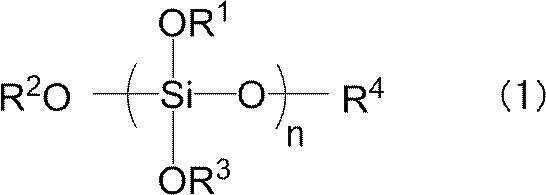
一般式(1)中、R1、R2、R3、及びR4は、それぞれ独立に、炭素数1~6の1価の有機基を表す。nは、2~20の整数を表す。
<2> リン酸基及びカルボキシ基の少なくとも一方を有するイオン性界面活性剤の酸価が180mgKOH/g以下である<1>に記載の膜形成用組成物。
<3> 非イオン性界面活性剤がポリオキシアルキレン基を有する<1>又は<2>に記載の膜形成用組成物。
<4> さらに、ケトン系溶剤を含む<1>~<3>のいずれか1つに記載の膜形成用組成物。
<2> リン酸基及びカルボキシ基の少なくとも一方を有するイオン性界面活性剤の酸価が180mgKOH/g以下である<1>に記載の膜形成用組成物。
<3> 非イオン性界面活性剤がポリオキシアルキレン基を有する<1>又は<2>に記載の膜形成用組成物。
<4> さらに、ケトン系溶剤を含む<1>~<3>のいずれか1つに記載の膜形成用組成物。
<5> 基材と、基材上に、下記一般式(1)で表されるシロキサン化合物の加水分解物縮合物と、シリカ粒子と、リン酸基及びカルボキシ基の少なくとも一方を有するイオン性界面活性剤と、親水親油バランス値が15より大きい非イオン性界面活性剤と、を含有する親水性膜と、を有し、積層体を、65℃25%RHの雰囲気下、シリコーンシーラントの入ったガラス容器を入れた恒温恒湿装置内に配置し、150時間保持した後における、親水性膜表面の、25℃にて測定した純水接触角が30°以下である積層体。
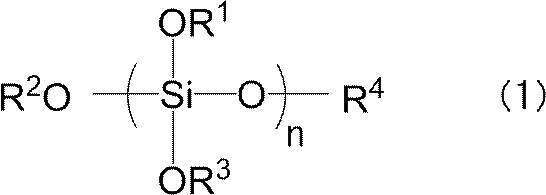
一般式(1)中、R1、R2、R3、及びR4は、それぞれ独立に、炭素数1~6の1価の有機基を表す。nは、2~20の整数を表す。
<6> 基材上に、<1>~<4>のいずれか1つに記載の膜形成用組成物を付与して親水性膜を得ること、を含む積層体の製造方法。
<7> 積層体は、65℃25%RHの雰囲気下、シリコーンシーラントの入ったガラス容器を入れた恒温恒湿装置内に配置し、150時間保持した後における、親水性膜表面の、25℃にて測定した純水接触角が30°以下の積層体である<6>に記載の積層体の製造方法。
<7> 積層体は、65℃25%RHの雰囲気下、シリコーンシーラントの入ったガラス容器を入れた恒温恒湿装置内に配置し、150時間保持した後における、親水性膜表面の、25℃にて測定した純水接触角が30°以下の積層体である<6>に記載の積層体の製造方法。
本発明の一実施形態によれば、親水性に優れ、疎水性成分共存経時後の親水性の低下が抑制された親水性膜を形成し得る膜形成用組成物が提供される。
本発明の別の実施形態によれば、親水性に優れ、疎水性成分共存経時後の親水性の低下が抑制された親水性膜を有する積層体、又は、親水性に優れ、疎水性成分共存経時後の親水性の低下が抑制された親水性膜を有する積層体の製造方法が提供される。
本発明の別の実施形態によれば、親水性に優れ、疎水性成分共存経時後の親水性の低下が抑制された親水性膜を有する積層体、又は、親水性に優れ、疎水性成分共存経時後の親水性の低下が抑制された親水性膜を有する積層体の製造方法が提供される。
以下、本開示の膜形成用組成物、積層体、及び積層体の製造方法について詳細に説明する。
本明細書において「~」を用いて示された数値範囲は、「~」の前後に記載される数値をそれぞれ最小値及び最大値として含む範囲を意味する。
本明細書において、組成物中の各成分の量について言及する場合、組成物中に各成分に該当する物質が複数存在する場合には、特に断らない限り、組成物中に存在する複数の成分の合計量を意味する。
本明細書中に段階的に記載されている数値範囲において、一つの数値範囲で記載された上限値又は下限値は、他の段階的な記載の数値範囲の上限値又は下限値に置き換えてもよい。また、本明細書中に記載されている数値範囲において、その数値範囲の上限値又は下限値は、実施例に示されている値に置き換えてもよい。
本明細書において、好ましい態様の組み合わせは、より好ましい態様である。
本明細書における「固形分」の語は、溶剤を除く成分を意味し、溶剤以外の低分子量成分などの液状の成分も本明細書における「固形分」に含まれる。
本明細書において「溶媒」とは、水、有機溶剤、及び水と有機溶剤との混合溶媒を意味する。
本明細書において「~」を用いて示された数値範囲は、「~」の前後に記載される数値をそれぞれ最小値及び最大値として含む範囲を意味する。
本明細書において、組成物中の各成分の量について言及する場合、組成物中に各成分に該当する物質が複数存在する場合には、特に断らない限り、組成物中に存在する複数の成分の合計量を意味する。
本明細書中に段階的に記載されている数値範囲において、一つの数値範囲で記載された上限値又は下限値は、他の段階的な記載の数値範囲の上限値又は下限値に置き換えてもよい。また、本明細書中に記載されている数値範囲において、その数値範囲の上限値又は下限値は、実施例に示されている値に置き換えてもよい。
本明細書において、好ましい態様の組み合わせは、より好ましい態様である。
本明細書における「固形分」の語は、溶剤を除く成分を意味し、溶剤以外の低分子量成分などの液状の成分も本明細書における「固形分」に含まれる。
本明細書において「溶媒」とは、水、有機溶剤、及び水と有機溶剤との混合溶媒を意味する。
親水親油バランス(Hydrophile Lipophile Balance)値を、以下、HLB値と記載することがある。
本明細書において、親水性膜とは、純水接触角が30°以下の膜をいう。
本明細書において、純水接触角は、接触角計DM-701(協和界面科学社製)を用い、25℃にて、測定対象とする膜の表面に純水を1μl(マイクロリットル)滴下して、θ/2法により求めた値を用いており、5回測定して得た値の算術平均値を本明細書における純水接触角として採用している。
本明細書における親水性膜の疎水性成分共存経時後における純水接触角は、親水性膜とシリコーンシーラントとを、エスペック社製恒温恒湿装置SH-641内に共存させ、65℃25%RHの状態に保ち、150時間放置後に、上記と同様にして測定した純水接触角を指す。
本明細書において、親水性膜とは、純水接触角が30°以下の膜をいう。
本明細書において、純水接触角は、接触角計DM-701(協和界面科学社製)を用い、25℃にて、測定対象とする膜の表面に純水を1μl(マイクロリットル)滴下して、θ/2法により求めた値を用いており、5回測定して得た値の算術平均値を本明細書における純水接触角として採用している。
本明細書における親水性膜の疎水性成分共存経時後における純水接触角は、親水性膜とシリコーンシーラントとを、エスペック社製恒温恒湿装置SH-641内に共存させ、65℃25%RHの状態に保ち、150時間放置後に、上記と同様にして測定した純水接触角を指す。
<膜形成用組成物>
本開示の膜形成用組成物は、下記一般式(1)で表されるシロキサン化合物の加水分解物と、シリカ粒子と、リン酸基及びカルボキシ基の少なくとも一方を有するイオン性界面活性剤(以下、特定イオン性界面活性剤と称することがある)と、HLB値が15より大きい非イオン性界面活性剤(以下、特定非イオン性界面活性剤と称することがある)と、水と、を含有する。
なお、下記一般式(1)で表されるシロキサン化合物を、以下、特定シロキサン化合物と称し、特定シロキサン化合物の加水分解物を、特定シロキサン加水分解物と称することがある。
本開示の膜形成用組成物は、下記一般式(1)で表されるシロキサン化合物の加水分解物と、シリカ粒子と、リン酸基及びカルボキシ基の少なくとも一方を有するイオン性界面活性剤(以下、特定イオン性界面活性剤と称することがある)と、HLB値が15より大きい非イオン性界面活性剤(以下、特定非イオン性界面活性剤と称することがある)と、水と、を含有する。
なお、下記一般式(1)で表されるシロキサン化合物を、以下、特定シロキサン化合物と称し、特定シロキサン化合物の加水分解物を、特定シロキサン加水分解物と称することがある。

一般式(1)中、R1、R2、R3、及びR4は、それぞれ独立に、炭素数1~6の1価の有機基を表す。nは、2~20の整数を表す。
以下、本開示の膜形成用組成物が含み得る各成分について説明する。
以下、本開示の膜形成用組成物が含み得る各成分について説明する。
〔特定シロキサン化合物の加水分解物〕
本開示の膜形成用組成物は、特定シロキサン化合物の加水分解物の少なくとも1種を含有する。
膜形成用組成物が特定シロキサン化合物の加水分解物を含むことで、膜形成用組成物により得られる親水性膜は、後述するシリカ粒子の保持性が良好となり、耐傷性と親水性が良好となる。
本開示の膜形成用組成物は、特定シロキサン化合物の加水分解物の少なくとも1種を含有する。
膜形成用組成物が特定シロキサン化合物の加水分解物を含むことで、膜形成用組成物により得られる親水性膜は、後述するシリカ粒子の保持性が良好となり、耐傷性と親水性が良好となる。
膜形成用組成物は、特定シロキサン化合物の加水分解物を含み、特定シロキサン化合物の加水分解物を含む膜形成用組成物により得られる、後述する親水性膜は、特定シロキサン化合物の加水分解縮合物の少なくとも1種を含む。

一般式(1)中、R1、R2、R3、及びR4は、それぞれ独立に、炭素数1~6の1価の有機基を表す。nは、2~20の整数を表す。
R1、R2、R3、及びR4における炭素数1~6の1価の有機基は、直鎖状であってもよく、分岐を有していてもよく、環状であってもよい。1価の有機基としては、アルキル基、及びアルケニル基等が挙げられ、アルキル基であることが好ましい。
R1、R2、R3、又はR4がアルキル基を表す場合のアルキル基としては、例えば、メチル基、エチル基、プロピル基、イソプロピル基、n-ブチル基、tert―ブチル基、n-ペンチル基、n-ヘキシル基、シクロヘキシル基等が挙げられる。
特定シロキサン化合物においてR1~R4における1価の有機基、好ましくはアルキル基の炭素数を1~6とすることにより、特定シロキサン化合物は加水分解性が良好となる。なお、加水分解性がより良好であるという観点からは、R1~R4は、それぞれ独立に炭素数1~4のアルキル基であることがより好ましく、炭素数1又は2のアルキル基であることがさらに好ましい。
R1、R2、R3、又はR4がアルキル基を表す場合のアルキル基としては、例えば、メチル基、エチル基、プロピル基、イソプロピル基、n-ブチル基、tert―ブチル基、n-ペンチル基、n-ヘキシル基、シクロヘキシル基等が挙げられる。
特定シロキサン化合物においてR1~R4における1価の有機基、好ましくはアルキル基の炭素数を1~6とすることにより、特定シロキサン化合物は加水分解性が良好となる。なお、加水分解性がより良好であるという観点からは、R1~R4は、それぞれ独立に炭素数1~4のアルキル基であることがより好ましく、炭素数1又は2のアルキル基であることがさらに好ましい。
一般式(1)におけるnは、2~20の整数を表す。一般式(1)におけるnが2以上であると、特定シロキサン化合物の反応性を制御しやすく、例えば、表面親水性に優れた膜を形成することができる。nが20以下であると、膜形成用組成物の粘度が高くなりすぎず、ハンドリング性及び均一塗布性が良好となる。nは、3~12であることが好ましく、5~10であることがより好ましい。
下記表1に、特定シロキサン化合物の例を、一般式(1)におけるR1、R2、R3、及びR4、並びにnにより記載する。但し、本開示における特定シロキサン化合物は、表1に記載の例示化合物に限定されるものではない。
下記表1に、特定シロキサン化合物の例を、一般式(1)におけるR1、R2、R3、及びR4、並びにnにより記載する。但し、本開示における特定シロキサン化合物は、表1に記載の例示化合物に限定されるものではない。
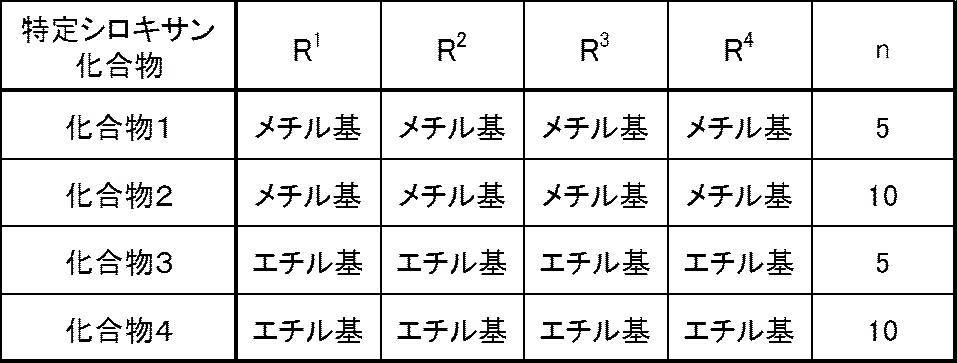
膜形成用組成物は、既述の特定シロキサン化合物の加水分解物を含む。
特定シロキサン化合物は、水と共存することで、少なくとも一部が加水分解される。特定シロキサン化合物の加水分解物は、特定シロキサン化合物と水とが反応することで、特定シロキサン化合物のケイ素原子に結合したOR1、OR2、OR3、及びOR4の少なくとも一部がヒドロキシ基に置換された化合物であり、親水性基であるヒドロキシ基に起因して、例えば塗布及び乾燥を経て形成される親水性膜は表面親水性が良好な膜となると推定される。
加水分解反応に際して、必ずしも特定シロキサン化合物の末端基(即ち、-OR1、-OR2、-OR3、又は-OR4)が全て反応する必要はないが、例えば親水性膜形成用塗布液の塗布、及び乾燥により得られる塗膜の親水性がより良好になるという観点からは、より多くの末端基が加水分解されていることが好ましい。
特定シロキサン化合物は、水と共存することで、少なくとも一部が加水分解される。特定シロキサン化合物の加水分解物は、特定シロキサン化合物と水とが反応することで、特定シロキサン化合物のケイ素原子に結合したOR1、OR2、OR3、及びOR4の少なくとも一部がヒドロキシ基に置換された化合物であり、親水性基であるヒドロキシ基に起因して、例えば塗布及び乾燥を経て形成される親水性膜は表面親水性が良好な膜となると推定される。
加水分解反応に際して、必ずしも特定シロキサン化合物の末端基(即ち、-OR1、-OR2、-OR3、又は-OR4)が全て反応する必要はないが、例えば親水性膜形成用塗布液の塗布、及び乾燥により得られる塗膜の親水性がより良好になるという観点からは、より多くの末端基が加水分解されていることが好ましい。
本開示の膜形成用組成物を用いた親水性膜の形成に際しては、特定シロキサン化合物が持つヒドロキシ基の少なくとも一部が互いに結合し、特定シロキサン化合物が縮合する。従って、膜形成用組成物を用いて得られる親水性膜は、特定シロキサン化合物の加水分解縮合物の少なくとも1種を含む。
膜形成用組成物には、特定シロキサン化合物の加水分解物が1種のみ含まれていてもよく、2種以上が含まれていてもよい。
膜形成用組成物には、特定シロキサン化合物の加水分解物が1種のみ含まれていてもよく、2種以上が含まれていてもよい。
特定シロキサン化合物の重量平均分子量は、300~1500の範囲が好ましく、500~1200の範囲がより好ましい。
なお、本明細書において、重量平均分子量は、ゲルパーミエーションクロマトグラフィ(GPC)で測定できる。具体的には、HLC-8120GPC、SC-8020(東ソー株式会社製)を用い、カラムとして、TSKgel、SuperHM-H(東ソー株式会社製、6.0mmID×15cm)を2本用い、溶離液としてテトラヒドロフラン(THF)を用いて測定できる。また、条件としては、試料濃度を0.5質量%、流速を0.6ml/min、サンプル注入量を10μl(マイクロリットル)、測定温度を40℃とし、示差屈折計(RI)検出器を用いて行なうことができる。検量線は、東ソー社製「polystyrene標準試料TSK standard」:「A-500」、「F-1」、「F-10」、「F-80」、「F-380」、「A-2500」、「F-4」、「F-40」、「F-128」、「F-700」の10サンプルから作製されたものを用いることができる。
膜形成用組成物が、少なくとも1種の特定シロキサン化合物の加水分解物を含むことは既述の通りである。さらに、本開示の膜形成用組成物は、2種以上のシラン化合物を用いて得られた部分共加水分解を含むことができる。2種以上のシラン化合物としては、互いに構造の異なる特定シロキサン化合物を2種以上でもよく、特定シロキサン化合物と、特定シロキサン化合物とは構造の異なる他のシロキサン化合物との組み合わせでもよい。2種以上のシロキサン化合物から得られる加水分解物を「(共)加水分解物」と称し、これらが縮合して得られた化合物を「(共)加水分解縮合物」と称することがある。
なお、本明細書におけるシラン化合物とは、加水分解性シリル基及びシラノール基から選ばれる少なくとも1種を有する化合物を指し、シリル基は加水分解してシラノール基となり、シラノール基は脱水縮合してシロキサン結合が生成する。
なお、本明細書におけるシラン化合物とは、加水分解性シリル基及びシラノール基から選ばれる少なくとも1種を有する化合物を指し、シリル基は加水分解してシラノール基となり、シラノール基は脱水縮合してシロキサン結合が生成する。
本開示の膜形成用組成物は、特定シロキサン化合物の少なくとも一部が加水分解された加水分解物を含む加水分解物の少なくとも1種を含有し、本開示の膜形成用組成物により形成される親水性膜は、特定シロキサン化合物の少なくとも一部が加水分解し、縮合した加水分解縮合物を含むことで、表面の親水性が良好であり、実用上問題のない膜強度が得られる。
なお、一般式(1)で表されるシロキサン化合物は市販品としても入手可能であり、例えば、MKC(登録商標)シリケートMS51(三菱化学(株))〔R1、R2、R3、及びR4:メチル基、nの平均:5〕、シリケートMS56〔R1、R2、R3、及びR4:メチル基、nの平均:11〕、シリケートMS57〔R1、R2、R3、及びR4:メチル基、nの平均:13〕、シリケートMS56S〔R1、R2、R3、及びR4:メチル基、nの平均:16〕、メチルシリケート53A〔R1、R2、R3、及びR4:メチル基、nの平均:7〕、エチルシリケート40〔R1、R2、R3、及びR4:エチル基、nの平均:5〕、エチルシリケート48〔R1、R2、R3、及びR4:エチル基、nの平均:10〕等が挙げられる。
なお、一般式(1)で表されるシロキサン化合物は市販品としても入手可能であり、例えば、MKC(登録商標)シリケートMS51(三菱化学(株))〔R1、R2、R3、及びR4:メチル基、nの平均:5〕、シリケートMS56〔R1、R2、R3、及びR4:メチル基、nの平均:11〕、シリケートMS57〔R1、R2、R3、及びR4:メチル基、nの平均:13〕、シリケートMS56S〔R1、R2、R3、及びR4:メチル基、nの平均:16〕、メチルシリケート53A〔R1、R2、R3、及びR4:メチル基、nの平均:7〕、エチルシリケート40〔R1、R2、R3、及びR4:エチル基、nの平均:5〕、エチルシリケート48〔R1、R2、R3、及びR4:エチル基、nの平均:10〕等が挙げられる。
膜形成用組成物における特定シロキサン化合物の含有量は、膜形成用組成物の全固形分に対して、1質量%~80質量%が好ましく、5質量%~60質量%がより好ましく、10質量%~40質量%がさらに好ましい。特定シロキサン化合物の含有量が上記範囲であると、膜形成用組成物を用いて得られる親水性膜の表面の純水接触角が低く抑えられ、防汚性及び汚れた場合の汚れ落ちが容易なセルフクリーニング性が良好な膜となる。
<シリカ粒子>
膜形成用組成物は、シリカ粒子の少なくとも1種を含有する。
シリカ粒子は、膜形成用組成物により形成される親水性膜の耐傷性を高め、さらに、親水性を発揮させる機能を有する。すなわち、シリカ粒子は硬いフィラーとしての役割を担い、かつ、粒子表面のヒドロキシ基が作用して親水性膜の親水性向上に寄与する。
膜形成用組成物は、シリカ粒子の少なくとも1種を含有する。
シリカ粒子は、膜形成用組成物により形成される親水性膜の耐傷性を高め、さらに、親水性を発揮させる機能を有する。すなわち、シリカ粒子は硬いフィラーとしての役割を担い、かつ、粒子表面のヒドロキシ基が作用して親水性膜の親水性向上に寄与する。
シリカ粒子としては、例えば、ヒュームドシリカ、コロイダルシリカ等が挙げられる。
ヒュームドシリカは、ケイ素原子を含む化合物を気相中で酸素及び水素と反応させることによって得ることができる。原料となるケイ素化合物としては、例えば、ハロゲン化ケイ素(例えば、塩化ケイ素)等が挙げられる。
コロイダルシリカは、原料化合物を加水分解及び縮合するゾルゲル法により合成することができる。コロイダルシリカの原料化合物としては、例えば、アルコキシケイ素(例えば、テトラエトキシシラン)、ハロゲン化シラン化合物(例えば、ジフェニルジクロロシラン)等が挙げられる。
ヒュームドシリカは、ケイ素原子を含む化合物を気相中で酸素及び水素と反応させることによって得ることができる。原料となるケイ素化合物としては、例えば、ハロゲン化ケイ素(例えば、塩化ケイ素)等が挙げられる。
コロイダルシリカは、原料化合物を加水分解及び縮合するゾルゲル法により合成することができる。コロイダルシリカの原料化合物としては、例えば、アルコキシケイ素(例えば、テトラエトキシシラン)、ハロゲン化シラン化合物(例えば、ジフェニルジクロロシラン)等が挙げられる。
シリカ粒子の形状は、特に限定はなく、球状、板状、針状、数珠状、又はこれらの2種類以上が合体した形状が挙げられる。なお、ここでいう球状とは、真球状の他、回転楕円体、卵形等の形状である場合も含む。
シリカ粒子は市販品としても入手可能である。シリカ粒子の市販品としては、エボニック ジャパン社製のAEROSIL(登録商標)シリーズ、日産化学工業社製のスノーテックス(登録商標)シリーズ(例えばスノーテックスOなど)、ナルコケミカル社製のナルコ(Nalco)(登録商標)シリーズ(例えばNalco8699など)、扶桑化学者社のクォートロンPLシリーズ〔例えばPL-1〕などが挙げられる。
シリカ粒子の平均一次粒子径は、形成される親水性膜の膜性が良好である点から、100nm以下であることが好ましく、50nm以下であることがより好ましく、30nm以下であることがさらに好ましく、15nm以下であることが特に好ましい。また、シリカ粒子の平均一次粒子径の下限は、特に限定されないが、形成される親水性膜の膜性が良好である点から2nm以上が好ましい。
膜形成用組成物は、シリカ粒子を1種のみを含んでもよく、2種以上含んでもよい。シリカ粒子を2種以上含む場合は、サイズ又は形状の少なくともいずれかが互いに異なる粒子を含んでいてもよい。
膜形成用組成物は、シリカ粒子を1種のみを含んでもよく、2種以上含んでもよい。シリカ粒子を2種以上含む場合は、サイズ又は形状の少なくともいずれかが互いに異なる粒子を含んでいてもよい。
シリカ粒子の平均一次粒子径は、シリカ粒子の形状が球状又は断面楕円状の略球状である場合、分散したシリカ粒子を透過型電子顕微鏡により観察し、得られた写真から300個以上の粒子について粒子の投影面積を測定し、投影面積から円相当径を求め、得られた円相当径をシリカ粒子の平均一次粒子径とする。シリカ粒子の形状が、球状又は略球状ではない場合には、その他の方法、例えば、動的光散乱法を用いて、シリカ粒子の平均一次粒子径を求める。
膜形成用組成物におけるシリカ粒子の含有量は、膜形成用組成物の全固形分に対して、5質量%~95質量%が好ましく、10質量%~90質量%がより好ましく、20質量%~70質量%がさらに好ましく、30質量%~50質量%が特に好ましい。シリカ粒子の含有量が上記範囲内であると、膜形成用組成物により得られる親水性膜の親水性が良好となり、親水性膜の硬度、耐傷性等に優れる。
<特定イオン性界面活性剤>
膜形成用組成物は、リン酸基及びカルボキシ基の少なくとも一方を有する特定イオン性界面活性剤を含有する。
膜形成用組成物が特定イオン性界面活性剤を含有することで、特定イオン性界面活性剤が有するリン酸基及びカルボキシ基の少なくとも一方の官能基が酸吸着性基として機能し、既述のシリカ粒子表面に吸着することで、シリカ粒子の分散安定性が向上し、かつ、シリカ粒子表面への疎水性成分の吸着が抑制され、疎水性成分の吸着に起因する経時による親水性の低下が効果的に抑制される。
特定イオン性界面活性剤は、シリカ粒子との吸着性を考慮すれば、アニオン性界面活性剤であることが好ましい。
特定イオン性界面活性剤としては、疎水性基として、炭素数1~36の脂肪族炭化水素基、シクロヘキシル基、シクロブチル基などの脂肪族環状炭化水素基、及び、スチリル基、ナフチル基、フェニル基、フェニレンエーテル基などの芳香族炭化水素基から選択される炭化水素基を有し、酸吸着性基として、リン酸基及びカルボキシ基の少なくとも一方を有する化合物であることが好ましい。なお、既述の疎水性基は、さらに、置換基を有していてもよい。
また、特定イオン性界面活性剤は、分子内に不飽和結合を有していてもよい。
膜形成用組成物は、リン酸基及びカルボキシ基の少なくとも一方を有する特定イオン性界面活性剤を含有する。
膜形成用組成物が特定イオン性界面活性剤を含有することで、特定イオン性界面活性剤が有するリン酸基及びカルボキシ基の少なくとも一方の官能基が酸吸着性基として機能し、既述のシリカ粒子表面に吸着することで、シリカ粒子の分散安定性が向上し、かつ、シリカ粒子表面への疎水性成分の吸着が抑制され、疎水性成分の吸着に起因する経時による親水性の低下が効果的に抑制される。
特定イオン性界面活性剤は、シリカ粒子との吸着性を考慮すれば、アニオン性界面活性剤であることが好ましい。
特定イオン性界面活性剤としては、疎水性基として、炭素数1~36の脂肪族炭化水素基、シクロヘキシル基、シクロブチル基などの脂肪族環状炭化水素基、及び、スチリル基、ナフチル基、フェニル基、フェニレンエーテル基などの芳香族炭化水素基から選択される炭化水素基を有し、酸吸着性基として、リン酸基及びカルボキシ基の少なくとも一方を有する化合物であることが好ましい。なお、既述の疎水性基は、さらに、置換基を有していてもよい。
また、特定イオン性界面活性剤は、分子内に不飽和結合を有していてもよい。
特定イオン性界面活性剤は、リン酸基及びカルボキシ基から選ばれる官能基のみを酸吸着性基として有することがより好ましい。また、特定イオン性界面活性剤は、リン酸基及びカルボキシ基以外の酸吸着性基、例えば、スルホン酸基、硫酸基などを有しないことが好ましい。
なお、膜形成用組成物に含まれる帯電防止剤として公知のアニオン性界面活性剤、より具体的には、疎水基であるアルキル基と、親水基である硫酸基又はスルホン酸基を有するアニオン性界面活性剤では、上記親水性低下の抑制効果は得られない。
また、スルホコハク酸部分構造を含むアニオン性界面活性剤は、分子内に酸吸着基としてスルホン酸基を有するため、例えば、カルボキシ基を部分構造がエステル化されておらず、少なくとも一部にカルボキシ基が存在している場合でも、既述の本開示の効果を奏し得ない。
なお、膜形成用組成物に含まれる帯電防止剤として公知のアニオン性界面活性剤、より具体的には、疎水基であるアルキル基と、親水基である硫酸基又はスルホン酸基を有するアニオン性界面活性剤では、上記親水性低下の抑制効果は得られない。
また、スルホコハク酸部分構造を含むアニオン性界面活性剤は、分子内に酸吸着基としてスルホン酸基を有するため、例えば、カルボキシ基を部分構造がエステル化されておらず、少なくとも一部にカルボキシ基が存在している場合でも、既述の本開示の効果を奏し得ない。
特定イオン性界面活性剤としては、リン酸基を含む化合物としては、例えば、アルキルリン酸エステル塩、ポリオキシエチレンアルキルエーテルリン酸塩などが挙げられる。カルボキシ基を含む化合物としては、例えば、N-アシルアミノ酸塩、ポリオキシエチレンアルキルエーテルカルボン酸塩、脂肪族カルボン酸塩、脂肪族ジカルボン酸塩、分子量25000未満のポリカルボン酸系共重合体、分子量25000未満のマレイン酸系共重合体などが挙げられる。
特定イオン性界面活性剤の酸価はシリカ粒子表面を十分に被覆し、分散性を向上させたり、表面を保護したりし易いという観点から、180mgKOH/g以下であることが好ましく、100mgKOH/g以下であることがより好ましい。
なお、酸価の下限値は特に限定されないが、上記と同様の観点から、3mgKOH/g以上とすることが好ましい。
特定イオン性界面活性剤の酸価が既述の範囲であることで、シリカ粒子の分散性と疎水性成分の吸着防止能との双方がより良好となる。
特定イオン性界面活性剤の酸価は、指示薬の滴定により測定することができ、具体的にはJIS K 0070に記載の方法に従い、特定イオン性界面活性剤の固形分1g中の酸成分を中和する水酸化カリウムのmg数を測定して算出することができる。
なお、酸価の下限値は特に限定されないが、上記と同様の観点から、3mgKOH/g以上とすることが好ましい。
特定イオン性界面活性剤の酸価が既述の範囲であることで、シリカ粒子の分散性と疎水性成分の吸着防止能との双方がより良好となる。
特定イオン性界面活性剤の酸価は、指示薬の滴定により測定することができ、具体的にはJIS K 0070に記載の方法に従い、特定イオン性界面活性剤の固形分1g中の酸成分を中和する水酸化カリウムのmg数を測定して算出することができる。
特定イオン性界面活性剤は市販品としても入手可能である。本開示の膜形成用組成物に使用し得る特定イオン性界面活性剤の市販品としては、例えば、DISPERBYK(登録商標)-2015(酸吸着性基:カルボキシ基、酸価:10mgKOH/g)DISPERBYK-180(酸吸着性基:リン酸基、酸価:94mgKOH/g)、TEG(登録商標)Dispers660C(酸吸着性基:リン酸基、酸価:30mgKOH/g)、BYK P104(酸吸着性基:カルボキシ基、酸価:180mgKOH/g)等が挙げられる。
膜形成用組成物は、特定イオン性界面活性剤を1種のみ含んでもよく、2種以上を含んでもよい。
膜形成用組成物における特定イオン性界面活性剤の含有量は、膜形成用組成物の全固形分に対して、50質量%以下が好ましく、20質量%以下がより好ましく、10質量%以下がさらに好ましい。特定イオン性界面活性剤の含有量は、0.05質量%以上であることが好ましい。
即ち、膜形成用組成物の全固形分に対する特定イオン性界面活性剤の含有量は、0.05質量%以上50質量%以下であることが好ましく、0.5質量%以上20質量%以下であることが好ましく、1質量%以上15質量%以下であることがより好ましい。
特定イオン性界面活性剤の含有量が上記範囲内であると、シリカ粒子の凝集防止効果、及び疎水性成分の吸着防止効果がより良好となり、特定イオン性界面活性剤を含むことによる親水性膜の防汚性向上効果が得やすくなる。
なお、既述の特定イオン性界面活性剤の含有量には、任意成分として含まれる特定イオン性界面活性剤以外のイオン性界面活性剤の含有量は含まれない。
膜形成用組成物における特定イオン性界面活性剤の含有量は、膜形成用組成物の全固形分に対して、50質量%以下が好ましく、20質量%以下がより好ましく、10質量%以下がさらに好ましい。特定イオン性界面活性剤の含有量は、0.05質量%以上であることが好ましい。
即ち、膜形成用組成物の全固形分に対する特定イオン性界面活性剤の含有量は、0.05質量%以上50質量%以下であることが好ましく、0.5質量%以上20質量%以下であることが好ましく、1質量%以上15質量%以下であることがより好ましい。
特定イオン性界面活性剤の含有量が上記範囲内であると、シリカ粒子の凝集防止効果、及び疎水性成分の吸着防止効果がより良好となり、特定イオン性界面活性剤を含むことによる親水性膜の防汚性向上効果が得やすくなる。
なお、既述の特定イオン性界面活性剤の含有量には、任意成分として含まれる特定イオン性界面活性剤以外のイオン性界面活性剤の含有量は含まれない。
<特定非イオン性界面活性剤>
膜形成用組成物は、HLB値が15より大きい非イオン性界面活性剤(特定非イオン性界面活性剤)を含有する。
膜形成用組成物が、特定非イオン性界面活性剤を含むことで、膜形成用組成物のより得られる親水性膜の親水性がより良好となり、シリカ粒子への疎水性成分の吸着防止能が良好となる。
膜形成用組成物は、HLB値が15より大きい非イオン性界面活性剤(特定非イオン性界面活性剤)を含有する。
膜形成用組成物が、特定非イオン性界面活性剤を含むことで、膜形成用組成物のより得られる親水性膜の親水性がより良好となり、シリカ粒子への疎水性成分の吸着防止能が良好となる。
特定非イオン性界面活性剤は、ポリオキシアルキレン基を有する界面活性剤であることが好ましい。
特定非イオン性界面活性剤がポリオキシアルキレン基を有することで、HLB値が適切な範囲となり、シリカ粒子への吸着による疎水性成分に起因する吸着性の低下防止能がより良好となる。
ポリオキシアルキレン基としては、親水性がより良好であるという観点から、ポリオキシエチレン基が好ましい。
本明細書におけるHLB値は、下記式(I)により求められるグリフィン法(全訂版 新・界面活性剤入門、p128)により算出した値である。
非イオン界面活性剤のHLB=(親水基部分の分子量/界面活性剤の分子量)×20(I)
HLBの値は、好ましくは15.5以上であり、得られる親水性膜の親水性がさらに高くなるなり、疎水性成分の吸着防止能がより向上するため16以上がより好ましく、17以上が更に好ましく、18以上が特に好ましい。
特定非イオン性界面活性剤がポリオキシアルキレン基を有することで、HLB値が適切な範囲となり、シリカ粒子への吸着による疎水性成分に起因する吸着性の低下防止能がより良好となる。
ポリオキシアルキレン基としては、親水性がより良好であるという観点から、ポリオキシエチレン基が好ましい。
本明細書におけるHLB値は、下記式(I)により求められるグリフィン法(全訂版 新・界面活性剤入門、p128)により算出した値である。
非イオン界面活性剤のHLB=(親水基部分の分子量/界面活性剤の分子量)×20(I)
HLBの値は、好ましくは15.5以上であり、得られる親水性膜の親水性がさらに高くなるなり、疎水性成分の吸着防止能がより向上するため16以上がより好ましく、17以上が更に好ましく、18以上が特に好ましい。
HLB値が15を超える特定非イオン性界面活性剤としては、例えば、ポリオキシアルキレンアルキルエーテル、ポリオキシアルキレンアルキルフェノールエーテル、ポリオキシアルキレンアリールエーテル、ポリオキシアルキレンアルキルアリールエーテル、ソルビタン誘導体、ポリオキシアルキレンアリールエーテルのホルマリン縮合物、ポリオキシアルキレンアルキルアリールエーテルのホルマリン縮合物、ポリエチレングリコールが挙げられる。中でも、ポリオキシアルキレンアルキルエーテルが好ましい。
特定非イオン性界面活性剤におけるポリオキシアルキレンアルキルエーテルのアルキル基としては、例えば、炭素数1~36の直鎖状もしくは分岐を有するアルキル基が挙げられる。
また、ポリオキシアルキレンアルキルエーテルのオキシアルキレン部は、特に優れた親水性を有する親水性膜が得られる点から、ポリオキシエチレンであることが好ましい。また、特定非イオン性界面活性剤が有するポリオキシエチレン構造単位数は、6以上が好ましく、10以上であることがより好ましく、15以上であることが更に好ましく、20以上であることが特に好ましい。また、溶解性の観点から、ポリオキシエチレン構造単位数は、100以下とすることができる。
また、ポリオキシアルキレンアルキルエーテルのオキシアルキレン部は、特に優れた親水性を有する親水性膜が得られる点から、ポリオキシエチレンであることが好ましい。また、特定非イオン性界面活性剤が有するポリオキシエチレン構造単位数は、6以上が好ましく、10以上であることがより好ましく、15以上であることが更に好ましく、20以上であることが特に好ましい。また、溶解性の観点から、ポリオキシエチレン構造単位数は、100以下とすることができる。
特定非イオン性界面活性剤がポリオキシアルキレンアルキルエーテルである場合、好ましくは、下記式(II)で表される界面活性剤が挙げられる。
RO-(C2H40)m-H (II)
(ただし、mは、6~100の整数を表す。Rは炭素数1~36の直鎖状もしくは分岐を有するアルキル基を表す。)
RO-(C2H40)m-H (II)
(ただし、mは、6~100の整数を表す。Rは炭素数1~36の直鎖状もしくは分岐を有するアルキル基を表す。)
特定非イオン性界面活性剤は市販品としても入手可能である。本開示の膜形成用組成物に使用し得る特定非イオン性界面活性剤の市販品としては、例えば、エマレックス715(HLB値:15.6)、720(HLB値:16.5)、730(HLB値:17.5)750(HLB値:18.4)(以上商品名:日本エマルジョン(株)ポリオキシエチレンラウリルエーテル)、レオドールTW-P120(商品名、花王(株)、ポリオキシエチレンソルビタンモノパルミテート HLB値:15.6)、PEG2000(商品名、三洋化成工業(株)、HLB値:19.9)等が挙げられる。
膜形成用組成物における特定非イオン性界面活性剤の含有量は、膜形成用組成物の全固形分に対して、0.01質量%~15質量%であることが好ましく、0.1質量%~10質量%であることがより好ましく、1質量%~10質量%であることがさらに好ましい。
特定非イオン性界面活性剤の含有量が既述の範囲であることで、本開示の膜形成用組成物は、得られる親水性膜の親水性が良好となり、疎水性成分の吸着防止能が十分に発揮される。
特定非イオン性界面活性剤の含有量が既述の範囲であることで、本開示の膜形成用組成物は、得られる親水性膜の親水性が良好となり、疎水性成分の吸着防止能が十分に発揮される。
<水>
膜形成用組成物は、水を含有する。
水は、既述の如く、特定シロキサン化合物の加水分解縮合反応に寄与する。
膜形成用組成物に用い得る水は、不純物がより少ないという観点から、イオン交換水、純水、蒸留水等が好ましい。
水の含有量は、必要に応じて適宜定められる。水は、例えば、膜形成用組成物に含まれる全溶媒量に対して、1質量%~20質量%含むことができ、5質量%~15質量%含むことが好ましく、6質量%~12質量%含むことがより好ましい。
膜形成用組成物は、水を含有する。
水は、既述の如く、特定シロキサン化合物の加水分解縮合反応に寄与する。
膜形成用組成物に用い得る水は、不純物がより少ないという観点から、イオン交換水、純水、蒸留水等が好ましい。
水の含有量は、必要に応じて適宜定められる。水は、例えば、膜形成用組成物に含まれる全溶媒量に対して、1質量%~20質量%含むことができ、5質量%~15質量%含むことが好ましく、6質量%~12質量%含むことがより好ましい。
〔他の成分〕
膜形成用組成物は、特定シロキサン加水分解物、シリカ粒子、特定イオン性界面活性剤、及び特定非イオン性界面活性剤以外にも、効果を損なわない範囲において、公知の他の成分を含んでもよい。他の成分としては、水以外の溶媒、帯電防止剤、界面活性剤、特定シロキサン化合物の縮合反応を促進する触媒等が挙げられるが、既述の成分に限定されない。
膜形成用組成物は、特定シロキサン加水分解物、シリカ粒子、特定イオン性界面活性剤、及び特定非イオン性界面活性剤以外にも、効果を損なわない範囲において、公知の他の成分を含んでもよい。他の成分としては、水以外の溶媒、帯電防止剤、界面活性剤、特定シロキサン化合物の縮合反応を促進する触媒等が挙げられるが、既述の成分に限定されない。
(水以外の溶剤)
膜形成用組成物は、溶媒として、水以外の溶剤を含むことができる。
水以外の溶剤としては、例えば、ケトン系溶剤、グリコール系溶剤、アルコール系溶剤、グリコールエーテル系溶剤、エーテル系溶剤等が挙げられる。
なかでも、膜形成用組成物により形成される膜と基材との密着性がより良好となるとの観点から、ケトン系溶剤を含むことが好ましい。
膜形成用組成物は、溶媒として、水以外の溶剤を含むことができる。
水以外の溶剤としては、例えば、ケトン系溶剤、グリコール系溶剤、アルコール系溶剤、グリコールエーテル系溶剤、エーテル系溶剤等が挙げられる。
なかでも、膜形成用組成物により形成される膜と基材との密着性がより良好となるとの観点から、ケトン系溶剤を含むことが好ましい。
-ケトン系溶剤-
膜形成用組成物におけるケトン系溶剤は、組成物により形成される親水性膜と基材との密着性に寄与する。
ケトン系溶剤としては、特に限定されず、アセトン、ジアセトンアルコール、アセチルアセトン、メチルエチルケトン、メチルイソブチルケトン、ジイソブチルケトン、シクロヘキサノン、シクロペンタノン等が挙げられる。
膜形成用組成物におけるケトン系溶剤は、組成物により形成される親水性膜と基材との密着性に寄与する。
ケトン系溶剤としては、特に限定されず、アセトン、ジアセトンアルコール、アセチルアセトン、メチルエチルケトン、メチルイソブチルケトン、ジイソブチルケトン、シクロヘキサノン、シクロペンタノン等が挙げられる。
ケトン系溶剤は、より透明性に優れる膜を形成することができるという観点から、SP値(溶解度パラメーター)が10.0MPa1/2以上のケトン系溶剤であることが好ましい。なお、ケトン系溶剤のSP値の上限は、特に限定されず、例えば、基材への塗布性、例えば、塗布時におけるハジキなどの面状故障が効果的に抑制されるという観点から、13.0MPa1/2以下であることが好ましい。
SP値が10.0MPa1/2以上のケトン系溶剤の具体例を以下に示す。但し、膜形成用組成物に用い得るケトン系溶剤は、以下の具体例に限定されない。下記の具体例の後ろのカッコ内の数値は、併記されたケトン系溶剤のSP値(単位:MPa1/2)を示す。
アセトン(10.0)、ジアセトンアルコール(10.2)、アセチルアセトン(10.3)、シクロペンタノン(10.4)。
アセトン(10.0)、ジアセトンアルコール(10.2)、アセチルアセトン(10.3)、シクロペンタノン(10.4)。
上記のSP値は、分子凝集エネルギーの平方根で表される値であり、R.F.Fedors,Polymer Engineering Science,14,p147~p154(1974)に記載の方法で計算される値である。
本開示の膜形成用組成物が、ケトン系溶剤を含む場合、ケトン系溶剤を1種のみ含んでいてもよく、2種以上含んでいてもよい。
本開示の膜形成用組成物中のケトン系溶剤の含有量は、膜形成用組成物に含まれる溶媒の全質量に対して、5質量%以上95質量%以下が好ましく、10質量%以上60質量%以下がより好ましく、20質量%以上50質量%以下が更に好ましい。
膜形成用組成物中のケトン系溶剤の含有率が上記範囲内であると、透明性及び密着性により優れる膜を形成することができる。
膜形成用組成物中のケトン系溶剤の含有率が上記範囲内であると、透明性及び密着性により優れる膜を形成することができる。
膜形成用組成物が含み得るその他の溶剤の例を以下に示す。なお、膜形成用組成物が含み得る溶剤は、下記の例示溶剤に限定されない。
-アルコール系溶剤-
本開示におけるアルコール系溶剤とは、炭化水素の一つの炭素原子に一つヒドロキシ基が置換した構造の溶剤を指す。
アルコール系溶剤としては、メタノール、エタノール、ブタノール、2-メチル-1-ブタノール、2-メチル-2-ブタノール、n-プロパノール、2-プロパノール、tert-ブタノール、2-ブタノール、ベンジルアルコール等が挙げられる。
本開示におけるアルコール系溶剤とは、炭化水素の一つの炭素原子に一つヒドロキシ基が置換した構造の溶剤を指す。
アルコール系溶剤としては、メタノール、エタノール、ブタノール、2-メチル-1-ブタノール、2-メチル-2-ブタノール、n-プロパノール、2-プロパノール、tert-ブタノール、2-ブタノール、ベンジルアルコール等が挙げられる。
-グリコールエーテル系溶剤-
本開示におけるグリコールエーテル系溶剤とは、一分子内に一つのヒドロキシ基と少なくとも一つのエーテル基を有する構造の溶剤を指す。
グリコールエーテル系溶剤としては、ジエチレングリコールモノメチルエーテル、ジエチレングリコールモノエチルエーテル、ジエチレングリコールモノブチルエーテル、トリエチレングリコールモノメチルエーテル、プロピレングリコールモノメチルエーテル、プロピレングリコールモノブチルエーテル、3-メトキシ-3-メチル-1-ブタノール、ジエチレングリコールモノへキシルエーテル、プロピレングリコールモノメチルエーテルプロピオネート、ジプロピレングリコールメチルエーテル、メチルセロソルブ、エチルセロソルブ、ブチルセロソルブ等が挙げられる。
本開示におけるグリコールエーテル系溶剤とは、一分子内に一つのヒドロキシ基と少なくとも一つのエーテル基を有する構造の溶剤を指す。
グリコールエーテル系溶剤としては、ジエチレングリコールモノメチルエーテル、ジエチレングリコールモノエチルエーテル、ジエチレングリコールモノブチルエーテル、トリエチレングリコールモノメチルエーテル、プロピレングリコールモノメチルエーテル、プロピレングリコールモノブチルエーテル、3-メトキシ-3-メチル-1-ブタノール、ジエチレングリコールモノへキシルエーテル、プロピレングリコールモノメチルエーテルプロピオネート、ジプロピレングリコールメチルエーテル、メチルセロソルブ、エチルセロソルブ、ブチルセロソルブ等が挙げられる。
-エーテル系溶剤-
本開示におけるエーテル系溶剤とは、一分子内にヒドロキシ基を有さず、少なくとも一つエーテル基を有する構造の溶剤を指す。
エーテル系溶剤としては、イソプロピルエーテル、1,4-ジオキサン、tert-ブチルメチルエーテル、テトラヒドロフラン、2-メチルテトラヒドロフラン、1,2ジメトキシエタン、ジエチルエーテル等が挙げられる。
本開示におけるエーテル系溶剤とは、一分子内にヒドロキシ基を有さず、少なくとも一つエーテル基を有する構造の溶剤を指す。
エーテル系溶剤としては、イソプロピルエーテル、1,4-ジオキサン、tert-ブチルメチルエーテル、テトラヒドロフラン、2-メチルテトラヒドロフラン、1,2ジメトキシエタン、ジエチルエーテル等が挙げられる。
(帯電防止剤)
膜形成用組成物は、帯電防止剤の少なくとも1種を含有することが好ましい。
帯電防止剤を含むことで、膜形成用組成物により得られる親水性膜に帯電防止性が付与され汚染物質の付着防止効果が向上し、防汚性がより良好となる。
膜形成用組成物は、帯電防止剤の少なくとも1種を含有することが好ましい。
帯電防止剤を含むことで、膜形成用組成物により得られる親水性膜に帯電防止性が付与され汚染物質の付着防止効果が向上し、防汚性がより良好となる。
帯電防止剤は、帯電防止機能を有する化合物から適宜選択することができ、界面活性を示す化合物又は界面活性を示さない化合物のいずれでもよい。帯電防止剤としては、例えば、既述の特定イオン性界面活性剤以外のイオン性の界面活性剤〔以下、他のイオン性界面活性剤と称することがある)、金属酸化物粒子などが挙げられる。なお、帯電防止剤としての金属酸化物粒子には、既述のシリカ粒子は含まれない。
帯電防止剤としての他のイオン性の界面活性剤は、例えば、膜形成用組成物を基材に塗布して親水性膜を形成する場合に、塗膜の膜面付近に偏析しやすい性質があり、少量の添加で効果が期待できる。
また、帯電防止剤としての金属酸化物粒子は、親水性膜に帯電防止性を与えるために比較的多量の添加が必要とされる場合があるが、無機物であるため、親水性膜の耐傷性を高める点で適している。
帯電防止剤としての他のイオン性の界面活性剤は、例えば、膜形成用組成物を基材に塗布して親水性膜を形成する場合に、塗膜の膜面付近に偏析しやすい性質があり、少量の添加で効果が期待できる。
また、帯電防止剤としての金属酸化物粒子は、親水性膜に帯電防止性を与えるために比較的多量の添加が必要とされる場合があるが、無機物であるため、親水性膜の耐傷性を高める点で適している。
他のイオン性の界面活性剤の例としては、アルキル硫酸塩(例:ドデシル硫酸ナトリウム、ラウリル硫酸ナトリウム等)、アルキルベンゼンスルホン酸塩(例:ドデシルベンゼンスルホン酸ナトリウム、ラウリルベンゼンスルホン酸ナトリウム等)、アルキルスルホコハク酸塩(例:ジ(2-エチルヘキシル)スルホコハク酸ナトリウム等)などのアニオン性界面活性剤;及びアルキルトリメチルアンモニウム塩、ジアルキルジメチルアンモニウム塩などのカチオン性界面活性剤を挙げることができる。
帯電防止剤として他のイオン性の界面活性剤を用いる場合、他のイオン性の界面活性剤の含有量としては、膜形成用組成物の全固形分に対して、5質量%以下が好ましく、1質量%以下がより好ましく、0.5質量%以下がさらに好ましい。他のイオン性の界面活性剤の含有量が上記範囲内であると、シリカ粒子の凝集を抑えつつ、親水性膜の防汚性を高めることができる。また、他のイオン性の界面活性剤の含有量は、イオン性の界面活性剤を含めることによる親水性膜の防汚性の向上効果の観点から、0.01質量%以上であることが好ましい。
なお、他のイオン性の界面活性剤は、膜形成用組成物中に過剰に加えられると、既述の特定イオン性界面活性剤による疎水性成分に起因する親水性低下抑制効果に影響を与えることがあるため、帯電防止剤として用いられる他のイオン性界面活性剤の含有量は、既述の特定イオン性界面活性剤の含有量1質量部に対して、0.1質量部以下とすることが好ましく、0.05質量部以下とすることがより好ましい。
なお、他のイオン性の界面活性剤は、膜形成用組成物中に過剰に加えられると、既述の特定イオン性界面活性剤による疎水性成分に起因する親水性低下抑制効果に影響を与えることがあるため、帯電防止剤として用いられる他のイオン性界面活性剤の含有量は、既述の特定イオン性界面活性剤の含有量1質量部に対して、0.1質量部以下とすることが好ましく、0.05質量部以下とすることがより好ましい。
帯電防止剤として用いられる金属酸化物粒子には、特に限定はない。例えば、酸化スズ粒子、アンチモンドープ酸化スズ粒子、スズドープ酸化インジウム粒子、酸化亜鉛粒子などが挙げられる。
金属酸化物粒子は、サイズ、形状、又は素材が異なる粒子を2種以上使用してもよい。金属酸化物粒子の粒子形状には、特に制限はなく、球状であっても、板状であっても、針状であってもよい。
金属酸化物粒子は、屈折率が大きく、粒径が大きい場合には、透過光の過度の散乱による損失が発生しやすいため、平均一次粒子径が100nm以下であることが好ましく、50nm以下であることがより好ましく、30nm以下であることがさらに好ましい。
金属酸化物粒子の平均一次粒子径は、粒子形状が球状又は断面楕円等の略球状である場合は、分散した粒子を透過型電子顕微鏡により観察し、得られた写真から300個以上の粒子について粒子の投影面積を測定し、投影面積から円相当径を求めることにより求められる。なお、金属酸化物粒子の形状が球状ではない場合、その他の方法、例えば動的光散乱法を用いて求められる。
金属酸化物粒子は、サイズ、形状、又は素材が異なる粒子を2種以上使用してもよい。金属酸化物粒子の粒子形状には、特に制限はなく、球状であっても、板状であっても、針状であってもよい。
金属酸化物粒子は、屈折率が大きく、粒径が大きい場合には、透過光の過度の散乱による損失が発生しやすいため、平均一次粒子径が100nm以下であることが好ましく、50nm以下であることがより好ましく、30nm以下であることがさらに好ましい。
金属酸化物粒子の平均一次粒子径は、粒子形状が球状又は断面楕円等の略球状である場合は、分散した粒子を透過型電子顕微鏡により観察し、得られた写真から300個以上の粒子について粒子の投影面積を測定し、投影面積から円相当径を求めることにより求められる。なお、金属酸化物粒子の形状が球状ではない場合、その他の方法、例えば動的光散乱法を用いて求められる。
帯電防止剤として金属酸化物粒子を用いる場合、金属酸化物粒子の含有量としては、膜形成用組成物の全固形分に対して、40質量%以下が好ましく、20質量%以下がより好ましく、10質量%以下がさらに好ましい。金属酸化物粒子の含有量が上記範囲内であると、親水性膜を塗布により形成する場合の成膜性を損なうことなく、効果的に帯電防止性を付与することができる。また、金属酸化物粒子の含有量は、金属酸化物粒子を含めることによる親水性膜の防汚性の向上効果の観点から、1質量%以上であることが望ましい。
(特定シロキサン化合物の縮合反応を促進する触媒)
膜形成用組成物は、特定シロキサン化合物の縮合反応を促進する触媒(縮合促進触媒)の少なくとも1種を含有していてもよい。なお、縮合促進触媒の奏する効果については後述する。
膜形成用組成物は、特定シロキサン化合物の縮合反応を促進する触媒(縮合促進触媒)の少なくとも1種を含有していてもよい。なお、縮合促進触媒の奏する効果については後述する。
縮合促進触媒としては、特に制限はなく、例えば、酸触媒、アルカリ触媒、有機金属触媒などが挙げられる。
酸触媒の例としては、硝酸、塩酸、硫酸、酢酸、リン酸、クロロ酢酸、蟻酸、シュウ酸、トルエンスルホン酸、キシレンスルホン酸、クメンスルホン酸、ジノニルナフタレンモノスルホン酸、ジノニルナフタレンジスルホン酸、ドデシルベンゼンスルホン酸、ポリリン酸塩、メタリン酸塩などが挙げられる。
アルカリ触媒の例としては、水酸化ナトリウム、水酸化カリウム、水酸化テトラメチルアンモニウム、炭酸水素ナトリウム、尿素などが挙げられる。
有機金属触媒の例としては、アルミニウムビス(エチルアセトアセテート)モノ(アセチルアセトネート)、アルミニウムトリス(アセチルアセトネート)、アルミニウムエチルアセトアセテートジイソプロピレートなどのアルミキレート化合物;ジルコニウムテトラキス(アセチルアセトネート)、ジルコニウムビス(ブトキシ)ビス(アセチルアセトネート)などのジルコニウムキレート化合物;チタニウムテトラキス(アセチルアセトネート)、チタニウムビス(ブトキシ)ビス(アセチルアセトネート)などのチタンキレート化合物;及びジブチルスズジアセテート、ジブチルスズジラウレート、ジブチルスズジオクチエートなどの有機スズ化合物、アルミニウムエチレート、アルミニウムイソプロピレート、アルミニウムsec-ブチレートなどのアルミニウムアルコキシド、チタン(IV)エトキシド、チタンイソプロポキシド、チタン(IV)n-ブトキシドなどのチタンアルコキシド、ジルコニウム(IV)エトキシド、ジルコニウム(IV)n-プロポキシド、ジルコニウム(IV)n-ブトキシドなどのジルコニウムアルコキシド;等が挙げられる。
酸触媒の例としては、硝酸、塩酸、硫酸、酢酸、リン酸、クロロ酢酸、蟻酸、シュウ酸、トルエンスルホン酸、キシレンスルホン酸、クメンスルホン酸、ジノニルナフタレンモノスルホン酸、ジノニルナフタレンジスルホン酸、ドデシルベンゼンスルホン酸、ポリリン酸塩、メタリン酸塩などが挙げられる。
アルカリ触媒の例としては、水酸化ナトリウム、水酸化カリウム、水酸化テトラメチルアンモニウム、炭酸水素ナトリウム、尿素などが挙げられる。
有機金属触媒の例としては、アルミニウムビス(エチルアセトアセテート)モノ(アセチルアセトネート)、アルミニウムトリス(アセチルアセトネート)、アルミニウムエチルアセトアセテートジイソプロピレートなどのアルミキレート化合物;ジルコニウムテトラキス(アセチルアセトネート)、ジルコニウムビス(ブトキシ)ビス(アセチルアセトネート)などのジルコニウムキレート化合物;チタニウムテトラキス(アセチルアセトネート)、チタニウムビス(ブトキシ)ビス(アセチルアセトネート)などのチタンキレート化合物;及びジブチルスズジアセテート、ジブチルスズジラウレート、ジブチルスズジオクチエートなどの有機スズ化合物、アルミニウムエチレート、アルミニウムイソプロピレート、アルミニウムsec-ブチレートなどのアルミニウムアルコキシド、チタン(IV)エトキシド、チタンイソプロポキシド、チタン(IV)n-ブトキシドなどのチタンアルコキシド、ジルコニウム(IV)エトキシド、ジルコニウム(IV)n-プロポキシド、ジルコニウム(IV)n-ブトキシドなどのジルコニウムアルコキシド;等が挙げられる。
これらの触媒の中でも、酸触媒としては、リン酸、トルエンスルホン酸、ポリリン酸塩、又はメタリン酸塩が好ましく、アルカリ触媒としては、重曹、又は尿素が好ましく、有機金属触媒としてはアルミキレート化合物、チタンキレート化合物、又はジルコニウムキレート化合物が好ましい。これらの触媒の中でも、さらに好ましくは、有機金属触媒であり、特に好ましくはアルミキレート化合物である。
膜形成用組成物の全固形分中における縮合促進触媒の含有量は、0.1質量%~40質量%が好ましく、1質量%~30質量%がより好ましく、5質量%~20質量%がさらに好ましい。縮合促進触媒の含有量が上記範囲内であると、耐傷性を有する親水性膜を形成しやすい。また、親水性膜の形成性にも優れる。
(その他の添加剤)
膜形成用組成物は、既述の各成分に加えて、必要に応じて、さらにその他の添加剤を含有してもよい。その他の添加剤としては、例えば、膜形成用組成物により形成される親水性膜の膜性向上、基材との密着性向上等を目的として用いられる、既述の特定シロキサン加水分解物以外の膜形成性成分である密着助剤などが挙げられる。
膜形成用組成物は、既述の各成分に加えて、必要に応じて、さらにその他の添加剤を含有してもよい。その他の添加剤としては、例えば、膜形成用組成物により形成される親水性膜の膜性向上、基材との密着性向上等を目的として用いられる、既述の特定シロキサン加水分解物以外の膜形成性成分である密着助剤などが挙げられる。
密着助剤としては、分子内にシロキサン構造を有しない膜形成性成分、例えば、膜形成性の高分子化合物が挙げられ、より具体的には、例えば、ポリウレタン、(メタ)アクリル系樹脂等の、末端に極性基(例えば、水酸基、カルボキシ基、リン酸基、スルホン酸基、アミノ基など)を有する化合物が挙げられる。
膜形成用組成物が密着助剤を含むことで、膜形成用組成物により得られる親水性膜と基材、なかでも、ポリカーボネート基材との密着性がより向上する。
密着助剤の中でも、親水性膜と基材との密着性がより良好であるという観点から、末端に、水酸基、カルボキシ基、又はリン酸基を有する化合物が好ましく、ポリウレタン、アクリル樹脂、及びポリリン酸塩がより好ましい。
膜形成用組成物が密着助剤を含むことで、膜形成用組成物により得られる親水性膜と基材、なかでも、ポリカーボネート基材との密着性がより向上する。
密着助剤の中でも、親水性膜と基材との密着性がより良好であるという観点から、末端に、水酸基、カルボキシ基、又はリン酸基を有する化合物が好ましく、ポリウレタン、アクリル樹脂、及びポリリン酸塩がより好ましい。
ポリウレタンとしては、特に限定されないが、例えば、ポリオール骨格とポリイソシアネート骨格とで構成されるソフトセグメント/ハードセグメント構造を有するポリウレタンなどが挙げられる。
ポリウレタンは、市販品を使用してもよく、例えば、三井化学株式会社製のタケラック(登録商標)Wシリーズ、WSシリーズ、WDシリーズ、三洋化成工業株式会社製のパーマリン(登録商標)シリーズ、ユーコート(登録商標)シリーズ、ユープレン(登録商標)シリーズ等が挙げられる。
(メタ)アクリル樹脂としては、アクリル酸及びメタクリル酸の少なくとも一方を構成単位として含む樹脂であり、(メタ)アクリル酸の単独重合体(ポリ(メタ)アクリル酸)、(メタ)アクリル酸のエステルなどの(メタ)アクリル酸誘導体を構成単位として含む共重合体などが挙げられる。
アクリル樹脂の中でもポリアクリル酸が好ましく、重量平均分子量が、25000~500万のポリアクリル酸が好ましく、10万~200万のポリアクリル酸がより好ましく、25万~100万のポリアクリル酸がさらに好ましい。
なお、重量平均分子量は、前述の方法により測定することができる。
ポリウレタンは、市販品を使用してもよく、例えば、三井化学株式会社製のタケラック(登録商標)Wシリーズ、WSシリーズ、WDシリーズ、三洋化成工業株式会社製のパーマリン(登録商標)シリーズ、ユーコート(登録商標)シリーズ、ユープレン(登録商標)シリーズ等が挙げられる。
(メタ)アクリル樹脂としては、アクリル酸及びメタクリル酸の少なくとも一方を構成単位として含む樹脂であり、(メタ)アクリル酸の単独重合体(ポリ(メタ)アクリル酸)、(メタ)アクリル酸のエステルなどの(メタ)アクリル酸誘導体を構成単位として含む共重合体などが挙げられる。
アクリル樹脂の中でもポリアクリル酸が好ましく、重量平均分子量が、25000~500万のポリアクリル酸が好ましく、10万~200万のポリアクリル酸がより好ましく、25万~100万のポリアクリル酸がさらに好ましい。
なお、重量平均分子量は、前述の方法により測定することができる。
膜形成用組成物が密着助剤を含む場合の、密着助剤の含有量は、膜形成用組成物全固形分に対して、0.001質量%~5質量%が好ましく、0.01質量%~1質量%がより好ましく、0.05質量%~0.5質量%がさらに好ましい。密着助剤の含有量が上記範囲内であると、基材との密着性に優れた親水性膜を形成しやすい。
既述の本開示の膜形成用組成物は、基材上に親水性膜を形成するために有用である。本開示の膜形成用組成物により得られる親水性膜は、親水性に優れ、且つ、疎水性成分を含む材料、例えば、保護部材を必要な箇所に取り付けるために用いられるシリコーン接着剤、保護部材の周縁部からの水の浸入を抑制するために用いられるシリコーンシーラントなどと共存させた状態で経時した後も、親水性膜、中でも、シリカ粒子に疎水性成分が吸着するのを防止する機能が高く、従って、本開示の膜形成用組成物により得られた親水性膜は、疎水性成分と共存経時後の、疎水性成分の吸着による親水性の低下が抑制され、良好な親水性が長期間に亘り維持される。
〔積層体〕
本開示の積層体は、基材と、基材上に、既述の一般式(1)で表される化合物の加水分解縮合物と、シリカ粒子と、リン酸基及びカルボキシ基の少なくとも一方を有するイオン性界面活性剤と、HLB値が15より大きい非イオン性界面活性剤と、を含有する親水性膜と、を有し、積層体を、65℃25%RHの雰囲気下、シリコーンシーラントの入ったガラス容器を入れた恒温恒湿装置内に配置し、150時間保持した後における、親水性膜表面の、25℃にて測定した純水接触角が30°以下である。
本開示の積層体は、基材と、基材上に、既述の一般式(1)で表される化合物の加水分解縮合物と、シリカ粒子と、リン酸基及びカルボキシ基の少なくとも一方を有するイオン性界面活性剤と、HLB値が15より大きい非イオン性界面活性剤と、を含有する親水性膜と、を有し、積層体を、65℃25%RHの雰囲気下、シリコーンシーラントの入ったガラス容器を入れた恒温恒湿装置内に配置し、150時間保持した後における、親水性膜表面の、25℃にて測定した純水接触角が30°以下である。
<基材>
本開示の積層体に用いられる基材には、特に制限はなく、ガラス、樹脂材料(プラスチックス材料)、金属、セラミックス等の各種材料より、積層体の使用目的等に応じて、適宜選択して用いることができる。
本開示の積層体に用いられる基材には、特に制限はなく、ガラス、樹脂材料(プラスチックス材料)、金属、セラミックス等の各種材料より、積層体の使用目的等に応じて、適宜選択して用いることができる。
基材として、ガラスは広く用いられており、本発明の積層体を形成する基材として好適である。基材としてガラスを用いる場合、ケイ素上のヒドロキシ基の縮合がガラス表面のヒドロキシ基との間でも生じることにより、基材との密着性により優れた膜が形成される。
また、基材として、樹脂材料も好適であり、例えば監視カメラ用保護材などの基材には樹脂材料が用いられることが多い。樹脂材料の中では、光、熱に対する耐久性に優れる点で、ポリカーボネート及びポリメチルメタクリレートが好ましい。
基材は、複合材料であってもよい。基材としては、例えばガラス及び樹脂材料を含み、ガラスと樹脂材料とが混在して複合化した複合材、又は複数種の樹脂材料が混練又は貼合された樹脂複合材等のいずれでもよい。
また、基材として、樹脂材料も好適であり、例えば監視カメラ用保護材などの基材には樹脂材料が用いられることが多い。樹脂材料の中では、光、熱に対する耐久性に優れる点で、ポリカーボネート及びポリメチルメタクリレートが好ましい。
基材は、複合材料であってもよい。基材としては、例えばガラス及び樹脂材料を含み、ガラスと樹脂材料とが混在して複合化した複合材、又は複数種の樹脂材料が混練又は貼合された樹脂複合材等のいずれでもよい。
基材の厚み、形状、サイズについては、特に制限はなく、積層体の用途、使用目的等に合わせて適宜選択すればよい。
基材の厚みとしては、例えば0.05mm~10mmとすることができる。
基材の厚みとしては、例えば0.05mm~10mmとすることができる。
純水接触角は、接触角計DM-701(協和界面科学社製)を用い、25℃にて、測定対象膜の表面に純水を1μl滴下して、θ/2法により求めることができる。純水接触角の測定は、前述の方法により5回行ない、得られた値の算術平均値を本明細書における純水接触角の値とする。
[純水接触角]
親水性膜の純水接触角は、30°以下であり、20°以下であることが好ましく、15°以下であることがより好ましく、10°以下がさらに好ましい。純水接触角が上記範囲であると、親水性膜の表面がより親水性に優れる。純水接触角の測定方法は前述の通りである。
親水性膜の純水接触角は、30°以下であり、20°以下であることが好ましく、15°以下であることがより好ましく、10°以下がさらに好ましい。純水接触角が上記範囲であると、親水性膜の表面がより親水性に優れる。純水接触角の測定方法は前述の通りである。
[疎水性成分共存経時後の純水接触角]
本開示の膜形成用組成物により形成される親水性膜は、シリコーンなどの疎水性成分と共存させた後も、親水性膜に疎水性成分が吸着することに起因する経時による親水性の低下が抑制される。
親水性膜の疎水性成分共存経時後の純水接触角は、以下の方法で測定する。なお、本明細書では、疎水性成分として、シリコーンシーラント1527W(天山新材料有限公司社製)を用いる。
エスペック社製恒温恒湿装置SH-641内に共存させ、65℃25%RHの状態に保ち、恒温恒湿装置内に、親水性膜を有する積層体と、既述のシリコーンシーラントが入ったガラス容器とを入れ、密封して、150時間放置し、疎水性成分と共存して経時させた
積層体を得る。得られた積層体の親水性膜について、上記と同様にして純水接触角を測定する。
本開示の膜形成用組成物により形成される親水性膜は、シリコーンなどの疎水性成分と共存させた後も、親水性膜に疎水性成分が吸着することに起因する経時による親水性の低下が抑制される。
親水性膜の疎水性成分共存経時後の純水接触角は、以下の方法で測定する。なお、本明細書では、疎水性成分として、シリコーンシーラント1527W(天山新材料有限公司社製)を用いる。
エスペック社製恒温恒湿装置SH-641内に共存させ、65℃25%RHの状態に保ち、恒温恒湿装置内に、親水性膜を有する積層体と、既述のシリコーンシーラントが入ったガラス容器とを入れ、密封して、150時間放置し、疎水性成分と共存して経時させた
積層体を得る。得られた積層体の親水性膜について、上記と同様にして純水接触角を測定する。
本開示の積層体における親水性膜が上記の効果を奏し得る理由については明らかではないが、以下のように推測される。
本開示における親水性膜は、特定シロキサン化合物の加水分解縮合物とシリカ粒子とを含む。特定シロキサン化合物の加水分解物の縮合反応により形成された特定シロキサン化合物の加水分解縮合物が、親水性膜の膜形性成分であるバインダーとしての機能を有する。このため、形成された親水性膜におけるシリカ粒子の表面には高密度のシラノール基が存在し、シリカ粒子表面のシラノール基に起因して親水性膜は親水性に優れると考えられる。
さらに、本開示における親水性膜は、既述の特定イオン性界面活性剤と特定非イオン性界面活性剤とを含み、少なくとも2種の界面活性剤がシリカ粒子表面のシラノール基に吸着してシリカ粒子表面を保護すると考えている。このため、疎水性成分と共存させた場合においても、揮発した低分子の疎水性成分がシラノール基に吸着することが抑制され、疎水性成分の吸着による表面の親水性低下を長期間に亘り抑制することができると推定される。
従って、本開示における親水性膜は、従来の膜におけるシリカ粒子と特定シロキサン化合物の加水分解縮合物とによる親水性、耐傷性等の物性が維持され、且つ、疎水性成分の吸着による親水性の低下が抑制されると考えられる。
なお、本開示は上記推定機構に何ら制限されない。
本開示における親水性膜は、特定シロキサン化合物の加水分解縮合物とシリカ粒子とを含む。特定シロキサン化合物の加水分解物の縮合反応により形成された特定シロキサン化合物の加水分解縮合物が、親水性膜の膜形性成分であるバインダーとしての機能を有する。このため、形成された親水性膜におけるシリカ粒子の表面には高密度のシラノール基が存在し、シリカ粒子表面のシラノール基に起因して親水性膜は親水性に優れると考えられる。
さらに、本開示における親水性膜は、既述の特定イオン性界面活性剤と特定非イオン性界面活性剤とを含み、少なくとも2種の界面活性剤がシリカ粒子表面のシラノール基に吸着してシリカ粒子表面を保護すると考えている。このため、疎水性成分と共存させた場合においても、揮発した低分子の疎水性成分がシラノール基に吸着することが抑制され、疎水性成分の吸着による表面の親水性低下を長期間に亘り抑制することができると推定される。
従って、本開示における親水性膜は、従来の膜におけるシリカ粒子と特定シロキサン化合物の加水分解縮合物とによる親水性、耐傷性等の物性が維持され、且つ、疎水性成分の吸着による親水性の低下が抑制されると考えられる。
なお、本開示は上記推定機構に何ら制限されない。
親水性膜の厚みには特に制限はなく、目的に応じて適宜選択される。一般に用いられる保護部材に本開示の積層体を適用する場合には、20nm以上5μm以下の範囲が好ましく、50nm以上1μm以下の範囲がより好ましく、75nm以上500nm以下の範囲がさらに好ましく、75um以上250nm以下の範囲が特に好ましい。
[親水性膜の物性]
本開示の積層体における親水性膜は、親水性及び疎水性成分の共存下においても親水性が長期間維持される。これにより、本開示における親水性膜は、屋外に設置される部材、例えば、監視カメラ、照明を保護するための保護材、車庫の屋根材、標識用の保護材、壁材などの保護部材として好適である。
保護部材として親水性膜を有する積層体を付設することで、水分の付着による曇りが抑制され、表面への汚染物質の付着も抑制される。また、親水性膜の親水性が疎水性成分の共存下においても疎水性成分の吸着による親水性の低下が抑制される。さらに、表面親水性が良好であり、汚染物質が親水性膜の表面付着した場合には、汚染物質を洗い流す(例えば水洗する)ことにより容易に除去することができ、例えば僅かな汚染物質も雨天時の雨水等により洗い流され易いという効果も奏される。
以下に、本開示における親水性膜の好ましい物性を挙げる。なお、親水性の指標となる純水接触角については、既述の通りである。
本開示の積層体における親水性膜は、親水性及び疎水性成分の共存下においても親水性が長期間維持される。これにより、本開示における親水性膜は、屋外に設置される部材、例えば、監視カメラ、照明を保護するための保護材、車庫の屋根材、標識用の保護材、壁材などの保護部材として好適である。
保護部材として親水性膜を有する積層体を付設することで、水分の付着による曇りが抑制され、表面への汚染物質の付着も抑制される。また、親水性膜の親水性が疎水性成分の共存下においても疎水性成分の吸着による親水性の低下が抑制される。さらに、表面親水性が良好であり、汚染物質が親水性膜の表面付着した場合には、汚染物質を洗い流す(例えば水洗する)ことにより容易に除去することができ、例えば僅かな汚染物質も雨天時の雨水等により洗い流され易いという効果も奏される。
以下に、本開示における親水性膜の好ましい物性を挙げる。なお、親水性の指標となる純水接触角については、既述の通りである。
[ヘイズ]
ヘイズメーターNDH-5000(日本電色工業社製)を用い、本開示の膜形成用組成物を基材としてのポリカーボネート基板上に付与することで作製された親水性膜を有する積層体のヘイズを測定する。なお、ヘイズの測定は、積層体の基材面、即ち、親水性膜を有しない面を光源に向けて、測定を行う。
ヘイズ値は2.0以下であることが視認性の観点から好ましく、1.5以下であることがより好ましく、1.0以下であることがさらに好ましく、0.5以下であることが特に好ましい。
ヘイズメーターNDH-5000(日本電色工業社製)を用い、本開示の膜形成用組成物を基材としてのポリカーボネート基板上に付与することで作製された親水性膜を有する積層体のヘイズを測定する。なお、ヘイズの測定は、積層体の基材面、即ち、親水性膜を有しない面を光源に向けて、測定を行う。
ヘイズ値は2.0以下であることが視認性の観点から好ましく、1.5以下であることがより好ましく、1.0以下であることがさらに好ましく、0.5以下であることが特に好ましい。
[密着性]
JIS(日本工業規格) K5600に基づき25マスのクロスカット試験を行なう。1マスも剥がれない試料を合格とする。なお、クロスカットの交差部分における僅かな剥がれも認められないことが好ましく、カットクロス部位、カット部位の縁部のいずれにも全く剥がれが認められないことがより好ましい。
JIS(日本工業規格) K5600に基づき25マスのクロスカット試験を行なう。1マスも剥がれない試料を合格とする。なお、クロスカットの交差部分における僅かな剥がれも認められないことが好ましく、カットクロス部位、カット部位の縁部のいずれにも全く剥がれが認められないことがより好ましい。
[塗装適性:液垂れの評価]
基材としてのポリカーボネート基板上に、本開示の膜形成用組成物を、スプレーガンにて塗装し、室温(25℃)で30秒間静置した後に、垂直に傾けた状態にて、120℃、20分間乾燥した後の親水性膜の面状を目視にて観察する。
塗布面に膜形成用組成物の垂れが目視にて明らかに認められる試料を不合格とする。膜形成用組成物の垂れの跡が僅かに認められる程度であることが好ましく、膜形成用組成物の垂れの跡が目視では確認できないほど平滑であることがより好ましい。
基材としてのポリカーボネート基板上に、本開示の膜形成用組成物を、スプレーガンにて塗装し、室温(25℃)で30秒間静置した後に、垂直に傾けた状態にて、120℃、20分間乾燥した後の親水性膜の面状を目視にて観察する。
塗布面に膜形成用組成物の垂れが目視にて明らかに認められる試料を不合格とする。膜形成用組成物の垂れの跡が僅かに認められる程度であることが好ましく、膜形成用組成物の垂れの跡が目視では確認できないほど平滑であることがより好ましい。
本開示の積層体は、監視カメラ、照明、及びセンサー灯具等を保護するための保護材(いわゆる保護カバー)、自動車や自転車などの車両用の車庫の屋根材、道路標識等の標識用の保護材、高速道路路肩設置用又は鉄道用などの防音壁、自動車、二輪車など車両用のボディー、ガラス、並びにミラー、及びヘッドライトの透明保護材の用途に好適に用いられる。
中でも、保護部材の固定化、或いは、固定部材端部の防水にシリコーン接着剤、シリコーンシーラントなどの疎水性成分を含む材料を用いる用途、例えば、監視カメラ、照明、及びセンサー灯具等を保護するための保護材,ヘッドライトの透明保護材の用途に好適に適用することができる。
中でも、保護部材の固定化、或いは、固定部材端部の防水にシリコーン接着剤、シリコーンシーラントなどの疎水性成分を含む材料を用いる用途、例えば、監視カメラ、照明、及びセンサー灯具等を保護するための保護材,ヘッドライトの透明保護材の用途に好適に適用することができる。
<積層体の製造方法>
本開示の積層体の製造方法は、既述の本開示の膜形成用組成物を基材上に付与して親水性膜を得ることを含む。即ち、特定シロキサン加水分解物と、シリカ粒子と、特定イオン性界面活性剤と、特定非イオン性界面活性剤と、を含有する膜形成用組成物を基材に塗布法などにより付与することを含む。
さらに、積層体の製造方法は、本開示の膜形成用組成物を調製すること、基材に付与された膜形成用組成物を20℃以上150℃以下の温度で乾燥すること、を有することが好ましい。
本開示の積層体の製造方法は、既述の本開示の膜形成用組成物を基材上に付与して親水性膜を得ることを含む。即ち、特定シロキサン加水分解物と、シリカ粒子と、特定イオン性界面活性剤と、特定非イオン性界面活性剤と、を含有する膜形成用組成物を基材に塗布法などにより付与することを含む。
さらに、積層体の製造方法は、本開示の膜形成用組成物を調製すること、基材に付与された膜形成用組成物を20℃以上150℃以下の温度で乾燥すること、を有することが好ましい。
本開示の製造方法における膜形成用組成物を調製することについて説明する。
膜形成用組成物は、特定シロキサン加水分解物と、シリカ粒子と、特定イオン性界面活性剤と、特定非イオン性界面活性剤と、を混合することで調製することができる。
また、膜形成用組成物の調製に際しては、さらに特定シロキサン化合物の縮合反応を促進する触媒(縮合促進触媒)を混合することが好ましい。
膜形成用組成物は、特定シロキサン加水分解物と、シリカ粒子と、特定イオン性界面活性剤と、特定非イオン性界面活性剤と、を混合することで調製することができる。
また、膜形成用組成物の調製に際しては、さらに特定シロキサン化合物の縮合反応を促進する触媒(縮合促進触媒)を混合することが好ましい。
膜形成用組成物の調製は、例えば、特定シロキサン化合物と水とを接触させて特定シロキサン化合物の加水分解物を含む混合液を調製した後、調製した混合液に平均一次粒子径が2nm以上100nm以下のシリカ粒子を添加する方法が挙げられる。特定非イオン性界面活性剤は、混合液に含有させることが好ましい。特定イオン性界面活性剤は、後述するようシリカ粒子の分散液を含有させることが好ましい。
特定シロキサン化合物の加水分解反応は、室温(25℃)でも進行するが、反応促進のために、特定シロキサン化合物と水とを接触させて混合液を調製した後、得られた混合液を30℃~50℃程度に加温してもよい。加水分解反応の反応時間は長い方がより反応が進むため好ましい。このため、十分に加水分解反応を進行させるという観点からは、加温状態で1時間~36時間、反応させることも好ましい。
また、特定シロキサン化合物の加水分解反応を促進する触媒を、混合液中に共存させることで、半日程度でも親水性に必要な特定シロキサン化合物の加水分解物を得ることが可能である。
特定シロキサン化合物の加水分解反応は、室温(25℃)でも進行するが、反応促進のために、特定シロキサン化合物と水とを接触させて混合液を調製した後、得られた混合液を30℃~50℃程度に加温してもよい。加水分解反応の反応時間は長い方がより反応が進むため好ましい。このため、十分に加水分解反応を進行させるという観点からは、加温状態で1時間~36時間、反応させることも好ましい。
また、特定シロキサン化合物の加水分解反応を促進する触媒を、混合液中に共存させることで、半日程度でも親水性に必要な特定シロキサン化合物の加水分解物を得ることが可能である。
特定シロキサン化合物の加水分解反応は可逆反応である。したがって、混合液から水が除かれると、特定シロキサン化合物の加水分解物は、ヒドロキシ基間における縮合反応が開始、進行する。したがって、特定シロキサン化合物と、好ましくは大過剰の水と、を含有する混合液中において、加水分解反応させて特定シロキサン化合物の加水分解物を得た場合、加水分解物を単離せずに混合液のまま、シリカ粒子を添加して膜形成用組成物を調製することが好ましい。
膜形成用組成物を基材に付与すると、膜形成用組成物中において、特定シロキサン化合物の加水分解物の縮合反応が進行するため、膜形成用組成物により形成される親水性膜は特定シロキサン化合物の加水分解縮合物が含まれる。
膜形成用組成物を基材に付与すると、膜形成用組成物中において、特定シロキサン化合物の加水分解物の縮合反応が進行するため、膜形成用組成物により形成される親水性膜は特定シロキサン化合物の加水分解縮合物が含まれる。
シリカ粒子の凝集を抑制する観点から、特定イオン性界面活性剤を分散剤として含有させることが好ましい。
特定イオン性界面活性剤を分散剤として含有することで、特定イオン性界面活性剤の酸吸着基であるリン酸基、カルボキシ基がシリカ粒子表面に吸着して、シリカ粒子同士の凝集を効果的に抑制すると考えられる。
分散剤として用いる特定イオン性界面活性剤は、1種単独で使用しても、2種以上併用してもよい。
特定イオン性界面活性剤を分散剤として含有することで、特定イオン性界面活性剤の酸吸着基であるリン酸基、カルボキシ基がシリカ粒子表面に吸着して、シリカ粒子同士の凝集を効果的に抑制すると考えられる。
分散剤として用いる特定イオン性界面活性剤は、1種単独で使用しても、2種以上併用してもよい。
膜形成用組成物中に分散剤として特定イオン性界面活性剤を含有させる場合の含有量は、既述の膜形成用組成物全固形分に対する好ましい含有量の範囲であって、且つ、シリカ粒子の全固形分に対して、1質量%~500質量%の範囲が好ましく、10質量%~100質量%の範囲がより好ましい。
特定イオン性界面活性剤は、膜形成用組成物の調製において、調製の最後に添加されてよく、予めシリカ粒子と混合及び攪拌した混合液を準備して、準備した混合液を膜形成用組成物の成分として、既述の特定シロキサン加水分解物を含む混合液に添加してもよい。
膜形成用組成物は、粘度調整剤を更に含んでいてもよい。
本開示の膜形成用組成物が粘度調整剤を更に含むことで、膜形成用組成物の粘度が高まり、塗装の際に膜形成用組成物の液垂れが生じ難くなり、塗装適性が向上する。
粘度調整剤としては、特に限定されず、公知の増粘剤、粘度の高い溶剤等が挙げられる。粘度調整剤は、膜形成用組成物を基材に付与する方法に応じて、適宜選択することができる。
本開示の膜形成用組成物が粘度調整剤を更に含むことで、膜形成用組成物の粘度が高まり、塗装の際に膜形成用組成物の液垂れが生じ難くなり、塗装適性が向上する。
粘度調整剤としては、特に限定されず、公知の増粘剤、粘度の高い溶剤等が挙げられる。粘度調整剤は、膜形成用組成物を基材に付与する方法に応じて、適宜選択することができる。
増粘剤としては特に限定されず、膜形成用組成物の溶媒の種類に応じて、適宜、使用選択することが好ましい。増粘剤としては、比較的少量の添加で増粘させる効果が得られる点から、重量平均分子量が3,000以上10,000,000以下の増粘剤であることが好ましい。なお、本開示における増粘剤には、アクリル酸の単独重合体(ポリアクリル酸)、アクリル酸及びそのエステルなどのアクリル酸誘導体、メタクリル酸メチルなどのメタクリル酸誘導体は含まない。
なお、増粘剤の重量平均分子量は、既述の方法で測定することができる。
なお、増粘剤の重量平均分子量は、既述の方法で測定することができる。
増粘剤としては、市販品を用いてもよく、市販品としては、例えば、(株) 成和化成のSEPIGEL 305、ビックケミー社のDISPERBYK 410、411、415、420、425、428、430、431、7410ET、7411ES、7420ES、大阪有機化学工業(株)のコスカットGA468、無機系材料(ケイ酸塩(水溶性ケイ酸アルカリ)、モンモリロナイト、有機モンモリロナイト、コロイド状アルミナ等)、繊維素誘導体系材料(カルボキシメチルセルロース、メチルセルロース、ヒドロキシセルロース等)、タンパク質系材料(カゼイン、カゼイン酸ソーダ、カゼイン酸アンモニウム等)、アルギン酸系材料(アルギン酸ソーダ等)、ポリビニル系材料(ポリビニルアルコール、ポリビニルピロリドン、ポリビニルベンジルエーテル共重合物等)、ポリエーテル系材料(プルロニックポリエーテル、ポリエーテルジアルキルエステル、ポリエーテルジアルキルエーテル、ポリエーテルウレタン変性物、ポリエーテルエポキシ変性物等)、無水マレイン酸共重合体系材料(ビニルエーテル-無水マレイン酸共重合物の部分エステル、乾性油脂肪酸アリルアルコールエステル-無水マレイン酸のハーフエステル等)などが挙げられる。増粘剤としては、上記以外にも、ポリアマイドワックス塩、アセチレングリコール、ゼンタンガム、分子末端若しくは側鎖に極性基を有するオリゴマー又はポリマーが挙げられる。
本開示の膜形成用組成物が粘度調整剤として増粘剤を更に含む場合、増粘剤を、1種のみ含んでいてもよく、2種以上含んでいてもよい。
本開示の膜形成用組成物が粘度調整剤を更に含む場合、膜形成用組成物中における粘度調整剤含有量は、膜形成用組成物の全質量に対して、0.01質量%~20質量%が好ましく、0.1質量%~10質量%がより好ましく、0.5質量%~5質量%がさらに好ましい。
粘度調整剤としては、形成される膜中に粘度調整剤成分が残存しない点において、粘度の高い溶剤が好ましい。
本明細書において「粘度の高い溶剤」とは、例えば、25℃における粘度が30mPa/s以上の溶剤をいう。
粘度調整剤として使用される「粘度の高い溶剤」は、膜形成用組成物中で粘度調製剤としての機能に加え、溶剤としても機能し、且つ、膜形成時には、他の溶剤と同様に除去されることで、既述のように形成される膜中に残存しないという利点を有する。
なお、本明細書における粘度は、東機産業社のB型粘度計 TVB-10を用いて、室温(25℃)にて測定した値である。
粘度調整剤として用い得る粘度の高い溶剤としては、例えばグリコール系溶剤が挙げられる。
本明細書において「粘度の高い溶剤」とは、例えば、25℃における粘度が30mPa/s以上の溶剤をいう。
粘度調整剤として使用される「粘度の高い溶剤」は、膜形成用組成物中で粘度調製剤としての機能に加え、溶剤としても機能し、且つ、膜形成時には、他の溶剤と同様に除去されることで、既述のように形成される膜中に残存しないという利点を有する。
なお、本明細書における粘度は、東機産業社のB型粘度計 TVB-10を用いて、室温(25℃)にて測定した値である。
粘度調整剤として用い得る粘度の高い溶剤としては、例えばグリコール系溶剤が挙げられる。
本明細書において「グリコール系溶剤」とは、炭化水素の二つ以上の炭素原子にそれぞれ一つずつヒドロキシ基が置換した構造のものをいう。
グリコール系溶剤としては、エチレングリコール、ジエチレングリコール、トリエチレングリコール、グリセリン、プロピレングリコール、ジプロピレングリコール、トリプロピレングリコール、1,3-プロパンジオール、1,2-ブタンジオール、1,3-ブタンジオール、1,4-ブタンジオール、ジエタノールアミン、トリエタノールアミン等が挙げられる。
これらの中でも、グリコール系溶剤としては、シリカ粒子の分散性及び塗布した際の乾燥性の観点から、プロピレングリコール及びジプロピレングリコールから選ばれる少なくとも1種が好ましい。
グリコール系溶剤としては、エチレングリコール、ジエチレングリコール、トリエチレングリコール、グリセリン、プロピレングリコール、ジプロピレングリコール、トリプロピレングリコール、1,3-プロパンジオール、1,2-ブタンジオール、1,3-ブタンジオール、1,4-ブタンジオール、ジエタノールアミン、トリエタノールアミン等が挙げられる。
これらの中でも、グリコール系溶剤としては、シリカ粒子の分散性及び塗布した際の乾燥性の観点から、プロピレングリコール及びジプロピレングリコールから選ばれる少なくとも1種が好ましい。
本開示の膜形成用組成物が粘度調整剤としてグリコール系溶剤を更に含む場合、グリコール系溶剤を、1種のみ含んでいてもよく、2種以上含んでいてもよい。
本開示の膜形成用組成物が粘度調整剤としてグリコール系溶剤を含む場合、膜形成用組成物中のグリコール系溶剤の含有率は、膜形成用組成物に含まれる溶媒の全質量に対して、40質量%以下であることが好ましく、20質量%以下であることがより好ましく、10質量%以下であることが更に好ましく、5質量%以下であることが特に好ましい。
グリコール系溶剤の含有率が、膜形成用組成物に含まれる溶媒の全質量に対して40質量%以下であると、塗布の際に膜形成用組成物の液垂れが生じることを抑制しつつ、密着性に優れる膜を形成することができる。
また、膜形成用組成物中のグリコール系溶剤の含有率は、グリコール系溶剤を更に含むことによる塗装適性の向上効果の観点から、膜形成用組成物に含まれる溶媒の全質量に対して、0.1質量%以上であることが好ましい。
グリコール系溶剤の含有率が、膜形成用組成物に含まれる溶媒の全質量に対して40質量%以下であると、塗布の際に膜形成用組成物の液垂れが生じることを抑制しつつ、密着性に優れる膜を形成することができる。
また、膜形成用組成物中のグリコール系溶剤の含有率は、グリコール系溶剤を更に含むことによる塗装適性の向上効果の観点から、膜形成用組成物に含まれる溶媒の全質量に対して、0.1質量%以上であることが好ましい。
本開示の膜形成用組成物が粘度調整剤を更に含む場合、増粘剤と粘度の高い溶剤とを併用して粘度を調整してもよい。本開示の膜形成用組成物の最適な粘度は、基材への塗布方法によって異なるが、例えば、スプレー塗布の場合には、膜形成用組成物の粘度は、2mPa/s以上200mPa/s以下であることが好ましく、3mPa/s以上100mPa/s以下であることがより好ましく、4mPa/s以上50mPa/s以下であることが更に好ましい。
膜形成用組成物の調製に際しては、既述の如く、必要に応じて、膜形成用組成物に縮合促進触媒、帯電防止剤、密着向上剤等の他の成分を添加することができる。
膜形成用組成物が、特定シロキサン化合物と縮合促進触媒とを含むことで、特定シロキサン化合物の縮合反応が促進し、特定シロキサン化合物の加水分解縮合物の形成が促進される。これにより、親水性膜が耐傷性により優れた膜となる。
縮合促進触媒としては、前述の親水性膜における縮合促進触媒と同じであり、好ましい態様も同じである。
膜形成用組成物への縮合促進触媒の添加量は、膜形成用組成物の全固形分に対して、0.1質量%~40質量%が好ましく、1質量%~30質量%がより好ましく、5質量%~20質量%がさらに好ましい。縮合促進触媒の含有量が上記範囲内であると、耐傷性を有する親水性膜を形成しやすい。また、親水性膜の形成性にも優れる。
上記において、帯電防止剤、密着向上剤等の他の成分を加える場合、これらの一部又は全部を、特定シロキサン化合物の加水分解物を得る際に加えるようにしてもよい。
調製される膜形成用組成物は、光重合開始剤及び熱重合開始剤を含有しないことが好ましい。光重合開始剤及び熱重合開始剤をしないことで、親水性膜の形成時に光照射又は熱処理を省くことができる。また、膜形成用組成物の貯蔵安定性の観点からは、光重合開始剤及び熱重合開始剤を含有しないことが好ましい。
膜形成用組成物液の調製条件については、特に制限はないが、pH及び共存成分の濃度に起因したシリカ粒子の凝集を抑える観点から、シリカ粒子は、塗布液を調製する過程の後半に加えられることが好ましく、最後に加えられることがより好ましい。ここで、シリカ粒子を分散液(具体的には、シリカ粒子を予め水性溶媒に分散した分散液、又は市販のシリカ粒子分散液)として用いる場合は、分散液のpHと塗布液に用いる溶媒のpHとを、共に酸性とするか、又は共に塩基性として、シリカ粒子の分散液と塗布液の溶媒とのpHを同じか若しくは近い値に調整することが好ましい。
本開示の積層体の製造方法において、膜形成用組成物を基材に付与する方法には特に制限はなく、塗布法、転写法、浸漬法などのいずれであってもよい。
形成される膜の均一性と生産性が良好であるという観点から、膜形成用組成物を基材に付与する方法としては、膜形成用組成物を基材に塗布する方法が好ましい。
膜形成用組成物を基材に塗布する塗布法には特に制限はなく、例えば、スプレー塗布、刷毛塗布、ローラー塗布、バー塗布、ディップ塗布(浸漬塗布)等の公知の方法を適用することができる。なかでも、本開示の積層体の製造に用いられる分野のような、曲線や凹凸等、さまざまな形状の立体構造体へ塗布する場合には、スプレー塗布が好適であり、生産性高く積層体を製造することができる。
形成される膜の均一性と生産性が良好であるという観点から、膜形成用組成物を基材に付与する方法としては、膜形成用組成物を基材に塗布する方法が好ましい。
膜形成用組成物を基材に塗布する塗布法には特に制限はなく、例えば、スプレー塗布、刷毛塗布、ローラー塗布、バー塗布、ディップ塗布(浸漬塗布)等の公知の方法を適用することができる。なかでも、本開示の積層体の製造に用いられる分野のような、曲線や凹凸等、さまざまな形状の立体構造体へ塗布する場合には、スプレー塗布が好適であり、生産性高く積層体を製造することができる。
本開示の膜形成性組成物を基材にスプレー塗布方式にて塗装する場合、基材のセット方法は特に制限されない。基材の形状に応じて、基材の向きを、塗布方向に対し、基材は、水平方向、垂直方向等、適宜方向を変えながら塗装することができる。塗布膜厚を均一とするためには、スプレーノズルと基材との距離が等間隔となる位置にスプレーノズルを配置して基材に塗布する塗装することが好ましく、スプレーノズルと基材との距離は10mm以上1000mm以下とすることが好ましい。
本開示の膜形成性組成物の塗布装置への供給方式は、圧送型、吸上型、及び重力型のいずれの方式も用いることができる。
スプレーノズルのノズル口径は0.1mmφ以上1.8mmφ以下であることが好ましく、エア圧は0.02MPa以上0.60MPa以下が好ましい。このような条件で塗布することで、塗布膜厚をより均一にすることができる。なお、スプレー塗布によって、さらに好適な塗布膜を形成するためには、スプレー塗布において、エア量、膜形成用組成物の噴出量、パターン開き等の少なくともいずれかの調整が必要となることがある。
スプレーノズルのノズル口径は0.1mmφ以上1.8mmφ以下であることが好ましく、エア圧は0.02MPa以上0.60MPa以下が好ましい。このような条件で塗布することで、塗布膜厚をより均一にすることができる。なお、スプレー塗布によって、さらに好適な塗布膜を形成するためには、スプレー塗布において、エア量、膜形成用組成物の噴出量、パターン開き等の少なくともいずれかの調整が必要となることがある。
本開示の膜形成用組成物をスプレー塗布により基材に塗布する場合、スプレー塗布時のエア量は5L/分以上600L/分以下が好ましく、塗料噴出量は5L/分以上600L/分以下が好ましく、パターン開きは40mm以上450mm以下が好ましい。
スプレー塗布においては、塗布時の環境も塗布膜の形成に影響する。温度条件としては15℃以上35℃以下が好ましく、湿度条件としては80%RH以下であることが好ましい。
清浄度は、特に制限されないが、例えば、塗布環境中の微粒子(即ち、パーティクル)による面状故障を抑制する観点で、クラス10,000以上の清浄度であることが好ましくクラス1,000以上の清浄度であることがより好ましい。
清浄度は、特に制限されないが、例えば、塗布環境中の微粒子(即ち、パーティクル)による面状故障を抑制する観点で、クラス10,000以上の清浄度であることが好ましくクラス1,000以上の清浄度であることがより好ましい。
膜形成用組成物の塗布量は、特に限定されるものではなく、膜形成用組成物中の固形分の濃度、所望の膜厚等に応じて、操作性等を考慮し、適宜設定することができる。膜形成用組成物の塗布量は、1mL/m2~400mL/m2であることが好ましく、2mL/m2~100mL/m2であることがより好ましく、4mL/m2~40mL/m2であることがさらに好ましく、6mL/m2~20mL/m2であることがとくに好ましい。膜形成用組成物の塗布量が、上記の範囲内であると、塗布精度が良好となりやすい。
本開示の積層体の製造方法は、塗布等により基材上に付与された膜形成用組成物の塗膜を20℃以上150℃以下の温度で乾燥することを含むことができる。
膜形成用組成物を付与して形成された塗膜は、好ましくは20℃以上150℃の温度に加熱して乾燥することにより、基材上に、親水性膜が形成される。
膜形成用組成物塗膜の乾燥は、加熱装置を用いて行なってもよい。加熱装置としては、目的の温度に加熱することができれば、特に限定されることなく、公知の加熱装置をいずれも用いることができる。加熱装置としては、オーブン、電気炉等の他、製造ラインに合わせて独自に作製した加熱装置を用いることができる。
膜形成用組成物の乾燥条件は、特に限定されず、塗布膜の硬化性も考慮し、適宜設定することができる。
膜形成用組成物の乾燥は、所定の設定温度を一定に保った恒温条件にて行ってもよいし、段階的に温度条件を変えて行ってもよい。
前者の場合における膜形成用組成物の乾燥条件としては、膜形成用組成物を、表面温度を20℃以上150℃以下にして1分間~60分間加熱する乾燥条件が好ましく、表面温度を40℃以上150℃以下にして1分間~60分間加熱する乾燥条件がより好ましく、表面温度を60℃以上150℃以下にして1分間~60分間加熱する乾燥条件が更に好ましい。
後者の場合における膜形成用組成物の乾燥は、予備乾燥と本乾燥とに分けて行うことが好ましい。予備乾燥の条件としては、表面温度を20℃以上60℃以下にして5秒間~10分間加熱する条件が好ましい。
なお、表面温度は、赤外線温度計等により測定することができる。
膜形成用組成物の乾燥は、所定の設定温度を一定に保った恒温条件にて行ってもよいし、段階的に温度条件を変えて行ってもよい。
前者の場合における膜形成用組成物の乾燥条件としては、膜形成用組成物を、表面温度を20℃以上150℃以下にして1分間~60分間加熱する乾燥条件が好ましく、表面温度を40℃以上150℃以下にして1分間~60分間加熱する乾燥条件がより好ましく、表面温度を60℃以上150℃以下にして1分間~60分間加熱する乾燥条件が更に好ましい。
後者の場合における膜形成用組成物の乾燥は、予備乾燥と本乾燥とに分けて行うことが好ましい。予備乾燥の条件としては、表面温度を20℃以上60℃以下にして5秒間~10分間加熱する条件が好ましい。
なお、表面温度は、赤外線温度計等により測定することができる。
膜形成用組成物の乾燥を、乾燥風を吹き付けることにより行う場合、乾燥風の風量は、基材に到達したときの最適温度を考慮して、適宜設定することができる。しかし、乾燥ムラを考慮すると、可能な限り風量を抑えることが好ましく、無風、即ち、基材に直接乾燥風が当たらない条件で乾燥を行うことがより好ましい。
なお、膜形成用組成物を塗布した基材は、基材の形状に応じて、台座の上に直置き(即ち、平置き)して加熱する乾燥してもよいし、立てかけて乾燥してもよいし、吊るして乾燥してもよい。
塗布に使用した後のスプレーガンの器具部品、塗布装置等の洗浄は、シンナー等の溶剤、水、アルコール、界面活性剤などを使用してもよい。また、スケール等が付着した汚れ、残存した膜形成用組成物等を効果的に洗浄するためには、酸性又はアルカリ性の水溶液を用いて洗浄することが好ましく、pH3.0以下の水溶液又はpH8.0以上の水溶液を用いて洗浄することがより好ましい。洗浄液の温度は、常温以上が好ましく、50℃以上であることがより好ましい。
膜形成用組成物の保管容器は、特に限定されず、一斗缶、ローヤル缶等の金属製容器であってもよいし、ポリエチレン製の容器であってもよい。
膜形成用組成物の保管温度は、0℃以上50℃以下であることが好ましい。
膜形成用組成物の保管温度は、0℃以上50℃以下であることが好ましい。
乾燥後の塗膜、即ち、形成された親水性膜は、膜厚が20nm以上であることが好ましい。膜厚が20nm以上であると、親水性膜は耐傷性により優れる。
形成された親水性膜は、膜厚が20nm以上1μm以下であることがより好ましく、50nm以上500nm以下が更に好ましく、75nm以上250nm以下が特に好ましい。
また、親水性膜を防曇膜として使用する場合の膜厚は、20nm以上5000nm以下であることがより好ましく、50nm以上1000nm以下が更に好ましく、75nm以上500nm以下が特に好ましい。
形成された親水性膜は、膜厚が20nm以上1μm以下であることがより好ましく、50nm以上500nm以下が更に好ましく、75nm以上250nm以下が特に好ましい。
また、親水性膜を防曇膜として使用する場合の膜厚は、20nm以上5000nm以下であることがより好ましく、50nm以上1000nm以下が更に好ましく、75nm以上500nm以下が特に好ましい。
本開示の積層体における親水性膜は、既述の本開示の膜形成用組成物を用いて形成されるため、本開示の積層体は、65℃25%RHの雰囲気下、シリコーンシーラントの入ったガラス容器を入れた恒温恒湿装置内に配置し、150時間保持した後、親水性膜表面の、25℃にて測定した純水接触角が30°以下の積層体である。
本開示の親水性膜は、監視カメラ、照明、及びセンサー灯具等を保護するための保護材(いわゆる保護カバー)、自動車及び自転車などの車両用の車庫の屋根材、道路標識等の標識用の保護材、高速道路路肩設置用又は鉄道用などの防音壁、自動車及び二輪車など車両のボディー、ガラス、ミラー、及びヘッドライトの透明性の保護材の用途に好適に用いられる。
中でも、撮像装置を保護する監視カメラ用の保護材(いわゆるカメラカバー)、及び自動車の保護材(例えば、自動車のヘッドライトカバー)の用途に好適に適用することができる。
中でも、撮像装置を保護する監視カメラ用の保護材(いわゆるカメラカバー)、及び自動車の保護材(例えば、自動車のヘッドライトカバー)の用途に好適に適用することができる。
以下、本発明の実施形態を、実施例により具体的に説明するが、本発明はその主旨を越えない限り、以下の実施例に限定されない。
なお、表2~表3においては、以下に示す各成分は、併記した〔 〕内に記載の略称にて記載することがある。
なお、表2~表3においては、以下に示す各成分は、併記した〔 〕内に記載の略称にて記載することがある。
(実施例1)
以下の方法で、実施例1の積層体を作製した。
-加水分解液1Aの調製-
下記組成の各成分を混合し、25℃で12時間攪拌することにより加水分解液1Aを調製した。
(組成1A)
・MKC(登録商標)シリケートMS-51(三菱化学社製)
:特定シロキサン化合物〔MS-51〕 0.63質量部
・蒸留水〔水〕 2.80質量部
・プロピレングリコールモノメチルエーテル:
溶媒(日本乳化剤(株)製、MFG)
(以下、MFGと称することがある) 1.32質量部
・0.1mol/l 塩酸 0.07質量部
以下の方法で、実施例1の積層体を作製した。
-加水分解液1Aの調製-
下記組成の各成分を混合し、25℃で12時間攪拌することにより加水分解液1Aを調製した。
(組成1A)
・MKC(登録商標)シリケートMS-51(三菱化学社製)
:特定シロキサン化合物〔MS-51〕 0.63質量部
・蒸留水〔水〕 2.80質量部
・プロピレングリコールモノメチルエーテル:
溶媒(日本乳化剤(株)製、MFG)
(以下、MFGと称することがある) 1.32質量部
・0.1mol/l 塩酸 0.07質量部
-シリカ分散液1Bの調製-
下記組成の各成分を混合し、25℃で1時間攪拌することにより、シリカ分散液1Bを調製した。
(組成1B)
・スノーテックスOUP(日産化学社製、固形分15%):シリカ粒子
11.92質量部
・DISPERBYK(登録商標)-2015(ビックケミー社製、
固形分40%、酸価:10mgKOH/g)
:特定イオン界面活性剤〔BYK-2015〕)
(組成物全固形分に対する含有量:0.356004質量部)
0.89質量部
・プロピレングリコールモノメチルエーテル:溶媒〔MFG〕
14.52質量部
下記組成の各成分を混合し、25℃で1時間攪拌することにより、シリカ分散液1Bを調製した。
(組成1B)
・スノーテックスOUP(日産化学社製、固形分15%):シリカ粒子
11.92質量部
・DISPERBYK(登録商標)-2015(ビックケミー社製、
固形分40%、酸価:10mgKOH/g)
:特定イオン界面活性剤〔BYK-2015〕)
(組成物全固形分に対する含有量:0.356004質量部)
0.89質量部
・プロピレングリコールモノメチルエーテル:溶媒〔MFG〕
14.52質量部
-親水コート液1Cの調製-
上記で得た加水分解液1Aに、下記組成の各成分を混合し、本開示の膜形成用組成物である親水コート液1Cを調製した。
・プロピレングリコールモノメチルエーテル:溶媒〔MFG〕
72.29質量部
・アルミキレートD(川研ファインケミカル社製、
MFG10質量%希釈液) 3.57質量部
・エマレックス715(日本エマルジョン社製、
MFG10質量%希釈液:特定非イオン性界面活性剤、
HLB:15.6) 1.32質量部
・ジ(2-エチルヘキシル)スルホコハク酸ナトリウム1.32質量部
(日油製、水・MFG混合溶剤(混合比、1:4(質量基準)
0.2質量%希釈液):帯電防止剤、
組成物全固形分に対する含有量:0.00264質量部)
・シリカ分散液1B(上記で得た分散液) 13.66質量部
・ポリアクリル酸(分子量250,000:密着助剤、
MFG 0.1質量%希釈液)〔PA〕 3.00質量部
上記で得た加水分解液1Aに、下記組成の各成分を混合し、本開示の膜形成用組成物である親水コート液1Cを調製した。
・プロピレングリコールモノメチルエーテル:溶媒〔MFG〕
72.29質量部
・アルミキレートD(川研ファインケミカル社製、
MFG10質量%希釈液) 3.57質量部
・エマレックス715(日本エマルジョン社製、
MFG10質量%希釈液:特定非イオン性界面活性剤、
HLB:15.6) 1.32質量部
・ジ(2-エチルヘキシル)スルホコハク酸ナトリウム1.32質量部
(日油製、水・MFG混合溶剤(混合比、1:4(質量基準)
0.2質量%希釈液):帯電防止剤、
組成物全固形分に対する含有量:0.00264質量部)
・シリカ分散液1B(上記で得た分散液) 13.66質量部
・ポリアクリル酸(分子量250,000:密着助剤、
MFG 0.1質量%希釈液)〔PA〕 3.00質量部
-積層体の作製-
得られた親水コート液1Cを、基材であるポリカーボネート基板(旭硝子社製カーボグラスC-110、厚さ:0.5mm)の片方の面上に、スプレーガン(アネスト岩田社製、W-101-101G)により塗装し、30℃で10分間静置した後、120℃で20分間乾燥し、基材上に乾燥後の膜厚が100nmの親水性膜を有する積層体を得た。
なお、ポリカーボネート基板は、表2~表3では、「PC」と略記した。
得られた親水コート液1Cを、基材であるポリカーボネート基板(旭硝子社製カーボグラスC-110、厚さ:0.5mm)の片方の面上に、スプレーガン(アネスト岩田社製、W-101-101G)により塗装し、30℃で10分間静置した後、120℃で20分間乾燥し、基材上に乾燥後の膜厚が100nmの親水性膜を有する積層体を得た。
なお、ポリカーボネート基板は、表2~表3では、「PC」と略記した。
-評価-
作製した積層体を用い、下記の測定又は評価を行った。評価結果を下記表2~表3に示す。
作製した積層体を用い、下記の測定又は評価を行った。評価結果を下記表2~表3に示す。
(1)純水接触角
純水接触角は、接触角計DM-701(協和界面科学社製)を用い、25℃にて、積層体における親水性膜の表面に純水を1μl滴下して、θ/2法により求めた。同様の測定を5回御こなし、値の算術平均値を親水性膜の純水接触角とした。結果を下記表2~表3に示す。
純水接触角の値が小さいほど、表面親水性に優れると評価し、純水接触角30°以下を許容値とした。
純水接触角は、接触角計DM-701(協和界面科学社製)を用い、25℃にて、積層体における親水性膜の表面に純水を1μl滴下して、θ/2法により求めた。同様の測定を5回御こなし、値の算術平均値を親水性膜の純水接触角とした。結果を下記表2~表3に示す。
純水接触角の値が小さいほど、表面親水性に優れると評価し、純水接触角30°以下を許容値とした。
(2)疎水性成分共存経時後の純水接触角
エスペック社製恒温恒湿装置SH-641内に、実施例1で得た積層体と、シリコーンシーラント1527W(天山新材料有限公司社製)が入ったガラス容器とを入れて密閉し、65℃25%RHの状態に保ち、150時間放置し、疎水性成分と共存して経時させた。
その後、積層体の親水性膜について、(1)純水接触角の測定方法と同様にして純水接触角を測定した。結果を下記表2~表3に示す。
疎水性成分共存経時後の純水接触角の値が小さいほど、表面親水性の低下が抑制されたと評価する。疎水性成分共存経時後の純水接触角は、30°以下を許容値とした。
エスペック社製恒温恒湿装置SH-641内に、実施例1で得た積層体と、シリコーンシーラント1527W(天山新材料有限公司社製)が入ったガラス容器とを入れて密閉し、65℃25%RHの状態に保ち、150時間放置し、疎水性成分と共存して経時させた。
その後、積層体の親水性膜について、(1)純水接触角の測定方法と同様にして純水接触角を測定した。結果を下記表2~表3に示す。
疎水性成分共存経時後の純水接触角の値が小さいほど、表面親水性の低下が抑制されたと評価する。疎水性成分共存経時後の純水接触角は、30°以下を許容値とした。
(3)ヘイズ
ヘイズメーターNDH-5000(日本電色工業社製)を用い、本開示の膜形成用組成物を旭硝子社製カーボグラスC-110、厚さ:0.5mmのポリカーボネート基材上に付与することで作製された、膜厚100nmの親水性膜を有する積層体のヘイズを測定した。結果を下記表2~表3に示す。
なお、ヘイズの測定は、積層体の基材面、即ち、親水性膜を有しない面を光源に向けて、測定を行った。ヘイズの値が小さいほど、積層体は透明性が良好であると評価する。
ヘイズメーターNDH-5000(日本電色工業社製)を用い、本開示の膜形成用組成物を旭硝子社製カーボグラスC-110、厚さ:0.5mmのポリカーボネート基材上に付与することで作製された、膜厚100nmの親水性膜を有する積層体のヘイズを測定した。結果を下記表2~表3に示す。
なお、ヘイズの測定は、積層体の基材面、即ち、親水性膜を有しない面を光源に向けて、測定を行った。ヘイズの値が小さいほど、積層体は透明性が良好であると評価する。
(4)密着性
JIS K5600に基づき、積層体における親水性膜について、25マスのクロスカット試験を行ない、以下の評価基準にて評価した。このクロスハッチテストでは、カット間隔を2mmとし、2mm角の正方形の格子を25個形成した。結果を下記表2~表3に示す。
AおよびBランクが、実用上問題のないレベルである。
A:全面に亘り、目視にて認められる剥がれはない。
B:クロスカットのカット線上に僅かに剥がれが認められる。
C:クロスカットの交差部分において僅かに剥がれが認められる。
D:クロスカットの1マス以上に剥がれが認められる。
JIS K5600に基づき、積層体における親水性膜について、25マスのクロスカット試験を行ない、以下の評価基準にて評価した。このクロスハッチテストでは、カット間隔を2mmとし、2mm角の正方形の格子を25個形成した。結果を下記表2~表3に示す。
AおよびBランクが、実用上問題のないレベルである。
A:全面に亘り、目視にて認められる剥がれはない。
B:クロスカットのカット線上に僅かに剥がれが認められる。
C:クロスカットの交差部分において僅かに剥がれが認められる。
D:クロスカットの1マス以上に剥がれが認められる。
(5)塗装適性:液垂れの評価
基材としてのポリカーボネート基板(200mm×200mm×0.5mm厚)上に、実施例1で得た膜形成用組成物である親水コート液C1をスプレーガンにて塗装し、室温(25℃)で30秒間静置した後に、垂直に傾けた状態にて、120℃、20分間乾燥した後の親水性膜の面状を目視にて観察し、以下の評価基準にて評価した。結果を下記表2~表3に示す。
AおよびBランクが、実用上問題のないレベルである。
A:全面に亘り、目視にて認められる垂れはない。
B:大きな垂れはないが、細かな垂れがわずかに視認できる。具体的には、幅1cm未満、長さ1cm未満の垂れ跡が視認できる。
C:大きな垂れが視認される。具体的には、幅1cm以上、長さ1cm以上の垂れ跡が視認できる。
基材としてのポリカーボネート基板(200mm×200mm×0.5mm厚)上に、実施例1で得た膜形成用組成物である親水コート液C1をスプレーガンにて塗装し、室温(25℃)で30秒間静置した後に、垂直に傾けた状態にて、120℃、20分間乾燥した後の親水性膜の面状を目視にて観察し、以下の評価基準にて評価した。結果を下記表2~表3に示す。
AおよびBランクが、実用上問題のないレベルである。
A:全面に亘り、目視にて認められる垂れはない。
B:大きな垂れはないが、細かな垂れがわずかに視認できる。具体的には、幅1cm未満、長さ1cm未満の垂れ跡が視認できる。
C:大きな垂れが視認される。具体的には、幅1cm以上、長さ1cm以上の垂れ跡が視認できる。
(実施例2~実施例12、比較例1~比較例6)
実施例1において、各種成分を以下に示す処方に変更した以外は、実施例1と同様にして親水性膜を有する積層体を作製した。さらに実施例1と同様にして測定及び評価を行なった。
膜形成用組成物の主な成分、測定及び評価の結果を表2~表3に示す。なお、表2~表3において「-」の記載は、当該成分が含まれていないことを表す。
実施例1において、各種成分を以下に示す処方に変更した以外は、実施例1と同様にして親水性膜を有する積層体を作製した。さらに実施例1と同様にして測定及び評価を行なった。
膜形成用組成物の主な成分、測定及び評価の結果を表2~表3に示す。なお、表2~表3において「-」の記載は、当該成分が含まれていないことを表す。
(実施例2)
シリカ分散液1Bを下記組成のシリカ分散液2Bに変更した以外は、実施例1と同様にして積層体を得た。
-シリカ分散液2Bの組成-
・スノーテックスOUP 11.92質量部
・Dispers660C(酸価:30mgKOH/g):
特定イオン性界面活性剤(EVONIK社製、MFG40質量%希釈液)
0.89質量部
・MFG:溶剤 14.52質量部
シリカ分散液1Bを下記組成のシリカ分散液2Bに変更した以外は、実施例1と同様にして積層体を得た。
-シリカ分散液2Bの組成-
・スノーテックスOUP 11.92質量部
・Dispers660C(酸価:30mgKOH/g):
特定イオン性界面活性剤(EVONIK社製、MFG40質量%希釈液)
0.89質量部
・MFG:溶剤 14.52質量部
(実施例3)
シリカ分散液1Bを下記組成のシリカ分散液3Bに変更した以外は、実施例1と同様にして積層体を得た。
-シリカ分散液3Bの組成-
・スノーテックスOUP 11.92質量部
・DISPERBYK(登録商標)-180(酸価:94mgKOH/g)
:特定非イオン界面活性剤〔BYK-180〕(ビックケミー社製、
MFG40質量%希釈液) 0.89質量部
・MFG:溶剤 14.52質量部
シリカ分散液1Bを下記組成のシリカ分散液3Bに変更した以外は、実施例1と同様にして積層体を得た。
-シリカ分散液3Bの組成-
・スノーテックスOUP 11.92質量部
・DISPERBYK(登録商標)-180(酸価:94mgKOH/g)
:特定非イオン界面活性剤〔BYK-180〕(ビックケミー社製、
MFG40質量%希釈液) 0.89質量部
・MFG:溶剤 14.52質量部
(実施例4)
シリカ分散液1Bを下記組成のシリカ分散液4Bに変更した以外は、実施例1と同様にして積層体を得た。
-シリカ分散液4Bの組成-
・スノーテックスOUP 11.92質量部
・BYK-P104(酸価:180mgKOH/g):
特定非イオン界面活性剤(ビックケミー社製、MFG40質量%希釈液)
0.89質量部
・MFG:溶剤 14.52質量部
シリカ分散液1Bを下記組成のシリカ分散液4Bに変更した以外は、実施例1と同様にして積層体を得た。
-シリカ分散液4Bの組成-
・スノーテックスOUP 11.92質量部
・BYK-P104(酸価:180mgKOH/g):
特定非イオン界面活性剤(ビックケミー社製、MFG40質量%希釈液)
0.89質量部
・MFG:溶剤 14.52質量部
(実施例5)
実施例1における親水コート液1Cを下記組成の親水コート液5Cに変更した以外は、実施例1と同様にして積層体を得た。
-親水コート液5Cの組成-
・MFG:溶剤 60.40質量部
・アルミキレートD(川研ファインケミカル社製、
MFG 10質量%希釈液) 3.57質量部
・レオドールTW-P120(花王社製、MFG1質量%希釈液
:特定非イオン性界面活性剤:HLB:15.6) 13.21質量部
・ジ(2-エチルヘキシル)スルホコハク酸ナトリウム 1.32質量部
(日油製、水・MFG 0.2質量%希釈液)
・シリカ分散液(実施例1で得たものと同様) 13.66質量部
・ポリアクリル酸:分子量250,000 3.00質量部
(MFG0.1質量%希釈液)
実施例1における親水コート液1Cを下記組成の親水コート液5Cに変更した以外は、実施例1と同様にして積層体を得た。
-親水コート液5Cの組成-
・MFG:溶剤 60.40質量部
・アルミキレートD(川研ファインケミカル社製、
MFG 10質量%希釈液) 3.57質量部
・レオドールTW-P120(花王社製、MFG1質量%希釈液
:特定非イオン性界面活性剤:HLB:15.6) 13.21質量部
・ジ(2-エチルヘキシル)スルホコハク酸ナトリウム 1.32質量部
(日油製、水・MFG 0.2質量%希釈液)
・シリカ分散液(実施例1で得たものと同様) 13.66質量部
・ポリアクリル酸:分子量250,000 3.00質量部
(MFG0.1質量%希釈液)
(実施例6)
実施例1における親水コート液1Cを下記組成の親水コート液6Cに変更した以外は、実施例1と同様にして積層体を得た。
-親水コート液6Cの組成-
・MFG:溶剤 60.40質量部
・アルミキレートD(川研ファインケミカル社製、MFG10質量%
希釈液) 3.57質量部
・エマレックス720(日本エマルジョン社製、MFG1質量%希釈液)
:特定非イオン性界面活性剤 HLB:16.5) 13.21質量部
・ジ(2-エチルヘキシル)スルホコハク酸ナトリウム 1.32質量部
(日油製、水・MFG 0.2質量%希釈液)
・シリカ分散液(実施例1で得たものと同様) 13.66質量部
・ポリアクリル酸:分子量250,000 3.00質量部
(MFG 0.1質量%希釈液)
実施例1における親水コート液1Cを下記組成の親水コート液6Cに変更した以外は、実施例1と同様にして積層体を得た。
-親水コート液6Cの組成-
・MFG:溶剤 60.40質量部
・アルミキレートD(川研ファインケミカル社製、MFG10質量%
希釈液) 3.57質量部
・エマレックス720(日本エマルジョン社製、MFG1質量%希釈液)
:特定非イオン性界面活性剤 HLB:16.5) 13.21質量部
・ジ(2-エチルヘキシル)スルホコハク酸ナトリウム 1.32質量部
(日油製、水・MFG 0.2質量%希釈液)
・シリカ分散液(実施例1で得たものと同様) 13.66質量部
・ポリアクリル酸:分子量250,000 3.00質量部
(MFG 0.1質量%希釈液)
(実施例7)
実施例1における親水コート液1Cを下記組成の親水コート液7Cに変更した以外は、実施例1と同様にして積層体を得た。
-親水コート液7Cの組成-
・MFG:溶剤 60.40質量部
・アルミキレートD(川研ファインケミカル社製、 3.57質量部
MFG10質量%希釈液)
・エマレックス730(日本エマルジョン社製、MFG1質量%希釈液)
:特定非イオン性界面活性剤 HLB:17.5 13.21質量部
・ジ(2-エチルヘキシル)スルホコハク酸ナトリウム 1.32質量部
(日油製、水・MFG 0.2質量%希釈液)
・シリカ分散液(実施例1で得たものと同様) 13.66質量部
・ポリアクリル酸:分子量250,000 3.00質量部
(MFG 0.1質量%希釈液)
実施例1における親水コート液1Cを下記組成の親水コート液7Cに変更した以外は、実施例1と同様にして積層体を得た。
-親水コート液7Cの組成-
・MFG:溶剤 60.40質量部
・アルミキレートD(川研ファインケミカル社製、 3.57質量部
MFG10質量%希釈液)
・エマレックス730(日本エマルジョン社製、MFG1質量%希釈液)
:特定非イオン性界面活性剤 HLB:17.5 13.21質量部
・ジ(2-エチルヘキシル)スルホコハク酸ナトリウム 1.32質量部
(日油製、水・MFG 0.2質量%希釈液)
・シリカ分散液(実施例1で得たものと同様) 13.66質量部
・ポリアクリル酸:分子量250,000 3.00質量部
(MFG 0.1質量%希釈液)
(実施例8)
実施例1における親水コート液1Cを下記組成の親水コート液8Cに変更した以外は、実施例1と同様にして積層体を得た。
-親水コート液8Cの組成-
・MFG:溶剤 60.40質量部
・アルミキレートD(川研ファインケミカル社製、
MFG10質量%希釈液) 3.57質量部
・エマレックス750(日本エマルジョン社製、MFG1質量%希釈液)
:特定非イオン性界面活性剤 HLB:18.4 13.21質量部
・ジ(2-エチルヘキシル)スルホコハク酸ナトリウム 1.32質量部
(日油製、水・MFG 0.2質量%希釈液)
・シリカ分散液(実施例1で得たものと同様) 13.66質量部
・ポリアクリル酸:分子量250,000 3.00質量部
(MFG0.1質量%希釈液)
実施例1における親水コート液1Cを下記組成の親水コート液8Cに変更した以外は、実施例1と同様にして積層体を得た。
-親水コート液8Cの組成-
・MFG:溶剤 60.40質量部
・アルミキレートD(川研ファインケミカル社製、
MFG10質量%希釈液) 3.57質量部
・エマレックス750(日本エマルジョン社製、MFG1質量%希釈液)
:特定非イオン性界面活性剤 HLB:18.4 13.21質量部
・ジ(2-エチルヘキシル)スルホコハク酸ナトリウム 1.32質量部
(日油製、水・MFG 0.2質量%希釈液)
・シリカ分散液(実施例1で得たものと同様) 13.66質量部
・ポリアクリル酸:分子量250,000 3.00質量部
(MFG0.1質量%希釈液)
(実施例9)
実施例1における親水コート液1Cを下記組成の親水コート液9Cに変更した以外は、実施例1と同様にして積層体を得た。
-親水コート液9Cの組成-
・MFG:溶剤 60.40質量部
・アルミキレートD(川研ファインケミカル社製、
MFG10質量%希釈液) 3.57質量部
・PEG2000(湘南和光純薬社製、MFG 1質量%希釈液)
:特定非イオン性界面活性剤 HLB:19.9 3.21質量部
・ジ(2-エチルヘキシル)スルホコハク酸ナトリウム 1.32質量部
(日油製、水・MFG 0.2質量%希釈液)
・シリカ分散液(実施例1で得たものと同様) 13.66質量部
・ポリアクリル酸:分子量250,000 3.00質量部
(MFG0.1質量%希釈液)
実施例1における親水コート液1Cを下記組成の親水コート液9Cに変更した以外は、実施例1と同様にして積層体を得た。
-親水コート液9Cの組成-
・MFG:溶剤 60.40質量部
・アルミキレートD(川研ファインケミカル社製、
MFG10質量%希釈液) 3.57質量部
・PEG2000(湘南和光純薬社製、MFG 1質量%希釈液)
:特定非イオン性界面活性剤 HLB:19.9 3.21質量部
・ジ(2-エチルヘキシル)スルホコハク酸ナトリウム 1.32質量部
(日油製、水・MFG 0.2質量%希釈液)
・シリカ分散液(実施例1で得たものと同様) 13.66質量部
・ポリアクリル酸:分子量250,000 3.00質量部
(MFG0.1質量%希釈液)
(実施例10)
実施例1における親水コート液1Cを下記組成の親水コート液10Cに変更した以外は、実施例1と同様にして積層体を得た。
-親水コート液10Cの組成-
・MFG:溶剤 33.17質量部
・ジアセトンアルコール:溶剤 39.12質量部
・アルミキレートD(川研ファインケミカル社製、 3.57質量部
MFG10質量%希釈液)
・エマレックス715(日本エマルジョン社製、MFG1質量%希釈液)
:特定非イオン性界面活性剤 HLB:15.6 1.32質量部
・ジ(2-エチルヘキシル)スルホコハク酸ナトリウム 1.32質量部
(日油製、水・MFG 0.2質量%希釈液)
・シリカ分散液(実施例1で得たものと同様) 13.66質量部
・ポリアクリル酸:分子量250,000 3.00質量部
(MFG 0.1質量%希釈液)
実施例1における親水コート液1Cを下記組成の親水コート液10Cに変更した以外は、実施例1と同様にして積層体を得た。
-親水コート液10Cの組成-
・MFG:溶剤 33.17質量部
・ジアセトンアルコール:溶剤 39.12質量部
・アルミキレートD(川研ファインケミカル社製、 3.57質量部
MFG10質量%希釈液)
・エマレックス715(日本エマルジョン社製、MFG1質量%希釈液)
:特定非イオン性界面活性剤 HLB:15.6 1.32質量部
・ジ(2-エチルヘキシル)スルホコハク酸ナトリウム 1.32質量部
(日油製、水・MFG 0.2質量%希釈液)
・シリカ分散液(実施例1で得たものと同様) 13.66質量部
・ポリアクリル酸:分子量250,000 3.00質量部
(MFG 0.1質量%希釈液)
(実施例11)
実施例1における親水コート液1Cを下記組成の親水コート液11Cに変更した以外は、実施例1と同様にして積層体を得た。
-親水コート液11Cの組成-
・MFG:溶剤 28.28質量部
・ジアセトンアルコール:溶剤 39.12質量部
・プロピレングリコール:溶剤 4.89質量部
・アルミキレートD(川研ファインケミカル社製、
MFG 10質量%希釈液) 3.57質量部
・エマレックス715(日本エマルジョン社製、MFG 1質量%希釈液)
:特定非イオン性界面活性剤 HLB:15.6 1.32質量部
・ジ(2-エチルヘキシル)スルホコハク酸ナトリウム 1.32質量部
(日油社製、水・MFG 0.2質量%希釈液)
・シリカ分散液(実施例1で得たものと同様) 13.66質量部
・ポリアクリル酸:分子量250,000 3.00質量部
(MFG 0.1質量%希釈液)
実施例1における親水コート液1Cを下記組成の親水コート液11Cに変更した以外は、実施例1と同様にして積層体を得た。
-親水コート液11Cの組成-
・MFG:溶剤 28.28質量部
・ジアセトンアルコール:溶剤 39.12質量部
・プロピレングリコール:溶剤 4.89質量部
・アルミキレートD(川研ファインケミカル社製、
MFG 10質量%希釈液) 3.57質量部
・エマレックス715(日本エマルジョン社製、MFG 1質量%希釈液)
:特定非イオン性界面活性剤 HLB:15.6 1.32質量部
・ジ(2-エチルヘキシル)スルホコハク酸ナトリウム 1.32質量部
(日油社製、水・MFG 0.2質量%希釈液)
・シリカ分散液(実施例1で得たものと同様) 13.66質量部
・ポリアクリル酸:分子量250,000 3.00質量部
(MFG 0.1質量%希釈液)
(実施例12)
実施例1における親水コート液1Cを下記組成の親水コート液12Cに変更した以外は、実施例1と同様にして積層体を得た。
-親水コート液12Cの組成-
・MFG:溶剤 16.39質量部
・ジアセトンアルコール:溶剤 39.12質量部
・プロピレングリコール:溶剤 4.89質量部
・アルミキレートD(川研ファインケミカル社製、
MFG10質量%希釈液) 3.57質量部
・エマレックス715(日本エマルジョン社製、MFG1質量%希釈液)
:特定非イオン性界面活性剤 HLB:15.6 1.32質量部
・ジ(2-エチルヘキシル)スルホコハク酸ナトリウム 1.32質量部
(日油社製、水・MFG 0.2質量%希釈液)
・シリカ分散液(実施例1で得たものと同様) 13.66質量部
・ポリアクリル酸:分子量250,000 3.00質量部
(MFG0.1質量%希釈液)
実施例1における親水コート液1Cを下記組成の親水コート液12Cに変更した以外は、実施例1と同様にして積層体を得た。
-親水コート液12Cの組成-
・MFG:溶剤 16.39質量部
・ジアセトンアルコール:溶剤 39.12質量部
・プロピレングリコール:溶剤 4.89質量部
・アルミキレートD(川研ファインケミカル社製、
MFG10質量%希釈液) 3.57質量部
・エマレックス715(日本エマルジョン社製、MFG1質量%希釈液)
:特定非イオン性界面活性剤 HLB:15.6 1.32質量部
・ジ(2-エチルヘキシル)スルホコハク酸ナトリウム 1.32質量部
(日油社製、水・MFG 0.2質量%希釈液)
・シリカ分散液(実施例1で得たものと同様) 13.66質量部
・ポリアクリル酸:分子量250,000 3.00質量部
(MFG0.1質量%希釈液)
(比較例1)
実施例1における親水コート液1Cを下記組成の比較親水コート液13Cに変更した以外は、実施例1と同様にして積層体を得た。
-比較親水コート液13Cの組成-
・MFG:溶剤 67.61質量部
・アルミキレートD(川研ファインケミカル社製、
MFG10質量%希釈液) 3.57質量部
・ジ(2-エチルヘキシル)スルホコハク酸ナトリウム 1.32質量部
(日油社製、水・MFG 0.2質量%希釈液)
・シリカ分散液(実施例1で得たものと同様) 3.66質量部
・ポリアクリル酸:分子量250,000 3.00質量部
(MFG0.1質量%希釈液)
実施例1における親水コート液1Cを下記組成の比較親水コート液13Cに変更した以外は、実施例1と同様にして積層体を得た。
-比較親水コート液13Cの組成-
・MFG:溶剤 67.61質量部
・アルミキレートD(川研ファインケミカル社製、
MFG10質量%希釈液) 3.57質量部
・ジ(2-エチルヘキシル)スルホコハク酸ナトリウム 1.32質量部
(日油社製、水・MFG 0.2質量%希釈液)
・シリカ分散液(実施例1で得たものと同様) 3.66質量部
・ポリアクリル酸:分子量250,000 3.00質量部
(MFG0.1質量%希釈液)
(比較例2)
実施例1におけるシリカ分散液1Bを下記組成の比較シリカ分散液14Bに変更した以外は、実施例1と同様にして積層体を得た。
-比較シリカ分散液14Bの組成-
・スノーテックスOUP(日産化学社製、固形分15質量%)
11.92質量部
・ジ(2-エチルヘキシル)スルホコハク酸ナトリウム 0.89質量部
(日油社製、MFG 40質量%希釈液)
・MFG:溶剤 14.52質量部
実施例1におけるシリカ分散液1Bを下記組成の比較シリカ分散液14Bに変更した以外は、実施例1と同様にして積層体を得た。
-比較シリカ分散液14Bの組成-
・スノーテックスOUP(日産化学社製、固形分15質量%)
11.92質量部
・ジ(2-エチルヘキシル)スルホコハク酸ナトリウム 0.89質量部
(日油社製、MFG 40質量%希釈液)
・MFG:溶剤 14.52質量部
(比較例3)
実施例1におけるシリカ分散液1Bを下記組成の比較シリカ分散液15Bに変更した以外は、実施例1と同様にして積層体を得た。
-比較シリカ分散液15Bの組成-
・スノーテックスOUP(日産化学社製、固形分15質量%)
11.92質量部
・DISPERBYK(登録商標)-184 0.89質量部
(ビックケミー社製、MFG 40質量%希釈液)
・MFG:溶剤 14.52質量部
実施例1におけるシリカ分散液1Bを下記組成の比較シリカ分散液15Bに変更した以外は、実施例1と同様にして積層体を得た。
-比較シリカ分散液15Bの組成-
・スノーテックスOUP(日産化学社製、固形分15質量%)
11.92質量部
・DISPERBYK(登録商標)-184 0.89質量部
(ビックケミー社製、MFG 40質量%希釈液)
・MFG:溶剤 14.52質量部
(比較例4)
実施例1における親水コート液1Cを下記組成の比較親水コート液16Cに変更した以外は、実施例1と同様にして積層体を得た。
-比較親水コート液16Cの組成-
・MFG:溶剤 72.29質量部
・アルミキレートD(川研ファインケミカル社製、
MFG10質量%希釈液) 3.57質量部
・エマレックス705(日本エマルジョン社製、MFG10質量%希釈液)
:比較非イオン性界面活性剤 HLB:10.8 1.32質量部
・ジ(2-エチルヘキシル)スルホコハク酸ナトリウム
(日油社製、水・MFG 0.2質量%希釈液) 1.32質量部
・シリカ分散液(実施例1で得たものと同様) 13.66質量部
・ポリアクリル酸:分子量250,000 3.00質量部
(MFG 0.1質量%希釈液)
実施例1における親水コート液1Cを下記組成の比較親水コート液16Cに変更した以外は、実施例1と同様にして積層体を得た。
-比較親水コート液16Cの組成-
・MFG:溶剤 72.29質量部
・アルミキレートD(川研ファインケミカル社製、
MFG10質量%希釈液) 3.57質量部
・エマレックス705(日本エマルジョン社製、MFG10質量%希釈液)
:比較非イオン性界面活性剤 HLB:10.8 1.32質量部
・ジ(2-エチルヘキシル)スルホコハク酸ナトリウム
(日油社製、水・MFG 0.2質量%希釈液) 1.32質量部
・シリカ分散液(実施例1で得たものと同様) 13.66質量部
・ポリアクリル酸:分子量250,000 3.00質量部
(MFG 0.1質量%希釈液)
(比較例5)
実施例1における親水コート液1Cを下記組成の比較親水コート液17Cに変更した以外は、実施例1と同様にして積層体を得た。
-比較親水コート液17Cの組成-
・MFG:溶剤 72.29質量部
・アルミキレートD(川研ファインケミカル社製、
MFG10質量%希釈液) 3.57質量部
・コータミン24P(花王製、MFG 10質量%希釈液)
:比較界面活性剤 1.32質量部
・ジ(2-エチルヘキシル)スルホコハク酸ナトリウム
(日油社製、水・MFG 0.2質量%希釈液) 1.32質量部
・シリカ分散液(実施例1で得たものと同様) 13.66質量部
・ポリアクリル酸:分子量250,000 3.00質量部
(MFG 0.1質量%希釈液)
実施例1における親水コート液1Cを下記組成の比較親水コート液17Cに変更した以外は、実施例1と同様にして積層体を得た。
-比較親水コート液17Cの組成-
・MFG:溶剤 72.29質量部
・アルミキレートD(川研ファインケミカル社製、
MFG10質量%希釈液) 3.57質量部
・コータミン24P(花王製、MFG 10質量%希釈液)
:比較界面活性剤 1.32質量部
・ジ(2-エチルヘキシル)スルホコハク酸ナトリウム
(日油社製、水・MFG 0.2質量%希釈液) 1.32質量部
・シリカ分散液(実施例1で得たものと同様) 13.66質量部
・ポリアクリル酸:分子量250,000 3.00質量部
(MFG 0.1質量%希釈液)
(比較例6)
実施例1における親水コート液1Cを下記組成の比較親水コート液17Cに変更した以外は、実施例1と同様にして積層体を得た。
-比較親水コート液17Cの組成-
・MFG:溶剤 72.29質量部
・アルミキレートD(川研ファインケミカル社製、
MFG10質量%希釈液) 3.57質量部
・アンヒトール20N(花王社製、MFG 10質量%希釈液)
:比較界面活性剤 1.32質量部
MFG10質量%希釈液)
・ジ(2-エチルヘキシル)スルホコハク酸ナトリウム
(日油社製、水・MFG 0.2質量%希釈液) 1.32質量部
・シリカ分散液(実施例1で得たものと同様) 13.66質量部
・ポリアクリル酸:分子量250,000 3.00質量部
(MFG 0.1質量%希釈液)
実施例1における親水コート液1Cを下記組成の比較親水コート液17Cに変更した以外は、実施例1と同様にして積層体を得た。
-比較親水コート液17Cの組成-
・MFG:溶剤 72.29質量部
・アルミキレートD(川研ファインケミカル社製、
MFG10質量%希釈液) 3.57質量部
・アンヒトール20N(花王社製、MFG 10質量%希釈液)
:比較界面活性剤 1.32質量部
MFG10質量%希釈液)
・ジ(2-エチルヘキシル)スルホコハク酸ナトリウム
(日油社製、水・MFG 0.2質量%希釈液) 1.32質量部
・シリカ分散液(実施例1で得たものと同様) 13.66質量部
・ポリアクリル酸:分子量250,000 3.00質量部
(MFG 0.1質量%希釈液)


表2~表3に示されるように、実施例で得た膜形成用組成物は、塗装適性が良好であり、スプレー塗布時の液だれが生じず、且つ、膜形成用組成物により得られた親水性膜を有する積層体における親水性膜は、透明性が良好であり、良好な親水性を示し、疎水性成分共存経時後における親水性の低下が抑制されることがわかる。
なお、実施例1~実施例9と、実施例10~実施例12との対比より、膜形成用組成物がケトン系溶剤を含むことで、既述の効果に加え、さらに、基材と形成された膜との密着性がより向上することがわかる。
これに対して、比較例1~比較例6では、親水性膜表面は、初期親水性はある程度得られるが、疎水性成分共存経時後における親水性の低下が認められた。比較例の膜形性用組成物は、実施例の膜形性用組成物に対し、いずれも、親水性の低下抑制効果に劣っていた。
なお、実施例1~実施例9と、実施例10~実施例12との対比より、膜形成用組成物がケトン系溶剤を含むことで、既述の効果に加え、さらに、基材と形成された膜との密着性がより向上することがわかる。
これに対して、比較例1~比較例6では、親水性膜表面は、初期親水性はある程度得られるが、疎水性成分共存経時後における親水性の低下が認められた。比較例の膜形性用組成物は、実施例の膜形性用組成物に対し、いずれも、親水性の低下抑制効果に劣っていた。
(実施例13~実施例24)
-監視カメラカバーの作製-
ソニー社製 ネットワークカメラ用屋外ドームハウジングA-ODP7C1A用のハウジング交換カバーRCP7Cを用意し、実施例1~実施例12で得た膜形成用組成物を、カバー内面へスプレーガン(アネスト岩田社製、W-101-101G)により噴射して塗布し、120℃で20分間乾燥することにより、厚み(乾燥後の膜厚)100nmの親水性膜が内面に形成された監視カメラカバーを得た。
-監視カメラカバーの作製-
ソニー社製 ネットワークカメラ用屋外ドームハウジングA-ODP7C1A用のハウジング交換カバーRCP7Cを用意し、実施例1~実施例12で得た膜形成用組成物を、カバー内面へスプレーガン(アネスト岩田社製、W-101-101G)により噴射して塗布し、120℃で20分間乾燥することにより、厚み(乾燥後の膜厚)100nmの親水性膜が内面に形成された監視カメラカバーを得た。
-評価-
(防曇性)
上記で作製した監視カメラカバーの内側の表面(親水性膜を有する面)に、60℃に暖めた温水から出る蒸気を2分間当て、その後、目視により外観を観察することで、防曇性を評価した。なお、蒸気を当てる際、温水の水面と塗布面との距離は50mmとした。
比較として、防曇性膜用組成物を塗布していない監視カメラカバー(未塗布品)を準備し、同様の操作を行った。
その結果、未塗布品は蒸気による曇りが生じたが、実施例1~実施例12の膜形成用組成物により親水性膜を形成した監視カメラカバーは、いずれも曇りが発生せず、防曇性、即ち親水性に優れた膜が形成されていることがわかる。
(防曇性)
上記で作製した監視カメラカバーの内側の表面(親水性膜を有する面)に、60℃に暖めた温水から出る蒸気を2分間当て、その後、目視により外観を観察することで、防曇性を評価した。なお、蒸気を当てる際、温水の水面と塗布面との距離は50mmとした。
比較として、防曇性膜用組成物を塗布していない監視カメラカバー(未塗布品)を準備し、同様の操作を行った。
その結果、未塗布品は蒸気による曇りが生じたが、実施例1~実施例12の膜形成用組成物により親水性膜を形成した監視カメラカバーは、いずれも曇りが発生せず、防曇性、即ち親水性に優れた膜が形成されていることがわかる。
(実施例25~実施例36)
-ヘッドライトカバーの作製-
オフィスケイ社製 W219補修用ヘッドライトレンズを用意し、実施例1~実施例12で得た膜形成用組成物を、スプレーガン(アネスト岩田社製、W-101-101G)により、実施例13と同様の条件でヘッドライトレンズの内側の面に噴射して塗布し、120℃で20分間乾燥することにより、厚み(乾燥後の膜厚)100nmの親水性膜が形成されたヘッドライトレンズを作製した。
-ヘッドライトカバーの作製-
オフィスケイ社製 W219補修用ヘッドライトレンズを用意し、実施例1~実施例12で得た膜形成用組成物を、スプレーガン(アネスト岩田社製、W-101-101G)により、実施例13と同様の条件でヘッドライトレンズの内側の面に噴射して塗布し、120℃で20分間乾燥することにより、厚み(乾燥後の膜厚)100nmの親水性膜が形成されたヘッドライトレンズを作製した。
-評価-
(防曇性)
上記で作製したヘッドライトカバーの内側の表面(親水性膜を有する面)に、60℃に暖めた温水から出る蒸気を、2分間当て、その後目視により外観を観察することで、防曇性を評価した。なお、蒸気を当てる際、温水の水面と塗布面との距離は50mmとした。
比較として、防曇性膜用組成物を塗布していないヘッドライトカバー(未塗布品)を準備し、同様の操作を行った。
その結果、未塗布品は蒸気による曇りが生じたが、実施例1~実施例12の膜形成用組成物により親水性膜を形成したヘッドライトカバーは、いずれも曇りが発生せず、防曇性、即ち親水性に優れた膜が形成されていることがわかる。
(防曇性)
上記で作製したヘッドライトカバーの内側の表面(親水性膜を有する面)に、60℃に暖めた温水から出る蒸気を、2分間当て、その後目視により外観を観察することで、防曇性を評価した。なお、蒸気を当てる際、温水の水面と塗布面との距離は50mmとした。
比較として、防曇性膜用組成物を塗布していないヘッドライトカバー(未塗布品)を準備し、同様の操作を行った。
その結果、未塗布品は蒸気による曇りが生じたが、実施例1~実施例12の膜形成用組成物により親水性膜を形成したヘッドライトカバーは、いずれも曇りが発生せず、防曇性、即ち親水性に優れた膜が形成されていることがわかる。
2016年6月17日に出願された日本国特許出願2016-121287の開示は参照により本明細書に取り込まれる。
本明細書に記載された全ての文献、特許出願、及び技術規格は、個々の文献、特許出願、及び技術規格が参照により取り込まれることが具体的かつ個々に記された場合と同程度に、本明細書中に参照により取り込まれる。
本明細書に記載された全ての文献、特許出願、及び技術規格は、個々の文献、特許出願、及び技術規格が参照により取り込まれることが具体的かつ個々に記された場合と同程度に、本明細書中に参照により取り込まれる。
Claims (7)
- 下記一般式(1)で表されるシロキサン化合物の加水分解物と、シリカ粒子と、リン酸基及びカルボキシ基の少なくとも一方を有するイオン性界面活性剤と、親水親油バランス値が15より大きい非イオン性界面活性剤と、水と、を含有する膜形成用組成物。

一般式(1)中、R1、R2、R3、及びR4は、それぞれ独立に、炭素数1~6の1価の有機基を表す。nは、2~20の整数を表す。 - 前記リン酸基及びカルボキシ基の少なくとも一方を有するイオン性界面活性剤の酸価が180mgKOH/g以下である請求項1に記載の膜形成用組成物。
- 前記非イオン性界面活性剤がポリオキシアルキレン基を有する請求項1又は請求項2に記載の膜形成用組成物。
- さらに、ケトン系溶剤を含む請求項1~請求項3のいずれか1項に記載の膜形成用組成物。
- 基材と、前記基材上に、下記一般式(1)で表されるシロキサン化合物の加水分解縮合物と、シリカ粒子と、リン酸基及びカルボキシ基の少なくとも一方を有するイオン性界面活性剤と、親水親油バランス値が15より大きい非イオン性界面活性剤と、を含有する親水性膜と、を有する積層体であり、
前記積層体を、65℃25%RHの雰囲気下、シリコーンシーラントの入ったガラス容器を入れた恒温恒湿装置内に配置し、150時間保持した後における、前記親水性膜表面の、25℃にて測定した純水接触角が30°以下である積層体。
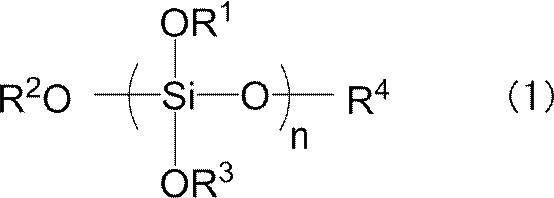
一般式(1)中、R1、R2、R3、及びR4は、それぞれ独立に、炭素数1~6の1価の有機基を表す。nは、2~20の整数を表す。 - 基材上に、請求項1~請求項4のいずれか1項に記載の膜形成用組成物を付与して親水性膜を得ること、を含む積層体の製造方法。
- 前記積層体は、65℃25%RHの雰囲気下、シリコーンシーラントの入ったガラス容器を入れた恒温恒湿装置内に配置し、150時間保持した後における、前記親水性膜表面の、25℃にて測定した純水接触角が30°以下の積層体である請求項6に記載の積層体の製造方法。
Priority Applications (1)
| Application Number | Priority Date | Filing Date | Title |
|---|---|---|---|
| JP2018524014A JPWO2017217513A1 (ja) | 2016-06-17 | 2017-06-15 | 膜形成用組成物、積層体、及び積層体の製造方法 |
Applications Claiming Priority (2)
| Application Number | Priority Date | Filing Date | Title |
|---|---|---|---|
| JP2016121287 | 2016-06-17 | ||
| JP2016-121287 | 2016-06-17 |
Publications (1)
| Publication Number | Publication Date |
|---|---|
| WO2017217513A1 true WO2017217513A1 (ja) | 2017-12-21 |
Family
ID=60663115
Family Applications (1)
| Application Number | Title | Priority Date | Filing Date |
|---|---|---|---|
| PCT/JP2017/022207 Ceased WO2017217513A1 (ja) | 2016-06-17 | 2017-06-15 | 膜形成用組成物、積層体、及び積層体の製造方法 |
Country Status (2)
| Country | Link |
|---|---|
| JP (1) | JPWO2017217513A1 (ja) |
| WO (1) | WO2017217513A1 (ja) |
Cited By (2)
| Publication number | Priority date | Publication date | Assignee | Title |
|---|---|---|---|---|
| JP2020097693A (ja) * | 2018-12-19 | 2020-06-25 | 株式会社スリーボンド | コーティング剤組成物 |
| WO2022255096A1 (ja) * | 2021-05-31 | 2022-12-08 | 日本ペイント・サーフケミカルズ株式会社 | 水性親水化組成物および物品 |
Citations (5)
| Publication number | Priority date | Publication date | Assignee | Title |
|---|---|---|---|---|
| WO2015012021A1 (ja) * | 2013-07-24 | 2015-01-29 | 富士フイルム株式会社 | 水性防汚コート剤、防汚コート層、積層体及び太陽電池モジュール |
| WO2015141240A1 (ja) * | 2014-03-17 | 2015-09-24 | 富士フイルム株式会社 | 水性コート剤、膜、膜の製造方法、積層体、及び太陽電池モジュール |
| WO2016047568A1 (ja) * | 2014-09-22 | 2016-03-31 | 富士フイルム株式会社 | 抗菌シート、抗菌コート、積層体、抗菌液 |
| WO2016056489A1 (ja) * | 2014-10-07 | 2016-04-14 | 富士フイルム株式会社 | 防汚層付積層体、監視カメラ用保護材、及び監視カメラ |
| JP2016069385A (ja) * | 2014-09-26 | 2016-05-09 | 三菱レイヨン株式会社 | 水性被覆材及び塗装物 |
Family Cites Families (1)
| Publication number | Priority date | Publication date | Assignee | Title |
|---|---|---|---|---|
| DE102014116708A1 (de) * | 2014-07-23 | 2016-01-28 | Physik Instrumente (Pi) Gmbh & Co. Kg | Aktorvorrichtung |
-
2017
- 2017-06-15 JP JP2018524014A patent/JPWO2017217513A1/ja not_active Abandoned
- 2017-06-15 WO PCT/JP2017/022207 patent/WO2017217513A1/ja not_active Ceased
Patent Citations (5)
| Publication number | Priority date | Publication date | Assignee | Title |
|---|---|---|---|---|
| WO2015012021A1 (ja) * | 2013-07-24 | 2015-01-29 | 富士フイルム株式会社 | 水性防汚コート剤、防汚コート層、積層体及び太陽電池モジュール |
| WO2015141240A1 (ja) * | 2014-03-17 | 2015-09-24 | 富士フイルム株式会社 | 水性コート剤、膜、膜の製造方法、積層体、及び太陽電池モジュール |
| WO2016047568A1 (ja) * | 2014-09-22 | 2016-03-31 | 富士フイルム株式会社 | 抗菌シート、抗菌コート、積層体、抗菌液 |
| JP2016069385A (ja) * | 2014-09-26 | 2016-05-09 | 三菱レイヨン株式会社 | 水性被覆材及び塗装物 |
| WO2016056489A1 (ja) * | 2014-10-07 | 2016-04-14 | 富士フイルム株式会社 | 防汚層付積層体、監視カメラ用保護材、及び監視カメラ |
Cited By (5)
| Publication number | Priority date | Publication date | Assignee | Title |
|---|---|---|---|---|
| JP2020097693A (ja) * | 2018-12-19 | 2020-06-25 | 株式会社スリーボンド | コーティング剤組成物 |
| JP7145379B2 (ja) | 2018-12-19 | 2022-10-03 | 株式会社スリーボンド | コーティング剤組成物 |
| WO2022255096A1 (ja) * | 2021-05-31 | 2022-12-08 | 日本ペイント・サーフケミカルズ株式会社 | 水性親水化組成物および物品 |
| JP2022183968A (ja) * | 2021-05-31 | 2022-12-13 | 日本ペイント・サーフケミカルズ株式会社 | 水性親水化組成物および物品 |
| JP7542260B2 (ja) | 2021-05-31 | 2024-08-30 | 日本ペイント・サーフケミカルズ株式会社 | 水性親水化組成物および物品 |
Also Published As
| Publication number | Publication date |
|---|---|
| JPWO2017217513A1 (ja) | 2019-02-28 |
Similar Documents
| Publication | Publication Date | Title |
|---|---|---|
| US10640670B2 (en) | Film-forming composition and manufacturing method of laminate | |
| WO2018092543A1 (ja) | 積層体及びその製造方法、並びに、防曇コート用組成物 | |
| JP6702814B2 (ja) | 防曇層形成用組成物、積層体、及び積層体の製造方法 | |
| WO2018092544A1 (ja) | 積層体 | |
| JP7200233B2 (ja) | コート剤、防曇膜、防曇膜の製造方法、及び積層体 | |
| JPWO2019064973A1 (ja) | 防曇層積層体 | |
| JP7065980B2 (ja) | 積層体 | |
| JP2016164265A (ja) | 親水性膜及びその製造方法、積層体、監視カメラ用保護材、監視カメラ、並びに防曇性膜用組成物 | |
| JP2019065178A (ja) | 防曇塗料及び積層体 | |
| WO2010001813A1 (ja) | 親水性部材 | |
| WO2017217513A1 (ja) | 膜形成用組成物、積層体、及び積層体の製造方法 | |
| WO2016056489A1 (ja) | 防汚層付積層体、監視カメラ用保護材、及び監視カメラ | |
| WO2019082768A1 (ja) | コート剤、防曇膜、防曇膜の製造方法、及び積層体 | |
| JP2007228828A (ja) | 農業用シート | |
| CN101426869A (zh) | 涂布组合物、固化膜及树脂层叠体 | |
| JP2005272835A (ja) | ケイ素含有液状組成物 | |
| JP5554020B2 (ja) | 防曇性コーティング組成物 | |
| JP2007091873A (ja) | 撥水性低屈折率コーティング用組成物 | |
| WO2019150780A1 (ja) | コート剤、積層体、及び積層体の製造方法 | |
| JP2005126460A (ja) | 親水化処理された樹脂成形品 | |
| JP2003103702A (ja) | 易洗浄性塗膜を有する板状体 |
Legal Events
| Date | Code | Title | Description |
|---|---|---|---|
| WWE | Wipo information: entry into national phase |
Ref document number: 2018524014 Country of ref document: JP |
|
| 121 | Ep: the epo has been informed by wipo that ep was designated in this application |
Ref document number: 17813407 Country of ref document: EP Kind code of ref document: A1 |
|
| NENP | Non-entry into the national phase |
Ref country code: DE |
|
| 122 | Ep: pct application non-entry in european phase |
Ref document number: 17813407 Country of ref document: EP Kind code of ref document: A1 |