WO2017209224A1 - 金属光沢を備えた物品を製造する方法、並びに、これを用いる金属光沢色用トナー及び印刷方法。 - Google Patents
金属光沢を備えた物品を製造する方法、並びに、これを用いる金属光沢色用トナー及び印刷方法。 Download PDFInfo
- Publication number
- WO2017209224A1 WO2017209224A1 PCT/JP2017/020373 JP2017020373W WO2017209224A1 WO 2017209224 A1 WO2017209224 A1 WO 2017209224A1 JP 2017020373 W JP2017020373 W JP 2017020373W WO 2017209224 A1 WO2017209224 A1 WO 2017209224A1
- Authority
- WO
- WIPO (PCT)
- Prior art keywords
- film
- metallic luster
- article
- resin
- thiophene
- Prior art date
- Legal status (The legal status is an assumption and is not a legal conclusion. Google has not performed a legal analysis and makes no representation as to the accuracy of the status listed.)
- Ceased
Links
Images



















Classifications
-
- B—PERFORMING OPERATIONS; TRANSPORTING
- B29—WORKING OF PLASTICS; WORKING OF SUBSTANCES IN A PLASTIC STATE IN GENERAL
- B29C—SHAPING OR JOINING OF PLASTICS; SHAPING OF MATERIAL IN A PLASTIC STATE, NOT OTHERWISE PROVIDED FOR; AFTER-TREATMENT OF THE SHAPED PRODUCTS, e.g. REPAIRING
- B29C59/00—Surface shaping of articles, e.g. embossing; Apparatus therefor
- B29C59/02—Surface shaping of articles, e.g. embossing; Apparatus therefor by mechanical means, e.g. pressing
-
- C—CHEMISTRY; METALLURGY
- C08—ORGANIC MACROMOLECULAR COMPOUNDS; THEIR PREPARATION OR CHEMICAL WORKING-UP; COMPOSITIONS BASED THEREON
- C08J—WORKING-UP; GENERAL PROCESSES OF COMPOUNDING; AFTER-TREATMENT NOT COVERED BY SUBCLASSES C08B, C08C, C08F, C08G or C08H
- C08J3/00—Processes of treating or compounding macromolecular substances
- C08J3/12—Powdering or granulating
-
- C—CHEMISTRY; METALLURGY
- C08—ORGANIC MACROMOLECULAR COMPOUNDS; THEIR PREPARATION OR CHEMICAL WORKING-UP; COMPOSITIONS BASED THEREON
- C08J—WORKING-UP; GENERAL PROCESSES OF COMPOUNDING; AFTER-TREATMENT NOT COVERED BY SUBCLASSES C08B, C08C, C08F, C08G or C08H
- C08J7/00—Chemical treatment or coating of shaped articles made of macromolecular substances
-
- G—PHYSICS
- G03—PHOTOGRAPHY; CINEMATOGRAPHY; ANALOGOUS TECHNIQUES USING WAVES OTHER THAN OPTICAL WAVES; ELECTROGRAPHY; HOLOGRAPHY
- G03G—ELECTROGRAPHY; ELECTROPHOTOGRAPHY; MAGNETOGRAPHY
- G03G9/00—Developers
- G03G9/08—Developers with toner particles
-
- G—PHYSICS
- G03—PHOTOGRAPHY; CINEMATOGRAPHY; ANALOGOUS TECHNIQUES USING WAVES OTHER THAN OPTICAL WAVES; ELECTROGRAPHY; HOLOGRAPHY
- G03G—ELECTROGRAPHY; ELECTROPHOTOGRAPHY; MAGNETOGRAPHY
- G03G9/00—Developers
- G03G9/08—Developers with toner particles
- G03G9/09—Colouring agents for toner particles
Definitions
- the present invention relates to a method for producing an article having a metallic luster, a metallic luster toner using the same, and a printing method.
- Metals are generally hard and are used not only for parts that require mechanical strength, such as home appliances and automobiles, but also because they have a metallic luster, they are excellent in texture and are used in every kind of everyday life such as furniture and sundries. . Gold is particularly popular because it can give a sense of quality. However, not only is the metal itself expensive, but it is not easy to process, and the metal is expensive.
- a metal plating method for coating a metal thin film on the surface of an article such as a polymer or glass, or a paint added with fine particles or flaky metal is applied to the surface of the article.
- There are surface treatment techniques such as methods. When this technique is used, an article having a metallic luster can be produced at low cost by manufacturing an article with a polymer compound and coating the surface thereof with a metal thin film or a paint containing a metal.
- the metal plating method has many limitations on the materials that can be surface treated.
- the surface technique uses a metal after all, and it is less expensive than the case where the entire article is used with a metal, but it becomes expensive.
- the coating material to which the above metal is added has a problem that due to the difference in specific gravity between the polymer binder and the metal in the coating material, the metal particles are settled, and spots are easily formed when the coating film is formed.
- Patent Document 1 discloses. There are techniques described.
- Patent Document 1 gives a metallic luster by dissolving in a solvent and uniformly coating on an article, and requires dissolution with a solvent. That is, the range of application is further expanded if a metallic luster can be obtained without using a solvent.
- the present invention provides a method for producing an article having a novel metallic luster that does not use a solvent when forming an article having a metallic luster, and a metallic gloss color toner and a printing method using the same.
- the purpose is to provide.
- the method for producing an article having a metallic luster according to one aspect of the present invention that solves the above-described problems involves pressurizing a thiophene polymer.
- the thiophene polymer is preferably formed by chemical polymerization or electrolytic polymerization.
- the metallic gloss color toner according to another aspect of the present invention contains a thiophene polymer.
- a printing method is to fix a metallic glossy color toner containing a thiophene polymer on a paper and pressurize the metallic glossy color toner.
- a method for producing an article having a new metallic luster that does not use a solvent when forming an article having a metallic luster, and a toner for metallic luster color and a printing method using the same. it can.
- FIG. It is a figure which shows the outline of the article
- FIG. It is a figure which shows the outline of another example of the articles
- FIG. It is a figure which shows the image of the manufacturing process of the articles
- FIG. It is a figure which shows the image of the manufacturing process of the articles
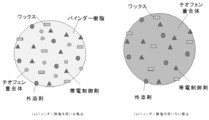
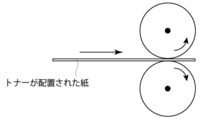
- FIG. It is a figure which shows the image of the toner particle which concerns on an application example. It is a figure which shows the image in the case of printing using the toner particle which concerns on an application example.
- FIG. It is a figure which shows the outline of the article
- FIG. It is a figure which shows an example of the other shape of the articles
- FIG. It is a figure which shows the film
- FIG. 1 is a schematic cross-sectional view of an article (hereinafter referred to as “article having metallic luster”) formed with a film having metallic luster containing a thiophene polymer according to the present embodiment.
- the article according to the present embodiment is not particularly limited as long as it has a metallic luster, not only electronic machine parts such as home appliances and automobiles, but also miscellaneous goods, clothes used in daily life such as furniture and toys, Although there are various kinds of paper products and the like, a flat surface is a preferable example from the viewpoint of easily applying pressure evenly. In the example of this figure, an example of paper is shown. Further, as described later, the entire article itself may be an article having a metallic luster.
- the thickness of the film having a metallic luster is not limited as long as the metallic luster can be exhibited, but if it is 0.1 ⁇ m or more, the film having the metallic luster can be obtained. More preferably, the thickness is 0.3 ⁇ m or more, and even more preferably 0.6 ⁇ m or more, the film has a more sufficient metallic luster.
- the film having metallic luster according to the present embodiment includes a thiophene polymer.
- the “thiophene polymer” refers to a polymer in which two or more thiophenes are bonded to each other and is a compound represented by the following general formula.
- R is a substituent and is not limited as long as it can impart a metallic luster to the film, but is not limited to an alkoxy group, an amino group, an alkyl group, a hydroxyl group, a hydroxyalkyl group, an aryl group, a cyano group, Or it is preferable that it is either halogen.
- R may be one or two per thiophene ring.
- the Rs of the thiophenes may be the same or different.
- thiophene is a heterocyclic compound containing sulfur, and is a compound represented by the following general formula.
- R is the same as described above.
- R when R is an alkoxy group, it is not limited, but the number of carbon atoms is preferably 1 or more and 8 or less, more specifically, 3-methoxythiophene, 3,4-dimethoxy. Examples include thiophene, 3-ethoxythiophene, 3,4-diethoxythiophene, 3-propoxythiophene, 3-butoxythiophene, 3-hydroxythiophene, 3,4-ethylenedioxythiophene, 3,4-propylenedioxythiophene can do.
- R in the above formula is an alkyl group
- the number of carbon atoms is preferably 1 or more and 12 or less, more specifically, 3-methylthiophene, 3,4-dimethyl.
- R is an amino group
- 3-aminothiophene, 3,4-diaminothiophene, 3-methylaminothiophene, 3-dimethylaminothiophene, 3-thiophenecarboxamide, 4- (thiophene-3- Il) Aniline and the like can be exemplified.
- the molecular weight of the “thiophene polymer” is not limited as long as it can have a metallic luster and can be formed as a film, but is determined by a GPC measurement method.
- the peak of the weight average molecular weight distribution is preferably in the range of 200 or more and 30000 or less, more preferably in the range of 500 or more and 10,000 or less.
- the article having a metallic luster according to the present embodiment may be configured by an article including a thiophene polymer having a metallic luster instead of forming a film having a metallic luster on the article surface. It is.
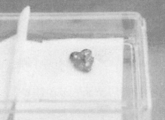
- a thiophene polymer may be molded so as to have a desired shape of the article itself to give a metallic luster. As an example of this, an example of a tablet-shaped article is shown in FIG.
- the method for producing an article having a metallic luster made of a thiophene polymer in this embodiment is a method in which a thiophene polymer powder is placed on an article and the thiophene polymer is pressurized. is there.
- the thiophene polymer is preferably formed by chemical polymerization or electrolytic polymerization.
- the thiophene polymer can also be produced using chemical polymerization.
- the “chemical polymerization method” refers to polymerization performed in at least one of a liquid phase and a solid phase using an oxidizing agent.
- the reason why the thiophene polymer exhibits a metallic luster is the same as in the case of electrolytic polymerization, but the reason is that the molecules constituting the thiophene polymer are regularly oriented and reflect a specific wavelength. It is believed that there is. This is supported by the fact that the produced film shows a sharp peak in X-ray diffraction. The details will be apparent from the examples described later, but in the X-ray diffraction measurement of the thiophene polymer, there are no halo patterns due to amorphous, and there are three peaks that are considered to be derived from the regular structure of the thiophene polymer. It means that it can be clearly observed in the range of diffraction angle (2 ⁇ ) from 5 degrees to 30 degrees.
- the article in the present embodiment is formed with a film made of the above thiophene polymer.
- This thiophene polymer is very stable in the air, hardly deteriorates even if left in the air for a long time, and is long. It can show a metallic luster over time.
- the present method a method for producing a film having metallic luster using the chemical polymerization method in the present embodiment (hereinafter simply referred to as “the present method”) will be described.
- This method includes (1) a step of polymerizing thiophene using an oxidizing agent to obtain a solution containing a thiophene polymer, and (2) a step of removing the solution containing the thiophene polymer to obtain a thiophene polymer powder. . That is, in this embodiment, chemical polymerization is performed to produce a thiophene polymer.
- thiophene is polymerized using an oxidizing agent, and a solution containing this thiophene polymer is prepared.
- the “thiophene” used here and the resulting “thiophene polymer” are those described above.
- the thiophene polymer is preferably in the range of a so-called oligomer, and specifically, the polymerization is preferably performed so that the distribution peak of the weight average molecular weight is in the range of 200 to 30000.
- the oxidizing agent is not limited as long as the thiophene polymer can be produced, and various ones can be used.
- ferric salt, cupric salt, cerium salt, dichromic acid examples thereof include salts, permanganate, ammonium persulfate, boron trifluoride, bromate, hydrogen peroxide, chlorine, bromine and iodine.
- ferric salt is preferable. Hydrates may also be used. In this case, the pair of ions can be appropriately adjusted and is not limited.
- perchlorate ion, hexafluorophosphate ion, and tetrafluoroborate ion is used, a metal close to gold Gloss can be obtained, which is preferable.
- the polymerization is preferably performed in a solvent using a solvent.
- the solvent to be used is not limited as long as the oxidizing agent and thiophene can be sufficiently dissolved and polymerized efficiently, but the organic solvent has a high polarity and a certain degree of volatility.
- acetonitrile, nitromethane, ⁇ -butyrolactone, propylene carbonate, nitromethane, 1-methyl-2-pyrrolidinone, dimethyl sulfoxide, 2-butanone, tetrahydrofuran, acetone, methanol, anisole, chloroform, ethyl acetate, hexane, trichloroethylene, cyclohexanone, Dichloromethane, chloroform, dimethylformamide, ethanol, butanol, pyridine, dioxane, and mixtures thereof can be used, but acetonitrile, nitromethane, ⁇ -butyrolactone, carbonate Lopylene is preferable because it has a soluble thiophene polymer and tends to form a film with better metallic luster.
- the amount of thiophene and oxidizing agent used for the solvent can be adjusted as appropriate and is not limited.
- the weight of the solvent is 1, the weight of thiophene is 0.00007 or more and 7 or less. More preferably, it is 0.0007 or more and 0.7 or less, and in the case of iron (III) perchlorate n hydrate, the weight is preferably 0.0006 or more and 6 or less, more preferably 0. 0.006 or more and 0.6 or less.
- the ratio of the thiophene to the oxidizing agent used is preferably 0.1 or more and 1000 or less, and more preferably 1 or more and 100 or less, when the weight of thiophene is 1.
- thiophene and oxidant may be added to the solvent all at once, but two types of solutions are separately prepared: a solution in which thiophene is added to the solvent and a solution in which the oxidant is added to the solvent.
- the polymerization reaction may be performed by combining them.
- the thiophene polymer produced as described above is preferably prepared as a powdered thiophene polymer (thiophene polymer powder) by removing the solvent. In this way, an article having a metallic luster can be easily produced only by pressing.
- an oxidizing agent containing the above-mentioned perchlorate ion, hexafluorophosphate ion, tetrafluoroborate ion, or chloride ion is used, it remains stably because it is stably bonded to the polymer. This state can be stably maintained.
- electrolytic polymerization is a method of dissolving a solution insoluble polymer film on a conductor by dissolving a substance (monomer) that is a precursor of a polymer in a solution containing a supporting electrolyte, and then subjecting the monomer to electrode oxidation.
- the technique to form is a method of dissolving a solution insoluble polymer film on a conductor by dissolving a substance (monomer) that is a precursor of a polymer in a solution containing a supporting electrolyte, and then subjecting the monomer to electrode oxidation. The technique to form.
- the potential sweep method is a treatment in which a pair of electrodes is immersed in a solution containing a supporting electrolyte and applied while changing the potential at a constant rate.
- the solvent of the solution used in this embodiment is not particularly limited.
- a mixed solvent of various solvents is also preferable.
- the supporting electrolyte of the solution used in the present embodiment is an essential component in electrolysis, and preferably has a cation or an anion that is sufficiently dissolved in a solvent and hardly electrolyzed, and is not limited thereto.
- the concentration of the supporting electrolyte is not limited, but is preferably 0.001 M or more and solubility or less, and more preferably 0.01 M or more and 1 M or less.
- the concentration of the thiophene monomer used in the electrolytic polymerization in the electrolytic solution is not limited, but is preferably 0.1 mM or more and less than or equal to the solubility, and more specifically 1 mM or more and 1M. The following is more preferable.
- the electropolymerization is performed by immersing a conductor (functioning as an operating electrode) in an electrolytic container containing a solution, and counter electrodes, and if necessary, three electrodes of a reference electrode serving as a potential reference Can be employed, or a two-electrode system using only a conductor and a counter electrode can be employed.
- a conductor functioning as an operating electrode
- three electrodes of a reference electrode serving as a potential reference Can or a two-electrode system using only a conductor and a counter electrode can be employed.
- the three-electrode system that can strictly regulate the electric potential of the conductor with respect to the reference electrode as a reference is used to produce an article having a metallic luster that contains the thiophene polymer formed by this method with good reproducibility. Is more preferable in that
- the conductor as the working electrode is not limited as long as it is a substance that is stable against electrode oxidation in both the three-electrode type and the two-electrode type.
- a transparent glass electrode, a metal electrode, a glassy carbon electrode or the like coated with indium tin (hereinafter abbreviated as “ITO”) or tin oxide can be suitably used.
- ITO indium tin
- a metal electrode such as stainless steel or a copper plate can be suitably used.
- the reference electrode is not limited, but for example, a silver / silver chloride electrode (Ag / AgCl electrode) or a saturated calomel electrode can be preferably used.
- the potential sweep method in the electropolymerization is preferably sweeping between a negative potential and a positive potential.
- the negative potential is preferably in the range of ⁇ 1.5V to ⁇ 0.01V, more preferably in the range of ⁇ 1.0V to ⁇ 0.1V, and still more preferably ⁇ 0.7V. It is the range of -0.2V or less.
- the positive potential is preferably in the range of + 1.0V to + 3.0V, more preferably in the range of + 1.0V to + 2.0V, and still more preferably in the range of + 1.0V to + 1.5V. It is.
- the potential sweep method is not limited as long as the sweep rate can produce an article having a metallic luster, but within a range of 0.1 mV / second to 10 V / second. More preferably, it is in the range of 1 mV / second to 1 V / second, and more preferably in the range of 2 mV / second to 300 mV / second.
- the time for the electropolymerization is not limited as long as an article having a metallic luster can be deposited, but it is preferably performed within the range of 1 second to 5 hours within the range of the applied voltage. More preferably, it is carried out within a range of 10 seconds to 1 hour.
- the temperature of this electrolysis is not limited as long as an article having a metallic luster can be deposited by electrolytic polymerization, but it is preferably in the range of ⁇ 20 ° C. or more and 60 ° C. or less.
- this electrolysis is a reaction in which constituent substances in the atmosphere are rarely involved, and since it is carried out at a relatively low potential, it can be carried out in the atmosphere. From the viewpoint of avoiding the possibility of contaminating the formed film, such as oxidation of impurities in the electrolytic solution, it is preferable to carry out in an atmosphere of nitrogen gas or argon gas, but there is almost no fear of contamination. Nevertheless, in the case of forming electropolymerization, bubbling with an inert gas (nitrogen gas or argon gas) is also useful because there is a possibility that the electrode reaction may be affected if a large amount of oxygen is present in the solution. is there.
- the thiophene polymer produced as described above is placed on an article and pressurized.
- pressurization refers to applying pressure to the membrane, and so-called “rubbing” is also included in the pressurization of the membrane.
- the thiophene polymer produced in this case is a powder. An image diagram relating to the manufacture of this article is shown in FIG.
- the article itself can be formed with only the thiophene polymer by placing the thiophene polymer prepared as described above in a mold made of metal or the like and pressurizing it.
- An image diagram relating to the manufacture of this article is shown in FIG.
- the range of the pressure at the time of pressurizing in this method is not particularly limited, but is preferably 10 kg / cm 2 or more, and more preferably 50 kg / cm 2 or more, for example.
- the upper limit is not limited as long as the film or article having metallic luster is not destroyed, but it is preferably in the range of 1.0 ⁇ 10 5 kg / cm 2 or less, more preferably 5.
- the range is 0 ⁇ 10 4 kg / cm 2 or less.
- the surface roughness can be reduced and glossiness can be better shown by setting it to 50 kg / cm 2 or more, and the destruction of the structure of the article can be prevented by setting it to 5.0 ⁇ 10 4 kg / cm 2 or less. be able to.
- the toner particles can be dissolved and stably fixed to an article such as paper.
- the heating temperature is not particularly limited as long as it is not higher than the thermal decomposition temperature.
- Patent Document 1 the inventors synthesized a deep blue polythiophene-based conductive polymer and dissolved it in a solvent to apply a coating solution on an article to form a gold-colored coating film. Have found to be. This is the world's first organic material that does not contain metals and dissolves in a solvent to give a gold-colored film. On the other hand, this time is based on the finding that a metal color tone is exhibited by applying pressure to this material. That is, the color change (chromism) based on a new principle that a deep blue powder exhibits a metallic color such as a gold color by pressure stimulation.
- an application example of the thiophene polymer according to the present embodiment is wide and not limited as apparent from the above description, but an example considered to be very effective is a toner for metallic gloss color. That is, the metallic glossy color toner according to this application example described below is one in which a thiophene polymer is externally or internally added (or both types of addition) to binder resin particles, or does not contain a binder resin. The coalescence itself becomes the toner body.
- the present toner is one in which the thiophene polymer is externally or internally added to the binder resin particles (or both addition modes), or the binder resin does not contain the thiophene polymer itself as the toner body.
- a component necessary as a toner may be included as long as the formation of an article having a metallic luster by the thiophene polymer is not hindered.
- a magnetic material such as iron powder, a wax, a charge control agent, an external additive, and the like can be included, but the invention is not limited thereto. An image diagram in this case is shown in FIG.
- the amount of the thiophene polymer to be included is limited as long as a metallic luster can be expressed. However, it is preferably 0.1% by weight or more, preferably 1% by weight or more based on the total amount of toner. Further, when no binder resin is used, the thiophene polymer occupies most of the weight of the toner.
- the printing method according to this application example is one in which a metallic gloss color toner containing a thiophene polymer is placed on an article, and the metallic gloss color toner is pressed to fix the toner.
- the toner binder and the like can be melted and fixed more easily on an article such as paper.
- FIG. 6 shows an image diagram of this process.
- a method for producing an article having a new metallic luster that does not use a solvent when forming an article having a metallic luster, and a toner for metallic luster color and a printing method using the same. it can.
- the method according to this embodiment manufactures an article having a metallic luster by rubbing the thiophene polymer.
- “rubbing” also referred to as “rubbing” specifically means that a force is applied in a direction (lateral direction) different from the direction in which pressure is applied in a pressurized state, more specifically.
- a thiophene polymer powder is placed on a substrate, and the pressure product is moved on the substrate in a state where the powder is pressurized by the pressure product.
- the pressurized material is not particularly limited, but for example, it is preferable that a weight is placed on the plate-like member itself or the plate-like member because a force can be applied uniformly.
- the value of pressurization can be greatly reduced compared to the case of only pressurization. More specifically, a metallic (golden) gloss can be obtained by rubbing even at a pressure of 500 g / cm 2 or less.
- the lower limit of pressurization may be a level that can be said to be pressurization, for example, 3 g / cm 2 or more. That is, when rubbing, the pressure range is 3 g / cm 2 or more and 500 g / cm 2 or less, more preferably 300 g / cm 2 or less.
- the pressure value can be further reduced, and a film having a metallic luster can be manufactured more easily.
- the weights applied to the case 50kg, 0.5t, 1t, 2t, 4t, 8t, 10t and changed (each as a pressure 0.038ton / cm 2, 0.38ton / cm 2, 0.75ton / cm 2 , 1.5 ton / cm 2 , 3.0 ton / cm 2 , 6.0 ton / cm 2 , 7.5 ton / cm 2 ), each of which was applied for 10 minutes to produce a plurality of tablets (50 kg sample was pressure For 1 minute). Then, the regular reflectance and surface roughness of the obtained tablet were measured.
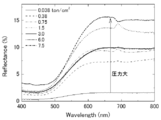
- the regular reflection spectrum of the tablet showed the same outline as that of the oligomer coating film.
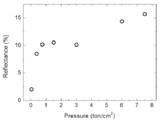
- the maximum reflectivity increased as the pressure applied during pressing increased.
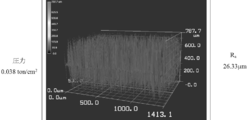
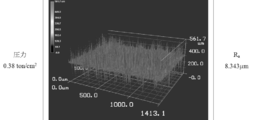
- the arithmetic average roughness Ra which is a representative parameter of the surface roughness, was calculated for the manufactured article.
- a laser microscope VK-9700 manufactured by Keyence Corporation and its analysis software were used, and the average value of 10 line roughnesses per 500 ⁇ m fixed length was calculated.
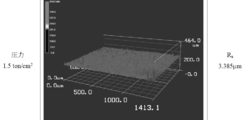
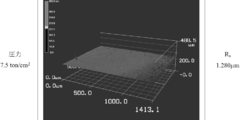
- FIGS. 16 to 22 show a 3D image and arithmetic average roughness Ra by a laser microscope
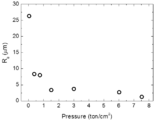
- FIG. 23 shows a relationship between the pressure applied during pressing and Ra.
- the brightness and saturation of the non-glossy 3MeOT oligomer powder were small, whereas in the rubbing sample ( ⁇ ) and coating film ( ⁇ ), the brightness was significantly increased and the saturation was also in the first quadrant. It confirmed that it extended in the direction. Moreover, when the rubbing sample was compared with the coating film, it was confirmed that although the hue was almost the same, the saturation was slightly smaller. This is probably because the rubbing sample has a larger surface roughness than the coating film, and thus diffuse reflection is large, and as a result, the glossy yellow color is observed to fade.
- the color of the 3MeOT oligomer powder is a subtractive color mixture of yellow and magenta, which is brown, and is actually very dark brown, so it is close to black.
- the peak intensity is low in this powder, the number density of the lamella structure is extremely small, and it can be seen that there are many amorphous parts in the powder.
- the (100) peak is remarkably increased compared to that, and since a sharp peak with a small half-value width is shown compared with the coating film, an edge-on lamella with a large crystal size is formed. (See FIG. 28). That is, rubbing has the effect of increasing the number density of edge-on lamellae and face-on lamellae contained in the powder sample, and it is considered that gold-colored gloss was developed especially by increasing the number density and size of edge-on lamellae.
- Metals are generally hard and are used not only for parts that require mechanical strength, such as home appliances and automobiles, but also because they have a metallic luster, they are excellent in texture and are used in every kind of everyday life such as furniture and sundries. . Gold is particularly popular because it can give a sense of quality. However, not only is the metal itself expensive, but it is not easy to process, and the metal is expensive.
- a metal plating method for coating a metal thin film on the surface of an article such as a polymer or glass, or a paint added with fine particles or flaky metal is applied to the surface of the article.
- There are surface treatment techniques such as methods. When this technique is used, an article having a metallic luster can be produced at low cost by manufacturing an article with a polymer compound and coating the surface thereof with a metal thin film or a paint containing a metal.
- the metal plating method has many limitations on the materials that can be surface treated.
- the surface technique uses a metal after all, and it is less expensive than the case where the entire article is used with a metal, but it becomes expensive.
- paints with the above metals added have metal particles that settle due to the difference in specific gravity between the polymer binder and the metal in the paint, making it easy to produce spots, and the metal is corroded and glossy. There are also problems such as loss and heavy coating.
- an object of the present invention is to provide an article and a toner having a metallic luster having high strength and a method for producing an article having a metallic luster.
- the weight of the thiophene polymer is preferably in the range of 0.1 to 99.9 when the weight of the article is 100.
- the article is preferably a three-dimensional object.
- a toner according to another aspect of the present invention includes a thiophene polymer mixed with at least one of a polyester resin, a polycarbonate resin, a polyvinyl pyrrolidone resin, a polystyrene resin, a polymethyl methacrylate resin, and a styrene acrylic copolymer resin. It has a metallic luster.
- the weight of the thiophene polymer is preferably in the range of 0.1 to 99.9 when the weight of the article is 100.
- a method for manufacturing an article according to another aspect of the present invention includes a polyester resin, a polycarbonate resin, a polyvinyl pyrrolidone resin, a polystyrene resin, a polymethyl methacrylate resin, and a styrene acrylic copolymer resin and a thiophene polymer. , Having a metallic luster that is solidified by mixing with a solvent and removing the solvent.
- the weight of the thiophene polymer is preferably in the range of 0.1 to 99.9 when the weight of the article is 100.
- a method for producing an article according to another aspect of the present invention includes a polyester resin, a polycarbonate resin, a polyvinyl pyrrolidone resin, a polystyrene resin, a polymethyl methacrylate resin, and a styrene acrylic copolymer resin, and a thiophene polymer. And a solvent for producing an article having a metallic luster.
- a three-dimensional object according to another aspect of the present invention is a polyester resin, a polycarbonate resin, a polyvinyl pyrrolidone resin, a polystyrene resin, a polymethyl methacrylate resin, and a styrene acrylic copolymer resin, a thiophene polymer, Are mixed.
- the toner having metallic luster includes a polyester resin, a polycarbonate resin, a polyvinylpyrrolidone resin, a polystyrene resin, a polymethyl methacrylate resin, and a styrene acrylic copolymer resin, and a thiophene polymer.
- the union is a mixture.
- a method for producing a three-dimensional object having metallic luster is a polyester resin, a polycarbonate resin, a polyvinyl pyrrolidone resin, a polystyrene resin, a polymethyl methacrylate resin, or a styrene acrylic copolymer resin.
- the heel thiophene polymer is mixed using a solvent and solidified by removing the solvent.
- a solution for producing an article having a metallic luster includes a polyester resin, a polycarbonate resin, a polyvinylpyrrolidone resin, a polystyrene resin, a polymethyl methacrylate resin, and a styrene acrylic copolymer resin. It has at least one, a thiophene polymer, and a solvent.
- FIG. 29 is a schematic view of an article (hereinafter, also referred to as “this article”) 1 having a metallic luster according to the present embodiment.
- This article in this figure is a mixture of polyester resin, polycarbonate resin, polyvinyl pyrrolidone resin, polystyrene resin, polymethyl methacrylate resin and styrene acrylic copolymer resin, and thiophene polymer, although this is an example in the form of a film in which an article is formed on a substrate, for example, a more three-dimensional and complicated shape shown in FIG. 30 is also possible.
- the polyester resin refers to a resin comprising a polycondensate of a polyvalent carboxylic acid and a polyhydric alcohol, and is not limited to this, but for example, polyethylene terephthalate, polytrimethylene terephthalate, polybutylene.
- examples include, but are not limited to, terephthalate, polyethylene naphthalate, polybutylene naphthalate, polycyclohexanedimethyl terephthalate, polytrimethylene naphthalate, polycyclohexanedimethylene terephthalate, polytritetramethylene naphthalate, and mixtures thereof. .
- the average molecular weight of the polyester resin is not limited as long as it has a metallic luster, but is preferably 1000 or more and 1000000 or less, more preferably 3000 or more and 100000 or less.
- the polycarbonate resin is a resin having a carbonate group as a constituent element, and can be produced by, for example, bisphenol A and phosgene.
- the average molecular weight of the polycarbonate resin is not limited as long as it has a metallic luster, but it is preferably 1000 or more and 1000000 or less, more preferably 3000 or more and 100000 or less.
- the polyvinyl pyrrolidone resin refers to a resin obtained by polymerizing N-vinyl-2-pyrrolidone. Moreover, in this article, the average molecular weight of the polyvinylpyrrolidone resin is not limited as long as it has a metallic luster, but it is preferably 1,000 or more and 1,000,000 or less, more preferably 3000 or more and 100,000 or less.
- the polystyrene resin refers to a resin obtained by polymerizing styrene.
- the average molecular weight of the polystyrene resin is not limited as long as it has a metallic luster, but it is preferably 1000 or more and 1000000 or less, more preferably 3000 or more and 500000 or less, and more preferably Is 300,000 or less.
- polymethyl methacrylate resin (acrylic resin)
- PMMA polymethyl methacrylate resin
- the average molecular weight of the polymethyl methacrylate resin is not limited as long as it has a metallic luster, but is preferably 1000 or more and 1000000 or less, more preferably 3000 or more and 500000 or less.
- the styrene acrylic copolymer resin refers to a copolymer compound of acrylonitrile and styrene.
- the average molecular weight of the styrene acrylic copolymer resin is not limited as long as it has a metallic luster, but it is preferably 1000 or more and 1000000 or less, more preferably 3000 or more and 500000 or less.
- Thiophene polymer In the present article, the “thiophene polymer” refers to a polymer in which two or more thiophenes are bonded to each other and refers to a compound represented by the following general formula.
- R is a substituent and is not limited as long as it can impart a metallic luster to the film, but is not limited to an alkoxy group, an amino group, an alkyl group, a hydroxyl group, a hydroxyalkyl group, an aryl group, a cyano group, Or it is preferable that it is either halogen.
- R may be one or two per thiophene ring.
- the Rs of the thiophenes may be the same or different.
- the thiophene polymer when the thiophene polymer is doped with anions, it exhibits a gold color and copper color similar to gold and copper.
- Anions include perchlorate ion, hexafluorophosphate ion, tetrafluoroborate ion, chloride ion, bromide ion, sulfate ion, acetate ion, nitrate ion, citrate ion, oxalate ion, p-toluenesulfonic acid Ion, polystyrene sulfonate ion and the like.
- thiophene is a heterocyclic compound containing sulfur, and is a compound represented by the following general formula.
- R is the same as described above.
- R when R is an alkoxy group, it is not limited, but the number of carbon atoms is preferably 1 or more and 8 or less, more specifically, 3-methoxythiophene, 3,4-dimethoxy.
- Examples thereof include thiophene, 3,4-ethylenedioxythiophene, 3,4-propylenedioxythiophene, and the like.
- R in the above formula is an alkyl group
- the number of carbon atoms is preferably 1 or more and 12 or less, more specifically, 3-methylthiophene, 3,4-dimethyl.
- R is an amino group
- 3-aminothiophene, 3,4-diaminothiophene, 3-methylaminothiophene, 3-dimethylaminothiophene, 3-thiophenecarboxamide, 4- (thiophene-3- Il) Aniline and the like can be exemplified.
- the molecular weight of the “thiophene polymer” is not limited as long as it can have a metallic luster and can be formed as a film, but the weight required by the GPC measurement method.
- the average molecular weight distribution peak is preferably in the range of 200 to 30,000, more preferably in the range of 500 to 10,000.
- the weight of the thiophene polymer is preferably in the range of 0.1 to 99.9, more preferably 0.5 to 99, when the total weight of the article is 100. Range.
- the thiophene polymer is not limited as long as it can be produced, and various methods can be adopted.
- thiophene polymers can be made by chemical polymerization or electrolytic polymerization.
- the “chemical polymerization method” refers to polymerization performed in at least one of a liquid phase and a solid phase using an oxidizing agent.
- a step of polymerizing thiophene using an oxidizing agent to obtain a solution containing a thiophene polymer (2) removing unreacted raw materials and by-products from the solution containing the thiophene polymer. And obtaining a thiophene polymer powder.
- thiophene is polymerized using an oxidizing agent to prepare a solution containing this thiophene polymer.
- the “thiophene” used here and the resulting “thiophene polymer” are those described above.
- the thiophene polymer is preferably in the range of a so-called oligomer, and specifically, the polymerization is preferably performed so that the distribution peak of the weight average molecular weight is in the range of 200 to 30000.
- the oxidizing agent is not limited as long as the thiophene polymer can be produced, and various ones can be used.
- ferric salt, cupric salt, cerium salt, dichromic acid examples thereof include salts, permanganate, ammonium persulfate, boron trifluoride, bromate, hydrogen peroxide, chlorine, bromine and iodine.
- ferric salt is preferable. Hydrates may also be used.
- the pair of ions can be appropriately adjusted and is not limited. For example, chloride ion, bromide ion, citrate ion, oxalate ion, paratoluenesulfonate ion, perchloric acid.
- the polymerization is preferably performed in a solvent using a solvent.
- the solvent to be used is not limited as long as the oxidizing agent and thiophene can be sufficiently dissolved and polymerized efficiently, but the organic solvent has a high polarity and a certain degree of volatility.
- acetonitrile, nitromethane, ⁇ -butyrolactone, propylene carbonate, nitromethane, 1-methyl-2-pyrrolidinone, dimethyl sulfoxide, 2-butanone, tetrahydrofuran, acetone, methanol, anisole, chloroform, ethyl acetate, hexane, trichloroethylene, cyclohexanone, Dichloromethane, chloroform, dimethylformamide, ethanol, butanol, pyridine, dioxane, and mixtures thereof can be used, but acetonitrile, nitromethane, ⁇ -butyrolactone, carbonate Lopylene is preferable because it has a soluble thiophene polymer and tends to form a film with better metallic luster.
- the amount of thiophene and oxidizing agent used for the solvent can be adjusted as appropriate and is not limited.
- the weight of the solvent is 1, the weight of thiophene is 0.00007 or more and 7 or less. More preferably, it is 0.0007 or more and 0.7 or less, and in the case of iron (III) perchlorate n hydrate, the weight is preferably 0.0006 or more and 6 or less, more preferably 0. 0.006 or more and 0.6 or less.
- the ratio of the thiophene to the oxidizing agent used is preferably 0.1 or more and 1000 or less, and more preferably 1 or more and 100 or less, when the weight of thiophene is 1.
- thiophene and oxidant may be added to the solvent all at once, but two types of solutions are separately prepared: a solution in which thiophene is added to the solvent and a solution in which the oxidant is added to the solvent.
- the polymerization reaction may be performed by combining them.
- the thiophene polymer produced as described above is preferably prepared as a powdered thiophene polymer (thiophene polymer powder) by removing the solvent. By doing so, it is possible to produce an article having metallic luster by mixing with a polyester resin while being dissolved in a solvent described later.
- an oxidizing agent containing the perchlorate ion, hexafluorophosphate ion, tetrafluoroborate ion, chloride ion, bromide ion, or paratoluenesulfonate ion is used, the polymer is stably used. Since it is bonded, the remaining metal gloss can be stably maintained.
- electrolytic polymerization refers to a solution-insoluble polymer film on a conductor by dissolving a substance (monomer) serving as a polymer precursor in a solution containing a supporting electrolyte, and then subjecting the monomer to electrode oxidation. Is a method of forming
- the potential sweep method is a treatment in which a pair of electrodes is immersed in a solution containing a supporting electrolyte and applied while changing the potential at a constant rate.
- the solvent of the solution used in this embodiment is not particularly limited.
- a mixed solvent of various solvents is also preferable.
- an anionic surfactant such as sodium dodecyl sulfate, a cationic surfactant such as dodecyltrimethylammonium bromide, and a nonionic surfactant such as polyoxyethylene lauryl ether, numerical evaluation using a colorimeter
- regulated by (1) can be obtained and it is preferable.
- the supporting electrolyte of the solution used in the present embodiment is an essential component in electrolysis, and preferably has a cation or an anion that is sufficiently dissolved in a solvent and hardly electrolyzed, and is not limited thereto.
- the concentration of the supporting electrolyte is not limited, but is preferably 0.001M or more and solubility or less, and more preferably 0.01M or more and 5M or less.
- the concentration of the thiophene monomer used in the electropolymerization in the electrolytic solution is not limited, but is preferably 0.1 mM or more and less than or equal to the solubility, more specifically 0.5 mM. More preferably, it is 1 M or less.
- the electropolymerization is performed by immersing a conductor (functioning as an operating electrode) in an electrolytic container containing a solution, and counter electrodes, and if necessary, three electrodes of a reference electrode serving as a potential reference Can be employed, or a two-electrode system using only a conductor and a counter electrode can be employed.
- a conductor functioning as an operating electrode
- three electrodes of a reference electrode serving as a potential reference Can or a two-electrode system using only a conductor and a counter electrode can be employed.
- the three-electrode system that can strictly regulate the electric potential of the conductor with respect to the reference electrode as a reference is used to produce an article having a metallic luster that contains the thiophene polymer formed by this method with good reproducibility. Is more preferable in that
- the conductor as the working electrode is not limited as long as it is a substance that is stable against electrode oxidation in both the three-electrode type and the two-electrode type.
- a transparent glass electrode coated with indium tin (hereinafter abbreviated as “ITO”) or tin oxide, a metal electrode, an alloy electrode such as stainless steel, a glassy carbon electrode, or the like can be suitably used.
- ITO indium tin
- a metal electrode such as stainless steel or a copper plate
- the reference electrode is not limited, but for example, a silver / silver chloride electrode (Ag / AgCl electrode) or a saturated calomel electrode can be preferably used.
- the potential sweep method in the electropolymerization is preferably sweeping between a negative potential and a positive potential.
- the negative potential is preferably in the range of ⁇ 1.5V to ⁇ 0.01V, more preferably in the range of ⁇ 1.0V to ⁇ 0.1V, and still more preferably ⁇ 0.7V. It is the range of -0.2V or less.
- the positive potential is preferably in the range of + 1.0V to + 3.0V, more preferably in the range of + 1.0V to + 2.0V, and still more preferably in the range of + 1.0V to + 1.5V. It is.
- the potential sweep method is not limited as long as the sweep rate can produce an article having a metallic luster, but within a range of 0.1 mV / second to 10 V / second. More preferably, it is in the range of 1 mV / second to 1 V / second, and more preferably in the range of 2 mV / second to 300 mV / second.
- the time for the electropolymerization is not limited as long as an article having a metallic luster can be deposited, but it is preferably performed within the range of 1 second to 5 hours within the range of the applied voltage. More preferably, it is carried out within a range of 10 seconds to 1 hour.
- the temperature of this electrolysis is not limited as long as an article having a metallic luster can be deposited by electrolytic polymerization, but it is preferably in the range of ⁇ 20 ° C. or more and 60 ° C. or less.
- this electrolysis is a reaction in which constituent substances in the atmosphere are rarely involved, and since it is carried out at a relatively low potential, it can be carried out in the atmosphere. From the viewpoint of avoiding the possibility of contaminating the formed film, such as oxidation of dissolved oxygen in the electrolytic solution, it is preferably performed in a nitrogen gas or argon gas atmosphere, but there is little concern about contamination. Nevertheless, in the case of forming electropolymerization, bubbling with an inert gas (nitrogen gas or argon gas) is also useful because there is a possibility that the electrode reaction may be affected if a large amount of oxygen is present in the solution. is there.
- This article is a mixture of the thiophene polymer synthesized by the above chemical polymerization or electrolytic polymerization and at least one of polyester resin, polycarbonate resin, polyvinyl pyrrolidone resin, polystyrene resin, polymethyl methacrylate resin and styrene acrylic copolymer resin.
- a solvent is not limited as long as the thiophene polymer can be mixed with at least one of the polyester resin, polycarbonate resin, polyvinyl pyrrolidone resin, polystyrene resin, polymethyl methacrylate resin and styrene acrylic copolymer resin.
- nitromethane, ⁇ -butyrolactone, acetonitrile, propylene carbonate, dimethyl sulfoxide, N-methyl-2-pyrrolidone and a mixture thereof can be used, but are not limited thereto.
- the ratio of the thiophene polymer to the ratio of at least one of polyester resin, polycarbonate resin, polyvinyl pyrrolidone resin, polystyrene resin, polymethyl methacrylate resin and styrene acrylic copolymer resin may be in the above range, but the concentration of the solvent and this mixture The ratio of is not limited as long as it can be dissolved and can be appropriately adjusted as long as the necessary viscosity can be obtained. For example, when the total weight of the polyester resin and the thiophene polymer is 1, It is preferably 0.1 or more and 500 or less.
- the three-dimensional shape includes a film, and the strength of the film has a very high strength, as will be apparent from Examples described later.
- the reason why the thiophene polymer exhibits a metallic luster is in the range of speculation, but it is considered that the molecules constituting the thiophene polymer are regularly oriented and reflect a specific wavelength. This is supported by the fact that the prepared film containing the thiophene polymer shows a sharp peak in X-ray diffraction.
- polyester resin polycarbonate resin, polyvinyl pyrrolidone resin, polystyrene resin, polymethyl methacrylate resin, and styrene-acrylic copolymer resin are used, among other resins.
- At least one of a resin, a polyvinyl pyrrolidone resin, a polystyrene resin, a polymethyl methacrylate resin and a styrene acrylic copolymer resin enters, the metallic luster is not lost.
- at least one of polyester resin, polycarbonate resin, polyvinyl pyrrolidone resin, polystyrene resin, polymethyl methacrylate resin and styrene acrylic copolymer resin can be appropriately adjusted in molecular weight, and by adjusting the solvent to be mixed, It is possible to adjust the viscosity of the solution.
- the article according to the present embodiment is a mixture of a thiophene polymer and at least one of a polyester resin, a polycarbonate resin, a polyvinyl pyrrolidone resin, a polystyrene resin, a polymethyl methacrylate resin, and a styrene acrylic copolymer resin.
- the polyester resin itself is used as a binder for toner used in, for example, printers and copiers, and this article can be used as toner for printers and the like.
- the toner it can be realized by making the mixture of the polyester resin and the thiophene polymer into fine particles.
- an article in which the polyester resin and the thiophene polymer are mixed can be crushed to obtain a desired particle size.
- the viscosity of the prepared solution is lowered, and an inkjet nozzle is used.
- a droplet having a size slightly larger than the desired particle size is formed by spraying used, and the solvent can be removed from the droplet to obtain a dried particle.
- other resins polycarbonate resins, polyvinyl pyrrolidone resins, polystyrene resins, polymethyl methacrylate resins, styrene acrylic copolymer resins, and the like can be used as long as possible.
- an article having a higher metallic luster can be obtained.
- a monomer of 3-methoxythiophene (hereinafter referred to as “3MeOT”) was distilled before polymerization to remove impurities. 5.418 g of the distilled monomer was stirred with a propeller stirrer for 30 minutes while bubbling nitrogen into 475 ml of acetonitrile to prepare a monomer solution of 0.1 mol / l.
- the solution was dropped onto a well-washed glass substrate with a dropper.
- the coating film of nitromethane solvent was dried at room temperature for 1 hour (20 ° C., 40% RH), and the coating film of GBL solvent was dried for 30 minutes (45 ° C.) with a constant temperature hot air dryer.
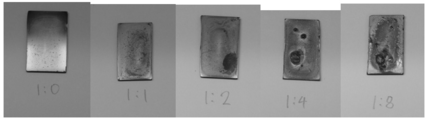
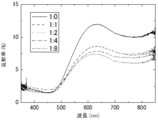
- FIG. 31 shows a film prepared from the nitromethane solution shown in Table 1 above.
- the ratio in the figure is the mass ratio of 3MeOT: PES. 1: 0 is an oligomer-only film that does not contain PES.
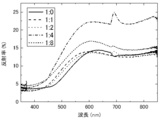
- FIG. 32 shows a film prepared from the GBL solution shown in Table 2 above.
- the ratio in the figure is the mass ratio of 3MeOT: PES. 1: 0 is an oligomer-only film that does not contain PES.
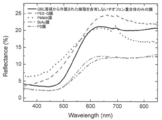
- the coating film prepared from the nitromethane solution shown in FIG. 33 According to the specular reflection spectrum of the coating film prepared from the nitromethane solution shown in FIG. 33, it was confirmed that the coating film showed a slight decrease in reflectance due to the addition of the polymer resin, but no rising wavelength shift was observed.
- the coating film prepared from the GBL solution shown in FIG. 34 had improved reflectance by the addition of the polymer resin.
- the rising wavelength is shifted by a short wavelength by the addition of the polymer resin, it was found that the color can be changed by the addition of the resin.
- Tables 5 and 6 show values compared with gold films prepared by vacuum deposition.
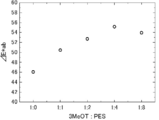
- ⁇ E * ab represents a color difference (a distance in the color space).
- FIGS. 37 and 38 show the difference between the coating film and the gold deposition film in the case of the nitromethane solution and the GBL solution.
- FIGS. 39 and 40 show the coating film and the gold deposition in the case of the nitromethane solution and the GBL solution, respectively. The color difference ⁇ E * ab from the film will be described.
- the coating strength was improved by increasing the amount of polymer resin added.
- the prepared coating solution was dropped onto a well-washed glass substrate with a dropper and applied, and the coating film was dried with a constant temperature hot air dryer for 1 hour (60 ° C.). In all cases, the film thickness was about 18 ⁇ m.
- FIG. 42 shows a photograph of the prepared coating film and a coating film not containing resin as a comparative example.
- a coating film not containing a resin (nitromethane solvent) as a comparative example a coating film not containing a resin (GBL solvent), PES-N, and PES-G as comparative examples are shown.
- PVP, PS, PMMA, and StAc respectively.
- PS, PMMA, and StAc since the back side of the film developed a gold color, it was taken as a photograph of the back side.
- FIG. 43 shows total reflection spectra of a film not containing a resin and a PEN-N film prepared from a nitromethane solvent
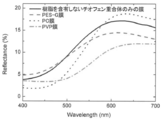
- FIG. 44 is a film not containing a resin and a PES-G film, a PC film and a PVP prepared from a GBL solvent.
- 45 shows the total reflection spectrum of the film
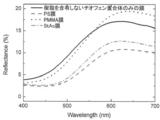
- FIG. 45 shows the total reflection spectrum of the film not containing the resin made from the GBL solvent, the PES film, the PMMA film, and the StAc film, respectively.
- ⁇ represents a gold vapor-deposited film
- ⁇ 1 represents a gold-colored film containing no resin prepared from a nitromethane solvent
- ⁇ 2 represents a PES-N film.
- ⁇ represents a gold vapor deposition film
- ⁇ 1 represents a gold-tone film not containing a resin prepared from a GBL solvent
- ⁇ 2 represents a PES-G film
- 3 represents a PC film
- 4 represents a PVP.
- ⁇ represents a gold deposited film
- ⁇ 1 represents a gold-colored film containing no resin prepared from a GBL solvent
- ⁇ 2 represents a PS film
- ⁇ 3 represents a PMMA film
- ⁇ 4 represents a StAc film.
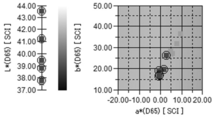
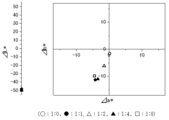
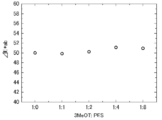
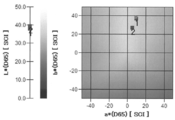
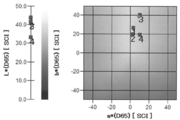
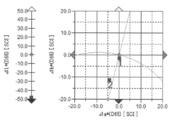
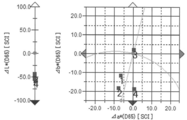
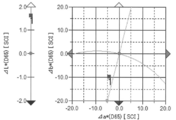
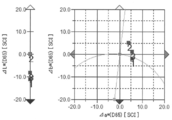
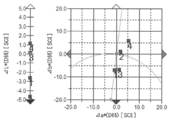
- the color difference ⁇ E * ab based on the colorimetric value of the gold vapor-deposited film and L * , a
- the values ⁇ L * , ⁇ a * and ⁇ b * between the values of * and b * are shown in Table 11 below, and the results plotted in FIGS. 49 to 51 are shown.
- the color difference ⁇ E * ab is a linear distance from the reference color (gold vapor deposition film) in the L * a * b * space, and is given by the following equation. 49 shows the color difference from the gold vapor deposition film.
- ⁇ represents a gold vapor deposition film
- ⁇ 1 represents a gold-tone film not containing a resin prepared from a nitromethane solvent
- ⁇ 2 represents a PES-N film.
- FIG. 50 also shows the color difference from the gold vapor deposition film.
- ⁇ represents a gold vapor deposition film
- ⁇ 1 represents a gold-tone film not containing a resin prepared from a GBL solvent
- ⁇ 2 represents a PES-G film.
- ⁇ 3 indicates a PC film
- ⁇ 4 indicates a PVP film.
- ⁇ indicates a gold deposited film
- ⁇ 1 indicates a gold-colored film containing no resin prepared from a GBL solvent
- ⁇ 2 indicates a PS film
- ⁇ 3 indicates a PMMA film
- ⁇ 4 indicates a StAc film.
- ⁇ represents a gold vapor deposition film
- ⁇ 1 represents a gold-colored film not containing a resin prepared from a GBL solvent
- ⁇ 2 represents a PES-G film
- ⁇ 3 indicates a PC film
- ⁇ 4 indicates a PVP film.
- ⁇ indicates a gold deposited film
- ⁇ 1 indicates a gold-colored film containing no resin prepared from a GBL solvent
- ⁇ 2 indicates a PS film
- ⁇ 3 indicates a PMMA film
- ⁇ 4 indicates a StAc film.
- the thiophene polymer was performed in the same manner as in the above example. Also, 80 mg of various resins shown in Table 13 below were completely dissolved in 1.0 g of GBL, and 10 mg of the prepared 3MeOT oligomer was mixed with the solution and stirred. Next, the solution was dropped onto a well-washed glass substrate with a dropper and applied, and the coating film was dried with a constant temperature hot air dryer for 1 hour (60 ° C.). The film thickness was about 50 ⁇ m.
- FIG. 55 shows a photograph of the film prepared above and a film not containing resin (dried at 60 ° C.).
- PS, PMMA, and StAc are images of the bonding surface (back surface) with the glass substrate.
- FIG. 56 shows a specular reflection spectrum of the surface of PES and the adhesive surface (back surface) of PS, PMMA, and StAc among the prepared coating films.
- the results measured with MSV-370) manufactured by the company are respectively shown. Comparing the results shown in this figure with the same results as described above, there was no difference in the rising wavelength and the reflectance, so that it was confirmed that even when the resin was excessively mixed with the oligomer, golden gloss was developed.
- ⁇ is a gold vapor deposition film
- ⁇ 1 is a gold-tone film not containing a resin made from GBL solvent
- ⁇ 2 is a PES film
- ⁇ 3 is a PS film
- ⁇ 4 is a PMMA film
- (5) indicates a StAc film, respectively.
- FIG. 59 shows the results plotted in FIG.
- ⁇ is a gold vapor deposition film
- ⁇ 1 is a gold-tone film not containing a resin made from GBL solvent
- ⁇ 2 is a PES film
- ⁇ 3 is a PS film
- ⁇ 4 is a PMMA film
- (5) indicates a StAc film, respectively.
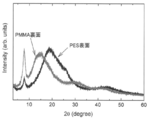
- FIG. 60 shows these XRD patterns. In any pattern, a sharp peak was confirmed around 7.79 degrees, and lamella crystals were present in the film, producing a lamellar correlation distance of 1.13 nm.
- XPS X-ray photoelectron spectroscopy
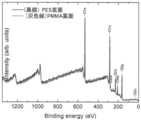
- Fig. 60 shows the wide scan spectrum. According to this, only peaks of oxygen O, carbon C, chlorine Cl, and sulfur S were confirmed in both PES and PMMA.
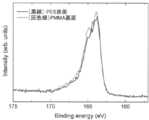
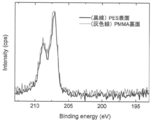
- Signals of sulfur derived from thiophene ring and chlorine derived from dopant perchloric acid were clearly observed within 2.5 nm in depth on both PES surface and PMMA surface exhibiting golden luster. That is, it was found that a thiophene polymer was present on the outermost surface and the rearmost surface of a 50 ⁇ m-thick film, and it was found that a golden tone was developed by lamellar crystals formed by the thiophene polymer.
- the chlorine and sulfur atom number concentrations obtained from the obtained spectrum are shown in Table 17 below. From this concentration, it was found that the thiophene polymer obtained in this example was doped with about 3 chloride ions per 10 units of the thiophene ring.
- the present invention has industrial applicability as an article having a metallic luster and a method for producing the same.
Landscapes
- Chemical & Material Sciences (AREA)
- Physics & Mathematics (AREA)
- General Physics & Mathematics (AREA)
- Health & Medical Sciences (AREA)
- Chemical Kinetics & Catalysis (AREA)
- Medicinal Chemistry (AREA)
- Polymers & Plastics (AREA)
- Organic Chemistry (AREA)
- Engineering & Computer Science (AREA)
- Mechanical Engineering (AREA)
- Laminated Bodies (AREA)
Abstract
金属光沢を有する物品を形成する際に溶媒を用いない新規な金属光沢を備えた物品を製造する方法、並びに、これを用いる金属光沢色用トナー及び印刷方法を提供する。 そのため、本発明の一観点は、チオフェン重合体を加圧することによって金属光沢を備えた物品を製造する方法である。また、この場合において、チオフェン重合体は、電解重合又は化学重合によって形成されたものであることが好ましい。 また、本発明の他の一観点は、チオフェン重合体を含む金属光沢色用トナーである。 また、本発明の他の一観点は、チオフェン重合体を含む金属光沢色用トナーを物品の上に配置し、当該金属光沢色用トナーを加圧することで定着させる印刷方法である。
Description
本発明は、金属光沢を備えた物品を製造する方法、並びに、これを用いる金属光沢色用トナー及び印刷方法に関する。
金属は一般に硬く、家電や自動車等、機械的強度が必要な部品に使用されているだけでなく、金属光沢を有するため質感に優れ、家具や雑貨等、日常生活のありとあらゆる物品において使用されている。特に金は、高級感を出すことができ人気が高い。しかしながら、金属は材料そのものが高価であるだけでなく加工も容易ではなく、高価となってしまうといった課題がある。
上記の課題を解決するための手段として、例えば、高分子やガラスといった物品の表面に金属の薄膜を被覆する金属めっき方法や、微粒子又はフレーク状の金属を添加した塗料を物品の表面に塗布する方法等の表面処理技術がある。この技術を用いると、高分子化合物で物品を製造する一方、その表面に金属薄膜又は金属を含む塗料を被覆することで、安価に金属光沢を有する物品を製造することができるといった効果がある。
しかしながら、上記金属めっき方法は、表面処理を行うことができる材質に制限が少なからずある。また上記表面技術は結局のところ金属を使用するものであり、物品全部を金属で使用する場合よりは少なくて済むが結局高価となってしまう。特に、上記金属を添加した塗料は塗料中のポリマーバインダーと金属との比重の違いにより、金属粒子が沈降し、塗膜にしたときに斑が生じやすくなってしまうといった課題もある。
そこで、金属以外の物質を用いて金属光沢を示す物質が存在すれば、上記課題を解決することができると考えられており、金属光沢を示す非金属物質に関する技術として、例えば下記特許文献1に記載の技術がある。
しかしながら、上記特許文献1に記載の技術は、溶媒に溶解して物品上に均一に塗布することによって金属光沢を出すものであって、溶媒による溶解が必要となっている。すなわち、溶媒を用いずとも金属光沢を出すことができれば応用の範囲は更に広がる。
そこで、本発明は上記課題を鑑み、金属光沢を有する物品を形成する際に溶媒を用いない新規な金属光沢を備えた物品を製造する方法、並びに、これを用いる金属光沢色用トナー及び印刷方法を提供することを目的とする。
上記課題を解決する本発明の一観点に係る金属光沢を有する物品を製造する方法は、チオフェン重合体を加圧するものである。
またこの観点において、チオフェン重合体は、化学重合又は電解重合によって形成されたものであることが好ましい。
また、本発明の他の一観点に係る金属光沢色用トナーは、チオフェン重合体を含むものである。
また、本発明の他の一観点に係る印刷方法は、チオフェン重合体を含む金属光沢色用トナーを紙の上に配置し、当該金属光沢色用トナーを加圧することで定着させるものである。
以上、本発明により、金属光沢を有する物品を形成する際に溶媒を用いない新規な金属光沢を有する物品を製造する方法、並びに、これを用いる金属光沢色用トナー及び印刷方法を提供することができる。
以下、本発明の実施形態について、図面を用いて詳細に説明する。ただし、本発明は多くの異なる形態による実施が可能であり、以下に示す実施形態、実施例の例示に限定されるものではない。
(実施形態1)
(金属光沢を有する膜が形成された物品)
図1は、本実施形態に係るチオフェン重合体を含む金属光沢を有する膜が形成されてなる物品(以下「金属光沢を有する物品」という。)の断面の概略図である。
(金属光沢を有する膜が形成された物品)
図1は、本実施形態に係るチオフェン重合体を含む金属光沢を有する膜が形成されてなる物品(以下「金属光沢を有する物品」という。)の断面の概略図である。
ここで本実施形態に係る物品としては、金属光沢を有する限りにおいて特に限定されるものではなく、家電や自動車等の電子機械部品だけでなく、家具や玩具等の日常生活において用いる雑貨、衣類、紙製品等、ありとあらゆるものを挙げることができるが、表面が平坦なものであることは均等に圧力を加えやすくする観点から好ましい一例である。本図の例では紙の例を示している。また、後述の記載にもあるように、物品の全体そのものが金属光沢を有する物品であってもよい。
また本実施形態において金属光沢を有する膜の厚さとしては、金属光沢を発揮することができる限りにおいて限定されるわけではないが、0.1μm以上あれば金属光沢を有する膜とすることができ、より好ましくは0.3μm以上であり、さらに好ましくは0.6μm以上あればより十分な金属光沢を有する膜となる。
また、本実施形態に係る金属光沢を有する膜は、チオフェン重合体を含む。
本実施形態において「チオフェン重合体」は、二以上のチオフェンが互いに結合して重合したものをいい、下記一般式で示される化合物である。

上記式において、Rは置換基であり、膜に金属光沢を付与できる限りにおいて限定されるわけではないが、アルコキシ基、アミノ基、アルキル基、ヒドロキシル基、ヒドロキシアルキル基、アリール基、シアノ基、又は、ハロゲンのいずれかであることが好ましい。また、Rは一つのチオフェン環に一つであっても、二つであってもよい。また、本実施形態に係るチオフェン重合体において、各チオフェンの上記Rは同じであっても異なっていてもよい。
なお「チオフェン」は、上記の記載からも明らかなように、硫黄を含む複素環式化合物であって、下記一般式で示される化合物である。式中Rの定義は上記と同様である。

なお、上記式中Rがアルコキシ基である場合、限定されるわけではないが、炭素数は1以上8以下であることが好ましく、より具体的には、3-メトキシチオフェン、3,4-ジメトキシチオフェン、3-エトキシチオフェン、3,4-ジエトキシチオフェン、3-プロポキシチオフェン、3-ブトキシチオフェン、3-ヒドロキシチオフェン、3,4-エチレンジオキシチオフェン、3,4-プロピレンジオキシチオフェン等を例示することができる。
また、上記式中Rがアルキル基である場合、限定されるわけではないが、炭素数は1以上12以下であることが好ましく、より具体的には、3-メチルチオフェン、3,4-ジメチルチオフェン、3-エチルチオフェン、3,4-ジエチルチオフェン、3-ブチルチオフェン、3-ヘキシルチオフェン、3-ヘプチルチオフェン、3-オクチルチオフェン、3-ノニルチオフェン、3-デシルチオフェン、3-ウンデシルチオフェン、3-ドデシルチオフェン、3-ブロモ-4-メチルチオフェン等を例示することができる。
また、上記式中Rがアミノ基である場合、3-アミノチオフェン、3,4-ジアミノチオフェン、3-メチルアミノチオフェン、3-ジメチルアミノチオフェン、3-チオフェンカルボキシアミド、4-(チオフェン-3-イル)アニリン等を例示することができる。
また本実施形態において、「チオフェン重合体」の分子量としては、金属光沢を有するものとすることができ、膜として形成できるものである限りにおいて限定されるわけではないが、GPC測定法により求められる重量平均分子量の分布のピークが200以上30000以下の範囲内にあることが好ましく、より好ましくは500以上10000以下の範囲内である。
また、本実施形態に係る金属光沢を有する物品は、上記のとおり、物品表面に金属光沢を有する膜が形成されているのではなく金属光沢を有するチオフェン重合体を含む物品で構成することも可能である。製造方法については別途後述するが、チオフェン重合体を所望の物品の形状そのものとなるよう成型し、金属光沢を持たせたものであっても良い。この例として、例えばタブレット形の物品の例を図2に示しておく。
(金属光沢を有する物品を製造する方法)
本実施形態におけるチオフェン重合体からなる金属光沢を有する物品を製造する方法(以下「本方法」ともいう。)は、物品上にチオフェン重合体の粉末を配置し、チオフェン重合体を加圧するものである。
本実施形態におけるチオフェン重合体からなる金属光沢を有する物品を製造する方法(以下「本方法」ともいう。)は、物品上にチオフェン重合体の粉末を配置し、チオフェン重合体を加圧するものである。
またこの観点において、チオフェン重合体は、化学重合又は電解重合によって形成されたものであることが好ましい。
(化学重合)
本実施形態において、上記のとおりチオフェン重合体は、化学重合を用いて製造することもできる。ここで「化学重合法」とは、酸化剤を用いて液相及び固相の少なくともいずれかにおいて行う重合をいう。
本実施形態において、上記のとおりチオフェン重合体は、化学重合を用いて製造することもできる。ここで「化学重合法」とは、酸化剤を用いて液相及び固相の少なくともいずれかにおいて行う重合をいう。
本実施形態において、電解重合の場合と同様チオフェン重合体が金属光沢を示す理由は推測の域にあるが、チオフェン重合体を構成する分子が規則的に配向し、特定の波長を反射するためであると考えられる。このことは、作製された膜がX線回折において鋭いピークを示していることからも裏付けられる。この詳細は後述の実施例から明らかとなるが、チオフェン重合体のX線回折測定において、アモルファスに起因するハローパターンが存在せずチオフェン重合体の規則的な構造に由来すると考えられる3つのピークが5度から30度の回折角(2θ)の範囲で明確に観測できることを意味する。
本実施形態における物品は、上記のチオフェン重合体からなる膜が形成されており、このチオフェン重合体は空気中において非常に安定であり、長期間空気中に放置しても劣化が殆どなく、長期間にわたり金属光沢を示すことができる。
ここで、本実施形態における化学重合法を用いた金属光沢を有する膜の製造方法(以下単に「本方法」という。)について説明する。
本方法は、(1)酸化剤を用いてチオフェンを重合してチオフェン重合体を含む溶液とする工程、(2)チオフェン重合体を含む溶液を除去してチオフェン重合体粉末を得る工程、を有する。すなわち、本実施形態では、化学重合を行い、チオフェン重合体を製造する。
まず、本方法では、(1)酸化剤を用いてチオフェンを重合し、このチオフェン重合体を含む溶液を作製する。ここで用いる「チオフェン」及び得られる「チオフェン重合体」は、上記したものである。チオフェン重合体は、上記の通り、いわゆるオリゴマーの範囲にあることが好ましく、具体的には重量平均分子量の分布ピークが200以上30000以下の範囲内となるように重合することが好ましい。
本工程において、酸化剤は、チオフェン重合体を製造することができる限りにおいて限定されず様々なものを使用することができるが、例えば第二鉄塩、第二銅塩、セリウム塩、二クロム酸塩、過マンガン酸塩、過硫酸アンモニウム、三フッ化ホウ素、臭素酸塩、過酸化水素、塩素、臭素及びヨウ素を挙げることができ、中でも第二鉄塩が好ましい。なお水和物であっても良い。また、この場合において、この対となるイオンも適宜調整可能であって限定されるわけではなく、例えば塩化物イオン、クエン酸イオン、シュウ酸イオン、パラトルエンスルホン酸イオン、過塩素酸イオン、ヘキサフルオロリン酸イオン、テトラフルオロホウ酸イオン等を挙げることができ、その中でも、過塩素酸イオン、ヘキサフルオロリン酸イオン、及び、テトラフルオロホウ酸イオンの少なくともいずれかを用いると、金色に近い金属光沢を得ることができ好ましい。金色に近い金属光沢を得ることができる理由は、推測の域であるが、過塩素酸イオン、ヘキサフルオロリン酸イオン、テトラフルオロホウ酸イオンが重合の際、チオフェン重合体にドーパントとして組み込まれ、チオフェン重合体内に生成されるカチオン部位と結合して安定化し、規則正しい構造の形成に寄与するためであると考えられる。実際のところ金属光沢を有する膜を分析するとこれらが安定的に存在することが確認されている。
また本工程において、重合は溶媒を用い、この溶媒中において行うことが好ましい。用いる溶媒は、上記酸化剤及びチオフェンを十分に溶解し効率的に重合させることができる限りにおいて限定されるわけではないが、高い極性を有し、ある程度の揮発性を有する有機溶媒であることが好ましく、例えばアセトニトリル、ニトロメタン、γ-ブチロラクトン、炭酸プロピレン、ニトロメタン、1-メチル-2-ピロリジノン、ジメチルスルホキシド、2-ブタノン、テトラヒドロフラン、アセトン、メタノール、アニソール、クロロホルム、酢酸エチル、ヘキサン、トリクロロエチレン、シクロヘキサノン、ジクロロメタン、クロロホルム、ジメチルホルムアミド、エタノール、ブタノール、ピリジン、ジオキサン、及びこれらの混合物等を用いることができるが、アセトニトリル、ニトロメタン、γ-ブチロラクトン、炭酸プロピレンはチオフェン重合体が可溶であり、より良好な金属光沢を備えた膜となりやすく好ましい。
なお本工程において、溶媒に対し用いるチオフェン、酸化剤の量は適宜調整可能であり限定されるわけではないが、溶媒の重量を1とした場合、チオフェンの重量は0.00007以上7以下であることが好ましく、より好ましくは0.0007以上0.7以下であり、過塩素酸鉄(III)n水和物の場合、重量は0.0006以上6以下であることが好ましく、より好ましくは0.006以上0.6以下である。
また、本工程において、用いるチオフェンと酸化剤の比としてはチオフェンの重量を1とした場合、0.1以上1000以下であることが好ましく、1以上100以下であることがより好ましい。
また本工程は、チオフェンと酸化剤を溶媒に一度に加えてもよいが、溶媒にチオフェンを加えた溶液と、酸化剤を溶媒に加えた溶液の二種類の溶液を別途作製し、これらを加え合わせることで重合反応を行わせても良い。
また本方法において、上記作製したチオフェン重合体は、溶媒を除去して粉末状のチオフェン重合体(チオフェン重合体粉末)としておくことが好ましい。このようにしておくことで加圧のみによって容易に金属光沢を有する物品を製造することが可能となる。なお、酸化剤において上記過塩素酸イオン、ヘキサフルオロリン酸イオン、テトラフルオロホウ酸イオン、塩化物イオンを含むものを用いた場合、上記重合体に安定的に結合されているため残り、金属光沢の状態を安定的に維持することができる。
(電解重合)
本実施形態において、電解重合とは、重合体の前駆体となる物質(モノマー)を支持電解質を含む溶液に溶解し、その後モノマーを電極酸化することにより、導電体上に溶液不溶性重合体膜を形成する手法をいう。
本実施形態において、電解重合とは、重合体の前駆体となる物質(モノマー)を支持電解質を含む溶液に溶解し、その後モノマーを電極酸化することにより、導電体上に溶液不溶性重合体膜を形成する手法をいう。
また、本実施形態において、陽極酸化させる際、電位掃引法を用いることが好ましい。電位掃引法とは、支持電解質を含む溶液に一対の電極を浸漬し、一定の速度で電位を変化させつつ印加する処理をいう。
また本実施形態において用いられる溶液の溶媒としては、特に限定されるわけではないが、例えば水、アルコールの他、藤島昭、相澤益男、井上 徹、電気化学測定法、技報堂出版、上巻107―114頁、1984年に記載の溶媒を採用できる。また、種々の溶媒の混合溶媒も好ましい。
また本実施形態において用いられる溶液の支持電解質は、電気分解において必須の成分であり、溶媒に十分溶解し、電気分解されにくいカチオン又はアニオンを構成要素とするものが好ましく、限定されるわけではないが、カチオンに注目すれば例えばリチウム塩、ナトリウム塩、カリウム塩、カルシウム塩、テトラアルキルアンモニウム塩の少なくともいずれかを用いることが好ましく、アニオンに注目すれば例えばハロゲン化物、硫酸塩、硝酸塩、リン酸塩、過塩素酸塩、三フッ化ホウ素塩、六フッ化リン酸塩の少なくともいずれかを用いることが好ましい。支持電解質の濃度は、限定されるわけではないが0.001M以上溶解度以下であることが好ましく、0.01M以上1M以下であることがより好ましい。
また、本実施形態において、電解重合で用いられるチオフェンモノマーの電解溶液中における濃度は、限定されるわけではないが、0.1mM以上溶解度以下であることが好ましく、より具体的には1mM以上1M以下であることがより好ましい。
また本実施形態において、電解重合は溶液を入れた電解容器に導電体(動作電極として機能させる)を浸漬し、これに対向電極、必要に応じて電位の基準となる参照電極の3本の電極を用いる3電極式、又は、導電体と対向電極だけを用いる2電極式を採用することができる。なお、導電体の電位を基準となる参照電極に対して厳密に規定することのできる3電極式は、本方法によって形成されるチオフェン重合体を含む金属光沢を有する物品を再現性良く作製することができる点においてより好ましい。
動作電極としての導電体は、3電極式及び2電極式のいずれの場合においても、電極酸化に対して安定な物質であれば良く、限定されるわけではないが、例えば上記したように、酸化インジウムスズ(以下「ITO」と略記する。)や酸化錫が塗布された透明ガラス電極、金属電極、グラシーカーボン電極等を好適に用いることができる。また、対向電極としては、上記電極材料に加え、ステンレスや銅板などの金属電極を好適に用いることができる。また参照電極は、限定されるわけではないが例えば銀・塩化銀電極(Ag/AgCl電極)、飽和カロメル電極を好適に用いることができる。
また、本実施形態において電解重合における電位掃引法は、負電位と正電位の間で掃引することが好ましい。またこの場合において、負電位は、-1.5V以上-0.01V以下の範囲であることが好ましく、より好ましくは-1.0V以上-0.1V以下の範囲、さらに好ましくは-0.7V以上-0.2V以下の範囲である。また、正電位は、+1.0V以上+3.0V以下の範囲であることが好ましく、より好ましくは+1.0V以上+2.0V以下の範囲、さらに好ましくは+1.0V以上+1.5V以下の範囲内である。
また本実施形態において、電位掃引法は、掃引速度について、金属光沢を有する物品を製造することができる限りにおいて限定されるわけではないが、0.1mV/秒以上10V/秒以下の範囲内とすることが好ましく、より好ましくは1mV/秒以上1V/秒以下の範囲、さらに好ましくは2mV/秒以上300mV/秒以下の範囲内である。
また電解重合の時間としては、金属光沢を有する物品を析出させることができる限りにおいて限定されるわけではないが、上記印加電圧の範囲内において1秒以上5時間以下の範囲内において行うことが好ましく、10秒以上1時間以下の範囲内において行うことがより好ましい。
また、この電気分解の温度としては電解重合により金属光沢を有する物品を析出させることができる限りにおいて限定されるわけではないが、-20℃以上60℃以下の範囲内にあることが好ましい。
また、この電気分解は、大気中の成分物質が関与することの少ない反応でありまた比較的低電位で行われるため、大気中で行うことができる。電解液中の不純物の酸化など、生成した膜を汚染する可能性を回避する観点から、窒素ガスやアルゴンガス雰囲気中で行うことが好ましいが、汚染の心配はほとんど無い。しかしながらそれでもやはり、電解重合を形成する場合、溶液中に酸素が多く存在すると電極反応に影響を与えてしまうおそれがあるため、不活性ガス(窒素ガスやアルゴンガス)によるバブリングを行うことも有用である。
そして、本方法では、上記によって作製されたチオフェン重合体を、物品上に配置し加圧する。この結果、物品上に安定的に固着した金属光沢を有する物品を形成することができる。ここで「加圧」は、膜に対して圧力を加えることをいい、いわゆる「擦る」ことも膜に対する加圧に含まれる。またこの場合において作製されるチオフェン重合体は粉末となっていることが好ましい。なおこの物品の製造に関するイメージ図を図3に示しておく。
また、本方法では、上記によって作成されたチオフェン重合体を金属等で構成された型内に配置し、これを加圧することでほぼチオフェン重合体のみで物品そのものを形成することもできる。この物品の製造に関するイメージ図を図4に示しておく。
また本方法において加圧する際の圧力の範囲としては特に限定されるわけではないが、例えば10kg/cm2以上あることが好ましく、より好ましくは50kg/cm2以上である。なお、上限としては、金属光沢を有する膜又は物品が破壊されない限りにおいて限定されるわけではないが、1.0×105kg/cm2以下の範囲であることが好ましく、より好ましくは5.0×104kg/cm2以下の範囲である。50kg/cm2以上とすることで表面粗さを小さくし、光沢感をよりよく示すことができ、5.0×104kg/cm2以下とすることで物品の構造を破壊するのを防ぐことができる。
なお本方法において、加圧する際、物品及びチオフェン重合体に対して加熱を行うことも好ましい。このようにすることで、より加圧効率が高まるといった効果があり、更に次に述べるとおりトナー粒子を溶解させて紙等の物品に安定的に固着させることが可能となる。なお加熱の温度としては、熱分解温度以下であれば特に限定されない。
以上、本発明により、金属光沢を有する物品を形成する際に溶媒を用いない新規な金属光沢を有する物品を製造する方法を提供することができる。
本発明者らは、上記特許文献1において、深青色のポリチオフェン系の導電性ポリマーを合成し、これを溶媒に溶解して得られた塗布液を物品上に塗布すると金色調の塗布膜が形成することを発見している。これは世界初の金属を含まず溶媒に溶けて金色調膜を与える有機材料である。これに対し今回は、この材料に圧力をかけることで金属色調を呈することを見出したことに基づくものである。すなわち、深青色の粉体が圧力刺激によって金色等の金属色を呈する新たな原理の色変化(クロミズム)である。
(応用例:トナー)
本実施形態に係るチオフェン重合体の応用例は、上記の記載からも明らかなように広く、限定されるわけではないが、非常に有効と考えられる一例として、金属光沢色用トナーがある。すなわち、以下説明する本応用例に係る金属光沢色用トナーは、バインダー樹脂粒子にチオフェン重合体が外添又は内添(あるいはその両方の添加様式)されたもの、あるいはバインダー樹脂を含まずチオフェン重合体自身がトナー本体となるものである。
本実施形態に係るチオフェン重合体の応用例は、上記の記載からも明らかなように広く、限定されるわけではないが、非常に有効と考えられる一例として、金属光沢色用トナーがある。すなわち、以下説明する本応用例に係る金属光沢色用トナーは、バインダー樹脂粒子にチオフェン重合体が外添又は内添(あるいはその両方の添加様式)されたもの、あるいはバインダー樹脂を含まずチオフェン重合体自身がトナー本体となるものである。
本トナーは、上記のとおり、バインダー樹脂粒子にチオフェン重合体が外添あるいは内添(あるいはその両方の添加様式)されたもの、あるいはバインダー樹脂を含まずチオフェン重合体自身がトナー本体となるものであるが、このチオフェン重合体による金属光沢を有する物品形成を阻害しない範囲でトナーとして必要な成分を含んでいても良い。具体的には例えば鉄粉等の磁性体、ワックス、帯電制御剤、外添剤等を含ませることができるがこれに限定されない。この場合のイメージ図を図5に示しておく。
バインダー樹脂粒子にチオフェン重合体を外添あるいは内添(あるいはその両方の添加様式)させたトナーの場合において、チオフェン重合体を含ませる量としては金属光沢を発現させることができる限りにおいて限定されるわけではないが、トナー全量に対し0.1重量%以上あることが好ましくは1重量%以上である。また、バインダー樹脂を用いない場合には、チオフェン重合体がトナーのほとんどの重量を占めることとなる。
また、本応用例に係る印刷方法は、チオフェン重合体を含む金属光沢色用トナーを物品の上に配置し、当該金属光沢色用トナーを加圧することで定着させるものである。この際、上記したように、加圧と同時に加熱を加えることでトナーのバインダー等を溶融して紙等の物品上により固着させやすくなる。図6にこの工程のイメージ図を示しておく。
以上、本発明により、金属光沢を有する物品を形成する際に溶媒を用いない新規な金属光沢を有する物品を製造する方法、並びに、これを用いる金属光沢色用トナー及び印刷方法を提供することができる。
(実施形態2)
本実施形態では、上記実施形態において言及した加圧のうち、横方向に力を加えて膜を形成するいわゆる「擦る」ことに関し、より具体的に説明する。
本実施形態では、上記実施形態において言及した加圧のうち、横方向に力を加えて膜を形成するいわゆる「擦る」ことに関し、より具体的に説明する。
より具体的に説明すると、本実施形態に係る方法(以下「本方法」という。)は、チオフェン重合体を擦ることにより、金属光沢を備えた物品を製造するものである。本方法において「擦る」(「ラビング」ともいう)とは、具体的には、加圧した状態で、加圧した方向とは異なる方向(横方向)に力を加えること、より具体的には、基板上にチオフェン重合体の粉末を配置し、この粉末を加圧物によって加圧した状態で、当該加圧物を基板上において移動させることをいう。またこの場合において、加圧物は特に限定されるわけではないが、例えば板状の部材そのもの又は板状の部材に錘を載せたものであることは均一に力を加えることができるため好ましい。このようにすることで、上記の通り金属光沢を備えた物品を製造することができる。この原理についてはまだ推定の域であるが、擦ることで、チオフェン重合体の配列に対し規則的な配列を誘起し、金属的な光沢を備えた膜となると考えられる。
また、本方法において擦る場合、加圧の値は加圧するだけの場合に比べ、大幅にこの値減少させることができる。より具体的には、500g/cm2以下の圧力でも擦ることにより金属(金色)の光沢を得ることができる。なお、加圧の下限としては加圧といえる程度であればよく、例えば3g/cm2以上あればよい。すなわち、擦る場合、加圧の範囲としては、3g/cm2以上500g/cm2以下、より好ましくは300g/cm2以下である。
以上、本実施形態によると、より加圧の値を低減させ、より容易に金属光沢を有する膜を製造することができる。
(実施例)
ここで、上記実施形態にかかる膜を実際に作製し、その効果を確認した。以下具体的に説明する。
ここで、上記実施形態にかかる膜を実際に作製し、その効果を確認した。以下具体的に説明する。
本実施例では、3-メトキシチオフェン(3MeOT)オリゴマーの粉末に圧力をかけて圧縮したところ、金色調光沢をもつ固体(タブレット形状)となった。タブレット作製時に印加する圧力を変え、各サンプルの外観、正反射スペクトルおよび算術平均粗さの評価を行った。
(3MeOTオリゴマーの作製)
原料モノマーである3MeOT(濃度0.1M)のアセトニトリル溶液10mLに、酸化剤である過塩素酸鉄(III)(濃度0.2M)のアセトニトリル溶液(10mL)を加え、窒素雰囲気下で2時間重合を行った。重合後に、ろ過、洗浄、真空乾燥を経て生成物である3MeOTオリゴマーを得た。
原料モノマーである3MeOT(濃度0.1M)のアセトニトリル溶液10mLに、酸化剤である過塩素酸鉄(III)(濃度0.2M)のアセトニトリル溶液(10mL)を加え、窒素雰囲気下で2時間重合を行った。重合後に、ろ過、洗浄、真空乾燥を経て生成物である3MeOTオリゴマーを得た。
(3MeOTオリゴマータブレットの作製)
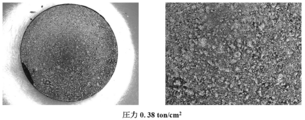
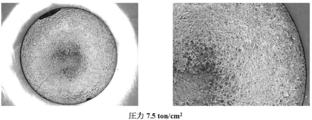
次に、上記の手法で得られた3MeOTオリゴマーを乳鉢で15分程度すりつぶして粉砕した後、錠剤成形器(島津製作所社製ハンドプレスSSP-10A)を使用してタブレット(直径13mm)を作製した。1つのタブレット作製には100mgのオリゴマーを使用した。そして、その際にかける加重を50kg、0.5t、1t、2t、4t、8t、10tと変え(圧力としてはそれぞれ0.038ton/cm2、0.38ton/cm2、0.75ton/cm2、1.5ton/cm2、3.0ton/cm2、6.0ton/cm2、7.5ton/cm2)、それぞれの圧力を10分間加えて複数のタブレットを作製した(50kgのサンプルは圧力を1分間加えた)。その後、得られたタブレットの正反射率及び表面粗さを測定した。
次に、上記の手法で得られた3MeOTオリゴマーを乳鉢で15分程度すりつぶして粉砕した後、錠剤成形器(島津製作所社製ハンドプレスSSP-10A)を使用してタブレット(直径13mm)を作製した。1つのタブレット作製には100mgのオリゴマーを使用した。そして、その際にかける加重を50kg、0.5t、1t、2t、4t、8t、10tと変え(圧力としてはそれぞれ0.038ton/cm2、0.38ton/cm2、0.75ton/cm2、1.5ton/cm2、3.0ton/cm2、6.0ton/cm2、7.5ton/cm2)、それぞれの圧力を10分間加えて複数のタブレットを作製した(50kgのサンプルは圧力を1分間加えた)。その後、得られたタブレットの正反射率及び表面粗さを測定した。
(外観)
プレスの圧力を変えて作製した3MeOTタブレットをキーエンス社のデジタルマイクロスコープVHX-5000で撮影した。この結果を図7乃至図13にそれぞれ示しておく。
プレスの圧力を変えて作製した3MeOTタブレットをキーエンス社のデジタルマイクロスコープVHX-5000で撮影した。この結果を図7乃至図13にそれぞれ示しておく。
この結果、どの圧力で作製したサンプルも、金色調光沢を発現していることを確認した。ただし、加重1t(圧力としては0.75ton/cm2)のサンプルは錠剤成形器から取り外す際に割れてしまった。また、各サンプルの拡大像を観察したところ、圧力の低いサンプルほど表面に凹凸が見られることを確認した。
(正反射スペクトル)
次に、上記による作成したサンプルの正反射スペクトルの測定を行った。反射スペクトルの測定には、日本分光社製 MSV-370スペクトロメーターを用いた。各サンプルの正反射スペクトルを図14に示す。
次に、上記による作成したサンプルの正反射スペクトルの測定を行った。反射スペクトルの測定には、日本分光社製 MSV-370スペクトロメーターを用いた。各サンプルの正反射スペクトルを図14に示す。
この結果、タブレットの正反射スペクトルはオリゴマーの塗布膜のスペクトルと同じ概形を示した。プレス時に加えた圧力が大きいサンプルほど、最大反射率は大きくなった。
そこで、横軸にプレス時にかけた圧力、縦軸に最大反射率をとったときのグラフを図15に示す。
また、上記作製した物品について、表面粗さの代表的なパラメータである算術平均粗さRaを計算した。計算にはキーエンス社製のレーザー顕微鏡VK-9700及びその解析ソフトウェアを使用し、固定長500μmあたりの線粗さ10ヶ所の平均値を算出した。測定結果について、図16乃至図22に、レーザー顕微鏡による3D画像と算術平均粗さRaを、図23に、プレス時に加えた圧力とRaの関係について示しておく。
この測定結果より、プレス時に加えた圧力が大きくなると、表面の平滑性が高くなっていることがわかる。タブレットの最大反射率が大きいサンプルは、Raが小さく、表面平滑性が高いという関係が成り立つことがわかる。
以上、本実施例によって加圧により金属光沢を発現させることができるのを確認した。
(ラビング)
また、上記作製した3MeOTオリゴマー粉末0.2gを2枚のガラス板(0.5cm×7.6cm×5.2cm)に挟み、5kgの錘をガラス板上に載せ、このガラス板を50往復させた。なお、この場合の加圧は253g/cm2であった。
また、上記作製した3MeOTオリゴマー粉末0.2gを2枚のガラス板(0.5cm×7.6cm×5.2cm)に挟み、5kgの錘をガラス板上に載せ、このガラス板を50往復させた。なお、この場合の加圧は253g/cm2であった。
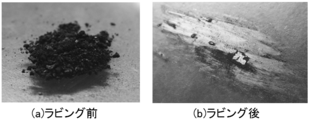
この結果、擦る(ラビング)前は黒褐色であった粉末が、ラビング後には金色調の膜となった。この写真図を図24に示す。
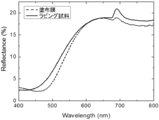
また本膜に対し、正反射スペクトルを測定した。この結果を図25の実線に示す。本図で示すように、塗布膜(有機溶媒に3MeOTオリゴマー粉末を溶解させた後基板上に塗布及び乾燥させた膜)の場合(破線)と同様のスペクトルを得ることができ、黄色味の強い金色調を示す膜であることを定量的に確認した。なお本スペクトルの測定条件は入射角23°、アパーチャー0.1mm角、標準サンプルは蒸着アルミニウム膜とした。
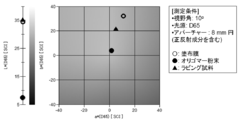
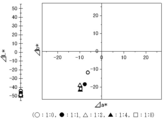
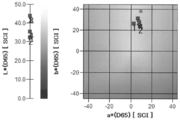
また、この膜に対して、測色(L*a*b*)を行った。この結果について図26に示す。
測色はD65光源を使用し、結果をCIE LAB表色系(L*a*b*)で表している。なお図中a*b*は色相を表し、a*値がプラスになると赤みが増し、マイナスになると緑みが増し、b*値がプラスになると黄みが増し、マイナスになると青みが増すことを表しています。測定には分光測色計CM-600d(コニカミノルタ株式会社)を使用し、色彩管理ソフトウェアSpectraMagixNX(コニカミノルタ株式会社)を使用してデータの可視化を行った。なお、比較として、塗布膜を〇、3MeOTオリゴマー粉末を●で示す。
測色はD65光源を使用し、結果をCIE LAB表色系(L*a*b*)で表している。なお図中a*b*は色相を表し、a*値がプラスになると赤みが増し、マイナスになると緑みが増し、b*値がプラスになると黄みが増し、マイナスになると青みが増すことを表しています。測定には分光測色計CM-600d(コニカミノルタ株式会社)を使用し、色彩管理ソフトウェアSpectraMagixNX(コニカミノルタ株式会社)を使用してデータの可視化を行った。なお、比較として、塗布膜を〇、3MeOTオリゴマー粉末を●で示す。
この結果、光沢ない3MeOTオリゴマー粉末では明度、彩度ともに小さい値をとっていたのに対して、ラビングサンプル(▲)や塗布膜(〇)では、明度が著しく増大し、彩度も第一象限方向へ伸びていることを確認した。また、ラビングサンプルを塗布膜と比べると、色相はほぼ同じであるものの、彩度がやや小さい値をとっていることを確認した。これはおそらく、ラビングサンプルは塗布膜と比較して表面粗さが大きいために拡散反射が大きく存在し、結果として光沢色の黄色が薄まって観察されたためだと考えられる。
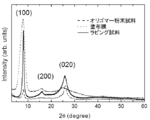
また、本膜に対し、X線回折スペクトル測定を行った。この結果の図を図27の実線に示す。なお、本測定は、全自動水平型多目的X線回折装置SmartLab(リガク)を使用し、Out-of-plane法による測定を行ったものである。Out-of-plane法による測定では、層の厚さ方向の情報を得ることができ、厚さ方向に規則的な層間隔があるときにピークを示す。
この結果、点線の塗布膜では、金色(光沢を除くと黄色)を示すエッジオンラメラによる(100)ピークが極めて大きく、マゼンタ(赤紫)色を示すフェイスオンラメラによる(020)ピークが小さいため金色(光沢を除くと黄色)になっていることが確認できた。なお、(100)ピークから1.13nmの層間距離が、(020)ピークから0.35nmの層間距離が、それぞれブラックの式から算出された。一方、破線のオリゴマー粉末の回折パターンでは、(100)ピークと(020)ピークを比較したところ、エッジオンラメラとフェイスオンラメラが同等かフェイスオンラメラの方が多いことがわかった。この場合において、3MeOTオリゴマー粉末の色は黄色とマゼンタの減法混色となり茶色、実際には非常に濃い茶色であるため、黒色に近く呈色している。しかもこの粉末においてはピーク強度が低いため、ラメラ構造の数密度が極めて小さく、粉末中にアモルファス部位が多いことがわかる。これに対し、ラビング試料ではそれと比較して、(100)ピークが著しく増大しており、また、塗布膜と比較して半値幅の小さな鋭いピークを示すため、結晶サイズの大きなエッジオンラメラが形成されていることがわかる(図28参照)。すなわち、ラビングは粉末試料に含まれるエッジオンラメラとフェイスオンラメラの数密度を増加させる効果があり、特にエッジオンラメラの数密度とサイズの増加によって金色調光沢が発現したものと考えられる。
以上、本実施例によってラビング(擦ること)により金属光沢を発現させることができるのを確認した。
(別観点による発明)
ところで、金属光沢を発現させるに関し、別の観点から発明を完成させた。以下具体的に説明する。
ところで、金属光沢を発現させるに関し、別の観点から発明を完成させた。以下具体的に説明する。
金属は一般に硬く、家電や自動車等、機械的強度が必要な部品に使用されているだけでなく、金属光沢を有するため質感に優れ、家具や雑貨等、日常生活のありとあらゆる物品において使用されている。特に金は、高級感を出すことができ人気が高い。しかしながら、金属は材料そのものが高価であるだけでなく加工も容易ではなく、高価となってしまうといった課題がある。
上記の課題を解決するための手段として、例えば、高分子やガラスといった物品の表面に金属の薄膜を被覆する金属めっき方法や、微粒子又はフレーク状の金属を添加した塗料を物品の表面に塗布する方法等の表面処理技術がある。この技術を用いると、高分子化合物で物品を製造する一方、その表面に金属薄膜又は金属を含む塗料を被覆することで、安価に金属光沢を有する物品を製造することができるといった効果がある。
しかしながら、上記金属めっき方法は、表面処理を行うことができる材質に制限が少なからずある。また上記表面技術は結局のところ金属を使用するものであり、物品全部を金属で使用する場合よりは少なくて済むが結局高価となってしまう。特に、上記金属を添加した塗料は塗料中のポリマーバインダーと金属との比重の違いにより、金属粒子が沈降し、塗膜にしたときに斑が生じやすくなってしまう、金属が腐食されて光沢が失われてしまう、塗膜が重いといった課題もある。
そこで、金属以外の物質を用いて金属光沢を示す物質が存在すれば、上記課題を解決することができると考えられており、金属光沢(金色光沢及び銅色光沢)を示す非金属物質に関する技術として、例えばWO/2014/021405に記載された技術がある。この非金属物質は、溶媒に溶解することができ、ガラス・プラスチックフィルム・金属・紙に均一に塗布でき、塗布膜が金色調あるいは銅色調の光沢を発現し、さらに光沢が何年も持続する世界初の物質である。
しかしながら、上記特許文献に記載の技術は、金属光沢を示す膜を形成することができるが、その強度において課題がある。
そこで、本発明は、上記課題に鑑み、高い強度を備えた金属光沢を有する物品及びトナー並びに金属光沢を有する物品の製造方法を提供することを目的とする。
上記課題を解決する本発明の一観点に係る金属光沢を有する物品は、ポリエステル樹脂、ポリカーボネート樹脂、ポリビニルピロリドン樹脂、ポリスチレン樹脂、ポリメタクリル酸メチル樹脂及びスチレンアクリル共重合体樹脂の少なくともいずれかと、チオフェン重合体が混合された金属光沢を有すものである。
なおこの観点において、限定されるわけではないが、チオフェン重合体の重量は、物品の重量を100とした場合、0.1以上99.9以下の範囲となっていることが好ましい。
なおこの観点において、限定されるわけではないが、物品は立体物であることが好ましい。
また、本発明の他の一観点に係るトナーは、ポリエステル樹脂、ポリカーボネート樹脂、ポリビニルピロリドン樹脂、ポリスチレン樹脂、ポリメタクリル酸メチル樹脂及びスチレンアクリル共重合体樹脂の少なくともいずれかと、チオフェン重合体が混合された金属光沢を有するものである。
また、本観点において、限定されるわけではないが、チオフェン重合体の重量は、物品の重量を100とした場合、0.1以上99.9以下の範囲となっていることが好ましい。
また、本発明の他の一観点に係る物品の製造方法は、ポリエステル樹脂、ポリカーボネート樹脂、ポリビニルピロリドン樹脂、ポリスチレン樹脂、ポリメタクリル酸メチル樹脂及びスチレンアクリル共重合体樹脂の少なくともいずれかとチオフェン重合体を、溶媒を用いて混合し、前記溶媒を除去することで固化させる金属光沢を有するものである。
また、本観点において、限定されるわけではないが、チオフェン重合体の重量は、物品の重量を100とした場合0.1以上99.9以下の範囲となっていることが好ましい。
また、本発明の他の一観点に係る物品の製造方法は、ポリエステル樹脂、ポリカーボネート樹脂、ポリビニルピロリドン樹脂、ポリスチレン樹脂、ポリメタクリル酸メチル樹脂及びスチレンアクリル共重合体樹脂の少なくともいずれかと、チオフェン重合体と、溶媒を、を含む金属光沢を有する物品を製造するための溶液である。
また、本発明の他の一観点に係る立体物は、ポリエステル樹脂、ポリカーボネート樹脂、ポリビニルピロリドン樹脂、ポリスチレン樹脂、ポリメタクリル酸メチル樹脂及びスチレンアクリル共重合体樹脂の少なくともいずれかと、チオフェン重合体と、が混合されたものである。
また、本発明の他の一観点に係る金属光沢を有するトナーは、ポリエステル樹脂、ポリカーボネート樹脂、ポリビニルピロリドン樹脂、ポリスチレン樹脂、ポリメタクリル酸メチル樹脂及びスチレンアクリル共重合体樹脂の少なくともいずれかと、チオフェン重合体と、が混合されたものである。
また、本発明の他の一観点に係る金属光沢を有する立体物の製造方法は、ポリエステル樹脂、ポリカーボネート樹脂、ポリビニルピロリドン樹脂、ポリスチレン樹脂、ポリメタクリル酸メチル樹脂及びスチレンアクリル共重合体樹脂の少なくともいずれかとチオフェン重合体を、溶媒を用いて混合し、溶媒を除去することで固化させるものである。
また、本発明の他の一観点に係る金属光沢を有する物品を製造するための溶液は、ポリエステル樹脂、ポリカーボネート樹脂、ポリビニルピロリドン樹脂、ポリスチレン樹脂、ポリメタクリル酸メチル樹脂及びスチレンアクリル共重合体樹脂の少なくともいずれかと、チオフェン重合体と、溶媒を、を有するものである。
以上、本発明によって、高い強度の金属光沢を有する物品及びトナー並びに金属光沢を有する物品の製造方法を提供することができる。
以下、本発明の実施形態について図面を用いて詳細に説明する。ただし、本発明は多くの異なる形態による実施が可能であり、以下に示す実施形態、実施例の具体的な例示にのみ限定されるわけではない。
(実施形態3)
(物品)
図29は、本実施形態に係る金属光沢を有する物品(以下「本物品」ともいう。)1の概略図である。本図の本物品は、ポリエステル樹脂、ポリカーボネート樹脂、ポリビニルピロリドン樹脂、ポリスチレン樹脂、ポリメタクリル酸メチル樹脂及びスチレンアクリル共重合体樹脂の少なくともいずれかと、チオフェン重合体と、が混合されたものであり、基板の上に物品が形成された膜の形態となっている例であるが、例えば図30で示す、より立体的で複雑な形状とすることも可能である。
(物品)
図29は、本実施形態に係る金属光沢を有する物品(以下「本物品」ともいう。)1の概略図である。本図の本物品は、ポリエステル樹脂、ポリカーボネート樹脂、ポリビニルピロリドン樹脂、ポリスチレン樹脂、ポリメタクリル酸メチル樹脂及びスチレンアクリル共重合体樹脂の少なくともいずれかと、チオフェン重合体と、が混合されたものであり、基板の上に物品が形成された膜の形態となっている例であるが、例えば図30で示す、より立体的で複雑な形状とすることも可能である。
(ポリエステル樹脂)
本物品において、ポリエステル樹脂とは、多価カルボン酸と多価アルコールとの重縮合体からなる樹脂をいい、この限りにおいて限定されるわけではないが、例えばポリエチレンテレフタレート、ポリトリメチレンテレフタレート、ポリブチレンテレフタレート、ポリエチレンナフタレート、ポリブチレンナフタレート、ポリシクロヘキサンジメチルテレフタレート、ポリトリメチレンナフタレート、ポリシクロヘキサンジメチレンテレフタレート、ポリトリテトラメチレンナフタレート及びこれらの混合物等を例示することができるがこれに限定されない。
本物品において、ポリエステル樹脂とは、多価カルボン酸と多価アルコールとの重縮合体からなる樹脂をいい、この限りにおいて限定されるわけではないが、例えばポリエチレンテレフタレート、ポリトリメチレンテレフタレート、ポリブチレンテレフタレート、ポリエチレンナフタレート、ポリブチレンナフタレート、ポリシクロヘキサンジメチルテレフタレート、ポリトリメチレンナフタレート、ポリシクロヘキサンジメチレンテレフタレート、ポリトリテトラメチレンナフタレート及びこれらの混合物等を例示することができるがこれに限定されない。
また本物品において、ポリエステル樹脂の平均分子量は、金属光沢を有する限りにおいて限定されるわけではないが、1000以上1000000以下であることが好ましく、より好ましくは3000以上100000以下である。
(ポリカーボネート樹脂)
本物品において、ポリカーボネート樹脂とは、カーボネート基を構成要素として有する樹脂であって、例えばビスフェノールAとホスゲンによって製造可能な樹脂である。また本物品において、ポリカーボネート樹脂の平均分子量は、金属光沢を有する限りにおいて限定されるわけではないが、1000以上1000000以下であることが好ましく、より好ましくは3000以上100000以下である。
(ポリビニルピロリドン(PVP)樹脂)
本物品において、ポリビニルピロリドン樹脂とは、N-ビニル-2-ピロリドンが重合した樹脂をいう。また本物品において、ポリビニルピロリドン樹脂の平均分子量は、金属光沢を有する限りにおいて限定されるわけではないが、1000以上1000000以下であることが好ましく、より好ましくは3000以上100000以下である。
本物品において、ポリビニルピロリドン樹脂とは、N-ビニル-2-ピロリドンが重合した樹脂をいう。また本物品において、ポリビニルピロリドン樹脂の平均分子量は、金属光沢を有する限りにおいて限定されるわけではないが、1000以上1000000以下であることが好ましく、より好ましくは3000以上100000以下である。
(ポリスチレン樹脂)
本物品において、ポリスチレン樹脂とは、スチレンを重合してなる樹脂をいう。また本物品において、ポリスチレン樹脂の平均分子量は、金属光沢を有する限りにおいて限定されるわけではないが、1000以上1000000以下であることが好ましく、より好ましくは3000以上500000以下であり、さらにこのましくは300000以下である。
本物品において、ポリスチレン樹脂とは、スチレンを重合してなる樹脂をいう。また本物品において、ポリスチレン樹脂の平均分子量は、金属光沢を有する限りにおいて限定されるわけではないが、1000以上1000000以下であることが好ましく、より好ましくは3000以上500000以下であり、さらにこのましくは300000以下である。
(ポリメタクリル酸メチル樹脂(アクリル樹脂))
本物品において、ポリメタクリル酸メチル(PMMA)樹脂とは、アクリル酸エステルを重合させた樹脂をいう。またポリメタクリル酸メチル樹脂の平均分子量は、金属光沢を有する限りにおいて限定されるわけではないが、1000以上1000000以下であることが好ましく、より好ましくは3000以上500000以下である。
本物品において、ポリメタクリル酸メチル(PMMA)樹脂とは、アクリル酸エステルを重合させた樹脂をいう。またポリメタクリル酸メチル樹脂の平均分子量は、金属光沢を有する限りにおいて限定されるわけではないが、1000以上1000000以下であることが好ましく、より好ましくは3000以上500000以下である。
(スチレンアクリル共重合体樹脂)
本物品において、スチレンアクリル共重合体樹脂とは、アクリルニトリルとスチレンの共重合化合物をいう。スチレンアクリル共重合体樹脂の平均分子量は、金属光沢を有する限りにおいて限定されるわけではないが、1000以上1000000以下であることが好ましく、より好ましくは3000以上500000以下である。
(チオフェン重合体)
また本物品において「チオフェン重合体」とは、二以上のチオフェンが互いに結合して重合したものをいい、下記一般式で示される化合物をいう。
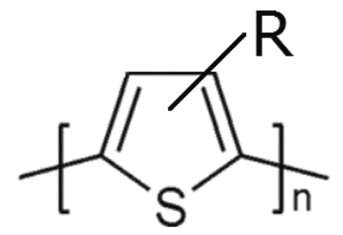
本物品において、スチレンアクリル共重合体樹脂とは、アクリルニトリルとスチレンの共重合化合物をいう。スチレンアクリル共重合体樹脂の平均分子量は、金属光沢を有する限りにおいて限定されるわけではないが、1000以上1000000以下であることが好ましく、より好ましくは3000以上500000以下である。
(チオフェン重合体)
また本物品において「チオフェン重合体」とは、二以上のチオフェンが互いに結合して重合したものをいい、下記一般式で示される化合物をいう。
上記式において、Rは置換基であり、膜に金属光沢を付与できる限りにおいて限定されるわけではないが、アルコキシ基、アミノ基、アルキル基、ヒドロキシル基、ヒドロキシアルキル基、アリール基、シアノ基、又は、ハロゲンのいずれかであることが好ましい。また、Rは一つのチオフェン環に一つであっても、二つであってもよい。また、本実施形態に係るチオフェン重合体において、各チオフェンの上記Rは同じであっても異なっていてもよい。さらに、チオフェン重合体は陰イオンによってドーピングされていると、金及び銅に近い金色調及び銅色調を呈する。陰イオンとしては、過塩素酸イオン、ヘキサフルオロリン酸イオン、テトラフルオロホウ酸イオン、塩化物イオン、臭化物イオン、硫酸イオン、酢酸イオン、硝酸イオン、クエン酸イオン、シュウ酸イオン、パラトルエンスルホン酸イオン、ポリスチレンスルホン酸イオン等を挙げることができる。
なお「チオフェン」は、上記の記載からも明らかなように、硫黄を含む複素環式化合物であって、下記一般式で示される化合物である。式中Rの定義は上記と同様である。
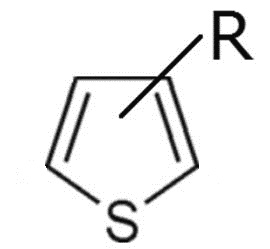
なお、上記式中Rがアルコキシ基である場合、限定されるわけではないが、炭素数は1以上8以下であることが好ましく、より具体的には、3-メトキシチオフェン、3,4-ジメトキシチオフェン、3-エトキシチオフェン、3-プロポキシチオフェン、3-ブトキシチオフェン、3-メトキシ-4-メチルチオフェン、3-エトキシ-4-メチルチオフェン、3-ブトキシ-4-メチルチオフェン、3,4-ジエトキシチオフェン、3,4-エチレンジオキシチオフェン、3,4-プロピレンジオキシチオフェン等を例示することができる。
また、上記式中Rがアルキル基である場合、限定されるわけではないが、炭素数は1以上12以下であることが好ましく、より具体的には、3-メチルチオフェン、3,4-ジメチルチオフェン、3-エチルチオフェン、3,4-ジエチルチオフェン、3-ブチルチオフェン、3-ヘキシルチオフェン、3-ヘプチルチオフェン、3-オクチルチオフェン、3-ノニルチオフェン、3-デシルチオフェン、3-ウンデシルチオフェン、3-ドデシルチオフェン、3-ブロモ-4-メチルチオフェン等を例示することができる。
また、上記式中Rがアミノ基である場合、3-アミノチオフェン、3,4-ジアミノチオフェン、3-メチルアミノチオフェン、3-ジメチルアミノチオフェン、3-チオフェンカルボキシアミド、4-(チオフェン-3-イル)アニリン等を例示することができる。
また本物品において、「チオフェン重合体」の分子量としては、金属光沢を有するものとすることができ、膜として形成できるものである限りにおいて限定されるわけではないが、GPC測定法により求められる重量平均分子量の分布のピークが200以上30000以下の範囲内にあることが好ましく、より好ましくは500以上10000以下の範囲内である。
また、本物品において、 チオフェン重合体の重量は、物品全体の重量を100とした場合、0.1以上99.9以下の範囲となっていることが好ましく、より好ましくは0.5以上99以下の範囲である。
また本物品において、チオフェン重合体は、作製することができる限りにおいて限定されず種々の方法を採用することができる。例えば、チオフェン重合体は、化学重合又は電解重合によって作製することができる。
(化学重合)
ここで「化学重合法」とは、酸化剤を用いて液相及び固相の少なくともいずれかにおいて行う重合をいう。
ここで「化学重合法」とは、酸化剤を用いて液相及び固相の少なくともいずれかにおいて行う重合をいう。
この方法では、具体的に(1)酸化剤を用いてチオフェンを重合してチオフェン重合体を含む溶液とする工程、(2)チオフェン重合体を含む溶液から未反応原料及び副生成物を除去してチオフェン重合体粉末を得る工程、を有する。
まず、この方法では、(1)酸化剤を用いてチオフェンを重合し、このチオフェン重合体を含む溶液を作製する。ここで用いる「チオフェン」及び得られる「チオフェン重合体」は、上記したものである。チオフェン重合体は、上記の通り、いわゆるオリゴマーの範囲にあることが好ましく、具体的には重量平均分子量の分布ピークが200以上30000以下の範囲内となるように重合することが好ましい。
本工程において、酸化剤は、チオフェン重合体を製造することができる限りにおいて限定されず様々なものを使用することができるが、例えば第二鉄塩、第二銅塩、セリウム塩、二クロム酸塩、過マンガン酸塩、過硫酸アンモニウム、三フッ化ホウ素、臭素酸塩、過酸化水素、塩素、臭素及びヨウ素を挙げることができ、中でも第二鉄塩が好ましい。なお水和物であっても良い。また、この場合において、この対となるイオンも適宜調整可能であって限定されるわけではなく、例えば塩化物イオン、臭化物イオン、クエン酸イオン、シュウ酸イオン、パラトルエンスルホン酸イオン、過塩素酸イオン、ヘキサフルオロリン酸イオン、テトラフルオロホウ酸イオン等を挙げることができ、その中でも、過塩素酸イオン、ヘキサフルオロリン酸イオン、テトラフルオロホウ酸イオン、塩化物イオン、臭化物イオン、及び、パラトルエンスルホン酸イオンの少なくともいずれかを用いると、測色計による数値評価で規定される金色に近い金属光沢を得ることができ好ましい。金色に近い金属光沢を得ることができる理由は、推測の域であるが、過塩素酸イオン、ヘキサフルオロリン酸イオン、テトラフルオロホウ酸イオン、塩化物イオン、臭化物イオン、パラトルエンスルホン酸イオンが重合の際、チオフェン重合体にドーパントとして組み込まれ、チオフェン重合体内に生成されるカチオン部位と結合して安定化し、規則正しい分子配向構造の形成(ラメラ結晶構造の形成)に寄与するためであると考えられる。実際のところ金属光沢を有する膜を分析するとこれらが安定的に存在することが確認されている。
また本工程において、重合は溶媒を用い、この溶媒中において行うことが好ましい。用いる溶媒は、上記酸化剤及びチオフェンを十分に溶解し効率的に重合させることができる限りにおいて限定されるわけではないが、高い極性を有し、ある程度の揮発性を有する有機溶媒であることが好ましく、例えばアセトニトリル、ニトロメタン、γ-ブチロラクトン、炭酸プロピレン、ニトロメタン、1-メチル-2-ピロリジノン、ジメチルスルホキシド、2-ブタノン、テトラヒドロフラン、アセトン、メタノール、アニソール、クロロホルム、酢酸エチル、ヘキサン、トリクロロエチレン、シクロヘキサノン、ジクロロメタン、クロロホルム、ジメチルホルムアミド、エタノール、ブタノール、ピリジン、ジオキサン、及びこれらの混合物等を用いることができるが、アセトニトリル、ニトロメタン、γ-ブチロラクトン、炭酸プロピレンはチオフェン重合体が可溶であり、より良好な金属光沢を備えた膜となりやすく好ましい。
なお本工程において、溶媒に対し用いるチオフェン、酸化剤の量は適宜調整可能であり限定されるわけではないが、溶媒の重量を1とした場合、チオフェンの重量は0.00007以上7以下であることが好ましく、より好ましくは0.0007以上0.7以下であり、過塩素酸鉄(III)n水和物の場合、重量は0.0006以上6以下であることが好ましく、より好ましくは0.006以上0.6以下である。
また、本工程において、用いるチオフェンと酸化剤の比としてはチオフェンの重量を1とした場合、0.1以上1000以下であることが好ましく、1以上100以下であることがより好ましい。
また本工程は、チオフェンと酸化剤を溶媒に一度に加えてもよいが、溶媒にチオフェンを加えた溶液と、酸化剤を溶媒に加えた溶液の二種類の溶液を別途作製し、これらを加え合わせることで重合反応を行わせても良い。
またこの方法において、上記作製したチオフェン重合体は、溶媒を除去して粉末状のチオフェン重合体(チオフェン重合体粉末)としておくことが好ましい。このようにしておくことで後述の溶媒に溶解させつつポリエステル樹脂と混合し、金属光沢を有する物品を製造することが可能となる。なお、酸化剤において上記過塩素酸イオン、ヘキサフルオロリン酸イオン、テトラフルオロホウ酸イオン、塩化物イオン、臭化物イオン、パラトルエンスルホン酸イオンを含むものを用いた場合、上記重合体に安定的に結合されているため残り、金属光沢の状態を安定的に維持することができる。
(電解重合)
また、本物品において、上記のとおりチオフェン重合体は、電解重合を用いて製造することもできる。本実施形態において、電解重合とは、重合体の前駆体となる物質(モノマー)を、支持電解質を含む溶液に溶解し、その後モノマーを電極酸化することにより、導電体上に溶液不溶性重合体膜を形成する手法をいう。
また、本物品において、上記のとおりチオフェン重合体は、電解重合を用いて製造することもできる。本実施形態において、電解重合とは、重合体の前駆体となる物質(モノマー)を、支持電解質を含む溶液に溶解し、その後モノマーを電極酸化することにより、導電体上に溶液不溶性重合体膜を形成する手法をいう。
また、本実施形態において、陽極酸化させる際、電位掃引法を用いることが好ましい。電位掃引法とは、支持電解質を含む溶液に一対の電極を浸漬し、一定の速度で電位を変化させつつ印加する処理をいう。
また本実施形態において用いられる溶液の溶媒としては、特に限定されるわけではないが、例えば水、アルコールの他、藤島昭、相澤益男、井上徹、電気化学測定法、技報堂出版、上巻107―114頁、1984年に記載の溶媒を採用できる。また、種々の溶媒の混合溶媒も好ましい。さらに、ドデシル硫酸ナトリウム等の陰イオン界面活性剤、臭化ドデシルトリメチルアンモニウム等のカチオン性界面活性剤、及びポリオキシエチレンラウリルエーテル等の非イオン性界面活性剤を用いると、測色計による数値評価で規定される金色に近い金属光沢を得ることができ好ましい。
また本実施形態において用いられる溶液の支持電解質は、電気分解において必須の成分であり、溶媒に十分溶解し、電気分解されにくいカチオン又はアニオンを構成要素とするものが好ましく、限定されるわけではないが、カチオンに注目すれば例えばリチウム塩、ナトリウム塩、カリウム塩、カルシウム塩、テトラアルキルアンモニウム塩の少なくともいずれかを用いることが好ましく、アニオンに注目すれば例えばハロゲン化物、硫酸塩、硝酸塩、リン酸塩、過塩素酸塩、四フッ化ホウ酸塩、六フッ化リン酸塩の少なくともいずれかを用いることが好ましい。支持電解質の濃度は、限定されるわけではないが0.001M以上溶解度以下であることが好ましく、0.01M以上5M以下であることがより好ましい。
また、本実施形態において、電解重合で用いられるチオフェンモノマーの電解溶液中における濃度は、限定されるわけではないが、0.1mM以上溶解度以下であることが好ましく、より具体的には0.5mM以上1M以下であることがより好ましい。
また本実施形態において、電解重合は溶液を入れた電解容器に導電体(動作電極として機能させる)を浸漬し、これに対向電極、必要に応じて電位の基準となる参照電極の3本の電極を用いる3電極式、又は、導電体と対向電極だけを用いる2電極式を採用することができる。なお、導電体の電位を基準となる参照電極に対して厳密に規定することのできる3電極式は、本方法によって形成されるチオフェン重合体を含む金属光沢を有する物品を再現性良く作製することができる点においてより好ましい。
動作電極としての導電体は、3電極式及び2電極式のいずれの場合においても、電極酸化に対して安定な物質であれば良く、限定されるわけではないが、例えば上記したように、酸化インジウムスズ(以下「ITO」と略記する。)や酸化錫が塗布された透明ガラス電極、金属電極、ステンレス等の合金電極、グラシーカーボン電極等を好適に用いることができる。また、対向電極としては、上記電極材料に加え、ステンレスや銅板などの金属電極を好適に用いることができる。また参照電極は、限定されるわけではないが例えば銀・塩化銀電極(Ag/AgCl電極)、飽和カロメル電極を好適に用いることができる。
また、本実施形態において電解重合における電位掃引法は、負電位と正電位の間で掃引することが好ましい。またこの場合において、負電位は、-1.5V以上-0.01V以下の範囲であることが好ましく、より好ましくは-1.0V以上-0.1V以下の範囲、さらに好ましくは-0.7V以上-0.2V以下の範囲である。また、正電位は、+1.0V以上+3.0V以下の範囲であることが好ましく、より好ましくは+1.0V以上+2.0V以下の範囲、さらに好ましくは+1.0V以上+1.5V以下の範囲内である。
また本実施形態において、電位掃引法は、掃引速度について、金属光沢を有する物品を製造することができる限りにおいて限定されるわけではないが、0.1mV/秒以上10V/秒以下の範囲内とすることが好ましく、より好ましくは1mV/秒以上1V/秒以下の範囲、さらに好ましくは2mV/秒以上300mV/秒以下の範囲内である。
また電解重合の時間としては、金属光沢を有する物品を析出させることができる限りにおいて限定されるわけではないが、上記印加電圧の範囲内において1秒以上5時間以下の範囲内において行うことが好ましく、10秒以上1時間以下の範囲内において行うことがより好ましい。
また、この電気分解の温度としては電解重合により金属光沢を有する物品を析出させることができる限りにおいて限定されるわけではないが、-20℃以上60℃以下の範囲内にあることが好ましい。
また、この電気分解は、大気中の成分物質が関与することの少ない反応でありまた比較的低電位で行われるため、大気中で行うことができる。電解液中の溶存酸素の酸化など、生成した膜を汚染する可能性を回避する観点から、窒素ガスやアルゴンガス雰囲気中で行うことが好ましいが、汚染の心配はほとんど無い。しかしながらそれでもやはり、電解重合を形成する場合、溶液中に酸素が多く存在すると電極反応に影響を与えてしまうおそれがあるため、不活性ガス(窒素ガスやアルゴンガス)によるバブリングを行うことも有用である。
(製造方法)
本物品は、上記の化学重合あるいは電解重合で合成されたチオフェン重合体とポリエステル樹脂、ポリカーボネート樹脂、ポリビニルピロリドン樹脂、ポリスチレン樹脂、ポリメタクリル酸メチル樹脂及びスチレンアクリル共重合体樹脂の少なくともいずれかを混合することで作製するが、この混合においては、溶媒を用いることが好ましい。溶媒としては、上記ポリエステル樹脂、ポリカーボネート樹脂、ポリビニルピロリドン樹脂、ポリスチレン樹脂、ポリメタクリル酸メチル樹脂及びスチレンアクリル共重合体樹脂の少なくともいずれかとチオフェン重合体を混合させることができる限りにおいて限定されるわけではないが、例えばニトロメタン、γ-ブチロラクトン、アセトニトリル、炭酸プロピレン、ジメチルスルホキシド、N-メチル-2-ピロリドン及びこれらの混合物を用いることができるがこれに限定されない。
本物品は、上記の化学重合あるいは電解重合で合成されたチオフェン重合体とポリエステル樹脂、ポリカーボネート樹脂、ポリビニルピロリドン樹脂、ポリスチレン樹脂、ポリメタクリル酸メチル樹脂及びスチレンアクリル共重合体樹脂の少なくともいずれかを混合することで作製するが、この混合においては、溶媒を用いることが好ましい。溶媒としては、上記ポリエステル樹脂、ポリカーボネート樹脂、ポリビニルピロリドン樹脂、ポリスチレン樹脂、ポリメタクリル酸メチル樹脂及びスチレンアクリル共重合体樹脂の少なくともいずれかとチオフェン重合体を混合させることができる限りにおいて限定されるわけではないが、例えばニトロメタン、γ-ブチロラクトン、アセトニトリル、炭酸プロピレン、ジメチルスルホキシド、N-メチル-2-ピロリドン及びこれらの混合物を用いることができるがこれに限定されない。
また、ポリエステル樹脂、ポリカーボネート樹脂、ポリビニルピロリドン樹脂、ポリスチレン樹脂、ポリメタクリル酸メチル樹脂及びスチレンアクリル共重合体樹脂の少なくともいずれかとチオフェン重合体の比率は上記した範囲でよいが、溶媒とこの混合物の濃度の比は、溶解が可能で、必要な粘度とすることができる限りにおいて適宜調整可能であれば限定されるものではないが、例えば、上記ポリエステル樹脂とチオフェン重合体の総重量を1とした場合、0.1以上500以下であることが好ましい。
そして、上記作製した溶液を板等の上に塗布し、所望の形状に形成した後、乾燥させて溶媒を除去することで、所望の立体的形状を維持した物品を形成することができる。もちろん、立体的形状には膜が含まれており、この膜の強度は後述の実施例から明らかなように、非常に高い強度を備えている。
以上、本物品では、ポリエステル樹脂、ポリカーボネート樹脂、ポリビニルピロリドン樹脂、ポリスチレン樹脂、ポリメタクリル酸メチル樹脂及びスチレンアクリル共重合体樹脂の少なくともいずれかとチオフェン重合体を混合させたとしても金属光沢を失わず、より強度の高い物品を提供することができる。
なお、本物品において、チオフェン重合体が金属光沢を示す理由は推測の域にあるが、チオフェン重合体を構成する分子が規則的に配向し、特定の波長を反射するためであると考えられる。このことは、作製されたチオフェン重合体を含む膜がX線回折において鋭いピークを示していることからも裏付けられる。
しかしながら、上記の背景を考えると、通常、チオフェン重合体に他の混合物である樹脂を混合させた場合、上記の特殊な規則的な配列は乱され、金属光沢を示す構造は実現できないものと考えられる。しかしながら、本物品では、数ある樹脂の中でもポリエステル樹脂、ポリカーボネート樹脂、ポリビニルピロリドン樹脂、ポリスチレン樹脂、ポリメタクリル酸メチル樹脂及びスチレンアクリル共重合体樹脂の少なくともいずれかを採用することで、ポリエステル樹脂、ポリカーボネート樹脂、ポリビニルピロリドン樹脂、ポリスチレン樹脂、ポリメタクリル酸メチル樹脂及びスチレンアクリル共重合体樹脂の少なくともいずれかが入り込んできたとしても金属光沢を失わないことを見出した。しかもポリエステル樹脂、ポリカーボネート樹脂、ポリビニルピロリドン樹脂、ポリスチレン樹脂、ポリメタクリル酸メチル樹脂及びスチレンアクリル共重合体樹脂の少なくともいずれかは適宜分子量の調整が可能であり、また混合する溶媒を調整することでその溶液の粘度を調整することが可能である。
(トナー)
ところで、本実施形態に係る物品は、ポリエステル樹脂、ポリカーボネート樹脂、ポリビニルピロリドン樹脂、ポリスチレン樹脂、ポリメタクリル酸メチル樹脂及びスチレンアクリル共重合体樹脂の少なくともいずれかとチオフェン重合体を混合したものとなっている。ポリエステル樹脂自体は、例えばプリンターやコピー機等で用いられるトナーのバインダーとして使用されており、この物品はプリンター等のトナーとして用いることが可能である。トナーとする場合、上記ポリエステル樹脂とチオフェン重合体の混合物を微小な粒子とすることで実現できる。なお、微小な粒子とする方法としては上記ポリエステル樹脂とチオフェン重合体を混合した物品を破砕して所望の粒径とすることができるが、例えば上記作製した溶液の粘度を低くし、インクジェットノズルを用いた噴霧等により所望の粒径より少し大きい程度の液滴を形成し、この液滴から溶媒を除去させることで乾燥した粒とすることができる。もちろん、他の樹脂、ポリカーボネート樹脂、ポリビニルピロリドン樹脂、ポリスチレン樹脂、ポリメタクリル酸メチル樹脂及びスチレンアクリル共重合体樹脂なども可能である限り用いることができる。
ところで、本実施形態に係る物品は、ポリエステル樹脂、ポリカーボネート樹脂、ポリビニルピロリドン樹脂、ポリスチレン樹脂、ポリメタクリル酸メチル樹脂及びスチレンアクリル共重合体樹脂の少なくともいずれかとチオフェン重合体を混合したものとなっている。ポリエステル樹脂自体は、例えばプリンターやコピー機等で用いられるトナーのバインダーとして使用されており、この物品はプリンター等のトナーとして用いることが可能である。トナーとする場合、上記ポリエステル樹脂とチオフェン重合体の混合物を微小な粒子とすることで実現できる。なお、微小な粒子とする方法としては上記ポリエステル樹脂とチオフェン重合体を混合した物品を破砕して所望の粒径とすることができるが、例えば上記作製した溶液の粘度を低くし、インクジェットノズルを用いた噴霧等により所望の粒径より少し大きい程度の液滴を形成し、この液滴から溶媒を除去させることで乾燥した粒とすることができる。もちろん、他の樹脂、ポリカーボネート樹脂、ポリビニルピロリドン樹脂、ポリスチレン樹脂、ポリメタクリル酸メチル樹脂及びスチレンアクリル共重合体樹脂なども可能である限り用いることができる。
以上、本実施形態によって、より強度の高い金属光沢を有する物品を得ることができる。
(実施例)
ここで、上記実施形態に係る物品について、実際にその製品の作製を行い効果を確認した。以下具体的に説明する。
ここで、上記実施形態に係る物品について、実際にその製品の作製を行い効果を確認した。以下具体的に説明する。
(チオフェン重合体)
まず、3-メトキシチオフェン(以下、「3MeOT」とする)のモノマーを重合前に蒸留し、不純物を除去した。蒸留したモノマー5.418gをアセトニトリル475mlに、窒素をバブリングしながら30分間プロペラ攪拌機で攪拌し、モノマー溶液0.1mol/lを調製した。
まず、3-メトキシチオフェン(以下、「3MeOT」とする)のモノマーを重合前に蒸留し、不純物を除去した。蒸留したモノマー5.418gをアセトニトリル475mlに、窒素をバブリングしながら30分間プロペラ攪拌機で攪拌し、モノマー溶液0.1mol/lを調製した。
次に、酸化剤として過塩素酸鉄(III)・n水和物(Fe(ClO4)3・nH2O)48.02 gをアセトニトリル475 mlに加え、20分間、超音波分散させて溶解し、酸化剤溶液0.2mol/lを調製した。
そして、モノマー溶液を重合セルに入れ、酸化剤溶液をビュレットでゆっくり滴下し、2時間重合させた。この操作により、濃青色を呈する3MeOTオリゴマーを得た。
そして、ガラスろ過器に、重合後の3MeOTオリゴマーを含む溶液を入れ、吸引ろ過した。ガラスろ過器のフィルター上に残った残渣をメタノールを用いて洗浄し、そして吸引ろ過をする操作を繰り返した。
その後、洗浄後の残渣を真空乾燥機に入れ、50℃下で90分間真空乾燥を行い、オリゴマーを乾燥させた。
(チオフェン重合体とポリエステル樹脂の混合)
上記作製したオリゴマー、高分子樹脂であるポリエステル(PES)樹脂(東洋紡社製 バイロン200、平均分子量17,000)、そして溶媒であるニトロメタン及びγ-ブチロラクトン(以下、GBLとする)をそれぞれ下記表1、表2で示す量で混合し、撹拌した。なお、下記表中、3MeOT:PESはオリゴマーとポリエステルの重量比を表し、以降その表記をサンプル名とする。従って、1:0は樹脂を含まない、オリゴマーのみの溶液を表す。
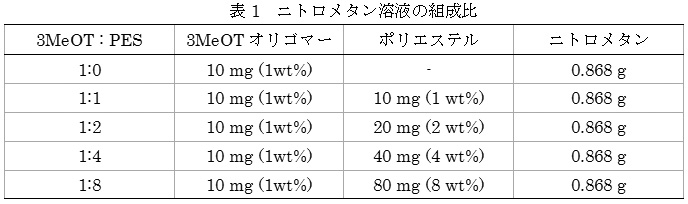
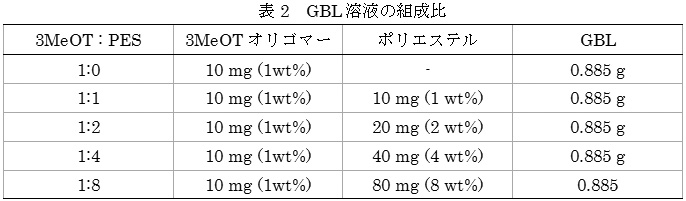
上記作製したオリゴマー、高分子樹脂であるポリエステル(PES)樹脂(東洋紡社製 バイロン200、平均分子量17,000)、そして溶媒であるニトロメタン及びγ-ブチロラクトン(以下、GBLとする)をそれぞれ下記表1、表2で示す量で混合し、撹拌した。なお、下記表中、3MeOT:PESはオリゴマーとポリエステルの重量比を表し、以降その表記をサンプル名とする。従って、1:0は樹脂を含まない、オリゴマーのみの溶液を表す。
(物品の製造)
よく洗浄したガラス基板上に上記溶液をスポイトで滴下して塗布した。ニトロメタン溶媒の塗膜は、室温で1時間(20℃、40%RH)乾燥、GBL溶媒の塗膜は、恒温温風乾燥機で30分間(45℃)乾燥させた。
よく洗浄したガラス基板上に上記溶液をスポイトで滴下して塗布した。ニトロメタン溶媒の塗膜は、室温で1時間(20℃、40%RH)乾燥、GBL溶媒の塗膜は、恒温温風乾燥機で30分間(45℃)乾燥させた。
図31に、上記表1において示したニトロメタン溶液から作成された膜を示す。なお図中の比は3MeOT : PESの質量比である。また、1:0はPESが含まれていないオリゴマーのみの膜である。
また、図32に、上記表2において示したGBL溶液から作成された膜を以下に示す。なお図中の比は3MeOT:PESの質量比である。また、1:0はPESが含まれていない、オリゴマーのみの膜である。
(正反射スペクトル)
ここで、図33及び図34に、上記表1および表2それぞれの溶液から作成された塗布膜の正反射スペクトルを顕微紫外可視近赤外分光光度計(日本分光社製 MSV-370)で測定した結果を示す。なお波長間隔は0.5nm、アパーチャーサイズは100×100μmとした。
ここで、図33及び図34に、上記表1および表2それぞれの溶液から作成された塗布膜の正反射スペクトルを顕微紫外可視近赤外分光光度計(日本分光社製 MSV-370)で測定した結果を示す。なお波長間隔は0.5nm、アパーチャーサイズは100×100μmとした。
図33で示すニトロメタン溶液から作成された塗膜の正反射スペクトルによると、塗布膜は、高分子樹脂の添加により反射率は多少低下するが、立ち上がり波長のシフトは見られないことを確認した。
また、図34で示すGBL溶液から作製された塗膜は、高分子樹脂の添加によって反射率が向上していることを確認した。また、立ち上がり波長は、高分子樹脂の添加によって短波長シフトしていることから、樹脂の添加によって色味を変化させることができることがわかった。
(測色データ)
また、分光測色計(コニカミノルタ社製 CM-600d)を用いて膜の測色の結果を以下の表3、4にそれぞれ示す。この場合において、光源はD65、視野角は10度、測定は正反射光を含んだ結果で測色を行った。
また、分光測色計(コニカミノルタ社製 CM-600d)を用いて膜の測色の結果を以下の表3、4にそれぞれ示す。この場合において、光源はD65、視野角は10度、測定は正反射光を含んだ結果で測色を行った。
図35及び図36は、CIE1976(L*,a*,b*) 色空間(http://www.konicaminolta.jp/instruments/knowledge/color/part1/07.html)におけるL*,a*,b*の値をそれぞれプロットしたものである。
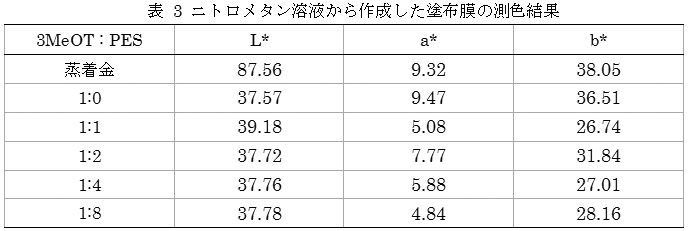

また、真空蒸着によって作製した金の膜と比較した値を表5、表6にそれぞれ示す。なお、ΔE*abは色差(色空間における距離)を表す。また、この塗膜と金蒸着膜との差について図37、38にニトロメタン溶液及びGBL溶液それぞれの場合を示し、図39、図40に、ニトロメタン溶液及びGBL溶液それぞれの場合における塗膜と金蒸着膜との色差ΔE*abについて示しておく。
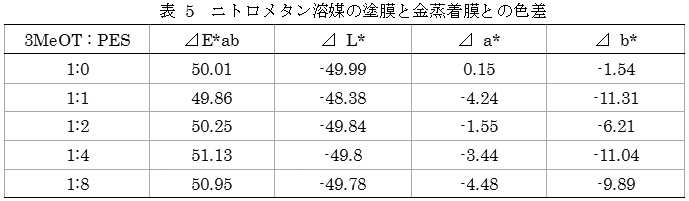
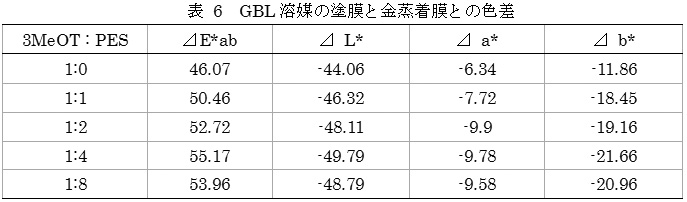
(機械的強度の測定)
次に、塗膜の機械的性質を引っかき硬度(JIS5600-5-4)に基づいて評価した。鉛筆は、三菱鉛筆ハイユニを使用し、塗膜にキズ跡が生じなかったもっとも硬い鉛筆の硬度を表7、表8にそれぞれ示す。


次に、塗膜の機械的性質を引っかき硬度(JIS5600-5-4)に基づいて評価した。鉛筆は、三菱鉛筆ハイユニを使用し、塗膜にキズ跡が生じなかったもっとも硬い鉛筆の硬度を表7、表8にそれぞれ示す。
この結果、高分子樹脂の添加量を増やすことで、塗膜の強度が向上した。
以上、金属調光沢を発現する3-メトキシチオフェンオリゴマーとポリエステル樹脂を混合した塗布液を作製し、基板上に塗布したところ、金色調光沢を失うことなく機械的強度に優れた金属調光沢膜を作製することができた。
(立体形状の作製)
なお、上記作製した溶液の粘度を調整することで、膜ではなく立体的形状の物品を作成することができる。図41に、膜ではなく実際の立体的形状とした物品の例について写真図を示しておく。本図で示すように、高い強度を備えた立体的形状の物品とすることが可能である。
なお、上記作製した溶液の粘度を調整することで、膜ではなく立体的形状の物品を作成することができる。図41に、膜ではなく実際の立体的形状とした物品の例について写真図を示しておく。本図で示すように、高い強度を備えた立体的形状の物品とすることが可能である。
(他の樹脂との組み合わせ:チオフェン重合体と樹脂の混合塗布液作製)
上記PESの例と同様、他の樹脂との組み合わせを行い、塗布液を作製した。具体的には、下記表9で示す種々の樹脂10mgをγ-ブチルラクトン1.0g(以下「GBL」という。)又はニトロメタン1.0gに完全に溶解させ、その溶液に上記作製したチオフェン重合体10mgを混合し、撹拌した。

上記PESの例と同様、他の樹脂との組み合わせを行い、塗布液を作製した。具体的には、下記表9で示す種々の樹脂10mgをγ-ブチルラクトン1.0g(以下「GBL」という。)又はニトロメタン1.0gに完全に溶解させ、その溶液に上記作製したチオフェン重合体10mgを混合し、撹拌した。
(他の樹脂との組み合わせ:膜の作成)
そして、よく洗浄したガラス基板上に上記作製した塗布液をスポイトで滴下して塗布し、塗膜を恒温温風乾燥機で1時間(60℃)乾燥させた。なおいずれも膜厚は18μm程度であった。
そして、よく洗浄したガラス基板上に上記作製した塗布液をスポイトで滴下して塗布し、塗膜を恒温温風乾燥機で1時間(60℃)乾燥させた。なおいずれも膜厚は18μm程度であった。
図42に、上記作製した塗膜と、比較例として樹脂を含まない塗膜の写真図を示す。図中、上段左から、比較例として樹脂を含まない塗膜(ニトロメタン溶媒)、比較例として樹脂を含まない塗膜(GBL溶媒)、PES-N、PES-Gを示し、下段左から、PC、PVP、PS、PMMA、StAcをそれぞれ示している。なお、PS、PMMA、StAcについては、膜の裏側が金色を発現したため、裏側の写真図とした。
(他の樹脂との組み合わせ:反射スペクトル)
図43乃至図45に、分光測色計(コニカミノルタ製CM-600d)を用いて、反射スペクトルを測定した。光源はD65、視野角は10度、測定は制反射を含んだ測定法(SCI方式)で測定を行った。なお図43はニトロメタン溶媒から作製した樹脂を含まない膜及びPEN-N膜の全反射スペクトルを示し、図44は、GBL溶媒から作製した樹脂を含まない膜及びPES-G膜、PC膜及びPVP膜の全反射スペクトルを示し、また図45は、GBL溶媒から作製した樹脂を含まない膜及び、PES膜、PMMA膜及びStAc膜の全反射スペクトルをそれぞれ示している。
図43乃至図45に、分光測色計(コニカミノルタ製CM-600d)を用いて、反射スペクトルを測定した。光源はD65、視野角は10度、測定は制反射を含んだ測定法(SCI方式)で測定を行った。なお図43はニトロメタン溶媒から作製した樹脂を含まない膜及びPEN-N膜の全反射スペクトルを示し、図44は、GBL溶媒から作製した樹脂を含まない膜及びPES-G膜、PC膜及びPVP膜の全反射スペクトルを示し、また図45は、GBL溶媒から作製した樹脂を含まない膜及び、PES膜、PMMA膜及びStAc膜の全反射スペクトルをそれぞれ示している。
(分光測色)
次に、上記した分光測色計を用い、上記図で示した膜の金色調面の測色を行った。光源はD65、視野角は10度、測定は制反射光を含んだ測定法(SCI方式)で測色を行った。なお、L*、a*、b*の値は、CIE1976(L*,a*,b)色空間における明度L*、色相と彩度a*、b*を表し、JISZ8781-4:2013の規格に基づいている。この結果得られた測色の絶対値データについて下記表10に示し、その値のL*、a*、b*のグラフを図46乃至48に示す。なお図46中の●は金蒸着膜を、■1はニトロメタン溶媒から作製された樹脂を含有しない金色調膜、■2はPES-N膜をそれぞれ示している。また、図47中の●は金蒸着膜を、■1はGBL溶媒から作製された樹脂を含まない金色調膜、■2はPES-G膜を、■3はPC膜を、■4はPVP膜をそれぞれ示す。また、図48中の●は金蒸着膜を、■1はGBL溶媒から作製された樹脂を含有しない金色調膜、■2はPS膜、■3はPMMA膜、■4はStAc膜をそれぞれ示している。

次に、上記した分光測色計を用い、上記図で示した膜の金色調面の測色を行った。光源はD65、視野角は10度、測定は制反射光を含んだ測定法(SCI方式)で測色を行った。なお、L*、a*、b*の値は、CIE1976(L*,a*,b)色空間における明度L*、色相と彩度a*、b*を表し、JISZ8781-4:2013の規格に基づいている。この結果得られた測色の絶対値データについて下記表10に示し、その値のL*、a*、b*のグラフを図46乃至48に示す。なお図46中の●は金蒸着膜を、■1はニトロメタン溶媒から作製された樹脂を含有しない金色調膜、■2はPES-N膜をそれぞれ示している。また、図47中の●は金蒸着膜を、■1はGBL溶媒から作製された樹脂を含まない金色調膜、■2はPES-G膜を、■3はPC膜を、■4はPVP膜をそれぞれ示す。また、図48中の●は金蒸着膜を、■1はGBL溶媒から作製された樹脂を含有しない金色調膜、■2はPS膜、■3はPMMA膜、■4はStAc膜をそれぞれ示している。
次に、ここで得られた金色調膜と、蒸着金属金との色の比較をするために、金の蒸着膜の測色値を基準としたときの色差ΔE*abと、L*、a*、b*の値の差ΔL*、Δa*、Δb*の値を下記表11に示し、図49乃至図51にプロットした結果を示す。ただし、色差ΔE*abは、L*a*b*空間における基準色(金蒸着膜)との直線距離であり、下記式で与えられる。なお図49は、金蒸着膜との色差を表し、図中●は金蒸着膜を、■1はニトロメタン溶媒から作製された樹脂を含有しない金色調膜、■2はPES-N膜をそれぞれ示している。また、図50も、金蒸着膜との色差を表し、図中の●は金蒸着膜を、■1はGBL溶媒から作製された樹脂を含まない金色調膜、■2はPES-G膜を、■3はPC膜を、■4はPVP膜をそれぞれ示す。また、図51中の●は金蒸着膜を、■1はGBL溶媒から作製された樹脂を含有しない金色調膜、■2はPS膜、■3はPMMA膜、■4はStAc膜をそれぞれ示している。

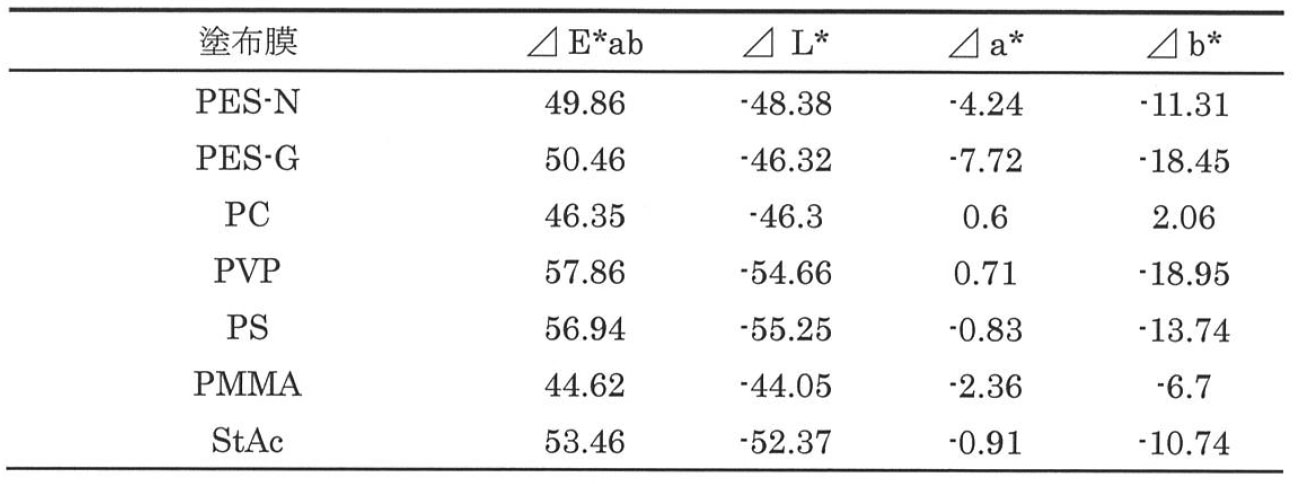
次に樹脂を含まない膜との比較を行った。具体的には、上記得られた膜と、樹脂を含まない膜との色の比較をするために、チオフェン重合体のみで作製した膜の測色値を基準とし、色差ΔE*abと、L*、a*、b*の値の差ΔL*、Δa*、Δb*を下記表12に示し、図52乃至54にプロットした結果を示す。なお図52は、金蒸着膜との色差を表し、図中●は金蒸着膜を、■1はニトロメタン溶媒から作製された樹脂を含有しない金色調膜、■2はPES-N膜をそれぞれ示している。また、図53も、金蒸着膜との色差を表し、図中の●は金蒸着膜を、■1はGBL溶媒から作製された樹脂を含まない金色調膜、■2はPES-G膜を、■3はPC膜を、■4はPVP膜をそれぞれ示す。また、図54中の●は金蒸着膜を、■1はGBL溶媒から作製された樹脂を含有しない金色調膜、■2はPS膜、■3はPMMA膜、■4はStAc膜をそれぞれ示している。

(樹脂の添加量を変化させた場合の金色膜形成)
次に、樹脂の添加量をオリゴマーに対し8倍以上に増量したときの塗布膜において、同様の金色調光沢の発現が確認された。以下にその結果について示す。
次に、樹脂の添加量をオリゴマーに対し8倍以上に増量したときの塗布膜において、同様の金色調光沢の発現が確認された。以下にその結果について示す。
(作製)
チオフェン重合体は上記実施例と同様に行った。また、下記表13で示す種々の樹脂80mgを1.0gのGBLに完全に溶解させ、その溶液に上記作製した3MeOTオリゴマー10mgを混合し、撹拌した。次いで、よく洗浄したガラス基板上に上記溶液をスポイトで滴下して塗布し、塗膜を恒温温風乾燥機で1時間(60℃)乾燥させた。膜厚は約50μm程度であった。

チオフェン重合体は上記実施例と同様に行った。また、下記表13で示す種々の樹脂80mgを1.0gのGBLに完全に溶解させ、その溶液に上記作製した3MeOTオリゴマー10mgを混合し、撹拌した。次いで、よく洗浄したガラス基板上に上記溶液をスポイトで滴下して塗布し、塗膜を恒温温風乾燥機で1時間(60℃)乾燥させた。膜厚は約50μm程度であった。
ここで、図55に、上記で作成した膜と、樹脂を含まない膜(60℃乾燥)の写真を示す。ただし、PS、PMMA、StAcはガラス基板との接着面(裏面)を撮影したものである。
(正反射スペクトル)
図56に、上記作製された塗布膜のうち、PESの表面及びPS、PMMA、StAcのガラス基板との接着面(裏面)の正反射スペクトルを、顕微紫外可視近赤外分光光度計(日本分光社製MSV-370)で測定した結果をそれぞれ示す。本図の結果と上記した同様の結果を比較すると、立ち上がり波長や反射率に差がないことから、樹脂をオリゴマーに対して過剰に混合しても金色光沢が発現することが確認された。
図56に、上記作製された塗布膜のうち、PESの表面及びPS、PMMA、StAcのガラス基板との接着面(裏面)の正反射スペクトルを、顕微紫外可視近赤外分光光度計(日本分光社製MSV-370)で測定した結果をそれぞれ示す。本図の結果と上記した同様の結果を比較すると、立ち上がり波長や反射率に差がないことから、樹脂をオリゴマーに対して過剰に混合しても金色光沢が発現することが確認された。
(分光測色)
次に、それぞれの膜のL*、a*、b*の値を下記表14に示し、その値のL*とa*-b*のグラフを図57に示す。結果として、いずれの樹脂膜とも金蒸着と近い値をとっているがa*及びb*の値は金蒸着膜と比較してやや低い値となり、緑と青みがやや強いことがわかる。なお、上記表と比較すると樹脂を増量しても色調に変化はあまりなかった。なお図中の●は金蒸着膜を、■1はGBL溶媒から作製された樹脂を含まない金色調膜、■2はPES膜を、■3はPS膜を、■4はPMMA膜を、■5はStAc膜をそれぞれ示す。
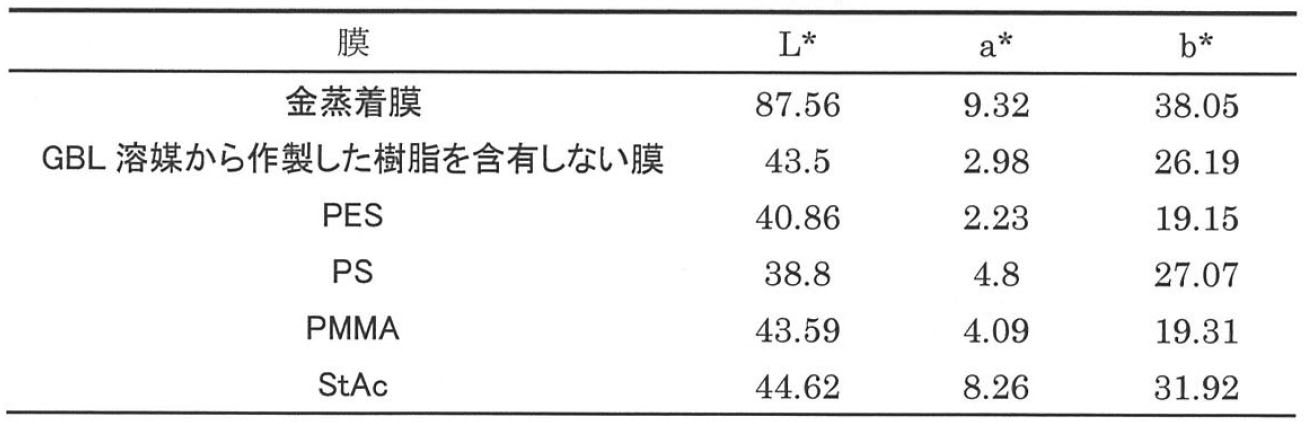
次に、それぞれの膜のL*、a*、b*の値を下記表14に示し、その値のL*とa*-b*のグラフを図57に示す。結果として、いずれの樹脂膜とも金蒸着と近い値をとっているがa*及びb*の値は金蒸着膜と比較してやや低い値となり、緑と青みがやや強いことがわかる。なお、上記表と比較すると樹脂を増量しても色調に変化はあまりなかった。なお図中の●は金蒸着膜を、■1はGBL溶媒から作製された樹脂を含まない金色調膜、■2はPES膜を、■3はPS膜を、■4はPMMA膜を、■5はStAc膜をそれぞれ示す。
次に、上記金色調膜と、蒸着金属金との色の比較をするために、金の蒸着膜の測色値を基準としたときの色差ΔL*、Δa*、Δb*を下記表15に示し、図58にプロットした結果を示す。なお本図において、●は金蒸着膜を、■1はGBL溶媒から作製された樹脂を含まない金色調膜、■2はPES膜を、■3はPS膜を、■4はPMMA膜を、■5はStAc膜をそれぞれ示す。

次に、上記金色調膜と、樹脂を含まない膜との色の比較をするために、金の蒸着膜の測色値を基準としたときの色差ΔL*、Δa*、Δb*を下記表16に示し、図59にプロットした結果を示す。なお本図において、●は金蒸着膜を、■1はGBL溶媒から作製された樹脂を含まない金色調膜、■2はPES膜を、■3はPS膜を、■4はPMMA膜を、■5はStAc膜をそれぞれ示す。
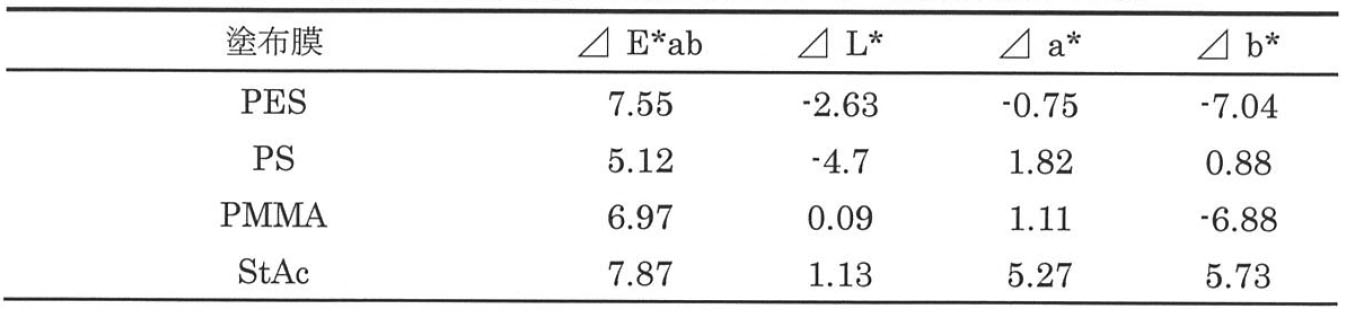
(X線回折スペクトル)
ここで、金色調光沢が発現しているPES膜の表面とPMMA膜の裏面のX線回折分析を行い、チオフェン重合体に起因する結晶性構造(ラメラ構造)の有無に関する知見を得た。測定には、リガク社製SmartLabを用いて、薄膜法で測定を行った。この場合の膜厚は50μm程度であった。
ここで、金色調光沢が発現しているPES膜の表面とPMMA膜の裏面のX線回折分析を行い、チオフェン重合体に起因する結晶性構造(ラメラ構造)の有無に関する知見を得た。測定には、リガク社製SmartLabを用いて、薄膜法で測定を行った。この場合の膜厚は50μm程度であった。
図60にそれらのXRDパターンを示す。いずれのパターンにおいても7.79度付近に鋭いピークが確認され、膜中にはラメラ結晶が存在し、ラメラ相関距離が1.13nmであることが産出された。
(X線光電子分光分析(XPS))
X線高電子分光分析により、膜の表面(深さ2.5nm程度までの表面)の構成元素と存在量に関する知見を得た。測定にはPHI社製QuanteraIIを用い、X線源は単色化Al(1486.6eV)とした。
X線高電子分光分析により、膜の表面(深さ2.5nm程度までの表面)の構成元素と存在量に関する知見を得た。測定にはPHI社製QuanteraIIを用い、X線源は単色化Al(1486.6eV)とした。
図60にワイドスキャンスペクトルを示す。これによるとPESもPMMAも酸素O、炭素C、塩素Cl、硫黄Sのピークのみが確認された。
また、S2pとCl2p付近のナロースキャンスペクトルを図61、62に示す。金色調光沢が発現しているPES表面もPMMA表面も、深さ2.5nm以内にチオフェン環に由来する硫黄とドーパントの過塩素酸に由来する塩素のシグナルが明瞭に観察された。すなわち、50μm厚のフィルム最表面及び最裏面にチオフェン重合体が存在することがわかり、そのチオフェン重合体が形成するラメラ結晶によって金色調の色調が発現することが分かった。なお、得られたスペクトルから得られる塩素と硫黄の原子数濃度を下記表17に示しておく。この濃度から、本実施例によって得られたチオフェン重合体は、チオフェン環10ユニットに対して塩化物イオンが約3個の割合でドーピングされていることが分かった。

本発明は、金属光沢を有する物品およびその製造方法として産業上の利用可能性がある。
Claims (5)
- チオフェン重合体を加圧することによって金属光沢を備えた物品を製造する方法。
- 前記チオフェン重合体は、化学重合又は電解重合によって形成されたものである請求項1記載の金属光沢を備えた物品を製造する方法。
- チオフェン重合体を含む金属光沢色用トナー。
- チオフェン重合体を含む金属光沢色用トナーを物品の上に配置し、当該金属光沢色用トナーを加圧することで定着させる印刷方法。
- 前記チオフェン重合体を擦る請求項1記載の金属光沢を備えた物品を製造する方法。
Priority Applications (1)
| Application Number | Priority Date | Filing Date | Title |
|---|---|---|---|
| US16/305,241 US11048182B2 (en) | 2016-05-31 | 2017-05-31 | Method for producing articles having a metallic luster, and toners with a metallic luster using the same and a printing method using the same |
Applications Claiming Priority (6)
| Application Number | Priority Date | Filing Date | Title |
|---|---|---|---|
| JP2016-109631 | 2016-05-31 | ||
| JP2016109631 | 2016-05-31 | ||
| JP2016136489 | 2016-07-11 | ||
| JP2016-136489 | 2016-07-11 | ||
| JP2016-223667 | 2016-11-16 | ||
| JP2016223667A JP6961197B2 (ja) | 2016-05-31 | 2016-11-16 | 金属光沢を備えた物品を製造する方法、並びに、これを用いる金属光沢色用トナー及び印刷方法。 |
Publications (1)
| Publication Number | Publication Date |
|---|---|
| WO2017209224A1 true WO2017209224A1 (ja) | 2017-12-07 |
Family
ID=60477523
Family Applications (1)
| Application Number | Title | Priority Date | Filing Date |
|---|---|---|---|
| PCT/JP2017/020373 Ceased WO2017209224A1 (ja) | 2016-05-31 | 2017-05-31 | 金属光沢を備えた物品を製造する方法、並びに、これを用いる金属光沢色用トナー及び印刷方法。 |
Country Status (1)
| Country | Link |
|---|---|
| WO (1) | WO2017209224A1 (ja) |
Cited By (1)
| Publication number | Priority date | Publication date | Assignee | Title |
|---|---|---|---|---|
| US20210179773A1 (en) * | 2019-12-13 | 2021-06-17 | Fuji Xerox Co., Ltd. | Composition for forming metallic luster film, metallic luster film, and article |
Citations (5)
| Publication number | Priority date | Publication date | Assignee | Title |
|---|---|---|---|---|
| JPS6372726A (ja) * | 1986-09-16 | 1988-04-02 | Res Inst For Prod Dev | ポリ(2−アミノチオフエン)系導電体およびその製造法 |
| JPS6386206A (ja) * | 1986-09-29 | 1988-04-16 | 花王株式会社 | 絶縁性又は半導電性共役系高分子膜の製造法 |
| JPH1088030A (ja) * | 1996-08-19 | 1998-04-07 | Bayer Ag | 引つ掻き抵抗性伝導性コーテイング |
| JP2007529094A (ja) * | 2004-03-11 | 2007-10-18 | バイエル・ベタイリグングスフェアヴァルトゥング・ゴスラー・ゲゼルシャフト・ミット・ベシュレンクテル・ハフツング | ポリチオフェンに基づく光学用途のための機能層 |
| JP2014153691A (ja) * | 2013-02-14 | 2014-08-25 | Fuji Xerox Co Ltd | 静電荷像現像用トナー、静電荷像現像剤、トナーカートリッジ、画像形成方法、及び、画像形成装置 |
-
2017
- 2017-05-31 WO PCT/JP2017/020373 patent/WO2017209224A1/ja not_active Ceased
Patent Citations (5)
| Publication number | Priority date | Publication date | Assignee | Title |
|---|---|---|---|---|
| JPS6372726A (ja) * | 1986-09-16 | 1988-04-02 | Res Inst For Prod Dev | ポリ(2−アミノチオフエン)系導電体およびその製造法 |
| JPS6386206A (ja) * | 1986-09-29 | 1988-04-16 | 花王株式会社 | 絶縁性又は半導電性共役系高分子膜の製造法 |
| JPH1088030A (ja) * | 1996-08-19 | 1998-04-07 | Bayer Ag | 引つ掻き抵抗性伝導性コーテイング |
| JP2007529094A (ja) * | 2004-03-11 | 2007-10-18 | バイエル・ベタイリグングスフェアヴァルトゥング・ゴスラー・ゲゼルシャフト・ミット・ベシュレンクテル・ハフツング | ポリチオフェンに基づく光学用途のための機能層 |
| JP2014153691A (ja) * | 2013-02-14 | 2014-08-25 | Fuji Xerox Co Ltd | 静電荷像現像用トナー、静電荷像現像剤、トナーカートリッジ、画像形成方法、及び、画像形成装置 |
Cited By (4)
| Publication number | Priority date | Publication date | Assignee | Title |
|---|---|---|---|---|
| US20210179773A1 (en) * | 2019-12-13 | 2021-06-17 | Fuji Xerox Co., Ltd. | Composition for forming metallic luster film, metallic luster film, and article |
| CN112980299A (zh) * | 2019-12-13 | 2021-06-18 | 富士胶片商业创新有限公司 | 金属光泽膜形成用组合物、金属光泽膜及物品 |
| JP2021095426A (ja) * | 2019-12-13 | 2021-06-24 | 富士フイルムビジネスイノベーション株式会社 | 金属光沢膜形成用組成物、金属光沢膜、及び物品 |
| US11708450B2 (en) * | 2019-12-13 | 2023-07-25 | Fujifilm Business Innovation Corp. | Composition for forming metallic luster film, metallic luster film, and article |
Similar Documents
| Publication | Publication Date | Title |
|---|---|---|
| JP6410374B2 (ja) | 金色又は銅色の光沢を有する膜が形成される溶液 | |
| Korent et al. | A correlative study of polyaniline electropolymerization and its electrochromic behavior | |
| TWI305219B (en) | Color shifting pigment flakes and foils,method of fabricating color shifting pigment flakes and color shifting foil device | |
| Najafi-Ashtiani et al. | A dual electrochromic film based on nanocomposite of copolymer and WO3 nanoparticles: Enhanced electrochromic coloration efficiency and switching response | |
| Arjomandi et al. | Electrochemical synthesis and In situ spectroelectrochemistry of conducting NMPy‐TiO2 and ZnO polymer nanocomposites for Li secondary battery applications | |
| Guzel et al. | A new way to obtain black electrochromism: Appropriately covering whole visible regions by absorption spectra of copolymers composed of EDOT and carbazole derivatives | |
| Kao et al. | High contrast and low-driving voltage electrochromic device containing triphenylamine dendritic polymer and zinc hexacyanoferrate | |
| Asami et al. | Electrochemical redox-based tuning of near infrared localized plasmons of CuS nanoplates | |
| Dalavi et al. | Efficient maximization of coloration by modification in morphology of electrodeposited NiO thin films prepared with different surfactants | |
| JP7161161B2 (ja) | 金属光沢を有する物品及びトナー並びに金属光沢を有する物品の製造方法 | |
| JP6881743B2 (ja) | 黒色光沢を有する物品及びトナー並びに黒色光沢を有する物品の製造方法 | |
| WO2017209224A1 (ja) | 金属光沢を備えた物品を製造する方法、並びに、これを用いる金属光沢色用トナー及び印刷方法。 | |
| Gumusay et al. | Electrochemistry of secondary amine substituted 2, 5-di (2-thienyl) pyrrole derivative and its copolymer | |
| US11048182B2 (en) | Method for producing articles having a metallic luster, and toners with a metallic luster using the same and a printing method using the same | |
| TW201204789A (en) | Manganese vanadium tantalum oxide and pigments having a black metallic effect coated with the same | |
| JP6961197B2 (ja) | 金属光沢を備えた物品を製造する方法、並びに、これを用いる金属光沢色用トナー及び印刷方法。 | |
| JP7665172B2 (ja) | 金属光沢を発現する膜及びその膜を生成する塗料 | |
| JP6800568B2 (ja) | 金属光沢膜を製造する方法。 | |
| Harish et al. | Interaction between gold (III) chloride and potassium hexacyanoferrate (II/III)—does it lead to gold analogue of Prussian blue? | |
| Pang et al. | Electrochromic properties of poly (3-chlorothiophene) film electrodeposited on a nanoporous TiO2 surface via a room temperature ionic liquid and its application in an electrochromic device | |
| Deng et al. | Electrochromic properties of WO3 thin film onto gold nanoparticles modified indium tin oxide electrodes | |
| Mortimer et al. | Synthesis, characterisation and in situ colorimetry of electrochromic Ruthenium purple thin films | |
| Xu et al. | Tricolor electrochromism of copolymer based on selenophene and 3, 4-ethylenedioxythiophene | |
| Liu et al. | Multicolor electrochromic films based on 2, 2’: 5’, 2’’-trithiophene and indole-6-carboxylic acid | |
| JP2024117298A (ja) | 金属光沢を発現する膜、その膜を生成する塗料およびそれらに用いることができる新規な共重合体 |
Legal Events
| Date | Code | Title | Description |
|---|---|---|---|
| 121 | Ep: the epo has been informed by wipo that ep was designated in this application |
Ref document number: 17806774 Country of ref document: EP Kind code of ref document: A1 |
|
| NENP | Non-entry into the national phase |
Ref country code: DE |
|
| 122 | Ep: pct application non-entry in european phase |
Ref document number: 17806774 Country of ref document: EP Kind code of ref document: A1 |