WO2017204160A1 - サーファクチンの製造方法 - Google Patents
サーファクチンの製造方法 Download PDFInfo
- Publication number
- WO2017204160A1 WO2017204160A1 PCT/JP2017/019027 JP2017019027W WO2017204160A1 WO 2017204160 A1 WO2017204160 A1 WO 2017204160A1 JP 2017019027 W JP2017019027 W JP 2017019027W WO 2017204160 A1 WO2017204160 A1 WO 2017204160A1
- Authority
- WO
- WIPO (PCT)
- Prior art keywords
- surfactin
- surfactant
- culture solution
- organic phase
- mass
- Prior art date
- Legal status (The legal status is an assumption and is not a legal conclusion. Google has not performed a legal analysis and makes no representation as to the accuracy of the status listed.)
- Ceased
Links
Classifications
-
- C—CHEMISTRY; METALLURGY
- C07—ORGANIC CHEMISTRY
- C07K—PEPTIDES
- C07K1/00—General methods for the preparation of peptides, i.e. processes for the organic chemical preparation of peptides or proteins of any length
- C07K1/14—Extraction; Separation; Purification
Definitions
- the present invention relates to a method for efficiently producing surfactin, which is a biosurfactant.
- Surfactin has been reported to have various functions such as antibacterial activity, hemolysis, and protein denaturation inhibition in addition to high surface activity.
- Surfactin is a kind of biosurfactant that is a natural surfactant, and is a cyclic peptide having a long-chain alkyl group as a lipophilic group. Therefore, unlike synthetic surfactants, there are advantages such as extremely high biodegradability and small effects on the living body and environment such as low transdermal toxicity. In recent years, formulation into cosmetics and the like has also been studied.
- surfactin is produced by microorganisms belonging to the genus Bacillus, and is difficult to synthesize artificially and is produced by a culture method. Therefore, there is a problem that the production cost is high. Then, the manufacturing method of surfactin is examined.
- Patent Document 1 discloses a method for producing surfactin in high yield using a Bacillus subtilis mutant strain mutated to produce surfactin in high yield by a mutagen.
- Patent Document 2 discloses a method for improving productivity by culturing surfactin-producing bacteria in a liquid medium containing a pulverized product of beans or an extract thereof.
- Patent Documents 1 and 2 only exemplify a general method as a method for purifying surfactin. In the examples, only the concentration of surfactin in the culture medium is measured. No purification method is described.
- Patent Document 3 discloses a method for efficiently and economically purifying surfactin from a culture solution by using a branched alkyl alcohol as an extraction solvent.
- surfactin which is a surfactant
- a method for purifying surfactin from a culture solution using a branched alkyl alcohol has been developed.
- a low molecular weight branched alkyl alcohol can be miscible with water, it becomes difficult to separate liquids, and it may be necessary to use an organic solvent that is immiscible with water. In that case, a part of the branched alkyl alcohol is mixed in the aqueous phase, and it takes time to reuse the solvent.
- a branched alkyl alcohol having a relatively large number of carbon atoms may be difficult to handle because it is solid at room temperature.
- an object of the present invention is to provide a method capable of efficiently producing surfactin by well extracting surfactin from a culture solution even when using a general-purpose extraction solvent.
- a method for producing surfactin Culturing surfactin-producing bacteria to obtain a culture solution containing surfactin, Mixing a culture solution, an acid, an organic solvent immiscible with water, and a surfactant other than surfactin, and extracting surfactin with the organic solvent; Separating the aqueous and organic phases; and A method comprising purifying surfactin from an organic phase.
- the present invention has a high industrial utility value as it further enhances the production efficiency of surfactin, which has been in demand in recent years due to characteristics such as safety and excellent surface activity.
- Step 1 Obtaining Surfactin-Containing Culture Solution
- Surfactin is produced mainly by surfactin-producing bacteria classified into the genus Bacillus.
- a culture solution containing surfactin is obtained by culturing surfactin-producing bacteria.
- Surfactin or a salt thereof obtained by the method of the present invention generally has a chemical structural formula represented by the following formula (I).
- the surfactin represented by the formula (I) or a salt thereof may be abbreviated as “surfactin (I)”.
- M + represents a cation
- X represents an amino acid residue selected from leucine, isoleucine and valine
- R represents a C 9-18 alkyl group
- M + cation examples include protons (H + ), alkali metal ions, alkaline earth metal ions, and ammonium ions.
- Alkali metal ions are preferable, and sodium ions or potassium ions are more preferable.
- alkaline earth metal ions are divalent, a salt is formed by one molecule of surfactin and one alkaline earth metal ion.
- alkali metal ion Lithium ion, sodium ion, potassium ion, etc. are represented.
- the alkaline earth metal ion is not particularly limited, but represents beryllium ion, magnesium ion, calcium ion, or the like.
- the ammonium ion is not particularly limited as long as it forms a salt with surfactin.
- substituent for the amine examples include C 1-6 alkyl groups such as methyl, ethyl, n-propyl, isopropyl, n-butyl, tert-butyl; aralkyl groups such as benzyl, methylbenzyl, phenylethyl; phenyl, toluyl And an organic group such as an aryl group such as xylyl.
- the organic group such as a C 1-6 alkyl group and an aryl group may be further substituted with one or more substituents.
- amino acid residue as X may be L-form or D-form, but L-form is preferred.
- C 9-18 alkyl group refers to a linear or branched monovalent saturated hydrocarbon group having 9 to 18 carbon atoms.
- the surfactin (I) may be a mixture of two or more. For example, it may contain a plurality of surfactins (I) in which the C 9-18 alkyl group of R 1 is different.
- Surfactin-producing bacteria are not particularly limited as long as they produce surfactin, and examples thereof include surfactin-producing bacteria belonging to the genus Bacillus, including surfactin-producing bacteria belonging to the species Bacillus subtilis. Bacillus subtilis SD901 (International Deposit Number: FERM BP-7666) is more preferable.
- a culture solution containing surfactin can be suitably prepared by, for example, the method described in WO2012 / 043800 or JP-A-2002-176993.
- the microorganism is usually precultured in a nutrient medium to increase the number of bacteria, and this preculture is cultured by inoculating the main culture.
- the nutrient medium include L medium composed of 1 wt / v% polypeptone, 0.5 wt / v% yeast extract, 0.5 wt / v% NaCl, and the remaining water.
- the main culture solution usually contains a carbon source, a nitrogen source, metal ions, and a pH adjuster.
- Carbon sources include sugars such as glucose, maltose, sucrose; starches; alcohols; organic acids and the like.
- the amount of the carbon source in the main culture is, for example, about 1% by mass to 40% by mass.
- Nitrogen sources include soy flour or extracts thereof, ammonium salts, nitrates, peptone, meat extract, yeast extract and the like. Soy flour or an extract thereof may be used alone or in combination with other nitrogen sources such as yeast extract.
- the amount of the nitrogen source is, for example, about 0.1% by mass or more and 20% by mass or less.
- the blending amount is, for example, about 0.1% by mass or more and 20% by mass or less, and the blending amount of the yeast extract is, for example, 0.001 mass. % Or more and about 1% by mass or less.
- Metal ions include magnesium ions, iron ions, manganese ions, calcium ions, zinc ions, cobalt ions, nickel ions, copper ions, molybdenum ions, and the like. These are usually used in combination of two or more, and are added as metal salts such as sulfates, chloride salts and phosphates. The amount of the metal salt is, for example, about 10 ppm to 1000 ppm.
- the metal ions include alkali metal ions such as potassium ions and sodium ions, but these are often added in large amounts by using a pH adjuster, so when defining the amount of metal ions.
- the metal ions do not include alkali metal ions.
- phosphates such as sodium phosphate and potassium phosphate are used.
- the amount of the pH adjuster is, for example, about 0.1% by mass or more and 10% by mass or less.
- an appropriate amount for example, 1 w / w% or less
- an amino acid such as L-tryptophan or L-arginine may be added to the main culture solution, and an appropriate amount (for example, 100 ppm or less) of vitamins may be added as necessary. May be.
- the temperature of the preculture and the main culture can be adjusted to, for example, 25 ° C. or more and 42 ° C. or less.
- the concentration of surfactin after the main culture can be, for example, about 1% by mass to 10% by mass.
- Bacillus subtilis SD901 (FERM BP-7666) is pre-cultured in a nutrient medium containing 10 ppm of tetracycline at a temperature of 25 ° C. to 42 ° C. for about 5 hours to 24 hours.
- a nutrient medium containing 10 ppm of tetracycline at a temperature of 25 ° C. to 42 ° C. for about 5 hours to 24 hours.
- about 0.1% by mass or more and 10% by mass or less of the preculture solution obtained above is inoculated into a medium containing soybean powder or an extract thereof as a nitrogen source.
- a culture solution containing surfactin can be suitably obtained.
- Step 2 Surfactin Extraction Step Next, the obtained culture solution, an acid, an organic solvent immiscible with water, and a surfactant other than surfactin are mixed, and surfactin is extracted with the organic solvent.
- Surfactants are generally used to mix aqueous and organic phases or to emulsify, but surprisingly, in the present invention, it is likely also related to the presence of surfactin, but other than surfactin.
- the addition of the surfactant increases the separation efficiency between the aqueous phase and the organic phase, thereby improving the production efficiency of surfactin.
- the acid to be used is not particularly limited, and examples thereof include inorganic acids such as hydrochloric acid, sulfuric acid, nitric acid, and phosphoric acid, and organic acids such as formic acid, acetic acid, and propionic acid.
- inorganic acids such as hydrochloric acid, sulfuric acid, nitric acid, and phosphoric acid
- organic acids such as formic acid, acetic acid, and propionic acid.
- the salt of surfactin is protonated by the acid, and the extraction efficiency is increased.
- the pH of the culture solution should be lower than 7.
- the pH of the culture solution is adjusted to 5 or less.
- the pH is more preferably 4 or less.
- the pH is preferably 1 or more, and more preferably 3 or more.
- the organic solvent immiscible with water used as an extraction solvent is not particularly limited as long as it can be separated from the aqueous phase in the presence of at least an acid, surfactin, and a surfactant other than surfactin and extract surfactin. However, as long as it is not miscible with water at normal temperature, it may be partially miscible with water, for example, when mixed only with water.
- organic solvent used as the extraction solvent examples include ester solvents such as methyl acetate, ethyl acetate, propyl acetate, methyl propionate, and ethyl propionate; aromatic hydrocarbon solvents such as toluene, benzene, and xylene; hexane, Aliphatic hydrocarbon solvents such as cyclohexane and heptane; ether solvents such as diethyl ether, diisopropyl ether, tetrahydrofuran and 1,4-dioxane; ketone solvents such as acetone and methyl ethyl ketone; nitrile solvents such as acetonitrile and propionitrile Can be mentioned.
- ester solvents such as methyl acetate, ethyl acetate, propyl acetate, methyl propionate, and ethyl propionate
- aromatic hydrocarbon solvents such as toluene, benz
- ester solvents aromatic hydrocarbon solvents and aliphatic hydrocarbon solvents are preferable, toluene, ethyl acetate, tetrahydrofuran, acetone and acetonitrile are more preferable, and ethyl acetate, toluene and hexane are even more preferable.
- an organic solvent such as acetone, diethyl ether, or acetonitrile, which is partially miscible with the aqueous phase
- an organic solvent that is difficult to mix with the aqueous phase such as toluene or ethyl acetate
- the amount of the extraction solvent used varies depending on the type and the like, and may be adjusted as appropriate. If the said ratio is 0.2 mass part or more, sufficient liquid separation speed can be ensured, and if it is 2.5 mass parts or less, it will not become economically disadvantageous. As the said ratio, 0.4 mass part or more is more preferable, 0.6 mass part or more is further more preferable, 2.0 mass part or less is more preferable, and 1.5 mass part or less is further more preferable.
- a surfactant other than surfactin is used to extract surfactin from the culture solution.
- the surfactant is not particularly limited, such as an anionic surfactant, a cationic surfactant, a nonionic surfactant, and an amphoteric surfactant.
- the aqueous phase and the organic phase It can be selected from those that promote liquid separation.
- Suitable surfactants other than surfactin include, for example, a sulfonic acid group-containing anionic surfactant, a quaternary ammonium group-containing cationic surfactant, an amphoteric surfactant, and an HLB (Hydrophile-Lipophile Balance) value.
- a sulfonic acid group-containing anionic surfactant include linear alkylbenzene sulfonate (LAS), alpha olefin sulfonate (AOS), alkyl sulfate (AS), sodium alkyl ether sulfate (AES) and the like.
- LAS linear alkylbenzene sulfonate
- AOS alpha olefin sulfonate
- AS alkyl sulfate
- AES sodium alkyl ether sulfate
- the type and amount of the surfactant other than surfactin affect the liquid separation speed in the method of the present invention, and are adjusted accordingly.
- the amount of the surfactant other than surfactin used can be 0.1% by mass or more and 10% by mass or less with respect to the culture solution. If the amount is 0.1% by mass or more, the separation speed between the aqueous phase and the organic phase can be sufficiently secured, and the extraction of surfactin can be made more efficient. Moreover, if the said quantity is 10 mass% or less, the usage-amount of an organic solvent does not become excess, and it is industrially and economically advantageous.
- the amount is more preferably 0.5% by mass or more, more preferably 5% by mass or less, and still more preferably 2% by mass or less.
- the mixing order of surfactants other than the culture solution, acid, organic solvent immiscible with water, and surfactin is not particularly limited.
- an acid, an organic solvent that is not miscible with water, and a surfactant other than surfactin may be added to the culture solution and mixed, or an organic solvent that is immiscible with acid, water, or a surfactant other than surfactin.
- the culture solution may be added to at least one of the agents, and then other components may be added and mixed. It is preferable to stir after mixing at least these.
- the extraction of surfactin can be made more efficient by stirring.
- the mixture is allowed to stand, and the aqueous phase and the organic phase are separated, and then the organic phase containing surfactin is separated from the aqueous phase.
- the above extraction operation may be repeated once or twice or more for the aqueous phase.
- the temperature at the time of standing is not particularly limited as long as the culture solution does not solidify or evaporate.
- the said temperature 60 degrees C or less is preferable and 40 degrees C or less is more preferable.
- the separation speed is usually an industrially suitable speed.
- the speed at which the aqueous phase and the organic phase are completely separated is expressed by the liquid depth / separation time of the organic phase, it is usually preferably 0.01 cm / min or more, more preferably 0.05 cm / min. More than a minute.
- the yield per extraction is usually 60 mol% or more with respect to the entire surfactin contained in the culture solution. By optimizing the conditions, the yield is further 90 mol% or more. Can be recovered. Naturally, the upper limit of the yield can be 100 mol%.
- the extract obtained by the above extraction may contain salts derived from the culture solution, but it is not necessary to remove these salts, and even if the salt is added to the culture solution after completion of the culture. Good.
- the salt contained in the extract is not particularly limited, and examples thereof include inorganic acids such as hydrochloride, sulfate, nitrate, and phosphate, and organic acids such as formate, acetate, and propionate.
- Process 3 Solid content removal process
- solid content is removed from a culture solution.
- surfactant other than surfactin and an extraction solvent
- surfactin can be extracted without necessarily removing solids from the culture solution.
- the order of performing this step is not particularly limited as long as it is before a post-processing step described later. That is, after obtaining the culture solution in the above step 1, the solid content may be removed from the culture solution before carrying out the above step 2, or after the culture solution and the extraction solvent are mixed in the above step 2 You may remove solid content from a liquid. Moreover, when the solid content is contained in the organic phase separated from the aqueous phase, the solid content may be removed from the separated organic phase. However, in the above-mentioned step 2, when surfactin is precipitated by adding only the acid to the culture solution, the solid content is not removed at this stage, and the extraction solvent is further added and precipitated. It is assumed that the solid content is removed after dissolving the surfactin.
- the solid content in the culture solution examples include a solid content derived from surfactin-producing bacteria. Further, the solid content can be removed by a conventional method such as centrifugal separation or pressure filtration using a filter press.
- Step 4 Separation Step
- the organic phase containing surfactin is separated from the aqueous phase.
- the separation efficiency between the organic phase and the aqueous phase is improved, the separation between the organic phase and the aqueous phase is easy.
- the specific gravity of the aqueous phase is higher than that of the organic phase, the lower aqueous phase may be selectively discharged.
- Step 5 Post-treatment step
- the surfactin extract (organic phase) obtained as described above may be concentrated or dried as it is to isolate surfactin.
- a base may be added to the organic phase obtained in the above step 4 to precipitate the surfactin salt as a solid, and the precipitated surfactin salt may be separated by centrifugation or filtration and dried.
- the above-mentioned operation may be carried out after treating the organic phase with activated carbon. That is, in the surfactin purification step, a base may be added to the organic phase to separate the solidified surfactin.
- surfactin may be purified from the organic phase using an ultrafiltration membrane.
- the base used for precipitating the surfactin salt from the organic phase is not particularly limited.
- an alkali metal such as lithium, sodium or potassium
- a base containing an alkaline earth metal such as magnesium, calcium or barium
- these hydroxides, carbonates, bicarbonates and the like can be mentioned, and sodium hydroxide, potassium hydroxide and the like can be preferably used.
- the following amine bases (including optionally substituted ammonium) may be used.
- the amine represents a monosubstituted amine, a disubstituted amine, or a trisubstituted amine.
- substituent of the amine examples include alkyl groups such as methyl, ethyl, n-propyl, isopropyl, n-butyl, and tert-butyl; aralkyl groups such as benzyl, methylbenzyl, and phenylethyl; phenyl, toluyl, xylyl, and the like An organic group such as an aryl group can be mentioned.
- the amine may be converted to an ammonium ion by further adding a proton.
- These organic groups may be further substituted with one or more substituents.
- the amount of the base is not particularly limited as long as it forms a salt with surfactin, and is usually 0.5 mol times or more and 4 mol times or less with respect to surfactin.
- the method of mixing the organic phase containing surfactin, water and the base is not particularly limited, and water may be added to the organic phase or its concentrated solution, and then the base may be added. Water containing a base may be mixed, or an organic phase or a concentrated solution thereof may be added to an aqueous base solution and mixed.
- the base used here is not particularly limited, and for example, a base containing an alkali metal such as lithium, sodium or potassium; an alkaline earth metal such as magnesium, calcium or barium can be used. In addition to ammonia, an organic base such as triethylamine may be used. Alkali metal salts such as sodium hydroxide and potassium hydroxide are preferred.
- the amount of the base is not particularly limited as long as Surfactin (I) is dissolved in the aqueous phase, and is usually used in an amount of 0.5 to 4 moles relative to Surfactin (I).
- the acid used for precipitating the free form of surfactin from the aqueous solution is not particularly limited, and examples thereof include inorganic acids such as hydrochloric acid, sulfuric acid, nitric acid, and phosphoric acid, and organic acids such as formic acid, acetic acid, and propionic acid. Of these, hydrochloric acid and sulfuric acid are preferred.
- the aqueous solution of the surfactin salt When mixing the aqueous solution of the surfactin salt and the acid, the aqueous solution of the surfactin salt may be added to a previously prepared acidic aqueous solution, or the acid may be added to the aqueous surfactin solution.
- a method of adding an aqueous solution of a surfactin salt to acidic water having a lower viscosity during neutralization is preferable.
- the temperature at the time of mixing the aqueous solution of the surfactin salt and the acid is not particularly limited as long as the surfactin is not decomposed, and is usually 0 ° C. or higher and 80 ° C. or lower, preferably 0 ° C. or higher and 60 ° C. or lower, more preferably 0 ° C. It can implement suitably in the range below 40 degreeC.
- the temperature at the time of aging can be suitably carried out in the same temperature range as that when mixing with the above-mentioned acid.
- the precipitated surfactin solid can be isolated by solid-liquid separation by a conventional method such as a centrifugal separator or pressure filtration.
- the surfactin obtained as described above may be further mixed with a base in an aqueous solution or an organic solvent to form a surfactin salt.
- Surfactin salt solids can be obtained by concentration or drying as necessary.
- a higher-purity surfactin salt can be obtained by applying an activated carbon treatment before the drying treatment.
- Examples of the base used in the operation include the same bases used for forming the surfactin salt.
- the amount of the base is not particularly limited as long as it forms a salt with surfactin, and it is preferably used in an amount of 0.5 to 4 moles relative to surfactin.
- the method for drying the obtained solid is not particularly limited, and can be suitably carried out by conventional methods such as spray drying, freeze drying, and thin film evaporation.
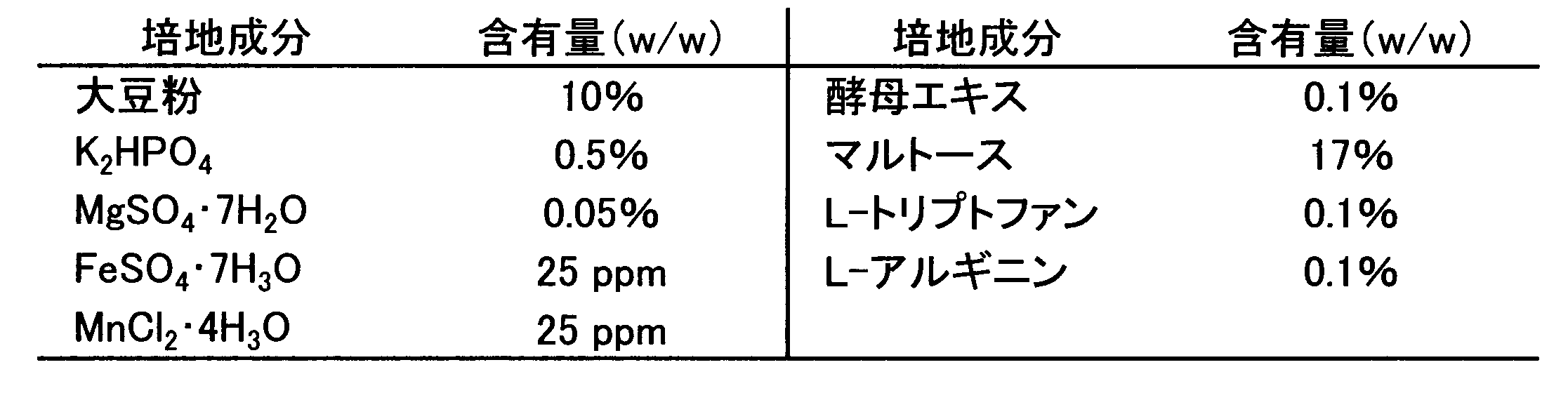
- Example 1 Culture of Surfactin-Producing Bacteria Bacillus subtilis SD901 (FERM BP-7666) was streaked on an L plate medium supplemented with 10 ppm of tetracycline and grown overnight at 35 ° C. Separately, 100 mL of L medium supplemented with 10 ppm of tetracycline was prepared in a flask with baffle, inoculated with 1 platinum ear, and cultured at 35 ° C. and 150 rpm for 12 hours. 2 L of a medium having the following composition was prepared in a 5 L fermenter, a culture medium of L medium was added, and the culture was performed at 35 ° C. while adjusting the pH to 6.5 to 7.5 with 20% NaOH. The culture was terminated when the predetermined surfactin sodium concentration was reached.
Landscapes
- Preparation Of Compounds By Using Micro-Organisms (AREA)
Abstract
本発明は、汎用の抽出溶媒を使っても、サーファクチンを培養液から良好に抽出してサーファクチンを効率的に製造することができる方法を提供することを目的とする。本発明に係るサーファクチンの製造方法は、サーファクチン産生菌を培養することにより、サーファクチンを含む培養液を得る工程;培養液、酸、水に混和しない有機溶媒、およびサーファクチン以外の界面活性剤を混合し、有機溶媒によりサーファクチンを抽出する工程;水相と有機相を分離する工程;および、有機相からサーファクチンを精製する工程を含むことを特徴とする。
Description
本発明は、バイオサーファクタントであるサーファクチンを効率良く製造するための方法に関するものである。
サーファクチンは、高い界面活性能の他、抗菌活性、溶血性、タンパク質変性阻害など、多彩な機能を有することが報告されている。サーファクチンは天然界面活性剤であるバイオサーファクタントの一種であり、親油性基として長鎖アルキル基を有する環状ペプチドである。よって、合成界面活性剤とは異なり、生分解性が極めて高く、また、経皮毒性が小さいなど、生体や環境に与える影響が小さいという利点がある。近年は、化粧品などへの配合も検討されている。
しかしサーファクチンは、バチルス(Bacillus)属微生物によって産生され、人工的な合成が難しく培養法で製造されていることから、製造コストが高いという問題がある。そこで、サーファクチンの製造方法が検討されている。
例えば特許文献1には、突然変異誘発剤によってサーファクチンを高収率で生産するように変異させたバチルス・ズブチルス突然変異株を使ってサーファクチンを高収率で生産する方法が開示されている。また、特許文献2には、豆類の粉砕物またはその抽出物を含む液体培地でサーファクチン産生菌を培養することにより、生産性を向上させる方法が開示されている。
しかし、いかにサーファクチン産生菌によるサーファクチンの産生量を高めても、サーファクチンには精製が難しいという問題がある。即ち、サーファクチンは全体として負電荷を有するため、培地を酸性にした上で有機溶媒によりサーファクチンを抽出して精製することが考えられる。ところが、サーファクチンは界面活性作用を有するが故に、培地からの抽出が難しい。実際、特許文献1,2には、サーファクチンの精製方法としては一般的な方法が例示されているのみであり、実施例でも培養液中のサーファクチン濃度が測定されているのみで、具体的な精製方法は記載されていない。
そこで、特許文献3には、抽出溶媒として分岐アルキルアルコールを用いることにより、サーファクチンを培養液から効率的かつ経済的に精製する方法が開示されている。
上述したように、界面活性剤であるサーファクチンを培養液から効率的に抽出することは難しいが、分岐アルキルアルコールを用いてサーファクチンを培養液から精製する方法が開発されている。
しかし、低分子量の分岐アルキルアルコールは水にも混和し得るため、分液が難しくなり、水に混和しない有機溶媒の併用が必要となる場合がある。その場合、分岐アルキルアルコールの一部は水相に混入するし、また、溶媒の再利用に手間がかかる。一方、炭素数が比較的多い分岐アルキルアルコールは、常温で固体であるなど扱い難い場合がある。例えば、イソプロパノールは水溶性が高いし、t-ブタノールは融点が約26℃であり、気温が少し低いだけで固体状になってしまう。
そこで本発明は、汎用の抽出溶媒を使っても、サーファクチンを培養液から良好に抽出してサーファクチンを効率的に製造することができる方法を提供することを目的とする。
しかし、低分子量の分岐アルキルアルコールは水にも混和し得るため、分液が難しくなり、水に混和しない有機溶媒の併用が必要となる場合がある。その場合、分岐アルキルアルコールの一部は水相に混入するし、また、溶媒の再利用に手間がかかる。一方、炭素数が比較的多い分岐アルキルアルコールは、常温で固体であるなど扱い難い場合がある。例えば、イソプロパノールは水溶性が高いし、t-ブタノールは融点が約26℃であり、気温が少し低いだけで固体状になってしまう。
そこで本発明は、汎用の抽出溶媒を使っても、サーファクチンを培養液から良好に抽出してサーファクチンを効率的に製造することができる方法を提供することを目的とする。
本発明者は、上記課題を解決するために鋭意研究を重ねた。その結果、本来、界面活性剤は水相と有機相との分液を阻害するものであるのに対して、サーファクチンを含む培養液の場合には、さらに界面活性剤を添加することによって分液をより速やかに行うことができ、サーファクチンを効率的に抽出できることを見出して、本発明を完成した。
以下、本発明を示す。
以下、本発明を示す。
[1] サーファクチンを製造するための方法であって、
サーファクチン産生菌を培養することにより、サーファクチンを含む培養液を得る工程、
培養液、酸、水に混和しない有機溶媒、およびサーファクチン以外の界面活性剤を混合し、有機溶媒によりサーファクチンを抽出する工程、
水相と有機相を分離する工程、および、
有機相からサーファクチンを精製する工程を含むことを特徴とする方法。
サーファクチン産生菌を培養することにより、サーファクチンを含む培養液を得る工程、
培養液、酸、水に混和しない有機溶媒、およびサーファクチン以外の界面活性剤を混合し、有機溶媒によりサーファクチンを抽出する工程、
水相と有機相を分離する工程、および、
有機相からサーファクチンを精製する工程を含むことを特徴とする方法。
[2] 界面活性剤として、スルホン酸基含有陰イオン界面活性剤、第四級アンモニウム基含有陽イオン界面活性剤、両性界面活性剤、HLB値が12以上である非イオン界面活性剤からなる群より選択される1以上を用いる上記[1]に記載の方法。
[3] 培養液に対して0.1質量%以上、10質量%以下の界面活性剤を添加する上記[1]または[2]に記載の方法。
[4] さらに、有機相に塩基を添加し、固体化したサーファクチンを分離する上記[1]~[3]のいずれかに記載の方法。
[5] 限外ろ過膜を使って有機相からサーファクチンを精製する上記[1]~[4]のいずれかに記載の方法。
[6] さらに、培養液から固形分を除去する工程を含む上記[1]~[5]のいずれかに記載の方法。
本発明方法により、サーファクチンを含む培養液からサーファクチンを抽出する場合、水相と有機相との分液がより速やかになり、サーファクチンの精製が効率的になる。よって本発明は、近年、安全で界面活性作用に優れるなどの特性から需要が増しているサーファクチンの製造効率をより一層高めるものとして、産業上利用価値が高い。
以下、本発明方法を工程毎に説明する。
工程1: サーファクチン含有培養液の取得工程
サーファクチンは、主にバチルス(Bacillus)属に分類されるサーファクチン産生菌により産生される。本工程では、サーファクチン産生菌を培養することにより、サーファクチンを含む培養液を得る。
工程1: サーファクチン含有培養液の取得工程
サーファクチンは、主にバチルス(Bacillus)属に分類されるサーファクチン産生菌により産生される。本工程では、サーファクチン産生菌を培養することにより、サーファクチンを含む培養液を得る。
本発明方法で得られるサーファクチンまたはその塩は、一般的に、下記式(I)で示される化学構造式を有する。以下、式(I)で示されるサーファクチンまたはその塩を「サーファクチン(I)」と略記する場合がある。

[式中、
*は光学活性点(Optically Active Center)を示し;
M+は、カチオンを示し;
Xは、ロイシン、イソロイシンおよびバリンから選択されるアミノ酸残基を示し;
RはC9-18アルキル基を示す]
*は光学活性点(Optically Active Center)を示し;
M+は、カチオンを示し;
Xは、ロイシン、イソロイシンおよびバリンから選択されるアミノ酸残基を示し;
RはC9-18アルキル基を示す]
M+のカチオンとしては、例えば、プロトン(H+)、アルカリ金属イオン、アルカリ土類金属イオン、アンモニウムイオンが挙げられ、アルカリ金属イオンが好ましく、ナトリウムイオンまたはカリウムイオンがより好ましい。但し、アルカリ土類金属イオンは2価であることから、サーファクチン1分子と1個のアルカリ土類金属イオンとで塩が形成される。
アルカリ金属イオンとは、特に限定されないが、リチウムイオン、ナトリウムイオン、カリウムイオンなどを表す。アルカリ土類金属イオンとは、特に限定されないが、ベリウムイオン、マグネシウムイオン、カルシウムイオンなどを表す。アンモニウムイオンは、サーファクチンと塩を形成するものであれば特に限定されず、無置換アンモニウムイオン(NH4
+)の他、一置換アンモニウムイオン(R1NH3
+)、二置換アンモニウムイオン(R1R2NH2
+)、三置換アンモニウムイオン(R1R2R3NH+)、および第四級アンモニウム(R1R2R3R4N+)を表す。アミンの置換基としては、例えば、メチル、エチル、n-プロピル、イソプロピル、n-ブチル、tert-ブチル等のC1-6アルキル基;ベンジル、メチルベンジル、フェニルエチル等のアラルキル基;フェニル、トルイル、キシリル等のアリール基などの有機基が挙げられる。具体的には、メチルアンモニウムイオン、エチルアンモニウムイオン、ベンジルアンモニウムイオン、アニリニウムイオン、ジエチルアンモニウムイオン、ジシクロヘキシルアンモニウムイオン、ピロリジウムイオン、モルホリニウムイオン、N-ベンジル-N-エチルアンモニウムイオン、N-エチルアニリニウムイオン、トリエチルアンモニウムイオン、ピリジニウムイオン等が挙げられる。C1-6アルキル基やアリール基などの上記有機基は、さらに1または2以上の置換基で置換されていてもよい。
Xとしてのアミノ酸残基は、L体でもD体でもよいが、L体が好ましい。
Rとしての「C9-18アルキル基」は、炭素数が9以上、18以下の直鎖状または分枝鎖状の一価飽和炭化水素基をいう。例えば、n-ノニル、6-メチルオクチル、7-メチルオクチル、n-デシル、8-メチルノニル、n-ウンデシル、9-メチルデシル、n-ドデシル、10-メチルウンデシル、n-トリデシル、11-メチルドデシル、n-テトラデシル、n-ペンタデシル、n-ヘキサデシル、n-ヘプタデシル、n-オクタデシルなどが挙げられる。これらは、1または2以上の置換基で置換されていてもよい。置換基としては、アミノ基、ヒドロキシ基、フェニル基、アリール基、アルカノイル基、アルケニル基、アルキニル基、アルコキシ基、ニトロ基、ハロゲン原子などが挙げられる。なお、上記サーファクチン(I)は、2種以上の混合物であってもよい。例えば、R1のC9-18アルキル基が異なる複数のサーファクチン(I)を含むものであってもよい。
サーファクチン産生菌は、サーファクチンを産生するものであれば特に制限されないが、例えば、バチルス属に属するサーファクチン産生菌を挙げることができ、バチルス・ズブチリス(Bacillus subtilis)種に属するサーファクチン産生菌が好ましく、バチルス・ズブチリスSD901(国際寄託番号:FERM BP-7666)がより好ましい。
サーファクチンを含む培養液は、例えば、WO2012/043800や特開2002-176993号公報に記載の方法にて好適に調製できる。具体的には、前記微生物を、通常、栄養培地中で予備培養して菌数を増やしておき、この予備培養液を本培養液に植菌することで培養する。栄養培地としては、例えば、1wt/v%ポリペプトン、0.5wt/v%酵母エキス、0.5wt/v%NaCl、残部水からなるL培地などを挙げることができる。前記予備培養では、他の微生物の増殖を防止する目的で、必要に応じて抗生物質(例えばクロラムフェニコール、テトラサイクリンなど)を適量(例えば、1ppm以上30ppm以下(質量基準;以下、同じ))添加しておいてもよい。本培養液は、通常、炭素源、窒素源、金属イオン、pH調整剤を含む。炭素源には、グルコース、マルトース、ショ糖などの糖類;でん粉類;アルコール類;有機酸類などが含まれる。本培養液中の炭素源の量は、例えば、1質量%以上40質量%以下程度である。
窒素源としては、大豆粉またはその抽出物、アンモニウム塩、硝酸類、ペプトン、肉エキス、酵母エキスなどが含まれる。大豆粉またはその抽出物を単独で、或いは酵母エキスなどその他の窒素源と組み合わせて用いてもよい。窒素源の量は、例えば、0.1質量%以上20質量%以下程度である。大豆粉またはその抽出物と酵母エキスとを組み合わせて用いる場合、その配合量は、例えば、0.1質量%以上20質量%以下程度であり、酵母エキスの配合量は、例えば、0.001質量%以上1質量%以下程度である。
金属イオン(ミネラル)には、マグネシウムイオン、鉄イオン、マンガンイオン、カルシウムイオン、亜鉛イオン、コバルトイオン、ニッケルイオン、銅イオン、モリブデンイオンなどが含まれる。これらは、通常、2種以上が組み合わせて使用され、硫酸塩、塩化物塩、リン酸塩などの金属塩として添加される。金属塩の量は、例えば、10ppm以上1000ppm以下程度である。なお前記金属イオンにはカリウムイオン、ナトリウムイオンなどのアルカリ金属イオンも含まれるが、これらはpH調整剤を使用することで多量に添加される事が多いため、金属イオンの量を規定する際には、金属イオンにはアルカリ金属イオンを含めないものとする。
pH調整剤としては、リン酸ナトリウムやリン酸カリウムなどのリン酸塩などが使用される。pH調整剤の量は、例えば、0.1質量%以上10質量%以下程度である。なお前記本培養液には、必要に応じて、L-トリプトファンやL-アルギニンなどのアミノ酸を適量(例えば、1w/w%以下)添加してもよく、ビタミン類を適量(例えば100ppm以下)添加してもよい。
予備培養および本培養の温度は、例えば25℃以上42℃以下に調整することができる。本培養後のサーファクチンの濃度は、例えば、1質量%以上10質量%以下程度にすることができる。
最も好ましくは、例えば、バチルス・ズブチリスSD901(FERM BP-7666)を、テトラサイクリンを10ppm含む栄養培地で、温度25℃以上42℃以下の条件下、5時間以上24時間以下程度予備培養する。次いで、大豆粉、或いはその抽出物を窒素源として含む培地に、上記で得た予備培養液を0.1質量%以上10質量%以下程度植菌する。これを温度25℃以上42℃以下にて20時間以上90時間以下培養することによって、サーファクチンを含む培養液を好適に得ることができる。
工程2: サーファクチンの抽出工程
次に、得られた培養液と、酸、水に混和しない有機溶媒、およびサーファクチン以外の界面活性剤を混合し、有機溶媒によりサーファクチンを抽出する。一般的に界面活性剤は、水相と有機相を混和したりエマルション化のために用いられるが、驚くべきことに本発明では、おそらくはサーファクチンの存在も関係すると考えられるが、サーファクチン以外の界面活性剤の添加により水相と有機相との分液効率が高まり、サーファクチンの製造効率が向上する。
次に、得られた培養液と、酸、水に混和しない有機溶媒、およびサーファクチン以外の界面活性剤を混合し、有機溶媒によりサーファクチンを抽出する。一般的に界面活性剤は、水相と有機相を混和したりエマルション化のために用いられるが、驚くべきことに本発明では、おそらくはサーファクチンの存在も関係すると考えられるが、サーファクチン以外の界面活性剤の添加により水相と有機相との分液効率が高まり、サーファクチンの製造効率が向上する。
使用する酸は特に制限されず、例えば、塩酸、硫酸、硝酸、リン酸などの無機酸や、蟻酸、酢酸、プロピオン酸などの有機酸が挙げられる。酸によりサーファクチンの塩はプロトン化され、抽出効率が高まる。
本工程により、培養液のpHを7より低くするとよい。これにより、抽出が良好に実施できる。好ましくは、培養液のpHを5以下に調整する。その結果、抽出効率がより一層高まり、抽出溶媒の必要量や抽出回数を低減でき、工業的および経済的に有利になる。当該pHとしては、4以下がより好ましい。一方、pHが過度に低いと収率面では問題ないものの設備的な制約があるため、上記pHとしては1以上が好ましく、3以上がより好ましい。
抽出溶媒として用いられる水に混和しない有機溶媒とは、少なくとも酸、サーファクチン、およびサーファクチン以外の界面活性剤の存在下で水相と分液され、サーファクチンを抽出できるものであれば特に制限されず、常温において水に制限無く混和可能なものでない限り、例えば水のみと混合する場合に一部水と混和するものであってもよいものとする。
抽出溶剤として用いられる有機溶媒としては、例えば、酢酸メチル、酢酸エチル、酢酸プロピル、プロピオン酸メチル、プロピオン酸エチルなどのエステル系溶媒;トルエン、ベンゼン、キシレンなどの芳香族炭化水素系溶媒;ヘキサン、シクロヘキサン、ヘプタンなどの脂肪族炭化水素系溶媒;ジエチルエーテル、ジイソプロピルエーテル、テトラヒドロフラン、1,4-ジオキサンなどのエーテル系溶媒;アセトンやメチルエチルケトンなどのケトン系溶媒;アセトニトリルやプロピオニトリルなどのニトリル系溶媒を挙げることができる。中でも、エステル系溶媒、芳香族炭化水素系溶媒および脂肪族炭化水素系溶媒が好ましく、トルエン、酢酸エチル、テトラヒドロフラン、アセトン、アセトニトリルがより好ましく、酢酸エチル、トルエンおよびヘキサンがよりさらに好ましい。
特に、アセトン、ジエチルエーテル、アセトニトリルなど一部が水相に混和し易い有機溶媒を抽出溶媒として選択する場合には、トルエンや酢酸エチルなど水相に混和し難い有機溶媒を補助溶媒として併用してもよいが、再利用操作を容易にする観点から、抽出溶媒としては単一溶媒を用いることが好ましい。
抽出溶剤の使用量は、その種類などにより異なり、適宜調整すればよいが、例えば、培養液1質量部に対して、0.2質量部以上2.5質量部以下とすることができる。当該割合が0.2質量部以上であれば、十分な分液速度を確保することができ、2.5質量部以下であれば、経済的にも不利にならない。当該割合としては、0.4質量部以上がより好ましく、0.6質量部以上がさらに好ましく、また、2.0質量部以下がより好ましく、1.5質量部以下がよりさらに好ましい。
本発明では、培養液からサーファクチンを抽出するに当たり、サーファクチン以外の界面活性剤を用いる。当該界面活性剤としては、陰イオン界面活性剤、陽イオン界面活性剤、非イオン界面活性剤、両性界面活性剤など、特に制限されず、本発明方法の条件において、水相と有機相との分液を促進するものから選択することができる。
サーファクチン以外の好適な界面活性剤としては、例えば、スルホン酸基含有陰イオン界面活性剤、第四級アンモニウム基含有陽イオン界面活性剤、両性界面活性剤、HLB(Hydrophile-Lipophile Balance)値が12以上である非イオン界面活性剤からなる群より選択される1以上を挙げることができる。スルホン酸基含有陰イオン界面活性剤としては、例えば、直鎖アルキルベンゼンスルホン酸塩(LAS)、アルファオレフィンスルホン酸塩(AOS)、アルキル硫酸塩(AS)、アルキルエーテル硫酸エステルナトリウム(AES)などを挙げることができる。
サーファクチン以外の界面活性剤の種類や使用量は、本発明方法における分液速度に影響するため、適宜調整する。例えば、サーファクチン以外の界面活性剤の使用量は、培養液に対して0.1質量%以上、10質量%以下とすることができる。当該量が0.1質量%以上であれば、水相と有機相の分液速度を十分に確保することができ、サーファクチンの抽出をより一層効率的にすることができる。また、当該量が10質量%以下であれば、有機溶媒の使用量が過剰にならず、工業的および経済的に有利である。当該量としては、0.5質量%以上がより好ましく、また、5質量%以下がより好ましく、2質量%以下がよりさらに好ましい。例えば、陰イオン界面活性剤である直鎖アルキルベンゼンスルホン酸を培養液に対して1質量%加え、抽出溶媒として酢酸エチルを培養液に対して1質量部加えた場合は、速やかな分液が可能である。酢酸エチル以外の有機溶媒を使用する場合には、使用する界面活性剤の種類もしくは使用量を調整するとよい。
培養液、酸、水に混和しない有機溶媒、およびサーファクチン以外の界面活性剤の混合順序は特に制限されない。例えば、培養液に、酸、水に混和しない有機溶媒、およびサーファクチン以外の界面活性剤を添加して混合してもよいし、酸、水に混和しない有機溶媒、またはサーファクチン以外の界面活性剤の少なくとも1以上に培養液を添加し、次いで他の成分を添加して混合してもよい。少なくともこれらを混合した後に、攪拌することが好ましい。攪拌により、サーファクチンの抽出をより一層効率的にすることができる。さらに、上記混合物を静置し、水相と有機相が分液した後、サーファクチンを含む有機相を水相から分離する。残った水相にもサーファクチンが含まれている場合には、水相に対して上記抽出操作を1回または2回以上繰り返してもよい。
上記の静置の際の温度、すなわち分液温度は、培養液が固化したり蒸発しない限りにおいては特に制限されないが、例えば0℃以上80℃以下程度にすることができる。当該温度としては、60℃以下が好ましく、40℃以下がより好ましい。
上記の条件にてサーファクチンを抽出した場合、通常、その分液速度は工業的にも適した速度となる。水相と有機相が完全に分層する速度を有機相の液深/分層時間で表すと、通常、0.01cm/分以上となるようにするのが好ましく、より好ましくは0.05cm/分以上である。条件を適切に調節することにより0.10cm/分以上、さらには0.5cm/分以上や1cm/分以上の速度で分液することも可能である。
上記好ましい条件にて抽出した場合、抽出一回当たりの収率は、培養液に含まれるサーファクチン全体に対して、通常60mol%以上であり、条件を最適化することにより、さらに90mol%以上で回収できる。当該収率の上限は、当然に100mol%とすることができる。
以上の抽出により得られる抽出液には培養液由来の塩が含まれ得るが、これらの塩を除去する必要はなく、また、培養終了後の培養液に塩が添加されることがあってもよい。抽出液に含まれる塩は特に制限されず、例えば、塩酸塩、硫酸塩、硝酸塩、リン酸塩などの無機酸や、蟻酸塩、酢酸塩、プロピオン酸塩などの有機酸が挙げられる。
工程3: 固形分の除去工程
本工程では、培養液から固形分を除去する。本発明では、サーファクチン以外の界面活性剤と抽出溶媒を使用しているため、培養液から固形物を必ずしも除かなくても、サーファクチンを抽出できる。しかし、必要に応じて、培養液から固形物を除いてもよい。すなわち、本工程の実施は任意である。
本工程では、培養液から固形分を除去する。本発明では、サーファクチン以外の界面活性剤と抽出溶媒を使用しているため、培養液から固形物を必ずしも除かなくても、サーファクチンを抽出できる。しかし、必要に応じて、培養液から固形物を除いてもよい。すなわち、本工程の実施は任意である。
また、本工程の実施の順序は、後記の後処理工程の前であれば特に制限されない。すなわち、上記工程1で培養液を得た後、上記工程2を実施する前に培養液から固形分を除去してもよいし、上記工程2において培養液と抽出溶媒などとを混合した後に培養液から固形分を除去してもよい。また、水相から分離した有機相に固形分が含まれている場合には、分離した有機相から固形分を除去してもよい。但し、上記工程2において、培養液に酸のみを添加することによりサーファクチンが析出するような場合には、この段階で固形分を除去することはせず、さらに抽出溶媒を添加して析出したサーファクチンを溶解してから固形分を除去するものとする。
培養液中の固形分としては、例えば、サーファクチン産生菌の菌体由来の固形分を挙げることができる。また、固形分は、例えば、遠心分離や、フィルタープレス機などを用いた加圧ろ過などの常法にて除くことができる。
工程4: 分離工程
本工程においては、サーファクチンが含まれている有機相を水相から分離する。本発明では、有機相と水相との分離効率が改善されているため、有機相と水相との分離は容易である。一般的に、水相は有機相よりも比重が高いため、下層である水相を選択的に排出すればよい。
本工程においては、サーファクチンが含まれている有機相を水相から分離する。本発明では、有機相と水相との分離効率が改善されているため、有機相と水相との分離は容易である。一般的に、水相は有機相よりも比重が高いため、下層である水相を選択的に排出すればよい。
工程5: 後処理工程
以上のように取得したサーファクチン抽出液(有機相)は、そのまま濃縮または乾燥してサーファクチンを単離してもよい。或いは、上記工程4で得た有機相に塩基を加えてサーファクチン塩を固体として析出させ、析出したサーファクチン塩を遠心分離やろ過などで分離し、乾燥してもよい。必要であれば有機相を活性炭処理した後、上記操作を実施してもよい。すなわち、サーファクチンの精製工程において、有機相に塩基を添加し、固体化したサーファクチンを分離してもよい。或いは、限外ろ過膜を使って有機相からサーファクチンを精製してもよい。
以上のように取得したサーファクチン抽出液(有機相)は、そのまま濃縮または乾燥してサーファクチンを単離してもよい。或いは、上記工程4で得た有機相に塩基を加えてサーファクチン塩を固体として析出させ、析出したサーファクチン塩を遠心分離やろ過などで分離し、乾燥してもよい。必要であれば有機相を活性炭処理した後、上記操作を実施してもよい。すなわち、サーファクチンの精製工程において、有機相に塩基を添加し、固体化したサーファクチンを分離してもよい。或いは、限外ろ過膜を使って有機相からサーファクチンを精製してもよい。
有機相からサーファクチン塩を析出させるために使用する塩基は特に限定されず、例えば、リチウム、ナトリウム、カリウムなどのアルカリ金属;マグネシウム、カルシウム、バリウムなどのアルカリ土類金属を含む塩基を使用することが可能である。具体的には、これらの水酸化物、炭酸塩、炭酸水素塩などを挙げることができ、水酸化ナトリウムや水酸化カリウムなどを好ましく使用できる。また、アンモニアの他、以下のようなアミン塩基(置換されていてもよいアンモニウムを含む)を用いてもよい。尚、アミンとは、一置換アミン、二置換アミン、三置換アミンを表す。アミンの置換基としては、例えば、メチル、エチル、n-プロピル、イソプロピル、n-ブチル、tert-ブチル等のアルキル基;ベンジル、メチルベンジル、フェニルエチル等のアラルキル基;フェニル、トルイル、キシリル等のアリール基などの有機基が挙げられる。具体的には、メチルアミン、エチルアミン、ベンジルアミン、アニリン、ジエチルアミン、ジシクロヘキシルアミン、ピロリジン、モルホリン、N-ベンジル-N-エチルアミン、N-エチルアニリン、トリエチルアミン、ピリジン等が挙げられる。前記アミンは、さらにプロトンが付加してアンモニウムイオンになっていてもよい。これらの有機基は、さらに1または2以上の置換基で置換されていてもよい。塩基の量は、サーファクチンと塩を形成する量であれば特に制限されず、通常、サーファクチンに対して0.5モル倍以上4モル倍以下である。
また、上記のようにして得られた抽出液およびその濃縮液は、転溶操作を導入することで、さらに精製効果を高めることができ得る。すなわち、上記有機相と塩基の水溶液とを混合してサーファクチンを水溶性の塩に変換し、有機相を分離してサーファクチン塩の水溶液を得、その後、この水溶液と酸を混合して、溶液を酸性化する。これにより、サーファクチンのフリー体、すなわち、M=Hのサーファクチン(I)を溶液から固体として析出させることが可能である。
サーファクチンを含む有機相、水および塩基を混合する方法は特に限定されず、有機相またはその濃縮液に水を加えてから塩基を加えてもよいし、有機相またはその濃縮液と所定量の塩基を含む水を混合してもよいし、塩基水溶液に有機相またはその濃縮液を加えて混合してもよい。
ここで使用する塩基は特に制限されず、例えば、リチウム、ナトリウム、カリウムなどのアルカリ金属;マグネシウム、カルシウム、バリウムなどのアルカリ土類金属を含む塩基を使用することが可能である。また、アンモニアの他、トリエチルアミンなどの有機塩基を用いてもよい。好ましくは、水酸化ナトリウムや水酸化カリウムなどのアルカリ金属塩である。
塩基の量は、サーファクチン(I)が水相に溶解する量であればよく、通常、サーファクチン(I)に対して0.5モル倍以上4モル倍以下使用する。
サーファクチンのフリー体を水溶液から析出させる際に使用する酸は、特に制限されず、例えば、塩酸、硫酸、硝酸、リン酸などの無機酸や、蟻酸、酢酸、プロピオン酸などの有機酸が挙げられ、塩酸や硫酸などが好ましい。
サーファクチン塩の水溶液と、酸を混合する際は、予め調整した酸性水溶液にサーファクチン塩の水溶液を添加してもよいし、サーファクチン水溶液に酸を加えてもよい。このうち、操作性の観点から、中和時の粘性がより低い酸性水にサーファクチン塩の水溶液を加える方法が好ましい。
サーファクチン塩の水溶液と酸との混合時の温度は、サーファクチンが分解しない限りにおいては特に制限されず、通常0℃以上80℃以下、好ましくは0℃以上60℃以下、さらに好ましくは0℃以上40℃以下の範囲で好適に実施できる。
サーファクチン塩の水溶液と、酸とを混合した後は、しばらく放置して、熟成させる。熟成時の温度は、上記の酸と混合する時と同様の温度範囲で好適に実施できる。
析出したサーファクチンの固体は、遠心分離機や加圧ろ過などの常法にて固液分離して単離することができる。
上記のようにして得られたサーファクチンは、さらに、水溶液中または有機溶媒中で塩基と混合して、サーファクチン塩としてもよい。必要に応じて濃縮や乾燥することでサーファクチン塩の固体を取得することができる。また、必要に応じて、乾燥処理を行う前に活性炭処理を施すことで、より高純度のサーファクチン塩を取得できる。当該操作で使用する塩基としては、前記のサーファクチン塩を形成するために使用する塩基と同じものが挙げられる。塩基の量は、サーファクチンと塩を形成する量であれば特に制限されず、サーファクチンに対して0.5モル倍以上4モル倍以下使用するのが好ましい。
得られた固体の乾燥方法は特に制限されず、スプレードライ法、凍結乾燥法、薄膜蒸発法などの常法にて好適に実施できる。
上記の方法により、サーファクチンまたはその塩を、通常、培養液1kg当たり35g以上取得することが可能である。
本願は、2016年5月23日に出願された日本国特許出願第2016-102433号に基づく優先権の利益を主張するものである。2016年5月23日に出願された日本国特許出願第2016-102433号の明細書の全内容が、本願に参考のため援用される。
以下、実施例に基づいて本発明をより詳細に説明するが、本発明はこれらの実施例に限定されるものではない。
実施例1
(1) サーファクチン産生菌の培養
バチルス・ズブチリスSD901(FERM BP-7666)を、テトラサイクリンを10ppm添加したL平板培地に画線し、35℃で一晩生育させた。別途、テトラサイクリンを10ppm添加したL培地100mLをバッフル付きフラスコに作成し、1白金耳植菌し、35℃、150rpmで12時間培養した。下記組成の培地2Lを5L容の発酵槽に作成し、L培地の培養液を添加し、20% NaOHでpHを6.5~7.5に調整しながら35℃で培養を行った。所定のサーファクチンナトリウム濃度になった時点で培養を終了した。
(1) サーファクチン産生菌の培養
バチルス・ズブチリスSD901(FERM BP-7666)を、テトラサイクリンを10ppm添加したL平板培地に画線し、35℃で一晩生育させた。別途、テトラサイクリンを10ppm添加したL培地100mLをバッフル付きフラスコに作成し、1白金耳植菌し、35℃、150rpmで12時間培養した。下記組成の培地2Lを5L容の発酵槽に作成し、L培地の培養液を添加し、20% NaOHでpHを6.5~7.5に調整しながら35℃で培養を行った。所定のサーファクチンナトリウム濃度になった時点で培養を終了した。
(2) サーファクチンの抽出
上記培養液400gを1000mLセパラブルフラスコに入れ、培養液に対し、表2に示す界面活性剤を1質量%と1質量倍の酢酸エチルを加え、さらにサーファクチンに対して2モル倍の硫酸を加えてpHを約4~6に調整し、45℃で60分間攪拌した。次いで、上記混合液を静置し、以下の基準で分液性を評価した。また、比較のために、界面活性剤を添加せずに同様の実験を行った。結果を表2に示す。
[評価基準]
++: 1分以内に水相と有機相が明確に分液
+ : 1分超、3分以内に水相と有機相が明確に分液 - : 3分を超えても明確な分液が認められない
上記培養液400gを1000mLセパラブルフラスコに入れ、培養液に対し、表2に示す界面活性剤を1質量%と1質量倍の酢酸エチルを加え、さらにサーファクチンに対して2モル倍の硫酸を加えてpHを約4~6に調整し、45℃で60分間攪拌した。次いで、上記混合液を静置し、以下の基準で分液性を評価した。また、比較のために、界面活性剤を添加せずに同様の実験を行った。結果を表2に示す。
[評価基準]
++: 1分以内に水相と有機相が明確に分液
+ : 1分超、3分以内に水相と有機相が明確に分液 - : 3分を超えても明確な分液が認められない
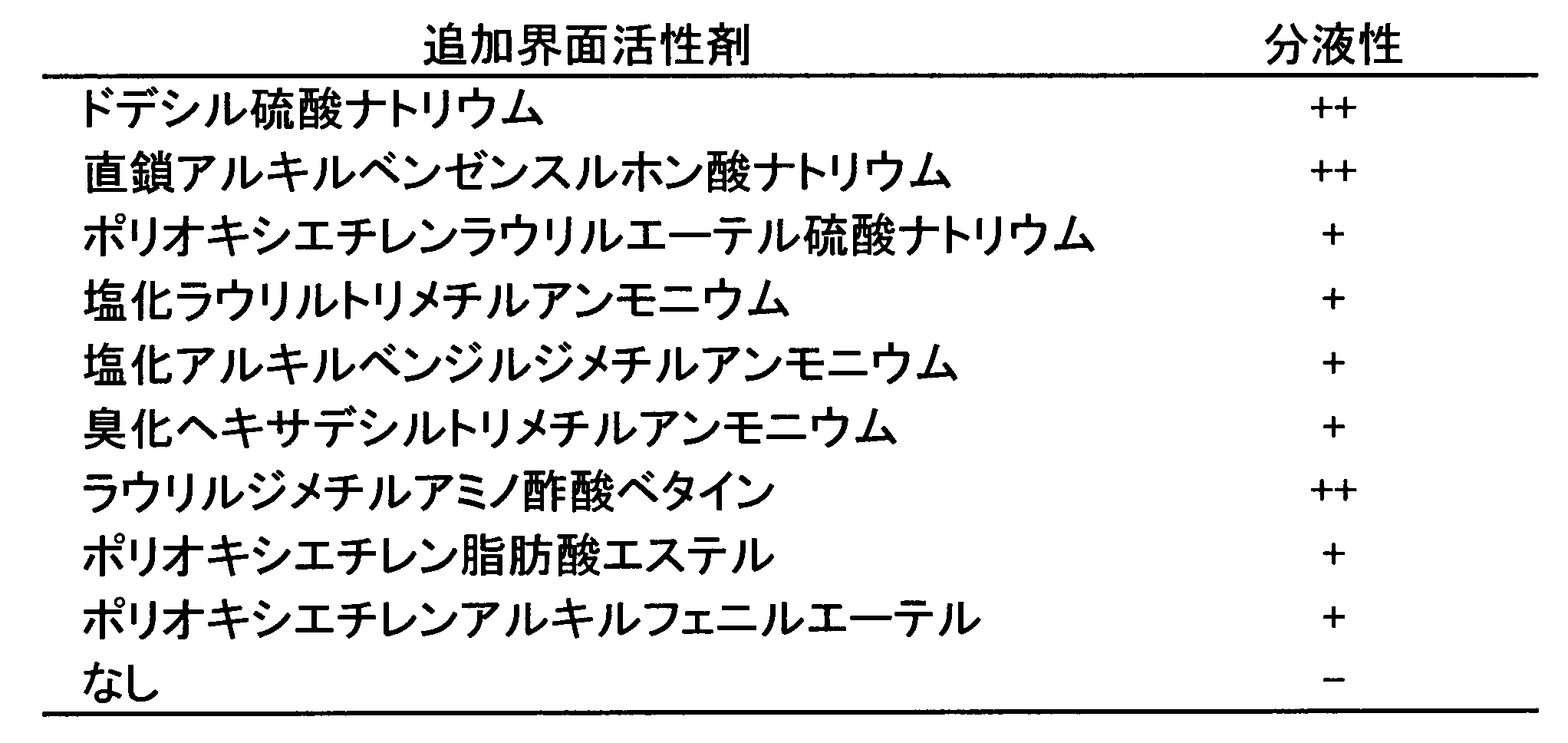
表2に示す結果の通り、サーファクチンを含む培養液にサーファクチン以外の界面活性剤を添加しない場合に比べ、添加した場合には、驚くべきことに分液が妨げられることはなく、かえって分液速度が向上した。特に、スルホン酸基を含む陰イオン界面活性剤、第四級アンモニウム基を含む陽イオン界面活性剤、両性界面活性剤、HLB値が12以上である非イオン界面活性剤を添加した場合には、分液速度がより一層高まった。
以上の実験により、サーファクチンを含む培養液にサーファクチン以外の界面活性剤を添加することにより、サーファクチンの抽出効率が高まり、サーファクチンの製造効率が改善されることが証明された。
Claims (6)
- サーファクチンを製造するための方法であって、
サーファクチン産生菌を培養することにより、サーファクチンを含む培養液を得る工程、
培養液、酸、水に混和しない有機溶媒、およびサーファクチン以外の界面活性剤を混合し、有機溶媒によりサーファクチンを抽出する工程、
水相と有機相を分離する工程、および、
有機相からサーファクチンを精製する工程を含むことを特徴とする方法。 - 界面活性剤として、スルホン酸基含有陰イオン界面活性剤、第四級アンモニウム基含有陽イオン界面活性剤、両性界面活性剤、HLB値が12以上である非イオン界面活性剤からなる群より選択される1以上を用いる請求項1に記載の方法。
- 培養液に対して0.1質量%以上、10質量%以下の界面活性剤を添加する請求項1または2に記載の方法。
- さらに、有機相に塩基を添加し、固体化したサーファクチンを分離する請求項1~3のいずれかに記載の方法。
- 限外ろ過膜を使って有機相からサーファクチンを精製する請求項1~4のいずれかに記載の方法。
- さらに、培養液から固形分を除去する工程を含む請求項1~5のいずれかに記載の方法。
Applications Claiming Priority (2)
| Application Number | Priority Date | Filing Date | Title |
|---|---|---|---|
| JP2016102433 | 2016-05-23 | ||
| JP2016-102433 | 2016-05-23 |
Publications (1)
| Publication Number | Publication Date |
|---|---|
| WO2017204160A1 true WO2017204160A1 (ja) | 2017-11-30 |
Family
ID=60411351
Family Applications (1)
| Application Number | Title | Priority Date | Filing Date |
|---|---|---|---|
| PCT/JP2017/019027 Ceased WO2017204160A1 (ja) | 2016-05-23 | 2017-05-22 | サーファクチンの製造方法 |
Country Status (1)
| Country | Link |
|---|---|
| WO (1) | WO2017204160A1 (ja) |
Cited By (1)
| Publication number | Priority date | Publication date | Assignee | Title |
|---|---|---|---|---|
| CN112156719A (zh) * | 2020-08-26 | 2021-01-01 | 夏文杰 | 一种两性糖脂生物表面活性剂及其制备方法 |
Citations (2)
| Publication number | Priority date | Publication date | Assignee | Title |
|---|---|---|---|---|
| WO2012043800A1 (ja) * | 2010-10-01 | 2012-04-05 | 株式会社カネカ | サーファクチン及びその塩の製造方法 |
| JP2014117240A (ja) * | 2012-12-18 | 2014-06-30 | Nippon Terupen Kagaku Kk | バイオサーファクタントの抽出・精製方法 |
-
2017
- 2017-05-22 WO PCT/JP2017/019027 patent/WO2017204160A1/ja not_active Ceased
Patent Citations (2)
| Publication number | Priority date | Publication date | Assignee | Title |
|---|---|---|---|---|
| WO2012043800A1 (ja) * | 2010-10-01 | 2012-04-05 | 株式会社カネカ | サーファクチン及びその塩の製造方法 |
| JP2014117240A (ja) * | 2012-12-18 | 2014-06-30 | Nippon Terupen Kagaku Kk | バイオサーファクタントの抽出・精製方法 |
Non-Patent Citations (2)
| Title |
|---|
| CHEN, H.L. ET AL.: "Recovery and separation of surfactin from pretreated fermentation broths by physical and chemical extraction", BIOCHEMICAL ENGINEERING JOURNAL, vol. 38, 2008, pages 39 - 46, XP022382885, DOI: doi:10.1016/j.bej.2007.06.003 * |
| JAMAL, P. ET AL.: "Optimization of process conditions for extraction of biosurfactan t", JOURNAL OF APPLIED SCIENCES RESEARCH, vol. 7, no. 13, 2011, pages 2156 - 2161, XP055230978 * |
Cited By (2)
| Publication number | Priority date | Publication date | Assignee | Title |
|---|---|---|---|---|
| CN112156719A (zh) * | 2020-08-26 | 2021-01-01 | 夏文杰 | 一种两性糖脂生物表面活性剂及其制备方法 |
| CN112156719B (zh) * | 2020-08-26 | 2022-02-22 | 夏文杰 | 一种两性糖脂生物表面活性剂及其制备方法 |
Similar Documents
| Publication | Publication Date | Title |
|---|---|---|
| EP3412650B1 (en) | Method for extracting 1,5-pentanediamine from solution system containing 1,5-pentanediamine salt | |
| DE102008040193A1 (de) | Verfahren zur Herstellung freier Carbonsäuren | |
| KR101476381B1 (ko) | 어류 정액 또는 알로부터 분리된 dna 중합체 단편복합체를 포함하는 세포활성 강화용 조성물, 및 얼굴 또는 피부 충진제 | |
| CN107445986A (zh) | 一种l‑草铵膦盐酸盐的分离提纯方法 | |
| CN105658802A (zh) | 尸胺的纯化 | |
| JP5868325B2 (ja) | サーファクチン及びその塩の製造方法 | |
| EP2303830B1 (fr) | Procede microbiologique de synthese de derives cinnamoyl amides d'acides amines | |
| AU2018299607B2 (en) | Method Of Recovering Phosphoric Acid From Fermentation Broth Or Fermentation Waste Liquid And Reusing The Same | |
| CN105612257A (zh) | 使用高沸点溶剂的尸胺纯化 | |
| CA2610575C (en) | Process for the preparation and isolation of phosphatides | |
| KR102550765B1 (ko) | 염기성 아미노산 기반 양이온성 계면활성제의 탈염법 및 결정화 정제 방법 | |
| JP2828343B2 (ja) | 天然アベルメクチンの沈殿方法 | |
| KR102347459B1 (ko) | 글루타르산의 추출방법 | |
| CN108503535B (zh) | 一种手性苯基乳酸的制备方法 | |
| JP2007185132A (ja) | α−アミノ酸−ω−アミド化合物の製造方法 | |
| JP7750491B2 (ja) | L-β-リジンホモポリマー及びその製造法並びに該ポリマーを含む抗菌剤 | |
| US11420924B2 (en) | Method for purifying organic acids | |
| CN111848425B (zh) | 一种选择性合成n-烷基氨基丙酸盐溶液的方法 | |
| JP4006183B2 (ja) | S,s−2−ヒドロキシプロピレンジアミン−n,n’−ジコハク酸の製造法 | |
| WO2025262708A1 (en) | ENZYMATIC DYNAMIC KINETIC RESOLUTION OF α-AMINO ACID ESTERS IN MINIEMULSIONS | |
| CN117164470A (zh) | 一种高纯度Nε-月桂酰赖氨酸的合成方法 | |
| US20210179538A1 (en) | Method for producing 2-octylglycine ester having optical activity | |
| TW202434270A (zh) | 類菌孢素胺基酸之萃取方法 | |
| CN117106607A (zh) | 一种玉米浆或玉米浆水解液的处理方法 | |
| CN115461325A (zh) | 制备n,n’-二乙酰基-l-胱氨酸的方法 |
Legal Events
| Date | Code | Title | Description |
|---|---|---|---|
| NENP | Non-entry into the national phase |
Ref country code: DE |
|
| 121 | Ep: the epo has been informed by wipo that ep was designated in this application |
Ref document number: 17802752 Country of ref document: EP Kind code of ref document: A1 |
|
| 122 | Ep: pct application non-entry in european phase |
Ref document number: 17802752 Country of ref document: EP Kind code of ref document: A1 |
|
| NENP | Non-entry into the national phase |
Ref country code: JP |