WO2017188455A1 - エポキシ樹脂組成物及び電子部品装置 - Google Patents
エポキシ樹脂組成物及び電子部品装置 Download PDFInfo
- Publication number
- WO2017188455A1 WO2017188455A1 PCT/JP2017/017100 JP2017017100W WO2017188455A1 WO 2017188455 A1 WO2017188455 A1 WO 2017188455A1 JP 2017017100 W JP2017017100 W JP 2017017100W WO 2017188455 A1 WO2017188455 A1 WO 2017188455A1
- Authority
- WO
- WIPO (PCT)
- Prior art keywords
- epoxy resin
- group
- resin composition
- general formula
- carbon atoms
- Prior art date
- Legal status (The legal status is an assumption and is not a legal conclusion. Google has not performed a legal analysis and makes no representation as to the accuracy of the status listed.)
- Ceased
Links
Classifications
-
- C—CHEMISTRY; METALLURGY
- C08—ORGANIC MACROMOLECULAR COMPOUNDS; THEIR PREPARATION OR CHEMICAL WORKING-UP; COMPOSITIONS BASED THEREON
- C08G—MACROMOLECULAR COMPOUNDS OBTAINED OTHERWISE THAN BY REACTIONS ONLY INVOLVING UNSATURATED CARBON-TO-CARBON BONDS
- C08G59/00—Polycondensates containing more than one epoxy group per molecule; Macromolecules obtained by polymerising compounds containing more than one epoxy group per molecule using curing agents or catalysts which react with the epoxy groups
- C08G59/18—Macromolecules obtained by polymerising compounds containing more than one epoxy group per molecule using curing agents or catalysts which react with the epoxy groups ; e.g. general methods of curing
- C08G59/20—Macromolecules obtained by polymerising compounds containing more than one epoxy group per molecule using curing agents or catalysts which react with the epoxy groups ; e.g. general methods of curing characterised by the epoxy compounds used
- C08G59/32—Epoxy compounds containing three or more epoxy groups
-
- C—CHEMISTRY; METALLURGY
- C08—ORGANIC MACROMOLECULAR COMPOUNDS; THEIR PREPARATION OR CHEMICAL WORKING-UP; COMPOSITIONS BASED THEREON
- C08G—MACROMOLECULAR COMPOUNDS OBTAINED OTHERWISE THAN BY REACTIONS ONLY INVOLVING UNSATURATED CARBON-TO-CARBON BONDS
- C08G59/00—Polycondensates containing more than one epoxy group per molecule; Macromolecules obtained by polymerising compounds containing more than one epoxy group per molecule using curing agents or catalysts which react with the epoxy groups
- C08G59/18—Macromolecules obtained by polymerising compounds containing more than one epoxy group per molecule using curing agents or catalysts which react with the epoxy groups ; e.g. general methods of curing
- C08G59/20—Macromolecules obtained by polymerising compounds containing more than one epoxy group per molecule using curing agents or catalysts which react with the epoxy groups ; e.g. general methods of curing characterised by the epoxy compounds used
- C08G59/32—Epoxy compounds containing three or more epoxy groups
- C08G59/3218—Carbocyclic compounds
-
- C—CHEMISTRY; METALLURGY
- C08—ORGANIC MACROMOLECULAR COMPOUNDS; THEIR PREPARATION OR CHEMICAL WORKING-UP; COMPOSITIONS BASED THEREON
- C08G—MACROMOLECULAR COMPOUNDS OBTAINED OTHERWISE THAN BY REACTIONS ONLY INVOLVING UNSATURATED CARBON-TO-CARBON BONDS
- C08G59/00—Polycondensates containing more than one epoxy group per molecule; Macromolecules obtained by polymerising compounds containing more than one epoxy group per molecule using curing agents or catalysts which react with the epoxy groups
- C08G59/18—Macromolecules obtained by polymerising compounds containing more than one epoxy group per molecule using curing agents or catalysts which react with the epoxy groups ; e.g. general methods of curing
- C08G59/40—Macromolecules obtained by polymerising compounds containing more than one epoxy group per molecule using curing agents or catalysts which react with the epoxy groups ; e.g. general methods of curing characterised by the curing agents used
- C08G59/62—Alcohols or phenols
-
- C—CHEMISTRY; METALLURGY
- C08—ORGANIC MACROMOLECULAR COMPOUNDS; THEIR PREPARATION OR CHEMICAL WORKING-UP; COMPOSITIONS BASED THEREON
- C08G—MACROMOLECULAR COMPOUNDS OBTAINED OTHERWISE THAN BY REACTIONS ONLY INVOLVING UNSATURATED CARBON-TO-CARBON BONDS
- C08G59/00—Polycondensates containing more than one epoxy group per molecule; Macromolecules obtained by polymerising compounds containing more than one epoxy group per molecule using curing agents or catalysts which react with the epoxy groups
- C08G59/18—Macromolecules obtained by polymerising compounds containing more than one epoxy group per molecule using curing agents or catalysts which react with the epoxy groups ; e.g. general methods of curing
- C08G59/40—Macromolecules obtained by polymerising compounds containing more than one epoxy group per molecule using curing agents or catalysts which react with the epoxy groups ; e.g. general methods of curing characterised by the curing agents used
- C08G59/62—Alcohols or phenols
- C08G59/621—Phenols
-
- C—CHEMISTRY; METALLURGY
- C08—ORGANIC MACROMOLECULAR COMPOUNDS; THEIR PREPARATION OR CHEMICAL WORKING-UP; COMPOSITIONS BASED THEREON
- C08K—Use of inorganic or non-macromolecular organic substances as compounding ingredients
- C08K3/00—Use of inorganic substances as compounding ingredients
- C08K3/01—Use of inorganic substances as compounding ingredients characterized by their specific function
- C08K3/013—Fillers, pigments or reinforcing additives
-
- C—CHEMISTRY; METALLURGY
- C08—ORGANIC MACROMOLECULAR COMPOUNDS; THEIR PREPARATION OR CHEMICAL WORKING-UP; COMPOSITIONS BASED THEREON
- C08L—COMPOSITIONS OF MACROMOLECULAR COMPOUNDS
- C08L63/00—Compositions of epoxy resins; Compositions of derivatives of epoxy resins
Definitions
- the present invention relates to an epoxy resin composition and an electronic component device.
- the resin-encapsulated semiconductor devices are mainly in the surface mount type package from the conventional pin insertion type package.
- Surface mount ICs Integrated Circuits
- LSIs Large Scale Integrations
- the like are thin and small packages in order to increase the mounting density and reduce the mounting height. For this reason, the area occupied by the package of the element is increased, and the thickness of the package is becoming very thin.
- these packages are different in mounting method from the conventional pin insertion type packages. That is, since the pin insertion type package is soldered from the back surface of the wiring board after the pins are inserted into the wiring board, the package is not directly exposed to high temperature.
- surface mount ICs are temporarily attached to the surface of the wiring board and processed by a solder bath, a reflow apparatus, etc., and thus are directly exposed to a soldering temperature (reflow temperature).
- reflow temperature soldering temperature
- the package absorbs moisture, the moisture absorption moisture is vaporized during reflow, and the generated vapor pressure acts as a peeling stress, and peeling occurs between the insert such as the element and the lead frame and the sealing material. This causes package cracks and poor electrical characteristics. Therefore, development of a sealing material having excellent solder heat resistance (reflow resistance) is desired.
- Patent Document 4 when a sulfur atom-containing silane coupling agent (for example, see Patent Document 4) is used, the effect of improving adhesiveness with noble metals such as Ag and Au is poor, and a sulfur atom-containing compound (for example, Patent Document 2). And 3) are added in amounts disclosed in the literature, the adhesion with noble metals is not sufficiently improved, and none of them satisfies the reflow resistance.
- a sulfur atom-containing silane coupling agent for example, see Patent Document 4
- Patent Document 2 sulfur atom-containing compound
- One embodiment of the present invention has been made in view of such a situation, and includes an epoxy resin composition having excellent reflow resistance and good flame retardancy without reducing fluidity, and an element sealed thereby.
- An electronic component device is to be provided.
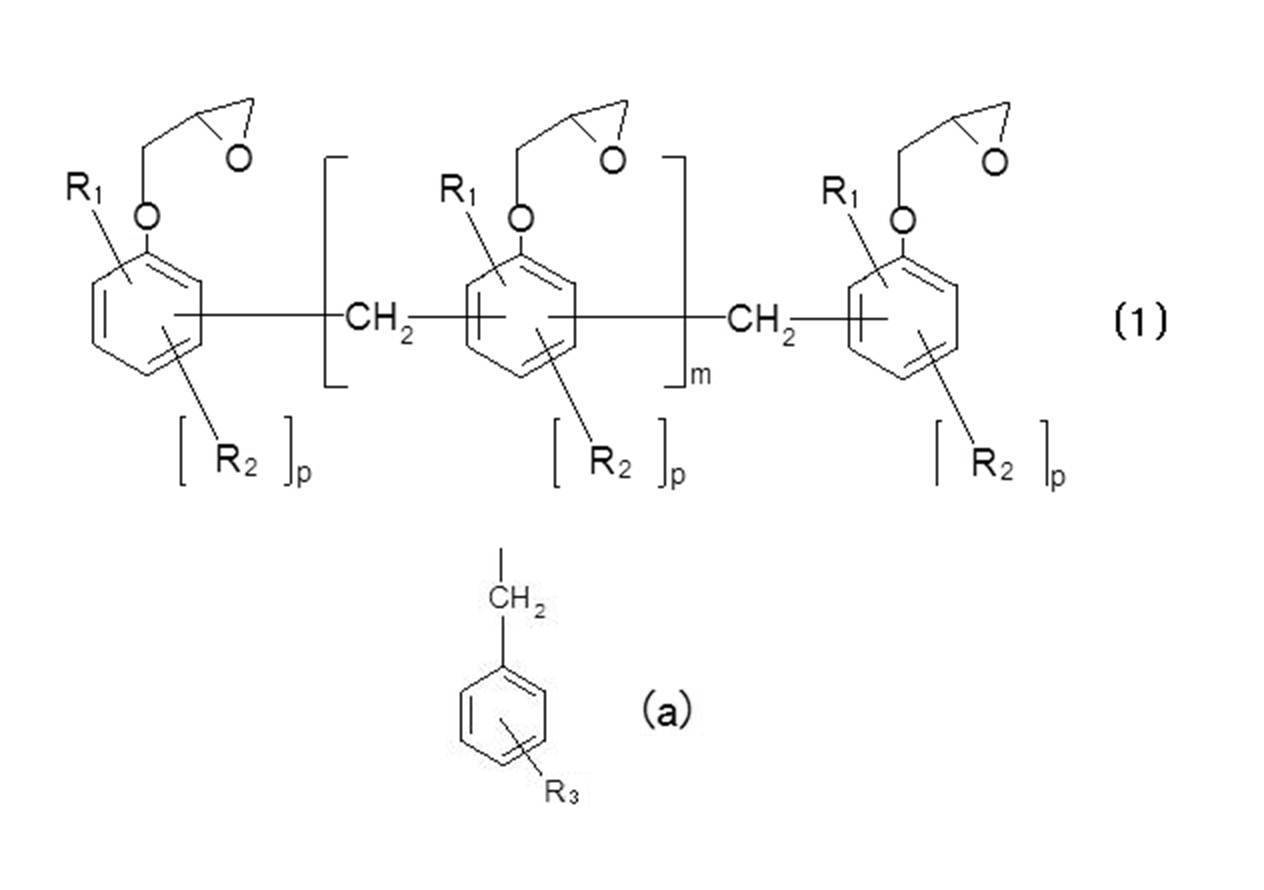
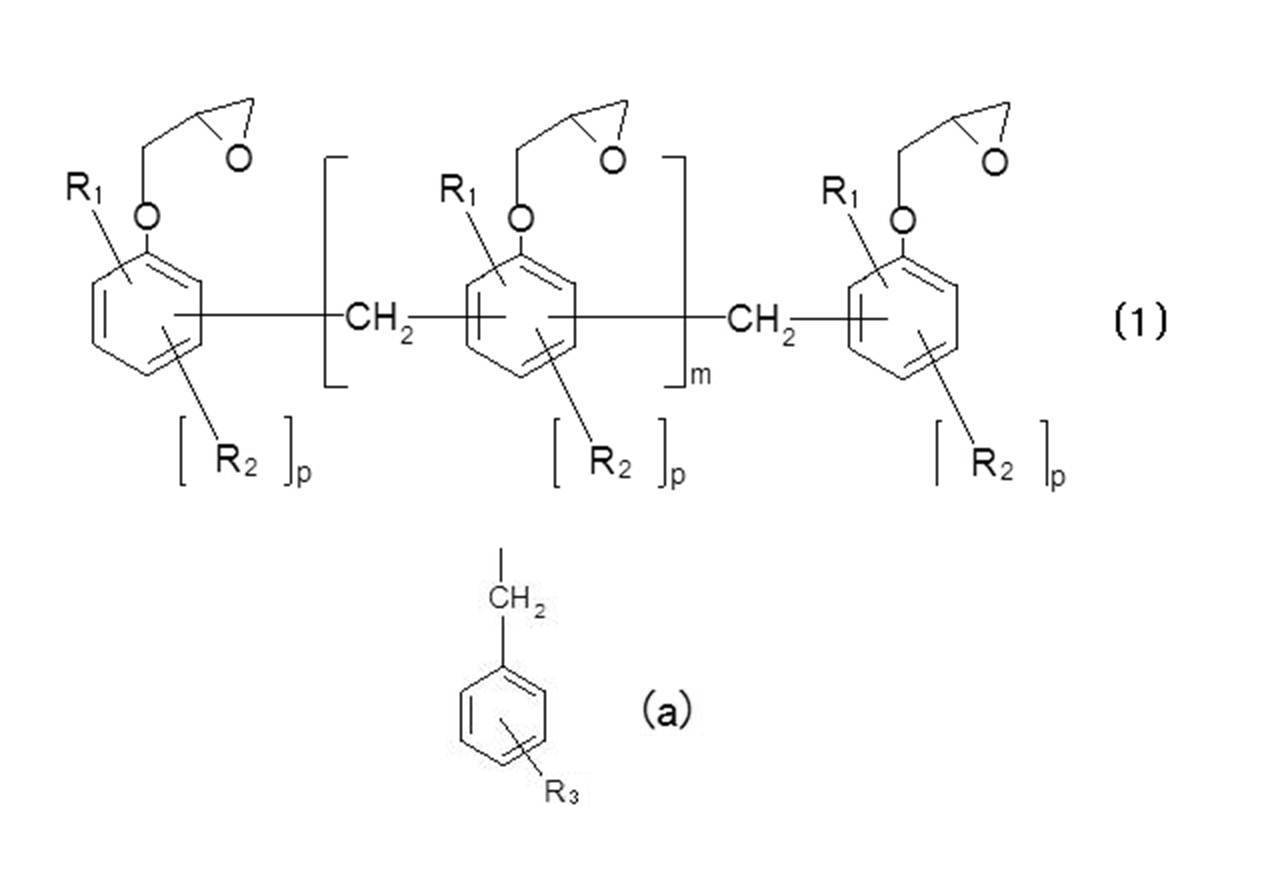
- an epoxy resin containing a compound represented by the following general formula (1) A curing agent comprising at least one selected from the group consisting of a biphenylene type phenol aralkyl resin, a phenol aralkyl resin, and a triphenylmethane type phenol resin;
- An epoxy resin composition containing [R 1 independently represents a hydrogen atom or a monovalent hydrocarbon group having 1 to 6 carbon atoms, R 2 represents a substituent represented by the formula (a), and m represents a number of 0 to 20.
- P represents 0.5 to 2.0, and each R 3 independently represents a hydrogen atom or a monovalent hydrocarbon group having 1 to 6 carbon atoms. ]
- An electronic component device comprising:
- an epoxy resin composition having excellent reflow resistance and good flame retardancy without reducing fluidity, and an electronic component device including an element sealed thereby are obtained. Can do.
- a numerical range indicated by using “to” indicates a range including the numerical values described before and after “to” as the minimum value and the maximum value, respectively.
- the content of each component in the composition means that when there are a plurality of substances corresponding to each component in the composition, the plurality of substances present in the composition unless otherwise specified. Means the total content of In the numerical ranges described stepwise in this specification, the upper limit value or the lower limit value described in one numerical range may be replaced with the upper limit value or the lower limit value of another numerical range. Good. Further, in the numerical ranges described in this specification, the upper limit value or the lower limit value of the numerical range may be replaced with the values shown in the examples.
- the particle diameter of each component in the composition is a mixture of the plurality of types of particles present in the composition unless there is a specific indication when there are a plurality of types of particles corresponding to each component in the composition. Means the value of.
- An epoxy resin composition according to an embodiment of the present invention includes an epoxy resin containing a compound represented by the following general formula (1) (hereinafter also referred to as “specific epoxy resin”), a biphenylene type phenol aralkyl resin, and a phenol aralkyl resin. And a curing agent (hereinafter also referred to as “specific curing agent”) containing at least one selected from the group consisting of triphenylmethane type phenol resins.
- specific epoxy resin a compound represented by the following general formula (1)
- specific curing agent hereinafter also referred to as “specific curing agent” containing at least one selected from the group consisting of triphenylmethane type phenol resins.
- R 1 independently represents a hydrogen atom or a monovalent hydrocarbon group having 1 to 6 carbon atoms
- R 2 represents a substituent represented by the formula (a)
- m represents a number of 0 to 20
- P represents 0.5 to 2.0
- each R 3 independently represents a hydrogen atom or a monovalent hydrocarbon group having 1 to 6 carbon atoms.
- Epoxy resin composition contains an epoxy resin.
- the epoxy resin contains a compound represented by the following general formula (1).
- R 1 independently represents a hydrogen atom or a monovalent hydrocarbon group having 1 to 6 carbon atoms
- R 2 represents a substituent represented by the formula (a)
- m represents a number of 0 to 20
- P represents 0.5 to 2.0
- each R 3 independently represents a hydrogen atom or a monovalent hydrocarbon group having 1 to 6 carbon atoms.
- R 2 represents a substituent represented by the formula (a) (hereinafter also referred to as “benzyl group”).
- p represents a number of 0.5 to 2.0, which means the average number (number average) of benzyl groups substituted on one benzene ring.
- p is 0.5 to 2.0, preferably 0.7 to 1.5. When p is 0.7 or more, the reflow resistance is further improved, and when p is 1.5 or less, the curability is further improved.
- p will be described. Up to three benzyl groups can be substituted on the benzene rings at both ends in the compound represented by the general formula (1). Since a maximum of two benzyl groups can be substituted on the intermediate benzene ring, when m is 1, the maximum total number of benzyl groups is 8, and the maximum value of p in this case is 2.7 (8 /3 ⁇ 2.7). However, in the present embodiment, p in the general formula (1) is 0.5 to 2.0. In this embodiment, since p is a number average value, some of the benzene rings in the general formula (1) may not have hydrogen atoms replaced with benzyl groups.
- each R 3 independently represents a hydrogen atom or a monovalent hydrocarbon group having 1 to 6 carbon atoms, preferably a hydrogen atom or an alkyl group having 1 to 3 carbon atoms, More preferably it is an atom.
- each R 1 independently represents a hydrogen atom or a monovalent hydrocarbon group having 1 to 6 carbon atoms, and is preferably a hydrogen atom or an alkyl group having 1 to 3 carbon atoms, It is more preferably a hydrogen atom or a methyl group.
- R 1 may be located at any of the ortho, meta, and para positions of the benzene ring, but is preferably located at the ortho position of the benzene ring.
- m is an average value, and m represents a number from 0 to 20, preferably from 1.0 to 5.0.
- the melt viscosity of the specific epoxy resin at 150 ° C. is preferably 0.01 Pa ⁇ s to 0.30 Pa ⁇ s, and more preferably 0.01 Pa ⁇ s to 0.20 Pa ⁇ s. From the viewpoint of workability, the melt viscosity is preferably as low as possible within the above range.
- the melt viscosity is measured by the following method using a rotational viscoelasticity measuring apparatus (for example, Shimadzu Corporation, product name: CFD-100D).
- a rotational viscoelasticity measuring apparatus for example, Shimadzu Corporation, product name: CFD-100D.
- (3) Stir the cone up and down for about 20 seconds, then leave it until the temperature control lamp blinks 5 times.
- (6) Repeat operations (2) to (5) three or more times in the same lot, and use the average value as the viscosity.
- the epoxy equivalent of the specific epoxy resin is preferably 240 g / eq to 270 g / eq, more preferably 255 g / eq to 270 g / eq, still more preferably 257 g / eq to 270 g / eq, and 259 g. Particularly preferred is / eq to 270 g / eq.
- the epoxy equivalent is measured by the following method. In a 100 mL flask, weigh the epoxy resin so that the solid content is 3 to 4 g, acetic acid 20 mL, tetraethylammonium bromide acetic acid solution (mixture of tetraethylammonium bromide 100 g and acetic acid 400 mL), crystal violet 4 drops to 5 Add drops. This solution is titrated with a 0.1 mol / L perchloric acid acetic acid solution. Similarly, the blank is titrated. The epoxy equivalent is calculated by the following formula.
- Epoxy equivalent 1,000 ⁇ epoxy resin mass actually measured [g] ⁇ epoxy resin solid content concentration [% by mass] / ((titration amount [mL] ⁇ blank titration [mL]) ⁇ 0.1 mol / L x factor of perchloric acid acetic acid solution f)
- the softening point of the specific epoxy resin is preferably 50 ° C. to 80 ° C., more preferably 55 ° C. to 70 ° C., and 56 ° C. to 65 ° C. from the viewpoints of moldability and reflow resistance. Further preferred.
- the softening point of the specific epoxy resin is measured by a ring and ball method. In the ring and ball method, a resin is set on a support ring in a water bath, and a ball of 3.5 ⁇ 0.05 g is placed in the center of the ring to raise the bath temperature at a rate of 5 ⁇ 0.5 ° C. per minute. After that, the temperature when the resin sags due to the weight of the sphere is measured. Details are measured according to JIS K7234: 1986.
- the specific epoxy resin is a compound containing a benzyl group corresponding to the formula (a) in a phenol novolac resin corresponding to the general formula (1) (hereinafter also referred to as “raw material phenol novolak resin”).
- the compound can also be obtained by reacting in the presence of an acid catalyst to obtain a specific phenol novolak resin and epoxidizing the specific phenol novolac resin.
- the blending ratio of the raw material phenol novolac resin and the raw material benzyl group-containing compound is adjusted according to the desired value of p in the general formula (1). Accordingly, the raw material benzyl group-containing compound is preferably added in an amount of 0.5 to 2.0, more preferably 0.7 to 1.5, per benzene ring of the raw material phenol novolac resin. It is preferable to blend a phenol novolac resin and a raw material benzyl group-containing compound.
- the compounding ratio of the raw material benzyl group-containing compound is 0.5 mol to 2.0 mol with respect to 1 mol of the hydroxyl group in the raw material phenol novolac resin.
- the molar ratio is preferably 0.7 mol to 1.5 mol.
- the raw material phenol novolac resin has a structure in which a phenol compound having R 1 (a hydrogen atom or a monovalent hydrocarbon group having 1 to 6 carbon atoms) is linked by a methylene group.
- a phenol compound having R 1 a hydrogen atom or a monovalent hydrocarbon group having 1 to 6 carbon atoms
- the phenol compound include phenol, cresol, ethylphenol, isopropylphenol, n-propylphenol, isobutylphenol, t-butylphenol, n-pentylphenol, and n-hexylphenol.
- the phenol compound is preferably o-cresol or cresol containing o-cresol as a main component.
- cresol containing o-cresol as a main component When cresol containing o-cresol as a main component is used, the content of o-cresol with respect to the whole cresol is preferably 50% by mass or more, and more preferably 70% by mass or more.
- cresol containing o-cresol as a main component may include m-cresol and p-cresol.
- the raw material phenol novolac resin may have a part of the structure in which other phenolic compounds are linked by methylene groups in addition to the structure in which the phenolic compounds having R 1 are linked by methylene groups.
- Other phenol compounds include allylphenol, phenylphenol, 2,6-xylenol, 2,6-diethylphenol, hydroquinone, resorcin, catechol, 1-naphthol, 2-naphthol, 1,5-naphthalenediol, 1,6 -Naphthalenediol, 1,7-naphthalenediol, 2,6-naphthalenediol, 2,7-naphthalenediol, etc.
- a part of the compound represented by the general formula (1) may contain a structural unit derived from another phenol compound, and the compound represented by the general formula (1) is derived from another phenol compound.
- the structural unit is preferably contained in an amount of 10% by mass or less, more preferably 5% by mass or less, and still more preferably substantially not contained with respect to all structural units.
- the raw material benzyl group-containing compound is a compound having a benzyl group having R 3 (a hydrogen atom or a monovalent hydrocarbon group having 1 to 6 carbon atoms).
- the raw material benzyl group-containing compound include benzyl alcohol, benzyl chloride, benzyl bromide, benzyl iodide and the like.
- the raw material benzyl group-containing compound such as benzyl alcohol, benzyl chloride, benzyl bromide, benzyl iodide may have a monovalent hydrocarbon group having 1 to 6 carbon atoms as R 3 .
- Examples of the monovalent hydrocarbon group having 1 to 6 carbon atoms include methyl, ethyl, propyl, butyl, isopropyl, isobutyl, t-butyl, pentyl, and hexyl groups.
- the acid catalyst may be appropriately selected from known inorganic acids and organic acids.
- mineral acids such as hydrochloric acid, sulfuric acid, phosphoric acid
- organic acids such as formic acid, oxalic acid, trifluoroacetic acid, p-toluenesulfonic acid, dimethyl sulfuric acid, diethyl sulfuric acid
- zinc chloride, aluminum chloride, iron chloride three Examples include Lewis acids such as boron fluoride; solid acids such as ion exchange resins, activated clay, silica-alumina, and zeolite.
- the reaction for synthesizing a specific phenol novolak resin is usually carried out at 10 to 250 ° C. for 1 to 20 hours.
- a solvent may be used in the reaction.
- Solvents include alcohol solvents such as methanol, ethanol, propanol, butanol, ethylene glycol, methyl cellosolve, ethyl cellosolve; ketone solvents such as acetone, methyl ethyl ketone, methyl isobutyl ketone; dimethyl ether, diethyl ether, diisopropyl ether, tetrahydrofuran, dioxane, etc.
- Ether solvents aromatic compounds such as benzene, toluene, chlorobenzene, dichlorobenzene and the like.
- the method of epoxidizing a specific phenol novolac resin is, for example, a method of reacting a specific phenol novolak resin and epichlorohydrin, a reaction of a specific phenol novolac resin and an allyl halide to form an allyl ether compound, and a peroxide.
- the method of making it react with is mentioned.
- a specific phenol novolac resin is dissolved in an excess of epichlorohydrin, and then in the presence of an alkali metal hydroxide such as sodium hydroxide or potassium hydroxide, a temperature range of 20 ° C. to 150 ° C., preferably 30 ° C. to 80 ° C. And a method of reacting for 1 to 10 hours.
- the amount of alkali metal hydroxide used in this case is preferably 0.8 mol to 1.5 mol, preferably 0.9 mol to 1.2 mol with respect to 1 mol of the hydroxyl group of the specific phenol novolac resin.
- epichlorohydrin is used in excess relative to 1 mol of a hydroxyl group of a specific phenol novolak resin, but usually 1.5 mol to 30 mol, preferably 2 mol, per 1 mol of a hydroxyl group of a specific phenol novolac resin. The range is ⁇ 15 mol.
- excess epichlorohydrin is distilled off, the residue is dissolved in a solvent such as toluene, methyl isobutyl ketone, filtered, washed with water to remove inorganic salts, and then the target is identified by distilling off the solvent.
- An epoxy resin can be obtained.
- the epoxy resin composition may be used in combination with a known epoxy resin in addition to the specific epoxy resin.
- the epoxy resin that can be used in combination include at least one selected from phenolic compounds such as phenol, cresol, xylenol, resorcin, catechol, bisphenol A, bisphenol F, and naphthol compounds such as ⁇ -naphthol, ⁇ -naphthol, and dihydroxynaphthalene.
- a novolak epoxy resin obtained by epoxidizing a novolak resin obtained by condensation or cocondensation with a compound having an aldehyde group such as formaldehyde, acetaldehyde, propionaldehyde, benzaldehyde, salicylaldehyde in the presence of an acidic catalyst for example, a phenol novolac epoxy Resin (excluding specific epoxy resin), orthocresol novolac type epoxy resin (excluding specific epoxy resin) and triphenylmethane type epoxy resin]; bisphenol Epoxy resin which is diglycidyl ether such as diol A, bisphenol F, bisphenol S, alkyl-substituted or unsubstituted biphenol; stilbene type epoxy resin; hydroquinone type epoxy resin; polybasic acid such as phthalic acid, dimer acid and epichlorohydrin Glycidyl ester type epoxy resin obtained by reaction of glycidylamine type epoxy resin obtained by reaction of polyamine such as diamin
- the epoxy resin that can be used in combination is preferably a bisphenol F type epoxy resin, a sulfur atom-containing epoxy resin, or a phenol aralkyl type epoxy resin from the viewpoint of fluidity and reflow resistance, and a novolak type epoxy from the viewpoint of curability.
- Resins excluding specific epoxy resins
- dicyclopentadiene type epoxy resins are preferable from the viewpoint of low hygroscopicity
- naphthalene type epoxy resins and triphenylmethane type epoxy resins are preferable from the viewpoint of heat resistance and low warpage
- biphenylene type epoxy resins and naphthol aralkyl type epoxy resins are preferred.
- an epoxy resin having good flame retardancy in combination with an epoxy resin composition such as non-halogen or non-antimony.
- Examples of the bisphenol F type epoxy resin include an epoxy resin represented by the following general formula (III), and examples of the sulfur atom-containing epoxy resin include an epoxy resin represented by the following general formula (IV).
- Examples of the phenol F type epoxy resin include an epoxy resin represented by the following general formula (III), and examples of the sulfur atom-containing epoxy resin include an epoxy resin represented by the following general formula (IV).
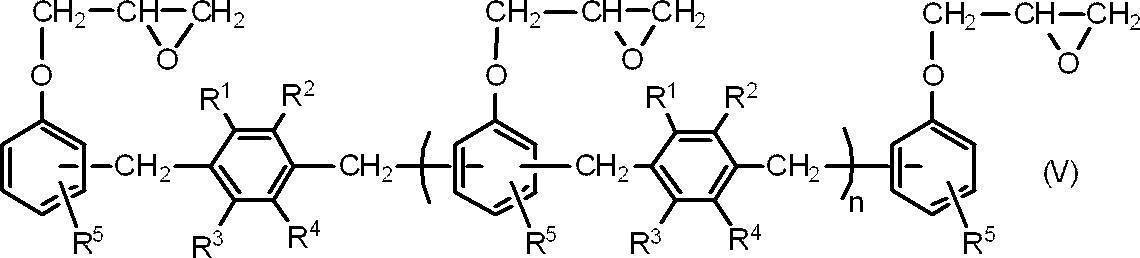
- As a phenol aralkyl type epoxy resin the epoxy resin shown by the following general formula (V) is mentioned, for example.
- R 1 to R 8 are each independently a hydrogen atom, an alkyl group having 1 to 10 carbon atoms, an alkoxy group having 1 to 10 carbon atoms, an aryl group having 6 to 10 carbon atoms, or carbon An aralkyl group of formula 7 to 10 is shown.
- n is an average value and represents a number from 0 to 3.
- the alkyl group, alkoxy group, aryl group and aralkyl group represented by R 1 to R 8 may each independently have a substituent or not.
- R 1 to R 8 each independently represents a hydrogen atom, an alkyl group having 1 to 10 carbon atoms, or an alkoxy group having 1 to 10 carbon atoms.
- n is an average value and represents a number from 0 to 3.
- the alkyl group and alkoxy group represented by R 1 to R 8 may each independently have a substituent or may not have a substituent.
- R 1 to R 5 each independently represents a hydrogen atom, an alkyl group having 1 to 6 carbon atoms, or an alkoxy group having 1 to 2 carbon atoms.
- n is an average value and represents a number from 0 to 3.
- the alkyl group and alkoxy group represented by R 1 to R 5 may each independently have a substituent or may not have a substituent.
- R 1 , R 3 , R 6 and R 8 are methyl groups, and R 2 , R 4 , R 5 and R 7 are hydrogen atoms.
- R 2 , R 3 , R 6 and R 7 are hydrogen atoms
- R 1 , R 4 , R 5 and R 8 are alkyl groups.
- An epoxy resin in which R 2 , R 3 , R 6 and R 7 are hydrogen atoms, R 1 and R 8 are t-butyl groups, and R 4 and R 5 are methyl groups is more preferable.
- YSLV-120TE Nippon Steel Sumikin Chemical Co., Ltd., trade name
- epoxy resin represented by the general formula (V) for example, NC-2000L (Nippon Kayaku Co., Ltd., trade name) in which R 1 to R 5 are hydrogen atoms is commercially available. Any one of these epoxy resins may be used alone or in combination of two or more.
- novolac type epoxy resin examples include an epoxy resin represented by the following general formula (VI).
- each R independently represents a hydrogen atom or a monovalent hydrocarbon group having 1 to 10 carbon atoms (however, it is not a substituent represented by formula (a) in general formula (1)).
- N is an average value and represents a number from 0 to 10.
- Each hydrocarbon group represented by R may or may not have a substituent.
- the novolak type epoxy resin represented by the general formula (VI) can be obtained by reacting a novolak type phenol resin with epichlorohydrin.
- R in the general formula (VI) is an alkyl group having 1 to 10 carbon atoms such as a methyl group, an ethyl group, a propyl group, a butyl group, an isopropyl group, or an isobutyl group, or a methoxy group, an ethoxy group, or a propoxy group.
- An alkoxy group having 1 to 10 carbon atoms such as a butoxy group is preferable, and a hydrogen atom or a methyl group is more preferable.
- n is preferably an integer of 0 to 3.
- novolak type epoxy resins represented by the general formula (VI) orthocresol novolak type epoxy resins are preferable.
- EOCN-1020 Nippon Kayaku Co., Ltd., trade name
- EOCN-1020 Nippon Kayaku Co., Ltd., trade name
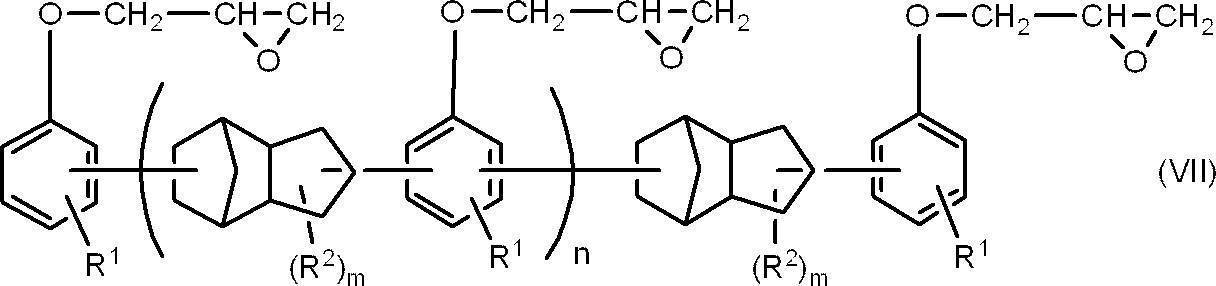
- Examples of the dicyclopentadiene type epoxy resin include an epoxy resin represented by the following general formula (VII).
- R 1 and R 2 each independently represent a hydrogen atom or a monovalent hydrocarbon group having 1 to 10 carbon atoms, n is an average value, and represents a number of 0 to 10 , M represents an integer of 0-6.
- the hydrocarbon groups represented by R 1 and R 2 may each independently have a substituent or may not have a substituent.
- R 1 in the general formula (VII) is a hydrogen atom; an alkyl group such as a methyl group, an ethyl group, a propyl group, a butyl group, an isopropyl group or a t-butyl group; an alkenyl such as a vinyl group, an allyl group or a butenyl group Groups: monovalent hydrocarbon groups having 1 to 5 carbon atoms having a substituent such as a halogenated alkyl group, an amino group-substituted alkyl group, a mercapto group-substituted alkyl group, etc., among which alkyl groups such as a methyl group and an ethyl group A group or a hydrogen atom is preferable, and a methyl group or a hydrogen atom is more preferable.
- R 2 in the general formula (VII) is a hydrogen atom; an alkyl group such as a methyl group, an ethyl group, a propyl group, a butyl group, an isopropyl group or a t-butyl group; an alkenyl such as a vinyl group, an allyl group or a butenyl group Group: a monovalent hydrocarbon group having 1 to 5 carbon atoms having a substituent such as a halogenated alkyl group, an amino group-substituted alkyl group, a mercapto group-substituted alkyl group, etc., among which a hydrogen atom is preferable.
- HP-7200 DIRC Corporation, trade name
- naphthalene type epoxy resin As a naphthalene type epoxy resin, the epoxy resin shown by the following general formula (VIII) is mentioned, for example.
- the triphenylmethane type epoxy resin include an epoxy resin represented by the following general formula (IX).
- R 1 to R 3 each independently represents a hydrogen atom or a monovalent hydrocarbon group having 1 to 12 carbon atoms.
- p is an average value and represents a number from 0 to 2
- l and m are average values, each independently represents a number from 0 to 11, (l + m) is a number from 1 to 11, and (l + p) is It is chosen to be a number from 1 to 12.
- i represents an integer of 0 to 3
- j represents an integer of 0 to 2
- k represents an integer of 0 to 4.
- the hydrocarbon groups represented by R 1 to R 3 may each independently have a substituent or may not have a substituent.
- the naphthalene type epoxy resin represented by the general formula (VIII) includes a random copolymer containing l constituent units and m constituent units at random, an alternating copolymer containing alternating units, and a copolymer containing regular units. And a block copolymer contained in a block shape, and any one of these may be used alone or in combination of two or more.
- R 1 and R 2 are hydrogen atoms and R 3 is a methyl group
- NC-7000 Nippon Kayaku Co., Ltd., trade name
- each R independently represents a hydrogen atom or a monovalent hydrocarbon group having 1 to 10 carbon atoms, n is an average value, and represents a number from 0 to 10. Each hydrocarbon group represented by R may or may not have a substituent.
- R is a hydrogen atom
- E-1032 Mitsubishi Chemical Corporation, trade name
- biphenylene type epoxy resin examples include an epoxy resin represented by the following general formula (X).
- X an epoxy resin represented by the following general formula (X).
- XI the epoxy resin shown by the following general formula (XI) is mentioned, for example.
- R 1 to R 9 are each independently a hydrogen atom; an alkyl group having 1 to 10 carbon atoms such as a methyl group, an ethyl group, a propyl group, a butyl group, an isopropyl group, or an isobutyl group; Group, ethoxy group, propoxy group, butoxy group, etc., alkoxy group having 1-10 carbon atoms; phenyl group, tolyl group, xylyl group, etc. aryl groups; carbon number, such as benzyl group, phenethyl group, etc. 7 to 10 aralkyl groups are shown, and among them, a hydrogen atom or a methyl group is preferable.
- n is an average value and represents a number from 0 to 10.
- the alkyl group, alkoxy group, aryl group and aralkyl group represented by R 1 to R 9 may each independently have a substituent or may not have a substituent.
- R 1 and R 2 each independently represent a hydrogen atom or a monovalent hydrocarbon group having 1 to 12 carbon atoms, n is an average value, and represents a number of 0 to 10 .
- the hydrocarbon groups represented by R 1 and R 2 may each independently have a substituent or may not have a substituent.
- biphenylene type epoxy resin for example, NC-3000 (Nippon Kayaku Co., Ltd., trade name) is commercially available.
- a naphthol aralkyl type epoxy resin for example, ESN-175 (Nippon Steel Sumikin Chemical Co., Ltd., trade name) is available as a commercial product. Any one biphenylene type epoxy resin may be used alone, or two or more types may be used in combination.
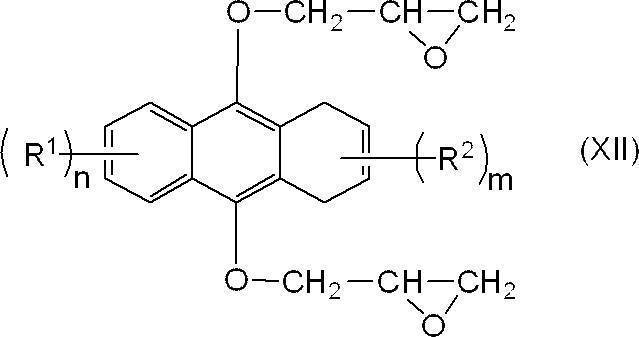
- R 1 in the general formula (XII) each independently represents a hydrocarbon group having 1 to 12 carbon atoms or an alkoxy group having 1 to 12 carbon atoms, n is an average value, and a number from 0 to 4 is represented.
- R 2 independently represents a hydrocarbon group having 1 to 12 carbon atoms or an alkoxy group having 1 to 12 carbon atoms, m is an average value, and represents a number of 0 to 2.
- the hydrocarbon group and alkoxy group represented by R 1 and R 2 may or may not have a substituent.
- an epoxy resin in which n and m are zero is preferable from the viewpoint of flame retardancy and moldability.
- YX-8800 Mitsubishi Chemical Corporation, trade name
- the content of the specific epoxy resin with respect to the total amount of the epoxy resin is preferably 30% by mass or more, more preferably 50% by mass or more, and further preferably 70% by mass or more.
- the epoxy resin composition contains a curing agent.
- the curing agent includes at least one selected from the group consisting of a biphenylene type phenol aralkyl resin, a phenol aralkyl resin, and a triphenylmethane type phenol resin.
- a biphenylene type phenol aralkyl resin represented by the following general formula (XVII) is preferable.
- R 1 to R 9 are each independently a hydrogen atom; an alkyl group having 1 to 10 carbon atoms such as methyl group, ethyl group, propyl group, butyl group, isopropyl group, isobutyl group; methoxy group, ethoxy group An alkoxy group having 1 to 10 carbon atoms such as a propoxy group and a butoxy group; an aryl group having 6 to 10 carbon atoms such as a phenyl group, a tolyl group and a xylyl group; or a 7 to 10 carbon atom such as a benzyl group and a phenethyl group An aralkyl group is shown, and among them, a hydrogen atom or a methyl group is preferable.
- n is an average value and represents a number from 0 to 10.
- the alkyl group, alkoxy group, aryl group or aralkyl group represented by R 1 to R 9 may or may not have a substitu
- Examples of the biphenylene type phenol aralkyl resin represented by the general formula (XVII) include compounds in which R 1 to R 9 are all hydrogen atoms, and in particular, from the viewpoint of melt viscosity, a condensate having n of 1 or more is used. A mixture of condensates containing at least mass% is preferred. As such a compound, for example, MEH-7851 (Maywa Kasei Co., Ltd., trade name) is commercially available.
- the content is preferably 30% by mass or more, more preferably 50% by mass or more based on the total amount of the curing agent in order to exhibit the performance.
- a phenol aralkyl resin represented by the following general formula (XIII) is preferable.
- each R independently represents a hydrogen atom or a monovalent hydrocarbon group having 1 to 10 carbon atoms, n is an average value, and represents a number from 0 to 10. Each hydrocarbon group represented by R may or may not have a substituent.
- a phenol aralkyl resin in which R is a hydrogen atom and n has an average value of 0 to 8 is more preferable.
- Specific examples include p-xylylene type phenol aralkyl resins and m-xylylene type phenol aralkyl resins.
- XLC Mitsubishi Chemicals, Inc., trade name
- the content is preferably 30% by mass or more, more preferably 50% by mass or more, based on the total amount of the curing agent in order to exhibit the performance.
- triphenylmethane type phenol resin is preferable.
- a triphenylmethane type phenol resin the phenol resin shown by the following general formula (XVI) is mentioned, for example.
- each R independently represents a hydrogen atom or a monovalent hydrocarbon group having 1 to 10 carbon atoms, n is an average value, and represents a number from 0 to 10.
- the hydrocarbons represented by R may each independently have a substituent or may not have a substituent.
- R is a hydrogen atom
- MEH-7500 Maywa Kasei Co., Ltd., trade name
- the content is preferably 30% by mass or more, more preferably 50% by mass or more, based on the total amount of the curing agent in order to exhibit the performance. .
- the specific curing agent may be used alone or in combination of two or more. In addition to the specific curing agent, the curing agent may be used in combination with another curing agent.
- the content of the specific curing agent in all the curing agents is preferably 30% by mass or more, more preferably 50% by mass or more, and further preferably 70% by mass or more.
- curing agents include novolak type phenolic resin, naphthol aralkyl resin, dicyclopentadiene type phenolic resin, terpene modified phenolic resin, paraxylylene modified phenolic resin, metaxylylene modified phenolic resin, melamine modified phenolic resin, cyclopentadiene modified phenolic resin, these Examples thereof include phenol resins obtained by copolymerizing two or more kinds.
- novolak type phenol resin examples include phenol novolak resin, cresol novolak resin, naphthol novolak resin and the like, and phenol novolak resin is particularly preferable.
- naphthol aralkyl resin examples include a phenol resin represented by the following general formula (XIV).
- R 1 and R 2 each independently represents a hydrogen atom or a monovalent hydrocarbon having 1 to 10 carbon atoms, n is an average value, and represents a number of 0 to 10.
- the hydrocarbon groups represented by R 1 and R 2 may each independently have a substituent or may not have a substituent.
- Examples of the naphthol aralkyl resin represented by the general formula (XIV) include compounds in which R 1 and R 2 are all hydrogen atoms. Examples of such compounds include SN-170 (Nippon Steel & Sumikin Chemical Co., Ltd.). (Trade name) is available as a commercial product.
- Examples of the dicyclopentadiene type phenol resin include a phenol resin represented by the following general formula (XV).
- R 1 and R 2 each independently represent a hydrogen atom or a monovalent hydrocarbon group having 1 to 10 carbon atoms, n is an average value, and represents a number of 0 to 10 , M represents an integer of 0-6.
- the hydrocarbon groups represented by R 1 and R 2 may each independently have a substituent or may not have a substituent.
- DPP Shin Nippon Petrochemical Co., Ltd., brand name
- DPP Shin Nippon Petrochemical Co., Ltd., brand name
- curing agents may be used alone or in combination of two or more.
- a novolac type phenol resin is preferable from the viewpoint of curability.
- the hydroxyl equivalent of the curing agent is preferably 100 g / eq to 199 g / eq, more preferably 130 g / eq to 199 g / eq, and still more preferably 175 g / eq to 199 g / eq.
- the measuring method of the hydroxyl group equivalent in the curing agent is as follows. Using the pyridine-acetyl chloride method, the hydroxyl group of the curing agent is acetylated in a pyridine solution, the excess reagent is decomposed with water, and the resulting acetic acid is titrated with a solution containing potassium hydroxide and ethanol. Find the equivalent.
- the equivalent ratio of the epoxy resin and the curing agent is not particularly limited. In order to suppress the amount of unreacted components to be small, it is preferably set in the range of 0.5 to 2, more preferably in the range of 0.6 to 1.3. In order to obtain an epoxy resin composition excellent in moldability and reflow resistance, it is more preferably set in the range of 0.8 to 1.2.
- a curing accelerator may be used as needed from the viewpoint of promoting the reaction between the epoxy resin and the curing agent.
- the curing accelerator those generally used for epoxy resin compositions can be used without any particular limitation.
- the curing accelerator include 1,8-diaza-bicyclo [5.4.0] undecene-7, 1,5-diaza-bicyclo [4.3.0] nonene, and 5,6-dibutylamino-1,8.
- a cycloamidine compound such as diaza-bicyclo [5.4.0] undecene-7; a cycloamidine compound containing maleic anhydride, 1,4-benzoquinone, 2,5-toluquinone, 1,4-naphthoquinone, 2,3- Quinone compounds such as dimethylbenzoquinone, 2,6-dimethylbenzoquinone, 2,3-dimethoxy-5-methyl-1,4-benzoquinone, 2,3-dimethoxy-1,4-benzoquinone, phenyl-1,4-benzoquinone, Compounds having intramolecular polarization formed by adding a compound having a ⁇ bond such as diazophenylmethane and phenol resin; benzyldimethylamine, triethanolamine Tertiary amine compounds such as ethylene, dimethylaminoethanol, tris (dimethylaminomethyl) phenol; derivatives of tertiary amine compounds; imidazole compounds such as
- an adduct of a third phosphine compound and a quinone compound is preferable as the curing accelerator.
- the third phosphine compound is not particularly limited, and is tricyclohexylphosphine, tributylphosphine, dibutylphenylphosphine, butyldiphenylphosphine, ethyldiphenylphosphine, triphenylphosphine, tris (4-methylphenyl) phosphine, tris (4-ethylphenyl).
- Phosphine tris (4-propylphenyl) phosphine, tris (4-butylphenyl) phosphine, tris (isopropylphenyl) phosphine, tris (t-butylphenyl) phosphine, tris (2,4-dimethylphenyl) phosphine, tris ( 2,6-dimethylphenyl) phosphine, tris (2,4,6-trimethylphenyl) phosphine, tris (2,6-dimethyl-4-ethoxyphenyl) phosphine, tris (4 Methoxyphenyl) phosphine, tertiary phosphine compounds having an alkyl group or an aryl group such as tris (4-ethoxyphenyl) phosphine.
- Examples of the quinone compound include o-benzoquinone, p-benzoquinone, diphenoquinone, 1,4-naphthoquinone, anthraquinone and the like.
- p-benzoquinone is preferable from the viewpoint of moisture resistance and storage stability.
- an adduct of triphenylphosphine and p-benzoquinone is preferable from the viewpoint of reflow resistance, and an adduct of tris (4-methylphenyl) phosphine and p-benzoquinone is preferable from the viewpoint of releasability.
- the content of the curing accelerator is not particularly limited as long as the curing acceleration effect is achieved.
- the content of the curing accelerator in the epoxy resin composition is preferably 0.005% by mass to 2% by mass, and 0.01% by mass to 0.00%. More preferably, it is 5 mass%. If it is 0.005% by mass or more, curability tends to be improved, and if it is 2% by mass or less, pot life tends to be improved.
- the epoxy resin composition may further contain an inorganic filler.
- an inorganic filler When an inorganic filler is contained, there is a tendency to decrease hygroscopicity, decrease linear expansion coefficient, improve thermal conductivity, and improve strength.
- Inorganic fillers include fused silica, crystalline silica, alumina, zircon, calcium silicate, calcium carbonate, potassium titanate, silicon carbide, silicon nitride, aluminum nitride, boron nitride, beryllia, zirconia, zircon, fosterite, steatite, Examples thereof include powders such as spinel, mullite, and titania, beads formed by spheroidizing these, and glass fibers.
- examples of the inorganic filler having a flame retardant effect include aluminum hydroxide, magnesium hydroxide, composite metal hydroxide, zinc borate, and zinc molybdate.
- zinc borate FB-290, FB-500 (US Borax Co., Ltd.), FRZ-500C (Mizusawa Chemical Co., Ltd.) and the like are available as commercial products, respectively.
- KEMGARD911B, 911C, 1100 Semanwin-Williams).
- inorganic fillers may be used alone or in combination of two or more.
- fused silica is preferable from the viewpoint of filling properties and reduction of linear expansion coefficient
- alumina is preferable from the viewpoint of high thermal conductivity.
- the shape of the inorganic filler is preferably a spherical shape from the viewpoints of fillability and mold wear.
- the average particle size of the inorganic filler is preferably 1 ⁇ m to 50 ⁇ m, and more preferably 10 ⁇ m to 30 ⁇ m.
- the average particle diameter of the inorganic filler is measured as a volume average particle diameter by a laser scattering diffraction particle size distribution analyzer.
- the specific surface area of the inorganic filler is preferably 1 m 2 / g to 5 m 2 / g, more preferably 2 m 2 / g to 4 m 2 / g, from the viewpoint of flame retardancy and fluidity.
- the content of the inorganic filler is such that fluidity, flame retardancy, moldability, reduced hygroscopicity, reduced linear expansion coefficient, improved strength and reflow resistance. From the viewpoint, it is preferably 50% by mass or more in the epoxy resin composition, more preferably 60% by mass to 95% by mass from the viewpoint of flame retardancy, and 70% by mass to 90% by mass. Further preferred. When the content of the inorganic filler is 50% by mass or more, fluidity tends to be improved, and when it is 95% by mass or less, flame retardancy and reflow resistance tend to be improved.
- the epoxy resin composition may further contain a coupling agent.
- a coupling agent When an inorganic filler is used in the epoxy resin composition, the coupling agent tends to increase the adhesion between the resin component and the inorganic filler.
- a coupling agent what is generally used for the epoxy resin composition can be used without particular limitation.
- Coupling agents include silane compounds having primary, secondary or tertiary amino groups, epoxy silanes, mercapto silanes, alkyl silanes, ureido silanes, vinyl silanes and other various silane compounds, titanium compounds, aluminum chelate compounds, aluminum and zirconium. Examples thereof include compounds.
- Examples of coupling agents include vinyltrichlorosilane, vinyltriethoxysilane, vinyltris ( ⁇ -methoxyethoxy) silane, ⁇ -methacryloxypropyltrimethoxysilane, ⁇ - (3,4-epoxycyclohexyl) ethyltrimethoxysilane, ⁇ -Glycidoxypropyltrimethoxysilane, ⁇ -glycidoxypropylmethyldimethoxysilane, vinyltriacetoxysilane, ⁇ -mercaptopropyltrimethoxysilane, ⁇ -aminopropyltrimethoxysilane, ⁇ -aminopropylmethyldimethoxysilane, ⁇ - Aminopropyltriethoxysilane, ⁇ -aminopropylmethyldiethoxysilane, ⁇ -anilinopropyltrimethoxysilane, ⁇ -anilinopropyltriethoxys
- a silane coupling agent having a secondary amino group is preferable as the coupling agent.
- the silane coupling agent having a secondary amino group is not particularly limited as long as it is a silane compound having a secondary amino group in the molecule.
- silane coupling agent having a secondary amino group examples include ⁇ -anilinopropyltrimethoxysilane, ⁇ -anilinopropyltriethoxysilane, ⁇ -anilinopropylmethyldimethoxysilane, ⁇ -anilinopropylmethyldiethoxysilane, ⁇ -anilinopropylethyldiethoxysilane, ⁇ -anilinopropylethyldimethoxysilane, ⁇ -anilinomethyltrimethoxysilane, ⁇ -anilinomethyltriethoxysilane, ⁇ -anilinomethylmethyldimethoxysilane, ⁇ -anilino Methylmethyldiethoxysilane, ⁇ -anilinomethylethyldiethoxysilane, ⁇ -anilinomethylethyldimethoxysilane, N- (p-methoxyphenyl) - ⁇ -amino
- the content of the coupling agent is preferably 0.037% by mass to 5% by mass in the epoxy resin composition, and 0.05% by mass to 4.% by mass. It is more preferably 75% by mass, and further preferably 0.1% by mass to 2.5% by mass. If it is 0.037% by mass or more, adhesion to the frame is improved, and if it is 5% by mass or less, curability is improved.
- the epoxy resin composition may further contain a conventionally known flame retardant, particularly a halogen-free and non-antimony flame retardant as needed from the viewpoint of environmental friendliness and reliability, from the viewpoint of improving flame retardancy.
- Flame retardants include inorganic compounds such as red phosphorus, phosphate esters and zinc oxide, red phosphorus coated with thermosetting resins such as phenolic resins, phosphorus-coated phosphorus compounds such as phosphine oxide, melamine, melamine derivatives, melamine modified Phenol resins, compounds having a triazine ring, nitrogen-containing compounds such as cyanuric acid derivatives and isocyanuric acid derivatives, phosphorus such as cyclophosphazenes, nitrogen-containing compounds, aluminum hydroxide, magnesium hydroxide, composite metal hydroxides, zinc oxide, tin And compounds containing metal elements such as zinc oxide, zinc borate, iron oxide, molybdenum oxide, zinc molybdate, and dicycl
- the epoxy resin composition may contain a silicon-containing polymer from the viewpoint of reducing warpage.
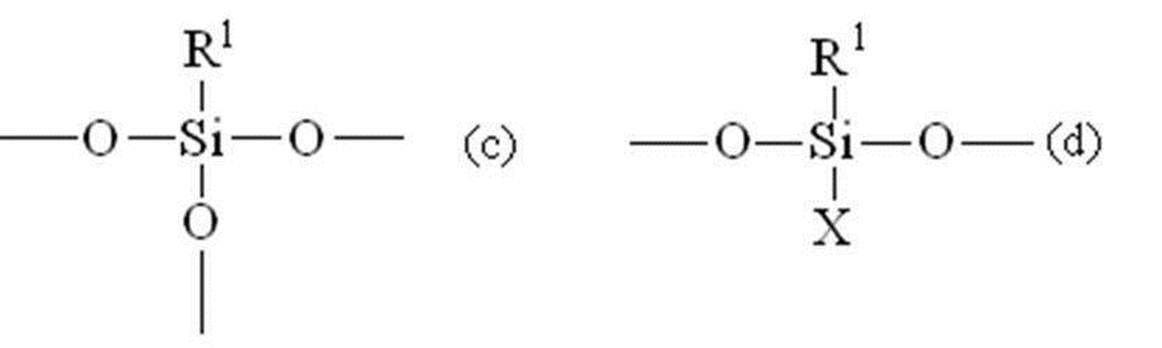
- the silicon-containing polymer is a group having the following bonds (c) and (d), the terminal being selected from the group consisting of R 1 , a hydroxyl group and an alkoxy group, and an epoxy equivalent of 500 g / eq to 4000 g / A compound that is eq is preferred.
- Examples of the silicon-containing polymer include branched polysiloxane called silicone resin.
- each R 1 independently represents a monovalent hydrocarbon group having 1 to 12 carbon atoms.
- X represents a monovalent organic group containing an epoxy group.
- the hydrocarbon group represented by R 1 may have a substituent.
- the epoxy group contained in X may undergo a ring-opening reaction, and X may be a divalent group.
- R 1 in the bonds (c) and (d) includes a methyl group, an ethyl group, a propyl group, a butyl group, an isopropyl group, an isobutyl group, a t-butyl group, a pentyl group, a hexyl group, a heptyl group, an octyl group, Alkyl groups such as 2-ethylhexyl group; alkenyl groups such as vinyl group, allyl group, butenyl group, pentenyl group, hexenyl group; aryl groups such as phenyl group, tolyl group, xylyl group, naphthyl group, biphenyl group; benzyl group, Examples thereof include an aralkyl group such as a phenethyl group, and among them, a methyl group or a phenyl group is preferable.
- X in the bond (d) is a monovalent organic group containing an epoxy group.
- the bonding position of the epoxy group in the organic group is not particularly limited, and the epoxy group is preferably bonded to the terminal of the organic group.
- X examples include 2,3-epoxypropyl group, 3,4-epoxybutyl group, 4,5-epoxypentyl group, 2-glycidoxyethyl group, 3-glycidoxypropyl group, 4-glycidoxypropyl group, Sidoxybutyl group, 2- (3,4-epoxycyclohexyl) ethyl group, 3- (3,4-epoxycyclohexyl) propyl group and the like can be mentioned, among which 3-glycidoxypropyl group is preferable.
- R 1 is each independently is preferably a hydroxyl group or an alkoxy group.
- Examples of the terminal alkoxy group include a methoxy group, an ethoxy group, a propoxy group, and a butoxy group.
- the epoxy equivalent is preferably in the range of 500 g / eq to 4000 g / eq, more preferably 1000 g / eq to 2500 g / eq.
- the epoxy equivalent of the silicon-containing polymer is 500 g / eq or more, the fluidity of the epoxy resin composition tends to be improved, and when it is 4000 g / eq or less, exudation to the surface of the cured product is suppressed, and molding failure Occurrence tends to decrease.
- the content of the silicon-containing polymer is preferably 0.2% by mass to 1.5% by mass, and 0.3% by mass in the epoxy resin composition. It is more preferable that the content be ⁇ 1.3 mass%. If it is 0.2% by mass or more, the effect of reducing the amount of warpage of the package tends to be improved, and if it is 1.5% by mass or less, the curability tends to be improved.
- the epoxy resin composition is represented by the compound represented by the following composition formula (XXXIII) and the following composition formula (XXXIV) as needed from the viewpoint of improving the moisture resistance and high temperature storage characteristics of a semiconductor element such as an IC.
- You may contain at least 1 sort (s) selected from the group which consists of a compound.
- the compound of the formula (XXXIII) is commercially available as a trade name DHT-4A of Kyowa Chemical Industry Co., Ltd.
- the compound of the formula (XXXIV) is commercially available as trade name IXE500 of Toa Gosei Co., Ltd.
- other anion exchangers can be added as necessary.
- limiting in particular as an anion exchanger A conventionally well-known thing can be used, and the hydrous oxide of elements, such as magnesium, aluminum, titanium, a zirconium, an antimony, etc. are mentioned.
- an anion exchanger you may use these 1 type individually or in combination of 2 or more types.
- the epoxy resin composition includes other additives such as higher fatty acid, higher fatty acid metal salt, ester wax, polyolefin wax, release agent such as polyethylene and polyethylene oxide, colorant such as carbon black, silicone oil, silicone You may contain stress relaxation agents, such as rubber powder, as needed.
- the epoxy resin composition may be prepared by any method as long as various raw materials can be uniformly dispersed and mixed.
- a raw material of a predetermined blending amount is sufficiently mixed with a mixer, etc., and then mixed or melt-kneaded with a mixing roll, an extruder, a raking machine, a planetary mixer, etc., cooled, and removed as necessary.
- Examples of the method include foaming and pulverization.
- the electronic component device which concerns on one Embodiment of this invention is equipped with an element and the hardened
- a method for sealing an element using the epoxy resin composition of the present embodiment as a sealing material a low-pressure transfer molding method is generally used, but an injection molding method, a compression molding method, and the like are also included.
- a method for applying the epoxy resin composition a dispensing method, a casting method, a printing method, or the like may be used.
- an electronic component device of this embodiment including an element sealed with the epoxy resin composition of this embodiment, a lead frame, a wired tape carrier, a wiring board, a supporting member such as glass and a silicon wafer, a mounting substrate, etc.
- an active element such as a semiconductor chip, transistor, diode, thyristor, etc., an element such as a passive element such as a capacitor, resistor, coil, etc. is mounted, and the necessary part is sealed with the epoxy resin composition of this embodiment.
- a component device etc. are mentioned.
- the mounting substrate is not particularly limited, and an organic substrate, an organic film, a ceramic substrate, an interposer substrate such as a glass substrate, a glass substrate for liquid crystal, a substrate for MCM (Multi-Chip Module), a substrate for hybrid IC, etc. Can be mentioned.
- An example of an electronic component device provided with such an element is a semiconductor device.
- an element such as a semiconductor chip is fixed on a lead frame (island, tab), and an element such as a bonding pad is used.
- the terminal part and the lead part are connected by wire bonding or bump, and then sealed by transfer molding or the like using the epoxy resin composition of this embodiment, DIP (Dual Inline Package), PLCC (Plastic Leaded Chip Carrier) , QFP (Quad Flat Package), SOP (Small Outline J Package), SOJ (Small Outline J Package), TSOP (Thin Small Outline Package), TQFP (Thin Quad Flat Package), etc.
- TCP Transmission Carrier Package
- COB Chip On Board
- Active devices such as semiconductor chips, transistors, diodes, thyristors, etc. connected to semiconductor devices mounted on bare chips, such as COG (Chip On Glass), wiring boards, wirings formed on glass, etc. by wire bonding, flip chip bonding, solder, etc.
- a semiconductor chip is mounted on a hybrid IC in which passive elements such as capacitors, resistors, and coils are sealed with the epoxy resin composition of the present embodiment, and an MCM (Multi Chip Module) motherboard connection terminal is formed.
- the semiconductor chip can be interfaced by bump or wire bonding.
- BGA Bit Grid Array
- CSP Chip Size Package
- MCP Multi Chip
- the specific epoxy resin can be synthesized as follows.
- the raw material phenol novolac resin is reacted with the raw material benzyl group-containing compound using p-toluenesulfonic acid as an acid catalyst to obtain a specific phenol novolac resin.
- the hydroxyl equivalent is measured in the same manner as the method for measuring the hydroxyl equivalent in the above-mentioned curing agent, and the value of p in the general formula (1) is obtained from this value.
- the specific phenol novolak resin obtained above is epoxidized with epichlorohydrin.
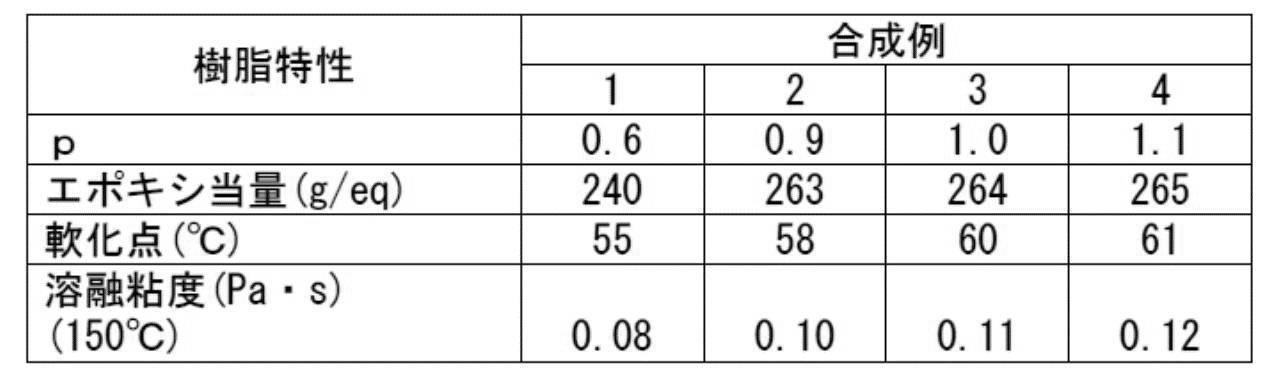
- the epoxy equivalent, softening point, and melt viscosity at 150 ° C. of the obtained resin are shown in Table 1 below.
- the specific epoxy resin obtained is, R 2 in the general formula (1) a benzyl group (R 3 is a hydrogen atom) was.
- Examples 1 to 4 Comparative Examples 1 to 8
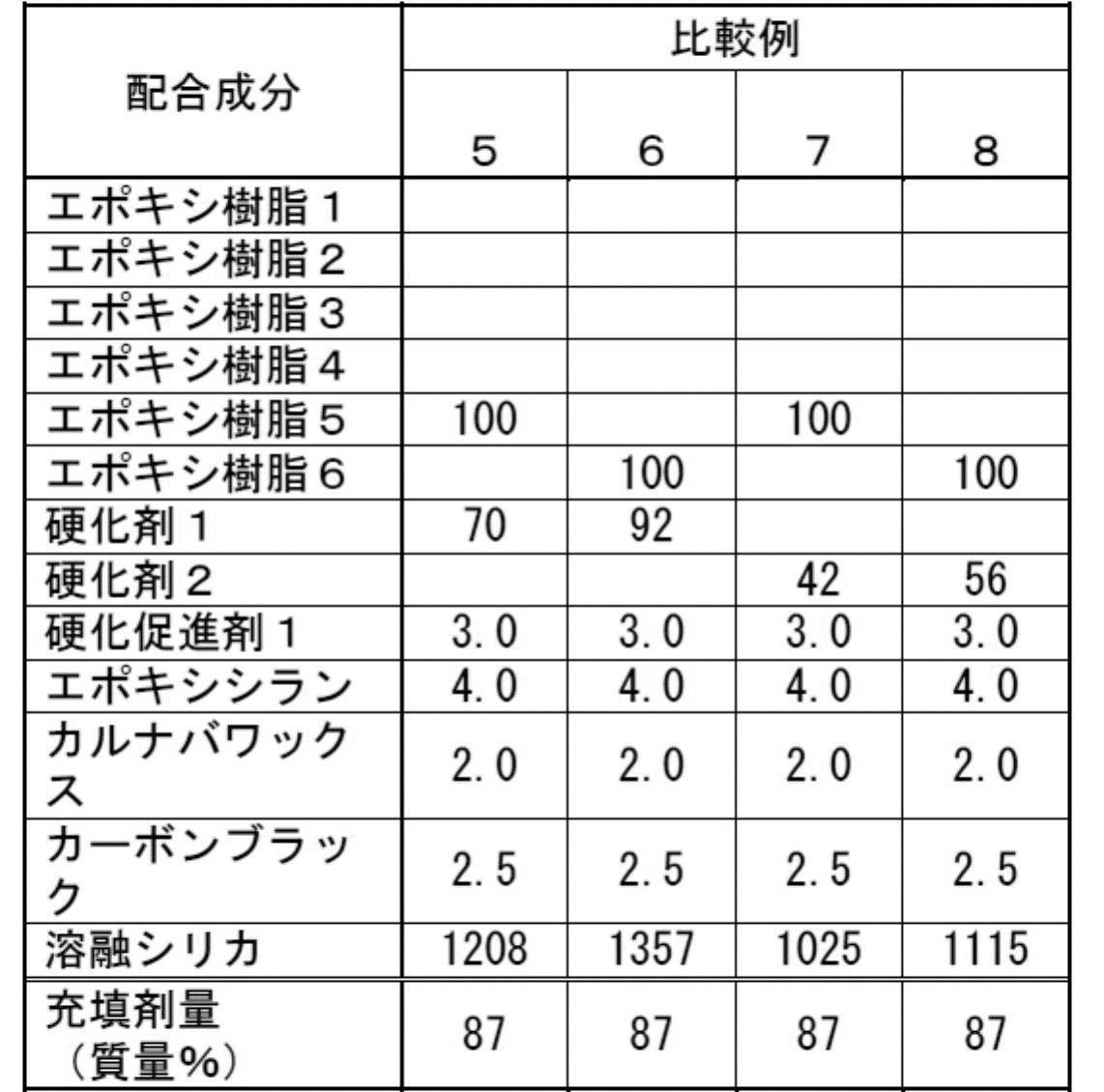
- the following components were blended in the parts by mass shown in Tables 2 and 3, respectively, and roll kneading was carried out under conditions of a kneading temperature of 80 ° C. and a kneading time of 10 minutes to produce Examples 1-4 and Comparative Examples 1-8.
- Epoxy resin 6 Epoxy equivalent 190
- Curing agent 1 phenol aralkyl resin having a hydroxyl equivalent weight of 175 g / eq and a softening point of 70 ° C.
- Curing agent 2 Novolak type phenolic resin having a hydroxyl group equivalent of 106 g / eq and a softening point of 82 ° C. (Hitachi Chemical Co., Ltd., trade name HP-850N)
- Curing accelerator 1 adduct of triphenylphosphine and 1,4-benzoquinone
- Reflow resistance (4.1) Cu lead frame 8mm x 10mm x 0.4mm silicon chip mounted 80mm flat package (QFP) with external dimensions of 20mm x 14mm x 2mm (Lead frame material: copper alloy, The die pad part upper surface and lead tip silver-plated product) are molded and post-cured using the epoxy resin composition under the condition (3) above, and humidified at 85 ° C. and 85% RH for a predetermined time. The elapsed time was subjected to reflow treatment at 240 ° C. for 10 seconds, the presence or absence of cracks was visually observed, and the number of crack generation packages relative to the number of test packages (five) was evaluated.
- QFP silicon chip mounted 80mm flat package
- PPF lead frame Evaluation was performed in the same manner as in (4.1) except that PPF (core material: copper alloy, three-layer (Ni / Pd / Au) plated product) was used for the lead frame. .
- the pre-treatment was performed by humidifying the flat package under conditions of 85 ° C. and 85% RH for 72 hours, and then performing a vapor phase reflow treatment at 215 ° C. for 90 seconds. Subsequent humidification was performed under conditions of 0.2 MPa and 121 ° C.
- High-temperature storage characteristics 5 mm x 9 mm x 0.4 mm test silicon chip with aluminum wiring with a line width of 10 ⁇ m and a thickness of 1 ⁇ m on a 5 ⁇ m-thick silicon oxide film is made of 42 alloy with partial silver plating
- the epoxy resin composition is a 16-pin DIP (Dual Inline Package) that is mounted on a lead frame using silver paste and connected to the chip's bonding pads and inner leads with Au wire at 200 ° C using a thermonic wire bonder.
- Comparative Examples 5 and 7 not containing the compound represented by the general formula (1) have low heat hardness, the moldability is inferior. Comparative Examples 6 and 8 are inferior in reflow resistance, and flame retardancy does not achieve V-0. In Comparative Examples 1 to 4 in which no specific curing agent was used, the spiral flow was smaller than in Examples 1 to 4, and the moldability was poor. In addition, compared with Examples 1 to 4 using a specific curing agent, Comparative Examples 1 to 4 not using a specific curing agent were slightly inferior in reflow resistance (particularly, 72 h and 96 h) in the Cu lead frame. .
- Examples 1 to 4 containing the compound represented by the general formula (1) have good fluidity and reflow resistance, all achieved UL-94 V-0 and good flame retardancy. In addition, the moldability is also good.
Landscapes
- Chemical & Material Sciences (AREA)
- Health & Medical Sciences (AREA)
- Chemical Kinetics & Catalysis (AREA)
- Medicinal Chemistry (AREA)
- Polymers & Plastics (AREA)
- Organic Chemistry (AREA)
- Epoxy Resins (AREA)
- Structures Or Materials For Encapsulating Or Coating Semiconductor Devices Or Solid State Devices (AREA)
Abstract
Description
ビフェニレン型フェノールアラルキル樹脂、フェノールアラルキル樹脂、及びトリフェニルメタン型フェノール樹脂からなる群より選択される少なくとも1種を含む硬化剤と、
を含有するエポキシ樹脂組成物。
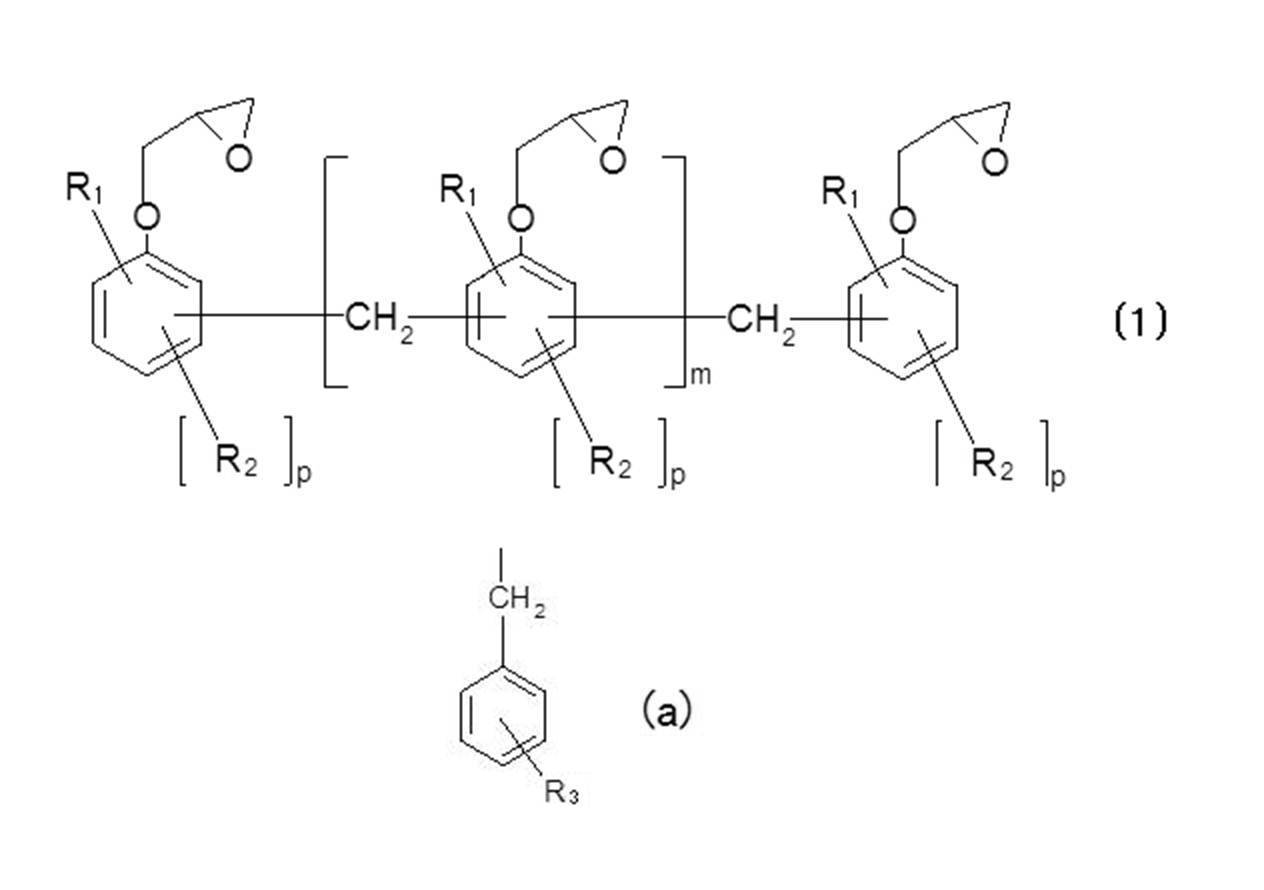
〔R1は、各々独立に、水素原子又は炭素数1~6の一価の炭化水素基を示し、R2は式(a)で示される置換基を示し、mは0~20の数を示し、pは0.5~2.0を示し、R3は、各々独立に、水素原子又は炭素数1~6の一価の炭化水素基を示す。〕
前記素子を封止する<1>~<7>のいずれか1つに記載のエポキシ樹脂組成物の硬化物と、
を備える電子部品装置。
更に、本明細書において組成物中の各成分の含有率は、組成物中に各成分に該当する物質が複数存在する場合には、特に断らない限り、組成物中に存在する当該複数の物質の合計の含有率を意味する。
本明細書中に段階的に記載されている数値範囲において、一つの数値範囲で記載された上限値又は下限値は、他の段階的な記載の数値範囲の上限値又は下限値に置き換えてもよい。また、本明細書中に記載されている数値範囲において、その数値範囲の上限値又は下限値は、実施例に示されている値に置き換えてもよい。
本明細書において組成物中の各成分の粒子径は、組成物中に各成分に該当する粒子が複数種存在する場合、特に断らない限り、組成物中に存在する当該複数種の粒子の混合物についての値を意味する。
本発明の一実施形態に係るエポキシ樹脂組成物は、下記一般式(1)で示される化合物(以下、「特定エポキシ樹脂」ともいう)を含むエポキシ樹脂と、ビフェニレン型フェノールアラルキル樹脂、フェノールアラルキル樹脂、及びトリフェニルメタン型フェノール樹脂からなる群より選択される少なくとも1種を含む硬化剤(以下「特定の硬化剤」ともいう)と、を含有する。
また、溶融粘度が低くなることにより流動性が高くなって成形性に優れると考えられる。
エポキシ樹脂組成物は、エポキシ樹脂を含有する。エポキシ樹脂は、下記一般式(1)で示される化合物を含む。
(1)温度レンジを150℃に設定して、(2)試料0.15g~0.25gをプレート上で溶融し、コーンを降ろし、温度コントロールランプの点滅を5回繰り返すまで放置する。(3)コーンの上下攪拌を約20秒行い、その後温度コントロールランプの点滅が5回繰り返されるまで放置する。(4)コーン回転後、約15秒後の値を読む。(5)値が同一になるまで(3)~(4)の操作を繰り返し、その値を記録する。(6)同一ロットで3回以上(2)~(5)の操作を繰り返し、その平均値を粘度とする。
100mLのフラスコにエポキシ樹脂を固形分が3g~4gになるよう量り、酢酸20mL、臭化テトラエチルアンモニウム酢酸溶液(臭化テトラエチルアンモニウム100gと酢酸400mLの混合液)を10mL、クリスタルバイオレットを4滴~5滴加える。この溶液を0.1mol/Lの過塩素酸酢酸溶液で滴定する。同様にブランクを滴定する。エポキシ当量は以下の式により算出する。





エポキシ樹脂組成物は硬化剤を含有する。硬化剤は、ビフェニレン型フェノールアラルキル樹脂、フェノールアラルキル樹脂、及びトリフェニルメタン型フェノール樹脂からなる群より選択される少なくとも1種を含む。



硬化剤は、更に特定の硬化剤以外に他の硬化剤を併用してもよい。全硬化剤中の特定の硬化剤の含有率は、30質量%以上であることが好ましく、50質量%以上であることがより好ましく、70質量%以上であることが更に好ましい。


ピリジン-塩化アセチル法を用い、硬化剤の水酸基をピリジン溶液中で塩化アセチル化した後にその過剰の試薬を水で分解し、生成した酢酸を水酸化カリウム及びエタノールを含む溶液で滴定して、水酸基当量を求める。
エポキシ樹脂組成物には、エポキシ樹脂と硬化剤の反応を促進させる観点から、必要に応じて硬化促進剤を用いてもよい。
硬化促進剤は、エポキシ樹脂組成物に一般に使用されているものを特に制限なく用いることができる。硬化促進剤としては、1,8-ジアザ-ビシクロ[5.4.0]ウンデセン-7、1,5-ジアザ-ビシクロ[4.3.0]ノネン、5,6-ジブチルアミノ-1,8-ジアザ-ビシクロ[5.4.0]ウンデセン-7等のシクロアミジン化合物;シクロアミジン化合物に無水マレイン酸、1,4-ベンゾキノン、2,5-トルキノン、1,4-ナフトキノン、2,3-ジメチルベンゾキノン、2,6-ジメチルベンゾキノン、2,3-ジメトキシ-5-メチル-1,4-ベンゾキノン、2,3-ジメトキシ-1,4-ベンゾキノン、フェニル-1,4-ベンゾキノン等のキノン化合物、ジアゾフェニルメタン、フェノール樹脂等のπ結合をもつ化合物を付加してなる分子内分極を有する化合物;ベンジルジメチルアミン、トリエタノールアミン、ジメチルアミノエタノール、トリス(ジメチルアミノメチル)フェノール等の3級アミン化合物;3級アミン化合物の誘導体;2-メチルイミダゾール、2-フェニルイミダゾール、2-フェニル-4-メチルイミダゾール等のイミダゾール化合物;イミダゾール化合物の誘導体;トリブチルホスフィン、メチルジフェニルホスフィン、トリフェニルホスフィン、トリス(4-メチルフェニル)ホスフィン、ジフェニルホスフィン、フェニルホスフィン等のホスフィン化合物;これらのホスフィン化合物に無水マレイン酸、上記キノン化合物、ジアゾフェニルメタン、フェノール樹脂等のπ結合をもつ化合物を付加してなる分子内分極を有するリン化合物;テトラフェニルホスホニウムテトラフェニルボレート、トリフェニルホスフィンテトラフェニルボレート、2-エチル-4-メチルイミダゾールテトラフェニルボレート、N-メチルモルホリンテトラフェニルボレート等のテトラフェニルボロン塩;テトラフェニルボロン塩の誘導体などが挙げられる。硬化促進剤は、これら1種を単独で用いても2種以上を組み合わせて用いてもよい。
エポキシ樹脂組成物は、更に、無機充填剤を含有してもよい。無機充填剤を含有すると、吸湿性の低減、線膨張係数の低減、熱伝導性の向上及び強度の向上の傾向がある。無機充填剤としては、溶融シリカ、結晶シリカ、アルミナ、ジルコン、珪酸カルシウム、炭酸カルシウム、チタン酸カリウム、炭化珪素、窒化珪素、窒化アルミ、窒化ホウ素、ベリリア、ジルコニア、ジルコン、フォステライト、ステアタイト、スピネル、ムライト、チタニア等の粉体、これらを球形化したビーズ、ガラス繊維などが挙げられる。更に、難燃効果のある無機充填剤としては、水酸化アルミニウム、水酸化マグネシウム、複合金属水酸化物、硼酸亜鉛、モリブデン酸亜鉛等が挙げられる。ここで、ホウ酸亜鉛としては、FB-290、FB-500(U.S.Borax社)、FRZ-500C(水澤化学工業株式会社)等が各々市販品として入手可能であり、モリブデン酸亜鉛としては、KEMGARD911B、911C、1100(Sherwin-Williams社)等が各々市販品として入手可能である。
エポキシ樹脂組成物は、更に、カップリング剤を含有してもよい。エポキシ樹脂組成物に無機充填剤を用いる場合、カップリング剤は樹脂成分と無機充填剤との接着性を高める傾向にある。カップリング剤としては、エポキシ樹脂組成物に一般に使用されているものを特に制限なく用いることができる。カップリング剤としては、1級、2級又は3級アミノ基を有するシラン化合物、エポキシシラン、メルカプトシラン、アルキルシラン、ウレイドシラン、ビニルシラン等の各種シラン化合物、チタン化合物、アルミニウムキレート化合物、アルミニウム及びジルコニウム含有化合物等が挙げられる。
エポキシ樹脂組成物は、難燃性の向上の観点から、更に、従来公知の難燃剤、特に環境対応、信頼性の観点からはノンハロゲン及びノンアンチモンの難燃剤を必要に応じて含有してもよい。難燃剤としては、赤リン、リン酸エステル、酸化亜鉛等の無機化合物、フェノール樹脂等の熱硬化性樹脂で被覆された赤リン、ホスフィンオキサイド等の樹脂被覆リン化合物、メラミン、メラミン誘導体、メラミン変性フェノール樹脂、トリアジン環を有する化合物、シアヌル酸誘導体、イソシアヌル酸誘導体等の窒素含有化合物、シクロホスファゼン等のリン、窒素含有化合物、水酸化アルミニウム、水酸化マグネシウム、複合金属水酸化物、酸化亜鉛、錫酸亜鉛、硼酸亜鉛、酸化鉄、酸化モリブデン、モリブデン酸亜鉛、ジシクロペンタジエニル鉄等の金属元素を含む化合物などが挙げられる。難燃剤は、これらの1種を単独で用いても、2種以上を組み合わせて用いてもよい。
エポキシ樹脂組成物は、反り低減の観点から、ケイ素含有重合物を含有してもよい。ケイ素含有重合物としては、下記の結合(c)及び(d)を有し、末端がR1、水酸基及びアルコキシ基からなる群より選択される基であり、エポキシ当量が500g/eq~4000g/eqである化合物が好ましい。ケイ素含有重合物として、例えば、シリコーンレジンと呼ばれる分岐状ポリシロキサンが挙げられる。
エポキシ樹脂組成物は、IC等の半導体素子の耐湿性及び高温放置特性を向上させる観点から、必要に応じて下記組成式(XXXIII)で表される化合物及び下記組成式(XXXIV)で表される化合物からなる群より選択される少なくとも1種を含有してもよい。

(0<X≦0.5、mは正の数)

(0.9≦x≦1.1、0.6≦y≦0.8、0.2≦z≦0.4)
エポキシ樹脂組成物は、各種原材料を均一に分散混合できるのであれば、いかなる手法を用いて調製してもよい。一般的な調製方法として、所定の配合量の原材料をミキサー等によって充分混合した後、ミキシングロール、押出機、らいかい機、プラネタリミキサ等によって混合又は溶融混練し、冷却し、必要に応じて脱泡し、粉砕する方法等が挙げられる。また、エポキシ樹脂組成物は、必要に応じて成形条件に合うような寸法及び質量でタブレット化してもよい。
本発明の一実施形態に係る電子部品装置は、素子と、前記素子を封止する前述のエポキシ樹脂組成物の硬化物と、を備える。本実施形態のエポキシ樹脂組成物を封止材として用いて、素子を封止する方法としては、低圧トランスファ成形法が一般的であるが、インジェクション成形法、圧縮成形法等も挙げられる。エポキシ樹脂組成物の付与方法として、ディスペンス方式、注型方式、印刷方式等を用いてもよい。
特定エポキシ樹脂は以下のように合成できる。
原料フェノールノボラック樹脂を酸触媒であるp-トルエンスルホン酸を用いて原料ベンジル基含有化合物と反応させ、まず特定のフェノールノボラック樹脂を得る。この時、前述の硬化剤における水酸基当量の測定方法と同様にして水酸基当量を測定し、この値から一般式(1)におけるpの値求める。
次に上記で得られた特定のフェノールノボラック樹脂をエピクロルヒドリンにてエポキシ化する。得られた樹脂のエポキシ当量、軟化点及び150℃の溶融粘度を以下の表1に示す。なお、得られた特定エポキシ樹脂は、一般式(1)におけるR2がベンジル基(R3が水素原子)であった。
下記成分をそれぞれ表2及び3に示す質量部で配合し、混練温度80℃、混練時間10分の条件でロール混練を行い、実施例1~4、比較例1~8を作製した。
・エポキシ樹脂1:エポキシ当量240g/eq、軟化点55℃、一般式(1)で示される化合物であり、p=0.6のエポキシ樹脂
・エポキシ樹脂2:エポキシ当量263g/eq、軟化点58℃、一般式(1)で示される化合物であり、p=0.9のエポキシ樹脂
・エポキシ樹脂3:エポキシ当量264g/eq、軟化点60℃、一般式(1)で示される化合物であり、p=1.0のエポキシ樹脂
・エポキシ樹脂4:エポキシ当量265g/eq、軟化点61℃、一般式(1)で示される化合物であり、p=1.1のエポキシ樹脂
・エポキシ樹脂5:エポキシ当量251g/eq、軟化点60℃、2-メトキシナフタレンとオルソクレゾールノボラック型エポキシ樹脂の共重合物(DIC株式会社、商品名HP-5000)
・エポキシ樹脂6:エポキシ当量190g/eq、融点59℃、オルソクレゾールノボラック型エポキシ樹脂(DIC株式会社、商品名N-500P-1)
・硬化剤1:水酸基当量175g/eq、軟化点70℃のフェノールアラルキル樹脂(明和化成株式会社、商品名MEH-7800SS)
・硬化剤2:水酸基当量106g/eq、軟化点82℃のノボラック型フェノール樹脂(日立化成株式会社、商品名HP-850N)
・硬化促進剤1:トリフェニルホスフィンと1,4-ベンゾキノンの付加物
・エポキシシラン:γ-グリシドキシプロピルトリメトキシシラン
・球状溶融シリカ:平均粒径14.5μm、比表面積2.8m2/g
・カルナバワックス(クラリアント社)
・カーボンブラック(三菱化学株式会社、商品名MA-600)

EMMI-1-66に準じたスパイラルフロー測定用金型を用いて、エポキシ樹脂組成物をトランスファ成形機により、金型温度180℃、成形圧力6.9MPa、硬化時間90秒の条件で成形し、流動距離(cm)を求めた。
エポキシ樹脂組成物を上記(1)の成形条件で直径50mm×厚さ3mmの円板に成形し、成形後直ちにショアD型硬度計を用いて測定した。
厚さ1/32インチ(0.8mm)の試験片を成形する金型を用いて、エポキシ樹脂組成物を上記(1)の成形条件で成形して、更に180℃で5時間後硬化を行い、UL-94試験法に従って難燃性を評価した。
(4.1)Cuリードフレーム
8mm×10mm×0.4mmのシリコンチップを搭載した外形寸法20mm×14mm×2mmの80ピンフラットパッケージ(QFP)(リードフレーム材質:銅合金、ダイパッド部上面及びリード先端銀メッキ処理品)を、エポキシ樹脂組成物を用いて上記(3)の条件で成形、後硬化して作製し、85℃、85%RHの条件で加湿して所定時間経過したものを240℃、10秒の条件でリフロー処理を行い、クラックの有無を目視で観察し、試験パッケージ数(5個)に対するクラック発生パッケージ数で評価した。
リードフレームにPPF(コア材質:銅合金、三層(Ni/Pd/Au)メッキ処理品)を用いた以外は(4.1)と同様にして評価を実施した。
5μm厚の酸化ケイ素膜上に線幅10μm、厚さ1μmのアルミ配線を施した6mm×6mm×0.4mmのテスト用シリコンチップを搭載した外形寸法20mm×14mm×2.7mmの80ピンフラットパッケージ(QFP)を、エポキシ樹脂組成物を用いて上記(3)の条件で成形、後硬化して作製し、前処理を行った後、加湿して所定時間経過したものについてアルミ配線腐食による断線不良を調べ、試験パッケージ数(10個)に対する不良パッケージ数で評価した。
5μm厚の酸化ケイ素膜上に線幅10μm、厚さ1μmのアルミ配線を施した5mm×9mm×0.4mmのテスト用シリコンチップを、部分銀メッキを施した42アロイのリードフレーム上に銀ペーストを用いて搭載し、サーモニック型ワイヤボンダにより、200℃でチップのボンディングパッドとインナリードをAu線にて接続した16ピン型DIP(Dual Inline Package)を、エポキシ樹脂組成物を用いて上記(3)の条件で成形、後硬化して作製して、200℃の高温槽中に保管し、所定時間経過したものを取り出して導通試験を行い、試験パッケージ数(10個)に対する導通不良パッケージ数で、高温放置特性を評価した。

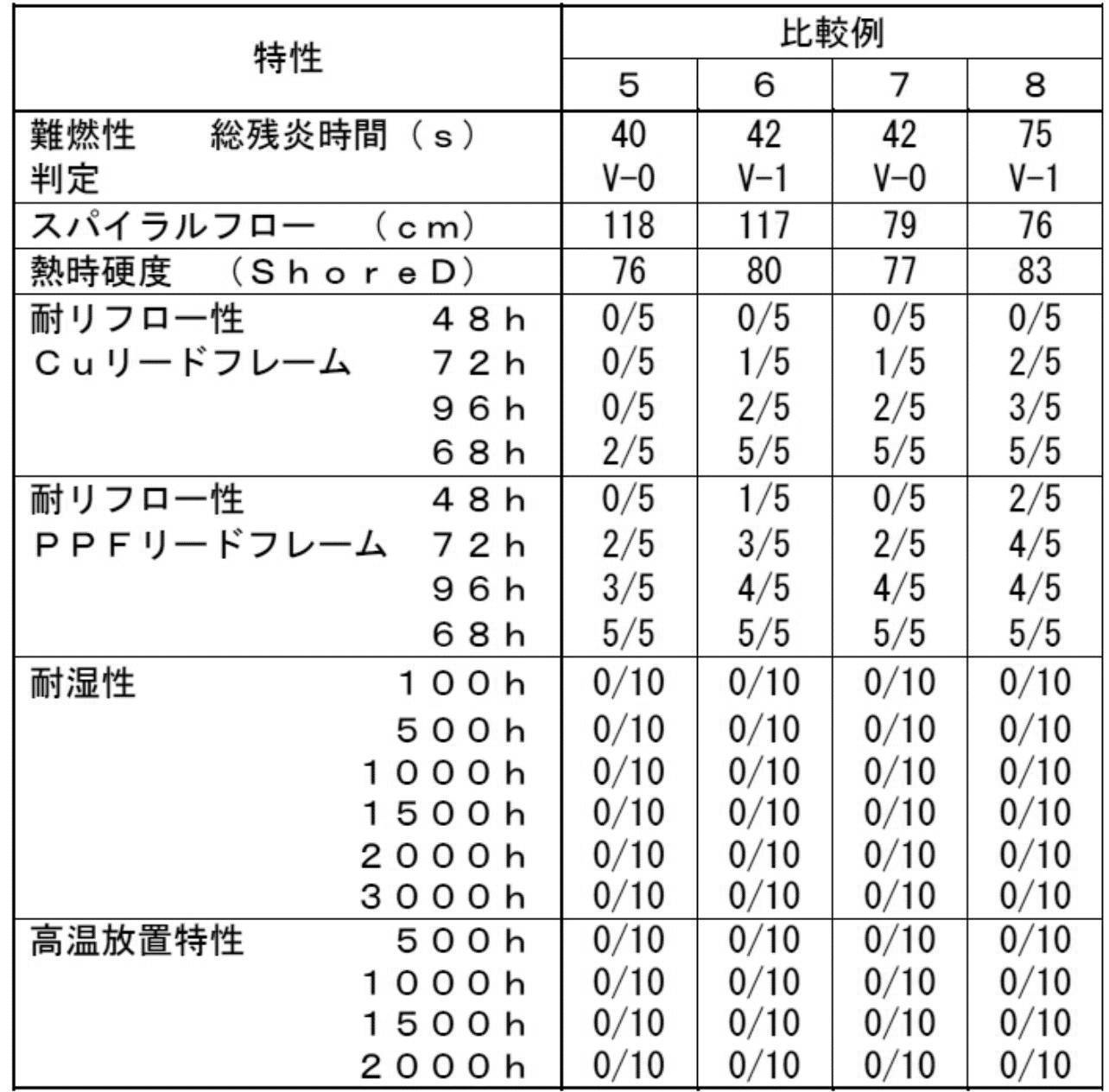
特定の硬化剤を用いない比較例1~4では、実施例1~4に比べてスパイラルフローが小さく、成型性に劣っていた。また、特定の硬化剤を用いる実施例1~4に比べて、特定の硬化剤を用いない比較例1~4では、Cuリードフレームにおける耐リフロー性(特に、72h及び96h)も若干劣っていた。
本明細書に記載された全ての文献、特許出願、及び技術規格は、個々の文献、特許出願、及び技術規格が参照により取り込まれることが具体的且つ個々に記された場合と同程度に、本明細書中に参照により取り込まれる。
Claims (8)
- 下記一般式(1)で示される化合物を含むエポキシ樹脂と、
ビフェニレン型フェノールアラルキル樹脂、フェノールアラルキル樹脂、及びトリフェニルメタン型フェノール樹脂からなる群より選択される少なくとも1種を含む硬化剤と、
を含有するエポキシ樹脂組成物。

〔R1は、各々独立に、水素原子又は炭素数1~6の一価の炭化水素基を示し、R2は式(a)で示される置換基を示し、mは0~20の数を示し、pは0.5~2.0を示し、R3は、各々独立に、水素原子又は炭素数1~6の一価の炭化水素基を示す。〕 - 更に、硬化促進剤を含有する請求項1に記載のエポキシ樹脂組成物。
- 前記硬化促進剤が、第三ホスフィン化合物とキノン化合物との付加物を含む請求項2に記載のエポキシ樹脂組成物。
- 更に、無機充填剤を含有する請求項1~請求項3のいずれか1項に記載のエポキシ樹脂組成物。
- 前記無機充填剤の含有率が、60質量%~95質量%である請求項4に記載のエポキシ樹脂組成物。
- 更に、カップリング剤を含有する請求項1~請求項5のいずれか1項に記載のエポキシ樹脂組成物。
- 前記カップリング剤が、2級アミノ基を有するシランカップリング剤を含む請求項6に記載のエポキシ樹脂組成物。
- 素子と、
前記素子を封止する請求項1~請求項7のいずれか1項に記載のエポキシ樹脂組成物の硬化物と、
を備える電子部品装置。
Priority Applications (6)
| Application Number | Priority Date | Filing Date | Title |
|---|---|---|---|
| MYPI2018703974A MY196654A (en) | 2016-04-28 | 2017-04-28 | Epoxy Resin Composition and Electronic Component Device |
| CN201780026111.1A CN109071780B (zh) | 2016-04-28 | 2017-04-28 | 环氧树脂组合物及电子部件装置 |
| JP2018514747A JP7343978B2 (ja) | 2016-04-28 | 2017-04-28 | エポキシ樹脂組成物及び電子部品装置 |
| KR1020187033222A KR102127589B1 (ko) | 2016-04-28 | 2017-04-28 | 에폭시 수지 조성물 및 전자 부품 장치 |
| SG11201809513UA SG11201809513UA (en) | 2016-04-28 | 2017-04-28 | Epoxy resin composition and electronic component device |
| PH12018502283A PH12018502283A1 (en) | 2016-04-28 | 2018-10-26 | Epoxy resin composition and electronic component device |
Applications Claiming Priority (2)
| Application Number | Priority Date | Filing Date | Title |
|---|---|---|---|
| JP2016-091768 | 2016-04-28 | ||
| JP2016091768 | 2016-04-28 |
Publications (1)
| Publication Number | Publication Date |
|---|---|
| WO2017188455A1 true WO2017188455A1 (ja) | 2017-11-02 |
Family
ID=60160777
Family Applications (1)
| Application Number | Title | Priority Date | Filing Date |
|---|---|---|---|
| PCT/JP2017/017100 Ceased WO2017188455A1 (ja) | 2016-04-28 | 2017-04-28 | エポキシ樹脂組成物及び電子部品装置 |
Country Status (8)
| Country | Link |
|---|---|
| JP (1) | JP7343978B2 (ja) |
| KR (1) | KR102127589B1 (ja) |
| CN (1) | CN109071780B (ja) |
| MY (1) | MY196654A (ja) |
| PH (1) | PH12018502283A1 (ja) |
| SG (1) | SG11201809513UA (ja) |
| TW (1) | TWI724162B (ja) |
| WO (1) | WO2017188455A1 (ja) |
Cited By (2)
| Publication number | Priority date | Publication date | Assignee | Title |
|---|---|---|---|---|
| WO2024128191A1 (ja) * | 2022-12-16 | 2024-06-20 | 株式会社レゾナック | 硬化性樹脂組成物及び電子部品装置 |
| WO2025142654A1 (ja) * | 2023-12-26 | 2025-07-03 | 株式会社レゾナック | 硬化性樹脂組成物及び電子部品装置 |
Families Citing this family (3)
| Publication number | Priority date | Publication date | Assignee | Title |
|---|---|---|---|---|
| WO2019176859A1 (ja) * | 2018-03-16 | 2019-09-19 | 日立化成株式会社 | エポキシ樹脂組成物、及び電子部品装置 |
| CN114945618B (zh) * | 2020-02-06 | 2026-04-10 | 株式会社力森诺科 | 转注成形用环氧树脂组合物及其制造方法、压缩成形用环氧树脂组合物和电子零件装置 |
| TWI911302B (zh) * | 2020-10-08 | 2026-01-11 | 日商力森諾科股份有限公司 | 硬化性樹脂組成物及電子零件裝置 |
Citations (4)
| Publication number | Priority date | Publication date | Assignee | Title |
|---|---|---|---|---|
| JPH1025335A (ja) * | 1996-07-11 | 1998-01-27 | Hitachi Chem Co Ltd | 半導体素子用封止材及びそれを用いた半導体装置 |
| JP2003064164A (ja) * | 2001-08-28 | 2003-03-05 | Sumikin Air Water Chemical Inc | フェノール系重合体、その製法及びその用途 |
| WO2013125620A1 (ja) * | 2012-02-23 | 2013-08-29 | 新日鉄住金化学株式会社 | 多価ヒドロキシ樹脂、エポキシ樹脂、それらの製造方法、エポキシ樹脂組成物及びその硬化物 |
| WO2014073557A1 (ja) * | 2012-11-12 | 2014-05-15 | Dic株式会社 | フェノール性水酸基含有樹脂、エポキシ樹脂、硬化性樹脂組成物、その硬化物、及び半導体封止材料 |
Family Cites Families (5)
| Publication number | Priority date | Publication date | Assignee | Title |
|---|---|---|---|---|
| JPH0753791B2 (ja) | 1987-09-04 | 1995-06-07 | 東レ株式会社 | 半導体封止用樹脂組成物 |
| JP3440449B2 (ja) | 1997-06-24 | 2003-08-25 | 京セラケミカル株式会社 | 封止用樹脂組成物および半導体封止装置 |
| JP2000103940A (ja) | 1998-09-25 | 2000-04-11 | Toshiba Chem Corp | エポキシ樹脂組成物および半導体封止装置 |
| JP3819220B2 (ja) | 2000-06-26 | 2006-09-06 | 京セラケミカル株式会社 | 封止用樹脂組成物および半導体封止装置 |
| JP5906673B2 (ja) * | 2010-11-26 | 2016-04-20 | 日立化成株式会社 | 封止用エポキシ樹脂成形材料、及びこの成形材料で封止した素子を備えた電子部品装置 |
-
2017
- 2017-04-28 TW TW106114312A patent/TWI724162B/zh active
- 2017-04-28 CN CN201780026111.1A patent/CN109071780B/zh active Active
- 2017-04-28 KR KR1020187033222A patent/KR102127589B1/ko active Active
- 2017-04-28 JP JP2018514747A patent/JP7343978B2/ja active Active
- 2017-04-28 SG SG11201809513UA patent/SG11201809513UA/en unknown
- 2017-04-28 MY MYPI2018703974A patent/MY196654A/en unknown
- 2017-04-28 WO PCT/JP2017/017100 patent/WO2017188455A1/ja not_active Ceased
-
2018
- 2018-10-26 PH PH12018502283A patent/PH12018502283A1/en unknown
Patent Citations (4)
| Publication number | Priority date | Publication date | Assignee | Title |
|---|---|---|---|---|
| JPH1025335A (ja) * | 1996-07-11 | 1998-01-27 | Hitachi Chem Co Ltd | 半導体素子用封止材及びそれを用いた半導体装置 |
| JP2003064164A (ja) * | 2001-08-28 | 2003-03-05 | Sumikin Air Water Chemical Inc | フェノール系重合体、その製法及びその用途 |
| WO2013125620A1 (ja) * | 2012-02-23 | 2013-08-29 | 新日鉄住金化学株式会社 | 多価ヒドロキシ樹脂、エポキシ樹脂、それらの製造方法、エポキシ樹脂組成物及びその硬化物 |
| WO2014073557A1 (ja) * | 2012-11-12 | 2014-05-15 | Dic株式会社 | フェノール性水酸基含有樹脂、エポキシ樹脂、硬化性樹脂組成物、その硬化物、及び半導体封止材料 |
Cited By (2)
| Publication number | Priority date | Publication date | Assignee | Title |
|---|---|---|---|---|
| WO2024128191A1 (ja) * | 2022-12-16 | 2024-06-20 | 株式会社レゾナック | 硬化性樹脂組成物及び電子部品装置 |
| WO2025142654A1 (ja) * | 2023-12-26 | 2025-07-03 | 株式会社レゾナック | 硬化性樹脂組成物及び電子部品装置 |
Also Published As
| Publication number | Publication date |
|---|---|
| KR102127589B1 (ko) | 2020-06-26 |
| CN109071780B (zh) | 2022-04-08 |
| PH12018502283A1 (en) | 2019-07-08 |
| JPWO2017188455A1 (ja) | 2019-03-07 |
| CN109071780A (zh) | 2018-12-21 |
| MY196654A (en) | 2023-04-27 |
| TWI724162B (zh) | 2021-04-11 |
| KR20180136494A (ko) | 2018-12-24 |
| SG11201809513UA (en) | 2018-11-29 |
| TW201807057A (zh) | 2018-03-01 |
| JP7343978B2 (ja) | 2023-09-13 |
Similar Documents
| Publication | Publication Date | Title |
|---|---|---|
| KR102013533B1 (ko) | 밀봉용 에폭시 수지 조성물 및 전자 부품 장치 | |
| CN103517948A (zh) | 密封用环氧树脂成形材料及电子部件装置 | |
| JP7343978B2 (ja) | エポキシ樹脂組成物及び電子部品装置 | |
| JP2024026589A (ja) | 封止用樹脂組成物、電子部品装置及び電子部品装置の製造方法 | |
| JP2004307650A (ja) | 封止用エポキシ樹脂成形材料及び半導体装置 | |
| JP3659116B2 (ja) | 封止用エポキシ樹脂成形材料及び電子部品装置 | |
| JP2008239983A (ja) | 封止用エポキシ樹脂組成物及び電子部品装置 | |
| JP2005029641A (ja) | 封止用エポキシ樹脂成形材料及び電子部品装置 | |
| JP2015074703A (ja) | エポキシ樹脂組成物及び電子部品装置 | |
| KR100893022B1 (ko) | 경화 촉진제, 경화성 수지 조성물 및 전자 부품 장치 | |
| JP2008214433A (ja) | 封止用エポキシ樹脂組成物及び電子部品装置 | |
| JP4930767B2 (ja) | 封止用エポキシ樹脂組成物及び電子部品装置 | |
| JP2010095709A (ja) | 封止用エポキシ樹脂組成物及び電子部品装置 | |
| JP3969101B2 (ja) | 封止用エポキシ樹脂成形材料及び電子部品装置 | |
| JP6372967B2 (ja) | 封止用エポキシ樹脂成形材料及び電子部品装置 | |
| JP2010100678A (ja) | 封止用エポキシ樹脂組成物及び電子部品装置 | |
| JP2014129485A (ja) | エポキシ樹脂組成物及び電子部品装置 | |
| JP2012107209A (ja) | 封止用エポキシ樹脂組成物及び電子部品装置 | |
| JP2011207944A (ja) | エポキシ樹脂組成物及び電子部品装置 | |
| WO2018181813A1 (ja) | エポキシ樹脂組成物及び電子部品装置 | |
| JP2011246545A (ja) | 封止用エポキシ樹脂組成物及び電子部品装置 | |
| JP2004331677A (ja) | 封止用エポキシ樹脂組成物及び電子部品装置 | |
| JP6583312B2 (ja) | 封止用エポキシ樹脂成形材料及び電子部品装置 | |
| JP2011246543A (ja) | 封止用エポキシ樹脂組成物及び電子部品装置 | |
| JP2010090300A (ja) | 封止用エポキシ樹脂組成物及び電子部品装置 |
Legal Events
| Date | Code | Title | Description |
|---|---|---|---|
| ENP | Entry into the national phase |
Ref document number: 2018514747 Country of ref document: JP Kind code of ref document: A |
|
| NENP | Non-entry into the national phase |
Ref country code: DE |
|
| ENP | Entry into the national phase |
Ref document number: 20187033222 Country of ref document: KR Kind code of ref document: A |
|
| 121 | Ep: the epo has been informed by wipo that ep was designated in this application |
Ref document number: 17789736 Country of ref document: EP Kind code of ref document: A1 |
|
| 122 | Ep: pct application non-entry in european phase |
Ref document number: 17789736 Country of ref document: EP Kind code of ref document: A1 |