WO2017187672A1 - キチンオリゴマー、n-アセチルグルコサミン及び1-o-アルキル-n-アセチルグルコサミンの製造方法 - Google Patents
キチンオリゴマー、n-アセチルグルコサミン及び1-o-アルキル-n-アセチルグルコサミンの製造方法 Download PDFInfo
- Publication number
- WO2017187672A1 WO2017187672A1 PCT/JP2017/001740 JP2017001740W WO2017187672A1 WO 2017187672 A1 WO2017187672 A1 WO 2017187672A1 JP 2017001740 W JP2017001740 W JP 2017001740W WO 2017187672 A1 WO2017187672 A1 WO 2017187672A1
- Authority
- WO
- WIPO (PCT)
- Prior art keywords
- chitin
- producing
- acetylglucosamine
- acid
- acid catalyst
- Prior art date
- Legal status (The legal status is an assumption and is not a legal conclusion. Google has not performed a legal analysis and makes no representation as to the accuracy of the status listed.)
- Ceased
Links
Images


Classifications
-
- C—CHEMISTRY; METALLURGY
- C08—ORGANIC MACROMOLECULAR COMPOUNDS; THEIR PREPARATION OR CHEMICAL WORKING-UP; COMPOSITIONS BASED THEREON
- C08J—WORKING-UP; GENERAL PROCESSES OF COMPOUNDING; AFTER-TREATMENT NOT COVERED BY SUBCLASSES C08B, C08C, C08F, C08G or C08H
- C08J11/00—Recovery or working-up of waste materials
- C08J11/04—Recovery or working-up of waste materials of polymers
- C08J11/10—Recovery or working-up of waste materials of polymers by chemically breaking down the molecular chains of polymers or breaking of crosslinks, e.g. devulcanisation
- C08J11/18—Recovery or working-up of waste materials of polymers by chemically breaking down the molecular chains of polymers or breaking of crosslinks, e.g. devulcanisation by treatment with organic material
- C08J11/22—Recovery or working-up of waste materials of polymers by chemically breaking down the molecular chains of polymers or breaking of crosslinks, e.g. devulcanisation by treatment with organic material by treatment with organic oxygen-containing compounds
- C08J11/24—Recovery or working-up of waste materials of polymers by chemically breaking down the molecular chains of polymers or breaking of crosslinks, e.g. devulcanisation by treatment with organic material by treatment with organic oxygen-containing compounds containing hydroxyl groups
-
- A—HUMAN NECESSITIES
- A01—AGRICULTURE; FORESTRY; ANIMAL HUSBANDRY; HUNTING; TRAPPING; FISHING
- A01N—PRESERVATION OF BODIES OF HUMANS OR ANIMALS OR PLANTS OR PARTS THEREOF; BIOCIDES, e.g. AS DISINFECTANTS, AS PESTICIDES OR AS HERBICIDES; PEST REPELLANTS OR ATTRACTANTS; PLANT GROWTH REGULATORS
- A01N25/00—Biocides, pest repellants or attractants, or plant growth regulators, characterised by their forms, or by their non-active ingredients or by their methods of application, e.g. seed treatment or sequential application; Substances for reducing the noxious effect of the active ingredients to organisms other than pests
- A01N25/12—Powders or granules
-
- A—HUMAN NECESSITIES
- A01—AGRICULTURE; FORESTRY; ANIMAL HUSBANDRY; HUNTING; TRAPPING; FISHING
- A01N—PRESERVATION OF BODIES OF HUMANS OR ANIMALS OR PLANTS OR PARTS THEREOF; BIOCIDES, e.g. AS DISINFECTANTS, AS PESTICIDES OR AS HERBICIDES; PEST REPELLANTS OR ATTRACTANTS; PLANT GROWTH REGULATORS
- A01N43/00—Biocides, pest repellants or attractants, or plant growth regulators containing heterocyclic compounds
- A01N43/02—Biocides, pest repellants or attractants, or plant growth regulators containing heterocyclic compounds having rings with one or more oxygen or sulfur atoms as the only ring hetero atoms
- A01N43/04—Biocides, pest repellants or attractants, or plant growth regulators containing heterocyclic compounds having rings with one or more oxygen or sulfur atoms as the only ring hetero atoms with one hetero atom
- A01N43/14—Biocides, pest repellants or attractants, or plant growth regulators containing heterocyclic compounds having rings with one or more oxygen or sulfur atoms as the only ring hetero atoms with one hetero atom six-membered rings
- A01N43/16—Biocides, pest repellants or attractants, or plant growth regulators containing heterocyclic compounds having rings with one or more oxygen or sulfur atoms as the only ring hetero atoms with one hetero atom six-membered rings with oxygen as the ring hetero atom
-
- A—HUMAN NECESSITIES
- A01—AGRICULTURE; FORESTRY; ANIMAL HUSBANDRY; HUNTING; TRAPPING; FISHING
- A01P—BIOCIDAL, PEST REPELLANT, PEST ATTRACTANT OR PLANT GROWTH REGULATORY ACTIVITY OF CHEMICAL COMPOUNDS OR PREPARATIONS
- A01P21/00—Plant growth regulators
-
- C—CHEMISTRY; METALLURGY
- C07—ORGANIC CHEMISTRY
- C07H—SUGARS; DERIVATIVES THEREOF; NUCLEOSIDES; NUCLEOTIDES; NUCLEIC ACIDS
- C07H1/00—Processes for the preparation of sugar derivatives
-
- C—CHEMISTRY; METALLURGY
- C07—ORGANIC CHEMISTRY
- C07H—SUGARS; DERIVATIVES THEREOF; NUCLEOSIDES; NUCLEOTIDES; NUCLEIC ACIDS
- C07H13/00—Compounds containing saccharide radicals esterified by carbonic acid or derivatives thereof, or by organic acids, e.g. phosphonic acids
-
- C—CHEMISTRY; METALLURGY
- C07—ORGANIC CHEMISTRY
- C07H—SUGARS; DERIVATIVES THEREOF; NUCLEOSIDES; NUCLEOTIDES; NUCLEIC ACIDS
- C07H5/00—Compounds containing saccharide radicals in which the hetero bonds to oxygen have been replaced by the same number of hetero bonds to halogen, nitrogen, sulfur, selenium, or tellurium
- C07H5/04—Compounds containing saccharide radicals in which the hetero bonds to oxygen have been replaced by the same number of hetero bonds to halogen, nitrogen, sulfur, selenium, or tellurium to nitrogen
- C07H5/06—Aminosugars
-
- C—CHEMISTRY; METALLURGY
- C08—ORGANIC MACROMOLECULAR COMPOUNDS; THEIR PREPARATION OR CHEMICAL WORKING-UP; COMPOSITIONS BASED THEREON
- C08B—POLYSACCHARIDES; DERIVATIVES THEREOF
- C08B37/00—Preparation of polysaccharides not provided for in groups C08B1/00 - C08B35/00; Derivatives thereof
- C08B37/0006—Homoglycans, i.e. polysaccharides having a main chain consisting of one single sugar, e.g. colominic acid
- C08B37/0024—Homoglycans, i.e. polysaccharides having a main chain consisting of one single sugar, e.g. colominic acid beta-D-Glucans; (beta-1,3)-D-Glucans, e.g. paramylon, coriolan, sclerotan, pachyman, callose, scleroglucan, schizophyllan, laminaran, lentinan or curdlan; (beta-1,6)-D-Glucans, e.g. pustulan; (beta-1,4)-D-Glucans; (beta-1,3)(beta-1,4)-D-Glucans, e.g. lichenan; Derivatives thereof
- C08B37/0027—2-Acetamido-2-deoxy-beta-glucans; Derivatives thereof
- C08B37/003—Chitin, i.e. 2-acetamido-2-deoxy-(beta-1,4)-D-glucan or N-acetyl-beta-1,4-D-glucosamine; Chitosan, i.e. deacetylated product of chitin or (beta-1,4)-D-glucosamine; Derivatives thereof
-
- C—CHEMISTRY; METALLURGY
- C08—ORGANIC MACROMOLECULAR COMPOUNDS; THEIR PREPARATION OR CHEMICAL WORKING-UP; COMPOSITIONS BASED THEREON
- C08L—COMPOSITIONS OF MACROMOLECULAR COMPOUNDS
- C08L5/00—Compositions of polysaccharides or of their derivatives not provided for in groups C08L1/00 or C08L3/00
- C08L5/08—Chitin; Chondroitin sulfate; Hyaluronic acid; Derivatives thereof
-
- C—CHEMISTRY; METALLURGY
- C07—ORGANIC CHEMISTRY
- C07B—GENERAL METHODS OF ORGANIC CHEMISTRY; APPARATUS THEREFOR
- C07B61/00—Other general methods
-
- C—CHEMISTRY; METALLURGY
- C08—ORGANIC MACROMOLECULAR COMPOUNDS; THEIR PREPARATION OR CHEMICAL WORKING-UP; COMPOSITIONS BASED THEREON
- C08J—WORKING-UP; GENERAL PROCESSES OF COMPOUNDING; AFTER-TREATMENT NOT COVERED BY SUBCLASSES C08B, C08C, C08F, C08G or C08H
- C08J2305/00—Characterised by the use of polysaccharides or of their derivatives not provided for in groups C08J2301/00 or C08J2303/00
- C08J2305/08—Chitin; Chondroitin sulfate; Hyaluronic acid; Derivatives thereof
Definitions
- the present invention relates to chitin oligomers, N-acetylglucosamine (NAG) and 1-O-alkyl-N-acetylglucosamine from chitin-containing biomass by a hydrolysis reaction of chitin using a catalyst with low environmental impact and handling risk. It relates to a method of manufacturing.
- NAG N-acetylglucosamine
- 1-O-alkyl-N-acetylglucosamine from chitin-containing biomass by a hydrolysis reaction of chitin using a catalyst with low environmental impact and handling risk. It relates to a method of manufacturing.
- Chitin is a nitrogen-containing polysaccharide polymer in which NAG is ⁇ -1,4-glycoside-linked, and is a biomass that exists in abundance in nature, including crustaceans such as shrimps and crabs, insects, and fungi such as mushrooms. .
- solvolysis products such as chitin hydrolysis products and alcoholysis decomposition products have various effects and effects and can be used as various functional materials.
- a chitin oligomer obtained by polymerizing about 2 to 7 NAG hydrolyzed products is a useful component as a precursor for obtaining NAG, and has antitumor, immunostimulatory and antibacterial actions (Trend Food Sci. Technol., 1999, 10, 37-51; Non-patent document 1), and the elicitor activity, which is an action to adjust the intestinal environment by the growth of bifidobacteria and the action to activate the plant defense mechanism, has been reported. It is also attracting attention as a functional food and agricultural material.
- chitin oligomers have been recognized to have elicitor activity, which is an action of activating the plant biological defense mechanism, and are desired to be used as agricultural materials.
- elicitor activity which is an action of activating the plant biological defense mechanism
- purification is necessary to obtain agricultural materials. Therefore, there is a demand for a material that does not adversely affect the cultivated land for a long time.
- NAG which is a monomer of the hydrolysis product, promotes biosynthesis of mucopolysaccharides such as hyaluronic acid by being taken into the body, and has effects such as improvement of knee and joint pain, skin beautification and moisturizing.
- NAG which is a monomer of the hydrolysis product, promotes biosynthesis of mucopolysaccharides such as hyaluronic acid by being taken into the body, and has effects such as improvement of knee and joint pain, skin beautification and moisturizing.
- it is expected to be used as a functional food, a pharmaceutical-related raw material, and a beauty-related raw material because it is a recognized ingredient, has less bitterness than glucosamine, which exhibits the same effect, and has high utilization efficiency.
- MeNAG 1-O-methyl-N-acetylglucosamine
- MeNAG 1-O-methyl-N-acetylglucosamine
- It has attracted attention as a pharmaceutical raw material because of its inhibitory effect (Arch.rchBiochem. Biophys., 1987, 259, 79-88; Non-Patent Document 2, J. Biol. Chem., 1989, 264, 173- 177; Non-Patent Document 3), further organic catalyst (J. Org. Chem., 2012, 6390-6406; Non-Patent Document 4), Ligand (J. Org. Chem., 1997, 62, 6012-6028; Nonpatent Document 5), a substance that has been shown to have potential for use in gelling agents (Tetrahedron, 2010, 66, 962-5971; Non-Patent Document 6).
- MeNAG 1-O-methyl-N-acetylglucosamine
- chitin As a method for producing chitin oligomers or NAG from chitin using acid, chitin is reacted with concentrated hydrochloric acid for 3 to 4 hours under a heating condition of about 40 ° C. to partially hydrolyze to generate oligomers.
- a method for performing a post-process has been developed (Japanese Patent Publication No. 5-33037; Patent Document 1, Japanese Patent Application Laid-Open No. 2009-167140; Patent Document 2, Japanese Patent No. 55420099; Patent Document 3).
- Patent Documents 1 and 2 an enzyme reaction is introduced into the subsequent process, and in Patent Document 3, cooling crystallization is introduced into the subsequent process to generate NAG.
- the ratio of the number of moles of N-acetylglucosamine units (C 8 H 13 NO 5 ) in chitin as a substrate to the number of moles of acid catalyst (hereinafter abbreviated as S / C ratio). 0.08 to 0.14, and a large amount of concentrated hydrochloric acid is used with respect to the substrate, and the yield of the produced oligomer or NAG with respect to chitin is low.
- S / C ratio the ratio of the number of moles of N-acetylglucosamine units (C 8 H 13 NO 5 ) in chitin as a substrate to the number of moles of acid catalyst
- MeNAG is manufactured by a methanol decomposition method in which methanol is added to a chitin oligomer prepared by partial hydrolysis of chitin with hydrochloric acid and heated. There is a problem of using a large amount of acid.
- An object of the present invention is to provide a method for producing chitin oligomers, N-acetylglucosamine and 1-O-alkyl-N-acetylglucosamine by hydrolysis reaction of chitin-containing biomass using a small amount of an easy-to-handle acid catalyst as compared with the conventional method. It is to provide.
- the present inventors use an acid catalyst with a low handling risk and use it in a smaller amount compared to the conventional method, and chitin in the presence of water. It has been found that chitin oligomers can be produced by partially hydrolyzing the contained biomass by physical grinding. In addition, N-acetylglucosamine can be produced by adding water to this chitin oligomer and heating it to hydrolyze it. Furthermore, by adding alcohol to the chitin oligomer and heating it to cause alcoholysis, 1-O-alkyl The inventors have found that —N-acetylglucosamine can be produced, and have completed the present invention.
- the present invention provides the following methods for producing chitin oligomers [1] to [9], methods for producing N-acetylglucosamine [10] to [11], and 1-O— of [12] to [15].
- the present invention relates to a method for producing alkyl-N-acetylglucosamine.
- an acid catalyst selected from phosphoric acid, nitrous acid, and an organic acid and water.
- chitin oligomers, N-acetylglucosamine and 1-O-alkyl-N-acetylglucosamine can be produced at low cost from chitin-containing biomass using an acid catalyst with a low environmental load.
- Chitin-containing biomass (solid substrate): Biomass generally refers to “renewable biological organic resources excluding fossil resources”, but “chitin-containing biomass” used in the present invention (hereinafter sometimes referred to as solid substrate). Is a biomass mainly containing chitin such as crustaceans such as shrimps and crabs, arthropods, insects, squids, shellfish, shells such as offshore mites, and cell walls of fungi such as mushrooms.
- crustaceans such as shrimps and crabs, arthropods, insects, squids, shellfish, shells such as offshore mites, and cell walls of fungi such as mushrooms.
- the chitin-containing biomass can be used whether it has been purified or not. For those that have undergone purification treatment, after processing such as protein dissolution with alkali and calcium dissolution with acid, neutralization, solid-liquid separation, washing with water, etc. are performed to remove impurities such as protein and calcium. And those containing chitin. Furthermore, industrially prepared chitin may be used.
- the chitin-containing biomass may contain raw material-derived protein, phosphoric acid, iron, copper, zinc, molybdenum, silicon, aluminum, calcium, magnesium, potassium, sodium, and the like as impurities.
- the form of the chitin-containing biomass may be dry or wet, and may be crystalline or non-crystalline.
- the chitin-containing biomass is desirably coarsely pulverized prior to the reaction. Coarse pulverization increases the contact with the catalyst and promotes the hydrolysis reaction. Therefore, the shape and size of the chitin-containing biomass is preferably suitable for pulverization. Examples of such shapes and sizes include powders having a particle size of 20 to 1000 ⁇ m.
- Coarse pulverization processing includes, for example, shredders, jaw crushers, gyratory crushers, cone crushers, hammer crushers, roll crushers, and roll mills, etc. It can be carried out using a medium pulverizer.
- the pulverization treatment time is not particularly limited as long as the raw material after treatment is uniformly finely pulverized.
- the acid catalyst used in the present invention is not particularly limited as long as it is a catalyst capable of hydrolyzing chitin.
- a catalyst capable of hydrolyzing chitin For example, the ⁇ -1,4 glycosidic bond forming the main chain of chitin as the main component is hydrolyzed.
- the acid catalyst it is preferable to use phosphoric acid and / or organic acid from the viewpoint of environmental load and safety in handling.
- inorganic acid such as phosphoric acid and nitrous acid, formic acid, acetic acid, oxalic acid, propion, etc.
- Organic acids such as acid, citric acid and succinic acid can be used. These can also be used in combination.
- phosphoric acid, acetic acid, citric acid and nitrous acid are more preferred, Most preferred is phosphoric acid.
- a chitin oligomer in a solid substrate is partially hydrolyzed to produce a chitin oligomer (Method 1), and the chitin oligomer produced in Method 1 is hydrolyzed in water to form N
- Method 2 A method for producing acetylglucosamine (method 2) and a method for producing 1-O-alkyl-N-acetylglucosamine by hydrolyzing the chitin oligomer produced in method 1 in an alcohol solvent (method 3) .
- Method 1 Partial hydrolysis reaction: Partial hydrolysis of a solid substrate is performed by impregnating the substrate with an acid catalyst and then applying mechanical stress due to grinding.
- the partial hydrolysis refers to a hydrolysis reaction in which most of the depolymerized product of chitin remains in the water-soluble oligomer unit and there is little depolymerization reaching the monomer unit.
- Chitin consists of two bonds that are subject to hydrolysis, the ⁇ -1,4 glycosidic bond that forms the polymer main chain of NAG, and the amide bond of the acetamide group (—NHCOCH 3 ) that forms the side chain at the C2 position.
- the ⁇ -1,4 glycosidic bond of the main chain is selectively hydrolyzed.
- the ratio of the acid catalyst (C) to the solid substrate (S) is not particularly limited, but the molar ratio of S / C is 0 from the viewpoint of partial hydrolysis efficiency during the reaction and reduction of the substrate residue after the reaction. 2 to 20, preferably 0.5 to 15, and more preferably 1 to 10.
- the impregnation method of the acid catalyst into the solid substrate can be carried out by directly mixing each of them. Further, after the solvent in which the acid catalyst is dissolved and the substrate are mixed, the solvent can be removed by distillation or heating.
- the solvent used is not particularly limited as long as it does not denature the substrate, does not inhibit or deactivate the acid catalyst activity, and is not nonvolatile (that is, can be removed by heating and distillation). For example, water, diethyl ether, hexane, benzene and the like are suitable.
- partial hydrolysis can be sufficiently provided.
- Water can also be added.
- Partial hydrolysis can be achieved by grinding a solid substrate impregnated with an acid catalyst.
- the effects of finely pulverizing the solid substrate by pulverization include more uniform diffusion of the impregnated acid catalyst, improvement in the transmission efficiency of physical stress accompanying an increase in specific surface area, and hydrolysis of the solid substrate by amorphization of chitin The improvement of the property can be considered.
- Equipment used for pulverization treatment includes rolling mills such as pot mills, tube mills and conical mills, swirling flow jet mills, impingement type jet mills, fluidized bed jet mills, wet type jet mills and other jet crushers, and large machines (Crusher), shearing mills such as ong mills, colloidal mills such as mortars and stones, hammer mills, cage mills, pin mills, disintegrators, screen mills, turbo mills, centrifugal classifiers, and other impact-type crushers, and even rotation And a planetary ball mill which is a kind of pulverizer adopting a revolving motion.
- rolling mills such as pot mills, tube mills and conical mills, swirling flow jet mills, impingement type jet mills, fluidized bed jet mills, wet type jet mills and other jet crushers, and large machines (Crusher), shearing mills such as ong mills, colloidal mills such as mortars and stones, hammer mills
- the grinding device used is a ball mill in which a compressive force is strongly applied to the solid substrate and tensile stress is applied in both directions of the main chain.
- planetary ball mills and rolling ball mills are more preferred, and planetary ball mills are most preferred.
- the temperature of the pulverization treatment is not particularly limited as long as the ⁇ -1,4 glycosidic bond of the main chain can be selectively hydrolyzed without detaching the side chain acetamide group. preferable. More preferably, it is 45 to 90 ° C, and further preferably 60 to 80 ° C.
- the time for the pulverization treatment is not particularly limited as long as partial hydrolysis of the solid substrate proceeds and becomes water-soluble. In order to determine the treatment end point, it is preferable to confirm the water solubility of the sample obtained over time.
- the reaction product obtained by partial hydrolysis (Method 1) can be used as a raw material for Method 2 for subsequent hydrolysis and Method 3 for alcoholysis, as well as purification treatment such as neutralization and desalting. It can also be used as a chitin oligomer.
- Method 2 hydrolysis reaction
- Method 3 alcohol decomposition reaction:
- the reaction product obtained by partial hydrolysis in Method 1 can be used as a raw material.
- the raw material is dissolved in a solvent (water or alcohol) and then heated to carry out the reaction.
- NAG is produced from chitin oligomers using water as a solvent.
- 1-O-alkyl-N-acetylglucosamine which is a NAG derivative, is produced from a chitin oligomer using alcohol as a solvent.
- the solvent used in Method 3 is preferably a monohydric alcohol such as methanol, ethanol, 1-propanol, 2-propanol, 1-butanol, 2-butanol, 2-methyl-1-propanol, 2-methyl-2-propanol. From the viewpoint of obtaining the efficiency and uniformity of the reaction by dissolving the raw materials, the solvent is more preferably methanol or ethanol, and most preferably methanol.
- the reaction is usually carried out in a sealed container at normal pressure in the presence of raw materials and solvent.
- the solvent is water
- it is performed at a temperature at which the water vapor partial pressure is in a pressurized state of 0.1 MPa or more.
- the heating temperature at which the pressure is applied is preferably 100 to 260 ° C., more preferably 130 to 230 ° C., and still more preferably 150 to 210 ° C. in the hydrolysis reaction of Method 2.
- the alcoholysis reaction of Method 3 is preferably 120 to 280 ° C., more preferably 150 to 250 ° C., and further preferably 170 to 230 ° C.
- the heating temperature is the temperature of the solution during the reaction.
- the manufacture yield of a target product can be raised. Since the reaction in the production method of the present invention is usually carried out in a closed container such as an autoclave, even if it is normal pressure at the start of heating, it is in a pressurized state when the reaction system is heated at the above temperature.
- reaction can be carried out by pressurizing the inside of the sealed container before or during the reaction.
- the pressure to be applied is, for example, 0.1 to 30 MPa, preferably 1 to 20 MPa, and more preferably 2 to 10 MPa.
- the time to reach the reaction temperature from room temperature is preferably 5 to 60 minutes, more preferably 5 to 30 minutes, and further preferably 5 to 20 minutes.
- the heating is preferably stopped and cooled. By doing in this way, the manufacturing yield of NAG can be raised.
- the amount of water used for the decomposition is an amount capable of solvolytic decomposition of at least the biomass chitin oligomer, but preferably 1 in consideration of the fluidity and agitation of the reaction mixture. It is ⁇ 500 parts by mass, more preferably 2 to 350 parts by mass, and still more preferably 2 to 200 parts by mass. By setting it as the said range, a high product yield and product concentration can be made compatible in a decomposition reaction.
- the reaction is preferably performed while stirring the reaction mixture.
- the reaction format may be either batch type or continuous type.
- Comparative Example 2 Phosphoric acid impregnated chitin 1 10 g of untreated chitin (average particle size 73 ⁇ m) (49.2 mmol as NAG unit) was dispersed in 30 mL of water containing 2.4 g of phosphoric acid (24.6 mmol, S / C ratio 2.0), and then the vacuum was dried. Thus, a powder having a water content of 2.5% by mass was obtained. This sample is designated as phosphoric acid-impregnated chitin 1.
- Comparative Example 3 Phosphoric acid impregnated chitin 2 After dispersing 10 g of untreated chitin (average particle size 73 ⁇ m) (49.2 mmol as NAG unit) in 30 mL of water containing 4.8 g of phosphoric acid (49.2 mmol, S / C ratio 1.0), The reduced pressure was dried to obtain a powder having a water content of 4.5% by mass. This sample is referred to as phosphoric acid-impregnated chitin 2.
- Comparative Example 4 Crushed product of chitin 5.0 g of untreated chitin (average particle size 73 ⁇ m) was placed in an alumina pot having a capacity of 250 mL together with 100 g of alumina balls having a diameter of 5 mm. This pot was set in a planetary ball mill (Purverisete (registered trademark) 6 manufactured by Fritsch) and treated at 500 rpm for 6 hours continuously. As a result, a powder containing 4.2% by mass of physically adsorbed water was obtained. Let this sample be a chitin ground material (average particle diameter of 42 micrometers).
- Example 1 Phosphoric acid impregnated chitin pulverized product 1 5 g of sulfuric acid-impregnated chitin 1 was placed in an alumina pot having a capacity of 250 mL together with 100 g of alumina balls having a diameter of 5 mm. The pot was set on a planetary ball mill (Purverisete 6 manufactured by Fritsch) and treated at 500 rpm for 6 hours continuously. As a result, a powder containing 3.1% by mass of physically adsorbed water was obtained. This sample is designated as phosphoric acid-impregnated chitin pulverized product 1.
- Example 2 Phosphoric acid impregnated chitin pulverized product 2 5 g of sulfuric acid-impregnated chitin 2 was placed in an alumina pot having a capacity of 250 mL together with 100 g of alumina balls having a diameter of 5 mm. This pot was set in a planetary ball mill (Fritch, PULVERISETTE 6) and treated at 500 rpm for 6 hours continuously. As a result, a powder containing 5.3% by mass of physically adsorbed water was obtained. This sample is designated as phosphoric acid-impregnated chitin pulverized product 2.
- Comparative Example 5 Sulfur-impregnated chitin pulverized product 10.0 g (49.2 mmol as NAG unit) of chitin (average particle size 73 ⁇ m) was added to 30 mL of water containing 2.4 g (24.6 mmol, S / C ratio 2.0) of sulfuric acid. After dispersion, 5 g of the powder obtained by drying under reduced pressure was collected and put into an alumina pot having a capacity of 250 mL together with 100 g of alumina balls having a diameter of 5 mm. This pot was set in a planetary ball mill (Fritch, PULVERISETTE 6) and treated at 500 rpm for 6 hours continuously. As a result, a powder containing 3.1% by mass of physically adsorbed water was obtained. Let this sample be a sulfuric acid impregnation chitin ground material.
- the planetary ball mill can solubilize chitin even if phosphoric acid, which is a weak acid with a lower risk than a strong acid and has a high environmental load, is used instead of sulfuric acid, which is a strong acid.
- phosphoric acid which is a weak acid with a lower risk than a strong acid and has a high environmental load
- sulfuric acid which is a strong acid.
- Comparative Example 2 and Comparative Example 3 the solubilization rate and the total yield of the product are reversed because the phosphoric acid supported on chitin is not completely removed by washing and apparent solubilization This is probably because the rate was low.
- HPLC analysis of aqueous suspension filtrate of partial hydrolysis reaction sample of chitin The aqueous suspension filtrates of the samples of Examples 1-2 and Comparative Examples 2-5 were HPLC (high performance liquid chromatograph) (apparatus: LC-10ATVP manufactured by Shimadzu Corporation, column: Phenomenex Rezex RPM-Monosaccharide Pb ++ ⁇ 7.8 Analysis was performed with ⁇ 300 mm, mobile phase: water, 0.6 mL / min, 70 ° C., detection: differential refractive index, and the yields of NAG and oligosaccharide (degree of polymerization 2 to 8) were calculated by the following formula.
- the sample ball milled in the presence of acid was phosphoric acid impregnated ground chitin 1 (Example 1) NAG 3.3%, oligosaccharide 70%, phosphoric acid impregnated chitin 2 (Example 2) NAG 5.1%, Oligosaccharide 61%, sulfuric acid-impregnated ground chitin (Comparative Example 5) was NAG 10.0% and oligosaccharide 60%, indicating a high oligomer yield. From this result, it was confirmed that the chitin oligomer can be obtained in a high yield by pulverizing the acid-impregnated chitin regardless of whether phosphoric acid or sulfuric acid is used.
- the obtained chitin oligomer has been reported to activate the plant defense mechanism and is expected to be used as an agricultural material.
- a chitin oligomer produced using sulfuric acid is sprayed for a long time, there is a risk of acidification due to the accumulation of sulfate radicals, so a purification process is required.
- the phosphate group contained is used as a nutrient source for plants, so there is a possibility that it can be applied to fields and the like without refining. The benefits are great.
- the product of the liquid phase sample from which the solid content was removed was HPLC (apparatus: LC-10ATVP manufactured by Shimadzu Corporation, column: Phenomenex Rezex RPM-Monosaccharide Pb ++ ⁇ 7.8 ⁇ 300 mm, mobile phase: water, 0.6 mL / min, 70
- the NAG was quantitatively analyzed by: ° C and column: Shodex (registered trademark) SUGAR SH-1011 ⁇ 8 ⁇ 300 mm, mobile phase: water, 0.5 mL / min, 50 ° C., detection: differential refractive index.
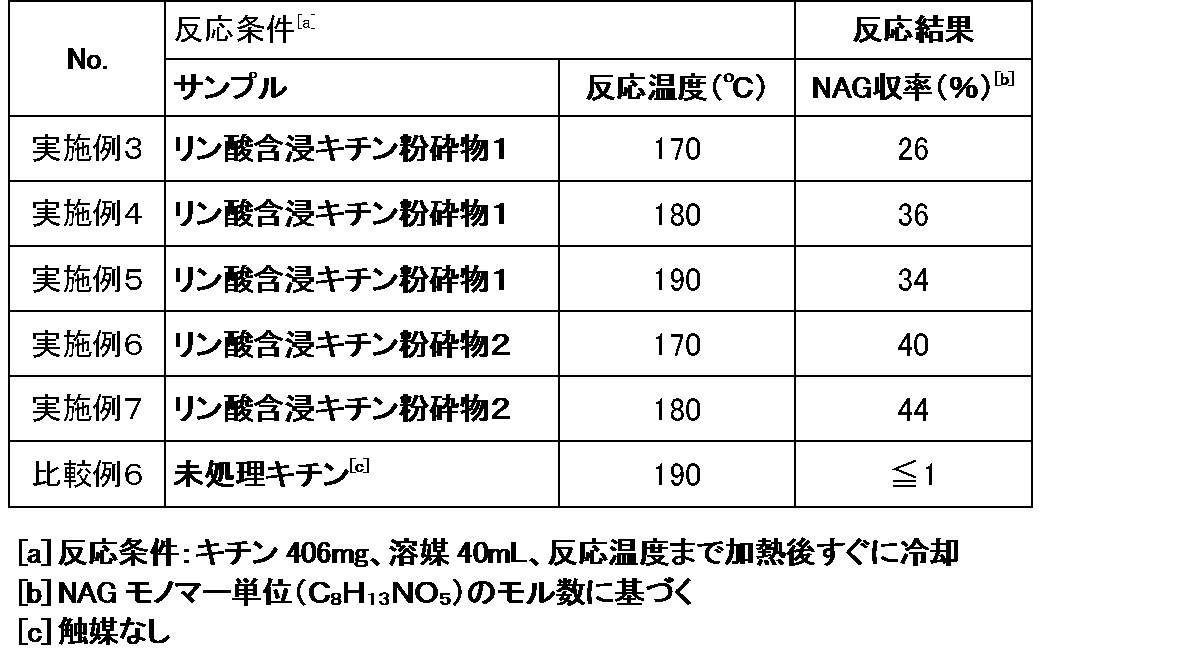
- NAG was hardly produced under the conditions in which untreated chitin was reacted at 190 ° C. (Comparative Example 6), whereas NAG yield of hydrolysis reaction of phosphoric acid-impregnated chitin pulverized product 1 having an S / C ratio of 2.0. Was 26% at 170 ° C. (Example 3), 36% at 180 ° C. (Example 4), and 34% at 190 ° C. (Example 5).
- the phosphoric acid-impregnated chitin pulverized product 2 having an S / C ratio of 1.0 it was 40% at 170 ° C. (Example 6) and 44% at 180 ° C. (Example 7).
- the NAG yield was generally higher in the phosphoric acid-impregnated chitin pulverized product 2, and it was confirmed that the temperature for obtaining the maximum NAG yield was 180 ° C.
- chitin oligomer, N-acetylglucosamine and 1-O-alkyl N-acetylglucosamine are obtained from chitin using a weak acid catalyst that is easy to handle and using less acid catalyst than existing production methods. Therefore, it is possible to efficiently produce at low cost with reduced environmental load, and to provide a highly functional material useful in the fields of medicine, cosmetics, food, agriculture and feed.
Landscapes
- Chemical & Material Sciences (AREA)
- Life Sciences & Earth Sciences (AREA)
- Health & Medical Sciences (AREA)
- Organic Chemistry (AREA)
- General Health & Medical Sciences (AREA)
- Engineering & Computer Science (AREA)
- Biochemistry (AREA)
- Molecular Biology (AREA)
- Chemical Kinetics & Catalysis (AREA)
- Medicinal Chemistry (AREA)
- Polymers & Plastics (AREA)
- Genetics & Genomics (AREA)
- Biotechnology (AREA)
- Materials Engineering (AREA)
- Environmental Sciences (AREA)
- Plant Pathology (AREA)
- Wood Science & Technology (AREA)
- Zoology (AREA)
- Pest Control & Pesticides (AREA)
- Agronomy & Crop Science (AREA)
- Dentistry (AREA)
- Sustainable Development (AREA)
- Toxicology (AREA)
- General Chemical & Material Sciences (AREA)
- Botany (AREA)
- Polysaccharides And Polysaccharide Derivatives (AREA)
- Saccharide Compounds (AREA)
Abstract
Description
例えば、加水分解生成物であるNAGが2~7個程度重合したキチンオリゴマーは、NAG取得のための前駆体として有用な成分であることに加え、抗腫瘍、免疫賦活、抗菌の作用(Trend Food Sci. Technol., 1999, 10, 37-51;非特許文献1)や、ビフィズス菌増殖による腸内環境調整作用、植物生体防御機構活性化作用であるエリシター活性が報告されており、医薬用素材、機能性食品、農業資材としても注目されている。特に近年の研究では、キチンオリゴマーに植物生体防御機構活性化作用であるエリシター活性が認められており、農業資材としての活用が望まれている。しかし、加水分解生成物に硫酸根等が残留している場合、農業資材とするためには精製が必要となる。そのため、長期にわたり耕地に散布しても悪影響が生じない素材が求められている。
このように現在開発されている酸を用いる製造方法は、いずれも取扱いにくい強酸を大量に用いるため、環境負荷とコストがかかるという問題がある。
[1] キチン含有バイオマスを、リン酸、亜硝酸及び有機酸から選択される酸触媒と水の共存下で粉砕装置を用い粉砕しながら部分加水分解することを特徴とするキチンオリゴマーの製造方法。
[2] 前記酸触媒がリン酸である前項1に記載のキチンオリゴマーの製造方法。
[3] 前記酸触媒のモル数(C)に対するキチン中のN-アセチルグルコサミン単位(C8H13NО5)のモル数(S)の比(S/C)が0.2~20である前項2に記載のキチンオリゴマーの製造方法。
[4] 予め酸触媒を含浸させたキチン含有バイオマスを水の存在下で粉砕する前項1~3のいずれかに記載のキチンオリゴマーの製造方法。
[5] 酸触媒を溶解した溶媒とキチン含有バイオマスを混合し、その後溶媒を除去して酸触媒をキチン含有バイオマスに含浸させ、得られた酸触媒を含浸させたキチン含有バイオマスを水の存在下で粉砕する前項4に記載のキチンオリゴマーの製造方法。
[6] 前記溶媒が、キチン含有バイオマスを変性させず、酸触媒活性を阻害せず、かつ加熱あるいは蒸留で除去できるものである前項5に記載のキチンオリゴマーの製造方法。
[7] 前記溶媒が、水、ジエチルエーテル、ヘキサン、及びベンゼンから選択される前項6に記載のキチンオリゴマーの製造方法。
[8] 粉砕装置がボールミルである前項1~7のいずれかに記載のキチンオリゴマーの製造方法。
[9] ボールミルが、遊星ボールミルまたは転動ボールミルである前項8に記載のキチンオリゴマーの製造方法。
[10] 前項1~9のいずれかに記載の方法により得られたキチンオリゴマーに水を加えて加熱し加水分解することを特徴とするN-アセチルグルコサミンの製造方法。
[11] 加熱温度が100~260℃である請求項10に記載のN-アセチルグルコサミンの製造方法。
[12] 前項1~9のいずれかに記載の方法により得られたキチンオリゴマーにアルコールを加えて加アルコール分解することを特徴とする1-O-アルキル-N-アセチルグルコサミンの製造方法。
[13] アルコールが1価アルコールである前項12に記載の1-O-アルキル-N-アセチルグルコサミンの製造方法。
[14] 前記アルコールがメタノールであり、前記1-O-アルキル-N-アセチルグルコサミンが1-O-メチル-N-アセチルグルコサミンである前項12または13に記載の1-O-アルキル-N-アセチルグルコサミンの製造方法。
[15] 加熱温度が120~280℃である前項12~14のいずれかに記載の1-O-アルキル-N-アセチルグルコサミンの製造方法。
バイオマスとは一般的には「再生可能な生物由来の有機性資源で化石資源を除いたもの」を指すが、本発明で使用する「キチン含有バイオマス」(以下、固体基質ということがある。)は、例えば、エビ、カニなどの甲殻類、節足動物、昆虫類、イカ、貝、沖アミなどの殻や表皮、キノコなどの菌類の細胞壁など主にキチンを含むバイオマスである。
キチン含有バイオマスは、不純物として原料由来のタンパク質、リン酸、鉄、銅、亜鉛、モリブデン、珪素、アルミニウム、カルシウム、マグネシウム、カリウム、ナトリウムなどを含有するものでもかまわない。
本発明において用いる酸触媒は、キチンを加水分解できる触媒であれば特に限定されるものではなく、例えば、主成分であるキチンの主鎖を形成しているβ-1,4グリコシド結合を加水分解する活性を有する触媒が好ましい。
固体基質の部分加水分解は、基質に酸触媒を含浸させた後、粉砕による機械応力を掛けることにより行う。なお部分加水分解とは、キチンの解重合生成物の大部分が水溶性のオリゴマー単位に留まり、モノマー単位まで達する解重合が少ない加水分解反応のことを言う。
酸触媒を含浸した固体基質を粉砕することにより、部分加水分解を実現することができる。ここで粉砕により固体基質が微粉化されることによる効果としては、含浸した酸触媒のより均一な拡散、比表面積増大に伴う物理応力の伝達効率の向上、キチンのアモルファス化による固体基質の加水分解性の向上が考えられる。
本発明の目的である、主鎖のグリコシド結合の選択的な加水分解の実現の観点からは、用いる粉砕装置は、固体基質に圧縮力が強く加わり、主鎖の両方向に引っ張り応力が加えられるボールミルが好ましく、遊星ボールミル、転動ボールミルがより好ましく、遊星ボールミルが最も好ましい。
粉砕処理の時間は、固体基質の部分加水分解が進み、水溶性になるのであれば、特に限定されるものではない。処理終点を見極めるために、経時的に取得したサンプルの水溶性を確認することが好ましい。
方法2の加水分解反応、及び方法3の加アルコール分解反応では、いずれも方法1の部分加水分解で得られた反応生成物を原料として用いることができる。実際には、原料を溶媒(水またはアルコール)に溶解した後、加熱して反応を行う。方法2では溶媒に水を使用し、キチンオリゴマーからNAGが製造される。方法3では溶媒にアルコールを使用し、キチンオリゴマーからNAG誘導体である1-O-アルキル-N-アセチルグルコサミンが製造される。
方法3で使用する溶媒には、メタノール、エタノール、1-プロパノール、2-プロパノール、1-ブタノール、2-ブタノール、2メチル-1プロパノール、2-メチル-2-プロパノールなどの1価アルコールが好ましい。原料を溶解させて反応の効率や均一性を得るという観点から、溶媒は、メタノール、エタノールがより好ましく、メタノールが最も好ましい。
カニ殻を乾燥、粉砕し、高温の希水酸化ナトリウム水溶液と室温の希塩酸水溶液にそれぞれ数時間浸漬することにより、タンパク質、炭酸カルシウムを除去して精製したキチンを用いた。
比較例1:未処理キチン
精製したキチン(平均粒径73μm)をそのまま用いた。このサンプルを未処理キチンとする。
未処理キチン(平均粒径73μm)10g(NAG単位として49.2mmol)をリン酸2.4g(24.6mmol、S/C比2.0)を含む水30mLに分散させた後、減圧を乾燥して、含水率2.5質量%の粉末を得た。このサンプルをリン酸含浸キチン1とする。
未処理キチン(平均粒径73μm)10g(NAG単位として49.2mmol)をリン酸の量を4.8g(49.2mmol、S/C比1.0)を含む水30mLに分散させた後、減圧を乾燥して、含水率4.5質量%の粉末を得た。このサンプルをリン酸含浸キチン2とする。
未処理キチン(平均粒径73μm)5.0gを直径5mmのアルミナボール100gと共に容量250mLのアルミナポットに入れた。このポットを遊星ボールミル(フリッチュ社製、PULVERISETTE(登録商標)6)にセットして500rpmで連続6時間処理した。その結果、4.2質量%の物理吸着水を含有する粉末を得た。このサンプルをキチン粉砕物(平均粒径42μm)とする。
5gの硫酸含浸キチン1を、直径5mmのアルミナボール100gと共に容量250mLのアルミナポットに入れた。このポットを遊星ボールミル(フリッチュ社製、PULVERISETTE6)にセットして500rpmで連続6時間処理した。その結果、3.1質量%の物理吸着水を含有する粉末を得た。このサンプルをリン酸含浸キチン粉砕物1とする。
5gの硫酸含浸キチン2を、直径5mmのアルミナボール100gと共に容量250mLのアルミナポットに入れた。このポットを遊星ボールミル(フリッチュ、PULVERISETTE6)にセットして500rpmで連続6時間処理した。その結果、5.3質量%の物理吸着水を含有する粉末を得た。このサンプルをリン酸含浸キチン粉砕物2とする。
キチン(平均粒径73μm)10.0g(NAG単位として49.2mmol)を硫酸2.4g(24.6mmol、S/C比2.0)を含む水30mLに分散させた後、減圧乾燥して取得した粉末を5g分取し、直径5mmのアルミナボール100gと共に容量250mLのアルミナポットに入れた。このポットを遊星ボールミル(フリッチュ、PULVERISETTE6)にセットして500rpmで連続6時間処理した。その結果、3.1質量%の物理吸着水を含有する粉末を得た。このサンプルを硫酸含浸キチン粉砕物とする。
実施例1~2及び比較例1~5の各サンプル100mgを秤量して、蒸留水50mLに添加し振とうした後、10分間の超音波処理を行い、可溶分を溶解させた。一連の処理は温度25℃で行い、得られた懸濁液は、0.1μmのポリテトラフルオロエチレン(PTFE)のフィルターでろ過して、固体残渣はさらに5mLの蒸留水でろ過洗浄し、110℃のオーブンに入れて一晩乾燥した後、質量を測定し、以下の計算式で溶解度を算出した。

一方、酸含浸したキチンを酸存在下でボールミル粉砕したリン酸含浸キチン粉砕物(実施例1~2)及び硫酸含浸キチン粉砕物(比較例5)は、いずれも99%の溶解度を示し殆ど溶解した。
これらの結果より、酸触媒の添加や遊星ボールミル粉砕の単一処理では、キチンを可溶化する効果は殆どなかったが、酸存在下で機械的応力付与する粉砕処理を実施することにより格段の相乗効果が得られ、キチンの可溶化を大幅に促進することが確認された。
さらに、強酸である硫酸の代わりに、危険性が強酸より低く、環境負荷が高い弱酸であるリン酸を使用しても遊星ボールミルによりキチンを可溶化させることが確認された。
なお、比較例2及び比較例3において、可溶化率と生成物の合計収率が逆転しているのは、キチンに担持されたリン酸が洗浄で完全に除かれず、見かけ上の可溶化率が低くなったためであると考えられる。
実施例1~2及び比較例1~5の各サンプルの水懸濁液ろ液を、高速液体クロマトグラフ(装置:島津製作所製LC-10ATVP、カラム:Phenomenex(登録商標) Synergi 4μm Hydro-RP 80Å φ4.6×250mm、移動相:40mMリン酸カリウム緩衝液、pH2.9、0.8mL/分、30℃、検出:示差屈折率)により酢酸を定量分析した。その結果、いずれのサンプルも酢酸は検出されなかった。
これにより、酸触媒共存下のボールミル粉砕によるキチンの部分加水分解では、キチンを構成するNAGユニットのC2位にあるアセトアミド基(-NHCOCH3)のアミド結合は保持され、NAGユニット同士を繋ぐグリコシド結合が選択的に切断されることが示唆された。これは、少量の酸触媒が共存し加水分解しやすい系において、ボールミル粉砕による機械的応力がキチンを押しつぶして重合の両方向に引き伸ばす作用、すなわち主鎖を形成するグリコシド結合を引っ張る作用を及ぼすことにより、従来の酸添加のみで行う加水分解では得られなかったグリコシド結合の選択的な加水分解を加速させる相乗効果が得られるものと推測される(図1参照)。
実施例1~2及び比較例2~5の各サンプルの水懸濁液ろ液をHPLC(高速液体クロマトグラフ)(装置:島津製作所製LC-10ATVP、カラム:Phenomenex Rezex RPM-Monosaccharide Pb++ φ7.8×300mm、移動相:水、0.6mL/分、70℃、検出:示差屈折率)で分析し、NAG及びオリゴ糖(重合度2~8)の収率を以下の計算式により算出した。

一方、酸存在下でボールミル粉砕したサンプルは、リン酸含浸粉砕キチン1(実施例1)はNAG3.3%、オリゴ糖70%、リン酸含浸キチン2(実施例2)はNAG5.1%、オリゴ糖61%、硫酸含浸粉砕キチン(比較例5)はNAG10.0%、オリゴ糖60%となり高いオリゴマー収率を示した。この結果より、リン酸、硫酸のいずれを用いても、酸含侵キチンを粉砕することにより、収率よくキチンオリゴマーを得られることが確認できた。また、得られたキチンオリゴマーは植物生体防御機構活性化作用が報告されており農業資材としての用途が期待される物質である。農業資材の用途を考えた場合、硫酸を使用して製造したキチンオリゴマーを長期的に散布すると、硫酸根の蓄積による酸性土化のリスクがあるため、精製の工程が必要となる。一方、リン酸を使用して製造したキチンオリゴマーでは、含有するリン酸根が植物の栄養源として活用されるため、精製を行わずに畑などへの散布ができる可能性があり、その経済的なメリットも大きいと言える。

実施例3~7及び比較例6:
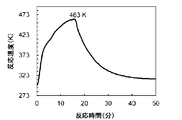
表2に記載した各サンプルをキチンとして406mg分(NAG単位として2mmol)と、水40mLを、高圧反応器(内容積100mL,オーエムラボテック(株)製オートクレーブ,ハステロイ(登録商標)C22製)に入れた後、600rpmで撹拌しながら室温から表2に記載した反応温度まで約16分加熱した。反応温度に到達した時点で加熱を止め、反応器を風冷し、冷却後、反応液を遠心分離装置により液体と固体に分離して上清サンプルの分析を行った。反応温度190℃の場合の温度プロファイルは図2に示す通りである。

Claims (15)
- キチン含有バイオマスを、リン酸、亜硝酸及び有機酸から選択される酸触媒と水の共存下で粉砕装置を用い粉砕しながら部分加水分解することを特徴とするキチンオリゴマーの製造方法。
- 前記酸触媒がリン酸である請求項1に記載のキチンオリゴマーの製造方法。
- 前記酸触媒のモル数(C)に対するキチン中のN-アセチルグルコサミン単位(C8H13NО5)のモル数(S)の比(S/C)が0.2~20である請求項2に記載のキチンオリゴマーの製造方法。
- 予め酸触媒を含浸させたキチン含有バイオマスを水の存在下で粉砕する請求項1~3のいずれかに記載のキチンオリゴマーの製造方法。
- 酸触媒を溶解した溶媒とキチン含有バイオマスを混合し、その後溶媒を除去して酸触媒をキチン含有バイオマスに含浸させ、得られた酸触媒を含浸させたキチン含有バイオマスを水の存在下で粉砕する請求項4に記載のキチンオリゴマーの製造方法。
- 前記溶媒が、キチン含有バイオマスを変性させず、酸触媒活性を阻害せず、かつ加熱あるいは蒸留で除去できるものである請求項5に記載のキチンオリゴマーの製造方法。
- 前記溶媒が、水、ジエチルエーテル、ヘキサン、及びベンゼンから選択される請求項6に記載のキチンオリゴマーの製造方法。
- 粉砕装置がボールミルである請求項1~7のいずれかに記載のキチンオリゴマーの製造方法。
- ボールミルが、遊星ボールミルまたは転動ボールミルである請求項8に記載のキチンオリゴマーの製造方法。
- 請求項1~9のいずれかに記載の方法により得られたキチンオリゴマーに水を加えて加熱し加水分解することを特徴とするN-アセチルグルコサミンの製造方法。
- 加熱温度が100~260℃である請求項10に記載のN-アセチルグルコサミンの製造方法。
- 請求項1~9のいずれかに記載の方法により得られたキチンオリゴマーにアルコールを加えて加アルコール分解することを特徴とする1-O-アルキル-N-アセチルグルコサミンの製造方法。
- アルコールが1価アルコールである請求項12に記載の1-O-アルキル-N-アセチルグルコサミンの製造方法。
- 前記アルコールがメタノールであり、前記1-O-アルキル-N-アセチルグルコサミンが1-O-メチル-N-アセチルグルコサミンである請求項12または13に記載の製造方法。
- 加熱温度が120~280℃である請求項12~14のいずれかに記載の1-O-アルキル-N-アセチルグルコサミンの製造方法。
Priority Applications (6)
| Application Number | Priority Date | Filing Date | Title |
|---|---|---|---|
| JP2018514109A JP7107502B2 (ja) | 2016-04-27 | 2017-01-19 | キチンオリゴマー、n-アセチルグルコサミン及び1-o-アルキル-n-アセチルグルコサミンの製造方法 |
| US16/096,857 US11603447B2 (en) | 2016-04-27 | 2017-01-19 | Methods for producing chitin oligomer, N-acetylglucosamine, and 1-O-alkyl-N-acetylglucosamine |
| CN202410949884.9A CN118878715A (zh) | 2016-04-27 | 2017-01-19 | 几丁质低聚物、n-乙酰葡糖胺和1-o-烷基-n-乙酰葡糖胺的制造方法 |
| CN201780023927.9A CN109071683A (zh) | 2016-04-27 | 2017-01-19 | 几丁质低聚物、n-乙酰葡糖胺和1-o-烷基-n-乙酰葡糖胺的制造方法 |
| ES17788962T ES2843877T3 (es) | 2016-04-27 | 2017-01-19 | Métodos para producir oligómero de quitina, N-acetilglucosamina, y 1-O-alquil-N-acetilglucosamina |
| EP17788962.3A EP3450462B1 (en) | 2016-04-27 | 2017-01-19 | Methods for producing chitin oligomer, n-acetylglucosamine, and 1-o-alkyl-n-acetylglucosamine |
Applications Claiming Priority (2)
| Application Number | Priority Date | Filing Date | Title |
|---|---|---|---|
| JP2016089270 | 2016-04-27 | ||
| JP2016-089270 | 2016-04-27 |
Publications (1)
| Publication Number | Publication Date |
|---|---|
| WO2017187672A1 true WO2017187672A1 (ja) | 2017-11-02 |
Family
ID=60161454
Family Applications (1)
| Application Number | Title | Priority Date | Filing Date |
|---|---|---|---|
| PCT/JP2017/001740 Ceased WO2017187672A1 (ja) | 2016-04-27 | 2017-01-19 | キチンオリゴマー、n-アセチルグルコサミン及び1-o-アルキル-n-アセチルグルコサミンの製造方法 |
Country Status (6)
| Country | Link |
|---|---|
| US (1) | US11603447B2 (ja) |
| EP (1) | EP3450462B1 (ja) |
| JP (1) | JP7107502B2 (ja) |
| CN (2) | CN118878715A (ja) |
| ES (1) | ES2843877T3 (ja) |
| WO (1) | WO2017187672A1 (ja) |
Cited By (3)
| Publication number | Priority date | Publication date | Assignee | Title |
|---|---|---|---|---|
| WO2021140789A1 (ja) * | 2020-01-10 | 2021-07-15 | 国立大学法人北海道大学 | キチンの分解方法及びキチンオリゴ糖含有組成物の製造方法 |
| KR20220131294A (ko) | 2020-04-09 | 2022-09-27 | 쇼와 덴코 가부시키가이샤 | 비료의 제조 방법 |
| JP7659793B2 (ja) | 2020-01-28 | 2025-04-10 | 甲陽ケミカル株式会社 | キトサンオリゴ糖の分取方法 |
Families Citing this family (1)
| Publication number | Priority date | Publication date | Assignee | Title |
|---|---|---|---|---|
| CN110724311A (zh) * | 2019-10-14 | 2020-01-24 | 浙江海洋大学 | 一种利用南极磷虾壳制备可降解包装材料的方法 |
Citations (6)
| Publication number | Priority date | Publication date | Assignee | Title |
|---|---|---|---|---|
| JPS62138496A (ja) * | 1985-12-11 | 1987-06-22 | Ihara Chem Ind Co Ltd | キチンオリゴマ−の製造方法 |
| JPS63273493A (ja) * | 1987-04-30 | 1988-11-10 | Kyogyo Kumiai N F I | N−アセチル−d−グルコサミンの製造法 |
| JP2001002705A (ja) * | 1999-06-23 | 2001-01-09 | Nippon Suisan Kaisha Ltd | キチンオリゴマーの製造方法 |
| JP2002177000A (ja) * | 2000-12-15 | 2002-06-25 | Nippon Suisan Kaisha Ltd | キチンオリゴ糖製造方法 |
| JP2002282825A (ja) * | 2001-03-29 | 2002-10-02 | Japan Science & Technology Corp | キチン含有廃棄物の処理方法 |
| JP2003212902A (ja) * | 2002-01-25 | 2003-07-30 | Tottori Prefecture | キチン・キトサンの低分子化法 |
Family Cites Families (13)
| Publication number | Priority date | Publication date | Assignee | Title |
|---|---|---|---|---|
| CA524841A (en) * | 1956-05-08 | D. Brown William | Parachute equipment | |
| JPS63273943A (ja) * | 1987-05-06 | 1988-11-11 | Hitachi Ltd | 多重系制御装置 |
| JP2944723B2 (ja) * | 1990-08-23 | 1999-09-06 | 玉造株式会社 | 狭い分子量分布を有する2,5−アンヒドロマンニトール基を有するキチン・キトサンオリゴマーの製造方法 |
| JP2618299B2 (ja) | 1991-07-26 | 1997-06-11 | 新日本製鐵株式会社 | 通電加熱装置 |
| JP2002088093A (ja) | 2000-09-14 | 2002-03-27 | Eniwa Research Business Park Co Ltd | キチンオリゴ糖の製造方法 |
| US6486307B1 (en) * | 2001-08-23 | 2002-11-26 | Alberta Research Council Inc. | Preparation of glucosamine hydrochloride |
| JP4110243B2 (ja) | 2002-07-09 | 2008-07-02 | 特許技術開発株式会社 | N‐アセチルグルコサミンの製造方法 |
| CN100391981C (zh) * | 2005-12-16 | 2008-06-04 | 武汉大学 | 一种完全水溶的低分子量壳聚糖/壳寡糖的制备方法 |
| JP5447761B2 (ja) | 2007-03-14 | 2014-03-19 | 公立大学法人福井県立大学 | キチン・キトサンを分解する新種の微生物及びその利用方法 |
| JP5256509B2 (ja) | 2008-01-18 | 2013-08-07 | 甲陽ケミカル株式会社 | N−アセチルグルコサミンの製造方法、並びにその用途 |
| JP5426099B2 (ja) | 2008-02-14 | 2014-02-26 | 南海化学株式会社 | 天然型n−アセチルグルコサミンの製造方法 |
| GB0901466D0 (en) * | 2009-01-29 | 2009-03-11 | British American Tobacco Co | Smoking article dispenser |
| CN102786607B (zh) * | 2011-05-19 | 2015-01-07 | 浙江海洋学院 | 水溶性壳低聚糖的制备方法 |
-
2017
- 2017-01-19 CN CN202410949884.9A patent/CN118878715A/zh active Pending
- 2017-01-19 JP JP2018514109A patent/JP7107502B2/ja active Active
- 2017-01-19 CN CN201780023927.9A patent/CN109071683A/zh active Pending
- 2017-01-19 ES ES17788962T patent/ES2843877T3/es active Active
- 2017-01-19 EP EP17788962.3A patent/EP3450462B1/en active Active
- 2017-01-19 US US16/096,857 patent/US11603447B2/en active Active
- 2017-01-19 WO PCT/JP2017/001740 patent/WO2017187672A1/ja not_active Ceased
Patent Citations (6)
| Publication number | Priority date | Publication date | Assignee | Title |
|---|---|---|---|---|
| JPS62138496A (ja) * | 1985-12-11 | 1987-06-22 | Ihara Chem Ind Co Ltd | キチンオリゴマ−の製造方法 |
| JPS63273493A (ja) * | 1987-04-30 | 1988-11-10 | Kyogyo Kumiai N F I | N−アセチル−d−グルコサミンの製造法 |
| JP2001002705A (ja) * | 1999-06-23 | 2001-01-09 | Nippon Suisan Kaisha Ltd | キチンオリゴマーの製造方法 |
| JP2002177000A (ja) * | 2000-12-15 | 2002-06-25 | Nippon Suisan Kaisha Ltd | キチンオリゴ糖製造方法 |
| JP2002282825A (ja) * | 2001-03-29 | 2002-10-02 | Japan Science & Technology Corp | キチン含有廃棄物の処理方法 |
| JP2003212902A (ja) * | 2002-01-25 | 2003-07-30 | Tottori Prefecture | キチン・キトサンの低分子化法 |
Non-Patent Citations (2)
| Title |
|---|
| HIROKAZU KOBAYASHI ET AL.: "Acetyl-ki o Hoji shita Chitin no Shokubaiteki Kaijugo = [Catalytic depolymerization of chitin bearing an acetyl group]", SHOKUBAI TORONKAI TORONKAI A YOKOSHU, vol. 118, 2016, pages 147, XP009513891, ISSN: 1343-9936 * |
| See also references of EP3450462A4 * |
Cited By (4)
| Publication number | Priority date | Publication date | Assignee | Title |
|---|---|---|---|---|
| WO2021140789A1 (ja) * | 2020-01-10 | 2021-07-15 | 国立大学法人北海道大学 | キチンの分解方法及びキチンオリゴ糖含有組成物の製造方法 |
| JP7659793B2 (ja) | 2020-01-28 | 2025-04-10 | 甲陽ケミカル株式会社 | キトサンオリゴ糖の分取方法 |
| KR20220131294A (ko) | 2020-04-09 | 2022-09-27 | 쇼와 덴코 가부시키가이샤 | 비료의 제조 방법 |
| US12565457B2 (en) | 2020-04-09 | 2026-03-03 | Resonac Corporation | Method for manufacturing fertilizer |
Also Published As
| Publication number | Publication date |
|---|---|
| CN109071683A (zh) | 2018-12-21 |
| CN118878715A (zh) | 2024-11-01 |
| EP3450462A1 (en) | 2019-03-06 |
| EP3450462B1 (en) | 2020-11-25 |
| EP3450462A4 (en) | 2019-12-25 |
| JPWO2017187672A1 (ja) | 2019-02-28 |
| US20190136008A1 (en) | 2019-05-09 |
| JP7107502B2 (ja) | 2022-07-27 |
| US11603447B2 (en) | 2023-03-14 |
| ES2843877T3 (es) | 2021-07-20 |
Similar Documents
| Publication | Publication Date | Title |
|---|---|---|
| JP7107502B2 (ja) | キチンオリゴマー、n-アセチルグルコサミン及び1-o-アルキル-n-アセチルグルコサミンの製造方法 | |
| JP6745510B2 (ja) | キチンオリゴマー、n−アセチルグルコサミン及び1−o−アルキル−n−アセチルグルコサミンの製造方法 | |
| KR101757776B1 (ko) | 해조류로부터 추출된 후코이단을 이용한 필름의 제조방법 | |
| JP7816138B2 (ja) | 肥料の製造方法 | |
| CN104744603A (zh) | 以担子菌为原料的含有β-葡聚糖的组合物的制备方法 | |
| JP7703185B2 (ja) | キチンの分解方法及びキチンオリゴ糖含有組成物の製造方法 | |
| JP2006037016A (ja) | 鹿角霊芝からのβ−グルカン抽出法 | |
| KR100396833B1 (ko) | 바실러스 속 에이치에스비-21 균주가 생산하는키토산아제를 이용한 키토산 올리고당의 제조방법 | |
| US20250163188A1 (en) | Method of extraction of chitin from biomass | |
| JP4140741B2 (ja) | 乾燥キチン粉末又は乾燥キトサン粉末の製造方法 | |
| JP7631954B2 (ja) | セロオリゴ糖含有組成物の製造方法及びセロオリゴ糖含有組成物 | |
| WO2017169311A1 (ja) | ネポジン高含有ギシギシ抽出物の製造方法及びネポジン高含有ギシギシ抽出物 | |
| Islam et al. | Preparation of glucosamine hydrochloride from indigenous shrimp processing waste | |
| US20190127494A1 (en) | Method for Obtaining at Least One or More Beta-Glucan Compounds or a Solids Suspension Containing Beta Glucan from Yeast Cells | |
| JPS6121102A (ja) | キトサンオリゴ糖の製造法 | |
| KR101484095B1 (ko) | 기계화학적 분쇄를 이용한 게 분말 제조방법 | |
| KR20120119944A (ko) | 나노입자화된 키틴과 키토산을 이용하는 키토올리고당과 키토산올리고당의 효소적 제조 방법 | |
| KR20130135236A (ko) | 투여형으로부터의 활성 성분의 방출을 제어하는 방법 | |
| JP2005029770A (ja) | 植物性キトサンの製造法 | |
| Segaran et al. | Combined microwave-assisted subcritical liquid extraction of chitosan from crab shell waste | |
| CN105473727A (zh) | 粉末状神经酰胺的制备方法 | |
| WO2024072249A1 (en) | Production process for high average molecular weight chitosan biopolymers | |
| KR20040018890A (ko) | 분말형태의 키틴올리고당의 제조방법 및 이를 포함하는간기능 개선 식품 조성물 | |
| Mukherjee et al. | The first evidence of cryo-milling improving enzymatic production of chitooligosaccharides from chitin biomass | |
| Minh¹ et al. | Preparation, properties, and application of low-molecular |
Legal Events
| Date | Code | Title | Description |
|---|---|---|---|
| WWE | Wipo information: entry into national phase |
Ref document number: 2018514109 Country of ref document: JP |
|
| NENP | Non-entry into the national phase |
Ref country code: DE |
|
| WWE | Wipo information: entry into national phase |
Ref document number: 2017788962 Country of ref document: EP |
|
| 121 | Ep: the epo has been informed by wipo that ep was designated in this application |
Ref document number: 17788962 Country of ref document: EP Kind code of ref document: A1 |
|
| ENP | Entry into the national phase |
Ref document number: 2017788962 Country of ref document: EP Effective date: 20181127 |