WO2017183549A1 - 新規テトラチアスピロ化合物、それを含む光学用組成物、及びその製造方法 - Google Patents
新規テトラチアスピロ化合物、それを含む光学用組成物、及びその製造方法 Download PDFInfo
- Publication number
- WO2017183549A1 WO2017183549A1 PCT/JP2017/015094 JP2017015094W WO2017183549A1 WO 2017183549 A1 WO2017183549 A1 WO 2017183549A1 JP 2017015094 W JP2017015094 W JP 2017015094W WO 2017183549 A1 WO2017183549 A1 WO 2017183549A1
- Authority
- WO
- WIPO (PCT)
- Prior art keywords
- compound
- formula
- group
- tetrathiaspiro
- composition
- Prior art date
- Legal status (The legal status is an assumption and is not a legal conclusion. Google has not performed a legal analysis and makes no representation as to the accuracy of the status listed.)
- Ceased
Links
Images

Classifications
-
- B—PERFORMING OPERATIONS; TRANSPORTING
- B01—PHYSICAL OR CHEMICAL PROCESSES OR APPARATUS IN GENERAL
- B01J—CHEMICAL OR PHYSICAL PROCESSES, e.g. CATALYSIS OR COLLOID CHEMISTRY; THEIR RELEVANT APPARATUS
- B01J27/00—Catalysts comprising the elements or compounds of halogens, sulfur, selenium, tellurium, phosphorus or nitrogen; Catalysts comprising carbon compounds
- B01J27/06—Halogens; Compounds thereof
- B01J27/08—Halides
-
- B—PERFORMING OPERATIONS; TRANSPORTING
- B01—PHYSICAL OR CHEMICAL PROCESSES OR APPARATUS IN GENERAL
- B01J—CHEMICAL OR PHYSICAL PROCESSES, e.g. CATALYSIS OR COLLOID CHEMISTRY; THEIR RELEVANT APPARATUS
- B01J27/00—Catalysts comprising the elements or compounds of halogens, sulfur, selenium, tellurium, phosphorus or nitrogen; Catalysts comprising carbon compounds
- B01J27/06—Halogens; Compounds thereof
- B01J27/08—Halides
- B01J27/10—Chlorides
-
- B—PERFORMING OPERATIONS; TRANSPORTING
- B01—PHYSICAL OR CHEMICAL PROCESSES OR APPARATUS IN GENERAL
- B01J—CHEMICAL OR PHYSICAL PROCESSES, e.g. CATALYSIS OR COLLOID CHEMISTRY; THEIR RELEVANT APPARATUS
- B01J31/00—Catalysts comprising hydrides, coordination complexes or organic compounds
- B01J31/02—Catalysts comprising hydrides, coordination complexes or organic compounds containing organic compounds or metal hydrides
- B01J31/12—Catalysts comprising hydrides, coordination complexes or organic compounds containing organic compounds or metal hydrides containing organo-metallic compounds or metal hydrides
-
- C—CHEMISTRY; METALLURGY
- C07—ORGANIC CHEMISTRY
- C07D—HETEROCYCLIC COMPOUNDS
- C07D495/00—Heterocyclic compounds containing in the condensed system at least one hetero ring having sulfur atoms as the only ring hetero atoms
- C07D495/02—Heterocyclic compounds containing in the condensed system at least one hetero ring having sulfur atoms as the only ring hetero atoms in which the condensed system contains two hetero rings
- C07D495/10—Spiro-condensed systems
-
- C—CHEMISTRY; METALLURGY
- C08—ORGANIC MACROMOLECULAR COMPOUNDS; THEIR PREPARATION OR CHEMICAL WORKING-UP; COMPOSITIONS BASED THEREON
- C08F—MACROMOLECULAR COMPOUNDS OBTAINED BY REACTIONS ONLY INVOLVING CARBON-TO-CARBON UNSATURATED BONDS
- C08F12/00—Homopolymers and copolymers of compounds having one or more unsaturated aliphatic radicals, each having only one carbon-to-carbon double bond, and at least one being terminated by an aromatic carbocyclic ring
- C08F12/02—Monomers containing only one unsaturated aliphatic radical
- C08F12/04—Monomers containing only one unsaturated aliphatic radical containing one ring
- C08F12/14—Monomers containing only one unsaturated aliphatic radical containing one ring substituted by hetero atoms or groups containing heteroatoms
- C08F12/30—Sulfur
-
- C—CHEMISTRY; METALLURGY
- C08—ORGANIC MACROMOLECULAR COMPOUNDS; THEIR PREPARATION OR CHEMICAL WORKING-UP; COMPOSITIONS BASED THEREON
- C08F—MACROMOLECULAR COMPOUNDS OBTAINED BY REACTIONS ONLY INVOLVING CARBON-TO-CARBON UNSATURATED BONDS
- C08F16/00—Homopolymers and copolymers of compounds having one or more unsaturated aliphatic radicals, each having only one carbon-to-carbon double bond, and at least one being terminated by an alcohol, ether, aldehydo, ketonic, acetal or ketal radical
- C08F16/12—Homopolymers and copolymers of compounds having one or more unsaturated aliphatic radicals, each having only one carbon-to-carbon double bond, and at least one being terminated by an alcohol, ether, aldehydo, ketonic, acetal or ketal radical by an ether radical
- C08F16/14—Monomers containing only one unsaturated aliphatic radical
- C08F16/30—Monomers containing sulfur
-
- C—CHEMISTRY; METALLURGY
- C08—ORGANIC MACROMOLECULAR COMPOUNDS; THEIR PREPARATION OR CHEMICAL WORKING-UP; COMPOSITIONS BASED THEREON
- C08F—MACROMOLECULAR COMPOUNDS OBTAINED BY REACTIONS ONLY INVOLVING CARBON-TO-CARBON UNSATURATED BONDS
- C08F20/00—Homopolymers and copolymers of compounds having one or more unsaturated aliphatic radicals, each having only one carbon-to-carbon double bond, and only one being terminated by only one carboxyl radical or a salt, anhydride, ester, amide, imide or nitrile thereof
- C08F20/02—Monocarboxylic acids having less than ten carbon atoms, Derivatives thereof
- C08F20/10—Esters
- C08F20/38—Esters containing sulfur
-
- C—CHEMISTRY; METALLURGY
- C08—ORGANIC MACROMOLECULAR COMPOUNDS; THEIR PREPARATION OR CHEMICAL WORKING-UP; COMPOSITIONS BASED THEREON
- C08F—MACROMOLECULAR COMPOUNDS OBTAINED BY REACTIONS ONLY INVOLVING CARBON-TO-CARBON UNSATURATED BONDS
- C08F28/00—Homopolymers and copolymers of compounds having one or more unsaturated aliphatic radicals, each having only one carbon-to-carbon double bond, and at least one being terminated by a bond to sulfur or by a heterocyclic ring containing sulfur
- C08F28/02—Homopolymers and copolymers of compounds having one or more unsaturated aliphatic radicals, each having only one carbon-to-carbon double bond, and at least one being terminated by a bond to sulfur or by a heterocyclic ring containing sulfur by a bond to sulfur
- C08F28/04—Thioethers
-
- G—PHYSICS
- G02—OPTICS
- G02B—OPTICAL ELEMENTS, SYSTEMS OR APPARATUS
- G02B1/00—Optical elements characterised by the material of which they are made; Optical coatings for optical elements
- G02B1/04—Optical elements characterised by the material of which they are made; Optical coatings for optical elements made of organic materials, e.g. plastics
-
- G—PHYSICS
- G02—OPTICS
- G02C—SPECTACLES; SUNGLASSES OR GOGGLES INSOFAR AS THEY HAVE THE SAME FEATURES AS SPECTACLES; CONTACT LENSES
- G02C7/00—Optical parts
-
- C—CHEMISTRY; METALLURGY
- C07—ORGANIC CHEMISTRY
- C07B—GENERAL METHODS OF ORGANIC CHEMISTRY; APPARATUS THEREFOR
- C07B61/00—Other general methods
Definitions
- the present invention relates to a novel tetrathiaspiro compound, a composition for optical materials containing the same, and a method for producing the same. More specifically, the present invention relates to a novel tetrathiaspiro compound suitably used for optical materials such as optical adhesives, prisms and coating agents, a composition for optical materials containing the same, and a method for producing the same.
- Plastic materials are widely used in various optical materials such as eyeglass lenses, camera lenses, optical adhesives, prisms, and coating agents because they are lightweight and rich in toughness and excellent in dyeing and workability.
- the performance required particularly for optical materials, especially lenses is low specific gravity, high transparency and low yellowness, high heat resistance, high strength, etc. as physical properties, and high refractive index and high Abbe as optical performance. Is a number.
- a high refractive index enables the lens to be thinned, and a high Abbe number reduces the chromatic aberration of the lens.
- the Abbe number generally decreases as the refractive index increases, studies are being made to improve both simultaneously.
- the most typical method is a method using a resin containing sulfur, such as a sulfide resin.
- the sulfide-based resin is obtained by polymerizing a polymerizable composition containing an episulfide compound, and has recently been actively studied as a material that can achieve both a high refractive index and a high Abbe number.
- Patent Documents 1, 2, etc. A compound having a spiro skeleton has been reported as a monomer of other resin containing sulfur that can achieve a preferable high refractive index.
- Spirocyclic compounds are attracting attention as being useful for the production of optical plastic materials such as optical adhesives, prisms, and coating agents in addition to lenses because of their high refractive index and excellent transparency.
- Patent Document 1 discloses a sulfur-containing compound having a spiro skeleton and a (meth) acryloyl group that can be used as a monomer of an optical material.
- Patent Document 2 discloses a monomer compound of spirotetrathiocarbamate and spirooxothiocarbamate having a refractive index suitable for the production of optical plastics.
- Patent Document 1 a sulfur-containing compound is obtained by reacting a compound having a thiol at both ends with tetramethylthiomethane to obtain an intermediate having a spiro skeleton, and then introducing a (meth) acryloyl group at the terminal. It is manufactured by a process. Further, the method and reaction system of Patent Document 2 have a problem that the selectivity of the target compound is low. Therefore, a compound that can be used as a monomer for forming an optical material and that can be produced with high selectivity, easier and fewer steps, and a method for producing the same are desired.
- an object of the present invention is to provide a novel spirocyclic compound which is a polymerizable compound as a monomer and can be produced with an improved selectivity and a simple and small number of steps, and a production method thereof.
- the present invention is as follows.
- a method for producing a tetrathiaspiro compound represented by the following formula (1), Production comprising reacting a trithiocarbonate compound represented by the following formula (A) with an episulfide compound represented by the following formula (B) in the presence of a zinc compound catalyst represented by the following formula (C)
- Method: (In Formula (1), Formula (A) and (B), X a and X b each independently represent O or S;
- R 1a is selected from the group consisting of —CO—, — (CO—O) q — (CH 2 ) p —, or — (CH 2 ) r —Ar— (CH 2 ) p —
- R 1b is selected from the group consisting of —CO—, — (CH 2 ) p — (O—CO) q —, or — (CH 2 ) p —Ar— (CH 2 ) r —
- Ar is optionally substituted with 1 to 4 substituents independently selected from
- Y is selected from the group consisting of a halogen atom or NTf 2 ; Tf represents trifluoromethylsulfonyl.
- the zinc compound catalyst comprises ZnI 2, the production method according to [1] or [2].
- Tetrathiaspiro compound represented by the following formula (1): (Where X a and X b each independently represent O or S; R 1a is selected from the group consisting of —CO—, — (CO—O) q — (CH 2 ) p —, or — (CH 2 ) r —Ar— (CH 2 ) p —, R 1b is selected from the group consisting of —CO—, — (CH 2 ) p — (O—CO) q —, or — (CH 2 ) p —Ar— (CH 2 ) r —, Ar is optionally substituted with 1 to 4 substituents independently selected from the group consisting of alkyl having 1 to 4 carbon atoms, chlorine, bromine, iodine, alkylthio having 1 to 4 carbon atoms, and cyano.
- a composition for optical materials comprising the tetrathiaspiro compound according to any of [6] to [8] and a polythiol compound.
- a method for producing a cured product comprising curing the polymerization curable composition containing the composition for optical materials according to [10] and a polymerization catalyst by irradiation with ultraviolet rays or visible light.
- An optical material obtained by curing a polymerization curable composition comprising the composition for optical materials according to [10] and a polymerization catalyst.
- a polymerizable tetrathiaspiro compound that can be polymerized as a monomer can be produced with improved selectivity and a simple and small number of steps.
- the tetrathiaspiro compound of the present invention may have at least one improved characteristic selected from high refractive index, high transparency, excellent flexibility, excellent adhesion, and photopolymerization curability.
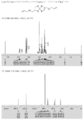
- FIG. 2 is a chart showing a 1 H and 13 C NMR chart of the compound 111 produced in Example 1-1.
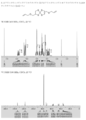
- FIG. 2 is a chart showing a 1 H and 13 C NMR chart of the compound 112 produced in Example 1-2.
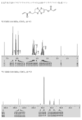
- FIG. 2 is a chart showing a 1 H and 13 C NMR chart of the compound 113 produced in Example 1-3.
- FIG. 2 is a chart showing a 1 H and 13 C NMR chart of the compound 141 produced in Example 1-4.
- One embodiment of the present invention provides a method for producing a tetrathiaspiro compound.
- a tetrathiaspiro compound having a polymerizable group with high selectivity it has been necessary to go through a plurality of complicated synthesis steps.
- the inventors of the present invention have studied various methods for producing a tetrathiaspiro compound, and have improved the tetrathiaspiro compound by reacting a specific trithiocarbonate compound with a specific episulfide compound in the presence of a zinc compound catalyst. It has been found that it can be produced with a selectivity and a simple and small number of steps. According to the production method of the present invention, it is also possible to obtain a photopolymerizable tetrathiaspiro compound.
- a trithiocarbonate compound represented by the following formula (A) (hereinafter also referred to as “compound (A)”) and an episulfide compound represented by the following formula (B) (hereinafter “compound ( B) ”) in the presence of a zinc compound catalyst represented by the following formula (C) (hereinafter also referred to as” catalyst (C) ") is a method for producing a tetrathiaspiro compound. .
- a tetrathiaspiro compound represented by the following formula (1) is produced by a reaction between the compound (A) and the compound (B). That is, according to another embodiment of the present invention, a tetrathiaspiro compound represented by the following formula (1) is provided.
- the production method of the present invention is not limited to the production of the tetrathiaspiro compound represented by the above formula (1), and the production of all compounds produced from the reaction of the compound (A) and the compound (B). Is included.
- R 1a represents —CO—, — (CO—O) q — (CH 2 ) p —, or — (CH 2 ) r —Ar—.
- R 1b is selected from the group consisting of (CH 2 ) p —, R 1b is —CO—, — (CH 2 ) p — (O—CO) q —, or — (CH 2 ) p —Ar— (CH 2 ) selected from the group consisting of r- .
- R 1a and R 1b may be the same or different but, R 1a and R 1b in terms of performing the suppression of and a photopolymerization production of isomers such as diastereomers more uniformly identical Preferably there is.
- R 1a is — (CO—O) q — (CH 2 ) p — or — (CH 2 ) r —Ar— (CH 2 ) p —, — (CH 2 ) p — and X a
- R 1b is — (CH 2 ) p — (O—CO) q — or — (CH 2 ) p —Ar— (CH 2 ) r —, — (CH 2 ) p — is Xb is bonded.
- p represents an integer of 0 to 4. Since the alkyl chain can function as a spacer and flexibility and / or adhesiveness can be improved, p is preferably 1 to 4.
- q represents an integer of 0 or 1. Since high photopolymerizability is obtained, q is preferably 1.
- r represents an integer of 0 to 4. Since the alkyl chain can function as a spacer and flexibility and / or adhesion can be improved, r is preferably 1 to 4.
- R 1a is — (CO—O) q — (CH 2 ) p —, or — (CH 2 ) r —Ar— (CH 2 ) p —
- R 1b is — (CH 2 ) p — (O—CO) q —, or — (CH 2 ) p —Ar— (CH 2 ) r —.
- a photopolymerizable compound is obtained.
- at least one (preferably both) of R 1a and R 1b is —CO—O— (CH 2 ) p or — (CH 2 ) p —O—CO.
- R 1a and R 1b are — (CH 2 ) p — (wherein p is 1 to 4) in terms of improving flexibility and / or adhesion.
- R 1a and R 1b are from the group consisting of —CO—, or — (CH 2 ) p — (wherein p is 1 to 4) because a high refractive index is obtained. Selected. More preferably, at least one (preferably both) of R 1a and R 1b is — (CH 2 ) p — (wherein p is 1 to 4).
- X a and X b represent O or S.
- X a and X b may be the same or different.
- X a and X b are preferably the same from the viewpoint of suppressing the formation of isomers such as diastereomers, and more preferably X a and X b are both S from the viewpoint of high refractive index.
- Ar represents optionally substituted phenylene, specifically 1,2-phenylene; 1,3-phenylene; or 1,4-phenylene.
- the phenylene group is preferably 1,4-phenylene from the viewpoint of easy raw material procurement.
- the phenylene group is substituted with 1 to 4 substituents independently selected from the group consisting of alkyl having 1 to 4 carbon atoms, halogens such as chlorine, bromine, iodine, alkylthio having 1 to 4 carbon atoms, and cyano. May be. From the viewpoint of simplifying the production process, unsubstituted phenylene is preferred.
- R 2a and R 2b are a hydrogen atom or alkyl having 1 to 3 carbon atoms (specifically, methyl, ethyl, n-propyl, or isopropyl) And preferably methyl).
- R 2a and R 2b may be the same or different.
- R 2a and R 2b are preferably the same from the viewpoint of suppressing the formation of isomers such as diastereomers and more uniformly performing photopolymerization.
- R 2a and R 2b are selected from a hydrogen atom or methyl, and in a particularly preferred embodiment, both R 2a and R 2b are hydrogen atoms.
- n a and n b represents an integer of 1 to 3, preferably 1 or 2.
- n a and nb may be the same or different. It is preferable n a and n b are the same from the viewpoint of inhibiting the formation of isomers such as diastereomers. Particularly preferably 1 Both n a and n b.
- R 1a and R 1b are the same, R 2a and R 2b are the same, X a and X b are the same, and na and nb are the same.
- Such compounds are advantageous in terms of refractive index, transparency and uniform photopolymerization.
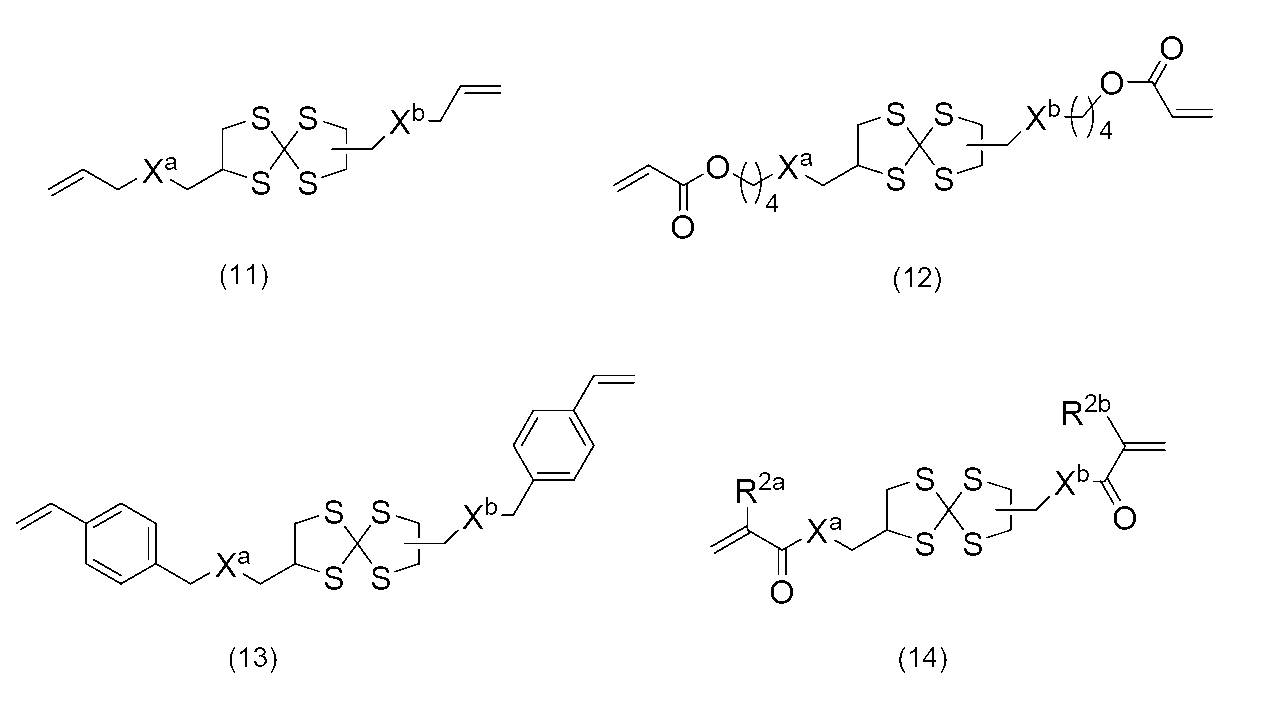
- the tetrathiaspiro compound of the formula (1) is represented by any of the following formulas (11) to (14).
- the compound represented by any one of formulas (11) to (13) is preferable from the viewpoint of easy photopolymerization.
- a more preferable embodiment is a compound represented by the formula (11) or (12) capable of a photopolymerization reaction using a photodegradable radical polymerization initiator described later.
- the compound represented by the formula (13) may not proceed with the curing reaction when a photodegradable radical polymerization initiator described later is used.
- a photopolymerization reaction occurs when a photoredox catalyst described later is used. Is possible.
- the compound represented by the formula (12) is more preferable because it is particularly excellent in photopolymerization.
- the compound represented by Formula (12) or Formula (13) is also preferable. These compounds are improved in flexibility and / or adhesiveness by the alkyl chain and / or aryl contained in the structure functioning as a spacer. More preferably, the tetrathiaspiro compound is represented by the formula (12) or the formula (13) in that a desired refractive index and adhesiveness and / or flexibility are provided, and both X a and X b are S.
- a compound in which X a and X b are both S in formulas (11) to (14) is preferable because of its high refractive index. Or since it is a high refractive index, the compound represented by Formula (11) or Formula (14) is also preferable.
- a particularly preferable compound in terms of a high refractive index is a compound represented by the formula (11) or the formula (14), and both X a and X b are S.
- R 2a and R 2b in the formula (14) are the same as those in the formula (1).
- the mixing ratio of the compound (A) and the compound (B) in the reaction system is not particularly limited as long as the reaction can proceed.
- the amount of compound (B) added is preferably 1.0 to 1.5 mol, more preferably 1.0 to 1.2, relative to 1 mol of compound (A). If the amount is 1.5 mol or less, an increase in excess by-product (polymer) derived from compound (B) can be suppressed, and if it is 1.0 mol or more, purification is complicated by an increase in unreacted compound (A). Can be prevented.
- the tetrathiaspiro compound obtained by the production method of the present invention includes a compound in which positions 2 and 7 of 1,4,6,9-tetrathiospiro [4.4] nonane as a tetraspiro ring are substituted, It may be an isomer mixture of compounds substituted at the 2- and 8-positions of the ring. Such isomer mixture can be separated and purified by, for example, distillation, recrystallization or column chromatography.
- the production method of the present invention uses a zinc compound catalyst.
- a by-product may be generated in addition to the target tetrathiaspiro compound.
- a zinc compound catalyst by using a zinc compound catalyst, the formation of by-products is suppressed, and the target tetrathiaspiro compound is obtained with high selectivity.
- a catalyst can be used individually by 1 type or in mixture of multiple types.
- the zinc compound catalyst is represented by the following formula (C). Zn (Y) 2 (C)
- Y is selected from the group consisting of halogen atoms (eg F, Cl, Br, I) or NTf 2 , and Tf represents trifluoromethylsulfonyl.
- NTf 2 is a di [bis (trifluoromethyl) imide], complexes employing such nitrogen atom ligands also show good selectivity of tetra thia spiro compounds.
- the selectivity of the tetrathiaspiro compound may be lower than that of a complex using a nitrogen atom ligand.
- Y is preferably a halogen atom from the viewpoint of improving the selectivity of the target product, and more preferably an iodine atom (I).
- I iodine atom
- the inventors of the present invention have found that typical metal complexes other than zinc elements and transition metal complexes have low selectivity for tetrathiaspiro compounds. Also, it was found that the selectivity of the tetrathiaspiro compound is low when a boron fluoride complex is used.
- the zinc compound catalyst comprises ZnI 2.
- ZnI 2 high reactivity and selectivity can be achieved even when the amount of catalyst is reduced.
- ZnI 2 when ZnI 2 was used, even when the amount of the catalyst used was reduced to 0.05 equivalent (5 mol%), 0.2 equivalent (20 mol%) was used. Similar high reactivity and selectivity were obtained.
- the amount of zinc compound catalyst added may vary depending on the structure of compounds (A) and (B), the mixing ratio, reaction conditions such as temperature and concentration, and the like.
- the catalyst is usually 1.0 to 0.01 equivalents (mole), preferably 0.2 to 0.03 equivalents (mole), more preferably 0.8 to 0.1 equivalents (mole) of the compound (A). Used in 1 to 0.05 equivalents (mole). If the added amount of the catalyst is more than 1.0 equivalent (mole), the selectivity may be lowered, and if it is less than 0.01 equivalent (mole), the reaction does not proceed sufficiently and the yield of the target product is lowered. There is a case. If it is 0.2 equivalent (mol) or less, the selectivity of the tetrathiaspiro compound can be improved, and the amount of by-products of the polymer can be further reduced.
- the reaction between the compound (A) and the compound (B) is preferably performed in an organic solvent.
- the organic solvent is not particularly limited as long as the reaction between the compound (A) and the compound (B) can proceed.
- a low polarity solvent hydrophobic organic solvent
- a halogen-based solvent is preferable.
- Solvents are preferred, dichloromethane (CH 2 Cl 2 ), dichloroethane (ClCH 2 CH 2 Cl), chloroform (CHCl 3 ), chlorobenzene (PhCl), or o-, m-, p-dichlorobenzene (C 6 H 4 Cl 2 More preferred are halogenated hydrocarbons selected from the group consisting of These may be used alone or in combination.
- the reaction temperature is not particularly limited as long as the reaction proceeds. Usually, the reaction is carried out at -78 ° C to 80 ° C, preferably -20 ° C to 50 ° C, more preferably 0 ° C to 25 ° C. When the temperature is 50 ° C. or lower, an increase in by-products (polymers) can be suppressed, and when the temperature is ⁇ 20 ° C. or higher, the reactivity is appropriately high.
- the reaction time is not particularly limited, but is, for example, 1 to 24 hours.
- the reaction time refers to the time from the completion of mixing (dropping) of the reactants to the end of the reaction.
- the order and form of mixing with the compound (A), the compound (B), and the catalyst in the reaction system are not particularly limited.
- the compound (B) is added after mixing the compound (A) and the catalyst. This is advantageous in terms of improving the selectivity of the reaction.
- the compound (A) and the catalyst are dissolved in the first organic solvent, and then the compound (B) dissolved in the second organic solvent is added to the obtained reaction solution.
- the first organic solvent and the second organic solvent may be the same or different.
- the catalyst may be added after mixing the compound (A) and the compound (B), or the compound (A) may be added after mixing the compound (B) and the catalyst.
- the reaction is preferably carried out with stirring.
- the target tetrathiaspiro compound may be isolated and purified to remove by-products contained in the reaction product. Isolation and purification can be performed by conventional methods. For example, it can be performed by a known method such as extraction with a solvent, silica gel column chromatography, high performance liquid chromatography, vacuum distillation or recrystallization, and purification by silica gel column chromatography or high performance liquid chromatography is preferred.
- a by-product other than the target tetrathiaspiro compound that can be included in the reaction product a ring-opened mixture of episulfide compounds, among which polymers of episulfide compounds are particularly mentioned.
- the tetrathiaspiro compound of the present invention obtained by the above method may have at least one improved characteristic selected from high refractive index, high transparency, excellent flexibility, excellent adhesion and photopolymerization curability. .
- the refractive index after curing is preferably 1.50 or more, and more preferably 1.60 or more.
- the refractive index can be measured with a refractometer.
- the refractive index is a value measured at 25 ° C. and 589 nm (d line)
- the Abbe number is a value calculated from the refractive indices measured at 656 nm (C line), 486 nm (F line) and d line.
- a tetrathiaspiro compound can be obtained with a good selectivity (for example, 50% or more, preferably 60% or more, more preferably 70% or more, particularly preferably 80% or more).
- the selectivity can be measured using 1 H NMR.
- a further embodiment of the present invention relates to a composition for optical materials containing the tetrathiaspiro compound.
- the tetrathiaspiro compound contained in the composition may be used alone or in combination of two or more.
- the composition for optical materials of this embodiment comprises a tetrathiaspiro compound represented by the formula (1) and a polymerizable compound (polymerizable compound) other than the tetrathiaspiro compound represented by the formula (1).
- the polymerizable compound include a polythiol compound, a compound having an unsaturated double bond, and a polyisocyanate compound, an episulfide compound, and sulfur that can be polymerized via the polythiol compound.
- the polymerizable compound preferably contains a polythiol compound.
- the polythiol compound is photopolymerizable, and when the tetrathiaspiro compound of the present invention is a photopolymerizable compound, a photopolymerizable composition can be obtained.
- content in particular of the tetrathiaspiro compound of this invention in the composition for optical materials is not restrict
- composition for optical materials of the present invention preferably contains a polythiol compound as a polymerizable compound in order to improve the color tone of the resulting optical material (resin) when heated.
- a polythiol compound is a compound containing two or more thiol groups in the molecule.
- the polythiol compound is not particularly limited, and includes all polythiol compounds.
- Preferred examples of the polythiol compound include bis (2-mercaptoethyl) sulfide, 2,5-dimercaptomethyl-1,4-dithiane, 1,3-bis (mercaptomethyl) benzene, 1,4-bis (mercaptomethyl).
- Polythiol compounds may be used alone or in combination of two or more. It is preferable to mix in an amount such that the functional group ratio of the double bond (terminal allyl group) of the tetrathiaspiro compound to the SH group of the polythiol compound is 99: 1 to 50:50.
- the composition for optical materials of the present invention may contain a polyisocyanate compound as a polymerizable compound in order to improve the strength of the resulting resin.
- a polyisocyanate compound is a compound having two or more isocyanate groups in the molecule.
- the optical material composition preferably contains a polyisocyanate compound together with the polythiol compound.
- the isocyanate group of the polyisocyanate compound and the thiol group of the polythiol compound can be easily thermoset to increase the molecular weight, and the mechanical strength of the optical material can be improved.
- the polyisocyanate compound is not particularly limited and includes all polyisocyanate compounds.
- polyisocyanate compound examples include isophorone diisocyanate, tolylene diisocyanate, diphenylmethane diisocyanate, hexamethylene diisocyanate, m-xylylene diisocyanate, p-xylylene diisocyanate, m-tetramethylxylylene diisocyanate, p-tetramethylxylylene diisocyanate.
- 1,3-bis (isocyanatomethyl) cyclohexane, 1,4-bis (isocyanatomethyl) cyclohexane, bis (isocyanatomethyl) norbornene, and 2,5-diisocyanatomethyl-1,4-dithiane At least one compound selected from the group consisting of isophorone diisocyanate, tolylene diisocyanate, and diphenylmethane diisocyanate.
- Polyisocyanate compounds may be used alone or in combination of two or more.
- Ratio of SH group in polythiol compound to NCO group of polyisocyanate compound contained in composition for optical material that is, [total number of SH groups of polythiol compound in composition / number of NCO groups of polyisocyanate compound in composition] (SH group) / NCO group) is preferably 1.0 to 2.5, more preferably 1.25 to 2.25, and even more preferably 1.5 to 2.0. If the ratio is less than 1.0, it may be colored yellow at the time of molding, and if it exceeds 2.5, the heat resistance may be reduced.
- the composition for optical materials of the present invention may contain an episulfide compound as a polymerizable compound for adjusting the refractive index.
- the episulfide compound used in the present invention is not particularly limited, and includes all episulfide compounds. Preferred compounds are bis ( ⁇ -epithiopropyl) sulfide and bis ( ⁇ -epithiopropyl disulfide), and bis ( ⁇ -epithiopropyl) sulfide is particularly preferred.
- composition for optical materials of the present invention may contain sulfur as a polymerizable compound in order to improve the refractive index of the obtained optical material (resin). It is preferable to use sulfur and an episulfide compound in combination. In such a case, it is preferable that the episulfide compound and sulfur are preliminarily reacted in advance.
- the shape of sulfur may be any shape. Specifically, the sulfur is finely divided sulfur, colloidal sulfur, precipitated sulfur, crystalline sulfur, sublimated sulfur or the like, but preferably finely divided sulfur with fine particles.
- the obtaining method is not particularly limited, and commercially available products can be used.
- the tetrathiaspiro compound of the present invention has a polymerizable group containing an unsaturated double bond at both ends (for example, an allyl group, a vinyl group, a (meth) acryloyl group, etc.). Resin).
- the polymerization reaction include a photopolymerization reaction and a thermal polymerization reaction.
- a photopolymerization reaction photopolymerizable composition
- Thermal polymerization and photopolymerization (curing by light irradiation) may be combined.
- the composition of the present invention may be a polymerization curable composition comprising the optical material composition and a polymerization catalyst.
- the compound represented by any of the above formulas (11) to (13) can easily undergo a photopolymerization reaction.
- the tetrathiaspiro compound is represented by any of the above formulas (11) to (13), the polymerization curability is high.
- the composition is easily photopolymerizable.
- a method for producing a cured product which comprises curing a polymerization curable composition containing a composition for optical materials and a polymerization catalyst by irradiation with ultraviolet rays or visible light.
- the tetrathiaspiro compound is selected from compounds represented by any one of the above formulas (11) to (13). Note that the compound of the formula (14) may be photopolymerized depending on the catalyst system, but the curing may be slower or more difficult than the compounds of the formulas (11) to (13).
- the optical material (resin) as a cured product is obtained by curing the composition of the present invention (composition for optical material or polymerization curable composition) by irradiation with light (active energy rays).
- the light is not particularly limited as long as the effect of the composition is possible, but is usually ultraviolet light, visible light, radiation, or electron beam, preferably ultraviolet light or visible light, and more preferably ultraviolet light because of a high polymerization rate.
- the irradiation intensity of the light is not particularly limited, but is usually 10 to 100,000 mW / cm 2 .
- the irradiation time is not particularly limited, but is usually 1 minute to several hours, for example 1 to 60 minutes. Irradiation temperature is not particularly limited, and polymerization is possible at around room temperature.
- the polymerization catalyst is not particularly limited, and may be appropriately selected according to the type of reaction product, polymerization conditions, and the like.
- a compound that generates radicals upon irradiation with light preferably active energy rays
- photodegradable radical polymerization initiator is preferable.
- Specific examples include benzoin derivatives, benzyl derivatives, benzophenone derivatives, acetophenone derivatives, etc. Is mentioned.
- a compound (redox polymerization initiator) that generates radicals (free radicals) in the coexistence of an oxidizing agent and a reducing agent as a polymerization catalyst used in the photopolymerization reaction.
- a compound (redox polymerization initiator) that generates radicals (free radicals) in the coexistence of an oxidizing agent and a reducing agent as a polymerization catalyst used in the photopolymerization reaction.
- persulfates such as sodium persulfate, potassium persulfate and ammonium persulfate
- oxides selected from peroxides such as hydrogen peroxide, t-butyl peroxide and methyl ethyl ketone peroxide
- the system which combined the reducing compound selected from ascorbic acid, sodium hydrogensulfite, etc. is mentioned.
- a photoredox catalyst that generates radicals by irradiation with light such as visible light is also preferably used as the polymerization catalyst used in the photopolymerization reaction.
- specific examples include transition metal complexes such as ruthenium (II) polypyridyl complexes (for example, Ru (bpz) 3- (PF 6 ) 2 catalyst) and iridium (III) phenyl pyridyl complexes.
- an optical material (resin) as a cured product is produced by polymerizing (curing) the composition (optical material composition or polymerization curable composition) of the present invention by heating.
- the polymerization catalyst used in the thermal polymerization reaction a compound that generates radicals by heating (thermal decomposition type radical polymerization initiator) is preferable.
- persulfates such as sodium persulfate, ammonium persulfate, and potassium persulfate
- hydrogen peroxide organic peroxides such as t-butyl hydroperoxide
- organic peroxides such as t-butyl hydroperoxide
- 2,2′-azobis (2-amidinopropane) examples thereof include azo compounds such as dihydrochloride, 2,2′-azobis [2-2 (-imidazolin-2-yl) propane] dihydrochloride, and 2,2′-azobis (2-methylpropionitrile).
- a polymerization catalyst can be used individually by 1 type or in mixture of multiple types.
- the addition amount of the polymerization catalyst varies depending on the components of the composition, the mixing ratio, and the polymerization curing method, but is not generally determined, but is usually 0.0001 mass with respect to a total of 100 mass% of the composition for optical materials. % To 10% by mass, preferably 0.001% to 5% by mass, more preferably 0.01% to 1% by mass, and most preferably 0.01% to 0.5% by mass. . If the amount added is more than 10% by mass, polymerization may occur rapidly. If the amount added is less than 0.0001% by mass, the composition for optical materials may not be sufficiently cured, resulting in poor heat resistance. Therefore, in a preferred embodiment of the present invention, the method for producing an optical material includes a step of adding 0.0001 to 10% by mass of a polymerization catalyst with respect to the total amount of the composition for optical materials and polymerizing and curing.
- the polymerization (curing) by heating of the composition of the present invention is usually performed as follows. That is, the curing time is usually 1 to 100 hours, and the curing temperature is usually ⁇ 10 ° C. to 140 ° C.
- the polymerization is carried out by a step of holding at a predetermined polymerization temperature for a predetermined time, a step of raising the temperature from 0.1 ° C. to 100 ° C./h, a step of lowering the temperature from 0.1 ° C. to 100 ° C./h, Do it in combination.
- the curing time means a polymerization curing time including a temperature rising process, and includes a temperature raising / cooling step to a predetermined polymerization (curing) temperature in addition to a step of maintaining at a predetermined polymerization (curing) temperature. .
- the polymerization curing process is not particularly limited, but is preferably a curing process using a metal, ceramic, glass, resin, or other mold.
- each component of the composition (each component of the optical material composition, a polymerization catalyst, etc.) is mixed. These may all be mixed in the same container under stirring at the same time, each raw material may be added and mixed in stages, or several components may be mixed separately and then remixed in the same container. Each raw material and auxiliary raw material may be mixed in any order. In mixing, the set temperature, the time required for this, and the like may basically be the conditions under which each component is sufficiently mixed.
- the composition for optical material or the polymerization curable composition thus obtained is poured into a mold or the like, and after the polymerization and curing reaction is advanced by irradiation with light such as heating or ultraviolet rays, the composition is removed from the mold.
- the polymerization reaction (curing step) can be performed in air or in an atmosphere of an inert gas such as nitrogen, under reduced pressure, or under pressure.
- annealing the obtained optical material at a temperature of 50 to 150 ° C. for about 10 minutes to 5 hours is a preferable treatment for removing the distortion of the optical material of the present invention.
- the obtained optical material may be subjected to surface treatment such as hard coating and antireflection, if necessary.
- additives such as an ultraviolet absorber, an antioxidant, an adhesion improver, and a release agent are added to the optical material composition to further improve the practicality of the resulting optical material.
- additives such as an ultraviolet absorber, an antioxidant, an adhesion improver, and a release agent are added to the optical material composition to further improve the practicality of the resulting optical material.
- composition of the present invention (optical material composition / polymerization curable composition) has at least a high refractive index, high transparency, excellent flexibility, excellent adhesiveness, photopolymerization curability, and the like as described above.
- One excellent molded body can be provided.
- curing the said composition is also one of this invention.
- optical materials members
- mechanical component materials electrical / electronic component materials
- automobile component materials civil engineering and building materials
- molding materials paint materials, and adhesive materials.
- optical materials such as eyeglass lenses, (digital) camera imaging lenses, light beam condensing lenses, light diffusion lenses, LED sealing materials, optical adhesives, optical transmission bonding materials, prisms , Filters, diffraction gratings, watch glasses, transparent glass such as cover glass for display devices, and cover glass, etc .
- LCD organic EL and PDP display element substrates, color filter substrates, touch panel substrates
- Display device uses such as a coating agent (coating film) such as a backlight, a light guide plate, a display protective film, an antireflection film, and an antifogging film are suitable.
- the optical material is preferably an optical adhesive, a prism, or a coating agent.
- Example 2-2 The production ratio (yield) of compound 111 and by-products was calculated in the same manner as in Example 2-1, except that the amount of zinc iodide added was changed to 0.005 mmol (0.05 equivalent; 5 mol%). did.
- the yield of compound 111 is as shown in Table 2.
- Example 2-3 The production ratio (yield) of compound 111 and by-products was calculated in the same manner as in Example 2-2 except that dry chlorobenzene was used instead of dry dichloromethane as a solvent.
- the yield of compound 111 is as shown in Table 2.
- Example 2-4 The production ratio (yield) of compound 111 and by-products was calculated in the same manner as in Example 2-1, except that zinc iodide was changed to zinc chloride.
- the yield of compound 111 is as shown in Table 2.
- Example 2-5 The production ratio (yield) of compound 111 and by-products was calculated in the same manner as in Example 2-1, except that zinc iodide was changed to Zn (NTf 2 ) 2 .
- the yield of compound 111 is as shown in Table 2.
- Example 3-1 Preparation of optical material composition
- the tetrathiaspiro compound (compound 111) obtained in Example 1-1 above 4-mercaptomethyl-1,8-dimercapto-3,6-dithiaoctane as a polythiol compound
- the composition for optical materials was prepared by mixing so that the functional group ratio of the double bond (terminal allyl group) of the thiaspiro compound and the SH group of the polythiol compound was 1: 1.
- the obtained polymerization curable composition was sandwiched between two glass plates so as to have a thickness of 0.5 mm, and one side was 5 with a metal halide lamp (30 mW / cm 2 , wavelength: 200 to 400 nm, manufactured by Eye Graphics). Irradiated with ultraviolet rays for 10 minutes in total, polymerized and cured to obtain an optical material. The results are shown in Table 2.
- Example 3-2 A polymerization curable composition was obtained in the same manner as in Example 3-1 except that Compound 141 was used in place of Compound 111, and a polymerization and curing treatment was performed. However, the composition was not cured.
- Table 3 confirms that the optical material produced using the tetrathiaspiro compound of the present invention has a high refractive index and a high Abbe number. Moreover, it is confirmed that the compound 111 can be photopolymerized by ultraviolet rays using a photodegradable radical polymerization initiator. In contrast, Compound 141 was not cured by ultraviolet light. The compound 141 can be photocured using a thermosetting and photobase generator.
Landscapes
- Chemical & Material Sciences (AREA)
- Organic Chemistry (AREA)
- Chemical Kinetics & Catalysis (AREA)
- Health & Medical Sciences (AREA)
- Physics & Mathematics (AREA)
- Polymers & Plastics (AREA)
- Medicinal Chemistry (AREA)
- Engineering & Computer Science (AREA)
- Materials Engineering (AREA)
- General Physics & Mathematics (AREA)
- Optics & Photonics (AREA)
- Ophthalmology & Optometry (AREA)
- General Health & Medical Sciences (AREA)
- Heterocyclic Carbon Compounds Containing A Hetero Ring Having Oxygen Or Sulfur (AREA)
Abstract
本発明は、単量体として重合可能な化合物であって、向上した選択率及び簡便かつ少ない工程数で製造できる新規なテトラチアスピロ化合物、及びその製造方法を提供する。一実施形態によると、下記式(1)で表されるテトラチアスピロ化合物、及び下記式(A)で表されるトリチオカーボネート化合物と下記式(B)で表されるエピスルフィド化合物とを下記式(C)で表される亜鉛化合物触媒の存在下で反応させることを含む式(1)で表されるテトラチアスピロ化合物の製造方法が提供される。
Description
本発明は新規なテトラチアスピロ化合物、それを含む光学材料用組成物、及びその製造方法に関する。より詳細には、光学接着剤、プリズム、コーティング剤等の光学材料に好適に使用される新規なテトラチアスピロ化合物、それを含む光学材料用組成物、及びその製造方法に関する。
プラスチック材料は軽量かつ靱性に富み、しかも染色や加工性にも優れることから、各種光学材料、例えば眼鏡レンズ、カメラレンズ、光学接着剤、プリズム、コーティング剤に広く用いられている。光学材料、中でもレンズに特に要求される性能は、物理的性質としては、低比重、高透明性及び低黄色度、高耐熱性、高強度等であり、光学性能としては高屈折率と高アッベ数である。高屈折率はレンズの薄肉化を可能とし、高アッベ数はレンズの色収差を低減する。しかし、一般に屈折率が上昇するほどアッベ数は低くなるため、両者を同時に向上させる検討が実施されている。
これらの検討の中で最も代表的な方法は、硫黄を含有する樹脂、例えばスルフィド系樹脂を使用する方法である。スルフィド系樹脂は、エピスルフィド化合物を含む重合性組成物を重合させて得られ、高屈折率及び高アッベ数を両立しうる材料として近年盛んに検討されている。
好ましい高屈折率を達成し得る硫黄を含有する他の樹脂の単量体として、スピロ骨格を有する化合物が報告されている(特許文献1、2等)。スピロ環化合物は高い屈折率及び優れた透明性を有することから、レンズの他、光学接着剤、プリズム、コーティング剤などの光学プラスチック材料の製造に有用であると注目されている。例えば、特許文献1は光学材料の単量体として用いることのできる、スピロ骨格及び(メタ)アクリロイル基を有する硫黄含有化合物を開示する。特許文献2は光学プラスチックの製造に適した屈折率を有するスピロテトラチオカルバミン酸塩及びスピロオキソチオカルバミン酸塩の単量体化合物を開示する。
しかし、従来、単量体として重合可能なスピロ環化合物を得るには複雑な工程が必要であった。例えば、特許文献1において、硫黄含有化合物は、両端にチオールを有する化合物とテトラメチルチオメタンを反応させてスピロ骨格を有する中間体を得た後、末端に(メタ)アクリロイル基を導入するという複数の工程により製造されている。また、特許文献2の方法及び反応系では目的化合物の選択率が低いという問題があった。したがって、光学材料を形成するための単量体として使用し得る化合物であって、高い選択率及びより容易かつより少ない工程数で製造することのできる化合物及びその製造方法が望まれている。
また、光学部品やデバイスの小型・軽量化、高機能化等のニーズに対応するために、より高い屈折率、高い透明性、優れた柔軟性、優れた接着性、光重合硬化性などの少なくとも一つの改良された特徴を有する単量体としての新規な化合物が求められている。
そこで本発明は、単量体として重合可能な化合物であって、向上した選択率及び簡便かつ少ない工程数で製造できる新規なスピロ環化合物、及びその製造方法を提供することを目的とする。
本発明者らは、このような状況に鑑み鋭意研究を重ねた結果、以下の本発明により上記課題を解決することができることを見出した。即ち、本発明は以下の通りである。
[1] 下記式(1)で表されるテトラチアスピロ化合物の製造方法であって、
下記式(A)で表されるトリチオカーボネート化合物と下記式(B)で表されるエピスルフィド化合物とを下記式(C)で表される亜鉛化合物触媒の存在下で反応させることを含む、製造方法:

(式(1)、式(A)及び(B)中、
Xa及びXbはそれぞれ独立して、OまたはSを表し、
R1aは、-CO-、-(CO-O)q-(CH2)p-、または-(CH2)r-Ar-(CH2)p-からなる群から選択され、
R1bは、-CO-、-(CH2)p-(O-CO)q-、または-(CH2)p-Ar-(CH2)r-からなる群から選択され、
Arは、場合により炭素数1~4のアルキル、塩素、臭素、ヨウ素、炭素数1~4のアルキルチオ、及びシアノからなる群からそれぞれ独立して選択される1~4個の置換基で置換されていてもよいフェニレンを表し、
pは、0~4の整数を表し、
qは、0または1の整数を表し、
rは、0~4の整数を表し、
R2a及びR2bはそれぞれ独立して、水素原子または炭素数1~3のアルキルからなる群から選択され、
na及びnbはそれぞれ独立して、1~3の整数を表し;
式(C)中、
Yは、ハロゲン原子またはNTf2からなる群から選択され、
Tfは、トリフルオロメチルスルホニルを表す。)
[2] Yがハロゲン原子である、前記[1]に記載の製造方法。
[3] 前記亜鉛化合物触媒はZnI2を含む、前記[1]または[2]に記載の製造方法。
[4] 前記テトラチアスピロ化合物は下記式(11)~(14)のいずれかで表される、前記[1]~[3]のいずれかに記載の製造方法。
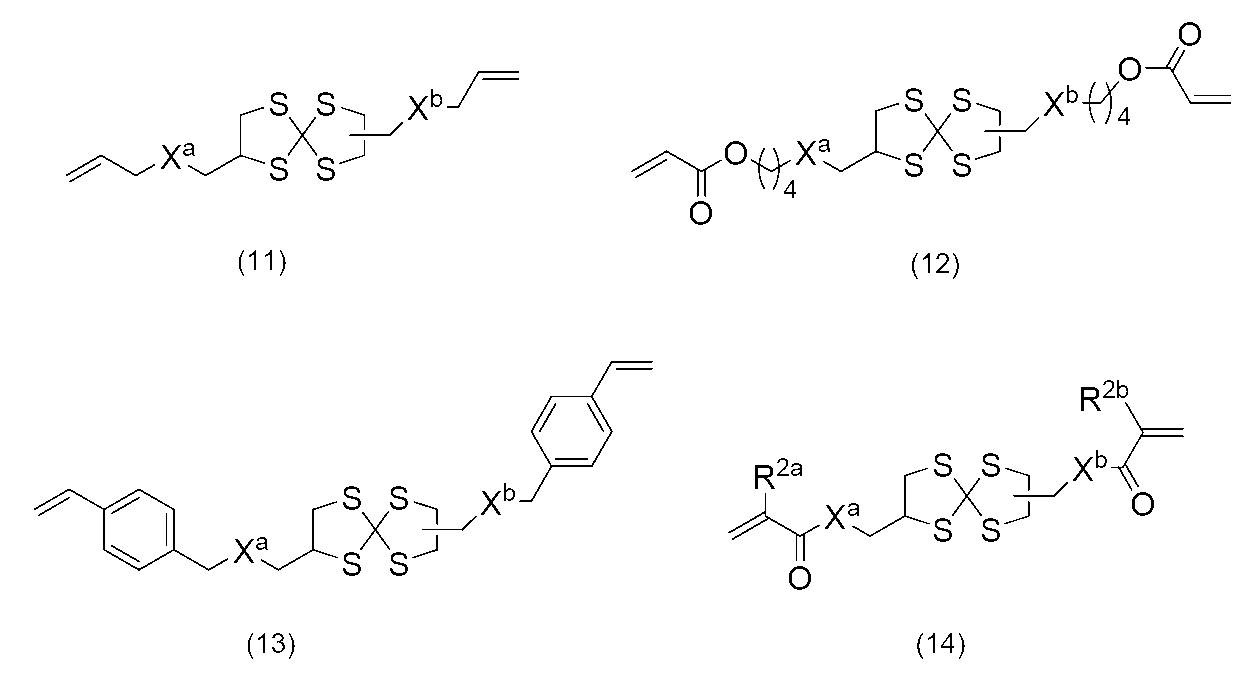
(式中、Xa及びXbならびにR2a及びR2bは前記式(1)と同義である。)
[5] Xa及びXbはいずれもSである、前記[1]~[4]のいずれかに記載の化合物。
[6] 下記式(1)で表されるテトラチアスピロ化合物:

(式中、
Xa及びXbはそれぞれ独立して、OまたはSを表し、
R1aは、-CO-、-(CO-O)q-(CH2)p-、または-(CH2)r-Ar-(CH2)p-からなる群から選択され、
R1bは、-CO-、-(CH2)p-(O-CO)q-、または-(CH2)p-Ar-(CH2)r-からなる群から選択され、
Arは、場合により炭素数1~4のアルキル、塩素、臭素、ヨウ素、炭素数1~4のアルキルチオ、及びシアノからなる群からそれぞれ独立して選択される1~4個の置換基で置換されていてもよいフェニレンを表し、
pは、0~4の整数を表し、
qは、0または1の整数を表し、
rは、0~4の整数を表し、
R2a及びR2bはそれぞれ独立して、水素原子または炭素数1~3のアルキルからなる群から選択され、
na及びnbはそれぞれ独立して、1~3の整数を表す。)
[7] 下記式(11)~(14)のいずれかで表される、前記[6]に記載の化合物。
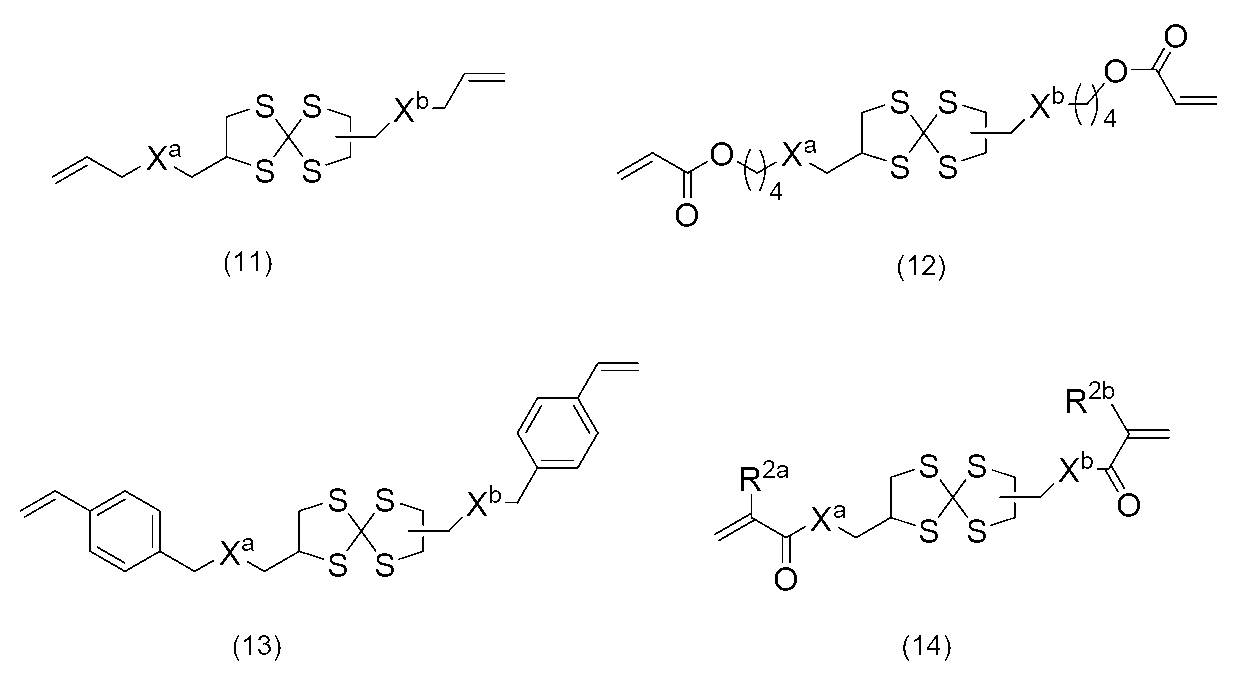
(式中、Xa及びXbならびにR2a及びR2bは前記式(1)と同義である。)
[8] Xa及びXbはいずれもSである、前記[6]または[7]に記載の化合物。
[9] 前記[6]~[8]のいずれかに記載のテトラチアスピロ化合物と、ポリチオール化合物とを含む、光学材料用組成物。
[10] テトラチアスピロ化合物が上記式(11)~(13)のいずれかで表される化合物から選択される、前記[9]のいずれかに記載の光学材料用組成物。
[11] 前記[10]に記載の光学材料用組成物と重合触媒を含む重合硬化性組成物を、紫外線または可視光の照射により硬化させることを特徴とする硬化物の製造方法。
[12] 前記[10]に記載の光学材料用組成物と重合触媒を含む重合硬化性組成物を硬化した光学材料。
下記式(A)で表されるトリチオカーボネート化合物と下記式(B)で表されるエピスルフィド化合物とを下記式(C)で表される亜鉛化合物触媒の存在下で反応させることを含む、製造方法:
Xa及びXbはそれぞれ独立して、OまたはSを表し、
R1aは、-CO-、-(CO-O)q-(CH2)p-、または-(CH2)r-Ar-(CH2)p-からなる群から選択され、
R1bは、-CO-、-(CH2)p-(O-CO)q-、または-(CH2)p-Ar-(CH2)r-からなる群から選択され、
Arは、場合により炭素数1~4のアルキル、塩素、臭素、ヨウ素、炭素数1~4のアルキルチオ、及びシアノからなる群からそれぞれ独立して選択される1~4個の置換基で置換されていてもよいフェニレンを表し、
pは、0~4の整数を表し、
qは、0または1の整数を表し、
rは、0~4の整数を表し、
R2a及びR2bはそれぞれ独立して、水素原子または炭素数1~3のアルキルからなる群から選択され、
na及びnbはそれぞれ独立して、1~3の整数を表し;
式(C)中、
Yは、ハロゲン原子またはNTf2からなる群から選択され、
Tfは、トリフルオロメチルスルホニルを表す。)
[2] Yがハロゲン原子である、前記[1]に記載の製造方法。
[3] 前記亜鉛化合物触媒はZnI2を含む、前記[1]または[2]に記載の製造方法。
[4] 前記テトラチアスピロ化合物は下記式(11)~(14)のいずれかで表される、前記[1]~[3]のいずれかに記載の製造方法。
[5] Xa及びXbはいずれもSである、前記[1]~[4]のいずれかに記載の化合物。
[6] 下記式(1)で表されるテトラチアスピロ化合物:
Xa及びXbはそれぞれ独立して、OまたはSを表し、
R1aは、-CO-、-(CO-O)q-(CH2)p-、または-(CH2)r-Ar-(CH2)p-からなる群から選択され、
R1bは、-CO-、-(CH2)p-(O-CO)q-、または-(CH2)p-Ar-(CH2)r-からなる群から選択され、
Arは、場合により炭素数1~4のアルキル、塩素、臭素、ヨウ素、炭素数1~4のアルキルチオ、及びシアノからなる群からそれぞれ独立して選択される1~4個の置換基で置換されていてもよいフェニレンを表し、
pは、0~4の整数を表し、
qは、0または1の整数を表し、
rは、0~4の整数を表し、
R2a及びR2bはそれぞれ独立して、水素原子または炭素数1~3のアルキルからなる群から選択され、
na及びnbはそれぞれ独立して、1~3の整数を表す。)
[7] 下記式(11)~(14)のいずれかで表される、前記[6]に記載の化合物。
[8] Xa及びXbはいずれもSである、前記[6]または[7]に記載の化合物。
[9] 前記[6]~[8]のいずれかに記載のテトラチアスピロ化合物と、ポリチオール化合物とを含む、光学材料用組成物。
[10] テトラチアスピロ化合物が上記式(11)~(13)のいずれかで表される化合物から選択される、前記[9]のいずれかに記載の光学材料用組成物。
[11] 前記[10]に記載の光学材料用組成物と重合触媒を含む重合硬化性組成物を、紫外線または可視光の照射により硬化させることを特徴とする硬化物の製造方法。
[12] 前記[10]に記載の光学材料用組成物と重合触媒を含む重合硬化性組成物を硬化した光学材料。
本発明によれば、単量体として重合可能なテトラチアスピロ化合物を、向上した選択率及び簡便かつ少ない工程数で製造できる。また、本発明のテトラチアスピロ化合物は高い屈折率、高い透明性、優れた柔軟性、優れた接着性及び光重合硬化性から選択される少なくとも一つの改良された特徴を有しうる。
以下、本発明について実施形態及び例示物等を示して詳細に説明するが、本発明は以下に示す実施形態及び例示物等に限定されるものではなく、本発明の要旨を逸脱しない範囲において任意に変更して実施できる。なお、本明細書に記載した全ての文献及び刊行物は、その目的にかかわらず参照によりその全体を本明細書に組み込むものとする。また、2016年4月20日に出願し、本願優先権主張の基礎となる特願JP2016-084519号の特許請求の範囲、明細書、図面及び要約書の開示内容は、その全体が参照として本明細書に組み入れられる。
本発明の一形態は、テトラチアスピロ化合物の製造方法を提供する。従来、重合性基を有するテトラチアスピロ化合物を高い選択率で製造するためには複数かつ複雑な合成工程を経る必要があった。特に、従来は高い屈折率を有する光重合性の化合物を簡便にかつ高い選択率で製造することは困難であった。本発明者らはテトラチアスピロ化合物の製造方法について種々検討したところ、特定のトリチオカーボネート化合物と特定のエピスルフィド化合物とを亜鉛化合物触媒の存在下で反応させることにより、テトラチアスピロ化合物を向上した選択率及び簡便かつ少ない工程数で製造することができることを見出した。本発明の製造方法によれば光重合性のテトラチアスピロ化合物を得ることも可能である。
すなわち、本発明の一実施形態は、下記式(A)で表されるトリチオカーボネート化合物(以下化合物(A)」とも称する)と下記式(B)で表されるエピスルフィド化合物(以下「化合物(B)」とも称する)とを下記式(C)で表される亜鉛化合物触媒(以下「触媒(C)」とも称する)の存在下で反応させることを含む、テトラチアスピロ化合物の製造方法である。

化合物(A)と化合物(B)との反応により、下記式(1)で表されるテトラチアスピロ化合物が製造される。すなわち、本発明の別の一形態によれば、下記式(1)で表されるテトラチアスピロ化合物が提供される。

なお、本発明の製造方法は、上記式(1)に示すテトラチアスピロ化合物の製造に限定されることなく、化合物(A)と化合物(B)との反応から製造される全ての化合物の製造を包含する。
上記式(A)、式(B)、及び式(1)において、R1aは-CO-、-(CO-O)q-(CH2)p-、または-(CH2)r-Ar-(CH2)p-からなる群から選択され、R1bは、-CO-、-(CH2)p-(O-CO)q-、または-(CH2)p-Ar-(CH2)r-からなる群から選択される。R1a及びR1bは同一であっても異なっていてもよいが、ジアステレオマー等の異性体の生成を抑制する点及び光重合をより均一に行う点からはR1a及びR1bは同一であることが好ましい。なお、R1aが-(CO-O)q-(CH2)p-または-(CH2)r-Ar-(CH2)p-である場合、-(CH2)p-がXaと結合しており、R1bが-(CH2)p-(O-CO)q-または-(CH2)p-Ar-(CH2)r-である場合、-(CH2)p-がXbと結合している。
pは、0~4の整数を表す。アルキル鎖がスペーサーとして機能でき、柔軟性及び/または接着性が向上し得ることからpは1~4が好ましい。
qは、0または1の整数を表す。高い光重合性が得られることからqは1が好ましい。
rは、0~4の整数を表す。アルキル鎖がスペーサーとして機能でき、柔軟性及び/または接着性が向上し得ることからrは1~4が好ましい。
qは、0または1の整数を表す。高い光重合性が得られることからqは1が好ましい。
rは、0~4の整数を表す。アルキル鎖がスペーサーとして機能でき、柔軟性及び/または接着性が向上し得ることからrは1~4が好ましい。
一実施形態において、R1aは-(CO-O)q-(CH2)p-、または-(CH2)r-Ar-(CH2)p-であり、かつ、R1bは-(CH2)p-(O-CO)q-、または-(CH2)p-Ar-(CH2)r-である。かかる場合には、光重合が可能な化合物が得られる。好ましい一実施形態において、光重合性の向上の観点から、R1a及びR1bの少なくとも一方(好ましくは両方)は-CO-O-(CH2)pまたは-(CH2)p-O-CO-であり、この際、さらに好ましくは、柔軟性及び/または接着性の向上の点からpはより好ましくは1~4であり、更に好ましくは3または4である。好ましい別の実施形態において、柔軟性及び/または接着性の向上の点から、R1a及びR1bの少なくとも一方(好ましくは両方)は-(CH2)p-(この際、pは1~4である)、または、-(CH2)r-Ar-(CH2)p-もしくは-(CH2)p-Ar-(CH2)r-から選択され、より好ましくは-(CH2)p-(この際、pは1~4である)である。
別の実施形態において、R1a及びR1bは、高い屈折率が得られることから、-CO-、または-(CH2)p-(この際、pは1~4である)からなる群から選択される。より好ましくはR1a及びR1bの少なくとも一方(好ましくは両方)は-(CH2)p-(この際、pは1~4である)である。
上記式(A)、式(B)、及び式(1)において、Xa及びXbはOまたはSを表す。Xa及びXbは同一であっても異なっていてもよい。ジアステレオマー等の異性体の生成を抑制する点からはXa及びXbは同一であることが好ましく、高い屈折率の点からXa及びXbはいずれもSであることがより好ましい。
Arは、場合により置換されているフェニレン、具体的には、1,2-フェニレン;1,3-フェニレン;または1,4-フェニレンを表す。フェニレン基は、好ましくは容易な原料調達の点から1,4-フェニレンである。フェニレン基は炭素数1~4のアルキル、ハロゲンである塩素、臭素、ヨウ素、炭素数1~4のアルキルチオ、及びシアノからなる群からそれぞれ独立して選択される1~4個の置換基で置換されていてもよい。好ましくは製造工程の簡略化の点から非置換のフェニレンである。
上記式(A)、式(B)、及び式(1)において、R2a及びR2bは、水素原子または炭素数1~3のアルキル(具体的にはメチル、エチル、n-プロピル、またはイソプロピルであり、好ましくはメチルである)からなる群から選択される。R2a及びR2bは同一であっても異なっていてもよい。ジアステレオマー等の異性体の生成を抑制する点及び光重合をより均一に行う点からはR2a及びR2bは同一であることが好ましい。好ましい実施形態は、R2a及びR2bが水素原子またはメチルから選択され、特に好ましい実施形態はR2a及びR2bがいずれも水素原子である。
上記式(A)、式(B)、及び式(1)において、na及びnbは1~3の整数を表し、好ましくは1または2である。na及びnbは同一であっても異なっていてもよい。na及びnbはジアステレオマー等の異性体の生成を抑制する点からは同一であることが好ましい。特に好ましくはna及びnbはいずれも1である。
本発明の一実施形態において、R1a及びR1bが同一であり、R2a及びR2bが同一であり、Xa及びXbが同一であり、na及びnbが同一である。かかる化合物は屈折率、透明性及び均一な光重合性の点で有利である。
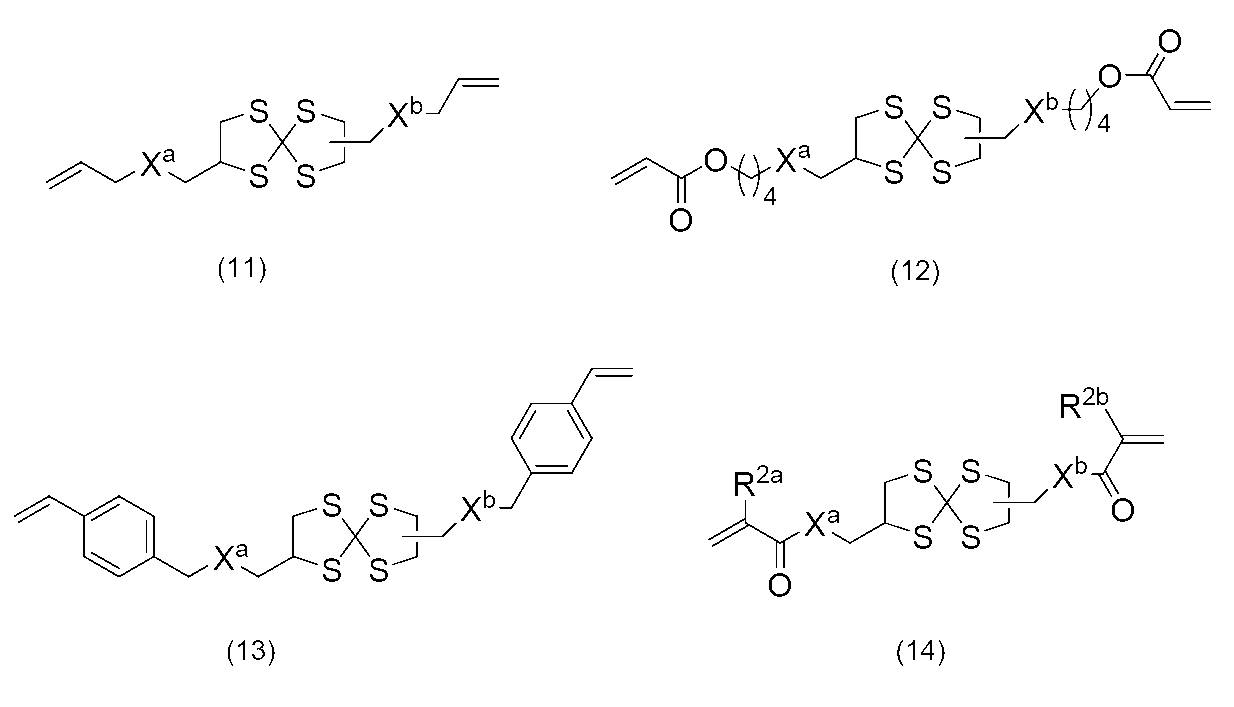
本発明の一実施形態において、式(1)のテトラチアスピロ化合物は下記式(11)~(14)のいずれかで表される。
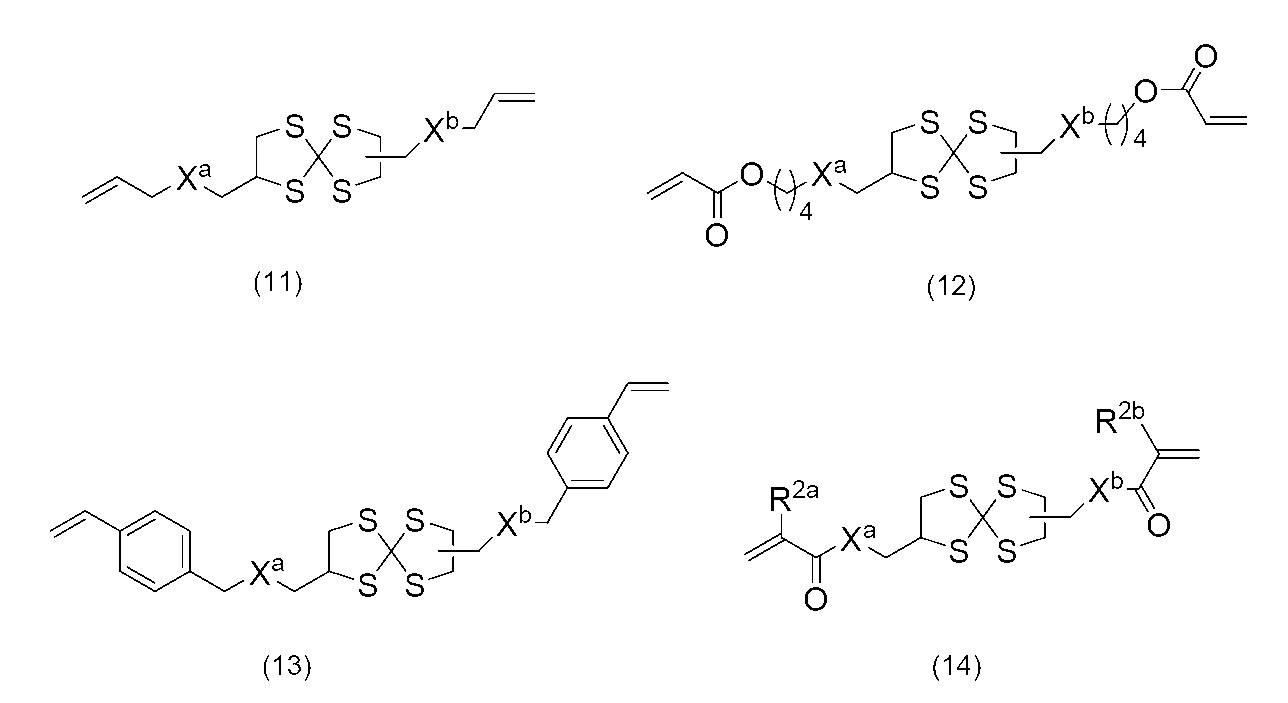
式(11)~(14)中、Xa及びXbならびにR2a及びR2bは前記式(1)と同義である。
中でも、光重合が容易な点から、式(11)~(13)のいずれかで表される化合物が好ましい。より好ましい一形態は、後述する光分解型ラジカル重合開始剤を用いた光重合反応が可能である、式(11)または(12)で表される化合物である。一方、式(13)で表される化合物は後述する光分解型ラジカル重合開始剤を用いた場合には硬化反応が進行しない可能性があるが、後述する光レドックス触媒を用いることにより光重合反応が可能である。特に、光重合性に特に優れる点から、式(12)で表される化合物がさらに好ましい。
あるいは柔軟性及び/または接着性に優れることから、式(12)または式(13)で表される化合物も好ましい。これらの化合物は構造内に含まれるアルキル鎖及び/またはアリールがスペーサーとして機能することで柔軟性及び/または接着性が向上する。さらに好ましくは、所望の屈折率と接着性及び/または柔軟性とを備える点で、テトラチアスピロ化合物は式(12)または式(13)で表され、かつ、Xa及びXbがいずれもSである。
あるいは、高屈折率であることから、式(11)~(14)において、Xa及びXbがいずれもSである化合物が好ましい。あるいは、高屈折率であることから、式(11)または式(14)で表される化合物も好ましい。高屈折率の面から特に好ましくい化合物は、式(11)または式(14)で表され、かつ、Xa及びXbがいずれもSである化合物である。
上記式(14)中のR2a及びR2bの定義及び好ましい態様は前記式(1)と同義である。
反応系における化合物(A)と化合物(B)との混合比率は反応が進行し得る限り特に制限されない。ただし、化合物(B)の添加量は、化合物(A)1モルに対して1.0~1.5モルであることが好ましく、1.0~1.2であることがより好ましい。1.5モル以下であれば過剰な化合物(B)由来の副生物(重合体)の増加を抑制でき、1.0モル以上であれば未反応の化合物(A)の増加によって精製が煩雑化するのを防止しうる。
本発明の製造方法により得られるテトラチアスピロ化合物は、テトラスピロ環としての1,4,6,9-テトラチオスピロ[4.4]ノナンの2位及び7位が置換された化合物と、当該テトラスピロ環の2位及び8位が置換された化合物の異性体混合物でありうる。かかる異性体混合物は例えば蒸留、再結晶またはカラムクロマトグラフィーによって分離精製可能である。
本発明の製造方法は亜鉛化合物触媒を用いる。
トリチオカーボネート化合物とエピスルフィド化合物とを反応させると、目的物であるテトラチアスピロ化合物の他に副生成物が生成する場合がある。本発明では亜鉛化合物触媒を用いることで副生成物の生成が抑制され、目的物であるテトラチアスピロ化合物が高い選択率で得られる。触媒は一種を単独でまたは複数種を混合して使用することができる。
亜鉛化合物触媒は、下記式(C)で表される。
Zn(Y)2 (C)
Zn(Y)2 (C)
式(C)中、Yは、ハロゲン原子(例えばF、Cl、Br、I)またはNTf2からなる群から選択され、Tfは、トリフルオロメチルスルホニルを表す。NTf2はジ[ビス(トリフルオロメチルスルホニル)イミド]であり、このような窒素原子配位子を用いた錯体もテトラチアスピロ化合物の良好な選択性を示す。一方、酸素原子配位子を用いた場合には、窒素原子配位子を用いた錯体に比べテトラチアスピロ化合物の選択性が低下する場合がある。
中でもYは目的物の選択率を向上させる点から好ましくはハロゲン原子であり、より好ましくはヨウ素原子(I)である。特に、YがIである場合、触媒量を低減した場合であっても高い反応性と選択性が維持されうる。
なお、本発明の発明者らの検討により、亜鉛元素以外の典型金属錯体や遷移金属錯体はテトラチアスピロ化合物の選択性が低いことがわかっている。また、フッ化ホウ素錯体を用いた場合にもテトラチアスピロ化合物の選択性が低いことが判明した。
特に好ましい形態において、亜鉛化合物触媒はZnI2を含む。かかる場合には、触媒量を低減した場合であっても高い反応性と選択性が達成され得る。本発明者らの検討では、ZnI2を使用した場合、触媒の使用量を0.05当量(5モル%)まで減らした場合であっても0.2当量(20モル%)用いた場合と同様の高い反応性及び選択性が得られた。
亜鉛化合物触媒の添加量は、化合物(A)及び(B)の構造、混合比、温度や濃度などの反応条件等によって変化しうる。触媒は通常は化合物(A)の当量(1モル)に対して1.0~0.01当量(モル)であり、好ましくは0.2~0.03当量(モル)、より好ましくは0.1~0.05当量(モル)で使用する。触媒の添加量が1.0当量(モル)より多いと選択性が低下する場合があり、0.01当量(モル)より少ないと十分に反応が進行せず、目的物の収率が低下する場合がある。0.2当量(モル)以下であればテトラチアスピロ化合物の選択性が向上し、重合体の副生量がより低減され得る。
化合物(A)と化合物(B)との反応は、有機溶媒中で行うことが好ましい。有機溶媒としては化合物(A)と化合物(B)との反応が進行しうる限り特に制限されないが、好ましくは、選択性の向上の点から低極性溶媒(疎水性有機溶媒)が好ましく、ハロゲン系溶媒が好ましく、ジクロロメタン(CH2Cl2)、ジクロロエタン(ClCH2CH2Cl)、クロロホルム(CHCl3)、クロロベンゼン(PhCl)、またはo-,m-,p-ジクロロベンゼン(C6H4Cl2)からなる群から選択されるハロゲン系炭化水素がより好ましく、ジクロロメタンがさらに好ましい。これらは単独でも混合して用いてもよい。
反応温度は、反応が進行するのであれば特に制限はないが、通常は、-78℃~80℃、好ましくは-20℃~50℃、より好ましくは0℃~25℃で実施する。50℃以下であれば副生物(重合体)の増加を抑制でき、-20℃以上であれば反応性が適切な高さとなる。
反応時間も特に制限されないが、例えば1~24時間である。なお、反応時間は、反応物の混合(滴下)が完了した時点から反応終了までの時間を指す。
反応系における化合物(A)、化合物(B)、及び触媒との混合の順序及び形態は特に限定されない。例えば、化合物(A)と触媒との混合後、化合物(B)が添加される。これは反応の選択性の向上の点で有利である。より好ましくは化合物(A)及び触媒を第1の有機溶媒に溶解させた後、得られた反応溶液に第2の有機溶媒に溶解させた化合物(B)を添加する。第1の有機溶媒と第2の有機溶媒とは同一であってもよいし異なっていてもよい。あるいは、化合物(A)と化合物(B)との混合後触媒を添加してもよいし、化合物(B)と触媒との混合後、化合物(A)を添加してもよい。反応は撹拌しながら行うことが好ましい。
反応後、目的とするテトラチアスピロ化合物の単離、精製を行い、反応生成物中に含まれる副生成物を除去してもよい。単離、精製は常法により行うことができる。例えば、溶媒による抽出、シリカゲルカラムクロマトグラフィー、高速液体クロマトグラフィー、減圧蒸留または再結晶など公知の方法によって行うことができ、中でもシリカゲルカラムクロマトグラフィー、高速液体クロマトグラフィーによる精製が好ましい。なお、反応生成物中に含まれうる目的とするテトラチアスピロ化合物以外の副生物としては、エピスルフィド化合物の開環混合物で、その中でも特にエピスルフィド化合物の重合体が挙げられる。
上記方法により得られる本発明のテトラチアスピロ化合物は高い屈折率、高い透明性、優れた柔軟性、優れた接着性及び光重合硬化性から選択される少なくとも一つの改良された特徴を有しうる。
光学材料として使用するためには、硬化後の屈折率は1.50以上であることが好ましく、1.60以上であることがより好ましい。屈折率は屈折率計により測定することができる。屈折率は、25℃、589nm(d線)で測定した値であり、アッベ数は、656nm(C線)、486nm(F線)、及びd線で測定した屈折率から算出した値である。
上記本形態の製造方法によれば、テトラチアスピロ化合物が良好な選択率(例えば50%以上、好ましくは60%以上、より好ましくは70%以上、特に好ましくは80%以上)で得られる。なお、選択率は1H NMRを用いて測定することができる。
本発明のさらなる一形態は上記テトラチアスピロ化合物を含む光学材料用組成物に関する。組成物中に含まれるテトラチアスピロ化合物は単独でも、2種類以上を混合して用いてもよい。本形態の光学材料用組成物は前記式(1)で表されるテトラチアスピロ化合物と前記前記式(1)で表されるテトラチアスピロ化合物以外の重合可能な化合物(重合性化合物)とを含む。重合性化合物としては、ポリチオール化合物、不飽和二重結合有する化合物、更にポリチオール化合物を介して重合可能なポリイソシアネート化合物、エピスルフィド化合物、硫黄が挙げられる。
光重合性組成物を得るには、重合性化合物は、ポリチオール化合物を含むことが好ましい。ポリチオール化合物は光重合可能であり、本発明のテトラチアスピロ化合物が光重合性化合物である場合に、光重合性の組成物が得られうる。
光学材料用組成物における本発明のテトラチアスピロ化合物の含有量は特に制限されないが、光学材料用組成物の合計(100質量部)に対して、10質量部以上とすることが好ましく、30質量部以上とすることがより好ましく、50質量部%以上とすることが特に好ましい。これにより、高い屈折率、高い透明性、優れた柔軟性、優れた接着性、光重合硬化性などの少なくとも一つの改良された光学材料が得られる。
本発明の光学材料用組成物は、得られる光学材料(樹脂)の加熱時の色調を改善するためポリチオール化合物を重合性化合物として含むことが好ましい。ポリチオール化合物は、分子中に2個以上のチオール基を含む化合物である。ポリチオール化合物は特に制限されず、すべてのポリチオール化合物を包含する。
ポリチオール化合物の好ましい具体例は、ビス(2-メルカプトエチル)スルフィド、2,5-ジメルカプトメチル-1,4-ジチアン、1,3-ビス(メルカプトメチル)ベンゼン、1,4-ビス(メルカプトメチル)ベンゼン、4-メルカプトメチル-1,8-ジメルカプト-3,6-ジチアオクタン、4、8-ジメルカプトメチル-1、11-ジメルカプト-3、6、9-トリチアウンデカン、4、7-ジメルカプトメチル-1、11-ジメルカプト-3、6、9-トリチアウンデカン、5、7-ジメルカプトメチル-1、11-ジメルカプト-3、6、9-トリチアウンデカン、1、1、3、3-テトラキス(メルカプトメチルチオ)プロパン、ペンタエリスリトールテトラキスメルカプトプロピオネート、ペンタエリスリトールテトラキスチオグリコレート、トリメチロールプロパントリスチオグリコレート)、及びトリメチロールプロパントリスメルカプトプロピオネートであり、より好ましくは、ビス(2-メルカプトエチル)スルフィド、2,5-ビス(2-メルカプトメチル)-1,4-ジチアン、4-メルカプトメチル-1,8-ジメルカプト-3,6-ジチアオクタン、1,3-ビス(メルカプトメチル)ベンゼン、ペンタエリスリトールテトラキスメルカプトプロピオネート、及びペンタエリスリトールテトラキスチオグリコレートであり、特に好ましい化合物は、ビス(2-メルカプトエチル)スルフィド、2,5-ジメルカプトメチル-1,4-ジチアン、及び4-メルカプトメチル-1,8-ジメルカプト-3,6-ジチアオクタンである。
ポリチオール化合物は単独でも、2種類以上を混合して用いてもよい。
好ましくは、テトラチアスピロ化合物の二重結合(末端のアリル基)と前記ポリチオール化合物のSH基の官能基比が99:1~50:50の比率となる量で混合することが好ましい。
好ましくは、テトラチアスピロ化合物の二重結合(末端のアリル基)と前記ポリチオール化合物のSH基の官能基比が99:1~50:50の比率となる量で混合することが好ましい。
本発明の光学材料用組成物は、得られる樹脂の強度を改善するためポリイソシアネート化合物を重合性化合物として含んでも良い。ポリイソシアネート化合物は分子中に2個以上のイソシアネート基を有する化合物である。特に、光学材料用組成物はポリチオール化合物とともにポリイソシアネート化合物を含むことが好ましい。ポリイソシアネート化合物のイソシアネート基とポリチオール化合物のチオール基とは容易に熱硬化反応して高分子量化し、光学材料の機械的強度が向上しうる。
ポリイソシアネート化合物は特に制限されず、すべてのポリイソシアネート化合物を包含する。
ポリイソシアネート化合物の好ましい具体例は、イソホロンジイソシアネート、トリレンジイソシアネート、ジフェニルメタンジイソシアネート、ヘキサメチレンジイソシアネート、m-キシリレンジイソシアネート、p-キシリレンジイソシアネート、m-テトラメチルキシリレンジイソシアネート、p-テトラメチルキシリレンジイソシアネート、1,3-ビス(イソシアナトメチル)シクロヘキサン、1,4-ビス(イソシアナトメチル)シクロヘキサン、ビス(イソシアナトメチル)ノルボルネン、及び2,5-ジイソシアナトメチル-1,4-ジチアンの中から選ばれる少なくとも1種以上の化合物であり、中でも好ましい化合物は、イソホロンジイソシアネート、トリレンジイソシアネート、ジフェニルメタンジイソシアネート、ヘキサメチレンジイソシアネート、1,3-ビス(イソシアナトメチル)シクロヘキサン、及びm-キシリレンジイソシアネートであり、特に好ましい化合物は、イソホロンジイソシアネート、m-キシリレンジイソシアネート、及び1,3-ビス(イソシアナトメチル)シクロヘキサンである。
ポリイソシアネート化合物は単独でも、2種類以上を混合して用いてもよい。
光学材料用組成物中に含まれるポリイソシアネート化合物のNCO基に対するポリチオール化合物中のSH基の割合、即ち[組成物中ポリチオール化合物の合計SH基数/組成物中ポリイソシアネート化合物のNCO基数](SH基/NCO基)は、好ましくは1.0~2.5であり、より好ましくは1.25~2.25であり、さらに好ましくは1.5~2.0である。上記割合が1.0を下回ると成型時に黄色く着色する場合があり、2.5を上回ると耐熱性が低下する場合がある。
光学材料用組成物中に含まれるポリイソシアネート化合物のNCO基に対するポリチオール化合物中のSH基の割合、即ち[組成物中ポリチオール化合物の合計SH基数/組成物中ポリイソシアネート化合物のNCO基数](SH基/NCO基)は、好ましくは1.0~2.5であり、より好ましくは1.25~2.25であり、さらに好ましくは1.5~2.0である。上記割合が1.0を下回ると成型時に黄色く着色する場合があり、2.5を上回ると耐熱性が低下する場合がある。
本発明の光学材料用組成物は、屈折率調整のためエピスルフィド化合物を重合性化合物として含んでも良い。本発明で用いられるエピスルフィド化合物は、特に制限されず、すべてのエピスルフィド化合物を包含する。好ましい化合物は、ビス(β―エピチオプロピル)スルフィド及び、ビス(β―エピチオプロピルジスルフィド)であり、特に、ビス(β―エピチオプロピル)スルフィドが好ましい。
本発明の光学材料用組成物は得られる光学材料(樹脂)の屈折率を向上するため硫黄を重合性化合物として含んでも良い。好ましくは硫黄とエピスルフィド化合物とを併用することが好ましい。かかる場合は、あらかじめエピスルフィド化合物と硫黄を予備的に反応させておくことが好ましい。
硫黄の形状はいかなる形状でもよい。具体的には、硫黄は、微粉硫黄、コロイド硫黄、沈降硫黄、結晶硫黄、昇華硫黄等であるが、好ましくは、粒子の細かい微粉硫黄である。入手方法は特に限定されず、市販品を使用できる。
本発明のテトラチアスピロ化合物は両末端に不飽和二重結合を含む重合性基(例えば、アリル基、ビニル基、(メタ)アクリロイル基など)を有するため、重合反応により硬化し、光学材料(樹脂)が得られる。重合反応としては、光重合反応や熱重合反応などが挙げられる。周辺部材への熱的影響を考慮することなく重合可能である光重合反応(光重合性組成物)の方が好ましい。熱重合と光重合(光線照射による硬化)とを組み合わせてもよい。
本発明の光学材料用組成物を重合反応させて光学材料を得るに際して、重合反応を促進するため重合触媒を添加することが好ましい。すなわち、本発明の組成物は前記光学材料用組成物と重合触媒とを含む重合硬化性組成物でありうる。上述した式(11)~(13)のいずれかで表される化合物は光重合反応が容易であり、テトラチアスピロ化合物が上記式(11)~(13)で表される場合、重合硬化性組成物は容易に光重合可能である。したがって、本発明の一実施形態では、光学材料用組成物と重合触媒とを含む重合硬化性組成物を、紫外線または可視光の照射により硬化させることを特徴とする硬化物の製造方法が提供され、テトラチアスピロ化合物が上記式(11)~(13)のいずれかで表される化合物から選択される。なお、式(14)の化合物も触媒系によっては光重合する可能性があるが、式(11)~(13)の化合物に比べて硬化が遅い又は、困難であるおそれがある。
光重合反応の場合、本発明の組成物(光学材料用組成物または重合硬化性組成物)を、光線(活性エネルギー線)の照射により硬化させることにより、硬化物としての光学材料(樹脂)が製造される。光線としては組成物の効果が可能であれば特に制限されないが、通常、紫外線、可視光線、放射線、電子線であり、好ましく紫外線または可視光、より好ましくは重合速度が速いことから紫外線である。光線の照射強度は特に制限されないが、通常10~100000mW/cm2である。照射時間は特に制限されないが、通常1分~数時間、例えば1~60分である。照射温度は特に制限されず、室温付近で重合可能である。
重合触媒としては、特に制限はなく、反応物の種類、重合条件等に合わせて、適宜選択すればよい。光重合の場合、光(好ましくは活性エネルギー線)の照射によりラジカルを発生する化合物(光分解型ラジカル重合開始剤)が好ましく、具体例としては、ベンゾイン誘導体、ベンジル誘導体、ベンゾフェノン誘導体、アセトフェノン誘導体等が挙げられる。その中でも市販品として、ヒドロキシシクロヘキシル-フェニルケトン(チバ・スペシャルティケミカルズの商品名イルガキュア(登録商標)184)、1-[4-(2-ヒドロキシエトキシ)-フェニル]-2-ヒドロキシ-2-メチル-1-プロパン-1-オン(イルガキュア(登録商標)2959)などが好ましく使用される。
あるいは、光重合反応に用いる重合触媒として、酸化剤と還元剤との共存でラジカル(遊離基)を発生する化合物(レドックス系重合開始剤)を使用することも好ましい。具体例としては、過硫酸ナトリウム、過硫酸カリウム、過硫酸アンモニウム等の過硫酸塩;過酸化水素、t-ブチルパーオキシド、メチルエチルケトンパーオキシド等の過酸化物等から選択される酸化物と、L-アスコルビン酸、亜硫酸水素ナトリウム等から選択される還元性化合物とを組み合わせた系が挙げられる。
あるいは、光重合反応に用いる重合触媒として、可視光などの光の照射によりラジカルを発生する光レドックス触媒も好ましく使用される。具体例としては、ルテニウム(II)ポリピリジル錯体(例えば、Ru(bpz)3-(PF6)2触媒など)、イリジウム(III)フェニルピリジル錯体などの遷移金属錯体が挙げられる。
あるいは、光重合反応に用いる重合触媒として、可視光などの光の照射によりラジカルを発生する光レドックス触媒も好ましく使用される。具体例としては、ルテニウム(II)ポリピリジル錯体(例えば、Ru(bpz)3-(PF6)2触媒など)、イリジウム(III)フェニルピリジル錯体などの遷移金属錯体が挙げられる。
熱重合反応の場合、本発明の組成物(光学材料用組成物または重合硬化性組成物)を、加熱によって重合(硬化)させることで硬化物としての光学材料(樹脂)が製造される。
熱重合反応に用いる重合触媒として、加熱によりラジカルを発生する化合物(熱分解型ラジカル重合開始剤)が好ましい。具体例としては、過硫酸ナトリウム、過硫酸アンモニウム、過硫酸カリウムなどの過硫酸塩;過酸化水素;t-ブチルハイドロパーオキサイドなどの有機過酸化物;2,2’-アゾビス(2-アミジノプロパン)二塩酸塩、2,2’-アゾビス[2-2(-イミダゾリン-2-イル)プロパン]二塩酸塩、2,2’-アゾビス(2-メチルプロピオニトリル)などのアゾ化合物が挙げられる。
熱重合反応に用いる重合触媒として、加熱によりラジカルを発生する化合物(熱分解型ラジカル重合開始剤)が好ましい。具体例としては、過硫酸ナトリウム、過硫酸アンモニウム、過硫酸カリウムなどの過硫酸塩;過酸化水素;t-ブチルハイドロパーオキサイドなどの有機過酸化物;2,2’-アゾビス(2-アミジノプロパン)二塩酸塩、2,2’-アゾビス[2-2(-イミダゾリン-2-イル)プロパン]二塩酸塩、2,2’-アゾビス(2-メチルプロピオニトリル)などのアゾ化合物が挙げられる。
重合触媒は一種を単独でまたは複数種を混合して使用することができる。
重合触媒の添加量は、組成物の成分、混合比及び重合硬化方法によって変化するため一概には決められないが、通常は光学材料用組成物の合計100質量%に対して、0.0001質量%~10質量%、好ましくは、0.001質量%~5質量%、より好ましくは、0.01質量%~1質量%、最も好ましくは、0.01質量%~0.5質量%である。添加量が10質量%より多いと急速に重合する場合がある。添加量が0.0001質量%より少ないと光学材料用組成物が十分に硬化せず耐熱性が不良となる場合がある。したがって、本発明の好ましい一形態において、光学材料の製造方法は重合触媒を前記光学材料用組成物総量に対して0.0001~10質量%添加し、重合硬化させる工程を含む。
重合触媒の添加量は、組成物の成分、混合比及び重合硬化方法によって変化するため一概には決められないが、通常は光学材料用組成物の合計100質量%に対して、0.0001質量%~10質量%、好ましくは、0.001質量%~5質量%、より好ましくは、0.01質量%~1質量%、最も好ましくは、0.01質量%~0.5質量%である。添加量が10質量%より多いと急速に重合する場合がある。添加量が0.0001質量%より少ないと光学材料用組成物が十分に硬化せず耐熱性が不良となる場合がある。したがって、本発明の好ましい一形態において、光学材料の製造方法は重合触媒を前記光学材料用組成物総量に対して0.0001~10質量%添加し、重合硬化させる工程を含む。
本発明の組成物の加熱による重合(硬化)は通常、以下のようにして行われる。即ち、硬化時間は通常1~100時間であり、硬化温度は通常-10℃~140℃である。重合は所定の重合温度で所定時間保持する工程、0.1℃~100℃/hの昇温を行う工程、0.1℃~100℃/hの降温を行う工程によって、又はこれらの工程を組み合わせて行う。なお、硬化時間とは昇温過程等を含めた重合硬化時間をいい、所定の重合(硬化)温度
で保持する工程に加えて、所定の重合(硬化)温度へと昇温・冷却工程を含む。
で保持する工程に加えて、所定の重合(硬化)温度へと昇温・冷却工程を含む。
重合硬化工程(光重合及び熱重合)は特に限定されないが、金属、セラミック、ガラス、樹脂製等の金型を用いた硬化工程であることが好適である。具体的には、組成物の各成分(光学材料組成物の各成分、重合触媒等)を混合する。これらは、全て同一容器内で同時に撹拌下に混合しても、各原料を段階的に添加混合しても、数成分を別々に混合後さらに同一容器内で再混合しても良い。また、各原料及び副原料はいかなる順序で混合してもかまわない。混合にあたり、設定温度、これに要する時間等は基本的には各成分が十分に混合される条件であれば良い。このようにして得られた光学材料用組成物または重合硬化性組成物はモールド等の型に注型し、加熱や紫外線などの光線の照射によって重合硬化反応が進められた後、型から外される。このようにして、本発明の光学材料用組成物または重合硬化性組成物を硬化した光学材料が得られる。重合反応(硬化工程)は、空気中、又は、窒素等の不活性ガス雰囲気下、減圧下又は加圧下のいずれの雰囲気下でも行うことができる。
硬化終了後、得られた光学材料を50~150℃の温度で10分~5時間程度アニール処理を行うことは、本発明の光学材料の歪を除くために好ましい処理である。さらに得られた光学材料に対して、必要に応じてハードコート、反射防止、等の表面処理を行ってもよい。
本発明の光学材料を製造する際、光学材料用組成物に紫外線吸収剤、酸化防止剤、密着性改善剤、離型剤等の添加剤を加え、得られる光学材料の実用性をより向上せしめることはもちろん可能である。
本発明の組成物(光学材料用組成物・重合硬化性組成物)は、上述のようにして高い屈折率、高い透明性、優れた柔軟性、優れた接着性、光重合硬化性などの少なくとも一つに優れた成形体を与えることができる。このように、上記組成物を硬化して得られる成形体(硬化物)もまた、本発明の1つである。
成形体は、例えば、光学材料(部材)、機械部品材料、電気・電子部品材料、自動車部品材料、土木建築材料、成形材料等の他、塗料や接着剤の材料等の各種用途に有用である。中でも、光学材料、例えば、眼鏡レンズ、(デジタル)カメラ用撮像レンズ、光ビーム集光レンズ、光拡散用レンズ等のレンズ、LED用封止材、光学用接着剤、光伝送用接合材料、プリズム、フィルター、回折格子、ウォッチガラス、表示装置用のカバーガラス等の透明ガラスやカバーガラス等の光学用途;LCDや有機ELやPDP等の表示素子用基板、カラーフィルター用基板、タッチパネル用基板、ディスプレイバックライト、導光板、ディスプレイ保護膜、反射防止フィルム、防曇フィルム等のコーティング剤(コーティング膜)などの表示デバイス用途等が好適である。上記光学材料としては、特に、光学用接着剤、プリズム、コーティング剤であることが好適である。
以下、実施例を示して本発明について更に具体的に説明する。ただし、本発明は以下の実施例に限定されるものではなく、本発明の要旨を逸脱しない範囲において任意に変更して実施することができる。
<評価>
1.屈折率の評価
化合物及び光学材料の屈折率及びアッベ数は、アッベ屈折率計(アタゴ社製NAR-1T SOLID)にて測定した。屈折率は、21℃、589nm(d線)で測定した値であり、アッベ数は、656nm(C線)、486nm(F線)、及びd線で測定した屈折率から算出した値である。なお、化合物(モノマー)はいずれも液体またはシロップ状であり、液体状態で屈折率およびアッベ数を測定した。
2.選択率
1H NMR分析により目的化合物の選択率を算出した。
3.化合物の同定
400MHz核磁気共鳴分光装置(1H及び13C NMR)(JEOL社製 ECS-400SS)。
1.屈折率の評価
化合物及び光学材料の屈折率及びアッベ数は、アッベ屈折率計(アタゴ社製NAR-1T SOLID)にて測定した。屈折率は、21℃、589nm(d線)で測定した値であり、アッベ数は、656nm(C線)、486nm(F線)、及びd線で測定した屈折率から算出した値である。なお、化合物(モノマー)はいずれも液体またはシロップ状であり、液体状態で屈折率およびアッベ数を測定した。
2.選択率
1H NMR分析により目的化合物の選択率を算出した。
3.化合物の同定
400MHz核磁気共鳴分光装置(1H及び13C NMR)(JEOL社製 ECS-400SS)。
<テトラチアスピロ化合物の製造>
1.反応物の変化例
(実施例1-1)
化合物111 2,7-及び2,8-ビス(アリルオキシメチル)-1,4,6,9-テトラチオスピロ[4.4]ノナン(異性体混合物)の合成
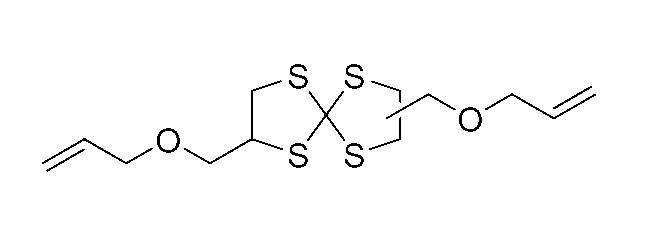
1.反応物の変化例
(実施例1-1)
化合物111 2,7-及び2,8-ビス(アリルオキシメチル)-1,4,6,9-テトラチオスピロ[4.4]ノナン(異性体混合物)の合成
100mLナスフラスコ中の4-(アリルオキシメチル)-1,3-ジチオラン-2-チオン(413mg,2mmol)に乾燥ジクロロメタン(20mL)を加え溶解し、そこへヨウ化亜鉛(32mg,0.1mmol)を加えた後、氷浴で0℃に冷却して撹拌を開始した。この反応液に、乾燥ジクロロメタン(20mL)に溶解した2-アリルオキシメチルチイラン(260mg,2mmol)を1時間かけて滴下し、氷浴をはずして25℃に昇温した後12時間撹拌した。次に反応混合物をエバポレーターで溶媒留去し、残渣をシリカゲルカラムクロマトグラフィー(ヘキサン/酢酸エチル=10:1)で精製後、25℃で24時間真空乾燥して無色透明液体の化合物111を収率94%(633mg)で得た。なお、化合物111は1H及び13CNMR分析にて同定した。1H及び13CNMRデータを図1に示す。化合物111の収率は表1の通りである。
(実施例1-2)
化合物112 2,7-及び2,8-ビス(アリルチオメチル)-1,4,6,9-テトラチオスピロ[4.4]ノナン(異性体混合物)の合成
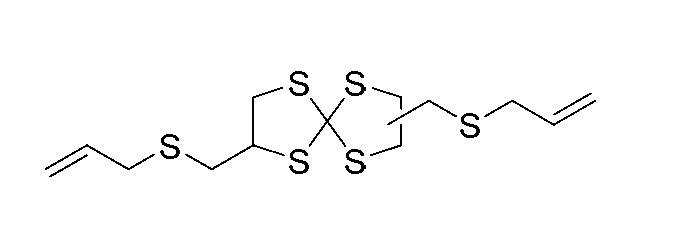
化合物112 2,7-及び2,8-ビス(アリルチオメチル)-1,4,6,9-テトラチオスピロ[4.4]ノナン(異性体混合物)の合成
200mLナスフラスコ中の4-(アリルチオメチル)-1,3-ジチオラン-2-チオン(1.11g,5mmol)に乾燥ジクロロメタン(50mL)を加え溶解し、そこへヨウ化亜鉛(80mg,0.25mmol)を加えた後、氷浴で0℃に冷却して撹拌を開始した。この反応液に、乾燥ジクロロメタン(50mL)に溶解した2-アリルチオメチルチイラン(731mg,5mmol)を2時間かけて滴下し、氷浴をはずして25℃に昇温した後12時間撹拌した。次に反応混合物をエバポレーターで溶媒留去し、残渣をシリカゲルカラムクロマトグラフィー(ヘキサン/酢酸エチル=10:1)で精製後、25℃で24時間真空乾燥して無・BR>F透明液体の化合物112を収率92%(1.69g)で得た。なお、化合物112は1H及び13CNMR分析にて同定した。1H及び13CNMRデータを図2に示す。化合物112の収率は表1の通りである。
(実施例1-3)
化合物113 2-アリルオキシメチル-7-アリルチオメチル-及び2-アリルオキシメチル-8-アリルチオメチル-1,4,6,9-テトラチオスピロ[4.4]ノナン(異性体混合物)の合成
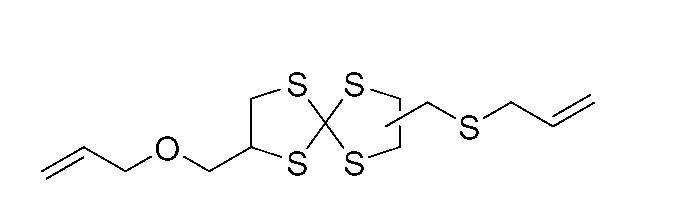
化合物113 2-アリルオキシメチル-7-アリルチオメチル-及び2-アリルオキシメチル-8-アリルチオメチル-1,4,6,9-テトラチオスピロ[4.4]ノナン(異性体混合物)の合成
100mLナスフラスコ中の4-(アリルオキシメチル)-1,3-ジチオラン-2-チオン(413mg,2mmol)に乾燥ジクロロエタン(20mL)を加え溶解し、そこへヨウ化亜鉛(32mg,0.1mmol)を加えた後、氷浴で0℃に冷却して撹拌を開始した。この反応液に、乾燥ジクロロエタン(20mL)に溶解した2-アリルチオメチルチイラン(293mg,2mmol)を1時間かけて滴下し、氷浴をはずして25℃に昇温した後12時間撹拌した。次に反応混合物をエバポレーターで溶媒留去し、残渣をシリカゲルカラムクロマトグラフィー(ヘキサン/酢酸エチル=10:1)で精製後、25℃で24時間真空乾燥して無色透明液体の化合物113を収率83%(584mg)で得た。なお、化合物113は1H及び13CNMR分析にて同定した。1H及び13CNMRデータを図3に示す。化合物113の収率は表1の通りである。
(実施例1-4)
化合物141 2,7-及び2,8-ビス(アクリロイルオキシメチル)-1,4,6,9-テトラチオスピロ[4.4]ノナン(異性体混合物)の合成

化合物141 2,7-及び2,8-ビス(アクリロイルオキシメチル)-1,4,6,9-テトラチオスピロ[4.4]ノナン(異性体混合物)の合成
200mLナスフラスコ中の4-(アクリロイルオキシメチル)-1,3-ジチオラン-2-チオン(881mg,4mmol)に乾燥ジクロロエタン(40mL)を加え溶解し、そこへヨウ化亜鉛(64mg,0.2mmol)を加えた後、氷浴で0℃に冷却して撹拌を開始した。この反応液に、乾燥ジクロロエタン(40mL)に溶解した2-アクリロイルオキシメチルチイラン(577mg,4mmol)を2時間かけて滴下し、氷浴をはずして25℃に昇温した後12時間撹拌した。次に反応混合物をエバポレーターで溶媒留去し、残渣をシリカゲルカラムクロマトグラフィー(ジクロロメタン)で精製後、25℃で24時間真空乾燥して無色透明オイル状の化合物141を収率88%(1.28g)で得た。なお、化合物141は1H及び13CNMR分析にて同定した。1H及び13CNMRデータを図4に示す。化合物141の収率は表1の通りである。
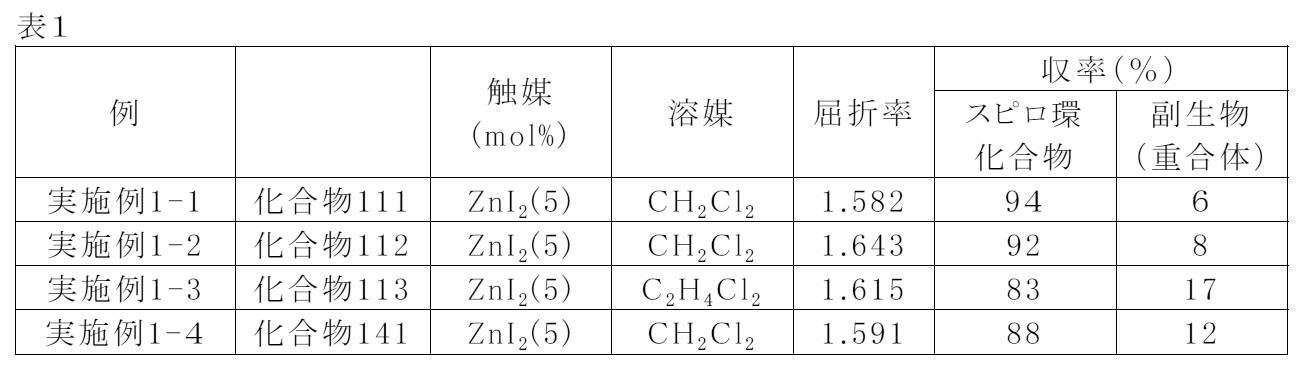
表1から、式(A)のトリチオカーボネート化合物と式(B)のエピスルフィド化合物とを式(C)の亜鉛化合物触媒の存在下で反応させるという簡便な方法により、多様なテトラチアスピロ化合物が得られることが確認される。しかも、本発明の製造方法では、副生成物の生成が抑制され、目的とするスピロ環化合物が高収率(高い選択性)で得られたことがわかる。また、本発明のテトラチアスピロ化合物が高屈折率及び高アッベ数を有することが確認される。
2.反応条件の変化例
(実施例2-1)
化合物111 2,7-及び2,8-ビス(アリルオキシメチル)-1,4,6,9-テトラチオスピロ[4.4]ノナン(異性体混合物)の合成
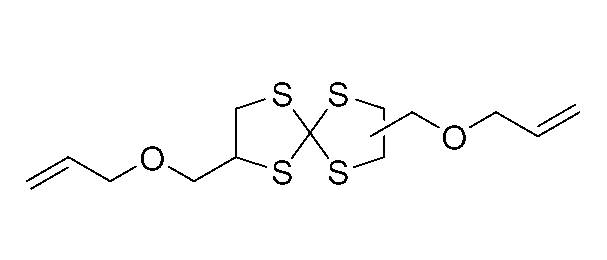
(実施例2-1)
化合物111 2,7-及び2,8-ビス(アリルオキシメチル)-1,4,6,9-テトラチオスピロ[4.4]ノナン(異性体混合物)の合成
10mLナスフラスコ中の4-(アリルオキシメチル)-1,3-ジチオラン-2-チオン(20.6mg,0.1mmol)に乾燥ジクロロメタン(1mL)を加え溶解し、そこへヨウ化亜鉛(0.02mmol;0.2当量;20モル%)を加えた後、氷浴で0℃に冷却して撹拌を開始した。この反応液に、乾燥ジクロロメタン(1mL)に溶解した2-アリルオキシメチルチイラン(13.0mg,0.1mmol)を1時間かけて滴下し、氷浴をはずして25℃に昇温した後12時間撹拌した。次に反応混合物を1H NMR分析して目的物と副生成物の生成比(収率)を算出した。化合物111の収率は表2の通りである。
(実施例2-2)
ヨウ化亜鉛の添加量を0.005mmol(0.05当量;5モル%)に変更したことを除き実施例2-1と同様にして化合物111と副生成物の生成比(収率)を算出した。化合物111の収率は表2の通りである。
ヨウ化亜鉛の添加量を0.005mmol(0.05当量;5モル%)に変更したことを除き実施例2-1と同様にして化合物111と副生成物の生成比(収率)を算出した。化合物111の収率は表2の通りである。
(実施例2-3)
溶媒として乾燥ジクロロメタンに代えて乾燥クロロベンゼンを使用したことを除き実施例2-2と同様にして化合物111と副生成物の生成比(収率)を算出した。化合物111の収率は表2の通りである。
溶媒として乾燥ジクロロメタンに代えて乾燥クロロベンゼンを使用したことを除き実施例2-2と同様にして化合物111と副生成物の生成比(収率)を算出した。化合物111の収率は表2の通りである。
(実施例2-4)
ヨウ化亜鉛を塩化亜鉛に変更したことを除き実施例2-1と同様にして化合物111と副生成物の生成比(収率)を算出した。化合物111の収率は表2の通りである。
ヨウ化亜鉛を塩化亜鉛に変更したことを除き実施例2-1と同様にして化合物111と副生成物の生成比(収率)を算出した。化合物111の収率は表2の通りである。
(実施例2-5)
ヨウ化亜鉛をZn(NTf2)2に変更したことを除き実施例2-1と同様にして化合物111と副生成物の生成比(収率)を算出した。化合物111の収率は表2の通りである。
ヨウ化亜鉛をZn(NTf2)2に変更したことを除き実施例2-1と同様にして化合物111と副生成物の生成比(収率)を算出した。化合物111の収率は表2の通りである。
(比較例2-1)
ヨウ化亜鉛をZn(OTf)2に変更したことを除き実施例2-1と同様にして化合物111と副生成物の生成比(収率)を算出した。化合物111の収率は表2の通りである。
ヨウ化亜鉛をZn(OTf)2に変更したことを除き実施例2-1と同様にして化合物111と副生成物の生成比(収率)を算出した。化合物111の収率は表2の通りである。
(比較例2-2)
ヨウ化亜鉛をヨウ化銅(CuI)に変更したことを除き実施例2-1と同様にして化合物111と副生成物の生成比(収率)を算出した。化合物111の収率は表2の通りである。
ヨウ化亜鉛をヨウ化銅(CuI)に変更したことを除き実施例2-1と同様にして化合物111と副生成物の生成比(収率)を算出した。化合物111の収率は表2の通りである。
(比較例2-3)
ヨウ化亜鉛を塩化銅(CuCl2)に変更したことを除き実施例2-1と同様にして化合物111と副生成物の生成比(収率)を算出した。化合物111の収率は表2の通りである。
ヨウ化亜鉛を塩化銅(CuCl2)に変更したことを除き実施例2-1と同様にして化合物111と副生成物の生成比(収率)を算出した。化合物111の収率は表2の通りである。
(比較例2-4)
ヨウ化亜鉛を三フッ化ホウ素錯体であるBF3-Et2Oに変更したことを除き実施例2-1と同様にして化合物111と副生成物の生成比(収率)を算出した。化合物111の収率は表2の通りである。
ヨウ化亜鉛を三フッ化ホウ素錯体であるBF3-Et2Oに変更したことを除き実施例2-1と同様にして化合物111と副生成物の生成比(収率)を算出した。化合物111の収率は表2の通りである。
(比較例2-5)
ヨウ化亜鉛をテトラフッ化ホウ素錯体であるHBF4-Et2Oに変更したことを除き実施例2-1と同様にして化合物111と副生成物の生成比(収率)を算出した。化合物111の収率は表2の通りである。
ヨウ化亜鉛をテトラフッ化ホウ素錯体であるHBF4-Et2Oに変更したことを除き実施例2-1と同様にして化合物111と副生成物の生成比(収率)を算出した。化合物111の収率は表2の通りである。

表2から、亜鉛化合物触媒を用いた本発明の製造方法を用いた実施例2-1~2-5では、簡便な方法により、副生成物の生成が抑制され、目的とするスピロ環化合物が高収率(高い選択性)で得られることが確認される。
一方、触媒の配位子として酸素原子配位子を用いた場合(比較例2-1)、亜鉛以外の金属の錯体触媒を用いた場合(比較例2-2,2-3)、フッ化ホウ素錯体(比較例2-4,2-5)を用いた場合には、副生成物の生成量が多く、目的とするスピロ環化合物の選択性に劣ることが確認された。
表2から、スピロ環化合物としてヨウ化亜鉛(ZnI2)を用いた場合には、使用量を0.05当量(5モル%)まで低下させた場合であっても、高い選択性を維持し得ることがわかる。
一方、触媒の配位子として酸素原子配位子を用いた場合(比較例2-1)、亜鉛以外の金属の錯体触媒を用いた場合(比較例2-2,2-3)、フッ化ホウ素錯体(比較例2-4,2-5)を用いた場合には、副生成物の生成量が多く、目的とするスピロ環化合物の選択性に劣ることが確認された。
表2から、スピロ環化合物としてヨウ化亜鉛(ZnI2)を用いた場合には、使用量を0.05当量(5モル%)まで低下させた場合であっても、高い選択性を維持し得ることがわかる。
<光学材料の製造>
(実施例3-1)
1.光学材料用組成物の調製
上記実施例1-1で得たテトラチアスピロ化合物(化合物111)について、ポリチオール化合物としての4-メルカプトメチル-1,8-ジメルカプト-3,6-ジチアオクタンを、前記テトラチアスピロ化合物の二重結合(末端のアリル基)と前記ポリチオール化合物のSH基の官能基比が1:1になるように混合し、光学材料用組成物を調製した。
(実施例3-1)
1.光学材料用組成物の調製
上記実施例1-1で得たテトラチアスピロ化合物(化合物111)について、ポリチオール化合物としての4-メルカプトメチル-1,8-ジメルカプト-3,6-ジチアオクタンを、前記テトラチアスピロ化合物の二重結合(末端のアリル基)と前記ポリチオール化合物のSH基の官能基比が1:1になるように混合し、光学材料用組成物を調製した。
2.重合硬化性組成物の調製
当該組成物にさらにラジカル重合開始剤としてのイルガキュア184(BASF社製)を1wt%添加し、溶解させて、重合硬化性組成物を得た。
当該組成物にさらにラジカル重合開始剤としてのイルガキュア184(BASF社製)を1wt%添加し、溶解させて、重合硬化性組成物を得た。
3.重合硬化
得られた重合硬化性組成物を0.5mm厚になるように2枚のガラス板で挟み、メタルハライドランプ(30mW/cm2、波長:200~400nm、アイグラフィックス社製)で片面5分間ずつ、計10分間紫外線照射を行い、重合硬化させ、光学材料を得た。結果を表2に示す。
得られた重合硬化性組成物を0.5mm厚になるように2枚のガラス板で挟み、メタルハライドランプ(30mW/cm2、波長:200~400nm、アイグラフィックス社製)で片面5分間ずつ、計10分間紫外線照射を行い、重合硬化させ、光学材料を得た。結果を表2に示す。
(実施例3-2)
化合物111に代えて化合物141を用いたこと以外は、上記実施例3-1と同様にして重合硬化性組成物を得、重合硬化処理を行ったが、硬化しなかった。
化合物111に代えて化合物141を用いたこと以外は、上記実施例3-1と同様にして重合硬化性組成物を得、重合硬化処理を行ったが、硬化しなかった。

表3から、本発明のテトラチアスピロ化合物を用いて製造した光学材料が高屈折率及び高アッベ数を有することが確認される。しかも、化合物111は光分解型ラジカル重合開始剤を用いて紫外線により光重合可能であることが確認される。これに対して、化合物141は紫外線により硬化しなかった。なお、化合物141は熱硬化及び光塩基発生剤を用いた光重合反応が可能である。
Claims (12)
- 下記式(1)で表されるテトラチアスピロ化合物の製造方法であって、
下記式(A)で表されるトリチオカーボネート化合物と下記式(B)で表されるエピスルフィド化合物とを下記式(C)で表される亜鉛化合物触媒の存在下で反応させることを含む、製造方法:

Xa及びXbはそれぞれ独立して、OまたはSを表し、
R1aは、-CO-、-(CO-O)q-(CH2)p-、または-(CH2)r-Ar-(CH2)p-からなる群から選択され、
R1bは、-CO-、-(CH2)p-(O-CO)q-、または-(CH2)p-Ar-(CH2)r-からなる群から選択され、
Arは、場合により炭素数1~4のアルキル、塩素、臭素、ヨウ素、炭素数1~4のアルキルチオ、及びシアノからなる群からそれぞれ独立して選択される1~4個の置換基で置換されていてもよいフェニレンを表し、
pは、0~4の整数を表し、
qは、0または1の整数を表し、
rは、0~4の整数を表し、
R2a及びR2bはそれぞれ独立して、水素原子または炭素数1~3のアルキルからなる群から選択され、
na及びnbはそれぞれ独立して、1~3の整数を表し;
式(C)中、
Yは、ハロゲン原子またはNTf2からなる群から選択され、
Tfは、トリフルオロメチルスルホニルを表す。) - Yがハロゲン原子である、請求項1に記載の製造方法。
- 前記亜鉛化合物触媒はZnI2を含む、請求項1または2に記載の製造方法。
- 前記テトラチアスピロ化合物は下記式(11)~(14)のいずれかで表される、請求項1~3のいずれか一項に記載の製造方法。
- Xa及びXbはいずれもSである、請求項1~4のいずれか一項に記載の製造方法。
- 下記式(1)で表されるテトラチアスピロ化合物:

Xa及びXbはそれぞれ独立して、OまたはSを表し、
R1aは、-CO-、-(CO-O)q-(CH2)p-、または-(CH2)r-Ar-(CH2)p-からなる群から選択され、
R1bは、-CO-、-(CH2)p-(O-CO)q-、または-(CH2)p-Ar-(CH2)r-からなる群から選択され、
Arは、場合により炭素数1~4のアルキル、塩素、臭素、ヨウ素、炭素数1~4のアルキルチオ、及びシアノからなる群からそれぞれ独立して選択される1~4個の置換基で置換されていてもよいフェニレンを表し、
pは、0~4の整数を表し、
qは、0または1の整数を表し、
rは、0~4の整数を表し、
R2a及びR2bはそれぞれ独立して、水素原子または炭素数1~3のアルキルからなる群から選択され、
na及びnbはそれぞれ独立して、1~3の整数を表す。) - 下記式(11)~(14)のいずれかで表される、請求項6に記載の化合物。
- Xa及びXbはいずれもSである、請求項6または7に記載の化合物。
- 請求項6~8のいずれか一項に記載のテトラチアスピロ化合物と、ポリチオール化合物とを含む、光学材料用組成物。
- テトラチアスピロ化合物が上記式(11)~(13)のいずれかで表される化合物から選択される、請求項9に記載の光学材料用組成物。
- 請求項10に記載の光学材料用組成物と重合触媒とを含む重合硬化性組成物を、紫外線または可視光の照射により硬化させることを特徴とする硬化物の製造方法。
- 請求項9または10に記載の光学材料用組成物と重合触媒とを含む重合硬化性組成物を硬化した光学材料。
Priority Applications (1)
| Application Number | Priority Date | Filing Date | Title |
|---|---|---|---|
| JP2018513139A JPWO2017183549A1 (ja) | 2016-04-20 | 2017-04-13 | 新規テトラチアスピロ化合物、それを含む光学用組成物、及びその製造方法 |
Applications Claiming Priority (2)
| Application Number | Priority Date | Filing Date | Title |
|---|---|---|---|
| JP2016-084519 | 2016-04-20 | ||
| JP2016084519 | 2016-04-20 |
Publications (1)
| Publication Number | Publication Date |
|---|---|
| WO2017183549A1 true WO2017183549A1 (ja) | 2017-10-26 |
Family
ID=60116757
Family Applications (1)
| Application Number | Title | Priority Date | Filing Date |
|---|---|---|---|
| PCT/JP2017/015094 Ceased WO2017183549A1 (ja) | 2016-04-20 | 2017-04-13 | 新規テトラチアスピロ化合物、それを含む光学用組成物、及びその製造方法 |
Country Status (3)
| Country | Link |
|---|---|
| JP (1) | JPWO2017183549A1 (ja) |
| TW (1) | TW201803878A (ja) |
| WO (1) | WO2017183549A1 (ja) |
Cited By (2)
| Publication number | Priority date | Publication date | Assignee | Title |
|---|---|---|---|---|
| JP2019085377A (ja) * | 2017-11-09 | 2019-06-06 | 三井化学株式会社 | 新規な環状トリチオカーボネート |
| WO2020040485A1 (ko) * | 2018-08-21 | 2020-02-27 | 주식회사 케이오씨솔루션 | 에피설파이드계 고굴절 광학재료용 안정제와 이를 이용한 광학재료용 조성물 및 광학재료의 제조방법 |
Citations (6)
| Publication number | Priority date | Publication date | Assignee | Title |
|---|---|---|---|---|
| US3124596A (en) * | 1964-03-10 | Alkylene trithiocarbonates | ||
| US3359248A (en) * | 1966-12-02 | 1967-12-19 | Thiokol Chemical Corp | Zinc or mercury salt catalytic process |
| JPH01278529A (ja) * | 1988-04-30 | 1989-11-08 | Cemedine Co Ltd | 複素環式化合物の開環方法及び重合方法 |
| JP2004323702A (ja) * | 2003-04-25 | 2004-11-18 | Hitachi Chem Co Ltd | 光学用樹脂及びそれを用いた用途 |
| JP2006511569A (ja) * | 2002-12-20 | 2006-04-06 | エシロール アテルナジオナール カンパニー ジェネラーレ デ オプティック | スピロテトラチオカルバミン酸塩およびスピロオキソチオカルバミン酸塩 |
| JP2011148719A (ja) * | 2010-01-20 | 2011-08-04 | Jsr Corp | 硫黄含有化合物及びその製造方法 |
-
2017
- 2017-04-13 JP JP2018513139A patent/JPWO2017183549A1/ja active Pending
- 2017-04-13 TW TW106112390A patent/TW201803878A/zh unknown
- 2017-04-13 WO PCT/JP2017/015094 patent/WO2017183549A1/ja not_active Ceased
Patent Citations (6)
| Publication number | Priority date | Publication date | Assignee | Title |
|---|---|---|---|---|
| US3124596A (en) * | 1964-03-10 | Alkylene trithiocarbonates | ||
| US3359248A (en) * | 1966-12-02 | 1967-12-19 | Thiokol Chemical Corp | Zinc or mercury salt catalytic process |
| JPH01278529A (ja) * | 1988-04-30 | 1989-11-08 | Cemedine Co Ltd | 複素環式化合物の開環方法及び重合方法 |
| JP2006511569A (ja) * | 2002-12-20 | 2006-04-06 | エシロール アテルナジオナール カンパニー ジェネラーレ デ オプティック | スピロテトラチオカルバミン酸塩およびスピロオキソチオカルバミン酸塩 |
| JP2004323702A (ja) * | 2003-04-25 | 2004-11-18 | Hitachi Chem Co Ltd | 光学用樹脂及びそれを用いた用途 |
| JP2011148719A (ja) * | 2010-01-20 | 2011-08-04 | Jsr Corp | 硫黄含有化合物及びその製造方法 |
Non-Patent Citations (2)
| Title |
|---|
| O RTIZ, R. A. ET AL.: "Synthesis of glycerol- derived diallyl spiroorthocarbonates and the study of their antishrinking properties in acrylic dental resins", JOURNAL OF MATERIALS SCIENCE : MATERIALS IN MEDICINE, vol. 24, no. 8, 2013, pages 2077 - 2084 * |
| OREMUS, V. ET AL.: "1,3-Oxathiolane synthesis: spirocyclic 1,3-oxathiolanes from the Lewis acid-catalyzed reaction of cyclic trithiocarbonates and oxiranes", HELVETICA CHIMICA ACTA, vol. 74, no. 7, 1991, pages 1500 - 1510, XP001194777, DOI: doi:10.1002/hlca.19910740714 * |
Cited By (2)
| Publication number | Priority date | Publication date | Assignee | Title |
|---|---|---|---|---|
| JP2019085377A (ja) * | 2017-11-09 | 2019-06-06 | 三井化学株式会社 | 新規な環状トリチオカーボネート |
| WO2020040485A1 (ko) * | 2018-08-21 | 2020-02-27 | 주식회사 케이오씨솔루션 | 에피설파이드계 고굴절 광학재료용 안정제와 이를 이용한 광학재료용 조성물 및 광학재료의 제조방법 |
Also Published As
| Publication number | Publication date |
|---|---|
| TW201803878A (zh) | 2018-02-01 |
| JPWO2017183549A1 (ja) | 2019-02-28 |
Similar Documents
| Publication | Publication Date | Title |
|---|---|---|
| KR100944782B1 (ko) | 고 굴절 지수 및 고 내충격성의 폴리티오우레탄/우레아재료, 그의 제조 방법 및 광학 분야에서의 그의 용도 | |
| KR102522740B1 (ko) | 광학 재료용 조성물 및 그것을 사용한 광학 재료 | |
| EP3135703B1 (en) | Polymerizable composition for optical material, optical material, and method for producing optical material | |
| JP7676807B2 (ja) | 重合性組成物及びそれを重合硬化してなる樹脂 | |
| JP7545023B2 (ja) | 重合性組成物並びにそれから得られる光学材料及び色調変化材料 | |
| EP3486272B1 (en) | Aromatic polythiol compound for optical material | |
| JP4872671B2 (ja) | 密着複層型回折光学素子 | |
| EP1316556B1 (en) | Opical product comprising a thiol compound | |
| JP7521524B2 (ja) | 光学材料用重合性組成物 | |
| JP2018521039A (ja) | 3−メルカプトプロピオン酸の製造方法、並びにそれを用いたメルカプト基を有するカルボン酸エステル化合物及びチオウレタン系光学材料の製造方法 | |
| KR20230122580A (ko) | 조성물 그리고 이것을 이용한 광학재료 및 렌즈 | |
| JP7234677B2 (ja) | 多官能プロパルギル化合物及びそれを含む光学用組成物 | |
| EP1548039B1 (en) | Photopolymerizable composition and use thereof | |
| JP2019001785A (ja) | 新規テトラチアスピロ化合物、それを含む光学用組成物、及びその製造方法 | |
| JP2019026755A (ja) | 光学材料用組成物 | |
| JP2024079891A (ja) | ナフタレントリチオールまたはその誘導体を含む組成物およびその硬化物、ならびにこれらの用途 | |
| JPWO2017183549A1 (ja) | 新規テトラチアスピロ化合物、それを含む光学用組成物、及びその製造方法 | |
| WO2024228342A1 (ja) | 重合性組成物及びそれを重合硬化してなる樹脂、並びに該樹脂を含む光学材料 | |
| JP2022128912A (ja) | 重合性組成物及びそれを重合硬化してなる樹脂 | |
| US10669367B2 (en) | Polythiol composition for plastic lens | |
| JP2004231538A (ja) | 新規なポリチオール | |
| US8822623B2 (en) | High index and high impact resistant poly(thio)urethane/urea material, method of manufacturing same and its use in the optical field | |
| WO2020116821A1 (ko) | 신규한 에피설파이드 화합물, 이를 포함하는 에피설파이드계 광학재료용 조성물과 광학재료의 제조방법 | |
| WO2020040485A1 (ko) | 에피설파이드계 고굴절 광학재료용 안정제와 이를 이용한 광학재료용 조성물 및 광학재료의 제조방법 | |
| WO2020031815A1 (ja) | 新規アリル化合物および光学材料用組成物 |
Legal Events
| Date | Code | Title | Description |
|---|---|---|---|
| ENP | Entry into the national phase |
Ref document number: 2018513139 Country of ref document: JP Kind code of ref document: A |
|
| NENP | Non-entry into the national phase |
Ref country code: DE |
|
| 121 | Ep: the epo has been informed by wipo that ep was designated in this application |
Ref document number: 17785888 Country of ref document: EP Kind code of ref document: A1 |
|
| 122 | Ep: pct application non-entry in european phase |
Ref document number: 17785888 Country of ref document: EP Kind code of ref document: A1 |