WO2017179385A1 - ノボラック型樹脂及びレジスト材料 - Google Patents
ノボラック型樹脂及びレジスト材料 Download PDFInfo
- Publication number
- WO2017179385A1 WO2017179385A1 PCT/JP2017/011647 JP2017011647W WO2017179385A1 WO 2017179385 A1 WO2017179385 A1 WO 2017179385A1 JP 2017011647 W JP2017011647 W JP 2017011647W WO 2017179385 A1 WO2017179385 A1 WO 2017179385A1
- Authority
- WO
- WIPO (PCT)
- Prior art keywords
- group
- compound
- resin
- ether
- curable composition
- Prior art date
- Legal status (The legal status is an assumption and is not a legal conclusion. Google has not performed a legal analysis and makes no representation as to the accuracy of the status listed.)
- Ceased
Links
Images
Classifications
-
- C—CHEMISTRY; METALLURGY
- C08—ORGANIC MACROMOLECULAR COMPOUNDS; THEIR PREPARATION OR CHEMICAL WORKING-UP; COMPOSITIONS BASED THEREON
- C08G—MACROMOLECULAR COMPOUNDS OBTAINED OTHERWISE THAN BY REACTIONS ONLY INVOLVING UNSATURATED CARBON-TO-CARBON BONDS
- C08G8/00—Condensation polymers of aldehydes or ketones with phenols only
- C08G8/04—Condensation polymers of aldehydes or ketones with phenols only of aldehydes
- C08G8/08—Condensation polymers of aldehydes or ketones with phenols only of aldehydes of formaldehyde, e.g. of formaldehyde formed in situ
- C08G8/20—Condensation polymers of aldehydes or ketones with phenols only of aldehydes of formaldehyde, e.g. of formaldehyde formed in situ with polyhydric phenols
-
- C—CHEMISTRY; METALLURGY
- C08—ORGANIC MACROMOLECULAR COMPOUNDS; THEIR PREPARATION OR CHEMICAL WORKING-UP; COMPOSITIONS BASED THEREON
- C08L—COMPOSITIONS OF MACROMOLECULAR COMPOUNDS
- C08L61/00—Compositions of condensation polymers of aldehydes or ketones; Compositions of derivatives of such polymers
- C08L61/04—Condensation polymers of aldehydes or ketones with phenols only
- C08L61/06—Condensation polymers of aldehydes or ketones with phenols only of aldehydes with phenols
- C08L61/12—Condensation polymers of aldehydes or ketones with phenols only of aldehydes with phenols with polyhydric phenols
-
- G—PHYSICS
- G03—PHOTOGRAPHY; CINEMATOGRAPHY; ANALOGOUS TECHNIQUES USING WAVES OTHER THAN OPTICAL WAVES; ELECTROGRAPHY; HOLOGRAPHY
- G03F—PHOTOMECHANICAL PRODUCTION OF TEXTURED OR PATTERNED SURFACES, e.g. FOR PRINTING, FOR PROCESSING OF SEMICONDUCTOR DEVICES; MATERIALS THEREFOR; ORIGINALS THEREFOR; APPARATUS SPECIALLY ADAPTED THEREFOR
- G03F7/00—Photomechanical, e.g. photolithographic, production of textured or patterned surfaces, e.g. printing surfaces; Materials therefor, e.g. comprising photoresists; Apparatus specially adapted therefor
- G03F7/004—Photosensitive materials
- G03F7/022—Quinonediazides
- G03F7/023—Macromolecular quinonediazides; Macromolecular additives, e.g. binders
-
- G—PHYSICS
- G03—PHOTOGRAPHY; CINEMATOGRAPHY; ANALOGOUS TECHNIQUES USING WAVES OTHER THAN OPTICAL WAVES; ELECTROGRAPHY; HOLOGRAPHY
- G03F—PHOTOMECHANICAL PRODUCTION OF TEXTURED OR PATTERNED SURFACES, e.g. FOR PRINTING, FOR PROCESSING OF SEMICONDUCTOR DEVICES; MATERIALS THEREFOR; ORIGINALS THEREFOR; APPARATUS SPECIALLY ADAPTED THEREFOR
- G03F7/00—Photomechanical, e.g. photolithographic, production of textured or patterned surfaces, e.g. printing surfaces; Materials therefor, e.g. comprising photoresists; Apparatus specially adapted therefor
- G03F7/004—Photosensitive materials
- G03F7/022—Quinonediazides
- G03F7/023—Macromolecular quinonediazides; Macromolecular additives, e.g. binders
- G03F7/0233—Macromolecular quinonediazides; Macromolecular additives, e.g. binders characterised by the polymeric binders or the macromolecular additives other than the macromolecular quinonediazides
- G03F7/0236—Condensation products of carbonyl compounds and phenolic compounds, e.g. novolak resins
-
- G—PHYSICS
- G03—PHOTOGRAPHY; CINEMATOGRAPHY; ANALOGOUS TECHNIQUES USING WAVES OTHER THAN OPTICAL WAVES; ELECTROGRAPHY; HOLOGRAPHY
- G03F—PHOTOMECHANICAL PRODUCTION OF TEXTURED OR PATTERNED SURFACES, e.g. FOR PRINTING, FOR PROCESSING OF SEMICONDUCTOR DEVICES; MATERIALS THEREFOR; ORIGINALS THEREFOR; APPARATUS SPECIALLY ADAPTED THEREFOR
- G03F7/00—Photomechanical, e.g. photolithographic, production of textured or patterned surfaces, e.g. printing surfaces; Materials therefor, e.g. comprising photoresists; Apparatus specially adapted therefor
- G03F7/004—Photosensitive materials
- G03F7/039—Macromolecular compounds which are photodegradable, e.g. positive electron resists
- G03F7/0392—Macromolecular compounds which are photodegradable, e.g. positive electron resists the macromolecular compound being present in a chemically amplified positive photoresist composition
-
- G—PHYSICS
- G03—PHOTOGRAPHY; CINEMATOGRAPHY; ANALOGOUS TECHNIQUES USING WAVES OTHER THAN OPTICAL WAVES; ELECTROGRAPHY; HOLOGRAPHY
- G03F—PHOTOMECHANICAL PRODUCTION OF TEXTURED OR PATTERNED SURFACES, e.g. FOR PRINTING, FOR PROCESSING OF SEMICONDUCTOR DEVICES; MATERIALS THEREFOR; ORIGINALS THEREFOR; APPARATUS SPECIALLY ADAPTED THEREFOR
- G03F7/00—Photomechanical, e.g. photolithographic, production of textured or patterned surfaces, e.g. printing surfaces; Materials therefor, e.g. comprising photoresists; Apparatus specially adapted therefor
- G03F7/20—Exposure; Apparatus therefor
Definitions
- the present invention relates to a novolak resin excellent in various properties such as heat resistance, alkali developability, photosensitivity, and resolution, a photosensitive composition containing the resin, a curable composition, and a resist material.
- Phenol resins take advantage of their excellent heat resistance, etc., alone or as curable compositions formulated with epoxy resins, etc., photoresist materials, insulating materials for electronic components such as semiconductor encapsulants and printed wiring boards, bonding It is used for various applications such as agents, paints and molding materials.
- the problem to be solved by the present invention is a novolac resin excellent in various performances such as heat resistance, alkali developability, photosensitivity, resolution, etc., a photosensitive composition containing the same, a curable composition, and a resist material Is to provide.
- the present invention relates to a novolak resin using a compound (A) having a tris (hydroxyaryl) methine group and an aldehyde compound (B) as essential reaction raw materials.
- the present invention further relates to a photosensitive composition containing the novolac resin and a photosensitive agent.
- the present invention further relates to a resist material comprising the photosensitive composition.
- the present invention further relates to a curable composition containing the novolak type resin and a curing agent.
- the present invention further relates to a cured product of the curable composition.
- the present invention further relates to a resist material comprising the curable composition.
- a novolak resin excellent in various performances such as heat resistance, alkali developability, photosensitivity, and resolution
- a photosensitive composition containing the same a curable composition, and a resist material.
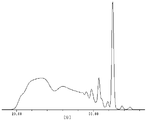
- FIG. 1 is a GPC chart of the novolac resin (1) obtained in Production Example 1.
- the novolak resin of the present invention uses a compound (A) having a tris (hydroxyaryl) methine group and an aldehyde compound (B) as essential reaction raw materials.
- the tris (hydroxyaryl) methine group included in the compound (A) having a tris (hydroxyaryl) methine group is a structural site in which three hydrogen atoms on the methyl group are substituted with a hydroxyaryl group.
- the hydroxyaryl group includes, for example, a hydroxyphenyl group, a hydroxynaphthyl group, a hydroxyanthryl group, and an aliphatic hydrocarbon group, an alkoxy group, an aryl group, an aralkyl group, a halogen atom, and other functional groups on these aromatic nuclei. Examples thereof include one or more substituted structural sites.
- R 1 is any one of an aliphatic hydrocarbon group, an alkoxy group, a halogen atom, an aryl group, and an aralkyl group, and n is 0 or an integer of 1 to 4. ] It is preferable that it is a structure site
- R 1 in the structural formula (1) aliphatic hydrocarbon group, an alkoxy group, an aryl group, an aralkyl group, either of a halogen atom
- n is an integer of 0 or 1 to 4.
- aliphatic hydrocarbon groups such as methyl group, ethyl group, vinyl group, propyl group, butyl group, pentyl group, hexyl group, cyclohexyl group, heptyl group, octyl group and nonyl group; methoxy group , Alkoxy groups such as ethoxy group, propyloxy group, butoxy group; halogen atoms such as fluorine atom, chlorine atom, bromine atom; phenyl group, naphthyl group, anthryl group, and aliphatic hydrocarbon groups on these aromatic nuclei And aryl groups substituted by alkoxy groups, halogen atoms, etc .; phenylmethyl groups, phenyleth
- aromatic nuclei examples include substituted aralkyl groups.
- the structural parts represented by the structural formula (1) since it becomes a novolak resin excellent in various performances such as heat resistance, alkali developability, photosensitivity, and resolution, tris (hydroxyphenyl) in which n is all 0 ) A methine group is preferred.
- the substitution position of the hydroxy group in the structural formula (1) is not particularly limited, and may be any of the ortho position, the meta position, and the para position with respect to the bonding position of the methine group carbon. Especially, since it becomes a novolak-type resin excellent in various performances such as heat resistance, alkali developability, photosensitivity, and resolution, it is preferably in the para position with respect to the bonding position of the methine group carbon.
- the compound (A) having a tris (hydroxyaryl) methine group may be any compound as long as it has a tris (hydroxyaryl) methine group in the molecular structure, and other specific structures are not particularly limited.
- the compound (A) having a tris (hydroxyaryl) methine group may be used alone or in combination of two or more.
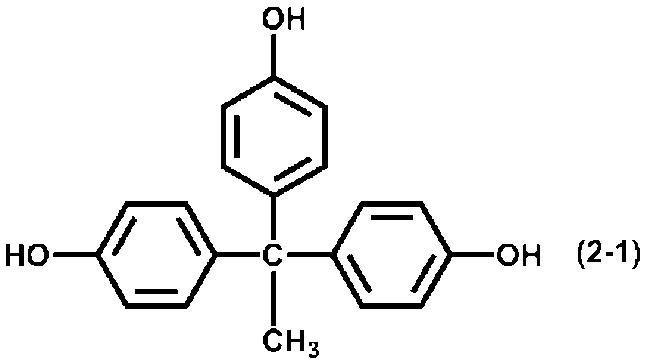
- Specific examples of the compound (A) having the tris (hydroxyaryl) methine group include, for example, the following structural formula (2)
- R 1 is an aliphatic hydrocarbon group, an alkoxy group, an aryl group, an aralkyl group, or a halogen atom
- n is 0 or an integer of 1 to 4.
- R 2 is a hydrocarbon group or a structural moiety having one or more alkoxy groups, halogen atoms, or hydroxyl groups on the hydrocarbon group.
- R 1 in the structural formula (2) has the same meaning as R 1 in the structural formula (1).
- R 2 in the structural formula (2) is a hydrocarbon moiety or a structural moiety having one or more alkoxy groups, halogen atoms, or hydroxyl groups on the hydrocarbon group.
- the hydrocarbon group include aliphatic hydrocarbon groups such as a methyl group, an ethyl group, a vinyl group, a propyl group, a butyl group, a pentyl group, a hexyl group, a cyclohexyl group, a heptyl group, an octyl group, and a nonyl group.
- Aryl groups such as phenyl group, naphthyl group and anthryl group; aralkyl groups such as phenylmethyl group, phenylethyl group, naphthylmethyl group and naphthylethyl group;
- alkoxy group include a methoxy group, an ethoxy group, a propyloxy group, and a butoxy group.
- halogen atom include a fluorine atom, a chlorine atom, and a bromine atom.
- R 2 is a hydrocarbon group or a structural part having one or more hydroxyl groups on a hydrocarbon group because it becomes a novolak resin excellent in various performances such as heat resistance, alkali developability, photosensitivity, and resolution. It is preferably an aliphatic hydrocarbon group.
- the compound (A) having a tris (hydroxyaryl) methine group is obtained by, for example, reacting a hydroxyarene compound (a1) corresponding to a hydroxyaryl group with a ketone compound (a2) having a hydroxyaryl group under an acid catalyst condition. It can obtain by the method of making it.
- hydroxyarene compound (a1) and the ketone compound (a2) having the hydroxyaryl group include a compound (A) having the tris (hydroxyaryl) methine group represented by the structural formula (2).
- the hydroxyarene compound (a1) includes a compound represented by the following structural formula (3)
- the ketone compound (a2) having the hydroxyaryl group includes the following structural formula (4). And the compounds represented.
- R 1 is an aliphatic hydrocarbon group, an alkoxy group, an aryl group, an aralkyl group, or a halogen atom, and n is 0 or an integer of 1 to 4.
- R 2 is a hydrocarbon group or a structural moiety having one or more alkoxy groups, halogen atoms, or hydroxyl groups on the hydrocarbon group.
- the aldehyde compound (B) may be any compound that can cause a condensation reaction with the compound (A) having the tris (hydroxyaryl) methine group to form a novolac resin structure.
- formaldehyde may be used alone or in combination of two or more. Among them, it is preferable to use formaldehyde because of its excellent reactivity with the compound (A) having the tris (hydroxyaryl) methine group.
- Formaldehyde may be used as formalin in an aqueous solution state or as paraformaldehyde in a solid state.
- formaldehyde and other aldehyde compounds are used in combination, it is preferable to use the other aldehyde compound in a ratio of 0.05 to 1 mol with respect to 1 mol of formaldehyde.
- the novolak-type resin of the present invention uses the compound (A) having the tris (hydroxyaryl) methine group and the aldehyde compound (B) as essential reaction raw materials, and is used in combination with the compound (A).
- Other phenolic hydroxyl group-containing compounds (A ′) may be used in combination.
- phenolic hydroxyl group-containing compounds (A ′) include, for example, phenol; alkylphenols such as cresol, xylenol, ethylphenol, propylphenol, isopropylphenol, butylphenol, t-butylphenol, pentylphenol, octylphenol, nonylphenol, and cumylphenol; Halogenated phenols such as fluorophenol, chlorophenol, bromophenol and iodophenol; arylphenols such as phenylphenol; phenols having functional groups such as aminophenol and nitrophenol; condensed polycyclic compounds such as naphthol and anthracenol; Examples thereof include polyhydroxy compounds such as dihydroxybenzene, dihydroxynaphthalene, biphenol and bisphenol. These may be used alone or in combination of two or more.
- the novolak resin of the present invention exhibits sufficiently excellent characteristics such as heat resistance, alkali developability, photosensitivity, and resolution.
- the compound (A) having the tris (hydroxyaryl) methine group is added to the total of the compound (A) having the tris (hydroxyaryl) methine group and the other phenolic hydroxyl group-containing compound (A ′). It is preferable to use at least mol%, more preferably at least 80 mol%, particularly preferably at least 90 mol%.
- the method for producing the novolak resin of the present invention is not particularly limited, and the compound (A) having the tris (hydroxyaryl) methine group and the aldehyde compound (B) are used as essential reaction raw materials, It can be manufactured by a similar method.
- the above-mentioned compound (A) having a tris (hydroxyaryl) methine group, aldehyde compound (B), and other phenolic hydroxyl group-containing compound (A ′) used as necessary are subjected to acid-catalyzed conditions. And reacting in a temperature range of about 60 to 140 ° C.
- the acid catalyst examples include acetic acid, oxalic acid, sulfuric acid, hydrochloric acid, phenolsulfonic acid, paratoluenesulfonic acid, zinc acetate, manganese acetate and the like. These acid catalysts may be used alone or in combination of two or more. Among these, sulfuric acid and paratoluenesulfonic acid are preferable from the viewpoint of excellent catalytic activity.
- the reaction ratio of the compound (A) having the tris (hydroxyaryl) methine group, the aldehyde compound (B), and other phenolic hydroxyl group-containing compound (A ′) used as necessary suppresses excessive increase in the molecular weight.
- the total of the compound (A) having the tris (hydroxyaryl) methine group and the other phenolic hydroxyl group-containing compound (A ′) is 1
- the aldehyde compound (B) is preferably in the range of 0.5 to 1.2 mol, more preferably in the range of 0.6 to 0.9 mol, relative to mol.
- the reaction may be performed in an organic solvent as necessary.
- the organic solvent include monoalcohols such as methanol, ethanol, propanol, and butanol; ethylene glycol, 1,2-propanediol, 1,3-propanediol, 1,4-butanediol, 1,5-pentanediol, Polyols such as 1,6-hexanediol, 1,7-heptanediol, 1,8-octanediol, 1,9-nonanediol, trimethylene glycol, diethylene glycol, polyethylene glycol, glycerin; 2-ethoxyethanol, ethylene glycol monomethyl Ether, ethylene glycol monoethyl ether, ethylene glycol monopropyl ether, ethylene glycol monobutyl ether, ethylene glycol monopentyl ether, ethylene glycol dimethyl ether, Glycol ethers such as ethylene glycol ethyl
- a step of distilling off unreacted raw materials and solvents a purification step such as washing with water or reprecipitation may be performed.
- the weight average molecular weight (Mw) of the novolak type resin of the present invention is excellent in various performances such as heat resistance, alkali developability, photosensitivity, resolution and the like, and is suitable for resist materials. Is preferable, and a range of 10,000 to 30,000 is more preferable.
- the polydispersity (Mw / Mn) of the novolak type resin is preferably in the range of 3 to 20, and more preferably in the range of 5 to 15.
- the weight average molecular weight (Mw) and the polydispersity (Mw / Mn) are values measured by GPC under the following conditions.
- the novolac resin of the present invention described in detail above has a very high heat resistance, so that it can be used for various electrical and electronic members such as photoresists, liquid crystal alignment films, and printed wiring boards, as well as adhesives and paints. It can be suitably used for the above.
- the novolac resin of the present invention is particularly suitable for resist applications because it is excellent in alkali solubility and photosensitivity, and various resists such as a resist underlayer film and a resist permanent film in addition to a general interlayer insulating film. It can be used as a member.
- the photosensitive composition of the present invention contains the novolac resin of the present invention and a photosensitive agent as essential components.
- the photosensitive composition of the present invention may be used in combination with other resin (C) in addition to the novolak resin of the present invention.
- the other resin (C) any resin can be used as long as it is soluble in an alkali developer or can be dissolved in an alkali developer by using it in combination with an additive such as an acid generator. .
- Examples of the other resin (C) include other phenol resins (C-1) other than the novolak resin of the present invention, p-hydroxystyrene, and p- (1,1,1,3,3,3- A homopolymer or copolymer (C-2) of a hydroxy group-containing styrene compound such as hexafluoro-2-hydroxypropyl) styrene, the hydroxyl group of the above (C-1) or (C-2) is a t-butoxycarbonyl group Modified with an acid-decomposable group such as benzyloxycarbonyl group (C-3), homopolymer or copolymer (C-4) of (meth) acrylic acid, norbornene compound, tetracyclododecene compound, etc. And an alternating polymer (C-5) of an alicyclic polymerizable monomer and maleic anhydride or maleimide.
- C-1 phenol resins
- Examples of the other phenol resin (C-1) include phenol novolak resin, cresol novolak resin, naphthol novolak resin, aromatic hydrocarbon formaldehyde resin-modified phenol resin, dicyclopentadiene phenol addition type resin, phenol aralkyl resin (Xylok resin).
- Naphthol aralkyl resin trimethylol methane resin, tetraphenylol ethane resin, biphenyl modified phenolic resin (polyhydric phenol compound with phenol nucleus linked by bismethylene group), biphenyl modified naphthol resin (phenol nucleus linked by bismethylene group) Polyhydric naphthol compounds), aminotriazine-modified phenolic resins (polyhydric phenol compounds with phenolic nuclei linked by melamine, benzoguanamine, etc.) and alkoxy groups Yes aromatic ring-modified novolac resins (polyvalent phenolic compounds phenol nucleus and an alkoxy group-containing aromatic ring are connected by formaldehyde) and phenol resins.
- a cresol novolak resin or a co-condensed novolak resin of cresol and another phenolic compound is used.
- the cresol novolak resin or the co-condensed novolak resin of cresol and other phenolic compound comprises at least one cresol selected from the group consisting of o-cresol, m-cresol and p-cresol and an aldehyde compound. It is a novolak resin obtained as an essential raw material and appropriately used in combination with other phenolic compounds.
- phenolic compounds other than the cresol include, for example, phenol; 2,3-xylenol, 2,4-xylenol, 2,5-xylenol, 2,6-xylenol, 3,4-xylenol, 3,5-xylenol Xylenol such as o-ethylphenol, m-ethylphenol, p-ethylphenol, etc .; butylphenol such as isopropylphenol, butylphenol, pt-butylphenol; p-pentylphenol, p-octylphenol, p-nonylphenol, alkylphenols such as p-cumylphenol; halogenated phenols such as fluorophenol, chlorophenol, bromophenol and iodophenol; p-phenylphenol, aminophenol, nitrophenol, 1-substituted phenols such as nitrophenol and trinitrophenol; condensed polycycl
- phenolic compounds may be used alone or in combination of two or more.
- the amount used is preferably such that the other phenolic compound is in the range of 0.05 to 1 mol with respect to a total of 1 mol of the cresol raw material.
- aldehyde compound examples include formaldehyde, paraformaldehyde, trioxane, acetaldehyde, propionaldehyde, polyoxymethylene, chloral, hexamethylenetetramine, furfural, glyoxal, n-butyraldehyde, caproaldehyde, allylaldehyde, benzaldehyde, croton.
- formaldehyde is preferable because of its excellent reactivity, and formaldehyde and other aldehyde compounds may be used in combination.
- the amount of the other aldehyde compounds used is preferably in the range of 0.05 to 1 mole per mole of formaldehyde.
- the reaction ratio between the phenolic compound and the aldehyde compound in producing the novolak resin is such that a photosensitive resin composition having excellent sensitivity and heat resistance can be obtained.
- the range is preferably 1.6 mol, and more preferably in the range of 0.5 to 1.3.
- the reaction between the phenolic compound and the aldehyde compound is performed in the presence of an acid catalyst at a temperature of 60 to 140 ° C., and then water and residual monomers are removed under reduced pressure.
- an acid catalyst used here include oxalic acid, sulfuric acid, hydrochloric acid, phenolsulfonic acid, p-toluenesulfonic acid, zinc acetate, manganese acetate, etc., each of which may be used alone or in combination of two or more. May be. Of these, oxalic acid is preferred because of its excellent catalytic activity.
- cresol novolak resins using metacresol alone or cresol novolak resins using metacresol and paracresol in combination It is preferable that In the latter case, the reaction molar ratio of metacresol to paracresol [metacresol / paracresol] is a photosensitive resin composition having an excellent balance between sensitivity and heat resistance, so that the ratio is 10/0 to 2/8.
- the range is preferable, and the range of 7/3 to 2/8 is more preferable.
- the blending ratio of the novolac resin of the present invention to the other resin (C) can be arbitrarily adjusted depending on the desired application.
- the novolac resin of the present invention is excellent in heat resistance and also in alkali solubility and photosensitivity, a photosensitive composition containing this as a main component is optimal for resist applications.
- the ratio of the novolak resin of the present invention in the total resin component is preferably 60% by mass or more, and more preferably 80% by mass or more.
- the high heat resistance which the novolak-type resin of the present invention has is an unprecedented level, in order to further improve the heat resistance of the photosensitive composition containing the other resin (C) as a main component.
- a part of the novolac resin of the present invention may be added.
- the mixing ratio of the novolac resin of the present invention to the other resin (C) is such that the novolac resin of the present invention is in the range of 3 to 80 parts by mass with respect to 100 parts by mass of the other resin (C). Preferably there is.
- the photosensitive agent examples include compounds having a quinonediazide group.
- Specific examples of the compound having a quinonediazide group include, for example, an aromatic (poly) hydroxy compound, naphthoquinone-1,2-diazide-5-sulfonic acid, naphthoquinone-1,2-diazide-4-sulfonic acid, orthoanthra Examples thereof include complete ester compounds, partial ester compounds, amidated products, and partially amidated products with sulfonic acids having a quinonediazide group such as quinonediazidesulfonic acid.
- aromatic (poly) hydroxy compound used here examples include 2,3,4-trihydroxybenzophenone, 2,4,4′-trihydroxybenzophenone, 2,4,6-trihydroxybenzophenone, 2,3,4, 6-trihydroxybenzophenone, 2,3,4-trihydroxy-2′-methylbenzophenone, 2,3,4,4′-tetrahydroxybenzophenone, 2,2 ′, 4,4′-tetrahydroxybenzophenone, 2, 3 ′, 4,4 ′, 6-pentahydroxybenzophenone, 2,2 ′, 3,4,4′-pentahydroxybenzophenone, 2,2 ′, 3,4,5-pentahydroxybenzophenone, 2,3 ′, 4,4 ′, 5 ′, 6-hexahydroxybenzophenone, 2,3,3 ′, 4,4 ′, 5′-hexahydroxyben Polyhydroxy benzophenone compounds such phenone;
- a tris (hydroxyphenyl) methane compound such as phenyl) -3,4-dihydroxyphenylmethane, bis (4-hydroxy-3,5-dimethylphenyl) -3,4-dihydroxyphenylmethane, or a methyl-substituted product thereof;
- the blending amount of the photosensitive agent in the photosensitive composition of the present invention is a photosensitive composition having excellent photosensitivity, and therefore 5 to 50 parts by mass with respect to 100 parts by mass in total of the resin solid content of the photosensitive composition. It is preferable that the ratio is
- the photosensitive composition of the present invention may contain a surfactant for the purpose of improving the film-forming property and pattern adhesion when used for resist applications, and reducing development defects.
- a surfactant for the purpose of improving the film-forming property and pattern adhesion when used for resist applications, and reducing development defects.
- the surfactant used here include polyoxyethylene lauryl ether, polyoxyethylene stearyl ether, polyoxyethylene cetyl ether, polyoxyethylene alkyl ether compounds such as polyoxyethylene oleyl ether, polyoxyethylene octylphenol ether, polyoxyethylene Polyoxyethylene alkyl allyl ether compounds such as ethylene nonylphenol ether, polyoxyethylene / polyoxypropylene block copolymers, sorbitan monolaurate, sorbitan monopalmitate, sorbitan monostearate, sorbitan monooleate, sorbitan trioleate, sorbitan tristearate Sorbitan fatty acid ester compounds such as polyoxy
- the compounding amount of these surfactants is preferably in the range of 0.001 to 2 parts by mass with respect to a total of 100 parts by mass of the resin solid content in the photosensitive composition of the present invention.
- a resist composition can be obtained.
- This may be used as it is as a positive resist solution, or may be used as a positive resist film obtained by removing the solvent by applying the resist composition in a film form.
- the support film used as a resist film include synthetic resin films such as polyethylene, polypropylene, polycarbonate, and polyethylene terephthalate, and may be a single layer film or a plurality of laminated films.
- the surface of the support film may be a corona-treated one or a release agent.
- the organic solvent used in the photosensitive composition of the present invention is not particularly limited, and examples thereof include alkylene glycol monomethyl ethers such as ethylene glycol monomethyl ether, ethylene glycol monoethyl ether, ethylene glycol monopropyl ether, ethylene glycol monobutyl ether, and propylene glycol monomethyl ether.
- alkylene glycol monomethyl ethers such as ethylene glycol monomethyl ether, ethylene glycol monoethyl ether, ethylene glycol monopropyl ether, ethylene glycol monobutyl ether, and propylene glycol monomethyl ether.
- Alkyl ethers Dialkylene glycol dialkyl ethers such as diethylene glycol dimethyl ether, diethylene glycol diethyl ether, diethylene glycol dipropyl ether, diethylene glycol dibutyl ether; alkylene glycols such as ethylene glycol monomethyl ether acetate, ethylene glycol monoethyl ether acetate, propylene glycol monomethyl ether acetate Alkyl ether acetate; ketone compounds such as acetone, methyl ethyl ketone, cyclohexanone, methyl amyl ketone; cyclic ethers such as dioxane; methyl 2-hydroxypropionate, ethyl 2-hydroxypropionate, 2-hydroxy-2-methylpropionic acid Ethyl, ethyl ethoxyacetate, ethyl oxyacetate, methyl 2-hydroxy-3-methylbutanoate, 3-methoxybutyl acetate, 3-methyl-3-meth
- the photosensitive composition of the present invention can be produced by blending the above components and mixing them using a stirrer or the like. Further, when the photosensitive composition contains a filler or a pigment, it can be produced by dispersing or mixing using a dispersing device such as a dissolver, a homogenizer, or a three roll mill.
- a dispersing device such as a dissolver, a homogenizer, or a three roll mill.
- the photosensitive composition is applied onto an object to be subjected to silicon substrate photolithography, and prebaked at a temperature of 60 to 150 ° C.
- the coating method at this time may be any method such as spin coating, roll coating, flow coating, dip coating, spray coating, doctor blade coating and the like.
- preparation of a resist pattern Since the photosensitive composition of the present invention is a positive type, the target resist pattern is exposed through a predetermined mask, and the exposed portion is dissolved with an alkaline developer. Thus, a resist pattern is formed. Since the photosensitive composition of the present invention has both high alkali solubility in the exposed area and high alkali resistance in the non-exposed area, it is possible to form a resist pattern with excellent resolution.
- the curable composition of the present invention contains the novolac resin of the present invention and a curing agent as essential components.
- the curable composition of the present invention may contain other resin (D) in addition to the novolac resin of the present invention.
- Other resins (D) used here include, for example, various novolak resins, addition polymerization resins of alicyclic diene compounds such as dicyclopentadiene and phenol compounds, phenolic hydroxyl group-containing compounds and alkoxy group-containing aromatic compounds, Modified novolak resin, phenol aralkyl resin (Xylok resin), naphthol aralkyl resin, trimethylol methane resin, tetraphenylol ethane resin, biphenyl modified phenol resin, biphenyl modified naphthol resin, aminotriazine modified phenol resin, and various vinyl polymers Etc.
- the various novolak resins include phenols, alkylphenols such as cresol and xylenol, bisphenols such as phenylphenol, resorcinol, biphenyl, bisphenol A and bisphenol F, and phenolic hydroxyl group-containing compounds such as naphthol and dihydroxynaphthalene. And a polymer obtained by reacting an aldehyde compound with an acid catalyst.
- the various vinyl polymers include polyhydroxystyrene, polystyrene, polyvinyl naphthalene, polyvinyl anthracene, polyvinyl carbazole, polyindene, polyacenaphthylene, polynorbornene, polycyclodecene, polytetracyclododecene, polynortricyclene, poly ( A homopolymer of a vinyl compound such as (meth) acrylate or a copolymer thereof may be mentioned.
- the blending ratio of the novolak resin of the present invention and the other resin (D) can be arbitrarily set according to the use, but the effect of the present invention in terms of heat resistance is excellent.
- the ratio of the other resin (D) is 0.5 to 100 parts by mass with respect to 100 parts by mass of the novolak resin of the present invention.
- the curing agent used in the present invention is, for example, a melamine compound, a guanamine compound, a glycoluril compound, a urea compound, a resole resin, an epoxy substituted with at least one group selected from a methylol group, an alkoxymethyl group, and an acyloxymethyl group.
- the melamine compound examples include hexamethylol melamine, hexamethoxymethyl melamine, a compound in which 1 to 6 methylol groups of hexamethylol melamine are methoxymethylated, hexamethoxyethyl melamine, hexaacyloxymethyl melamine, hexamethylol melamine methylol
- guanamine compound examples include tetramethylol guanamine, tetramethoxymethyl guanamine, tetramethoxymethyl benzoguanamine, a compound in which 1 to 4 methylol groups of tetramethylol guanamine are methoxymethylated, tetramethoxyethyl guanamine, tetraacyloxyguanamine, tetra Examples thereof include compounds in which 1 to 4 methylol groups of methylolguanamine are acyloxymethylated.
- glycoluril compound examples include 1,3,4,6-tetrakis (methoxymethyl) glycoluril, 1,3,4,6-tetrakis (butoxymethyl) glycoluril, 1,3,4,6-tetrakis ( Hydroxymethyl) glycoluril and the like.
- urea compound examples include 1,3-bis (hydroxymethyl) urea, 1,1,3,3-tetrakis (butoxymethyl) urea and 1,1,3,3-tetrakis (methoxymethyl) urea. It is done.
- the resole resin may be, for example, an alkylphenol such as phenol, cresol or xylenol, a bisphenol such as phenylphenol, resorcinol, biphenyl, bisphenol A or bisphenol F, a phenolic hydroxyl group-containing compound such as naphthol or dihydroxynaphthalene, and an aldehyde compound.
- alkylphenol such as phenol, cresol or xylenol
- a bisphenol such as phenylphenol, resorcinol, biphenyl, bisphenol A or bisphenol F
- a phenolic hydroxyl group-containing compound such as naphthol or dihydroxynaphthalene
- aldehyde compound examples include polymers obtained by reacting under catalytic conditions.
- Examples of the epoxy compound include diglycidyloxynaphthalene, phenol novolac type epoxy resin, cresol novolac type epoxy resin, naphthol novolak type epoxy resin, naphthol-phenol co-condensed novolac type epoxy resin, naphthol-cresol co-condensed novolac type epoxy resin, Phenol aralkyl type epoxy resin, naphthol aralkyl type epoxy resin, 1,1-bis (2,7-diglycidyloxy-1-naphthyl) alkane, naphthylene ether type epoxy resin, triphenylmethane type epoxy resin, dicyclopentadiene- Examples include phenol addition reaction type epoxy resins, phosphorus atom-containing epoxy resins, polyglycidyl ethers of cocondensates of phenolic hydroxyl group-containing compounds and alkoxy group-containing aromatic compounds, and the like. That.
- isocyanate compound examples include tolylene diisocyanate, diphenylmethane diisocyanate, hexamethylene diisocyanate, and cyclohexane diisocyanate.
- azide compound examples include 1,1'-biphenyl-4,4'-bisazide, 4,4'-methylidenebisazide, 4,4'-oxybisazide, and the like.
- Examples of the compound containing a double bond such as an alkenyl ether group include ethylene glycol divinyl ether, triethylene glycol divinyl ether, 1,2-propanediol divinyl ether, 1,4-butanediol divinyl ether, tetramethylene glycol divinyl ether.
- Examples of the acid anhydride include phthalic anhydride, trimellitic anhydride, pyromellitic anhydride, 3,3 ′, 4,4′-benzophenonetetracarboxylic dianhydride, biphenyltetracarboxylic dianhydride, 4,4 Aromatic acid anhydrides such as '-(isopropylidene) diphthalic anhydride, 4,4'-(hexafluoroisopropylidene) diphthalic anhydride; tetrahydrophthalic anhydride, methyltetrahydrophthalic anhydride, hexahydrophthalic anhydride And alicyclic carboxylic acid anhydrides such as methylhexahydrophthalic anhydride, endomethylenetetrahydrophthalic anhydride, dodecenyl succinic anhydride, and trialkyltetrahydrophthalic anhydride.
- a glycoluril compound, a urea compound, and a resole resin are preferable, and a glycoluril compound is particularly preferable because it is a curable composition having excellent curability and heat resistance in a cured product.
- the compounding amount of the curing agent in the curable composition of the present invention is a composition having excellent curability, it is 0 with respect to a total of 100 parts by mass of the novolac resin of the present invention and the other resin (D).
- the ratio is preferably 5 to 50 parts by mass.
- the curable composition of the present invention is used for a resist underlayer film (BARC film), in addition to the novolac resin and the curing agent of the present invention, other resins (D), surfactants, By adding various additives such as dyes, fillers, cross-linking agents and dissolution accelerators and dissolving them in an organic solvent, a resist underlayer film composition can be obtained.
- BARC film resist underlayer film
- additives such as dyes, fillers, cross-linking agents and dissolution accelerators and dissolving them in an organic solvent
- the organic solvent used in the resist underlayer film composition is not particularly limited, and examples thereof include alkylene glycol monomethyl ethers such as ethylene glycol monomethyl ether, ethylene glycol monoethyl ether, ethylene glycol monopropyl ether, ethylene glycol monobutyl ether, and propylene glycol monomethyl ether.
- alkylene glycol monomethyl ethers such as ethylene glycol monomethyl ether, ethylene glycol monoethyl ether, ethylene glycol monopropyl ether, ethylene glycol monobutyl ether, and propylene glycol monomethyl ether.
- Alkyl ethers such as diethylene glycol dimethyl ether, diethylene glycol diethyl ether, diethylene glycol dipropyl ether, diethylene glycol dibutyl ether; alkylenes such as ethylene glycol monomethyl ether acetate, ethylene glycol monoethyl ether acetate, propylene glycol monomethyl ether acetate Recall alkyl ether acetate; ketone compounds such as acetone, methyl ethyl ketone, cyclohexanone and methyl amyl ketone; cyclic ethers such as dioxane; methyl 2-hydroxypropionate, ethyl 2-hydroxypropionate, ethyl 2-hydroxy-2-methylpropionate , Ethyl ethoxyacetate, ethyl oxyacetate, methyl 2-hydroxy-3-methylbutanoate, 3-methoxybutyl acetate, 3-methyl-3-meth
- the resist underlayer film composition can be produced by blending the above components and mixing them using a stirrer or the like.
- the resist underlayer film composition contains a filler or a pigment, it can be produced by dispersing or mixing using a dispersing device such as a dissolver, a homogenizer, or a three roll mill.
- the resist underlayer film composition is applied onto an object to be subjected to photolithography such as a silicon substrate, and is subjected to a temperature condition of 100 to 200 ° C. After drying, a resist underlayer film is formed by a method such as heat curing under a temperature condition of 250 to 400 ° C. Next, a resist pattern is formed on this lower layer film by performing a normal photolithography operation, and a resist pattern by a multilayer resist method can be formed by performing a dry etching process with a halogen-based plasma gas or the like.
- the curable composition of the present invention is used for resist permanent film applications, in addition to the novolak type resin and the curing agent of the present invention, other resins (D), surfactants, dyes, and fillers as necessary.
- the composition for a resist permanent film can be obtained by adding various additives such as a crosslinking agent and a dissolution accelerator and dissolving in an organic solvent.
- the organic solvent used here is the same as the organic solvent used in the resist underlayer film composition.
- a photolithography method using the resist permanent film composition includes, for example, dissolving and dispersing a resin component and an additive component in an organic solvent, and applying the solution on an object to be subjected to silicon substrate photolithography, and a temperature of 60 to 150 ° C. Pre-bake under the following temperature conditions.
- the coating method at this time may be any method such as spin coating, roll coating, flow coating, dip coating, spray coating, doctor blade coating and the like.
- preparation of a resist pattern When the composition for a permanent resist film is a positive type, the target resist pattern is exposed through a predetermined mask, and the exposed portion is dissolved with an alkali developer. Thus, a resist pattern is formed.
- the permanent film made of the resist permanent film composition is, for example, a solder resist, a package material, an underfill material, a package adhesive layer such as a circuit element, an integrated circuit element-circuit board adhesive layer, an LCD, or an OELD for semiconductor devices.
- a solder resist for example, a solder resist, a package material, an underfill material, a package adhesive layer such as a circuit element, an integrated circuit element-circuit board adhesive layer, an LCD, or an OELD for semiconductor devices.
- a package adhesive layer such as a circuit element, an integrated circuit element-circuit board adhesive layer, an LCD, or an OELD for semiconductor devices.
- the number average molecular weight (Mn), weight average molecular weight (Mw), and polydispersity (Mw / Mn) of the synthesized resin are measured under the following GPC measurement conditions.
- GPC measurement conditions Measuring device: “HLC-8220 GPC” manufactured by Tosoh Corporation Column: “Shodex KF802” (8.0 mm ⁇ ⁇ 300 mm) manufactured by Showa Denko KK + “Shodex KF802” (8.0 mm ⁇ ⁇ 300 mm) manufactured by Showa Denko KK + Showa Denko Co., Ltd.
- the crude product was redissolved in acetone and further reprecipitated with water, and then the precipitate was separated by filtration and dried under vacuum to obtain 60 g of an ocherous powder novolak resin (1).
- a GPC chart of the novolac resin (1) is shown in FIG.
- the number average molecular weight (Mn) of the novolak resin (1) was 2,021, the weight average molecular weight (Mw) was 17,890, and the polydispersity (Mw / Mn) was 8.85.
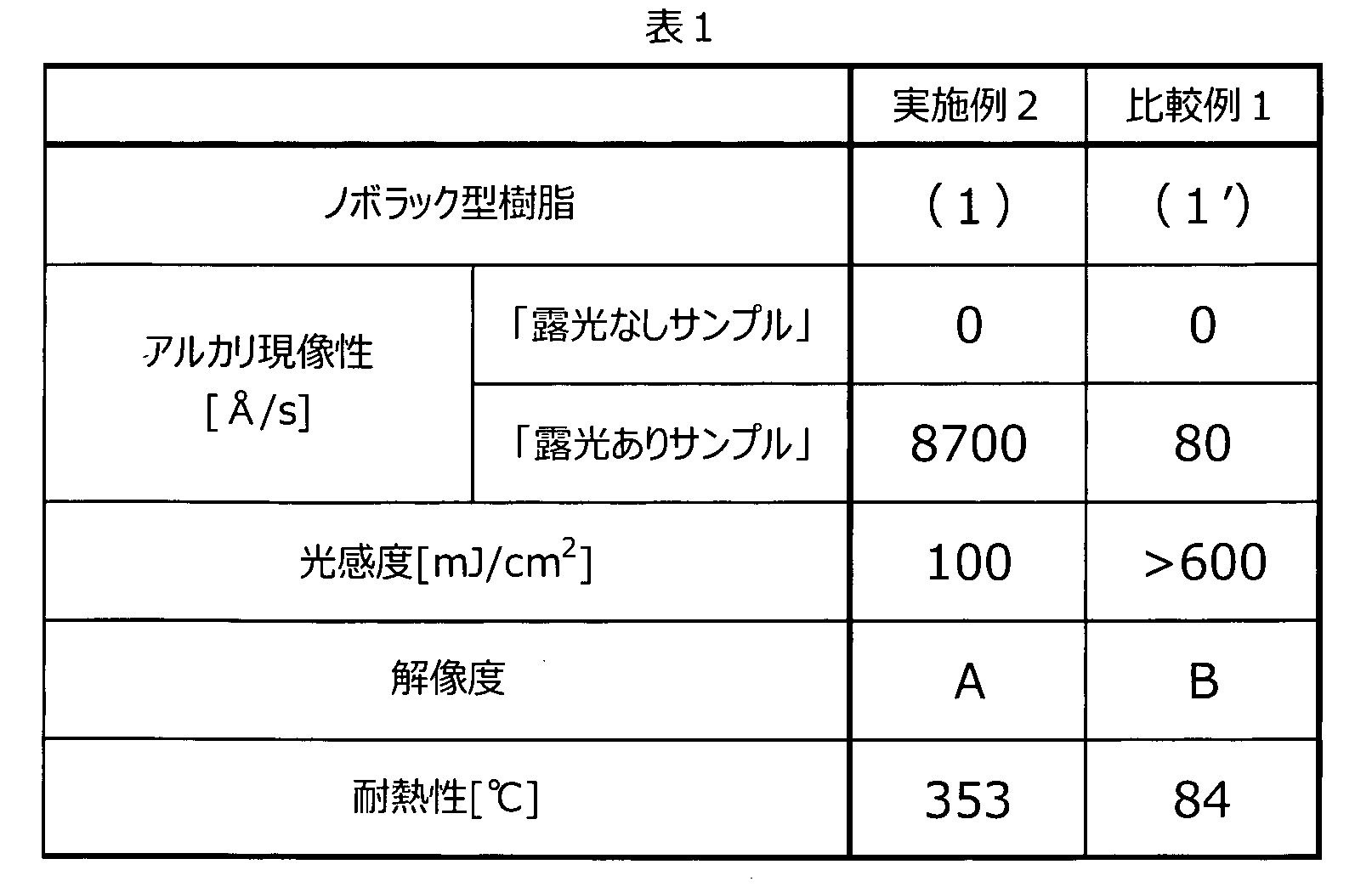
- Example 2 and Comparative Example 1 The novolac resin obtained in Example 1 and Comparative Production Example 1 was evaluated in the following manner. The results are shown in Table 1.
- Photosensitive Composition 28 parts by mass of the novolak resin was dissolved in 60 parts by mass of propylene glycol monomethyl ether acetate, and 12 parts by mass of a photosensitizing agent was added to the solution and dissolved. This was filtered through a 0.2 ⁇ m membrane filter to obtain a photosensitive composition.
- the photosensitizer was “P-200” (4,4 ′-[1- [4- [1- (4-hydroxyphenyl) -1methylethyl] phenyl] ethylidene] bisphenol, 1 mol 2-naphthoquinone-2-diazide-5-sulfonyl chloride condensate).
- composition for heat resistance test 28 parts by mass of the novolac resin was dissolved in 60 parts by mass of propylene glycol monomethyl ether acetate, and this was filtered through a 0.2 ⁇ m membrane filter to obtain a composition for heat resistance test.
- the photosensitive composition obtained above was applied on a 5-inch silicon wafer with a spin coater so as to have a thickness of about 1 ⁇ m. Dried for 60 seconds. Two wafers were prepared, and one of the wafers was designated as “no exposure sample”. The other was used as an “exposed sample” and irradiated with 100 mJ / cm 2 of ghi line using a ghi line lamp (“Multi Light” manufactured by USHIO INC.), And then heat-treated at 140 ° C. for 60 seconds. .
- Both the “non-exposed sample” and the “exposed sample” were immersed in an alkaline developer (2.38% tetramethylammonium hydroxide aqueous solution) for 60 seconds and then dried on a hot plate at 110 ° C. for 60 seconds.
- the film thickness of each sample before and after immersion in the developer was measured, and the value obtained by dividing the difference by 60 was defined as alkali developability [ADR ( ⁇ / s)].
- the photosensitive composition obtained above was applied on a 5 inch silicon wafer with a spin coater so as to have a thickness of about 1 ⁇ m, and dried on a hot plate at 110 ° C. for 60 seconds.
- a mask corresponding to a resist pattern with a line-and-space ratio of 1: 1 and a line width of 1 to 10 ⁇ m set every 1 ⁇ m is brought into close contact with this wafer, and then a ghi-line lamp (“Multi Light” manufactured by USHIO INC. )) was used for irradiation with ghi rays, and heat treatment was performed at 140 ° C. for 60 seconds.
- the film was immersed in an alkaline developer (2.38% tetramethylammonium hydroxide aqueous solution) for 60 seconds, and then dried on a hot plate at 110 ° C. for 60 seconds.
- the ghi-line exposure amount from 80 mJ / cm 2 in the case of increased every 5 mJ / cm 2, amount of exposure that can be faithfully reproduced line width 3 ⁇ m a (Eop exposure) were evaluated.
- the photosensitive composition obtained above was applied on a 5-inch silicon wafer with a spin coater to a thickness of about 1 ⁇ m, and dried on a hot plate at 110 ° C. for 60 seconds.
- a photomask was placed on the obtained wafer, and an alkali development operation was performed by irradiating with 200 mJ / cm 2 of ghi line in the same manner as in the previous alkali developability evaluation.
- the composition for heat resistance test obtained above was applied on a 5-inch silicon wafer with a spin coater so as to have a thickness of about 1 ⁇ m, and dried on a hot plate at 110 ° C. for 60 seconds.
- the resin content was scraped from the obtained wafer and its glass transition temperature (Tg) was measured.
- the glass transition temperature (Tg) is measured using a differential scanning calorimeter (DSC) (“Q100” manufactured by TA Instruments Co., Ltd.) under a nitrogen atmosphere, a temperature range of 25 to 400 ° C., and a temperature rising temperature of 10 ° C./min. It went on condition of.
- DSC differential scanning calorimeter
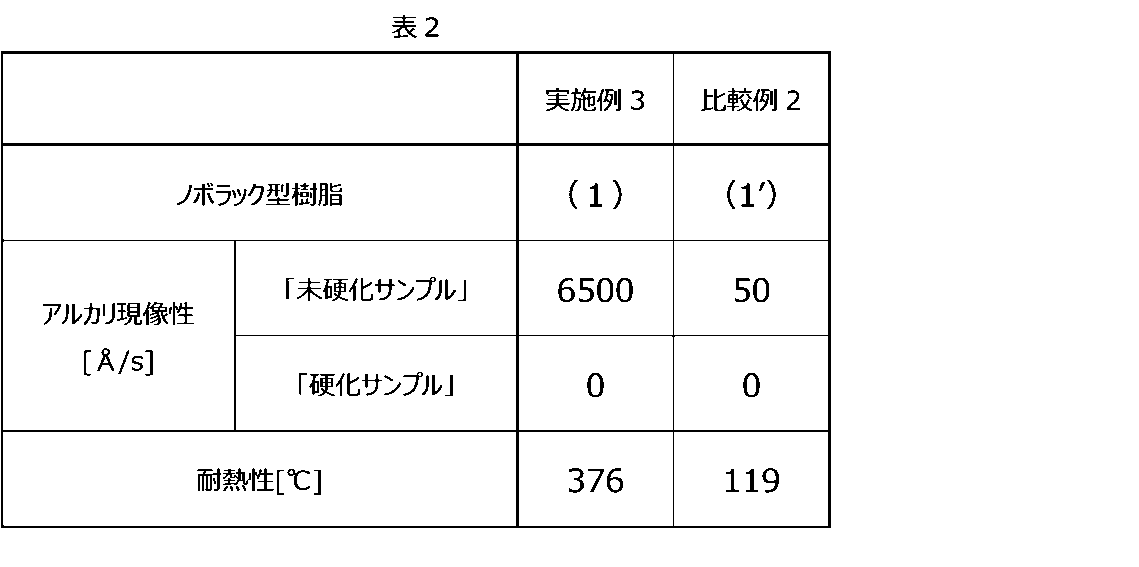
- Example 3 and Comparative Example 2 The novolac resin obtained in Example 1 and Comparative Production Example 1 was evaluated in the following manner. The results are shown in Table 2.
- curable composition 16 parts by mass of the novolac resin and 4 parts by mass of a curing agent (“1,3,4,6-tetrakis (methoxymethyl) glycoluril” manufactured by Tokyo Chemical Industry Co., Ltd.) were added to propylene glycol monomethyl ether acetate. This was dissolved in 30 parts by mass and filtered through a 0.2 ⁇ m membrane filter to obtain a curable composition.
- a curing agent 1,3,4,6-tetrakis (methoxymethyl) glycoluril
- the curable composition obtained above was applied on a 5-inch silicon wafer with a spin coater to a thickness of about 1 ⁇ m, dried on a hot plate at 110 ° C. for 60 seconds, Heat treatment was performed for 60 seconds.
- the resin content was scraped from the obtained wafer and its glass transition temperature (Tg) was measured.
- the glass transition temperature (Tg) is measured using a differential scanning calorimeter (DSC) (“Q100” manufactured by TA Instruments Co., Ltd.) under a nitrogen atmosphere, a temperature range of 25 to 400 ° C., and a temperature rising temperature of 10 ° C./min. It went on condition of.
- DSC differential scanning calorimeter
Landscapes
- Physics & Mathematics (AREA)
- Spectroscopy & Molecular Physics (AREA)
- Chemical & Material Sciences (AREA)
- General Physics & Mathematics (AREA)
- Health & Medical Sciences (AREA)
- Chemical Kinetics & Catalysis (AREA)
- Medicinal Chemistry (AREA)
- Polymers & Plastics (AREA)
- Organic Chemistry (AREA)
- Materials For Photolithography (AREA)
- Phenolic Resins Or Amino Resins (AREA)
- Compositions Of Macromolecular Compounds (AREA)
Abstract
Description
本発明のノボラック型樹脂は、トリス(ヒドロキシアリール)メチン基を有する化合物(A)とアルデヒド化合物(B)とを必須の反応原料とする。
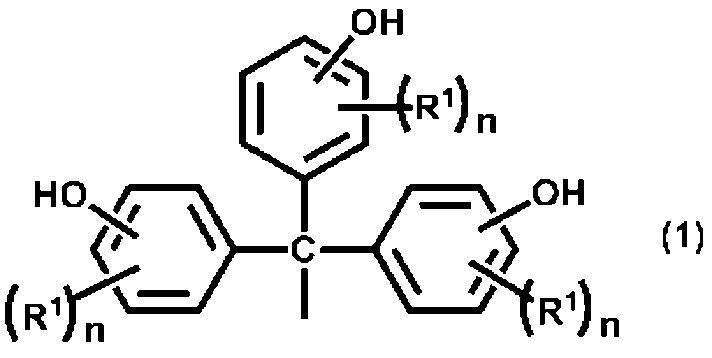
で表される構造部位であることが好ましい。

で表される化合物等が挙げられる。

[GPCの測定条件]
測定装置:東ソー株式会社製「HLC-8220 GPC」
カラム:昭和電工株式会社製「Shodex KF802」(8.0mmФ×300mm)+昭和電工株式会社製「Shodex KF802」(8.0mmФ×300mm)
+昭和電工株式会社製「Shodex KF803」(8.0mmФ×300mm)+昭和電工株式会社製「Shodex KF804」(8.0mmФ×300mm)
カラム温度:40℃
検出器: RI(示差屈折計)
データ処理:東ソー株式会社製「GPC-8020モデルIIバージョン4.30」
展開溶媒:テトラヒドロフラン
流速:1.0mL/分
試料:樹脂固形分換算で0.5質量%のテトラヒドロフラン溶液をマイクロフィルターでろ過したもの(100μl)
標準試料:下記単分散ポリスチレン
(標準試料:単分散ポリスチレン)
東ソー株式会社製「A-500」
東ソー株式会社製「A-2500」
東ソー株式会社製「A-5000」
東ソー株式会社製「F-1」
東ソー株式会社製「F-2」
東ソー株式会社製「F-4」
東ソー株式会社製「F-10」
東ソー株式会社製「F-20」
[GPCの測定条件]
測定装置:東ソー株式会社製「HLC-8220 GPC」
カラム:昭和電工株式会社製「Shodex KF802」(8.0mmФ×300mm)+昭和電工株式会社製「Shodex KF802」(8.0mmФ×300mm)
+昭和電工株式会社製「Shodex KF803」(8.0mmФ×300mm)+昭和電工株式会社製「Shodex KF804」(8.0mmФ×300mm)
カラム温度:40℃
検出器: RI(示差屈折計)
データ処理:東ソー株式会社製「GPC-8020モデルIIバージョン4.30」
展開溶媒:テトラヒドロフラン
流速:1.0mL/分
試料:樹脂固形分換算で0.5質量%のテトラヒドロフラン溶液をマイクロフィルターでろ過したもの
注入量:0.1mL
標準試料:下記単分散ポリスチレン
(標準試料:単分散ポリスチレン)
東ソー株式会社製「A-500」
東ソー株式会社製「A-2500」
東ソー株式会社製「A-5000」
東ソー株式会社製「F-1」
東ソー株式会社製「F-2」
東ソー株式会社製「F-4」
東ソー株式会社製「F-10」
東ソー株式会社製「F-20」
冷却管を設置した3000ml4口フラスコに、下記構造式(2-1)で表される1,1,1-トリス(4-ヒドロキシフェニル)エタン60gを仕込み、1-ブタノール100mlに溶解させた。氷浴中で冷却しながら硫酸3mlを添加し、更に92%パラホルムアルデヒド6gを仕込み、オイルバス中で90℃まで昇温させた。撹拌しながら90℃で10時間反応させた。反応混合物中に水を加えて生成物を再沈殿させ、粗生成物を得た。粗生成物をアセトンに再溶解し、更に水で再沈殿させた後、沈殿物を濾別して真空乾燥し、黄土色粉末のノボラック型樹脂(1)60gを得た。ノボラック型樹脂(1)のGPCチャートを図1に示す。ノボラック型樹脂(1)の数平均分子量(Mn)は2,021、重量平均分子量(Mw)は17,890、多分散度(Mw/Mn)は8.85であった。
冷却管を設置した300mlの4口フラスコに、m-クレゾール648g、p-クレゾール432g、シュウ酸2.5g、42%ホルムアルデヒド492gを仕込み、100℃まで昇温して反応させた。常圧で200℃まで加熱して脱水及び蒸留し、更に230℃で6時間減圧蒸留を行い、淡黄色固形のノボラック型樹脂(1’)736gを得た。ノボラック型樹脂(1’)の数平均分子量(Mn)は1,450、重量平均分子量(Mw)は10,316、多分散度(Mw/Mn)は7.12であった。
実施例1及び比較製造例1で得たノボラック型樹脂について、下記の要領で評価した。結果を表1に示す。
前記ノボラック型樹脂28質量部をプロピレングリコールモノメチルエーテルアセテート60質量部に溶解させ、この溶液に感光剤12質量部を加えて溶解させた。これを0.2μmのメンブランフィルターで濾過し、感光性組成物を得た。
感光剤は東洋合成工業株式会社製「P-200」(4,4’-[1-[4-[1-(4-ヒドロキシフェニル)-1メチルエチル]フェニル]エチリデン]ビスフェノール1モルと1,2-ナフトキノン-2-ジアジド-5-スルホニルクロリド2モルとの縮合物)を用いた。
前記ノボラック型樹脂28質量部をプロピレングリコールモノメチルエーテルアセテート60質量部に溶解させ、これを0.2μmのメンブランフィルターで濾過し、耐熱性試験用組成物を得た。
先で得た感光性組成物を5インチシリコンウェハー上に約1μmの厚さになるようにスピンコーターで塗布し、110℃のホットプレート上で60秒乾燥させた。このウェハーを2枚用意し、一方を「露光なしサンプル」とした。他方を「露光有サンプル」としてghi線ランプ(ウシオ電機株式会社製「マルチライト」)を用いて100mJ/cm2のghi線を照射したのち、140℃、60秒間の条件で加熱処理を行った。
「露光なしサンプル」と「露光有サンプル」の両方をアルカリ現像液(2.38%水酸化テトラメチルアンモニウム水溶液)に60秒間浸漬した後、110℃のホットプレート上で60秒乾燥させた。各サンプルの現像液浸漬前後の膜厚を測定し、その差分を60で除した値をアルカリ現像性[ADR(Å/s)]とした。
先で得た感光性組成物を5インチシリコンウェハー上に約1μmの厚さになるようにスピンコーターで塗布し、110℃のホットプレート上で60秒乾燥させた。このウェハー上にラインアンドスペースが1:1であり、ライン幅が1~10μmまで1μmごとに設定されたレジストパターン対応のマスクを密着させた後、ghi線ランプ(ウシオ電機株式会社製「マルチライト」)を用いてghi線を照射し、140℃、60秒間の条件で加熱処理を行った。次いで、アルカリ現像液(2.38%水酸化テトラメチルアンモニウム水溶液)に60秒間浸漬した後、110℃のホットプレート上で60秒乾燥させた。
ghi線露光量を80mJ/cm2から5mJ/cm2毎に増加させた場合の、ライン幅3μmを忠実に再現することのできる露光量(Eop露光量)を評価した。
先で得た感光性組成物を5インチシリコンウェハー上に約1μmの厚さになるようにスピンコーターで塗布し、110℃のホットプレート上で60秒乾燥させた。得られたウェハー上にフォトマスクを乗せ、先のアルカリ現像性評価の場合と同様の方法でghi線200mJ/cm2を照射し、アルカリ現像操作を行った。レーザーマイクロスコープ(株式会社キーエンス製「VK-X200」)を用いてパターン状態を確認し、L/S=1/1の線幅が5μmで解像できているものをA、L/S=1/1の線幅が5μmで解像できていないものをBとして評価した。
先で得た耐熱性試験用組成物を5インチシリコンウェハー上に約1μmの厚さになるようにスピンコーターで塗布し、110℃のホットプレート上で60秒乾燥させた。得られたウェハーより樹脂分をかきとり、そのガラス転移温度(Tg)を測定した。ガラス転移温度(Tg)の測定は示差走査熱量計(DSC)(株式会社TAインスツルメント製「Q100」)を用いて、窒素雰囲気下、温度範囲25~400℃、昇温温度10℃/分の条件で行った。
実施例1及び比較製造例1で得たノボラック型樹脂について、下記の要領で評価した。結果を表2に示す。
前記ノボラック型樹脂16質量部、硬化剤(東京化成工業株式会社製「1,3,4,6-テトラキス(メトキシメチル)グリコールウリル」)4質量部をプロピレングリコールモノメチルエーテルアセテート30質量部に溶解させ、これを0.2μmのメンブランフィルターで濾過し、硬化性組成物を得た。
先で得た硬化性組成物を5インチシリコンウェハー上に約1μmの厚さになるようにスピンコーターで塗布し、110℃のホットプレート上で60秒乾燥させた。このウェハーを2枚用意し、一方を「未硬化サンプル」とした。他方を「硬化サンプル」として230℃、60秒間の条件で加熱処理を行った。
「未硬化サンプル」と「硬化サンプル」の両方をアルカリ現像液(2.38%水酸化テトラメチルアンモニウム水溶液)に60秒間浸漬した後、110℃のホットプレート上で60秒乾燥させた。各サンプルの現像液浸漬前後の膜厚を測定し、その差分を60で除した値をアルカリ現像性[ADR(Å/s)]とした。
先で得た硬化性組成物を5インチシリコンウェハー上に約1μmの厚さになるようにスピンコーターで塗布し、110℃のホットプレート上で60秒乾燥させた後、230℃、60秒間の条件で加熱処理を行った。得られたウェハーより樹脂分をかきとり、そのガラス転移温度(Tg)を測定した。ガラス転移温度(Tg)の測定は示差走査熱量計(DSC)(株式会社TAインスツルメント製「Q100」)を用いて、窒素雰囲気下、温度範囲25~400℃、昇温温度10℃/分の条件で行った。
Claims (8)
- トリス(ヒドロキシアリール)メチン基を有する化合物(A)とアルデヒド化合物(B)とを必須の反応原料とするノボラック型樹脂。
- 前記トリス(ヒドロキシアリール)メチン基が、下記構造式(1)

で表される構造部位である請求項1記載のノボラック型樹脂。 - 前記トリス(ヒドロキシアリール)メチン基を有する化合物(A)が、下記構造式(2)
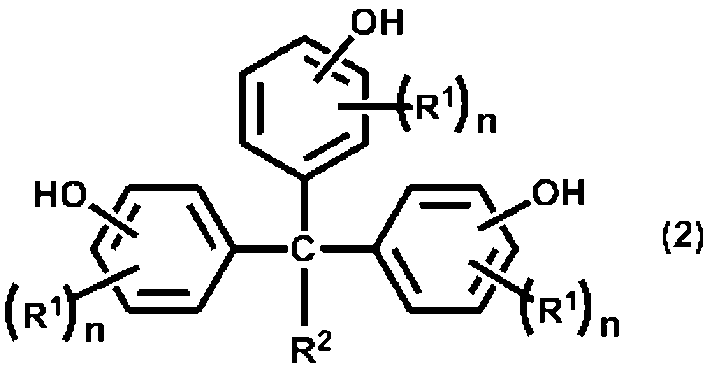
で表される化合物である請求項1記載のノボラック型樹脂。 - 請求項1~3の何れか一つに記載のノボラック型樹脂と感光剤とを含有する感光性組成物。
- 請求項4記載の感光性組成物からなるレジスト材料。
- 請求項1~3の何れか一つに記載のノボラック型樹脂と硬化剤とを含有する硬化性組成物。
- 請求項6記載の硬化性組成物の硬化物。
- 請求項6記載の硬化性組成物からなるレジスト材料。
Priority Applications (4)
| Application Number | Priority Date | Filing Date | Title |
|---|---|---|---|
| JP2017541399A JP6274366B1 (ja) | 2016-04-13 | 2017-03-23 | ノボラック型樹脂及びレジスト材料 |
| US16/080,837 US11254778B2 (en) | 2016-04-13 | 2017-03-23 | Novolak resins and resist materials |
| KR1020187027320A KR102313191B1 (ko) | 2016-04-13 | 2017-03-23 | 노볼락형 수지 및 레지스트 재료 |
| CN201780023399.7A CN109071744B (zh) | 2016-04-13 | 2017-03-23 | 酚醛清漆型树脂及抗蚀剂材料 |
Applications Claiming Priority (2)
| Application Number | Priority Date | Filing Date | Title |
|---|---|---|---|
| JP2016080299 | 2016-04-13 | ||
| JP2016-080299 | 2016-04-13 |
Publications (1)
| Publication Number | Publication Date |
|---|---|
| WO2017179385A1 true WO2017179385A1 (ja) | 2017-10-19 |
Family
ID=60042432
Family Applications (1)
| Application Number | Title | Priority Date | Filing Date |
|---|---|---|---|
| PCT/JP2017/011647 Ceased WO2017179385A1 (ja) | 2016-04-13 | 2017-03-23 | ノボラック型樹脂及びレジスト材料 |
Country Status (6)
| Country | Link |
|---|---|
| US (1) | US11254778B2 (ja) |
| JP (1) | JP6274366B1 (ja) |
| KR (1) | KR102313191B1 (ja) |
| CN (1) | CN109071744B (ja) |
| TW (1) | TWI722135B (ja) |
| WO (1) | WO2017179385A1 (ja) |
Cited By (1)
| Publication number | Priority date | Publication date | Assignee | Title |
|---|---|---|---|---|
| CN113461884A (zh) * | 2021-08-04 | 2021-10-01 | 浙江自立高分子化工材料有限公司 | 一种光刻胶用改性酚醛树脂及其制备方法 |
Families Citing this family (2)
| Publication number | Priority date | Publication date | Assignee | Title |
|---|---|---|---|---|
| JP7645089B2 (ja) * | 2020-02-21 | 2025-03-13 | 住友化学株式会社 | レジスト組成物及びレジストパターンの製造方法並びにめっき造形物の製造方法 |
| JP7088399B1 (ja) * | 2021-12-17 | 2022-06-21 | Dic株式会社 | ノボラック型フェノール樹脂の探索方法、情報処理装置、及びプログラム |
Citations (5)
| Publication number | Priority date | Publication date | Assignee | Title |
|---|---|---|---|---|
| JPH06348006A (ja) * | 1993-06-04 | 1994-12-22 | Japan Synthetic Rubber Co Ltd | ポジ型感放射線性樹脂組成物 |
| JP2001207028A (ja) * | 2000-01-26 | 2001-07-31 | Sumitomo Bakelite Co Ltd | 液状樹脂組成物及び半導体装置 |
| WO2004066030A2 (ja) * | 2003-01-23 | 2004-08-05 | Fujikura Kasei Kk | 負荷電制御剤およびこれを用いた静電荷像現象用トナーおよびその製造方法 |
| JP2010128002A (ja) * | 2008-11-25 | 2010-06-10 | Ricoh Co Ltd | 静電荷像現像用トナー及びその製造方法、並びに該静電荷像現像用トナーを用いた現像剤、画像形成装置及び画像形成方法 |
| EP2368925A1 (en) * | 2010-03-27 | 2011-09-28 | Samsung Electronics Co., Ltd. | Aerogel, composition for the aerogel, and method of making the aerogel |
Family Cites Families (11)
| Publication number | Priority date | Publication date | Assignee | Title |
|---|---|---|---|---|
| JP2734545B2 (ja) | 1988-08-22 | 1998-03-30 | 大日本インキ化学工業株式会社 | ポジ型フォトレジスト組成物 |
| CA2023791A1 (en) * | 1989-08-24 | 1991-02-25 | Ayako Ida | Radiation-sensitive positive resist composition |
| EP1806618B1 (en) * | 2004-10-29 | 2010-06-09 | JSR Corporation | Positive photosensitive insulating resin composition and cured product thereof |
| US8623585B2 (en) * | 2010-11-10 | 2014-01-07 | Dic Corporation | Positive-type photoresist composition |
| CN103384850B (zh) * | 2011-04-12 | 2015-02-04 | Dic株式会社 | 正型光致抗蚀剂组合物、其涂膜及酚醛清漆型酚醛树脂 |
| JP5859420B2 (ja) * | 2012-01-04 | 2016-02-10 | 信越化学工業株式会社 | レジスト下層膜材料、レジスト下層膜材料の製造方法、及び前記レジスト下層膜材料を用いたパターン形成方法 |
| CN104541205B (zh) * | 2012-08-21 | 2019-07-05 | 日产化学工业株式会社 | 含有具有多核苯酚的酚醛清漆树脂的抗蚀剂下层膜形成用组合物 |
| JP6690535B2 (ja) | 2014-07-24 | 2020-04-28 | 日産化学株式会社 | レジスト上層膜形成組成物及びそれを用いた半導体装置の製造方法 |
| CN106715619B (zh) * | 2014-09-19 | 2020-02-07 | 日产化学工业株式会社 | 抗蚀剂图案被覆用涂布液 |
| KR102363648B1 (ko) * | 2014-11-25 | 2022-02-17 | 디아이씨 가부시끼가이샤 | 노볼락형 페놀 수지, 그 제조 방법, 감광성 조성물, 레지스트 재료, 및 도막 |
| TWI711655B (zh) | 2015-12-02 | 2020-12-01 | 日商迪愛生股份有限公司 | 含酚性羥基之樹脂及抗蝕劑膜 |
-
2017
- 2017-03-16 TW TW106108710A patent/TWI722135B/zh active
- 2017-03-23 CN CN201780023399.7A patent/CN109071744B/zh active Active
- 2017-03-23 WO PCT/JP2017/011647 patent/WO2017179385A1/ja not_active Ceased
- 2017-03-23 KR KR1020187027320A patent/KR102313191B1/ko active Active
- 2017-03-23 US US16/080,837 patent/US11254778B2/en active Active
- 2017-03-23 JP JP2017541399A patent/JP6274366B1/ja active Active
Patent Citations (5)
| Publication number | Priority date | Publication date | Assignee | Title |
|---|---|---|---|---|
| JPH06348006A (ja) * | 1993-06-04 | 1994-12-22 | Japan Synthetic Rubber Co Ltd | ポジ型感放射線性樹脂組成物 |
| JP2001207028A (ja) * | 2000-01-26 | 2001-07-31 | Sumitomo Bakelite Co Ltd | 液状樹脂組成物及び半導体装置 |
| WO2004066030A2 (ja) * | 2003-01-23 | 2004-08-05 | Fujikura Kasei Kk | 負荷電制御剤およびこれを用いた静電荷像現象用トナーおよびその製造方法 |
| JP2010128002A (ja) * | 2008-11-25 | 2010-06-10 | Ricoh Co Ltd | 静電荷像現像用トナー及びその製造方法、並びに該静電荷像現像用トナーを用いた現像剤、画像形成装置及び画像形成方法 |
| EP2368925A1 (en) * | 2010-03-27 | 2011-09-28 | Samsung Electronics Co., Ltd. | Aerogel, composition for the aerogel, and method of making the aerogel |
Cited By (1)
| Publication number | Priority date | Publication date | Assignee | Title |
|---|---|---|---|---|
| CN113461884A (zh) * | 2021-08-04 | 2021-10-01 | 浙江自立高分子化工材料有限公司 | 一种光刻胶用改性酚醛树脂及其制备方法 |
Also Published As
| Publication number | Publication date |
|---|---|
| KR102313191B1 (ko) | 2021-10-18 |
| JPWO2017179385A1 (ja) | 2018-04-19 |
| US20190169348A1 (en) | 2019-06-06 |
| TWI722135B (zh) | 2021-03-21 |
| JP6274366B1 (ja) | 2018-02-07 |
| CN109071744B (zh) | 2020-11-24 |
| US11254778B2 (en) | 2022-02-22 |
| KR20180134864A (ko) | 2018-12-19 |
| CN109071744A (zh) | 2018-12-21 |
| TW201806994A (zh) | 2018-03-01 |
Similar Documents
| Publication | Publication Date | Title |
|---|---|---|
| JP6187731B1 (ja) | フェノール性水酸基含有樹脂及びレジスト膜 | |
| JP6341348B1 (ja) | フェノール性水酸基含有樹脂及びレジスト材料 | |
| JP6123967B1 (ja) | ノボラック型フェノール性水酸基含有樹脂及びレジスト膜 | |
| JP6156591B2 (ja) | ノボラック型フェノール性水酸基含有樹脂及びレジスト膜 | |
| JP6274366B1 (ja) | ノボラック型樹脂及びレジスト材料 | |
| JP5939450B1 (ja) | フェノール性水酸基含有樹脂、その製造方法、感光性組成物、レジスト材料、塗膜、硬化性組成物とその硬化物、及びレジスト下層膜 | |
| JP6269904B1 (ja) | ノボラック型樹脂の製造方法 | |
| JP6590084B2 (ja) | フェノール性水酸基含有樹脂及びレジスト材料 | |
| JP6590085B2 (ja) | フェノール性水酸基含有樹脂及びレジスト材料 | |
| JP7380951B2 (ja) | フェノール性水酸基含有樹脂 | |
| JP6328350B2 (ja) | ノボラック型樹脂及びレジスト材料 |
Legal Events
| Date | Code | Title | Description |
|---|---|---|---|
| ENP | Entry into the national phase |
Ref document number: 2017541399 Country of ref document: JP Kind code of ref document: A |
|
| ENP | Entry into the national phase |
Ref document number: 20187027320 Country of ref document: KR Kind code of ref document: A |
|
| NENP | Non-entry into the national phase |
Ref country code: DE |
|
| 121 | Ep: the epo has been informed by wipo that ep was designated in this application |
Ref document number: 17782203 Country of ref document: EP Kind code of ref document: A1 |
|
| 122 | Ep: pct application non-entry in european phase |
Ref document number: 17782203 Country of ref document: EP Kind code of ref document: A1 |