WO2017170863A1 - フラックス - Google Patents
フラックス Download PDFInfo
- Publication number
- WO2017170863A1 WO2017170863A1 PCT/JP2017/013226 JP2017013226W WO2017170863A1 WO 2017170863 A1 WO2017170863 A1 WO 2017170863A1 JP 2017013226 W JP2017013226 W JP 2017013226W WO 2017170863 A1 WO2017170863 A1 WO 2017170863A1
- Authority
- WO
- WIPO (PCT)
- Prior art keywords
- resin
- amino acid
- added
- flux
- curing agent
- Prior art date
- Legal status (The legal status is an assumption and is not a legal conclusion. Google has not performed a legal analysis and makes no representation as to the accuracy of the status listed.)
- Ceased
Links
Classifications
-
- B—PERFORMING OPERATIONS; TRANSPORTING
- B23—MACHINE TOOLS; METAL-WORKING NOT OTHERWISE PROVIDED FOR
- B23K—SOLDERING OR UNSOLDERING; WELDING; CLADDING OR PLATING BY SOLDERING OR WELDING; CUTTING BY APPLYING HEAT LOCALLY, e.g. FLAME CUTTING; WORKING BY LASER BEAM
- B23K35/00—Rods, electrodes, materials, or media, for use in soldering, welding, or cutting
- B23K35/22—Rods, electrodes, materials, or media, for use in soldering, welding, or cutting characterised by the composition or nature of the material
- B23K35/36—Selection of non-metallic compositions, e.g. coatings or fluxes; Selection of soldering or welding materials, conjoint with selection of non-metallic compositions, both selections being of interest
- B23K35/3612—Selection of non-metallic compositions, e.g. coatings or fluxes; Selection of soldering or welding materials, conjoint with selection of non-metallic compositions, both selections being of interest with organic compounds as principal constituents
- B23K35/3613—Polymers, e.g. resins
-
- B—PERFORMING OPERATIONS; TRANSPORTING
- B23—MACHINE TOOLS; METAL-WORKING NOT OTHERWISE PROVIDED FOR
- B23K—SOLDERING OR UNSOLDERING; WELDING; CLADDING OR PLATING BY SOLDERING OR WELDING; CUTTING BY APPLYING HEAT LOCALLY, e.g. FLAME CUTTING; WORKING BY LASER BEAM
- B23K35/00—Rods, electrodes, materials, or media, for use in soldering, welding, or cutting
- B23K35/22—Rods, electrodes, materials, or media, for use in soldering, welding, or cutting characterised by the composition or nature of the material
- B23K35/36—Selection of non-metallic compositions, e.g. coatings or fluxes; Selection of soldering or welding materials, conjoint with selection of non-metallic compositions, both selections being of interest
- B23K35/362—Selection of compositions of fluxes
-
- B—PERFORMING OPERATIONS; TRANSPORTING
- B23—MACHINE TOOLS; METAL-WORKING NOT OTHERWISE PROVIDED FOR
- B23K—SOLDERING OR UNSOLDERING; WELDING; CLADDING OR PLATING BY SOLDERING OR WELDING; CUTTING BY APPLYING HEAT LOCALLY, e.g. FLAME CUTTING; WORKING BY LASER BEAM
- B23K35/00—Rods, electrodes, materials, or media, for use in soldering, welding, or cutting
- B23K35/22—Rods, electrodes, materials, or media, for use in soldering, welding, or cutting characterised by the composition or nature of the material
- B23K35/36—Selection of non-metallic compositions, e.g. coatings or fluxes; Selection of soldering or welding materials, conjoint with selection of non-metallic compositions, both selections being of interest
- B23K35/3612—Selection of non-metallic compositions, e.g. coatings or fluxes; Selection of soldering or welding materials, conjoint with selection of non-metallic compositions, both selections being of interest with organic compounds as principal constituents
Definitions
- the present invention relates to a flux to which a curable resin is added.
- the flux used for soldering is a method that chemically removes the metal alloy present on the metal surface of the soldering object and the joining object to be soldered and the object to be joined, and metal at the boundary between them. Has the effect of allowing the movement of elements. For this reason, by performing soldering using a flux, an intermetallic compound can be formed between the solder alloy and the metal surface of the object to be joined and the object to be joined, thereby obtaining a strong joint.
- the flux component contains a component that does not decompose or evaporate due to the heating temperature during soldering, and remains as a flux residue around the joint after soldering.
- the flux residue if the flux residue remains at the joint location with the solder alloy, the flux residue inhibits the adhesion between the joint location and the resin, so that the strength cannot be ensured. For this reason, in order to cover the circumference
- thermosetting resin is added to the flux so that the object to be bonded and the object to be bonded can be fixed with the resin in the flux residue (see, for example, Patent Document 2).
- the flux with a thermosetting resin and a curing agent added causes the reaction between the resin and the curing agent to proceed even at room temperature, so the viscosity of the flux increases over time.
- the function of the flux to remove the metal oxide film can be enhanced.
- the reaction between the organic acid or amine and the resin proceeds, and again the viscosity of the flux increases during storage.
- solderability deteriorates due to the progress of the reaction between the resin and the activator. Further, the glass transition point of the resin is lowered by the activator added to the flux.
- the present invention has been made to solve such a problem, and an object of the present invention is to provide a flux capable of delaying the curing of the resin and suppressing a decrease in the glass transition point of the resin.
- the present invention includes at least one of ⁇ -amino acid and ⁇ -amino acid and a thermosetting resin, and ⁇ -amino acid or ⁇ -amino acid or ⁇ -amino acid is added to 100 parts by weight of the thermosetting resin.
- Examples of ⁇ -amino acids include glycine, alanine, asparagine, aspartic acid, glutamine, glutamic acid, serine and the like, and examples of ⁇ -amino acids include ⁇ -alanine and the like.
- At least one of ⁇ -amino acid and ⁇ -amino acid is added at a predetermined ratio to the curable resin composed of a thermosetting resin and a curing agent, so that the resin, the curing agent, and The reaction between the resin and the amine is suppressed, and the curing of the resin is delayed. Thereby, the viscosity increase at the time of storage can be suppressed.
- both ⁇ -amino acids and ⁇ -amino acids function as activators that remove metal oxides.
- the flux of the present invention even when at least one of ⁇ -amino acid and ⁇ -amino acid is added, the lowering of the glass transition point of the resin is suppressed, and the curing of the resin by heat is not inhibited.
- an amino acid is added as an activator, and a thermosetting resin and a curing agent are added as a curable resin.
- a solvent is added to the flux of the present embodiment.
- an amino acid having a carboxyl group and an amino group suppresses the reactivity between the amino group in the amino acid and the resin by the carboxyl group without inhibiting the reactivity between the amino acid and the metal oxide by forming a zwitterion.
- the number of carbon atoms between the carboxyl group and the amino group is 3 or more, the cured resin has flexibility.
- a ⁇ -amino acid having 3 carbon atoms between a carboxyl group and an amino group and a ⁇ -amino acid having 4 carbon atoms between a carboxyl group and an amino group have flexibility in the molecular structure of the polymerized resin. Occurs and the glass transition point is lowered. Therefore, at least one of ⁇ -amino acid and ⁇ -amino acid having 2 or less carbon atoms between the carboxyl group and the amino group is added.
- the ⁇ -amino acid is preferably glycine or aspartic acid.
- the ⁇ -amino acid is preferably ⁇ -alanine.
- thermosetting resin is selected from generally known epoxy resins, phenol resins (novolacs) and the like, and is preferably bisphenol A if it is an epoxy resin.
- the curing agent is selected from generally known acid anhydrides, imidazole, compounds having an imidazole ring, dicyandiamide, hydrazide, and the like.
- imidazole 1,2-dimethylimidazole, 2-ethyl-4-methyl Imidazole, 2-phenylimidazole, 4-methyl-2-phenylimidazole, 1-benzyl-2-methylimidazole, 1-benzyl-2-phenylimidazole, 2-phenyl-4,5-dihydroxymethylimidazole, 2-phenyl- Examples include 4-methyl-5-hydroxymethylimidazole.
- 2,4-diamino-6- [2′-methylimidazolyl- (1 ′)]-ethyl-s-triazine 2,4-diamino-6- [2′-undecyl]
- Examples include imidazolyl- (1 ′)]-ethyl-s-triazine, 2,4-diamino-6- [2′-ethyl-4′-methylimidazolyl- (1 ′)]-ethyl-s-triazine, and the like.
- the addition amount of the curing agent to the thermosetting resin is 1% by mass to 7% by mass for imidazole, a compound having an imidazole ring, and dicyandiamide, and 30% by mass to 60% for acid anhydrides and hydrazides. % Or less is preferable.
- a solvent such as silica, a silane coupling agent, a dispersant, another resin such as rubber or a thermoplastic resin, solder powder, or the like may be added to the flux.
- the solvent is selected from generally known glycol ether compounds.
- the fluxes of Examples and Comparative Examples were prepared with the compositions shown in the following tables, and the flux thickening rate and the glass transition point (Tg) were verified.
- the values of amino acids, amines, and organic acids in each table are as follows. These are parts by weight of amino acid, amine and organic acid when the resin is 100 parts by weight.
- As a curing agent 2-ethyl-4-methylimidazole was added at 3% by mass with respect to the resin.
- the present invention is not limited to the following specific examples.
- the thickening rate was the same as that of the resin and the cured product. It was equal to or less than the value when only the agent was added. Further, the glass transition point was equal to or higher than the value when only the resin and the curing agent were added.
- Example 5 in which 10 parts by weight of L-aspartic acid was added as an ⁇ -amino acid, the thickening ratio was equivalent to the value when only the resin and the curing agent were added, and the glass transition point was the resin and the curing agent. It exceeded the value when only was added.
- the thickening ratio was equal to or equal to the value when only the resin and the curing agent were added.
- the glass transition point was equal to or higher than the value when only the resin and the curing agent were added.
- Comparative Example 3 in which 10 parts by weight of 4-aminobutanoic acid was added as the ⁇ -amino acid, the thickening ratio exceeded the value when only the resin and the curing agent were added, and the glass transition point was only added with the resin and the curing agent. The value was lower than the case.
- Comparative Example 4 in which 10 parts by weight of 6-aminohexanoic acid was added as the ⁇ -amino acid, the thickening ratio exceeded the value when only the resin and the curing agent were added, and the glass transition point was the resin and the curing agent. It was lower than the value when only was added.
- Comparative Example 6 In Comparative Example 6 in which 10 parts by weight of ethylenediamine was added as an amine instead of an amino acid, the thickening ratio exceeded the value when only the resin and the curing agent were added, and the glass transition point was only the resin and the curing agent. The value when added was lower. Further, in Comparative Example 7 in which 10 parts by weight of malonic acid was added as an organic acid, the thickening ratio exceeded the value when only the resin and the curing agent were added, and the glass transition point was only added with the resin and the curing agent. Below the case value.
- the ⁇ -amino acid or ⁇ -amino acid having 2 or less carbon atoms between the carboxyl group and the amino group was added in an amount of 1 to 30 parts by weight with respect to 100 parts by weight of the curable resin.
- the curing of the resin at room temperature can be delayed with respect to the curable resin consisting only of the resin and the curing agent. Thereby, the viscosity increase at the time of storage was able to be suppressed.
- the upper limit of the temperature during soldering is preferably less than 300 ° C., for example, about 260 to 270 ° C.
- both ⁇ -amino acid and ⁇ -amino acid function as an activator for removing metal oxides, and the reaction with the resin is suppressed. As a result, it was found that the wettability of the solder alloy with respect to the joining portion was ensured, and the solderability was not hindered.
- the flux of Comparative Example 6 in which a predetermined amount of an amine that is usually used as an activator is added and the flux of Comparative Example 7 in which a predetermined amount of an organic acid is added are also used at room temperature with respect to a curable resin containing only a resin and a curing agent. It has been found that the curing of the resin proceeds at the same time, and that the glass transition point of the resin cannot be suppressed from decreasing.
Landscapes
- Engineering & Computer Science (AREA)
- Mechanical Engineering (AREA)
- Electric Connection Of Electric Components To Printed Circuits (AREA)
- Compositions Of Macromolecular Compounds (AREA)
Abstract
常温域での樹脂の硬化を遅延させ、かつ、樹脂のガラス転移点の低下を抑制できるフラックスを提供する。 フラックスは、α-アミノ酸とβ-アミノ酸のうち少なくとも1種と、硬化性樹脂を含み、硬化性樹脂が100重量部に対し、α-アミノ酸またはβ-アミノ酸、あるいは、α-アミノ酸及びβ-アミノ酸が1重量部以上~30重量部以下で添加される。
Description
本発明は、硬化性樹脂が添加されたフラックスに関する。
一般的に、はんだ付けに用いられるフラックスは、はんだ合金及びはんだ付けの対象となる接合対象物と被接合対象物の金属表面に存在する金属酸化物を化学的に除去し、両者の境界で金属元素の移動を可能にする効能を持つ。このため、フラックスを使用してはんだ付けを行うことで、はんだ合金と接合対象物及び被接合対象物の金属表面との間に金属間化合物が形成できるようになり、強固な接合が得られる。
さて、近年の電子部品の小型化の進展につれて、はんだ合金による接合箇所である電極も小さくなってきている。そのため、はんだ合金で接合できる面積が小さくなり、はんだ合金だけでの接合強度では、接合信頼性に不十分な場合もある。
そこで、はんだ付けによる接合を強化する部品固着手段として、アンダーフィル等の樹脂によって、はんだ合金による接合箇所の周囲を覆うことにより、電子部品等を固着する技術が提案されている(例えば、特許文献1参照)。
一方、フラックスの成分には、はんだ付け時の加熱温度によって分解、蒸発しない成分が含まれており、はんだ付け後にフラックス残渣として接合箇所の周辺に残留する。
ここで、はんだ合金での接合箇所にフラックス残渣が残っていると、フラックス残渣が接合箇所と樹脂との固着を阻害するので、強度を確保することができない。このため、接合箇所の周囲を樹脂で覆うためには、フラックス残渣を洗浄する必要がある。しかし、フラックス残渣を洗浄するには、時間とコストが掛かる。さらに、電子部品等の小型化による狭ギャップ化に伴い、フラックス残渣の洗浄自体が難しくなってきている。
そこで、熱硬化性の樹脂をフラックスに添加することで、フラックス残渣中の樹脂で接合対象物と被接合対象物を固着できるようにした技術が提案されている(例えば、特許文献2参照)。
しかし、熱硬化性の樹脂と硬化剤が添加されたフラックスは、常温域でも樹脂と硬化剤の反応が進行するので、時間の経過とともにフラックスの粘度が上昇する
また、フラックスに活性剤として有機酸やアミンを添加することで、金属酸化膜を除去するというフラックスの機能を高めることができる。しかし、有機酸やアミンと樹脂の反応が進行し、やはり、保存時にフラックスの粘度が上昇する。更に、樹脂と活性剤の反応が進行したことによりはんだ付け性が悪化する。更に、フラックスに添加される活性剤によって、樹脂のガラス転移点が低下する。
本発明は、このような課題を解決するためなされたもので、樹脂の硬化を遅延させ、かつ、樹脂のガラス転移点の低下を抑制できるフラックスを提供することを目的とする。
硬化性樹脂が添加されたフラックスにおいて、カルボキシル基とアミノ基を有し、カルボキシル基とアミノ基との間の炭素数が所定数以下のアミノ酸を添加することで、樹脂と硬化剤及び樹脂とアミノ酸の反応による樹脂の硬化を遅延させることができ、かつ、樹脂のガラス転移点の低下を抑制できることを見出した。
そこで、本発明は、α-アミノ酸とβ-アミノ酸のうち少なくとも1種と、熱硬化性樹脂を含み、熱硬化性樹脂が100重量部に対し、α-アミノ酸またはβ-アミノ酸、あるいは、α-アミノ酸及びβ-アミノ酸が1重量部以上~30重量部以下で添加されたフラックスである。
α-アミノ酸としては、グリシン、アラニン、アスパラギン、アスパラギン酸、グルタミン、グルタミン酸、セリン等が挙げられ、β-アミノ酸としては、β-アラニン等が挙げられる。
本発明のフラックスでは、α-アミノ酸とβ-アミノ酸のうち少なくとも1種を、熱硬化性の樹脂と硬化剤からなる硬化性樹脂に対して所定の割合で添加することで、樹脂と硬化剤及び樹脂とアミンの反応が抑制され、樹脂の硬化が遅延する。これにより、保存時の粘度上昇を抑制することができる。
また、本発明のフラックスでは、α-アミノ酸とβ-アミノ酸は、何れも金属酸化物を除去する活性剤として機能する。
更に、本発明のフラックスでは、α-アミノ酸とβ-アミノ酸のうち少なくとも1種を添加しても、樹脂のガラス転移点の低下が抑制され、熱による樹脂の硬化は阻害されない。
以下、本発明のフラックスの実施の形態について説明する。本実施の形態のフラックスは、活性剤としてアミノ酸が添加され、硬化性樹脂として熱硬化性の樹脂と硬化剤が添加される。また、本実施の形態のフラックスは、溶剤が添加される。
カルボキシル基とアミノ基を有するアミノ酸は、双性イオンを形成することでアミノ酸と金属酸化物との反応性を阻害することなく、アミノ酸中のアミノ基と樹脂との反応性をカルボキシル基により抑制する。但し、カルボキシル基とアミノ基との間の炭素数が3以上であると、硬化した樹脂が柔軟性を持つ。例えば、カルボキシル基とアミノ基との間の炭素数が3のγ-アミノ酸や、カルボキシル基とアミノ基との間の炭素数が4のδ-アミノ酸では、重合した樹脂の分子構造に柔軟性が生じ、ガラス転移点が低下する。そこで、カルボキシル基とアミノ基との間の炭素数が2以下のα-アミノ酸とβ-アミノ酸のうち少なくとも1種を添加する。
α-アミノ酸は、グリシン、または、アスパラギン酸が好ましい。また、β-アミノ酸は、β-アラニンであることが好ましい。
熱硬化性の樹脂は、一般的に知られているエポキシ樹脂、フェノール樹脂(ノボラック)等から選択され、エポキシ樹脂であれば、ビスフェノールAであることが好ましい。硬化剤は、一般的に知られている酸無水物、イミダゾール、イミダゾール環を有する化合物、ジシアンジアミド、ヒドラジド等から選択され、イミダゾールであれば、1,2-ジメチルイミダゾール、2-エチル-4-メチルイミダゾール、2-フェニルイミダゾール、4-メチル-2-フェニルイミダゾール、1-ベンジル-2-メチルイミダゾール、1-ベンジル-2-フェニルイミダゾール、2-フェニル-4,5-ジヒドロキシメチルイミダゾール、2-フェニル-4-メチル-5-ヒドロキシメチルイミダゾールなどが挙げられる。また、イミダゾール環を有する化合物として、2,4-ジアミノ-6-[2’-メチルイミダゾリル-(1’)]-エチル-s-トリアジン、2,4-ジアミノ-6-[2’-ウンデシルイミダゾリル-(1’)]-エチル-s-トリアジン、2,4-ジアミノ-6-[2’-エチル-4’-メチルイミダゾリル-(1’)]-エチル-s-トリアジンなどが挙げられる。
熱硬化性の樹脂に対する硬化剤の添加量は、イミダゾール、イミダゾール環を有する化合物、ジシアンジアミドであれば、1質量%以上7質量%以下、酸無水物、ヒドラジドであれば、30質量%以上60質量%以下であることが好ましい。
なお、フラックスには、溶剤、シリカ等のフィラー、シランカップリング剤、分散剤、ゴムあるいは熱可塑性樹脂等の他の樹脂、はんだパウダー等が添加されてもよい。溶剤としては、一般的に知られているグリコールエーテル系の化合物から選択される。
以下の表に示す組成で実施例と比較例のフラックスを調合して、フラックスの増粘率と、ガラス転移点(Tg)について検証した、なお、各表におけるアミノ酸、アミン、有機酸の数値は、樹脂を100重量部とした場合のアミノ酸、アミン、有機酸の重量部である。なお、硬化剤としては、2-エチル-4-メチルイミダゾールを、樹脂に対して3質量%で添加した。本発明は、以下の具体例に限定されるものではない。
(1)フラックスの増粘率の検証について
(a)評価方法
室温下(25℃)に実施例、比較例のフラックスを保管し、加速試験を行った。初期、5時間後、18時間後の粘度を測定して、初期値を100%とした場合の増粘率を算出した。
(b)判断基準
○:樹脂と硬化剤のみを添加した参照例の増粘率を閾値として、5時間後の増粘率については138%以下、18時間後の増粘率については378%以下であった。
×:樹脂と硬化剤のみを添加した参照例の増粘率を閾値として、5時間後の増粘率については138%超、18時間後の増粘率については378%超であった。
(2)フラックスのガラス転移点の検証について
(a)評価方法
DSC(Differential Scanning Calorimetry、示差走査熱量分析)にて、実施例及び比較例のフラックスのガラス転移点を、N2雰囲気において25℃から300℃への昇温を、昇温速度を20℃/minとして行って測定した。
(b)判断基準
○:樹脂と硬化剤のみを添加した参照例のガラス転移点を閾値として、ガラス転移点が140.3℃以上であった。
×:樹脂と硬化剤のみを添加した参照例のガラス転移点を閾値として、ガラス転移点が140.3℃未満であった。
(a)評価方法
室温下(25℃)に実施例、比較例のフラックスを保管し、加速試験を行った。初期、5時間後、18時間後の粘度を測定して、初期値を100%とした場合の増粘率を算出した。
(b)判断基準
○:樹脂と硬化剤のみを添加した参照例の増粘率を閾値として、5時間後の増粘率については138%以下、18時間後の増粘率については378%以下であった。
×:樹脂と硬化剤のみを添加した参照例の増粘率を閾値として、5時間後の増粘率については138%超、18時間後の増粘率については378%超であった。
(2)フラックスのガラス転移点の検証について
(a)評価方法
DSC(Differential Scanning Calorimetry、示差走査熱量分析)にて、実施例及び比較例のフラックスのガラス転移点を、N2雰囲気において25℃から300℃への昇温を、昇温速度を20℃/minとして行って測定した。
(b)判断基準
○:樹脂と硬化剤のみを添加した参照例のガラス転移点を閾値として、ガラス転移点が140.3℃以上であった。
×:樹脂と硬化剤のみを添加した参照例のガラス転移点を閾値として、ガラス転移点が140.3℃未満であった。

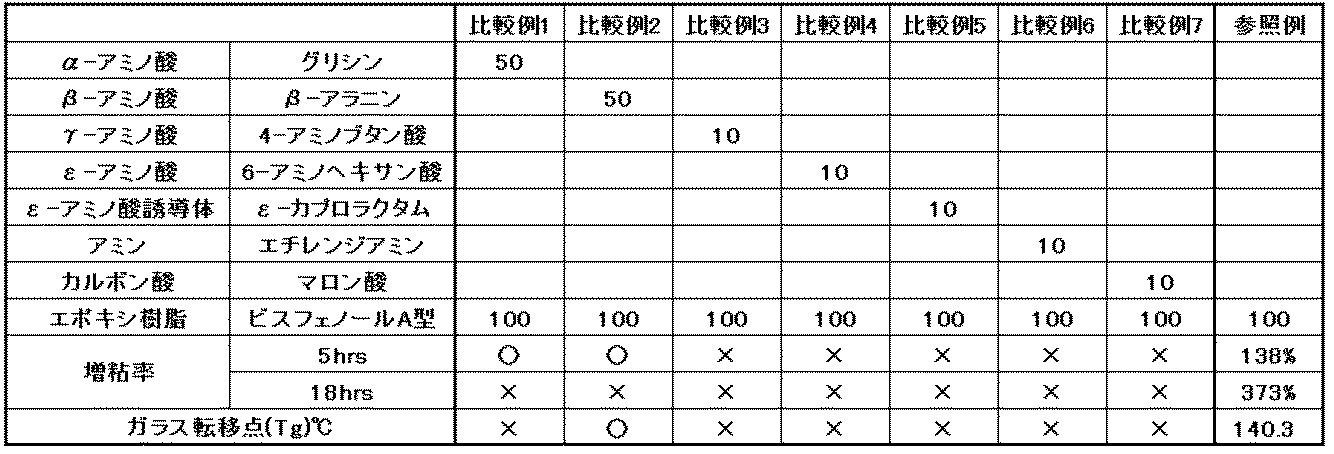
表1に示すように、樹脂を100重量部とした場合、α-アミノ酸としてグリシンを1重量部以上30重量部以下で添加した実施例1~実施例4では、増粘率は、樹脂と硬化剤のみを添加した場合の値と同等あるいはそれ以下であった。また、ガラス転移点は、樹脂と硬化剤のみを添加した場合の値と同等あるいはそれ以上であった。
また、α-アミノ酸としてL-アスバラギン酸を10重量部添加した実施例5についても、増粘率は、樹脂と硬化剤のみを添加した場合の値と同等、ガラス転移点は、樹脂と硬化剤のみを添加した場合の値を上回った。
更に、β-アミノ酸としてβ-アラニンを1重量部以上30重量部以下で添加した実施例6~実施例9は、増粘率は、樹脂と硬化剤のみを添加した場合の値と同等あるいはそれ以下、ガラス転移点は、樹脂と硬化剤のみを添加した場合の値と同等あるいはそれ以上であった。
これに対し、表2に示すように、α-アミノ酸としてグリシンを50重量部添加した比較例1では、5時間後の増粘率については、樹脂と硬化剤のみを添加した場合の値と同等であったが、18時間後の増粘率については、樹脂と硬化剤のみを添加した場合の値を上回った。また、ガラス転移点は、樹脂と硬化剤のみを添加した場合の値を下回った。
β-アミノ酸としてβ-アラニンを50重量部添加した比較例2では、5時間後の増粘率については、樹脂と硬化剤のみを添加した場合の値と同等であった。また、ガラス転移点は、樹脂と硬化剤のみを添加した場合の値と同等であった。しかし、18時間後の増粘率については、樹脂と硬化剤のみを添加した場合の値を上回った。
γ-アミノ酸として4-アミノブタン酸を10重量部添加した比較例3では、増粘率は、樹脂と硬化剤のみを添加した場合の値を上回り、ガラス転移点は、樹脂と硬化剤のみを添加した場合の値を下回った。また、ε-アミノ酸として6-アミノヘキサン酸を10重量部添加した比較例4は、増粘率は、樹脂と硬化剤のみを添加した場合の値を上回り、ガラス転移点は、樹脂と硬化剤のみを添加した場合の値を下回った。更に、ε-アミノ酸誘導体としてε-カプロラクタムを10重量部添加した比較例5は、増粘率は、樹脂と硬化剤のみを添加した場合の値を上回り、ガラス転移点は、樹脂と硬化剤のみを添加した場合の値を下回った。
アミノ酸に代えて、アミンとして、エチレンジアミンを10重量部添加した比較例6は、増粘率は、樹脂と硬化剤のみを添加した場合の値を上回り、ガラス転移点は、樹脂と硬化剤のみを添加した場合の値を下回った。また、有機酸としてマロン酸を10重量部添加した比較例7は、増粘率は、樹脂と硬化剤のみを添加した場合の値を上回り、ガラス転移点は、樹脂と硬化剤のみを添加した場合の値を下回った。
以上のことから、カルボキシル基とアミノ基との間の炭素数が2以下のα-アミノ酸またはβ-アミノ酸を、硬化性樹脂100重量部に対して1重量部以上30重量部以下で添加した実施例1~実施例9のフラックスでは、樹脂と硬化剤のみの硬化性樹脂に対して、室温下での樹脂の硬化が遅延させることができることが判った。これにより、保存時の粘度上昇を抑制することができた。
また、α-アミノ酸とβ-アミノ酸のうち少なくとも1種を添加しても、樹脂のガラス転移点の低下が抑制され、熱による樹脂の硬化は阻害されないことが判った。これにより、例えば、はんだボールを使用してはんだ付けを行うことで、フラックス残渣中の樹脂が硬化し、接合箇所のはんだによる接合に加えて、接合対象物と被接合対象物を樹脂で固着することができた。なお、α-アミノ酸とβ-アミノ酸の合計を、硬化性樹脂100重量部に対して1重量部以上30重量部以下で添加したフラックスでも、同様の効果が得られた。
但し、アミノ酸は脱炭酸反応を起こすため、300℃以上の高温域では、目的とする補強の強度が弱くなる。そのため、はんだ付け時の温度の上限は300℃未満、例えば260~270℃程度が好ましい。
また、α-アミノ酸とβ-アミノ酸は何れも、金属酸化物を除去する活性剤として機能し、かつ、樹脂との反応が抑制される。これにより、接合箇所に対するはんだ合金の濡れ性が確保され、はんだ付け性が阻害されないことが判った。
これに対し、α-アミノ酸またはβ-アミノ酸を、硬化性樹脂100重量部に対して30重量部超で添加した比較例1及び比較例2のフラックスでは、保管時間が長くなると、樹脂と硬化剤のみの硬化性樹脂に対して、室温下での樹脂の硬化が進行することが判った。このため、比較例1または比較例2のフラックスでは、室温下で樹脂の硬化が進行することで、保存時の粘度上昇を抑制することができなかった。
また、α-アミノ酸を30重量部超で添加した比較例1のフラックスでは、樹脂のガラス転移点の低下が抑制できないことが判った。このため、比較例1のフラックスを使用してはんだ付けを行った場合、フラックス残渣中の樹脂が柔軟性を持った状態となり、接合対象物と被接合対象物を樹脂で固着することができなかった。
更に、アミノ酸であっても、カルボキシル基とアミノ基との間の炭素数が3以上のアミノ酸を所定量添加した比較例3~比較例4のフラックスでは、樹脂と硬化剤のみの硬化性樹脂に対して、室温下での樹脂の硬化が進行することが判り、また、樹脂のガラス転移点の低下が抑制できないことが判った。ε-アミノ酸誘導体としてε-カプロラクタムを所定量添加した比較例5のフラックスでも、樹脂と硬化剤のみの硬化性樹脂に対して、室温下での樹脂の硬化が進行することが判り、また、樹脂のガラス転移点の低下が抑制できないことが判った。
また、活性剤として通常使用されるアミンを所定量添加した比較例6のフラックス、有機酸を所定量添加した比較例7のフラックスでも、樹脂と硬化剤のみの硬化性樹脂に対して、室温下での樹脂の硬化が進行することが判り、また、樹脂のガラス転移点の低下が抑制できないことが判った。
このため、比較例3~比較例7のフラックスでは、室温下で樹脂の硬化が進行することで、保存時の粘度上昇を抑制することができなかった。また、比較例3~比較例7のフラックスを使用してはんだ付けを行った場合、フラックス残渣中の樹脂が柔軟性を持った状態となり、接合対象物と被接合対象物を樹脂で固着することができなかった。
樹脂の硬化反応速度は温度に依存するため、室温下で保管を行う加速試験の結果から、冷蔵保管や冷凍保管時における粘度上昇も抑制可能であることが判る。
Claims (2)
- α-アミノ酸とβ-アミノ酸のうち少なくとも1種と、熱硬化性樹脂を含み、熱硬化性樹脂が100重量部に対し、α-アミノ酸とβ-アミノ酸のうち少なくとも1種が1重量部以上~30重量部以下で添加された
ことを特徴とするフラックス。 - 前記α-アミノ酸は、グリシン、アラニン、アスパラギン、アスパラギン酸、グルタミン、グルタミン酸、セリンであり、前記β-アミノ酸は、β-アラニンである
ことを特徴とする請求項1に記載のフラックス。
Priority Applications (2)
| Application Number | Priority Date | Filing Date | Title |
|---|---|---|---|
| KR1020187030888A KR101952086B1 (ko) | 2016-03-30 | 2017-03-30 | 플럭스 |
| US16/089,489 US20190091809A1 (en) | 2016-03-30 | 2017-03-30 | Flux |
Applications Claiming Priority (2)
| Application Number | Priority Date | Filing Date | Title |
|---|---|---|---|
| JP2016-069033 | 2016-03-30 | ||
| JP2016069033A JP6041063B1 (ja) | 2016-03-30 | 2016-03-30 | フラックス |
Publications (1)
| Publication Number | Publication Date |
|---|---|
| WO2017170863A1 true WO2017170863A1 (ja) | 2017-10-05 |
Family
ID=57483245
Family Applications (1)
| Application Number | Title | Priority Date | Filing Date |
|---|---|---|---|
| PCT/JP2017/013226 Ceased WO2017170863A1 (ja) | 2016-03-30 | 2017-03-30 | フラックス |
Country Status (5)
| Country | Link |
|---|---|
| US (1) | US20190091809A1 (ja) |
| JP (1) | JP6041063B1 (ja) |
| KR (1) | KR101952086B1 (ja) |
| TW (1) | TWI612088B (ja) |
| WO (1) | WO2017170863A1 (ja) |
Cited By (1)
| Publication number | Priority date | Publication date | Assignee | Title |
|---|---|---|---|---|
| CN108274158A (zh) * | 2018-02-02 | 2018-07-13 | 安阳师范学院 | 免清洗助焊剂及其制备方法 |
Families Citing this family (1)
| Publication number | Priority date | Publication date | Assignee | Title |
|---|---|---|---|---|
| JP7668512B2 (ja) * | 2019-05-15 | 2025-04-25 | 株式会社弘輝 | フラックス及びソルダペースト |
Citations (3)
| Publication number | Priority date | Publication date | Assignee | Title |
|---|---|---|---|---|
| JPH0318498A (ja) * | 1989-06-15 | 1991-01-28 | Senju Metal Ind Co Ltd | 水溶性はんだ付け用フラックス |
| JPH0952195A (ja) * | 1995-08-11 | 1997-02-25 | Aoki Metal:Kk | はんだ付け用フラックス |
| JP2003010997A (ja) * | 2001-06-29 | 2003-01-15 | Fuji Electric Co Ltd | ハンダ組成物 |
Family Cites Families (6)
| Publication number | Priority date | Publication date | Assignee | Title |
|---|---|---|---|---|
| US4619715A (en) * | 1984-09-11 | 1986-10-28 | Scm Corporation | Fusible powdered metal paste |
| JP2001007158A (ja) | 1999-06-25 | 2001-01-12 | Fujitsu Ltd | 半田バンプの接合方法及び半田バンプ接合体 |
| JP2001219294A (ja) | 1999-12-03 | 2001-08-14 | Tdk Corp | 熱硬化性はんだ付け用フラックスおよびはんだ付け方法 |
| JP3797990B2 (ja) * | 2003-08-08 | 2006-07-19 | 株式会社東芝 | 熱硬化性フラックス及びはんだペースト |
| JP2008062253A (ja) * | 2006-09-05 | 2008-03-21 | Denso Corp | はんだ付け用フラックスおよびはんだペースト組成物 |
| JP5773106B1 (ja) * | 2014-01-31 | 2015-09-02 | 千住金属工業株式会社 | フラックスコートボール、はんだペースト、フォームはんだ及びはんだ継手 |
-
2016
- 2016-03-30 JP JP2016069033A patent/JP6041063B1/ja active Active
-
2017
- 2017-03-30 US US16/089,489 patent/US20190091809A1/en not_active Abandoned
- 2017-03-30 TW TW106110744A patent/TWI612088B/zh active
- 2017-03-30 KR KR1020187030888A patent/KR101952086B1/ko active Active
- 2017-03-30 WO PCT/JP2017/013226 patent/WO2017170863A1/ja not_active Ceased
Patent Citations (3)
| Publication number | Priority date | Publication date | Assignee | Title |
|---|---|---|---|---|
| JPH0318498A (ja) * | 1989-06-15 | 1991-01-28 | Senju Metal Ind Co Ltd | 水溶性はんだ付け用フラックス |
| JPH0952195A (ja) * | 1995-08-11 | 1997-02-25 | Aoki Metal:Kk | はんだ付け用フラックス |
| JP2003010997A (ja) * | 2001-06-29 | 2003-01-15 | Fuji Electric Co Ltd | ハンダ組成物 |
Cited By (1)
| Publication number | Priority date | Publication date | Assignee | Title |
|---|---|---|---|---|
| CN108274158A (zh) * | 2018-02-02 | 2018-07-13 | 安阳师范学院 | 免清洗助焊剂及其制备方法 |
Also Published As
| Publication number | Publication date |
|---|---|
| TW201736471A (zh) | 2017-10-16 |
| US20190091809A1 (en) | 2019-03-28 |
| KR20180120279A (ko) | 2018-11-05 |
| KR101952086B1 (ko) | 2019-02-25 |
| TWI612088B (zh) | 2018-01-21 |
| JP2017177173A (ja) | 2017-10-05 |
| JP6041063B1 (ja) | 2016-12-07 |
Similar Documents
| Publication | Publication Date | Title |
|---|---|---|
| KR102006057B1 (ko) | 도전성 접합제 및 납땜 조인트 | |
| CN1313242C (zh) | 热固性焊膏 | |
| US8227536B2 (en) | Lead-free solder paste and its use | |
| JP4897932B1 (ja) | はんだペースト用フラックスおよびはんだペースト | |
| US20160318134A1 (en) | Rosin-Free Thermosetting Flux Formulations | |
| KR101712787B1 (ko) | 플럭스 및 솔더 페이스트 | |
| US9643285B2 (en) | Cream solder composition | |
| JP6041063B1 (ja) | フラックス | |
| TWI659990B (zh) | Flux | |
| WO2015115483A1 (ja) | 半田付け用フラックス及び半田組成物 | |
| JP6281624B1 (ja) | ソルダペースト |
Legal Events
| Date | Code | Title | Description |
|---|---|---|---|
| NENP | Non-entry into the national phase |
Ref country code: DE |
|
| ENP | Entry into the national phase |
Ref document number: 20187030888 Country of ref document: KR Kind code of ref document: A |
|
| 121 | Ep: the epo has been informed by wipo that ep was designated in this application |
Ref document number: 17775397 Country of ref document: EP Kind code of ref document: A1 |
|
| 122 | Ep: pct application non-entry in european phase |
Ref document number: 17775397 Country of ref document: EP Kind code of ref document: A1 |