WO2017169506A1 - 遠赤外線透過性組成物、形成体、積層体、遠赤外線透過フィルタ、固体撮像素子および赤外線カメラ - Google Patents
遠赤外線透過性組成物、形成体、積層体、遠赤外線透過フィルタ、固体撮像素子および赤外線カメラ Download PDFInfo
- Publication number
- WO2017169506A1 WO2017169506A1 PCT/JP2017/008419 JP2017008419W WO2017169506A1 WO 2017169506 A1 WO2017169506 A1 WO 2017169506A1 JP 2017008419 W JP2017008419 W JP 2017008419W WO 2017169506 A1 WO2017169506 A1 WO 2017169506A1
- Authority
- WO
- WIPO (PCT)
- Prior art keywords
- group
- far
- formed body
- compound
- refractive index
- Prior art date
- Legal status (The legal status is an assumption and is not a legal conclusion. Google has not performed a legal analysis and makes no representation as to the accuracy of the status listed.)
- Ceased
Links
Classifications
-
- G—PHYSICS
- G02—OPTICS
- G02B—OPTICAL ELEMENTS, SYSTEMS OR APPARATUS
- G02B5/00—Optical elements other than lenses
- G02B5/20—Filters
- G02B5/206—Filters comprising particles embedded in a solid matrix
-
- G—PHYSICS
- G02—OPTICS
- G02B—OPTICAL ELEMENTS, SYSTEMS OR APPARATUS
- G02B5/00—Optical elements other than lenses
- G02B5/20—Filters
- G02B5/208—Filters for use with infrared or ultraviolet radiation, e.g. for separating visible light from infrared and/or ultraviolet radiation
-
- B—PERFORMING OPERATIONS; TRANSPORTING
- B32—LAYERED PRODUCTS
- B32B—LAYERED PRODUCTS, i.e. PRODUCTS BUILT-UP OF STRATA OF FLAT OR NON-FLAT, e.g. CELLULAR OR HONEYCOMB, FORM
- B32B27/00—Layered products comprising a layer of synthetic resin
- B32B27/18—Layered products comprising a layer of synthetic resin characterised by the use of special additives
- B32B27/20—Layered products comprising a layer of synthetic resin characterised by the use of special additives using fillers, pigments, thixotroping agents
-
- C—CHEMISTRY; METALLURGY
- C08—ORGANIC MACROMOLECULAR COMPOUNDS; THEIR PREPARATION OR CHEMICAL WORKING-UP; COMPOSITIONS BASED THEREON
- C08L—COMPOSITIONS OF MACROMOLECULAR COMPOUNDS
- C08L101/00—Compositions of unspecified macromolecular compounds
-
- C—CHEMISTRY; METALLURGY
- C08—ORGANIC MACROMOLECULAR COMPOUNDS; THEIR PREPARATION OR CHEMICAL WORKING-UP; COMPOSITIONS BASED THEREON
- C08L—COMPOSITIONS OF MACROMOLECULAR COMPOUNDS
- C08L33/00—Compositions of homopolymers or copolymers of compounds having one or more unsaturated aliphatic radicals, each having only one carbon-to-carbon double bond, and only one being terminated by only one carboxyl radical, or of salts, anhydrides, esters, amides, imides or nitriles thereof; Compositions of derivatives of such polymers
- C08L33/04—Homopolymers or copolymers of esters
- C08L33/06—Homopolymers or copolymers of esters of esters containing only carbon, hydrogen and oxygen, which oxygen atoms are present only as part of the carboxyl radical
- C08L33/10—Homopolymers or copolymers of methacrylic acid esters
-
- G—PHYSICS
- G02—OPTICS
- G02B—OPTICAL ELEMENTS, SYSTEMS OR APPARATUS
- G02B5/00—Optical elements other than lenses
- G02B5/20—Filters
-
- G—PHYSICS
- G03—PHOTOGRAPHY; CINEMATOGRAPHY; ANALOGOUS TECHNIQUES USING WAVES OTHER THAN OPTICAL WAVES; ELECTROGRAPHY; HOLOGRAPHY
- G03B—APPARATUS OR ARRANGEMENTS FOR TAKING PHOTOGRAPHS OR FOR PROJECTING OR VIEWING THEM; APPARATUS OR ARRANGEMENTS EMPLOYING ANALOGOUS TECHNIQUES USING WAVES OTHER THAN OPTICAL WAVES; ACCESSORIES THEREFOR
- G03B11/00—Filters or other obturators specially adapted for photographic purposes
-
- G—PHYSICS
- G03—PHOTOGRAPHY; CINEMATOGRAPHY; ANALOGOUS TECHNIQUES USING WAVES OTHER THAN OPTICAL WAVES; ELECTROGRAPHY; HOLOGRAPHY
- G03B—APPARATUS OR ARRANGEMENTS FOR TAKING PHOTOGRAPHS OR FOR PROJECTING OR VIEWING THEM; APPARATUS OR ARRANGEMENTS EMPLOYING ANALOGOUS TECHNIQUES USING WAVES OTHER THAN OPTICAL WAVES; ACCESSORIES THEREFOR
- G03B42/00—Obtaining records using waves other than optical waves; Visualisation of such records by using optical means
-
- H—ELECTRICITY
- H04—ELECTRIC COMMUNICATION TECHNIQUE
- H04N—PICTORIAL COMMUNICATION, e.g. TELEVISION
- H04N23/00—Cameras or camera modules comprising electronic image sensors; Control thereof
- H04N23/20—Cameras or camera modules comprising electronic image sensors; Control thereof for generating image signals from infrared radiation only
- H04N23/23—Cameras or camera modules comprising electronic image sensors; Control thereof for generating image signals from infrared radiation only from thermal infrared radiation
-
- G—PHYSICS
- G02—OPTICS
- G02B—OPTICAL ELEMENTS, SYSTEMS OR APPARATUS
- G02B1/00—Optical elements characterised by the material of which they are made; Optical coatings for optical elements
- G02B1/02—Optical elements characterised by the material of which they are made; Optical coatings for optical elements made of crystals, e.g. rock-salt, semi-conductors
-
- G—PHYSICS
- G02—OPTICS
- G02B—OPTICAL ELEMENTS, SYSTEMS OR APPARATUS
- G02B1/00—Optical elements characterised by the material of which they are made; Optical coatings for optical elements
- G02B1/10—Optical coatings produced by application to, or surface treatment of, optical elements
- G02B1/11—Anti-reflection coatings
- G02B1/113—Anti-reflection coatings using inorganic layer materials only
- G02B1/115—Multilayers
Definitions
- the present invention relates to a far-infrared transparent composition, a formed body, a laminate, a far-infrared transmission filter, a solid-state imaging device, and an infrared camera.
- Germanium (Ge), silicon (Si), and the like are known as infrared transmitting materials used for these optical devices and optical elements.
- Patent Document 1 describes that a lens formed of Ge, Si, or the like is used as a lens that collects far infrared rays.
- an object of the present invention is to provide a far-infrared transmitting composition, a forming body, a laminate, a far-infrared transmitting filter, a solid-state imaging device, and an infrared ray that can produce a forming body having far-infrared transmittance by a method different from the conventional method.
- a camera To provide a camera.
- the present invention provides the following.
- ⁇ 1> A far infrared ray transmissive composition comprising particles having a refractive index of 1.3 to 5.0 at a wavelength of 10 ⁇ m and a medium.
- the far-infrared transparent composition as described in ⁇ 1> which contains ⁇ 2> particle
- ⁇ 3> The far infrared ray transmissive composition according to ⁇ 1> or ⁇ 2>, wherein the medium includes at least one selected from a resin, a curable compound, and a solvent.
- the medium includes at least one selected from a resin, a curable compound, and a solvent.
- ⁇ 5> A formed body comprising particles having a refractive index of 1.3 to 5.0 at a wavelength of 10 ⁇ m.
- ⁇ 6> The formed body according to ⁇ 5>, wherein the average refractive index in the wavelength range of 8 to 14 ⁇ m is 1.3 to 5.0.
- ⁇ 7> The formed body according to ⁇ 5> or ⁇ 6>, wherein the formed body has a film shape, a flat plate shape, or a lens shape.
- ⁇ 8> The formed body according to any one of ⁇ 5> to ⁇ 7>, wherein the particles are inorganic particles containing at least one kind of atom selected from Ge, Zn, Si, and F.
- ⁇ 9> The formed body according to any one of ⁇ 5> to ⁇ 8>, which is for a far-infrared transmission filter.
- ⁇ 10> a substrate; A formed body according to any one of ⁇ 5> to ⁇ 9> provided on a substrate; A laminate having ⁇ 11> The laminate according to ⁇ 10>, wherein the refractive index n1 at a wavelength of 10 ⁇ m of the formed body and the refractive index n2 at a wavelength of 10 ⁇ m of the layer contacting the formed body in the thickness direction of the formed body satisfy the following relationship: .
- the far-infrared transparent composition which can manufacture the formation body which has a far-infrared transmittance, a formation body, a laminated body, a far-infrared transmission filter, a solid-state image sensor, and an infrared camera. It was.
- a numerical range expressed using “to” means a range including numerical values described before and after “to” as a lower limit value and an upper limit value.
- the “total solid content” refers to the total mass of components excluding the solvent from the total composition.
- the description which does not describe substitution and unsubstituted includes the group (atomic group) which has a substituent with the group (atomic group) which does not have a substituent.
- the “alkyl group” includes not only an alkyl group having no substituent (unsubstituted alkyl group) but also an alkyl group having a substituent (substituted alkyl group).
- “(meth) acrylate” represents acrylate and methacrylate
- “(meth) acryl” represents acryl and methacryl
- “(meth) acryloyl” represents acryloyl and methacryloyl.
- exposure includes not only exposure using light but also drawing using particle beams such as electron beams and ion beams.
- the light used for exposure generally includes active rays or radiation such as an emission line spectrum of a mercury lamp, far ultraviolet rays represented by excimer laser, extreme ultraviolet rays (EUV light), X-rays, and electron beams.
- active rays or radiation such as an emission line spectrum of a mercury lamp, far ultraviolet rays represented by excimer laser, extreme ultraviolet rays (EUV light), X-rays, and electron beams.
- far-infrared radiation means light (electromagnetic wave) having a wavelength of 0.7 to 1000 ⁇ m.
- a weight average molecular weight and a number average molecular weight are defined as a polystyrene conversion value measured by gel permeation chromatography (GPC).
- the far infrared ray transmitting composition of the present invention includes particles having a refractive index of 1.3 to 5.0 at a wavelength of 10 ⁇ m and a medium.
- the composition of the present invention By using the composition of the present invention, a formed body having excellent far-infrared transmittance can be produced. Further, according to the composition of the present invention, the formed body can be produced by applying the composition of the present invention to a substrate, or various molding methods such as injection, pressing and extrusion can be performed using the composition of the present invention. Therefore, a formed body having excellent far-infrared transmittance can be easily produced. For this reason, the formation body which has a far-infrared transmissivity can be manufactured at low cost.
- the medium is preferably liquid or solid at 25 ° C.
- the particles are preferably dispersed in a medium. That is, in the far infrared ray transmissive composition of the present invention, the medium is preferably a component for dispersing particles.
- the medium is preferably an organic material.
- a medium contains at least 1 sort (s) chosen from resin, a curable compound, and a solvent.
- the far-infrared transmissive composition preferably contains inorganic particles containing at least one kind of atom selected from Ge, Zn, Si and F, and a medium.
- Inorganic particles containing at least one atom selected from Ge, Zn, Si, and F have a high refractive index at a wavelength of 10 ⁇ m.
- the composition of the present invention contains particles having a refractive index of 1.3 to 5.0 at a wavelength of 10 ⁇ m (hereinafter also referred to as high refractive index particles).
- the lower limit of the refractive index at a wavelength of 10 ⁇ m of the high refractive index particles is preferably 1.35 or more, and more preferably 1.4 or more.
- the upper limit is preferably 4.5 or less, and more preferably 4.0 or less.
- the refractive index of a particle uses a known value for a material whose bulk crystal value is known, and for a material whose bulk crystal value is unknown, a vapor deposition film of a compound constituting the particle to be measured , J. A. Values measured by Woollam IR-VASE were used.
- the average primary particle diameter of the high refractive index particles is preferably 100 nm or less, and more preferably 50 nm or less.
- the lower limit may be 1 nm or more, and may be 10 nm or more. If the average primary particle diameter of the high refractive index particles is 100 nm or less, the effect of suppressing the scattering of infrared light and increasing the transmittance can be expected.
- the average primary particle diameter of the high refractive index particles can be determined by observing with a transmission electron microscope (TEM) and observing a portion where the particles are not aggregated.
- TEM transmission electron microscope
- the particle size distribution of the particles is obtained by measuring the particle size distribution with an image processing apparatus using the photograph after taking a transmission electron micrograph of the particles which are primary particles using a transmission electron microscope.
- the average primary particle diameter of the particles is defined as the average primary particle diameter based on the number average diameter calculated from the particle size distribution.
- an electron microscope (H-7000) manufactured by Hitachi, Ltd. is used as a transmission electron microscope
- Luzex AP manufactured by Nireco Corporation is used as an image processing apparatus.
- any high refractive index particle can be used as long as it has a refractive index of 1.3 to 5.0 at a wavelength of 10 ⁇ m and contains at least one kind of atom selected from Ge, Zn, Si and F.
- Inorganic particles, ITO (indium tin oxide), chalcogenide glass, diamond and sapphire are more preferable, and inorganic particles containing at least one kind of atom selected from Ge, Zn, Si and F are more preferable.
- Specific examples of the high refractive index particles include Ge particles, Si particles, GeO 2 particles, ZnSe particles, ZnS particles, CaF 2 particles, MgF 2 particles, BaF 2 particles, chalcogenide glass, and the like.
- Ge particles, Si particles And Ge particles are more preferable.
- ITO particles examples include P4-ITO (manufactured by Mitsubishi Materials Corporation).
- Si particles examples include SO-C1 (manufactured by Admatex), Aerosil 50, MOX170, 200 (manufactured by Nippon Aerosil Co., Ltd.), and the like.
- examples of commercially available products of MgF 2 particles, BaF 2 particles, and CaF particles include Morita Chemical Industries and Stella Chemifa products.
- Examples of commercially available Ge particles include HWNANOMaterials, American elements, and the like. The high refractive index particles may be obtained by crushing commercially available materials or crystals and then refining them using a lab plast mill or the like.
- Examples of the shape of the high refractive index particles include isotropic shapes (for example, spherical and polyhedral shapes), anisotropic shapes (for example, needle-shaped, rod-shaped, and plate-shaped), and irregular shapes. .
- the high refractive index particles may have been surface-treated with a surface treatment agent.
- a surface treatment agent used for the surface treatment include polyol, aluminum oxide, aluminum hydroxide, silica (silicon oxide), hydrous silica, alkanolamine, stearic acid, organosiloxane, zirconium oxide, hydrogen dimethicone, silane coupling agent, Examples include titanate coupling agents.
- the surface treatment may be performed using one type of surface treatment agent or a combination of two or more types of surface treatment agents.
- the content of the high refractive index particles is preferably higher from the viewpoint of far-infrared transmittance and rigidity of the formed body, more preferably 15% by mass or more, and more preferably 30% by mass or more with respect to the total solid content in the composition. More preferred is 45% by mass or more.
- the upper limit is preferably 99.9% by mass or less, and more preferably 90% by mass or less.
- the composition of the present invention preferably contains a resin.
- the resin is blended, for example, for the purpose of dispersing the high refractive index particles in the composition or the use of a binder.
- the resin mainly used for dispersing the high refractive index particles in the composition is also referred to as a dispersant.
- such use of the resin is an example, and the resin can be used for purposes other than such use.
- the weight average molecular weight (Mw) of the resin is preferably 2,000 to 2,000,000.
- the upper limit is preferably 1,000,000 or less, and more preferably 500,000 or less.
- the lower limit is preferably 3,000 or more, and more preferably 5,000 or more.
- the resin content is preferably 0.1 to 80% by mass relative to the total solid content of the composition.
- the lower limit is preferably 0.01% by mass or more, and more preferably 1% by mass or more.
- the upper limit is preferably 80% by mass or less, and more preferably 70% by mass or less. Only one type of resin may be included, or two or more types of resins may be included. When two or more types are included, the total amount is preferably within the above range.
- the composition of the present invention preferably contains a binder as a resin.
- the binder include (meth) acrylic resin, (meth) acrylamide resin, epoxy resin, ene / thiol resin, polycarbonate resin, polyether resin, polyarylate resin, polysulfone resin, polyethersulfone resin, polyphenylene resin, and polyarylene.
- examples include ether phosphine oxide resin, polyimide resin, polyamideimide resin, polyolefin resin, cyclic olefin resin, polyester resin, styrene resin, and siloxane resin.
- One of these resins may be used alone, or two or more thereof may be mixed and used.
- a resin having an acid group can be used as the resin.
- the acid group include a carboxy group, a phosphate group, a sulfo group, and a phenolic hydroxy group. These acid groups may be used alone or in combination of two or more. Resins having acid groups can also be used as alkali-soluble resins. It can also be used as a dispersant.
- Examples of the resin having an acid group include radical polymers having a carboxy group in the side chain, such as JP-A-59-44615, JP-B-54-34327, JP-B-58-12777, and JP-B-54-25957.
- the polymers described in JP-A No. 54-92723, JP-A 59-53836, JP-A 59-71048, that is, monomers having a carboxy group were homo- or copolymerized.
- Resin, monomer having acid anhydride alone or copolymerized, hydrolyzed, half esterified or half amidated acid anhydride unit, epoxy modified epoxy resin with unsaturated monocarboxylic acid and acid anhydride An acrylate etc. are mentioned.
- Examples of the monomer having a carboxy group include acrylic acid, methacrylic acid, itaconic acid, crotonic acid, maleic acid, fumaric acid and 4-carboxystyrene.
- Examples of the monomer having an acid anhydride include maleic anhydride. It is done.
- the acidic cellulose derivative which has a carboxy group in a side chain can also be used.
- the molecular weight of the resin having an acid group is not particularly defined, and the weight average molecular weight (Mw) is preferably 5000 to 200,000.
- the upper limit is preferably 100,000 or less, and more preferably 20,000 or less.
- the number average molecular weight (Mn) is preferably 1000 to 20,000.
- the acid value of the resin having an acid group is preferably 30 to 500 mgKOH / g.
- the lower limit is more preferably 50 mgKOH / g or more, and still more preferably 70 mgKOH / g or more.
- the upper limit is more preferably 400 mgKOH / g or less, further preferably 200 mgKOH / g or less, particularly preferably 150 mgKOH / g or less, and most preferably 120 mgKOH / g or less.
- a polymer having a carboxy group in the side chain is preferred, and a methacrylic acid copolymer, an acrylic acid copolymer, an itaconic acid copolymer, a crotonic acid copolymer, a maleic acid copolymer, a partial Examples include esterified maleic acid copolymers, alkali-soluble phenol resins such as novolak resins, acidic cellulose derivatives having a carboxy group in the side chain, and polymers having a hydroxy group added with an acid anhydride.
- a copolymer of (meth) acrylic acid and another monomer copolymerizable with (meth) acrylic acid is suitable.
- Examples of other monomers copolymerizable with (meth) acrylic acid include alkyl (meth) acrylates, aryl (meth) acrylates, vinyl compounds, and N-substituted maleimide monomers.
- alkyl (meth) acrylate and aryl (meth) acrylate methyl (meth) acrylate, ethyl (meth) acrylate, propyl (meth) acrylate, butyl (meth) acrylate, isobutyl (meth) acrylate, pentyl (meth) acrylate,
- Examples of vinyl compounds such as hexyl (meth) acrylate, octyl (meth) acrylate, phenyl (meth) acrylate, benzyl (meth) acrylate, tolyl (meth) acrylate, naphthyl (meth) acrylate, cyclohexyl (meth) acrylate, styren
- N-phenylmaleimide, N-cyclohexylmaleimide and the like can also be used as N-substituted maleimide monomers described in JP-A-10-300922. Only one kind of these other monomers copolymerizable with (meth) acrylic acid may be used, or two or more kinds may be used.
- Resins having an acid group include benzyl (meth) acrylate / (meth) acrylic acid copolymer, benzyl (meth) acrylate / (meth) acrylic acid / 2-hydroxyethyl (meth) acrylate copolymer, benzyl (meth) Multi-component copolymers composed of acrylate / (meth) acrylic acid / other monomers can also be preferably used.
- the resin having an acid group is at least one selected from a compound represented by the following formula (ED1) and a compound represented by the following formula (ED2) (hereinafter, these compounds may be referred to as “ether dimers”). It is also preferable to include a polymer obtained by polymerizing a monomer component containing
- R 1 and R 2 each independently represent a hydrogen atom or a hydrocarbon group having 1 to 25 carbon atoms which may have a substituent.
- R represents a hydrogen atom or an organic group having 1 to 30 carbon atoms.
- the description in JP 2010-168539 A can be referred to.
- ether dimer for example, paragraph number 0317 of JP2013-29760A can be referred to, and the contents thereof are incorporated in the present specification. Only one type of ether dimer may be used, or two or more types may be used.
- the resin having an acid group may contain a structural unit derived from the compound represented by the formula (X).
- R 1 represents a hydrogen atom or a methyl group
- R 2 represents an alkylene group having 2 to 10 carbon atoms
- R 3 represents a hydrogen atom or a benzene ring that may contain a benzene ring.
- n represents an integer of 1 to 15.
- the alkylene group of R 2 preferably has 2 to 3 carbon atoms. Further, the alkyl group of R 3 has 1 to 20 carbon atoms, more preferably 1 to 10 carbon atoms, and the alkyl group of R 3 may contain a benzene ring. Examples of the alkyl group containing a benzene ring represented by R 3 include a benzyl group and a 2-phenyl (iso) propyl group.
- the resin having an acid group can be referred to the description in paragraph Nos. 0558 to 0571 of JP 2012-208494 A (corresponding to paragraph numbers 0685 to 0700 of US 2012/0235099 corresponding). Are incorporated herein. Further, the copolymer (B) described in paragraphs 0029 to 0063 of JP2012-32767A and the alkali-soluble resin used in the examples, paragraphs 0088 to 0098 of JP2012-208474A, The binder resin described in the description and the binder resin used in the examples, the binder resin described in paragraphs 0022 to 0032 of JP2012-137531A and the binder resin used in the examples, JP2013-024934A Binder resin described in paragraph Nos.
- the resin may have a curable group.
- the curable group include a group having an ethylenically unsaturated bond, an epoxy group, a methylol group, and an alkoxysilyl group.
- the group having an ethylenically unsaturated bond include a vinyl group, a (meth) allyl group, a (meth) acryloyl group, and a (meth) acryloyloxy group.
- Examples of the alkoxysilyl group include a monoalkoxysilyl group, a dialkoxysilyl group, and a trialkoxysilyl group.
- the resin having a curable group is also a curable compound.
- Examples of the resin containing a curable group include a dial NR series (manufactured by Mitsubishi Rayon Co., Ltd.), Photomer 6173 (COOH-containing polyurethane acrylic oligomer, manufactured by Diamond Shamrock Co., Ltd.), Biscoat R-264, KS resist 106 ( All are manufactured by Osaka Organic Chemical Industry Co., Ltd.), Cyclomer P series (for example, ACA230AA), Plaxel CF200 series (all manufactured by Daicel Corporation), Ebecryl 3800 (manufactured by Daicel UCB Corporation), Acrycure RD-F8 (Japan) Catalyst Co., Ltd.).
- a dial NR series manufactured by Mitsubishi Rayon Co., Ltd.
- Photomer 6173 COOH-containing polyurethane acrylic oligomer, manufactured by Diamond Shamrock Co., Ltd.
- Biscoat R-264 Biscoat R-264
- KS resist 106 All are manufactured by Osaka Organic Chemical Industry Co., Ltd.
- the resin is a proof G-0150M, G-0105SA, G-0130SP, G-0250SP, G-1005S, G-1005SA, G-1010S, G-2050M, G-01100, G-01758 (day It is also preferable to use Oil Co., Ltd. (epoxy group-containing polymer), ARTON F4520 (manufactured by JSR Corporation), or the like.
- the content of the binder is preferably 0.01 to 80% by mass with respect to the total solid content of the composition.
- the lower limit is preferably 0.1% by mass or more, and more preferably 1% by mass or more.
- the upper limit is preferably 80% by mass or less, and more preferably 70% by mass or less. Only one type of binder may be included, or two or more types of binders may be included. When two or more types are included, the total amount is preferably within the above range.
- the composition of the present invention can contain a dispersant as a resin.
- the dispersant include polymer dispersants [for example, resins having amine groups (polyamideamine and salts thereof), oligoimine resins, polycarboxylic acids and salts thereof, high molecular weight unsaturated acid esters, modified polyurethanes, modified polyesters, Modified poly (meth) acrylate, (meth) acrylic copolymer, naphthalenesulfonic acid formalin condensate] and the like.
- the polymer dispersant can be further classified into a linear polymer, a terminal-modified polymer, a graft polymer, and a block polymer according to the structure.
- the dispersant has a site having an adsorbing ability with respect to the high refractive index particles (hereinafter collectively referred to as “adsorption site”).
- Adsorption sites include acid groups, urea groups, urethane groups, groups having coordinating oxygen atoms, groups having basic nitrogen atoms, heterocyclic groups, alkyloxycarbonyl groups, alkylaminocarbonyl groups, carboxy groups, sulfonamides And monovalent substituents having at least one group selected from the group consisting of a group, an alkoxysilyl group, an epoxy group, an isocyanate group, and a hydroxy group.
- the adsorption site is preferably an acid-based adsorption site. An acid group etc.
- an acid type adsorption site is at least one of a phosphorus atom containing group and a carboxy group.
- the phosphorus atom-containing group include a phosphate group, a polyphosphate group, and a phosphate group.
- the resin (dispersant) is preferably a resin represented by the following formula (100).
- R 1 represents an (m + n) -valent linking group
- R 2 represents a single bond or a divalent linking group
- a 1 is an acid group, a urea group, a urethane group, a group having a coordinating oxygen atom, a group having a basic nitrogen atom, a phenol group, an alkyl group, an aryl group, a group having an alkyleneoxy chain, an imide group, a complex Monovalent substitution having at least one group selected from the group consisting of a cyclic group, an alkyloxycarbonyl group, an alkylaminocarbonyl group, a carboxylate group, a sulfonamide group, an alkoxysilyl group, an epoxy group, an isocyanate group, and a hydroxy group Represents a group.
- n A 1 and R 2 may be the same or different.
- m represents a positive number of 8 or less, n represents 1 to 9, and m + n satisfies 3 to 10.
- P 1 represents a monovalent polymer chain.
- the m P 1 may be the same or different.
- a 1 represents an acid group, a urea group, a urethane group, a group having a coordinating oxygen atom, a group having a basic nitrogen atom, a phenol group, an alkyl group, an aryl group, or an alkyleneoxy chain.
- a group selected from the group consisting of a group having an imide group, a heterocyclic group, an alkyloxycarbonyl group, an alkylaminocarbonyl group, a carboxylate group, a sulfonamide group, an alkoxysilyl group, an epoxy group, an isocyanate group, and a hydroxy group Represents a monovalent substituent having at least one kind).
- a chain saturated hydrocarbon group (which may be linear or branched and preferably has 1 to 10 carbon atoms) ), A cyclic saturated hydrocarbon group (preferably having 3 to 10 carbon atoms), an aromatic group (preferably having 5 to 10 carbon atoms, for example, a phenylene group) and the like.
- a cyclic saturated hydrocarbon group preferably having 3 to 10 carbon atoms
- an aromatic group preferably having 5 to 10 carbon atoms, for example, a phenylene group
- the adsorption site itself may be a monovalent substituent represented by A 1 .
- Examples of the acid group in A 1 include a carboxy group, a sulfo group, a monosulfate group, a phosphoric acid group, a monophosphate group, a phosphonic acid group, a phosphinic acid group, and a boric acid group, and a carboxy group and a sulfo group.
- a monosulfate group, a phosphate group, a monophosphate group, a phosphonic acid group and a phosphinic acid group are preferred, a carboxy group, a sulfo group, a phosphoric acid group, a phosphonic acid group and a phosphinic acid group are more preferred, and a carboxy group is further preferable.
- urea group in A 1 for example, —NR 15 CONR 16 R 17 (wherein R 15 , R 16 , and R 17 are each independently a hydrogen atom, an alkyl group having 1 to 20 carbon atoms, a carbon number of 6 Represents the above aryl group or an aralkyl group having 7 or more carbon atoms.), —NR 15 CONHR 17 is preferable, and —NHCONHR 17 is more preferable.
- Examples of the urethane group in A 1 include —NHCOOR 18 , —NR 19 COOR 20 , —OCONHR 21 , —OCONR 22 R 23 (where R 18 , R 19 , R 20 , R 21 , R 22 and R 23 are Each independently represents an alkyl group having 1 to 20 carbon atoms, an aryl group having 6 or more carbon atoms, or an aralkyl group having 7 or more carbon atoms, and —NHCOOR 18 and —OCONHR 21 are preferred.
- Examples of the group having a coordinating oxygen atom in A 1 include an acetylacetonato group and a crown ether.
- Examples of the group having a basic nitrogen atom in A 1 include an amino group (—NH 2 ), a substituted imino group (—NHR 8 , —NR 9 R 10 , wherein R 8 , R 9 , and R 10 are Each independently represents an alkyl group having 1 to 20 carbon atoms, an aryl group having 6 or more carbon atoms, or an aralkyl group having 7 or more carbon atoms), a guanidyl group represented by the following formula (a1), or a formula (a2) And an amidinyl group represented by:
- R 11 and R 12 each independently represents an alkyl group having 1 to 20 carbon atoms, an aryl group having 6 or more carbon atoms, or an aralkyl group having 7 or more carbon atoms.
- R 13 and R 14 each independently represents an alkyl group having 1 to 20 carbon atoms, an aryl group having 6 or more carbon atoms, or an aralkyl group having 7 or more carbon atoms.
- the group having a basic nitrogen atom includes an amino group (—NH 2 ), a substituted imino group, and a guanidyl group represented by the above formula (a1) [in the formula (a1), R 11 and R 12 are each independently carbon It represents an alkyl group, a phenyl group, or a benzyl group from 1 to 10. ]
- an amino group (—NH 2 ), a substituted imino group (—NHR 8 , —NR 9 R 10 , wherein R 8 , R 9 , and R 10 are each independently an alkyl group having 1 to 5 carbon atoms
- a guanidyl group represented by the formula (a1) [in the formula (a1), R 11 and R 12 are each independently an alkyl group having 1 to 5 carbon atoms, a phenyl group, a benzyl group; Represents a group.
- An amidinyl group represented by the formula (a2) [in the formula (a2), R 13 and R 14 each independently represents an alkyl group having 1 to 5 carbon atoms, a phenyl group, or a benzyl group. ] Is preferable.
- the alkyl group for A 1 may be linear or branched, and is preferably an alkyl group having 1 to 40 carbon atoms, more preferably an alkyl group having 4 to 30 carbon atoms. And more preferably an alkyl group having 10 to 18 carbon atoms.
- the aryl group for A 1 is preferably an aryl group having 6 to 10 carbon atoms.
- the group having an alkyleneoxy chain in A 1 is preferably a group in which the terminal forms an alkyloxy group, and more preferably a group having an alkyloxy group having 1 to 20 carbon atoms.
- the alkyleneoxy chain is not particularly limited as long as it has at least one alkyleneoxy group, and is preferably composed of 1 to 6 alkyleneoxy groups. Examples of the alkyleneoxy group include —CH 2 CH 2 O—, —CH 2 CH 2 CH 2 O— and the like.
- the alkyl group moiety in the alkyloxycarbonyl group in A 1 is preferably an alkyl group having 1 to 20 carbon atoms.
- the alkyl group moiety in the alkylaminocarbonyl group for A 1 is preferably an alkyl group having 1 to 20 carbon atoms.
- Examples of the carboxylate group in A 1 include a group composed of an ammonium salt of a carboxylic acid.
- the hydrogen atom bonded to the nitrogen atom of the sulfonamide group may be substituted with an alkyl group (such as a methyl group) or an acyl group (such as an acetyl group or a trifluoroacetyl group).
- heterocyclic group in A 1 examples include a thiophene ring group, a furan ring group, a xanthene ring group, a pyrrole ring group, a pyrroline ring group, a pyrrolidine ring group, a dioxolane ring group, a pyrazole ring group, a pyrazoline ring group, and a pyrazolidine ring group.
- Examples of the imide group in A 1 include a succinimide group, a phthalimide group, and a naphthalimide group.
- the above heterocyclic group and imide group may further have a substituent.
- substituents include an alkyl group having 1 to 20 carbon atoms such as a methyl group and an ethyl group, an aryl group having 6 to 16 carbon atoms such as a phenyl group and a naphthyl group, a hydroxy group, an amino group, a carboxyl group, and a sulfonamide.
- an acyloxy group having 1 to 6 carbon atoms such as an N-sulfonylamide group and an acetoxy group
- an alkoxy group having 1 to 20 carbon atoms such as a methoxy group and an ethoxy group
- a halogen atom such as a chlorine atom and a bromine atom
- a methoxycarbonyl group and an alkoxycarbonyl group having 2 to 7 carbon atoms such as an ethoxycarbonyl group and a cyclohexyloxycarbonyl group, a carbonic acid ester group such as a cyano group, and t-butyl carbonate.
- the alkoxysilyl group in A 1 may be any of monoalkoxysilyl group, dialkoxysilyl group and trialkoxysilyl group, and is preferably trialkoxysilyl group, for example, trimethoxysilyl group, triethoxysilyl group, etc. Is mentioned.
- Examples of the epoxy group in A 1 include a substituted or unsubstituted oxirane group (ethylene oxide group).
- R 1 represents a (m + n) -valent linking group.
- the (m + n) -valent linking group includes 1 to 100 carbon atoms, 0 to 10 nitrogen atoms, 0 to 50 oxygen atoms, 1 to 200 hydrogen atoms, and 0 to 20 sulfur atoms. The group which consists of is mentioned.
- the (m + n) -valent linking group is preferably a group represented by any of the following formulas.
- L 3 represents a trivalent group.
- T 3 represents a single bond or a divalent linking group, and three T 3 s may be the same or different from each other.
- L 4 represents a tetravalent group.
- T 4 represents a single bond or a divalent linking group, and four T 4 s may be the same or different from each other.
- L 5 represents a pentavalent group.
- T 5 represents a single bond or a divalent linking group, and five T 5 s may be the same or different from each other.
- L 6 represents a hexavalent group.
- T 6 represents a single bond or a divalent linking group, and six T 6 s may be the same as or different from each other.
- the (m + n) -valent linking group include a group composed of a combination of two or more of the following structural units or the following structural units (which may form a ring structure).
- paragraph numbers 0043 to 0055 of JP-A-2014-177613 can be referred to, and the contents thereof are incorporated in the present specification.
- P 1 represents a monovalent polymer chain.
- the monovalent polymer chain is a vinyl polymer, ester polymer, ether polymer, urethane polymer, amide polymer, epoxy polymer, silicone polymer, and a modified or copolymer thereof (for example, polyether / Polyurethane copolymer, copolymer of polyether / vinyl monomer polymer, etc. (any of random copolymer, block copolymer and graft copolymer may be used).
- at least one selected from the group consisting of vinyl polymers, ester polymers, ether polymers, urethane polymers, and modified products or copolymers thereof is more preferable. .
- the monovalent polymer chain represented by P 1 is preferably a polymer chain having a structure represented by the formulas (L), (M), and (N).
- X 1 represents a hydrogen atom or a monovalent organic group.
- X 1 is preferably a hydrogen atom or an alkyl group having 1 to 12 carbon atoms, more preferably a hydrogen atom or a methyl group, and particularly preferably a methyl group.
- R 10 represents a hydrogen atom or a monovalent organic group, preferably a hydrogen atom, an alkyl group, an aryl group or a heteroaryl group, more preferably a hydrogen atom or an alkyl group.
- R 10 is an alkyl group
- the alkyl group is preferably a linear alkyl group having 1 to 20 carbon atoms, a branched alkyl group having 3 to 20 carbon atoms, or a cyclic alkyl group having 5 to 20 carbon atoms
- a linear alkyl group having 1 to 20 carbon atoms is more preferable, and a linear alkyl group having 1 to 6 carbon atoms is particularly preferable.
- It may have the formula (L) with different R 10 structurally more in.
- R 11 and R 12 each represent a branched or straight chain alkylene group (having preferably 1 to 10, preferably 2 to 8, more preferably 3 to 6 carbon atoms).
- Each general formula may have two or more types of R 11 or R 12 having different structures.
- k1, k2, and k3 each independently represents a number of 5 to 140.
- P 1 preferably contains at least one repeating unit.
- the number of repeating units k1 to k3 in P 1 is more preferably 5 or more from the viewpoint of exhibiting steric repulsion and improving dispersibility. Further, from the viewpoint of causing high refractive index particles to be densely present in the film, the number of repeating units k1 to k3 is preferably 50 or less, more preferably 40 or less, and more preferably 30 or less. More preferably.
- the monovalent polymer chain represented by P 1 is preferably soluble in an organic solvent. If it is soluble in the organic solvent, the affinity with the organic solvent is good, and the dispersion stabilization of the highly refractive particles can be improved.
- R 2 represents a single bond or a divalent linking group.
- the divalent linking group is composed of 1 to 100 carbon atoms, 0 to 10 nitrogen atoms, 0 to 50 oxygen atoms, 1 to 200 hydrogen atoms, and 0 to 20 sulfur atoms. Groups. The above-mentioned group may be unsubstituted or may further have a substituent. Specific examples of the divalent linking group include a group constituted by combining two or more of the following structural units or the following structural units. For details of the divalent linking group, paragraph numbers 0071 to 0075 of JP-A-2007-277514 can be referred to, the contents of which are incorporated herein.
- m represents a positive number of 8 or less.
- m is preferably 0.5 to 5, more preferably 1 to 4, and particularly preferably 1 to 3.
- n represents 1 to 9.
- n is preferably 2 to 8, more preferably 2 to 7, and particularly preferably 3 to 6.
- the resin represented by the formula (100) is preferably a resin represented by the formula (100a).
- a 2 has an acid group, a urea group, a urethane group, a group having a coordinating oxygen atom, a group having a basic nitrogen atom, a phenol group, an alkyl group, an aryl group, or an alkyleneoxy chain. At least one group selected from the group consisting of a group, an imide group, a heterocyclic group, an alkyloxycarbonyl group, an alkylaminocarbonyl group, a carboxylate group, a sulfonamide group, an alkoxysilyl group, an epoxy group, an isocyanate group, and a hydroxy group
- the monovalent substituent which has a seed is represented.
- R 3 represents a (m + n) -valent linking group.
- R 4 and R 5 represent a single bond or a divalent linking group.
- P 2 represents a monovalent polymer chain.
- m represents a positive number of 8 or less, n represents 1 to 9, and m + n satisfies 3 to 10.
- the n A 2 and R 4 may be the same, or the m P 2 and R 5 may be the same or different.
- a 2 in the formula (100a) has the same meaning as A 1 in the formula (100), and preferred embodiments thereof are also the same.
- the (m + n) -valent linking group represented by R 3 includes 1 to 100 carbon atoms, 0 to 10 nitrogen atoms, 0 to 50 oxygen atoms, and 1 to 200 hydrogen atoms. Mention may be made of atoms and groups consisting of 0 to 20 sulfur atoms.
- the details of the (m + n) -valent linking group include the (m + n) -valent linking group described in R 1 of the formula (100), and the preferred embodiments are also the same.
- m and n have the same meanings as m and n in the formula (100), respectively, and preferred embodiments are also the same.
- the monovalent polymer chain represented by P 2 has the same meaning as P 1 in (100), and the preferred embodiment is also the same.
- the resin represented by the formula (100) is also preferably a resin represented by the formula (100b).
- R 6 represents a (m + n1 + n2) -valent linking group.
- R 7 to R 9 each independently represents a single bond or a divalent linking group.
- a 3 represents a monovalent substituent having at least one acid group.
- a 4 represents a monovalent substituent different from A 3 .
- P 3 represents a monovalent polymer chain.
- m represents a positive number of 8 or less, n1 represents 1 to 8, n2 represents 1 to 8, and m + n1 + n2 satisfies 3 to 10.
- n1 pieces of A 3 and R 7 may be the same or different from each other.
- n2 A 4 and R 8 may be the same or different from each other.
- M in the formula (100b) has the same meaning as m in the formula (100), and the preferred embodiment is also the same.
- P 3 in formula (100b) has the same meaning as P 1 in formula (100), and the preferred embodiments are also the same.
- the (m + n1 + n2) -valent linking group represented by R 6 in the formula (100b) is 1 to 100 carbon atoms, 0 to 10 nitrogen atoms, 0 to 50 oxygen atoms, 1 to 200 hydrogen atoms, And groups consisting of 0 to 20 sulfur atoms.
- the details of the (m + n1 + n2) -valent linking group include the (m + n) -valent linking group described in R 1 of Formula (100), and the preferred embodiments are also the same.
- the same divalent linking groups as those represented by R 2 in the formula (100) can be used, which is preferable.
- the aspect is also the same.
- Preferred examples of the acid group A 3 in the formula (100b) include a carboxy group, a sulfo group, a monosulfate group, a phosphate group, a monophosphate group, a phosphonic acid group, a phosphinic acid group, and a boric acid group.
- Carboxy group, sulfo group, monosulfate group, phosphoric acid group, monophosphate group, phosphonic acid group, and phosphinic acid group are preferred, and carboxy group, sulfo group, phosphoric acid group, phosphonic acid group, and phosphinic acid group are more preferred.
- a carboxy group is more preferable.
- Examples of the monovalent substituent represented by A 4 in Formula (100b) include the monovalent substituents described for A 1 in Formula (100) (excluding an acid group).
- a monovalent substituent having at least one functional group of pKa5 or higher is preferable, a group having a coordinating oxygen atom, a group having a basic nitrogen atom, a phenol group, a urea group, a urethane group, At least a group selected from the group consisting of an alkyl group, an aryl group, an alkyloxycarbonyl group, an alkylaminocarbonyl group, a group having an alkyleneoxy chain, an imide group, a carboxylate group, a sulfonamide group, a hydroxy group and a heterocyclic group
- a monovalent substituent having one kind is more preferable, and an alkyl group, an aryl group, a group having a coordinating oxygen atom, a group having a basic nitrogen atom, a ure
- a 3 is a monovalent substituent having at least one functional group having a pKa of less than 5
- a 4 is a monovalent substituent having at least one functional group having a pKa of 5 or more. Combinations that are substituents are preferred.
- a 3 is a monovalent substituent having at least one group selected from the group consisting of a carboxyl group, a sulfo group, a phosphoric acid group, a phosphonic acid group and a phosphinic acid group
- a 4 is a coordinating oxygen Group having an atom, group having a basic nitrogen atom, phenol group, urea group, urethane group, alkyl group, aryl group, alkyloxycarbonyl group, alkylaminocarbonyl group, group having an alkyleneoxy chain, imide group, carboxylic acid More preferably, it is a monovalent substituent having at least one group selected from the group consisting of a base, a sulfonamide group, a hydroxy group and a heterocyclic group.
- a 3 is a monovalent substituent having a carboxyl group
- a 4 is an alkyl group, an aryl group, a group having a coordinating oxygen atom, a group having a basic nitrogen atom, a urea group or a urethane group. More preferably.
- the weight average molecular weight of the resin represented by the formula (100) is preferably 1000 to 50000, more preferably 3000 to 30000, and still more preferably 3000 to 20000. If it is the said range, the dispersibility of highly refractive particles will be favorable.
- the resin represented by the formula (100) is described in paragraph No. 0039 of Japanese Patent Application Laid-Open No. 2007-277514 (corresponding to ⁇ 0053> of US Patent Application Publication No. 2010/0233595) and Japanese Patent Application Laid-Open No. 2015-2015.
- the description of paragraph Nos. 0081 to 0117 of Japanese Patent No. 34961 can be referred to, and the contents thereof are incorporated in the present specification.
- Specific examples of the resin represented by the formula (100) include the following resins. Further, the resins described in paragraph numbers 0223 to 0291 in JP-A No. 2014-177613, paragraph numbers 0229 to 0295 in JP-A No. 2014-062211, and paragraph numbers 0251 to 0337 in JP-A No. 2014-177614 can be cited. The contents of which are incorporated into the present invention.
- the method for synthesizing the resin represented by the formula (100) is not particularly limited, and examples thereof include a method in which a vinyl monomer is radically polymerized in the presence of a mercaptan compound having a plurality of adsorption sites. Details of the method for synthesizing the resin represented by the formula (100) are described in paragraph numbers 0114 to 0140 and 0266 to 0348 of JP-A-2007-277514 and paragraph numbers of 0077 to 0108 of JP-A-2014-177614. Which is incorporated herein by reference.
- a graft copolymer including a repeating unit represented by any of the following formulas (111) to (114) can also be used.
- W 1 , W 2 , W 3 , and W 4 each independently represent an oxygen atom or NH
- X 1 , X 2 , X 3 , X 4 , and X 5 each independently represents a hydrogen atom or a monovalent group
- Y 1 , Y 2 , Y 3 , and Y 4 each independently represent a divalent linking group
- Z 1 , Z 2 , Z 3 , and Z 4 independently represents a monovalent group
- R 3 represents an alkylene group
- R 4 represents a hydrogen atom or a monovalent group
- n, m, p, and q are each independently an integer of 1 to 500 J and k each independently represent an integer of 2 to 8, and in formula (113), when p is 2 to 500, a plurality of R 3 may be the same or different from each other; in the formula (114), when q is 2 to 500, even X 5 and R 4 there are plural different be the same as each other There.
- W 1 , W 2 , W 3 , and W 4 are preferably oxygen atoms.
- X 1 , X 2 , X 3 , X 4 , and X 5 are preferably a hydrogen atom or an alkyl group having 1 to 12 carbon atoms, more preferably each independently a hydrogen atom or a methyl group, A methyl group is particularly preferred.
- Y 1 , Y 2 , Y 3 , and Y 4 each independently represent a divalent linking group, and the linking group is not particularly limited in structure.
- the structure of the monovalent group represented by Z 1 , Z 2 , Z 3 , and Z 4 is not particularly limited.
- an alkyl group, a hydroxy group, an alkoxy group, an aryloxy group, a heteroaryloxy group examples thereof include an alkylthioether group, an arylthioether group, a heteroarylthioether group, and an amino group.
- the monovalent group represented by Z 1 , Z 2 , Z 3 , and Z 4 those having a steric repulsion effect are particularly preferable from the viewpoint of improving dispersibility, and each independently has 5 carbon atoms.
- alkyl group or alkoxy group having 24 to 24 is preferable, and among them, a branched alkyl group having 5 to 24 carbon atoms, a cyclic alkyl group having 5 to 24 carbon atoms, or an alkoxy group having 5 to 24 carbon atoms is particularly preferable.
- the alkyl group contained in the alkoxy group may be linear, branched or cyclic.
- n, m, p, and q are each independently an integer of 1 to 500.
- j and k each independently represent an integer of 2 to 8.
- J and k in formula (111) and formula (112) are preferably integers of 4 to 6 and most preferably 5 from the viewpoints of dispersion stability and developability.
- R 3 represents an alkylene group, preferably an alkylene group having 1 to 10 carbon atoms, and more preferably an alkylene group having 2 or 3 carbon atoms.
- p is 2 to 500, a plurality of R 3 may be the same or different from each other.
- R 4 represents a hydrogen atom or a monovalent group.
- the monovalent group is not particularly limited in terms of structure.
- R 4 is preferably a hydrogen atom, an alkyl group, an aryl group, or a heteroaryl group, more preferably a hydrogen atom or an alkyl group.
- R 4 is an alkyl group, a linear alkyl group having 1 to 20 carbon atoms, a branched alkyl group having 3 to 20 carbon atoms, or a cyclic alkyl group having 5 to 20 carbon atoms is preferable, and 1 to 20 carbon atoms is preferable.
- linear alkyl groups having 1 to 6 carbon atoms are particularly preferable.
- q is 2 to 500
- a plurality of X 5 and R 4 present in the graft copolymer may be the same or different from each other.
- the resin (dispersant) is also preferably an oligoimine dispersant containing a basic nitrogen atom in at least one of the main chain and the side chain.
- the oligoimine-based dispersant has a repeating unit having a partial structure X having a functional group of pKa14 or less, a side chain containing an oligomer chain or polymer chain Y having 40 to 10,000 atoms, and a main chain and A resin having a basic nitrogen atom in at least one of the side chains is preferred.
- This resin interacts with the high refractive index particles both in the nitrogen atom and in the functional group of pKa14 or less that the structure X has, and the resin further has an oligomer chain or a polymer chain Y having 40 to 10,000 atoms. Therefore, for example, when the oligomer chain or the polymer chain Y functions as a steric repulsion group, good dispersibility can be exhibited and the high refractive index particles can be uniformly dispersed. Moreover, when the oligomer chain or polymer chain Y interacts with the solvent, the sedimentation of the high refractive index particles can be suppressed for a long period of time.
- the oligomer chain or polymer chain Y functions as a steric repulsion group, aggregation of the high refractive index particles is prevented, so that excellent dispersibility can be obtained even if the content of the high refractive index particles is increased.
- the “basic nitrogen atom” is not particularly limited as long as it is a basic nitrogen atom, and the resin preferably has a structure having a nitrogen atom of pKb14 or less, and has a nitrogen atom of pKb10 or less. More preferably, it contains a structure.
- pKb base strength
- base strength refers to pKb at a water temperature of 25 ° C., which is one of the indexes for quantitatively representing the strength of the base, and is synonymous with the basicity constant.
- the functional group of pKa14 or less possessed by the partial structure X is not particularly limited, and the structure thereof is not particularly limited as long as the physical properties satisfy this condition.
- a functional group having a pKa of 12 or less is preferable, and a functional group having a pKa of 11 or less is most preferable.
- a carboxy group about pKa 3 to 5
- a sulfo group about pKa -3 to -2
- a —COCH 2 CO— group about pKa 8 to 10
- a —COCH 2 CN group about 8 to 11
- —CONHCO— group phenolic hydroxy group, —R F CH 2 OH group or — (R F ) 2 CHOH group
- R F represents a perfluoroalkyl group; pKa about 9 to 11
- sulfone examples thereof include an amide group (pKa of about 9 to 11).
- the partial structure X having a functional group of pKa14 or less is preferably directly bonded to the basic nitrogen atom in the repeating unit containing a nitrogen atom, and the basic nitrogen atom and the partial structure X of the repeating unit containing a basic nitrogen atom. And may be linked in a form that forms not only a covalent bond but also an ionic bond to form a salt.
- the oligoimine-based dispersant has a repeating unit containing a basic nitrogen atom to which a partial structure X having a functional group of pKa14 or less is bonded, and an oligomer chain or polymer chain Y having 40 to 10,000 atoms in the side chain.
- a resin is preferred.
- the oligoimine-based dispersant includes (i) a poly (lower alkyleneimine) -based repeating unit, a polyallylamine-based repeating unit, a polydiallylamine-based repeating unit, a metaxylenediamine-epichlorohydrin polycondensate-based repeating unit, and a polyvinylamine-based repeating unit.
- a resin having (ii) an oligomer chain having 40 to 10,000 atoms or a polymer chain Y in the chain is preferred.
- “lower” in poly (lower alkyleneimine) means 1 to 5 carbon atoms
- “lower alkyleneimine” means alkyleneimine having 1 to 5 carbon atoms.
- Examples of the oligomer chain or polymer chain Y having 40 to 10,000 atoms include known polymer chains such as polyester, polyamide, polyimide, and poly (meth) acrylate that can be connected to the main chain portion of the resin.
- the bonding site of the oligomer chain or polymer chain Y with the resin is preferably the terminal of the oligomer chain or polymer chain Y.
- the oligomer chain or polymer chain Y is selected from poly (lower alkylene imine) -based repeating units, polyallylamine-based repeating units, polydiallylamine-based repeating units, metaxylenediamine-epichlorohydrin polycondensate-based repeating units, and polyvinylamine-based repeating units. It is preferably bonded to a nitrogen atom of a repeating unit containing at least one kind of nitrogen atom.
- At least one nitrogen atom selected from poly (lower alkyleneimine) -based repeating units, polyallylamine-based repeating units, polydiallylamine-based repeating units, metaxylenediamine-epichlorohydrin polycondensate-based repeating units, and polyvinylamine-based repeating units
- the bonding mode between the main chain portion such as a repeating unit containing bismuth and Y is a covalent bond, an ionic bond, or a mixture of a covalent bond and an ionic bond.
- Y is preferably ion-bonded to a nitrogen atom of a repeating unit containing a nitrogen atom as an amide bond or carboxylate.
- the number of atoms of the oligomer chain or polymer chain Y is preferably 50 to 5,000, more preferably 60 to 3,000, from the viewpoint of dispersibility, dispersion stability, and developability. Moreover, the number average molecular weight of Y can be measured by the polystyrene conversion value by GPC method. The number average molecular weight of Y is preferably 1,000 to 50,000, and more preferably 1,000 to 30,000.
- the oligoimine dispersant includes, for example, a repeating unit represented by the formula (I-1), a repeating unit represented by the formula (I-2), and / or a repeating unit represented by the formula (I-2a).
- Examples include resins containing units.
- R 1 and R 2 each independently represents a hydrogen atom, a halogen atom or an alkyl group (preferably having 1 to 6 carbon atoms).
- a independently represents an integer of 1 to 5; * Represents a connecting part between repeating units.
- R 8 and R 9 are the same groups as R 1 .
- L is a single bond, an alkylene group (preferably having 1 to 6 carbon atoms), an alkenylene group (preferably having 2 to 6 carbon atoms), an arylene group (preferably having 6 to 24 carbon atoms), a heteroarylene group (having 1 to 6 carbon atoms).
- an imino group preferably having a carbon number of 0 to 6
- an ether group preferably having a carbon number of 0 to 6
- a thioether group preferably having a carbonyl group, or a combination group thereof.
- a single bond or —CR 5 R 6 —NR 7 — is preferable.
- R 5 and R 6 each independently represent a hydrogen atom, a halogen atom, or an alkyl group (preferably having 1 to 6 carbon atoms).
- R 7 is a hydrogen atom or an alkyl group having 1 to 6 carbon atoms.
- L a is a structural site ring structure formed together with CR 8 CR 9 and N, it is preferable together with the carbon atom of CR 8 CR 9 is a structural site that form a non-aromatic heterocyclic ring having 3 to 7 carbon atoms . More preferably, a structural moiety which together carbon atoms and N CR 8 CR 9 (nitrogen atom) to form a non-aromatic heterocyclic ring of 5 to 7-membered, non-aromatic heterocyclic ring and more preferably 5-membered It is a structural part to be formed, and a structural part to form pyrrolidine is particularly preferable. This structural part may further have a substituent such as an alkyl group.
- X represents a group having a functional group of pKa14 or less.
- Y represents an oligomer chain or a polymer chain having 40 to 10,000 atoms.
- the dispersing agent (oligoimine-based dispersing agent) further comprises at least one copolymer component selected from repeating units represented by formula (I-3), formula (I-4), and formula (I-5). It may contain as. When the dispersing agent contains such a repeating unit, the dispersion performance of the high refractive index particles can be further improved.
- R 1 , R 2 , R 8 , R 9 , L, L a , a and * are as defined in the formulas (I-1), (I-2) and (I-2a).
- Ya represents an oligomer chain or a polymer chain having an anion group and having 40 to 10,000 atoms.
- oligoimine-based dispersant the description of paragraph numbers 0118 to 0190 in JP-A-2015-34961 can be referred to, and the above contents are incorporated in this specification.
- the oligoimine dispersant for example, the following resins and the resins described in paragraph numbers 0169 to 0190 of JP-A-2015-34961 can be used.
- the dispersant is also available as a commercial product, and as a specific example, “DISPERBYK 101, 103, 107, 110, 180, 130, 161, 162, 163, 164, 165 manufactured by BYK Chemie Co., Ltd. 166, 170 ", BYK Chemie” BYK-P104, P105 (high molecular weight unsaturated polycarboxylic acid) ", EFKA” EFKA 4047, 4050, 4010, 4165 (polyurethane) ", EFKA 4330, 4340 (Block copolymer), 4400, 4402 (modified polyacrylate), 5010 (polyesteramide), 5765 (high molecular weight polycarboxylate), 6220 (fatty acid polyester), 6745 (phthalocyanine derivative), 6750 (azo pigment derivative) Ajinomoto Fine “Ajisper PB821, PB822” manufactured by Kuno Co., Ltd., “Floren TG-710 (urethane oligomer)” manufactured
- dispersing agent which has a phosphorus atom containing group (for example, phosphoric acid group etc.) as an acid system adsorption site
- Lubrizol Solsperse 26000 (Solsperse 26000), 36000, 41000"
- dispersant can be used alone, or two or more types can be used in combination.
- the content of the dispersant is preferably 0.1 to 40% by mass with respect to the total solid content of the composition.
- the upper limit is preferably 20% by mass or less, and more preferably 10% by mass or less.
- the lower limit is preferably 0.5% by mass or more, and more preferably 1% by mass or more.
- the content of the dispersant is preferably 1 to 100 parts by mass with respect to 100 parts by mass of the high refractive index particles.
- the upper limit is preferably 80 parts by mass or less, and more preferably 60 parts by mass or less.
- the lower limit is preferably 2.5 parts by mass or more, and more preferably 5 parts by mass or more.
- the composition of the present invention preferably contains a solvent.
- the solvent can be composed of various organic solvents.
- Organic solvents include acetone, methyl ethyl ketone, cyclohexane, ethyl acetate, ethylene dichloride, tetrahydrofuran, toluene, ethylene glycol monomethyl ether, ethylene glycol monoethyl ether, ethylene glycol dimethyl ether, propylene glycol monomethyl ether, propylene glycol monoethyl ether, acetylacetone, cyclohexanone , Diacetone alcohol, ethylene glycol monomethyl ether acetate, ethylene glycol ethyl ether acetate, ethylene glycol monoisopropyl ether, ethylene glycol monobutyl ether acetate, 3-methoxypropanol, methoxymethoxyethanol, diethylene glycol monomethyl ether, diethylene Recall monoethyl ether, diethylene glyco
- a solvent having a low metal content as the solvent.
- the metal content of the solvent is preferably 10 mass ppb (parts per billion) or less, for example.
- a mass ppt (parts per trill) level may be used if necessary, and such a high-purity solvent is provided, for example, by Toyo Gosei Co., Ltd. (Chemical Industry Daily, November 13, 2015).
- Examples of the method for removing impurities such as metals from the solvent include distillation (molecular distillation, thin film distillation, etc.) and filtration using a filter.
- the filter pore diameter of the filter used for filtration is preferably 10 nm or less, more preferably 5 nm or less, and still more preferably 3 nm or less.
- a filter made of polytetrafluoroethylene, polyethylene, or nylon is preferable.
- the solvent may contain isomers (compounds having the same number of atoms and different structures). Further, only one type of isomer may be included, or a plurality of types may be included.
- the content of the solvent is preferably such that the solid content concentration of the composition is 5 to 99% by mass.
- the upper limit is more preferably 90% by mass or less.
- the lower limit is more preferably 10% by mass or more.
- the composition of the present invention preferably contains a curable compound.
- a curable compound a known compound that can be cured by radical, acid, or heat can be used. Examples thereof include a compound having a group having an ethylenically unsaturated bond, a compound having an epoxy group, and a compound having a methylol group.
- the group having an ethylenically unsaturated bond include a vinyl group, a (meth) allyl group, a (meth) acryloyl group, a (meth) acryloyloxy group, and a (meth) acryloyl group and a (meth) acryloyloxy group.
- the curable compound is preferably a polymerizable compound, and more preferably a radical polymerizable compound. Examples of the polymerizable compound include compounds having a group having an ethylenically unsaturated bond.
- a compound having a group having an ethylenically unsaturated bond (hereinafter also referred to as a polymerizable compound) can be used as the curable compound.
- the polymerizable compound is preferably a monomer.
- the molecular weight of the polymerizable compound is preferably 100 to 3000.
- the upper limit is preferably 2000 or less, and more preferably 1500 or less.
- the lower limit is preferably 150 or more, and more preferably 250 or more.
- the polymerizable compound is preferably a 3 to 15 functional (meth) acrylate compound, more preferably a 3 to 6 functional (meth) acrylate compound.
- the polymerizable compound is also preferably a compound having one or more groups having an ethylenically unsaturated bond and having a boiling point of 100 ° C. or higher under normal pressure.
- Specific examples include monofunctional acrylates and methacrylates such as polyethylene glycol mono (meth) acrylate, polypropylene glycol mono (meth) acrylate, and phenoxyethyl (meth) acrylate; polyethylene glycol di (meth) acrylate, trimethylolethanetri ( (Meth) acrylate, neopentyl glycol di (meth) acrylate, pentaerythritol tri (meth) acrylate, pentaerythritol tetra (meth) acrylate, dipentaerythritol penta (meth) acrylate, dipentaerythritol hexa (meth) acrylate, hexanediol ( (Meth) acrylate
- polymerizable compounds represented by the following formulas (MO-1) to (MO-5) can also be suitably used.
- T is an oxyalkylene group
- the terminal on the carbon atom side is bonded to R.
- n is an integer from 0 to 14, and m is an integer from 1 to 8.
- a plurality of R and T present in one molecule may be the same or different.
- at least one of the plurality of R is —OC ( ⁇ O) CH ⁇ CH 2 or —OC A group represented by ( ⁇ O) C (CH 3 ) ⁇ CH 2 is represented.
- Specific examples of the polymerizable compounds represented by the above formulas (MO-1) to (MO-5) include compounds described in paragraph numbers 0248 to 0251 of JP-A No. 2007-267979.
- a compound described in JP-A No. 10-62986 and (meth) acrylated after addition of ethylene oxide or propylene oxide to a polyfunctional alcohol can also be used as the polymerizable compound.
- the polymerizable compounds are pentaerythritol tetraacrylate (commercially available product is A-TMMT; manufactured by Shin-Nakamura Chemical Co., Ltd.), dipentaerythritol triacrylate (commercially available product is KAYARAD D-330; Nippon Kayaku Co., Ltd.) ), Dipentaerythritol tetraacrylate (commercially available product is KAYARAD D-320; manufactured by Nippon Kayaku Co., Ltd.) dipentaerythritol penta (meth) acrylate (commercially available product is KAYARAD D-310; Nippon Kayaku Co., Ltd.) Manufactured by Co., Ltd.), dipentaerythritol hexa (meth) acrylate (as a commercial product, KAYARAD DPHA; manufactured by Nippon Kayaku Co., Ltd.) is preferable, and pentaerythritol tetraacrylate
- the polymerizable compound may have an acid group such as a carboxy group, a sulfo group, or a phosphoric acid group.
- the polymerizable compound having an acid group can be obtained by a method in which a part of the hydroxy group of the polyfunctional alcohol is (meth) acrylated, and an acid anhydride is added to the remaining hydroxy group to form a carboxy group.
- Examples of the polymerizable compound having an acid group include esters of aliphatic polyhydroxy compounds and unsaturated carboxylic acids.
- the polymerizable compound having an acid group is preferably a compound in which an unreacted hydroxy group of an aliphatic polyhydroxy compound is reacted with a non-aromatic carboxylic acid anhydride to give an acid group, and particularly preferably in this ester.
- the aliphatic polyhydroxy compound is pentaerythritol and / or dipentaerythritol.
- Commercially available products include, for example, Aronix series M-305, M-510, and M-520 as polybasic acid-modified acrylic oligomers manufactured by Toagosei Co., Ltd.
- the acid value of the polymerizable compound having an acid group is preferably from 0.1 to 40 mgKOH / g.
- the lower limit is preferably 5 mgKOH / g or more.
- the upper limit is preferably 30 mgKOH / g or less.
- the polymerizable compound is preferably a polymerizable compound having a caprolactone structure.
- the polymerizable compound having a caprolactone structure is not particularly limited as long as it has a caprolactone structure in the molecule.
- trimethylolethane, ditrimethylolethane, trimethylolpropane, ditrimethylolpropane, pentaerythritol, dipentaerythritol, tripenta Mention may be made of ⁇ -caprolactone-modified polyfunctional (meth) acrylates obtained by esterifying polyhydric alcohols such as erythritol, glycerin, diglycerol, trimethylolmelamine, (meth) acrylic acid and ⁇ -caprolactone.
- the polymerizable compound having a caprolactone structure is preferably a compound represented by the following formula (Z-1).
- R 1 represents a hydrogen atom or a methyl group
- m represents a number of 1 or 2
- “*” represents a bond.
- R 1 represents a hydrogen atom or a methyl group
- “*” represents a bond
- a compound represented by the formula (Z-4) or (Z-5) can also be used.
- each E independently represents — ((CH 2 ) y CH 2 O) — or — ((CH 2 ) y CH (CH 3 ) O) —.
- Each represents independently an integer of 0 to 10
- each X independently represents a (meth) acryloyl group, a hydrogen atom, or a carboxy group.
- the total number of (meth) acryloyl groups is 3 or 4
- each m independently represents an integer of 0 to 10
- the total of each m is an integer of 0 to 40.
- the total number of (meth) acryloyl groups is 5 or 6
- each n independently represents an integer of 0 to 10, and the total of each n is an integer of 0 to 60.
- m is preferably an integer of 0 to 6, and more preferably an integer of 0 to 4.
- the total of each m is preferably an integer of 2 to 40, more preferably an integer of 2 to 16, and particularly preferably an integer of 4 to 8.
- n is preferably an integer of 0 to 6, and more preferably an integer of 0 to 4.
- the total of each n is preferably an integer of 3 to 60, more preferably an integer of 3 to 24, and particularly preferably an integer of 6 to 12.
- — ((CH 2 ) y CH 2 O) — or — ((CH 2 ) y CH (CH 3 ) O) — represents the oxygen atom side.
- a form in which the terminal of X is bonded to X is preferred.
- the compounds represented by formula (Z-4) or formula (Z-5) may be used alone or in combination of two or more.
- a form in which all six Xs are acryloyl groups is preferable.
- the total content of the compound represented by the formula (Z-4) or the formula (Z-5) in the polymerizable compound is preferably 20% by mass or more, and more preferably 50% by mass or more.
- the compound represented by the formula (Z-4) or the formula (Z-5) is a conventionally known process, which is a pentaerythritol or dipentaerythritol by a ring-opening addition reaction with ethylene oxide or propylene oxide. It can be synthesized from the step of bonding a ring-opening skeleton and the step of introducing a (meth) acryloyl group by reacting, for example, (meth) acryloyl chloride with the terminal hydroxy group of the ring-opening skeleton. Each step is a well-known step, and a person skilled in the art can easily synthesize a compound represented by formula (Z-4) or formula (Z-5).
- pentaerythritol derivatives and / or dipentaerythritol derivatives are more preferable.
- Specific examples include compounds represented by the following formulas (a) to (f) (hereinafter also referred to as “exemplary compounds (a) to (f)”).
- exemplary compounds (a), (f) b), (e) and (f) are preferred.
- Examples of commercially available polymerizable compounds represented by the formulas (Z-4) and (Z-5) include SR-494, a tetrafunctional acrylate having four ethyleneoxy chains manufactured by Sartomer Co., Ltd. Examples thereof include DPCA-60, which is a hexafunctional acrylate having six pentyleneoxy chains, and TPA-330, which is a trifunctional acrylate having three isobutyleneoxy chains.
- Polymerizable compounds include urethane acrylates such as those described in JP-B-48-41708, JP-A-51-37193, JP-B-2-32293, and JP-B-2-16765.
- Urethane compounds having an ethylene oxide skeleton described in JP-B-58-49860, JP-B-56-17654, JP-B-62-39417, and JP-B-62-39418 are also suitable.
- addition polymerizable compounds having an amino structure or a sulfide structure in the molecule described in JP-A-63-277653, JP-A-63-260909, and JP-A-1-105238.
- polymerizable compounds include urethane oligomers UAS-10, UAB-140 (manufactured by Sanyo Kokusaku Pulp Co., Ltd.), U-4HA, U-6LPA, UA-32P, U-10HA, U-10PA, UA- 122P, UA-1100H, UA-7200 (manufactured by Shin-Nakamura Chemical Co., Ltd.), DPHA-40H (manufactured by Nippon Kayaku Co., Ltd.), UA-306H, UA-306T, UA-306I, AH-600, T -600, AI-600 (manufactured by Kyoeisha Chemical Co., Ltd.), UA-9050, UA-9048 (manufactured by BASF) and the like.
- the details of the use method such as the structure, single use or combined use, and addition amount of these polymerizable compounds can be arbitrarily set in accordance with the final performance design of the composition.
- a structure having a high unsaturated group content per molecule is preferable, and in many cases, a bifunctional or higher functionality is preferable.
- a trifunctional or higher functional polymerizable compound is preferable. It is also preferable to use compounds having different functional numbers and types. Further, it is also preferable to use a polymerizable compound having three or more functional groups and having different ethylene oxide chain lengths.
- the selection and / or usage of the polymerizable compound is also a preferable factor for compatibility and dispersibility with other components (eg, photopolymerization initiator, resin, etc.) contained in the composition.
- the compatibility and the like can be improved by using a low-purity compound or using two or more kinds in combination.
- the content of the polymerizable compound is preferably 1 to 80% by mass with respect to the total solid content of the composition.
- the lower limit is preferably 3% by mass or more, and more preferably 5% by mass or more.
- the upper limit is more preferably 70% by mass or less, and still more preferably 60% by mass or less.
- a compound having an epoxy group can also be used as the curable compound.
- the compound which has an epoxy group the compound which has 1 or more of epoxy groups in 1 molecule is mentioned, The compound which has 2 or more is preferable. It is preferable to have 1 to 100 epoxy groups in one molecule.
- the upper limit may be 10 or less, and may be 5 or less.
- the lower limit is preferably 2 or more.
- the compound having an epoxy group may be either a low molecular compound (for example, a molecular weight of less than 1000) or a high molecular compound (for example, a molecular weight of 1000 or more, and in the case of a polymer, the weight average molecular weight is 1000 or more).
- the weight average molecular weight of the compound having an epoxy group is preferably 200 to 100,000, more preferably 500 to 50,000.
- the upper limit of the weight average molecular weight is preferably 10,000 or less, more preferably 5000 or less, and still more preferably 3000 or less.
- bisphenol A type epoxy resin jER825, jER827, jER828, jER834, jER1001, jER1002, jER1003, jER1055, jER1007, jER1009, jER1010 (above, manufactured by Mitsubishi Chemical Corporation), EPICLON860, EPICLON1050 , EPICLON1051, EPICLON1055 (manufactured by DIC Corporation), etc.
- bisphenol F-type epoxy resins include jER806, jER807, jER4004, jER4005, jER4007, jER4010 (above, Mitsubishi Chemical Corporation), EPICLON830, EPICLON835.
- Cresol novolac type epoxy resins include EPICLON N-660, EPICLON N-665, EPICLON N-670, EPICLON N-673, EPICLON N-680, EPICLON N-690, EPICLON N-695 (or more DIC Co., Ltd.), EOCN-1020 (Nippon Kayaku Co., Ltd.), etc., and aliphatic epoxy resins are ADEKA RESIN EP-4080S, EP-4085S, etc.
- P-4088S (above, manufactured by ADEKA Corporation), Celoxide 2021P, Celoxide 2081, Celoxide 2083, Celoxide 2085, EHPE3150, EPOLEEAD PB 3600, PB 4700 (above, manufactured by Daicel Corporation), Denacol EX-212L, EX -214L, EX-216L, EX-321L, EX-850L (manufactured by Nagase ChemteX Corporation).
- ADEKA RESIN EP-4000S, EP-4003S, EP-4010S, EP-4010S, EP-4011S (above, manufactured by ADEKA Corporation), NC-2000, NC-3000, NC-7300, XD-1000, EPPN-501, EPPN-502 (above, manufactured by ADEKA Corporation), jER1031S (manufactured by Mitsubishi Chemical Corporation), and the like.
- the content of the compound having an epoxy group is preferably 1 to 80% by mass with respect to the total solid content of the composition.
- the lower limit is preferably 3% by mass or more, and more preferably 5% by mass or more.
- the upper limit is preferably 70% by mass or less, and more preferably 60% by mass or less.
- the compound having an epoxy group may be only one type or two or more types. In the case of two or more types, the total amount is preferably within the above range.
- the composition of the present invention can contain a photopolymerization initiator.
- the composition when it contains a polymerizable compound, it preferably contains a photopolymerization initiator.
- a photoinitiator There is no restriction
- the photopolymerization initiator is preferably a photoradical polymerization initiator.
- the photopolymerization initiator preferably contains at least one compound having a molar extinction coefficient of at least about 50 within a range of about 300 nm to 800 nm (more preferably 330 nm to 500 nm).
- the photopolymerization initiator examples include halogenated hydrocarbon derivatives (for example, those having a triazine skeleton, those having an oxadiazole skeleton), acylphosphine compounds such as acylphosphine oxide, hexaarylbiimidazoles, oxime derivatives, etc. Oxime compounds, organic peroxides, thio compounds, ketone compounds, aromatic onium salts, ketoxime ethers, aminoacetophenone compounds, hydroxyacetophenones, and the like.
- halogenated hydrocarbon compound having a triazine skeleton examples include those described in Wakabayashi et al., Bull. Chem. Soc.
- trihalomethyltriazine compounds trihalomethyltriazine compounds, benzyldimethylketal compounds, ⁇ -hydroxyketone compounds, ⁇ -aminoketone compounds, acylphosphine compounds, phosphine oxide compounds, metallocene compounds, oxime compounds, triallylimidazole dimers, oniums
- compounds selected from the group consisting of compounds, benzothiazole compounds, benzophenone compounds, acetophenone compounds and derivatives thereof, cyclopentadiene-benzene-iron complexes and salts thereof, halomethyloxadiazole compounds, and 3-aryl substituted coumarin compounds are preferred.
- hydroxyacetophenone compounds As the photopolymerization initiator, hydroxyacetophenone compounds, aminoacetophenone compounds, and acylphosphine compounds can also be suitably used. More specifically, for example, an aminoacetophenone initiator described in JP-A-10-291969 and an acylphosphine initiator described in Japanese Patent No. 4225898 can also be used.
- hydroxyacetophenone-based initiator IRGACURE 184, DAROCUR 1173, IRGACURE 500, IRGACURE 2959, IRGACURE 127 (trade names: all manufactured by BASF) can be used.
- aminoacetophenone-based initiator commercially available products IRGACURE 907, IRGACURE 369, IRGACURE 379, IRGACURE 379EG (trade names: all manufactured by BASF) can be used.
- aminoacetophenone-based initiator a compound described in JP-A-2009-191179 in which an absorption wavelength is matched with a long wave light source such as 365 nm or 405 nm can also be used.
- acylphosphine-based initiator commercially available products such as IRGACURE 819 and IRGACURE TPO (trade names: both manufactured by BASF) can be used. From the viewpoint of preventing coloring after exposure, an acylphosphine-based initiator is preferred.
- An oxime compound can also be preferably used as the photopolymerization initiator.
- Specific examples of the oxime compound include compounds described in JP-A No. 2001-233842, compounds described in JP-A No. 2000-80068, compounds described in JP-A No. 2006-342166, and JP-A No. 2016-21012. The described compounds can be used.
- J.H. C. S. Perkin II (1979) pp. 1653-1660
- TR-PBG-304 manufactured by Changzhou Powerful Electronic New Materials Co., Ltd.
- Adeka Arkles NCI-930 Adekaoptomer N-1919 (Photopolymerization Initiator 2 of JP2012-14052 A) ADEKA)
- ADEKA Adekaoptomer N-1919
- oxime compounds other than those described above compounds described in JP-A-2009-519904 in which an oxime is linked to the carbazole N-position, compounds described in US Pat. No. 7,626,957 in which a hetero substituent is introduced into the benzophenone moiety, A compound described in Japanese Patent Application Laid-Open No. 2010-15025 and US Patent Publication No. 2009-292039 in which a nitro group is introduced into the dye moiety, a ketoxime compound described in International Publication No. 2009/131189, a triazine skeleton and an oxime skeleton in the same molecule The compound described in US Pat. No.
- the compound described in JP2009-221114A having an absorption maximum at 405 nm and good sensitivity to a g-ray light source and JP2014-137466A Conversions described in paragraph numbers 0076-0079 Or the like may be used things.
- paragraph numbers 0274 to 0275 of JP2013-29760A can be referred to, and the contents thereof are incorporated in the present specification.
- the oxime compound is preferably a compound represented by the following formula (OX-1).
- the oxime compound may be an oxime compound in which the N—O bond of the oxime is an (E) isomer, or an oxime compound in which the N—O bond of the oxime is a (Z) isomer. ) It may be a mixture with the body.
- R and B each independently represent a monovalent substituent
- A represents a divalent organic group
- Ar represents an aryl group.
- the monovalent substituent represented by R is preferably a monovalent nonmetallic atomic group.
- the monovalent nonmetallic atomic group include an alkyl group, an aryl group, an acyl group, an alkoxycarbonyl group, an aryloxycarbonyl group, a heterocyclic group, an alkylthiocarbonyl group, and an arylthiocarbonyl group.
- these groups may have one or more substituents.
- the substituent mentioned above may be further substituted by another substituent.
- the substituent examples include a halogen atom, an aryloxy group, an alkoxycarbonyl group or an aryloxycarbonyl group, an acyloxy group, an acyl group, an alkyl group, and an aryl group.
- the monovalent substituent represented by B is preferably an aryl group, a heterocyclic group, an arylcarbonyl group, or a heterocyclic carbonyl group. These groups may have one or more substituents. Examples of the substituent include the above-described substituents.
- the divalent organic group represented by A is preferably an alkylene group having 1 to 12 carbon atoms, a cycloalkylene group, or an alkynylene group. These groups may have one or more substituents. Examples of the substituent include the above-described substituents.
- an oxime compound having a fluorene ring can also be used as a photopolymerization initiator.
- Specific examples of the oxime compound having a fluorene ring include compounds described in JP-A No. 2014-137466. This content is incorporated herein.
- an oxime compound having a fluorine atom can also be used as a photopolymerization initiator.
- Specific examples of the oxime compound having a fluorine atom include compounds described in JP 2010-262028 A, compounds 24 and 36 to 40 described in JP-A-2014-500852, and compounds described in JP-A 2013-164471 ( C-3). This content is incorporated herein.
- an oxime compound having a nitro group can be used as a photopolymerization initiator.
- the oxime compound having a nitro group is also preferably a dimer.
- Specific examples of the oxime compound having a nitro group include compounds described in paragraphs 0031 to 0047 of JP2013-114249A, paragraphs 0008 to 0012 and 0070 to 0079 of JP2014-137466A, Examples include compounds described in paragraph Nos. 0007 to 0025 of Japanese Patent No. 4223071, Adeka Arcles NCI-831 (manufactured by ADEKA Corporation).
- oxime compounds that are preferably used in the present invention are shown below, but the present invention is not limited thereto.
- the oxime compound is preferably a compound having a maximum absorption wavelength in a wavelength region of 350 nm to 500 nm, more preferably a compound having an absorption wavelength in a wavelength region of 360 nm to 480 nm, and particularly preferably a compound having high absorbance at 365 nm and 405 nm.
- the oxime compound preferably has a molar extinction coefficient at 365 nm or 405 nm of 1,000 to 300,000, more preferably 2,000 to 300,000, more preferably 5,000 to 200, from the viewpoint of sensitivity. Is particularly preferred.
- a known method can be used to measure the molar extinction coefficient of the compound. Specifically, for example, an ethyl acetate solvent is used in an ultraviolet-visible spectrophotometer (Cary-5 spectrophotometer manufactured by Varian Co., Ltd.). It is preferable to use and measure at a concentration of 0.01 g / L.
- the content of the photopolymerization initiator is preferably 0.1 to 50% by mass, more preferably 0.5 to 30% by mass, and further preferably 1 to 20% by mass with respect to the total solid content of the composition. . Within this range, better sensitivity and pattern formability can be obtained.
- the composition may contain only one type of photopolymerization initiator or two or more types. When two or more types are included, the total amount is preferably within the above range.
- the composition of the present invention preferably contains an antioxidant.
- the antioxidant include a phenol compound, a phosphite compound, and a thioether compound, and a phenol compound having a molecular weight of 500 or more, a phosphite compound having a molecular weight of 500 or more, or a thioether compound having a molecular weight of 500 or more is preferable.
- the antioxidant is preferably a phenol compound, and more preferably a phenol compound having a molecular weight of 500 or more. Note that the antioxidant may function as a polymerization inhibitor.
- phenol compound any phenol compound known as a phenol-based antioxidant can be used.
- Preferable phenolic compounds include hindered phenolic compounds.
- a compound having a substituent at a site (ortho position) adjacent to the phenolic hydroxy group is preferable.
- a substituted or unsubstituted alkyl group having 1 to 22 carbon atoms is preferable, and a methyl group, an ethyl group, a propyl group, an isopropyl group, a butyl group, an isobutyl group, a t-butyl group, a pentyl group, an isopentyl group.
- T-pentyl group, hexyl group, octyl group, isooctyl group and 2-ethylhexyl group are more preferable.
- a compound having a phenol group and a phosphite group in the same molecule is also preferred.
- the phenol compound is preferably a polysubstituted phenol compound.
- Multi-substituted phenolic compounds are roughly classified into three types ((A) hindered type, (B) semi-hindered type, and (C) less hindered type).
- R is a substituent having a hydrogen atom, a halogen atom, an amino group which may have a substituent, an alkyl group which may have a substituent, or a substituent.
- An aryl group which may have a substituent an aryloxy group which may have a substituent, an alkylamino group which may have a substituent, an aryl which may have a substituent Examples include an amino group, an alkylsulfonyl group that may have a substituent, and an arylsulfonyl group that may have a substituent.
- an amino group that may have a substituent and a substituent An alkyl group which may have a substituent, an aryl group which may have a substituent, an alkoxy group which may have a substituent, an aryloxy group which may have a substituent, an alkylamino group which may have a substituent An arylamino group which may have a substituent is preferable
- the phenol compound is preferably a compound in which a plurality of structures represented by the formulas (A) to (C) are present in the same molecule, and the structure represented by the formulas (A) to (C) is 2 in the same molecule. More preferred are compounds having ⁇ 4.
- phenol compound examples include p-methoxyphenol, di-tert-butyl-p-cresol, pyrogallol, tert-butylcatechol, 4,4-thiobis (3-methyl-6-tert-butylphenol), 2,2′- Examples thereof include compounds selected from the group consisting of methylene bis (4-methyl-6-t-butylphenol), phenol resins, and cresol resins.
- Representative examples available as commercially available products include (A) Sumilizer BHT (manufactured by Sumitomo Chemical), Irganox 1010, 1222 (manufactured by BASF), Adekastab AO-20, AO-50, AO-50F, AO-60, AO-60G, AO-330 (manufactured by ADEKA Co., Ltd.), and the like.
- (B) includes Sumizer BBM-S (manufactured by Sumitomo Chemical Co., Ltd.), Irganox 245 (manufactured by BASF), Adeka Stub AO-80 (( (Cade) includes ADK STAB AO-30 and AO-40 (made by ADEKA).
- phosphite compound tris [2-[[2,4,8,10-tetrakis (1,1-dimethylethyl) dibenzo [d, f] [1,3,2] dioxaphosphine- 6-yl] oxy] ethyl] amine, tris [2-[(4,6,9,11-tetra-tert-butyldibenzo [d, f] [1,3,2] dioxaphosphin-2- Yl) oxy] ethyl] amine and at least one compound selected from the group consisting of ethyl bis (2,4-ditert-butyl-6-methylphenyl) phosphite.
- ADK STAB PEP-36A As the antioxidant, in addition to those described above, ADK STAB PEP-36A, ADK STAB AO-412S (Adeka Co., Ltd.) and the like can also be used.
- the content of the antioxidant is preferably 0.01 to 20% by mass, more preferably 0.3 to 15% by mass, based on the total solid content of the composition. Only one type of antioxidant may be used, or two or more types may be used. In the case of two or more types, the total amount is preferably within the above range.
- the composition of the present invention can contain a silane coupling agent.
- the “silane coupling agent” means a silane compound having a hydrolyzable group and other functional groups.
- the “hydrolyzable group” refers to a substituent that is directly bonded to a silicon atom and can generate a siloxane bond by a hydrolysis reaction and / or a condensation reaction.
- a hydrolysable group a halogen atom, an alkoxy group, an acyloxy group etc. are mentioned, for example, An alkoxy group is preferable. That is, the silane coupling agent is preferably a compound having an alkoxysilyl group.
- the silane coupling agent is preferably a compound having an alkoxysilyl group and a (meth) acryloyl group and / or an epoxy group.
- silane coupling agent examples include, for example, 1,6-bis (trimethoxysilyl) hexane, trifluoropropyltrimethoxysilane, hexamethyldisilazane, vinyltrimethoxysilane, vinyltriethoxysilane, 2- (3 , 4-epoxycyclohexyl) ethyltrimethoxysilane, 3-glycidoxypropylmethyldimethoxysilane, 3-glycidoxypropyltrimethoxysilane, 3-glycidoxypropylmethyldiethoxysilane, 3-glycidoxypropyltriethoxy Silane, p-styryltrimethoxysilane, 3-methacryloxypropylmethyldimethoxysilane, 3-methacryloxypropyltrimethoxysilane, 3-methacryloxypropylmethyldiethoxysilane, 3-methacryloxypropyltrieth Sisilane, 3-acryloxypropylmethyl
- silane coupling agent examples include compounds described in paragraph Nos. 0018 to 0036 of JP-A-2009-288703, and compounds described in paragraph Nos. 0056 to 0066 of JP-A-2009-242604. Incorporated herein.
- the content of the silane coupling agent is preferably 0.01 to 15.0 mass%, more preferably 0.05 to 10.0 mass%, based on the total solid content of the composition. Only one type of silane coupling agent may be used, or two or more types may be used. In the case of two or more types, the total amount is preferably within the above range.
- the composition of the present invention may contain a sensitizer for the purpose of improving the radical generation efficiency of the photopolymerization initiator and increasing the photosensitive wavelength.
- a photosensitizer that is sensitized by an electron transfer mechanism or an energy transfer mechanism is preferable.
- the sensitizer include those having an absorption wavelength in a wavelength region of 300 nm to 450 nm.
- descriptions of paragraph numbers 0231 to 0253 of JP 2010-106268 A (corresponding to ⁇ 0256> to ⁇ 0273> of US Patent Application Publication No. 2011/0124824) can be referred to, and their contents can be referred to. Are incorporated herein.
- the content of the sensitizer is preferably 0.1 to 20% by mass and more preferably 0.5 to 15% by mass with respect to the total solid content of the composition. Only one type of sensitizer may be used, or two or more types may be used. In the case of two or more types, the total amount is preferably within the above range.
- the composition of the present invention preferably further contains a co-sensitizer.
- the co-sensitizer has functions such as further improving the sensitivity of the photopolymerization initiator and the sensitizer to active radiation, or suppressing polymerization inhibition of the polymerizable compound.
- Specific examples of the co-sensitizer include those described in JP-A 2010-106268, paragraph numbers 0254 to 0257 (corresponding to ⁇ 0277> to ⁇ 0279> of US Patent Application Publication No. 2011/0124824). Which are incorporated herein by reference.
- the content of the co-sensitizer is preferably 0.1 to 30% by mass, more preferably 1 to 25% by mass, based on the total solid content of the composition, from the viewpoint of improving the polymerization growth rate and the curing rate. 1.5 to 20% by mass is more preferable.
- the composition of the present invention contains a polymerization inhibitor in order to prevent unnecessary polymerization of a compound having a group having an ethylenically unsaturated bond (for example, a polymerizable compound) during production or storage of the composition. It is preferable to add.
- Polymerization inhibitors include hydroquinone, p-methoxyphenol, di-tert-butyl-p-cresol, pyrogallol, tert-butylcatechol, benzoquinone, 4,4′-thiobis (3-methyl-6-tert-butylphenol), 2 , 2'-methylenebis (4-methyl-6-tert-butylphenol), N-nitrosophenylhydroxyamine salt (ammonium salt, primary cerium salt, etc.). Of these, p-methoxyphenol is preferred. Note that the polymerization inhibitor may function as an antioxidant.
- the content of the polymerization inhibitor is preferably 0.01 to 10 parts by weight, more preferably 0.01 to 8 parts by weight, and 0.01 to 5 parts by weight with respect to 100 parts by weight of the photopolymerization initiator. Most preferred.
- surfactant Various surfactants may be added to the composition of the present invention from the viewpoint of further improving coatability.
- various surfactants such as a fluorine-based surfactant, a nonionic surfactant, a cationic surfactant, an anionic surfactant, and a silicone-based surfactant can be used.
- the composition of the present invention contains a fluorosurfactant
- the liquid properties (particularly fluidity) when prepared as a coating liquid are further improved, so that the coating thickness uniformity and liquid saving are improved.
- Sex can be improved more. That is, when a film is formed using a coating liquid to which a composition containing a fluorosurfactant is applied, the wettability to the coated surface is reduced by reducing the interfacial tension between the coated surface and the coating liquid. Is improved, and the coating property to the coated surface is improved. For this reason, even when a thin film of about several ⁇ m is formed with a small amount of liquid, it is effective in that it is possible to more suitably form a film having a uniform thickness with small thickness unevenness.
- the fluorine content of the fluorosurfactant is preferably 3 to 40% by mass.
- the lower limit is preferably 5% by mass or more, and more preferably 7% by mass or more.
- the upper limit is preferably 30% by mass or less, and more preferably 25% by mass or less.
- Specific examples of the fluorosurfactant include surfactants described in JP-A-2014-41318, paragraph numbers 0060 to 0064 (corresponding to paragraph numbers 0060 to 0064 of international publication 2014/17669), and the like.
- fluorosurfactants examples include surfactants described in paragraphs 0117 to 0132 of JP2011-132503A, the contents of which are incorporated herein.
- Commercially available fluorosurfactants include, for example, Megafac F-171, F-172, F-173, F-176, F-177, F-141, F-142, F-143, F-144, R30, F-437, F-475, F-479, F-482, F-554, F-780 (above, manufactured by DIC Corporation) Fluorard FC430, FC431, FC171 (manufactured by Sumitomo 3M), Surflon S-382, SC-101, SC-103, SC-104, SC-105, SC-1068, SC-381, SC-383, S-393, KH-40 (above, manufactured by Asahi Glass Co., Ltd.), PolyFox PF636, PF656, PF6320, PF6520, PF7002 (above, OMNOV Company, Ltd.),
- the fluorine-based surfactant can be suitably used as an acrylic compound having a molecular structure having a functional group containing a fluorine atom, and the functional group is cut off when heat is applied, and the fluorine atom volatilizes.
- DIC Corporation Megafac DS Series (Chemical Industry Daily, 2016) is an acrylic compound that has a functional structure of fluorine atoms and the functional group is cleaved when heated and the fluorine atoms volatilize. (February 22) (Nikkei Sangyo Shimbun, February 23, 2016), for example, MegaFuck DS-21 may be used.
- a block polymer can also be used as the fluorosurfactant.
- the fluorine-based surfactant has a repeating unit derived from a (meth) acrylate compound having a fluorine atom and 2 or more (preferably 5 or more) alkyleneoxy groups (preferably ethyleneoxy group or propyleneoxy group) (meta).
- a fluorine-containing polymer compound containing a repeating unit derived from an acrylate compound can also be preferably used.
- the following compounds are also exemplified as the fluorosurfactant used in the present invention.
- the weight average molecular weight of the above compound is preferably 3,000 to 50,000, for example, 14,000. % Which shows the ratio of a repeating unit in said compound is the mass%.
- a fluoropolymer having a group having an ethylenically unsaturated bond in the side chain can be used.
- Specific examples thereof include compounds described in JP-A 2010-164965, paragraph numbers 0050 to 0090 and 0289 to 0295, for example, Megafac RS-101, RS-102, RS-718K, RS manufactured by DIC Corporation. -72-K and the like.
- the fluorine-based surfactant compounds described in paragraph numbers 0015 to 0158 of JP-A No. 2015-117327 can also be used.
- Nonionic surfactants include glycerol, trimethylolpropane, trimethylolethane and their ethoxylates and propoxylates (eg, glycerol propoxylate, glycerol ethoxylate, etc.), polyoxyethylene lauryl ether, polyoxyethylene stearyl ether, Polyoxyethylene oleyl ether, polyoxyethylene octyl phenyl ether, polyoxyethylene nonyl phenyl ether, polyethylene glycol dilaurate, polyethylene glycol distearate, sorbitan fatty acid ester (Pluronic L10, L31, L61, L62, 10R5, 17R2 manufactured by BASF) 25R2, Tetronic 304, 701, 704, 901, 904, 150R1), Pionein -6512, D-6414, D-6112, D-6115, D-6120, D-6131, D-6108-W, D-6112-W, D-6115-W, D-6115-
- Examples of the cationic surfactant include organosiloxane polymer KP341 (manufactured by Shin-Etsu Chemical Co., Ltd.), (meth) acrylic acid (co) polymer polyflow No. 75, no. 90, no. 95 (manufactured by Kyoeisha Chemical Co., Ltd.), W001 (manufactured by Yusho Co., Ltd.) and the like.
- Examples of the anionic surfactant include W004, W005, W017 (manufactured by Yusho Co., Ltd.) and the like.
- silicone surfactant examples include “Toray Silicone DC3PA”, “Toray Silicone SH7PA”, “Tore Silicone DC11PA”, “Tore Silicone SH21PA”, “Tore Silicone SH28PA”, “Toray Silicone” manufactured by Toray Dow Corning Co., Ltd. “Silicone SH29PA”, “Toresilicone SH30PA”, “Toresilicone SH8400”, “TSF-4440”, “TSF-4300”, “TSF-4445”, “TSF-4460” manufactured by Momentive Performance Materials Co., Ltd.
- the content of the surfactant is preferably 0.001% by mass to 5.0% by mass and more preferably 0.005% by mass to 3.0% by mass with respect to the total solid content of the composition. Only one type of surfactant may be used, or two or more types may be used. In the case of two or more types, the total amount is preferably within the above range.
- the composition of the present invention may contain an ultraviolet absorber.
- the ultraviolet absorber is preferably a conjugated diene compound, and more preferably a compound represented by the following formula (UV).
- R 1 and R 2 each independently represents a hydrogen atom, an alkyl group having 1 to 20 carbon atoms, or an aryl group having 6 to 20 carbon atoms, and R 1 and R 2 are Although they may be the same or different from each other, they do not represent a hydrogen atom at the same time.
- R 1 and R 2 may form a cyclic amino group together with the nitrogen atom to which R 1 and R 2 are bonded. Examples of the cyclic amino group include piperidino group, morpholino group, pyrrolidino group, hexahydroazepino group, piperazino group and the like.
- R 1 and R 2 are each independently preferably an alkyl group having 1 to 20 carbon atoms, more preferably an alkyl group having 1 to 10 carbon atoms, and still more preferably an alkyl group having 1 to 5 carbon atoms.
- R 3 and R 4 represent an electron withdrawing group.
- the electron withdrawing group is an electron withdrawing group having a Hammett's substituent constant ⁇ p value (hereinafter simply referred to as “ ⁇ p value”) of 0.20 or more and 1.0 or less.
- ⁇ p value Hammett's substituent constant
- R 3 and R 4 may combine with each other to form a ring.
- R 3 and R 4 are preferably acyl, carbamoyl, alkyloxycarbonyl, aryloxycarbonyl, cyano, nitro, alkylsulfonyl, arylsulfonyl, sulfonyloxy, sulfamoyl, acyl, carbamoyl Group, alkyloxycarbonyl group, aryloxycarbonyl group, cyano group, alkylsulfonyl group, arylsulfonyl group, sulfonyloxy group, and sulfamoyl group are more preferable.
- At least one of the above R 1 , R 2 , R 3 , and R 4 may be in the form of a polymer derived from a monomer bonded to a vinyl group via a linking group. It may be a copolymer with another monomer.
- UV absorber represented by the formula (UV) include the following compounds.
- the description of the substituents of the ultraviolet absorber represented by the formula (UV) is given in paragraphs 0024 to 0033 of WO2009 / 123109A (corresponding to ⁇ 0040> to ⁇ 0059> of US Patent Application Publication No. 2011/0039195). Description can be taken into account and the contents thereof are incorporated herein.
- Preferred specific examples of the compound represented by the formula (I) include the exemplified compounds (1) to WO2009 / 123109A, paragraph Nos. 0034 to 0037 (corresponding to ⁇ 0060> of US Patent Application Publication No. 2011/0039195).
- the description of (14) can be referred to, and the contents thereof are incorporated in the present specification.
- UV503 As a commercial item of an ultraviolet absorber, UV503 (made by Daito Chemical Co., Inc.) etc. are mentioned, for example.
- an ultraviolet absorber such as an aminodiene compound, a salicylate compound, a benzophenone compound, a benzotriazole compound, an acrylonitrile compound, or a triazine compound can be used. Specific examples include the compounds described in JP2013-68814A.
- MYUA series Carbon Industry Daily, February 1, 2016 manufactured by Miyoshi Oil and Fat may be used.
- the content of the ultraviolet absorber is preferably from 0.1 to 10% by mass, more preferably from 0.1 to 5% by mass, particularly preferably from 0.1 to 3% by mass, based on the total solid content of the composition. Moreover, in this invention, only one type may be sufficient as an ultraviolet absorber, and two or more types may be sufficient as it. In the case of two or more types, the total amount is preferably within the above range.
- the composition of the present invention may further contain known additives such as a plasticizer and a sensitizer.
- a plasticizer include dioctyl phthalate, didodecyl phthalate, triethylene glycol dicaprylate, dimethyl glycol phthalate, tricresyl phosphate, dioctyl adipate, dibutyl sebacate, triacetyl glycerin and the like.
- the content of the plasticizer is preferably 10% by mass or less with respect to the total mass of the curable compound and the resin.
- the composition of the present invention can contain a colorant.
- the colorant may be a pigment or a dye.
- the content of the colorant is preferably 0.1 to 70% by mass, more preferably 1 to 50% by mass, and still more preferably 10 to 40% by mass with respect to the total solid content of the composition. Only one type of colorant may be used, or two or more types may be used. In the case of two or more types, the total amount is preferably within the above range.
- the composition of the present invention may be substantially free of colorant. “Containing substantially no colorant” is preferably 0.1% by mass or less, more preferably 0.05% by mass or less, and still more preferably not contained, based on the total solid content of the composition.
- the far infrared ray transmissive composition of the present invention can be prepared by mixing the aforementioned components.
- the respective components may be blended together, or may be blended sequentially after each component is dissolved or dispersed in a solvent.
- a high-refractive-index particle is dispersed in a medium (preferably a solvent and a resin) to prepare a dispersion, and the obtained dispersion and other components (for example, a binder, a curable compound, etc.) are mixed.
- a far-infrared transparent composition can also be prepared.
- the process of dispersing the high refractive index particles includes a process using compression, compression, impact, shearing, cavitation, etc. as the mechanical force used for dispersing the high refractive index particles.
- these processes include a bead mill, a sand mill, a roll mill, a ball mill, a paint shaker, a microfluidizer, a high speed impeller, a sand grinder, a flow jet mixer, high pressure wet atomization, and ultrasonic dispersion.
- a refinement process in a salt milling process may be performed.
- materials, equipment, processing conditions, etc. used in the salt milling process for example, those described in JP-A-2015-194521 and JP-A-2012-046629 can be used.
- any filter can be used without particular limitation as long as it has been conventionally used for filtration.
- fluororesin such as polytetrafluoroethylene (PTFE), polyamide resin such as nylon (eg nylon-6, nylon-6,6), polyolefin resin such as polyethylene and polypropylene (PP) (high density, ultra high molecular weight) And the like.
- PTFE polytetrafluoroethylene
- nylon eg nylon-6, nylon-6,6)
- polyolefin resin such as polyethylene and polypropylene (PP) (high density, ultra high molecular weight) And the like.
- polypropylene including high density polypropylene
- nylon are preferable.
- the pore size of the filter is suitably about 0.01 to 7.0 ⁇ m, preferably about 0.01 to 3.0 ⁇ m, more preferably about 0.05 to 0.5 ⁇ m. By setting it as this range, it becomes possible to remove a fine foreign material reliably. Further, it is also preferable to use a fiber-like filter medium, and examples of the filter medium include polypropylene fiber, nylon fiber, glass fiber, and the like. (Such as TPR002 and TPR005) and SHPX type series (such as SHPX003) filter cartridges can be used.
- the filtration with the first filter may be performed only once or may be performed twice or more.
- the pore diameter here can refer to the nominal value of the filter manufacturer.
- select from various filters provided by Nippon Pole Co., Ltd. DFA4201NXEY, etc.
- Advantech Toyo Co., Ltd. Japan Integris Co., Ltd. (former Nihon Microlith Co., Ltd.) can do.
- the second filter a filter formed of the same material as the first filter described above can be used.
- the filtration with the first filter may be performed only with the dispersion, and the second filtration may be performed after mixing the other components.
- the far infrared ray permeable composition of the present invention can be preferably used for a far infrared ray transmission filter and the like. Specifically, it can be preferably used for a far-infrared transmission filter that transmits far-infrared rays in a wavelength range of 1 to 14 ⁇ m (preferably, a wavelength range of 3 to 5 or 8 to 12 ⁇ m).
- a far-infrared transmission filter used for inspection equipment and sensors using far infrared rays a far-infrared transmission filter used for sensors using far infrared rays such as current collecting sensors, and the like, when measuring far-infrared transmittance It can be preferably used as a substrate material.
- the far-infrared transparent composition of this invention can also be used as an antireflection film.
- the far-infrared transparent composition of the present invention can be applied to a substrate by a method such as coating, or a molded body having excellent far-infrared transmittance can be produced by using various molding methods such as injection, pressing and extrusion. it can.
- the formed body can also be manufactured using a known ceramic manufacturing method. Specific examples include a die press molding method, a rubber press method, an injection molding method, a slip cast method, and an extrusion molding method.
- the far infrared ray transmitting composition of the present invention can be preferably used for a far infrared ray transmission filter that transmits far infrared rays in a wavelength range of 1 to 14 ⁇ m (preferably, a wavelength range of 3 to 5 or 8 to 12 ⁇ m). Moreover, it can also be incorporated and used for an infrared camera or a solid-state image sensor.
- a far-infrared transmission filter can also be formed only with the far-infrared transmission composition of this invention. Moreover, it can also be set as a far-infrared transmission filter combining the far-infrared transparent composition of this invention, and another board
- a laminate formed by applying the far-infrared transmitting composition of the present invention to a substrate for example, a Ge substrate or a Si substrate
- the formed body of the present invention includes particles (high refractive index particles) having a refractive index of 1.3 to 5.0 at a wavelength of 10 ⁇ m.
- the lower limit of the refractive index at a wavelength of 10 ⁇ m of the high refractive index particles is preferably 1.35 or more, and more preferably 1.4 or more.
- the upper limit is preferably 4.5 or less, and more preferably 4.0 or less.
- the formed body of the present invention is preferably obtained using the above-described far-infrared transparent composition of the present invention.
- the average primary particle diameter of the high refractive index particles contained in the formed body of the present invention is preferably 100 ⁇ m or less, and more preferably 50 ⁇ m or less.
- the lower limit can be 0.001 ⁇ m or more, and can be 0.01 ⁇ m or more.
- the details of the high refractive index particles are the same as the range described for the far-infrared transmissive composition described above, and the preferred range is also the same.
- the formed body of the present invention may further contain an organic material in addition to the particles described above.
- the organic material include the materials described in the far infrared ray transmissive composition.
- an organic material derived from a curable compound for example, a cured product of a curable compound
- a resin for example, a resin, and the like can be given.
- the formed product of the present invention preferably has an average refractive index of 1.3 to 5.0 in the wavelength range of 8 to 14 ⁇ m.
- the lower limit is preferably 1.35 or more, and more preferably 1.4 or more.
- the upper limit is preferably 4.5 or less, and more preferably 4.0 or less.
- the formed body of the present invention preferably has a refractive index of 1.3 to 5.0 at a wavelength of 10 ⁇ m.
- the lower limit is preferably 1.35 or more, and more preferably 1.4 or more.
- the upper limit is preferably 4.5 or less, and more preferably 4.0 or less.
- the formed product of the present invention preferably has a refractive index of 1.3 to 5.0 in the entire wavelength range of 8 to 14 ⁇ m.
- the lower limit is preferably 1.35 or more, and more preferably 1.4 or more.
- the upper limit is preferably 4.5 or less, and more preferably 4.0 or less.
- the refractive index and average refractive index of the formed body are those described in J. A. It is a value measured using IR-VASE manufactured by Woollam. The average value of the refractive index in the wavelength range of 8 to 14 ⁇ m of the measurement sample was defined as the average refractive index.
- the formed article of the present invention preferably has an average transmittance of 40 to 99% in the wavelength range of 8 to 14 ⁇ m.
- the lower limit is preferably 45% or more, and more preferably 50% or more.
- the upper limit is preferably 97% or less, and more preferably 95% or less.
- the transmittance of the formed product of the present invention at a wavelength of 10 ⁇ m is preferably 40 to 99%.
- the lower limit is preferably 45% or more, and more preferably 50% or more.
- the upper limit is preferably 97% or less, and more preferably 95% or less.
- the formed article of the present invention preferably has an average transmittance of 40 to 99% in the entire wavelength range of 8 to 14 ⁇ m.
- the lower limit is preferably 45% or more, and more preferably 50% or more.
- the upper limit is preferably 97% or less, and more preferably 95% or less.
- permeability of a formation are the values measured using NICOLET6700FT-IR (Thermo Scientific make). The average transmittance of the measurement sample in the wavelength range of 8 to 14 ⁇ m was defined as the average transmittance.
- the shape of the formed body of the present invention is not particularly limited. It can be suitably adjusted according to the application. Examples thereof include a film shape, a plate shape, and a lens shape.
- the thickness is preferably from 0.1 to 5.0 ⁇ m, more preferably from 0.2 to 4.0 ⁇ m, still more preferably from 0.3 to 3.0 ⁇ m.
- the thickness is preferably 100 to 10,000 ⁇ m, more preferably 200 to 8000 ⁇ m, and even more preferably 500 to 5000 ⁇ m.
- the lens-shaped formed body may be a concave lens or a convex lens. The thickness of the lens can be adjusted as appropriate.
- the film-shaped formed body is a composition containing particles (high refractive index particles) having a refractive index of 1.3 to 5.0 at a wavelength of 10 ⁇ m and a medium (preferably, the far infrared ray transmitting composition of the present invention).
- the formed body may be used after being peeled from the substrate, or may be used in a state of being laminated on the substrate.
- a known method can be used as a method of applying the composition to the substrate.
- a dropping method drop casting
- a slit coating method for example, a spray method; a roll coating method; a spin coating method (spin coating); a casting coating method; a slit and spin method; a pre-wet method (for example, JP 2009-145395 A).
- inkjet for example, on-demand method, piezo method, thermal method
- ejection printing such as nozzle jet, flexographic printing, screen printing, gravure printing, reverse offset printing, metal mask printing method, etc.
- Various printing methods transfer methods using a mold or the like; nanoimprint methods and the like.
- the application method in the ink jet is not particularly limited.
- the drying conditions can be appropriately adjusted according to the type and content of the medium contained in the composition layer.
- the temperature is preferably 60 to 150 ° C. and preferably 30 seconds to 15 minutes.
- the curing treatment is not particularly limited and can be appropriately selected depending on the purpose.
- an exposure process, a heat process, etc. are mentioned suitably.
- UV rays such as g-line and i-line are preferable (particularly preferably i-line).
- Irradiation dose exposure dose
- the oxygen concentration at the time of exposure can be appropriately selected.
- a low oxygen atmosphere having an oxygen concentration of 19% by volume or less (for example, preferably 15% by volume or less, more preferably 5% by volume).
- exposure may be carried out more preferably substantially oxygen-free, and in a high oxygen atmosphere with an oxygen concentration exceeding 21% by volume (for example, preferably 22% by volume or more, more preferably 30% by volume or more, further preferably May be exposed at 50% by volume or more).
- the exposure illuminance can be set as appropriate, and is usually 1000 W / m 2 to 100,000 W / m 2 (for example, preferably 5000 W / m 2 or more, more preferably 15000 W / m 2 or more, and further preferably 35000 W / m. 2 ) Can be selected from the range.
- Oxygen concentration and exposure illuminance may appropriately combined conditions, for example, illuminance 10000 W / m 2 at an oxygen concentration of 10 vol%, oxygen concentration of 35 vol% can be such illuminance 20000W / m 2.
- the heating temperature in the heat treatment is preferably 100 to 260 ° C.
- the lower limit is preferably 120 ° C. or higher, and more preferably 160 ° C. or higher.
- the upper limit is preferably 240 ° C. or lower, and more preferably 220 ° C. or lower.
- the heating time is preferably 1 to 180 minutes.
- the lower limit is preferably 3 minutes or more.
- the upper limit is preferably 120 minutes or less.
- limiting in particular as a heating apparatus According to the objective, it can select suitably from well-known apparatuses, For example, a dry oven, a hot plate, an infrared heater etc. are mentioned.
- the pattern may be formed on the composition layer by a photolithography method, or the pattern may be formed on the composition layer by a dry etching method.
- a composition comprising particles (high refractive index particles) having a refractive index of 1.3 to 5.0 at a wavelength of 10 ⁇ m and a medium (preferably of the present invention) A far-infrared transparent composition) applied to a substrate to form a composition layer, a step of exposing the composition layer in a pattern, and a step of developing and removing unexposed portions to form a pattern.
- the method of including is mentioned.
- the above-mentioned composition preferably contains a polymerizable compound, a photopolymerization initiator, and an alkali-soluble resin.
- the step of forming the composition layer can be performed using the method described above.
- Examples of the step of exposing the composition layer in a pattern include a method in which the composition layer on the substrate is exposed through a mask having a predetermined mask pattern using an exposure apparatus such as a stepper. Thereby, an exposed part can be hardened.
- the development and removal of the unexposed area can be performed using a developer.
- the developer is preferably an alkaline developer that does not cause damage to the underlying circuit.
- the temperature of the developer is preferably 20 to 30 ° C., for example.
- the development time is preferably 20 to 180 seconds, more preferably 20 to 90 seconds.
- alkali developer examples include inorganic alkalis such as sodium hydroxide, potassium hydroxide, sodium carbonate, sodium silicate, sodium metasilicate, and aqueous ammonia, primary amines such as ethylamine and n-propylamine, diethylamine, and the like.
- Secondary amines such as di-n-butylamine, tertiary amines such as triethylamine and methyldiethylamine, alcohol amines such as dimethylethanolamine and triethanolamine, dimethylbis (2-hydroxyethyl) ammonium hydroxide , Tetramethylammonium hydroxide, tetraethylammonium hydroxide, tetrapropylammonium hydroxide, tetrabutylammonium hydroxide, tetrapentylammonium hydroxide, tetrahexylan Tetraalkylammonium hydroxide such as nium hydroxide, tetraoctylammonium hydroxide, ethyltrimethylammonium hydroxide, butyltrimethylammonium hydroxide, methyltriamylammonium hydroxide, dibutyldipentylammonium hydroxide, trimethylphenylammonium hydroxide, trimethylbenz
- an appropriate amount of alcohol or surfactant may be added to the alkaline aqueous solution.
- concentration of the alkali agent in the alkali developer is preferably 0.001 to 20% by mass, more preferably 0.01 to 10% by mass, and further preferably 0.1 to 1% by mass.
- the pH of the alkaline developer is preferably 10.0 to 14.0.
- the alkali agent concentration and pH of the alkali developer can be appropriately adjusted and used.
- an appropriate amount of a water-soluble organic solvent such as methanol or ethanol, a surfactant or the like may be added to the alkali developer.
- the film can be further cured to produce a film that is more firmly cured.
- the plate-like or lens-like formed body is a composition containing a particle (high refractive index particle) having a refractive index of 1.3 to 5.0 at a wavelength of 10 ⁇ m and a medium (preferably the far infrared ray transmitting material of the present invention.
- the composition can be produced using known ceramic production methods. Specific examples include a die press molding method, a rubber press method, an injection molding method, a slip cast method, and an extrusion molding method. The molding conditions can be adjusted as appropriate according to the type of medium and the application.
- the formed body of the present invention can be preferably used as a formed body for a far infrared transmission filter.
- far-infrared transmission filters used for inspection equipment and sensors that use far-infrared rays far-infrared transmission filters that are used for sensors that use far-infrared rays such as current collection sensors, and the like when measuring far-infrared transmittance It can be preferably used as a substrate material. Moreover, it can also be incorporated and used for an infrared camera or a solid-state image sensor.
- the laminate of the present invention has a substrate and the above-described formed body of the present invention provided on the substrate.
- a substrate used for the laminate As a substrate used for the laminate, a Ge substrate, Si substrate, ZnSe substrate, ZnS substrate, CaF 2 substrate, ITO substrate, Al 2 O 3 substrate, BaF 2 substrate, chalcogenide glass substrate, diamond substrate, quartz substrate, MgF 2 substrate LiF substrate is preferable, Ge substrate, Si substrate, chalcogenide glass substrate, ZnS substrate, ZnSe substrate is more preferable, and Ge substrate is more preferable.
- the substrate used for the laminate may have a functional layer such as an antireflection layer, a hard coat layer, or a barrier layer.
- the laminate of the present invention has a refractive index n1 at a wavelength of 10 ⁇ m of the formed body and a refractive index n2 at a wavelength of 10 ⁇ m of a layer (hereinafter also referred to as other layer) in contact with the formed body in the thickness direction of the formed body. It is preferable to satisfy the relationship. (N2) 0.5 ⁇ 1 ⁇ n1 ⁇ (n2) 0.5 +1 More preferably, the refractive index n1 and the refractive index n2 satisfy the following relationship. (N2) 0.5 ⁇ 0.5 ⁇ n1 ⁇ (n2) 0.5 +0.5 It is more preferable that the refractive index n1 and the refractive index n2 satisfy the following relationship. (N2) 0.5 ⁇ 0.1 ⁇ n1 ⁇ (n2) 0.5 +0.1
- the refractive index n1 and the refractive index n2 satisfy the above-described relationship, it is possible to obtain a laminate having excellent antireflection properties while being excellent in far-infrared transmittance.
- substrate corresponds to another layer.
- the formed body of the present invention is laminated on the substrate on which the functional layer is formed (that is, when the functional layer is interposed between the substrate and the formed body of the present invention), The functional layer in contact with the formed body (functional layer immediately below the formed body of the present invention) corresponds to the other layer.
- the product of the refractive index n1 at a wavelength of 10 ⁇ m and the thickness T (unit is ⁇ m) of the formed body preferably satisfies the following relationship. 1.5 ⁇ T ⁇ n1 ⁇ 3.5 More preferably, the product of the refractive index n1 and the thickness T of the formed body satisfies the following relationship. 2.0 ⁇ T ⁇ n1 ⁇ 3.0 More preferably, the product of the refractive index n1 and the thickness T of the formed body satisfies the following relationship. 2.2 ⁇ T ⁇ n1 ⁇ 2.7
- the laminate of the present invention can be preferably used for a far-infrared transmission filter that transmits far-infrared rays in the wavelength range of 1 to 14 ⁇ m (preferably, the wavelength range of 3 to 5 ⁇ m or 8 to 14 ⁇ m).
- far-infrared transmission filters used for inspection equipment and sensors that use far-infrared rays far-infrared transmission filters that are used for sensors that use far-infrared rays such as current collection sensors, and the like when measuring far-infrared transmittance It can be preferably used as a substrate material.
- it can also be incorporated and used for an infrared camera or a solid-state image sensor.
- the far-infrared transmission filter of the present invention has the formed body of the present invention or the laminate of the present invention.
- the far-infrared transmission filter of the present invention preferably has an average refractive index of 1.3 to 5.0 in the wavelength range of 8 to 14 ⁇ m.
- the lower limit is preferably 1.35 or more, and more preferably 1.4 or more.
- the upper limit is preferably 4.5 or less, and more preferably 4.0 or less.
- the far-infrared transmission filter of the present invention preferably has a refractive index of 1.3 to 5.0 at a wavelength of 10 ⁇ m.
- the lower limit is preferably 1.35 or more, and more preferably 1.4 or more.
- the upper limit is preferably 4.5 or less, and more preferably 4.0 or less.
- the far-infrared transmission filter of the present invention preferably has a refractive index of 1.3 to 5.0 over the entire wavelength range of 8 to 14 ⁇ m.
- the lower limit is preferably 1.35 or more, and more preferably 1.4 or more.
- the upper limit is preferably 4.5 or less, and more preferably 4.0 or less.
- the far-infrared transmission filter of the present invention preferably has an average transmittance of 40 to 99% in the wavelength range of 8 to 14 ⁇ m.
- the lower limit is preferably 45% or more, and more preferably 50% or more.
- the upper limit is preferably 97% or less, and more preferably 95% or less.
- the transmittance of the far-infrared transmission filter of the present invention at a wavelength of 10 ⁇ m is preferably 40 to 99%.
- the lower limit is preferably 45% or more, and more preferably 50% or more.
- the upper limit is preferably 97% or less, and more preferably 95% or less.
- the average transmittance is preferably 40 to 99%.
- the lower limit is preferably 45% or more, and more preferably 50% or more.
- the upper limit is preferably 97% or less, and more preferably 95% or less.
- the far-infrared transmission filter of the present invention can be preferably used for inspection equipment and sensors using far-infrared rays.
- Examples include a gas detection sensor, a human body detection sensor, a nondestructive inspection sensor, a distance measurement sensor, a biometric authentication sensor, a motion capture sensor, a temperature measurement sensor, a component analysis sensor, and an in-vehicle sensor.
- the solid-state imaging device of the present invention has the far-infrared transmission filter of the present invention.
- the infrared camera of this invention has the far-infrared transmission filter of this invention.
- the configuration of the solid-state imaging device and the infrared camera is not particularly limited as long as it is a configuration having the far-infrared transmission filter of the present invention and functions as a solid-state imaging device and an infrared camera.
- the following structure is mentioned as a solid-state image sensor.
- the substrate has a plurality of photodiodes that constitute the light receiving area of the solid-state imaging device, and transfer electrodes made of polysilicon, etc., and light shielding made of tungsten or the like that opens only the light receiving part of the photodiodes on the photodiodes and transfer electrodes.
- the color filter may have a structure in which a cured film that forms each color pixel is embedded in a space partitioned by a partition, for example, in a lattice shape.
- the partition in this case preferably has a low refractive index for each color pixel.
- Examples of the image pickup apparatus having such a structure include apparatuses described in JP 2012-227478 A and JP 2014-179577 A.
- A 56.11 ⁇ Vs ⁇ 0.5 ⁇ f / w
- Vs Amount of 0.1 mol / L sodium hydroxide aqueous solution required for titration (mL)
- f Potency of 0.1 mol / L sodium hydroxide aqueous solution
- w Mass of measurement sample (g) (solid content conversion)
- Tetrahydrofuran is allowed to flow at a flow rate of 0.35 mL per minute as an elution solvent, and a sample peak is detected with an RI (differential refractive index) detector. Detected and calculated using a calibration curve prepared using standard polystyrene.
- a known numerical value is used for a material whose bulk crystal value is known, and for a material whose bulk crystal value is unknown, a vapor deposition film of a compound constituting the measurement target particle is formed, J. et al. A. Values measured by Woollam IR-VASE were used.
- the dispersing device was operated under the following conditions. ⁇ Bead diameter: 0.05mm in diameter ⁇ Bead filling rate: 75% by volume ⁇ Peripheral speed: 10 m / sec ⁇ Pump supply: 10 kg / hour ⁇ Cooling water: Tap water ⁇ Bead mill annular passage volume: 0.15 L ⁇ Amount of liquid mixture to be dispersed: 0.7kg
- Resin A Resin having the following structure (wherein n is 14, weight average molecular weight is 6400, and acid value is 80 mg KOH / g. Resin A is disclosed in JP-A-2007-277514, paragraphs 0114 to The compounds were synthesized according to the synthesis method described in 0140 and 0266 to 0348.)
- Dispersion 2 was prepared in the same manner as dispersion 1, except that the following mixture was used. (Composition of the mixture) Particles: Ge particles (refractive index 4.0 at a wavelength of 10 ⁇ m, average primary particle size 50 nm) ... 18 parts Resin: Resin B (solid content 30%, solvent: propylene glycol monomethyl ether) 6.7 parts Organic Solvent: Propylene glycol methyl ether acetate 75.3 parts
- Resin B Resin having the following structure (weight average molecular weight 24000, acid value 53 mgKOH / g)
- surface is a value of the refractive index in wavelength 10micrometer.
- the average primary particle diameter of the ITO particles is 20 nm.
- the average primary particle diameter of the GeO 2 particles is 50 nm.
- the average primary particle diameter of the Si particles is 50 nm.
- the average primary particle diameter of the ZnSe particles is 50 nm.
- the average primary particle diameter of the ZnS particles is 50 nm.
- the average primary particle diameter of the CaF 2 particles is 50 nm.
- the average primary particle diameter of MgF 2 particles is 50 nm.
- As the resin C DISPERBYK 103 (manufactured by BYK Chemie) was used.
- the resin D a 30% by mass propylene glycol methyl ether acetate solution of a resin having the following structure was used.
- the weight average molecular weight of the resin having the following structure is 23,000.
- the numerical value attached to the repeating unit is a molar ratio.
- the resin E DISPERBYK 111 (manufactured by BYK Chemie) was used.
- As the resin F a 44% by mass propylene glycol methyl ether acetate solution of a resin having the following structure was used.
- the weight average molecular weight of the resin having the following structure is 40000.
- the numerical value attached to the repeating unit is a molar ratio.
- Example 1 The following ingredients were mixed to prepare the composition of Example 1. -Dispersion 1 ... 22.5 parts-Alkali-soluble resin 1 (44 mass% propylene glycol methyl ether acetate solution of resin having the following structure. The weight-average molecular weight of the resin having the following structure is 5000. Numerical values are molar ratios.) 34.3 parts -Polymerizable compound (Aronix M-510, manufactured by Toagosei Co., Ltd.) ...
- Example 2 to 13 A composition was prepared in the same manner as in Example 1, except that the dispersion 1 was changed to the dispersions 2 to 13 in Example 1.
- Example 14 In Example 1, instead of 22.5 parts of Dispersion 1, 11.25 parts of Dispersion 1 and 11.25 parts of Dispersion 2 were used, and the composition was the same as Example 1. Was prepared.
- Example 15 In Example 2, a composition was prepared in the same manner as in Example 2 except that 17.15 parts of alkali-soluble resin 1 was changed to 17.15 parts of resin F.
- Example 16 Example 2 is the same as Example 2 except that the polymerizable compound is changed to 5.45 parts Aronix M-510 (manufactured by Toagosei Co., Ltd.) and 5.45 parts KAYARAD DPHA (manufactured by Nippon Kayaku Co., Ltd.). A composition was prepared in the same manner.
- Example 17 In Example 2, except that the photopolymerization initiator was changed to 1.2 parts IRGACURE OXE01 (manufactured by BASF), 1.0 part IRGACURE OXE03 (manufactured by BASF), 1.0 part IRGACURE 369 (manufactured by BASF). A composition was prepared in the same manner as in Example 2.
- Example 18 In Example 2, a composition was prepared in the same manner as in Example 2, except that the alkali-soluble resin was changed to 10.15 parts of the alkali-soluble resin 1 and 7.0 parts of the resin F.
- ⁇ Measurement of refractive index of formed body> The composition to be measured was applied on a Si wafer, heat-treated at 200 ° C. for 5 minutes, a formed body was formed, and a measurement sample was produced.
- the produced measurement sample is referred to as J. Org. A.
- the refractive index at a wavelength of 1.7 to 30 ⁇ m was measured using IR-VASE manufactured by Woollam.
- the transmittance of light with a wavelength of 10 ⁇ m is 5 when the transmittance is 90% or more, the transmittance of light with a wavelength of 10 ⁇ m is less than 90% and 80% or more, the transmittance of light with a wavelength of 10 ⁇ m is less than 80% and 3 is 70% or more,
- the light transmittance of less than 70% and 60% or more were evaluated as 2, and the transmittance of light having a wavelength of 10 ⁇ m was evaluated as 1 when less than 60%.
- the examples were able to produce formed bodies with high far-infrared transmittance.
- Example 101 The composition of Example 1 was spin-coated on a Si wafer so that the film thickness after the heat treatment was 1.35 ⁇ m, dried at 100 ° C. for 120 seconds using a hot plate, and then further 200 A formed body was manufactured by performing a heat treatment at 300 ° C. for 300 seconds.
- the refractive index of the formed body at a wavelength of 10 ⁇ m was 1.85
- the refractive index of the Si wafer at a wavelength of 10 ⁇ m was 3.42.
- the transmittance of light having a wavelength of 10 ⁇ m was measured on the Si wafer by using NICOLET6700FT-IR (manufactured by Thermo Scientific). By performing the reference measurement without the Si wafer, the transmittance as a laminate including the Si wafer was measured.
- Example 102 The composition of Example 2 was spin-coated on a Ge wafer so that the film thickness after the heat treatment was 1.25 ⁇ m, and dried at 100 ° C. for 120 seconds using a hot plate.
- a formed body was manufactured by performing a heat treatment at 300 ° C. for 300 seconds.
- the refractive index of the formed body at a wavelength of 10 ⁇ m was 2.08, and the refractive index of the Ge wafer at a wavelength of 10 ⁇ m was 4.0.
- the transmittance of light having a wavelength of 10 ⁇ m was measured for the Ge wafer on which the above-described formed body was laminated, using NICOLET6700FT-IR (manufactured by Thermo Scientific). By performing the reference measurement without a Ge substrate, the transmittance as a substrate including the Ge substrate was measured.
- ⁇ Comparative Example 101> The transmittance of light having a wavelength of 10 ⁇ m of the Si wafer was measured by using NICOLET6700FT-IR (manufactured by Thermo Scientific). By performing the reference measurement without the substrate, the transmittance of the substrate itself was measured.
- ⁇ Comparative Example 102> The light transmittance of a Ge wafer at a wavelength of 10 ⁇ m was measured using a NICOLET6700FT-IR (manufactured by Thermo Scientific). By performing the reference measurement without the substrate, the transmittance of the substrate itself was measured.
- the Examples had higher transmittance of light having a wavelength of 10 ⁇ m and superior far-infrared transmittance than the Comparative Examples.
- Example 201> A flat plate-shaped body was produced by subjecting the dispersion 2 to injection molding.
- the refractive index of the formed body at a wavelength of 10 ⁇ m was 3.8.
- the transmittance of light having a wavelength of 10 ⁇ m was 60%.
- Example 202 A flat plate-shaped body was produced in the same manner as in Example 201 except that the liquid used was changed to the composition of Example 2.
- the refractive index of the formed body at a wavelength of 10 ⁇ m was 2.1.
- the transmittance of light having a wavelength of 10 ⁇ m was 70%.
Landscapes
- Physics & Mathematics (AREA)
- General Physics & Mathematics (AREA)
- Health & Medical Sciences (AREA)
- Chemical & Material Sciences (AREA)
- Toxicology (AREA)
- Optics & Photonics (AREA)
- Polymers & Plastics (AREA)
- Organic Chemistry (AREA)
- Medicinal Chemistry (AREA)
- Chemical Kinetics & Catalysis (AREA)
- Engineering & Computer Science (AREA)
- Multimedia (AREA)
- Signal Processing (AREA)
- Compositions Of Macromolecular Compounds (AREA)
- Optical Filters (AREA)
- Blocking Light For Cameras (AREA)
- Camera Bodies And Camera Details Or Accessories (AREA)
- Laminated Bodies (AREA)
- Optical Elements Other Than Lenses (AREA)
Abstract
遠赤外線透過性を有する形成体を製造可能な遠赤外線透過性組成物、形成体、積層体、遠赤外線透過フィルタ、固体撮像素子および赤外線カメラを提供する。遠赤外線透過性組成物は、波長10μmにおける屈折率が1.3~5.0である粒子と、媒質とを含む。
Description
本発明は、遠赤外線透過性組成物、形成体、積層体、遠赤外線透過フィルタ、固体撮像素子および赤外線カメラに関する。
近年、遠赤外線を利用した光学機器や光学素子の開発が進められている。これらの光学機器や光学素子に用いられる赤外線透過材料として、ゲルマニウム(Ge)、シリコン(Si)などが知られている。例えば、特許文献1には、遠赤外線を集光するレンズとして、GeやSiなどで形成されたレンズを用いることが記載されている。
従来では、GeやSiでレンズを形成する場合、GeやSiのインゴットを切削加工してレンズ状に形成している。しかしならが、GeやSiは、硬度が高いため、加工に手間や時間を要する問題があった。
よって、本発明の目的は、従来とは異なる方法で、遠赤外線透過性を有する形成体を製造可能な遠赤外線透過性組成物、形成体、積層体、遠赤外線透過フィルタ、固体撮像素子および赤外線カメラを提供することにある。
かかる状況のもと、本発明者らが鋭意検討を行った結果、以下の構成とすることにより上記目的を達成できることを見出し、本発明を完成させるに至った。よって、本発明は以下を提供する。
<1> 波長10μmにおける屈折率が1.3~5.0である粒子と、媒質と、を含む遠赤外線透過性組成物。
<2> 粒子を、遠赤外線透過性組成物の全固形分に対して15質量%以上含有する、<1>に記載の遠赤外線透過性組成物。
<3> 媒質が、樹脂、硬化性化合物、および溶剤から選ばれる少なくとも1種類を含む、<1>または<2>に記載の遠赤外線透過性組成物。
<4> 粒子は、Ge、Zn、SiおよびFから選ばれる少なくとも1種類の原子を含む無機粒子である、<1>~<3>のいずれか1つに記載の遠赤外線透過性組成物。
<5> 波長10μmにおける屈折率が1.3~5.0である粒子を含む形成体。
<6> 波長8~14μmの範囲における平均屈折率が1.3~5.0である、<5>に記載の形成体。
<7> 形成体の形状が、膜状、平板状またはレンズ状である、<5>または<6>に記載の形成体。
<8> 粒子は、Ge、Zn、SiおよびFから選ばれる少なくとも1種類の原子を含む無機粒子である、<5>~<7>のいずれか1つに記載の形成体。
<9> 遠赤外線透過フィルタ用である、<5>~<8>のいずれか1つに記載の形成体。
<10> 基板と、
基板上に設けられた、<5>~<9>のいずれか1つに記載の形成体と、
を有する積層体。
<11> 形成体の波長10μmにおける屈折率n1と、形成体に対して形成体の厚み方向で接する層の波長10μmにおける屈折率n2は、以下の関係を満たす、<10>に記載の積層体。
(n2)0.5-1≦n1≦(n2)0.5+1
<12> 形成体の波長10μmにおける屈折率n1と、形成体の厚みTとの積が、以下の関係を満たす、<10>または<11>に記載の積層体;
1.5<T・n1<3.5
Tの単位は、μmである。
<13> 遠赤外線透過フィルタ用である、<10>~<12>のいずれか1つに記載の積層体。
<14> <5>~<9>のいずれか1つに記載の形成体、または、<10>~<13>のいずれか1つに記載の積層体を有する遠赤外線透過フィルタ。
<15> <14>に記載の遠赤外線透過フィルタを有する固体撮像素子。
<16> <14>に記載の遠赤外線透過フィルタを有する赤外線カメラ。
<1> 波長10μmにおける屈折率が1.3~5.0である粒子と、媒質と、を含む遠赤外線透過性組成物。
<2> 粒子を、遠赤外線透過性組成物の全固形分に対して15質量%以上含有する、<1>に記載の遠赤外線透過性組成物。
<3> 媒質が、樹脂、硬化性化合物、および溶剤から選ばれる少なくとも1種類を含む、<1>または<2>に記載の遠赤外線透過性組成物。
<4> 粒子は、Ge、Zn、SiおよびFから選ばれる少なくとも1種類の原子を含む無機粒子である、<1>~<3>のいずれか1つに記載の遠赤外線透過性組成物。
<5> 波長10μmにおける屈折率が1.3~5.0である粒子を含む形成体。
<6> 波長8~14μmの範囲における平均屈折率が1.3~5.0である、<5>に記載の形成体。
<7> 形成体の形状が、膜状、平板状またはレンズ状である、<5>または<6>に記載の形成体。
<8> 粒子は、Ge、Zn、SiおよびFから選ばれる少なくとも1種類の原子を含む無機粒子である、<5>~<7>のいずれか1つに記載の形成体。
<9> 遠赤外線透過フィルタ用である、<5>~<8>のいずれか1つに記載の形成体。
<10> 基板と、
基板上に設けられた、<5>~<9>のいずれか1つに記載の形成体と、
を有する積層体。
<11> 形成体の波長10μmにおける屈折率n1と、形成体に対して形成体の厚み方向で接する層の波長10μmにおける屈折率n2は、以下の関係を満たす、<10>に記載の積層体。
(n2)0.5-1≦n1≦(n2)0.5+1
<12> 形成体の波長10μmにおける屈折率n1と、形成体の厚みTとの積が、以下の関係を満たす、<10>または<11>に記載の積層体;
1.5<T・n1<3.5
Tの単位は、μmである。
<13> 遠赤外線透過フィルタ用である、<10>~<12>のいずれか1つに記載の積層体。
<14> <5>~<9>のいずれか1つに記載の形成体、または、<10>~<13>のいずれか1つに記載の積層体を有する遠赤外線透過フィルタ。
<15> <14>に記載の遠赤外線透過フィルタを有する固体撮像素子。
<16> <14>に記載の遠赤外線透過フィルタを有する赤外線カメラ。
本発明によれば、遠赤外線透過性を有する形成体を製造可能な遠赤外線透過性組成物、形成体、積層体、遠赤外線透過フィルタ、固体撮像素子および赤外線カメラを提供することが可能になった。
以下において、本発明の内容について詳細に説明する。
以下に記載する構成要件の説明は、本発明の代表的な実施態様に基づいてなされることがあるが、本発明はそのような実施態様に限定されない。
本明細書において、「~」を用いて表される数値範囲は、「~」の前後に記載される数値を下限値及び上限値として含む範囲を意味する。
本明細書において、「全固形分」とは、組成物の全組成から溶剤を除いた成分の総質量をいう。
本明細書における基(原子団)の表記において、置換及び無置換を記していない表記は、置換基を有さない基(原子団)と共に置換基を有する基(原子団)をも包含する。例えば、「アルキル基」とは、置換基を有さないアルキル基(無置換アルキル基)のみならず、置換基を有するアルキル基(置換アルキル基)をも包含する。
本明細書において、「(メタ)アクリレート」は、アクリレート及びメタクリレートを表し、「(メタ)アクリル」は、アクリル及びメタクリルを表し、「(メタ)アクリロイル」は、アクリロイル及びメタクリロイルを表す。
本明細書において「露光」とは、特に断らない限り、光を用いた露光のみならず、電子線、イオンビーム等の粒子線を用いた描画も露光に含める。また、露光に用いられる光としては、一般的に、水銀灯の輝線スペクトル、エキシマレーザーに代表される遠紫外線、極紫外線(EUV光)、X線、電子線等の活性光線または放射線が挙げられる。
本明細書において、「遠赤外線」とは、波長0.7~1000μmの光(電磁波)を意味する。
本明細書において、重量平均分子量および数平均分子量は、ゲルパーミエーションクロマトグラフィ(GPC)により測定したポリスチレン換算値として定義される。
以下に記載する構成要件の説明は、本発明の代表的な実施態様に基づいてなされることがあるが、本発明はそのような実施態様に限定されない。
本明細書において、「~」を用いて表される数値範囲は、「~」の前後に記載される数値を下限値及び上限値として含む範囲を意味する。
本明細書において、「全固形分」とは、組成物の全組成から溶剤を除いた成分の総質量をいう。
本明細書における基(原子団)の表記において、置換及び無置換を記していない表記は、置換基を有さない基(原子団)と共に置換基を有する基(原子団)をも包含する。例えば、「アルキル基」とは、置換基を有さないアルキル基(無置換アルキル基)のみならず、置換基を有するアルキル基(置換アルキル基)をも包含する。
本明細書において、「(メタ)アクリレート」は、アクリレート及びメタクリレートを表し、「(メタ)アクリル」は、アクリル及びメタクリルを表し、「(メタ)アクリロイル」は、アクリロイル及びメタクリロイルを表す。
本明細書において「露光」とは、特に断らない限り、光を用いた露光のみならず、電子線、イオンビーム等の粒子線を用いた描画も露光に含める。また、露光に用いられる光としては、一般的に、水銀灯の輝線スペクトル、エキシマレーザーに代表される遠紫外線、極紫外線(EUV光)、X線、電子線等の活性光線または放射線が挙げられる。
本明細書において、「遠赤外線」とは、波長0.7~1000μmの光(電磁波)を意味する。
本明細書において、重量平均分子量および数平均分子量は、ゲルパーミエーションクロマトグラフィ(GPC)により測定したポリスチレン換算値として定義される。
<遠赤外線透過性組成物>
本発明の遠赤外線透過性組成物(以下、本発明の組成物ともいう)は、波長10μmにおける屈折率が1.3~5.0である粒子と、媒質とを含む。
本発明の遠赤外線透過性組成物(以下、本発明の組成物ともいう)は、波長10μmにおける屈折率が1.3~5.0である粒子と、媒質とを含む。
本発明の組成物を用いることで、遠赤外線透過性に優れた形成体を製造することができる。また、本発明の組成物によれば、形成体は、基板に本発明の組成物を適用して製造したり、本発明の組成物を用いて、射出、プレスおよび押出しなどの各種成形方法を用いて製造することができるので、容易に遠赤外線透過性に優れた形成体を製造することができる。このため、低コストで、遠赤外線透過性を有する形成体を製造することができる。
本発明の組成物において、媒質は、25℃で液体または固体であることが好ましい。
本発明の組成物において、粒子は、媒質中に分散していることが好ましい。すなわち、本発明の遠赤外線透過性組成物において、媒質は、粒子を分散させる成分であることが好ましい。媒質は、有機材料であることが好ましい。また、媒質は、樹脂、硬化性化合物および溶剤から選ばれる少なくとも1種類を含むことが好ましい。
本発明の組成物において、粒子は、媒質中に分散していることが好ましい。すなわち、本発明の遠赤外線透過性組成物において、媒質は、粒子を分散させる成分であることが好ましい。媒質は、有機材料であることが好ましい。また、媒質は、樹脂、硬化性化合物および溶剤から選ばれる少なくとも1種類を含むことが好ましい。
本発明において、遠赤外線透過性組成物は、Ge、Zn、SiおよびFから選ばれる少なくとも1種類の原子を含む無機粒子と、媒質とを含むことが好ましい。Ge、Zn、SiおよびFから選ばれる少なくとも1種類の原子を含む無機粒子は、波長10μmにおける屈折率が高い。このような無機粒子を含むことで、遠赤外線透過性に優れた形成体を製造することができる。
以下、本発明の組成物について詳細に説明する。
<波長10μmにおける屈折率が1.3~5.0である粒子>
本発明の組成物は、波長10μmにおける屈折率が1.3~5.0である粒子(以下、高屈折率粒子ともいう)を含有する。高屈折率粒子の波長10μmにおける屈折率の下限は、1.35以上が好ましく、1.4以上がより好ましい。上限は、4.5以下が好ましく、4.0以下がより好ましい。本発明において、粒子の屈折率は、バルク結晶の数値が既知の材料については、公知の数値を用い、バルク結晶の値が知られていない材料については、測定対象粒子を構成する化合物の蒸着膜を形成し、J.A.Woollam社製IR-VASEで測定した値を用いた。
本発明の組成物は、波長10μmにおける屈折率が1.3~5.0である粒子(以下、高屈折率粒子ともいう)を含有する。高屈折率粒子の波長10μmにおける屈折率の下限は、1.35以上が好ましく、1.4以上がより好ましい。上限は、4.5以下が好ましく、4.0以下がより好ましい。本発明において、粒子の屈折率は、バルク結晶の数値が既知の材料については、公知の数値を用い、バルク結晶の値が知られていない材料については、測定対象粒子を構成する化合物の蒸着膜を形成し、J.A.Woollam社製IR-VASEで測定した値を用いた。
高屈折率粒子の平均一次粒子径は、100nm以下が好ましく、50nm以下がより好ましい。下限は、たとえは、1nm以上とすることができ、10nm以上とすることもできる。高屈折率粒子の平均一次粒子径が100nm以下であれば、赤外光の散乱を抑制し、透過率を高めるという効果が期待できる。なお、本発明において、高屈折率粒子の平均一次粒子径は、透過型電子顕微鏡(TEM)で観察し、粒子が凝集していない部分を観測することで求めることができる。本発明において、粒子の粒度分布は、一次粒子である粒子を、透過型電子顕微鏡を用いて透過型電子顕微鏡写真を撮影した後、その写真を用いて画像処理装置で粒度分布を測定して求める。本発明において、粒子の平均一次粒子径は、粒度分布から算出された数平均径をもって平均一次粒子径とした。本明細書では、透過型電子顕微鏡として(株)日立製作所製電子顕微鏡(H-7000)を用い、画像処理装置として(株)ニレコ製ルーゼックスAPを用いる。
高屈折率粒子は、波長10μmにおける屈折率が1.3~5.0である粒子であればいずれも好ましく用いることができ、Ge、Zn、SiおよびFから選ばれる少なくとも1種類の原子を含む無機粒子、ITO(酸化インジウムスズ)、カルコゲナイドガラス、ダイヤモンド、サファイヤがより好ましく、Ge、Zn、SiおよびFから選ばれる少なくとも1種類の原子を含む無機粒子が更に好ましい。高屈折率粒子の具体例としては、Ge粒子、Si粒子、GeO2粒子、ZnSe粒子、ZnS粒子、CaF2粒子、MgF2粒子、BaF2粒子、カルコゲナイドガラスなどが挙げられ、Ge粒子、Si粒子が好ましく、Ge粒子がより好ましい。これらの粒子を用いることで、遠赤外線透過性に優れた形成体を製造しやすい。ITO粒子の市販品としては、P4-ITO(三菱マテリアル(株)製)などが挙げられる。Si粒子の市販品としては、SO-C1(アドマテックス製)や、アエロジル50、MOX170、200(日本アエロジル社製)等が挙げられる。MgF2粒子、BaF2粒子、CaF粒子の市販品としては、森田化学工業品、ステラケミファ品等が挙げられる。Ge粒子の市販品としては、HWNANOMaterials品、Americanelements品等が挙げられる。また、高屈折率粒子は市販の材料や結晶を破砕後、ラボプラストミル等を用いて微細化したものを用いてもよい。
高屈折率粒子の形状は、例えば、等方性形状(例えば、球状、多面体状等)、異方性形状(例えば、針状、棒状、板状等)、不定形状等などの形状が挙げられる。
高屈折率粒子は、表面処理剤により表面処理されたものであってもよい。表面処理に用いる表面処理剤の例には、ポリオール、酸化アルミニウム、水酸化アルミニウム、シリカ(酸化ケイ素)、含水シリカ、アルカノールアミン、ステアリン酸、オルガノシロキサン、酸化ジルコニウム、ハイドロゲンジメチコン、シランカップリング剤、チタネートカップリング剤などが挙げられる。表面処理は、1種類単独の表面処理剤を用いて行ってもよく、2種類以上の表面処理剤を組み合わせて行ってもよい。
高屈折率粒子の含有量は、形成体の遠赤外線透過性と剛直性の観点から高い方が好ましく、組成物中の全固形分に対して15質量%以上がより好ましく、30質量%以上が更に好ましく、45質量%以上が特に好ましい。上限は、99.9質量%以下が好ましく、90質量%以下がより好ましい。
<<樹脂>>
本発明の組成物は、樹脂を含むことが好ましい。樹脂は、例えば、高屈折率粒子を組成物中で分散させる用途、バインダーの用途で配合される。なお、主に高屈折率粒子を組成物中で分散させるために用いられる樹脂を分散剤ともいう。ただし、樹脂のこのような用途は一例であって、このような用途以外を目的として樹脂を使用することもできる。
本発明の組成物は、樹脂を含むことが好ましい。樹脂は、例えば、高屈折率粒子を組成物中で分散させる用途、バインダーの用途で配合される。なお、主に高屈折率粒子を組成物中で分散させるために用いられる樹脂を分散剤ともいう。ただし、樹脂のこのような用途は一例であって、このような用途以外を目的として樹脂を使用することもできる。
樹脂の重量平均分子量(Mw)は、2,000~2,000,000が好ましい。上限は、1,000,000以下が好ましく、500,000以下がより好ましい。下限は、3,000以上が好ましく、5,000以上がより好ましい。
樹脂の含有量は、組成物の全固形分に対して0.1~80質量%であることが好ましい。下限は、0.01質量%以上が好ましく、1質量%以上がより好ましい。上限は、80質量%以下が好ましく、70質量%以下がより好ましい。樹脂を、1種類のみを含んでいてもよいし、2種類以上含んでいてもよい。2種類以上含む場合は、その合計量が上記範囲となることが好ましい。
(バインダー)
本発明の組成物は、樹脂としてバインダーを含有することが好ましい。バインダーとしては、例えば、(メタ)アクリル樹脂、(メタ)アクリルアミド樹脂、エポキシ樹脂、エン・チオール樹脂、ポリカーボネート樹脂、ポリエーテル樹脂、ポリアリレート樹脂、ポリスルホン樹脂、ポリエーテルスルホン樹脂、ポリフェニレン樹脂、ポリアリーレンエーテルフォスフィンオキシド樹脂、ポリイミド樹脂、ポリアミドイミド樹脂、ポリオレフィン樹脂、環状オレフィン樹脂、ポリエステル樹脂、スチレン樹脂、シロキサン樹脂などが挙げられる。これらの樹脂から1種を単独で使用してもよく、2種以上を混合して使用してもよい。
本発明の組成物は、樹脂としてバインダーを含有することが好ましい。バインダーとしては、例えば、(メタ)アクリル樹脂、(メタ)アクリルアミド樹脂、エポキシ樹脂、エン・チオール樹脂、ポリカーボネート樹脂、ポリエーテル樹脂、ポリアリレート樹脂、ポリスルホン樹脂、ポリエーテルスルホン樹脂、ポリフェニレン樹脂、ポリアリーレンエーテルフォスフィンオキシド樹脂、ポリイミド樹脂、ポリアミドイミド樹脂、ポリオレフィン樹脂、環状オレフィン樹脂、ポリエステル樹脂、スチレン樹脂、シロキサン樹脂などが挙げられる。これらの樹脂から1種を単独で使用してもよく、2種以上を混合して使用してもよい。
また、樹脂は、酸基を有する樹脂を用いることもできる。酸基としては、例えば、カルボキシ基、リン酸基、スルホ基、フェノール性ヒドロキシ基などが挙げられる。これら酸基は、1種のみであってもよいし、2種以上であってもよい。酸基を有する樹脂はアルカリ可溶性樹脂として用いることもできる。また、分散剤として用いることもできる。
酸基を有する樹脂としては、側鎖にカルボキシ基を有するラジカル重合体、例えば特開昭59-44615号公報、特公昭54-34327号公報、特公昭58-12577号公報、特公昭54-25957号公報、特開昭54-92723号公報、特開昭59-53836号公報、特開昭59-71048号公報に記載されているポリマー、すなわち、カルボキシ基を有するモノマーを単独あるいは共重合させた樹脂、酸無水物を有するモノマーを単独あるいは共重合させ酸無水物ユニットを加水分解若しくはハーフエステル化若しくはハーフアミド化させた樹脂、エポキシ樹脂を不飽和モノカルボン酸及び酸無水物で変性させたエポキシアクリレート等が挙げられる。カルボキシ基を有するモノマーとしては、アクリル酸、メタクリル酸、イタコン酸、クロトン酸、マレイン酸、フマル酸、4-カルボキシスチレン等があげられ、酸無水物を有するモノマーとしては、無水マレイン酸等が挙げられる。また、側鎖にカルボキシ基を有する酸性セルロース誘導体を用いることもできる。
酸基を有する樹脂の分子量は、特に定めるものではなく、重量平均分子量(Mw)が5000~200,000であることが好ましい。上限は、100,000以下が好ましく、20,000以下がより好ましい。また、数平均分子量(Mn)は、1000~20,000であることが好ましい。
酸基を有する樹脂の酸価は、30~500mgKOH/gが好ましい。下限は、50mgKOH/g以上がより好ましく、70mgKOH/g以上が更に好ましい。上限は、400mgKOH/g以下がより好ましく、200mgKOH/g以下がさらに好ましく、150mgKOH/g以下が特に好ましく、120mgKOH/g以下が最も好ましい。
酸基を有する樹脂としては、側鎖にカルボキシ基を有するポリマーが好ましく、メタクリル酸共重合体、アクリル酸共重合体、イタコン酸共重合体、クロトン酸共重合体、マレイン酸共重合体、部分エステル化マレイン酸共重合体、ノボラック型樹脂などのアルカリ可溶性フェノール樹脂等、並びに側鎖にカルボキシ基を有する酸性セルロース誘導体、ヒドロキシ基を有するポリマーに酸無水物を付加させたものが挙げられる。特に、(メタ)アクリル酸と、(メタ)アクリル酸と共重合可能な他のモノマーとの共重合体が好適である。(メタ)アクリル酸と共重合可能な他のモノマーとしては、アルキル(メタ)アクリレート、アリール(メタ)アクリレート、ビニル化合物、N位置換マレイミドモノマーなどが挙げられる。アルキル(メタ)アクリレートおよびアリール(メタ)アクリレートとしては、メチル(メタ)アクリレート、エチル(メタ)アクリレート、プロピル(メタ)アクリレート、ブチル(メタ)アクリレート、イソブチル(メタ)アクリレート、ペンチル(メタ)アクリレート、ヘキシル(メタ)アクリレート、オクチル(メタ)アクリレート、フェニル(メタ)アクリレート、ベンジル(メタ)アクリレート、トリル(メタ)アクリレート、ナフチル(メタ)アクリレート、シクロヘキシル(メタ)アクリレート等、ビニル化合物としては、スチレン、α-メチルスチレン、ビニルトルエン、グリシジルメタクリレート、アクリロニトリル、ビニルアセテート、N-ビニルピロリドン、テトラヒドロフルフリルメタクリレート、ポリスチレンマクロモノマー、ポリメチルメタクリレートマクロモノマー等が挙げられる。他のモノマーは、特開平10-300922号公報に記載のN位置換マレイミドモノマーとして、N-フェニルマレイミド、N-シクロヘキシルマレイミド等を用いることもできる。これらの(メタ)アクリル酸と共重合可能な他のモノマーは1種のみであってもよいし、2種以上であってもよい。
酸基を有する樹脂は、ベンジル(メタ)アクリレート/(メタ)アクリル酸共重合体、ベンジル(メタ)アクリレート/(メタ)アクリル酸/2-ヒドロキシエチル(メタ)アクリレート共重合体、ベンジル(メタ)アクリレート/(メタ)アクリル酸/他のモノマーからなる多元共重合体も好ましく用いることができる。また、2-ヒドロキシエチル(メタ)アクリレートを共重合したもの、特開平7-140654号公報に記載の、2-ヒドロキシプロピル(メタ)アクリレート/ポリスチレンマクロモノマー/ベンジルメタクリレート/メタクリル酸共重合体、2-ヒドロキシ-3-フェノキシプロピルアクリレート/ポリメチルメタクリレートマクロモノマー/ベンジルメタクリレート/メタクリル酸共重合体、2-ヒドロキシエチルメタクリレート/ポリスチレンマクロモノマー/メチルメタクリレート/メタクリル酸共重合体、2-ヒドロキシエチルメタクリレート/ポリスチレンマクロモノマー/ベンジルメタクリレート/メタクリル酸共重合体なども好ましく用いることができる。
酸基を有する樹脂は、下記式(ED1)で示される化合物および下記式(ED2)で表される化合物から選ばれる少なくとも1種(以下、これらの化合物を「エーテルダイマー」と称することもある。)を含むモノマー成分を重合してなるポリマーを含むことも好ましい。

式(ED1)中、R1およびR2は、それぞれ独立して、水素原子または置換基を有していてもよい炭素数1~25の炭化水素基を表す。
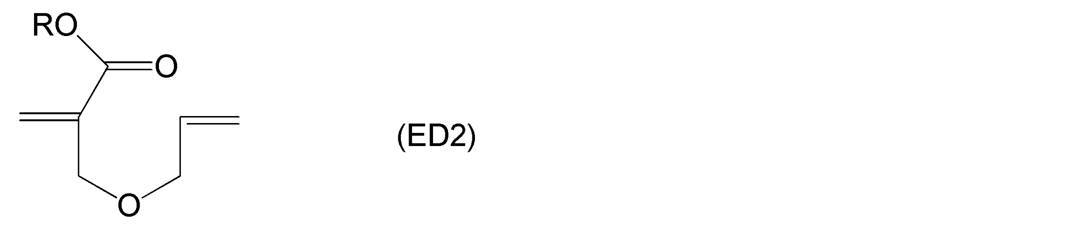
式(ED2)中、Rは、水素原子または炭素数1~30の有機基を表す。式(ED2)の具体例としては、特開2010-168539号公報の記載を参酌できる。
式(ED2)中、Rは、水素原子または炭素数1~30の有機基を表す。式(ED2)の具体例としては、特開2010-168539号公報の記載を参酌できる。
エーテルダイマーの具体例としては、例えば、特開2013-29760号公報の段落番号0317を参酌することができ、この内容は本明細書に組み込まれる。エーテルダイマーは、1種のみであってもよいし、2種以上であってもよい。
酸基を有する樹脂は、式(X)で示される化合物に由来する構造単位を含んでいてもよい。

式(X)において、R1は、水素原子またはメチル基を表し、R2は炭素数2~10のアルキレン基を表し、R3は、水素原子またはベンゼン環を含んでもよい炭素数1~20のアルキル基を表す。nは1~15の整数を表す。
式(X)において、R1は、水素原子またはメチル基を表し、R2は炭素数2~10のアルキレン基を表し、R3は、水素原子またはベンゼン環を含んでもよい炭素数1~20のアルキル基を表す。nは1~15の整数を表す。
上記式(X)において、R2のアルキレン基の炭素数は、2~3が好ましい。また、R3のアルキル基の炭素数は1~20であり、より好ましくは1~10であり、R3のアルキル基はベンゼン環を含んでもよい。R3で表されるベンゼン環を含むアルキル基としては、ベンジル基、2-フェニル(イソ)プロピル基等を挙げることができる。
酸基を有する樹脂は、特開2012-208494号公報の段落番号0558~0571(対応する米国特許出願公開第2012/0235099号明細書の段落番号0685~0700)の記載を参酌でき、これらの内容は本明細書に組み込まれる。また、特開2012-32767号公報の段落番号0029~0063に記載の共重合体(B)および実施例で用いられているアルカリ可溶性樹脂、特開2012-208474号公報の段落番号0088~0098に記載のバインダー樹脂および実施例で用いられているバインダー樹脂、特開2012-137531号公報の段落番号0022~0032に記載のバインダー樹脂および実施例で用いられているバインダー樹脂、特開2013-024934号公報の段落番号0132~0143に記載のバインダー樹脂および実施例で用いられているバインダー樹脂、特開2011-242752号公報の段落番号0092~0098および実施例で用いられているバインダー樹脂、特開2012-032770号公報の段落番号0030~0072に記載のバインダー樹脂を用いることもできる。これらの内容は本明細書に組み込まれる。酸基を有する樹脂の具体例としては、以下の樹脂が挙げられる。

樹脂は、硬化性基を有していてもよい。硬化性基としては、エチレン性不飽和結合を有する基、エポキシ基、メチロール基、アルコキシシリル基等が挙げられる。エチレン性不飽和結合を有する基としては、ビニル基、(メタ)アリル基、(メタ)アクリロイル基、(メタ)アクリロイルオキシ基などが挙げられる。アルコキシシリル基としては、モノアルコキシシリル基、ジアルコキシシリル基、トリアルコキシシリル基が挙げられる。なお、硬化性基を有する樹脂は、硬化性化合物でもある。
硬化性基を含有する樹脂としては、ダイヤナ-ルNRシリーズ(三菱レイヨン株式会社製)、Photomer6173(COOH含有 polyurethane acrylic oligomer、Diamond Shamrock Co.,Ltd.製)、ビスコートR-264、KSレジスト106(いずれも大阪有機化学工業株式会社製)、サイクロマーPシリーズ(例えば、ACA230AA)、プラクセル CF200シリーズ(いずれも(株)ダイセル製)、Ebecryl3800(ダイセルユーシービー株式会社製)、アクリキュアRD-F8(日本触媒(株)製)などが挙げられる。
本発明において、樹脂は、マープルーフG-0150M、G-0105SA、G-0130SP、G-0250SP、G-1005S、G-1005SA、G-1010S、G-2050M、G-01100、G-01758(日油(株)製、エポキシ基含有ポリマー)や、ARTON F4520(JSR(株)製)などを使用することも好ましい。
バインダーの含有量は、組成物の全固形分に対して、0.01~80質量%であることが好ましい。下限は、0.1質量%以上が好ましく、1質量%以上がより好ましい。上限は、80質量%以下が好ましく、70質量%以下がより好ましい。バインダーを、1種類のみを含んでいてもよいし、2種類以上含んでいてもよい。2種類以上含む場合は、その合計量が上記範囲となることが好ましい。
(分散剤)
本発明の組成物は、樹脂として分散剤を含有することができる。分散剤としては、高分子分散剤〔例えば、アミン基を有する樹脂(ポリアミドアミンとその塩など)、オリゴイミン系樹脂、ポリカルボン酸とその塩、高分子量不飽和酸エステル、変性ポリウレタン、変性ポリエステル、変性ポリ(メタ)アクリレート、(メタ)アクリル系共重合体、ナフタレンスルホン酸ホルマリン縮合物〕等を挙げることができる。高分子分散剤は、その構造から更に直鎖状高分子、末端変性型高分子、グラフト型高分子、ブロック型高分子に分類することができる。
本発明の組成物は、樹脂として分散剤を含有することができる。分散剤としては、高分子分散剤〔例えば、アミン基を有する樹脂(ポリアミドアミンとその塩など)、オリゴイミン系樹脂、ポリカルボン酸とその塩、高分子量不飽和酸エステル、変性ポリウレタン、変性ポリエステル、変性ポリ(メタ)アクリレート、(メタ)アクリル系共重合体、ナフタレンスルホン酸ホルマリン縮合物〕等を挙げることができる。高分子分散剤は、その構造から更に直鎖状高分子、末端変性型高分子、グラフト型高分子、ブロック型高分子に分類することができる。
分散剤は、高屈折率粒子に対する吸着能を有する部位を有することが好ましい(以下、「吸着部位」と総称する)。吸着部位としては、酸基、ウレア基、ウレタン基、配位性酸素原子を有する基、塩基性窒素原子を有する基、複素環基、アルキルオキシカルボニル基、アルキルアミノカルボニル基、カルボキシ基、スルホンアミド基、アルコキシシリル基、エポキシ基、イソシアネート基及びヒドロキシ基よりなる群から選択される基を少なくとも1種類有する1価の置換基等が挙げられる。吸着部位は、酸系吸着部位であることが好ましい。酸系吸着部位としては酸基等が挙げられる。なかでも、酸系吸着部位がリン原子含有基およびカルボキシ基の少なくとも一方であることが好ましい。リン原子含有基としては、リン酸エステル基、ポリリン酸エステル基、リン酸基等が挙げられる。吸着部位の詳細については、特開2015-34961号公報の段落番号0073~0080を参酌でき、この内容は本明細書に組み込まれる。
本発明において、樹脂(分散剤)は、下記式(100)で表される樹脂が好ましい。

上記式(100)中、R1は、(m+n)価の連結基を表し、R2は単結合又は2価の連結基を表す。A1は、酸基、ウレア基、ウレタン基、配位性酸素原子を有する基、塩基性窒素原子を有する基、フェノール基、アルキル基、アリール基、アルキレンオキシ鎖を有する基、イミド基、複素環基、アルキルオキシカルボニル基、アルキルアミノカルボニル基、カルボン酸塩基、スルホンアミド基、アルコキシシリル基、エポキシ基、イソシアネート基及びヒドロキシ基よりなる群から選択される基を少なくとも1種有する1価の置換基を表す。n個のA1及びR2は、それぞれ、同一であっても、異なっていてもよい。mは8以下の正の数を表し、nは1~9を表し、m+nは3~10を満たす。P1は1価のポリマー鎖を表す。m個のP1は、同一であっても、異なっていてもよい。
上記式(100)において、A1は、酸基、ウレア基、ウレタン基、配位性酸素原子を有する基、塩基性窒素原子を有する基、フェノール基、アルキル基、アリール基、アルキレンオキシ鎖を有する基、イミド基、複素環基、アルキルオキシカルボニル基、アルキルアミノカルボニル基、カルボン酸塩基、スルホンアミド基、アルコキシシリル基、エポキシ基、イソシアネート基及びヒドロキシ基よりなる群から選択される基(以下、吸着部位ともいう)を少なくとも1種有する1価の置換基を表す。吸着部位は、1つのA1の中に、少なくとも1個含まれていればよく、2個以上を含んでいてもよい。1つのA1の中に、2個以上の吸着部位が含まれる態様としては、鎖状飽和炭化水素基(直鎖状でも分岐状であってもよく、炭素数1~10であることが好ましい)、環状飽和炭化水素基(炭素数3~10であることが好ましい)、芳香族基(炭素数5~10であることが好ましく、例えば、フェニレン基)等を介して2個以上の吸着部位が結合し1価の置換基を形成する態様等が挙げられ、鎖状飽和炭化水素基を介して2個以上の吸着部位が結合し1価の置換基を形成する態様が好ましい。なお、吸着部位自体が1価の置換基を構成する場合には、吸着部位そのものがA1で表される1価の置換基であってもよい。まず、A1を構成する吸着部位について以下に説明する
A1における酸基としては、例えば、カルボキシ基、スルホ基、モノ硫酸エステル基、リン酸基、モノリン酸エステル基、ホスホン酸基、ホスフィン酸基、ホウ酸基が挙げられ、カルボキシ基、スルホ基、モノ硫酸エステル基、リン酸基、モノリン酸エステル基、ホスホン酸基、ホスフィン酸基が好ましく、カルボキシ基、スルホ基、リン酸基、ホスホン酸基、ホスフィン酸基がより好ましく、カルボキシ基が更に好ましい。
A1におけるウレア基としては、例えば、-NR15CONR16R17(ここで、R15、R16、及びR17は各々独立に、水素原子、炭素数1~20のアルキル基、炭素数6以上のアリール基、又は炭素数7以上のアラルキル基を表す。)が挙げられ、-NR15CONHR17が好ましく、-NHCONHR17がより好ましい。
A1におけるウレタン基として、例えば、-NHCOOR18、-NR19COOR20、-OCONHR21、-OCONR22R23(ここで、R18、R19、R20、R21、R22及びR23は各々独立に、炭素数1~20のアルキル基、炭素数6以上のアリール基、炭素数7以上のアラルキル基を表す。)が挙げられ、-NHCOOR18、-OCONHR21が好ましい。
A1における配位性酸素原子を有する基としては、例えば、アセチルアセトナト基、クラウンエーテルなどが挙げられる。
A1における塩基性窒素原子を有する基としては、例えば、アミノ基(-NH2)、置換イミノ基(-NHR8、-NR9R10、ここで、R8、R9、及びR10は各々独立に、炭素数1~20のアルキル基、炭素数6以上のアリール基、炭素数7以上のアラルキル基を表す。)、下記式(a1)で表されるグアニジル基、下記式(a2)で表されるアミジニル基が挙げられる。

式(a1)中、R11及びR12は各々独立に、炭素数1~20のアルキル基、炭素数6以上のアリール基、炭素数7以上のアラルキル基を表す。
式(a2)中、R13及びR14は各々独立に、炭素数1~20のアルキル基、炭素数6以上のアリール基、炭素数7以上のアラルキル基を表す。
式(a2)中、R13及びR14は各々独立に、炭素数1~20のアルキル基、炭素数6以上のアリール基、炭素数7以上のアラルキル基を表す。
塩基性窒素原子を有する基は、アミノ基(-NH2)、置換イミノ基、上記式(a1)で表されるグアニジル基〔式(a1)中、R11及びR12は各々独立に、炭素数1から10までのアルキル基、フェニル基、ベンジル基を表す。〕、式(a2)で表されるアミジニル基〔式(a2)中、R13及びR14は各々独立に、炭素数1~10のアルキル基、フェニル基、ベンジル基を表す。〕が好ましい。特に、アミノ基(-NH2)、置換イミノ基(-NHR8、-NR9R10、ここで、R8、R9、及びR10は各々独立に、炭素数1~5のアルキル基、フェニル基、ベンジル基を表す。)、式(a1)で表されるグアニジル基〔式(a1)中、R11及びR12は各々独立に、炭素数1~5のアルキル基、フェニル基、ベンジル基を表す。〕、式(a2)で表されるアミジニル基〔式(a2)中、R13及びR14は各々独立に、炭素数1~5のアルキル基、フェニル基、ベンジル基を表す。〕が好ましい。
A1におけるアルキル基としては、直鎖状であっても、分岐状であってもよく、炭素数1~40のアルキル基であることが好ましく、4~30のアルキル基であることがより好ましく、炭素数10~18のアルキル基であることが更に好ましい。
A1におけるアリール基としては、炭素数6~10のアリール基であることが好ましい。
A1におけるアリール基としては、炭素数6~10のアリール基であることが好ましい。
A1におけるアルキレンオキシ鎖を有する基としては、末端がアルキルオキシ基を形成している基が好ましく、炭素数1~20のアルキルオキシ基を形成している基がより好ましい。また、アルキレンオキシ鎖としては、少なくとも1つのアルキレンオキシ基を有する限り特に制限はなく、1~6のアルキレンオキシ基からなるであることが好ましい。アルキレンオキシ基としては、例えば、-CH2CH2O-、-CH2CH2CH2O-等が挙げられる。
A1におけるアルキルオキシカルボニル基におけるアルキル基部分としては、炭素数1~20のアルキル基であることが好ましい。
A1におけるアルキルアミノカルボニル基におけるアルキル基部分としては、炭素数1~20のアルキル基であることが好ましい。
A1におけるカルボン酸塩基としては、カルボン酸のアンモニウム塩からなる基などが挙げられる。
A1におけるスルホンアミド基としては、スルホンアミド基の窒素原子に結合する水素原子がアルキル基(メチル基等)、アシル基(アセチル基、トリフルオロアセチル基など)等で置換されていてもよい。
A1におけるアルキルアミノカルボニル基におけるアルキル基部分としては、炭素数1~20のアルキル基であることが好ましい。
A1におけるカルボン酸塩基としては、カルボン酸のアンモニウム塩からなる基などが挙げられる。
A1におけるスルホンアミド基としては、スルホンアミド基の窒素原子に結合する水素原子がアルキル基(メチル基等)、アシル基(アセチル基、トリフルオロアセチル基など)等で置換されていてもよい。
A1における複素環基としては、例えば、チオフェン環基、フラン環基、キサンテン環基、ピロール環基、ピロリン環基、ピロリジン環基、ジオキソラン環基、ピラゾール環基、ピラゾリン環基、ピラゾリジン環基、イミダゾール環基、オキサゾール環基、チアゾール環基、オキサジアゾール環基、トリアゾール環基、チアジアゾール環基、ピラン環基、ピリジン環基、ピペリジン環基、ジオキサン環基、モルホリン環基、ピリダジン環基、ピリミジン環基、ピペラジン環基、トリアジン環基、トリチアン環基、イソインドリン環基、イソインドリノン環基、ベンズイミダゾロン環基、ベンゾチアゾール環基、ヒダントイン環基、インドール環基、キノリン環基、カルバゾール環基、アクリジン環基、アクリドン環基、アントラキノン環基が挙げられる。
A1におけるイミド基としては、コハクイミド基、フタルイミド基、ナフタルイミド基等が挙げられる。
上記の複素環基及びイミド基は、更に置換基を有していてもよい。置換基としては、例えば、メチル基、エチル基等の炭素数1~20のアルキル基、フェニル基、ナフチル基等の炭素数6~16のアリール基、ヒドロキシ基、アミノ基、カルボキシル基、スルホンアミド基、N-スルホニルアミド基、アセトキシ基等の炭素数1~6のアシルオキシ基、メトキシ基、エトキシ基等の炭素数1~20のアルコキシ基、塩素原子、臭素原子等のハロゲン原子、メトキシカルボニル基、エトキシカルボニル基、シクロヘキシルオキシカルボニル基等の炭素数2から7までのアルコキシカルボニル基、シアノ基、t-ブチルカーボネート等の炭酸エステル基等が挙げられる。
A1におけるアルコキシシリル基としては、モノアルコキシシリル基、ジアルコキシシリル基、トリアルコキシシリル基のいずれでもよく、トリアルコキシシリル基であることが好ましく、例えば、トリメトキシシリル基、トリエトキシシリル基などが挙げられる。
A1におけるエポキシ基としては、置換又は無置換のオキシラン基(エチレンオキシド基)が挙げられる。
A1におけるエポキシ基としては、置換又は無置換のオキシラン基(エチレンオキシド基)が挙げられる。
式(100)において、R1は、(m+n)価の連結基を表す。(m+n)価の連結基としては、1~100個の炭素原子、0~10個の窒素原子、0~50個の酸素原子、1~200個の水素原子、および0~20個の硫黄原子から成り立つ基が挙げられる。
(m+n)価の連結基は、下記式のいずれかで表される基であることが好ましい。
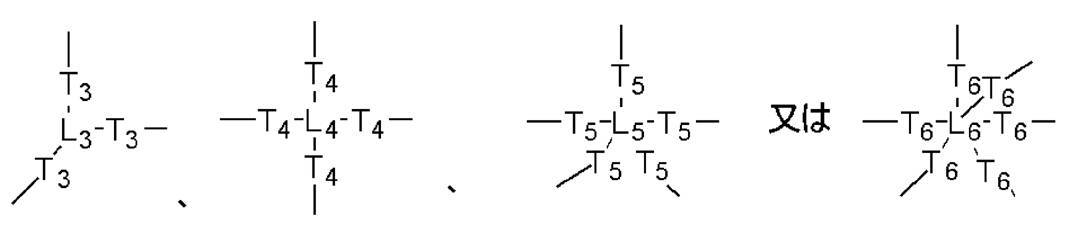
L3は3価の基を表す。T3は単結合又は2価の連結基を表し、3個存在するT3は互いに同一であっても異なっていてもよい。
L4は4価の基を表す。T4は単結合又は2価の連結基を表し、4個存在するT4は互いに同一であっても異なっていてもよい。
L5は5価の基を表す。T5は単結合又は2価の連結基を表し、5個存在するT5は互いに同一であっても異なっていてもよい。
L6は6価の基を表す。T6は単結合又は2価の連結基を表し、6個存在するT6は互いに同一であっても異なっていてもよい。
L3は3価の基を表す。T3は単結合又は2価の連結基を表し、3個存在するT3は互いに同一であっても異なっていてもよい。
L4は4価の基を表す。T4は単結合又は2価の連結基を表し、4個存在するT4は互いに同一であっても異なっていてもよい。
L5は5価の基を表す。T5は単結合又は2価の連結基を表し、5個存在するT5は互いに同一であっても異なっていてもよい。
L6は6価の基を表す。T6は単結合又は2価の連結基を表し、6個存在するT6は互いに同一であっても異なっていてもよい。
(m+n)価の連結基は、具体例として、下記の構造単位または以下の構造単位が2以上組み合わさって構成される基(環構造を形成していてもよい)を挙げることができる。(m+n)価の連結基の詳細については、特開2014-177613号公報の段落番号0043~0055を参酌でき、この内容は本明細書に組み込まれる。
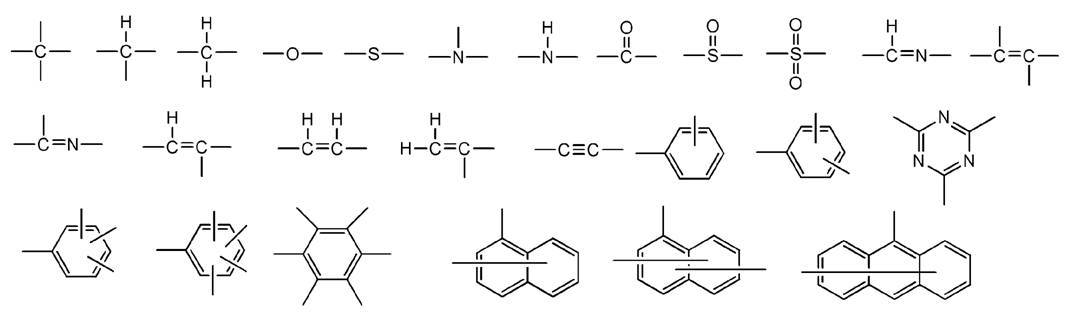
式(100)において、P1は、1価のポリマー鎖を表す。1価のポリマー鎖は、ビニル系ポリマー、エステル系ポリマー、エーテル系ポリマー、ウレタン系ポリマー、アミド系ポリマー、エポキシ系ポリマー、シリコーン系ポリマー、及びこれらの変性物、又は共重合体〔例えば、ポリエーテル/ポリウレタン共重合体、ポリエーテル/ビニルモノマーの重合体の共重合体など(ランダム共重合体、ブロック共重合体、グラフト共重合体のいずれであってもよい。)を含む。〕からなる群より選択される少なくとも一種が好ましく、ビニル系ポリマー、エステル系ポリマー、エーテル系ポリマー、ウレタン系ポリマー、及びこれらの変性物又は共重合体からなる群より選択される少なくとも一種がより好ましい。
P1が表す1価のポリマー鎖は、式(L)、(M)、(N)で表される構造を有するポリマー鎖であることが好ましい。
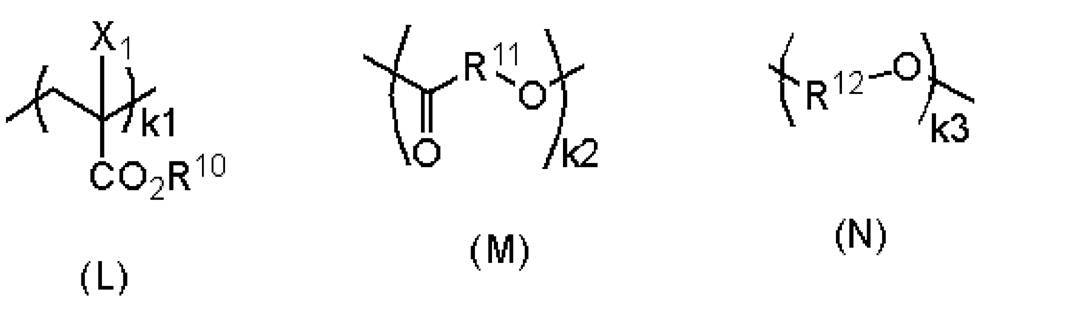
式中、X1は水素原子または1価の有機基を表す。X1は水素原子または炭素数1~12のアルキル基が好ましく、水素原子またはメチル基がより好ましく、メチル基が特に好ましい。
R10は水素原子又は1価の有機基を表し、水素原子、アルキル基、アリール基またはヘテロアリール基が好ましく、水素原子またはアルキル基がより好ましい。R10がアルキル基である場合、アルキル基としては、炭素数1~20の直鎖状アルキル基、炭素数3~20の分岐状アルキル基、又は炭素数5~20の環状アルキル基が好ましく、炭素数1~20の直鎖状アルキル基がより好ましく、炭素数1~6の直鎖状アルキル基が特に好ましい。式(L)中に構造の異なるR10を2種以上有していても良い。
R11及びR12は、分岐若しくは直鎖のアルキレン基(炭素数は1~10が好ましく、2~8であることがより好ましく、3~6であることが更に好ましい。)を表す。各一般式中に構造の異なるR11又はR12を2種以上有していても良い。
k1、k2、k3は、それぞれ独立に、5~140の数を表す。
式中、X1は水素原子または1価の有機基を表す。X1は水素原子または炭素数1~12のアルキル基が好ましく、水素原子またはメチル基がより好ましく、メチル基が特に好ましい。
R10は水素原子又は1価の有機基を表し、水素原子、アルキル基、アリール基またはヘテロアリール基が好ましく、水素原子またはアルキル基がより好ましい。R10がアルキル基である場合、アルキル基としては、炭素数1~20の直鎖状アルキル基、炭素数3~20の分岐状アルキル基、又は炭素数5~20の環状アルキル基が好ましく、炭素数1~20の直鎖状アルキル基がより好ましく、炭素数1~6の直鎖状アルキル基が特に好ましい。式(L)中に構造の異なるR10を2種以上有していても良い。
R11及びR12は、分岐若しくは直鎖のアルキレン基(炭素数は1~10が好ましく、2~8であることがより好ましく、3~6であることが更に好ましい。)を表す。各一般式中に構造の異なるR11又はR12を2種以上有していても良い。
k1、k2、k3は、それぞれ独立に、5~140の数を表す。
P1は、少なくとも1種の繰り返し単位を含有することが好ましい。P1における、前述の繰り返し単位の繰り返し数k1~k3は、立体反発力を発揮し分散性を向上する観点から、5以上であることがより好ましい。また、膜中に高屈折率粒子を密に存在させる観点から、前述の繰り返し単位の繰り返し数k1~k3は、50以下であることが好ましく、40以下であることがより好ましく、30以下であることが更に好ましい。
P1が表す1価のポリマー鎖は、有機溶剤に可溶であることが好ましい。有機溶剤に可溶であれば、有機溶剤との親和性が良好であり、高屈折粒子の分散安定化を向上できる。
式(100)において、R2は単結合又は2価の連結基を表す。2価の連結基としては、1~100個の炭素原子、0~10個の窒素原子、0~50個の酸素原子、1~200個の水素原子、および0~20個の硫黄原子から成り立つ基が挙げられる。上述の基は、無置換であってもよく、置換基を更に有していてもよい。2価の連結基は、具体的な例として、下記の構造単位または以下の構造単位が2以上組み合わさって構成される基を挙げることができる。2価の連結基の詳細については、特開2007-277514号公報の段落番号0071~0075を参酌でき、この内容は本明細書に組み込まれる。

式(100)中、mは8以下の正の数を表す。mは、0.5~5が好ましく、1~4がより好ましく、1~3が特に好ましい。
式(100)中、nは1~9を表す。nは、2~8が好ましく、2~7がより好ましく、3~6が特に好ましい。
式(100)中、nは1~9を表す。nは、2~8が好ましく、2~7がより好ましく、3~6が特に好ましい。
式(100)で表される樹脂は、式(100a)で表される樹脂が好ましい。

式(100a)において、A2は、酸基、ウレア基、ウレタン基、配位性酸素原子を有する基、塩基性窒素原子を有する基、フェノール基、アルキル基、アリール基、アルキレンオキシ鎖を有する基、イミド基、複素環基、アルキルオキシカルボニル基、アルキルアミノカルボニル基、カルボン酸塩基、スルホンアミド基、アルコキシシリル基、エポキシ基、イソシアネート基及びヒドロキシ基よりなる群から選択される基を少なくとも1種有する1価の置換基を表す。R3は、(m+n)価の連結基を表す。R4及びR5は単結合又は2価の連結基を表す。P2は1価のポリマー鎖を表す。mは8以下の正の数を表し、nは1~9を表し、m+nは3~10を満たす。n個のA2及びR4は、それぞれ、同一であっても、m個のP2及びR5は、同一であっても、異なっていてもよい。
式(100a)のA2は、式(100)のA1と同義であり、好ましい態様も同様である。
式(100a)において、R4、R5で表される2価の連結基としては、式(100)のR2で表される2価の連結基として挙げられたものと同様のものが用いられ、好ましい態様も同様である。
式(100a)において、R3が表す(m+n)価の連結基としては、1~100個の炭素原子、0~10個の窒素原子、0~50個の酸素原子、1~200個の水素原子、および0~20個の硫黄原子から成り立つ基が挙げられる。(m+n)価の連結基の詳細については、式(100)のR1で説明した(m+n)価の連結基が挙げられ、好ましい態様も同様である。
式(100a)中、m、nは、それぞれ、式(100)におけるm、nと同義であり、好ましい態様も同様である。
式(100)において、P2が表す1価のポリマー鎖は、(100)のP1と同義であり、好ましい態様も同様である。
式(100)で表される樹脂は、式(100b)で表される樹脂であることも好ましい。

式(100b)において、R6は、(m+n1+n2)価の連結基を表す。R7~R9は各々独立に単結合又は2価の連結基を表す。A3は酸基を少なくとも1種有する1価の置換基を表す。A4は、A3とは異なる1価の置換基を表す。P3は1価のポリマー鎖を表す。mは8以下の正の数を表し、n1は1~8を表し、n2は1~8を表し、m+n1+n2は3~10を満たす。n1個のA3及びR7は、それぞれ、同一であっても、異なっていてもよい。n2個のA4及びR8は、それぞれ、同一であっても、異なっていてもよい。
式(100b)におけるmは、式(100)におけるmと同義であり、好ましい態様も同様である。
式(100b)におけるP3は、式(100)におけるP1と同義であり、好ましい態様も同様である。
式(100b)におけるR6が表す(m+n1+n2)価の連結基は、1~100個の炭素原子、0~10個の窒素原子、0~50個の酸素原子、1~200個の水素原子、および0~20個の硫黄原子から成り立つ基が挙げられる。(m+n1+n2)価の連結基の詳細については、式(100)のR1で説明した(m+n)価の連結基が挙げられ、好ましい態様も同様である。
式(100b)におけるP3は、式(100)におけるP1と同義であり、好ましい態様も同様である。
式(100b)におけるR6が表す(m+n1+n2)価の連結基は、1~100個の炭素原子、0~10個の窒素原子、0~50個の酸素原子、1~200個の水素原子、および0~20個の硫黄原子から成り立つ基が挙げられる。(m+n1+n2)価の連結基の詳細については、式(100)のR1で説明した(m+n)価の連結基が挙げられ、好ましい態様も同様である。
式(100b)におけるR7~R9が表す2価の連結基としては、式(100)のR2で表される2価の連結基として挙げられたものと同様のものが用いられ、好ましい態様も同様である。
式(100b)におけるA3が有する酸基は、カルボキシ基、スルホ基、モノ硫酸エステル基、リン酸基、モノリン酸エステル基、ホスホン酸基、ホスフィン酸基、ホウ酸基が好ましい例として挙げられ、カルボキシ基、スルホ基、モノ硫酸エステル基、リン酸基、モノリン酸エステル基、ホスホン酸基、ホスフィン酸基が好ましく、カルボキシ基、スルホ基、リン酸基、ホスホン酸基、ホスフィン酸基がより好ましく、カルボキシ基が更に好ましい。
式(100b)におけるA4が表す1価の置換基としては、式(100)のA1で説明した1価の置換基(ただし、酸基を除く)が挙げられる。なかでも、pKa5以上の官能基を少なくとも1種有する1価の置換基であることが好ましく、配位性酸素原子を有する基、塩基性窒素原子を有する基、フェノール基、ウレア基、ウレタン基、アルキル基、アリール基、アルキルオキシカルボニル基、アルキルアミノカルボニル基、アルキレンオキシ鎖を有する基、イミド基、カルボン酸塩基、スルホンアミド基、ヒドロキシ基及び複素環基よりなる群から選択される基を少なくとも1種有する1価の置換基であることがより好ましく、アルキル基、アリール基、配位性酸素原子を有する基、塩基性窒素原子を有する基、ウレア基又はウレタン基であることが更に好ましい。
A3とA4との組合せとしては、A3がpKaが5より小さい官能基を少なくとも1種有する1価の置換基であり、A4がpKa5以上の官能基を少なくとも1種有する1価の置換基である組み合わせが好ましい。
A3が、カルボキシル基、スルホ基、リン酸基、ホスホン酸基及びホスフィン酸基よりなる群から選択される基を少なくとも1種有する1価の置換基であり、かつA4が配位性酸素原子を有する基、塩基性窒素原子を有する基、フェノール基、ウレア基、ウレタン基、アルキル基、アリール基、アルキルオキシカルボニル基、アルキルアミノカルボニル基、アルキレンオキシ鎖を有する基、イミド基、カルボン酸塩基、スルホンアミド基、ヒドロキシ基及び複素環基よりなる群から選択される基を少なくとも1種有する1価の置換基であることがより好ましい。A3が、カルボキシル基を有する1価の置換基であり、A4が、アルキル基、アリール基、配位性酸素原子を有する基、塩基性窒素原子を有する基、ウレア基又はウレタン基であることが更に好ましい。
式(100)で表される樹脂の重量平均分子量は、1000~50000が好ましく、3000~30000がより好ましく、3000~20000が更に好ましい。上記範囲であれば、高屈折粒子の分散性が良好である。
式(100)で表される樹脂は、特開2007-277514号公報の段落番号0039(対応する米国特許出願公開第2010/0233595号明細書の<0053>)の記載、および、特開2015-34961号公報の段落番号0081~0117の記載を参酌でき、これらの内容は本明細書に組み込まれる。式(100)で表される樹脂の具体例としては、下記の樹脂が挙げられる。また、特開2014-177613号公報の段落番号0223~0291、特開2014-062221号公報の段落番号0229~0295、特開2014-177614号公報の段落番号0251~0337に記載された樹脂が挙げられ、この内容は本発明に組み込まれる。

式(100)で表される樹脂の合成方法は特に制限されず、複数の吸着部位を有するメルカプタン化合物存在下で、ビニルモノマーをラジカル重合して製造する方法が挙げられる。式(100)で表される樹脂の合成方法の詳細については、特開2007-277514号公報の段落番号0114~0140、0266~0348、特開2014-177614号公報の段落番号0077~0108に記載を参酌でき、この内容は本明細書に組み込まれる。
本発明において、樹脂(分散剤)は、下記式(111)~式(114)のいずれかで表される繰り返し単位を含むグラフト共重合体を用いることもできる。

式(111)~式(114)において、W1、W2、W3、及びW4はそれぞれ独立に酸素原子、または、NHを表し、X1、X2、X3、X4、及びX5はそれぞれ独立に水素原子又は1価の基を表し、Y1、Y2、Y3、及びY4はそれぞれ独立に2価の連結基を表し、Z1、Z2、Z3、及びZ4はそれぞれ独立に1価の基を表し、R3はアルキレン基を表し、R4は水素原子又は1価の基を表し、n、m、p、及びqはそれぞれ独立に1~500の整数を表し、j及びkはそれぞれ独立に2~8の整数を表し、式(113)において、pが2~500のとき、複数存在するR3は互いに同じであっても異なっていてもよく、式(114)において、qが2~500のとき、複数存在するX5及びR4は互いに同じであっても異なっていてもよい。
W1、W2、W3、及びW4は酸素原子であることが好ましい。X1、X2、X3、X4、及びX5は、水素原子又は炭素数1~12のアルキル基であることが好ましく、それぞれ独立に、水素原子又はメチル基であることがより好ましく、メチル基が特に好ましい。Y1、Y2、Y3、及びY4は、それぞれ独立に、2価の連結基を表し、連結基は特に構造上制約されない。Z1、Z2、Z3、及びZ4が表す1価の基の構造は、特に限定されず、具体的には、アルキル基、ヒドロキシ基、アルコキシ基、アリールオキシ基、ヘテロアリールオキシ基、アルキルチオエーテル基、アリールチオエーテル基、ヘテロアリールチオエーテル基、及びアミノ基などが挙げられる。これらの中でも、Z1、Z2、Z3、及びZ4で表される1価の基としては、特に分散性向上の観点から、立体反発効果を有するものが好ましく、各々独立に炭素数5~24のアルキル基又はアルコキシ基が好ましく、その中でも、特に各々独立に炭素数5~24の分岐アルキル基、炭素数5~24の環状アルキル基、又は、炭素数5~24のアルコキシ基が好ましい。なお、アルコキシ基中に含まれるアルキル基は、直鎖状、分岐鎖状、環状のいずれでもよい。
式(111)~式(114)において、n、m、p、及びqは、それぞれ独立に、1~500の整数である。また、式(111)及び式(112)において、j及びkは、それぞれ独立に、2~8の整数を表す。式(111)及び式(112)におけるj及びkは、分散安定性、現像性の観点から、4~6の整数が好ましく、5が最も好ましい。
式(113)中、R3はアルキレン基を表し、炭素数1~10のアルキレン基が好ましく、炭素数2又は3のアルキレン基がより好ましい。pが2~500のとき、複数存在するR3は互いに同じであっても異なっていてもよい。
式(114)中、R4は水素原子又は1価の基を表す。1価の基としては特に構造上限定はされない。R4として好ましくは、水素原子、アルキル基、アリール基、及びヘテロアリール基が挙げられ、更に好ましくは、水素原子、又はアルキル基である。R4がアルキル基である場合、炭素数1~20の直鎖状アルキル基、炭素数3~20の分岐状アルキル基、又は炭素数5~20の環状アルキル基が好ましく、炭素数1~20の直鎖状アルキル基がより好ましく、炭素数1~6の直鎖状アルキル基が特に好ましい。式(114)において、qが2~500のとき、グラフト共重合体中に複数存在するX5及びR4は互いに同じであっても異なっていてもよい。
上記グラフト共重合体については、特開2012-255128号公報の段落番号0025~0094の記載を参酌でき、本明細書には上記内容が組み込まれる。また、特開2012-255128号公報の段落番号0072~0094に記載の樹脂が挙げられ、この内容は本明細書に組み込まれる。
樹脂(分散剤)は、主鎖及び側鎖の少なくとも一方に塩基性窒素原子を含むオリゴイミン系分散剤も好ましい。オリゴイミン系分散剤としては、pKa14以下の官能基を有する部分構造Xを有する繰り返し単位と、原子数40~10,000のオリゴマー鎖又はポリマー鎖Yを含む側鎖とを有し、かつ主鎖及び側鎖の少なくとも一方に塩基性窒素原子を有する樹脂が好ましい。この樹脂は、窒素原子と、構造Xが有するpKa14以下の官能基との双方で、高屈折率粒子と相互作用し、さらに樹脂が原子数40~10,000のオリゴマー鎖又はポリマー鎖Yを有するために、例えば、オリゴマー鎖又はポリマー鎖Yが立体反発基として機能することにより、良好な分散性を発揮して、高屈折率粒子を均一に分散することができる。また、オリゴマー鎖又はポリマー鎖Yと溶剤とが相互作用を行うことにより、高屈折率粒子の沈降を長期間抑制することができる。さらに、オリゴマー鎖又はポリマー鎖Yが立体反発基として機能することで高屈折率粒子の凝集が防止されるため、高屈折率粒子の含有量を高くしても、優れた分散性が得られる。
ここで、「塩基性窒素原子」とは、塩基性を呈する窒素原子であれば特に制限はなく、樹脂がpKb14以下の窒素原子を有する構造を含有することが好ましく、pKb10以下の窒素原子を有する構造を含有することがより好ましい。本発明において「pKb(塩基強度)」とは、水温25℃でのpKbを言い、塩基の強さを定量的に表すための指標のひとつであり、塩基性度定数と同義である。塩基強度pKbと、酸強度pKaとは、pKb=14-pKaの関係にある。
部分構造Xが有するpKa14以下の官能基は、特に限定はなく、物性がこの条件を満たすものであれば、その構造などは特に限定されない。特にpKaが12以下の官能基が好ましく、pKaが11以下の官能基が最も好ましい。具体的には、例えば、カルボキシ基(pKa 3~5程度)、スルホ基(pKa -3~-2程度)、-COCH2CO-基(pKa 8~10程度)、-COCH2CN基(pKa 8~11程度)、-CONHCO-基、フェノール性ヒドロキシ基、-RFCH2OH基又は-(RF)2CHOH基(RFはペルフルオロアルキル基を表す。pKa 9~11程度)、スルホンアミド基(pKa 9~11程度)等が挙げられる。pKa14以下の官能基を有する部分構造Xは、窒素原子を含有する繰り返し単位における塩基性窒素原子に直接結合することが好ましく、塩基性窒素原子を含有する繰り返し単位の塩基性窒素原子と部分構造Xとは、共有結合のみならず、イオン結合して塩を形成する態様で連結していてもよい。
オリゴイミン系分散剤は、pKa14以下の官能基を有する部分構造Xが結合する塩基性窒素原子を含有する繰り返し単位と、側鎖に原子数40~10,000のオリゴマー鎖又はポリマー鎖Yとを有する樹脂であることが好ましい。
また、オリゴイミン系分散剤は、(i)ポリ(低級アルキレンイミン)系繰り返し単位、ポリアリルアミン系繰り返し単位、ポリジアリルアミン系繰り返し単位、メタキシレンジアミン-エピクロルヒドリン重縮合物系繰り返し単位、及びポリビニルアミン系繰り返し単位から選択される少なくとも1種類の、塩基性窒素原子を含有する繰り返し単位であって、塩基性窒素原子に結合し、かつ、pKa14以下の官能基を有する部分構造Xを有する繰り返し単位と、側鎖に(ii)原子数40~10,000のオリゴマー鎖又はポリマー鎖Yとを有する樹脂が好ましい。なお、本発明において、ポリ(低級アルキレンイミン)における「低級」とは炭素数が1~5であることを示し、「低級アルキレンイミン」とは炭素数1~5のアルキレンイミンを表す。
また、オリゴイミン系分散剤は、(i)ポリ(低級アルキレンイミン)系繰り返し単位、ポリアリルアミン系繰り返し単位、ポリジアリルアミン系繰り返し単位、メタキシレンジアミン-エピクロルヒドリン重縮合物系繰り返し単位、及びポリビニルアミン系繰り返し単位から選択される少なくとも1種類の、塩基性窒素原子を含有する繰り返し単位であって、塩基性窒素原子に結合し、かつ、pKa14以下の官能基を有する部分構造Xを有する繰り返し単位と、側鎖に(ii)原子数40~10,000のオリゴマー鎖又はポリマー鎖Yとを有する樹脂が好ましい。なお、本発明において、ポリ(低級アルキレンイミン)における「低級」とは炭素数が1~5であることを示し、「低級アルキレンイミン」とは炭素数1~5のアルキレンイミンを表す。
原子数40~10,000のオリゴマー鎖又はポリマー鎖Yとしては、樹脂の主鎖部と連結できるポリエステル、ポリアミド、ポリイミド、ポリ(メタ)アクリル酸エステル等の公知のポリマー鎖が挙げられる。オリゴマー鎖又はポリマー鎖Yの樹脂との結合部位は、オリゴマー鎖又はポリマー鎖Yの末端であることが好ましい。
オリゴマー鎖又はポリマー鎖Yは、ポリ(低級アルキレンイミン)系繰り返し単位、ポリアリルアミン系繰り返し単位、ポリジアリルアミン系繰り返し単位、メタキシレンジアミン-エピクロルヒドリン重縮合物系繰り返し単位、及びポリビニルアミン系繰り返し単位から選択される少なくとも1種類の窒素原子を含有する繰り返し単位の窒素原子と結合していることが好ましい。ポリ(低級アルキレンイミン)系繰り返し単位、ポリアリルアミン系繰り返し単位、ポリジアリルアミン系繰り返し単位、メタキシレンジアミン-エピクロルヒドリン重縮合物系繰り返し単位、及びポリビニルアミン系繰り返し単位から選択される少なくとも1種類の窒素原子を含有する繰り返し単位などの主鎖部とYとの結合様式は、共有結合、イオン結合、又は、共有結合及びイオン結合の混合である。Yと主鎖部の結合様式の比率は、共有結合:イオン結合=100:0~0:100であり、95:5~5:95が好ましい。Yは、窒素原子を含有する繰り返し単位の窒素原子とアミド結合、又はカルボン酸塩としてイオン結合していることが好ましい。
オリゴマー鎖又はポリマー鎖Yの原子数としては、分散性、分散安定性および現像性の観点から、50~5,000が好ましく、60~3,000がより好ましい。また、Yの数平均分子量はGPC法でのポリスチレン換算値により測定することができる。Yの数平均分子量は、1,000~50,000が好ましく、1,000~30,000がより好ましい。
オリゴイミン系分散剤は、例えば、式(I-1)で表される繰り返し単位と、式(I-2)で表される繰り返し単位、および/または、式(I-2a)で表される繰り返し単位を含む樹脂などが挙げられる。
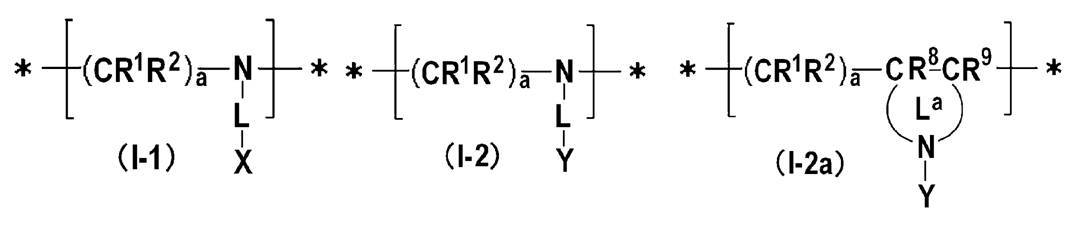
R1及びR2は、各々独立に、水素原子、ハロゲン原子又はアルキル基(炭素数1~6が好ましい)を表す。
aは、各々独立に、1~5の整数を表す。*は繰り返し単位間の連結部を表す。
R8及びR9はR1と同義の基である。
Lは単結合、アルキレン基(炭素数1~6が好ましい)、アルケニレン基(炭素数2~6が好ましい)、アリーレン基(炭素数6~24が好ましい)、ヘテロアリーレン基(炭素数1~6が好ましい)、イミノ基(炭素数0~6が好ましい)、エーテル基、チオエーテル基、カルボニル基、またはこれらの組合せに係る連結基である。なかでも、単結合もしくは-CR5R6-NR7-(イミノ基がXもしくはYの方になる)であることが好ましい。ここで、R5およびR6は各々独立に、水素原子、ハロゲン原子、アルキル基(炭素数1~6が好ましい)を表す。R7は水素原子または炭素数1~6のアルキル基である。
LaはCR8CR9とNとともに環構造形成する構造部位であり、CR8CR9の炭素原子と合わせて炭素数3~7の非芳香族複素環を形成する構造部位であることが好ましい。さらに好ましくは、CR8CR9の炭素原子及びN(窒素原子)を合わせて5~7員の非芳香族複素環を形成する構造部位であり、より好ましくは5員の非芳香族複素環を形成する構造部位であり、ピロリジンを形成する構造部位であることが特に好ましい。この構造部位はさらにアルキル基等の置換基を有していてもよい。XはpKa14以下の官能基を有する基を表す。Yは原子数40~10,000のオリゴマー鎖又はポリマー鎖を表す。
上記分散剤(オリゴイミン系分散剤)は、さらに式(I-3)、式(I-4)、および、式(I-5)で表される繰り返し単位から選ばれる1種類以上を共重合成分として含有していてもよい。上記分散剤が、このような繰り返し単位を含むことで、高屈折率粒子の分散性能を更に向上させることができる。
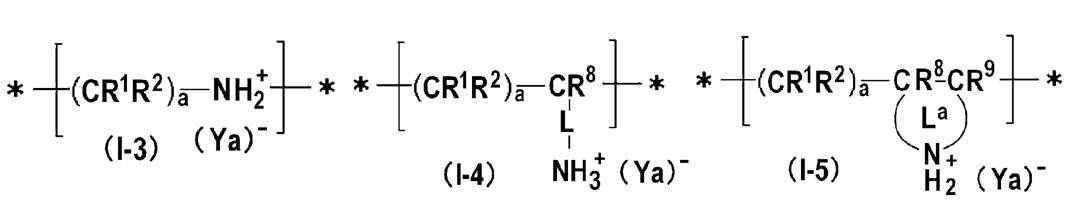
R1、R2、R8、R9、L、La、a及び*は式(I-1)、(I-2)、(I-2a)における規定と同義である。Yaはアニオン基を有する原子数40~10,000のオリゴマー鎖又はポリマー鎖を表す。
オリゴイミン系分散剤については、特開2015-34961号公報の段落番号0118~0190の記載を参酌でき、本明細書には上記内容が組み込まれる。オリゴイミン系分散剤の具体例としては、例えば、下記の樹脂や、特開2015-34961号公報の段落番号0169~0190に記載の樹脂を用いることができる。

分散剤は、市販品としても入手可能であり、そのような具体例としては、BYK Chemie(株)製「DISPERBYK 101、103、107、110、180、130、161、162、163、164、165、166、170」、BYK Chemie(株)製「BYK-P104、P105(高分子量不飽和ポリカルボン酸)」、EFKA(株)製「EFKA4047、4050、4010、4165(ポリウレタン系)、EFKA4330、4340(ブロック共重合体)、4400、4402(変性ポリアクリレート)、5010(ポリエステルアミド)、5765(高分子量ポリカルボン酸塩)、6220(脂肪酸ポリエステル)、6745(フタロシアニン誘導体)、6750(アゾ顔料誘導体)」、味の素ファインテクノ(株)製「アジスパーPB821、PB822」、共栄社化学(株)製「フローレンTG-710(ウレタンオリゴマー)」、共栄社化学(株)製「ポリフローNo.50E、No.300(アクリル系共重合体)」、楠本化成(株)製「ディスパロンKS-860、873SN、874、#2150(脂肪族多価カルボン酸)、#7004(ポリエーテルエステル)、DA-703-50、DA-705、DA-725」、花王(株)製「デモールRN、N(ナフタレンスルホン酸ホルマリン重縮合物)、MS、C、SN-B(芳香族スルホン酸ホルマリン重縮合物)」、花王(株)製「ホモゲノールL-18(高分子ポリカルボン酸)」、花王(株)製「エマルゲン920、930、935、985(ポリオキシエチレンノニルフェニルエーテル)」、「アセタミン86(ステアリルアミンアセテート)」、Lubrizol(株)製「ソルスパース5000(Solsperse 5000)(フタロシアニン誘導体)、22000(アゾ顔料誘導体)、13240(ポリエステルアミン)、3000、17000、27000(末端部に機能部を有する高分子)、24000、26000、28000、32000、36000、38500(グラフト型高分子)、41000」、日光ケミカルズ(株)製「ニッコールT106(ポリオキシエチレンソルビタンモノオレート)、MYS-IEX(ポリオキシエチレンモノステアレート)」等が挙げられる。また、酸系吸着部位としてリン原子含有基(例えば、リン酸基等)を有する分散剤の市販品として、Lubrizol(株)製「ソルスパース26000(Solsperse 26000)、36000、41000」が挙げられる。これらを好適に用いることができる。
分散剤は、1種類単独で、あるいは2種類以上を組み合わせて用いることができる。
分散剤は、1種類単独で、あるいは2種類以上を組み合わせて用いることができる。
分散剤の含有量は、組成物の全固形分に対して、0.1~40質量%が好ましい。上限は、20質量%以下が好ましく、10質量%以下がさらに好ましい。下限は、0.5質量%以上が好ましく、1質量%以上がさらに好ましい。
また、分散剤の含有量は、高屈折率粒子100質量部に対して、1~100質量部が好ましい。上限は、80質量部以下が好ましく、60質量部以下がさらに好ましい。下限は、2.5質量部以上が好ましく、5質量部以上がさらに好ましい。
また、分散剤の含有量は、高屈折率粒子100質量部に対して、1~100質量部が好ましい。上限は、80質量部以下が好ましく、60質量部以下がさらに好ましい。下限は、2.5質量部以上が好ましく、5質量部以上がさらに好ましい。
<<溶剤>>
本発明の組成物は溶剤を含有することが好ましい。溶剤は種々の有機溶剤を用いて構成することができる。有機溶剤としては、アセトン、メチルエチルケトン、シクロヘキサン、酢酸エチル、エチレンジクロライド、テトラヒドロフラン、トルエン、エチレングリコールモノメチルエーテル、エチレングリコールモノエチルエーテル、エチレングリコールジメチルエーテル、プロピレングリコールモノメチルエーテル、プロピレングリコールモノエチルエーテル、アセチルアセトン、シクロヘキサノン、ジアセトンアルコール、エチレングリコールモノメチルエーテルアセテート、エチレングリコールエチルエーテルアセテート、エチレングリコールモノイソプロピルエーテル、エチレングリコールモノブチルエーテルアセテート、3-メトキシプロパノール、メトキシメトキシエタノール、ジエチレングリコールモノメチルエーテル、ジエチレングリコールモノエチルエーテル、ジエチレングリコールジメチルエーテル、ジエチレングリコールジエチルエーテル、プロピレングリコールモノメチルエーテルアセテート、プロピレングリコールモノエチルエーテルアセテート、3-メトキシプロピルアセテート、N,N-ジメチルホルムアミド、ジメチルスルホキシド、γ-ブチロラクトン、乳酸メチル、乳酸エチルなどが挙げられる。これらの有機溶剤は、単独あるいは混合して使用することができる。
本発明の組成物は溶剤を含有することが好ましい。溶剤は種々の有機溶剤を用いて構成することができる。有機溶剤としては、アセトン、メチルエチルケトン、シクロヘキサン、酢酸エチル、エチレンジクロライド、テトラヒドロフラン、トルエン、エチレングリコールモノメチルエーテル、エチレングリコールモノエチルエーテル、エチレングリコールジメチルエーテル、プロピレングリコールモノメチルエーテル、プロピレングリコールモノエチルエーテル、アセチルアセトン、シクロヘキサノン、ジアセトンアルコール、エチレングリコールモノメチルエーテルアセテート、エチレングリコールエチルエーテルアセテート、エチレングリコールモノイソプロピルエーテル、エチレングリコールモノブチルエーテルアセテート、3-メトキシプロパノール、メトキシメトキシエタノール、ジエチレングリコールモノメチルエーテル、ジエチレングリコールモノエチルエーテル、ジエチレングリコールジメチルエーテル、ジエチレングリコールジエチルエーテル、プロピレングリコールモノメチルエーテルアセテート、プロピレングリコールモノエチルエーテルアセテート、3-メトキシプロピルアセテート、N,N-ジメチルホルムアミド、ジメチルスルホキシド、γ-ブチロラクトン、乳酸メチル、乳酸エチルなどが挙げられる。これらの有機溶剤は、単独あるいは混合して使用することができる。
本発明において、溶剤は、金属含有量が少ない溶剤を用いることが好ましい。溶剤の金属含有量は、例えば、10質量ppb(parts per billion)以下であることが好ましい。必要に応じて質量ppt(parts per trillion)レベルのものを用いてもよく、そのような高純度溶剤は、例えば、東洋合成社が提供している(化学工業日報、2015年11月13日)。
溶剤から金属等の不純物を除去する方法としては、例えば、蒸留(分子蒸留や薄膜蒸留等)やフィルタを用いた濾過を挙げることができる。濾過に用いるフィルタのフィルタ孔径としては、ポアサイズ10nm以下が好ましく、5nm以下がより好ましく、3nm以下が更に好ましい。フィルタとしては、ポリテトラフロロエチレン製、ポリエチレン製、または、ナイロン製のフィルタが好ましい。
溶剤には、異性体(同じ原子数で異なる構造の化合物)が含まれていてもよい。また、異性体は、1種類のみが含まれていてもよいし、複数種類含まれていてもよい。
溶剤から金属等の不純物を除去する方法としては、例えば、蒸留(分子蒸留や薄膜蒸留等)やフィルタを用いた濾過を挙げることができる。濾過に用いるフィルタのフィルタ孔径としては、ポアサイズ10nm以下が好ましく、5nm以下がより好ましく、3nm以下が更に好ましい。フィルタとしては、ポリテトラフロロエチレン製、ポリエチレン製、または、ナイロン製のフィルタが好ましい。
溶剤には、異性体(同じ原子数で異なる構造の化合物)が含まれていてもよい。また、異性体は、1種類のみが含まれていてもよいし、複数種類含まれていてもよい。
溶剤の含有量は、組成物の固形分濃度が、5~99質量%となる量が好ましい。上限は、90質量%以下がより好ましい。下限は、10質量%以上がより好ましい。
<<硬化性化合物>>
本発明の組成物は、硬化性化合物を含有することが好ましい。硬化性化合物としては、ラジカル、酸、熱により硬化可能な公知の化合物を用いることができる。例えば、エチレン性不飽和結合を有する基を有する化合物、エポキシ基を有する化合物、メチロール基を有する化合物等が挙げられる。エチレン性不飽和結合を有する基としては、ビニル基、(メタ)アリル基、(メタ)アクリロイル基、(メタ)アクリロイルオキシ基などが挙げられ、(メタ)アクリロイル基、(メタ)アクリロイルオキシ基が好ましい。硬化性化合物は、重合性化合物であることが好ましく、ラジカル重合性化合物であることがより好ましい。重合性化合物としては、エチレン性不飽和結合を有する基を有する化合物などが挙げられる。
本発明の組成物は、硬化性化合物を含有することが好ましい。硬化性化合物としては、ラジカル、酸、熱により硬化可能な公知の化合物を用いることができる。例えば、エチレン性不飽和結合を有する基を有する化合物、エポキシ基を有する化合物、メチロール基を有する化合物等が挙げられる。エチレン性不飽和結合を有する基としては、ビニル基、(メタ)アリル基、(メタ)アクリロイル基、(メタ)アクリロイルオキシ基などが挙げられ、(メタ)アクリロイル基、(メタ)アクリロイルオキシ基が好ましい。硬化性化合物は、重合性化合物であることが好ましく、ラジカル重合性化合物であることがより好ましい。重合性化合物としては、エチレン性不飽和結合を有する基を有する化合物などが挙げられる。
(エチレン性不飽和結合を有する基を有する化合物(重合性化合物))
本発明において、硬化性化合物として、エチレン性不飽和結合を有する基を有する化合物(以下、重合性化合物ともいう)を用いることができる。重合性化合物は、モノマーであることが好ましい。重合性化合物の分子量は、100~3000が好ましい。上限は、2000以下が好ましく、1500以下が更に好ましい。下限は、150以上が好ましく、250以上が更に好ましい。重合性化合物は、3~15官能の(メタ)アクリレート化合物であることが好ましく、3~6官能の(メタ)アクリレート化合物であることがより好ましい。
本発明において、硬化性化合物として、エチレン性不飽和結合を有する基を有する化合物(以下、重合性化合物ともいう)を用いることができる。重合性化合物は、モノマーであることが好ましい。重合性化合物の分子量は、100~3000が好ましい。上限は、2000以下が好ましく、1500以下が更に好ましい。下限は、150以上が好ましく、250以上が更に好ましい。重合性化合物は、3~15官能の(メタ)アクリレート化合物であることが好ましく、3~6官能の(メタ)アクリレート化合物であることがより好ましい。
重合性化合物は、エチレン性不飽和結合を有する基を1個以上有する、常圧下で100℃以上の沸点を持つ化合物も好ましい。具体例としては、ポリエチレングリコールモノ(メタ)アクリレート、ポリプロピレングリコールモノ(メタ)アクリレート、フェノキシエチル(メタ)アクリレート等の単官能のアクリレートやメタアクリレート;ポリエチレングリコールジ(メタ)アクリレート、トリメチロールエタントリ(メタ)アクリレート、ネオペンチルグリコールジ(メタ)アクリレート、ペンタエリスリトールトリ(メタ)アクリレート、ペンタエリスリトールテトラ(メタ)アクリレート、ジペンタエリスリトールペンタ(メタ)アクリレート、ジペンタエリスリトールヘキサ(メタ)アクリレート、ヘキサンジオール(メタ)アクリレート、トリメチロールプロパントリ(アクリロイルオキシプロピル)エーテル、トリ(アクリロイルオキシエチル)イソシアヌレート及びこれらの混合物を挙げることができ、ペンタエリスリトールテトラ(メタ)アクリレートであることが好ましい。
重合性化合物は、下記式(MO-1)~(MO-5)で表される、重合性化合物も好適に用いることができる。なお、式中、Tがオキシアルキレン基の場合には、炭素原子側の末端がRに結合する。

上記の式において、nは0~14の整数であり、mは1~8の整数である。一分子内に複数存在するR、T、は、各々同一であっても、異なっていてもよい。
上記式(MO-1)~(MO-5)で表される重合性化合物の各々において、複数のRの内の少なくとも1つは、-OC(=O)CH=CH2、又は、-OC(=O)C(CH3)=CH2で表される基を表す。
上記式(MO-1)~(MO-5)で表される、重合性化合物の具体例としては、特開2007-269779号公報の段落番号0248~0251に記載されている化合物が挙げられる。
また、特開平10-62986号公報に記載の、多官能アルコールにエチレンオキサイドやプロピレンオキサイドを付加させた後に(メタ)アクリレート化した化合物も、重合性化合物として用いることができる。
上記式(MO-1)~(MO-5)で表される重合性化合物の各々において、複数のRの内の少なくとも1つは、-OC(=O)CH=CH2、又は、-OC(=O)C(CH3)=CH2で表される基を表す。
上記式(MO-1)~(MO-5)で表される、重合性化合物の具体例としては、特開2007-269779号公報の段落番号0248~0251に記載されている化合物が挙げられる。
また、特開平10-62986号公報に記載の、多官能アルコールにエチレンオキサイドやプロピレンオキサイドを付加させた後に(メタ)アクリレート化した化合物も、重合性化合物として用いることができる。
重合性化合物は、ペンタエリスリトールテトラアクリレート(市販品としては、A-TMMT;新中村化学工業(株)製)、ジペンタエリスリトールトリアクリレート(市販品としては、KAYARAD D-330;日本化薬(株)製)、ジペンタエリスリトールテトラアクリレート(市販品としては、KAYARAD D-320;日本化薬(株)製)ジペンタエリスリトールペンタ(メタ)アクリレート(市販品としては、KAYARAD D-310;日本化薬(株)製)、ジペンタエリスリトールヘキサ(メタ)アクリレート(市販品としては、KAYARAD DPHA;日本化薬(株)製)が好ましく、ペンタエリスリトールテトラアクリレートがより好ましい。
重合性化合物は、カルボキシ基、スルホ基、リン酸基等の酸基を有していてもよい。酸基を有する重合性化合物は、多官能アルコールの一部のヒドロキシ基を(メタ)アクリレート化し、残ったヒドロキシ基に酸無水物を付加反応させてカルボキシ基とするなどの方法で得られる。酸基を有する重合性化合物としては、脂肪族ポリヒドロキシ化合物と不飽和カルボン酸とのエステルなどが挙げられる。酸基を有する重合性化合物は、脂肪族ポリヒドロキシ化合物の未反応のヒドロキシ基に、非芳香族カルボン酸無水物を反応させて酸基を持たせた化合物が好ましく、特に好ましくは、このエステルにおいて、脂肪族ポリヒドロキシ化合物がペンタエリスリトールおよび/またはジペンタエリスリトールであるものである。市販品としては、例えば、東亞合成(株)製の多塩基酸変性アクリルオリゴマーとして、アロニックスシリーズのM-305、M-510、M-520などが挙げられる。酸基を有する重合性化合物の酸価は、0.1~40mgKOH/gが好ましい。下限は5mgKOH/g以上が好ましい。上限は、30mgKOH/g以下が好ましい。
また、重合性化合物は、カプロラクトン構造を有する重合性化合物も好ましい態様である。カプロラクトン構造を有する重合性化合物としては、分子内にカプロラクトン構造を有する限り特に限定されず、例えば、トリメチロールエタン、ジトリメチロールエタン、トリメチロールプロパン、ジトリメチロールプロパン、ペンタエリスリトール、ジペンタエリスリトール、トリペンタエリスリトール、グリセリン、ジグリセロール、トリメチロールメラミン等の多価アルコールと、(メタ)アクリル酸及びε-カプロラクトンをエステル化することにより得られる、ε-カプロラクトン変性多官能(メタ)アクリレートを挙げることができる。カプロラクトン構造を有する重合性化合物は、下記式(Z-1)で表される化合物が好ましい。

式(Z-1)中、6個のRは全てが式(Z-2)で表される基であるか、又は6個のRのうち1~5個が式(Z-2)で表される基であり、残余が式(Z-3)で表される基である。

式(Z-2)中、R1は水素原子又はメチル基を示し、mは1又は2の数を示し、「*」は結合手であることを示す。

式(Z-3)中、R1は水素原子又はメチル基を示し、「*」は結合手であることを示す。
カプロラクトン構造を有する重合性化合物は、例えば、日本化薬(株)からKAYARAD DPCAシリーズとして市販されており、DPCA-20(上記式(Z-1)~(Z-3)においてm=1、式(Z-2)で表される基の数=2、R1が全て水素原子である化合物)、DPCA-30(同式、m=1、式(Z-2)で表される基の数=3、R1が全て水素原子である化合物)、DPCA-60(同式、m=1、式(Z-2)で表される基の数=6、R1が全て水素原子である化合物)、DPCA-120(同式においてm=2、式(Z-2)で表される基の数=6、R1が全て水素原子である化合物)等が挙げられる。
重合性化合物は、式(Z-4)又は(Z-5)で表される化合物を用いることもできる。

式(Z-4)及び(Z-5)中、Eは、各々独立に、-((CH2)yCH2O)-、又は-((CH2)yCH(CH3)O)-を表し、yは、各々独立に0~10の整数を表し、Xは、各々独立に、(メタ)アクリロイル基、水素原子、又はカルボキシ基を表す。
式(Z-4)中、(メタ)アクリロイル基の合計は3個又は4個であり、mは各々独立に0~10の整数を表し、各mの合計は0~40の整数である。
式(Z-5)中、(メタ)アクリロイル基の合計は5個又は6個であり、nは各々独立に0~10の整数を表し、各nの合計は0~60の整数である。
式(Z-4)中、(メタ)アクリロイル基の合計は3個又は4個であり、mは各々独立に0~10の整数を表し、各mの合計は0~40の整数である。
式(Z-5)中、(メタ)アクリロイル基の合計は5個又は6個であり、nは各々独立に0~10の整数を表し、各nの合計は0~60の整数である。
式(Z-4)中、mは、0~6の整数が好ましく、0~4の整数がより好ましい。
また、各mの合計は、2~40の整数が好ましく、2~16の整数がより好ましく、4~8の整数が特に好ましい。
式(Z-5)中、nは、0~6の整数が好ましく、0~4の整数がより好ましい。
また、各nの合計は、3~60の整数が好ましく、3~24の整数がより好ましく、6~12の整数が特に好ましい。
また、式(Z-4)又は式(Z-5)中の-((CH2)yCH2O)-又は-((CH2)yCH(CH3)O)-は、酸素原子側の末端がXに結合する形態が好ましい。
また、各mの合計は、2~40の整数が好ましく、2~16の整数がより好ましく、4~8の整数が特に好ましい。
式(Z-5)中、nは、0~6の整数が好ましく、0~4の整数がより好ましい。
また、各nの合計は、3~60の整数が好ましく、3~24の整数がより好ましく、6~12の整数が特に好ましい。
また、式(Z-4)又は式(Z-5)中の-((CH2)yCH2O)-又は-((CH2)yCH(CH3)O)-は、酸素原子側の末端がXに結合する形態が好ましい。
式(Z-4)又は式(Z-5)で表される化合物は1種類単独で用いてもよいし、2種類以上併用してもよい。特に、式(Z-5)において、6個のX全てがアクリロイル基である形態が好ましい。
また、式(Z-4)又は式(Z-5)で表される化合物の重合性化合物中における全含有量としては、20質量%以上が好ましく、50質量%以上がより好ましい。
式(Z-4)又は式(Z-5)で表される化合物は、従来公知の工程である、ペンタエリスリト-ル又はジペンタエリスリト-ルにエチレンオキシド又はプロピレンオキシドを開環付加反応により開環骨格を結合する工程と、開環骨格の末端ヒドロキシ基に、例えば(メタ)アクリロイルクロライドを反応させて(メタ)アクリロイル基を導入する工程と、から合成することができる。各工程は良く知られた工程であり、当業者は容易に式(Z-4)又は式(Z-5)で表される化合物を合成することができる。
式(Z-4)又は式(Z-5)で表される化合物の中でも、ペンタエリスリトール誘導体及び/又はジペンタエリスリトール誘導体がより好ましい。
具体的には、下記式(a)~(f)で表される化合物(以下、「例示化合物(a)~(f)」とも称する。)が挙げられ、中でも、例示化合物(a)、(b)、(e)、(f)が好ましい。
具体的には、下記式(a)~(f)で表される化合物(以下、「例示化合物(a)~(f)」とも称する。)が挙げられ、中でも、例示化合物(a)、(b)、(e)、(f)が好ましい。
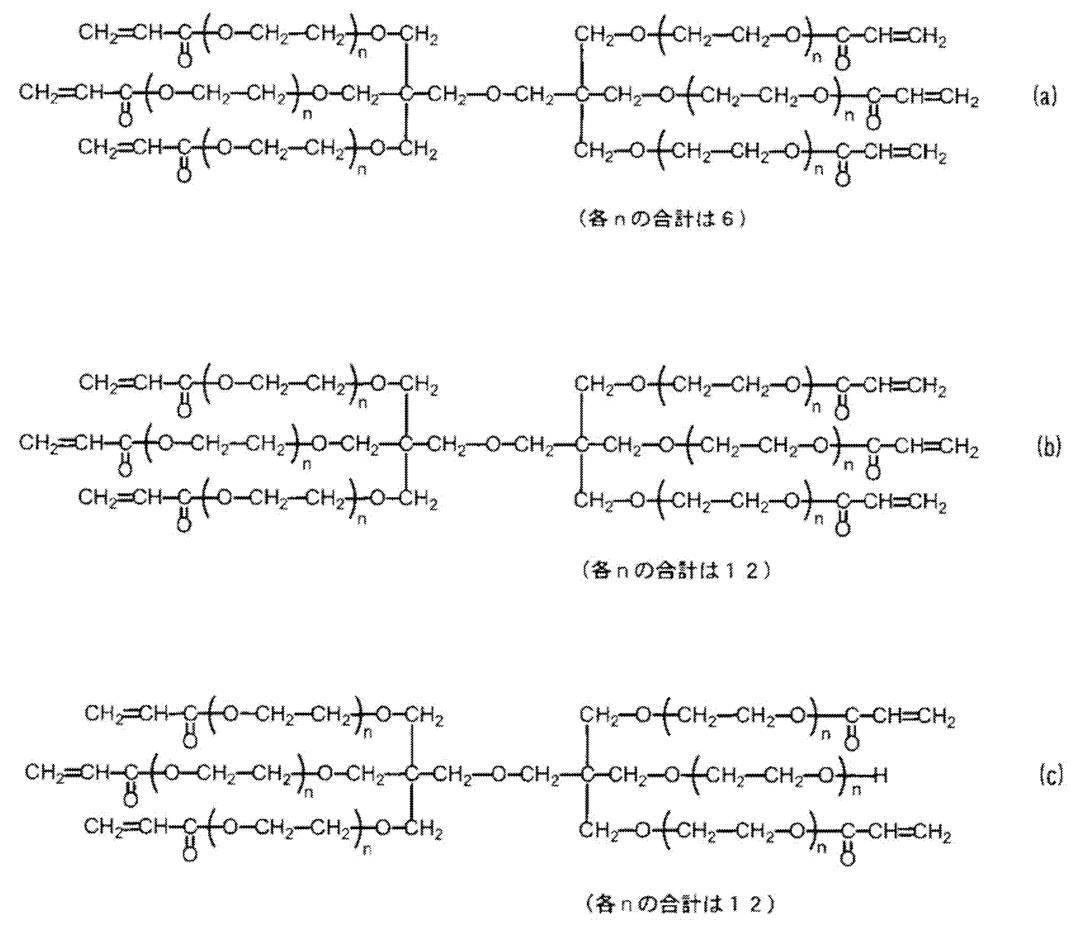
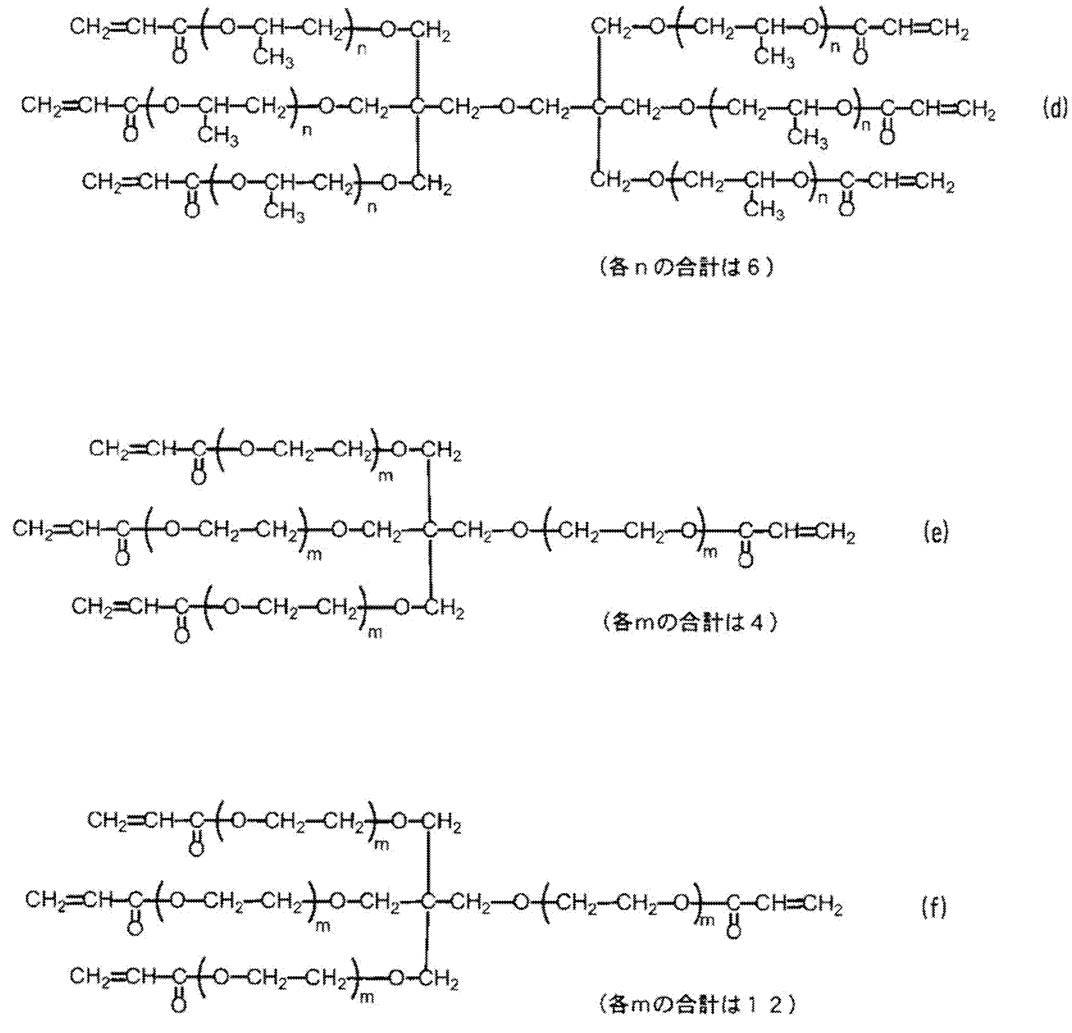
式(Z-4)、(Z-5)で表される重合性化合物の市販品としては、例えばサートマー(株)製のエチレンオキシ鎖を4個有する4官能アクリレートであるSR-494、日本化薬(株)製のペンチレンオキシ鎖を6個有する6官能アクリレートであるDPCA-60、イソブチレンオキシ鎖を3個有する3官能アクリレートであるTPA-330などが挙げられる。
重合性化合物は、特公昭48-41708号公報、特開昭51-37193号公報、特公平2-32293号公報、特公平2-16765号公報に記載されているようなウレタンアクリレート類や、特公昭58-49860号公報、特公昭56-17654号公報、特公昭62-39417号公報、特公昭62-39418号公報記載のエチレンオキサイド系骨格を有するウレタン化合物類も好適である。また、特開昭63-277653号公報、特開昭63-260909号公報、特開平1-105238号公報に記載される、分子内にアミノ構造やスルフィド構造を有する付加重合性化合物類も好ましい。
重合性化合物の市販品としては、ウレタンオリゴマーUAS-10、UAB-140(山陽国策パルプ(株)製)、U-4HA、U-6LPA、UA-32P、U-10HA、U-10PA、UA-122P、UA-1100H、UA-7200(新中村化学工業(株)製)、DPHA-40H(日本化薬(株)製)、UA-306H、UA-306T、UA-306I、AH-600、T-600、AI-600(共栄社化学(株)製)、UA-9050、UA-9048(BASF社製)などが挙げられる。
重合性化合物の市販品としては、ウレタンオリゴマーUAS-10、UAB-140(山陽国策パルプ(株)製)、U-4HA、U-6LPA、UA-32P、U-10HA、U-10PA、UA-122P、UA-1100H、UA-7200(新中村化学工業(株)製)、DPHA-40H(日本化薬(株)製)、UA-306H、UA-306T、UA-306I、AH-600、T-600、AI-600(共栄社化学(株)製)、UA-9050、UA-9048(BASF社製)などが挙げられる。
これらの重合性化合物について、その構造、単独使用か併用か、添加量等の使用方法の詳細は、組成物の最終的な性能設計にあわせて任意に設定できる。例えば、感度の観点では、1分子あたりの不飽和基含量が多い構造が好ましく、多くの場合は2官能以上が好ましい。また、形成体の強度を高める観点では、3官能以上の重合性化合物が好ましい。また、官能数および種類の異なる化合物を併用することも好ましい。さらに、3官能以上の重合性化合物であって、エチレンオキサイド鎖長の異なる重合性化合物を併用することも好ましい。また、組成物に含まれる他の成分(例えば、光重合開始剤、樹脂等)との相溶性や分散性に対しても、重合性化合物の選択および/または使用法は好ましい要因であり、例えば、低純度化合物の使用や2種類以上の併用により、相溶性などを向上することができる。
重合性化合物の含有量は、組成物の全固形分に対して、1~80質量%が好ましい。下限は、3質量%以上が好ましく、5質量%以上がより好ましい。上限は、70質量%以下がより好ましく、60質量%以下が更に好ましい。
(エポキシ基を有する化合物)
本発明では、硬化性化合物として、エポキシ基を有する化合物を用いることもできる。エポキシ基を有する化合物は、1分子内にエポキシ基を1つ以上有する化合物が挙げられ、2つ以上有する化合物が好ましい。エポキシ基は、1分子内に1~100個有することが好ましい。上限は、例えば、10個以下とすることもでき、5個以下とすることもできる。下限は、2個以上が好ましい。
本発明では、硬化性化合物として、エポキシ基を有する化合物を用いることもできる。エポキシ基を有する化合物は、1分子内にエポキシ基を1つ以上有する化合物が挙げられ、2つ以上有する化合物が好ましい。エポキシ基は、1分子内に1~100個有することが好ましい。上限は、例えば、10個以下とすることもでき、5個以下とすることもできる。下限は、2個以上が好ましい。
エポキシ基を有する化合物は、エポキシ当量(=エポキシ基を有する化合物の分子量/エポキシ基の数)が500g/当量以下であることが好ましく、100~400g/当量であることがより好ましく、100~300g/当量であることがさらに好ましい。
エポキシ基を有する化合物は、低分子化合物(例えば、分子量1000未満)でもよいし、高分子化合物(macromolecule)(例えば、分子量1000以上、ポリマーの場合は、重量平均分子量が1000以上)のいずれでもよい。エポキシ基を有する化合物の重量平均分子量は、200~100000が好ましく、500~50000がより好ましい。重量平均分子量の上限は、10000以下が好ましく、5000以下がより好ましく、3000以下が更に好ましい。
エポキシ基を有する化合物は、特開2013-011869号公報の段落番号0034~0036、特開2014-043556号公報の段落番号0147~0156、特開2014-089408号公報の段落番号0085~0092に記載された化合物を用いることもできる。これらの内容は、本明細書に組み込まれる。市販品としては、例えば、ビスフェノールA型エポキシ樹脂としては、jER825、jER827、jER828、jER834、jER1001、jER1002、jER1003、jER1055、jER1007、jER1009、jER1010(以上、三菱化学(株)製)、EPICLON860、EPICLON1050、EPICLON1051、EPICLON1055(以上、DIC(株)製)等であり、ビスフェノールF型エポキシ樹脂としては、jER806、jER807、jER4004、jER4005、jER4007、jER4010(以上、三菱化学(株)製)、EPICLON830、EPICLON835(以上、DIC(株)製)、LCE-21、RE-602S(以上、日本化薬(株)製)等であり、フェノールノボラック型エポキシ樹脂としては、jER152、jER154、jER157S70、jER157S65(以上、三菱化学(株)製)、EPICLON N-740、EPICLON N-770、EPICLON N-775(以上、DIC(株)製)等であり、クレゾールノボラック型エポキシ樹脂としては、EPICLON N-660、EPICLON N-665、EPICLON N-670、EPICLON N-673、EPICLON N-680、EPICLON N-690、EPICLON N-695(以上、DIC(株)製)、EOCN-1020(日本化薬(株)製)等であり、脂肪族エポキシ樹脂としては、ADEKA RESIN EP-4080S、同EP-4085S、同EP-4088S(以上、(株)ADEKA製)、セロキサイド2021P、セロキサイド2081、セロキサイド2083、セロキサイド2085、EHPE3150、EPOLEAD PB 3600、同PB 4700(以上、(株)ダイセル製)、デナコール EX-212L、EX-214L、EX-216L、EX-321L、EX-850L(以上、ナガセケムテックス(株)製)等である。その他にも、ADEKA RESIN EP-4000S、同EP-4003S、同EP-4010S、同EP-4011S(以上、(株)ADEKA製)、NC-2000、NC-3000、NC-7300、XD-1000、EPPN-501、EPPN-502(以上、(株)ADEKA製)、jER1031S(三菱化学(株)製)等が挙げられる。
エポキシ基を有する化合物は、特開2009-265518号公報の段落番号0045等に記載の化合物を用いることもできる。これらの内容は本明細書に組み込まれる。
エポキシ基を有する化合物の含有量は、組成物の全固形分に対して、1~80質量%が好ましい。下限は、3質量%以上が好ましく、5質量%以上がより好ましい。上限は、70質量%以下が好ましく、60質量%以下がより好ましい。エポキシ基を有する化合物は、1種類のみでもよく、2種類以上でもよい。2種類以上の場合は、合計量が上記範囲となることが好ましい。
<<光重合開始剤>>
本発明の組成物は、光重合開始剤を含有することができる。特に、組成物が、重合性化合物を含む場合、光重合開始剤を含有することが好ましい。光重合開始剤としては、特に制限はなく、公知の光重合開始剤の中から適宜選択することができる。例えば、紫外線領域から可視領域の光線に対して感光性を有するものが好ましい。光重合開始剤は、光ラジカル重合開始剤が好ましい。また、光重合開始剤は、約300nm~800nm(330nm~500nmがより好ましい。)の範囲内に少なくとも約50のモル吸光係数を有する化合物を、少なくとも1種類含有していることが好ましい。
本発明の組成物は、光重合開始剤を含有することができる。特に、組成物が、重合性化合物を含む場合、光重合開始剤を含有することが好ましい。光重合開始剤としては、特に制限はなく、公知の光重合開始剤の中から適宜選択することができる。例えば、紫外線領域から可視領域の光線に対して感光性を有するものが好ましい。光重合開始剤は、光ラジカル重合開始剤が好ましい。また、光重合開始剤は、約300nm~800nm(330nm~500nmがより好ましい。)の範囲内に少なくとも約50のモル吸光係数を有する化合物を、少なくとも1種類含有していることが好ましい。
光重合開始剤としては、例えば、ハロゲン化炭化水素誘導体(例えば、トリアジン骨格を有するもの、オキサジアゾール骨格を有するものなど)、アシルホスフィンオキサイド等のアシルホスフィン化合物、ヘキサアリールビイミダゾール、オキシム誘導体等のオキシム化合物、有機過酸化物、チオ化合物、ケトン化合物、芳香族オニウム塩、ケトオキシムエーテル、アミノアセトフェノン化合物、ヒドロキシアセトフェノンなどが挙げられる。トリアジン骨格を有するハロゲン化炭化水素化合物としては、例えば、若林ら著、Bull.Chem.Soc.Japan,42、2924(1969)記載の化合物、英国特許1388492号明細書記載の化合物、特開昭53-133428号公報記載の化合物、独国特許3337024号明細書記載の化合物、F.C.Schaeferら著のJ.Org.Chem.;29、1527(1964)記載の化合物、特開昭62-58241号公報記載の化合物、特開平5-281728号公報記載の化合物、特開平5-34920号公報記載の化合物、米国特許第4212976号明細書に記載されている化合物、などが挙げられる。
また、露光感度の観点から、トリハロメチルトリアジン化合物、ベンジルジメチルケタール化合物、α-ヒドロキシケトン化合物、α-アミノケトン化合物、アシルホスフィン化合物、フォスフィンオキサイド化合物、メタロセン化合物、オキシム化合物、トリアリルイミダゾールダイマー、オニウム化合物、ベンゾチアゾール化合物、ベンゾフェノン化合物、アセトフェノン化合物及びその誘導体、シクロペンタジエン-ベンゼン-鉄錯体及びその塩、ハロメチルオキサジアゾール化合物、3-アリール置換クマリン化合物からなる群より選択される化合物が好ましい。
光重合開始剤としては、ヒドロキシアセトフェノン化合物、アミノアセトフェノン化合物、及び、アシルホスフィン化合物も好適に用いることができる。より具体的には、例えば、特開平10-291969号公報に記載のアミノアセトフェノン系開始剤、特許第4225898号公報に記載のアシルホスフィン系開始剤も用いることができる。ヒドロキシアセトフェノン系開始剤としては、IRGACURE 184、DAROCUR 1173、IRGACURE 500、IRGACURE 2959、IRGACURE 127(商品名:いずれもBASF社製)を用いることができる。アミノアセトフェノン系開始剤としては、市販品であるIRGACURE 907、IRGACURE 369、及び、IRGACURE 379、IRGACURE 379EG(商品名:いずれもBASF社製)を用いることができる。アミノアセトフェノン系開始剤は、365nm又は405nm等の長波光源に吸収波長がマッチングされた特開2009-191179号公報に記載の化合物も用いることができる。
アシルホスフィン系開始剤としては、市販品であるIRGACURE 819やIRGACURE TPO(商品名:いずれもBASF社製)を用いることができる。
露光後の着色防止の観点からアシルホスフィン系開始剤が好ましい。
アシルホスフィン系開始剤としては、市販品であるIRGACURE 819やIRGACURE TPO(商品名:いずれもBASF社製)を用いることができる。
露光後の着色防止の観点からアシルホスフィン系開始剤が好ましい。
光重合開始剤は、オキシム化合物を好ましく用いることもできる。オキシム化合物の具体例としては、特開2001-233842号公報に記載の化合物、特開2000-80068号公報記載の化合物、特開2006-342166号公報に記載の化合物、特開2016-21012号公報記載の化合物を用いることができる。
本発明において、好適に用いることのできるオキシム化合物としては、例えば、3-ベンゾイルオキシイミノブタン-2-オン、3-アセトキシイミノブタン-2-オン、3-プロピオニルオキシイミノブタン-2-オン、2-アセトキシイミノペンタン-3-オン、2-アセトキシイミノ-1-フェニルプロパン-1-オン、2-ベンゾイルオキシイミノ-1-フェニルプロパン-1-オン、3-(4-トルエンスルホニルオキシ)イミノブタン-2-オン、及び2-エトキシカルボニルオキシイミノ-1-フェニルプロパン-1-オンなどが挙げられる。また、J.C.S.Perkin II(1979年)pp.1653-1660、J.C.S.Perkin II(1979年)pp.156-162、Journal of Photopolymer Science and Technology(1995年)pp.202-232、特開2000-66385号公報記載の化合物、特開2000-80068号公報、特表2004-534797号公報、特開2006-342166号公報の各公報に記載の化合物等も挙げられる。市販品ではIRGACURE OXE01、IRGACURE OXE02、IRGACURE OXE03、IRGACURE OXE04(以上、BASF社製)も好適に用いられる。また、TR-PBG-304(常州強力電子新材料有限公司社製)、アデカアークルズNCI-930、アデカオプトマー N-1919(特開2012-14052号公報の光重合開始剤2)((株)ADEKA製)も用いることができる。
また上記記載以外のオキシム化合物として、カルバゾールN位にオキシムが連結した特表2009-519904号公報に記載の化合物、ベンゾフェノン部位にヘテロ置換基が導入された米国特許第7626957号公報に記載の化合物、色素部位にニトロ基が導入された特開2010-15025号公報及び米国特許公開2009-292039号記載の化合物、国際公開2009/131189号公報に記載のケトオキシム化合物、トリアジン骨格とオキシム骨格を同一分子内に含有する米国特許7556910号公報に記載の化合物、405nmに吸収極大を有しg線光源に対して良好な感度を有する特開2009-221114号公報記載の化合物、特開2014-137466号公報の段落番号0076~0079に記載された化合物などを用いてもよい。
好ましくは、例えば、特開2013-29760号公報の段落番号0274~0275を参酌することができ、この内容は本明細書に組み込まれる。
具体的には、オキシム化合物としては、下記式(OX-1)で表される化合物が好ましい。オキシム化合物は、オキシムのN-O結合が(E)体のオキシム化合物であっても、オキシムのN-O結合が(Z)体のオキシム化合物であってもよく、(E)体と(Z)体との混合物であってもよい。
好ましくは、例えば、特開2013-29760号公報の段落番号0274~0275を参酌することができ、この内容は本明細書に組み込まれる。
具体的には、オキシム化合物としては、下記式(OX-1)で表される化合物が好ましい。オキシム化合物は、オキシムのN-O結合が(E)体のオキシム化合物であっても、オキシムのN-O結合が(Z)体のオキシム化合物であってもよく、(E)体と(Z)体との混合物であってもよい。

式(OX-1)中、RおよびBは各々独立に一価の置換基を表し、Aは二価の有機基を表し、Arはアリール基を表す。
式(OX-1)中、Rで表される一価の置換基としては、一価の非金属原子団であることが好ましい。
一価の非金属原子団としては、アルキル基、アリール基、アシル基、アルコキシカルボニル基、アリールオキシカルボニル基、複素環基、アルキルチオカルボニル基、アリールチオカルボニル基等が挙げられる。また、これらの基は、1以上の置換基を有していてもよい。また、前述した置換基は、さらに他の置換基で置換されていてもよい。
置換基としてはハロゲン原子、アリールオキシ基、アルコキシカルボニル基またはアリールオキシカルボニル基、アシルオキシ基、アシル基、アルキル基、アリール基等が挙げられる。
式(OX-1)中、Bで表される一価の置換基としては、アリール基、複素環基、アリールカルボニル基、又は、複素環カルボニル基が好ましい。これらの基は1以上の置換基を有していてもよい。置換基としては、前述した置換基が例示できる。
式(OX-1)中、Aで表される二価の有機基としては、炭素数1~12のアルキレン基、シクロアルキレン基、アルキニレン基が好ましい。これらの基は1以上の置換基を有していてもよい。置換基としては、前述した置換基が例示できる。
式(OX-1)中、Rで表される一価の置換基としては、一価の非金属原子団であることが好ましい。
一価の非金属原子団としては、アルキル基、アリール基、アシル基、アルコキシカルボニル基、アリールオキシカルボニル基、複素環基、アルキルチオカルボニル基、アリールチオカルボニル基等が挙げられる。また、これらの基は、1以上の置換基を有していてもよい。また、前述した置換基は、さらに他の置換基で置換されていてもよい。
置換基としてはハロゲン原子、アリールオキシ基、アルコキシカルボニル基またはアリールオキシカルボニル基、アシルオキシ基、アシル基、アルキル基、アリール基等が挙げられる。
式(OX-1)中、Bで表される一価の置換基としては、アリール基、複素環基、アリールカルボニル基、又は、複素環カルボニル基が好ましい。これらの基は1以上の置換基を有していてもよい。置換基としては、前述した置換基が例示できる。
式(OX-1)中、Aで表される二価の有機基としては、炭素数1~12のアルキレン基、シクロアルキレン基、アルキニレン基が好ましい。これらの基は1以上の置換基を有していてもよい。置換基としては、前述した置換基が例示できる。
本発明は、光重合開始剤として、フルオレン環を有するオキシム化合物を用いることもできる。フルオレン環を有するオキシム化合物の具体例としては、特開2014-137466号公報記載の化合物が挙げられる。この内容は本明細書に組み込まれる。
本発明は、光重合開始剤として、フッ素原子を有するオキシム化合物を用いることもできる。フッ素原子を有するオキシム化合物の具体例としては、特開2010-262028号公報記載の化合物、特表2014-500852号公報記載の化合物24、36~40、特開2013-164471号公報記載の化合物(C-3)などが挙げられる。この内容は本明細書に組み込まれる。
本発明は、光重合開始剤として、ニトロ基を有するオキシム化合物を用いることができる。ニトロ基を有するオキシム化合物は、二量体とすることも好ましい。ニトロ基を有するオキシム化合物の具体例としては、特開2013-114249号公報の段落番号0031~0047、特開2014-137466号公報の段落番号0008~0012、0070~0079に記載されている化合物、特許4223071号公報の段落番号0007~0025に記載されている化合物、アデカアークルズNCI-831((株)ADEKA製)が挙げられる。
本発明において好ましく使用されるオキシム化合物の具体例を以下に示すが、本発明はこれらに限定されない。
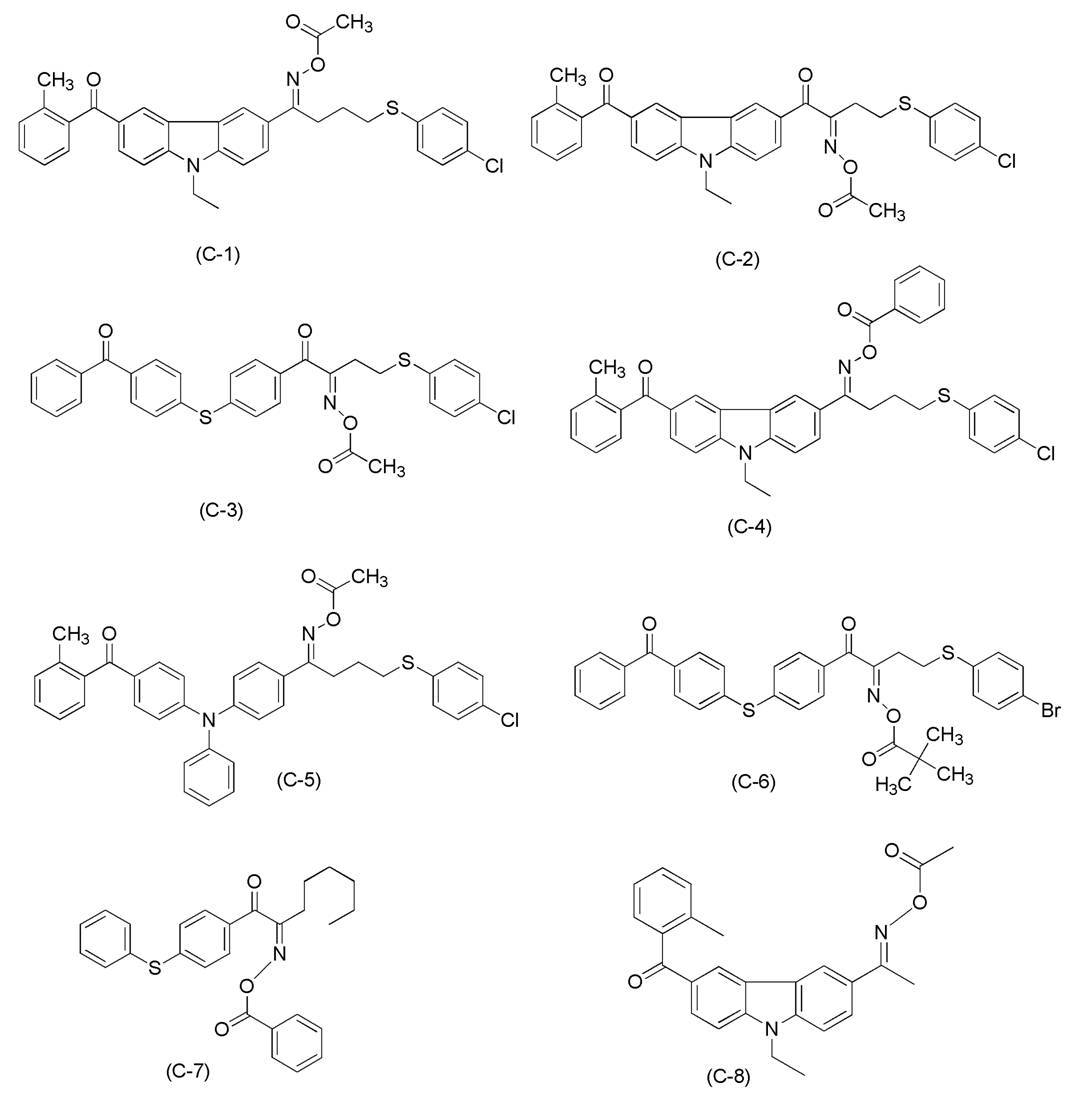

オキシム化合物は、350nm~500nmの波長領域に極大吸収波長を有する化合物が好ましく、360nm~480nmの波長領域に吸収波長を有する化合物がより好ましく、365nm及び405nmの吸光度が高い化合物が特に好ましい。
オキシム化合物は、365nm又は405nmにおけるモル吸光係数が、感度の観点から、1,000~300,000であることが好ましく、2,000~300,000であることがより好ましく、5,000~200,000であることが特に好ましい。化合物のモル吸光係数の測定は、公知の方法を用いることができるが、具体的には、例えば、紫外可視分光光度計(Varian(株)製、Cary-5 spectrophotometer)にて、酢酸エチル溶媒を用い、0.01g/Lの濃度で測定することが好ましい。
光重合開始剤の含有量は、組成物の全固形分に対し0.1~50質量%が好ましく、より好ましくは0.5~30質量%であり、さらに好ましくは1~20質量%である。この範囲で、より良好な感度とパターン形成性が得られる。組成物は、光重合開始剤を、1種類のみを含んでいてもよいし、2種類以上含んでいてもよい。2種類以上含む場合は、その合計量が上記範囲となることが好ましい。
<<酸化防止剤>>
本発明の組成物は、酸化防止剤を含有することが好ましい。酸化防止剤としては、フェノール化合物、亜リン酸エステル化合物、チオエーテル化合物などが挙げられ、分子量500以上のフェノール化合物、分子量500以上の亜リン酸エステル化合物又は分子量500以上のチオエーテル化合物が好ましい。また、酸化防止剤は、フェノール化合物が好ましく、分子量500以上のフェノール化合物がより好ましい。なお、酸化防止剤は、重合禁止剤として機能しうることもある。
本発明の組成物は、酸化防止剤を含有することが好ましい。酸化防止剤としては、フェノール化合物、亜リン酸エステル化合物、チオエーテル化合物などが挙げられ、分子量500以上のフェノール化合物、分子量500以上の亜リン酸エステル化合物又は分子量500以上のチオエーテル化合物が好ましい。また、酸化防止剤は、フェノール化合物が好ましく、分子量500以上のフェノール化合物がより好ましい。なお、酸化防止剤は、重合禁止剤として機能しうることもある。
フェノール化合物としては、フェノール系酸化防止剤として知られる任意のフェノール化合物を使用することができる。好ましいフェノール化合物としては、ヒンダードフェノール化合物が挙げられる。特に、フェノール性ヒドロキシ基に隣接する部位(オルト位)に置換基を有する化合物が好ましい。前述の置換基としては炭素数1~22の置換又は無置換のアルキル基が好ましく、メチル基、エチル基、プロピル基、イソプロピル基、ブチル基、イソブチル基、t-ブチル基、ペンチル基、イソペンチル基、t-ペンチル基、ヘキシル基、オクチル基、イソオクチル基、2-エチルへキシル基がより好ましい。また、同一分子内にフェノール基と亜リン酸エステル基を有する化合物も好ましい。
フェノール化合物は、多置換フェノール系化合物が好ましい。多置換フェノール系化合物は、大きく分けてその置換位置および構造の違う3種類((A)ヒンダードタイプ、(B)セミヒンダードタイプ、(C)レスヒンダードタイプ)がある。
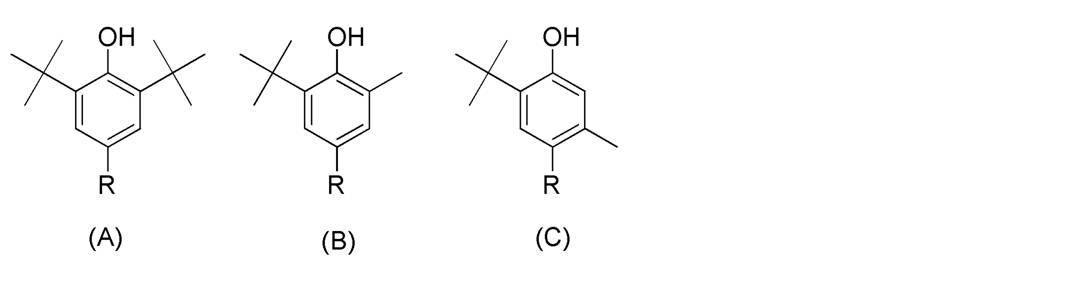
式(A)~(C)において、Rは置換基であり、水素原子、ハロゲン原子、置換基を有してもよいアミノ基、置換基を有してもよいアルキル基、置換基を有してもよいアリール基、置換基を有してもよいアルコキシ基、置換基を有してもよいアリールオキシ基、置換基を有してもよいアルキルアミノ基、置換基を有してもよいアリールアミノ基、置換基を有してもよいアルキルスルホニル基、置換基を有してもよいアリールスルホニル基などが挙げられ、なかでも置換基を有してもよいアミノ基、置換基を有してもよいアルキル基、置換基を有してもよいアリール基、置換基を有してもよいアルコキシ基、置換基を有してもよいアリールオキシ基、置換基を有してもよいアルキルアミノ基、置換基を有してもよいアリールアミノ基が好ましい。
式(A)~(C)において、Rは置換基であり、水素原子、ハロゲン原子、置換基を有してもよいアミノ基、置換基を有してもよいアルキル基、置換基を有してもよいアリール基、置換基を有してもよいアルコキシ基、置換基を有してもよいアリールオキシ基、置換基を有してもよいアルキルアミノ基、置換基を有してもよいアリールアミノ基、置換基を有してもよいアルキルスルホニル基、置換基を有してもよいアリールスルホニル基などが挙げられ、なかでも置換基を有してもよいアミノ基、置換基を有してもよいアルキル基、置換基を有してもよいアリール基、置換基を有してもよいアルコキシ基、置換基を有してもよいアリールオキシ基、置換基を有してもよいアルキルアミノ基、置換基を有してもよいアリールアミノ基が好ましい。
フェノール化合物は、上記式(A)~(C)で表される構造が同一分子内に複数存在する化合物が好ましく、上記式(A)~(C)で表される構造が同一分子内に2~4個存在する化合物がより好ましい。
フェノール化合物としては、例えばp-メトキシフェノール、ジ-tert-ブチル-p-クレゾール、ピロガロール、tert-ブチルカテコール、4,4-チオビス(3-メチル-6-tert-ブチルフェノール)、2,2'-メチレンビス(4-メチル-6-t-ブチルフェノール)、フェノール樹脂類、及びクレゾール樹脂類からなる群より選択される化合物などが挙げられる。
市販品として入手できる代表例には、(A)としてはSumilizer BHT (住友化学製)、Irganox 1010、1222(BASF社製)、アデカスタブAO-20、AO-50、AO-50F、AO-60、AO-60G、AO-330((株)ADEKA製)などがあり、(B)としてはSumilizer BBM-S(住友化学(株)製)、Irganox 245(BASF社製)、アデカスタブAO-80((株)ADEKA製)などがあり、(C)としてはアデカスタブAO-30、AO-40((株)ADEKA製)などがある。
市販品として入手できる代表例には、(A)としてはSumilizer BHT (住友化学製)、Irganox 1010、1222(BASF社製)、アデカスタブAO-20、AO-50、AO-50F、AO-60、AO-60G、AO-330((株)ADEKA製)などがあり、(B)としてはSumilizer BBM-S(住友化学(株)製)、Irganox 245(BASF社製)、アデカスタブAO-80((株)ADEKA製)などがあり、(C)としてはアデカスタブAO-30、AO-40((株)ADEKA製)などがある。
亜リン酸エステル化合物としては、トリス[2-[[2,4,8,10-テトラキス(1,1-ジメチルエチル)ジベンゾ[d,f][1,3,2]ジオキサホスフェピン-6-イル]オキシ]エチル]アミン、トリス[2-[(4,6,9,11-テトラ-tert-ブチルジベンゾ[d,f][1,3,2]ジオキサホスフェピン-2-イル)オキシ]エチル]アミン、および亜りん酸エチルビス(2,4-ジtert-ブチル-6-メチルフェニル)からなる群から選ばれる少なくとも1種の化合物が挙げられる。
酸化防止剤は、上述したもののほか、アデカスタブ PEP-36A、アデカスタブ AO-412S((株)ADEKA)などを用いることもできる。
酸化防止剤の含有量は、組成物の全固形分に対して、0.01~20質量%が好ましく、0.3~15質量%がより好ましい。酸化防止剤は、1種類のみでもよく、2種類以上でもよい。2種類以上の場合は、合計量が上記範囲となることが好ましい。
<<シランカップリング剤>>
本発明の組成物は、シランカップリング剤を含有することができる。本発明において、「シランカップリング剤」は、加水分解性基とそれ以外の官能基とを有するシラン化合物を意味する。また、「加水分解性基」とは、珪素原子に直結し、加水分解反応及び/又は縮合反応によってシロキサン結合を生じ得る置換基をいう。加水分解性基としては、例えば、ハロゲン原子、アルコキシ基、アシルオキシ基などが挙げられ、アルコキシ基が好ましい。すなわち、シランカップリング剤は、アルコキシシリル基を有する化合物が好ましい。また、加水分解性基以外の官能基は、樹脂との間で相互作用もしくは結合形成して親和性を示す基を有することが好ましい。例えば、(メタ)アクリロイル基、フェニル基、メルカプト基、エポキシ基、オキセタニル基が挙げられ、(メタ)アクリロイル基およびエポキシ基が好ましい。即ち、シランカップリング剤は、アルコキシシリル基と、(メタ)アクリロイル基および/またはエポキシ基と、を有する化合物が好ましい。
本発明の組成物は、シランカップリング剤を含有することができる。本発明において、「シランカップリング剤」は、加水分解性基とそれ以外の官能基とを有するシラン化合物を意味する。また、「加水分解性基」とは、珪素原子に直結し、加水分解反応及び/又は縮合反応によってシロキサン結合を生じ得る置換基をいう。加水分解性基としては、例えば、ハロゲン原子、アルコキシ基、アシルオキシ基などが挙げられ、アルコキシ基が好ましい。すなわち、シランカップリング剤は、アルコキシシリル基を有する化合物が好ましい。また、加水分解性基以外の官能基は、樹脂との間で相互作用もしくは結合形成して親和性を示す基を有することが好ましい。例えば、(メタ)アクリロイル基、フェニル基、メルカプト基、エポキシ基、オキセタニル基が挙げられ、(メタ)アクリロイル基およびエポキシ基が好ましい。即ち、シランカップリング剤は、アルコキシシリル基と、(メタ)アクリロイル基および/またはエポキシ基と、を有する化合物が好ましい。
シランカップリング剤の具体例としては、例えば、1,6-ビス(トリメトキシシリル)ヘキサン、トリフルオロプロピルトリメトキシシラン、ヘキサメチルジシラザン、ビニルトリメトキシシラン、ビニルトリエトキシシラン、2-(3,4-エポキシシクロヘキシル)エチルトリメトキシシラン、3-グリシドキシプロピルメチルジメトキシシラン、3-グリシドキシプロピルトリメトキシシラン、3-グリシドキシプロピルメチルジエトキシシラン、3-グリシドキシプロピルトリエトキシシラン、p-スチリルトリメトキシシラン、3-メタクリロキシプロピルメチルジメトキシシラン、3-メタクリロキシプロピルトリメトキシシラン、3-メタクリロキシプロピルメチルジエトキシシラン、3-メタクリロキシプロピルトリエトキシシラン、3-アクリロキシプロピルトリメトキシシラン、N-2-(アミノメチルエチル)-3-アミノプロピルメチルジメトキシシラン、N-2-(アミノエチル)-3-アミノプロピルメチルジメトキシシラン、N-2-(アミノエチル)-3-アミノプロピルトリメトキシシラン、3-アミノプロピルトリメトキシシラン、3-アミノプロピルトリエトキシシラン、3-トリエトキシシリル-N-(1,3-ジメチル-ブチリデン)プロピルアミン、N-フェニル-3-アミノプロピルトリメトキシシラン、N-(ビニルベンジル)-2-アミノエチル-3-アミノプロピルトリメトキシシランの塩酸塩、トリス(トリメトキシシリルプロピル)イソシアヌレート、3-ウレイドプロピルトリエトキシシラン、3-メルカプトプロピルメチルジメトキシシラン、3-メルカプトプロピルトリメトキシシラン、ビス(トリエトキシシリルプロピル)テトラスルフィド、3-イソシアネートプロピルトリエトキシシランなどが挙げられる。また、上記以外にアルコキシオリゴマーを用いることができる。また、下記化合物を用いることもできる。
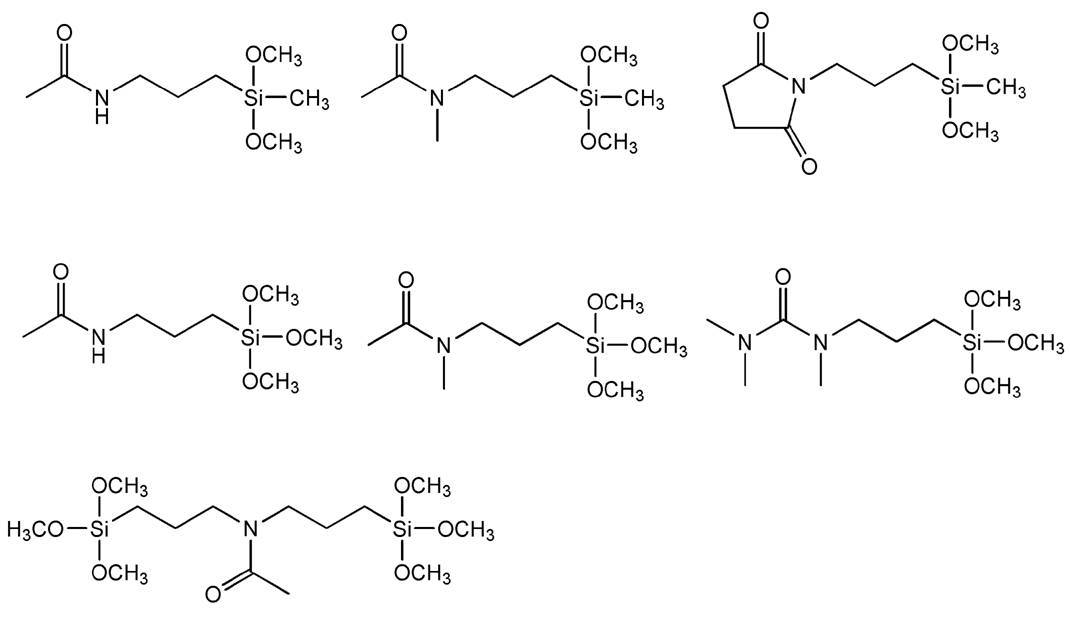
市販品としては、信越シリコーン(株)製のKBM-13、KBM-22、KBM-103、KBE-13、KBE-22、KBE-103、KBM-3033、KBE-3033、KBM-3063、KBM-3066、KBM-3086、KBE-3063、KBE-3083、KBM-3103、KBM-3066、KBM-7103、SZ-31、KPN-3504、KBM-1003、KBE-1003、KBM-303、KBM-402、KBM-403、KBE-402、KBE-403、KBM-1403、KBM-502、KBM-503、KBE-502、KBE-503、KBM-5103、KBM-602、KBM-603、KBM-903、KBE-903、KBE-9103、KBM-573、KBM-575、KBM-9659、KBE-585、KBM-802、KBM-803、KBE-846、KBE-9007、X-40-1053、X-41-1059A、X-41-1056、X-41-1805、X-41-1818、X-41-1810、X-40-2651、X-40-2655A、KR-513、KC-89S、KR-500、KR-516、KR-517、X-40-9296、X-40-9225、X-40-9246、X-40-9250、KR-401N、X-40-9227、X-40-9247、KR-510、KR-9218、KR-213、X-40-2308、X-40-9238などが挙げられる。また、シランカップリング剤は、特開2009-288703号公報の段落番号0018~0036に記載の化合物、特開2009-242604号公報の段落番号0056~0066に記載の化合物が挙げられ、この内容は本明細書に組み込まれる。
シランカップリング剤の含有量は、組成物の全固形分に対して、0.01~15.0質量%が好ましく、0.05~10.0質量%がより好ましい。シランカップリング剤は、1種類のみでもよく、2種類以上でもよい。2種類以上の場合は、合計量が上記範囲となることが好ましい。
<<増感剤>>
本発明の組成物は、光重合開始剤のラジカル発生効率の向上、感光波長の長波長化の目的で、増感剤を含有していてもよい。増感剤としては、光重合開始剤に対し、電子移動機構又はエネルギー移動機構で増感させるものが好ましい。増感剤は、300nm~450nmの波長領域に吸収波長を有するものが挙げられる。具体的には、特開2010-106268号公報の段落番号0231~0253(対応する米国特許出願公開第2011/0124824号明細書の<0256>~<0273>)の説明を参酌でき、これらの内容は本明細書に組み込まれる。
本発明の組成物は、光重合開始剤のラジカル発生効率の向上、感光波長の長波長化の目的で、増感剤を含有していてもよい。増感剤としては、光重合開始剤に対し、電子移動機構又はエネルギー移動機構で増感させるものが好ましい。増感剤は、300nm~450nmの波長領域に吸収波長を有するものが挙げられる。具体的には、特開2010-106268号公報の段落番号0231~0253(対応する米国特許出願公開第2011/0124824号明細書の<0256>~<0273>)の説明を参酌でき、これらの内容は本明細書に組み込まれる。
増感剤の含有量は、組成物の全固形分に対して、0.1~20質量%が好ましく、0.5~15質量%がより好ましい。増感剤は、1種類のみでもよく、2種類以上でもよい。2種類以上の場合は、合計量が上記範囲となることが好ましい。
<<共増感剤>>
本発明の組成物は、更に共増感剤を含有することも好ましい。共増感剤は、光重合開始剤や増感剤の活性放射線に対する感度を一層向上させる、あるいは、重合性化合物の重合阻害を抑制する等の作用を有する。共増感剤としては、具体的には、特開2010-106268号公報の段落番号0254~0257(対応する米国特許出願公開第2011/0124824号明細書の<0277>~<0279>)の説明を参酌でき、これらの内容は本明細書に組み込まれる。
本発明の組成物は、更に共増感剤を含有することも好ましい。共増感剤は、光重合開始剤や増感剤の活性放射線に対する感度を一層向上させる、あるいは、重合性化合物の重合阻害を抑制する等の作用を有する。共増感剤としては、具体的には、特開2010-106268号公報の段落番号0254~0257(対応する米国特許出願公開第2011/0124824号明細書の<0277>~<0279>)の説明を参酌でき、これらの内容は本明細書に組み込まれる。
共増感剤の含有量は、重合成長速度と、硬化速度の向上の観点から、組成物の全固形分に対して、0.1~30質量%が好ましく、1~25質量%がより好ましく、1.5~20質量%が更に好ましい。共増感剤は1種類のみでもよく、2種類以上でもよい。2種類以上の場合は、合計量が上記範囲となることが好ましい。
<<重合禁止剤>>
本発明の組成物は、組成物の製造中あるいは保存中において、エチレン性不飽和結合を有する基を有する化合物(例えば、重合性化合物など)の不要な重合を阻止するために、重合禁止剤を添加することが好ましい。重合禁止剤は、ハイドロキノン、p-メトキシフェノール、ジ-tert-ブチル-p-クレゾール、ピロガロール、tert-ブチルカテコール、ベンゾキノン、4,4'-チオビス(3-メチル-6-tert-ブチルフェノール)、2,2'-メチレンビス(4-メチル-6-tert-ブチルフェノール)、N-ニトロソフェニルヒドロキシアミン塩(アンモニウム塩、第一セリウム塩等)が挙げられる。中でも、p-メトキシフェノールが好ましい。なお、重合禁止剤は、酸化防止剤として機能しうることもある。
本発明の組成物は、組成物の製造中あるいは保存中において、エチレン性不飽和結合を有する基を有する化合物(例えば、重合性化合物など)の不要な重合を阻止するために、重合禁止剤を添加することが好ましい。重合禁止剤は、ハイドロキノン、p-メトキシフェノール、ジ-tert-ブチル-p-クレゾール、ピロガロール、tert-ブチルカテコール、ベンゾキノン、4,4'-チオビス(3-メチル-6-tert-ブチルフェノール)、2,2'-メチレンビス(4-メチル-6-tert-ブチルフェノール)、N-ニトロソフェニルヒドロキシアミン塩(アンモニウム塩、第一セリウム塩等)が挙げられる。中でも、p-メトキシフェノールが好ましい。なお、重合禁止剤は、酸化防止剤として機能しうることもある。
重合禁止剤の含有量は、光重合開始剤100質量部に対して、0.01質量部~10質量部が好ましく、0.01~8質量部がより好ましく、0.01~5質量部が最も好ましい。
<<界面活性剤>>
本発明の組成物は、塗布性をより向上させる観点から、各種の界面活性剤を添加してもよい。界面活性剤としては、フッ素系界面活性剤、ノニオン系界面活性剤、カチオン系界面活性剤、アニオン系界面活性剤、シリコーン系界面活性剤などの各種界面活性剤を使用できる。
本発明の組成物は、塗布性をより向上させる観点から、各種の界面活性剤を添加してもよい。界面活性剤としては、フッ素系界面活性剤、ノニオン系界面活性剤、カチオン系界面活性剤、アニオン系界面活性剤、シリコーン系界面活性剤などの各種界面活性剤を使用できる。
特に、本発明の組成物が、フッ素系界面活性剤を含有することで、塗布液として調製したときの液特性(特に、流動性)がより向上することから、塗布厚の均一性や省液性をより改善することができる。
即ち、フッ素系界面活性剤を含有する組成物を適用した塗布液を用いて膜形成する場合においては、被塗布面と塗布液との界面張力を低下させることにより、被塗布面への濡れ性が改善され、被塗布面への塗布性が向上する。このため、少量の液量で数μm程度の薄膜を形成した場合であっても、厚みムラの小さい均一厚の膜形成をより好適に行える点で有効である。
即ち、フッ素系界面活性剤を含有する組成物を適用した塗布液を用いて膜形成する場合においては、被塗布面と塗布液との界面張力を低下させることにより、被塗布面への濡れ性が改善され、被塗布面への塗布性が向上する。このため、少量の液量で数μm程度の薄膜を形成した場合であっても、厚みムラの小さい均一厚の膜形成をより好適に行える点で有効である。
フッ素系界面活性剤のフッ素含有率は、3~40質量%が好ましい。下限は、5質量%以上が好ましく、7質量%以上が更に好ましい。上限は、30質量%以下が好ましく、25質量%以下が更に好ましい。フッ素含有率が上述した範囲内である場合は、塗布膜の厚さの均一性や省液性の点で効果的であり、溶解性も良好である。
フッ素系界面活性剤として具体的には、特開2014-41318号公報の段落番号0060~0064(対応する国際公開2014/17669号公報の段落番号0060~0064)等に記載の界面活性剤、特開2011-132503号公報の段落番号0117~0132に記載の界面活性剤が挙げられ、これらの内容は本明細書に組み込まれる。フッ素系界面活性剤の市販品としては、例えば、メガファック F-171、同F-172、同F-173、同F-176、同F-177、同F-141、同F-142、同F-143、同F-144、同R30、同F-437、同F-475、同F-479、同F-482、同F-554、同F-780(以上、DIC(株)製)、フロラードFC430、同FC431、同FC171(以上、住友スリーエム(株)製)、サーフロンS-382、同SC-101、同SC-103、同SC-104、同SC-105、同SC-1068、同SC-381、同SC-383、同S-393、同KH-40(以上、旭硝子(株)製)、PolyFox PF636、PF656、PF6320、PF6520、PF7002(以上、OMNOVA社製)等が挙げられる。フッ素系界面活性剤は、特開2015-117327号公報の段落番号0015~0158に記載の化合物を用いることもできる。また、下記化合物をフッ素系界面活性剤として用いることもできる。
フッ素系界面活性剤として具体的には、特開2014-41318号公報の段落番号0060~0064(対応する国際公開2014/17669号公報の段落番号0060~0064)等に記載の界面活性剤、特開2011-132503号公報の段落番号0117~0132に記載の界面活性剤が挙げられ、これらの内容は本明細書に組み込まれる。フッ素系界面活性剤の市販品としては、例えば、メガファック F-171、同F-172、同F-173、同F-176、同F-177、同F-141、同F-142、同F-143、同F-144、同R30、同F-437、同F-475、同F-479、同F-482、同F-554、同F-780(以上、DIC(株)製)、フロラードFC430、同FC431、同FC171(以上、住友スリーエム(株)製)、サーフロンS-382、同SC-101、同SC-103、同SC-104、同SC-105、同SC-1068、同SC-381、同SC-383、同S-393、同KH-40(以上、旭硝子(株)製)、PolyFox PF636、PF656、PF6320、PF6520、PF7002(以上、OMNOVA社製)等が挙げられる。フッ素系界面活性剤は、特開2015-117327号公報の段落番号0015~0158に記載の化合物を用いることもできる。また、下記化合物をフッ素系界面活性剤として用いることもできる。
また、フッ素系界面活性剤は、フッ素原子を含有する官能基を持つ分子構造で、熱を加えると官能基の部分が切れてフッ素原子が揮発するアクリル系化合物も好適に使用できる。フッ素原子の官能基を持つ分子構造で、熱を加えると官能基の部分が切断されてフッ素原子が揮発するアクリル系化合物としてはDIC(株)製のメガファックDSシリーズ(化学工業日報、2016年2月22日)(日経産業新聞、2016年2月23日)、例えばメガファックDS-21を用いてもよい。
フッ素系界面活性剤として、ブロックポリマーを用いることもできる。例えば特開2011-89090号公報に記載された化合物が挙げられる。フッ素系界面活性剤としては、フッ素原子を有する(メタ)アクリレート化合物に由来する繰り返し単位と、アルキレンオキシ基(好ましくはエチレンオキシ基、プロピレンオキシ基)を2以上(好ましくは5以上)有する(メタ)アクリレート化合物に由来する繰り返し単位とを含む、含フッ素高分子化合物も好ましく用いることができる。下記化合物も本発明で用いられるフッ素系界面活性剤として例示される。
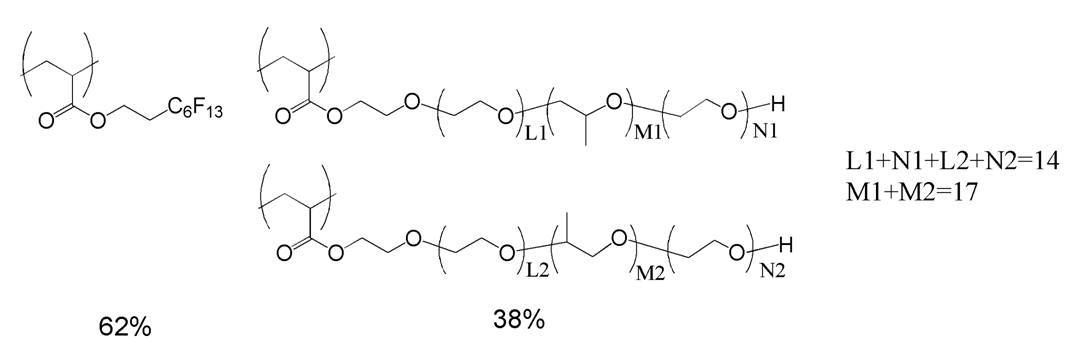
上記の化合物の重量平均分子量は、好ましくは3,000~50,000であり、例えば、14,000である。上記の化合物中、繰り返し単位の割合を示す%は質量%である。
上記の化合物の重量平均分子量は、好ましくは3,000~50,000であり、例えば、14,000である。上記の化合物中、繰り返し単位の割合を示す%は質量%である。
また、フッ素系界面活性剤として、エチレン性不飽和結合を有する基を側鎖に有する含フッ素重合体を用いることもできる。具体例としては、特開2010-164965号公報の段落番号0050~0090および0289~0295に記載された化合物、例えばDIC(株)製のメガファックRS-101、RS-102、RS-718K、RS-72-K等が挙げられる。フッ素系界面活性剤として、特開2015-117327号公報の段落番号0015~0158に記載の化合物を用いることもできる。
ノニオン系界面活性剤としては、グリセロール、トリメチロールプロパン、トリメチロールエタン並びにそれらのエトキシレート及びプロポキシレート(例えば、グリセロールプロポキシレート、グリセリンエトキシレート等)、ポリオキシエチレンラウリルエーテル、ポリオキシエチレンステアリルエーテル、ポリオキシエチレンオレイルエーテル、ポリオキシエチレンオクチルフェニルエーテル、ポリオキシエチレンノニルフェニルエーテル、ポリエチレングリコールジラウレート、ポリエチレングリコールジステアレート、ソルビタン脂肪酸エステル(BASF社製のプルロニックL10、L31、L61、L62、10R5、17R2、25R2、テトロニック304、701、704、901、904、150R1)、パイオニンD-6512、D-6414、D-6112、D-6115、D-6120、D-6131、D-6108-W、D-6112-W、D-6115-W、D-6115-X、D-6120-X(竹本油脂(株)製)等が挙げられる。
カチオン系界面活性剤としては、オルガノシロキサンポリマーKP341(信越化学工業(株)製)、(メタ)アクリル酸系(共)重合体ポリフローNo.75、No.90、No.95(共栄社化学(株)製)、W001(裕商(株)製)等が挙げられる。
アニオン系界面活性剤としては、W004、W005、W017(裕商(株)製)等が挙げられる。
シリコーン系界面活性剤としては、例えば、東レ・ダウコーニング(株)製「トーレシリコーンDC3PA」、「トーレシリコーンSH7PA」、「トーレシリコーンDC11PA」、「トーレシリコーンSH21PA」、「トーレシリコーンSH28PA」、「トーレシリコーンSH29PA」、「トーレシリコーンSH30PA」、「トーレシリコーンSH8400」、モメンティブ・パフォーマンス・マテリアルズ(株)製「TSF-4440」、「TSF-4300」、「TSF-4445」、「TSF-4460」、「TSF-4452」、信越シリコーン(株)製「KP341」、「KF6001」、「KF6002」、ビックケミー(株)製「BYK307」、「BYK323」、「BYK330」等が挙げられる。
カチオン系界面活性剤としては、オルガノシロキサンポリマーKP341(信越化学工業(株)製)、(メタ)アクリル酸系(共)重合体ポリフローNo.75、No.90、No.95(共栄社化学(株)製)、W001(裕商(株)製)等が挙げられる。
アニオン系界面活性剤としては、W004、W005、W017(裕商(株)製)等が挙げられる。
シリコーン系界面活性剤としては、例えば、東レ・ダウコーニング(株)製「トーレシリコーンDC3PA」、「トーレシリコーンSH7PA」、「トーレシリコーンDC11PA」、「トーレシリコーンSH21PA」、「トーレシリコーンSH28PA」、「トーレシリコーンSH29PA」、「トーレシリコーンSH30PA」、「トーレシリコーンSH8400」、モメンティブ・パフォーマンス・マテリアルズ(株)製「TSF-4440」、「TSF-4300」、「TSF-4445」、「TSF-4460」、「TSF-4452」、信越シリコーン(株)製「KP341」、「KF6001」、「KF6002」、ビックケミー(株)製「BYK307」、「BYK323」、「BYK330」等が挙げられる。
界面活性剤の含有量は、組成物の全固形分に対して、0.001質量%~5.0質量%が好ましく、0.005~3.0質量%がより好ましい。界面活性剤は、1種類のみでもよく、2種類以上でもよい。2種類以上の場合は、合計量が上記範囲となることが好ましい。
<<紫外線吸収剤>>
本発明の組成物は、紫外線吸収剤を含有してもよい。紫外線吸収剤は、共役ジエン系化合物が好ましく、下記式(UV)で表される化合物がより好ましい。

本発明の組成物は、紫外線吸収剤を含有してもよい。紫外線吸収剤は、共役ジエン系化合物が好ましく、下記式(UV)で表される化合物がより好ましい。
式(UV)において、R1及びR2は、各々独立に、水素原子、炭素原子数1~20のアルキル基、又は炭素原子数6~20のアリール基を表し、R1とR2とは互いに同一でも異なっていてもよいが、同時に水素原子を表すことはない。
R1及びR2は、R1及びR2が結合する窒素原子と共に、環状アミノ基を形成してもよい。環状アミノ基としては、例えば、ピペリジノ基、モルホリノ基、ピロリジノ基、ヘキサヒドロアゼピノ基、ピペラジノ基等が挙げられる。
R1及びR2は、各々独立に、炭素原子数1~20のアルキル基が好ましく、炭素原子数1~10のアルキル基がより好ましく、炭素原子数1~5のアルキル基がさらに好ましい。
R3及びR4は、電子求引基を表す。ここで電子求引基は、ハメットの置換基定数σp値(以下、単に「σp値」という。)が、0.20以上1.0以下の電子求引基である。好ましくは、σp値が0.30以上0.8以下の電子求引基である。R3及びR4は互いに結合して環を形成してもよい。R3及びR4は、アシル基、カルバモイル基、アルキルオキシカルボニル基、アリールオキシカルボニル基、シアノ基、ニトロ基、アルキルスルホニル基、アリールスルホニル基、スルホニルオキシ基、スルファモイル基が好ましく、アシル基、カルバモイル基、アルキルオキシカルボニル基、アリールオキシカルボニル基、シアノ基、アルキルスルホニル基、アリールスルホニル基、スルホニルオキシ基、スルファモイル基がより好ましい。
上記のR1、R2、R3、及びR4の少なくとも1つは、連結基を介して、ビニル基と結合したモノマーより導かれるポリマーの形になっていてもよい。他のモノマーとの共重合体であっても良い。
R1及びR2は、R1及びR2が結合する窒素原子と共に、環状アミノ基を形成してもよい。環状アミノ基としては、例えば、ピペリジノ基、モルホリノ基、ピロリジノ基、ヘキサヒドロアゼピノ基、ピペラジノ基等が挙げられる。
R1及びR2は、各々独立に、炭素原子数1~20のアルキル基が好ましく、炭素原子数1~10のアルキル基がより好ましく、炭素原子数1~5のアルキル基がさらに好ましい。
R3及びR4は、電子求引基を表す。ここで電子求引基は、ハメットの置換基定数σp値(以下、単に「σp値」という。)が、0.20以上1.0以下の電子求引基である。好ましくは、σp値が0.30以上0.8以下の電子求引基である。R3及びR4は互いに結合して環を形成してもよい。R3及びR4は、アシル基、カルバモイル基、アルキルオキシカルボニル基、アリールオキシカルボニル基、シアノ基、ニトロ基、アルキルスルホニル基、アリールスルホニル基、スルホニルオキシ基、スルファモイル基が好ましく、アシル基、カルバモイル基、アルキルオキシカルボニル基、アリールオキシカルボニル基、シアノ基、アルキルスルホニル基、アリールスルホニル基、スルホニルオキシ基、スルファモイル基がより好ましい。
上記のR1、R2、R3、及びR4の少なくとも1つは、連結基を介して、ビニル基と結合したモノマーより導かれるポリマーの形になっていてもよい。他のモノマーとの共重合体であっても良い。
式(UV)で示される紫外線吸収剤の具体例としては、下記化合物が挙げられる。式(UV)で示される紫外線吸収剤の置換基の説明は、WO2009/123109Aの段落番号0024~0033(対応する米国特許出願公開第2011/0039195号明細書の<0040>~<0059>)の記載を参酌でき、これらの内容は本明細書に組み込まれる。式(I)で表される化合物の好ましい具体例は、WO2009/123109Aの段落番号0034~0037(対応する米国特許出願公開第2011/0039195号明細書の<0060>)の例示化合物(1)~(14)の記載を参酌でき、これらの内容は本明細書に組み込まれる。

紫外線吸収剤の市販品としては、例えば、UV503(大東化学(株)製)などが挙げられる。また、紫外線吸収剤は、アミノジエン系化合物、サリシレート系化合物、ベンゾフェノン系化合物、ベンゾトリアゾール系化合物、アクリロニトリル系化合物、トリアジン系化合物等の紫外線吸収剤を用いることができる。具体例としては特開2013-68814号に記載の化合物が挙げられる。ベンゾトリアゾール系化合物としてはミヨシ油脂製のMYUAシリーズ(化学工業日報、2016年2月1日)を用いてもよい。
紫外線吸収剤の含有量は、組成物の全固形分に対して、0.1~10質量%が好ましく、0.1~5質量%がより好ましく、0.1~3質量%が特に好ましい。また、本発明においては、紫外線吸収剤は、1種類のみでもよく、2種類以上でもよい。2種類以上の場合は、合計量が上記範囲となることが好ましい。
紫外線吸収剤の含有量は、組成物の全固形分に対して、0.1~10質量%が好ましく、0.1~5質量%がより好ましく、0.1~3質量%が特に好ましい。また、本発明においては、紫外線吸収剤は、1種類のみでもよく、2種類以上でもよい。2種類以上の場合は、合計量が上記範囲となることが好ましい。
<<その他の添加剤>>
本発明の組成物は、更に、可塑剤や感脂化剤等の公知の添加剤を含有することができる。可塑剤としては、例えば、ジオクチルフタレート、ジドデシルフタレート、トリエチレングリコールジカプリレート、ジメチルグリコールフタレート、トリクレジルホスフェート、ジオクチルアジペート、ジブチルセバケート、トリアセチルグリセリン等が挙げられる。可塑剤の含有量は、硬化性化合物と樹脂との合計質量に対し10質量%以下が好ましい。
本発明の組成物は、更に、可塑剤や感脂化剤等の公知の添加剤を含有することができる。可塑剤としては、例えば、ジオクチルフタレート、ジドデシルフタレート、トリエチレングリコールジカプリレート、ジメチルグリコールフタレート、トリクレジルホスフェート、ジオクチルアジペート、ジブチルセバケート、トリアセチルグリセリン等が挙げられる。可塑剤の含有量は、硬化性化合物と樹脂との合計質量に対し10質量%以下が好ましい。
また、本発明の組成物は、着色剤を含有することができる。着色剤は、顔料であってもよく、染料であってもよい。着色剤の含有量は、組成物の全固形分に対して、0.1~70質量%が好ましく、1~50質量%がより好ましく、10~40質量%がさらに好ましい。着色剤は、1種類のみでもよく、2種類以上でもよい。2種類以上の場合は、合計量が上記範囲となることが好ましい。本発明の組成物は、着色剤を実質的に含有しないこともできる。着色剤を実質的に含有しないとは、組成物の全固形分に対して、0.1質量%以下が好ましく、0.05質量%以下がより好ましく、含有しないことがさらに好ましい。
<<遠赤外線透過性組成物の調製方法>>
本発明の遠赤外線透過性組成物は、前述の成分を混合して調製できる。
遠赤外線透過性組成物の調製に際しては、各成分を一括配合してもよいし、各成分を溶剤に溶解または分散した後に逐次配合してもよい。また、配合する際の投入順序や作業条件は特に制約を受けない。
例えば、高屈折率粒子を媒質(好ましくは溶剤および樹脂)中で分散させて分散液を調製し、得られた分散液と他の成分(例えば、バインダー、硬化性化合物など)とを混合して遠赤外線透過性組成物を調製することもできる。
本発明の遠赤外線透過性組成物は、前述の成分を混合して調製できる。
遠赤外線透過性組成物の調製に際しては、各成分を一括配合してもよいし、各成分を溶剤に溶解または分散した後に逐次配合してもよい。また、配合する際の投入順序や作業条件は特に制約を受けない。
例えば、高屈折率粒子を媒質(好ましくは溶剤および樹脂)中で分散させて分散液を調製し、得られた分散液と他の成分(例えば、バインダー、硬化性化合物など)とを混合して遠赤外線透過性組成物を調製することもできる。
また、高屈折率粒子を分散させるプロセスとしては、高屈折率粒子の分散に用いる機械力として圧縮、圧搾、衝撃、剪断、キャビテーションなどを使用するプロセスが挙げられる。これらプロセスの具体例としては、ビーズミル、サンドミル、ロールミル、ボールミル、ペイントシェーカー、マイクロフルイダイザー、高速インペラー、サンドグラインダー、フロージェットミキサー、高圧湿式微粒化、超音波分散などが挙げられる。また、サンドミル(ビーズミル)における高屈折率粒子の粉砕においては、径の小さいビーズを使用する、ビーズの充填率を大きくする事等により粉砕効率を高めた条件で処理することが好ましい。粉砕処理後にろ過、遠心分離などで粗粒子を除去することも好ましい。「分散技術大全、株式会社情報機構発行、2005年7月15日」や「サスペンション(固/液分散系)を中心とした分散技術と工業的応用の実際 総合資料集、経営開発センター出版部発行、1978年10月10日」、特開2015-157893号公報の段落番号0022に記載のプロセス及び分散機を好適に使用することが出来る。また、高屈折率粒子を分散させるプロセスにおいては、ソルトミリング工程での微細化処理を行ってもよい。ソルトミリング工程に用いられる素材、機器、処理条件等は例えば特開2015-194521号公報、特開2012-046629号公報に記載のものを使用することができる。
遠赤外線透過性組成物の調製にあたり、異物の除去や欠陥の低減などの目的で、各成分を混合後の組成物をフィルタでろ過することが好ましい。フィルタとしては、従来からろ過用途等に用いられているものであれば特に限定されることなく用いることができる。例えば、ポリテトラフルオロエチレン(PTFE)等のフッ素樹脂、ナイロン(例えばナイロン-6、ナイロン-6,6)等のポリアミド系樹脂、ポリエチレン、ポリプロピレン(PP)等のポリオレフィン樹脂(高密度、超高分子量を含む)等を用いたフィルタが挙げられる。これら素材の中でもポリプロピレン(高密度ポリプロピレンを含む)およびナイロンが好ましい。
フィルタの孔径は、0.01~7.0μm程度が適しており、好ましくは0.01~3.0μm程度、さらに好ましくは0.05~0.5μm程度である。この範囲とすることにより、微細な異物を確実に除去することが可能となる。また、ファイバ状のろ材を用いることも好ましく、ろ材としては例えばポリプロピレンファイバ、ナイロンファイバ、グラスファイバ等が挙げられ、具体的にはロキテクノ(株)製のSBPタイプシリーズ(SBP008など)、TPRタイプシリーズ(TPR002、TPR005など)、SHPXタイプシリーズ(SHPX003など)のフィルタカートリッジを用いることができる。
フィルタの孔径は、0.01~7.0μm程度が適しており、好ましくは0.01~3.0μm程度、さらに好ましくは0.05~0.5μm程度である。この範囲とすることにより、微細な異物を確実に除去することが可能となる。また、ファイバ状のろ材を用いることも好ましく、ろ材としては例えばポリプロピレンファイバ、ナイロンファイバ、グラスファイバ等が挙げられ、具体的にはロキテクノ(株)製のSBPタイプシリーズ(SBP008など)、TPRタイプシリーズ(TPR002、TPR005など)、SHPXタイプシリーズ(SHPX003など)のフィルタカートリッジを用いることができる。
フィルタを使用する際、異なるフィルタを組み合わせてもよい。その際、第1のフィルタでのろ過は、1回のみでもよいし、2回以上行ってもよい。
また、上述した範囲内で異なる孔径の第1のフィルタを組み合わせてもよい。ここでの孔径は、フィルタメーカーの公称値を参照することができる。市販のフィルタとしては、例えば、日本ポール株式会社(DFA4201NXEYなど)、アドバンテック東洋株式会社、日本インテグリス株式会社(旧日本マイクロリス株式会社)又は株式会社キッツマイクロフィルタ等が提供する各種フィルタの中から選択することができる。
第2のフィルタは、上述した第1のフィルタと同様の材料等で形成されたものを使用することができる。
例えば、第1のフィルタでのろ過は、分散液のみで行い、他の成分を混合した後で、第2のろ過を行ってもよい。
また、上述した範囲内で異なる孔径の第1のフィルタを組み合わせてもよい。ここでの孔径は、フィルタメーカーの公称値を参照することができる。市販のフィルタとしては、例えば、日本ポール株式会社(DFA4201NXEYなど)、アドバンテック東洋株式会社、日本インテグリス株式会社(旧日本マイクロリス株式会社)又は株式会社キッツマイクロフィルタ等が提供する各種フィルタの中から選択することができる。
第2のフィルタは、上述した第1のフィルタと同様の材料等で形成されたものを使用することができる。
例えば、第1のフィルタでのろ過は、分散液のみで行い、他の成分を混合した後で、第2のろ過を行ってもよい。
<<遠赤外線透過性組成物の用途>>
本発明の遠赤外線透過性組成物は、遠赤外線透過フィルタなどに好ましく用いることができる。具体的には、波長1~14μmの範囲(好ましくは、波長3~5または8~12μmの範囲)における遠赤外線を透過させる遠赤外線透過フィルタなどに好ましく用いることができる。より具体的には、遠赤外線を利用した検査機器やセンサなどに用いる遠赤外線透過フィルタ、集電センサなどの遠赤外線を利用したセンサなどに用いる遠赤外線透過フィルタ、遠赤外線透過率を測定する際の基板材料などに好ましく用いることができる。また、本発明の遠赤外線透過性組成物は、反射防止膜として用いることもできる。
本発明の遠赤外線透過性組成物は、遠赤外線透過フィルタなどに好ましく用いることができる。具体的には、波長1~14μmの範囲(好ましくは、波長3~5または8~12μmの範囲)における遠赤外線を透過させる遠赤外線透過フィルタなどに好ましく用いることができる。より具体的には、遠赤外線を利用した検査機器やセンサなどに用いる遠赤外線透過フィルタ、集電センサなどの遠赤外線を利用したセンサなどに用いる遠赤外線透過フィルタ、遠赤外線透過率を測定する際の基板材料などに好ましく用いることができる。また、本発明の遠赤外線透過性組成物は、反射防止膜として用いることもできる。
本発明の遠赤外線透過性組成物は、基板に塗布などの方法で適用したり、射出、プレスおよび押出しなどの各種成形方法を用いて、遠赤外線透過性に優れた形成体を製造することができる。また、形成体は、公知のセラミックの製造法を用いて製造することもできる。具体的には金型プレス成形法、ラバープレス法、射出成形法、スリップキャスト法、押出成形法などが挙げられる。
本発明の遠赤外線透過性組成物は、波長1~14μmの範囲(好ましくは、波長3~5または8~12μmの範囲)における遠赤外線を透過させる遠赤外線透過フィルタなどに好ましく用いることができる。また、赤外線カメラや、固体撮像素子に組み込んで用いることもできる。
遠赤外線透過フィルタは、本発明の遠赤外線透過性組成物のみで形成することもできる。また、本発明の遠赤外線透過性組成物と、他の基板とを組み合わせて遠赤外線透過フィルタとすることもできる。例えば、基板(例えば、Ge基板やSi基板など)に、本発明の遠赤外線透過性組成物を適用して形成した積層体を、遠赤外線透過フィルタとして用いることも好ましい。
遠赤外線透過フィルタは、本発明の遠赤外線透過性組成物のみで形成することもできる。また、本発明の遠赤外線透過性組成物と、他の基板とを組み合わせて遠赤外線透過フィルタとすることもできる。例えば、基板(例えば、Ge基板やSi基板など)に、本発明の遠赤外線透過性組成物を適用して形成した積層体を、遠赤外線透過フィルタとして用いることも好ましい。
<形成体>
次に、本発明の形成体について説明する。本発明の形成体は、波長10μmにおける屈折率が1.3~5.0である粒子(高屈折率粒子)を含む。高屈折率粒子の波長10μmにおける屈折率の下限は、1.35以上が好ましく、1.4以上がより好ましい。上限は、4.5以下が好ましく、4.0以下がより好ましい。本発明の形成体は、上述した本発明の遠赤外線透過性組成物を用いて得られたものであることが好ましい。
次に、本発明の形成体について説明する。本発明の形成体は、波長10μmにおける屈折率が1.3~5.0である粒子(高屈折率粒子)を含む。高屈折率粒子の波長10μmにおける屈折率の下限は、1.35以上が好ましく、1.4以上がより好ましい。上限は、4.5以下が好ましく、4.0以下がより好ましい。本発明の形成体は、上述した本発明の遠赤外線透過性組成物を用いて得られたものであることが好ましい。
本発明の形成体に含まれる高屈折率粒子の平均一次粒子径は、100μm以下が好ましく、50μm以下がより好ましい。下限は、たとえは、0.001μm以上とすることができ、0.01μm以上とすることもできる。高屈折率粒子の詳細については、上述した遠赤外線透過性組成物で説明した範囲と同様であり、好ましい範囲も同様である。
本発明の形成体は、上述した粒子のほか、更に有機材料を含んでいてもよい。有機材料としては、上述した遠赤外線透過性組成物で説明した材料が挙げられる。例えば、硬化性化合物に由来する有機材料(例えば、硬化性化合物の硬化物)、樹脂などが挙げられる。
本発明の形成体は、波長8~14μmの範囲における平均屈折率が1.3~5.0であることが好ましい。下限は、1.35以上が好ましく、1.4以上がより好ましい。上限は、4.5以下が好ましく、4.0以下がより好ましい。
本発明の形成体は、波長10μmにおける屈折率が1.3~5.0であることが好ましい。下限は、1.35以上が好ましく、1.4以上がより好ましい。上限は、4.5以下が好ましく、4.0以下がより好ましい。
本発明の形成体は、波長8~14μmのすべての範囲において、屈折率が1.3~5.0であることが好ましい。下限は、1.35以上が好ましく、1.4以上がより好ましい。上限は、4.5以下が好ましく、4.0以下がより好ましい。
なお、形成体の屈折率および平均屈折率は、J.A.Woollam社製IR-VASEを用いて測定した値である。また、測定サンプルの波長8~14μmの範囲における屈折率の平均値を、上記平均屈折率とした。
本発明の形成体は、波長10μmにおける屈折率が1.3~5.0であることが好ましい。下限は、1.35以上が好ましく、1.4以上がより好ましい。上限は、4.5以下が好ましく、4.0以下がより好ましい。
本発明の形成体は、波長8~14μmのすべての範囲において、屈折率が1.3~5.0であることが好ましい。下限は、1.35以上が好ましく、1.4以上がより好ましい。上限は、4.5以下が好ましく、4.0以下がより好ましい。
なお、形成体の屈折率および平均屈折率は、J.A.Woollam社製IR-VASEを用いて測定した値である。また、測定サンプルの波長8~14μmの範囲における屈折率の平均値を、上記平均屈折率とした。
本発明の形成体は、波長8~14μmの範囲における平均透過率が、40~99%であることが好ましい。下限は、45%以上が好ましく、50%以上がより好ましい。上限は、97%以下が好ましく、95%以下がより好ましい。
本発明の形成体の波長10μmにおける透過率は、40~99%であることが好ましい。下限は、45%以上が好ましく、50%以上がより好ましい。上限は、97%以下が好ましく、95%以下がより好ましい。
本発明の形成体は、波長8~14μmのすべての範囲において、平均透過率が、40~99%であることが好ましい。下限は、45%以上が好ましく、50%以上がより好ましい。上限は、97%以下が好ましく、95%以下がより好ましい。
なお、形成体の透過率および平均透過率は、NICOLET6700FT-IR(Thermo Scientific製)を用いて測定した値である。また、測定サンプルの波長8~14μmの範囲における透過率の平均値を上記平均透過率とした。
本発明の形成体の波長10μmにおける透過率は、40~99%であることが好ましい。下限は、45%以上が好ましく、50%以上がより好ましい。上限は、97%以下が好ましく、95%以下がより好ましい。
本発明の形成体は、波長8~14μmのすべての範囲において、平均透過率が、40~99%であることが好ましい。下限は、45%以上が好ましく、50%以上がより好ましい。上限は、97%以下が好ましく、95%以下がより好ましい。
なお、形成体の透過率および平均透過率は、NICOLET6700FT-IR(Thermo Scientific製)を用いて測定した値である。また、測定サンプルの波長8~14μmの範囲における透過率の平均値を上記平均透過率とした。
本発明の形成体の形状は、特に限定はない。用途に応じて適宜調整できる。例えば、膜状、板状またはレンズ状が挙げられる。膜状の形成体の場合、厚みは、0.1~5.0μmが好ましく、0.2~4.0μmがより好ましく、0.3~3.0μmがさらに好ましい。板状の形成体の場合、厚みは、100~10000μmが好ましく、200~8000μmがより好ましく、500~5000μmがさらに好ましい。レンズ状の形成体は、凹レンズであってもよく、凸レンズであってもよい。レンズの厚みは適宜調整することができる。
膜状の形成体は、波長10μmにおける屈折率が1.3~5.0である粒子(高屈折率粒子)と媒質とを含む組成物(好ましくは、本発明の遠赤外線透過性組成物)を、基板に適用して組成物層を形成する工程を経て製造できる。また、必要に応じて、組成物層を乾燥する工程、組成物層を硬化する工程、組成物層に対してパターンを形成する工程などを行ってもよい。本発明においては、組成物層を乾燥する工程および組成物層を硬化する工程の少なくとも一方の工程を有することが好ましい。
形成体は、基板から剥離して用いてもよく、基板に積層された状態で用いてもよい。
形成体は、基板から剥離して用いてもよく、基板に積層された状態で用いてもよい。
組成物層を形成する工程において、基板への組成物の適用方法としては、公知の方法を用いることができる。例えば、滴下法(ドロップキャスト);スリットコート法;スプレー法;ロールコート法;回転塗布法(スピンコーティング);流延塗布法;スリットアンドスピン法;プリウェット法(たとえば、特開2009-145395号公報に記載されている方法);インクジェット(例えばオンデマンド方式、ピエゾ方式、サーマル方式)、ノズルジェット等の吐出系印刷、フレキソ印刷、スクリーン印刷、グラビア印刷、反転オフセット印刷、メタルマスク印刷法などの各種印刷法;金型等を用いた転写法;ナノインプリント法などが挙げられる。インクジェットでの適用方法としては、特に限定されず、例えば「広がる・使えるインクジェット-特許に見る無限の可能性-、2005年2月発行、住ベテクノリサーチ」に示された特許公報に記載の方法(特に115ページ~133ページ)や、特開2003-262716号公報、特開2003-185831号公報、特開2003-261827号公報、特開2012-126830号公報、特開2006-169325号公報などに記載の方法が挙げられる。
組成物層を乾燥する工程において、乾燥条件としては、組成物層に含まれる媒質の種類や含有量によって適宜調整することができる。例えば、60~150℃の温度で、30秒間~15分間が好ましい。
組成物層を硬化する工程において、硬化処理としては特に制限はなく、目的に応じて適宜選択することができる。例えば、露光処理、加熱処理などが好適に挙げられる。
露光処理に用いることができる放射線(光)としては、g線、i線等の紫外線が好ましく(特に好ましくはi線)用いられる。照射量(露光量)は、例えば、0.03~2.5J/cm2が好ましく、0.05~1.0J/cm2がより好ましい。
露光時における酸素濃度については適宜選択することができ、大気下で行う他に、例えば酸素濃度が19体積%以下の低酸素雰囲気下(例えば、好ましくは15体積%以下、より好ましくは5体積%以下、さらに好ましくは実質的に無酸素)で露光してもよく、酸素濃度が21体積%を超える高酸素雰囲気下(例えば、好ましくは22体積%以上、より好ましくは30体積%以上、さらに好ましくは50体積%以上)で露光してもよい。また、露光照度は適宜設定することが可能であり、通常1000W/m2~100000W/m2(例えば、好ましくは5000W/m2以上、より好ましくは15000W/m2以上、更に好ましくは35000W/m2)の範囲から選択することができる。酸素濃度と露光照度は適宜条件を組み合わせてよく、例えば、酸素濃度10体積%で照度10000W/m2、酸素濃度35体積%で照度20000W/m2などとすることができる。
露光時における酸素濃度については適宜選択することができ、大気下で行う他に、例えば酸素濃度が19体積%以下の低酸素雰囲気下(例えば、好ましくは15体積%以下、より好ましくは5体積%以下、さらに好ましくは実質的に無酸素)で露光してもよく、酸素濃度が21体積%を超える高酸素雰囲気下(例えば、好ましくは22体積%以上、より好ましくは30体積%以上、さらに好ましくは50体積%以上)で露光してもよい。また、露光照度は適宜設定することが可能であり、通常1000W/m2~100000W/m2(例えば、好ましくは5000W/m2以上、より好ましくは15000W/m2以上、更に好ましくは35000W/m2)の範囲から選択することができる。酸素濃度と露光照度は適宜条件を組み合わせてよく、例えば、酸素濃度10体積%で照度10000W/m2、酸素濃度35体積%で照度20000W/m2などとすることができる。
加熱処理における加熱温度は、100~260℃が好ましい。下限は120℃以上が好ましく、160℃以上がより好ましい。上限は240℃以下が好ましく、220℃以下がより好ましい。加熱時間は、1~180分が好ましい。下限は3分以上が好ましい。上限は120分以下が好ましい。加熱装置としては、特に制限はなく、公知の装置の中から、目的に応じて適宜選択することができ、例えば、ドライオーブン、ホットプレート、赤外線ヒーターなどが挙げられる。
パターンを形成する工程は、フォトリソグラフィ法で組成物層にパターンを形成してもよいし、ドライエッチング法で組成物層にパターンを形成してもよい。
フォトリソグラフィ法で組成物層にパターンを形成する場合、波長10μmにおける屈折率が1.3~5.0である粒子(高屈折率粒子)と媒質とを含む組成物(好ましくは、本発明の遠赤外線透過性組成物)を、基板に適用して組成物層を形成する工程と、組成物層をパターン状に露光する工程と、未露光部を現像除去してパターンを形成する工程とを含む方法などが挙げられる。フォトリソグラフィ法を用いたパターン形成の場合、上述の組成物は、重合性化合物と、光重合開始剤と、アルカリ可溶性樹脂とを含むことが好ましい。
組成物層を形成する工程は、上述した方法を用いて行うことができる。
組成物層をパターン状に露光する工程では、基板上の組成物層に対し、ステッパー等の露光装置を用いて、所定のマスクパターンを有するマスクを介して露光する方法が挙げられる。これにより、露光部分を硬化することができる。
組成物層をパターン状に露光する工程では、基板上の組成物層に対し、ステッパー等の露光装置を用いて、所定のマスクパターンを有するマスクを介して露光する方法が挙げられる。これにより、露光部分を硬化することができる。
未露光部を現像除去する工程において、未露光部の現像除去は、現像液を用いて行うことができる。これにより、未露光部の組成物層が現像液に溶出し、光硬化した部分だけが残る。現像液としては、下地の回路などにダメージを起さない、アルカリ現像液が望ましい。現像液の温度は、例えば、20~30℃が好ましい。現像時間は、20~180秒が好ましく、20~90秒がより好ましい。
アルカリ現像液としては、例えば、水酸化ナトリウム、水酸化カリウム、炭酸ナトリウム、ケイ酸ナトリウム、メタケイ酸ナトリウム、アンモニア水等の無機アルカリ類、エチルアミン、n-プロピルアミン等の第一級アミン類、ジエチルアミン、ジ-n-ブチルアミン等の第二級アミン類、トリエチルアミン、メチルジエチルアミン等の第三級アミン類、ジメチルエタノールアミン、トリエタノールアミン等のアルコールアミン類、ジメチルビス(2-ヒドロキシエチル)アンモニウムヒドロキシド、テトラメチルアンモニウムヒドロキシド、テトラエチルアンモニウムヒドロキシド、テトラプロピルアンモニウムヒドロキシド、テトラブチルアンモニウムヒドロキシド、テトラペンチルアンモニウムヒドロキシド、テトラヘキシルアンモニウムヒドロキシド、テトラオクチルアンモニウムヒドロキシド、エチルトリメチルアンモニウムヒドロキシド、ブチルトリメチルアンモニウムヒドロキシド、メチルトリアミルアンモニウムヒドロキシド、ジブチルジペンチルアンモニウムヒドロキシド等のテトラアルキルアンモニウムヒドロキシド、トリメチルフェニルアンモニウムヒドロキシド、トリメチルベンジルアンモニウムヒドロキシド、トリエチルベンジルアンモニウムヒドロキシド等の第四級アンモニウム塩、ピロール、ピペリジン等の環状アミン類等のアルカリ剤を含むアルカリ性水溶液を使用することができる。更に、上記アルカリ性水溶液にアルコール類、界面活性剤を適当量添加して使用することもできる。アルカリ現像液のアルカリ剤の濃度は、0.001~20質量%が好ましく、0.01~10質量%がより好ましく、0.1~1質量%がさらに好ましい。アルカリ現像液のpHは、10.0~14.0が好ましい。アルカリ現像液のアルカリ剤濃度及びpHは、適宜調整して用いることができる。アルカリ現像液は、例えばメタノール、エタノール等の水溶性有機溶剤や界面活性剤等を適量添加して用いてもよい。
現像後に、更に、加熱や露光を行ってもよい。この態様によれば、膜の硬化をさらに進行して、より強固に硬化した膜を製造できる。
板状またはレンズ状の形成体は、波長10μmにおける屈折率が1.3~5.0である粒子(高屈折率粒子)と媒質とを含む組成物(好ましくは、本発明の遠赤外線透過性組成物)を、公知のセラミックの製造法を用いて製造するができる。具体的には金型プレス成形法、ラバープレス法、射出成形法、スリップキャスト法、押出成形法などが挙げられる。成形条件は、媒質の種類や、用途に応じて適宜調整できる。
本発明の形成体は、遠赤外線透過フィルタ用の形成体として好ましく用いることができる。具体的には、遠赤外線を利用した検査機器やセンサなどに用いる遠赤外線透過フィルタ、集電センサなどの遠赤外線を利用したセンサなどに用いる遠赤外線透過フィルタ、遠赤外線透過率を測定する際の基板材料などに好ましく用いることができる。また、赤外線カメラや、固体撮像素子に組み込んで用いることもできる。
<積層体>
次に、本発明の積層体について説明する。本発明の積層体は、基板と、基板上に設けられた、上述した本発明の形成体とを有する。
次に、本発明の積層体について説明する。本発明の積層体は、基板と、基板上に設けられた、上述した本発明の形成体とを有する。
積層体に用いる基板としては、Ge基板、Si基板、ZnSe基板、ZnS基板、CaF2基板、ITO基板、Al2O3基板、BaF2基板、カルコゲナイドガラス基板、ダイヤモンド基板、石英基板、MgF2基板、LiF基板が好ましく、Ge基板、Si基板、カルコゲナイドガラス基板、ZnS基板、ZnSe基板がより好ましく、Ge基板が更に好ましい。これらの基板を用いることで、遠赤外線透過性に優れた積層体が得られやすい。積層体に用いる基板は、反射防止層、ハードコート層、バリア層などの機能層が形成されていてもよい。
本発明の積層体は、形成体の波長10μmにおける屈折率n1と、形成体に対して形成体の厚み方向で接する層(以下、他の層ともいう)の波長10μmにおける屈折率n2は、以下の関係を満たすことが好ましい。
(n2)0.5-1≦n1≦(n2)0.5+1
上記屈折率n1と上記屈折率n2は、以下の関係を満たすことがより好ましい。
(n2)0.5-0.5≦n1≦(n2)0.5+0.5
上記屈折率n1と上記屈折率n2は、以下の関係を満たすことがさらに好ましい。
(n2)0.5-0.1≦n1≦(n2)0.5+0.1
(n2)0.5-1≦n1≦(n2)0.5+1
上記屈折率n1と上記屈折率n2は、以下の関係を満たすことがより好ましい。
(n2)0.5-0.5≦n1≦(n2)0.5+0.5
上記屈折率n1と上記屈折率n2は、以下の関係を満たすことがさらに好ましい。
(n2)0.5-0.1≦n1≦(n2)0.5+0.1
上記屈折率n1と上記屈折率n2が上述の関係を満たすことで、遠赤外線透過性に優れつつ、反射防止性に優れた積層体とすることができる。
なお、機能層が形成されていない基板上に、直接本発明の形成体が積層されている場合は、基板が他の層に該当する。また、機能層が形成された基板上に本発明の形成体が積層されている場合(すなわち、基板と本発明の形成体との間に機能層が介在している場合は)、本発明の形成体と接する機能層(本発明の形成体直下の機能層)が、他の層に該当する。
なお、機能層が形成されていない基板上に、直接本発明の形成体が積層されている場合は、基板が他の層に該当する。また、機能層が形成された基板上に本発明の形成体が積層されている場合(すなわち、基板と本発明の形成体との間に機能層が介在している場合は)、本発明の形成体と接する機能層(本発明の形成体直下の機能層)が、他の層に該当する。
本発明の積層体は、波長10μmにおける屈折率n1と、形成体の厚みT(単位は、μmである)との積が、以下の関係を満たすことが好ましい。
1.5<T・n1<3.5
上記屈折率n1と上記形成体の厚みTとの積は、以下の関係を満たすことがより好ましい。
2.0<T・n1<3.0
上記屈折率n1と上記形成体の厚みTとの積は、以下の関係を満たすことがさらに好ましい。
2.2<T・n1<2.7
1.5<T・n1<3.5
上記屈折率n1と上記形成体の厚みTとの積は、以下の関係を満たすことがより好ましい。
2.0<T・n1<3.0
上記屈折率n1と上記形成体の厚みTとの積は、以下の関係を満たすことがさらに好ましい。
2.2<T・n1<2.7
上記屈折率n1と上記形成体の厚みTとの積が上述の関係を満たすことで、遠赤外線透過性に優れつつ、反射防止性に優れた積層体とすることができる。
本発明の積層体は、波長1~14μmの範囲(好ましくは、波長3~5μmまたは8~14μmの範囲)における遠赤外線を透過させる遠赤外線透過フィルタなどに好ましく用いることができる。具体的には、遠赤外線を利用した検査機器やセンサなどに用いる遠赤外線透過フィルタ、集電センサなどの遠赤外線を利用したセンサなどに用いる遠赤外線透過フィルタ、遠赤外線透過率を測定する際の基板材料などに好ましく用いることができる。また、赤外線カメラや、固体撮像素子に組み込んで用いることもできる。
<遠赤外線透過フィルタ>
本発明の遠赤外線透過フィルタは、本発明の形成体、または、本発明の積層体を有する。
本発明の遠赤外線透過フィルタは、波長8~14μmの範囲における平均屈折率が1.3~5.0であることが好ましい。下限は、1.35以上が好ましく、1.4以上がより好ましい。上限は、4.5以下が好ましく、4.0以下がより好ましい。
本発明の遠赤外線透過フィルタは、波長10μmにおける屈折率が1.3~5.0であることが好ましい。下限は、1.35以上が好ましく、1.4以上がより好ましい。上限は、4.5以下が好ましく、4.0以下がより好ましい。
本発明の遠赤外線透過フィルタは、波長8~14μmのすべての範囲において、屈折率が1.3~5.0であることが好ましい。下限は、1.35以上が好ましく、1.4以上がより好ましい。上限は、4.5以下が好ましく、4.0以下がより好ましい。
本発明の遠赤外線透過フィルタは、本発明の形成体、または、本発明の積層体を有する。
本発明の遠赤外線透過フィルタは、波長8~14μmの範囲における平均屈折率が1.3~5.0であることが好ましい。下限は、1.35以上が好ましく、1.4以上がより好ましい。上限は、4.5以下が好ましく、4.0以下がより好ましい。
本発明の遠赤外線透過フィルタは、波長10μmにおける屈折率が1.3~5.0であることが好ましい。下限は、1.35以上が好ましく、1.4以上がより好ましい。上限は、4.5以下が好ましく、4.0以下がより好ましい。
本発明の遠赤外線透過フィルタは、波長8~14μmのすべての範囲において、屈折率が1.3~5.0であることが好ましい。下限は、1.35以上が好ましく、1.4以上がより好ましい。上限は、4.5以下が好ましく、4.0以下がより好ましい。
本発明の遠赤外線透過フィルタは、波長8~14μmの範囲における平均透過率が、40~99%であることが好ましい。下限は、45%以上が好ましく、50%以上がより好ましい。上限は、97%以下が好ましく95%以下がより好ましい。
本発明の遠赤外線透過フィルタの波長10μmにおける透過率は、40~99%であることが好ましい。下限は、45%以上が好ましく、50%以上がより好ましい。上限は、97%以下が好ましく、95%以下がより好ましい。
本発明の遠赤外線透過フィルタの波長8~14μmのすべての範囲において、平均透過率が、40~99%であることが好ましい。下限は、45%以上が好ましく、50%以上がより好ましい。上限は、97%以下が好ましく、95%以下がより好ましい。
本発明の遠赤外線透過フィルタの波長10μmにおける透過率は、40~99%であることが好ましい。下限は、45%以上が好ましく、50%以上がより好ましい。上限は、97%以下が好ましく、95%以下がより好ましい。
本発明の遠赤外線透過フィルタの波長8~14μmのすべての範囲において、平均透過率が、40~99%であることが好ましい。下限は、45%以上が好ましく、50%以上がより好ましい。上限は、97%以下が好ましく、95%以下がより好ましい。
本発明の遠赤外線透過フィルタは、遠赤外線を利用した検査機器やセンサなどに好ましく用いることができる。例えば、ガス検知センサ、人体検知センサ、非破壊検査センサ、距離測定センサ、生体認証センサ、モーションキャプチャセンサ、温度測定センサ、成分分析センサ、車載用センサなどが挙げられる。
<固体撮像素子、赤外線カメラ>
本発明の固体撮像素子は、本発明の遠赤外線透過フィルタを有する。また、本発明の赤外線カメラは、本発明の遠赤外線透過フィルタを有する。固体撮像素子および赤外線カメラの構成としては、本発明の遠赤外線透過フィルタを有する構成であり、固体撮像素子および赤外線カメラとして機能する構成であれば特に限定はない。
例えば、固体撮像素子としては、以下の構成が挙げられる。
本発明の固体撮像素子は、本発明の遠赤外線透過フィルタを有する。また、本発明の赤外線カメラは、本発明の遠赤外線透過フィルタを有する。固体撮像素子および赤外線カメラの構成としては、本発明の遠赤外線透過フィルタを有する構成であり、固体撮像素子および赤外線カメラとして機能する構成であれば特に限定はない。
例えば、固体撮像素子としては、以下の構成が挙げられる。
基材上に、固体撮像素子の受光エリアを構成する複数のフォトダイオードおよびポリシリコン等からなる転送電極を有し、フォトダイオードおよび転送電極上にフォトダイオードの受光部のみ開口したタングステン等からなる遮光膜を有し、遮光膜上に遮光膜全面およびフォトダイオード受光部を覆うように形成された窒化シリコン等からなるデバイス保護膜を有し、デバイス保護膜上に、本発明の硬化膜を有する構成である。また、固体撮像素子において、カラーフィルタは、隔壁により例えば格子状に仕切られた空間に、各色画素を形成する硬化膜が埋め込まれた構造を有していてもよい。この場合の隔壁は各色画素に対して低屈折率であることが好ましい。このような構造を有する撮像装置の例としては、特開2012-227478号公報、特開2014-179577号公報に記載の装置が挙げられる。
以下に実施例を挙げて本発明を更に具体的に説明する。以下の実施例に示す材料、使用量、割合、処理内容、処理手順等は、本発明の趣旨を逸脱しない限り、適宜、変更することができる。従って、本発明の範囲は以下に示す具体例に限定されない。なお、特に断りのない限り、「%」および「部」は質量基準である。
<酸価の測定方法>
測定サンプルをテトラヒドロフラン/水=9/1(質量比)混合溶媒に溶解し、電位差滴定装置(商品名:AT-510、京都電子工業製)を用いて、得られた溶液を、25℃にて、0.1mol/L水酸化ナトリウム水溶液で中和滴定した。滴定pH曲線の変曲点を滴定終点として、次式により酸価を算出した。
A=56.11×Vs×0.5×f/w
A:酸価(mgKOH/g)
Vs:滴定に要した0.1mol/L水酸化ナトリウム水溶液の使用量(mL)
f:0.1mol/L水酸化ナトリウム水溶液の力価
w:測定サンプル質量(g)(固形分換算)
測定サンプルをテトラヒドロフラン/水=9/1(質量比)混合溶媒に溶解し、電位差滴定装置(商品名:AT-510、京都電子工業製)を用いて、得られた溶液を、25℃にて、0.1mol/L水酸化ナトリウム水溶液で中和滴定した。滴定pH曲線の変曲点を滴定終点として、次式により酸価を算出した。
A=56.11×Vs×0.5×f/w
A:酸価(mgKOH/g)
Vs:滴定に要した0.1mol/L水酸化ナトリウム水溶液の使用量(mL)
f:0.1mol/L水酸化ナトリウム水溶液の力価
w:測定サンプル質量(g)(固形分換算)
<重量平均分子量の測定方法>
重量平均分子量の測定は、測定装置としてHPC-8220GPC(東ソー製)、ガードカラムとしてTSKguardcolumn SuperHZ-L、カラムとしてTSKgel SuperHZM-M、TSKgel SuperHZ4000、TSKgel SuperHZ3000、TSKgel SuperHZ2000を直結したカラムを用い、カラム温度を40℃にして、試料濃度0.1質量%のテトラヒドロフラン溶液を10μL注入し、溶出溶媒としてテトラヒドロフランを毎分0.35mLの流量でフローさせ、RI(示差屈折率)検出装置にて試料ピークを検出し、標準ポリスチレンを用いて作製した検量線を用いて計算した。
重量平均分子量の測定は、測定装置としてHPC-8220GPC(東ソー製)、ガードカラムとしてTSKguardcolumn SuperHZ-L、カラムとしてTSKgel SuperHZM-M、TSKgel SuperHZ4000、TSKgel SuperHZ3000、TSKgel SuperHZ2000を直結したカラムを用い、カラム温度を40℃にして、試料濃度0.1質量%のテトラヒドロフラン溶液を10μL注入し、溶出溶媒としてテトラヒドロフランを毎分0.35mLの流量でフローさせ、RI(示差屈折率)検出装置にて試料ピークを検出し、標準ポリスチレンを用いて作製した検量線を用いて計算した。
<粒子の屈折率>
粒子の屈折率は、バルク結晶の数値が既知の材料については、公知の数値を用い、バルク結晶の値が知られていない材料については、測定対象粒子を構成する化合物の蒸着膜を形成し、J.A.Woollam社製IR-VASEで測定した値を用いた。
粒子の屈折率は、バルク結晶の数値が既知の材料については、公知の数値を用い、バルク結晶の値が知られていない材料については、測定対象粒子を構成する化合物の蒸着膜を形成し、J.A.Woollam社製IR-VASEで測定した値を用いた。
[試験例1]
<分散液1の調製>
循環型分散装置(ビーズミル)として、寿工業株式会社製ウルトラアペックスミルを用い、以下の組成の混合液を分散処理して分散液1を得た。
(混合液の組成)
粒子:酸化インジウムスズ(ITO)粒子(三菱マテリアル(株)製、P4-ITO、波長10μmにおける屈折率2.8、平均一次粒子径20nm)・・・18部
樹脂:樹脂A(固形分30%、溶剤:プロピレングリコールモノメチルエーテル)・・・6.7部
・有機溶剤:シクロヘキサノン・・・75.3部
<分散液1の調製>
循環型分散装置(ビーズミル)として、寿工業株式会社製ウルトラアペックスミルを用い、以下の組成の混合液を分散処理して分散液1を得た。
(混合液の組成)
粒子:酸化インジウムスズ(ITO)粒子(三菱マテリアル(株)製、P4-ITO、波長10μmにおける屈折率2.8、平均一次粒子径20nm)・・・18部
樹脂:樹脂A(固形分30%、溶剤:プロピレングリコールモノメチルエーテル)・・・6.7部
・有機溶剤:シクロヘキサノン・・・75.3部
また分散装置は以下の条件で運転した。
・ビーズ径:直径0.05mm
・ビーズ充填率:75体積%
・周速:10m/秒
・ポンプ供給量:10kg/時間
・冷却水:水道水
・ビーズミル環状通路内容積:0.15L
・分散処理する混合液量:0.7kg
・ビーズ径:直径0.05mm
・ビーズ充填率:75体積%
・周速:10m/秒
・ポンプ供給量:10kg/時間
・冷却水:水道水
・ビーズミル環状通路内容積:0.15L
・分散処理する混合液量:0.7kg
樹脂A:下記構造の樹脂(式中、nは14であり、重量平均分子量は6400であり、酸価は80mgKOH/gであった。樹脂Aは、特開2007-277514号公報の段落0114~0140および0266~0348に記載の合成方法に準じて合成した。)
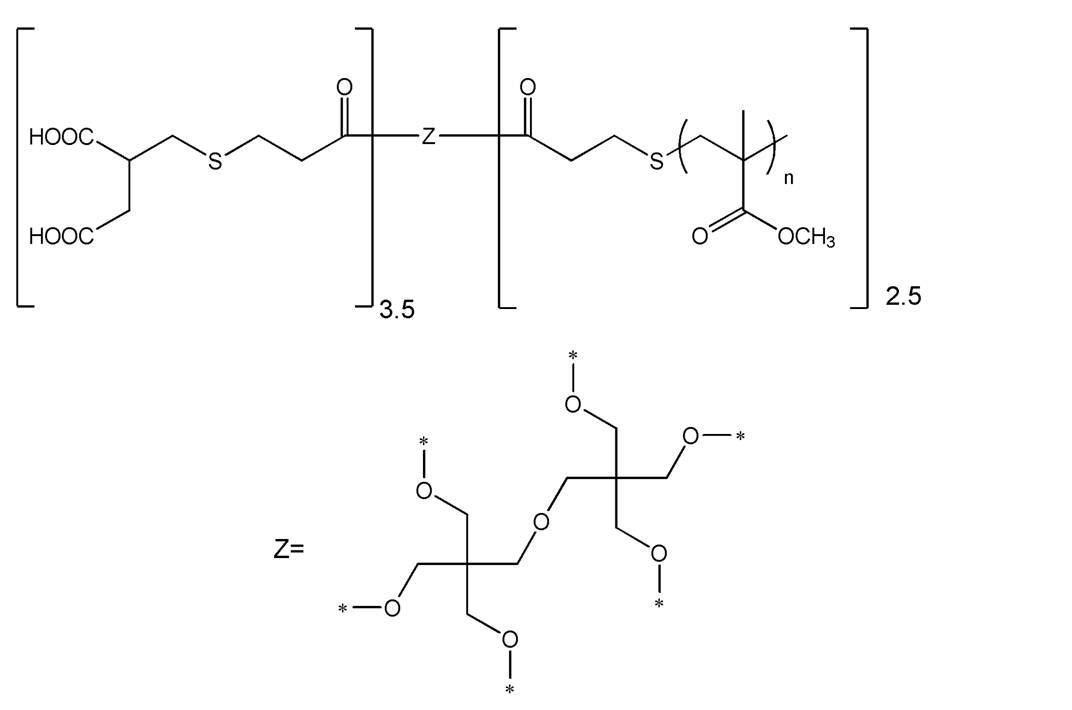
<分散液2の調製>
以下に示す混合液を用いた以外は、分散液1と同様の方法で、分散液2を調製した。
(混合液の組成)
粒子:Ge粒子(波長10μmにおける屈折率4.0、平均一次粒子径50nm)・・・18部
樹脂:樹脂B(固形分30%、溶剤:プロピレングリコールモノメチルエーテル)・・・6.7部
有機溶剤:プロピレングリコールメチルエーテルアセテート・・・75.3部
以下に示す混合液を用いた以外は、分散液1と同様の方法で、分散液2を調製した。
(混合液の組成)
粒子:Ge粒子(波長10μmにおける屈折率4.0、平均一次粒子径50nm)・・・18部
樹脂:樹脂B(固形分30%、溶剤:プロピレングリコールモノメチルエーテル)・・・6.7部
有機溶剤:プロピレングリコールメチルエーテルアセテート・・・75.3部
樹脂B:下記構造の樹脂(重量平均分子量24000、酸価53mgKOH/g)

<分散液3~13の調製>
粒子および樹脂の種類を以下に変更した以外は、分散液1と同様にして分散液を調製した。
粒子および樹脂の種類を以下に変更した以外は、分散液1と同様にして分散液を調製した。

なお、表に記載の粒子の屈折率の値は、波長10μmにおける屈折率の値である。
ITO粒子の平均一次粒子径は20nmである。
GeO2粒子の平均一次粒子径は50nmである。
Si粒子の平均一次粒子径は50nmである。
ZnSe粒子の平均一次粒子径は50nmである。
ZnS粒子の平均一次粒子径は50nmである。
CaF2粒子の平均一次粒子径は50nmである。
MgF2粒子の平均一次粒子径は50nmである。
樹脂Cは、DISPERBYK 103(BYK Chemie(株)製)を用いた。
樹脂Dは、下記構造の樹脂の30質量%プロピレングリコールメチルエーテルアセテート溶液を用いた。下記構造の樹脂の重量平均分子量は23000である。繰り返し単位に付記した数値はモル比である。

樹脂Eは、DISPERBYK 111(BYK Chemie(株)製)を用いた。
樹脂Fには、下記構造の樹脂の44質量%プロピレングリコールメチルエーテルアセテート溶液を用いた。下記構造の樹脂の重量平均分子量は40000である。繰り返し単位に付記した数値はモル比である。
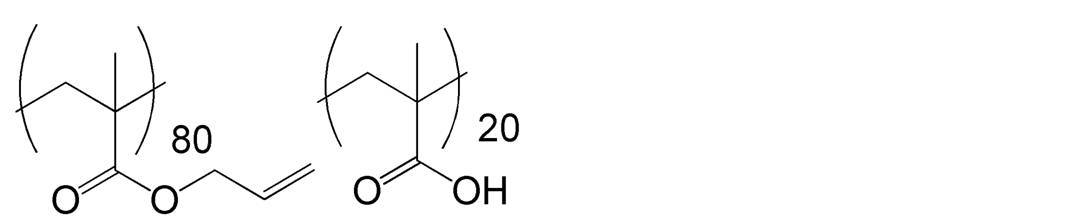
<組成物の調製>
(実施例1)
下記の成分を混合して、実施例1の組成物を調製した。
・分散液1・・・22.5部
・アルカリ可溶性樹脂1(下記構造の樹脂の44質量%プロピレングリコールメチルエーテルアセテート溶液。下記構造の樹脂の重量平均分子量は5000である。繰り返し単位に付記した数値はモル比である。)・・・34.3部

・重合性化合物(アロニックスM-510、東亞合成(株)製)・・・10.9部
・光重合開始剤(IRGACURE OXE01、BASF社製)・・・3.2部
・下記界面活性剤1(下記混合物、重量平均分子量=14000、繰り返し単位の割合を示す%は質量%である。)・・・0.04部

・重合禁止剤(p-メトキシフェノール)・・・0.005部
・紫外線吸収剤(UV-503、大東化学(株)製)・・・0.4部
・シランカップリング剤(KBM-502、信越シリコーン(株)製)・・・0.2部
・有機溶剤1(PGMEA)・・・28.4部
(実施例1)
下記の成分を混合して、実施例1の組成物を調製した。
・分散液1・・・22.5部
・アルカリ可溶性樹脂1(下記構造の樹脂の44質量%プロピレングリコールメチルエーテルアセテート溶液。下記構造の樹脂の重量平均分子量は5000である。繰り返し単位に付記した数値はモル比である。)・・・34.3部
・重合性化合物(アロニックスM-510、東亞合成(株)製)・・・10.9部
・光重合開始剤(IRGACURE OXE01、BASF社製)・・・3.2部
・下記界面活性剤1(下記混合物、重量平均分子量=14000、繰り返し単位の割合を示す%は質量%である。)・・・0.04部
・重合禁止剤(p-メトキシフェノール)・・・0.005部
・紫外線吸収剤(UV-503、大東化学(株)製)・・・0.4部
・シランカップリング剤(KBM-502、信越シリコーン(株)製)・・・0.2部
・有機溶剤1(PGMEA)・・・28.4部
(実施例2~13)
実施例1において、分散液1を、分散液2~13に変えた以外は実施例1と同様にして組成物を調製した。
実施例1において、分散液1を、分散液2~13に変えた以外は実施例1と同様にして組成物を調製した。
(実施例14)
実施例1において、分散液1の22.5部の代わりに、分散液1の11.25部と、分散液2の11.25部とを使用した以外は実施例1と同様にして組成物を調製した。
実施例1において、分散液1の22.5部の代わりに、分散液1の11.25部と、分散液2の11.25部とを使用した以外は実施例1と同様にして組成物を調製した。
(実施例15)
実施例2において、アルカリ可溶性樹脂1の17.15部を、上記樹脂Fの17.15部に変えた以外は実施例2と同様にして組成物を調製した。
実施例2において、アルカリ可溶性樹脂1の17.15部を、上記樹脂Fの17.15部に変えた以外は実施例2と同様にして組成物を調製した。
(実施例16)
実施例2において、重合性化合物をアロニックスM-510(東亞合成(株)製)5.45部とKAYARAD DPHA(日本化薬(株)製)5.45部に変えた以外は実施例2と同様にして組成物を調製した。
実施例2において、重合性化合物をアロニックスM-510(東亞合成(株)製)5.45部とKAYARAD DPHA(日本化薬(株)製)5.45部に変えた以外は実施例2と同様にして組成物を調製した。
(実施例17)
実施例2において、光重合開始剤をIRGACURE OXE01(BASF社製)1.2部、IRGACURE OXE03(BASF社製)1.0部、IRGACURE 369(BASF社製)1.0部に変えた以外は実施例2と同様にして組成物を調製した。
実施例2において、光重合開始剤をIRGACURE OXE01(BASF社製)1.2部、IRGACURE OXE03(BASF社製)1.0部、IRGACURE 369(BASF社製)1.0部に変えた以外は実施例2と同様にして組成物を調製した。
(実施例18)
実施例2において、アルカリ可溶性樹脂をアルカリ可溶性樹脂1の10.15部と、上記樹脂Fの7.0部に変えた以外は実施例2と同様にして組成物を調製した。
実施例2において、アルカリ可溶性樹脂をアルカリ可溶性樹脂1の10.15部と、上記樹脂Fの7.0部に変えた以外は実施例2と同様にして組成物を調製した。
<形成体の作製>
各組成物を、加熱処理後の膜厚が1.35μmとなるようにSiウエハ上にスピンコートし、ホットプレートを用いて、100℃、120秒間で乾燥した後、さらに、200℃で300秒間加熱処理を行って、形成体を作製した。
各組成物を、加熱処理後の膜厚が1.35μmとなるようにSiウエハ上にスピンコートし、ホットプレートを用いて、100℃、120秒間で乾燥した後、さらに、200℃で300秒間加熱処理を行って、形成体を作製した。
<形成体の屈折率の測定>
測定対象の組成物を、Siウエハ上に塗布し、200℃で5分間加熱処理を行い、形成体を形成して測定サンプルを作製した。作製した測定サンプルを、J.A.Woollam社製IR-VASEを用いて波長1.7~30μmの屈折率を測定した。
測定対象の組成物を、Siウエハ上に塗布し、200℃で5分間加熱処理を行い、形成体を形成して測定サンプルを作製した。作製した測定サンプルを、J.A.Woollam社製IR-VASEを用いて波長1.7~30μmの屈折率を測定した。
<形成体の遠赤外線透過率の測定>
上述の方法で作製した形成体の遠赤外線透過率を、NICOLET6700FT-IR(Thermo Scientific製)を使用して測定した。リファレンスとして、基板として用いたSiウエハを用いた。結果を表1にまとめて示す。
波長10μmの光の透過率が90%以上を5、波長10μmの光の透過率が90%未満80%以上を4、波長10μmの光の透過率が80%未満70%以上を3、波長10μmの光の透過率が70%未満60%以上を2、波長10μmの光の透過率が60%未満を1と評価した。
上述の方法で作製した形成体の遠赤外線透過率を、NICOLET6700FT-IR(Thermo Scientific製)を使用して測定した。リファレンスとして、基板として用いたSiウエハを用いた。結果を表1にまとめて示す。
波長10μmの光の透過率が90%以上を5、波長10μmの光の透過率が90%未満80%以上を4、波長10μmの光の透過率が80%未満70%以上を3、波長10μmの光の透過率が70%未満60%以上を2、波長10μmの光の透過率が60%未満を1と評価した。
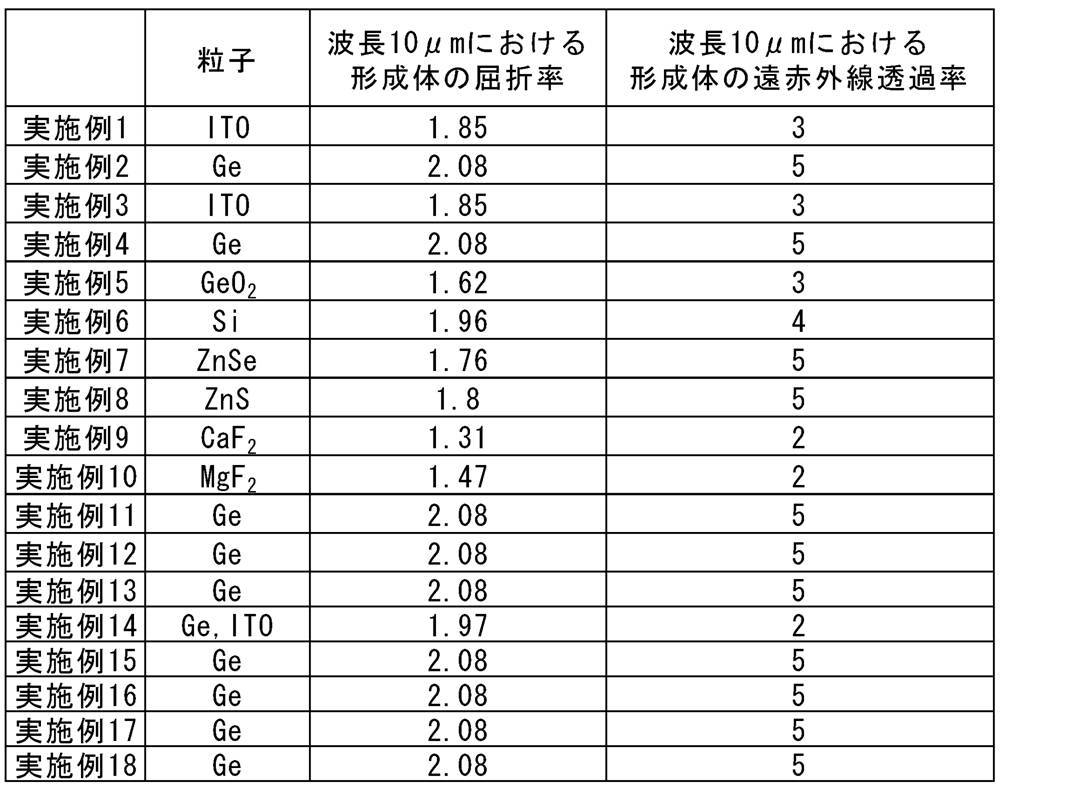
上記表に示す通り、実施例は、遠赤外線透過率の高い形成体を製造することができた。
[試験例2]
<実施例101>
上記実施例1の組成物を、加熱処理後の膜厚が1.35μmとなるようにSiウエハ上にスピンコートし、ホットプレートを用いて、100℃、120秒間で乾燥した後、さらに、200℃で300秒間加熱処理を行って、形成体を作製した。形成体の波長10μmにおける屈折率は、1.85で、Siウエハの波長10μmにおける屈折率は、3.42であった。
上記形成体が積層したSiウエハについて、SiウエハをNICOLET6700FT-IR(Thermo Scientific製)を使用して、波長10μmの光の透過率を測定した。リファレンス測定をSiウエハ無しの状態で行うことで、Siウエハを含めた積層体としての透過率を測定した。
<実施例101>
上記実施例1の組成物を、加熱処理後の膜厚が1.35μmとなるようにSiウエハ上にスピンコートし、ホットプレートを用いて、100℃、120秒間で乾燥した後、さらに、200℃で300秒間加熱処理を行って、形成体を作製した。形成体の波長10μmにおける屈折率は、1.85で、Siウエハの波長10μmにおける屈折率は、3.42であった。
上記形成体が積層したSiウエハについて、SiウエハをNICOLET6700FT-IR(Thermo Scientific製)を使用して、波長10μmの光の透過率を測定した。リファレンス測定をSiウエハ無しの状態で行うことで、Siウエハを含めた積層体としての透過率を測定した。
<実施例102>
上記実施例2の組成物を、加熱処理後の膜厚が1.25μmとなるようにGeウエハ上にスピンコートし、ホットプレートを用いて、100℃、120秒間で乾燥した後、さらに、200℃で300秒間加熱処理を行って、形成体を作製した。形成体の波長10μmにおける屈折率は、2.08で、Geウエハの波長10μmにおける屈折率は、4.0であった。
上記形成体が積層したGeウエハについて、NICOLET6700FT-IR(Thermo Scientific製)を使用して、波長10μmの光の透過率を測定した。リファレンス測定をGe基板無しの状態で行うことで、Ge基板を含めた基板としての透過率を測定した。
上記実施例2の組成物を、加熱処理後の膜厚が1.25μmとなるようにGeウエハ上にスピンコートし、ホットプレートを用いて、100℃、120秒間で乾燥した後、さらに、200℃で300秒間加熱処理を行って、形成体を作製した。形成体の波長10μmにおける屈折率は、2.08で、Geウエハの波長10μmにおける屈折率は、4.0であった。
上記形成体が積層したGeウエハについて、NICOLET6700FT-IR(Thermo Scientific製)を使用して、波長10μmの光の透過率を測定した。リファレンス測定をGe基板無しの状態で行うことで、Ge基板を含めた基板としての透過率を測定した。
<比較例101>
Siウエハの波長10μmの光の透過率を、NICOLET6700FT-IR(Thermo Scientific製)を使用して測定した。リファレンス測定を基板無しの状態で行うことで、基板自体の透過率を測定した。
Siウエハの波長10μmの光の透過率を、NICOLET6700FT-IR(Thermo Scientific製)を使用して測定した。リファレンス測定を基板無しの状態で行うことで、基板自体の透過率を測定した。
<比較例102>
Geウエハの波長10μmの光の透過率を、NICOLET6700FT-IR(Thermo Scientific製)を使用して測定した。リファレンス測定を基板無しの状態で行うことで、基板自体の透過率を測定した。
Geウエハの波長10μmの光の透過率を、NICOLET6700FT-IR(Thermo Scientific製)を使用して測定した。リファレンス測定を基板無しの状態で行うことで、基板自体の透過率を測定した。
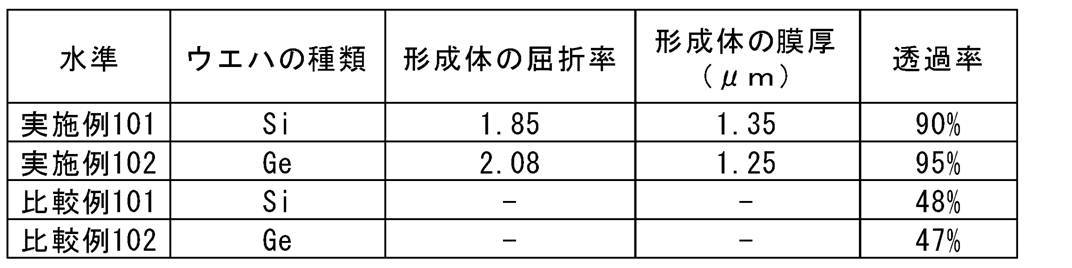
上記結果より、実施例は、比較例よりも、波長10μmの光の透過率が高く、遠赤外線透過性に優れていた。
[試験例3]
<実施例201>
分散液2を射出成型により平板の形成体を製造した。形成体の波長10μmにおける屈折率は3.8であった。波長10μmの光の透過率は60%であった。
<実施例201>
分散液2を射出成型により平板の形成体を製造した。形成体の波長10μmにおける屈折率は3.8であった。波長10μmの光の透過率は60%であった。
<実施例202>
使用する液を実施例2の組成物に変えた以外は、実施例201と同様にして平板の形成体を作製した。形成体の波長10μmにおける屈折率は2.1であった。波長10μmの光の透過率は70%であった。
使用する液を実施例2の組成物に変えた以外は、実施例201と同様にして平板の形成体を作製した。形成体の波長10μmにおける屈折率は2.1であった。波長10μmの光の透過率は70%であった。
Claims (16)
- 波長10μmにおける屈折率が1.3~5.0である粒子と、媒質と、を含む遠赤外線透過性組成物。
- 前記粒子を、前記遠赤外線透過性組成物の全固形分に対して15質量%以上含有する、請求項1に記載の遠赤外線透過性組成物。
- 前記媒質が、樹脂、硬化性化合物、および溶剤から選ばれる少なくとも1種類を含む、請求項1または2に記載の遠赤外線透過性組成物。
- 前記粒子は、Ge、Zn、SiおよびFから選ばれる少なくとも1種類の原子を含む無機粒子である、請求項1~3のいずれか1項に記載の遠赤外線透過性組成物。
- 波長10μmにおける屈折率が1.3~5.0である粒子を含む形成体。
- 波長8~14μmの範囲における平均屈折率が1.3~5.0である、請求項5に記載の形成体。
- 前記形成体の形状が、膜状、平板状またはレンズ状である、請求項5または6に記載の形成体。
- 前記粒子は、Ge、Zn、SiおよびFから選ばれる少なくとも1種類の原子を含む無機粒子である、請求項5~7のいずれか1項に記載の形成体。
- 遠赤外線透過フィルタ用である、請求項5~8のいずれか1項に記載の形成体。
- 基板と、
前記基板上に設けられた、請求項5~9のいずれか1項に記載の形成体と、
を有する積層体。 - 前記形成体の波長10μmにおける屈折率n1と、前記形成体に対して前記形成体の厚み方向で接する層の波長10μmにおける屈折率n2は、以下の関係を満たす、請求項10に記載の積層体。
(n2)0.5-1≦n1≦(n2)0.5+1 - 前記形成体の波長10μmにおける屈折率n1と、前記形成体の厚みTとの積が、以下の関係を満たす、請求項10または11に記載の積層体;
1.5<T・n1<3.5
Tの単位は、μmである。 - 遠赤外線透過フィルタ用である、請求項10~12のいずれか1項に記載の積層体。
- 請求項5~9のいずれか1項に記載の形成体、または、請求項10~13のいずれか1項に記載の積層体を有する遠赤外線透過フィルタ。
- 請求項14に記載の遠赤外線透過フィルタを有する固体撮像素子。
- 請求項14に記載の遠赤外線透過フィルタを有する赤外線カメラ。
Priority Applications (2)
| Application Number | Priority Date | Filing Date | Title |
|---|---|---|---|
| JP2018508851A JP6717930B2 (ja) | 2016-03-28 | 2017-03-03 | 遠赤外線透過性組成物、形成体、積層体、遠赤外線透過フィルタ、固体撮像素子および赤外線カメラ |
| US16/106,452 US20180356572A1 (en) | 2016-03-28 | 2018-08-21 | Far infrared ray transmitting composition, formed body, laminate, far infrared ray transmitting filter, solid-state imaging device, and infrared camera |
Applications Claiming Priority (2)
| Application Number | Priority Date | Filing Date | Title |
|---|---|---|---|
| JP2016063033 | 2016-03-28 | ||
| JP2016-063033 | 2016-03-28 |
Related Child Applications (1)
| Application Number | Title | Priority Date | Filing Date |
|---|---|---|---|
| US16/106,452 Continuation US20180356572A1 (en) | 2016-03-28 | 2018-08-21 | Far infrared ray transmitting composition, formed body, laminate, far infrared ray transmitting filter, solid-state imaging device, and infrared camera |
Publications (1)
| Publication Number | Publication Date |
|---|---|
| WO2017169506A1 true WO2017169506A1 (ja) | 2017-10-05 |
Family
ID=59964043
Family Applications (1)
| Application Number | Title | Priority Date | Filing Date |
|---|---|---|---|
| PCT/JP2017/008419 Ceased WO2017169506A1 (ja) | 2016-03-28 | 2017-03-03 | 遠赤外線透過性組成物、形成体、積層体、遠赤外線透過フィルタ、固体撮像素子および赤外線カメラ |
Country Status (4)
| Country | Link |
|---|---|
| US (1) | US20180356572A1 (ja) |
| JP (1) | JP6717930B2 (ja) |
| TW (1) | TWI712680B (ja) |
| WO (1) | WO2017169506A1 (ja) |
Cited By (3)
| Publication number | Priority date | Publication date | Assignee | Title |
|---|---|---|---|---|
| WO2019189418A1 (ja) * | 2018-03-29 | 2019-10-03 | 富士フイルム株式会社 | 波長選択吸収材料、赤外センサー、波長選択光源及び放射冷却システム |
| JPWO2021014857A1 (ja) * | 2019-07-24 | 2021-01-28 | ||
| JP2023077908A (ja) * | 2021-11-25 | 2023-06-06 | 旭化成エレクトロニクス株式会社 | 光学接合構造体及びガス検出装置 |
Families Citing this family (3)
| Publication number | Priority date | Publication date | Assignee | Title |
|---|---|---|---|---|
| KR102639398B1 (ko) * | 2019-03-29 | 2024-02-23 | 후지필름 가부시키가이샤 | 조성물, 경화막, 컬러 필터, 차광막, 광학 소자, 고체 촬상 소자, 헤드라이트 유닛, 수식 실리카 입자, 수식 실리카 입자의 제조 방법 |
| US11845870B2 (en) * | 2019-12-03 | 2023-12-19 | Boise State University | Thin films printed with chalcogenide glass inks |
| CN111690331B (zh) * | 2020-05-07 | 2022-04-12 | 复旦大学 | 基于光子准晶材料的透明隔热防紫外线薄膜及其制备方法 |
Citations (4)
| Publication number | Priority date | Publication date | Assignee | Title |
|---|---|---|---|---|
| JPS5010742B1 (ja) * | 1969-10-31 | 1975-04-24 | ||
| JP2002234774A (ja) * | 2000-12-04 | 2002-08-23 | Sumitomo Electric Ind Ltd | セラミックス光学部品及びその製造方法 |
| JP2014079509A (ja) * | 2012-10-18 | 2014-05-08 | Takahiro Makino | 殺菌方法、悪性細胞の不活性化方法、熟成物の製造方法及び遠赤外線照射装置 |
| JP2015028621A (ja) * | 2013-07-03 | 2015-02-12 | 富士フイルム株式会社 | 赤外線遮光組成物、赤外線遮光層、赤外線カットフィルタ、カメラモジュール |
Family Cites Families (1)
| Publication number | Priority date | Publication date | Assignee | Title |
|---|---|---|---|---|
| CN102326104A (zh) * | 2009-02-13 | 2012-01-18 | 松下电工株式会社 | 红外滤光器及红外滤光器的制造方法 |
-
2017
- 2017-03-03 JP JP2018508851A patent/JP6717930B2/ja active Active
- 2017-03-03 WO PCT/JP2017/008419 patent/WO2017169506A1/ja not_active Ceased
- 2017-03-16 TW TW106108628A patent/TWI712680B/zh active
-
2018
- 2018-08-21 US US16/106,452 patent/US20180356572A1/en not_active Abandoned
Patent Citations (4)
| Publication number | Priority date | Publication date | Assignee | Title |
|---|---|---|---|---|
| JPS5010742B1 (ja) * | 1969-10-31 | 1975-04-24 | ||
| JP2002234774A (ja) * | 2000-12-04 | 2002-08-23 | Sumitomo Electric Ind Ltd | セラミックス光学部品及びその製造方法 |
| JP2014079509A (ja) * | 2012-10-18 | 2014-05-08 | Takahiro Makino | 殺菌方法、悪性細胞の不活性化方法、熟成物の製造方法及び遠赤外線照射装置 |
| JP2015028621A (ja) * | 2013-07-03 | 2015-02-12 | 富士フイルム株式会社 | 赤外線遮光組成物、赤外線遮光層、赤外線カットフィルタ、カメラモジュール |
Cited By (10)
| Publication number | Priority date | Publication date | Assignee | Title |
|---|---|---|---|---|
| WO2019189418A1 (ja) * | 2018-03-29 | 2019-10-03 | 富士フイルム株式会社 | 波長選択吸収材料、赤外センサー、波長選択光源及び放射冷却システム |
| JPWO2019189418A1 (ja) * | 2018-03-29 | 2020-08-20 | 富士フイルム株式会社 | 波長選択吸収材料、赤外センサー、波長選択光源及び放射冷却システム |
| US10901124B1 (en) | 2018-03-29 | 2021-01-26 | Fujifilm Corporation | Wavelength-selective absorptive material, infrared sensor, wavelength-selective light source, and radiation cooling system |
| JPWO2021014857A1 (ja) * | 2019-07-24 | 2021-01-28 | ||
| WO2021014857A1 (ja) * | 2019-07-24 | 2021-01-28 | Agc株式会社 | 車両用外装部材、及び遠赤外カメラ付き車両用外装部材 |
| JP7597029B2 (ja) | 2019-07-24 | 2024-12-10 | Agc株式会社 | 車両用外装部材、及び遠赤外カメラ付き車両用外装部材 |
| JP2025024218A (ja) * | 2019-07-24 | 2025-02-19 | Agc株式会社 | 車両用外装部材、及び遠赤外カメラ付き車両用外装部材 |
| JP7838618B2 (ja) | 2019-07-24 | 2026-04-01 | Agc株式会社 | 車両用外装部材 |
| JP2023077908A (ja) * | 2021-11-25 | 2023-06-06 | 旭化成エレクトロニクス株式会社 | 光学接合構造体及びガス検出装置 |
| JP7821595B2 (ja) | 2021-11-25 | 2026-02-27 | 旭化成エレクトロニクス株式会社 | 光学接合構造体及びガス検出装置 |
Also Published As
| Publication number | Publication date |
|---|---|
| TWI712680B (zh) | 2020-12-11 |
| JPWO2017169506A1 (ja) | 2019-02-14 |
| US20180356572A1 (en) | 2018-12-13 |
| TW201807148A (zh) | 2018-03-01 |
| JP6717930B2 (ja) | 2020-07-08 |
Similar Documents
| Publication | Publication Date | Title |
|---|---|---|
| JP6688875B2 (ja) | 組成物、膜、硬化膜、光学センサおよび膜の製造方法 | |
| JP6717930B2 (ja) | 遠赤外線透過性組成物、形成体、積層体、遠赤外線透過フィルタ、固体撮像素子および赤外線カメラ | |
| JP6994044B2 (ja) | 硬化膜の製造方法、固体撮像素子の製造方法、画像表示装置の製造方法 | |
| KR102160018B1 (ko) | 조성물, 경화막, 컬러 필터, 차광막, 고체 촬상 소자 및 화상 표시 장치 | |
| KR102453516B1 (ko) | 경화막의 제조 방법, 고체 촬상 소자의 제조 방법 | |
| JP6727344B2 (ja) | 硬化性組成物、化合物、硬化膜、硬化膜の製造方法、カラーフィルタの製造方法、固体撮像素子、赤外線センサ | |
| KR102149158B1 (ko) | 조성물, 경화막, 컬러 필터, 차광막, 고체 촬상 장치 및 화상 표시 장치 | |
| US11002895B2 (en) | Coloring composition, method for producing coloring composition, color filter, pattern forming method, solid-state imaging device, and image display device | |
| JP6721670B2 (ja) | 組成物、膜、硬化膜、光学センサおよび膜の製造方法 | |
| WO2020066420A1 (ja) | 遮光性組成物、硬化膜、遮光膜、固体撮像素子 | |
| WO2017175545A1 (ja) | 組成物、膜、硬化膜、光学センサおよび膜の製造方法 | |
| TWI836039B (zh) | 組成物、硬化膜、濾色器、遮光膜、光學元件、固體攝像元件、頭燈單元、修飾二氧化矽粒子、修飾二氧化矽粒子的製造方法 | |
| JP2022079500A (ja) | 金属窒化物含有粒子、分散組成物、硬化性組成物、硬化膜、及びそれらの製造方法、並びにカラーフィルタ、固体撮像素子、固体撮像装置、赤外線センサ | |
| US11045834B2 (en) | Method for producing film | |
| WO2018173692A1 (ja) | 硬化性組成物、硬化膜、遮光膜、固体撮像素子、固体撮像装置、及び、硬化膜の製造方法 | |
| JP2015161919A (ja) | 感放射線性組成物およびその製造方法、硬化膜、カラーフィルタおよびその製造方法、パターン形成方法、固体撮像素子ならびに画像表示装置 | |
| JP6734384B2 (ja) | 組成物、形成体、積層体、遠赤外線透過フィルタ、固体撮像素子、赤外線カメラおよび赤外線センサ | |
| JP6890580B2 (ja) | 赤外線フィルタ、赤外線センサおよび赤外線フィルタ用組成物 | |
| WO2023190567A1 (ja) | 遮光膜、固体撮像素子、画像表示装置、赤外線センサ | |
| WO2017056901A1 (ja) | 組成物、硬化膜、パターン、パターンの製造方法、光学センサー、及び撮像素子 |
Legal Events
| Date | Code | Title | Description |
|---|---|---|---|
| WWE | Wipo information: entry into national phase |
Ref document number: 2018508851 Country of ref document: JP |
|
| NENP | Non-entry into the national phase |
Ref country code: DE |
|
| 121 | Ep: the epo has been informed by wipo that ep was designated in this application |
Ref document number: 17774051 Country of ref document: EP Kind code of ref document: A1 |
|
| 122 | Ep: pct application non-entry in european phase |
Ref document number: 17774051 Country of ref document: EP Kind code of ref document: A1 |