WO2017169433A1 - 包装袋 - Google Patents
包装袋 Download PDFInfo
- Publication number
- WO2017169433A1 WO2017169433A1 PCT/JP2017/007449 JP2017007449W WO2017169433A1 WO 2017169433 A1 WO2017169433 A1 WO 2017169433A1 JP 2017007449 W JP2017007449 W JP 2017007449W WO 2017169433 A1 WO2017169433 A1 WO 2017169433A1
- Authority
- WO
- WIPO (PCT)
- Prior art keywords
- notch
- film
- packaging
- packaging bag
- bag
- Prior art date
- Legal status (The legal status is an assumption and is not a legal conclusion. Google has not performed a legal analysis and makes no representation as to the accuracy of the status listed.)
- Ceased
Links
Images

Classifications
-
- B—PERFORMING OPERATIONS; TRANSPORTING
- B65—CONVEYING; PACKING; STORING; HANDLING THIN OR FILAMENTARY MATERIAL
- B65D—CONTAINERS FOR STORAGE OR TRANSPORT OF ARTICLES OR MATERIALS, e.g. BAGS, BARRELS, BOTTLES, BOXES, CANS, CARTONS, CRATES, DRUMS, JARS, TANKS, HOPPERS, FORWARDING CONTAINERS; ACCESSORIES, CLOSURES, OR FITTINGS THEREFOR; PACKAGING ELEMENTS; PACKAGES
- B65D33/00—Details of, or accessories for, sacks or bags
-
- B—PERFORMING OPERATIONS; TRANSPORTING
- B65—CONVEYING; PACKING; STORING; HANDLING THIN OR FILAMENTARY MATERIAL
- B65D—CONTAINERS FOR STORAGE OR TRANSPORT OF ARTICLES OR MATERIALS, e.g. BAGS, BARRELS, BOTTLES, BOXES, CANS, CARTONS, CRATES, DRUMS, JARS, TANKS, HOPPERS, FORWARDING CONTAINERS; ACCESSORIES, CLOSURES, OR FITTINGS THEREFOR; PACKAGING ELEMENTS; PACKAGES
- B65D33/00—Details of, or accessories for, sacks or bags
- B65D33/06—Handles
- B65D33/10—Handles formed of similar material to that used for the bag
-
- B—PERFORMING OPERATIONS; TRANSPORTING
- B65—CONVEYING; PACKING; STORING; HANDLING THIN OR FILAMENTARY MATERIAL
- B65D—CONTAINERS FOR STORAGE OR TRANSPORT OF ARTICLES OR MATERIALS, e.g. BAGS, BARRELS, BOTTLES, BOXES, CANS, CARTONS, CRATES, DRUMS, JARS, TANKS, HOPPERS, FORWARDING CONTAINERS; ACCESSORIES, CLOSURES, OR FITTINGS THEREFOR; PACKAGING ELEMENTS; PACKAGES
- B65D85/00—Containers, packaging elements or packages, specially adapted for particular articles or materials
- B65D85/67—Containers, packaging elements or packages, specially adapted for particular articles or materials for web or tape-like material
- B65D85/671—Containers, packaging elements or packages, specially adapted for particular articles or materials for web or tape-like material wound in flat spiral form
- B65D85/672—Containers, packaging elements or packages, specially adapted for particular articles or materials for web or tape-like material wound in flat spiral form on cores
Definitions
- the present invention relates to a packaging bag in which paper hygiene articles such as roll paper such as toilet paper or cartons for tissue paper are packaged.
- flavor to toilet paper or a paper tube, for example with the film is known (for example, refer patent document 1).
- the film used for the package is generally a polyethylene film or a polypropylene film, but these films are not preferable from the viewpoint of gas barrier properties.
- the fragrance permeates the film and leaks to the outside during storage and display at the store.
- what packaged paper hygiene articles using a gas barrier resin film is proposed (for example, refer to patent documents 2).
- an object of the present invention is to provide a packaging bag that can properly store paper hygiene articles and is easier to open.
- a packaging bag comprising a bag body for storing paper hygiene articles,
- the bag body is It is characterized in that it has a property of being torn in a straight line in one direction and is formed from a film having a gas barrier property, and a notch having a straight cut extending in the one direction is formed.
- a grip portion formed by joining the opposing surfaces of the film is provided, The notch is formed on the handle portion side of the bag body.
- a gusset fold portion in which the film is gusset-folded is provided at one end of the bag main body portion,
- the grip portion is formed by joining facing surfaces of the film forming the gusset fold portion,
- a first notch is formed on one side of the gusset folding portion where the film is not folded, on the side of the grip portion.
- the first notch is characterized in that a plurality of the first notches are formed at a substantially equal position in the other direction substantially orthogonal to the one direction of the bag body.
- a second notch is formed adjacent to the one surface of the gusset folding portion, on the handle portion side of the other surface where the film is folded,
- the first notch and the second notch are characterized in that positions in other directions substantially orthogonal to the one direction are substantially equal.
- the one direction is characterized by being a direction substantially orthogonal to the vertical direction.
- a paper sanitary article can be properly stored and a packaging bag that can be opened more easily can be provided.
- FIG. 1 It is a perspective view which shows the packaging bag of one Embodiment to which this invention is applied. It is a perspective view which shows typically the state by which the taking-out port of the packaging bag of FIG. 1 was cut open.
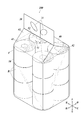
- FIG. 1 is a perspective view showing a packaging bag 100 according to an embodiment to which the present invention is applied
- FIG. 2 is a perspective view schematically showing a state in which an outlet 30 of the packaging bag 100 is cut open.
- a packaging bag 100 is a roll of paper rolls R such as toilet paper and paper towels as paper hygiene articles stacked and gusseted with a packaging film F.
- the bag main body part 10 which accommodates this, and the handle part 20 provided in the upper part of this bag main body part 10 are provided.
- the direction from the grip portion 20 of the packaging bag 100 to the mounting surface (bottom surface) of the packaging bag 100 is defined as the vertical direction, and one direction orthogonal to the vertical direction is defined as the left-right direction.
- the direction orthogonal to both directions is defined as the front-rear direction.
- a roll paper R is included in a packaging film F formed in a cylindrical shape, and both end openings are sealed by a heat sealing process.
- the heat-sealing treatment is generally performed at 160 to 250 ° C., for example, and the packaging film F is particularly suitable for the heat-sealing treatment in this temperature range.
- the packaging film F preferably has a heat seal range of JIS Z 1707 of 10 N / 15 mm under the conditions of a pressure of 0.2 MPa, 1 second, and 110 ° C.
- a well-known method is applicable.
- one opening portion is formed in a state where a packaging film F formed in advance in a cylindrical shape is pushed into the inside of the cylinder so that both side portions thereof have a cross-section M-time mold. Is sealed by heat-sealing or the like to form a three-sided closed bag-shaped precursor with one side closed, and then the roll paper R, which is a package, is inserted into the bag, and then the other The opening is sealed by heat sealing.
- the handle part 20 is formed in the said heat sealing
- the packaging film F is a resin film having a laminated structure, and includes, for example, an intermediate layer, two outer layers sandwiching the intermediate layer, and two adhesive layers that bond the intermediate layer and the outer layer.
- the two outer layers are, for example, polyethylene resin layers having a melting point of 150 ° C. or lower.
- the packaging film F can be sealed by heat-sealing treatment.
- the lower melting point is preferable because the fusion treatment can be performed at a low temperature.
- the melting point is excessively low, for example, a hole may be formed at the time of thermal fusion, and the lower limit is substantially about 80 ° C.
- the polyethylene resin layer include a linear low density polyethylene film layer (LLDPE), a low density polyethylene film layer (LDPE), and a medium density polyethylene film layer (MDPE).
- LLDPE linear low-density polyethylene film layer
- the two outer layers are not necessarily the same kind of polyethylene resin layer.
- the middle layer is, for example, an ethylene-vinyl alcohol copolymer resin layer (EVOH resin layer) having a melting point of 180 ° C. or lower.
- EVOH resin layer ethylene-vinyl alcohol copolymer resin layer
- a known resin can be used as a specific resin for forming the EVOH resin layer. Examples of commercially available products include Eval manufactured by Kuraray Co., Ltd. and Soarnol manufactured by Nippon Synthetic Chemical Industry Co., Ltd.
- the EVOH resin layer is preferably close to the melting point of the two outer polyethylene resin layers, more preferably 180 ° C. or less, in order to improve the heat fusion property of the packaging film F as a whole.
- the EVOH resin layer can lower the melting point to some extent by increasing the ethylene content, it becomes difficult to ensure gas barrier properties with an increase in the ethylene content, and substantially.
- the lower limit is about 150 ° C.
- the ethylene content of the EVOH resin layer is preferably more than 32 mol% and less than 48 mol%, more preferably 38 mol% or more and 44 mol% or less.
- the heat-sealing property of the packaging film F as a whole is lowered, and when the ethylene content is 48 mol% or more, the gas barrier property and the unsealing property described below (in the TD direction). This is because the ease of tearing is reduced.
- the adhesive layer is, for example, an acid-modified polyolefin resin layer.
- acid-modified polyolefin resins include maleic acid-modified polypropylene resins, carboxylic acid-modified polypropylene resins, and maleic anhydride-modified polypropylene resins.
- the packaging film F preferably has an oxygen permeability of 40 cc / m 2 ⁇ day ⁇ atm or less.
- the polyethylene resin layer constituting the two outer layers described above has a low melting point and excellent heat-fusibility, but has a low gas barrier property.
- the polyethylene resin layer is extremely between the two outer polyethylene resin layers.
- the lower limit value of the oxygen permeability of the packaging film F is not particularly limited, but for example, considering that it is a film suitable for toilet roll packaging, such as cost, the lower limit value is substantially lower. Is about 1.0cc / m 2 ⁇ day ⁇ atm.
- the oxygen permeability is a value measured under measurement conditions of 23 ° C. and 65% RH based on JIS K 7126 (B).
- the packaging film F has a total thickness of 22 to 45 [ ⁇ m], two outer layers of 5 to 15 [ ⁇ m] each, an intermediate layer of 2 to 10 [ ⁇ m], and two adhesive layers The thickness is preferably about 2 to 5 [ ⁇ m]. Note that the two outer layers and the adhesive layer do not necessarily have the same thickness.
- the packaging film F has the above-described configuration of each resin layer and has this thickness, when the gusset packaging is performed, the portion where the packaging films F are laminated, that is, the handle portion 20 is formed. Even so, heat is sufficiently transmitted to obtain good heat sealability, and the perfume imparted to the roll paper R is effectively prevented from leaking out through the packaging film F. become.
- the thickness of the packaging form F and each layer can be confirmed, for example, by measuring the cross section with an optical microscope.
- the packaging film F has a tensile strength in JIS Z 1707 of 20 to 40 MPa, preferably 25 to 35 MPa in the MD direction (vertical direction in FIG. 1), and in the TD direction (horizontal direction and longitudinal direction in FIG. 1). 25 to 45 MPa, preferably 30 to 40 MPa. Further, the packaging film F has an elongation in JIS Z 1707 of 150 to 330%, preferably 160 to 200% in the MD direction, and 520 to 800%, preferably 650 to 750% in the TD direction. The tensile strength and elongation are measured at a tensile speed of 500 [mm / min].
- the result in the tear test (Elmendorf method) in JIS K 7128 is 200 to 400 N / cm in the MD direction, preferably 250 to 350 N / cm, and 100 to 300 N / cm in the TD direction. Preferably, it is 150 to 250 N / cm.
- the packaging film F is easier to tear in the TD direction than the MD direction, and can be said to have a property of being torn linearly in the left-right direction and the front-rear direction (one direction).
- the packaging film F can be produced by, for example, a co-extrusion method using a T-die method, an extrusion laminating method, or the like, and a known method can be arbitrarily selected for forming into a cylindrical shape for gusset packaging. Applicable.
- the packaging film F has a gas barrier property and a property of being torn linearly in the left-right direction and the front-rear direction (one direction) substantially orthogonal to the up-down direction. Further, a first notch 51 and a second notch 52 for forming an outlet 30 (see FIG. 2) are formed on the upper end side in FIG. 1 of the bag body 10 formed from the packaging film F. Is formed.
- a gusset fold portion 40 in which the packaging film F is gusset-folded is provided at the upper end portion in FIG. 1 of the bag main body portion 10, and opposing surfaces of the packaging film F forming the gusset fold portion 40 are opposed to each other.
- the handle part 20 is formed by joining.
- the 1st notch 51 which has the linear cut
- a second notch 52 having a linear cut is formed.
- the first notch 51 and the second notch 52 are substantially equal in vertical position.
- the length of the first notch 51 in the left-right direction is preferably 3 to 5 [mm], for example.
- the length in the front-rear direction of each second notch 52 is preferably 3 to 5 [mm], for example.
- the reason why the upper limit is set to 5 [mm] is that when it exceeds 5 [mm], there is a possibility that foreign matters such as insects may be mixed. In addition, about a minimum, a smaller value is preferable.
- a plurality of first notches 51 may be formed apart from each other at substantially the same position in the vertical direction of the bag body 10.
- the total number of the first notch 51 and the second notch 52 depends on the width and length of each notch.
- the blade thickness of the notch forming cutter is 0.38 [mm].
- the total length of all notch cuts is set to be smaller than 55 [mm] (the area of the opening formed by all the notches is 20.9 [mm 2 ]). . That is, if the total length of all the notch cuts is greater than 55 [mm], the evaluation of the aroma retaining property when the roll paper R is a scented toilet roll is deteriorated.
- the packaging bag 100 for 12 rolls is converted into a substantially rectangular parallelepiped having a vertical direction of 342 [mm], a horizontal direction of 204 [mm], and a longitudinal direction of 204 [mm], the opening formed by all the notches.
- the area of the part is preferably smaller than 0.0058% with respect to the surface area of the packaging bag 100 (362304 [mm 2 ]).
- the blade thickness of the notch forming cutter can be arbitrarily changed within the range of 0.1 to 0.7 [mm], for example. If the cutter blade thickness is 0.1 [mm], all notch cuts If the cutter thickness is 0.7 [mm], the total length of all notch cuts is 29.9 [mm].
- the paper hygiene article will be described by exemplifying roll paper R such as toilet paper and paper towel.
- the paper hygiene article is not limited to these examples, and is a carton containing a tissue paper, a paper diaper, or an absorbent. Absorbent articles such as pads and sanitary products may be applied.
- twelve toilet paper roll papers R are accommodated in the bag body 10, and specifically, four stages of toilet paper roll paper R are stacked and accommodated in three stages. .
- the number of roll paper R packaging is an example, and is not limited thereto, and can be arbitrarily changed as appropriate.
- the roll paper R may be a toilet roll with a core in which a belt-shaped toilet paper is wound around a paper tube, or a coreless toilet roll also referred to as a coreless.
- the size of the roll paper R is not particularly limited.
- the height (width) is 100 to 120 [mm]
- the winding diameter (roll diameter) is 100 to 120 [mm]
- the core diameter Is generally 10 to 48 [mm]
- the winding length is 20 to 100 [m].
- the toilet paper constituting the roll paper R is not particularly limited.
- the number of plies is 1 to 3 plies
- the total paper thickness is 100 to 360 [ ⁇ m]
- the rice paper is 11 to 25 g per ply. it is in a range of / m 2.
- the tsubo is based on the tsubo measure method of JIS P 8124 (1998).
- the paper thickness was adjusted 5 times under the conditions of JIS P 8111 (1998) and then 5 times using a dial thickness gauge (thickness measuring instrument) “PEACOCK G type” (manufactured by Ozaki Seisakusho) under the same conditions. The average value measured.
- the roll paper R is a toilet roll with a fragrance to which a fragrance is added.
- a fragrance to which a fragrance is added.
- the position where the fragrance is attached include front and back surfaces of toilet paper, paper tubes, and the like.
- a natural or synthetic fragrance can be used.
- specific examples of the fragrance include natural fragrances such as lemon oil, grapefruit oil, rosemary oil, peppermint oil, mandarin oil, lime oil, yuzu oil, chamomile oil, lavender oil, rose oil, spearmint oil, and the like.
- synthetic fragrances such as alcohols such as linalool, citronellol, menthol and geraniol. These may be used alone or in combination as a blended fragrance.
- flavor may be diluted using vegetable oils, such as mineral oil, such as dipropylene glycol and paraffin oil, castor oil, and soybean oil, for adjustment of fragrance intensity
- the user puts a finger or the like on the first notch 51 of the front surface 41 of the gusset folding portion 40 of the packaging film F and fixes the bag body portion 10 side upward, more specifically, diagonally backward. Pull up. Thereby, the front surface 41 of the gusset folding part 40 of the packaging film F is cut open from the first notch 51 in the left-right direction. That is, the first notch 51 is expanded in the left-right direction so that the cut line of the first notch 51 reaches the left and right side surfaces 42, 42 of the gusset folding portion 40.
- the left and right side surfaces 42 and 42 of the gusset fold 40 are cut from the front to the back at positions substantially equal to the vertical direction of the front surface 41 of the gusset fold 40.
- the packaging film F is cut from the rear end portion of the second notch 52 to the rear surface of the gusset folding portion 40. Go. Thereby, the front surface 41 of the gusset folding part 40 and the left and right side surfaces 42, 42 are cut open to form the outlet 30 (see FIG. 2).
- Packaging bag Three layers of four toilet rolls were packed in a packaging film and used for the test.
- Packaging bag size Up and down direction 342 [mm], left and right direction 204 [mm], front and back direction 204 [mm]
- Packaging film Laminated structure in which the middle layer is sandwiched between two outer layers via an adhesive layer, overall thickness 27 [mm]
- Middle layer EVOH resin layer, thickness 3 [ ⁇ m]
- Outer layer Polyethylene resin layer, thickness 9 [ ⁇ m] EVOH resin layer ratio: 11% Ethylene content: 38mol%
- Adhesive layer Maleic anhydride-modified polypropylene resin layer, thickness 3 [ ⁇ m]
- ⁇ indicates that all five people “scent firmly”, ⁇ indicates that one or more people are “slightly fragrant”, and ⁇ indicates that one or more people are “scented weakly” Is shown.
- Packaging bag Three layers of four toilet rolls were packed in a packaging film and used for the test.
- Packaging bag size Up and down direction 342 [mm], left and right direction 204 [mm], front and back direction 204 [mm]
- Packaging film laminated structure in which an intermediate layer is sandwiched between two outer layers via an adhesive layer
- Overall thickness 26 [ ⁇ m] ⁇ Examples 11 and 14, Comparative Examples 11, 14, 17, 20>, 27 [mm] ⁇ Examples 12, 15, Comparative Examples 12, 15, 18, 21>, 30 [mm] ⁇ Examples 13, 16, Comparative Examples 13, 16, 19, 22>
- Outer layer polyethylene (PE) resin layer, thickness 8.5 [ ⁇ m] ⁇ Examples 11 and 14, Comparative Examples 11 and 14>, thickness 9 [ ⁇ m] ⁇ Examples 12 and 15, Comparative Examples 12, 15, and 18> , Thickness 9.5 [ ⁇ m] ⁇ Examples 13 and 16, Comparative Examples 13, 16, 19, 22>, thickness 7.5 [ ⁇ m] ⁇ Comparative Examples 17 and 20>, thickness 8 [ ⁇ m
- notch A notch with a length of 5 [mm] was formed in the approximate center in the left-right direction on the front surface of the folded gusset of the packaging bag. Number of notches: 1 ⁇ Examples 11 to 16, Comparative Examples 17 to 22>, 0 ⁇ Comparative Examples 11 to 16> Blade thickness of the notch forming cutter: 0.38 [mm]
- the packaging bag was opened by placing a finger on the notch so that the packaging film was torn to the left and right from the notch. The easiness of opening at this time was sensory-evaluated by five evaluators.
- ⁇ in the column of aroma retention indicates that all five people “scent firmly”, and ⁇ indicates that one or more people “scent is weak”.
- ⁇ indicates that heat sealing was performed satisfactorily, and ⁇ indicates that defects such as insufficient heat sealing were observed.
- ⁇ indicates that all 5 persons can be easily opened, and X indicates that one or more persons have not been able to open.
- ⁇ indicates that the end of the packaging film is straight, and X indicates that defects such as expansion and contraction are recognized at the end of the packaging film.
- the fragrance remains sufficiently even if the notch is formed regardless of the thickness of the entire packaging film, and it is easy to open and the package after opening. The edge of the film was straight. Even when the ethylene content was 38 mol% or 44 mol%, when notches were not formed (see Comparative Examples 11 to 16), it was difficult to open regardless of the thickness of the entire packaging film.
- the bag body 10 has a property of tearing linearly in the left-right direction and the front-rear direction substantially orthogonal to the up-down direction, and has a gas barrier property. Since a notch (for example, the first notch 51) formed by the film F and extending in a direction substantially orthogonal to the vertical direction is formed, the packaging film F is formed from the notch. Is cut open in a direction substantially perpendicular to the vertical direction, and the outlet 30 can be easily formed.
- the upper end portion of the bag body portion 10 is provided with a gusset folding portion 40 in which the packaging film F is gusset-folded, and the opposing surfaces of the packaging film F forming the gusset folding portion 40 are opposed to each other.
- a first notch having a linear cut extending in the left-right direction on the handle 20 side of the front surface 41 where the packaging film F in the gusset fold 40 is not folded is formed.
- 51 is formed, the packaging film F is cut open from the first notch 51 in the left-right direction, and left and right so that the cuts of the first notch 51 reach the left and right side surfaces 42, 42 of the gusset fold 40. Expand in the direction.
- first notch 51 and the vertical position of the left and right side surfaces 42, 42 of the gusset folding portion 40 where the packaging film F is folded are substantially equal to each other and extend in the front-rear direction. Since the second notches 52 having existing straight cuts are respectively formed, the left and right side surfaces 42 and 42 are substantially equal in the up-and-down direction to the portion opened at the front surface 41 of the gusset folding portion 40. It is cut open from the front to the back at the position, and cut through the second notch 52 to the rear surface of the gusset fold 40. In this way, the front face 41 of the gusset fold 40 and the left and right side faces 42, 42 can be cut open to form the outlet 30.
- the roll paper R in which the outlet 30 is not formed not only can the contamination of foreign matters such as insects be properly suppressed as compared with the conventional one in which the perforation is formed,
- the paper hygiene article is provided with a fragrance such as a scented toilet roll, the fragrance can be made difficult to leak. Therefore, the roll paper R can be properly stored, and the packaging bag 100 that is easier to open can be provided.
- the present invention is not limited to the above-described embodiment, and various improvements and design changes may be made without departing from the spirit of the present invention.
- the packaging film F in which the first notch 51 and the second notch 52 are formed is illustrated.
- this is an example, and the present invention is not limited to this. It is not necessary that the notch is formed. That is, any one notch (for example, the 1st notch 51 etc.) should just be formed in the packaging film F among the 1st notch 51 and the 2nd notch 52.
- the packaging film F illustrated in the above embodiment is an example and is not limited thereto, and can be arbitrarily changed as long as the heat sealing property of the packaging film F is not impaired.
- a layer used for more effectively forming a laminated film such as a cross-linking agent layer for integrating the outer layer and the intermediate layer.
- a plurality of roll papers R,... Paper hygiene articles having substantially the same shape are stacked in the up-down direction on the bag body 10 and aligned in the left-right direction and the front-rear direction (the orthogonal direction)
- the accommodation mode of the plurality of roll papers R is not limited to this, and can be arbitrarily changed as appropriate. That is, it is not always necessary to stack a plurality of roll papers R,... In a vertical direction, and similarly, a plurality of roll papers R,.
- the left-right direction and the front-rear direction substantially orthogonal to the up-down direction are set as one direction, and the up-down direction is set as the other direction.
- the embodiment is not limited to this, and can be arbitrarily changed as appropriate. is there.
- the outlet 30 can be easily formed by cutting the packaging film F in a direction substantially perpendicular to the vertical direction from the notch.
- the present invention can be suitably used for a technique that can appropriately store the roll paper R and can provide the packaging bag 100 that is easier to open.
Landscapes
- Engineering & Computer Science (AREA)
- Mechanical Engineering (AREA)
- Packaging Of Machine Parts And Wound Products (AREA)
- Packages (AREA)
- Bag Frames (AREA)
Abstract
ロール紙(R)を収容する袋本体部(10)を備える包装袋(100)であって、袋本体部は、上下方向に略直交する方向に直線状に引き裂かれる性質を有するとともに、ガスバリア性を有する包装用フィルム(F)から成形されてなり、上下方向に略直交する方向に延在する直線状の切れ目を有する第1のノッチ(51)が形成されている。
Description
本発明は、例えば、トイレットペーパーなどのロール紙又はティッシュペーパー用カートン等の紙製衛生物品を包装した包装袋に関する。
従来、例えば、トイレットペーパーや紙管に香料を付与して香り付きとした紙製衛生物品をフィルムで包装した包装体が知られている(例えば、特許文献1参照)。
この包装体に用いられるフィルムとしては、ポリエチレンフィルムやポリプロピレンフィルムなどが一般的であるが、これらのフィルムは、ガスバリア性という観点からは好ましくなく、製品化後の出荷前保管時、出荷後の倉庫保管時、店頭陳列時等に、香料がフィルムを透過して外部に漏れてしまう。
そこで、ガスバリア性樹脂フィルムを用いて紙製衛生物品を包装したものが提案されている(例えば、特許文献2参照)。
この包装体に用いられるフィルムとしては、ポリエチレンフィルムやポリプロピレンフィルムなどが一般的であるが、これらのフィルムは、ガスバリア性という観点からは好ましくなく、製品化後の出荷前保管時、出荷後の倉庫保管時、店頭陳列時等に、香料がフィルムを透過して外部に漏れてしまう。
そこで、ガスバリア性樹脂フィルムを用いて紙製衛生物品を包装したものが提案されている(例えば、特許文献2参照)。
ところで、包装袋を開封し易くするためにミシン目を形成したものもあるが、ミシン目の切れ目数の増加に伴って包装袋をより開封し易くなるものの、ミシン目から香料が漏れ易くなってしまうといった問題がある。また、切れ目の大きさによっては、虫などの異物が混入してしまう虞もある。
そこで、本発明の課題は、紙製衛生物品の保管を適正に行うことができるとともに、より開封し易い包装袋を提供することである。
上記課題を解決するため、本発明の一態様は、
紙製衛生物品を収容する袋本体部を備える包装袋であって、
前記袋本体部は、
一方向に直線状に引き裂かれる性質を有するとともに、ガスバリア性を有するフィルムから成形されてなり、前記一方向に延在する直線状の切れ目を有するノッチが形成されていることを特徴としている。
紙製衛生物品を収容する袋本体部を備える包装袋であって、
前記袋本体部は、
一方向に直線状に引き裂かれる性質を有するとともに、ガスバリア性を有するフィルムから成形されてなり、前記一方向に延在する直線状の切れ目を有するノッチが形成されていることを特徴としている。
また、前記袋本体部の一端側には、前記フィルムの対向する面同士を接合して形成された把手部が設けられ、
前記ノッチは、前記袋本体部の前記把手部側に形成されていることを特徴としている。
前記ノッチは、前記袋本体部の前記把手部側に形成されていることを特徴としている。
また、前記袋本体部の一端部には、前記フィルムがガゼット折りされたガゼット折部が設けられ、
前記把手部は、前記ガゼット折部を形成する前記フィルムの対向する面同士を接合することで形成され、
前記ガゼット折部における前記フィルムが折り込まれていない一面の前記把手部側に、第1のノッチが形成されていることを特徴としている。
前記把手部は、前記ガゼット折部を形成する前記フィルムの対向する面同士を接合することで形成され、
前記ガゼット折部における前記フィルムが折り込まれていない一面の前記把手部側に、第1のノッチが形成されていることを特徴としている。
また、前記第1のノッチは、前記袋本体部の前記一方向に略直交する他方向の略等しい位置に離間して複数形成されていることを特徴としている。
また、前記ガゼット折部における前記一面と隣合い、前記フィルムが折り込まれている他面の前記把手部側に、第2のノッチが形成され、
前記第1のノッチと前記第2のノッチは、前記一方向に略直交する他方向の位置が略等しくなっていることを特徴としている。
前記第1のノッチと前記第2のノッチは、前記一方向に略直交する他方向の位置が略等しくなっていることを特徴としている。
また、前記一方向は、上下方向に略直交する方向であることを特徴としている。
本発明によれば、紙製衛生物品の保管を適正に行うことができるとともに、より開封し易い包装袋を提供することができる。
以下に、本発明について、図面を用いて具体的な態様を説明する。ただし、発明の範囲は、図示例に限定されない。
図1は、本発明を適用した一実施形態の包装袋100を示す斜視図であり、図2は、包装袋100の取出口30が切り開かれた状態を模式的に示す斜視図である。
図1は、本発明を適用した一実施形態の包装袋100を示す斜視図であり、図2は、包装袋100の取出口30が切り開かれた状態を模式的に示す斜視図である。
図1及び図2に示すように、包装袋100は、紙製衛生物品としてのトイレットペーパー、ペーパータオルなどのロール紙Rを段積みして包装用フィルムFでガゼット包装したものであり、ロール紙Rを収容する袋本体部10と、この袋本体部10の上部に設けられた把手部20とを備えている。
なお、以下の説明では、包装袋100の把手部20から当該包装袋100の載置面(底面)に亘る方向を上下方向とし、上下方向に直交する一方向を左右方向とし、上下方向及び左右方向の双方に直交する方向を前後方向とする。
なお、以下の説明では、包装袋100の把手部20から当該包装袋100の載置面(底面)に亘る方向を上下方向とし、上下方向に直交する一方向を左右方向とし、上下方向及び左右方向の双方に直交する方向を前後方向とする。
ガゼット包装は、筒状に形成した包装用フィルムF内にロール紙Rを内包し、両端開口部が熱融着処理で封止されるものである。
熱融着処理は、例えば、一般的に160~250℃で行われ、包装用フィルムFは、この温度範囲での熱融着処理において特に適するものである。より具体的には、包装用フィルムFは、JIS Z 1707におけるヒートシールレンジが、圧力0.2MPa、1秒、110℃の条件において、10N/15mmであるのが好ましい。
なお、ガゼット包装の手順については、公知の方法を適用することができる。ここでは詳細な説明は省略するが、例えば、予め筒状に形成された包装用フィルムFを、その両側部分を断面M時型になるように筒の内側に押し込んだ状態で、一方の開口部を熱融着処理等により封止して一方が閉じられた三方閉じの袋状の前駆体を形成し、次に被包装物であるロール紙Rをその袋内に挿入して、その後に他方の開口部を熱融着処理して封止する。
熱融着処理は、例えば、一般的に160~250℃で行われ、包装用フィルムFは、この温度範囲での熱融着処理において特に適するものである。より具体的には、包装用フィルムFは、JIS Z 1707におけるヒートシールレンジが、圧力0.2MPa、1秒、110℃の条件において、10N/15mmであるのが好ましい。
なお、ガゼット包装の手順については、公知の方法を適用することができる。ここでは詳細な説明は省略するが、例えば、予め筒状に形成された包装用フィルムFを、その両側部分を断面M時型になるように筒の内側に押し込んだ状態で、一方の開口部を熱融着処理等により封止して一方が閉じられた三方閉じの袋状の前駆体を形成し、次に被包装物であるロール紙Rをその袋内に挿入して、その後に他方の開口部を熱融着処理して封止する。
また、上記熱融着処理にて、何れか一方の開口部(例えば、図1にて上側となる開口部)の封止に伴って、把手部20が形成される。すなわち、把手部20は、熱融着処理により被包装物である複数のロール紙R、…が内包される袋部分(袋本体部10)と分けられる余剰代の部分である。
また、把手部20の左右方向の略中央部には、二つの指掛け穴21、21が形成されている。
また、把手部20の左右方向の略中央部には、二つの指掛け穴21、21が形成されている。
包装用フィルムFは、積層構造を有する樹脂製フィルムであり、例えば、中層と、この中層を挟む二つの外層と、中層と外層とを接着する二つの接着層とから構成されている。
二つの外層は、例えば、融点が150℃以下のポリエチレン樹脂層である。包装用フィルムFの二つの外層をポリエチレン樹脂層とすることにより、包装用フィルムFを熱融着処理により封止可能となっている。
ここで、融点が低いほうが低温で融着処理できるため好ましいが、過度に融点が低いと、例えば、熱融着時に穴があく虞があり、実質的には下限値は80℃程度である。
また、ポリエチレン樹脂層としては、具体的には、例えば、直鎖低密度ポリエチレンフィルム層(LLDPE)、低密度ポリエチレンフィルム層(LDPE)、中密度ポリエチレンフィルム層(MDPE)が挙げられる。このうち、熱融着性及びコストの点で、密度0.910~0.940g/cm3で融点が110~120℃の直鎖低密度ポリエチレンフィルム層(LLDPE)が好ましい。なお、二つの外層は、必ずしも同じ種類のポリエチレン樹脂層である必要はない。
ここで、融点が低いほうが低温で融着処理できるため好ましいが、過度に融点が低いと、例えば、熱融着時に穴があく虞があり、実質的には下限値は80℃程度である。
また、ポリエチレン樹脂層としては、具体的には、例えば、直鎖低密度ポリエチレンフィルム層(LLDPE)、低密度ポリエチレンフィルム層(LDPE)、中密度ポリエチレンフィルム層(MDPE)が挙げられる。このうち、熱融着性及びコストの点で、密度0.910~0.940g/cm3で融点が110~120℃の直鎖低密度ポリエチレンフィルム層(LLDPE)が好ましい。なお、二つの外層は、必ずしも同じ種類のポリエチレン樹脂層である必要はない。
中層は、例えば、融点が180℃以下のエチレン-ビニルアルコール共重合体樹脂層(EVOH樹脂層)である。包装用フィルムFの中層をEVOH樹脂層とすることにより、包装用フィルムF全体として、例えば、香料を付与した香り付きトイレットロールの包装に適する高いガスバリア性を確保可能となっている。
このEVOH樹脂層を形成するための具体的な樹脂としては、公知の樹脂を使用することができる。また、市販品では、例えば、株式会社クラレ社製のエバール、日本合成化学工業株式会社製のソアノール等が挙げられる。
このEVOH樹脂層を形成するための具体的な樹脂としては、公知の樹脂を使用することができる。また、市販品では、例えば、株式会社クラレ社製のエバール、日本合成化学工業株式会社製のソアノール等が挙げられる。
また、EVOH樹脂層は、包装用フィルムF全体としての熱融着性を向上させる上で、二つの外層のポリエチレン樹脂層の融点に近いほうが好ましく、180℃以下であるのがより好ましい。ここで、EVOH樹脂層は、エチレン含有率を多くすることによりある程度まで融点を下げることが可能であるが、エチレンの含有率の増加に伴ってガスバリア性を確保することが困難となり、実質的には下限値は150℃程度である。
このEVOH樹脂層のエチレン含有率は、32mol%を上回り、且つ、48mol%を下回るのが好ましく、38mol%以上、且つ、44mol%以下がより好ましい。エチレン含有率が32mol%以下となると、包装用フィルムF全体としての熱融着性が低下してしまい、また、エチレン含有率が48mol%以上となると、ガスバリア性及び後述する開封性(TD方向への裂け易さ)が低下してしまうためである。
このEVOH樹脂層のエチレン含有率は、32mol%を上回り、且つ、48mol%を下回るのが好ましく、38mol%以上、且つ、44mol%以下がより好ましい。エチレン含有率が32mol%以下となると、包装用フィルムF全体としての熱融着性が低下してしまい、また、エチレン含有率が48mol%以上となると、ガスバリア性及び後述する開封性(TD方向への裂け易さ)が低下してしまうためである。
接着層は、例えば、酸変性されたポリオレフィン系樹脂層である。また、酸変性されたポリオレフィン系樹脂としては、具体的には、例えば、マレイン酸変性ポリプロピレン系樹脂、カルボン酸変性ポリプロピレン系樹脂、無水マレイン酸変性ポリプロピレン系樹脂等が挙げられる。
また、包装用フィルムFは、酸素透過度が40cc/m2・day・atm以下であるのが好ましい。
上記した二つの外層を構成するポリエチレン樹脂層は、融点が低く熱融着性に優れるもののガスバリア性は低い性質を有しているが、包装用フィルムFでは、二つの外層のポリエチレン樹脂層間に極めて酸素透過度の低いEVOH樹脂層である中層を介在させることにより、酸素透過度を40cc/m2・day・atm以下とすることができる。
ここで、包装用フィルムFの酸素透過度の下限値は、特に限定されるものではないが、例えば、コストなどトイレットロールの包装に適するフィルムであることを考慮すれば、実質的には下限値は1.0cc/m2・day・atm程度である。
なお、酸素透過度は、JIS K 7126(B)に基づいて、23℃、65%RHの測定条件で測定した値である。
上記した二つの外層を構成するポリエチレン樹脂層は、融点が低く熱融着性に優れるもののガスバリア性は低い性質を有しているが、包装用フィルムFでは、二つの外層のポリエチレン樹脂層間に極めて酸素透過度の低いEVOH樹脂層である中層を介在させることにより、酸素透過度を40cc/m2・day・atm以下とすることができる。
ここで、包装用フィルムFの酸素透過度の下限値は、特に限定されるものではないが、例えば、コストなどトイレットロールの包装に適するフィルムであることを考慮すれば、実質的には下限値は1.0cc/m2・day・atm程度である。
なお、酸素透過度は、JIS K 7126(B)に基づいて、23℃、65%RHの測定条件で測定した値である。
包装用フィルムFは、全体の厚さが22~45[μm]、二つの外層の厚さがそれぞれ5~15[μm]、中層の厚さが2~10[μm]、二つの接着層の厚さがそれぞれ2~5[μm]程度であるのが好ましい。なお、二つの外層や接着層は、それぞれ必ずしも同じ厚さでなくとも良い。
そして、包装用フィルムFを上記した各樹脂層の構成とし、且つ、この厚さとすることにより、ガゼット包装を行う際に包装用フィルムFどうしが積層される部分、すなわち把手部20を形成する場合であっても熱が十分に伝達され良好なヒートシール性が得られ、且つ、ロール紙Rに付与した香料が包装用フィルムFを透過して外部に漏れ出ることが効果的に防止されるようになる。そのうえ、円筒形状のロール紙Rの形状に追従する適度な柔軟性と、人の手で容易に開封できつつ意図せず破れない強度をも確保することができる。
なお、包装用フォルムF及び各層の厚さは、例えば、断面を光学顕微鏡により測定することにより確認することができる。
そして、包装用フィルムFを上記した各樹脂層の構成とし、且つ、この厚さとすることにより、ガゼット包装を行う際に包装用フィルムFどうしが積層される部分、すなわち把手部20を形成する場合であっても熱が十分に伝達され良好なヒートシール性が得られ、且つ、ロール紙Rに付与した香料が包装用フィルムFを透過して外部に漏れ出ることが効果的に防止されるようになる。そのうえ、円筒形状のロール紙Rの形状に追従する適度な柔軟性と、人の手で容易に開封できつつ意図せず破れない強度をも確保することができる。
なお、包装用フォルムF及び各層の厚さは、例えば、断面を光学顕微鏡により測定することにより確認することができる。
また、包装用フィルムFは、JIS Z 1707における抗張力が、MD方向(図1における上下方向)で20~40MPa、好ましくは25~35MPaであり、TD方向(図1における左右方向及び前後方向)で25~45MPa、好ましくは30~40MPaである。また、包装用フィルムFは、JIS Z 1707における伸度が、MD方向で150~330%、好ましくは160~200%であり、TD方向で520~800%、好ましくは650~750%である。なお、抗張力及び伸度の測定は、引張速度500[mm/min]で測定する。
さらに、包装用フィルムFは、JIS K 7128における引裂試験(エルメンドルフ法)における結果は、MD方向で200~400N/cm、好ましくは250~350N/cmであり、TD方向で100~300N/cm、好ましくは150~250N/cmである。
このように、包装用フィルムFは、TD方向の方がMD方向よりも引き裂き易くなっており、左右方向及び前後方向(一方向)に直線状に引き裂かれる性質を有していると言える。
さらに、包装用フィルムFは、JIS K 7128における引裂試験(エルメンドルフ法)における結果は、MD方向で200~400N/cm、好ましくは250~350N/cmであり、TD方向で100~300N/cm、好ましくは150~250N/cmである。
このように、包装用フィルムFは、TD方向の方がMD方向よりも引き裂き易くなっており、左右方向及び前後方向(一方向)に直線状に引き裂かれる性質を有していると言える。
また、包装用フィルムFは、例えば、Tダイ法による共押出法、押し出しラミネート法等によって製造することができ、ガゼット包装のために筒状に形成することについては、公知の方法を適宜任意に適用可能である。
上記したように包装用フィルムFは、ガスバリア性を有するとともに、上下方向に略直交する左右方向や前後方向(一方向)に直線状に引き裂かれる性質を有している。また、この包装用フィルムFから成形された袋本体部10の図1における上端側には、取出口30(図2参照)を形成するための第1のノッチ51と第2のノッチ52とが形成されている。
すなわち、袋本体部10の図1における上端部には、包装用フィルムFがガゼット折りされたガゼット折部40が設けられ、このガゼット折部40を形成する包装用フィルムFの対向する面同士を接合することで把手部20が形成されている。
そして、ガゼット折部40における包装用フィルムFが折り込まれていない前面(一面)41の左右方向略中央の把手部20側に、左右方向に延在する直線状の切れ目を有する第1のノッチ51が形成されている。また、ガゼット折部40における前面41と隣合い、包装用フィルムFが折り込まれている左右の両側面(他面)42、42の前後方向略中央の把手部20側に、前後方向に延在する直線状の切れ目を有する第2のノッチ52がそれぞれ形成されている。
また、第1のノッチ51と第2のノッチ52は、上下方向の位置が略等しくなっている。
そして、ガゼット折部40における包装用フィルムFが折り込まれていない前面(一面)41の左右方向略中央の把手部20側に、左右方向に延在する直線状の切れ目を有する第1のノッチ51が形成されている。また、ガゼット折部40における前面41と隣合い、包装用フィルムFが折り込まれている左右の両側面(他面)42、42の前後方向略中央の把手部20側に、前後方向に延在する直線状の切れ目を有する第2のノッチ52がそれぞれ形成されている。
また、第1のノッチ51と第2のノッチ52は、上下方向の位置が略等しくなっている。
第1のノッチ51の左右方向の長さは、例えば、3~5[mm]が好ましい。また、各第2のノッチ52の前後方向の長さは、同様に、例えば、3~5[mm]が好ましい。上限を5[mm]としたのは、5[mm]より大きくなると、虫などの異物が混入してしまう虞があるためである。なお、下限については、より小さい値が好ましい。
また、第1のノッチ51は、袋本体部10の上下方向の略等しい位置に離間して複数形成されていても良い。ここで、第1のノッチ51及び第2のノッチ52の総数は、各ノッチの幅及び長さにもよるが、例えば、12ロールの場合、ノッチ形成用のカッターの刃厚を0.38[mm]として形成された全てのノッチの切れ目を加算した長さが55[mm](全てのノッチにより形成される開口部の面積が20.9[mm2])よりも小さくなるように設定されるのが好ましい。すなわち、全てのノッチの切れ目を加算した長さが55[mm]よりも大きくなると、ロール紙Rを香り付きのトイレットロールとした場合の保香性の評価が悪くなってしまうためである。
ここで、例えば、12ロール用の包装袋100が上下方向342[mm]、左右方向204[mm]、前後方向204[mm]の略直方体であるとして換算すると、全てのノッチにより形成される開口部の面積は、包装袋100の表面積(362304[mm2])に対して0.0058%よりも小さくなるのが好ましい。なお、ノッチ形成用のカッターの刃厚は、例えば、0.1~0.7[mm]の範囲内で適宜任意に変更可能であり、仮に、カッターの刃厚を0.1[mm]とすると全てのノッチの切れ目を加算した長さが209[mm]となり、カッターの刃厚を0.7[mm]とすると全てのノッチの切れ目を加算した長さが29.9[mm]となる。
ここで、例えば、12ロール用の包装袋100が上下方向342[mm]、左右方向204[mm]、前後方向204[mm]の略直方体であるとして換算すると、全てのノッチにより形成される開口部の面積は、包装袋100の表面積(362304[mm2])に対して0.0058%よりも小さくなるのが好ましい。なお、ノッチ形成用のカッターの刃厚は、例えば、0.1~0.7[mm]の範囲内で適宜任意に変更可能であり、仮に、カッターの刃厚を0.1[mm]とすると全てのノッチの切れ目を加算した長さが209[mm]となり、カッターの刃厚を0.7[mm]とすると全てのノッチの切れ目を加算した長さが29.9[mm]となる。
紙製衛生物品としては、例えば、トイレットペーパー、ペーパータオルなどのロール紙Rを例示して説明するが、一例であってこれらに限られるものではなく、ティッシュペーパーが収納されたカートン、紙おむつ、吸収性パッド、生理用品などの吸収性物品等を適用しても良い。
また、袋本体部10には、例えば、12個のトイレットペーパーのロール紙Rが収容され、具体的には、1段4個のトイレットペーパーのロール紙Rを3段積みして収容されている。なお、ロール紙Rの包装数は、一例であってこれらに限られるものではなく、適宜任意に変更可能である。
また、袋本体部10には、例えば、12個のトイレットペーパーのロール紙Rが収容され、具体的には、1段4個のトイレットペーパーのロール紙Rを3段積みして収容されている。なお、ロール紙Rの包装数は、一例であってこれらに限られるものではなく、適宜任意に変更可能である。
ロール紙Rは、紙管に帯状のトイレットペーパーを巻きつけた芯有りのトイレットロールであっても良いし、コアレスとも称される芯無しトイレットロールであっても良い。また、ロール紙Rの大きさは、特に限定されるものではないが、例えば、高さ(幅)が100~120[mm]、巻径(ロール径)が100~120[mm]、芯径が10~48[mm]、巻長が20~100[m]のものが一般的である。
ロール紙Rを構成するトイレットペーパーも、特に限定されるものではないが、例えば、プライ数が1~3プライ、全体での紙厚100~360[μm]、米坪が1プライ当り11~25g/m2の範囲のものである。
なお、米坪は、JIS P 8124(1998)の米坪測定方法によるものである。また、紙厚は、JIS P 8111(1998)の条件下で十分に調湿した後、同条件下でダイヤルシックネスゲージ(厚み測定器)「PEACOCK G型」(尾崎製作所製)を用いて5回測定した平均値をいう。
なお、米坪は、JIS P 8124(1998)の米坪測定方法によるものである。また、紙厚は、JIS P 8111(1998)の条件下で十分に調湿した後、同条件下でダイヤルシックネスゲージ(厚み測定器)「PEACOCK G型」(尾崎製作所製)を用いて5回測定した平均値をいう。
また、ロール紙Rは、香料が付与された香り付きのトイレットロールである。香料を付着させる位置としては、例えば、トイレットペーパーの表裏面、紙管等が挙げられる。
香料は、天然系或いは合成系の香料を用いることができる。この香料としては、具体的には、例えば、レモン油、グレープフルーツ油、ローズマリー油、ペパーミント油、マンダリン油、ライム油、ユズ油、カモミール油、ラベンダー油、ローズ油、スペアミント油等の天然香料類や、リナロール、シトロネロール、メントール、ゲラニオール等のアルコール類等の合成香料などが挙げられる。これらは単独で用いても良いし、複数を組み合わせて調合香料として用いても良い。
なお、香料は、香気の強さや揮散性の調整のために適宜ジプロピレングリコール、パラフィンオイル等の鉱物油、ヒマシ油、大豆油の植物油を用いて希釈しても良い。
香料は、天然系或いは合成系の香料を用いることができる。この香料としては、具体的には、例えば、レモン油、グレープフルーツ油、ローズマリー油、ペパーミント油、マンダリン油、ライム油、ユズ油、カモミール油、ラベンダー油、ローズ油、スペアミント油等の天然香料類や、リナロール、シトロネロール、メントール、ゲラニオール等のアルコール類等の合成香料などが挙げられる。これらは単独で用いても良いし、複数を組み合わせて調合香料として用いても良い。
なお、香料は、香気の強さや揮散性の調整のために適宜ジプロピレングリコール、パラフィンオイル等の鉱物油、ヒマシ油、大豆油の植物油を用いて希釈しても良い。
次に、包装袋100の開封方法について説明する。
使用者は、包装用フィルムFのガゼット折部40の前面41の第1のノッチ51に指等を掛け、袋本体部10側を固定した状態で上方向、より具体的には、斜め後ろ方向に引っ張り上げる。これにより、包装用フィルムFのガゼット折部40の前面41が第1のノッチ51から左右方向に切り開かれていく。つまり、第1のノッチ51の切れ目がガゼット折部40の左右の両側面42、42に至るように左右方向に拡大していく。
そして、ガゼット折部40の左右の両側面42、42では、ガゼット折部40の前面41にて切り開かれている部分と上下方向に略等しい位置で前から後ろに切り開かれていき、この側面42が切り開かれることで形成された切れ目が第2のノッチ52の前端部と繋がると、当該第2のノッチ52の後端部からガゼット折部40の後面に至るまで包装用フィルムFが切り開かれていく。
これにより、ガゼット折部40の前面41並びに左右の両側面42、42が切り開かれて取出口30が形成された状態となる(図2参照)。
使用者は、包装用フィルムFのガゼット折部40の前面41の第1のノッチ51に指等を掛け、袋本体部10側を固定した状態で上方向、より具体的には、斜め後ろ方向に引っ張り上げる。これにより、包装用フィルムFのガゼット折部40の前面41が第1のノッチ51から左右方向に切り開かれていく。つまり、第1のノッチ51の切れ目がガゼット折部40の左右の両側面42、42に至るように左右方向に拡大していく。
そして、ガゼット折部40の左右の両側面42、42では、ガゼット折部40の前面41にて切り開かれている部分と上下方向に略等しい位置で前から後ろに切り開かれていき、この側面42が切り開かれることで形成された切れ目が第2のノッチ52の前端部と繋がると、当該第2のノッチ52の後端部からガゼット折部40の後面に至るまで包装用フィルムFが切り開かれていく。
これにより、ガゼット折部40の前面41並びに左右の両側面42、42が切り開かれて取出口30が形成された状態となる(図2参照)。
以下、本発明の実施例及び比較例について説明する。
<ノッチ数の検討>
ノッチ数に応じた保香性について、以下の実施例1~5及び比較例1~3を参照して説明する。
ノッチ数に応じた保香性について、以下の実施例1~5及び比較例1~3を参照して説明する。
(包装袋)
1段4個のトイレットロールを3段積みしたものを包装用フィルムで包装して、試験に用いた。
包装袋のサイズ:上下方向342[mm]、左右方向204[mm]、前後方向204[mm]
包装用フィルム:中層を接着層を介して二つの外層で挟んだ積層構造、全体厚さ27[mm]
中層:EVOH樹脂層、厚さ3[μm]
外層:ポリエチレン樹脂層、厚さ9[μm]
EVOH樹脂層の割合:11%
エチレン含有率:38mol%
接着層:無水マレイン酸変性ポリプロピレン系樹脂層、厚さ3[μm]
1段4個のトイレットロールを3段積みしたものを包装用フィルムで包装して、試験に用いた。
包装袋のサイズ:上下方向342[mm]、左右方向204[mm]、前後方向204[mm]
包装用フィルム:中層を接着層を介して二つの外層で挟んだ積層構造、全体厚さ27[mm]
中層:EVOH樹脂層、厚さ3[μm]
外層:ポリエチレン樹脂層、厚さ9[μm]
EVOH樹脂層の割合:11%
エチレン含有率:38mol%
接着層:無水マレイン酸変性ポリプロピレン系樹脂層、厚さ3[μm]
(ノッチ)
ノッチ数:1<実施例1>、3<実施例2>、5<実施例3>、7<実施例4>、9<実施例5>、11<比較例1>、13<比較例2>、15<比較例3>
包装袋のガゼット折部の前面並びに左右の両側面に、以下の個数でノッチを形成した。
前面に1個<実施例1>、前面に1個と左右の両側面に1個ずつ<実施例2>、前面に1個と左右の両側面に2個ずつ<実施例3>、前面に3個と左右の両側面に2個ずつ<実施例4>、前面に3個と左右の両側面に3個ずつ<実施例5>、前面に3個と左右の両側面に4個ずつ<比較例1>、前面に5個と左右の両側面に4個ずつ<比較例2>、前面に5個と左右の両側面に5個ずつ<比較例3>
各ノッチの長さ:5[mm]
各面にて隣合うものとの間隔:5[mm]
ノッチ形成用のカッターの刃厚:0.38[mm]
ノッチ数:1<実施例1>、3<実施例2>、5<実施例3>、7<実施例4>、9<実施例5>、11<比較例1>、13<比較例2>、15<比較例3>
包装袋のガゼット折部の前面並びに左右の両側面に、以下の個数でノッチを形成した。
前面に1個<実施例1>、前面に1個と左右の両側面に1個ずつ<実施例2>、前面に1個と左右の両側面に2個ずつ<実施例3>、前面に3個と左右の両側面に2個ずつ<実施例4>、前面に3個と左右の両側面に3個ずつ<実施例5>、前面に3個と左右の両側面に4個ずつ<比較例1>、前面に5個と左右の両側面に4個ずつ<比較例2>、前面に5個と左右の両側面に5個ずつ<比較例3>
各ノッチの長さ:5[mm]
各面にて隣合うものとの間隔:5[mm]
ノッチ形成用のカッターの刃厚:0.38[mm]
(トイレットロール)
サイズ:高さ114[mm]、巻径106[mm]、芯径41[mm]
トイレットペーパー:2プライ、紙厚135[μm]、1プライ当りの米坪14.5[g/m2]
サイズ:高さ114[mm]、巻径106[mm]、芯径41[mm]
トイレットペーパー:2プライ、紙厚135[μm]、1プライ当りの米坪14.5[g/m2]
(保香性の試験)
香料(小川香料株式会社:フルーティフローラルBR24891)を各トイレットロールに0.06g付与し、香り付きのトイレットロール12個を包装用フィルムで包装した。温度50℃、湿度50%の条件下で24時間静置し、その後に開封して、トイレットロールの香りが残っているか否かを5人の評価者により官能評価した。
香料(小川香料株式会社:フルーティフローラルBR24891)を各トイレットロールに0.06g付与し、香り付きのトイレットロール12個を包装用フィルムで包装した。温度50℃、湿度50%の条件下で24時間静置し、その後に開封して、トイレットロールの香りが残っているか否かを5人の評価者により官能評価した。

上記表I中、保香性の欄の、○は5人全員が「しっかり香る」を示し、△は1人以上が「香りがやや弱い」を示し、×は1人以上が「香りが弱い」を示している。
[評価]
ノッチ数が9個(全ての切れ目を加算した長さが45[mm])まででは(実施例1~5参照)、香りが十分に残っていた。一方、ノッチ数を11個(全ての切れ目を加算した長さが55[mm])以上とすると(比較例1~3参照)、香りが低下し、ノッチ数が13個(全ての切れ目を加算した長さが65[mm])以上では(比較例2、3参照)、香りが弱くなった。
ノッチ数が9個(全ての切れ目を加算した長さが45[mm])まででは(実施例1~5参照)、香りが十分に残っていた。一方、ノッチ数を11個(全ての切れ目を加算した長さが55[mm])以上とすると(比較例1~3参照)、香りが低下し、ノッチ数が13個(全ての切れ目を加算した長さが65[mm])以上では(比較例2、3参照)、香りが弱くなった。
<EVOH樹脂層のエチレン含有率の検討>
EVOH樹脂層のエチレン含有率の検討試験について、以下の実施例11~16及び比較例11~22を参照して説明する。
EVOH樹脂層のエチレン含有率の検討試験について、以下の実施例11~16及び比較例11~22を参照して説明する。
(包装袋)
1段4個のトイレットロールを3段積みしたものを包装用フィルムで包装して、試験に用いた。
包装袋のサイズ:上下方向342[mm]、左右方向204[mm]、前後方向204[mm]
包装用フィルム:中層を接着層を介して二つの外層で挟んだ積層構造
全体厚さ:26[μm]<実施例11、14、比較例11、14、17、20>、27[mm]<実施例12、15、比較例12、15、18、21>、30[mm]<実施例13、16、比較例13、16、19、22>
外層:ポリエチレン(PE)樹脂層、厚さ8.5[μm]<実施例11、14、比較例11、14>、厚さ9[μm]<実施例12、15、比較例12、15、18>、厚さ9.5[μm]<実施例13、16、比較例13、16、19、22>、厚さ7.5[μm]<比較例17、20>、厚さ8[μm]<比較例21>
中層:EVOH樹脂層、厚さ3[μm]<実施例11、12、14、15、比較例11、12、14、15、18>、厚さ5[μm]<実施例13、16、比較例13、16、17、19~22>
EVOH樹脂層の割合:12%<実施例11、14、比較例11、14>、11%<実施例12、15、比較例12、15、18>、17%<実施例13、16、比較例13、16、19、22>、19%<比較例17、20、21>
エチレン含有率:32mol%<比較例17~19>、38mol%<実施例14~16、比較例14~16>、44mol%<実施例11~13、比較例11~13>、48mol%<比較例19~22>
接着層:無水マレイン酸変性ポリプロピレン系樹脂層、厚さ3[μm]
1段4個のトイレットロールを3段積みしたものを包装用フィルムで包装して、試験に用いた。
包装袋のサイズ:上下方向342[mm]、左右方向204[mm]、前後方向204[mm]
包装用フィルム:中層を接着層を介して二つの外層で挟んだ積層構造
全体厚さ:26[μm]<実施例11、14、比較例11、14、17、20>、27[mm]<実施例12、15、比較例12、15、18、21>、30[mm]<実施例13、16、比較例13、16、19、22>
外層:ポリエチレン(PE)樹脂層、厚さ8.5[μm]<実施例11、14、比較例11、14>、厚さ9[μm]<実施例12、15、比較例12、15、18>、厚さ9.5[μm]<実施例13、16、比較例13、16、19、22>、厚さ7.5[μm]<比較例17、20>、厚さ8[μm]<比較例21>
中層:EVOH樹脂層、厚さ3[μm]<実施例11、12、14、15、比較例11、12、14、15、18>、厚さ5[μm]<実施例13、16、比較例13、16、17、19~22>
EVOH樹脂層の割合:12%<実施例11、14、比較例11、14>、11%<実施例12、15、比較例12、15、18>、17%<実施例13、16、比較例13、16、19、22>、19%<比較例17、20、21>
エチレン含有率:32mol%<比較例17~19>、38mol%<実施例14~16、比較例14~16>、44mol%<実施例11~13、比較例11~13>、48mol%<比較例19~22>
接着層:無水マレイン酸変性ポリプロピレン系樹脂層、厚さ3[μm]
(ノッチ)
包装袋のガゼット折部の前面の左右方向の略中央に、長さ5[mm]のノッチを形成した。
ノッチ数:1<実施例11~16、比較例17~22>、0<比較例11~16>
ノッチ形成用のカッターの刃厚:0.38[mm]
包装袋のガゼット折部の前面の左右方向の略中央に、長さ5[mm]のノッチを形成した。
ノッチ数:1<実施例11~16、比較例17~22>、0<比較例11~16>
ノッチ形成用のカッターの刃厚:0.38[mm]
(トイレットロール)
サイズ:高さ114[mm]、巻径106[mm]、芯径41[mm]
トイレットペーパー:2プライ、紙厚135[μm]、1プライ当りの米坪14.5[g/m2]
サイズ:高さ114[mm]、巻径106[mm]、芯径41[mm]
トイレットペーパー:2プライ、紙厚135[μm]、1プライ当りの米坪14.5[g/m2]
(保香性の試験)
香料(小川香料株式会社:フルーティフローラルBR24891)を各トイレットロールに0.06g付与し、香り付きのトイレットロール12個を包装用フィルムで包装した。温度50℃、湿度50%の条件下で24時間静置し、その後に開封して、トイレットロールの香りが残っているか否かを5人の評価者により官能評価した。
香料(小川香料株式会社:フルーティフローラルBR24891)を各トイレットロールに0.06g付与し、香り付きのトイレットロール12個を包装用フィルムで包装した。温度50℃、湿度50%の条件下で24時間静置し、その後に開封して、トイレットロールの香りが残っているか否かを5人の評価者により官能評価した。
(熱融着性の試験)
ガゼット包装した際のヒートシールが良好であるか、シール面を剥がす際に、接着面が破れることなく、直ぐに剥がれるか、穴がないか等の不良を目視にて確認した。このときのヒートシール温度は110℃とした。
ガゼット包装した際のヒートシールが良好であるか、シール面を剥がす際に、接着面が破れることなく、直ぐに剥がれるか、穴がないか等の不良を目視にて確認した。このときのヒートシール温度は110℃とした。
(開封性の試験)
ノッチに指をかけて、このノッチから包装用フィルムが左右方向に引き裂かれていくようにして包装袋を開封した。このときの開封のし易さを5人の評価者により官能評価した。
ノッチに指をかけて、このノッチから包装用フィルムが左右方向に引き裂かれていくようにして包装袋を開封した。このときの開封のし易さを5人の評価者により官能評価した。
(開封後のフィルム形状の試験)
包装袋を開封後の包装用フィルムの端部の形状がまっすぐであるか、伸び縮みなどの不良を目視にて確認した。
包装袋を開封後の包装用フィルムの端部の形状がまっすぐであるか、伸び縮みなどの不良を目視にて確認した。
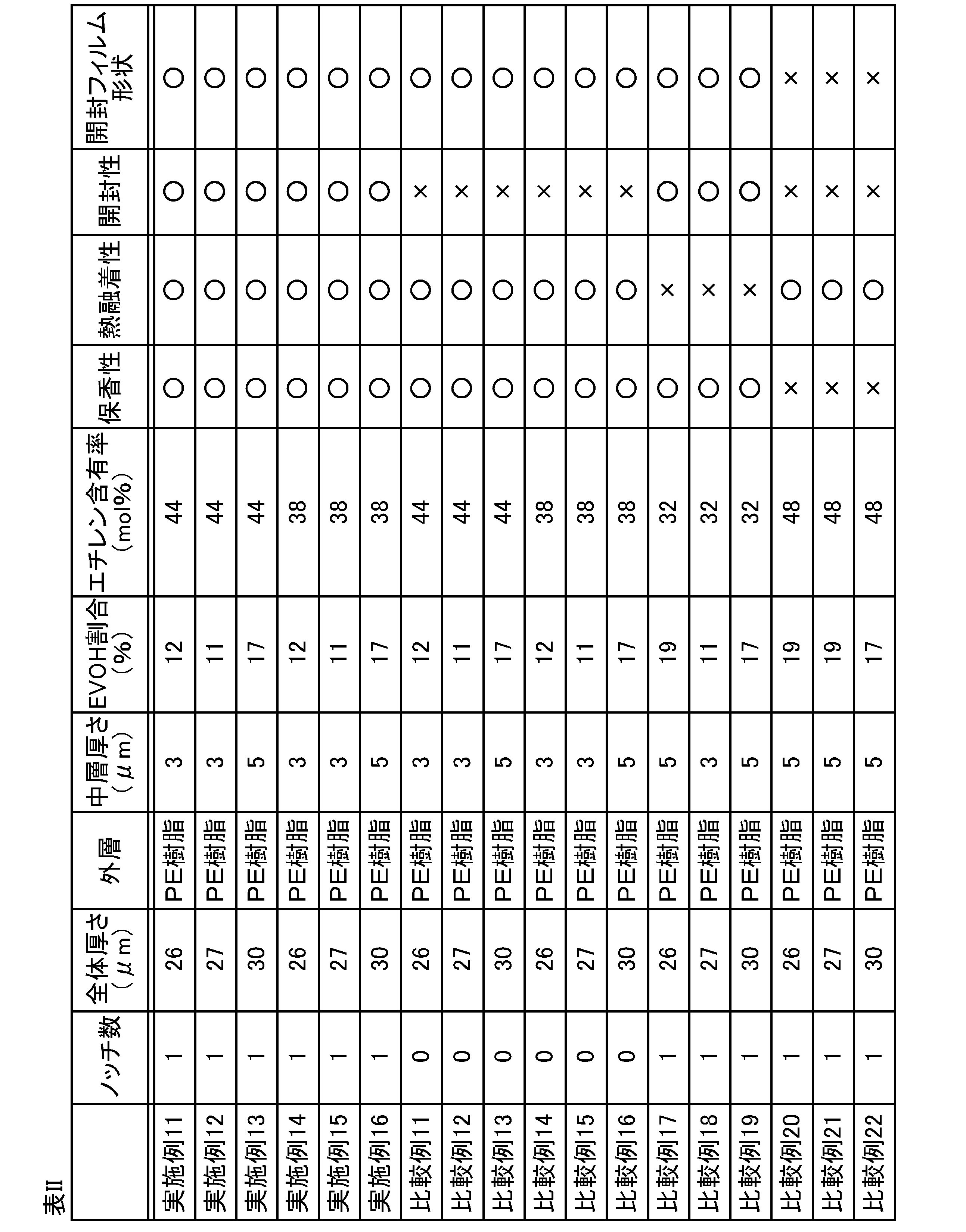
上記表II中、保香性の欄の、○は5人全員が「しっかり香る」を示し、×は1人以上が「香りが弱い」を示している。
また、熱融着性の欄の、○はヒートシールが良好に行われたことを示し、×はヒートシールが一部十分でないなどの不良が認められたことを示している。
また、開封性の欄の、○は5人全員が容易に開封できたことを示し、×は1人以上が開封できなかったことを示している。
また、開封フィルム形状の欄の、○は包装用フィルムの端部がまっすぐであることを示し、×は包装用フィルムの端部に伸び縮みなどの不良が認められたことを示している。
また、熱融着性の欄の、○はヒートシールが良好に行われたことを示し、×はヒートシールが一部十分でないなどの不良が認められたことを示している。
また、開封性の欄の、○は5人全員が容易に開封できたことを示し、×は1人以上が開封できなかったことを示している。
また、開封フィルム形状の欄の、○は包装用フィルムの端部がまっすぐであることを示し、×は包装用フィルムの端部に伸び縮みなどの不良が認められたことを示している。
[評価]
EVOH樹脂層のエチレン含有率を32mol%とすると(比較例17~19参照)、包装用フィルム全体の厚さに拘わらず、ヒートシールの不良が認められた。また、エチレン含有率を48mol%とすると(比較例20~22参照)、包装用フィルム全体の厚さに拘わらず、ノッチを形成しても、開封し難く、開封後の包装用フィルムの端部の形状に不良が認められた。
これにより、EVOH樹脂層のエチレン含有率は、32mol%を上回り、且つ、48mol%を下回るのが好ましいと考えられ、エチレン含有率を38mol%とした場合(実施例14~16参照)や44mol%とした場合(実施例11~13参照)では、包装用フィルム全体の厚さに拘わらず、ノッチを形成しても香りが十分に残っており、また、開封し易く、且つ、開封後の包装用フィルムの端部がまっすぐであった。
なお、エチレン含有率を38mol%や44mol%としても、ノッチを形成しない場合には(比較例11~16参照)、包装用フィルム全体の厚さに拘わらず、開封し難かった。
EVOH樹脂層のエチレン含有率を32mol%とすると(比較例17~19参照)、包装用フィルム全体の厚さに拘わらず、ヒートシールの不良が認められた。また、エチレン含有率を48mol%とすると(比較例20~22参照)、包装用フィルム全体の厚さに拘わらず、ノッチを形成しても、開封し難く、開封後の包装用フィルムの端部の形状に不良が認められた。
これにより、EVOH樹脂層のエチレン含有率は、32mol%を上回り、且つ、48mol%を下回るのが好ましいと考えられ、エチレン含有率を38mol%とした場合(実施例14~16参照)や44mol%とした場合(実施例11~13参照)では、包装用フィルム全体の厚さに拘わらず、ノッチを形成しても香りが十分に残っており、また、開封し易く、且つ、開封後の包装用フィルムの端部がまっすぐであった。
なお、エチレン含有率を38mol%や44mol%としても、ノッチを形成しない場合には(比較例11~16参照)、包装用フィルム全体の厚さに拘わらず、開封し難かった。
以上のように、本実施形態の包装袋100によれば、袋本体部10は、上下方向に略直交する左右方向や前後方向に直線状に引き裂かれる性質を有するとともに、ガスバリア性を有する包装用フィルムFから成形されてなり、上下方向に略直交する方向に延在する直線状の切れ目を有するノッチ(例えば、第1のノッチ51等)が形成されているので、このノッチから包装用フィルムFが上下方向に略直交する方向に切り開かれていくことで取出口30を容易に形成することができる。
具体的には、袋本体部10の上端部には、包装用フィルムFがガゼット折りされたガゼット折部40が設けられ、このガゼット折部40を形成する包装用フィルムFの対向する面同士を接合することで把持部20が形成され、ガゼット折部40における包装用フィルムFが折り込まれていない前面41の把手部20側に、左右方向に延在する直線状の切れ目を有する第1のノッチ51が形成されているので、包装用フィルムFが第1のノッチ51から左右方向に切り開かれ、第1のノッチ51の切れ目がガゼット折部40の左右の両側面42、42に至るように左右方向に拡大していく。また、ガゼット折部40における包装用フィルムFが折り込まれている左右の両側面42、42の把手部20側に、第1のノッチ51と上下方向の位置を略等しくして、前後方向に延在する直線状の切れ目を有する第2のノッチ52がそれぞれ形成されているので、左右の両側面42、42では、ガゼット折部40の前面41にて切り開かれている部分と上下方向に略等しい位置で前から後ろに切り開かれていき、第2のノッチ52を通ってガゼット折部40の後面に至るまで切り開かれていく。このようにして、ガゼット折部40の前面41並びに左右の両側面42、42が切り開かれて取出口30を形成することができる。
また、取出口30が形成されていないロール紙Rの保管状態にて、ミシン目が形成されている従来のものに比べて、虫などの異物の混入を適正に抑制することができるだけでなく、例えば、紙製衛生物品が香り付きのトイレットロールなどの香料が付与されたものであっても、香料を漏れ難くすることができる。
したがって、ロール紙Rの保管を適正に行うことができるとともに、より開封し易い包装袋100を提供することができる。
具体的には、袋本体部10の上端部には、包装用フィルムFがガゼット折りされたガゼット折部40が設けられ、このガゼット折部40を形成する包装用フィルムFの対向する面同士を接合することで把持部20が形成され、ガゼット折部40における包装用フィルムFが折り込まれていない前面41の把手部20側に、左右方向に延在する直線状の切れ目を有する第1のノッチ51が形成されているので、包装用フィルムFが第1のノッチ51から左右方向に切り開かれ、第1のノッチ51の切れ目がガゼット折部40の左右の両側面42、42に至るように左右方向に拡大していく。また、ガゼット折部40における包装用フィルムFが折り込まれている左右の両側面42、42の把手部20側に、第1のノッチ51と上下方向の位置を略等しくして、前後方向に延在する直線状の切れ目を有する第2のノッチ52がそれぞれ形成されているので、左右の両側面42、42では、ガゼット折部40の前面41にて切り開かれている部分と上下方向に略等しい位置で前から後ろに切り開かれていき、第2のノッチ52を通ってガゼット折部40の後面に至るまで切り開かれていく。このようにして、ガゼット折部40の前面41並びに左右の両側面42、42が切り開かれて取出口30を形成することができる。
また、取出口30が形成されていないロール紙Rの保管状態にて、ミシン目が形成されている従来のものに比べて、虫などの異物の混入を適正に抑制することができるだけでなく、例えば、紙製衛生物品が香り付きのトイレットロールなどの香料が付与されたものであっても、香料を漏れ難くすることができる。
したがって、ロール紙Rの保管を適正に行うことができるとともに、より開封し易い包装袋100を提供することができる。
なお、本発明は、上記実施形態に限定されることなく、本発明の趣旨を逸脱しない範囲において、種々の改良並びに設計の変更を行っても良い。
例えば、上記実施形態にあっては、包装用フィルムFに第1のノッチ51及び第2のノッチ52が形成されたものを例示したが、一例であってこれに限られるものではなく、必ずしも両方のノッチが形成されている必要はない。すなわち、包装用フィルムFには、第1のノッチ51及び第2のノッチ52のうち、何れか一方のノッチ(例えば、第1のノッチ51等)が形成されていれば良い。
例えば、上記実施形態にあっては、包装用フィルムFに第1のノッチ51及び第2のノッチ52が形成されたものを例示したが、一例であってこれに限られるものではなく、必ずしも両方のノッチが形成されている必要はない。すなわち、包装用フィルムFには、第1のノッチ51及び第2のノッチ52のうち、何れか一方のノッチ(例えば、第1のノッチ51等)が形成されていれば良い。
また、上記実施形態で例示した包装用フィルムFは、一例であってこれに限られるものではなく、包装用フィルムFのヒートシール性等を損なわない範囲で適宜任意に変更可能である。例えば、外層と中層とを一体化するための架橋剤層などの積層構造のフィルムをより効果的に一体化構造とするために用いられる層を設けることができる。
さらに、上記実施形態では、袋本体部10に、略等しい形状の複数のロール紙R、…(紙製衛生物品)が上下方向に積載されるとともに、左右方向及び前後方向(直交方向)に並んで収容されたものを例示したが、複数のロール紙R、…の収容態様は一例であってこれに限られるものではなく、適宜任意に変更可能である。即ち、必ずしも複数のロール紙R、…を上下方向に積載する必要はなく、また、同様に、必ずしも複数のロール紙R、…を左右方向や前後方向に並べる必要はない。
また、上記実施形態では、上下方向に略直交する左右方向や前後方向を一方向とし、上下方向を他方向としたが、一例であってこれに限られるものではなく、適宜任意に変更可能である。
以上説明したように、本発明の好ましい実施の形態によれば、ノッチから包装用フィルムFが上下方向に略直交する方向に切り開かれていくことで取出口30を容易に形成することができる。また、取出口30が形成されていないロール紙Rの保管状態にて、虫などの異物の混入を適正に抑制することができるだけでなく、例えば、紙製衛生物品が香り付きのトイレットロールなどの香料が付与されたものであっても、香料を漏れ難くすることができる。
これにより、本発明は、ロール紙Rの保管を適正に行うことができるとともに、より開封し易い包装袋100を提供することができる技術に特に好適に利用できる。
これにより、本発明は、ロール紙Rの保管を適正に行うことができるとともに、より開封し易い包装袋100を提供することができる技術に特に好適に利用できる。
100 包装袋
10 袋本体部
20 把持部
30 取出口
40 ガゼット折部
41 前面(一面)
42 側面(他面)
51 第1のノッチ
52 第2のノッチ
R ロール紙(紙製衛生物品)
10 袋本体部
20 把持部
30 取出口
40 ガゼット折部
41 前面(一面)
42 側面(他面)
51 第1のノッチ
52 第2のノッチ
R ロール紙(紙製衛生物品)
Claims (6)
- 紙製衛生物品を収容する袋本体部を備える包装袋であって、
前記袋本体部は、
一方向に直線状に引き裂かれる性質を有するとともに、ガスバリア性を有するフィルムから成形されてなり、前記一方向に延在する直線状の切れ目を有するノッチが形成されている包装袋。 - 前記袋本体部の一端側には、前記フィルムの対向する面同士を接合して形成された把手部が設けられ、
前記ノッチは、前記袋本体部の前記把手部側に形成されている請求項1に記載の包装袋。 - 前記袋本体部の一端部には、前記フィルムがガゼット折りされたガゼット折部が設けられ、
前記把手部は、前記ガゼット折部を形成する前記フィルムの対向する面同士を接合することで形成され、
前記ガゼット折部における前記フィルムが折り込まれていない一面の前記把手部側に、第1のノッチが形成されている請求項2に記載の包装袋。 - 前記第1のノッチは、前記袋本体部の前記一方向に略直交する他方向の略等しい位置に離間して複数形成されている請求項3に記載の包装袋。
- 前記ガゼット折部における前記一面と隣合い、前記フィルムが折り込まれている他面の前記把手部側に、第2のノッチが形成され、
前記第1のノッチと前記第2のノッチは、前記一方向に略直交する他方向の位置が略等しくなっている請求項3又は4に記載の包装袋。 - 前記一方向は、上下方向に略直交する方向である請求項1~5の何れか一項に記載の包装袋。
Applications Claiming Priority (2)
| Application Number | Priority Date | Filing Date | Title |
|---|---|---|---|
| JP2016072425A JP6208277B2 (ja) | 2016-03-31 | 2016-03-31 | 包装袋 |
| JP2016-072425 | 2016-03-31 |
Publications (1)
| Publication Number | Publication Date |
|---|---|
| WO2017169433A1 true WO2017169433A1 (ja) | 2017-10-05 |
Family
ID=59963959
Family Applications (1)
| Application Number | Title | Priority Date | Filing Date |
|---|---|---|---|
| PCT/JP2017/007449 Ceased WO2017169433A1 (ja) | 2016-03-31 | 2017-02-27 | 包装袋 |
Country Status (2)
| Country | Link |
|---|---|
| JP (1) | JP6208277B2 (ja) |
| WO (1) | WO2017169433A1 (ja) |
Cited By (1)
| Publication number | Priority date | Publication date | Assignee | Title |
|---|---|---|---|---|
| JP2020070073A (ja) * | 2018-10-31 | 2020-05-07 | 日本製紙クレシア株式会社 | ロール製品パッケージ |
Families Citing this family (1)
| Publication number | Priority date | Publication date | Assignee | Title |
|---|---|---|---|---|
| JP7104916B2 (ja) | 2018-08-24 | 2022-07-22 | 国立大学法人岩手大学 | 移動物体検出装置および移動物体検出方法 |
Citations (4)
| Publication number | Priority date | Publication date | Assignee | Title |
|---|---|---|---|---|
| JP2004292021A (ja) * | 2003-03-27 | 2004-10-21 | Asahi Kasei Pax Corp | 易開封性包装袋 |
| JP2012025465A (ja) * | 2010-07-27 | 2012-02-09 | Nippon Paper Crecia Co Ltd | 使い捨ておむつ用袋及び使い捨ておむつパッケージ |
| JP2014101141A (ja) * | 2012-11-21 | 2014-06-05 | Pola Chem Ind Inc | 包装袋 |
| JP2015063316A (ja) * | 2013-09-24 | 2015-04-09 | 日本製紙クレシア株式会社 | 包装袋及びロール製品パッケージ |
-
2016
- 2016-03-31 JP JP2016072425A patent/JP6208277B2/ja not_active Expired - Fee Related
-
2017
- 2017-02-27 WO PCT/JP2017/007449 patent/WO2017169433A1/ja not_active Ceased
Patent Citations (4)
| Publication number | Priority date | Publication date | Assignee | Title |
|---|---|---|---|---|
| JP2004292021A (ja) * | 2003-03-27 | 2004-10-21 | Asahi Kasei Pax Corp | 易開封性包装袋 |
| JP2012025465A (ja) * | 2010-07-27 | 2012-02-09 | Nippon Paper Crecia Co Ltd | 使い捨ておむつ用袋及び使い捨ておむつパッケージ |
| JP2014101141A (ja) * | 2012-11-21 | 2014-06-05 | Pola Chem Ind Inc | 包装袋 |
| JP2015063316A (ja) * | 2013-09-24 | 2015-04-09 | 日本製紙クレシア株式会社 | 包装袋及びロール製品パッケージ |
Cited By (3)
| Publication number | Priority date | Publication date | Assignee | Title |
|---|---|---|---|---|
| JP2020070073A (ja) * | 2018-10-31 | 2020-05-07 | 日本製紙クレシア株式会社 | ロール製品パッケージ |
| JP2023054289A (ja) * | 2018-10-31 | 2023-04-13 | 日本製紙クレシア株式会社 | ロール製品パッケージ |
| JP2023058737A (ja) * | 2018-10-31 | 2023-04-25 | 日本製紙クレシア株式会社 | ロール製品パッケージ |
Also Published As
| Publication number | Publication date |
|---|---|
| JP2017178431A (ja) | 2017-10-05 |
| JP6208277B2 (ja) | 2017-10-04 |
Similar Documents
| Publication | Publication Date | Title |
|---|---|---|
| KR20200035959A (ko) | 반-강성 티슈 패키지 | |
| US11167899B2 (en) | Toilet paper roll package | |
| JP6208277B2 (ja) | 包装袋 | |
| JP6037990B2 (ja) | トイレットロール包装用フィルム及びトイレットロール包装体 | |
| JP6182637B1 (ja) | 包装袋 | |
| WO2019208628A1 (ja) | 滅菌袋、および、滅菌処理済み繊維製品パッケージ体の製造方法 | |
| JP6311910B2 (ja) | 包装袋及びロール製品パッケージ | |
| CN106458428B (zh) | 带香味纸巾产品和带香味纸巾产品的制造方法 | |
| JP2021084664A (ja) | 紙製品用包装体 | |
| JP7049430B2 (ja) | トイレットロール包装体 | |
| JP5914955B2 (ja) | トイレットロール包装体 | |
| JP6787958B2 (ja) | トイレットロール包装体 | |
| JP2015174670A (ja) | 包装袋 | |
| JP6788646B2 (ja) | トイレットロール包装体 | |
| JP2017178392A (ja) | 包装袋 | |
| JP3226802U (ja) | 吸収性物品の個包装体 | |
| JP6412610B2 (ja) | トイレットロール包装体 | |
| JP6191982B2 (ja) | 香り付きティシュペーパー製品 | |
| JP2015067402A (ja) | ロール状紙製物品用管及びロール状紙製物品 | |
| KR102680447B1 (ko) | 물티슈용 거싯 분배기 패키지 | |
| JP6166446B2 (ja) | トイレットロール包装体 | |
| JP6346469B2 (ja) | トイレットロール包装体 | |
| JP6456447B2 (ja) | トイレットロール包装体 | |
| JP2009207567A (ja) | 清拭用シート包装体及びその製造方法 | |
| JP6210866B2 (ja) | トイレットロール包装体 |
Legal Events
| Date | Code | Title | Description |
|---|---|---|---|
| NENP | Non-entry into the national phase |
Ref country code: DE |
|
| 121 | Ep: the epo has been informed by wipo that ep was designated in this application |
Ref document number: 17773978 Country of ref document: EP Kind code of ref document: A1 |
|
| 122 | Ep: pct application non-entry in european phase |
Ref document number: 17773978 Country of ref document: EP Kind code of ref document: A1 |