WO2017169068A1 - 列車降車人数予測システム、混雑可視化・評価システム、および乗車可能人数算出システム - Google Patents
列車降車人数予測システム、混雑可視化・評価システム、および乗車可能人数算出システム Download PDFInfo
- Publication number
- WO2017169068A1 WO2017169068A1 PCT/JP2017/003257 JP2017003257W WO2017169068A1 WO 2017169068 A1 WO2017169068 A1 WO 2017169068A1 JP 2017003257 W JP2017003257 W JP 2017003257W WO 2017169068 A1 WO2017169068 A1 WO 2017169068A1
- Authority
- WO
- WIPO (PCT)
- Prior art keywords
- train
- getting
- interval
- unit
- arrival
- Prior art date
- Legal status (The legal status is an assumption and is not a legal conclusion. Google has not performed a legal analysis and makes no representation as to the accuracy of the status listed.)
- Ceased
Links
Images





Classifications
-
- B—PERFORMING OPERATIONS; TRANSPORTING
- B61—RAILWAYS
- B61L—GUIDING RAILWAY TRAFFIC; ENSURING THE SAFETY OF RAILWAY TRAFFIC
- B61L27/00—Central railway traffic control systems; Trackside control; Communication systems specially adapted therefor
- B61L27/60—Testing or simulation
-
- B—PERFORMING OPERATIONS; TRANSPORTING
- B61—RAILWAYS
- B61L—GUIDING RAILWAY TRAFFIC; ENSURING THE SAFETY OF RAILWAY TRAFFIC
- B61L27/00—Central railway traffic control systems; Trackside control; Communication systems specially adapted therefor
- B61L27/10—Operations, e.g. scheduling or time tables
-
- B—PERFORMING OPERATIONS; TRANSPORTING
- B61—RAILWAYS
- B61L—GUIDING RAILWAY TRAFFIC; ENSURING THE SAFETY OF RAILWAY TRAFFIC
- B61L27/00—Central railway traffic control systems; Trackside control; Communication systems specially adapted therefor
- B61L27/40—Handling position reports or trackside vehicle data
-
- G—PHYSICS
- G06—COMPUTING OR CALCULATING; COUNTING
- G06Q—INFORMATION AND COMMUNICATION TECHNOLOGY [ICT] SPECIALLY ADAPTED FOR ADMINISTRATIVE, COMMERCIAL, FINANCIAL, MANAGERIAL OR SUPERVISORY PURPOSES; SYSTEMS OR METHODS SPECIALLY ADAPTED FOR ADMINISTRATIVE, COMMERCIAL, FINANCIAL, MANAGERIAL OR SUPERVISORY PURPOSES, NOT OTHERWISE PROVIDED FOR
- G06Q50/00—Information and communication technology [ICT] specially adapted for implementation of business processes of specific business sectors, e.g. utilities or tourism
- G06Q50/40—Business processes related to the transportation industry
Definitions
- the present invention relates to a system that provides congestion status visualization and prediction information.
- Patent Document 1 data including the getting-off station read by the automatic ticket checker is received from a ticket passing through the automatic ticket checker on the entrance side of each station, and the number of people getting off at each getting-off station is totaled for each getting-off station.
- Pass through the automatic ticket gate with reference to the storage device that stores statistical data that correlates the device, the boarding station of the boarding ticket, and the boarding ratio of users who have boarding tickets that specify the boarding station.
- a vehicle congestion rate prediction system that requires a means for predicting a vehicle on which a user rides and calculating the number of people who get on each vehicle and the number of people who get off based on the prediction is disclosed.
- Patent Document 1 has the following problems in predicting the number of people getting off the train.
- Patent Document 1 in order to calculate the number of people getting off the train, it is necessary to record the passage of automatic ticket gates at each station. Therefore, even when it is desired to acquire the congestion status of a single station, it is necessary to acquire information on all stations. It is difficult to obtain information on all stations in a complicated railway network due to direct operation between railway operators.
- An object of the present invention is to make it possible to predict the number of people getting off a train using information that can be acquired at a single station.
- a train getting-off number prediction system includes a getting-off number calculating unit for measuring or estimating the number of getting off from an arriving train, a train arrival / deletion detecting unit for detecting arrival of a train, and arrival of two trains.
- a train interval calculation unit that calculates a train interval that is a time interval, and predicting the number of trains that will arrive in the future based on the number of people getting off and the train intervals.
- the number of people getting off the train can be predicted using information that can be acquired at a single station.
- FIG. 1 is a diagram showing an example of the configuration of a train getting-off person prediction apparatus according to the present invention.
- the train getting-off number prediction device is a device that predicts the number of getting-offs from trains at a railway station in a timely manner, and includes a measurement unit 100, a calculation unit 200, a recording unit 300, and an output unit 400.
- the measurement unit 100, the calculation unit 200, the recording unit 300, and the output unit 400 can communicate with each other, and operate on one or a plurality of interconnected computers.
- the measuring unit 100 includes a number measuring unit 101 that measures the number of people passing through the station, and a train arrival / deletion detecting unit 102 that detects arrival and departure of a train within the station.
- the calculation unit 200 includes a number of people getting off the train 201 for estimating the number of people getting off the train, a train interval calculating unit 202 for calculating the arrival time interval of the train that has just arrived on the same line as the target train, and a past train interval.
- a prediction model creation unit 203 that creates a prediction model of the number of passengers getting off the train on the basis of the statistical information of the number of people getting off, a passenger prediction unit 204 that predicts the number of people getting off by inputting the train interval of the train when the train arrives, Have
- the recording unit 300 includes the number-of-passengers measurement information 301 that is a detection result of the number of passing people, the arrival / departure time information 302 that is the arrival and departure times of trains, the getting-off number information 303 that is an estimated value of the number of people getting off and on for each train, This is a database that holds train interval information 304 that is an interval and prediction model information 305 that is a prediction model for predicting the number of people getting off the train based on the train interval.
- the output unit 400 outputs a prediction result of the number of people getting off the train.
- the number-of-people counting unit 101 is a sensor device that can measure the local number of people in the station according to the moving direction, and outputs the number of people passing as time-counting information 301 by time and direction.
- the number-of-people counting unit 101 is realized by, for example, using a monitoring camera installed in a station premises as a sensor and measuring the number of people by image processing.
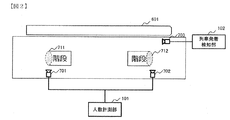
- sensors are installed on stairs or escalators connecting the platform and the ticket gate floor in order to estimate the number of trains getting off in the past.
- sensors are installed at the positions of the camera 701 and the camera 702 in FIG. 2, and the number of passing people at the points 711 and 712 is measured.
- the train arrival / departure detection unit 102 is a sensor device that can detect the arrival and departure of a train, detects arrival or departure of a train, records the time at that time, and outputs a detection result as arrival / departure time information 302.
- the train arrival / departure detection unit 102 is realized, for example, by using a monitoring camera installed on the platform as a camera 703 in FIG. 2 as a sensor and detecting arrival / departure of a train by image processing.
- the getting-off number calculating unit 201 receives the past number-of-persons measurement information 301 and the past departure / arrival time information 302 as input, estimates the number of getting-off persons of each train by assigning the measured number of passing persons to the train, and outputs it as the getting-off number information 303 To do.
- the train interval calculation unit 202 calculates the arrival interval time of trains arriving on the same line and outputs it as train interval information 304.
- the prediction model creation unit 203 creates a model for predicting the number of train getting off passengers from the train interval based on the data that associates the past getting off passenger information 303 and the past train interval information 304, and outputs the model as prediction model information 305. To do.
- the getting-off number predicting unit 204 uses the prediction model information 305 to predict and output the number of getting-off trains using the train interval output by the train interval calculating unit 202 as an input.
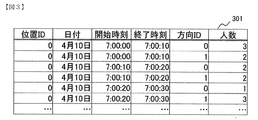
- the number-of-persons measurement information 301 is data in which the measurement result of the number-of-people counting unit 101 is recorded. As shown in FIG. 3, the position ID for specifying the sensor installation position, the measured date, the measurement start time and the end time are measured. This is data composed of a direction ID for specifying the direction in which the pedestrian moves and the number of people measured, and is stored in the recording unit 300 as a database.
- the arrival / departure time information 302 is data in which the detection result of the train arrival / departure detection unit is recorded. As shown in FIG. 4, the line ID that identifies the arrival number of the target train, the date and time when the train was detected, Is data that is classified according to whether it is arrival or departure, and is stored in the recording unit 300 as a database.
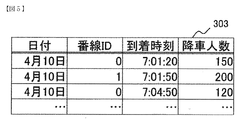
- the number of passengers getting off information 303 is data in which the number of people getting off is recorded for each train.
- the information about the number of people getting off is data including the date when the train was detected, the line ID, the arrival time, and the number of people getting off.
- the date, line ID, and arrival time are information for uniquely identifying a train, and data that associates the train ID with the number of people getting off may be used by attaching a train ID for each train.
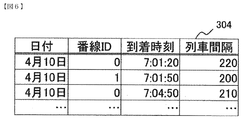
- the train interval information 304 is data that records the train interval with the train just before each train, and as shown in FIG. 6, the train interval information 304 is data composed of the date the train was detected, the line ID, the arrival time, and the train interval. Yes, and stored in the recording unit 300 as a database.
- the date, line ID, and arrival time are information for uniquely identifying a train, and data that associates the train ID with the number of people getting off may be used by attaching a train ID for each train.
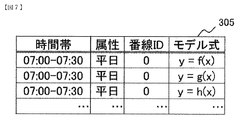
- Prediction model information 305 is data in which a model for predicting the number of people getting off the train from the train interval is recorded, and as shown in FIG.
- the prediction model is recorded as a model formula, but the model is not limited to the formula. For example, you may hold
- step 4001 is expressed as S4001.
- the number of people counting unit 301 is used to measure the number of people passing through a predetermined location in the station, and the measurement result is stored in the recording unit 300 as the number of people counting information 301, thereby creating a database of the number of people counting information 301.
- the train arrival / departure detection unit 102 is used to detect the arrival / departure time of a train that arrives and departs from the station, and the detection result is stored in the recording unit 300 as arrival / departure time information 302, thereby creating a database for the arrival / departure time information 302. .
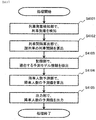
- the number-of-passengers calculation unit 201 divides the number of passing people recorded in the number-of-passengers measurement information 301 by the train arrival time recorded in the departure / arrival time information 302, and the arrival time of the next train that arrives from the arrival time of each train. By assigning the number of passengers to the train to the train, the number of people getting off the train is calculated, and stored in the recording unit 300 as the number of people getting off the information 303, thereby creating a database of the number of people getting off the train 303.
- S4004 When the train detection unit 102 detects arrival of a train and the arrival / departure time information 302 is output by the train interval calculation unit 202, the same train as the train is obtained from the arrival / departure time information 302 recorded in the recording unit 300.
- a train interval information database is created by calculating an interval from the arrival time of the train that arrived immediately before the number line as a train interval and storing it in the recording unit 300 as train interval information 304.
- the prediction model creation unit 203 associates the information about the number of people getting off 303 recorded in the recording unit 300 with the train interval information 304, classifies the conditions according to conditions such as the number of lines, the time zone, and the like. A relational expression of the number of people getting off is calculated and stored in the recording unit 300 as prediction model information 305, thereby creating a prediction model information database.
- the database is updated by repeating the above processing in a timely or periodic manner according to the measurement result of the measurement unit 100.
- periodic refers to updating on a daily basis, for example.
- the train interval calculation unit 202 calculates the arrival interval of the arrival train immediately before the same line as the train from the arrival / departure time information 302.
- S4103 The number of passengers getting off the vehicle in the conditions is obtained by acquiring the prediction model information 305 that matches the conditions at the time of arrival of the train from the recording unit 300 and inputting the previous train interval in the prediction model. Calculate the predicted value.
- the output unit 400 outputs a predicted value of the number of people getting off. For example, by using the number of pedestrians as an input, by estimating the congestion of a predetermined space by simulating the movement of pedestrians, and outputting the predicted value of the number of people getting off to a known pedestrian simulator device that can be visualized and evaluated Realize visualization and prediction of congestion in the station premises.
- the number of passengers after getting off can be calculated by subtracting the predicted value of the number of people getting off from the number of passengers, By subtracting the number of passengers after getting off the train capacity, the number of people who can get on the train can be calculated. As a result, the number of people staying on the platform can be visualized and predicted more precisely.
- the measuring unit 100 is realized using a known sensing technology
- the recording unit 300 is realized using a known database technology
- the output unit 400 is realized using a known data transfer technology
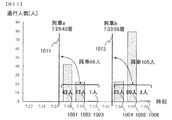
- Symbols 1001 to 1006 represent the number of people passing through the target number line and direction from the person counting information 301 and representing the number of people passing in each time zone.
- Symbols 1011 and 1012 are train arrival times of the target number line extracted from the arrival / departure time information 302.
- the number-of-getting-off person calculating unit 201 divides the number of passing persons by the train arrival time, and assigns the number of passing persons to the immediately preceding train, thereby calculating the number of getting off the previous train.
- symbols 1001 to 1003 are the number of people who have passed the stairs on the platform in the direction toward the ticket gate floor from the arrival of the train 1011 to the arrival of the train 1012, and can be estimated as the number of people who got off the train 1011.
- the number measurement information 301 which is the number ID of the target number for calculating the number of people getting off and the direction ID in the direction of moving from the platform to the ticket gate floor, is extracted from the recording unit 300.
- the arrival / departure time information 302 which is the number ID of the number of the target number for calculating the number of passengers, is extracted from the recording unit 300.
- S5003 The extracted person counting information is divided by the train arrival time in the extracted arrival / departure time information.
- S5004 The total value of the number of people measurement information divided by the train arrival time is set as the number of people getting off the train that arrives immediately before.
- S5005 The number of people getting off is output as the number of people getting off 303, and recorded in the recording unit 300.
- S5102 The difference between the train arrival time of the extracted arrival / departure time information 302 and the arrival time of the train is calculated as the train interval of the train.
- S5103 The train interval is output as train interval information 304 and recorded in the recording unit 300.
- FIG. 13 is a scatter diagram in which the horizontal axis represents the train interval and the vertical axis represents the number of people getting off the train.
- Ranges 1101 to 1103 represent data distributions distinguished by attributes, line numbers, time zones, and the like.
- Curves 1111 to 1113 are relational expressions between the train interval and the number of people getting off the train corresponding to the data in the ranges 1101 to 1103, respectively.
- the relational expression is calculated, for example, by regression analysis using the train interval as an explanatory variable and the number of people getting off the train as an objective variable.
- the prediction model creation unit 203 creates a relational expression for each condition as a prediction model and outputs it as prediction model information 305.
- S5201 Corresponding train interval information 304 and disembarkation number information 303 by date, line ID, and arrival time.
- S5202 The associated data is classified and distinguished according to conditions such as date, line ID, and arrival time zone.
- a relational expression between the train interval and the number of people getting off the train is calculated and used as a model formula.
- the relational expression is calculated, for example, by regression analysis using the train interval as an explanatory variable and the number of people getting off the train as an objective variable.
- the model formula is output as prediction model information 305 and stored in the recording unit 300.
- the prediction model creation method in the prediction model creation unit 203 is not limited to the above.
- the difference between the input train interval and the standard train interval is delayed with the train interval and the average or average value of the train get-off number as the standard train interval and train drop-off number under the condition.
- a model formula may be created by a relational formula between the delay time and the number of people getting off the train.
- a model equation is obtained by a relational expression of a delay rate that is a ratio of the delay time to a standard delay time and a change rate of the number of people getting off the train that is a ratio of the number of people getting off the train to a standard number of people getting off the train. May be created.
- the getting-off number prediction unit receives as input the train interval calculated by the train interval calculation unit 202 when the train arrives.
- S5302 Predictive model information 305 that matches the conditions of the train is extracted from the recording unit 300.
- S5303 The number of trains getting off is predicted by substituting the input train interval into the extracted model formula.
- S5304 The predicted number of people getting off the train is output.
- the processing of the getting-off person prediction unit 204 is changed according to the method of creating the prediction model. For example, when a prediction model is created using a relational expression of the delay rate and the number of people getting off the train, the delay rate is calculated from the train interval, and the rate of change in the number of people getting off the train is calculated using the relational expression. The number of people getting off the train is obtained by multiplying the number of people changing by the standard number of people getting off the train.
- the train interval is calculated from the arrival time of the train at the stage where the arrival of the train is detected, and based on the train interval Statistically, the number of people getting off the arrival train can be predicted.
- the train interval is calculated from the arrival time of the train at the stage where the arrival of the train is detected, and based on the train interval Statistically, the number of people getting off the arrival train can be predicted.
- timely refers to the arrival stage of the train before the passenger gets off the train.
Landscapes
- Engineering & Computer Science (AREA)
- Mechanical Engineering (AREA)
- Business, Economics & Management (AREA)
- Health & Medical Sciences (AREA)
- Economics (AREA)
- General Health & Medical Sciences (AREA)
- Human Resources & Organizations (AREA)
- Marketing (AREA)
- Primary Health Care (AREA)
- Strategic Management (AREA)
- Tourism & Hospitality (AREA)
- Physics & Mathematics (AREA)
- General Business, Economics & Management (AREA)
- General Physics & Mathematics (AREA)
- Theoretical Computer Science (AREA)
- Train Traffic Observation, Control, And Security (AREA)
- Management, Administration, Business Operations System, And Electronic Commerce (AREA)
Abstract
Description
図1は本発明の列車降車人数予測装置の構成の一例を示す図である。列車降車人数予測装置は、鉄道駅における列車からの降車人数を適時予測する装置であり、計測部100、演算部200、記録部300、出力部400を有する。計測部100、演算部200、記録部300、出力部400は相互に通信可能であり、1つまたは相互接続された複数のコンピュータ上で動作する。
続いて、各構成要素の機能および使用するデータについて説明する。
続いて、列車降車人数予測装置の全体の処理フローの一例について説明し、その後、列車降車人数予測装置を構成する各部の処理フローの一例について説明をする。列車降車人数予測装置の処理は、データベース作成処理と降車人数予測処理に分けることができる。
本実施例の列車降車人数予測装置により、単一の駅から得られる情報のみを用いて、列車の到着を検知した段階で、列車の到着時間から列車間隔を算出し、列車間隔をもとに統計的に該到着列車の降車人数を予測することができる。これにより、列車到着時に降車人数を公知の歩行者シミュレータ装置に入力することで、リアルタイムに列車降車客を含む駅構内の混雑状況の可視化・予測を行うことが単一の駅情報のみで可能となる。単一の駅から得られる情報のみで混雑状況の把握を実現することも可能である。
Claims (5)
- 到着した列車からの降車人数を計測または推定する降車人数算出部と、
列車の到着を検知する列車発着検知部と、
二つの列車の到着時刻の間隔である列車間隔を算出する列車間隔算出部と、を有し、
前記降車人数と前記列車間隔から、将来到着する列車の降車人数を予測することを特徴とする列車降車人数予測システム。 - 前記降車人数算出部で計測または推定された降車人数が、前記列車間隔に対応付けて記録された記録部と、
前記記録部に記録された降車人数の統計情報から予測モデルを作成する演算部と、を有することを特徴とする請求項1の列車降車人数予測システム。 - 前記演算部が、過去の標準的な列車間隔との差分である遅延時間、または前記標準的な列車間隔に対する遅延時間の比率である遅延率を用いて予測モデルを作成することを特徴とする請求項2の列車降車人数予測システム。
- 請求項1に記載の列車降車人数予測システムで予測された降車人数を入力として、歩行者の移動を模擬することにより空間の混雑状況を推定する歩行者シミュレータを有することを特徴とする混雑可視化・評価システム。
- 請求項1に記載の列車降車人数予測システムと、列車内の乗車人数を計測または推定する手段を有し、前記乗車人数から前記列車降車人数予測システムが出力する降車人数を減算して算出される降車後乗車人数を、列車の定員から減算することにより列車への乗車可能人数を算出する乗車可能人数算出システム。
Priority Applications (2)
| Application Number | Priority Date | Filing Date | Title |
|---|---|---|---|
| JP2018508470A JP6640988B2 (ja) | 2016-03-30 | 2017-01-31 | 列車降車人数予測システム、混雑可視化・評価システム、および乗車可能人数算出システム |
| EP17773617.0A EP3437955B1 (en) | 2016-03-30 | 2017-01-31 | Train disembarking passenger number prediction system, congestion visualization and evaluation system, and riding capacity calculation system |
Applications Claiming Priority (2)
| Application Number | Priority Date | Filing Date | Title |
|---|---|---|---|
| JP2016-067041 | 2016-03-30 | ||
| JP2016067041 | 2016-03-30 |
Publications (1)
| Publication Number | Publication Date |
|---|---|
| WO2017169068A1 true WO2017169068A1 (ja) | 2017-10-05 |
Family
ID=59962821
Family Applications (1)
| Application Number | Title | Priority Date | Filing Date |
|---|---|---|---|
| PCT/JP2017/003257 Ceased WO2017169068A1 (ja) | 2016-03-30 | 2017-01-31 | 列車降車人数予測システム、混雑可視化・評価システム、および乗車可能人数算出システム |
Country Status (3)
| Country | Link |
|---|---|
| EP (1) | EP3437955B1 (ja) |
| JP (1) | JP6640988B2 (ja) |
| WO (1) | WO2017169068A1 (ja) |
Cited By (4)
| Publication number | Priority date | Publication date | Assignee | Title |
|---|---|---|---|---|
| JP2019171887A (ja) * | 2018-03-26 | 2019-10-10 | 株式会社エヌ・ティ・ティ・データ | 乗客重量均一化支援装置、及び乗客重量均一化支援方法 |
| CN112381260A (zh) * | 2020-09-03 | 2021-02-19 | 北京交通大学 | 基于进站比例的城市轨道交通客流管控优化方法 |
| WO2022013922A1 (ja) | 2020-07-13 | 2022-01-20 | 三菱電機株式会社 | 誘導システム及び誘導方法 |
| CN115472018A (zh) * | 2022-10-28 | 2022-12-13 | 广州地铁集团有限公司 | 一种基于行车分析及客流预测的城轨仿真推演方法 |
Families Citing this family (5)
| Publication number | Priority date | Publication date | Assignee | Title |
|---|---|---|---|---|
| CN110636210B (zh) * | 2019-05-17 | 2020-07-28 | 乐清海创智能科技有限公司 | 无线信号触发方法 |
| GB2585028A (en) * | 2019-06-25 | 2020-12-30 | Siemens Mobility Ltd | A method and system for deriving train travel information |
| JP7461231B2 (ja) * | 2020-06-24 | 2024-04-03 | 株式会社日立製作所 | 混雑推定システムおよび混雑推定方法 |
| CN111762238B (zh) * | 2020-07-03 | 2022-03-11 | 山东交通职业学院 | 一种列车间隔调整系统及其调整方法 |
| US20230087643A1 (en) * | 2021-09-17 | 2023-03-23 | Korea Railroad Research Institute | Method and apparatus for determining coupling section in real-time for train platooning |
Citations (3)
| Publication number | Priority date | Publication date | Assignee | Title |
|---|---|---|---|---|
| JP2004178358A (ja) * | 2002-11-28 | 2004-06-24 | Meidensha Corp | イベント警備監視方法及びイベント警備監視装置 |
| JP2005212641A (ja) * | 2004-01-30 | 2005-08-11 | Mitsubishi Electric Corp | 駅混雑度推定システム |
| JP2015009604A (ja) * | 2013-06-27 | 2015-01-19 | 株式会社日立製作所 | 列車混雑度予測システム、及び列車混雑度予測方法 |
Family Cites Families (5)
| Publication number | Priority date | Publication date | Assignee | Title |
|---|---|---|---|---|
| JPS58180375A (ja) * | 1982-04-16 | 1983-10-21 | 株式会社日立製作所 | 列車群制御方式 |
| JP2002037076A (ja) * | 2000-07-27 | 2002-02-06 | Kawasaki Heavy Ind Ltd | 列車運行模擬方法および装置 |
| JP5518213B2 (ja) * | 2010-12-20 | 2014-06-11 | 三菱電機株式会社 | 車両内混雑状況表示システムおよび混雑状況案内方法 |
| JP6178226B2 (ja) * | 2013-12-04 | 2017-08-09 | 株式会社日立製作所 | 人流誘導システム及び人流誘導方法 |
| JP6393531B2 (ja) * | 2014-06-24 | 2018-09-19 | 株式会社日立製作所 | 列車選択支援システム、列車選択支援方法、及び列車選択支援プログラム |
-
2017
- 2017-01-31 EP EP17773617.0A patent/EP3437955B1/en active Active
- 2017-01-31 WO PCT/JP2017/003257 patent/WO2017169068A1/ja not_active Ceased
- 2017-01-31 JP JP2018508470A patent/JP6640988B2/ja active Active
Patent Citations (3)
| Publication number | Priority date | Publication date | Assignee | Title |
|---|---|---|---|---|
| JP2004178358A (ja) * | 2002-11-28 | 2004-06-24 | Meidensha Corp | イベント警備監視方法及びイベント警備監視装置 |
| JP2005212641A (ja) * | 2004-01-30 | 2005-08-11 | Mitsubishi Electric Corp | 駅混雑度推定システム |
| JP2015009604A (ja) * | 2013-06-27 | 2015-01-19 | 株式会社日立製作所 | 列車混雑度予測システム、及び列車混雑度予測方法 |
Cited By (7)
| Publication number | Priority date | Publication date | Assignee | Title |
|---|---|---|---|---|
| JP2019171887A (ja) * | 2018-03-26 | 2019-10-10 | 株式会社エヌ・ティ・ティ・データ | 乗客重量均一化支援装置、及び乗客重量均一化支援方法 |
| WO2022013922A1 (ja) | 2020-07-13 | 2022-01-20 | 三菱電機株式会社 | 誘導システム及び誘導方法 |
| US12175554B2 (en) | 2020-07-13 | 2024-12-24 | Mitsubishi Electric Corporation | Guidance system and guidance method |
| CN112381260A (zh) * | 2020-09-03 | 2021-02-19 | 北京交通大学 | 基于进站比例的城市轨道交通客流管控优化方法 |
| CN112381260B (zh) * | 2020-09-03 | 2023-11-17 | 北京交通大学 | 基于进站比例的城市轨道交通客流管控优化方法 |
| CN115472018A (zh) * | 2022-10-28 | 2022-12-13 | 广州地铁集团有限公司 | 一种基于行车分析及客流预测的城轨仿真推演方法 |
| CN115472018B (zh) * | 2022-10-28 | 2023-12-29 | 广州地铁集团有限公司 | 一种基于行车分析及客流预测的城轨仿真推演方法 |
Also Published As
| Publication number | Publication date |
|---|---|
| JPWO2017169068A1 (ja) | 2019-01-10 |
| JP6640988B2 (ja) | 2020-02-05 |
| EP3437955A4 (en) | 2020-01-29 |
| EP3437955B1 (en) | 2021-04-28 |
| EP3437955A1 (en) | 2019-02-06 |
Similar Documents
| Publication | Publication Date | Title |
|---|---|---|
| JP6640988B2 (ja) | 列車降車人数予測システム、混雑可視化・評価システム、および乗車可能人数算出システム | |
| CN109789885B (zh) | 交通系统、调度表建议系统以及车辆运行系统 | |
| WO2018155397A1 (ja) | 混雑予測システムおよび歩行者シミュレーション装置 | |
| CN112598182A (zh) | 一种轨道交通智能调度方法及系统 | |
| JP6675860B2 (ja) | データ処理方法およびデータ処理システム | |
| JP6454222B2 (ja) | データ処理システム、及び、データ処理方法 | |
| CN109311622B (zh) | 电梯系统以及轿厢呼叫估计方法 | |
| JP2019177760A (ja) | 輸送機関混雑予測システム及び混雑予測方法 | |
| JP2016168876A (ja) | 混雑予測装置及び混雑予測方法 | |
| JP2018002037A (ja) | 混雑率予想システム及び方法 | |
| CN112299176B (zh) | 用于电梯拥挤预测的方法和系统 | |
| JP6326177B2 (ja) | 交通状況推定システム及び交通状況推定方法 | |
| JP2015172850A (ja) | 駅混雑予測装置及び駅混雑情報提供システム | |
| JP2016166066A (ja) | エレベータシステム | |
| JP2018103924A (ja) | 混雑予測装置 | |
| JP7461231B2 (ja) | 混雑推定システムおよび混雑推定方法 | |
| JP6445175B2 (ja) | 混雑予測システムおよび混雑予測方法 | |
| Morozov et al. | Prototype of urban transport passenger accounting system | |
| WO2018180030A1 (ja) | 混雑対策支援システム | |
| CN113936247B (zh) | 基于流线感知的轨道交通车站客流状态辨识系统 | |
| JP7425680B2 (ja) | ナビゲーション装置、及びナビゲーション方法 | |
| JP6481039B2 (ja) | 混雑監視装置、混雑監視方法、および混雑監視プログラム | |
| Khomchuk et al. | Predicting passenger loading level on a train car: A Bayesian approach | |
| Antos et al. | Tapping into delay: Assessing rail transit passenger delay with data from a tap-in, tap-out fare system | |
| CN107784385B (zh) | 一种轨道交通中的清分方法、装置及系统 |
Legal Events
| Date | Code | Title | Description |
|---|---|---|---|
| WWE | Wipo information: entry into national phase |
Ref document number: 2018508470 Country of ref document: JP |
|
| NENP | Non-entry into the national phase |
Ref country code: DE |
|
| WWE | Wipo information: entry into national phase |
Ref document number: 2017773617 Country of ref document: EP |
|
| ENP | Entry into the national phase |
Ref document number: 2017773617 Country of ref document: EP Effective date: 20181030 |
|
| 121 | Ep: the epo has been informed by wipo that ep was designated in this application |
Ref document number: 17773617 Country of ref document: EP Kind code of ref document: A1 |