WO2017163589A1 - 樹脂組成物 - Google Patents
樹脂組成物 Download PDFInfo
- Publication number
- WO2017163589A1 WO2017163589A1 PCT/JP2017/002540 JP2017002540W WO2017163589A1 WO 2017163589 A1 WO2017163589 A1 WO 2017163589A1 JP 2017002540 W JP2017002540 W JP 2017002540W WO 2017163589 A1 WO2017163589 A1 WO 2017163589A1
- Authority
- WO
- WIPO (PCT)
- Prior art keywords
- resin composition
- formula
- component
- mass
- present
- Prior art date
- Legal status (The legal status is an assumption and is not a legal conclusion. Google has not performed a legal analysis and makes no representation as to the accuracy of the status listed.)
- Ceased
Links
Images
Classifications
-
- C—CHEMISTRY; METALLURGY
- C08—ORGANIC MACROMOLECULAR COMPOUNDS; THEIR PREPARATION OR CHEMICAL WORKING-UP; COMPOSITIONS BASED THEREON
- C08F—MACROMOLECULAR COMPOUNDS OBTAINED BY REACTIONS ONLY INVOLVING CARBON-TO-CARBON UNSATURATED BONDS
- C08F279/00—Macromolecular compounds obtained by polymerising monomers on to polymers of monomers having two or more carbon-to-carbon double bonds as defined in group C08F36/00
- C08F279/02—Macromolecular compounds obtained by polymerising monomers on to polymers of monomers having two or more carbon-to-carbon double bonds as defined in group C08F36/00 on to polymers of conjugated dienes
-
- C—CHEMISTRY; METALLURGY
- C08—ORGANIC MACROMOLECULAR COMPOUNDS; THEIR PREPARATION OR CHEMICAL WORKING-UP; COMPOSITIONS BASED THEREON
- C08F—MACROMOLECULAR COMPOUNDS OBTAINED BY REACTIONS ONLY INVOLVING CARBON-TO-CARBON UNSATURATED BONDS
- C08F290/00—Macromolecular compounds obtained by polymerising monomers on to polymers modified by introduction of aliphatic unsaturated end or side groups
- C08F290/02—Macromolecular compounds obtained by polymerising monomers on to polymers modified by introduction of aliphatic unsaturated end or side groups on to polymers modified by introduction of unsaturated end groups
- C08F290/06—Polymers provided for in subclass C08G
-
- C—CHEMISTRY; METALLURGY
- C08—ORGANIC MACROMOLECULAR COMPOUNDS; THEIR PREPARATION OR CHEMICAL WORKING-UP; COMPOSITIONS BASED THEREON
- C08K—Use of inorganic or non-macromolecular organic substances as compounding ingredients
- C08K3/00—Use of inorganic substances as compounding ingredients
- C08K3/34—Silicon-containing compounds
- C08K3/36—Silica
-
- C—CHEMISTRY; METALLURGY
- C08—ORGANIC MACROMOLECULAR COMPOUNDS; THEIR PREPARATION OR CHEMICAL WORKING-UP; COMPOSITIONS BASED THEREON
- C08K—Use of inorganic or non-macromolecular organic substances as compounding ingredients
- C08K5/00—Use of organic ingredients
- C08K5/04—Oxygen-containing compounds
- C08K5/09—Carboxylic acids; Metal salts thereof; Anhydrides thereof
-
- C—CHEMISTRY; METALLURGY
- C08—ORGANIC MACROMOLECULAR COMPOUNDS; THEIR PREPARATION OR CHEMICAL WORKING-UP; COMPOSITIONS BASED THEREON
- C08K—Use of inorganic or non-macromolecular organic substances as compounding ingredients
- C08K5/00—Use of organic ingredients
- C08K5/04—Oxygen-containing compounds
- C08K5/14—Peroxides
-
- C—CHEMISTRY; METALLURGY
- C08—ORGANIC MACROMOLECULAR COMPOUNDS; THEIR PREPARATION OR CHEMICAL WORKING-UP; COMPOSITIONS BASED THEREON
- C08K—Use of inorganic or non-macromolecular organic substances as compounding ingredients
- C08K5/00—Use of organic ingredients
- C08K5/54—Silicon-containing compounds
- C08K5/541—Silicon-containing compounds containing oxygen
- C08K5/5415—Silicon-containing compounds containing oxygen containing at least one Si—O bond
-
- C—CHEMISTRY; METALLURGY
- C08—ORGANIC MACROMOLECULAR COMPOUNDS; THEIR PREPARATION OR CHEMICAL WORKING-UP; COMPOSITIONS BASED THEREON
- C08K—Use of inorganic or non-macromolecular organic substances as compounding ingredients
- C08K9/00—Use of pretreated ingredients
- C08K9/04—Ingredients treated with organic substances
- C08K9/06—Ingredients treated with organic substances with silicon-containing compounds
-
- C—CHEMISTRY; METALLURGY
- C08—ORGANIC MACROMOLECULAR COMPOUNDS; THEIR PREPARATION OR CHEMICAL WORKING-UP; COMPOSITIONS BASED THEREON
- C08L—COMPOSITIONS OF MACROMOLECULAR COMPOUNDS
- C08L47/00—Compositions of homopolymers or copolymers of compounds having one or more unsaturated aliphatic radicals, at least one having two or more carbon-to-carbon double bonds; Compositions of derivatives of such polymers
Definitions
- the present invention relates to a resin composition used as NCP (Non Conductive Paste) during semiconductor mounting.
- NCP Non Conductive Paste
- An object of the present invention is to provide a resin composition that satisfies the above-described required properties of NCP in order to solve the above-described problems in the prior art.
- a resin composition containing a silane coupling agent is provided.
- the acrylate compound of the component (C) is preferably an acrylate compound represented by the formula (4).
- the content of the acrylate compound of the component (C) is 1 to 6 masses in a total mass of 100 parts by mass of the components (A), (B), (C), and (D). Part.
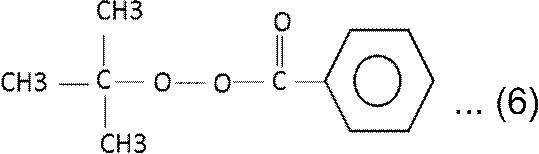
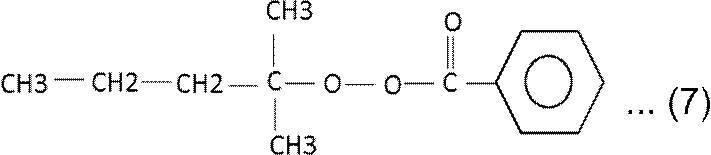
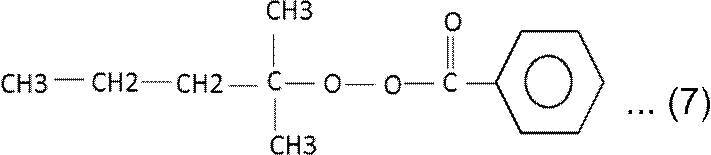
- the organic peroxide as the component (E) preferably contains at least one compound represented by the formulas (5) to (7).
- the content of the organic peroxide of the component (E) is 0.5 to 100 parts by mass with respect to 100 parts by mass of the total mass of the components (A), (B), and (C). It is preferably 6 parts by mass.
- the resin composition of the present invention preferably further contains (H) a compound having a flux function.
- the compound having the flux function of the component (H) is preferably stearic acid.
- the present invention also provides a non-conductive paste (NCP) containing the resin composition of the present invention.
- NCP non-conductive paste
- the present invention also provides a semiconductor device using the NCP of the present invention.
- the resin composition of the present invention When used as an NCP, it is excellent in mountability in the TCB process, and has good moisture absorption reflow resistance, HAST resistance, and life on the stage during TCB implementation.
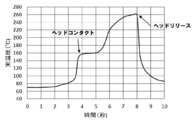
- FIG. 1 is a graph showing a TCB temperature profile in an example.
- the resin composition of the present invention contains the following (meth) acrylate compound (component (A)) and acrylate compounds (component (B), component (C)) as essential components.
- (A) a (meth) acrylate compound represented by formula (1)
- m + n 2.3 to 4.0
- R 1 and R 2 are each a hydrogen atom (H) or a methyl group (CH 3 ).
- m + n 2.3 to 4.0.
- the compound in which R 1 and R 2 represented by the formula (1) are methyl groups is EO-modified bisphenol A dimethacrylate (2,2-Bis [4- (Methacryloxy Ethoxy) Phenyl] Propane)).
- EO-modified means having an ethylene oxide unit (—CH 2 —CH 2 —O—) block structure.
- the (meth) acrylate compound represented by the formula (1) acts as a component imparting liquid properties, adhesion after curing, and durability when the resin composition of the present invention is used as NCP.
- the content of the (meth) acrylate compound represented by the formula (1) is preferably 10 to 65 parts by mass in 100 parts by mass of the total mass of the components (A), (B), (C) and (D). 13 to 60 parts by mass is more preferable.
- the acrylate compound represented by the formula (2) is dimethylol tricyclodecane diacrylate (Dimethylol Tricyclodecane Diacrylate).
- the acrylate compound represented by the formula (2) acts as a component imparting liquid characteristics, curability in the TCB process, and durability when the resin composition of the present invention is used as NCP.
- the content of the acrylate compound represented by the formula (2) is 15 to 70 parts by mass in 100 parts by mass of the total mass of the components (A), (B), (C) and (D) of the resin composition of the present invention. It is preferably 20 to 67 parts by mass.
- the acrylate compound represented by the formula (3) is a caprolactone-modified epoxy acrylate oligomer.
- the acrylate compound represented by the formula (3) acts as a component for improving the life on the stage when TCB is performed when the resin composition of the present invention is used as NCP. This is because the functional group density is slightly lowered by blending the long-chain acrylate compound represented by the formula (3).
- R 1 and R 2 are preferably a phenyl group, that is, the acrylate compound represented by the formula (4) is preferable for the reasons of chemical resistance and long-term durability.
- the content of the silica filler of the component (C) is 40 to 65 parts by mass in 100 parts by mass of the total mass of each component of the film-shaped resin composition of the present invention. It is preferably 45 to 65 parts by mass.
- the content of the acrylate compound represented by the formula (3) is 1 to 6 parts by mass in 100 parts by mass of the total mass of the components (A), (B), (C) and (D) of the resin composition of the present invention. It is preferably 2 to 5 parts by mass.
- a (meth) acrylate compound other than the (A) (meth) acrylate compound and the (B) and (C) component acrylate compounds may be used in combination as appropriate.
- Specific examples of (meth) acrylate compounds that can be used in combination include, for example, bifunctional polyester acrylate compounds, polyester methacrylate compounds, polyurethane acrylate compounds, polyurethane methacrylate compounds, epoxy acrylate compounds, epoxy methacrylate compounds, and 2-acryloyloxyethyl acid phosphate.
- Cyclic structures such as phosphorus (meth) acrylate compounds such as 2-methacryloyloxyethyl acid phosphate, glycol (meth) acrylate compounds such as neopentyl glycol acrylate and neopentyl glycol dimethacrylate, dimethylol tricyclodecane dimethacrylate, etc.
- (Meth) acrylate, isobornyl (meth) acrylate, tetrahydrofurfil Meth) acrylate, phenoxy polyethylene glycol acrylate, nonylphenol EO adduct acrylate, glycidyl (meth) acrylate, may be appropriately used in combination a monofunctional (meth) acrylates such as methacrylate.
- the resin composition of the present invention contains a copolymer of butadiene and maleic anhydride as an essential component as the component (D).
- the copolymer of butadiene and maleic anhydride has a polybutadiene skeleton modified with maleic anhydride.
- the copolymer of butadiene and maleic anhydride acts as a stress relaxation component when the resin composition of the present invention is used as NCP.
- the copolymer of butadiene and maleic anhydride is preferably liquid at room temperature for the purpose of imparting liquid properties.
- the copolymer of butadiene and maleic anhydride preferably has a number average molecular weight (Mn) of 500 to 5000, more preferably 1000 to 4000.
- the content of the copolymer of the component (D) is 5 to 30 parts by mass in 100 parts by mass of the total mass of the components (A), (B), (C) and (D) of the resin composition of the present invention. It is preferably 7 to 27 parts by mass.
- the resin composition of the present invention contains an organic peroxide as an essential component as the component (E).
- the organic peroxide of component (E) is a mixture of (A) methacrylate compound, (B) and (C) acrylate compound, and (D) component during the heat curing of the resin composition of the present invention. Promotes the coalescence reaction.
- organic peroxide of a component As an organic peroxide of a component, the organic peroxide which has a peroxyester structure or a dialkyl peroxide structure is used.
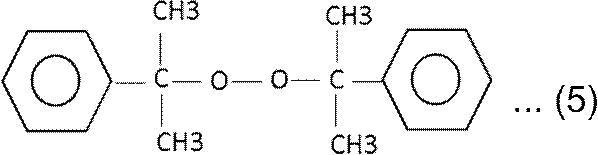
- organic peroxide having a peroxyester structure or a dialkyl peroxide structure compounds represented by the formulas (5) to (7) are preferably used.
- the compound represented by Formula (5) is dicumyl peroxide
- the compound represented by Formula (6) is t-butylperoxybenzoate
- Formula (7) is t-hexylperoxybenzoate.
- the above-mentioned organic peroxide may be used alone or in combination of two or more.
- the content of the organic peroxide of the component (E) is 0.5 to 100 parts by mass with respect to 100 parts by mass of the total mass of the (meth) acrylate compound of the component (A) and the acrylate compounds of the components (B) and (C).
- the amount is preferably 6 parts by mass, and more preferably 0.6 to 5 parts by mass.
- an organic peroxide having a structure other than a peroxyester structure or a dialkyl peroxide structure may be appropriately used in combination.
- organic peroxides that can be used in combination include, for example, benzoyl peroxide, p-menthane hydroperoxide, methyl ethyl ketone peroxide, di-2-ethylhexyl peroxydicarbonate, 1,1-di (t-butyl). Peroxy) -2-methylcyclohexane and the like.
- silica filler of the component (F) is added as an essential component for the purpose of improving the reliability of the mounted semiconductor package when the resin composition of the present invention is used as an NCP.
- the silica filler as the component (F) preferably has an average particle size of 1 ⁇ m or less for reasons such as permeability to a narrow gap and prevention of impact on the semiconductor chip.
- the silica filler as the component (F) preferably has an average particle size of 0.1 ⁇ m or more for the purpose of maintaining liquid properties.
- the silica filler as component (F) preferably has an average particle size of 0.1 to 0.7 ⁇ m.
- the shape of the filler is not particularly limited, and may be any shape such as a spherical shape, an indeterminate shape, and a flake shape. When the shape of the filler is other than spherical, the average particle diameter of the filler means the average maximum diameter of the filler.
- the silica filler that has been surface-treated with a silane coupling agent or the like may be used as the silica filler.
- a silica filler that has been subjected to surface treatment is used, an effect of preventing aggregation of the silica filler is expected.
- the content of the component (F) is preferably 40 to 65 parts by mass, and 45 to 65 parts by mass in 100 parts by mass of the total mass of each component of the resin composition of the present invention. More preferably.
- silane coupling agent of component (G) is added for the purpose of improving adhesion to an IC chip or a substrate when the resin composition of the present invention is used as an NCP.
- silane coupling agent of component (G) various silane coupling agents such as epoxy, amino, vinyl, methacrylic, acrylic, mercapto and the like can be used. Among these, an epoxy silane coupling agent having an epoxy group and a methacrylic silane coupling agent having a methacryl group are preferable because of high adhesion.
- epoxy silane coupling agent examples include 3-glycidoxypropyltrimethoxysilane (trade name: KBM403, manufactured by Shin-Etsu Chemical Co., Ltd.), 3-glycidoxypropyltriethoxysilane (trade name: KBE-403). , Manufactured by Shin-Etsu Chemical Co., Ltd.), 3-glycidoxypropylmethyldiethoxysilane (trade name: KBE-402, manufactured by Shin-Etsu Chemical Co., Ltd.), 3-glycidoxypropylmethyldimethoxysilane (trade name: KBM402, Shin-Etsu Chemical) Etc.).
- methacrylic silane coupling agents include 3-methacryloxypropyltrimethoxysilane (trade name: KBM503, manufactured by Shin-Etsu Chemical Co., Ltd.), 3-methacryloxypropylmethyldimethoxysilane (trade name: KBM502, Shin-Etsu Chemical Co., Ltd.) Company-made), 3-methacryloxypropylmethyldiethoxysilane (trade name: KBE502, manufactured by Shin-Etsu Chemical Co., Ltd.), 3-methacryloxypropyltriethoxysilane (trade name: KBE503, manufactured by Shin-Etsu Chemical Co., Ltd.), etc. .
- the content of the silane coupling agent of the component (G) is 0.05 to 1 part by mass in 100 parts by mass of the total mass of each component of the resin composition of the present invention.
- the amount is 0.1 to 0.8 parts by mass.
- the resin composition of the present invention may contain the components described below as needed in addition to the components (A) to (G).
- the component (H) component is a component that forms a flux activator when the resin composition of the present invention is used as an NCP.
- the compound of the component (H) is contained, when the resin composition of the present invention is used as NCP, electrical connectivity and its reliability are improved.
- Examples of the compound (H) having a flux function include 8-quinolinol, malonic acid, succinic acid, maleic acid, glutaric acid, suberic acid, adipic acid, sebacic acid, stearic acid and other carboxylic acids, diphenylguanidine odor, and the like.
- Examples thereof include hydrobromide, cyclohexylamine hydrobromide, diethylamine hydrochloride, triethanolamine hydrobromide, monoethanolamine hydrobromide and the like.
- stearic acid is preferable for the reason of promoting solder wetting and stability of life.
- the content varies depending on the flux activity, but when the stearic acid is used as the component (H), the (meth) acrylate compound of the component (A), ( It is preferably 0.5 to 7 parts by mass, and preferably 1 to 5 parts by mass, with respect to 100 parts by mass of the total mass of the acrylate compound of components B) and (C) and the copolymer of component (D). It is more preferable.
- the resin composition of the present invention may further contain components other than the components (A) to (H) as necessary.
- Specific examples of such components include an antifoaming agent, a surface conditioner, a rheology conditioner, a colorant, a plasticizer, a dispersant, and an anti-settling agent.
- you may contain an epoxy resin for the objective of adhesiveness and durability provision.
- the epoxy resin contained for this purpose may be either a liquid epoxy resin or a solid epoxy resin.
- Preferred epoxy resins are bisphenol F type epoxy resin and aminophenol type epoxy resin. When an epoxy resin is included, an epoxy resin curing agent and an epoxy resin curing accelerator are included as necessary.
- elastomers may be included for the purpose of adjusting the elastic modulus and stress of the resin composition of the present invention
- other solid resins may be included for the purpose of adjusting the viscosity, toughness and the like of the resin composition of the present invention. Also good.
- the type and amount of each compounding agent are as usual.
- the resin composition of the present invention can be prepared by a conventional method.
- the components (A) to (G), the component (H) to be blended as necessary, and other compounding agents are added or sequentially added, and dispersed in a dispersing device such as a kneader, three rolls, or a ball mill. , Mix.
- the resin composition of the present invention When used as an NCP, it is excellent in mountability in the TCB process, and has good moisture absorption reflow resistance, HAST resistance, and life on the stage during TCB implementation.
- the resin composition of the present invention can be mounted in a short time and has high productivity.
- the resin composition of the present invention containing the component (H) has a flux effect and is excellent in solder connectivity.
- the procedure for using the resin composition of the present invention is shown below.
- the resin composition of the present invention is applied to a position on the substrate where the semiconductor chip is mounted using a dispenser or the like.
- a semiconductor chip is mounted by heat pressure welding (TCB) to a chip mounting position on the substrate using a flip chip bonder or the like.
- TCB condition is not particularly limited, the TCB condition can be appropriately selected depending on the semiconductor chip size, bump material, number of bumps, and the like.
- the heating temperature is preferably 50 to 300 ° C.
- the time is 1 to 20 seconds
- the pressure is preferably 5 to 450 N.
- the semiconductor device of the present invention is not particularly limited as long as the resin composition of the present invention is used as NCP at the time of manufacturing the semiconductor device.
- Specific examples of the semiconductor device of the present invention include a semiconductor device having a flip chip structure.
- the flip chip has a protruding electrode called a bump, and is connected to an electrode such as a substrate through the electrode.
- Examples of the bump material include solder, gold, and copper.
- Substrates connected to the flip chip include single layers such as FR-4 or laminated organic substrates, inorganic substrates such as silicon, glass, ceramics, etc., with gold or tin plating on copper and copper, solder layers, etc.
- the formed electrode is used.
- a memory device such as a DRAM (Dynamic Random Access Memory), a processor device such as a CPU (Central Processing Unit) GPU (Graphics Processing Unit), an LED (Light Emitting Diode), or the like.
- a driver IC used for (Liquid Crystal Display) and the like.
- Examples 1 to 26, Comparative Examples 1 to 4 Each raw material was mixed and dispersed using a three-roll mill so that the blending ratio shown in the following table was obtained, thereby preparing a resin composition.
- surface represents the mass part.
- the components used in preparing the resin composition are as follows.
- (A1) Trade name BPE-100 (in formula (1), R 1 and R 2 are methyl groups, m + n 2.6), manufactured by Shin-Nakamura Chemical Co., Ltd.)
- (A2) Trade name BPE-80N (in formula (1), R 1 and R 2 are methyl groups, m + n 2.3), manufactured by Shin-Nakamura Chemical Co., Ltd.)
- (C) acrylate compound represented by formula (4) Product name EBECRYL3708, Daicel Ornex Co., Ltd.
- E3 t-butylperoxybenzoate, trade name Perbutyl (registered trademark) Z, 10 hour half-life temperature 104.3 ° C.
- E′1 Benzoyl peroxide, trade name Nyper (registered trademark) BW, 10-hour half-life temperature 73.6 ° C.
- the resin composition produced by the above procedure was used as NCP, and a test chip was mounted on the organic substrate by the following procedure.
- the test chip has a size of 7.3 mm ⁇ 7.3 mm ⁇ 0.125 mm (t), and 544 bumps each having a solder layer formed on a 30 ⁇ m ⁇ 30 ⁇ m ⁇ 30 ⁇ m Cu pillar are provided.
- the organic substrate for mounting the test chip has a size of 17.0 mm ⁇ 17.0 mm ⁇ 0.9 mm (t), and is provided with an electrode made of Cu subjected to OSP processing.
- the resin composition prepared by the above procedure was applied in an X pattern onto an organic substrate using a 23G size needle using a dispenser (trade name Super ⁇ II V5, manufactured by Musashi Engineering Co., Ltd.).
- a dispenser trade name Super ⁇ II V5, manufactured by Musashi Engineering Co., Ltd.
- the test chip and the organic substrate were heated and pressed (TCB).
- the stage temperature of the flip chip bonder was set to 70 ° C.
- the load was set to 25 N
- the TCB temperature profile shown in FIG. 1 was set.
- a thermocouple 50 ⁇ m ⁇
- test piece In the test, the test piece after application was allowed to stand on a flip chip bonder at 70 ° C. for a predetermined time (10, 60, 120, 180 minutes), and then the resin composition was cured and connected with TCB. After TCB, the test piece was completed by heating at 165 ° C. for 1 hour. Five test pieces were prepared for each standing time, and the following evaluation was performed.
- SAT Observation Void / delamination of the prepared specimen was observed by a reflection method using an ultrasonic flaw detector (Scanning Acoustic Tomography, SAT). A product with a white-like shadow confirmed on an income image was regarded as a defective product.
- the description in the table indicates the number of defective samples / number of measurement samples (the same applies hereinafter).
- the resistance value of the produced test piece was measured using a resistance value measuring pad provided on the substrate. If even one sample failed, the connection state was marked as x. A product showing a resistance value of 28 to 32 ⁇ was accepted, and a product showing a resistance value of less than 28 ⁇ or more than 32 ⁇ was regarded as a defective product.
- test piece (Hygroscopic reflow test) The test piece (5 test pieces) produced by the above procedure was allowed to stand for 192 hours under the condition of 30 ° C./60% RH (JEDEC level 3 (MRT L.3) moisture absorption condition) to absorb moisture. After that, it was passed through a reflow furnace having a maximum temperature of 260 ° C. three times. After the moisture absorption reflow, the SAT observation and the resistance value were measured in the same procedure as described above.
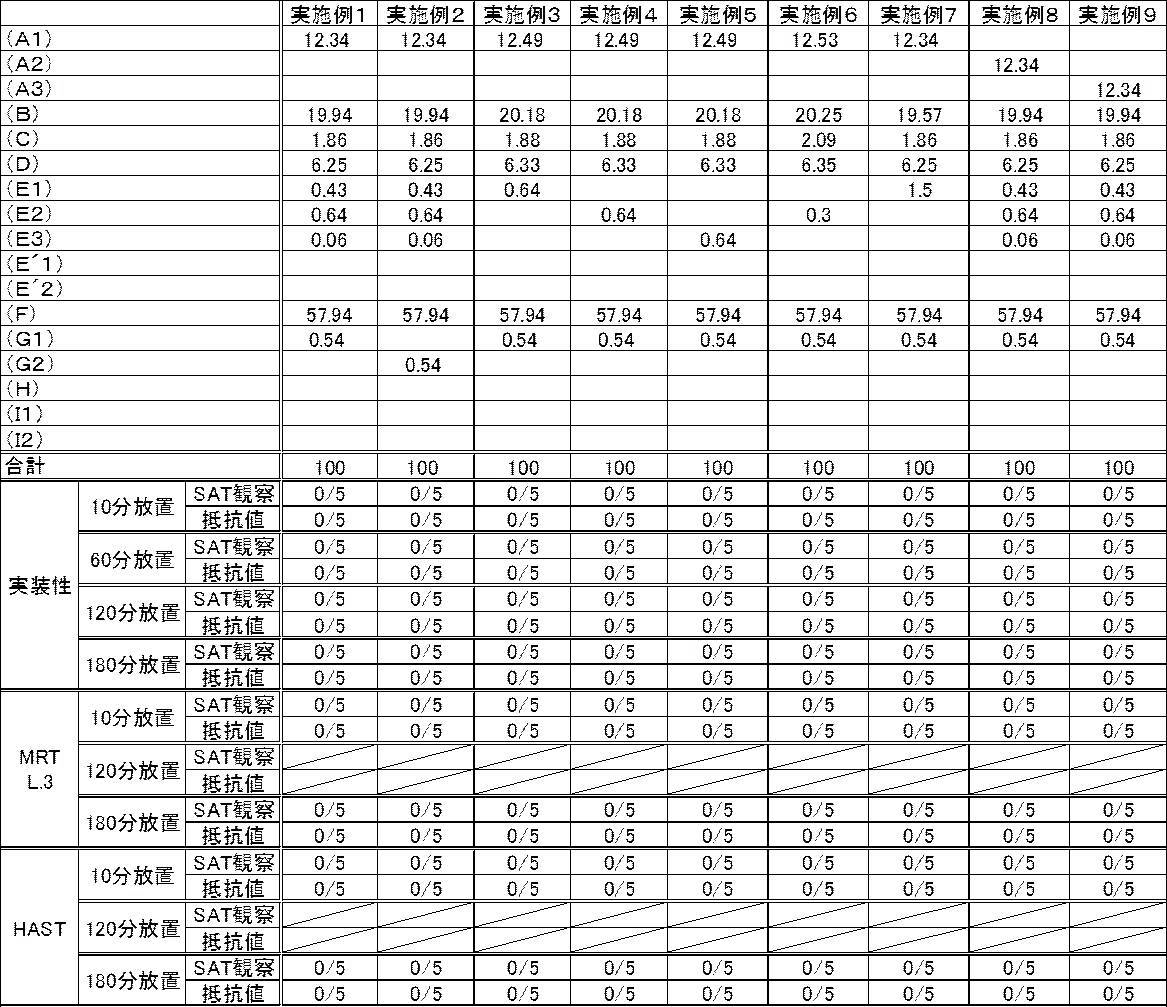
- Examples 1 to 26 the results of the mountability test, the moisture absorption reflow test, and the HAST test were all good.
- Examples 1 and 2 are examples in which the silane coupling agent of component (G) was changed.
- Examples 4 to 7 are examples in which the organic peroxide of the component (E) was changed.
- Examples 8 and 9 are examples in which the methacrylate compound as the component (A) was changed.
- Examples 11 to 20 are examples in which the blending ratio of each component was changed.
- Examples 21 and 22 are examples in which an epoxy resin was added as the component (I), and Examples 23, 24, and 26 were examples in which a compound having a flux function was further added as the component (H). .
- Example 25 the component (H) was added without adding the component (I).
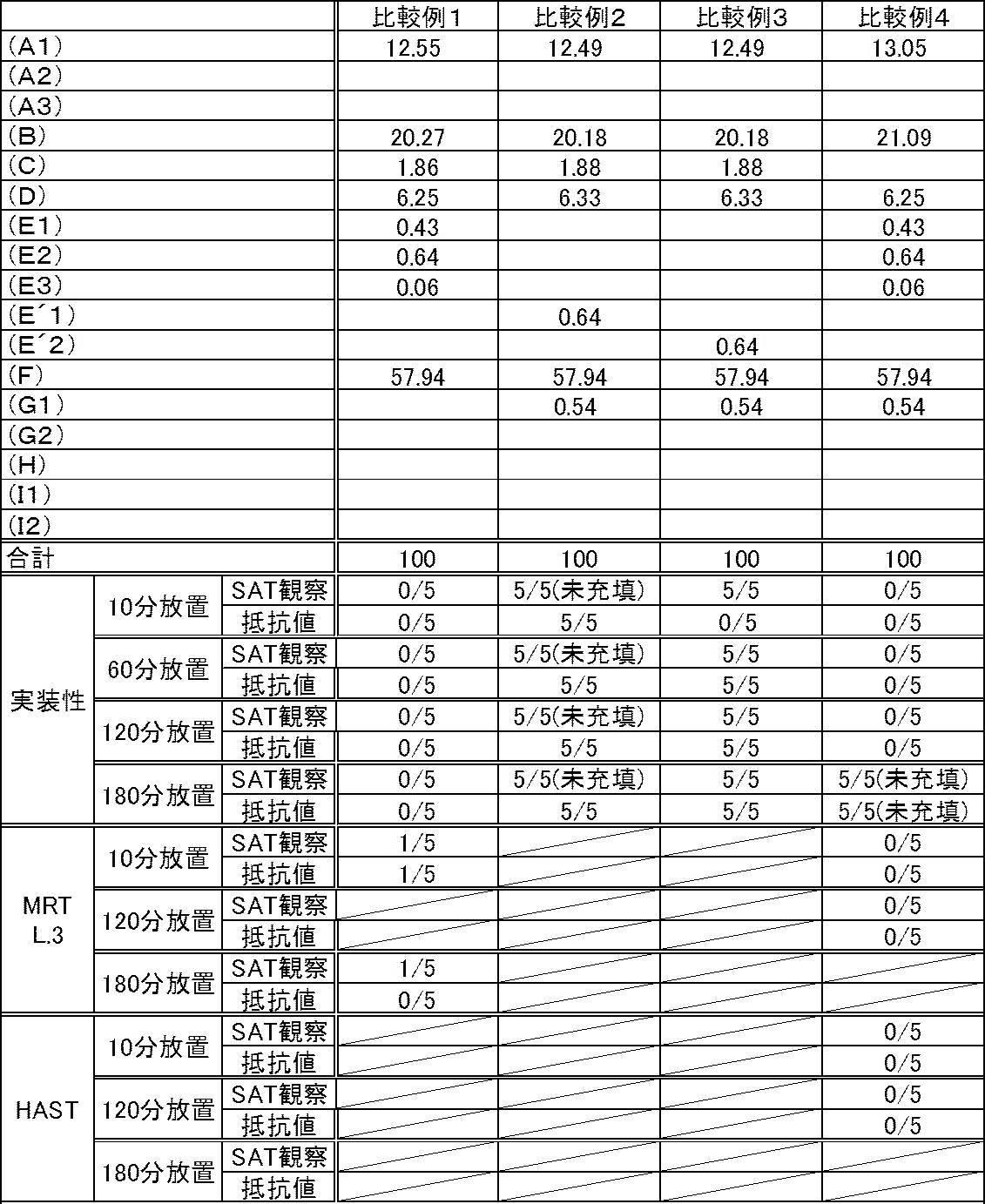
- Comparative Example 1 is an example that does not contain the component (G) silane coupling agent.
- the SAT observation and resistance value of one test piece were defective. Further, in the moisture absorption reflow test (left for 180 minutes), SAT observation of one test piece was a defective product. Therefore, the HAST test was not performed.
- Comparative Examples 2 and 3 are examples in which an organic peroxide having no peroxyester structure or dialkyl peroxide structure was used as the (E′1) component and the (E′2) component. (Observation, resistance value) all 5 test pieces were defective. Therefore, the moisture absorption reflow test and HAST test were not performed.
- Comparative Example 4 is an example not containing the copolymer of the component (D), and SAT observation and resistance values of all 5 test pieces were defective in the mountability evaluation (left for 180 minutes). Therefore, the moisture absorption reflow test and the HAST test were not performed on the test piece left for 180 minutes, but were performed on the test piece left for 120 minutes.
Landscapes
- Chemical & Material Sciences (AREA)
- Health & Medical Sciences (AREA)
- Chemical Kinetics & Catalysis (AREA)
- Medicinal Chemistry (AREA)
- Polymers & Plastics (AREA)
- Organic Chemistry (AREA)
- Macromonomer-Based Addition Polymer (AREA)
- Die Bonding (AREA)
- Structures Or Materials For Encapsulating Or Coating Semiconductor Devices Or Solid State Devices (AREA)
- Compositions Of Macromolecular Compounds (AREA)
Abstract
本発明はNCPの要求特性を満たす樹脂組成物を提供する。本発明の樹脂組成物は、(A)式(1)で示すメタクリレート化合物、(B)式(2)で示すアクリレート化合物、(C)式(3)に示すアクリレート化合物、(D)ブタジエンと無水マレイン酸の共重合体、(D)(E)パーオキシエステル構造、または、ジアルキルパーオキサイド構造を有する有機過酸化物、(F)シリカフィラー、(G)シランカップリング剤を含む。((式(1)中、ただし、m+n=2.3~4.0であり、R1およびR2はそれぞれ水素原子またはメチル基であり、式(2)中、R1およびR2はそれぞれフェニル基もしくはCnH2n基(n=1~6)である。)
Description
本発明は、半導体実装時にNCP(Non Conductive Paste)として使用される樹脂組成物に関する。
従来より、半導体実装においては、IC(Integrated Circuit)チップの電極(バンプ)が形成されている面と、基板の電極(電極パット)が形成された面とを対峙させ、ICチップのバンプと基板の電極パッドとを電気的に接続するフリップチップ法が行われている。
このフリップチップ法では、電極同士の接続部分を外部から保護し、ICチップと基板との線膨張係数の違いに起因する応力を緩和するために、通常、電極接続後に、アンダーフィル剤と呼ばれる液状の熱硬化性接着剤を半導体チップと基板との間に流し込み硬化させるようにする。
このフリップチップ法では、電極同士の接続部分を外部から保護し、ICチップと基板との線膨張係数の違いに起因する応力を緩和するために、通常、電極接続後に、アンダーフィル剤と呼ばれる液状の熱硬化性接着剤を半導体チップと基板との間に流し込み硬化させるようにする。
近年、ICチップの微細化が急速に進んでいる。これに伴い、隣接する電極間のピッチや、半導体チップと基板との間のギャップが益々狭くなる傾向にある。このため、毛細管現象を利用してアンダーフィル剤をICチップと基板との間に流し込むと、ボイドが発生したり、アンダーフィル剤の流し込みに長時間を要する等の問題が発生してしまう。
このため、NCP(Non Conductive Paste)と呼ばれる液状の接着剤、もしくは、NCF(Non Conductive Film)と呼ばれるフィルム状の接着剤を予め基板に塗布、もしくは、貼付し、その後、フィリップチップボンダー等による、加熱圧接(Thermal Compression Bonding:TCB)で樹脂を硬化させ、ICチップのバンプと基板の電極パッドとを接続する、いわゆる先入れ法が試みられている(特許文献1参照)。
このため、NCP(Non Conductive Paste)と呼ばれる液状の接着剤、もしくは、NCF(Non Conductive Film)と呼ばれるフィルム状の接着剤を予め基板に塗布、もしくは、貼付し、その後、フィリップチップボンダー等による、加熱圧接(Thermal Compression Bonding:TCB)で樹脂を硬化させ、ICチップのバンプと基板の電極パッドとを接続する、いわゆる先入れ法が試みられている(特許文献1参照)。
NCPに要求される特性として、TCBを実施した際の電気的接続性およびその信頼性に優れることが求められる。
さらに、TCB工程による実装後の耐吸湿リフロー性、耐HAST(High Accelerated Temperature and Humidity Stress Test)性、TCB実施時におけるステージ上でのライフを向上することが求められている。
本発明は、上記した従来技術における問題点を解決するため、上述したNCPの要求特性を満たす樹脂組成物を提供することを目的とする。
さらに、TCB工程による実装後の耐吸湿リフロー性、耐HAST(High Accelerated Temperature and Humidity Stress Test)性、TCB実施時におけるステージ上でのライフを向上することが求められている。
本発明は、上記した従来技術における問題点を解決するため、上述したNCPの要求特性を満たす樹脂組成物を提供することを目的とする。
上記の目的を達成するため、本発明は、(A)式(1)で示す(メタ)アクリレート化合物、

(式(1)中、ただし、m+n=2.3~4.0であり、R1およびR2はそれぞれ水素原子またはメチル基である)
(B)式(2)で示すアクリレート化合物、

(C)式(3)に示すアクリレート化合物、

(式(3)中、R1およびR2はそれぞれフェニル基もしくはCnH2n基(n=1~6)である。)
(D)ブタジエンと無水マレイン酸の共重合体、
(E)パーオキシエステル構造、または、ジアルキルパーオキサイド構造を有する有機過酸化物、
(F)シリカフィラー、
(G)シランカップリング剤
を含む樹脂組成物を提供する。
(B)式(2)で示すアクリレート化合物、
(D)ブタジエンと無水マレイン酸の共重合体、
(E)パーオキシエステル構造、または、ジアルキルパーオキサイド構造を有する有機過酸化物、
(F)シリカフィラー、
(G)シランカップリング剤
を含む樹脂組成物を提供する。
本発明の樹脂組成物において、前記(C)成分のアクリレート化合物が、式(4)に示すアクリレート化合物であることが好ましい。

本発明の樹脂組成物において、前記(C)成分のアクリレート化合物の含有量が、前記(A),(B),(C),(D)成分の合計質量100質量部中、1~6質量部であることが好ましい。
本発明の樹脂組成物において、前記(E)成分の有機過酸化物が、式(5)~(7)のに示す化合物を少なくとも1種以上含有することが好ましい。

本発明の樹脂組成物において、前記(E)成分の有機過酸化物の含有量が、前記(A),(B),(C)成分の合計質量100質量部に対して、0.5~6質量部であることが好ましい。
本発明の樹脂組成物は、さらに、(H)フラックス機能を有する化合物を含有することが好ましい。
本発明の樹脂組成物において、前記(H)成分のフラックス機能を有する化合物がステアリン酸であることが好ましい。
また、本発明は、本発明の樹脂組成物を含む非導電性ペースト(NCP)を提供する。
また、本発明は、本発明のNCPを用いた半導体装置を提供する。
本発明の樹脂組成物は、NCPとして使用した際に、TCB工程での実装性に優れ、かつ、耐吸湿リフロー性、耐HAST性、TCB実施時におけるステージ上でのライフが良好である。
以下、本発明について詳細に説明する。
本発明の樹脂組成物は、以下に示す(メタ)アクリレート化合物((A)成分)、および、アクリレート化合物((B)成分、(C)成分)を必須成分として含有する。
本発明の樹脂組成物は、以下に示す(メタ)アクリレート化合物((A)成分)、および、アクリレート化合物((B)成分、(C)成分)を必須成分として含有する。
(A)式(1)で示す(メタ)アクリレート化合物、

式(1)中、ただし、m+n=2.3~4.0であり、R1およびR2はそれぞれ水素原子(H)またはメチル基(CH3)である。また、m+n=2.3~4.0である。
式(1)で示すR1およびR2がメチル基である化合物は、EO変性ビスフェノールAジメタクリレート(2,2-Bis〔4-(Methacryloxy Ethoxy)Phenyl〕Propane))である。なお、「EO変性」とはエチレンオキシドユニット(-CH2-CH2-O-)のブロック構造を有することを意味する。
式(1)で示すR1およびR2がメチル基である化合物は、EO変性ビスフェノールAジメタクリレート(2,2-Bis〔4-(Methacryloxy Ethoxy)Phenyl〕Propane))である。なお、「EO変性」とはエチレンオキシドユニット(-CH2-CH2-O-)のブロック構造を有することを意味する。
式(1)で示す(メタ)アクリレート化合物は、本発明の樹脂組成物をNCPとして使用する際に、液状特性と硬化後の密着性、および、耐久性を付与する成分として作用する。
式(1)で示す(メタ)アクリレート化合物において、m+n=2.3~4.0に限定する理由は、m+nが2.3より小さいと、粘度が高くなりやすく液状特性が低下する傾向があり、m+nが4.0より大きくなると、密着性、接続性が低下する傾向があるためである。
式(1)で示す(メタ)アクリレート化合物の含有量は、(A),(B),(C),(D)成分の合計質量100質量部中、10~65質量部であることが好ましく、13~60質量部であることがより好ましい。
(B)式(2)で示すアクリレート化合物

式(2)で示すアクリレート化合物は、ジメチロールトリシクロデカンジアクリレート(Dimethylol Tricylodecane Diacrylate)である。
式(2)で示すアクリレート化合物は、本発明の樹脂組成物をNCPとして使用する際に、液状特性、TCB工程における硬化性、および、耐久性を付与する成分として作用する。
式(2)で示すアクリレート化合物の含有量は、本発明の樹脂組成物の(A),(B),(C),(D)成分の合計質量100質量部中、15~70質量部であることが好ましく、20~67質量部であることがより好ましい。
(C)式(3)に示すアクリレート化合物、

式(3)に示すアクリレート化合物は、カプロラクトン変性エポキシアクリレートオリゴマーである。式(3)中、R1およびR2はそれぞれフェニル基もしくはCnH2n基(n=1~6)である。
式(3)で示すアクリレート化合物は、本発明の樹脂組成物をNCPとして使用する際に、TCB実施時におけるステージ上でのライフを向上させる成分として作用する。これは、式(3)で示す長鎖のアクリレート化合物を配合することで、官能基密度が若干下がるためである。
式(3)で示すアクリレート化合物において、R1およびR2はフェニル基であること、すなわち、式(4)に示すアクリレート化合物であることが耐薬品性、長期耐久性の理由から好ましい。

本発明のフィルム状半導体封止剤において、前記(C)成分のシリカフィラーの含有量が、本発明のフィルム状樹脂組成物の各成分の合計質量100質量部中、40~65質量部であることが好ましく、45~65質量部であることがより好ましい。
式(3)で示すアクリレート化合物の含有量は、本発明の樹脂組成物の(A),(B),(C),(D)成分の合計質量100質量部中、1~6質量部であることが好ましく、2~5質量部であることがより好ましい。
本発明の樹脂組成物は、(A)(メタ)アクリレート化合物、(B),(C)成分のアクリレート化合物以外の(メタ)アクリレート化合物を適宜併用してもよい。併用可能な(メタ)アクリレート化合物の具体例としては、たとえば、2官能ポリエステルアクリレート化合物、ポリエステルメタクリレート化合物、ポリウレタンアクリレート化合物、ポリウレタンメタクリレート化合物、エポキシアクリレート化合物、エポキシメタクリレート化合物、2-アクリロイルオキシエチルアシッドフォスフェート、2-メタクリロイルオキシエチルアシッドフォスフェートなどのリン系(メタ)アクリレート化合物、ネオペンチルグリコールアクリレート、ネオペンチルグリコールジメタクリレートなどのグリコール系(メタ)アクリレート化合物、ジメチロールトリシクロデカンジメタクリレートなどの環状構造を有する(メタ)アクリレート、イソボニル(メタ)アクリレート、テトラヒドロフルフィル(メタ)アクリレート、フェノキシポリエチレングリコールアクリレート、ノニルフェノールEO付加物アクリレート、グリシジル(メタ)アクリレート、エチルメタクリレートなどの単官能(メタ)アクリレートを適宜併用してもよい。
(D)ブタジエンと無水マレイン酸の共重合体
本発明の樹脂組成物は、(D)成分として、ブタジエンと無水マレイン酸の共重合体を必須成分として含有する。
ここで、ブタジエンと無水マレイン酸の共重合体は、無水マレイン酸変性されたポリブタジエン骨格を有する。
本発明の樹脂組成物は、(D)成分として、ブタジエンと無水マレイン酸の共重合体を必須成分として含有する。
ここで、ブタジエンと無水マレイン酸の共重合体は、無水マレイン酸変性されたポリブタジエン骨格を有する。
ブタジエンと無水マレイン酸の共重合体は、本発明の樹脂組成物をNCPとして使用する際に、応力の緩和成分として作用する。
ブタジエンと無水マレイン酸の共重合体は、常温で液状であることが液状特性付与の理由から好ましい。
ブタジエンと無水マレイン酸の共重合体は、数平均分子量(Mn)が500~5000であることが好ましく、1000~4000であることがより好ましい。
ブタジエンと無水マレイン酸の共重合体は、数平均分子量(Mn)が500~5000であることが好ましく、1000~4000であることがより好ましい。
(D)成分の共重合体の含有量は、本発明の樹脂組成物の(A),(B),(C),(D)成分の合計質量100質量部中、5~30質量部であることが好ましく、7~27質量部であることがより好ましい。
(E)有機過酸化物
本発明の樹脂組成物は、(E)成分として、有機過酸化物を必須成分として含有する。
(E)成分の有機過酸化物は、本発明の樹脂組成物の加熱硬化時において、(A)成分のメタクリレート化合物、(B),(C)成分のアクリレート化合物、(D)成分の共重合体の反応を促進する。
本発明の樹脂組成物は、(E)成分として、有機過酸化物を必須成分として含有する。
(E)成分の有機過酸化物は、本発明の樹脂組成物の加熱硬化時において、(A)成分のメタクリレート化合物、(B),(C)成分のアクリレート化合物、(D)成分の共重合体の反応を促進する。
(E)成分の有機過酸化物としては、パーオキシエステル構造、または、ジアルキルパーオキサイド構造を有する有機過酸化物を用いる。
パーオキシエステル構造、または、ジアルキルパーオキサイド構造を有する有機過酸化物としては、式(5)~(7)に示す化合物を用いることが好ましい。

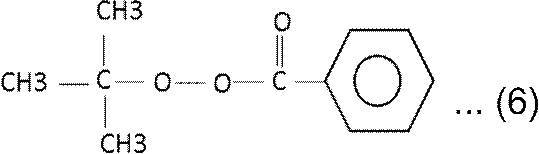
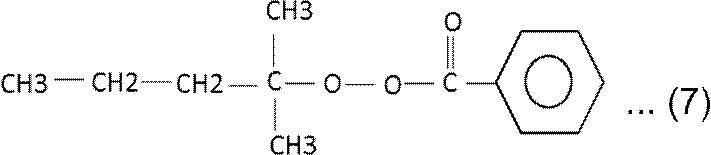
式(5)に示す化合物はジクミルパ―オキサイド、式(6)に示す化合物はt-ブチルペロキシベンゾエート、式(7)はt-へキシルペロキシベンゾエートである。
上記した有機過酸化物は、1種のみを使用してもよく、2種以上を併用してもよい。
パーオキシエステル構造、または、ジアルキルパーオキサイド構造を有する有機過酸化物としては、式(5)~(7)に示す化合物を用いることが好ましい。
上記した有機過酸化物は、1種のみを使用してもよく、2種以上を併用してもよい。
(E)成分の有機過酸化物の含有量は、(A)成分の(メタ)アクリレート化合物、(B),(C)成分のアクリレート化合物の合計質量100質量部に対して、0.5~6質量部であることが好ましく、0.6~5質量部であることがより好ましい。
本発明の樹脂組成物は、パーオキシエステル構造、ジアルキルパーオキサイド構造以外の構造を有する有機過酸化物を適宜併用してもよい。併用可能な有機過酸化物の具体例としては、たとえば、ベンゾイルパーオキサイド、p-メンタンハイドロパーオキサイド、メチルエチルケトンパーオキサイド、ジ-2エチルへキシルパーオキシジカーボネート、1,1-ジ(t-ブチルパーオキシ)-2-メチルシクロヘキサン等が挙げられる。
(F)シリカフィラー
(F)成分のシリカフィラーは、本発明の樹脂組成物をNCPとして使用する際に、実装された半導体パッケージの信頼性を向上させる目的で必須成分として添加される。
(F)成分のシリカフィラーは、本発明の樹脂組成物をNCPとして使用する際に、実装された半導体パッケージの信頼性を向上させる目的で必須成分として添加される。
(F)成分のシリカフィラーは、平均粒径が1μm以下であることが、狭ギャップへの浸透性、半導体チップへの衝撃防止等の理由から好ましい。
(F)成分のシリカフィラーは、平均粒径が0.1μm以上であることが液状特性保持の理由から好ましい。
(F)成分のシリカフィラーは、平均粒径が0.1~0.7μmであることがより好ましい。ここで、フィラーの形状は特に限定されず、球状、不定形、りん片状等のいずれの形態であってもよい。なお、フィラーの形状が球状以外の場合、フィラーの平均粒径とは該フィラーの平均最大径を意味する。
(F)成分のシリカフィラーは、平均粒径が0.1μm以上であることが液状特性保持の理由から好ましい。
(F)成分のシリカフィラーは、平均粒径が0.1~0.7μmであることがより好ましい。ここで、フィラーの形状は特に限定されず、球状、不定形、りん片状等のいずれの形態であってもよい。なお、フィラーの形状が球状以外の場合、フィラーの平均粒径とは該フィラーの平均最大径を意味する。
(F)成分のシリカフィラーとして、シランカップリング剤等で表面処理が施されたものを使用してもよい。表面処理が施されたシリカフィラーを使用した場合、シリカフィラーの凝集を防止する効果が期待される。
本発明の樹脂組成物において、(F)成分の含有量は本発明の樹脂組成物の各成分の合計質量100質量部中、40~65質量部であることが好ましく、45~65質量部であることがより好ましい。
(G)シランカップリング剤
(G)成分のシランカップリング剤は、本発明の樹脂組成物をNCPとして使用した際に、ICチップや基板に対する密着性を向上させる目的で添加される。
(G)成分のシランカップリング剤としては、エポキシ系、アミノ系、ビニル系、メタクリル系、アクリル系、メルカプト系等の各種シランカップリング剤を用いることができる。これらの中でも、エポキシ基を有するエポキシ系シランカップリング剤、メタクリル基を有するメタクリル系シランカップリング剤が、密着性が高い等の理由から好ましい。
エポキシ系シランカップリング剤の具体例としては、3-グリシドキシプロピルトリメトキシシラン(商品名:KBM403、信越化学株式会社製)、3-グリシドキシプロピルトリエトキシシラン(商品名:KBE-403、信越化学株式会社製)、3-グリシドキシプロピルメチルジエトキシシラン(商品名:KBE-402、信越化学株式会社製)、3-グリシドキシプロピルメチルジメトキシシラン(商品名:KBM402、信越化学株式会社製)等が挙げられる。
メタクリル系シランカップリング剤の具体例としては、3-メタクリロキシプロピルトリメトキシシラン(商品名:KBM503、信越化学株式会社製)、3-メタクリロキシプロピルメチルジメトキシシラン(商品名:KBM502、信越化学株式会社製)、3-メタクリロキシプロピルメチルジエトキシシラン(商品名:KBE502、信越化学株式会社製)、3-メタクリロキシプロピルトリエトキシシラン(商品名:KBE503、信越化学株式会社製)等が挙げられる。
(G)成分のシランカップリング剤は、本発明の樹脂組成物をNCPとして使用した際に、ICチップや基板に対する密着性を向上させる目的で添加される。
(G)成分のシランカップリング剤としては、エポキシ系、アミノ系、ビニル系、メタクリル系、アクリル系、メルカプト系等の各種シランカップリング剤を用いることができる。これらの中でも、エポキシ基を有するエポキシ系シランカップリング剤、メタクリル基を有するメタクリル系シランカップリング剤が、密着性が高い等の理由から好ましい。
エポキシ系シランカップリング剤の具体例としては、3-グリシドキシプロピルトリメトキシシラン(商品名:KBM403、信越化学株式会社製)、3-グリシドキシプロピルトリエトキシシラン(商品名:KBE-403、信越化学株式会社製)、3-グリシドキシプロピルメチルジエトキシシラン(商品名:KBE-402、信越化学株式会社製)、3-グリシドキシプロピルメチルジメトキシシラン(商品名:KBM402、信越化学株式会社製)等が挙げられる。
メタクリル系シランカップリング剤の具体例としては、3-メタクリロキシプロピルトリメトキシシラン(商品名:KBM503、信越化学株式会社製)、3-メタクリロキシプロピルメチルジメトキシシラン(商品名:KBM502、信越化学株式会社製)、3-メタクリロキシプロピルメチルジエトキシシラン(商品名:KBE502、信越化学株式会社製)、3-メタクリロキシプロピルトリエトキシシラン(商品名:KBE503、信越化学株式会社製)等が挙げられる。
本発明の樹脂組成物において、(G)成分のシランカップリング剤の含有量は、本発明の樹脂組成物の各成分の合計質量100質量部中、0.05~1質量部であることが好ましく、0.1~0.8質量部であることがより好ましい。
本発明の樹脂組成物は、上記(A)~(G)成分以外に、以下に述べる成分を必要に応じて含有してもよい。
(H)フラックス機能を有する化合物
本発明の樹脂組成物において、(H)成分としてフラックス機能を有する化合物を含有することが好ましい。
(H)成分の化合物は、本発明の樹脂組成物をNCPとして使用する際に、フラックス活性剤をなす成分である。(H)成分の化合物を含有させた場合、本発明の樹脂組成物をNCPとして使用した際に、電気的接続性およびその信頼性が向上する。
本発明の樹脂組成物において、(H)成分としてフラックス機能を有する化合物を含有することが好ましい。
(H)成分の化合物は、本発明の樹脂組成物をNCPとして使用する際に、フラックス活性剤をなす成分である。(H)成分の化合物を含有させた場合、本発明の樹脂組成物をNCPとして使用した際に、電気的接続性およびその信頼性が向上する。
(H)成分のフラックス機能を有する化合物としては、たとえば、8-キノリノール、マロン酸、コハク酸、マレイン酸、グルタル酸、スベリン酸、アジピン酸、セバシン酸、ステアリン酸等のカルボン酸類、ジフェニルグアニジン臭化水素酸塩、シクロヘキシルアミン臭化水素酸塩、ジエチルアミン塩酸塩、トリエタノールアミン臭化水素酸塩、モノエタノールアミン臭化水素酸塩等が例示される。
これらの中でも、ステアリン酸が、はんだ濡れ促進作用、ライフの安定性の理由から好ましい。
これらの中でも、ステアリン酸が、はんだ濡れ促進作用、ライフの安定性の理由から好ましい。
(H)成分の化合物を含有させる場合、その含有量は、そのフラックス活性に応じて異なるが、(H)成分として、ステアリン酸を用いる場合は、(A)成分の(メタ)アクリレート化合物、(B),(C)成分のアクリレート化合物、および、(D)成分の共重合体合計質量100質量部に対して、0.5~7質量部であることが好ましく、1~5質量部であることがより好ましい。
(その他の配合剤)
本発明の樹脂組成物は、上記(A)~(H)成分以外の成分を必要に応じてさらに含有してもよい。このような成分の具体例としては、消泡剤、表面調整剤、レオロジー調整剤、着色剤、可塑剤、分散剤、沈降防止剤等が挙げられる。
また、密着性、耐久性付与の目的でエポキシ樹脂を含有させてもよい。この目的で含有させるエポキシ樹脂は、液状エポキシ樹脂、固形エポキシ樹脂のいずれであってもよい。好ましいエポキシ樹脂は、ビスフェノールF型エポキシ樹脂、アミノフェノール型エポキシ樹脂である。エポキシ樹脂を含有させる場合、エポキシ樹脂硬化剤、エポキシ樹脂硬化促進剤を必要に応じて含有させる。
また、本発明の樹脂組成物の弾性率や応力を調整する目的でエラストマー類を含有させてもよく、本発明の樹脂組成物の粘度、靭性等を調整する目的でその他固形樹脂を含有させてもよい。
各配合剤の種類、配合量は常法通りである。
本発明の樹脂組成物は、上記(A)~(H)成分以外の成分を必要に応じてさらに含有してもよい。このような成分の具体例としては、消泡剤、表面調整剤、レオロジー調整剤、着色剤、可塑剤、分散剤、沈降防止剤等が挙げられる。
また、密着性、耐久性付与の目的でエポキシ樹脂を含有させてもよい。この目的で含有させるエポキシ樹脂は、液状エポキシ樹脂、固形エポキシ樹脂のいずれであってもよい。好ましいエポキシ樹脂は、ビスフェノールF型エポキシ樹脂、アミノフェノール型エポキシ樹脂である。エポキシ樹脂を含有させる場合、エポキシ樹脂硬化剤、エポキシ樹脂硬化促進剤を必要に応じて含有させる。
また、本発明の樹脂組成物の弾性率や応力を調整する目的でエラストマー類を含有させてもよく、本発明の樹脂組成物の粘度、靭性等を調整する目的でその他固形樹脂を含有させてもよい。
各配合剤の種類、配合量は常法通りである。
(樹脂組成物の調製)
本発明の樹脂組成物は、慣用の方法により調製することができる。例えば、(A)~(G)成分、さらに必要に応じて配合する(H)成分、ならびにその他の配合剤を添加、もしくは逐次添加し、ニーダー、3本ロール、ボールミルなどの分散装置にて分散、混合する。
本発明の樹脂組成物は、慣用の方法により調製することができる。例えば、(A)~(G)成分、さらに必要に応じて配合する(H)成分、ならびにその他の配合剤を添加、もしくは逐次添加し、ニーダー、3本ロール、ボールミルなどの分散装置にて分散、混合する。
本発明の樹脂組成物は、NCPとして使用した際に、TCB工程での実装性に優れ、かつ、耐吸湿リフロー性、耐HAST性、TCB実施時におけるステージ上でのライフが良好である。
本発明の樹脂組成物は、短時間での実装が可能であり、生産性が高い。
(H)成分を含有する本発明の樹脂組成物は、フラックス効果を併せ持っており、はんだ接続性に優れる。
(H)成分を含有する本発明の樹脂組成物は、フラックス効果を併せ持っており、はんだ接続性に優れる。
次に本発明の樹脂組成物の使用手順を以下に示す。
本発明の樹脂組成物をNCPとして用いて半導体パッケージを実装する場合、ディスペンサ等を用いて、基板上の半導体チップを実装する位置へ本発明の樹脂組成物を塗布する。
次に、フリップチップボンダー等により基板上のチップ搭載位置へ加熱圧接(TCB)によって半導体チップを実装する。TCB条件は特に限定されないが、半導体チップサイズ、バンプ材質、バンプ数等によりTCB条件を適宜選択することができる。
加熱温度は50~300℃、時間は1~20秒、圧力は5~450Nであることが好ましい。
本発明の樹脂組成物をNCPとして用いて半導体パッケージを実装する場合、ディスペンサ等を用いて、基板上の半導体チップを実装する位置へ本発明の樹脂組成物を塗布する。
次に、フリップチップボンダー等により基板上のチップ搭載位置へ加熱圧接(TCB)によって半導体チップを実装する。TCB条件は特に限定されないが、半導体チップサイズ、バンプ材質、バンプ数等によりTCB条件を適宜選択することができる。
加熱温度は50~300℃、時間は1~20秒、圧力は5~450Nであることが好ましい。
本発明の半導体装置は、半導体装置の製造時に、本発明の樹脂組成物をNCPとして使用したものである限り特に限定されない。本発明の半導体装置の具体例としては、フリップチップ構造を有する半導体装置が挙げられる。フリップチップは、バンプと呼ばれる突起状の電極を有しており、この電極を介して基板等の電極と接続される。バンプ材質としては、はんだ、金、銅等が上げられる。フリップチップと接続される基板としてはFR-4等の単層、または積層された有機基板、シリコン、ガラス、セラミックなどの無機基板があり、銅および銅上への金メッキまたはスズメッキ、はんだ層等を形成した電極が用いられる。フリップチップ構造の半導体装置としては、DRAM(Dynamic Random Access Memory)等のメモリーデバイス、CPU(Central Processing Unit)GPU(Graphics Processing Unit)等のプロセッサーデバイス、LED(Light Emitting Diode)等の発光素子、LCD(Liquid Crystal Display)等に使用されるドライバーIC等が挙げられる。
以下、実施例により、本発明を詳細に説明するが、本発明はこれらに限定されるものではない。
(実施例1~26、比較例1~4)
下記表に示す配合割合となるように各原料を3本ロールミルを使用して混合・分散して樹脂組成物を調製した。なお、表中の各組成に関する数値は質量部を表している。
下記表に示す配合割合となるように各原料を3本ロールミルを使用して混合・分散して樹脂組成物を調製した。なお、表中の各組成に関する数値は質量部を表している。
樹脂組成物の調製時に使用した成分は以下の通り。
(A)式(1)で示す(メタ)アクリレート化合物、

(A1)商品名BPE-100(式(1)中、R1およびR2はメチル基、m+n=2.6)、新中村化学工業株式会社製)
(A2)商品名BPE-80N(式(1)中、R1およびR2はメチル基、m+n=2.3)、新中村化学工業株式会社製)
(A3)商品名BPE-200(式(1)中、R1およびR2はメチル基、m+n=4.0)、新中村化学工業株式会社製)
(B)式(2)で示すアクリレート化合物

商品名DCP-A、共栄社化学株式会社製
(C)式(4)に示すアクリレート化合物

商品名EBECRYL3708、ダイセル・オルネクス株式会社製
(D)ブタジエンと無水マレイン酸の共重合体
無水マレイン酸変性ポリブタジエン、商品名Ricon130MA13、数平均分子量Mn2900、(Cray Valley社製)
(E)有機過酸化物
(E1)ジクミルパーオキサイド、商品名パークミル(登録商標)D、10時間半減期温度116.4℃(日油株式会社製)
(E2)t-へキシルペロキシベンゾエート、商品名パーへキシル(登録商標)Z、10時間半減期温度99.4℃(日油株式会社製)
(E3)t-ブチルペロキシベンゾエート、商品名パーブチル(登録商標)Z、10時間半減期温度104.3℃(日油株式会社製)
(E´1)ベンゾイルパーオキサイド、商品名ナイパー(登録商標)BW、10時間半減期温度73.6℃(日油株式会社製)
(E´2)p-メンタンハイドロパーオキサイド、商品名パーメンタ(登録商標)H、10時間半減期温度128℃(日油株式会社製)
(F)シリカフィラー
球状シリカ、商品名SO-E2、平均粒径0.5μm(株式会社アドマテックス社製)
(G)シランカップリング剤
(G1)3-グリシドキシプロピルトリメトキシシラン、商品名KBM403(信越化学工業株式会社製)
(G2)3-メタクリロキシプロピルトリメトキシシラン、商品名KBM503(信越化学工業株式会社製)
(H)フラックス機能を有する化合物
ステアリン酸、和光純薬工業株式会社製
(I)エポキシ樹脂
(I1)ビスフェノールF型液状エポキシ樹脂、商品名EXA-830CRP(DIC株式会社製)
(I2)アミノフェノール型エポキシ樹脂、商品名630(三菱化学株式会社製)
(A)式(1)で示す(メタ)アクリレート化合物、
(A2)商品名BPE-80N(式(1)中、R1およびR2はメチル基、m+n=2.3)、新中村化学工業株式会社製)
(A3)商品名BPE-200(式(1)中、R1およびR2はメチル基、m+n=4.0)、新中村化学工業株式会社製)
(B)式(2)で示すアクリレート化合物
(C)式(4)に示すアクリレート化合物
(D)ブタジエンと無水マレイン酸の共重合体
無水マレイン酸変性ポリブタジエン、商品名Ricon130MA13、数平均分子量Mn2900、(Cray Valley社製)
(E)有機過酸化物
(E1)ジクミルパーオキサイド、商品名パークミル(登録商標)D、10時間半減期温度116.4℃(日油株式会社製)
(E2)t-へキシルペロキシベンゾエート、商品名パーへキシル(登録商標)Z、10時間半減期温度99.4℃(日油株式会社製)
(E3)t-ブチルペロキシベンゾエート、商品名パーブチル(登録商標)Z、10時間半減期温度104.3℃(日油株式会社製)
(E´1)ベンゾイルパーオキサイド、商品名ナイパー(登録商標)BW、10時間半減期温度73.6℃(日油株式会社製)
(E´2)p-メンタンハイドロパーオキサイド、商品名パーメンタ(登録商標)H、10時間半減期温度128℃(日油株式会社製)
(F)シリカフィラー
球状シリカ、商品名SO-E2、平均粒径0.5μm(株式会社アドマテックス社製)
(G)シランカップリング剤
(G1)3-グリシドキシプロピルトリメトキシシラン、商品名KBM403(信越化学工業株式会社製)
(G2)3-メタクリロキシプロピルトリメトキシシラン、商品名KBM503(信越化学工業株式会社製)
(H)フラックス機能を有する化合物
ステアリン酸、和光純薬工業株式会社製
(I)エポキシ樹脂
(I1)ビスフェノールF型液状エポキシ樹脂、商品名EXA-830CRP(DIC株式会社製)
(I2)アミノフェノール型エポキシ樹脂、商品名630(三菱化学株式会社製)
上記の手順で調製した樹脂組成物を用いて、以下の評価を実施した。
(実装性)
上記の手順で作製した樹脂組成物をNCPとして使用し、下記手順により、有機基板上にテスト用チップを実装した。
テスト用チップは、サイズが7.3mm×7.3mm×0.125mm(t)であり、30μm×30μm×30μmのCuピラー上へはんだ層を形成したバンプが544個設けられている。
テストチップを搭載するための有機基板は、サイズが17.0mm×17.0mm×0.9mm(t)であり、OSP処理されたCuからなる電極が設けられている。
上記の手順で調製した樹脂組成物を有機基板上へディスペンサ(武蔵エンジニアリング株式会社製、商品名Super Σ II V5)を用いて、23Gサイズのニードルを使用してXパターン状に塗布した。
次に、フリップチップボンダー(東レエンジニアリング株式会社製、商品名TC-3000S)を用いて、テスト用チップと有機基板とを加熱圧接(TCB)した。
フリップチップボンダーのステージ温度を70℃、荷重を25Nに設定し、図1に示すTCB温度プロファイルに設定した。TCBプロファイルはテスト用チップと有機基板の間に熱電対(50μmφ)を入れ、測定した温度履歴を使用した。
試験は、塗布後の試験片を70℃のフリップチップボンダー上で所定の時間(10、60、120、180分)放置させた後、TCBにて樹脂組成物の硬化と接続を行った。TCB後、その試験片を165℃にて1時間加熱して完成とした。
各放置時間毎に5試験片を作製し、以下の評価を実施した。
SAT観察
作製した試験片を超音波探傷装置(Scanning Acoustic Tomography、SAT)を用いて反射法にてボイド/デラミネーションを観察した。所得画像上に白色様の陰影が確認されたものを不良品とした。表中の記載は、不良品サンプル数/測定サンプル数を示している(以下、同様)。
抵抗値
作製した試験片の抵抗値を、基板上に設けられた抵抗値測定パッドを用いて抵抗値を測定した。1サンプルでも不合格があった場合は接続状態が×とした。28~32Ωの抵抗値を示したものを合格とし、28Ω未満若しくは32Ω超の抵抗値を示したものを不良品とした。
(実装性)
上記の手順で作製した樹脂組成物をNCPとして使用し、下記手順により、有機基板上にテスト用チップを実装した。
テスト用チップは、サイズが7.3mm×7.3mm×0.125mm(t)であり、30μm×30μm×30μmのCuピラー上へはんだ層を形成したバンプが544個設けられている。
テストチップを搭載するための有機基板は、サイズが17.0mm×17.0mm×0.9mm(t)であり、OSP処理されたCuからなる電極が設けられている。
上記の手順で調製した樹脂組成物を有機基板上へディスペンサ(武蔵エンジニアリング株式会社製、商品名Super Σ II V5)を用いて、23Gサイズのニードルを使用してXパターン状に塗布した。
次に、フリップチップボンダー(東レエンジニアリング株式会社製、商品名TC-3000S)を用いて、テスト用チップと有機基板とを加熱圧接(TCB)した。
フリップチップボンダーのステージ温度を70℃、荷重を25Nに設定し、図1に示すTCB温度プロファイルに設定した。TCBプロファイルはテスト用チップと有機基板の間に熱電対(50μmφ)を入れ、測定した温度履歴を使用した。
試験は、塗布後の試験片を70℃のフリップチップボンダー上で所定の時間(10、60、120、180分)放置させた後、TCBにて樹脂組成物の硬化と接続を行った。TCB後、その試験片を165℃にて1時間加熱して完成とした。
各放置時間毎に5試験片を作製し、以下の評価を実施した。
SAT観察
作製した試験片を超音波探傷装置(Scanning Acoustic Tomography、SAT)を用いて反射法にてボイド/デラミネーションを観察した。所得画像上に白色様の陰影が確認されたものを不良品とした。表中の記載は、不良品サンプル数/測定サンプル数を示している(以下、同様)。
抵抗値
作製した試験片の抵抗値を、基板上に設けられた抵抗値測定パッドを用いて抵抗値を測定した。1サンプルでも不合格があった場合は接続状態が×とした。28~32Ωの抵抗値を示したものを合格とし、28Ω未満若しくは32Ω超の抵抗値を示したものを不良品とした。
(吸湿リフロー試験)
上記の手順で作製した試験片(5試験片)を30℃/60%RHの条件下(JEDEC level3(MRT L.3)吸湿条件)で192時間放置し吸湿させた。その後、最高到達温度260℃のリフロー炉を3回通過させた。吸湿リフローの実施後、上記と同様の手順で、SAT観察と、抵抗値の測定を実施した。
上記の手順で作製した試験片(5試験片)を30℃/60%RHの条件下(JEDEC level3(MRT L.3)吸湿条件)で192時間放置し吸湿させた。その後、最高到達温度260℃のリフロー炉を3回通過させた。吸湿リフローの実施後、上記と同様の手順で、SAT観察と、抵抗値の測定を実施した。
(HAST試験)
吸湿リフロー試験を実施した試験片(5試験片)を130℃/85%RHの条件下で168時間放置した後、上記と同様の手順で、SAT観察と、抵抗値の測定を実施した。
吸湿リフロー試験を実施した試験片(5試験片)を130℃/85%RHの条件下で168時間放置した後、上記と同様の手順で、SAT観察と、抵抗値の測定を実施した。


実施例1~26は、いずれも実装性試験、吸湿リフロー試験、HAST試験の結果が良好であった。なお、実施例1,2は、(G)成分のシランカップリング剤を変えた実施例である。実施例4~7は、(E)成分の有機過酸化物を変えた実施例である。実施例8,9は、(A)成分のメタクリレート化合物を変えた実施例である。実施例11~20は、各成分の配合割合を変えた実施例である。実施例21,22は、(I)成分としてエポキシ樹脂を加えた実施例であり、実施例23,24,26は、(H)成分として、フラックス機能を有する化合物をさらに加えた実施例である。実施例25は、(I)成分は加えずに、(H)成分を加えた実施例である。
比較例1は、(G)成分のシランカップリング剤を含有しない例であり、吸湿リフロー試験(10分放置)で1試験片のSAT観察、抵抗値が不良品となった。また、吸湿リフロー試験(180分放置)で1試験片のSAT観察が不良品となった。そのため、HAST試験は実施しなかった。
比較例2,3は、(E´1)成分、(E´2)成分として、パーオキシエステル構造、ジアルキルパーオキサイド構造を持たない有機過酸化物を使用した例であり、実装性評価(SAT観察、抵抗値)が5試験片全て不良品となった。そのため、吸湿リフロー試験、HAST試験は実施しなかった。
比較例4は、(D)成分の共重合体を含まない例であり、実装性評価(180分放置)でSAT観察、抵抗値が5試験片全て不良品となった。そのため、吸湿リフロー試験、HAST試験は180分放置の試験片では実施せず、120分放置の試験片について実施した。
比較例1は、(G)成分のシランカップリング剤を含有しない例であり、吸湿リフロー試験(10分放置)で1試験片のSAT観察、抵抗値が不良品となった。また、吸湿リフロー試験(180分放置)で1試験片のSAT観察が不良品となった。そのため、HAST試験は実施しなかった。
比較例2,3は、(E´1)成分、(E´2)成分として、パーオキシエステル構造、ジアルキルパーオキサイド構造を持たない有機過酸化物を使用した例であり、実装性評価(SAT観察、抵抗値)が5試験片全て不良品となった。そのため、吸湿リフロー試験、HAST試験は実施しなかった。
比較例4は、(D)成分の共重合体を含まない例であり、実装性評価(180分放置)でSAT観察、抵抗値が5試験片全て不良品となった。そのため、吸湿リフロー試験、HAST試験は180分放置の試験片では実施せず、120分放置の試験片について実施した。
Claims (9)
- (A)式(1)で示す(メタ)アクリレート化合物、

(B)式(2)で示すアクリレート化合物、


(D)ブタジエンと無水マレイン酸の共重合体、
(E)パーオキシエステル構造、または、ジアルキルパーオキサイド構造を有する有機過酸化物、
(F)シリカフィラー、
(G)シランカップリング剤
を含む樹脂組成物。 - 前記(C)成分のアクリレート化合物が、式(4)に示すアクリレート化合物である、請求項1に記載の樹脂化合物。

- 前記(C)成分のアクリレート化合物の含有量が、前記(A),(B),(C),(D)成分の合計質量100質量部中、1~6質量部である、請求項1に記載の樹脂化合物。
- 前記(E)成分の有機過酸化物が、式(5)~(7)に示す化合物を少なくとも1種以上含有する、請求項1または2に記載の樹脂組成物。

- 前記(E)成分の有機過酸化物の含有量が、前記(A),(B),(C)成分の合計質量100質量部に対して、0.5~6質量部である、請求項1~4のいずれかに記載の樹脂組成物。
- さらに、(H)フラックス機能を有する化合物を含有する、請求項1~5のいずれかに記載の樹脂組成物。
- 前記(H)成分のフラックス機能を有する化合物がステアリン酸である、請求項6に記載の樹脂組成物。
- 請求項1~7のいずれかに記載の樹脂組成物を含む非導電性ペースト(NCP)。
- 請求項8に記載のNCPを用いた半導体装置。
Priority Applications (2)
| Application Number | Priority Date | Filing Date | Title |
|---|---|---|---|
| KR1020187026112A KR102666267B1 (ko) | 2016-03-24 | 2017-01-25 | 수지 조성물 |
| CN201780015951.8A CN108713032B (zh) | 2016-03-24 | 2017-01-25 | 树脂组合物 |
Applications Claiming Priority (2)
| Application Number | Priority Date | Filing Date | Title |
|---|---|---|---|
| JP2016-059895 | 2016-03-24 | ||
| JP2016059895A JP6715634B2 (ja) | 2016-03-24 | 2016-03-24 | 樹脂組成物 |
Publications (1)
| Publication Number | Publication Date |
|---|---|
| WO2017163589A1 true WO2017163589A1 (ja) | 2017-09-28 |
Family
ID=59900208
Family Applications (1)
| Application Number | Title | Priority Date | Filing Date |
|---|---|---|---|
| PCT/JP2017/002540 Ceased WO2017163589A1 (ja) | 2016-03-24 | 2017-01-25 | 樹脂組成物 |
Country Status (5)
| Country | Link |
|---|---|
| JP (1) | JP6715634B2 (ja) |
| KR (1) | KR102666267B1 (ja) |
| CN (1) | CN108713032B (ja) |
| TW (1) | TWI716541B (ja) |
| WO (1) | WO2017163589A1 (ja) |
Cited By (1)
| Publication number | Priority date | Publication date | Assignee | Title |
|---|---|---|---|---|
| JPWO2021177379A1 (ja) * | 2020-03-03 | 2021-09-10 |
Families Citing this family (2)
| Publication number | Priority date | Publication date | Assignee | Title |
|---|---|---|---|---|
| WO2018163900A1 (ja) * | 2017-03-07 | 2018-09-13 | パナソニックIpマネジメント株式会社 | アンダーフィル用熱硬化性組成物及び半導体装置 |
| JP7238259B2 (ja) * | 2018-03-16 | 2023-03-14 | 三菱ケミカル株式会社 | プリプレグ |
Citations (3)
| Publication number | Priority date | Publication date | Assignee | Title |
|---|---|---|---|---|
| JP2003212956A (ja) * | 2002-01-28 | 2003-07-30 | Daicel Ucb Co Ltd | エポキシ(メタ)アクリレート、その製造方法、活性エネルギー線硬化型エポキシ(メタ)アクリレート組成物、硬化物及びその用途 |
| JP2010009743A (ja) * | 2009-10-13 | 2010-01-14 | Dic Corp | 光ディスク用紫外線硬化型組成物及び光ディスク |
| JP2015017169A (ja) * | 2013-07-10 | 2015-01-29 | ナミックス株式会社 | 先供給型半導体封止剤および半導体装置 |
Family Cites Families (6)
| Publication number | Priority date | Publication date | Assignee | Title |
|---|---|---|---|---|
| JP2002121259A (ja) * | 2000-10-19 | 2002-04-23 | Sumitomo Bakelite Co Ltd | 液状封止樹脂組成物、半導体装置の製造方法及び半導体装置 |
| CN102471426B (zh) * | 2009-07-22 | 2013-10-30 | 日立化成株式会社 | 光固化性树脂组合物和其固化物、树脂片材和其制造法以及显示装置 |
| JP2013016473A (ja) * | 2011-06-10 | 2013-01-24 | Sekisui Chem Co Ltd | 異方性導電材料及び接続構造体 |
| JP6207348B2 (ja) * | 2013-11-08 | 2017-10-04 | ナミックス株式会社 | 樹脂組成物、先供給型半導体封止剤および半導体装置 |
| JP2015117266A (ja) * | 2013-12-17 | 2015-06-25 | スリーボンドファインケミカル株式会社 | 光硬化性組成物 |
| US20160272854A1 (en) * | 2014-03-04 | 2016-09-22 | Sekisui Chemical Co., Ltd. | Adhesive for mounting electronic component and adhesive film for mounting flip chip |
-
2016
- 2016-03-24 JP JP2016059895A patent/JP6715634B2/ja active Active
-
2017
- 2017-01-25 CN CN201780015951.8A patent/CN108713032B/zh active Active
- 2017-01-25 KR KR1020187026112A patent/KR102666267B1/ko active Active
- 2017-01-25 WO PCT/JP2017/002540 patent/WO2017163589A1/ja not_active Ceased
- 2017-02-15 TW TW106104926A patent/TWI716541B/zh active
Patent Citations (3)
| Publication number | Priority date | Publication date | Assignee | Title |
|---|---|---|---|---|
| JP2003212956A (ja) * | 2002-01-28 | 2003-07-30 | Daicel Ucb Co Ltd | エポキシ(メタ)アクリレート、その製造方法、活性エネルギー線硬化型エポキシ(メタ)アクリレート組成物、硬化物及びその用途 |
| JP2010009743A (ja) * | 2009-10-13 | 2010-01-14 | Dic Corp | 光ディスク用紫外線硬化型組成物及び光ディスク |
| JP2015017169A (ja) * | 2013-07-10 | 2015-01-29 | ナミックス株式会社 | 先供給型半導体封止剤および半導体装置 |
Cited By (3)
| Publication number | Priority date | Publication date | Assignee | Title |
|---|---|---|---|---|
| JPWO2021177379A1 (ja) * | 2020-03-03 | 2021-09-10 | ||
| WO2021177379A1 (ja) * | 2020-03-03 | 2021-09-10 | デンカ株式会社 | 組成物 |
| JP7652755B2 (ja) | 2020-03-03 | 2025-03-27 | デンカ株式会社 | 組成物 |
Also Published As
| Publication number | Publication date |
|---|---|
| CN108713032B (zh) | 2020-11-10 |
| JP6715634B2 (ja) | 2020-07-01 |
| TW201805318A (zh) | 2018-02-16 |
| JP2017171793A (ja) | 2017-09-28 |
| CN108713032A (zh) | 2018-10-26 |
| TWI716541B (zh) | 2021-01-21 |
| KR20180127338A (ko) | 2018-11-28 |
| KR102666267B1 (ko) | 2024-05-14 |
Similar Documents
| Publication | Publication Date | Title |
|---|---|---|
| WO2016056619A1 (ja) | 熱硬化性樹脂組成物及びその製造方法 | |
| JP6715634B2 (ja) | 樹脂組成物 | |
| JP7264211B2 (ja) | 熱伝導性組成物および半導体装置 | |
| KR102269234B1 (ko) | 수지 조성물 및 반도체 장치 | |
| JP6336788B2 (ja) | 樹脂組成物、先供給型半導体封止剤、半導体封止用フィルム、および半導体装置 | |
| JP7351437B2 (ja) | ダイアタッチ材用導電性樹脂組成物、高熱伝導性材料および半導体装置 | |
| JP7392876B2 (ja) | 銀含有ペーストおよび接合体 | |
| JP6844680B2 (ja) | 先供給型アンダーフィル材、先供給型アンダーフィル材の硬化物、電子部品装置及び電子部品装置の製造方法 | |
| JP6660771B2 (ja) | フィルム状樹脂組成物 | |
| JP2000290597A (ja) | ダイアタッチペースト | |
| JP2017114962A (ja) | 先供給型アンダーフィル材及びその硬化物、並びに電子部品装置及びその製造方法 | |
| JP2017117864A (ja) | 先供給型アンダーフィル材及びその硬化物、並びに電子部品装置及びその製造方法 | |
| JP2016178104A (ja) | アンダーフィル材、電子部品装置の製造方法及び電子部品装置 | |
| JP6267980B2 (ja) | 樹脂組成物、先供給型半導体封止剤および半導体装置 | |
| JP2000265120A (ja) | ダイアタッチペースト | |
| JP6844685B2 (ja) | 先供給型アンダーフィル材及びその硬化物、並びに電子部品装置及びその製造方法 | |
| TWI824045B (zh) | 導電性樹脂組成物及半導體裝置 | |
| JP2013253183A (ja) | 先供給型液状半導体封止樹脂組成物 | |
| JP2000265117A (ja) | ダイアタッチペースト | |
| JP7093998B2 (ja) | ディップ用先供給型半導体封止材、それを用いた半導体装置 | |
| TW202313897A (zh) | 導電性糊、硬化物及半導體裝置 | |
| TWI290162B (en) | Connecting material | |
| JP2023016331A (ja) | 導電性ペーストおよび半導体装置 | |
| JPH1180309A (ja) | 半導体用ダイアタッチ樹脂ペースト |
Legal Events
| Date | Code | Title | Description |
|---|---|---|---|
| ENP | Entry into the national phase |
Ref document number: 20187026112 Country of ref document: KR Kind code of ref document: A |
|
| NENP | Non-entry into the national phase |
Ref country code: DE |
|
| 121 | Ep: the epo has been informed by wipo that ep was designated in this application |
Ref document number: 17769636 Country of ref document: EP Kind code of ref document: A1 |
|
| 122 | Ep: pct application non-entry in european phase |
Ref document number: 17769636 Country of ref document: EP Kind code of ref document: A1 |