WO2017159479A1 - 硬化性組成物、遮光膜、カラーフィルタ、パターン形成方法、カラーフィルタの製造方法、固体撮像素子、赤外線センサ - Google Patents
硬化性組成物、遮光膜、カラーフィルタ、パターン形成方法、カラーフィルタの製造方法、固体撮像素子、赤外線センサ Download PDFInfo
- Publication number
- WO2017159479A1 WO2017159479A1 PCT/JP2017/009166 JP2017009166W WO2017159479A1 WO 2017159479 A1 WO2017159479 A1 WO 2017159479A1 JP 2017009166 W JP2017009166 W JP 2017009166W WO 2017159479 A1 WO2017159479 A1 WO 2017159479A1
- Authority
- WO
- WIPO (PCT)
- Prior art keywords
- group
- ring
- curable composition
- carbon atoms
- compound
- Prior art date
- Legal status (The legal status is an assumption and is not a legal conclusion. Google has not performed a legal analysis and makes no representation as to the accuracy of the status listed.)
- Ceased
Links
- 0 CC*(C*(C(*)=C)=O)Oc(c(*=I)cc(CCc(cc1O*)cc(*)c1OC(C)C*(C(*)=C)=O)c1)c1I#I Chemical compound CC*(C*(C(*)=C)=O)Oc(c(*=I)cc(CCc(cc1O*)cc(*)c1OC(C)C*(C(*)=C)=O)c1)c1I#I 0.000 description 1
Classifications
-
- C—CHEMISTRY; METALLURGY
- C08—ORGANIC MACROMOLECULAR COMPOUNDS; THEIR PREPARATION OR CHEMICAL WORKING-UP; COMPOSITIONS BASED THEREON
- C08K—Use of inorganic or non-macromolecular organic substances as compounding ingredients
- C08K5/00—Use of organic ingredients
- C08K5/0008—Organic ingredients according to more than one of the "one dot" groups of C08K5/01 - C08K5/59
- C08K5/0041—Optical brightening agents, organic pigments
-
- C—CHEMISTRY; METALLURGY
- C08—ORGANIC MACROMOLECULAR COMPOUNDS; THEIR PREPARATION OR CHEMICAL WORKING-UP; COMPOSITIONS BASED THEREON
- C08K—Use of inorganic or non-macromolecular organic substances as compounding ingredients
- C08K3/00—Use of inorganic substances as compounding ingredients
- C08K3/01—Use of inorganic substances as compounding ingredients characterized by their specific function
- C08K3/013—Fillers, pigments or reinforcing additives
-
- C—CHEMISTRY; METALLURGY
- C08—ORGANIC MACROMOLECULAR COMPOUNDS; THEIR PREPARATION OR CHEMICAL WORKING-UP; COMPOSITIONS BASED THEREON
- C08L—COMPOSITIONS OF MACROMOLECULAR COMPOUNDS
- C08L33/00—Compositions of homopolymers or copolymers of compounds having one or more unsaturated aliphatic radicals, each having only one carbon-to-carbon double bond, and only one being terminated by only one carboxyl radical, or of salts, anhydrides, esters, amides, imides or nitriles thereof; Compositions of derivatives of such polymers
- C08L33/04—Homopolymers or copolymers of esters
- C08L33/06—Homopolymers or copolymers of esters of esters containing only carbon, hydrogen and oxygen, which oxygen atoms are present only as part of the carboxyl radical
- C08L33/08—Homopolymers or copolymers of acrylic acid esters
-
- C—CHEMISTRY; METALLURGY
- C08—ORGANIC MACROMOLECULAR COMPOUNDS; THEIR PREPARATION OR CHEMICAL WORKING-UP; COMPOSITIONS BASED THEREON
- C08L—COMPOSITIONS OF MACROMOLECULAR COMPOUNDS
- C08L33/00—Compositions of homopolymers or copolymers of compounds having one or more unsaturated aliphatic radicals, each having only one carbon-to-carbon double bond, and only one being terminated by only one carboxyl radical, or of salts, anhydrides, esters, amides, imides or nitriles thereof; Compositions of derivatives of such polymers
- C08L33/04—Homopolymers or copolymers of esters
- C08L33/06—Homopolymers or copolymers of esters of esters containing only carbon, hydrogen and oxygen, which oxygen atoms are present only as part of the carboxyl radical
- C08L33/10—Homopolymers or copolymers of methacrylic acid esters
- C08L33/12—Homopolymers or copolymers of methyl methacrylate
-
- G—PHYSICS
- G02—OPTICS
- G02B—OPTICAL ELEMENTS, SYSTEMS OR APPARATUS
- G02B5/00—Optical elements other than lenses
- G02B5/003—Light absorbing elements
-
- G—PHYSICS
- G02—OPTICS
- G02B—OPTICAL ELEMENTS, SYSTEMS OR APPARATUS
- G02B5/00—Optical elements other than lenses
- G02B5/20—Filters
-
- G—PHYSICS
- G02—OPTICS
- G02B—OPTICAL ELEMENTS, SYSTEMS OR APPARATUS
- G02B5/00—Optical elements other than lenses
- G02B5/20—Filters
- G02B5/208—Filters for use with infrared or ultraviolet radiation, e.g. for separating visible light from infrared and/or ultraviolet radiation
-
- G—PHYSICS
- G02—OPTICS
- G02B—OPTICAL ELEMENTS, SYSTEMS OR APPARATUS
- G02B5/00—Optical elements other than lenses
- G02B5/20—Filters
- G02B5/22—Absorbing filters
-
- G—PHYSICS
- G02—OPTICS
- G02B—OPTICAL ELEMENTS, SYSTEMS OR APPARATUS
- G02B5/00—Optical elements other than lenses
- G02B5/20—Filters
- G02B5/22—Absorbing filters
- G02B5/223—Absorbing filters containing organic substances, e.g. dyes, inks or pigments
-
- G—PHYSICS
- G03—PHOTOGRAPHY; CINEMATOGRAPHY; ANALOGOUS TECHNIQUES USING WAVES OTHER THAN OPTICAL WAVES; ELECTROGRAPHY; HOLOGRAPHY
- G03F—PHOTOMECHANICAL PRODUCTION OF TEXTURED OR PATTERNED SURFACES, e.g. FOR PRINTING, FOR PROCESSING OF SEMICONDUCTOR DEVICES; MATERIALS THEREFOR; ORIGINALS THEREFOR; APPARATUS SPECIALLY ADAPTED THEREFOR
- G03F7/00—Photomechanical, e.g. photolithographic, production of textured or patterned surfaces, e.g. printing surfaces; Materials therefor, e.g. comprising photoresists; Apparatus specially adapted therefor
- G03F7/0005—Production of optical devices or components in so far as characterised by the lithographic processes or materials used therefor
- G03F7/0007—Filters, e.g. additive colour filters; Components for display devices
-
- G—PHYSICS
- G03—PHOTOGRAPHY; CINEMATOGRAPHY; ANALOGOUS TECHNIQUES USING WAVES OTHER THAN OPTICAL WAVES; ELECTROGRAPHY; HOLOGRAPHY
- G03F—PHOTOMECHANICAL PRODUCTION OF TEXTURED OR PATTERNED SURFACES, e.g. FOR PRINTING, FOR PROCESSING OF SEMICONDUCTOR DEVICES; MATERIALS THEREFOR; ORIGINALS THEREFOR; APPARATUS SPECIALLY ADAPTED THEREFOR
- G03F7/00—Photomechanical, e.g. photolithographic, production of textured or patterned surfaces, e.g. printing surfaces; Materials therefor, e.g. comprising photoresists; Apparatus specially adapted therefor
- G03F7/004—Photosensitive materials
-
- G—PHYSICS
- G03—PHOTOGRAPHY; CINEMATOGRAPHY; ANALOGOUS TECHNIQUES USING WAVES OTHER THAN OPTICAL WAVES; ELECTROGRAPHY; HOLOGRAPHY
- G03F—PHOTOMECHANICAL PRODUCTION OF TEXTURED OR PATTERNED SURFACES, e.g. FOR PRINTING, FOR PROCESSING OF SEMICONDUCTOR DEVICES; MATERIALS THEREFOR; ORIGINALS THEREFOR; APPARATUS SPECIALLY ADAPTED THEREFOR
- G03F7/00—Photomechanical, e.g. photolithographic, production of textured or patterned surfaces, e.g. printing surfaces; Materials therefor, e.g. comprising photoresists; Apparatus specially adapted therefor
- G03F7/004—Photosensitive materials
- G03F7/027—Non-macromolecular photopolymerisable compounds having carbon-to-carbon double bonds, e.g. ethylenic compounds
- G03F7/032—Non-macromolecular photopolymerisable compounds having carbon-to-carbon double bonds, e.g. ethylenic compounds with binders
- G03F7/033—Non-macromolecular photopolymerisable compounds having carbon-to-carbon double bonds, e.g. ethylenic compounds with binders the binders being polymers obtained by reactions only involving carbon-to-carbon unsaturated bonds, e.g. vinyl polymers
-
- G—PHYSICS
- G03—PHOTOGRAPHY; CINEMATOGRAPHY; ANALOGOUS TECHNIQUES USING WAVES OTHER THAN OPTICAL WAVES; ELECTROGRAPHY; HOLOGRAPHY
- G03F—PHOTOMECHANICAL PRODUCTION OF TEXTURED OR PATTERNED SURFACES, e.g. FOR PRINTING, FOR PROCESSING OF SEMICONDUCTOR DEVICES; MATERIALS THEREFOR; ORIGINALS THEREFOR; APPARATUS SPECIALLY ADAPTED THEREFOR
- G03F7/00—Photomechanical, e.g. photolithographic, production of textured or patterned surfaces, e.g. printing surfaces; Materials therefor, e.g. comprising photoresists; Apparatus specially adapted therefor
- G03F7/004—Photosensitive materials
- G03F7/038—Macromolecular compounds which are rendered insoluble or differentially wettable
-
- G—PHYSICS
- G03—PHOTOGRAPHY; CINEMATOGRAPHY; ANALOGOUS TECHNIQUES USING WAVES OTHER THAN OPTICAL WAVES; ELECTROGRAPHY; HOLOGRAPHY
- G03F—PHOTOMECHANICAL PRODUCTION OF TEXTURED OR PATTERNED SURFACES, e.g. FOR PRINTING, FOR PROCESSING OF SEMICONDUCTOR DEVICES; MATERIALS THEREFOR; ORIGINALS THEREFOR; APPARATUS SPECIALLY ADAPTED THEREFOR
- G03F7/00—Photomechanical, e.g. photolithographic, production of textured or patterned surfaces, e.g. printing surfaces; Materials therefor, e.g. comprising photoresists; Apparatus specially adapted therefor
- G03F7/004—Photosensitive materials
- G03F7/09—Photosensitive materials characterised by structural details, e.g. supports, auxiliary layers
- G03F7/105—Photosensitive materials characterised by structural details, e.g. supports, auxiliary layers having substances, e.g. indicators, for forming visible images
-
- G—PHYSICS
- G03—PHOTOGRAPHY; CINEMATOGRAPHY; ANALOGOUS TECHNIQUES USING WAVES OTHER THAN OPTICAL WAVES; ELECTROGRAPHY; HOLOGRAPHY
- G03F—PHOTOMECHANICAL PRODUCTION OF TEXTURED OR PATTERNED SURFACES, e.g. FOR PRINTING, FOR PROCESSING OF SEMICONDUCTOR DEVICES; MATERIALS THEREFOR; ORIGINALS THEREFOR; APPARATUS SPECIALLY ADAPTED THEREFOR
- G03F7/00—Photomechanical, e.g. photolithographic, production of textured or patterned surfaces, e.g. printing surfaces; Materials therefor, e.g. comprising photoresists; Apparatus specially adapted therefor
- G03F7/26—Processing photosensitive materials; Apparatus therefor
- G03F7/40—Treatment after imagewise removal, e.g. baking
-
- H—ELECTRICITY
- H10—SEMICONDUCTOR DEVICES; ELECTRIC SOLID-STATE DEVICES NOT OTHERWISE PROVIDED FOR
- H10F—INORGANIC SEMICONDUCTOR DEVICES SENSITIVE TO INFRARED RADIATION, LIGHT, ELECTROMAGNETIC RADIATION OF SHORTER WAVELENGTH OR CORPUSCULAR RADIATION
- H10F39/00—Integrated devices, or assemblies of multiple devices, comprising at least one element covered by group H10F30/00, e.g. radiation detectors comprising photodiode arrays
- H10F39/011—Manufacture or treatment of image sensors covered by group H10F39/12
- H10F39/024—Manufacture or treatment of image sensors covered by group H10F39/12 of coatings or optical elements
-
- H—ELECTRICITY
- H10—SEMICONDUCTOR DEVICES; ELECTRIC SOLID-STATE DEVICES NOT OTHERWISE PROVIDED FOR
- H10F—INORGANIC SEMICONDUCTOR DEVICES SENSITIVE TO INFRARED RADIATION, LIGHT, ELECTROMAGNETIC RADIATION OF SHORTER WAVELENGTH OR CORPUSCULAR RADIATION
- H10F39/00—Integrated devices, or assemblies of multiple devices, comprising at least one element covered by group H10F30/00, e.g. radiation detectors comprising photodiode arrays
- H10F39/80—Constructional details of image sensors
- H10F39/805—Coatings
- H10F39/8053—Colour filters
-
- H—ELECTRICITY
- H10—SEMICONDUCTOR DEVICES; ELECTRIC SOLID-STATE DEVICES NOT OTHERWISE PROVIDED FOR
- H10F—INORGANIC SEMICONDUCTOR DEVICES SENSITIVE TO INFRARED RADIATION, LIGHT, ELECTROMAGNETIC RADIATION OF SHORTER WAVELENGTH OR CORPUSCULAR RADIATION
- H10F77/00—Constructional details of devices covered by this subclass
- H10F77/30—Coatings
- H10F77/306—Coatings for devices having potential barriers
- H10F77/331—Coatings for devices having potential barriers for filtering or shielding light, e.g. multicolour filters for photodetectors
- H10F77/334—Coatings for devices having potential barriers for filtering or shielding light, e.g. multicolour filters for photodetectors for shielding light, e.g. light blocking layers or cold shields for infrared detectors
-
- H—ELECTRICITY
- H10—SEMICONDUCTOR DEVICES; ELECTRIC SOLID-STATE DEVICES NOT OTHERWISE PROVIDED FOR
- H10F—INORGANIC SEMICONDUCTOR DEVICES SENSITIVE TO INFRARED RADIATION, LIGHT, ELECTROMAGNETIC RADIATION OF SHORTER WAVELENGTH OR CORPUSCULAR RADIATION
- H10F77/00—Constructional details of devices covered by this subclass
- H10F77/40—Optical elements or arrangements
- H10F77/413—Optical elements or arrangements directly associated or integrated with the devices, e.g. back reflectors
-
- H—ELECTRICITY
- H10—SEMICONDUCTOR DEVICES; ELECTRIC SOLID-STATE DEVICES NOT OTHERWISE PROVIDED FOR
- H10F—INORGANIC SEMICONDUCTOR DEVICES SENSITIVE TO INFRARED RADIATION, LIGHT, ELECTROMAGNETIC RADIATION OF SHORTER WAVELENGTH OR CORPUSCULAR RADIATION
- H10F99/00—Subject matter not provided for in other groups of this subclass
-
- G—PHYSICS
- G03—PHOTOGRAPHY; CINEMATOGRAPHY; ANALOGOUS TECHNIQUES USING WAVES OTHER THAN OPTICAL WAVES; ELECTROGRAPHY; HOLOGRAPHY
- G03F—PHOTOMECHANICAL PRODUCTION OF TEXTURED OR PATTERNED SURFACES, e.g. FOR PRINTING, FOR PROCESSING OF SEMICONDUCTOR DEVICES; MATERIALS THEREFOR; ORIGINALS THEREFOR; APPARATUS SPECIALLY ADAPTED THEREFOR
- G03F7/00—Photomechanical, e.g. photolithographic, production of textured or patterned surfaces, e.g. printing surfaces; Materials therefor, e.g. comprising photoresists; Apparatus specially adapted therefor
- G03F7/16—Coating processes; Apparatus therefor
-
- G—PHYSICS
- G03—PHOTOGRAPHY; CINEMATOGRAPHY; ANALOGOUS TECHNIQUES USING WAVES OTHER THAN OPTICAL WAVES; ELECTROGRAPHY; HOLOGRAPHY
- G03F—PHOTOMECHANICAL PRODUCTION OF TEXTURED OR PATTERNED SURFACES, e.g. FOR PRINTING, FOR PROCESSING OF SEMICONDUCTOR DEVICES; MATERIALS THEREFOR; ORIGINALS THEREFOR; APPARATUS SPECIALLY ADAPTED THEREFOR
- G03F7/00—Photomechanical, e.g. photolithographic, production of textured or patterned surfaces, e.g. printing surfaces; Materials therefor, e.g. comprising photoresists; Apparatus specially adapted therefor
- G03F7/20—Exposure; Apparatus therefor
-
- G—PHYSICS
- G03—PHOTOGRAPHY; CINEMATOGRAPHY; ANALOGOUS TECHNIQUES USING WAVES OTHER THAN OPTICAL WAVES; ELECTROGRAPHY; HOLOGRAPHY
- G03F—PHOTOMECHANICAL PRODUCTION OF TEXTURED OR PATTERNED SURFACES, e.g. FOR PRINTING, FOR PROCESSING OF SEMICONDUCTOR DEVICES; MATERIALS THEREFOR; ORIGINALS THEREFOR; APPARATUS SPECIALLY ADAPTED THEREFOR
- G03F7/00—Photomechanical, e.g. photolithographic, production of textured or patterned surfaces, e.g. printing surfaces; Materials therefor, e.g. comprising photoresists; Apparatus specially adapted therefor
- G03F7/26—Processing photosensitive materials; Apparatus therefor
- G03F7/30—Imagewise removal using liquid means
Definitions
- the present invention relates to a curable composition, a light shielding film, a color filter, a pattern formation method, a color filter manufacturing method, a solid-state imaging device, and an infrared sensor.
- the solid-state imaging device includes a photographing lens, a solid-state imaging device such as a CCD (charge coupled device) and a CMOS (complementary metal oxide semiconductor) disposed behind the photographing lens, and a circuit on which the solid-state imaging device is mounted.
- a substrate This solid-state imaging device is mounted on a digital camera, a camera-equipped mobile phone, a smartphone, and the like.
- noise may occur due to reflection of visible light. Therefore, in Patent Document 1, the generation of noise is suppressed by providing a predetermined light shielding film in the solid-state imaging device.
- a curable composition containing a black pigment such as titanium black is used as the composition for forming the light shielding film.
- the inventors of the present invention manufactured a light-shielding film using the curable composition specifically disclosed in Patent Document 1 and examined the exposure and developability of the light-shielding film. It came to know that the further improvement is required about linearity. In particular, it has been found that the linearity of the pattern of the formed cured film is remarkably deteriorated when the exposure amount is reduced.
- the present inventors include a colorant that absorbs visible light and a colorant that absorbs infrared light so as to satisfy a specific optical density.
- the inventors have found that the above-described problems can be solved and completed the present invention. That is, it has been found that the above object can be achieved by the following configuration.
- a colorant that absorbs visible light A colorant that absorbs infrared light; A polymerizable compound; A curable composition containing a photopolymerization initiator, The minimum value of the optical density per 1 ⁇ m of film thickness in the wavelength range of 380 to 1100 nm of the coating film of the curable composition is 1 or more, and The curable composition whose (DELTA) optical density calculated
- OD1 represents the minimum value of the optical density per 1 ⁇ m thickness in the region of the coating film having a wavelength of 380 nm or more and 780 nm or less
- OD2 is the film of the coating film in the region of wavelength of 780 nm to 1100 nm or less. It represents the minimum value of the optical density per 1 ⁇ m thickness.
- the colorant that absorbs infrared light is selected from among pyrrolopyrrole compounds, phthalocyanine compounds, naphthalocyanine compounds, squarylium compounds, cyanine compounds, diimmonium compounds, and tungsten oxide compounds.
- the colorant that absorbs visible light is titanium oxynitride, titanium nitride, carbon black, perylene black, Irgaphor Black, red organic pigment, blue organic pigment, yellow organic pigment, and purple organic pigment.
- a method for producing a color filter comprising the pattern forming method according to [14].
- a solid-state imaging device having the color filter according to [13].
- An infrared sensor having the color filter according to [13].
- the curable composition which can form the cured film excellent in the linearity of a pattern can be provided.
- the light shielding film, color filter, solid-state imaging device, and infrared sensor which were formed using the said curable composition can be provided.
- this invention can provide the pattern formation method using the said curable composition, and the manufacturing method of a color filter.
- a numerical range expressed using “to” means a range including numerical values described before and after “to” as a lower limit value and an upper limit value.
- substitution and non-substitution includes those having no substituent and those having a substituent.
- the “alkyl group” includes not only an alkyl group having no substituent (unsubstituted alkyl group) but also an alkyl group having a substituent (substituted alkyl group).
- (meth) acrylate represents acrylate and methacrylate
- (meth) acryl represents acrylic and methacryl
- (meth) acryloyl represents acryloyl and methacryloyl
- (meth) ) Acrylamide refers to acrylamide and methacrylamide.
- “monomer” and “monomer” are synonymous.
- the monomer in the present invention is distinguished from oligomers and polymers, and refers to a compound having a weight average molecular weight of 2,000 or less.
- the polymerizable compound means a compound having a polymerizable group, and may be a monomer or a polymer.
- the polymerizable group refers to a group that participates in a polymerization reaction.
- the curable composition of this invention has 1st Embodiment mentioned later and 2nd Embodiment.
- first curable composition the curable composition of the first embodiment of the present invention
- first curable composition The curable composition of the first embodiment of the present invention (hereinafter also referred to as “first curable composition”) is described below.
- a colorant that absorbs visible light hereinafter also referred to as “visible light-absorbing colorant”
- a colorant that absorbs infrared light hereinafter also referred to as “infrared light-absorbing colorant”
- a polymerizable compound A photopolymerization initiator and a curable composition comprising: The minimum value of the optical density per 1 ⁇ m thickness in the wavelength region of 380 to 1100 nm of the coating film of the curable composition is 1 or more, and The curable composition whose (DELTA) optical density calculated
- ⁇ optical density
- OD1 represents the minimum value of the optical density per 1 ⁇ m of film thickness in the region of the coating film having a wavelength of 380 nm or more and 780 nm or less
- OD2 is 1 ⁇ m of the coating film in the region of wavelength of 780 nm to 1100 nm or less. This represents the minimum optical density per unit.
- the above formula (1) means the absolute value of the difference between OD1 and OD2.
- the first curable composition can form a cured film having excellent pattern linearity even when exposed with a reduced exposure amount.
- the present inventors presume as follows.
- the first curable composition contains a visible light absorbing colorant and an infrared light absorbing colorant.
- the visible light absorbing colorant means a compound having absorption in the visible wavelength region
- the infrared light absorbing colorant means a compound having absorption in the infrared wavelength region.
- a visible light absorbing colorant is used when the wavelength exhibiting maximum maximum absorption is 780 nm or less, and red is used when the wavelength is greater than 780 nm.
- the visible light region is a region of 400 to 780 nm
- the infrared light region is a region of more than 780 nm and 1100 nm.
- the absorption wavelengths of the visible light absorbing colorant and the infrared light absorbing colorant can be measured using V-7200F (manufactured by JASCO).
- the “minimum value of optical density” in the present invention is a value obtained by the following method. As an example, a measuring method of “the minimum value of the optical density per 1 ⁇ m of film thickness in the wavelength range of 380 to 1100 nm of the coating film of the first curable composition” will be described.
- the first curable composition solid content concentration of 30% by mass
- the film thickness after drying is the predetermined film thickness (1 ⁇ m).
- the obtained coating film is subjected to transmittance measurement using V-7200F (manufactured by JASCO Corp.), and this transmittance (% T) is converted by the following formula B to calculate the optical density.
- Optical density (OD value) ⁇ Log (% T / 100)
- the minimum value of optical density means the lowest value of optical density in the wavelength range of 380 to 1100 nm. In other words, it means the optical density at the wavelength with the highest transmittance (%).
- the coating film may be formed with a film thickness other than 1 ⁇ m (for example, 1.5 ⁇ m).
- the minimum value of the optical density per 1 ⁇ m of film thickness in the wavelength range of 380 to 1100 nm of the coating film of the first curable composition is obtained by dividing the obtained measured value by the film thickness. It is done.
- the first curable composition of the present invention includes a visible light absorbing colorant and an infrared light absorbing colorant. That is, in the above formula (1), OD1 is the minimum value of the optical density absorbed by the visible light absorbing colorant at a wavelength of 380 nm to 780 nm, and OD2 is infrared light absorption at a wavelength of 780 nm to 1100 nm. This is the minimum optical density absorbed by the colorant.
- the infrared light absorbing colorant is used for heat generated during exposure (such as polymerization heat) and / or baking after exposure. It is easy to absorb heat (infrared light) due to.
- the photopolymerization initiator contained in the coating film is cleaved and radicals are easily generated, and the diffusion of the generated radicals is promoted, and the curing proceeds well over the deep part of the film. That is, when the coating film is exposed at a low exposure amount, the photopolymerization initiator is not sufficiently cleaved at the exposed portion, and the amount of radicals generated is small.
- the infrared light absorbing colorant absorbs the heat generated during exposure and the heat generated by the heat treatment after exposure to promote the generation and diffusion of the radicals described above, thereby further curing in the exposed area. Proceeds further to obtain a desired pattern.
- the absorption by the infrared light absorbing colorant is relatively smaller than the absorption by the visible light absorbing colorant.
- sufficient absorption of heat (infrared light) by the infrared light absorbing colorant is not obtained, the coating film is not sufficiently cured, and the linearity of the resulting pattern is deteriorated.
- light for example, i-line
- the optical densities of the visible light absorbing colorant and the infrared light absorbing colorant are approximate, and OD1 and OD2
- the average value ((OD1 + OD2) / 2) is more preferably 1 or more and 4 or less.
- OD1 and OD2 By approximating OD1 and OD2, without increasing the contents of visible light absorbing colorant and infrared light absorbing colorant, in other words, other components (for example, polymerizable compound) contained in the curable composition Further, since the energy generated at the time of exposure can be efficiently converted to the curing acceleration force of the film without reducing the content of the developability-promoting component (for example, dispersion resin), the linearity of the pattern is excellent.
- the developability-promoting component for example, dispersion resin
- the aspect at the time of exposing a coating film by the low exposure amount was described above, it is not limited to this aspect.
- the infrared light absorbing colorant in the first curable composition is heated (red) even when the temperature of the heat treatment is relatively low (less than 100 ° C.).
- External light is absorbed and the cleavage of the photopolymerization initiator is further promoted, so that a pattern having excellent linearity can be formed.
- the minimum value of the optical density per 1 ⁇ m film thickness at a wavelength of 380 to 1100 nm of the coating film of the first curable composition is 1 or more, and more preferably 2 or more.
- the upper limit is preferably 4 or less.
- OD1 is preferably in the range of 1 to 4, more preferably 2 to 3.
- OD2 is preferably in the range of 1 to 4, more preferably 2 to 3.
- Each optical density can be set to a desired value by adjusting the content and type of various components contained in the curable composition.
- the first curable composition contains a visible light absorbing colorant.
- the visible light absorbing colorant means a compound having absorption in the visible wavelength region (wavelength 400 to 780 nm).
- the visible light absorbing colorant preferably has a wavelength exhibiting the maximum absorption at 780 nm or less, and more preferably at 760 nm or less.
- the visible light absorbing colorant various known pigments and dyes can be used.
- the visible light absorbing coloring dye for example, when used for manufacturing color filters, chromatic color systems such as R (red), G (green), and B (blue) that form color pixels of the color filter are used.
- dyes chromatic dyes
- colorants described in paragraphs 0027 to 0200 of JP-A-2014-42375 can also be used.
- the black dye black dye generally used for black matrix formation or light-shielding film system formation can be used.
- the visible light absorbing colored pigment for example, when used for manufacturing color filters, chromatic colors such as R (red), G (green), and B (blue) that form color pixels of the color filter.
- Type pigments (chromatic pigments), and black pigments (black pigments) generally used for black matrix formation or light-shielding film system formation can be used.
- chromatic pigment As the chromatic pigment, various conventionally known inorganic pigments or organic pigments can be used. Further, considering that it is preferable to have a high transmittance, whether it is an inorganic pigment or an organic pigment, it is preferable to use a finer one as much as possible, and considering the handling properties, the average primary particle diameter of the pigment is 0.01 ⁇ m. ⁇ 0.1 ⁇ m is preferable, and 0.01 ⁇ m to 0.05 ⁇ m is more preferable.
- the average primary particle diameter of a pigment can be measured using a transmission electron microscope (Transmission Electron Microscope, TEM).
- TEM Transmission Electron Microscope
- a transmission electron microscope HT7700 manufactured by Hitachi High-Technologies Corporation can be used.
- Maximum length of a particle image obtained using a transmission electron microscope (Dmax: maximum length at two points on the contour of the particle image), and maximum vertical length (DV-max: two straight lines parallel to the maximum length) The shortest length connecting two straight lines perpendicularly) was measured, and the geometric mean value (Dmax ⁇ DV-max) 1/2 was taken as the particle diameter.
- the particle diameter of 100 particles was measured by this method, and the arithmetic average value was taken as the average particle diameter to obtain the average primary particle diameter of the pigment.
- examples of the inorganic pigment include metal compounds represented by metal oxides, metal complex salts, and the like. Specifically, iron, cobalt, aluminum, cadmium, lead, copper, titanium, magnesium, chromium, zinc, And metal oxides, such as antimony, and the complex oxide of the said metal can be mentioned.
- chromatic pigments include the following.
- the chromatic pigment is not limited to these, but among them, a chromatic organic pigment is preferable, and a red organic pigment, a blue organic pigment, a yellow organic pigment, and a purple organic pigment are more preferable. These organic pigments can be used alone or in various combinations in order to increase color purity.
- Black pigment In the present invention, a black pigment can also be used as the pigment.
- the black pigment will be described in more detail.
- Various known black pigments can be used as the black pigment.
- the black pigment include carbon black, titanium black, titanium nitride, niobium nitride, vanadium nitride, titanium oxide, iron oxide, manganese oxide, graphite, perylene black, and Irgaphor Black.
- Carbon black, titanium black, titanium nitride, niobium nitride, vanadium nitride, titanium oxide, iron oxide, manganese oxide, or graphite are preferable from the viewpoint of realizing a high optical density with a small amount.
- titanium black is particularly preferable from the viewpoint of low absorption in the light absorption wavelength region of the initiator related to the curing efficiency by exposure.
- titanium nitride The titanium nitride as described in international publication 2008/123097 gazette, international publication 2010/147098 gazette, and patent 5777659 gazette can be used.
- Specific examples of carbon black are commercially available C.I. I. Organic pigments such as CI Pigment Black 1; I. Examples thereof include inorganic pigments such as CI Pigment Black 7, but are not limited thereto.
- Titanium black is black particles containing titanium atoms. Preferred are low-order titanium oxide and titanium oxynitride.
- the surface of titanium black particles can be modified as necessary for the purpose of improving dispersibility and suppressing aggregation. It is possible to coat titanium black with silicon oxide, titanium oxide, germanium oxide, aluminum oxide, magnesium oxide, or zirconium oxide. Further, a surface treatment of titanium black is possible with a water repellent material as disclosed in JP-A-2007-302836.
- the titanium black is typically titanium black particles, and it is preferable that both the primary particle size and the average primary particle size of each particle are small. Specifically, an average primary particle diameter in the range of 10 nm to 45 nm is preferable. The average primary particle diameter can be measured by the same method as that for the chromatic pigment described above.
- the specific surface area of titanium black is not particularly limited, but the value measured by the BET (Brunauer, Emmett, Teller) method is used in order that the water repellency after the surface treatment of titanium black with a water repellent becomes a predetermined performance. It is preferably 5 m 2 / g or more and 150 m 2 / g or less, and more preferably 20 m 2 / g or more and 120 m 2 / g or less.
- titanium black products examples include titanium black 10S, 12S, 13R, 13M, 13M-C, 13R, 13R-N, 13M-T (trade names: manufactured by Mitsubishi Materials Corporation), and Tilac ( Tilac) D (trade name: manufactured by Ako Kasei Co., Ltd.) and the like.
- titanium black is contained as a dispersion in the composition, and the content ratio (Si / Ti) of Si atoms and Ti atoms in the dispersion is 0.05 or more in terms of mass. Is preferable, 0.05 to 0.5 is more preferable, and 0.07 to 0.4 is still more preferable.
- the to-be-dispersed bodies include both those in which titanium black is in the state of primary particles and those in the state of aggregates (secondary particles). In order to change the Si / Ti of the object to be dispersed (for example, 0.05 or more), the following means can be used.
- a dispersion is obtained by dispersing titanium oxide and silica particles using a disperser, and the dispersion is subjected to reduction treatment at a high temperature (for example, 850 to 1000 ° C.), whereby titanium black particles are mainly formed.
- a dispersed material containing Si and Ti as components can be obtained.
- the reduction treatment can also be performed in an atmosphere of a reducing gas such as ammonia.
- titanium oxide include TTO-51N (trade name: manufactured by Ishihara Sangyo).
- Examples of commercially available silica particles include AEROSIL (registered trademark) 90, 130, 150, 200, 255, 300, and 380 (trade name: manufactured by Evonik).
- Dispersion resin may be used for dispersion of titanium oxide and silica particles.
- examples of the dispersion resin include those described in the section of the dispersion resin described later.
- the dispersion may be performed in a solvent.
- examples of the solvent include water and organic solvents. What is demonstrated in the column of the organic solvent mentioned later is mentioned. Titanium black whose Si / Ti is adjusted to 0.05 or more, for example, is produced by the method described in paragraph numbers [0005] and paragraph numbers [0016] to [0021] of Japanese Patent Laid-Open No. 2008-266045, for example. can do.
- composition containing this dispersion by adjusting the content ratio (Si / Ti) of Si atoms and Ti atoms in the dispersion containing titanium black and Si atoms to a suitable range (for example, 0.05 or more).
- a suitable range for example, 0.05 or more.
- the above-described dispersion tends to have a small particle size (for example, a particle size of 30 nm or less), and the component containing Si atoms in the dispersion It is estimated that this increases the adsorptivity of the entire film with the base, and this contributes to the improvement of the development removability of the uncured composition (particularly titanium black) in the formation of the light-shielding film.
- titanium black is excellent in light-shielding property for light in a wide wavelength range from ultraviolet light to infrared light.
- the above-described dispersion containing titanium black and Si atoms (preferably Si / Ti is in terms of mass)
- the light-shielding film formed by using a material having a thickness of 0.05 or more exhibits excellent light-shielding properties.
- the content ratio (Si / Ti) of Si atoms to Ti atoms in the dispersion is, for example, the method (1-1) or the method (1-2) described in paragraph 0033 of JP2013-249417A ).
- the content ratio (Si / Ti) of Si atoms and Ti atoms in the dispersion is 0.05 or more for the dispersion to be contained in the light-shielding film obtained by curing the composition Is determined using the method (2) described in paragraph 0035 of JP2013-249417A.
- the above-described titanium black can be used.
- composite oxides such as Cu, Fe, Mn, V, and Ni, cobalt oxide, iron oxide, carbon black
- silica examples include precipitated silica, fumed silica, colloidal silica, and synthetic silica. These may be appropriately selected and used. Furthermore, if the particle size of the silica particles is smaller than the film thickness when the light shielding film is formed, the light shielding property is more excellent. Therefore, it is preferable to use fine particle type silica as the silica particles. Examples of the fine particle type silica include silica described in paragraph 0039 of JP2013-249417A, and the contents thereof are incorporated in the present specification.
- Examples of the dye include, for example, JP-A No. 64-90403, JP-A No. 64-91102, JP-A No. 1-94301, JP-A No. 6-11614, No. 2592207, and US Pat. No. 4,808,501.
- the dyes disclosed in JP-A No. 6-194828 can be used.
- pyrazole azo compounds When classified as chemical structures, pyrazole azo compounds, pyromethene compounds, anilinoazo compounds, triphenylmethane compounds, anthraquinone compounds, benzylidene compounds, oxonol compounds, pyrazolotriazole azo compounds, pyridone azo compounds, phenothiazine compounds, pyrrolopyrazole azomethine compounds, etc.
- a dye multimer may be used as the dye. Examples of the dye multimer include compounds described in JP2011-213925A and JP2013-041097A.
- the first curable composition may contain extender pigments as necessary.
- extender pigments include barium sulfate, barium carbonate, calcium carbonate, silica, basic magnesium carbonate, alumina white, gloss white, titanium white, and hydrotalcite. These extender pigments can be used alone or in admixture of two or more.
- the amount of extender used is usually 0 to 100 parts by weight, preferably 5 to 50 parts by weight, and more preferably 10 to 40 parts by weight with respect to 100 parts by weight of the colorant.
- the colorant and extender can be used by modifying their surface with a polymer in some cases.
- the visible light absorbing colorant includes titanium oxynitride, titanium nitride, carbon black, perylene black, Irgaphor Black, red organic pigment, blue organic pigment, yellow Organic organic pigments or purple organic pigments are preferable, and titanium oxynitride, titanium nitride, or carbon black is more preferable.
- the visible light absorbing colorant one kind may be used alone, or two or more kinds may be used in combination.
- the content of the visible light absorbing colorant in the first curable composition is preferably 15 to 80% by mass, more preferably 20 to 70% by mass, and more preferably 30 to 65% by mass with respect to the total solid content of the composition. Is more preferable.
- the first curable composition contains an infrared light absorbing colorant.
- the infrared light absorbing colorant means a compound having absorption in the infrared light region (wavelength over 780 nm and 1100 nm or less).
- the infrared light absorbing colorant preferably has a wavelength exhibiting maximum maximum absorption at more than 780 nm, and more preferably at least 800 nm.
- the infrared light absorbing colorant either a pigment or a dye may be used, but a pigment is preferable because it is easy to obtain a curable composition capable of forming a film having excellent heat resistance.
- the pigment preferably has an average particle diameter (r) of 20 nm ⁇ r ⁇ 300 nm, more preferably 25 nm ⁇ r ⁇ 250 nm, and further preferably satisfies 30 nm ⁇ r ⁇ 200 nm.
- the particle size distribution of the secondary particles of the pigment that can be used (hereinafter also simply referred to as “particle size distribution”) is such that the secondary particles falling into (average particle size ⁇ 100) nm are 70% by mass or more of the total.
- the average particle diameter of the primary particles is observed with a scanning electron microscope (SEM) or a transmission electron microscope (TEM), and 100 particle sizes are measured at a portion where the particles are not aggregated, and an average value is calculated.
- SEM scanning electron microscope
- TEM transmission electron microscope
- infrared light absorbing colorants examples include pyrrolopyrrole compounds, phthalocyanine compounds, naphthalocyanine compounds, squarylium compounds, cyanine compounds, diimmonium compounds, tungsten oxide compounds, copper compounds, iminium compounds, thiol complex compounds, transition metals. Examples include oxide compounds, quaterrylene compounds, dithiol metal complex compounds, and croconium compounds. Among them, pyrrolopyrrole compounds, phthalocyanine compounds, naphthalocyanine compounds, squarylium compounds, cyanine compounds, diimmonium compounds Compounds and tungsten oxide compounds are preferred. As the infrared light absorbing colorant, one kind may be used alone, or two or more kinds may be used in combination.
- the compounds disclosed in paragraphs 0010 to 0081 of JP-A No. 2010-1111750 may be used. Incorporated.
- the cyanine compound for example, “functional pigment, Shin Okawara / Ken Matsuoka / Keijiro Kitao / Kensuke Hirashima / Kodadansha Scientific” can be referred to, and the contents thereof are incorporated herein. .
- infrared light absorbing colorant compounds disclosed in paragraphs 0004 to 0016 of JP 07-164729 A, compounds disclosed in paragraphs 0027 to 0062 of JP 2002-146254 A, and JP Near-infrared absorbing particles comprising a crystallite of an oxide containing Cu and / or P disclosed in paragraphs 0034 to 0067 of JP2011-164583A and having a number average aggregate particle diameter of 5 to 200 nm may be used. The contents are incorporated herein. Further, FD-25 (manufactured by Yamada Chemical Co., Ltd.), IRA842 (naphthalocyanine compound, manufactured by Exiton) and the like can be used.
- the pyrrolopyrrole compound may be a pigment or a dye, but a pigment is preferred because it is easy to obtain a curable composition capable of forming a film having excellent heat resistance.
- a compound represented by the following general formula (1) is preferable. By using a compound represented by the following general formula (1), excellent spectral characteristics can be obtained. Furthermore, a film having excellent heat resistance can be formed.
- R 1a and R 1b each independently represent an alkyl group, an aryl group or a heteroaryl group
- R 2 and R 3 each independently represent a hydrogen atom or a substituent
- R 2 and R 3 represents the bond to R 4 may also form a ring with each other, each independently, a hydrogen atom, an alkyl group, an aryl group, a heteroaryl group, -BR 4A R 4B, or a metal atom
- R 4 May be covalently or coordinately bonded to at least one selected from R 1a , R 1b and R 3
- R 4A and R 4B each independently represent a hydrogen atom or a substituent.
- the alkyl group represented by R 1a or R 1b is preferably an alkyl group having 1 to 30 carbon atoms, more preferably 1 to 20 carbon atoms, and still more preferably 1 to 10 carbon atoms.
- Examples thereof include a methyl group, an ethyl group, an iso-propyl group, a tert-butyl group, an n-octyl group, an n-decyl group, an n-hexadecyl group, a cyclopropyl group, a cyclopentyl group, and a cyclohexyl group.
- the alkyl group may have a substituent or may be unsubstituted.
- the substituent examples include a substituent T described later or a group represented by formula A described later.
- the aryl group represented by R 1a or R 1b is preferably an aryl group having 6 to 30 carbon atoms, more preferably 6 to 20 carbon atoms, and still more preferably 6 to 12 carbon atoms.
- the aryl group may have a substituent or may be unsubstituted.
- Examples of the substituent include a substituent T described later or a group represented by formula A described later.
- the heteroaryl group represented by R 1a or R 1b is preferably a 5-membered ring or a 6-membered ring.
- the heteroaryl group is preferably a single ring or a condensed ring, more preferably a single ring or a condensed ring having 2 to 8 condensations, and further preferably a single ring or a condensed ring having 2 to 4 condensations.
- the number of heteroatoms constituting the heteroaryl group is preferably 1 to 3, more preferably 1 to 2. Examples of the hetero atom include a nitrogen atom, an oxygen atom, and a sulfur atom.
- heteroaryl group examples include imidazolyl, pyridyl, quinolyl, furyl, thienyl, benzoxazolyl, benzimidazolyl, benzthiazolyl, naphthothiazolyl, benzoxazolyl, meta- Examples thereof include a carbazolyl group and an azepinyl group.
- the heteroaryl group may have a substituent or may be unsubstituted. Examples of the substituent include a substituent T described later or a group represented by formula A described later.
- the groups represented by R 1a and R 1b are preferably aryl groups having an alkoxy group having a branched alkyl group.
- the branched alkyl group preferably has 3 to 30 carbon atoms, and more preferably 3 to 20 carbon atoms.
- R 1a and R 1b in the general formula (1) may be the same as or different from each other.
- R 2 and R 3 each independently represents a hydrogen atom or a substituent.
- R 2 and R 3 may be bonded to form a ring.
- At least one of R 2 and R 3 is preferably an electron-withdrawing group.
- R 2 and R 3 preferably each independently represent a cyano group or a heteroaryl group. Examples of the substituent include those described in JP-A 2009-263614, paragraphs 0020 to 0022. The above contents are incorporated in the present specification.
- the following substituent T can be mentioned as an example of a substituent.
- An alkyl group (preferably having 1 to 30 carbon atoms, for example, a methyl group, an ethyl group, a cyclohexyl group, etc.), an alkenyl group (preferably having 2 to 30 carbon atoms), an alkynyl group (preferably having 2 to 30 carbon atoms), an aryl group (Preferably having 6 to 30 carbon atoms.
- phenyl group para-methylphenyl group, biphenyl group, naphthyl group, etc.
- amino group preferably having 0 to 30 carbon atoms
- alkoxy group preferably having 1 to 30 carbon atoms).
- alkylsulfinyl group preferably having 1 to 30 carbon atoms
- arylsulfinyl group preferably carbon 6-30
- ureido group preferably 1-30 carbon atoms
- phosphoramide group preferably 1-30 carbon atoms
- hydroxy group mercapto group
- halogen atom eg fluorine atom, chlorine atom, bromine atom
- Iodine atom etc.
- cyano group eg fluorine atom, chlorine atom, bromine atom
- cyano group eg fluorine atom, chlorine atom, bromine atom
- cyano group eg fluorine atom, chlorine atom, bromine atom
- cyano group eg fluorine atom, chlorine atom, bromine atom
- cyano group eg fluorine atom, chlorine atom, bromine atom
- cyano group eg fluorine atom, chlorine atom, bromine atom
- substituents examples include the group exemplified for the substituent T or a group represented by the following formula A.
- L 1 represents a single bond or a divalent linking group
- X 1 represents a (meth) acryloyloxy group, an epoxy group, an oxetanyl group, an isocyanate group, a hydroxyl group, an amino group, a carboxyl group, a thiol group, An alkoxysilyl group, a methylol group, a vinyl group, a (meth) acrylamide group, a sulfo group, a styryl group, or a maleimide group is represented.
- L 1 represents a divalent linking group
- L 1 represents an alkylene group having 1 to 20 carbon atoms, an arylene group having 6 to 18 carbon atoms, a heteroarylene group having 3 to 18 carbon atoms, —O—, —S A group consisting of —, —C ( ⁇ O) —, or a combination of these groups is preferred.
- X 1 is more preferably at least one selected from a (meth) acryloyloxy group, a vinyl group, an epoxy group, and an oxetanyl group, and a (meth) acryloyloxy group is still more preferable.
- At least one of R 2 and R 3 is preferably an electron-withdrawing group.
- a substituent having a positive Hammett ⁇ p value acts as an electron withdrawing group.
- a substituent having a Hammett ⁇ p value of 0.2 or more can be exemplified as an electron withdrawing group.
- the ⁇ p value is preferably 0.25 or more, more preferably 0.3 or more, and further preferably 0.35 or more.
- the upper limit is not particularly limited, but is preferably 0.80.
- cyano group (0.66), carboxyl group (—COOH: 0.45), alkoxycarbonyl group (—COOMe: 0.45), aryloxycarbonyl group (—COOPh: 0.44), carbamoyl.
- a group (—CONH 2 : 0.36), an alkylcarbonyl group (—COMe: 0.50), an arylcarbonyl group (—COPh: 0.43), an alkylsulfonyl group (—SO 2 Me: 0.72), or An arylsulfonyl group (—SO 2 Ph: 0.68) and the like.
- a cyano group is preferable.
- Me represents a methyl group
- Ph represents a phenyl group.
- the Hammett's substituent constant ⁇ value for example, paragraphs 0017 to 0018 of JP 2011-68731 A can be referred to, and the contents thereof are incorporated in the present specification.
- a 5- to 7-membered ring (preferably a 5- to 6-membered ring) is formed, and the formed ring is usually used as an acidic nucleus with a merocyanine dye
- Specific examples thereof include the structure described in paragraph No. 0026 of Japanese Patent Application Laid-Open No. 2009-263614, and the contents thereof are incorporated in the present specification.
- the ⁇ p value of R 2 and R 3 in the case of forming a ring cannot be defined, in the present invention, it is considered that R 2 and R 3 are each substituted with a partial ring structure, In this case, the ⁇ p value is defined.
- R 2 and R 3 are each substituted with a benzoyl group.
- the ring formed by combining R 2 and R 3 is preferably a 1,3-dicarbonyl nucleus, a pyrazolinone nucleus, a 2,4,6-triketohexahydropyrimidine nucleus (including a thioketone body), 2- Thio-2,4-thiazolidinedione nucleus, 2-thio-2,4-oxazolidinedione nucleus, 2-thio-2,5-thiazolidinedione nucleus, 2,4-thiazolidinedione nucleus, 2,4-imidazolidinedione nucleus 2-thio-2,4-imidazolidinedione nucleus, 2-imidazolin-5-one nucleus, 3,5-pyrazolidinedione nucleus, benzothiophen-3-one nucleus, or indanone nucleus, more preferably 1,3-dicarbonyl nucleus, 2,4,6-triketohexahydropyrimidine nucleus (
- R 3 is particularly preferably a heteroaryl group.
- the heteroaryl group is preferably a 5-membered ring or a 6-membered ring.
- the heteroaryl group is preferably a single ring or a condensed ring, more preferably a single ring or a condensed ring having 2 to 8 condensations, and further preferably a single ring or a condensed ring having 2 to 4 condensations.
- the number of heteroatoms constituting the heteroaryl group is preferably 1 to 3, more preferably 1 to 2. Examples of the hetero atom include a nitrogen atom, an oxygen atom, and a sulfur atom.
- the heteroaryl group is preferably a quinoline group, a benzothiazole group or a naphthothiazole group, and more preferably a benzothiazole group.
- the heteroaryl group may be unsubstituted or may have a substituent. Examples of the substituent include the above-described substituent T or the group represented by the above-described formula A.
- Two R 2 in formula (1) may be the same or different from each other, also, two R 3 may be the same or different from each other.
- R 4 represents an alkyl group, an aryl group, or a heteroaryl group
- the alkyl group, aryl group, and heteroaryl group have the same meanings as those described for R 1a and R 1b , and the preferred ranges are also the same.
- R 4 represents —BR 4A R 4B
- R 4A and R 4B each independently represent a hydrogen atom or a substituent, and R 4A and R 4B may be bonded to each other to form a ring. .
- Examples of the substituent represented by R 4A and R 4B include the substituent T described above, and are preferably a halogen atom, an alkyl group, an alkoxy group, an aryl group, or a heteroaryl group, and are preferably an alkyl group, an aryl group, or a hetero group.
- An aryl group is more preferable, and an aryl group is still more preferable.
- Specific examples of the group represented by —BR 4A R 4B include difluoroboron, diphenylboron, dibutylboron, dinaphthylboron, and catecholboron. Of these, diphenylboron is preferred.
- R 4 represents a metal atom
- examples of the metal atom include magnesium, aluminum, calcium, barium, zinc, tin, aluminum, zinc, tin, vanadium, iron, cobalt, nickel, copper, palladium, iridium, and platinum.
- Aluminum, zinc, vanadium, iron, copper, palladium, iridium, or platinum is preferable.
- R 4 may be covalently bonded or coordinated to at least one of R 1a , R 1b and R 3 , and R 4 is particularly preferably coordinated to R 3 .
- R 4 is preferably a hydrogen atom or a group represented by BR 4A R 4B (particularly diphenyl boron). Two R 4 in the formula (1) may be the same or different from each other.
- the compound represented by the general formula (1) is preferably a compound represented by any one of the following general formulas (2), (3) or (4).
- Z 1a and Z 1b each independently represent an atomic group that forms an aryl ring or a heteroaryl ring.
- R 5a and R 5b are each independently an aryl group having 6 to 20 carbon atoms, a heteroaryl group having 4 to 20 carbon atoms, an alkyl group having 1 to 20 carbon atoms, an alkoxy group having 1 to 20 carbon atoms, or 1 to 20 represents an alkoxycarbonyl group, a carboxyl group, a carbamoyl group having 1 to 20 carbon atoms, a halogen atom, or a cyano group, and R 5a or R 5b and Z 1a or Z 1b are bonded to each other to form a condensed ring. May be.
- R 22 and R 23 are each independently a cyano group, an acyl group having 1 to 6 carbon atoms, an alkoxycarbonyl group having 1 to 6 carbon atoms, an alkylsulfinyl group having 1 to 10 carbon atoms, or an arylsulfinyl group having 6 to 10 carbon atoms. Or a nitrogen-containing heteroaryl group having 3 to 20 carbon atoms.
- R 22 and R 23 may combine with each other to form a cyclic acidic nucleus.
- R 4 represents a hydrogen atom, an alkyl group having 1 to 20 carbon atoms, an aryl group having 6 to 20 carbon atoms, a heteroaryl group having 4 to 20 carbon atoms, —BR 4A R 4B , or a metal atom, and is shared with R 23 You may have a bond or a coordination bond.
- R 4A and R 4B each independently represent a hydrogen atom, a halogen atom, an alkyl group having 1 to 10 carbon atoms, an alkoxy group having 1 to 10 carbon atoms, an aryl group having 6 to 20 carbon atoms, or 4 to Represents 20 heteroaryl groups.
- Z 1a and Z 1b each independently represent an atomic group that forms an aryl ring or a heteroaryl ring.
- the aryl ring and heteroaryl ring formed are synonymous with the aryl group and heteroaryl group described as the substituents for R 2 and R 3 in the general formula (1), and the preferred ranges are also the same.
- Z 1a and Z 1b are preferably the same.
- R 5a and R 5b are synonymous with the examples described for R 2 and R 3 in the general formula (1), and the preferred ranges are also the same.
- R 5a and R 5b are preferably the same.
- R 5a or R 5b and Z 1a or Z 1b may be bonded to each other to form a condensed ring.
- R 5a or R 5b examples include naphthyl rings and quinoline rings.
- R 22 and R 23 are the same as the examples described in R 2 and R 3 in the general formula (1), and preferred ranges are also the same.
- R 4 has the same meaning as R 4 in formula (1), and the preferred range is also the same.
- R 4 may form a covalent bond or a coordinate bond with R 23 .
- the compound represented by the general formula (2) may further have a substituent, and the substituent is synonymous with the substituents of R 2 and R 3 , and the preferred range is also the same.
- Z 1a and Z 1b each independently form a benzene ring or a pyridine ring
- R 5a and R 5b each independently represent an alkyl group, an alkoxy group, a halogen atom or cyano
- R 22 and R 23 are each independently a heteroaryl group, a cyano group, an acyl group, an alkoxycarbonyl group, or a cyclic acidic nucleus in which R 22 and R 23 are bonded
- R 4 is a hydrogen atom, This is the case where BR 4A R 4B , transition metal atom, magnesium, aluminum, calcium, barium, zinc or tin.
- Z 1a and Z 1b together form a benzene ring
- R 5a and R 5b are both an alkyl group, a halogen atom, or a cyano group
- R 22 and R 23 are each independently a nitrogen-containing group.
- R 31a and R 31b each independently represent an alkyl group having 1 to 20 carbon atoms, an aryl group having 6 to 20 carbon atoms, or a heteroaryl group having 3 to 20 carbon atoms.
- R 32 represents a cyano group, an acyl group having 1 to 6 carbon atoms, an alkoxycarbonyl group having 1 to 6 carbon atoms, an alkylsulfinyl group having 1 to 10 carbon atoms, an arylsulfinyl group having 6 to 10 carbon atoms, or 3 to 3 carbon atoms 10 nitrogen-containing heteroaryl groups are represented.
- R 6 and R 7 each independently represent a hydrogen atom, an alkyl group having 1 to 10 carbon atoms, an aryl group having 6 to 10 carbon atoms, or a heteroaryl group having 4 to 10 carbon atoms.
- R 6 and R 7 may combine with each other to form a condensed ring.
- the ring formed may be an alicyclic ring having 5 to 10 carbon atoms, an aryl ring having 6 to 10 carbon atoms, or a hetero ring having 3 to 10 carbon atoms. An aryl ring is preferred.
- R 8 and R 9 each independently represents an alkyl group having 1 to 10 carbon atoms, an alkoxy group having 1 to 10 carbon atoms, an aryl group having 6 to 20 carbon atoms, or a heteroaryl group having 3 to 10 carbon atoms.
- X represents an oxygen atom, a sulfur atom, —NR—, or —CRR′—, and R and R ′ represent a hydrogen atom, an alkyl group having 1 to 10 carbon atoms, or an aryl group having 6 to 10 carbon atoms.
- R 31a and R 31b have the same meanings as the examples described for R 1a and R 1b in General Formula (1), and the preferred ranges are also the same.
- R 31a and R 31b are preferably the same.
- R 32 are the same as examples of R 2 in the general formula (1), and preferred ranges are also the same.
- R 6 and R 7 are synonymous with the examples of the substituents R 2 and R 3 in the general formula (1), and the preferred ranges are also the same.
- R 6 and R 7 may combine to form a ring. Examples of the ring formed include an alicyclic ring having 5 to 10 carbon atoms, an aryl ring having 6 to 10 carbon atoms, and 3 to 3 carbon atoms.
- heteroaryl rings and preferred examples include a benzene ring, a naphthalene ring, and a pyridine ring.
- R 6 and R 7 By introducing a 5-membered nitrogen-containing heteroaryl ring substituted with R 6 and R 7 and further forming a boron complex, an infrared absorbing dye that achieves both high fastness and high invisibility can be realized.
- R 8 and R 9 are synonymous with the examples of the substituent of R 2 and R 3 in the general formula (1), and the preferred ranges are also the same.
- X represents an oxygen atom, a sulfur atom, —NR— or —CRR′—.
- R and R ′ each independently represents a hydrogen atom, an alkyl group having 1 to 10 carbon atoms, or an aryl group having 6 to 10 carbon atoms, preferably a hydrogen atom, an alkyl group having 1 to 6 carbon atoms, or a phenyl group It is.
- R 31a and R 31b are each independently an alkyl group having 1 to 10 carbon atoms, a benzene ring or a pyridine ring
- R 32 is a cyano group or an alkoxycarbonyl group
- R 6 and R 7 are bonded to form a benzene ring, a pyridine ring, a pyrazine ring, or a pyrimidine ring
- R 8 and R 9 are each independently an alkyl group having 1 to 6 carbon atoms, a phenyl group, or a naphthyl group
- X is an oxygen atom, sulfur atom, —NR—, or —CRR′—
- R and R ′ are each independently a hydrogen atom, an alkyl group having 1 to 6 carbon atoms, or a phenyl group.
- R 31a and R 31b are both an alkyl group having 1 to 10 carbon atoms or a benzene ring
- R 32 is a cyano group
- R 6 and R 7 are bonded to form a benzene ring or a pyridine ring
- R 8 and R 9 are each independently an alkyl group having 1 to 6 carbon atoms, a phenyl group, or a naphthyl group
- X is an oxygen atom or a sulfur atom.
- R 41a and R 41b represent different groups, each representing an alkyl group having 1 to 20 carbon atoms, an aryl group having 6 to 20 carbon atoms, or a heteroaryl group having 3 to 20 carbon atoms.
- R 42 represents a cyano group, an acyl group having 1 to 6 carbon atoms, an alkoxycarbonyl group having 1 to 6 carbon atoms, an alkylsulfinyl group having 1 to 10 carbon atoms, an arylsulfinyl group having 6 to 10 carbon atoms, or 3 to 3 carbon atoms 10 nitrogen-containing heteroaryl groups are represented.
- R 44 represents a hydrogen atom, an alkyl group having 1 to 20 carbon atoms, an aryl group having 6 to 20 carbon atoms, a heteroaryl group having 4 to 20 carbon atoms, -BR 44A R 44B, or a metal atom
- R 44 is Z 2 may have a covalent bond or a coordinate bond with the nitrogen-containing heterocycle formed by R 2, and R 44A and R 44B each independently represent a hydrogen atom, a halogen atom, an alkyl group having 1 to 10 carbon atoms, carbon It represents an aryl group having 6 to 20 carbon atoms or a heteroaryl group having 4 to 20 carbon atoms.
- R 41a and R 41b have the same meanings as those described for R 1a and R 1b in the general formula (1), and preferred ranges thereof are also the same. However, R 41a and R 41b represent different groups.
- R 42 are the same as examples of R 2 in the general formula (1), and preferred ranges are also the same.
- Z 2 represents an atomic group that forms a nitrogen-containing hetero 5- or 6-membered ring with —C ⁇ N—
- examples of the nitrogen-containing heteroaryl ring include a pyrazole ring, a thiazole ring, an oxazole ring, an imidazole ring, an oxadiazole ring, It represents a thiadiazole ring, a triazole ring, a pyridine ring, a pyridazine ring, a pyrimidine ring, a pyrazine ring, a benzo condensed ring or a naphth condensed ring, or a complex of these condensed rings.
- R 44 represents a hydrogen atom, an alkyl group having 1 to 20 carbon atoms, an aryl group having 6 to 20 carbon atoms, a heteroaryl group having 4 to 20 carbon atoms, -BR 44A R 44B, or a metal atom
- R 44 is
- Z 2 may have a covalent bond or a coordinate bond with the nitrogen-containing heterocycle formed by Z 2
- R 44A and R 44B each independently represent a hydrogen atom, a halogen atom, an alkyl group having 1 to 10 carbon atoms, It represents an aryl group having 6 to 20 carbon atoms or a heteroaryl group having 4 to 20 carbon atoms.
- R 41a and R 41b are each independently an alkyl group having 1 to 10 carbon atoms, a benzene ring or a pyridine ring, and R 42 is a cyano group and having 1 to 10 carbon atoms.
- An alkyl or arylsulfinyl group, or an alkoxycarbonyl group, and Z 2 together with —C ⁇ N— is a thiazole ring, oxazole ring, imidazole ring, thiadiazole ring, triazole ring, pyridine ring, pyrimidine ring, pyrazine ring, or these This is a case where a benzo-fused ring or a naphtho-fused ring is formed, and R 44 is a hydrogen atom, —BR 44A R 44B , a transition metal atom, magnesium, aluminum, calcium, barium, zinc, or tin.
- R 41a and R 41b are each independently an alkyl group having 1 to 10 carbon atoms or a benzene ring
- R 42 is a cyano group
- Z 2 is a thiazole ring together with —C ⁇ N—, oxazole ring, an imidazole ring, a triazole ring, a pyridine ring, a pyrimidine ring, or to form a a benzo-condensed ring or a naphtho
- R 44 is a hydrogen atom
- the -BR 44A R 44B R 44A and R 44B, respectively Independently, an alkyl group having 1 to 10 carbon atoms, a benzene ring, a pyridine ring, or a thiophene ring
- aluminum zinc, vanadium, iron, copper, palladium, iridium, or platinum.
- the pyrrolopyrrole compound is particularly preferably a compound represented by the following general formula (5).
- R 51 to R 54 each independently represents a substituent
- R 55 to R 56 are each independently a cyano group, an acyl group having 1 to 6 carbon atoms, an alkoxycarbonyl group having 1 to 6 carbon atoms, an alkylsulfinyl group having 1 to 10 carbon atoms, or an aryl having 6 to 10 carbon atoms.
- R 57a to R 57d each independently represents an alkyl group having 1 to 10 carbon atoms, an alkoxy group having 1 to 10 carbon atoms, an aryl group having 6 to 20 carbon atoms, or a heteroaryl group having 3 to 10 carbon atoms.
- n1 and n2 each independently represents an integer of 0 to 5
- n3 and n4 each independently represents an integer of 0 to 4.
- R 51 and R 52 examples include the substituents described for the substituent T described above.
- R 51 and R 52 are each independently preferably an alkyl group, an aryl group, an alkoxy group, an aryloxy group, a heteroaryloxy group, a halogen atom or a cyano group, more preferably an alkoxy group or an aryloxy group, and an alkoxy group being Further preferred.
- the alkyl group preferably has 1 to 30 carbon atoms, more preferably 1 to 20 carbon atoms.
- the alkyl group may be linear, branched or cyclic, and is preferably linear or branched.
- the number of carbon atoms in the aryl group and aryloxy group is preferably 6-30, more preferably 6-20.
- the alkoxy group preferably has 1 to 30 carbon atoms, and more preferably 1 to 20 carbon atoms.
- the alkoxy group is preferably linear or branched, and more preferably branched.
- the heteroaryl ring of the heteroaryloxy group is preferably a 5-membered ring or a 6-membered ring.
- the heteroaryl ring is preferably a single ring or a condensed ring, more preferably a single ring or a condensed ring having 2 to 8 condensations, and further preferably a single ring or a condensed ring having 2 to 4 condensations.
- the number of heteroatoms constituting the heteroaryl ring is preferably 1 to 3, and more preferably 1 to 2. Examples of the hetero atom include a nitrogen atom, an oxygen atom, and a sulfur atom.
- R 53 and R 54 examples include the substituents described for the substituent T described above.
- R 53 and R 54 are preferably each independently an alkyl group, aryl group, alkoxy group, aryloxy group, heteroaryloxy group, halogen atom or cyano group.
- R 55 to R 56 are each independently a cyano group, an acyl group having 1 to 6 carbon atoms, an alkoxycarbonyl group having 1 to 6 carbon atoms, an alkylsulfinyl group having 1 to 10 carbon atoms, or an aryl having 6 to 10 carbon atoms. It represents a sulfinyl group or a nitrogen-containing heteroaryl group having 3 to 10 carbon atoms, and a cyano group is preferred.
- R 57a to R 57d each independently represents an alkyl group having 1 to 10 carbon atoms, an alkoxy group having 1 to 10 carbon atoms, an aryl group having 6 to 20 carbon atoms, or a heteroaryl group having 3 to 10 carbon atoms.
- An alkyl group having 1 to 10 carbon atoms or an aryl group having 6 to 20 carbon atoms is preferable, an aryl group having 6 to 20 carbon atoms is more preferable, and a phenyl group is still more preferable.
- n1 and n2 each independently represents an integer of 0 to 5, preferably 0 to 3, more preferably 0 to 2, and still more preferably 1.
- n1 and n2 is 1, the combination R 51 and R 52 is an alkoxy group is particularly preferred.
- n3 and n4 each independently represents an integer of 0 to 4, preferably 0 to 2.
- the phthalocyanine compound is preferably oxotitanyl phthalocyanine.
- the oxo titanyl phthalocyanine is preferably a compound represented by the following formula (PC).
- X 1 to X 16 each independently represents a hydrogen atom or a halogen atom.
- the number of halogen atoms is preferably 0 to 16, more preferably 0 to 4, still more preferably 0 to 1, and particularly preferably 0.
- the oxo titanyl phthalocyanine may be any of ⁇ -type, ⁇ -type, and Y-type, but ⁇ -type is preferred from the viewpoint of spectroscopy.
- the naphthalocyanine compound is preferably oxovanadyl naphthalocyanine.
- the oxovanadyl naphthalocyanine is preferably a compound represented by the following formula (NPC).
- X 1 to X 24 each independently represent a hydrogen atom or a halogen atom.
- the number of halogen atoms is preferably 0 to 24, more preferably 0 to 4, still more preferably 0 to 1, and particularly preferably 0.
- the squarylium compound is preferably a compound represented by the following general formula (1).
- a 1 and A 2 each independently represent an aryl group, a heterocyclic group, or a group represented by the following General Formula (2).
- Z 1 represents a nonmetallic atom group that forms a nitrogen-containing heterocycle
- R 2 represents an alkyl group, an alkenyl group, or an aralkyl group
- d represents 0 or 1
- a 1 and A 2 in the general formula (1) each independently represent an aryl group, a heterocyclic group, or a group represented by the general formula (2), and a group represented by the general formula (2) is preferable.
- the number of carbon atoms of the aryl group represented by A 1 and A 2 is preferably 6 to 48, more preferably 6 to 24, and still more preferably 6 to 12. Specific examples include a phenyl group and a naphthyl group. When the aryl group has a substituent, the carbon number of the aryl group means the number excluding the carbon number of the substituent.
- the heterocyclic group represented by A 1 and A 2 is preferably a 5-membered ring or a 6-membered ring.
- the heterocyclic group is preferably a monocyclic ring or a condensed ring, more preferably a monocyclic ring or a condensed ring having 2 to 8 condensations, further preferably a monocyclic ring or a condensed ring having 2 to 4 condensations, A condensed ring having a condensation number of 2 or 3 is particularly preferred.
- a hetero atom contained in a heterocyclic group a nitrogen atom, an oxygen atom, and a sulfur atom are illustrated, and a nitrogen atom and a sulfur atom are preferable.
- the number of heteroatoms is preferably 1 to 3, and more preferably 1 to 2.
- heterocyclic group derived from a monocyclic or polycyclic aromatic ring such as a 5-membered or 6-membered ring containing at least one of a nitrogen atom, an oxygen atom and a sulfur atom.
- the aryl group and the heterocyclic group may have a substituent.
- substituents include a halogen atom, a hydroxyl group, a cyano group, a nitro group, an alkyl group, an alkenyl group, an alkynyl group, an aryl group, a heteroaryl group, an aralkyl group, an alkoxy group, an aryloxy group, a heteroaryloxy group, an alkylthio group, Arylthio group, heteroarylthio group, —NR a1 R a2 , —COR a3 , —COOR a4 , —OCOR a5 , —NHCOR a6 , —CONR a7 R a8 , —NHCONR a9 R a10 , —NHCOOR a11 , —SO 2 R a12 , —SO 2 OR a13 , —NHSO 2 R a14 or SO 2 NR a15 R a16 .
- halogen atom examples include a fluorine atom, a chlorine atom, a bromine atom, and an iodine atom.
- the alkyl group, alkoxy group and arylthio group preferably have 1 to 20 carbon atoms, more preferably 1 to 15 carbon atoms, and still more preferably 1 to 8 carbon atoms.
- the alkyl group may be linear, branched or cyclic, and is preferably linear or branched.
- the alkenyl group preferably has 2 to 20 carbon atoms, more preferably 2 to 12 carbon atoms, and still more preferably 2 to 8 carbon atoms.
- the alkenyl group may be linear, branched or cyclic, and is preferably linear or branched.
- the alkynyl group preferably has 2 to 40 carbon atoms, more preferably 2 to 30 carbon atoms, and still more preferably 2 to 25 carbon atoms.
- the alkynyl group may be linear, branched or cyclic, and is preferably linear or branched.
- the aryl group preferably has 6 to 30 carbon atoms, more preferably 6 to 20 carbon atoms, and still more preferably 6 to 12 carbon atoms. Examples of the aryl group included in the aryloxy group and the arylthio group include those described above, and the preferred range is also the same.
- the alkyl part of the aralkyl group is the same as the above alkyl group.
- the aryl part of the aralkyl group is the same as the above aryl group.
- the number of carbon atoms in the aralkyl group is preferably 7 to 40, more preferably 7 to 30, and still more preferably 7 to 25.
- the heteroaryl group is preferably a single ring or a condensed ring, more preferably a single ring or a condensed ring having 2 to 8 condensations, and still more preferably a single ring or a condensed ring having 2 to 4 condensations.
- the number of heteroatoms constituting the ring of the heteroaryl group is preferably 1 to 3.
- the hetero atom constituting the ring of the heteroaryl group is preferably a nitrogen atom, an oxygen atom or a sulfur atom.
- the heteroaryl group is preferably a 5-membered ring or a 6-membered ring.
- the number of carbon atoms constituting the ring of the heteroaryl group is preferably 3 to 30, more preferably 3 to 18, and still more preferably 3 to 12.
- Examples of the heteroaryl group possessed by the heteroaryloxy group and heteroarylthio group include those described above, and the preferred ranges are also the same.
- the substituent that the aryl group and the heterocyclic group may have is preferably a halogen atom, an alkyl group, a hydroxyl group, —NR a1 R a2 , or —NHCOR a6 .
- the aryl group and the heterocyclic group have two or more substituents, the plurality of substituents may be the same or different.
- Z 1 represents a nonmetallic atom group that forms a nitrogen-containing heterocycle
- R 2 represents an alkyl group, an alkenyl group, or an aralkyl group
- d represents 0 or 1
- R 2 is an alkyl group, an alkenyl group or an aralkyl group, an alkyl group is preferred.
- the alkyl group preferably has 1 to 30 carbon atoms, more preferably 1 to 20 carbon atoms, still more preferably 1 to 12 carbon atoms, and particularly preferably 2 to 8 carbon atoms.
- the alkenyl group preferably has 2 to 30 carbon atoms, more preferably 2 to 20 carbon atoms, and still more preferably 2 to 12 carbon atoms.
- the alkyl group and alkenyl group may be linear, branched, or cyclic, and are preferably linear or branched.
- the aralkyl group preferably has 7 to 30 carbon atoms, more preferably 7 to 20 carbon atoms.
- the nitrogen-containing heterocycle formed by Z 1 is preferably a 5-membered ring or a 6-membered ring.
- the nitrogen-containing heterocycle is preferably a single ring or a condensed ring, more preferably a single ring or a condensed ring having 2 to 8 condensations, still more preferably a single ring or a condensed ring having 2 to 4 condensations, Is particularly preferably a fused ring of 2 or 3.
- the nitrogen-containing heterocyclic ring may contain a sulfur atom in addition to the nitrogen atom.
- the nitrogen-containing heterocycle may have a substituent.
- the substituent which the aryl group or heterocyclic group mentioned above may have is mentioned, A preferable range is also the same.
- a halogen atom, an alkyl group, a hydroxy group, an amino group, or an acylamino group is preferable, and a halogen atom or an alkyl group is more preferable.
- the halogen atom is preferably a chlorine atom.
- the alkyl group preferably has 1 to 30 carbon atoms, more preferably 1 to 20 carbon atoms, and still more preferably 1 to 12 carbon atoms.
- the alkyl group is preferably linear or branched.
- the group represented by the general formula (2) is preferably a group represented by the following general formula (3) or (4).
- R 11 represents an alkyl group, an alkenyl group, or an aralkyl group
- R 12 represents a substituent
- m is 2 or more
- R 12 are linked to each other.
- X may represent a nitrogen atom or CR 13 R 14
- R 13 and R 14 each independently represent a hydrogen atom or a substituent
- m is an integer of 0 to 4
- the wavy line represents a connecting hand with the general formula (1).
- R 11 in the general formulas (3) and (4) has the same meaning as R 2 in the general formula (2), and the preferred range is also the same.
- R 12 in the general formulas (3) and (4) represents a substituent.
- a substituent the substituent which the aryl group or heterocyclic group mentioned above may have is mentioned.
- a halogen atom, an alkyl group, a hydroxyl group, —NR a1 R a2 , or —NHCOR a6 is preferable, and a halogen atom or an alkyl group is more preferable.
- the halogen atom is preferably a chlorine atom.
- the alkyl group preferably has 1 to 30 carbon atoms, more preferably 1 to 20 carbon atoms, and still more preferably 1 to 12 carbon atoms.
- the alkyl group is preferably linear or branched.
- R 12 may be linked to form a ring.
- the ring include an alicyclic ring (non-aromatic hydrocarbon ring), an aromatic ring, and a heterocyclic ring.
- the ring may be monocyclic or multicyclic.
- the linking group is a group consisting of —CO—, —O—, —NH—, a divalent aliphatic group, a divalent aromatic group, and combinations thereof. They can be linked by a divalent linking group selected from the above.
- R 12 are connected to each other to form a benzene ring.
- X in the general formula (3) is a nitrogen atom, or represents CR 13 R 14, R 13 and R 14 each independently represent a hydrogen atom or a substituent.
- substituent the substituent which the aryl group or heterocyclic group mentioned above may have is mentioned.
- an alkyl group etc. are mentioned.
- the alkyl group preferably has 1 to 20 carbon atoms, more preferably 1 to 10, more preferably 1 to 5, particularly preferably 1 to 3, and most preferably 1.
- the alkyl group is preferably linear or branched, and particularly preferably linear.
- m represents an integer of 0 to 4, preferably 0 to 2.
- the squarylium compound is preferably a compound represented by the following general formula (5).
- General formula (5) is a compound represented by the following general formula (5).
- ring A and ring B each independently represent an aromatic ring or a heteroaromatic ring
- X A and X B each independently represent a substituent
- G A and G B independently represents a substituent
- kA represents an integer of 0 to nA
- kB represents an integer of 0 to nB
- nA represents the largest integer that can be substituted on the A ring
- nB represents the largest integer that can be substituted on the B ring
- X A and G A, X B and G B may be bonded to each other to form a ring, if G A and G B are present in plural may be bonded to each other to form a ring;
- G A and G B independently represents a substituent.
- the substituent which the aryl group or heterocyclic group mentioned above may have is mentioned.
- X A and X B each independently represent a substituent.
- the substituent is preferably a group having active hydrogen, —OH, —SH, —COOH, —SO 3 H, —NR X1 R X2 , —NHCOR X1 , —CONR X1 R X2 , —NHCONR X1 R X2 , —NHCOOR X 1 , —NHSO 2 R X 1 , —B (OH) 2 and PO (OH) 2 are more preferable, —OH, —SH and NR X1 R X 2 are further preferable, and —NR X1 R X 2 is particularly preferable.
- R X1 and R X1 each independently represent a hydrogen atom or a substituent.
- substituents include an alkyl group, an alkenyl group, an alkynyl group, an aryl group, and a heteroaryl group.
- the details of the alkyl group, the alkenyl group, the alkynyl group, the aryl group, and the heteroaryl group are the same as the ranges described for the substituents that the aryl group or heterocyclic group described above may have.
- Ring A and Ring B each independently represent an aromatic ring or a heteroaromatic ring.
- the aromatic ring and heteroaromatic ring may be a single ring or a condensed ring.
- Specific examples of the aromatic ring and heteroaromatic ring include benzene ring, naphthalene ring, pentalene ring, indene ring, azulene ring, heptalene ring, indecene ring, perylene ring, pentacene ring, acetaphthalene ring, phenanthrene ring, anthracene ring, naphthacene ring , Chrysene ring, triphenylene ring, fluorene ring, biphenyl ring, pyrrole ring, furan ring, thiophene ring, imidazole ring, oxazole ring, thiazole ring, pyridine ring, pyrazine ring
- X A and G A, X B and G B may be bonded to each other to form a ring, if G A and G B are present in plural may be bonded to each other to form a ring.
- the ring is preferably a 5-membered ring or a 6-membered ring.
- the ring may be monocyclic or multicyclic.
- X A and G A, X B and G B, when forming a G A s or G B are bonded to each other rings, may be they are attached directly to form a ring, an alkylene group, -CO-,
- a ring may be formed by bonding via a divalent linking group selected from the group consisting of —O—, —NH—, —BR— and combinations thereof.
- R represents a hydrogen atom or a substituent. Examples of the substituent include the substituents described in G A and G B.
- kA represents an integer of 0 to nA
- kB represents an integer of 0 to nB
- nA represents the largest integer that can be substituted on the A ring
- nB represents the largest integer that can be substituted on the B ring.
- kA and kB are each independently preferably 0 to 4, more preferably 0 to 2, and still more preferably 0 to 1.
- squarylium compounds include the following. Further, compounds described in paragraph numbers 0044 to 0049 of JP2011-208101A and compounds described in paragraph numbers 0072 to 0079 of JP2015-40895 can be mentioned, the contents of which are incorporated herein. I will do it.
- the cyanine compound is preferably a compound represented by the following general formula (10).
- General formula (10) is preferably a compound represented by the following general formula (10).
- Z 1 and Z 2 are each independently a non-metallic atom group that forms a 5-membered or 6-membered nitrogen-containing heterocyclic ring that may be condensed
- R 101 and R 102 each independently represents an alkyl group, an alkenyl group, an alkynyl group, an aralkyl group or an aryl group
- L 1 represents a methine chain composed of an odd number of methine groups
- a and b are each independently 0 or 1
- X 1 represents an anion
- c represents a number necessary for balancing the charge
- the site represented by Cy in the formula is an anion moiety.
- X 1 represents a cation
- c represents a number necessary to balance the charge
- Z 1 and Z 2 each independently represent a nonmetallic atom group that forms a 5-membered or 6-membered nitrogen-containing heterocyclic ring that may be condensed.
- the nitrogen-containing heterocycle may be condensed with another heterocycle, aromatic ring or aliphatic ring.
- the nitrogen-containing heterocycle is preferably a 5-membered ring.
- a structure in which a benzene ring or a naphthalene ring is condensed to a 5-membered nitrogen-containing heterocyclic ring is more preferable.
- nitrogen-containing heterocycle examples include an oxazole ring, an isoxazole ring, a benzoxazole ring, a naphthoxazole ring, an oxazolocarbazole ring, an oxazodibenzobenzofuran ring, a thiazole ring, a benzothiazole ring, a naphthothiazole ring, an indolenine ring, Examples include benzoindolenin ring, imidazole ring, benzimidazole ring, naphthimidazole ring, quinoline ring, pyridine ring, pyrrolopyridine ring, furopyrrole ring, indolizine ring, imidazoquinoxaline ring, quinoxaline ring, quinoline ring, indolenine ring , A benzoindolenine ring, a benzoxazole ring, a benzothiazole
- the nitrogen-containing heterocyclic ring and the ring condensed thereto may have a substituent.
- substituents include a halogen atom, cyano group, nitro group, alkyl group, alkenyl group, alkynyl group, aralkyl group, aryl group, heteroaryl group, —OR c1 , —COR c2 , —COOR c3 , —OCOR c4 , — NR c5 R c6 , —NHCOR c7 , —CONR c8 R c9 , —NHCONR c10 R c11 , —NHCOOR c12 , —SR c13 , —SO 2 R c14 , —SO 2 OR c15 , —NHSO 2 R c16 or SO 2 NR c17 R c18 .
- R c1 to R c18 each independently represents a hydrogen atom, an alkyl group, an alkenyl group, an alkynyl group, an aryl group or a heteroaryl group.
- R c3 of —COOR c3 is a hydrogen atom (ie, a carboxyl group)
- the hydrogen atom may be dissociated (ie, a carbonate group) or may be in a salt state.
- R c15 of —SO 2 OR c15 is a hydrogen atom (that is, a sulfo group)
- the hydrogen atom may be dissociated (that is, a sulfonate group) or may be in a salt state.
- halogen atom examples include a fluorine atom, a chlorine atom, a bromine atom, and an iodine atom.
- the alkyl group preferably has 1 to 20 carbon atoms, more preferably 1 to 12 carbon atoms, and still more preferably 1 to 8 carbon atoms.
- the alkyl group may be linear, branched, or cyclic.
- the alkyl group may be unsubstituted or may have a substituent. Examples of the substituent include a halogen atom, a hydroxyl group, a carboxyl group, a sulfo group, an alkoxy group, and an amino group.
- a carboxyl group and a sulfo group are preferable, and a sulfo group is more preferable.
- the carboxyl group and the sulfo group may have a hydrogen atom dissociated or a salt state.
- the alkenyl group preferably has 2 to 20 carbon atoms, more preferably 2 to 12 carbon atoms, and still more preferably 2 to 8 carbon atoms.
- the alkenyl group may be linear, branched, or cyclic.
- the alkenyl group may be unsubstituted or may have a substituent. Examples of the substituent include the substituents that the alkyl group described above may have, and the preferred ranges are also the same.
- the alkynyl group preferably has 2 to 20 carbon atoms, more preferably 2 to 12 carbon atoms, and still more preferably 2 to 8 carbon atoms.
- the alkynyl group may be linear or branched.
- the alkynyl group may be unsubstituted or may have a substituent.
- substituents include the substituents that the alkyl group described above may have, and the preferred ranges are also the same.
- the aryl group preferably has 6 to 25 carbon atoms, more preferably 6 to 15 carbon atoms, and still more preferably 6 to 10 carbon atoms.
- the aryl group may be unsubstituted or may have a substituent. Examples of the substituent include the substituents that the alkyl group described above may have, and the preferred ranges are also the same.
- the alkyl part of the aralkyl group is the same as the above alkyl group.
- the aryl part of the aralkyl group is the same as the above aryl group.
- the number of carbon atoms in the aralkyl group is preferably 7 to 40, more preferably 7 to 30, and still more preferably 7 to 25.
- the heteroaryl group is preferably a single ring or a condensed ring, more preferably a single ring or a condensed ring having 2 to 8 condensations, and still more preferably a single ring or a condensed ring having 2 to 4 condensations.
- the number of heteroatoms constituting the ring of the heteroaryl group is preferably 1 to 3.
- the hetero atom constituting the ring of the heteroaryl group is preferably a nitrogen atom, an oxygen atom or a sulfur atom.
- the heteroaryl group is preferably a 5-membered ring or a 6-membered ring.
- the heteroaryl group is preferably a 5-membered ring or a 6-membered ring.
- the number of carbon atoms constituting the ring of the heteroaryl group is preferably 3 to 30, more preferably 3 to 18, and still more preferably 3 to 12.
- the heteroaryl group may be unsubstituted or may have a substituent. Examples of the substituent include the substituents that the alkyl group described above may have, and the preferred ranges are also the same.
- R 101 and R 102 each independently represents an alkyl group, an alkenyl group, an alkynyl group, an aralkyl group or an aryl group.
- alkyl group alkenyl group, alkynyl group, aralkyl group and aryl group, those described above for the substituent can be used, and preferred ranges are also the same.
- the alkyl group, alkenyl group, alkynyl group, aralkyl group and aryl group may have a substituent or may be unsubstituted. Examples of the substituent include a halogen atom, a hydroxyl group, a carboxyl group, a sulfo group, an alkoxy group, and an amino group.
- a carboxyl group and a sulfo group are preferable, and a sulfo group is more preferable.
- the carboxyl group and the sulfo group may have a hydrogen atom dissociated or a salt
- L 1 represents a methine chain composed of an odd number of methine groups.
- L 1 is preferably a methine chain composed of 3, 5 or 7 methine groups.
- the methine group may have a substituent.
- the methine group having a substituent is preferably a central (meso-position) methine group.
- Specific examples of the substituent include a substituent that the nitrogen-containing heterocycle of Z 1 and Z 2 may have, and a group represented by the following formula (a). Further, two substituents of the methine chain may be bonded to form a 5- or 6-membered ring.
- * represents a connecting part with a methine chain
- a 1 represents an oxygen atom or a sulfur atom.
- a and b are each independently 0 or 1. When a is 0, the carbon atom and the nitrogen atom are bonded by a double bond, and when b is 0, the carbon atom and the nitrogen atom are bonded by a single bond. Both a and b are preferably 0. When both a and b are 0, general formula (10) is expressed as follows.
- X 1 is an anion
- c is represents a number necessary to balance the charge.
- anions include halide ions (Cl ⁇ , Br ⁇ , I ⁇ ), para-toluenesulfonate ions, ethyl sulfate ions, PF 6 ⁇ , BF 4 ⁇ or ClO 4 ⁇ , tris (halogenoalkylsulfonyl) methide anions ( For example, (CF 3 SO 2 ) 3 C ⁇ ), a di (halogenoalkylsulfonyl) imide anion (for example, (CF 3 SO 2 ) 2 N ⁇ ), a tetracyanoborate anion, and an anion represented by the following formula A Can be mentioned.
- Formula A Formula A
- M 1 represents a transition metal
- n represents an integer of 1 to 2
- R A1 to R A8 each independently represents a hydrogen atom or a substituent.
- the transition metal include transition metals such as Cu, Co, Ni, Fe, Pd, Pt, Ti, V, Zn, Ru, Rh, and Zr.
- Cu, Co, Ni, Fe, Pd, and Pt include Preferably, Cu and Ni are more preferable.
- substituents include a halogen atom, cyano group, nitro group, alkyl group, alkenyl group, alkynyl group, aralkyl group, aryl group, heteroaryl group, —OR 201 , —COR 202 , —COOR 203 , —OCOR 204 , — NR 205 R 206 , —NHCOR 207 , —CONR 208 R 209 , —NHCONR 210 R 211 , —NHCOOR 212 , —SR 213 , —SO 2 R 214 , —SO 2 OR 215 , —NHSO 2 R 216 or SO 2 NR 217 R 218 .
- substituent include a halogen atom, cyano group, nitro group, alkyl group, alkenyl group, alkynyl group, aralkyl group, aryl group, heteroaryl group, —OR 201 , —COR 202
- R 201 to R 218 each independently represents a hydrogen atom, an alkyl group, an alkenyl group, an alkynyl group, an aryl group or a heteroaryl group.
- R 203 of —COOR 203 is a hydrogen atom (that is, a carboxyl group)
- the hydrogen atom may be dissociated (that is, a carbonate group) or may be in a salt state.
- R 215 of —SO 2 OR 215 is a hydrogen atom (ie, a sulfo group)
- the hydrogen atom may be dissociated (ie, a sulfonate group) or may be in a salt state.
- alkyl group, alkenyl group, alkynyl group, aralkyl group, aryl group and heteroaryl group those described above for the substituent can be used, and preferred ranges are also the same.
- X 1 represents a cation
- c is represents a number necessary to balance the charge.
- the cation include alkali metal ions (Li + , Na + , K + etc.), alkaline earth metal ions (Mg 2+ , Ca 2+ , Ba 2+ , Sr 2+ etc.), transition metal ions (Ag + , Fe 2+ , Co + 2+ , Ni2 + , Cu2 + , Zn2 +, etc.), other metal ions (Al3 +, etc.), ammonium ions, triethylammonium ions, tributylammonium ions, pyridinium ions, tetrabutylammonium ions, guanidinium ions, tetramethylguanidini.
- the compound represented by the general formula (10) is also preferably a compound represented by the following (11) or (12). This compound is excellent in heat resistance.
- R 1A , R 2A , R 1B and R 2B each independently represent an alkyl group, an alkenyl group, an alkynyl group, an aralkyl group or an aryl group
- L 1A and L 1B each independently represent an methine chain composed of an odd number of methine groups
- Y 1 and Y 2 each independently represent —S—, —O—, —NR X1 — or CR X2 R X3 —
- R X1 , R X2 and R X3 each independently represent a hydrogen atom or an alkyl group
- V 1A , V 2A , V 1B and V 2B each independently represent a halogen atom, cyano group, nitro group, alkyl group, alkenyl group, alkynyl group, aralkyl group, aryl group, heteroaryl group, —OR c1 , — COR c2 , —COOR c3
- R 1A , R 2A , R 1B and R 2B are synonymous with the alkyl group, alkenyl group, alkynyl group, aralkyl group and aryl group described for R 101 and R 102 in formula (10), and are preferable. The range is the same. These groups may be unsubstituted or may have a substituent. Examples of the substituent include a halogen atom, a hydroxyl group, a carboxyl group, a sulfo group, an alkoxy group, and an amino group. A carboxyl group and a sulfo group are preferable, and a sulfo group is particularly preferable.
- the carboxyl group and the sulfo group may have a hydrogen atom dissociated or a salt state.
- R 1A , R 2A , R 1B and R 2B represent an alkyl group, it is more preferably a linear alkyl group.
- Y 1 and Y 2 each independently -S -, - O -, - NR X1 - or CR X2 R X3 - represents, -NR X1 - is preferred.
- R X1 , R X2 and R X3 each independently represent a hydrogen atom or an alkyl group, preferably an alkyl group.
- the alkyl group preferably has 1 to 10 carbon atoms, more preferably 1 to 5 carbon atoms, and still more preferably 1 to 3 carbon atoms.
- the alkyl group may be linear, branched or cyclic, but is preferably linear or branched, more preferably linear.
- the alkyl group is preferably a methyl group or an ethyl group.
- L 1A and L 1B has the same meaning as L 1 in formula (10), and preferred ranges are also the same.
- the groups represented by V 1A , V 2A , V 1B and V 2B are synonymous with the ranges described for the substituents that the nitrogen-containing heterocycle of Z 1 and Z 2 in the general formula (10) may have, and are preferable.
- the range is the same.
- m1 and m2 each independently represents 0 to 4, preferably 0 to 2.
- the anion and cation represented by X 1 have the same meaning as the range described for X 1 in formula (10), and the preferred range is
- the compound represented by the general formula (10) is preferably a compound represented by the following (10-1) to (10-6).
- R 1a and R 2a each independently represents an alkyl group, an alkenyl group, an alkynyl group, an aralkyl group or an aryl group
- X 1 and X 2 each independently represent —S—, —O—, —NR X1 — or CR X2 R X3 —
- R X1 , R X2 and R X3 each independently represent a hydrogen atom or an alkyl group
- R 3a and R 4a are each independently a halogen atom, cyano group, nitro group, alkyl group, alkenyl group, alkynyl group, aralkyl group, aryl group, heteroaryl group, —OR c1 , —COR c2 , —COOR c3 , —OCOR c4 , —NR c5 R c6 , —NHCOR c7 , —CONR c8 R c9
- * represents a connecting part with a methine chain
- a 1 represents an oxygen atom or a sulfur atom.
- R ⁇ 1a> and R ⁇ 2a> are synonymous with R ⁇ 1A> and R ⁇ 1B > of General formula (11), and its preferable range is also the same.
- R 1a and R 2a represent an alkyl group, it is more preferably a linear alkyl group.
- X 1 and X 2 the general formula (11) have the same meanings as Y 1 and Y 2, and preferred ranges are also the same.
- R ⁇ 3a> and R ⁇ 4a> are synonymous with the range demonstrated by the substituent which L ⁇ 1 > may have which was demonstrated in General formula (10), and its preferable range is also the same.
- V 1a and V 2a are synonymous with the range described for the nitrogen-containing heterocycle described in the general formula (10) and the substituent that the ring condensed thereto may have, and a preferable range is also included. It is the same.
- m1 and m2 each independently represents 0 to 4, preferably 0 to 2.
- tungsten oxide compound a tungsten oxide compound represented by the following general formula (composition formula) (I) is preferable.
- composition formula) (I) M represents a metal, W represents tungsten, and O represents oxygen. 0.001 ⁇ x / y ⁇ 1.1 2.2 ⁇ z / y ⁇ 3.0
- alkali metal alkaline earth metal, Mg, Zr, Cr, Mn, Fe, Ru, Co, Rh, Ir, Ni, Pd, Pt, Cu, Ag, Au, Zn, Cd, Al
- examples include Ga, In, Tl, Sn, Pb, Ti, Nb, V, Mo, Ta, Re, Be, Hf, Os, and Bi, and alkali metals are preferable. 1 type or 2 types or more may be sufficient as the metal of M.
- M is preferably an alkali metal, more preferably Rb or Cs, and even more preferably Cs.
- infrared rays can be sufficiently shielded, and when 1.1 or less, the generation of an impurity phase in the tungsten oxide compound is more reliably avoided. Can do.
- z / y is 2.2 or more, chemical stability as a material can be further improved, and when it is 3.0 or less, infrared rays can be sufficiently shielded.
- tungsten oxide compound represented by the general formula (I) examples include Cs 0.33 WO 3 , Rb 0.33 WO 3 , K 0.33 WO 3 , Ba 0.33 WO 3 and the like. Cs 0.33 WO 3 or Rb 0.33 WO 3 is preferable, and Cs 0.33 WO 3 is more preferable.
- the tungsten oxide compound is preferably fine particles.
- the average primary particle diameter of the tungsten oxide compound is preferably 800 nm or less, more preferably 400 nm or less, and further preferably 200 nm or less. When the average primary particle diameter is in such a range, the tungsten oxide compound is less likely to block visible light by light scattering, and thus the translucency in the visible light region can be further ensured. From the viewpoint of avoiding photoacid disturbance, the average primary particle size is preferably as small as possible. However, for reasons such as ease of handling during production, the average primary particle size of the tungsten oxide compound is usually 1 nm or more.
- the tungsten oxide compound can be obtained by a method in which a tungsten compound is heat-treated in an inert gas atmosphere or a reducing gas atmosphere (see Japanese Patent No. 4096205). Further, the tungsten oxide compound is also available as a dispersion of tungsten fine particles such as YMF-02A manufactured by Sumitomo Metal Mining Co., Ltd.
- the diimmonium compound is preferably a compound represented by the following general formula (III-1).
- R 311 , R 312 , R 321 , R 322 , R 331 , R 332 , R 341 and R 342 each independently represent a hydrogen atom, an aliphatic group or an aromatic group
- R 303 , R 313 , R 323 , R 333 and R 343 each independently represent a substituent
- n303, n313, n323, n333 and n343 each independently represent an integer of 0 to 4
- X is monovalent or 2
- N 353 represents 1 or 2
- the product of the valence of X and n 353 is 2.
- R 311 , R 312 , R 321 , R 322 , R 331 , R 332 , R 341, and R 342 are preferably a hydrogen atom, an alkyl group, an alkenyl group, an alkynyl group, and an aryl group.
- An alkyl group having 1 to 20 carbon atoms, an alkenyl group having 2 to 20 carbon atoms, an alkynyl group having 2 to 20 carbon atoms, and an aryl group having 6 to 20 carbon atoms are more preferable, an alkyl group having 1 to 10 carbon atoms, and 2 to 2 carbon atoms.
- a alkenyl group having 10 carbon atoms and an aryl group having 6 to 10 carbon atoms are more preferable, an alkyl group having 1 to 8 carbon atoms and an aryl group having 6 to 8 carbon atoms are particularly preferable, and an alkyl group having 2 to 6 carbon atoms is most preferable. It is also preferred that all of R 311 , R 312 , R 321 , R 322 , R 331 , R 332 , R 341 and R 342 are the same.
- R 303 , R 313 , R 323 , R 333 and R 343 are preferably halogen atoms, alkyl groups, alkenyl groups, alkynyl groups, aryl groups, cyano groups, hydroxyl groups, carboxyl groups, alkoxy groups, aryloxy groups, silyloxy groups.
- n 303 , n 313 , n 323 , n 333 and n 343 are preferably 0 to 3, more preferably 0 to 2, still more preferably 0 or 1, and particularly preferably 0.
- X represents a monovalent or divalent anion, and X is preferably a perchlorate ion, a carboxylate ion, a sulfonate ion, a hexafluorophosphate ion, a tetrafluoroborate ion, or a hexafluoroantimonate ion, More preferred are perchlorate ion, sulfonate ion, hexafluorophosphate ion, tetrafluoroborate ion or hexafluoroantimonate ion, and more preferred are sulfonate ion, hexafluorophosphate ion and tetrafluoroborate ion.
- hexafluoroantimonate ions particularly preferably hexafluorophosphate ions, tetrafluoroborate ions or hexafluoroantimonate ions.
- R 41 and R 42 each independently represents an alkyl group substituted with a fluorine atom, an aryl group substituted with a fluorine atom, or a heteroaryl group substituted with a fluorine atom.
- R 41 and R 42 are the same
- R 41 and R 42 may be bonded to each other to form a fluoroalkylene group.
- R 41 and R 42 are preferably an alkyl group, an aryl group or a heteroaryl group substituted with a fluorine atom having 1 to 20 carbon atoms, more preferably 1 to 15 carbon atoms.
- diimmonium compound in the present invention a compound represented by the following general formula (1) is also preferable.
- each R independently represents an alkyl group, a halogenated alkyl group, a cyanoalkyl group, an aryl group, a hydroxyl group, a phenyl group, a phenylalkylene group or an alkoxy group, and R 1 represents a fluorine atom or a fluorinated alkyl group.
- R 1 is a fluorine atom is a diimonium salt compound containing bis (fluorosulfonyl) imidic acid as an anion component, and in the general formula (1), R 1 is a fluorinated alkyl group.
- the compound is a diimonium salt compound containing alkanesulfonyl fluoride-fluorosulfonylimide acid as an anionic component.
- the fluorinated alkyl group in R 1 of the general formula (1) is not particularly limited in the number of substituted fluorine atoms or the number of carbon atoms. Preferred examples thereof include perfluoroalkyl groups having 1 to 8 carbon atoms. In particular, trifluoromethane, pentafluoroethane, and the like are more preferable in terms of near infrared absorption ability.
- Examples of the synthesis method of the diimonium salt compound of the general formula (1) include a synthesis method described in JP-A-2006-298989.
- Examples of the diimmonium compounds include JP-A-01-113482, JP-A-10-180922, International Publication WO2003-5076, International Publication WO2004-48480, International Publication WO2005-44782, International Publication WO2006-120888.
- the compounds described in JP-A No. 2007-246464 and International Publication No. WO 2007-148595 can also be used.
- EPOLIGHT1178, EPOLIGHT7551 (made by Epolin) etc. are mentioned as a commercial item commercial item.
- the content of the infrared light absorbing colorant in the first curable composition is preferably 0.1 to 10% by mass, and 0.5 to 5% by mass with respect to the total solid content of the composition. More preferred is 1 to 4% by mass.
- the first curable composition contains a polymerizable compound.
- the polymerizable compound is preferably a compound having one or more groups having an ethylenically unsaturated bond, more preferably a compound having 2 or more, further preferably 3 or more, and particularly preferably 5 or more.
- the upper limit is 15 or less, for example.
- Examples of the group having an ethylenically unsaturated bond include a vinyl group, a (meth) allyl group, and a (meth) acryloyl group.
- the polymerizable compound may be in any chemical form such as, for example, a monomer, a prepolymer, and an oligomer, or a mixture thereof and a multimer thereof. Monomers are preferred.
- the molecular weight of the polymerizable compound is preferably 100 to 3000, and more preferably 250 to 1500.
- the polymerizable compound is preferably a 3 to 15 functional (meth) acrylate compound, more preferably a 3 to 6 functional (meth) acrylate compound.
- Examples of monomers and prepolymers include unsaturated carboxylic acids (for example, acrylic acid, methacrylic acid, itaconic acid, crotonic acid, isocrotonic acid, maleic acid, etc.) and esters, amides, and multimers thereof.
- unsaturated carboxylic acids for example, acrylic acid, methacrylic acid, itaconic acid, crotonic acid, isocrotonic acid, maleic acid, etc.
- esters, amides, and multimers thereof are preferred.
- a dehydration condensation reaction product of a carboxylic acid ester or amide with a monofunctional or polyfunctional carboxylic acid is also preferably used.
- reaction products of unsaturated carboxylic acid esters or amides having electrophilic substituents such as isocyanate groups and epoxy groups with monofunctional or polyfunctional alcohols, amines and thiols, halogen groups and tosyloxy groups
- a reaction product of an unsaturated carboxylic acid ester or amide having a leaving substituent such as monofunctional or polyfunctional alcohols, amines or thiols is also suitable.
- the compounds described in paragraphs [0095] to [0108] of JP-A-2009-288705 can also be suitably used in the present invention.
- the polymerizable compound is also preferably a compound having at least one group having an ethylenically unsaturated bond and having a boiling point of 100 ° C. or higher under normal pressure.
- compounds described in paragraph 0227 of JP 2013-29760 A and paragraphs 0254 to 0257 of JP 2008-292970 A can be referred to, the contents of which are incorporated herein.
- the polymerizable compounds are dipentaerythritol triacrylate (KAYARAD D-330 as a commercial product; manufactured by Nippon Kayaku Co., Ltd.), dipentaerythritol tetraacrylate (KAYARAD D-320 as a commercial product; manufactured by Nippon Kayaku Co., Ltd.).
- Dipentaerythritol penta (meth) acrylate (as a commercial product, KAYARAD D-310; manufactured by Nippon Kayaku Co., Ltd.), dipentaerythritol hexa (meth) acrylate (as a commercial product, manufactured as KAYARAD DPHA; manufactured by Nippon Kayaku Co., Ltd.) A-DPH-12E (manufactured by Shin-Nakamura Chemical Co., Ltd.) and a structure in which these (meth) acryloyl groups are mediated by ethylene glycol and propylene glycol residues (for example, SR454, SR499 commercially available from Sartomer) preferable. These oligomer types can also be used.
- NK ester A-TMMT penentaerythritol tetraacrylate, manufactured by Shin-Nakamura Chemical Co., Ltd.
- KAYARAD RP-1040 manufactured by Nippon Kayaku Co., Ltd.
- Preferred embodiments of the polymerizable compound are shown below.
- the polymerizable compound may have an acid group such as a carboxyl group, a sulfonic acid group, and a phosphoric acid group.
- an ester of an aliphatic polyhydroxy compound and an unsaturated carboxylic acid is preferable, and a non-aromatic carboxylic acid anhydride is reacted with an unreacted hydroxyl group of the aliphatic polyhydroxy compound.
- a polymerizable compound having a group is more preferable, and in this ester, the aliphatic polyhydroxy compound is pentaerythritol and / or dipentaerythritol. Examples of commercially available products include Aronix TO-2349, M-305, M-510, and M-520 manufactured by Toagosei Co., Ltd.
- the preferred acid value of the polymerizable compound having an acid group is 0.1 to 40 mgKOH / g, more preferably 5 to 30 mgKOH / g.
- the acid value of the polymerizable compound is 0.1 mgKOH / g or more, the development dissolution characteristics are good, and when it is 40 mgKOH / g or less, it is advantageous in terms of productivity and handling. Furthermore, the photopolymerization performance is good and the curability is excellent.
- the polymerizable compound is also preferably a compound having a caprolactone structure.
- the compound having a caprolactone structure is not particularly limited as long as it has a caprolactone structure in the molecule.
- compounds having a caprolactone structure represented by the following general formula (Z-1) are preferred.
- R 1 represents a hydrogen atom or a methyl group
- m represents a number of 1 or 2
- “*” represents a bond
- R 1 represents a hydrogen atom or a methyl group, and “*” represents a bond.
- polymerizable compound a compound represented by the following general formula (Z-4) or (Z-5) can also be used.
- each E independently represents — ((CH 2 ) y CH 2 O) — or — ((CH 2 ) y CH (CH 3 ) O).
- — Each independently represents an integer of 0 to 10
- each X independently represents a (meth) acryloyl group, a hydrogen atom, or a carboxyl group.
- the total of (meth) acryloyl groups is 3 or 4
- each m independently represents an integer of 0 to 10
- the total of each m is an integer of 0 to 40 .
- the total number of (meth) acryloyl groups is 5 or 6
- each n independently represents an integer of 0 to 10
- the total of each n is an integer of 0 to 60 .
- m is preferably an integer of 0 to 6, and more preferably an integer of 0 to 4.
- the total of each m is preferably an integer of 2 to 40, more preferably an integer of 2 to 16, and further preferably an integer of 4 to 8.
- n is preferably an integer of 0 to 6, and more preferably an integer of 0 to 4.
- the total of each n is preferably an integer of 3 to 60, more preferably an integer of 3 to 24, and still more preferably an integer of 6 to 12.
- — ((CH 2 ) y CH 2 O) — or — ((CH 2 ) y CH (CH 3 ) O) — represents oxygen
- a form in which the end on the atom side is bonded to X is preferred.
- the compounds represented by formula (Z-4) or formula (Z-5) may be used alone or in combination of two or more.
- a form in which all six Xs are acryloyl groups in the general formula (Z-5), a compound in which all six Xs are acryloyl groups, Among these, an embodiment in which at least one is a mixture with a compound having a hydrogen atom is preferable. With such a configuration, the developability can be further improved.
- the total content of the compound represented by the general formula (Z-4) or (Z-5) in the polymerizable compound is preferably 20% by mass or more, and more preferably 50% by mass or more.
- the compound represented by the general formula (Z-4) or (Z-5) is a conventionally known process, which is a ring-opening addition of ethylene oxide or propylene oxide to pentaerythritol or dipentaerythritol. It can be synthesized from a step of bonding a ring-opening skeleton by reaction and a step of introducing a (meth) acryloyl group by reacting, for example, (meth) acryloyl chloride with a terminal hydroxyl group of the ring-opening skeleton. Each step is a well-known step, and a person skilled in the art can easily synthesize a compound represented by the general formula (Z-4) or (Z-5).
- a pentaerythritol derivative and / or a dipentaerythritol derivative are preferable.
- Specific examples include compounds represented by the following formulas (a) to (f) (hereinafter also referred to as “exemplary compounds (a) to (f)”).
- exemplary compounds (a), (f) b), (e) and (f) are preferred.
- Examples of commercially available polymerizable compounds represented by the general formulas (Z-4) and (Z-5) include SR-494, a tetrafunctional acrylate having four ethyleneoxy chains manufactured by Sartomer, Nippon Kayaku Examples thereof include DPCA-60, which is a hexafunctional acrylate having six pentyleneoxy chains, and TPA-330, which is a trifunctional acrylate having three isobutyleneoxy chains.
- Examples of the polymerizable compound include urethane acrylates described in JP-B-48-41708, JP-A-51-37193, JP-B-2-32293, and JP-B-2-16765.
- Urethane compounds having an ethylene oxide skeleton described in JP-B-58-49860, JP-B-56-17654, JP-B-62-39417, and JP-B-62-39418 are also suitable.
- addition polymerizable compounds having an amino structure or a sulfide structure in the molecule described in JP-A-63-277653, JP-A-63-260909, and JP-A-1-105238 are disclosed.
- urethane oligomers UAS-10, UAB-140 (Sanyo Kokusaku Pulp Co., Ltd.), UA-7200 (Shin Nakamura Chemical Co., Ltd.), DPHA-40H (Nippon Kayaku Co., Ltd.), UA-306H, UA- 306T, UA-306I, AH-600, T-600, AI-600 (manufactured by Kyoeisha) and the like.
- the polymerizable compound used in the present invention has an SP (solubility parameter) value of preferably 9.50 or more, more preferably 10.40 or more, and preferably 10.60 or more. Further preferred.
- the SP value is determined by the Hoy method unless otherwise specified (HL Hoy Journal of Paining, 1970, Vol. 42, 76-118). The SP value is shown with the unit omitted, but the unit is cal 1/2 cm ⁇ 3/2 .
- the content of the polymerizable compound in the first curable composition is preferably 0.1 to 40% by mass with respect to the total solid content of the composition.
- the lower limit is more preferably 5% by mass or more, and still more preferably 10% by mass or more.
- the upper limit is more preferably 35% by mass or less, and still more preferably 30% by mass or less.
- One type of polymerizable compound may be used alone, or two or more types may be used in combination. When using 2 or more types together, it is preferable that a total amount becomes the said range.
- the first curable composition contains a photopolymerization initiator.
- limiting in particular as a photoinitiator, As long as it has the capability to start superposition
- the photopolymerization initiator preferably contains at least one compound having a molar extinction coefficient of at least about 50 within a range of about 300 nm to 800 nm (more preferably 330 nm to 500 nm).
- Examples of the photopolymerization initiator include halogenated hydrocarbon derivatives (for example, those having a triazine skeleton, those having an oxadiazole skeleton, etc.), acylphosphine compounds such as acylphosphine oxide, hexaarylbiimidazole, oxime derivatives. Oxime compounds such as organic peroxides, thio compounds, ketone compounds, aromatic onium salts, ketoxime ethers, aminoacetophenone compounds, and hydroxyacetophenones.
- Examples of the halogenated hydrocarbon compound having a triazine skeleton include those described in Wakabayashi et al., Bull. Chem. Soc.
- trihalomethyltriazine compounds trihalomethyltriazine compounds, benzyldimethylketal compounds, ⁇ -hydroxyketone compounds, ⁇ -aminoketone compounds, acylphosphine compounds, phosphine oxide compounds, metallocene compounds, oxime compounds, triallylimidazole dimers, oniums
- a compound selected from the group consisting of a compound, a benzothiazole compound, a benzophenone compound, an acetophenone compound and a derivative thereof, a cyclopentadiene-benzene-iron complex and a salt thereof, a halomethyloxadiazole compound, and a 3-aryl-substituted coumarin compound preferable.
- trihalomethyltriazine compounds More preferred are trihalomethyltriazine compounds, ⁇ -aminoketone compounds, acylphosphine compounds, phosphine oxide compounds, oxime compounds, triallylimidazole dimers, onium compounds, benzophenone compounds, and acetophenone compounds, trihalomethyltriazine compounds, ⁇ -More preferred is at least one compound selected from the group consisting of aminoketone compounds, oxime compounds, triallylimidazole dimer, and benzophenone compounds.
- the cured film of the present invention when used for the production of a light-shielding film for a solid-state imaging device, it is necessary to form a fine pattern with a sharp shape. It is important that From such a viewpoint, it is preferable to use an oxime compound as the photopolymerization initiator.
- an oxime compound as the photopolymerization initiator.
- stepper exposure is used for curing exposure, but this exposure machine may be damaged by halogen, and the amount of photopolymerization initiator added must be kept low. Therefore, considering these points, it is preferable to use an oxime compound as a photopolymerization initiator for forming a fine pattern such as a solid-state imaging device.
- the color transfer property can be improved, and the pattern linearity is also excellent.
- the photopolymerization initiator for example, paragraphs 0265 to 0268 of JP2013-29760A can be referred to, and the contents thereof are incorporated in the present specification.
- hydroxyacetophenone compounds As the photopolymerization initiator, hydroxyacetophenone compounds, aminoacetophenone compounds, and acylphosphine compounds can also be suitably used. More specifically, for example, an aminoacetophenone initiator described in JP-A-10-291969 and an acylphosphine initiator described in Japanese Patent No. 4225898 can also be used.
- hydroxyacetophenone-based initiator IRGACURE-184, DAROCUR-1173, IRGACURE-500, IRGACURE-2959, IRGACURE-127 (trade names: all manufactured by BASF) can be used.
- aminoacetophenone-based initiator commercially available products IRGACURE-907, IRGACURE-369, and IRGACURE-379EG (trade names: all manufactured by BASF) can be used.
- aminoacetophenone-based initiator a compound described in JP-A-2009-191179 in which an absorption wavelength is matched with a long-wave light source such as 365 nm or 405 nm can also be used.
- acylphosphine-based initiator commercially available IRGACURE-819 or DAROCUR-TPO (trade name: both manufactured by BASF) can be used.
- the curable composition preferably contains an oxime compound represented by the following formulas (I) to (II) as a polymerization initiator.
- R a represents an alkyl group, an acyl group, an aryl group or a heterocyclic group
- R b represents an alkyl group, an aryl group or a heterocyclic group
- a plurality of R c are each independently , A hydrogen atom, an alkyl group, or a group represented by —OR h .
- R h represents an electron withdrawing group or an alkyl ether group.
- at least one of the plurality of R c represents a group represented by —OR h .
- R a represents an alkyl group, an acyl group, an aryl group or a heterocyclic group, preferably an aryl group or a heterocyclic group, and more preferably a heterocyclic group.
- the alkyl group preferably has 1 to 20 carbon atoms, more preferably 1 to 15 carbon atoms, still more preferably 1 to 10 carbon atoms, and particularly preferably 1 to 4 carbon atoms.
- the alkyl group may be linear, branched or cyclic, but is preferably linear or branched.
- the acyl group preferably has 2 to 20 carbon atoms, more preferably 2 to 15 carbon atoms. Examples of the acyl group include an acetyl group and a benzoyl group.
- the aryl group preferably has 6 to 20 carbon atoms, more preferably 6 to 15 carbon atoms, and still more preferably 6 to 10 carbon atoms.
- the aryl group may be a single ring or a condensed ring.
- the heterocyclic group is preferably a 5-membered ring or a 6-membered ring.
- the heterocyclic group may be a single ring or a condensed ring.
- the number of condensation is preferably 2 to 8, more preferably 2 to 6, still more preferably 3 to 5, and particularly preferably 3 to 4.
- the number of carbon atoms constituting the heterocyclic group is preferably 3 to 40, more preferably 3 to 30, and still more preferably 3 to 20.
- the number of heteroatoms constituting the heterocyclic group is preferably 1 to 3.
- the hetero atom constituting the heterocyclic group is preferably a nitrogen atom, an oxygen atom or a sulfur atom, and more preferably a nitrogen atom.
- R a may be unsubstituted or may have a substituent.
- substituents include an alkyl group, an aryl group, a heterocyclic group, a nitro group, a cyano group, a halogen atom, —OR X1 , —SR X1 , —COR X1 , —COOR X1 , —OCOR X1 , —NR X1 R X2 , —NHCOR X1 , —CONR X1 R X2 , —NHCONR X1 R X2 , —NHCOOR X1 , —SO 2 R X1 , —SO 2 OR X1 , —NHSO 2 R X1, etc.
- R X1 and R X2 each independently represent a hydrogen atom, an alkyl group, an aryl group, or a heterocyclic group.
- the halogen atom include a fluorine atom, a chlorine atom, a bromine atom, and an iodine atom, and a fluorine atom is preferable.
- the number of carbon atoms of the alkyl group as a substituent and the alkyl group represented by R X1 and R X2 is preferably 1-20.
- the alkyl group may be linear, branched or cyclic, but is preferably linear or branched.
- part or all of the hydrogen atoms may be substituted with a halogen atom (preferably a fluorine atom).
- part or all of the hydrogen atoms may be substituted with the above substituents.
- the number of carbon atoms of the aryl group as a substituent and the aryl group represented by R X1 and R X2 is preferably 6 to 20, more preferably 6 to 15, and still more preferably 6 to 10.
- the aryl group may be a single ring or a condensed ring.
- part or all of the hydrogen atoms may be substituted with the above substituents.
- the heterocyclic group as a substituent and the heterocyclic group represented by R X1 and R X2 are preferably 5-membered rings or 6-membered rings.
- the heterocyclic group may be a single ring or a condensed ring.
- the number of carbon atoms constituting the heterocyclic group is preferably 3 to 30, more preferably 3 to 18, and still more preferably 3 to 12.
- the number of heteroatoms constituting the heterocyclic group is preferably 1 to 3.
- the hetero atom constituting the heterocyclic group is preferably a nitrogen atom, an oxygen atom or a sulfur atom. In the hetero group, part or all of the hydrogen atoms may be substituted with the above substituents.
- the heterocyclic group represented by R a is preferably a group represented by the following formula (II).
- Ar 1 and Ar 2 each independently represent an aromatic hydrocarbon ring which may have a substituent
- R 3 each independently represents an alkyl group or an aryl group
- Ar 1 and Ar 2 each independently represent an aromatic hydrocarbon ring which may have a substituent.
- the aromatic hydrocarbon ring may be a single ring or a condensed ring.
- the number of carbon atoms constituting the ring of the aromatic hydrocarbon ring is preferably 6 to 20, more preferably 6 to 15, and still more preferably 6 to 10.
- the aromatic hydrocarbon ring is preferably a benzene ring or a naphthalene ring.
- Ar 1 and Ar 2 are a benzene ring, and more preferably Ar 1 is a benzene ring.
- Ar 1 is preferably a benzene ring or a naphthalene ring, and more preferably a naphthalene ring.
- substituents described for Ra Ar 1 is preferably unsubstituted.
- Ar 1 may be unsubstituted or may have a substituent.
- —COR X1 is preferable.
- R X1 is preferably an alkyl group, an aryl group, or a heterocyclic group, and more preferably an aryl group.
- the aryl group may have a substituent or may be unsubstituted.
- the substituent include an alkyl group having 1 to 10 carbon atoms.
- R 3 represents an alkyl group or an aryl group, and an alkyl group is preferable.
- the alkyl group and the aryl group may be unsubstituted or may have a substituent.
- the substituent include the substituents described in the above-mentioned R a.
- the alkyl group preferably has 1 to 20 carbon atoms, more preferably 1 to 15 carbon atoms, and still more preferably 1 to 10 carbon atoms.
- the alkyl group may be linear, branched or cyclic, but is preferably linear or branched.
- the aryl group preferably has 6 to 20 carbon atoms, more preferably 6 to 15 carbon atoms, and still more preferably 6 to 10 carbon atoms.
- the aryl group may be a single ring or a condensed
- Rb represents an alkyl group, an aryl group or a heterocyclic group, preferably an alkyl group or an aryl group, and more preferably an alkyl group.
- An alkyl group, an aryl group, and a heterocyclic group are synonymous with the group demonstrated by Ra . These groups may be unsubstituted or may have a substituent. Examples of the substituent include the substituents described for Ra .
- a plurality of R c each independently represents a hydrogen atom, an alkyl group, or a group represented by —OR h .
- R h represents an electron withdrawing group or an alkyl ether group.
- at least one of the plurality of R c represents a group represented by —OR h .
- the alkyl group represented by R c preferably has 1 to 20 carbon atoms, more preferably 1 to 15 carbon atoms, still more preferably 1 to 10 carbon atoms, and particularly preferably 1 to 4 carbon atoms.
- the alkyl group may be linear, branched or cyclic, but is preferably linear or branched.
- a nitro group, a cyano group, a fluorine atom, and at least one hydrogen atom is an alkyl group of carbon number of 1 to 20 substituted by a fluorine atom Etc.
- an alkyl group having 1 to 20 carbon atoms in which at least one hydrogen atom is substituted with a fluorine atom is preferable.
- the alkyl group preferably has 1 to 15 carbon atoms, more preferably 1 to 10 carbon atoms, still more preferably 1 to 4 carbon atoms, and may be linear, branched, or cyclic. preferable.
- Alkyl ether group represented by R h in -OR h refers to an alkyl group substituted with an alkoxy group.
- the alkyl group in the alkyl ether group and the alkyl group in the alkoxy group in the alkyl ether group preferably have 1 to 20 carbon atoms, more preferably 1 to 15 carbon atoms, still more preferably 1 to 10 carbon atoms, and 1 to 4 carbon atoms. Is particularly preferred.
- the alkyl group may be linear, branched or cyclic, but is preferably linear or branched.
- the total number of carbon atoms of the alkyl ether group is preferably 2 to 8, more preferably 2 to 6, and still more preferably 2 to 4.
- one or two are preferably a group represented by —OR h .
- R h in -OR h is an electron withdrawing group (e.g., at least one alkyl group having 1 to 20 carbon atoms in which a hydrogen atom has been substituted with a fluorine atom), and the remaining R c, A hydrogen atom is preferred.
- R h in -OR h is an alkyl ether group, the remaining R c, it is preferred that one is an other is hydrogen atom in an alkyl group.
- the alkyl group represented by R c or group represented by -OR h, the ortho or It is preferably located in the para position.
- photopolymerization initiator represented by formula (I) or formula (II) include the following compounds.
- the curable composition preferably also contains an oxime compound represented by the following formula (III) as a polymerization initiator.
- R 1 and R 2 are each independently an alkyl group having 1 to 20 carbon atoms, an alicyclic hydrocarbon group having 4 to 20 carbon atoms, an aryl group having 6 to 30 carbon atoms, or When an arylalkyl group having 7 to 30 carbon atoms is represented and R 1 and R 2 are phenyl groups, the phenyl groups may be bonded to each other to form a fluorene group, and R 3 and R 4 are each independently Represents a hydrogen atom, an alkyl group having 1 to 20 carbon atoms, an aryl group having 6 to 30 carbon atoms, an arylalkyl group having 7 to 30 carbon atoms or a heterocyclic group having 4 to 20 carbon atoms, and X represents a direct bond or carbonyl Indicates a group.
- R 5 represents —R 6 , —OR 6 , —SR 6 , —COR 6 , —CONR 6 R 6 , —NR 6 COR 6 , —OCOR 6 , —COOR 6 , —SCOR 6 , —OCSR 6 , —COSR 6 , —CSOR 6 , —CN, a halogen atom or a hydroxyl group, wherein R 6 is an alkyl group having 1 to 20 carbon atoms, an aryl group having 6 to 30 carbon atoms, or a group having 7 to 30 carbon atoms. Represents an arylalkyl group or a heterocyclic group having 4 to 20 carbon atoms, X represents a direct bond or a carbonyl group, and a represents an integer of 0 to 4.
- R 1 and R 2 are preferably each independently a methyl group, an ethyl group, an n-propyl group, an i-propyl group, a cyclohexyl group or a phenyl group.
- R 3 is preferably a methyl group, an ethyl group, a phenyl group, a tolyl group or a xylyl group.
- R 4 is preferably an alkyl group having 1 to 6 carbon atoms or a phenyl group.
- R 5 is preferably a methyl group, an ethyl group, a phenyl group, a tolyl group or a naphthyl group.
- X is preferably a direct bond.
- Specific examples of the compound represented by the formula (III) include compounds described in paragraph numbers 0076 to 0079 of JP-A No. 2014-137466. This content is incorporated herein.
- polymerization initiators are not particularly limited, but IRGACURE OXE 01 (1.2-octanedione, 1- [4- (phenylthio)-, 2- (O-benzoyloxime) manufactured by BASF Japan Ltd.
- IRGACURE OXE 02 ethanone, 1- [9-ethyl-6- (2-methylbenzoyl) -9H-carbazol-3-yl]-, 1- (O-acetyloxime)), 2- (acetyl Oxyiminomethyl) thioxanthen-9-one, O-acyloxime compounds (for example, Adekaoptomer N-1919, Adeka Arcles NCI-831 manufactured by ADEKA), Adeka Arcles NCI-930, and the like are also included. Is incorporated herein by reference. Moreover, the oxime initiator of the following structure can also be used.
- the content of the photopolymerization initiator in the first curable composition is preferably 0.1 to 30% by mass, more preferably 0.5 to 20% by mass, and still more preferably based on the total solid content of the composition. Is 1 to 15% by mass, particularly preferably 1 to 10% by mass.
- One photopolymerization initiator may be used alone, or two or more photopolymerization initiators may be used in combination. When using 2 or more types together, it is preferable that a total amount becomes the said range.
- the first curable composition preferably contains an acrylic or methacrylic resin having an adsorbing group (hereinafter also referred to as “dispersion resin”).
- the dispersion resin contributes to the improvement in dispersibility of the above-described visible light absorbing colorant, infrared light absorbing colorant, and other pigments such as other pigments used in combination.
- the dispersion resin acrylic or methacrylic resin (hereinafter also referred to as “(meth) acrylic resin”) is a structural unit derived from a monomer having a (meth) acryloyl group (hereinafter referred to as “(meth) acrylate structural unit”). Resin).
- the (meth) acrylic resin may contain only one type of (meth) acrylate structural unit or may contain two or more types of (meth) acrylate structural units.
- the (meth) acrylic resin containing two or more (meth) acrylate structural units corresponds to a so-called (meth) acrylic polymer.
- the (meth) acrylic resin may contain a structural unit other than the (meth) acrylate structural unit.
- the (meth) acrylic resin may be a modified type in which a graft chain is introduced.
- the copolymer When the dispersion resin is a (meth) acrylic copolymer, the copolymer preferably contains 70 mol% of (meth) acrylate structural units with respect to the total structural units, 85 More preferably, it is contained in an amount of 95 mol%, more preferably 95 mol%, and particularly preferably 100 mol%.
- the adsorptive group means a functional group that can be adsorbed to the above-mentioned visible light absorbing colorant, infrared light absorbing colorant, and other colorants such as other pigments used in combination, for example, acid group, basic Groups, coordinating groups, and reactive functional groups.
- Dispersion resins (hereinafter also referred to as “polymer compounds”) can be further classified into linear polymers, terminal-modified polymers, graft polymers, and block polymers, based on their structures.
- the high molecular weight compound is adsorbed on the surface of a dispersion such as a visible light absorbing colorant, an infrared light absorbing colorant, and a pigment used in combination as desired, and acts to prevent reaggregation. Therefore, a terminal-modified polymer, a graft polymer, and a block polymer having an anchor site to the pigment surface can be cited as preferred structures. On the other hand, by modifying the surfaces of the visible light absorbing colorant and the infrared light absorbing colorant, the adsorptivity of the polymer compound to these can be promoted.
- the polymer compound preferably has a structural unit having a graft chain.
- structural unit is synonymous with “repeating unit”. Since the polymer compound having such a structural unit having a graft chain has an affinity for a solvent by the graft chain, it is excellent in dispersibility of the color pigment and dispersion stability after aging. In addition, since the composition has an affinity for a polymerizable compound or other resin that can be used in combination due to the presence of the graft chain, a residue is hardly generated by alkali development. When the graft chain becomes longer, the steric repulsion effect becomes higher and the dispersibility is improved.
- the graft chain preferably has a number of atoms excluding hydrogen atoms in the range of 40 to 10,000, more preferably a number of atoms excluding hydrogen atoms of 50 to 2000, and atoms excluding hydrogen atoms. More preferably, the number is from 60 to 500.
- the graft chain means from the base of the main chain of the copolymer (the atom bonded to the main chain in a group branched from the main chain) to the end of the group branched from the main chain.
- the graft chain preferably has a polymer structure.
- a polymer structure include a poly (meth) acrylate structure (for example, a poly (meth) acrylic structure), a polyester structure, a polyurethane structure, a polyurea structure, and a polyamide structure. And a polyether structure.
- the graft chain is at least one selected from the group consisting of a polyester structure, a polyether structure and a poly (meth) acrylate structure.
- the graft chain is preferably a graft chain having at least one of a polyester structure and a polyether structure.
- the macromonomer having such a polymer structure as a graft chain is not particularly limited, but a macromonomer having a reactive double bond group can be preferably used.
- AA-6 trade name, Toa Gosei Co., Ltd.
- AA-10 Product name, manufactured by Toa Gosei Co., Ltd.
- AB-6 trade name, manufactured by Toa Gosei Co., Ltd.
- AW-6 trade name, manufactured by Toa Gosei Co., Ltd.
- AA-714 trade name, manufactured by Toa Gosei Co., Ltd.
- AY-707 trade name, manufactured by Toa Gosei Co., Ltd.
- AY-714 trade name, manufactured by Toa Gosei Co., Ltd.
- Aronix M-110 trade name, manufactured by Toa Gosei Co., Ltd.
- Aronix M-5300 trade name, manufactured by Toa Gosei Co., Ltd.
- Aronix M-5400 trade name, manufactured by Toa Gose
- AA-6 (trade name, manufactured by Toa Gosei Co., Ltd.), AA-10 (trade name, manufactured by Toa Gosei Co., Ltd.), AB-6 (trade name, manufactured by Toa Gosei Co., Ltd.) AS-6 (trade name, manufactured by Toa Gosei Co., Ltd.), AN-6 (trade name, manufactured by Toa Gosei Co., Ltd.), Aronix M-110 (trade name, manufactured by Toa Gosei Co., Ltd.), Aronix M-5300 (Trade name, manufactured by Toa Gosei Co., Ltd.), Blemmer PME-4000 (trade name, manufactured by NOF Corporation) and the like are used.
- the polymer compound preferably includes a structural unit represented by any one of the following formulas (1) to (4) as a structural unit having a graft chain, and includes the following formula (1A), the following formula (2A), More preferably, it contains a structural unit represented by any one of the following formula (3A), the following formula (3B), and the following (4).
- W 1 , W 2 , W 3 , and W 4 each independently represent an oxygen atom or NH.
- W 1 , W 2 , W 3 , and W 4 are preferably oxygen atoms.
- X 1 , X 2 , X 3 , X 4 , and X 5 each independently represent a hydrogen atom or a monovalent organic group.
- X 1 , X 2 , X 3 , X 4 , and X 5 are each independently preferably a hydrogen atom or an alkyl group having 1 to 12 carbon atoms from the viewpoint of synthesis constraints.
- a hydrogen atom or a methyl group is more preferable, and a methyl group is still more preferable.
- Y 1 , Y 2 , Y 3 , and Y 4 each independently represent a divalent linking group, and the linking group is not particularly limited in structure.
- Specific examples of the divalent linking group represented by Y 1 , Y 2 , Y 3 , and Y 4 include the following (Y-1) to (Y-21) linking groups.
- a and B represent binding sites with the left end group and the right end group in Formulas (1) to (4), respectively.
- (Y-2) or (Y-13) is more preferable from the viewpoint of ease of synthesis.
- Z 1 , Z 2 , Z 3 , and Z 4 each independently represent a monovalent organic group.
- the structure of the organic group is not particularly limited. Specifically, an alkyl group, a hydroxyl group, an alkoxy group, an aryloxy group, a heteroaryloxy group, an alkylthioether group, an arylthioether group, a heteroarylthioether group, an amino group, and the like Is mentioned.
- the organic group represented by Z 1 , Z 2 , Z 3 , and Z 4 those having a steric repulsion effect are particularly preferable from the viewpoint of improving dispersibility, and each independently has 5 to 24 carbon atoms.
- a branched alkyl group having 5 to 24 carbon atoms, a cyclic alkyl group having 5 to 24 carbon atoms, or an alkoxy group having 5 to 24 carbon atoms is particularly preferable.
- the alkyl group contained in the alkoxy group may be linear, branched, or cyclic.
- n, m, p, and q are each independently an integer of 1 to 500.
- j and k each independently represent an integer of 2 to 8.
- J and k in the formulas (1) and (2) are preferably integers of 4 to 6 and more preferably 5 from the viewpoints of dispersion stability and developability.
- R 3 represents a branched or straight chain alkylene group, preferably an alkylene group having 1 to 10 carbon atoms, more preferably an alkylene group having 2 or 3 carbon atoms. When p is 2 to 500, a plurality of R 3 may be the same or different from each other.
- R 4 represents a hydrogen atom or a monovalent organic group, and the monovalent organic group is not particularly limited in terms of structure.
- R 4 preferably includes a hydrogen atom, an alkyl group, an aryl group, and a heteroaryl group, and more preferably a hydrogen atom or an alkyl group.
- the alkyl group is preferably a linear alkyl group having 1 to 20 carbon atoms, a branched alkyl group having 3 to 20 carbon atoms, or a cyclic alkyl group having 5 to 20 carbon atoms, A linear alkyl group having 1 to 20 carbon atoms is more preferable, and a linear alkyl group having 1 to 6 carbon atoms is still more preferable.
- a plurality of X 5 and R 4 present in the graft copolymer may be the same or different from each other.
- the polymer compound may have a structural unit having a graft chain, which has two or more different structures. That is, the polymer compound molecule may contain structural units represented by formulas (1) to (4) having different structures, and n, m in formulas (1) to (4). , P, and q each represent an integer of 2 or more, in formula (1) and formula (2), j and k may contain structures different from each other in the side chain. In the formula (4), a plurality of R 3 , R 4 and X 5 present in the molecule may be the same or different from each other.
- the structural unit represented by the formula (1) is more preferably a structural unit represented by the following formula (1A) from the viewpoints of dispersion stability and developability.
- the structural unit represented by the formula (2) is more preferably a structural unit represented by the following formula (2A) from the viewpoint of dispersion stability and developability.
- X 1, Y 1, Z 1 and n are as defined X 1, Y 1, Z 1 and n in Formula (1), and preferred ranges are also the same.
- X 2, Y 2, Z 2 and m are as defined X 2, Y 2, Z 2 and m in the formula (2), and preferred ranges are also the same.
- the structural unit represented by the formula (3) is more preferably a structural unit represented by the following formula (3A) or (3B) from the viewpoints of dispersion stability and developability.
- X 3, Y 3, Z 3 and p are as defined X 3, Y 3, Z 3 and p in formula (3), and preferred ranges are also the same.
- the polymer compound has a structural unit represented by the formula (1A) as a structural unit having a graft chain.
- the structural unit having a graft chain (for example, the structural unit represented by the above formulas (1) to (4)) is 2 to 90% of the total mass of the polymer compound in terms of mass. It is preferably included in a range, and more preferably in a range of 5 to 30%. When the structural unit having a graft chain is contained within this range, the dispersibility of the colored pigment is high and the developability when forming a film is good.
- the polymer compound preferably has a hydrophobic structural unit different from the structural unit having a graft chain (that is, not corresponding to the structural unit having a graft chain).
- the hydrophobic structural unit is a structural unit having no acid group (for example, carboxylic acid group, sulfonic acid group, phosphoric acid group, phenolic hydroxyl group, etc.).
- the hydrophobic structural unit is preferably a structural unit derived from (corresponding to) a compound (monomer) having a ClogP value of 1.2 or more, more preferably derived from a compound having a ClogP value of 1.2 to 8. A structural unit. Thereby, the effect of this invention can be expressed more reliably.
- ClogP values can be obtained from Daylight Chemical Information System, Inc. It is a value calculated by the program “CLOGP” available from This program provides the value of “computation logP” calculated by Hansch, Leo's fragment approach (see below). The fragment approach is based on the chemical structure of a compound, which divides the chemical structure into substructures (fragments) and estimates the logP value of the compound by summing the logP contributions assigned to that fragment. Details thereof are described in the following documents. In the present invention, the ClogP value calculated by the program CLOGP v4.82 is used. A. J. et al. Leo, Comprehensive Medicinal Chemistry, Vol. 4, C.I. Hansch, P.A. G. Sammunens, J. et al. B.
- log P means the common logarithm of the partition coefficient P (Partition Coefficient), and quantitatively determines how an organic compound is distributed in the equilibrium of a two-phase system of oil (generally 1-octanol) and water. It is a physical property value expressed as a numerical value, and is represented by the following formula.
- logP log (Coil / Cwater)
- Coil represents the molar concentration of the compound in the oil phase
- Cwater represents the molar concentration of the compound in the aqueous phase.
- the polymer compound preferably has one or more structural units selected from structural units derived from monomers represented by the following general formulas (i) to (iii) as hydrophobic structural units.
- R 1 , R 2 , and R 3 are each independently a hydrogen atom, a halogen atom (eg, fluorine, chlorine, bromine, etc.), or a carbon number of 1 to 6
- An alkyl group (for example, a methyl group, an ethyl group, a propyl group, etc.) is represented.
- R 1 , R 2 , and R 3 are more preferably a hydrogen atom or an alkyl group having 1 to 3 carbon atoms, and still more preferably a hydrogen atom or a methyl group.
- R 2 and R 3 are particularly preferably a hydrogen atom.
- X represents an oxygen atom (—O—) or an imino group (—NH—), and is preferably an oxygen atom.
- L is a single bond or a divalent linking group.
- a divalent aliphatic group for example, alkylene group, substituted alkylene group, alkenylene group, substituted alkenylene group, alkynylene group, substituted alkynylene group
- divalent aromatic group for example, arylene group
- Substituted arylene group divalent heterocyclic group, oxygen atom (—O—), sulfur atom (—S—), imino group (—NH—), substituted imino group (—NR 31 —, where R 31 Are aliphatic groups, aromatic groups or heterocyclic groups), carbonyl groups (—CO—), or combinations thereof.
- the divalent aliphatic group may have a cyclic structure or a branched structure.
- the aliphatic group preferably has 1 to 20 carbon atoms, more preferably 1 to 15 carbon atoms, and still more preferably 1 to 10 carbon atoms.
- the aliphatic group may be an unsaturated aliphatic group or a saturated aliphatic group, but is preferably a saturated aliphatic group.
- the aliphatic group may have a substituent. Examples of the substituent include a halogen atom, an aromatic group and a heterocyclic group.
- the carbon number of the divalent aromatic group is preferably 6 to 20, more preferably 6 to 15, and still more preferably 6 to 10.
- the aromatic group may have a substituent. Examples of the substituent include a halogen atom, an aliphatic group, an aromatic group, and a heterocyclic group.
- the divalent heterocyclic group preferably has a 5-membered or 6-membered ring as the heterocycle.
- Another heterocyclic ring, an aliphatic ring or an aromatic ring may be condensed with the heterocyclic ring.
- the heterocyclic group may have a substituent. Examples of substituents include halogen atoms, hydroxy groups, oxo groups ( ⁇ O), thioxo groups ( ⁇ S), imino groups ( ⁇ NH), substituted imino groups ( ⁇ N—R 32 , where R 32 is a fatty acid Aromatic group, aromatic group or heterocyclic group), aliphatic group, aromatic group, or heterocyclic group.
- L is preferably a single bond, an alkylene group or a divalent linking group containing an oxyalkylene structure.
- the oxyalkylene structure is more preferably an oxyethylene structure or an oxypropylene structure.
- L may contain a polyoxyalkylene structure containing two or more oxyalkylene structures.
- the polyoxyalkylene structure is preferably a polyoxyethylene structure or a polyoxypropylene structure.
- the polyoxyethylene structure is represented by — (OCH 2 CH 2 ) n—, where n is preferably an integer of 2 or more, and more preferably an integer of 2 to 10.
- Z is an aliphatic group (eg, alkyl group, substituted alkyl group, unsaturated alkyl group, substituted unsaturated alkyl group), aromatic group (eg, aryl group, substituted aryl group, arylene group, substituted arylene group). , A heterocyclic group, or a combination thereof. These groups include an oxygen atom (—O—), a sulfur atom (—S—), an imino group (—NH—), a substituted imino group (—NR 31 —, wherein R 31 is an aliphatic group, an aromatic group Group or heterocyclic group) and a carbonyl group (—CO—) may be contained.
- the aliphatic group may have a cyclic structure or a branched structure.
- the aliphatic group preferably has 1 to 20 carbon atoms, more preferably 1 to 15 carbon atoms, and still more preferably 1 to 10 carbon atoms.
- the aliphatic group further includes a ring assembly hydrocarbon group and a bridged cyclic hydrocarbon group. Examples of the ring assembly hydrocarbon group include a bicyclohexyl group, a perhydronaphthalenyl group, a biphenyl group, and 4-cyclohexyl. A phenyl group and the like are included.
- bridged cyclic hydrocarbon ring for example, bicyclic such as pinane, bornane, norpinane, norbornane, bicyclooctane ring (bicyclo [2.2.2] octane ring, bicyclo [3.2.1] octane ring, etc.) Hydrocarbon ring, homobredan, adamantane, tricyclo [5.2.1.0 2,6 ] decane, tricyclic hydrocarbon ring such as tricyclo [4.3.1.1 2,5 ] undecane ring, tetracyclo [4 .4.0.1 2,5 .
- the bridged cyclic hydrocarbon ring includes a condensed cyclic hydrocarbon ring such as perhydronaphthalene (decalin), perhydroanthracene, perhydrophenanthrene, perhydroacenaphthene, perhydrofluorene, perhydroindene, perhydroindene.
- a condensed ring formed by condensing a plurality of 5- to 8-membered cycloalkane rings such as a phenalene ring is also included.
- the aliphatic group is preferably a saturated aliphatic group rather than an unsaturated aliphatic group. Further, the aliphatic group may have a substituent. Examples of the substituent include a halogen atom, an aromatic group, and a heterocyclic group. However, the aliphatic group does not have an acid group as a substituent.
- the carbon number of the aromatic group is preferably 6-20, more preferably 6-15, and still more preferably 6-10.
- the aromatic group may have a substituent. Examples of the substituent include a halogen atom, an aliphatic group, an aromatic group, and a heterocyclic group. However, the aromatic group does not have an acid group as a substituent.
- the heterocyclic group preferably has a 5-membered or 6-membered ring as the heterocycle. Another heterocyclic ring, an aliphatic ring or an aromatic ring may be condensed with the heterocyclic ring. Moreover, the heterocyclic group may have a substituent. Examples of substituents include halogen atoms, hydroxy groups, oxo groups ( ⁇ O), thioxo groups ( ⁇ S), imino groups ( ⁇ NH), substituted imino groups ( ⁇ N—R 32 , where R 32 is a fatty acid Aromatic group, aromatic group or heterocyclic group), aliphatic group, aromatic group and heterocyclic group. However, the heterocyclic group does not have an acid group as a substituent.
- R 4 , R 5 , and R 6 are each independently a hydrogen atom, a halogen atom (eg, fluorine, chlorine, bromine, etc.), or an alkyl group having 1 to 6 carbon atoms (eg, , Methyl group, ethyl group, propyl group, etc.), Z, or -LZ.
- L and Z are as defined above.
- R 4 , R 5 and R 6 are preferably a hydrogen atom or an alkyl group having 1 to 3 carbon atoms, more preferably a hydrogen atom.
- R 1 , R 2 , and R 3 are a hydrogen atom or a methyl group, and L is a single bond, an alkylene group, or an oxyalkylene structure.
- a compound in which X is an oxygen atom or an imino group, and Z is an aliphatic group, a heterocyclic group or an aromatic group is preferable.
- R 1 is a hydrogen atom or a methyl group
- L is an alkylene group
- Z is an aliphatic group, a heterocyclic group or an aromatic group. Is preferred.
- R 4 , R 5 , and R 6 are a hydrogen atom or a methyl group, and Z is an aliphatic group, a heterocyclic group, or an aromatic group. Certain compounds are preferred.
- Examples of typical compounds represented by the formulas (i) to (iii) include radically polymerizable compounds selected from acrylic acid esters, methacrylic acid esters, styrenes and the like.
- Examples of typical compounds represented by formulas (i) to (iii) compounds described in paragraphs 0089 to 0093 of JP2013-249417A can be referred to, and the contents thereof are described in the present specification. Incorporated into.
- the hydrophobic structural unit is preferably contained in a range of 10 to 90%, more preferably in a range of 20 to 80% with respect to the total mass of the polymer compound in terms of mass. When the content is in the above range, sufficient pattern formation can be obtained.
- the polymer compound has a functional group that can form an interaction with the color pigment, in other words, a functional group that can be adsorbed to the colorant.
- the polymer compound preferably further has a structural unit having a functional group capable of adsorbing to the colorant.
- the functional group capable of adsorbing to the colorant include an acid group, a basic group, a coordination group, and a reactive functional group.
- the polymer compound has an acid group, a basic group, a coordinating group, or a reactive functional group
- the structural unit having an acid group, the structural unit having a basic group, or a coordinating group respectively. It is preferable to have a structural unit having or a structural unit having reactivity.
- the polymer compound further has an alkali-soluble group such as a carboxylic acid group as the acid group, it is possible to impart developability for pattern formation by alkali development to the polymer compound. That is, by introducing an alkali-soluble group into the polymer compound, the polymer compound as a dispersion resin that contributes to the dispersion of the colorant in the curable composition has alkali solubility.
- a composition containing such a polymer compound has excellent light-shielding properties in the exposed area, and the alkali developability in the unexposed area is improved.
- a high molecular compound has a structural unit which has an acid group
- the acid group in the structural unit having an acid group easily interacts with the colorant, the polymer compound stably disperses the colorant, and the viscosity of the polymer compound in which the colorant is dispersed is low. This is presumably because the polymer compound itself is easily dispersed stably.
- the structural unit having an alkali-soluble group as an acid group may be the same structural unit as the above-described structural unit having a graft chain or a different structural unit. Is a structural unit different from the hydrophobic structural unit described above (that is, does not correspond to the hydrophobic structural unit described above).
- the acid group that is a functional group capable of adsorbing to the colorant examples include a carboxylic acid group, a sulfonic acid group, a phosphoric acid group, or a phenolic hydroxyl group, and preferably a carboxylic acid group, a sulfonic acid group, and , And at least one of phosphoric acid groups, and more preferable is a carboxylic acid group having a good adsorptive power to the colorant and high dispersibility. That is, the polymer compound preferably further has a structural unit having at least one of a carboxylic acid group, a sulfonic acid group, and a phosphoric acid group.
- the polymer compound may have one or more structural units having an acid group.
- the polymer compound may or may not contain a structural unit having an acid group, but when it is contained, the content of the structural unit having an acid group is calculated in terms of mass with respect to the total mass of the polymer compound. Preferably, it is 5 to 80%, and more preferably 10 to 60% from the viewpoint of suppressing damage of image strength due to alkali development.
- Examples of the basic group that is a functional group that can be adsorbed to the colorant include a primary amino group, a secondary amino group, a tertiary amino group, a heterocyclic ring containing an N atom, and an amide group. Preferable is a tertiary amino group having a good adsorptive power to the colorant and high dispersibility.
- the polymer compound can have one or more of these basic groups.
- the polymer compound may or may not contain a structural unit having a basic group, but when it is contained, the content of the structural unit having a basic group is calculated by mass conversion to the total mass of the polymer compound. On the other hand, it is preferably 0.01% or more and 50% or less, and more preferably 0.01% or more and 30% or less from the viewpoint of suppression of developability inhibition.
- Examples of the coordinating group that is a functional group capable of adsorbing to the colorant and the reactive functional group include an acetylacetoxy group, a trialkoxysilyl group, an isocyanate group, an acid anhydride, and an acid chloride. Can be mentioned. Particularly preferred is an acetylacetoxy group that has a good adsorptive power to the colorant and a high dispersibility.
- the polymer compound may have one or more of these groups.
- the polymer compound may or may not contain a structural unit having a coordinating group or a structural unit having a reactive functional group, but when it is contained, the content of these structural units is: In terms of mass, it is preferably 10% or more and 80% or less, and more preferably 20% or more and 60% or less from the viewpoint of inhibition of developability inhibition with respect to the total mass of the polymer compound.
- the polymer compound how the functional group capable of adsorbing to the colorant is introduced is not particularly limited, but the polymer compound is represented by a single monomer represented by the following general formulas (iv) to (vi). It is preferable to have one or more structural units selected from structural units derived from the body.
- R 11 , R 12 , and R 13 are each independently a hydrogen atom, a halogen atom (eg, a fluorine atom, a chlorine atom, a bromine atom, etc.), or a carbon number Represents an alkyl group of 1 to 6 (for example, methyl group, ethyl group, propyl group, etc.).
- R 11 , R 12 and R 13 are more preferably each independently a hydrogen atom or an alkyl group having 1 to 3 carbon atoms, and more preferably Each independently represents a hydrogen atom or a methyl group.
- R 12 and R 13 are each particularly preferably a hydrogen atom.
- X 1 in the general formula (iv) represents an oxygen atom (—O—) or an imino group (—NH—), and is preferably an oxygen atom.
- Y in the general formula (v) represents a methine group or a nitrogen atom.
- L 1 represents a single bond or a divalent linking group.
- the divalent linking group include a divalent aliphatic group (for example, an alkylene group, a substituted alkylene group, an alkenylene group, a substituted alkenylene group, an alkynylene group, and a substituted alkynylene group), a divalent aromatic group (for example, , Arylene groups and substituted arylene groups), divalent heterocyclic groups, oxygen atoms (—O—), sulfur atoms (—S—), imino groups (—NH—), substituted imino bonds (—NR 31 ′ —
- R 31 ′ includes an aliphatic group, an aromatic group or a heterocyclic group), a carbonyl bond (—CO—), or a combination thereof.
- the divalent aliphatic group may have a cyclic structure or a branched structure.
- the aliphatic group preferably has 1 to 20 carbon atoms, more preferably 1 to 15 carbon atoms, and still more preferably 1 to 10 carbon atoms.
- the aliphatic group is preferably a saturated aliphatic group rather than an unsaturated aliphatic group.
- the aliphatic group may have a substituent. Examples of the substituent include a halogen atom, a hydroxyl group, an aromatic group, and a heterocyclic group.
- the carbon number of the divalent aromatic group is preferably 6 to 20, more preferably 6 to 15, and still more preferably 6 to 10.
- the aromatic group may have a substituent. Examples of the substituent include a halogen atom, a hydroxyl group, an aliphatic group, an aromatic group, and a heterocyclic group.
- the divalent heterocyclic group preferably has a 5-membered or 6-membered ring as the heterocycle.
- One or more heterocycles, aliphatic rings or aromatic rings may be condensed with the heterocycle.
- the heterocyclic group may have a substituent. Examples of substituents include halogen atoms, hydroxy groups, oxo groups ( ⁇ O), thioxo groups ( ⁇ S), imino groups ( ⁇ NH), substituted imino groups ( ⁇ N—R 32 , where R 32 is a fatty acid Aromatic group, aromatic group or heterocyclic group), aliphatic group, aromatic group and heterocyclic group.
- L 1 is preferably a single bond, an alkylene group or a divalent linking group containing an oxyalkylene structure.
- the oxyalkylene structure is more preferably an oxyethylene structure or an oxypropylene structure.
- L 1 may contain a polyoxyalkylene structure containing two or more oxyalkylene structures.
- the polyoxyalkylene structure is preferably a polyoxyethylene structure or a polyoxypropylene structure.
- the polyoxyethylene structure is represented by — (OCH 2 CH 2 ) n—, where n is preferably an integer of 2 or more, and more preferably an integer of 2 to 10.
- Z 1 represents a functional group that can be adsorbed to the colorant in addition to the graft chain, and is preferably a carboxylic acid group or a tertiary amino group, and is preferably a carboxylic acid group. It is more preferable that
- R 14 , R 15 , and R 16 are each independently a hydrogen atom, a halogen atom (eg, fluorine, chlorine, bromine, etc.), or an alkyl group having 1 to 6 carbon atoms (eg, methyl group, ethyl group, propyl group, etc.), - represents a Z 1, or -L 1 -Z 1.
- L 1 and Z 1 are the same meaning as L 1 and Z 1 in the above, it is the preferable examples.
- R 14 , R 15 and R 16 are each independently preferably a hydrogen atom or an alkyl group having 1 to 3 carbon atoms, more preferably a hydrogen atom.
- R 11 , R 12 , and R 13 are each independently a hydrogen atom or a methyl group, and L 1 is an alkylene group or an oxyalkylene structure.
- a compound in which X 1 is an oxygen atom or an imino group and Z 1 is a carboxylic acid group is preferable.
- R 11 is a hydrogen atom or a methyl group
- L 1 is an alkylene group
- Z 1 is a carboxylic acid group
- Y is methine. Compounds that are groups are preferred.
- R 14 , R 15 , and R 16 are each independently a hydrogen atom or a methyl group, and L 1 is a single bond or an alkylene group, A compound in which Z is a carboxylic acid group is preferred.
- monomers represented by general formula (iv) to general formula (vi).
- monomers include methacrylic acid, crotonic acid, isocrotonic acid, a reaction product of a compound having an addition polymerizable double bond and a hydroxyl group in the molecule (for example, 2-hydroxyethyl methacrylate) and succinic anhydride.
- a reaction product of a compound having an addition polymerizable double bond and a hydroxyl group in the molecule with phthalic anhydride a reaction product of a compound having an addition polymerizable double bond and a hydroxyl group in the molecule and tetrahydroxyphthalic anhydride , A reaction product of a compound having an addition polymerizable double bond and a hydroxyl group in the molecule and trimellitic anhydride, a reaction product of a compound having an addition polymerizable double bond and a hydroxyl group in the molecule and pyromellitic anhydride, Acrylic acid, acrylic acid dimer, acrylic acid oligomer, maleic acid, itaconic acid, fumaric acid, 4-vinylbenzoic acid, vinylphenol, 4-hydroxyphenol Le methacrylamide.
- the content of the structural unit having a functional group that can be adsorbed to the colorant is 0. 0 to the total mass of the polymer compound from the viewpoint of adsorptivity to the color pigment, dispersion stability, and permeability to the developer. 05 to 90 mass% is preferable, 1.0 to 80 mass% is more preferable, and 10 to 70 mass% is still more preferable.
- the polymer compound is a functional unit capable of adsorbing to a structural unit having a graft chain, a hydrophobic structural unit, and a colorant as long as the effects of the present invention are not impaired. It may further have another structural unit having various functions different from the structural unit having a group (for example, a structural unit having a functional group having an affinity for a dispersion medium used in the dispersion). . Examples of such other structural units include structural units derived from radically polymerizable compounds selected from acrylonitriles, methacrylonitriles, and the like.
- the polymer compound may use one or more of these other structural units, and the content thereof is preferably 0% or more and 80% or less in terms of mass with respect to the total mass of the polymer compound. More preferably, it is 10% or more and 60% or less. When the content is in the above range, sufficient pattern formability is maintained.
- the acid value of the polymer compound is preferably in the range of 0 mgKOH / g to 160 mgKOH / g, more preferably in the range of 10 mgKOH / g to 140 mgKOH / g, and still more preferably in the range of 20 mgKOH / g to 120 mgKOH / g.
- the range is as follows.
- the acid value of the polymer compound is 160 mgKOH / g or less, pattern peeling during development when forming a film can be more effectively suppressed.
- the acid value of a high molecular compound is 10 mgKOH / g or more, alkali developability will become more favorable.
- the acid value of a high molecular compound is 20 mgKOH / g or more, precipitation of a coloring agent can be suppressed more, the number of coarse particles can be decreased more, and the temporal stability of a composition can be improved more.
- the acid value of the polymer compound can be calculated, for example, from the average content of acid groups in the polymer compound.
- the resin which has a desired acid value can be obtained by changing content of the structural unit containing the acid group which is a structural component of a high molecular compound.
- the weight average molecular weight of the polymer compound is 4,000 or more and 300, as a polystyrene conversion value by GPC (gel permeation chromatography) method from the viewpoint of pattern peeling inhibition during development and developability.
- GPC gel permeation chromatography
- the GPC method uses HLC-8020GPC (manufactured by Tosoh Corporation), TSKgel SuperHZM-H, TSKgel SuperHZ4000, TSKgel SuperHZ2000 (manufactured by Tosoh Corporation, 4.6 mm ID ⁇ 15 cm) as columns and THF (tetrahydrofuran) as an eluent. ).
- the polymer compound can be synthesized based on a known method, and examples of the solvent used when synthesizing the polymer compound include ethylene dichloride, cyclohexanone, methyl ethyl ketone, acetone, methanol, ethanol, propanol, butanol, and ethylene glycol monomethyl.
- Ether ethylene glycol monoethyl ether, 2-methoxyethyl acetate, 1-methoxy-2-propanol, 1-methoxy-2-propyl acetate, N, N-dimethylformamide, N, N-dimethylacetamide, dimethyl sulfoxide, toluene,
- Examples include ethyl acetate, methyl lactate, and ethyl lactate. These solvents may be used alone or in combination of two or more.
- amphoteric resins include, for example, DISPERBYK-130, DISPERBYK-140, DISPERBYK-142, DISPERBYK-145, DISPERBYK-180, DISPERBYK-187, DISPERBYK-191, DISPERBYK-2001, DISPERB manufactured by BYK Chemie. 2010, DISPERBYK-2012, DISPERBYK-2025, BYK-9006, Ajisper PB821, Azisper PB822, Azisper PB881 manufactured by Ajinomoto Fine Techno Co., and the like. These polymer compounds may be used alone or in combination of two or more.
- polymer compound As specific examples of the polymer compound, the polymer compounds described in paragraphs 0127 to 0129 of JP2013-249417A can be referred to, and the contents thereof are incorporated in the present specification.
- dispersion resin in addition to the above-described polymer compound, graft copolymers described in JP-A 2010-106268, paragraphs 0037 to 0115 (corresponding to paragraphs 0075 to 0133 in US2011 / 0124824) can be used. Is incorporated herein by reference. In addition to the above, it has a side chain structure in which acidic groups in paragraphs 0028 to 0084 (corresponding to columns 0075 to 0133 of US 2011/0279759) of JP 2011-153283 A are bonded via a linking group. Polymeric compounds containing components can be used, the contents of which can be incorporated and incorporated herein.
- the content of the dispersion resin in the first curable composition is preferably 1 to 50% by mass, more preferably 1 to 35% by mass, and still more preferably 5 to 30% by mass with respect to the total solid content of the composition. .
- Examples of the process for dispersing the colorant (particularly the pigment) include a process using compression, squeezing, impact, shearing, cavitation or the like as the mechanical force used for dispersion.
- Specific examples of these processes include a bead mill, a sand mill, a roll mill, a ball mill, a high-speed impeller, a sand grinder, a flow jet mixer, high-pressure wet atomization, ultrasonic dispersion, or a microfluidizer.
- beads In the grinding of pigments in sand mills (bead mills), it is preferable to use beads with small diameters and to treat them under conditions that increase the grinding efficiency by increasing the filling rate of beads. It is preferable to remove the elementary particles by separation or the like.
- the first curable composition may contain a binder resin, and preferably contains an alkali-soluble resin.
- binder resin Although it does not specifically limit as binder resin, It is preferable to use a linear organic polymer. As such a linear organic polymer, a well-known thing can be used arbitrarily.
- the molecular weight of the binder resin is not particularly defined, but it is preferable that the weight average molecular weight (Mw) is 5000 to 100,000 as a polystyrene converted value by GPC (gel permeation chromatography) method.
- Mn number average molecular weight
- the GPC method uses HLC-8020GPC (manufactured by Tosoh Corporation), TSKgel SuperHZM-H, TSKgel SuperHZ4000, TSKgel SuperHZ2000 (manufactured by Tosoh Corporation, 4.6 mm ID ⁇ 15 cm) as columns and THF (tetrahydrofuran) as an eluent. ).
- the first curable composition can have exposure properties and developability. Therefore, when the first curable composition is a photosensitive resin composition, the binder resin is preferably a resin that can be developed with water or weakly alkaline water, and is soluble or swollen in water or weakly alkaline water. It is more preferable that it is a linear organic polymer. Among these, as the binder resin, an alkali-soluble resin (a resin having a group that promotes alkali-solubility) is more preferable.
- the molecular weight of the alkali-soluble resin is not particularly defined, but the weight average molecular weight (Mw) is preferably 5000 to 100,000.
- the number average molecular weight (Mn) is preferably 1000 to 20,000.
- a weight average molecular weight and a number average molecular weight can be measured by the above-mentioned method.
- the alkali-soluble resin may be a linear organic polymer, and at least one group that promotes alkali-solubility in a molecule (preferably a molecule having an acrylic copolymer or styrene copolymer as a main chain). It can be suitably selected from alkali-soluble resins having
- the alkali-soluble resin is preferably a polyhydroxystyrene resin, a polysiloxane resin, an acrylic resin, an acrylamide resin, or an acrylic / acrylamide copolymer resin from the viewpoint of heat resistance.
- an acrylic resin, an acrylamide resin, and an acrylic / acrylamide copolymer resin are more preferably an acrylic resin, an acrylamide resin, and an acrylic / acrylamide copolymer resin.
- Examples of the group that promotes alkali solubility include a carboxyl group, a phosphoric acid group, a sulfonic acid group, and a phenolic hydroxyl group, but are soluble in an organic solvent and weakly alkaline. Those that can be developed with an aqueous solution are preferred. These acid groups may be used alone or in combination of two or more.
- a known radical polymerization method can be applied.
- Polymerization conditions such as temperature, pressure, type and amount of radical initiator, type of solvent, etc. when producing an alkali-soluble resin by radical polymerization can be easily set by those skilled in the art, and the conditions are determined experimentally. It can also be done.
- the alkali-soluble resin a polymer having a carboxyl group in the side chain is preferable, and a methacrylic acid copolymer, an acrylic acid copolymer, an itaconic acid copolymer, a crotonic acid copolymer, a maleic acid copolymer, and a partial esterification are used.
- a methacrylic acid copolymer, an acrylic acid copolymer, an itaconic acid copolymer, a crotonic acid copolymer, a maleic acid copolymer, and a partial esterification are used.
- examples thereof include maleic acid copolymers, alkali-soluble phenol resins such as novolac resins, acidic cellulose derivatives having a carboxyl group in the side chain, and polymers having a hydroxyl group added with an acid anhydride.
- a copolymer of (meth) acrylic acid and another monomer copolymerizable therewith is suitable as the alkali-soluble resin.
- examples of other monomers copolymerizable with (meth) acrylic acid include alkyl (meth) acrylates, aryl (meth) acrylates, vinyl compounds, and the like.
- alkyl (meth) acrylate and aryl (meth) acrylate methyl (meth) acrylate, ethyl (meth) acrylate, propyl (meth) acrylate, butyl (meth) acrylate, isobutyl (meth) acrylate, pentyl (meth) acrylate,
- vinyl compounds such as hexyl (meth) acrylate, octyl (meth) acrylate, phenyl (meth) acrylate, benzyl (meth) acrylate, tolyl (meth) acrylate, naphthyl (meth) acrylate, cyclohexyl (meth) acrylate, styrene, ⁇ -methylstyrene, vinyltoluene, glycidyl methacrylate, acrylonitrile, vinyl acetate, N-vinylpyrrolidone, tetrahydrofurfury
- an alkali-soluble resin having a polymerizable group may be used.
- the polymerizable group include a (meth) allyl group and a (meth) acryloyl group.
- the alkali-soluble resin having a polymerizable group an alkali-soluble resin having a polymerizable group in the side chain is useful.
- the alkali-soluble resin having a polymerizable group include: Dial NR series (manufactured by Mitsubishi Rayon Co., Ltd.), Photomer 6173 (manufactured by COOH-containing polyurethane acrylic oligomer. Diamond Shamrock Co.
- Alkali-soluble resins include benzyl (meth) acrylate / (meth) acrylic acid copolymer, benzyl (meth) acrylate / (meth) acrylic acid / 2-hydroxyethyl (meth) acrylate copolymer, benzyl (meth) acrylate / Multi-component copolymers composed of (meth) acrylic acid / other monomers can be preferably used.
- FF-426 made by Fujikura Kasei Co., Ltd.
- the alkali-soluble resin includes a compound represented by the following general formula (ED1) and / or a compound represented by the following general formula (ED2) (hereinafter, these compounds may be referred to as “ether dimers”). It is also preferable to include a polymer (a) obtained by polymerizing monomer components.
- R 1 and R 2 each independently represent a hydrogen atom or a hydrocarbon group having 1 to 25 carbon atoms which may have a substituent.
- R represents a hydrogen atom or an organic group having 1 to 30 carbon atoms.
- ED2 general formula (ED2)
- JP 2010-168539 A the description in JP 2010-168539 A can be referred to.
- the hydrocarbon group having 1 to 25 carbon atoms which may have a substituent represented by R 1 and R 2 is not particularly limited, and examples thereof include a methyl group and an ethyl group.
- a linear or branched alkyl group such as n-propyl group, isopropyl group, n-butyl group, isobutyl group, tert-butyl group, tert-amyl group, stearyl group, lauryl group, 2-ethylhexyl group;
- Aryl groups such as a group; alicyclic groups such as cyclohexyl group, tert-butylcyclohexyl group, dicyclopentadienyl group, tricyclodecanyl group, isobornyl group, adamantyl group, 2-methyl-2-adamantyl group; -Alkyl groups substituted with alkoxy such as methoxyethyl group and 1-ethoxyeth
- a primary or secondary carbon substituent which is difficult to be removed by an acid or heat such as a methyl group, an ethyl group, a cyclohexyl group, and a benzyl group, is particularly preferable in terms of heat resistance.
- ether dimer for example, paragraph 0317 of JP2013-29760A can be referred to, and the contents thereof are incorporated in the present specification. Only one type of ether dimer may be used, or two or more types may be used.
- the structure derived from the compound represented by the general formula (ED) may be copolymerized with other monomers.
- the alkali-soluble resin may contain a structural unit derived from a compound represented by the following formula (X).
- R 1 represents a hydrogen atom or a methyl group
- R 2 represents an alkylene group having 2 to 10 carbon atoms
- R 3 represents a hydrogen atom or 1 to 20 carbon atoms that may contain a benzene ring.
- n represents an integer of 1 to 15.
- the alkylene group of R 2 preferably has 2 to 3 carbon atoms.
- the alkyl group of R 3 has 1 to 20 carbon atoms, more preferably 1 to 10, and the alkyl group of R 3 may contain a benzene ring.
- Examples of the alkyl group containing a benzene ring represented by R 3 include a benzyl group and a 2-phenyl (iso) propyl group.
- alkali-soluble resin examples include the following. “Me” means a methyl group.
- the acid value of the alkali-soluble resin is preferably 30 to 500 mgKOH / g.
- the lower limit is more preferably 50 mgKOH / g or more, and still more preferably 70 mgKOH / g or more.
- the upper limit is more preferably 400 mgKOH / g or less, still more preferably 200 mgKOH / g or less, particularly preferably 150 mgKOH / g or less, and even more preferably 120 mgKOH / g or less.
- the first curable composition preferably contains, for example, a resin represented by the following structure (a1) as the binder resin.
- X represents a group represented by the following formula (a2).
- R 1a independently represents a hydrogen atom, a hydrocarbon group having 1 to 6 carbon atoms, or a halogen atom
- R 2a independently represents a hydrogen atom or a methyl group
- W represents Represents a single bond or a group represented by the following formula (a3).
- Y represents a residue obtained by removing an acid anhydride group (—CO—O—CO—) from a dicarboxylic acid anhydride.
- dicarboxylic acid anhydrides include maleic anhydride, succinic anhydride, itaconic anhydride, phthalic anhydride, tetrahydrophthalic anhydride, hexahydrophthalic anhydride, methylendomethylenetetrahydrophthalic anhydride, chlorendic anhydride, methyltetrahydro Examples thereof include phthalic anhydride and glutaric anhydride.
- Z represents a residue obtained by removing two acid anhydride groups from tetracarboxylic dianhydride.
- tetracarboxylic dianhydrides include pyromellitic anhydride, benzophenone tetracarboxylic dianhydride, biphenyl tetracarboxylic dianhydride, biphenyl ether tetracarboxylic dianhydride, and the like.
- m represents an integer of 0 to 20.
- the mass average molecular weight of the resin represented by the structure (a1) is preferably 1000 to 40000, and more preferably 2000 to 30000.
- a mass average molecular weight of 1000 or more is preferable because good heat resistance and film strength can be obtained.
- the acid value of the resin represented by the structure (a1) is preferably 10 to 150 mgKOH / g, more preferably 70 to 110 mgKOH / g in terms of resin solids.
- An acid value of 10 mgKOH / g or more is preferable because sufficient solubility in a developer can be obtained.
- a 1st curable composition contains a polyimide resin as binder resin, for example.
- the polyimide resin is a non-photosensitive resin, and is formed by heat-ring-opening imidization of a polyamic acid as a precursor.
- the polyamic acid resin is generally obtained by addition polymerization of a compound having an acid anhydride group and a diamine compound at 40 to 100 ° C., and has a repeating structural unit represented by the following general formula (3).
- the polyimide resin in which the polyamic acid resin is partially closed includes an amic acid structure represented by the following general formula (4), a structure represented by the following general formula (5) in which the amic acid structure is partially imide closed, and And an amide structure represented by the following general formula (6), wherein the amic acid structure is entirely ring-closed with the imide.
- R 8 represents a trivalent or tetravalent organic group having 2 to 22 carbon atoms
- R 9 represents a divalent organic group having 1 to 22 carbon atoms.
- N represents an integer of 1 or 2
- each organic group is preferably an organic group in which the aromatic tetracarboxylic acid constituting the polyimide gives a preferable aromatic tetracarboxylic dianhydride described later.
- the diamine compound used for obtaining the polyamic acid resin is preferably an aromatic diamine compound, and the compound having an acid anhydride group is preferably an acid dianhydride.
- aromatic diamine compound examples include paraphenylene diamine, metaphenylene diamine, 3,3′-diaminodiphenyl ether, 4,4′-diaminodiphenyl ether, 3,4′-diaminodiphenyl ether, 4,4′-diaminodiphenylmethane, 3,3′-diaminodiphenylsulfone, 4,4′-diaminodiphenylsulfone, 3,3′-diaminodiphenylsulfide, 4,4′-diaminodiphenylsulfide, 1,3-bis (4-aminophenoxy) benzene, 1 , 4-bis (4-aminophenoxy) benzene, 2,2-bis (trifluoromethyl) benzidine, 9,9'-bis (4-aminophenyl) fluorene 4,4'-diaminodiphenylamine, 3,4'- Diaminodiphenylamine, 3,3
- aromatic tetracarboxylic acid examples include 4,4′-oxydiphthalic dianhydride, 3,3 ′, 4,4′-benzophenone tetracarboxylic dianhydride, pyromellitic dianhydride, 3,4, 9,10-perylenetetracarboxylic dianhydride, 3,3 ′, 4,4′-diphenylsulfonetetracarboxylic dianhydride, 3,3 ′, 4,4′-biphenyltetracarboxylic dianhydride, 2,5,6-Naphthalenetetracarboxylic dianhydride, 3,3 ′, 4,4′-paraterphenyltetracarboxylic dianhydride or 3,3 ′, 4,4′-metaterphenyltetracarboxylic Examples include acid dianhydride, and 4,4′-biphenyltetracarboxylic dianhydride, 4,4′-benzophenone tetracarboxylic dian
- an acid anhydride such as maleic anhydride or phthalic anhydride is added as a terminal blocking agent as necessary. It doesn't matter.
- Si type acid anhydride or Si type diamine is preferably a siloxane diamine such as bis-3- (aminopropyl) tetramethylsiloxane.
- the proportion of siloxane diamine in the total diamine is preferably 1 to 20 mol%.
- the adhesion may not be sufficiently improved. On the other hand, if it exceeds 20 mol%, there may be problems such as a decrease in heat resistance and a residual film during alkali development due to excessive adhesion.
- an alicyclic acid dianhydride or an alicyclic diamine may be used as a compound having an acid anhydride group and a diamine compound for obtaining a polyamic acid resin.
- an alicyclic acid dianhydride or an alicyclic diamine include 1,2,4,5-cyclohexanetetracarboxylic dianhydride, bicyclo [2.2.2] oct-7-ene-2.
- the content thereof is preferably 0.01 to 45% by mass with respect to the total solid content of the composition.
- the lower limit is more preferably 0.1% by mass or more, still more preferably 0.5% by mass or more, particularly preferably 1% by mass or more, and most preferably 1.5% by mass or more.
- the upper limit is more preferably 40% by mass or less, further preferably 35% by mass or less, and further preferably 30% by mass or less.
- only one type of binder resin may be included, or two or more types may be included. When two or more types are included, the total amount is preferably within the above range.
- the first curable composition may contain an organic solvent.
- the organic solvent is basically not particularly limited as long as it satisfies the solubility of each component and the applicability of the first curable composition, but the solubility and applicability of the polymerizable compound, the alkali-soluble resin, and the like. In view of safety, it is preferably selected.
- organic solvents examples include esters such as ethyl acetate, n-butyl acetate, isobutyl acetate, cyclohexyl acetate, amyl formate, isoamyl acetate, butyl propionate, isopropyl butyrate, ethyl butyrate, butyl butyrate, methyl lactate, and ethyl lactate.
- Alkyl oxyacetates eg, methyl oxyacetate, ethyl oxyacetate, butyl oxyacetate (eg, methyl methoxyacetate, ethyl methoxyacetate, butyl methoxyacetate, methyl ethoxyacetate, ethyl ethoxyacetate)
- alkyl 3-oxypropionate Esters eg, methyl 3-oxypropionate, ethyl 3-oxypropionate, etc.
- 2-oxypropionic acid alkyl esters eg, methyl 2-oxypropionate, ethyl 2-oxypropionate, propyl 2-oxypropionate, etc.
- the organic solvent preferably has a peroxide content of 0.8 mmol / L or less, and more preferably contains substantially no peroxide.
- the content of the organic solvent in the first curable composition is preferably such that the total solid concentration of the composition is 5 to 80% by mass from the viewpoint of applicability. More preferred is 10 to 50% by mass.
- the 1st curable composition may contain only 1 type of organic solvents, and may contain 2 or more types. When two or more types are included, the total amount is preferably within the above range.
- the first curable composition may contain various surfactants from the viewpoint of further improving applicability.
- various surfactants such as a fluorosurfactant, a nonionic surfactant, a cationic surfactant, an anionic surfactant, and a silicone surfactant can be used.
- the liquid properties (particularly fluidity) when prepared as a coating liquid are further improved, and the uniformity of coating thickness and liquid-saving properties are further improved.
- the fluorine content in the fluorosurfactant is preferably 3 to 40% by mass, more preferably 5 to 30% by mass, and particularly preferably 7 to 25% by mass.
- a fluorine-based surfactant having a fluorine content within this range is effective in terms of uniformity of coating film thickness and liquid-saving properties, and has good solubility in the composition.
- fluorosurfactant examples include Megafac F171, F172, F173, F176, F176, F177, F141, F142, F143, F144, R30, F437, F475, F479, F482, F554, F780, RS-72-K (above DIC Corporation), Florard FC430, FC431, FC171 (above, Sumitomo 3M Limited), Surflon S-382, SC -101, SC-103, SC-104, SC-105, SC-1068, SC-381, SC-383, S393, K393, KH-40 (above, manufactured by Asahi Glass Co., Ltd.), PF636, PF656, PF6320, PF6520, PF7002 (made by OMNOVA) etc.
- the fluorine-based surfactant compounds described in paragraphs 0015 to 0158 of JP-A No. 2015-117327 can also be used.
- a block polymer can also be used as the fluorosurfactant, and specific examples thereof include compounds described in JP-A-2011-89090.
- the fluorine-based surfactant has a repeating unit derived from a (meth) acrylate compound having a fluorine atom and 2 or more (preferably 5 or more) alkyleneoxy groups (preferably ethyleneoxy group or propyleneoxy group) (meth).
- a fluorine-containing polymer compound containing a repeating unit derived from an acrylate compound can also be preferably used, and the following compounds are also exemplified as the fluorine-based surfactant used in the present invention.
- the weight average molecular weight of the above compound is preferably 3,000 to 50,000, for example, 14,000.
- the fluoropolymer which has an ethylenically unsaturated group in a side chain can also be used as a fluorine-type surfactant.
- Specific examples thereof include compounds described in JP-A 2010-164965, paragraphs 0050 to 0090 and 0289 to 0295, such as MegaFac RS-101, RS-102, RS-718K, and RS- 72-K and the like.
- nonionic surfactants include glycerol, trimethylolpropane, trimethylolethane, and ethoxylates and propoxylates thereof (for example, glycerol propoxylate, glycerin ethoxylate, etc.), polyoxyethylene lauryl ether, polyoxyethylene Stearyl ether, polyoxyethylene oleyl ether, polyoxyethylene octylphenyl ether, polyoxyethylene nonylphenyl ether, polyethylene glycol dilaurate, polyethylene glycol distearate, sorbitan fatty acid ester (Pluronic L10, L31, L61, L62 manufactured by BASF, 10R5, 17R2, 25R2, Tetronic 304, 701, 704, 901, 904, 150R1, Beauty, Solsperse 20000 (manufactured by Lubrizol Japan Ltd.) and the like. Further, Wako Pure Chemical Industries Ltd., NCW-101, NCW-1001, and can also be used NCW
- cationic surfactant examples include phthalocyanine derivatives (trade name: EFKA-745, manufactured by Morishita Sangyo Co., Ltd.), organosiloxane polymer KP341 (manufactured by Shin-Etsu Chemical Co., Ltd.), (meth) acrylic acid ( Co) polymer polyflow no. 75, no. 90, no. 95 (manufactured by Kyoeisha Chemical Co., Ltd.) and W001 (manufactured by Yusho Co., Ltd.).
- phthalocyanine derivatives trade name: EFKA-745, manufactured by Morishita Sangyo Co., Ltd.
- organosiloxane polymer KP341 manufactured by Shin-Etsu Chemical Co., Ltd.
- (meth) acrylic acid ( Co) polymer polyflow no. 75, no. 90, no. 95 manufactured by Kyoeisha Chemical Co., Ltd.
- W001 manufactured by Yusho Co., Ltd.
- anionic surfactants include W004, W005, W017 (manufactured by Yusho Co., Ltd.) and Sandet BL (manufactured by Sanyo Chemical Co., Ltd.).
- silicone-based surfactants include Torre Silicone DC3PA, Torre Silicone SH7PA, Torre Silicone DC11PA, Torresilicone SH21PA, Torree Silicone SH28PA, Torree Silicone SH29PA, Torree Silicone SH30PA, Torree Silicone SH8400 (above, Toray Dow Corning Co., Ltd.) )), TSF-4440, TSF-4300, TSF-4445, TSF-4460, TSF-4442 (above, manufactured by Momentive Performance Materials), KP341, KF6001, KF6002 (above, manufactured by Shin-Etsu Silicone Co., Ltd.) , BYK307, BYK323, and BYK330 (above, manufactured by BYK Chemie).
- the content of the surfactant is preferably from 0.001 to 2.0% by mass, more preferably from 0.005 to 1.0% by mass, based on the total solid content of the composition of the present invention.
- various additives for example, a filler, an adhesion promoter, an antioxidant, a polymerization inhibitor, an anti-aggregation agent, a surfactant, an ultraviolet absorber, and the like as necessary.
- these additives include those described in JP-A-2004-295116, paragraphs 0155 to 0156, the contents of which are incorporated herein.
- the curable composition can contain, for example, a sensitizer or light stabilizer described in paragraph 0078 of JP-A No. 2004-295116, a thermal polymerization inhibitor described in paragraph 0081 of the same publication, and the like.
- the second curable composition is: A colorant that absorbs visible light (hereinafter also referred to as “visible light-absorbing colorant”); A colorant that absorbs infrared light (hereinafter also referred to as “infrared light-absorbing colorant”); A polymerizable compound; An acrylic or methacrylic resin having an adsorbing group (hereinafter also referred to as “dispersion resin”), The content of the polymerizable compound with respect to the acrylic or methacrylic resin having the adsorptive group is 0.5 to 7 by mass ratio.
- the second curable composition can form a cured film having excellent pattern linearity even when exposed with a reduced exposure amount.
- the acrylic or methacrylic resin having the adsorptive group has a function of improving dispersibility of the coloring component in the composition by adsorbing to the visible light absorbing colorant and the infrared light absorbing colorant.
- the infrared light absorbing colorant generates heat (such as polymerization heat) generated during exposure and / or baking after exposure. It is easy to absorb the heat.
- the photopolymerization initiator contained in the coating film is cleaved and radicals are easily generated, and the diffusion of the generated radicals is promoted, and the curing proceeds well over the deep part of the film. That is, for example, when the coating film is exposed at a low exposure amount, cleavage of the photopolymerization initiator does not proceed sufficiently in the exposed portion, and the amount of radicals generated is small.
- the infrared light absorbing colorant absorbs the heat generated during exposure and the heat generated by the heat treatment after exposure to promote the generation and diffusion of the radicals described above, thereby further curing in the exposed area. Proceeds further to obtain a desired pattern.
- the content of the polymerizable compound relative to the acrylic or methacrylic resin having the adsorptive group is less than 0.5 by mass ratio, the amount of the curable component is small, so that the curing does not proceed sufficiently. , The linearity of the pattern becomes worse.
- the content of the polymerizable compound with respect to the acrylic or methacrylic resin having the adsorptive group exceeds 7 by mass, it is generated by various compounds contained in the coating film due to heat absorption of the infrared light absorbing colorant. Although the diffusion of the radicals is promoted, the amount of the curing component is too large, so that the curing occurs even in the non-exposed region, so that the development is difficult or the linearity of the obtained pattern is deteriorated.
- the mass ratio is preferably 0.55 to 6, and more preferably 0.6 to 5.
- the second curable composition may further contain a photopolymerization initiator.
- a photopolymerization initiator when a photopolymerization initiator is contained, the content of the photopolymerization initiator with respect to the acrylic or methacrylic resin having the adsorptive group is 0.1 to 2 is preferable, and 0.15 to 1.5 is more preferable.
- the second curable composition may further contain an alkali-soluble resin from the viewpoint of developability.
- an alkali-soluble resin when an alkali-soluble resin is contained, the content of the alkali-soluble resin with respect to the acrylic or methacrylic resin having the adsorbing group may be 5 or less by mass ratio. Preferably, it is 4 or less.
- the total content of the infrared light absorbing colorant and the visible light absorbing colorant with respect to the acrylic or methacrylic resin having the adsorbing group is 1 to 5 in terms of mass ratio. Preferably, it is more preferably 2-5.
- the component which the 2nd curable composition of this invention contains or may contain is the same as that of the 1st curable composition mentioned above, and its suitable aspect is also the same.
- the curable composition of the present invention can be prepared by mixing the various components described above by a known mixing method (for example, a stirrer, a homogenizer, a high-pressure emulsifier, a wet pulverizer, and a wet disperser).
- a known mixing method for example, a stirrer, a homogenizer, a high-pressure emulsifier, a wet pulverizer, and a wet disperser.
- preparing the curable composition of the present invention it is preferable to have a step of filtering the curable composition with a filter for the purpose of removing foreign substances and reducing defects.
- the curable composition of the present invention preferably does not contain impurities such as metals, metal salts containing halogens, acids, and alkalis.
- the content of impurities contained in these materials is preferably 1 ppm or less, more preferably 1 ppb or less, still more preferably 100 ppt or less, particularly preferably 10 ppt or less, and substantially free (below the detection limit of the measuring device). Is most preferable.
- Examples of methods for removing impurities such as metals from various materials include filtration using a filter and purification steps by distillation (particularly thin film distillation, molecular distillation, etc.).
- the purification process by distillation is, for example, “ ⁇ Factory Operation Series> Augmentation / Distillation, Issued July 31, 1992, Chemical Industry Co., Ltd.” or “Chemical Engineering Handbook, Issued September 30, 2004, Asakura Shoten, pp. 95-102” Page ".
- the filter pore diameter is preferably 10 nm or less, more preferably 5 nm or less, and still more preferably 3 nm or less.
- the filter material is preferably a polytetrafluoroethylene, polyethylene, or nylon filter.
- the filter may be a composite material combining these materials and ion exchange media. You may use the filter previously wash
- a plurality of types of filters may be connected in series or in parallel.
- filters having different hole diameters and / or materials may be used in combination.
- various materials may be filtered a plurality of times, and the step of filtering a plurality of times may be a circulating filtration step.
- an apparatus that selects a raw material having a low metal content as a raw material constituting each material, and performs filter filtration on the raw material constituting each material. Examples thereof include a method of performing distillation under a condition in which the inside is lined with Teflon (registered trademark) and contamination is suppressed as much as possible.
- adsorbent known adsorbents can be used.
- inorganic adsorbents such as silica gel and zeolite, and organic adsorbents such as activated carbon can be used.
- the cured film formed by curing the above-described curable composition can be suitably applied as a so-called light shielding film or the like when a black pigment is used as a colorant.
- the thickness of the light shielding film is not particularly limited, but is preferably 0.2 to 25 ⁇ m, and more preferably 1.0 to 10 ⁇ m.
- the above thickness is an average thickness, and is a value obtained by measuring the thicknesses of any five or more points of the light shielding film and arithmetically averaging them.
- substrate, forming a coating film, performing a hardening process with respect to a coating film, and manufacturing a cured film is mentioned.
- the method for the curing treatment is not particularly limited, and examples thereof include a photocuring treatment or a thermosetting treatment, and a photocuring treatment (particularly, an ultraviolet irradiation treatment) is preferable because pattern formation is easy.
- substrate used is not restrict
- a step of forming a coating film (pigment layer) by applying the curable composition of the present invention on a substrate (hereinafter referred to as “coating layer forming step” as appropriate).
- coating layer forming step a step of exposing the coating film in a pattern through a mask (hereinafter abbreviated as “exposure step” where appropriate), and developing the exposed coating film to remove unexposed portions.
- exposure step a step of forming a cured film (patterned cured film) (hereinafter abbreviated as “development step” as appropriate).
- the curable composition of the present invention is applied directly or through another layer to a substrate to form a coating film (coating film forming step), and the coating film is formed through a predetermined mask pattern.
- a coating film forming step can be produced by curing only the film portion irradiated with light (exposure process) and developing the film irradiated with light with a developer (development process). .
- the curable composition of the present invention contains a visible light absorbing colorant and an infrared absorbing colorant, and the reaction of the exposed portion is promoted due to heat absorption of the infrared absorbing colorant. . Therefore, from the viewpoint of further improving the effects of the present invention, it is preferable to further include a heating step after the exposure step and before the development step.
- a heating step after the exposure step and before the development step.
- the curable composition of the present invention is applied on the substrate to form a coating film.
- the coating method of the curable composition of the present invention on the substrate include various coating methods such as slit coating, ink jet method, spin coating, cast coating, roll coating, and coating screen printing.
- the curable composition applied on the substrate is usually dried at 70 ° C. or higher and 110 ° C. or lower for about 2 minutes or more and 4 minutes or less to form a coating film.
- the coating film formed in the coating film forming process is exposed through a mask, and only the coating film portion irradiated with light is cured.
- the exposure is preferably performed by irradiation with radiation.
- radiation ultraviolet rays such as g-line, h-line, and i-line are particularly preferably used.
- a high pressure mercury lamp is preferred as the light source.
- Exposure is preferably 50 mJ / cm 2 or more 1700mJ / cm 2 or less, 100 mJ / cm 2 or more 1000 mJ / cm 2 or less being more preferred.
- the exposure time is preferably 0.01 to 2 seconds, more preferably 0.05 to 1 second, and further preferably 0.1 to 0.75 seconds.
- the heating temperature is preferably 50 to 300 ° C, more preferably 150 to 230 ° C.
- the heating time is preferably 30 to 1200 seconds, more preferably 60 to 60 seconds, and still more preferably 120 to 480 seconds.
- the heating can be performed by means provided in a normal exposure developing machine, and may be performed using a hot plate or the like.
- the heating step baking
- the reaction of the exposed portion is further promoted due to the heat absorption of the infrared absorbing colorant, and the sensitivity and the linearity of the pattern are further improved.
- development processing is performed to elute the light non-irradiated portion in the exposure step into a developer (for example, an alkaline aqueous solution).
- a developer for example, an alkaline aqueous solution
- an organic alkali developer is desirable.
- the development temperature is usually from 20 ° C. to 30 ° C., and the development time is from 20 seconds to 90 seconds.
- the alkaline aqueous solution include an inorganic developer and an organic developer.
- sodium hydroxide, potassium hydroxide, sodium carbonate, sodium hydrogen carbonate, sodium oxalate, or sodium metasuccinate having a concentration of 0.001 to 10% by mass, preferably 0.005 to An aqueous solution in which the amount is 1.0% by mass, more preferably 0.01 to 0.6% by mass, is mentioned.
- Organic alkali developers include ammonia water, ethylamine, diethylamine, dimethylethanolamine, tetramethylammonium hydroxide (also known as tetramethylammonium hydroxide (TMAH)), tetraethylammonium hydroxide, tetrapropylammonium hydroxide, tetrabutylammonium
- TMAH tetramethylammonium hydroxide
- An alkaline compound such as hydroxide, benzyltrimethylammonium hydroxide, choline, pyrrole, piperidine, and 1,8-diazabicyclo- [5,4,0] -7-undecene, having a concentration of 0.001 to 10% by mass,
- An aqueous solution in which the amount is preferably 0.005 to 0.5% by mass is preferable.
- the alkaline aqueous solution may contain an appropriate amount of a water-soluble organic solvent such as methanol and ethanol, and / or a surfactant.
- a developer composed of such an alkaline aqueous solution it is generally preferable to rinse (rinse) the cured film with pure water after development. Examples of the developing method include paddle development.
- the coating-film formation process which forms a coating film on a board
- An embodiment includes an exposure step and a development step of developing and removing a non-exposed portion to form a patterned cured film, and further performing a heat treatment during the exposure step. That is, the aspect which exposes, performing heating is mentioned.
- the exposure amount is not particularly limited.
- the curable composition contains an infrared light absorbing colorant, curing may be sufficiently promoted only by heat generated during polymerization. In this case, a heating process performed during or after exposure is performed.
- a low temperature (preferably less than 100 ° C.) is preferable.
- the definitions of the coating film forming step and the developing step are the same as those described above, and the preferred ranges thereof are also the same.
- the definition of the exposure process is the same as that described above.
- Exposure dose in the exposure step is preferably 50 mJ / cm 2 or more 1700mJ / cm 2 or less, 100 mJ / cm 2 or more 1000 mJ / cm 2 or less being more preferred.
- the exposure time is preferably 0.01 to 2 seconds, more preferably 0.05 to 1 second, and further preferably 0.1 to 0.75 seconds.
- the heating temperature is preferably 50 to 300 ° C, and more preferably 150 to 230 ° C.
- the heating time is preferably 30 to 1200 seconds, more preferably 60 to 600 seconds, and still more preferably 120 to 480 seconds.
- the cured film formed of the curable composition of the present invention can be suitably applied as a so-called light shielding film.
- a light shielding film can be suitably applied to a solid-state imaging device.
- the configuration of the solid-state imaging device of the present invention is not particularly limited as long as the light-shielding film of the present invention or the color filter of the present invention described later is provided and functions as a solid-state imaging device. Such a structure is mentioned.
- a transfer electrode made of a plurality of photodiodes and polysilicon constituting a light receiving area of a solid-state imaging device (CCD image sensor, CMOS image sensor, etc.) is provided on the support, and the photodiodes and the transfer electrodes are provided on the support electrodes.
- the device has a color filter on the device protective film.
- the light condensing means for example, a micro lens, etc., the same shall apply hereinafter
- the light condensing means is provided on the color filter. It may be a configuration or the like.
- the color filter may have a structure in which a cured film that forms each color pixel is embedded in a space partitioned by a partition, for example, in a lattice shape.
- the partition in this case preferably has a low refractive index for each color pixel.
- Examples of the image pickup apparatus having such a structure include apparatuses described in JP 2012-227478 A and JP 2014-179577 A.
- at least one of the light shielding film and the color filter may be a cured film formed of the curable composition of the present invention.
- the cured film formed using the curable composition of this invention can be used also for a color filter.
- the color filter can be suitably used for a solid-state imaging device such as a CCD (Charge Coupled Device) and a CMOS (Complementary Metal Oxide Semiconductor), and particularly suitable for a high-resolution CCD, CMOS, etc. exceeding 1 million pixels. It is.
- the color filter can be used by being disposed between a light receiving portion of each pixel constituting a CCD or CMOS and a microlens for condensing light. The details are as described above.
- the color filter can be preferably used for an organic electroluminescence (organic EL) element.
- organic EL element a white organic EL element is preferable.
- the organic EL element preferably has a tandem structure.
- JP 2003-45676 A supervised by Akiyoshi Mikami, “Frontier of Organic EL Technology Development-High Brightness, High Precision, Long Life, Know-how Collection”, Technical Information Association, 326-328 pages, 2008, etc.
- Examples of the tandem structure of the organic EL element include a structure in which an organic EL layer is provided between a lower electrode having light reflectivity and an upper electrode having light transmittance on one surface of a substrate.
- the lower electrode is preferably made of a material having a sufficient reflectance in the visible light wavelength region.
- the organic EL layer preferably includes a plurality of light emitting layers and has a stacked structure (tandem structure) in which the plurality of light emitting layers are stacked.
- the plurality of light emitting layers can include a red light emitting layer, a green light emitting layer, and a blue light emitting layer. And it is preferable that they have a some light emission auxiliary layer for light-emitting a light emitting layer together with a some light emitting layer.
- the organic EL layer can have, for example, a stacked structure in which light emitting layers and light emitting auxiliary layers are alternately stacked.
- an organic EL element having an organic EL layer having such a structure can emit white light.
- the spectrum of white light emitted from the organic EL element preferably has a strong maximum emission peak in the blue region (430 nm to 485 nm), the green region (530 nm to 580 nm), and the yellow region (580 nm to 620 nm).
- those having a maximum emission peak in the red region (650 nm to 700 nm) are more preferable.
- the film thickness of the colored pattern (colored pixel) in the color filter is preferably 2.0 ⁇ m or less, more preferably 1.0 ⁇ m or less, and even more preferably 0.7 ⁇ m or less.
- the lower limit can be, for example, 0.1 ⁇ m or more, and can also be 0.2 ⁇ m or more.
- the size (pattern width) of the colored pattern (colored pixel) is preferably 2.5 ⁇ m or less, more preferably 2.0 ⁇ m or less, and even more preferably 1.7 ⁇ m or less.
- the lower limit can be, for example, 0.1 ⁇ m or more, and can also be 0.2 ⁇ m or more.
- the color filter manufacturing method includes the cured film pattern forming method described above, and the preferred embodiments thereof are also the same.
- a cured film (color filter, light-shielding film, etc.) formed from the curable composition of the present invention can be used for image display devices such as liquid crystal display devices and organic electroluminescence display devices.
- each display device For the definition of display devices or details of each display device, refer to, for example, “Electronic Display Device (Akio Sasaki, Kogyo Kenkyukai Co., Ltd., issued in 1990)” and “Display Device (Junsho Ibuki, Sangyo Tosho Co., Ltd.) ) "Issued in 1989”).
- the liquid crystal display device is described, for example, in “Next-generation liquid crystal display technology (edited by Tatsuo Uchida, Industrial Research Co., Ltd., published in 1994)”.
- the liquid crystal display device to which the present invention can be applied is not particularly limited, and can be applied to, for example, various types of liquid crystal display devices described in the “next generation liquid crystal display technology”.
- the color filter in the present invention may be used for a color TFT (Thin Film Transistor) type liquid crystal display device.
- the color TFT liquid crystal display device is described in, for example, “Color TFT liquid crystal display (issued in 1996 by Kyoritsu Publishing Co., Ltd.)”.
- the present invention relates to a liquid crystal display device having a wide viewing angle, such as a horizontal electric field driving method such as IPS (In Plane Switching), a pixel division method such as MVA (Multi-domain Vertical Alignment), and a STN (Super-Twist Nematic).
- IPS In Plane Switching
- MVA Multi-domain Vertical Alignment
- STN Super-Twist Nematic
- the color filter in the present invention can be used for a bright and high-definition COA (Color-filter On Array) system.
- COA Color-filter On Array
- the required characteristics for the color filter require the required characteristics for the interlayer insulating film, that is, the low dielectric constant and the stripping solution resistance, in addition to the normal required characteristics as described above. Sometimes. Since the color filter of the present invention is excellent in light resistance and the like, a COA type liquid crystal display device having high resolution and excellent long-term durability can be provided.
- a resin film may be provided on the color filter layer.
- image display methods are described, for example, on page 43 of "EL, PDP, LCD display-technology and latest trends in the market-(issued in 2001 by Toray Research Center Research Division)".
- the liquid crystal display device is composed of various members such as an electrode substrate, a polarizing film, a retardation film, a backlight, a spacer, and a viewing angle guarantee film in addition to the color filter in the present invention.
- the color filter of the present invention can be applied to a liquid crystal display device composed of these known members.
- these components for example, “'94 Liquid Crystal Display Peripheral Materials / Chemicals Market (Kentaro Shima CMC 1994)”, “2003 Liquid Crystal Related Markets Current Status and Future Prospects (Volume 2)” Fuji Chimera Research Institute, Ltd., published in 2003) ”.
- backlights see SID meeting Digest 1380 (2005) (A. Konno et.al), Monthly Display December 2005 pages 18-24 (Yasuhiro Shima), pages 25-30 (Yukiaki Yagi), etc. Has been.
- the infrared sensor of the present invention includes the color filter of the present invention. Since the color filter of the present invention contains an infrared light absorbing colorant, it has an effect of reducing noise due to infrared light.
- the configuration of the infrared sensor of the present invention is not particularly limited as long as it has a color filter formed of the curable composition of the present invention and functions as a solid-state imaging device. Can be mentioned.
- the substrate there are a plurality of photodiodes that constitute a light receiving area of a solid-state imaging device (CCD sensor, CMOS sensor, organic CMOS sensor, etc.), a transfer electrode made of polysilicon, etc., and a photodiode on the photodiode and the transfer electrode
- a light-shielding film made of tungsten or the like that is open only in the light-receiving part, and a device protective film made of silicon nitride or the like formed on the light-shielding film so as to cover the entire surface of the light-shielding film and the photodiode light-receiving part.
- the color filter of the present invention is included.
- the light collecting means is provided on the color filter. It may be a configuration or the like.
- the cured film formed by curing the curable composition of the present invention is a portable device such as a personal computer, a tablet, a mobile phone, a smartphone, or a digital camera; an OA (Office Automation) device such as a printer multifunction device or a scanner.
- a portable device such as a personal computer, a tablet, a mobile phone, a smartphone, or a digital camera
- OA (Office Automation) device such as a printer multifunction device or a scanner.
- Surveillance camera bar code reader, automatic teller machine (ATM), high-speed camera, or industrial equipment such as personal authentication using face image authentication; in-vehicle camera equipment; endoscope, capsule endoscope Or medical camera equipment such as catheters; biosensors, biosensors, military reconnaissance cameras, stereoscopic map cameras, weather or ocean observation cameras, land resource exploration cameras, or exploration for space astronomy or deep space targets
- the cured film of the present invention can be used for the optical filter and the antireflection member and antireflection layer of the module.
- the cured film formed by curing the curable composition of the present invention can also be used for applications such as micro LED (Light Emitting Diode) or micro OLED (Organic Light Emitting Diode).
- micro LED Light Emitting Diode
- micro OLED Organic Light Emitting Diode
- it does not specifically limit,
- the optical filter and optical film which are used for micro LED and micro OLED it is used suitably with respect to the member which provides a light-shielding function and an antireflection function.
- the micro LED and the micro OLED include those described in JP-T-2015-500562 and JP-T-2014-533890.
- curing the curable composition of this invention can be used also for uses, such as a quantum dot display.
- a quantum dot display In addition to the optical filter and optical film which are used for a quantum dot display, it uses suitably with respect to the member which provides a light-shielding function and an antireflection function.
- quantum dot displays include US Patent Application Publication No. 2013/0335677, US Patent Application Publication No. 2014/0036536, US Patent Application Publication No. 2014/0036203, and US Patent Application Publication No. 2014/0035960. Those described are mentioned.
- Infrared light absorbing colorant The following were used as infrared light absorbing colorants. These infrared light absorbing colorants have absorption in the infrared wavelength region and have a maximum maximum absorption wavelength of more than 780 nm.
- IR-1 Cesium tungsten oxide (Cs 0.33 WO 3 , maximum absorption wavelength 1100 nm or more, average primary particle size 800 nm or less, manufactured by Sumitomo Metal Mining)
- IR-2 Diimonium dye (maximum absorption wavelength 1073 nm, EPOLIGHT 1178 (manufactured by Epolin)
- Color pigment An infrared light absorbing colorant having the following structure having an absorption maximum in the wavelength range of 800 to 900 nm (average primary particle diameter: 100 nm).
- Dispersion resin 1 Product name: BYK-111 (manufactured by BYK)
- Dispersion resin 2 A dispersion resin (weight average molecular weight: 30000) having the following structure was used.
- Alkali-soluble resin 1 A resin having the following structure (weight average molecular weight: 12000) was used.
- Alkali-soluble resin 2 Trade name: Cyclomer P series “ACA230AA” (manufactured by Daicel Chemical Industries) (Alkali-soluble resin 3) Trade name: Acrybase FF-426 (Fujikura Kasei Co., Ltd.)
- Photopolymerization initiator The following were used as photopolymerization initiators.
- (Oxime-based polymerization initiator 1) A photopolymerization initiator having the following structure.
- the weight average molecular weight (Mw) and molecular weight distribution (Mw / Mn) of various resins used were calculated by GPC (Gel Permeation Chromatography) measurement under the following measurement conditions.
- ⁇ Preparation of pigment dispersion> (Preparation of pigment dispersion 1) Various components having the following composition were mixed and stirred for 3 hours using a homogenizer under the condition of a rotational speed of 3000 rpm to obtain a mixed solution.
- a dispersion treatment (bead mill) was started using a Ultra Apex Mill UAM015 manufactured by Kotobuki Industries Co., Ltd. under the following conditions.
- ⁇ Distribution condition ⁇ ⁇ Bead diameter: ⁇ 0.05mm ⁇ Bead filling rate: 75% by volume ⁇ Mill peripheral speed: 12m / sec ⁇
- Amount of liquid mixture to be dispersed 680 g ⁇ Circulation flow rate (pump supply amount): 13 kg / hour ⁇ Processing liquid temperature: 25-30 °C ⁇
- Cooling water Tap water ⁇ Bead mill annular passage volume: 0.15L
- the volume average particle diameter was measured at intervals of 30 minutes (one pass time) while carrying out dispersion treatment under the above conditions. At this time, the volume average particle diameter decreased with the dispersion time (number of passes), but the amount of change gradually decreased. And when the change of the volume average particle diameter per pass when the dispersion time is further extended for 30 minutes becomes 10 nm or less (that is, when the change of the volume average particle diameter becomes 10 nm / pass or less; Is a “first-stage dispersion treatment”), a propylene glycol monomethyl ether acetate solution of dispersion resin 2 shown below was added to this dispersion.
- Pigment dispersion 1 was prepared as described above.
- Pigment dispersions 2 to 16 and 2-1 to 2-3 were prepared by the same procedure as in the pigment dispersion 1 so that the compositions shown in Table 1 were obtained.
- the curable composition was prepared by stirring and mixing the components so that the amounts of the components shown in Tables 2 to 20 described later were obtained.
- the curable composition was adjusted with the PGMEA solvent so that solid content concentration might be 30 mass%.
- Pigment Dispersion Liquid 1 In the preparation of the curable compositions of Examples 1, 4, and 7, Pigment Dispersion Liquid 1, and for the preparation of the curable compositions of Examples 2, 6, and 9, Pigment Dispersion Liquid 2, Examples 3, 5, Pigment Dispersion 3 for the preparation of the curable composition 8; Pigment Dispersion 4 for the preparation of the curable composition of Example 10; Pigment Dispersion 5 for the preparation of the curable composition of Example 11.
- Pigment Dispersion Liquid 6 For the preparation of the curable composition of Example 12, Pigment Dispersion Liquid 6, and for the preparation of the curable compositions of Examples 13 to 15, Example 15-A, and Example 15-B, Pigment Dispersion Liquid 2-2 was used. Using.
- the dispersant resin 1 was separately added to the curable composition of Example 15-B, and the content of the dispersant resin 1 was adjusted to 36.9% by mass with respect to the solid content of the composition. did.
- the pigment dispersion 2-1 was used for the preparation of the curable compositions of Comparative Examples 1 to 5, and the pigment dispersion 2-3 was used for the preparation of the curable composition of Comparative Example 6.
- (IR-2) diimmonium dye as the infrared light absorbing colorant has the composition shown in Table 5. Added to.
- the pigment dispersion 11 was used for the preparation of the curable composition of Example 16
- the pigment dispersion 12 was used for the preparation of the curable composition of Example 17
- the pigment dispersion was used for the preparation of the curable composition of Example 18.
- Liquid 13 for the preparation of the curable composition of Example 19
- pigment dispersion 14 for the preparation of the curable compositions of Examples 20 to 26, for the preparation of pigment dispersion 2 and the curable composition of Example 27.
- the pigment dispersion liquid 10 was used for the preparation of the above, and the pigment dispersion liquid 1 was used for the preparation of the curable compositions of Examples 32-34.
- the pigment dispersion 15 was used for the preparation of the curable composition of Example 35, and the pigment dispersion 16 was used for the preparation of the curable composition of Example 36.
- the amount of each component in Tables 2 to 20 is “mass%”, and the content ratio of each component is “mass ratio”.
- the minimum value (OD1) of the optical density and the minimum value (OD2) of the optical density per 1 ⁇ m of film thickness in the region where the wavelength of the coating film is more than 780 nm and not more than 1100 nm were also determined.
- the minimum value (ODmin / 1.5 ⁇ m) of the optical density per film thickness of 1.5 ⁇ m in the wavelength range of 380 to 1100 nm of the coating film is also shown.
- OD1 / OD2 ⁇ optical density (
- the content of the alkali-soluble resin with respect to the acrylic or methacrylic resin having an adsorbing group is 5 or less in mass ratio, so that the pattern linearity is more excellent.
- the amount of the alkali-soluble resin exceeds 5 by mass with respect to the acrylic or methacrylic resin having an adsorptive group as in the curable composition of Example 15, the alkali-soluble to the pigment and the acrylic or methacrylic resin It is considered that the resin interaction is inhibited by the alkali-soluble resin and the pigments are aggregated to reduce the pattern linearity.
- Examples 1 to 12 are compared with Examples 15-A and 15-B, the content of the polymerizable compound relative to the acrylic or methacrylic resin having an adsorptive group is 0.5 to 7 by mass ratio. Therefore, it was confirmed that the pattern linearity was superior.
Landscapes
- Physics & Mathematics (AREA)
- General Physics & Mathematics (AREA)
- Chemical & Material Sciences (AREA)
- Optics & Photonics (AREA)
- Health & Medical Sciences (AREA)
- Chemical Kinetics & Catalysis (AREA)
- Polymers & Plastics (AREA)
- Medicinal Chemistry (AREA)
- Organic Chemistry (AREA)
- Spectroscopy & Molecular Physics (AREA)
- Toxicology (AREA)
- Architecture (AREA)
- Structural Engineering (AREA)
- Engineering & Computer Science (AREA)
- Materials For Photolithography (AREA)
- Optical Filters (AREA)
- Electromagnetism (AREA)
Abstract
Description
固体撮像装置においては、可視光の反射によるノイズの発生が生じる場合がある。そこで、特許文献1においては、固体撮像装置内に所定の遮光膜を設けることにより、ノイズの発生の抑制を図っている。遮光膜を形成するための組成物としては、例えば、チタンブラック等の黒色顔料を含有する硬化性組成物が使用されている。
また、本発明は、上記硬化性組成物を用いて形成された遮光膜、カラーフィルタ、固体撮像装置、及び、赤外線センサを提供することも目的とする。
また、本発明は、上記硬化性組成物を用いたパターン形成方法、及び、カラーフィルタの製造方法を提供することも目的とする。
すなわち、以下の構成により上記目的を達成することができることを見出した。
赤外光を吸収する着色剤と、
重合性化合物と、
光重合開始剤と、を含有する硬化性組成物であって、
上記硬化性組成物の塗膜の波長380~1100nmの領域における膜厚1μmあたりの光学濃度の最小値が1以上であり、かつ、
式(1)で求められるΔ光学濃度が1以下である、硬化性組成物。
式(1) Δ光学濃度=|OD1-OD2|
式(1)中、OD1は、上記塗膜の波長380nm以上780nm以下の領域における膜厚1μmあたりの光学濃度の最小値を表し、OD2は、上記塗膜の波長780nm超1100nm以下の領域における膜厚1μmあたりの光学濃度の最小値を表す。
[2] 上記OD1及び上記OD2の平均値が1以上4以下である、[1]に記載の硬化性組成物。
[3] 上記赤外光を吸収する着色剤が、ピロロピロール系化合物、フタロシアニン系化合物、ナフタロシアニン系化合物、スクアリリウム系化合物、シアニン系化合物、ジインモニウム系化合物、及び、酸化タングステン系化合物の中から選ばれる少なくとも1種以上を含む、[1]又は[2]に硬化性組成物。
[4] 上記可視光を吸収する着色剤が、酸窒化チタン、窒化チタン、カーボンブラック、ペリレンブラック、Irgaphor Black、赤系有機顔料、青系有機顔料、黄系有機顔料、及び、紫系有機顔料の中から選ばれる少なくとも1種以上を含む、[1]~[3]のいずれかに記載の硬化性組成物。
[5] 更に、吸着性基を有するアクリル系又はメタクリル系樹脂を含む、[1]~[4]のいずれかに記載の硬化性組成物。
[6] 更に、アルカリ可溶性樹脂を含む、[1]~[5]のいずれかに記載の硬化性組成物。
[7] 可視光を吸収する着色剤と、
赤外光を吸収する着色剤と、
重合性化合物と、
光重合開始剤と、
吸着基を有するアクリル系又はメタクリル系樹脂と、を含有し、
上記吸着基を有するアクリル系又はメタクリル系樹脂に対する上記重合性化合物の含有量が、質量比で0.5~7である、硬化性組成物。
[8] 上記吸着基を有するアクリル系又はメタクリル系樹脂に対する上記光重合開始剤の含有量が、質量比で0.1~2である、[7]に記載の硬化性組成物。
[9] 更に、アルカリ可溶性樹脂を含む、[7]又は[8]に記載の硬化性組成物。
[10] 上記吸着基を有するアクリル系又はメタクリル系樹脂に対する上記アルカリ可溶性樹脂の含有量が、質量比で5以下である、[9]に記載の硬化性組成物。
[11] カラーフィルタの製造に用いる、[1]~[10]のいずれかに記載の硬化性組成物。
[12] [1]~[10]のいずれかに記載の硬化性組成物を硬化してなる遮光膜。
[13] [1]~[10]のいずれかに記載の硬化性組成物を硬化してなるカラーフィルタ。
[14] [1]~[10]のいずれかに記載の硬化性組成物を用いて、基板上に塗膜を形成する塗膜形成工程と、
上記塗膜をパターン状に露光する露光工程と、
未露光部を現像除去してパターン状の硬化膜を形成する現像工程と、を含み、
上記露光工程後に更に加熱工程を有する、又は、上記露光工程時に更に加熱処理を行う、パターン形成方法。
[15] [14]に記載のパターン形成方法を含む、カラーフィルタの製造方法。
[16] [13]に記載のカラーフィルタを有する固体撮像装置。
[17] [13]に記載のカラーフィルタを有する赤外線センサ。
また、本発明によれば、上記硬化性組成物を用いて形成された遮光膜、カラーフィルタ、固体撮像装置、及び、赤外線センサを提供することができる。
また、本発明は、上記硬化性組成物を用いたパターン形成方法、及び、カラーフィルタの製造方法を提供することができる。
以下に記載する構成要件の説明は、本発明の代表的な実施態様に基づいてなされることがあるが、本発明はそのような実施態様に限定されるものではない。
なお、本明細書において、「~」を用いて表される数値範囲は、「~」の前後に記載される数値を下限値及び上限値として含む範囲を意味する。
本明細書における基(原子団)の表記において、置換及び無置換を記していない表記は、置換基を有さないものと共に置換基を有するものをも包含するものである。例えば、「アルキル基」とは、置換基を有さないアルキル基(無置換アルキル基)のみならず、置換基を有するアルキル基(置換アルキル基)をも包含する。
本明細書において、“(メタ)アクリレート”はアクリレート及びメタアクリレートを表し、“(メタ)アクリル”はアクリル及びメタアクリルを表し、“(メタ)アクリロイル”は、アクリロイル及びメタクリロイルを表し、“(メタ)アクリルアミド”は、アクリルアミド及びメタアクリルアミドを表す。また、本明細書中において、“単量体”と“モノマー”とは同義である。本発明における単量体は、オリゴマー及びポリマーと区別され、重量平均分子量が2,000以下の化合物をいう。本明細書中において、重合性化合物とは、重合性基を有する化合物のことをいい、単量体であっても、ポリマーであってもよい。重合性基とは、重合反応に関与する基をいう。
以下では、まず、本発明の第1の実施形態の硬化性組成物(以下、「第1の硬化性組成物」とも称する。)について説明する。
本発明の第1の実施形態の硬化性組成物(以下、「第1の硬化性組成物」とも称する。)は、
可視光を吸収する着色剤(以下、「可視光吸収着色剤」ともいう。)と、
赤外光を吸収する着色剤(以下、「赤外光吸収着色剤」ともいう。)と、
重合性化合物と、
光重合開始剤と、含有する硬化性組成物であって、
硬化性組成物の塗膜の波長380~1100nmの領域における膜厚1μmあたりの光学濃度の最小値が1以上であり、かつ、
式(1)で求められるΔ光学濃度が1以下である、硬化性組成物。
式(1) Δ光学濃度=|OD1-OD2|
式(1)中、OD1は、塗膜の波長380nm以上780nm以下の領域における膜厚1μmあたりの光学濃度の最小値を表し、OD2は、塗膜の波長780nm超1100nm以下の領域における膜厚1μmあたりの光学濃度の最小値を表す。
なお、上記式(1)は、OD1とOD2の差の絶対値を意味する。
これは、詳細には明らかではないが、本発明者らは以下のように推測している。
まず、第1の硬化性組成物は、可視光吸収着色剤と赤外光吸収着色剤とを含む。本発明において、可視光吸収着色剤とは、可視波長領域に吸収を有する化合物を意味し、赤外光吸収着色剤とは、赤外波長領域に吸収を有する化合物を意味する。また、可視光領域及び赤外光領域の両方に吸収を有する着色剤については、最大極大吸収を示す波長が780nm以下にある場合には可視光吸収着色剤とし、780nm超にある場合には赤外光吸収着色剤とする。なお、可視光領域とは400~780nmの領域を意図し、赤外光領域とは780nm超1100nmの領域を意図する。なお、可視光吸収着色剤と赤外光吸収着色剤の吸収波長は、V-7200F(日本分光社製)等を用いて測定することができる。
なお、本発明における「光学濃度の最小値」とは、以下の方法で求めた値である。
一例として、「第1の硬化性組成物の塗膜の波長380~1100nmの領域における膜厚1μmあたりの光学濃度の最小値」の測定方法を説明する。
測定サンプルとしては、透明基材(例えば、ガラス基板)上に、上記第1の硬化性組成物(固形分濃度30質量%)を塗布し、乾燥後の膜厚を上記所定の膜厚(1μm)として形成した塗膜を用いる。
次いで、得られた塗膜について、V-7200F(日本分光社製)を用いて透過率測定を行ない、この透過率(%T)を下記式Bにより変換して光学濃度を算出する。
光学濃度(OD値)=-Log(%T/100) … 式B
なお、光学濃度の最小値とは、波長380~1100nmの波長領域において、光学濃度が最も低い値を意味する。言い換えれば、最も透過率(%)が高い波長における光学濃度を意味する。
また、「第1の硬化性組成物の塗膜の波長380~1100nmの領域における膜厚1μmあたりの光学濃度の最小値」の測定に際しては、上述の第1の硬化性組成物から形成される塗膜を1μm以外の膜厚(例えば、1.5μm)として形成してもよい。この場合、「第1の硬化性組成物の塗膜の波長380~1100nmの領域における膜厚1μmあたりの光学濃度の最小値」は、得られた測定値を上記膜厚で除することにより求められる。
第1の硬化性組成物を用いた塗膜を露光及び現像してパターン形成を行う際、上記赤外光吸収着色剤は、露光時に発生する熱(重合熱等)及び/又は露光後のベークによる熱(赤外光)を吸収しやすい。この結果、塗膜中に含まれる光重合開始剤が開裂してラジカルが発生しやすくなる、及び、発生したラジカルの拡散が促進され、膜深部に渡って良好に硬化が進行する。
つまり、通常、低露光量にて塗膜を露光した際には、露光部において光重合開始剤の開裂が十分に進行せず、ラジカルの発生量が少ない。しかし、本発明では、赤外光吸収着色剤が露光時に発生する熱、及び、露光後の加熱処理による熱を吸収して上述したラジカルの発生と拡散を促進することにより、露光部においてより硬化が更に進行し、所望のパターンが得られる。
この時、OD1-OD2が1超であると、可視光吸収着色剤による吸光に対して、相対的に赤外光吸収着色剤による吸光が小さくなる。この場合、上記の赤外光吸収着色剤による熱(赤外光)の吸収が十分に得られず、塗膜の硬化が不十分となり、得られるパターンの直線性が悪くなる。また、可視光吸収剤を相対的に多く含むため、塗膜内部に光(例えばi線)が透過しにくく、この観点からもパターンの直線性が悪くなると推測される。
一方、OD1-OD2が-1未満であると、赤外光吸収着色剤による吸光が大きくなり過ぎる。露光後のベーク工程では、通常、膜全体に対して加熱が行われる。その際、上記のように赤外光吸収着色剤による吸光が大きくなり過ぎると、非露光領域おいて赤外光吸収着色剤による光重合開始剤の開裂が生じ硬化が起きやすくなるため、得られるパターンの直線性が悪くなる。
また、OD2は、1~4の範囲にあることが好ましく、2~3がより好ましい。
各光学濃度は、硬化性組成物が含有する各種成分の含有量及び種類を調整することで所望の値とすることができる。
第1の硬化性組成物は、可視光吸収着色剤を含有する。
本発明において、可視光吸収着色剤とは、可視波長領域(波長400~780nm)に吸収を有する化合物を意味する。可視光吸収着色剤は、最大極大吸収を示す波長が780nm以下にあることが好ましく、760nm以下にあることがより好ましい。
可視光吸収着色染料としては、例えば、カラーフィルタ製造に用いる場合であれば、カラーフィルタの色画素を形成するR(レッド)、G(グリーン)、及び、B(ブルー)等の有彩色系の染料(有彩色染料)の他、特開2014-42375の段落0027~0200に記載の着色剤を用いることもできる。また、ブラックマトリクス形成用若しくは遮光性膜系形成用に一般に用いられている黒色系染料(黒色染料)を用いることができる。
また、可視光吸収着色顔料としては、例えば、カラーフィルタ製造に用いる場合であれば、カラーフィルタの色画素を形成するR(レッド)、G(グリーン)、及び、B(ブルー)等の有彩色系の顔料(有彩色顔料)、並びに、ブラックマトリクス形成用、若しくは遮光性膜系形成用に一般に用いられている黒色系顔料(黒色顔料)を用いることができる。
(有彩色顔料)
有彩色系の顔料としては、従来公知の種々の無機顔料又は有機顔料を用いることができる。また、無機顔料であれ有機顔料であれ、高透過率であることが好ましいことを考慮すると、なるべく細かいものの使用が好ましく、ハンドリング性をも考慮すると、上記顔料の平均一次粒子径は、0.01μm~0.1μmが好ましく、0.01μm~0.05μmがより好ましい。
透過型電子顕微鏡を用いて得た粒子像の最大長(Dmax:粒子画像の輪郭上の2点における最大長さ)、及び最大長垂直長(DV-max:最大長に平行な2本の直線で画像を挟んだ時、2直線間を垂直に結ぶ最短の長さ)を測長し、その相乗平均値(Dmax×DV-max)1/2を粒子径とした。この方法で100個の粒子の粒子径を測定し、その算術平均値を平均粒子径として、顔料の平均一次粒子径とした。
また、これら有機顔料は、単独若しくは色純度を上げるため種々組合せて用いることができる。
C.I.ピグメントオレンジ 2,5,13,16,17:1,31,34,36,38,43,46,48,49,51,52,55,59,60,61,62,64,71,73等、
C.I.ピグメントレッド 1,2,3,4,5,6,7,9,10,14,17,22,23,31,38,41,48:1,48:2,48:3,48:4,49,49:1,49:2,52:1,52:2,53:1,57:1,60:1,63:1,66,67,81:1,81:2,81:3,83,88,90,105,112,119,122,123,144,146,149,150,155,166,168,169,170,171,172,175,176,177,178,179,184,185,187,188,190,200,202,206,207,208,209,210,216,220,224,226,242,246,254,255,264,270,272,279
C.I.ピグメントグリーン 7,10,36,37,58,59
C.I.ピグメントバイオレット 1,19,23,27,32,37,42
C.I.ピグメントブルー 1,2,15,15:1,15:2,15:3,15:4,15:6,16,22,60,64,66,79,80
本発明では、顔料として黒色顔料を用いることもできる。以下、黒色顔料について更に詳しく説明する。
黒色顔料は、各種公知の黒色顔料を用いることができる。黒色顔料としては、例えば、カーボンブラック、チタンブラック、窒化チタン、窒化ニオブ、窒化バナジウム、酸化チタン、酸化鉄、酸化マンガン、グラファイト、ペリレンブラック、又は、Irgaphor Blackが挙げられる。少量で高い光学濃度を実現できる観点からは、カーボンブラック、チタンブラック、窒化チタン、窒化ニオブ、窒化バナジウム、酸化チタン、酸化鉄、酸化マンガン、又は、グラファイトが好ましく、なかでも、カーボンブラック、窒化チタン、及び、チタンブラックのうちの少なくとも1種がより好ましい。また、これらのなかでも、露光による硬化効率に関わる開始剤の光吸収波長領域の吸収が少ない観点から、チタンブラック又は窒化チタンが特に好ましい。窒化チタンとしては、特に限定されないが、国際公開第2008/123097号公報、国際公開第2010/147098号公報、特許第5577659号公報に記載の窒化チタンを使用することができる。
カーボンブラックの具体例としては、市販品である、C.I.ピグメントブラック 1等の有機顔料、C.I.ピグメントブラック 7等の無機顔料が挙げられるが、これらに限定されるものではない。
チタンブラックとは、チタン原子を含有する黒色粒子である。好ましくは低次酸化チタン及び酸窒化チタン等である。チタンブラック粒子は、分散性向上、凝集性抑制等の目的で必要に応じ、表面を修飾することが可能である。酸化珪素、酸化チタン、酸化ゲルマニウム、酸化アルミニウム、酸化マグネシウム、又は、酸化ジルコニウムでチタンブラックを被覆することが可能である。また、特開2007-302836号公報に表されるような撥水性物質で、チタンブラックの表面処理も可能である。
チタンブラックは、典型的には、チタンブラック粒子であり、個々の粒子の一次粒径及び平均一次粒径のいずれもが小さいものであることが好ましい。
具体的には、平均一次粒子径で10nm~45nmの範囲のものが好ましい。平均一次粒子径は上述した有彩色顔料と同様の方法によって測定できる。
チタンブラックの市販品の例としては、チタンブラック10S、12S、13R、13M、13M-C、13R、13R-N、13M-T(商品名:三菱マテリアル(株)製)、及び、ティラック(Tilack)D(商品名:赤穂化成(株)製)等が挙げられる。
この形態において、チタンブラックは、組成物中において被分散体として含有されるものであり、被分散体中のSi原子とTi原子との含有比(Si/Ti)が質量換算で0.05以上が好ましく、0.05~0.5がより好ましく、0.07~0.4が更に好ましい。
ここで、上記被分散体は、チタンブラックが一次粒子の状態であるもの、凝集体(二次粒子)の状態であるものの双方を包含する。
被分散体のSi/Tiを変更する(例えば、0.05以上とする)ためには、以下のような手段を用いることができる。
先ず、酸化チタンとシリカ粒子とを分散機を用いて分散することにより分散物を得て、この分散物を高温(例えば、850~1000℃)にて還元処理することにより、チタンブラック粒子を主成分とし、SiとTiとを含有する被分散体を得ることができる。上記還元処理は、アンモニア等の還元性ガスの雰囲気下で行うこともできる。
酸化チタンとしては、TTO-51N(商品名:石原産業製)等が挙げられる。
シリカ粒子の市販品としては、AEROSIL(登録商標)90、130、150、200、255、300、及び、380(商品名:エボニック製)等が挙げられる。
酸化チタンとシリカ粒子との分散は、分散樹脂を用いてもよい。分散樹脂としては、後述する分散樹脂の欄で説明するものが挙げられる。
上記の分散は溶剤中で行ってもよい。溶剤としては、水又は有機溶剤が挙げられる。後述する有機溶剤の欄で説明するものが挙げられる。
Si/Tiが、例えば、0.05以上等に調整されたチタンブラックは、例えば、特開2008-266045公報の段落番号〔0005〕及び段落番号〔0016〕~〔0021〕に記載の方法により作製することができる。
残渣物が低減される理由は不明だが、上記のような被分散体は小粒径となる傾向があり(例えば、粒径が30nm以下)、更に、この被分散体のSi原子が含まれる成分が増すことにより、膜全体の下地との吸着性が低減され、これが、遮光膜の形成における未硬化の組成物(特に、チタンブラック)の現像除去性の向上に寄与すると推測している。
また、チタンブラックは、紫外光から赤外光までの広範囲に亘る波長領域の光に対する遮光性に優れることから、上記したチタンブラック及びSi原子を含む被分散体(好ましくはSi/Tiが質量換算で0.05以上であるもの)を用いて形成された遮光膜は優れた遮光性を発揮する。
なお、被分散体中のSi原子とTi原子との含有比(Si/Ti)は、例えば、特開2013-249417号公報の段落0033に記載の方法(1-1)又は方法(1-2)を用いて測定できる。
また、組成物を硬化して得られた遮光膜に含有される被分散体について、その被分散体中のSi原子とTi原子との含有比(Si/Ti)が0.05以上か否かを判断するには、特開2013-249417号公報の段落0035に記載の方法(2)を用いる。
また、この被分散体においては、チタンブラックと共に、分散性、着色性等を調整する目的で、Cu、Fe、Mn、V、及び、Ni等の複合酸化物、酸化コバルト、酸化鉄、カーボンブラック、並びに、アニリンブラック等からなる黒色顔料を、1種又は2種以上を組み合わせて、被分散体として併用してもよい。
この場合、全被分散体中の50質量%以上をチタンブラックからなる被分散体が占めることが好ましい。
また、この被分散体においては、遮光性の調整等を目的として、本発明の効果を損なわない限りにおいて、チタンブラックと共に、他の着色剤(有機顔料及び染料等)を所望により併用してもよい。
以下、被分散体にSi原子を導入する際に用いられる材料について述べる。被分散体にSi原子を導入する際には、シリカ等のSi含有物質を用いればよい。
用いうるシリカとしては、沈降シリカ、フュームドシリカ、コロイダルシリカ、及び、合成シリカ等を挙げることができ、これらを適宜選択して使用すればよい。
更に、シリカ粒子の粒径が遮光膜を形成した際に膜厚よりも小さい粒径であると遮光性がより優れるため、シリカ粒子として微粒子タイプのシリカを用いることが好ましい。なお、微粒子タイプのシリカの例としては、例えば、特開2013-249417号公報の段落0039に記載のシリカが挙げられ、これらの内容は本明細書に組み込まれる。
染料としては、例えば特開昭64-90403号公報、特開昭64-91102号公報、特開平1-94301号公報、特開平6-11614号公報、特登2592207号、米国特許4808501号明細書、米国特許5667920号明細書、米国特許505950号明細書、米国特許5667920号明細書、特開平5-333207号公報、特開平6-35183号公報、特開平6-51115号公報、及び、特開平6-194828号公報等に開示されている色素を使用できる。化学構造として区分すると、ピラゾールアゾ化合物、ピロメテン化合物、アニリノアゾ化合物、トリフェニルメタン化合物、アントラキノン化合物、ベンジリデン化合物、オキソノール化合物、ピラゾロトリアゾールアゾ化合物、ピリドンアゾ化合物、フェノチアジン化合物、及び、ピロロピラゾールアゾメチン化合物等を使用できる。また、染料としては色素多量体を用いてもよい。色素多量体としては、特開2011-213925号公報、及び、特開2013-041097号公報に記載されている化合物が挙げられる。
可視光吸収着色剤としては、1種を単独で用いても、2種以上を併用してもよい。
第1の硬化性組成物は、赤外光吸収着色剤を含有する。
本発明において、赤外光吸収着色剤とは、赤外光領域(波長780nm超1100nm以下)に吸収を有する化合物を意味する。赤外光吸収着色剤は、最大極大吸収を示す波長が780nm超にあることが好ましく、800nm以上にあることがより好ましい。
赤外光吸収着色剤としては、1種を単独で用いても、2種以上を併用してもよい。
ピロロピロール化合物は、顔料であってもよく、染料であってもよいが、耐熱性に優れた膜を形成できる硬化性組成物が得られやすいという理由から顔料が好ましい。
ピロロピロール化合物としては、下記一般式(1)で表される化合物が好ましい。下記一般式(1)で表される化合物を用いることで、優れた分光特性が得られる。更には、耐熱性に優れた膜を形成できる。

R1a又はR1bで表されるアリール基としては、好ましくは炭素数6~30、より好ましくは炭素数6~20、更に好ましくは炭素数6~12のアリール基であり、例えばフェニル基、オルト-メチルフェニル基、パラ-メチルフェニル基、ビフェニル基、ナフチル基、アントラニル基、及び、フェナントリル基等が挙げられる。アリール基は、置換基を有していてもよく、無置換であってもよい。置換基は、例えば後述する置換基T、又は、後述する式Aで表される基が挙げられる。
R1a又はR1bで表されるヘテロアリール基は、5員環又は6員環が好ましい。また、ヘテロアリール基は、単環又は縮合環が好ましく、単環又は縮合数が2~8の縮合環がより好ましく、単環又は縮合数が2~4の縮合環が更に好ましい。ヘテロアリール基を構成するヘテロ原子の数は、1~3が好ましく、1~2がより好ましい。ヘテロ原子としては、例えば、窒素原子、酸素原子、硫黄原子が例示される。ヘテロアリール基としては、具体的には例えばイミダゾリル基、ピリジル基、キノリル基、フリル基、チエニル基、ベンズオキサゾリル基、ベンズイミダゾリル基、ベンズチアゾリル基、ナフトチアゾリル基、ベンズオキサゾリル基、メタ-カルバゾリル基、及び、アゼピニル基等が挙げられる。ヘテロアリール基は、置換基を有していてもよく、無置換であってもよい。置換基は、例えば後述する置換基T、又は、後述する式Aで表される基が挙げられる。
R1a、R1bで表される基は、分岐アルキル基を有するアルコキシ基を有するアリール基であることが好ましい。分岐アルキル基の炭素数は、3~30が好ましく、3~20がより好ましい。
一般式(1)中のR1a及びR1bは、互いに同一でも異なってもよい。
置換基としては例えば、特開2009-263614号公報の段落番号0020~0022に記載された置換基が挙げられる。本明細書には、上記内容が組み込まれることとする。
置換基の一例としては、以下の置換基Tが一例として挙げることができる。
(置換基T)
アルキル基(好ましくは炭素数1~30。例えば、メチル基、エチル基、シクロヘキシル基等)、アルケニル基(好ましくは炭素数2~30)、アルキニル基(好ましくは炭素数2~30)、アリール基(好ましくは炭素数6~30。例えば、フェニル基、パラ-メチルフェニル基、ビフェニル基、ナフチル基等)、アミノ基(好ましくは炭素数0~30)、アルコキシ基(好ましくは炭素数1~30。例えば、メトキシ基、2-エチルヘキシルオキシ基等)、アリールオキシ基(好ましくは炭素数6~30。例えば、フェニルオキシ基、1-ナフチルオキシ基、2-ナフチルオキシ基等)、ヘテロアリールオキシ基(好ましくは炭素数1~30。例えば、ピリジルオキシ基等)、アシル基(好ましくは炭素数1~30)、アルコキシカルボニル基(好ましくは炭素数2~30)、アリールオキシカルボニル基(好ましくは炭素数7~30)、アシルオキシ基(好ましくは炭素数2~30)、アシルアミノ基(好ましくは炭素数2~30)、アルコキシカルボニルアミノ基(好ましくは炭素数2~30)、アリールオキシカルボニルアミノ基(好ましくは炭素数7~30)、スルホニルアミノ基(好ましくは炭素数1~30)、スルファモイル基(好ましくは炭素数0~30)、カルバモイル基(好ましくは炭素数1~30)、アルキルチオ基(好ましくは炭素数1~30)、アリールチオ基(好ましくは炭素数6~30)、ヘテロアリールチオ基(好ましくは炭素数1~30)、アルキルスルフィニル基(好ましくは炭素数1~30)、アリールスルフィニル基(好ましくは炭素数6~30)、ウレイド基(好ましくは炭素数1~30)、リン酸アミド基(好ましくは炭素数1~30)、ヒドロキシ基、メルカプト基、ハロゲン原子(例えば、フッ素原子、塩素原子、臭素原子、ヨウ素原子等)、シアノ基、スルホ基、カルボキシル基、ニトロ基、ヒドロキサム酸基、スルフィノ基、ヒドラジノ基、イミノ基、ヘテロアリール基。
これらの基は、更に置換可能な基である場合、更に置換基を有してもよい。置換基としては、上記置換基Tで挙げた基、又は、下式Aで表される基が挙げられる。
A: -L1-X1
式中L1は、単結合又は2価の連結基を表し、X1は、(メタ)アクリロイルオキシ基、エポキシ基、オキセタニル基、イソシアナート基、ヒドロキシル基、アミノ基、カルボキシル基、チオール基、アルコキシシリル基、メチロール基、ビニル基、(メタ)アクリルアミド基、スルホ基、スチリル基又はマレイミド基を表す。
L1が2価の連結基を表す場合、L1は、炭素数1~20のアルキレン基、炭素数6~18のアリーレン基、炭素数3~18のヘテロアリーレン基、-O-、-S-、-C(=O)-、又はこれらの基の組み合わせからなる基が好ましい。
X1は、(メタ)アクリロイルオキシ基、ビニル基、エポキシ基及びオキセタニル基から選択される1種以上であることがより好ましく、(メタ)アクリロイルオキシ基が更に好ましい。
本発明においては、Hammettのσp値が0.2以上の置換基を電子求引性基として例示することができる。σp値として好ましくは0.25以上であり、より好ましくは0.3以上であり、更に好ましくは0.35以上である。上限は特に制限はないが、好ましくは0.80である。
ハメットの置換基定数σ値については、例えば、特開2011-68731号公報の段落0017~0018を参酌でき、この内容は本願明細書に組み込まれる。
一般式(1)中の2つのR2は、互いに同一でも異なってもよく、また、2つのR3は、互いに同一でも異なってもよい。
R4が、-BR4AR4Bを表す場合、R4A、R4Bは、各々独立に、水素原子又は置換基を表し、R4AとR4Bは互いに結合して環を形成していてもよい。R4A及びR4Bが表す置換基としては、上述した置換基Tが挙げられ、ハロゲン原子、アルキル基、アルコキシ基、アリール基、又は、ヘテロアリール基が好ましく、アルキル基、アリール基、又は、ヘテロアリール基がより好ましく、アリール基が更に好ましい。-BR4AR4Bで表される基の具体例としては、ジフルオロホウ素、ジフェニルホウ素、ジブチルホウ素、ジナフチルホウ素、及び、カテコールホウ素が挙げられる。中でもジフェニルホウ素が好ましい。
R4が金属原子を表す場合、金属原子としては、マグネシウム、アルミニウム、カルシウム、バリウム、亜鉛、スズ、アルミニウム、亜鉛、スズ、バナジウム、鉄、コバルト、ニッケル、銅、パラジウム、イリジウム、及び、白金が挙げられ、アルミニウム、亜鉛、バナジウム、鉄、銅、パラジウム、イリジウム、又は、白金が好ましい。
R4は、R1a、R1b及びR3の少なくとも1種と共有結合又は配位結合していてもよく、特にR4がR3と配位結合していることが好ましい。
R4としては、水素原子又はBR4AR4Bで表される基(特にジフェニルホウ素)であることが好ましい。
式(1)中の2つのR4は、互いに同じでも異なっていてもよい。
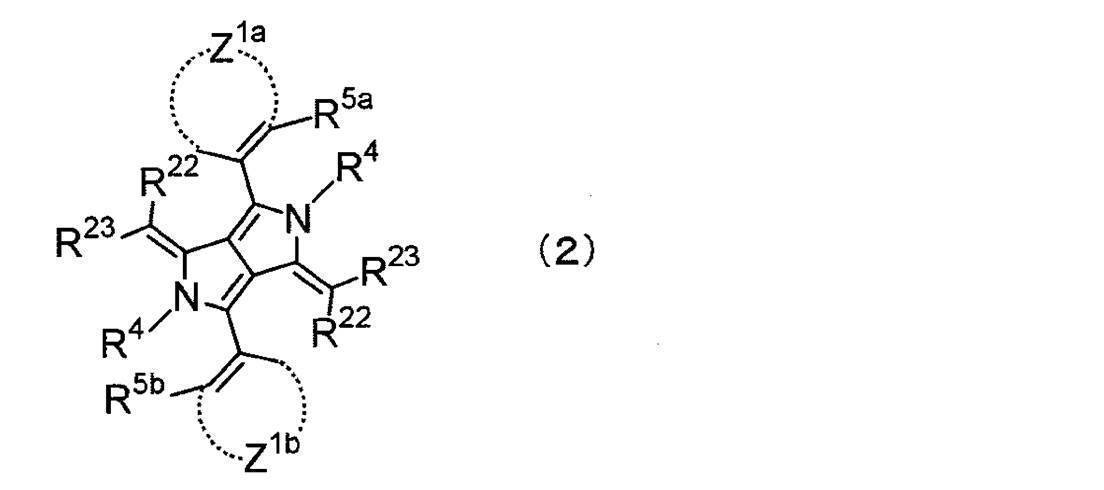
R5a及びR5bは、一般式(1)におけるR2及びR3で説明した例と同義であり、好ましい範囲も同様である。R5a及びR5bは同一であることが好ましい。
R5a又はR5bと、Z1a又はZ1bは、互いに結合し縮合環を形成してもよい。かかる、縮合環としてはナフチル環、キノリン環等が挙げられる。Z1a又はZ1bが形成するアリール環又はヘテロアリール環に、R5a又はR5bで表される基を導入することで、不可視性を大きく向上することができる。
R22及びR23は、一般式(1)におけるR2及びR3で説明した例と同義であり、好ましい範囲も同様である。
R4は一般式(1)におけるR4と同義であり、好ましい範囲も同様である。R4はR23と共有結合又は配位結合を形成してもよい。
一般式(2)で表される化合物は更に置換基を有してもよく、置換基としてはR2及びR3の置換基と同義であり、好ましい範囲も同様である。
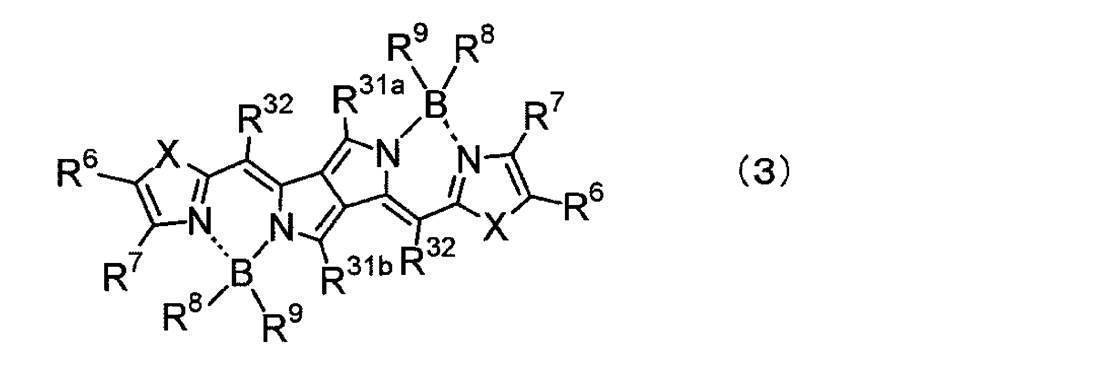
R32は、一般式(1)におけるR2の例と同義であり、好ましい範囲も同様である。
R6及びR7は、一般式(1)におけるR2及びR3の置換基の例と同義であり、好ましい範囲も同様である。また、R6及びR7は結合して環を形成してよく、形成する環としては、例えば、炭素数5~10の脂環、炭素数6~10のアリール環、及び、炭素数3~10のヘテロアリール環であり、好ましい例としてはベンゼン環、ナフタレン環、及び、ビリジン環等が挙げられる。R6及びR7が置換した5員含窒素ヘテロアリール環を導入し、更にホウ素錯体とすることで、高い堅牢性、高い不可視性を両立する赤外線吸収色素を実現することができる。
R8及びR9は、一般式(1)におけるR2及びR3の置換基の例と同義であり、好ましい範囲も同様である。
Xは、酸素原子、イオウ原子、-NR-、又は、-CRR’-を表す。R及びR’は各々独立に水素原子、炭素数1~10のアルキル基、又は炭素数6~10のアリール基を表し、好ましくは水素原子、炭素数1~6のアルキル基、又は、フェニル基である。

R42は、一般式(1)におけるR2の例と同義であり、好ましい範囲も同様である。
Z2は、-C=N-と共に含窒素ヘテロ5又は6員環を形成する原子団を表し、含窒素ヘテロアリール環としてはピラゾール環、チアゾール環、オキサゾール環、イミダゾール環、オキサジアゾール環、チアジアゾール環、トリアゾール環、ピリジン環、ピリダジン環、ピリミジン環、ピラジン環、これらのベンゾ縮環もしくはナフト縮環、又はこれら縮環の複合体を表す。
R44は、水素原子、炭素数1~20のアルキル基、炭素数6~20のアリール基、炭素数4~20のヘテロアリール基、-BR44AR44B、又は金属原子を表し、R44は、Z2が形成する含窒素ヘテロ環と共有結合又は配位結合を有してもよく、R44A及びR44Bは、各々独立に、水素原子、ハロゲン原子、炭素数1~10のアルキル基、炭素数6~20のアリール基、又は、炭素数4~20のヘテロアリール基を表す。
互いに異なるR41a及びR41bで表される基を導入し、Z2が-C=N-と共に形成する含窒素ヘテロ5又は6員環を導入することで、高い堅牢性、高い不可視性、優れた分散性、及び高い有機溶媒溶解性を付与することができる。

R55~R56は、それぞれ独立に、シアノ基、炭素数1~6のアシル基、炭素数1~6のアルコキシカルボニル基、炭素数1~10のアルキルスルフィニル基、炭素数6~10のアリールスルフィニル基、又は炭素数3~10の含窒素ヘテロアリール基を表し、
R57a~R57dは、それぞれ独立に、炭素数1~10のアルキル基、炭素数1~10のアルコキシ基、炭素数6~20のアリール基、又は炭素数3~10のヘテロアリール基を表し、
n1及びn2は、それぞれ独立に0~5の整数を表し、
n3及びn4は、それぞれ独立に0~4の整数を表す。
R51及びR52は、それぞれ独立に、アルキル基、アリール基、アルコキシ基、アリールオキシ基、ヘテロアリールオキシ基、ハロゲン原子又はシアノ基が好ましく、アルコキシ基又はアリールオキシ基がより好ましく、アルコキシ基が更に好ましい。
アルキル基の炭素数は、1~30が好ましく、1~20がより好ましい。アルキル基は、直鎖、分岐、環状のいずれでもよく、直鎖又は分岐が好ましい。
アリール基及びアリールオキシ基の炭素数は、6~30が好ましく、6~20がより好ましい。
アルコキシ基の炭素数は、1~30が好ましく、1~20がより好ましい。アルコキシ基は、直鎖又は分岐が好ましく、分岐がより好ましい。
ヘテロアリールオキシ基が有するヘテロアリール環は、5員環又は6員環が好ましい。また、ヘテロアリール環は、単環又は縮合環が好ましく、単環又は縮合数が2~8の縮合環がより好ましく、単環又は縮合数が2~4の縮合環が更に好ましい。ヘテロアリール環を構成するヘテロ原子の数は、1~3が好ましく、1~2がより好ましい。ヘテロ原子としては、例えば、窒素原子、酸素原子、及び、硫黄原子が例示される。
R53及びR54は、それぞれ独立に、アルキル基、アリール基、アルコキシ基、アリールオキシ基、ヘテロアリールオキシ基、ハロゲン原子又はシアノ基が好ましい。
n3及びn4は、それぞれ独立に0~4の整数を表し、0~2が好ましい。
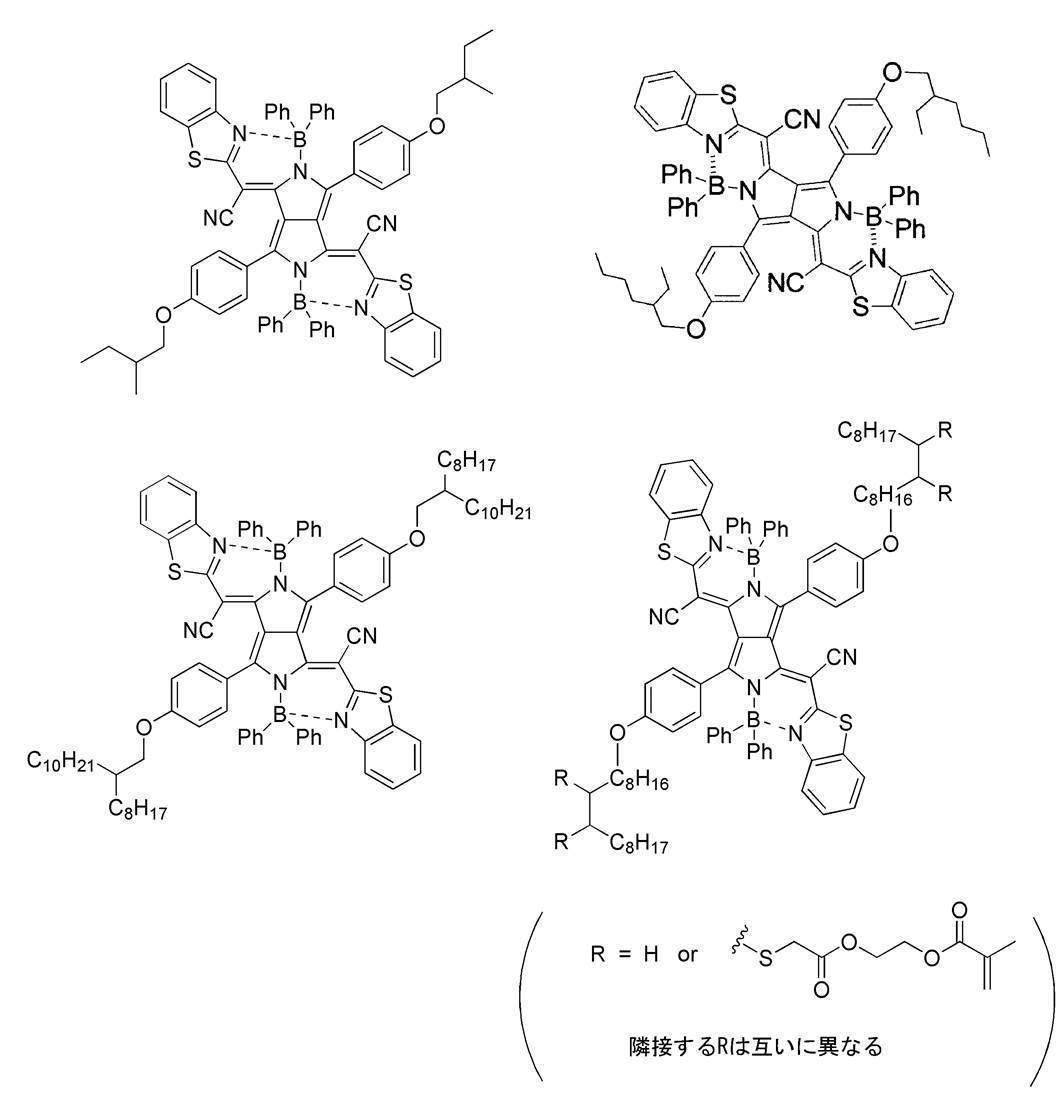
フタロシアニン化合物は、オキソチタニルフタロシアニンが好ましい。
オキソチタニルフタロシアニンは、下式(PC)で表される化合物が好ましい。
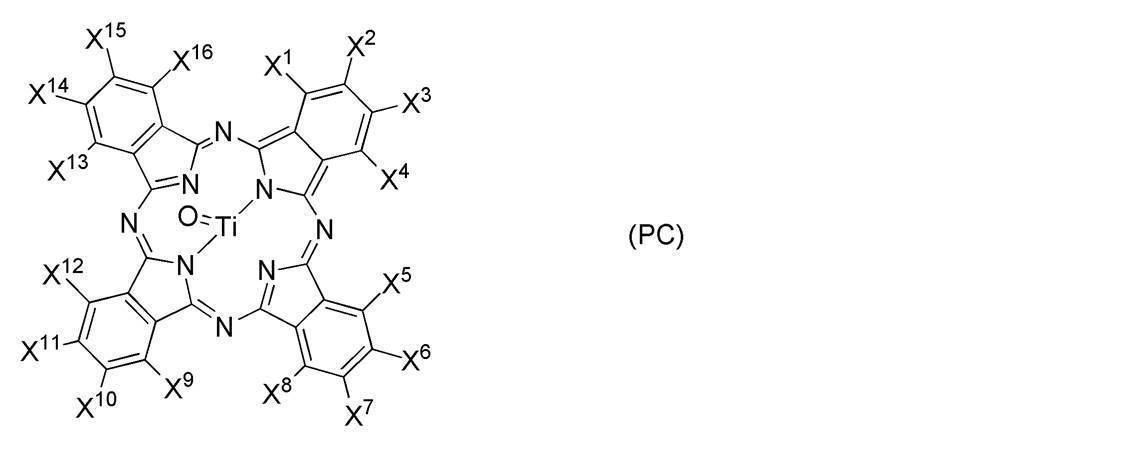
X1~X16のうち、ハロゲン原子の数は、0~16が好ましく、0~4がより好ましく、0~1が更に好ましく、0が特に好ましい。
ナフタロシアニン化合物は、オキソバナジルナフタロシアニンが好ましい。
オキソバナジルナフタロシアニンは、下式(NPC)で表される化合物が好ましい。

X1~X24のうち、ハロゲン原子の数は、0~24が好ましく、0~4がより好ましく、0~1が更に好ましく、0が特に好ましい。
スクアリリウム化合物は、下記一般式(1)で表される化合物が好ましい。
一般式(1)


A1及びA2が表すアリール基の炭素数は、6~48が好ましく、6~24がより好ましく、6~12が更に好ましい。具体例としては、フェニル基、ナフチル基等が挙げられる。なお、アリール基が置換基を有する場合における上記アリール基の炭素数は、置換基の炭素数を除いた数を意味する。
A1及びA2が表すヘテロ環基としては、5員環又は6員環が好ましい。また、ヘテロ環基は、単環又は縮合環が好ましく、単環又は縮合数が2~8の縮合環がより好ましく、単環又は縮合数が2~4の縮合環が更に好ましく、単環又は縮合数が2又は3の縮合環が特に好ましい。ヘテロ環基に含まれるヘテロ原子としては、窒素原子、酸素原子、及び、硫黄原子が例示され、窒素原子、硫黄原子が好ましい。ヘテロ原子の数は、1~3が好ましく、1~2がより好ましい。具体的には、窒素原子、酸素原子及び硫黄原子の少なくとも一つを含有する5員環又は6員環等の単環、多環芳香族環から誘導されるヘテロ環基等が挙げられる。
アリール基及びヘテロ環基は、置換基を有していてもよい。置換基としては、ハロゲン原子、ヒドロキシル基、シアノ基、ニトロ基、アルキル基、アルケニル基、アルキニル基、アリール基、ヘテロアリール基、アラルキル基、アルコキシ基、アリーロキシ基、ヘテロアリーロキシ基、アルキルチオ基、アリールチオ基、ヘテロアリールチオ基、-NRa1Ra2、-CORa3、-COORa4、-OCORa5、-NHCORa6、-CONRa7Ra8、-NHCONRa9Ra10、-NHCOORa11、-SO2Ra12、-SO2ORa13、-NHSO2Ra14又はSO2NRa15Ra16が挙げられる。Ra1~Ra16は、それぞれ独立に、水素原子、アルキル基、アルケニル基、アルキニル基、アリール基、又は、ヘテロアリール基を表す。
アルキル基、アルコキシ基及びアリールチオ基の炭素数は、1~20が好ましく、1~15がより好ましく、1~8が更に好ましい。アルキル基は、直鎖、分岐、及び、環状のいずれでもよく、直鎖又は分岐が好ましい。
アルケニル基の炭素数は、2~20が好ましく、2~12がより好ましく、2~8が更に好ましい。アルケニル基は直鎖、分岐、及び、環状のいずれでもよく、直鎖又は分岐が好ましい。
アルキニル基の炭素数は、2~40が好ましく、2~30がより好ましく、2~25が更に好ましい。アルキニル基は直鎖、分岐、及び、環状のいずれでもよく、直鎖又は分岐が好ましい。
アリール基の炭素数は、6~30が好ましく、6~20がより好ましく、6~12が更に好ましい。
アリーロキシ基及びアリールチオ基が有するアリール基は、上述したものが挙げられ、好ましい範囲も同様である。
アラルキル基のアルキル部分は、上記アルキル基と同様である。アラルキル基のアリール部分は、上記アリール基と同様である。アラルキル基の炭素数は、7~40が好ましく、7~30がより好ましく、7~25が更に好ましい。
ヘテロアリール基は、単環又は縮合環が好ましく、単環又は縮合数が2~8の縮合環がより好ましく、単環又は縮合数が2~4の縮合環が更に好ましい。ヘテロアリール基の環を構成するヘテロ原子の数は1~3が好ましい。ヘテロアリール基の環を構成するヘテロ原子は、窒素原子、酸素原子又は硫黄原子が好ましい。ヘテロアリール基は、5員環又は6員環が好ましい。ヘテロアリール基の環を構成する炭素原子の数は3~30が好ましく、3~18がより好ましく、3~12が更に好ましい。
ヘテロアリーロキシ基及びヘテロアリールチオ基が有するヘテロアリール基は、上述したものが挙げられ、好ましい範囲も同様である。
アリール基及びヘテロ環基が、置換基を2個以上有する場合、複数の置換基は同一であってもよく、異なっていてもよい。

アルキル基の炭素数は、1~30が好ましく、1~20がより好ましく、1~12が更に好ましく、2~8が特に好ましい。
アルケニル基の炭素数は、2~30が好ましく、2~20がより好ましく、2~12が更に好ましい。
アルキル基及びアルケニル基は、直鎖、分岐、及び、環状のいずれでもよく、直鎖又は分岐が好ましい。
アラルキル基の炭素数は7~30が好ましく、7~20がより好ましい。

一般式(3)及び(4)におけるR12は、置換基を表す。置換基としては、上述したアリール基又はヘテロ環基が有してもよい置換基が挙げられる。例えば、ハロゲン原子、アルキル基、ヒドロキシル基、-NRa1Ra2、又は、-NHCORa6が好ましく、ハロゲン原子、アルキル基がより好ましい。ハロゲン原子は塩素原子が好ましい。アルキル基の炭素数は、1~30が好ましく、1~20がより好ましく、1~12が更に好ましい。アルキル基は、直鎖又は分岐が好ましい。
一般式(3)におけるXは、窒素原子、又は、CR13R14を表し、R13及びR14は、それぞれ独立に水素原子又は置換基を表す。置換基としては、上述したアリール基又はヘテロ環基が有してもよい置換基が挙げられる。例えば、アルキル基等が挙げられる。アルキル基の炭素数は、1~20が好ましく、1~10がより好ましく、1~5が更に好ましく、1~3が特に好ましく、1が最も好ましい。アルキル基は、直鎖又は分岐が好ましく、直鎖が特に好ましい。
mは、0~4の整数を表し、0~2が好ましい。
一般式(5)
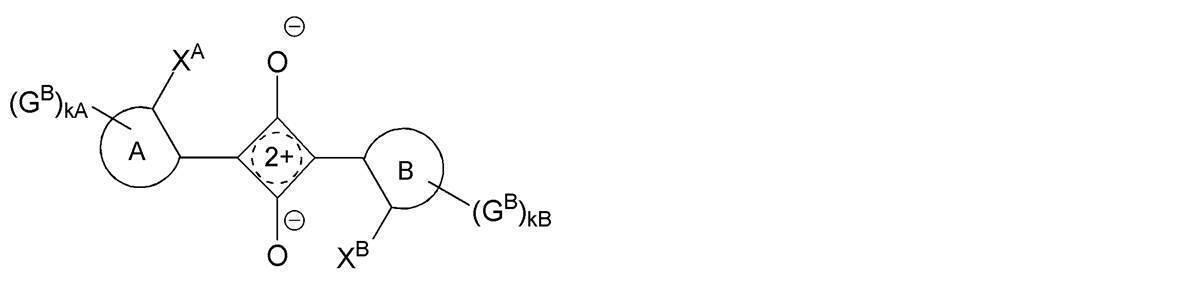
XA及びXBはそれぞれ独立に置換基を表し、
GA及びGBはそれぞれ独立に置換基を表し、
kAは0~nAの整数を表し、kBは0~nBの整数を表し、
nAは、A環に置換可能な最大の整数を表し、nBは、B環に置換可能な最大の整数を表し、
XAとGA、XBとGBは互いに結合して環を形成してもよく、GA及びGBがそれぞれ複数存在する場合は、互いに結合して環を形成していてもよい;
RX1及びRX1は、それぞれ独立に水素原子又は置換基を表す。置換基としてはアルキル基、アルケニル基、アルキニル基、アリール基、又は、ヘテロアリール基が挙げられる。アルキル基、アルケニル基、アルキニル基、アリール基、及び、ヘテロアリール基の詳細については、上述したアリール基又はヘテロ環基が有してもよい置換基で説明した範囲と同義である。
環としては、5員環又は6員環が好ましい。環は単環であってもよく、複環であってもよい。
XAとGA、XBとGB、GA同士又はGB同士が結合して環を形成する場合、これらが直接結合して環を形成してもよく、アルキレン基、-CO-、-O-、-NH-、-BR-及びそれらの組み合わせからなる群より選ばれる2価の連結基を介して結合して環を形成してもよい。XAとGA、XBとGB、GA同士又はGB同士が、-BR-を介して結合して環を形成することが好ましい。
Rは、水素原子又は置換基を表す。置換基としては、GA及びGBで説明した置換基が挙げられる。
kA及びkBは、それぞれ独立に0~4が好ましく、0~2がより好ましく、0~1が更に好ましい。

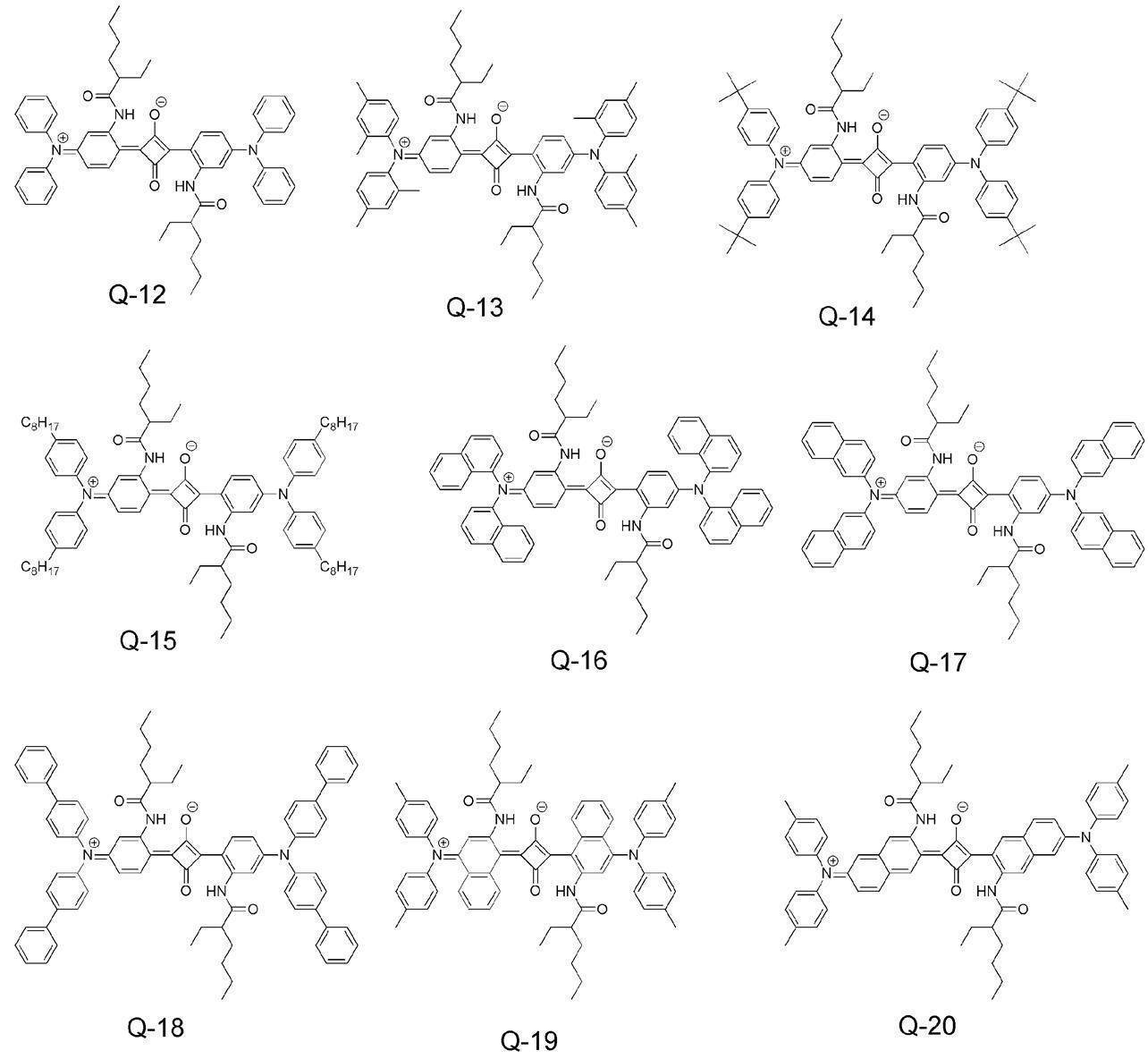

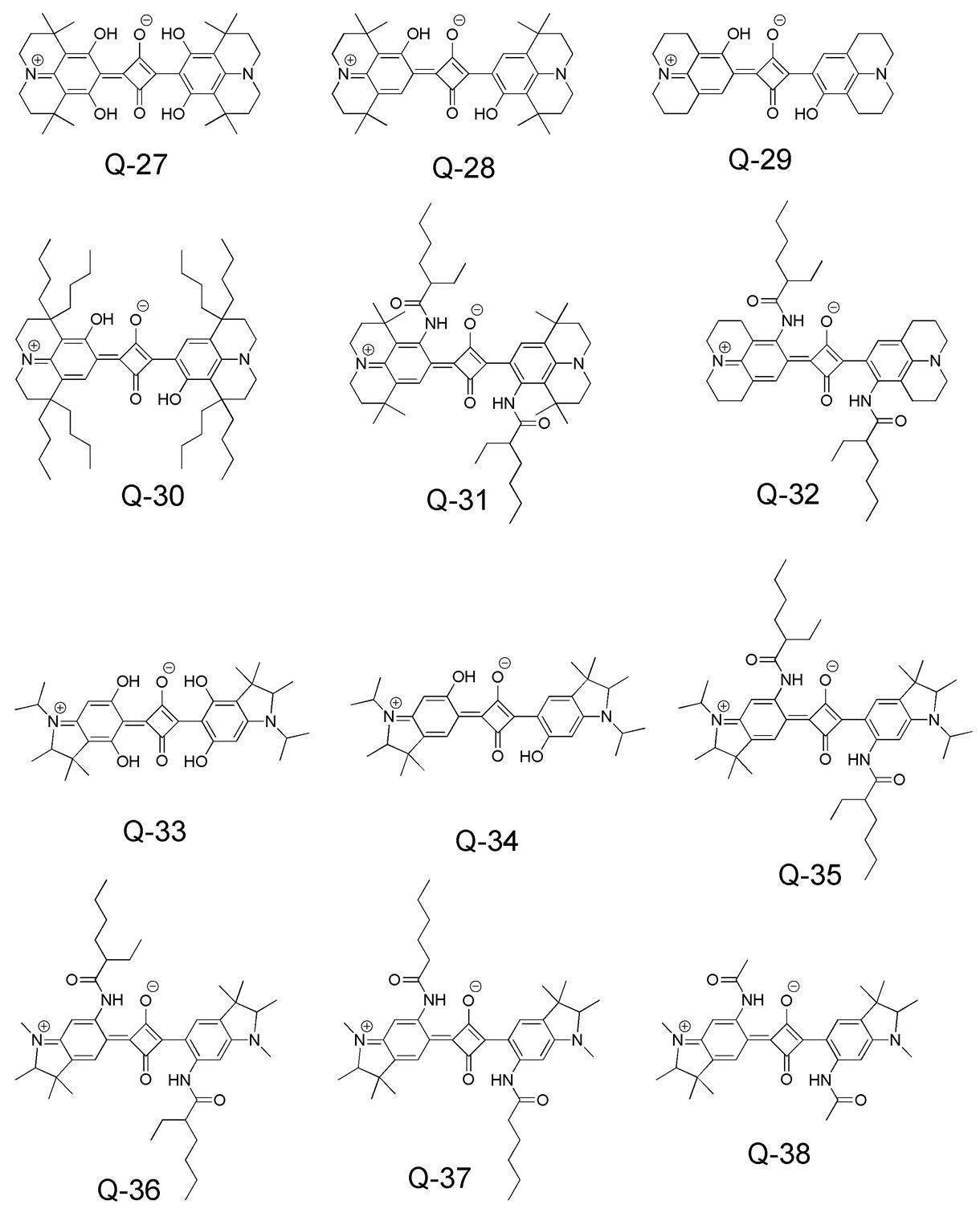
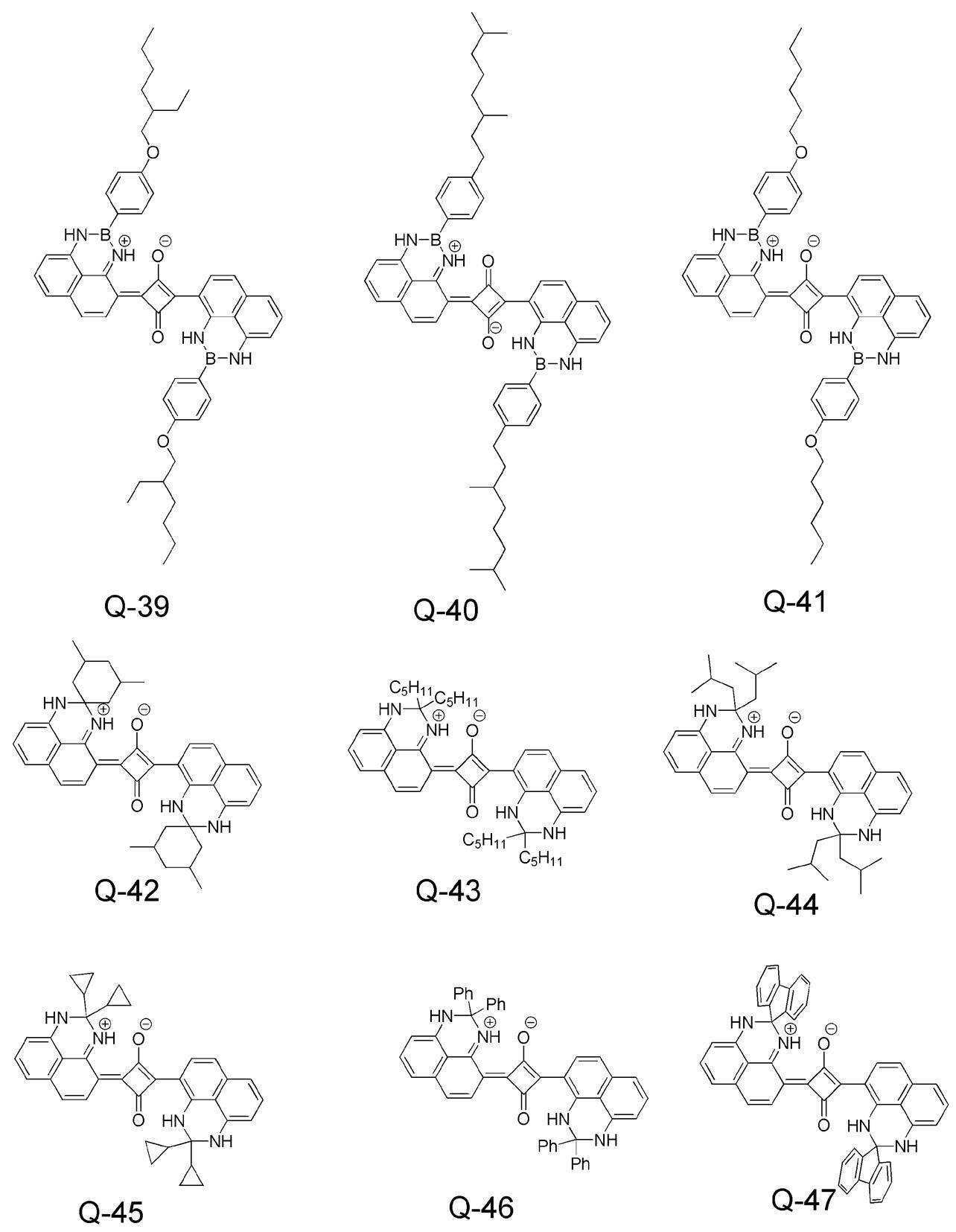
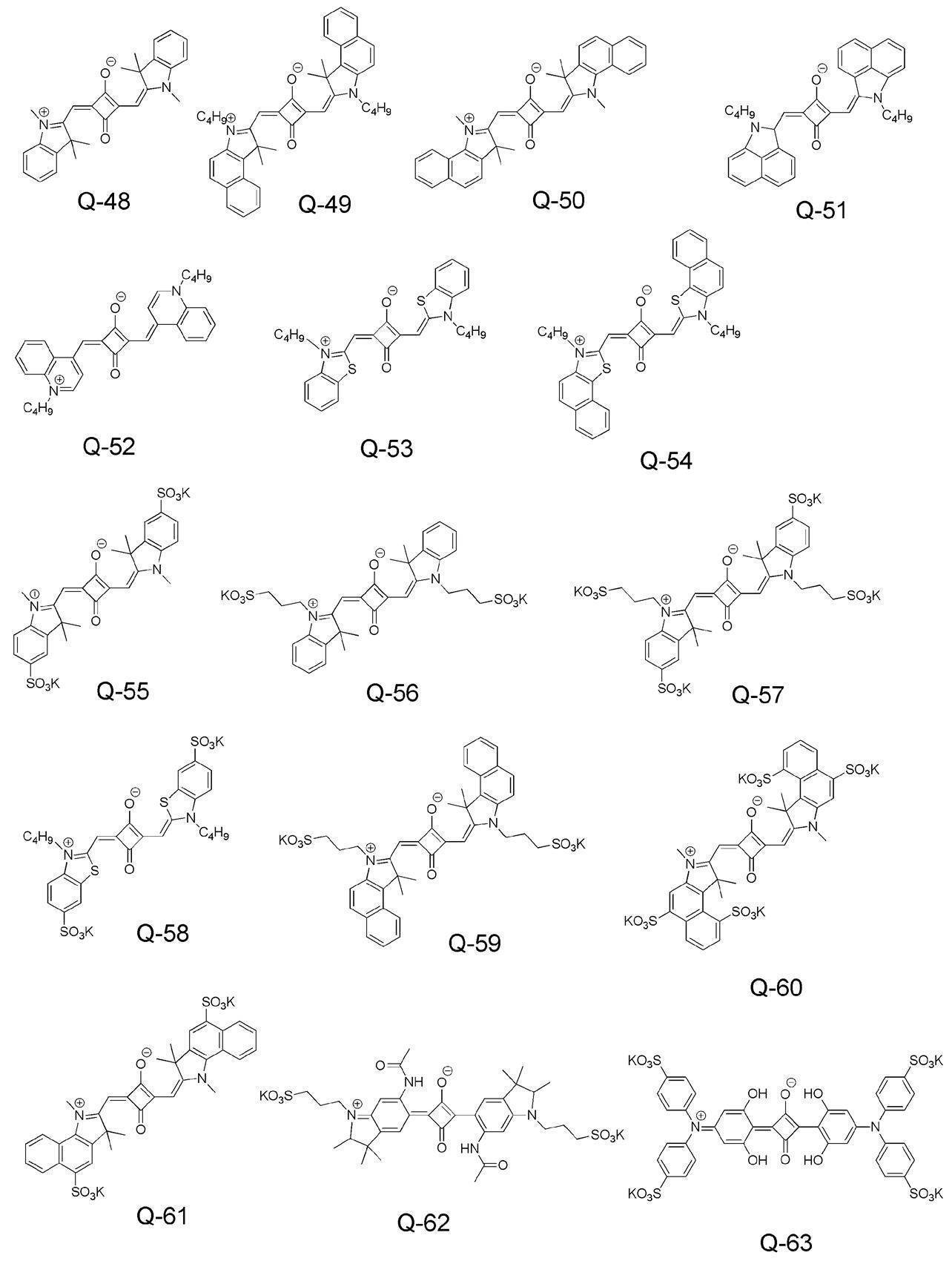
シアニン化合物は、下記一般式(10)で表される化合物が好ましい。
一般式(10)
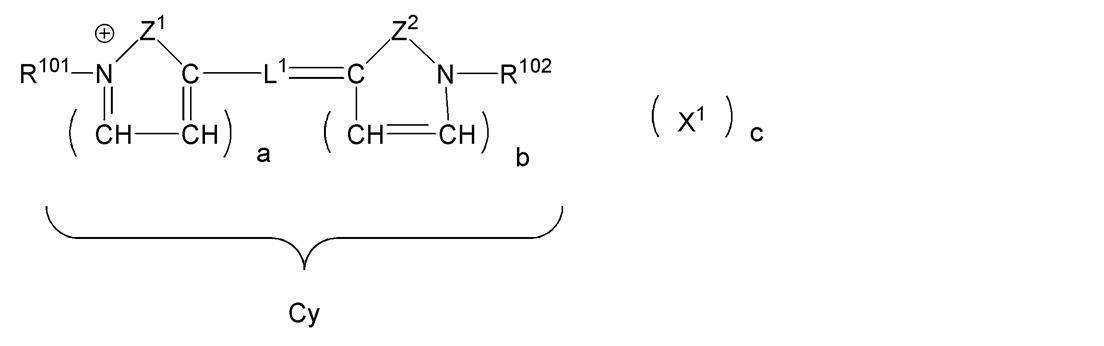
R101及びR102は、それぞれ独立に、アルキル基、アルケニル基、アルキニル基、アラルキル基又はアリール基を表し、
L1は、奇数個のメチン基からなるメチン鎖を表し、
a及びbは、それぞれ独立に、0又は1であり、
aが0の場合は、炭素原子と窒素原子とが二重結合で結合し、bが0の場合は、炭素原子と窒素原子とが単結合で結合し、
式中のCyで表される部位がカチオン部である場合、X1はアニオンを表し、cは電荷のバランスを取るために必要な数を表し、式中のCyで表される部位がアニオン部である場合、X1はカチオンを表し、cは電荷のバランスを取るために必要な数を表し、式中のCyで表される部位の電荷が分子内で中和されている場合、cは0である。
含窒素複素環には、他の複素環、芳香族環又は脂肪族環が縮合してもよい。含窒素複素環は、5員環が好ましい。5員の含窒素複素環に、ベンゼン環又はナフタレン環が縮合している構造が更に好ましい。含窒素複素環の具体例としては、オキサゾール環、イソオキサゾール環、ベンゾオキサゾール環、ナフトオキサゾール環、オキサゾロカルバゾール環、オキサゾロジベンゾフラン環、チアゾール環、ベンゾチアゾール環、ナフトチアゾール環、インドレニン環、ベンゾインドレニン環、イミダゾール環、ベンゾイミダゾール環、ナフトイミダゾール環、キノリン環、ピリジン環、ピロロピリジン環、フロピロール環、インドリジン環、イミダゾキノキサリン環、キノキサリン環等が挙げられ、キノリン環、インドレニン環、ベンゾインドレニン環、ベンゾオキサゾール環、ベンゾチアゾール環、又は、ベンゾイミダゾール環が好ましく、インドレニン環、ベンゾチアゾール環、又は、ベンゾイミダゾール環がより好ましい。
アルケニル基の炭素数は、2~20が好ましく、2~12がより好ましく、2~8が更に好ましい。アルケニル基は、直鎖、分岐、及び、環状のいずれでもよい。アルケニル基は無置換であってもよく、置換基を有していてもよい。置換基としては、上述したアルキル基が有してもよい置換基が挙げられ、好ましい範囲も同様である。
アルキニル基の炭素数は、2~20が好ましく、2~12がより好ましく、2~8が更に好ましい。アルキニル基は、直鎖、及び、分岐のいずれでもよい。アルキニル基は無置換であってもよく、置換基を有していてもよい。置換基としては、上述したアルキル基が有してもよい置換基が挙げられ、好ましい範囲も同様である。
アリール基の炭素数は、6~25が好ましく、6~15が更より好ましく、6~10が更に好ましい。アリール基は無置換であってもよく、置換基を有していてもよい。置換基としては、上述したアルキル基が有してもよい置換基が挙げられ、好ましい範囲も同様である。
アラルキル基のアルキル部分は、上記アルキル基と同様である。アラルキル基のアリール部分は、上記アリール基と同様である。アラルキル基の炭素数は、7~40が好ましく、7~30がより好ましく、7~25が更に好ましい。
ヘテロアリール基は、単環又は縮合環が好ましく、単環又は縮合数が2~8の縮合環がより好ましく、単環又は縮合数が2~4の縮合環が更に好ましい。ヘテロアリール基の環を構成するヘテロ原子の数は1~3が好ましい。ヘテロアリール基の環を構成するヘテロ原子は、窒素原子、酸素原子又は硫黄原子が好ましい。ヘテロアリール基は、5員環又は6員環が好ましい。ヘテロアリール基は、5員環又は6員環が好ましい。ヘテロアリール基の環を構成する炭素原子の数は3~30が好ましく、3~18がより好ましく、3~12が更に好ましい。ヘテロアリール基は無置換であってもよく、置換基を有していてもよい。置換基としては、上述したアルキル基が有してもよい置換基が挙げられ、好ましい範囲も同様である。
メチン基は置換基を有していてもよい。置換基を有するメチン基は、中央の(メソ位の)メチン基であることが好ましい。置換基の具体例としては、Z1及びZ2の含窒素複素環が有してもよい置換基、及び、下式(a)で表される基が挙げられる。また、メチン鎖の二つの置換基が結合して5又は6員環を形成してもよい。
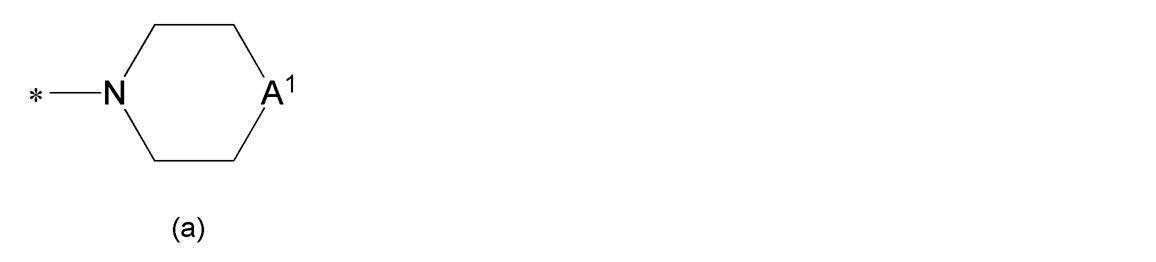

式A
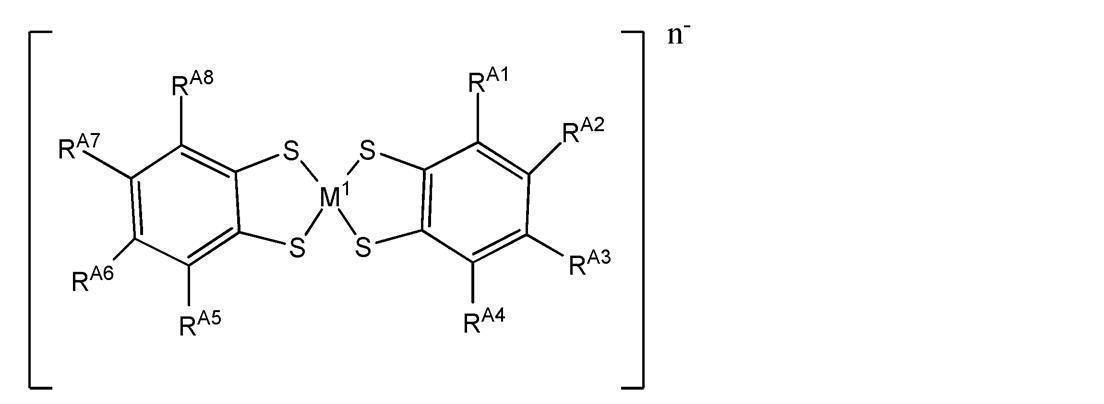
遷移金属としては、Cu、Co、Ni、Fe、Pd、Pt、Ti、V、Zn、Ru、Rh、及び、Zr等の遷移金属が挙げられ、Cu、Co、Ni、Fe、Pd及びPtが好ましく、Cu及びNiがより好ましい。
置換基としては、ハロゲン原子、シアノ基、ニトロ基、アルキル基、アルケニル基、アルキニル基、アラルキル基、アリール基、ヘテロアリール基、-OR201、-COR202、-COOR203、-OCOR204、-NR205R206、-NHCOR207、-CONR208R209、-NHCONR210R211、-NHCOOR212、-SR213、-SO2R214、-SO2OR215、-NHSO2R216又はSO2NR217R218が挙げられる。R201~R218は、それぞれ独立に、水素原子、アルキル基、アルケニル基、アルキニル基、アリール基又はヘテロアリール基を表す。なお、-COOR203のR203が水素原子の場合(すなわち、カルボキシル基)は、水素原子が解離してもよく(すなわち、カルボネート基)、塩の状態であってもよい。また、-SO2OR215のR215が水素原子の場合(すなわち、スルホ基)は、水素原子が解離してもよく(すなわち、スルホネート基)、塩の状態であってもよい。アルキル基、アルケニル基、アルキニル基、アラルキル基、アリール基、及び、ヘテロアリール基は、上記の置換基で説明したものが挙げられ、好ましい範囲も同様である。
一般式(10)において、式中のCyで表される部位の電荷が分子内で中和されている場合、X1は存在しない。すなわち、cは0である。
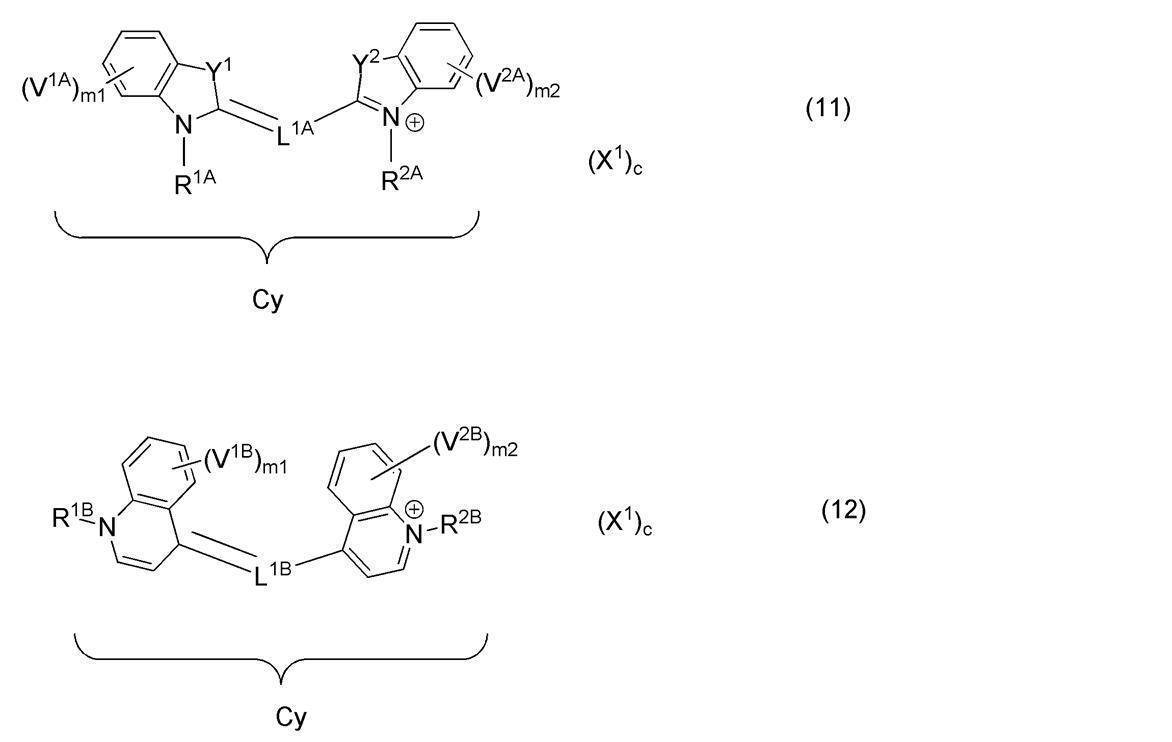
L1A及びL1Bは、それぞれ独立に奇数個のメチン基からなるメチン鎖を表し、
Y1及びY2は、各々独立に-S-、-O-、-NRX1-又はCRX2RX3-を表し、
RX1、RX2及びRX3は、各々独立に水素原子又はアルキル基を表し、
V1A、V2A、V1B及びV2Bは、それぞれ独立に、ハロゲン原子、シアノ基、ニトロ基、アルキル基、アルケニル基、アルキニル基、アラルキル基、アリール基、ヘテロアリール基、-ORc1、-CORc2、-COORc3、-OCORc4、-NRc5Rc6、-NHCORc7、-CONRc8Rc9、-NHCONRc10Rc11、-NHCOORc12、-SRc13、-SO2Rc14、-SO2ORc15、-NHSO2Rc16又はSO2NRc17Rc18を表し、V1A、V2A、V1B及びV2Bは、縮合環を形成していてもよく、
Rc1~Rc18は、それぞれ独立に、水素原子、アルキル基、アルケニル基、アルキニル基、アリール基又はヘテロアリール基を表し、
-COORc3のRc3が水素原子の場合及びSO2ORc15のRc15が水素原子の場合は、水素原子が解離しても、塩の状態であってもよく、
m1及びm2は、それぞれ独立に0~4を表し、
式中のCyで表される部位がカチオン部である場合、X1はアニオンを表し、cは電荷のバランスを取るために必要な数を表し、
式中のCyで表される部位がアニオン部である場合、X1はカチオンを表し、cは電荷のバランスを取るために必要な数を表し、
式中のCyで表される部位の電荷が分子内で中和されている場合、cは0である。
R1A、R2A、R1B及びR2Bがアルキル基を表す場合は、直鎖のアルキル基であることがより好ましい。
Y1及びY2は、各々独立に-S-、-O-、-NRX1-又はCRX2RX3-を表し、-NRX1-が好ましい。
RX1、RX2及びRX3は、各々独立に水素原子又はアルキル基を表し、アルキル基が好ましい。アルキル基の炭素数は、1~10が好ましく、1~5がより好ましく、1~3が更に好ましい。アルキル基は直鎖、分岐、及び、環状のいずれでもよいが、直鎖又は分岐が好ましく、直鎖がより好ましい。アルキル基は、メチル基又はエチル基が好ましい。
L1A及びL1Bは、一般式(10)のL1と同義であり、好ましい範囲も同様である。
V1A、V2A、V1B及びV2Bが表す基は、一般式(10)のZ1及びZ2の含窒素複素環が有してもよい置換基で説明した範囲と同義であり、好ましい範囲も同様である。
m1及びm2は、それぞれ独立に0~4を表し、0~2が好ましい。
X1が表すアニオン及びカチオンは、一般式(10)のX1で説明した範囲と同義であり、好ましい範囲も同様である。

X1及びX2は、各々独立に-S-、-O-、-NRX1-又はCRX2RX3-を表し、
RX1、RX2及びRX3は、各々独立に水素原子又はアルキル基を表し、
R3a及びR4aは、それぞれ独立に、ハロゲン原子、シアノ基、ニトロ基、アルキル基、アルケニル基、アルキニル基、アラルキル基、アリール基、ヘテロアリール基、-ORc1、-CORc2、-COORc3、-OCORc4、-NRc5Rc6、-NHCORc7、-CONRc8Rc9、-NHCONRc10Rc11、-NHCOORc12、-SRc13、-SO2Rc14、-SO2ORc15、-NHSO2Rc16、-SO2NRc17Rc18又は下式(a)で表される基を表し、
V1a及びV2aは、それぞれ独立に、ハロゲン原子、シアノ基、ニトロ基、アルキル基、アルケニル基、アルキニル基、アラルキル基、アリール基、ヘテロアリール基、-ORc1、-CORc2、-COORc3、-OCORc4、-NRc5Rc6、-NHCORc7、-CONRc8Rc9、-NHCONRc10Rc11、-NHCOORc12、-SRc13、-SO2Rc14、-SO2ORc15、-NHSO2Rc16又はSO2NRc17Rc18を表し、
V1a及びV2aは、縮合環を形成していてもよく、
Rc1~Rc18は、それぞれ独立に、水素原子、アルキル基、アルケニル基、アルキニル基、アリール基又はヘテロアリール基を表し、
-COORc3のRc3が水素原子の場合及びSO2ORc15のRc15が水素原子の場合は、水素原子が解離しても、塩の状態であってもよく、
m1及びm2は、それぞれ独立に0~4を表す。

X1及びX2は、一般式(11)のY1及びY2と同義であり、好ましい範囲も同様である。
R3a及びR4aは、一般式(10)で説明した、L1が有してもよい置換基で説明した範囲と同義であり、好ましい範囲も同様である。
V1a及びV2aが表す基は、一般式(10)で説明した、含窒素複素環及びそれに縮合している環が有してもよい置換基で説明した範囲と同義であり、好ましい範囲も同様である。
m1及びm2は、それぞれ独立に0~4を表し、0~2が好ましい。
また、特開2009-108267号公報の段落番号0044~0045に記載の化合物、特開2014-214262号公報の段落番号特開2015-40895号公報の段落番号0051~0068に記載の化合物が挙げられ、この内容は本願明細書に組み込まれることとする。


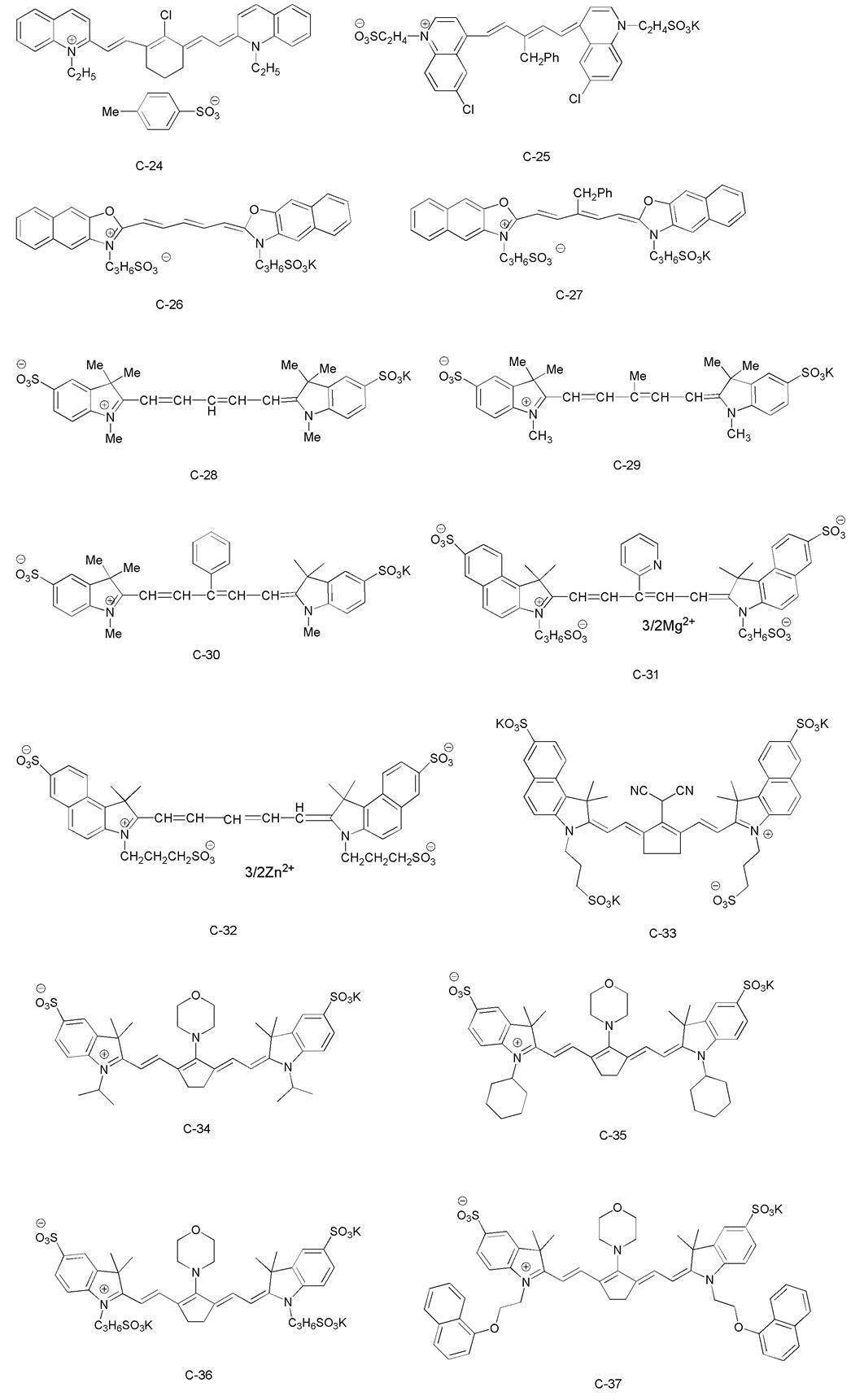
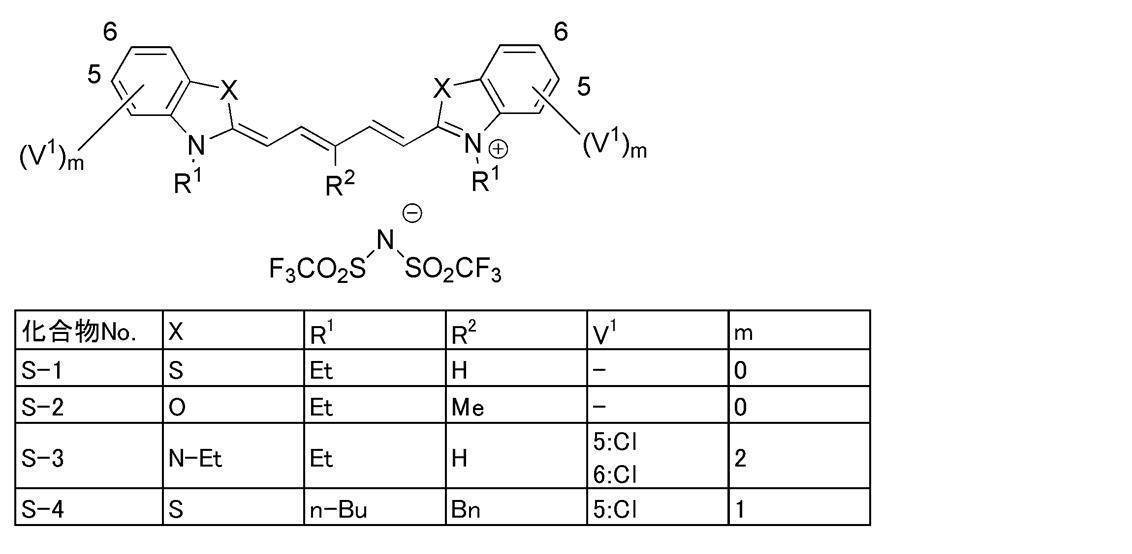

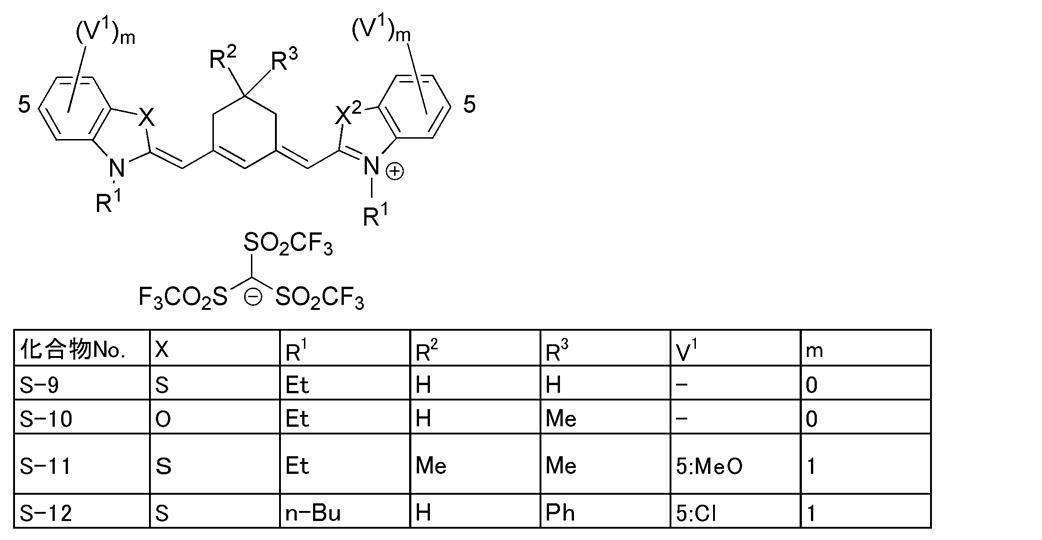

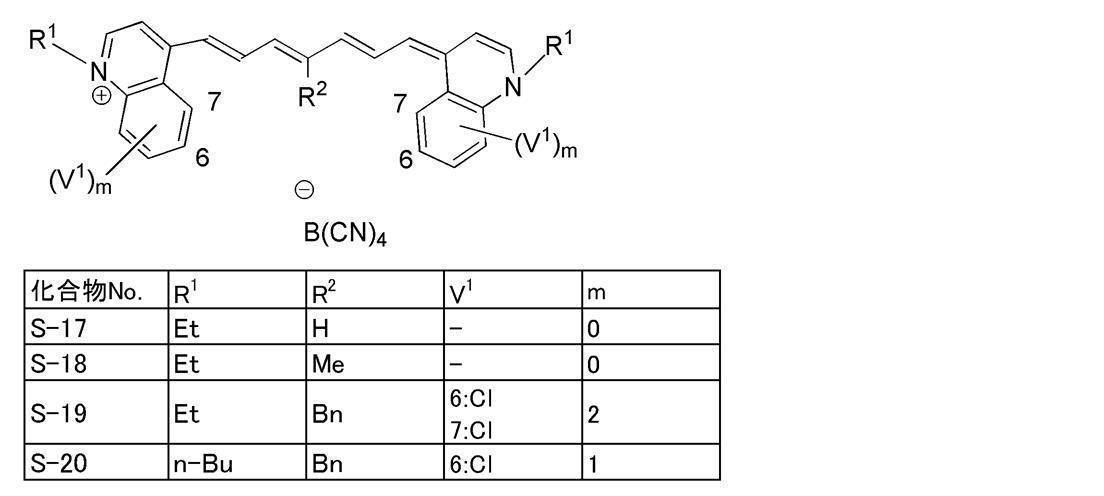
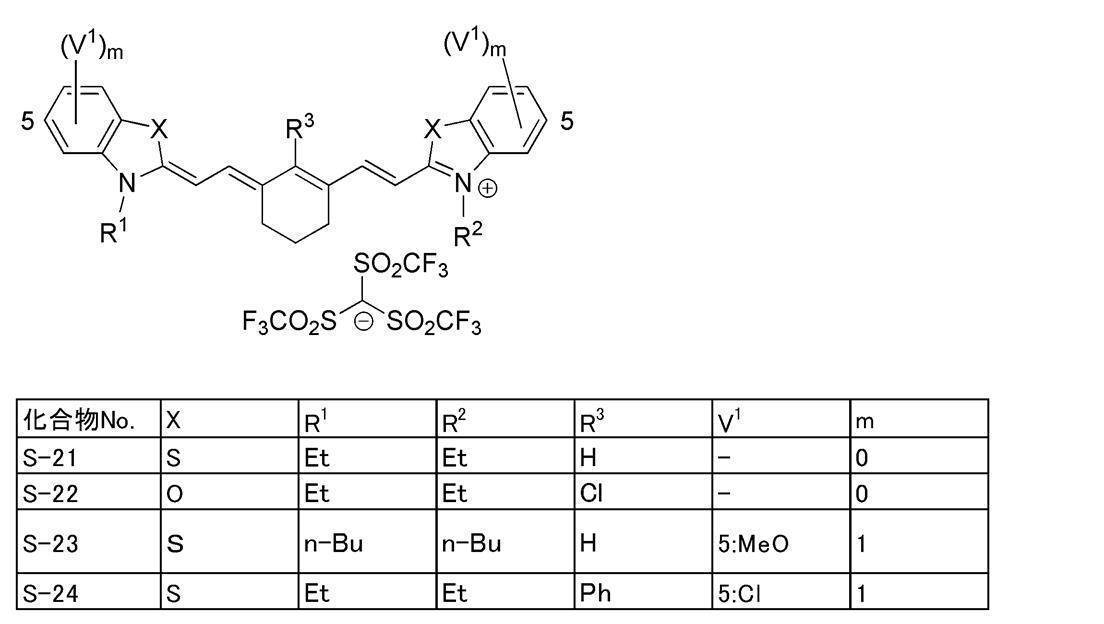
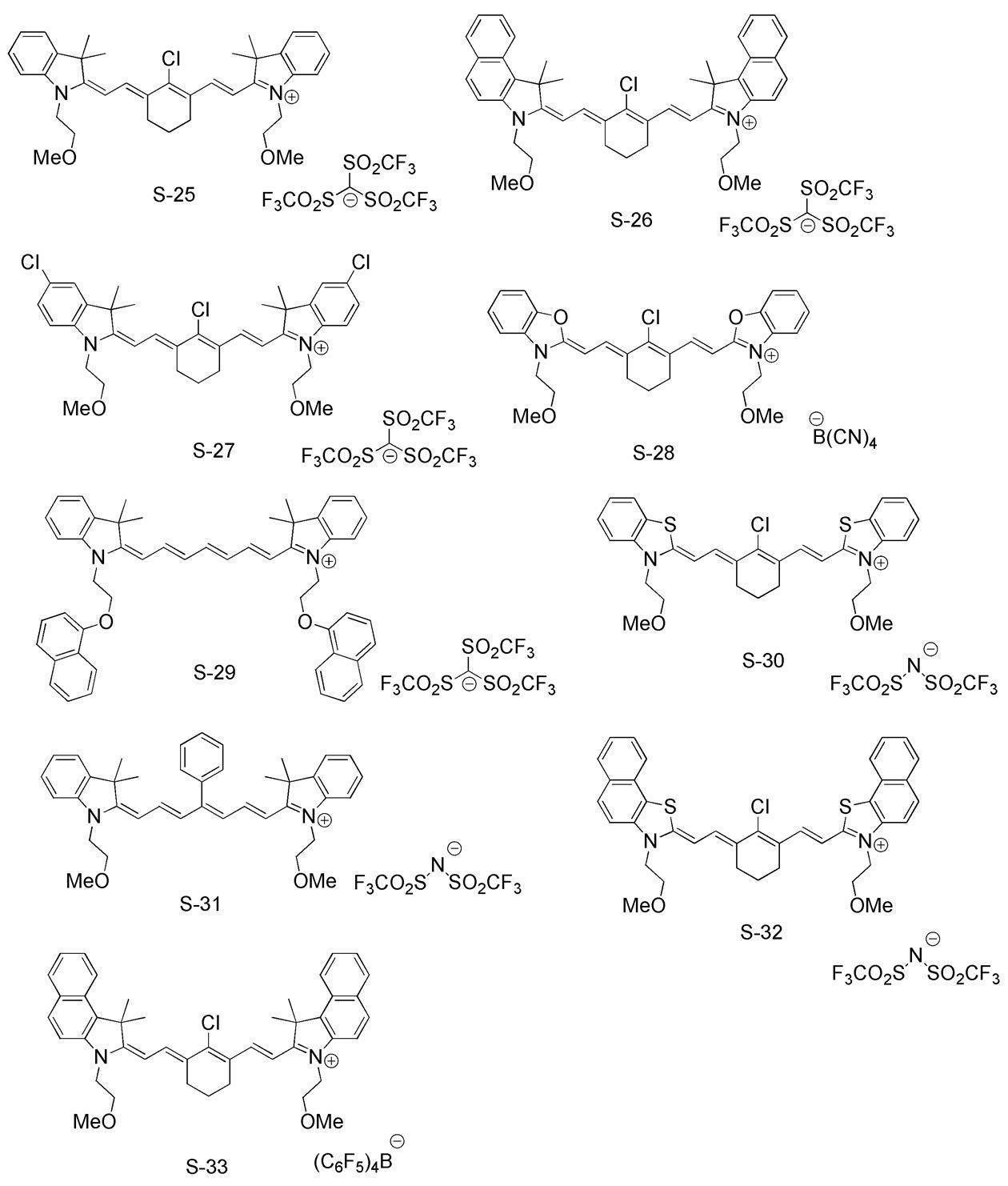


酸化タングステン系化合物としては、下記一般式(組成式)(I)で表される酸化タングステン系化合物が好ましい。
MxWyOz・・・(I)
Mは金属、Wはタングステン、Oは酸素を表す。
0.001≦x/y≦1.1
2.2≦z/y≦3.0
z/yが2.2以上であることにより、材料としての化学的安定性をより向上させることができ、3.0以下であることにより赤外線を十分に遮蔽することができる。
また、酸化タングステン系化合物は、例えば、住友金属鉱山株式会社製のYMF-02A等のタングステン微粒子の分散物としても、入手可能である。
ジインモニウム系化合物は、下記一般式(III-1)で表される化合物であることが好ましい。

また、R311、R312、R321、R322、R331、R332、R341及びR342の全てが同一であることも好ましい。
また、R313、R323、R333及びR343の全てが同一であることも好ましい。
n303、n313、n323、n333及びn343として好ましくは0~3であり、より好ましくは0~2であり、更に好ましくは0又は1であり、特に好ましくは0である。
また、下記一般式(D)で表される陰イオンであることも好ましい。

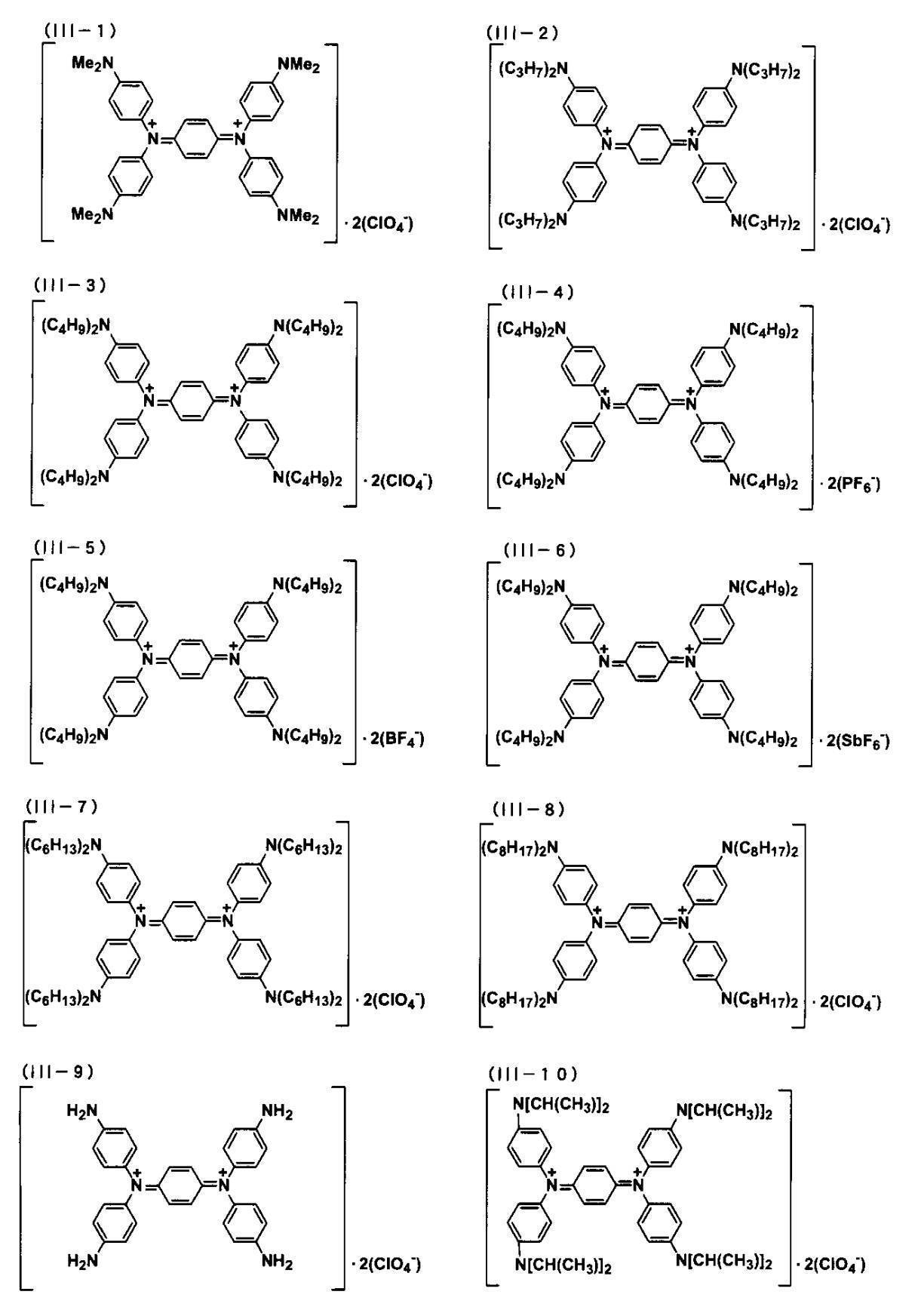
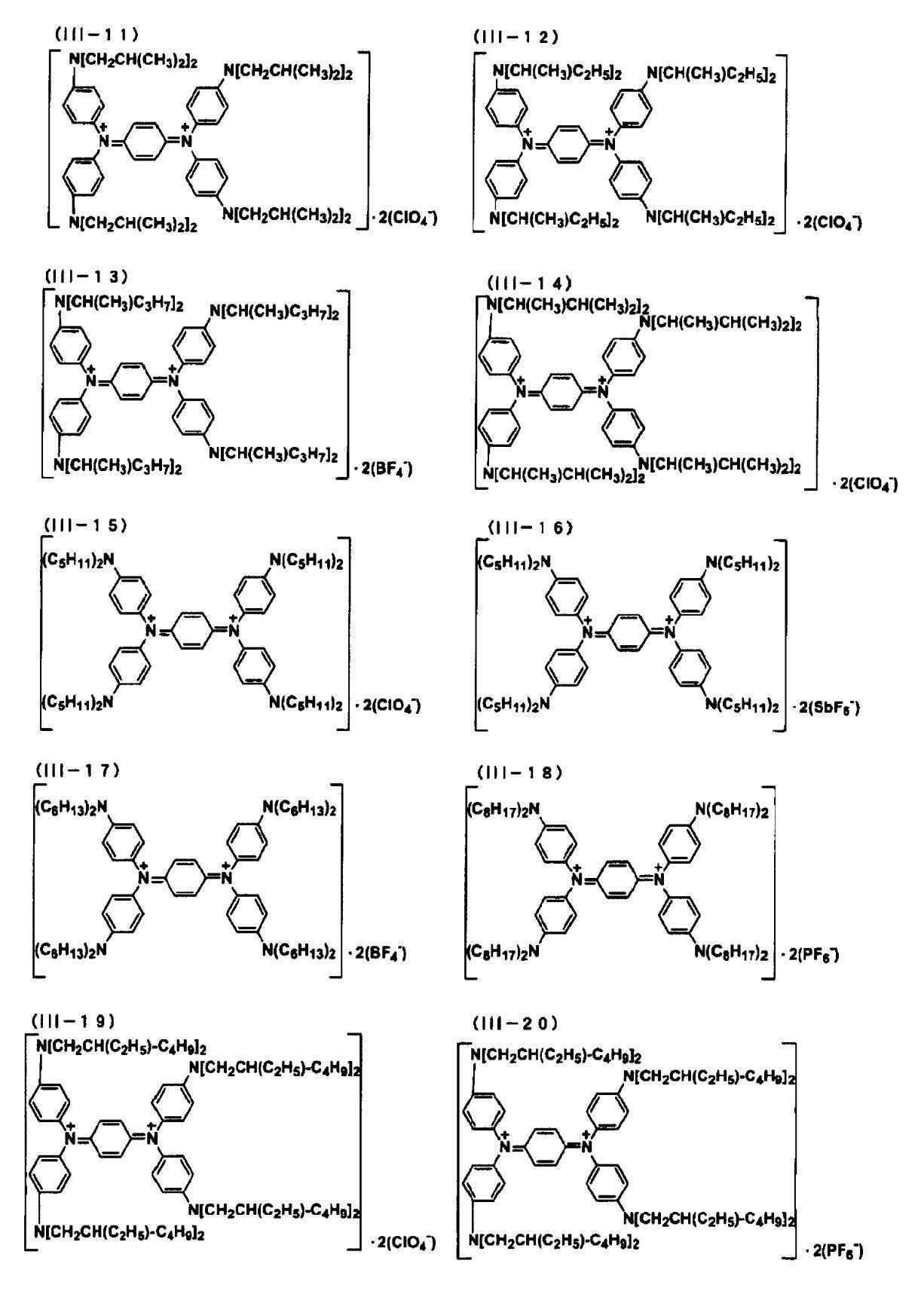
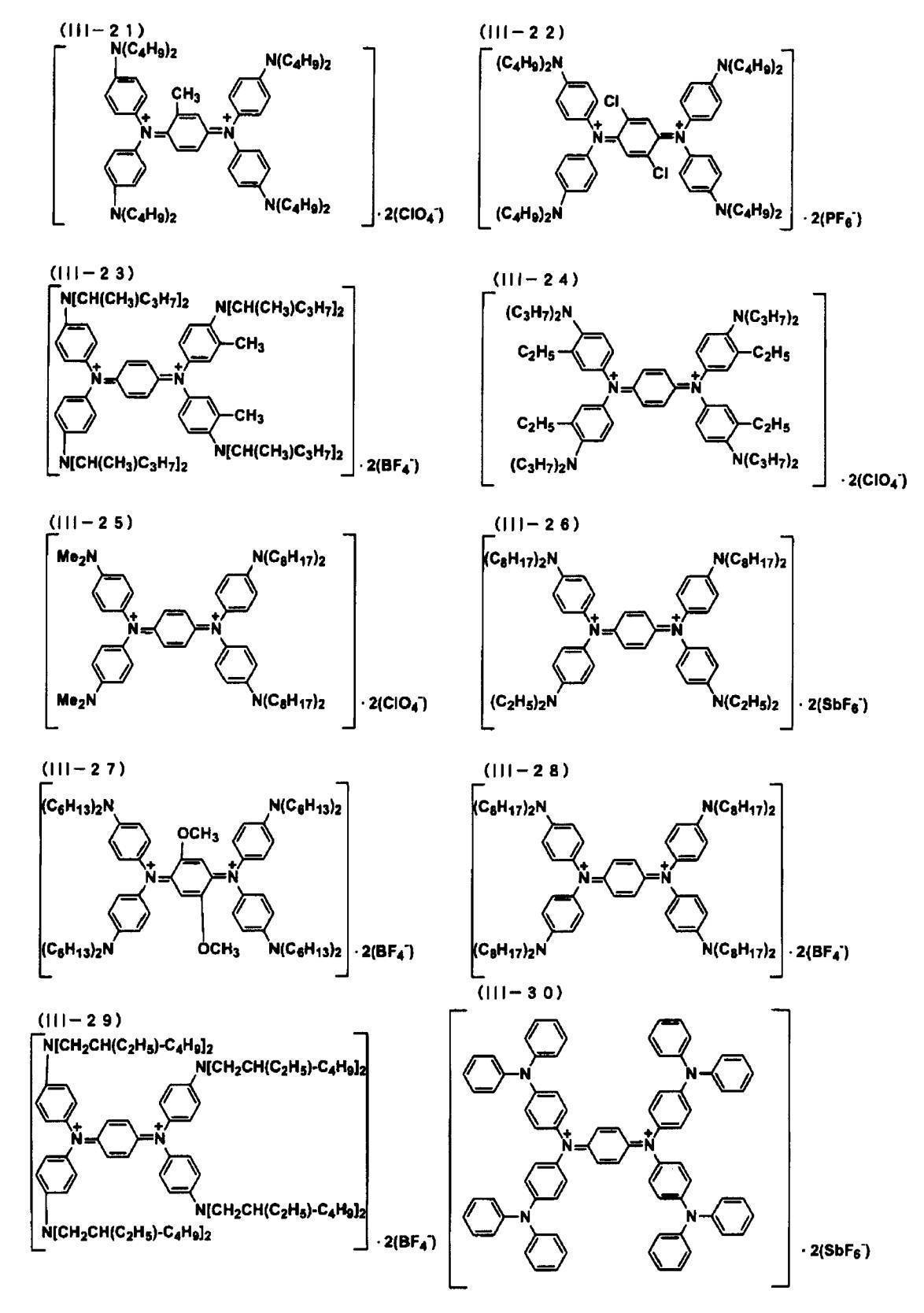

また、市販品市販品としては、EPOLIGHT1178、EPOLIGHT7551(Epolin社製)等が挙げられる。
第1の硬化性組成物は、重合性化合物を含有する。
重合性化合物は、エチレン性不飽和結合を有する基を1個以上有する化合物が好ましく、2個以上有する化合物がより好ましく、3個以上有することが更に好ましく、5個以上有することが特に好ましい。上限は、たとえば、15個以下である。エチレン性不飽和結合を有する基としては、例えば、ビニル基、(メタ)アリル基、及び、(メタ)アクリロイル基等が挙げられる。
重合性化合物の分子量は、100~3000が好ましく、250~1500がより好ましい。
重合性化合物は、3~15官能の(メタ)アクリレート化合物であることが好ましく、3~6官能の(メタ)アクリレート化合物であることがより好ましい。
モノマー、プレポリマーの例としては、不飽和カルボン酸(例えば、アクリル酸、メタクリル酸、イタコン酸、クロトン酸、イソクロトン酸、マレイン酸等)及びそのエステル類、アミド類、並びにこれらの多量体が挙げられ、好ましくは、不飽和カルボン酸と脂肪族多価アルコール化合物とのエステル、及び不飽和カルボン酸と脂肪族多価アミン化合物とのアミド類、並びにこれらの多量体である。また、ヒドロキシル基、アミノ基、メルカプト基等の求核性置換基を有する不飽和カルボン酸エステル或いはアミド類と、単官能若しくは多官能イソシアネート類或いはエポキシ類との付加反応物のほか、上記不飽和カルボン酸エステル或いはアミド類と、単官能若しくは多官能のカルボン酸との脱水縮合反応物等も好適に使用される。また、イソシアネート基、エポキシ基等の親電子性置換基を有する不飽和カルボン酸エステル或いはアミド類と、単官能若しくは多官能のアルコール類、アミン類、チオール類との反応物、ハロゲン基及びトシルオキシ基等の脱離性置換基を有する不飽和カルボン酸エステル或いはアミド類と、単官能若しくは多官能のアルコール類、アミン類、チオール類との反応物も好適である。また、上記の不飽和カルボン酸の代わりに、不飽和ホスホン酸、スチレン等のビニルベンゼン誘導体、ビニルエーテル、アリルエーテル等に置き換えた化合物群を使用することも可能である。
これらの具体的な化合物としては、特開2009-288705号公報の段落〔0095〕~〔0108〕に記載されている化合物を本発明においても好適に用いることができる。
以下に好ましい重合性化合物の態様を示す。
カプロラクトン構造を有する化合物としては、分子内にカプロラクトン構造を有する限り特に限定されるものではないが、例えば、トリメチロールエタン、ジトリメチロールエタン、トリメチロールプロパン、ジトリメチロールプロパン、ペンタエリスリトール、ジペンタエリスリトール、トリペンタエリスリトール、グリセリン、ジグリセロール、及び、トリメチロールメラミン等の多価アルコールと、(メタ)アクリル酸及びε-カプロラクトンとをエステル化することにより得られる、ε-カプロラクトン変性多官能(メタ)アクリレートを挙げることができる。なかでも下記一般式(Z-1)で表されるカプロラクトン構造を有する化合物が好ましい。



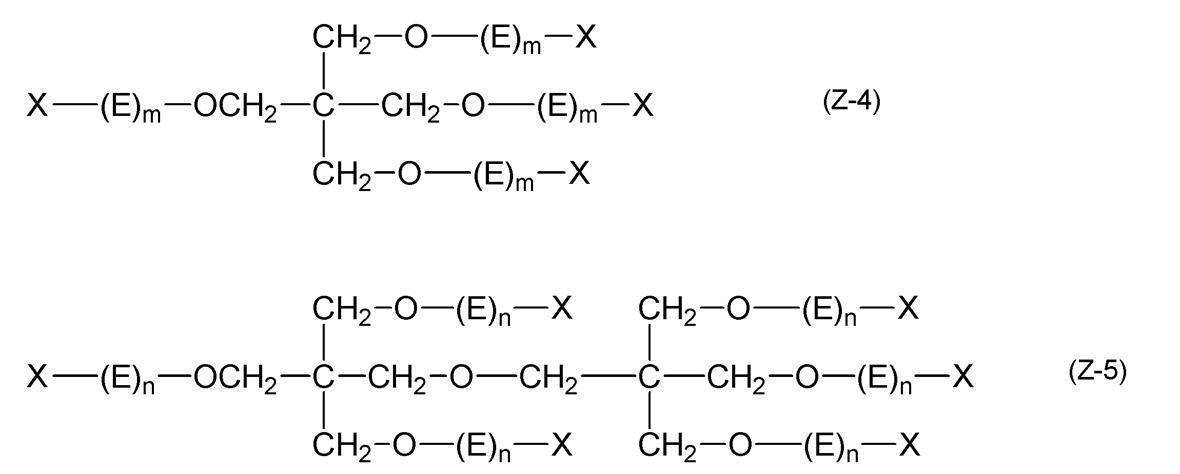
一般式(Z-4)中、(メタ)アクリロイル基の合計は3個又は4個であり、mは各々独立に0~10の整数を表し、各mの合計は0~40の整数である。
一般式(Z-5)中、(メタ)アクリロイル基の合計は5個又は6個であり、nは各々独立に0~10の整数を表し、各nの合計は0~60の整数である。
また、各mの合計は、2~40の整数が好ましく、2~16の整数がより好ましく、4~8の整数が更に好ましい。
一般式(Z-5)中、nは、0~6の整数が好ましく、0~4の整数がより好ましい。
また、各nの合計は、3~60の整数が好ましく、3~24の整数がより好ましく、6~12の整数が更に好ましい。
また、一般式(Z-4)又は一般式(Z-5)中の-((CH2)yCH2O)-又は-((CH2)yCH(CH3)O)-は、酸素原子側の末端がXに結合する形態が好ましい。
具体的には、下記式(a)~(f)で表される化合物(以下、「例示化合物(a)~(f)」とも称する。)が挙げられ、中でも、例示化合物(a)、(b)、(e)、(f)が好ましい。


市販品としては、ウレタンオリゴマーUAS-10、UAB-140(山陽国策パルプ社製)、UA-7200(新中村化学社製)、DPHA-40H(日本化薬社製)、UA-306H、UA-306T、UA-306I、AH-600、T-600、AI-600(共栄社製)等が挙げられる。
なお、本明細書においてSP値は、特に断らない限り、Hoy法によって求める(H.L.Hoy Journal of Painting,1970,Vol.42,76-118)。また、SP値については単位を省略して示しているが、その単位はcal1/2cm-3/2である。
重合性化合物は、1種単独であってもよいし、2種以上を併用してもよい。2種以上を併用する場合は、合計量が上記範囲となることが好ましい。
第1の硬化性組成物は、光重合開始剤を含有する。
光重合開始剤としては特に制限はなく、重合性化合物の重合を開始する能力を有する限り、特に制限はなく、公知の光重合開始剤の中から適宜選択することができる。例えば、紫外線領域から可視の光線に対して感光性を有するものが好ましい。また、光励起された増感剤と何らかの作用を生じ、活性ラジカルを生成する活性剤であってもよく、モノマーの種類に応じてカチオン重合を開始させるような開始剤であってもよい。
また、光重合開始剤は、約300nm~800nm(330nm~500nmがより好ましい。)の範囲内に少なくとも約50のモル吸光係数を有する化合物を、少なくとも1種含有していることが好ましい。
光重合開始剤の具体例としては、例えば、特開2013-29760号公報の段落0265~0268を参酌することができ、この内容は本願明細書に組み込まれる。
ヒドロキシアセトフェノン系開始剤としては、IRGACURE-184、DAROCUR-1173、IRGACURE-500、IRGACURE-2959、IRGACURE-127(商品名:いずれもBASF社製)を用いることができる。
アミノアセトフェノン系開始剤としては、市販品であるIRGACURE-907、IRGACURE-369、及び、IRGACURE-379EG(商品名:いずれもBASF社製)を用いることができる。アミノアセトフェノン系開始剤は、365nm又は405nm等の長波光源に吸収波長がマッチングされた特開2009-191179号公報に記載の化合物も用いることができる。
アシルホスフィン系開始剤としては、市販品であるIRGACURE-819又はDAROCUR-TPO(商品名:いずれもBASF社製)を用いることができる。
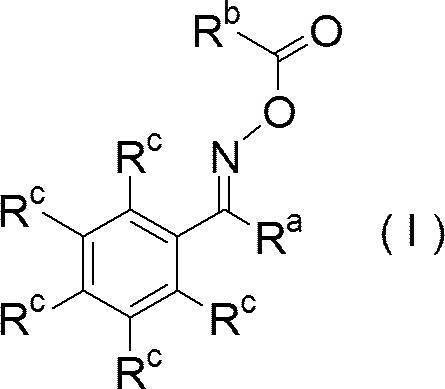
アルキル基の炭素数は、1~20が好ましく、1~15がより好ましく、1~10が更に好ましく、1~4が特に好ましい。アルキル基は、直鎖、分岐、及び、環状のいずれでもよいが、直鎖又は分岐が好ましい。
アシル基の炭素数は、2~20が好ましく、2~15がより好ましい。アシル基としては、アセチル基、ベンゾイル基等が挙げられる。
アリール基の炭素数は、6~20が好ましく、6~15がより好ましく、6~10が更に好ましい。アリール基は、単環であってもよく、縮合環であってもよい。
ヘテロ環基は、5員環又は6員環が好ましい。ヘテロ環基は、単環であってもよく、縮合環であってもよい。縮合数は、2~8が好ましく、2~6がより好ましく、3~5が更に好ましく、3~4が特に好ましい。ヘテロ環基を構成する炭素原子の数は3~40が好ましく、3~30がより好ましく、3~20が更に好ましい。ヘテロ環基を構成するヘテロ原子の数は1~3が好ましい。ヘテロ環基を構成するヘテロ原子は、窒素原子、酸素原子又は硫黄原子が好ましく、窒素原子がより好ましい。
ハロゲン原子は、フッ素原子、塩素原子、臭素原子、及び、ヨウ素原子等が挙げられ、フッ素原子が好ましい。
置換基としてのアルキル基、並びに、RX1及びRX2が表すアルキル基の炭素数は、1~20が好ましい。アルキル基は、直鎖、分岐、及び、環状のいずれでもよいが、直鎖又は分岐が好ましい。アルキル基は、水素原子の一部又は全部がハロゲン原子(好ましくは、フッ素原子)で置換されていてもよい。また、アルキル基は、水素原子の一部又は全部が、上記置換基で置換されていてもよい。
置換基としてのアリール基、並びに、RX1及びRX2が表すアリール基の炭素数は、6~20が好ましく、6~15がより好ましく、6~10が更に好ましい。アリール基は、単環であってもよく、縮合環であってもよい。また、アリール基は、水素原子の一部又は全部が、上記置換基で置換されていてもよい。
置換基としてのヘテロ環基、並びに、RX1及びRX2が表すヘテロ環基は、5員環又は6員環が好ましい。ヘテロ環基は、単環であってもよく、縮合環であってもよい。ヘテロ環基を構成する炭素原子の数は3~30が好ましく、3~18がより好ましく、3~12が更に好ましい。ヘテロ環基を構成するヘテロ原子の数は1~3が好ましい。ヘテロ環基を構成するヘテロ原子は、窒素原子、酸素原子又は硫黄原子が好ましい。また、ヘテロ基は、水素原子の一部又は全部が、上記置換基で置換されていてもよい。

式(II)中、Ar1及びAr2は、それぞれ独立に、置換基を有していてもよい芳香族炭化水素環を表す。
芳香族炭化水素環は、単環でもよく、縮合環であってもよい。芳香族炭化水素環の環を構成する炭素数は、6~20が好ましく、6~15がより好ましく、6~10が更に好ましい。芳香族炭化水素環は、ベンゼン環及びナフタレン環が好ましい。なかでも、Ar1及びAr2の少なくとも一方がベンゼン環であることが好ましく、Ar1がベンゼン環であることがより好ましい。Ar1は、ベンゼン環又はナフタレン環が好ましく、ナフタレン環がより好ましい。
Ar1及びAr2が有してもよい置換基としては、Raで説明した置換基が挙げられる。
Ar1は、無置換が好ましい。Ar1は、無置換であってもよく、置換基を有していてもよい。置換基としては、-CORX1が好ましい。RX1は、アルキル基、アリール基又はヘテロ環基が好ましく、アリール基がより好ましい。アリール基は置換基を有していてもよく、無置換であってもよい。置換基としては、炭素数1~10のアルキル基等が挙げられる。
式(II)中、R3は、アルキル基又はアリール基を表し、アルキル基が好ましい。アルキル基及びアリール基は、無置換であってもよく、置換基を有していてもよい。置換基としては、上述したRaで説明した置換基が挙げられる。
アルキル基の炭素数は、1~20が好ましく、1~15がより好ましく、1~10が更に好ましい。アルキル基は、直鎖、分岐、及び、環状のいずれでもよいが、直鎖又は分岐が好ましい。
アリール基の炭素数は、6~20が好ましく、6~15がより好ましく、6~10が更に好ましい。アリール基は、単環であってもよく、縮合環であってもよい。
これらのうち、少なくとも1個の水素原子がフッ素原子で置換された炭素数1~20のアルキル基が好ましい。このアルキル基は、炭素数が1~15であることが好ましく、1~10がより好ましく、1~4が更に好ましく、直鎖、分岐、及び、環状のいずれでもよいが、直鎖又は分岐が好ましい。
アルキルエーテル基の炭素数の総数は、2~8が好ましく、2~6がより好ましく、2~4が更に好ましい。
また、Rcが結合しているベンゼン環において、Rcが結合していない1個の炭素に対して、Rcが表すアルキル基、又は、-ORhで表される基は、オルト位又はパラ位に位置することが好ましい。
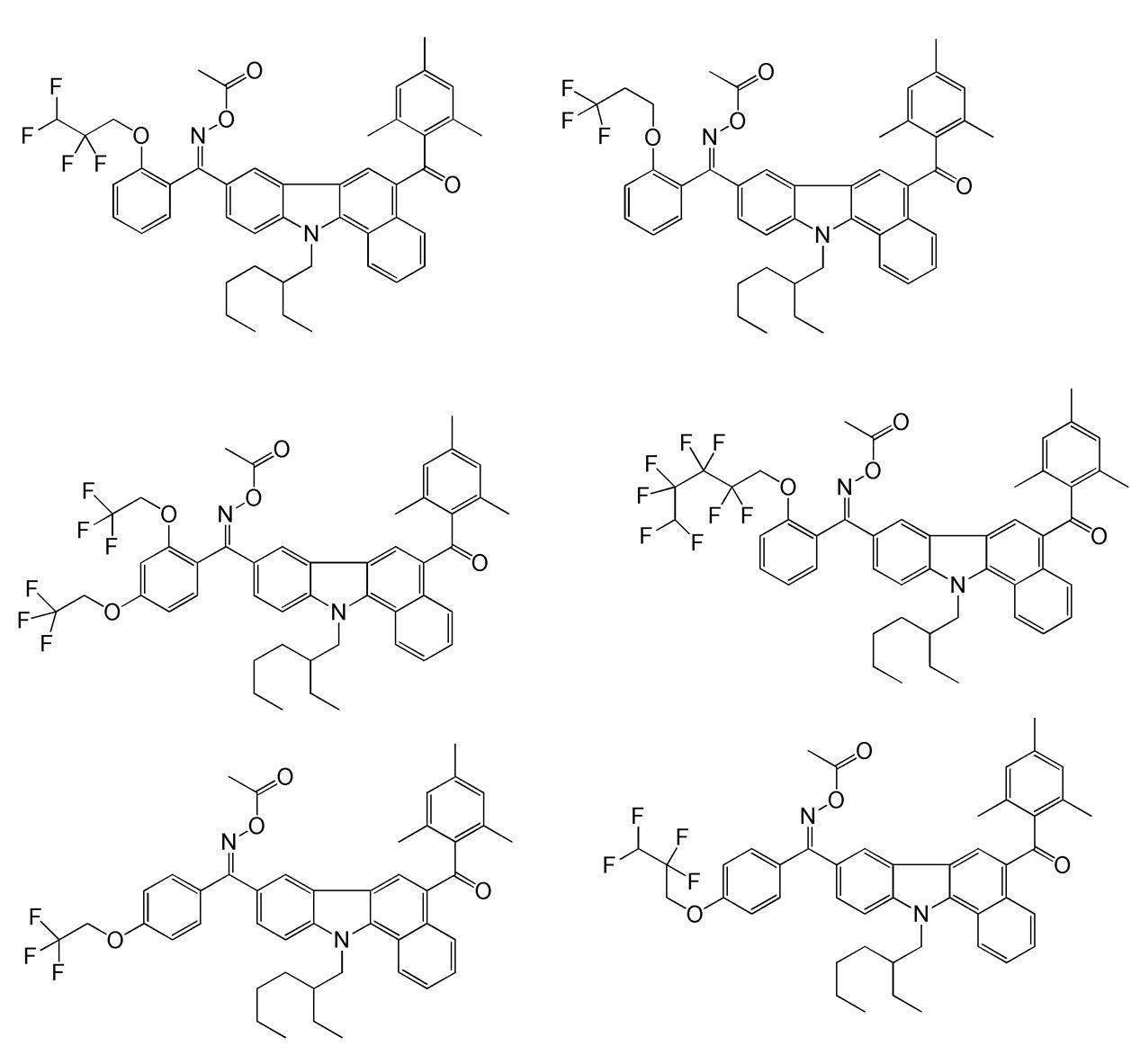
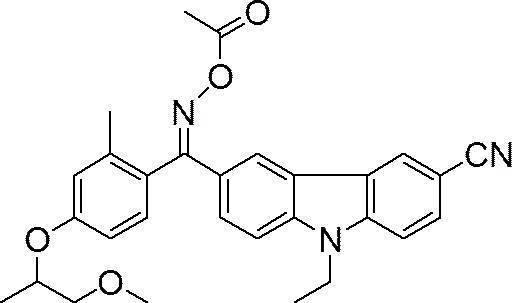


式(III)で表される化合物の具体例としては、例えば、特開2014-137466号公報の段落番号0076~0079に記載された化合物が挙げられる。この内容は本明細書に組み込まれることとする。
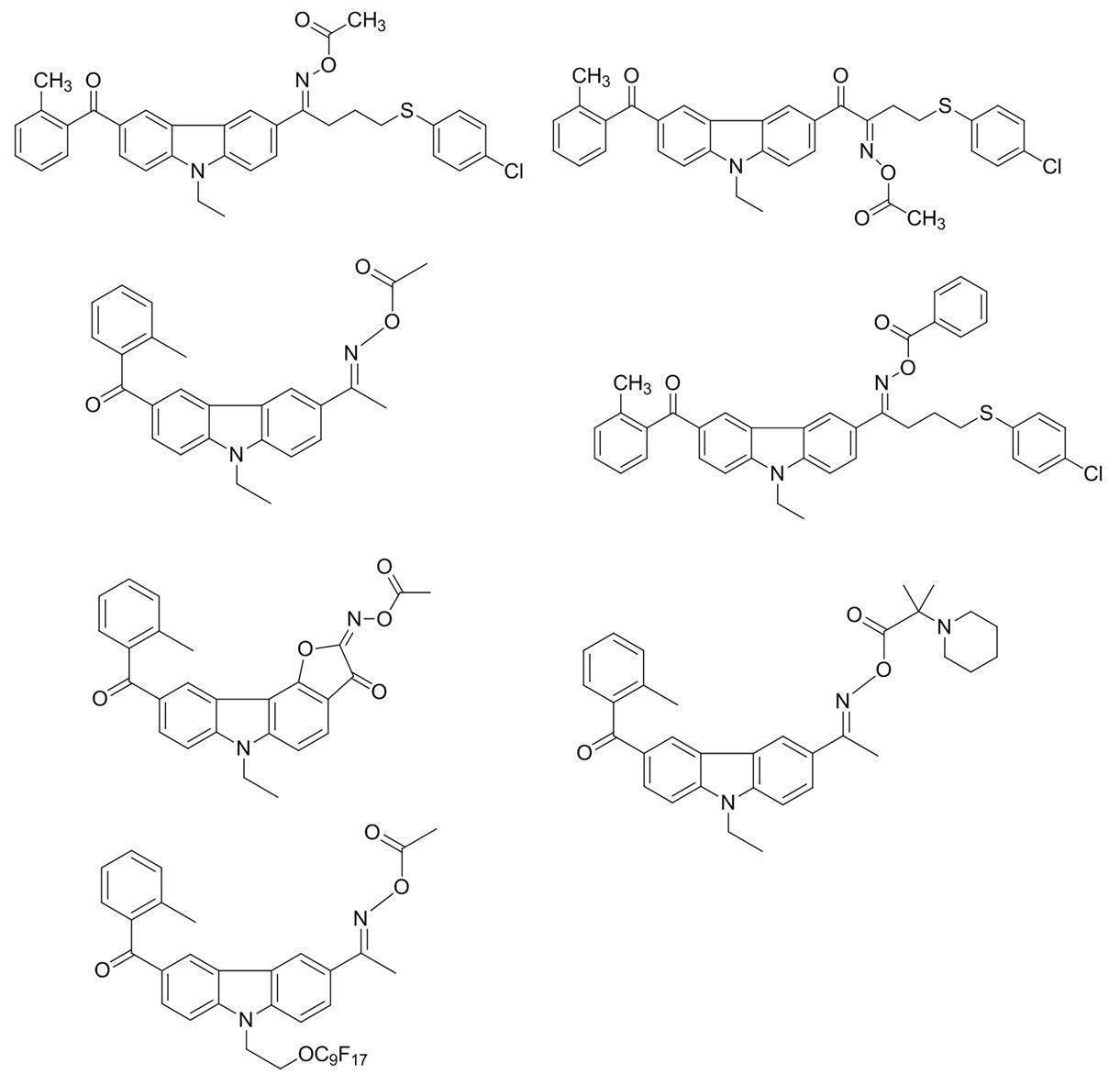
また、下記構造のオキシム系開始剤も用いることができる。
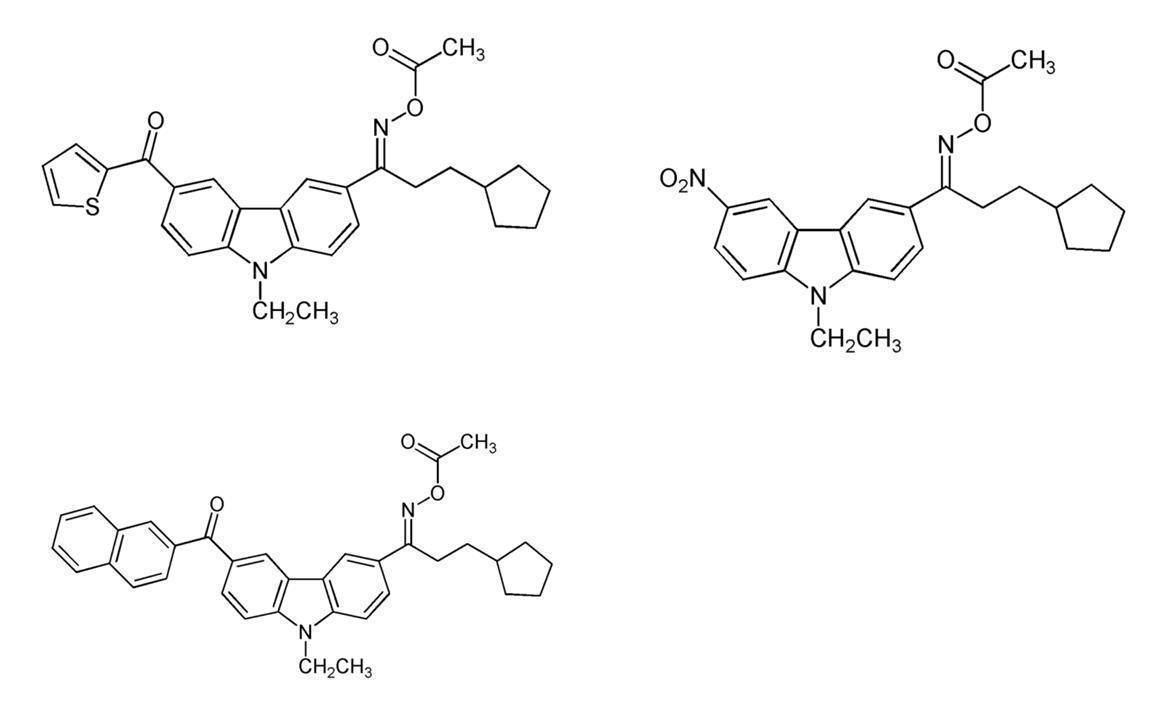
光重合開始剤は、1種単独であってもよいし、2種以上を併用してもよい。2種以上を併用する場合は、合計量が上記範囲となることが好ましい。
第1の硬化性組成物は、吸着基を有するアクリル系又はメタクリル系樹脂(以下、「分散樹脂」ともいう。)を含有することが好ましい。分散樹脂は、上述した可視光吸収着色剤、赤外光吸収着色剤、及び、所望により併用するその他の顔料等の着色顔料の分散性向上に寄与する。
分散樹脂であるアクリル系又はメタクリル系樹脂(以下、「(メタ)アクリル系樹脂」ともいう。)は、(メタ)アクリロイル基を有するモノマー由来の構造単位(以下、「(メタ)アクリレート構造単位」ともいう)を有する樹脂である。(メタ)アクリル系樹脂は、1種の(メタ)アクリレート構造単位のみが含まれていても、2種以上の(メタ)アクリレート構造単位が含まれていてもよい。なお、2種以上の(メタ)アクリレート構造単位が含まれる(メタ)アクリル系樹脂は、いわゆる、(メタ)アクリル系重合体に該当する。また、(メタ)アクリル系樹脂には、(メタ)アクリレート構造単位以外の構造単位が含まれていてもよい。
なお、(メタ)アクリル系樹脂は、グラフト鎖が導入された変性タイプであってもよい。
なお、分散樹脂が(メタ)アクリル系共重合体である場合には、共重合体中、(メタ)アクリレート構造単位が、全構造単位に対して70モル%含まれていることが好ましく、85モル%含まれていることがより好ましく、95モル%含まれていることが更に好ましく、100モル%であることが特に好ましい。
吸着基とは、上述した可視光吸収着色剤、赤外光吸収着色剤、及び、所望により併用するその他の顔料等の着色剤に吸着し得る官能基を意味し、例えば、酸基、塩基性基、配位性基及び反応性を有する官能基等が挙げられる。
分散樹脂(以下、「高分子化合物」ともいう)は、その構造から更に直鎖状高分子、末端変性型高分子、グラフト型高分子、及び、ブロック型高分子に分類することができる。
一方で、可視光吸収着色剤及び赤外光吸収着色剤の表面を改質することにより、これらに対する高分子化合物の吸着性を促進させることもできる。
このようなグラフト鎖を有する構造単位を有する高分子化合物は、グラフト鎖によって溶剤との親和性を有するために、着色顔料の分散性、及び、経時後の分散安定性に優れるものである。また、組成物においては、グラフト鎖の存在により重合性化合物又はその他の併用可能な樹脂等との親和性を有するので、アルカリ現像で残渣を生じにくくなる。
グラフト鎖が長くなると立体反発効果が高くなり分散性は向上するが、一方グラフト鎖が長すぎると着色剤への吸着力が低下して分散性は低下する傾向となる。このため、グラフト鎖は、水素原子を除いた原子数が40~10000の範囲であるものが好ましく、水素原子を除いた原子数が50~2000であるものがより好ましく、水素原子を除いた原子数が60~500であるものが更に好ましい。
ここで、グラフト鎖とは、共重合体の主鎖の根元(主鎖から枝分かれしている基において主鎖に結合する原子)から、主鎖から枝分かれしている基の末端までを示す。
グラフト鎖と溶剤との相互作用性を向上させ、それにより分散性を高めるために、グラフト鎖は、ポリエステル構造、ポリエーテル構造及びポリ(メタ)アクリレート構造からなる群から選ばれた少なくとも1種を有するグラフト鎖であることが好ましく、ポリエステル構造及びポリエーテル構造の少なくともいずれかを有するグラフト鎖であることがより好ましい。
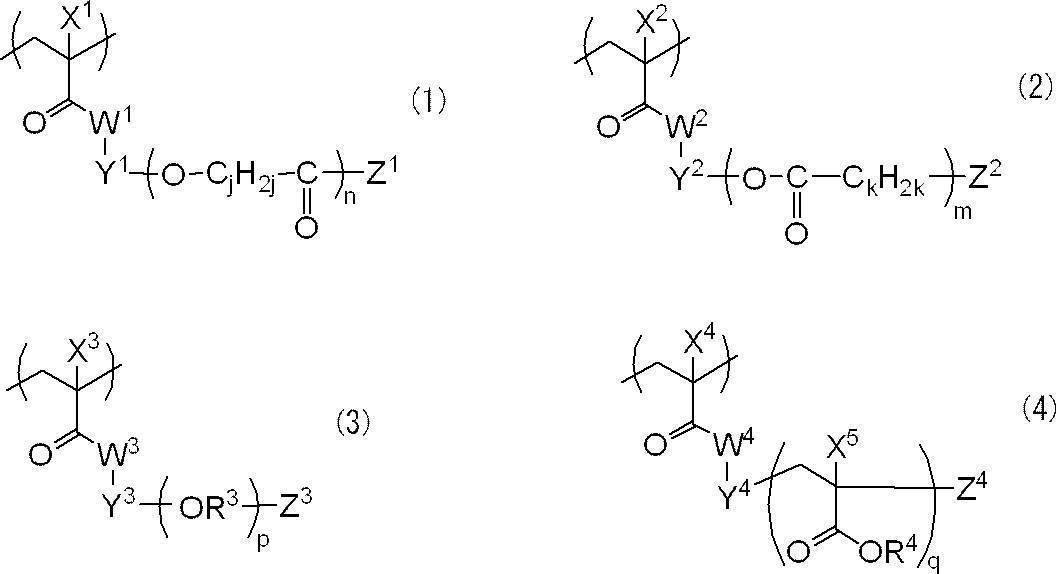
式(1)~式(4)において、X1、X2、X3、X4、及びX5は、それぞれ独立に、水素原子又は1価の有機基を表す。X1、X2、X3、X4、及びX5としては、合成上の制約の観点からは、それぞれ独立に、水素原子又は炭素数1~12のアルキル基であることが好ましく、それぞれ独立に、水素原子又はメチル基であることがより好ましく、メチル基が更に好ましい。

また、式(1)及び式(2)において、j及びkは、それぞれ独立に、2~8の整数を表す。式(1)及び式(2)におけるj及びkは、分散安定性、現像性の観点から、4~6の整数が好ましく、5がより好ましい。
式(4)中、R4は水素原子又は1価の有機基を表し、この1価の有機基としては特に構造上限定はされない。R4として好ましくは、水素原子、アルキル基、アリール基、及びヘテロアリール基が挙げられ、より好ましくは、水素原子、又はアルキル基である。R4がアルキル基である場合、アルキル基としては、炭素数1~20の直鎖状アルキル基、炭素数3~20の分岐状アルキル基、又は炭素数5~20の環状アルキル基が好ましく、炭素数1~20の直鎖状アルキル基がより好ましく、炭素数1~6の直鎖状アルキル基が更に好ましい。式(4)において、qが2~500のとき、グラフト共重合体中に複数存在するX5及びR4は互いに同じであっても異なっていてもよい。
また、式(2)で表される構造単位としては、分散安定性、現像性の観点から、下記式(2A)で表される構造単位であることがより好ましい。

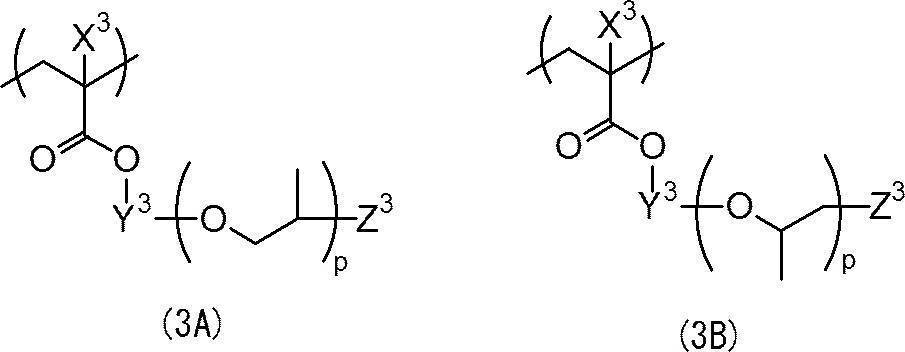
A. J. Leo, Comprehensive Medicinal Chemistry, Vol.4, C. Hansch, P. G. Sammnens, J. B. Taylor and C. A. Ramsden, Eds., p.295, Pergamon Press, 1990 C. Hansch & A. J. Leo. SUbstituent Constants For Correlation Analysis in Chemistry and Biology. John Wiley & Sons. A.J. Leo. Calculating logPoct from structure. Chem. Rev., 93, 1281-1306, 1993.
logP=log(Coil/Cwater)
式中、Coilは油相中の化合物のモル濃度を、Cwaterは水相中の化合物のモル濃度を表す。
logPの値が0をはさんでプラスに大きくなると油溶性が増し、マイナスで絶対値が大きくなると水溶性が増すことを意味し、有機化合物の水溶性と負の相関があり、有機化合物の親疎水性を見積るパラメータとして広く利用されている。
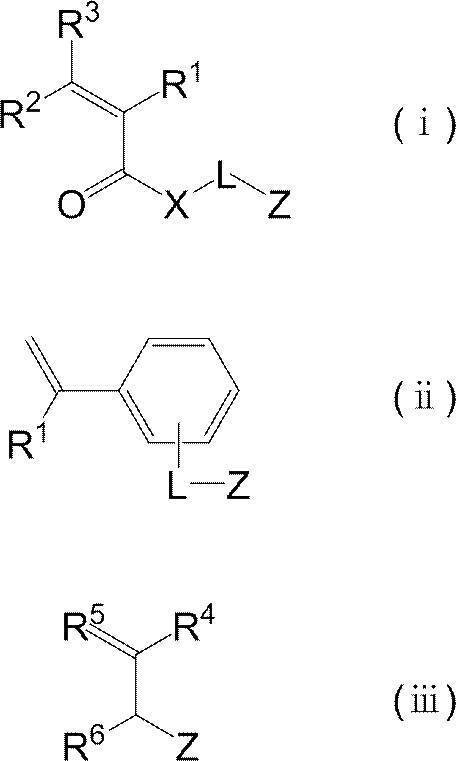
R1、R2、及びR3は、より好ましくは水素原子、又は炭素数が1~3のアルキル基であり、更に好ましくは、水素原子又はメチル基である。R2及びR3は、水素原子であることが特に好ましい。
Xは、酸素原子(-O-)又はイミノ基(-NH-)を表し、酸素原子であることが好ましい。
脂肪族基は不飽和脂肪族基よりも飽和脂肪族基の方が好ましい。また、脂肪族基は、置換基を有していてもよい。置換基の例は、ハロゲン原子、芳香族基及び複素環基が挙げられる。ただし、脂肪族基は、置換基として酸基を有さない。
また、上記一般式(ii)で表される単量体として、R1が水素原子又はメチル基であって、Lがアルキレン基であって、Zが脂肪族基、複素環基又は芳香族基である化合物が好ましい。また、上記一般式(iii)で表される単量体として、R4、R5、及びR6が水素原子又はメチル基であって、Zが脂肪族基、複素環基又は芳香族基である化合物が好ましい。
なお、式(i)~(iii)で表される代表的な化合物の例としては、特開2013-249417号公報の段落0089~0093に記載の化合物を参照でき、これらの内容は本明細書に組み込まれる。
この着色剤に吸着し得る官能基としては、例えば、酸基、塩基性基、配位性基、反応性を有する官能基等が挙げられる。
高分子化合物が、酸基、塩基性基、配位性基、又は、反応性を有する官能基を有する場合、それぞれ、酸基を有する構造単位、塩基性基を有する構造単位、配位性基を有する構造単位、又は、反応性を有する構造単位を有することが好ましい。
特に、高分子化合物が、更に、酸基として、カルボン酸基等のアルカリ可溶性基を有することで、高分子化合物に、アルカリ現像によるパターン形成のための現像性を付与することができる。
すなわち、高分子化合物にアルカリ可溶性基を導入することで、硬化性組成物は、着色剤の分散に寄与する分散樹脂としての高分子化合物がアルカリ可溶性を有することになる。このような高分子化合物を含有する組成物は、露光部の遮光性に優れたものとなり、且つ、未露光部のアルカリ現像性が向上される。
また、高分子化合物が酸基を有する構造単位を有することにより、高分子化合物が溶剤となじみやすくなり、塗布性も向上する傾向となる。
これは、酸基を有する構造単位における酸基が着色剤と相互作用しやすく、高分子化合物が着色剤を安定的に分散すると共に、着色剤を分散する高分子化合物の粘度が低くなっており、高分子化合物自体も安定的に分散されやすいためであると推測される。
すなわち、高分子化合物は、カルボン酸基、スルホン酸基、及び、リン酸基のうち少なくとも1種を有する構造単位を更に有することが好ましい。
高分子化合物は、酸基を有する構造単位を含有してもしなくてもよいが、含有する場合、酸基を有する構造単位の含有量は、質量換算で、高分子化合物の総質量に対して、好ましくは5~80%であり、より好ましくは、アルカリ現像による画像強度のダメージ抑制という観点から、10~60%である。
高分子化合物は、塩基性基を有する構造単位を含有してもしなくてもよいが、含有する場合、塩基性基を有する構造単位の含有量は、質量換算で、高分子化合物の総質量に対して、好ましくは0.01%以上50%以下であり、より好ましくは、現像性阻害抑制という観点から、0.01%以上30%以下である。
高分子化合物は、配位性基を有する構造単位、又は、反応性を有する官能基を有する構造単位を含有してもしなくてもよいが、含有する場合、これらの構造単位の含有量は、質量換算で、高分子化合物の総質量に対して、好ましくは10%以上80%以下であり、より好ましくは、現像性阻害抑制という観点から、20%以上60%以下である。
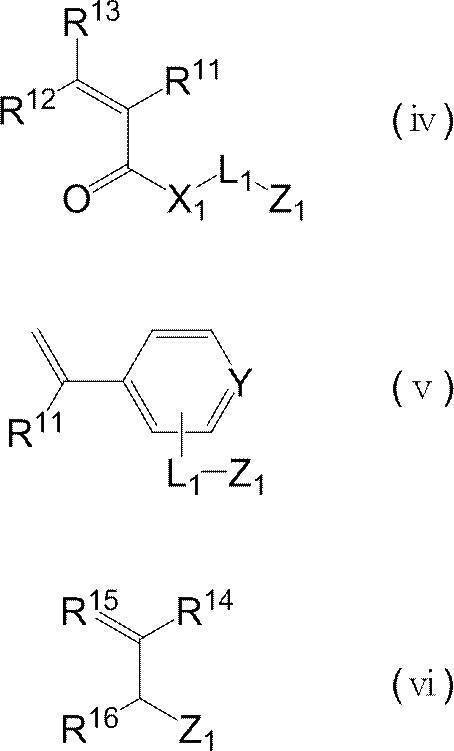
一般式(iv)~一般式(vi)中、R11、R12、及びR13は、より好ましくは、それぞれ独立に水素原子、又は炭素数が1~3のアルキル基であり、更に好ましくは、それぞれ独立に水素原子又はメチル基である。一般式(iv)中、R12及びR13は、それぞれ水素原子であることが特に好ましい。
また、一般式(v)中のYは、メチン基又は窒素原子を表す。
また、一般式(v)で表される単量体として、R11が水素原子又はメチル基であって、L1がアルキレン基であって、Z1がカルボン酸基であって、Yがメチン基である化合物が好ましい。
更に、一般式(vi)で表される単量体として、R14、R15、及びR16がそれぞれ独立に水素原子又はメチル基であって、L1が単結合又はアルキレン基であって、Zがカルボン酸基である化合物が好ましい。
単量体の例としては、メタクリル酸、クロトン酸、イソクロトン酸、分子内に付加重合性二重結合及び水酸基を有する化合物(例えば、メタクリル酸2-ヒドロキシエチル)とコハク酸無水物との反応物、分子内に付加重合性二重結合及び水酸基を有する化合物とフタル酸無水物との反応物、分子内に付加重合性二重結合及び水酸基を有する化合物とテトラヒドロキシフタル酸無水物との反応物、分子内に付加重合性二重結合及び水酸基を有する化合物と無水トリメリット酸との反応物、分子内に付加重合性二重結合及び水酸基を有する化合物とピロメリット酸無水物との反応物、アクリル酸、アクリル酸ダイマー、アクリル酸オリゴマー、マレイン酸、イタコン酸、フマル酸、4-ビニル安息香酸、ビニルフェノール、4-ヒドロキシフェニルメタクリルアミド等が挙げられる。
このような、他の構造単位としては、例えば、アクリロニトリル類、及び、メタクリロニトリル類等から選ばれるラジカル重合性化合物に由来の構造単位が挙げられる。
高分子化合物は、これらの他の構造単位を1種或いは2種以上用いることができ、その含有量は、質量換算で、高分子化合物の総質量に対して、好ましくは0%以上80%以下であり、より好ましくは10%以上60%以下である。含有量が上記範囲において、十分なパターン形成性が維持される。
高分子化合物の酸価が160mgKOH/g以下であれば、膜を形成する際の現像時におけるパターン剥離がより効果的に抑えられる。また、高分子化合物の酸価が10mgKOH/g以上であればアルカリ現像性がより良好となる。また、高分子化合物の酸価が20mgKOH/g以上であれば、着色剤の沈降をより抑制でき、粗大粒子数をより少なくすることができ、組成物の経時安定性をより向上できる。
GPC法は、HLC-8020GPC(東ソー(株)製)を用い、カラムとしてTSKgel SuperHZM-H、TSKgel SuperHZ4000、TSKgel SuperHZ2000(東ソー(株)製、4.6mmID×15cm)を、溶離液としてTHF(テトラヒドロフラン)を用いる方法に基づく。
また、両性樹脂の市販品としては、例えば、ビックケミー社製のDISPERBYK-130、DISPERBYK-140、DISPERBYK-142、DISPERBYK-145、DISPERBYK-180、DISPERBYK-187、DISPERBYK-191、DISPERBYK-2001、DISPERBYK-2010、DISPERBYK-2012、DISPERBYK-2025、BYK-9076、味の素ファインテクノ社製のアジスパーPB821、アジスパーPB822、アジスパーPB881等が挙げられる。
これらの高分子化合物は、単独で使用してもよく、2種以上を組み合わせて使用してもよい。
また、上記以外にも、特開2011-153283号公報の段落0028~0084(対応するUS2011/0279759の段落0075~0133欄)の酸性基が連結基を介して結合してなる側鎖構造を有する構成成分を含む高分子化合物が使用でき、これらの内容は援用でき、本明細書に組み込まれる。
これらの中でもサンドミル(ビーズミル)が好ましい。またサンドミル(ビーズミル)における顔料の粉砕においては、径の小さいビーズを使用する、ビーズの充填率を大きくする事等により粉砕効率を高めた条件で処理することが好ましく、更に粉砕処理後に濾過、遠心分離等で素粒子を除去することが好ましい。
第1の硬化性組成物は、バインダー樹脂を含んでいてもよく、なかでもアルカリ可溶性樹脂を含むことが好ましい。
バインダー樹脂の分子量としては、特に定めるものではないが、GPC(ゲル浸透クロマトグラフィー)法によるポリスチレン換算値として、重量平均分子量(Mw)が5000~100,000であることが好ましい。また、数平均分子量(Mn)は、1000~20,000であることが好ましい。
GPC法は、HLC-8020GPC(東ソー(株)製)を用い、カラムとしてTSKgel SuperHZM-H、TSKgel SuperHZ4000、TSKgel SuperHZ2000(東ソー(株)製、4.6mmID×15cm)を、溶離液としてTHF(テトラヒドロフラン)を用いる方法に基づく。
アルカリ可溶性樹脂としては、線状有機ポリマーであってもよく、分子(好ましくは、アクリル系共重合体、スチレン系共重合体を主鎖とする分子)中に少なくとも1つのアルカリ可溶性を促進する基を有するアルカリ可溶性樹脂の中から適宜選択することができる。
アルカリ可溶性を促進する基(以下、酸基ともいう)としては、例えば、カルボキシル基、リン酸基、スルホン酸基、及び、フェノール性ヒドロキシル基等が挙げられるが、有機溶剤に可溶で弱アルカリ水溶液により現像可能なものが好ましい。これら酸基は、1種のみであってもよいし、2種以上であってもよい。
重合性基を有するアルカリ可溶性樹脂としては、ダイヤナ-ルNRシリーズ(三菱レイヨン株式会社製)、Photomer6173(COOH含有 polyurethane acrylic oligomer.Diamond Shamrock Co.Ltd.,製)、ビスコートR-264、KSレジスト106(いずれも大阪有機化学工業株式会社製)、サイクロマーPシリーズ(例えば、ACA230AA)、プラクセル CF200シリーズ(いずれもダイセル化学工業株式会社製)、Ebecryl3800(ダイセルユーシービー株式会社製)、アクリキュア-RD-F8(日本触媒社製)等が挙げられる。
また、市販品としては、例えばFF-426(藤倉化成社製)等を用いることもできる。



更に、特開2012-32767号公報の段落番号0029~0063に記載の共重合体(B)及び実施例で用いられているアルカリ可溶性樹脂、特開2012-208474号公報の段落番号0088~0098に記載のバインダー樹脂及び実施例で用いられているバインダー樹脂、特開2012-137531号公報の段落番号0022~0032に記載のバインダー樹脂及び実施例で用いられているバインダー樹脂、特開2013-024934号公報の段落番号0132~0143に記載のバインダー樹脂及び実施例で用いられているバインダー樹脂、特開2011-242752号公報の段落番号0092~0098及び実施例で用いられているバインダー樹脂、特開2012-032770号公報の段落番号0030~0072の記載のバインダー樹脂を用いることもできる。これらの内容は本願明細書に組み込まれる。



また、上記式(a1)中、mは、0~20の整数を表す。
ポリイミド樹脂は非感光性樹脂であり、前駆体としてのポリアミック酸を加熱開環イミド化することによって形成される。ポリアミック酸樹脂は、一般に、酸無水酸物基を有する化合物とジアミン化合物とを40~100℃で付加重合させることにより得られ、下記一般式(3)で表される繰り返し構造単位を有する。ポリアミック酸樹脂が一部閉環したポリイミド樹脂は、下記一般式(4)で表されるアミック酸構造、アミック酸構造が一部イミド閉環してなる下記一般式(5)で表される構造、及び、アミック酸構造が全てイミド閉環してなる下記一般式(6)で表されるイミド構造、を有する。


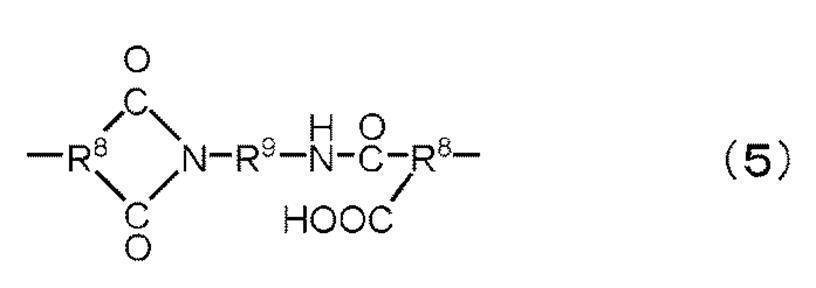
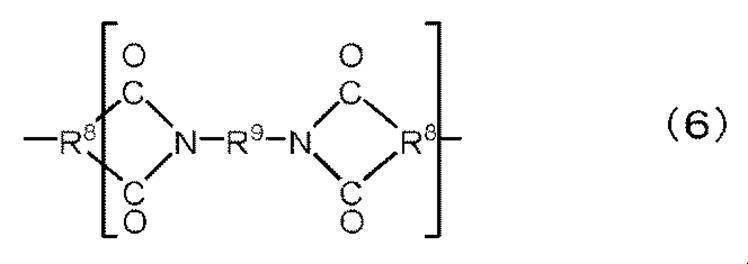
第1の硬化性組成物は、有機溶剤を含有してもよい。
有機溶剤は、各成分の溶解性、及び、第1の硬化性組成物の塗布性を満足すれば基本的には特に制限はないが、重合性化合物、アルカリ可溶性樹脂等の溶解性、塗布性、安全性を考慮して選ばれることが好ましい。
本発明において、有機溶剤は、過酸化物の含有率が0.8mmol/L以下であることが好ましく、過酸化物を実質的に含まないことがより好ましい。
第1の硬化性組成物は、有機溶剤を、1種類のみを含んでいてもよいし、2種類以上含んでいてもよい。2種類以上含む場合は、その合計量が上記範囲となることが好ましい。
第1の硬化性組成物は、塗布性をより向上させる観点から、各種の界面活性剤を含有させてもよい。界面活性剤としては、フッ素系界面活性剤、ノニオン系界面活性剤、カチオン系界面活性剤、アニオン系界面活性剤、及び、シリコーン系界面活性剤等の各種界面活性剤を使用できる。
フッ素系界面活性剤は、フッ素原子を有する(メタ)アクリレート化合物に由来する繰り返し単位と、アルキレンオキシ基(好ましくはエチレンオキシ基、プロピレンオキシ基)を2以上(好ましくは5以上)有する(メタ)アクリレート化合物に由来する繰り返し単位と、を含む含フッ素高分子化合物も好ましく用いることができ、下記化合物も本発明で用いられるフッ素系界面活性剤として例示される。

また、エチレン性不飽和基を側鎖に有する含フッ素重合体をフッ素系界面活性剤として用いることもできる。具体例としては、特開2010-164965号公報0050~0090段落及び0289~0295段落に記載された化合物、例えばDIC社製のメガファックRS-101、RS-102、RS-718K、及び、RS-72-K等が挙げられる。
第1の硬化性組成物には、必要に応じて、各種添加物、例えば、充填剤、密着促進剤、酸化防止剤、重合禁止剤、凝集防止剤、界面活性剤、及び、紫外線吸収剤等を含有することができる。これらの添加物としては、例えば、特開2004-295116号公報の段落0155~0156に記載のものを挙げることができ、これらの内容は本願明細書に組み込まれる。
硬化性組成物は、例えば、特開2004-295116号公報の段落0078に記載の増感剤又は光安定剤、同公報の段落0081に記載の熱重合防止剤等を含有することができる。
次に、本発明の第2の実施形態の硬化性組成物(以下、「第2の硬化性組成物」とも称する。)について説明する。
第2の硬化性組成物は、
可視光を吸収する着色剤(以下、「可視光吸収着色剤」ともいう。)と、
赤外光を吸収する着色剤(以下、「赤外光吸収着色剤」ともいう。)と、
重合性化合物と、
吸着基を有するアクリル系又はメタクリル系樹脂(以下、「分散樹脂」ともいう。)と、を含有し、
上記吸着基を有するアクリル系又はメタクリル系樹脂に対する上記重合性化合物の含有量が、質量比で0.5~7である。
これは、詳細には明らかではないが、本発明者らは以下のように推測している。
上記吸着基を有するアクリル系又はメタクリル系樹脂は、上記の可視光吸収着色剤及び上記の赤外光吸収着色剤に吸着することにより、上記着色成分の組成物中への分散性を向上させる機能を有する。第2の硬化性組成物を用いた塗膜を露光及び現像してパターン形成を行う際、上記赤外光吸収着色剤が、露光時に発生する熱(重合熱等)及び/又は露光後のベークによる熱を吸収しやすい。この結果、塗膜中に含まれる光重合開始剤が開裂してラジカルが発生しやすくなる、及び、発生したラジカルの拡散が促進され、膜深部に渡って良好に硬化が進行する。
つまり、例えば、低露光量にて塗膜を露光した際には、露光部において光重合開始剤の開裂が十分に進行せず、ラジカルの発生量が少ない。しかし、本発明では、赤外光吸収着色剤が露光時に発生する熱、及び、露光後の加熱処理による熱を吸収して上述したラジカルの発生と拡散を促進することにより、露光部においてより硬化が更に進行し、所望のパターンが得られる。
この時に、上記吸着基を有するアクリル系又はメタクリル系樹脂に対する上記重合性化合物の含有量が質量比で0.5未満であると、硬化性成分の量が少ないため、硬化が十分に進行せず、パターンの直線性が悪くなる。
一方、上記吸着基を有するアクリル系又はメタクリル系樹脂に対する上記重合性化合物の含有量が質量比で7超とすると、赤外光吸収着色剤の熱吸収によって塗膜中に含まれる各種化合物により発生したラジカルの拡散が促進されるものの、硬化成分の量が多すぎるため、非露光領域おいても硬化が起きるため、現像しにくく、又は、得られるパターンの直線性が悪くなる。
本発明の効果をより向上させる観点から、光重合開始剤を含有する場合には、上記吸着基を有するアクリル系又はメタクリル系樹脂に対する光重合開始剤の含有量を、質量比で0.1~2とすることが好ましく、0.15~1.5とすることがより好ましい。
本発明の効果をより向上させる観点から、アルカリ可溶性樹脂を含有する場合には、上記吸着基を有するアクリル系又はメタクリル系樹脂に対するアルカリ可溶性樹脂の含有量を、質量比で5以下とすることが好ましく、4以下とすることがより好ましい。
本発明の硬化性組成物は、上述した各種成分を公知の混合方法(例えば、攪拌機、ホモジナイザー、高圧乳化装置、湿式粉砕機、及び、湿式分散機)により混合して調製することができる。
各種材料から金属等の不純物を除去する方法としては、例えば、フィルタを用いた濾過のほか、蒸留による精製工程(特に薄膜蒸留、分子蒸留等)を挙げることができる。蒸留による精製工程は例えば、「<工場操作シリーズ>増補・蒸留、1992年7月31日発行、化学工業社」又は「化学工学ハンドブック、2004年9月30日発行、朝倉書店、95頁~102頁」が挙げられる。フィルタ孔径としては、ポアサイズ10nm以下が好ましく、5nm以下がより好ましく、3nm以下が更に好ましい。フィルタの材質としては、ポリテトラフロロエチレン製、ポリエチレン製、ナイロン製のフィルタが好ましい。フィルタは、これらの材質とイオン交換メディアを組み合わせた複合材料であってもよい。フィルタは、有機溶剤であらかじめ洗浄したものを用いてもよい。フィルタ濾過工程では、複数種類のフィルタを直列又は並列に接続して用いてもよい。複数種類のフィルタを使用する場合は、孔径及び/又は材質が異なるフィルタを組み合わせて使用してもよい。また、各種材料を複数回濾過してもよく、複数回濾過する工程が循環濾過工程であってもよい。
また、各種材料に含まれる金属等の不純物を低減する方法としては、各種材料を構成する原料として金属含有量が少ない原料を選択する、各種材料を構成する原料に対してフィルタ濾過を行う、装置内をテフロン(登録商標)でライニングする等してコンタミネーションを可能な限り抑制した条件下で蒸留を行う等の方法を挙げることができる。各種材料を構成する原料に対して行うフィルタ濾過における好ましい条件は、上記した条件と同様である。
フィルタ濾過の他、吸着材による不純物の除去を行ってもよく、フィルタ濾過と吸着材を組み合わせて使用してもよい。吸着材としては、公知の吸着材を用いることができ、例えば、シリカゲル、ゼオライト等の無機系吸着材、活性炭等の有機系吸着材を使用することができる。
上述の硬化性組成物を硬化して形成される硬化膜は、着色剤として黒色顔料を用いた場合には、いわゆる遮光膜等として好適に適用できる。
遮光膜の厚みは特に制限されないが、0.2~25μmが好ましく、1.0~10μmがより好ましい。
上記厚みは平均厚みであり、遮光膜の任意の5点以上の厚みを測定し、それらを算術平均した値である。
硬化処理の方法は特に制限されず、光硬化処理又は熱硬化処理が挙げられ、パターン形成が容易である点から、光硬化処理(特に、紫外線照射処理)が好ましい。
なお、使用される基板の種類は特に制限されず、固体撮像装置内の各種部材(例えば、赤外光カットフィルタ、固体撮像素子の外周部、ウェハーレベルレンズ外周部、及び、固体撮像素子裏面等)等が好ましく挙げられる。
具体的には、本発明の硬化性組成物を、直接又は他の層を介して基板上に塗布して、塗膜を形成し(塗膜形成工程)、所定のマスクパターンを介して塗膜を露光し、光照射された塗膜部分だけを硬化させ(露光工程)、光照射された塗膜を現像液で現像することによって(現像工程)、パターン状の硬化膜を製造することができる。
塗膜形成工程では、基板上に、本発明の硬化性組成物を塗布して塗膜を形成する。
基板上への本発明の硬化性組成物の塗布方法としては、スリット塗布、インクジェット法、回転塗布、流延塗布、ロール塗布、及び、塗膜スクリーン印刷法等の各種の塗布方法が挙げられる。
基板上に塗布された硬化性組成物は、通常、70℃以上110℃以下で2分以上4分以下程度の条件下で乾燥され、塗膜が形成される。
露光工程では、塗膜形成工程において形成された塗膜をマスクを介して露光し、光照射された塗膜部分だけを硬化させる。
露光は放射線の照射により行うことが好ましい。放射線としては、特に、g線、h線、及び、i線等の紫外線が好ましく用いられる。また、光源としては高圧水銀灯が好まれる。露光量は50mJ/cm2以上1700mJ/cm2以下が好ましく、100mJ/cm2以上1000mJ/cm2以下がより好ましい。なお、露光時間は0.01~2秒が好ましく、0.05~1秒がより好ましく、0.1~0.75秒が更に好ましい。
加熱工程を有する場合には、加熱温度は50~300℃であることが好ましく、150~230℃であることがより好ましい。また、加熱時間は30~1200秒が好ましく、60~60秒がより好ましく、120~480秒が更に好ましい。
露光工程に次いで、現像処理(現像工程)を行い、露光工程における光未照射部分を現像液(例えば、アルカリ水溶液)に溶出させる。これにより、光硬化した部分だけが残る。
現像液としては、有機アルカリ現像液が望ましい。現像温度としては通常20℃以上30℃以下であり、現像時間は20秒以上90秒以下である。
アルカリ水溶液としては、例えば、無機系現像液及び有機系現像液が挙げられる。無機系現像液としては、水酸化ナトリウム、水酸化カリウム、炭酸ナトリウム、炭酸水素ナトリウム、硅酸ナトリウム、又は、メタ硅酸ナトリウムを、濃度が0.001~10質量%、好ましくは0.005~1.0質量%、より好ましくは0.01~0.6質量%となるように溶解した水溶液が挙げられる。有機アルカリ現像液としては、アンモニア水、エチルアミン、ジエチルアミン、ジメチルエタノールアミン、テトラメチルアンモニウムヒドロキシド(別名:テトラメチルアンモニウムハイドロオキサイド(TMAH))、テトラエチルアンモニウムヒドロキシド、テトラプロピルアンモニウムヒドロキシド、テトラブチルアンモニウムヒドロキシド、ベンジルトリメチルアンモニウムヒドロキシド、コリン、ピロール、ピペリジン、及び、1,8-ジアザビシクロ-[5,4,0]-7-ウンデセン等のアルカリ性化合物を、濃度が0.001~10質量%、好ましくは0.005~0.5質量%となるように溶解した水溶液が挙げられる。アルカリ水溶液には、例えばメタノール及びエタノール等の水溶性有機溶剤、及び/又は、界面活性剤等が適量含まれていてもよい。なお、このようなアルカリ水溶液からなる現像液を使用した場合には、一般に、現像後に純水で硬化膜を洗浄(リンス)することが好ましい。現像方法としては、パドル現像等が挙げられる。
本態様では露光量は特に限定されない。また、硬化性組成物は赤外光吸収着色剤を含むため、重合時の発熱だけでも十分に硬化が促進される場合があり、その際には、露光時又は露光後に実施される加熱工程を低温(100℃未満が好ましい)とすることが好ましい。
本態様において、塗膜形成工程及び現像工程の定義は上述した態様と同じであり、その好ましい範囲も同じである。
露光工程の定義は上述した態様と同じである。露光工程における露光量は50mJ/cm2以上1700mJ/cm2以下が好ましく、100mJ/cm2以上1000mJ/cm2以下がより好ましい。なお、露光時間は0.01~2秒が好ましく、0.05~1秒がより好ましく、0.1~0.75秒が更に好ましい。
加熱温度は50~300℃であることが好ましく、150~230℃であることがより好ましい。また、加熱時間は30~1200秒が好ましく、60~600秒がより好ましく、120~480秒が更に好ましい。
本発明の硬化性組成物により形成された硬化膜は、いわゆる遮光膜として好適に適用できる。また、このような遮光膜は、固体撮像装置に好適に適用することができる。
支持体上に、固体撮像素子(CCDイメージセンサー、CMOSイメージセンサー、等)の受光エリアを構成する複数のフォトダイオード及びポリシリコン等からなる転送電極を有し、上記フォトダイオード及び上記転送電極上にフォトダイオードの受光部のみ開口したタングステン等からなる遮光膜を有し、遮光膜上に遮光膜全面及びフォトダイオード受光部を覆うように形成された窒化シリコン等からなるデバイス保護膜を有し、上記デバイス保護膜上に、カラーフィルタを有する構成である。
更に、上記デバイス保護層上であってカラーフィルタの下(支持体に近い側)に集光手段(例えば、マイクロレンズ等。以下同じ)を有する構成のほか、カラーフィルタ上に集光手段を有する構成等であってもよい。また、カラーフィルタは、隔壁により例えば格子状に仕切られた空間に、各色画素を形成する硬化膜が埋め込まれた構造を有していてもよい。この場合の隔壁は各色画素に対して低屈折率であることが好ましい。このような構造を有する撮像装置の例としては、特開2012-227478号公報、特開2014-179577号公報に記載の装置が挙げられる。
本発明の固体撮像装置は、上記遮光膜、又は、上記カラーフィルタの少なくともいずれかが、本発明の硬化性組成物により形成された硬化膜であればよい。
また、本発明の硬化性組成物を用いて形成された硬化膜は、カラーフィルタにも用いることができる。
また、着色パターン(着色画素)のサイズ(パターン幅)としては、2.5μm以下が好ましく、2.0μm以下がより好ましく、1.7μm以下が更に好ましい。下限は、例えば0.1μm以上とすることができ、0.2μm以上とすることもできる。
上記カラーフィルタの製造方法は、上述した硬化膜のパターン形成方法を含み、また、その好適態様も同様である。
本発明の硬化性組成物により形成された硬化膜(カラーフィルタ、遮光膜等)は、液晶表示装置及び有機エレクトロルミネッセンス表示装置等の、画像表示装置に用いることができる。
また、本発明におけるカラーフィルタは、明るく高精細なCOA(Color-filter On Array)方式にも供することが可能である。COA方式の液晶表示装置にあっては、カラーフィルタに対する要求特性は、前述のような通常の要求特性に加えて、層間絶縁膜に対する要求特性、すなわち低誘電率及び剥離液耐性が必要とされることがある。本発明のカラーフィルタは、耐光性等に優れるので、解像度が高く長期耐久性に優れたCOA方式の液晶表示装置を提供することができる。なお、低誘電率の要求特性を満足するためには、カラーフィルタ層の上に樹脂被膜を設けてもよい。
これらの画像表示方式については、例えば、「EL、PDP、LCDディスプレイ-技術と市場の最新動向-(東レリサーチセンター調査研究部門 2001年発行)」の43ページ等に記載されている。
バックライトに関しては、SID meeting Digest 1380(2005)(A.Konno et.al)、月刊ディスプレイ 2005年12月号の18~24ページ(島 康裕)、同25~30ページ(八木隆明)等に記載されている。
本発明の赤外線センサは、本発明のカラーフィルタを備える。本発明のカラーフィルタは、赤外光吸収着色剤が含まれるため、赤外光によるノイズを低減する効果を有する。
本発明の赤外線センサの構成としては、本発明の硬化性組成物により形成されたカラーフィルタを備え、固体撮像素子として機能する構成であれば特に限定はないが、例えば、以下のような構成が挙げられる。
マイクロLED及びマイクロOLEDの例としては、特表2015-500562号公報及び特表2014-533890号公報に記載のものが挙げられる。
量子ドットディスプレイの例としては、米国特許出願公開第2013/0335677号、米国特許出願公開第2014/0036536号、米国特許出願公開第2014/0036203号、及び、米国特許出願公開第2014/0035960号に記載のものが挙げられる。
<可視光吸収着色剤>
可視光吸収着色剤としては下記のものを用いた。これらの可視光吸収着色剤は可視波長領域に吸収を有しており、最大極大吸収波長が780nm以下にある。
(Bk-1) カーボンブラック
(極大吸収波長 300nm以下、平均一次粒子径 24nm、三菱化学社製)
(Bk-2) チタンブラック
(極大吸収波長 300nm以下、平均一次粒子径 30nm、三菱マテリアル社製)
(Bk-3) ペリレンブラック
(極大吸収波長600~700nm、平均一次粒子径 30nm、BASF社製)
赤外光吸収着色剤としては下記のものを用いた。これらの赤外光吸収着色剤は赤外波長領域に吸収を有しており、最大極大吸収波長が780nm超にある。
(IR-1) セシウムタングステン酸化物
(Cs0.33WO3、極大吸収波長 1100nm以上、平均一次粒子径 800nm以下、住友金属鉱山社製)
(IR-2) ジインモニウム色素(極大吸収波長 1073nm、EPOLIGHT1178(Epolin社製)
なお、下記化合物は特開2009-263614号公報に記載の方法で合成したものを用いた。
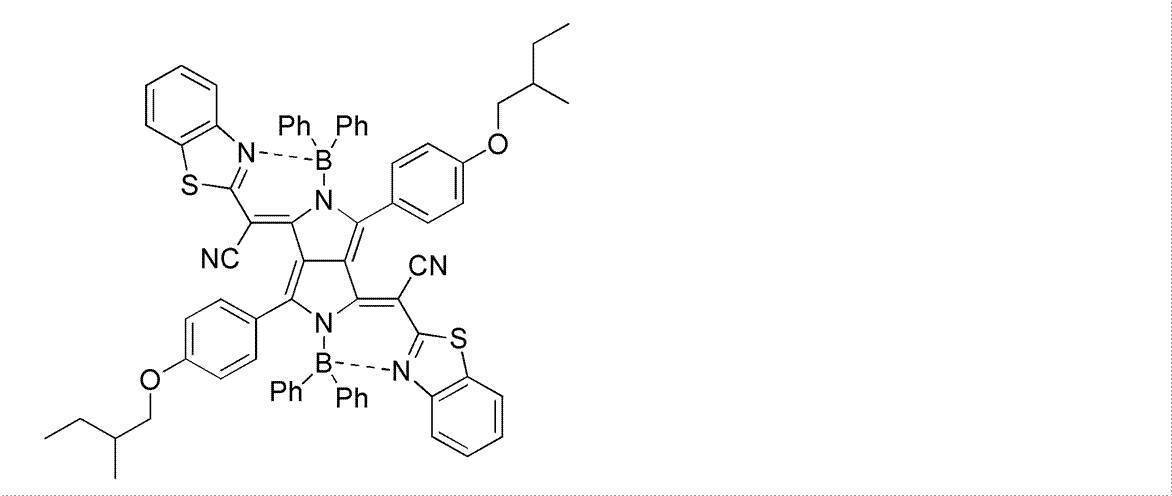
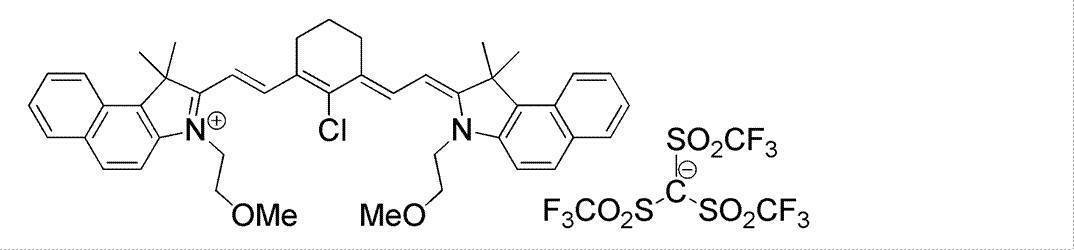
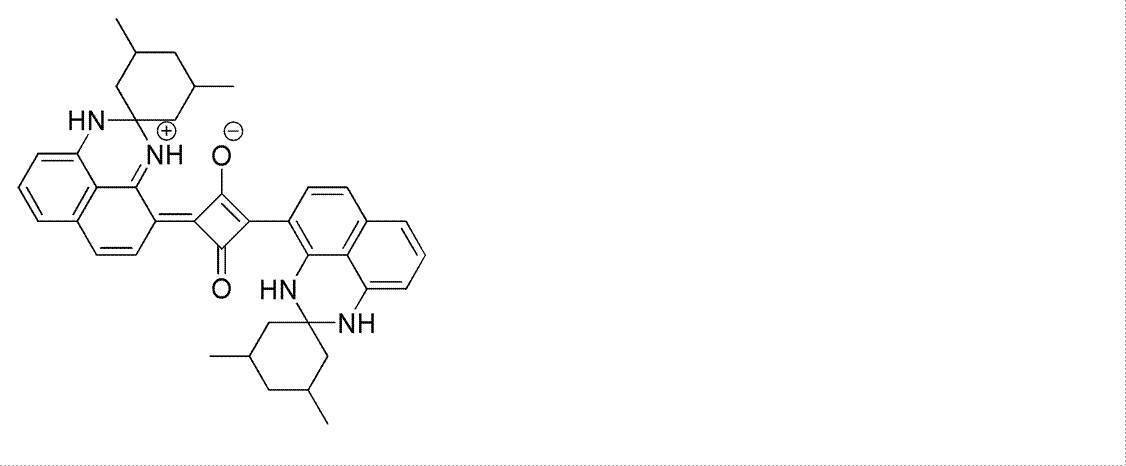
吸着基を有するアクリル系又はメタクリル系樹脂(分散樹脂)としては下記のものを用いた。
(分散樹脂1) 商品名;BYK-111(BYK社製)
(分散樹脂2)下記構造の分散樹脂(重量平均分子量:30000)を用いた。

アルカリ可溶性樹脂としては下記のものを用いた。
(アルカリ可溶性樹脂1) 下記構造の樹脂(重量平均分子量:12000)を用いた。

(アルカリ可溶性樹脂3)商品名;アクリベースFF-426(藤倉化成社製)
重合性化合物としては下記のものを用いた。
(M-1) 下記構造の重合性化合物。
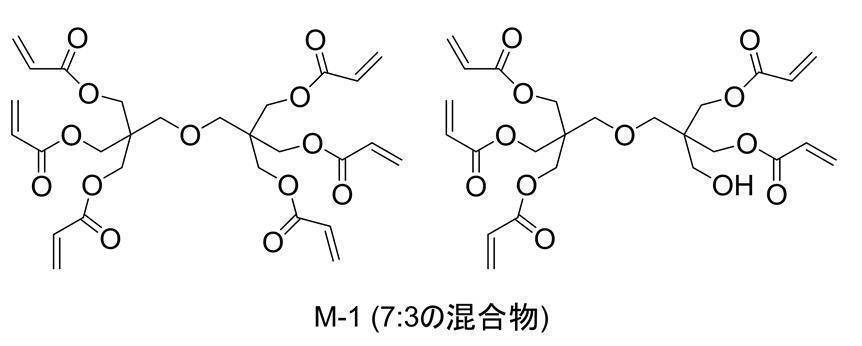
(M-3) 「NKオリゴ UA-7200」(新中村化学工業社製)
光重合開始剤としては、下記のものを用いた。
(オキシム系重合開始剤1) 下記構造の光重合開始剤。
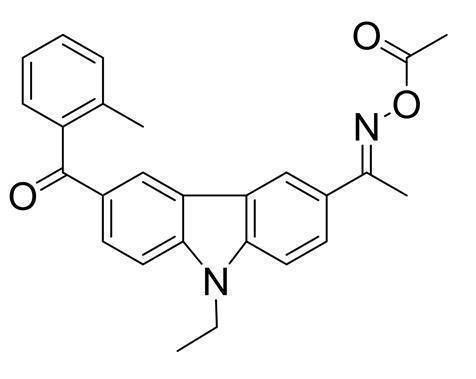
(重合開始剤1) 商品名;IRUGACURE-819(チバ・ジャパン社製)
(重合開始剤2) 商品名;IRUGACURE-127(チバ・ジャパン社製)
界面活性剤としては、下記のものを用いた。
(界面活性剤1)下記構造式で表される混合物F-1(重量平均分子量(Mw)=14000)

検出器:示差屈折計(RI検出器)
プレカラム TSKGUARDCOLUMN MP(XL)6mm×40mm〔東ソー(株)製〕
サンプル側カラム:以下4本を直結〔全て東ソー(株)製〕
TSK-GEL Multipore-HXL-M 7.8mm×300mm
リファレンス側カラム:サンプル側カラムに同じ
恒温槽温度:40℃
移動相:テトラヒドロフラン
サンプル側移動層流量:1.0mL/分
リファレンス側移動層流量:0.3mL/分
試料濃度:0.1質量%
試料注入量:100μL
データ採取時間:試料注入後16分~46分
サンプリングピッチ:300msec
(顔料分散液1の調製)
下記組成の諸成分を混合し、ホモジナイザーを用いて回転数3000rpmの条件にて3時間攪拌し、混合溶液とした。
≪組成≫
・カーボンブラック(上記「Bk-1」、三菱化学社製、MA100R)
・・・30質量部
・セシウムタングステン酸化物(上記「IR-1」)住友金属鉱山(株)製)
・・・2質量部
・上記分散樹脂2 (20wt%) ・・・30質量部
・PGMEA(プロピレングリコールモノメチルエーテルアセテート)
・・・9.4質量部
≪分散条件≫
・ビーズ径:φ0.05mm
・ビーズ充填率:75体積%
・ミル周速:12m/sec
・分散処理する混合液量:680g
・循環流量(ポンプ供給量):13kg/hour
・処理液温度:25~30℃
・冷却水:水道水
・ビーズミル環状通路内容積:0.15L
・上記分散樹脂2(20wt%) ・・・30質量部
上記顔料分散液1と同様の手順により、第1表に示す組成となるように顔料分散液2~16、及び、2-1~2-3をそれぞれ調製した。

なお、比較例3及び比較例4の硬化性組成物については、顔料分散液2-1のほか、更に赤外光吸収着色剤として(IR-2)ジインモニウム色素を第5表の組成となるように添加した。
また、実施例16の硬化性組成物の調製には顔料分散液11、実施例17の硬化性組成物の調製には顔料分散液12、実施例18の硬化性組成物の調製には顔料分散液13、実施例19の硬化性組成物の調製には顔料分散液14、実施例20~26の硬化性組成物の調製には顔料分散液2、実施例27の硬化性組成物の調製には顔料分散液7、実施例28の硬化性組成物の調製には顔料分散液8、実施例29の硬化性組成物の調製には顔料分散液9、実施例30及び31の硬化性組成物の調製には顔料分散液10、実施例32~34の硬化性組成物の調製には顔料分散液1を用いた。また、実施例35の硬化性組成物の調製には顔料分散液15、実施例36の硬化性組成物の調製には顔料分散液16を用いた。
なお、第2表~第20表の各成分量は「質量%」であり、各成分の含有比率は「質量比」である。
上記で得られた各硬化性組成物について、その光学濃度特性を評価した。
光学濃度は、下記の方法により測定した。
測定サンプルとしては、透明基材(ガラス基板)上に、上記第2表~第20表の硬化性組成物(固形分濃度30質量%)を塗布し、乾燥後の膜厚を1.5μmとして形成した塗膜を用いた。
次いで、得られた塗膜について、V-7200F(日本分光社製)を用いて、波長380~1100nmの光学濃度を算出した。得られたデータから、塗膜の波長380~1100nmの領域における膜厚1μmあたりの光学濃度の最小値(ODmin/1.0μm)、塗膜の波長380nm以上780nm以下の領域における膜厚1μmあたりの光学濃度の最小値(OD1)、及び、塗膜の波長780nm超1100nm以下の領域における膜厚1μmあたりの光学濃度の最小値(OD2)も求めた。
なお、各表中には、塗膜の波長380~1100nmの領域における膜厚1.5μmあたりの光学濃度の最小値(ODmin/1.5μm)も併せて示した。
[塗膜形成工程]
塗布及び加熱処理後の膜厚が1.5μmになるように、スピンコートの塗布回転数を調整して、シリコンウエハ〔支持体〕上に、各硬化性組成物のいずれかを均一に塗布し、表面温度100℃のホットプレートにより120秒間加熱処理した。このようにして、膜厚1.5μmの塗膜〔黒色硬化性塗膜〕を得た。
次いで、i線ステッパー、FPA-3000iS+〔キャノン(株)製〕を使用して、線形20μm(幅20μm、長さ4mm)を有するマスクを介して400mJ/cm2の露光量(照射時間0.5秒)で照射(露光)した。
次いで、得られたパターン状に硬化した硬化膜を、表面温度100℃のホットプレートにより120秒間加熱処理した。このようにして、膜厚1.5μmの塗膜〔黒色硬化性塗膜〕を得た。
照射(露光)後に、テトラメチルアンモニウムハイドロオキサイド(TMAH)0.3質量%水溶液を用いて、23℃にて所定時間パドル現像を行った。
露光後の塗膜に対し、テトラメチルアンモニウムハイドロオキサイド0.3質量%水溶液を用い、23℃での60秒間のパドル現像を繰り返し5回行った。その後、スピンシャワーにて塗膜のリンスを行い、更に純水にて塗膜を水洗した。
更にクリーンオーブンCLH-21CDH(光洋サーモ(株)製)を用いて220℃で300秒間加熱処理を行った。
次いで、得られたパターン状に硬化した硬化膜を、表面温度220℃のホットプレートにより300秒間加熱処理した。
上記のようにして得られたパターンについて、以下のような評価を行った。
上記[ポストベーク工程]を経て得られた20ミクロンパターンについて、走査型電子顕微鏡で撮影し、20ミクロンパターンの部分のLWR(line width roughness)を測定することにより、直線性を評価した。評価は下記基準に基づいて行った。
「A」:LWR≦1μm
「B」:1μm<LWR≦2μm
「C」:2μm<LWR≦3μm
「D」:3μm<LWR
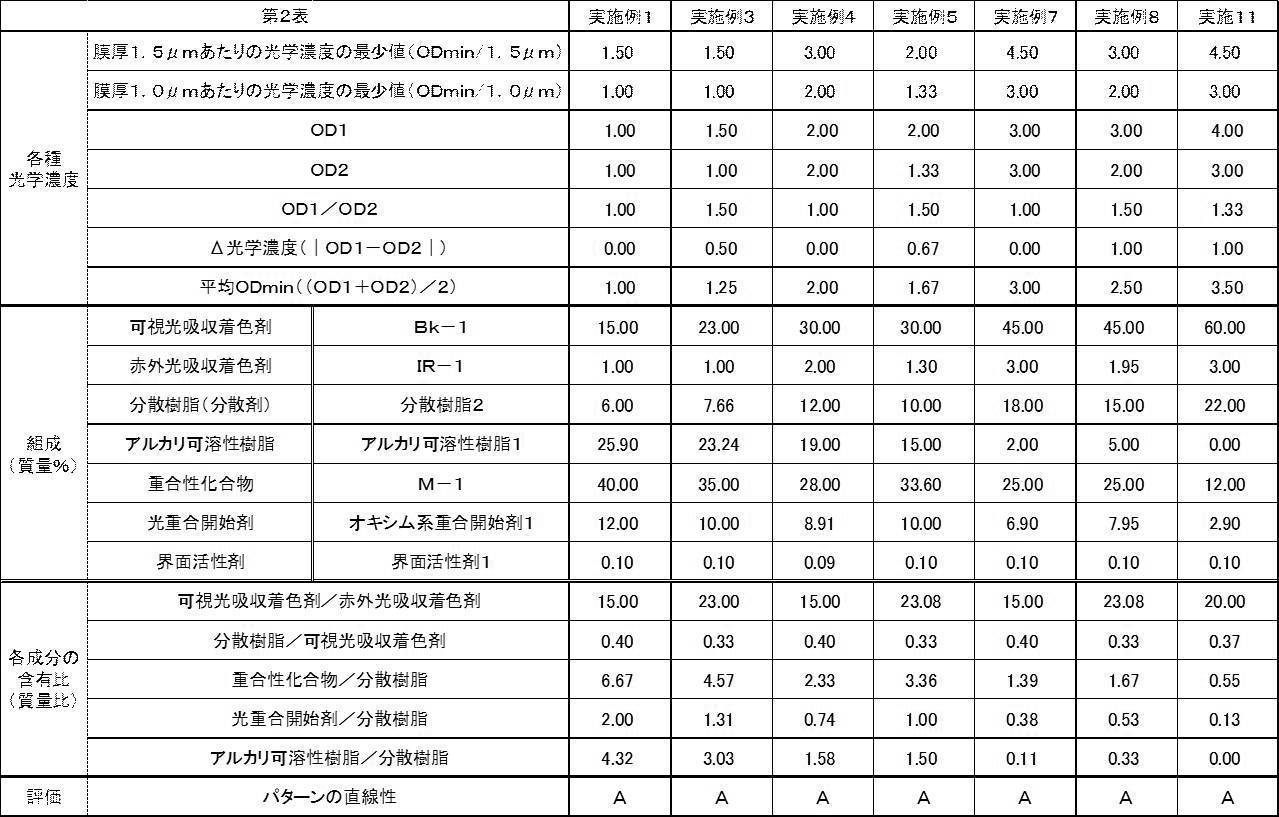


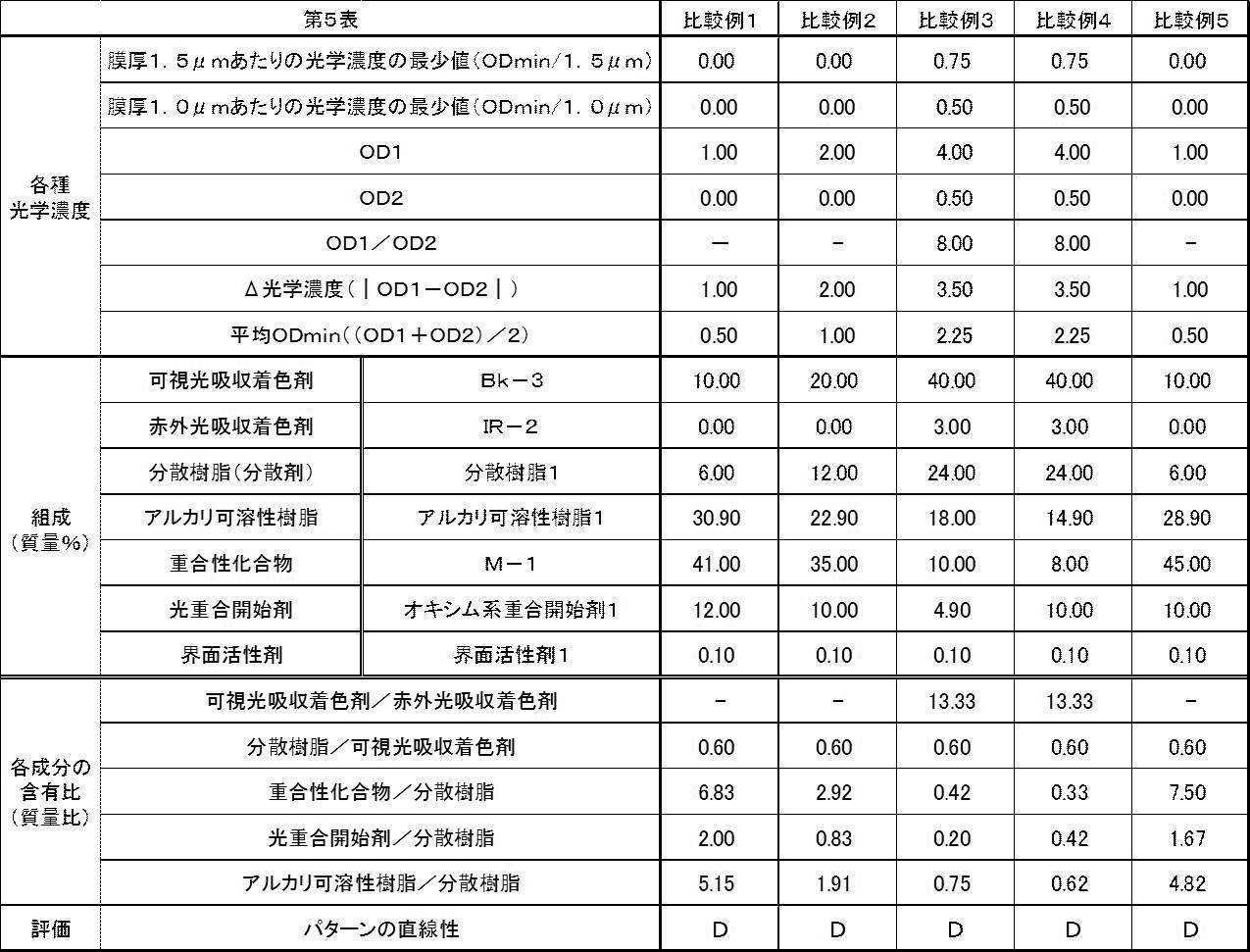
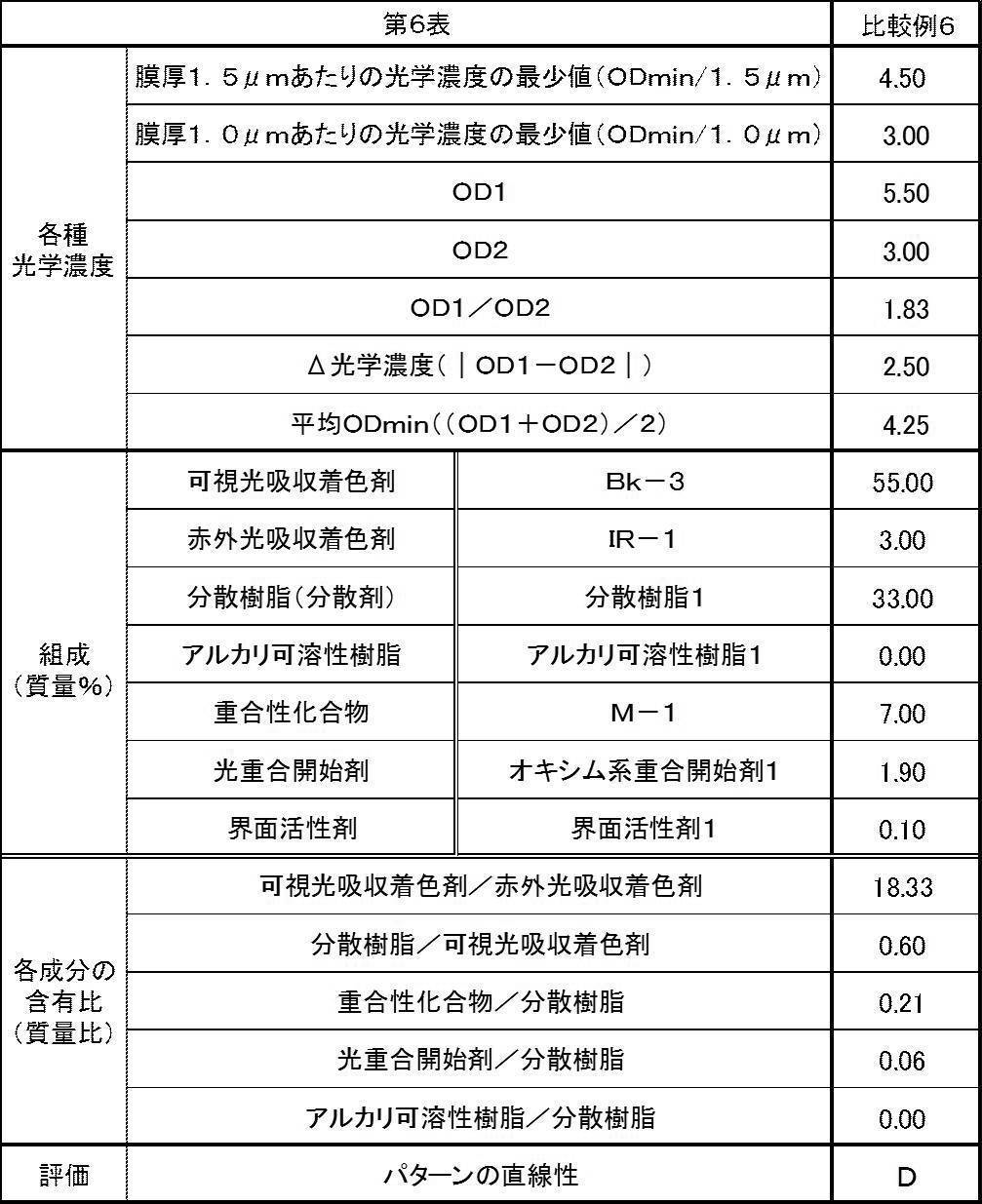
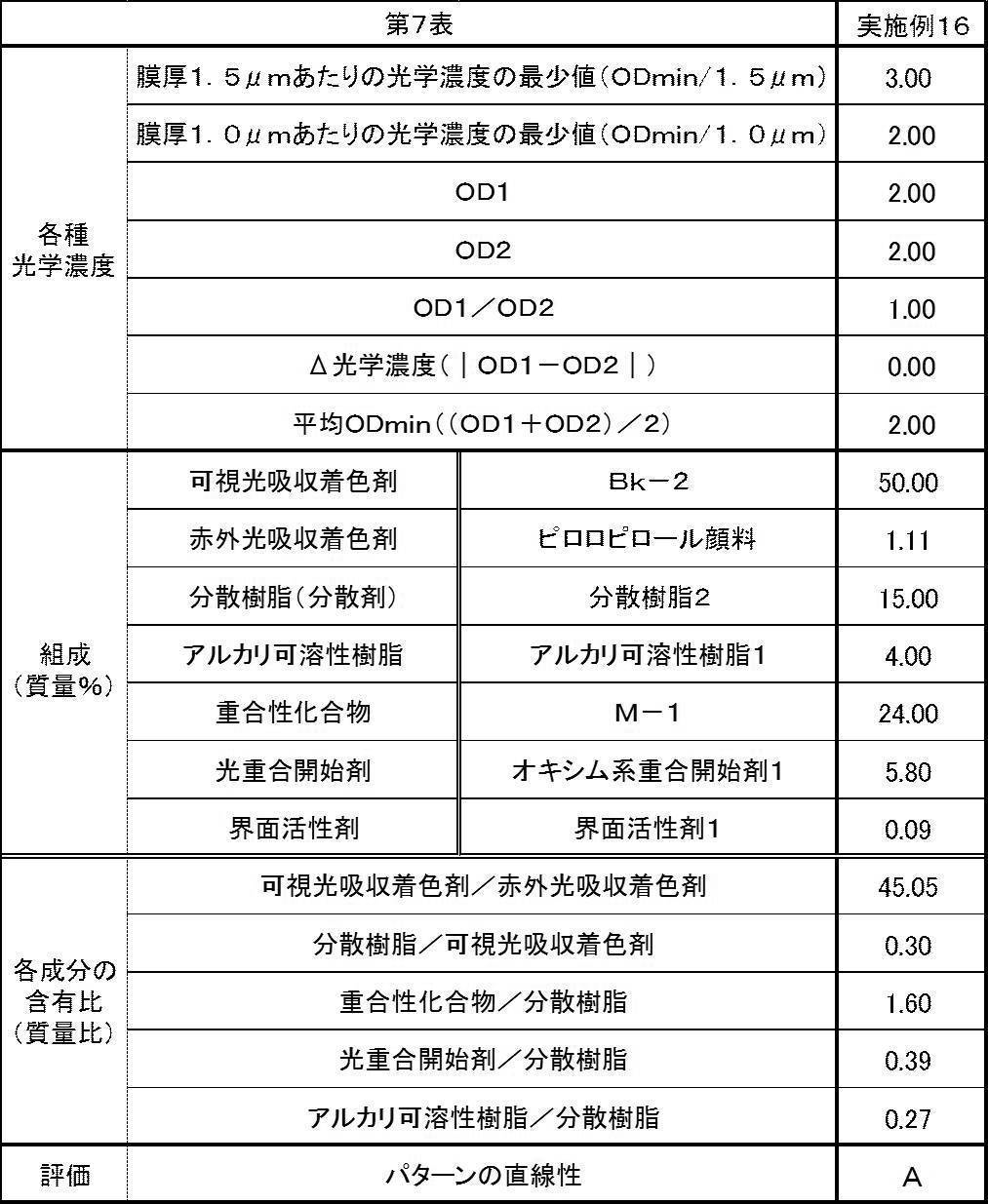
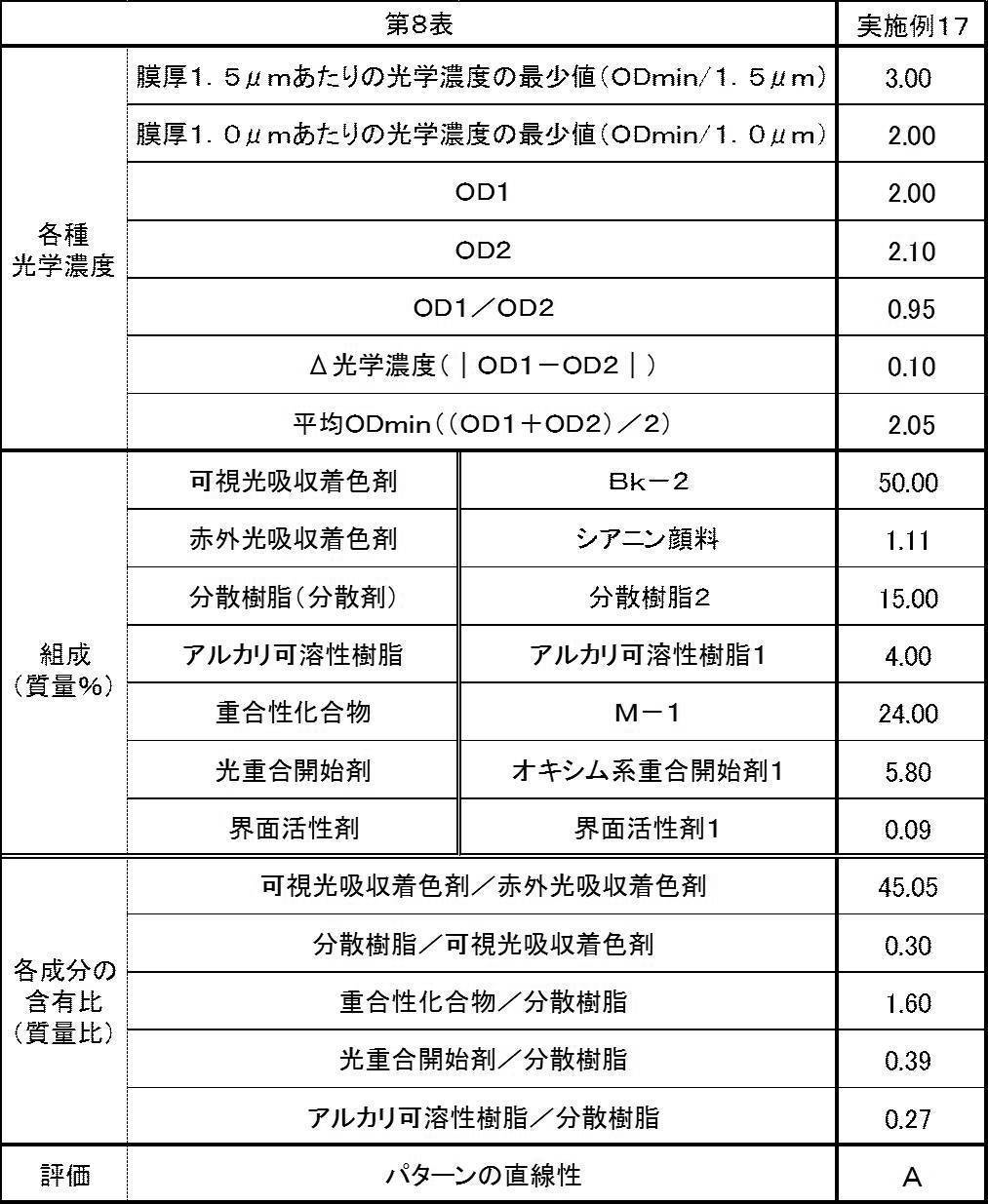
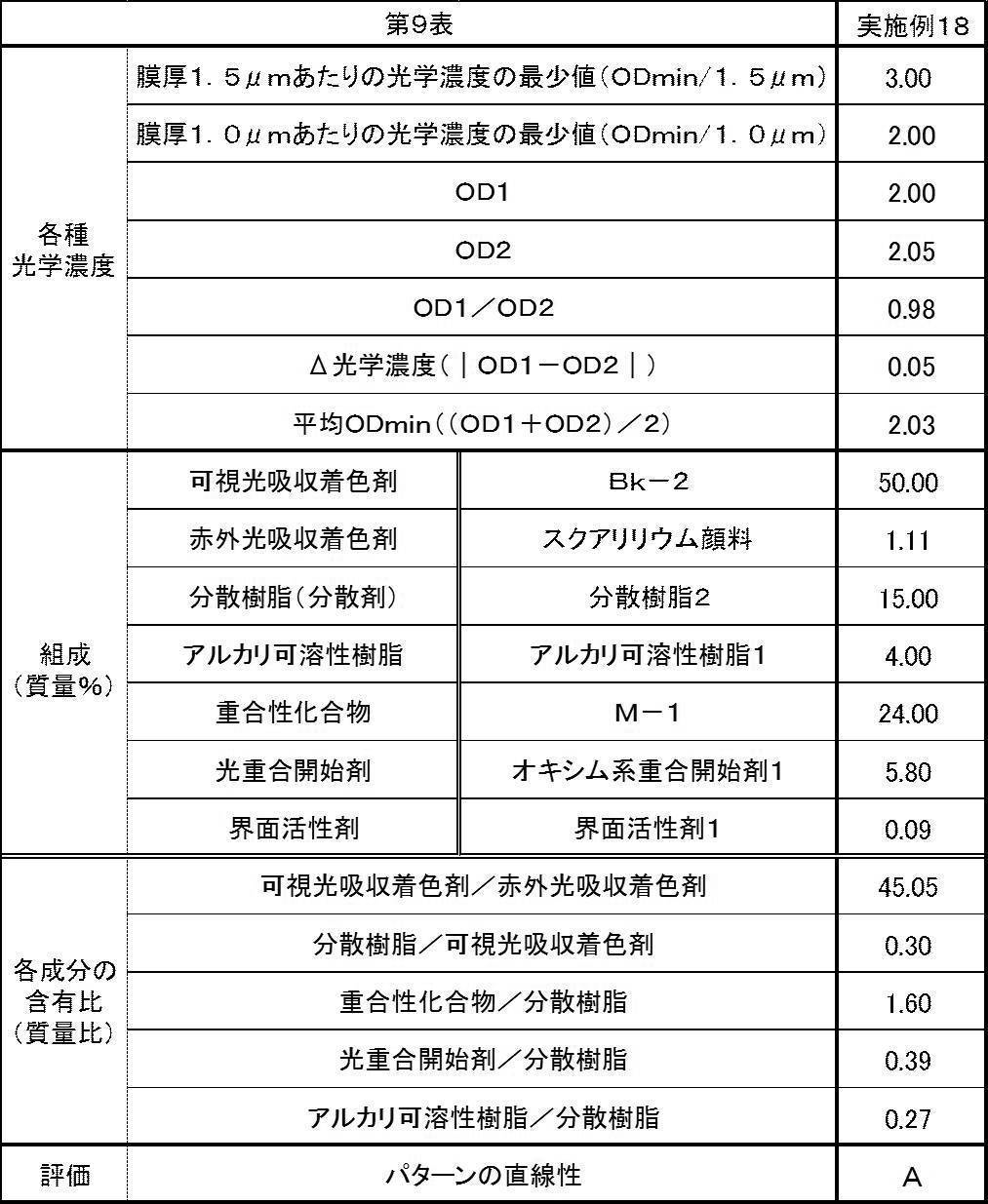


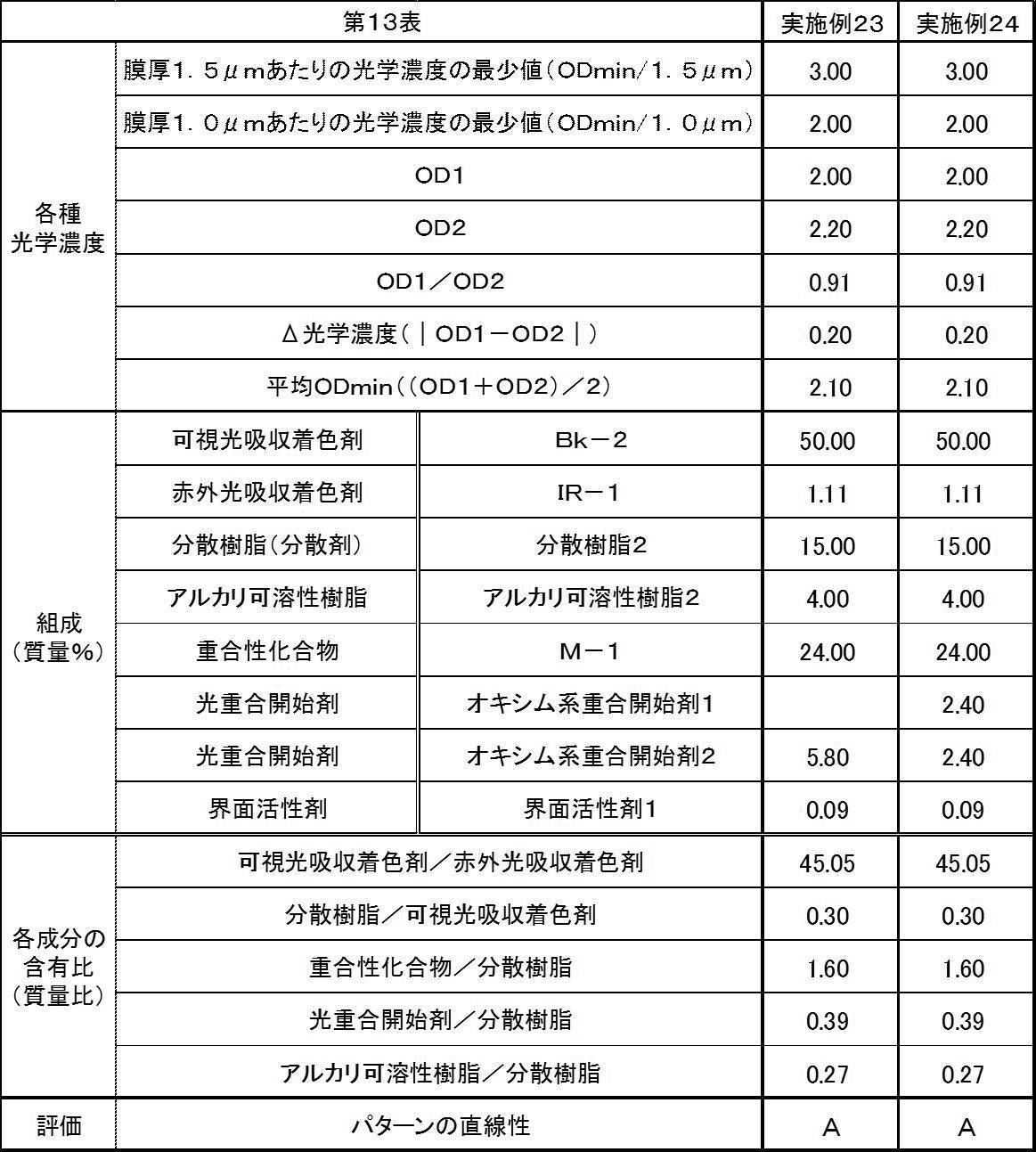

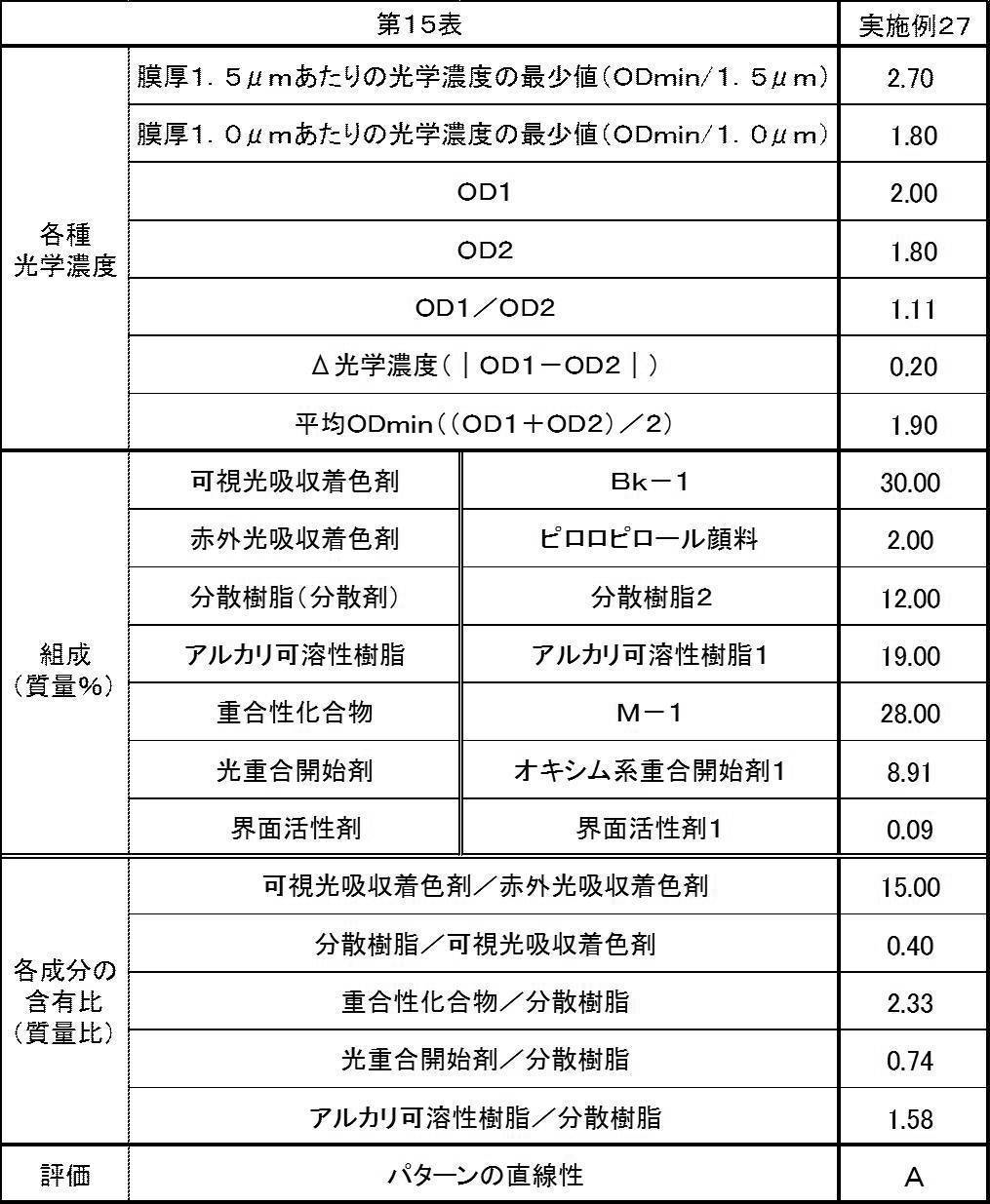

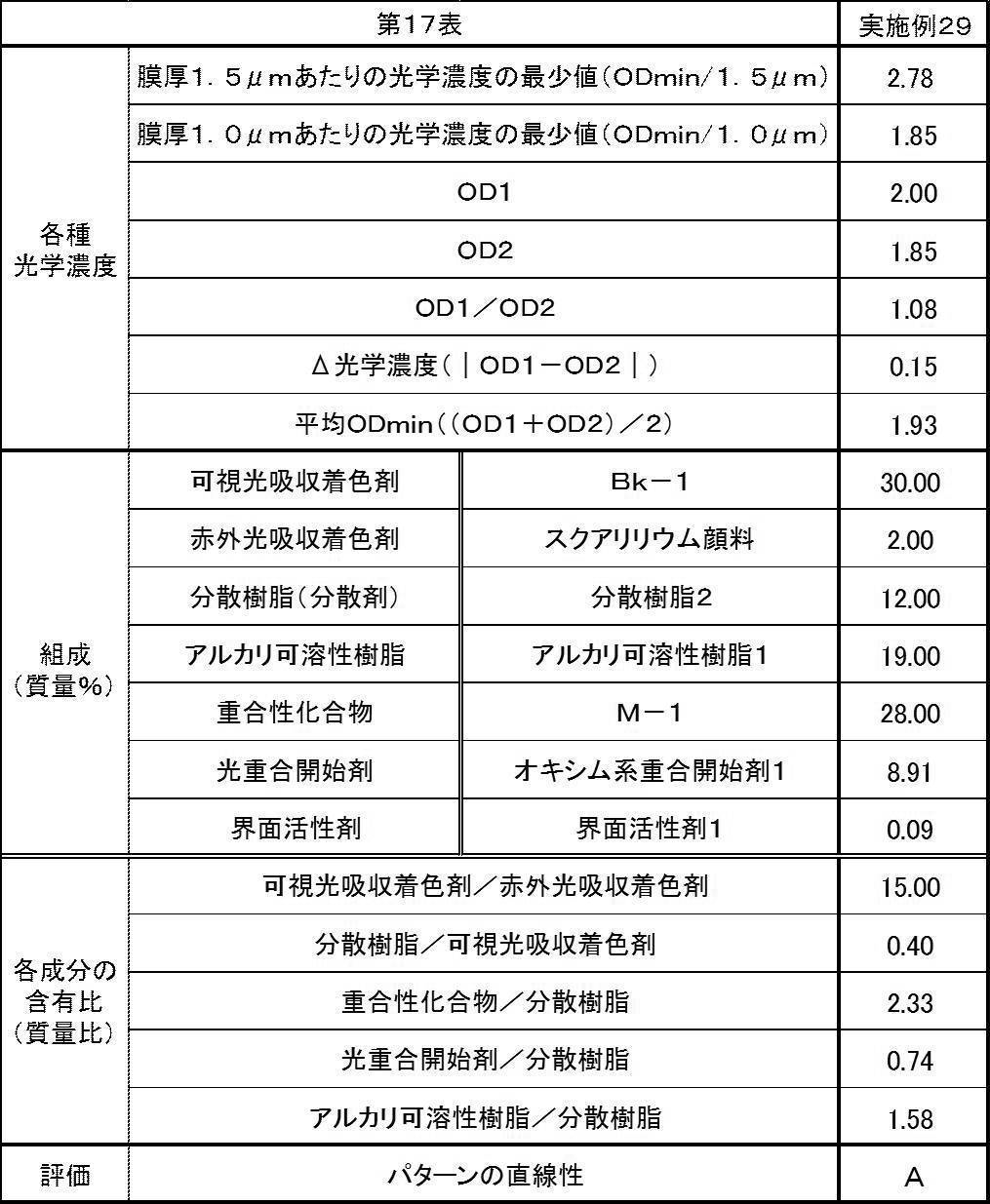

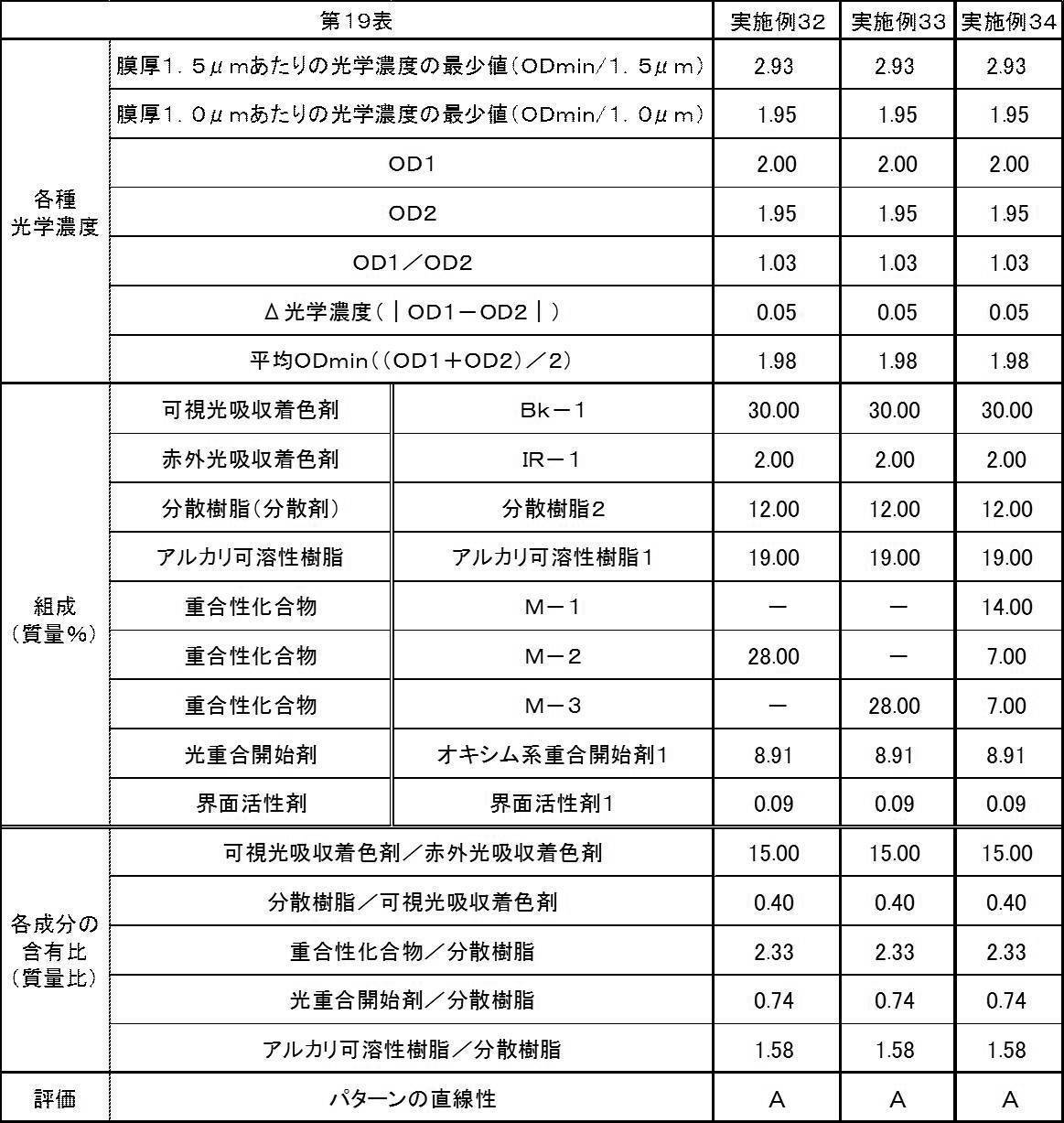

実施例1~12と、実施例13及び14とを対比すると、吸着基を有するアクリル系又はメタクリル系樹脂に対する光重合開始剤の含有量が質量比で0.1~2であることにより、パターン直線性により優れることが確認された。実施例13の硬化性組成物のように光重合開始剤の量が吸着基を有するアクリル系又はメタクリル系樹脂に対して質量比で0.1未満である場合、ラジカル量の不足によって露光部の硬化が不十分となり、現像で膜の一部が溶解しパターン直線性が低下するものと推測される。
一方、実施例14の硬化性組成物のように光重合開始剤の量が吸着基を有するアクリル系又はメタクリル系樹脂に対して質量比で2を超える場合、未露光部まで硬化し現像液に溶解しなくなるため、パターン直線性が低下するものと推測される。
Claims (17)
- 可視光を吸収する着色剤と、
赤外光を吸収する着色剤と、
重合性化合物と、
光重合開始剤と、を含有する硬化性組成物であって、
前記硬化性組成物の塗膜の波長380~1100nmの領域における膜厚1μmあたりの光学濃度の最小値が1以上であり、かつ、
式(1)で求められるΔ光学濃度が1以下である、硬化性組成物。
式(1) Δ光学濃度=|OD1-OD2|
式(1)中、OD1は、前記塗膜の波長380nm以上780nm以下の領域における膜厚1μmあたりの光学濃度の最小値を表し、OD2は、前記塗膜の波長780nm超1100nm以下の領域における膜厚1μmあたりの光学濃度の最小値を表す。 - 前記OD1及び前記OD2の平均値が1以上4以下である、請求項1に記載の硬化性組成物。
- 前記赤外光を吸収する着色剤が、ピロロピロール系化合物、フタロシアニン系化合物、ナフタロシアニン系化合物、スクアリリウム系化合物、シアニン系化合物、ジインモニウム系化合物、及び、酸化タングステン系化合物の中から選ばれる少なくとも1種以上を含む、請求項1又は請求項2に硬化性組成物。
- 前記可視光を吸収する着色剤が、酸窒化チタン、窒化チタン、カーボンブラック、ペリレンブラック、Irgaphor Black、赤系有機顔料、青系有機顔料、黄系有機顔料、及び、紫系有機顔料の中から選ばれる少なくとも1種以上を含む、請求項1~3のいずれか1項に記載の硬化性組成物。
- 更に、吸着性基を有するアクリル系又はメタクリル系樹脂を含む、請求項1~4のいずれか1項に記載の硬化性組成物。
- 更に、アルカリ可溶性樹脂を含む、請求項1~5のいずれか1項に記載の硬化性組成物。
- 可視光を吸収する着色剤と、
赤外光を吸収する着色剤と、
重合性化合物と、
光重合開始剤と、
吸着基を有するアクリル系又はメタクリル系樹脂と、を含有し、
前記吸着基を有するアクリル系又はメタクリル系樹脂に対する前記重合性化合物の含有量が、質量比で0.5~7である、硬化性組成物。 - 前記吸着基を有するアクリル系又はメタクリル系樹脂に対する前記光重合開始剤の含有量が、質量比で0.1~2である、請求項7に記載の硬化性組成物。
- 更に、アルカリ可溶性樹脂を含む、請求項7又は請求項8に記載の硬化性組成物。
- 前記吸着基を有するアクリル系又はメタクリル系樹脂に対する前記アルカリ可溶性樹脂の含有量が、質量比で5以下である、請求項9に記載の硬化性組成物。
- カラーフィルタの製造に用いる、請求項1~10のいずれか1項に記載の硬化性組成物。
- 請求項1~10のいずれか1項に記載の硬化性組成物を硬化してなる遮光膜。
- 請求項1~10のいずれか1項に記載の硬化性組成物を硬化してなるカラーフィルタ。
- 請求項1~11のいずれか1項に記載の硬化性組成物を用いて、基板上に塗膜を形成する塗膜形成工程と、
前記塗膜をパターン状に露光する露光工程と、
未露光部を現像除去してパターン状の硬化膜を形成する現像工程と、を含み、
前記露光工程後に更に加熱工程を有する、又は、前記露光工程時に更に加熱処理を行う、パターン形成方法。 - 請求項14に記載のパターン形成方法を含む、カラーフィルタの製造方法。
- 請求項13に記載のカラーフィルタを有する固体撮像装置。
- 請求項13に記載のカラーフィルタを有する赤外線センサ。
Priority Applications (4)
| Application Number | Priority Date | Filing Date | Title |
|---|---|---|---|
| KR1020187026517A KR102183283B1 (ko) | 2016-03-16 | 2017-03-08 | 경화성 조성물, 차광막, 컬러 필터, 패턴 형성 방법, 컬러 필터의 제조 방법, 고체 촬상 소자, 적외선 센서 |
| JP2018505846A JP6718501B2 (ja) | 2016-03-16 | 2017-03-08 | 硬化性組成物、遮光膜、カラーフィルタ、パターン形成方法、カラーフィルタの製造方法、固体撮像素子、赤外線センサ |
| US16/131,714 US11156754B2 (en) | 2016-03-16 | 2018-09-14 | Curable composition, light-shielding film, color filter, pattern forming method, method for manufacturing color filter, solid-state imaging element, and infrared sensor |
| US17/475,586 US20220011485A1 (en) | 2016-03-16 | 2021-09-15 | Curable composition, light-shielding film, color filter, pattern forming method, method for manufacturing color filter, solid-state imaging element, and infrared sensor |
Applications Claiming Priority (2)
| Application Number | Priority Date | Filing Date | Title |
|---|---|---|---|
| JP2016053054 | 2016-03-16 | ||
| JP2016-053054 | 2016-03-16 |
Related Child Applications (1)
| Application Number | Title | Priority Date | Filing Date |
|---|---|---|---|
| US16/131,714 Continuation US11156754B2 (en) | 2016-03-16 | 2018-09-14 | Curable composition, light-shielding film, color filter, pattern forming method, method for manufacturing color filter, solid-state imaging element, and infrared sensor |
Publications (1)
| Publication Number | Publication Date |
|---|---|
| WO2017159479A1 true WO2017159479A1 (ja) | 2017-09-21 |
Family
ID=59850334
Family Applications (1)
| Application Number | Title | Priority Date | Filing Date |
|---|---|---|---|
| PCT/JP2017/009166 Ceased WO2017159479A1 (ja) | 2016-03-16 | 2017-03-08 | 硬化性組成物、遮光膜、カラーフィルタ、パターン形成方法、カラーフィルタの製造方法、固体撮像素子、赤外線センサ |
Country Status (5)
| Country | Link |
|---|---|
| US (2) | US11156754B2 (ja) |
| JP (1) | JP6718501B2 (ja) |
| KR (1) | KR102183283B1 (ja) |
| TW (1) | TWI712859B (ja) |
| WO (1) | WO2017159479A1 (ja) |
Cited By (7)
| Publication number | Priority date | Publication date | Assignee | Title |
|---|---|---|---|---|
| WO2019155770A1 (ja) * | 2018-02-06 | 2019-08-15 | 富士フイルム株式会社 | 組成物、膜、近赤外線カットフィルタ、固体撮像素子、画像表示装置および赤外線センサ |
| WO2020017576A1 (ja) * | 2018-07-20 | 2020-01-23 | 三菱ケミカル株式会社 | 感光性着色樹脂組成物、硬化物、画像表示装置及び照明 |
| WO2020054719A1 (ja) * | 2018-09-14 | 2020-03-19 | 富士フイルム株式会社 | 近赤外線吸収性感光性組成物、硬化膜、光学フィルタ、パターン形成方法、積層体、固体撮像素子、画像表示装置及び赤外線センサ |
| KR102330579B1 (ko) * | 2021-08-25 | 2021-12-01 | 주식회사 대교시그널 | 횡단보도 신호등에 연동 제어되는 바닥신호등 및 그 시공방법 |
| JP2022173080A (ja) * | 2021-05-06 | 2022-11-17 | 東洋インキScホールディングス株式会社 | 感光性組成物、それを用いた硬化膜、光学フィルタ、画像表示装置、固体撮像素子、及び赤外線センサ |
| JP2022181171A (ja) * | 2021-05-25 | 2022-12-07 | 東洋インキScホールディングス株式会社 | 感光性組成物、それを用いた硬化膜、光学フィルタ、画像表示装置、固体撮像素子、及び赤外線センサ |
| JP2023155938A (ja) * | 2022-04-12 | 2023-10-24 | 東洋インキScホールディングス株式会社 | 感光性組成物、それを用いた硬化膜、光学フィルタ、画像表示装置、固体撮像素子、及び赤外線センサ |
Families Citing this family (12)
| Publication number | Priority date | Publication date | Assignee | Title |
|---|---|---|---|---|
| KR102253712B1 (ko) * | 2018-10-02 | 2021-05-18 | 삼성에스디아이 주식회사 | 편광판 및 이를 포함하는 광학표시장치 |
| JP7616826B2 (ja) * | 2019-03-28 | 2025-01-17 | 住友化学株式会社 | 着色硬化性樹脂組成物 |
| JP7109653B2 (ja) * | 2019-03-29 | 2022-07-29 | 富士フイルム株式会社 | 光硬化性インク組成物及び画像記録方法 |
| KR102622853B1 (ko) * | 2020-02-17 | 2024-01-11 | 동우 화인켐 주식회사 | 흑색 감광성 수지 조성물, 이를 사용하여 제조된 블랙 매트릭스를 포함하는 컬러필터 및 상기 컬러필터를 포함하는 표시장치 |
| JP7394967B2 (ja) * | 2020-03-30 | 2023-12-08 | 富士フイルム株式会社 | インクジェット記録用インク及び画像記録方法 |
| JP7773858B2 (ja) * | 2020-03-31 | 2025-11-20 | 住友化学株式会社 | 硬化性樹脂組成物及び表示装置 |
| CN116096576B (zh) * | 2020-09-11 | 2025-09-19 | 富士胶片株式会社 | 喷墨记录用油墨及喷墨记录方法 |
| KR102870197B1 (ko) * | 2020-12-16 | 2025-10-15 | 삼성디스플레이 주식회사 | 전자 장치 |
| JP7812654B2 (ja) * | 2021-01-28 | 2026-02-10 | 住友化学株式会社 | 着色硬化性樹脂組成物 |
| US12317638B2 (en) * | 2021-01-28 | 2025-05-27 | Texas Instruments Incorporated | Sensor packages with wavelength-specific light filters |
| KR102598243B1 (ko) * | 2021-02-25 | 2023-11-03 | 동우 화인켐 주식회사 | 화상표시장치용 격벽, 이를 제조하는 방법 및 상기 격벽을 포함하는 화상표시장치 |
| KR20220132106A (ko) * | 2021-03-22 | 2022-09-30 | 삼성디스플레이 주식회사 | 경화성 수지 조성물 및 컬러 필터층을 포함하는 표시 장치 |
Citations (6)
| Publication number | Priority date | Publication date | Assignee | Title |
|---|---|---|---|---|
| JP2011141512A (ja) * | 2009-12-11 | 2011-07-21 | Fujifilm Corp | 黒色硬化性組成物、遮光性カラーフィルタ、固体撮像素子、ウエハレベルレンズ、遮光膜およびその製造方法 |
| JP2011209653A (ja) * | 2010-03-30 | 2011-10-20 | Fujifilm Corp | チタンブラック分散物、感光性樹脂組成物、遮光膜及びその製造方法、並びに固体撮像素子 |
| JP2012203083A (ja) * | 2011-03-24 | 2012-10-22 | Sumitomo Osaka Cement Co Ltd | 可視近赤外光遮蔽黒色膜、可視近赤外光遮蔽黒色膜付き基材、及び固体撮像素子 |
| WO2015020076A1 (ja) * | 2013-08-09 | 2015-02-12 | 旭硝子株式会社 | 光学部材とその製造方法、並びに撮像装置 |
| WO2015166779A1 (ja) * | 2014-05-01 | 2015-11-05 | 富士フイルム株式会社 | 着色組成物、膜、カラーフィルタ、パターン形成方法、カラーフィルタの製造方法、固体撮像素子および赤外線センサ |
| JP2016210984A (ja) * | 2015-04-28 | 2016-12-15 | 住友金属鉱山株式会社 | 分散体、着色層、着色膜、着色基材、着色合わせ基材、およびインク |
Family Cites Families (11)
| Publication number | Priority date | Publication date | Assignee | Title |
|---|---|---|---|---|
| US7317577B2 (en) * | 2004-05-14 | 2008-01-08 | Eastman Kodak Company | Methods for producing a black matrix on a lenticular lens |
| US8872099B2 (en) * | 2008-03-18 | 2014-10-28 | Fujifilm Corporation | Solid-state image sensor including a light-shielding color filter formed from a photosensitive resin composition, photosensitive resin composition and method of producing a light-shielding color filter |
| JP2009244729A (ja) | 2008-03-31 | 2009-10-22 | Fujifilm Corp | 感光性樹脂組成物、遮光性カラーフィルター及びその製造方法、並びに、固体撮像素子 |
| CN104317164B (zh) | 2009-12-11 | 2018-03-30 | 富士胶片株式会社 | 黑色可固化组合物 |
| JP5429114B2 (ja) * | 2010-08-26 | 2014-02-26 | 住友大阪セメント株式会社 | 赤外線透過黒色膜、赤外線透過黒色膜を用いた膜付き基材及び画像表示装置 |
| JP5775479B2 (ja) * | 2012-03-21 | 2015-09-09 | 富士フイルム株式会社 | 着色感放射線性組成物、着色硬化膜、カラーフィルタ、パターン形成方法、カラーフィルタの製造方法、固体撮像素子、及び画像表示装置 |
| JP6056369B2 (ja) * | 2012-10-19 | 2017-01-11 | 住友大阪セメント株式会社 | 黒色材料、黒色材料分散液、黒色樹脂組成物、黒色膜、黒色膜付き基材、及び固体撮像素子 |
| KR101907220B1 (ko) * | 2013-06-20 | 2018-10-11 | 동우 화인켐 주식회사 | 블랙 매트릭스용 감광성 수지 조성물, 이를 이용하여 제조된 블랙 매트릭스 및 이를 포함하는 표시 장치 |
| KR101801671B1 (ko) * | 2014-01-31 | 2017-11-27 | 후지필름 가부시키가이샤 | 컬러 필터용 녹색 착색 조성물, 착색막, 컬러 필터, 고체 촬상 소자 |
| WO2015115536A1 (ja) * | 2014-01-31 | 2015-08-06 | 富士フイルム株式会社 | カラーフィルタ用赤色着色組成物、着色膜、カラーフィルタ、固体撮像素子 |
| TWI723994B (zh) * | 2015-05-22 | 2021-04-11 | 日商富士軟片股份有限公司 | 著色組成物、膜、彩色濾光片、圖案形成方法、彩色濾光片的製造方法、固體攝像元件及紅外線感測器 |
-
2017
- 2017-03-08 KR KR1020187026517A patent/KR102183283B1/ko active Active
- 2017-03-08 JP JP2018505846A patent/JP6718501B2/ja active Active
- 2017-03-08 WO PCT/JP2017/009166 patent/WO2017159479A1/ja not_active Ceased
- 2017-03-15 TW TW106108473A patent/TWI712859B/zh active
-
2018
- 2018-09-14 US US16/131,714 patent/US11156754B2/en active Active
-
2021
- 2021-09-15 US US17/475,586 patent/US20220011485A1/en not_active Abandoned
Patent Citations (6)
| Publication number | Priority date | Publication date | Assignee | Title |
|---|---|---|---|---|
| JP2011141512A (ja) * | 2009-12-11 | 2011-07-21 | Fujifilm Corp | 黒色硬化性組成物、遮光性カラーフィルタ、固体撮像素子、ウエハレベルレンズ、遮光膜およびその製造方法 |
| JP2011209653A (ja) * | 2010-03-30 | 2011-10-20 | Fujifilm Corp | チタンブラック分散物、感光性樹脂組成物、遮光膜及びその製造方法、並びに固体撮像素子 |
| JP2012203083A (ja) * | 2011-03-24 | 2012-10-22 | Sumitomo Osaka Cement Co Ltd | 可視近赤外光遮蔽黒色膜、可視近赤外光遮蔽黒色膜付き基材、及び固体撮像素子 |
| WO2015020076A1 (ja) * | 2013-08-09 | 2015-02-12 | 旭硝子株式会社 | 光学部材とその製造方法、並びに撮像装置 |
| WO2015166779A1 (ja) * | 2014-05-01 | 2015-11-05 | 富士フイルム株式会社 | 着色組成物、膜、カラーフィルタ、パターン形成方法、カラーフィルタの製造方法、固体撮像素子および赤外線センサ |
| JP2016210984A (ja) * | 2015-04-28 | 2016-12-15 | 住友金属鉱山株式会社 | 分散体、着色層、着色膜、着色基材、着色合わせ基材、およびインク |
Cited By (16)
| Publication number | Priority date | Publication date | Assignee | Title |
|---|---|---|---|---|
| WO2019155770A1 (ja) * | 2018-02-06 | 2019-08-15 | 富士フイルム株式会社 | 組成物、膜、近赤外線カットフィルタ、固体撮像素子、画像表示装置および赤外線センサ |
| JPWO2019155770A1 (ja) * | 2018-02-06 | 2021-02-25 | 富士フイルム株式会社 | 組成物、膜、近赤外線カットフィルタ、固体撮像素子、画像表示装置および赤外線センサ |
| US11513439B2 (en) | 2018-02-06 | 2022-11-29 | Fujifilm Corporation | Composition, film, near infrared cut filter, solid-state imaging element, image display device, and infrared sensor |
| WO2020017576A1 (ja) * | 2018-07-20 | 2020-01-23 | 三菱ケミカル株式会社 | 感光性着色樹脂組成物、硬化物、画像表示装置及び照明 |
| KR102706032B1 (ko) * | 2018-07-20 | 2024-09-11 | 미쯔비시 케미컬 주식회사 | 감광성 착색 수지 조성물, 경화물, 화상 표시 장치 및 조명 |
| KR20210032320A (ko) * | 2018-07-20 | 2021-03-24 | 미쯔비시 케미컬 주식회사 | 감광성 착색 수지 조성물, 경화물, 화상 표시 장치 및 조명 |
| JPWO2020017576A1 (ja) * | 2018-07-20 | 2021-08-12 | 三菱ケミカル株式会社 | 感光性着色樹脂組成物、硬化物、画像表示装置及び照明 |
| JP7435445B2 (ja) | 2018-07-20 | 2024-02-21 | 三菱ケミカル株式会社 | 感光性着色樹脂組成物、硬化物、画像表示装置及び照明 |
| JP7015935B2 (ja) | 2018-09-14 | 2022-02-03 | 富士フイルム株式会社 | 近赤外線吸収性感光性組成物、硬化膜、光学フィルタ、パターン形成方法、積層体、固体撮像素子、画像表示装置及び赤外線センサ |
| US11467491B2 (en) | 2018-09-14 | 2022-10-11 | Fujifilm Corporation | Near-infrared absorbing photosensitive composition, cured film, optical filter, method for forming pattern, laminate, solid-state imaging element, image display device, and infrared sensor |
| JPWO2020054719A1 (ja) * | 2018-09-14 | 2021-08-30 | 富士フイルム株式会社 | 近赤外線吸収性感光性組成物、硬化膜、光学フィルタ、パターン形成方法、積層体、固体撮像素子、画像表示装置及び赤外線センサ |
| WO2020054719A1 (ja) * | 2018-09-14 | 2020-03-19 | 富士フイルム株式会社 | 近赤外線吸収性感光性組成物、硬化膜、光学フィルタ、パターン形成方法、積層体、固体撮像素子、画像表示装置及び赤外線センサ |
| JP2022173080A (ja) * | 2021-05-06 | 2022-11-17 | 東洋インキScホールディングス株式会社 | 感光性組成物、それを用いた硬化膜、光学フィルタ、画像表示装置、固体撮像素子、及び赤外線センサ |
| JP2022181171A (ja) * | 2021-05-25 | 2022-12-07 | 東洋インキScホールディングス株式会社 | 感光性組成物、それを用いた硬化膜、光学フィルタ、画像表示装置、固体撮像素子、及び赤外線センサ |
| KR102330579B1 (ko) * | 2021-08-25 | 2021-12-01 | 주식회사 대교시그널 | 횡단보도 신호등에 연동 제어되는 바닥신호등 및 그 시공방법 |
| JP2023155938A (ja) * | 2022-04-12 | 2023-10-24 | 東洋インキScホールディングス株式会社 | 感光性組成物、それを用いた硬化膜、光学フィルタ、画像表示装置、固体撮像素子、及び赤外線センサ |
Also Published As
| Publication number | Publication date |
|---|---|
| US11156754B2 (en) | 2021-10-26 |
| TW201802591A (zh) | 2018-01-16 |
| US20190018174A1 (en) | 2019-01-17 |
| JPWO2017159479A1 (ja) | 2018-12-20 |
| US20220011485A1 (en) | 2022-01-13 |
| TWI712859B (zh) | 2020-12-11 |
| KR102183283B1 (ko) | 2020-11-26 |
| JP6718501B2 (ja) | 2020-07-08 |
| KR20180107268A (ko) | 2018-10-01 |
Similar Documents
| Publication | Publication Date | Title |
|---|---|---|
| JP7514967B2 (ja) | 着色感光性組成物、硬化膜、パターン形成方法、遮光膜付き赤外光カットフィルタ、固体撮像素子、画像表示装置および赤外線センサ | |
| JP6718501B2 (ja) | 硬化性組成物、遮光膜、カラーフィルタ、パターン形成方法、カラーフィルタの製造方法、固体撮像素子、赤外線センサ | |
| JP2020030432A (ja) | 着色感光性組成物、硬化膜、カラーフィルタ、遮光膜、固体撮像素子、画像表示装置、および、硬化膜の製造方法 | |
| TWI774679B (zh) | 硬化性組成物、硬化膜、濾色器、遮光膜、固體攝像元件、圖像顯示裝置、硬化膜的製造方法及多官能硫醇化合物 | |
| TWI790993B (zh) | 黑色組成物、硬化膜、濾色器、遮光膜、固態攝影元件及圖像顯示裝置 | |
| TWI795360B (zh) | 硬化膜形成用組成物、硬化膜、彩色濾光片、遮光膜、固體攝像裝置及圖像顯示裝置 | |
| EP3412723B1 (en) | Dispersion composition, curable composition, light-blocking film, color filter, and solid-state imaging device | |
| JP6800949B2 (ja) | 樹脂組成物、樹脂膜、カラーフィルタ、遮光膜、固体撮像装置、及び、画像表示装置 | |
| JP2017125953A (ja) | 感放射線性組成物、膜、カラーフィルタ、遮光膜および固体撮像素子 |
Legal Events
| Date | Code | Title | Description |
|---|---|---|---|
| WWE | Wipo information: entry into national phase |
Ref document number: 2018505846 Country of ref document: JP |
|
| ENP | Entry into the national phase |
Ref document number: 20187026517 Country of ref document: KR Kind code of ref document: A |
|
| WWE | Wipo information: entry into national phase |
Ref document number: 1020187026517 Country of ref document: KR |
|
| NENP | Non-entry into the national phase |
Ref country code: DE |
|
| 121 | Ep: the epo has been informed by wipo that ep was designated in this application |
Ref document number: 17766480 Country of ref document: EP Kind code of ref document: A1 |
|
| 122 | Ep: pct application non-entry in european phase |
Ref document number: 17766480 Country of ref document: EP Kind code of ref document: A1 |