WO2017138184A1 - 凝集剤および水処理方法 - Google Patents
凝集剤および水処理方法 Download PDFInfo
- Publication number
- WO2017138184A1 WO2017138184A1 PCT/JP2016/077635 JP2016077635W WO2017138184A1 WO 2017138184 A1 WO2017138184 A1 WO 2017138184A1 JP 2016077635 W JP2016077635 W JP 2016077635W WO 2017138184 A1 WO2017138184 A1 WO 2017138184A1
- Authority
- WO
- WIPO (PCT)
- Prior art keywords
- water
- flocculant
- polymer compound
- treated
- added
- Prior art date
- Legal status (The legal status is an assumption and is not a legal conclusion. Google has not performed a legal analysis and makes no representation as to the accuracy of the status listed.)
- Ceased
Links
Images


Classifications
-
- B—PERFORMING OPERATIONS; TRANSPORTING
- B01—PHYSICAL OR CHEMICAL PROCESSES OR APPARATUS IN GENERAL
- B01D—SEPARATION
- B01D21/00—Separation of suspended solid particles from liquids by sedimentation
- B01D21/01—Separation of suspended solid particles from liquids by sedimentation using flocculating agents
-
- C—CHEMISTRY; METALLURGY
- C02—TREATMENT OF WATER, WASTE WATER, SEWAGE, OR SLUDGE
- C02F—TREATMENT OF WATER, WASTE WATER, SEWAGE, OR SLUDGE
- C02F1/00—Treatment of water, waste water, or sewage
- C02F1/52—Treatment of water, waste water, or sewage by flocculation or precipitation of suspended impurities
-
- C—CHEMISTRY; METALLURGY
- C02—TREATMENT OF WATER, WASTE WATER, SEWAGE, OR SLUDGE
- C02F—TREATMENT OF WATER, WASTE WATER, SEWAGE, OR SLUDGE
- C02F1/00—Treatment of water, waste water, or sewage
- C02F1/52—Treatment of water, waste water, or sewage by flocculation or precipitation of suspended impurities
- C02F1/54—Treatment of water, waste water, or sewage by flocculation or precipitation of suspended impurities using organic material
- C02F1/56—Macromolecular compounds
Definitions
- the first invention relates to a flocculant and a water treatment method.
- the second invention relates to a method for preparing a solution-like water treatment chemical containing polyethyleneimine (PEI) and polyvinylpyrrolidone (PVP) as a single agent, and a water treatment method using this water treatment chemical.
- PEI polyethyleneimine
- PVP polyvinylpyrrolidone
- agglomeration and solid-liquid separation by adding an inorganic flocculant are widely performed.
- a large amount of inorganic flocculant is required, leading to an increase in the amount of sludge generated.
- the suspended solids (SS) concentration in the flocculated water is increased by adding a large amount of inorganic flocculant, the load on the subsequent sand filtration or membrane separation treatment will increase, resulting in deterioration or blockage of the treated water. This reduces the amount of treated water.
- an inorganic flocculant and a cationic polymer flocculant are used in combination (Patent Document 1), but the removal effect of organic substances such as biological metabolites is not sufficient. .
- membrane separation fouling is likely to occur when membrane separation processing using a microfiltration membrane, an ultrafiltration membrane, a reverse osmosis membrane, or the like is performed later.
- a liquid composition containing a plurality of active ingredients in a single agent (hereinafter referred to as a single agent chemical) is prepared by dissolving at least a liquid or a solid chemical in the same solvent (hereinafter referred to as a single agent treatment). It is widely used.
- a single agent chemical is prepared by dissolving at least a liquid or a solid chemical in the same solvent (hereinafter referred to as a single agent treatment). It is widely used.
- the advantage of single-agent chemicals is that the number of chemical injection pumps required for each chemical is reduced, and the blending ratio of multiple chemicals does not have to be adjusted by the amount of each chemical delivered. It is a reduction in cost and labor.
- the first invention can efficiently and without pH adjustment and a large amount of inorganic flocculant. It is an object of the present invention to provide a flocculant and a water treatment method capable of highly coagulating.
- the present inventor can solve the above-mentioned problem by using a polymer compound having a specific weak cationic amino group and a nonionic polymer compound in place of the conventional cationic polymer flocculant. I found out that I can do it.
- the gist of the first invention is as follows.
- the polymer compound having a weak cationic amino group includes one or more selected from the group consisting of polyethyleneimine, polyvinylamine, and dicyandiamide / formalin condensate. A characteristic flocculant.
- X represents an alkylene group having 1 or 2 carbon atoms which may have a substituent or a direct bond.
- R 1 and R 2 each independently represent a hydrogen atom or an alkyl group having 1 to 3 carbon atoms which may have a substituent.
- R 1 and R 2 may be bonded to each other to form a 5- to 7-membered lactam ring which may have a substituent.
- n represents an integer of 10 or more.
- R 3 represents an alkyl group having 1 to 3 carbon atoms which may have a substituent.
- n represents an integer of 10 or more.
- the nonionic polymer compound is added to the water to be treated, after the polymer compound having the weak cationic amino group is added, or the nonionic polymer compound is added.
- the water is characterized by adding a polymer compound having a weak cationic amino group or adding the polymer compound having a primary amino group and a nonionic polymer compound at the same time for coagulation treatment. Processing method.
- the flocculant contains a cationic polymer compound containing a quaternary ammonium base
- the water to be treated contains a cationic polymer compound containing the quaternary ammonium base.
- a water treatment method characterized by adding and aggregating the weakly cationic amino group-containing polymer compound and nonionic polymer compound after adding and aggregating.
- the flocculant includes an inorganic flocculant, and the polymer compound having a weak cationic amino group and a nonionic polymer compound are added to the water to be treated. Then, the inorganic flocculant is added and the flocculant is treated, or the polymer water having a weak cationic amino group, the nonionic polymer compound and the inorganic flocculant are added to the water to be treated.
- a water treatment method comprising adding and aggregating at the same time.
- a polymer compound having a weak cationic amino group such as polyethyleneimine (PEI), and polyvinylpyrrolidone (PVP) And other nonionic polymer compounds. Gelation may occur when polyethyleneimine (PEI) and polyvinylpyrrolidone (PVP) are treated as a single agent.
- the second invention aims to provide a method for preparing PEI and PVP as a single agent without gelation, and a water treatment method using this single agent.
- the present inventor in the preparation of a single agent containing PEI and PVP, from the relationship between the molecular weight of PEI and PVP and the relationship between the concentration of PEI and PVP, the relationship between the molecular weight and concentration that do not gel when both are mixed. It has been found that the above-mentioned problems can be solved by using PEI and PVP.
- the gist of the second invention is as follows.
- PEI polyethyleneimine
- PVP polyvinylpyrrolidone
- a water treatment method comprising adding water treatment chemical prepared by the method for preparing water treatment chemical according to any one of [18] to [20] to water to be treated.
- a cationic polymer compound containing a quaternary ammonium base is added to the water to be treated for aggregation treatment, and then the water treatment chemical is added for aggregation treatment.
- the water to be treated contains an organic substance and turbidity, and the water treatment chemical is added to the water to be treated for aggregation treatment, followed by solid-liquid separation.
- a water treatment method characterized by:
- the first invention is a flocculant for efficiently aggregating organic matter and turbidity contained in various industrial wastewater, domestic wastewater or biologically treated water of the wastewater, or surface water, groundwater and other treated water,
- the present invention relates to a water treatment method using the flocculant.
- the flocculant and water treatment method of the first invention are effective methods for flocculation treatment of water to be treated, which has a particularly high pH and high alkalinity, and in which the flocculation effect tends to decrease with conventional flocculants.
- organic matter and turbidity contained in the water to be treated can be converted into agglomerated flocs by an inorganic flocculant. While making it easy to be taken in and removing the fine colloid generated by adding the inorganic flocculant, the water quality of the flocculated water can be improved.
- a high coagulation effect can be exerted on the water to be treated having a high pH and a high alkalinity without adjusting the pH or adding a large amount of an inorganic coagulant. For this reason, it is possible to reduce the chemical cost, reduce the amount of sludge generation, further reduce the load of the subsequent treatment, prevent the membrane contamination of the subsequent membrane separation treatment, and perform stable and efficient water treatment. Become.
- PEI polyethyleneimine
- PVP polyvinylpyrrolidone
- FIG. 6 is a phase diagram of gel sol-liquid when mixing the same amount of PEI / PVP in Example 6-1. It is the photograph at the time of evaluation by the test tube inversion method in Example 6-1.
- FIG. 6 is a phase diagram of gel sol-liquid at the time of mixing PVP (K-30) / PEI (P-1000) in Example 6-2.
- FIG. 6 is a phase diagram of gel sol-liquid at the time of mixing PVP (K-15) / PEI (IP250) in Example 6-3.
- the first invention provides a flocculant containing a polymer compound having a weak cationic amino group and a nonionic polymer compound in the agglomeration treatment of the water to be treated containing organic matter and turbidity (hereinafter referred to as “amine”). -It may be referred to as "nonionic flocculant”) to solve the problem of the first invention.
- the weakly cationic amino group in the first invention refers to a primary amino group, a secondary amino group, and a tertiary amino group.
- an inorganic flocculant may be further added to perform the flocculant treatment.
- the aggregation treatment may be performed by adding a cationic polymer compound containing a quaternary ammonium base before or simultaneously with the addition of the amine / nonionic flocculant.
- Either the polymer compound having a weak cationic amino group or the nonionic polymer compound may be added first, or they may be added simultaneously.
- a polymer compound having a weak cationic amino group and a nonionic polymer compound are added separately, they are supplied as separate drugs.
- the polymer compound having a weak cationic amino group and the nonionic polymer compound are supplied as a single agent. It is preferable. In particular, it is desirable to add these as a mixed aqueous solution to the water to be treated because the chemical injection equipment can be reduced in the coagulation equipment.
- FIG. 1 is a schematic diagram for explaining the action mechanism of the flocculant of the first invention
- the flocculant treatment mechanism by the flocculant of the first invention will be described.
- a nonionic polymer compound (B) is bonded to an organic substance (A) contained in the water to be treated, for example, a polysaccharide contained in a biological metabolite via a hydrogen bond, and the combined substance (C) is Arise.
- the polymer compound (D) having a weak cationic amino group and the conjugate (C) are further bonded through hydrogen bonds to form a conjugate (E).
- the polymer compound (D) having a weak cationic amino group also binds to the suspended matter (F) contained in the water to be treated by electrostatic interaction.
- the binding of the polymer compound (D) having a weak cationic amino group to the turbidity (F) is performed under the condition of pH 9 or less, with the weak cationic property of the polymer compound (D) having a weak cationic amino group. Occurs when the amino group has a charge and exhibits sufficient electrostatic interaction with the suspended matter (F). Therefore, in the case of high pH, as shown in the following 3), a cationic polymer compound containing a quaternary ammonium base is added, and aggregation by a cationic polymer compound (G) containing a quaternary ammonium base is performed. It is preferable to use the effect.
- the combined product (E) and the combined product (H) each serve as a nucleus, and when the iron-based inorganic flocculant is added, the combined product (E) and the combined product (H) are easily incorporated into the iron floc (I). By adding the iron-based inorganic flocculant, an iron floc is generated and a fine iron colloid (J) is also generated.
- Fine iron colloid (J) is difficult to separate in the subsequent precipitation, pressure flotation and filtration, and causes clogging of the membrane in the subsequent membrane treatment.
- the polymer compound (D) having a weak cationic amino group crosslinks the iron floc (I) and the iron colloid (J) to form a coarse floc (K) and to form a fine iron colloid. Can be removed.
- the water to be treated that is subject to agglomeration treatment includes various industrial wastewaters including organic matter and turbidity, domestic wastewater, biologically treated water of the wastewater, surface water, groundwater, and the like.
- biologically treated water is particularly desirable.
- the water quality is water to be treated having a pH of 6 to 11 and an alkalinity of 100 mg / L as CaCO 3 or higher, for example, 100 to 5,000 mg / L as CaCO 3 , the coagulation effect by the flocculant of the first invention is further remarkable. Can get to.
- the polymer compound having a weak cationic amino group may be a polymer compound having any amino group from a primary amino group (primary amino group) to a tertiary amino group (tertiary amino group).
- branched polyethyleneimine having a primary amino group linear polyethyleneimine, polyvinylamine, polyallylamine, polyvinylamidine, polylysine, chitosan, polyamidoamine dendrimer, dicyandiamide having secondary and tertiary amino groups -Formalin condensate and the like.
- polyethyleneimine and polyvinylamine are preferred because of the high amino group content per weight of the polymer compound having a primary amino group.
- the molecular weight of the polymer compound having a weak cationic amino group is preferably 200 to 10,000,000, particularly 1,000 to 4,000,000. If the molecular weight is smaller than this range, the coagulation effect tends to be inferior, and if the molecular weight is larger, there is a possibility of clogging the subsequent film when remaining.
- the molecular weight of the polymer compound having a weak cationic amino group is the value of the number average molecular weight determined by the viscosity method or the boiling point increase method.
- the polymer compound having a weak cationic amino group may be used alone or in combination of two or more.
- the amount of the polymer compound having a weak cationic amino group added to the water to be treated depends on the quality of the water to be treated, the type of the polymer compound having a weak cationic amino group to be used, and the amine / nonionic flocculant. It varies depending on whether or not the coagulant is used in combination and the quality of treated water required.
- the amount of the polymer compound having a weak cationic amino group added to the water to be treated is preferably in the range of 0.5 to 10 mg / L as the amount of the active ingredient.
- Nonionic polymer compound is a compound having an alkylene oxide group or a compound having an alcoholic hydroxyl group, except for an acrylamide polymer that does not provide the effect of the first invention, as shown in Comparative Example 1-3 below.
- a compound having a carbonyl group and having a structure in which a carbon atom of the carbonyl group is bonded to a nitrogen atom hereinafter sometimes referred to as “CO—N structure”.
- Examples of the compound having an alkylene oxide group include polyethylene glycol, polypropylene glycol, polyoxyethylene (POE) -polyoxypropylene (POP) block copolymer, polyoxyethylene alkyl ether, polyoxyethylene allyl ether, polyoxyethylene. Examples include phenyl ether, sorbitan fatty acid ester, polyoxyethylene sorbitan fatty acid ester, and polyoxyethylene fatty acid ester. Among these, ethylene glycol and propylene such as polyethylene glycol, polyoxyethylene (POE) -polyoxypropylene (POP) block copolymer, etc. due to the high content of alkylene oxide groups per weight of the compound having an alkylene oxide group. A copolymer with glycol is preferred.
- Examples of the compound having an alcoholic hydroxyl group include polyvinyl alcohol.
- the CO—N structure of the compound having a CO—N structure is preferably a structure represented by the following formula (1) or (2).
- Examples of such a compound having a CO—N structure include polyvinyl pyrrolidone, polyvinyl piperidone, polyvinyl caprolactam, poly (2-ethyl-2-oxazoline), poly (2-methyl-2-oxazoline), polyvinyl acetamide, polyvinyl And formamide.
- X represents an alkylene group having 1 or 2 carbon atoms which may have a substituent or a direct bond
- R 1 and R 2 each independently have a hydrogen atom or a substituent.
- R 1 and R 2 may be bonded to each other to form a 5- to 7-membered lactam ring which may have a substituent.
- n represents an integer of 10 or more.
- R 3 represents an alkyl group having 1 to 3 carbon atoms which may have a substituent.
- n represents an integer of 10 or more.
- the molecular weight of the nonionic polymer compound is preferably 4,000 to 1,000,000, particularly 6,000 to 100,000. If the molecular weight is smaller than this range, the coagulation effect tends to be inferior, and if the molecular weight is larger, there is a possibility of clogging the subsequent film when remaining.
- the molecular weight of the nonionic polymer compound is a value of a number average molecular weight measured by a viscosity method.
- Nonionic polymer compounds may be used alone or in combination of two or more. Only one type of compound having an alkylene oxide group may be used, only one type of compound having an alcoholic hydroxyl group may be used, or only one type of compound having a CO—N structure may be used. You may use together 1 type, or 2 or more types of the compound which has an alkylene oxide group, and 1 type or 2 or more types of the compound which has an alcoholic hydroxyl group. One or more compounds having an alkylene oxide group may be used in combination with one or more compounds having a CO—N structure. One or more compounds having an alcoholic hydroxyl group and one or more compounds having a CO—N structure may be used in combination. One or more compounds having an alkylene oxide group, one or more compounds having an alcoholic hydroxyl group, and one or more compounds having a CO—N structure may be used in combination.
- the amount of nonionic polymer compound added to the water to be treated depends on the quality of the water to be treated, the type of nonionic polymer compound to be used, whether or not a coagulant other than the amine / nonion flocculant is used, and the required treatment water It depends on the water quality.
- the amount of the nonionic polymer compound added to the water to be treated is preferably in the range of 0.1 to 20 mg / L as the amount of the active ingredient.
- the nonionic polymer compound may be added to the water to be treated simultaneously with the polymer compound having a weak cationic amino group, or may be added separately. When added separately, a nonionic polymer compound may be added and then a polymer compound having a weak cationic amino group may be added, or a nonionic property may be added after adding a polymer compound having a weak cationic amino group. A polymer compound may be added. When a polymer compound having a weak cationic amino group and a nonionic polymer compound are added at the same time, it is preferably used as a combined amine-nonion flocculant.
- the amine / nonionic flocculant is used as a single agent, it is preferable to include a polymer compound having a weak cationic amino group and a nonionic polymer compound within this range.
- Inorganic flocculant It is preferable to use an iron-based or aluminum-based inorganic flocculant capable of forming flocs in a wide pH range including a high pH range of pH 4 to 14 as an inorganic flocculant together with an amine nonionic flocculant.
- the iron-based inorganic flocculant include ferric chloride, ferric sulfate, polyferric chloride, and polyferric sulfate.
- Examples of the aluminum-based inorganic flocculant include polyaluminum chloride and aluminum sulfate.
- Ferric chloride which is an iron-based inorganic flocculant, is preferable in terms of the aggregating effect and cost. These inorganic flocculants may be used individually by 1 type, and 2 or more types may be mixed and used for them.
- the amount of the inorganic flocculant added to the water to be treated varies depending on the quality of the water to be treated, the kind of the inorganic flocculant used, the quality of the water to be treated, and the like.
- the amount of the inorganic flocculant added to the water to be treated is preferably in the range of 2 to 100 mg / L as the active ingredient amount.
- the inorganic flocculant may be added to the water to be treated simultaneously with the amine / nonion flocculant, or may be added separately. When the amine nonionic flocculant and the inorganic flocculant are added at the same time, they may be used as a single agent.
- a cationic polymer compound containing a quaternary ammonium base has a strong cationic group and can maintain charge neutralization ability even for high pH treated water such as pH 9 or higher, and thus is particularly effective. Is.
- the addition of a cationic polymer compound containing a quaternary ammonium base after the addition of the amine / nonion flocculant or at the same time reduces the aggregation effect of the amine / nonion flocculant. Therefore, it is not preferable.
- After adding a cationic polymer compound containing a quaternary ammonium base to the water to be treated mix uniformly by stirring with a line mixer or a stirring blade and wait for 30 seconds or more, and then add the amine / nonionic flocculant. It is desirable to add.
- Examples of the cationic polymer compound containing a quaternary ammonium base include polydiallyldimethylammonium salts such as poly (diallyldimethylammonium chloride) and poly (2-dimethylaminoethyl methacrylate). From the viewpoint of drug cost, polydiallyldimethylammonium salt is preferred.
- the molecular weight of the cationic polymer compound containing a quaternary ammonium base is preferably 10,000 to 10,000,000, particularly 100,000 to 10,000,000. If the molecular weight is smaller than this range, the coagulation effect tends to be inferior, and if the molecular weight is larger, there is a possibility of clogging the subsequent film when remaining.
- the molecular weight of the cationic polymer compound containing a quaternary ammonium base is a value of a number average molecular weight measured by a viscosity method.
- the cationic polymer compound containing a quaternary ammonium base may be used alone or in combination of two or more.
- the amount of cationic polymer compound containing a quaternary ammonium base added to the water to be treated depends on the quality of the water to be treated, the type of cationic polymer compound containing the quaternary ammonium base to be used, and the required treated water. It depends on the water quality.
- the addition amount of the cationic polymer compound containing a quaternary ammonium base to the water to be treated is preferably in the range of 0.1 to 10 mg / L as the active ingredient amount.
- solid-liquid separation method of the agglomerated treated water there is no particular limitation on the solid-liquid separation method of the agglomerated treated water, and any method of precipitation treatment, pressurized flotation treatment, filtration, and membrane separation can be employed.
- the flocculant of the first invention it is possible to highly agglomerate organic matter and turbidity in the water to be treated. Therefore, when performing membrane separation as solid-liquid separation, or further using solid-liquid separated water as a reverse osmosis membrane Even in the case of separation, membrane contamination can be prevented and stable treatment can be performed over a long period of time.
- the method for preparing a water treatment chemical of the second invention is a method for preparing a solution water treatment chemical containing polyethyleneimine (PEI) and polyvinylpyrrolidone (PVP) as a single agent.
- PEI polyethyleneimine
- PVP polyvinylpyrrolidone
- the operation mechanism according to the second invention is as follows.
- Polyethyleneimine (PEI) and polyvinylpyrrolidone (PVP) interact through hydrogen bonds, and an aqueous solution containing PEI and PVP is gelled with a specific molecular weight combination and a specific concentration.
- the combination of molecular weight and concentration that does not cause gelation of the aqueous solution is visually confirmed by, for example, the test tube inversion method, so that gelation of a single agent chemical containing PEI and PVP can be performed using a small amount of chemical solution. It can be easily determined whether or not it occurs.
- test tube inversion method PEI and PVP of a specific molecular weight are placed in a test tube so as to have a predetermined concentration, and are stirred and mixed to make a uniform solution. After standing at a constant temperature for a certain period of time, the test tube is inverted. To check for gelation.
- the standing time is preferably set appropriately in the range of 10 minutes to 24 hours.
- the temperature at the time of standing may be adjusted according to the environment in which the prepared one-component chemical is used, and is preferably in the range of 0 to 50 ° C.
- Judgment criteria are as follows. When the container used as the test tube is turned upside down, the state in which the chemical solution does not flow down from the bottom surface of the container is determined as “gelation”. A substance whose viscosity increases and all chemicals flow over time is determined to be “solation”. All the liquid chemicals immediately flow down is defined as “liquid”, and this “liquid” is determined as “not gelled”.
- the chemical solution in which gelation has occurred is unsuitable as a one-part chemical because it cannot be fed by a general chemical injection pump such as a diaphragm pump.
- the chemical solution that has formed a sol is highly viscous and easily changes to a gel state due to changes in the temperature of the chemical solution (especially in a low temperature state). is there.
- test tube inversion method As a method for discriminating gelation, there is a falling ball method in addition to the test tube inversion method.
- the test tube inversion method is desirable because it can be easily implemented without the need for special equipment.
- the container used as a test tube is not particularly limited as long as it is a transparent container that can seal a chemical solution. It is desirable to use a bottomed cylindrical glass or plastic container (with a lid) having a volume of 5 to 100 mL.
- the water treatment chemical preparation method of the second invention is carried out by the following method.
- ⁇ Operation method I ⁇ A plurality of PEI aqueous solutions and PVP aqueous solutions having different molecular weights are prepared, and the PEI aqueous solution and the PVP aqueous solution are mixed so that the PEI concentration and the PVP concentration are equal. The presence or absence of gelation of the mixed solution is determined by a test tube inversion method.
- a one-part chemical is prepared with a combination that does not cause gelation and becomes a liquid.
- a mixed solution is prepared by changing various mixing ratios of the PEI aqueous solution and the PVP aqueous solution. The presence or absence of gelation of each mixed solution is determined by the test tube inversion method.
- a one-agent chemical is prepared at a mixing ratio that does not cause gelation and becomes a liquid.
- ⁇ Operation method IV ⁇ When the mixing ratio of PEI and PVP is determined, a plurality of types of PEI and PVP having different molecular weights are prepared, and mixed liquids are prepared in different combinations. The presence or absence of gelation of each mixed solution is determined by the test tube inversion method.
- a molecular diagram of PEI and PVP and a phase diagram of gel sol-liquid are prepared, a region where gelation does not occur and a liquid region is obtained.
- a molecular diagram of PEI and PVP and a phase diagram of gel sol-liquid are prepared, a region where gelation does not occur and a liquid region is obtained.
- the molecular weight of PEI is preferably 200 to 10,000,000, particularly 1,000 to 4,000,000. When the molecular weight is smaller than this range, the aggregation effect tends to be inferior. If the molecular weight is larger than this range, there is a possibility of clogging the subsequent film when remaining.
- the molecular weight of PVP is preferably 4,000 to 1,000,000, particularly 6,000 to 150,000. When the molecular weight is smaller than this range, the aggregation effect tends to be inferior. If the molecular weight is larger than this range, there is a possibility of clogging the subsequent film when remaining.
- the molecular weight of PEI and PVP is the value of the number average molecular weight measured by the viscosity method.
- the total concentration of PEI and PVP in the one-pack chemical to be prepared is preferably in the range of 5 to 40% by weight.
- the molecular weight and concentration of PEI and PVP in the molecular weight range described above are used in the weight ratio range and the total concentration range, so that the molecular weight and concentration are not gelled. It is preferable to employ a combination.
- the monolithic chemical prepared by the second invention is useful as a flocculant in the water treatment method of the second invention, and makes the chemical injection operation efficient as a monolithic chemical in which PEI and PVP are united. Can do.
- the water treatment method of the second invention performs water treatment using the water treatment chemical prepared by the water treatment chemical preparation method of the second invention.
- this water treatment chemical (hereinafter sometimes referred to as “PEI / PVP monolithic chemical” or “PEI / PVP monolithic chemical of the second invention”) is used as a flocculant to remove organic matter and turbidity. This is effective when coagulating the water to be treated.
- an inorganic flocculant may be further added for agglomeration treatment.
- a cationic polymer compound containing a quaternary ammonium base may be added and aggregated before adding the PEI / PVP monolithic chemical to the water to be treated.
- the action mechanism of the coagulation treatment with the PEI / PVP monolithic chemical of the second invention is the same as in the first invention.
- the action mechanism of the aggregation treatment with the PEI / PVP monolithic chemical of the second invention is that the nonionic polymer compound (B) in the explanation of the action mechanism of the first invention is “PVP” and has a weak cationic amino group.
- the polymer compound (D) is described by replacing “PEI”.
- the water to be treated in the water treatment method of the second invention is the same as the water to be treated in the first invention described above, and the preferable ones are also the same.
- PEI / PVP monolithic chemicals depends on the quality of the water to be treated, the presence / absence of coagulation agents other than PEI / PVP monolithic chemicals, and the required quality of the treated water. It is preferable.
- a preferred mixing weight ratio PEI: PVP 1: 4 to .0 so that the PEI active ingredient amount is in the range of 0.5 to 10 mg / L and the PVP active ingredient amount is in the range of 0.1 to 20 mg / L. It is preferred to add PEI / PVP monolithic chemicals prepared in the range of 05, especially 1: 2 to 0.1.
- an iron-based or aluminum-based inorganic flocculant capable of forming flocs in a wide pH range including a high pH range of pH 4 to 14 is used as an inorganic flocculant together with PEI / PVP monolithic chemicals. It is preferable.
- the inorganic flocculant is the same as the inorganic flocculant used in the first invention described above, and preferred ones are also the same.
- An inorganic flocculant may be used individually by 1 type, and 2 or more types may be mixed and used for it.
- the preferable addition amount of the inorganic flocculant to the water to be treated is also the same as in the first invention.
- the inorganic flocculant may be added to the water to be treated simultaneously with the PEI / PVP monolithic chemical, or may be added separately.
- the PEI / PVP monolithic chemical and the inorganic flocculant may be further combined into a single agent.
- ⁇ Cationic polymer compound containing a quaternary ammonium base It is preferable to add a cationic polymer compound containing a quaternary ammonium base before adding the PEI / PVP monolithic chemical to the water to be treated.
- a cationic polymer compound containing a quaternary ammonium base has a strong cationic group and can maintain charge neutralization ability even for high pH treated water such as pH 9 or higher, and thus is particularly effective. Is.
- a cationic polymer compound containing a quaternary ammonium base it is not preferable to add a cationic polymer compound containing a quaternary ammonium base after or simultaneously with the addition of the PEI / PVP monolithic chemical.
- a cationic polymer compound containing a quaternary ammonium base is added to the water to be treated, the mixture is uniformly mixed by stirring with a line mixer or a stirring blade, etc., and after waiting for 30 seconds or more, the PEI / PVP It is desirable to add medicinal chemicals.
- the cationic polymer compound containing a quaternary ammonium base is the same as the cationic polymer compound containing a quaternary ammonium base in the first invention described above, and is preferably a cationic polymer compound containing a quaternary ammonium base. The same applies to the preferred molecular weight and the preferred amount added to the water to be treated.
- the cationic polymer compound containing a quaternary ammonium base may be used alone or in combination of two or more.
- the water treatment method of the second invention is carried out, for example, by adding the PEI / PVP monolithic chemical of the second invention to the water to be treated and aggregating it, followed by solid-liquid separation.
- solid-liquid separation method of the agglomerated treated water there is no particular limitation on the solid-liquid separation method of the agglomerated treated water, and any method of precipitation treatment, pressurized flotation treatment, filtration, and membrane separation can be employed.
- the water treatment method of the second invention by using the PEI / PVP monolithic chemical of the second invention as a flocculant, organic matter and turbidity in the water to be treated can be highly agglomerated, Even when membrane separation is performed as solid-liquid separation or when solid-liquid separation water is further subjected to reverse osmosis membrane separation, membrane contamination is prevented and stable treatment is possible for a long period of time.
- To-be-treated water A Sodium bicarbonate was added to the biologically treated water of the waste water of Factory A so as to be 0.08% by weight, and the alkalinity was adjusted to about 500 mg / L as CaCO 3 (pH 9.0).
- Water to be treated B To the biologically treated water of the waste water of Factory B, sodium bicarbonate was added to 0.08% by weight, and the alkalinity was adjusted to about 500 mg / L as CaCO 3 (pH 8.6).
- To-be-treated water C To the biologically treated water of the waste water of Factory C, sodium hydrogen carbonate was added to 0.08% by weight, and the alkalinity was adjusted to about 500 mg / L as CaCO 3 (pH 9.0).
- Water to be treated D To the biologically treated water of the waste water of Factory D, sodium bicarbonate was added to 0.08% by weight, and the alkalinity was adjusted to about 500 mg / L as CaCO 3 (pH 9.2).
- To-be-treated water E To the biologically treated water of the waste water of factory E, sodium bicarbonate was added so as to be 0.08% by weight, and the alkalinity was equivalent to about 500 mg / L as CaCO 3 (pH 8.5).
- Polyethyleneimine Branched polyethyleneimine having a molecular weight of 2,000,000, 25,000, 10,000, 2,000, 1,800, 600, or 400
- Polyvinylamine Polyvinylamine (molecular weight 5,000,000)
- Dicyandiamide / formalin condensate represented by the following formula (A) (molecular weight 10,000)
- Nonionic polymer compound Polyethylene glycol having a molecular weight of 400,000, 20,000, 10,000, 6,000, or 4,000 (molecular weight 400,000)
- PVP polyvinylpyrrolidone (molecular weight 40,000)
- PVA polyvinyl alcohol (molecular weight 20,000)
- PEO Poly (2-ethyl-oxazoline) (molecular weight 50,000)
- POE / POP / POE polyoxyethylene (POE) -polyoxypropylene (POP) -polyoxyethylene (POE) triblock copolymer (pluronic type nonionic surfactant, POE / POP molar ratio: 30/7, (Molecular weight 9,000)
- Bridge 700 polyoxyethylene (100) stearyl ether (molecular weight 5,000)
- PAA polyacrylamide (molecular weight 40,000)
- Twin 85 Polyoxyethylene sorbitan trioleate (molecular weight 2,000)
- the SFF value indicates the contamination index of the polymer organic matter
- the MFF value indicates the contamination index of the fine particles.
- the MF value represents the time required for 300 mL of the measurement sample to pass through a nitrocellulose membrane (hereinafter referred to as MF membrane) having an effective membrane area of 3.0 cm 2 and a pore diameter of 0.45 ⁇ m under a reduced pressure of ⁇ 67 kPa.
- MF membrane nitrocellulose membrane
- the MF membrane was set in a suction filtration apparatus, and after measuring the permeation time T0 of the soluble polymer substance and fine particle-free reference water 150 mL under a reduced pressure of ⁇ 67 kPa, the first water passing time T1 of the measurement sample (150 mL), Measure the second water passage time T2.
- Example 1-1 While 500 mL of water to be treated A was placed in a beaker and stirred at 150 rpm, poly (diallyldimethylammonium chloride) having a molecular weight of 300,000 was added to 2 mg / L and stirred for 2 minutes. Thereafter, branched polyethyleneimine having a molecular weight of 25,000 was added to 3.5 mg / L, and polyethylene glycol (PEG) having a molecular weight of 400,000 was added to 1.8 mg / L, followed by stirring for 2 minutes. . Thereafter, ferric chloride as a component was added to 20 mg / L and stirred for 6 minutes, and then the pH during the agglutination reaction was measured.
- poly (diallyldimethylammonium chloride) having a molecular weight of 300,000 was added to 2 mg / L and stirred for 2 minutes. Thereafter, branched polyethyleneimine having a molecular weight of 25,000 was added to 3.5 mg / L, and
- the aggregation treatment was performed by stirring for 6 minutes at 50 rpm. The average size of flocs generated by the aggregation treatment was measured visually.
- the water after the aggregation treatment was filtered through a filter paper having a pore diameter of 7 ⁇ m to perform solid-liquid separation. The SFF value, MFF value, and MF value were measured for this filtered water.
- Example 1-2 Instead of PEG having a molecular weight of 400,000, PEG having a molecular weight of 20,000 was used. Others are the same as Example 1-1.
- Example 1-3 Instead of PEG having a molecular weight of 400,000, PEG having a molecular weight of 10,000 was used. Others are the same as Example 1-1.
- Example 1-4 Instead of PEG with a molecular weight of 400,000, PEG with a molecular weight of 6,000 was used. Others are the same as Example 1-1.
- Example 1-5 Instead of PEG with a molecular weight of 400,000, PEG with a molecular weight of 4,000 was used. Others are the same as Example 1-1.
- Example 1-6 Instead of PEG having a molecular weight of 400,000, polyvinylpyrrolidone (PVP) having a molecular weight of 40,000 was used. Others are the same as Example 1-1.
- PVP polyvinylpyrrolidone
- Example 1-7 Polyvinyl alcohol (PVA) having a molecular weight of 20,000 was used instead of PEG having a molecular weight of 400,000. Others are the same as Example 1-1.
- PVA polyvinyl alcohol
- Example 1-8> instead of PEG having a molecular weight of 400,000, poly (2-ethyl-2-oxazoline) (PEO) having a molecular weight of 50,000 was used. Others are the same as Example 1-1.
- Example 1-9 Instead of PEG having a molecular weight of 400,000, a POE / POP / POE triblock copolymer having a molecular weight of 9,000 was used. Others are the same as Example 1-1.
- Example 1-10> Instead of PEG having a molecular weight of 400,000, polyoxyethylene (100) stearyl ether (bridge 700) having a molecular weight of 5,000 was used. Others are the same as Example 1-1.
- Example 1-11> Instead of branched polyethyleneimine having a molecular weight of 25,000, polyvinylamine having a molecular weight of 5,000,000 was used. Others are the same as Example 1-1.
- Example 1-1 ⁇ Reference Example 1-1> Instead of PEG having a molecular weight of 400,000, polyoxyethylene sorbitan trioleate (twin 85) having a molecular weight of 2,000 was used. Others are the same as Example 1-1.
- Table 1 shows the results of Examples 1-1 to 1-11, Comparative Examples 1-1 to 1-3, and Reference Example 1-1.
- the molecular weight of the nonionic polymer compound to be added is preferably at least 4,000 or more.
- Nonionic polymer compounds include PEG, polyvinyl pyrrolidone, polyvinyl alcohol, polyethyloxazoline (Examples 1-1 to 1-8), POE / POP / POE triblock copolymer and bridge 700 (Example 1). 9, 1-10) are also effective for nonionic surfactants.
- polyacrylamide (Comparative Example 1-3) shows the same SFF value, MFF value, and MF value as in the case where the nonionic polymer compound was not added (Comparative Example 1-2), and the effect was Absent. A sufficient effect was not observed with Twin 85 (Reference Example 1-1), which is a nonionic surfactant. This is presumably because the molecular weight was less than 4,000, and the action of binding with organic substances in the water to be treated was weakened.
- poly (diallyldimethylammonium chloride) having a molecular weight of 300,000 was added to 1.5 mg / L and stirred for 2 minutes. Thereafter, branched polyethyleneimine having a molecular weight of 25,000 was added to 5 mg / L, and polyethylene glycol (
- the aggregation treatment was performed by stirring for 6 minutes at 50 rpm. The average size of flocs generated by the aggregation treatment was measured visually.
- the water after the aggregation treatment was filtered through a filter paper having a pore diameter of 7 ⁇ m to perform solid-liquid separation. The SFF value, MFF value, and MF value were measured for this filtered water.
- Example 2-2 Poly (diallyldimethylammonium chloride) was not added. Others are the same as in Example 2-1.
- Table 2 shows the results of Examples 2-1 and 2-2 and Comparative Examples 2-1 and 2-2.
- Example 3-1 While 500 mL of water to be treated C was put in a beaker and stirred at 150 rpm, poly (diallyldimethylammonium chloride) having a molecular weight of 300,000 was added to 1.8 mg / L and stirred for 2 minutes. Thereafter, branched polyethyleneimine having a molecular weight of 25,000 was added to 2 mg / L, and polyethylene glycol (PEG) having a molecular weight of 20,000 was added to 1 mg / L, followed by stirring for 2 minutes. Thereafter, ferric chloride as a component was added to 20 mg / L and stirred for 6 minutes, and then the pH during the agglutination reaction was measured.
- poly (diallyldimethylammonium chloride) having a molecular weight of 300,000 was added to 1.8 mg / L and stirred for 2 minutes. Thereafter, branched polyethyleneimine having a molecular weight of 25,000 was added to 2 mg / L, and polyethylene glyco
- the aggregation treatment was performed by stirring for 6 minutes at 50 rpm. The average size of flocs generated by the aggregation treatment was measured visually.
- the water after the aggregation treatment was filtered through a filter paper having a pore diameter of 7 ⁇ m to perform solid-liquid separation. The SFF value, MFF value, and MF value were measured for this filtered water.
- Example 3-2> Instead of a branched polyethyleneimine having a molecular weight of 25,000, a branched polyethyleneimine having a molecular weight of 2,000 was used. Others are the same as in Example 3-1.
- Example 3-3 Instead of branched polyethyleneimine having a molecular weight of 25,000, branched polyethyleneimine having a molecular weight of 2,000,000 was used. Others are the same as in Example 3-1.
- Example 3-4 While 500 mL of water to be treated B was put in a beaker and stirred at 150 rpm, poly (diallyldimethylammonium chloride) having a molecular weight of 300,000, branched polyethyleneimine having a molecular weight of 25,000, and PEG having a molecular weight of 20,000 were respectively obtained. 1.8 mg / L, 2 mg / L, and 1 mg / L were simultaneously added and stirred for 2 minutes. Thereafter, ferric chloride as a component was added to 20 mg / L and stirred for 6 minutes, and then the pH during the agglutination reaction was measured. Further, the aggregation treatment was performed by stirring for 6 minutes at 50 rpm.
- the average size of flocs generated by the aggregation treatment was measured visually.
- the water after the aggregation treatment was filtered through a filter paper having a pore diameter of 7 ⁇ m to perform solid-liquid separation.
- the SFF value, MFF value, and MF value were measured for this filtered water.
- Example 4-1 While 500 mL of water to be treated D was placed in a beaker and stirred at 150 rpm, poly (diallyldimethylammonium chloride) having a molecular weight of 300,000 was added to 2.5 mg / L and stirred for 2 minutes. Thereafter, branched polyethyleneimine having a molecular weight of 10,000 was added to 5 mg / L, and polyethylene glycol (PEG) having a molecular weight of 20,000 was added to 5 mg / L, followed by stirring for 2 minutes. Thereafter, ferric chloride as a component was added to 20 mg / L and stirred for 6 minutes, and then the pH during the agglutination reaction was measured.
- poly (diallyldimethylammonium chloride) having a molecular weight of 300,000 was added to 2.5 mg / L and stirred for 2 minutes. Thereafter, branched polyethyleneimine having a molecular weight of 10,000 was added to 5 mg / L, and polyethylene glycol (PEG
- the aggregation treatment was performed by stirring for 6 minutes at 50 rpm. The average size of flocs generated by the aggregation treatment was measured visually.
- the water after the aggregation treatment was filtered through a filter paper having a pore diameter of 7 ⁇ m to perform solid-liquid separation. The SFF value, MFF value, and MF value were measured for this filtered water.
- Example 4-2 Instead of a branched polyethyleneimine having a molecular weight of 10,000, a branched polyethyleneimine having a molecular weight of 1,800 was used. Others are the same as in Example 4-1.
- Example 4-3 Instead of a branched polyethyleneimine having a molecular weight of 10,000, a branched polyethyleneimine having a molecular weight of 600 was used. Others are the same as in Example 4-1.
- Example 4-4> Instead of a branched polyethyleneimine having a molecular weight of 10,000, a branched polyethyleneimine having a molecular weight of 300 was used. Others are the same as in Example 4-1.
- Table 4 shows the results of Examples 4-1 to 4-4 and Comparative Examples 4-1 to 4-2.
- a branched polyethyleneimine having a molecular weight of less than 2,000 exhibits the same aggregation performance as that of a branched polyethyleneimine having a molecular weight of 10,000 (Examples 4-1 to 4-4-4).
- PEG polyethylene glycol
- the coagulation performance is worse than when neither polyethyleneimine nor PEG is added (Comparative Examples 4-1 to 4-2).
- PEG does not exhibit an aggregating effect at all unless a polymer compound having a primary amino group is present, but rather acts to deteriorate the quality of the agglomerated water.
- Example 5-1 While 500 mL of water to be treated E was put in a beaker and stirred at 150 rpm, poly (diallyldimethylammonium chloride) having a molecular weight of 300,000 was added to 1.5 mg / L and stirred for 2 minutes. Thereafter, dicyandiamide-formalin condensate (DCD-HCHO) having a molecular weight of 10,000 is added to 2.5 mg / L, and polyvinylpyrrolidone (PVP) having a molecular weight of 40,000 is added to 2.5 mg / L. And stirred for 2 minutes.
- DCD-HCHO dicyandiamide-formalin condensate
- PVP polyvinylpyrrolidone
- ferric chloride as a component was added to 20 mg / L and stirred for 6 minutes, and then the pH during the agglutination reaction was measured. Further, the aggregation treatment was performed by stirring for 6 minutes at 50 rpm. The average size of flocs generated by the aggregation treatment was measured visually. The water after the aggregation treatment was filtered through a filter paper having a pore diameter of 7 ⁇ m to perform solid-liquid separation. The SFF value, MFF value, and MF value were measured for this filtered water.
- Example 5-4 the water to be treated E was filtered through a filter paper having a pore diameter of 7 ⁇ m without performing the aggregation treatment, and solid-liquid separation was performed.
- the SFF value, MFF value, and MF value were measured for this filtered water.
- the dicyandiamide-formalin condensate having secondary and tertiary amino groups also exhibits the same aggregation performance as that of polyethyleneimine having primary amino groups (Example 5-1).
- PVP pyrrolidone
- the MFF value is worse than when neither dicyandiamide / formalin condensate and PVP are added (Comparative Examples 5-2 to 5-5) 3).
- PVP does not exhibit an aggregating effect at all unless a polymer compound having secondary and tertiary amino groups is present.
- IP2M molecular weight 2,000,000, manufactured by BASF
- P-1000 molecular weight 70,000, manufactured by Nippon Shokubai Co., Ltd.
- IP250 molecular weight 25,000, manufactured by BASF
- SP-200 molecular weight 10,000, manufactured by Nippon Shokubai Co., Ltd.
- ⁇ PVP> K-85N K value 83-87, molecular weight 900,000, manufactured by Nippon Shokubai Co., Ltd.
- K-30 K value 27-33, molecular weight 100,000, manufactured by Nippon Shokubai Co., Ltd.
- K-15 K value 16, molecular weight 10,000, manufactured by ISP
- PVP5000 molecular weight 4000-6000, manufactured by Polysciences
- the K value of polyvinyl pyrrolidone is a value that correlates with the molecular weight of polyvinyl pyrrolidone, and is calculated from the relative viscosity ⁇ rel (25 ° C) to water of the polyvinyl pyrrolidone aqueous solution measured by a capillary viscometer, using the following Fickencher formula.
- Example 6-1 Under the conditions of compositions 1-1 to 1-16 shown in Table 6, a one-agent chemical containing 10% by weight of PEI and 10% by weight of PVP was prepared.
- Fig. 3 shows a photograph of a chemical solution prepared under the conditions of composition 1-5 to 1-8 when 2 minutes have passed since the inversion by the test tube inversion method.
- Example 6-2 Under the conditions of composition 1-6 in which gelation occurred in Example 6-1, a single agent chemical was prepared by changing each concentration of PEI (P-1000) and PVP (K-30).
- Table 7 shows the following. Gelation occurs in a one-pack chemical (composition 2-3) containing 10% by weight of PEI (P-1000) and 10% by weight of PVP (K-30). However, if each concentration of PEI and PVP is reduced, PEI And PVP can be kept in a liquid state even if they are treated as a single agent.
- the concentrations of PEI and PVP can be freely set within the range of the region where the single agent chemical maintains the liquid state.
- the concentration of PVP K-30
- the concentration of PVP K-30
- Example 6-3> Under the conditions of composition 1-11 in which gelation occurred in Example 6-1, a single agent chemical was prepared by changing each concentration of PEI (IP250) and PVP (K-15).
- Table 8 shows the following. As in Example 6-2, if the concentrations of PEI (IP250) and PVP (K-15) are reduced, the liquid state can be maintained even if PEI and PVP are combined into one agent. Compared to Example 6-2, since the combination of PEI and PVP having different molecular weights, the concentration of PEI and PVP that can maintain the liquid state of the single agent chemical can be set high.
- the concentrations of PEI and PVP can be freely set within the range of the region where the single agent chemical maintains the liquid state.
- the water to be treated and other flocculants used in Experiment 7 are as follows.
- ⁇ Treatment water> Sodium bicarbonate was added to the biologically treated water of factory A wastewater so as to be 0.08% by weight, and the alkalinity was adjusted to about 500 mg / L as CaCO 3 (pH 8.6).
- Example 7-1 While 500 mL of water to be treated was placed in a beaker and stirred at 150 rpm, poly (diallyldimethylammonium chloride) having a molecular weight of 300,000 was added to 1 mg / L and stirred for 2 minutes. Thereafter, 20 mg of a monolithic chemical (P-1000 4 wt%, K-30 2 wt% aqueous solution, composition 2-18) was added and stirred for 2 minutes. Then, after adding inorganic flocculant as a component so that it might become 20 mg / L and stirring for 6 minutes, pH at the time of agglutination reaction was measured. Further, the aggregation treatment was performed by stirring for 6 minutes at 50 rpm.
- a monolithic chemical P-1000 4 wt%, K-30 2 wt% aqueous solution, composition 2-18
- the average size of flocs generated by the aggregation treatment was measured visually.
- the water after the aggregation treatment was filtered through a filter paper having a pore diameter of 7 ⁇ m to perform solid-liquid separation.
- the SFF value, MFF value, and MF value were measured for this filtered water.
- Example 7-1 Immediately after adding P-1000 to 1.6 mg / L instead of a single agent (P-1000 4 wt%, K-30 2 wt% aqueous solution, composition 2-18), K-30 Each chemical was added separately by adding to a concentration of 0.8 mg / L. Others are the same as in Example 7-1.
- Example 7-2> Instead of the single agent chemical used in Comparative Example 7-1 (P-1000 10 wt%, K-30 5 wt% aqueous solution, composition 2-8), a combination of molecular weights that does not cause gelation at the same concentration 8 mg of a certain chemical agent (IP-250 10 wt%, K-15 5 wt% aqueous solution, composition 3-15) was added. Others are the same as in Example 7-1.
- Comparative Example 7-1 PEI and PVP were not added due to gelation of a single agent chemical, and thus the SFF value was very high.
- the MF film was blocked during the measurement, so the MFF value and the MF value could not be measured.
- a single-agent chemical Example 7-1 that does not cause gelation by changing the concentration
- the SFF value was significantly reduced, and the MFF value and MF value could be measured.
- the floc diameter increased and the floc sedimentation was improved.
- the effect of the single agent chemical was almost the same as when PEI and PVP were added separately (Reference Example 7-1).
- Example 7-2 Even when the combination of PEI and PVP molecular weight was changed and a one-part chemical that did not cause gelation was added (Example 7-2), although a change in floc diameter was observed, it was almost the same as Example 7-1. Equivalent flocculated water quality (SFF value, MFF value, MF value) was obtained.
Landscapes
- Chemical & Material Sciences (AREA)
- Life Sciences & Earth Sciences (AREA)
- Hydrology & Water Resources (AREA)
- Engineering & Computer Science (AREA)
- Environmental & Geological Engineering (AREA)
- Water Supply & Treatment (AREA)
- Organic Chemistry (AREA)
- Chemical Kinetics & Catalysis (AREA)
- Separation Of Suspended Particles By Flocculating Agents (AREA)
Abstract
有機物および濁質を含む被処理水、特に高pH、高アルカリ度の被処理水の凝集処理において、pH調整や大量の無機凝集剤を必要とすることなく、効率的にかつ高度に凝集処理することができる凝集剤および水処理方法を提供する。弱カチオン性のアミノ基を有する高分子化合物と、ノニオン性高分子化合物とを含む凝集剤。ノニオン性高分子化合物が、アルキレンオキサイド基を有する化合物、アルコール性水酸基を有する化合物、およびカルボニル基を有し該カルボニル基の炭素原子が窒素原子と結合した構造を有する化合物(ただしアクリルアミド系重合体を除く)よりなる群から選ばれる1種又は2種以上である。
Description
第1発明は凝集剤および水処理方法に関する。
第2発明は、ポリエチレンイミン(PEI)とポリビニルピロリドン(PVP)を一剤で含む溶液状の水処理薬品の調製方法と、この水処理薬品を用いた水処理方法に関する。
i) 水中の有機物や濁質の除去方法として、無機凝集剤の添加による凝集・固液分離が広く行われている。無機凝集剤のみでの凝集処理では、大量の無機凝集剤が必要となり汚泥発生量の増加に繋がる。大量の無機凝集剤を添加することで、凝集処理水の浮遊物質(SS)濃度が増加した場合は、後段の砂濾過処理や膜分離処理への負荷が増加し、処理水の水質悪化や閉塞による処理水量の低減が生じる。
ii) 被処理水が高pH、高アルカリ度である場合は、アルカリ成分との中和反応に無機凝集剤が消費されるため、凝集作用を生じさせるためにはさらに大量の無機凝集剤が必要となる。酸などのpH調整剤の添加で無機凝集剤の必要量を低減させる場合には、高アルカリ度の被処理水に対して大量のpH調整剤が必要となり、コストの増加に繋がる。
iii) 汚泥発生量を削減する試みとして、無機凝集剤とカチオン性高分子凝集剤の併用が行われているが(特許文献1)、生物代謝物などの有機物の除去効果は十分なものではない。高分子量の有機物が残存すると、後段に精密濾過膜、限外濾過膜、逆浸透膜などを用いた膜分離処理を行う場合、膜の汚染(ファウリング)が生じやすい。
有機物および濁質を含む被処理水の凝集処理において、特に高pH、高アルカリ度の被処理水の場合、大量の無機凝集剤が必要になり、汚泥発生量が増加する。有機物の除去が不十分な凝集処理で、後段の膜分離処理における膜の汚染が生じる。
凝集剤、脱水剤、消泡剤、分散剤、殺菌剤、洗浄剤などの水処理薬品を2種以上同時に使用する際には、2種あるいは3種以上の液体薬品を混合あるいは2種あるいは3種以上の液体および固体薬品を同一の溶媒に溶解させて(以下、一剤化処理という。)、複数の有効成分を一剤で含む液体組成物(以下、一剤化薬品という。)を調製して用いることが広く行われている。一剤化薬品の利点は、それぞれの薬品ごとに必要であった薬注ポンプの台数を削減し、複数の薬品の配合比率をそれぞれの薬品の送液量などで調整しなくても良いという、コストと手間の低減である。
一剤化処理により、一部の有効成分の析出、または、一剤化薬品のゲル化および粘度の向上により、一部の有効成分が所定の濃度で添加されない問題や、薬注ポンプによる送液が不可能となる問題が生じる。
第1発明は、有機物および濁質を含む被処理水、特に高pH、高アルカリ度の被処理水の凝集処理において、pH調整や大量の無機凝集剤を必要とすることなく、効率的にかつ高度に凝集処理することができる凝集剤および水処理方法を提供することを目的とする。
本発明者は、従来のカチオン性高分子凝集剤に代えて、特定の弱カチオン性のアミノ基を有する高分子化合物とノニオン性高分子化合物とを併用することにより、上記課題を解決することができることを見出した。
第1発明は以下を要旨とする。
[1] 弱カチオン性のアミノ基を有する高分子化合物と、ノニオン性高分子化合物とを含む凝集剤であって、該ノニオン性高分子化合物が、アルキレンオキサイド基を有する化合物、アルコール性水酸基を有する化合物、およびカルボニル基を有し該カルボニル基の炭素原子が窒素原子と結合した構造(以下「CO-N構造」と称す場合がある。)を有する化合物(ただしアクリルアミド系重合体を除く)よりなる群から選ばれる1種又は2種以上であることを特徴とする凝集剤。
[2] [1]において、前記弱カチオン性のアミノ基を有する高分子化合物が、ポリエチレンイミン、ポリビニルアミン、およびジシアンジアミド・ホルマリン縮合物よりなる群から選ばれる1種又は2種以上を含むことを特徴とする凝集剤。
[3] [1]又は[2]において、前記弱カチオン性のアミノ基を有する高分子化合物の分子量が200~10,000,000であることを特徴とする凝集剤。
[4] [1]ないし[3]のいずれかにおいて、前記アルキレンオキサイド基を有する化合物が、ポリエチレングリコール、および/又はエチレングリコールとプロピレングリコールとの共重合体を含むことを特徴とする凝集剤。
[5] [1]ないし[4]のいずれかにおいて、前記アルコール性水酸基を有する化合物が、ポリビニルアルコールを含むことを特徴とする凝集剤。
[6] [1]ないし[4]のいずれかにおいて、前記CO-N構造が、下記式(1)又は(2)で表されることを特徴とする凝集剤。
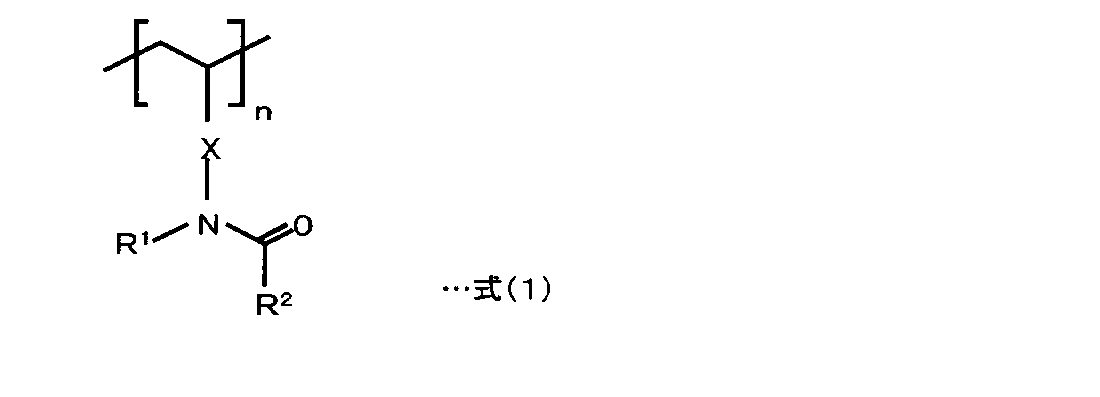
式(1)中、Xは置換基を有していてもよい炭素数1又は2のアルキレン基或いは直接結合を表す。R1およびR2はそれぞれ独立に水素原子又は置換基を有していてもよい炭素数1~3のアルキル基を表す。R1とR2は互いに結合して置換基を有していてもよい5~7員環のラクタム環を形成していてもよい。nは10以上の整数を表す。
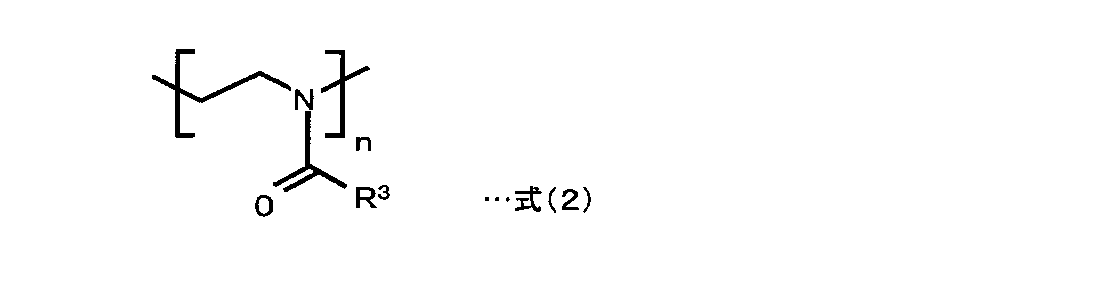
式(2)中、R3は置換基を有していてもよい炭素数1~3のアルキル基を表す。nは10以上の整数を表す。
[7] [6]において、前記CO-N構造を有する化合物が、ポリビニルピロリドンおよび/又はポリエチルオキサゾリンを含むことを特徴とする凝集剤。
[8] [1]ないし[7]のいずれかにおいて、前記ノニオン性高分子化合物の分子量が4,000~1,000,000であることを特徴とする凝集剤。
[9] [1]ないし[8]のいずれかにおいて、更に第四級アンモニウム塩基を含むカチオン性高分子化合物および/又は無機凝集剤を含むことを特徴とする凝集剤。
[10] [9]において、前記第四級アンモニウム塩基を含むカチオン性高分子化合物がポリジアリルジメチルアンモニウム塩であることを特徴とする凝集剤。
[11] [9]又は[10]において、前記無機凝集剤が鉄系無機凝集剤であることを特徴とする凝集剤。
[12] [1]ないし[11]のいずれかにおいて、有機物および濁質を含んだ被処理水の水処理凝集剤であることを特徴とする凝集剤。
[13] 有機物および濁質を含んだ被処理水の水処理方法であって、該被処理水に[1]~[12]のいずれかに記載の凝集剤を添加して凝集処理した後、固液分離することを特徴とする水処理方法。
[14] [13]において、前記被処理水に、前記弱カチオン性のアミノ基を有する高分子化合物を添加した後前記ノニオン性高分子化合物を添加するか、前記ノニオン性高分子化合物を添加した後前記弱カチオン性のアミノ基を有する高分子化合物を添加するか、或いは前記第一アミノ基を有する高分子化合物とノニオン性高分子化合物とを同時に添加して凝集処理することを特徴とする水処理方法。
[15] [13]又は[14]において、前記凝集剤が第四級アンモニウム塩基を含むカチオン性高分子化合物を含み、前記被処理水に該第四級アンモニウム塩基を含むカチオン性高分子化合物を添加して凝集処理した後、前記弱カチオン性のアミノ基を有する高分子化合物とノニオン性高分子化合物を添加して凝集処理することを特徴とする水処理方法。
[16] [13]ないし[15]のいずれかにおいて、前記凝集剤が無機凝集剤を含み、前記被処理水に前記弱カチオン性のアミノ基を有する高分子化合物とノニオン性高分子化合物を添加して凝集処理した後、該無機凝集剤を添加して凝集処理するか、或いは、前記被処理水に前記弱カチオン性のアミノ基を有する高分子化合物、ノニオン性高分子化合物および無機凝集剤を同時に添加して凝集処理することを特徴とする水処理方法。
[17] [13]ないし[16]のいずれかにおいて、前記固液分離を、沈殿処理、加圧浮上処理、濾過、もしくは膜分離により行うことを特徴とする水処理方法。
上記の第1発明の有機物および濁質を含む被処理水の凝集処理に有効な凝集剤として、ポリエチレンイミン(PEI)等の弱カチオン性のアミノ基を有する高分子化合物と、ポリビニルピロリドン(PVP)等のノニオン性高分子化合物とを含む凝集剤がある。ポリエチレンイミン(PEI)とポリビニルピロリドン(PVP)とを一剤化処理しようとすると、ゲル化が生じる場合がある。
PEIとPVPを含む一剤化薬品のゲル化が生じると、薬注ポンプによる送液が不可能になったり、一部の有効成分が所定の濃度で添加されなかったりする。
第2発明は、PEIとPVPの一剤化薬品をゲル化させずに調製する方法と、この一剤化薬品を用いた水処理方法を提供することを目的とする。
本発明者は、PEIとPVPを含む一剤化薬品の調製において、PEIとPVPの分子量の関係と、PEIとPVPの濃度の関係から、両者を混合した際にゲル化しない分子量と濃度の関係であるPEIとPVPを用いることで、上記課題を解決することができることを見出した。
第2発明は以下を要旨とする。
[18] ポリエチレンイミン(PEI)とポリビニルピロリドン(PVP)を一剤で含む溶液状水処理薬品を調製する方法であって、PEIとPVPの分子量の関係と、PEIとPVPの液中濃度の関係から、両者を混合した際にゲル化しない分子量と濃度の関係でPEIとPVPを用いることを特徴とする水処理薬品の調製方法。
[19] [18]において、同量のPEIとPVPを混合し、ゲル化することを確認した分子量の組み合わせを除くことを特徴とする水処理薬品の調製方法。
[20] [18]において、同量のPEIとPVPを混合し、ゲル化することを確認した分子量の組み合わせにおいて、PEIとPVPの各濃度を変化させた際に、ゲル化する濃度比の範囲を除くことを特徴とする水処理薬品の調製方法。
[21] 被処理水に、[18]ないし[20]のいずれかに記載の水処理薬品の調製方法により調製した水処理薬品を添加することを特徴とする水処理方法。
[22] [21]において、前記被処理水に前記水処理薬品と無機凝集剤とを添加して凝集処理する方法であって、該被処理水に前記水処理薬品と該無機凝集剤とを同時に添加して凝集処理するか、或いは、該被処理水に該水処理薬品を添加して凝集処理した後該無機凝集剤を添加して凝集処理することを特徴とする水処理方法。
[23] [21]又は[22]において、前記被処理水に第四級アンモニウム塩基を含むカチオン性高分子化合物を添加して凝集処理した後、前記水処理薬品を添加して凝集処理することを特徴とする水処理方法。
[24] [21]ないし[23]のいずれかにおいて、前記被処理水が有機物および濁質を含んでおり、該被処理水に前記水処理薬品を添加して凝集処理した後、固液分離することを特徴とする水処理方法。
[25] [24]において、前記固液分離を、沈殿処理、加圧浮上処理、濾過、もしくは膜分離により行うことを特徴とする水処理方法。
第1発明は、各種産業排水や生活排水又は該排水の生物処理水、あるいは表層水、地下水などの被処理水に含まれる有機物および濁質を、効率的に凝集処理するための凝集剤と、この凝集剤を用いた水処理方法に関する。第1発明の凝集剤および水処理方法は、特に高pH、高アルカリ度で、従来の凝集剤では凝集効果の低下が起こりやすい被処理水に対する凝集処理に有効な方法である。
第1発明によれば、特定の弱カチオン性のアミノ基を有する高分子化合物とノニオン性高分子化合物を用いることで、被処理水中に含まれる有機物および濁質を、無機凝集剤による凝集フロックに取り込まれやすくするとともに、無機凝集剤を加えることで生じた微細なコロイドを除去することで、凝集処理水の水質を向上させることができる。
第1発明によれば、高pH、高アルカリ度の被処理水に対し、pH調整や大量の無機凝集剤の添加を行うことなく、高い凝集効果を発揮できる。このため、薬剤コストの低減、汚泥発生量の低減、更には後段処理の負荷の軽減、後段の膜分離処理の膜汚染の防止が可能となり、安定かつ効率的な水処理を行うことが可能となる。
第2発明によれば、弱カチオン性のアミノ基を有する高分子化合物であるポリエチレンイミン(PEI)と、ノニオン性高分子化合物であるポリビニルピロリドン(PVP)の一剤化薬品をゲル化させずに調製することができる。PEIとPVPとの一剤化薬品は、水処理、特に有機物および濁質を含む被処理水の凝集処理に有効である。第2発明によれば、2種の薬剤を一剤化薬品として添加することができるため、薬注作業、薬注設備を削減して低コストで効率的な水処理を行える。
以下に本発明の実施の形態を詳細に説明する。
〔第1発明の実施の形態〕
第1発明は、有機物および濁質を含んだ被処理水の凝集処理において、被処理水に弱カチオン性のアミノ基を有する高分子化合物とノニオン性高分子化合物を含む凝集剤(以下、「アミン・ノニオン凝集剤」と称す場合がある。)を添加することにより、第1発明の課題を解決するものである。
第1発明は、有機物および濁質を含んだ被処理水の凝集処理において、被処理水に弱カチオン性のアミノ基を有する高分子化合物とノニオン性高分子化合物を含む凝集剤(以下、「アミン・ノニオン凝集剤」と称す場合がある。)を添加することにより、第1発明の課題を解決するものである。
第1発明における弱カチオン性のアミノ基とは、第一アミノ基、第二アミノ基、第三アミノ基を指す。アミン・ノニオン凝集剤の添加後、あるいは同時に、無機凝集剤をさらに添加して凝集処理してもよい。アミン・ノニオン凝集剤を添加する前あるいは同時に第四級アンモニウム塩基を含むカチオン性高分子化合物を添加して凝集処理してもよい。
弱カチオン性のアミノ基を有する高分子化合物とノニオン性高分子化合物はどちらを先に添加しても、これらを同時に添加しても構わない。弱カチオン性のアミノ基を有する高分子化合物とノニオン性高分子化合物とを別々に添加する場合、これらは別の薬剤として供給される。弱カチオン性のアミノ基を有する高分子化合物とノニオン性高分子化合物とを同時に添加する場合、弱カチオン性のアミノ基を有する高分子化合物とノニオン性高分子化合物とは一剤化して供給されることが好ましい。特にこれらを混合した水溶液として被処理水に添加することが、凝集設備において薬注設備を削減できるため望ましい。
[作用機構]
第1発明による凝集処理の作用機構の詳細は明らかではないが、以下の通りと考えられる。
第1発明による凝集処理の作用機構の詳細は明らかではないが、以下の通りと考えられる。
以下に、第1発明の凝集剤による作用機構を説明する模式図である図1を参照して、第1発明の凝集剤による凝集処理機構を説明する。
1)被処理水中に含まれる有機物(A)、例えば、生物代謝物に含まれる多糖類などに対し、ノニオン性高分子化合物(B)が水素結合を介して結合し、結合物(C)が生じる。
2)弱カチオン性のアミノ基を有する高分子化合物(D)と結合物(C)が水素結合を介してさらに結合し、結合物(E)を形成する。弱カチオン性のアミノ基を有する高分子化合物(D)は、被処理水中に含まれる濁質(F)とも静電的相互作用により結合する。
弱カチオン性のアミノ基を有する高分子化合物(D)の濁質(F)への結合は、pH9以下の条件で、弱カチオン性のアミノ基を有する高分子化合物(D)の弱カチオン性のアミノ基が電荷を有し、濁質(F)に対して十分な静電相互作用を示す場合に起こる。そのため、高pHの場合には、以下の3)の通り、第四級アンモニウム塩基を含むカチオン性高分子化合物を添加して、第四級アンモニウム塩基を含むカチオン性高分子化合物(G)による凝集効果を利用することが好ましい。
3)第四級アンモニウム塩基を含むカチオン性高分子化合物(G)は、被処理水中に含まれる濁質(F)に静電的相互作用により結合し、結合物(H)を形成する。
4)結合物(E)と結合物(H)はそれぞれ核となり、鉄系無機凝集剤を加えた際に鉄フロック(I)に取り込まれやすくなる。鉄系無機凝集剤を加えたことにより、鉄フロックが生じるとともに微細な鉄コロイド(J)も生じる。
5)微細な鉄コロイド(J)は後段の沈殿処理、加圧浮上処理および濾過処理で分離しにくく、後段の膜処理における膜の目詰まりを引き起こす。しかし、弱カチオン性のアミノ基を有する高分子化合物(D)が鉄フロック(I)と鉄コロイド(J)を架橋することで、粗大なフロック(K)を形成するとともに、微細な鉄コロイドを除去することができる。
[被処理水]
凝集処理対象となる被処理水は、有機物および濁質を含む各種産業排水や生活排水又は該排水の生物処理水、あるいは表層水、地下水などである。被処理水としては、中でも生物処理水が望ましい。特に、水質としてpH6~11、アルカリ度100mg/L as CaCO3以上、例えば100~5,000mg/L as CaCO3の被処理水であると、第1発明の凝集剤による凝集効果がより一層顕著に得ることができる。
凝集処理対象となる被処理水は、有機物および濁質を含む各種産業排水や生活排水又は該排水の生物処理水、あるいは表層水、地下水などである。被処理水としては、中でも生物処理水が望ましい。特に、水質としてpH6~11、アルカリ度100mg/L as CaCO3以上、例えば100~5,000mg/L as CaCO3の被処理水であると、第1発明の凝集剤による凝集効果がより一層顕著に得ることができる。
[弱カチオン性のアミノ基を有する高分子化合物]
弱カチオン性のアミノ基を有する高分子化合物としては、第一アミノ基(一級アミノ基)から第三アミノ基(三級アミノ基)のいずれかのアミノ基を有する高分子化合物であればよい。具体的には、第一アミノ基を有する、分岐型ポリエチレンイミン、直鎖型ポリエチレンイミン、ポリビニルアミン、ポリアリルアミン、ポリビニルアミジン、ポリリジン、キトサン、ポリアミドアミンデンドリマー、第二及び第三アミノ基を有するジシアンジアミド・ホルマリン縮合物などが挙げられる。これらの中でも、第一アミノ基を有する高分子化合物の重量あたりアミノ基含有率の高さから、ポリエチレンイミン、ポリビニルアミンが好ましい。
弱カチオン性のアミノ基を有する高分子化合物としては、第一アミノ基(一級アミノ基)から第三アミノ基(三級アミノ基)のいずれかのアミノ基を有する高分子化合物であればよい。具体的には、第一アミノ基を有する、分岐型ポリエチレンイミン、直鎖型ポリエチレンイミン、ポリビニルアミン、ポリアリルアミン、ポリビニルアミジン、ポリリジン、キトサン、ポリアミドアミンデンドリマー、第二及び第三アミノ基を有するジシアンジアミド・ホルマリン縮合物などが挙げられる。これらの中でも、第一アミノ基を有する高分子化合物の重量あたりアミノ基含有率の高さから、ポリエチレンイミン、ポリビニルアミンが好ましい。
弱カチオン性のアミノ基を有する高分子化合物の分子量は200~10,000,000、特に1,000~4,000,000であることが好ましい。この範囲よりも分子量が小さいものでは凝集効果が劣る傾向にあり、大きいものでは残存時に後段の膜を閉塞させる可能性がある。弱カチオン性のアミノ基を有する高分子化合物の分子量は粘度法あるいは沸点上昇法により求めた数平均分子量の値である。
弱カチオン性のアミノ基を有する高分子化合物は、1種を単独で用いてもよく、2種以上を混合して用いてもよい。
被処理水への弱カチオン性のアミノ基を有する高分子化合物の添加量は、被処理水の水質や、用いる弱カチオン性のアミノ基を有する高分子化合物の種類、アミン・ノニオン凝集剤以外の凝集薬剤の併用の有無、要求される処理水水質等によっても異なる。被処理水への弱カチオン性のアミノ基を有する高分子化合物の添加量は、有効成分量として0.5~10mg/Lの範囲とすることが好ましい。
[ノニオン性高分子化合物]
ノニオン性高分子化合物は、後掲の比較例1-3に示されるように、第1発明による効果が得られないアクリルアミド系重合体を除き、アルキレンオキサイド基を有する化合物、アルコール性水酸基を有する化合物、カルボニル基を有し該カルボニル基の炭素原子が窒素原子と結合した構造(以下「CO-N構造」と称す場合がある。)を有する化合物のいずれかである。
ノニオン性高分子化合物は、後掲の比較例1-3に示されるように、第1発明による効果が得られないアクリルアミド系重合体を除き、アルキレンオキサイド基を有する化合物、アルコール性水酸基を有する化合物、カルボニル基を有し該カルボニル基の炭素原子が窒素原子と結合した構造(以下「CO-N構造」と称す場合がある。)を有する化合物のいずれかである。
アルキレンオキサイド基を有する化合物としては、例えば、ポリエチレングリコール、ポリプロピレングリコール、ポリオキシエチレン(POE)-ポリオキシプロピレン(POP)ブロック共重合体、ポリオキシエチレンアルキルエーテル、ポリオキシエチレンアリルエーテル、ポリオキシエチレンフェニルエーテル、ソルビタン脂肪酸エステル、ポリオキシエチレンソルビタン脂肪酸エステル、ポリオキシエチレン脂肪酸エステルが挙げられる。これらのうち、アルキレンオキサイド基を有する化合物の重量あたりのアルキレンオキサイド基含有率の高さから、ポリエチレングリコール、ポリオキシエチレン(POE)-ポリオキシプロピレン(POP)ブロック共重合体等のエチレングリコールとプロピレングリコールとの共重合体が好ましい。
アルコール性水酸基を有する化合物としては、例えば、ポリビニルアルコールが挙げられる。
CO-N構造を有する化合物のCO-N構造としては、下記式(1)又は(2)で表される構造が好ましい。このようなCO-N構造を有する化合物としては、例えばポリビニルピロリドン、ポリビニルピペリドン、ポリビニルカプロラクタム、ポリ(2-エチル-2-オキサゾリン)、ポリ(2-メチル-2-オキサゾリン)、ポリビニルアセトアミド、ポリビニルホルムアミドが挙げられる。好ましくはポリビニルピロリドン、ポリエチルオキサゾリン(ポリ(2-メチル-2-オキサゾリン))である。

式(1)中、Xは置換基を有していてもよい炭素数1又は2のアルキレン基或いは直接結合を表し、R1およびR2はそれぞれ独立に水素原子又は置換基を有していてもよい炭素数1~3のアルキル基を表す。R1とR2は互いに結合して置換基を有していてもよい5~7員環のラクタム環を形成していてもよい。nは10以上の整数を表す。

式(2)中、R3は置換基を有していてもよい炭素数1~3のアルキル基を表す。nは10以上の整数を表す。
ノニオン性高分子化合物の分子量は、4,000~1,000,000、特に6,000~100,000であることが好ましい。この範囲よりも分子量が小さいものでは凝集効果が劣る傾向にあり、大きいものでは残存時に後段の膜を閉塞させる可能性がある。ノニオン性高分子化合物の分子量は粘度法により測定した数平均分子量の値である。
ノニオン性高分子化合物は、1種を単独で用いてもよく、2種以上を混合して用いてもよい。アルキレンオキサイド基を有する化合物の1種のみを用いてもよく、アルコール性水酸基を有する化合物の1種のみを用いてもよく、CO-N構造を有する化合物の1種のみを用いてもよい。アルキレンオキサイド基を有する化合物の1種又は2種以上とアルコール性水酸基を有する化合物の1種又は2種以上を併用してもよい。アルキレンオキサイド基を有する化合物の1種又は2種以上とCO-N構造を有する化合物の1種又は2種以上とを併用してもよい。アルコール性水酸基を有する化合物の1種又は2種以上とCO-N構造を有する化合物の1種又は2種以上を併用してもよい。アルキレンオキサイド基を有する化合物の1種又は2種以上とアルコール性水酸基を有する化合物の1種又は2種以上とCO-N構造を有する化合物の1種又は2種以上を併用してもよい。
被処理水へのノニオン性高分子化合物の添加量は、被処理水の水質や、用いるノニオン性高分子化合物の種類、アミン・ノニオン凝集剤以外の凝集薬剤の併用の有無、要求される処理水水質等によっても異なる。被処理水へのノニオン性高分子化合物の添加量は、有効成分量として0.1~20mg/Lの範囲とすることが好ましい。
ノニオン性高分子化合物は、弱カチオン性のアミノ基を有する高分子化合物と同時に被処理水へ添加してもよく、別々に添加してもよい。別々に添加する場合、ノニオン性高分子化合物を添加した後弱カチオン性のアミノ基を有する高分子化合物を添加してもよく、弱カチオン性のアミノ基を有する高分子化合物を添加した後ノニオン性高分子化合物を添加してもよい。弱カチオン性のアミノ基を有する高分子化合物とノニオン性高分子化合物とを同時に添加する場合は、一剤化したアミン・ノニオン凝集剤として用いることが好ましい。
弱カチオン性のアミノ基を有する高分子化合物とノニオン性高分子化合物との作用による凝集性の向上効果を相乗的な効果として得る上で、弱カチオン性のアミノ基を有する高分子化合物とノニオン性高分子化合物とは、重量比で弱カチオン性のアミノ基を有する高分子化合物:ノニオン性高分子化合物=1:4~0.05、特に1:2~0.1の範囲で用いることが好ましい。アミン・ノニオン凝集剤を一剤化して用いる場合は、この範囲で弱カチオン性のアミノ基を有する高分子化合物とノニオン性高分子化合物を含むことが好ましい。
[無機凝集剤]
アミン・ノニオン凝集剤と共に無機凝集剤として、pH4~14という高pH領域を含む幅広いpH範囲でフロックを形成することができる鉄系又はアルミ系の無機凝集剤を併用することが好ましい。鉄系無機凝集剤としては、塩化第二鉄、硫酸第二鉄、ポリ塩化第二鉄、ポリ硫酸第二鉄などが挙げられる。アルミ系無機凝集剤としては、ポリ塩化アルミニウムや硫酸アルミニウムが挙げられる。凝集効果とコストの面で鉄系無機凝集剤である塩化第二鉄が好ましい。これらの無機凝集剤は、1種を単独で用いてもよく、2種以上を混合して用いてもよい。
アミン・ノニオン凝集剤と共に無機凝集剤として、pH4~14という高pH領域を含む幅広いpH範囲でフロックを形成することができる鉄系又はアルミ系の無機凝集剤を併用することが好ましい。鉄系無機凝集剤としては、塩化第二鉄、硫酸第二鉄、ポリ塩化第二鉄、ポリ硫酸第二鉄などが挙げられる。アルミ系無機凝集剤としては、ポリ塩化アルミニウムや硫酸アルミニウムが挙げられる。凝集効果とコストの面で鉄系無機凝集剤である塩化第二鉄が好ましい。これらの無機凝集剤は、1種を単独で用いてもよく、2種以上を混合して用いてもよい。
被処理水への無機凝集剤の添加量は、被処理水の水質や、用いる無機凝集剤の種類、要求される処理水水質等によっても異なる。被処理水への無機凝集剤の添加量は、有効成分量として2~100mg/Lの範囲とすることが好ましい。
無機凝集剤は、アミン・ノニオン凝集剤と同時に被処理水へ添加してもよく、別々に添加してもよい。アミン・ノニオン凝集剤と無機凝集剤とを同時に添加する場合は、一剤化して用いてもよい。
[第四級アンモニウム塩基を含むカチオン性高分子化合物]
アミン・ノニオン凝集剤を被処理水に添加する前に、第四級アンモニウム塩基を含むカチオン性高分子化合物を添加することが好ましい。第四級アンモニウム塩基を含むカチオン性高分子化合物は、強カチオン性基を有しており、pH9以上というような高pHの被処理水に対しても荷電中和能力を維持できるため、特に効果的である。アミン・ノニオン凝集剤の凝集効果が低下するため、アミン・ノニオン凝集剤の添加後あるいは同時に第四級アンモニウム塩基を含むカチオン性高分子化合物を添加すると、アミン・ノニオン凝集剤の凝集効果が低下するため、好ましくない。被処理水に第四級アンモニウム塩基を含むカチオン性高分子化合物を添加した後、ラインミキサーあるいは撹拌翼による撹拌などで均一に混合し30秒以上の時間を空けてから、アミン・ノニオン凝集剤を添加することが望ましい。
アミン・ノニオン凝集剤を被処理水に添加する前に、第四級アンモニウム塩基を含むカチオン性高分子化合物を添加することが好ましい。第四級アンモニウム塩基を含むカチオン性高分子化合物は、強カチオン性基を有しており、pH9以上というような高pHの被処理水に対しても荷電中和能力を維持できるため、特に効果的である。アミン・ノニオン凝集剤の凝集効果が低下するため、アミン・ノニオン凝集剤の添加後あるいは同時に第四級アンモニウム塩基を含むカチオン性高分子化合物を添加すると、アミン・ノニオン凝集剤の凝集効果が低下するため、好ましくない。被処理水に第四級アンモニウム塩基を含むカチオン性高分子化合物を添加した後、ラインミキサーあるいは撹拌翼による撹拌などで均一に混合し30秒以上の時間を空けてから、アミン・ノニオン凝集剤を添加することが望ましい。
第四級アンモニウム塩基を含むカチオン性高分子化合物としては、ポリ(ジアリルジメチルアンモニウムクロリド)等のポリジアリルジメチルアンモニウム塩やポリ(メタクリル酸2-ジメチルアミノエチル)などが挙げられる。薬剤コスト面から、ポリジアリルジメチルアンモニウム塩が好ましい。
第四級アンモニウム塩基を含むカチオン性高分子化合物の分子量は10,000~10,000,000、特に100,000~10,000,000であることが好ましい。この範囲よりも分子量が小さいものでは凝集効果が劣る傾向にあり、大きいものでは残存時に後段の膜を閉塞させる可能性がある。第四級アンモニウム塩基を含むカチオン性高分子化合物の分子量は粘度法により測定した数平均分子量の値である。
第四級アンモニウム塩基を含むカチオン性高分子化合物は、1種を単独で用いてもよく、2種以上を混合して用いてもよい。
被処理水への第四級アンモニウム塩基を含むカチオン性高分子化合物の添加量は、被処理水の水質や、用いる第四級アンモニウム塩基を含むカチオン性高分子化合物の種類、要求される処理水水質等によっても異なる。被処理水への第四級アンモニウム塩基を含むカチオン性高分子化合物の添加量は、有効成分量として0.1~10mg/Lの範囲とすることが好ましい。
[水処理方法]
第1発明の水処理方法は、上述のような第1発明の凝集剤を被処理水に添加して凝集処理した後、固液分離するものである。
第1発明の水処理方法は、上述のような第1発明の凝集剤を被処理水に添加して凝集処理した後、固液分離するものである。
凝集処理水の固液分離方法としては特に制限はなく、沈殿処理、加圧浮上処理、濾過、膜分離のいずれの方法も採用することができる。
第1発明の凝集剤を用いることで、被処理水中の有機物や濁質を高度に凝集処理することができるため、固液分離として膜分離を行う場合や、更に固液分離水を逆浸透膜分離する場合であっても、膜汚染を防止して長期に亘り安定処理が可能となる。
〔第2発明の実施の形態〕
[水処理薬品の調製方法]
第2発明の水処理薬品の調製方法は、ポリエチレンイミン(PEI)とポリビニルピロリドン(PVP)を一剤で含む溶液状水処理薬品を調製する方法である。第2発明では、PEIとPVPの分子量の関係と、PEIとPVPの液中濃度の関係から、両者を混合した際にゲル化しない分子量と濃度の関係でPEIとPVPを用いる。
[水処理薬品の調製方法]
第2発明の水処理薬品の調製方法は、ポリエチレンイミン(PEI)とポリビニルピロリドン(PVP)を一剤で含む溶液状水処理薬品を調製する方法である。第2発明では、PEIとPVPの分子量の関係と、PEIとPVPの液中濃度の関係から、両者を混合した際にゲル化しない分子量と濃度の関係でPEIとPVPを用いる。
<作用機構>
第2発明による作用機構は以下の通りである。
第2発明による作用機構は以下の通りである。
ポリエチレンイミン(PEI)とポリビニルピロリドン(PVP)は水素結合を介して相互作用し、特定の分子量の組み合わせかつ特定の濃度の配合でPEIとPVPを含む水溶液はゲル化する。該水溶液のゲル化が生じない分子量の組み合わせと濃度の配合を、例えば試験管倒置法により目視で確認することで、少量の薬液を用いて、PEIとPVPを含む一剤化薬品のゲル化が生じるか否かを容易に判別することができる。
従って、ゲル化の有無を確認し、このような範囲を除いて一剤化薬品を調製すればよい。
<ゲル化の判定>
PEIとPVPを混合した際にゲル化しない分子量と濃度の関係を判別するには、試験管倒置法を用いることが好ましい。試験管倒置法では、特定の分子量のPEIとPVPを所定の濃度になるよう試験管内に入れ、撹拌混合することで均一な溶液とし、一定時間、一定温度で静置したのち、試験管を倒置してゲル化の有無を確認する。
PEIとPVPを混合した際にゲル化しない分子量と濃度の関係を判別するには、試験管倒置法を用いることが好ましい。試験管倒置法では、特定の分子量のPEIとPVPを所定の濃度になるよう試験管内に入れ、撹拌混合することで均一な溶液とし、一定時間、一定温度で静置したのち、試験管を倒置してゲル化の有無を確認する。
PEIとPVPのそれぞれの分子量と濃度に応じてゲル化するまでの時間が変化するため、静置時間は10分~24時間の範囲で適宜設定することが望ましい。静置時の温度は、調製した一剤化薬品を使用する環境に合わせれば良く、0~50℃の範囲が望ましい。
判定基準は、次の通りである。
試験管として用いた容器を倒置した際に、容器の底面から薬液が流れ落ちない状態を「ゲル化」と判定する。粘性が増大し時間をかけて全ての薬液が流れ落ちるものを「ゾル化」と判定する。全ての薬液がただちに流れ落ちるものを「液体」とし、この「液体」を「ゲル化しない」と判定する。
試験管として用いた容器を倒置した際に、容器の底面から薬液が流れ落ちない状態を「ゲル化」と判定する。粘性が増大し時間をかけて全ての薬液が流れ落ちるものを「ゾル化」と判定する。全ての薬液がただちに流れ落ちるものを「液体」とし、この「液体」を「ゲル化しない」と判定する。
ゲル化が生じた薬液は、ダイアフラムポンプなどの一般的な薬注ポンプでは送液が不可能であるため一剤化薬品として不適である。ゾル化が生じた薬液も、粘度が高い上に、薬液温度の変化(特に低温状態)により容易にゲル状態へ転移するため、薬注ポンプによる送液は困難となり、一剤化薬品として不適である。
ゲル化の判別法としては試験管倒置法の他に落球法などが挙げられる。特別な器具を必要とせず容易に実施できる点で、試験管倒置法が望ましい。
試験管として用いる容器は、薬液を密封できる透明な容器であれば特に制限するものではない。容積5~100mLの有底円筒型のガラス製又はプラスチック製の容器(蓋付き)を使用することが望ましい。
<具体的な操作方法>
第2発明の水処理薬品の調製方法は、具体的には次のような方法で実施する。
第2発明の水処理薬品の調製方法は、具体的には次のような方法で実施する。
≪操作方法I≫
それぞれ分子量の異なるPEI水溶液とPVP水溶液を複数種類準備し、PEI濃度とPVP濃度が等しくなるようにPEI水溶液とPVP水溶液とを混合する。混合液のゲル化の有無を試験管倒置法で判定する。
それぞれ分子量の異なるPEI水溶液とPVP水溶液を複数種類準備し、PEI濃度とPVP濃度が等しくなるようにPEI水溶液とPVP水溶液とを混合する。混合液のゲル化の有無を試験管倒置法で判定する。
ゲル化及びゾル化が起こる組み合わせを除き、ゲル化が起こらない、液体となる組み合わせで一剤化薬品を調製する。
≪操作方法II≫
操作方法Iでゲル化を起こす組み合わせにおいて、PEI水溶液とPVP水溶液の混合割合を種々変えて混合液を調製する。各混合液についてゲル化の有無を試験管倒置法で判定する。
操作方法Iでゲル化を起こす組み合わせにおいて、PEI水溶液とPVP水溶液の混合割合を種々変えて混合液を調製する。各混合液についてゲル化の有無を試験管倒置法で判定する。
ゲル化及びゾル化が起こる組み合わせを除き、ゲル化が起こらない、液体となる混合割合で一剤化薬品を調製する。
≪操作方法III≫
用いるPEIとPVPとが予め決められている場合(PEIの分子量とPVPの分子量が固定されている場合)は、これらを混合割合を変えて、或いは、液中濃度を変えて混合液を調製する。各混合液についてゲル化の有無を試験管倒置法で判定する。
用いるPEIとPVPとが予め決められている場合(PEIの分子量とPVPの分子量が固定されている場合)は、これらを混合割合を変えて、或いは、液中濃度を変えて混合液を調製する。各混合液についてゲル化の有無を試験管倒置法で判定する。
後掲の図3,4のようにPEIとPVPとの混合割合とゲル・ゾル-液体の相図を作製し、ゲル化が起こらない、液体となる領域を求め、この領域の範囲内で一剤化薬品を調製する。
≪操作方法IV≫
PEIとPVPとの混合割合が決められている場合、分子量の異なるPEIとPVPを複数種準備し、異なる組み合わせで混合液を調製する。各混合液についてゲル化の有無を試験管倒置法で判定する。
PEIとPVPとの混合割合が決められている場合、分子量の異なるPEIとPVPを複数種準備し、異なる組み合わせで混合液を調製する。各混合液についてゲル化の有無を試験管倒置法で判定する。
後掲の図1のように、PEIとPVPの分子量とゲル・ゾル-液体の相図を作製し、ゲル化が起こらない、液体となる領域を求め、この領域の範囲内で一剤化薬品を調製する。
<好適なPEIおよびPVPと好適な混合割合>
凝集剤としての使用において、PEIの分子量は200~10,000,000、特に1,000~4,000,000が好ましい。この範囲よりも分子量が小さいと凝集効果が劣る傾向にある。この範囲よりも分子量が大きいと残存時に後段の膜を閉塞させる可能性がある。
凝集剤としての使用において、PEIの分子量は200~10,000,000、特に1,000~4,000,000が好ましい。この範囲よりも分子量が小さいと凝集効果が劣る傾向にある。この範囲よりも分子量が大きいと残存時に後段の膜を閉塞させる可能性がある。
PVPの分子量は、4,000~1,000,000、特に6,000~150,000が好ましい。この範囲よりも分子量が小さいと凝集効果が劣る傾向にある。この範囲よりも分子量が大きいと残存時に後段の膜を閉塞させる可能性がある。
PEIおよびPVPの分子量は粘度法により測定した数平均分子量の値である。
PEIおよびPVPの分子量は粘度法により測定した数平均分子量の値である。
凝集剤としての使用において、PEIとPVPとの併用による凝集性の向上効果を相乗的な効果として得る上で、PEIとPVPとは、重量比でPEI:PVP=1:4~0.05、特に1:2~0.1の範囲で用いることが好ましい。
凝集剤としての使用において、得られる一剤化薬品中のPEI濃度およびPVP濃度が過度に低いと水処理時に大量の薬液を添加する必要が生じ好ましくない。得られる一剤化薬品中のPEI濃度およびPVP濃度を高くすると、ゲル化を生じ易くなり、分子量及び混合割合の自由度が低下する場合がある。
用いるPEIとPVPの組み合わせによっても異なるが、調製される一剤化薬品のPEIとPVPとの合計濃度は5~40重量%の範囲が好ましい。
第2発明の水処理薬品の調製方法においては、好ましくは、上記の分子量範囲のPEIとPVPを、上記の重量比の範囲および上記の合計濃度の範囲で用いて、ゲル化しない分子量と濃度の組み合わせを採用することが好ましい。
<具体的な組み合わせ>
第2発明の水処理薬品の調製方法によれば、様々な分子量のPEIとPVPを用いて、様々な混合割合の一剤化薬品を調製することができる。例えば、以下のような組み合わせにおいて、ゲル化しないことを確認して一剤化薬品を調製することが好ましい。
第2発明の水処理薬品の調製方法によれば、様々な分子量のPEIとPVPを用いて、様々な混合割合の一剤化薬品を調製することができる。例えば、以下のような組み合わせにおいて、ゲル化しないことを確認して一剤化薬品を調製することが好ましい。
組み合わせ例1:分子量200~10,000のPEIと分子量4,000~100,000のPVPとをPEI:PVP=1:4~0.1(重量比)で混合し、PEIとPVPとの合計濃度を10~50重量%とする。
組み合わせ例2:分子量10,000~200,000のPEIと分子量4,000~200,000のPVPとをPEI:PVP=1:4~0.5(重量比)で混合し、PEIとPVPとの合計濃度を4~40重量%とする。
組み合わせ例3:分子量200,000~10,000,000のPEIと分子量4,000~1,000,000のPVPとをPEI:PVP=1:4~0.1(重量比)で混合し、PEIとPVPとの合計濃度を4~30重量%とする。
<用途>
第2発明により調製される一剤化薬品は、第2発明の水処理方法における凝集剤として有用であり、PEIとPVPとを一剤化した一剤化薬品として薬注操作を効率化することができる。
第2発明により調製される一剤化薬品は、第2発明の水処理方法における凝集剤として有用であり、PEIとPVPとを一剤化した一剤化薬品として薬注操作を効率化することができる。
[水処理方法]
第2発明の水処理方法は、第2発明の水処理薬品の調製方法により調製された水処理薬品を用いて水処理を行うものである。特にこの水処理薬品(以下、「PEI/PVP一剤化薬品」又は「第2発明のPEI/PVP一剤化薬品」と称す場合がある。)を凝集剤として用いて、有機物および濁質を含んだ被処理水を凝集処理する場合に有効である。
第2発明の水処理方法は、第2発明の水処理薬品の調製方法により調製された水処理薬品を用いて水処理を行うものである。特にこの水処理薬品(以下、「PEI/PVP一剤化薬品」又は「第2発明のPEI/PVP一剤化薬品」と称す場合がある。)を凝集剤として用いて、有機物および濁質を含んだ被処理水を凝集処理する場合に有効である。
第2発明の水処理方法においては、被処理水にPEI/PVP一剤化薬品を添加した後、あるいは同時に、無機凝集剤をさらに添加して凝集処理してもよい。被処理水にPEI/PVP一剤化薬品を添加する前に第四級アンモニウム塩基を含むカチオン性高分子化合物を添加して凝集処理してもよい。
<作用機構>
第2発明のPEI/PVP一剤化薬品による凝集処理の作用機構は、第1発明におけると同様である。第2発明のPEI/PVP一剤化薬品による凝集処理の作用機構は、第1発明の作用機構の説明におけるノニオン性高分子化合物(B)を「PVP」に、弱カチオン性のアミノ基を有する高分子化合物(D)を「PEI」に置き換えて説明される。
第2発明のPEI/PVP一剤化薬品による凝集処理の作用機構は、第1発明におけると同様である。第2発明のPEI/PVP一剤化薬品による凝集処理の作用機構は、第1発明の作用機構の説明におけるノニオン性高分子化合物(B)を「PVP」に、弱カチオン性のアミノ基を有する高分子化合物(D)を「PEI」に置き換えて説明される。
<被処理水>
第2発明の水処理方法で凝集処理対象となる被処理水は、前述の第1発明において、凝集処理対象となる被処理水と同様であり、好ましいものも同様である。
第2発明の水処理方法で凝集処理対象となる被処理水は、前述の第1発明において、凝集処理対象となる被処理水と同様であり、好ましいものも同様である。
<PEI/PVP一剤化薬品の添加量>
PEI/PVP一剤化薬品の添加は、被処理水の水質や、PEI/PVP一剤化薬品以外の凝集薬剤の併用の有無、要求される処理水水質等によっても異なるが以下の通りとすることが好ましい。
PEIの有効成分量として0.5~10mg/Lの範囲、PVPの有効成分量として0.1~20mg/Lの範囲となるように、好ましい混合重量比PEI:PVP=1:4~0.05、特に1:2~0.1の範囲で調製されたPEI/PVP一剤化薬品を添加することが好ましい。
PEI/PVP一剤化薬品の添加は、被処理水の水質や、PEI/PVP一剤化薬品以外の凝集薬剤の併用の有無、要求される処理水水質等によっても異なるが以下の通りとすることが好ましい。
PEIの有効成分量として0.5~10mg/Lの範囲、PVPの有効成分量として0.1~20mg/Lの範囲となるように、好ましい混合重量比PEI:PVP=1:4~0.05、特に1:2~0.1の範囲で調製されたPEI/PVP一剤化薬品を添加することが好ましい。
<無機凝集剤>
第2発明では、PEI/PVP一剤化薬品と共に無機凝集剤として、pH4~14という高pH領域を含む幅広いpH範囲でフロックを形成することができる鉄系又はアルミ系の無機凝集剤を併用することが好ましい。無機凝集剤は、前述の第1発明で用いる無機凝集剤と同様であり、好ましいものも同様である。無機凝集剤は、1種を単独で用いてもよく、2種以上を混合して用いてもよい。
第2発明では、PEI/PVP一剤化薬品と共に無機凝集剤として、pH4~14という高pH領域を含む幅広いpH範囲でフロックを形成することができる鉄系又はアルミ系の無機凝集剤を併用することが好ましい。無機凝集剤は、前述の第1発明で用いる無機凝集剤と同様であり、好ましいものも同様である。無機凝集剤は、1種を単独で用いてもよく、2種以上を混合して用いてもよい。
被処理水への無機凝集剤の好ましい添加量も、前述の第1発明におけると同様である。
無機凝集剤は、PEI/PVP一剤化薬品と同時に被処理水へ添加してもよく、別々に添加してもよい。PEI/PVP一剤化薬品と無機凝集剤とを同時に添加する場合は、更にPEI/PVP一剤化薬品と無機凝集剤を一剤化して用いてもよい。
<第四級アンモニウム塩基を含むカチオン性高分子化合物>
PEI/PVP一剤化薬品を被処理水に添加する前に、第四級アンモニウム塩基を含むカチオン性高分子化合物を添加することが好ましい。第四級アンモニウム塩基を含むカチオン性高分子化合物は、強カチオン性基を有しており、pH9以上というような高pHの被処理水に対しても荷電中和能力を維持できるため、特に効果的である。ただし、PEI/PVP一剤化薬品の凝集効果が低下するため、PEI/PVP一剤化薬品の添加後あるいは同時に第四級アンモニウム塩基を含むカチオン性高分子化合物を添加することは好ましくない。被処理水に第四級アンモニウム塩基を含むカチオン性高分子化合物を添加した場合は、ラインミキサ-あるいは撹拌翼による撹拌などで均一に混合し30秒以上の時間を空けてから、PEI/PVP一剤化薬品を添加することが望ましい。
PEI/PVP一剤化薬品を被処理水に添加する前に、第四級アンモニウム塩基を含むカチオン性高分子化合物を添加することが好ましい。第四級アンモニウム塩基を含むカチオン性高分子化合物は、強カチオン性基を有しており、pH9以上というような高pHの被処理水に対しても荷電中和能力を維持できるため、特に効果的である。ただし、PEI/PVP一剤化薬品の凝集効果が低下するため、PEI/PVP一剤化薬品の添加後あるいは同時に第四級アンモニウム塩基を含むカチオン性高分子化合物を添加することは好ましくない。被処理水に第四級アンモニウム塩基を含むカチオン性高分子化合物を添加した場合は、ラインミキサ-あるいは撹拌翼による撹拌などで均一に混合し30秒以上の時間を空けてから、PEI/PVP一剤化薬品を添加することが望ましい。
第四級アンモニウム塩基を含むカチオン性高分子化合物は、前述の第1発明における第四級アンモニウム塩基を含むカチオン性高分子化合物と同様であり、好ましい第四級アンモニウム塩基を含むカチオン性高分子化合物、その好適な分子量、被処理水への好適な添加量についても同様である。
第四級アンモニウム塩基を含むカチオン性高分子化合物は、1種を単独で用いてもよく、2種以上を混合して用いてもよい。
<水処理方法>
第2発明の水処理方法は、例えば、第2発明のPEI/PVP一剤化薬品を被処理水に添加して凝集処理した後、固液分離することにより実施する。
第2発明の水処理方法は、例えば、第2発明のPEI/PVP一剤化薬品を被処理水に添加して凝集処理した後、固液分離することにより実施する。
凝集処理水の固液分離方法としては特に制限はなく、沈殿処理、加圧浮上処理、濾過、膜分離のいずれの方法も採用できる。
特に第2発明の水処理方法によれば、第2発明のPEI/PVP一剤化薬品を凝集剤として用いることで、被処理水中の有機物や濁質を高度に凝集処理することができるため、固液分離として膜分離を行う場合や、更に固液分離水を逆浸透膜分離する場合であっても、膜汚染を防止して長期に亘り安定処理が可能となる。
以下に実施例を挙げて本発明をより具体的に説明する。
〔第1発明の実施例、参考例及び比較例〕
[被処理水]
以下の実験1~3で用いた被処理水は以下の通りである。
[被処理水]
以下の実験1~3で用いた被処理水は以下の通りである。
被処理水A:工場Aの排水の生物処理水に、炭酸水素ナトリウムを0.08重量%になるよう加え、アルカリ度を約500mg/L as CaCO3相当に調整したもの(pH9.0)。
被処理水B:工場Bの排水の生物処理水に、炭酸水素ナトリウムを0.08重量%になるよう加え、アルカリ度を約500mg/L as CaCO3相当に調整したもの(pH8.6)。
被処理水C:工場Cの排水の生物処理水に、炭酸水素ナトリウムを0.08重量%になるよう加え、アルカリ度を約500mg/L as CaCO3相当に調整したもの(pH9.0)。
被処理水D:工場Dの排水の生物処理水に、炭酸水素ナトリウムを0.08重量%になるよう加え、アルカリ度を約500mg/L as CaCO3相当に調整したもの(pH9.2)。
被処理水E:工場Eの排水の生物処理水に、炭酸水素ナトリウムを0.08重量%になるよう加え、アルカリ度を約500 mg/L as CaCO3相当にしたもの(pH8.5)。
被処理水B:工場Bの排水の生物処理水に、炭酸水素ナトリウムを0.08重量%になるよう加え、アルカリ度を約500mg/L as CaCO3相当に調整したもの(pH8.6)。
被処理水C:工場Cの排水の生物処理水に、炭酸水素ナトリウムを0.08重量%になるよう加え、アルカリ度を約500mg/L as CaCO3相当に調整したもの(pH9.0)。
被処理水D:工場Dの排水の生物処理水に、炭酸水素ナトリウムを0.08重量%になるよう加え、アルカリ度を約500mg/L as CaCO3相当に調整したもの(pH9.2)。
被処理水E:工場Eの排水の生物処理水に、炭酸水素ナトリウムを0.08重量%になるよう加え、アルカリ度を約500 mg/L as CaCO3相当にしたもの(pH8.5)。
[凝集薬剤]
凝集薬剤としては以下のものを用いた。
凝集薬剤としては以下のものを用いた。
<第一アミノ基を有する高分子化合物>
ポリエチレンイミン:分子量2,000,000、25,000、10,000、2,000、1,800、600、又は400の分岐型ポリエチレンイミン
ポリビニルアミン:ポリビニルアミン(分子量5,000,000)
ポリエチレンイミン:分子量2,000,000、25,000、10,000、2,000、1,800、600、又は400の分岐型ポリエチレンイミン
ポリビニルアミン:ポリビニルアミン(分子量5,000,000)
<第二及び第三アミノ基を有する高分子化合物>
ジシアンジアミド・ホルマリン縮合物:下記式(A)で示されるジシアンジアミド・ホルマリン縮合物(分子量10,000)
ジシアンジアミド・ホルマリン縮合物:下記式(A)で示されるジシアンジアミド・ホルマリン縮合物(分子量10,000)
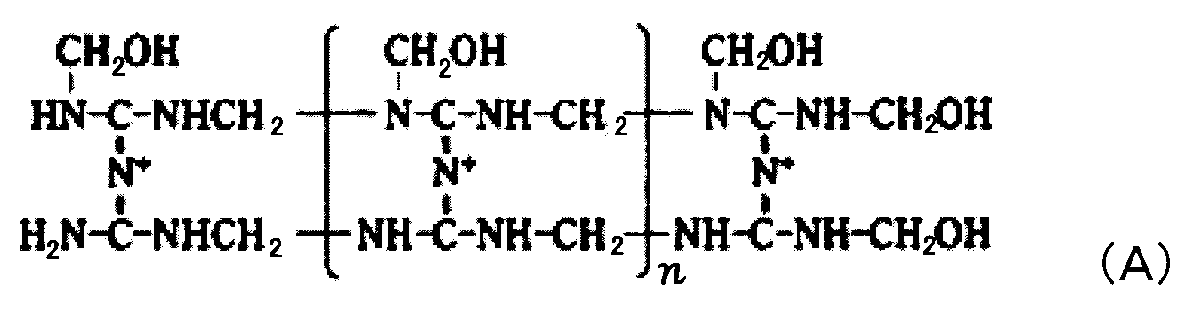
<ノニオン性高分子化合物>
PEG:分子量400,000、20,000、10,000、6,000又は4,000のポリエチレングリコール(分子量400,000)
PVP:ポリビニルピロリドン(分子量40,000)
PVA:ポリビニルアルコール(分子量20,000)
PEO:ポリ(2-エチル-オキサゾリン)(分子量50,000)
POE/POP/POE:ポリオキシエチレン(POE)-ポリオキシプロピレン(POP)-ポリオキシエチレン(POE)トリブロック共重合体(プルロニック型ノニオン性界面活性剤、POE/POPモル比:30/7、分子量9,000)
ブリッジ700:ポリオキシエチレン(100)ステアリルエーテル(分子量5,000)
PAA:ポリアクリルアミド(分子量40,000)
ツイン85:ポリオキシエチレンソルビタントリオレアート(分子量2,000)
PEG:分子量400,000、20,000、10,000、6,000又は4,000のポリエチレングリコール(分子量400,000)
PVP:ポリビニルピロリドン(分子量40,000)
PVA:ポリビニルアルコール(分子量20,000)
PEO:ポリ(2-エチル-オキサゾリン)(分子量50,000)
POE/POP/POE:ポリオキシエチレン(POE)-ポリオキシプロピレン(POP)-ポリオキシエチレン(POE)トリブロック共重合体(プルロニック型ノニオン性界面活性剤、POE/POPモル比:30/7、分子量9,000)
ブリッジ700:ポリオキシエチレン(100)ステアリルエーテル(分子量5,000)
PAA:ポリアクリルアミド(分子量40,000)
ツイン85:ポリオキシエチレンソルビタントリオレアート(分子量2,000)
<第四級アンモニウム塩基を含むカチオン性高分子化合物>
ポリ(ジアリルジメチルアンモニウムクロリド)(分子量300,000)
<鉄系無機凝集剤>
塩化第二鉄(FeCl3、3.8重量%水溶液)
ポリ(ジアリルジメチルアンモニウムクロリド)(分子量300,000)
<鉄系無機凝集剤>
塩化第二鉄(FeCl3、3.8重量%水溶液)
上記凝集薬剤は、いずれも水溶液として添加した。
[凝集処理水の水質判断指標]
凝集処理水の水質判断の指標としては、SFF値、MFF値、MF値を用いた(大井康裕、分離技術45巻4号(2015)、216-223)。
凝集処理水の水質判断の指標としては、SFF値、MFF値、MF値を用いた(大井康裕、分離技術45巻4号(2015)、216-223)。
SFF値は高分子有機物の汚染指標を、MFF値は微粒子の汚染指標を示す。MF値は、-67kPaの減圧下で測定試料300mLが有効膜面積3.0cm2、孔径0.45μmのニトロセルロース膜(以下MF膜)を透過するのに要した時間を示したものである。SFF値、MFF値、MF値が低いほど、良好な凝集処理水が得られていることを示す。
SFF値、MFF値、MF値の測定方法を簡潔に以下に示す。
MF膜を吸引濾過装置にセットし、-67kPaの減圧下で溶解性高分子物質および微粒子フリーの基準水150mLの透過時間T0を測定した後に、測定試料(150mL)の1回目通水時間T1、2回目通水時間T2を測定する。
SFF値、MFF値、MF値を以下の式で算出する。
SFF値=T1/T0
MFF値= T2/T1
MF値=T1+T2
SFF値、MFF値、MF値を以下の式で算出する。
SFF値=T1/T0
MFF値= T2/T1
MF値=T1+T2
[実験1]
<実施例1-1>
被処理水A500mLをビーカーに入れ、150rpmで撹拌している最中に、分子量300,000のポリ(ジアリルジメチルアンモニウムクロリド)を2mg/Lになるよう添加し2分間撹拌した。その後、分子量25,000の分岐型ポリエチレンイミンを3.5mg/Lになるよう添加し、さらに分子量400,000のポリエチレングリコール(PEG)を1.8mg/Lになるよう添加し、2分間撹拌した。その後、塩化第二鉄を成分として20mg/Lになるよう添加し6分間撹拌した後、凝集反応時のpHを測定した。さらに、50rpmで6分間撹拌することで凝集処理を行った。凝集処理により生じたフロックの平均の大きさは目視で計測した。凝集処理後の水は、孔径7μmの濾紙で濾過し、固液分離を行った。
この濾過水に対して、SFF値、MFF値、MF値を測定した。
<実施例1-1>
被処理水A500mLをビーカーに入れ、150rpmで撹拌している最中に、分子量300,000のポリ(ジアリルジメチルアンモニウムクロリド)を2mg/Lになるよう添加し2分間撹拌した。その後、分子量25,000の分岐型ポリエチレンイミンを3.5mg/Lになるよう添加し、さらに分子量400,000のポリエチレングリコール(PEG)を1.8mg/Lになるよう添加し、2分間撹拌した。その後、塩化第二鉄を成分として20mg/Lになるよう添加し6分間撹拌した後、凝集反応時のpHを測定した。さらに、50rpmで6分間撹拌することで凝集処理を行った。凝集処理により生じたフロックの平均の大きさは目視で計測した。凝集処理後の水は、孔径7μmの濾紙で濾過し、固液分離を行った。
この濾過水に対して、SFF値、MFF値、MF値を測定した。
<実施例1-2>
分子量400,000のPEGの代わりに分子量20,000のPEGを使用した。その他は実施例1-1と同様である。
分子量400,000のPEGの代わりに分子量20,000のPEGを使用した。その他は実施例1-1と同様である。
<実施例1-3>
分子量400,000のPEGの代わりに分子量10,000のPEGを使用した。その他は実施例1-1と同様である。
分子量400,000のPEGの代わりに分子量10,000のPEGを使用した。その他は実施例1-1と同様である。
<実施例1-4>
分子量400,000のPEGの代わりに分子量6,000のPEGを使用した。その他は実施例1-1と同様である。
分子量400,000のPEGの代わりに分子量6,000のPEGを使用した。その他は実施例1-1と同様である。
<実施例1-5>
分子量400,000のPEGの代わりに分子量4,000のPEGを使用した。その他は実施例1-1と同様である。
分子量400,000のPEGの代わりに分子量4,000のPEGを使用した。その他は実施例1-1と同様である。
<実施例1-6>
分子量400,000のPEGの代わりに分子量40,000のポリビニルピロリドン(PVP)を使用した。その他は実施例1-1と同様である。
分子量400,000のPEGの代わりに分子量40,000のポリビニルピロリドン(PVP)を使用した。その他は実施例1-1と同様である。
<実施例1-7>
分子量400,000のPEGの代わりに分子量20,000のポリビニルアルコール(PVA)を使用した。その他は実施例1-1と同様である。
分子量400,000のPEGの代わりに分子量20,000のポリビニルアルコール(PVA)を使用した。その他は実施例1-1と同様である。
<実施例1-8>
分子量400,000のPEGの代わりに分子量50,000のポリ(2-エチル-2-オキサゾリン)(PEO)を使用した。その他は実施例1-1と同様である。
分子量400,000のPEGの代わりに分子量50,000のポリ(2-エチル-2-オキサゾリン)(PEO)を使用した。その他は実施例1-1と同様である。
<実施例1-9>
分子量400,000のPEGの代わりに分子量9,000のPOE/POP/POE系トリブロック共重合体を使用した。その他は実施例1-1と同様である。
分子量400,000のPEGの代わりに分子量9,000のPOE/POP/POE系トリブロック共重合体を使用した。その他は実施例1-1と同様である。
<実施例1-10>
分子量400,000のPEGの代わりに分子量5,000のポリオキシエチレン(100)ステアリルエーテル(ブリッジ700)を使用した。その他は実施例1-1と同様である。
分子量400,000のPEGの代わりに分子量5,000のポリオキシエチレン(100)ステアリルエーテル(ブリッジ700)を使用した。その他は実施例1-1と同様である。
<実施例1-11>
分子量25,000の分岐型ポリエチレンイミンの代わりに分子量5,000,000のポリビニルアミンを使用した。その他は実施例1-1と同様である。
分子量25,000の分岐型ポリエチレンイミンの代わりに分子量5,000,000のポリビニルアミンを使用した。その他は実施例1-1と同様である。
<比較例1-1>
被処理水A500mLをビーカーに入れ、150rpmで撹拌している最中に、塩化第二鉄を成分として150mg/Lになるよう添加し6分間撹拌した後、凝集反応時のpHを測定した。さらに、50rpmで6分間撹拌することで凝集処理を行った。凝集処理により生じたフロックの平均の大きさは目視で計測した。凝集処理後の水は、孔径7μmの濾紙で濾過し、固液分離を行った。この濾過水に対して、SFF値、MFF値、MF値を測定した。
被処理水A500mLをビーカーに入れ、150rpmで撹拌している最中に、塩化第二鉄を成分として150mg/Lになるよう添加し6分間撹拌した後、凝集反応時のpHを測定した。さらに、50rpmで6分間撹拌することで凝集処理を行った。凝集処理により生じたフロックの平均の大きさは目視で計測した。凝集処理後の水は、孔径7μmの濾紙で濾過し、固液分離を行った。この濾過水に対して、SFF値、MFF値、MF値を測定した。
<比較例1-2>
分子量400,000のPEGの代わりに同量の純水を添加した。その他は実施例1-1と同様である。
分子量400,000のPEGの代わりに同量の純水を添加した。その他は実施例1-1と同様である。
<比較例1-3>
分子量400,000のPEGの代わりに分子量40,000のポリアクリルアミド(PAA)を使用した。その他は実施例1-1と同様である。
分子量400,000のPEGの代わりに分子量40,000のポリアクリルアミド(PAA)を使用した。その他は実施例1-1と同様である。
<参考例1-1>
分子量400,000のPEGの代わりに分子量2,000のポリオキシエチレンソルビタントリオレアート(ツイン85)を使用した。その他は実施例1-1と同様である。
分子量400,000のPEGの代わりに分子量2,000のポリオキシエチレンソルビタントリオレアート(ツイン85)を使用した。その他は実施例1-1と同様である。
<結果>
実施例1-1~1~11、比較例1-1~1-3および参考例1-1の結果を表1に示す。
実施例1-1~1~11、比較例1-1~1-3および参考例1-1の結果を表1に示す。
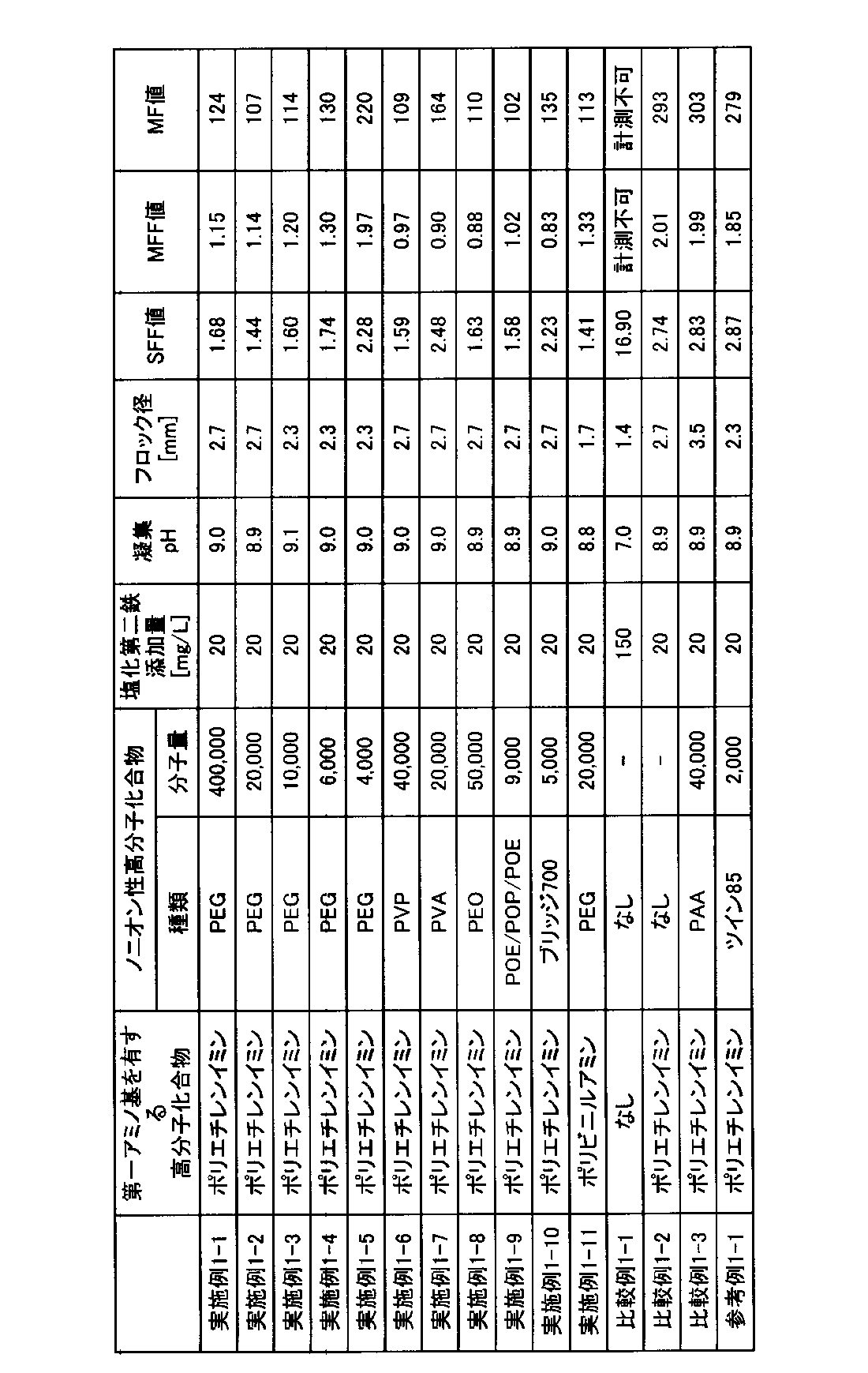
<考察>
塩化第二鉄150mg/Lのみで凝集を行ったところ、SFF値は非常に高い値を示し、計測時にMF膜の閉塞が生じたことからMFF値、MF値は測定不能であった(比較例1-1)。
ポリ(ジアリルジメチルアンモニウムクロリド)とポリエチレンイミンを用いて凝集を行ったものに対し(比較例1-2)、さらにノニオン性高分子化合物を添加したもの(実施例1-1~I-11)は、SFF値、MFF値、および、MF値が減少している。
鉄系無機凝集剤のみで被処理水Aを処理する場合、150mg/Lよりさらに大量の塩化第二鉄が必要になることが想定されるが、アミン・ノニオン凝集剤と第四級アンモニウム塩基を含むカチオン性高分子化合物を併用することで、無機凝集剤量を大幅に削減できる。
塩化第二鉄150mg/Lのみで凝集を行ったところ、SFF値は非常に高い値を示し、計測時にMF膜の閉塞が生じたことからMFF値、MF値は測定不能であった(比較例1-1)。
ポリ(ジアリルジメチルアンモニウムクロリド)とポリエチレンイミンを用いて凝集を行ったものに対し(比較例1-2)、さらにノニオン性高分子化合物を添加したもの(実施例1-1~I-11)は、SFF値、MFF値、および、MF値が減少している。
鉄系無機凝集剤のみで被処理水Aを処理する場合、150mg/Lよりさらに大量の塩化第二鉄が必要になることが想定されるが、アミン・ノニオン凝集剤と第四級アンモニウム塩基を含むカチオン性高分子化合物を併用することで、無機凝集剤量を大幅に削減できる。
PEGの分子量に注目すると、分子量20,000(実施例1-2)が最も効果が高く、分子量400,000(実施例1-1)ではSFF値に若干の上昇が見られる。これは添加したPEGが高分子量であるため、残存したPEG自体がMF膜に吸着し閉塞させたことが考えられる。従って、非常に高分子量のノニオン性高分子化合物を使用すると、後段で膜処理を行う場合、膜を汚染する可能性がある。PEGの分子量が小さくなるにつれ、SFF値、MFF値、MF値が増加しており、分子量4,000(実施例1-5)では、PEG添加の効果が小さくなっている。このことから、添加するノニオン性の高分子化合物の分子量は少なくとも4,000以上とすることが好ましい。
ノニオン性高分子化合物はPEG、ポリビニルピロリドン、ポリビニルアルコール、ポリエチルオキサゾリン(実施例1-1~1-8)のほか、POE/POP/POE系トリブロック共重合体やブリッジ700(実施例1-9、1-10)といったノニオン性界面活性剤にも効果がある。一方、ポリアクリルアミド(比較例1-3)ではノニオン性高分子化合物を添加していない場合(比較例1-2)と同様のSFF値、MFF値、および、MF値を示しており、効果がない。ノニオン性界面活性剤であるツイン85(参考例1-1)にも十分な効果が見られなかった。これは分子量が4,000未満であり、被処理水中の有機物と結合する作用が弱くなったためと考えられる。
第一アミノ基を有する高分子化合物として、ポリビニルアミン(実施例1-11)を用いた場合でも、ポリエチレンイミン(実施例1-2)と同様の効果がある。ただし、フロック径はポリエチレンイミンを用いたほうが大きい。これは、用いたポリエチレンイミンが分岐型であるため、かさ高いフロックが形成されたものと考えられる。従って、後段に沈殿処理や加圧浮上処理を行う場合は、分岐型の第一アミノ基を有する高分子化合物を使用した方が、フロックの固液分離が容易となるため望ましい。
[実験2]
<実施例2-1>
被処理水B500mLをビーカーに入れ、150rpmで撹拌している最中に、分子量300,000のポリ(ジアリルジメチルアンモニウムクロリド)を1.5mg/Lになるよう添加し2分間撹拌した。その後、分子量25,000の分岐型ポリエチレンイミンを5mg/Lになるよう添加し、さらに分子量20,000のポリエチレングリコール(PEG)を2.5mg/Lになるよう添加し、2分間撹拌した。その後、塩化第二鉄を成分として20mg/Lになるよう添加し6分間撹拌した後、凝集反応時のpHを測定した。さらに、50rpmで6分間撹拌することで凝集処理を行った。凝集処理により生じたフロックの平均の大きさは目視で計測した。凝集処理後の水は、孔径7μmの濾紙で濾過し、固液分離を行った。この濾過水に対して、SFF値、MFF値、MF値を測定した。
<実施例2-1>
被処理水B500mLをビーカーに入れ、150rpmで撹拌している最中に、分子量300,000のポリ(ジアリルジメチルアンモニウムクロリド)を1.5mg/Lになるよう添加し2分間撹拌した。その後、分子量25,000の分岐型ポリエチレンイミンを5mg/Lになるよう添加し、さらに分子量20,000のポリエチレングリコール(PEG)を2.5mg/Lになるよう添加し、2分間撹拌した。その後、塩化第二鉄を成分として20mg/Lになるよう添加し6分間撹拌した後、凝集反応時のpHを測定した。さらに、50rpmで6分間撹拌することで凝集処理を行った。凝集処理により生じたフロックの平均の大きさは目視で計測した。凝集処理後の水は、孔径7μmの濾紙で濾過し、固液分離を行った。この濾過水に対して、SFF値、MFF値、MF値を測定した。
<実施例2-2>
ポリ(ジアリルジメチルアンモニウムクロリド)を添加しなかった。その他は実施例2-1と同様である。
ポリ(ジアリルジメチルアンモニウムクロリド)を添加しなかった。その他は実施例2-1と同様である。
<比較例2-1>
ポリエチレンイミンを添加しなかった。その他は実施例2-1と同様である。
ポリエチレンイミンを添加しなかった。その他は実施例2-1と同様である。
<比較例2-2>
PEGを添加しなかった。その他は実施例2-1と同様である。
PEGを添加しなかった。その他は実施例2-1と同様である。
<結果>
実施例2-1~2-2および比較例2-1~2-2の結果を表2に示す。
実施例2-1~2-2および比較例2-1~2-2の結果を表2に示す。
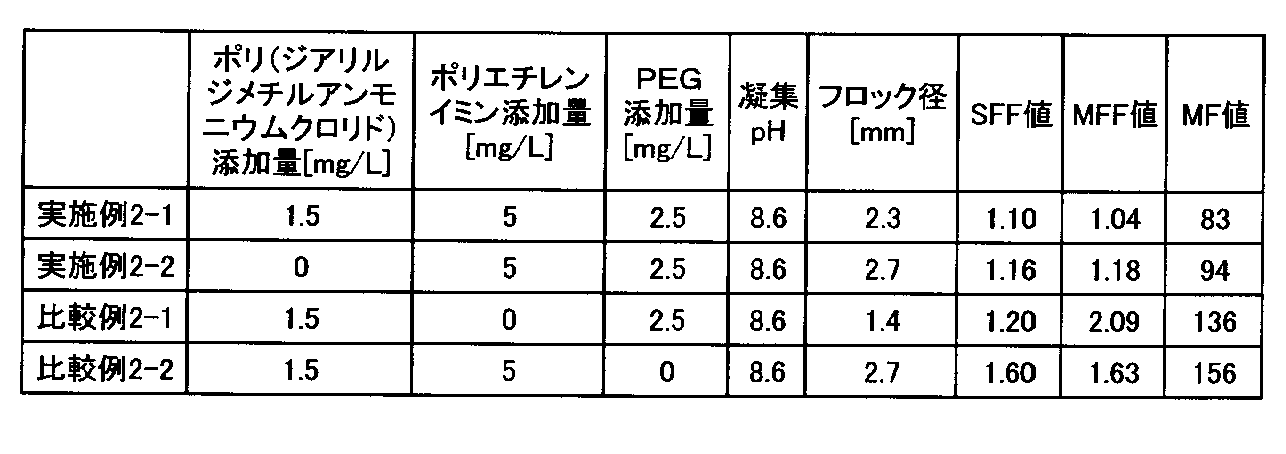
<考察>
アミン・ノニオン凝集剤を用いることで、SFF値、MFF値、MF値が減少した(実施例2-1、実施例2-2)。アミン・ノニオン凝集剤のみでも十分にSFF値、MFF値、MF値を減少させることが可能であるが、ポリ(ジアリルジメチルアンモニウムクロリド)を用いることで、SFF値、MFF値、MF値をさらに減少させることが可能である。
アミン・ノニオン凝集剤を用いることで、SFF値、MFF値、MF値が減少した(実施例2-1、実施例2-2)。アミン・ノニオン凝集剤のみでも十分にSFF値、MFF値、MF値を減少させることが可能であるが、ポリ(ジアリルジメチルアンモニウムクロリド)を用いることで、SFF値、MFF値、MF値をさらに減少させることが可能である。
[実験3]
<実施例3-1>
被処理水C500mLをビーカーに入れ、150rpmで撹拌している最中に、分子量300,000のポリ(ジアリルジメチルアンモニウムクロリド)を1.8mg/Lになるよう添加し2分間撹拌した。その後、分子量25,000の分岐型ポリエチレンイミンを2mg/Lになるよう添加し、さらに分子量20,000のポリエチレングリコール(PEG)を1mg/Lになるよう添加し、2分間撹拌した。その後、塩化第二鉄を成分として20mg/Lになるよう添加し6分間撹拌した後、凝集反応時のpHを測定した。さらに、50rpmで6分間撹拌することで凝集処理を行った。凝集処理により生じたフロックの平均の大きさは目視で計測した。凝集処理後の水は、孔径7μmの濾紙で濾過し、固液分離を行った。この濾過水に対して、SFF値、MFF値、MF値を測定した。
<実施例3-1>
被処理水C500mLをビーカーに入れ、150rpmで撹拌している最中に、分子量300,000のポリ(ジアリルジメチルアンモニウムクロリド)を1.8mg/Lになるよう添加し2分間撹拌した。その後、分子量25,000の分岐型ポリエチレンイミンを2mg/Lになるよう添加し、さらに分子量20,000のポリエチレングリコール(PEG)を1mg/Lになるよう添加し、2分間撹拌した。その後、塩化第二鉄を成分として20mg/Lになるよう添加し6分間撹拌した後、凝集反応時のpHを測定した。さらに、50rpmで6分間撹拌することで凝集処理を行った。凝集処理により生じたフロックの平均の大きさは目視で計測した。凝集処理後の水は、孔径7μmの濾紙で濾過し、固液分離を行った。この濾過水に対して、SFF値、MFF値、MF値を測定した。
<実施例3-2>
分子量25,000の分岐型ポリエチレンイミンの代わりに分子量2,000の分岐型ポリエチレンイミンを使用した。その他は実施例3-1と同様である。
分子量25,000の分岐型ポリエチレンイミンの代わりに分子量2,000の分岐型ポリエチレンイミンを使用した。その他は実施例3-1と同様である。
<実施例3-3>
分子量25,000の分岐型ポリエチレンイミンの代わりに分子量2,000,000の分岐型ポリエチレンイミンを使用した。その他は実施例3-1と同様である。
分子量25,000の分岐型ポリエチレンイミンの代わりに分子量2,000,000の分岐型ポリエチレンイミンを使用した。その他は実施例3-1と同様である。
<実施例3-4>
被処理水B500mLをビーカーに入れ、150rpmで撹拌している最中に、分子量300,000のポリ(ジアリルジメチルアンモニウムクロリド)、分子量25,000の分岐型ポリエチレンイミン、分子量20,000のPEGをそれぞれ1.8mg/L、2mg/L、1mg/Lになるよう同時に添加し2分間撹拌した。その後、塩化第二鉄を成分として20mg/Lになるよう添加し6分間撹拌した後、凝集反応時のpHを測定した。さらに、50rpmで6分間撹拌することで凝集処理を行った。凝集処理により生じたフロックの平均の大きさは目視で計測した。凝集処理後の水は、孔径7μmの濾紙で濾過し、固液分離を行った。この濾過水に対して、SFF値、MFF値、MF値を測定した。
被処理水B500mLをビーカーに入れ、150rpmで撹拌している最中に、分子量300,000のポリ(ジアリルジメチルアンモニウムクロリド)、分子量25,000の分岐型ポリエチレンイミン、分子量20,000のPEGをそれぞれ1.8mg/L、2mg/L、1mg/Lになるよう同時に添加し2分間撹拌した。その後、塩化第二鉄を成分として20mg/Lになるよう添加し6分間撹拌した後、凝集反応時のpHを測定した。さらに、50rpmで6分間撹拌することで凝集処理を行った。凝集処理により生じたフロックの平均の大きさは目視で計測した。凝集処理後の水は、孔径7μmの濾紙で濾過し、固液分離を行った。この濾過水に対して、SFF値、MFF値、MF値を測定した。
<比較例3-1>
分子量25,000の分岐型ポリエチレンイミン、および、分子量20,000のPEGの代わりに、それぞれ同量の純水を添加した。その他は実施例3-1と同様である。
分子量25,000の分岐型ポリエチレンイミン、および、分子量20,000のPEGの代わりに、それぞれ同量の純水を添加した。その他は実施例3-1と同様である。
<結果>
実施例3-1~3-4および比較例3-1の結果を表3に示す。
実施例3-1~3-4および比較例3-1の結果を表3に示す。

<考察>
ポリ(ジアリルジメチルアンモニウムクロリド)と塩化第二鉄のみを用いて凝集処理を行ったものに対し(比較例3-1)、アミン・ノニオン凝集剤をさらに用いることで、SFF値、MFF値、MF値が減少した(実施例3-1~3-3)。ポリ(ジアリルジメチルアンモニウムクロリド)とアミン・ノニオン凝集剤を同時に添加すると(実施例3-4)、SFF値の低下が見られず、アミン・ノニオン凝集剤の効果が半減した。このことから、第四級アンモニウム塩基を含むカチオン性高分子は、アミン・ノニオン凝集剤と同時に添加しないことが望ましい。
ポリ(ジアリルジメチルアンモニウムクロリド)と塩化第二鉄のみを用いて凝集処理を行ったものに対し(比較例3-1)、アミン・ノニオン凝集剤をさらに用いることで、SFF値、MFF値、MF値が減少した(実施例3-1~3-3)。ポリ(ジアリルジメチルアンモニウムクロリド)とアミン・ノニオン凝集剤を同時に添加すると(実施例3-4)、SFF値の低下が見られず、アミン・ノニオン凝集剤の効果が半減した。このことから、第四級アンモニウム塩基を含むカチオン性高分子は、アミン・ノニオン凝集剤と同時に添加しないことが望ましい。
ポリエチレンイミンの分子量に注目すると(実施例3-1~3-3)、SFF値、MFF値、MF値は殆ど変化しておらず、フロック径のみが変化している。このことから、後段に沈殿処理や加圧浮上処理を行う場合は、分岐型ポリエチレンイミンの中でも分子量25,000前後のものが、フロック径が最も大きくなるため、最も望ましい。
[実験4]
<実施例4-1>
被処理水D500mLをビーカーに入れ、150rpmで撹拌している最中に、分子量300,000のポリ(ジアリルジメチルアンモニウムクロリド)を2.5mg/Lになるよう添加し2分間撹拌した。その後、分子量10,000の分岐型ポリエチレンイミンを5mg/Lになるよう添加し、さらに分子量20,000のポリエチレングリコール(PEG)を5mg/Lになるよう添加し、2分間撹拌した。その後、塩化第二鉄を成分として20mg/Lになるよう添加し6分間撹拌した後、凝集反応時のpHを測定した。さらに、50rpmで6分間撹拌することで凝集処理を行った。凝集処理により生じたフロックの平均の大きさは目視で計測した。凝集処理後の水は、孔径7μmの濾紙で濾過し、固液分離を行った。この濾過水に対して、SFF値、MFF値、MF値を測定した。
<実施例4-1>
被処理水D500mLをビーカーに入れ、150rpmで撹拌している最中に、分子量300,000のポリ(ジアリルジメチルアンモニウムクロリド)を2.5mg/Lになるよう添加し2分間撹拌した。その後、分子量10,000の分岐型ポリエチレンイミンを5mg/Lになるよう添加し、さらに分子量20,000のポリエチレングリコール(PEG)を5mg/Lになるよう添加し、2分間撹拌した。その後、塩化第二鉄を成分として20mg/Lになるよう添加し6分間撹拌した後、凝集反応時のpHを測定した。さらに、50rpmで6分間撹拌することで凝集処理を行った。凝集処理により生じたフロックの平均の大きさは目視で計測した。凝集処理後の水は、孔径7μmの濾紙で濾過し、固液分離を行った。この濾過水に対して、SFF値、MFF値、MF値を測定した。
<実施例4-2>
分子量10,000の分岐型ポリエチレンイミンの代わりに分子量1,800の分岐型ポリエチレンイミンを使用した。その他は実施例4-1と同様である。
分子量10,000の分岐型ポリエチレンイミンの代わりに分子量1,800の分岐型ポリエチレンイミンを使用した。その他は実施例4-1と同様である。
<実施例4-3>
分子量10,000の分岐型ポリエチレンイミンの代わりに分子量600の分岐型ポリエチレンイミンを使用した。その他は実施例4-1と同様である。
分子量10,000の分岐型ポリエチレンイミンの代わりに分子量600の分岐型ポリエチレンイミンを使用した。その他は実施例4-1と同様である。
<実施例4-4>
分子量10,000の分岐型ポリエチレンイミンの代わりに分子量300の分岐型ポリエチレンイミンを使用した。その他は実施例4-1と同様である。
分子量10,000の分岐型ポリエチレンイミンの代わりに分子量300の分岐型ポリエチレンイミンを使用した。その他は実施例4-1と同様である。
<比較例4-1>
分子量10,000の分岐型ポリエチレンイミンの代わりに同量の純水を添加した。その他は実施例4-1と同様である。
分子量10,000の分岐型ポリエチレンイミンの代わりに同量の純水を添加した。その他は実施例4-1と同様である。
<比較例4-2>
分子量10,000の分岐型ポリエチレンイミン、および分子量20,000のPEGの代わりに、それぞれ同量の純水を添加した。その他は実施例4-1と同様である。
分子量10,000の分岐型ポリエチレンイミン、および分子量20,000のPEGの代わりに、それぞれ同量の純水を添加した。その他は実施例4-1と同様である。
<結果>
実施例4-1~4-4および比較例4-1~4-2の結果を表4に示す。
実施例4-1~4-4および比較例4-1~4-2の結果を表4に示す。
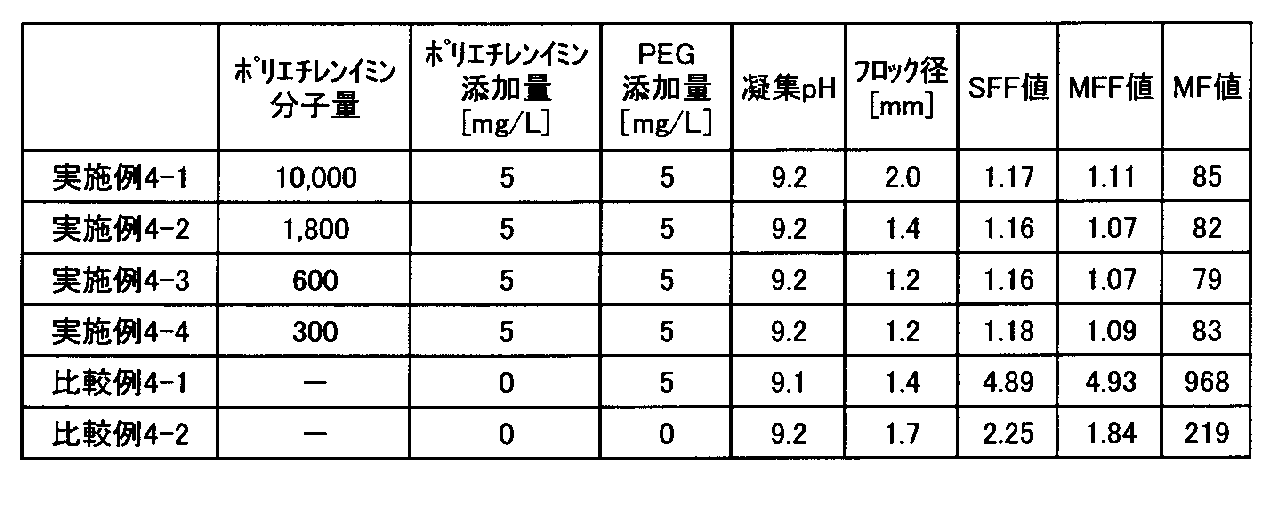
<考察>
分子量2,000未満の分岐型ポリエチレンイミンでも、分子量10,000の分岐型ポリエチレンイミンと同等の凝集性能を示す(実施例4-1~4-4-4)。
ポリエチレンイミンを添加せずポリエチレングリコール(PEG)のみを添加すると、ポリエチレンイミンとPEGの両方を添加していない場合よりも凝集性能が悪くなる(比較例4-1~4-2)。PEGは第一アミノ基を有する高分子化合物が存在していないとまったく凝集効果を発揮せず、むしろ凝集処理水質を悪化させる方向に働く。
分子量2,000未満の分岐型ポリエチレンイミンでも、分子量10,000の分岐型ポリエチレンイミンと同等の凝集性能を示す(実施例4-1~4-4-4)。
ポリエチレンイミンを添加せずポリエチレングリコール(PEG)のみを添加すると、ポリエチレンイミンとPEGの両方を添加していない場合よりも凝集性能が悪くなる(比較例4-1~4-2)。PEGは第一アミノ基を有する高分子化合物が存在していないとまったく凝集効果を発揮せず、むしろ凝集処理水質を悪化させる方向に働く。
[実験5]
<実施例5-1>
被処理水E500mLをビーカーに入れ、150rpmで撹拌している最中に、分子量300,000のポリ(ジアリルジメチルアンモニウムクロリド)を1.5mg/Lになるよう添加し2分間撹拌した。その後、分子量10,000のジシアンジアミド・ホルマリン縮合物(DCD-HCHO)を2.5mg/Lになるよう添加し、さらに分子量40,000のポリビニルピロリドン(PVP)を2.5mg/Lになるよう添加し、2分間撹拌した。その後、塩化第二鉄を成分として20mg/Lになるよう添加し6分間撹拌した後、凝集反応時のpHを測定した。さらに、50rpmで6分間撹拌することで凝集処理を行った。凝集処理により生じたフロックの平均の大きさは目視で計測した。凝集処理後の水は、孔径7μmの濾紙で濾過し、固液分離を行った。この濾過水に対して、SFF値、MFF値、MF値を測定した。
<実施例5-1>
被処理水E500mLをビーカーに入れ、150rpmで撹拌している最中に、分子量300,000のポリ(ジアリルジメチルアンモニウムクロリド)を1.5mg/Lになるよう添加し2分間撹拌した。その後、分子量10,000のジシアンジアミド・ホルマリン縮合物(DCD-HCHO)を2.5mg/Lになるよう添加し、さらに分子量40,000のポリビニルピロリドン(PVP)を2.5mg/Lになるよう添加し、2分間撹拌した。その後、塩化第二鉄を成分として20mg/Lになるよう添加し6分間撹拌した後、凝集反応時のpHを測定した。さらに、50rpmで6分間撹拌することで凝集処理を行った。凝集処理により生じたフロックの平均の大きさは目視で計測した。凝集処理後の水は、孔径7μmの濾紙で濾過し、固液分離を行った。この濾過水に対して、SFF値、MFF値、MF値を測定した。
<比較例5-1>
PVPの代わりに同量の純水を添加した。その他は実施例5-1と同様である。
PVPの代わりに同量の純水を添加した。その他は実施例5-1と同様である。
<比較例5-2>
DCD-HCHOの代わりに同量の純水を添加した。その他は実施例5-1と同様である。
DCD-HCHOの代わりに同量の純水を添加した。その他は実施例5-1と同様である。
<比較例5-3>
DCD-HCHOとPVPの代わりに同量の純水を添加した。その他は実施例5-1と同様である。
DCD-HCHOとPVPの代わりに同量の純水を添加した。その他は実施例5-1と同様である。
<比較例5-4>
実施例5-1において、凝集処理を行わず、被処理水Eを孔径7μmの濾紙で濾過し、固液分離を行った。この濾過水に対して、SFF値、MFF値、MF値を測定した。
実施例5-1において、凝集処理を行わず、被処理水Eを孔径7μmの濾紙で濾過し、固液分離を行った。この濾過水に対して、SFF値、MFF値、MF値を測定した。
<結果>
実施例5-1および比較例5-1~5-4の結果を表5に示す。
実施例5-1および比較例5-1~5-4の結果を表5に示す。

<考察>
第二及び第三アミノ基を有するジシアンジアミド・ホルマリン縮合物でも、第一アミノ基を有するポリエチレンイミンと同等の凝集性能を示す(実施例5-1)。
ジシアンジアミド・ホルマリン縮合物を添加せずポリビニルピロリドン(PVP)のみを添加すると、ジシアンジアミド・ホルマリン縮合物とPVPの両方を添加していない場合よりもMFF値が悪くなる(比較例5-2~5-3)。PVPは第二及び第三アミノ基を有する高分子化合物が存在していないとまったく凝集効果を発揮しない。
第二及び第三アミノ基を有するジシアンジアミド・ホルマリン縮合物でも、第一アミノ基を有するポリエチレンイミンと同等の凝集性能を示す(実施例5-1)。
ジシアンジアミド・ホルマリン縮合物を添加せずポリビニルピロリドン(PVP)のみを添加すると、ジシアンジアミド・ホルマリン縮合物とPVPの両方を添加していない場合よりもMFF値が悪くなる(比較例5-2~5-3)。PVPは第二及び第三アミノ基を有する高分子化合物が存在していないとまったく凝集効果を発揮しない。
〔第2発明の実施例、参考例及び比較例〕
[実験6]
以下の薬品を用いて一剤化薬品を調製する実験を行った。
[実験6]
以下の薬品を用いて一剤化薬品を調製する実験を行った。
<PEI>
IP2M(分子量2,000,000、BASF社製)
P-1000(分子量70,000、日本触媒社製)
IP250(分子量25,000、BASF社製)
SP-200(分子量10,000、日本触媒社製)
IP2M(分子量2,000,000、BASF社製)
P-1000(分子量70,000、日本触媒社製)
IP250(分子量25,000、BASF社製)
SP-200(分子量10,000、日本触媒社製)
<PVP>
K-85N(K値83~87、分子量900,000、日本触媒社製)
K-30(K値27~33、分子量100,000、日本触媒社製)
K-15(K値16、分子量10,000、ISP社製)
PVP5000(分子量4000~6000、ポリサイエンス社製)
K-85N(K値83~87、分子量900,000、日本触媒社製)
K-30(K値27~33、分子量100,000、日本触媒社製)
K-15(K値16、分子量10,000、ISP社製)
PVP5000(分子量4000~6000、ポリサイエンス社製)
ポリビニルピロリドンのK値はポリビニルピロリドンの分子量と相関する値であり、毛細管粘度計により測定したポリビニルピロリドン水溶液の水に対する相対粘度ηrel(25℃)から、下記のフィッケンチャーの式を用いて算出される。
K=(1.5logηrel-1)/(0.15+0.003c)+
(300clogηrel+(c+1.5clogηrel)2)1/2/
(0.15c+0.003c2)
ηrel:ポリビニルピロリドン水溶液の水に対する相対粘度
c:ポリビニルピロリドン水溶液中のポリビニルピロリドン濃度(重量%)
K=(1.5logηrel-1)/(0.15+0.003c)+
(300clogηrel+(c+1.5clogηrel)2)1/2/
(0.15c+0.003c2)
ηrel:ポリビニルピロリドン水溶液の水に対する相対粘度
c:ポリビニルピロリドン水溶液中のポリビニルピロリドン濃度(重量%)
<実施例6-1>
表6に示した組成1-1~1-16の条件で、PEI 10重量%、PVP 10重量%を含む一剤化薬品を調製した。
表6に示した組成1-1~1-16の条件で、PEI 10重量%、PVP 10重量%を含む一剤化薬品を調製した。
具体的には、直径26mm、高さ55mmの蓋付きガラス製サンプル瓶(容量20mL)に、20重量%のPEI水溶液と20重量%のPVP水溶液をそれぞれ4gずつ入れ、十分に撹拌した。その後、室温(24℃)で24時間静置した。その後、サンプル瓶を倒置(試験管倒置法)し、容器の底面から薬液が流れ落ちないものをゲル化(G)、混合直後の薬液よりも粘性が大幅に増大し、時間をかけて(1分~1時間程度)全ての薬液が流れ落ちたものをゾル化(S)、全ての薬液が1分以内に流れ落ちたものを液体(L)として評価した。結果を表6に示し、ゲル・ゾル化-液体の相図を図2に示す。
組成1-5~1-8の条件で作製した薬液の、試験管倒置法による評価で、倒置から2分経過したときの写真を図3に示す。

薬液のゲル化は分子量25,000~70,000のPEIと分子量10,000~100,000(K値16~33)のPVPとの組み合わせで起こりやすいことが判明した。よって、このPEIとPVPの分子量の組み合わせの範囲を除くことで、液体状態を保持した一剤化薬品を調製することができることが確認された。
<実施例6-2>
実施例6-1でゲル化が生じた組成1-6の条件において、PEI(P-1000)およびPVP(K-30)の各濃度を変更して一剤化薬品を調製した。
実施例6-1でゲル化が生じた組成1-6の条件において、PEI(P-1000)およびPVP(K-30)の各濃度を変更して一剤化薬品を調製した。
具体的には、表7に示した組成2-1~2-21の条件で、20重量%のPEI(P-1000)水溶液と20重量%のPVP(K-30)水溶液と純水を総重量で8gになるよう混合した。試験管倒置法の手順については、実施例6-1と同様である。
結果を表7に示す。ゲル・ゾル化-液体の相図を図4に示す。
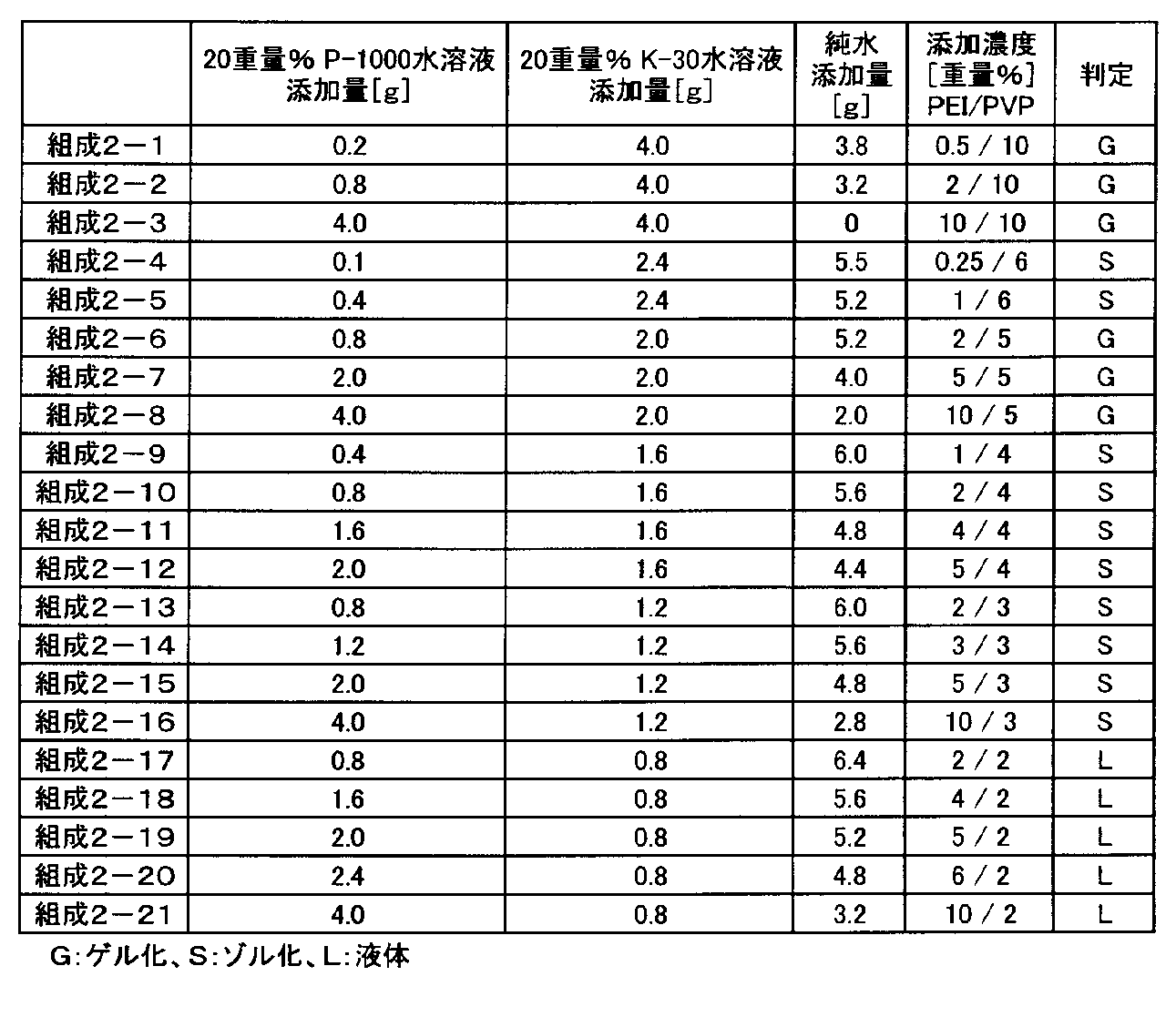
表7より次のことが分かる。
PEI(P-1000)10重量%、PVP(K-30)10重量%を含む一剤化薬品(組成2-3)ではゲル化が生じるが、PEIおよびPVPの各濃度を小さくすれば、PEIとPVPを一剤化処理しても液体状態を保持できる。
PEI(P-1000)10重量%、PVP(K-30)10重量%を含む一剤化薬品(組成2-3)ではゲル化が生じるが、PEIおよびPVPの各濃度を小さくすれば、PEIとPVPを一剤化処理しても液体状態を保持できる。
図4で得られた相図をもとに、一剤化薬品が液体状態を維持する領域の範囲内でPEIとPVPの各濃度を自由に設定することができる。例えば、PEI(P-1000)を2重量%以上含む一剤化薬品を調製する場合は、PVP(K-30)の濃度を2重量%以下にすれば良い。
<実施例6-3>
実施例6-1でゲル化が生じた組成1-11の条件において、PEI(IP250)およびPVP(K-15)の各濃度を変更して一剤化薬品を調製した。
実施例6-1でゲル化が生じた組成1-11の条件において、PEI(IP250)およびPVP(K-15)の各濃度を変更して一剤化薬品を調製した。
具体的には、表8に示した組成3-1~3-16の条件で、20重量%のPEI(IP250)水溶液と20重量%のPVP(K-15)水溶液と純水を総重量で8gになるよう混合した。試験管倒置法の手順については、実施例6-1と同様である。
結果を表8に示す。ゲル・ゾル化-液体の相図を図5に示す。

表8より次のことが分かる。
実施例6-2と同様、PEI(IP250)およびPVP(K-15)の各濃度を小さくすれば、PEIとPVPを一剤化処理しても液体状態を保持できる。実施例6-2と比べ、分子量の異なるPEIとPVPの組み合わせであるため、一剤化薬品の液体状態を保持できるPEIおよびPVPの濃度は高く設定できる。
実施例6-2と同様、PEI(IP250)およびPVP(K-15)の各濃度を小さくすれば、PEIとPVPを一剤化処理しても液体状態を保持できる。実施例6-2と比べ、分子量の異なるPEIとPVPの組み合わせであるため、一剤化薬品の液体状態を保持できるPEIおよびPVPの濃度は高く設定できる。
図5で得られた相図をもとに、一剤化薬品が液体状態を維持する領域の範囲内で、PEIとPVPの各濃度を自由に設定することができる。
[実験7]
実験6で調製した一剤化薬品を用いて、水処理効果を確認する実験を行った。
実験6で調製した一剤化薬品を用いて、水処理効果を確認する実験を行った。
実験7で用いた被処理水および他の凝集剤は以下の通りである。
<被処理水>
工場Aの排水の生物処理水に、炭酸水素ナトリウムを0.08重量%になるよう加え、アルカリ度を約500mg/L as CaCO3相当に調整したもの(pH8.6)。
工場Aの排水の生物処理水に、炭酸水素ナトリウムを0.08重量%になるよう加え、アルカリ度を約500mg/L as CaCO3相当に調整したもの(pH8.6)。
<第四級アンモニウム塩基を含むカチオン性高分子化合物>
ポリ(ジアリルジメチルアンモニウムクロリド)(分子量300,000)
ポリ(ジアリルジメチルアンモニウムクロリド)(分子量300,000)
<鉄系無機凝集剤>
塩化第二鉄(FeCl3、3.8重量%水溶液)
塩化第二鉄(FeCl3、3.8重量%水溶液)
上記凝集薬剤は、いずれも水溶液として添加した。
<凝集処理水の水質判断指標>
凝集処理水の水質判断の指標は、第1発明の実施例、参考例及び比較例におけると同様に、SFF値、MFF値、MF値を用いた。
凝集処理水の水質判断の指標は、第1発明の実施例、参考例及び比較例におけると同様に、SFF値、MFF値、MF値を用いた。
<実施例7-1>
被処理水500mLをビ-カ-に入れ、150rpmで撹拌している最中に、分子量300,000のポリ(ジアリルジメチルアンモニウムクロリド)を1mg/Lになるよう添加し2分間撹拌した。その後、一剤化薬品(P-1000 4重量%、K-30 2重量%含有水溶液、組成2-18)を20mg添加し、2分間撹拌した。その後、無機凝集剤を成分として20mg/Lになるよう添加し6分間撹拌した後、凝集反応時のpHを測定した。さらに、50rpmで6分間撹拌することで凝集処理を行った。凝集処理により生じたフロックの平均の大きさは目視で計測した。凝集処理後の水は、孔径7μmの濾紙で濾過し、固液分離を行った。この濾過水に対して、SFF値、MFF値、MF値を測定した。
被処理水500mLをビ-カ-に入れ、150rpmで撹拌している最中に、分子量300,000のポリ(ジアリルジメチルアンモニウムクロリド)を1mg/Lになるよう添加し2分間撹拌した。その後、一剤化薬品(P-1000 4重量%、K-30 2重量%含有水溶液、組成2-18)を20mg添加し、2分間撹拌した。その後、無機凝集剤を成分として20mg/Lになるよう添加し6分間撹拌した後、凝集反応時のpHを測定した。さらに、50rpmで6分間撹拌することで凝集処理を行った。凝集処理により生じたフロックの平均の大きさは目視で計測した。凝集処理後の水は、孔径7μmの濾紙で濾過し、固液分離を行った。この濾過水に対して、SFF値、MFF値、MF値を測定した。
<参考例7-1>
一剤化薬品(P-1000 4重量%、K-30 2重量%含有水溶液、組成2-18)の代わりに、P-1000を1.6mg/Lになるよう添加した直後に、K-30を0.8mg/Lになるよう添加することで各薬品を別々に添加した。その他は実施例7-1と同様である。
一剤化薬品(P-1000 4重量%、K-30 2重量%含有水溶液、組成2-18)の代わりに、P-1000を1.6mg/Lになるよう添加した直後に、K-30を0.8mg/Lになるよう添加することで各薬品を別々に添加した。その他は実施例7-1と同様である。
<比較例7-1>
一剤化薬品(P-1000 4重量%、K-30 2重量%含有水溶液、組成2-18)の代わりに、一剤化薬品(P-1000 10重量%、K-30 5重量%含有水溶液、組成2-8)を使用した。しかし、一剤化薬品(P-1000 10重量%、K-30 5重量%含有水溶液、組成2-8)は調製5分後にゲル化が生じたため、被処理水に添加することはできなかった。一剤化薬品を添加しなかったこと以外は、実施例7-1と同様である。
一剤化薬品(P-1000 4重量%、K-30 2重量%含有水溶液、組成2-18)の代わりに、一剤化薬品(P-1000 10重量%、K-30 5重量%含有水溶液、組成2-8)を使用した。しかし、一剤化薬品(P-1000 10重量%、K-30 5重量%含有水溶液、組成2-8)は調製5分後にゲル化が生じたため、被処理水に添加することはできなかった。一剤化薬品を添加しなかったこと以外は、実施例7-1と同様である。
<実施例7-2>
比較例7-1で用いた一剤化薬品(P-1000 10重量%、K-30 5重量%含有水溶液、組成2-8)の代わりに、同一濃度でゲル化が生じない分子量の組み合わせである一剤化薬品(IP-250 10重量%、K-15 5重量%含有水溶液、組成3-15)を8mg添加した。その他は実施例7-1と同様である。
比較例7-1で用いた一剤化薬品(P-1000 10重量%、K-30 5重量%含有水溶液、組成2-8)の代わりに、同一濃度でゲル化が生じない分子量の組み合わせである一剤化薬品(IP-250 10重量%、K-15 5重量%含有水溶液、組成3-15)を8mg添加した。その他は実施例7-1と同様である。
結果を表9に示す。
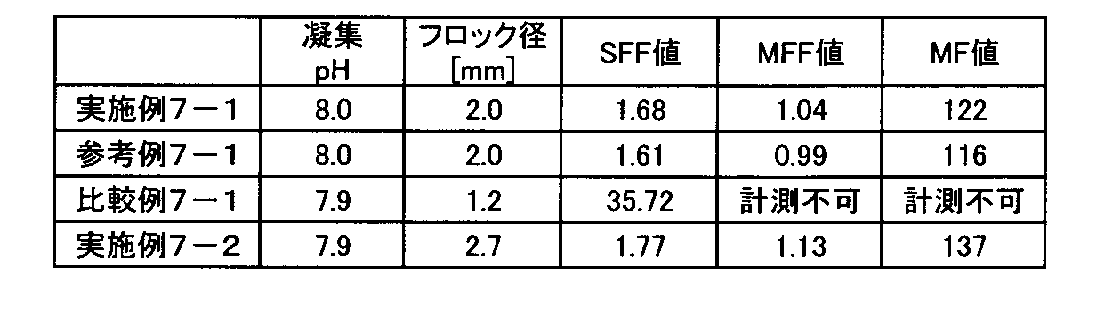
比較例7-1では、一剤化薬品のゲル化によりPEIとPVPの添加が行われなかったため、SFF値は非常に高い値を示した。比較例7-1では、計測時にMF膜の閉塞が生じたことからMFF値、MF値は測定不能であった。濃度を変更してゲル化が生じない一剤化薬品(実施例7-1)を添加したことで、SFF値は大幅に低減し、MFF値、MF値の計測も可能となった。また、フロック径が増大し、フロック沈降性の向上が見られた。一剤化薬品の効果は、PEIとPVPを個別に添加したとき(参考例7-1)と殆ど差異は認められなかった。
PEIとPVP分子量の組み合わせを変更して、ゲル化が生じない一剤化薬品を添加した場合(実施例7-2)においても、フロック径の変化は見られるものの、実施例7-1とほぼ同等の凝集処理水質(SFF値、MFF値、MF値)が得られた。
本発明を特定の態様を用いて詳細に説明したが、本発明の意図と範囲を離れることなく様々な変更が可能であることは当業者に明らかである。
本出願は、2016年2月10日付で出願された日本特許出願2016-023796及び2016年3月4日付で出願された日本特許出願2016-042000に基づいており、その全体が引用により援用される。
本出願は、2016年2月10日付で出願された日本特許出願2016-023796及び2016年3月4日付で出願された日本特許出願2016-042000に基づいており、その全体が引用により援用される。
A 有機物
B ノニオン性高分子化合物
C,E,H 結合物
D 弱カチオン性のアミノ基を有する高分子化合物
F 濁質
G 第四級アンモニウム塩基を含むカチオン性高分子化合物
I 鉄フロック
J 鉄コロイド
K 粗大フロック
B ノニオン性高分子化合物
C,E,H 結合物
D 弱カチオン性のアミノ基を有する高分子化合物
F 濁質
G 第四級アンモニウム塩基を含むカチオン性高分子化合物
I 鉄フロック
J 鉄コロイド
K 粗大フロック
Claims (25)
- 弱カチオン性のアミノ基を有する高分子化合物と、ノニオン性高分子化合物とを含む凝集剤であって、該ノニオン性高分子化合物が、アルキレンオキサイド基を有する化合物、アルコール性水酸基を有する化合物、およびカルボニル基を有し該カルボニル基の炭素原子が窒素原子と結合した構造(以下「CO-N構造」と称す場合がある。)を有する化合物(ただしアクリルアミド系重合体を除く)よりなる群から選ばれる1種又は2種以上であることを特徴とする凝集剤。
- 請求項1において、前記弱カチオン性のアミノ基を有する高分子化合物が、ポリエチレンイミン、ポリビニルアミン、およびジシアンジアミド・ホルマリン縮合物よりなる群から選ばれる1種又は2種以上を含むことを特徴とする凝集剤。
- 請求項1又は2において、前記弱カチオン性のアミノ基を有する高分子化合物の分子量が200~10,000,000であることを特徴とする凝集剤。
- 請求項1ないし3のいずれか1項において、前記アルキレンオキサイド基を有する化合物が、ポリエチレングリコール、および/又はエチレングリコールとプロピレングリコールとの共重合体を含むことを特徴とする凝集剤。
- 請求項1ないし4のいずれか1項において、前記アルコール性水酸基を有する化合物が、ポリビニルアルコールを含むことを特徴とする凝集剤。
- 請求項1ないし4のいずれか1項において、前記CO-N構造が、下記式(1)又は(2)で表されることを特徴とする凝集剤。

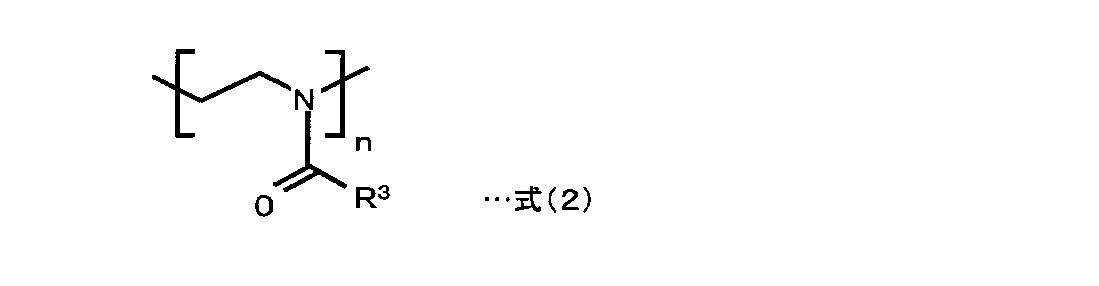
- 請求項6において、前記CO-N構造を有する化合物が、ポリビニルピロリドンおよび/又はポリエチルオキサゾリンを含むことを特徴とする凝集剤。
- 請求項1ないし7のいずれか1項において、前記ノニオン性高分子化合物の分子量が4,000~1,000,000であることを特徴とする凝集剤。
- 請求項1ないし8のいずれか1項において、更に第四級アンモニウム塩基を含むカチオン性高分子化合物および/又は無機凝集剤を含むことを特徴とする凝集剤。
- 請求項9において、前記第四級アンモニウム塩基を含むカチオン性高分子化合物がポリジアリルジメチルアンモニウム塩であることを特徴とする凝集剤。
- 請求項9又は10において、前記無機凝集剤が鉄系無機凝集剤であることを特徴とする凝集剤。
- 請求項1ないし11のいずれか1項において、有機物および濁質を含んだ被処理水の水処理凝集剤であることを特徴とする凝集剤。
- 有機物および濁質を含んだ被処理水の水処理方法であって、該被処理水に請求項1~12のいずれか1項に記載の凝集剤を添加して凝集処理した後、固液分離することを特徴とする水処理方法。
- 請求項13において、前記被処理水に、前記弱カチオン性のアミノ基を有する高分子化合物を添加した後前記ノニオン性高分子化合物を添加するか、前記ノニオン性高分子化合物を添加した後前記弱カチオン性のアミノ基を有する高分子化合物を添加するか、或いは前記第一アミノ基を有する高分子化合物とノニオン性高分子化合物とを同時に添加して凝集処理することを特徴とする水処理方法。
- 請求項13又は14において、前記凝集剤が第四級アンモニウム塩基を含むカチオン性高分子化合物を含み、前記被処理水に該第四級アンモニウム塩基を含むカチオン性高分子化合物を添加して凝集処理した後、前記弱カチオン性のアミノ基を有する高分子化合物とノニオン性高分子化合物を添加して凝集処理することを特徴とする水処理方法。
- 請求項13ないし15のいずれか1項において、前記凝集剤が無機凝集剤を含み、前記被処理水に前記弱カチオン性のアミノ基を有する高分子化合物とノニオン性高分子化合物を添加して凝集処理した後、該無機凝集剤を添加して凝集処理するか、或いは、前記被処理水に前記弱カチオン性のアミノ基を有する高分子化合物、ノニオン性高分子化合物および無機凝集剤を同時に添加して凝集処理することを特徴とする水処理方法。
- 請求項13ないし16のいずれか1項において、前記固液分離を、沈殿処理、加圧浮上処理、濾過、もしくは膜分離により行うことを特徴とする水処理方法。
- ポリエチレンイミン(PEI)とポリビニルピロリドン(PVP)を一剤で含む溶液状水処理薬品を調製する方法であって、PEIとPVPの分子量の関係と、PEIとPVPの液中濃度の関係から、両者を混合した際にゲル化しない分子量と濃度の関係でPEIとPVPを用いることを特徴とする水処理薬品の調製方法。
- 請求項18において、同量のPEIとPVPを混合し、ゲル化することを確認した分子量の組み合わせを除くことを特徴とする水処理薬品の調製方法。
- 請求項18において、同量のPEIとPVPを混合し、ゲル化することを確認した分子量の組み合わせにおいて、PEIとPVPの各濃度を変化させた際に、ゲル化する濃度比の範囲を除くことを特徴とする水処理薬品の調製方法。
- 被処理水に、請求項18ないし20のいずれか1項に記載の水処理薬品の調製方法により調製した水処理薬品を添加することを特徴とする水処理方法。
- 請求項21において、前記被処理水に前記水処理薬品と無機凝集剤とを添加して凝集処理する方法であって、該被処理水に前記水処理薬品と該無機凝集剤とを同時に添加して凝集処理するか、或いは、該被処理水に該水処理薬品を添加して凝集処理した後該無機凝集剤を添加して凝集処理することを特徴とする水処理方法。
- 請求項21又は22において、前記被処理水に第四級アンモニウム塩基を含むカチオン性高分子化合物を添加して凝集処理した後、前記水処理薬品を添加して凝集処理することを特徴とする水処理方法。
- 請求項21ないし23のいずれか1項において、前記被処理水が有機物および濁質を含んでおり、該被処理水に前記水処理薬品を添加して凝集処理した後、固液分離することを特徴とする水処理方法。
- 請求項24において、前記固液分離を、沈殿処理、加圧浮上処理、濾過、もしくは膜分離により行うことを特徴とする水処理方法。
Applications Claiming Priority (4)
| Application Number | Priority Date | Filing Date | Title |
|---|---|---|---|
| JP2016-023796 | 2016-02-10 | ||
| JP2016023796A JP6115661B1 (ja) | 2016-02-10 | 2016-02-10 | 水処理方法 |
| JP2016042000A JP6115665B1 (ja) | 2016-03-04 | 2016-03-04 | 水処理薬品の調製方法および水処理方法 |
| JP2016-042000 | 2016-03-04 |
Publications (1)
| Publication Number | Publication Date |
|---|---|
| WO2017138184A1 true WO2017138184A1 (ja) | 2017-08-17 |
Family
ID=59562956
Family Applications (1)
| Application Number | Title | Priority Date | Filing Date |
|---|---|---|---|
| PCT/JP2016/077635 Ceased WO2017138184A1 (ja) | 2016-02-10 | 2016-09-20 | 凝集剤および水処理方法 |
Country Status (2)
| Country | Link |
|---|---|
| TW (1) | TW201741250A (ja) |
| WO (1) | WO2017138184A1 (ja) |
Families Citing this family (2)
| Publication number | Priority date | Publication date | Assignee | Title |
|---|---|---|---|---|
| JP6901032B1 (ja) * | 2020-07-02 | 2021-07-14 | 栗田工業株式会社 | 緑液処理剤 |
| CN118851378B (zh) * | 2024-08-08 | 2025-03-18 | 山东大学 | 一种用于盾构施工的高效絮凝剂及其制备方法 |
Citations (6)
| Publication number | Priority date | Publication date | Assignee | Title |
|---|---|---|---|---|
| JPS48102080A (ja) * | 1972-03-08 | 1973-12-21 | ||
| US3951792A (en) * | 1972-03-30 | 1976-04-20 | Gaf Corporation | Flocculation of suspended solids |
| JPS5621609A (en) * | 1979-07-28 | 1981-02-28 | Dai Ichi Kogyo Seiyaku Co Ltd | New type coagulant composition and coagulating treatment |
| JPS57132509A (en) * | 1981-02-09 | 1982-08-16 | Kurita Water Ind Ltd | Flocculation treatment of suspension |
| JPH0938700A (ja) * | 1995-07-31 | 1997-02-10 | Nippon Shokubai Co Ltd | 有機汚泥の処理法 |
| JPH1085797A (ja) * | 1996-09-13 | 1998-04-07 | Ebara Corp | 汚泥の脱水剤及び脱水方法 |
-
2016
- 2016-09-20 WO PCT/JP2016/077635 patent/WO2017138184A1/ja not_active Ceased
- 2016-10-03 TW TW105131920A patent/TW201741250A/zh unknown
Patent Citations (6)
| Publication number | Priority date | Publication date | Assignee | Title |
|---|---|---|---|---|
| JPS48102080A (ja) * | 1972-03-08 | 1973-12-21 | ||
| US3951792A (en) * | 1972-03-30 | 1976-04-20 | Gaf Corporation | Flocculation of suspended solids |
| JPS5621609A (en) * | 1979-07-28 | 1981-02-28 | Dai Ichi Kogyo Seiyaku Co Ltd | New type coagulant composition and coagulating treatment |
| JPS57132509A (en) * | 1981-02-09 | 1982-08-16 | Kurita Water Ind Ltd | Flocculation treatment of suspension |
| JPH0938700A (ja) * | 1995-07-31 | 1997-02-10 | Nippon Shokubai Co Ltd | 有機汚泥の処理法 |
| JPH1085797A (ja) * | 1996-09-13 | 1998-04-07 | Ebara Corp | 汚泥の脱水剤及び脱水方法 |
Also Published As
| Publication number | Publication date |
|---|---|
| TW201741250A (zh) | 2017-12-01 |
Similar Documents
| Publication | Publication Date | Title |
|---|---|---|
| RU2326722C2 (ru) | Способ применения водорастворимых полимеров в мембранном биологическом реакторе | |
| TWI459997B (zh) | 膜分離方法及膜分離裝置 | |
| JP7311951B2 (ja) | 水処理方法および水処理装置 | |
| JP5867532B2 (ja) | 水処理用分散剤及び水処理方法 | |
| JP5037002B2 (ja) | 高分子凝集剤を用いた汚泥の凝集脱水処理方法及び廃水の凝集沈殿処理方法 | |
| JP6115661B1 (ja) | 水処理方法 | |
| WO2017138184A1 (ja) | 凝集剤および水処理方法 | |
| CN104023808B (zh) | 海水处理方法 | |
| JP2010131469A (ja) | 膜分離処理方法 | |
| JP6115665B1 (ja) | 水処理薬品の調製方法および水処理方法 | |
| JP2019188338A (ja) | 水処理方法及び水処理装置 | |
| WO2011016482A1 (ja) | 膜分離活性汚泥法における流束低下原因物質の除去方法 | |
| JP2001213968A (ja) | 水溶性ポリマーの溶解方法及び溶解装置 | |
| JP6303945B2 (ja) | 膜分離活性汚泥処理における固液分離方法 | |
| JP2012210613A (ja) | 排水の処理方法 | |
| CN103201224B (zh) | 用于改进膜生物反应器系统的方法 | |
| JP2020058964A (ja) | 膜用水処理薬品及び膜処理方法 | |
| TWI589532B (zh) | 改良薄膜生物反應器系統之方法 | |
| JP2010082593A (ja) | 水処理方法及び有機凝結剤 | |
| JPH11277094A (ja) | 汚泥添加剤およびその使用方法 | |
| JPH10140000A (ja) | アルキレンオキシド重合体の分散液およびその製造方法 |
Legal Events
| Date | Code | Title | Description |
|---|---|---|---|
| 121 | Ep: the epo has been informed by wipo that ep was designated in this application |
Ref document number: 16889885 Country of ref document: EP Kind code of ref document: A1 |
|
| NENP | Non-entry into the national phase |
Ref country code: DE |
|
| 122 | Ep: pct application non-entry in european phase |
Ref document number: 16889885 Country of ref document: EP Kind code of ref document: A1 |