WO2017135392A1 - アゾ化合物、それを用いた偏光素子及び偏光板、並びに表示装置 - Google Patents
アゾ化合物、それを用いた偏光素子及び偏光板、並びに表示装置 Download PDFInfo
- Publication number
- WO2017135392A1 WO2017135392A1 PCT/JP2017/003875 JP2017003875W WO2017135392A1 WO 2017135392 A1 WO2017135392 A1 WO 2017135392A1 JP 2017003875 W JP2017003875 W JP 2017003875W WO 2017135392 A1 WO2017135392 A1 WO 2017135392A1
- Authority
- WO
- WIPO (PCT)
- Prior art keywords
- group
- carbon atoms
- substituent
- azo compound
- polarizing element
- Prior art date
- Legal status (The legal status is an assumption and is not a legal conclusion. Google has not performed a legal analysis and makes no representation as to the accuracy of the status listed.)
- Ceased
Links
- UFWIBTONFRDIAS-UHFFFAOYSA-N c1cc2ccccc2cc1 Chemical compound c1cc2ccccc2cc1 UFWIBTONFRDIAS-UHFFFAOYSA-N 0.000 description 1
Classifications
-
- C—CHEMISTRY; METALLURGY
- C09—DYES; PAINTS; POLISHES; NATURAL RESINS; ADHESIVES; COMPOSITIONS NOT OTHERWISE PROVIDED FOR; APPLICATIONS OF MATERIALS NOT OTHERWISE PROVIDED FOR
- C09B—ORGANIC DYES OR CLOSELY-RELATED COMPOUNDS FOR PRODUCING DYES, e.g. PIGMENTS; MORDANTS; LAKES
- C09B45/00—Complex metal compounds of azo dyes
- C09B45/02—Preparation from dyes containing in o-position a hydroxy group and in o'-position hydroxy, alkoxy, carboxyl, amino or keto groups
- C09B45/24—Disazo or polyazo compounds
- C09B45/28—Disazo or polyazo compounds containing copper
-
- G—PHYSICS
- G02—OPTICS
- G02B—OPTICAL ELEMENTS, SYSTEMS OR APPARATUS
- G02B5/00—Optical elements other than lenses
- G02B5/30—Polarising elements
-
- G—PHYSICS
- G02—OPTICS
- G02B—OPTICAL ELEMENTS, SYSTEMS OR APPARATUS
- G02B5/00—Optical elements other than lenses
- G02B5/30—Polarising elements
- G02B5/3025—Polarisers, i.e. arrangements capable of producing a definite output polarisation state from an unpolarised input state
- G02B5/3033—Polarisers, i.e. arrangements capable of producing a definite output polarisation state from an unpolarised input state in the form of a thin sheet or foil, e.g. Polaroid
- G02B5/3041—Polarisers, i.e. arrangements capable of producing a definite output polarisation state from an unpolarised input state in the form of a thin sheet or foil, e.g. Polaroid comprising multiple thin layers, e.g. multilayer stacks
- G02B5/305—Polarisers, i.e. arrangements capable of producing a definite output polarisation state from an unpolarised input state in the form of a thin sheet or foil, e.g. Polaroid comprising multiple thin layers, e.g. multilayer stacks including organic materials, e.g. polymeric layers
-
- G—PHYSICS
- G02—OPTICS
- G02F—OPTICAL DEVICES OR ARRANGEMENTS FOR THE CONTROL OF LIGHT BY MODIFICATION OF THE OPTICAL PROPERTIES OF THE MEDIA OF THE ELEMENTS INVOLVED THEREIN; NON-LINEAR OPTICS; FREQUENCY-CHANGING OF LIGHT; OPTICAL LOGIC ELEMENTS; OPTICAL ANALOGUE/DIGITAL CONVERTERS
- G02F1/00—Devices or arrangements for the control of the intensity, colour, phase, polarisation or direction of light arriving from an independent light source, e.g. switching, gating or modulating; Non-linear optics
- G02F1/01—Devices or arrangements for the control of the intensity, colour, phase, polarisation or direction of light arriving from an independent light source, e.g. switching, gating or modulating; Non-linear optics for the control of the intensity, phase, polarisation or colour
- G02F1/13—Devices or arrangements for the control of the intensity, colour, phase, polarisation or direction of light arriving from an independent light source, e.g. switching, gating or modulating; Non-linear optics for the control of the intensity, phase, polarisation or colour based on liquid crystals, e.g. single liquid crystal display cells
- G02F1/133—Constructional arrangements; Operation of liquid crystal cells; Circuit arrangements
- G02F1/1333—Constructional arrangements; Manufacturing methods
- G02F1/1335—Structural association of cells with optical devices, e.g. polarisers or reflectors
Definitions
- the present invention relates to a novel azo compound, a polarizing element and a polarizing plate having a high degree of polarization using the same, and a display device.
- a polarizing element is generally produced by adsorbing and orienting iodine or dichroic dye, which is a dichroic dye, on a polyvinyl alcohol resin film.
- a protective film made of triacetyl cellulose or the like is bonded to at least one surface of the polarizing element via an adhesive layer to form a polarizing plate.
- the polarizing plate is used for a display device or the like.
- a polarizing plate using iodine as a dichroic dye is called an iodine polarizing plate, while a polarizing plate using a dichroic dye as a dichroic dye is called a dye polarizing plate.
- the dye-based polarizing plate has high heat resistance, high wet heat durability, and high stability, and is characterized by high color selectivity by blending a dichroic dye.
- Patent Documents 1 to 4 and Non-Patent Documents 1 and 2 disclose dye-based polarizing elements containing an azo compound.
- One of the objects of the present invention is to provide a polarizing element and a polarizing plate having excellent polarization performance and contrast, a display device having excellent contrast, and a novel azo compound usable for them.
- the present inventors found a novel azo compound that can be used as a dichroic dye constituting a polarizing element and a polarizing plate, and were excellent by using the azo compound. It has been found that a polarizing element and a polarizing plate having polarizing performance and contrast, and a display device having excellent contrast can be realized, and the present invention has been completed.
- the present invention (1) The following general formula (1) (In the formula, Ab 1 represents a phenyl group having a substituent or a naphthyl group having a substituent, and Rb 1 to Rb 5 each independently represents a hydrogen atom, an alkyl group having 1 to 4 carbon atoms, 4 represents an alkoxy group having 1 to 4 carbon atoms having 4 alkoxy groups, a sulfo group, or a sulfo group, and Xb 1 is an amino group which may have a substituent, or a phenylamino which may have a substituent.
- An azo compound represented by the formula: (2) The azo compound according to item (1), which is represented by the following general formula (2) (In the formula, Ab 1 is phenyl having 1 or 2 substituents selected from the group consisting of a sulfo group, a carboxy group, an alkyl group having 1 to 4 carbon atoms, and an alkoxy group having 1 to 4 carbon atoms.
- Rb 1 to Rb 5 are Each independently represents a hydrogen atom, an alkyl group having 1 to 4 carbon atoms, an alkoxy group having 1 to 4 carbon atoms, or an alkoxy group having 1 to 4 carbon atoms having a sulfo group, and Xb 1 represents a methyl group or a methoxy group ,
- a phenylamino group optionally having one or two substituents selected from the group consisting of a sulfo group, an amino group, and an alkylamino group having 1 to 4 carbon atoms, a hydroxy group, an amino group, and Benzoylamino group, hydroxy group, alkyl group having 1 to 4 carbon atoms, alkoxy group having 1 to 4 carbon atoms, amino group,
- a polarizing element further comprising an azo compound represented by (7)
- Ar 1 is phenyl having one or two substituents selected from the group consisting of a sulfo group, a carboxy group, an alkyl group having 1 to 4 carbon atoms, and an alkoxy group having 1 to 4 carbon atoms.
- a naphthyl group having 2 or 3 substituents selected from the group consisting of a C 1-4 alkoxy group having a sulfo group, a hydroxy group, and a sulfo group and Rr 1 to Rr 6 are Each independently represents a hydrogen atom, an alkyl group having 1 to 4 carbon atoms, an alkoxy group having 1 to 4 carbon atoms, or an alkoxy group having 1 to 4 carbon atoms having a sulfo group, and Xr 1 represents a methyl group or a methoxy group
- a polarizing element wherein the other is an alkyl group having 1 to 4 carbon atoms or an alkoxy group having 1 to 4 carbon atoms
- Xr 1 in the general formula (3) or (5) is a methyl group, a methoxy group, a sulfo group, an amino group, or carbon From the group consisting of a phenylamino group optionally having 1 or 2 substituents selected from the group consisting of alkylamino groups of 1 to 4 or a hydroxy group, an amino group, and a carboxyethylamino group
- a polarizing element and a polarizing plate having excellent polarization performance and contrast, a display device having excellent contrast, and a novel azo compound usable for them.
- the azo compound of the present invention has the following general formula (1) Or an salt thereof.
- the azo compound of the present invention is a water-soluble dye that functions as a pigment generally called a dichroic dye.
- Ab 1 represents a phenyl group having a substituent or a naphthyl group having a substituent
- Rb 1 to Rb 5 each independently represents a hydrogen atom, an alkyl group having 1 to 4 carbon atoms, carbon Represents an alkoxy group having 1 to 4 carbon atoms, or an alkoxy group having 1 to 4 carbon atoms having a sulfo group
- Xb 1 is an amino group or substituent which may have a substituent (excluding a phenyl group and a benzoyl group)
- the azo compound represented by the general formula (1) is represented by the following general formula (2) (In the formula, Ab 1 , Rb 1 to Rb 5 , and Xb 1 represent the same meaning as in the general formula (1).) It is preferable that it is an azo compound represented by these. Thereby, the polarization performance of the polarizing element using the azo compound represented by the general formula (1) can be further improved.
- Ab 1 in the general formula (1) or (2) represents a phenyl group having a substituent or a naphthyl group having a substituent, and is a sulfo group, a carboxy group, an alkyl group having 1 to 4 carbon atoms, and It consists of a phenyl group having one or two substituents selected from the group consisting of alkoxy groups having 1 to 4 carbon atoms, or an alkoxy group having 1 to 4 carbon atoms having a sulfo group, a hydroxy group, and a sulfo group.
- a naphthyl group having 2 or 3 substituents selected from the group is preferred.
- Ab 1 in the general formula (1) or (2) is a phenyl group having a substituent, it preferably has at least one sulfo group or carboxy group as the substituent.
- Ab 1 is a phenyl group having two or more substituents, at least one (partial) substituent among them is a sulfo group or a carboxy group, and the other substituent is a sulfo group.
- the substituent on the phenyl group is more preferably a sulfo group, an alkyl group having 1 to 4 carbon atoms, an alkoxy group having 1 to 4 carbon atoms, a nitro group, an amino group, or a carboxy group, and particularly preferably a sulfo group.
- the number of substituents on the phenyl group is preferably two.
- the substitution position of the substituent on the phenyl group is not particularly limited, but when the number of substituents on the phenyl group is 2, it is preferably a combination of 2-position and 4-position.
- Ab 1 in the general formula (1) or (2) is a naphthyl group having a substituent
- Ab 1 is a naphthyl group having two or more substituents, among these substituents, (part of) at least one substituent is a sulfo group, and the other substituents are a sulfo group
- An alkoxy group having 1 to 4 carbon atoms having a hydroxy group, a carboxy group, or a sulfo group is preferable.
- the combination of the substitution positions of these substituents is a combination of the 4-position and the 8-position, or a combination of the 6-position and the 8-position. Is preferable, and a combination of 6-position and 8-position is particularly preferable.
- the combination of the substitution positions of these substituents is particularly preferably a combination of 1-position, 3-position and 6-position.
- the alkoxy group having 1 to 4 carbon atoms having a sulfo group as a substituent on the phenyl group or naphthyl group in Ab 1 is preferably a linear alkoxy group having 1 to 4 carbon atoms having a sulfo group.
- the sulfo group is preferably substituted at the end of the alkoxy group.
- the C 1-4 alkoxy group having a sulfo group is more preferably a 3-sulfopropoxy group or a 4-sulfobutoxy group, and particularly preferably a 3-sulfopropoxy group.
- Xb 1 in the general formula (1) or (2) is an amino group which may have a substituent (excluding a phenyl group and a benzoyl group), a phenylamino group which may have a substituent, and a substituent.
- a phenylamino group, a hydroxy group, an amino group, and carboxyethyl which may have one or two substituents selected from the group consisting of a group, an amino group, and an alkylamino group having 1 to 4 carbon atoms
- a benzoylamino group optionally having one substituent selected from the group consisting of amino groups, a hydroxy group, an alkyl group having 1 to 4 carbon atom
- substitution position of the substituent is not particularly limited, but when Xb 1 is a phenylamino group having one substituent, a benzoylamino group having one substituent, or a phenylazo group having one substituent, Particularly preferred is the p-position.
- Rb 1 to Rb 5 in the general formula (1) or (2) are each independently a carbon atom having a hydrogen atom, an alkyl group having 1 to 4 carbon atoms, an alkoxy group having 1 to 4 carbon atoms, or a sulfo group.
- the combination of the substitution positions of Rb 1 and Rb 2 and the combination of the substitution positions of Rb 3 and Rb 4 are each independently a combination of the 2-position and the 6-position, A combination of a position and a 5-position, or a combination of a 3-position and a 5-position is preferable, and a combination of a 2-position and a 5-position is more preferable.
- the substitution position of Rb 5 is preferably 2-position or 3-position, and more preferably 2-position.
- the combination of the substitution positions of Rb 1 and Rb 2 and the combination of the substitution positions of Rb 3 and Rb 4 are each independently a combination of the 2-position and the 6-position when at least one is a methoxy group, A combination of a position and a 5-position, or a combination of a 3-position and a 5-position is preferable, and a combination of a 2-position and a 5-position is more preferable.
- the method for producing the azo compound represented by the general formula (1) will be described below. Since the azo compound represented by the general formula (1) can be produced by a production method similar to a known production method, the production method of the azo compound represented by the general formula (1) is here. It is not limited to the manufacturing method described. For example, the azo compound represented by the general formula (1) can be easily produced by performing known diazotization and coupling in accordance with a conventional method for producing an azo dye as described in Non-Patent Document 1.
- the azo compound represented by the general formula (1) can be produced as follows. First, the following general formula (6) (In the formula, Ab 1 , Rb 1 and Rb 2 represent the same meaning as in the general formulas (1) and (2).) A monoazoamino compound represented by the formula is obtained.
- the monoazoamino compound represented by the general formula (6) is a phenyl group in which Ab 1 has at least one sulfo group
- the following general formula (7) (In the formula, one of Rb 11 and Rb 12 represents a sulfo group or a carboxy group, and the other represents a sulfo group, a carboxy group, an alkyl group having 1 to 4 carbon atoms, an alkoxy group having 1 to 4 carbon atoms, a sulfo group.
- a sulfoalkoxyanilic acid obtained by sulfoalkylating an aromatic amine represented by the following general formula is diazotized, and the following general formula (8) (In the formula, Rb 1 and Rb 2 represent the same meaning as in the general formulas (1) and (2)). It obtains by carrying out primary coupling with the anilines represented by these.
- the monoazoamino compound represented by the general formula (6) has the following general formula (9) when Ab 1 is a naphthyl group having at least one sulfo group.
- Rb 13 is a hydrogen atom, a hydroxy group, a carboxy group, a sulfo group, a tosylated hydroxy group, an amino group, a substituted amino group, a nitro group, a substituted amide group, or a sulfo group having a carbon number of 1 to 4 represents an alkoxy group, and q represents an integer of 1 to 3.
- the monoazoamino compound represented by the general formula (6) is diazotized, and the following general formula (10) (In the formula, Rb 3 and Rb 4 represent the same meaning as in the general formula (1) and the general formula (2).) Secondary coupling with anilines represented by the following general formula (11) (In the formula, Ab 1 , Rb 1 , Rb 2 , Rb 3 , and Rb 4 have the same meaning as in the general formulas (1) and (2).) The disazoamino compound represented by this is obtained.
- the disazoamino compound represented by the general formula (11) is diazotized, and the following general formula (12) And tertiary coupling with anilines represented by the following general formula (13) (In the formula, Ab 1 and Rb 1 to Rb 5 have the same meaning as in the general formulas (1) and (2).) A trisazoamino compound represented by the formula is obtained.
- the trisazoamino compound represented by the general formula (13) is diazotized by a known method, and the following general formula (14)
- the following general formula (14) (In the formula, Xb 1 represents the same meaning as in the general formulas (1) and (2).)
- naphthols represented by the following general formula (15) In the formula, Ab 1 , Rb 1 to Rb 5 , and Xb 1 have the same meaning as in the general formulas (1) and (2).)
- the tetraazo compound represented by these is obtained.
- a copper complex salt compound comprising copper sulfate and at least one selected from the group consisting of aqueous ammonia, amino alcohol, and hexamethylenetetramine is added to the tetraazo compound represented by the general formula (15), Is subjected to a copperation reaction at 85 ° C. to 95 ° C. to obtain a copper complex azo compound represented by the general formula (1) or (2).
- the diazotization step in the above synthesis is performed by a conventional method in which a nitrite such as sodium nitrite is mixed with a mineral acid aqueous solution or suspension of the diazo component such as hydrochloric acid or sulfuric acid, or the diazo component is neutral or weakly alkaline. Nitrite is added to the aqueous solution and mixed with mineral acid.
- the diazotization temperature is suitably -10 to 40 ° C.
- the coupling step of the diazotized product with anilines is carried out by mixing an acidic aqueous solution such as hydrochloric acid or acetic acid and each of the above diazo solutions (a diazotized solution or suspension) at a temperature of ⁇ 10 to 40 ° C. and a pH of 2 It is carried out under acidic conditions of ⁇ 7.
- the monoazoamino compound, disazoamino compound, and trisazoamino compound obtained by coupling are removed as they are, or after precipitation by aciding out or salting out, or are taken out as solutions or suspensions. It is also possible to proceed to the next step. If the diazonium salt is insoluble and in suspension, it can be filtered and used as a press cake in the next coupling step.
- the quaternary coupling reaction between the diazotized compound of the trisazoamino compound represented by the general formula (13) and the naphthols represented by the general formula (14) has a temperature of ⁇ 10 to 40 ° C. and a pH of 7 to 10. It is carried out under neutral to alkaline conditions. After completion of the reaction, it is precipitated by salting out and filtered out. In addition, when purification is necessary, salting out may be repeated or it may be precipitated from water using an organic solvent.
- the organic solvent used for purification include water-soluble organic solvents such as alcohols such as methanol and ethanol, and ketones such as acetone.
- Rb 11 and Rb 12 of the amine include a hydrogen atom, a sulfo group, a carboxy group, an alkyl group having 1 to 4 carbon atoms, an alkoxy group having 1 to 4 carbon atoms, and an alkoxy group having 1 to 4 carbon atoms having a sulfo group.
- Rb 11 and Rb 12 are each independently a hydrogen atom, a sulfo group, a carboxy group, an alkyl group having 1 to 4 carbon atoms, or is preferably an alkoxy group having 1 to 4 carbon atoms, the Rb 11 and Rb 12 It is more preferable that at least one is a sulfo group, and it is further more preferable that the number of substituents of Rb 11 and Rb 12 is 2 (that is, both Rb 11 and Rb 12 are not hydrogen atoms).
- the alkoxy group having 1 to 4 carbon atoms having a sulfo group is preferably a linear alkoxy group having 1 to 4 carbon atoms having a sulfo group.
- the sulfo group is preferably substituted at the end of the alkoxy group.
- the alkoxy group having 1 to 4 carbon atoms having a sulfo group is more preferably a 3-sulfopropoxy group or a 4-sulfobutoxy group.
- Examples of the aromatic amine represented by the general formula (7) include 4-aminobenzenesulfonic acid, 3-aminobenzenesulfonic acid, 2-aminobenzenesulfonic acid, 4-aminobenzoic acid, and 2-amino-5.
- the aromatic amine represented by the general formula (7) may have a naphthotriazole group as a substituent on the phenyl group.
- the naphthotriazole group include 6,8-disulfonaphthotriazole group, 7,9-disulfonaphthotriazole group, 7-sulfonaphthotriazole group, and 5-sulfonaphthotriazole group.
- the naphthotriazole group is particularly preferably in the p-position of the phenyl group.
- the alkoxy group is preferably a C 1-4 alkoxy group having a hydrogen atom, a sulfo group or a sulfo group.
- Rb 13 is preferably a lower alkoxy group having a hydrogen atom, a hydroxy group, a carboxy group, or a sulfo group.
- the alkoxy group having 1 to 4 carbon atoms having a sulfo group is preferably a linear alkoxy group having 1 to 4 carbon atoms having a sulfo group.
- the sulfo group is preferably substituted at the end of the alkoxy group.
- the alkoxy group having 1 to 4 carbon atoms having a sulfo group is preferably a 3-sulfopropoxy group or a 4-sulfobutoxy group.
- the substitution position of the sulfo group may be on any benzene nucleus of the naphthalene ring.
- the substitution position of the sulfo group is preferably any of the 1-position, the 3-position, and the 6-position, and the sulfo group number q is 2 or 3.
- the combination of substitution positions of the sulfo group is preferably a combination of two or three selected from the group consisting of the 1-position, 3-position, 6-position and 7-position.
- naphthylamine sulfonic acids represented by the general formula (9) include 2-aminonaphthalene-1-sulfonic acid, 8-aminonaphthalene-1-sulfonic acid, 5-aminonaphthalene-1-sulfonic acid, 5- Aminonaphthalene-2-sulfonic acid, 8-aminonaphthalene-2-sulfonic acid, 3-aminonaphthalene-1-sulfonic acid, 6-aminonaphthalene-2-sulfonic acid, 4-aminonaphthalene-1-sulfonic acid, 7- Aminonaphthalene-1,3-disulfonic acid, 6-aminonaphthalene-1,3-disulfonic acid, 3-amino-7-nitronaphthalene-1,5-disulfonic acid, 4-aminonaphthalene-1,6-disulfonic acid, 4-aminonaphthalene-1,5-disulfonic acid, 5-aminon
- Rb 1 and Rb 2 of the aniline represented by the general formula (8) as the primary coupling component, and Rb of the aniline represented by the general formula (10) as the secondary coupling component 3 and Rb 4 each independently represents a hydrogen atom, an alkyl group having 1 to 4 carbon atoms, an alkoxy group having 1 to 4 carbon atoms, or an alkoxy group having 1 to 4 carbon atoms having a sulfo group, A hydrogen atom, a methyl group, a methoxy group, or a 3-sulfopropoxy group or a 4-sulfobutoxy group, more preferably a hydrogen atom, a methyl group, or a methoxy group.
- the combination of the substitution positions of Rb 1 and Rb 2 and the combination of the substitution positions of Rb 3 and Rb 4 are each independently a combination of 2-position and 6-position, 2-position and 5 with respect to the amino group.
- a combination with the -position or a combination with the 3-position and the 5-position is preferable, and a combination with the 2-position and the 5-position is more preferable.
- anilines having a C 1-4 alkoxy group having a sulfo group examples include 3- (2-Amino-4-methylphenoxy) propane-1-sulfonic acid, 3- (2-aminophenoxy) propane-1-sulfonic acid, 3- (2-amino-4-methylphenoxy) butane-1-sulfonic acid Etc.
- anilines represented by the general formula (8) and other anilines usable as the anilines represented by the general formula (10) include 2,5-dimethylaniline, 2,5- Examples include diethylaniline, 2-methoxy-5-methylaniline, 2,5-dimethoxyaniline, 3,5-dimethylaniline, 2,6-dimethylaniline, and 3,5-dimethoxyaniline. These anilines may have an amino group protected with a protecting group. Examples of the protecting group include its ⁇ -methanesulfo group.
- the anilines represented by the general formula (8) used for the primary coupling and the anilines represented by the general formula (10) used for the secondary coupling may be the same or different. May be.
- the aniline having a methoxy group represented by the general formula (12), which is a tertiary coupling component, may be any aniline having a methoxy group at the o-position with respect to the amino group. 5-dimethoxyaniline, 2-methoxyaniline, 2-methoxy-5-methylaniline.
- the substituent Xb 1 of the naphthols represented by the general formula (14) which is a quaternary coupling component is an amino group or substituent which may have a substituent (excluding a phenyl group and a benzoyl group).
- it may have 1 or 2 substituents selected from the group consisting of a methyl group, a methoxy group, a sulfo group, an amino group, and an alkylamino group having 1 to 4 carbon atoms.
- Benzoylamino group, hydroxy group, carbon number 1 to 1 which may have one substituent selected from the group consisting of phenylamino group, hydroxy group, amino group, and carboxyethylamino group
- a phenylazo group optionally having 1 to 3 substituents selected from the group consisting of 4 alkyl groups, alkoxy groups having 1 to 4 carbon atoms, amino groups, and carboxyethylamino groups, or 1 or A naphthotriazole group substituted with two sulfo groups, more preferably one selected from the group consisting of a methyl group, a methoxy group, a sulfo group, an amino group, and an alkylamino group having 1 to 4 carbon atoms Or a
- Xb 1 is phenylamino group having one substituent, a benzoylamino group having one substituent, or when a phenylazo group having one substituent, the substituted position of the substituent is not particularly limited, When Xb 1 is a phenylamino group having one substituent, a benzoylamino group having one substituent, or a phenylazo group having one substituent, the p-position is particularly preferred.
- the azo compound of the present invention may exist in the form of a free acid represented by the general formula (1) or in the form of a salt thereof.
- the salt include alkali metal salts, alkaline earth metal salts, alkylamine salts, alkanolamine salts, ammonium salts, and the like.
- the salt is preferably a sodium salt, a potassium salt, or an ammonium salt when used for dyeing a substrate for a polarizing element.
- the azo compound represented by the general formula (1) can be isolated in the form of a free acid by adding a mineral acid after the coupling reaction, and the isolated azo compound represented by the general formula (1).
- the inorganic salt can be removed from the isolated azo compound represented by the general formula (1) by washing the compound with water or acidified water. In this way, an azo compound represented by the general formula (1) in the acid form having a low salt content is obtained. Next, the azo compound represented by the general formula (1) in the acid form is neutralized with a desired inorganic or organic base in an aqueous medium to obtain a corresponding salt solution.
- sodium chloride can be used to convert the azo compound represented by the general formula (1) into a sodium salt, for example, using potassium chloride in the general formula (1).
- the azo compound represented can also be a potassium salt. In this way, the azo compound represented by the general formula (1) can be converted into a desired salt.
- the polarizing element of the present invention includes a base material and the azo compound of the present invention described above.
- the azo compound of the present invention is preferably adsorbed on the substrate.
- the azo compound used as a pigment in the polarizing element of the present invention is generally a known diazotized, cupped according to a synthesis method of an azo dye known in the technical field (for example, page 626 of Non-Patent Document 1). It can be manufactured by ringing.
- a polarizing element can be produced by dissolving an azo compound in a solution and impregnating the substrate in a dyeing step.
- the polarizing element of the present invention is a dichroic dye in addition to the azo compound of the present invention described above, and is represented by the following general formula (3) It is preferable that the azo compound or its salt represented by these is further included. Thereby, a polarizing element having higher polarization performance can be realized. It is preferable that the azo compound represented by the general formula (3) or a salt thereof is also adsorbed on the substrate.
- Ar 1 represents a phenyl group having a substituent or a naphthyl group having a substituent
- Rr 1 to Rr 6 are each independently a hydrogen atom, an alkyl group having 1 to 4 carbon atoms, carbon Represents an alkoxy group having 1 to 4 carbon atoms, or an alkoxy group having 1 to 4 carbon atoms having a sulfo group
- Xr 1 is an amino group or substituent which may have a substituent (excluding a phenyl group and a benzoyl group)
- m and n each independently represent 0 or 1.
- the azo compound represented by the general formula (3) is represented by the following general formula (5). (In the formula, Ab 1 , Rb 1 to Rb 5 , and Xb 1 represent the same meaning as in the general formula (1).) It is preferable that it is an azo compound represented by these.
- Ar 1 represents a phenyl group having a substituent or a naphthyl group having a substituent
- Rr 1 to Rr 6 each independently represents a hydrogen atom or a carbon number of 1 to 4 Or an alkoxy group having 1 to 4 carbon atoms, or an alkoxy group having 1 to 4 carbon atoms having a sulfo group
- Xr 1 may have a substituent (excluding a phenyl group and a benzoyl group).
- a good amino group, a phenylamino group which may have a substituent, a benzoylamino group which may have a substituent, a phenylazo group which may have a substituent, or a substituent Represents a naphthotriazole group, and m and n each independently represent 0 or 1;
- Rr 1 to Rr 6 in the general formula (3) or (5) are each independently preferably a hydrogen atom or an alkyl group having 1 to 4 carbon atoms, and particularly preferably a hydrogen atom or a methyl group.
- One of Rr 5 and Rr 6 in the general formula (3) or (5) is an alkoxy group having 1 to 4 carbon atoms, and the other is an alkyl group having 1 to 4 carbon atoms or an alkoxy group having 1 to 4 carbon atoms. It is preferably a group.
- Xr 1 in the general formula (3) or (5) is preferably one selected from the group consisting of a methyl group, a methoxy group, a sulfo group, an amino group, and an alkylamino group having 1 to 4 carbon atoms.
- a benzoylamino group optionally having one substituent selected from the group consisting of a phenylamino group optionally having two substituents, a hydroxy group, an amino group, and a carboxyethylamino group 1 to 3 substituents selected from the group consisting of a hydroxy group, an alkyl group having 1 to 4 carbon atoms, an alkoxy group having 1 to 4 carbon atoms, an amino group, and a carboxyethylamino group.
- a benzoylamino group which may have a group, or a naphthotriazole group substituted with one or two sulfo groups, particularly preferably a group consisting of a methyl group, a methoxy group, a sulfo group and an amino group
- a phenylamino group optionally having one or two selected substituents, or one substituent selected from the group consisting of a hydroxy group, an amino group, and a carboxyethylamino group; It may be a benzoylamino group.
- Ar 1 in the general formula (3) or (5) is a phenyl group having a substituent or a naphthyl group having a substituent, and is a sulfo group, a carboxy group, an alkyl group having 1 to 4 carbon atoms, and It consists of a phenyl group having one or two substituents selected from the group consisting of alkoxy groups having 1 to 4 carbon atoms, or an alkoxy group having 1 to 4 carbon atoms having a sulfo group, a hydroxy group, and a sulfo group.
- a naphthyl group having 2 or 3 substituents selected from the group is preferred.
- the substituent on the phenyl group is a sulfo group, a carboxy group, an alkyl group having 1 to 4 carbon atoms, an alkoxy group having 1 to 4 carbon atoms, or a hydroxy group.
- the substituent on the naphthyl group is preferably a sulfo group, a hydroxy group, or a C 1-4 alkoxy group having a sulfo group.
- Ar 1 in the general formula (3) or (5) is preferably a phenyl group or a naphthyl group having one or more sulfo groups or carboxy groups. In order to improve durability, a sulfo group or a carboxy group More preferably, it is a phenyl group or a naphthyl group having 2 or more.
- Ar 1 in the general formula (3) or (5) is more preferably a phenyl group having a sulfo group or a carboxy group in order to further improve the polarization characteristics and produce a neutral color polarizing element. .
- M and n in the general formula (3) may be each independently 0 or 1, but in order to obtain good polarization performance in the polarizing element of the present invention, it is preferable that at least one of m and n is 1. , M and n are more preferably 1.
- the substituted amino group is not particularly limited, and examples thereof include an amino group substituted with an alkyl group having 1 to 4 carbon atoms or an acyl group.
- the substituted amide group is not particularly limited, but includes an amide group substituted with an alkyl group having 1 to 4 carbon atoms, an optionally substituted phenyl group, or an optionally substituted naphthyl group. It is.
- Examples of the method for synthesizing the azo compound represented by the general formula (3) or a salt thereof include, for example, JP-A-9-302250, Japanese Patent No. 4662853, International Publication No. 2012/108169, International Publication No. 2012 / Although it can be produced by a method described in, for example, 108173, it is not limited thereto.
- Examples of the azo compound represented by the general formula (3) or a salt thereof include C.I. I. Direct Red 81, C.I. I. Direct Red 117, C.I. I. Direct Red 127, an azo compound described in International Publication No. 2005/075752 (for example, an azo compound described in Example 1 of International Publication No. WO 2005/075752), described in Japanese Patent No. 4662853 Dyes described in International Publication No. 2013/008735, azo compounds described in Japanese Patent Publication No. 2-61988, azo compounds described in JP2013-57909A, International Publication No. Azo compounds described in 2012/108169 (for example, azo compounds represented by formulas (8), (9), (10), (17), (21) of International Publication No. 2012/108169), etc.
- the present invention is not limited to these examples.
- the azo compound represented by the general formula (3) or a salt thereof may be contained in the polarizing element in the form of a free acid represented by the general formula (3), and is represented by the general formula (3).
- the azo compound may be contained in the polarizing element in the form of a salt.
- the salt may be an alkali metal salt such as a lithium salt, a sodium salt, or a potassium salt, or an organic salt such as an ammonium salt or an alkylamine salt.
- the salt is preferably a lithium salt or a sodium salt, and more preferably a sodium salt.
- the content of the azo compound represented by the general formula (3) or a salt thereof is 100 parts by weight of the azo compound represented by the general formula (1) of the present invention or a salt thereof. On the other hand, it is preferably in the range of 1 to 200 parts by weight, and more preferably in the range of 50 to 100 parts by weight.
- the polarizing element of the present invention includes the following general formula (4) in addition to the azo compound represented by the general formula (1) of the present invention or a salt thereof.
- the azo compound represented by general formula (3) or a salt thereof is preferably further included, and the azo compound represented by general formula (3) or a salt thereof and the azo compound represented by general formula (4) or a salt thereof. More preferably, both are further included. Thereby, a polarizing element having a higher degree of polarization can be realized.
- the azo compound represented by the general formula (4) or a salt thereof is also preferably adsorbed on the substrate.
- Ay 1 represents a sulfo group, a carboxy group, a hydroxy group, an alkyl group having 1 to 4 carbon atoms, or an alkoxy group having 1 to 4 carbon atoms
- Ry 1 to Ry 4 each represents Independently, it represents a hydrogen atom, a sulfo group, an alkyl group having 1 to 4 carbon atoms, or an alkoxy group having 1 to 4 carbon atoms
- p represents an integer of 1 to 3.
- Ay 1 in the general formula (4) is preferably a carboxy group or a sulfo group.
- a synthesis method of the azo compound represented by the general formula (4) or a salt thereof for example, a synthesis method described in Non-Patent Document 1 or a synthesis method described in International Publication No. 2007/138980 is adopted.
- the present invention is not limited to these.
- Examples of the azo compound represented by the general formula (4) or a salt thereof include C.I. I. Direct Yellow 12, C.I. I. Direct Yellow 72, C.I. I. An azo compound described in Direct Orange 39 (CAS No: 1325-54-8), International Publication No. 2007/138980 (for example, a compound example described in Example 1 of International Publication No. 2007/138980) 111 azo compounds) can be used, but is not limited thereto.
- the azo compound represented by the general formula (4) or a salt thereof may be contained in the polarizing element in the form of a free acid represented by the general formula (4), and is represented by the general formula (4).
- the azo compound may be contained in the polarizing element in the form of a salt.
- the salt may be an alkali metal salt such as a lithium salt, a sodium salt, or a potassium salt, or an organic salt such as an ammonium salt or an alkylamine salt.
- the salt is preferably a lithium salt or a sodium salt, and more preferably a sodium salt.
- the sulfo group and the carboxy group are represented in the form of a free acid, but the sulfo group and the carboxy group may be in the form of a salt.
- the content of the azo compound represented by the general formula (4) or a salt thereof is 100 parts by weight of the content of the azo compound represented by the general formula (1) of the present invention or a salt thereof. On the other hand, it is preferably in the range of 1 to 200 parts by weight, and more preferably in the range of 50 to 100 parts by weight.
- Non-Patent Document 2 One or more azo compounds described in the above may be used in combination with the azo compound represented by the general formula (1) of the present invention or a salt thereof.
- Other organic dyes to be used in combination are not particularly limited, but are for dyeing a hydrophilic polymer, and have a wavelength region different from the absorption wavelength region of the azo compound or a salt thereof represented by the general formula (1) of the present invention.
- a dye having a high dichroic property is preferable.
- Non-Patent Document 2 for example, CI Direct Yellow 28
- C.I. I. Direct Red 2 C.I. I. Direct Red 31, C.I. I. Direct Red 79, C.I. I. Direct Red 247, C.I. I. Direct Green 80, C.I. I. Direct Green 59, C.I. I. Direct Blue 202, C.I. I. Direct violet 9 etc.
- These azo compounds are used in the form of free acids or salts such as alkali metal salts (for example, sodium salts, potassium salts, lithium salts), ammonium salts, and salts of amines.
- the target polarizing element is a more neutral polarizing element, a polarizing element having a characteristic color, a color polarizing element for liquid crystal projectors, and other color polarizing elements
- the type of other organic dyes to be blended differs.
- the blending amount of other organic dyes (the total blending amount in the case of two or more) is not particularly limited, but is generally an azo compound represented by the general formula (1) of the present invention.
- the substrate is preferably a hydrophilic polymer.
- the hydrophilic polymer is not particularly limited, and examples thereof include polyvinyl alcohol or derivatives thereof, amylose resin, starch resin, cellulose resin, and polyacrylate resin.
- polyvinyl alcohol resin polyvinyl alcohol or a derivative thereof (hereinafter referred to as “polyvinyl alcohol resin”) is most preferable from the viewpoint of dyeability and crosslinkability.
- the polarizing element of the present invention can be produced by making the base material into a film shape, adsorbing the azo compound of the present invention and other compounds to the film-shaped base material, and applying an orientation treatment such as stretching.
- the method for producing the polyvinyl alcohol resin is not particularly limited, and a known production method can be adopted.
- a method for producing a polyvinyl alcohol resin for example, it can be obtained by saponifying a polyvinyl acetate resin (a homopolymer or copolymer of vinyl acetate).
- the polyvinyl acetate-based resin include polyvinyl acetate, which is a homopolymer of vinyl acetate, and copolymers of vinyl acetate and other monomers copolymerizable therewith.
- Examples of other monomers copolymerizable with vinyl acetate include unsaturated carboxylic acids, olefins, vinyl ethers, and unsaturated sulfonic acids.
- This polyvinyl alcohol or derivative thereof may be further modified, for example, polyvinyl formal or polyvinyl acetal modified with aldehydes.
- the degree of saponification of the polyvinyl alcohol-based resin is usually preferably 85% or more, more preferably 95 mol% or more, further preferably 99 mol% or more, and particularly preferably 99.5 mol% or more. If the degree of saponification is less than the above lower limit, the polyvinyl alcohol-based resin is likely to elute, causing in-plane unevenness in optical properties, a decrease in dyeability in the dyeing process, and cutting in the stretching process, resulting in remarkable productivity. There is a risk of lowering, which is not preferable.
- the polymerization degree of the polyvinyl alcohol-based resin is preferably 1000 to 10,000, more preferably 2000 to 10,000, and preferably 3500 to 10,000. More preferred is 5000 to 10,000.
- the degree of polymerization exceeds 10,000, the polyvinyl alcohol resin becomes hard, the film formability and stretchability are lowered, and the productivity is lowered. Therefore, the degree of polymerization is preferably 10,000 or less from an industrial viewpoint.
- the degree of polymerization of the polyvinyl alcohol-based resin means a viscosity average degree of polymerization, and can be determined by a technique well known in the art.
- the substrate is a film made of a polyvinyl alcohol resin.
- a film original made of polyvinyl alcohol resin is obtained by forming a film of polyvinyl alcohol resin.
- a method for forming a polyvinyl alcohol-based resin in addition to a method of melt-extruding a hydrous polyvinyl alcohol-based resin, a casting film forming method, a wet film forming method (a method for forming a film by discharging into a poor solvent), a gel formation method, and the like.
- a film method (a method in which an aqueous solution of a polyvinyl alcohol resin is once cooled and gelled, and then a solvent is extracted and removed), a cast film forming method (a method in which an aqueous solution of a polyvinyl alcohol resin is poured onto a substrate and dried), and these A combination method or the like can be employed, but is not limited to these methods.
- the solvent is not particularly limited.
- the solvent may be used alone or in combination of two or more.
- the amount of the solvent used in the film formation is preferably 70 to 95% by weight with respect to the whole film forming stock solution (mixed liquid containing a polyvinyl alcohol-based resin and a solvent used for film formation), but is not limited thereto.
- the amount of the solvent when the amount of the solvent is less than 70% by weight, the viscosity of the film forming stock solution becomes high, and filtration and defoaming at the time of preparation become difficult, and it becomes difficult to obtain a film raw material free from foreign matters and defects.
- the amount of the solvent exceeds 95% by weight, the viscosity of the stock solution for film formation becomes too low, making it difficult to control the target thickness, increasing the influence of surface fluctuations caused by wind during drying, and increasing the drying time. Productivity decreases.
- a plasticizer may be used in the production of the original film.
- the plasticizer include, but are not limited to, glycerin, diglycerin, ethylene glycol, propylene glycol, and low molecular weight polyethylene glycol.
- the amount of the plasticizer to be used is not particularly limited, but usually it is preferably in the range of 5 to 15 parts by weight with respect to 100 parts by weight of the polyvinyl alcohol resin.
- Examples of the method of drying the film after film formation include, but are not limited to, drying with hot air, contact drying using a hot roll, and drying using an infrared heater. One of these drying methods may be used alone, or two or more may be used in combination.
- the drying temperature is not particularly limited, but is preferably in the range of 50 to 70 ° C.
- the heat treatment method for the film original film after film formation include a method using hot air and a method of bringing the film original film into contact with a hot roll.
- the method is not particularly limited as long as it can be processed by heat. One of these methods may be used alone, or two or more may be used in combination.
- the heat treatment temperature is not particularly limited but is preferably in the range of 110 to 140 ° C.
- the heat treatment time is preferably about 1 to 10 minutes, but is not particularly limited.
- the thickness of the original film thus obtained is preferably 20 to 100 ⁇ m, more preferably 20 to 80 ⁇ m, and further preferably 20 to 60 ⁇ m.
- the thickness is less than 20 ⁇ m, the film is easily broken.
- the thickness exceeds 100 ⁇ m, the stress applied to the film at the time of stretching increases, the mechanical load in the stretching process increases, and a large-scale apparatus is required to withstand the load.
- the swelling step is performed by immersing a raw film made of polyvinyl alcohol resin in a solution at 20 to 50 ° C. for 30 seconds to 10 minutes.
- the solution is preferably an aqueous solution. Since the swelling of the film also occurs during the dyeing treatment of the azo compound, the swelling step can be omitted when it is intended to shorten the time for manufacturing the polarizing element.
- the swelling degree F of the original film is preferably 180 to 260%, more preferably 200 to 240%, and further preferably 210 to 230%.
- the degree of swelling F is less than 200%, the elongation at the time of stretching is small, and the possibility of breaking at a low magnification becomes high. If it is less than 180%, the elongation at the time of stretching is remarkably lowered, the possibility of breaking is increased, and it becomes difficult to perform sufficient stretching.
- the degree of swelling F exceeds 240%, the swelling becomes excessive, wrinkles and slack are generated, and this is becoming the cause of cutting during stretching. If the bulging degree F exceeds 260%, wrinkles and sagging may be caused remarkably, which is not preferable.
- the dyeing process is performed after the swelling process.
- the azo compound of the present invention (an azo compound represented by the general formula (1) or a salt thereof) is optionally replaced with another azo compound (an azo compound represented by the general formula (3) or a salt thereof.
- an azo compound represented by the general formula (4) or a salt thereof) can be adsorbed on a polyvinyl alcohol resin film.
- the dyeing step is not particularly limited as long as it is a method for adsorbing an azo compound onto a polyvinyl alcohol resin film, and is performed, for example, by immersing the polyvinyl alcohol resin film in a solution containing the azo compound.
- the solution temperature in this dyeing step is preferably 5 to 60 ° C., more preferably 20 to 50 ° C., and particularly preferably 35 to 50 ° C.
- the time for dipping in the solution can be adjusted moderately, but is preferably adjusted for 30 seconds to 20 minutes, more preferably 1 to 10 minutes.
- a method of immersing a polyvinyl alcohol resin film in the solution is preferable, but a method of applying the solution to a polyvinyl alcohol resin film may be used.
- a solution containing an azo compound that is a dichroic dye can contain sodium carbonate, sodium bicarbonate, sodium chloride, sodium sulfate, anhydrous sodium sulfate, sodium tripolyphosphate, and the like as a dyeing assistant.
- the content of these dyeing assistants can be adjusted to any concentration depending on the dyeing time and temperature depending on the dyeability of the azo compound, but is preferably 0 to 5% by weight, more preferably 0.1 to 2% by weight.
- washing process 1 is a process of washing the dye solvent adhering to the surface of the polyvinyl alcohol-based resin film in the dyeing process with a washing liquid. By performing the washing step 1, it is possible to suppress the migration of the dye into the liquid to be processed next.
- water is generally used as a cleaning liquid.
- a cleaning method a method of immersing in a cleaning solution is preferable, but a method of applying the cleaning solution to a polyvinyl alcohol resin film can also be used.
- the washing time is not particularly limited, but is preferably 1 to 300 seconds, more preferably 1 to 60 seconds.
- the temperature of the cleaning liquid in the cleaning step 1 needs to be a temperature at which the hydrophilic polymer does not dissolve, and is generally 5 to 40 ° C.
- a step of allowing the polyvinyl alcohol-based resin film to contain a crosslinking agent and / or a waterproofing agent can be performed.
- the crosslinking agent include boron compounds such as boric acid, borax or ammonium borate, polyhydric aldehydes such as glyoxal or glutaraldehyde, polyhydric isocyanate compounds such as biuret type, isocyanurate type or block type, and titanium. Titanium compounds such as oxysulfate can be used.
- ethylene glycol glycidyl ether, polyamide epichlorohydrin, and the like can be used, but boric acid is preferable.
- water-resistant agent examples include succinic peroxide, ammonium persulfate, calcium perchlorate, benzoin ethyl ether, ethylene glycol diglycidyl ether, glycerin diglycidyl ether, ammonium chloride, and magnesium chloride.
- a step of incorporating the cross-linking agent and / or water-resistant agent into the polyvinyl alcohol-based resin film is performed.
- the crosslinking agent and / or water resistance-imparting agent is usually used in the form of a solution dissolved in a solvent.
- the solvent is preferably water, but is not limited.
- the concentration of the crosslinking agent and / or water-resistant agent in the solvent is 0.1 to 6. 0% by weight is preferable, and 1.0 to 4.0% by weight is more preferable.
- the temperature of the solvent in this step is preferably 5 to 70 ° C, more preferably 5 to 50 ° C.
- a method of adding a crosslinking agent and / or a water resistance agent to the polyvinyl alcohol resin film a method of immersing the polyvinyl alcohol resin film in a solution of the crosslinking agent and / or the water resistance agent is preferable.
- coating or coating to a resin film may be sufficient.
- the treatment time in this step is preferably 30 seconds to 6 minutes, more preferably 1 to 5 minutes.
- the stretching step is a step of stretching the polyvinyl alcohol resin film uniaxially.
- the stretching method may be either a wet stretching method or a dry stretching method. If the draw ratio is 3 times or more, the present invention can be achieved, but it is preferably 5 to 7 times.
- the stretching heating medium is an air medium
- the temperature of the air medium during stretching is preferably from room temperature to 180 ° C.
- the stretching treatment is preferably performed in an atmosphere having a humidity of 20 to 95% RH.
- the stretching method include an inter-roll zone stretching method, a roll heating stretching method, a pressure stretching method, and an infrared heating stretching method, but the stretching method is not limited.
- the stretching step can be performed by one-stage stretching, but can also be performed by two or more multi-stage stretching.
- the polyvinyl alcohol-based resin film is stretched in water, a water-soluble organic solvent, or a mixed solution thereof. It is preferable to perform the stretching treatment while immersing the polyvinyl alcohol-based resin film in a solution containing the crosslinking agent and / or water resistance agent.
- the crosslinking agent include boron compounds such as boric acid, borax or ammonium borate, polyhydric aldehydes such as glyoxal or glutaraldehyde, polyhydric isocyanate compounds such as biuret type, isocyanurate type or block type, and titanium.
- Titanium compounds such as oxysulfate can be used, but ethylene glycol glycidyl ether, polyamide epichlorohydrin, and the like can also be used.
- water-resistant agent include succinic peroxide, ammonium persulfate, calcium perchlorate, benzoin ethyl ether, ethylene glycol diglycidyl ether, glycerin diglycidyl ether, ammonium chloride, and magnesium chloride.
- a step of incorporating the cross-linking agent and / or water-resistant agent into the polyvinyl alcohol-based resin film is performed.
- the crosslinking agent and / or water resistance-imparting agent is usually used in the form of a solution dissolved in a solvent.
- the solvent is preferably water, but is not limited. Contains the crosslinking agent and / or waterproofing agent
- the polyvinyl alcohol-based resin film is stretched in a solution containing at least one or more crosslinking agents and / or water resistance agents as described above.
- the crosslinking agent boric acid is preferable.
- the concentration of the crosslinking agent and / or waterproofing agent in the stretching step is preferably, for example, 0.5 to 15% by weight, and more preferably 2.0 to 8.0% by weight.
- the draw ratio is preferably 2 to 8 times, more preferably 5 to 7 times.
- the stretching temperature is preferably 40 to 60 ° C, more preferably 45 to 58 ° C.
- the stretching time is usually 30 seconds to 20 minutes, more preferably 2 to 5 minutes.
- the wet stretching process can be performed by one-stage stretching, but can also be performed by two-stage or more multi-stage stretching.
- a cleaning process for cleaning the film surface (hereinafter referred to as “cleaning process 2”) is performed. It can be carried out.
- the washing time is preferably 1 second to 5 minutes.
- a cleaning method a method of immersing in a cleaning solution is preferable, but a method of applying or applying the cleaning solution to a polyvinyl alcohol-based resin film can also be used.
- the cleaning process can be a one-stage process or a multi-stage process having two or more stages.
- the temperature of the cleaning liquid in the cleaning step is not particularly limited, but is usually 5 to 50 ° C., preferably 10 to 40 ° C.
- solvent used in the treatment steps so far, for example, water; dimethyl sulfoxide; N-methylpyrrolidone; methanol, ethanol, propanol, isopropyl alcohol, glycerin, ethylene glycol, propylene glycol, diethylene glycol, triethylene glycol, tetraethylene glycol, triethylene glycol
- solvents include, but are not limited to, alcohols such as methylolpropane; amines such as ethylenediamine and diethylenetriamine. A mixture of one or more of these solvents can also be used.
- the most preferred solvent is water.
- a polyvinyl alcohol resin film drying process is performed.
- the drying process can be performed by natural drying, but in order to further increase the drying efficiency, the surface water can be removed by compression with a roll, an air knife, a water absorption roll, etc. Alternatively, air drying can be performed instead of such moisture removal.
- the temperature for the drying treatment is preferably 20 to 100 ° C., more preferably 60 to 100 ° C.
- the drying treatment time can be in the range of 30 seconds to 20 minutes, but is preferably 5 to 10 minutes.
- iodine is allowed to be included in the polarizing element by adsorbing iodine to the base material using, for example, a staining solution containing iodine within a range in which desired durability can be maintained. Also good.
- the dyeing solution contains iodine and iodide.
- the iodide include potassium iodide, ammonium iodide, cobalt iodide, and zinc iodide.
- the iodide is not limited to the iodide shown here.
- the iodine concentration is preferably 0.0001 to 0.5% by weight, and more preferably 0.001 to 0.4% by weight.
- the iodide concentration is preferably 0.0001 to 8% by weight.
- the treatment process in this case, for example, any one of a dyeing process, a cleaning process 1, a stretching process, and a cleaning process 2 or a plurality of these processes can be used.
- the treatment temperature is preferably 5 to 60 ° C, more preferably 5 to 50 ° C, and particularly preferably 10 to 40 ° C.
- the treatment time can be adjusted moderately, but is preferably adjusted from 30 seconds to 20 minutes, more preferably from 1 to 5 minutes.
- the polarizing element of the present invention is excellent in that the azo compound represented by the general formula (1) is used as the azo compound in the polarizing element including the base material and the azo compound. It has polarization performance.
- the polarizing plate of the present invention includes the polarizing element of the present invention and a transparent protective layer provided on at least one surface of the polarizing element.
- the transparent protective layer can be provided as a coating layer made of a transparent polymer or as a laminate layer of a transparent film.
- the transparent polymer or transparent film forming the transparent protective layer is preferably a transparent polymer or transparent film having high mechanical strength and good thermal stability.
- the transparent polymer or transparent film used for the transparent protective layer for example, cellulose acetate resin such as triacetyl cellulose or diacetyl cellulose or film thereof, acrylic resin or film thereof, polyvinyl chloride resin or film thereof, nylon resin or film thereof, Polyester resin or film thereof, polyarylate resin or film thereof, cyclic polyolefin resin or film containing cyclic olefin such as norbornene as a monomer, polyethylene, polypropylene, polyolefin having a cyclo or norbornene skeleton or copolymer thereof, main chain
- a polymer (or resin) having a side chain of imide and / or amide or a film thereof may be used.
- a resin having liquid crystallinity or a film thereof can be provided as the transparent protective layer.
- the thickness of the protective film is, for example, about 0.5 to 200 ⁇ m.
- One layer of resin or film may be provided on one side of the polarizing element, two or more layers of the same or different kind of resin or film may be provided on one side of the polarizing element, and the same or different type of resin or film may be provided on both sides of the polarizing element.
- One or more layers may be provided.
- An adhesive can be used to bond the transparent protective layer to the polarizing element.
- the adhesive is not particularly limited, but a polyvinyl alcohol adhesive is preferable.
- the polyvinyl alcohol adhesive include GOHSENOL (registered trademark) NH-26 (manufactured by Nippon Synthetic Chemical Industry Co., Ltd.), EXEVAL (registered trademark) RS-2117 (manufactured by Kuraray Co., Ltd.), and the like. Is not to be done.
- a crosslinking agent and / or a water-proofing agent can be added to the adhesive.
- the polyvinyl alcohol adhesive can be mixed with a maleic anhydride-isobutylene copolymer. In that case, a crosslinking agent can be further mixed as necessary.
- maleic anhydride-isobutylene copolymer examples include, for example, Isoban (registered trademark) # 18 (manufactured by Kuraray Co., Ltd.), Isoban (registered trademark) # 04 (manufactured by Kuraray Co., Ltd.), and ammonia-modified isoban (registered trademark) # 104.
- a water-soluble polyvalent epoxy compound can be used as a crosslinking agent mixed with the maleic anhydride-isobutylene copolymer as necessary.
- water-soluble polyvalent epoxy compound examples include Denacol EX-521 (manufactured by Nagase ChemteX Corporation), Tetrad (registered trademark) -C (manufactured by Mitsubishi Gas Chemical Co., Ltd.), and the like.
- adhesive agent well-known adhesives other than a polyvinyl alcohol adhesive agent, such as a urethane type adhesive agent, an acrylic adhesive agent, and an epoxy-type adhesive agent, can also be used.
- an additive such as a zinc compound, chloride, or iodide may be included in the adhesive at a concentration of about 0.1 to 10% by weight for the purpose of improving the adhesive strength of the adhesive or improving the water resistance. it can.
- the additive is not limited.
- the viewing angle is improved on the surface of the transparent protective layer that becomes a non-exposed surface after bonding and / or contrast.
- a display device such as a liquid crystal display device or an organic electroluminescence display device
- Various functional layers for improvement and a layer or film having brightness enhancement can also be provided.
- an adhesive is preferably used.
- the polarizing plate may be provided with various known functional layers such as an antireflection layer, an antiglare layer, and a hard coat layer on the other surface of the transparent protective layer, that is, the exposed surface. .
- a coating method is preferable, but a method of bonding a film having the function through an adhesive or a pressure-sensitive adhesive can also be used.
- the functional layer can be a layer or a film for controlling the retardation.
- the polarizing plate of the present invention is a polarizing plate comprising a polarizing element containing a base material and an azo compound, and a transparent protective layer provided on at least one surface of the polarizing element.
- the azo compound represented by (1) it has excellent polarization performance.
- the polarizing element and polarizing plate of the present invention can be used for a display device such as a liquid crystal display device.
- a display device using the polarizing element or polarizing plate of the present invention is a display device having high contrast.
- the polarizing element and polarizing plate of the present invention are each provided with a protective layer or functional layer and a support as necessary, a liquid crystal projector, a calculator, a watch, a notebook computer, a word processor, a liquid crystal television, a polarizing lens, polarizing glasses, Used for car navigation, organic electroluminescence displays, indoor and outdoor measuring instruments and displays.
- the polarizing plate of the present invention may be attached to a support and used as a polarizing plate with a support.
- a polarizing plate is pasted, so that the support has a flat portion.
- a glass molded product is preferable. Examples of the glass molded product include a glass plate, a lens, and a prism (for example, a triangular prism and a cubic prism).
- a lens attached with a polarizing plate can be used as a condenser lens with a polarizing plate in a liquid crystal projector.
- a prism attached with a polarizing plate can be used as a polarizing beam splitter with a polarizing plate or a dichroic prism with a polarizing plate in a liquid crystal projector. Further, a polarizing plate may be attached to the liquid crystal cell.
- the material of the glass molded article include inorganic glass such as soda glass, borosilicate glass, crystal, and sapphire, and organic plastic such as acrylic resin and polycarbonate, but inorganic glass is preferable. .
- the glass plate may have a desired thickness and size.
- the polarizing plate with a support including a support made of glass is provided with an antireflection layer (AR layer) on one or both of the glass surface and the polarizing plate surface in order to further improve the single plate light transmittance.
- AR layer antireflection layer
- a transparent adhesive (adhesive) agent is applied to the surface of such a support, for example, to the surface of the flat portion of the support, and then the polarizing plate of the present invention is applied to this application surface.
- a transparent adhesive (adhesive) agent may be applied to the polarizing plate, and then a support may be attached to the coated surface.
- the adhesive (adhesive) used here is preferably, for example, an acrylic ester-based one.
- this polarizing plate when used as an elliptical polarizing plate in combination with a retardation plate, the retardation plate side of the elliptical polarizing plate is usually attached to a support, but the polarizing plate side of the elliptical polarizing plate is supported. It may be affixed to the body.
- the display device of the present invention includes the polarizing element of the present invention or the polarizing plate of the present invention.
- the display device of the present invention is, for example, a reflective type, a transmissive type, or a transmissive / reflective type comprising the liquid crystal cell and the polarizing element of the present invention or the polarizing plate of the present invention disposed on one or both sides of the liquid crystal cell.
- a liquid crystal display device such as a mold can be obtained.
- the above-mentioned liquid crystal cell is arbitrary, for example, an appropriate type such as an active matrix driving type liquid crystal cell typified by a thin film transistor type, a simple matrix driving type liquid crystal cell typified by a twisted nematic type or a super twisted nematic type.
- a liquid crystal cell may be used.
- one or two or more appropriate optical members such as a prism array sheet, a lens array sheet, a light diffusing plate, and a backlight can be arranged at appropriate positions.
- the polarizing plate of this invention, and another optical member they may be the same on both sides, and may differ on both sides.
- the display device of the present invention may have an adhesive layer for adhering to another member such as a liquid crystal cell on one side or both sides of the polarizing element of the present invention or the polarizing plate of the present invention.
- an appropriate adhesive substance or adhesive can be used, and there is no particular limitation.
- the constituent material of the adhesive layer include those having an appropriate polymer such as acrylic resin, silicone resin, polyester, polyurethane, polyamide, polyether, fluororesin, rubber, etc. as a base polymer.
- the display device of the present invention is a general liquid crystal display device such as a twisted nematic method (TN), a super twisted nematic method (STN), a thin film transistor method (TFT), a vertical alignment method (VA), an in-plane switching method (IPS), and the like. It can be used for other display devices.
- TN twisted nematic method
- STN super twisted nematic method
- TFT thin film transistor method
- VA vertical alignment method
- IPS in-plane switching method
- the present invention will be described in more detail with reference to examples, but the present invention is not limited thereto.
- permeability, the polarization degree, and the contrast value of the polarizing element and polarizing plate which were obtained in the Example and the comparative example were measured as follows.
- the transmittance at each wavelength of one polarizing element is the single transmittance Ts, and the transmittance at each wavelength when the two polarizing elements are stacked so that their absorption axis directions are the same is the parallel transmittance Tp, The transmittance at each wavelength when the two polarizing elements were stacked so that their absorption axes were orthogonal to each other was defined as the orthogonal transmittance Tc.
- Each transmittance Ts, Tp, and Tc was measured at a wavelength of 5 nm using a spectrophotometer (“U-4100” manufactured by Hitachi High-Technologies Corporation).
- the contrast value (CR) of the polarizing plate was calculated by the following formula (17) from the parallel transmittance Yp corrected in visibility and the orthogonal transmittance Yc corrected in visibility.
- CR Yp / Yc (17)
- Example 1 ⁇ Synthesis of Azo Compound of Compound Example 1> Add 25.3 parts by weight of 4-aminobenzene-1,3-disulfonic acid to 500 parts by weight of water, cool and add 31.3 parts by weight of a 35% by weight aqueous hydrochloric acid solution at 10 ° C. or lower, and then add sodium nitrite 6 .9 parts by weight was added and stirred at 5-10 ° C. for 1 hour to diazotize. Thereto was added 10.7 parts by weight of 3-methylaniline dissolved in a dilute hydrochloric acid solution as a primary coupler (coupling component), and sodium carbonate was added to pH 3 while stirring at 10-30 ° C., followed by further stirring. The coupling reaction is completed, filtered, and the following structural formula (18) 29.7 parts by weight of a monoazoamino compound represented by the formula:
- the obtained monoazoamino compound of the structural formula (18) is added to 400 parts by weight of water, dissolved with sodium hydroxide, 25.0 parts by weight of a 35% by weight aqueous hydrochloric acid solution at 10 to 30 ° C., and then sodium nitrite 5 0.5 part by weight was added and the mixture was stirred at 20-30 ° C. for 1 hour to diazotize. Thereto, 8.6 parts by weight of 3-methylaniline dissolved in dilute hydrochloric acid as a secondary coupler was added, and while stirring at 20-30 ° C., sodium carbonate was added to pH 3, and further stirred to complete the coupling reaction. Filtered and the following structural formula (19) 31.3 parts by weight of a disazoamino compound represented by the formula:
- the obtained disazoamino compound of the structural formula (19) is added to 250 parts by weight of water, dissolved with sodium hydroxide, 20.0 parts by weight of a 35% by weight hydrochloric acid aqueous solution at 20 to 30 ° C., and then sodium nitrite 4 .4 parts by weight was added, and the mixture was stirred at 20 to 30 ° C. for 1 hour to diazotize.
- the obtained trisazoamino compound of the structural formula (20) is added to 200 parts by weight of water, dissolved with sodium hydroxide, 16.0 parts by weight of 35% aqueous hydrochloric acid at 20 to 30 ° C., then sodium nitrite 3 0.5 part by weight was added and stirred at 20-30 ° C. for 1 hour to diazotize to obtain a diazotized trisazoamino compound.
- 16.1 parts by weight of 6-phenylamino-1-naphthol-3-sulfonic acid was added as a quaternary coupler to 50 parts by weight of water and dissolved as weakly alkaline with sodium carbonate to obtain a solution of the quaternary coupler. .
- the diazotized trisazoamino compound obtained above was poured into this quaternary coupler solution while maintaining the pH at 8 to 10, and stirred to complete the coupling reaction.
- 30.5 parts by weight of monoethanolamine was added to an aqueous solution of 25 parts by weight of copper sulfate and reacted at 95 ° C. for 10 hours, and a copperization reaction was carried out until no unreacted substances were observed on thin layer chromatography. After the reaction, it was salted out with sodium chloride and filtered to obtain 46.4 parts by weight of the azo compound (copperized tetrakisazo compound) of Compound Example 1 as an example of the azo compound represented by the general formula (1). .
- VF-PE # 4000 manufactured by Kuraray Co., Ltd .; hereinafter simply referred to as “film”
- film having a saponification degree of 99 mol% or more and a film thickness of 40 ⁇ m as a base material in warm water of 35 ° C. It was immersed for 3 minutes for swelling treatment.
- 1.0 part by weight of the azo compound of Compound Example 1 as the azo compound represented by the general formula (1) or a salt thereof, 1.0 part by weight of anhydrous sodium sulfate as a dyeing assistant, and 2000 parts by weight of water Were mixed to prepare a 40 ° C. aqueous solution. The swelled film was immersed in this aqueous solution at 40 ° C. to adsorb the azo compound to the film.
- the film on which the azo compound was adsorbed was washed with water and then treated with boric acid for 1 minute with a 40 ° C. aqueous solution containing 2% by weight of boric acid.
- the film obtained by the boric acid treatment was subjected to a boric acid treatment for 5 minutes in a 58 ° C. aqueous solution containing 3.0% by weight of boric acid while being stretched 5.0 times. While maintaining the tension of the film obtained by the boric acid treatment, the film was washed with water at room temperature for 20 seconds.
- the film obtained by the washing treatment was immediately dried at 60 ° C. for 5 minutes to obtain a film-shaped polarizing element having a film thickness of 15 ⁇ m.
- a polarizing element was produced in the same manner as in Example 1 except that the azo compound of Compound Example 17 was used instead of the azo compound of Compound Example 1.
- Example 1 A polarizing element was prepared in the same manner as in Example 1 except that the copperated azo compound described in Example 38 of JP-A-60-156759 was used instead of the azo compound in Compound Example 1. did.
- Example 2 A polarizing element was produced in the same manner as in Example 1 except that the copperated azo compound described in Example 1 of JP-B-64-5623 was used instead of the azo compound in Compound Example 1. .
- Table 1 shows the unit transmittance Ts, parallel transmittance Tp, orthogonal transmittance Tc, and polarization degree ⁇ at the wavelength with the highest degree of polarization in the polarizing elements of Examples 1 and 2 and Comparative Examples 1 and 2. The measurement results are shown.
- the polarizing elements using the copperized azo compounds of Examples 1 and 2 of the present invention have the same transmittance as the copperized azo compounds known so far. It can be seen that the degree of polarization is dramatically improved.
- Example 3 First, a polyvinyl alcohol film (“VF-PE # 4000” manufactured by Kuraray Co., Ltd .; hereinafter simply referred to as “film”) having a saponification degree of 99% or more and a film thickness of 40% as a substrate is heated at 35 ° C. For 3 minutes to swell. Further, 2.0 parts by weight of the azo compound of Compound Example 1 as the azo compound represented by the general formula (1) or a salt thereof, and the compound of Example 20 as the azo compound represented by the general formula (3) or a salt thereof. 0.5 parts by weight of an azo compound (CI Direct Red 117) and the azo compound of Compound Example 111 as an azo compound represented by the general formula (4) or a salt thereof (International Publication No.
- VF-PE # 4000 manufactured by Kuraray Co., Ltd .; hereinafter simply referred to as “film” having a saponification degree of 99% or more and a film thickness of 40% as a substrate is heated at 35 ° C. For 3
- Example 1 Azo compound described in Example 1), 0.5 parts by weight, 1.0 part by weight of sodium tripolyphosphate and 1.0 part by weight of anhydrous sodium sulfate as dyeing assistants, and 2000 parts by weight of water, A 40 ° C. aqueous solution was prepared. The swelled film was immersed in this aqueous solution at 40 ° C. to adsorb the azo compound to the film.
- the film on which the azo compound was adsorbed was washed with water and then treated with boric acid for 1 minute with a 30 ° C. aqueous solution containing 2% by weight of boric acid.
- the film obtained by the boric acid treatment was subjected to a boric acid treatment for 5 minutes in a 58 ° C. aqueous solution containing 3.0% by weight of boric acid while being stretched 5.0 times. While maintaining the tension of the film obtained by the boric acid treatment, the film was washed with water at room temperature for 20 seconds.
- the film obtained by the washing treatment was immediately dried at 60 ° C. for 5 minutes to obtain a film-shaped polarizing element having a film thickness of 15 ⁇ m.
- the azo compound represented by the general formula (1) or a salt thereof, the azo compound represented by the general formula (3) or a salt thereof, and the azo compound represented by the general formula (4) or a salt thereof was produced.
- a triacetylcellulose film (“TD-80U” manufactured by Fuji Photo Film Co., Ltd .; hereinafter abbreviated as “TAC”) having a thickness of 80 ⁇ m treated with alkali is bonded to polyvinyl alcohol on both surfaces of the obtained polarizing element.
- TAC triacetylcellulose film
- the layers were laminated (laminated) with a configuration of TAC / adhesive layer / polarizing element / adhesive layer / TAC. This obtained the polarizing plate.
- the obtained polarizing plate was used as a measurement sample.
- Example 4 As an azo compound represented by the general formula (1) or a salt thereof, 3.0 parts by weight of the azo compound of Compound Example 17 used in Example 2 was used instead of 2.0 parts by weight of the azo compound of Compound Example 1. Except for this, in the same manner as in Example 3, the azo compound represented by the general formula (1) or a salt thereof, the azo compound represented by the general formula (3) or a salt thereof, and the general formula (4) A polarizing element containing a azo compound or a salt thereof to be produced in a film and a polarizing plate were prepared, and the prepared polarizing plate was used as a measurement sample.
- Example 5 As an azo compound represented by the general formula (3) or a salt thereof, the sodium salt of the azo compound of Compound Example 41 (WO 2005/075752 is used instead of 0.5 parts by weight of the azo compound of Compound Example 20).
- the azo compound represented by the general formula (1) or a salt thereof, the general formula (3) in the same manner as in Example 3 except that 1.0 part by weight of the azo compound described in Example 1) was used.
- a polarizing element containing the azo compound or salt thereof represented by formula (4) and the azo compound or salt thereof represented by formula (4) in a film, and a polarizing plate, and the prepared polarizing plate is a measurement sample. It was.
- Example 6 As the azo compound represented by the general formula (3) or a salt thereof, the azo compound of Compound Example 54 (Example 3 of International Publication No. 2012/108169) was replaced with 0.5 parts by weight of the azo compound of Compound Example 20.
- a polarizing element containing a azo compound represented by the general formula (3) or a salt thereof and a azo compound represented by the general formula (4) or a salt thereof in a film and a polarizing plate were produced.
- a polarizing plate was used as a measurement sample.
- Example 7 As an azo compound represented by the general formula (4) or a salt thereof, C.C. having the structure of the general formula (4) instead of 0.5 part by weight of the azo compound of Compound Example 111 I.
- Example 8 As an azo compound represented by the general formula (3) or a salt thereof, the azo compound of Compound Example 20 is replaced with 0.5 part by weight, and the azo compound of Compound Example 20 is 0.12 part by weight. Using 1.2 parts by weight of an azo compound (an azo compound represented by the formula (17) described in Example 1 of International Publication No. 2012/108169) and an azo compound represented by the general formula (4) As a compound or a salt thereof, instead of 0.5 part by weight of the azo compound of Compound Example 111, C.I. having the structure of the above general formula (4) I.
- Example 3 In the same manner as in Example 3 except that 0.39 part by weight of direct orange 39 (CAS number: 1325-54-8) was used, an azo compound represented by the general formula (1) or a salt thereof, A polarizing plate was produced by producing a polarizing element containing a film containing the azo compound represented by formula (3) or a salt thereof, and the azo compound represented by formula (4) or a salt thereof in a film. was used as a measurement sample.
- Example 9 In place of 0.5 part by weight of the azo compound of Compound Example 111 as the azo compound represented by the general formula (4) or a salt thereof, the following structural formula as another organic dye C. I. An azo compound represented by the general formula (1) or a salt thereof, or an azo compound represented by the general formula (3) in the same manner as in Example 3 except that 0.80 part by weight of direct yellow 28 was used. Or a salt thereof, and a polarizing element containing the azo compound represented by the general formula (4) having a polarizing function at substantially the same wavelength or a salt thereof in a film and a polarizing plate, A measurement sample was obtained.
- Example 3 A polarizing element was prepared in the same manner as in Example 3 except that the composition of the azo compound in Example 3 was changed to the composition of the azo compound described in Example 2 of JP-A-11-218611. The produced polarizing plate was used as a measurement sample.
- Example 4 A polarizing element and a polarizing plate were prepared in the same manner as in Example 3 except that the composition of the azo compound in Example 3 was changed to the composition of the azo compound described in Example 3 of Japanese Patent No. 4162334. The produced polarizing plate was used as a measurement sample.
- Example 5 A polarizing element and a polarizing plate were prepared in the same manner as in Example 3 except that the composition of the azo compound in Example 3 was changed to the composition of the azo compound described in Example 1 of Japanese Patent No. 4360100. The produced polarizing plate was used as a measurement sample.
- Example 6 A polarizing element was prepared in the same manner as in Example 3, except that the azo compound of Compound Example 1 which is the azo compound represented by the general formula (1) was not used. The plate was used as a measurement sample.
- Table 2 shows the single transmittance Ys whose visibility is corrected at the wavelength with the highest degree of polarization, the parallel transmittance Yp whose visibility is corrected, and the visibility in the polarizing plates of Examples 3 to 9 and Comparative Examples 3 to 7.
- the corrected orthogonal transmission Yc, polarization degree Py, and contrast value CR are shown.
- the polarizing plates of Examples 3 to 9 of the present invention have improved polarization performance and contrast as compared with the polarizing plates of Comparative Examples 3 to 7. Further, even when the polarizing plates of Examples 3 to 9 were exposed to an environment of 85 ° C. and a relative humidity of 85% for 500 hours, the transmittance and the degree of polarization did not change.
- the polarizing plate and polarizing element of the present invention have optical characteristics as compared with the conventional polarizing plate and polarizing element, as is apparent from the results of Examples 1 to 9 and Comparative Examples 1 to 7. It can be seen that it has improved. Further, as is clear from the results of Examples 3 to 9 described above, it can be seen that the polarizing plate and polarizing element of the present invention are highly durable polarizing elements and polarizing plates. In addition, products such as a display device and a polarizing lens using the polarizing element or polarizing plate of the present invention have good polarization characteristics and durability, so that high reliability can be obtained.
Landscapes
- Physics & Mathematics (AREA)
- Chemical & Material Sciences (AREA)
- General Physics & Mathematics (AREA)
- Optics & Photonics (AREA)
- Nonlinear Science (AREA)
- Organic Chemistry (AREA)
- Mathematical Physics (AREA)
- Crystallography & Structural Chemistry (AREA)
- Polarising Elements (AREA)
- Liquid Crystal (AREA)
Abstract
Description
(1)下記一般式(1)

で表されるアゾ化合物又はその塩であることを特徴とするアゾ化合物、
(2)(1)項に記載のアゾ化合物であって、下記一般式(2)
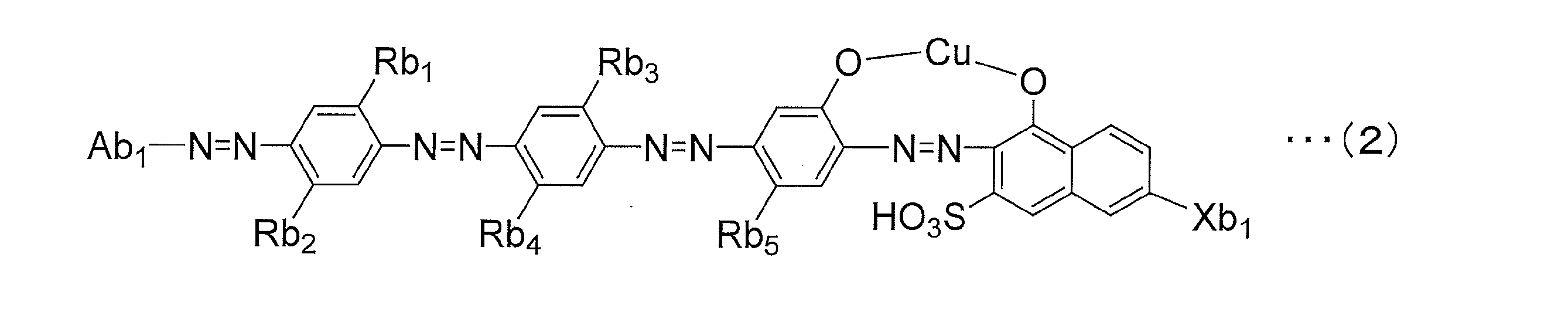
(3)(1)項又は(2)項に記載のアゾ化合物であって、前記一般式(1)又は(2)中のXb1が、メチル基、メトキシ基、スルホ基、アミノ基、及び炭素数1~4のアルキルアミノ基からなる群より選択される1個又は2個の置換基を有していてもよいフェニルアミノ基であることを特徴とするアゾ化合物、
(4)基材と、(1)~(3)項のいずれか1項に記載のアゾ化合物とを含むことを特徴とする偏光素子、
(5)(4)項に記載の偏光素子であって、下記一般式(3)

(6)(4)又は(5)項に記載の偏光素子であって、下記一般式(4)

で表されるアゾ化合物又はその塩をさらに含むことを特徴とする偏光素子、
(7)(5)項に記載の偏光素子であって、前記一般式(3)で表されるアゾ化合物又はその塩が、下記一般式(5)

(8)(5)又は(7)項に記載の偏光素子であって、前記一般式(3)又は(5)中のRr5及びRr6は、一方が炭素数1~4のアルコキシ基であり、他方が炭素数1~4のアルキル基又は炭素数1~4のアルコキシ基であることを特徴とする偏光素子、
(9)(5)又は(7)項に記載の偏光素子であって、前記一般式(3)又は(5)中のXr1が、メチル基、メトキシ基、スルホ基、アミノ基、及び炭素数1~4のアルキルアミノ基からなる群より選択される1個もしくは2個の置換基を有していてもよいフェニルアミノ基、又はヒドロキシ基、アミノ基、及びカルボキシエチルアミノ基からなる群より選択される1個の置換基を有していてもよいベンゾイルアミノ基であることを特徴とする偏光素子、
(10)(6)項に記載の偏光素子であって、一般式(4)中のAy1が、カルボキシ基又はスルホ基であることを特徴とする偏光素子、
(11)(4)~(10)項のいずれか1項に記載の偏光素子であって、前記基材が、ポリビニルアルコール又はその誘導体からなるフィルムであることを特徴とする偏光素子、
(12)(4)~(11)項のいずれか1項に記載の偏光素子と、前記偏光素子の少なくとも片面に設けられた透明保護層とを備えることを特徴とする偏光板、
(13)(4)~(11)項のいずれか1項に記載の偏光素子、又は(12)項に記載の偏光板を備えることを特徴とする表示装置、
に関する。
〔新規なアゾ化合物〕
本発明のアゾ化合物は、下記一般式(1)

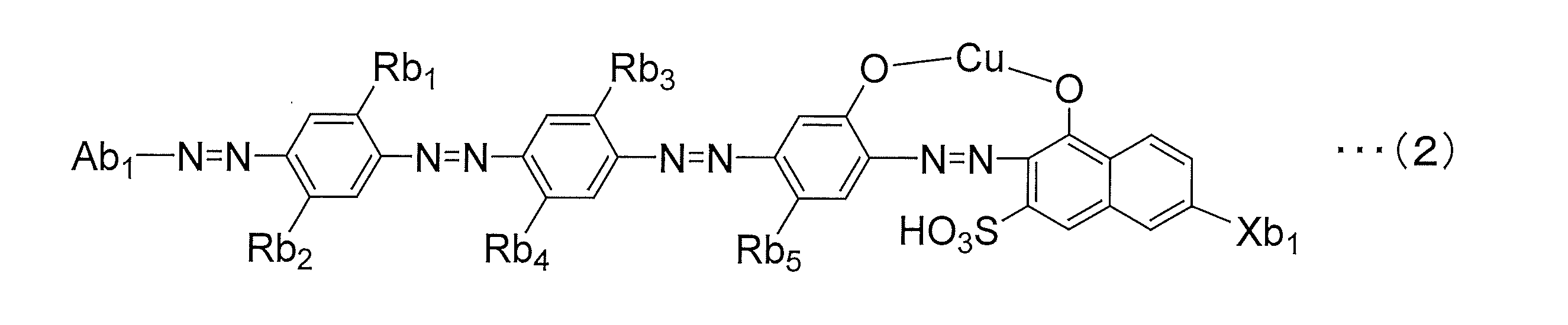
で表されるアゾ化合物であることが好ましい。これにより、一般式(1)で表されるアゾ化合物を使用した偏光素子の偏光性能をさらに向上させることができる。
で表されるモノアゾアミノ化合物を得る。

で表される芳香族アミン類を公知の方法によりスルホアルキル化して得られるスルホアルコキシアニリン酸類をジアゾ化し、下記一般式(8)

で表されるアニリン類と1次カップリングさせることによって得られる。

で表されるナフチルアミンスルホン酸類、又はアミノナフトールスルホン酸類を公知の方法によりスルホアルキル化して得られるスルホアルコキシナフチルアミンスルホン酸類をジアゾ化し、前記一般式(8)で表されるアニリン類と1次カップリングさせることによって得られる。

で表されるアニリン類と2次カップリングさせ、下記一般式(11)

で表されるジスアゾアミノ化合物を得る。


で表されるトリスアゾアミノ化合物を得る。

で表されるナフトール類と4次カップリングさせることにより、下記一般式(15)

で表されるテトラアゾ化合物が得られる。
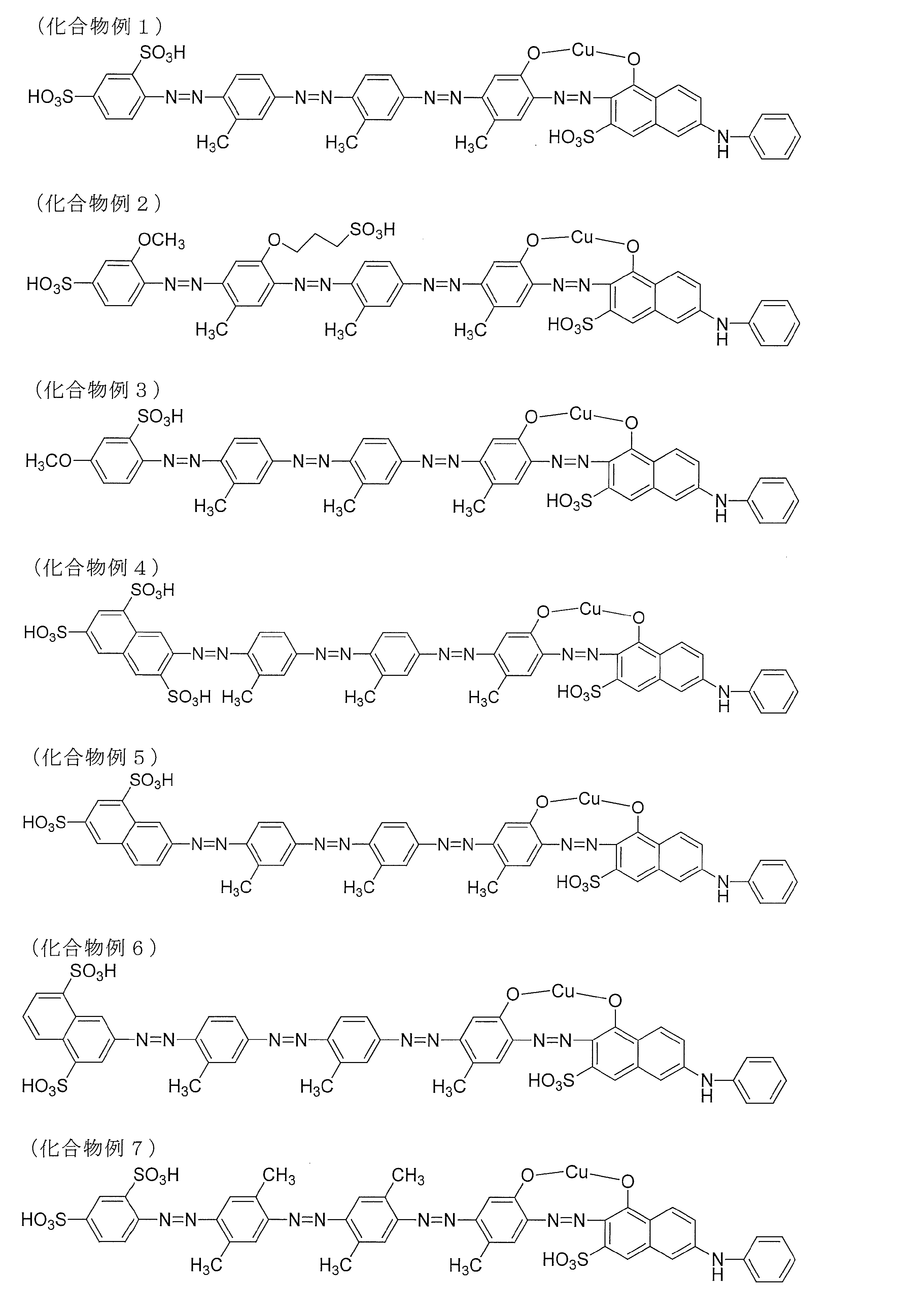
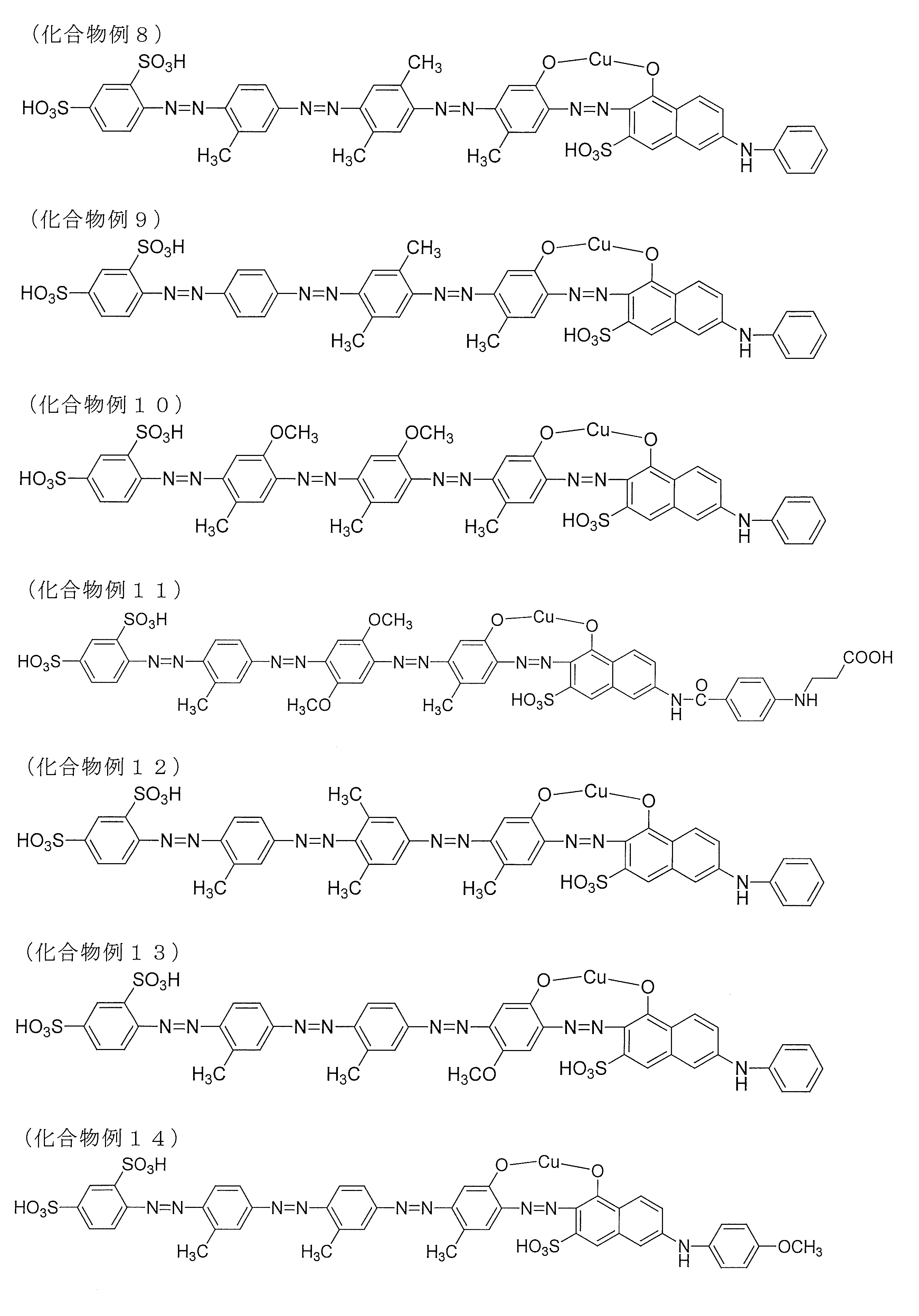
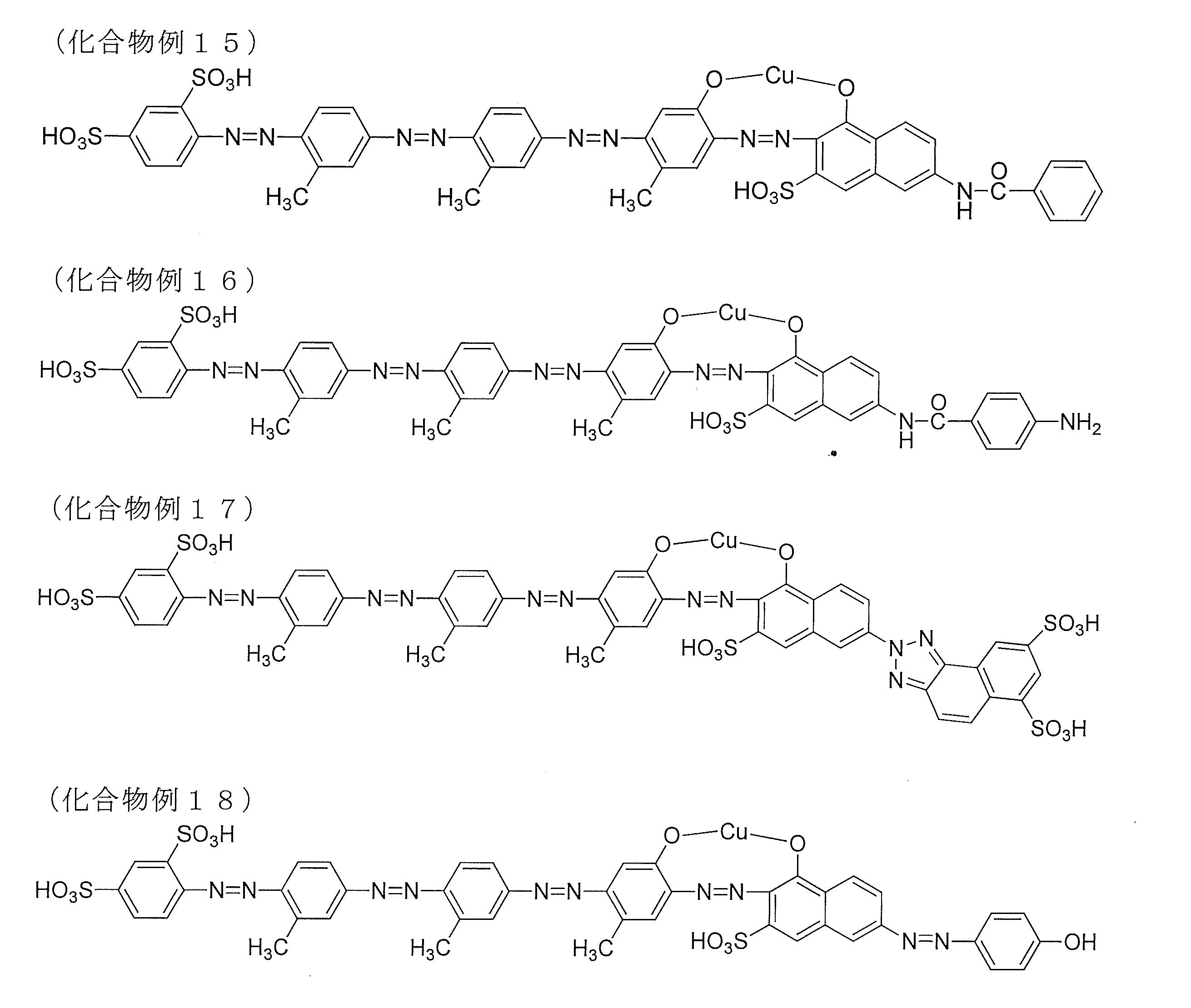
本発明の偏光素子は、基材と、前述した本発明のアゾ化合物とを含んでいる。本発明のアゾ化合物は、前記基材に吸着していることが好ましい。本発明の偏光素子において色素として用いられるアゾ化合物は、一般的には、当該技術分野において公知のアゾ染料の合成手段(例えば、非特許文献1の第626頁)に従い、公知のジアゾ化、カップリングを行うことにより製造することができる。アゾ化合物を溶液に溶解し、染色工程にて基材に含浸させて偏光素子を作製することができる。


で表されるアゾ化合物であることが好ましい。
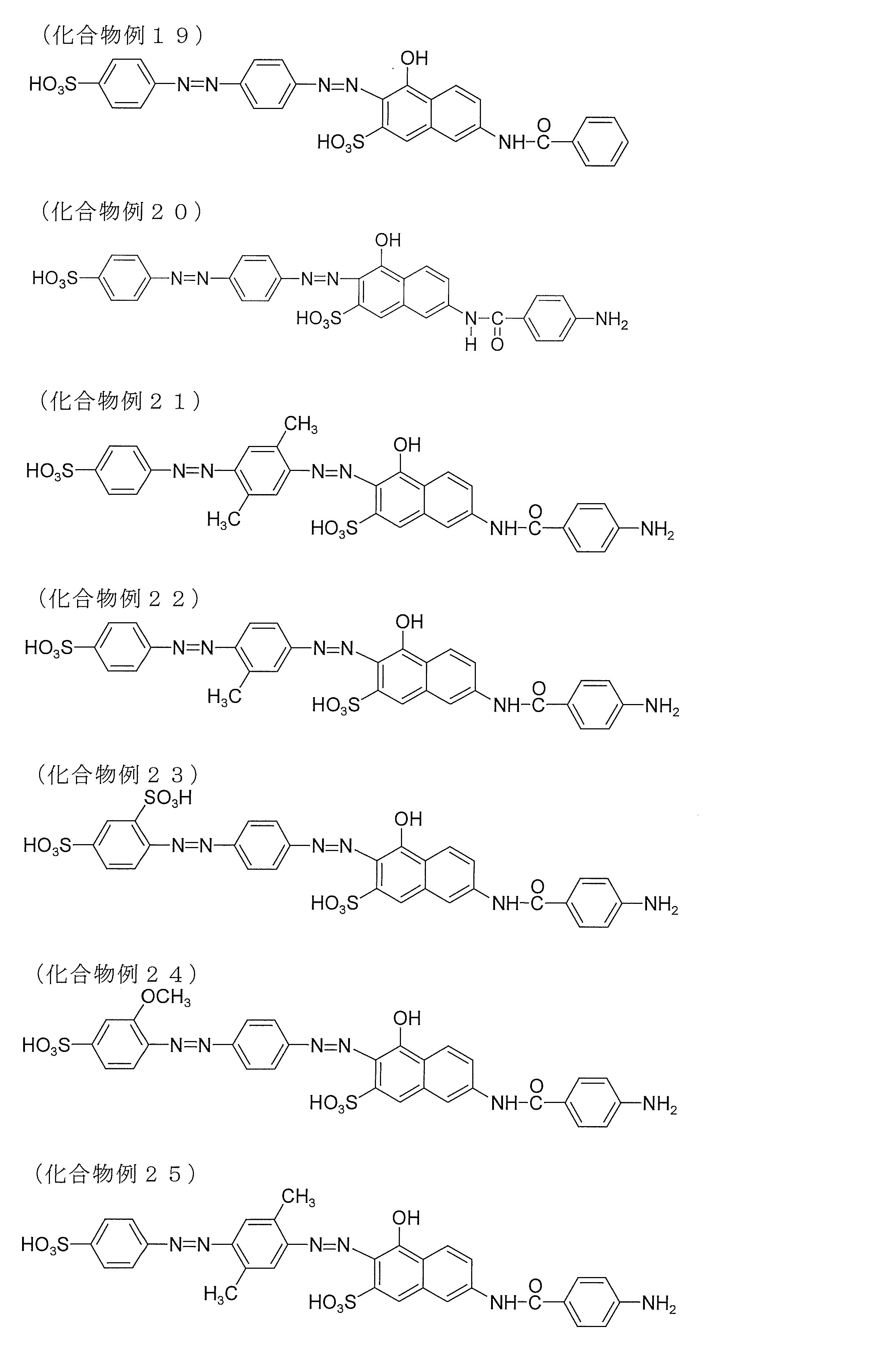


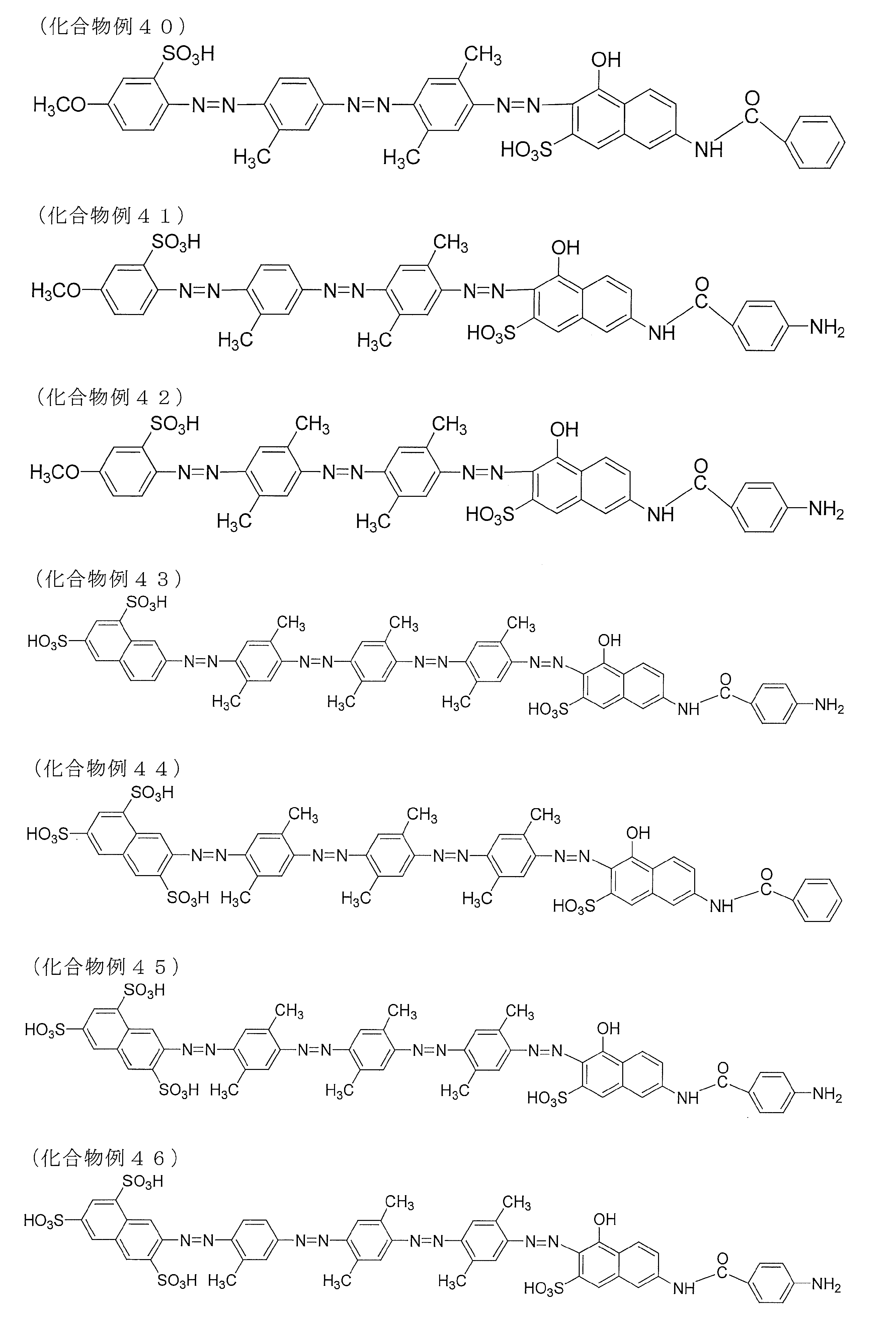

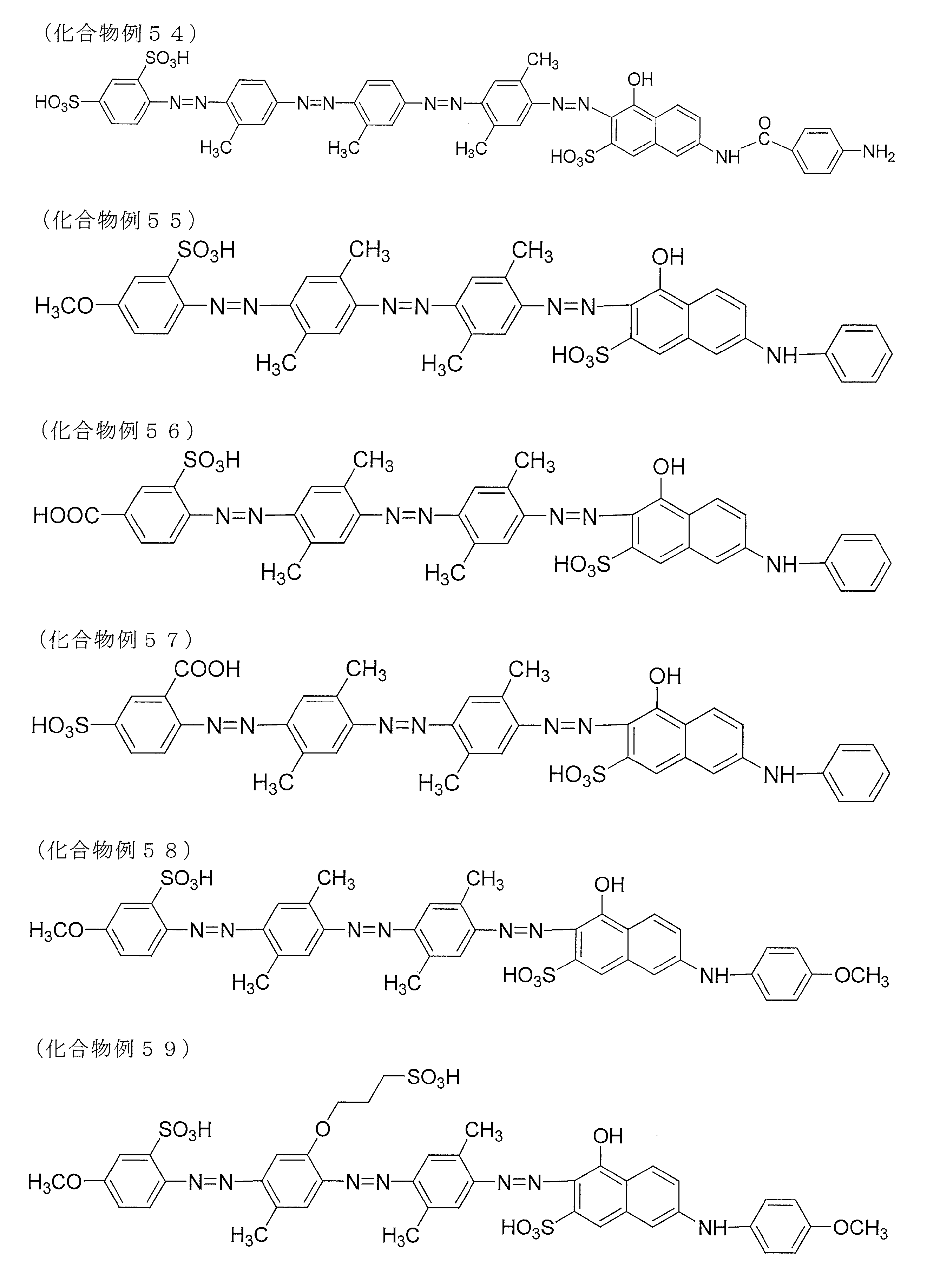


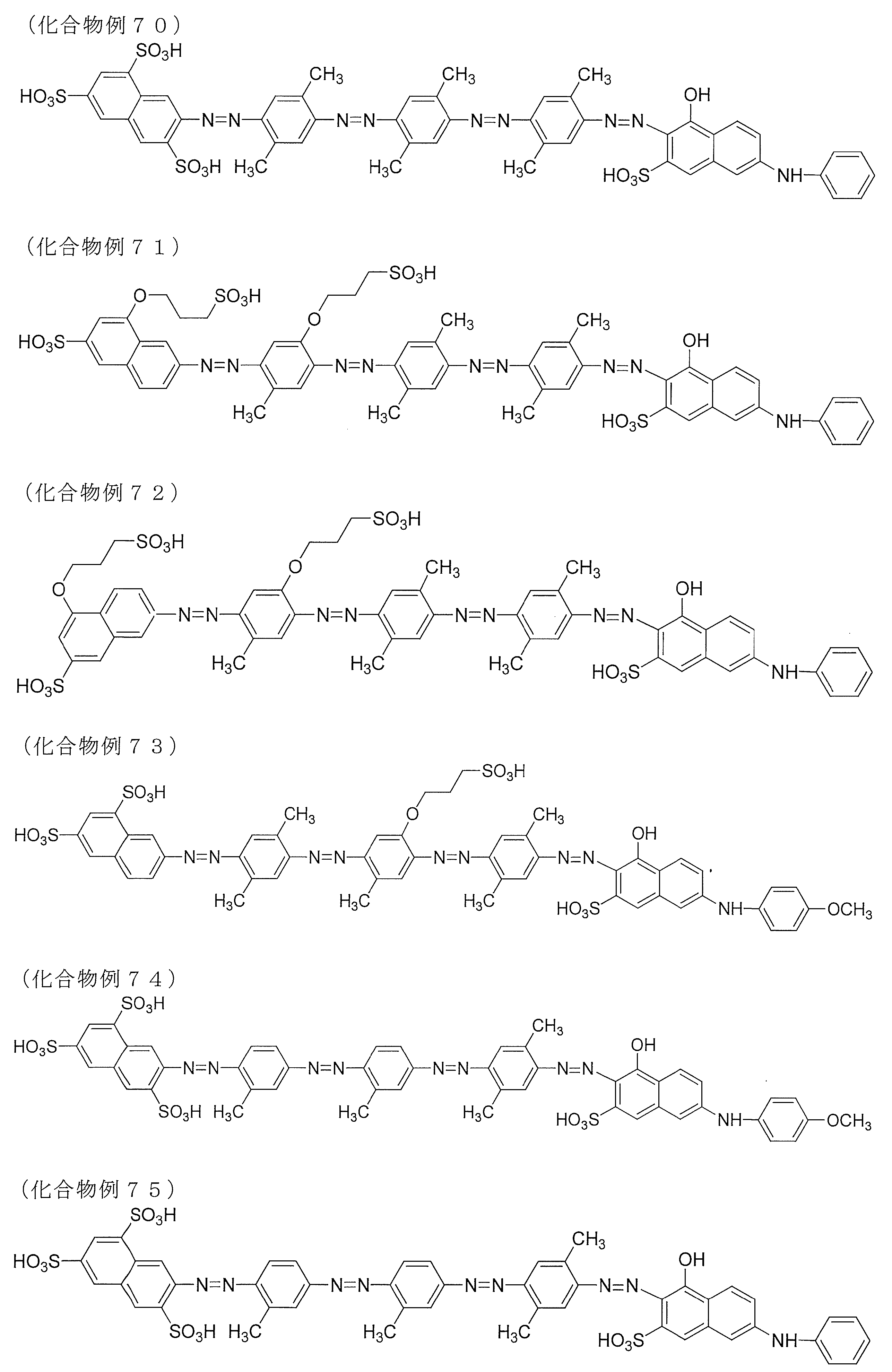


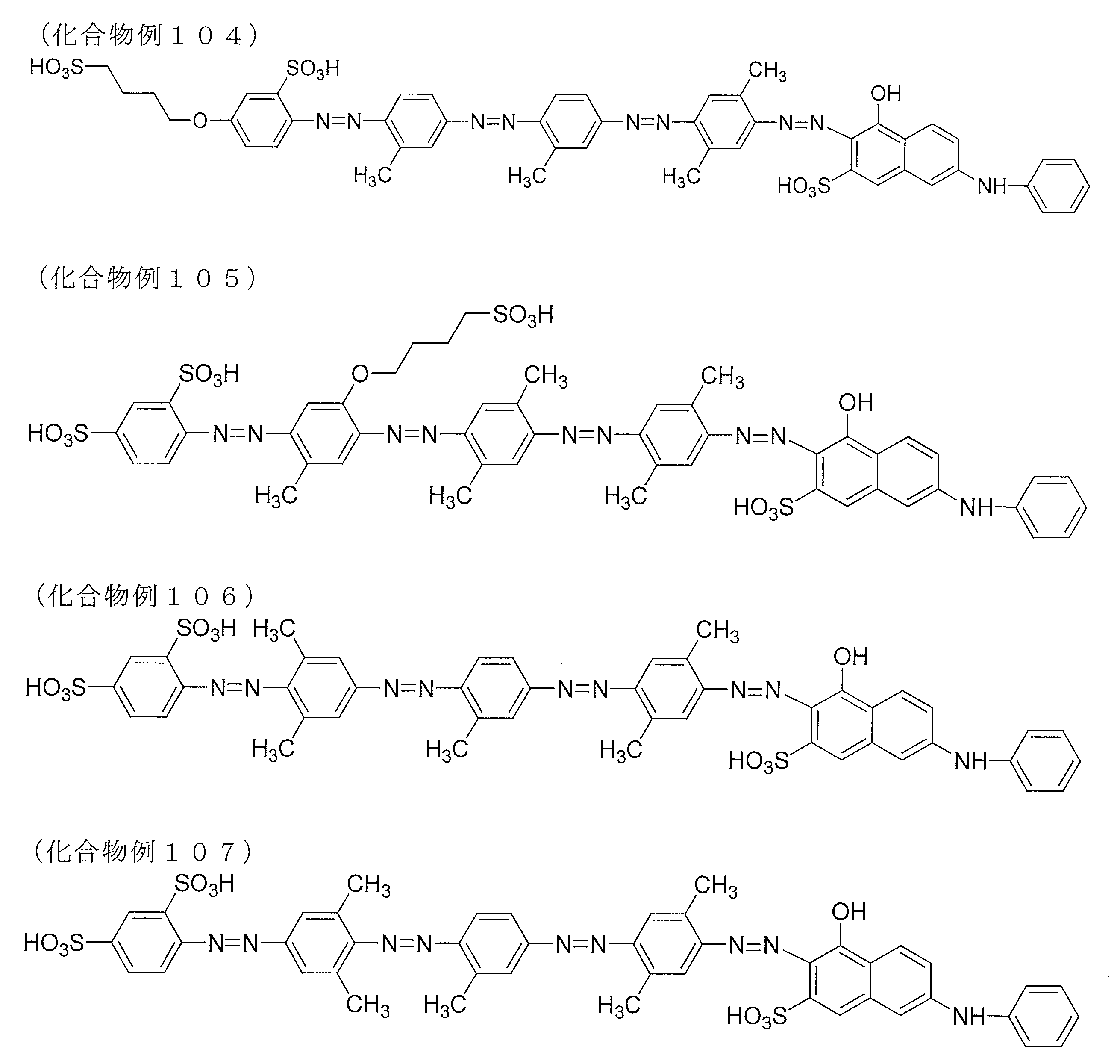

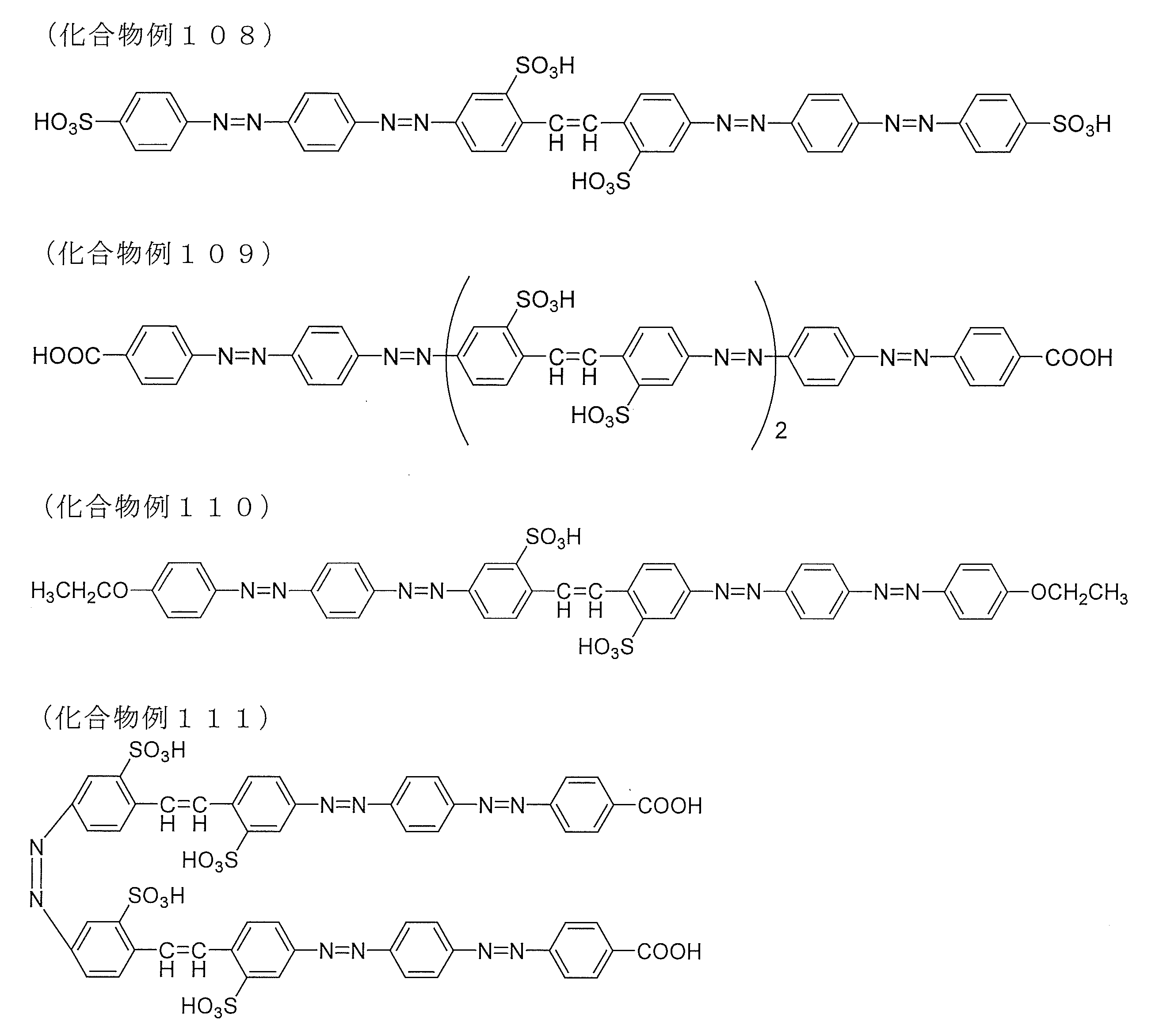
膨潤度 F=100×β/γ(%) ・・・(v)
本発明の偏光板は、本発明の偏光素子と、前記偏光素子の少なくとも片面に設けられた透明保護層とを備えている。
前記透明保護層は、透明ポリマーによる塗布層として、又は透明フィルムのラミネート層として設けることができる。透明保護層を形成する透明ポリマー又は透明フィルムとしては、機械的強度が高く、熱安定性が良好な透明ポリマー又は透明フィルムが好ましい。透明保護層に用いる透明ポリマー又は透明フィルムとして、例えば、トリアセチルセルロースやジアセチルセルロースのようなセルロースアセテート樹脂又はそのフィルム、アクリル樹脂又はそのフィルム、ポリ塩化ビニル樹脂又はそのフィルム、ナイロン樹脂又はそのフィルム、ポリエステル樹脂又はそのフィルム、ポリアリレート樹脂又はそのフィルム、ノルボルネンのような環状オレフィンをモノマーとする環状ポリオレフィン樹脂又はそのフィルム、ポリエチレン、ポリプロピレン、シクロ系ないしはノルボルネン骨格を有するポリオレフィン又はその共重合体、主鎖又は側鎖がイミド及び/又はアミドの重合体(又は樹脂)又はそのフィルムなどが挙げられる。また、前記透明保護層として、液晶性を有する樹脂又はそのフィルムを設けることもできる。前記保護フィルムの厚みは、例えば、0.5~200μm程度である。偏光素子の片面に樹脂又はフィルムを1層設けてもよく、偏光素子の片面に同種又は異種の樹脂又はフィルムを2層以上設けてもよく、偏光素子の両面に同種又は異種の樹脂又はフィルムを1層以上設けてもよい。
本発明の表示装置は、本発明の偏光素子、又は本発明の偏光板を備えるものである。また、本発明の表示装置は、例えば、液晶セルと、液晶セルの片側又は両側に配置されている本発明の偏光素子又は本発明の偏光板を備える反射型、透過型、又は透過・反射両用型等の液晶表示装置とすることができる。上記液晶セルは、任意であり、例えば、薄膜トランジスタ型に代表されるアクティブマトリクス駆動型の液晶セル、ツイストネマチック型やスーパーツイストネマチック型に代表される単純マトリクス駆動型の液晶セルなどの適宜なタイプの液晶セルを用いたものであって良い。
1枚の偏光素子の各波長における透過率を単体透過率Ts、2枚の偏光素子をそれらの吸収軸方向が同一となるように重ねた場合の各波長における透過率を平行位透過率Tp、2枚の偏光素子をそれらの吸収軸が直交するように重ねた場合の各波長における透過率を直交位透過率Tcとした。それぞれの透過率Ts、Tp、及びTcは、分光光度計(株式会社日立ハイテクノロジーズ製の「U-4100」)を用いて5nm間隔の各波長で測定した。
ρ={(Tp-Tc)/(Tp+Tc)}1/2×100
1枚の偏光板の各波長における透過率を視感度補正したものを単体透過率Ys、2枚の偏光板をそれらの吸収軸方向が同一となるように重ねた場合の各波長における透過率を視感度補正したものを平行位透過率Yp、2枚の偏光板をそれらの吸収軸が直交するように重ねた場合の各波長における透過率を視感度補正したものを直交位透過率Ycとした。視感度補正は、JIS Z 8722:2009に基づいて、C光源2°視野、色度関数により行った。それぞれの透過率Ys、Yp、及びYcは、分光光度計(株式会社日立ハイテクノロジーズ製の「U-4100」)を用いて5nm間隔の各波長で測定した。
Py={(Yp-Yc)/(Yp+Yc)}1/2×100 …(16)
CR=Yp/Yc …(17)
<化合物例1のアゾ化合物の合成>
4-アミノベンゼン-1,3-ジスルホン酸25.3重量部を水500重量部に加え、冷却し10℃以下で、35重量%塩酸水溶液31.3重量部を加え、次に亜硝酸ナトリウム6.9重量部を加え、5~10℃で1時間攪拌し、ジアゾ化した。そこへ、1次カップラー(カップリング成分)として希塩酸水溶液に溶解した3-メチルアニリン10.7重量部を加え、10~30℃で攪拌しながら、炭酸ナトリウムを加えてpH3とし、さらに攪拌してカップリング反応を完結させ、濾過し、下記構造式(18)



基材としてのケン化度が99モル%以上で膜厚が40μmのポリビニルアルコールフィルム(株式会社クラレ製の「VF-PE#4000」;以下、単に「フィルム」と称する)を35℃の温水に3分浸漬し膨潤処理をした。一方、一般式(1)で表されるアゾ化合物又はその塩としての化合物例1のアゾ化合物1.0重量部と、染色助剤として無水硫酸ナトリウム1.0重量部と、水2000重量部とを混合することにより、40℃の水溶液を調製した。この40℃の水溶液に前記の膨潤処理したフィルムを浸漬して、アゾ化合物をフィルムに吸着させた。
<化合物例17のアゾ化合物の合成>
4次カップラーとして、6-フェニルアミノ-1-ナフトール-3-スルホン酸16.1重量部に代えて、(7,8-ジスルホ-2H-ナフト[1,2-d]トリアゾール-2-イル-)-1-ナフトール-3-スルホン酸28.2重量部を用いたこと以外は、実施例1における化合物例1のアゾ化合物の合成と同様にして、一般式(1)で表されるアゾ化合物又はその塩としての化合物例17のアゾ化合物(銅化テトラキスアゾ化合物)を得た。
化合物例1のアゾ化合物に代えて化合物例17のアゾ化合物を用いたこと以外、実施例1と同様にして、偏光素子を作製した。
化合物例1のアゾ化合物に代えて、特開昭60-156759号公報の実施例38に記載の銅化されたアゾ化合物を用いたこと以外は、実施例1と同様にして、偏光素子を作製した。
化合物例1のアゾ化合物に代えて、特公昭64-5623号公報の実施例1に記載の銅化されたアゾ化合物を用いたこと以外は、実施例1と同様にして、偏光素子を作製した。

まず、基材としてのケン化度が99%以上で膜厚が40μmのポリビニルアルコールフィルム(株式会社クラレ製の「VF-PE#4000」;以下、単に「フィルム」と称する)を35℃の温水に3分浸漬し、膨潤処理をした。また、一般式(1)で表されるアゾ化合物又はその塩としての化合物例1のアゾ化合物2.0重量部と、一般式(3)で表されるアゾ化合物又はその塩として化合物例20のアゾ化合物(C.I.ダイレクト・レッド117)を0.5重量部と、一般式(4)で表されるアゾ化合物又はその塩としての化合物例111のアゾ化合物(国際公開第2007/138980号の実施例1に記載されているアゾ化合物)0.5重量部と、染色助剤としてのトリポリリン酸ナトリウム1.0重量部及び無水硫酸ナトリウム1.0重量部と、水2000重量部とにより、40℃の水溶液を調製した。この40℃の水溶液に前記の膨潤処理したフィルムを浸漬して、アゾ化合物をフィルムに吸着させた。
一般式(1)で表されるアゾ化合物又はその塩として、化合物例1のアゾ化合物2.0重量部に代えて実施例2で用いた化合物例17のアゾ化合物3.0重量部を用いたこと以外は、実施例3と同様にして、一般式(1)で表されるアゾ化合物又はその塩、一般式(3)で表されるアゾ化合物又はその塩、及び一般式(4)で表されるアゾ化合物又はその塩をフィルムに含有する偏光素子を作製すると共に偏光板を作製し、作製した偏光板を測定試料とした。
一般式(3)で表されるアゾ化合物又はその塩として、化合物例20のアゾ化合物を0.5重量部に代えて、化合物例41のアゾ化合物のナトリウム塩(国際公開第2005/075572号の実施例1に記載されているアゾ化合物)1.0重量部を用いたこと以外は、実施例3と同様にして、一般式(1)で表されるアゾ化合物又はその塩、一般式(3)で表されるアゾ化合物又はその塩、及び一般式(4)で表されるアゾ化合物又はその塩をフィルムに含有する偏光素子を作製すると共に偏光板を作製し、作製した偏光板を測定試料とした。
一般式(3)で表されるアゾ化合物又はその塩として、化合物例20のアゾ化合物を0.5重量部に代えて、化合物例54のアゾ化合物(国際公開第2012/108169号の実施例3に記載されている式(21)で表されるアゾ化合物)1.6重量部を用いたこと以外は、実施例3と同様にして、一般式(1)で表されるアゾ化合物又はその塩、一般式(3)で表されるアゾ化合物又はその塩、及び一般式(4)で表されるアゾ化合物又はその塩をフィルムに含有する偏光素子を作製すると共に偏光板を作製し、作製した偏光板を測定試料とした。
一般式(4)で表されるアゾ化合物又はその塩として、化合物例111のアゾ化合物0.5重量部に代えて、前記一般式(4)の構造を有するC.I.ダイレクト・オレンジ39(CAS番号:1325-54-8)を0.58重量部使用したこと以外は、実施例3と同様にして、一般式(1)で表されるアゾ化合物又はその塩、一般式(3)で表されるアゾ化合物又はその塩、及び一般式(4)で表されるアゾ化合物又はその塩をフィルムに含有する偏光素子を作製すると共に偏光板を作製し、作製した偏光板を測定試料とした。
一般式(3)で表されるアゾ化合物又はその塩として、化合物例20のアゾ化合物を0.5重量部に代えて、化合物例20のアゾ化合物を0.12重量部と、化合物例99のアゾ化合物(国際公開第2012/108169号の実施例1に記載されている式(17)で表されるアゾ化合物)1.2重量部とを使用し、一般式(4)で表されるアゾ化合物又はその塩として、化合物例111のアゾ化合物0.5重量部に代えて、前記一般式(4)の構造を有するC.I.ダイレクト・オレンジ39(CAS番号:1325-54-8)を0.39重量部使用したこと以外は、実施例3と同様にして、一般式(1)で表されるアゾ化合物又はその塩、一般式(3)で表されるアゾ化合物又はその塩、及び一般式(4)で表されるアゾ化合物又はその塩をフィルムに含有する偏光素子を作製すると共に偏光板を作製し、作製した偏光板を測定試料とした。
一般式(4)で表されるアゾ化合物又はその塩としての化合物例111のアゾ化合物0.5重量部に代えて、他の有機染料としての次の構造式

実施例3におけるアゾ化合物の組成を特開平11-218611号公報の実施例2に記載のアゾ化合物の組成に変更したこと以外は、実施例3と同様にして偏光素子を作製すると共に偏光板を作製し、作製した偏光板を測定試料とした。
実施例3におけるアゾ化合物の組成を特許第4162334号公報の実施例3に記載のアゾ化合物の組成に変更したこと以外は、実施例3と同様にして偏光素子を作製すると共に偏光板を作製し、作製した偏光板を測定試料とした。
実施例3におけるアゾ化合物の組成を特許第4360100号公報の実施例1に記載のアゾ化合物の組成に変更したこと以外は、実施例3と同様にして偏光素子を作製すると共に偏光板を作製し、作製した偏光板を測定試料とした。
一般式(1)で表されるアゾ化合物である化合物例1のアゾ化合物を用いなかったこと以外は、実施例3と同様にして、偏光素子を作製すると共に偏光板を作製し、作製した偏光板を測定試料とした。
一般式(1)で表されるアゾ化合物である化合物例1のアゾ化合物に代えて、化合物例1のアゾ化合物と同じくテトラキスアゾ化合物である国際公開第2012/108169号の式(17)で表されるアゾ化合物1.8重量部を用いたこと以外は、実施例3と同様にして、偏光素子を作製すると共に偏光板を作製し、作製した偏光板を測定試料とした。

Claims (13)
- 下記一般式(1)

で表されるアゾ化合物又はその塩であることを特徴とするアゾ化合物。 - 請求項1に記載のアゾ化合物であって、
下記一般式(2)

で表されるアゾ化合物又はその塩であることを特徴とするアゾ化合物。 - 請求項1又は2に記載のアゾ化合物であって、
前記一般式(1)又は(2)中のXb1が、メチル基、メトキシ基、スルホ基、アミノ基、及び炭素数1~4のアルキルアミノ基からなる群より選択される1個又は2個の置換基を有していてもよいフェニルアミノ基であることを特徴とするアゾ化合物。 - 基材と、請求項1~3のいずれか1項に記載のアゾ化合物とを含むことを特徴とする偏光素子。
- 請求項4に記載の偏光素子であって、
下記一般式(3)

で表されるアゾ化合物又はその塩をさらに含むことを特徴とする偏光素子。 - 請求項4又は5に記載の偏光素子であって、
下記一般式(4)

で表されるアゾ化合物又はその塩をさらに含むことを特徴とする偏光素子。 - 請求項5に記載の偏光素子であって、
前記一般式(3)で表されるアゾ化合物又はその塩が、下記一般式(5)

で表されるアゾ化合物又はその塩であることを特徴とする偏光素子。 - 請求項5又は7に記載の偏光素子であって、
前記一般式(3)又は(5)中のRr5及びRr6は、一方が炭素数1~4のアルコキシ基であり、他方が炭素数1~4のアルキル基又は炭素数1~4のアルコキシ基であることを特徴とする偏光素子。 - 請求項5又は7に記載の偏光素子であって、
前記一般式(3)又は(5)中のXr1が、メチル基、メトキシ基、スルホ基、アミノ基、及び炭素数1~4のアルキルアミノ基からなる群より選択される1個もしくは2個の置換基を有していてもよいフェニルアミノ基、又はヒドロキシ基、アミノ基、及びカルボキシエチルアミノ基からなる群より選択される1個の置換基を有していてもよいベンゾイルアミノ基であることを特徴とする偏光素子。 - 請求項6に記載の偏光素子であって、
一般式(4)中のAy1が、カルボキシ基又はスルホ基であることを特徴とする偏光素子。 - 請求項4~10のいずれか1項に記載の偏光素子であって、
前記基材が、ポリビニルアルコール又はその誘導体からなるフィルムであることを特徴とする偏光素子。 - 請求項4~11のいずれか1項に記載の偏光素子と、
前記偏光素子の少なくとも片面に設けられた透明保護層とを備えることを特徴とする偏光板。 - 請求項4~11のいずれか1項に記載の偏光素子、又は請求項12に記載の偏光板を備えることを特徴とする表示装置。
Priority Applications (4)
| Application Number | Priority Date | Filing Date | Title |
|---|---|---|---|
| KR1020187023126A KR20180104650A (ko) | 2016-02-04 | 2017-02-02 | 아조 화합물, 그것을 이용한 편광 소자 및 편광판, 그리고 표시 장치 |
| CN201780009532.3A CN108603039B (zh) | 2016-02-04 | 2017-02-02 | 偶氮化合物、使用该偶氮化合物的偏光组件与偏光板、及显示设备 |
| HK18114327.5A HK1251789B (zh) | 2016-02-04 | 2017-02-02 | 偶氮化合物、使用该偶氮化合物的偏光组件与偏光板、及显示设备 |
| JP2017565637A JP6862365B2 (ja) | 2016-02-04 | 2017-02-02 | アゾ化合物、それを用いた偏光素子及び偏光板、並びに表示装置 |
Applications Claiming Priority (2)
| Application Number | Priority Date | Filing Date | Title |
|---|---|---|---|
| JP2016020003 | 2016-02-04 | ||
| JP2016-020003 | 2016-02-04 |
Publications (1)
| Publication Number | Publication Date |
|---|---|
| WO2017135392A1 true WO2017135392A1 (ja) | 2017-08-10 |
Family
ID=59500722
Family Applications (1)
| Application Number | Title | Priority Date | Filing Date |
|---|---|---|---|
| PCT/JP2017/003875 Ceased WO2017135392A1 (ja) | 2016-02-04 | 2017-02-02 | アゾ化合物、それを用いた偏光素子及び偏光板、並びに表示装置 |
Country Status (5)
| Country | Link |
|---|---|
| JP (1) | JP6862365B2 (ja) |
| KR (1) | KR20180104650A (ja) |
| CN (1) | CN108603039B (ja) |
| TW (1) | TWI735527B (ja) |
| WO (1) | WO2017135392A1 (ja) |
Cited By (2)
| Publication number | Priority date | Publication date | Assignee | Title |
|---|---|---|---|---|
| WO2025205663A1 (ja) * | 2024-03-27 | 2025-10-02 | 日本化薬株式会社 | アゾ化合物又はその塩、並びにそれらを含有する偏光膜、偏光板及び表示装置 |
| WO2025205667A1 (ja) * | 2024-03-27 | 2025-10-02 | 日本化薬株式会社 | 染料系偏光膜、並びにこれを用いた偏光板および表示装置 |
Families Citing this family (1)
| Publication number | Priority date | Publication date | Assignee | Title |
|---|---|---|---|---|
| WO2019117123A1 (ja) * | 2017-12-13 | 2019-06-20 | 日本化薬株式会社 | 可視域および赤外域用偏光素子、および、偏光板 |
Citations (11)
| Publication number | Priority date | Publication date | Assignee | Title |
|---|---|---|---|---|
| JPS57145155A (en) * | 1981-03-04 | 1982-09-08 | Nippon Kayaku Co Ltd | Copper-containing azo compound and dyeing method using the same |
| JPH11218611A (ja) * | 1998-01-30 | 1999-08-10 | Nippon Kayaku Co Ltd | 染料系偏光膜 |
| JP2003035819A (ja) * | 2001-07-24 | 2003-02-07 | Sumitomo Chem Co Ltd | 偏光フィルム、偏光板及びそれらの表示装置への適用 |
| JP2003313451A (ja) * | 2002-04-26 | 2003-11-06 | Sumitomo Chem Co Ltd | アゾ化合物又はその塩、及びそれらの偏光膜への適用 |
| JP2004251962A (ja) * | 2003-02-18 | 2004-09-09 | Sumitomo Chem Co Ltd | 染料系偏光フィルム |
| WO2005075572A1 (ja) * | 2004-02-04 | 2005-08-18 | Nippon Kayaku Kabushiki Kaisha | アゾ化合物、それを含有する偏光膜及び偏光板 |
| JP2005255846A (ja) * | 2004-03-11 | 2005-09-22 | Mitsubishi Chemicals Corp | アゾ色素、異方性色素膜用二色性アゾ色素並びにこれを用いた異方性色素膜形成用組成物、異方性色素膜および偏光素子 |
| WO2007138980A1 (ja) * | 2006-06-01 | 2007-12-06 | Nippon Kayaku Kabushiki Kaisha | アゾ化合物及びその塩並びにそれらを含有する染料系偏光膜 |
| WO2012108169A1 (ja) * | 2011-02-07 | 2012-08-16 | 日本化薬株式会社 | アゾ化合物、染料系偏光膜及び偏光板 |
| WO2013008735A1 (ja) * | 2011-07-08 | 2013-01-17 | 日本化薬株式会社 | 偏光素子及び偏光板 |
| WO2016186183A1 (ja) * | 2015-05-20 | 2016-11-24 | 日本化薬株式会社 | 染料系偏光素子、並びにこれを用いた偏光板及び液晶表示装置 |
Family Cites Families (1)
| Publication number | Priority date | Publication date | Assignee | Title |
|---|---|---|---|---|
| JP4455852B2 (ja) * | 2003-09-01 | 2010-04-21 | キヤノン株式会社 | 用紙後処理装置及び画像形成装置 |
-
2017
- 2017-02-02 JP JP2017565637A patent/JP6862365B2/ja active Active
- 2017-02-02 WO PCT/JP2017/003875 patent/WO2017135392A1/ja not_active Ceased
- 2017-02-02 CN CN201780009532.3A patent/CN108603039B/zh active Active
- 2017-02-02 KR KR1020187023126A patent/KR20180104650A/ko not_active Withdrawn
- 2017-02-03 TW TW106103652A patent/TWI735527B/zh active
Patent Citations (11)
| Publication number | Priority date | Publication date | Assignee | Title |
|---|---|---|---|---|
| JPS57145155A (en) * | 1981-03-04 | 1982-09-08 | Nippon Kayaku Co Ltd | Copper-containing azo compound and dyeing method using the same |
| JPH11218611A (ja) * | 1998-01-30 | 1999-08-10 | Nippon Kayaku Co Ltd | 染料系偏光膜 |
| JP2003035819A (ja) * | 2001-07-24 | 2003-02-07 | Sumitomo Chem Co Ltd | 偏光フィルム、偏光板及びそれらの表示装置への適用 |
| JP2003313451A (ja) * | 2002-04-26 | 2003-11-06 | Sumitomo Chem Co Ltd | アゾ化合物又はその塩、及びそれらの偏光膜への適用 |
| JP2004251962A (ja) * | 2003-02-18 | 2004-09-09 | Sumitomo Chem Co Ltd | 染料系偏光フィルム |
| WO2005075572A1 (ja) * | 2004-02-04 | 2005-08-18 | Nippon Kayaku Kabushiki Kaisha | アゾ化合物、それを含有する偏光膜及び偏光板 |
| JP2005255846A (ja) * | 2004-03-11 | 2005-09-22 | Mitsubishi Chemicals Corp | アゾ色素、異方性色素膜用二色性アゾ色素並びにこれを用いた異方性色素膜形成用組成物、異方性色素膜および偏光素子 |
| WO2007138980A1 (ja) * | 2006-06-01 | 2007-12-06 | Nippon Kayaku Kabushiki Kaisha | アゾ化合物及びその塩並びにそれらを含有する染料系偏光膜 |
| WO2012108169A1 (ja) * | 2011-02-07 | 2012-08-16 | 日本化薬株式会社 | アゾ化合物、染料系偏光膜及び偏光板 |
| WO2013008735A1 (ja) * | 2011-07-08 | 2013-01-17 | 日本化薬株式会社 | 偏光素子及び偏光板 |
| WO2016186183A1 (ja) * | 2015-05-20 | 2016-11-24 | 日本化薬株式会社 | 染料系偏光素子、並びにこれを用いた偏光板及び液晶表示装置 |
Cited By (2)
| Publication number | Priority date | Publication date | Assignee | Title |
|---|---|---|---|---|
| WO2025205663A1 (ja) * | 2024-03-27 | 2025-10-02 | 日本化薬株式会社 | アゾ化合物又はその塩、並びにそれらを含有する偏光膜、偏光板及び表示装置 |
| WO2025205667A1 (ja) * | 2024-03-27 | 2025-10-02 | 日本化薬株式会社 | 染料系偏光膜、並びにこれを用いた偏光板および表示装置 |
Also Published As
| Publication number | Publication date |
|---|---|
| JP6862365B2 (ja) | 2021-04-21 |
| TW201741402A (zh) | 2017-12-01 |
| JPWO2017135392A1 (ja) | 2018-11-29 |
| KR20180104650A (ko) | 2018-09-21 |
| CN108603039A (zh) | 2018-09-28 |
| CN108603039B (zh) | 2020-09-01 |
| HK1251789A1 (zh) | 2019-03-15 |
| TWI735527B (zh) | 2021-08-11 |
Similar Documents
| Publication | Publication Date | Title |
|---|---|---|
| JP7005711B2 (ja) | 偏光素子並びにそれを用いた偏光板及び表示装置 | |
| TWI822850B (zh) | 偏光元件及使用該偏光元件之偏光板以及光學構件類 | |
| WO2016186183A1 (ja) | 染料系偏光素子、並びにこれを用いた偏光板及び液晶表示装置 | |
| CN103765257B (zh) | 偏振元件和偏振片 | |
| JP6095569B2 (ja) | 偏光素子および偏光板 | |
| JP5651089B2 (ja) | 偏光素子、および、偏光板 | |
| JP6862365B2 (ja) | アゾ化合物、それを用いた偏光素子及び偏光板、並びに表示装置 | |
| CN114008143A (zh) | 偶氮化合物,及含有该偶氮化合物的偏光膜,以及偏光板 | |
| HK1251789B (zh) | 偶氮化合物、使用该偶氮化合物的偏光组件与偏光板、及显示设备 | |
| HK1196669B (en) | Polarizing element and polarizing plate | |
| HK1196669A (en) | Polarizing element and polarizing plate | |
| HK1196668A (en) | Polarizing element and polarizing plate |
Legal Events
| Date | Code | Title | Description |
|---|---|---|---|
| 121 | Ep: the epo has been informed by wipo that ep was designated in this application |
Ref document number: 17747543 Country of ref document: EP Kind code of ref document: A1 |
|
| WWE | Wipo information: entry into national phase |
Ref document number: 2017565637 Country of ref document: JP |
|
| NENP | Non-entry into the national phase |
Ref country code: DE |
|
| ENP | Entry into the national phase |
Ref document number: 20187023126 Country of ref document: KR Kind code of ref document: A |
|
| 122 | Ep: pct application non-entry in european phase |
Ref document number: 17747543 Country of ref document: EP Kind code of ref document: A1 |