WO2017135189A1 - フェニルホスホン酸化合物の金属塩を含むポリアミド樹脂組成物 - Google Patents
フェニルホスホン酸化合物の金属塩を含むポリアミド樹脂組成物 Download PDFInfo
- Publication number
- WO2017135189A1 WO2017135189A1 PCT/JP2017/003170 JP2017003170W WO2017135189A1 WO 2017135189 A1 WO2017135189 A1 WO 2017135189A1 JP 2017003170 W JP2017003170 W JP 2017003170W WO 2017135189 A1 WO2017135189 A1 WO 2017135189A1
- Authority
- WO
- WIPO (PCT)
- Prior art keywords
- polyamide
- salt
- polyamide resin
- resin composition
- acid compound
- Prior art date
- Legal status (The legal status is an assumption and is not a legal conclusion. Google has not performed a legal analysis and makes no representation as to the accuracy of the status listed.)
- Ceased
Links
Classifications
-
- C—CHEMISTRY; METALLURGY
- C08—ORGANIC MACROMOLECULAR COMPOUNDS; THEIR PREPARATION OR CHEMICAL WORKING-UP; COMPOSITIONS BASED THEREON
- C08K—Use of inorganic or non-macromolecular organic substances as compounding ingredients
- C08K5/00—Use of organic ingredients
- C08K5/49—Phosphorus-containing compounds
- C08K5/51—Phosphorus bound to oxygen
- C08K5/53—Phosphorus bound to oxygen bound to oxygen and to carbon only
- C08K5/5317—Phosphonic compounds, e.g. R—P(:O)(OR')2
-
- C—CHEMISTRY; METALLURGY
- C08—ORGANIC MACROMOLECULAR COMPOUNDS; THEIR PREPARATION OR CHEMICAL WORKING-UP; COMPOSITIONS BASED THEREON
- C08L—COMPOSITIONS OF MACROMOLECULAR COMPOUNDS
- C08L77/00—Compositions of polyamides obtained by reactions forming a carboxylic amide link in the main chain; Compositions of derivatives of such polymers
Definitions
- the present invention relates to a polyamide resin composition. More specifically, the present invention relates to a polyamide resin composition containing a crystal nucleating agent comprising a metal salt of a phenylphosphonic acid compound, and a polyamide resin molded product obtained from the resin composition.
- Polyamide resins are generally used widely as engineering plastics with excellent mechanical properties, chemical resistance, oil resistance, and the like.
- polyamide 610 classified as biomass plastics is excellent in properties such as chemical resistance, metal chloride resistance (for example, calcium chloride resistance), low water absorption, and dimensional stability.
- metal chloride resistance for example, calcium chloride resistance
- low water absorption for example, food containers, bearings, connectors, It is expected to be used as a molding material for automobile fuel tubes and hoses, interior materials, and casings and parts for electrical and electronic products.
- the polyamide resin has a low crystallization speed, it has a drawback that it is softened at a temperature higher than the glass transition point (Tg) if it is not sufficiently crystallized. Also, heat treatment (annealing) at a predetermined temperature in the mold during injection molding improves the crystallization degree of the polyamide resin, but the crystallization speed is slow, so the molding cycleability is poor and productivity is a problem. There is.
- the crystal nucleating agent becomes the primary crystal nucleus of the crystalline polymer, promotes crystal growth, and functions to refine the spherulite size and promote crystallization.
- layered silicates Patent Document 1
- talc Patent Document 2
- the present invention provides a polyamide resin composition to which a crystallization nucleating agent suitable for promoting crystallization of a polyamide resin is added, a crystallization speed is higher than that of a polyamide resin, and a higher moldability can be improved. It aims at providing the polyamide resin molding obtained by crystallizing a polyamide resin composition.
- the present inventors have promoted crystallization of polyamide resin by adding a metal salt of a specific phenylphosphonic acid compound as a crystal nucleating agent to the polyamide resin. Found that is possible.
- this invention relates to the polyamide resin composition containing the crystal nucleus agent which consists of a polyamide resin and the metal salt of the phenylphosphonic acid compound represented by Formula [1] as a 1st viewpoint.
- R 1 and R 2 each independently represent a hydrogen atom, an alkyl group having 1 to 10 carbon atoms, or an alkoxycarbonyl group having 2 to 11 carbon atoms.
- the metal salt of the phenylphosphonic acid compound is lithium salt, sodium salt, potassium salt, magnesium salt, calcium salt, barium salt, manganese salt, iron salt, cobalt salt, nickel salt, copper salt, zinc salt.
- the present invention relates to a polyamide resin composition according to the first aspect, which is at least one metal salt selected from the group consisting of silver salts, aluminum salts, and tin salts.
- the polyamide resin composition according to the second aspect wherein the metal salt of the phenylphosphonic acid compound is at least one metal salt selected from the group consisting of calcium salts, manganese salts, zinc salts and tin salts.
- the present invention relates to the polyamide resin composition according to the third aspect, wherein the metal salt of the phenylphosphonic acid compound is a manganese salt.
- the polyamide according to any one of the first to fourth aspects wherein the content of the crystal nucleating agent is 0.001 to 10 parts by mass with respect to 100 parts by mass of the polyamide resin.
- the present invention relates to a resin composition.
- the polyamide resin is polyamide 6, polyamide 11, polyamide 12, polyamide 46, polyamide 66, polyamide 610, polyamide 612, polyamide 1010, polyamide 1212, polyamide 4T, polyamide M5T, polyamide 6T, polyamide 6I, polyamide It is related with the polyamide resin composition as described in any one of the 1st viewpoint thru
- the present invention relates to the polyamide resin composition according to the sixth aspect, in which the polyamide resin contains at least polyamide 610.
- the use of a metal salt of a specific phenylphosphonic acid compound as a crystal nucleating agent improves the crystallization accelerating effect of the polyamide resin.
- a resin composition and a polyamide resin molded body obtained by crystallizing the polyamide resin composition can be provided.
- the polyamide (hereinafter also referred to as PA) resin composition of the present invention comprises a PA resin and a crystal nucleating agent comprising a metal salt of a phenylphosphonic acid compound.
- PA resin examples of the PA resin used in the present invention include those made of a polymer of diamine and dibasic acid, a polymer of lactam or aminocarboxylic acid, or a copolymer of two or more of these. It is done.
- diamine examples include aliphatic diamines such as tetramethylene diamine, hexamethylene diamine, octamethylene diamine, nonamethyle diamine, undecamethylene diamine, and dodecamethylene diamine; and aromatic / cyclic structures such as metaxylylene diamine. Examples include diamines.
- dicarboxylic acid examples include aliphatic dicarboxylic acids such as adipic acid, heptanedicarboxylic acid, octanedicarboxylic acid, nonanedicarboxylic acid, undecanedicarboxylic acid, and dodecanedicarboxylic acid; and aromatic / cyclic structures such as terephthalic acid and isophthalic acid.
- aliphatic dicarboxylic acids such as adipic acid, heptanedicarboxylic acid, octanedicarboxylic acid, nonanedicarboxylic acid, undecanedicarboxylic acid, and dodecanedicarboxylic acid
- aromatic / cyclic structures such as terephthalic acid and isophthalic acid.
- lactam examples include lactams having 6 to 12 carbon atoms such as ⁇ -butyrolactam, ⁇ -caprolactam, ⁇ -heptalactam, and ⁇ -laurolactam.
- aminocarboxylic acid examples include aminocarboxylic acids having 6 to 12 carbon atoms such as ⁇ -aminocaproic acid, 7-aminoheptanoic acid, 11-aminoundecanoic acid, and 12-aminododecanoic acid.
- PA resins include polyamide 6, polyamide 11, polyamide 12, polyamide 46, polyamide 66, polyamide 610, polyamide 612, polyamide 1010, polyamide 1212, polyamide 4T, polyamide M5T, polyamide 6T, polyamide 6I, Homopolymers such as polyamide 9T, polyamide 10T, and polyamide MXD6; and copolymers such as polyamide 6/66, polyamide 6/12, and polyamide 11/12.
- polyamide 610 is preferable.
- These PA resins may be used alone or in combination of two or more.
- PA resins those commercially available can be suitably used.
- the PA resin used in the present invention may be a blend polymer with other resins mainly composed of PA homopolymer or PA copolymer.
- other resins include general-purpose thermoplastic resins / thermoplastic engineering plastics and biodegradable resins described later.
- the content of the other resin in the blend polymer with the other resin is preferably 50% by mass or less.
- thermoplastic resin / thermoplastic engineering plastic examples include polyethylene (PE), polyethylene copolymer, polypropylene (PP), polypropylene copolymer, ethylene-propylene copolymer, polybutylene (PB), and ethylene-vinyl alcohol copolymer.
- PE polyethylene
- PP polypropylene
- PB polybutylene
- ethylene-vinyl alcohol copolymer examples include polyethylene (PE), polyethylene copolymer, polypropylene (PP), polypropylene copolymer, ethylene-propylene copolymer, polybutylene (PB), and ethylene-vinyl alcohol copolymer.
- Polyolefin resins such as polymer (EVOH), ethylene-vinyl acetate copolymer (EVA), ethylene-ethyl acrylate copolymer (EEA), poly (4-methyl-1-pentene); polystyrene (PS), high impact Polystyrene resins such as water-soluble polystyrene (HIPS), acrylonitrile-styrene copolymer (AS), acrylonitrile-butadiene-styrene copolymer (ABS), methyl methacrylate-styrene copolymer (MS); polymethyl methacrylate (Meth) acrylic resin such as PMMA); polyvinyl chloride resin; polyvinylidene chloride resin; polyurethane resin; polyethylene terephthalate (PET), polybutylene terephthalate (PBT), polyethylene naphthalate (PEN), polybutylene naphthalate (PBN) Polyester resin; Polycarbonate resin; Polypheny
- biodegradable resin examples include polyglycolic acid (PGA), polylactic acid (PLA), poly (3-hydroxybutyric acid) (PHB), and a copolymer of 3-hydroxybutyric acid and 3-hydroxyhexanoic acid (Polhydroxyalkanoic acids such as PHBH); polyester resins such as polycaprolactone, polybutylene succinate, polybutylene succinate / adipate, polybutylene succinate / carbonate, polyethylene succinate, polyethylene succinate / adipate; Polyvinyl alcohol; modified starch; cellulose acetate; chitin; chitosan; lignin and the like.
- PGA polyglycolic acid
- PLA polylactic acid
- PHB poly (3-hydroxybutyric acid)
- a copolymer of 3-hydroxybutyric acid and 3-hydroxyhexanoic acid Polyhydroxyalkanoic acids such as PHBH
- polyester resins such as polycaprolactone, polybutylene succinate, polybuty
- the crystal nucleating agent used in the present invention comprises a metal salt of a phenylphosphonic acid compound represented by the formula [1].
- R 1 and R 2 in the formula are each independently a hydrogen atom, an alkyl group having 1 to 10 carbon atoms, or 2 to 11 carbon atoms.
- the alkoxycarbonyl group having 2 to 11 carbon atoms refers to an alkoxycarbonyl group having 1 to 10 carbon atoms in the alkoxy group.
- Examples of the alkyl group having 1 to 10 carbon atoms in R 1 and R 2 include a methyl group, an ethyl group, an n-propyl group, an isopropyl group, an n-butyl group, an isobutyl group, and a tert-butyl group.
- Examples of the alkoxycarbonyl group having 2 to 11 carbon atoms include a methoxycarbonyl group and an ethoxycarbonyl group.
- phenylphosphonic acid compound represented by the above formula [1] examples include phenylphosphonic acid, 4-methylphenylphosphonic acid, 4-ethylphenylphosphonic acid, 4-n-propylphenylphosphonic acid, 4-isopropylphenyl. Phosphonic acid, 4-n-butylphenylphosphonic acid, 4-isobutylphenylphosphonic acid, 4-tert-butylphenylphosphonic acid, 3,5-dimethoxycarbonylphenylphosphonic acid, 3,5-diethoxycarbonylphenylphosphonic acid, 2 , 5-dimethoxycarbonylphenylphosphonic acid, 2,5-diethoxycarbonylphenylphosphonic acid and the like. As these compounds, commercially available products can be preferably used as they are.
- metal that forms the metal salt of the phenylphosphonic acid compound monovalent, divalent, and trivalent metals can be used. Two or more metals can be mixed and used. Specific examples of the metal forming the metal salt include lithium, sodium, potassium, magnesium, calcium, barium, manganese, iron, cobalt, nickel, copper, zinc, silver, aluminum, tin and the like. Among metal salts formed from these metals, calcium salts, manganese salts, zinc salts, and tin salts are preferable. Among these, a manganese salt is most preferable because it can increase the crystallization speed of the PA resin and obtain a PA resin composition excellent in molding processability.
- the method for producing the metal salt of the phenylphosphonic acid compound is not particularly limited, but in general, the phenylphosphonic acid compound, the metal chloride, sulfate or nitrate, and an alkali such as sodium hydroxide are mixed in water. Thus, the metal salt of the phenylphosphonic acid compound is precipitated, filtered, and dried to obtain a crystalline powder. In addition, the phenylphosphonic acid compound and the metal oxide, hydroxide, carbonate, or organic acid salt are mixed and reacted in water or an organic solvent, and then the solvent is filtered or distilled and dried. Can also be obtained.
- the form of the obtained powder is usually a granular crystal, a plate-like crystal, a rod-like crystal, a needle-like crystal, etc., and these crystals may be laminated.
- these compounds (crystalline powder) are commercially available, commercially available products can be used.
- the stoichiometric ratio of the phenylphosphonic acid compound to the metal is not particularly limited. Generally, the phenylphosphonic acid compound / metal stoichiometric ratio is 1/2 to 2 / It is preferable to use in the range of 1.
- the metal salt of the phenylphosphonic acid compound preferably contains no free phenylphosphonic acid compound or metal that does not form a salt.
- the average particle size of the metal salt of the phenylphosphonic acid compound is preferably 10 ⁇ m or less, more preferably 5 ⁇ m or less.
- the average particle diameter ( ⁇ m) is a 50% volume diameter (median diameter) obtained by measurement by a laser diffraction / scattering method based on the Mie theory.
- the crystalline powder obtained by the above method may be sheared by a homomixer, a Henschel mixer, a Ladige mixer or the like, if necessary.
- a dry pulverizer such as a mixer having a particle diameter, a ball mill, a pin disc mill, a pulverizer, an inomizer, or a counter jet mill.
- a wet pulverizer such as a ball mill, a bead mill, a sand grinder, or an attritor using water, an organic solvent that can be mixed with water, and a mixed solution thereof.
- the addition amount of the metal salt of the phenylphosphonic acid compound is 0.001 to 10 parts by mass, preferably 0.01 to 5 parts by mass, more preferably 0.1 to 2 parts by mass with respect to 100 parts by mass of the PA resin. It is. By making the addition amount 0.001 part by mass or more, a sufficient crystallization rate can be obtained. Moreover, even if it exceeds 10 parts by mass, the crystallization rate does not increase further, so that it is economically advantageous to use it at 10 parts by mass or less.
- the PA resin composition of the present invention can be blended with a known inorganic filler as long as the effects of the present invention are not impaired.
- the inorganic filler include glass fiber, carbon fiber, talc, mica, silica, kaolin, clay, wollastonite, glass beads, glass flake, potassium titanate, calcium carbonate, magnesium sulfate, titanium oxide and the like.
- the shape of these inorganic fillers may be any of fiber, granule, plate, needle, sphere, and powder. These inorganic fillers can be used within 300 parts by mass with respect to 100 parts by mass of the PA resin.
- the PA resin composition of the present invention can be blended with a known flame retardant as long as the effects of the present invention are not impaired.
- the flame retardant include halogen flame retardants such as bromine and chlorine; antimony flame retardants such as antimony trioxide and antimony pentoxide; inorganic flame retardants such as aluminum hydroxide, magnesium hydroxide and silicone compounds.
- Phosphorus flame retardants such as red phosphorus, phosphate esters, ammonium polyphosphate, phosphazene, etc .; melamine, melam, melem, melon, melamine cyanurate, melamine phosphate, melamine pyrophosphate, melamine polyphosphate, melamine / melam polyphosphate
- Melamine flame retardants such as melem double salt, melamine alkylphosphonate, melamine phenylphosphonate, melamine sulfate and melam methanesulfonate; fluororesins such as PTFE. These flame retardants can be used within 200 parts by mass with respect to 100 parts by mass of the PA resin.
- additives that are generally added as necessary, for example, end-capping agents, hydrolysis inhibitors, thermal stabilizers, unless the effects of the present invention are impaired.
- Light stabilizers, heat ray absorbers, UV absorbers, antioxidants, impact modifiers, plasticizers, compatibilizers, silane-based, titanium-based, aluminum-based coupling agents, foaming agents, antistatic agents, release agents Molding agents, lubricants, antibacterial and antifungal agents, pigments, dyes, fragrances, other various fillers, other crystal nucleating agents, other thermoplastic resins, and the like may be appropriately blended.
- the PA resin composition of the present invention can be produced by mixing the PA resin and a crystal nucleating agent comprising a metal salt of the phenylphosphonic acid compound.
- the method for mixing the crystal nucleating agent is not particularly limited, for example, a method of mixing the crystal nucleating agent with a composition containing PA resin or PA resin and other additives before molding, PA resin or PA resin at the time of molding. And a method of mixing a crystal nucleating agent with a composition containing the other additives (for example, side feed).
- the PA resin composition of the present invention preferably has a cooling crystallization temperature (temperature at which the resin crystallizes in the process of cooling the molten resin composition) Tcc of 188 ° C. or higher, and 191 ° C. or higher. Some are more preferred.
- the PA resin molded article of the present invention comprises a crystal nucleating agent comprising the crystallized PA resin and a metal salt of the phenylphosphonic acid compound.
- a spherulite diameter of the PA resin molding of this invention 30 micrometers or less are preferable and 20 micrometers or less are more preferable.
- a PA resin molded body having a smoother surface can be obtained.
- Such a PA resin molded body can be obtained, for example, by using the PA resin composition of the present invention and crystallizing the PA resin contained therein.
- the method for crystallizing the PA resin is not particularly limited.
- the PA resin composition in the process of forming the PA resin composition into a predetermined shape, may be heated to the crystallization temperature or higher and then cooled. Further, in the above process, the PA resin composition is heated to a temperature equal to or higher than the crystallization temperature, and then rapidly cooled to form an amorphous body, which can be crystallized by heating.
- the PA resin molded product of the present invention has excellent mechanical strength and heat resistance.
- various molded products can be easily produced by using a conventional molding method such as general injection molding, blow molding, vacuum molding, compression molding or the like.
- DSC Differential scanning calorimetry
- PA610 Polyamide 610 [Daicel Evonik Co., Ltd. Bestamid (registered trademark) Terra HS16 Natural]
- PPA Phenylphosphonic acid [manufactured by Nissan Chemical Industries, Ltd.]
- PPA-Zn zinc phenylphosphonate [Eco Promote (registered trademark) manufactured by Nissan Chemical Industries, Ltd.]
- HFIPA 1,1,1,3,3,3-hexafluoro-2-propanol
- Example 1 To 100 parts by mass of PA610, 0.5 parts by mass of the compound shown in Table 1 and 900 parts by mass of HFIPA are added as crystal nucleating agents, and 30 minutes at room temperature (approximately 23 ° C.) using an ultrasonic cleaner (output 150 W). A polyamide resin composition was obtained by ultrasonic irradiation. This resin composition was dropped on a hot plate at 60 ° C. to evaporate the solvent, whereby an amorphous (amorphous) state polyamide resin film-shaped molded article containing a crystal nucleating agent was obtained. About the obtained amorphous film-like molded object, the temperature-falling crystallization temperature (Tcc) and the half crystallization time (t1 / 2 ) were measured in accordance with the following procedures. The results are also shown in Table 1.
- Tcc Cold crystallization temperature
Landscapes
- Chemical & Material Sciences (AREA)
- Health & Medical Sciences (AREA)
- Chemical Kinetics & Catalysis (AREA)
- Medicinal Chemistry (AREA)
- Polymers & Plastics (AREA)
- Organic Chemistry (AREA)
- Compositions Of Macromolecular Compounds (AREA)
Abstract
【課題】 ポリアミド樹脂の結晶化促進に好適な結晶核剤を添加した、ポリアミド樹脂に比べて結晶化速度が速く、より高い成型加工性の向上が可能なポリアミド樹脂組成物を提供すること。 【解決手段】 ポリアミド樹脂、及び式[1]で表されるフェニルホスホン酸化合物の金属塩からなる結晶核剤を含む、ポリアミド樹脂組成物。(式中、R1及びR2は、それぞれ独立して、水素原子、炭素原子数1乃至10のアルキル基、又は炭素原子数2乃至11のアルコキシカルボニル基を表す。)
Description
本発明は、ポリアミド樹脂組成物に関し、さらに詳述すると、フェニルホスホン酸化合物の金属塩からなる結晶核剤を含むポリアミド樹脂組成物、及び該樹脂組成物から得られるポリアミド樹脂成形体に関する。
ポリアミド樹脂は、一般に、機械的性質、耐薬品性、耐油性等に優れたエンジニアリングプラスチックスとして、広く使用されている。中でも、バイオマスプラスチックスに分類されるポリアミド610は、耐薬品性、耐金属塩化物性(例えば塩化カルシウム耐性)、低吸水性、寸法安定性等の特性に優れ、例えば、食品容器、軸受け、コネクタ、自動車用燃料チューブ・ホースや内装材、電気・電子製品の筐体や部品等の成形材料として期待されている。
しかしながら、ポリアミド樹脂は結晶化速度が遅いため、十分に結晶化していない場合、ガラス転移点(Tg)以上の温度で軟化するといった欠点がある。また、射出成型時の金型内で所定の温度にて熱処理(アニール)することでポリアミド樹脂の結晶化度は向上するが、結晶化速度が遅いため、成型サイクル性が悪く、生産性に課題がある。
これらの課題を解決するために、ポリアミド樹脂に結晶核剤を添加する方法が検討されている。結晶核剤は、結晶性高分子の1次結晶核となり、結晶成長を促進し、球晶サイズの微細化及び結晶化促進の働きをする。
これまで、ポリアミド樹脂の結晶核剤としては、層状珪酸塩(特許文献1)、タルク(特許文献2)等が開示されている。
これまで、ポリアミド樹脂の結晶核剤としては、層状珪酸塩(特許文献1)、タルク(特許文献2)等が開示されている。
前述のように、ポリアミド樹脂の結晶化速度を高めるために様々な結晶核剤が提案されているが、近年、ポリアミド樹脂のより高い成型加工性を実現させるために、さらに有効な結晶核剤が望まれている。
従って、本発明は、ポリアミド樹脂の結晶化促進に好適な結晶核剤を添加した、ポリアミド樹脂に比べて結晶化速度が速く、より高い成型加工性の向上が可能なポリアミド樹脂組成物、及びこのポリアミド樹脂組成物を結晶化して得られるポリアミド樹脂成形体を提供することを目的とする。
従って、本発明は、ポリアミド樹脂の結晶化促進に好適な結晶核剤を添加した、ポリアミド樹脂に比べて結晶化速度が速く、より高い成型加工性の向上が可能なポリアミド樹脂組成物、及びこのポリアミド樹脂組成物を結晶化して得られるポリアミド樹脂成形体を提供することを目的とする。
本発明者らは、上記目的を達成するため鋭意検討を重ねた結果、ポリアミド樹脂に結晶核剤として特定のフェニルホスホン酸化合物の金属塩を添加することにより、ポリアミド樹脂の結晶化を促進することが可能であることを見出した。
すなわち、本発明は、第1観点として、ポリアミド樹脂、及び式[1]で表されるフェニルホスホン酸化合物の金属塩からなる結晶核剤を含む、ポリアミド樹脂組成物に関する。
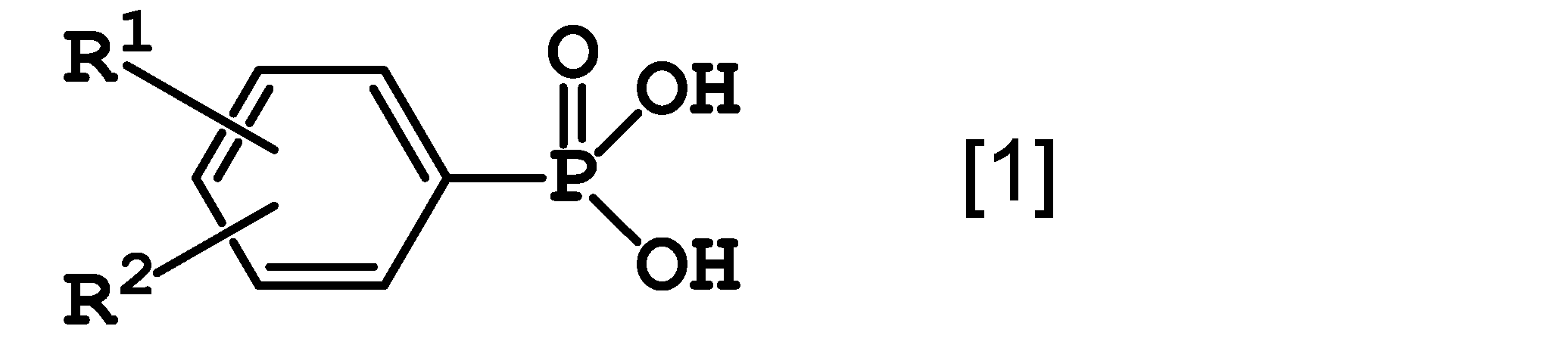
(式中、R1及びR2は、それぞれ独立して、水素原子、炭素原子数1乃至10のアルキル基、又は炭素原子数2乃至11のアルコキシカルボニル基を表す。)
第2観点として、前記フェニルホスホン酸化合物の金属塩が、リチウム塩、ナトリウム塩、カリウム塩、マグネシウム塩、カルシウム塩、バリウム塩、マンガン塩、鉄塩、コバルト塩、ニッケル塩、銅塩、亜鉛塩、銀塩、アルミニウム塩、及びスズ塩からなる群から選ばれる少なくとも一種の金属塩である、第1観点に記載のポリアミド樹脂組成物に関する。
第3観点として、前記フェニルホスホン酸化合物の金属塩が、カルシウム塩、マンガン塩、亜鉛塩及びスズ塩からなる群から選ばれる少なくとも一種の金属塩である、第2観点に記載のポリアミド樹脂組成物に関する。
第4観点として、前記フェニルホスホン酸化合物の金属塩がマンガン塩である、第3観点に記載のポリアミド樹脂組成物に関する。
第5観点として、前記結晶核剤の含有量が、前記ポリアミド樹脂100質量部に対して0.001~10質量部である、第1観点乃至第4観点のうち何れか一項に記載のポリアミド樹脂組成物に関する。
第6観点として、前記ポリアミド樹脂が、ポリアミド6、ポリアミド11、ポリアミド12、ポリアミド46、ポリアミド66、ポリアミド610、ポリアミド612、ポリアミド1010、ポリアミド1212、ポリアミド4T、ポリアミドM5T、ポリアミド6T、ポリアミド6I、ポリアミド9T、ポリアミド10T、及びポリアミドMXD6からなる群から選択される少なくとも一種を含むものである、第1観点乃至第5観点のうち何れか一項に記載のポリアミド樹脂組成物に関する。
第7観点として、前記ポリアミド樹脂が、ポリアミド610を少なくとも含むものである、第6観点に記載のポリアミド樹脂組成物に関する。
第8観点として、第1観点乃至第7観点のうち何れか一項に記載のポリアミド樹脂組成物を結晶化してなる、ポリアミド樹脂成形体に関する。
(式中、R1及びR2は、それぞれ独立して、水素原子、炭素原子数1乃至10のアルキル基、又は炭素原子数2乃至11のアルコキシカルボニル基を表す。)
第2観点として、前記フェニルホスホン酸化合物の金属塩が、リチウム塩、ナトリウム塩、カリウム塩、マグネシウム塩、カルシウム塩、バリウム塩、マンガン塩、鉄塩、コバルト塩、ニッケル塩、銅塩、亜鉛塩、銀塩、アルミニウム塩、及びスズ塩からなる群から選ばれる少なくとも一種の金属塩である、第1観点に記載のポリアミド樹脂組成物に関する。
第3観点として、前記フェニルホスホン酸化合物の金属塩が、カルシウム塩、マンガン塩、亜鉛塩及びスズ塩からなる群から選ばれる少なくとも一種の金属塩である、第2観点に記載のポリアミド樹脂組成物に関する。
第4観点として、前記フェニルホスホン酸化合物の金属塩がマンガン塩である、第3観点に記載のポリアミド樹脂組成物に関する。
第5観点として、前記結晶核剤の含有量が、前記ポリアミド樹脂100質量部に対して0.001~10質量部である、第1観点乃至第4観点のうち何れか一項に記載のポリアミド樹脂組成物に関する。
第6観点として、前記ポリアミド樹脂が、ポリアミド6、ポリアミド11、ポリアミド12、ポリアミド46、ポリアミド66、ポリアミド610、ポリアミド612、ポリアミド1010、ポリアミド1212、ポリアミド4T、ポリアミドM5T、ポリアミド6T、ポリアミド6I、ポリアミド9T、ポリアミド10T、及びポリアミドMXD6からなる群から選択される少なくとも一種を含むものである、第1観点乃至第5観点のうち何れか一項に記載のポリアミド樹脂組成物に関する。
第7観点として、前記ポリアミド樹脂が、ポリアミド610を少なくとも含むものである、第6観点に記載のポリアミド樹脂組成物に関する。
第8観点として、第1観点乃至第7観点のうち何れか一項に記載のポリアミド樹脂組成物を結晶化してなる、ポリアミド樹脂成形体に関する。
本発明のポリアミド樹脂組成物は、特定のフェニルホスホン酸化合物の金属塩を結晶核剤として用いることにより、ポリアミド樹脂の結晶化促進効果が向上されたものとなり、ひいては、成形加工性に優れたポリアミド樹脂組成物、及びこのポリアミド樹脂組成物を結晶化して得られるポリアミド樹脂成形体を提供することができる。
以下、本発明についてさらに詳しく説明する。
<ポリアミド樹脂組成物>
本発明のポリアミド(以下、PAともいう。)樹脂組成物は、PA樹脂、及びフェニルホスホン酸化合物の金属塩からなる結晶核剤、を含みて構成される。
本発明のポリアミド(以下、PAともいう。)樹脂組成物は、PA樹脂、及びフェニルホスホン酸化合物の金属塩からなる結晶核剤、を含みて構成される。
[PA樹脂]
本発明に用いられるPA樹脂としては、ジアミンと二塩基酸との重合体からなるか、ラクタム若しくはアミノカルボン酸の重合体からなるか、又はこれらの2種以上の共重合体からなるものが挙げられる。
本発明に用いられるPA樹脂としては、ジアミンと二塩基酸との重合体からなるか、ラクタム若しくはアミノカルボン酸の重合体からなるか、又はこれらの2種以上の共重合体からなるものが挙げられる。
前記ジアミンとしては、例えば、テトラメチレンジアミン、ヘキサメチレンジアミン、オクタメチレンジアミン、ノナメチレジアミン、ウンデカメチレンジアミン、ドデカメチレンジアミン等の脂肪族ジアミン;メタキシリレンジアミン等の芳香族・環状構造を有するジアミンなどが挙げられる。
前記ジカルボン酸としては、例えば、アジピン酸、ヘプタンジカルボン酸、オクタンジカルボン酸、ノナンジカルボン酸、ウンデカンジカルボン酸、ドデカンジカルボン酸等の脂肪族ジカルボン酸;テレフタル酸、イソフタル酸等の芳香族・環状構造を有するジカルボン酸等が挙げられる。
前記ジカルボン酸としては、例えば、アジピン酸、ヘプタンジカルボン酸、オクタンジカルボン酸、ノナンジカルボン酸、ウンデカンジカルボン酸、ドデカンジカルボン酸等の脂肪族ジカルボン酸;テレフタル酸、イソフタル酸等の芳香族・環状構造を有するジカルボン酸等が挙げられる。
前記ラクタムとしては、例えば、γ-ブチロラクタム、ε-カプロラクタム、ω-ヘプタラクタム、ω-ラウロラクタム等の炭素原子数6乃至12のラクタム類が挙げられる。
前記アミノカルボン酸としては、例えば、ε-アミノカプロン酸、7-アミノヘプタン酸、11-アミノウンデカン酸、12-アミノドデカン酸等の炭素原子数6乃至12のアミノカルボン酸が挙げられる。
前記アミノカルボン酸としては、例えば、ε-アミノカプロン酸、7-アミノヘプタン酸、11-アミノウンデカン酸、12-アミノドデカン酸等の炭素原子数6乃至12のアミノカルボン酸が挙げられる。
このようなPA樹脂の具体例としては、ポリアミド6、ポリアミド11、ポリアミド12、ポリアミド46、ポリアミド66、ポリアミド610、ポリアミド612、ポリアミド1010、ポリアミド1212、ポリアミド4T、ポリアミドM5T、ポリアミド6T、ポリアミド6I、ポリアミド9T、ポリアミド10T、ポリアミドMXD6等のホモポリマー;ポリアミド6/66、ポリアミド6/12、ポリアミド11/12等のコポリマーが挙げられる。中でも、ポリアミド610が好ましい。
これらのPA樹脂は、1種を単独で使用しても2種以上を併用してもよい。
これらのPA樹脂は、1種を単独で使用しても2種以上を併用してもよい。
これらPA樹脂としては、市販されているものを好適に使用することができ、例えば、アルケマ(株)製リルサン(登録商標)シリーズ、同ペバックス(登録商標)シリーズ、同Hiprolonシリーズ、ダイセル・エボニック(株)製ダイアミドシリーズ、同ベスタミド(登録商標)シリーズ、東レ(株)製アミランシリーズ、宇部興産(株)製UBEナイロンシリーズ、同ウベスタシリーズ、東洋紡績(株)製グラマイド(登録商標)シリーズ、(株)クラレ製ジェネスタシリーズ、BASF社製ウルトラミッド(登録商標)シリーズ、三井化学(株)製アーレンシリーズ等が挙げられる。
また、本発明に用いられるPA樹脂としては、PAホモポリマー又はPAコポリマーを主体とした、他樹脂とのブレンドポリマーであってもよい。他樹脂とは、後述する汎用の熱可塑性樹脂/熱可塑性エンジニアリングプラスチック、生分解性樹脂等が挙げられる。他樹脂とのブレンドポリマー中における他樹脂の含有量は、50質量%以下が好ましい。
前記汎用の熱可塑性樹脂/熱可塑性エンジニアリングプラスチックとしては、例えば、ポリエチレン(PE)、ポリエチレンコポリマー、ポリプロピレン(PP)、ポリプロピレンコポリマー、エチレン-プロピレン共重合体、ポリブチレン(PB)、エチレン-ビニルアルコール共重合体(EVOH)、エチレン-酢酸ビニル共重合体(EVA)、エチレン-アクリル酸エチル共重合体(EEA)、ポリ(4-メチル-1-ペンテン)等のポリオレフィン樹脂;ポリスチレン(PS)、高衝撃性ポリスチレン(HIPS)、アクリロニトリル-スチレン共重合体(AS)、アクリロニトリル-ブタジエン-スチレン共重合体(ABS)、メタクリル酸メチル-スチレン共重合体(MS)等のポリスチレン系樹脂;ポリメタクリル酸メチル(PMMA)等の(メタ)アクリル樹脂;ポリ塩化ビニル樹脂;ポリ塩化ビニリデン樹脂;ポリウレタン樹脂;ポリエチレンテレフタレート(PET)、ポリブチレンテレフタレート(PBT)、ポリエチレンナフタレート(PEN)、ポリブチレンナフタレート(PBN)等のポリエステル樹脂;ポリイミド樹脂;ポリカーボネート樹脂;ポリフェニレンエーテル樹脂;変性ポリフェニレンエーテル樹脂;ポリアセタール樹脂;ポリスルホン樹脂;ポリフェニレンスルフィド樹脂などが挙げられる。
上述の生分解性樹脂としては、例えば、ポリグリコール酸(PGA)、ポリ乳酸(PLA)、ポリ(3-ヒドロキシ酪酸)(PHB)、3-ヒドロキシ酪酸と3-ヒドロキシヘキサン酸の共重合体(PHBH)等のポリヒドロキシアルカン酸;ポリカプロラクトン、ポリブチレンスクシネート、ポリブチレンスクシネート/アジペート、ポリブチレンスクシネート/カーボネート、ポリエチレンスクシネート、ポリエチレンスクシネート/アジペート等のポリエステル樹脂;ポリビニルアルコール;変性でんぷん;酢酸セルロース;キチン;キトサン;リグニンなどが挙げられる。
[フェニルホスホン酸化合物の金属塩]
本発明に用いられる結晶核剤は、式[1]で表されるフェニルホスホン酸化合物の金属塩からなる。
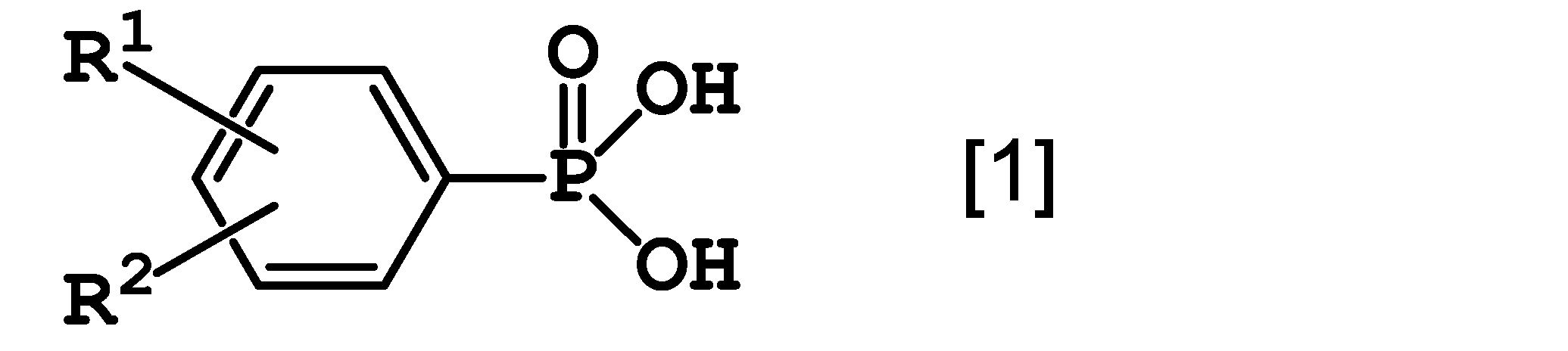
本発明に用いられる結晶核剤は、式[1]で表されるフェニルホスホン酸化合物の金属塩からなる。
上記式[1]で表されるフェニルホスホン酸化合物において、式中のR1及びR2は、それぞれ独立して、水素原子、炭素原子数1乃至10のアルキル基、又は炭素原子数2乃至11のアルコキシカルボニル基を表す。なお、ここで炭素原子数2乃至11のアルコキシカルボニル基とは、アルコキシ基の炭素原子数が1乃至10であるアルコキシカルボニル基を指す。
R1及びR2における前記炭素原子数1乃至10のアルキル基としては、例えばメチル基、エチル基、n-プロピル基、イソプロピル基、n-ブチル基、イソブチル基、tert-ブチル基等が挙げられる。
また前記炭素原子数2乃至11のアルコキシカルボニル基としては、例えばメトキシカルボニル基、エトキシカルボニル基等が挙げられる。
また前記炭素原子数2乃至11のアルコキシカルボニル基としては、例えばメトキシカルボニル基、エトキシカルボニル基等が挙げられる。
上記式[1]で表されるフェニルホスホン酸化合物の具体例としては、フェニルホスホン酸、4-メチルフェニルホスホン酸、4-エチルフェニルホスホン酸、4-n-プロピルフェニルホスホン酸、4-イソプロピルフェニルホスホン酸、4-n-ブチルフェニルホスホン酸、4-イソブチルフェニルホスホン酸、4-tert-ブチルフェニルホスホン酸、3,5-ジメトキシカルボニルフェニルホスホン酸、3,5-ジエトキシカルボニルフェニルホスホン酸、2,5-ジメトキシカルボニルフェニルホスホン酸、2,5-ジエトキシカルボニルフェニルホスホン酸等が挙げられる。
これら化合物は市販品をそのまま好適に使用できる。
これら化合物は市販品をそのまま好適に使用できる。
前記フェニルホスホン酸化合物の金属塩を形成する金属としては、1価、2価、及び3価の金属を使用することができる。また2種以上の金属を混合して使用することもできる。
上記金属塩を形成する金属の具体例としては、リチウム、ナトリウム、カリウム、マグネシウム、カルシウム、バリウム、マンガン、鉄、コバルト、ニッケル、銅、亜鉛、銀、アルミニウム、スズ等が挙げられる。これら金属より形成される金属塩の中でも、カルシウム塩、マンガン塩、亜鉛塩、スズ塩が好ましい。その中でも、PA樹脂の結晶化速度を高め、成形加工性に優れたPA樹脂組成物を得られることから、特にマンガン塩が最も好ましい。
上記金属塩を形成する金属の具体例としては、リチウム、ナトリウム、カリウム、マグネシウム、カルシウム、バリウム、マンガン、鉄、コバルト、ニッケル、銅、亜鉛、銀、アルミニウム、スズ等が挙げられる。これら金属より形成される金属塩の中でも、カルシウム塩、マンガン塩、亜鉛塩、スズ塩が好ましい。その中でも、PA樹脂の結晶化速度を高め、成形加工性に優れたPA樹脂組成物を得られることから、特にマンガン塩が最も好ましい。
前記フェニルホスホン酸化合物の金属塩の製造方法は特に制限されないが、一般には、フェニルホスホン酸化合物と、前記金属の塩化物、硫酸塩、又は硝酸塩と、水酸化ナトリウム等のアルカリとを水中で混合して反応させることにより、フェニルホスホン酸化合物の金属塩を析出させ、ろ過、乾燥することで結晶性粉末として得ることができる。また、フェニルホスホン酸化合物と、前記金属の酸化物、水酸化物、炭酸塩、又は有機酸塩とを、水中又は有機溶媒中で混合して反応させ、その後溶媒をろ過又は留去、乾燥することにより得ることもできる。
得られる粉末の形態は、通常は粒状結晶、板状結晶、棒状結晶、針状結晶等となり、さらにこれらの結晶が積層した形態になることもある。
これらの化合物(結晶性粉末)は市販されている場合には、市販品を使用することができる。
上記フェニルホスホン酸化合物の金属塩の形成に際し、フェニルホスホン酸化合物と金属の化学量論比は特に制限されないが、一般にはフェニルホスホン酸化合物/金属の化学量論比として、1/2~2/1の範囲で使用すると好ましい。フェニルホスホン酸化合物の金属塩中には、塩を形成していないフリーのフェニルホスホン酸化合物や金属を含まないことが好ましい。
得られる粉末の形態は、通常は粒状結晶、板状結晶、棒状結晶、針状結晶等となり、さらにこれらの結晶が積層した形態になることもある。
これらの化合物(結晶性粉末)は市販されている場合には、市販品を使用することができる。
上記フェニルホスホン酸化合物の金属塩の形成に際し、フェニルホスホン酸化合物と金属の化学量論比は特に制限されないが、一般にはフェニルホスホン酸化合物/金属の化学量論比として、1/2~2/1の範囲で使用すると好ましい。フェニルホスホン酸化合物の金属塩中には、塩を形成していないフリーのフェニルホスホン酸化合物や金属を含まないことが好ましい。
前記フェニルホスホン酸化合物の金属塩の平均粒子径は、10μm以下であることが好ましく、より好ましくは5μm以下である。ここで、平均粒子径(μm)は、Mie理論に基づくレーザー回折・散乱法により測定して得られる50%体積径(メジアン径)である。平均粒子径が小さいほど、結晶化速度は速くなる傾向があり好ましい。
フェニルホスホン酸化合物の金属塩の平均粒子径を10μm以下にするために、上記の方法で得られた結晶性粉末を、必要に応じて、ホモミキサー、ヘンシェルミキサー、レーディゲミキサー等の剪断力を有する混合機や、ボールミル、ピンディスクミル、パルベライザー、イノマイザー、カウンタージェットミル等の乾式粉砕機で微粉末にすることができる。また、水、水と混合可能な有機溶媒、及びこれらの混合溶液を用いた、ボールミル、ビーズミル、サンドグラインダー、アトライター等湿式粉砕機でも微粉末にすることができる。
フェニルホスホン酸化合物の金属塩の平均粒子径を10μm以下にするために、上記の方法で得られた結晶性粉末を、必要に応じて、ホモミキサー、ヘンシェルミキサー、レーディゲミキサー等の剪断力を有する混合機や、ボールミル、ピンディスクミル、パルベライザー、イノマイザー、カウンタージェットミル等の乾式粉砕機で微粉末にすることができる。また、水、水と混合可能な有機溶媒、及びこれらの混合溶液を用いた、ボールミル、ビーズミル、サンドグラインダー、アトライター等湿式粉砕機でも微粉末にすることができる。
前記フェニルホスホン酸化合物の金属塩の添加量は、PA樹脂100質量部に対して、0.001~10質量部、好ましくは0.01~5質量部、より好ましくは0.1~2質量部である。添加量を0.001質量部以上とすることにより、十分な結晶化速度を得ることができる。また、10質量部を超えても、結晶化速度がさらに速くなるわけではないため、10質量部以下で使用することが経済的に有利となる。
[その他の添加剤]
本発明のPA樹脂組成物には、本発明の効果を損なわない限り、公知の無機充填剤を配合することもできる。無機充填剤としては、例えば、ガラス繊維、炭素繊維、タルク、マイカ、シリカ、カオリン、クレー、ウオラストナイト、ガラスビーズ、ガラスフレーク、チタン酸カリウム、炭酸カルシウム、硫酸マグネシウム、酸化チタン等が挙げられる。これらの無機充填剤の形状は、繊維状、粒状、板状、針状、球状、粉末の何れでもよい。これらの無機充填剤は、PA樹脂100質量部に対して、300質量部以内で使用できる。
本発明のPA樹脂組成物には、本発明の効果を損なわない限り、公知の無機充填剤を配合することもできる。無機充填剤としては、例えば、ガラス繊維、炭素繊維、タルク、マイカ、シリカ、カオリン、クレー、ウオラストナイト、ガラスビーズ、ガラスフレーク、チタン酸カリウム、炭酸カルシウム、硫酸マグネシウム、酸化チタン等が挙げられる。これらの無機充填剤の形状は、繊維状、粒状、板状、針状、球状、粉末の何れでもよい。これらの無機充填剤は、PA樹脂100質量部に対して、300質量部以内で使用できる。
本発明のPA樹脂組成物には、本発明の効果を損なわない限り、公知の難燃剤を配合することもできる。難燃剤としては、例えば、臭素系や塩素系等のハロゲン系難燃剤;三酸化アンチモン、五酸化アンチモン等のアンチモン系難燃剤;水酸化アルミニウム、水酸化マグネシウム、シリコーン系化合物等の無機系難燃剤;赤リン、リン酸エステル類、ポリリン酸アンモニウム、フォスファゼン等のリン系難燃剤;メラミン、メラム、メレム、メロン、メラミンシアヌレート、リン酸メラミン、ピロリン酸メラミン、ポリリン酸メラミン、ポリリン酸メラミン・メラム・メレム複塩、アルキルホスホン酸メラミン、フェニルホスホン酸メラミン、硫酸メラミン、メタンスルホン酸メラム等のメラミン系難燃剤;PTFE等のフッ素樹脂などが挙げられる。これらの難燃剤は、PA樹脂100質量部に対して、200質量部以内で使用できる。
さらに、本発明のPA樹脂組成物には、本発明の効果を損なわない限り、必要に応じて一般的に添加される添加剤、例えば、末端封止剤、加水分解抑制剤、熱安定剤、光安定剤、熱線吸収剤、紫外線吸収剤、酸化防止剤、衝撃改良剤、可塑剤、相溶化剤、シラン系、チタン系、アルミニウム系等の各種カップリング剤、発泡剤、帯電防止剤、離型剤、滑剤、抗菌抗カビ剤、顔料、染料、香料、その他の各種充填剤、その他の結晶核剤、他の熱可塑性樹脂などを適宜配合してもよい。
[ポリアミド樹脂組成物の製造方法]
本発明のPA樹脂組成物は、前記PA樹脂と前記フェニルホスホン酸化合物の金属塩からなる結晶核剤とを、混合することによって製造することができる。結晶核剤の混合方法としては特に制限はなく、例えば、成形前にPA樹脂又はPA樹脂と他の添加剤とを含有する組成物に結晶核剤を混合する方法、成形時にPA樹脂又はPA樹脂と他の添加剤とを含有する組成物に結晶核剤を混合する方法(例えば、サイドフィード)等が挙げられる。また、PA樹脂を製造する際に、ジアミン、及びジカルボン酸又はその活性化体のモノマー中に結晶核剤を混合して、PA樹脂組成物を製造することも可能である。
本発明のPA樹脂組成物は、前記PA樹脂と前記フェニルホスホン酸化合物の金属塩からなる結晶核剤とを、混合することによって製造することができる。結晶核剤の混合方法としては特に制限はなく、例えば、成形前にPA樹脂又はPA樹脂と他の添加剤とを含有する組成物に結晶核剤を混合する方法、成形時にPA樹脂又はPA樹脂と他の添加剤とを含有する組成物に結晶核剤を混合する方法(例えば、サイドフィード)等が挙げられる。また、PA樹脂を製造する際に、ジアミン、及びジカルボン酸又はその活性化体のモノマー中に結晶核剤を混合して、PA樹脂組成物を製造することも可能である。
本発明のPA樹脂組成物としては、降温結晶化温度(溶融状態の樹脂組成物を冷却していく過程で樹脂が結晶化する温度)Tccが188℃以上であるものが好ましく、191℃以上であるものがより好ましい。
<ポリアミド樹脂成形体>
本発明のPA樹脂成形体は、結晶化した前記PA樹脂、及び前記フェニルホスホン酸化合物の金属塩からなる結晶核剤を含みて構成される。また、本発明のPA樹脂成形体の球晶径としては、30μm以下が好ましく、20μm以下がより好ましい。球晶径を30μm以下とすることで、表面がより平滑なPA樹脂成形体を得ることができる。
このようなPA樹脂成形体は、例えば、本発明のPA樹脂組成物を使用し、これに含まれるPA樹脂を結晶化させることによって得ることができる。PA樹脂を結晶化させる方法としては特に制限はなく、例えば、PA樹脂組成物を所定の形状に成形する過程において、前記PA樹脂組成物を結晶化温度以上に加熱した後、冷却すればよい。また、上記過程において、前記PA樹脂組成物を結晶化温度以上に加熱した後、急冷して非晶質のまま成形体とし、これを加熱することでも結晶化させることができる。
本発明のPA樹脂成形体は、優れた機械的強度及び耐熱性を有する。
本発明のPA樹脂成形体は、結晶化した前記PA樹脂、及び前記フェニルホスホン酸化合物の金属塩からなる結晶核剤を含みて構成される。また、本発明のPA樹脂成形体の球晶径としては、30μm以下が好ましく、20μm以下がより好ましい。球晶径を30μm以下とすることで、表面がより平滑なPA樹脂成形体を得ることができる。
このようなPA樹脂成形体は、例えば、本発明のPA樹脂組成物を使用し、これに含まれるPA樹脂を結晶化させることによって得ることができる。PA樹脂を結晶化させる方法としては特に制限はなく、例えば、PA樹脂組成物を所定の形状に成形する過程において、前記PA樹脂組成物を結晶化温度以上に加熱した後、冷却すればよい。また、上記過程において、前記PA樹脂組成物を結晶化温度以上に加熱した後、急冷して非晶質のまま成形体とし、これを加熱することでも結晶化させることができる。
本発明のPA樹脂成形体は、優れた機械的強度及び耐熱性を有する。
本発明のPA樹脂組成物を成形する場合、一般の射出成形、ブロー成形、真空成形、圧縮成形等の慣用の成形法を使用することによって、各種成形品を容易に製造することができる。
以下、実施例を挙げて、本発明をより具体的に説明するが、本発明は下記の実施例に限定されるものではない。
なお、実施例において、試料の調製及び物性の分析に用いた装置及び条件は、以下の通りである。
なお、実施例において、試料の調製及び物性の分析に用いた装置及び条件は、以下の通りである。
(1)示差走査熱量測定(DSC)
装置:(株)パーキンエルマージャパン製 Diamond DSC
装置:(株)パーキンエルマージャパン製 Diamond DSC
また、略記号は以下の意味を表す。
PA610:ポリアミド610[ダイセル・エボニック(株)製 ベスタミド(登録商標) Terra HS16 ナチュラル]
PPA:フェニルホスホン酸[日産化学工業(株)製]
PPA-Zn:フェニルホスホン酸亜鉛[日産化学工業(株)製 エコプロモート(登録商標)]
HFIPA:1,1,1,3,3,3-ヘキサフルオロ-2-プロパノール
PA610:ポリアミド610[ダイセル・エボニック(株)製 ベスタミド(登録商標) Terra HS16 ナチュラル]
PPA:フェニルホスホン酸[日産化学工業(株)製]
PPA-Zn:フェニルホスホン酸亜鉛[日産化学工業(株)製 エコプロモート(登録商標)]
HFIPA:1,1,1,3,3,3-ヘキサフルオロ-2-プロパノール
[製造例1]フェニルホスホン酸カルシウム(PPA-Ca)の製造
撹拌機を備えた反応容器に、塩化カルシウム二水和物[和光純薬工業(株)製]7.4g(50mmol)及び水100gを仕込み、撹拌して均一な溶液とした。次に、室温(およそ23℃)で撹拌しているこの溶液へ、PPA7.8g(50mmol)及び水酸化ナトリウム4.2g(105mmol)を水68gに溶解させた溶液を加え、さらに1時間撹拌した。生成した固体を減圧ろ過によりろ取し、水洗した。得られた湿品を200℃で6時間乾燥することで、目的とするフェニルホスホン酸カルシウム(PPA-Ca)を白色粉末として得た。
撹拌機を備えた反応容器に、塩化カルシウム二水和物[和光純薬工業(株)製]7.4g(50mmol)及び水100gを仕込み、撹拌して均一な溶液とした。次に、室温(およそ23℃)で撹拌しているこの溶液へ、PPA7.8g(50mmol)及び水酸化ナトリウム4.2g(105mmol)を水68gに溶解させた溶液を加え、さらに1時間撹拌した。生成した固体を減圧ろ過によりろ取し、水洗した。得られた湿品を200℃で6時間乾燥することで、目的とするフェニルホスホン酸カルシウム(PPA-Ca)を白色粉末として得た。
[製造例2]フェニルホスホン酸マンガン(PPA-Mn)の製造
塩化カルシウム二水和物に替えて、塩化マンガン四水和物[和光純薬工業(株)製]9.9g(50mmol)を使用した以外は、製造例1と同様に操作し、目的とするフェニルホスホン酸マンガン(PPA-Mn)を薄桃色粉末として得た。
なお、得られたフェニルホスホン酸マンガンは、乾燥直後は無水物であったが、空気雰囲気下、室温(およそ23℃)では一水和物となった。
塩化カルシウム二水和物に替えて、塩化マンガン四水和物[和光純薬工業(株)製]9.9g(50mmol)を使用した以外は、製造例1と同様に操作し、目的とするフェニルホスホン酸マンガン(PPA-Mn)を薄桃色粉末として得た。
なお、得られたフェニルホスホン酸マンガンは、乾燥直後は無水物であったが、空気雰囲気下、室温(およそ23℃)では一水和物となった。
[製造例3]フェニルホスホン酸スズ(PPA-Sn)の製造
塩化カルシウム二水和物に替えて、塩化スズ(II)[和光純薬工業(株)製]9.5g(50mmol)を使用した以外は、製造例1と同様に操作し、目的とするフェニルホスホン酸スズ(PPA-Sn)をアイボリー色粉末として得た。
塩化カルシウム二水和物に替えて、塩化スズ(II)[和光純薬工業(株)製]9.5g(50mmol)を使用した以外は、製造例1と同様に操作し、目的とするフェニルホスホン酸スズ(PPA-Sn)をアイボリー色粉末として得た。
[実施例1~4]
PA610 100質量部に対し、結晶核剤として表1に記載の化合物0.5質量部、及びHFIPA900質量部を加え、超音波洗浄器(出力150W)を用いて室温(およそ23℃)で30分間超音波照射することで、ポリアミド樹脂組成物を得た。
この樹脂組成物を、60℃のホットプレート上に滴下し溶媒を蒸発させることで、結晶核剤を含む非晶(アモルファス)状態のポリアミド樹脂フィルム状成形体を得た。
得られた非晶フィルム状成形体について、以下の手順に従い、降温結晶化温度(Tcc)及び半結晶化時間(t1/2)を測定した。結果を表1に併せて示す。
PA610 100質量部に対し、結晶核剤として表1に記載の化合物0.5質量部、及びHFIPA900質量部を加え、超音波洗浄器(出力150W)を用いて室温(およそ23℃)で30分間超音波照射することで、ポリアミド樹脂組成物を得た。
この樹脂組成物を、60℃のホットプレート上に滴下し溶媒を蒸発させることで、結晶核剤を含む非晶(アモルファス)状態のポリアミド樹脂フィルム状成形体を得た。
得られた非晶フィルム状成形体について、以下の手順に従い、降温結晶化温度(Tcc)及び半結晶化時間(t1/2)を測定した。結果を表1に併せて示す。
[降温結晶化温度(Tcc)]
非晶フィルム状成形体からおよそ2mgを切り出した。このフィルム片を、DSCを用いて、100℃/分で250℃まで昇温し、そのまま250℃で1分間保持した後、20℃/分で冷却する際に観測される、ポリアミドの結晶化に由来する発熱(結晶化エンタルピーΔHc)ピーク頂点の温度を、降温結晶化温度(Tcc)として測定した。Tccの値が大きいほど同一条件での結晶化速度が速く、結晶核剤として優れた効果を有することを表す。
非晶フィルム状成形体からおよそ2mgを切り出した。このフィルム片を、DSCを用いて、100℃/分で250℃まで昇温し、そのまま250℃で1分間保持した後、20℃/分で冷却する際に観測される、ポリアミドの結晶化に由来する発熱(結晶化エンタルピーΔHc)ピーク頂点の温度を、降温結晶化温度(Tcc)として測定した。Tccの値が大きいほど同一条件での結晶化速度が速く、結晶核剤として優れた効果を有することを表す。
[半結晶化時間(t1/2)]
非晶フィルム状成形体からおよそ2mgを切り出した。このフィルム片を、DSCを用いて、100℃/分で250℃まで昇温、そのまま250℃で1分間保持、続けて100℃/分で150℃まで冷却し、そのまま150℃で保持したときの、150℃に達してからポリアミドの結晶化に由来する発熱(結晶化エンタルピーΔHc)がピークに達するまでの時間を、半結晶化時間(t1/2)として測定した。t1/2の値が小さいほど同一条件での結晶化速度が速く、結晶核剤として優れた効果を有することを表す。
非晶フィルム状成形体からおよそ2mgを切り出した。このフィルム片を、DSCを用いて、100℃/分で250℃まで昇温、そのまま250℃で1分間保持、続けて100℃/分で150℃まで冷却し、そのまま150℃で保持したときの、150℃に達してからポリアミドの結晶化に由来する発熱(結晶化エンタルピーΔHc)がピークに達するまでの時間を、半結晶化時間(t1/2)として測定した。t1/2の値が小さいほど同一条件での結晶化速度が速く、結晶核剤として優れた効果を有することを表す。
[比較例1]
結晶核剤を添加しなかった以外は実施例1と同様に操作、評価した。結果を表1に併せて示す。
結晶核剤を添加しなかった以外は実施例1と同様に操作、評価した。結果を表1に併せて示す。
[参考例]
結晶核剤をタルク[日本タルク(株)製 ミクロエースP-8]に変更した以外は実施例1と同様に操作、評価した。結果を表1に併せて示す。
結晶核剤をタルク[日本タルク(株)製 ミクロエースP-8]に変更した以外は実施例1と同様に操作、評価した。結果を表1に併せて示す。

表1の結果より、結晶核剤として特定のフェニルホスホン酸化合物の金属塩を用いたもの(実施例1乃至4)は、結晶核剤を加えないもの(比較例1)と比較して、高いTcc及び速いt1/2を示し、結晶化促進効果を有することが確認された。特に、フェニルホスホン酸マンガンを用いたものは、従来使用されているタルク(参考例)を用いたものと比較しても、高いTcc及び速いt1/2を示し、極めて優れた結晶化促進効果を有することが確認された。
すなわち、ポリアミド樹脂に結晶核剤として特定のフェニルホスホン酸化合物の金属塩を添加することにより、ポリアミド樹脂の結晶化速度を高め、耐熱性、成形加工性に優れたポリアミド樹脂組成物を提供することが可能となった。
すなわち、ポリアミド樹脂に結晶核剤として特定のフェニルホスホン酸化合物の金属塩を添加することにより、ポリアミド樹脂の結晶化速度を高め、耐熱性、成形加工性に優れたポリアミド樹脂組成物を提供することが可能となった。
Claims (8)
- ポリアミド樹脂、及び式[1]で表されるフェニルホスホン酸化合物の金属塩からなる結晶核剤を含む、ポリアミド樹脂組成物。
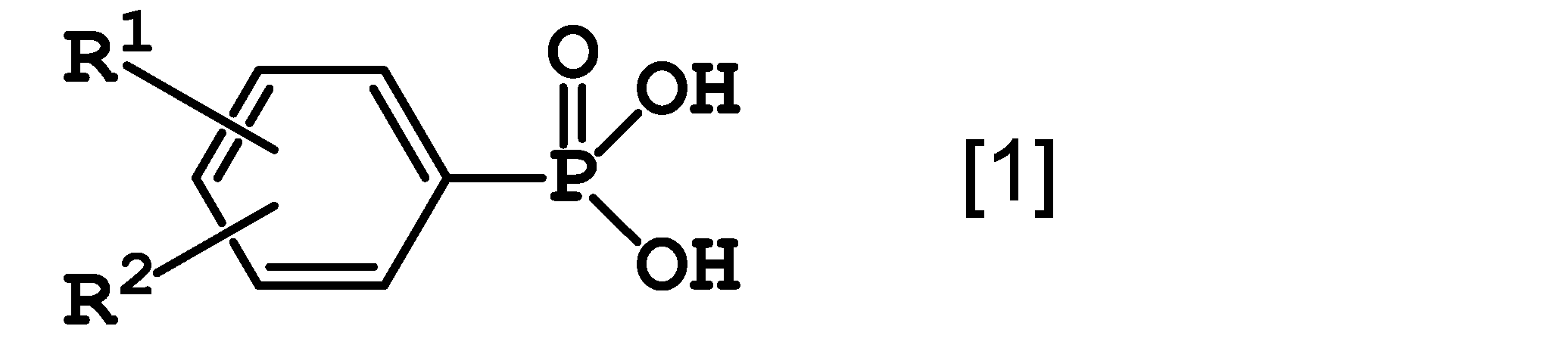
(式中、R1及びR2は、それぞれ独立して、水素原子、炭素原子数1乃至10のアルキル基、又は炭素原子数2乃至11のアルコキシカルボニル基を表す。) - 前記フェニルホスホン酸化合物の金属塩が、リチウム塩、ナトリウム塩、カリウム塩、マグネシウム塩、カルシウム塩、バリウム塩、マンガン塩、鉄塩、コバルト塩、ニッケル塩、銅塩、亜鉛塩、銀塩、アルミニウム塩、及びスズ塩からなる群から選ばれる少なくとも一種の金属塩である、請求項1に記載のポリアミド樹脂組成物。
- 前記フェニルホスホン酸化合物の金属塩が、カルシウム塩、マンガン塩、亜鉛塩、及びスズ塩からなる群から選ばれる少なくとも一種の金属塩である、請求項2に記載のポリアミド樹脂組成物。
- 前記フェニルホスホン酸化合物の金属塩がマンガン塩である、請求項3に記載のポリアミド樹脂組成物。
- 前記結晶核剤の含有量が、前記ポリアミド樹脂100質量部に対して0.001~10質量部である、請求項1乃至請求項4のうち何れか一項に記載のポリアミド樹脂組成物。
- 前記ポリアミド樹脂が、ポリアミド6、ポリアミド11、ポリアミド12、ポリアミド46、ポリアミド66、ポリアミド610、ポリアミド612、ポリアミド1010、ポリアミド1212、ポリアミド4T、ポリアミドM5T、ポリアミド6T、ポリアミド6I、ポリアミド9T、ポリアミド10T、及びポリアミドMXD6からなる群から選択される少なくとも一種を含むものである、請求項1乃至請求項5のうち何れか一項に記載のポリアミド樹脂組成物。
- 前記ポリアミド樹脂が、ポリアミド610を少なくとも含むものである、請求項6に記載のポリアミド樹脂組成物。
- 請求項1乃至請求項7のうち何れか一項に記載のポリアミド樹脂組成物を結晶化してなる、ポリアミド樹脂成形体。
Priority Applications (1)
| Application Number | Priority Date | Filing Date | Title |
|---|---|---|---|
| JP2017565533A JP6908892B2 (ja) | 2016-02-01 | 2017-01-30 | フェニルホスホン酸化合物の金属塩を含むポリアミド樹脂組成物 |
Applications Claiming Priority (2)
| Application Number | Priority Date | Filing Date | Title |
|---|---|---|---|
| JP2016-017040 | 2016-02-01 | ||
| JP2016017040 | 2016-02-01 |
Publications (1)
| Publication Number | Publication Date |
|---|---|
| WO2017135189A1 true WO2017135189A1 (ja) | 2017-08-10 |
Family
ID=59500288
Family Applications (1)
| Application Number | Title | Priority Date | Filing Date |
|---|---|---|---|
| PCT/JP2017/003170 Ceased WO2017135189A1 (ja) | 2016-02-01 | 2017-01-30 | フェニルホスホン酸化合物の金属塩を含むポリアミド樹脂組成物 |
Country Status (3)
| Country | Link |
|---|---|
| JP (1) | JP6908892B2 (ja) |
| TW (1) | TW201741393A (ja) |
| WO (1) | WO2017135189A1 (ja) |
Cited By (2)
| Publication number | Priority date | Publication date | Assignee | Title |
|---|---|---|---|---|
| JP2018009115A (ja) * | 2016-07-14 | 2018-01-18 | 日産化学工業株式会社 | ホスホン酸金属塩を含む芳香族ポリエーテルケトン樹脂組成物 |
| CN109666294A (zh) * | 2018-12-27 | 2019-04-23 | 会通新材料(上海)有限公司 | 一种结晶速率提升的聚酰胺56组合物及其应用 |
Families Citing this family (1)
| Publication number | Priority date | Publication date | Assignee | Title |
|---|---|---|---|---|
| CN114085519B (zh) * | 2021-11-26 | 2023-12-19 | 上海金发科技发展有限公司 | 一种聚酰胺组合物及其制备方法和应用 |
Citations (5)
| Publication number | Priority date | Publication date | Assignee | Title |
|---|---|---|---|---|
| JPS6390560A (ja) * | 1986-10-03 | 1988-04-21 | Asahi Chem Ind Co Ltd | ポリアミド樹脂組成物 |
| WO2010131678A1 (ja) * | 2009-05-12 | 2010-11-18 | 日産化学工業株式会社 | ホスホン酸金属塩微粒子の製造方法 |
| WO2011030822A1 (ja) * | 2009-09-09 | 2011-03-17 | 日産化学工業株式会社 | ホスホン酸金属塩の製造方法及びホスホン酸金属塩を含む熱可塑性樹脂組成物 |
| WO2013047766A1 (ja) * | 2011-09-30 | 2013-04-04 | 日産化学工業株式会社 | ポリ(3-ヒドロキシアルカノエート)樹脂組成物 |
| WO2015064566A1 (ja) * | 2013-10-30 | 2015-05-07 | 日産化学工業株式会社 | 耐加水分解性に優れたポリ乳酸樹脂組成物 |
Family Cites Families (1)
| Publication number | Priority date | Publication date | Assignee | Title |
|---|---|---|---|---|
| BE789440A (fr) * | 1971-09-30 | 1973-03-29 | Ciba Geigy | Sels de manganese (ii) d'hemi-esters phosphoniques utilisables comme stabilisants des polyamides |
-
2017
- 2017-01-30 WO PCT/JP2017/003170 patent/WO2017135189A1/ja not_active Ceased
- 2017-01-30 JP JP2017565533A patent/JP6908892B2/ja not_active Expired - Fee Related
- 2017-02-02 TW TW106103499A patent/TW201741393A/zh unknown
Patent Citations (5)
| Publication number | Priority date | Publication date | Assignee | Title |
|---|---|---|---|---|
| JPS6390560A (ja) * | 1986-10-03 | 1988-04-21 | Asahi Chem Ind Co Ltd | ポリアミド樹脂組成物 |
| WO2010131678A1 (ja) * | 2009-05-12 | 2010-11-18 | 日産化学工業株式会社 | ホスホン酸金属塩微粒子の製造方法 |
| WO2011030822A1 (ja) * | 2009-09-09 | 2011-03-17 | 日産化学工業株式会社 | ホスホン酸金属塩の製造方法及びホスホン酸金属塩を含む熱可塑性樹脂組成物 |
| WO2013047766A1 (ja) * | 2011-09-30 | 2013-04-04 | 日産化学工業株式会社 | ポリ(3-ヒドロキシアルカノエート)樹脂組成物 |
| WO2015064566A1 (ja) * | 2013-10-30 | 2015-05-07 | 日産化学工業株式会社 | 耐加水分解性に優れたポリ乳酸樹脂組成物 |
Cited By (3)
| Publication number | Priority date | Publication date | Assignee | Title |
|---|---|---|---|---|
| JP2018009115A (ja) * | 2016-07-14 | 2018-01-18 | 日産化学工業株式会社 | ホスホン酸金属塩を含む芳香族ポリエーテルケトン樹脂組成物 |
| CN109666294A (zh) * | 2018-12-27 | 2019-04-23 | 会通新材料(上海)有限公司 | 一种结晶速率提升的聚酰胺56组合物及其应用 |
| CN109666294B (zh) * | 2018-12-27 | 2021-08-20 | 会通新材料(上海)有限公司 | 一种结晶速率提升的聚酰胺56组合物及其应用 |
Also Published As
| Publication number | Publication date |
|---|---|
| JPWO2017135189A1 (ja) | 2018-11-22 |
| TW201741393A (zh) | 2017-12-01 |
| JP6908892B2 (ja) | 2021-07-28 |
Similar Documents
| Publication | Publication Date | Title |
|---|---|---|
| TWI488859B (zh) | 膦酸金屬鹽之製造方法及含有膦酸金屬鹽之熱塑性樹脂組成物 | |
| JP5958713B2 (ja) | ポリ(3−ヒドロキシアルカノエート)樹脂組成物 | |
| JP4973848B2 (ja) | ポリ乳酸樹脂組成物 | |
| JP6908892B2 (ja) | フェニルホスホン酸化合物の金属塩を含むポリアミド樹脂組成物 | |
| WO2012011576A1 (ja) | 結晶性樹脂組成物 | |
| US10899720B2 (en) | Polyester resin composition containing amino-triazine derivative | |
| JPWO2014077324A1 (ja) | ポリグリコール酸樹脂組成物 | |
| JP6849953B2 (ja) | カルボン酸誘導体を含むポリアミド樹脂組成物 | |
| JP6849939B2 (ja) | ホスホン酸金属塩を含む芳香族ポリエーテルケトン樹脂組成物 | |
| US9035100B2 (en) | Method for producing phenylphosphonic acid metal salt composition, and crystal nucleating agent therefrom | |
| JP2011099054A (ja) | ポリ乳酸樹脂組成物 | |
| WO2016047602A1 (ja) | アミノトリアジン誘導体及びカルボン酸アミドを含むポリエステル樹脂組成物 | |
| JPWO2017110809A1 (ja) | 難燃性高耐熱ポリアミド組成物 |
Legal Events
| Date | Code | Title | Description |
|---|---|---|---|
| 121 | Ep: the epo has been informed by wipo that ep was designated in this application |
Ref document number: 17747345 Country of ref document: EP Kind code of ref document: A1 |
|
| WWE | Wipo information: entry into national phase |
Ref document number: 2017565533 Country of ref document: JP |
|
| NENP | Non-entry into the national phase |
Ref country code: DE |
|
| 122 | Ep: pct application non-entry in european phase |
Ref document number: 17747345 Country of ref document: EP Kind code of ref document: A1 |