WO2017119274A1 - 接着剤組成物 - Google Patents
接着剤組成物 Download PDFInfo
- Publication number
- WO2017119274A1 WO2017119274A1 PCT/JP2016/087810 JP2016087810W WO2017119274A1 WO 2017119274 A1 WO2017119274 A1 WO 2017119274A1 JP 2016087810 W JP2016087810 W JP 2016087810W WO 2017119274 A1 WO2017119274 A1 WO 2017119274A1
- Authority
- WO
- WIPO (PCT)
- Prior art keywords
- adhesive composition
- composition according
- hindered amine
- compound
- aluminum
- Prior art date
- Legal status (The legal status is an assumption and is not a legal conclusion. Google has not performed a legal analysis and makes no representation as to the accuracy of the status listed.)
- Ceased
Links
Images

Classifications
-
- C—CHEMISTRY; METALLURGY
- C09—DYES; PAINTS; POLISHES; NATURAL RESINS; ADHESIVES; COMPOSITIONS NOT OTHERWISE PROVIDED FOR; APPLICATIONS OF MATERIALS NOT OTHERWISE PROVIDED FOR
- C09J—ADHESIVES; NON-MECHANICAL ASPECTS OF ADHESIVE PROCESSES IN GENERAL; ADHESIVE PROCESSES NOT PROVIDED FOR ELSEWHERE; USE OF MATERIALS AS ADHESIVES
- C09J163/00—Adhesives based on epoxy resins; Adhesives based on derivatives of epoxy resins
-
- C—CHEMISTRY; METALLURGY
- C08—ORGANIC MACROMOLECULAR COMPOUNDS; THEIR PREPARATION OR CHEMICAL WORKING-UP; COMPOSITIONS BASED THEREON
- C08G—MACROMOLECULAR COMPOUNDS OBTAINED OTHERWISE THAN BY REACTIONS ONLY INVOLVING UNSATURATED CARBON-TO-CARBON BONDS
- C08G59/00—Polycondensates containing more than one epoxy group per molecule; Macromolecules obtained by polymerising compounds containing more than one epoxy group per molecule using curing agents or catalysts which react with the epoxy groups
- C08G59/18—Macromolecules obtained by polymerising compounds containing more than one epoxy group per molecule using curing agents or catalysts which react with the epoxy groups ; e.g. general methods of curing
- C08G59/68—Macromolecules obtained by polymerising compounds containing more than one epoxy group per molecule using curing agents or catalysts which react with the epoxy groups ; e.g. general methods of curing characterised by the catalysts used
- C08G59/686—Macromolecules obtained by polymerising compounds containing more than one epoxy group per molecule using curing agents or catalysts which react with the epoxy groups ; e.g. general methods of curing characterised by the catalysts used containing nitrogen
-
- C—CHEMISTRY; METALLURGY
- C08—ORGANIC MACROMOLECULAR COMPOUNDS; THEIR PREPARATION OR CHEMICAL WORKING-UP; COMPOSITIONS BASED THEREON
- C08G—MACROMOLECULAR COMPOUNDS OBTAINED OTHERWISE THAN BY REACTIONS ONLY INVOLVING UNSATURATED CARBON-TO-CARBON BONDS
- C08G59/00—Polycondensates containing more than one epoxy group per molecule; Macromolecules obtained by polymerising compounds containing more than one epoxy group per molecule using curing agents or catalysts which react with the epoxy groups
- C08G59/18—Macromolecules obtained by polymerising compounds containing more than one epoxy group per molecule using curing agents or catalysts which react with the epoxy groups ; e.g. general methods of curing
- C08G59/68—Macromolecules obtained by polymerising compounds containing more than one epoxy group per molecule using curing agents or catalysts which react with the epoxy groups ; e.g. general methods of curing characterised by the catalysts used
- C08G59/70—Chelates
-
- C—CHEMISTRY; METALLURGY
- C09—DYES; PAINTS; POLISHES; NATURAL RESINS; ADHESIVES; COMPOSITIONS NOT OTHERWISE PROVIDED FOR; APPLICATIONS OF MATERIALS NOT OTHERWISE PROVIDED FOR
- C09J—ADHESIVES; NON-MECHANICAL ASPECTS OF ADHESIVE PROCESSES IN GENERAL; ADHESIVE PROCESSES NOT PROVIDED FOR ELSEWHERE; USE OF MATERIALS AS ADHESIVES
- C09J11/00—Features of adhesives not provided for in group C09J9/00, e.g. additives
- C09J11/02—Non-macromolecular additives
- C09J11/04—Non-macromolecular additives inorganic
-
- C—CHEMISTRY; METALLURGY
- C09—DYES; PAINTS; POLISHES; NATURAL RESINS; ADHESIVES; COMPOSITIONS NOT OTHERWISE PROVIDED FOR; APPLICATIONS OF MATERIALS NOT OTHERWISE PROVIDED FOR
- C09J—ADHESIVES; NON-MECHANICAL ASPECTS OF ADHESIVE PROCESSES IN GENERAL; ADHESIVE PROCESSES NOT PROVIDED FOR ELSEWHERE; USE OF MATERIALS AS ADHESIVES
- C09J11/00—Features of adhesives not provided for in group C09J9/00, e.g. additives
- C09J11/02—Non-macromolecular additives
- C09J11/06—Non-macromolecular additives organic
-
- C—CHEMISTRY; METALLURGY
- C09—DYES; PAINTS; POLISHES; NATURAL RESINS; ADHESIVES; COMPOSITIONS NOT OTHERWISE PROVIDED FOR; APPLICATIONS OF MATERIALS NOT OTHERWISE PROVIDED FOR
- C09J—ADHESIVES; NON-MECHANICAL ASPECTS OF ADHESIVE PROCESSES IN GENERAL; ADHESIVE PROCESSES NOT PROVIDED FOR ELSEWHERE; USE OF MATERIALS AS ADHESIVES
- C09J11/00—Features of adhesives not provided for in group C09J9/00, e.g. additives
- C09J11/08—Macromolecular additives
-
- C—CHEMISTRY; METALLURGY
- C09—DYES; PAINTS; POLISHES; NATURAL RESINS; ADHESIVES; COMPOSITIONS NOT OTHERWISE PROVIDED FOR; APPLICATIONS OF MATERIALS NOT OTHERWISE PROVIDED FOR
- C09J—ADHESIVES; NON-MECHANICAL ASPECTS OF ADHESIVE PROCESSES IN GENERAL; ADHESIVE PROCESSES NOT PROVIDED FOR ELSEWHERE; USE OF MATERIALS AS ADHESIVES
- C09J9/00—Adhesives characterised by their physical nature or the effects produced, e.g. glue sticks
- C09J9/02—Electrically-conducting adhesives
-
- H—ELECTRICITY
- H10—SEMICONDUCTOR DEVICES; ELECTRIC SOLID-STATE DEVICES NOT OTHERWISE PROVIDED FOR
- H10H—INORGANIC LIGHT-EMITTING SEMICONDUCTOR DEVICES HAVING POTENTIAL BARRIERS
- H10H20/00—Individual inorganic light-emitting semiconductor devices having potential barriers, e.g. light-emitting diodes [LED]
- H10H20/80—Constructional details
- H10H20/85—Packages
- H10H20/855—Optical field-shaping means, e.g. lenses
- H10H20/856—Reflecting means
-
- H—ELECTRICITY
- H10—SEMICONDUCTOR DEVICES; ELECTRIC SOLID-STATE DEVICES NOT OTHERWISE PROVIDED FOR
- H10H—INORGANIC LIGHT-EMITTING SEMICONDUCTOR DEVICES HAVING POTENTIAL BARRIERS
- H10H20/00—Individual inorganic light-emitting semiconductor devices having potential barriers, e.g. light-emitting diodes [LED]
- H10H20/80—Constructional details
- H10H20/85—Packages
- H10H20/857—Interconnections, e.g. lead-frames, bond wires or solder balls
-
- C—CHEMISTRY; METALLURGY
- C09—DYES; PAINTS; POLISHES; NATURAL RESINS; ADHESIVES; COMPOSITIONS NOT OTHERWISE PROVIDED FOR; APPLICATIONS OF MATERIALS NOT OTHERWISE PROVIDED FOR
- C09J—ADHESIVES; NON-MECHANICAL ASPECTS OF ADHESIVE PROCESSES IN GENERAL; ADHESIVE PROCESSES NOT PROVIDED FOR ELSEWHERE; USE OF MATERIALS AS ADHESIVES
- C09J2301/00—Additional features of adhesives in the form of films or foils
- C09J2301/30—Additional features of adhesives in the form of films or foils characterized by the chemical, physicochemical or physical properties of the adhesive or the carrier
- C09J2301/312—Additional features of adhesives in the form of films or foils characterized by the chemical, physicochemical or physical properties of the adhesive or the carrier parameters being the characterizing feature
-
- H—ELECTRICITY
- H10—SEMICONDUCTOR DEVICES; ELECTRIC SOLID-STATE DEVICES NOT OTHERWISE PROVIDED FOR
- H10H—INORGANIC LIGHT-EMITTING SEMICONDUCTOR DEVICES HAVING POTENTIAL BARRIERS
- H10H20/00—Individual inorganic light-emitting semiconductor devices having potential barriers, e.g. light-emitting diodes [LED]
- H10H20/01—Manufacture or treatment
- H10H20/036—Manufacture or treatment of packages
- H10H20/0364—Manufacture or treatment of packages of interconnections
-
- H—ELECTRICITY
- H10—SEMICONDUCTOR DEVICES; ELECTRIC SOLID-STATE DEVICES NOT OTHERWISE PROVIDED FOR
- H10W—GENERIC PACKAGES, INTERCONNECTIONS, CONNECTORS OR OTHER CONSTRUCTIONAL DETAILS OF DEVICES COVERED BY CLASS H10
- H10W74/00—Encapsulations, e.g. protective coatings
- H10W74/10—Encapsulations, e.g. protective coatings characterised by their shape or disposition
- H10W74/15—Encapsulations, e.g. protective coatings characterised by their shape or disposition on active surfaces of flip-chip devices, e.g. underfills
Definitions
- the present invention relates to an adhesive composition in which an epoxy compound is cationically polymerized using an aluminum chelating agent.
- Patent Literature 1 proposes an aluminum chelate latent curing agent in which an aluminum chelating agent is held in a porous resin obtained by interfacial polymerization of a polyfunctional isocyanate compound.
- the aluminum chelating agent may ooze out from the porous resin, and the life of the adhesive composition may be lowered.
- the present invention solves the above-mentioned problems in the prior art and provides an adhesive composition having excellent life.
- the adhesive composition according to the present invention is characterized by containing an epoxy compound, an aluminum chelating agent, and a hindered amine compound.
- the light emitting device includes a substrate having a wiring pattern, an anisotropic conductive film formed on an electrode of the wiring pattern, and a light emitting element mounted on the anisotropic conductive film.
- the anisotropic conductive film is a cured product of an anisotropic conductive adhesive containing an epoxy compound, an aluminum chelating agent, and a hindered amine compound.
- the adhesive composition according to the present invention is optimal for mounting a light emitting device such as an LED because photodegradation is suppressed by radical scavenging of the hindered amine compound.
- FIG. 1 is a cross-sectional view illustrating an example of a light emitting device.
- Adhesive composition contains an epoxy compound, an aluminum chelating agent, and a hindered amine compound. Thereby, the outstanding life property can be acquired. This is presumably because the aluminum chelating agent is stably present by the coordination of the nitrogen atom of the hindered amine compound to the aluminum of the aluminum chelating agent.
- epoxy compound examples include bisphenol type epoxy resin derived from epichlorohydrin and bisphenol A or bisphenol F, alicyclic epoxy compound, polyglycidyl ether, polyglycidyl ester, aromatic epoxy compound, novolak type epoxy compound, glycidylamine.
- Type epoxy compounds, glycidyl ester type epoxy compounds, and the like, and one or more of these can be used.
- the hydrogenated epoxy compound a hydrogenated epoxy compound obtained by hydrogenating a known epoxy compound such as a hydrogenated product of the above-described alicyclic epoxy compound, bisphenol A type, or bisphenol F type can be used.
- a known epoxy compound such as a hydrogenated product of the above-described alicyclic epoxy compound, bisphenol A type, or bisphenol F type
- Preferred examples of the alicyclic epoxy compound include those having two or more epoxy groups in the molecule. These may be liquid or solid. Specific examples include 3,4-epoxycyclohexenylmethyl-3 ′, 4′-epoxycyclohexene carboxylate, glycidyl hexahydrobisphenol A, and the like.
- a hydrogenated bisphenol A type epoxy resin is preferably used because it can ensure light transmission suitable for mounting an LED (Light Emitting Diode) element on a cured product and is excellent in quick curing.
- Examples of commercially available hydrogenated bisphenol A type epoxy resins include YX-8000, YX-8034 (manufactured by Mitsubishi Chemical), EXA-7015 (manufactured by DIC), ST3000 (manufactured by Toho Kasei Co., Ltd.), etc. 1 type (s) or 2 or more types can be used.
- Al chelating agent known ones can be used.
- R 1 , R 2 and R 3 are each independently an alkyl group or an alkoxyl group.
- the alkyl group include a methyl group and an ethyl group.
- the alkoxyl group include a methoxy group, an ethoxy group, and an oleyloxy group.
- the aluminum chelating agent represented by the formula (1) include aluminum tris (acetylacetonate), aluminum tris (ethylacetoacetate), aluminum monoacetylacetonate bis (ethylacetoacetate), aluminum monoacetylacetonate Examples thereof include bisoleyl acetoacetate, ethyl acetoacetate aluminum diisopropylate, and alkyl acetoacetate aluminum diisopropylate.
- the aluminum chelating agent is preferably an aluminum chelate latent curing agent that is held by a porous resin obtained by interfacial polymerization of a polyfunctional isocyanate compound.
- This aluminum chelate latent curing agent is stored in a large number of fine pores existing in the porous resin matrix, so that the aluminum chelating agent is blended directly into the adhesive composition and is stable in storage even in a single solution. Can be greatly improved.
- This aluminum chelate latent curing agent is prepared by dissolving an aluminum chelating agent and a polyfunctional isocyanate compound in a volatile organic solvent, putting the obtained solution into an aqueous phase containing a dispersant, and heating and stirring the interface. It can be obtained by polymerization. Specifically, an aluminum chelating agent and a polyfunctional isocyanate compound having a weight exceeding twice that of the aluminum chelating agent are converted into 100 to 500 parts by mass of a lower alkyl acetate with respect to a total of 100 parts by mass of the aluminum chelating agent and the polyfunctional isocyanate compound.
- the polyfunctional isocyanate compound preferably has two or more isocyanate groups in one molecule, and more preferably has three isocyanate groups in one molecule.
- the trifunctional isocyanate compound include, for example, a TMP adduct of the formula (2) obtained by reacting 3 mol of a diisocyanate compound with 1 mol of trimethylolpropane, an isocyanurate of the formula (3) obtained by self-condensation of 3 mol of a diisocyanate compound, Examples include a puret body of the formula (4) obtained by condensing the remaining 1 mol of diisocyanate with diisocyanate urea obtained from 2 mol of 3 mol of the diisocyanate compound.
- the substituent R is a portion excluding the isocyanate group of the diisocyanate compound.
- diisocyanate compounds include toluene 2,4-diisocyanate, toluene 2,6-diisocyanate, m-xylylene diisocyanate, hexamethylene diisocyanate, hexahydro-m-xylylene diisocyanate, isophorone diisocyanate, methylene diphenyl-4. , 4'-diisocyanate and the like.
- the aluminum chelating agent is preferably an aluminum chelate latent curing agent that is held by a porous resin obtained by interfacial polymerization of a polyfunctional isocyanate compound and radical polymerization of divinylbenzene.
- a porous resin obtained by interfacial polymerization of a polyfunctional isocyanate compound and radical polymerization of divinylbenzene.
- This aluminum chelate latent curing agent dissolves an aluminum chelating agent, a polyfunctional isocyanate compound, a radical polymerizable compound, and a radical polymerization initiator in a volatile organic solvent, and the resulting solution contains a dispersant. It can be obtained by interfacial polymerization by charging into an aqueous phase to be heated and stirring.
- the aluminum chelating agent is an aluminum chelate that cooperates with a silanol compound or a silane coupling agent to generate a cationic species and an anionic species, and cationically polymerize an epoxy compound.
- a silanol cure catalyst system is preferred.
- silanol compounds include arylsilaneols represented by the formula (7).
- m is 2 or 3, provided that the sum of m and n is 4.
- the silanol compound represented by Formula (7) becomes a mono or diol form.
- “Ar” is an optionally substituted aryl group. Examples of the aryl group include a phenyl group, a naphthyl group, an anthracenyl group, an azulenyl group, a fluorenyl group, a thienyl group, a furyl group, a pyrrolyl group, an imidazolyl group, and a pyridyl group. Of these, a phenyl group is preferable from the viewpoint of availability and cost.
- the m Ars may be the same or different, and are preferably the same from the viewpoint of availability.
- aryl groups may have 1 to 3 substituents such as halogen such as chloro and bromo; trifluoromethyl; nitro; sulfo; alkoxycarbonyl such as carboxyl, methoxycarbonyl and ethoxycarbonyl; formyl and the like Electron-withdrawing groups, alkyl such as methyl, ethyl and propyl; alkoxy such as methoxy and ethoxy; hydroxy; amino; monoalkylamino such as monomethylamino; and electron-donating groups such as dialkylamino such as dimethylamino.
- substituents such as halogen such as chloro and bromo; trifluoromethyl; nitro; sulfo; alkoxycarbonyl such as carboxyl, methoxycarbonyl and ethoxycarbonyl; formyl and the like
- Electron-withdrawing groups alkyl such as methyl, ethyl and propyl; alkoxy such as meth
- the acidity of the hydroxyl group of silanol can be increased by using an electron withdrawing group as a substituent, and conversely, the acidity can be lowered by using an electron donating group, so that the curing activity can be controlled.
- the substituents may be different for each of the m Ars, but the substituents are preferably the same for the m Ars from the viewpoint of availability. Further, only some Ar may have a substituent, and other Ar may not have a substituent.
- triphenylsilanol or diphenylphenylsilanol is preferable. Particularly preferred is triphenylsilanol.
- a silanol compound is an interfacial polymerization of an aluminum chelate latent curing agent in which an aluminum chelating agent is held on a porous resin obtained by interfacial polymerization of a polyfunctional isocyanate compound, or at the same time divinylbenzene is radicalized. It is preferable to impregnate an aluminum chelate latent curing agent in which an aluminum chelating agent is held in a porous resin obtained by polymerization. By impregnating the aluminum chelate latent curing agent with a silanol compound, low temperature rapid curing can be improved.
- an aluminum chelate-based latent curing agent is dispersed in an organic solvent (for example, ethanol), and the silanol compound of the formula (7) (for example, triphenylsilanol) and necessary are dispersed in the dispersion.
- an aluminum chelate curing agent for example, an isopropanol solution of monoacetylacetonate bis (ethylacetoacetate)
- stirring is continued for several hours to overnight at a temperature of about room temperature to 50 ° C. it can.
- the aluminum chelate-silanol curing catalyst system may also contain a silane coupling agent.
- the silane coupling agent has a function of initiating cationic polymerization in cooperation with an aluminum chelating agent, particularly an aluminum chelate latent curing agent.
- Examples of such a silane coupling agent include a group having 1 to 3 lower alkoxy groups in the molecule and a reactivity in the molecule with respect to the functional group of the cationic polymerizable resin, such as a pinyl group and a styryl group. It preferably has an acryloyloxy group, a methacryloyloxy group, an epoxy group, an amino group, or the like.
- the coupling agent having an amino group can be used when the generated cationic species of the aluminum chelate-silanol curing catalyst system are not substantially captured.
- silane coupling agents examples include vinyl tris ( ⁇ -methoxyethoxy) silane, vinyltriethoxysilane, vinyltrimethoxysilane, ⁇ -styryltrimethoxysilane, ⁇ -methacryloxypropyltrimethoxysilane, ⁇ -acrylic.
- the content of the silane coupling agent is too small, the effect of addition tends to not appear. If the content is too large, the influence of the polymerization termination reaction due to the silanolate anion generated from the silane coupling agent will occur. 1 to 300 parts by weight, preferably 1 to 100 parts by weight, per 100 parts by weight of the hardener.
- Such an aluminum chelate-silanol curing catalyst system has a low life property because a cation species and an anion species coexist as active species.
- a hindered amine compound by adding a hindered amine compound, an excellent life property can be obtained. Can do. This is presumably because the aluminum chelating agent is stably present by the coordination of the nitrogen atom of the hindered amine compound to the aluminum of the aluminum chelating agent.
- the hindered amine-based compound shifts the heat generation start temperature of the adhesive composition to a high temperature side, and improves the latency and life properties. This is presumably because the aluminum chelating agent is stably present when the nitrogen atom of the hindered amine compound is coordinated to the aluminum of the aluminum chelating agent.
- hindered amine compounds include hindered amine light stabilizers (HALS) having a 2,2,6,6-tetramethylpiperidine skeleton.
- HALS hindered amine light stabilizers
- examples of the hindered amine light stabilizer include NH type, NR type, and N-OR type.
- NH type hindered amine stabilizers include tetrakis (1,2,2,6,6-pentamethyl-4-piperidyl) butane-1,2,3,4-butanetetracarboxylate (manufactured by ADEKA).
- ADK STAB LA-57 bis (2,2,6,6-tetramethyl-4-piperidyl) sebacate ( ⁇ ⁇ TINUVIN 770DF manufactured by BASF), N, N'-bis (2,2,6,6-tetramethyl) -4-piperidyl) -N, N'-diformylhexamethylenediamine (UVINUL 4050FF manufactured by BASF), dibutylamine, 1,3,5-triazine, N, N'-bis (2,2,6,6- Tetramethyl-4-piperidyl) -1,6-hexamethylenediamine and N- (2,2,6,6-tetramethyl-4-piperidyl) butylamino Polycondensate (BASF Corporation Chimassorb 2020FDL), poly [ ⁇ 6- (1,1,3,3-tetramethylbutyl) amino-1,3,5-triazine-2,4-diyl ⁇ ⁇ (2 , 2,6,6-Tetramethyl-4-piperidyl) imino ⁇
- NR type hindered amine stabilizer examples include bis (1,2,2,6,6-pentamethyl-4-piperidyl) [[3,5-bis (1,1-dimethylethyl) -4- Hydroxyphenyl] methyl] butyl malonate (BASF Corporation TINUVIN 144), bis (1,2,2,6,6-pentamethyl-4-piperidyl) sebacate and methyl 1,2,2,6,6-pentamethyl-4 -Piperidyl sebacate (mixture) (BASF Corporation TINUVIN 765), succinic acid and dimethyl-1- (2-hydroxyethyl) -4-hydroxy-2,2,6,6-tetramethylpiperidine polycondensate, (BASF TINUVIN 622SF), N, N′-bis (3-aminopropyl) ethylenediamine-2,4-bis [N-butyl-N (1,2,2,6,6-pentamethyl-4-piperidyl) amino] -6-chloro-1,
- N-OR type hindered amine stabilizer examples include a NOR type hindered amine light stabilizer system (BASF TINUVINXT 850FF), and an anti-glare stabilizer system based on the NOR type hindered amine light stabilizer system (BASF).
- BASF NOR type hindered amine light stabilizer system
- BASF anti-glare stabilizer system based on the NOR type hindered amine light stabilizer system
- TINUVIN 855FF peroxidized 4-butylamino-2,2,6,6-tetramethylpiperidine and 2,4,6-trichloro-1,3,5-triazine, and cyclohexane, N, N′-ethane -1,2-diylbis (1,3-propanediamine) reaction product (BASF ⁇ Flamestab NOR116FF), bis (1-undecanoxy-2,2,6,6-tetramethylpiperidin-4-yl) carbonate (ADEKA Co., Ltd. LA-81) It is.
- the hindered amine light stabilizers described above can be used alone or as a mixture of two or more. Among these, it is preferable to use a condensate of 1,2,3,4-butanetetracarboxylic acid which is bulky and has a large steric hindrance.
- 1,2,3,4-butanetetracarboxylic acid for example, tetrakis (1,2,2,6,6-pentamethyl-4-piperidyl) 1,2,3,4-butanetetracarboxylate (Adeka Taba LA-52 manufactured by ADEKA), Tetrakis (1,2,2,6,6-Pentamethyl-4-piperidyl) butane-1,2,3,4-butanetetracarboxylate (Adeka Taba LA-57 manufactured by ADEKA) ), Tetrakis (2,2,6,6-tetramethyl-4-piperidyl) -1,2,3,4-butanetetracarboxylate, 1,2,3,4-butanetetracarboxylic acid, , 2,6,6-pentamethyl-4-piperidinol and a tridecyl alcohol condensate (Adeka Adeka Stab LA-63P). .
- An aluminum chelate latent curing agent in which an aluminum chelating agent is held in a porous resin obtained by interfacial polymerization of a polyfunctional isocyanate compound by using a condensate of 1,2,3,4-butanetetracarboxylic acid or
- an aluminum chelate latent curing agent holding an aluminum chelate is used in a porous resin obtained by interfacial polymerization of a polyfunctional isocyanate compound and radical polymerization of divinylbenzene
- the heat generation start temperature of the adhesive composition is reduced. It can be shifted greatly to the high temperature side. This is thought to be because the bulkiness of the hindered amine compound was coordinated with the aluminum chelating agent held in the porous resin, and the potential was improved.
- the hindered amine compound has an effect as a photofixing agent and an antioxidant, and is therefore optimal as an adhesive composition for flip-chip mounting a substrate and a light emitting element described later.
- the content of the hindered amine compound is preferably 0.05 to 20 parts by mass, and 0.05 to 15 parts by mass with respect to 100 parts by mass in total of the epoxy compound and the aluminum chelate latent curing agent. It is more preferable. When the content of the hindered amine compound is too small, the effect of improving the life property tends not to be exhibited, and when it is too much, the reflectance and optical characteristics tend to be lowered.
- the adhesive composition according to the present embodiment reflects white light emitted from the LED as another component and obtains a high light extraction efficiency, so that white color such as TiO 2 , BN, ZnO, and Al 2 O 3 is used.
- Inorganic particles may be contained. Moreover, it is preferable that the average particle diameter of a white inorganic particle is 1/2 or more of the wavelength of the light to reflect.
- the content of the white inorganic particles is preferably 1 to 50 vol%, preferably 5 to 25 vol%, based on the binder component.
- an inorganic filler may be contained in order to control fluidity and improve the particle capture rate.
- the inorganic filler is not particularly limited, and silica, talc, titanium oxide, calcium carbonate, magnesium oxide and the like can be used.
- Such an inorganic filler can be appropriately used depending on the purpose of relaxing the stress of the connection structure connected by the adhesive.
- blend softeners such as a thermoplastic resin and a rubber component.
- the adhesive composition may be an anisotropic conductive adhesive containing conductive particles.
- conductive particles can be used as the conductive particles.
- conductive particles For example, on the surface of particles of various metals and metal alloys such as nickel, iron, copper, aluminum, tin, lead, chromium, cobalt, silver and gold, particles of metal oxide, carbon, graphite, glass, ceramic, plastic, etc. The thing which coated the metal, the thing which coat
- examples of the resin particle include an epoxy resin, a phenol resin, an acrylic resin, an acrylonitrile / styrene (AS) resin, a benzoguanamine resin, a divinylbenzene resin, a styrene resin, and the like.
- the particles can be used.
- the surface of the resin particles may be coated with Ni or the like.
- the average particle size of the conductive particles is preferably 1 ⁇ m or more and 10 ⁇ m or less, more preferably 1 ⁇ m or more and 8 ⁇ m or less. Moreover, it is preferable that the compounding quantity of electroconductive particle is 1 to 100 mass parts with respect to 100 mass parts of binders from a viewpoint of connection reliability and insulation reliability.
- solder particles preferably have an average particle size smaller than that of the conductive particles, and the average particle size of the solder particles is preferably 20% or more and less than 100% of the average particle size of the conductive particles. If the solder particles are too small relative to the conductive particles, the solder particles are not captured between the terminals facing each other at the time of pressure bonding, and metal bonding is not performed, so that excellent heat dissipation characteristics and electrical characteristics cannot be obtained. On the other hand, if the solder particles are too large with respect to the conductive particles, for example, a shoulder touch due to the solder particles occurs at the edge portion of the LED chip, a leak occurs, and the product yield deteriorates.
- the solder particles are, for example, Sn-Pb series, Pb-Sn-Sb series, Sn-Sb series, Sn-Pb-Bi series, Bi-Sn series, Sn-Cu series, as defined in JIS Z 3282-1999, It can be appropriately selected from Sn—Pb—Cu, Sn—In, Sn—Ag, Sn—Pb—Ag, Pb—Ag, and the like according to the electrode material and connection conditions. Further, the shape of the solder particles can be appropriately selected from granular, flake shaped, and the like. Note that the solder particles may be covered with an insulating layer in order to improve anisotropy.
- the blending amount of the solder particles is preferably 1% by volume or more and 30% by volume or less. If the blending amount of the solder particles is too small, excellent heat dissipation characteristics cannot be obtained, and if the blending amount is too large, anisotropy is impaired and excellent connection reliability cannot be obtained.
- the exothermic start temperature measured by differential thermal analysis at a temperature elevation rate of 10 ° C./min is 80 to 90 ° C.
- the exothermic peak temperature is 100 to 120 ° C.
- the reaction end point temperature is It is preferably 180 to 220 ° C.
- FIG. 1 is a cross-sectional view illustrating an example of a light emitting device.
- the light emitting device includes a substrate 11 having a wiring pattern 12, an anisotropic conductive film 20 formed on an electrode of the wiring pattern 12, and a light emitting element 13 mounted on the anisotropic conductive film 20.
- the isotropic conductive film 20 is made of a cured product of the anisotropic conductive adhesive described above.
- This light-emitting device has the above-described anisotropy between the wiring pattern 12 on the substrate 11 and the connection bump 16 formed on each of the n-electrode 14 and the p-electrode 15 of the LED element as the light-emitting element 13. It is obtained by applying a conductive adhesive and flip-chip mounting the substrate 11 and the light emitting element 13.
- the anisotropic conductive adhesive described above by using the anisotropic conductive adhesive described above, the effect of the hindered amine compound as a photofixing agent and an antioxidant is exhibited, and high reflectance and excellent optical properties can be obtained. .
- the LED element 13 may be provided with a light reflecting layer.
- a well-known light emitting element can be used in the range which does not impair the effect of this invention other than an LED element. ⁇ 3. Example>
- an anisotropic conductive adhesive containing a hindered amine light stabilizer was prepared. Then, the heat generation start temperature, the heat generation peak temperature, and the heat generation end temperature of the anisotropic conductive adhesive were measured. Further, the viscosity life and reflectance of the anisotropic conductive adhesive were evaluated. Moreover, the LED chip was mounted on the board
- the present invention is not limited to these examples.
- the heat generation start temperature, heat generation peak temperature, and heat generation end point temperature of the anisotropic conductive adhesive were measured at a temperature increase rate of 10 ° C./min.
- the exothermic start temperature means the curing start temperature
- the exothermic peak temperature means the temperature at which curing is most active
- the exothermic end temperature means the curing end temperature
- the peak The area means the calorific value.
- An anisotropic conductive adhesive is applied to an LED mounting substrate (ceramic substrate) having a space between conductors (Ni (5.0 ⁇ m) / Au (0.3 ⁇ m) plated wiring) having a pitch of 100 ⁇ m, and then the electrode has a thickness of 3 ⁇ m.
- the thermocompression bonding conditions were as follows: temperature 200 ° C.—time 60 seconds—pressure 1 kg / chip.
- the Vf average value is 3.10 V
- the evaluation of the LED mounting body with a Vf value of less than 3.15 V is “A”
- the LED mounting with a Vf value of 3.15 V or more and less than 3.6 V was “B”
- the evaluation of the LED mounting body having a Vf value of 3.6 V or more was “C”.
- Example 1 A total of 100 parts by mass of hydrogenated bisphenol A type epoxy resin (product name: YX8000, manufactured by Mitsubishi Chemical Corporation) and 5 parts by mass of an aluminum chelate latent curing agent is used as a hindered amine light stabilizer (product name: LA- 52, manufactured by ADEKA) was mixed to prepare a binder.
- the aluminum chelate latent curing agent was produced as follows. First, 800 parts by mass of distilled water, 0.05 parts by mass of a surfactant (Newlex RT, Nippon Oil & Fats Co., Ltd.), and 4 parts by mass of polyvinyl alcohol (PVA-205, Kuraray Co., Ltd.) as a dispersant. Were placed in a 3 liter interfacial polymerization vessel equipped with a thermometer and mixed uniformly.
- a surfactant Newlex RT, Nippon Oil & Fats Co., Ltd.
- PVA-205 polyvinyl alcohol
- the aluminum chelating agent contains 100 parts by mass of a spherical latent curing agent having a particle size of about 2 ⁇ m, which is held by a porous resin obtained by interfacial polymerization of a polyfunctional isocyanate compound and radical polymerization of divinylbenzene. Obtained.
- the heat generation start temperature of the anisotropic conductive adhesive was 85 ° C.
- the heat generation peak temperature was 113 ° C.
- the reaction end point temperature was 205 ° C.
- the rate of increase in viscosity of the anisotropic conductive adhesive at room temperature 48 h was 1.0 times.
- the initial reflectance of the anisotropic conductive adhesive was 65%, and the reflectance after 100 hours of UV irradiation was 63%.
- the initial total luminous flux of the LED mounting body was 7.0 lm
- the total luminous flux after the reliability test was 7.0 lm.
- the initial electrical conductivity evaluation of the LED mounting body was A
- the electrical conductivity evaluation after the reliability test was A.
- Example 2 A total of 100 parts by mass of hydrogenated bisphenol A type epoxy resin (product name: YX8000, manufactured by Mitsubishi Chemical Corporation) and 5 parts by mass of an aluminum chelate latent curing agent is used as a hindered amine light stabilizer (product name: LA- 52, manufactured by ADEKA Co., Ltd.) was prepared in the same manner as in Example 1 except that 0.05 part by mass was mixed and the binder was adjusted.
- the heat generation start temperature of the anisotropic conductive adhesive was 85 ° C.
- the heat generation peak temperature was 113 ° C.
- the reaction end point temperature was 205 ° C.
- the rate of increase in viscosity of the anisotropic conductive adhesive at room temperature 48 h was 1.0 times.
- the initial reflectance of the anisotropic conductive adhesive was 65%, and the reflectance after 100 hours of UV irradiation was 63%.
- the initial total luminous flux of the LED mounting body was 7.0 lm
- the total luminous flux after the reliability test was 7.0 lm.
- the initial electrical conductivity evaluation of the LED mounting body was A
- the electrical conductivity evaluation after the reliability test was A.
- Example 3 A total of 100 parts by mass of hydrogenated bisphenol A type epoxy resin (product name: YX8000, manufactured by Mitsubishi Chemical Corporation) and 5 parts by mass of an aluminum chelate latent curing agent is used as a hindered amine light stabilizer (product name: LA- 52, manufactured by ADEKA Corporation) was mixed in the same manner as in Example 1 except that 10.0 parts by mass was mixed and the binder was adjusted.
- hydrogenated bisphenol A type epoxy resin product name: YX8000, manufactured by Mitsubishi Chemical Corporation
- an aluminum chelate latent curing agent product name: LA- 52, manufactured by ADEKA Corporation
- the heat generation start temperature of the anisotropic conductive adhesive was 85 ° C.
- the heat generation peak temperature was 113 ° C.
- the reaction end point temperature was 205 ° C.
- the rate of increase in viscosity of the anisotropic conductive adhesive at room temperature 48 h was 1.0 times.
- the initial reflectance of the anisotropic conductive adhesive was 65%, and the reflectance after 100 hours of UV irradiation was 63%.
- the initial total luminous flux of the LED mounting body was 7.0 lm
- the total luminous flux after the reliability test was 7.0 lm.
- the initial electrical conductivity evaluation of the LED mounting body was A
- the electrical conductivity evaluation after the reliability test was A.
- Example 4 A total of 100 parts by mass of hydrogenated bisphenol A type epoxy resin (product name: YX8000, manufactured by Mitsubishi Chemical Corporation) and 5 parts by mass of an aluminum chelate latent curing agent is used as a hindered amine light stabilizer (product name: LA- 57, manufactured by ADEKA Corporation) was mixed in the same manner as in Example 1 except that 1.0 part by mass was mixed and the binder was adjusted.
- the heat generation start temperature of the anisotropic conductive adhesive was 80 ° C.
- the heat generation peak temperature was 110 ° C.
- the reaction end point temperature was 205 ° C.
- the rate of increase in viscosity of the anisotropic conductive adhesive at room temperature 48 h was 1.1 times.
- the initial reflectance of the anisotropic conductive adhesive was 63%, and the reflectance after 100 hours of UV irradiation was 61%.
- the initial total luminous flux of the LED mounting body was 6.9 lm, and the total luminous flux after the reliability test was 6.8 lm.
- the initial electrical conductivity evaluation of the LED mounting body was A, and the electrical conductivity evaluation after the reliability test was A.
- Example 5 A total of 100 parts by mass of hydrogenated bisphenol A type epoxy resin (product name: YX8000, manufactured by Mitsubishi Chemical Corporation) and 5 parts by mass of an aluminum chelate latent curing agent is used as a hindered amine light stabilizer (product name: LA- An anisotropic conductive adhesive was produced in the same manner as in Example 1 except that 1.0 part by mass of 63P (manufactured by ADEKA) was blended and the binder was adjusted.
- the heat generation start temperature of the anisotropic conductive adhesive was 88 ° C
- the heat generation peak temperature was 115 ° C
- the reaction end point temperature was 205 ° C.
- the rate of increase in viscosity of the anisotropic conductive adhesive at room temperature 48 h was 1.1 times.
- the initial reflectance of the anisotropic conductive adhesive was 64%, and the reflectance after 100 hours of UV irradiation was 62%.
- the initial total luminous flux of the LED mounting body was 6.9 lm
- the total luminous flux after the reliability test was 6.9 lm.
- the initial electrical conductivity evaluation of the LED mounting body was A
- the electrical conductivity evaluation after the reliability test was A.
- Example 6 A total of 100 parts by mass of hydrogenated bisphenol A type epoxy resin (product name: YX8000, manufactured by Mitsubishi Chemical Corporation) and 5 parts by mass of an aluminum chelate latent curing agent is used as a hindered amine light stabilizer (product name: LA- 52, manufactured by ADEKA Corporation) was mixed in the same manner as in Example 1 except that 20.0 parts by mass was mixed and the binder was adjusted.
- the heat generation start temperature of the anisotropic conductive adhesive was 85 ° C.
- the heat generation peak temperature was 113 ° C.
- the reaction end point temperature was 205 ° C.
- the rate of increase in viscosity of the anisotropic conductive adhesive at room temperature 48 h was 1.0 times.
- the initial reflectance of the anisotropic conductive adhesive was 60%, and the reflectance after 100 hours of UV irradiation was 50%.
- the initial total luminous flux of the LED mounting body was 6.0 lm, and the total luminous flux after the reliability test was 5.2 lm.
- the initial electrical conductivity evaluation of the LED mounting body was A, and the electrical conductivity evaluation after the reliability test was A.
- the heat generation start temperature of the anisotropic conductive adhesive was 60 ° C.
- the heat generation peak temperature was 105 ° C.
- the reaction end point temperature was 205 ° C.
- the viscosity increasing rate of the anisotropic conductive adhesive at room temperature 48 h was 4.0 times.
- the initial reflectance of the anisotropic conductive adhesive was 65%, and the reflectance after 100 hours of UV irradiation was 55%.
- the initial total luminous flux of the LED mounting body was 7.0 lm, and the total luminous flux after the reliability test was 5.5 lm.
- the initial electrical conductivity evaluation of the LED mounting body was A, and the electrical conductivity evaluation after the reliability test was A.
- the heat generation start temperature of the anisotropic conductive adhesive was 70 ° C.
- the heat generation peak temperature was 110 ° C.
- the reaction end point temperature was 205 ° C.
- the rate of increase in viscosity of the anisotropic conductive adhesive at room temperature 48 h was 2.0 times.
- the initial reflectance of the anisotropic conductive adhesive was 50%, and the reflectance after 100 hours of UV irradiation was 35%.
- the initial total luminous flux of the LED mounting body was 5.0 lm, and the total luminous flux after the reliability test was 4.0 lm.
- the initial electrical conductivity evaluation of the LED mounting body was A, and the electrical conductivity evaluation after the reliability test was A.
- the content of the hindered amine light stabilizer is 0.05 to 15 parts by mass with respect to 100 parts by mass in total of the epoxy resin and the aluminum chelate latent curing agent. Moreover, the fall of the reflectance by coloring of the hardened
Landscapes
- Chemical & Material Sciences (AREA)
- Organic Chemistry (AREA)
- Health & Medical Sciences (AREA)
- Chemical Kinetics & Catalysis (AREA)
- Medicinal Chemistry (AREA)
- Polymers & Plastics (AREA)
- Inorganic Chemistry (AREA)
- Adhesives Or Adhesive Processes (AREA)
- Wire Bonding (AREA)
- Led Device Packages (AREA)
- Epoxy Resins (AREA)
Abstract
優れたライフ性を有する接着剤組成物を提供する。エポキシ化合物と、アルミニウムキレート剤と、ヒンダードアミン系化合物とを含有することにより、優れたライフ性を得る。これは、アルミニウムキレート剤のアルミニウムにヒンダードアミン系化合物の窒素原子が配位することにより、アルミニウムキレート剤が安定して存在しているためと考えられる。
Description
本発明は、アルミニウムキレート剤を用いてエポキシ化合物をカチオン重合させる接着剤組成物に関する。本出願は、日本国において2016年1月5日に出願された日本特許出願番号特願2016-000658を基礎として優先権を主張するものであり、この出願は参照されることにより、本出願に援用される。
従来、エポキシ化合物に対する低温速硬化活性を示す硬化剤として、アルミニウムキレート剤が知られている。例えば、特許文献1には、多官能イソシアネート化合物を界面重合させて得た多孔性樹脂にアルミニウムキレート剤を保持したアルミニウムキレート系潜在性硬化剤が提案されている。
しかしながら、アルミニウムキレート剤が多孔性樹脂に保持されたとしても、多孔性樹脂からアルミニウムキレート剤がしみ出すことがあり、接着剤組成物のライフ性が低下することがあった。
本発明は、上述した従来技術における課題を解決するものであり、優れたライフ性を有する接着剤組成物を提供する。
本発明者らは、鋭意検討を行った結果、ヒンダードアミン系化合物を配合することにより、優れたライフ性が得られることを見出した。
すなわち、本発明に係る接着剤組成物は、エポキシ化合物と、アルミニウムキレート剤と、ヒンダードアミン系化合物とを含有することを特徴とする。
また、本発明に係る発光装置は、配線パターンを有する基板と、前記配線パターンの電極上に形成された異方性導電膜と、前記異方性導電膜上に実装された発光素子とを備え、前記異方性導電膜が、エポキシ化合物と、アルミニウムキレート剤と、ヒンダードアミン系化合物とを含有する異方性導電接着剤の硬化物であることを特徴とする。
本発明によれば、ヒンダードアミン系化合物を配合することにより、優れたライフ性を得ることができる。これは、アルミニウムキレート剤のアルミニウムにヒンダードアミン系化合物の窒素原子が配位することにより、アルミニウムキレート剤が安定して存在しているためと考えられる。また、本発明に係る接着剤組成物は、ヒンダードアミン系化合物のラジカル捕捉により、光劣化が抑制されるため、LED等の発光素子の実装に最適である。
以下、本発明の実施の形態について、図面を参照しながら下記順序にて詳細に説明する。
1.接着剤組成物
2.発光装置
3.実施例
1.接着剤組成物
2.発光装置
3.実施例
<1.接着剤組成物>
本実施の形態に係る接着剤組成物は、エポキシ化合物と、アルミニウムキレート剤と、ヒンダードアミン系化合物とを含有するものである。これにより、優れたライフ性を得ることができる。これは、アルミニウムキレート剤のアルミニウムにヒンダードアミン系化合物の窒素原子が配位することにより、アルミニウムキレート剤が安定して存在しているためと考えられる。
本実施の形態に係る接着剤組成物は、エポキシ化合物と、アルミニウムキレート剤と、ヒンダードアミン系化合物とを含有するものである。これにより、優れたライフ性を得ることができる。これは、アルミニウムキレート剤のアルミニウムにヒンダードアミン系化合物の窒素原子が配位することにより、アルミニウムキレート剤が安定して存在しているためと考えられる。
[エポキシ化合物]
エポキシ化合物としては、例えば、エピクロルヒドリンとビスフェノールA又はビスフェノールFとから誘導されるビスフェノール型エポキシ樹脂、脂環式エポキシ化合物、ポリグリシジルエーテル、ポリグリシジルエステル、芳香族エポキシ化合物、ノボラック型エポキシ化合物、グリシジルアミン系エポキシ化合物、グリシジルエステル系エポキシ化合物などが挙げられ、これらの1種又は2種以上を用いることができる。これらの中でも、後述するシラノレートアニオンによるβ位炭素へ付加反応が生じにくい水素添加エポキシ化合物又は脂環式エポキシ化合物を用いることが好ましい。
エポキシ化合物としては、例えば、エピクロルヒドリンとビスフェノールA又はビスフェノールFとから誘導されるビスフェノール型エポキシ樹脂、脂環式エポキシ化合物、ポリグリシジルエーテル、ポリグリシジルエステル、芳香族エポキシ化合物、ノボラック型エポキシ化合物、グリシジルアミン系エポキシ化合物、グリシジルエステル系エポキシ化合物などが挙げられ、これらの1種又は2種以上を用いることができる。これらの中でも、後述するシラノレートアニオンによるβ位炭素へ付加反応が生じにくい水素添加エポキシ化合物又は脂環式エポキシ化合物を用いることが好ましい。
水素添加エポキシ化合物としては、先述の脂環式エポキシ化合物の水素添加物、ビスフェノールA型、ビスフェノールF型などの公知のエポキシ化合物を水素化させた水素添加エポキシ化合物を使用することができる。脂環式エポキシ化合物としては、分子内に2つ以上のエポキシ基を有するものが好ましく挙げられる。これらは液状であっても、固体状であってもよい。具体的には、3,4-エポキシシクロヘキセニルメチル-3′,4′-エポキシシクロヘキセンカルボキシレート、グリシジルヘキサヒドロビスフェノールAなどを挙げることができる。
これらの中でも、硬化物にLED(Light Emitting Diode)素子の実装等に適した光透過性を確保でき、速硬化性にも優れている点から、水添ビスフェノールA型エポキシ樹脂が好ましく使用される。水添ビスフェノールA型エポキシ樹脂の市販品としては、例えばYX-8000、YX-8034(三菱化学社製)、EXA-7015(DIC社製)、ST3000(東邦化成社製)などが挙げられ、これらの1種又は2種以上を用いることができる。
[アルミニウムキレート剤]
アルミニウムキレート剤としては、公知のものを使用することができ、例えば、式(1)に表される、3つのβ-ケトエノラート陰イオンがアルミニウムに配位した錯体化合物を用いることが好ましい。
アルミニウムキレート剤としては、公知のものを使用することができ、例えば、式(1)に表される、3つのβ-ケトエノラート陰イオンがアルミニウムに配位した錯体化合物を用いることが好ましい。

ここで、R1、R2及びR3は、それぞれ独立的にアルキル基又はアルコキシル基である。アルキル基としては、メチル基、エチル基などが挙げられる。アルコキシル基としては、メトキシ基、エトキシ基、オレイルオキシ基などが挙げられる。
式(1)で表されるアルミニウムキレート剤の具体例としては、アルミニウムトリス(アセチルアセトネート)、アルミニウムトリス(エチルアセトアセテート)、アルミニウムモノアセチルアセトネートビス(エチルアセトアセテート)、アルミニウムモノアセチルアセトネートビスオレイルアセトアセテート、エチルアセトアセテートアルミニウムジイソプロピレート、アルキルアセトアセテートアルミニウムジイソプロピレートなどが挙げられる。
[アルミニウムキレート潜在性硬化剤]
アルミニウムキレート剤は、多官能イソシアネート化合物を界面重合させて得た多孔性樹脂に保持されてなるアルミニウムキレート潜在性硬化剤であることが好ましい。このアルミニウムキレート潜在性硬化剤は、アルミニウムキレート剤が多孔性樹脂マトリックス中に存在する微細な多数の孔に保持されるため、接着剤組成物に直接配合し、一液化した状態でも、貯蔵安定性を大きく向上させることができる。
アルミニウムキレート剤は、多官能イソシアネート化合物を界面重合させて得た多孔性樹脂に保持されてなるアルミニウムキレート潜在性硬化剤であることが好ましい。このアルミニウムキレート潜在性硬化剤は、アルミニウムキレート剤が多孔性樹脂マトリックス中に存在する微細な多数の孔に保持されるため、接着剤組成物に直接配合し、一液化した状態でも、貯蔵安定性を大きく向上させることができる。
このアルミニウムキレート潜在性硬化剤は、アルミニウムキレート剤と多官能イソシアネート化合物とを揮発性有機溶剤に溶解させ、得られた溶液を、分散剤を含有する水相に投入し、加熱撹拌することにより界面重合させて得ることができる。具体的には、アルミニウムキレート剤とその2倍を超える重量の多官能イソシアネート化合物とを、アルミニウムキレート剤と多官能イソシアネート化合物との合計100質量部に対し100~500質量部の低級アルキル酢酸エステルに溶解させ、得られた溶液の粘度を1~2.5mPa・sに調整し、その溶液を、分散剤を含有する水相に投入して加熱撹拌し、界面重合させることにより得ることができる。
多官能イソシアネート化合物は、1分子中に2個以上のイソシアネート基を有することが好ましく、1分子中に3個のイソシアネート基を有することがより好ましい。3官能イソシアネート化合物としては、例えば、トリメチロールプロパン1モルにジイソシアネート化合物3モルを反応させた式(2)のTMPアダクト体、ジイソシアネート化合物3モルを自己縮合させた式(3)のイソシアヌレート体、ジイソシアネート化合物3モルのうちの2モルから得られるジイソシアネートウレアに残りの1モルのジイソシアネートが縮合した式(4)のピュウレット体などが挙げられる。
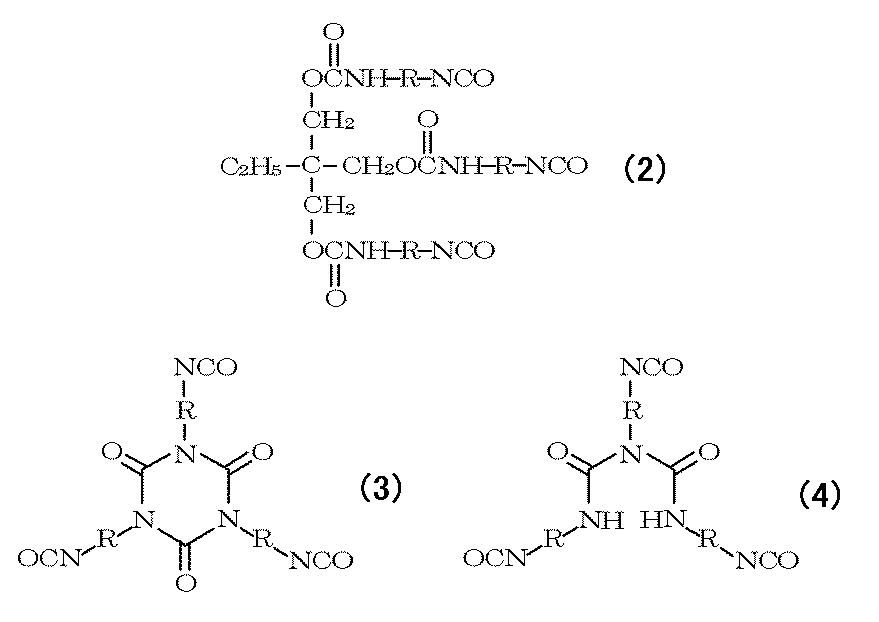
上記式(2)~(4)において、置換基Rは、ジイソシアネート化合物のイソシアネート基を除いた部分である。このようなジイソシアネート化合物の具体例としては、トルエン2,4-ジイソシアネート、トルエン2,6-ジイソシアネート、m-キシリレンジイソシアネート、ヘキサメチレンジイソシアネート、ヘキサヒドロ-m-キシリレンジイソシアネート、イソホロンジイソシアネート、メチレンジフェニル-4,4’-ジイソシアネートなどが挙げられる。
また、アルミニウムキレート剤は、多官能イソシアネート化合物を界面重合させると同時にジビニルベンゼンをラジカル重合させて得た多孔性樹脂に保持されてなるアルミニウムキレート潜在性硬化剤であることが好ましい。多官能イソシアネート化合物の界面重合の際にジビニルベンゼンを共存させることにより、発熱ピーク温度を低温側にシフトさせることができ、低温速硬化性を向上させることができる。
このアルミニウムキレート潜在性硬化剤は、アルミニウムキレート剤と、多官能イソシアネート化合物と、ラジカル重合性化合物と、ラジカル重合開始剤とを揮発性有機溶媒に溶解させ、得られた溶液を、分散剤を含有する水相に投入し、加熱撹拌することにより界面重合させて得ることができる。
[アルミニウムキレート-シラノール硬化触媒系]
アルミニウムキレート剤は、下記式(5)、(6)に示すように、シラノール化合物やシランカップリング剤と共働して、カチオン種とアニオン種とを発生させ、エポキシ化合物をカチオン重合させるアルミニウムキレート-シラノール硬化触媒系であることが好ましい。
アルミニウムキレート剤は、下記式(5)、(6)に示すように、シラノール化合物やシランカップリング剤と共働して、カチオン種とアニオン種とを発生させ、エポキシ化合物をカチオン重合させるアルミニウムキレート-シラノール硬化触媒系であることが好ましい。
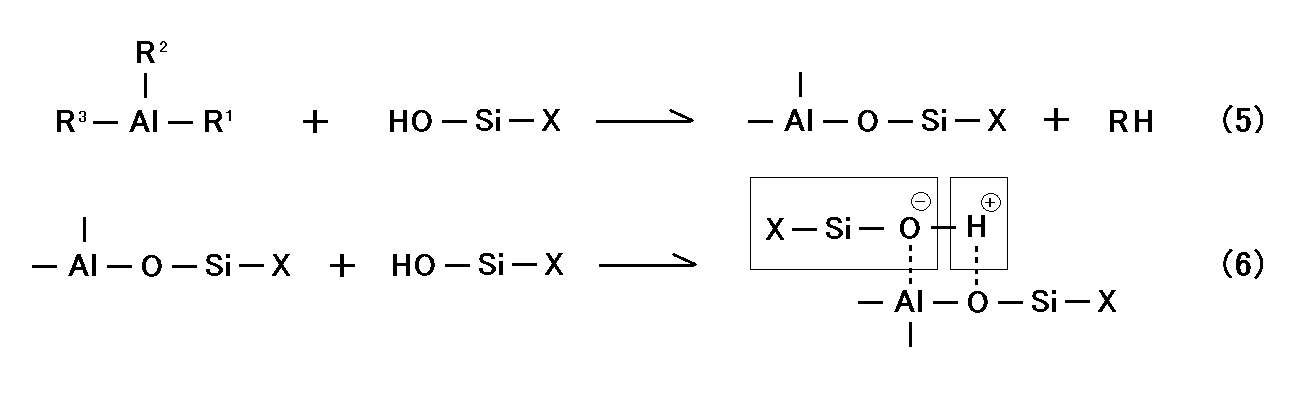
シラノール化合物としては、例えば、式(7)で表されるアリールシランオールが挙げられる。

式中、mは2又は3であり、但しmとnとの和は4である。式(7)で表されるシラノール化合物は、モノまたはジオール体となる。“Ar”は、置換されてもよいアリール基である。アリール基としては、フェニル基、ナフチル基、アントラセニル基、アズレニル基、フルオレニル基、チエニル基、フリル基、ピロリル基、イミダゾリル基、ピリジル基等を挙げることができる。中でも、入手容易性、入手コストの観点からフェニル基が好ましい。m個のArは、いずれも同一でもよく異なっていてもよく、入手容易性の点から同一であることが好ましい。
これらのアリール基は、1~3個の置換基を有することができ、例えば、クロロ、ブロモ等のハロゲン;トリフルオロメチル;ニトロ;スルホ;カルボキシル、メトキシカルボニル、エトキシカルボニル等のアルコキシカルボニル;ホルミル等の電子吸引基、メチル、エチル、プロピルなどのアルキル;メトキシ、エトキシ等のアルコキシ;ヒドロキシ;アミノ;モノメチルアミノ等のモノアルキルアミノ;ジメチルアミノ等のジアルキルアミノ等の電子供与基などが挙げられる。なお、置換基として電子吸引基を使用することによりシラノールの水酸基の酸度を上げることができ、逆に、電子供与基を使用することにより酸度を下げることができるので、硬化活性のコントロールが可能となる。ここで、m個のAr毎に、置換基が異なっていてもよいが、m個のArについて入手容易性の点から置換基は同一であることが好ましい。また、一部のArだけに置換基があり、他のArに置換基が無くてもよい。
式(7)のシラノール化合物の中でも、好ましいものとして、トリフェニルシラノール又はジフフェニルシラノールが挙げられる。特に好ましいものは、トリフェニルシラノールである。
また、シラノール化合物を、多官能イソシアネート化合物を界面重合させて得た多孔性樹脂にアルミニウムキレート剤が保持されたアルミニウムキレート潜在性硬化剤、又は多官能イソシアネート化合物を界面重合させると同時にジビニルベンゼンをラジカル重合させて得た多孔性樹脂にアルミニウムキレート剤が保持されたアルミニウムキレート潜在性硬化剤に含浸させることが好ましい。アルミニウムキレート潜在性硬化剤にシラノール化合物を含浸させることにより、低温速硬化を向上させることができる。
シラノール化合物の含浸の方法としては、アルミニウムキレート系潜在性硬化剤を、有機溶媒(例えば、エタノール)中に分散させ、その分散液に式(7)のシラノール化合物(例えば、トリフェニルシラノール)及び必要に応じてアルミニウムキレート系硬化剤(例えば、モノアセチルアセトネートビス(エチルアセトアセテート)のイソプロパノール溶液)を投入し、室温~50℃程度の温度で数時間~一晩撹拌を続ける方法を挙げることができる。
また、アルミニウムキレートーシラノール硬化触媒系は、シランカップリング剤を含んでもよい。シランカップリング剤は、アルミニウムキレート剤、特にアルミニウムキレート潜在性硬化剤と共働してカチオン重合を開始させる機能を有する。このようなシランカップリング剤としては、分子中に1~3の低級アルコキシ基を有し、分子中にカチオン重合性樹脂の官能基に対して反応性を有する基、例えば、ピニル基、スチリル基、アクリロイルオキシ基、メタクリロイルオキシ基、エポキシ基、アミノ基などを有することが好ましい。なお、アミノ基を有するカップリング剤は、アルミニウムキレートーシラノール硬化触媒系の発生カチオン種を実質的に捕捉しない場合に使用することができる。
このようなシランカップリング剤としては、例えば、ビニルトリス(β-メトキシエトキシ)シラン、ビニルトリエトキシシラン、ビニルトリメトキシシラン、γ-スチリルトリメトキシシラン、γ-メタクリロキシプロピルトリメトキシシラン、γ-アクリロキシプロピルトリメトキシシラン、β-(3,4-エポキシシクロヘキシル)エチルトリメトキシシラン、γ-グリシドキシプロピルトリメトキシシラン、γ-グリシドキシプロピルメチルジエトキシシラン、N-β-(アミノエチル)-γ-アミノプロピルトリメトキシシラン、N-β-(アミノエチル)-γ-アミノプロピルメチルジメトキシシラン、γ-アミノプロピルトリエトキシシラン、N-フェニル-γ-アミノプロピルトリメトキシシラン、γ-クロロプロピルトリメトキシシランなどが挙げられる。
シランカップリング剤の含有量は、少なすぎると添加効果が表れない傾向にあり、多すぎるとシランカップリング剤から発生するシラノレートアニオンによる重合停止反応の影響が生じてくるため、アルミニウムキレート系潜在性硬化剤100質量部に対し1~300質量部、好ましくは1~100質量部である。
このようなアルミニウムキレート-シラノール硬化触媒系は、活性種としてカチオン種とアニオン種とが共存しているため、ライフ性が低いものの、ヒンダードアミン系化合物を配合することにより、優れたライフ性を得ることができる。これは、アルミニウムキレート剤のアルミニウムにヒンダードアミン系化合物の窒素原子が配位することにより、アルミニウムキレート剤が安定して存在しているためと考えられる。
[ヒンダードアミン系化合物]
ヒンダードアミン系化合物は、接着剤組成物の発熱開始温度を高温側にシフトさせ、潜在性及びライフ性を向上させる。これは、ヒンダードアミン系化合物の窒素原子がアルミニウムキレート剤のアルミニウムに配位することにより、アルミニウムキレート剤が安定して存在しているためと考えられる。
ヒンダードアミン系化合物は、接着剤組成物の発熱開始温度を高温側にシフトさせ、潜在性及びライフ性を向上させる。これは、ヒンダードアミン系化合物の窒素原子がアルミニウムキレート剤のアルミニウムに配位することにより、アルミニウムキレート剤が安定して存在しているためと考えられる。
ヒンダードアミン系化合物としては、例えば、2,2,6,6-テトラメチルピペリジン骨格を有するヒンダードアミン系光安定剤(HALS:Hindered Amine Light Stabilizer)などが挙げられる。ヒンダードアミン系光安定剤としては、N-H型、N-R型、N-OR型などが挙げられる。
N-H型ヒンダードアミン系安定剤の具体例としては、テトラキス(1,2,2,6,6-ペンタメチル-4-ピペリジル)ブタン-1,2,3,4-ブタンテトラカルボキシレート(ADEKA社製 アデカスタブ LA-57)、ビス(2,2,6,6,-テトラメチル-4-ピペリジル)セバケート(BASF社製 TINUVIN 770DF)、N,N’-ビス(2,2,6,6-テトラメチル-4-ピペリジル)-N,N’-ジホルミルヘキサメチレンジアミン(BASF社製UVINUL 4050FF)、ジブチルアミン・1,3,5-トリアジン・N,N’-ビス(2,2,6,6-テトラメチル-4-ピペリジル)-1,6-ヘキサメチレンジアミンとN-(2,2,6,6-テトラメチル-4-ピペリジル)ブチルアミンの重縮合物(BASF社製 Chimassorb 2020FDL)、ポリ[{6-(1,1,3,3-テトラメチルブチル)アミノ-1,3,5-トリアジン-2,4-ジイル}{(2,2,6,6-テトラメチル-4-ピペリジル)イミノ}ヘキサメチレン{(2,2,6,6-テトラメチル-4-ピペリジル)イミノ}](BASF社製 Chimassorb 944FDL)、オレフィン(C20-C24)・無水マレイン酸・4-アミノ-2,2,6,6-テトラメチルピペリジン共重合物(BASF社製 UVINUL 5050H)などが挙げられる。
N-R型ヒンダードアミン系安定剤の具体例としては、ビス(1,2,2,6,6-ペンタメチル-4-ピペリジル)[[3,5-ビス(1,1-ジメチルエチル)-4-ヒドロキシフェニル]メチル]ブチルマロネート(BASF社製 TINUVIN 144)、ビス(1,2,2,6,6-ペンタメチル-4-ピペリジル)セバケート及びメチル1,2,2,6,6-ペンタメチル-4-ピペリジルセバケート(混合物)(BASF社製 TINUVIN 765)、コハク酸とジメチル-1-(2-ヒドロキシエチル)-4-ヒドロキシ-2,2,6,6-テトラメチルピペリジン重縮合物、(BASF社製 TINUVIN 622SF)、N,N’-ビス(3-アミノプロピル)エチレンジアミン-2,4-ビス[N-ブチル-N-(1,2,2,6,6-ペンタメチル-4-ピペリジル)アミノ]-6-クロロ-1,3,5-トリアジン縮合物(SABO S.r.l社製 SABOSTABUV 119)、テトラキス(1,2,2,6,6-ペンタメチル-4-ピペリジル)1,2,3,4-ブタンテトラカルボキシラート(ADEKA社製 アデカスタブ LA-52)、1,2,2,6,6-ペンタメチル-4-ピペリジル/トリデシル1,2,3,4ブタンテトラカルボキシラート(ADEKA社製 アデカスタブ LA-62)、1,2,3,4-ブタンテトラカルボキシリックアシッド,1,2,2,6,6-ペンタメチル-4-ピペリジノールと3,9-ビス(2-ヒドロキシ-1,1-ジメチルエチル)-2,4,8,10テトラオキサスピロ〔5,5〕ウンデカンの混合エステル(ADEKA社製 アデカスタブ LA-63)、テトラキス(2,2,6,6-テトラメチル-4-ピペリジル)-1,2,3,4-ブタンテトラカルボキシレート、1,2,3,4-ブタンテトラカルボン酸と、1,2,2,6,6-ペンタメチル-4-ピペリジノールと、トリデシルアルコールとの縮合物(ADEKA社製 アデカスタブ LA-63P)、1,2,2,6,6-ペンタメチル-4-ピペリジルメタクリレートなどが挙げられる。
N-OR型ヒンダードアミン系安定剤の具体例としては、NOR型ヒンダードアミン系光安定剤システム(BASF社製 TINUVINXT 850FF)、NOR型ヒンダードアミン系光安定剤システムを基本とする耐侯安定剤システム(BASF社製 TINUVIN 855FF)、過酸化処理した4-ブチルアミノ-2,2,6,6-テトラメチルピペリジンと2,4,6-トリクロロ-1,3,5-トリアジン、及びシクロヘキサン、N,N’-エタン-1,2-ジイルビス(1,3-プロパンジアミン)との反応生成物(BASF社製 Flamestab NOR116FF)、ビス(1-ウンデカノキシ-2,2,6,6-テトラメチルピペリジン-4-イル)カルボネート(ADEKA(株)製 LA-81)などが挙げられる。
上述したヒンダードアミン系光安定剤は単独で、又は2種以上の混合物として用いることができる。これらの中でも、嵩高く、立体障害が大きい1,2,3,4-ブタンテトラカルボン酸の縮合物を用いることが好ましい。1,2,3,4-ブタンテトラカルボン酸の縮合物としては、例えば、テトラキス(1,2,2,6,6-ペンタメチル-4-ピペリジル)1,2,3,4-ブタンテトラカルボキシラート(ADEKA社製 アデカスタブ LA-52)、テトラキス(1,2,2,6,6-ペンタメチル-4-ピペリジル)ブタン-1,2,3,4-ブタンテトラカルボキシレート(ADEKA社製 アデカスタブ LA-57)、テトラキス(2,2,6,6-テトラメチル-4-ピペリジル)-1,2,3,4-ブタンテトラカルボキシレート、1,2,3,4-ブタンテトラカルボン酸と、1,2,2,6,6-ペンタメチル-4-ピペリジノールと、トリデシルアルコールとの縮合物(ADEKA社製 アデカスタブ LA-63P)などが挙げられる。
1,2,3,4-ブタンテトラカルボン酸の縮合物を用いることにより、多官能イソシアネート化合物を界面重合させて得た多孔性樹脂にアルミニウムキレート剤が保持されたアルミニウムキレート潜在性硬化剤、又は多官能イソシアネート化合物を界面重合させると同時にジビニルベンゼンをラジカル重合させて得た多孔性樹脂にアルミニウムキレート剤が保持されたアルミニウムキレート潜在性硬化剤を用いた場合、接着剤組成物の発熱開始温度を高温側に大きくシフトさせることができる。これは、多孔性樹脂に保持されたアルミニウムキレート剤に嵩高いヒンダードアミン系化合物が配位することにより、安定化し、潜在性が向上したためと考えられる。
また、上記ヒンダードアミン系化合物は、光定剤及び酸化防止剤としての効果も有するため、後述する基板と発光素子とをフリップチップ実装する接着剤組成物として最適である。
また、ヒンダードアミン系化合物の含有量は、エポキシ化合物とアルミニウムキレート潜在性硬化剤との合計100質量部に対して0.05~20質量部であることが好ましく、0.05~15質量部であることがより好ましい。ヒンダードアミン系化合物の含有量が少なすぎると、ライフ性の向上の効果が表れない傾向にあり、多すぎると反射率や光学特性が低下する傾向にある。
[他の成分]
また、本実施の形態に係る接着剤組成物は、他の成分として、LEDからの出射光を反射し、高い光取り出し効率を得るため、TiO2、BN、ZnO、Al2O3などの白色無機粒子を含有してもよい。また、白色無機粒子の平均粒径は、反射させる光の波長の1/2以上であることが好ましい。また、白色無機粒子の含有量は、バインダー成分に対して1~50vol%、好ましくは5~25vol%であることが好ましい。
また、本実施の形態に係る接着剤組成物は、他の成分として、LEDからの出射光を反射し、高い光取り出し効率を得るため、TiO2、BN、ZnO、Al2O3などの白色無機粒子を含有してもよい。また、白色無機粒子の平均粒径は、反射させる光の波長の1/2以上であることが好ましい。また、白色無機粒子の含有量は、バインダー成分に対して1~50vol%、好ましくは5~25vol%であることが好ましい。
また、流動性を制御し、粒子捕捉率を向上させるため、無機フィラーを含有してもよい。無機フィラーとしては、特に限定されないが、シリカ、タルク、酸化チタン、炭酸カルシウム、酸化マグネシウム等を用いることができる。このような無機フィラーは、接着剤によって接続される接続構造体の応力を緩和させる目的によって適宜用いることができる。また、熱可塑性樹脂、ゴム成分等の柔軟剤等を配合してもよい。
また、接着剤組成物は、導電性粒子を含有する異方性導電接着剤であってもよい。導電性粒子としては、公知の導電性粒子を用いることができる。例えば、ニッケル、鉄、銅、アルミニウム、錫、鉛、クロム、コバルト、銀、金等の各種金属や金属合金の粒子、金属酸化物、カーボン、グラファイト、ガラス、セラミック、プラスチック等の粒子の表面に金属をコートしたもの、これらの粒子の表面に更に絶縁薄膜をコートしたもの等が挙げられる。樹脂粒子の表面に金属をコートしたものである場合、樹脂粒子としては、例えば、エポキシ樹脂、フェノール樹脂、アクリル樹脂、アクリロニトリル・スチレン(AS)樹脂、ベンゾグアナミン樹脂、ジビニルベンゼン系樹脂、スチレン系樹脂等の粒子を用いることができる。また、導電性粒子の扁平変形に対する抵抗の上昇を抑制するため、樹脂粒子の表面をNiなどで被覆してもよい。これらの中でも、樹脂粒子の表面に金属層が形成された導電性粒子を用いることが好ましい。このような導電性粒子によれば、圧縮時に潰れやすく、変形し易いため、配線パターンとの接触面積を大きくすることができる。また、配線パターンの高さのバラツキを吸収することができる。
また、導電性粒子の平均粒径は、1μm以上10μm以下であることが好ましく、より好ましくは1μm以上8μm以下である。また、導電性粒子の配合量は、接続信頼性及び絶縁信頼性の観点から、バインダー100質量部に対して1質量部以上100質量部以下であることが好ましい。
また、導電性粒子とはんだ粒子とを併用することが好ましい。はんだ粒子は、導電性粒子よりも平均粒径が小さいことが好ましく、はんだ粒子の平均粒径は、導電性粒子の平均粒径の20%以上100%未満であることが好ましい。はんだ粒子が導電性粒子に対して小さすぎると、圧着時にはんだ粒子が対向する端子間に捕捉されず、金属結合しないため、優れた放熱特性及び電気特性を得ることができない。一方、はんだ粒子が導電性粒子に対して大きすぎると、例えばLEDチップのエッジ部分ではんだ粒子によるショルダータッチが発生してリークが発生し、製品の歩留りが悪くなる。
はんだ粒子は、例えばJIS Z 3282-1999に規定されている、Sn-Pb系、Pb-Sn-Sb系、Sn-Sb系、Sn-Pb-Bi系、Bi-Sn系、Sn-Cu系、Sn-Pb-Cu系、Sn-In系、Sn-Ag系、Sn-Pb-Ag系、Pb-Ag系などから、電極材料や接続条件などに応じて適宜選択することができる。また、はんだ粒子の形状は、粒状、燐片状などから適宜選択することができる。なお、はんだ粒子は、異方性を向上させるために絶縁層で被覆されていても構わない。
はんだ粒子の配合量は、1体積%以上30体積%以下であることが好ましい。はんだ粒子の配合量が少なすぎると優れた放熱特性が得られなくなり、配合量が多すぎると異方性が損なわれ、優れた接続信頼性が得られない。
このような接着剤組成物において、示差熱分析法により昇温速度10℃/minで測定した発熱開始温度は80~90℃であり、発熱ピーク温度は100~120℃であり、反応終点温度は180~220℃であることが好ましい。ヒンダードアミン系化合物の添加により接着剤組成物の発熱開始温度を高温側にシフトさせることにより、潜在性を向上させ、優れた導通性を得ることができる。
<2.発光装置>
次に、本発明を適用した発光装置について説明する。図1は、発光装置の一例を示す断面図である。発光装置は、配線パターン12を有する基板11と、配線パターン12の電極上に形成された異方性導電膜20と、異方性導電膜20上に実装された発光素子13とを備え、異方性導電膜20が、前述した異方性導電接着剤の硬化物からなる。この発光装置は、基板11上の配線パターン12と、発光素子13としてLED素子のn電極14とp電極15とのそれぞれに形成された接続用のバンプ16との間に、前述の異方性導電接着剤を塗布し、基板11と発光素子13とをフリップチップ実装することにより得られる。
次に、本発明を適用した発光装置について説明する。図1は、発光装置の一例を示す断面図である。発光装置は、配線パターン12を有する基板11と、配線パターン12の電極上に形成された異方性導電膜20と、異方性導電膜20上に実装された発光素子13とを備え、異方性導電膜20が、前述した異方性導電接着剤の硬化物からなる。この発光装置は、基板11上の配線パターン12と、発光素子13としてLED素子のn電極14とp電極15とのそれぞれに形成された接続用のバンプ16との間に、前述の異方性導電接着剤を塗布し、基板11と発光素子13とをフリップチップ実装することにより得られる。
本実施の形態では、前述した異方性導電接着剤を用いることにより、ヒンダードアミン系化合物の光定剤及び酸化防止剤としての効果が発揮され、高い反射率と優れた光学特性を得ることができる。
なお、必要に応じて、LED素子13の全体を覆うように透明モールド樹脂で封止してもよい。また、LED素子13に光反射層を設けてもよい。また、発光素子としては、LED素子の他、本発明の効果を損なわない範囲で公知の発光素子を使用することができる。
<3.実施例>
<3.実施例>
以下、本発明の実施例について説明する。本実施例では、ヒンダードアミン系光安定剤を配合した異方性導電接着剤を作製した。そして、異方性導電接着剤の発熱開始温度、発熱ピーク温度、及び発熱終了温度を測定した。また、異方性導電接着剤の粘度ライフ、及び反射率について評価した。また、異方性導電接着剤を用いて基板上にLEDチップを搭載させてLED実装体を作製し、光学特性、及び電気特性について評価した。なお、本発明は、これらの実施例に限定されるものではない。
[異方性導電接着剤の発熱開始温度及び発熱ピーク温度の測定]
示差熱分析装置(DSC)を用いて、昇温速度10℃/minにて異方性導電接着剤の発熱開始温度、発熱ピーク温度、及び発熱終点温度を測定した。なお、硬化特性に関し、発熱開始温度は硬化開始温度を意味しており、発熱ピーク温度は最も硬化が活性となる温度を意味しており、発熱終了温度は硬化終了温度を意味しており、ピーク面積は発熱量を意味している。
示差熱分析装置(DSC)を用いて、昇温速度10℃/minにて異方性導電接着剤の発熱開始温度、発熱ピーク温度、及び発熱終点温度を測定した。なお、硬化特性に関し、発熱開始温度は硬化開始温度を意味しており、発熱ピーク温度は最も硬化が活性となる温度を意味しており、発熱終了温度は硬化終了温度を意味しており、ピーク面積は発熱量を意味している。
[粘度ライフの測定]
HAAK社製のレオメータを用いて、作製直後の異方性導電接着剤の初期粘度を測定した。また、温度25℃、湿度60%の環境下に48時間放置した異方性導電接着剤の粘度を測定した。そして、温度25℃、湿度60%の環境下に48時間放置した異方性導電接着剤の粘度の初期粘度からの上昇率(倍)を算出した。
HAAK社製のレオメータを用いて、作製直後の異方性導電接着剤の初期粘度を測定した。また、温度25℃、湿度60%の環境下に48時間放置した異方性導電接着剤の粘度を測定した。そして、温度25℃、湿度60%の環境下に48時間放置した異方性導電接着剤の粘度の初期粘度からの上昇率(倍)を算出した。
[反射率の測定]
異方性導電接着剤をセラミックからなる白色板上に厚さ100μmとなるように塗布し、温度200℃-時間60secの条件で加熱して硬化させた。得られた初期の硬化物について、分光光度計を用いて波長450nmの光に対する反射率(JIS K7150)を測定した。また、紫外線照射を100時間行い、紫外線照射試験後の硬化物についても、同様に反射率を測定した。
異方性導電接着剤をセラミックからなる白色板上に厚さ100μmとなるように塗布し、温度200℃-時間60secの条件で加熱して硬化させた。得られた初期の硬化物について、分光光度計を用いて波長450nmの光に対する反射率(JIS K7150)を測定した。また、紫外線照射を100時間行い、紫外線照射試験後の硬化物についても、同様に反射率を測定した。
[LED実装体の作製]
異方性導電接着剤を導体(Ni(5.0μm)/Au(0.3μm)メッキ配線)間スペースが100μmピッチであるLED実装用基板(セラミック基板)に塗布した後、電極が厚み3μmのAuSn合金で形成されている青色LEDチップ(Vf=3.1V(If=350mA)、サイズ:1.0mm×1.0mm)をアライメントして搭載し、熱圧着を行い、LED実装体を得た。熱圧着条件は、温度200℃-時間60sec-圧力1kg/chipとした。
異方性導電接着剤を導体(Ni(5.0μm)/Au(0.3μm)メッキ配線)間スペースが100μmピッチであるLED実装用基板(セラミック基板)に塗布した後、電極が厚み3μmのAuSn合金で形成されている青色LEDチップ(Vf=3.1V(If=350mA)、サイズ:1.0mm×1.0mm)をアライメントして搭載し、熱圧着を行い、LED実装体を得た。熱圧着条件は、温度200℃-時間60sec-圧力1kg/chipとした。
[光学特性の測定]
積分球による全光束測定装置(LE-2100、大塚電子株式会社製)を用いて、LED実装体の初期の全光束量(lm)を測定した。また、温度85℃、湿度85%の環境下でLED実装体をIf=350mAで1000時間点灯させた(信頼性試験)後、全光束量(lm)を測定した。全光束量の測定条件はIf=350mA(定電流制御)とした。
積分球による全光束測定装置(LE-2100、大塚電子株式会社製)を用いて、LED実装体の初期の全光束量(lm)を測定した。また、温度85℃、湿度85%の環境下でLED実装体をIf=350mAで1000時間点灯させた(信頼性試験)後、全光束量(lm)を測定した。全光束量の測定条件はIf=350mA(定電流制御)とした。
[電気特性の評価]
LED実装体の初期Vf値として、If=350mA時のVf値を測定した。また、温度85℃、湿度85%の環境下でLED実装体をIf=350mAで1000時間点灯させた(信頼性試験)後、If=350mA時のVf値を測定した。導通性の評価は、Vf平均値を3.10Vとし、Vf値が3.15V未満であるLED実装体の評価を「A」とし、Vf値が3.15V以上3.6V未満であるLED実装体の評価を「B」とし、Vf値が3.6V以上であるLED実装体の評価を「C」とした。
LED実装体の初期Vf値として、If=350mA時のVf値を測定した。また、温度85℃、湿度85%の環境下でLED実装体をIf=350mAで1000時間点灯させた(信頼性試験)後、If=350mA時のVf値を測定した。導通性の評価は、Vf平均値を3.10Vとし、Vf値が3.15V未満であるLED実装体の評価を「A」とし、Vf値が3.15V以上3.6V未満であるLED実装体の評価を「B」とし、Vf値が3.6V以上であるLED実装体の評価を「C」とした。
<実施例1>
水添ビスフェノールA型エポキシ樹脂(品名:YX8000、三菱化学社製)95質量部、及びアルミニウムキレート潜在性硬化剤5質量部の合計100質量部に対して、ヒンダードアミン系光安定剤(品名:LA-52、ADEKA社製)を1.0質量部配合し、バインダーを調整した。このバインダーに、平均粒径(D50)5.5μmの導電粒子(樹脂コア、Auメッキ)2Vol%、平均粒径(D50)5.0μmのはんだ粒子(商品名:M705(Sn-3.0Ag-0.5Cu)、mp:214℃、千住金属工業社製)5Vol%、及び平均粒径(D50)0.25μmの酸化チタン10Vol%を分散させ、異方性導電接着剤を作製した。
水添ビスフェノールA型エポキシ樹脂(品名:YX8000、三菱化学社製)95質量部、及びアルミニウムキレート潜在性硬化剤5質量部の合計100質量部に対して、ヒンダードアミン系光安定剤(品名:LA-52、ADEKA社製)を1.0質量部配合し、バインダーを調整した。このバインダーに、平均粒径(D50)5.5μmの導電粒子(樹脂コア、Auメッキ)2Vol%、平均粒径(D50)5.0μmのはんだ粒子(商品名:M705(Sn-3.0Ag-0.5Cu)、mp:214℃、千住金属工業社製)5Vol%、及び平均粒径(D50)0.25μmの酸化チタン10Vol%を分散させ、異方性導電接着剤を作製した。
アルミニウムキレート潜在性硬化剤は、次のように製造した。先ず、蒸留水800質量部と、界面活性剤(ニューレックスR-T、日本油脂(株))0.05質量部と、分散剤としてポリビニルアルコール(PVA-205、(株)クラレ)4質量部とを、温度計を備えた3リットルの界面重合容器に入れ、均一に混合した。この混合液に、更に、アルミニウムモノアセチルアセトネートビス(エチルアセトアセテート)の24%イソプロパノール溶液(アルミキレートD、川研ファインケミカル(株))100質量部と、メチレンジフェニル-4,4´-ジイソシアネート(3モル)のトリメチロールプロパン(1モル)付加物(D-109、三井武田ケミカル(株))70質量部と、ジビニルベンゼン(メルク社)30質量部と、ラジカル重合開始剤(パーロイルL、日本油脂社)0.30質量部とを、酢酸エチル100質量部に溶解した油相溶液を投入し、ホモジナイザー(10000rpm/5分)で乳化混合後、80℃で6時間界面重合させた。反応終了後、重合反応液を室温まで放冷し、界面重合粒子を濾過により濾別し、自然乾燥させた。これにより、アルミニウムキレート剤が、多官能イソシアネート化合物を界面重合させると同時にジビニルベンゼンをラジカル重合させて得た多孔性樹脂に保持されてなる粒径2μm程度の球状の潜在性硬化剤を100質量部得た。
この潜在性硬化剤10質量部を、アルミニウムモノアセチルアセトネートビス(エチルアセトアセテート)の24%イソプロパノール溶液(アルミキレートD、川研ファインケミカル(株))40質量部とトリフェニルシラノール20質量部とエタノール40質量部との混合液に投入し、40℃で一晩撹拌を続け、濾過回収して乾燥し、トリフェニルシラノールが含浸したアルミニウムキレート系潜在性硬化剤を得た。
表1に示すように、異方性導電接着剤の発熱開始温度は85℃、発熱ピーク温度は113℃、反応終点温度は205℃であった。また、異方性導電接着剤の室温48hの粘度上昇率は1.0倍であった。また、異方性導電接着剤の初期の反射率は65%、UV照射100h後の反射率は63%であった。また、LED実装体の初期の全光束量は7.0lmであり、信頼性試験後の全光束量は7.0lmであった。また、LED実装体の初期の導通性評価はAであり、信頼性試験後の導通性評価はAであった。
<実施例2>
水添ビスフェノールA型エポキシ樹脂(品名:YX8000、三菱化学社製)95質量部、及びアルミニウムキレート潜在性硬化剤5質量部の合計100質量部に対して、ヒンダードアミン系光安定剤(品名:LA-52、ADEKA社製)を0.05質量部配合し、バインダーを調整した以外は、実施例1と同様にして異方性導電接着剤を作製した。
水添ビスフェノールA型エポキシ樹脂(品名:YX8000、三菱化学社製)95質量部、及びアルミニウムキレート潜在性硬化剤5質量部の合計100質量部に対して、ヒンダードアミン系光安定剤(品名:LA-52、ADEKA社製)を0.05質量部配合し、バインダーを調整した以外は、実施例1と同様にして異方性導電接着剤を作製した。
表1に示すように、異方性導電接着剤の発熱開始温度は85℃、発熱ピーク温度は113℃、反応終点温度は205℃であった。また、異方性導電接着剤の室温48hの粘度上昇率は1.0倍であった。また、異方性導電接着剤の初期の反射率は65%、UV照射100h後の反射率は63%であった。また、LED実装体の初期の全光束量は7.0lmであり、信頼性試験後の全光束量は7.0lmであった。また、LED実装体の初期の導通性評価はAであり、信頼性試験後の導通性評価はAであった。
<実施例3>
水添ビスフェノールA型エポキシ樹脂(品名:YX8000、三菱化学社製)95質量部、及びアルミニウムキレート潜在性硬化剤5質量部の合計100質量部に対して、ヒンダードアミン系光安定剤(品名:LA-52、ADEKA社製)を10.0質量部配合し、バインダーを調整した以外は、実施例1と同様にして異方性導電接着剤を作製した。
水添ビスフェノールA型エポキシ樹脂(品名:YX8000、三菱化学社製)95質量部、及びアルミニウムキレート潜在性硬化剤5質量部の合計100質量部に対して、ヒンダードアミン系光安定剤(品名:LA-52、ADEKA社製)を10.0質量部配合し、バインダーを調整した以外は、実施例1と同様にして異方性導電接着剤を作製した。
表1に示すように、異方性導電接着剤の発熱開始温度は85℃、発熱ピーク温度は113℃、反応終点温度は205℃であった。また、異方性導電接着剤の室温48hの粘度上昇率は1.0倍であった。また、異方性導電接着剤の初期の反射率は65%、UV照射100h後の反射率は63%であった。また、LED実装体の初期の全光束量は7.0lmであり、信頼性試験後の全光束量は7.0lmであった。また、LED実装体の初期の導通性評価はAであり、信頼性試験後の導通性評価はAであった。
<実施例4>
水添ビスフェノールA型エポキシ樹脂(品名:YX8000、三菱化学社製)95質量部、及びアルミニウムキレート潜在性硬化剤5質量部の合計100質量部に対して、ヒンダードアミン系光安定剤(品名:LA-57、ADEKA社製)を1.0質量部配合し、バインダーを調整した以外は、実施例1と同様にして異方性導電接着剤を作製した。
水添ビスフェノールA型エポキシ樹脂(品名:YX8000、三菱化学社製)95質量部、及びアルミニウムキレート潜在性硬化剤5質量部の合計100質量部に対して、ヒンダードアミン系光安定剤(品名:LA-57、ADEKA社製)を1.0質量部配合し、バインダーを調整した以外は、実施例1と同様にして異方性導電接着剤を作製した。
表1に示すように、異方性導電接着剤の発熱開始温度は80℃、発熱ピーク温度は110℃、反応終点温度は205℃であった。また、異方性導電接着剤の室温48hの粘度上昇率は1.1倍であった。また、異方性導電接着剤の初期の反射率は63%、UV照射100h後の反射率は61%であった。また、LED実装体の初期の全光束量は6.9lmであり、信頼性試験後の全光束量は6.8lmであった。また、LED実装体の初期の導通性評価はAであり、信頼性試験後の導通性評価はAであった。
<実施例5>
水添ビスフェノールA型エポキシ樹脂(品名:YX8000、三菱化学社製)95質量部、及びアルミニウムキレート潜在性硬化剤5質量部の合計100質量部に対して、ヒンダードアミン系光安定剤(品名:LA-63P、ADEKA社製)を1.0質量部配合し、バインダーを調整した以外は、実施例1と同様にして異方性導電接着剤を作製した。
水添ビスフェノールA型エポキシ樹脂(品名:YX8000、三菱化学社製)95質量部、及びアルミニウムキレート潜在性硬化剤5質量部の合計100質量部に対して、ヒンダードアミン系光安定剤(品名:LA-63P、ADEKA社製)を1.0質量部配合し、バインダーを調整した以外は、実施例1と同様にして異方性導電接着剤を作製した。
表1に示すように、異方性導電接着剤の発熱開始温度は88℃、発熱ピーク温度は115℃、反応終点温度は205℃であった。また、異方性導電接着剤の室温48hの粘度上昇率は1.1倍であった。また、異方性導電接着剤の初期の反射率は64%、UV照射100h後の反射率は62%であった。また、LED実装体の初期の全光束量は6.9lmであり、信頼性試験後の全光束量は6.9lmであった。また、LED実装体の初期の導通性評価はAであり、信頼性試験後の導通性評価はAであった。
<実施例6>
水添ビスフェノールA型エポキシ樹脂(品名:YX8000、三菱化学社製)95質量部、及びアルミニウムキレート潜在性硬化剤5質量部の合計100質量部に対して、ヒンダードアミン系光安定剤(品名:LA-52、ADEKA社製)を20.0質量部配合し、バインダーを調整した以外は、実施例1と同様にして異方性導電接着剤を作製した。
水添ビスフェノールA型エポキシ樹脂(品名:YX8000、三菱化学社製)95質量部、及びアルミニウムキレート潜在性硬化剤5質量部の合計100質量部に対して、ヒンダードアミン系光安定剤(品名:LA-52、ADEKA社製)を20.0質量部配合し、バインダーを調整した以外は、実施例1と同様にして異方性導電接着剤を作製した。
表1に示すように、異方性導電接着剤の発熱開始温度は85℃、発熱ピーク温度は113℃、反応終点温度は205℃であった。また、異方性導電接着剤の室温48hの粘度上昇率は1.0倍であった。また、異方性導電接着剤の初期の反射率は60%、UV照射100h後の反射率は50%であった。また、LED実装体の初期の全光束量は6.0lmであり、信頼性試験後の全光束量は5.2lmであった。また、LED実装体の初期の導通性評価はAであり、信頼性試験後の導通性評価はAであった。
<比較例1>
ヒンダードアミン系光安定剤を配合せずに、バインダーを調整した以外は、実施例1と同様にして異方性導電接着剤を作製した。
ヒンダードアミン系光安定剤を配合せずに、バインダーを調整した以外は、実施例1と同様にして異方性導電接着剤を作製した。
表1に示すように、異方性導電接着剤の発熱開始温度は60℃、発熱ピーク温度は105℃、反応終点温度は205℃であった。また、異方性導電接着剤の室温48hの粘度上昇率は4.0倍であった。また、異方性導電接着剤の初期の反射率は65%、UV照射100h後の反射率は55%であった。また、LED実装体の初期の全光束量は7.0lmであり、信頼性試験後の全光束量は5.5lmであった。また、LED実装体の初期の導通性評価はAであり、信頼性試験後の導通性評価はAであった。
<比較例2>
水添ビスフェノールA型エポキシ樹脂(品名:YX8000、三菱化学社製)95質量部、及びアルミニウムキレート潜在性硬化剤5質量部の合計100質量部に対して、アミン系硬化剤(2E4MZ:2-エチル-4-メチルイミダゾール)を1.0質量部配合し、バインダーを調整した以外は、実施例1と同様にして異方性導電接着剤を作製した。
水添ビスフェノールA型エポキシ樹脂(品名:YX8000、三菱化学社製)95質量部、及びアルミニウムキレート潜在性硬化剤5質量部の合計100質量部に対して、アミン系硬化剤(2E4MZ:2-エチル-4-メチルイミダゾール)を1.0質量部配合し、バインダーを調整した以外は、実施例1と同様にして異方性導電接着剤を作製した。
表1に示すように、異方性導電接着剤の発熱開始温度は70℃、発熱ピーク温度は110℃、反応終点温度は205℃であった。また、異方性導電接着剤の室温48hの粘度上昇率は2.0倍であった。また、異方性導電接着剤の初期の反射率は50%、UV照射100h後の反射率は35%であった。また、LED実装体の初期の全光束量は5.0lmであり、信頼性試験後の全光束量は4.0lmであった。また、LED実装体の初期の導通性評価はAであり、信頼性試験後の導通性評価はAであった。
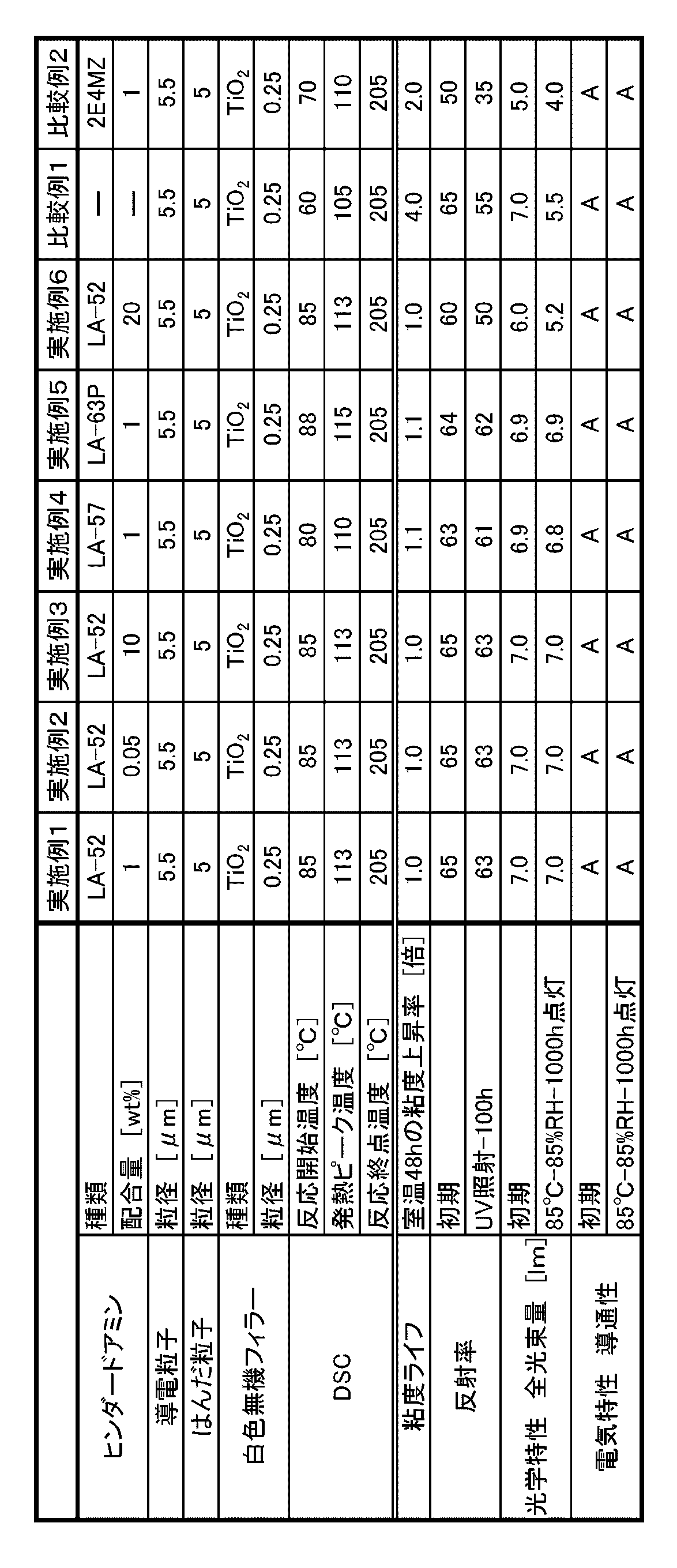
比較例1のようにヒンダードアミン系光安定剤を配合しなかった場合、室温48hの粘度上昇率は4.0倍であった。また、比較例2のようにアミン系硬化剤を配合した場合、室温48hの粘度上昇率は2.0倍であった。一方、実施例1~6のようにヒンダードアミン系光安定剤を配合した場合、室温48hの粘度上昇率は1.0~1.1倍であった。これは、アルミニウムキレート潜在性硬化剤中のアルミニウムキレートのアルミニウムにヒンダードアミン系光安定剤の窒素原子が配位し、安定化したためと考えられる。また、安定化は、実施例1と比較例1の比較より、DSCによる発熱熱開始温度が高温側にシフトしたことからもわかる。
また、実施例1~5のようにヒンダードアミン系光安定化剤の含有量が、エポキシ樹脂とアルミニウムキレート潜在性硬化剤との合計100質量部に対して0.05~15質量部であることにより、ヒンダードアミン系光安定化剤による硬化物の着色による反射率の低下、及び光学特性の低下を抑制することができた。
11 基板、12 配線パターン、13 発光素子、14 n電極、15 p電極、16 バンプ、20 異方性導電膜
Claims (16)
- エポキシ化合物と、アルミニウムキレート剤と、ヒンダードアミン系化合物とを含有する接着剤組成物。
- 前記アルミニウムキレート剤が、多官能イソシアネート化合物を界面重合させて得た多孔性樹脂に保持されてなるアルミニウムキレート潜在性硬化剤である請求項1記載の接着剤組成物。
- 前記アルミニウムキレート剤が、多官能イソシアネート化合物を界面重合させると同時にジビニルベンゼンをラジカル重合させて得た多孔性樹脂に保持されてなるアルミニウムキレート潜在性硬化剤である請求項1記載の接着剤組成物。
- 前記ヒンダードアミン系化合物の含有量が、前記エポキシ化合物と前記アルミニウムキレート潜在性硬化剤との合計100質量部に対して0.05~15質量部である請求項2又は3記載の接着剤組成物。
- 前記アルミニウムキレート潜在性硬化剤が、前記多孔性樹脂にシラノール化合物を含浸してなる請求項2又は3記載の接着剤組成物。
- 前記アルミニウムキレート潜在性硬化剤が、前記多孔性樹脂にシラノール化合物を含浸してなる請求項4記載の接着剤組成物。
- 示差熱分析法により昇温速度10℃/minで測定した発熱開始温度が、80~90℃である請求項1乃至3のいずれか1項に記載の接着剤組成物。
- 示差熱分析法により昇温速度10℃/minで測定した発熱開始温度が、80~90℃である請求項4記載の接着剤組成物。
- 示差熱分析法により昇温速度10℃/minで測定した発熱開始温度が、80~90℃である請求項5記載の接着剤組成物。
- 前記ヒンダードアミン系化合物が、1,2,3,4-ブタンテトラカルボン酸の縮合物である請求項1乃至3のいずれか1項に記載の接着剤組成物。
- 前記ヒンダードアミン系化合物が、1,2,3,4-ブタンテトラカルボン酸の縮合物である請求項4記載の接着剤組成物。
- 前記ヒンダードアミン系化合物が、1,2,3,4-ブタンテトラカルボン酸の縮合物である請求項5記載の接着剤組成物。
- 前記ヒンダードアミン系化合物が、1,2,3,4-ブタンテトラカルボン酸の縮合物である請求項7記載の接着剤組成物。
- シランカップリング剤をさらに含有する請求項1又は2記載の接着剤組成物。
- はんだ粒子と、導電性粒子と、白色無機粒子とをさらに含有する請求項1又は2記載の接着剤組成物。
- 配線パターンを有する基板と、
前記配線パターンの電極上に形成された異方性導電膜と、
前記異方性導電膜上に実装された発光素子とを備え、
前記異方性導電膜が、エポキシ化合物と、アルミニウムキレート剤と、ヒンダードアミン系化合物とを含有する異方性導電接着剤の硬化物である発光装置。
Priority Applications (3)
| Application Number | Priority Date | Filing Date | Title |
|---|---|---|---|
| CN201680077205.7A CN108431164A (zh) | 2016-01-05 | 2016-12-19 | 粘接剂组合物 |
| US16/068,206 US20190016930A1 (en) | 2016-01-05 | 2016-12-19 | Adhesive composition |
| KR1020187018090A KR20180085013A (ko) | 2016-01-05 | 2016-12-19 | 접착제 조성물 |
Applications Claiming Priority (2)
| Application Number | Priority Date | Filing Date | Title |
|---|---|---|---|
| JP2016-000658 | 2016-01-05 | ||
| JP2016000658A JP2017122144A (ja) | 2016-01-05 | 2016-01-05 | 接着剤組成物 |
Publications (1)
| Publication Number | Publication Date |
|---|---|
| WO2017119274A1 true WO2017119274A1 (ja) | 2017-07-13 |
Family
ID=59274145
Family Applications (1)
| Application Number | Title | Priority Date | Filing Date |
|---|---|---|---|
| PCT/JP2016/087810 Ceased WO2017119274A1 (ja) | 2016-01-05 | 2016-12-19 | 接着剤組成物 |
Country Status (6)
| Country | Link |
|---|---|
| US (1) | US20190016930A1 (ja) |
| JP (1) | JP2017122144A (ja) |
| KR (1) | KR20180085013A (ja) |
| CN (1) | CN108431164A (ja) |
| TW (1) | TW201739886A (ja) |
| WO (1) | WO2017119274A1 (ja) |
Families Citing this family (5)
| Publication number | Priority date | Publication date | Assignee | Title |
|---|---|---|---|---|
| JP6660921B2 (ja) * | 2017-09-14 | 2020-03-11 | 株式会社タムラ製作所 | 電子基板の製造方法 |
| TWI724911B (zh) * | 2020-05-26 | 2021-04-11 | 友達光電股份有限公司 | 發光裝置及其製造方法 |
| KR102359700B1 (ko) * | 2020-05-29 | 2022-02-08 | 홍준표 | 방열판에 pcb 패턴을 직접 사용하는 led 모듈 |
| EP3943564B1 (en) * | 2020-07-21 | 2024-07-17 | Henkel AG & Co. KGaA | Room temperature stable, electrically conductive 1k epoxy formulation |
| CN118851664B (zh) * | 2024-07-01 | 2025-07-11 | 宁波东兴沥青制品有限公司 | 一种高性能冷拌沥青混凝土及其制备方法 |
Citations (3)
| Publication number | Priority date | Publication date | Assignee | Title |
|---|---|---|---|---|
| JP2009197206A (ja) * | 2008-01-25 | 2009-09-03 | Sony Chemical & Information Device Corp | 熱硬化型エポキシ樹脂組成物 |
| JP2014148597A (ja) * | 2013-01-31 | 2014-08-21 | Nippon Shokubai Co Ltd | 硬化性樹脂組成物、及び、硬化物 |
| JP2015098588A (ja) * | 2013-10-17 | 2015-05-28 | デクセリアルズ株式会社 | 異方性導電接着剤及び接続構造体 |
Family Cites Families (2)
| Publication number | Priority date | Publication date | Assignee | Title |
|---|---|---|---|---|
| JP5321082B2 (ja) * | 2009-01-21 | 2013-10-23 | デクセリアルズ株式会社 | アルミニウムキレート系潜在性硬化剤及びその製造方法 |
| TW201431945A (zh) * | 2013-01-31 | 2014-08-16 | 日本觸媒股份有限公司 | 硬化性樹脂組成物及光半導體密封用樹脂組成物 |
-
2016
- 2016-01-05 JP JP2016000658A patent/JP2017122144A/ja active Pending
- 2016-12-19 US US16/068,206 patent/US20190016930A1/en not_active Abandoned
- 2016-12-19 KR KR1020187018090A patent/KR20180085013A/ko not_active Ceased
- 2016-12-19 WO PCT/JP2016/087810 patent/WO2017119274A1/ja not_active Ceased
- 2016-12-19 CN CN201680077205.7A patent/CN108431164A/zh active Pending
- 2016-12-29 TW TW105143776A patent/TW201739886A/zh unknown
Patent Citations (3)
| Publication number | Priority date | Publication date | Assignee | Title |
|---|---|---|---|---|
| JP2009197206A (ja) * | 2008-01-25 | 2009-09-03 | Sony Chemical & Information Device Corp | 熱硬化型エポキシ樹脂組成物 |
| JP2014148597A (ja) * | 2013-01-31 | 2014-08-21 | Nippon Shokubai Co Ltd | 硬化性樹脂組成物、及び、硬化物 |
| JP2015098588A (ja) * | 2013-10-17 | 2015-05-28 | デクセリアルズ株式会社 | 異方性導電接着剤及び接続構造体 |
Also Published As
| Publication number | Publication date |
|---|---|
| US20190016930A1 (en) | 2019-01-17 |
| KR20180085013A (ko) | 2018-07-25 |
| JP2017122144A (ja) | 2017-07-13 |
| CN108431164A (zh) | 2018-08-21 |
| TW201739886A (zh) | 2017-11-16 |
Similar Documents
| Publication | Publication Date | Title |
|---|---|---|
| JP6973593B2 (ja) | 異方性導電フィルム | |
| JP6977839B2 (ja) | 接着剤組成物 | |
| WO2017119274A1 (ja) | 接着剤組成物 | |
| US8557896B2 (en) | Adhesive composition for a semiconductor device, adhesive film, and dicing die-bonding film | |
| TW200849506A (en) | Connection structure for flip-chip semiconductor package, build-up layer material, sealing resin composition, and circuit substrate | |
| WO2017080040A1 (zh) | 一种耐湿热高可靠性环氧导电银胶及其制备方法与应用 | |
| JP6335807B2 (ja) | 新規なグリコールウリル類とその利用 | |
| JP2016219600A (ja) | 半導体用ダイアタッチペースト及び半導体装置 | |
| KR102363322B1 (ko) | 이방성 도전 필름 | |
| JP2011026383A (ja) | 熱硬化型熱伝導性接着組成物 | |
| JP2009021580A (ja) | Led用導電性ダイボンディング剤 | |
| EP4074488A1 (en) | Sealing resin composition for injection molding | |
| TW201233724A (en) | Resin composition | |
| KR101915341B1 (ko) | 경화성 에폭시 수지 조성물 | |
| JP2001332124A (ja) | 導電性ペーストおよび光半導体装置 | |
| JP2001076534A (ja) | 導電性ペースト | |
| JP2002134529A (ja) | 絶縁ペーストおよび光半導体装置 | |
| JP2018070687A (ja) | エポキシ樹脂組成物、絶縁シート、及び、半導体モジュール | |
| JP2001316596A (ja) | 絶縁性ペースト | |
| TW201518333A (zh) | 硬化性環氧樹脂組成物 | |
| JP2017115007A (ja) | 硬化性エポキシ樹脂組成物 |
Legal Events
| Date | Code | Title | Description |
|---|---|---|---|
| 121 | Ep: the epo has been informed by wipo that ep was designated in this application |
Ref document number: 16883773 Country of ref document: EP Kind code of ref document: A1 |
|
| DPE1 | Request for preliminary examination filed after expiration of 19th month from priority date (pct application filed from 20040101) | ||
| ENP | Entry into the national phase |
Ref document number: 20187018090 Country of ref document: KR Kind code of ref document: A |
|
| NENP | Non-entry into the national phase |
Ref country code: DE |
|
| 122 | Ep: pct application non-entry in european phase |
Ref document number: 16883773 Country of ref document: EP Kind code of ref document: A1 |