WO2017104549A1 - 膜形成用組成物、ハードコートフィルム、偏光板、及び親水化ハードコートフィルムの製造方法 - Google Patents
膜形成用組成物、ハードコートフィルム、偏光板、及び親水化ハードコートフィルムの製造方法 Download PDFInfo
- Publication number
- WO2017104549A1 WO2017104549A1 PCT/JP2016/086622 JP2016086622W WO2017104549A1 WO 2017104549 A1 WO2017104549 A1 WO 2017104549A1 JP 2016086622 W JP2016086622 W JP 2016086622W WO 2017104549 A1 WO2017104549 A1 WO 2017104549A1
- Authority
- WO
- WIPO (PCT)
- Prior art keywords
- film
- hard coat
- carbon atoms
- mass
- group
- Prior art date
- Legal status (The legal status is an assumption and is not a legal conclusion. Google has not performed a legal analysis and makes no representation as to the accuracy of the status listed.)
- Ceased
Links
Classifications
-
- C—CHEMISTRY; METALLURGY
- C08—ORGANIC MACROMOLECULAR COMPOUNDS; THEIR PREPARATION OR CHEMICAL WORKING-UP; COMPOSITIONS BASED THEREON
- C08J—WORKING-UP; GENERAL PROCESSES OF COMPOUNDING; AFTER-TREATMENT NOT COVERED BY SUBCLASSES C08B, C08C, C08F, C08G or C08H
- C08J7/00—Chemical treatment or coating of shaped articles made of macromolecular substances
- C08J7/04—Coating
- C08J7/043—Improving the adhesiveness of the coatings per se, e.g. forming primers
-
- B—PERFORMING OPERATIONS; TRANSPORTING
- B32—LAYERED PRODUCTS
- B32B—LAYERED PRODUCTS, i.e. PRODUCTS BUILT-UP OF STRATA OF FLAT OR NON-FLAT, e.g. CELLULAR OR HONEYCOMB, FORM
- B32B27/00—Layered products comprising a layer of synthetic resin
- B32B27/30—Layered products comprising a layer of synthetic resin comprising vinyl (co)polymers; comprising acrylic (co)polymers
-
- B—PERFORMING OPERATIONS; TRANSPORTING
- B32—LAYERED PRODUCTS
- B32B—LAYERED PRODUCTS, i.e. PRODUCTS BUILT-UP OF STRATA OF FLAT OR NON-FLAT, e.g. CELLULAR OR HONEYCOMB, FORM
- B32B27/00—Layered products comprising a layer of synthetic resin
- B32B27/30—Layered products comprising a layer of synthetic resin comprising vinyl (co)polymers; comprising acrylic (co)polymers
- B32B27/304—Layered products comprising a layer of synthetic resin comprising vinyl (co)polymers; comprising acrylic (co)polymers comprising vinyl halide (co)polymers, e.g. PVC, PVDC, PVF, PVDF
-
- C—CHEMISTRY; METALLURGY
- C08—ORGANIC MACROMOLECULAR COMPOUNDS; THEIR PREPARATION OR CHEMICAL WORKING-UP; COMPOSITIONS BASED THEREON
- C08F—MACROMOLECULAR COMPOUNDS OBTAINED BY REACTIONS ONLY INVOLVING CARBON-TO-CARBON UNSATURATED BONDS
- C08F220/00—Copolymers of compounds having one or more unsaturated aliphatic radicals, each having only one carbon-to-carbon double bond, and only one being terminated by only one carboxyl radical or a salt, anhydride ester, amide, imide or nitrile thereof
- C08F220/02—Monocarboxylic acids having less than ten carbon atoms; Derivatives thereof
- C08F220/10—Esters
- C08F220/22—Esters containing halogen
-
- C—CHEMISTRY; METALLURGY
- C08—ORGANIC MACROMOLECULAR COMPOUNDS; THEIR PREPARATION OR CHEMICAL WORKING-UP; COMPOSITIONS BASED THEREON
- C08F—MACROMOLECULAR COMPOUNDS OBTAINED BY REACTIONS ONLY INVOLVING CARBON-TO-CARBON UNSATURATED BONDS
- C08F265/00—Macromolecular compounds obtained by polymerising monomers on to polymers of unsaturated monocarboxylic acids or derivatives thereof as defined in group C08F20/00
- C08F265/04—Macromolecular compounds obtained by polymerising monomers on to polymers of unsaturated monocarboxylic acids or derivatives thereof as defined in group C08F20/00 on to polymers of esters
- C08F265/06—Polymerisation of acrylate or methacrylate esters on to polymers thereof
-
- C—CHEMISTRY; METALLURGY
- C08—ORGANIC MACROMOLECULAR COMPOUNDS; THEIR PREPARATION OR CHEMICAL WORKING-UP; COMPOSITIONS BASED THEREON
- C08J—WORKING-UP; GENERAL PROCESSES OF COMPOUNDING; AFTER-TREATMENT NOT COVERED BY SUBCLASSES C08B, C08C, C08F, C08G or C08H
- C08J7/00—Chemical treatment or coating of shaped articles made of macromolecular substances
- C08J7/04—Coating
- C08J7/0427—Coating with only one layer of a composition containing a polymer binder
-
- C—CHEMISTRY; METALLURGY
- C08—ORGANIC MACROMOLECULAR COMPOUNDS; THEIR PREPARATION OR CHEMICAL WORKING-UP; COMPOSITIONS BASED THEREON
- C08J—WORKING-UP; GENERAL PROCESSES OF COMPOUNDING; AFTER-TREATMENT NOT COVERED BY SUBCLASSES C08B, C08C, C08F, C08G or C08H
- C08J7/00—Chemical treatment or coating of shaped articles made of macromolecular substances
- C08J7/04—Coating
- C08J7/044—Forming conductive coatings; Forming coatings having anti-static properties
-
- C—CHEMISTRY; METALLURGY
- C08—ORGANIC MACROMOLECULAR COMPOUNDS; THEIR PREPARATION OR CHEMICAL WORKING-UP; COMPOSITIONS BASED THEREON
- C08J—WORKING-UP; GENERAL PROCESSES OF COMPOUNDING; AFTER-TREATMENT NOT COVERED BY SUBCLASSES C08B, C08C, C08F, C08G or C08H
- C08J7/00—Chemical treatment or coating of shaped articles made of macromolecular substances
- C08J7/04—Coating
- C08J7/046—Forming abrasion-resistant coatings; Forming surface-hardening coatings
-
- C—CHEMISTRY; METALLURGY
- C08—ORGANIC MACROMOLECULAR COMPOUNDS; THEIR PREPARATION OR CHEMICAL WORKING-UP; COMPOSITIONS BASED THEREON
- C08J—WORKING-UP; GENERAL PROCESSES OF COMPOUNDING; AFTER-TREATMENT NOT COVERED BY SUBCLASSES C08B, C08C, C08F, C08G or C08H
- C08J7/00—Chemical treatment or coating of shaped articles made of macromolecular substances
- C08J7/04—Coating
- C08J7/056—Forming hydrophilic coatings
-
- C—CHEMISTRY; METALLURGY
- C08—ORGANIC MACROMOLECULAR COMPOUNDS; THEIR PREPARATION OR CHEMICAL WORKING-UP; COMPOSITIONS BASED THEREON
- C08L—COMPOSITIONS OF MACROMOLECULAR COMPOUNDS
- C08L27/00—Compositions of homopolymers or copolymers of compounds having one or more unsaturated aliphatic radicals, each having only one carbon-to-carbon double bond, and at least one being terminated by a halogen; Compositions of derivatives of such polymers
- C08L27/02—Compositions of homopolymers or copolymers of compounds having one or more unsaturated aliphatic radicals, each having only one carbon-to-carbon double bond, and at least one being terminated by a halogen; Compositions of derivatives of such polymers not modified by chemical after-treatment
- C08L27/12—Compositions of homopolymers or copolymers of compounds having one or more unsaturated aliphatic radicals, each having only one carbon-to-carbon double bond, and at least one being terminated by a halogen; Compositions of derivatives of such polymers not modified by chemical after-treatment containing fluorine atoms
-
- C—CHEMISTRY; METALLURGY
- C09—DYES; PAINTS; POLISHES; NATURAL RESINS; ADHESIVES; COMPOSITIONS NOT OTHERWISE PROVIDED FOR; APPLICATIONS OF MATERIALS NOT OTHERWISE PROVIDED FOR
- C09D—COATING COMPOSITIONS, e.g. PAINTS, VARNISHES OR LACQUERS; FILLING PASTES; CHEMICAL PAINT OR INK REMOVERS; INKS; CORRECTING FLUIDS; WOODSTAINS; PASTES OR SOLIDS FOR COLOURING OR PRINTING; USE OF MATERIALS THEREFOR
- C09D127/00—Coating compositions based on homopolymers or copolymers of compounds having one or more unsaturated aliphatic radicals, each having only one carbon-to-carbon double bond, and at least one being terminated by a halogen; Coating compositions based on derivatives of such polymers
- C09D127/02—Coating compositions based on homopolymers or copolymers of compounds having one or more unsaturated aliphatic radicals, each having only one carbon-to-carbon double bond, and at least one being terminated by a halogen; Coating compositions based on derivatives of such polymers not modified by chemical after-treatment
- C09D127/12—Coating compositions based on homopolymers or copolymers of compounds having one or more unsaturated aliphatic radicals, each having only one carbon-to-carbon double bond, and at least one being terminated by a halogen; Coating compositions based on derivatives of such polymers not modified by chemical after-treatment containing fluorine atoms
- C09D127/20—Homopolymers or copolymers of hexafluoropropene
-
- C—CHEMISTRY; METALLURGY
- C09—DYES; PAINTS; POLISHES; NATURAL RESINS; ADHESIVES; COMPOSITIONS NOT OTHERWISE PROVIDED FOR; APPLICATIONS OF MATERIALS NOT OTHERWISE PROVIDED FOR
- C09D—COATING COMPOSITIONS, e.g. PAINTS, VARNISHES OR LACQUERS; FILLING PASTES; CHEMICAL PAINT OR INK REMOVERS; INKS; CORRECTING FLUIDS; WOODSTAINS; PASTES OR SOLIDS FOR COLOURING OR PRINTING; USE OF MATERIALS THEREFOR
- C09D133/00—Coating compositions based on homopolymers or copolymers of compounds having one or more unsaturated aliphatic radicals, each having only one carbon-to-carbon double bond, and at least one being terminated by only one carboxyl radical, or of salts, anhydrides, esters, amides, imides, or nitriles thereof; Coating compositions based on derivatives of such polymers
- C09D133/04—Homopolymers or copolymers of esters
- C09D133/14—Homopolymers or copolymers of esters of esters containing halogen, nitrogen, sulfur or oxygen atoms in addition to the carboxy oxygen
- C09D133/16—Homopolymers or copolymers of esters containing halogen atoms
-
- C—CHEMISTRY; METALLURGY
- C09—DYES; PAINTS; POLISHES; NATURAL RESINS; ADHESIVES; COMPOSITIONS NOT OTHERWISE PROVIDED FOR; APPLICATIONS OF MATERIALS NOT OTHERWISE PROVIDED FOR
- C09D—COATING COMPOSITIONS, e.g. PAINTS, VARNISHES OR LACQUERS; FILLING PASTES; CHEMICAL PAINT OR INK REMOVERS; INKS; CORRECTING FLUIDS; WOODSTAINS; PASTES OR SOLIDS FOR COLOURING OR PRINTING; USE OF MATERIALS THEREFOR
- C09D4/00—Coating compositions, e.g. paints, varnishes or lacquers, based on organic non-macromolecular compounds having at least one polymerisable carbon-to-carbon unsaturated bond ; Coating compositions, based on monomers of macromolecular compounds of groups C09D183/00 - C09D183/16
- C09D4/06—Organic non-macromolecular compounds having at least one polymerisable carbon-to-carbon unsaturated bond in combination with a macromolecular compound other than an unsaturated polymer of groups C09D159/00 - C09D187/00
-
- G—PHYSICS
- G02—OPTICS
- G02B—OPTICAL ELEMENTS, SYSTEMS OR APPARATUS
- G02B1/00—Optical elements characterised by the material of which they are made; Optical coatings for optical elements
- G02B1/10—Optical coatings produced by application to, or surface treatment of, optical elements
- G02B1/14—Protective coatings, e.g. hard coatings
-
- G—PHYSICS
- G02—OPTICS
- G02B—OPTICAL ELEMENTS, SYSTEMS OR APPARATUS
- G02B5/00—Optical elements other than lenses
- G02B5/30—Polarising elements
- G02B5/3025—Polarisers, i.e. arrangements capable of producing a definite output polarisation state from an unpolarised input state
- G02B5/3033—Polarisers, i.e. arrangements capable of producing a definite output polarisation state from an unpolarised input state in the form of a thin sheet or foil, e.g. Polaroid
- G02B5/3041—Polarisers, i.e. arrangements capable of producing a definite output polarisation state from an unpolarised input state in the form of a thin sheet or foil, e.g. Polaroid comprising multiple thin layers, e.g. multilayer stacks
- G02B5/305—Polarisers, i.e. arrangements capable of producing a definite output polarisation state from an unpolarised input state in the form of a thin sheet or foil, e.g. Polaroid comprising multiple thin layers, e.g. multilayer stacks including organic materials, e.g. polymeric layers
-
- B—PERFORMING OPERATIONS; TRANSPORTING
- B32—LAYERED PRODUCTS
- B32B—LAYERED PRODUCTS, i.e. PRODUCTS BUILT-UP OF STRATA OF FLAT OR NON-FLAT, e.g. CELLULAR OR HONEYCOMB, FORM
- B32B2551/00—Optical elements
-
- C—CHEMISTRY; METALLURGY
- C08—ORGANIC MACROMOLECULAR COMPOUNDS; THEIR PREPARATION OR CHEMICAL WORKING-UP; COMPOSITIONS BASED THEREON
- C08F—MACROMOLECULAR COMPOUNDS OBTAINED BY REACTIONS ONLY INVOLVING CARBON-TO-CARBON UNSATURATED BONDS
- C08F2800/00—Copolymer characterised by the proportions of the comonomers expressed
- C08F2800/20—Copolymer characterised by the proportions of the comonomers expressed as weight or mass percentages
-
- C—CHEMISTRY; METALLURGY
- C08—ORGANIC MACROMOLECULAR COMPOUNDS; THEIR PREPARATION OR CHEMICAL WORKING-UP; COMPOSITIONS BASED THEREON
- C08F—MACROMOLECULAR COMPOUNDS OBTAINED BY REACTIONS ONLY INVOLVING CARBON-TO-CARBON UNSATURATED BONDS
- C08F299/00—Macromolecular compounds obtained by interreacting polymers involving only carbon-to-carbon unsaturated bond reactions, in the absence of non-macromolecular monomers
- C08F299/02—Macromolecular compounds obtained by interreacting polymers involving only carbon-to-carbon unsaturated bond reactions, in the absence of non-macromolecular monomers from unsaturated polycondensates
- C08F299/026—Macromolecular compounds obtained by interreacting polymers involving only carbon-to-carbon unsaturated bond reactions, in the absence of non-macromolecular monomers from unsaturated polycondensates from the reaction products of polyepoxides and unsaturated monocarboxylic acids, their anhydrides, halogenides or esters with low molecular weight
-
- C—CHEMISTRY; METALLURGY
- C08—ORGANIC MACROMOLECULAR COMPOUNDS; THEIR PREPARATION OR CHEMICAL WORKING-UP; COMPOSITIONS BASED THEREON
- C08G—MACROMOLECULAR COMPOUNDS OBTAINED OTHERWISE THAN BY REACTIONS ONLY INVOLVING UNSATURATED CARBON-TO-CARBON BONDS
- C08G81/00—Macromolecular compounds obtained by interreacting polymers in the absence of monomers, e.g. block polymers
- C08G81/02—Macromolecular compounds obtained by interreacting polymers in the absence of monomers, e.g. block polymers at least one of the polymers being obtained by reactions involving only carbon-to-carbon unsaturated bonds
- C08G81/024—Block or graft polymers containing sequences of polymers of C08C or C08F and of polymers of C08G
- C08G81/025—Block or graft polymers containing sequences of polymers of C08C or C08F and of polymers of C08G containing polyether sequences
-
- C—CHEMISTRY; METALLURGY
- C08—ORGANIC MACROMOLECULAR COMPOUNDS; THEIR PREPARATION OR CHEMICAL WORKING-UP; COMPOSITIONS BASED THEREON
- C08J—WORKING-UP; GENERAL PROCESSES OF COMPOUNDING; AFTER-TREATMENT NOT COVERED BY SUBCLASSES C08B, C08C, C08F, C08G or C08H
- C08J2301/00—Characterised by the use of cellulose, modified cellulose or cellulose derivatives
- C08J2301/08—Cellulose derivatives
- C08J2301/10—Esters of organic acids
- C08J2301/12—Cellulose acetate
-
- C—CHEMISTRY; METALLURGY
- C08—ORGANIC MACROMOLECULAR COMPOUNDS; THEIR PREPARATION OR CHEMICAL WORKING-UP; COMPOSITIONS BASED THEREON
- C08J—WORKING-UP; GENERAL PROCESSES OF COMPOUNDING; AFTER-TREATMENT NOT COVERED BY SUBCLASSES C08B, C08C, C08F, C08G or C08H
- C08J2433/00—Characterised by the use of homopolymers or copolymers of compounds having one or more unsaturated aliphatic radicals, each having only one carbon-to-carbon double bond, and only one being terminated by only one carboxyl radical, or of salts, anhydrides, esters, amides, imides, or nitriles thereof; Derivatives of such polymers
- C08J2433/04—Characterised by the use of homopolymers or copolymers of compounds having one or more unsaturated aliphatic radicals, each having only one carbon-to-carbon double bond, and only one being terminated by only one carboxyl radical, or of salts, anhydrides, esters, amides, imides, or nitriles thereof; Derivatives of such polymers esters
- C08J2433/14—Characterised by the use of homopolymers or copolymers of compounds having one or more unsaturated aliphatic radicals, each having only one carbon-to-carbon double bond, and only one being terminated by only one carboxyl radical, or of salts, anhydrides, esters, amides, imides, or nitriles thereof; Derivatives of such polymers esters of esters containing halogen, nitrogen, sulfur, or oxygen atoms in addition to the carboxy oxygen
-
- C—CHEMISTRY; METALLURGY
- C08—ORGANIC MACROMOLECULAR COMPOUNDS; THEIR PREPARATION OR CHEMICAL WORKING-UP; COMPOSITIONS BASED THEREON
- C08J—WORKING-UP; GENERAL PROCESSES OF COMPOUNDING; AFTER-TREATMENT NOT COVERED BY SUBCLASSES C08B, C08C, C08F, C08G or C08H
- C08J2433/00—Characterised by the use of homopolymers or copolymers of compounds having one or more unsaturated aliphatic radicals, each having only one carbon-to-carbon double bond, and only one being terminated by only one carboxyl radical, or of salts, anhydrides, esters, amides, imides, or nitriles thereof; Derivatives of such polymers
- C08J2433/04—Characterised by the use of homopolymers or copolymers of compounds having one or more unsaturated aliphatic radicals, each having only one carbon-to-carbon double bond, and only one being terminated by only one carboxyl radical, or of salts, anhydrides, esters, amides, imides, or nitriles thereof; Derivatives of such polymers esters
- C08J2433/14—Characterised by the use of homopolymers or copolymers of compounds having one or more unsaturated aliphatic radicals, each having only one carbon-to-carbon double bond, and only one being terminated by only one carboxyl radical, or of salts, anhydrides, esters, amides, imides, or nitriles thereof; Derivatives of such polymers esters of esters containing halogen, nitrogen, sulfur, or oxygen atoms in addition to the carboxy oxygen
- C08J2433/16—Homopolymers or copolymers of esters containing halogen atoms
-
- C—CHEMISTRY; METALLURGY
- C08—ORGANIC MACROMOLECULAR COMPOUNDS; THEIR PREPARATION OR CHEMICAL WORKING-UP; COMPOSITIONS BASED THEREON
- C08L—COMPOSITIONS OF MACROMOLECULAR COMPOUNDS
- C08L2203/00—Applications
- C08L2203/16—Applications used for films
-
- C—CHEMISTRY; METALLURGY
- C09—DYES; PAINTS; POLISHES; NATURAL RESINS; ADHESIVES; COMPOSITIONS NOT OTHERWISE PROVIDED FOR; APPLICATIONS OF MATERIALS NOT OTHERWISE PROVIDED FOR
- C09K—MATERIALS FOR MISCELLANEOUS APPLICATIONS, NOT PROVIDED FOR ELSEWHERE
- C09K2323/00—Functional layers of liquid crystal optical display excluding electroactive liquid crystal layer characterised by chemical composition
- C09K2323/03—Viewing layer characterised by chemical composition
-
- C—CHEMISTRY; METALLURGY
- C09—DYES; PAINTS; POLISHES; NATURAL RESINS; ADHESIVES; COMPOSITIONS NOT OTHERWISE PROVIDED FOR; APPLICATIONS OF MATERIALS NOT OTHERWISE PROVIDED FOR
- C09K—MATERIALS FOR MISCELLANEOUS APPLICATIONS, NOT PROVIDED FOR ELSEWHERE
- C09K2323/00—Functional layers of liquid crystal optical display excluding electroactive liquid crystal layer characterised by chemical composition
- C09K2323/03—Viewing layer characterised by chemical composition
- C09K2323/035—Ester polymer, e.g. polycarbonate, polyacrylate or polyester
-
- C—CHEMISTRY; METALLURGY
- C09—DYES; PAINTS; POLISHES; NATURAL RESINS; ADHESIVES; COMPOSITIONS NOT OTHERWISE PROVIDED FOR; APPLICATIONS OF MATERIALS NOT OTHERWISE PROVIDED FOR
- C09K—MATERIALS FOR MISCELLANEOUS APPLICATIONS, NOT PROVIDED FOR ELSEWHERE
- C09K2323/00—Functional layers of liquid crystal optical display excluding electroactive liquid crystal layer characterised by chemical composition
- C09K2323/05—Bonding or intermediate layer characterised by chemical composition, e.g. sealant or spacer
Definitions
- the present invention relates to a film-forming composition, an optical film, a hard coat film, a polarizing plate, and a method for producing a hydrophilic hard coat film.
- Image display such as a display device using a cathode ray tube (CRT), a plasma display panel (PDP), an electroluminescence display (ELD), a fluorescent display (VFD), a field emission display (FED), and a liquid crystal display (LCD)
- CTR cathode ray tube
- PDP plasma display panel
- ELD electroluminescence display
- VFD fluorescent display
- FED field emission display
- LCD liquid crystal display
- a leveling agent is added to the hard coat layer in order to improve the surface uniformity of the coating film.
- a hard coat film having a cellulose acylate film as a support and having a hard coat layer thereon is used as a polarizing plate protective film, it is saponified with an aqueous solution of sodium hydroxide and the like. It is common to bond (for example, refer patent document 1).
- Patent Document 2 describes a fluorine-based polymer having a specific structure, which improves the fluorine-containing adhesion that can reversibly change the surface of a coating from a hydrophobic surface to a hydrophilic surface by an external environment. Agents are described.
- Patent Document 3 describes a fluorine-containing polymer having excellent transparency and low hygroscopicity, as well as excellent heat resistance and mechanical strength.
- Japanese Unexamined Patent Publication No. 2004-331812 Japanese Unexamined Patent Publication No. 2005-248116 Japanese Unexamined Patent Publication No. 2007-16083
- the leveling agent added to the hard coat layer from the viewpoint of surface uniformity is a hydrophobic surfactant such as a fluorine-containing polymer, so that the surface of the hard coat layer has low hydrophilicity. Therefore, the trade-off between the surface uniformity of the hard coat layer and the lamination property with other layers becomes a problem.
- Patent Document 3 describes that it is possible to obtain a polymer having excellent transparency and low hygroscopicity, and having good heat resistance and mechanical strength. However, there is no description regarding laminateability with other layers. It has not been.
- the object of the present invention that is, the problem to be solved by the present invention, is to form a film that is excellent in surface uniformity and can be improved in lamination with other layers by simple treatment.
- Production of a film forming composition, a hard coat film having a film formed from the above composition, and a polarizing plate, and a hydrophilic hard coat film having excellent surface uniformity and excellent laminating properties with other layers It is to provide a method.
- the film-forming composition of the present invention includes a fluoropolymer having a repeating unit represented by the general formula (I), so that the film has excellent surface uniformity and is treated with an aqueous alkali solution (alkali treatment). By doing so, the surface of the membrane can be hydrophilized.
- the polymer represented by the general formula (I) has a fluorine-containing group having a branched structure in the side chain, and therefore has a particularly strong electron withdrawing property and is hydrolyzed by alkali treatment. This is presumably because the fluorine-containing group was eliminated. Moreover, it is thought that it may be converted into a hydrophilic group such as a carboxyl group after hydrolysis.
- the upper layer film forming composition is not repelled, and the lower layer and It is considered that a uniform upper layer having excellent adhesion can be formed.
- the surface panel and the display module are used for touch panel applications, and the optical resin (OCR) is filled and bonded together, by using the film forming composition of the present invention for the hard coat layer on the display module surface, It was found that the wettability and adhesion of OCR can be improved.
- R 1 represents a hydrogen atom or an alkyl group having 1 to 20 carbon atoms
- L represents an ester bond, an ether bond, a phenylene group or an amide bond
- R 2 and R 4 each independently Represents a hydrogen atom, a halogen atom, an alkyl group having 1 to 20 carbon atoms, or a halogenated alkyl group having 1 to 20 carbon atoms
- R 3 represents a hydrogen atom or a substituent.
- R 21 represents a hydrogen atom or an alkyl group having 1 to 20 carbon atoms
- R 22 represents a hydrogen atom, an alkyl group having 1 to 20 carbon atoms, or an aryl having 6 to 12 carbon atoms
- L 2 represents an ester bond, an ether bond, a phenylene group or an amide bond
- m and p each independently represent an integer of 1 to 4
- n represents a number of 1 to 30, and q represents 0 to The number of 30 is represented.
- ⁇ 3> The film forming composition according to ⁇ 1> or ⁇ 2>, wherein the fluorine atom content in the polymer is 5% by mass or more and 80% by mass or less with respect to the total mass of the polymer.
- ⁇ 4> Any one of ⁇ 1> to ⁇ 3>, wherein the content of the repeating unit represented by the general formula (I) in the polymer is 3 to 100% by mass with respect to the total mass of the polymer.
- ⁇ 5> ⁇ 1>- ⁇ 4> A hard coat film having a film formed from the film-forming composition according to any one of ⁇ 1> to ⁇ 4>.
- ⁇ 6> A polarizing plate having the hard coat film according to ⁇ 5>.
- a film-forming composition capable of forming a film that is excellent in surface uniformity and can be improved in lamination with other layers by a simple treatment, and a hardware having a film formed from the above composition It is possible to provide a coating film, a polarizing plate, and a method for producing a hydrophilized hard coat film which is excellent in surface uniformity and excellent in lamination with other layers.
- ⁇ is used to mean that the numerical values described before and after it are included as a lower limit value and an upper limit value.
- (meth) acrylate is used in the meaning of “at least one of acrylate and methacrylate”. The same applies to (meth) acrylic acid, (meth) acrylamide, (meth) acryloyl groups and the like.
- the film-forming composition of the present invention contains a polymer having a repeating unit represented by formula (I) and a curable compound.
- R 1 represents a hydrogen atom or an alkyl group having 1 to 20 carbon atoms
- L represents an ester bond, an ether bond, a phenylene group or an amide bond
- R 2 and R 4 each independently Represents a hydrogen atom, a halogen atom, an alkyl group having 1 to 20 carbon atoms or a halogenated alkyl group having 1 to 20 carbon atoms
- R 3 represents a hydrogen atom or a substituent.
- R 1 in formula (I) represents a hydrogen atom or an alkyl group having 1 to 20 carbon atoms, preferably represents a hydrogen atom or an alkyl group having 1 to 6 carbon atoms, and represents a hydrogen atom or a methyl group. Is more preferable, and it particularly preferably represents a hydrogen atom.
- R 2 and R 4 in formula (I) each independently represent a hydrogen atom, a halogen atom, an alkyl group having 1 to 20 carbon atoms, or a halogenated alkyl group having 1 to 20 carbon atoms.
- the “halogenated alkyl group” includes a halogenated alkyl group in which some of the hydrogen atoms of the alkyl group are substituted with halogen atoms, and a perhaloalkyl group in which all of the hydrogen atoms of the alkyl group are substituted with halogen atoms. Is included.
- R 2 and R 4 in the general formula (I) preferably each independently represent a hydrogen atom, a halogen atom or a halogenated alkyl group having 1 to 20 carbon atoms, preferably a hydrogen atom, a halogen atom or 1 to 20 carbon atoms. More preferably, it represents 20 perhaloalkyl groups, more preferably represents a hydrogen atom, a fluorine atom or a perfluoroalkyl group, particularly preferably represents a hydrogen atom or a fluorine atom, and most preferably represents a fluorine atom.
- R 2 and R 4 may further have a substituent, and examples of the substituent include a hydroxyl group, a halogen atom, a carboxyl group, and an amino group, and a hydroxyl group or a halogen atom is preferable.
- R 3 in the general formula (I) represents a hydrogen atom or a substituent.
- substituents include a halogen atom, an alkyl group, an alkenyl group (preferably an alkenyl group having 2 to 6 carbon atoms), an aryl group (preferably a phenyl group), a hydroxyl group, and a carboxyl group. And groups obtained by combining these groups.
- R 3 preferably represents a hydrogen atom, a halogen atom or an alkyl group having 1 to 20 carbon atoms, more preferably a hydrogen atom, a fluorine atom or an alkyl group having 1 to 6 carbon atoms. It is particularly preferable that it represents an atom, and it is most preferable that it represents a hydrogen atom.
- L in the general formula (I) represents an ester bond (—COO—), an ether bond (—O—), a phenylene group or an amide bond (—CONH—), and preferably represents an ester bond, a phenylene group or an amide bond. It is more preferable to represent an ester bond from the viewpoint of hydrophilicity change by alkali treatment.
- the fluoropolymer contained in the film-forming composition of the present invention may further contain a repeating unit represented by the following general formula (II) for the purpose of adjusting solubility and environmental responsiveness during alkali treatment. preferable.
- R 21 represents a hydrogen atom or an alkyl group having 1 to 20 carbon atoms
- R 22 represents a hydrogen atom, an alkyl group having 1 to 20 carbon atoms, or an aryl group having 6 to 12 carbon atoms
- L 2 represents an ester bond, an ether bond, a phenylene group or an amide bond
- m and p each independently represent an integer of 1 to 4
- n represents a number of 1 to 30, and q represents 0 to 30 Represents the number of
- R 21 in the general formula (II) represents a hydrogen atom or an alkyl group having 1 to 20 carbon atoms, preferably represents a hydrogen atom or an alkyl group having 1 to 6 carbon atoms, and preferably represents a hydrogen atom or a methyl group. More preferred.
- R 22 in the general formula (II) represents a hydrogen atom, an alkyl group having 1 to 20 carbon atoms, or an aryl group having 6 to 12 carbon atoms, and represents a hydrogen atom, an alkyl group having 1 to 6 carbon atoms, or a phenyl group. It is more preferable to represent a hydrogen atom or an alkyl group having 1 to 6 carbon atoms, and it is particularly preferable to represent a hydrogen atom or a methyl group.
- R 22 may further have a substituent, and examples of the substituent include a hydroxyl group, a halogen atom, an amino group, and a carboxyl group, and a hydroxyl group is preferable.
- L 2 in the general formula (II) represents an ester bond, an ether bond, a phenylene group or an amide bond, and preferably represents an ester bond or an amide bond, and the ester bond represents from the viewpoint of hydrophilicity change due to alkali treatment. More preferred.
- m and p each independently represent an integer of 1 to 4, preferably an integer of 1 to 3, more preferably 2 or 3, and particularly preferably 2.
- n represents a number of 1 to 30, preferably represents a number of 1 to 28, more preferably represents a number of 1 to 25, and particularly preferably represents a number of 2 to 23. .
- Q in the general formula (II) represents a number of 0 to 30, preferably represents a number of 0 to 25, more preferably represents a number of 0 to 20, and particularly preferably represents a number of 0 to 15. .
- the sum of n and q is preferably from 1 to 30, and more preferably from 1 to 25.
- the fluoropolymer contained in the film-forming composition of the present invention may have another repeating unit in addition to the above repeating unit.
- another repeating unit For example, the repeating unit derived from a fluorine-containing monomer, the repeating unit derived from a (meth) acrylate monomer, the repeating unit derived from a (meth) acrylamide monomer, and a styrene monomer
- the repeating unit which originates is mentioned.
- the surface tension can be adjusted by introducing a repeating unit derived from another fluorine-containing monomer into the polymer having the repeating unit represented by the general formula (I).
- a repeating unit derived from the fluorine-containing monomer a repeating unit represented by the following general formula (III) is preferable.
- R 31 represents a hydrogen atom or an alkyl group having 1 to 20 carbon atoms
- L 3 represents an alkylene group
- Rf represents a fluoroalkyl group.
- R 31 in the general formula (III) represents a hydrogen atom or an alkyl group having 1 to 20 carbon atoms, preferably represents a hydrogen atom or an alkyl group having 1 to 6 carbon atoms, and represents a hydrogen atom or a methyl group. Is more preferable, and it particularly preferably represents a hydrogen atom.
- L 3 in the general formula (III) represents an alkylene group, preferably an alkylene group having 1 to 10 carbon atoms, more preferably an alkylene group having 1 to 6 carbon atoms, and more preferably 1 to It is particularly preferred to represent 3 alkylene groups.
- Rf in the general formula (III) represents a fluoroalkyl group, preferably a fluoroalkyl group having 1 to 15 carbon atoms, and more preferably a fluoroalkyl group having 1 to 10 carbon atoms.
- the fluorine-containing polymer may contain a repeating unit derived from any (meth) acrylate monomer.
- (meth) acrylate monomers include methyl acrylate, ethyl acrylate, 2-hydroxyethyl acrylate, 2,3-dihydroxypropyl acrylate, butyl acrylate, and acrylamide.
- the content of the repeating unit represented by the general formula (I) in the fluoropolymer is not particularly limited, but is preferably 3 to 100% by mass with respect to the total mass of the fluoropolymer, From the viewpoint of solubility in a solvent during synthesis and hydrophilicity after alkali treatment, 20 to 98% by mass is more preferable, 30 to 97% by mass is further preferable, and 40 to 96% by mass is even more preferable.
- the content of the repeating unit represented by the general formula (II) in the fluoropolymer is a change in hydrophilicity in alkali treatment. From the viewpoint of the viscosity of the polymer, it is preferably 1 to 85% by mass, more preferably 3 to 60% by mass, and still more preferably 5 to 40% by mass with respect to the total mass of the fluoropolymer.
- the fluorinated polymer has a repeating unit represented by the above general formula (III)
- the content of the repeating unit represented by the general formula (III) in the fluorinated polymer is dissolved in the solvent at the time of synthesis.
- it is preferably 1 to 95% by mass, more preferably 5 to 80% by mass, and still more preferably 5 to 60% by mass with respect to the total mass of the fluoropolymer. preferable.
- the weight average molecular weight (Mw) of the fluoropolymer is preferably 800 to 50000, more preferably 1000 to 50000, and still more preferably 1500 to 40000 from the viewpoints of solubility in a solvent during synthesis and surface uniformity. 2000 to 30000 is particularly preferable.
- Mw weight average molecular weight
- the molecular weight is less than 800, the polymer does not sufficiently segregate on the surface, and the surface uniformity of the coating film is deteriorated.
- the molecular weight is 50000 or more, there is a possibility that problems such as precipitation do not occur in the solvent when the polymer is synthesized.
- the weight average molecular weight and number average molecular weight of a fluoropolymer are the values measured on condition of the following by gel permeation chromatography (GPC).
- GPC gel permeation chromatography
- the fluorine atom content (fluorine content) in the fluoropolymer is preferably 5 to 80% by mass, and more preferably 10 to 65% by mass. Preferably, it is 20 to 55% by mass.
- the fluorine content is the ratio of the mass of fluorine atoms contained in the fluoropolymer to the total mass of the fluoropolymer.
- the fluoropolymer can be synthesized by a known method.
- the fluoropolymer may be a random copolymer or a block copolymer.
- each repeating unit is a mass ratio (% by mass) of each repeating unit with respect to the total mass of the fluoropolymer.
- the content of the polymer having the repeating unit represented by the general formula (I) in the film-forming composition of the present invention is a viewpoint of achieving both the surface uniformity of the film and the lamination property with other layers. Therefore, when the total solid content (all components excluding the solvent) of the film-forming composition is 100% by mass, the content is preferably 0.01 to 1% by mass, preferably 0.03 to 0.5% by mass. % Is more preferable, and 0.05 to 0.3% by mass is even more preferable.
- the film-forming composition of the present invention contains a curable compound.
- the curable compound is not particularly limited as long as it is a compound that causes a reaction by being imparted with some energy and is cured, but is particularly preferably a compound that is cured by heat, ultraviolet rays (UV) or radiation.
- UV ultraviolet rays
- the composition for forming a film of the present invention can be suitably used as a composition for forming a hard coat layer.
- the film-forming composition of the present invention may contain only one kind of curable compound or may contain two or more kinds of curable compounds.
- the content of the curable compound in the film forming composition of the present invention is 40 to 90% by mass when the total solid content (all components excluding the solvent) of the film forming composition is 100% by mass. It is preferably 45 to 85% by mass, more preferably 50 to 80% by mass.
- the curable compound is preferably a compound having at least one of an ethylenically unsaturated double bond group and an epoxy group in the molecule, and (b) three or more ethylenically unsaturated double bonds in the molecule described below. Preferred examples include a compound having a bonding group and (c) a compound having one or more epoxy groups in the molecule.
- the film-forming composition of the present invention may contain (b) a compound having three or more ethylenically unsaturated double bond groups in the molecule (also referred to as “compound (b)”) as a curable compound.
- a compound having three or more ethylenically unsaturated double bond groups in the molecule also referred to as “compound (b)”
- the ethylenically unsaturated double bond group include polymerizable functional groups such as (meth) acryloyl group, vinyl group, styryl group and allyl group. Among them, (meth) acryloyl group and —C (O) OCH ⁇ CH 2 is preferable, and a (meth) acryloyl group is particularly preferable.
- Examples of the compound (b) include esters of polyhydric alcohol and (meth) acrylic acid, vinylbenzene and its derivatives, vinyl sulfone, (meth) acrylamide and the like. Among them, from the viewpoint of hardness, a compound having 3 or more (meth) acryloyl groups is preferable, and examples thereof include (meth) acrylate compounds that form a hardened cured product widely used in the industry.
- Examples of the compound (b) include pentaerythritol tetra (meth) acrylate, pentaerythritol tri (meth) acrylate, trimethylolpropane tri (meth) acrylate, ethylene oxide (EO) modified trimethylolpropane tri (meth) acrylate, propylene Oxide (PO) modified trimethylolpropane tri (meth) acrylate, EO modified phosphoric acid tri (meth) acrylate, trimethylolethane tri (meth) acrylate, ditrimethylolpropane tetra (meth) acrylate, dipentaerythritol tetra (meth) acrylate , Dipentaerythritol penta (meth) acrylate, dipentaerythritol hexa (meth) acrylate, pentaerythritol hexa (meth) acrylate 1,2,3-cyclohexan
- the film forming composition of the present invention may contain only one type of compound as the compound (b), or may contain two or more types.
- the compound (b) is preferably contained in an amount of 40 to 80% by mass, when the total solid content (all components excluding the solvent) of the film-forming composition of the present invention is 100% by mass, More preferred is 75% by mass, and still more preferred is 50 to 70% by mass. Sufficient hardness can be acquired as content is 40 mass% or more.
- the compound (b) preferably has an ethylenically unsaturated bond group equivalent of 80 to 130.
- the ethylenically unsaturated bond group equivalent means a numerical value obtained by dividing the molecular weight of the compound (b) by the number of ethylenically unsaturated bond groups.
- the ethylenically unsaturated bond group equivalent of the compound (b) is more preferably from 80 to 110, still more preferably from 80 to 100.
- the film-forming composition of the present invention preferably contains (c) a compound having one or more epoxy groups in the molecule (also referred to as “compound (c)”) as a curable compound. If the number of the epoxy groups which a compound (c) has is 1 or more, it will not specifically limit.
- the molecular weight of the compound (c) is preferably 300 or less, more preferably 250 or less, and still more preferably 200 or less. From the viewpoint of suppressing volatilization during film formation, the molecular weight of the compound (c) is preferably 100 or more, and more preferably 150 or more.
- the compound (c) is more preferably a compound having one alicyclic epoxy group and one ethylenically unsaturated double bond group in the molecule and a molecular weight of 300 or less.
- the epoxy group is alicyclic and the molecular weight is 300 or less, the effect of preventing deterioration in hardness can be improved.
- the ethylenically unsaturated double bond group that the compound (c) may have is not particularly limited, and examples thereof include a (meth) acryloyl group, a vinyl group, a styryl group, and an allyl group.
- a (meth) acryloyl group and a — C (O) OCH ⁇ CH 2 is preferable, and a (meth) acryloyl group is particularly preferable.
- the compound (c) has an ethylenically unsaturated double bond group, when used in combination with the compound (b), a binding force with the compound (b) can be imparted, so that deterioration in hardness can be prevented, Can suppress crying during wet heat durability.
- the compound (c) is preferably contained in an amount of 10 to 40% by mass, more preferably 12 to 35% by mass, when the total solid content of the film-forming composition of the present invention is 100% by mass.
- the content is preferably 15 to 25% by mass.
- the content of the compound (c) is 10% by mass or more, the effect of improving the smoothness is excellent, and the surface shape of the formed film is good.
- the content is 40% by mass or less, the hardness is improved.
- the compound (c) are preferably those having one or more alicyclic epoxy groups in the molecule, bicyclohexyldiepoxide; 3,4,3 ′, 4′-diepoxybicyclohexyl. , Butanetetracarboxylic acid tetra (3,4-epoxycyclohexylmethyl) modified ⁇ -caprolactone, paragraph [0015] of JP-A-10-17614, a compound represented by the following general formula (1A) or (1B), Alternatively, 1,2-epoxy-4-vinylcyclohexane or the like can be used.
- the compound represented by the following general formula (1A) or (1B) is more preferable, and the compound represented by the following general formula (1A) with a low molecular weight is still more preferable.
- the compound represented by the following general formula (1A) or (1B) is also preferably an isomer thereof.
- R 1 represents a hydrogen atom or a methyl group
- L 2 represents a divalent aliphatic hydrocarbon group having 1 to 6 carbon atoms.
- R 1 represents a hydrogen atom or a methyl group
- L 2 represents a divalent aliphatic hydrocarbon group having 1 to 6 carbon atoms.
- the divalent aliphatic hydrocarbon group represented by L 2 in the general formulas (1A) and (1B) has 1 to 6 carbon atoms, more preferably 1 to 3 carbon atoms, and further 1 carbon atom. preferable.
- a linear, branched or cyclic alkylene group is preferable, a linear or branched alkylene group is more preferable, and a linear alkylene group is still more preferable.
- the film-forming composition of the present invention may contain components other than the fluoropolymer and the curable compound.
- these components include inorganic fine particles, ultraviolet absorbers, solvents, polymerization initiators, And wind unevenness prevention agents.
- Inorganic fine particles examples include silica particles, titanium dioxide particles, zirconium oxide particles, and aluminum oxide particles. Of these, silica particles are preferred.
- the inorganic fine particles may be surface-treated.
- (d) Inorganic fine particles having reactivity with epoxy group or ethylenically unsaturated double bond group As the inorganic fine particles, (d) inorganic fine particles having reactivity with an epoxy group or an ethylenically unsaturated double bond group (also referred to as “inorganic fine particles (d)”) are preferable.
- membrane obtained can be improved because the composition for film formation of this invention contains inorganic fine particle (d). Further, curling can be reduced because the amount of cure shrinkage of the resulting film can be reduced.
- the inorganic fine particles (d) have reactivity with an epoxy group or an ethylenically unsaturated double bond group, it is possible to improve the pencil hardness of the film.
- the average primary particle size of the inorganic fine particles (d) is preferably 10 nm to 100 nm, more preferably 10 to 60 nm.
- the average particle diameter of the fine particles can be determined from an electron micrograph.
- the shape of the inorganic fine particles (d) may be either spherical or non-spherical, but a non-spherical shape in which 2 to 10 inorganic fine particles are connected is preferable from the viewpoint of imparting hardness. It is presumed that by using inorganic fine particles in which several are linked in a chain, a firm particle network structure is formed and the hardness is improved.
- the inorganic fine particles (d) are preferably contained in an amount of 10 to 40% by mass, more preferably 15 to 30% by mass, and 15 to 25% by mass. Further preferred.
- the film-forming composition of the present invention preferably contains an ultraviolet absorber.
- the film formed from the film-forming composition of the present invention can be used for, for example, a polarizing plate or a liquid crystal display member, but an ultraviolet absorber is preferably used from the viewpoint of preventing deterioration of the polarizing plate or the liquid crystal. It is done.
- the ultraviolet absorber those excellent in the ability to absorb ultraviolet rays having a wavelength of 370 nm or less and having little absorption of visible light having a wavelength of 400 nm or more are preferably used from the viewpoint of good liquid crystal display properties. Only one type of ultraviolet absorber may be used, or two or more types may be used in combination.
- Examples thereof include ultraviolet absorbers described in JP-A No. 2001-72782 and JP-T-2002-543265.
- Specific examples of the ultraviolet absorber include oxybenzophenone compounds, benzotriazole compounds, salicylic acid ester compounds, benzophenone compounds, cyanoacrylate compounds, nickel complex compounds, and the like.
- the film-forming composition of the present invention preferably contains a solvent.
- the solvent can be selected and used as appropriate in consideration of the solubility of the curable compound, the dispersibility of the inorganic fine particles, the drying property during coating, and the like.
- the solvent is preferably an organic solvent, and examples thereof include alcohol solvents, ether solvents, ketone solvents, ester solvents, carbonate solvents, and hydrocarbon solvents.
- the solid content concentration of the film-forming composition of the present invention is preferably 20 to 80% by mass, more preferably 30 to 75% by mass, and particularly preferably 40 to 70% by mass.
- the film-forming composition of the present invention preferably contains a polymerization initiator. Although it does not specifically limit as a polymerization initiator, A radical polymerization initiator, a cationic polymerization initiator, etc. are mentioned.
- the radical polymerization initiator is not particularly limited, and examples thereof include an alkylphenone photopolymerization initiator and an acyl phosphine oxide photopolymerization initiator. Although it does not specifically limit as a cationic polymerization initiator, An onium compound, an organic halogen compound, a disulfone compound, etc. are mentioned.
- the content of the polymerization initiator is preferably in the range of 0.1 to 10% by mass, preferably 1 to 5% by mass, when the total solid content of the film-forming composition of the present invention is 100% by mass. More preferred is 2 to 4% by mass.
- the film-forming composition of the present invention may contain a wind non-uniformity inhibitor other than the above-mentioned fluoropolymer within the range in which the effects of the present invention can be exhibited.
- the wind unevenness inhibitor include known fluorine-based surfactants and silicone-based surfactants.
- optical film An optical film having a film formed from the film-forming composition of the present invention will be described.
- the optical film preferably has a film formed from the film-forming composition of the present invention on a support.
- a transparent support having an average transmittance of visible light (wavelength of 400 to 800 nm) of 80% or more is preferable, and glass or a polymer film can be used.
- polymer film materials used as supports include cellulose acylates (eg, cellulose triacetate, cellulose diacetate, cellulose acetate butyrate, cellulose acetate propionate), polyolefins such as polyethylene and polypropylene, polyethylene terephthalate and polyethylene.
- Polyester such as naphthalate, polyacrylate such as polyethersulfone, polymethylmethacrylate, polyurethane, polycarbonate, polysulfone, polyether, polymethylpentene, polyetherketone, (meth) acrylonitrile, polymer having alicyclic structure (norbornene Resin (for example, ARTON: trade name, manufactured by JSR), amorphous polyolefin (for example, ZEONEX: trade name, date) Manufactured by Zeon Co., Ltd.)), and the like.
- a cellulose acylate film is preferable.
- the support may be a temporary support that is peeled after forming a film from the film-forming composition.
- the film thickness of the support is only required to be about 1 ⁇ m to 1000 ⁇ m, and since it can be thinned according to mobile use, it is more preferably 1 ⁇ m to 100 ⁇ m, and more preferably 1 ⁇ m to 25 ⁇ m.
- the hard coat film of the present invention is one of the preferred forms of the optical film, and the film formed from the film forming composition of the present invention is a hard coat layer.
- a hard coat layer is obtained by using a compound having 3 or more ethylenically unsaturated double bond groups in the molecule (b) described above. be able to.
- the hard coat film of the present invention has a simplest configuration in which a hard coat layer is formed by coating the film-forming composition of the present invention on a support.
- the hard coat film of the present invention may have a layer other than the hard coat layer. Examples of the other layer include a low refractive index layer, an antiglare layer, an antistatic layer, a high refractive index layer, and a medium refractive index layer.
- a film formed from the film-forming composition of the present invention is used as a lower layer, and as a solvent for a coating solution for forming an upper layer when another layer (upper layer) is formed on the surface by coating film formation, a wide range of solvents are used. Can be used.
- the hard coat film of the present invention can be used as a protective film for a polarizing plate.
- the production method of a polarizing plate is not specifically limited, It can produce by a general method. There is a method in which a hard coat film is alkali-treated, and a polarizer prepared by immersing and stretching a polyvinyl alcohol film in an iodine solution is bonded to both surfaces using a completely saponified polyvinyl alcohol aqueous solution.
- the film thickness of the film formed from the film forming composition of the present invention can be selected according to the target hardness, but is preferably 1 to 50 ⁇ m.
- the thickness of the hard coat layer is preferably 3 to 10 ⁇ m.
- the method for coating the film-forming composition of the present invention on the support is not particularly limited, but includes dip coating, air knife coating, curtain coating, roller coating, wire bar coating, gravure coating, Known methods such as a slide coating method, an extrusion coating method (die coating method) (see Japanese Patent Application Laid-Open No. 2003-164788), a micro gravure coating method and the like are used, and among them, a micro gravure coating method and a die coating method are preferable.
- a film can be formed by applying the film-forming composition of the present invention on a support, followed by drying and curing.
- it is effective to cure by combining irradiation with ionizing radiation and heat treatment before, at the same time as, or after irradiation.
- a step of performing a heat treatment simultaneously with ionizing radiation curing is also preferable.
- heat treatment is preferably performed in combination with irradiation with ionizing radiation.
- the heat treatment is not particularly limited as long as it does not damage the support layer of the hard coat film and the constituent layers including the hard coat layer, but it is preferably 40 to 150 ° C., more preferably 40 to 80 ° C.
- the time required for the heat treatment varies depending on the molecular weight of the components used, the interaction with other components, the viscosity, etc., but is 15 seconds to 1 hour, preferably 20 seconds to 30 minutes, and most preferably 30 seconds to 5 minutes.
- limiting in particular about the kind of ionizing radiation Although an X-ray, an electron beam, an ultraviolet-ray, visible light, infrared rays etc. are mentioned, an ultraviolet-ray is used preferably.
- the coating film is ultraviolet-curable, preferably to cure each layer by an irradiation amount of 10mJ / cm 2 ⁇ 1000mJ / cm 2 by an ultraviolet lamp.
- the above-mentioned energy may be applied at once, or irradiation may be performed in divided portions.
- the polarizing plate of the present invention has the hard coat film of the present invention, and preferably has at least one hard coat film of the present invention as a polarizing plate protective film. Moreover, it is preferable that the hydrophilic hard coat film which performed the alkali treatment and the polarizer are pasted together.
- the adhesive used for bonding the alkali-treated hydrophilized hard coat film and the polarizer include polyvinyl alcohol adhesives such as polyvinyl alcohol and polyvinyl butyral, vinyl latexes such as butyl acrylate, etc. Is mentioned.
- the present invention comprises a step of coating the film-forming composition of the present invention on a support to form a hard coat film, A step of alkali-treating the hard coat film;
- the present invention also relates to a method for producing a hydrophilized hard coat film.
- Examples of the method of alkali-treating the hard coat film include a method of immersing the hard coat film in an alkaline aqueous solution.
- “hydrophilization” means that the affinity of the surface of the hard coat film after the alkali treatment to water is higher than that before the alkali treatment, and the level of solubility in water. It does not indicate affinity.
- the contact angle of water on the surface of the hydrophilized hard coat film is preferably 75 ° or less, more preferably 60 ° or less, and particularly preferably 50 ° or less.
- Alkali treatment Although it does not specifically limit as aqueous alkali solution used in an alkali treatment, Sodium hydroxide (NaOH) aqueous solution etc. are mentioned.
- the alkali treatment is the same as the saponification treatment generally performed when a cellulose acylate film is bonded to a polarizer.
- the weight average molecular weight (Mw) of the polymer B-1 was 3,900 (measured by gel permeation chromatography (EcoSEC HLC-8320GPC (manufactured by Tosoh Corporation)) at eluent THF, flow rate 0.35 ml / min, temperature 40 ° C.
- the column used was TSKgel SuperHZM-H, TSKgel SuperHZ4000, TSKgel SuperHZ200 (manufactured by Tosoh Corporation)).
- the structure of the obtained polymer was identified by 1 H-NMR (Nuclear Magnetic Resonance) spectrum, and the composition ratio of repeating units contained in the polymer was determined.
- Synthesis of polymer B-18 Polymer B-18 was synthesized in the same manner as in Synthesis Example 2, except that HFIP used in Synthesis Example 2 was changed to Compound B and AME-400 was changed to 50PEP-300.
- Synthesis of polymer B-19 Polymer B-19 was synthesized in the same manner as in Synthesis Example 2, except that HFIP used in Synthesis Example 2 was changed to Compound C and FAAC-6 was changed to FAMAC-4.
- the fluorine content and the weight average molecular weight (Mw) of each polymer are shown in Table 1 below.
- Compound 1 was synthesized by the method described in Example 1 of Japanese Patent No. 4841935.
- Compound 1 was synthesized by the method described in Example 1 of Japanese Patent No. 4841935.
- Hard coat layer coating solutions A-2 to A-24 were prepared in the same manner as the hard coat layer coating solution A-1, except that the polymer B-1 was replaced with the polymers shown in Table 2 below.
- the produced hard coat films S-1 to S-24 were evaluated by the following evaluation methods.
- the film thickness of the hard coat layer was calculated by measuring the film thickness of the hard coat film using a contact-type film thickness meter and subtracting the thickness of the support measured in the same manner. In all of the hard coat films S-1 to S-24, the thickness of the hard coat layer was 6.0 ⁇ m.
- the prepared hard coat film was immersed in a 1.5 mol / L NaOH aqueous solution kept at 45 ° C. for 2 minutes, then washed with water, and then immersed in a 0.1 mol / L sulfuric acid aqueous solution at 30 ° C. for 15 seconds. Thereafter, the film was passed under running water for an additional 100 seconds to make the film neutral. Then, draining with an air knife was repeated three times. After the water was dropped, the hard coat film was dried by staying in a drying zone at 90 ° C. for 60 seconds and subjected to alkali treatment (saponification treatment).
- a film-forming composition (polymer hard coat layer coating) containing polymers B-1 to B-19 having repeating units represented by the general formula (I), which is an example of the present invention
- the hard coat film formed using the liquids A-1 to A-19) is excellent in surface uniformity, has a small contact angle after alkali treatment, has high hydrophilicity, that is, it can be laminated with other layers. Was also found to be excellent.
- the film-forming composition of the present invention can form a film that is excellent in surface uniformity and can be improved in lamination with other layers by simple treatment. Moreover, according to this invention, the hard coat film which has the film
Landscapes
- Chemical & Material Sciences (AREA)
- Organic Chemistry (AREA)
- Health & Medical Sciences (AREA)
- Chemical Kinetics & Catalysis (AREA)
- Medicinal Chemistry (AREA)
- Polymers & Plastics (AREA)
- Materials Engineering (AREA)
- Engineering & Computer Science (AREA)
- Life Sciences & Earth Sciences (AREA)
- Wood Science & Technology (AREA)
- Physics & Mathematics (AREA)
- General Physics & Mathematics (AREA)
- Optics & Photonics (AREA)
- Polarising Elements (AREA)
- Liquid Crystal (AREA)
- Paints Or Removers (AREA)
- Surface Treatment Of Optical Elements (AREA)
- Manufacture Of Macromolecular Shaped Articles (AREA)
- Laminated Bodies (AREA)
Abstract
本発明によれば、一般式(I)で表される繰り返し単位を有する重合体と、硬化性化合物とを含有する膜形成用組成物、上記組成物から形成された膜を有する光学フィルム、ハードコートフィルム、及び偏光板、並びに、親水化ハードコートフィルムの製造方法。 一般式(I)中、R1は水素原子又は炭素原子数1~20のアルキル基を表し、Lはエステル結合、エーテル結合、フェニレン基又はアミド結合を表し、R2及びR4は各々独立に、水素原子、ハロゲン原子、炭素原子数1~20のアルキル基、又は炭素原子数1~20のハロゲン化アルキル基を表し、R3は水素原子又は置換基を表す。
Description
本発明は、膜形成用組成物、光学フィルム、ハードコートフィルム、偏光板、及び親水化ハードコートフィルムの製造方法に関する。
陰極線管(CRT)を利用した表示装置、プラズマディスプレイパネル(PDP)、エレクトロルミネッセンスディスプレイ(ELD)、蛍光表示ディスプレイ(VFD)、フィールドエミッションディスプレイ(FED)、及び液晶ディスプレイ(LCD)のような画像表示装置では、表示面の傷付きを防止するために、支持体上にハードコート層を有するハードコートフィルムを表示面に配置することが好適である。
ハードコート層には、塗膜の面状均一性を高めるためにレベリング剤が添加されるのが一般的である。
また、セルロースアシレートフィルムを支持体とし、その上にハードコート層を有するハードコートフィルムは、偏光板保護フィルムとして用いられる場合には、水酸化ナトリウム水溶液などで鹸化処理されてから、偏光子と貼り合わされるのが一般的である(たとえば特許文献1参照)。
また、セルロースアシレートフィルムを支持体とし、その上にハードコート層を有するハードコートフィルムは、偏光板保護フィルムとして用いられる場合には、水酸化ナトリウム水溶液などで鹸化処理されてから、偏光子と貼り合わされるのが一般的である(たとえば特許文献1参照)。
特許文献2には、特定の構造を有するフッ素系重合体が記載されており、これにより外部環境によって被膜表面を疎水性から親水性の表面に可逆的に変化させることができる含フッ素密着性向上剤が記載されている。
また、特許文献3には、透明性、低吸湿性に優れ、かつ耐熱性、機械強度が良好な含フッ素ポリマーが記載されている。
また、特許文献3には、透明性、低吸湿性に優れ、かつ耐熱性、機械強度が良好な含フッ素ポリマーが記載されている。
近年、タッチパネル用途など画像表示装置の多様化に伴い、ハードコート層上に種々の機能を有する他の層(たとえば、帯電防止層、高屈折率層、低屈折率層、位相差層など)を積層することが求められており、他の層と積層しやすい、すなわち他の層との積層性に優れるハードコート層が求められている。
ハードコート層表面に、他の層を形成するための樹脂組成物を塗布することで他の層を積層する場合、ハードコート層表面の親水性が低いと、他の層を形成するための樹脂組成物が濡れ広がらずにはじいてしまったり、他の層に厚みムラが発生したりするという問題がある。
通常、面状均一性の観点からハードコート層に添加されるレベリング剤は、含フッ素ポリマーなどの疎水性を有する界面活性剤であるため、ハードコート層表面は親水性が低くなっている。
したがって、ハードコート層の面状均一性と他の層との積層性のトレードオフが問題となる。
ハードコート層表面に、他の層を形成するための樹脂組成物を塗布することで他の層を積層する場合、ハードコート層表面の親水性が低いと、他の層を形成するための樹脂組成物が濡れ広がらずにはじいてしまったり、他の層に厚みムラが発生したりするという問題がある。
通常、面状均一性の観点からハードコート層に添加されるレベリング剤は、含フッ素ポリマーなどの疎水性を有する界面活性剤であるため、ハードコート層表面は親水性が低くなっている。
したがって、ハードコート層の面状均一性と他の層との積層性のトレードオフが問題となる。
本発明者らの検討により、特許文献2に記載の含フッ素重合体を用いた膜では、他の層との積層性が十分ではないことが分かった。
また、特許文献3には、透明性、低吸湿性に優れ、かつ耐熱性、機械強度が良好なポリマーを得ることができることが記載されているが、他の層との積層性に関してはなんら記載されていない。
また、特許文献3には、透明性、低吸湿性に優れ、かつ耐熱性、機械強度が良好なポリマーを得ることができることが記載されているが、他の層との積層性に関してはなんら記載されていない。
上記問題に鑑み、本発明の目的、すなわち本発明が解決しようとする課題は、面状均一性に優れ、かつ簡便な処理により他の層との積層性も向上できる膜を形成することができる膜形成用組成物、上記組成物から形成された膜を有するハードコートフィルム、及び偏光板、並びに、面状均一性に優れ、かつ他の層との積層性に優れる親水化ハードコートフィルムの製造方法を提供することにある。
本発明の膜形成用組成物は、一般式(I)で表される繰り返し単位を有する含フッ素重合体を含むことで、膜の面状均一性に優れるとともに、アルカリ水溶液で処理(アルカリ処理)することにより膜の表面を親水化できるものである。親水化のメカニズムとしては、一般式(I)で表される重合体が、側鎖に分岐構造を有する含フッ素基を有するため、電子求引性が特異的に強く、アルカリ処理によって加水分解され易く、含フッ素基が脱離したためであると考えられる。また、加水分解後、カルボキシル基などの親水性基に変換される場合があるためと考えられる。
したがって、本発明の膜形成用組成物から形成された膜(下層)の上に他の膜(上層)を積層する場合に、上層膜形成用組成物を塗布してもはじかれずに、下層との密着性に優れた、均一な上層を形成することができると考えられる。
また、タッチパネル用途で表面パネルとディスプレイモジュールを、光学樹脂(OCR)を間に充填して貼り合わせる場合においても、ディスプレイモジュール表面のハードコート層に本発明の膜形成用組成物を用いることで、OCRの濡れ性、接着性を向上できることが分かった。
したがって、本発明の膜形成用組成物から形成された膜(下層)の上に他の膜(上層)を積層する場合に、上層膜形成用組成物を塗布してもはじかれずに、下層との密着性に優れた、均一な上層を形成することができると考えられる。
また、タッチパネル用途で表面パネルとディスプレイモジュールを、光学樹脂(OCR)を間に充填して貼り合わせる場合においても、ディスプレイモジュール表面のハードコート層に本発明の膜形成用組成物を用いることで、OCRの濡れ性、接着性を向上できることが分かった。
すなわち、本発明者らは下記手段により上記課題を解決できることを見出した。
<1>
下記一般式(I)で表される繰り返し単位を有する重合体と、硬化性化合物とを含む膜形成用組成物。
下記一般式(I)で表される繰り返し単位を有する重合体と、硬化性化合物とを含む膜形成用組成物。
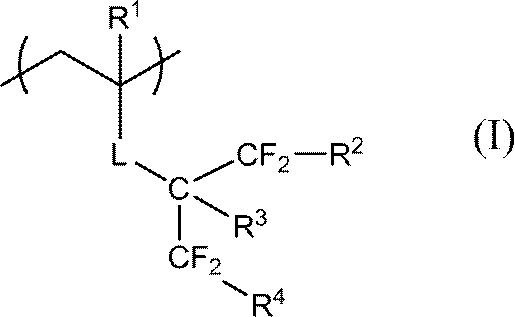
一般式(I)中、R1は水素原子又は炭素原子数1~20のアルキル基を表し、Lはエステル結合、エーテル結合、フェニレン基又はアミド結合を表し、R2及びR4は各々独立に、水素原子、ハロゲン原子、炭素原子数1~20のアルキル基、又は炭素原子数1~20のハロゲン化アルキル基を表し、R3は水素原子又は置換基を表す。
<2>
上記重合体が、更に下記一般式(II)で表される繰り返し単位を有する、<1>に記載の膜形成用組成物。
<2>
上記重合体が、更に下記一般式(II)で表される繰り返し単位を有する、<1>に記載の膜形成用組成物。
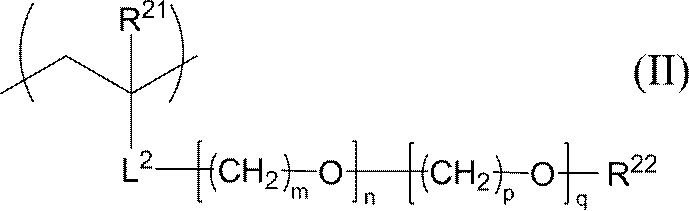
一般式(II)中、R21は水素原子又は炭素原子数1~20のアルキル基を表し、R22は水素原子、炭素原子数1~20のアルキル基、又は炭素原子数6~12のアリール基を表し、L2はエステル結合、エーテル結合、フェニレン基又はアミド結合を表し、m及びpは各々独立に1~4の整数を表し、nは1~30の数を表し、qは0~30の数を表す。
<3>
上記重合体中のフッ素原子の含有率が、上記重合体の全質量に対して、5質量%以上80質量%以下である、<1>又は<2>に記載の膜形成用組成物。
<4>
上記重合体中の上記一般式(I)で表される繰り返し単位の含有率が、上記重合体の全質量に対して、3~100質量%である、<1>~<3>のいずれか一項に記載の膜形成用組成物。
<5>
<1>~<4>のいずれか一項に記載の膜形成用組成物から形成された膜を有するハードコートフィルム。
<6>
<5>に記載のハードコートフィルムを有する偏光板。
<7>
支持体上に<1>~<4>のいずれか一項に記載の膜形成用組成物を塗工してハードコートフィルムを形成する工程と、
上記ハードコートフィルムをアルカリ処理する工程と、
を有する親水化ハードコートフィルムの製造方法。
<3>
上記重合体中のフッ素原子の含有率が、上記重合体の全質量に対して、5質量%以上80質量%以下である、<1>又は<2>に記載の膜形成用組成物。
<4>
上記重合体中の上記一般式(I)で表される繰り返し単位の含有率が、上記重合体の全質量に対して、3~100質量%である、<1>~<3>のいずれか一項に記載の膜形成用組成物。
<5>
<1>~<4>のいずれか一項に記載の膜形成用組成物から形成された膜を有するハードコートフィルム。
<6>
<5>に記載のハードコートフィルムを有する偏光板。
<7>
支持体上に<1>~<4>のいずれか一項に記載の膜形成用組成物を塗工してハードコートフィルムを形成する工程と、
上記ハードコートフィルムをアルカリ処理する工程と、
を有する親水化ハードコートフィルムの製造方法。
本発明により、面状均一性に優れ、かつ簡便な処理により他の層との積層性も向上できる膜を形成することができる膜形成用組成物、上記組成物から形成された膜を有するハードコートフィルム、及び偏光板、並びに、面状均一性に優れ、かつ他の層との積層性に優れる親水化ハードコートフィルムの製造方法を提供することができる。
以下、本発明を詳細に説明する。
なお、本明細書において「~」とはその前後に記載される数値を下限値および上限値として含む意味で使用される。
本明細書において、「(メタ)アクリレート」は、「アクリレート及びメタクリレートの少なくとも一方」の意味で使用される。(メタ)アクリル酸、(メタ)アクリルアミド、(メタ)アクリロイル基なども同様である。
なお、本明細書において「~」とはその前後に記載される数値を下限値および上限値として含む意味で使用される。
本明細書において、「(メタ)アクリレート」は、「アクリレート及びメタクリレートの少なくとも一方」の意味で使用される。(メタ)アクリル酸、(メタ)アクリルアミド、(メタ)アクリロイル基なども同様である。
<膜形成用組成物>
本発明の膜形成用組成物は、一般式(I)で表される繰り返し単位を有する重合体と、硬化性化合物とを含む。
本発明の膜形成用組成物は、一般式(I)で表される繰り返し単位を有する重合体と、硬化性化合物とを含む。
[一般式(I)で表される繰り返し単位を有する重合体]
一般式(I)で表される繰り返し単位を有する重合体(以下、「含フッ素重合体」ともいう)について説明する。
一般式(I)で表される繰り返し単位を有する重合体(以下、「含フッ素重合体」ともいう)について説明する。
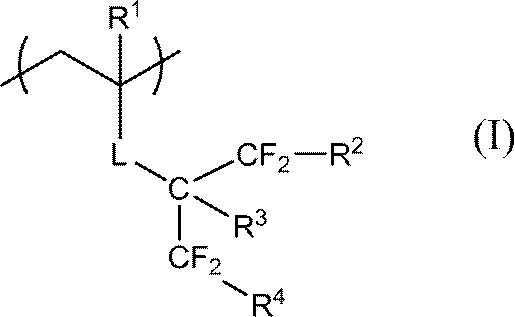
一般式(I)中、R1は水素原子又は炭素原子数1~20のアルキル基を表し、Lはエステル結合、エーテル結合、フェニレン基又はアミド結合を表し、R2及びR4は各々独立に、水素原子、ハロゲン原子、炭素原子数1~20のアルキル基又は炭素原子数1~20のハロゲン化アルキル基を表し、R3は水素原子又は置換基を表す。
一般式(I)のR1は水素原子又は炭素原子数1~20のアルキル基を表し、水素原子又は炭素原子数1~6のアルキル基を表すことが好ましく、水素原子又はメチル基を表すことがより好ましく、水素原子を表すことが特に好ましい。
一般式(I)のR2及びR4は各々独立に、水素原子、ハロゲン原子、炭素原子数1~20のアルキル基又は炭素原子数1~20のハロゲン化アルキル基を表す。ここで、「ハロゲン化アルキル基」には、アルキル基の一部の水素原子がハロゲン原子に置換されたハロゲン化アルキル基、及びアルキル基のすべての水素原子がハロゲン原子に置換されたパーハロアルキル基が含まれる。
一般式(I)のR2及びR4は各々独立に、水素原子、ハロゲン原子又は炭素原子数1~20のハロゲン化アルキル基を表すことが好ましく、水素原子、ハロゲン原子又は炭素原子数1~20のパーハロアルキル基を表すことがより好ましく、水素原子、フッ素原子又はパーフルオロアルキル基を表すことが更に好ましく、水素原子又はフッ素原子を表すことが特に好ましく、フッ素原子を表すことが最も好ましい。
R2及びR4は更に置換基を有していてもよく、置換基としては、ヒドロキシル基、ハロゲン原子、カルボキシル基、及びアミノ基が挙げられ、ヒドロキシル基、又はハロゲン原子が好ましい。
一般式(I)のR2及びR4は各々独立に、水素原子、ハロゲン原子又は炭素原子数1~20のハロゲン化アルキル基を表すことが好ましく、水素原子、ハロゲン原子又は炭素原子数1~20のパーハロアルキル基を表すことがより好ましく、水素原子、フッ素原子又はパーフルオロアルキル基を表すことが更に好ましく、水素原子又はフッ素原子を表すことが特に好ましく、フッ素原子を表すことが最も好ましい。
R2及びR4は更に置換基を有していてもよく、置換基としては、ヒドロキシル基、ハロゲン原子、カルボキシル基、及びアミノ基が挙げられ、ヒドロキシル基、又はハロゲン原子が好ましい。
一般式(I)のR3は水素原子又は置換基を表す。
R3が置換基を表す場合の置換基としては、ハロゲン原子、アルキル基、アルケニル基(好ましくは炭素原子数2~6のアルケニル基)、アリール基(好ましくはフェニル基)、ヒドロキシル基、カルボキシル基、及びこれらの基を組み合わせて得られる基が挙げられる。
R3は水素原子、ハロゲン原子又は炭素原子数1~20のアルキル基を表すことが好ましく、水素原子、フッ素原子又は炭素原子数1~6のアルキル基を表すことがより好ましく、水素原子又はフッ素原子を表すことが特に好ましく、水素原子を表すことが最も好ましい。
R3が置換基を表す場合の置換基としては、ハロゲン原子、アルキル基、アルケニル基(好ましくは炭素原子数2~6のアルケニル基)、アリール基(好ましくはフェニル基)、ヒドロキシル基、カルボキシル基、及びこれらの基を組み合わせて得られる基が挙げられる。
R3は水素原子、ハロゲン原子又は炭素原子数1~20のアルキル基を表すことが好ましく、水素原子、フッ素原子又は炭素原子数1~6のアルキル基を表すことがより好ましく、水素原子又はフッ素原子を表すことが特に好ましく、水素原子を表すことが最も好ましい。
一般式(I)のLはエステル結合(-COO-)、エーテル結合(-O-)、フェニレン基又はアミド結合(-CONH-)を表し、エステル結合、フェニレン基又はアミド結合を表すことが好ましく、エステル結合を表すことがアルカリ処理による親水性変化の観点からより好ましい。
本発明の膜形成用組成物に含まれる含フッ素重合体は、溶解性やアルカリ処理時の環境応答性を調節する目的で、更に下記一般式(II)で表される繰り返し単位を含むことが好ましい。
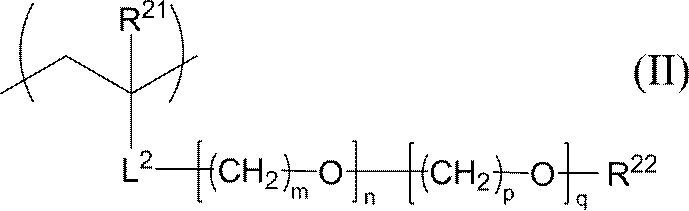
一般式(II)中、R21は水素原子又は炭素原子数1~20のアルキル基を表し、R22は水素原子、炭素原子数1~20のアルキル基、又は炭素数6~12のアリール基を表し、L2はエステル結合、エーテル結合、フェニレン基又はアミド結合を表し、m及びpは各々独立に1~4の整数を表し、nは1~30の数を表し、qは0~30の数を表す。
一般式(II)のR21は水素原子又は炭素原子数1~20のアルキル基を表し、水素原子又は炭素数1~6のアルキル基を表すことが好ましく、水素原子又はメチル基を表すことがより好ましい。
一般式(II)のR22は水素原子、炭素原子数1~20のアルキル基又は炭素数6~12のアリール基を表し、水素原子、炭素数1~6のアルキル基又はフェニル基を表すことが好ましく、水素原子又は炭素数1~6のアルキル基を表すことがより好ましく、水素原子又はメチル基を表すことが特に好ましい。
R22は更に置換基を有してもよく、置換基としては、ヒドロキシル基、ハロゲン原子、アミノ基、及びカルボキシル基が挙げられ、ヒドロキシル基が好ましい。
R22は更に置換基を有してもよく、置換基としては、ヒドロキシル基、ハロゲン原子、アミノ基、及びカルボキシル基が挙げられ、ヒドロキシル基が好ましい。
一般式(II)のL2はエステル結合、エーテル結合、フェニレン基又はアミド結合を表し、エステル結合又はまたはアミド結合を表すことが好ましく、エステル結合を表すことがアルカリ処理による親水性変化の観点からより好ましい。
一般式(II)のm及びpは各々独立に1~4の整数を表し、1~3の整数を表すことが好ましく、2又は3を表すことがより好ましく、2を表すことが特に好ましい。
一般式(II)のnは1~30の数を表し、1~28の数を表すことが好ましく、1~25の数を表すことがより好ましく、2~23の数を表すことが特に好ましい。
一般式(II)のqは0~30の数を表し、0~25の数を表すことが好ましく、0~20の数を表すことがより好ましく、0~15の数を表すことが特に好ましい。
nとqの和は1~30であることが好ましく、1~25であることがより好ましい。
nとqの和は1~30であることが好ましく、1~25であることがより好ましい。
本発明の膜形成用組成物に含まれる含フッ素重合体は、上記した繰り返し単位のほかに、別の繰り返し単位を有してもよい。別の繰り返し単位としては特に限定されないが、たとえば含フッ素モノマーに由来する繰り返し単位、(メタ)アクリレート系モノマーに由来する繰り返し単位、(メタ)アクリルアミド系モノマーに由来する繰り返し単位、及びスチレン系モノマーに由来する繰り返し単位が挙げられる。
本発明においては、一般式(I)で表される繰り返し単位を有する重合体に、更に別の含フッ素モノマーに由来する繰り返し単位を導入することで、表面張力を調節することができる。上記含フッ素モノマーに由来する繰り返し単位としては、下記一般式(III)で表される繰り返し単位が好ましい。
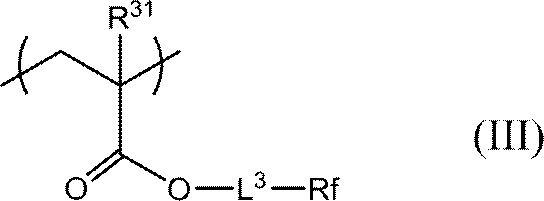
一般式(III)中、R31は水素原子又は炭素原子数1~20のアルキル基を表し、L3はアルキレン基を表し、Rfはフルオロアルキル基を表す。
一般式(III)のR31は水素原子又は炭素原子数1~20のアルキル基を表し、水素原子又は炭素原子数1~6のアルキル基を表すことが好ましく、水素原子又はメチル基を表すことがより好ましく、水素原子を表すことが特に好ましい。
一般式(III)のL3はアルキレン基を表し、炭素原子数1~10のアルキレン基を表すことが好ましく、炭素原子数1~6のアルキレン基を表すことがより好ましく、炭素原子数1~3のアルキレン基を表すことが特に好ましい。
一般式(III)のRfはフルオロアルキル基を表し、炭素原子数1~15のフルオロアルキル基を表すことが好ましく、炭素原子数1~10のフルオロアルキル基を表すことがより好ましい。
また、含フッ素重合体は、任意の(メタ)アクリレート系モノマーに由来する繰り返し単位を含んでいてもよい。(メタ)アクリレート系モノマーとしては、たとえば、アクリル酸メチル、アクリル酸エチル、アクリル酸2-ヒドロキシエチル、アクリル酸2,3-ジヒドロキシプロピル、アクリル酸ブチル、及びアクリルアミドなどが挙げられる。
含フッ素重合体中の上記一般式(I)で表される繰り返し単位の含有率は、特に限定されるものではないが、含フッ素重合体の全質量に対して3~100質量%が好ましく、合成時の溶媒への溶解性と、アルカリ処理後の親水性の観点から、20~98質量%がより好ましく、30~97質量%が更に好ましく、40~96質量%がより更に好ましい。
含フッ素重合体が上記一般式(II)で表される繰り返し単位を有する場合、含フッ素重合体中の一般式(II)で表される繰り返し単位の含有率は、アルカリ処理における親水性変化と重合体の粘度の観点から、含フッ素重合体の全質量に対して、1~85質量%が好ましく、3~60質量%がより好ましく、5~40質量%が更に好ましい。
含フッ素重合体が上記一般式(III)で表される繰り返し単位を有する場合、含フッ素重合体中の一般式(III)で表される繰り返し単位の含有率は、合成時の溶媒への溶解性と、アルカリ処理後の水の接触角の観点から、含フッ素重合体の全質量に対して、1~95質量%が好ましく、5~80質量%がより好ましく、5~60質量%が更に好ましい。
含フッ素重合体の重量平均分子量(Mw)は、合成時の溶媒への溶解性と、面状均一性の観点から、800~50000が好ましく、1000~50000がより好ましく、1500~40000が更に好ましく、2000~30000が特に好ましい。分子量が800未満である場合、重合体が表面に偏析する作用が充分に起こらず、塗布膜の面状均一性が悪化する。また、分子量が50000以上である場合、重合体を合成する際に溶媒に溶解せず、析出するなどの問題が起きる恐れがある。
なお、含フッ素重合体の重量平均分子量及び数平均分子量は、ゲルパーミエーションクロマトグラフィー(GPC)により下記の条件で測定された値である。
[溶離液] テトラヒドロフラン(THF)
[装置名] EcoSEC HLC-8320GPC(東ソー社製)
[カラム] TSKgel SuperHZM-H、TSKgel SuperHZ4000、TSKgel SuperHZ200(東ソー社製))
[カラム温度] 40℃
[流速] 0.35ml/min
なお、含フッ素重合体の重量平均分子量及び数平均分子量は、ゲルパーミエーションクロマトグラフィー(GPC)により下記の条件で測定された値である。
[溶離液] テトラヒドロフラン(THF)
[装置名] EcoSEC HLC-8320GPC(東ソー社製)
[カラム] TSKgel SuperHZM-H、TSKgel SuperHZ4000、TSKgel SuperHZ200(東ソー社製))
[カラム温度] 40℃
[流速] 0.35ml/min
合成時の溶媒への溶解性の観点から、含フッ素重合体中のフッ素原子の含有率(フッ素含率)は5~80質量%であることが好ましく、10~65質量%であることがより好ましく、20~55質量%であることが更に好ましい。
フッ素含率は、含フッ素重合体の全質量に対する含フッ素重合体に含まれるフッ素原子の質量の比率である。
フッ素含率は、含フッ素重合体の全質量に対する含フッ素重合体に含まれるフッ素原子の質量の比率である。
含フッ素重合体は、公知の方法で合成することができる。
含フッ素重合体は2種以上の繰り返し単位を含む場合、ランダム共重合体でもよいし、ブロック共重合体でもよい。
含フッ素重合体は2種以上の繰り返し単位を含む場合、ランダム共重合体でもよいし、ブロック共重合体でもよい。
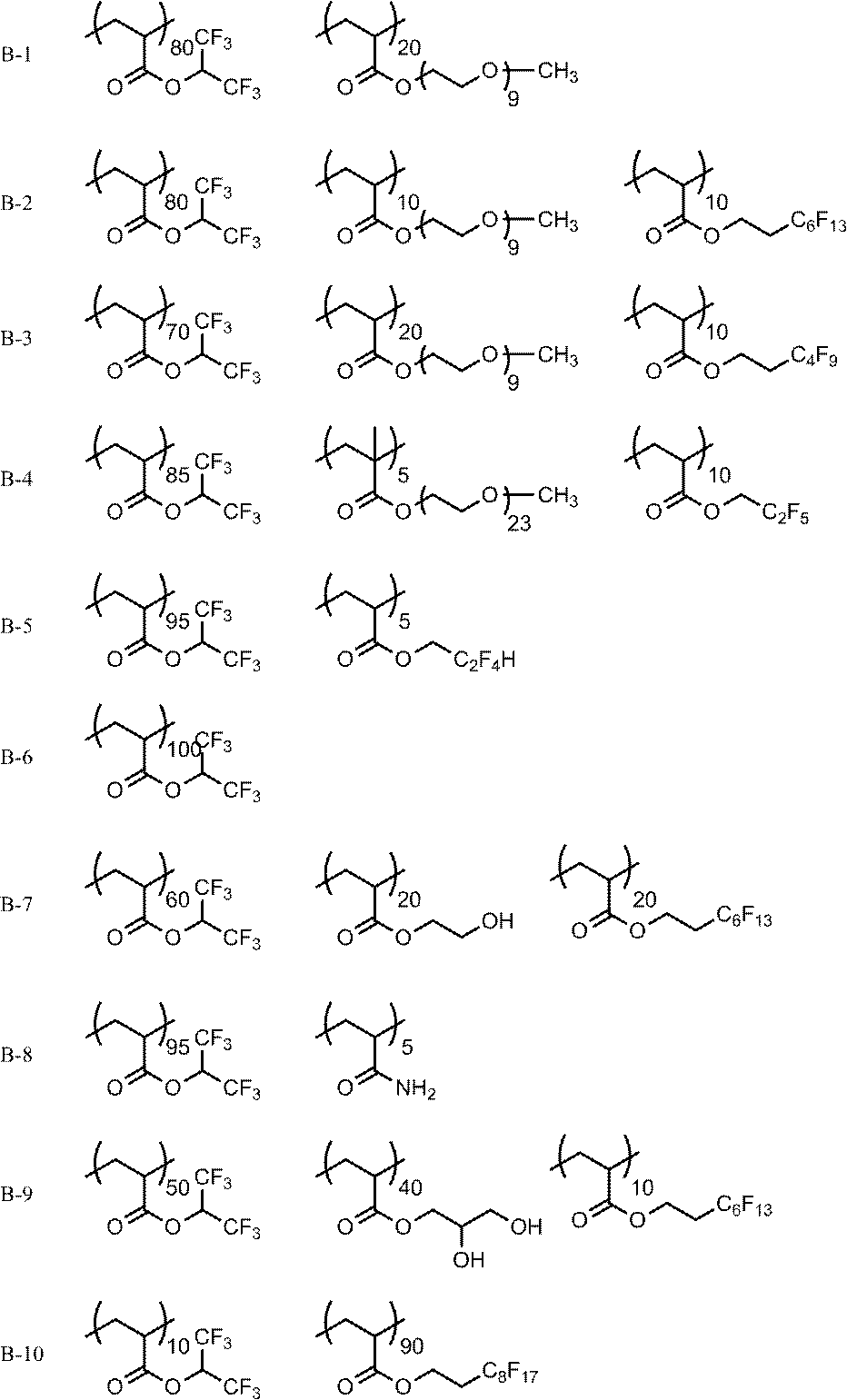
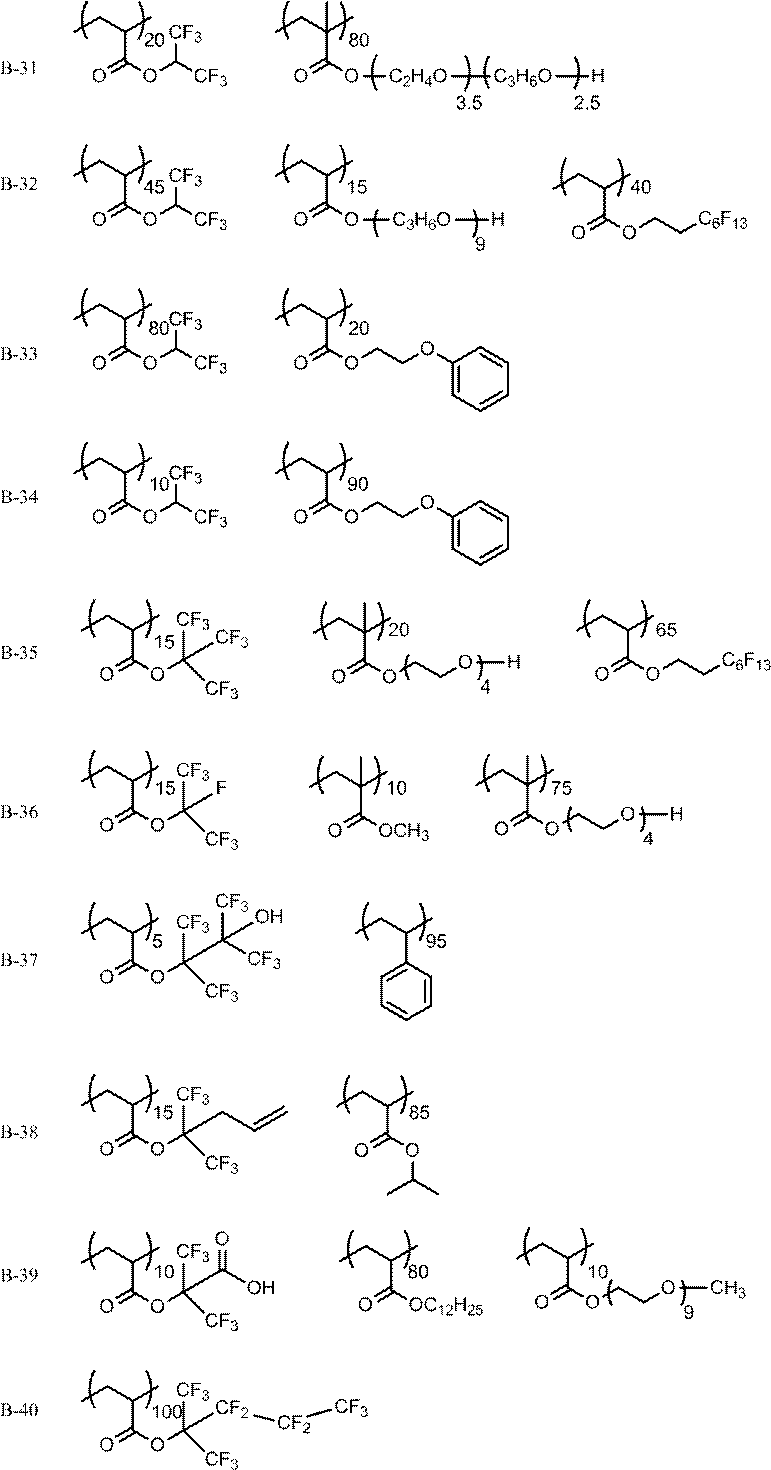
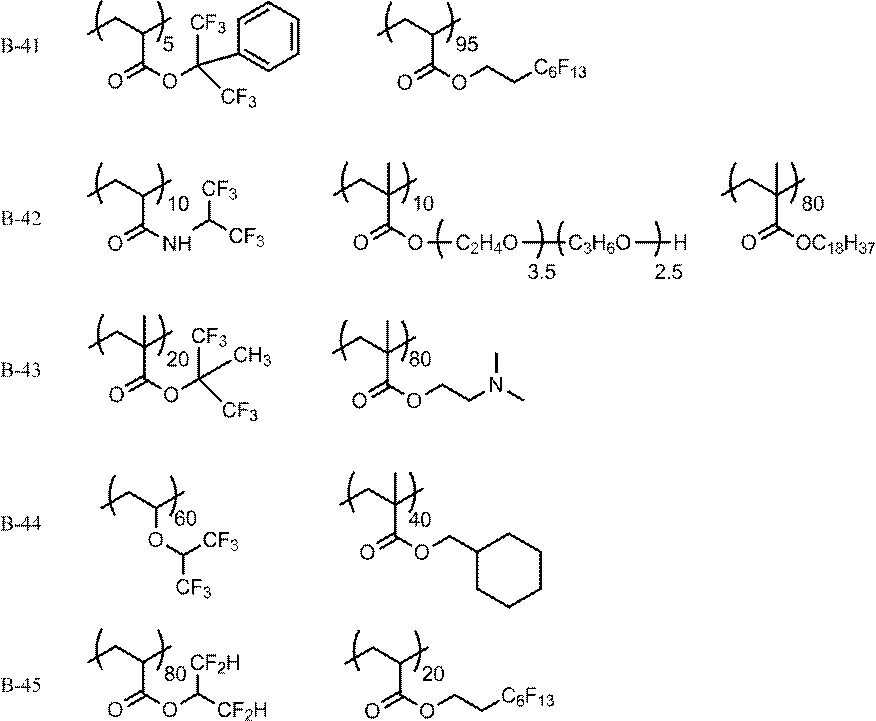
含フッ素重合体の具体例を以下に示すが、これらに限定されるものではない。下記具体例において、各繰り返し単位の含有量は、含フッ素重合体の全質量に対する各繰り返し単位の質量比率(質量%)である。


本発明の膜形成用組成物における上記一般式(I)で表される繰り返し単位を有する重合体の含有量は、膜の面状均一性と、他の層との積層性とを両立させる観点から、膜形成用組成物の全固形分(溶剤を除いた全成分)を100質量%とした場合に、0.01~1質量%含有されることが好ましく、0.03~0.5質量%がより好ましく、0.05~0.3質量%が更に好ましい。
[硬化性化合物]
本発明の膜形成用組成物は硬化性化合物を含む。
硬化性化合物とは、何らかのエネルギー付与により反応を生起し、硬化する化合物であれば特に制限はないが、特に、熱、紫外線(UV)又は放射線によって硬化する化合物であることが好ましい。このような硬化性化合物を含有することで、本発明の膜形成用組成物をハードコート層形成用組成物として好適に用いることができる。
本発明の膜形成用組成物は硬化性化合物を含む。
硬化性化合物とは、何らかのエネルギー付与により反応を生起し、硬化する化合物であれば特に制限はないが、特に、熱、紫外線(UV)又は放射線によって硬化する化合物であることが好ましい。このような硬化性化合物を含有することで、本発明の膜形成用組成物をハードコート層形成用組成物として好適に用いることができる。
本発明の膜形成用組成物は、1種類の硬化性化合物のみを含有してもよいし、2種類以上の硬化性化合物を含有してもよい。
本発明の膜形成用組成物における硬化性化合物の含有量は、膜形成用組成物の全固形分(溶剤を除いた全成分)を100質量%とした場合に、40~90質量%であることが好ましく、45~85質量%であることがより好ましく、50~80質量%がであることが更に好ましい。
硬化性化合物としては、分子内に、エチレン性不飽和二重結合基及びエポキシ基の少なくとも一方を有する化合物が好ましく、以下に説明する(b)分子内に3個以上のエチレン性不飽和二重結合基を有する化合物、及び(c)分子内に1個以上のエポキシ基を有する化合物が好ましい例として挙げられる。
本発明の膜形成用組成物における硬化性化合物の含有量は、膜形成用組成物の全固形分(溶剤を除いた全成分)を100質量%とした場合に、40~90質量%であることが好ましく、45~85質量%であることがより好ましく、50~80質量%がであることが更に好ましい。
硬化性化合物としては、分子内に、エチレン性不飽和二重結合基及びエポキシ基の少なくとも一方を有する化合物が好ましく、以下に説明する(b)分子内に3個以上のエチレン性不飽和二重結合基を有する化合物、及び(c)分子内に1個以上のエポキシ基を有する化合物が好ましい例として挙げられる。
≪(b)分子内に3個以上のエチレン性不飽和二重結合基を有する化合物≫
本発明の膜形成用組成物は、硬化性化合物として、(b)分子内に3個以上のエチレン性不飽和二重結合基を有する化合物(「化合物(b)」ともいう)を含むことが好ましい。
エチレン性不飽和二重結合基としては、(メタ)アクリロイル基、ビニル基、スチリル基、アリル基等の重合性官能基が挙げられ、中でも、(メタ)アクリロイル基及び-C(O)OCH=CH2が好ましく、特に好ましくは(メタ)アクリロイル基である。硬化性化合物がエチレン性不飽和二重結合基を3個以上有することによって、高い硬度を維持することができ、耐湿熱性も付与する事ができる。
本発明の膜形成用組成物は、硬化性化合物として、(b)分子内に3個以上のエチレン性不飽和二重結合基を有する化合物(「化合物(b)」ともいう)を含むことが好ましい。
エチレン性不飽和二重結合基としては、(メタ)アクリロイル基、ビニル基、スチリル基、アリル基等の重合性官能基が挙げられ、中でも、(メタ)アクリロイル基及び-C(O)OCH=CH2が好ましく、特に好ましくは(メタ)アクリロイル基である。硬化性化合物がエチレン性不飽和二重結合基を3個以上有することによって、高い硬度を維持することができ、耐湿熱性も付与する事ができる。
化合物(b)としては、多価アルコールと(メタ)アクリル酸とのエステル、ビニルベンゼン及びその誘導体、ビニルスルホン、(メタ)アクリルアミド等が挙げられる。中でも硬度の観点から、3個以上の(メタ)アクリロイル基を有する化合物が好ましく、本業界で広範に用いられる高硬度の硬化物を形成する(メタ)アクリレート系化合物が挙げられる。化合物(b)としては、たとえば、ペンタエリスリトールテトラ(メタ)アクリレート、ペンタエリスリトールトリ(メタ)アクリレート、トリメチロールプロパントリ(メタ)アクリレート、エチレンオキサイド(EO)変性トリメチロールプロパントリ(メタ)アクリレート、プロピレンオキサイド(PO)変性トリメチロールプロパントリ(メタ)アクリレート、EO変性リン酸トリ(メタ)アクリレート、トリメチロールエタントリ(メタ)アクリレート、ジトリメチロールプロパンテトラ(メタ)アクリレート、ジペンタエリスリトールテトラ(メタ)アクリレート、ジペンタエリスリトールペンタ(メタ)アクリレート、ジペンタエリスリトールヘキサ(メタ)アクリレート、ペンタエリスリトールヘキサ(メタ)アクリレート、1,2,3-クロヘキサンテトラメタクリレート、ポリウレタンポリアクリレート、ポリエステルポリアクリレート、カプロラクトン変性トリス(アクリロキシエチル)イソシアヌレート等が挙げられる。
また、本発明の膜形成用組成物は、化合物(b)として1種類の化合物のみを含有してもよいし、2種類以上を含有してもよい。
化合物(b)は、本発明の膜形成用組成物の全固形分(溶剤を除いた全成分)を100質量%とした場合に、40~80質量%含有されることが好ましいが、45~75質量%がより好ましく、50~70質量%が更に好ましい。含有量が40質量%以上であると十分な硬度を得る事ができる。
化合物(b)は、本発明の膜形成用組成物の全固形分(溶剤を除いた全成分)を100質量%とした場合に、40~80質量%含有されることが好ましいが、45~75質量%がより好ましく、50~70質量%が更に好ましい。含有量が40質量%以上であると十分な硬度を得る事ができる。
化合物(b)はエチレン性不飽和結合基当量が80~130であることが好ましい。エチレン性不飽和結合基当量とは、化合物(b)の分子量をエチレン性不飽和結合性基の数で除した数値をいう。
化合物(b)のエチレン性不飽和結合性基当量は、80~110がより好ましく、80~100が更に好ましい。
化合物(b)のエチレン性不飽和結合性基当量は、80~110がより好ましく、80~100が更に好ましい。
≪(c)分子内に1個以上のエポキシ基を有する化合物≫
本発明の膜形成用組成物は、硬化性化合物として、(c)分子内に1個以上のエポキシ基を有する化合物(「化合物(c)」ともいう)を含むことも好ましい。
化合物(c)が有するエポキシ基の数は1個以上であれば、特に限定されない。
化合物(c)の分子量は、300以下であることが好ましく、250以下がより好ましく、200以下が更に好ましい。また、膜形成時の揮発を抑制する観点から、化合物(c)の分子量は100以上であることが好ましく、150以上であることがより好ましい。
化合物(c)は、分子内に1個の脂環式エポキシ基と1個のエチレン性不飽和二重結合基とを有し、分子量が300以下である化合物であることがより好ましい。エポキシ基が脂環式であって、分子量を300以下であると、硬度悪化を防止する効果を向上させることができる。
化合物(c)が有し得るエチレン性不飽和二重結合基は特に限定されないが、(メタ)アクリロイル基、ビニル基、スチリル基、アリル基等が挙げられ、中でも、(メタ)アクリロイル基及び-C(O)OCH=CH2が好ましく、特に好ましくは(メタ)アクリロイル基である。
化合物(c)が、エチレン性不飽和二重結合基を有することにより、化合物(b)と併用した場合に化合物(b)との結合力が付与されるため、硬度悪化が防止でき、また、湿熱耐久時の泣き出しを抑制できる。
本発明の膜形成用組成物は、硬化性化合物として、(c)分子内に1個以上のエポキシ基を有する化合物(「化合物(c)」ともいう)を含むことも好ましい。
化合物(c)が有するエポキシ基の数は1個以上であれば、特に限定されない。
化合物(c)の分子量は、300以下であることが好ましく、250以下がより好ましく、200以下が更に好ましい。また、膜形成時の揮発を抑制する観点から、化合物(c)の分子量は100以上であることが好ましく、150以上であることがより好ましい。
化合物(c)は、分子内に1個の脂環式エポキシ基と1個のエチレン性不飽和二重結合基とを有し、分子量が300以下である化合物であることがより好ましい。エポキシ基が脂環式であって、分子量を300以下であると、硬度悪化を防止する効果を向上させることができる。
化合物(c)が有し得るエチレン性不飽和二重結合基は特に限定されないが、(メタ)アクリロイル基、ビニル基、スチリル基、アリル基等が挙げられ、中でも、(メタ)アクリロイル基及び-C(O)OCH=CH2が好ましく、特に好ましくは(メタ)アクリロイル基である。
化合物(c)が、エチレン性不飽和二重結合基を有することにより、化合物(b)と併用した場合に化合物(b)との結合力が付与されるため、硬度悪化が防止でき、また、湿熱耐久時の泣き出しを抑制できる。
化合物(c)は、本発明の膜形成用組成物の全固形分を100質量%とした場合に、10~40質量%含有されることが好ましく、12~35質量%含有されることがより好ましく、15~25質量%含有されることが更に好ましい。化合物(c)の含有量が10質量%以上であると平滑性の向上効果に優れ、形成される膜の面状が良好となる。一方、含有量が40質量%以下であると、硬度が向上する。
化合物(c)の具体例としては、分子内に1個以上の脂環式エポキシ基を有するものであることが好ましく、ビシクロヘキシルジエポキサイド;3,4,3′,4′-ジエポキシビシクロヘキシル、ブタンテトラカルボン酸 テトラ(3,4-エポキシシクロヘキシルメチル) 修飾ε-カプロラクトン、特開平10-17614号公報の段落〔0015〕や、下記一般式(1A)又は(1B)で表される化合物、または、1,2-エポキシ-4-ビニルシクロヘキサン等を用いることができる。中でも、下記一般式(1A)又は(1B)で表される化合物がより好ましく、分子量が低い下記一般式(1A)で表される化合物が更に好ましい。なお、下記一般式(1A)又は(1B)で表される化合物はその異性体も好ましい。これらの化合物を用いることによって、膜の平滑性が向上され、また、高い硬度を維持できる。
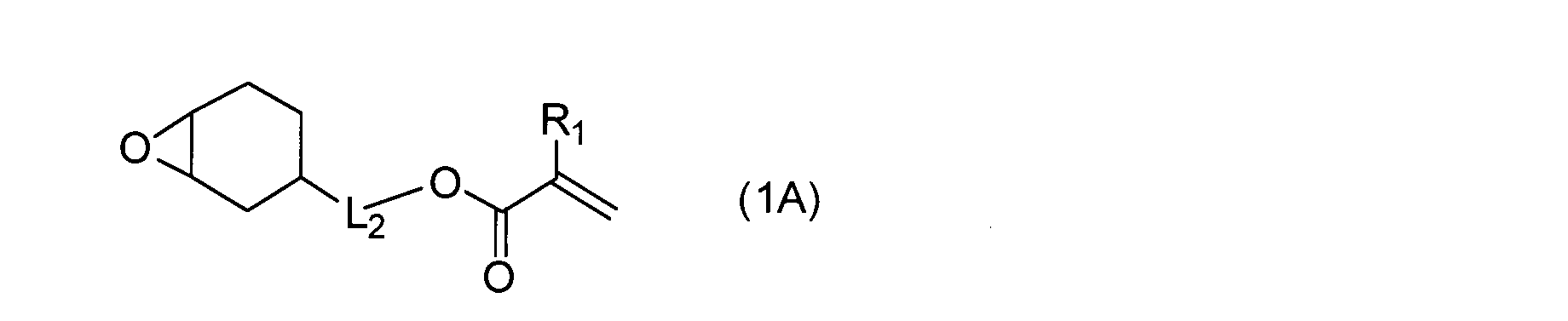
一般式(1A)中、R1は水素原子又はメチル基を表し、L2は炭素原子数1~6の2価の脂肪族炭化水素基を表す。

一般式(1B)中、R1は水素原子又はメチル基を表し、L2は炭素原子数1~6の2価の脂肪族炭化水素基を表す。
一般式(1A)及び(1B)中のL2の2価の脂肪族炭化水素基としては、炭素原子数1~6であり、炭素原子数1~3がより好ましく、炭素原子数1が更に好ましい。2価の脂肪族炭化水素基としては、直鎖状、分岐状又は環状のアルキレン基が好ましく、直鎖状又は分岐状のアルキレン基がより好ましく、直鎖状のアルキレン基が更に好ましい。
本発明の膜形成用組成物は、上記含フッ素重合体及び硬化性化合物以外の他の成分を含んでもよく、これらの成分としては、たとえば、無機微粒子、紫外線吸収剤、溶剤、重合開始剤、及び風ムラ防止剤などが挙げられる。
≪無機微粒子≫
無機微粒子としてはシリカ粒子、二酸化チタン粒子、酸化ジルコニウム粒子、酸化アルミニウム粒子などが挙げられる。中でもシリカ粒子が好ましい。なお、無機微粒子は表面処理されていてもよい。
無機微粒子としてはシリカ粒子、二酸化チタン粒子、酸化ジルコニウム粒子、酸化アルミニウム粒子などが挙げられる。中でもシリカ粒子が好ましい。なお、無機微粒子は表面処理されていてもよい。
((d)エポキシ基又はエチレン性不飽和二重結合基との反応性を有する無機微粒子)
無機微粒子としては、(d)エポキシ基又はエチレン性不飽和二重結合基との反応性を有する無機微粒子(「無機微粒子(d)」ともいう)が好ましい。
本発明の膜形成用組成物が無機微粒子(d)を含有することで、得られる膜の親水性を向上させることができる。また、得られる膜の硬化収縮量を低減できるため、カールを低減できる。更に、無機微粒子(d)はエポキシ基又はエチレン性不飽和二重結合基との反応性を有するため、膜の鉛筆硬度を向上させることが可能である。
無機微粒子(d)の平均1次粒径は、10nm~100nmが好ましく、更に好ましくは10~60nmである。微粒子の平均粒径は電子顕微鏡写真から求めることができる。
無機微粒子(d)の形状は、球形、非球形を問わないが、2~10個の無機微粒子が連結した非球形が硬度付与の観点で好ましい。数個が鎖状に連結した無機微粒子を用いる事によって、強固な粒子ネットワーク構造を形成して、硬度が向上すると推定している。
無機微粒子としては、(d)エポキシ基又はエチレン性不飽和二重結合基との反応性を有する無機微粒子(「無機微粒子(d)」ともいう)が好ましい。
本発明の膜形成用組成物が無機微粒子(d)を含有することで、得られる膜の親水性を向上させることができる。また、得られる膜の硬化収縮量を低減できるため、カールを低減できる。更に、無機微粒子(d)はエポキシ基又はエチレン性不飽和二重結合基との反応性を有するため、膜の鉛筆硬度を向上させることが可能である。
無機微粒子(d)の平均1次粒径は、10nm~100nmが好ましく、更に好ましくは10~60nmである。微粒子の平均粒径は電子顕微鏡写真から求めることができる。
無機微粒子(d)の形状は、球形、非球形を問わないが、2~10個の無機微粒子が連結した非球形が硬度付与の観点で好ましい。数個が鎖状に連結した無機微粒子を用いる事によって、強固な粒子ネットワーク構造を形成して、硬度が向上すると推定している。
膜形成用組成物の全固形分を100質量%とした場合に無機微粒子(d)は10~40質量%含有されることが好ましく、15~30質量%がより好ましく、15~25質量%が更に好ましい。
≪紫外線吸収剤≫
本発明の膜形成用組成物は、紫外線吸収剤を含むことが好ましい。
本発明の膜形成用組成物により形成される膜は、たとえば偏光板又は液晶表示用部材等に使用することができるが、偏光板又は液晶等の劣化防止の観点から、紫外線吸収剤が好ましく用いられる。紫外線吸収剤としては、波長370nm以下の紫外線の吸収能に優れ、かつ良好な液晶表示性の観点から、波長400nm以上の可視光の吸収が少ないものが好ましく用いられる。紫外線吸収剤は1種のみ用いても良いし、2種以上を併用しても良い。例えば、特開2001-72782号公報や特表2002-543265号公報に記載の紫外線吸収剤が挙げられる。紫外線吸収剤の具体例としては、例えばオキシベンゾフェノン系化合物、ベンゾトリアゾール系化合物、サリチル酸エステル系化合物、ベンゾフェノン系化合物、シアノアクリレート系化合物、ニッケル錯塩系化合物などが挙げられる。
本発明の膜形成用組成物は、紫外線吸収剤を含むことが好ましい。
本発明の膜形成用組成物により形成される膜は、たとえば偏光板又は液晶表示用部材等に使用することができるが、偏光板又は液晶等の劣化防止の観点から、紫外線吸収剤が好ましく用いられる。紫外線吸収剤としては、波長370nm以下の紫外線の吸収能に優れ、かつ良好な液晶表示性の観点から、波長400nm以上の可視光の吸収が少ないものが好ましく用いられる。紫外線吸収剤は1種のみ用いても良いし、2種以上を併用しても良い。例えば、特開2001-72782号公報や特表2002-543265号公報に記載の紫外線吸収剤が挙げられる。紫外線吸収剤の具体例としては、例えばオキシベンゾフェノン系化合物、ベンゾトリアゾール系化合物、サリチル酸エステル系化合物、ベンゾフェノン系化合物、シアノアクリレート系化合物、ニッケル錯塩系化合物などが挙げられる。
≪溶剤≫
本発明の膜形成用組成物は、溶剤を含むことが好ましい。溶剤としては、硬化性化合物の溶解性、無機微粒子の分散性、塗工時の乾燥性等を考慮し、適宜種類を選択して用いることができる。溶剤としては有機溶剤が好ましく、アルコール系溶剤、エーテル系溶剤、ケトン系溶剤、エステル系溶剤、カーボネート系溶剤、炭化水素系溶剤などが挙げられる。
本発明の膜形成用組成物の固形分濃度は20~80質量%であることが好ましく、30~75質量%であることがより好ましく、40~70質量%であることが特に好ましい。
本発明の膜形成用組成物は、溶剤を含むことが好ましい。溶剤としては、硬化性化合物の溶解性、無機微粒子の分散性、塗工時の乾燥性等を考慮し、適宜種類を選択して用いることができる。溶剤としては有機溶剤が好ましく、アルコール系溶剤、エーテル系溶剤、ケトン系溶剤、エステル系溶剤、カーボネート系溶剤、炭化水素系溶剤などが挙げられる。
本発明の膜形成用組成物の固形分濃度は20~80質量%であることが好ましく、30~75質量%であることがより好ましく、40~70質量%であることが特に好ましい。
≪重合開始剤≫
本発明の膜形成用組成物は、重合開始剤を含むことが好ましい。
重合開始剤としては、特に限定されないが、ラジカル重合開始剤及びカチオン重合開始剤などが挙げられる。
ラジカル重合開始剤としては、特に限定されないが、アルキルフェノン系光重合開始剤、アシルフォスフィンオキサイド系光重合開始剤などが挙げられる。
カチオン重合開始剤としては、特に限定されないが、オニウム化合物、有機ハロゲン化合物、ジスルホン化合物などが挙げられる。
重合開始剤の含有量は、本発明の膜形成用組成物の全固形分を100質量%とした場合に、0.1~10質量%の範囲であることが好ましく、1~5質量%がより好ましく、2~4質量%が更に好ましい。
本発明の膜形成用組成物は、重合開始剤を含むことが好ましい。
重合開始剤としては、特に限定されないが、ラジカル重合開始剤及びカチオン重合開始剤などが挙げられる。
ラジカル重合開始剤としては、特に限定されないが、アルキルフェノン系光重合開始剤、アシルフォスフィンオキサイド系光重合開始剤などが挙げられる。
カチオン重合開始剤としては、特に限定されないが、オニウム化合物、有機ハロゲン化合物、ジスルホン化合物などが挙げられる。
重合開始剤の含有量は、本発明の膜形成用組成物の全固形分を100質量%とした場合に、0.1~10質量%の範囲であることが好ましく、1~5質量%がより好ましく、2~4質量%が更に好ましい。
≪風ムラ防止剤≫
本発明の膜形成用組成物は、本発明の効果を発揮できる範囲内で、上記含フッ素重合体以外の風ムラ防止剤を含有してもよい。
上記風ムラ防止剤としては、公知のフッ素系界面活性剤、及びシリコーン系界面活性剤が挙げられる。
本発明の膜形成用組成物は、本発明の効果を発揮できる範囲内で、上記含フッ素重合体以外の風ムラ防止剤を含有してもよい。
上記風ムラ防止剤としては、公知のフッ素系界面活性剤、及びシリコーン系界面活性剤が挙げられる。
[光学フィルム]
本発明の膜形成用組成物から形成された膜を有する光学フィルムについて説明する。
上記光学フィルムは、支持体上に、本発明の膜形成用組成物から形成された膜を有するものであることが好ましい。
本発明の膜形成用組成物から形成された膜を有する光学フィルムについて説明する。
上記光学フィルムは、支持体上に、本発明の膜形成用組成物から形成された膜を有するものであることが好ましい。
(支持体)
支持体としては、可視光(波長400~800nm)の平均の透過率が80%以上の透明支持体が好ましく、ガラスやポリマーフィルムを用いることができる。支持体として用いられるポリマーフィルムの材料の例には、セルロースアシレート(例えば、セルローストリアセテート、セルロースジアセテート、セルロースアセテートブチレート、セルロースアセテートプロピオネート)、ポリエチレン及びポリプロピレン等のポリオレフィン、ポリエチレンテレフタレート及びポリエチレンナフタレート等のポリエステル、ポリエーテルスルホン、ポリメチルメタクリレート等のポリアクリレート、ポリウレタン、ポリカーボネート、ポリスルホン、ポリエーテル、ポリメチルペンテン、ポリエーテルケトン、(メタ)アクリルニトリル、脂環式構造を有するポリマー(ノルボルネン系樹脂(たとえば、アートン:商品名、JSR社製)、非晶質ポリオレフィン(たとえば、ゼオネックス:商品名、日本ゼオン社製))、などが挙げられる。
本発明の光学フィルムの支持体としては、セルロースアシレートフィルムが好ましい。
支持体は膜形成用組成物から膜を形成した後剥離される仮支持体であってもよい。
支持体の膜厚は、1μm~1000μm程度あればよく、モバイル用途に合わせて薄層化することもできるため、1μm~100μmが更に好ましく、1μm~25μmがより好ましい。
支持体としては、可視光(波長400~800nm)の平均の透過率が80%以上の透明支持体が好ましく、ガラスやポリマーフィルムを用いることができる。支持体として用いられるポリマーフィルムの材料の例には、セルロースアシレート(例えば、セルローストリアセテート、セルロースジアセテート、セルロースアセテートブチレート、セルロースアセテートプロピオネート)、ポリエチレン及びポリプロピレン等のポリオレフィン、ポリエチレンテレフタレート及びポリエチレンナフタレート等のポリエステル、ポリエーテルスルホン、ポリメチルメタクリレート等のポリアクリレート、ポリウレタン、ポリカーボネート、ポリスルホン、ポリエーテル、ポリメチルペンテン、ポリエーテルケトン、(メタ)アクリルニトリル、脂環式構造を有するポリマー(ノルボルネン系樹脂(たとえば、アートン:商品名、JSR社製)、非晶質ポリオレフィン(たとえば、ゼオネックス:商品名、日本ゼオン社製))、などが挙げられる。
本発明の光学フィルムの支持体としては、セルロースアシレートフィルムが好ましい。
支持体は膜形成用組成物から膜を形成した後剥離される仮支持体であってもよい。
支持体の膜厚は、1μm~1000μm程度あればよく、モバイル用途に合わせて薄層化することもできるため、1μm~100μmが更に好ましく、1μm~25μmがより好ましい。
[ハードコートフィルム]
本発明のハードコートフィルムは、光学フィルムの好ましい形態のひとつであり、本発明の膜形成用組成物から形成される膜がハードコート層である場合である。本発明の膜形成用組成物に含まれる硬化性化合物として、前述の(b)分子内に3個以上のエチレン性不飽和二重結合基を有する化合物を用いることなどにより、ハードコート層とすることができる。
本発明のハードコートフィルムは、一般に、最も単純な構成では、支持体上に、本発明の膜形成用組成物を塗工することによりハードコート層を形成した構成である。
本発明のハードコートフィルムはハードコート層以外の他の層を有してもよい。他の層としては、たとえば、低屈折率層、防眩層、帯電防止層、高屈折率層、中屈折率層、などが挙げられる。
本発明のハードコートフィルムは、光学フィルムの好ましい形態のひとつであり、本発明の膜形成用組成物から形成される膜がハードコート層である場合である。本発明の膜形成用組成物に含まれる硬化性化合物として、前述の(b)分子内に3個以上のエチレン性不飽和二重結合基を有する化合物を用いることなどにより、ハードコート層とすることができる。
本発明のハードコートフィルムは、一般に、最も単純な構成では、支持体上に、本発明の膜形成用組成物を塗工することによりハードコート層を形成した構成である。
本発明のハードコートフィルムはハードコート層以外の他の層を有してもよい。他の層としては、たとえば、低屈折率層、防眩層、帯電防止層、高屈折率層、中屈折率層、などが挙げられる。
本発明のハードコートフィルムは、アルカリ水溶液で処理(アルカリ処理)することで、ハードコート層の表面の親水性を高くすることができるため、ハードコート層上に他の層を積層しやすくなる。
本発明の膜形成用組成物から形成された膜を下層として、その表面に塗布成膜で他の層(上層)を形成する際の、上層形成用の塗布液の溶剤としては、幅広い溶剤を使用できる。
本発明の膜形成用組成物から形成された膜を下層として、その表面に塗布成膜で他の層(上層)を形成する際の、上層形成用の塗布液の溶剤としては、幅広い溶剤を使用できる。
本発明のハードコートフィルムは、偏光板用保護フィルムとして用いることができる。偏光板用保護フィルムとして用いる場合、偏光板の作製方法は特に限定されず、一般的な方法で作製することができる。ハードコートフィルムをアルカリ処理し、ポリビニルアルコールフィルムをヨウ素溶液中に浸漬延伸して作製した偏光子の両面に完全ケン化ポリビニルアルコール水溶液を用いて貼り合わせる方法がある。
本発明の膜形成用組成物から形成される膜の膜厚は、目標とする硬度に合わせて選択することができるが、1~50μmが好ましい。
また、本発明のハードコートフィルムを偏光板保護フィルムとして用いる場合には、ハードコート層の厚みは3~10μmであることが好ましい。
また、本発明のハードコートフィルムを偏光板保護フィルムとして用いる場合には、ハードコート層の厚みは3~10μmであることが好ましい。
(塗布方式)
支持体上に本発明の膜形成用組成物を塗布する方法としては、特に限定されないが、ディップコート法、エアーナイフコート法、カーテンコート法、ローラーコート法、ワイヤーバーコート法、グラビアコート法、スライドコート法やエクストルージョンコート法(ダイコート法)(特開2003-164788号明細書参照)、マイクログラビアコート法等の公知の方法が用いられ、その中でもマイクログラビアコート法、ダイコート法が好ましい。
支持体上に本発明の膜形成用組成物を塗布する方法としては、特に限定されないが、ディップコート法、エアーナイフコート法、カーテンコート法、ローラーコート法、ワイヤーバーコート法、グラビアコート法、スライドコート法やエクストルージョンコート法(ダイコート法)(特開2003-164788号明細書参照)、マイクログラビアコート法等の公知の方法が用いられ、その中でもマイクログラビアコート法、ダイコート法が好ましい。
(乾燥、硬化条件)
支持体上に本発明の膜形成用組成物を塗布した後に、乾燥、硬化することにより、膜を形成することができる。
本発明では、電離放射線による照射と、照射の前、照射と同時又は照射後の熱処理とを組み合わせることにより、硬化することが有効である。
その他、電離放射線硬化時に同時に熱処理を行う工程も好ましい。
本発明においては、上記のとおり、電離放射線による照射と組み合わせて熱処理を行うことが好ましい。熱処理は、ハードコートフィルムの支持体、ハードコート層を含めた構成層を損なうものでなければ特に制限はないが、好ましくは40~150℃、更に好ましくは40~80℃である。
熱処理に要する時間は、使用成分の分子量、その他成分との相互作用、粘度などにより異なるが、15秒~1時間、好ましくは20秒~30分、最も好ましくは30秒~5分である。
電離放射線の種類については、特に制限はなく、X線、電子線、紫外線、可視光、赤外線などが挙げられるが、紫外線が好ましく用いられる。例えば塗膜が紫外線硬化性であれば、紫外線ランプにより10mJ/cm2~1000mJ/cm2の照射量の紫外線を照射して各層を硬化するのが好ましい。照射の際には、上記エネルギーを一度に当ててもよいし、分割して照射することもできる。
支持体上に本発明の膜形成用組成物を塗布した後に、乾燥、硬化することにより、膜を形成することができる。
本発明では、電離放射線による照射と、照射の前、照射と同時又は照射後の熱処理とを組み合わせることにより、硬化することが有効である。
その他、電離放射線硬化時に同時に熱処理を行う工程も好ましい。
本発明においては、上記のとおり、電離放射線による照射と組み合わせて熱処理を行うことが好ましい。熱処理は、ハードコートフィルムの支持体、ハードコート層を含めた構成層を損なうものでなければ特に制限はないが、好ましくは40~150℃、更に好ましくは40~80℃である。
熱処理に要する時間は、使用成分の分子量、その他成分との相互作用、粘度などにより異なるが、15秒~1時間、好ましくは20秒~30分、最も好ましくは30秒~5分である。
電離放射線の種類については、特に制限はなく、X線、電子線、紫外線、可視光、赤外線などが挙げられるが、紫外線が好ましく用いられる。例えば塗膜が紫外線硬化性であれば、紫外線ランプにより10mJ/cm2~1000mJ/cm2の照射量の紫外線を照射して各層を硬化するのが好ましい。照射の際には、上記エネルギーを一度に当ててもよいし、分割して照射することもできる。
[偏光板]
本発明の偏光板は、本発明のハードコートフィルムを有するものであり、少なくとも1枚の本発明のハードコートフィルムを偏光板保護フィルムとして有するものであることが好ましい。また、アルカリ処理を施した親水化ハードコートフィルムと、偏光子とが貼りあわされたものであることが好ましい。
アルカリ処理を施した親水化ハードコートフィルムと偏光子を貼り合わせるために使用される接着剤としては、例えば、ポリビニルアルコール、ポリビニルブチラール等のポリビニルアルコール系接着剤や、ブチルアクリレート等のビニル系ラテックス等が挙げられる。
本発明の偏光板は、本発明のハードコートフィルムを有するものであり、少なくとも1枚の本発明のハードコートフィルムを偏光板保護フィルムとして有するものであることが好ましい。また、アルカリ処理を施した親水化ハードコートフィルムと、偏光子とが貼りあわされたものであることが好ましい。
アルカリ処理を施した親水化ハードコートフィルムと偏光子を貼り合わせるために使用される接着剤としては、例えば、ポリビニルアルコール、ポリビニルブチラール等のポリビニルアルコール系接着剤や、ブチルアクリレート等のビニル系ラテックス等が挙げられる。
[親水化ハードコートフィルムの製造方法]
本発明は、支持体上に本発明の膜形成用組成物を塗工してハードコートフィルムを形成する工程と、
上記ハードコートフィルムをアルカリ処理する工程と、
を有する親水化ハードコートフィルムの製造方法にも関する。
ハードコートフィルムをアルカリ処理する方法としては、ハードコートフィルムをアルカリ水溶液に浸漬する方法などが挙げられる。
なお、本発明における「親水化」とは、アルカリ処理後のハードコートフィルムの表面の水に対する親和性がアルカリ処理前と比較してより高くなることを意味しており、水に溶解するレベルの親和性を示すものではない。具体的には、親水化ハードコートフィルムの表面の水の接触角は、75°以下であることが好ましく、60°以下であることがより好ましく、50°以下であることが特に好ましい。
本発明は、支持体上に本発明の膜形成用組成物を塗工してハードコートフィルムを形成する工程と、
上記ハードコートフィルムをアルカリ処理する工程と、
を有する親水化ハードコートフィルムの製造方法にも関する。
ハードコートフィルムをアルカリ処理する方法としては、ハードコートフィルムをアルカリ水溶液に浸漬する方法などが挙げられる。
なお、本発明における「親水化」とは、アルカリ処理後のハードコートフィルムの表面の水に対する親和性がアルカリ処理前と比較してより高くなることを意味しており、水に溶解するレベルの親和性を示すものではない。具体的には、親水化ハードコートフィルムの表面の水の接触角は、75°以下であることが好ましく、60°以下であることがより好ましく、50°以下であることが特に好ましい。
(アルカリ処理)
アルカリ処理において用いられるアルカリ水溶液としては、特に限定されないが、水酸化ナトリウム(NaOH)水溶液などが挙げられる。
アルカリ処理は、セルロースアシレートフィルムを偏光子と貼り合わせる場合に一般的に行われている鹸化処理と同様である。
アルカリ処理において用いられるアルカリ水溶液としては、特に限定されないが、水酸化ナトリウム(NaOH)水溶液などが挙げられる。
アルカリ処理は、セルロースアシレートフィルムを偏光子と貼り合わせる場合に一般的に行われている鹸化処理と同様である。
以下に実施例を挙げて本発明をさらに具体的に説明する。以下の実施例に示す材料、試薬、物質の量とその割合、操作等は本発明の趣旨から逸脱しない限り適宜変更することができる。従って、本発明の範囲は以下の実施例に限定されるものではない。
<合成例1>
(重合体B-1の合成)
攪拌機、温度計、還流冷却管、及び窒素ガス導入管を備えた200ミリリットル三口フラスコに、メチルエチルケトン10.0gを仕込んで、78℃まで昇温した。次いで、ヘキサフルオロイソプロピルアクリレート(HFIP)16.00g(72ミリモル)、AME-400(日油株式会社製)4.00g(8.3ミリモル)、メチルエチルケトン10.0g及び「V-601」(和光純薬(株)製)5.34gからなる混合溶液を、180分で滴下が完了するように等速で滴下した。滴下完了後、さらに5時間攪拌を続け、重合体B-1のメチルエチルケトン溶液43.0gを得た。重合体B-1の重量平均分子量(Mw)は3,900(ゲルパーミエーションクロマトグラフィー(EcoSEC HLC-8320GPC(東ソー社製))により溶離液THF、流速0.35ml/min、温度40℃の測定条件にてポリスチレン換算で算出、使用カラムはTSKgel SuperHZM-H、TSKgel SuperHZ4000、TSKgel SuperHZ200(東ソー社製))であった。また、得られた重合体の1H-NMR(Nuclear Magnetic Resonance)スペクトルにて構造を同定し、重合体に含まれる繰り返し単位の組成比を決定した。
(重合体B-1の合成)
攪拌機、温度計、還流冷却管、及び窒素ガス導入管を備えた200ミリリットル三口フラスコに、メチルエチルケトン10.0gを仕込んで、78℃まで昇温した。次いで、ヘキサフルオロイソプロピルアクリレート(HFIP)16.00g(72ミリモル)、AME-400(日油株式会社製)4.00g(8.3ミリモル)、メチルエチルケトン10.0g及び「V-601」(和光純薬(株)製)5.34gからなる混合溶液を、180分で滴下が完了するように等速で滴下した。滴下完了後、さらに5時間攪拌を続け、重合体B-1のメチルエチルケトン溶液43.0gを得た。重合体B-1の重量平均分子量(Mw)は3,900(ゲルパーミエーションクロマトグラフィー(EcoSEC HLC-8320GPC(東ソー社製))により溶離液THF、流速0.35ml/min、温度40℃の測定条件にてポリスチレン換算で算出、使用カラムはTSKgel SuperHZM-H、TSKgel SuperHZ4000、TSKgel SuperHZ200(東ソー社製))であった。また、得られた重合体の1H-NMR(Nuclear Magnetic Resonance)スペクトルにて構造を同定し、重合体に含まれる繰り返し単位の組成比を決定した。
<合成例2~19>
(含フッ素共重合体B-1~B-16の合成)
モノマーの種類及び各モノマーの全モノマーに対する質量比率(モノマー組成比)をそれぞれ表1に示したように変更したこと以外は合成例1と同様にして、重合体B-2~B-16を合成した。
(含フッ素共重合体B-1~B-16の合成)
モノマーの種類及び各モノマーの全モノマーに対する質量比率(モノマー組成比)をそれぞれ表1に示したように変更したこと以外は合成例1と同様にして、重合体B-2~B-16を合成した。
<合成例17>
(化合物Aの合成)
特表2008-503469号公報の[0093]の記載にしたがって、以下に示す化合物Aを合成した。
(化合物Aの合成)
特表2008-503469号公報の[0093]の記載にしたがって、以下に示す化合物Aを合成した。

(重合体B-17の合成)
合成例2で用いたHFIPを上記化合物Aに変更したこと以外は合成例2と同様にして、重合体B-17を合成した。
合成例2で用いたHFIPを上記化合物Aに変更したこと以外は合成例2と同様にして、重合体B-17を合成した。
<合成例18>
(化合物Bの合成)
(化合物Bの合成)
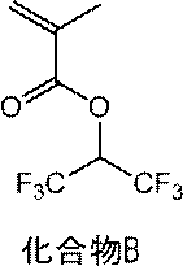
攪拌羽根、温度計、冷却管、氷浴を備えた200mLフラスコに、ヘキサフルオロイソプロピルアルコール11.6g(68.9mmol、TCI製)、テトラヒドロフラン50mLを仕込んで、5℃になるまで氷浴にて冷却した。ここにメタクリル酸クロライド8.0g(TCI社製、76.5mmol)を10分かけて滴下した後、内温を25℃に昇温して4時間攪拌した。得られた化合物をカラムクロマトグラフィーにて精製し、化合物Bを合成した。収量は4.5g(収率28%)であった。
(重合体B-18の合成)
合成例2で用いたHFIPを上記化合物Bに、AME-400を50PEP-300に変更したこと以外は合成例2と同様にして、重合体B-18を合成した。
合成例2で用いたHFIPを上記化合物Bに、AME-400を50PEP-300に変更したこと以外は合成例2と同様にして、重合体B-18を合成した。
<合成例19>
(化合物Cの合成)
(化合物Cの合成)
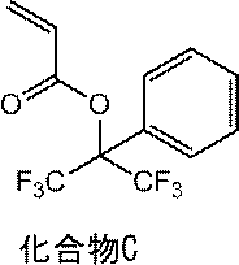
攪拌羽根、温度計、冷却管、氷浴を備えた200mLフラスコに、1,1,1,3,3,3-ヘキサフルオロ-2-フェニル-2-プロパノール19.4g(79.5mmol、TCI製)、テトラヒドロフラン50mLを仕込んで、5℃になるまで氷浴にて冷却した。ここにアクリル酸クロライド8.0g(TCI社製、88.4mmol)を10分かけて滴下した後、内温を25℃に昇温して4時間攪拌した。得られた化合物をカラムクロマトグラフィーにて精製し、化合物Cを合成した。収量は7.2g(収率30%)であった。
(重合体B-19の合成)
合成例2で用いたHFIPを上記化合物Cに、FAAC-6をFAMAC-4に変更したこと以外は合成例2と同様にして、重合体B-19を合成した。
合成例2で用いたHFIPを上記化合物Cに、FAAC-6をFAMAC-4に変更したこと以外は合成例2と同様にして、重合体B-19を合成した。
<合成例20~22>
(重合体C-1~C-5の合成)
モノマーの種類及びモノマー組成比をそれぞれ下記表1に示したように変更したこと以外は、合成例1と同様にして、重合体C-1~C-5を合成した。
(重合体C-1~C-5の合成)
モノマーの種類及びモノマー組成比をそれぞれ下記表1に示したように変更したこと以外は、合成例1と同様にして、重合体C-1~C-5を合成した。

それぞれの重合体のフッ素含率及び重量平均分子量(Mw)を下記表1に示す。
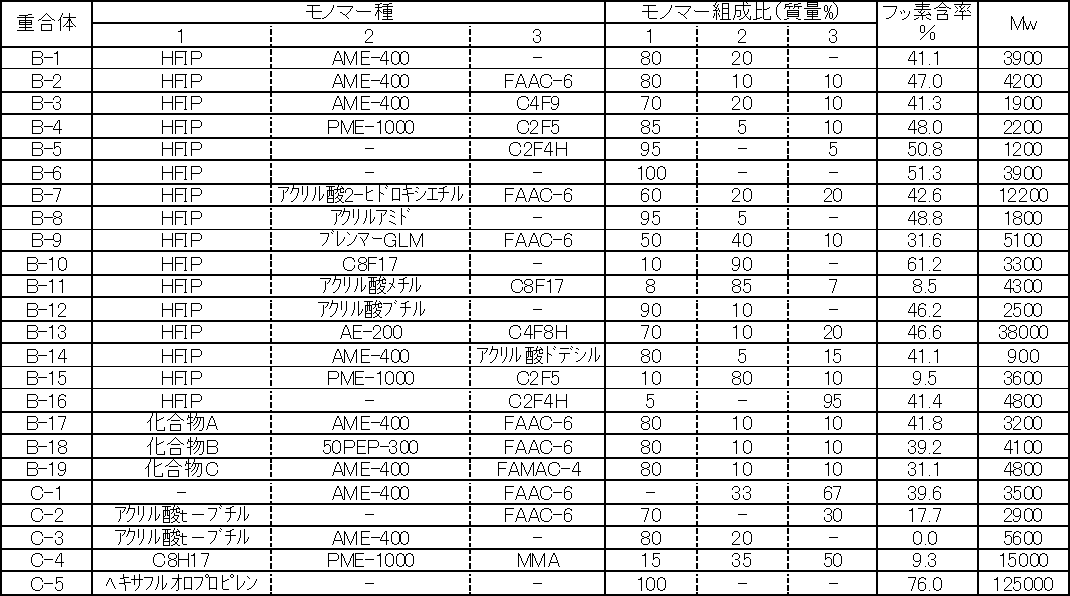
表1中の略記号は以下の意味を表す。
C4F9:2-(パーフルオロブチル)エチルアクリレート
C2F5:2,2,3,3,3-ペンタフルオロプロピルアクリラート
C2F4H:2,2,3,3-テトラフルオロプロピルアクリレート
C8F17:2-(パーフルオロオクチル)エチルアクリレート
C4F8H:1H,1H,5H-オクタフルオロペンチルアクリレート
AME-400:ブレンマーAME-400(日油株式会社製)
PME-1000:ブレンマーPME-1000(日油株式会社製)
AE-200:ブレンマーAE-200(日油株式会社製)
ブレンマーGLM:ブレンマーGLM(日油株式会社製)
FAAC-6:2-(パーフルオロヘキシル)エチルアクリレート(ユニマテック株式会社製)
MMA:メタクリル酸メチル
50PEP-300:ポリエチレングリコール-プロピレングリコール-モノメタクリレート(日油株式会社製)
FAMAC-4:(2-パーフルオロブチル)エチルメタクリレート(ユニマテック株式会社製)
C4F9:2-(パーフルオロブチル)エチルアクリレート
C2F5:2,2,3,3,3-ペンタフルオロプロピルアクリラート
C2F4H:2,2,3,3-テトラフルオロプロピルアクリレート
C8F17:2-(パーフルオロオクチル)エチルアクリレート
C4F8H:1H,1H,5H-オクタフルオロペンチルアクリレート
AME-400:ブレンマーAME-400(日油株式会社製)
PME-1000:ブレンマーPME-1000(日油株式会社製)
AE-200:ブレンマーAE-200(日油株式会社製)
ブレンマーGLM:ブレンマーGLM(日油株式会社製)
FAAC-6:2-(パーフルオロヘキシル)エチルアクリレート(ユニマテック株式会社製)
MMA:メタクリル酸メチル
50PEP-300:ポリエチレングリコール-プロピレングリコール-モノメタクリレート(日油株式会社製)
FAMAC-4:(2-パーフルオロブチル)エチルメタクリレート(ユニマテック株式会社製)
(ハードコート層塗布液A-1の調製)
下記の組成となるように、各成分を混合し、固形分濃度が約55質量%となるハードコート層塗布液(膜形成用組成物)A-1を作製した。
―――――――――――――――――――――――――――――――――
ハードコート層塗布液A-1の組成
―――――――――――――――――――――――――――――――――
DPHA(dipenthaerythiritol hexa acrylate):KAYARD DPHA(日本化薬(株)製)(6官能)
29.6質量部
イルガキュア184:アルキルフェノン系光重合開始剤(BASF製)
2.20質量部
3,4-エポキシシクロヘキシルメチルメタクリレート:サイクロマーM100((株)ダイセル製、分子量196) 13.8質量部
化合物1 0.55質量部
重合体B-1 0.06質量部
MEK-AC-2140Z(平均粒径10~20nm、球形シリカ微粒子(日産化学工業(株)製)) 8.25質量部
Tinuvin928:ベンゾトリアゾール系紫外線吸収剤(BASF製) 0.55質量部
メチルエチルケトン 16.7質量部
メチルイソブチルケトン 19.8質量部
酢酸メチル: 8.5質量部
―――――――――――――――――――――――――――――――――
下記の組成となるように、各成分を混合し、固形分濃度が約55質量%となるハードコート層塗布液(膜形成用組成物)A-1を作製した。
―――――――――――――――――――――――――――――――――
ハードコート層塗布液A-1の組成
―――――――――――――――――――――――――――――――――
DPHA(dipenthaerythiritol hexa acrylate):KAYARD DPHA(日本化薬(株)製)(6官能)
29.6質量部
イルガキュア184:アルキルフェノン系光重合開始剤(BASF製)
2.20質量部
3,4-エポキシシクロヘキシルメチルメタクリレート:サイクロマーM100((株)ダイセル製、分子量196) 13.8質量部
化合物1 0.55質量部
重合体B-1 0.06質量部
MEK-AC-2140Z(平均粒径10~20nm、球形シリカ微粒子(日産化学工業(株)製)) 8.25質量部
Tinuvin928:ベンゾトリアゾール系紫外線吸収剤(BASF製) 0.55質量部
メチルエチルケトン 16.7質量部
メチルイソブチルケトン 19.8質量部
酢酸メチル: 8.5質量部
―――――――――――――――――――――――――――――――――
化合物1は特許第4841935号公報の実施例1に記載の方法で合成した。
化合物1:
化合物1:

<ハードコート層塗布液A-2~A-24の調製>
重合体B-1を、下記表2に記載の重合体に替えた以外は上記ハードコート層塗布液A-1と同様にして、ハードコート層塗布液A-2~A-24を調製した。
重合体B-1を、下記表2に記載の重合体に替えた以外は上記ハードコート層塗布液A-1と同様にして、ハードコート層塗布液A-2~A-24を調製した。
<ハードコート層の塗工>
ロール形態から巻き出したTJ25(富士フイルム株式会社製、ロール形態、80μm厚さのトリアセチルセルロースフィルム)を支持体とし、支持体上にハードコート層塗布液A-1~A-24を塗工し、ハードコートフィルムS-1~S-24を作製した。
具体的には、支持体上に、特開2006-122889号公報実施例1記載のスロットダイを用いたダイコート法で、搬送速度30m/分の条件で各塗布液を塗布して塗布層を得、これを60℃で150秒乾燥の後、更に窒素パージ下酸素濃度約0.1体積%で160W/cmの空冷メタルハライドランプ(アイグラフィックス(株)製)を用いて、照度400mW/cm2、照射量500mJ/cm2の紫外線を照射して、乾燥後の塗布層を硬化させてハードコート層を形成した後、巻き取った。
ロール形態から巻き出したTJ25(富士フイルム株式会社製、ロール形態、80μm厚さのトリアセチルセルロースフィルム)を支持体とし、支持体上にハードコート層塗布液A-1~A-24を塗工し、ハードコートフィルムS-1~S-24を作製した。
具体的には、支持体上に、特開2006-122889号公報実施例1記載のスロットダイを用いたダイコート法で、搬送速度30m/分の条件で各塗布液を塗布して塗布層を得、これを60℃で150秒乾燥の後、更に窒素パージ下酸素濃度約0.1体積%で160W/cmの空冷メタルハライドランプ(アイグラフィックス(株)製)を用いて、照度400mW/cm2、照射量500mJ/cm2の紫外線を照射して、乾燥後の塗布層を硬化させてハードコート層を形成した後、巻き取った。
作製したハードコートフィルムS-1~S-24を下記評価方法で評価した。
{ハードコート層の膜厚}
ハードコート層の膜厚は、接触式の膜厚計を用いてハードコートフィルムの膜厚を測定し、そこから同様に測定した支持体厚みを引いて算出した。ハードコートフィルムS-1~S-24の全てにおいて、ハードコート層の膜厚は、6.0μmであった。
ハードコート層の膜厚は、接触式の膜厚計を用いてハードコートフィルムの膜厚を測定し、そこから同様に測定した支持体厚みを引いて算出した。ハードコートフィルムS-1~S-24の全てにおいて、ハードコート層の膜厚は、6.0μmであった。
{ハードコート層の面状均一性}
ハードコートフィルムの支持体表面のうち、ハードコート層側とは反対側の面(裏面)の反射を防止するため、裏面を黒色マーカーで塗りつぶした後に、拡散板が前面に取りつけられた3波長蛍光灯下でハードコートフィルムのおもて面(ハードコート層側の表面)を観察した。おもて面からハードコートフィルムを目視しで観察し、下記評価基準にて評価した。
下記評価基準でA~C評価を合格とした。
A:干渉縞はなかった。
B:干渉縞はごく僅かにみられるが、気にならない
C:干渉縞がところどころにみられるが、製品として許容されるものであった。
D:干渉縞が強く発生し、問題になる。
ハードコートフィルムの支持体表面のうち、ハードコート層側とは反対側の面(裏面)の反射を防止するため、裏面を黒色マーカーで塗りつぶした後に、拡散板が前面に取りつけられた3波長蛍光灯下でハードコートフィルムのおもて面(ハードコート層側の表面)を観察した。おもて面からハードコートフィルムを目視しで観察し、下記評価基準にて評価した。
下記評価基準でA~C評価を合格とした。
A:干渉縞はなかった。
B:干渉縞はごく僅かにみられるが、気にならない
C:干渉縞がところどころにみられるが、製品として許容されるものであった。
D:干渉縞が強く発生し、問題になる。
(ハードコートフィルムのアルカリ処理)
作製したハードコートフィルムを、45℃に保った1.5mol/LのNaOH水溶液に2分間浸漬した後、フィルムを水洗し、その後、30℃の0.1mol/Lの硫酸水溶液に15秒浸漬した後、更に100秒間、流水下に通して、フィルムを中性の状態にした。そして、エアナイフによる水切りを3回繰り返し、水を落とした後に90℃の乾燥ゾーンに60秒間滞留させて乾燥し、ハードコートフィルムをアルカリ処理(鹸化処理)した。
作製したハードコートフィルムを、45℃に保った1.5mol/LのNaOH水溶液に2分間浸漬した後、フィルムを水洗し、その後、30℃の0.1mol/Lの硫酸水溶液に15秒浸漬した後、更に100秒間、流水下に通して、フィルムを中性の状態にした。そして、エアナイフによる水切りを3回繰り返し、水を落とした後に90℃の乾燥ゾーンに60秒間滞留させて乾燥し、ハードコートフィルムをアルカリ処理(鹸化処理)した。
{水の接触角}
接触角計[“CA-X”型接触角計、協和界面科学(株)製]を用い、乾燥状態(20℃、相対湿度65%)で、液体として純水を使用して3μLの液滴を針先に作り、これをアルカリ処理したハードコートフィルムのハードコート層表面に接触させてハードコート層上に液滴を作った。滴下後10秒間経過した時点でのハードコート層と液体とが接する点における、液体表面に対する接線とフィルム表面がなす角で、液体が存在する側の角度を測定し、接触角とした。その結果を以下の基準で評価し、A~Cを合格、Dを不合格とした。
A:接触角が50°以下
B:接触角が50°を超え60°以下
C:接触角が60°を超え75°以下
D:接触角が75°を超える
接触角計[“CA-X”型接触角計、協和界面科学(株)製]を用い、乾燥状態(20℃、相対湿度65%)で、液体として純水を使用して3μLの液滴を針先に作り、これをアルカリ処理したハードコートフィルムのハードコート層表面に接触させてハードコート層上に液滴を作った。滴下後10秒間経過した時点でのハードコート層と液体とが接する点における、液体表面に対する接線とフィルム表面がなす角で、液体が存在する側の角度を測定し、接触角とした。その結果を以下の基準で評価し、A~Cを合格、Dを不合格とした。
A:接触角が50°以下
B:接触角が50°を超え60°以下
C:接触角が60°を超え75°以下
D:接触角が75°を超える
結果を下記表2に示した。
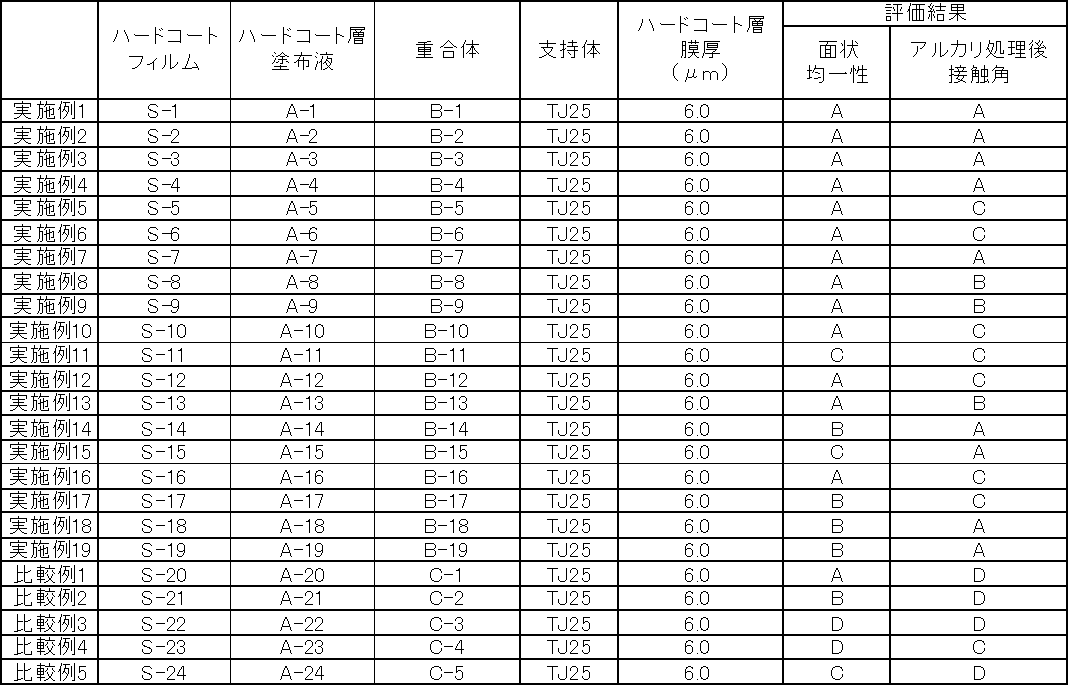
上記表2に示すように、本発明の実施例である、一般式(I)で表される繰り返し単位を有する重合体B-1~B-19を含む膜形成用組成物(ハードコート層塗布液A-1~A-19)を用いて形成したハードコートフィルムは、面状均一性に優れ、かつアルカリ処理後の接触角が小さく、親水性が高く、すなわち他の層との積層性にも優れることが分かった。
本発明の膜形成用組成物は、面状均一性に優れ、かつ簡便な処理により他の層との積層性も向上できる膜を形成することができる。また、本発明によると、上記組成物から形成された膜を有するハードコートフィルム、及び偏光板を得ることができる。更に、本発明の親水化ハードコートフィルムの製造方法は、面状均一性に優れ、かつ他の層との積層性に優れる親水化ハードコートフィルムを製造することができる。
本発明を詳細にまた特定の実施態様を参照して説明したが、本発明の精神と範囲を逸脱することなく様々な変更や修正を加えることができることは当業者にとって明らかである。
本出願は、2015年12月18日出願の日本特許出願(特願2015-247995)に基づくものであり、その内容はここに参照として取り込まれる。
本出願は、2015年12月18日出願の日本特許出願(特願2015-247995)に基づくものであり、その内容はここに参照として取り込まれる。
Claims (7)
- 下記一般式(I)で表される繰り返し単位を有する重合体と、硬化性化合物とを含む膜形成用組成物。

一般式(I)中、R1は水素原子又は炭素原子数1~20のアルキル基を表し、Lはエステル結合、エーテル結合、フェニレン基又はアミド結合を表し、R2及びR4は各々独立に、水素原子、ハロゲン原子、炭素原子数1~20のアルキル基、又は炭素原子数1~20のハロゲン化アルキル基を表し、R3は水素原子又は置換基を表す。 - 前記重合体が、更に下記一般式(II)で表される繰り返し単位を有する、請求項1に記載の膜形成用組成物。

一般式(II)中、R21は水素原子又は炭素原子数1~20のアルキル基を表し、R22は水素原子、炭素原子数1~20のアルキル基、又は炭素原子数6~12のアリール基を表し、L2はエステル結合、エーテル結合、フェニレン基又はアミド結合を表し、m及びpは各々独立に1~4の整数を表し、nは1~30の数を表し、qは0~30の数を表す。 - 前記重合体中のフッ素原子の含有率が、前記重合体の全質量に対して、5質量%以上80質量%以下である、請求項1又は2に記載の膜形成用組成物。
- 前記重合体中の前記一般式(I)で表される繰り返し単位の含有率が、前記重合体の全質量に対して、3~100質量%である、請求項1~3のいずれか一項に記載の膜形成用組成物。
- 請求項1~4のいずれか一項に記載の膜形成用組成物から形成された膜を有するハードコートフィルム。
- 請求項5に記載のハードコートフィルムを有する偏光板。
- 支持体上に請求項1~4のいずれか一項に記載の膜形成用組成物を塗工してハードコートフィルムを形成する工程と、
前記ハードコートフィルムをアルカリ処理する工程と、
を有する親水化ハードコートフィルムの製造方法。
Priority Applications (1)
| Application Number | Priority Date | Filing Date | Title |
|---|---|---|---|
| US16/005,845 US10641938B2 (en) | 2015-12-18 | 2018-06-12 | Film forming composition, hardcoat film, polarizing plate, and method for manufacturing hydrophilized hardcoat film |
Applications Claiming Priority (2)
| Application Number | Priority Date | Filing Date | Title |
|---|---|---|---|
| JP2015-247995 | 2015-12-18 | ||
| JP2015247995A JP6586363B2 (ja) | 2015-12-18 | 2015-12-18 | 膜形成用組成物、ハードコートフィルム、偏光板、及び親水化ハードコートフィルムの製造方法 |
Related Child Applications (1)
| Application Number | Title | Priority Date | Filing Date |
|---|---|---|---|
| US16/005,845 Continuation US10641938B2 (en) | 2015-12-18 | 2018-06-12 | Film forming composition, hardcoat film, polarizing plate, and method for manufacturing hydrophilized hardcoat film |
Publications (1)
| Publication Number | Publication Date |
|---|---|
| WO2017104549A1 true WO2017104549A1 (ja) | 2017-06-22 |
Family
ID=59056685
Family Applications (1)
| Application Number | Title | Priority Date | Filing Date |
|---|---|---|---|
| PCT/JP2016/086622 Ceased WO2017104549A1 (ja) | 2015-12-18 | 2016-12-08 | 膜形成用組成物、ハードコートフィルム、偏光板、及び親水化ハードコートフィルムの製造方法 |
Country Status (3)
| Country | Link |
|---|---|
| US (1) | US10641938B2 (ja) |
| JP (1) | JP6586363B2 (ja) |
| WO (1) | WO2017104549A1 (ja) |
Families Citing this family (2)
| Publication number | Priority date | Publication date | Assignee | Title |
|---|---|---|---|---|
| CN113227275A (zh) * | 2018-11-30 | 2021-08-06 | 大金工业株式会社 | 防雾涂料用组合物 |
| CN112920046A (zh) * | 2021-01-26 | 2021-06-08 | 宁波南大光电材料有限公司 | 甲基丙烯酸六氟异丙酯及其制备方法 |
Citations (5)
| Publication number | Priority date | Publication date | Assignee | Title |
|---|---|---|---|---|
| JPH01106001A (ja) * | 1987-10-20 | 1989-04-24 | Mitsubishi Rayon Co Ltd | 光フアイバー鞘材用樹脂組成物 |
| JP2004155847A (ja) * | 2002-11-05 | 2004-06-03 | Kanto Denka Kogyo Co Ltd | 不飽和二重結合を含有する含フッ素共重合体及びこれを含む組成物 |
| JP2007246715A (ja) * | 2006-03-16 | 2007-09-27 | Fujifilm Corp | 塗布組成物、光学フィルム、反射防止フィルム、偏光板及びそれらを用いたディスプレイ装置 |
| JP2013245289A (ja) * | 2012-05-25 | 2013-12-09 | Dic Corp | 反射防止塗料組成物及び反射防止フィルム |
| JP2014137454A (ja) * | 2013-01-16 | 2014-07-28 | Jsr Corp | ポジ型感放射線性樹脂組成物、硬化膜及びその形成方法、半導体素子、並びに表示素子 |
Family Cites Families (5)
| Publication number | Priority date | Publication date | Assignee | Title |
|---|---|---|---|---|
| JP4868194B2 (ja) * | 2001-02-27 | 2012-02-01 | Dic株式会社 | コーティング用組成物 |
| JP4474114B2 (ja) | 2003-05-07 | 2010-06-02 | 富士フイルム株式会社 | フルオロ脂肪族基含有ポリマーを含む組成物、フィルム、偏光板 |
| JP2005248116A (ja) | 2004-03-08 | 2005-09-15 | Dainippon Ink & Chem Inc | 含フッ素密着性向上剤 |
| JP4520377B2 (ja) | 2005-07-05 | 2010-08-04 | 富士フイルム株式会社 | 含フッ素共重合体およびその製造方法 |
| JP2011225846A (ja) * | 2010-03-31 | 2011-11-10 | Fujifilm Corp | ハードコート層形成用組成物、光学フィルム、光学フィルムの製造方法、偏光板、及び画像表示装置 |
-
2015
- 2015-12-18 JP JP2015247995A patent/JP6586363B2/ja active Active
-
2016
- 2016-12-08 WO PCT/JP2016/086622 patent/WO2017104549A1/ja not_active Ceased
-
2018
- 2018-06-12 US US16/005,845 patent/US10641938B2/en active Active
Patent Citations (5)
| Publication number | Priority date | Publication date | Assignee | Title |
|---|---|---|---|---|
| JPH01106001A (ja) * | 1987-10-20 | 1989-04-24 | Mitsubishi Rayon Co Ltd | 光フアイバー鞘材用樹脂組成物 |
| JP2004155847A (ja) * | 2002-11-05 | 2004-06-03 | Kanto Denka Kogyo Co Ltd | 不飽和二重結合を含有する含フッ素共重合体及びこれを含む組成物 |
| JP2007246715A (ja) * | 2006-03-16 | 2007-09-27 | Fujifilm Corp | 塗布組成物、光学フィルム、反射防止フィルム、偏光板及びそれらを用いたディスプレイ装置 |
| JP2013245289A (ja) * | 2012-05-25 | 2013-12-09 | Dic Corp | 反射防止塗料組成物及び反射防止フィルム |
| JP2014137454A (ja) * | 2013-01-16 | 2014-07-28 | Jsr Corp | ポジ型感放射線性樹脂組成物、硬化膜及びその形成方法、半導体素子、並びに表示素子 |
Also Published As
| Publication number | Publication date |
|---|---|
| US20180292589A1 (en) | 2018-10-11 |
| JP6586363B2 (ja) | 2019-10-02 |
| US10641938B2 (en) | 2020-05-05 |
| JP2017110172A (ja) | 2017-06-22 |
Similar Documents
| Publication | Publication Date | Title |
|---|---|---|
| JP6728581B2 (ja) | 光吸収異方性膜、3次元光吸収異方性膜及びその製造方法 | |
| JP5909403B2 (ja) | 反射防止フィルムの製造方法、塗布組成物、及び塗布組成物の製造方法 | |
| JP2006058574A (ja) | ハードコートフィルム | |
| JP2008197320A (ja) | 防眩性コーティング組成物、防眩フィルムおよびその製造方法 | |
| KR20180136575A (ko) | 광학 필름, 방현성 필름 및 편광판 | |
| JP2012078541A (ja) | 光学フィルム、偏光板、画像表示装置、及び光学フィルムの製造方法 | |
| CN104395788B (zh) | 偏光板和包括该偏光板的图像显示装置 | |
| KR102090414B1 (ko) | 안경 렌즈의 제조 방법 | |
| CN112654685B (zh) | 自由基系粘接剂组合物、粘接剂层、偏振片和影像显示装置 | |
| US10732454B2 (en) | Laminated film, manufacturing method thereof, polarizing plate, liquid crystal panel, and liquid crystal display device | |
| JP2019139221A (ja) | 組成物 | |
| KR20160001688A (ko) | 편광판 보호 필름, 편광판, 화상 표시 장치, 및 편광판 보호 필름의 제조 방법 | |
| US11300712B2 (en) | Laminate, polarizing plate, and image display device | |
| WO2019159887A1 (ja) | 垂直配向液晶硬化膜 | |
| KR20160037117A (ko) | 광학 필름 및 그것을 구비한 편광판, 액정 표시 장치, 및 광학 필름의 제조 방법 | |
| JP6586363B2 (ja) | 膜形成用組成物、ハードコートフィルム、偏光板、及び親水化ハードコートフィルムの製造方法 | |
| JP5449760B2 (ja) | 塗布組成物、積層体及び積層体の製造方法 | |
| JP5732415B2 (ja) | 反射防止フィルムの製造方法、反射防止フィルム、塗布組成物 | |
| CN107849184A (zh) | 含氟共聚物、组合物、光学膜、硬涂膜、偏振片及触摸面板显示器、以及含氟共聚物的制造方法 | |
| JP6574731B2 (ja) | 光学フィルム、偏光板、及び画像表示装置 | |
| JP2012183452A (ja) | 積層フィルムの製造方法 | |
| JP6507116B2 (ja) | 光学フィルム、偏光板、液晶表示装置、及び光学フィルムの製造方法 | |
| KR20230000955A (ko) | 광학 적층체 및 표시 장치 | |
| JP2012198317A (ja) | 反射防止フィルム、反射防止性偏光板、及び透過型液晶ディスプレイ | |
| WO2017057526A1 (ja) | ハードコートフィルム、偏光板及び画像表示装置 |
Legal Events
| Date | Code | Title | Description |
|---|---|---|---|
| 121 | Ep: the epo has been informed by wipo that ep was designated in this application |
Ref document number: 16875529 Country of ref document: EP Kind code of ref document: A1 |
|
| NENP | Non-entry into the national phase |
Ref country code: DE |
|
| 122 | Ep: pct application non-entry in european phase |
Ref document number: 16875529 Country of ref document: EP Kind code of ref document: A1 |