WO2017104501A1 - 包装袋およびそれを用いた溶融成形用ポリビニルアルコール系樹脂の保存方法 - Google Patents
包装袋およびそれを用いた溶融成形用ポリビニルアルコール系樹脂の保存方法 Download PDFInfo
- Publication number
- WO2017104501A1 WO2017104501A1 PCT/JP2016/086343 JP2016086343W WO2017104501A1 WO 2017104501 A1 WO2017104501 A1 WO 2017104501A1 JP 2016086343 W JP2016086343 W JP 2016086343W WO 2017104501 A1 WO2017104501 A1 WO 2017104501A1
- Authority
- WO
- WIPO (PCT)
- Prior art keywords
- packaging bag
- polyvinyl alcohol
- resin
- melt molding
- alcohol resin
- Prior art date
- Legal status (The legal status is an assumption and is not a legal conclusion. Google has not performed a legal analysis and makes no representation as to the accuracy of the status listed.)
- Ceased
Links
Classifications
-
- B—PERFORMING OPERATIONS; TRANSPORTING
- B65—CONVEYING; PACKING; STORING; HANDLING THIN OR FILAMENTARY MATERIAL
- B65D—CONTAINERS FOR STORAGE OR TRANSPORT OF ARTICLES OR MATERIALS, e.g. BAGS, BARRELS, BOTTLES, BOXES, CANS, CARTONS, CRATES, DRUMS, JARS, TANKS, HOPPERS, FORWARDING CONTAINERS; ACCESSORIES, CLOSURES, OR FITTINGS THEREFOR; PACKAGING ELEMENTS; PACKAGES
- B65D65/00—Wrappers or flexible covers; Packaging materials of special type or form
- B65D65/38—Packaging materials of special type or form
- B65D65/40—Applications of laminates for particular packaging purposes
-
- B—PERFORMING OPERATIONS; TRANSPORTING
- B32—LAYERED PRODUCTS
- B32B—LAYERED PRODUCTS, i.e. PRODUCTS BUILT-UP OF STRATA OF FLAT OR NON-FLAT, e.g. CELLULAR OR HONEYCOMB, FORM
- B32B27/00—Layered products comprising a layer of synthetic resin
- B32B27/06—Layered products comprising a layer of synthetic resin as the main or only constituent of a layer, which is next to another layer of the same or of a different material
- B32B27/08—Layered products comprising a layer of synthetic resin as the main or only constituent of a layer, which is next to another layer of the same or of a different material of synthetic resin
-
- B—PERFORMING OPERATIONS; TRANSPORTING
- B32—LAYERED PRODUCTS
- B32B—LAYERED PRODUCTS, i.e. PRODUCTS BUILT-UP OF STRATA OF FLAT OR NON-FLAT, e.g. CELLULAR OR HONEYCOMB, FORM
- B32B27/00—Layered products comprising a layer of synthetic resin
- B32B27/06—Layered products comprising a layer of synthetic resin as the main or only constituent of a layer, which is next to another layer of the same or of a different material
- B32B27/10—Layered products comprising a layer of synthetic resin as the main or only constituent of a layer, which is next to another layer of the same or of a different material of paper or cardboard
-
- B—PERFORMING OPERATIONS; TRANSPORTING
- B32—LAYERED PRODUCTS
- B32B—LAYERED PRODUCTS, i.e. PRODUCTS BUILT-UP OF STRATA OF FLAT OR NON-FLAT, e.g. CELLULAR OR HONEYCOMB, FORM
- B32B27/00—Layered products comprising a layer of synthetic resin
- B32B27/28—Layered products comprising a layer of synthetic resin comprising synthetic resins not wholly covered by any one of the sub-groups B32B27/30 - B32B27/42
- B32B27/285—Layered products comprising a layer of synthetic resin comprising synthetic resins not wholly covered by any one of the sub-groups B32B27/30 - B32B27/42 comprising polyethers
-
- B—PERFORMING OPERATIONS; TRANSPORTING
- B32—LAYERED PRODUCTS
- B32B—LAYERED PRODUCTS, i.e. PRODUCTS BUILT-UP OF STRATA OF FLAT OR NON-FLAT, e.g. CELLULAR OR HONEYCOMB, FORM
- B32B27/00—Layered products comprising a layer of synthetic resin
- B32B27/32—Layered products comprising a layer of synthetic resin comprising polyolefins
-
- B—PERFORMING OPERATIONS; TRANSPORTING
- B32—LAYERED PRODUCTS
- B32B—LAYERED PRODUCTS, i.e. PRODUCTS BUILT-UP OF STRATA OF FLAT OR NON-FLAT, e.g. CELLULAR OR HONEYCOMB, FORM
- B32B27/00—Layered products comprising a layer of synthetic resin
- B32B27/34—Layered products comprising a layer of synthetic resin comprising polyamides
-
- B—PERFORMING OPERATIONS; TRANSPORTING
- B32—LAYERED PRODUCTS
- B32B—LAYERED PRODUCTS, i.e. PRODUCTS BUILT-UP OF STRATA OF FLAT OR NON-FLAT, e.g. CELLULAR OR HONEYCOMB, FORM
- B32B27/00—Layered products comprising a layer of synthetic resin
- B32B27/36—Layered products comprising a layer of synthetic resin comprising polyesters
-
- B—PERFORMING OPERATIONS; TRANSPORTING
- B32—LAYERED PRODUCTS
- B32B—LAYERED PRODUCTS, i.e. PRODUCTS BUILT-UP OF STRATA OF FLAT OR NON-FLAT, e.g. CELLULAR OR HONEYCOMB, FORM
- B32B27/00—Layered products comprising a layer of synthetic resin
- B32B27/40—Layered products comprising a layer of synthetic resin comprising polyurethanes
-
- B—PERFORMING OPERATIONS; TRANSPORTING
- B32—LAYERED PRODUCTS
- B32B—LAYERED PRODUCTS, i.e. PRODUCTS BUILT-UP OF STRATA OF FLAT OR NON-FLAT, e.g. CELLULAR OR HONEYCOMB, FORM
- B32B29/00—Layered products comprising a layer of paper or cardboard
- B32B29/002—Layered products comprising a layer of paper or cardboard as the main or only constituent of a layer, which is next to another layer of the same or of a different material
-
- B—PERFORMING OPERATIONS; TRANSPORTING
- B65—CONVEYING; PACKING; STORING; HANDLING THIN OR FILAMENTARY MATERIAL
- B65D—CONTAINERS FOR STORAGE OR TRANSPORT OF ARTICLES OR MATERIALS, e.g. BAGS, BARRELS, BOTTLES, BOXES, CANS, CARTONS, CRATES, DRUMS, JARS, TANKS, HOPPERS, FORWARDING CONTAINERS; ACCESSORIES, CLOSURES, OR FITTINGS THEREFOR; PACKAGING ELEMENTS; PACKAGES
- B65D81/00—Containers, packaging elements, or packages, for contents presenting particular transport or storage problems, or adapted to be used for non-packaging purposes after removal of contents
- B65D81/24—Adaptations for preventing deterioration or decay of contents; Applications to the container or packaging material of food preservatives, fungicides, pesticides or animal repellants
- B65D81/26—Adaptations for preventing deterioration or decay of contents; Applications to the container or packaging material of food preservatives, fungicides, pesticides or animal repellants with provision for draining away, or absorbing, or removing by ventilation, fluids, e.g. exuded by contents; Applications of corrosion inhibitors or desiccators
-
- B—PERFORMING OPERATIONS; TRANSPORTING
- B32—LAYERED PRODUCTS
- B32B—LAYERED PRODUCTS, i.e. PRODUCTS BUILT-UP OF STRATA OF FLAT OR NON-FLAT, e.g. CELLULAR OR HONEYCOMB, FORM
- B32B2250/00—Layers arrangement
- B32B2250/03—3 layers
-
- B—PERFORMING OPERATIONS; TRANSPORTING
- B32—LAYERED PRODUCTS
- B32B—LAYERED PRODUCTS, i.e. PRODUCTS BUILT-UP OF STRATA OF FLAT OR NON-FLAT, e.g. CELLULAR OR HONEYCOMB, FORM
- B32B2250/00—Layers arrangement
- B32B2250/40—Symmetrical or sandwich layers, e.g. ABA, ABCBA, ABCCBA
-
- B—PERFORMING OPERATIONS; TRANSPORTING
- B32—LAYERED PRODUCTS
- B32B—LAYERED PRODUCTS, i.e. PRODUCTS BUILT-UP OF STRATA OF FLAT OR NON-FLAT, e.g. CELLULAR OR HONEYCOMB, FORM
- B32B2307/00—Properties of the layers or laminate
- B32B2307/30—Properties of the layers or laminate having particular thermal properties
- B32B2307/31—Heat sealable
-
- B—PERFORMING OPERATIONS; TRANSPORTING
- B32—LAYERED PRODUCTS
- B32B—LAYERED PRODUCTS, i.e. PRODUCTS BUILT-UP OF STRATA OF FLAT OR NON-FLAT, e.g. CELLULAR OR HONEYCOMB, FORM
- B32B2307/00—Properties of the layers or laminate
- B32B2307/70—Other properties
- B32B2307/724—Permeability to gases, adsorption
-
- B—PERFORMING OPERATIONS; TRANSPORTING
- B32—LAYERED PRODUCTS
- B32B—LAYERED PRODUCTS, i.e. PRODUCTS BUILT-UP OF STRATA OF FLAT OR NON-FLAT, e.g. CELLULAR OR HONEYCOMB, FORM
- B32B2307/00—Properties of the layers or laminate
- B32B2307/70—Other properties
- B32B2307/724—Permeability to gases, adsorption
- B32B2307/7242—Non-permeable
- B32B2307/7246—Water vapor barrier
-
- B—PERFORMING OPERATIONS; TRANSPORTING
- B32—LAYERED PRODUCTS
- B32B—LAYERED PRODUCTS, i.e. PRODUCTS BUILT-UP OF STRATA OF FLAT OR NON-FLAT, e.g. CELLULAR OR HONEYCOMB, FORM
- B32B2307/00—Properties of the layers or laminate
- B32B2307/70—Other properties
- B32B2307/732—Dimensional properties
-
- B—PERFORMING OPERATIONS; TRANSPORTING
- B32—LAYERED PRODUCTS
- B32B—LAYERED PRODUCTS, i.e. PRODUCTS BUILT-UP OF STRATA OF FLAT OR NON-FLAT, e.g. CELLULAR OR HONEYCOMB, FORM
- B32B2439/00—Containers; Receptacles
- B32B2439/40—Closed containers
- B32B2439/46—Bags
-
- B—PERFORMING OPERATIONS; TRANSPORTING
- B32—LAYERED PRODUCTS
- B32B—LAYERED PRODUCTS, i.e. PRODUCTS BUILT-UP OF STRATA OF FLAT OR NON-FLAT, e.g. CELLULAR OR HONEYCOMB, FORM
- B32B2553/00—Packaging equipment or accessories not otherwise provided for
Definitions
- the present invention relates to a packaging bag for packaging a polyvinyl alcohol resin for melt molding and a method for preserving a polyvinyl alcohol resin for melt molding using the same, and more particularly, a polyvinyl alcohol resin for melt molding having excellent molding stability.
- the present invention relates to a packaging bag capable of obtaining a resin and a method for storing a polyvinyl alcohol resin for melt molding.
- Polyvinyl alcohol (hereinafter sometimes referred to as “PVA”) resin used for melt molding is generally synthesized and manufactured using an organic solvent such as methanol, and is usually solid (powder, granules, etc.) It is used for storage and distribution.
- a packaging bag having a high water vapor barrier property such as an aluminum bag having moisture resistance is used in order to prevent moisture absorption.
- Such a packaging bag is used for various hydrophilic resins used for melt molding. For example, saponified ethylene-vinyl acetate copolymer or 1,2- It is also used for PVA resin having a structural unit having a glycol bond.
- Water-insoluble resin such as saponified ethylene-vinyl acetate copolymer is cooled and washed with water, and the residual organic solvent is very small. Water-soluble PVA resin can be washed with water. In general, the organic solvent used in the production process, such as methanol, remains.
- the present invention has been made in view of such circumstances, and when packaging and storing a PVA resin for melt molding, the organic solvent contained is vaporized and released, thereby improving molding stability.
- the present invention provides a packaging bag that can provide a PVA-based resin for melt molding and a method for storing the PVA-based resin for melt molding using the same.
- the present inventors have repeated research focusing on the characteristics of packaging bags used when sealing and storing the PVA-based resin for melt molding.
- the organic solvent for example, methanol
- the physical properties for releasing the vaporized methanol permeating through the packaging bag to the outside air are specified. It has been found that the above-mentioned problems can be solved by using a packaging bag made of a film having a methanol vapor permeability, so-called vaporized and vaporized methanol that easily permeates methanol.
- the first gist of the present invention is a packaging bag for packaging a PVA-based resin for melt molding, which is made of a film having a methanol vapor permeability of 0.5 to 1000 g / m 2 ⁇ day. .
- the present invention also relates to a melt-molding PVA system for sealing and packaging a melt-molded PVA resin particle using a packaging bag made of a film having a methanol vapor permeability of 0.5 to 1000 g / m 2 ⁇ day.
- the resin storage method is the second gist.
- the packaging bag of the present invention is a packaging bag for packaging a melt-molding PVA-based resin (hereinafter sometimes simply referred to as “PVA-based resin”), and has a specific methanol vapor permeability. It is a packaging bag made of a film. For this reason, by packaging the melt-molded PVA resin using this packaging bag, the organic solvent (for example, methanol) remaining in the sealed PVA resin becomes vapor and permeates the packaging bag to the outside air. PVA-based resin having a reduced organic solvent concentration after being stored in a packaging bag is obtained. As a result, it is possible to provide a PVA-based resin for melt molding with improved molding stability.
- PVA-based resin a melt-molding PVA-based resin
- the water vapor permeability of the film is 1000 g / m 2 ⁇ day or less, an increase in volatile content due to moisture absorption of the PVA-based resin can be suppressed even after long-term storage. It becomes possible to provide a resin.
- the packaging bag is a multilayer structure of base material layer / methanol vapor permeable film layer / protective layer, and particularly when at least one of the base material layer and the protective layer is kraft paper, it is particularly excellent in strength during transportation. It will be.
- the thickness of the packaging bag is 10 to 2000 ⁇ m, the cost, strength, etc. are more excellent.
- the packaging bag of the present invention is used when sealing and packaging a melt-molding PVA-based resin, and is characterized by comprising a film having a specific methanol vapor permeability.
- the packaging bag of the present invention may be a bag made of a single layer structure (single layer film) or a bag made of a multilayer structure (multilayer structure film), and methanol vapor of the film forming the structure permeability has a characteristic of 0.5 ⁇ 1000g / m 2 ⁇ day .
- the methanol vapor permeability is a value measured as follows. That is, according to JIS Z 0208 “Testing method for moisture permeation of moisture-proof packaging material”, methanol is sealed in a moisture permeable cup using various packaging materials, and left to stand at 23 ° C. and 50% RH. The methanol vapor permeability is calculated using the mass reduction of the cup after time as the methanol permeation amount.
- the packaging bag of the present invention preferably has a water vapor permeability of 1000 g / m 2 ⁇ day or less in addition to the specific methanol vapor permeability in the film forming the structure.
- the water vapor permeability is a value under the conditions of 40 ° C. and 90% RH measured according to JIS Z 0208.
- the packaging bag of the present invention usually consists of only a film layer that is permeable to methanol vapor (methanol vapor permeable film layer).
- the basic structure is usually composed of a base material layer / methanol vapor permeable film layer or a protective layer laminated base material layer / methanol vapor permeable film layer / protective layer. The configuration. Hereinafter, each layer will be described.
- the methanol vapor permeability of the methanol vapor permeable film layer is 0.5 to 1000 g / m 2 ⁇ day, preferably 0.5 to 500 g / m 2 ⁇ day, more preferably 1.0 to 100 g / m 2 ⁇ day, more preferably 1.0 to 50 g / m 2 ⁇ day, particularly preferably 1.0 to 25 g / m 2 ⁇ day, particularly preferably 1.5 to 6 g / m 2 ⁇ day. is there. If the above value is too large, there is a risk of taking in the volatile content of the organic solvent in the outside air. If the above value is too small, the organic solvent (for example, methanol) is effectively permeated into the outside air from the inside of the packaging bag and volatilized. The effect of the present invention cannot be obtained.
- the organic solvent for example, methanol
- the water vapor permeability is preferably 1000 g / m 2 ⁇ day or less, more preferably 750 g / m 2 ⁇ day or less, and particularly preferably 500 g / m 2 ⁇ day.
- it is more preferably 50 g / m 2 ⁇ day or less, particularly preferably 17 g / m 2 ⁇ day or less.
- the lower limit is usually 0.5 g / m 2 ⁇ day.
- the thickness of the methanol vapor permeable film layer is usually 1 to 500 ⁇ m, preferably 10 to 300 ⁇ m, particularly preferably 20 to 250 ⁇ m, and more preferably 50 to 200 ⁇ m. If the thickness is too thin, the water vapor permeability tends to increase. If the thickness is too thick, the cost tends to increase and the flexibility tends to decrease.
- Examples of the methanol vapor permeable film layer forming material include high density polyethylene, medium density polyethylene, low density polyethylene, polypropylene, and polyester.
- low density polyethylene is preferably used from the viewpoints of economy, flexibility, methanol vapor permeability, and water vapor barrier properties.
- low density polyethylene means polyethylene having an average density of 0.910 to 0.925 g / cm 3
- medium density polyethylene means that the average density is 0.926 to 0.940 g / cm 3
- Polyethylene is referred to, and high density polyethylene refers to polyethylene having an average density of 0.941 g / cm 3 or more.
- the methanol vapor permeable film layer may be a single layer or a multilayer film in which two or more kinds of the same or different films are laminated. Accordingly, the thickness of the methanol vapor permeable film layer means the thickness of a single layer in the case of a single layer and the total thickness of the multilayers in the case of a multilayer.
- the packaging bag of the present invention requires strength during transportation, it is usually preferable to provide a layer made of a paper material as a base material layer inside the methanol vapor permeable film layer.
- a paper material only needs to be strong enough to withstand transportation, but kraft paper is usually used.
- the thickness of such kraft paper is usually 10 to 1000 ⁇ m, preferably 50 to 500 ⁇ m, particularly preferably 70 to 200 ⁇ m. If the thickness of the kraft paper is too thin, the strength may be insufficient and may be torn. If it is too thick, it is heavy and unsuitable for transportation.
- the base layer may be a resin film.
- the resin film material include a polyester film, a polyolefin film, a polyamide film, a polyether film, and a polyurethane film. Particularly preferred is a polyamide film.
- the polyamide film include nylon 11, nylon 12, nylon 6, nylon 66, nylon 6, 66, and the like.
- a polyolefin film and a polyamide film are preferable, and a polyamide film and a low density polyethylene film are particularly preferable.
- the said base material layer in the case of a resin film
- the said base material layer may be a methanol vapor-permeable film layer, and in this case, the total thickness of the base material layer (in the case of a resin film) is also allowed to transmit methanol vapor. The thickness of the film layer.
- the thickness of the base material layer (in the case of a resin film) is usually 1 to 100 ⁇ m, preferably 5 to 50 ⁇ m, particularly preferably 10 to 30 ⁇ m. If the thickness is too thin, the strength may decrease and cause pinholes. If the thickness is too thick, the cost tends to increase.
- the base material layer may be a single layer or a multilayer structure in which two or more different paper materials or resin films are laminated. Moreover, even if the base material layer and the methanol permeable film layer are adhere
- the protective layer may be a methanol vapor permeable film layer. In this case, the thickness of the protective layer is also added to obtain the thickness of the methanol vapor permeable film layer.
- the protective layer may be a single layer or a multilayer structure in which two or more different paper materials or resin films are laminated. Further, the protective layer and the methanol permeable film layer may or may not be bonded.
- the thickness of the protective layer is usually 5 to 200 ⁇ m, preferably 20 to 100 ⁇ m, particularly preferably 30 to 80 ⁇ m. If the thickness is too thin, the strength may decrease and cause pinholes. If the thickness is too thick, the cost tends to increase.
- the total thickness of the packaging bag of the present invention is usually 10 to 2000 ⁇ m, preferably 20 to 500 ⁇ m, particularly preferably 25 to 300 ⁇ m in consideration of cost, strength, usage pattern, and the like. If the total thickness is too thin, the strength tends to decrease. If the total thickness is too thick, heat sealing or the like takes time and tends to be inefficient.
- the packaging bag of the present invention is prepared, for example, by preparing two sheet-like films (single layer structure or multilayer structure) having the above specific physical properties, leaving one side to be an opening, and heat-sealing the remaining three sides. By doing so, a packaging bag can be produced. It is also possible to prepare one sheet-like film, fold it in half, leave one side to be an opening, and heat seal the remaining two sides to make a packaging bag.
- the PVA resin for melt molding packaged in the packaging bag of the present invention will be described.
- the PVA resin used in the melt molding referred to in the present invention is a melt-moldable PVA resin improved so as to have a lower melting point than a general PVA resin, for example, an unmodified low-saponification degree.
- Examples thereof include PVA-based resins and various modified PVA-based resins.
- PVA-based resins containing a structural unit having a primary hydroxyl group in the side chain, oxyalkylene group-containing PVA-based resins, and the like are particularly, and the like.
- a PVA resin containing a structural unit having a primary hydroxyl group in the side chain PVA resin having a 1,2-diol structural unit in the side chain, PVA resin having a hydroxyalkyl group in the side chain, etc.
- a PVA resin having a 1,2-diol structural unit in the side chain Particularly preferred is a PVA resin having a 1,2-diol structural unit in the side chain.
- the content of the modifying group is usually 0.1 to 20 mol%, and preferably 1 to 10 mol%.
- the degree of saponification (measured in accordance with JIS K 6726) of the PVA resin used in the present invention is usually 70 to 100 mol%, particularly 75 to 99 mol%, particularly 80 to 99 mol%. Preferably used. If the degree of saponification is too low, the thermal stability during molding tends to be low, and the melt tension tends to be low.
- the average degree of polymerization (measured in accordance with JIS K 6726) of the PVA resin is preferably 200 to 4000, and particularly preferably 250 to 1000, particularly 300 to 800. If the average degree of polymerization is too small, the strength of the molded product tends to be insufficient. On the other hand, if the average degree of polymerization is too large, the shear heat generation becomes large and the stability during molding tends to be lowered.
- the PVA resin of the present invention includes a PVA resin having a 1,2-diol structural unit in the side chain (hereinafter referred to as “side chain 1,2-diol-containing PVA) from the viewpoint of melt molding. In some cases, it is referred to as a “system resin”).
- side chain 1,2-diol-containing PVA resin will be described in detail.
- the side chain 1,2-diol-containing PVA resin has a structural unit represented by the following general formula (1).
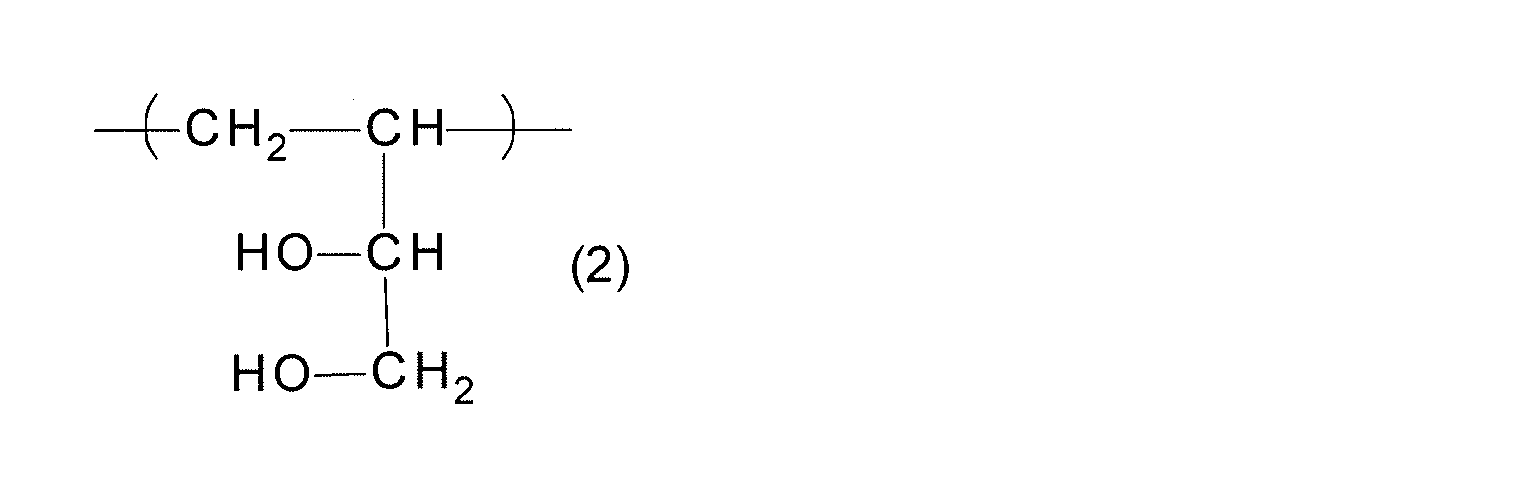
- R 1 to R 3 and R 4 to R 6 in the structural unit represented by the general formula (1) are all hydrogen atoms and X is a single bond, which is represented by the following formula (2).
- a PVA resin having a structural unit is preferably used.
- R 1 to R 3 and R 4 to R 6 may be organic groups as long as they do not significantly impair the resin characteristics.
- the organic group include alkyl groups having 1 to 4 carbon atoms such as methyl group, ethyl group, n-propyl group, isopropyl group, n-butyl group, isobutyl group, and tert-butyl group.
- the group may have a functional group such as a halogen group, a hydroxyl group, an ester group, a carboxylic acid group, or a sulfonic acid group, if necessary.
- X in the structural unit represented by the general formula (1) is preferably a single bond from the viewpoint of thermal stability or stability under high temperature or acidic conditions.
- a binding chain may be used as long as it does not inhibit the above.
- Examples of such a linking chain include hydrocarbons such as alkylene, alkenylene, alkynylene, phenylene and naphthylene (these hydrocarbons may be substituted with halogen such as fluorine, chlorine and bromine), and -O.
- alkylene having 6 or less carbon atoms, particularly methylene, or —CH 2 OCH 2 — is preferable from the viewpoint of stability during production or use.
- a copolymer of a vinyl ester monomer and a compound represented by the following general formula (3) is saponified
- a vinyl ester monomer and the following general formula A method of saponifying and decarboxylating a copolymer with the compound represented by 5) is preferably used.
- R 1 , R 2 , R 3 , X, R 4 , R 5 and R 6 are all represented by the general formula (1) as described above. It is the same.
- R 7 and R 8 are each independently a hydrogen atom or R 9 —CO— (wherein R 9 is an alkyl group, preferably an alkyl group having 1 to 4 carbon atoms).
- R 10 and R 11 are each independently a hydrogen atom or an organic group, preferably an alkyl group having 1 to 4 carbon atoms.
- 3,4-diacyloxy-1-butene as the compound represented by the general formula (3) in the method (i) from the viewpoint of excellent copolymerization reactivity and industrial handling.
- 3,4-diacetoxy-1-butene is preferably used.
- (Vinyl ethylene carbonate) 0.005 (65 ° C.)
- 3,4-diacetoxy-1-butene is a by-product generated when saponifying the copolymer, and a by-product generated during the saponification is derived from a structural unit derived from vinyl acetate frequently used as a vinyl ester monomer. It is also an industrially significant advantage that it is the same as the resulting compound, and it is not necessary to provide special equipment or processes for the subsequent treatment or solvent recovery system, and conventional equipment can be used.
- the 3,4-diacetoxy-1-butene described above is an epoxy butene derivative described in, for example, International Publication No. 2000/24702, U.S. Pat. No. 5,562,086, U.S. Pat. It can be produced by a synthesis method via, or by a reaction of isomerizing 1,4-diacetoxy-1-butene, which is an intermediate product in the production process of 1,4-butanediol, using a metal catalyst such as palladium chloride. At the reagent level, Across products can be obtained from the market.
- the side chain 1,2-diol-containing PVA resin obtained by the above methods (ii) and (iii) has a carbonate ring or acetal ring remaining in the side chain when decarboxylation or deacetalization is insufficient.
- the PVA resin may be cross-linked by such a cyclic group, and a gel-like material may be generated. Therefore, from this point as well, the side chain 1,2-diol-containing PVA resin obtained by the method (i) is preferably used in the present invention.
- vinyl ester monomers examples include vinyl formate, vinyl acetate, vinyl propionate, vinyl valelate, vinyl butyrate, vinyl isobutyrate, vinyl pivalate, vinyl caprate, vinyl laurate, vinyl stearate, vinyl benzoate. Vinyl acetate, etc., vinyl acetate is preferably used economically.
- ⁇ -olefins such as ethylene and propylene
- hydroxy group-containing ⁇ -olefins such as 3-buten-1-ol, 4-penten-1-ol, 5-hexene-1,2-diol, and acylated products thereof
- hydroxymethylvinylidene diacetates such as 1,3-diacetoxy-2-methylenepropane, 1,3-dipropionyloxy-2-methylenepropane, 1,3-dibutyronyloxy-2-methylenepropane
- Unsaturated acids such as itaconic acid, maleic acid, acrylic acid or their salts or mono- or dialkyl esters; acrylonitrile, etc.
- Amides such as nitriles, methacrylamide, diacetone acrylamide, olefin sulfonic acids such as ethylene sulfonic acid, allyl sulfonic acid, methallyl sulfonic acid, 2-acrylamido-2-methylpropane sulfonic acid (AMPS) or salts thereof
- APMS 2-acrylamido-2-methylpropane sulfonic acid
- the degree of saponification (measured according to JIS K 6726) of the side chain 1,2-diol-containing PVA resin is usually 70 to 100 mol%, particularly 75 to 90 mol%, particularly 80 to 89 mol%. Further, 85 to 88 mol% is preferably used. If the degree of saponification is too low, the thermal stability during molding tends to be low, and the melt tension tends to be low.
- the content of the structural unit represented by the general formula (1) contained in the side chain 1,2-diol-containing PVA resin is usually 0.1 to 20 mol%, particularly 1 to 10 mol%, It is preferably 2 to 8 mol%.
- the content of the structural unit represented by the general formula (1) in the side chain 1,2-diol-containing PVA resin was determined by 1 H-NMR spectrum (solvent: DMSO) although the PVA resin was completely saponified.
- -D6 internal standard: tetramethylsilane). Specifically, it is calculated from a peak area derived from a hydroxyl group proton, a methine proton and a methylene proton, a methylene proton of a main chain, a proton of a hydroxyl group linked to the main chain, etc. in the structural unit represented by the general formula (2). Can do.
- the average degree of polymerization of the side chain 1,2-diol-containing PVA resin is preferably 200 to 3000, particularly 250 to 1000, particularly 300 to 800. Preferably used. If the average degree of polymerization is too small, the strength of the obtained molded product tends to be low. On the other hand, if the average degree of polymerization is too large, the shear heat generation becomes large and the stability during molding tends to be lowered.
- Examples of the shape of the PVA resin for melt molding used in the present invention usually include powder, granules, pellets, etc., and powder and granules are preferred in view of the production method of the PVA resin.
- the average particle diameter of the PVA resin for melt molding is usually 50 to 2000 ⁇ m, preferably 100 to 1700 ⁇ m, particularly preferably 150 to 1500 ⁇ m. If the average particle size is too small, it tends to be difficult to handle due to scattering and the like, and if it is too large, the discharge amount during molding tends to become unstable.
- the measuring method of an average particle diameter is performed by sieving, and let the particle diameter from which the accumulated value of a particle size distribution will be 50 weight% be an average particle diameter.
- the PVA-based resin for melt molding after production usually contains a small amount of an organic solvent (alcohol such as methanol) and moisture. That is, the organic solvent is methanol or the like used for washing or saponification, and usually contains some organic solvent and a small amount of water.
- the content of such an organic solvent (alcohol such as methanol) is usually 0.1 to 10% by weight.
- the water content is usually 5% by weight or less, preferably 3% by weight or less.
- ⁇ Preservation method ⁇ A method for preserving the PVA resin for melt molding, which is an example of a usage form using the packaging bag of the present invention, will be described.
- the PVA resin particles for melt molding are filled and sealed from the opening of the packaging bag of the present invention, and then the opening is heat sealed.
- a dry inert gas for example, nitrogen gas
- nitrogen gas for example, nitrogen gas
- the PVA-based resin for melt molding is usually provided to a molding material such as extrusion molding or injection molding through a pelletizing step.
- the methanol content in the melt-molded PVA resin after storing the melt-molded PVA resin for a long time using the packaging bag of the present invention is preferably 1% by weight or less. Further, the water content is preferably 3% by weight or less.
- the methanol content more preferably the moisture content, is provided for melt molding, the molding stability is improved when the melt-molding PVA resin is subjected to melt molding.
- Example 1 [PVA resin containing side chain 1,2-diol]
- a reaction vessel equipped with a reflux condenser and a stirrer 76.6 parts of vinyl acetate (initial charge rate 40%), 14.2 parts of methanol, 9.2 parts of 3,4-diacetoxy-1-butene (initial charge rate) 40%), azobisisobutyronitrile was added to the mixture, and 0.068 mol% of vinyl acetate was added.
- the temperature was increased under a nitrogen stream while stirring, and vinyl acetate and 3,4-diacetoxy-1-butene were mixed. Polymerization was started while dropping the remaining amount at a constant rate of 13.5 hours.
- the methanol solution was further diluted with methanol, adjusted to a concentration of 50%, and charged into a kneader.
- the vinyl acetate structural unit in the copolymer and 3,4-diacetoxy-1- Saponification was performed by adding a 2% methanol solution of sodium hydroxide at a ratio of 4.5 mmol per 1 mol of the total amount of butene structural units.
- saponification progresses and saponification precipitates and forms particles, it is filtered off, washed thoroughly with methanol and dried in a hot air dryer, and the desired side chain 1,2-diol-containing PVA system A resin (powder) was obtained.
- the saponification degree of the obtained side chain 1,2-diol-containing PVA resin was analyzed by alkali consumption required for hydrolysis of residual vinyl acetate and 3,4-diacetoxy-1-butene. Met. The average degree of polymerization was 470 when analyzed according to JIS K 6726.
- the content of the structural unit having a 1,2-diol bond in the side chain is the integral measured by 1 H-NMR (300 MHz proton NMR, d6-DMSO solution, internal standard substance: tetramethylsilane, 50 ° C.). It was 6 mol% when computed from the value.
- the structure of the packaging bag and kraft paper / methanol vapor permeable film layer / kraft paper, low density polyethylene film (thickness 100 ⁇ m as methanol vapor permeable film layer forming material, MFR0.9G / 10min, density 0.924 g / cm 3 ) was used.
- the methanol vapor permeability of the low density polyethylene film (thickness: 100 ⁇ m) is 4 g / m 2 ⁇ day (23 ° C., 50% RH), and the water vapor permeability is 9 g / m 2 ⁇ day (40 ° C., 90% RH).
- the methanol vapor permeability is a value at 23 ° C. and 50% RH measured by the method described above.
- the water vapor permeability is a value at 40 ° C. and 90% RH measured according to JIS Z 0208 as described above. Hereinafter, the same measurement was performed.
- ⁇ Pelletization process evaluation> The side chain 1,2-diol-containing PVA resin powder stored in the packaging bag is charged into a melt extruder (Twin screw type: TEM-58BS, manufactured by Toshiba Machine Co., Ltd.), melted and kneaded, and melted as follows. After extrusion molding into a single substantially rod-like strand (diameter 2.0 mm) under the conditions, pellets of PVA resin containing side chain 1,2-diol were prepared by cooling and cutting. In this pelletizing step, evaluation was performed based on the following criteria. The results are shown in Table 1 below. A: The melt extruder can be operated stably, and the resulting pellets contain very little volatile components.
- B Stable operation of the melt extruder is possible, and the obtained pellets contain a small amount of volatile components.
- C The melt extruder can be operated stably, and there are many volatile components contained in the obtained pellets.
- D Backflow to the hopper of the melt extruder occurs and the operation is unstable, but the resulting pellet does not have a defective shape.
- E A back flow to the hopper of the melt extruder occurs, the operation is unstable, and the resulting pellet has a poor shape.
- Example 2 In Example 1, the thickness of the low density polyethylene film of the methanol vapor permeable film layer forming material was changed to 50 ⁇ m. Other than that, it was set as the packaging bag structure similar to Example 1.
- FIG. The methanol vapor permeability of the low-density polyethylene film (thickness 50 ⁇ m) is 7 g / m 2 ⁇ day (23 ° C., 50% RH), and the water vapor permeability is 18 g / m 2 ⁇ day (40 ° C., 90% RH).
- the pelletization process was evaluated similarly to Example 1. The results are shown in Table 1 below.
- Example 3 In Example 1, the thickness of the low density polyethylene film was changed to 30 ⁇ m. Other than that, it was set as the packaging bag structure similar to Example 1.
- FIG. The low-density polyethylene film (thickness 30 ⁇ m) has a methanol vapor permeability of 12 g / m 2 ⁇ day (23 ° C., 50% RH) and a water vapor permeability of 30 g / m 2 ⁇ day (40 ° C., 90% RH).
- the pelletization process was evaluated similarly to Example 1. The results are shown in Table 1 below.
- Example 4 In Example 1, the thickness of the low density polyethylene film was changed to 10 ⁇ m. Other than that, it was set as the packaging bag structure similar to Example 1.
- FIG. The low-density polyethylene film (thickness 10 ⁇ m) has a methanol vapor permeability of 37 g / m 2 ⁇ day (23 ° C., 50% RH) and a water vapor permeability of 90 g / m 2 ⁇ day (40 ° C., 90% RH).
- the pelletization process was evaluated similarly to Example 1. The results are shown in Table 1 below.
- Example 1 In Example 1, it replaced with the film made from aluminum (thickness 100 micrometers) instead of the low density polyethylene film. Other than that, it was set as the packaging bag structure similar to Example 1.
- FIG. The aluminum film (thickness: 100 ⁇ m) has a methanol vapor permeability of 0 g / m 2 ⁇ day (23 ° C., 50% RH), and a water vapor permeability of 0 g / m 2 ⁇ day (40 ° C., 90% RH).
- the pelletization process was evaluated similarly to Example 1. The results are shown in Table 1 below.
- Example 1 was the same as Example 1 except that the packaging layer was composed of only kraft paper without using a methanol vapor permeable film layer.
- Kraft paper has a methanol vapor permeability exceeding 1000 g / m 2 ⁇ day (23 ° C., 50% RH), and a water vapor permeability exceeding 1000 g / m 2 ⁇ day (40 ° C., 90% RH).
- the pelletization process was evaluated similarly to Example 1. The results are shown in Table 1 below.
- Comparative Example 1 using an aluminum film as the packaging bag forming material has a methanol vapor permeability of 0 g / m 2 ⁇ day (23 ° C., 50% RH).
- the methanol in the 2-diol-containing PVA resin fills the packaging bag and is not released to the outside air, but returns to the inside of the side chain 1,2-diol-containing PVA resin.
- the PVA-based resin for melt molding that is stored and transported in the packaging bag of the present invention has the molding processability at the time of melt molding because methanol remaining in the PVA-based resin is volatilized outside from the packaging bag during storage. To become better.
Landscapes
- Engineering & Computer Science (AREA)
- Mechanical Engineering (AREA)
- Food Science & Technology (AREA)
- Wrappers (AREA)
- Addition Polymer Or Copolymer, Post-Treatments, Or Chemical Modifications (AREA)
- Packages (AREA)
- Laminated Bodies (AREA)
Abstract
溶融成形用ポリビニルアルコール系樹脂を包装するための包装袋であって、メタノール蒸気透過度0.5~1000g/m2・dayのフィルムからなる包装袋である。そして、上記フィルムからなる包装袋を用いて、溶融成形用ポリビニルアルコール系樹脂粉粒体を、密封,包装する溶融成形用ポリビニルアルコール系樹脂の保存方法である。従って、この包装袋を用いて上記溶融成形用ポリビニルアルコール系樹脂を包装することにより、密封したポリビニルアルコール系樹脂内に残留する有機溶媒が蒸気となって包装袋を透過して外気に放出、揮散され、包装袋保存後に有機溶媒濃度が低減したポリビニルアルコール系樹脂が得られることとなる。その結果、成形安定性の向上が図られた溶融成形用ポリビニルアルコール系樹脂を提供することが可能となる。
Description
本発明は、溶融成形用ポリビニルアルコール系樹脂を包装するための包装袋およびそれを用いた溶融成形用ポリビニルアルコール系樹脂の保存方法に関し、更に詳しくは、成形安定性に優れる溶融成形用ポリビニルアルコール系樹脂を得ることのできる包装袋および溶融成形用ポリビニルアルコール系樹脂の保存方法に関する。
溶融成形に用いられるポリビニルアルコール(以下、「PVA」という場合がある。)系樹脂は、一般に、メタノール等の有機溶媒を用いて合成、製造され、通常、固体状(粉末、顆粒等)にし、保存、流通に供されている。一般に、溶融成形に用いる親水性の樹脂は、吸湿を防ぐために耐湿性のあるアルミ袋などの水蒸気バリア性の高い包装袋が使用される。このような包装袋は、溶融成形に用いられる各種親水性樹脂に対して用いられ、例えばエチレン-酢酸ビニル共重合体ケン化物や、特許文献1に記載されている、側鎖に1,2-グリコール結合を有する構造単位を有するPVA系樹脂等にも用いられている。
エチレン-酢酸ビニル共重合体ケン化物などの非水溶性の樹脂は水で冷却、洗浄し、有機溶剤の残留はごく微量であるが、水溶性のPVA系樹脂は、水で洗浄することができず、通常、製造過程にて使用した有機溶媒、例えばメタノール等が残留している。
このように、製造過程にて使用した有機溶媒が製造後においてもPVA系樹脂中に残留すると、気化した有機溶媒が密封された包装袋内に充満して外部に放出されずに、結果、PVA系樹脂中の有機溶媒が充分に抜けきらず、有機溶媒が残留したままの状態が維持されることとなる。このため、有機溶媒を含有したままの溶融成形用PVA系樹脂は、溶融成形材料として用いた際、その溶融成形時に、PVA系樹脂内の有機溶媒が気化するため、安定して溶融成形を行うことが困難になるという問題があった。
そこで、本発明はこのような事情に鑑みてなされたものであって、溶融成形用PVA系樹脂を包装して保存する際に、含有する有機溶媒を気化し放出させて、成形安定性の向上が図られた溶融成形用PVA系樹脂が提供可能となる包装袋およびそれを用いた溶融成形用PVA系樹脂の保存方法を提供する。
本発明者らは、上記事情に鑑み鋭意検討する過程において、溶融成形用PVA系樹脂を密封して保存する際に用いられる包装袋の特性を中心に研究を重ねた。その結果、PVA系樹脂中に残留する有機溶媒(例えば、メタノール)が蒸気となって包装袋に充満した後、包装袋を透過して気化したメタノールを外気に放出させるための物性として、特定のメタノール蒸気透過度を備えた、いわゆる気化して蒸気となったメタノールが透過し易い物性を備えたフィルムからなる包装袋を用いると、上述の課題が解決されることを見出した。
<本発明の要旨>
すなわち、本発明は、溶融成形用PVA系樹脂を包装するための包装袋であって、メタノール蒸気透過度0.5~1000g/m2・dayのフィルムからなる包装袋を第1の要旨とする。
すなわち、本発明は、溶融成形用PVA系樹脂を包装するための包装袋であって、メタノール蒸気透過度0.5~1000g/m2・dayのフィルムからなる包装袋を第1の要旨とする。
また、本発明は、メタノール蒸気透過度0.5~1000g/m2・dayのフィルムからなる包装袋を用いて、溶融成形用PVA系樹脂粉粒体を、密封、包装する溶融成形用PVA系樹脂の保存方法を第2の要旨とする。
このように、本発明の包装袋は、溶融成形用PVA系樹脂(以下、単に「PVA系樹脂」という場合がある。)を包装するための包装袋であって、特定のメタノール蒸気透過度を有するフィルムからなる包装袋である。このため、この包装袋を用いて上記溶融成形用PVA系樹脂を包装することにより、密封したPVA系樹脂内に残留する有機溶媒(例えば、メタノール)が蒸気となって包装袋を透過して外気に放出,揮散され、包装袋保存後に有機溶媒濃度が低減したPVA系樹脂が得られることとなる。その結果、成形安定性の向上が図られた溶融成形用PVA系樹脂を提供することが可能となる。
そして、フィルムの水蒸気透過度が1000g/m2・day以下であると、長期保存後も、PVA系樹脂の吸湿による揮発分の上昇を抑制できるため、更に成形加工性の良好な溶融成形用PVA系樹脂を提供することが可能となる。
包装袋が、基材層/メタノール蒸気透過可能フィルム層/保護層の多層構造体、中でも、上記基材層および保護層の少なくとも一方が、クラフト紙である場合、輸送の際の強度に特に優れることとなる。
包装袋の厚みが、10~2000μmであると、コスト、強度等においてより優れたものとなる。
以下に記載する構成要件の説明は、本発明の実施態様の一例(代表例)であり、これらの内容に特定されるものではない。
以下、本発明について詳細に説明する。
以下、本発明について詳細に説明する。
本発明の包装袋は、溶融成形用PVA系樹脂を密封して包装する際に使用されるものであって、特定のメタノール蒸気透過度を有するフィルムからなることを特徴とするものである。
<包装袋>
まず、かかる包装袋について詳しく説明する。
本発明の包装袋は、単層構造体(単層フィルム)からなる袋であっても多層構造体(多層構造フィルム)からなる袋であってもよく、上記構造体を形成するフィルムのメタノール蒸気透過度が0.5~1000g/m2・dayの特性を有する。
なお、メタノール蒸気透過度は、つぎのようにして測定される値である。すなわち、JIS Z 0208の「防湿包装材料の透過湿度試験方法」に準じて、各種包装材料を用いて透湿カップにメタノールを封入し、23℃、50%RHの条件下で静置し、24時間後のカップの質量減少をメタノール透過量とし、メタノール蒸気透過度を算出する。
まず、かかる包装袋について詳しく説明する。
本発明の包装袋は、単層構造体(単層フィルム)からなる袋であっても多層構造体(多層構造フィルム)からなる袋であってもよく、上記構造体を形成するフィルムのメタノール蒸気透過度が0.5~1000g/m2・dayの特性を有する。
なお、メタノール蒸気透過度は、つぎのようにして測定される値である。すなわち、JIS Z 0208の「防湿包装材料の透過湿度試験方法」に準じて、各種包装材料を用いて透湿カップにメタノールを封入し、23℃、50%RHの条件下で静置し、24時間後のカップの質量減少をメタノール透過量とし、メタノール蒸気透過度を算出する。
さらには、本発明の包装袋は、上記構造体を形成するフィルムにおいて、上記特定のメタノール蒸気透過度とともに、水蒸気透過度が1000g/m2・day以下の特性を有することが好ましい。
なお、本発明において、水蒸気透過度は、JIS Z 0208に準じて測定された40℃、90%RHの条件下での値である。
なお、本発明において、水蒸気透過度は、JIS Z 0208に準じて測定された40℃、90%RHの条件下での値である。
本発明の包装袋の構成は、単層構造の場合は通常、メタノールの蒸気が透過可能なフィルム層(メタノール蒸気透過可能フィルム層)のみからなる。一方、多層構造の場合は通常、基材層/メタノール蒸気透過可能フィルム層からなる構成や、さらに保護層が積層された、基材層/メタノール蒸気透過可能フィルム層/保護層からなる構成を基本構成とする。
以下、各層について説明する。
以下、各層について説明する。
本発明において、メタノール蒸気透過可能フィルム層のメタノール蒸気透過度は、0.5~1000g/m2・dayであり、好ましくは0.5~500g/m2・day、より好ましくは1.0~100g/m2・day、更に好ましくは1.0~50g/m2・day、特に好ましくは1.0~25g/m2・day、殊に好ましくは1.5~6g/m2・dayである。上記値が大きすぎると、外気中の有機溶剤の揮発分を取り込む恐れがあり、上記値が小さすぎると、包装袋内部から外気に効果的に有機溶媒(例えば、メタノール)を透過させ、揮散させることができず、本発明の効果が得られない。
さらには、上記メタノール蒸気透過可能フィルム層において、水蒸気透過度が、1000g/m2・day以下であることが好ましく、より好ましくは750g/m2・day以下、特に好ましくは500g/m2・day以下、更に好ましくは50g/m2・day以下、殊に好ましくは17g/m2・day以下である。なお、通常下限は0.5g/m2・dayである。上記値が大きすぎると包装袋外部から内部に水蒸気が浸入し、PVA系樹脂が吸湿するため、揮発分が上昇する。その結果、長期保存後に成形加工の安定性が低下する溶融成形用PVA系樹脂となる。
また、上記メタノール蒸気透過可能フィルム層の厚みは、通常1~500μm、好ましくは10~300μm、特に好ましくは20~250μm、更に好ましくは50~200μmである。かかる厚みは薄すぎると水蒸気透過度が大きくなる傾向があり、厚すぎるとコストがかかったり、柔軟性が低下する傾向がある。
上記メタノール蒸気透過可能フィルム層形成材料としては、例えば、高密度ポリエチレン、中密度ポリエチレン、低密度ポリエチレン、ポリプロピレン、ポリエステル等があげられる。中でも、経済性、柔軟性、メタノール蒸気透過性、さらには水蒸気バリア性の点から、低密度ポリエチレンが好ましく用いられる。
なお、本発明において、低密度ポリエチレンとは、平均密度が0.910~0.925g/cm3のポリエチレンをいい、中密度ポリエチレンとは、平均密度が0.926~0.940g/cm3のポリエチレンをいい、高密度ポリエチレンとは、平均密度が0.941g/cm3以上のポリエチレンをいう。
なお、本発明において、低密度ポリエチレンとは、平均密度が0.910~0.925g/cm3のポリエチレンをいい、中密度ポリエチレンとは、平均密度が0.926~0.940g/cm3のポリエチレンをいい、高密度ポリエチレンとは、平均密度が0.941g/cm3以上のポリエチレンをいう。
メタノール蒸気透過可能フィルム層は、単層であっても、同一あるいは異なる2種以上のフィルムを積層させた多層フィルムであっても良い。従って、上記メタノール蒸気透過可能フィルム層の厚みとは、単層の場合は単層の厚みを、多層の場合は多層の合計の厚みをいう。
本発明の包装袋は、輸送の際に強度が必要であることから、通常、上記のメタノール蒸気透過可能フィルム層の内側に、基材層として、紙製材料からなる層を設けることが好ましい。かかる紙製材料は、輸送に耐えうる強度があれば良いが、通常、クラフト紙が用いられる。かかるクラフト紙の厚みは通常、10~1000μm、好ましくは50~500μm、特に好ましくは70~200μmである。クラフト紙の厚みが薄すぎると強度が不足し、破れる場合があり、厚すぎると重くて輸送に不向きである。
また、上記基材層が樹脂フィルムである場合もあげられ、かかる樹脂フィルム材料としては、例えば、ポリエステル系フィルム、ポリオレフィン系フィルム、ポリアミド系フィルム、ポリエーテル系フィルム、ポリウレタン系フィルム等があげられ、特にポリアミド系フィルムが好ましい。ポリアミド系フィルムとしては、例えば、ナイロン11、ナイロン12、ナイロン6、ナイロン66、ナイロン6・66等の各フィルムが挙げられる。好ましくはポリオレフィン系フィルム、ポリアミド系フィルムであり、特に、ポリアミド系フィルム及び低密度ポリエチレンフィルムが好ましい。
なお、上記基材層(樹脂フィルムの場合)がメタノール蒸気透過可能フィルム層となってもよく、この場合には、基材層(樹脂フィルムの場合)の厚みも合計して、メタノール蒸気透過可能フィルム層の厚みとする。
なお、上記基材層(樹脂フィルムの場合)がメタノール蒸気透過可能フィルム層となってもよく、この場合には、基材層(樹脂フィルムの場合)の厚みも合計して、メタノール蒸気透過可能フィルム層の厚みとする。
かかる基材層(樹脂フィルムの場合)の厚みとしては、通常1~100μm、好ましくは5~50μm、特に好ましくは10~30μmである。かかる厚みが薄すぎると強度が低下して、ピンホールの原因となる場合があり、厚すぎるとコストがかかってしまう傾向がある。
更に基材層は単層であっても、異なる2種以上の紙製材料や樹脂フィルムを積層させた多層構造であってもよい。また、基材層とメタノール透過可能フィルム層は接着されていても、接着されていなくてもよい。
また、上記保護層においても、保護層形成材料として紙製材料や樹脂フィルムが用いられ、上記基材層形成材料と同様のものがあげられる。中でも強度の点で、紙製材料、更にはクラフト紙が好ましい。
なお、上記保護層がメタノール蒸気透過可能フィルム層となってもよく、この場合には、保護層の厚みも合計して、メタノール蒸気透過可能フィルム層の厚みとする。
なお、上記保護層がメタノール蒸気透過可能フィルム層となってもよく、この場合には、保護層の厚みも合計して、メタノール蒸気透過可能フィルム層の厚みとする。
上記保護層は単層であっても、異なる2種以上の紙製材料や樹脂フィルムを積層させた多層構造であってもよい。また、保護層とメタノール透過可能フィルム層は接着されていても、接着されていなくてもよい。
かかる保護層の厚みとしては、通常5~200μm、好ましくは20~100μm、特に好ましくは30~80μmである。かかる厚みが薄すぎると強度が低下して、ピンホールの原因となる場合があり、厚すぎるとコストがかかってしまう傾向がある。
そして、本発明の包装袋の総厚みは、コスト、強度、使用形態等を考慮して、通常10~2000μm、好ましくは20~500μm、特に好ましくは25~300μmである。かかる総厚みが薄すぎると強度が低下する傾向があり、厚すぎるとヒートシール等に時間がかかり不効率となる傾向がある。
本発明の包装袋は、例えば、上記特定の物性を備えたシート状フィルム(単層構造あるいは多層構造)を2枚準備し、開口部となる1辺を残して、残りの3辺をヒートシールすることにより包装袋を作製することができる。また、シート状フィルムを1枚準備し、これを半分に折り畳み、開口部となる1辺を残して、残りの2辺をヒートシールして包装袋としたりすることもできる。
<溶融成形用PVA系樹脂>
本発明の包装袋に包装される溶融成形用PVA系樹脂について説明する。
本発明でいう溶融成形に用いられるPVA系樹脂としては、一般的なPVA系樹脂に比べて融点が低くなるように改良された溶融成形可能なPVA系樹脂、例えば、低ケン化度の未変性PVA系樹脂や、各種変性PVA系樹脂があげられ、中でも特に側鎖に一級水酸基を有する構造単位を含有するPVA系樹脂、オキシアルキレン基含有PVA系樹脂等があげられる。好ましくは、側鎖に一級水酸基を有する構造単位を含有するPVA系樹脂(側鎖に1,2-ジオール構造単位を有するPVA系樹脂、側鎖にヒドロキシアルキル基を有するPVA系樹脂等)で、特に好ましくは側鎖に1,2-ジオール構造単位を有するPVA系樹脂である。変性PVA系樹脂を用いる場合においては、その変性基の含有量は、通常0.1~20モル%であり、特に1~10モル%であることが好ましい。
本発明の包装袋に包装される溶融成形用PVA系樹脂について説明する。
本発明でいう溶融成形に用いられるPVA系樹脂としては、一般的なPVA系樹脂に比べて融点が低くなるように改良された溶融成形可能なPVA系樹脂、例えば、低ケン化度の未変性PVA系樹脂や、各種変性PVA系樹脂があげられ、中でも特に側鎖に一級水酸基を有する構造単位を含有するPVA系樹脂、オキシアルキレン基含有PVA系樹脂等があげられる。好ましくは、側鎖に一級水酸基を有する構造単位を含有するPVA系樹脂(側鎖に1,2-ジオール構造単位を有するPVA系樹脂、側鎖にヒドロキシアルキル基を有するPVA系樹脂等)で、特に好ましくは側鎖に1,2-ジオール構造単位を有するPVA系樹脂である。変性PVA系樹脂を用いる場合においては、その変性基の含有量は、通常0.1~20モル%であり、特に1~10モル%であることが好ましい。
本発明で用いられるPVA系樹脂のケン化度(JIS K 6726に準拠して測定)は、通常70~100モル%であり、特に75~99モル%、殊に80~99モル%のものが好ましく用いられる。かかるケン化度が低すぎると、成形時の熱安定性が低下し、溶融張力も低くなる傾向がある。
また、PVA系樹脂の平均重合度(JIS K 6726に準拠して測定)は、好ましくは200~4000であり、特に250~1000、殊に300~800のものが好ましく用いられる。かかる平均重合度が小さすぎると、成形体の強度が不足するなどの傾向がある。反対に、平均重合度が大きすぎると、剪断発熱が大きくなり、成形時の安定性が低下する傾向がある。
〔側鎖に1,2-ジオール構造単位を有するPVA系樹脂〕
本発明のPVA系樹脂としては、先に述べたように、溶融成形という点から、側鎖に1,2-ジオール構造単位を有するPVA系樹脂(以下、「側鎖1,2-ジオール含有PVA系樹脂」という場合がある。)が好適に用いられる。
以下、側鎖1,2-ジオール含有PVA系樹脂について詳細に説明する。
側鎖1,2-ジオール含有PVA系樹脂は、下記一般式(1)で示される構造単位を有するものである。
本発明のPVA系樹脂としては、先に述べたように、溶融成形という点から、側鎖に1,2-ジオール構造単位を有するPVA系樹脂(以下、「側鎖1,2-ジオール含有PVA系樹脂」という場合がある。)が好適に用いられる。
以下、側鎖1,2-ジオール含有PVA系樹脂について詳細に説明する。
側鎖1,2-ジオール含有PVA系樹脂は、下記一般式(1)で示される構造単位を有するものである。

特に、一般式(1)で表わされる構造単位中のR1~R3及びR4~R6がすべて水素原子であり、Xが単結合であるものが好ましく、下記式(2)で表わされる構造単位を有するPVA系樹脂が好適に用いられる。
なお、かかる一般式(1)で表わされる構造単位中のR1~R3及びR4~R6は、樹脂特性を大幅に損なわない程度の量であれば、有機基であってもよく、その有機基としては、例えば、メチル基、エチル基、n-プロピル基、イソプロピル基、n-ブチル基、イソブチル基、tert-ブチル基等の炭素数1~4のアルキル基があげられ、かかる有機基は、必要に応じて、ハロゲン基、水酸基、エステル基、カルボン酸基、スルホン酸基等の官能基を有していてもよい。
また、一般式(1)で表わされる構造単位中のXは、熱安定性の点や高温下や酸性条件下での安定性の点で、単結合であるものが好ましいが、本発明の効果を阻害しない範囲であれば結合鎖であってもよい。かかる結合鎖としては、例えば、アルキレン、アルケニレン、アルキニレン、フェニレン、ナフチレン等の炭化水素(これらの炭化水素はフッ素、塩素、臭素等のハロゲン等で置換されていてもよい。)の他、-O-、-(CH2O)m-、-(OCH2)m-、-(CH2O)mCH2-、-CO-、-COCO-、-CO(CH2)mCO-、-CO(C6H4)CO-、-S-、-CS-、-SO-、-SO2-、-NR-、-CONR-、-NRCO-、-CSNR-、-NRCS-、-NRNR-、-HPO4-、-Si(OR)2-、-OSi(OR)2-、-OSi(OR)2O-、-Ti(OR)2-、-OTi(OR)2-、-OTi(OR)2O-、-Al(OR)-、-OAl(OR)-、-OAl(OR)O-等(Rは各々独立して任意の置換基であり、水素原子または炭素数1~12のアルキル基が好ましく、またmは自然数である。)が挙げられる。中でも製造時あるいは使用時の安定性の点で、炭素数6以下のアルキレン、特にメチレン、あるいは-CH2OCH2-が好ましい。
本発明で用いられる側鎖1,2-ジオール含有PVA系樹脂の製造法としては、例えば、(i)ビニルエステル系モノマーと下記一般式(3)で示される化合物との共重合体をケン化する方法や、(ii)ビニルエステル系モノマーと下記一般式(4)で示される化合物との共重合体をケン化及び脱ケタール化する方法や、(iii)ビニルエステル系モノマーと下記一般式(5)で示される化合物との共重合体をケン化及び脱炭酸する方法が好ましく用いられる。

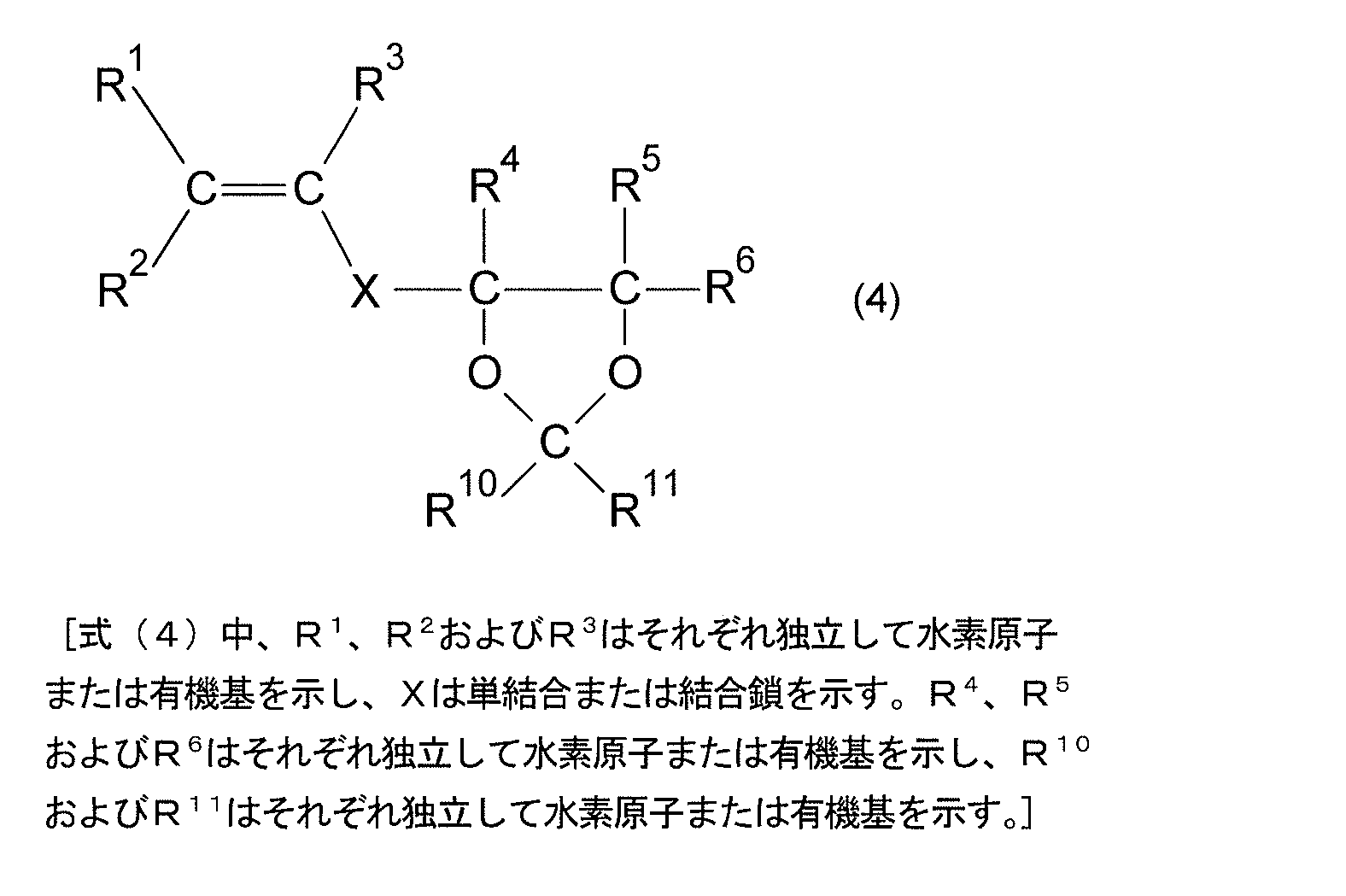
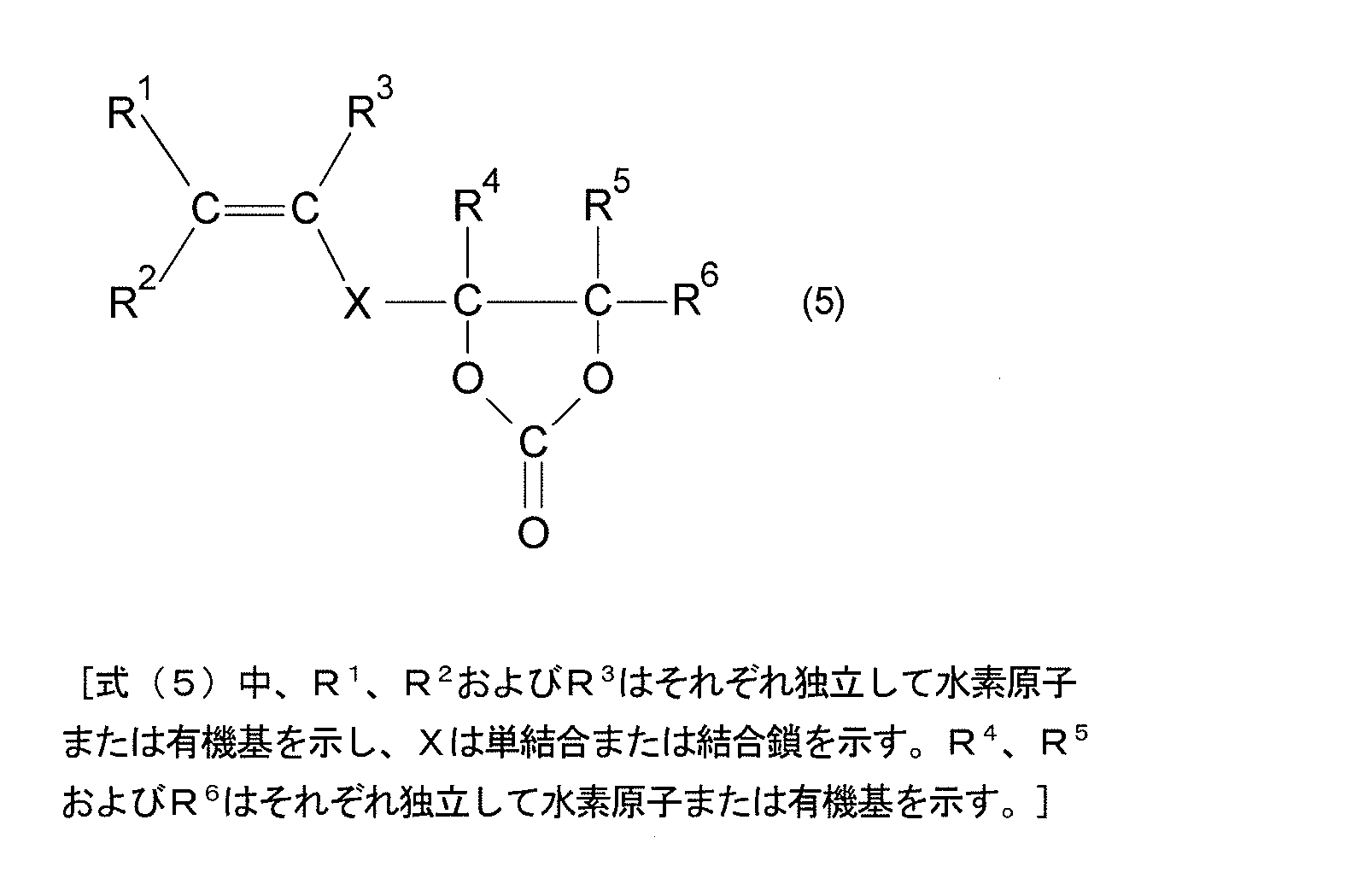
上記一般式(3)、(4)及び(5)中のR1、R2、R3、X、R4、R5及びR6は、前述のとおり、いずれも一般式(1)の場合と同様である。また、R7及びR8はそれぞれ独立して水素原子またはR9-CO-(式中、R9はアルキル基、好ましくは炭素数1~4のアルキル基である)である。R10及びR11はそれぞれ独立して水素原子または有機基、好ましくは炭素数1~4のアルキル基である。
側鎖1,2-ジオール含有PVA系樹脂の製造方法である上記(i)、(ii)及び(iii)の方法については、例えば、特開2006-95825号公報に記載されている方法を用いることができる。
なかでも、共重合反応性及び工業的な取り扱い性に優れるという点から、(i)の方法において、一般式(3)で表わされる化合物として3,4-ジアシロキシ-1-ブテンを用いることが好ましく、特に3,4-ジアセトキシ-1-ブテンが好ましく用いられる。
なお、ビニルエステル系モノマーとして酢酸ビニルを用い、これと3,4-ジアセトキシ-1-ブテンを共重合させた際の各モノマーの反応性比(r)は、r(酢酸ビニル)=0.710、r(3,4-ジアセトキシ-1-ブテン)=0.701、であり、これは(iii)の方法で用いられる一般式(5)で表される化合物の一例であるビニルエチレンカーボネートの場合の、r(酢酸ビニル)=0.85、r(ビニルエチレンカーボネート)=5.4、と比較して、3,4-ジアセトキシ-1-ブテンが酢酸ビニルとの共重合反応性に優れることを示すものである。
なお、ビニルエステル系モノマーとして酢酸ビニルを用い、これと3,4-ジアセトキシ-1-ブテンを共重合させた際の各モノマーの反応性比(r)は、r(酢酸ビニル)=0.710、r(3,4-ジアセトキシ-1-ブテン)=0.701、であり、これは(iii)の方法で用いられる一般式(5)で表される化合物の一例であるビニルエチレンカーボネートの場合の、r(酢酸ビニル)=0.85、r(ビニルエチレンカーボネート)=5.4、と比較して、3,4-ジアセトキシ-1-ブテンが酢酸ビニルとの共重合反応性に優れることを示すものである。
また、3,4-ジアセトキシ-1-ブテンの連鎖移動定数(Cx)は、Cx(3,4-ジアセトキシ-1-ブテン)=0.003(65℃)であり、これはビニルエチレンカーボネートのCx(ビニルエチレンカーボネート)=0.005(65℃)や、(ii)の方法で用いられる一般式(4)で表される化合物の一例である2,2-ジメチル-4-ビニル-1,3-ジオキソランのCx(2,2-ジメチル-4-ビニル-1,3-ジオキソラン)=0.023(65℃)と比較して、重合度が上がり易くなり、重合速度低下の原因となり難いことを示すものである。
また、かかる3,4-ジアセトキシ-1-ブテンは、その共重合体をケン化する際に発生する副生物が、ビニルエステル系モノマーとして多用される酢酸ビニルに由来する構造単位からケン化時に副生する化合物と同一であり、その後処理や溶剤回収系に敢えて特別な装置や工程を設ける必要がなく、従来からの設備を利用できるという点も、工業的に大きな利点である。
なお、上記の3,4-ジアセトキシ-1-ブテンは、例えば、国際公開第2000/24702号公報、米国特許第5623086号明細書、米国特許第6072079号明細書などに記載されたエポキシブテン誘導体を経由する合成方法や、1,4-ブタンジオール製造工程の中間生成物である1,4-ジアセトキシ-1-ブテンを塩化パラジウムなどの金属触媒を用いて異性化する反応によって製造することができる。
また、試薬レベルではアクロス社の製品を市場から入手することができる。
また、試薬レベルではアクロス社の製品を市場から入手することができる。
上記(ii)や(iii)の方法によって得られた側鎖1,2-ジオール含有PVA系樹脂は、脱炭酸あるいは脱アセタール化が不充分であると、側鎖にカーボネート環あるいはアセタール環が残存し、製造時の加熱乾燥工程で、かかる環状基によってPVA系樹脂が架橋し、ゲル状物などが発生する場合がある。
よって、かかる点からも、上記(i)の方法によって得られた側鎖1,2-ジオール含有PVA系樹脂が本発明においては好適に用いられる。
よって、かかる点からも、上記(i)の方法によって得られた側鎖1,2-ジオール含有PVA系樹脂が本発明においては好適に用いられる。
上記ビニルエステル系モノマーとしては、例えば、ギ酸ビニル、酢酸ビニル、プロピオン酸ビニル、バレリン酸ビニル、酪酸ビニル、イソ酪酸ビニル、ピバリン酸ビニル、カプリン酸ビニル、ラウリン酸ビニル、ステアリン酸ビニル、安息香酸ビニル、バーサチック酸ビニル等があげられるが、経済的に酢酸ビニルが好ましく用いられる。
また、上述のモノマー(ビニルエステル系モノマー、上記一般式(3)、(4)、(5)で示される化合物)の他に、樹脂物性に大幅な影響を及ぼさない範囲であれば、共重合成分として、エチレンやプロピレン等のα-オレフィン;3-ブテン-1-オール、4-ペンテン-1-オール、5-ヘキセン-1,2-ジオール等のヒドロキシ基含有α-オレフィン類及びそのアシル化物等の誘導体;1,3-ジアセトキシ-2-メチレンプロパン、1,3-ジプロピオニルオキシ-2-メチレンプロパン、1,3-ジブチロニルオキシ-2-メチレンプロパン等のヒドロキシメチルビニリデンジアセテート類;イタコン酸、マレイン酸、アクリル酸等の不飽和酸類あるいはその塩あるいはモノまたはジアルキルエステル;アクリロニトリル等のニトリル類、メタクリルアミド、ジアセトンアクリルアミド等のアミド類、エチレンスルホン酸、アリルスルホン酸、メタアリルスルホン酸、2-アクリルアミド-2-メチルプロパンスルホン酸(AMPS)等のオレフィンスルホン酸あるいはその塩等の化合物、等が共重合されていてもよい。
側鎖1,2-ジオール含有PVA系樹脂のケン化度(JIS K 6726に準拠して測定)は、通常70~100モル%であり、特に75~90モル%、殊に80~89モル%、更に85~88モル%のものが好ましく用いられる。かかるケン化度が低すぎると、成形時の熱安定性が低下し、溶融張力も低くなる傾向がある。
側鎖1,2-ジオール含有PVA系樹脂に含まれる、一般式(1)で表わされる構造単位の含有量は、通常0.1~20モル%であり、特に1~10モル%、殊に2~8モル%であることが好ましい。
なお、側鎖1,2-ジオール含有PVA系樹脂中の一般式(1)で表わされる構造単位の含有率は、PVA系樹脂を完全にケン化したものの、1H-NMRスペクトル(溶媒:DMSO-d6、内部標準:テトラメチルシラン)から求めることができる。具体的には、一般式(2)で表わされる構造単位中の水酸基プロトン、メチンプロトン及びメチレンプロトン、主鎖のメチレンプロトン、主鎖に連結する水酸基のプロトンなどに由来するピーク面積から算出することができる。
また、側鎖1,2-ジオール含有PVA系樹脂の平均重合度(JIS K 6726に準拠して測定)は、好ましくは200~3000であり、特に250~1000、殊に300~800のものが好ましく用いられる。かかる平均重合度が小さすぎると、得られた成形物の強度が低くなる傾向がある。反対に、平均重合度が大きすぎると、剪断発熱が大きくなり、成形時の安定性が低下する傾向がある。
本発明に用いられる溶融成形用PVA系樹脂の形状は通常、粉末、顆粒、ペレット等があげられ、PVA系樹脂の製法上、粉末や顆粒が好ましい。また、溶融成形用PVA系樹脂の平均粒子径は、通常50~2000μm、好ましくは100~1700μm、特に好ましくは150~1500μmである。平均粒子径が小さすぎると飛散するなどして扱いが困難となる傾向があり、大きすぎると成形加工時の吐出量が不安定になる傾向がある。
なお、平均粒子径の測定方法は篩分けにより行い、粒度分布の累積値が50重量%となる粒子径を平均粒子径とする。
なお、平均粒子径の測定方法は篩分けにより行い、粒度分布の累積値が50重量%となる粒子径を平均粒子径とする。
製造後の溶融成形用PVA系樹脂は通常、少量の有機溶媒(メタノール等のアルコール)や水分を含んでいる。すなわち、有機溶媒としては、洗浄やケン化に用いたメタノール等であり、通常、有機溶媒がある程度含まれ、また水は少量存在する。かかる有機溶媒(メタノール等のアルコール)の含有量は通常0.1~10重量%である。また水分量は、通常5重量%以下、好ましくは3重量%以下である。このように、溶融成形用PVA系樹脂に有機溶媒(メタノール等のアルコール)が含有することから、先に述べたような問題が生起するようになる。
〔保存方法〕
本発明の包装袋を用いた使用形態の一例である、溶融成形用PVA系樹脂の保存方法について述べる。例えば、本発明の包装袋の開口部から溶融成形用PVA系樹脂粉粒体を充填して密封した後、開口部をヒートシールする。この充填の際に、乾燥した不活性ガス(例えば、窒素ガス等)をキャリアガスとして使用することが好ましい。そして、包装袋の外装としてクラフト紙を設ける場合には、通常、開口部をミシンがけして封をした後、その開口部を折り曲げることにより保存する。このような溶融成形用PVA系樹脂粉粒体を充填して密封してなる包装袋は、例えば、各種輸送手段に供されることとなる。その後、溶融成形用PVA系樹脂は、通常、ペレット化工程を経て、押出成形、射出成形等の成形材料に提供されることとなる。
本発明の包装袋を用いた使用形態の一例である、溶融成形用PVA系樹脂の保存方法について述べる。例えば、本発明の包装袋の開口部から溶融成形用PVA系樹脂粉粒体を充填して密封した後、開口部をヒートシールする。この充填の際に、乾燥した不活性ガス(例えば、窒素ガス等)をキャリアガスとして使用することが好ましい。そして、包装袋の外装としてクラフト紙を設ける場合には、通常、開口部をミシンがけして封をした後、その開口部を折り曲げることにより保存する。このような溶融成形用PVA系樹脂粉粒体を充填して密封してなる包装袋は、例えば、各種輸送手段に供されることとなる。その後、溶融成形用PVA系樹脂は、通常、ペレット化工程を経て、押出成形、射出成形等の成形材料に提供されることとなる。
このように、本発明の包装袋を用いて、溶融成形用PVA系樹脂を長期にわたって保存した後の溶融成形用PVA系樹脂中のメタノール含有量は、1重量%以下であることが好ましい。さらに、水分含有量に関して、3重量%以下であることが好ましい。このようなメタノール含有量、さらに好ましくは水分含有量であると、溶融成形用PVA系樹脂を溶融成形に供した場合、成形安定性の向上が図られることとなる。
以下に、実施例を挙げて本発明を説明するが、本発明はその要旨を超えない限り、実施例の記載に限定されるものではない。
尚、例中、「部」、「%」とあるのは、重量基準を意味する。
尚、例中、「部」、「%」とあるのは、重量基準を意味する。
[実施例1]
〔側鎖1,2-ジオール含有PVA系樹脂〕
還流冷却器、撹拌機を備えた反応容器に、酢酸ビニル76.6部(初期仕込み率40%)、メタノール14.2部、3,4-ジアセトキシ-1-ブテン9.2部(初期仕込み率40%)を仕込み、アゾビスイソブチロニトリルを対仕込み酢酸ビニル0.068モル%投入し、攪拌しながら窒素気流下で温度を上昇させ、酢酸ビニル及び3,4-ジアセトキシ-1-ブテンの残量を13.5時間等速滴下しながら重合を開始した。酢酸ビニルの重合率が91%となった時点で、m-ジニトロベンゼンを添加して重合を終了し、続いて、メタノール蒸気を吹き込む方法により、未反応の酢酸ビニルモノマーを系外に除去し共重合体のメタノール溶液とした。
〔側鎖1,2-ジオール含有PVA系樹脂〕
還流冷却器、撹拌機を備えた反応容器に、酢酸ビニル76.6部(初期仕込み率40%)、メタノール14.2部、3,4-ジアセトキシ-1-ブテン9.2部(初期仕込み率40%)を仕込み、アゾビスイソブチロニトリルを対仕込み酢酸ビニル0.068モル%投入し、攪拌しながら窒素気流下で温度を上昇させ、酢酸ビニル及び3,4-ジアセトキシ-1-ブテンの残量を13.5時間等速滴下しながら重合を開始した。酢酸ビニルの重合率が91%となった時点で、m-ジニトロベンゼンを添加して重合を終了し、続いて、メタノール蒸気を吹き込む方法により、未反応の酢酸ビニルモノマーを系外に除去し共重合体のメタノール溶液とした。
ついで、上記メタノール溶液を更にメタノールで希釈し、濃度50%に調整してニーダーに仕込み、溶液温度を35℃に保ちながら、共重合体中の酢酸ビニル構造単位及び3,4-ジアセトキシ-1-ブテン構造単位の合計量1モルに対して4.5ミリモルとなる割合で水酸化ナトリウムの2%メタノール溶液を加えてケン化を行った。ケン化が進行するとともにケン化物が析出し、粒子状となった時点で濾別し、メタノールでよく洗浄して熱風乾燥機中で乾燥し、目的とする側鎖1,2-ジオール含有PVA系樹脂(粉末)を得た。
得られた側鎖1,2-ジオール含有PVA系樹脂のケン化度は、残存酢酸ビニルおよび3,4-ジアセトキシ-1-ブテンの加水分解に要するアルカリ消費量にて分析したところ、99モル%であった。また、平均重合度は、JIS K 6726に準じて分析を行ったところ、470であった。また、側鎖に1,2-ジオール結合を有する構造単位の含有量は、1H-NMR(300MHz プロトンNMR、d6-DMSO溶液、内部標準物質;テトラメチルシラン、50℃)にて測定した積分値より算出したところ、6モル%であった。
(包装袋)
包装袋の構成をクラフト紙/メタノール蒸気透過可能フィルム層/クラフト紙とし、メタノール蒸気透過可能フィルム層形成材料として低密度ポリエチレンフィルム(厚さ100μm、MFR0.9g/10min、密度0.924g/cm3)を用いた。低密度ポリエチレンフィルム(厚さ100μm)のメタノール蒸気透過度は4g/m2・day(23℃、50%RH)、水蒸気透過度は9g/m2・day(40℃、90%RH)である。なお、メタノール蒸気透過度は、前述の方法にて測定された23℃、50%RHでの値である。また、上記水蒸気透過度は、前述のとおり、JIS Z 0208に則して測定された40℃、90%RHでの値である。以下、同様に測定した。
包装袋の構成をクラフト紙/メタノール蒸気透過可能フィルム層/クラフト紙とし、メタノール蒸気透過可能フィルム層形成材料として低密度ポリエチレンフィルム(厚さ100μm、MFR0.9g/10min、密度0.924g/cm3)を用いた。低密度ポリエチレンフィルム(厚さ100μm)のメタノール蒸気透過度は4g/m2・day(23℃、50%RH)、水蒸気透過度は9g/m2・day(40℃、90%RH)である。なお、メタノール蒸気透過度は、前述の方法にて測定された23℃、50%RHでの値である。また、上記水蒸気透過度は、前述のとおり、JIS Z 0208に則して測定された40℃、90%RHでの値である。以下、同様に測定した。
(長期保存条件)
上記の包装袋の開口部から、上記の側鎖1,2-ジオール含有PVA系樹脂製粉末を充填した後、開口上部をヒートシールして密封した。そして、この包装袋を、40℃、75%RHの環境下に90日間保存した。
上記の包装袋の開口部から、上記の側鎖1,2-ジオール含有PVA系樹脂製粉末を充填した後、開口上部をヒートシールして密封した。そして、この包装袋を、40℃、75%RHの環境下に90日間保存した。
<ペレット化工程評価>
溶融押出機(2軸スクリュー式:東芝機械社製 TEM-58BS)に、上記包装袋で保存された側鎖1,2-ジオール含有PVA系樹脂製粉末を投入し、溶融混練して以下の溶融条件にて単数の略棒状のストランド(直径2.0mm)に押出成形した後、冷却・カッティングすることにより、側鎖1,2-ジオール含有PVA系樹脂のペレットを作製した。このペレット化工程において、以下の基準に基づき評価した。その結果を下記の表1に示す。
A:溶融押出機の安定な運転可能で、得られたペレットに含有される揮発成分が極めて少ない。
B:溶融押出機の安定な運転可能で、得られたペレットに含有される揮発成分が少ない。
C:溶融押出機の安定な運転可能で、得られたペレットに含有される揮発成分が多い。
D:溶融押出機のホッパーへの逆流が生じ、運転が不安定だが、得られたペレットの形状不良は起こらない。
E:溶融押出機のホッパーへの逆流が生じ、運転が不安定で、得られたペレットの形状不良が起こる。
溶融押出機(2軸スクリュー式:東芝機械社製 TEM-58BS)に、上記包装袋で保存された側鎖1,2-ジオール含有PVA系樹脂製粉末を投入し、溶融混練して以下の溶融条件にて単数の略棒状のストランド(直径2.0mm)に押出成形した後、冷却・カッティングすることにより、側鎖1,2-ジオール含有PVA系樹脂のペレットを作製した。このペレット化工程において、以下の基準に基づき評価した。その結果を下記の表1に示す。
A:溶融押出機の安定な運転可能で、得られたペレットに含有される揮発成分が極めて少ない。
B:溶融押出機の安定な運転可能で、得られたペレットに含有される揮発成分が少ない。
C:溶融押出機の安定な運転可能で、得られたペレットに含有される揮発成分が多い。
D:溶融押出機のホッパーへの逆流が生じ、運転が不安定だが、得られたペレットの形状不良は起こらない。
E:溶融押出機のホッパーへの逆流が生じ、運転が不安定で、得られたペレットの形状不良が起こる。
(溶融条件)
直径(D)58mm、L/D=46
スクリュー回転数:150rpm
設定温度(℃):C1/C2/C3/C4/C5/C6/C7/C8/C9/C10/H/D1/D2/D3=50/70/180/180/220/220/220/210/200/200/210/210/195/210
スクリューパターン:2箇所練りスクリュー
スクリーンメッシュ:50/80/50mesh
吐出量:200kg/hr
ベント3位置:C4(口径100mm)
ベント4位置:C8(口径100mm)
直径(D)58mm、L/D=46
スクリュー回転数:150rpm
設定温度(℃):C1/C2/C3/C4/C5/C6/C7/C8/C9/C10/H/D1/D2/D3=50/70/180/180/220/220/220/210/200/200/210/210/195/210
スクリューパターン:2箇所練りスクリュー
スクリーンメッシュ:50/80/50mesh
吐出量:200kg/hr
ベント3位置:C4(口径100mm)
ベント4位置:C8(口径100mm)
[実施例2]
実施例1において、メタノール蒸気透過可能フィルム層形成材料の低密度ポリエチレンフィルムの厚さを50μmに変えた。それ以外は実施例1と同様の包装袋構成とした。低密度ポリエチレンフィルム(厚さ50μm)のメタノール蒸気透過度は7g/m2・day(23℃、50%RH)、水蒸気透過度は18g/m2・day(40℃、90%RH)である。そして、実施例1と同様にペレット化工程を評価した。その結果を下記の表1に示す。
実施例1において、メタノール蒸気透過可能フィルム層形成材料の低密度ポリエチレンフィルムの厚さを50μmに変えた。それ以外は実施例1と同様の包装袋構成とした。低密度ポリエチレンフィルム(厚さ50μm)のメタノール蒸気透過度は7g/m2・day(23℃、50%RH)、水蒸気透過度は18g/m2・day(40℃、90%RH)である。そして、実施例1と同様にペレット化工程を評価した。その結果を下記の表1に示す。
[実施例3]
実施例1において、低密度ポリエチレンフィルムの厚さを30μmに変えた。それ以外は実施例1と同様の包装袋構成とした。低密度ポリエチレンフィルム(厚さ30μm)のメタノール蒸気透過度は12g/m2・day(23℃、50%RH)、水蒸気透過度は30g/m2・day(40℃、90%RH)である。そして、実施例1と同様にペレット化工程を評価した。その結果を下記の表1に示す。
実施例1において、低密度ポリエチレンフィルムの厚さを30μmに変えた。それ以外は実施例1と同様の包装袋構成とした。低密度ポリエチレンフィルム(厚さ30μm)のメタノール蒸気透過度は12g/m2・day(23℃、50%RH)、水蒸気透過度は30g/m2・day(40℃、90%RH)である。そして、実施例1と同様にペレット化工程を評価した。その結果を下記の表1に示す。
[実施例4]
実施例1において、低密度ポリエチレンフィルムの厚さを10μmに変えた。それ以外は実施例1と同様の包装袋構成とした。低密度ポリエチレンフィルム(厚さ10μm)のメタノール蒸気透過度は37g/m2・day(23℃、50%RH)、水蒸気透過度は90g/m2・day(40℃、90%RH)である。そして、実施例1と同様にペレット化工程を評価した。その結果を下記の表1に示す。
実施例1において、低密度ポリエチレンフィルムの厚さを10μmに変えた。それ以外は実施例1と同様の包装袋構成とした。低密度ポリエチレンフィルム(厚さ10μm)のメタノール蒸気透過度は37g/m2・day(23℃、50%RH)、水蒸気透過度は90g/m2・day(40℃、90%RH)である。そして、実施例1と同様にペレット化工程を評価した。その結果を下記の表1に示す。
[比較例1]
実施例1において、低密度ポリエチレンフィルムに代えてアルミニウム製フィルム(厚さ100μm)に代えた。それ以外は実施例1と同様の包装袋構成とした。アルミニウム製フィルム(厚さ100μm)のメタノール蒸気透過度は0g/m2・day(23℃、50%RH)、水蒸気透過度は0g/m2・day(40℃、90%RH)である。そして、実施例1と同様にペレット化工程を評価した。その結果を下記の表1に示す。
実施例1において、低密度ポリエチレンフィルムに代えてアルミニウム製フィルム(厚さ100μm)に代えた。それ以外は実施例1と同様の包装袋構成とした。アルミニウム製フィルム(厚さ100μm)のメタノール蒸気透過度は0g/m2・day(23℃、50%RH)、水蒸気透過度は0g/m2・day(40℃、90%RH)である。そして、実施例1と同様にペレット化工程を評価した。その結果を下記の表1に示す。
[比較例2]
実施例1において、メタノール蒸気透過可能フィルム層を使用せずに、包装袋構成をクラフト紙のみの構成とした以外は実施例1と同様にした。クラフト紙のメタノール蒸気透過度は1000g/m2・day(23℃、50%RH)を超え、また水蒸気透過度も1000g/m2・day(40℃、90%RH)を超えるものである。そして、実施例1と同様にペレット化工程を評価した。その結果を下記の表1に示す。
実施例1において、メタノール蒸気透過可能フィルム層を使用せずに、包装袋構成をクラフト紙のみの構成とした以外は実施例1と同様にした。クラフト紙のメタノール蒸気透過度は1000g/m2・day(23℃、50%RH)を超え、また水蒸気透過度も1000g/m2・day(40℃、90%RH)を超えるものである。そして、実施例1と同様にペレット化工程を評価した。その結果を下記の表1に示す。
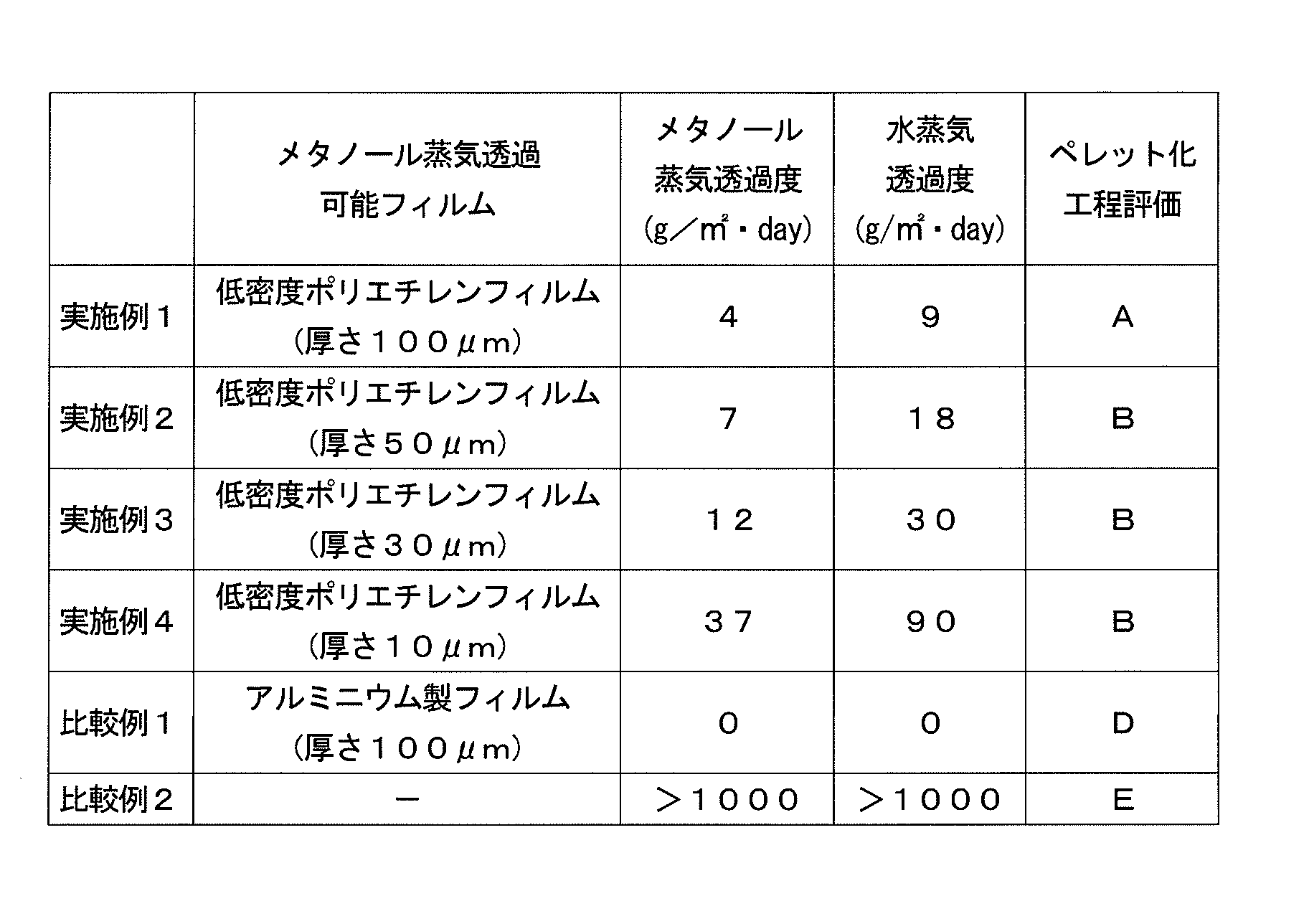
上記結果から明らかなように、本発明の包装袋を用いた実施例では、ペレット化工程において、溶融押出機での安定な運転が可能という良好な結果が得られた。これに対して、包装袋形成材料として、アルミニウム製フィルムを用いた比較例1は、メタノール蒸気透過度が0g/m2・day(23℃、50%RH)であることから、側鎖1,2-ジオール含有PVA系樹脂中のメタノールが包装袋内に充満して外気に放出されず側鎖1,2-ジオール含有PVA系樹脂内部に再び戻り存在することとなる。このため、上記側鎖1,2-ジオール含有PVA系樹脂をペレット化するために溶融押出機に投入した際に、有機溶剤(メタノール)分の揮発により側鎖1,2-ジオール含有PVA樹脂の入り込み不良の問題が生起した。そして、クラフト紙からなる包装袋を用いた比較例2は、メタノール蒸気透過度および水蒸気透過度とも1000g/m2・dayを超えるものであったことから、メタノールの低減効果は高いが、側鎖1,2-ジオール含有PVA系樹脂の吸湿により揮発分が上昇するため、結果、上記側鎖1,2-ジオール含有PVA系樹脂をペレット化する際に、溶融押出機において側鎖1,2-ジオール含有PVA系樹脂の入り込み不良の問題が起こり、さらに得られたペレットに気泡が入るなど、ペレット形状も不良になる問題がある。
上記実施例においては、本発明における具体的な形態について示したが、上記実施例は単なる例示にすぎず、限定的に解釈されるものではない。当業者に明らかな様々な変形は、本発明の範囲内であることが企図されている。
本発明の包装袋で保存および輸送してなる溶融成形用PVA系樹脂は、PVA系樹脂中に残留するメタノールが保存中に包装袋から外部に揮散されることから、溶融成形時の成形加工性に優れるようになる。
Claims (8)
- 溶融成形用ポリビニルアルコール系樹脂を包装するための包装袋であって、メタノール蒸気透過度0.5~1000g/m2・dayのフィルムからなることを特徴とする包装袋。
- 上記フィルムの水蒸気透過度が1000g/m2・day以下であることを特徴とする請求項1記載の包装袋。
- 上記溶融成形用ポリビニルアルコール系樹脂が、側鎖に一級水酸基を有する構造単位を含有するポリビニルアルコール系樹脂であることを特徴とする請求項1または2記載の包装袋。
- 上記側鎖に一級水酸基を有する構造単位が、側鎖に1,2-ジオール構造を有する構造単位であることを特徴とする請求項3記載の包装袋。
- 上記包装袋が、基材層/メタノール蒸気透過可能フィルム層/保護層の多層構造体であることを特徴とする請求項1~4のいずれか一項に記載の包装袋。
- 上記包装袋の厚みが、10~2000μmであることを特徴とする請求項1~5のいずれか一項に記載の包装袋。
- 上記基材層および保護層の少なくとも一方が、クラフト紙であることを特徴とする請求項5記載の包装袋。
- メタノール蒸気透過度0.5~1000g/m2・dayのフィルムからなる包装袋を用いて、溶融成形用ポリビニルアルコール系樹脂粉粒体を、密封、包装することを特徴とする溶融成形用ポリビニルアルコール系樹脂の保存方法。
Priority Applications (4)
| Application Number | Priority Date | Filing Date | Title |
|---|---|---|---|
| US15/777,452 US10815039B2 (en) | 2015-12-18 | 2016-12-07 | Packaging bag, and method for storing melt-processable polyvinyl alcohol resin with the use of the packaging bag |
| CN201680065720.3A CN108349642B (zh) | 2015-12-18 | 2016-12-07 | 包装袋和使用其的熔融成型用聚乙烯醇系树脂的保存方法 |
| JP2016571764A JP6942962B2 (ja) | 2015-12-18 | 2016-12-07 | 包装袋およびそれを用いた溶融成形用ポリビニルアルコール系樹脂の保存方法 |
| EP16875481.0A EP3392165B1 (en) | 2015-12-18 | 2016-12-07 | Use of a packaging bag and method for storing melt-processable polyvinyl alcohol resin in which said packaging bag is used |
Applications Claiming Priority (2)
| Application Number | Priority Date | Filing Date | Title |
|---|---|---|---|
| JP2015-247047 | 2015-12-18 | ||
| JP2015247047 | 2015-12-18 |
Publications (1)
| Publication Number | Publication Date |
|---|---|
| WO2017104501A1 true WO2017104501A1 (ja) | 2017-06-22 |
Family
ID=59056460
Family Applications (1)
| Application Number | Title | Priority Date | Filing Date |
|---|---|---|---|
| PCT/JP2016/086343 Ceased WO2017104501A1 (ja) | 2015-12-18 | 2016-12-07 | 包装袋およびそれを用いた溶融成形用ポリビニルアルコール系樹脂の保存方法 |
Country Status (5)
| Country | Link |
|---|---|
| US (1) | US10815039B2 (ja) |
| EP (1) | EP3392165B1 (ja) |
| JP (1) | JP6942962B2 (ja) |
| CN (1) | CN108349642B (ja) |
| WO (1) | WO2017104501A1 (ja) |
Cited By (1)
| Publication number | Priority date | Publication date | Assignee | Title |
|---|---|---|---|---|
| WO2021200134A1 (ja) | 2020-03-30 | 2021-10-07 | 三菱ケミカル株式会社 | オキシアルキレン基含有pva系樹脂の包装体及びその製造方法 |
Families Citing this family (4)
| Publication number | Priority date | Publication date | Assignee | Title |
|---|---|---|---|---|
| WO2019235399A1 (en) * | 2018-06-04 | 2019-12-12 | Sekisui Fuller Company, Ltd. | Thermoplastic resin film, meltable bag, and packaged hot-melt adhesive |
| JP2022013968A (ja) | 2018-11-14 | 2022-01-19 | デンカ株式会社 | 放熱基板を収容するパッケージおよび梱包箱 |
| JP7613377B2 (ja) | 2019-12-26 | 2025-01-15 | 三菱ケミカル株式会社 | 積層体、包装材及び食品包装材 |
| EP4321577A4 (en) * | 2021-04-09 | 2025-02-05 | Asahi Kasei Kabushiki Kaisha | Polyacetal resin composition and method for manufacturing same |
Citations (11)
| Publication number | Priority date | Publication date | Assignee | Title |
|---|---|---|---|---|
| US5623086A (en) | 1995-12-29 | 1997-04-22 | Eastman Chemical Company | Process for the production of 1,2-bis (acyloxylates) |
| WO2000024702A1 (fr) | 1998-10-23 | 2000-05-04 | Daicel Chemical Industries, Ltd. | Procede de preparation de diesters organiques |
| US6072079A (en) | 1999-03-03 | 2000-06-06 | Eastman Chemical Company | Continuous process for the production of diacetoxybutene |
| JP2004075866A (ja) | 2002-08-20 | 2004-03-11 | Nippon Synthetic Chem Ind Co Ltd:The | 溶融成形用ポリビニルアルコール系樹脂およびその用途 |
| JP2006095825A (ja) | 2004-09-29 | 2006-04-13 | Nippon Synthetic Chem Ind Co Ltd:The | 記録用媒体 |
| JP2011010697A (ja) * | 2009-06-30 | 2011-01-20 | Sanyo Chem Ind Ltd | アルコール保持シート製造用樹脂組成物、アルコール保持シート、アルコール蒸気供給材及びアルコール保持体 |
| JP2011021075A (ja) * | 2009-07-14 | 2011-02-03 | Sanyo Chem Ind Ltd | アルコール保持発泡体製造用樹脂組成物、アルコール保持発泡体、アルコール蒸気供給材及びアルコール保持体 |
| JP2011241234A (ja) * | 2009-04-28 | 2011-12-01 | Nippon Synthetic Chem Ind Co Ltd:The | ポリビニルアルコール系樹脂組成物 |
| JP2012067180A (ja) * | 2010-09-22 | 2012-04-05 | Sanyo Chem Ind Ltd | アルコール保持発泡体製造用樹脂組成物、アルコール保持発泡体、アルコール蒸気供給材及びアルコール保持体 |
| WO2012077810A1 (ja) * | 2010-12-09 | 2012-06-14 | 宇部興産株式会社 | 非対称ガス分離膜およびこれを用いてメタノールを分離する方法 |
| WO2014104259A1 (ja) * | 2012-12-26 | 2014-07-03 | 日本合成化学工業株式会社 | 真空断熱構造体用外装袋及びそれを用いた真空断熱構造体 |
Family Cites Families (7)
| Publication number | Priority date | Publication date | Assignee | Title |
|---|---|---|---|---|
| FR2733756B1 (fr) * | 1995-05-05 | 1997-08-01 | Rhone Poulenc Chimie | Procede de purification d'alcool polyvinylique |
| US6558764B2 (en) * | 1999-03-05 | 2003-05-06 | General Electric Company | Single layered polypropylene containers and their use |
| JP5054436B2 (ja) | 2007-06-12 | 2012-10-24 | ダイヤテックス株式会社 | 樹脂ペレット用充填袋 |
| KR101648172B1 (ko) | 2009-04-03 | 2016-08-12 | 신덕산업 주식회사 | 2-플라이 방습 지대 |
| EP2426172B1 (en) | 2009-04-28 | 2014-05-14 | The Nippon Synthetic Chemical Industry Co., Ltd. | Polyvinyl alcohol based resin composition |
| JP6258029B2 (ja) * | 2012-12-26 | 2018-01-10 | 日本合成化学工業株式会社 | 真空断熱構造体用外装袋及びそれを用いた真空断熱構造体、並びに真空断熱構造体用外装袋の保管または輸送方法、及び真空断熱構造体用外装袋の製法 |
| JP6728679B2 (ja) * | 2014-09-30 | 2020-07-22 | 三菱ケミカル株式会社 | 活性水素を有する変性基含有ポリビニルアルコール系樹脂の保存方法 |
-
2016
- 2016-12-07 JP JP2016571764A patent/JP6942962B2/ja active Active
- 2016-12-07 CN CN201680065720.3A patent/CN108349642B/zh active Active
- 2016-12-07 EP EP16875481.0A patent/EP3392165B1/en active Active
- 2016-12-07 US US15/777,452 patent/US10815039B2/en active Active
- 2016-12-07 WO PCT/JP2016/086343 patent/WO2017104501A1/ja not_active Ceased
Patent Citations (11)
| Publication number | Priority date | Publication date | Assignee | Title |
|---|---|---|---|---|
| US5623086A (en) | 1995-12-29 | 1997-04-22 | Eastman Chemical Company | Process for the production of 1,2-bis (acyloxylates) |
| WO2000024702A1 (fr) | 1998-10-23 | 2000-05-04 | Daicel Chemical Industries, Ltd. | Procede de preparation de diesters organiques |
| US6072079A (en) | 1999-03-03 | 2000-06-06 | Eastman Chemical Company | Continuous process for the production of diacetoxybutene |
| JP2004075866A (ja) | 2002-08-20 | 2004-03-11 | Nippon Synthetic Chem Ind Co Ltd:The | 溶融成形用ポリビニルアルコール系樹脂およびその用途 |
| JP2006095825A (ja) | 2004-09-29 | 2006-04-13 | Nippon Synthetic Chem Ind Co Ltd:The | 記録用媒体 |
| JP2011241234A (ja) * | 2009-04-28 | 2011-12-01 | Nippon Synthetic Chem Ind Co Ltd:The | ポリビニルアルコール系樹脂組成物 |
| JP2011010697A (ja) * | 2009-06-30 | 2011-01-20 | Sanyo Chem Ind Ltd | アルコール保持シート製造用樹脂組成物、アルコール保持シート、アルコール蒸気供給材及びアルコール保持体 |
| JP2011021075A (ja) * | 2009-07-14 | 2011-02-03 | Sanyo Chem Ind Ltd | アルコール保持発泡体製造用樹脂組成物、アルコール保持発泡体、アルコール蒸気供給材及びアルコール保持体 |
| JP2012067180A (ja) * | 2010-09-22 | 2012-04-05 | Sanyo Chem Ind Ltd | アルコール保持発泡体製造用樹脂組成物、アルコール保持発泡体、アルコール蒸気供給材及びアルコール保持体 |
| WO2012077810A1 (ja) * | 2010-12-09 | 2012-06-14 | 宇部興産株式会社 | 非対称ガス分離膜およびこれを用いてメタノールを分離する方法 |
| WO2014104259A1 (ja) * | 2012-12-26 | 2014-07-03 | 日本合成化学工業株式会社 | 真空断熱構造体用外装袋及びそれを用いた真空断熱構造体 |
Cited By (2)
| Publication number | Priority date | Publication date | Assignee | Title |
|---|---|---|---|---|
| WO2021200134A1 (ja) | 2020-03-30 | 2021-10-07 | 三菱ケミカル株式会社 | オキシアルキレン基含有pva系樹脂の包装体及びその製造方法 |
| JPWO2021200134A1 (ja) * | 2020-03-30 | 2021-10-07 |
Also Published As
| Publication number | Publication date |
|---|---|
| CN108349642A (zh) | 2018-07-31 |
| EP3392165A1 (en) | 2018-10-24 |
| JPWO2017104501A1 (ja) | 2018-10-04 |
| US20180346214A1 (en) | 2018-12-06 |
| JP6942962B2 (ja) | 2021-09-29 |
| EP3392165A4 (en) | 2019-05-15 |
| CN108349642B (zh) | 2020-09-01 |
| EP3392165B1 (en) | 2020-09-23 |
| US10815039B2 (en) | 2020-10-27 |
Similar Documents
| Publication | Publication Date | Title |
|---|---|---|
| WO2017104501A1 (ja) | 包装袋およびそれを用いた溶融成形用ポリビニルアルコール系樹脂の保存方法 | |
| JP6973084B2 (ja) | エチレン−ビニルアルコール系共重合体ペレット、樹脂組成物および多層構造体 | |
| CN105579350B (zh) | 吹塑成型容器、燃料容器、吹塑成型瓶容器和吹塑成型容器的制造方法 | |
| TWI708798B (zh) | 乙烯-乙烯酯系共聚物皂化物丸粒及其製造方法 | |
| CN110050017B (zh) | 乙烯-乙烯醇系共聚物组合物粒料、及乙烯-乙烯醇系共聚物组合物粒料的制造方法 | |
| JP2020090646A (ja) | 樹脂組成物、その製造方法、成形体、及び多層構造体 | |
| JP6935476B2 (ja) | ブロー成形容器、燃料容器及びブロー成形容器の製造方法 | |
| CN106573704A (zh) | 乙烯‑乙烯基酯系共聚物皂化物或其树脂组合物的颗粒组的包装体 | |
| JP6984497B2 (ja) | エチレン−ビニルアルコール系共重合体樹脂組成物および溶融成形用材料ならびに多層構造体 | |
| WO2021210555A1 (ja) | 変性ビニルアルコール系重合体 | |
| JP2020105317A (ja) | 樹脂組成物、成形体及び多層構造体 | |
| JP5188006B2 (ja) | 樹脂組成物およびそれを用いた多層構造体 | |
| JP7226976B2 (ja) | フィルム及びその製造方法、包装材、並びに真空包装袋 | |
| JPWO2019049776A1 (ja) | 樹脂組成物 | |
| CN115335301B (zh) | 含氧化烯基的pva系树脂的包装体及其制造方法 | |
| WO2022034876A1 (ja) | ポリビニルアルコール系樹脂組成物及び当該樹脂組成物を用いた溶融成形体 | |
| JP7031302B2 (ja) | エチレン-ビニルアルコール系共重合体ペレットおよび、エチレン-ビニルアルコール系共重合体ペレットの製造方法 | |
| JP6915530B2 (ja) | エチレン−ビニルアルコール系共重合体ペレットおよび、エチレン−ビニルアルコール系共重合体ペレットの製造方法 | |
| WO2007129369A1 (ja) | 樹脂組成物およびそれを用いた多層構造体 | |
| JP2018109168A (ja) | エチレン−ビニルアルコール系共重合体ペレットおよび、エチレン−ビニルアルコール系共重合体ペレットの製造方法 | |
| JP7246169B2 (ja) | ブロー成形容器、並びにこれを備える燃料容器及びボトル容器 | |
| JP7199932B2 (ja) | 熱成形容器 | |
| CN121969683A (zh) | 组合物、成型体、膜、多层结构体 | |
| JP2025021523A (ja) | 樹脂材料、相容化剤、多層構造体及び多層構造体の再利用方法 | |
| TW202402842A (zh) | 改性乙烯-乙烯醇系共聚物組成物、丸粒、多層結構體、改性乙烯-乙烯醇系共聚物組成物之製造方法及多層結構體之製造方法 |
Legal Events
| Date | Code | Title | Description |
|---|---|---|---|
| ENP | Entry into the national phase |
Ref document number: 2016571764 Country of ref document: JP Kind code of ref document: A |
|
| 121 | Ep: the epo has been informed by wipo that ep was designated in this application |
Ref document number: 16875481 Country of ref document: EP Kind code of ref document: A1 |
|
| NENP | Non-entry into the national phase |
Ref country code: DE |