WO2017094491A1 - 貼付剤の包装構造 - Google Patents
貼付剤の包装構造 Download PDFInfo
- Publication number
- WO2017094491A1 WO2017094491A1 PCT/JP2016/083763 JP2016083763W WO2017094491A1 WO 2017094491 A1 WO2017094491 A1 WO 2017094491A1 JP 2016083763 W JP2016083763 W JP 2016083763W WO 2017094491 A1 WO2017094491 A1 WO 2017094491A1
- Authority
- WO
- WIPO (PCT)
- Prior art keywords
- resin
- layer
- mass
- resin layer
- cyclic polyolefin
- Prior art date
- Legal status (The legal status is an assumption and is not a legal conclusion. Google has not performed a legal analysis and makes no representation as to the accuracy of the status listed.)
- Ceased
Links
Classifications
-
- A—HUMAN NECESSITIES
- A61—MEDICAL OR VETERINARY SCIENCE; HYGIENE
- A61J—CONTAINERS SPECIALLY ADAPTED FOR MEDICAL OR PHARMACEUTICAL PURPOSES; DEVICES OR METHODS SPECIALLY ADAPTED FOR BRINGING PHARMACEUTICAL PRODUCTS INTO PARTICULAR PHYSICAL OR ADMINISTERING FORMS; DEVICES FOR ADMINISTERING FOOD OR MEDICINES ORALLY; BABY COMFORTERS; DEVICES FOR RECEIVING SPITTLE
- A61J1/00—Containers specially adapted for medical or pharmaceutical purposes
-
- B—PERFORMING OPERATIONS; TRANSPORTING
- B32—LAYERED PRODUCTS
- B32B—LAYERED PRODUCTS, i.e. PRODUCTS BUILT-UP OF STRATA OF FLAT OR NON-FLAT, e.g. CELLULAR OR HONEYCOMB, FORM
- B32B27/00—Layered products comprising a layer of synthetic resin
- B32B27/06—Layered products comprising a layer of synthetic resin as the main or only constituent of a layer, which is next to another layer of the same or of a different material
- B32B27/08—Layered products comprising a layer of synthetic resin as the main or only constituent of a layer, which is next to another layer of the same or of a different material of synthetic resin
-
- A—HUMAN NECESSITIES
- A61—MEDICAL OR VETERINARY SCIENCE; HYGIENE
- A61J—CONTAINERS SPECIALLY ADAPTED FOR MEDICAL OR PHARMACEUTICAL PURPOSES; DEVICES OR METHODS SPECIALLY ADAPTED FOR BRINGING PHARMACEUTICAL PRODUCTS INTO PARTICULAR PHYSICAL OR ADMINISTERING FORMS; DEVICES FOR ADMINISTERING FOOD OR MEDICINES ORALLY; BABY COMFORTERS; DEVICES FOR RECEIVING SPITTLE
- A61J3/00—Devices or methods specially adapted for bringing pharmaceutical products into particular physical or administering forms
- A61J3/07—Devices or methods specially adapted for bringing pharmaceutical products into particular physical or administering forms into the form of capsules or similar small containers for oral use
-
- B—PERFORMING OPERATIONS; TRANSPORTING
- B32—LAYERED PRODUCTS
- B32B—LAYERED PRODUCTS, i.e. PRODUCTS BUILT-UP OF STRATA OF FLAT OR NON-FLAT, e.g. CELLULAR OR HONEYCOMB, FORM
- B32B27/00—Layered products comprising a layer of synthetic resin
-
- B—PERFORMING OPERATIONS; TRANSPORTING
- B32—LAYERED PRODUCTS
- B32B—LAYERED PRODUCTS, i.e. PRODUCTS BUILT-UP OF STRATA OF FLAT OR NON-FLAT, e.g. CELLULAR OR HONEYCOMB, FORM
- B32B27/00—Layered products comprising a layer of synthetic resin
- B32B27/32—Layered products comprising a layer of synthetic resin comprising polyolefins
-
- B—PERFORMING OPERATIONS; TRANSPORTING
- B32—LAYERED PRODUCTS
- B32B—LAYERED PRODUCTS, i.e. PRODUCTS BUILT-UP OF STRATA OF FLAT OR NON-FLAT, e.g. CELLULAR OR HONEYCOMB, FORM
- B32B27/00—Layered products comprising a layer of synthetic resin
- B32B27/32—Layered products comprising a layer of synthetic resin comprising polyolefins
- B32B27/325—Layered products comprising a layer of synthetic resin comprising polyolefins comprising polycycloolefins
-
- B—PERFORMING OPERATIONS; TRANSPORTING
- B65—CONVEYING; PACKING; STORING; HANDLING THIN OR FILAMENTARY MATERIAL
- B65D—CONTAINERS FOR STORAGE OR TRANSPORT OF ARTICLES OR MATERIALS, e.g. BAGS, BARRELS, BOTTLES, BOXES, CANS, CARTONS, CRATES, DRUMS, JARS, TANKS, HOPPERS, FORWARDING CONTAINERS; ACCESSORIES, CLOSURES, OR FITTINGS THEREFOR; PACKAGING ELEMENTS; PACKAGES
- B65D65/00—Wrappers or flexible covers; Packaging materials of special type or form
- B65D65/38—Packaging materials of special type or form
- B65D65/40—Applications of laminates for particular packaging purposes
-
- B—PERFORMING OPERATIONS; TRANSPORTING
- B32—LAYERED PRODUCTS
- B32B—LAYERED PRODUCTS, i.e. PRODUCTS BUILT-UP OF STRATA OF FLAT OR NON-FLAT, e.g. CELLULAR OR HONEYCOMB, FORM
- B32B2250/00—Layers arrangement
- B32B2250/02—2 layers
-
- B—PERFORMING OPERATIONS; TRANSPORTING
- B32—LAYERED PRODUCTS
- B32B—LAYERED PRODUCTS, i.e. PRODUCTS BUILT-UP OF STRATA OF FLAT OR NON-FLAT, e.g. CELLULAR OR HONEYCOMB, FORM
- B32B2250/00—Layers arrangement
- B32B2250/24—All layers being polymeric
- B32B2250/246—All polymers belonging to those covered by groups B32B27/32 and B32B27/30
-
- B—PERFORMING OPERATIONS; TRANSPORTING
- B32—LAYERED PRODUCTS
- B32B—LAYERED PRODUCTS, i.e. PRODUCTS BUILT-UP OF STRATA OF FLAT OR NON-FLAT, e.g. CELLULAR OR HONEYCOMB, FORM
- B32B2323/00—Polyalkenes
- B32B2323/04—Polyethylene
- B32B2323/046—LDPE, i.e. low density polyethylene
-
- B—PERFORMING OPERATIONS; TRANSPORTING
- B32—LAYERED PRODUCTS
- B32B—LAYERED PRODUCTS, i.e. PRODUCTS BUILT-UP OF STRATA OF FLAT OR NON-FLAT, e.g. CELLULAR OR HONEYCOMB, FORM
- B32B2439/00—Containers; Receptacles
- B32B2439/80—Medical packaging
Definitions
- the present invention relates to a packaging structure for packaging a patch with a packaging material.
- the patch to be applied to the skin surface is widely used for the purpose of administering a percutaneous absorption component into the body and protecting the wound.
- a percutaneous absorption component into the body and protecting the wound.
- Such a patch is usually packaged with a packaging material in order to prevent deterioration of the pasting performance due to oxygen and moisture in the air and volatilization of transdermally absorbable components such as drugs.
- packaging using polyacrylonitrile resin as the innermost layer of the packaging material for packaging patches because of the low adsorptivity of the percutaneous absorption component and the ease of opening the packaging structure
- the structure is widely used (see, for example, Patent Documents 1 and 2).
- the sealing suitability temperature range when forming the packaging structure by heat sealing is narrow, and it may be difficult to ensure the sealing strength depending on the bag making conditions.
- the above packaging structure makes it difficult to obtain adhesion when foreign matter adheres to the heat seal surface, such as adhesion of liquid or powder during heat sealing, resulting in decreased yield due to poor adhesion during the production process. May occur.
- the problems to be solved by the present invention include a wide sealing suitability temperature range, and a heat seal that has a reduction in adhesive performance of the patch, suppression of volatilization of transdermal absorption components, and openability of the packaging structure. It is an object of the present invention to provide a packaging structure of a patch excellent in a favorable contaminant sealing property in which poor adhesion is not easily generated even when foreign matter adheres to a surface.
- the layer that is the innermost surface in the packaging structure of the packaging material is a heat-sealable resin layer containing an olefin resin, and the outer side of the heat-sealable resin layer.
- the present invention is a packaging structure in which the patch is packaged with a packaging material, the innermost layer in the packaging structure of the packaging material is a heat-sealable resin layer containing an olefin resin, and the heat seal
- a packaging structure for a patch having a resin layer containing a cyclic polyolefin resin on the outside of the adhesive resin layer, and wherein the heat-sealable resin layer and a resin layer containing a cyclic polyolefin resin are directly laminated.
- the packaging structure of the patch of the present invention is such that a heat seal layer in contact with the patch when packaging the patch is a resin layer containing an olefin resin, and a resin layer containing a cyclic polyolefin resin is included in the resin layer.
- the packaging structure of the present invention having the above-described configuration, it is excellent in automatic packaging machine suitability, and suitable foreign matter sealability is less likely to cause poor adhesion when foreign matter such as liquid bite or powder adheres during heat sealing. Can be realized.
- the heat seal strength necessary for the integrated packaging in which several patches are packaged can be expressed. Since a level difference occurs due to the thickness (height) of several patches, the occurrence of pinholes and darts (leakage and sealing failure) at the corners of the packaging bag can be suppressed. Further, since the inner surface can be heat-sealed with polyethylene resin, it can be heat-sealed even with a polyethylene chuck used when opening and closing many times after opening.
- the packaging structure of the present invention is a packaging structure in which the patch is packaged with a packaging material, and the innermost layer in the packaging structure of the packaging material is a heat-sealable resin layer containing an olefin resin, and the heat-sealable resin
- the packaging structure has a resin layer containing a cyclic polyolefin-based resin outside the layer, and a heat-sealable resin layer and a resin layer containing a cyclic polyolefin-based resin are directly laminated.
- the packaging material used for the packaging structure of the present invention is a heat-sealable resin layer (hereinafter referred to as a heat-seal layer (A)) in which the outermost surface layer in the packaging structure contains an olefin-based resin, and the heat.
- the sealing layer (A) has a structure in which a resin layer containing a cyclic polyolefin resin (hereinafter referred to as a cyclic polyolefin resin layer (B)) is directly laminated.
- heat seal layer (A) As the olefin resin used for the heat seal layer (A), polyethylene resin, polypropylene resin, and copolymers thereof can be used.
- polyethylene resins include very low density polyethylene (VLDPE), linear low density polyethylene (LLDPE), linear medium density polyethylene (LMDPE), low density polyethylene (LDPE), medium density polyethylene (MDPE), high High density polyethylene (HDPE) polyethylene resin, ethylene-vinyl acetate copolymer (EVA), ethylene-methyl methacrylate copolymer (EMMA), ethylene-ethyl acrylate copolymer (EEA), ethylene-methyl acrylate (EMA) ) Copolymers, ethylene-ethyl acrylate-maleic anhydride copolymer (E-EA-MAH), ethylene-acrylic acid copolymer (EAA), ethylene-methacrylic acid copolymer (EMAA), etc.
- VLDPE very low density polyethylene
- LLDPE linear
- Polymer; further ethylene-acrylic acid copolymer Ionomers, ethylene - mentioned ionomer methacrylic acid copolymer, and, alone, may be used by mixing two or more kinds. Among them, suppression of volatilization of percutaneously absorbable components and deterioration of patch application performance (hereinafter sometimes referred to as volatilization of active ingredients), heat such as a wide temperature range suitable for heat sealing and suitable adhesion LLDPE can be preferably used because it is easy to suitably realize the sealing property.
- the LDPE may be a branched low density polyethylene obtained by a high pressure radical polymerization method, and is preferably a branched low density polyethylene obtained by homopolymerizing ethylene by a high pressure radical polymerization method.
- an ethylene monomer as a main component and a comonomer such as butene-1, hexene-1, octene-1, and 4-methylpentene are produced by a low-pressure radical polymerization method using a single site catalyst.
- a comonomer such as butene-1, hexene-1, octene-1, and 4-methylpentene
- the comonomer content is preferably in the range of 0.5 to 20 mol%, and more preferably in the range of 1 to 18 mol%.
- the single site catalyst examples include various single site catalysts such as a metallocene catalyst system such as a combination of a metallocene compound of Group IV or V transition metal of the periodic table and an organoaluminum compound and / or an ionic compound.
- the single-site catalyst has a uniform active site, so the molecular weight distribution of the resulting resin is sharper than a multi-site catalyst with a non-uniform active site. This is preferable because a resin having physical properties excellent in stability of adhesive strength between resin layers can be obtained.
- the MFR (190 ° C., 21.18 N) of the polyethylene resin is preferably 2 to 20 g / 10 minutes, and more preferably 3 to 10 g / 10 minutes. When the MFR is within this range, the extrusion moldability of the film is improved.
- polypropylene resin examples include propylene homopolymer, propylene / ⁇ -olefin random copolymer, such as propylene-ethylene copolymer, propylene-butene-1 copolymer, propylene-ethylene-butene-1 copolymer.
- examples include coalesced metallocene catalyst polypropylene. These may be used alone or in combination.
- a propylene- ⁇ -olefin random copolymer is desirable, and a propylene / ⁇ -olefin random polymer polymerized using a metallocene catalyst is particularly preferable.
- the intermediate layer (B) the heat resistance of the film is improved and the softening temperature can be increased. Therefore, boiling at 100 ° C. or lower, hot filling, or 100 ° C. or higher. It can be suitably used as a laminating film for packaging materials having excellent steam / high pressure heat sterilization characteristics such as retort sterilization.
- These polypropylene resins preferably have an MFR (230 ° C.) of 0.5 to 30.0 g / 10 min and a melting point of 110 to 165 ° C., more preferably an MFR (230 ° C.) of 2
- the melting point is 115 to 162 ° C. at 0 to 15.0 g / 10 min. If MFR and melting
- the heat seal layer (A) is preferably composed mainly of an olefin-based resin because it is easy to ensure a wide heat seal suitability temperature range and easy to achieve suitable adhesion.
- 80% by mass or more in the resin component that constitutes) is preferably an olefin resin other than the cyclic olefin resin exemplified above, more preferably 90% by mass or more, and 100% by mass. Is particularly preferred.
- 80 mass% in the olefin resin contained in the heat seal layer (A) is an olefin resin having a density of 0.9 g / cm 3 or more, it is particularly easy to obtain adhesion, and is preferably 90 mass% or more. It is more preferable that In particular, 80% by mass in the olefin-based resin contained in the heat seal layer (A) is preferably a linear low-density polyethylene resin, and more preferably 90% by mass or more.
- the content of the cyclic polyolefin resin in the heat seal layer (A) is preferably 10% by mass or less, more preferably 5% by mass or less, and particularly preferably substantially not contained.
- the thickness of the heat seal layer (A) may be appropriately adjusted depending on the use mode, but it is 2 to 8 ⁇ m because it is easy to ensure a suitable heat seal property while suitably suppressing volatilization of the active ingredient. Is preferably 3 to 6 ⁇ m.
- Cyclic polyolefin resin layer (B) examples of the cyclic polyolefin resin used for the cyclic polyolefin resin layer (B) include a norbornene polymer, a vinyl alicyclic hydrocarbon polymer, and a cyclic conjugated diene polymer. Among these, norbornene-based polymers are preferable.
- the norbornene-based polymer includes a ring-opening polymer of a norbornene-based monomer (hereinafter referred to as “COP”), a norbornene-based copolymer obtained by copolymerizing a norbornene-based monomer and an olefin such as ethylene (hereinafter, referred to as “COP”). , “COC”).
- COP and COC hydrogenates are particularly preferred.
- the weight average molecular weight of the cyclic olefin resin is preferably 5,000 to 500,000, more preferably 7,000 to 300,000.
- the norbornene polymer and the norbornene monomer used as a raw material are alicyclic monomers having a norbornene ring.
- Examples of such norbornene-based monomers include norbornene, tetracyclododecene, ethylidene norbornene, vinyl norbornene, ethylidetetracyclododecene, dicyclopentadiene, dimethanotetrahydrofluorene, phenyl norbornene, methoxycarbonyl norbornene, methoxy And carbonyltetracyclododecene.
- These norbornene monomers may be used alone or in combination of two or more.
- the norbornene-based copolymer is a copolymer of the norbornene-based monomer and an olefin copolymerizable with the norbornene-based monomer.
- olefin include the number of carbon atoms such as ethylene, propylene, and 1-butene.
- examples thereof include olefins having 2 to 20; cycloolefins such as cyclobutene, cyclopentene, and cyclohexene; and non-conjugated dienes such as 1,4-hexadiene. These olefins can be used alone or in combination of two or more.
- cyclic polyolefin-based resin examples include commercially available ring-opening polymers (COP) of norbornene monomers such as “ZEONOR” manufactured by Nippon Zeon Co., Ltd., and norbornene copolymers ( Examples of (COC) include “Apel” manufactured by Mitsui Chemicals, Inc., “TOPAS” manufactured by Polyplastics, and the like.
- COP ring-opening polymers
- ZONOR manufactured by Nippon Zeon Co., Ltd.
- norbornene copolymers examples include “Apel” manufactured by Mitsui Chemicals, Inc., “TOPAS” manufactured by Polyplastics, and the like.
- the volatilization of the active ingredient is suitable. It is possible to achieve good tearability of the packaging material while suppressing the above.
- the cyclic polyolefin resin layer (B) is preferably mainly composed of a cyclic polyolefin-based resin because it easily suppresses volatilization of the active ingredient, etc. and easily obtains a suitable opening property by tearing of the packaging material.
- 60% by mass or more of the resin component constituting the cyclic polyolefin resin layer (B) is preferably a cyclic polyolefin-based resin, more preferably 80% by mass or more, and particularly preferably 90% by mass or more. preferable.
- a cyclic polyolefin resin layer (B) has a glass transition point (Tg).
- Tg glass transition point
- a low-Tg cyclic polyolefin-based resin of 100 ° C. or less is preferable, 50% by mass or more is more preferable, and 50 to 80% by mass is particularly preferable.
- the glass transition point, melting point, and the like are values measured by differential scanning calorimetry (DSC).
- the glass transition temperature of the low Tg cyclic polyolefin resin is more preferably 90 ° C. or less, and particularly preferably 60 to 80 ° C.
- a high Tg cyclic polyolefin resin having a glass transition point exceeding 100 ° C. it becomes easy to improve the tensile strength, tear resistance, and the like of the resulting packaging material.
- the content of the high-Tg cyclic polyolefin-based resin is suitable for improving the tensile strength and tear resistance of the resulting packaging material, and that it is easy to obtain suitable rigidity and contaminant sealing properties, and to suppress pinholes.
- the glass transition temperature of the high Tg cyclic polyolefin resin is preferably 120 ° C. or higher, more preferably 130 ° C. or higher, and particularly preferably 135 to 150 ° C.
- a polyolefin resin such as a polypropylene resin or a polyethylene resin that does not contain a cyclic structure may be used in combination in order to improve tear resistance and bag breaking resistance. It is valid.
- a polyolefin-type resin which does not contain a cyclic structure it is preferable to set it as 20 mass% or less in the resin component contained in a cyclic polyolefin-type resin layer (B), and it is more preferable to set it as 10 mass% or less. Preferably, it is more preferably 5% by mass or less.
- the lower limit of the content of the polyolefin resin not containing a cyclic structure is preferably 1% by mass or more, and more preferably 2% by mass or more.
- the thickness of the cyclic polyolefin resin layer (B) may be appropriately adjusted depending on the use mode, but it is easy to ensure a suitable contaminant sealing property while suitably suppressing volatilization of the active ingredient, and to prevent pinholes during packaging.
- the thickness is preferably 3 to 12 ⁇ m, more preferably 4 to 10 ⁇ m, and particularly preferably 5 to 8 ⁇ m.
- the packaging material used in the present invention is a packaging material composed of a laminated film in which at least the heat seal layer (A) and the cyclic polyolefin resin layer (B) are laminated.
- the layer structure of the laminated film used as the packaging material may be a layer structure of (A) / (B) composed of the heat seal layer (A) and the cyclic polyolefin resin layer (B), but the (B) Other layers such as a resin layer containing an olefin resin (hereinafter referred to as a resin layer (C)) and a cyclic polyolefin resin layer containing a cyclic polyolefin resin (hereinafter referred to as a resin layer (D)) are also provided on the outer layer of the layer.
- stacked may be sufficient.
- a three-layer configuration such as (A) / (B) / (C), (A) / (B) / (D), (A)
- a four-layer structure of / (B) / (C) / (D) can be exemplified.
- the structure of (A) / (B) / (C) / (D) is preferable because it is easy to adjust the performance such as suppression of volatilization of the active ingredient, openability, heat sealability and the like particularly preferably.
- the layer (A) and the layer (C), the layer (B) and the layer (D) may be layers having the same composition or different compositions.
- the packaging material used in the present invention by providing the resin layer (C), the packaging material is suitable for flexibility, cold resistance, impact resistance, pinhole resistance, contaminant sealability, curl resistance, etc. Can be adjusted. For this reason, it is preferable to select suitably the olefin resin used for a resin layer (C) according to a use or a use aspect.
- the same olefin resin as that of the heat seal layer (A) can be preferably used. However, it is easy to obtain interlayer adhesion with other layers, and it is easy to obtain industrially. From the viewpoint of properties, a polyethylene resin or a polypropylene resin is preferably used, and a polyethylene resin is particularly preferable.
- the polyethylene resin cold resistance, pinhole resistance, since it is easy to obtain an interlayer adhesion or the like of a multilayer, preferably it has a density of 0.915 ⁇ 0.950g / cm 3, more preferably, the density Those of 0.920 to 0.945 g / cm 3 can be preferably used.
- the melting point is preferably in the range of 70 to 130 ° C, more preferably 80 to 125 ° C. If melting
- the MFR (190 ° C., 21.18N) of the polyethylene resin is preferably 2 to 20 g / 10 minutes, and more preferably 3 to 10 g / 10 minutes. When the MFR is within this range, the extrusion moldability of the film is improved.
- LLDPE and LMDPE can be particularly preferably used because of easy opening by tearing and easy pinhole resistance of the packaging material.
- the polypropylene resin preferably has an MFR (230 ° C.) of 0.5 to 30.0 g / 10 min and a melting point of 110 to 165 ° C., more preferably an MFR (230 ° C.) of 2. It has a melting point of 115 to 162 ° C. at 0 to 15.0 g / 10 minutes. If MFR and melting
- the content of the olefin resin in the resin layer (C) is preferably 80% by mass or more of the resin component constituting the resin layer (C), more preferably 90% by mass or more. preferable.
- resins than the olefin resin may be mixed within a range not impairing the effects of the present invention.
- a coextrusion lamination method such as the above-mentioned cyclic polyolefin resin can be applied.
- the thickness of the resin layer (C) may be appropriately adjusted depending on the use mode, but is preferably 10 to 30 ⁇ m, and preferably 13 to 20 ⁇ m because suitable packaging suitability and contaminant sealing properties are easily obtained. More preferred.
- the packaging material used for this invention can suppress suitably the adhesive component at the time of laminating
- it can suppress especially suitably by providing a resin layer (D). Further, it is preferable because the curl resistance and the like can be easily adjusted.
- the same cyclic polyolefin resin as that of the cyclic polyolefin resin layer (B) can be preferably used.
- the resin layer (D) preferably contains a cyclic polyolefin resin as a main component, and 80% by mass or more of the resin components constituting the resin layer (C) is preferably a cyclic polyolefin resin, and 90% by mass. More preferably.
- the glass transition point of the cyclic polyolefin resin used for the resin layer (D) is 200 from the viewpoint of easy production by a coextrusion lamination method with other resin layers and the availability of industrial raw materials. It is preferable that it is below °C.
- the content ratio of the norbornene monomer is preferably in the range of 40 to 90% by mass, more preferably 50 to 90% by mass, and still more preferably 60 to 85%. % By mass. If the content ratio is within this range, it is easy to improve rigidity, easy tearability, and laminate characteristics.
- a high Tg cyclic polyolefin resin having a glass transition point exceeding 100 ° C. is applied to the resin layer (D).
- the content is preferably 20 to 60% by mass, more preferably 20 to 50% by mass in the resin component contained. By setting it as the said range, since it is easy to improve the easy tear property and rigidity of the packaging material obtained, it is preferable.
- the glass transition temperature of the high Tg cyclic polyolefin resin is preferably 120 ° C. or higher, more preferably 130 ° C. or higher, and particularly preferably 135 to 150 ° C.
- norbornene copolymers with high Tg have low tensile strength, and are extremely easy to break and tear easily. Therefore, take into consideration the balance between film formability, slitting take-up and winding properties, and laminate strength. It is also preferable to blend a low Tg cyclic polyolefin resin having a glass transition point of 100 ° C. or lower with a high Tg cyclic polyolefin resin. In particular, it is preferable to blend COC having a Tg of less than 100 ° C. in order to develop high seal strength and to improve bag breaking resistance.
- the content of the low-Tg cyclic polyolefin resin is more preferably 50% by mass or more, and particularly preferably 50 to 80% by mass in the resin component contained in the resin layer (D).
- the glass transition temperature of the low-Tg cyclic polyolefin resin is more preferably 90 ° C. or less, and particularly preferably 60 to 80 ° C.
- a polyolefin resin such as a polypropylene resin or a polyethylene resin that does not contain a cyclic structure and is compatible with COC into the resin layer (D).
- a polyolefin-type resin which does not contain a cyclic structure
- it is more preferably 5% by mass or less.
- the lower limit of the content of the polyolefin resin not containing a cyclic structure is preferably 1% by mass or more, and more preferably 2% by mass or more.
- the thickness of the resin layer (D) may be appropriately adjusted depending on the use mode, but is preferably 1 to 10 ⁇ m and more preferably 2 to 8 ⁇ m because it is easy to produce by the coextrusion lamination method. It is preferably 2 to 5 ⁇ m.
- the total thickness is preferably in the range of 10 to 100 ⁇ m, more preferably in the range of 20 to 60 ⁇ m.
- the thickness ratio with respect to the total thickness of the layer (A) is preferably 10 to 25%, more preferably 10 to 20%.
- the thickness ratio with respect to the total thickness of the layer (B) is preferably 15 to 30%.
- the ratio of the total thickness of the layer (D) and the layer (B) to the total thickness is 40% or more and 60% or less.
- the total thickness of the cyclic polyolefin resin layer (B) and the resin layer (C) may be adjusted as appropriate depending on the use mode, but it is easy to ensure suitable openability while suitably suppressing volatilization of the active ingredient. Therefore, the thickness is preferably 6 to 15 ⁇ m, more preferably 8 to 13 ⁇ m.
- an antifogging agent for each of the resin layers, an antifogging agent, an antistatic agent, a heat stabilizer, a nucleating agent, an antioxidant, a lubricant, an antiblocking agent, a release agent, an ultraviolet absorber, a coloring agent, etc.
- these components can be added as long as the object of the present invention is not impaired.
- the friction coefficient on the film surface of the layers (A) and (D) is preferably 1.5 or less, and more preferably 1.0 or less. It is preferable to add a lubricant or an anti-blocking agent to the resin layer (A) as appropriate.
- each resin or resin mixture used for each layer is heated and melted in a separate extruder, and melted by a method such as a coextrusion multilayer die method or a feed block method.
- a coextrusion method in which each layer is laminated in a state and then formed into a film by inflation, a T-die / chill roll method, or the like can be preferably used.
- the co-extrusion method is preferable because the thickness ratio of each layer can be adjusted relatively freely, and a laminated film having excellent hygiene and cost performance can be obtained.
- the difference between the melting point and Tg between the two is large.
- the appearance may be deteriorated, and it may be difficult to form a uniform layer structure.
- a T-die / chill roll method that can perform melt extrusion at a relatively high temperature is preferable.
- the packaging material used in the present invention may be a packaging material composed of the above laminated film, but the laminated film is used as a sealant film, and a substrate is bonded to the layer (A) of the sealant film and the other outer layer.
- a packaging material made of a laminated film is preferable.
- the substrate it is preferable to use a plastic substrate having high rigidity and high gloss, particularly a biaxially stretched resin film. For applications that do not require transparency, aluminum foils can be used alone or in combination.
- stretched resin film examples include biaxially stretched polyester (PET), easily tearable biaxially stretched polyester (PET), biaxially stretched polypropylene (OPP), and biaxially stretched polyamide (from the viewpoint of easy tearability, etc. PA), coextrusion biaxially oriented polypropylene with ethylene vinyl alcohol copolymer (EVOH) as the central layer, biaxially oriented biaxially oriented polypropylene, biaxially oriented ethylene vinyl alcohol copolymer (EVOH), and coextrusion biaxially coated with polyvinylidene chloride (PVDC) Examples thereof include stretched polypropylene. These may be used alone or in combination.
- the laminate film is a film obtained by laminating the base material on the laminated film obtained by the above production method.
- the lamination method include methods such as dry lamination, wet lamination, non-solvent lamination, and extrusion lamination. Can be mentioned.
- Examples of the adhesive used in the dry lamination include a polyether-polyurethane adhesive and a polyester-polyurethane adhesive.
- Various pressure-sensitive adhesives can be used, but a pressure-sensitive pressure-sensitive adhesive is preferably used.
- Examples of the pressure-sensitive adhesive include, for example, a polyisobutylene rubber, a butyl rubber, a rubber adhesive in which a mixture thereof is dissolved in an organic solvent such as benzene, toluene, xylene, hexane, or a bisethylene acid rosin in the rubber adhesive.
- Blends with tackifiers such as esters, terpene / phenol copolymers, terpene / indene copolymers, or 2-ethylhexyl acrylate / n-butyl acrylate copolymer, 2-ethylhexyl acrylate / ethyl acrylate /
- An acrylic pressure-sensitive adhesive prepared by dissolving an acrylic copolymer having a glass transition point of ⁇ 20 ° C. or less, such as a methyl methacrylate copolymer, with an organic solvent can be used.
- the outermost surface on which the base material of the above laminated film is laminated is to improve the applicability of the above-mentioned adhesive or pressure-sensitive adhesive or after printing on the outermost surface.
- a surface treatment in order to improve adhesion to an adhesive, a pressure-sensitive adhesive, printing ink, and the like.
- Examples of such surface treatment include corona treatment, plasma treatment, chromic acid treatment, flame treatment, hot air treatment, surface oxidation treatment such as ozone / ultraviolet treatment, and surface unevenness treatment such as sandblasting. Corona treatment is preferable. If the surface on which the base material is laminated is a layer containing a cyclic polyolefin resin, there is no deterioration over time in the degree of treatment even after long-term storage after such treatment. Can be provided.
- the patch in the present invention is a dressing, a poultice, a plaster, a dressing, a percutaneous absorption tape preparation, etc. used by being applied to the skin of a human body or an animal for administration of a drug or the like and protection of a wound. It is a patch.
- a form of the patch a form in which a pressure-sensitive adhesive layer is provided on one side or both sides of the support can be preferably exemplified, and a transdermal component such as a drug is contained in the pressure-sensitive adhesive layer as necessary.
- a release liner may be provided on the surface of the pressure-sensitive adhesive layer. According to the packaging structure of the present invention, when such a patch is used, volatilization of the active ingredient can be suitably suppressed.
- the support used for the patch a material that hardly permeates the transdermal component contained in the pressure-sensitive adhesive layer can be preferably used.
- a support include resin films such as polyester, nylon, polyethylene, polypropylene, polyvinyl chloride, ethylene-ethyl acrylate copolymer, polytetrafluoroethylene, and metal foil.
- stacked these films etc. suitably may be sufficient.
- the thickness of the support is preferably 10 to 500 ⁇ m, more preferably 10 to 200 ⁇ m.
- the pressure-sensitive adhesive used for the pressure-sensitive adhesive layer can be used without particular limitation as long as it has adhesiveness to the skin.
- adhesives include acrylic adhesives, rubber adhesives such as SIS (styrene-isoprene-styrene), SBS (styrene-butadiene-styrene), polyisoprene, and polybutadiene, silicone adhesives, and vinyl.
- An ester adhesive, a polyester adhesive, etc. can be illustrated.
- an acrylic pressure-sensitive adhesive can be preferably used because it is easy to contain a large amount of a transdermal absorption component and the like in the pressure-sensitive adhesive and it is easy to obtain a suitable adhesive property to the skin.
- a rubber-based pressure-sensitive adhesive is preferable because stability of a transdermal absorption component and the like is easily obtained.
- various physiologically active components can be used depending on the use, for example, anesthetics, sedatives, antiepileptics, antipyretic analgesics, antipruritics, antipsychotics, and neuropsychiatric agents.
- Drugs skeletal muscle relaxants, autonomic drugs, antihistamines, cardiotonic drugs, arrhythmic drugs, diuretics, antihypertensive drugs, vasoconstrictors, coronary vasodilators, peripheral vasodilators, arteriosclerosis drugs, circulation Medicines, respiratory stimulants, antitussive expectorants, hormonal drugs, topical suppurative drugs, anti-inflammatory drugs, hemostatic drugs, gout treatment drugs, diabetic drugs, antineoplastic drugs, antibiotics, smoking cessation aids Etc. can be exemplified.
- the packaging structure of the present invention is a packaging structure in which the patch is packaged with a packaging material, and the patch is packaged with the heat seal layer (A) of the packaging material as the innermost surface.
- A heat seal layer
- the packaging structure a structure in which the patch is sandwiched between two film-shaped packaging materials and the periphery of the patch is heat-sealed, and folded so that the patch is sandwiched between one film-shaped packaging material. Examples include a structure in which the periphery of the patch is heat-sealed, a packaging structure in which a roll-shaped film is sealed in a cylindrical shape with an automatic packaging machine, and then the top and bottom are sealed.
- an arbitrary tear starting portion such as a V notch, an I notch, a perforation, or a microporous is formed in the seal portion. Also good.
- a polyethylene-based chuck that can be opened and closed after opening may be provided in a part of the packaging structure.
- the packaging structure of the present invention is suitable in a wide temperature range with the above-mentioned configuration, while having a suitable inhibitory effect on the deterioration of the adhesive performance of the patch and the volatilization of the transdermally absorbable component, and suitable openability by tearing. It is suitable for patch packaging applications because it can ensure a good sealability and can achieve a good foreign substance sealability that does not cause poor adhesion even when foreign matter such as liquid or powder adheres during heat sealing. Applicable to. Moreover, the packaging material used for the packaging structure of the present invention is excellent in automatic packaging machine suitability, and can realize suitable contaminant sealing properties.
- the heat seal strength necessary for the integrated packaging in which several patches are stacked and packaged can be exhibited, and the occurrence of pinholes and darts (leakage and sealing failure) at the corners of the packaging structure can be suppressed.
- the heat seal layer on the innermost surface can also heat-seal polyethylene-based resin, it is possible to provide a polyethylene-based chuck that is used when opening and closing many times after opening.
- Example 1 As the resin component forming each layer of the heat seal layer (A), the cyclic olefin resin layer (B), the intermediate resin layer (C) and the outermost resin layer (D), the following resins are used. The resin and resin mixture forming each layer were prepared.
- each of these resins is an extruder for heat seal layer (A) (caliber 50 mm), an extruder for cyclic olefin resin layer (B) (caliber 50 mm), an extruder for intermediate layer (C) (caliber 50 mm), Supplying to an outer layer (D) extruder (40 mm diameter) and melting at 200 to 250 ° C., and the melted resin is a T-die / chill roll co-extrusion multilayer film production apparatus (feed block and T-die) (Temperature: 250 ° C.) and co-melt extrusion is performed, and the film layer structure is a four-layer structure of (A) / (B) / (C) / (D), and the thickness of each layer is 3 ⁇ m / After obtaining a coextruded multilayer film of 6 ⁇ m / 15 ⁇ m / 6 ⁇ m (total 30 ⁇ m), the surface of the outermost layer (D) was subjected to corona treatment. The surface
- a biaxially stretched polyester film (thickness 12 [mu] m, melting point 260 ° C., manufactured by Toyobo Co., Ltd.) was dry laminated to obtain a laminate fill .
- Example 2 A coextruded multilayer film was prepared in the same manner as in Example 1 except that the resin components used for the cyclic olefin-based resin layer (B) and the outermost layer (D) were as follows, and the surface of the surface layer (D) was subjected to corona treatment. gave. The surface tension of the corona-treated surface by the wetting reagent was 42 dyne / cm. A biaxially stretched polyester film was dry laminated on the treated surface in the same manner as in Example 1 to obtain a laminated film.
- LLDPE (2) linear low density polyethylene
- Example 3 A coextruded multilayer film was prepared in the same manner as in Example 1 except that the resin components used for the cyclic olefin-based resin layer (B) and the outermost layer (D) were as follows, and the surface of the surface layer (D) was subjected to corona treatment. gave. The surface tension of the corona-treated surface by the wetting reagent was 43 dyne / cm. A biaxially stretched polyester film was dry laminated on the treated surface in the same manner as in Example 1 to obtain a laminated film.
- Example 4 A coextruded multilayer film was prepared in the same manner as in Example 1 except that the resin components used for the cyclic olefin-based resin layer (B) and the outermost layer (D) were as follows, and the surface of the surface layer (D) was subjected to corona treatment. gave. The surface tension of the corona-treated surface by the wetting reagent was 43 dyne / cm. A biaxially stretched polyester film was dry laminated on the treated surface in the same manner as in Example 1 to obtain a laminated film.
- Example 5 A coextruded multilayer film was prepared in the same manner as in Example 1 except that the resin components used for the cyclic olefin-based resin layer (B) and the outermost layer (D) were as follows, and the surface of the surface layer (D) was subjected to corona treatment. gave. The surface tension of the corona-treated surface by the wetting reagent was 43 dyne / cm. In the same manner as in Example 1, a biaxially stretched polyamide film (thickness 15 ⁇ m, melting point 260 ° C., manufactured by Unitika Ltd.) was dry laminated on the treated surface side to obtain a laminated film.
- Example 6 A coextruded multilayer film was prepared in the same manner as in Example 1 except that the resin components used for the cyclic olefin-based resin layer (B) and the outermost layer (D) were as follows, and the surface of the surface layer (D) was subjected to corona treatment. gave. The surface tension of the corona-treated surface by the wetting reagent was 43 dyne / cm. A biaxially stretched polyester film was dry laminated on the treated surface in the same manner as in Example 1 to obtain a laminated film.
- ⁇ Cyclic olefin resin layer (B)> COC (1) 60 parts by mass, ring-opening polymer of norbornene-based monomer (“Appel AP6013T” manufactured by Mitsui Chemicals, MFR: 15 g / 10 min (260 ° C., 21.18 N), glass transition point: 125 ° C .; , "COC (3)") 37 parts by mass, LLDPE (2) 3 parts by mass ⁇ outermost layer (D)> 70 parts by weight of COC (1), 30 parts by weight of COC (2)
- Example 7 A coextruded multilayer film was prepared in the same manner as in Example 1 except that the resin components used in the cyclic olefin-based resin layer (B), the intermediate layer (C), and the outermost layer (D) were as follows, and the surface layer (D ) Corona treatment was applied to the surface. The surface tension of the corona-treated surface by the wetting reagent was 45 dyne / cm. A biaxially stretched polyester film was dry laminated on the treated surface in the same manner as in Example 1 to obtain a laminated film.
- a multilayer film was prepared, and the surface layer (D) was subjected to corona treatment.
- the surface tension of the corona-treated surface by the wetting reagent was 43 dyne / cm.
- a biaxially stretched polyester film was dry laminated on the treated surface in the same manner as in Example 1 to obtain a laminated film.
- Example 9 A coextruded multilayer film was prepared in the same manner as in Example 1 except that the resin components used for the cyclic olefin-based resin layer (B) and the outermost layer (D) were as follows, and the surface of the surface layer (D) was subjected to corona treatment. gave. The surface tension of the corona-treated surface by the wetting reagent was 42 dyne / cm. A biaxially stretched polyester film was dry laminated on the treated surface in the same manner as in Example 1 to obtain a laminated film.
- Example 10 A coextruded multilayer film was prepared in the same manner as in Example 1 except that the resin components used for the cyclic olefin-based resin layer (B) and the outermost layer (D) were as follows, and the surface of the surface layer (D) was subjected to corona treatment. gave. The surface tension of the corona-treated surface by the wetting reagent was 43 dyne / cm. A biaxially stretched polyester film was dry laminated on the treated surface in the same manner as in Example 1 to obtain a laminated film.
- a biaxially stretched polyester film was dry laminated on the treated surface in the same manner as in Example 1 to obtain a laminated film.
- Example 12 A coextruded multilayer film was prepared in the same manner as in Example 1 except that the resin components used for the cyclic olefin-based resin layer (B) and the outermost layer (D) were as follows, and the surface of the surface layer (D) was subjected to corona treatment. gave. The surface tension of the corona-treated surface by the wetting reagent was 43 dyne / cm. A biaxially stretched polyester film was dry laminated on the treated surface in the same manner as in Example 1 to obtain a laminated film.
- Example 13 A coextruded multilayer film was produced in the same manner as in Example 2 except that the resin components used for the heat seal layer (A) were as follows, and the surface layer (D) was subjected to corona treatment. The surface tension of the corona-treated surface by the wetting reagent was 43 dyne / cm. A biaxially stretched polyester film was dry laminated on the treated surface in the same manner as in Example 1 to obtain a laminated film.
- Example 14 A coextruded multilayer film was produced in the same manner as in Example 2 except that the resin components used for the heat seal layer (A) were as follows, and the surface layer (D) was subjected to corona treatment. The surface tension of the corona-treated surface by the wetting reagent was 43 dyne / cm. A biaxially stretched polyester film was dry laminated on the treated surface in the same manner as in Example 1 to obtain a laminated film.
- Example 15 A coextruded multilayer film was produced in the same manner as in Example 2 except that the resin components used for the heat seal layer (A) were as follows, and the surface layer (D) was subjected to corona treatment. The surface tension of the corona-treated surface by the wetting reagent was 43 dyne / cm. A biaxially stretched polyester film was dry laminated on the treated surface in the same manner as in Example 1 to obtain a laminated film.
- Example 16 A coextruded multilayer film was produced in the same manner as in Example 1, and the surface layer (D) was subjected to corona treatment.
- the surface tension of the corona-treated surface by the wetting reagent was 42 dyne / cm.
- the laminated film was dry laminated with the aluminum foil surface to obtain a laminate fill.
- Comparative Example 1 One side of a polyacrylonitrile-based resin film (Hitron BX, manufactured by Tamapoly Co., Ltd., thickness 20 ⁇ m) is subjected to corona treatment, and a biaxially stretched polyester film is dry-laminated on the corona treatment surface side in the same manner as in Example 1 to obtain a laminate film Got.
- a polyacrylonitrile-based resin film Hitron BX, manufactured by Tamapoly Co., Ltd., thickness 20 ⁇ m
- Comparative Example 3 One side of an LLDPE copolymer resin film (DIFARENL3500T, manufactured by DIC, thickness 30 ⁇ m) is subjected to corona treatment, and biaxially stretched polyester is dry-laminated on the corona treatment surface side in the same manner as in Example 1 to obtain a laminate film. It was.
- LLDPE copolymer resin film DIFARENL3500T, manufactured by DIC, thickness 30 ⁇ m
- Tearability test The obtained laminate film was cut into test pieces each having a size of 63 mm ⁇ 76 mm in accordance with JIS K7128, and tear strength was measured using an Elmendorf tear tester (manufactured by Tester Sangyo Co., Ltd.). From the obtained tear strength, hand tearability was evaluated according to the following criteria. ⁇ : Tear strength is less than 110. X: Tear strength is 110 or more.
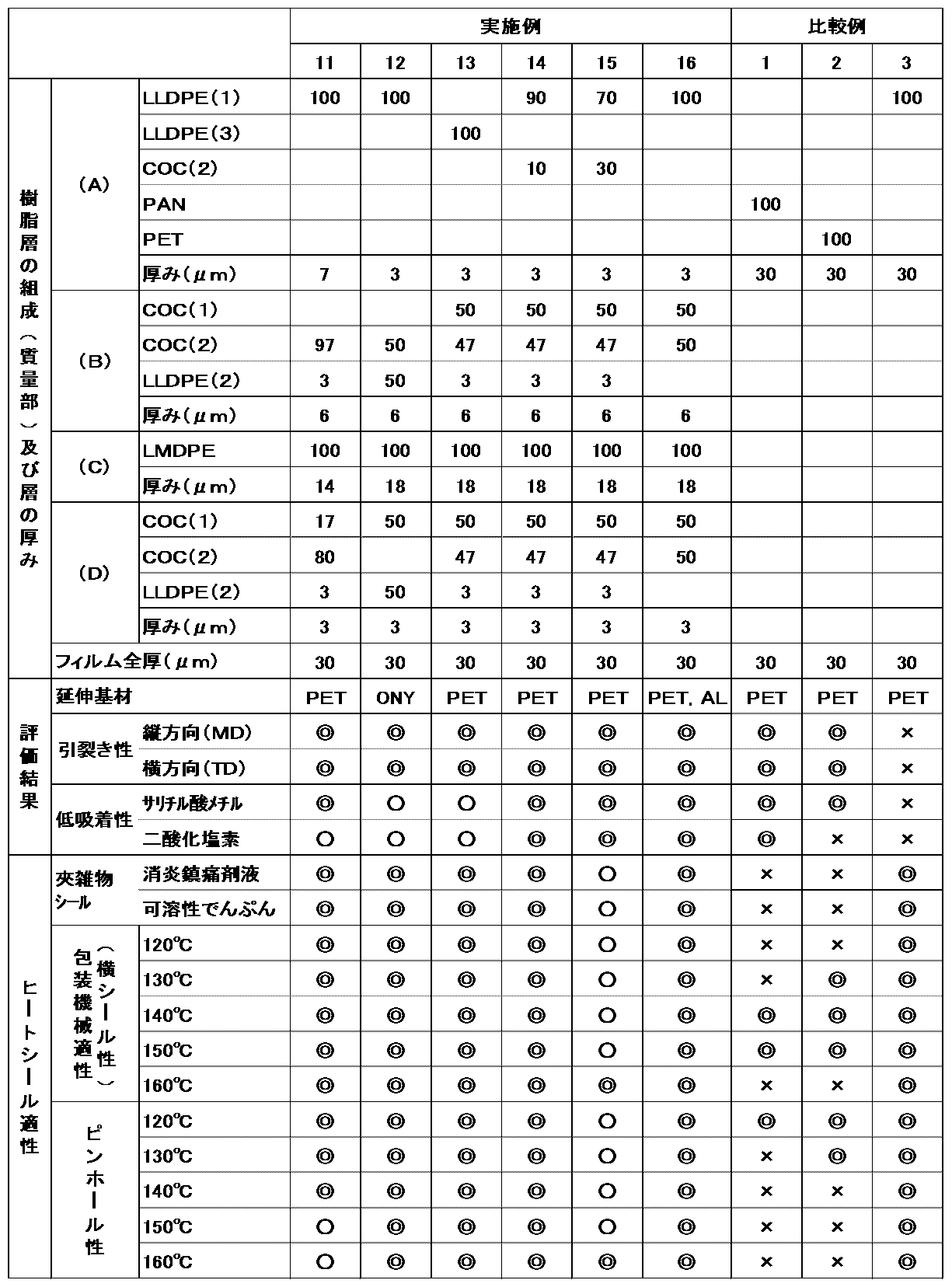
- the packaging structures of Examples 1 to 16 of the present invention have suitable tearability and a wide temperature range suitable for sealing, and can effectively suppress the volatilization of active ingredients, etc. Even when foreign matter adheres, it is excellent in suitable foreign matter sealability in which poor adhesion hardly occurs. Further, pinholes and darts were hardly generated and the packaging machine suitability was excellent.
Landscapes
- Health & Medical Sciences (AREA)
- Public Health (AREA)
- General Health & Medical Sciences (AREA)
- Veterinary Medicine (AREA)
- Engineering & Computer Science (AREA)
- Pharmacology & Pharmacy (AREA)
- Life Sciences & Earth Sciences (AREA)
- Animal Behavior & Ethology (AREA)
- Mechanical Engineering (AREA)
- Medicinal Chemistry (AREA)
- Chemical & Material Sciences (AREA)
- Wrappers (AREA)
- Laminated Bodies (AREA)
- Medicinal Preparation (AREA)
- Medical Preparation Storing Or Oral Administration Devices (AREA)
Abstract
Description
本発明の包装構造に使用する包装材は、包装構造における最内面となる表層がオレフィン系樹脂を含有するヒートシール性樹脂層(以下、ヒートシール層(A)と称する。)であり、当該ヒートシール層(A)に環状ポリオレフィン系樹脂を含有する樹脂層(以下、環状ポリオレフィン樹脂層(B)と称する。)が直接積層された構成を有する。
ヒートシール層(A)に使用するオレフィン系樹脂としては、ポリエチレン系樹脂やポリプロピレン系樹脂、これらのコポリマーを使用できる。ポリエチレン系樹脂としては、超低密度ポリエチレン(VLDPE)、直鎖状低密度ポリエチレン(LLDPE)、直鎖状中密度ポリエチレン(LMDPE)、低密度ポリエチレン(LDPE)等、中密度ポリエチレン(MDPE)、高密度ポリエチレン(HDPE)のポリエチレン樹脂や、エチレン-酢酸ビニル共重合体(EVA)、エチレン-メチルメタアクリレート共重合体(EMMA)、エチレン-エチルアクリレート共重合体(EEA)、エチレン-メチルアクリレート(EMA)共重合体、エチレン-エチルアクリレート-無水マレイン酸共重合体(E-EA-MAH)、エチレン-アクリル酸共重合体(EAA)、エチレン-メタクリル酸共重合体(EMAA)等のエチレン系共重合体;更にはエチレン-アクリル酸共重合体のアイオノマー、エチレン-メタクリル酸共重合体のアイオノマー等が挙げられ、単独でも、2種以上を混合して使用しても良い。なかでも、経皮吸収成分の揮散や貼付剤の貼付性能の低下(以下、有効成分の揮散等と称する場合がある)の抑制や、広範なヒートシール適性温度範囲や好適な密着性等のヒートシール性を好適に実現しやすいことから、LLDPEを好ましく使用できる。
環状ポリオレフィン樹脂層(B)に使用する環状ポリオレフィン系樹脂としては、例えば、ノルボルネン系重合体、ビニル脂環式炭化水素重合体、環状共役ジエン重合体等が挙げられる。これらの中でも、ノルボルネン系重合体が好ましい。また、ノルボルネン系重合体としては、ノルボルネン系単量体の開環重合体(以下、「COP」という。)、ノルボルネン系単量体とエチレン等のオレフィンを共重合したノルボルネン系共重合体(以下、「COC」という。)等が挙げられる。さらに、COP及びCOCの水素添加物は、特に好ましい。また、環状オレフィン系樹脂の重量平均分子量は、5,000~500,000が好ましく、より好ましくは7,000~300,000である。
本発明に使用する包装材は、少なくとも上記ヒートシール層(A)と環状ポリオレフィン樹脂層(B)とが積層された積層フィルムからなる包装材である。包装材として使用する積層フィルムの層構成は当該ヒートシール層(A)と環状ポリオレフィン樹脂層(B)とからなる(A)/(B)の層構成であってもよいが、当該(B)層の外層に、さらに、オレフィン系樹脂を含有する樹脂層(以下、樹脂層(C))や、環状ポリオレフィン系樹脂を含有する環状ポリオレフィン樹脂層(以下、樹脂層(D))等の他の層が積層された構成であってもよい。
本発明における貼付剤は、薬剤等の投与や傷口の保護のために、人体や動物の皮膚に貼り付けて使用されるドレッシング剤や、パップ剤、プラスター剤、ドレッシング材、経皮吸収テープ製剤等の貼付剤である。貼付剤の形態としては、支持体の片面もしくは両面に粘着剤層が設けられた形態を好ましく例示でき、必要に応じて粘着剤層中には薬剤等の経皮吸収成分を含有する。また、粘着剤層表面には剥離ライナーが設けられていてもよい。本発明の包装構造によれば、このような貼付剤を使用した際に有効成分の揮散等を好適に抑制できる。
本発明の包装構造は、貼付剤を包装材で包装する包装構造であり、上記包装材のヒートシール層(A)を最内面として、貼付剤が包装された構造である。当該包装構造としては、2枚のフィルム状の包装材の間に貼付剤を挟みこみ、貼付剤の周囲をヒートシールした構造、1枚のフィルム状の包装材に貼付剤を挟みこむように折り返し、貼付剤の周囲をヒートシールした構造、自動包装機によりロール状のフィルムを円筒(ピロー)形に端部をシールした後、上下をシールした包装構造等を例示できる。
ヒートシール層(A)、環状オレフィン系樹脂層(B)、中間層の樹脂層(C)及び最外層の樹脂層(D)の各層を形成する樹脂成分として、各々下記の樹脂を使用して、各層を形成する樹脂及び樹脂混合物を調整した。
<ヒートシール層(A)>
直鎖状低密度ポリエチレン(密度:0.920g/cm3、融点110℃、MFR:5g/10分(190℃、21.18N)、;以下、「LLDPE(1)」という。)100質量部
<環状オレフィン系樹脂層(B)>
ノルボルネン系モノマーの開環重合体(三井化学株式会社製「アペル APL8008T」、MFR:15g/10分(260℃、21.18N)、ガラス転移点:70℃;以下、「COC(1)」という。)50質量部、ノルボルネン系モノマーの開環重合体(三井化学株式会社製「アペル APL6015T」、MFR:10g/10分(260℃、21.18N)、ガラス転移点:145℃;以下、「COC(2)」という。)50質量部
<中間層(C)>
直鎖状中密度ポリエチレン(密度:0.930g/cm3、融点125℃、MFR:5g/10分(190℃、21.18N);以下、「LMDPE」という。)100質量部
<最外層(D)>
COC(1)50質量部、COC(2)50質量部
環状オレフィン系樹脂層(B)及び最外層(D)に使用する樹脂成分を下記とした以外は実施例1と同様にして共押出多層フィルムを作製し、表面層(D)表面にコロナ処理を施した。コロナ処理面の濡れ試薬による表面張力は42dyne/cmであった。処理面側に実施例1と同様にして、二軸延伸ポリエステルフィルムをドライラミネートし、ラミネートフィルムを得た。
<環状オレフィン系樹脂層(B)>
COC(1)50質量部、COC(2)47質量部、直鎖状低密度ポリエチレン(密度:0.920g/cm3、融点120℃、MFR:5g/10分(190℃、21.18N);以下、「LLDPE(2)」という。)3質量部
<最外層(D)>
COC(1)50質量部、COC(2)47質量部、LLDPE(2)3質量部
環状オレフィン系樹脂層(B)及び最外層(D)に使用する樹脂成分を下記とした以外は実施例1と同様にして共押出多層フィルムを作製し、表面層(D)表面にコロナ処理を施した。コロナ処理面の濡れ試薬による表面張力は43dyne/cmであった。処理面側に実施例1と同様にして、二軸延伸ポリエステルフィルムをドライラミネートし、ラミネートフィルムを得た。
<環状オレフィン系樹脂層(B)>
COC(1)60質量部、COC(2)40質量部
<最外層(D)>
COC(1)60質量部、COC(2)37質量部、LLDPE(2)3質量部
環状オレフィン系樹脂層(B)及び最外層(D)に使用する樹脂成分を下記とした以外は実施例1と同様にして共押出多層フィルムを作製し、表面層(D)表面にコロナ処理を施した。コロナ処理面の濡れ試薬による表面張力は43dyne/cmであった。処理面側に実施例1と同様にして、二軸延伸ポリエステルフィルムをドライラミネートし、ラミネートフィルムを得た。
<環状オレフィン系樹脂層(B)>
COC(1)70質量部、COC(2)27質量部、LLDPE(2)3質量部
<最外層(D)>
COC(1)50質量部、COC(2)47質量部、LLDPE(2)3質量部
環状オレフィン系樹脂層(B)及び最外層(D)に使用する樹脂成分を下記とした以外は実施例1と同様にして共押出多層フィルムを作製し、表面層(D)表面にコロナ処理を施した。コロナ処理面の濡れ試薬による表面張力は43dyne/cmであった。処理面側に実施例1と同様にして、二軸延伸ポリアミドフィルム(厚さ15μm、融点260℃、ユニチカ社製)をドライラミネートし、ラミネートフィルムを得た。
<環状オレフィン系樹脂層(B)>
COC(1)50質量部、COC(2)47質量部、LLDPE(2)3質量部
<最外層(D)>
COC(1)60質量部、COC(2)37質量部、LLDPE(2)3質量部
環状オレフィン系樹脂層(B)及び最外層(D)に使用する樹脂成分を下記とした以外は実施例1と同様にして共押出多層フィルムを作製し、表面層(D)表面にコロナ処理を施した。コロナ処理面の濡れ試薬による表面張力は43dyne/cmであった。処理面側に実施例1と同様にして、二軸延伸ポリエステルフィルムをドライラミネートし、ラミネートフィルムを得た。
<環状オレフィン系樹脂層(B)>
COC(1)60質量部、ノルボルネン系モノマーの開環重合体(三井化学株式会社製「アペル AP6013T」、MFR:15g/10分(260℃、21.18N)、ガラス転移点:125℃;以下、「COC(3)」という。)37質量部、LLDPE(2)3質量部
<最外層(D)>
COC(1)70量部、COC(2)30質量部
環状オレフィン系樹脂層(B)、中間層(C)及び最外層(D)に使用する樹脂成分を下記とした以外は実施例1と同様にして共押出多層フィルムを作製し、表面層(D)表面にコロナ処理を施した。コロナ処理面の濡れ試薬による表面張力は45dyne/cmであった。処理面側に実施例1と同様にして、二軸延伸ポリエステルフィルムをドライラミネートし、ラミネートフィルムを得た。
<環状オレフィン系樹脂層(B)>
COC(1)50質量部、COC(3)47質量部、LLDPE(2)3質量部
<中間層(C)>
LLDPE(2)100質量部
<最外層(D)>
COC(1)50質量部、COC(2)47質量部、LLDPE(2)5質量部
各層の厚さが(A)/(B)/(C)/(D)=5μm/6μm/16μm/3μm(合計30μm)となるように共押出した以外は実施例2と同様にして共押出多層フィルムを作製し、表面層(D)表面にコロナ処理を施した。コロナ処理面の濡れ試薬による表面張力は43dyne/cmであった。処理面側に実施例1と同様にして、二軸延伸ポリエステルフィルムをドライラミネートし、ラミネートフィルムを得た。
環状オレフィン系樹脂層(B)及び最外層(D)に使用する樹脂成分を下記とした以外は実施例1と同様にして共押出多層フィルムを作製し、表面層(D)表面にコロナ処理を施した。コロナ処理面の濡れ試薬による表面張力は42dyne/cmであった。処理面側に実施例1と同様にして、二軸延伸ポリエステルフィルムをドライラミネートし、ラミネートフィルムを得た。
<環状オレフィン系樹脂層(B)>
COC(1)27質量部、COC(2)70質量部、LLDPE(2)3質量部
<最外層(D)>
COC(1)27質量部、COC(2)70質量部、LLDPE(2)3質量部
環状オレフィン系樹脂層(B)及び最外層(D)に使用する樹脂成分を下記とした以外は実施例1と同様にして共押出多層フィルムを作製し、表面層(D)表面にコロナ処理を施した。コロナ処理面の濡れ試薬による表面張力は43dyne/cmであった。処理面側に実施例1と同様にして、二軸延伸ポリエステルフィルムをドライラミネートし、ラミネートフィルムを得た。
<環状オレフィン系樹脂層(B)>
COC(1)20質量部、COC(2)80質量部
<最外層(D)>
COC(2)100質量部
環状オレフィン系樹脂層(B)及び最外層(D)に使用する樹脂成分を下記とし、各層の厚さが(A)/(B)/(C)/(D)=7μm/6μm/14μm/3μm(合計30μm)となるように共押出した以外は実施例1と同様にして共押出多層フィルムを作製し、表面層(D)表面にコロナ処理を施した。コロナ処理面の濡れ試薬による表面張力は43dyne/cmであった。処理面側に実施例1と同様にして、二軸延伸ポリエステルフィルムをドライラミネートし、ラミネートフィルムを得た。
<環状オレフィン系樹脂層(B)>
COC(2)97質量部、LLDPE(2)3質量部
<最外層(D)>
COC(1)17質量部、COC(2)80質量部、LLDPE(2)3質量部
環状オレフィン系樹脂層(B)及び最外層(D)に使用する樹脂成分を下記とした以外は実施例1と同様にして共押出多層フィルムを作製し、表面層(D)表面にコロナ処理を施した。コロナ処理面の濡れ試薬による表面張力は43dyne/cmであった。処理面側に実施例1と同様にして、二軸延伸ポリエステルフィルムをドライラミネートし、ラミネートフィルムを得た。
<環状オレフィン系樹脂層(B)>
COC(2)50質量部、LLDPE(2)50質量部
<最外層(D)>
COC(1)50質量部、LLDPE(2)50質量部
ヒートシール層(A)に使用する樹脂成分を下記とした以外は実施例2と同様にして共押出多層フィルムを作製し、表面層(D)表面にコロナ処理を施した。コロナ処理面の濡れ試薬による表面張力は43dyne/cmであった。処理面側に実施例1と同様にして、二軸延伸ポリエステルフィルムをドライラミネートし、ラミネートフィルムを得た。
<ヒートシール層(A)>
直鎖状低密度ポリエチレン(密度:0.905g/cm3、融点95℃、MFR:4g/10分(190℃、21.18N)、;以下、「LLDPE(3)」という。)100質量部
ヒートシール層(A)に使用する樹脂成分を下記とした以外は実施例2と同様にして共押出多層フィルムを作製し、表面層(D)表面にコロナ処理を施した。コロナ処理面の濡れ試薬による表面張力は43dyne/cmであった。処理面側に実施例1と同様にして、二軸延伸ポリエステルフィルムをドライラミネートし、ラミネートフィルムを得た。
<ヒートシール層(A)>
LLDPE(1)90質量部、COC(2)10質量部
ヒートシール層(A)に使用する樹脂成分を下記とした以外は実施例2と同様にして共押出多層フィルムを作製し、表面層(D)表面にコロナ処理を施した。コロナ処理面の濡れ試薬による表面張力は43dyne/cmであった。処理面側に実施例1と同様にして、二軸延伸ポリエステルフィルムをドライラミネートし、ラミネートフィルムを得た。
<ヒートシール層(A)>
LLDPE(1)70質量部、COC(2)30質量部
実施例1と同様にして共押出多層フィルムを作製し、表面層(D)表面にコロナ処理を施した。コロナ処理面の濡れ試薬による表面張力は42dyne/cmであった。コロナ処理面側にウレタン系接着剤を3.5g/m2になるよう塗工後、アルミ箔(12μm)と二軸延伸ポリエステルフィルム(厚さ12μm、融点260℃、東洋紡製)を予めドライラミネートしたフィルムのアルミ箔面とドライラミネートし、ラミネートフィルを得た。
ポリアクリルニトリル系樹脂フィルム(ハイトロンBX、タマポリ社製、厚み20μm)の片面にコロナ処理を施し、コロナ処理面側に、実施例1と同様にして二軸延伸ポリエステルフィルムをドライラミネートし、ラミネートフィルムを得た。
エチレンビニルアルコール共重合体樹脂フィルム
(エバールフィルムEF-E、クラレ社製、厚み30μm)の片面にコロナ処理を施し、コロナ処理面側に、実施例1と同様にして二軸延伸ポリエステルをドライラミネートし、ラミネートフィルムを得た。
LLDPE共重合体樹脂フィルム(DIFARENL3500T、DIC社製、厚み30μm)の片面にコロナ処理を施し、コロナ処理面側に、実施例1と同様にして二軸延伸ポリエステルをドライラミネートし、ラミネートフィルムを得た。
得られたラミネートフィルムを、JIS K7128に準拠して、それぞれ63mm×76mmの大きさの試験片に切り出し、エルメンドルフ引裂試験機(テスター産業株式会社製)を用いて、引裂強さを測定した。得られた引裂強さから、下記の基準によって手切れ性を評価した。
○:引裂強さが110未満。
×:引裂強さが110以上。
各ラミネートフィルムを縦100mm×横100mmの三方シールパウチを作成後、質量を測定後、サリチル酸メチル(吸着試験1)及び二酸化塩素〔クレペリンゲル:大幸薬品〕(吸着試験2)を2g入れ、開口部をヒートシールにより密閉した。密閉容器中に25℃恒温条件で4週間放置後、開封し内容物を除去しパウチの質量を測定し、変化率から吸着率を求めた。
◎:数値2%未満
○:数値2%以上5%未満
×:数値5%以上
上記で作成したラミネートフィルムのシール層面に、消炎鎮痛剤液(アンメルツ:小林製薬社製)を綿棒で塗布し、3分後にシール面同士を(シール温度:150℃、シール圧:0.2MPa、シール時間:1秒)シールした。塗布前後の強度を測定し、強度の低下率を求めた。
上記で作成したラミネートフィルムのシール層面に、可溶性でんぷん(研究試薬:アズワン製)を綿棒で散布し、3分後にシール面同士を(シール温度:150℃、シール圧:0.4MPa、シール時間:1秒)シールした。塗布前後の強度を測定し、強度の低下率を求めた。
◎:10%未満
○:10%~20%
×:20%以上
各ラミネートフィルムを縦ピロー包装機(サンコウ機械社製)で、シール温度を変更しながら縦45mm×横85mmの4方シールパウチを作成。シール強度を測定した。
◎:20N/15mm以上
○:15~20
×:15N/15mm未満
各ラミネートフィルムを縦75mm×横55mmの三方シールパウチを5袋作成後、サロンパス(久光製薬製)5枚を封入後、開口部を(シール温度:150℃、シール圧:0.5MPa、シール時間:1秒)ヒートシールした。密閉包装袋を25℃恒温条件で2間放置後、開封し内容物を除去し、ピンホールやダーツ(シール漏れ)をシールチェッカー液で検査した。
◎:ピンホール、ダーツ無し
○:ピンホール、ダーツ2個以下
×:ピンホール、ダーツ3個以上

Claims (8)
- 貼付剤を包装材で包装する包装構造であって、
前記包装材の包装構造における最内面となる層がオレフィン系樹脂を含有するヒートシール性樹脂層であり、前記ヒートシール性樹脂層の外側に環状ポリオレフィン系樹脂を含有する樹脂層を有し、前記ヒートシール性樹脂層と環状ポリオレフィン系樹脂を含有する樹脂層とが直接積層されていることを特徴とする貼付剤の包装構造。 - 前記環状ポリオレフィン系樹脂を含有する樹脂層の外層に、オレフィン系樹脂を含有する樹脂層と、環状ポリオレフィン系樹脂を含有する樹脂層が順に積層されている請求項1に記載の包装構造。
- 前記環状ポリオレフィン系樹脂を含有する樹脂層に含まれる樹脂成分中の環状ポリオレフィン系樹脂の含有量が80質量%以上である請求項1又は2に記載の貼付剤の包装構造。
- 前記環状ポリオレフィン系樹脂を含有する樹脂層に含まれる環状ポリオレフィン系樹脂中のガラス転移温度が100℃以下の環状ポリオレフィン系樹脂の含有量が40質量%以上である請求項1~3のいずれかに記載の貼付剤の包装構造。
- 前記オレフィン系樹脂を含有するヒートシール性樹脂層が、直鎖状低密度ポリエチレンを前記オレフィン系樹脂を含有する樹脂層に含まれる樹脂成分中の80質量%以上含有する請求項1~4のいずれかに記載の貼付剤の包装構造。
- 前記直鎖状低密度ポリエチレンの密度が0.905g/cm3~0.925g/cm3である請求項1~5のいずれかに記載の貼付剤の包装構造。
- 前記オレフィン系樹脂を含有するヒートシール性樹脂層の厚みが2~8μmである請求項1~5のいずれかに記載の貼付剤の包装構造。
- 前記オレフィン系樹脂を含有するヒートシール性樹脂層中の環状ポリオレフィン系樹脂の含有量が10質量%以下である請求項1~6のいずれかに記載の貼付剤の包装構造。
Priority Applications (2)
| Application Number | Priority Date | Filing Date | Title |
|---|---|---|---|
| JP2017553751A JP6331116B2 (ja) | 2015-11-30 | 2016-11-15 | 貼付剤の包装構造 |
| KR1020187013291A KR102507571B1 (ko) | 2015-11-30 | 2016-11-15 | 첩부제의 포장 구조 |
Applications Claiming Priority (2)
| Application Number | Priority Date | Filing Date | Title |
|---|---|---|---|
| JP2015-233500 | 2015-11-30 | ||
| JP2015233500 | 2015-11-30 |
Publications (1)
| Publication Number | Publication Date |
|---|---|
| WO2017094491A1 true WO2017094491A1 (ja) | 2017-06-08 |
Family
ID=58797190
Family Applications (1)
| Application Number | Title | Priority Date | Filing Date |
|---|---|---|---|
| PCT/JP2016/083763 Ceased WO2017094491A1 (ja) | 2015-11-30 | 2016-11-15 | 貼付剤の包装構造 |
Country Status (3)
| Country | Link |
|---|---|
| JP (1) | JP6331116B2 (ja) |
| KR (1) | KR102507571B1 (ja) |
| WO (1) | WO2017094491A1 (ja) |
Cited By (3)
| Publication number | Priority date | Publication date | Assignee | Title |
|---|---|---|---|---|
| JP2019038182A (ja) * | 2017-08-25 | 2019-03-14 | 大日本印刷株式会社 | 手切り開封用低吸着性積層体と、該積層体を用いた包装材料及び包装体 |
| WO2019065835A1 (ja) * | 2017-09-28 | 2019-04-04 | 東洋アルミニウム株式会社 | 包装材及びこれを用いた包装袋 |
| JPWO2021066048A1 (ja) * | 2019-09-30 | 2021-04-08 |
Families Citing this family (1)
| Publication number | Priority date | Publication date | Assignee | Title |
|---|---|---|---|---|
| JP2020045106A (ja) * | 2018-09-14 | 2020-03-26 | 藤森工業株式会社 | チャック袋 |
Citations (3)
| Publication number | Priority date | Publication date | Assignee | Title |
|---|---|---|---|---|
| JP2013248742A (ja) * | 2012-05-30 | 2013-12-12 | Dainippon Printing Co Ltd | 低吸着性シーラントフィルム並びにそれを用いた積層体及び包装袋 |
| JP2015030464A (ja) * | 2013-07-31 | 2015-02-16 | 大日本印刷株式会社 | 包装材料 |
| JP2015113124A (ja) * | 2013-12-09 | 2015-06-22 | 大日本印刷株式会社 | 低吸着性スタンディングパウチ |
Family Cites Families (4)
| Publication number | Priority date | Publication date | Assignee | Title |
|---|---|---|---|---|
| WO2004080370A1 (ja) * | 2003-03-12 | 2004-09-23 | Fujimori Kogyo Co., Ltd. | 複室容器 |
| WO2005072675A1 (ja) | 2004-01-30 | 2005-08-11 | Hisamitsu Pharmaceutical Co., Inc. | 貼付剤入り包装袋及び薬物移行抑制方法 |
| EP2070556B1 (en) | 2007-12-14 | 2016-04-06 | Nitto Denko Corporation | Patch package structure |
| JP5822956B2 (ja) * | 2012-11-22 | 2015-11-25 | Dic株式会社 | 低吸着性ラミネート用多層フィルム、これを用いた複合フィルム及び包装材 |
-
2016
- 2016-11-15 WO PCT/JP2016/083763 patent/WO2017094491A1/ja not_active Ceased
- 2016-11-15 KR KR1020187013291A patent/KR102507571B1/ko active Active
- 2016-11-15 JP JP2017553751A patent/JP6331116B2/ja active Active
Patent Citations (3)
| Publication number | Priority date | Publication date | Assignee | Title |
|---|---|---|---|---|
| JP2013248742A (ja) * | 2012-05-30 | 2013-12-12 | Dainippon Printing Co Ltd | 低吸着性シーラントフィルム並びにそれを用いた積層体及び包装袋 |
| JP2015030464A (ja) * | 2013-07-31 | 2015-02-16 | 大日本印刷株式会社 | 包装材料 |
| JP2015113124A (ja) * | 2013-12-09 | 2015-06-22 | 大日本印刷株式会社 | 低吸着性スタンディングパウチ |
Cited By (5)
| Publication number | Priority date | Publication date | Assignee | Title |
|---|---|---|---|---|
| JP2019038182A (ja) * | 2017-08-25 | 2019-03-14 | 大日本印刷株式会社 | 手切り開封用低吸着性積層体と、該積層体を用いた包装材料及び包装体 |
| WO2019065835A1 (ja) * | 2017-09-28 | 2019-04-04 | 東洋アルミニウム株式会社 | 包装材及びこれを用いた包装袋 |
| JP2019064602A (ja) * | 2017-09-28 | 2019-04-25 | 東洋アルミニウム株式会社 | 包装材及びこれを用いた包装袋 |
| CN111148702A (zh) * | 2017-09-28 | 2020-05-12 | 东洋铝株式会社 | 包装材料及使用了该包装材料的包装袋 |
| JPWO2021066048A1 (ja) * | 2019-09-30 | 2021-04-08 |
Also Published As
| Publication number | Publication date |
|---|---|
| KR20180089394A (ko) | 2018-08-08 |
| JPWO2017094491A1 (ja) | 2018-04-12 |
| KR102507571B1 (ko) | 2023-03-09 |
| JP6331116B2 (ja) | 2018-05-30 |
Similar Documents
| Publication | Publication Date | Title |
|---|---|---|
| JP5787157B2 (ja) | 易引裂き性多層フィルム、その製造方法及び該フィルムを用いた包装材 | |
| JP5822956B2 (ja) | 低吸着性ラミネート用多層フィルム、これを用いた複合フィルム及び包装材 | |
| JP5741935B2 (ja) | 多層フィルム及び該フィルムからなる包装材 | |
| KR20170100499A (ko) | 첩부제를 위한 포장체 및 포장 방법 | |
| JP6331116B2 (ja) | 貼付剤の包装構造 | |
| WO2001002267A1 (en) | Packaging bag for plaster and packaged plaster | |
| JP6172398B2 (ja) | 多層フィルム、包装材用積層フィルム、包装袋及びスタンディングパウチ | |
| TWI811346B (zh) | 多層薄膜及包裝材料 | |
| JP4702245B2 (ja) | 共押出多層フィルム、並びに該フィルムを用いたラミネートフィルム及び包装材 | |
| JP7207604B2 (ja) | アルコール透過抑制フィルム、及びアルコール透過抑制フィルムを用いた包装材並びに包装体 | |
| WO2015174502A1 (ja) | リバスチグミンを含有する貼付剤のための包装体 | |
| JP2012045886A (ja) | 共押出多層フィルム及びこれを用いる蓋材 | |
| US20070128262A1 (en) | Package containing adhesive patch and method of inhibiting drug migration | |
| TWI855169B (zh) | 包裝材 | |
| JP6465343B2 (ja) | 保香性フィルム及び包装材 | |
| JP4480467B2 (ja) | 包装用積層フィルム及びその製造方法、並びに包装袋 | |
| US20040159575A1 (en) | Access resistant envelope | |
| JP7342694B2 (ja) | 積層フィルム及び包装材 | |
| JP2005138860A (ja) | 揮発性薬品用包装袋 | |
| JP2011148536A (ja) | 貼付剤包装構造 | |
| JP2019199293A (ja) | 包装袋 | |
| JP2007038605A (ja) | 共押出積層フィルム並びにそれを用いたラミネートフィルム及び包装容器 |
Legal Events
| Date | Code | Title | Description |
|---|---|---|---|
| 121 | Ep: the epo has been informed by wipo that ep was designated in this application |
Ref document number: 16870430 Country of ref document: EP Kind code of ref document: A1 |
|
| ENP | Entry into the national phase |
Ref document number: 2017553751 Country of ref document: JP Kind code of ref document: A |
|
| ENP | Entry into the national phase |
Ref document number: 20187013291 Country of ref document: KR Kind code of ref document: A |
|
| NENP | Non-entry into the national phase |
Ref country code: DE |
|
| 122 | Ep: pct application non-entry in european phase |
Ref document number: 16870430 Country of ref document: EP Kind code of ref document: A1 |