WO2017081909A1 - 硬化性組成物およびその用途 - Google Patents
硬化性組成物およびその用途 Download PDFInfo
- Publication number
- WO2017081909A1 WO2017081909A1 PCT/JP2016/074793 JP2016074793W WO2017081909A1 WO 2017081909 A1 WO2017081909 A1 WO 2017081909A1 JP 2016074793 W JP2016074793 W JP 2016074793W WO 2017081909 A1 WO2017081909 A1 WO 2017081909A1
- Authority
- WO
- WIPO (PCT)
- Prior art keywords
- component
- curable composition
- group
- polyurethane
- mass
- Prior art date
- Legal status (The legal status is an assumption and is not a legal conclusion. Google has not performed a legal analysis and makes no representation as to the accuracy of the status listed.)
- Ceased
Links
Classifications
-
- C—CHEMISTRY; METALLURGY
- C08—ORGANIC MACROMOLECULAR COMPOUNDS; THEIR PREPARATION OR CHEMICAL WORKING-UP; COMPOSITIONS BASED THEREON
- C08G—MACROMOLECULAR COMPOUNDS OBTAINED OTHERWISE THAN BY REACTIONS ONLY INVOLVING UNSATURATED CARBON-TO-CARBON BONDS
- C08G18/00—Polymeric products of isocyanates or isothiocyanates
- C08G18/06—Polymeric products of isocyanates or isothiocyanates with compounds having active hydrogen
- C08G18/28—Polymeric products of isocyanates or isothiocyanates with compounds having active hydrogen characterised by the compounds used containing active hydrogen
- C08G18/40—High-molecular-weight compounds
- C08G18/42—Polycondensates having carboxylic or carbonic ester groups in the main chain
- C08G18/44—Polycarbonates
-
- C—CHEMISTRY; METALLURGY
- C08—ORGANIC MACROMOLECULAR COMPOUNDS; THEIR PREPARATION OR CHEMICAL WORKING-UP; COMPOSITIONS BASED THEREON
- C08G—MACROMOLECULAR COMPOUNDS OBTAINED OTHERWISE THAN BY REACTIONS ONLY INVOLVING UNSATURATED CARBON-TO-CARBON BONDS
- C08G59/00—Polycondensates containing more than one epoxy group per molecule; Macromolecules obtained by polymerising compounds containing more than one epoxy group per molecule using curing agents or catalysts which react with the epoxy groups
- C08G59/18—Macromolecules obtained by polymerising compounds containing more than one epoxy group per molecule using curing agents or catalysts which react with the epoxy groups ; e.g. general methods of curing
- C08G59/20—Macromolecules obtained by polymerising compounds containing more than one epoxy group per molecule using curing agents or catalysts which react with the epoxy groups ; e.g. general methods of curing characterised by the epoxy compounds used
-
- C—CHEMISTRY; METALLURGY
- C08—ORGANIC MACROMOLECULAR COMPOUNDS; THEIR PREPARATION OR CHEMICAL WORKING-UP; COMPOSITIONS BASED THEREON
- C08G—MACROMOLECULAR COMPOUNDS OBTAINED OTHERWISE THAN BY REACTIONS ONLY INVOLVING UNSATURATED CARBON-TO-CARBON BONDS
- C08G59/00—Polycondensates containing more than one epoxy group per molecule; Macromolecules obtained by polymerising compounds containing more than one epoxy group per molecule using curing agents or catalysts which react with the epoxy groups
- C08G59/18—Macromolecules obtained by polymerising compounds containing more than one epoxy group per molecule using curing agents or catalysts which react with the epoxy groups ; e.g. general methods of curing
- C08G59/40—Macromolecules obtained by polymerising compounds containing more than one epoxy group per molecule using curing agents or catalysts which react with the epoxy groups ; e.g. general methods of curing characterised by the curing agents used
-
- C—CHEMISTRY; METALLURGY
- C08—ORGANIC MACROMOLECULAR COMPOUNDS; THEIR PREPARATION OR CHEMICAL WORKING-UP; COMPOSITIONS BASED THEREON
- C08K—Use of inorganic or non-macromolecular organic substances as compounding ingredients
- C08K3/00—Use of inorganic substances as compounding ingredients
- C08K3/34—Silicon-containing compounds
- C08K3/36—Silica
-
- C—CHEMISTRY; METALLURGY
- C08—ORGANIC MACROMOLECULAR COMPOUNDS; THEIR PREPARATION OR CHEMICAL WORKING-UP; COMPOSITIONS BASED THEREON
- C08L—COMPOSITIONS OF MACROMOLECULAR COMPOUNDS
- C08L63/00—Compositions of epoxy resins; Compositions of derivatives of epoxy resins
-
- H—ELECTRICITY
- H05—ELECTRIC TECHNIQUES NOT OTHERWISE PROVIDED FOR
- H05K—PRINTED CIRCUITS; CASINGS OR CONSTRUCTIONAL DETAILS OF ELECTRIC APPARATUS; MANUFACTURE OF ASSEMBLAGES OF ELECTRICAL COMPONENTS
- H05K3/00—Apparatus or processes for manufacturing printed circuits
- H05K3/22—Secondary treatment of printed circuits
- H05K3/28—Applying non-metallic protective coatings
Definitions
- the present invention relates to a curable composition and its use.
- an inorganic filler has been used as a means for improving screen printability (preventing blurring during screen printing) in order to cope with finer wiring pitches.
- screen printing is generally employed as a method for forming a resist on a wiring board.
- a technique for adding a special filler to a resist ink is known as means for achieving both improved screen printability and electrical insulation reliability in order to cope with fine pitches (see, for example, Patent Document 3).
- the distance between wirings of the flexible wiring board is expected to be further narrowed (for example, 20 ⁇ m pitch or less).
- this further narrowing of pitch development of a resist ink (curable composition) that is further superior in preventing bleeding at the time of screen printing is required.
- a curable composition containing ⁇ -butyrolactone and a specific polyurethane is known as a curable composition with less bleeding during screen printing (see, for example, Patent Document 8).
- ⁇ -butyrolactone has a problem that 4-hydroxybutyric acid, which is a narcotic, is produced by hydrolysis.
- An object of the present invention is to provide a curable composition with less bleeding during screen printing without using ⁇ -butyrolactone as a solvent. More specifically, the present invention can provide a cured product excellent in low warpage and long-term electrical insulation reliability without using ⁇ -butyrolactone as a solvent, and has little bleeding during screen printing. An object is to provide a curable composition.
- the present inventors printed a curable composition containing a polyurethane having a specific structure and a specific solvent on a flexible wiring board by a screen printing method.
- the cured product obtained by curing this curable composition has a long-term electrical insulation property with less bleeding of the (curable composition) and small warpage of the flexible wiring board when the curable composition is cured. It has been found that it is excellent, and the present invention has been completed.
- a curable composition comprising the following components (a) to (d).
- Component (b1) selected from 3-methoxy-3-methyl-1-butyl acetate and ethylene glycol butyl ether acetate At least one ingredient
- component (b) includes the following component (b2).
- component (b) includes the following component (b3).
- component (b3) Diethylene glycol diethyl ether
- the functional group capable of reacting with the epoxy group is at least one functional group selected from the group consisting of a carboxyl group, an isocyanato group, a blocked isocyanato group, a cyclic acid anhydride group, and a phenolic hydroxyl group.
- the curable composition according to any one of (1) to (3).
- the ratio of the total mass of the components (b1) and (b3) to the mass of the component (b2) (the total mass of (b1) and (b3): the mass of (b2)) is 80:20 to 30 :
- Component (b) is contained in an amount of 20 to 70% by mass, based on 100% by mass of the entire curable composition.
- the ratio of the number of functional groups capable of reacting with the epoxy group contained in component (a) to the number of epoxy groups in component (c) (functional group capable of reacting with epoxy group / epoxy group) is 1 / 3 to 2/1
- the component (d) is contained in an amount of 1 to 150 parts by mass with respect to 100 parts by mass of the total amount of the remaining components obtained by removing the component (d) from all components contained in the curable resin composition (1
- the curable composition according to any one of (5) to (5).
- a printed film is formed on the pattern by printing the curable composition according to any one of (1) to (9) on at least a part of the wiring pattern portion subjected to tin plating of the flexible wiring board.
- the curable composition of the present invention suppresses bleeding of printed matter when the curable composition of the present invention is printed on a flexible wiring board by a screen printing method without using ⁇ -butyrolactone as a raw material for narcotics. can do.
- the curable composition of the present invention when used, the warp of the flexible wiring board on which the composition is printed when cured is small. Moreover, the cured product obtained by curing this curable composition is excellent in long-term electrical insulation characteristics.
- the curable composition of the present invention is useful as a resist ink for insulation protection of wiring typified by solder resist ink, and the cured product of the present invention is useful as a protective film for resist for insulation protection of wiring, etc. .
- the present invention (I) is a curable composition that can give a cured product having low warpage and excellent long-term electrical insulation reliability, and has little bleeding at the time of screen printing.
- the present invention (II) Is a cured product obtained by curing the curable composition of the present invention (I), and the present invention (III) is a flexible wiring board at least partially coated with the cured product of the present invention (II).
- the present invention (IV) is a method for producing a flexible wiring board.
- the present invention (I) is a curable composition containing the following components (a) to (d).
- Component (b1) selected from 3-methoxy-3-methyl-1-butyl acetate and ethylene glycol butyl ether acetate At least one ingredient
- the curable composition of the present invention (I) can give a cured product having low warpage and excellent long-term electrical insulation reliability, and has little bleeding during screen printing.
- the curable composition (I) of the present invention is preferable because the above characteristics can be achieved without substantially using ⁇ -butyrolactone as a solvent. That is, the curable composition of the present invention (I) preferably contains less than 1000 wtppm of ⁇ -butyrolactone, and particularly preferably does not contain ⁇ -butyrolactone.
- the curable composition of the present invention (I) includes, as component (a), a polyurethane having a functional group capable of reacting with an epoxy group and a carbonate bond (hereinafter also simply referred to as “polyurethane A”).
- the “functional group capable of reacting with an epoxy group” in the component (a) is not particularly limited as long as it is a functional group capable of reacting with an epoxy group contained in the component (c) described later.
- Examples of the functional group capable of reacting with an epoxy group include a carboxyl group, an isocyanato group, a blocked isocyanato group, a cyclic acid anhydride group, and a phenolic hydroxyl group.
- As a functional group which can react with an epoxy group only 1 type may be contained in component (a), or 2 or more types may be contained.
- component (c) In consideration of the reactivity with the compound having two or more epoxy groups in one molecule as component (c), preferred functional groups among them are carboxyl group, blocked isocyanate group and cyclic acid anhydride. It is a group. In consideration of the balance between storage stability and reactivity of component (a), more preferred functional groups are carboxyl groups and blocked isocyanate groups, and particularly preferred functional groups are carboxyl groups.
- polyurethane A is not particularly limited.
- the polyurethane A can be produced, for example, by the following method.
- a production method when the polyurethane A is a polyurethane having a carboxyl group as a functional group capable of reacting with an epoxy group for example, in the presence or absence of a known urethanization catalyst such as dibutyltin dilaurate, (Poly) carbonate polyol, polyisocyanate compound, carboxyl group-containing diol, using (mixed) solvent containing at least one selected from 3-methoxy-3-methyl-1-butyl acetate and ethylene glycol butyl ether acetate, necessary
- it can be synthesized by reacting polyol other than (poly) carbonate polyol and carboxyl group-containing diol, monohydroxyl compound, monoisocyanate compound. It is preferable to carry out this reaction without a catalyst because the physical property value of the cured film obtained from the curable composition (polyurethane solution) of the present
- (poly) carbonate is a generic term for monocarbonate having one carbonate bond in the molecule and polycarbonate having two or more carbonate bonds in the molecule.
- the (poly) carbonate polyol which is a raw material of the polyurethane A is not particularly limited as long as it is a compound having one or more carbonate bonds and two or more alcoholic hydroxyl groups in the molecule. That is, (poly) carbonate polyol is at least one compound selected from monocarbonate polyol and polycarbonate polyol.
- Examples of the (poly) carbonate polyol include (poly) carbonate diol having two hydroxyl groups in one molecule, (poly) carbonate triol having three or more hydroxyl groups in one molecule, and (poly) Examples thereof include carbonate tetraol.
- the (poly) carbonate polyol can be obtained by reacting a diol or a polyol mixture whose main component is a diol with a carbonate or phosgene as a raw material.
- a diol is used as the raw material of the (poly) carbonate polyol to be reacted with the carbonate ester or phosgene, a (poly) carbonate diol is produced, and the structure thereof is represented by the following formula (1). ).
- R 1 s are each independently a residue obtained by removing a hydroxyl group from a corresponding diol, preferably each independently an alkylene group having 3 to 18 carbon atoms, and n is It is a natural number, and usually n is an integer of 3 to 50.
- diol used in producing the (poly) carbonate diol represented by the formula (1) include 1,4-butanediol, 1,5-pentanediol, and 1,6-hexanediol. 3-methyl-1,5-pentanediol, 1,8-octanediol, 1,3-cyclohexanedimethanol, 1,4-cyclohexanedimethanol, 1,9-nonanediol, 2-methyl-1,8- Examples include octanediol, 2-ethyl-4-butyl-1,3-propanediol, 2,4-diethyl-1,5-pentanediol, 1,10-decanedyl or 1,2-tetradecanediol.
- the (poly) carbonate polyol may be a (poly) carbonate polyol (copolymerized (poly) carbonate polyol) having a plurality of types of alkylene groups in its skeleton.
- the use of a copolymerized (poly) carbonate polyol is often advantageous from the viewpoint of preventing crystallization of polyurethane A.
- a polyurethane A synthesis reaction solvent such as 3-methoxy-3-methyl-1-butyl acetate or ethylene glycol butyl ether acetate
- Poly carbonate polyols are preferably used in combination.
- the (poly) carbonate polyol described above may be used alone or in combination of two or more.
- the polyisocyanate compound that is a raw material of the polyurethane A is not particularly limited as long as it is a compound having two or more isocyanato groups.
- Specific examples of the polyisocyanate compound include 1,4-cyclohexane diisocyanate, isophorone diisocyanate, methylene bis (4-cyclohexyl isocyanate), 1,3-bis (isocyanatomethyl) cyclohexane, 1,4-bis (isocyanatomethyl).
- polyisocyanate compounds include 1,4-cyclohexane diisocyanate, isophorone diisocyanate, methylene bis (4-cyclohexyl isocyanate), 1,3- Bis (isocyanatomethyl) cyclohexane, 1,4-bis (isocyanatomethyl) cyclohexane, diphenylmethane-4,4′-diisocyanate, 1,3-xylylene diisocyanate, 1,4-xylylene diisocyanate, 2,4,4 -Trimethylhexamethylene diisocyanate, 2,2,4-trimethylhexanemethylene diisocyanate and norbornane diisocyanate are preferred, more preferably methylenebis (4-cyclohexylisocyanate), diphen Nylmethane-4,4′-diisocyanate and norbornane diisocyanate.
- a polyisocyanate compound may be used independently or may be used in combination of 2 or more type.
- the polyurethane A is a polyurethane having a carboxyl group as a functional group capable of reacting with an epoxy group
- a carboxyl group-containing diol can be used as a raw material as described above.
- the carboxyl group-containing diol is not particularly limited as long as it is a compound having one or more carboxyl groups and two alcoholic hydroxyl groups in the molecule.
- carboxyl group-containing diol examples include dimethylolpropionic acid, 2,2-dimethylolbutanoic acid, N, N-bis (hydroxyethyl) glycine and the like. Of these, dimethylolpropionic acid and 2,2-dimethylolbutanoic acid are particularly preferred from the viewpoint of solubility in the reaction solvent used in the synthesis of polyurethane A. These carboxyl group-containing diols may be used alone or in combination of two or more.
- Polyol other than (poly) carbonate polyol used as necessary as the raw material of polyurethane A may be any polyol other than (poly) carbonate polyol, and is not particularly limited.
- Polyols other than diols containing (poly) carbonate polyols and functional groups capable of reacting with epoxy groups, which are used as necessary as raw materials for polyurethane A are polyols other than (poly) carbonate polyols and epoxy groups Any polyol other than a diol containing a functional group capable of reacting with is not particularly limited.
- the polyol other than the (poly) carbonate polyol and carboxyl group-containing diol used as a raw material of the polyurethane A may be a polyol other than the (poly) carbonate polyol and other than the carboxyl group-containing diol. There is no particular limitation.
- polystyrene resin examples include 1,4-butanediol, 1,5-pentanediol, 1,6-hexanediol, 3-methyl-1,5-pentanediol, 1,8-octanediol, 3-cyclohexanedimethanol, 1,4-cyclohexanedimethanol, 1,9-nonanediol, 2-methyl-1,8-octanediol, 2-ethyl-4-butyl-1,3-propanediol, 2,4 -Diol-1,5-pentanediol, diol such as 1,10-decanediol or 1,2-tetradecanediol, three or more alcoholic groups in one molecule such as trimethylolpropane, trimethylolethane, glycerin or pentaerythritol The compound which has a hydroxyl group is mentioned.
- the raw material polyol remaining during the production of the (poly) carbonate polyol can be used as it is or in the production of polyurethane A with a further added polyol component.
- these polyols may be used independently and may be used in combination of 2 or more type.
- the monohydroxyl compound used as necessary has one alcoholic hydroxyl group in the molecule, and other functional groups rich in reactivity with isocyanate groups than alcoholic hydroxyl groups.
- the monohydroxyl compound include methanol, ethanol, n-propanol, isopropanol, n-butanol, isobutanol, sec-butanol, t-butanol, ethylene glycol monoethyl ether, diethylene glycol monoethyl ether, diethylene glycol monoisopropyl ether. , Diethylene glycol monoisobutyl ether, dipropylene glycol monopropyl ether. These monohydroxyl compounds may be used alone or in combination of two or more.
- cyclohexyl isocyanate As a raw material of polyurethane A, as a monoisocyanate compound used as necessary, cyclohexyl isocyanate, octadecyl isocyanate, phenyl isocyanate, toluyl isocyanate and the like can be used. Considering the discoloration resistance when the curable composition of the present invention (I) is heated, cyclohexyl isocyanate and octadecyl isocyanate are preferable.
- polyurethane A is a polyurethane having a carboxyl group as a functional group capable of reacting with an epoxy group, 3-methoxy-3-methyl in the presence or absence of a known urethanization catalyst.
- solvent containing at least one selected from -1-butyl acetate and ethylene glycol butyl ether acetate
- the charge molar ratio of the raw materials is adjusted according to the molecular weight and acid value of the target polyurethane A.
- a monohydroxyl compound By using a monohydroxyl compound, the molecular weight of the target polyurethane A can be adjusted. In other words, when the target number average molecular weight is reached (or when the target number average molecular weight is approached), a monohydroxyl compound is added for the purpose of blocking the terminal isocyanate group and further suppressing the increase in the number average molecular weight. You can also
- the number of isocyanate groups of the polyisocyanate compound is more than the number of total hydroxyl groups of (poly) carbonate polyol, carboxyl group-containing diol, and polyol other than (poly) carbonate polyol and carboxyl group-containing diol. There is no problem even if it is less, the same or more.
- the excess monohydroxyl compound may be used as part of the solvent. Alternatively, it may be removed by distillation or the like.
- the reason why the monohydroxyl compound is introduced into the polyurethane A is to suppress the increase in the molecular weight of the polyurethane A (that is, stop the reaction).
- the monohydroxyl compound is dropped into the solution at 20 to 150 ° C., more preferably at 70 to 140 ° C., and then maintained at the same temperature to complete the reaction.
- the end of the polyurethane In order to react the remaining hydroxyl group with the monoisocyanate compound, the monoisocyanate compound was dropped into the polyurethane solution at 20 to 150 ° C., more preferably at 70 to 140 ° C., and the reaction was then held at the same temperature. To complete.
- the number average molecular weight of the polyurethane A obtained as described above is preferably 1,000 to 100,000, more preferably 3,000 to 50,000, and particularly preferably 5,000. ⁇ 30,000.
- the “number average molecular weight” is a number average molecular weight in terms of polystyrene measured by gel permeation chromatography (hereinafter referred to as GPC). If the number average molecular weight is less than 1,000, the elongation, flexibility and strength of the cured film may be impaired. On the other hand, if the number average molecular weight exceeds 100,000, the polyurethane may be used in a solvent (for example, in the curable composition). In addition, the solubility in the components (b1) and (b2)) is low, and even when dissolved, the viscosity increases, and the curable composition of the present invention (I) may be restricted in terms of use.
- GPC gel permeation chromatography
- the GPC measurement conditions are as follows.
- Device name HPLC unit HSS-2000 manufactured by JASCO Corporation
- Detector RI-2031Plus manufactured by JASCO Corporation
- Temperature 40.0 ° C
- Sample amount 100 ⁇ l of sample loop
- Sample concentration Adjusted to about 0.1% by mass.
- the acid value of polyurethane A is preferably 5 to 120 mgKOH / g, more preferably 10 to 50 mgKOH / g.
- the acid value is less than 5 mgKOH / g, the reactivity with other components contained in the curable composition of the present invention (I) such as the later-described component (c), which acts as a curing agent, decreases, and the curability The heat resistance of the cured product of the composition may be lowered.
- the acid value exceeds 120 mgKOH / g, the cured film may be too hard and brittle.
- the polyurethane A is preferably a polyurethane having a number average molecular weight of 1,000 to 100,000 and an acid value of 5 to 120 mgKOH / g, a number average molecular weight of 3,000 to 50,000, and an acid.
- a polyurethane having a value of 10 to 50 mgKOH / g is more preferred.
- the acid value of polyurethane A is the value of the acid value measured by the potentiometric titration method of JIS K0070.
- the polyurethane A is a polyurethane having a blocked isocyanate group as a functional group capable of reacting with an epoxy group
- the polyurethane of the terminal isocyanate group is produced by setting the ratio of the number of hydroxyl groups to the number of isocyanate groups (number of hydroxyl groups / number of isocyanate groups) to less than 1.0, and then converting the terminal isocyanate group to the isocyanate group. It can be obtained by blocking using a base blocking agent.
- the reaction temperature for blocking the isocyanato group is preferably lower than the dissociation temperature of the blocking agent.
- the polyurethane whose molecular terminal is blocked may be a polyurethane using the carboxyl group-containing diol as a raw material, or may be a polyurethane not using the carboxyl group-containing diol.
- the blocking agent for the isocyanato group examples include pyrazole compounds such as dimethylpyrazole, active methylene compounds such as dimethyl malonate, ethyl acetoacetate and acetylacetone, oxime compounds such as methylethylketoxime, caprolactam compounds such as ⁇ -caprolactam, and p-hydroxybenzoate. Mention may be made of phenolic compounds such as methyl acid, p-ethyl benzoate and p-butyl benzoate.
- preferred compounds are those that are vaporized during the curing reaction when the solvent is dried or the cured product of the present invention (II) described later is formed, and released outside the cured product system.
- dimethylpyrazole, methyl ethyl ketoxime, dimethyl malonate, acetylacetone and ⁇ -caprolactam are more preferable, and dimethylpyrazole and methyl ethyl ketoxime are more preferable. These may be used alone or in combination of two or more.
- a cyclic acid anhydride group can be mentioned as a functional group capable of reacting with an epoxy group.
- the polyurethane A is a polyurethane having a cyclic acid anhydride group as a functional group capable of reacting with an epoxy group
- examples thereof include polyurethanes having an imide bond and having a cyclic acid anhydride group and a carbonate bond, as described in JP-A-2003-198105, [0023] to [0067] and Example 1. .
- the amount of the component (a) in the curable composition of the present invention (I) is preferably 20 to 75% by mass of the component (a) with respect to 100% by mass of the curable composition. More preferably, it is ⁇ 65 mass%.
- the curable composition of this invention (I) contains a solvent as a component (b).
- the component (b) includes the following component (b1).
- Component (b) is a solvent in the curable composition of the present invention (I). Yes, it contains the component (b1) as an essential component and may contain other solvents.
- component (b) may contain the following component (b2).
- component (b2) At least one component selected from diethylene glycol ethyl ether acetate and dipropylene glycol methyl ether acetate
- component (b) may contain component (b3).
- component (b3) Diethylene glycol diethyl ether
- the curable composition of the present invention (I) includes a solvent as the component (b), but the component (b) only needs to include the component (b1), and the component (b2) and the component (b3) are included. May be included.
- the component (b1) By using the component (b1), ink bleeding is remarkably suppressed when printing is performed by a screen printing method using the curable composition of the present invention (I) as a resist ink for insulation protection of wiring.
- the flash point of 3-methoxy-3-methyl-1-butyl acetate or ethylene glycol butyl ether acetate is 70 ° C. or higher, which is preferable in terms of safety.
- component (b) is only the component (b1)
- continuous printing by the screen printing method is performed.
- the ink drying speed is high and the number of sheets that can be continuously printed is limited.
- 3-methoxy-3-methyl- A solvent having lower volatility than 1-butyl acetate or ethylene glycol butyl ether acetate can be used in combination, and it is preferable to use it together.
- a solvent other than the component (b1) is generally used as an optional component in the screen printing method in the components (in the curable composition of the present invention (I) ( This is often to suppress the viscosity change of the curable composition due to volatilization of b1).
- the boiling point of the solvent is preferably 200 to 250 ° C.
- solvents examples include diethylene glycol ethyl ether acetate, dipropylene glycol methyl ether acetate, diethylene glycol butyl ether acetate, dipropylene glycol methyl-n-propyl ether, diethylene glycol butyl methyl ether, tripropylene glycol dimethyl ether, and triethylene glycol dimethyl ether. Can be mentioned. These may be used alone or in combination of two or more. Among these, at least one selected from diethylene glycol ethyl ether acetate and dipropylene glycol methyl ether acetate is preferable.
- component (b2) At least one component selected from diethylene glycol ethyl ether acetate and dipropylene glycol methyl ether acetate is also referred to as “component (b2)”.
- the curable composition of the present invention (I) preferably contains the component (b1) and the component (b2) from the viewpoint of continuous printability of the ink and suppression of ink bleeding.
- the preferred use ratio of the component (b1) to the component (b2) is the use of the component (b3) when the component (b3) is included.
- the curable composition of the present invention (I) does not impair the solubility of the component (a), and further contains a solvent other than the components (b1) and (b2) as long as the continuous printing performance of the ink is not impaired. May be included.
- Such a solvent examples include 3-methoxybutyl acetate, 4-methoxybutyl acetate, 2-ethoxyethyl acetate, diethylene glycol diethyl ether and the like. Among these, diethylene glycol diethyl ether is preferable. Diethylene glycol diethyl ether is also referred to as “component (b3)”.
- the ratio of the total mass of component (b1) and component (b3) to the mass of component (b2) (the total of (b1) and (b3)
- the mass (mass of (b2)) is preferably 100: 0 to 20:80, and more preferably 80:20 to 30:70.
- the total amount of the component (b1), the component (b2) and the component (b3) with respect to the solvent used in the curable composition of the present invention (I), that is, the total amount of the component (b) is 100% by mass. It is preferable that it is above, and more preferably 80% by mass or more. Moreover, 100 mass% may be sufficient as the total amount of a component (b1), a component (b2), and a component (b3).
- the component (b) is preferably contained in an amount of 20 to 70% by mass, preferably 30 to 55% by mass, based on 100% by mass of the entire curable composition. It is more preferable.
- the “boiling point” described in the present specification means a boiling point at normal pressure (that is, 101325 Pa) unless otherwise specified.
- the curable composition of this invention (I) contains the compound which has a 2 or more epoxy group in 1 molecule as a component (c).
- the number of epoxy groups in one molecule of component (c) is preferably 4 or less.
- Component (c) functions as a curing agent in the curable composition of the present invention (I).
- Examples of the compound having two or more epoxy groups in one molecule include phenol novolac type epoxy resin, orthocresol novolac type epoxy resin, phenol, cresol, xylenol, resorcin, catechol, phenols and / or ⁇ .
- -Epoxy novolak resin obtained by condensation or cocondensation of naphthols such as naphthol, ⁇ -naphthol, dihydroxynaphthalene and the like with compounds having an aldehyde group such as formaldehyde, acetaldehyde, propionaldehyde, benzaldehyde, salicylaldehyde in the presence of an acidic catalyst.
- Diglycidyl ethers such as bisphenol A, bisphenol F, bisphenol S, alkyl-substituted or unsubstituted biphenol, and stilbene phenols (bisphenol A type epoxy compound, bisphenol F type epoxy compound, bisphenol S type epoxy compound, biphenyl type epoxy compound, Stilbene type epoxy compounds); Diglycidyl ethers of alcohols such as butanediol, polyethylene glycol, polypropylene glycol; Glycidyl ester type epoxy resins of carboxylic acids such as phthalic acid, isophthalic acid, tetrahydrophthalic acid; Glycidyl type or methyl glycidyl type epoxy resins such as compounds in which active hydrogen bonded to a nitrogen atom such as aniline, bis (4-aminophenyl) methane, or isocyanuric acid is substituted with a glycidyl group; glycidyl-type or methylglycidyl-type epoxy
- a compound having at least one ring structure selected from an aromatic ring structure and an alicyclic structure is preferable.
- dicyclopentadiene modification phenolic resin glycidyl ether i.e., tricyclo [5,2,1,0 2,6] have decane structure and aromatic ring structure and a compound having two or more epoxy groups
- 1,3-bis (1- Adamantyl) -4,6-bis (glycidylyl) benzene 1- [2 ′, 4′-bis (glycidylyl) phenyl] adamantane, 1,3-bis (4′-glycidylylphenyl) adamantane and 1,3- Epoxy resins having an adamantane structure such as bis [2 ′, 4′-bis
- l is a natural number, usually 0-3.
- the compound having at least one ring structure selected from an aromatic ring structure and an alicyclic structure is used.
- glycidyl type or methyl glycidyl type epoxy resins such as compounds in which active hydrogen bonded to the nitrogen atom of aniline or bis (4-aminophenyl) methane is substituted with a glycidyl group, aminophenols such as p-aminophenol, etc.
- a compound having an amino group and an aromatic ring structure such as a glycidyl type or methyl glycidyl type epoxy resin, such as a compound in which active hydrogen bonded to a nitrogen atom and active hydrogen of a phenolic hydroxyl group are substituted with a glycidyl group, is particularly preferable.
- a compound of the following formula (3) is particularly preferable.
- one type may be used alone, or two or more types may be used in combination.
- the compounding amount of the component (c) with respect to 100 parts by mass of the component (a) varies depending on the amount of functional groups capable of reacting with the epoxy group in the component (a). I can't say that.
- the number of functional groups capable of reacting with the epoxy group contained in component (a), and the number of epoxy groups contained in component (c) (a compound having two or more epoxy groups in one molecule)
- the ratio (functional group capable of reacting with epoxy group / epoxy group) is preferably 1/3 to 2/1, and more preferably 1 / 2.5 to 1.5 / 1.
- this ratio is less than 1/3, there is a high possibility that a large amount of unreacted component (c) remains when the curable composition of the present invention (I) is subjected to a curing reaction.
- this ratio is larger than 2/1, many functional groups capable of reacting with unreacted epoxy groups in the component (c) remain, which may be undesirable in terms of electrical insulation performance.
- the curable composition of the present invention (I) contains at least one component selected from inorganic fine particles, organic fine particles and organic / inorganic composite fine particles as component (d).
- the organic / inorganic composite fine particles include fine particles obtained by physically coating a powdery inorganic compound with an organic compound, fine particles obtained by surface-treating a powdered inorganic compound with an organic compound, and physically treating a powdered organic compound with an inorganic compound. Specifically coated fine particles.
- the inorganic fine particles used in the curable composition of the present invention (I) are not particularly limited as long as they are dispersed in the curable composition of the present invention (I) to form a paste.
- examples of such inorganic fine particles include silica (SiO 2 ), alumina (Al 2 O 3 ), titania (TiO 2 ), tantalum oxide (Ta 2 O 5 ), zirconia (ZrO 2 ), silicon nitride (Si 3 ).
- Such organic fine particles are preferably heat-resistant resin fine particles having an amide bond, an imide bond, an ester bond or an ether bond.
- These resins are preferably polyimide resins or precursors thereof, polyamideimide resins or precursors thereof, and polyamide resins from the viewpoint of heat resistance and mechanical properties.
- the average particle size of component (d) is preferably 0.01 to 10 ⁇ m, more preferably 0.1 to 5 ⁇ m.
- component (d) it is preferable to use silica fine particles from the viewpoint of not adversely affecting the electrical insulating properties of the cured product.
- the curable composition of the present invention (I) is the component (d) with respect to 100 parts by mass of the total amount of the remaining components excluding the component (d) from all the components contained in the curable resin composition.
- the content is usually 1 to 150 parts by mass, preferably 1 to 120 parts by mass, and more preferably 1 to 60 parts by mass. The above range is preferable because the balance between the fluidity during screen printing of the composition and the ink shape retention after printing is good.
- the curable composition of the present invention (I) may contain components (other components) other than the components described above.
- the curable composition of the present invention (I) can further contain a curing accelerator, and preferably contains a curing accelerator.
- the curing accelerator is not particularly limited as long as it is a compound that promotes the reaction between the epoxy group of component (c) and the functional group capable of reacting with the epoxy group of component (a).
- examples of the curing accelerator include melamine, acetoguanamine, benzoguanamine, 2,4-diamino-6-methacryloyloxy.
- curing accelerators may be used alone or in combination of two or more.
- preferred curing accelerators are melamine, imidazole compounds, cycloamidine compounds and their Derivatives, organic phosphine compounds and tertiary amino group-containing compounds, more preferably melamine, 1,5-diazabicyclo (4.3.0) nonene-5 and salts thereof, 1,8-diazabicyclo (5.4. 0) Undecene-7 and its salts.
- the blending amount of these curing accelerators is not particularly limited as long as the curing acceleration effect can be achieved.
- it is an essential component of the curable composition of the present invention (I) from the viewpoint of the curability of the curable composition of the present invention (I) and the electrical insulation properties and water resistance of the cured product of the present invention (II).
- the blending amount is less than 0.05 parts by weight, it may be difficult to cure in a short time, and if it exceeds 5 parts by weight, the electrical insulation properties and water resistance of the cured product obtained by curing the composition are insufficient. There is a case.
- the curable composition of the present invention (I) is a curable composition from which a cured product with good electrical insulation properties can be obtained, for example, as a composition for an insulating protective film such as a resist for insulating protection of wiring It can be used.
- the curable composition of the present invention (I) is used as a resist insulation resist composition for wiring (that is, a resist ink composition for wiring insulation protection), the generation of bubbles during printing is eliminated.
- an antifoaming agent can be used and preferably used for the purpose of suppression.
- the antifoaming agent is not particularly limited as long as it literally has an action of eliminating or suppressing bubbles generated when the resist ink composition for insulation protection of wiring is printed.
- Specific examples of the antifoaming agent used in the curable composition of the present invention (I) include BYK-077 (manufactured by Big Chemie Japan), SN deformer 470 (manufactured by San Nopco), and TSA750S (momentive performance). ⁇ Materials Co., Ltd.), Silicone Antifoaming Agents such as Silicone Oil SH-203 (Toray Dow Corning Co.), Dappo SN-348 (San Nopco), Dappo SN-354 (San Nopco), Dappo SN -368 (manufactured by Sannopco), acrylic polymer antifoaming agents such as Disparon 230HF (manufactured by Enomoto Kasei), Surfynol DF-110D (manufactured by Nisshin Chemical Industry), Surf
- the preferred amount thereof includes the component (a), component (b), component (I) of the present invention (I) in consideration of the effect of the antifoaming agent and the influence on other physical properties.
- the content is preferably 0.01 to 5 parts by mass, more preferably 0.1 to 3 parts by mass, with respect to 100 parts by mass in total of the component (d).
- surfactants such as a leveling agent, phthalocyanine blue, phthalocyanine green, iodin green, disazo yellow, crystal violet, carbon black, A known colorant such as naphthalene black can be added.
- the preferred amount thereof is the components (a), (b) and (c) of the present invention (I) in consideration of the effects of the leveling agent and other physical properties.
- the amount of the component (d) is preferably 0.01 to 5 parts by mass, more preferably 0.1 to 3 parts by mass with respect to 100 parts by mass in total.
- the preferable amount thereof is the components (a), (b) and (c) of the present invention (I) in consideration of the effect of the colorant and the influence on other physical properties.
- the amount of the component (d) is preferably 0.001 to 1 part by mass and more preferably 0.01 to 0.7 part by mass with respect to 100 parts by mass in total.
- an antioxidant such as a phenolic antioxidant, a phosphite antioxidant, a thioether antioxidant is added. And can be added preferably.
- the preferable amount thereof is the component (a), component (b), component (c) of the present invention (I) in consideration of the effect of the colorant and the influence on other physical properties.
- the total amount of component (d) is preferably from 100 to 5 parts by weight, more preferably from 0.1 to 3 parts by weight, based on 100 parts by weight.
- a flame retardant and a lubricant can also be added as needed.
- the curable composition of the present invention (I) can be obtained by uniformly kneading and mixing part or all of the blending components with a roll mill, a bead mill or the like. When a part of the blending components is mixed, the remaining components can be mixed when actually used.
- the viscosity of the curable composition of the present invention (I) at 25 ° C. is usually 10,000 to 100,000 mPa ⁇ s, preferably 20,000 to 60,000 mPa ⁇ s.
- the viscosity of the curable composition of the present invention (I) at 25 ° C. is determined using a cone / plate viscometer (Brookfield model; DV-II + Pro spindle model number: CPE-52). It is the viscosity measured after the elapse of 7 minutes from the start of rotation under the condition of a rotation speed of 10 rpm.
- the “thixotropy index” described in this specification is a cone / plate viscometer (Brookfield model: DV-II + Pro spindle model number: CPE-52) measured at 1 rpm at 25 ° C. It is defined as the ratio of the viscosity at 25 ° C. and the viscosity at a rotation speed of 10 rpm at 25 ° C. (viscosity at 1 rpm / 10 viscosity at 10 rpm).
- the thixotropy index of the composition is used. Is preferably 1.1 or more, more preferably in the range of 1.1 to 3.0, and particularly preferably in the range of 1.1 to 2.5.
- the curable composition of the present invention (I) is used as a solder resist ink composition, if the thixotropy index of the curable composition is less than 1.1, after the curable composition is printed, It may flow, and it may not become a fixed film thickness, or cannot maintain a printing pattern.
- the thixotropy index of a curable composition is larger than 3.0, the defoaming property of the coating film of this printed composition may worsen.
- the present invention (II) is a cured product obtained by curing the curable resin composition of the present invention (I).
- the cured product of the present invention (II) is generally obtained by removing a part or all of the solvent in the curable composition of the present invention (I) and then proceeding with a curing reaction by heating.
- a cured coating film can be obtained through the following first to third steps.
- the first step is a step of obtaining a coating film by printing the curable composition of the present invention (I) on a substrate or the like.
- the printing method of the curable composition of the present invention (I) is not particularly limited.
- the curable composition is applied to a substrate or the like by a screen printing method, a roll coater method, a spray method, a curtain coater method, or the like.
- a coating film can be obtained.
- the coating film obtained in the first step is placed in an atmosphere of 50 ° C. to 100 ° C. to evaporate the solvent in the coating film, thereby obtaining a coating film from which a part or all of the solvent has been removed. It is a process.
- the time for removing the solvent is preferably 4 hours or less, more preferably 2 hours or less.
- the time for removing the solvent is preferably 0.2 hours or more, more preferably 0.4 hours or more.
- the third step is a step in which the coating film obtained in the second step is thermally cured in an atmosphere of 100 ° C. to 250 ° C. to obtain a heat-cured coating film (ie, a cured coating film).
- the heat curing time is preferably in the range of 20 minutes to 4 hours, more preferably in the range of 30 minutes to 2 hours.
- the present invention (III) is a cured product in which at least part of the surface of the flexible wiring board in which the wiring is formed on the flexible substrate is covered with the cured product of the present invention (II). It is the flexible wiring board coat
- the present invention (IV) forms the printed film on the pattern by printing the curable composition of the present invention (I) on at least a part of the tin-plated wiring pattern portion of the flexible wiring board, A method for producing a flexible wiring board covered with a protective film, wherein the printed film is heated and cured at 80 to 130 ° C. to form a protective film.
- the curable composition of the present invention (I) can be used, for example, as a resist ink for insulation protection of wiring, and the cured product of the present invention (II) can be used as an insulating protective film.
- the cured product of the present invention (II) can be used as an insulating protective film.
- it can be used as a resist for insulating and protecting the wiring.
- a flexible wiring board on which a protective film is formed can be obtained through the following steps A to C.
- Process A A step of obtaining a printed film by screen printing the curable composition of the present invention (I) on a wiring pattern portion of the flexible wiring board that has been previously tin-plated.
- Process B A step of obtaining a printed film from which part or all of the solvent has been removed by evaporating the solvent in the printed film by placing the printed film obtained in Step A in an atmosphere of 40 to 100 ° C.
- Process C A step of thermosetting the printed film obtained in step B under an atmosphere of 80 to 130 ° C. to form a protective film for a flexible wiring board.
- the temperature for evaporating the solvent in Step B is usually 40 to 100 ° C., preferably 60 to 100 ° C., more preferably, considering the evaporation rate of the solvent and the rapid transition to the next step (Step C). Is 70-90 ° C.
- the time for evaporating the solvent in Step B is not particularly limited, but is preferably 10 to 120 minutes, and more preferably 20 to 100 minutes.
- the operation of the step B is an operation performed as necessary.
- the operation of the step C may be performed immediately after the operation of the step A, and the curing reaction and the removal of the solvent may be performed together.
- the conditions for thermosetting performed in the step C are in the range of 80 to 130 ° C. from the viewpoint of preventing diffusion of the plating layer and obtaining low warpage and flexibility suitable as a protective film.
- the thermosetting temperature is preferably 90 to 130 ° C, more preferably 110 to 130 ° C.
- the time for thermosetting performed in Step C is not particularly limited, but is preferably 20 to 150 minutes, and more preferably 30 to 120 minutes.
- the acid value of the component (a) contained in the curable composition is the component (a) obtained by distilling off the solvent in the polyurethane solution obtained in the example of synthesis and comparative synthesis under reduced pressure under heating.
- the acid value of (Polyurethane A) was determined by measuring by the following method.
- the acid value was measured in accordance with the potentiometric titration method of JIS K0070.
- the apparatus used in the potentiometric titration method is described below.
- Device name Automatic potentiometric titrator AT-510 manufactured by Kyoto Electronics Industry Co., Ltd.
- Electrode Composite glass electrode C-173 manufactured by Kyoto Electronics Industry Co., Ltd.
- ⁇ Measurement of number average molecular weight of component (a)> The number average molecular weight of component (a) contained in the curable composition was determined by measuring component (a) (polyurethane A) obtained in ⁇ Measurement of acid value of component (a)>.
- the number average molecular weight of component (a) is the number average molecular weight in terms of polystyrene measured by GPC, and the measurement conditions for GPC are as follows.
- the viscosity of the polyurethane solution obtained in the practical synthesis example and the comparative synthesis example was measured by the following method. Using about 0.8 g of the polyurethane solution, using a cone / plate viscometer (Brookfield model; DV-II + Pro spindle model number: CPE-52) at a temperature of 25.0 ° C. and a rotation speed of 5 rpm. Measurement was started, and the viscosity after 7 minutes from the start of measurement was measured to obtain the viscosity of the component (a) -containing solution (polyurethane solution).
- a cone / plate viscometer Brookfield model; DV-II + Pro spindle model number: CPE-52
- the viscosity of the curable composition was measured by the following method. Using about 0.6 g of the curable composition, using a cone / plate viscometer (Brookfield model; DV-II + Pro spindle model number: CPE-52) at a temperature of 25.0 ° C. and a rotation speed of 10 rpm Measurement was started under conditions, and the viscosity after 7 minutes from the start of measurement was measured to obtain the viscosity of the curable composition.
- a cone / plate viscometer Brookfield model; DV-II + Pro spindle model number: CPE-52
- the thixotropy index of the curable composition was measured by the following method. Using about 0.6 g of the curable composition, using a cone / plate viscometer (Brookfield model; DV-II + Pro spindle model number: CPE-52) at a temperature of 25.0 ° C. and a rotation speed of 10 rpm Measurement was started under the conditions, and the viscosity after 7 minutes from the start of measurement was measured to obtain the viscosity at a rotation speed of 10 rpm. Thereafter, the measurement was started under conditions of a temperature of 25.0 ° C.
- the temperature of the reaction solution was lowered to 90 ° C., and 150.4 g of methylenebis (4-cyclohexylisocyanate) (trade name; Desmodur-W, manufactured by Sumika Bayer Urethane Co., Ltd.) was dropped as a polyisocyanate compound over 30 minutes using a dropping funnel. .
- the reaction was carried out at 120 ° C. for 8 hours, and it was confirmed by IR (infrared spectroscopy) that almost no absorption derived from the C ⁇ O stretching vibration of the isocyanato group was observed.
- Ethanol manufactured by Wako Pure Chemical Industries, Ltd.
- 1.5 g was added dropwise, and further reacted at 80 ° C. for 3 hours to obtain a polyurethane solution having a carboxyl group and a carbonate bond (hereinafter referred to as “polyurethane solution A1”).
- the viscosity of the obtained polyurethane solution A1 was 350,000 mPa ⁇ s.
- the number average molecular weight of the polyurethane having a carboxyl group and a carbonate bond (hereinafter referred to as “polyurethane AU1”) contained in the polyurethane solution A1 is 14,000, and the acid value of the polyurethane AU1 is 40.0 mg-KOH. / G.
- solid content concentration in the polyurethane solution A1 was 45.0 mass%.
- Example 2 (Execution synthesis example 2) Except that 550.0 g of 3-methoxy-3-methyl-1-butyl acetate (trade name; Solfit AC (manufactured by Kuraray)) as a solvent was replaced with 550.0 g of ethylene glycol butyl ether acetate (manufactured by Daicel). Then, a polyurethane solution having a carboxyl group and a carbonate bond (hereinafter referred to as “polyurethane solution A2”) was obtained in the same manner as Example Synthesis Example 1.
- polyurethane solution A2 a polyurethane solution having a carboxyl group and a carbonate bond
- the viscosity of the obtained polyurethane solution A2 was 350,000 mPa ⁇ s.
- the number average molecular weight of the polyurethane having a carboxyl group and a carbonate bond (hereinafter referred to as “polyurethane AU2”) contained in the polyurethane solution A2 is 14,000, and the acid value of the polyurethane AU1 is 40.0 mg-KOH. / G.
- solid content concentration in the polyurethane solution A2 was 45.0 mass%.
- Example 3 Example 3
- Example 1 Example 1
- polyurethane solution A3 Example 1
- the viscosity of the obtained polyurethane solution A3 was 300,000 mPa ⁇ s.
- the number average molecular weight of the polyurethane having a carboxyl group and a carbonate bond (hereinafter referred to as “polyurethane AU3”) contained in the polyurethane solution A3 is 14,000, and the acid value of the polyurethane AU3 is 40.0 mg-KOH. / G.
- solid content concentration in the polyurethane solution A3 was 45.0 mass%.
- Example 4 Example synthesis example 4
- Polyurethane solution A4 A polyurethane solution having a carboxyl group and a carbonate bond (hereinafter referred to as “polyurethane solution A4”) was obtained in the same manner as in Example Synthesis Example 1 except that the amount was replaced with 275 g (manufactured by Daicel).
- the viscosity of the resulting polyurethane solution A4 was 300,000 mPa ⁇ s.
- the number average molecular weight of the polyurethane having a carboxyl group and a carbonate bond (hereinafter referred to as “polyurethane AU4”) contained in the polyurethane solution A4 is 14,000, and the acid value of the polyurethane AU3 is 40.0 mg-KOH. / G.
- solid content concentration in the polyurethane solution A4 was 45.0 mass%.
- the viscosity of the resulting polyurethane solution A5 was 300,000 mPa ⁇ s.
- the number average molecular weight of the polyurethane having a carboxyl group and a carbonate bond (hereinafter referred to as “polyurethane AU5”) contained in the polyurethane solution A5 is 11,000, and the acid value of the polyurethane AU5 is 40.0 mg-KOH. / G.
- solid content concentration in the polyurethane solution A5 was 45.0 mass%.
- Example synthesis 6 Except that 233.75 g of 3-methoxy-3-methyl-1-butyl acetate (trade name; Solfit AC (manufactured by Kuraray Co.)) as a solvent was replaced with 233.75 g of ethylene glycol butyl ether acetate (manufactured by Daicel). Then, a polyurethane solution having a carboxyl group and a carbonate bond (hereinafter referred to as “polyurethane solution A6”) was obtained in the same manner as Example Synthesis Example 5.
- polyurethane solution A6 a polyurethane solution having a carboxyl group and a carbonate bond
- the resulting polyurethane solution A6 had a viscosity of 99,000 mPa ⁇ s.
- the number average molecular weight of the polyurethane having a carboxyl group and a carbonate bond (hereinafter referred to as “polyurethane AU6”) contained in the polyurethane solution A6 is 11,000, and the acid value of the polyurethane AU6 is 40.0 mg-KOH. / G.
- solid content concentration in the polyurethane solution A6 was 45.0 mass%.
- the viscosity of the obtained polyurethane solution B1 was 70,000 mPa ⁇ s.
- the number average molecular weight of the polyurethane having a carboxyl group and a carbonate bond (hereinafter referred to as “polyurethane BU1”) contained in the polyurethane solution B1 is 12,000, and the acid value of the polyurethane BU1 is 40.0 mg-KOH. / G.
- solid content concentration in the polyurethane solution B1 was 45.0 mass%.
- the resulting polyurethane solution B2 had a viscosity of 93,000 mPa ⁇ s.
- the number average molecular weight of the polyurethane having a carboxyl group and a carbonate bond (hereinafter referred to as “polyurethane BU2”) contained in the polyurethane solution B2 is 13,000, and the acid value of the polyurethane BU2 is 40.0 mg-KOH. / G.
- solid content concentration in the polyurethane solution B2 was 45.0 mass%.
- the resulting polyurethane solution B3 had a viscosity of 97,000 mPa ⁇ s.
- the number average molecular weight of the polyurethane having a carboxyl group and a carbonate bond (hereinafter referred to as “polyurethane BU3”) contained in the polyurethane solution B3 is 14,000, and the acid value of the polyurethane BU3 is 40.0 mg-KOH. / G.
- solid content concentration in the polyurethane solution B3 was 45.0 mass%.
- Example formulation 1 111.1 g of polyurethane solution A1, 5.0 g of silica powder (product name: Aerosil R-974, manufactured by Nippon Aerosil Co., Ltd.), 0.38 g of melamine (manufactured by Nissan Chemical Industries, Ltd.) and a defoaming agent (momentive performance) ⁇ Product name: TSA750S manufactured by Materials Co., Ltd. 0.70 g was mixed, and using a three-roll mill (manufactured by Inoue Seisakusho Co., Ltd. Model: S-4 3/4 ⁇ 11), silica powder into polyurethane solution A1, curing acceleration The agent and antifoam were mixed. This blend was designated as a base blend C1.
- Example formulation examples 2 to 6 and comparative formulation examples 1 to 3 According to the same method as in Example 1 of blending, blending was performed according to the blending composition shown in Table 1.
- the formulations prepared in Example Formulation Examples 2 to 6 were referred to as Main Formulation Formulations C2 to C6, respectively, and the formulations prepared in Comparative Formulation Examples 1 to 3 were referred to as Main Formulation Formulations D1 to D3, respectively.
- surface represents g.
- l is a natural number, and in HP-7200H, l is 0 to 3 as a main component, and the average value of l is 1.
- Example 3 of curing agent solution Example of blending a curing agent solution, except that 300 g of 3-methoxy-3-methyl-1-butyl acetate (trade name; Solfit AC (manufactured by Kuraray)) was replaced with 300 g of diethylene glycol ethyl ether acetate (manufactured by Daicel). 1 and a solution containing HP-7200H having a concentration of 50% by mass was obtained. This solution is used as a curing agent solution E3.
- Solfit AC manufactured by Kuraray
- Example 4 of curing agent solution 300 g of 3-methoxy-3-methyl-1-butyl acetate (trade name: Solfit AC (manufactured by Kuraray)) was added to 180 g of ⁇ -butyrolactone (manufactured by Mitsubishi Chemical) and 120 g of diethylene glycol diethyl ether (manufactured by Nippon Emulsifier Co., Ltd.) A HP-7200H-containing solution having a concentration of 50% by mass was obtained in the same manner as in Formulation Example 1 of the curing agent solution except for the replacement. This solution is used as a curing agent solution E4.
- Solfit AC manufactured by Kuraray
- 3-methoxy-3-methyl-1-butyl acetate (trade name; Solfit AC (manufactured by Kuraray)) as a solvent. 5.0 g was added.
- curable composition F1 a curable composition
- the viscosity of the curable composition F1 was 50,000 mPa ⁇ s.
- the thixotropy index was 1.35. Ratio of the number of carboxyl groups (functional group capable of reacting with epoxy group) contained in component (a) and the number of epoxy groups in component (c) of curable composition F1 (carboxyl group / epoxy group) was 1.0.
- Example 2 (Formulation of curable composition (production)) 117.2 g of the main compound formulation C2 and 19.8 g of the curing agent solution E2 were placed in a plastic container.
- curable composition F2 a curable composition
- the viscosity of the curable composition F2 was 50,000 mPa ⁇ s.
- the thixotropy index was 1.36. Ratio of the number of carboxyl groups (functional groups capable of reacting with epoxy groups) contained in component (a) and the number of epoxy groups in component (c) of curable composition F2 (carboxyl groups / epoxy groups) was 1.0.
- curable composition F3 A curable composition (hereinafter referred to as “curable composition F3”) was obtained in the same manner as in Example 1, except that the main agent formulation C1 was replaced with the main agent formulation C3.
- the viscosity of the curable composition F3 was 50,000 mPa ⁇ s.
- the thixotropy index was 1.34. Ratio of the number of carboxyl groups (functional group capable of reacting with epoxy group) contained in component (a) and the number of epoxy groups in component (c) of curable composition F3 (carboxyl group / epoxy group) was 1.0.
- curable composition F4 A curable composition (hereinafter referred to as “curable composition F4”) was obtained in the same manner as in Example 2 except that the main agent formulation C2 was replaced with the main agent formulation C4.
- the viscosity of the curable composition F4 was 50,000 mPa ⁇ s.
- the thixotropy index was 1.35. Ratio of the number of carboxyl groups (functional groups capable of reacting with epoxy groups) contained in component (a) and the number of epoxy groups in component (c) of curable composition F4 (carboxyl groups / epoxy groups) was 1.0.
- curable composition F5 Formulation of curable composition (production)
- a curable composition (hereinafter referred to as “curable composition F5”) was obtained in the same manner as in Example 1 except that the main agent formulation C1 was replaced with the main agent formulation C5.
- the viscosity of the curable composition F5 was 50,000 mPa ⁇ s.
- the thixotropy index was 1.34. Ratio of the number of carboxyl groups (functional group capable of reacting with epoxy group) contained in component (a) and the number of epoxy groups in component (c) of curable composition F5 (carboxyl group / epoxy group) was 1.0.
- curable composition F6 Formulation of curable composition (production)
- production A curable composition (hereinafter referred to as “curable composition F6”) was obtained in the same manner as in Example 2 except that the main agent formulation C2 was replaced with the main agent formulation C6.
- the viscosity of the curable composition F6 was 50,000 mPa ⁇ s.
- the thixotropy index was 1.36. Ratio of the number of carboxyl groups (functional group capable of reacting with epoxy group) contained in component (a) and the number of epoxy groups in component (c) of curable composition F6 (carboxyl group / epoxy group) was 1.0.
- curable composition G1 a curable composition (hereinafter referred to as “curable composition G1”).
- the viscosity of the curable composition G1 was 50,000 mPa ⁇ s.
- the thixotropy index was 1.34. Ratio of the number of carboxyl groups (functional groups capable of reacting with epoxy groups) contained in component (a) and the number of epoxy groups in component (c) of curable composition G1 (carboxyl groups / epoxy groups) was 1.0.
- curable composition G2 a curable composition (hereinafter referred to as “curable composition G2”).
- the viscosity of the curable composition G2 was 50,300 mPa ⁇ s.
- the thixotropy index was 1.35. Ratio of the number of carboxyl groups (functional groups capable of reacting with epoxy groups) contained in component (a) and the number of epoxy groups in component (c) of curable composition G2 (carboxyl groups / epoxy groups) was 1.0.
- curable composition G3 (Formulation of curable composition (production)) A curable composition (hereinafter referred to as “curable composition G3”) was obtained in the same manner as in Comparative Example 1 except that the main agent formulation D1 was replaced with the main agent formulation D3.
- the viscosity of the curable composition G3 was 50,500 mPa ⁇ s.
- the thixotropy index was 1.36. Ratio of the number of carboxyl groups (functional group capable of reacting with epoxy group) contained in component (a) and the number of epoxy groups in component (c) of curable composition G3 (carboxyl group / epoxy group) was 1.0.
- the fine wire portion after curing was observed with a microscope, and the amount of bleed, that is, the distance from the printed end surface to the tip portion where the composition exudes, was measured and evaluated according to the following criteria.
- the curable composition was applied to a substrate by screen printing using a # 100 mesh polyester plate, and the substrate was placed in a hot air circulation dryer at 80 ° C. for 30 minutes. Thereafter, the applied curable composition was cured by placing the substrate in a 120 ° C. hot-air circulating dryer for 60 minutes.
- a 25 ⁇ m thick polyimide film [Kapton (registered trademark) 100EN, manufactured by Toray DuPont Co., Ltd.] was used as the substrate.
- cured using the hot-air circulation type dryer was cut with a circle cutter to 50 mmphi. What is cut into a circle exhibits a deformation in which the vicinity of the center warps in a convex or concave shape.
- the one that has been cut with a circle cutter and has a cured film formed on the substrate is placed in a convex state after 1 hour, that is, with the cured film formed on the substrate so that the vicinity of the center is in contact with the horizontal plane.
- the flexible wiring board was placed in a hot air circulation dryer at 80 ° C. for 30 minutes, and then placed in a 120 ° C. hot air circulation dryer for 120 minutes, whereby the applied curable composition was cured to obtain a test piece.
- the curable composition of the present invention (I) effectively prevents bleeding during screen printing without using ⁇ -butyrolactone, and is excellent in low warpage when cured. Moreover, the hardened
Landscapes
- Chemical & Material Sciences (AREA)
- Health & Medical Sciences (AREA)
- Chemical Kinetics & Catalysis (AREA)
- Medicinal Chemistry (AREA)
- Polymers & Plastics (AREA)
- Organic Chemistry (AREA)
- Engineering & Computer Science (AREA)
- Manufacturing & Machinery (AREA)
- Microelectronics & Electronic Packaging (AREA)
- Compositions Of Macromolecular Compounds (AREA)
- Non-Metallic Protective Coatings For Printed Circuits (AREA)
- Polyurethanes Or Polyureas (AREA)
- Epoxy Resins (AREA)
Abstract
Description
この更なる狭ピッチ化に伴い、スクリーン印刷時のにじみ防止性に、さらに優れたレジストインク(硬化性組成物)の開発が求められている。
さらに詳しくは、本発明は、溶媒としてγ-ブチロラクトンを使用しなくても、低反り性、長期電気絶縁信頼性に優れた硬化物を与えることが可能であり、かつスクリーン印刷時のにじみが少ない硬化性組成物を提供することを目的とする。
(1)
以下の成分(a)~(d)を含む硬化性組成物。
成分(a):エポキシ基と反応可能な官能基およびカーボネート結合を有するポリウレタン
成分(b):下記成分(b1)を含む溶媒
成分(c):1分子中に2個以上のエポキシ基を有する化合物
成分(d):無機微粒子、有機微粒子および有機・無機複合微粒子から選択される少なくとも1種の成分
成分(b1):3-メトキシ-3-メチル-1-ブチルアセテートおよびエチレングリコールブチルエーテルアセテートから選択される少なくとも1種の成分
前記成分(b)が、下記成分(b2)を含む(1)に記載の硬化性組成物。
成分(b2):ジエチレングリコールエチルエーテルアセテートおよびジプロピレングリコールメチルエーテルアセテートから選択される少なくとも1種の成分
前記成分(b)が、下記成分(b3)を含む(1)または(2)に記載の硬化性組成物。
成分(b3):ジエチレングリコールジエチルエーテル
前記エポキシ基と反応可能な官能基が、カルボキシル基、イソシアナト基、ブロック化されたイソシアナト基、環状酸無水物基、フェノール性水酸基からなる群より選ばれる少なくとも1種の官能基である、(1)~(3)のいずれか1項に記載の硬化性組成物。
前記成分(b1)および成分(b3)の総質量と、前記成分(b2)の質量との割合((b1)および(b3)の総質量:(b2)の質量)が、80:20~30:70である、(3)に記載の硬化性組成物。
成分(b)を、硬化性組成物全体を100質量%とすると、20~70質量%含有し、
成分(a)中に含まれるエポキシ基と反応可能な官能基の数と、成分(c)中のエポキシ基の数との比(エポキシ基と反応可能な官能基/エポキシ基)が、1/3~2/1であり、
成分(d)を、硬化性樹脂組成物に含まれる全成分から成分(d)を除いた残りの成分の総量100質量部に対して、1~150質量部含有することを特徴とする(1)~(5)のいずれか一項に記載の硬化性組成物。
前記成分(d)が、シリカ微粒子である(1)~(6)のいずれか1項に記載の硬化性組成物。
前記成分(c)が、芳香環構造および脂環構造から選択される少なくとも1種の構造を有する化合物である(1)~(7)のいずれか1項に記載の硬化性組成物。
前記成分(c)が、トリシクロデカン構造および芳香環構造を有する化合物である(8)に記載の硬化性組成物。
(1)~(9)のいずれか1項に記載の硬化性組成物を硬化した硬化物。
フレキシブル基板上に配線が形成されてなるフレキシブル配線板の、配線が形成されている表面の少なくとも一部が(10)に記載の硬化物によって被覆されている、硬化物によって被覆されたフレキシブル配線板。
(1)~(9)のいずれか1項に記載の硬化性組成物をフレキシブル配線板の錫メッキ処理された配線パターン部の少なくとも一部に印刷することで該パターン上に印刷膜を形成し、
該印刷膜を80~130℃で加熱硬化させることで保護膜を形成することを特徴とする、保護膜によって被覆されたフレキシブル配線板の製造方法。
本発明(I)は、低反り性、長期電気絶縁信頼性に優れた硬化物を与えることが可能であり、かつスクリーン印刷時のにじみが少ない、硬化性組成物であり、本発明(II)は、本発明(I)の硬化性組成物を硬化して得られる硬化物であり、本発明(III)は、本発明(II)の硬化物で少なくとも一部が被覆されたフレキシブル配線板であり、本発明(IV)は、フレキシブル配線板の製造方法である。
[本発明(I)]
本発明(I)は、以下の成分(a)~(d)を含む硬化性組成物である。
成分(a):エポキシ基と反応可能な官能基およびカーボネート結合を有するポリウレタン
成分(b):下記成分(b1)を含む溶媒
成分(c):1分子中に2個以上のエポキシ基を有する化合物
成分(d):無機微粒子、有機微粒子および有機・無機複合微粒子から選択される少なくとも1種の成分
成分(b1):3-メトキシ-3-メチル-1-ブチルアセテートおよびエチレングリコールブチルエーテルアセテートから選択される少なくとも1種の成分
<成分(a)>
本発明(I)の硬化性組成物は、成分(a)としてエポキシ基と反応可能な官能基およびカーボネート結合を有するポリウレタン(以下、単に「ポリウレタンA」ともいう。)を含む。
ポリウレタンAが、エポキシ基と反応可能な官能基として、カルボキシル基を有するポリウレタンである場合の製造方法としては、例えば、ジブチル錫ジラウリレートのような公知のウレタン化触媒の存在下または非存在下で、3-メトキシ-3-メチル-1-ブチルアセテートおよびエチレングリコールブチルエーテルアセテートから選択される少なくとも1種を含む(混合)溶媒を用いて、(ポリ)カーボネートポリオール、ポリイソシアネート化合物、カルボキシル基含有ジオール、必要に応じて(ポリ)カーボネートポリオールおよびカルボキシル基含有ジオール以外のポリオ-ル、モノヒドロキシル化合物、モノイソシアネート化合物を反応させることにより合成することができる。この反応は、無触媒で実施することが、最終的に本発明(I)の硬化性組成物(ポリウレタン溶液)から得られる硬化膜の実使用時の物性値が向上するので好ましい。

ポリウレタンAの原料であるポリイソシアネート化合物としては、イソシアナト基を2つ以上有する化合物であればよく、特に制限はない。ポリイソシアネート化合物の具体例としては、例えば、1,4-シクロヘキサンジイソシアネート、イソホロンジイソシアネート、メチレンビス(4-シクロヘキシルイソシアネート)、1,3-ビス(イソシアナトメチル)シクロヘキサン、1,4-ビス(イソシアナトメチル)シクロヘキサン、2,4-トリレンジイソシアネート、2,6-トリレンジイソシアネート、ジフェニルメタン-4,4'-ジイソシアネート、1,3-キシリレンジイソシアネート、1,4-キシリレンジイソシアネート、イソホロンジイソシアネートのビウレット体、ヘキサメチレンジイソシアネートのビウレット体、イソホロンジイソシアネートのイソシアヌレート体、ヘキサメチレンジイソシアネートのイソシアヌレート体、リシントリイソシアネート、リシンジイソシアネート、ヘキサメチレンジイソシアネート、2,4,4-トリメチルヘキサメチレンジイソシアネート、2,2,4-トリメチルヘキサンメチレンジイソシアネートおよびノルボルネンジイソシアネート等を挙げることができる。
ポリウレタンAが、エポキシ基と反応可能な官能基として、カルボキシル基を有するポリウレタンである場合には、原料として前述のようにカルボキシル基含有ジオールを用いることができる。カルボキシル基含有ジオールは、分子中に、カルボキシル基を1個以上有しかつアルコール性水酸基を2個有する化合物であればよく、特に制限はない。
これらのモノヒドロキシル化合物は単独で用いてもよく、2種以上を組み合わせて用いてもよい。
装置名:日本分光(株)製HPLCユニット HSS-2000
カラム:ShodexカラムLF-804
移動相:テトラヒドロフラン
流速:1.0mL/min
検出器:日本分光(株)製 RI-2031Plus
温度:40.0℃
試料量:サンプルループ 100μリットル
試料濃度:0.1質量%前後に調整。
なお、本明細書において、ポリウレタンAの酸価は、JIS K0070の電位差滴定法で測定された酸価の値である。
イソシアナト基をブロック化する際の反応温度は、ブロック剤の解離温度よりも低い温度で反応させることが好ましい。
本発明(I)の硬化性組成物は、成分(b)として溶媒を含む。成分(b)としては、下記成分(b1)を含む。
成分(b1):3-メトキシ-3-メチル-1-ブチルアセテートおよびエチレングリコールブチルエーテルアセテートから選択される少なくとも1種の成分
成分(b)は、本発明(I)の硬化性組成物における溶媒であり、前記成分(b1)を必須成分として含み、他の溶媒を含んでいてもよい。
成分(b2):ジエチレングリコールエチルエーテルアセテートおよびジプロピレングリコールメチルエーテルアセテートから選択される少なくとも1種の成分
さらに、成分(b)は、成分(b3)を含んでいてもよい。
成分(b3):ジエチレングリコールジエチルエーテル
成分(b1)を用いることにより、本発明(I)の硬化性組成物を配線の絶縁保護用レジストインキとして用いて、スクリーン印刷法により印刷を行う際に、インキのにじみが著しく抑制される。加えて、3-メトキシ-3-メチル-1-ブチルアセテートやエチレングリコールブチルエーテルアセテートの引火点は70℃以上であり、安全面においても好ましい。
前記インキの連続印刷性とインキのにじみの抑制のバランスを考慮すると、好ましい成分(b1)と成分(b2)との使用比率は、成分(b3)を含む場合には、成分(b3)の使用量により一概に述べること出来ないが、一般的には、質量比で、成分(b1):成分(b2)=100:0~20:80の範囲であり、さらに好ましくは、成分(b1):成分(b2)=80:20~30:70の範囲である。
なお、ジエチレングリコールジエチルエーテルを「成分(b3)」とも記す。
なお、本明細書に記載の「沸点」とは、特に断りのない限り、常圧(即ち、101325Pa)での沸点を意味する。
本発明(I)の硬化性組成物は成分(c)として、1分子中に2個以上のエポキシ基を有する化合物を含む。なお、成分(c)1分子中のエポキシ基の数は、4個以下が好ましい。成分(c)は、本発明(I)の硬化性組成物において硬化剤として機能する。
ビスフェノールA、ビスフェノールF、ビスフェノールS、アルキル置換または非置換のビフェノール、スチルベン系フェノール類等のジグリシジルエーテル(ビスフェノールA型エポキシ化合物、ビスフェノールF型エポキシ化合物、ビスフェノールS型エポキシ化合物、ビフェニル型エポキシ化合物、スチルベン型エポキシ化合物);
ブタンジオール、ポリエチレングリコール、ポリプロピレングリコール等のアルコール類のジグリシジルエーテル;
フタル酸、イソフタル酸、テトラヒドロフタル酸等のカルボン酸類のグリシジルエステル型エポキシ樹脂;
アニリン、ビス(4-アミノフェニル)メタン、イソシアヌル酸等の窒素原子に結合した活性水素をグリシジル基で置換した化合物等のグリシジル型またはメチルグリシジル型のエポキシ樹脂;
p-アミノフェノール等のアミノフェノール類の窒素原子に結合した活性水素およびフェノール性水酸基の活性水素をグリシジル基で置換した化合物等のグリシジル型またはメチルグリシジル型のエポキシ樹脂;
分子内のオレフィン結合をエポキシ化して得られるビニルシクロヘキセンジエポキシド、3,4-エポキシシクロヘキシルメチル-3,4-エポキシシクロヘキサンカルボキシレート、2-(3,4-エポキシ)シクロヘキシル-5,5-スピロ(3,4-エポキシ)シクロヘキサン-m-ジオキサン等の脂環型エポキシ樹脂;
パラキシリレンおよび/またはメタキシリレン変性フェノール樹脂のグリシジルエーテル;
テルペン変性フェノール樹脂のグリシジルエーテル;
ジシクロペンタジエン変性フェノール樹脂のグリシジルエーテル;
シクロペンタジエン変性フェノール樹脂のグリシジルエーテル;
多環芳香環変性フェノール樹脂のグリシジルエーテル;
ナフタレン環含有フェノール樹脂のグリシジルエーテル;
ハロゲン化フェノールノボラック型エポキシ樹脂;
ハイドロキノン型エポキシ樹脂;
トリメチロールプロパン型エポキシ樹脂;
オレフィン結合を過酢酸等の過酸で酸化して得られる線状脂肪族エポキシ樹脂;
ジフェニルメタン型エポキシ樹脂;
フェノールアラルキル樹脂、ナフトールアラルキル樹脂等のアラルキル型フェノール樹脂のエポキシ化物;
硫黄原子含有エポキシ樹脂;
トリシクロ[5,2,1,02,6]デカンジメタノールのジグリシジルエーテル;
1,3-ビス(1-アダマンチル)-4,6-ビス(グリシジロイル)ベンゼン、1-[2',4'-ビス(グリシジロイル)フェニル]アダマンタン、1,3-ビス(4'-グリシジロイルフェニル)アダマンタンおよび1,3-ビス[2',4'-ビス(グリシジロイル)フェニル]アダマンタン等のアダマンタン構造を有するエポキシ樹脂を挙げることができる。
後述の本発明(II)の硬化物の長期電気絶縁性能を重視する場合には、芳香環構造および脂環構造から選択される少なくとも1種の環構造を有する化合物の中で、ジシクロペンタジエン変性フェノール樹脂のグリシジルエーテル(即ち、トリシクロ[5,2,1,02,6]デカン構造および芳香環構造を有しかつ2個以上のエポキシ基を有する化合物)、1,3-ビス(1-アダマンチル)-4,6-ビス(グリシジロイル)ベンゼン、1-[2',4'-ビス(グリシジロイル)フェニル]アダマンタン、1,3-ビス(4'-グリシジロイルフェニル)アダマンタンおよび1,3-ビス[2',4'-ビス(グリシジロイル)フェニル]アダマンタン等のアダマンタン構造を有するエポキシ樹脂(即ち、トリシクロ[3,3,1,13,7]デカン構造および芳香環構造を有しかつ2個以上のエポキシ基を有する化合物)等のトリシクロデカン構造および芳香環構造を有する化合物が、吸水率の低い硬化物を提供できるので好ましく、特に好ましくは、下記式(2)の化合物である。
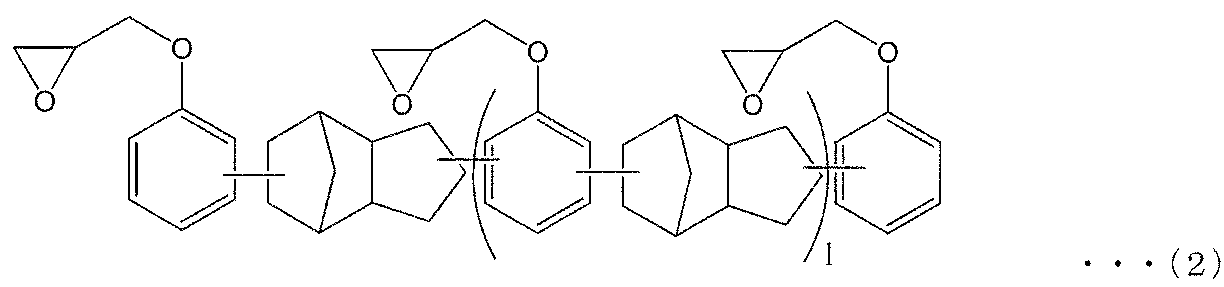
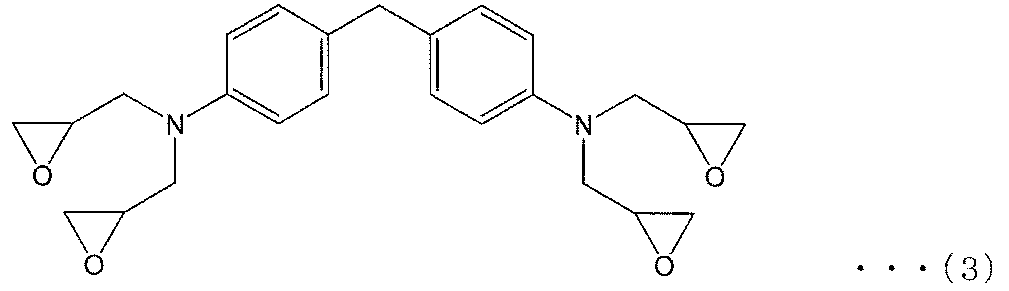
本発明(I)の硬化性組成物は成分(d)として、無機微粒子、有機微粒子および有機・無機複合微粒子から選択される少なくとも1種の成分を含む。
このような無機微粒子としては、例えば、シリカ(SiO2)、アルミナ(Al2O3)、チタニア(TiO2)、酸化タンタル(Ta2O5)、ジルコニア(ZrO2)、窒化珪素(Si3N4)、チタン酸バリウム(BaO・TiO2)、炭酸バリウム(BaCO3)、チタン酸鉛(PbO・TiO2)、チタン酸ジルコン酸鉛(PZT)、チタン酸ジルコン酸ランタン鉛(PLZT)、酸化ガリウム(Ga2O3)、スピネル(MgO・Al2O3)、ムライト(3Al2O3・2SiO2)、コーディエライト(2MgO・2Al2O3・5SiO2)、タルク(3MgO・4SiO2・H2O)、チタン酸アルミニウム(TiO2-Al2O3)、イットリア含有ジルコニア(Y2O3-ZrO2)、珪酸バリウム(BaO・8SiO2)、窒化ホウ素(BN)、炭酸カルシウム(CaCO3)、硫酸カルシウム(CaSO4)、酸化亜鉛(ZnO)、チタン酸マグネシウム(MgO・TiO2)、硫酸バリウム(BaSO4)、有機ベントナイト、カーボン(C)などが挙げられる。これらは1種単独で使用しても、2種以上組み合わせて使用してもよい。
また、本発明(I)の硬化性組成物に使用される有機微粒子は、本発明(I)の硬化性組成物中で分散してペーストを形成するものであればよく、特に制限はない。
成分(d)としては、シリカ微粒子を用いることが、硬化物の電気絶縁特性に悪影響を及ぼさないという観点から好ましい。
本発明(I)の硬化性組成物は、前述の成分以外の成分(その他の成分)を含んでいてもよい。
本発明(I)の硬化性組成物は、さらに硬化促進剤を含むことができ、硬化促進剤を含むことが好ましい。
硬化促進剤としては、成分(c)が有するエポキシ基と、成分(a)が有するエポキシ基と反応可能な官能基との反応を促進する化合物であればよく、特に制限はない。
これらの硬化促進剤の中で、硬化促進作用および後述する本発明(II)の硬化物の電気絶縁性能の両立を考慮すると、好ましい硬化促進剤は、メラミン、イミダゾール系化合物、シクロアミジン化合物およびその誘導体、有機ホスフィン化合物および3級アミノ基含有化合物であり、さらに好ましくは、メラミン、1,5-ジアザビシクロ(4.3.0)ノネン-5およびその塩、1,8-ジアザビシクロ(5.4.0)ウンデセン-7およびその塩である。
本発明(I)の硬化性組成物に使用される消泡剤の具体例としては、例えば、BYK-077(ビックケミー・ジャパン社製)、SNデフォーマー470(サンノプコ社製)、TSA750S(モメンティブ・パフォーマンス・マテリアルズ社製)、シリコーンオイルSH-203(東レ・ダウコーニング社製)等のシリコーン系消泡剤、ダッポーSN-348(サンノプコ社製)、ダッポーSN-354(サンノプコ社製)、ダッポーSN-368(サンノプコ社製)、ディスパロン230HF(楠本化成社製)等のアクリル重合体系消泡剤、サーフィノールDF-110D(日清化学工業社製)、サーフィノールDF-37(日清化学工業社製)等のアセチレンジオール系消泡剤、FA-630等のフッ素含有シリコーン系消泡剤等を挙げることができる。
また、必要に応じて、難燃剤や滑剤を添加することもできる。
本発明(I)の硬化性組成物の25℃における粘度は、通常10,000~100,000mPa・sであり、好ましくは、20,000~60,000mPa・sである。なお、本明細書において本発明(I)の硬化性組成物の25℃における粘度は、コーン/プレート型粘度計(Brookfield社製 型式;DV-II+Pro スピンドルの型番;CPE-52)を用いて、回転数10rpmの条件で、回転開始から7分経過後に測定した粘度である。
さらに、本発明(I)の硬化性組成物を配線の絶縁保護用レジストインキ組成物として使用する場合、本発明(I)の硬化性組成物の印刷性を良好にするために、該組成物のチクソトロピー指数を一定の範囲内とすることが望ましい。
次に、本発明(II)の硬化物について説明する。
本発明(II)は、本発明(I)の硬化性樹脂組成物を硬化して得られる硬化物である。
本発明(I)の硬化性組成物を基板などに印刷して塗膜を得る工程。
第二工程
第一工程で得られた塗膜を50℃~100℃の雰囲気下におくことで塗膜中の溶媒を蒸発させ、一部あるいは全量の溶媒が除去された塗膜を得る工程。
第三工程
第二工程で得られた塗膜を、100℃~250℃の雰囲気下で熱硬化させ、熱硬化された塗膜(すなわち、硬化物の塗膜)を得る工程。
最後に、本発明(III)のフレキシブル配線板および本発明(IV)のフレキシブル配線板の製造方法について説明する。
本発明(I)の硬化性組成物を、フレキシブル配線板の予め錫メッキ処理された配線パターン部にスクリーン印刷し、印刷膜を得る工程。
工程B
工程Aで得られた印刷膜を40~100℃の雰囲気下におくことで印刷膜中の溶媒を蒸発させ、一部あるいは全量の溶媒が除去された印刷膜を得る工程。
工程C
工程Bで得られた印刷膜を、80~130℃の雰囲気下で熱硬化させ、フレキシブル配線板の保護膜を形成する工程。
<成分(a)の酸価の測定>
硬化性組成物に含まれる成分(a)の酸価は、実施合成例、比較合成例で得たポリウレタン溶液中の溶媒を、加熱下で減圧留去することのより得られた成分(a)(ポリウレタンA)の酸価を以下の方法で測定することにより求めた。
電位差滴定法で用いた装置を以下に記す。
装置名:京都電子工業社製 電位差自動滴定装置 AT-510
電極:京都電子工業社製 複合ガラス電極C-173。
硬化性組成物に含まれる成分(a)の数平均分子量は、前記<成分(a)の酸価の測定>で得られた成分(a)(ポリウレタンA)について、測定することにより求めた。
成分(a)の数平均分子量は、GPCで測定したポリスチレン換算の数平均分子量であり、GPCの測定条件は以下のとおりである。
装置名:日本分光(株)製HPLCユニット HSS-2000
カラム:ShodexカラムLF-804
移動相:テトラヒドロフラン
流速:1.0mL/min
検出器:日本分光(株)製 RI-2031Plus
温度:40.0℃
試料量:サンプルループ 100μリットル
試料濃度:0.1質量%前後に調整。
実施合成例、比較合成例で得たポリウレタン溶液の粘度を以下の方法により測定した。
ポリウレタン溶液約0.8gを使用して、コーン/プレート型粘度計(Brookfield社製 型式;DV-II+Pro スピンドルの型番;CPE-52)を用いて、温度25.0℃、回転数5rpmの条件で測定を開始し、測定開始から7分経過後の粘度を測定し、成分(a)含有溶液(ポリウレタン溶液)の粘度とした。
硬化性組成物の粘度を以下の方法により測定した。
硬化性組成物約0.6gを使用して、コーン/プレート型粘度計(Brookfield社製 型式;DV-II+Pro スピンドルの型番;CPE-52)を用いて、温度25.0℃、回転数10rpmの条件で測定を開始し、測定開始から7分経過後の粘度を測定し、硬化性組成物の粘度とした。
硬化性組成物のチクソトロピー指数を以下の方法により測定した。
硬化性組成物約0.6gを使用して、コーン/プレート型粘度計(Brookfield社製 型式;DV-II+Pro スピンドルの型番;CPE-52)を用いて、温度25.0℃、回転数10rpmの条件で測定を開始し、測定開始から7分経過後の粘度を測定し、回転数10rpm時の粘度とした。その後、温度25.0℃、回転数1rpmの条件で測定を開始し、測定開始から7分経過後の粘度を測定し、回転数1rpm時の粘度とした。
なお、チクソトロピー指数は以下の計算により求めた。
チクソトロピー指数=[1rpmの粘度]÷[10rpmの粘度]
(実施合成例1)
攪拌装置、温度計およびコンデンサーを備えた反応容器に、C-1015N(クラレ社製、(ポリ)カーボネートジオールと、該(ポリ)カーボネートジオールの原料として用いられたジオール(1,9-ノナンジオールおよび2-メチル-1,8-オクタンジオール)との混合物、水酸基価112.3mgKOH/g)(原料ジオールの仕込みモル比;1,9-ノナンジオール:2-メチル-1,8-オクタンジオール=15:85、混合物中の1,9-ノナンジオールの残存濃度2.1質量%、2-メチル-1,8-オクタンジオールの残存濃度9.3質量%)248.0g、カルボキシル基含有ジオールとして、2,2-ジメチロールブタン酸(東京化成工業社製)47.5g、(ポリ)カーボネートポリオールおよびカルボキシル基含有ジオール以外のポリオ-ルとして、トリメチロールエタン(三菱ガス化学社製)2.7g、溶媒として3-メトキシ-3-メチル-1-ブチルアセテート(商品名;ソルフィットAC (クラレ社製))550.0gを仕込み、100℃に加熱してすべての原料を溶解した。
また、ポリウレタン溶液A1中の固形分濃度は45.0質量%であった。
溶媒である3-メトキシ-3-メチル-1-ブチルアセテート(商品名;ソルフィットAC (クラレ社製))550.0gを、エチレングリコールブチルエーテルアセテート(ダイセル社製)550.0gに置き換えた以外は、実施合成例1と同様に行い、カルボキシル基およびカーボネート結合を有するポリウレタン溶液(以下、「ポリウレタン溶液A2」と記す。)を得た。
また、ポリウレタン溶液A2中の固形分濃度は45.0質量%であった。
溶媒である3-メトキシ-3-メチル-1-ブチルアセテート(商品名;ソルフィットAC (クラレ社製))550.0gを、ジエチレングルコールエチルエーテルアセテート(ダイセル社製)275gと3-メトキシ-3-メチル-1-ブチルアセテート(商品名;ソルフィットAC (クラレ社製))275gとに置き換えた以外は、実施合成例1と同様に行い、カルボキシル基およびカーボネート結合を有するポリウレタン溶液(以下、「ポリウレタン溶液A3」と記す。)を得た。
また、ポリウレタン溶液A3中の固形分濃度は45.0質量%であった。
溶媒である3-メトキシ-3-メチル-1-ブチルアセテート(商品名;ソルフィットAC (クラレ社製))550.0gを、ジエチレングルコールエチルエーテルアセテート(ダイセル社製)275gとエチレングリコールブチルエーテルアセテート(ダイセル社製)275gとに置き換えた以外は、実施合成例1と同様に行い、カルボキシル基およびカーボネート結合を有するポリウレタン溶液(以下、「ポリウレタン溶液A4」と記す。)を得た。
また、ポリウレタン溶液A4中の固形分濃度は45.0質量%であった。
攪拌装置、温度計およびコンデンサーを備えた反応容器に、C-1015N(クラレ社製、 (ポリ)カーボネートジオール)と原料ジオール(1,9-ノナンジオールおよび2-メチル-1,8-オクタンジオール)との混合物(原料ジオールの仕込みモル比;1,9-ノナンジオール:2-メチル-1,8-オクタンジオール=15:85、水酸基価112.3mgKOH/g、1,9-ノナンジオールの残存濃度2.1質量%、2-メチル-1,8-オクタンジオールの残存濃度9.3質量%)250.9g、カルボキシル基含有ジオールとして2,2-ジメチロールブタン酸(日本化成社製)47.5g、(ポリ)カーボネートポリオールおよびカルボキシル基含有ジオール以外のポリオ-ルとして、トリメチロールエタン(三菱ガス化学社製)2.7g、溶媒としてジエチレングルコールエチルエーテルアセテート(ダイセル社製)233.75gと3-メトキシ-3-メチル-1-ブチルアセテート(商品名;ソルフィットAC (クラレ社製))233.75gとジエチレングリコールジエチルエーテル(日本乳化剤社製)82.5gとを仕込み、100℃に加熱してすべての原料を溶解した。
また、ポリウレタン溶液A5中の固形分濃度は45.0質量%であった。
溶媒である3-メトキシ-3-メチル-1-ブチルアセテート(商品名;ソルフィットAC (クラレ社製))233.75gを、エチレングリコールブチルエーテルアセテート(ダイセル社製)233.75gに置き換えた以外は、実施合成例5と同様に行い、カルボキシル基およびカーボネート結合を有するポリウレタン溶液(以下、「ポリウレタン溶液A6」と記す。)を得た。
また、ポリウレタン溶液A6中の固形分濃度は45.0質量%であった。
攪拌装置、温度計およびコンデンサーを備えた反応容器に、C-1015N(クラレ社製、 (ポリ)カーボネートジオール)と原料ジオール(1,9-ノナンジオールおよび2-メチル-1,8-オクタンジオール)との混合物(原料ジオールの仕込みモル比;1,9-ノナンジオール:2-メチル-1,8-オクタンジオール=15:85、水酸基価112.3mgKOH/g、1,9-ノナンジオールの残存濃度2.1質量%、2-メチル-1,8-オクタンジオールの残存濃度9.3質量%)252.8g、カルボキシル基含有ジオールとして、2,2-ジメチロールブタン酸(日本化成社製)47.5g、溶媒としてジエチレングリコールエチルエーテルアセテート(ダイセル社製)550.0gを仕込み、100℃に加熱してすべての原料を溶解した。
また、ポリウレタン溶液B1中の固形分濃度は45.0質量%であった。
溶媒であるジエチレングリコールエチルエーテルアセテート(ダイセル社製)550.0gを、γ―ブチロラクトン(三菱化学社製)467.5gとジエチレングリコールエチルエーテルアセテート(ダイセル社製)82.5gとに置き換えた以外は、比較合成例1と同様に行い、カルボキシル基およびカーボネート結合を有するポリウレタン溶液(以下、「ポリウレタン溶液B2」と記す。)を得た。
また、ポリウレタン溶液B2中の固形分濃度は45.0質量%であった。
溶媒であるジエチレングリコールエチルエーテルアセテート(ダイセル社製)550.0gを、ジエチレングリコールエチルエーテルアセテート(ダイセル社製)467.5gとジプロピレングリコールメチルエーテルアセテート(ダイセル社製)82.5gとに置き換えた以外は、比較合成例1と同様に行い、カルボキシル基およびカーボネート結合を有するポリウレタン溶液(以下、「ポリウレタン溶液B3」と記す。)を得た。
また、ポリウレタン溶液B3中の固形分濃度は45.0質量%であった。
ポリウレタン溶液A1を111.1g、シリカ粉(日本アエロジル社製 商品名;アエロジルR-974)5.0g、硬化促進剤としてメラミン(日産化学工業社製)0.38gおよび消泡剤(モメンティブ・パフォーマンス・マテリアルズ社製 商品名;TSA750S)0.70gを混合し、三本ロールミル(井上製作所社製 型式:S-4 3/4×11)を用いて、ポリウレタン溶液A1へのシリカ粉、硬化促進剤および消泡剤の混合を行った。この配合物を主剤配合物C1とした。
実施配合例1の同様の方法によって、表1に示す配合組成に従って配合した。実施配合例2~6で調製した配合物を、それぞれ主剤配合物C2~C6とし、比較配合例1~3で調製した配合物を、それぞれ、主剤配合物D1~D3とした。なお、表中の数値はgを表す。
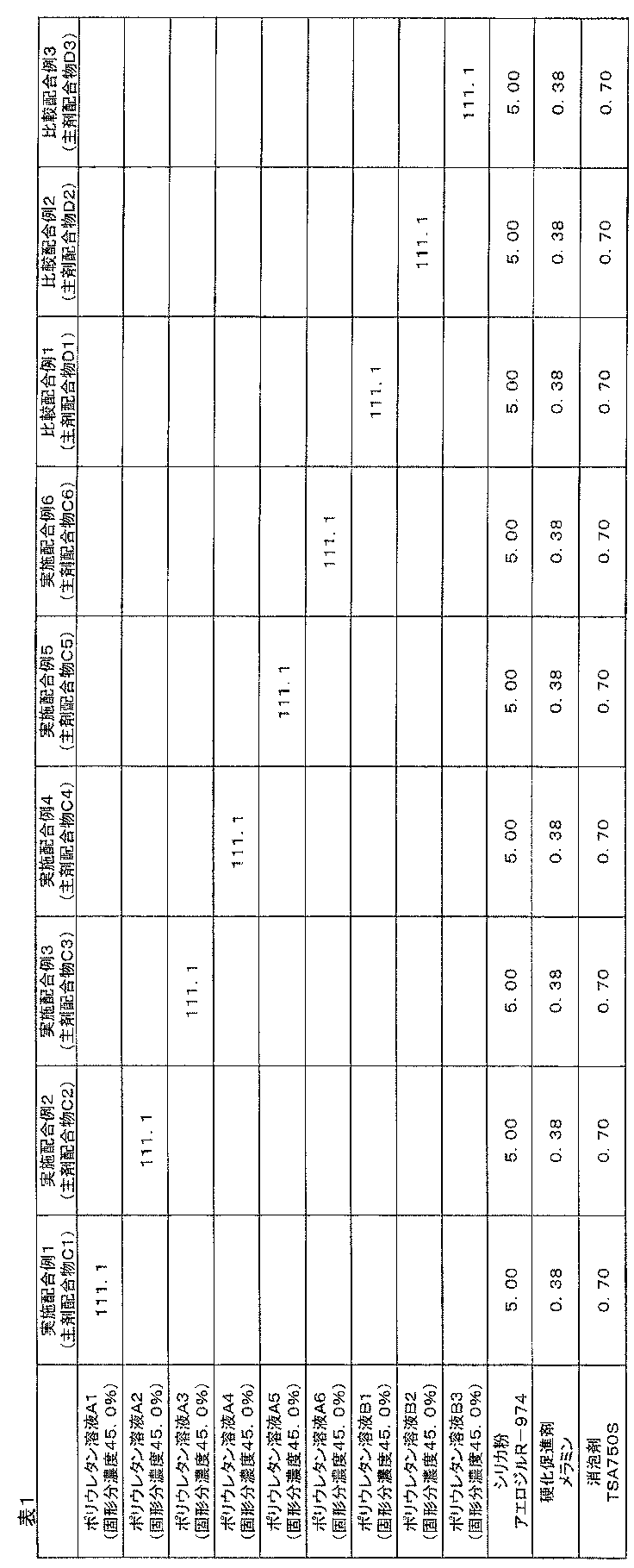
(硬化剤溶液の配合例1)
撹拌機、温度計およびコンデンサーを備えた容器に、下記式(2)の構造を有するエポキシ樹脂(DIC社製 グレード名;HP-7200H エポキシ当量278g/eq)300g、3-メトキシ-3-メチル-1-ブチルアセテート(商品名;ソルフィットAC (クラレ社製))300gを添加し、撹拌を開始した。
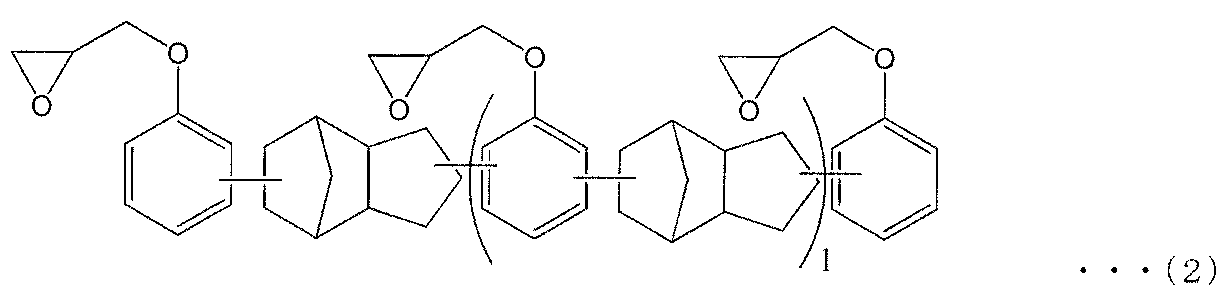
3-メトキシ-3-メチル-1-ブチルアセテート(商品名;ソルフィットAC (クラレ社製))300gを、エチレングリコールブチルエーテルアセテート(ダイセル社製)300gに置き換えた以外は、硬化剤溶液の配合例1と同様に行い、濃度50質量%のHP-7200H含有溶液を取得した。この溶液を硬化剤溶液E2する。
3-メトキシ-3-メチル-1-ブチルアセテート(商品名;ソルフィットAC (クラレ社製))300gを、ジエチレングリコールエチルエーテルアセテート(ダイセル社製)300gに置き換えた以外は、硬化剤溶液の配合例1と同様に行い、濃度50質量%のHP-7200H含有溶液を取得した。この溶液を硬化剤溶液E3する。
3-メトキシ-3-メチル-1-ブチルアセテート(商品名;ソルフィットAC (クラレ社製))300gを、γ-ブチロラクトン(三菱化学社製)180gおよびジエチレングリコールジエチルエーテル(日本乳化剤社製)120gに置き換えた以外は、硬化剤溶液の配合例1と同様に行い、濃度50質量%のHP-7200H含有溶液を取得した。
この溶液を硬化剤溶液E4する。
〔実施例1〕
(硬化性組成物の配合(製造))
主剤配合物C1を117.2gと硬化剤溶液E1を19.8gとをプラスチック容器に入れた。
硬化性組成物F1の粘度は、50,000mPa・sであった。チクソトロピー指数は1.35であった。硬化性組成物F1の、成分(a)中に含まれるカルボキシル基(エポキシ基と反応可能な官能基)の数と、成分(c)中のエポキシ基の数の比(カルボキシル基/エポキシ基)は、1.0であった。
(硬化性組成物の配合(製造))
主剤配合物C2を117.2gと硬化剤溶液E2を19.8gとをプラスチック容器に入れた。
硬化性組成物F2の粘度は、50,000mPa・sであった。チクソトロピー指数は1.36であった。硬化性組成物F2の、成分(a)中に含まれるカルボキシル基(エポキシ基と反応可能な官能基)の数と、成分(c)中のエポキシ基の数の比(カルボキシル基/エポキシ基)は、1.0であった。
(硬化性組成物の配合(製造))
主剤配合物C1を主剤配合物C3に置き換えた以外は、実施例1と同様にし、硬化性組成物(以下、「硬化性組成物F3」と記す。)を得た。
(硬化性組成物の配合(製造))
主剤配合物C2を主剤配合物C4に置き換えた以外は、実施例2と同様にし、硬化性組成物(以下、「硬化性組成物F4」と記す。)を得た。
(硬化性組成物の配合(製造))
主剤配合物C1を主剤配合物C5に置き換えた以外は、実施例1と同様にし、硬化性組成物(以下、「硬化性組成物F5」と記す。)を得た。
(硬化性組成物の配合(製造))
主剤配合物C2を主剤配合物C6に置き換えた以外は、実施例2と同様にし、硬化性組成物(以下、「硬化性組成物F6」と記す。)を得た。
(硬化性組成物の配合(製造))
主剤配合物D1を117.2gと硬化剤溶液E3を19.8gとをプラスチック容器に入れた。
硬化性組成物G1の粘度は、50,000mPa・sであった。チクソトロピー指数は1.34であった。硬化性組成物G1の、成分(a)中に含まれるカルボキシル基(エポキシ基と反応可能な官能基)の数と、成分(c)中のエポキシ基の数の比(カルボキシル基/エポキシ基)は、1.0であった。
(硬化性組成物の配合(製造))
主剤配合物D2を117.2gと硬化剤溶液E4を19.8gとをプラスチック容器に入れた。
混合は、スパーテルを用い、室温で5分間攪拌することで行い、硬化性組成物(以下、「硬化性組成物G2」と記す。)を得た。
(硬化性組成物の配合(製造))
主剤配合物D1を主剤配合物D3に置き換えた以外は、比較例1と同様にし、硬化性組成物(以下、「硬化性組成物G3」と記す。)を得た。
実施例、比較例で得られた硬化性組成物の組成、および物性を下記表2に記す。
さらに硬化性組成物F1~F6および硬化性組成物G1~G3を用いて、以下に説明する方法により、印刷性の評価、反り性の評価および長期電気絶縁信頼性の評価を行った。その結果を下記表3に記す。
フレキシブル銅張り積層板(住友金属鉱山社製 グレード名;エスパーフレックスUS 銅厚;8μm、ポリイミド厚:38μm)をエッチングして製造した、JPCA-ET01に記載の微細くし形パターン形状の基板(銅配線幅/銅配線間幅=15μm/15μm)に錫メッキ処理を施したフレキシブル配線板上に、硬化性組成物を#100メッシュポリエステル版でスクリーン印刷により塗布した。塗膜を80℃で30分間乾燥した後、120℃で1時間熱硬化した。硬化後の細線部を顕微鏡観察し、ブリード量、つまり印刷端面より組成物のにじみ出した先端部分までの距離を測定し、以下の基準で評価した。
A:ブリード量が40μm以下
B:ブリード量が40μmより大きく80μm以下
C:ブリード量が80μmより大きい
結果を表3に記す。
硬化性組成物を、#100メッシュポリエステル版で、基板にスクリーン印刷により塗布し、該基板を80℃の熱風循環式乾燥機に30分間入れた。その後、前記基板を120℃の熱風循環式乾燥機に60分間入れることにより、塗布した硬化性組成物を硬化させた。
硬化性組成物を塗布し、熱風循環式乾燥機を用いて硬化した塗膜を、50mmφにサークルカッターでカットした。円形にカットされたものは中心付近が凸状または凹状に反る形の変形を呈する。サークルカッターでカットされた、基板上に硬化膜が形成されたものを、1時間後に下に凸の状態で、すなわち基板上に硬化膜が形成されたものの中心付近が水平面に接するようにして静置し、水平面からの反りの高さの最大、最小値を測定し、その平均値を求めた。符号は反りの方向を表し、下に凸の状態で静置した際、ポリイミドフィルムに対し硬化膜が上側になる場合を「+」、硬化膜が下側になる場合を「-」とした。
結果を表3に記す。
フレキシブル銅張り積層板(住友金属鉱山社製 グレード名;エスパーフレックスUS銅厚;8μm、ポリイミド厚:38μm)をエッチングして製造した、JPCA-ET01に記載の微細くし形パターン形状の基板(銅配線幅/銅配線間幅=15μm/15μm)に錫メッキ処理を施したフレキシブル配線板に、硬化性組成物を、スクリーン印刷法により、ポリイミド面からの厚みが15μmの厚さ(乾燥後)になるように塗布した。
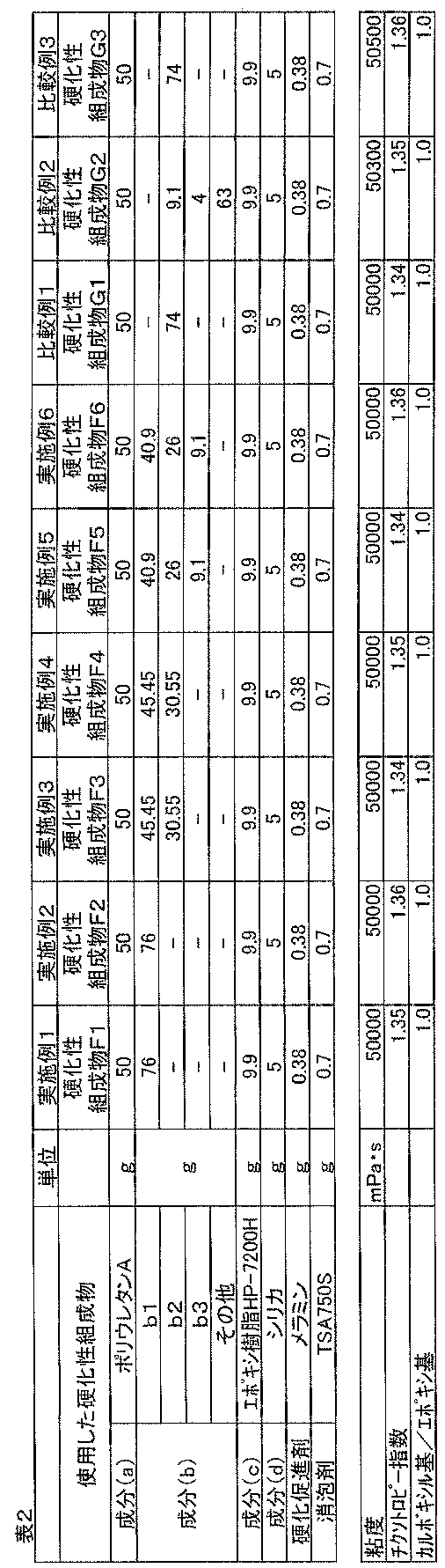

このため、該硬化物はフレキシブル配線板用の絶縁保護膜として有用である。
Claims (12)
- 以下の成分(a)~(d)を含む硬化性組成物。
成分(a):エポキシ基と反応可能な官能基およびカーボネート結合を有するポリウレタン
成分(b):下記成分(b1)を含む溶媒
成分(c):1分子中に2個以上のエポキシ基を有する化合物
成分(d):無機微粒子、有機微粒子および有機・無機複合微粒子から選択される少なくとも1種の成分
成分(b1):3-メトキシ-3-メチル-1-ブチルアセテートおよびエチレングリコールブチルエーテルアセテートから選択される少なくとも1種の成分 - 前記成分(b)が、下記成分(b2)を含む請求項1に記載の硬化性組成物。
成分(b2):ジエチレングリコールエチルエーテルアセテートおよびジプロピレングリコールメチルエーテルアセテートから選択される少なくとも1種の成分 - 前記成分(b)が、下記成分(b3)を含む請求項1または2に記載の硬化性組成物。
成分(b3):ジエチレングリコールジエチルエーテル - 前記エポキシ基と反応可能な官能基が、カルボキシル基、イソシアナト基、ブロック化されたイソシアナト基、環状酸無水物基、フェノール性水酸基からなる群より選ばれる少なくとも1種の官能基である、請求項1~3のいずれか1項に記載の硬化性組成物。
- 前記成分(b1)および成分(b3)の総質量と、前記成分(b2)の質量との割合((b1)および(b3)の総質量:(b2)の質量)が、80:20~30:70である、請求項3に記載の硬化性組成物。
- 成分(b)を、硬化性組成物全体を100質量%とすると、20~70質量%含有し、
成分(a)中に含まれるエポキシ基と反応可能な官能基の数と、成分(c)中のエポキシ基の数との比(エポキシ基と反応可能な官能基/エポキシ基)が、1/3~2/1であり、
成分(d)を、硬化性樹脂組成物に含まれる全成分から成分(d)を除いた残りの成分の総量100質量部に対して、1~150質量部含有することを特徴とする請求項1~5のいずれか一項に記載の硬化性組成物。 - 前記成分(d)が、シリカ微粒子である請求項1~6のいずれか1項に記載の硬化性組成物。
- 前記成分(c)が、芳香環構造および脂環構造から選択される少なくとも1種の構造を有する化合物である請求項1~7のいずれか1項に記載の硬化性組成物。
- 前記成分(c)が、トリシクロデカン構造および芳香環構造を有する化合物である請求項8に記載の硬化性組成物。
- 請求項1~9のいずれか1項に記載の硬化性組成物を硬化した硬化物。
- フレキシブル基板上に配線が形成されてなるフレキシブル配線板の、配線が形成されている表面の少なくとも一部が請求項10に記載の硬化物によって被覆されている、硬化物によって被覆されたフレキシブル配線板。
- 請求項1~9のいずれか1項に記載の硬化性組成物をフレキシブル配線板の錫メッキ処理された配線パターン部の少なくとも一部に印刷することで該パターン上に印刷膜を形成し、
該印刷膜を80~130℃で加熱硬化させることで保護膜を形成することを特徴とする、保護膜によって被覆されたフレキシブル配線板の製造方法。
Priority Applications (3)
| Application Number | Priority Date | Filing Date | Title |
|---|---|---|---|
| CN201680054766.5A CN108026250A (zh) | 2015-11-09 | 2016-08-25 | 固化性组合物及其用途 |
| KR1020187004366A KR102018009B1 (ko) | 2015-11-09 | 2016-08-25 | 경화성 조성물 및 그의 용도 |
| JP2017550005A JPWO2017081909A1 (ja) | 2015-11-09 | 2016-08-25 | 硬化性組成物およびその用途 |
Applications Claiming Priority (2)
| Application Number | Priority Date | Filing Date | Title |
|---|---|---|---|
| JP2015219466 | 2015-11-09 | ||
| JP2015-219466 | 2015-11-09 |
Publications (1)
| Publication Number | Publication Date |
|---|---|
| WO2017081909A1 true WO2017081909A1 (ja) | 2017-05-18 |
Family
ID=58695165
Family Applications (1)
| Application Number | Title | Priority Date | Filing Date |
|---|---|---|---|
| PCT/JP2016/074793 Ceased WO2017081909A1 (ja) | 2015-11-09 | 2016-08-25 | 硬化性組成物およびその用途 |
Country Status (5)
| Country | Link |
|---|---|
| JP (1) | JPWO2017081909A1 (ja) |
| KR (1) | KR102018009B1 (ja) |
| CN (1) | CN108026250A (ja) |
| TW (1) | TWI696639B (ja) |
| WO (1) | WO2017081909A1 (ja) |
Citations (4)
| Publication number | Priority date | Publication date | Assignee | Title |
|---|---|---|---|---|
| JP2009267417A (ja) * | 2008-04-28 | 2009-11-12 | Ind Technol Res Inst | フレキシブル基板上に導電パターンを作製する方法およびそれに用いる保護インク |
| WO2010073981A1 (ja) * | 2008-12-26 | 2010-07-01 | 昭和電工株式会社 | 硬化性組成物 |
| JP2011137108A (ja) * | 2009-12-28 | 2011-07-14 | Showa Denko Kk | 配線板の保護膜用熱硬化性組成物 |
| JP2012218318A (ja) * | 2011-04-11 | 2012-11-12 | Dic Corp | 導電性インク受容層形成用樹脂組成物、導電性インク受容基材及び回路形成用基板ならびに印刷物、導電性パターン及び回路基板 |
Family Cites Families (7)
| Publication number | Priority date | Publication date | Assignee | Title |
|---|---|---|---|---|
| JP2003113338A (ja) | 2001-10-03 | 2003-04-18 | Pi R & D Co Ltd | スクリーン印刷用の耐熱性ブロック共重合ポリイミド組成物及びそのポリイミドを用いるインキの組成と塗膜の形成方法 |
| JP4240885B2 (ja) | 2001-12-28 | 2009-03-18 | 日立化成工業株式会社 | フレキシブル配線板の保護膜を形成する方法 |
| JP5190976B2 (ja) | 2004-09-21 | 2013-04-24 | 昭和電工株式会社 | ウレタン樹脂を用いた熱硬化性樹脂組成物 |
| ATE492579T1 (de) | 2005-07-04 | 2011-01-15 | Showa Denko Kk | Polyurethan mit einer carboxylgruppe und seine verwendungen |
| JP5399603B2 (ja) | 2005-10-07 | 2014-01-29 | 昭和電工株式会社 | シリコーンパウダーを含む熱硬化性樹脂組成物 |
| JP5164090B2 (ja) | 2007-02-16 | 2013-03-13 | 太陽ホールディングス株式会社 | カルボシキル基含有ウレタン樹脂を含有する熱硬化性樹脂組成物及びその硬化物 |
| JP2008214413A (ja) | 2007-03-01 | 2008-09-18 | Toray Ind Inc | 熱硬化性樹脂組成物 |
-
2016
- 2016-08-25 KR KR1020187004366A patent/KR102018009B1/ko not_active Expired - Fee Related
- 2016-08-25 JP JP2017550005A patent/JPWO2017081909A1/ja not_active Ceased
- 2016-08-25 CN CN201680054766.5A patent/CN108026250A/zh active Pending
- 2016-08-25 WO PCT/JP2016/074793 patent/WO2017081909A1/ja not_active Ceased
- 2016-11-04 TW TW105135967A patent/TWI696639B/zh not_active IP Right Cessation
Patent Citations (4)
| Publication number | Priority date | Publication date | Assignee | Title |
|---|---|---|---|---|
| JP2009267417A (ja) * | 2008-04-28 | 2009-11-12 | Ind Technol Res Inst | フレキシブル基板上に導電パターンを作製する方法およびそれに用いる保護インク |
| WO2010073981A1 (ja) * | 2008-12-26 | 2010-07-01 | 昭和電工株式会社 | 硬化性組成物 |
| JP2011137108A (ja) * | 2009-12-28 | 2011-07-14 | Showa Denko Kk | 配線板の保護膜用熱硬化性組成物 |
| JP2012218318A (ja) * | 2011-04-11 | 2012-11-12 | Dic Corp | 導電性インク受容層形成用樹脂組成物、導電性インク受容基材及び回路形成用基板ならびに印刷物、導電性パターン及び回路基板 |
Also Published As
| Publication number | Publication date |
|---|---|
| KR102018009B1 (ko) | 2019-09-03 |
| TWI696639B (zh) | 2020-06-21 |
| CN108026250A (zh) | 2018-05-11 |
| KR20180030134A (ko) | 2018-03-21 |
| JPWO2017081909A1 (ja) | 2018-08-30 |
| TW201731898A (zh) | 2017-09-16 |
Similar Documents
| Publication | Publication Date | Title |
|---|---|---|
| JP6912385B2 (ja) | 硬化性組成物、硬化物、オーバーコート膜、被覆フレキシブル配線板およびその製造方法 | |
| JP5717448B2 (ja) | (ポリ)カーボネートポリオールおよび該(ポリ)カーボネートポリオールを原料とするカルボキシル基含有ポリウレタン | |
| US11044807B2 (en) | Polyurethane, curable composition, overcoat film, and flexible wiring board and production method therefor | |
| JP5726094B2 (ja) | 熱硬化性組成物 | |
| JP5796961B2 (ja) | 硬化性組成物 | |
| JP5579081B2 (ja) | カルボキシル基含有ポリウレタン | |
| JP6882263B2 (ja) | 硬化性組成物、該組成物を用いる硬化膜およびオーバーコート膜 | |
| TWI696639B (zh) | 硬化性組成物及其用途 | |
| JP7776583B2 (ja) | 硬化性組成物、硬化物、フレキシブル配線板用オーバーコート膜、フレキシブル配線板、及びフレキシブル配線板の製造方法 |
Legal Events
| Date | Code | Title | Description |
|---|---|---|---|
| 121 | Ep: the epo has been informed by wipo that ep was designated in this application |
Ref document number: 16863873 Country of ref document: EP Kind code of ref document: A1 |
|
| ENP | Entry into the national phase |
Ref document number: 20187004366 Country of ref document: KR Kind code of ref document: A |
|
| ENP | Entry into the national phase |
Ref document number: 2017550005 Country of ref document: JP Kind code of ref document: A |
|
| NENP | Non-entry into the national phase |
Ref country code: DE |
|
| 122 | Ep: pct application non-entry in european phase |
Ref document number: 16863873 Country of ref document: EP Kind code of ref document: A1 |