WO2017065237A1 - チエノピロール系化合物又はその塩を有効成分として含有する有害生物防除剤 - Google Patents
チエノピロール系化合物又はその塩を有効成分として含有する有害生物防除剤 Download PDFInfo
- Publication number
- WO2017065237A1 WO2017065237A1 PCT/JP2016/080439 JP2016080439W WO2017065237A1 WO 2017065237 A1 WO2017065237 A1 WO 2017065237A1 JP 2016080439 W JP2016080439 W JP 2016080439W WO 2017065237 A1 WO2017065237 A1 WO 2017065237A1
- Authority
- WO
- WIPO (PCT)
- Prior art keywords
- compound
- salt
- substituted
- phenyl
- compounds
- Prior art date
- Legal status (The legal status is an assumption and is not a legal conclusion. Google has not performed a legal analysis and makes no representation as to the accuracy of the status listed.)
- Ceased
Links
- 0 CN=*([C@@]1SC=CC1C1=O)N1c1ccccc1 Chemical compound CN=*([C@@]1SC=CC1C1=O)N1c1ccccc1 0.000 description 5
- UHOVQNZJYSORNB-UHFFFAOYSA-N c1ccccc1 Chemical compound c1ccccc1 UHOVQNZJYSORNB-UHFFFAOYSA-N 0.000 description 2
Classifications
-
- A—HUMAN NECESSITIES
- A01—AGRICULTURE; FORESTRY; ANIMAL HUSBANDRY; HUNTING; TRAPPING; FISHING
- A01N—PRESERVATION OF BODIES OF HUMANS OR ANIMALS OR PLANTS OR PARTS THEREOF; BIOCIDES, e.g. AS DISINFECTANTS, AS PESTICIDES OR AS HERBICIDES; PEST REPELLANTS OR ATTRACTANTS; PLANT GROWTH REGULATORS
- A01N43/00—Biocides, pest repellants or attractants, or plant growth regulators containing heterocyclic compounds
- A01N43/90—Biocides, pest repellants or attractants, or plant growth regulators containing heterocyclic compounds having two or more relevant hetero rings, condensed among themselves or with a common carbocyclic ring system
-
- A—HUMAN NECESSITIES
- A01—AGRICULTURE; FORESTRY; ANIMAL HUSBANDRY; HUNTING; TRAPPING; FISHING
- A01N—PRESERVATION OF BODIES OF HUMANS OR ANIMALS OR PLANTS OR PARTS THEREOF; BIOCIDES, e.g. AS DISINFECTANTS, AS PESTICIDES OR AS HERBICIDES; PEST REPELLANTS OR ATTRACTANTS; PLANT GROWTH REGULATORS
- A01N47/00—Biocides, pest repellants or attractants, or plant growth regulators containing organic compounds containing a carbon atom not being member of a ring and having no bond to a carbon or hydrogen atom, e.g. derivatives of carbonic acid
- A01N47/02—Biocides, pest repellants or attractants, or plant growth regulators containing organic compounds containing a carbon atom not being member of a ring and having no bond to a carbon or hydrogen atom, e.g. derivatives of carbonic acid the carbon atom having no bond to a nitrogen atom
-
- C—CHEMISTRY; METALLURGY
- C07—ORGANIC CHEMISTRY
- C07D—HETEROCYCLIC COMPOUNDS
- C07D495/00—Heterocyclic compounds containing in the condensed system at least one hetero ring having sulfur atoms as the only ring hetero atoms
- C07D495/02—Heterocyclic compounds containing in the condensed system at least one hetero ring having sulfur atoms as the only ring hetero atoms in which the condensed system contains two hetero rings
- C07D495/04—Ortho-condensed systems
Definitions
- the present invention relates to a novel thienopyrrole compound or a salt thereof, and a pest control agent containing the compound or a salt thereof as an active ingredient.
- Patent Document 1 describes that specific isoindolinone compounds are useful as insecticides. However, this compound differs from the compound of the present invention in that the fused ring of the mother nucleus is an isoindolinone ring.
- An object of the present invention is to provide a compound or a salt thereof highly active against pests, to provide a pest control agent using the compound or a salt thereof, and to apply the compound or a salt thereof. It is to provide a method for controlling pests.
- the present invention provides a compound of formula (I):
- R 1 is halogen, alkyl, haloalkyl, cyanoalkyl, alkoxy, haloalkoxy, cyanoalkoxy, nitro, cyano, phenyl optionally substituted with A, carboxy, alkoxycarbonyl or CONR 4 R 5 ;
- R 2 and R 3 are each independently substituted with halogen, alkyl, haloalkyl, cyanoalkyl, alkoxy, haloalkoxy, cyanoalkoxy, alkylthio, haloalkylthio, alkylsulfinyl, haloalkylsulfinyl, alkylsulfonyl, haloalkylsulfonyl, nitro, cyano, A is there a good phenoxy substituted with also phenyl or a and; a is halogen, haloalkyl, haloalkoxy or cyano; R 4 and R 5 each independently stand
- the compound of the above formula (I) or a salt thereof has a very high control effect against pests at a low dose.
- the halogen atom in the compound of the formula (I) or the halogen as a substituent includes each atom of fluorine, chlorine, bromine or iodine.
- the number of halogen atoms as a substituent may be 1 or 2 or more, and in the case of 2 or more, each halogen atom may be the same or different. Further, the halogen atom may be substituted at any position.
- alkyl or alkyl moiety in the compound of the formula (I) examples include methyl, ethyl, normal propyl, isopropyl, normal butyl, isobutyl, secondary butyl, tertiary butyl, normal pentyl, isopentyl, neopentyl, normal hexyl, neohexyl.
- linear or branched C 1 -C 6 groups such as
- Examples of the cycloalkyl or cycloalkyl moiety in the compound of the formula (I) include cyclic C 3 -C 6 groups such as cyclopropyl, cyclobutyl, cyclopentyl, and cyclohexyl.
- the salt of the compound of the formula (I) includes any salt as long as it is acceptable in the technical field.
- alkali metal salts such as sodium salts and potassium salts
- Alkaline earth metal salts such as; ammonium salts such as dimethylammonium salt and triethylammonium salt
- inorganic acid salts such as hydrochloride, perchlorate, sulfate and nitrate; acetate, trifluoroacetate and oxalic acid
- organic acid salts such as salts, p-toluenesulfonic acid salts and methanesulfonic acid salts.
- the compound of the formula (I) or a salt thereof may have isomers such as stereoisomers and optical isomers, but the present invention includes both isomers and isomer mixtures. In the present specification, unless otherwise specified, isomers are described as a mixture. The present invention also includes various isomers other than those described above within the scope of technical common sense in the technical field. Depending on the type of isomer, there may be a chemical structure different from that of the formula (I). However, since those skilled in the art can fully recognize that they are related to isomers, the scope of the present invention. It is clear that it is within.
- the compound of the above formula (I) or a salt thereof (hereinafter abbreviated as the compound of the present invention) can be produced according to the following production methods and ordinary salt production methods, but is not limited to these methods. Absent.
- R 1a is halogen, alkyl, haloalkyl, cyanoalkyl, alkoxy, haloalkoxy, cyanoalkoxy or nitro
- Me is a methyl group
- R 2 , R 3 , m, n and p are as described above.
- the compound of the formula (Ia) can be produced by reacting the compound of the formula (II) with the compound of the formula (III) in a solvent in the presence of a transition metal catalyst. it can.
- the compound of the formula (III) is known or can be produced by reacting aniline corresponding to the compound of the formula (III) with phosgene, diphosgene or triphosgene.
- the compound of the formula (III) can be used in an amount of 1 to 3 moles, preferably 1 to 1.5 moles relative to the compound of the formula (II).
- transition metal catalysts include palladium compounds such as palladium acetate, dichlorobis (triphenylphosphine) palladium, tetrakis (triphenylphosphine) palladium, tris (dibenzylidene) dipalladium; rhenium carbonyl, bromotricarbonyl (tetrahydrofuran) rhenium dimer
- the rhenium compound can be selected as appropriate.
- the transition metal catalyst can be used in an amount of 0.001 to 1 times mol, desirably 0.01 to 0.1 times mol, of the compound of the formula (II).
- the solvent may be any solvent as long as it is inert to the reaction.
- ethers such as diethyl ether, butyl methyl ether, tetrahydrofuran, 1,4-dioxane, dimethoxyethane; benzene, toluene, xylene, chlorobenzene, etc.
- Aromatic hydrocarbons such as N, N-dimethylformamide, N, N-dimethylacetamide, N-methyl-2-pyrrolidone, dimethyl sulfoxide, sulfolane; nitriles such as acetonitrile and propionitrile 1 type or 2 or more types can be suitably selected from ester, such as ethyl acetate and ethyl propionate; Aliphatic hydrocarbons, such as pentane, hexane, heptane, octane, and cyclohexane;
- the reaction temperature is usually 20 to 200 ° C., preferably 50 to 180 ° C.
- the reaction time is usually 1 to 48 hours, preferably 10 to 30 hours.
- Hal is halogen; R 2 , R 3 , m, n and p are as defined above.
- a compound of formula (Ib-1) is produced by reacting a compound of formula (Ia-1) with a cyanating agent in the presence of a transition metal catalyst in a solvent. be able to.
- transition metal catalysts include palladium compounds such as palladium acetate, dichlorobis (triphenylphosphine) palladium, tetrakis (triphenylphosphine) palladium, tris (dibenzylidene) dipalladium; 1,1′-bis (diphenylphosphino) It can be appropriately selected from ferrocene and the like.
- the transition metal catalyst can be used in an amount of 0.01 to 1 mole, preferably 0.01 to 0.2 mole, relative to the compound of the formula (Ia-1).
- the cyanating agent can be appropriately selected from, for example, zinc cyanide, potassium cyanide, copper cyanide and the like.
- the cyanating agent can be used in an amount of 0.1 to 5 moles, preferably 0.5 to 2 moles, relative to the compound of formula (Ia-1).
- the solvent may be any solvent as long as it is inert to the reaction.
- ethers such as diethyl ether, butyl methyl ether, tetrahydrofuran, 1,4-dioxane, dimethoxyethane; benzene, toluene, xylene, chlorobenzene, etc.
- Aromatic hydrocarbons such as N, N-dimethylformamide, N, N-dimethylacetamide, N-methyl-2-pyrrolidone, dimethyl sulfoxide, sulfolane; nitriles such as acetonitrile and propionitrile 1 type or 2 or more types can be suitably selected from ester, such as ethyl acetate and ethyl propionate; Aliphatic hydrocarbons, such as pentane, hexane, heptane, octane, and cyclohexane;
- the reaction temperature is usually 20 to 200 ° C., preferably 50 to 150 ° C.
- the reaction time is usually 0.5 to 12 hours, preferably 1 to 5 hours.
- a compound of the formula (Ia-1) and a phenylboronic acid optionally substituted with A are reacted in a solvent in the presence of a transition metal catalyst and a base to give a compound of the formula (I -B-2) can be produced.
- transition metal catalyst those described in the production method [2] can be used. Moreover, the usage-amount can also be made the same with that of a manufacturing method [2].
- the base examples include alkali metal hydroxides such as sodium hydroxide and potassium hydroxide; alkaline earth metal hydroxides such as calcium hydroxide and magnesium hydroxide; alkali metal carbonates such as sodium carbonate and potassium carbonate; Alkali metal bicarbonates such as sodium hydrogen carbonate and potassium hydrogen carbonate; metal hydrides such as sodium hydride and potassium hydride; alcohol metal salts such as sodium methoxide, sodium ethoxide and potassium tert-butoxide; triethylamine, N , N-dimethylaniline, pyridine, 4-N, N-dimethylaminopyridine, organic bases such as 1,8-diazabicyclo [5.4.0] -7-undecene; You can choose.
- the base can be used in an amount of 1 to 5 mol, preferably 1 to 3 mol per mol of the compound of formula (Ia-1).
- reaction temperature and reaction time can be the same as in production method [2].
- R 1c is carboxy, alkoxycarbonyl or CONH 2
- R 2 , R 3 , m, n and p are as defined above.
- the compound of the formula (Ic) can be produced by hydrolyzing the compound of the formula (Ib-1) with an acid or a base.
- the compound of the formula ( Ic) in which R 1c is alkoxycarbonyl can be produced by esterifying a compound in which R 1c is carboxy and an alcohol by an ordinary method.
- the acid can be appropriately selected from, for example, hydrochloric acid and sulfuric acid.
- the base include alkali metal hydroxides such as sodium hydroxide and potassium hydroxide; alkaline earth metal hydroxides such as calcium hydroxide and magnesium hydroxide; alkali metal carbonates such as sodium carbonate and potassium carbonate; Alkali metal bicarbonates such as sodium bicarbonate and potassium bicarbonate; metal hydrides such as sodium hydride and potassium hydride; alcohol metal salts such as sodium methoxide, sodium ethoxide and potassium tert-butoxide, etc. can do.
- the reaction temperature is usually 20 to 200 ° C., preferably 50 to 150 ° C.
- the reaction time is usually 3 to 48 hours, preferably 12 to 24 hours.
- R 2 , R 3 , R 4 , R 5 , m, n and p are as defined above.
- a compound of the formula (Ic-1) is reacted with an amine represented by the formula (IX) or a salt thereof in the presence of a condensing agent in a solvent to give a compound of the formula (I-
- the compound c-2) can be produced.
- the compound of the formula (Ic-2) is obtained by reacting a compound of the formula (Ic-1) with thionyl chloride or oxalyl chloride, an amine represented by the formula (IX), and a base. It can also be produced by reacting in a solvent in the presence.
- the base examples include alkali metal hydroxides such as sodium hydroxide and potassium hydroxide; alkaline earth metal hydroxides such as calcium hydroxide and magnesium hydroxide; alkali metal carbonates such as sodium carbonate and potassium carbonate; Alkali metal bicarbonates such as sodium hydrogen carbonate and potassium hydrogen carbonate; metal hydrides such as sodium hydride and potassium hydride; alcohol metal salts such as sodium methoxide, sodium ethoxide and potassium tert-butoxide; triethylamine, N , N-dimethylaniline, pyridine, 4-N, N-dimethylaminopyridine, organic bases such as 1,8-diazabicyclo [5.4.0] -7-undecene; You can choose.
- the base can be used in an amount of 1 to 5 moles, preferably 1 to 3 moles compared to the compounds of the formula (Ic-1).
- the condensing agent examples include carbodiimide condensing agents such as 1- (3- (dimethylamino) propyl) -3-ethylcarbodiimide or a salt thereof, N, N′-dicyclohexylcarbodiimide; N, N′-carbonyldiimidazole and the like It can be appropriately selected from imidazole condensing agents; (4,6-dimethoxy-1,3,5-triazin-2-yl) -4-methylmorpholinium triazine condensing agents such as chloride; The condensing agent can be used in an amount of 1 to 5 times, preferably 1 to 2 times the amount of the compound of the formula (Ic-1).
- carbodiimide condensing agents such as 1- (3- (dimethylamino) propyl) -3-ethylcarbodiimide or a salt thereof, N, N′-dicyclohexylcarbodiimide; N, N′-carbon
- ethers such as diethyl ether, butyl methyl ether, tetrahydrofuran, 1,4-dioxane, dimethoxyethane; dichloromethane, chloroform, carbon tetrachloride
- aromatic hydrocarbons such as benzene, toluene, xylene, chlorobenzene
- N, N-dimethylformamide, N, N-dimethylacetamide, N-methyl-2-pyrrolidone dimethylsulfoxide, 1 from aprotic polar solvents such as sulfolane
- nitriles such as acetonitrile and propionitrile
- esters such as ethyl acetate and ethyl propionate
- aliphatic hydrocarbons such as pentane, hexane, heptane, oct
- R 1a , R 2 , m and n are as defined above.
- the reaction of Route A in the first step can be performed by reacting the compound of formula (VI) and the compound of formula (VII) in a solvent in the presence of a base.
- the reaction of Route B in the first step can be performed by reacting the compound of formula (VIII) and the compound of formula (VII) in a solvent in the presence of a condensing agent.
- Compounds of formula (VI) are known or can be prepared by reacting the corresponding carboxylic acids with thionyl chloride or oxalyl chloride.
- the compound of the formula (VI) can be used in an amount of 1 to 3 moles, preferably 1 to 1.5 moles relative to the compound of the formula (VII).
- the compound of formula (VIII) can be used in an amount of 1 to 3 moles, preferably 1 to 1.5 moles compared to the compounds of Formula (VII).
- the base examples include alkali metal hydroxides such as sodium hydroxide and potassium hydroxide; alkaline earth metal hydroxides such as calcium hydroxide and magnesium hydroxide; alkali metal carbonates such as sodium carbonate and potassium carbonate; Alkali metal bicarbonates such as sodium hydrogen carbonate and potassium hydrogen carbonate; metal hydrides such as sodium hydride and potassium hydride; alcohol metal salts such as sodium methoxide, sodium ethoxide and potassium tert-butoxide; triethylamine, N , N-dimethylaniline, pyridine, 4-N, N-dimethylaminopyridine, organic bases such as 1,8-diazabicyclo [5.4.0] -7-undecene; You can choose.
- the base can be used in an amount of 1 to 5 moles, preferably 1 to 3 moles based on the compound of the formula (VII).
- the condensing agent examples include carbodiimide condensing agents such as 1- (3- (dimethylamino) propyl) -3-ethylcarbodiimide or a salt thereof, N, N′-dicyclohexylcarbodiimide; N, N′-carbonyldiimidazole and the like It can be appropriately selected from imidazole condensing agents; (4,6-dimethoxy-1,3,5-triazin-2-yl) -4-methylmorpholinium triazine condensing agents such as chloride; The condensing agent can be used in an amount of 1 to 5 times mol, preferably 1 to 2 times mol for the compound of formula (VIII).
- carbodiimide condensing agents such as 1- (3- (dimethylamino) propyl) -3-ethylcarbodiimide or a salt thereof, N, N′-dicyclohexylcarbodiimide; N, N′-carbon
- the same solvent can be used for either route A or route B.
- the solvent may be any solvent as long as it is inert to the reaction.
- ethers such as diethyl ether, butyl methyl ether, tetrahydrofuran, 1,4-dioxane, dimethoxyethane; benzene, toluene, xylene, chlorobenzene, etc.
- Aromatic hydrocarbons such as N, N-dimethylformamide, N, N-dimethylacetamide, N-methyl-2-pyrrolidone, dimethyl sulfoxide, sulfolane; nitriles such as acetonitrile and propionitrile 1 type or 2 or more types can be suitably selected from ester, such as ethyl acetate and ethyl propionate; Aliphatic hydrocarbons, such as pentane, hexane, heptane, octane, and cyclohexane;
- the reaction temperature is usually ⁇ 50 to 200 ° C., preferably ⁇ 10 to 100 ° C.
- the reaction time is usually 0.5 to 48 hours, preferably 1 to 24 hours.
- R 1a , R 2 , m and n are as defined above.
- the reaction in the second step can be carried out by reacting the compound of formula (V) with thionyl chloride or oxalyl chloride in the presence of a solvent as necessary.
- the solvent may be any solvent as long as it is inert to the reaction.
- ethers such as diethyl ether, butyl methyl ether, tetrahydrofuran, 1,4-dioxane, dimethoxyethane; benzene, toluene, xylene, chlorobenzene, etc.
- Aromatic hydrocarbons such as N, N-dimethylformamide, N, N-dimethylacetamide, N-methyl-2-pyrrolidone, dimethyl sulfoxide, sulfolane; nitriles such as acetonitrile and propionitrile 1 type or 2 or more types can be suitably selected from ester, such as ethyl acetate and ethyl propionate; Aliphatic hydrocarbons, such as pentane, hexane, heptane, octane, and cyclohexane;
- the reaction temperature is usually ⁇ 50 to 200 ° C., preferably 20 to 100 ° C.
- the reaction time is usually 0.5 to 48 hours, preferably 1 to 24 hours.
- R 1a , R 2 , m and n are as defined above.
- Me represents a methyl group.
- the reaction in the third step can be performed by reacting the compound of formula (IV) and methanol in a solvent in the presence of a base.
- the base examples include alkali metal hydroxides such as sodium hydroxide and potassium hydroxide; alkaline earth metal hydroxides such as calcium hydroxide and magnesium hydroxide; alkali metal carbonates such as sodium carbonate and potassium carbonate; Alkali metal bicarbonates such as sodium hydrogen carbonate and potassium hydrogen carbonate; metal hydrides such as sodium hydride and potassium hydride; alcohol metal salts such as sodium methoxide, sodium ethoxide and potassium tert-butoxide; triethylamine, N , N-dimethylaniline, pyridine, 4-N, N-dimethylaminopyridine, organic bases such as 1,8-diazabicyclo [5.4.0] -7-undecene; You can choose.
- the base can be used in an amount of 1 to 5 moles, preferably 1 to 3 moles based on the compound of the formula (IV).
- the solvent may be any solvent as long as it is inert to the reaction.
- ethers such as diethyl ether, butyl methyl ether, tetrahydrofuran, 1,4-dioxane, dimethoxyethane; benzene, toluene, xylene, chlorobenzene, etc.
- Aromatic hydrocarbons such as N, N-dimethylformamide, N, N-dimethylacetamide, N-methyl-2-pyrrolidone, dimethyl sulfoxide, sulfolane; nitriles such as acetonitrile and propionitrile 1 type or 2 or more types can be suitably selected from ester, such as ethyl acetate and ethyl propionate; Aliphatic hydrocarbons, such as pentane, hexane, heptane, octane, and cyclohexane;
- the reaction temperature is usually ⁇ 50 to 200 ° C., preferably ⁇ 10 to 100 ° C.
- the reaction time is usually 0.5 to 48 hours, preferably 1 to 24 hours.
- the desirable mode of the pest control agent containing the compound of the present invention is described below.
- the pest control agent containing the compound of the present invention is, for example, a pest insect, mite, nematode or soil pest control agent that is problematic in the field of agriculture and horticulture, for example, agricultural and horticultural insecticides, acaricides, It is useful as a nematicide or a soil-killing pesticide.
- the compounds of the present invention are useful as pest control agents, for example, agricultural and horticultural insecticides, acaricides, nematicides or soil insecticides, and specifically include peach aphids, cotton aphids, etc.
- Aphids such as: longhorn beetle, weevil, lotus beetle, codling moth, ball worm, tobacco bad worm, gypsy moth, yellow beetle, chanocobion, colorado beetle, cucurbit beetle, ball weevil, planthopper, leafhopper, scale insect, bug Agricultural pests such as whiteflies, thrips, grasshoppers, fly flies, scarabs, tamanayaga, kaburayaga, ants, etc .; gastropods such as slugs, maimai, etc .; house dust mites, cockroaches, house flies, mosquitoes, etc.
- Sanitary pests stag beetle, azuki bean weevil, wolfberry Stored insect pests such as bark beetles; clothing such as burrowing moths, spider worms, termites etc .; harmful insects such as house pests; Plant parasitic mites such as, etc .; Indoor dust mites, such as Staghorn mite, Pleurotus tick, Southern mite, etc .; Mites such as root nematodes, root-knot nematodes, cyst nematodes, nega nematodes, rice stag beetles, strawberries Plant parasitic nematodes such as nematodes, pinewood nematodes, etc .; effective in controlling soil pests such as nematodes such as nematodes;
- the pest control agent containing the compound of the present invention is particularly effective for controlling plant parasitic mites, agricultural pests, plant parasitic nematodes and the like.
- the pest control agent containing the compound of the present invention is also effective in controlling various resistant pests against drugs such as organic phosphorus agents, carbamate agents, synthetic pyrethroid agents, and neonicotinoid agents.
- the compound of the present invention has excellent osmotic transfer properties, harmful insects, mites, nematodes that inhabit the soil by treating the soil with a pest control agent containing the compound of the present invention.
- harmful insects, mites and nematodes that inhabit the foliage can be controlled simultaneously with the control of gastropods and isopods.
- Another desirable embodiment of the pest control agent containing the compound of the present invention includes harmful effects for comprehensively controlling the plant parasitic mites, agricultural pests, plant parasitic nematodes, gastropods, soil pests, etc. Biological control agents are mentioned.
- the pest control agent containing the compound of the present invention is usually a powder, granule, granule wettable powder, wettable powder, aqueous suspension, oily suspension by mixing the compound with various agricultural adjuvants.
- Used in various forms such as an agent, an aqueous granule solvent, an aqueous solvent, an emulsion, a liquid agent, a paste agent, an aerosol agent, and a microdispersion agent, as long as it meets the purpose of the present invention. It can be in any formulation form used.
- Adjuvants used in the formulation include solid carriers such as diatomaceous earth, slaked lime, calcium carbonate, talc, white carbon, kaolin, bentonite, kaolinite, sericite, clay, sodium carbonate, sodium bicarbonate, sodium sulfate, zeolite, starch; water , Toluene, xylene, solvent naphtha, dioxane, acetone, isophorone, methyl isobutyl ketone, chlorobenzene, cyclohexane, dimethyl sulfoxide, N, N-dimethylformamide, N, N-dimethylacetamide, N-methyl-2-pyrrolidone, alcohol, etc.
- solid carriers such as diatomaceous earth, slaked lime, calcium carbonate, talc, white carbon, kaolin, bentonite, kaolinite, sericite, clay, sodium carbonate, sodium bicarbonate, sodium sulfate, zeolite,
- Solvent fatty acid salt, benzoate, alkylsulfosuccinate, dialkylsulfosuccinate, polycarboxylate, alkylsulfate, alkylsulfate, alkylarylsulfate, alkyldiglycolethersulfate, alcohol Sulfate ester salt, alkyl sulfonate, alkyl aryl sulfonate, aryl sulfonate, lignin sulfonate, alkyl diphenyl ether disulfonate, polystyrene sulfonate, alkyl phosphate ester, alkyl aryl phosphate, styryl Aryl phosphate, polyoxyethylene alkyl ether sulfate, polyoxyethylene alkyl aryl ether sulfate, polyoxyethylene alkyl aryl ether sulfate, polyoxyethylene alkyl ether phosphate, polyoxyethylene alkyl
- each component of these adjuvants can be used by appropriately selecting one or two or more types without departing from the object of the present invention.
- it can be used by appropriately selecting from those known in the art.
- a bulking agent for example, a bulking agent, a thickening agent, an anti-settling agent, an antifreezing agent, a dispersion stabilizer, a phytotoxicity reduction.
- Various commonly used adjuvants such as agents, antifungal agents and the like can also be used.
- the compounding ratio (weight ratio) of the compound of the present invention and various adjuvants is 0.001: 99.999 to 95: 5, desirably 0.005: 99.995 to 90:10. In actual use of these preparations, use them as they are or dilute them to a predetermined concentration with a diluent such as water, and add various spreading agents (surfactants, vegetable oils, mineral oils, etc.) as necessary. Can be used.
- the application of the pest control agent containing the compound of the present invention cannot be defined unconditionally due to differences in weather conditions, formulation form, application time, application location, type of pests, occurrence status, etc., but generally 0.05 to 800,
- the active ingredient concentration is 000 ppm, preferably 0.5 to 500,000 ppm.
- the application amount per unit area is 0.05 to 50,000 g, preferably 1 to 30,000 g of the present compound per hectare. is there.
- the present invention also includes a method for controlling pests by such an application method, particularly a method for controlling plant parasitic mites, agricultural pests, and plant parasitic nematodes.
- the application of various preparations or dilutions of the pest control agent containing the compound of the present invention is usually performed by a commonly used application method, that is, spraying (for example, spraying, misting, atomizing, dusting, water surface).
- Application for example, spraying, misting, atomizing, dusting, water surface.
- soil application for example, spraying, misting, atomizing, dusting, water surface.
- surface application application, powder coating, coating, etc.
- immersion poison bait and the like.
- the pest control agent containing the compound of the present invention can be mixed with or used in combination with other agricultural chemicals, fertilizers, safeners, etc., and in this case, more excellent effects and activities may be exhibited.
- Other pesticides include herbicides, insecticides, acaricides, nematicides, soil insecticides, fungicides, antiviral agents, attractants, antibiotics, plant hormones, plant growth regulators, etc. It is done.
- an insecticidal composition, an acaricidal composition, a nematicidal composition or a soil-killing insect pest composition in which the compound of the present invention and one or more active ingredient compounds of other agricultural chemicals are used in combination or in combination.
- the compound of the present invention and the other active ingredient compounds of other agricultural chemicals may be used separately by mixing them at the time of spraying, or both may be used together.
- the present invention includes such an insecticidal composition, an acaricidal composition, a nematicidal composition or a soil-killing insect pest composition.
- crystalline protein toxins produced by Bacillus thuringiensis such as Bacillus thuringiensis aizawai, Bacillus thuringiensis kurstaki, Bacillus thuringiensis israelensis, Bacillus thuringiensis japonensis, Bacillus thuringiensis tenebrionis, entomopathogenic fungi, nematopathogenic fungi Microbial pesticides such as: avermectin, emamectin benzoate, milbemectin, milbemycin, spinosad, ivermectin, lepimectin, DE-175, abamectin Antibiotics and semi-synthetic antibiotics such as abamectin, emamectin, spinetoram; natural products such as azadirachtin, rotenone; repellents such as deet; Etc., mixed, combined It is also possible to.
- an active ingredient compound for example, mepanipyrim, pyrimethanil, cyprodinil ), Anilinopyrimidine compounds such as ferimzone; Tria such as 5-chloro-7- (4-methylpiperidin-1-yl) -6- (2,4,6-trifluorophenyl) [1,2,4] triazolo [1,5-a] pyrimidine Zolopyrimidine compounds; Pyridinamine compounds such as fluazinam; Triadimefon, bitertanol, triflumizole, etaconazole, propiconazole, penconazole, flusilazole, microbutanil, cyproconazole cyproconazole), tebuconazole, hexaconazole, furconazole-cis, prochloraz, metconazole, epoxiconazole,
- pesticides that can be used in combination with or combined with the compounds of the present invention include herbicide active ingredient compounds as described in The Pesticide Manual (15th edition), particularly those treated with soil. is there.
- R 1 is halogen, alkyl, haloalkyl, alkoxy, haloalkoxy, nitro or cyano.
- R 1 is halogen, alkyl, haloalkyl, cyano, carboxy, alkoxycarbonyl, CONR 4 R 5 or phenyl optionally substituted with A, and R 4 and R 5 are each independently a hydrogen atom, alkyl or The compound or a salt thereof according to (1), which is cycloalkyl optionally substituted with A.
- R 1 is carboxy, alkoxycarbonyl, or CONR 4 R 5 , and R 4 and R 5 are each independently a hydrogen atom, alkyl, or cycloalkyl optionally substituted with A. Or a salt thereof.
- R 1 is carboxy, CONH 2 or alkoxycarbonyl.
- R 1 is carboxy.
- R 1 is CONR 4 R 5 , and R 4 and R 5 are each independently a hydrogen atom, alkyl, or cycloalkyl optionally substituted with A. .
- the compound or a salt thereof according to any one of (1) to (12), which may form a ring, and further its R 3 moiety may
- R 2 and R 3 may each independently be substituted with halogen, alkyl, haloalkyl, alkoxy, haloalkoxy, haloalkylthio, haloalkylsulfinyl, haloalkylsulfonyl, cyano, phenyl optionally substituted with A or A
- R 2 and R 3 may each independently be substituted with halogen, alkyl, haloalkyl, alkoxy, haloalkoxy, haloalkylthio, haloalkylsulfinyl, haloalkylsulfonyl, cyano, phenyl optionally substituted with A or A
- R 2 and R 3 are each independently halogen, alkyl, haloalkyl, alkoxy, haloalkoxy, haloalkylthio, cyano, phenyl optionally substituted with A, or phenoxy optionally substituted with A.
- R 2 and R 3 are each independently halogen, alkyl, haloalkyl, alkoxy, haloalkoxy, haloalkylthio, cyano, phenyl optionally substituted with A, or phenoxy optionally substituted with A.
- 17 The compound or a salt thereof according to any one of (1) to (16), wherein A is haloalkyl or cyano.
- (19) The compound or a salt thereof according to any one of (1) to (18), wherein m is 0 or 1.
- n and p are each independently an integer of 0 to 2.
- reaction mixture was diluted with ethyl acetate, washed with 2M ammonium hydroxide and saturated brine, and dried over anhydrous sodium sulfate.
- Table 1 typical examples of the compounds of formula (I) according to the present invention are listed in Table 1. Moreover, these compounds can be synthesized based on the synthesis examples or the production methods described above.
- the numerical values in the physical property column of Table 1 indicate melting points (° C.), and “Oil” indicates oil.
- Table 1 lists the 1 H-NMR spectral data of compounds whose melting points are not described. In Tables 1 and 2, No. Indicates a compound number. In the table, Me represents a methyl group, Et represents an ethyl group, and Ph represents a phenyl group.
- R 1 for example, in the compound described as “2-Cl”, only the substitution position given to the chemical structural formula in the table is substituted with R 1 , that is, the 2-position is a chlorine atom.
- the compound described as “2,3-Cl 2 ” represents that the 2- and 3-positions are substituted with a chlorine atom, and described as “ ⁇ ”. This indicates that the compound is unsubstituted, and other similar descriptions apply accordingly.
- R 2 column for example, in the compound described as “2-Cl”, only the substitution position given to the chemical structural formula in the table is substituted with R 1 , that is, the 2-position is a chlorine atom.
- the compound described as “2,3-Cl 2 ” represents that the 2- and 3-positions are substituted with a chlorine atom, and described as “ ⁇ ”. This indicates that the compound is unsubstituted, and other similar descriptions apply accordingly.
- R 2 column for example, in the compound described as “2-Cl”, only the substitution position given to the chemical structural formula in the table is substituted with
- the instrument which measured the 1 H-NMR spectrum of Table 2 is JEOL-ECX (500 MHz).
- Compound No. I-5, I-46, I-108 and I-160 are acetone-d6 as a measurement solvent, As I-82, dimethyl sulfoxide-d6 was used, and CDCl 3 was used as a measurement solvent in the other cases.
- Test Example 1 Effect test on Japanese pearl moth After the compound of the present invention was dissolved in acetone containing a surfactant, cabbage leaf pieces were immersed in a chemical solution diluted with water to a concentration of 200 ppm. After the chemical solution was air-dried, the cabbage leaf pieces were placed in a Petri dish having a diameter of 9 cm, on which wet filter paper was laid. Ten larvae of 2 to 3 instars were released there, covered and left in a constant temperature room at 25 ° C. After 5 days of insect release, the viability of the Japanese crested damselfly was determined, and the death rate (%) was determined by the following formula. As a result, the compound no.
- Formulation Example 1 (1) Compound of the present invention 20 parts by weight (2) Clay 70 parts by weight (3) White carbon 5 parts by weight (4) Sodium polycarboxylate 3 parts by weight (5) Sodium alkylnaphthalene sulfonate 2 parts by weight or more To make a wettable powder.
- Formulation Example 2 (1) Compound of the present invention 5 parts by weight (2) Talc 60 parts by weight (3) Calcium carbonate 34.5 parts by weight (4) Liquid paraffin 0.5 parts by weight or more are uniformly mixed to obtain a powder.
- Formulation Example 3 (1) Compound of the present invention 20 parts by weight (2) N, N-dimethylacetamide 20 parts by weight (3) Polyoxyethylene tristyryl phenyl ether 10 parts by weight (4) Calcium dodecylbenzenesulfonate 2 parts by weight (5) Xylene 48 A mixture of more than parts by weight is uniformly mixed and dissolved to obtain an emulsion.
- Formulation Example 4 (1) Clay 68 parts by weight (2) Sodium lignin sulfonate 2 parts by weight (3) Polyoxyethylene alkylaryl sulfate 5 parts by weight (4) White carbon 25 parts by weight A mixture of each component and the present compound Mix at a weight ratio of 4: 1 to make a wettable powder.
- Formulation Example 5 (1) Compound of the present invention 50 parts by weight (2) Sodium alkylnaphthalene sulfonate formaldehyde condensate 2 parts by weight (3) Silicone oil 0.2 parts by weight (4) Water 47.8 parts by weight or more uniformly mixed (5) 5 parts by weight of sodium polycarboxylate (6) 42.8 parts by weight of anhydrous sodium sulfate are further added to the crushed stock solution, and the mixture is uniformly mixed, granulated and dried to obtain a granulated wettable powder.
- Formulation Example 6 (1) Compound of the present invention 5 parts by weight (2) Polyoxyethylene octylphenyl ether 1 part by weight (3) Polyoxyethylene alkyl ether phosphate 0.1 part by weight (4) Granular calcium carbonate 93.9 parts by weight (1 ) To (3) are mixed uniformly in advance and diluted with an appropriate amount of acetone, and then sprayed onto (4) to remove acetone and form granules.
- Formulation Example 7 (1) Compound of the present invention 2.5 parts by weight (2) N, N-dimethylacetamide 2.5 parts by weight (3) Soybean oil 95.0 parts by weight ultra low volume formation).
- Formulation Example 8 (1) The compound of the present invention 10 parts by weight (2) 80 parts by weight of diethylene glycol monoethyl ether (3) 10 parts by weight of polyoxyethylene alkyl ether The above components are uniformly mixed to obtain a liquid agent.
Landscapes
- Life Sciences & Earth Sciences (AREA)
- Organic Chemistry (AREA)
- Chemical & Material Sciences (AREA)
- Health & Medical Sciences (AREA)
- Environmental Sciences (AREA)
- Engineering & Computer Science (AREA)
- Dentistry (AREA)
- General Health & Medical Sciences (AREA)
- Wood Science & Technology (AREA)
- Zoology (AREA)
- Plant Pathology (AREA)
- Pest Control & Pesticides (AREA)
- Agronomy & Crop Science (AREA)
- Agricultural Chemicals And Associated Chemicals (AREA)
- Heterocyclic Carbon Compounds Containing A Hetero Ring Having Oxygen Or Sulfur (AREA)
- Pharmaceuticals Containing Other Organic And Inorganic Compounds (AREA)
- Low-Molecular Organic Synthesis Reactions Using Catalysts (AREA)
Abstract
式(I): 〔式中、R1はハロゲン、アルキル、ハロアルキル、シアノアルキル、アルコキシ、ハロアルコキシ、シアノアルコキシ、ニトロ、シアノ、Aで置換されてもよいフェニル、カルボキシ、アルコキシカルボニル又はCONR4R5であり;R2及びR3は各々独立に、ハロゲン等であり;mは0~2の整数であり;n及びpは各々独立に、0~5の整数である〕で表されるチエノピロール系化合物又はその塩、該化合物又はその塩を有効成分として含有する有害生物防除剤、該化合物又はその塩の有効量を施用して有害生物を防除する方法等を提供する。
Description
本発明は、新規なチエノピロール系化合物又はその塩、該化合物又はその塩を有効成分として含有する有害生物防除剤に関する。
特許文献1には、特定のイソインドリノン系化合物が、殺虫剤として有用であることが記載されている。しかしながら、この化合物は、母核の縮合環がイソインドリノン環である点で、本発明化合物とは異なる。
長年にわたり、多数の有害生物防除剤が使用されているが、効力が不十分である、有害昆虫類等が抵抗性を獲得しその使用が制限されるなど、種々の課題を有するものが少なくない。従って、かかる欠点の少ない新規な有害生物防除剤の開発が望まれている。本発明の目的は、有害生物に対して高活性な化合物又はその塩を提供すること、該化合物又はその塩を用いた有害生物防除剤を提供すること、並びに該化合物又はその塩を施用して有害生物を防除する方法を提供することである。
本発明者らは、より優れた有害生物防除剤を見出すべく、種々検討した。その結果、チエノピロール系化合物が、低薬量で有害昆虫類等の有害生物に対して極めて高い防除効果を有することを見出し、本発明を完成した。
即ち本発明は、式(I):
即ち本発明は、式(I):
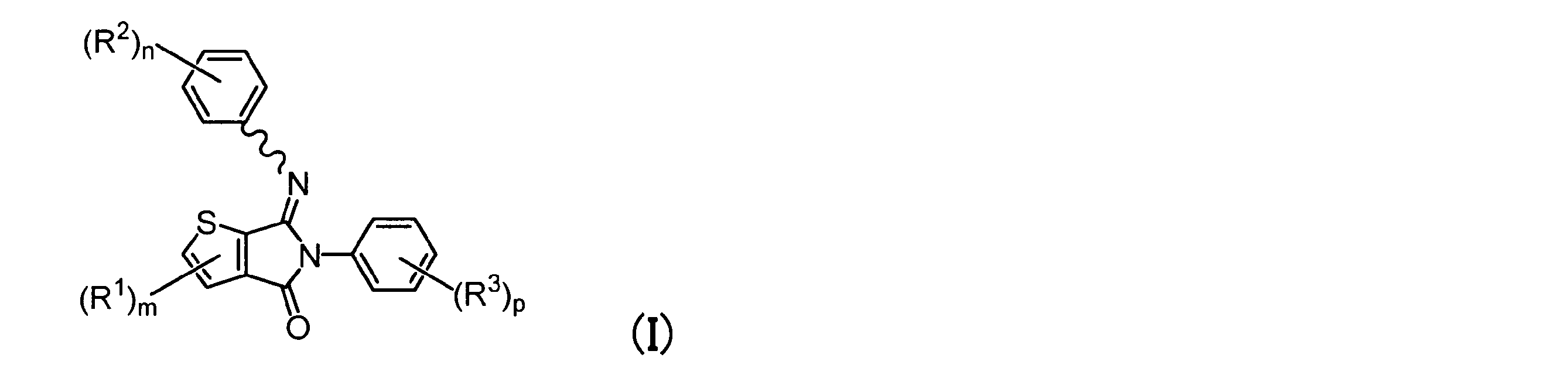
〔式中、R1はハロゲン、アルキル、ハロアルキル、シアノアルキル、アルコキシ、ハロアルコキシ、シアノアルコキシ、ニトロ、シアノ、Aで置換されてもよいフェニル、カルボキシ、アルコキシカルボニル又はCONR4R5であり;R2及びR3は各々独立に、ハロゲン、アルキル、ハロアルキル、シアノアルキル、アルコキシ、ハロアルコキシ、シアノアルコキシ、アルキルチオ、ハロアルキルチオ、アルキルスルフィニル、ハロアルキルスルフィニル、アルキルスルホニル、ハロアルキルスルホニル、ニトロ、シアノ、Aで置換されてもよいフェニル又はAで置換されてもよいフェノキシであり;Aはハロゲン、ハロアルキル、ハロアルコキシ又はシアノであり;R4及びR5は各々独立に、水素原子、アルキル又はAで置換されてもよいシクロアルキルであり;mは0~2の整数であり;n及びpは各々独立に、0~5の整数であり;n=2の場合、2つのR2は互いに結合してR2が結合するフェニル環と縮合し1,3-ベンゾジオキソール環を形成してもよく、さらにそのR2部分はAで置換されてもよく;p=2の場合、2つのR3は互いに結合してR3が結合するフェニル環と縮合し1,3-ベンゾジオキソール環を形成してもよく、さらにそのR3部分はAで置換されてもよい〕で表されるチエノピロール系化合物又はその塩、該化合物又はその塩を有効成分として含有する有害生物防除剤、並びに該化合物又はその塩の有効量を施用して有害生物を防除する方法に関する。
前記式(I)の化合物又はその塩は、低薬量で有害生物に対して極めて高い防除効果を有する。
前記式(I)の化合物中のハロゲン原子又は置換基としてのハロゲンとしては、フッ素、塩素、臭素又はヨウ素の各原子が挙げられる。置換基としてのハロゲン原子の数は1又は2以上であってよく、2以上の場合、各ハロゲン原子は同一でも相異なってもよい。また、ハロゲン原子の置換位置は何れの位置でもよい。
前記式(I)の化合物中のアルキル又はアルキル部分としては、例えば、メチル、エチル、ノルマルプロピル、イソプロピル、ノルマルブチル、イソブチル、セカンダリーブチル、ターシャリーブチル、ノルマルペンチル、イソペンチル、ネオペンチル、ノルマルヘキシル、ネオヘキシルのような直鎖又は分岐鎖状のC1-C6の基が挙げられる。
前記式(I)の化合物中のシクロアルキル又はシクロアルキル部分としては、例えば、シクロプロピル、シクロブチル、シクロペンチル、シクロヘキシルのような環状のC3-C6の基が挙げられる。
前記式(I)の化合物の塩としては、当該技術分野で許容されるものであればあらゆるものが含まれるが、例えば、ナトリウム塩、カリウム塩のようなアルカリ金属塩;カルシウム塩、マグネシウム塩のようなアルカリ土類金属塩;ジメチルアンモニウム塩、トリエチルアンモニウム塩のようなアンモニウム塩;塩酸塩、過塩素酸塩、硫酸塩、硝酸塩のような無機酸塩;酢酸塩、トリフルオロ酢酸塩、シュウ酸塩、p-トルエンスルホン酸塩、メタンスルホン酸塩のような有機酸塩などが挙げられる。
前記式(I)の化合物又はその塩には、立体異性体、光学異性体のような異性体が存在する場合があるが、本発明には各異性体及び異性体混合物の双方が含まれる。本願明細書においては、特に言及しない限り、異性体は混合物として記載する。尚、本発明には、当該技術分野における技術常識の範囲内において、前記したもの以外の各種異性体も含まれる。また、異性体の種類によっては、前記式(I)とは異なる化学構造となる場合があるが、当業者であればそれらが異性体の関係にあることが十分認識できる為、本発明の範囲内であることは明らかである。
前記式(I)の化合物又はその塩(以下、本発明化合物と略す)は、以下の製造方法、並びに通常の塩の製造方法に従って製造することができるが、これらの方法に限定されるものではない。
製法〔1〕

製法〔1〕において、R1aはハロゲン、アルキル、ハロアルキル、シアノアルキル、アルコキシ、ハロアルコキシ、シアノアルコキシ又はニトロであり、Meはメチル基であり;R2、R3、m、n及びpは前述の定義通りである。
製法〔1〕の反応では、式(II)の化合物と式(III)の化合物を遷移金属触媒の存在下、溶媒中で反応させることにより、式(I-a)の化合物を製造することができる。
式(III)の化合物は、公知物であるか、或いは、式(III)の化合物に対応するアニリンと、ホスゲン、ジホスゲン又はトリホスゲンを反応させることにより製造することができる。式(III)の化合物は、式(II)の化合物に対して1~3倍モル、望ましくは1~1.5倍モル使用することができる。
遷移金属触媒としては、例えば酢酸パラジウム、ジクロロビス(トリフェニルホスフィン)パラジウム、テトラキス(トリフェニルホスフィン)パラジウム、トリス(ジベンジリデン)ジパラジウムなどのパラジウム化合物類;レニウムカルボニル、ブロモトリカルボニル(テトラヒドロフラン)レニウムダイマーなどのレニウム化合物類などから適宜選択することができる。遷移金属触媒は、式(II)の化合物に対して0.001~1倍モル、望ましくは0.01~0.1倍モル使用することができる。
製法〔1〕の反応では、式(II)の化合物と式(III)の化合物を遷移金属触媒の存在下、溶媒中で反応させることにより、式(I-a)の化合物を製造することができる。
式(III)の化合物は、公知物であるか、或いは、式(III)の化合物に対応するアニリンと、ホスゲン、ジホスゲン又はトリホスゲンを反応させることにより製造することができる。式(III)の化合物は、式(II)の化合物に対して1~3倍モル、望ましくは1~1.5倍モル使用することができる。
遷移金属触媒としては、例えば酢酸パラジウム、ジクロロビス(トリフェニルホスフィン)パラジウム、テトラキス(トリフェニルホスフィン)パラジウム、トリス(ジベンジリデン)ジパラジウムなどのパラジウム化合物類;レニウムカルボニル、ブロモトリカルボニル(テトラヒドロフラン)レニウムダイマーなどのレニウム化合物類などから適宜選択することができる。遷移金属触媒は、式(II)の化合物に対して0.001~1倍モル、望ましくは0.01~0.1倍モル使用することができる。
溶媒としては、反応に不活性な溶媒であればいずれのものでもよく、例えばジエチルエーテル、ブチルメチルエーテル、テトラヒドロフラン、1,4-ジオキサン、ジメトキシエタンなどのエーテル類;ベンゼン、トルエン、キシレン、クロロベンゼンなどの芳香族炭化水素類;N,N-ジメチルホルムアミド、N,N-ジメチルアセトアミド、N-メチル-2-ピロリドン、ジメチルスルホキシド、スルホランなどの非プロトン性極性溶媒;アセトニトリル、プロピオニトリルなどのニトリル類;酢酸エチル、プロピオン酸エチルなどのエステル類;ペンタン、ヘキサン、ヘプタン、オクタン、シクロヘキサンなどの脂肪族炭化水素類;などから1種又は2種以上を適宜選択することができる。
反応温度は、通常20~200℃、望ましくは50~180℃である。
反応時間は、通常1~48時間、望ましくは10~30時間である。
反応温度は、通常20~200℃、望ましくは50~180℃である。
反応時間は、通常1~48時間、望ましくは10~30時間である。
製法〔2〕
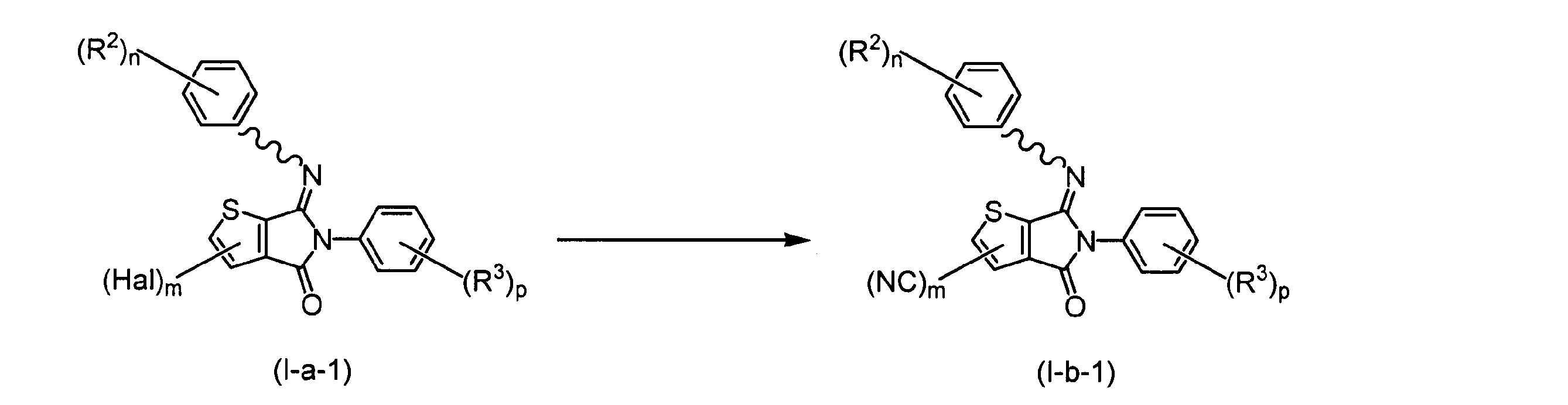
製法〔2〕において、Halはハロゲンであり;R2、R3、m、n及びpは前述の定義通りである。
製法〔2〕では、式(I-a-1)の化合物と、シアノ化剤を遷移金属触媒の存在下、溶媒中で反応させることにより、式(I-b-1)の化合物を製造することができる。
製法〔2〕では、式(I-a-1)の化合物と、シアノ化剤を遷移金属触媒の存在下、溶媒中で反応させることにより、式(I-b-1)の化合物を製造することができる。
遷移金属触媒としては、例えば酢酸パラジウム、ジクロロビス(トリフェニルホスフィン)パラジウム、テトラキス(トリフェニルホスフィン)パラジウム、トリス(ジベンジリデン)ジパラジウムなどのパラジウム化合物類;1,1’-ビス(ジフェニルホスフィノ)フェロセンなどから適宜選択することができる。遷移金属触媒は、式(I-a-1)の化合物に対して0.01~1倍モル、望ましくは0.01~0.2倍モル使用することができる。
シアノ化剤としては、例えばシアン化亜鉛、シアン化カリウム、シアン化銅などから適宜選択することができる。シアノ化剤は、式の(I-a-1)の化合物に対して0.1~5倍モル、望ましくは0.5~2倍モル使用することができる。
溶媒としては、反応に不活性な溶媒であればいずれのものでもよく、例えばジエチルエーテル、ブチルメチルエーテル、テトラヒドロフラン、1,4-ジオキサン、ジメトキシエタンなどのエーテル類;ベンゼン、トルエン、キシレン、クロロベンゼンなどの芳香族炭化水素類;N,N-ジメチルホルムアミド、N,N-ジメチルアセトアミド、N-メチル-2-ピロリドン、ジメチルスルホキシド、スルホランなどの非プロトン性極性溶媒;アセトニトリル、プロピオニトリルなどのニトリル類;酢酸エチル、プロピオン酸エチルなどのエステル類;ペンタン、ヘキサン、ヘプタン、オクタン、シクロヘキサンなどの脂肪族炭化水素類;などから1種又は2種以上を適宜選択することができる。
反応温度は、通常20~200℃、望ましくは50~150℃である。
反応時間は、通常0.5~12時間、望ましくは1~5時間である。
反応温度は、通常20~200℃、望ましくは50~150℃である。
反応時間は、通常0.5~12時間、望ましくは1~5時間である。
製法〔3〕
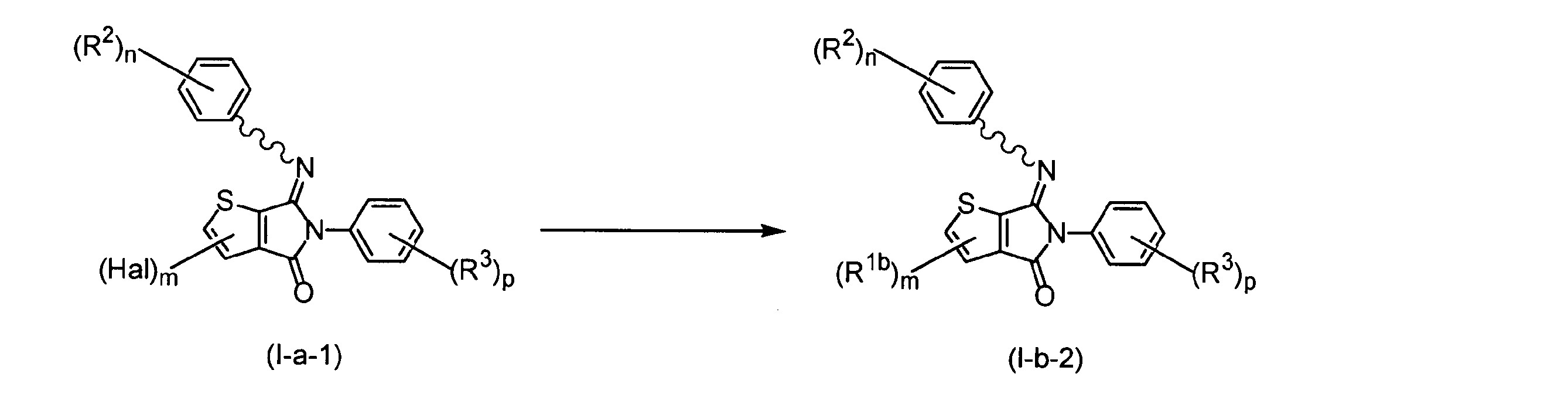
製法〔3〕において、Halはハロゲンであり;R1bはAで置換されてもよいフェニルであり;R2、R3、m、n及びpは前述の定義通りである。
製法〔3〕では、式(I-a-1)の化合物と、Aで置換されてもよいフェニルボロン酸を、遷移金属触媒及び塩基の存在下、溶媒中で反応させることにより、式(I-b-2)の化合物を製造することができる。
製法〔3〕では、式(I-a-1)の化合物と、Aで置換されてもよいフェニルボロン酸を、遷移金属触媒及び塩基の存在下、溶媒中で反応させることにより、式(I-b-2)の化合物を製造することができる。
遷移金属触媒としては、製法〔2〕に記載のものを使用できる。また、その使用量も製法〔2〕と同様とすることができる。
塩基としては、例えば水酸化ナトリウム、水酸化カリウムなどのアルカリ金属水酸化物;水酸化カルシウム、水酸化マグネシウムなどのアルカリ土類金属水酸化物;炭酸ナトリウム、炭酸カリウムなどのアルカリ金属の炭酸塩類;炭酸水素ナトリウム、炭酸水素カリウムなどのアルカリ金属重炭酸塩類;水素化ナトリウム、水素化カリウムなどの金属水素化物類;ナトリウムメトキシド、ナトリウムエトキシド、カリウムtert-ブトキシドなどのアルコール金属塩類;トリエチルアミン、N,N-ジメチルアニリン、ピリジン、4-N,N-ジメチルアミノピリジン、1,8-ジアザビシクロ[5.4.0]-7-ウンデセンなどの有機塩基類;などから1種又は2種以上を適宜選択することができる。塩基は、式(I-a-1)の化合物に対して1~5倍モル、望ましくは1~3倍モル使用することができる。
溶媒としては、製法〔2〕に記載のものや水などから1種又は2種以上を適宜選択することができる。また、反応温度及び反応時間は、製法〔2〕と同様とすることができる。
製法〔4〕
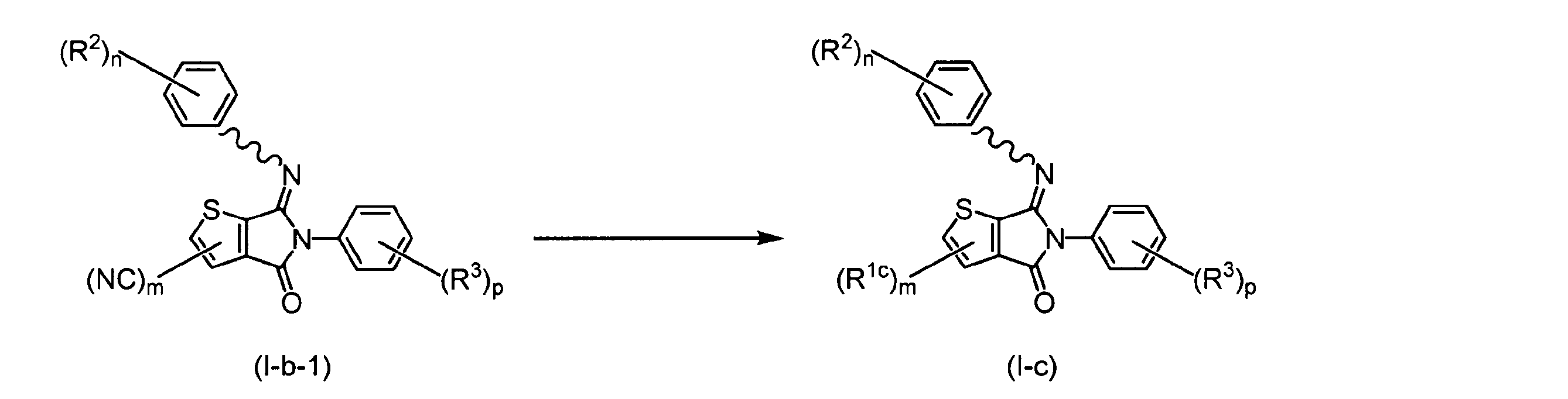
製法〔4〕において、R1cはカルボキシ、アルコキシカルボニル又はCONH2であり、R2、R3、m、n及びpは前述の定義通りである。
製法〔4〕では、式(I-b-1)の化合物を、酸又は塩基を用いて、加水分解することにより、式(I-c)の化合物を製造することができる。なお、R1cがアルコキシカルボニルである式(I-c)の化合物は、R1cがカルボキシである化合物とアルコールを通常の方法で、エステル化することにより、製造することができる。
製法〔4〕では、式(I-b-1)の化合物を、酸又は塩基を用いて、加水分解することにより、式(I-c)の化合物を製造することができる。なお、R1cがアルコキシカルボニルである式(I-c)の化合物は、R1cがカルボキシである化合物とアルコールを通常の方法で、エステル化することにより、製造することができる。
酸としては、例えば塩酸、硫酸などから適宜選択することができる。
塩基としては、例えば水酸化ナトリウム、水酸化カリウムなどのアルカリ金属水酸化物;水酸化カルシウム、水酸化マグネシウムなどのアルカリ土類金属水酸化物;炭酸ナトリウム、炭酸カリウムなどのアルカリ金属の炭酸塩類;炭酸水素ナトリウム、炭酸水素カリウムなどのアルカリ金属重炭酸塩類;水素化ナトリウム、水素化カリウムなどの金属水素化物類;ナトリウムメトキシド、ナトリウムエトキシド、カリウムtert-ブトキシドなどのアルコール金属塩類などから適宜選択することができる。
反応温度は、通常20~200℃、望ましくは50~150℃である。
反応時間は、通常3~48時間、望ましくは12~24時間である。
塩基としては、例えば水酸化ナトリウム、水酸化カリウムなどのアルカリ金属水酸化物;水酸化カルシウム、水酸化マグネシウムなどのアルカリ土類金属水酸化物;炭酸ナトリウム、炭酸カリウムなどのアルカリ金属の炭酸塩類;炭酸水素ナトリウム、炭酸水素カリウムなどのアルカリ金属重炭酸塩類;水素化ナトリウム、水素化カリウムなどの金属水素化物類;ナトリウムメトキシド、ナトリウムエトキシド、カリウムtert-ブトキシドなどのアルコール金属塩類などから適宜選択することができる。
反応温度は、通常20~200℃、望ましくは50~150℃である。
反応時間は、通常3~48時間、望ましくは12~24時間である。
製法〔5〕
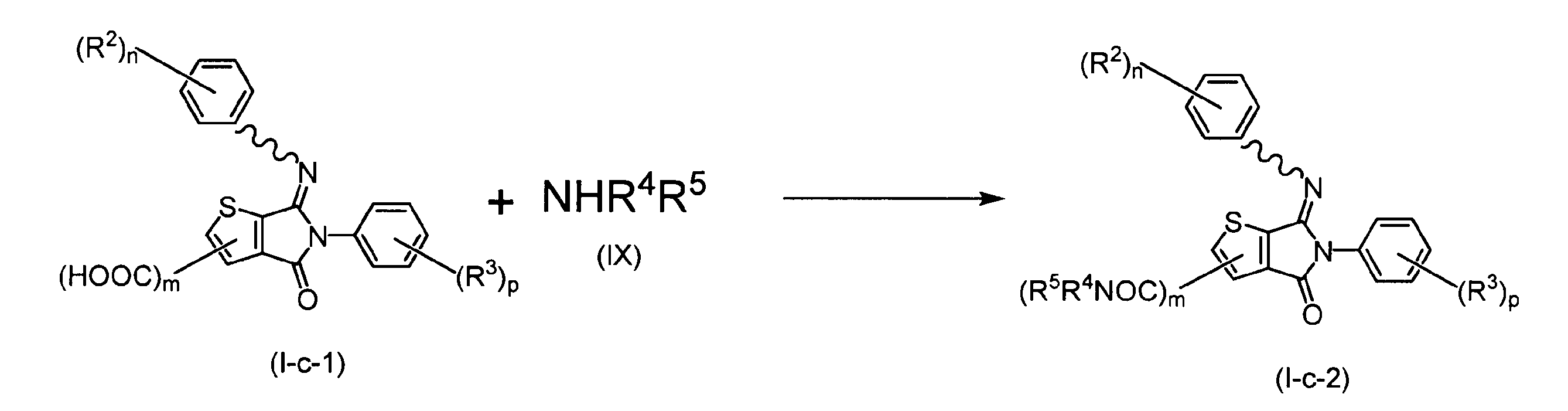
製法〔5〕において、R2、R3、R4、R5、m、n及びpは前述の定義通りである。
製法〔5〕では、式(I-c-1)の化合物と、式(IX)で表されるアミン又はその塩を、縮合剤の存在下、溶媒中で反応させることにより、式(I-c-2)の化合物を製造することができる。
また、式(I-c-2)の化合物は、式(I-c-1)の化合物と、塩化チオニル又は塩化オキサリルとの反応物を、式(IX)で表されるアミンと、塩基の存在下、溶媒中で反応させることによっても製造することができる。
製法〔5〕では、式(I-c-1)の化合物と、式(IX)で表されるアミン又はその塩を、縮合剤の存在下、溶媒中で反応させることにより、式(I-c-2)の化合物を製造することができる。
また、式(I-c-2)の化合物は、式(I-c-1)の化合物と、塩化チオニル又は塩化オキサリルとの反応物を、式(IX)で表されるアミンと、塩基の存在下、溶媒中で反応させることによっても製造することができる。
塩基としては、例えば水酸化ナトリウム、水酸化カリウムなどのアルカリ金属水酸化物;水酸化カルシウム、水酸化マグネシウムなどのアルカリ土類金属水酸化物;炭酸ナトリウム、炭酸カリウムなどのアルカリ金属の炭酸塩類;炭酸水素ナトリウム、炭酸水素カリウムなどのアルカリ金属重炭酸塩類;水素化ナトリウム、水素化カリウムなどの金属水素化物類;ナトリウムメトキシド、ナトリウムエトキシド、カリウムtert-ブトキシドなどのアルコール金属塩類;トリエチルアミン、N,N-ジメチルアニリン、ピリジン、4-N,N-ジメチルアミノピリジン、1,8-ジアザビシクロ[5.4.0]-7-ウンデセンなどの有機塩基類;などから1種又は2種以上を適宜選択することができる。塩基は、式(I-c-1)の化合物に対して1~5倍モル、望ましくは1~3倍モル使用することができる。
縮合剤としては、例えば1-(3-(ジメチルアミノ)プロピル)-3-エチルカルボジイミド又はその塩、N,N’-ジシクロヘキシルカルボジイミドなどのカルボジイミド系縮合剤;N,N’-カルボニルジイミダゾールなどのイミダゾール系縮合剤;(4,6-ジメトキシ-1,3,5-トリアジン-2-イル)-4-メチルモルホリニウム クロリドなどのトリアジン系縮合剤;などから適宜選択することができる。縮合剤は、式(I-c-1)の化合物に対して1~5倍モル、望ましくは1~2倍モル使用することができる。
溶媒としては、反応に不活性な溶媒であればいずれのものでもよく、例えばジエチルエーテル、ブチルメチルエーテル、テトラヒドロフラン、1,4-ジオキサン、ジメトキシエタンなどのエーテル類;ジクロロメタン、クロロホルム、四塩化炭素のような脂肪族ハロゲン化炭化水素類;ベンゼン、トルエン、キシレン、クロロベンゼンなどの芳香族炭化水素類;N,N-ジメチルホルムアミド、N,N-ジメチルアセトアミド、N-メチル-2-ピロリドン、ジメチルスルホキシド、スルホランなどの非プロトン性極性溶媒;アセトニトリル、プロピオニトリルなどのニトリル類;酢酸エチル、プロピオン酸エチルなどのエステル類;ペンタン、ヘキサン、ヘプタン、オクタン、シクロヘキサンなどの脂肪族炭化水素類;などから1種又は2種以上を適宜選択することができる。
反応温度は、通常-50~200℃、望ましくは-10~100℃である。
反応時間は、通常0.5~48時間、望ましくは1~24時間である。
反応温度は、通常-50~200℃、望ましくは-10~100℃である。
反応時間は、通常0.5~48時間、望ましくは1~24時間である。
中間体製法
製法〔1〕で使用される式(II)の化合物は、以下の第1工程~第3工程から成る方法に従って製造できる。
〔第1工程〕
製法〔1〕で使用される式(II)の化合物は、以下の第1工程~第3工程から成る方法に従って製造できる。
〔第1工程〕

第1工程において、R1a、R2、m及びnは前述の定義通りである。
第1工程のルートAの反応は、式(VI)の化合物と式(VII)の化合物を塩基の存在下、溶媒中で反応させることにより行うことができる。
第1工程のルートBの反応は、式(VIII)の化合物と式(VII)の化合物を縮合剤の存在下、溶媒中で反応させることにより行うことができる。
式(VI)の化合物は、公知物であるか、あるいは、対応するカルボン酸と塩化チオニル又は塩化オキサリルとを反応させることにより製造することができる。式(VI)の化合物は、式(VII)の化合物に対して1~3倍モル、望ましくは1~1.5倍モル使用することができる。
式(VIII)の化合物は、式(VII)の化合物に対して1~3倍モル、望ましくは1~1.5倍モル使用することができる。
第1工程のルートAの反応は、式(VI)の化合物と式(VII)の化合物を塩基の存在下、溶媒中で反応させることにより行うことができる。
第1工程のルートBの反応は、式(VIII)の化合物と式(VII)の化合物を縮合剤の存在下、溶媒中で反応させることにより行うことができる。
式(VI)の化合物は、公知物であるか、あるいは、対応するカルボン酸と塩化チオニル又は塩化オキサリルとを反応させることにより製造することができる。式(VI)の化合物は、式(VII)の化合物に対して1~3倍モル、望ましくは1~1.5倍モル使用することができる。
式(VIII)の化合物は、式(VII)の化合物に対して1~3倍モル、望ましくは1~1.5倍モル使用することができる。
塩基としては、例えば水酸化ナトリウム、水酸化カリウムなどのアルカリ金属水酸化物;水酸化カルシウム、水酸化マグネシウムなどのアルカリ土類金属水酸化物;炭酸ナトリウム、炭酸カリウムなどのアルカリ金属の炭酸塩類;炭酸水素ナトリウム、炭酸水素カリウムなどのアルカリ金属重炭酸塩類;水素化ナトリウム、水素化カリウムなどの金属水素化物類;ナトリウムメトキシド、ナトリウムエトキシド、カリウムtert-ブトキシドなどのアルコール金属塩類;トリエチルアミン、N,N-ジメチルアニリン、ピリジン、4-N,N-ジメチルアミノピリジン、1,8-ジアザビシクロ[5.4.0]-7-ウンデセンなどの有機塩基類;などから1種又は2種以上を適宜選択することができる。塩基は、式(VII)の化合物に対して1~5倍モル、望ましくは1~3倍モル使用することができる。
縮合剤としては、例えば1-(3-(ジメチルアミノ)プロピル)-3-エチルカルボジイミド又はその塩、N,N’-ジシクロヘキシルカルボジイミドなどのカルボジイミド系縮合剤;N,N’-カルボニルジイミダゾールなどのイミダゾール系縮合剤;(4,6-ジメトキシ-1,3,5-トリアジン-2-イル)-4-メチルモルホリニウム クロリドなどのトリアジン系縮合剤;などから適宜選択することができる。縮合剤は、式(VIII)の化合物に対して1~5倍モル、望ましくは1~2倍モル使用することができる。
ルートAでもルートBでも同様の溶媒が使用できる。溶媒としては、反応に不活性な溶媒であればいずれのものでもよく、例えばジエチルエーテル、ブチルメチルエーテル、テトラヒドロフラン、1,4-ジオキサン、ジメトキシエタンなどのエーテル類;ベンゼン、トルエン、キシレン、クロロベンゼンなどの芳香族炭化水素類;N,N-ジメチルホルムアミド、N,N-ジメチルアセトアミド、N-メチル-2-ピロリドン、ジメチルスルホキシド、スルホランなどの非プロトン性極性溶媒;アセトニトリル、プロピオニトリルなどのニトリル類;酢酸エチル、プロピオン酸エチルなどのエステル類;ペンタン、ヘキサン、ヘプタン、オクタン、シクロヘキサンなどの脂肪族炭化水素類;などから1種又は2種以上を適宜選択することができる。
反応温度は、通常-50~200℃、望ましくは-10~100℃である。
反応時間は、通常0.5~48時間、望ましくは1~24時間である。
反応温度は、通常-50~200℃、望ましくは-10~100℃である。
反応時間は、通常0.5~48時間、望ましくは1~24時間である。
〔第2工程〕
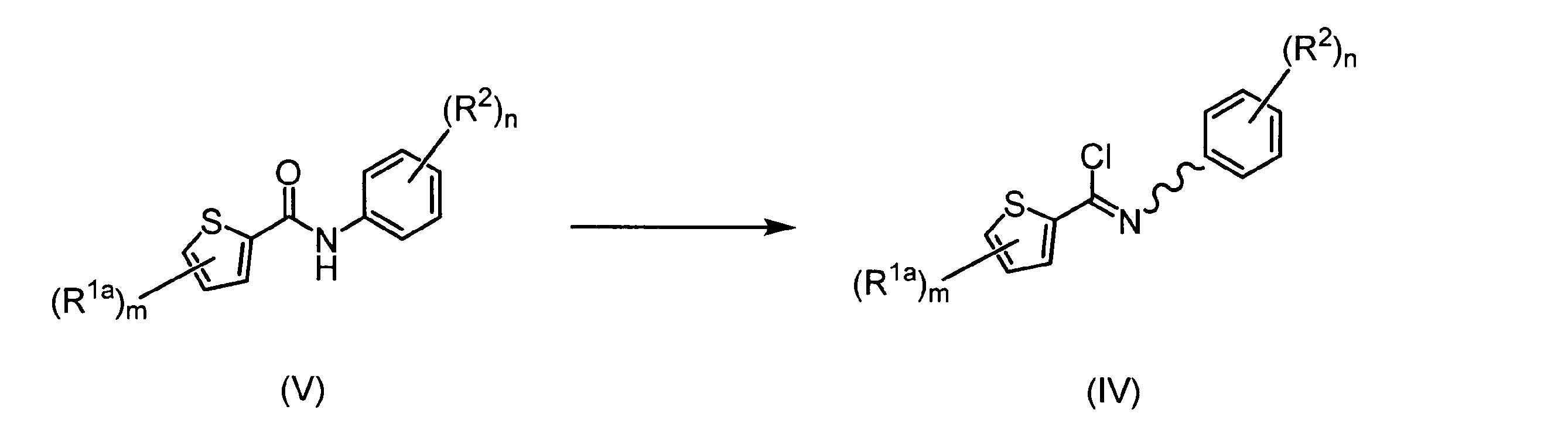
第2工程において、R1a、R2、m及びnは前述の定義通りである。
第2工程の反応は、式(V)の化合物と塩化チオニル又は塩化オキサリルとを必要に応じ溶媒の存在下で反応させることにより行うことができる。
溶媒としては、反応に不活性な溶媒であればいずれのものでもよく、例えばジエチルエーテル、ブチルメチルエーテル、テトラヒドロフラン、1,4-ジオキサン、ジメトキシエタンなどのエーテル類;ベンゼン、トルエン、キシレン、クロロベンゼンなどの芳香族炭化水素類;N,N-ジメチルホルムアミド、N,N-ジメチルアセトアミド、N-メチル-2-ピロリドン、ジメチルスルホキシド、スルホランなどの非プロトン性極性溶媒;アセトニトリル、プロピオニトリルなどのニトリル類;酢酸エチル、プロピオン酸エチルなどのエステル類;ペンタン、ヘキサン、ヘプタン、オクタン、シクロヘキサンなどの脂肪族炭化水素類;などから1種又は2種以上を適宜選択することができる。
反応温度は、通常-50~200℃、望ましくは20~100℃である。
反応時間は、通常0.5~48時間、望ましくは1~24時間である。
第2工程の反応は、式(V)の化合物と塩化チオニル又は塩化オキサリルとを必要に応じ溶媒の存在下で反応させることにより行うことができる。
溶媒としては、反応に不活性な溶媒であればいずれのものでもよく、例えばジエチルエーテル、ブチルメチルエーテル、テトラヒドロフラン、1,4-ジオキサン、ジメトキシエタンなどのエーテル類;ベンゼン、トルエン、キシレン、クロロベンゼンなどの芳香族炭化水素類;N,N-ジメチルホルムアミド、N,N-ジメチルアセトアミド、N-メチル-2-ピロリドン、ジメチルスルホキシド、スルホランなどの非プロトン性極性溶媒;アセトニトリル、プロピオニトリルなどのニトリル類;酢酸エチル、プロピオン酸エチルなどのエステル類;ペンタン、ヘキサン、ヘプタン、オクタン、シクロヘキサンなどの脂肪族炭化水素類;などから1種又は2種以上を適宜選択することができる。
反応温度は、通常-50~200℃、望ましくは20~100℃である。
反応時間は、通常0.5~48時間、望ましくは1~24時間である。
〔第3工程〕
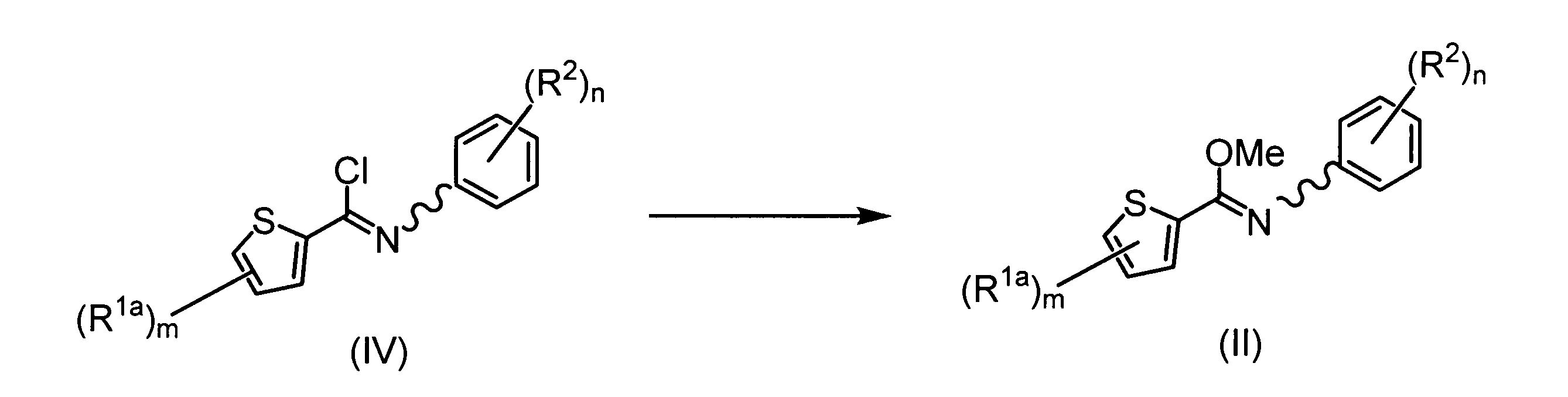
第3工程において、R1a、R2、m及びnは前述の定義通りである。Meはメチル基を表す。
第3工程の反応は、式(IV)の化合物とメタノールを塩基の存在下、溶媒中で反応させることにより行うことができる。
塩基としては、例えば水酸化ナトリウム、水酸化カリウムなどのアルカリ金属水酸化物;水酸化カルシウム、水酸化マグネシウムなどのアルカリ土類金属水酸化物;炭酸ナトリウム、炭酸カリウムなどのアルカリ金属の炭酸塩類;炭酸水素ナトリウム、炭酸水素カリウムなどのアルカリ金属重炭酸塩類;水素化ナトリウム、水素化カリウムなどの金属水素化物類;ナトリウムメトキシド、ナトリウムエトキシド、カリウムtert-ブトキシドなどのアルコール金属塩類;トリエチルアミン、N,N-ジメチルアニリン、ピリジン、4-N,N-ジメチルアミノピリジン、1,8-ジアザビシクロ[5.4.0]-7-ウンデセンなどの有機塩基類;などから1種又は2種以上を適宜選択することができる。塩基は、式(IV)の化合物に対して1~5倍モル、望ましくは1~3倍モル使用することができる。
第3工程の反応は、式(IV)の化合物とメタノールを塩基の存在下、溶媒中で反応させることにより行うことができる。
塩基としては、例えば水酸化ナトリウム、水酸化カリウムなどのアルカリ金属水酸化物;水酸化カルシウム、水酸化マグネシウムなどのアルカリ土類金属水酸化物;炭酸ナトリウム、炭酸カリウムなどのアルカリ金属の炭酸塩類;炭酸水素ナトリウム、炭酸水素カリウムなどのアルカリ金属重炭酸塩類;水素化ナトリウム、水素化カリウムなどの金属水素化物類;ナトリウムメトキシド、ナトリウムエトキシド、カリウムtert-ブトキシドなどのアルコール金属塩類;トリエチルアミン、N,N-ジメチルアニリン、ピリジン、4-N,N-ジメチルアミノピリジン、1,8-ジアザビシクロ[5.4.0]-7-ウンデセンなどの有機塩基類;などから1種又は2種以上を適宜選択することができる。塩基は、式(IV)の化合物に対して1~5倍モル、望ましくは1~3倍モル使用することができる。
溶媒としては、反応に不活性な溶媒であればいずれのものでもよく、例えばジエチルエーテル、ブチルメチルエーテル、テトラヒドロフラン、1,4-ジオキサン、ジメトキシエタンなどのエーテル類;ベンゼン、トルエン、キシレン、クロロベンゼンなどの芳香族炭化水素類;N,N-ジメチルホルムアミド、N,N-ジメチルアセトアミド、N-メチル-2-ピロリドン、ジメチルスルホキシド、スルホランなどの非プロトン性極性溶媒;アセトニトリル、プロピオニトリルなどのニトリル類;酢酸エチル、プロピオン酸エチルなどのエステル類;ペンタン、ヘキサン、ヘプタン、オクタン、シクロヘキサンなどの脂肪族炭化水素類;などから1種又は2種以上を適宜選択することができる。
反応温度は、通常-50~200℃、望ましくは-10~100℃である。
反応時間は、通常0.5~48時間、望ましくは1~24時間である。
反応温度は、通常-50~200℃、望ましくは-10~100℃である。
反応時間は、通常0.5~48時間、望ましくは1~24時間である。
本発明化合物を含有する有害生物防除剤の望ましい態様について以下に記述する。本発明化合物を含有する有害生物防除剤は、例えば農園芸分野で問題となる有害昆虫類、ダニ類、線虫類又は土壌害虫類の防除剤、例えば、農園芸用殺虫剤、殺ダニ剤、殺線虫剤又は殺土壌害虫剤として有用である。
本発明化合物は、有害生物防除剤、例えば、農園芸用殺虫剤、殺ダニ剤、殺線虫剤又は殺土壌害虫剤として有用であるが、具体的には、モモアカアブラムシ、ワタアブラムシ等のようなアブラムシ類;コナガ、ヨトウムシ、ハスモンヨトウ、コドリンガ、ボールワーム、タバコバッドワーム、マイマイガ、コブノメイガ、チャノコカクモンハマキ、コロラドハムシ、ウリハムシ、ボールウィービル、ウンカ類、ヨコバイ類、カイガラムシ類、カメムシ類、コナジラミ類、アザミウマ類、バッタ類、ハナバエ類、コガネムシ類、タマナヤガ、カブラヤガ、アリ類等のような農業害虫類;ナメクジ、マイマイ等のような腹足類;イエダニ、ゴキブリ類、イエバエ、アカイエカ等のような衛生害虫類;バクガ、アズキゾウムシ、コクヌストモドキ、ゴミムシダマシ類等のような貯穀害虫類;イガ、ヒメカツオブシムシ、シロアリ類等のような衣類、家屋害虫類;等の有害昆虫類、ナミハダニ、ニセナミハダニ、カンザワハダニ、ミカンハダニ、リンゴハダニ、チャノホコリダニ、ミカンサビダニ、ネダニ等のような植物寄生性ダニ類;ケナガコナダニ、コナヒョウダニ、ミナミツメダニ等のような屋内塵性ダニ類;等のダニ類、ネコブセンチュウ類、シストセンチュウ類、ネグサレセンチュウ類、イネシンガレセンチュウ、イチゴメセンチュウ、マツノザイセンチュウ等のような植物寄生性線虫類;等の線虫類、ダンゴムシ、ワラジムシのような等脚類;等の土壌害虫類の防除に有効である。本発明化合物を含有する有害生物防除剤は、植物寄生性ダニ類、農業害虫類、植物寄生性線虫類等の防除に特に有効である。その中でも、植物寄生性ダニ類、農業害虫類の防除にさらに優れた効果を示すため、殺虫剤又は殺ダニ剤として非常に有用である。また、本発明化合物を含有する有害生物防除剤は、有機リン剤、カーバメート剤、合成ピレスロイド剤、ネオニコチノイド剤等の薬剤に対する各種抵抗性害虫の防除にも有効である。さらに本発明化合物は、優れた浸透移行性を有していることから、本発明化合物を含有する有害生物防除剤を土壌に処理することによって土壌に生息する有害昆虫類、ダニ類、線虫類、腹脚類、等脚類の防除と同時に茎葉部に生息する有害昆虫類、ダニ類、線虫類をも防除することができる。
本発明化合物を含有する有害生物防除剤の別の望ましい態様としては、前記した植物寄生性ダニ類、農業害虫類、植物寄生性線虫類、腹足類、土壌害虫類等を総合的に防除する有害生物防除剤が挙げられる。
本発明化合物を含有する有害生物防除剤は、通常、該化合物と各種農業上の補助剤とを混合して粉剤、粒剤、顆粒水和剤、水和剤、水性懸濁剤、油性懸濁剤、顆粒水溶剤、水溶剤、乳剤、液剤、ペースト剤、エアゾール剤、微量散布剤等の種々の形態に製剤して使用されるが、本発明の目的に適合するかぎり、通常の当該分野で用いられているあらゆる製剤形態にすることができる。製剤に使用する補助剤としては、珪藻土、消石灰、炭酸カルシウム、タルク、ホワイトカーボン、カオリン、ベントナイト、カオリナイト、セリサイト、クレー、炭酸ナトリウム、重曹、芒硝、ゼオライト、澱粉等の固型担体;水、トルエン、キシレン、ソルベントナフサ、ジオキサン、アセトン、イソホロン、メチルイソブチルケトン、クロロベンゼン、シクロヘキサン、ジメチルスルホキシド、N,N-ジメチルホルムアミド、N,N-ジメチルアセトアミド、N-メチル-2-ピロリドン、アルコール等の溶剤;脂肪酸塩、安息香酸塩、アルキルスルホコハク酸塩、ジアルキルスルホコハク酸塩、ポリカルボン酸塩、アルキル硫酸エステル塩、アルキル硫酸塩、アルキルアリール硫酸塩、アルキルジグリコールエーテル硫酸塩、アルコール硫酸エステル塩、アルキルスルホン酸塩、アルキルアリールスルホン酸塩、アリールスルホン酸塩、リグニンスルホン酸塩、アルキルジフェニルエーテルジスルホン酸塩、ポリスチレンスルホン酸塩、アルキルリン酸エステル塩、アルキルアリールリン酸塩、スチリルアリールリン酸塩、ポリオキシエチレンアルキルエーテル硫酸エステル塩、ポリオキシエチレンアルキルアリールエーテル硫酸塩、ポリオキシエチレンアルキルアリールエーテル硫酸エステル塩、ポリオキシエチレンアルキルエーテルリン酸塩、ポリオキシエチレンアルキルアリールリン酸エステル塩、ナフタレンスルホン酸塩ホルムアルデヒド縮合物のような陰イオン系の界面活性剤;ソルビタン脂肪酸エステル、グリセリン脂肪酸エステル、脂肪酸ポリグリセライド、脂肪酸アルコールポリグリコールエーテル、アセチレングリコール、アセチレンアルコール、オキシアルキレンブロックポリマー、ポリオキシエチレンアルキルエーテル、ポリオキシエチレンアルキルアリールエーテル、ポリオキシエチレンスチリルアリールエーテル、ポリオキシエチレングリコールアルキルエーテル、ポリエチレングリコール、ポリオキシエチレン脂肪酸エステル、ポリオキシエチレンソルビタン脂肪酸エステル、ポリオキシエチレングリセリン脂肪酸エステル、ポリオキシエチレン硬化ヒマシ油、ポリオキシプロピレン脂肪酸エステルのような非イオン系の界面活性剤;オリーブ油、カポック油、ひまし油、シュロ油、椿油、ヤシ油、ごま油、トウモロコシ油、米ぬか油、落花生油、綿実油、大豆油、菜種油、亜麻仁油、きり油、液状パラフィン等の植物油や鉱物油;等が挙げられる。これら補助剤の各成分は、本発明の目的から逸脱しないかぎり、1種又は2種以上を適宜選択して使用することができる。また、前記した補助剤以外にも当該分野で知られたものの中から適宜選んで使用することもでき、例えば、増量剤、増粘剤、沈降防止剤、凍結防止剤、分散安定剤、薬害軽減剤、防黴剤、等通常使用される各種補助剤も使用することができる。本発明化合物と各種補助剤との配合割合(重量比)は0.001:99.999~95:5、望ましくは0.005:99.995~90:10である。これら製剤の実際の使用に際しては、そのまま使用するか、又は水等の希釈剤で所定濃度に希釈し、必要に応じて各種展着剤(界面活性剤、植物油、鉱物油等)を添加して使用することができる。
本発明化合物を含有する有害生物防除剤の施用は、気象条件、製剤形態、施用時期、施用場所、有害生物の種類や発生状況等の相違により一概に規定できないが、一般に0.05~800,000ppm、望ましくは0.5~500,000ppmの有効成分濃度で行ない、その単位面積あたりの施用量は、1ヘクタール当り本発明化合物が0.05~50,000g、望ましくは1~30,000gである。また、本発明には、このような施用方法による有害生物の防除方法、特に植物寄生性ダニ類、農業害虫類、植物寄生性線虫類の防除方法も含まれる。
本発明化合物を含有する有害生物防除剤の種々の製剤、又はその希釈物の施用は、通常、一般に行なわれている施用方法すなわち、散布(例えば、噴霧、ミスティング、アトマイジング、散粒、水面施用等)、土壌施用(混入、灌注等)、表面施用(塗布、粉衣、被覆等)、浸漬毒餌等により行うことができる。また、家畜に対して前記有効成分を飼料に混合して与え、その排泄物での有害虫、特に有害昆虫の発生及び生育を阻害することも可能である。また、いわゆる超高濃度少量散布法(ultra low volume application method)により施用することもできる。この方法においては、活性成分を100%含有することが可能である。
また、本発明化合物を含有する有害生物防除剤は、他の農薬、肥料、薬害軽減剤等と混用或いは併用することができ、この場合に一層優れた効果、作用性を示すことがある。他の農薬としては、除草剤、殺虫剤、殺ダニ剤、殺線虫剤、殺土壌害虫剤、殺菌剤、抗ウイルス剤、誘引剤、抗生物質、植物ホルモン、植物成長調整剤、等が挙げられる。特に、本発明化合物と他の農薬の有効成分化合物の1種又は2種以上とを混用或いは併用した殺虫用組成物、殺ダニ用組成物、殺線虫用組成物又は殺土壌害虫用組成物は、適用範囲、薬剤処理の時期、防除活性等を好ましい方向へ改良することが可能である。尚、本発明化合物と他の農薬の有効成分化合物は各々別々に製剤したものを散布時に混合して使用しても、両者を一緒に製剤して使用してもよい。本発明には、このような殺虫用組成物、殺ダニ用組成物、殺線虫用組成物又は殺土壌害虫用組成物も含まれる。
上記他の農薬中の、殺虫剤、殺ダニ剤、殺線虫剤或いは殺土壌害虫剤の有効成分化合物(一般名;一部申請中を含む、又は日本植物防疫協会試験コード)としては、例えばプロフェノホス(profenofos)、ジクロルボス(dichlorvos)、フェナミホス(fenamiphos)、フェニトロチオン(fenitrothion)、EPN、ダイアジノン(diazinon)、クロルピリホス(chlorpyrifos)、クロルピリホスメチル(chlorpyrifos‐methyl)、アセフェート(acephate)、プロチオホス(prothiofos)、ホスチアゼート(fosthiazate)、カズサホス(cadusafos)、ジスルホトン(dislufoton)、イソキサチオン(isoxathion)、イソフェンホス(isofenphos)、エチオン(ethion)、エトリムホス(etrimfos)、キナルホス(quinalphos)、ジメチルビンホス(dimethylvinphos)、ジメトエート(dimethoate)、スルプロホス(sulprofos)、チオメトン(thiometon)、バミドチオン(vamidothion)、ピラクロホス(pyraclofos)、ピリダフェンチオン(pyridaphenthion)、ピリミホスメチル(pirimiphos-methyl)、プロパホス(propaphos)、ホサロン(phosalone)、ホルモチオン(formothion)、マラチオン(malathion)、テトラクロルビンホス(tetrachlorvinphos)、クロルフェンビンホス(chlorfenvinphos)、シアノホス(cyanophos)、トリクロルホン(trichlorfon)、メチダチオン(methidathion)、フェントエート(phenthoate)、ESP、アジンホスメチル(azinphos-methyl)、フェンチオン(fenthion)、ヘプテノホス(heptenophos)、メトキシクロル(methoxychlor)、パラチオン(parathion)、ホスホカルブ(phosphocarb)、デメトン-S-メチル(demeton-S-methyl)、モノクロトホス(monocrotophos)、メタミドホス(methamidophos)、イミシアホス(imicyafos)、パラチオン-メチル(parathion-methyl)、テルブホス(terbufos)、ホスファミドン(phosphamidon)、ホスメット(phosmet)、ホレート(phorate)、ホキシム(phoxim)、トリアゾホス(triazophos)のような有機リン酸エステル系化合物;
カルバリル(carbaryl)、プロポキスル(propoxur)、アルジカルブ(aldicarb)、カルボフラン(carbofuran)、チオジカルブ(thiodicarb)、メソミル(methomyl)、オキサミル(oxamyl)、エチオフェンカルブ(ethiofencarb)、ピリミカルブ(pirimicarb)、フェノブカルブ(fenobucarb)、カルボスルファン(carbosulfan)、ベンフラカルブ(benfuracarb)、ベンダイオカルブ(bendiocarb)、フラチオカルブ(furathiocarb)、イソプロカルブ(isoprocarb)、メトルカルブ(metolcarb)、キシリルカルブ(xylylcarb)、XMC、フェノチオカルブ(fenothiocarb)のようなカーバメート系化合物;
カルタップ(cartap)、チオシクラム(thiocyclam)、ベンスルタップ(bensultap)、チオスルタップナトリウム(thiosultap-sodium)、チオスルタップジナトリウム(thiosultap-disodium)、モノスルタップ(monosultap)、ビスルタップ(bisultap)、シュウ酸水素チオシクラム(thiocyclam hydrogen oxalate)のようなネライストキシン誘導体;
ジコホル(dicofol)、テトラジホン(tetradifon)、エンドスルファン(endosulfan)、ジエノクロル(dienochlor)、ディルドリン(dieldrin)のような有機塩素系化合物;
酸化フェンブタスズ(fenbutatin oxide)、シヘキサチン(cyhexatin)のような有機金属系化合物;
フェンバレレート(fenvalerate)、ペルメトリン(permethrin)、シペルメトリン(cypermethrin)、デルタメトリン(deltamethrin)、シハロトリン(cyhalothrin)、テフルトリン(tefluthrin)、エトフェンプロックス(ethofenprox)、フルフェンプロックス(flufenprox)、シフルトリン(cyfluthrin)、フェンプロパトリン(fenpropathrin)、フルシトリネート(flucythrinate)、フルバリネート(fluvalinate)、シクロプロトリン(cycloprothrin)、ラムダシハロトリン(lambda-cyhalothrin)、ピレスリン(pyrethrins)、エスフェンバレレート(esfenvalerate)、テトラメスリン(tetramethrin)、レスメスリン(resmethrin)、プロトリフェンブト(protrifenbute)、ビフェントリン(bifenthrin)、ゼータシペルメトリン(zeta-cypermethrin)、アクリナトリン(acrinathrin)、アルファシペルメトリン(alpha-cypermethrin)、アレスリン(allethrin)、ガンマシハロトリン(gamma-cyhalothrin)、シータシペルメトリン(theta-cypermethrin)、タウフルバリネート(tau-fluvalinate)、トラロメスリン(tralomethrin)、プロフルスリン(profluthrin)、ベータシペルメトリン(beta-cypermethrin)、ベータシフルトリン(beta-cyfluthrin)、メトフルトリン(metofluthrin)、フェノトリン(phenothrin)、フルメトリン(flumethrin)、デカメトリン(decamethrin)のようなピレスロイド系化合物;
ジフルベンズロン(diflubenzuron)、クロルフルアズロン(chlorfluazuron)、テフルベンズロン(teflubenzuron)、フルフェノクスロン(flufenoxuron)、トリフルムロン(triflumuron)、ヘキサフルムロン(hexaflumuron)、ルフェヌロン(lufenuron)、ノバルロン(novaluron)、ノビフルムロン(noviflumuron)、ビストリフルロン(bistrifluron)、フルアズロン(fluazuron)のようなベンゾイルウレア系化合物;
メトプレン(methoprene)、ピリプロキシフェン(pyriproxyfen)、フェノキシカルブ(fenoxycarb)、ジオフェノラン(diofenolan)のような幼若ホルモン様化合物;
ピリダベン(pyridaben)のようなピリダジノン系化合物;
フェンピロキシメート(fenpyroximate)、フィプロニル(fipronil)、テブフェンピラド(tebufenpyrad)、エチプロール(ethiprole)、トルフェンピラド(tolfenpyrad)、アセトプロール(acetoprole)、ピラフルプロール(pyrafluprole)、ピリプロール(pyriprole)のようなピラゾール系化合物;
イミダクロプリド(imidacloprid)、ニテンピラム(nitenpyram)、アセタミプリド(acetamiprid)、チアクロプリド(thiacloprid)、チアメトキサム(thiamethoxam)、クロチアニジン(clothianidin)、ニジノテフラン(nidinotefuran)、ジノテフラン(dinotefuran)、ニチアジン(nithiazine)のようなネオニコチノイド系化合物;
テブフェノジド(tebufenozide)、メトキシフェノジド(methoxyfenozide)、クロマフェノジド(chromafenozide)、ハロフェノジド(halofenozide)のようなヒドラジン系化合物;
ピリダリル(pyridalyl)、フロニカミド(flonicamid)のようなピリジン系化合物; スピロジクロフェン(spirodiclofen)、スピロメシフェン(spiromesifen)、スピロテトラマト(spirotetramat)のような環状ケトエノール系化合物;
フルアクリピリム(fluacrypyrim)のようなストロビルリン系化合物;
フルフェネリム(flufenerim)のようなピリジナミン系化合物;
ジニトロ系化合物、有機硫黄化合物、尿素系化合物、トリアジン系化合物、ヒドラゾン系化合物、また、その他の化合物として、フロメトキン(flometoquin)、ブプロフェジン(buprofezin)、ヘキシチアゾクス(hexythiazox)、アミトラズ(amitraz)、クロルジメホルム(chlordimeform)、シラフルオフェン(silafluofen)、トリアザメイト(triazamate)、ピメトロジン(pymetrozine)、ピリミジフェン(pyrimidifen)、クロルフェナピル(chlorfenapyr)、インドキサカルブ(indoxacarb)、アセキノシル(acequinocyl)、エトキサゾール(etoxazole)、シロマジン(cyromazine)、1,3-ジクロロプロペン(1,3-dichloropropene)、ジアフェンチウロン(diafenthiuron)、ベンクロチアズ(benclothiaz)、ビフェナゼート(bifenazate)、プロパルギット(propargite)、クロフェンテジン(clofentezine)、メタフルミゾン(metaflumizone)、フルベンジアミド(flubendiamide)、シフルメトフェン(cyflumetofen)、クロラントラニリプロール(chlorantraniliprole)、シアントラニリプロール(cyantraniliprole)、シクラニリプロール(cyclaniliprole)、シエノピラフェン(cyenopyrafen)、ピリフルキナゾン(pyrifluquinazon)、フェナザキン(fenazaquin)、アミドフルメット(amidoflumet)、スルフルアミド(sulfluramid)、ヒドラメチルノン(hydramethylnon)、メタアルデヒド(metaldehyde)、リアノジン(ryanodine)、ベルブチン(verbutin)、クロロベンゾエート(chlorobenzoate)、チアゾリルシナノニトリル(thiazolylcinnanonitrile)、スルホキサフロル(sulfoxaflor)、フルエンスルホン(fluensulfone)、トリフルメゾピリム(triflumezopyrim)、アフィドピロペン(afidopyropen)、フルピラジフロン(flupyradifuron)、NC-515、テトラニリプロール(tetraniliprole)、フルララネル(fluralaner)、broflanilide、dicloromezotiaz、fluhexafon、チオキサザフェン(tioxazafen)、DKN-2601、MSI-1302、NA-89、MIE-1209、ZDI-2502、MSI-1501、MSI-1601、NNI-1501、S-1578、BAI-1602、BAI-1603、DAI-1601のような化合物;等が挙げられる。更に、Bacillus thuringiensis aizawai、Bacillus thuringiensis kurstaki、Bacillus thuringiensis israelensis、Bacillus thuringiensis japonensis、Bacillus thuringiensis tenebrionis等のBacillus thuringiensisが生成する結晶タンパク毒素、昆虫病原ウイルス剤、昆虫病原糸状菌剤、線虫病原糸状菌剤等のような微生物農薬;アベルメクチン(avermectin)、エマメクチンベンゾエート(emamectin Benzoate)、ミルベメクチン(milbemectin)、ミルベマイシン(milbemycin)、スピノサド(spinosad)、イベルメクチン(ivermectin)、レピメクチン(lepimectin)、DE-175、アバメクチン(abamectin)、エマメクチン(emamectin)、スピネトラム(spinetoram)のような抗生物質及び半合成抗生物質;アザディラクチン(azadirachtin)、ロテノン(rotenone)のような天然物;ディート(deet)のような忌避剤;等と、混用、併用することもできる。
カルバリル(carbaryl)、プロポキスル(propoxur)、アルジカルブ(aldicarb)、カルボフラン(carbofuran)、チオジカルブ(thiodicarb)、メソミル(methomyl)、オキサミル(oxamyl)、エチオフェンカルブ(ethiofencarb)、ピリミカルブ(pirimicarb)、フェノブカルブ(fenobucarb)、カルボスルファン(carbosulfan)、ベンフラカルブ(benfuracarb)、ベンダイオカルブ(bendiocarb)、フラチオカルブ(furathiocarb)、イソプロカルブ(isoprocarb)、メトルカルブ(metolcarb)、キシリルカルブ(xylylcarb)、XMC、フェノチオカルブ(fenothiocarb)のようなカーバメート系化合物;
カルタップ(cartap)、チオシクラム(thiocyclam)、ベンスルタップ(bensultap)、チオスルタップナトリウム(thiosultap-sodium)、チオスルタップジナトリウム(thiosultap-disodium)、モノスルタップ(monosultap)、ビスルタップ(bisultap)、シュウ酸水素チオシクラム(thiocyclam hydrogen oxalate)のようなネライストキシン誘導体;
ジコホル(dicofol)、テトラジホン(tetradifon)、エンドスルファン(endosulfan)、ジエノクロル(dienochlor)、ディルドリン(dieldrin)のような有機塩素系化合物;
酸化フェンブタスズ(fenbutatin oxide)、シヘキサチン(cyhexatin)のような有機金属系化合物;
フェンバレレート(fenvalerate)、ペルメトリン(permethrin)、シペルメトリン(cypermethrin)、デルタメトリン(deltamethrin)、シハロトリン(cyhalothrin)、テフルトリン(tefluthrin)、エトフェンプロックス(ethofenprox)、フルフェンプロックス(flufenprox)、シフルトリン(cyfluthrin)、フェンプロパトリン(fenpropathrin)、フルシトリネート(flucythrinate)、フルバリネート(fluvalinate)、シクロプロトリン(cycloprothrin)、ラムダシハロトリン(lambda-cyhalothrin)、ピレスリン(pyrethrins)、エスフェンバレレート(esfenvalerate)、テトラメスリン(tetramethrin)、レスメスリン(resmethrin)、プロトリフェンブト(protrifenbute)、ビフェントリン(bifenthrin)、ゼータシペルメトリン(zeta-cypermethrin)、アクリナトリン(acrinathrin)、アルファシペルメトリン(alpha-cypermethrin)、アレスリン(allethrin)、ガンマシハロトリン(gamma-cyhalothrin)、シータシペルメトリン(theta-cypermethrin)、タウフルバリネート(tau-fluvalinate)、トラロメスリン(tralomethrin)、プロフルスリン(profluthrin)、ベータシペルメトリン(beta-cypermethrin)、ベータシフルトリン(beta-cyfluthrin)、メトフルトリン(metofluthrin)、フェノトリン(phenothrin)、フルメトリン(flumethrin)、デカメトリン(decamethrin)のようなピレスロイド系化合物;
ジフルベンズロン(diflubenzuron)、クロルフルアズロン(chlorfluazuron)、テフルベンズロン(teflubenzuron)、フルフェノクスロン(flufenoxuron)、トリフルムロン(triflumuron)、ヘキサフルムロン(hexaflumuron)、ルフェヌロン(lufenuron)、ノバルロン(novaluron)、ノビフルムロン(noviflumuron)、ビストリフルロン(bistrifluron)、フルアズロン(fluazuron)のようなベンゾイルウレア系化合物;
メトプレン(methoprene)、ピリプロキシフェン(pyriproxyfen)、フェノキシカルブ(fenoxycarb)、ジオフェノラン(diofenolan)のような幼若ホルモン様化合物;
ピリダベン(pyridaben)のようなピリダジノン系化合物;
フェンピロキシメート(fenpyroximate)、フィプロニル(fipronil)、テブフェンピラド(tebufenpyrad)、エチプロール(ethiprole)、トルフェンピラド(tolfenpyrad)、アセトプロール(acetoprole)、ピラフルプロール(pyrafluprole)、ピリプロール(pyriprole)のようなピラゾール系化合物;
イミダクロプリド(imidacloprid)、ニテンピラム(nitenpyram)、アセタミプリド(acetamiprid)、チアクロプリド(thiacloprid)、チアメトキサム(thiamethoxam)、クロチアニジン(clothianidin)、ニジノテフラン(nidinotefuran)、ジノテフラン(dinotefuran)、ニチアジン(nithiazine)のようなネオニコチノイド系化合物;
テブフェノジド(tebufenozide)、メトキシフェノジド(methoxyfenozide)、クロマフェノジド(chromafenozide)、ハロフェノジド(halofenozide)のようなヒドラジン系化合物;
ピリダリル(pyridalyl)、フロニカミド(flonicamid)のようなピリジン系化合物; スピロジクロフェン(spirodiclofen)、スピロメシフェン(spiromesifen)、スピロテトラマト(spirotetramat)のような環状ケトエノール系化合物;
フルアクリピリム(fluacrypyrim)のようなストロビルリン系化合物;
フルフェネリム(flufenerim)のようなピリジナミン系化合物;
ジニトロ系化合物、有機硫黄化合物、尿素系化合物、トリアジン系化合物、ヒドラゾン系化合物、また、その他の化合物として、フロメトキン(flometoquin)、ブプロフェジン(buprofezin)、ヘキシチアゾクス(hexythiazox)、アミトラズ(amitraz)、クロルジメホルム(chlordimeform)、シラフルオフェン(silafluofen)、トリアザメイト(triazamate)、ピメトロジン(pymetrozine)、ピリミジフェン(pyrimidifen)、クロルフェナピル(chlorfenapyr)、インドキサカルブ(indoxacarb)、アセキノシル(acequinocyl)、エトキサゾール(etoxazole)、シロマジン(cyromazine)、1,3-ジクロロプロペン(1,3-dichloropropene)、ジアフェンチウロン(diafenthiuron)、ベンクロチアズ(benclothiaz)、ビフェナゼート(bifenazate)、プロパルギット(propargite)、クロフェンテジン(clofentezine)、メタフルミゾン(metaflumizone)、フルベンジアミド(flubendiamide)、シフルメトフェン(cyflumetofen)、クロラントラニリプロール(chlorantraniliprole)、シアントラニリプロール(cyantraniliprole)、シクラニリプロール(cyclaniliprole)、シエノピラフェン(cyenopyrafen)、ピリフルキナゾン(pyrifluquinazon)、フェナザキン(fenazaquin)、アミドフルメット(amidoflumet)、スルフルアミド(sulfluramid)、ヒドラメチルノン(hydramethylnon)、メタアルデヒド(metaldehyde)、リアノジン(ryanodine)、ベルブチン(verbutin)、クロロベンゾエート(chlorobenzoate)、チアゾリルシナノニトリル(thiazolylcinnanonitrile)、スルホキサフロル(sulfoxaflor)、フルエンスルホン(fluensulfone)、トリフルメゾピリム(triflumezopyrim)、アフィドピロペン(afidopyropen)、フルピラジフロン(flupyradifuron)、NC-515、テトラニリプロール(tetraniliprole)、フルララネル(fluralaner)、broflanilide、dicloromezotiaz、fluhexafon、チオキサザフェン(tioxazafen)、DKN-2601、MSI-1302、NA-89、MIE-1209、ZDI-2502、MSI-1501、MSI-1601、NNI-1501、S-1578、BAI-1602、BAI-1603、DAI-1601のような化合物;等が挙げられる。更に、Bacillus thuringiensis aizawai、Bacillus thuringiensis kurstaki、Bacillus thuringiensis israelensis、Bacillus thuringiensis japonensis、Bacillus thuringiensis tenebrionis等のBacillus thuringiensisが生成する結晶タンパク毒素、昆虫病原ウイルス剤、昆虫病原糸状菌剤、線虫病原糸状菌剤等のような微生物農薬;アベルメクチン(avermectin)、エマメクチンベンゾエート(emamectin Benzoate)、ミルベメクチン(milbemectin)、ミルベマイシン(milbemycin)、スピノサド(spinosad)、イベルメクチン(ivermectin)、レピメクチン(lepimectin)、DE-175、アバメクチン(abamectin)、エマメクチン(emamectin)、スピネトラム(spinetoram)のような抗生物質及び半合成抗生物質;アザディラクチン(azadirachtin)、ロテノン(rotenone)のような天然物;ディート(deet)のような忌避剤;等と、混用、併用することもできる。
上記他の農薬中の、殺菌剤の有効成分化合物(一般名;一部申請中を含む、又は日本植物防疫協会試験コード)としては、例えば、メパニピリム(mepanipyrim)、ピリメサニル(pyrimethanil)、シプロジニル(cyprodinil)、フェリムゾン(ferimzone)のようなアニリノピリミジン系化合物;
5-クロロ-7-(4-メチルピペリジン-1-イル)-6-(2,4,6-トリフルオロフェニル)[1,2,4]トリアゾロ[1,5-a]ピリミジンのようなトリアゾロピリミジン系化合物;
フルアジナム(fluazinam)のようなピリジナミン系化合物;
トリアジメホン(triadimefon)、ビテルタノール(bitertanol)、トリフルミゾール(triflumizole)、エタコナゾール(etaconazole)、プロピコナゾール(propiconazole)、ペンコナゾール(penconazole)、フルシラゾール(flusilazole)、マイクロブタニル(myclobutanil)、シプロコナゾール(cyproconazole)、テブコナゾール(tebuconazole)、ヘキサコナゾール(hexaconazole)、ファーコナゾールシス(furconazole‐cis)、プロクロラズ(prochloraz)、メトコナゾール(metconazole)、エポキシコナゾール(epoxiconazole)、テトラコナゾール(tetraconazole)、オキスポコナゾールフマル酸塩(oxpoconazole fumarate)、シプコナゾール(sipconazole)、プロチオコナゾール(prothioconazole)、トリアジメノール(triadimenol)、フルトリアホール(flutriafol)、ジフェノコナゾール(difenoconazole)、フルキンコナゾール(fluquinconazole)、フェンブコナゾール(fenbuconazole)、ブロムコナゾール(bromuconazole)、ジニコナゾール(diniconazole)、トリシクラゾール(tricyclazole)、プロベナゾール(probenazole)、シメコナゾール(simeconazole)、ペフラゾエート(pefurazoate)、イプコナゾール(ipconazole)、イミベンコナゾール(imibenconazole)のようなアゾール系化合物;
キノメチオネート(quinomethionate)のようなキノキサリン系化合物;
マンネブ(maneb)、ジネブ(zineb)、マンゼブ(mancozeb)、ポリカーバメート(polycarbamate)、メチラム(metiram)、プロピネブ(propineb)、チラム(thiram)のようなジチオカーバメート系化合物;
フサライド(fthalide)、クロロタロニル(chlorothalonil)、キントゼン(quintozene)のような有機塩素系化合物;
ベノミル(benomyl)、シアゾファミド(cyazofamid)、チオファネートメチル(thiophanate‐methyl)、カーベンダジム(carbendazim)、チアベンダゾール(thiabendazole)、フベリアゾール(fuberiazole)のようなイミダゾール系化合物;
シモキサニル(cymoxanil)のようなシアノアセトアミド系化合物;
メタラキシル(metalaxyl)、メタラキシル-M(metalaxyl-M)、メフェノキサム(mefenoxam)、オキサジキシル(oxadixyl)、オフレース(ofurace)、ベナラキシル(benalaxyl)、ベナラキシル-M(benalaxyl-M、別名キララキシル(kiralaxyl、chiralaxyl))、フララキシル(furalaxyl)、シプロフラム(cyprofuram)、カルボキシン(carboxin)、オキシカルボキシン(oxycarboxin)、チフルザミド(thifluzamide)、ボスカリド(boscalid)、ビキサフェン(bixafen)、イソチアニル(isothianil)、チアジニル(tiadinil)、セダキサン(sedaxane)のようなアニリド系化合物;
ジクロフルアニド(dichlofluanid)のようなスルファミド系化合物;
水酸化第二銅(cupric hydroxide)、有機銅(oxine copper)のような銅系化合物; ヒメキサゾール(hymexazol)のようなイソキサゾール系化合物;
ホセチルアルミニウム(fosetyl‐Al)、トルクロホスメチル(tolclofos‐Methyl)、S-ベンジル O,O-ジイソプロピルホスホロチオエート、O-エチル S,S-ジフェニルホスホロジチオエート、アルミニウムエチルハイドロゲンホスホネート、エジフェンホス(edifenphos)、イプロベンホス(iprobenfos)のような有機リン系化合物;
キャプタン(captan)、キャプタホル(captafol)、フォルペット(folpet)のようなフタルイミド系化合物;
プロシミドン(procymidone)、イプロジオン(iprodione)、ビンクロゾリン(vinclozolin)のようなジカルボキシイミド系化合物;
フルトラニル(flutolanil)、メプロニル(mepronil)のようなベンズアニリド系化合物;
ペンチオピラド(penthiopyrad)、3-(ジフロロメチル)-1-メチル-N-[(1RS,4SR,9RS)-1,2,3,4-テトラヒドロ-9-イソプロピル-1,4-メタノナフタレン-5-イル]ピラゾール-4-カルボキサミドと3-(ジフロロメチル)-1-メチル-N-[(1RS,4SR,9SR)-1,2,3,4-テトラヒドロ-9-イソプロピル-1,4-メタノナフタレン-5-イル]ピラゾール-4-カルボキサミドの混合物(イソピラザム(isopyrazam))、シルチオファム(silthiopham)、フェノキサニル(fenoxanil)、フラメトピル(furametpyr)のようなアミド系化合物;
フルオピラム(fluopyram)、ゾキサミド(zoxamide)のようなベンズアミド系化合物;
トリホリン(triforine)のようなピペラジン系化合物;
ピリフェノックス(pyrifenox)のようなピリジン系化合物;
フェナリモル(fenarimol)のようなカルビノール系化合物;
フェンプロピディン(fenpropidin)のようなピペリジン系化合物;
フェンプロピモルフ(fenpropimorph)、トリデモルフ(tridemorph)のようなモルフォリン系化合物;
フェンチンヒドロキシド(fentin hydroxide)、フェンチンアセテート(fentin acetate)のような有機スズ系化合物;
ペンシキュロン(pencycuron)のような尿素系化合物;
ジメトモルフ(dimethomorph)、フルモルフ(flumorph)のようなシンナミック酸系化合物;
ジエトフェンカルブ(diethofencarb)のようなフェニルカーバメート系化合物;
フルジオキソニル(fludioxonil)、フェンピクロニル(fenpiclonil)のようなシアノピロール系化合物;
アゾキシストロビン(azoxystrobin)、クレソキシムメチル(kresoxim‐methyl)、メトミノストロビン(metominostrobin)、トリフロキシストロビン(trifloxystrobin)、ピコキシストロビン(picoxystrobin)、オリザストロビン(oryzastrobin)、ジモキシストロビン(dimoxystrobin)、ピラクロストロビン(pyraclostrobin)、フルオキサストロビン(fluoxastrobin)のようなストロビルリン系化合物;
ファモキサドン(famoxadone)のようなオキサゾリジノン系化合物;
エタボキサム(ethaboxam)のようなチアゾールカルボキサミド系化合物;
イプロバリカルブ(iprovalicarb)、ベンチアバリカルブ-イソプロピル(benthiavalicarb-isopropyl)のようなバリンアミド系化合物;
メチル N-(イソプロポキシカルボニル)-L-バリル-(3RS)-3-(4-クロロフェニル)-β-アラニナート(valifenalate)のようなアシルアミノアシッド系化合物;
フェナミドン(fenamidone)のようなイミダゾリノン系化合物;
フェンヘキサミド(fenhexamid)のようなハイドロキシアニリド系化合物;
フルスルファミド(flusulfamide)のようなベンゼンスルホンアミド系化合物;
シフルフェナミド(cyflufenamid)のようなオキシムエーテル系化合物;
アトラキノン系化合物;
クロトン酸系化合物;
バリダマイシン(validamycin)、カスガマイシン(kasugamycin)、ポリオキシン(polyoxins)のような抗生物質;
イミノクタジン(iminoctadine)、ドディン(dodine)のようなグアニジン系化合物; 6-ターシャリーブチル-8-フルオロ-2,3-ジメチルキノリン-4-イル アセテート(テブフロキン(tebufloquin))のようなキノリン系化合物;
(Z)-2-(2-フルオロ-5-(トリフルオロメチル)フェニルチオ)-2-(3-(2-メトキシフェニル)チアゾリジン-2-イリデン)アセトニトリル(フルチアニル(flutianil))のようなチアゾリジン系化合物;
その他の化合物として、ピリベンカルブ(pyribencarb)、イソプロチオラン(isoprothiolane)、ピロキロン(pyroquilon)、ジクロメジン(diclomezine)、キノキシフェン(quinoxyfen)、プロパモカルブ塩酸塩(propamocarb hydrochloride)クロルピクリン(chloropicrin)、ダゾメット(dazomet)、メタムナトリウム塩(metam‐sodium)、ニコビフェン(nicobifen)、メトラフェノン(metrafenone)、UBF-307、ジクロシメット(diclocymet)、プロキンアジド(proquinazid)、アミスルブロム(amisulbrom;別名アミブロドール(amibromdole))、3-(2,3,4-トリメトキシ-6-メチルベンゾイル)-5-クロロ-2-メトキシ-4-メチルピリジン、4-(2,3,4-トリメトキシ-6-メチルベンゾイル)-2,5-ジクロロ-3-トリフルオロメチルピリジン、ピリオフェノン(pyriofenone)、イソフェタミド(isofetamid)、マンジプロパミド(mandipropamid)、フルオピコリド(fluopicolide)、カルプロパミド(carpropamid)、メプチルジノキャップ(meptyldinocap)、スピロキサミン(spiroxamine)、フェンピラザミン(fenpyrazamine)、マンデストロビン(mandestrobin)、ZF-9646、BCF-051、BCM-061、BCM-062等が挙げられる。
5-クロロ-7-(4-メチルピペリジン-1-イル)-6-(2,4,6-トリフルオロフェニル)[1,2,4]トリアゾロ[1,5-a]ピリミジンのようなトリアゾロピリミジン系化合物;
フルアジナム(fluazinam)のようなピリジナミン系化合物;
トリアジメホン(triadimefon)、ビテルタノール(bitertanol)、トリフルミゾール(triflumizole)、エタコナゾール(etaconazole)、プロピコナゾール(propiconazole)、ペンコナゾール(penconazole)、フルシラゾール(flusilazole)、マイクロブタニル(myclobutanil)、シプロコナゾール(cyproconazole)、テブコナゾール(tebuconazole)、ヘキサコナゾール(hexaconazole)、ファーコナゾールシス(furconazole‐cis)、プロクロラズ(prochloraz)、メトコナゾール(metconazole)、エポキシコナゾール(epoxiconazole)、テトラコナゾール(tetraconazole)、オキスポコナゾールフマル酸塩(oxpoconazole fumarate)、シプコナゾール(sipconazole)、プロチオコナゾール(prothioconazole)、トリアジメノール(triadimenol)、フルトリアホール(flutriafol)、ジフェノコナゾール(difenoconazole)、フルキンコナゾール(fluquinconazole)、フェンブコナゾール(fenbuconazole)、ブロムコナゾール(bromuconazole)、ジニコナゾール(diniconazole)、トリシクラゾール(tricyclazole)、プロベナゾール(probenazole)、シメコナゾール(simeconazole)、ペフラゾエート(pefurazoate)、イプコナゾール(ipconazole)、イミベンコナゾール(imibenconazole)のようなアゾール系化合物;
キノメチオネート(quinomethionate)のようなキノキサリン系化合物;
マンネブ(maneb)、ジネブ(zineb)、マンゼブ(mancozeb)、ポリカーバメート(polycarbamate)、メチラム(metiram)、プロピネブ(propineb)、チラム(thiram)のようなジチオカーバメート系化合物;
フサライド(fthalide)、クロロタロニル(chlorothalonil)、キントゼン(quintozene)のような有機塩素系化合物;
ベノミル(benomyl)、シアゾファミド(cyazofamid)、チオファネートメチル(thiophanate‐methyl)、カーベンダジム(carbendazim)、チアベンダゾール(thiabendazole)、フベリアゾール(fuberiazole)のようなイミダゾール系化合物;
シモキサニル(cymoxanil)のようなシアノアセトアミド系化合物;
メタラキシル(metalaxyl)、メタラキシル-M(metalaxyl-M)、メフェノキサム(mefenoxam)、オキサジキシル(oxadixyl)、オフレース(ofurace)、ベナラキシル(benalaxyl)、ベナラキシル-M(benalaxyl-M、別名キララキシル(kiralaxyl、chiralaxyl))、フララキシル(furalaxyl)、シプロフラム(cyprofuram)、カルボキシン(carboxin)、オキシカルボキシン(oxycarboxin)、チフルザミド(thifluzamide)、ボスカリド(boscalid)、ビキサフェン(bixafen)、イソチアニル(isothianil)、チアジニル(tiadinil)、セダキサン(sedaxane)のようなアニリド系化合物;
ジクロフルアニド(dichlofluanid)のようなスルファミド系化合物;
水酸化第二銅(cupric hydroxide)、有機銅(oxine copper)のような銅系化合物; ヒメキサゾール(hymexazol)のようなイソキサゾール系化合物;
ホセチルアルミニウム(fosetyl‐Al)、トルクロホスメチル(tolclofos‐Methyl)、S-ベンジル O,O-ジイソプロピルホスホロチオエート、O-エチル S,S-ジフェニルホスホロジチオエート、アルミニウムエチルハイドロゲンホスホネート、エジフェンホス(edifenphos)、イプロベンホス(iprobenfos)のような有機リン系化合物;
キャプタン(captan)、キャプタホル(captafol)、フォルペット(folpet)のようなフタルイミド系化合物;
プロシミドン(procymidone)、イプロジオン(iprodione)、ビンクロゾリン(vinclozolin)のようなジカルボキシイミド系化合物;
フルトラニル(flutolanil)、メプロニル(mepronil)のようなベンズアニリド系化合物;
ペンチオピラド(penthiopyrad)、3-(ジフロロメチル)-1-メチル-N-[(1RS,4SR,9RS)-1,2,3,4-テトラヒドロ-9-イソプロピル-1,4-メタノナフタレン-5-イル]ピラゾール-4-カルボキサミドと3-(ジフロロメチル)-1-メチル-N-[(1RS,4SR,9SR)-1,2,3,4-テトラヒドロ-9-イソプロピル-1,4-メタノナフタレン-5-イル]ピラゾール-4-カルボキサミドの混合物(イソピラザム(isopyrazam))、シルチオファム(silthiopham)、フェノキサニル(fenoxanil)、フラメトピル(furametpyr)のようなアミド系化合物;
フルオピラム(fluopyram)、ゾキサミド(zoxamide)のようなベンズアミド系化合物;
トリホリン(triforine)のようなピペラジン系化合物;
ピリフェノックス(pyrifenox)のようなピリジン系化合物;
フェナリモル(fenarimol)のようなカルビノール系化合物;
フェンプロピディン(fenpropidin)のようなピペリジン系化合物;
フェンプロピモルフ(fenpropimorph)、トリデモルフ(tridemorph)のようなモルフォリン系化合物;
フェンチンヒドロキシド(fentin hydroxide)、フェンチンアセテート(fentin acetate)のような有機スズ系化合物;
ペンシキュロン(pencycuron)のような尿素系化合物;
ジメトモルフ(dimethomorph)、フルモルフ(flumorph)のようなシンナミック酸系化合物;
ジエトフェンカルブ(diethofencarb)のようなフェニルカーバメート系化合物;
フルジオキソニル(fludioxonil)、フェンピクロニル(fenpiclonil)のようなシアノピロール系化合物;
アゾキシストロビン(azoxystrobin)、クレソキシムメチル(kresoxim‐methyl)、メトミノストロビン(metominostrobin)、トリフロキシストロビン(trifloxystrobin)、ピコキシストロビン(picoxystrobin)、オリザストロビン(oryzastrobin)、ジモキシストロビン(dimoxystrobin)、ピラクロストロビン(pyraclostrobin)、フルオキサストロビン(fluoxastrobin)のようなストロビルリン系化合物;
ファモキサドン(famoxadone)のようなオキサゾリジノン系化合物;
エタボキサム(ethaboxam)のようなチアゾールカルボキサミド系化合物;
イプロバリカルブ(iprovalicarb)、ベンチアバリカルブ-イソプロピル(benthiavalicarb-isopropyl)のようなバリンアミド系化合物;
メチル N-(イソプロポキシカルボニル)-L-バリル-(3RS)-3-(4-クロロフェニル)-β-アラニナート(valifenalate)のようなアシルアミノアシッド系化合物;
フェナミドン(fenamidone)のようなイミダゾリノン系化合物;
フェンヘキサミド(fenhexamid)のようなハイドロキシアニリド系化合物;
フルスルファミド(flusulfamide)のようなベンゼンスルホンアミド系化合物;
シフルフェナミド(cyflufenamid)のようなオキシムエーテル系化合物;
アトラキノン系化合物;
クロトン酸系化合物;
バリダマイシン(validamycin)、カスガマイシン(kasugamycin)、ポリオキシン(polyoxins)のような抗生物質;
イミノクタジン(iminoctadine)、ドディン(dodine)のようなグアニジン系化合物; 6-ターシャリーブチル-8-フルオロ-2,3-ジメチルキノリン-4-イル アセテート(テブフロキン(tebufloquin))のようなキノリン系化合物;
(Z)-2-(2-フルオロ-5-(トリフルオロメチル)フェニルチオ)-2-(3-(2-メトキシフェニル)チアゾリジン-2-イリデン)アセトニトリル(フルチアニル(flutianil))のようなチアゾリジン系化合物;
その他の化合物として、ピリベンカルブ(pyribencarb)、イソプロチオラン(isoprothiolane)、ピロキロン(pyroquilon)、ジクロメジン(diclomezine)、キノキシフェン(quinoxyfen)、プロパモカルブ塩酸塩(propamocarb hydrochloride)クロルピクリン(chloropicrin)、ダゾメット(dazomet)、メタムナトリウム塩(metam‐sodium)、ニコビフェン(nicobifen)、メトラフェノン(metrafenone)、UBF-307、ジクロシメット(diclocymet)、プロキンアジド(proquinazid)、アミスルブロム(amisulbrom;別名アミブロドール(amibromdole))、3-(2,3,4-トリメトキシ-6-メチルベンゾイル)-5-クロロ-2-メトキシ-4-メチルピリジン、4-(2,3,4-トリメトキシ-6-メチルベンゾイル)-2,5-ジクロロ-3-トリフルオロメチルピリジン、ピリオフェノン(pyriofenone)、イソフェタミド(isofetamid)、マンジプロパミド(mandipropamid)、フルオピコリド(fluopicolide)、カルプロパミド(carpropamid)、メプチルジノキャップ(meptyldinocap)、スピロキサミン(spiroxamine)、フェンピラザミン(fenpyrazamine)、マンデストロビン(mandestrobin)、ZF-9646、BCF-051、BCM-061、BCM-062等が挙げられる。
その他、本発明化合物と混用或いは併用することが可能な農薬としては、例えば、The Pesticide Manual(第15版)に記載されているような除草剤の有効成分化合物、特に土壌処理型のもの等がある。
次に、本発明化合物の望ましい実施形態のいくつかを例示するが、これらは本発明を限定するものではない。
(1)前記式(I)のチエノピロール系化合物又はその塩。
(2)R1がハロゲン、アルキル、ハロアルキル、アルコキシ、ハロアルコキシ、ニトロ又はシアノである、(1)に記載の化合物又はその塩。
(3)R1がハロゲン、アルキル、ハロアルキル、シアノ、カルボキシ、アルコキシカルボニル、CONR4R5又はAで置換されてもよいフェニルであり、R4及びR5は各々独立に、水素原子、アルキル又はAで置換されてもよいシクロアルキルである、(1)に記載の化合物又はその塩。
(4)R1がハロゲン、アルキル、ハロアルキル又はシアノである、(3)に記載の化合物又はその塩。
(5)R1がハロゲン、アルキル、ハロアルキル、シアノアルキル、アルコキシ、ハロアルコキシ、シアノアルコキシ又はニトロである、(1)に記載の化合物又はその塩。
(6)R1がハロゲンである、(5)に記載の化合物又はその塩。
(7)R1がシアノである、(1)に記載の化合物又はその塩。
(8)R1がAで置換されてもよいフェニルである、(1)に記載の化合物又はその塩。
(9)R1がカルボキシ、アルコキシカルボニル又はCONR4R5であり、R4及びR5は各々独立に、水素原子、アルキル又はAで置換されてもよいシクロアルキルである、(1)に記載の化合物又はその塩。
(10)R1がカルボキシ、CONH2又はアルコキシカルボニルである、(9)に記載の化合物又はその塩。
(11)R1がカルボキシである、(9)に記載の化合物又はその塩。
(12)R1がCONR4R5であり、R4及びR5は各々独立に、水素原子、アルキル又はAで置換されてもよいシクロアルキルである、(9)に記載の化合物又はその塩。
(13)R2及びR3が各々独立に、ハロゲン、アルキル、ハロアルキル、シアノアルキル、アルコキシ、ハロアルコキシ、シアノアルコキシ、ハロアルキルチオ、ハロアルキルスルフィニル、ハロアルキルスルホニル、シアノ、Aで置換されてもよいフェニル又はAで置換されてもよいフェノキシであるか;n=2の場合、2つのR2は互いに結合してR2が結合するフェニル環と縮合し1,3-ベンゾジオキソール環を形成してもよく、さらにそのR2部分はAで置換されてもよく;p=2の場合、2つのR3は互いに結合してR3が結合するフェニル環と縮合し1,3-ベンゾジオキソール環を形成してもよく、さらにそのR3部分はAで置換されてもよい、(1)~(12)のいずれか1に記載の化合物又はその塩。
(14)R2及びR3が各々独立に、ハロゲン、アルキル、ハロアルキル、シアノアルキル、アルコキシ、ハロアルコキシ、ハロアルキルチオ、シアノ、Aで置換されてもよいフェニル又はAで置換されてもよいフェノキシであり;n=2の場合、2つのR2は互いに結合してR2が結合するフェニル環と縮合し1,3-ベンゾジオキソール環を形成してもよく、さらにそのR2部分はAで置換されてもよく;p=2の場合、2つのR3は互いに結合してR3が結合するフェニル環と縮合し1,3-ベンゾジオキソール環を形成してもよく、さらにそのR3部分はAで置換されてもよい、(13)に記載の化合物又はその塩。
(15)R2及びR3が各々独立に、ハロゲン、アルキル、ハロアルキル、アルコキシ、ハロアルコキシ、ハロアルキルチオ、ハロアルキルスルフィニル、ハロアルキルスルホニル、シアノ、Aで置換されてもよいフェニル又はAで置換されてもよいフェノキシである、(1)~(12)のいずれか1に記載の化合物又はその塩。
(16)R2及びR3が各々独立に、ハロゲン、アルキル、ハロアルキル、アルコキシ、ハロアルコキシ、ハロアルキルチオ、シアノ、Aで置換されてもよいフェニル又はAで置換されてもよいフェノキシである、(14)に記載の化合物又はその塩。
(17)Aがハロアルキル又はシアノである、(1)~(16)のいずれか1に記載の化合物又はその塩。
(18)Aがハロアルキルである、(16)に記載の化合物又はその塩。
(19)mが0又は1である、(1)~(18)のいずれか1に記載の化合物又はその塩。
(20)n及びpが各々独立に、0~2の整数である、(1)~(19)のいずれか1に記載の化合物又はその塩。
(21)pが0又は1である、(20)に記載の化合物又はその塩。
(2)R1がハロゲン、アルキル、ハロアルキル、アルコキシ、ハロアルコキシ、ニトロ又はシアノである、(1)に記載の化合物又はその塩。
(3)R1がハロゲン、アルキル、ハロアルキル、シアノ、カルボキシ、アルコキシカルボニル、CONR4R5又はAで置換されてもよいフェニルであり、R4及びR5は各々独立に、水素原子、アルキル又はAで置換されてもよいシクロアルキルである、(1)に記載の化合物又はその塩。
(4)R1がハロゲン、アルキル、ハロアルキル又はシアノである、(3)に記載の化合物又はその塩。
(5)R1がハロゲン、アルキル、ハロアルキル、シアノアルキル、アルコキシ、ハロアルコキシ、シアノアルコキシ又はニトロである、(1)に記載の化合物又はその塩。
(6)R1がハロゲンである、(5)に記載の化合物又はその塩。
(7)R1がシアノである、(1)に記載の化合物又はその塩。
(8)R1がAで置換されてもよいフェニルである、(1)に記載の化合物又はその塩。
(9)R1がカルボキシ、アルコキシカルボニル又はCONR4R5であり、R4及びR5は各々独立に、水素原子、アルキル又はAで置換されてもよいシクロアルキルである、(1)に記載の化合物又はその塩。
(10)R1がカルボキシ、CONH2又はアルコキシカルボニルである、(9)に記載の化合物又はその塩。
(11)R1がカルボキシである、(9)に記載の化合物又はその塩。
(12)R1がCONR4R5であり、R4及びR5は各々独立に、水素原子、アルキル又はAで置換されてもよいシクロアルキルである、(9)に記載の化合物又はその塩。
(13)R2及びR3が各々独立に、ハロゲン、アルキル、ハロアルキル、シアノアルキル、アルコキシ、ハロアルコキシ、シアノアルコキシ、ハロアルキルチオ、ハロアルキルスルフィニル、ハロアルキルスルホニル、シアノ、Aで置換されてもよいフェニル又はAで置換されてもよいフェノキシであるか;n=2の場合、2つのR2は互いに結合してR2が結合するフェニル環と縮合し1,3-ベンゾジオキソール環を形成してもよく、さらにそのR2部分はAで置換されてもよく;p=2の場合、2つのR3は互いに結合してR3が結合するフェニル環と縮合し1,3-ベンゾジオキソール環を形成してもよく、さらにそのR3部分はAで置換されてもよい、(1)~(12)のいずれか1に記載の化合物又はその塩。
(14)R2及びR3が各々独立に、ハロゲン、アルキル、ハロアルキル、シアノアルキル、アルコキシ、ハロアルコキシ、ハロアルキルチオ、シアノ、Aで置換されてもよいフェニル又はAで置換されてもよいフェノキシであり;n=2の場合、2つのR2は互いに結合してR2が結合するフェニル環と縮合し1,3-ベンゾジオキソール環を形成してもよく、さらにそのR2部分はAで置換されてもよく;p=2の場合、2つのR3は互いに結合してR3が結合するフェニル環と縮合し1,3-ベンゾジオキソール環を形成してもよく、さらにそのR3部分はAで置換されてもよい、(13)に記載の化合物又はその塩。
(15)R2及びR3が各々独立に、ハロゲン、アルキル、ハロアルキル、アルコキシ、ハロアルコキシ、ハロアルキルチオ、ハロアルキルスルフィニル、ハロアルキルスルホニル、シアノ、Aで置換されてもよいフェニル又はAで置換されてもよいフェノキシである、(1)~(12)のいずれか1に記載の化合物又はその塩。
(16)R2及びR3が各々独立に、ハロゲン、アルキル、ハロアルキル、アルコキシ、ハロアルコキシ、ハロアルキルチオ、シアノ、Aで置換されてもよいフェニル又はAで置換されてもよいフェノキシである、(14)に記載の化合物又はその塩。
(17)Aがハロアルキル又はシアノである、(1)~(16)のいずれか1に記載の化合物又はその塩。
(18)Aがハロアルキルである、(16)に記載の化合物又はその塩。
(19)mが0又は1である、(1)~(18)のいずれか1に記載の化合物又はその塩。
(20)n及びpが各々独立に、0~2の整数である、(1)~(19)のいずれか1に記載の化合物又はその塩。
(21)pが0又は1である、(20)に記載の化合物又はその塩。
次に本発明の実施例を記載するが、本発明はこれらに限定されるものではない。まず、本発明化合物の合成例を記載する。
合成例1
5-(4-(トリフルオロメトキシ)フェニル)-6-((4-(トリフルオロメトキシ)フェニル)イミノ)-5,6-ジヒドロ-4H-チエノ[2,3-c]ピロール-4-オンの合成(化合物No.I-5)
5-(4-(トリフルオロメトキシ)フェニル)-6-((4-(トリフルオロメトキシ)フェニル)イミノ)-5,6-ジヒドロ-4H-チエノ[2,3-c]ピロール-4-オンの合成(化合物No.I-5)
(1)4-トリフルオロメトキシアニリン1.0g、トリエチルアミン1.14g及びテトラヒドロフラン25mLの混合溶液に2-テノイルクロリド0.83gを滴下した。滴下終了後、室温で15時間反応させた。溶媒を減圧下に留去し、N-(4-(トリフルオロメトキシ)フェニル)チオフェン-2-カルボキサミド1.66gを得た。
(2)(1)で得た化合物0.80gと塩化チオニル3mLの混合溶液を15時間加熱還流させた。反応液を減圧下に留去し、N-(4-(トリフルオロメトキシ)フェニル)チオフェン-2-カルボイミドイルクロリド0.85gを得た。
(3)水素化ナトリウム0.11gとテトラヒドロフラン3mLの混合溶液にメタノール0.1gを0℃で滴下した。30分撹拌した後、(2)で得た化合物0.85gとテトラヒドロフラン1.5mLの混合溶液を0℃で滴下し、0℃で30分、室温で5時間反応させた。反応液に水を加え、酢酸エチルで抽出した後、有機層を水、食塩水で洗浄し、無水硫酸ナトリウムを加えて乾燥した。溶媒を減圧下に留去し、残渣をシリカゲルカラムクロマトグラフィー(溶離液:n-ヘプタン/酢酸エチル=15/1、容積比、以下同様)で精製して、メチル N-(4-(トリフルオロメトキシ)フェニル)チオフェン-2-カルボイミデート0.58gを得た。
(4)(3)で得た化合物80mgとトルエン2mLの混合溶液に4-(トリフルオロメトキシ)フェニルイソシアナート54mgとレニウムカルボニル4.4mgを加え、150℃で20時間反応させた。溶媒を減圧下に留去し、残渣をシリカゲルカラムクロマトグラフィー(溶離液:n-ヘプタン/酢酸エチル=10/1)で精製して、油状の目的物(35mg)を得た。
合成例2
2-ブロモ-5-(4-(トリフルオロメトキシ)フェニル)-6-((4-(トリフルオロメトキシ)フェニル)イミノ)-5,6-ジヒドロ-4H-チエノ[2,3-c]ピロール-4-オンの合成(化合物No.I-108)
2-ブロモ-5-(4-(トリフルオロメトキシ)フェニル)-6-((4-(トリフルオロメトキシ)フェニル)イミノ)-5,6-ジヒドロ-4H-チエノ[2,3-c]ピロール-4-オンの合成(化合物No.I-108)
(1)2-ブロモチオフェン-5-カルボン酸1.29gとトルエン5mLの混合溶媒に塩化チオニル2.0gを加え100℃で4時間反応させた。反応液を減圧下で留去し、得られた残渣をテトラヒドロフラン4mLに溶解させ、4-トリフルオロメトキシアニリン1.0g、トリエチルアミン1.14g及びテトラヒドロフラン8mLの混合溶液に滴下した。滴下終了後、室温で19時間反応させた。反応液に水を加え、酢酸エチルで抽出した後、有機層を水、食塩水で洗浄し、無水硫酸ナトリウムを加えて乾燥した。溶媒を減圧下に留去し、5-ブロモ-N-(4-(トリフルオロメトキシ)フェニル)チオフェン-2-カルボキサミド2.05gを得た。
(2)(1)で得た化合物2.05gと塩化チオニル6mLの混合溶液を24時間加熱還流させた。反応液を減圧下に留去し、5-ブロモ-N-(4-(トリフルオロメトキシ)フェニル)チオフェン-2-カルボイミドイルクロリド2.15gを得た。
(3)水素化ナトリウム0.22gとテトラヒドロフラン8mLの混合溶液にメタノール0.2gを0℃で滴下した。30分撹拌した後、(2)で得た化合物2.05gとテトラヒドロフラン4mLの混合溶液を0℃で滴下し、0℃で30分、室温で20時間反応させた。反応液に水を加え、酢酸エチルで抽出した後、有機層を水、食塩水で洗浄し、無水硫酸ナトリウムを加えて乾燥した。溶媒を減圧下に留去し、残渣をシリカゲルカラムクロマトグラフィー(溶離液:n-ヘプタン/酢酸エチル=20/1)で精製して、メチル 5-ブロモ-N-(4-(トリフルオロメトキシ)フェニル)チオフェン-2-カルボイミデート1.94gを得た。
(4)(3)で得た化合物0.32gとトルエン4mLの混合溶液に4-(トリフルオロメトキシ)フェニルイソシアナート0.17gとレニウムカルボニル10mgを加え、150℃で24時間反応させた。溶媒を減圧下に留去し、残渣をシリカゲルカラムクロマトグラフィー(溶離液:n-ヘプタン/酢酸エチル=20/1)で精製して、油状の目的物(55mg)を得た。
合成例3
2-シアノ-5-(4-(トリフルオロメトキシ)フェニル)-6-((4-(トリフルオロメトキシ)フェニル)イミノ)-5,6-ジヒドロ-4H-チエノ[2,3-c]ピロール-4-オンの合成(化合物No.I-192)
2-シアノ-5-(4-(トリフルオロメトキシ)フェニル)-6-((4-(トリフルオロメトキシ)フェニル)イミノ)-5,6-ジヒドロ-4H-チエノ[2,3-c]ピロール-4-オンの合成(化合物No.I-192)
2-ブロモ-5-(4-(トリフルオロメトキシ)フェニル)-6-((4-(トリフルオロメトキシ)フェニル)イミノ)-5,6-ジヒドロ-4H-チエノ[2,3-c]ピロール-4-オン(化合物No.I-108)0.65gとN,N-ジメチルホルムアミド12mLの混合溶液にシアン化亜鉛0.10gとトリス(ジベンジリデンアセトン)ジパラジウム60mgと1,1’-ビス(ジフェニルホスフィノ)フェロセン40mgを加え、130℃で2時間反応させた。反応液を酢酸エチルで希釈した後、2M水酸化アンモニウム、飽和食塩水で洗浄し、無水硫酸ナトリウムを加えて乾燥した。溶媒を減圧下に留去し、残渣をシリカゲルカラムクロマトグラフィー(溶離液:n-ヘプタン/酢酸エチル=9/1)で精製して、油状の目的物(0.36g)を得た。
合成例4
2-(2-(トリフルオロメチル)フェニル)-5-(4-ブロモフェニル)-6-((4-(トリフルオロメトキシ)フェニル)イミノ)-5,6-ジヒドロ-4H-チエノ[2,3-c]ピロール-4-オン(化合物No.I-307)および2-(2-(トリフルオロメチル)フェニル)-5-(4-(2-(トリフルオロメチル)フェニル)フェニル)-6-((4-(トリフルオロメトキシ)フェニル)イミノ)-5,6-ジヒドロ-4H-チエノ[2,3-c]ピロール-4-オン(化合物No.I-308)
2-(2-(トリフルオロメチル)フェニル)-5-(4-ブロモフェニル)-6-((4-(トリフルオロメトキシ)フェニル)イミノ)-5,6-ジヒドロ-4H-チエノ[2,3-c]ピロール-4-オン(化合物No.I-307)および2-(2-(トリフルオロメチル)フェニル)-5-(4-(2-(トリフルオロメチル)フェニル)フェニル)-6-((4-(トリフルオロメトキシ)フェニル)イミノ)-5,6-ジヒドロ-4H-チエノ[2,3-c]ピロール-4-オン(化合物No.I-308)
2-クロロ-5-(4-ブロモフェニル)-6-((4-(トリフルオロメトキシ)フェニル)イミノ)-5,6-ジヒドロ-4H-チエノ[2,3-c]ピロール-4-オン(化合物No.I-67)50mgとテトラヒドロフラン1.5mLと水1.5mLの混合溶液に2-(トリフルオロメチル)フェニルボロン酸23mgと炭酸カリウム28mgとテトラキス(トリフェニルホスフィン)パラジウム6mgを加え、100℃で2時間反応させた。反応液に水を加え、酢酸エチルで抽出した後、有機層を水、食塩水で洗浄し、無水硫酸ナトリウムを加えて乾燥した。溶媒を減圧下に留去し、残渣をシリカゲルカラムクロマトグラフィー(溶離液:n-ヘプタン/酢酸エチル=20/1)で精製して、油状のI-307(26mg)と固体のI-308(27mg)を得た。
合成例5
2-カルバモイル-5-(4-(トリフルオロメトキシ)フェニル)-6-((4-(トリフルオロメトキシ)フェニル)イミノ)-5,6-ジヒドロ-4H-チエノ[2,3-c]ピロール-4-オンの合成(化合物No.I-298)
2-カルバモイル-5-(4-(トリフルオロメトキシ)フェニル)-6-((4-(トリフルオロメトキシ)フェニル)イミノ)-5,6-ジヒドロ-4H-チエノ[2,3-c]ピロール-4-オンの合成(化合物No.I-298)
2-シアノ-5-(4-(トリフルオロメトキシ)フェニル)-6-((4-(トリフルオロメトキシ)フェニル)イミノ)-5,6-ジヒドロ-4H-チエノ[2,3-c]ピロール-4-オン(化合物No.I-192)0.27gと濃硫酸1mLの混合溶液を室温で18時間反応させた。反応液に氷を加えた後、飽和炭酸水素ナトリウム水溶液で中和し、酢酸エチルで抽出した。得られた有機層を、水、飽和食塩水で洗浄し、無水硫酸ナトリウムを加えて乾燥した。溶媒を減圧下に留去し、残渣をシリカゲルカラムクロマトグラフィー(溶離液:n-ヘプタン/酢酸エチル=1/1)で精製して、固体の目的物(0.21g)を得た。
合成例6
2-カルボキシ-5-(4-(トリフルオロメトキシ)フェニル)-6-((4-(トリフルオロメトキシ)フェニル)イミノ)-5,6-ジヒドロ-4H-チエノ[2,3-c]ピロール-4-オンの合成(化合物No.I-299)
2-カルボキシ-5-(4-(トリフルオロメトキシ)フェニル)-6-((4-(トリフルオロメトキシ)フェニル)イミノ)-5,6-ジヒドロ-4H-チエノ[2,3-c]ピロール-4-オンの合成(化合物No.I-299)
2-シアノ-5-(4-(トリフルオロメトキシ)フェニル)-6-((4-(トリフルオロメトキシ)フェニル)イミノ)-5,6-ジヒドロ-4H-チエノ[2,3-c]ピロール-4-オン(化合物No.I-192)0.58gとメタノール10mLの混合溶液に2M水酸化ナトリウム水溶液6mL加え、31時間加熱還流させた。減圧下、メタノールを留去した後、2M塩化水素水溶液を加え、30分撹拌させた。析出した個体をろ過、水で洗浄し、固体の目的物(0.57g)を得た。
合成例7
2-N,N-ジメチルアミノカルボニル-5-(4-(トリフルオロメトキシ)フェニル)-6-((4-(トリフルオロメトキシ)フェニル)イミノ)-5,6-ジヒドロ-4H-チエノ[2,3-c]ピロール-4-オンの合成(化合物のNo.I-300)
2-N,N-ジメチルアミノカルボニル-5-(4-(トリフルオロメトキシ)フェニル)-6-((4-(トリフルオロメトキシ)フェニル)イミノ)-5,6-ジヒドロ-4H-チエノ[2,3-c]ピロール-4-オンの合成(化合物のNo.I-300)
2-カルボキシ-5-(4-(トリフルオロメトキシ)フェニル)-6-((4-(トリフルオロメトキシ)フェニル)イミノ)-5,6-ジヒドロ-4H-チエノ[2,3-c]ピロール-4-オン(化合物No.I-299)0.10gとジクロロメタン1.6mLの混合溶液にジメチルアミン塩酸塩25mgと4-N,N-ジメチルアミノピリジン55mgと1-(3-(ジメチルアミノ)プロピル)-3-エチルカルボジイミド塩酸塩70mgを加え、室温で6.5時間反応させた。反応液に水を加え、酢酸エチルで抽出した後、有機層を水、食塩水で洗浄し、無水硫酸ナトリウムを加えて乾燥した。溶媒を減圧下に留去し、残渣をシリカゲルカラムクロマトグラフィー(溶離液:n-ヘプタン/酢酸エチル=1/1)で精製して、油状の目的物(58mg)を得た。
次に、本発明に係る式(I)の化合物の代表例を第1表に挙げる。また、これらの化合物は、前記合成例或いは前記した製造方法に基づいて合成することができる。第1表の物性欄の数値は融点(℃)を、「Oil」は油状物を各々示す。融点が記載されていない化合物についてはそれらの1H-NMRスペクトルデータを第2表に挙げる。尚、第1表及び第2表中のNo.は化合物番号を示す。また、表中、Meはメチル基を表し、Etはエチル基を表し、Phはフェニル基を表す。また、R1の欄において、例えば「2-Cl」と記載された化合物は、表中の化学構造式に付与した置換位置のみがR1で置換されていること、即ち、2位が塩素原子にて置換されていることを表し、「2,3-Cl2」と記載された化合物は、2位及び3位が塩素原子にて置換されていることを表し、「-」と記載された化合物は無置換であることを表し、他の同様の記載もこれに準じる。R2の欄において、

と記載された化合物は、式(I)の化合物において、n=2の場合、2つのR2は互いに結合してR2が結合するフェニル環と縮合し1,3-ベンゾジオキソール環を形成し、そのR2部分がフッ素原子で置換されたものである。例えば、第1表中の化合物No.I-294の化学構造は以下のものであることを表している。R3の欄も同様である。


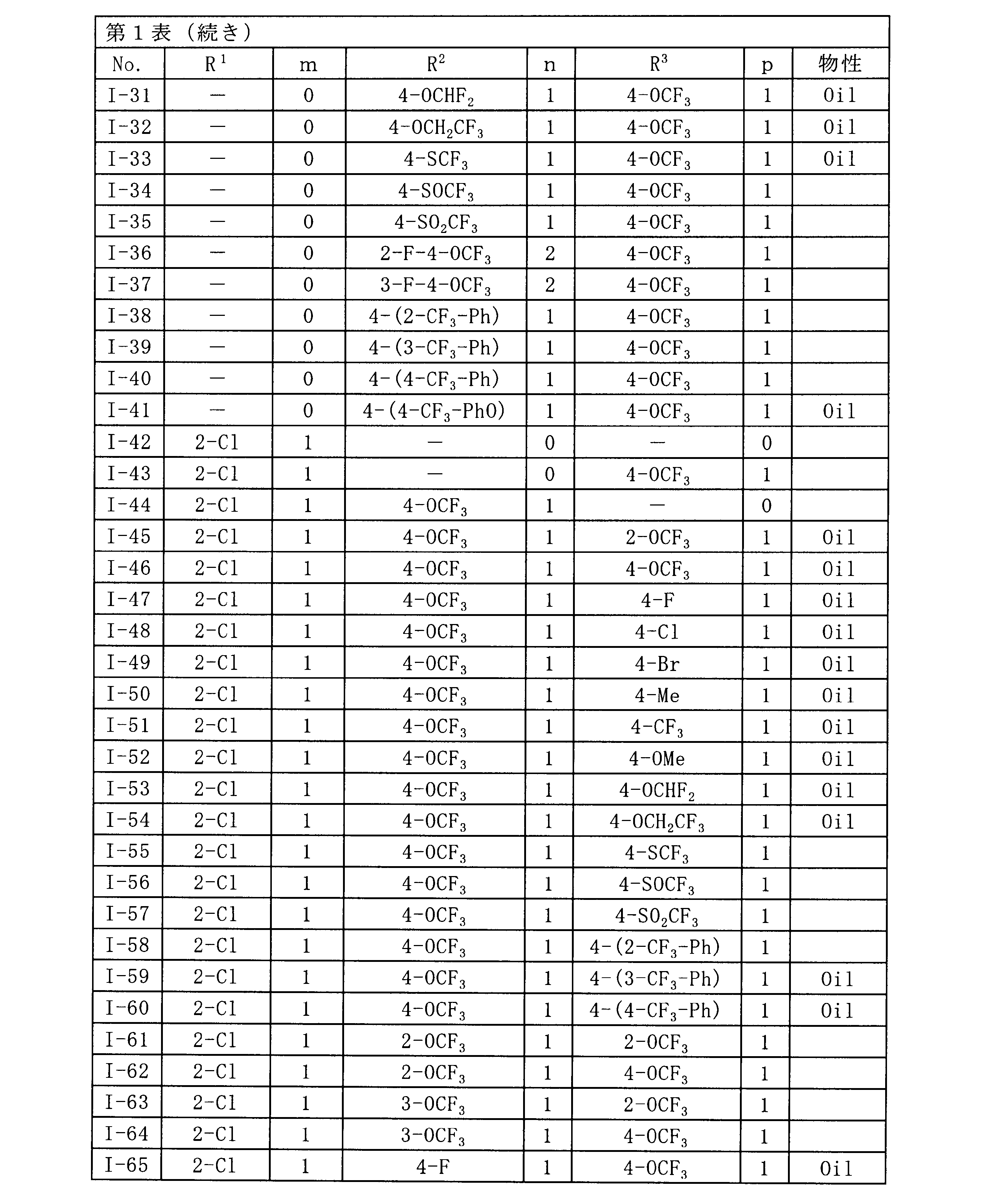
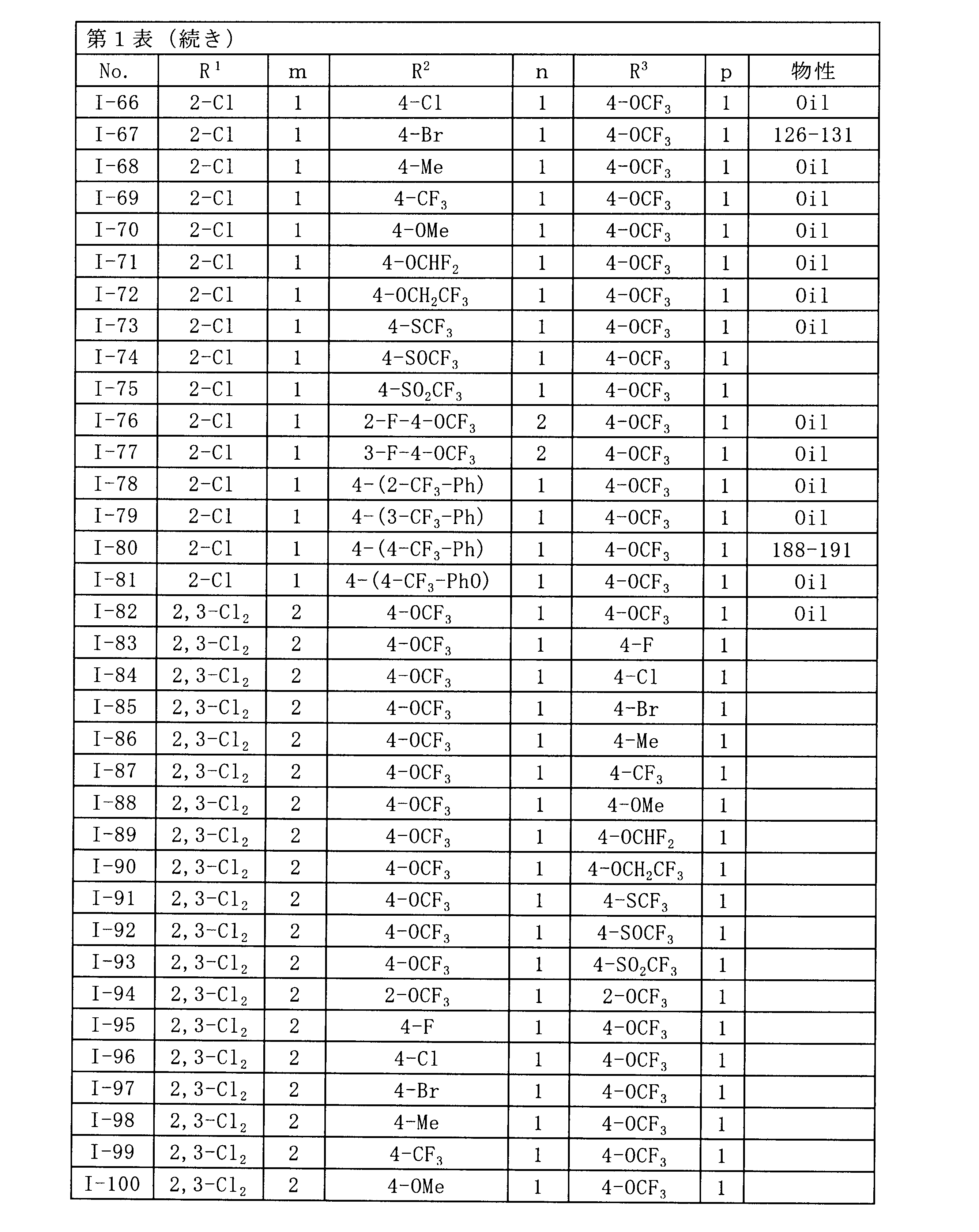


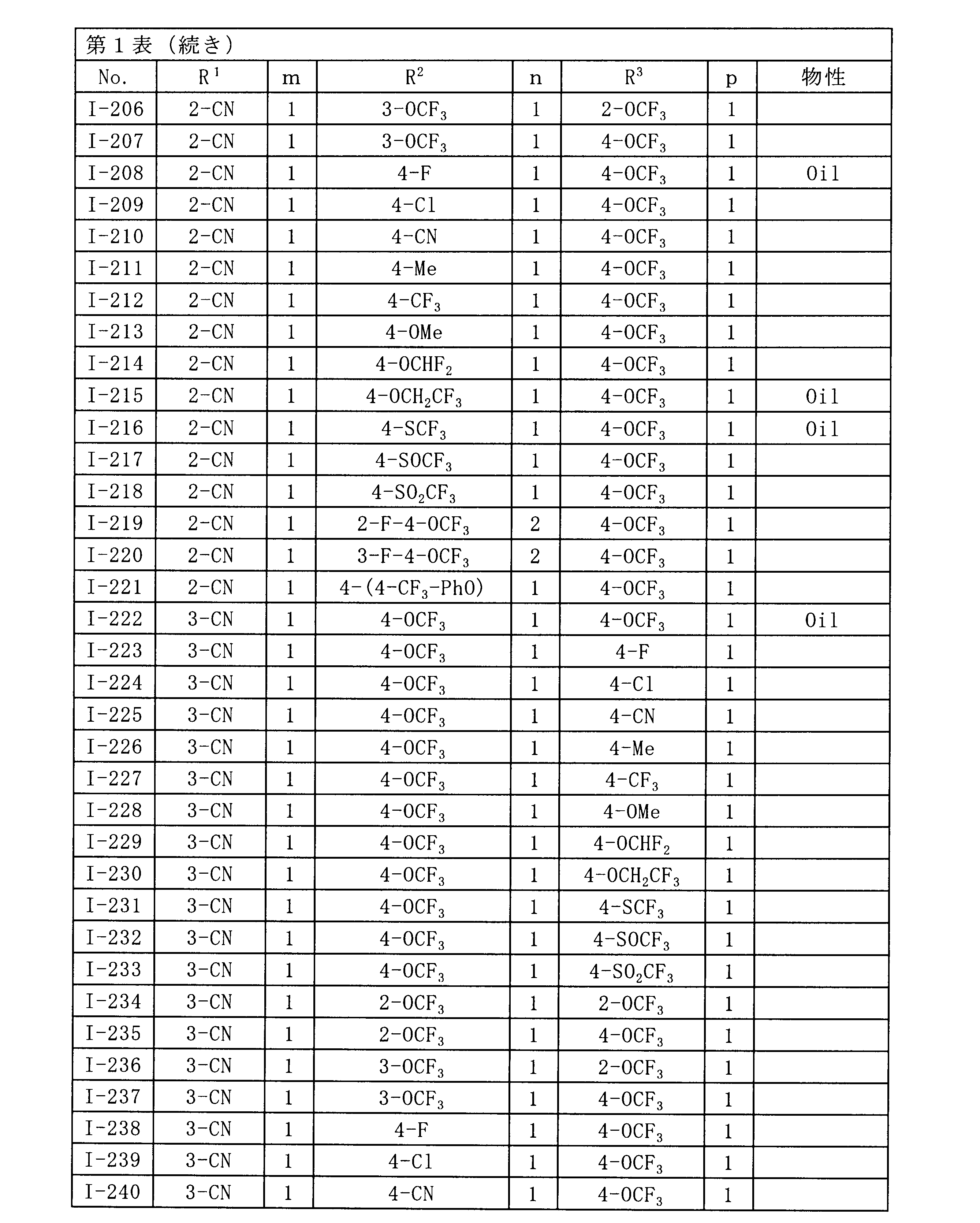
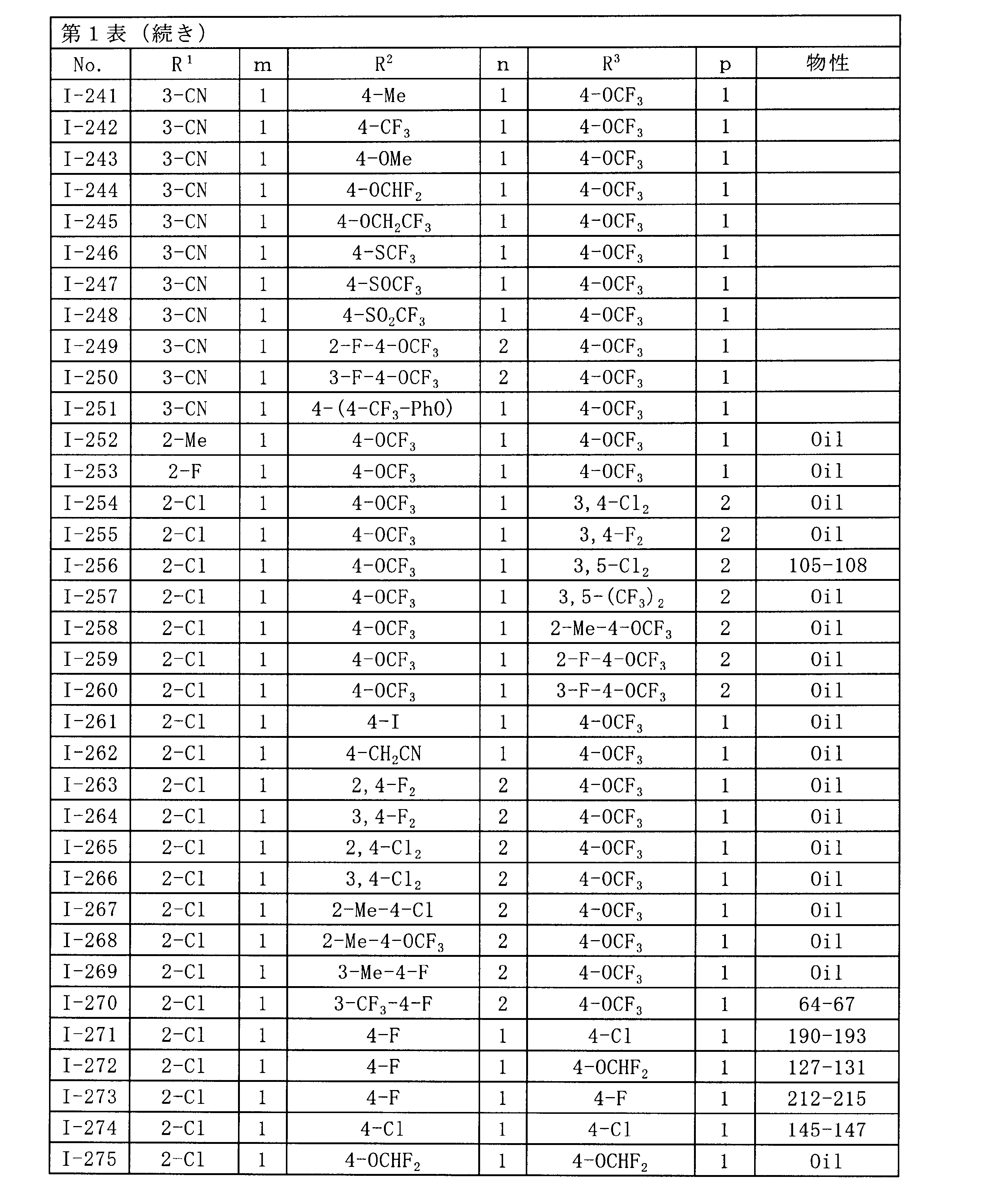


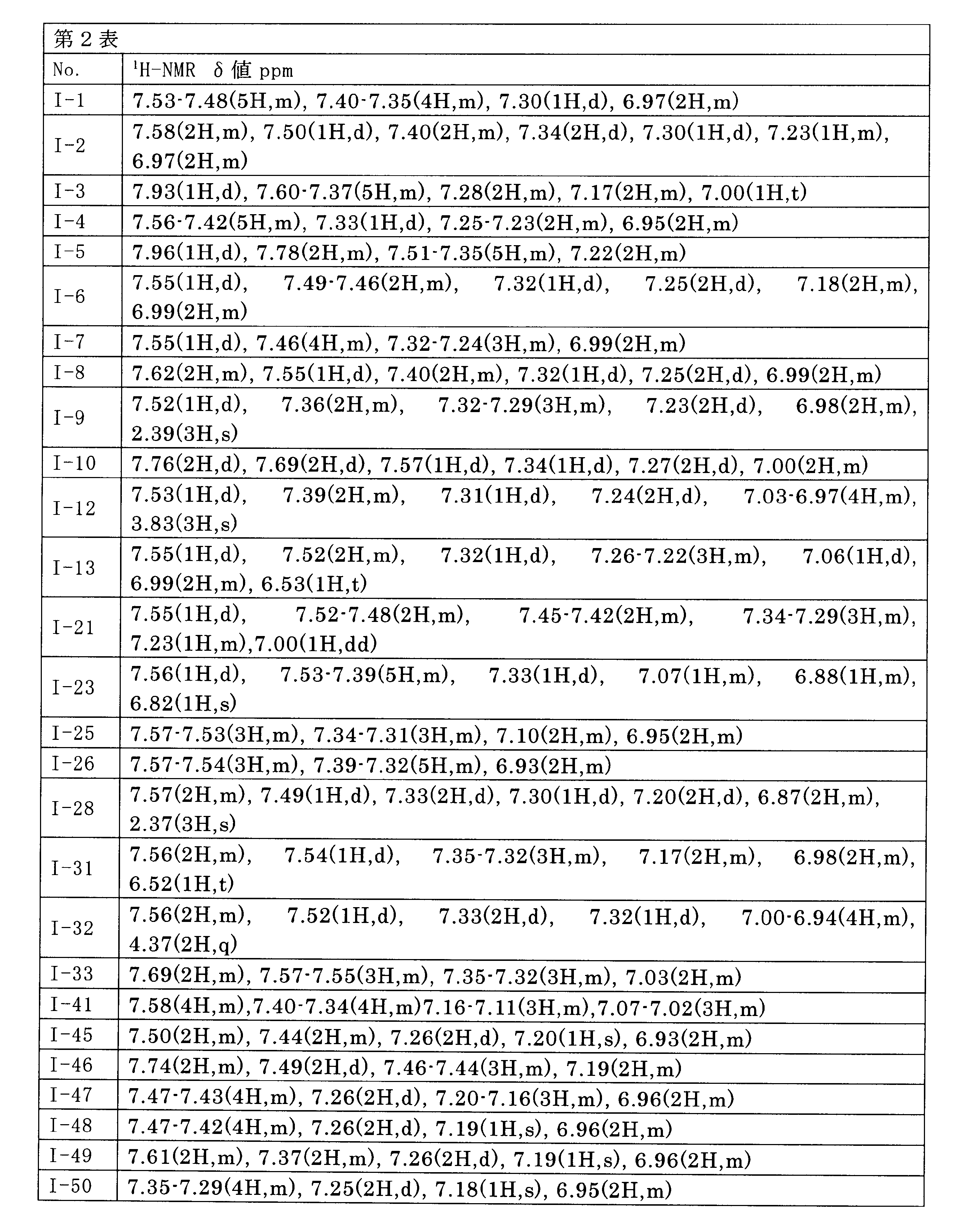
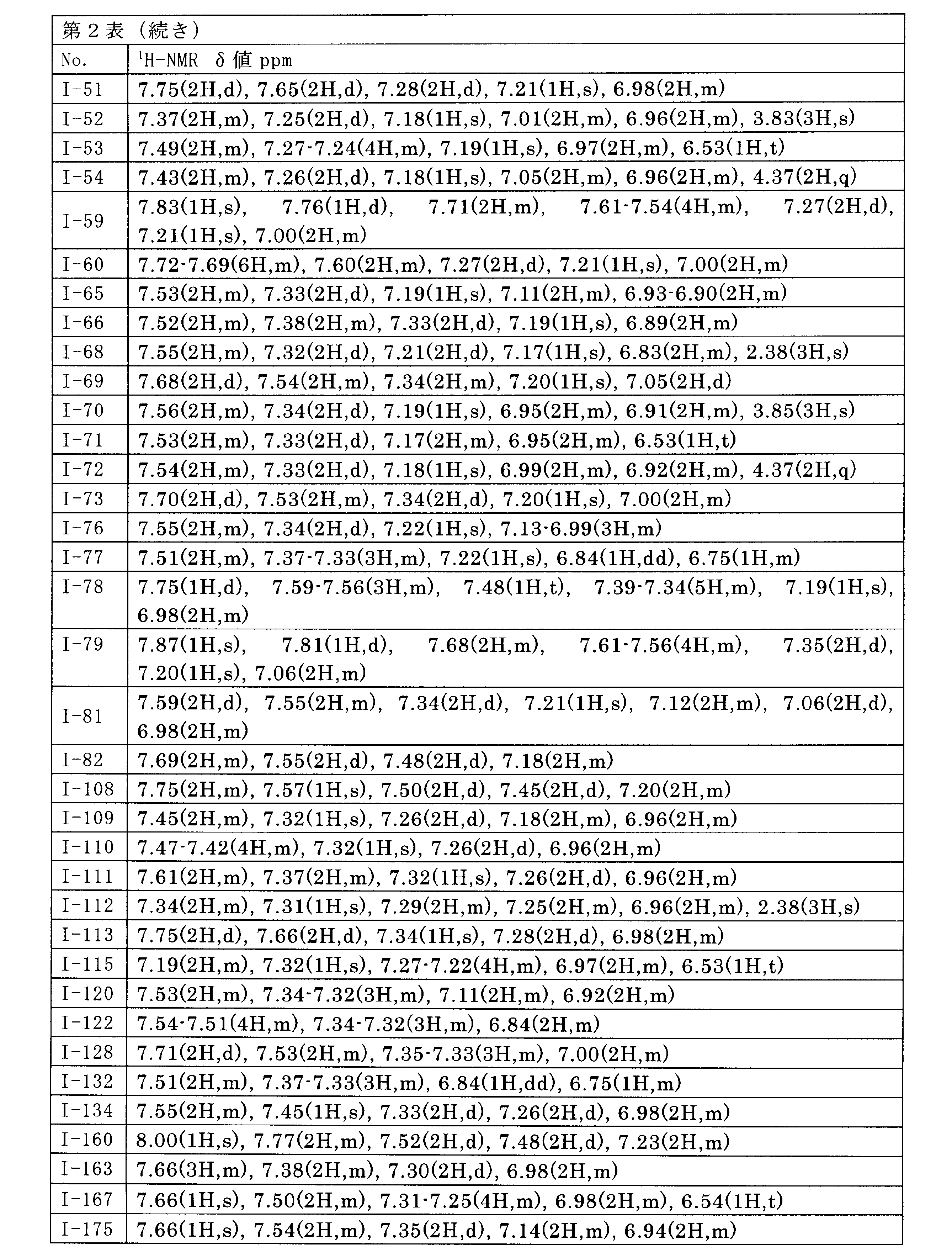
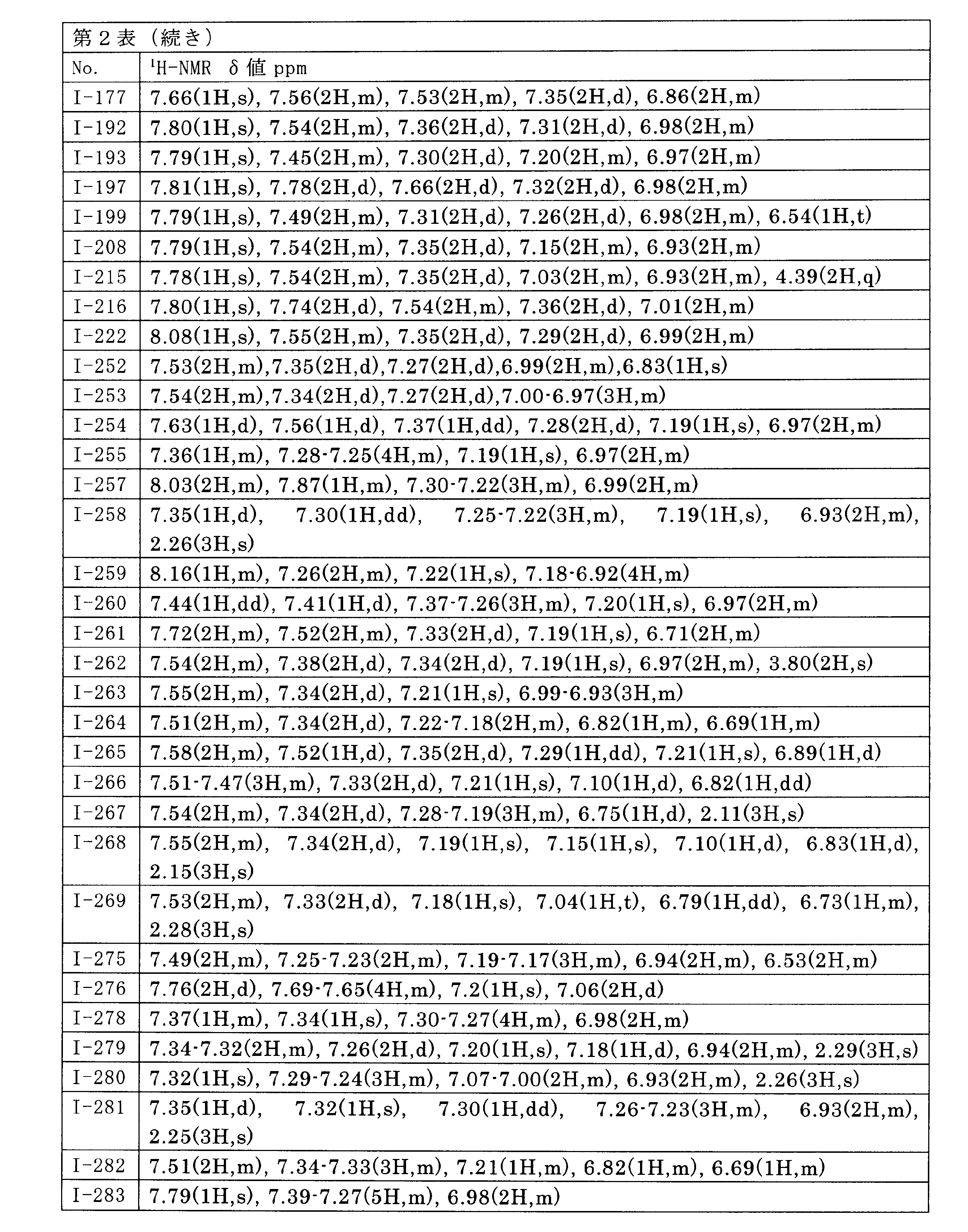
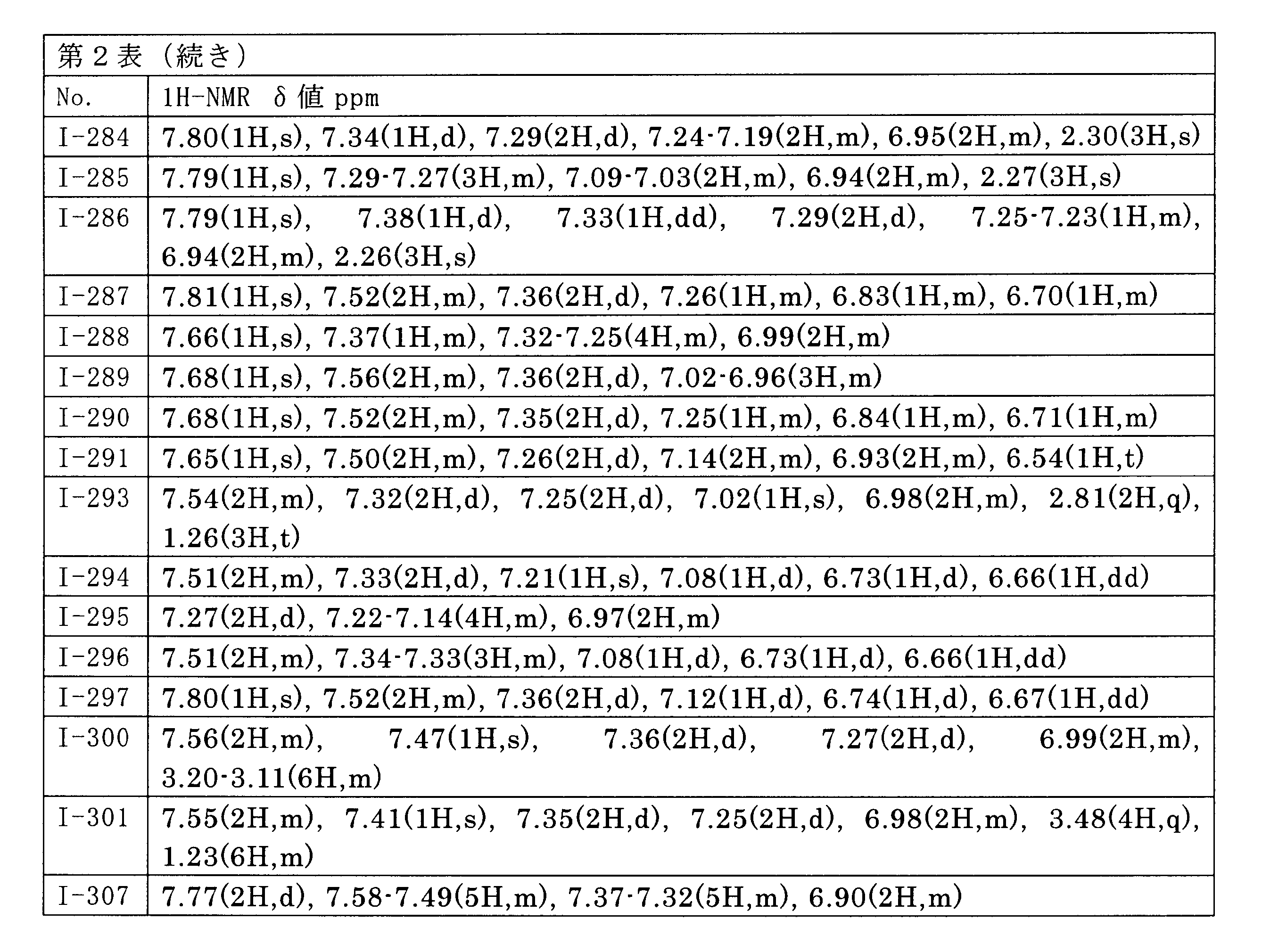
第2表の1H-NMRスペクトルを測定した機器はJEOL-ECX(500 MHz)である。化合物No.I-5、I-46、I-108、I-160は測定溶媒としてアセトン-d6を、化合物No.I-82はジメチルスルホキシド-d6を用い、これら以外は測定溶媒としてCDCl3を用いた。
試験例1 ハスモンヨトウに対する効果試験
本発明化合物を、界面活性剤を含むアセトンに溶解した後、濃度が200ppmとなるよう水で希釈した薬液に、キャベツの葉片を浸漬処理した。薬液が風乾した後、湿った濾紙を敷いた直径9cmのペトリ皿にキャベツの葉片を入れた。そこへハスモンヨトウ2~3齢幼虫を10頭放ち、ふたをして25℃の照明付恒温室内に放置した。放虫5日後にハスモンヨトウの生死を判定し、下記の計算式により死虫率(%)を求めた。その結果、前記化合物No.I-5、I-6、I-7、I-8、I-10、I-11、I-13、I-20、I-25、I-26、I-31、I-32、I-33、I-41、I-46、I-47、I-48、I-49、I-50、I-51、I-52、I-53、I-54、I-59、I-60、I-65、I-66、I-67、I-68、I-69、I-70、I-71、I-72、I-73、I-76、I-77、I-78、I-81、I-82、I-108、I-109、I-110、I-111、I-112、I-113、I-115、I-122、I-127、I-128、I-132、I-134、I-160、I-161、I-163、I-167、I-175、I-177、I-192、I-193、I-196、I-197、I-199、I-208、I-215、I-216、I-222、I-252、I-253、I-254、I-255、I-258、I-259、I-260、I-261、I-263、I-264、I-265、I-266、I-267、I-268、I-269、I-271、I-272、I-273、I-274、I-275、I-277、I-278、I-279、I-280、I-282、I-283、I-284、I-285、I-286、I-287、I-288、I-289、I-290、I-291、I-292、I-293、I-294、I-295、I-296、I-297、I-300、I-301、I-303及びI-305が90%以上の死虫率を示した。
死虫率(%)=(死虫数/放虫数)×100
本発明化合物を、界面活性剤を含むアセトンに溶解した後、濃度が200ppmとなるよう水で希釈した薬液に、キャベツの葉片を浸漬処理した。薬液が風乾した後、湿った濾紙を敷いた直径9cmのペトリ皿にキャベツの葉片を入れた。そこへハスモンヨトウ2~3齢幼虫を10頭放ち、ふたをして25℃の照明付恒温室内に放置した。放虫5日後にハスモンヨトウの生死を判定し、下記の計算式により死虫率(%)を求めた。その結果、前記化合物No.I-5、I-6、I-7、I-8、I-10、I-11、I-13、I-20、I-25、I-26、I-31、I-32、I-33、I-41、I-46、I-47、I-48、I-49、I-50、I-51、I-52、I-53、I-54、I-59、I-60、I-65、I-66、I-67、I-68、I-69、I-70、I-71、I-72、I-73、I-76、I-77、I-78、I-81、I-82、I-108、I-109、I-110、I-111、I-112、I-113、I-115、I-122、I-127、I-128、I-132、I-134、I-160、I-161、I-163、I-167、I-175、I-177、I-192、I-193、I-196、I-197、I-199、I-208、I-215、I-216、I-222、I-252、I-253、I-254、I-255、I-258、I-259、I-260、I-261、I-263、I-264、I-265、I-266、I-267、I-268、I-269、I-271、I-272、I-273、I-274、I-275、I-277、I-278、I-279、I-280、I-282、I-283、I-284、I-285、I-286、I-287、I-288、I-289、I-290、I-291、I-292、I-293、I-294、I-295、I-296、I-297、I-300、I-301、I-303及びI-305が90%以上の死虫率を示した。
死虫率(%)=(死虫数/放虫数)×100
次に製剤例を記載する。
製剤例1
(1)本発明化合物 20重量部
(2)クレー 70重量部
(3)ホワイトカーボン 5重量部
(4)ポリカルボン酸ナトリウム 3重量部
(5)アルキルナフタレンスルホン酸ナトリウム 2重量部
以上のものを均一に混合して水和剤とする。
製剤例1
(1)本発明化合物 20重量部
(2)クレー 70重量部
(3)ホワイトカーボン 5重量部
(4)ポリカルボン酸ナトリウム 3重量部
(5)アルキルナフタレンスルホン酸ナトリウム 2重量部
以上のものを均一に混合して水和剤とする。
製剤例2
(1)本発明化合物 5重量部
(2)タルク 60重量部
(3)炭酸カルシウム 34.5重量部
(4)流動パラフィン 0.5重量部
以上のものを均一に混合して粉剤とする。
(1)本発明化合物 5重量部
(2)タルク 60重量部
(3)炭酸カルシウム 34.5重量部
(4)流動パラフィン 0.5重量部
以上のものを均一に混合して粉剤とする。
製剤例3
(1)本発明化合物 20重量部
(2)N,N-ジメチルアセトアミド 20重量部
(3)ポリオキシエチレントリスチリルフェニルエーテル 10重量部
(4)ドデシルベンゼンスルホン酸カルシウム 2重量部
(5)キシレン 48重量部
以上のものを均一に混合、溶解して乳剤とする。
(1)本発明化合物 20重量部
(2)N,N-ジメチルアセトアミド 20重量部
(3)ポリオキシエチレントリスチリルフェニルエーテル 10重量部
(4)ドデシルベンゼンスルホン酸カルシウム 2重量部
(5)キシレン 48重量部
以上のものを均一に混合、溶解して乳剤とする。
製剤例4
(1)クレー 68重量部
(2)リグニンスルホン酸ナトリウム 2重量部
(3)ポリオキシエチレンアルキルアリールサルフェート 5重量部
(4)ホワイトカーボン 25重量部
以上の各成分の混合物と、本発明化合物とを4:1の重量割合で混合し、水和剤とする。
(1)クレー 68重量部
(2)リグニンスルホン酸ナトリウム 2重量部
(3)ポリオキシエチレンアルキルアリールサルフェート 5重量部
(4)ホワイトカーボン 25重量部
以上の各成分の混合物と、本発明化合物とを4:1の重量割合で混合し、水和剤とする。
製剤例5
(1)本発明化合物 50重量部
(2)アルキルナフタレンスルホン酸ナトリウムホルムアルデヒド縮合物 2重量部
(3)シリコーンオイル 0.2重量部
(4)水 47.8重量部
以上のものを均一に混合、粉砕した原液に更に
(5)ポリカルボン酸ナトリウム 5重量部
(6)無水硫酸ナトリウム 42.8重量部
を加え均一に混合、造粒、乾燥して顆粒水和剤とする。
(1)本発明化合物 50重量部
(2)アルキルナフタレンスルホン酸ナトリウムホルムアルデヒド縮合物 2重量部
(3)シリコーンオイル 0.2重量部
(4)水 47.8重量部
以上のものを均一に混合、粉砕した原液に更に
(5)ポリカルボン酸ナトリウム 5重量部
(6)無水硫酸ナトリウム 42.8重量部
を加え均一に混合、造粒、乾燥して顆粒水和剤とする。
製剤例6
(1)本発明化合物 5重量部
(2)ポリオキシエチレンオクチルフェニルエーテル 1重量部
(3)ポリオキシエチレンアルキルエーテルリン酸エステル 0.1重量部
(4)粒状炭酸カルシウム 93.9重量部
(1)~(3)を予め均一に混合し、適量のアセトンで希釈した後、(4)に吹付け、アセトンを除去して粒剤とする。
(1)本発明化合物 5重量部
(2)ポリオキシエチレンオクチルフェニルエーテル 1重量部
(3)ポリオキシエチレンアルキルエーテルリン酸エステル 0.1重量部
(4)粒状炭酸カルシウム 93.9重量部
(1)~(3)を予め均一に混合し、適量のアセトンで希釈した後、(4)に吹付け、アセトンを除去して粒剤とする。
製剤例7
(1)本発明化合物 2.5重量部
(2)N,N-ジメチルアセトアミド 2.5重量部
(3)大豆油 95.0重量部
以上のものを均一に混合、溶解して微量散布剤(ultra low volume formulation)とする。
(1)本発明化合物 2.5重量部
(2)N,N-ジメチルアセトアミド 2.5重量部
(3)大豆油 95.0重量部
以上のものを均一に混合、溶解して微量散布剤(ultra low volume formulation)とする。
製剤例8
(1)本発明化合物 10重量部
(2)ジエチレングリコールモノエチルエーテル 80重量部
(3)ポリオキシエチレンアルキルエーテル 10重量部
以上の成分を均一に混合し、液剤とする。
(1)本発明化合物 10重量部
(2)ジエチレングリコールモノエチルエーテル 80重量部
(3)ポリオキシエチレンアルキルエーテル 10重量部
以上の成分を均一に混合し、液剤とする。
本発明を詳細にまた特定の実施態様を参照して説明したが、本発明の精神と範囲を逸脱することなく様々な変更や修正を加えることができることは当業者にとって明らかである。本出願は2015年10月13日出願の日本特許出願(特願2015-201809)に基づくものであり、その内容はここに参照として取り込まれる。
Claims (9)
- 式(I):

- R1がハロゲン、アルキル、ハロアルキル、シアノ、カルボキシ、アルコキシカルボニル、CONR4R5又はAで置換されてもよいフェニルであり、R4及びR5は各々独立に、水素原子、アルキル又はAで置換されてもよいシクロアルキルである、請求項1に記載の化合物又はその塩。
- R2及びR3が各々独立に、ハロゲン、アルキル、ハロアルキル、シアノアルキル、アルコキシ、ハロアルコキシ、シアノアルコキシ、ハロアルキルチオ、ハロアルキルスルフィニル、ハロアルキルスルホニル、シアノ、Aで置換されてもよいフェニル又はAで置換されてもよいフェノキシであり;n=2の場合、2つのR2は互いに結合してR2が結合するフェニル環と縮合し1,3-ベンゾジオキソール環を形成してもよく、さらにそのR2部分はAで置換されてもよく;p=2の場合、2つのR3は互いに結合してR3が結合するフェニル環と縮合し1,3-ベンゾジオキソール環を形成してもよく、さらにそのR3部分はAで置換されてもよい、請求項1に記載の化合物又はその塩。
- R2及びR3が各々独立に、ハロゲン、アルキル、ハロアルキル、シアノアルキル、アルコキシ、ハロアルコキシ、ハロアルキルチオ、シアノ、Aで置換されてもよいフェニル又はAで置換されてもよいフェノキシであり;n=2の場合、2つのR2は互いに結合してR2が結合するフェニル環と縮合し1,3-ベンゾジオキソール環を形成してもよく、さらにそのR2部分はAで置換されてもよく;p=2の場合、2つのR3は互いに結合してR3が結合するフェニル環と縮合し1,3-ベンゾジオキソール環を形成してもよく、さらにそのR3部分はAで置換されてもよい、請求項1に記載の化合物又はその塩。
- Aがハロアルキル又はシアノである、請求項1に記載の化合物又はその塩。
- 請求項1に記載の化合物又はその塩を有効成分として含有する有害生物防除剤。
- 請求項1に記載の化合物又はその塩を有効成分として含有する農園芸用殺虫剤、殺ダニ剤、殺線虫剤又は殺土壌害虫剤。
- 請求項1に記載の化合物又はその塩を有効成分として含有する農園芸用殺虫剤又は殺ダニ剤。
- 請求項1に記載の化合物又はその塩の有効量を施用して有害生物を防除する方法。
Applications Claiming Priority (2)
| Application Number | Priority Date | Filing Date | Title |
|---|---|---|---|
| JP2015201809A JP2018197192A (ja) | 2015-10-13 | 2015-10-13 | チエノピロール系化合物又はその塩を有効成分として含有する有害生物防除剤 |
| JP2015-201809 | 2015-10-13 |
Publications (1)
| Publication Number | Publication Date |
|---|---|
| WO2017065237A1 true WO2017065237A1 (ja) | 2017-04-20 |
Family
ID=58518214
Family Applications (1)
| Application Number | Title | Priority Date | Filing Date |
|---|---|---|---|
| PCT/JP2016/080439 Ceased WO2017065237A1 (ja) | 2015-10-13 | 2016-10-13 | チエノピロール系化合物又はその塩を有効成分として含有する有害生物防除剤 |
Country Status (2)
| Country | Link |
|---|---|
| JP (1) | JP2018197192A (ja) |
| WO (1) | WO2017065237A1 (ja) |
Citations (3)
| Publication number | Priority date | Publication date | Assignee | Title |
|---|---|---|---|---|
| JPH04234393A (ja) * | 1990-07-20 | 1992-08-24 | Basf Ag | ジカルボキシイミドおよびこれを含有する除草剤 |
| JPH11279179A (ja) * | 1998-03-25 | 1999-10-12 | Nippon Kayaku Co Ltd | ジチオロピロール系化合物およびこれを有効成分とする農園芸用病害虫防除剤 |
| JP2004359633A (ja) * | 2003-06-06 | 2004-12-24 | Bayer Cropscience Ag | イソインドリノン誘導体の殺虫剤としての利用 |
-
2015
- 2015-10-13 JP JP2015201809A patent/JP2018197192A/ja active Pending
-
2016
- 2016-10-13 WO PCT/JP2016/080439 patent/WO2017065237A1/ja not_active Ceased
Patent Citations (3)
| Publication number | Priority date | Publication date | Assignee | Title |
|---|---|---|---|---|
| JPH04234393A (ja) * | 1990-07-20 | 1992-08-24 | Basf Ag | ジカルボキシイミドおよびこれを含有する除草剤 |
| JPH11279179A (ja) * | 1998-03-25 | 1999-10-12 | Nippon Kayaku Co Ltd | ジチオロピロール系化合物およびこれを有効成分とする農園芸用病害虫防除剤 |
| JP2004359633A (ja) * | 2003-06-06 | 2004-12-24 | Bayer Cropscience Ag | イソインドリノン誘導体の殺虫剤としての利用 |
Non-Patent Citations (1)
| Title |
|---|
| MIURA T. ET AL.: "Palladium-Catalyzed Denitrogenation Reaction of 1,2,3-Benzotriazin- 4(3H)-ones Incorporating Isocyanides", ORGANIC LETTERS, vol. 13, no. 6, 2011, pages 1429 - 1431, XP055374791, ISSN: 1523-7052 * |
Also Published As
| Publication number | Publication date |
|---|---|
| JP2018197192A (ja) | 2018-12-13 |
Similar Documents
| Publication | Publication Date | Title |
|---|---|---|
| DK2256112T3 (en) | Anthranilamides, process for their production and insecticides containing the same | |
| JP2013028588A (ja) | 有害生物防除剤 | |
| JP5231829B2 (ja) | ピリジル−トリアゾロピリミジン誘導体又はその塩、それらを含有する有害生物防除剤並びにそれらの製造方法 | |
| JP4150379B2 (ja) | アントラニルアミド系化合物、それらの製造方法及びそれらを含有する有害生物防除剤 | |
| JP2012087116A (ja) | ベンズアミド誘導体又はその塩、それらを含有する殺虫剤、殺ダニ剤、殺線虫剤又は殺土壌害虫剤 | |
| KR102520792B1 (ko) | N-(4-피리딜)니코틴아미드 화합물 또는 그 염 | |
| WO2017222037A1 (ja) | N-(4-ピリジル)ベンズアミド化合物又はその塩、及び該化合物又はその塩を有効成分として含有する有害生物防除剤 | |
| WO2013111864A1 (ja) | 有害生物防除剤 | |
| JP6432514B2 (ja) | 有害生物防除剤 | |
| JP2011105700A (ja) | ジアリールトリアゾール誘導体又はその塩、それらを含有する殺虫剤、殺ダニ剤、殺線虫剤又は殺土壌害虫剤、並びにそれらの製造方法 | |
| WO2016068301A1 (ja) | 有害生物防除剤 | |
| JP2018193363A (ja) | イソインドリノン系化合物又はその塩を有効成分として含有する有害生物防除剤 | |
| JP2016204325A (ja) | 有害生物防除剤 | |
| WO2017065237A1 (ja) | チエノピロール系化合物又はその塩を有効成分として含有する有害生物防除剤 | |
| JP2016020335A (ja) | 有害生物防除剤 | |
| JP6303250B2 (ja) | 有害生物防除剤 | |
| JP2017008029A (ja) | N−(4−ピリジル)ピコリンアミド化合物又はその塩を有効成分として含有する有害生物防除剤 | |
| WO2017200100A1 (ja) | N-(4-ピリジル)ベンズアミド化合物又はその塩、及び該化合物又はその塩を有効成分として含有する有害生物防除剤 | |
| JP2018145187A (ja) | 置換ピリジン系化合物又はその塩を有効成分として含有する有害生物防除剤 | |
| RU2785399C2 (ru) | Соединение n-(4-пиридил)никотинамид или его соль | |
| WO2017159618A1 (ja) | 有害生物防除剤 | |
| JP2007070346A (ja) | アントラニルアミド系化合物、それらの製造方法及びそれらを含有する有害生物防除剤 | |
| JP2006131608A (ja) | アントラニルアミド系化合物、それらの製造方法及びそれらを含有する有害生物防除剤 | |
| JP2008019222A (ja) | アントラニルアミド系化合物、それらの製造方法及びそれらを含有する有害生物防除剤 | |
| WO2019163921A1 (ja) | 置換ピリジン化合物又はその塩 |
Legal Events
| Date | Code | Title | Description |
|---|---|---|---|
| 121 | Ep: the epo has been informed by wipo that ep was designated in this application |
Ref document number: 16855490 Country of ref document: EP Kind code of ref document: A1 |
|
| NENP | Non-entry into the national phase |
Ref country code: DE |
|
| 122 | Ep: pct application non-entry in european phase |
Ref document number: 16855490 Country of ref document: EP Kind code of ref document: A1 |
|
| NENP | Non-entry into the national phase |
Ref country code: JP |