WO2017056979A1 - 防食剤および端子付き被覆電線 - Google Patents
防食剤および端子付き被覆電線 Download PDFInfo
- Publication number
- WO2017056979A1 WO2017056979A1 PCT/JP2016/077028 JP2016077028W WO2017056979A1 WO 2017056979 A1 WO2017056979 A1 WO 2017056979A1 JP 2016077028 W JP2016077028 W JP 2016077028W WO 2017056979 A1 WO2017056979 A1 WO 2017056979A1
- Authority
- WO
- WIPO (PCT)
- Prior art keywords
- group
- metal
- carbon atoms
- hydrocarbon group
- phosphorus compound
- Prior art date
- Legal status (The legal status is an assumption and is not a legal conclusion. Google has not performed a legal analysis and makes no representation as to the accuracy of the status listed.)
- Ceased
Links
Images

Classifications
-
- C—CHEMISTRY; METALLURGY
- C10—PETROLEUM, GAS OR COKE INDUSTRIES; TECHNICAL GASES CONTAINING CARBON MONOXIDE; FUELS; LUBRICANTS; PEAT
- C10M—LUBRICATING COMPOSITIONS; USE OF CHEMICAL SUBSTANCES EITHER ALONE OR AS LUBRICATING INGREDIENTS IN A LUBRICATING COMPOSITION
- C10M141/00—Lubricating compositions characterised by the additive being a mixture of two or more compounds covered by more than one of the main groups C10M125/00 - C10M139/00, each of these compounds being essential
- C10M141/10—Lubricating compositions characterised by the additive being a mixture of two or more compounds covered by more than one of the main groups C10M125/00 - C10M139/00, each of these compounds being essential at least one of them being an organic phosphorus-containing compound
-
- C—CHEMISTRY; METALLURGY
- C10—PETROLEUM, GAS OR COKE INDUSTRIES; TECHNICAL GASES CONTAINING CARBON MONOXIDE; FUELS; LUBRICANTS; PEAT
- C10M—LUBRICATING COMPOSITIONS; USE OF CHEMICAL SUBSTANCES EITHER ALONE OR AS LUBRICATING INGREDIENTS IN A LUBRICATING COMPOSITION
- C10M133/00—Lubricating compositions characterised by the additive being an organic non-macromolecular compound containing nitrogen
- C10M133/02—Lubricating compositions characterised by the additive being an organic non-macromolecular compound containing nitrogen having a carbon chain of less than 30 atoms
- C10M133/38—Heterocyclic nitrogen compounds
- C10M133/44—Five-membered ring containing nitrogen and carbon only
-
- C—CHEMISTRY; METALLURGY
- C10—PETROLEUM, GAS OR COKE INDUSTRIES; TECHNICAL GASES CONTAINING CARBON MONOXIDE; FUELS; LUBRICANTS; PEAT
- C10M—LUBRICATING COMPOSITIONS; USE OF CHEMICAL SUBSTANCES EITHER ALONE OR AS LUBRICATING INGREDIENTS IN A LUBRICATING COMPOSITION
- C10M137/00—Lubricating compositions characterised by the additive being an organic non-macromolecular compound containing phosphorus
- C10M137/02—Lubricating compositions characterised by the additive being an organic non-macromolecular compound containing phosphorus having no phosphorus-to-carbon bond
- C10M137/04—Phosphate esters
-
- C—CHEMISTRY; METALLURGY
- C23—COATING METALLIC MATERIAL; COATING MATERIAL WITH METALLIC MATERIAL; CHEMICAL SURFACE TREATMENT; DIFFUSION TREATMENT OF METALLIC MATERIAL; COATING BY VACUUM EVAPORATION, BY SPUTTERING, BY ION IMPLANTATION OR BY CHEMICAL VAPOUR DEPOSITION, IN GENERAL; INHIBITING CORROSION OF METALLIC MATERIAL OR INCRUSTATION IN GENERAL
- C23F—NON-MECHANICAL REMOVAL OF METALLIC MATERIAL FROM SURFACE; INHIBITING CORROSION OF METALLIC MATERIAL OR INCRUSTATION IN GENERAL; MULTI-STEP PROCESSES FOR SURFACE TREATMENT OF METALLIC MATERIAL INVOLVING AT LEAST ONE PROCESS PROVIDED FOR IN CLASS C23 AND AT LEAST ONE PROCESS COVERED BY SUBCLASS C21D OR C22F OR CLASS C25
- C23F11/00—Inhibiting corrosion of metallic material by applying inhibitors to the surface in danger of corrosion or adding them to the corrosive agent
- C23F11/08—Inhibiting corrosion of metallic material by applying inhibitors to the surface in danger of corrosion or adding them to the corrosive agent in other liquids
- C23F11/10—Inhibiting corrosion of metallic material by applying inhibitors to the surface in danger of corrosion or adding them to the corrosive agent in other liquids using organic inhibitors
-
- C—CHEMISTRY; METALLURGY
- C23—COATING METALLIC MATERIAL; COATING MATERIAL WITH METALLIC MATERIAL; CHEMICAL SURFACE TREATMENT; DIFFUSION TREATMENT OF METALLIC MATERIAL; COATING BY VACUUM EVAPORATION, BY SPUTTERING, BY ION IMPLANTATION OR BY CHEMICAL VAPOUR DEPOSITION, IN GENERAL; INHIBITING CORROSION OF METALLIC MATERIAL OR INCRUSTATION IN GENERAL
- C23F—NON-MECHANICAL REMOVAL OF METALLIC MATERIAL FROM SURFACE; INHIBITING CORROSION OF METALLIC MATERIAL OR INCRUSTATION IN GENERAL; MULTI-STEP PROCESSES FOR SURFACE TREATMENT OF METALLIC MATERIAL INVOLVING AT LEAST ONE PROCESS PROVIDED FOR IN CLASS C23 AND AT LEAST ONE PROCESS COVERED BY SUBCLASS C21D OR C22F OR CLASS C25
- C23F11/00—Inhibiting corrosion of metallic material by applying inhibitors to the surface in danger of corrosion or adding them to the corrosive agent
- C23F11/08—Inhibiting corrosion of metallic material by applying inhibitors to the surface in danger of corrosion or adding them to the corrosive agent in other liquids
- C23F11/10—Inhibiting corrosion of metallic material by applying inhibitors to the surface in danger of corrosion or adding them to the corrosive agent in other liquids using organic inhibitors
- C23F11/167—Phosphorus-containing compounds
- C23F11/1673—Esters of phosphoric or thiophosphoric acids
-
- H—ELECTRICITY
- H01—ELECTRIC ELEMENTS
- H01B—CABLES; CONDUCTORS; INSULATORS; SELECTION OF MATERIALS FOR THEIR CONDUCTIVE, INSULATING OR DIELECTRIC PROPERTIES
- H01B3/00—Insulators or insulating bodies characterised by the insulating materials; Selection of materials for their insulating or dielectric properties
- H01B3/18—Insulators or insulating bodies characterised by the insulating materials; Selection of materials for their insulating or dielectric properties mainly consisting of organic substances
- H01B3/30—Insulators or insulating bodies characterised by the insulating materials; Selection of materials for their insulating or dielectric properties mainly consisting of organic substances plastics; resins; waxes
- H01B3/44—Insulators or insulating bodies characterised by the insulating materials; Selection of materials for their insulating or dielectric properties mainly consisting of organic substances plastics; resins; waxes vinyl resins; acrylic resins
- H01B3/441—Insulators or insulating bodies characterised by the insulating materials; Selection of materials for their insulating or dielectric properties mainly consisting of organic substances plastics; resins; waxes vinyl resins; acrylic resins from alkenes
-
- H—ELECTRICITY
- H01—ELECTRIC ELEMENTS
- H01B—CABLES; CONDUCTORS; INSULATORS; SELECTION OF MATERIALS FOR THEIR CONDUCTIVE, INSULATING OR DIELECTRIC PROPERTIES
- H01B7/00—Insulated conductors or cables characterised by their form
- H01B7/17—Protection against damage caused by external factors, e.g. sheaths or armouring
- H01B7/28—Protection against damage caused by moisture, corrosion, chemical attack or weather
- H01B7/2806—Protection against damage caused by corrosion
-
- H—ELECTRICITY
- H01—ELECTRIC ELEMENTS
- H01R—ELECTRICALLY-CONDUCTIVE CONNECTIONS; STRUCTURAL ASSOCIATIONS OF A PLURALITY OF MUTUALLY-INSULATED ELECTRICAL CONNECTING ELEMENTS; COUPLING DEVICES; CURRENT COLLECTORS
- H01R4/00—Electrically-conductive connections between two or more conductive members in direct contact, i.e. touching one another; Means for effecting or maintaining such contact; Electrically-conductive connections having two or more spaced connecting locations for conductors and using contact members penetrating insulation
- H01R4/10—Electrically-conductive connections between two or more conductive members in direct contact, i.e. touching one another; Means for effecting or maintaining such contact; Electrically-conductive connections having two or more spaced connecting locations for conductors and using contact members penetrating insulation effected solely by twisting, wrapping, bending, crimping, or other permanent deformation
- H01R4/18—Electrically-conductive connections between two or more conductive members in direct contact, i.e. touching one another; Means for effecting or maintaining such contact; Electrically-conductive connections having two or more spaced connecting locations for conductors and using contact members penetrating insulation effected solely by twisting, wrapping, bending, crimping, or other permanent deformation by crimping
- H01R4/183—Electrically-conductive connections between two or more conductive members in direct contact, i.e. touching one another; Means for effecting or maintaining such contact; Electrically-conductive connections having two or more spaced connecting locations for conductors and using contact members penetrating insulation effected solely by twisting, wrapping, bending, crimping, or other permanent deformation by crimping for cylindrical elongated bodies, e.g. cables having circular cross-section
- H01R4/184—Electrically-conductive connections between two or more conductive members in direct contact, i.e. touching one another; Means for effecting or maintaining such contact; Electrically-conductive connections having two or more spaced connecting locations for conductors and using contact members penetrating insulation effected solely by twisting, wrapping, bending, crimping, or other permanent deformation by crimping for cylindrical elongated bodies, e.g. cables having circular cross-section comprising a U-shaped wire-receiving portion
- H01R4/185—Electrically-conductive connections between two or more conductive members in direct contact, i.e. touching one another; Means for effecting or maintaining such contact; Electrically-conductive connections having two or more spaced connecting locations for conductors and using contact members penetrating insulation effected solely by twisting, wrapping, bending, crimping, or other permanent deformation by crimping for cylindrical elongated bodies, e.g. cables having circular cross-section comprising a U-shaped wire-receiving portion combined with a U-shaped insulation-receiving portion
-
- H—ELECTRICITY
- H01—ELECTRIC ELEMENTS
- H01R—ELECTRICALLY-CONDUCTIVE CONNECTIONS; STRUCTURAL ASSOCIATIONS OF A PLURALITY OF MUTUALLY-INSULATED ELECTRICAL CONNECTING ELEMENTS; COUPLING DEVICES; CURRENT COLLECTORS
- H01R4/00—Electrically-conductive connections between two or more conductive members in direct contact, i.e. touching one another; Means for effecting or maintaining such contact; Electrically-conductive connections having two or more spaced connecting locations for conductors and using contact members penetrating insulation
- H01R4/70—Insulation of connections
-
- C—CHEMISTRY; METALLURGY
- C10—PETROLEUM, GAS OR COKE INDUSTRIES; TECHNICAL GASES CONTAINING CARBON MONOXIDE; FUELS; LUBRICANTS; PEAT
- C10M—LUBRICATING COMPOSITIONS; USE OF CHEMICAL SUBSTANCES EITHER ALONE OR AS LUBRICATING INGREDIENTS IN A LUBRICATING COMPOSITION
- C10M133/00—Lubricating compositions characterised by the additive being an organic non-macromolecular compound containing nitrogen
- C10M133/02—Lubricating compositions characterised by the additive being an organic non-macromolecular compound containing nitrogen having a carbon chain of less than 30 atoms
- C10M133/16—Amides; Imides
-
- C—CHEMISTRY; METALLURGY
- C10—PETROLEUM, GAS OR COKE INDUSTRIES; TECHNICAL GASES CONTAINING CARBON MONOXIDE; FUELS; LUBRICANTS; PEAT
- C10M—LUBRICATING COMPOSITIONS; USE OF CHEMICAL SUBSTANCES EITHER ALONE OR AS LUBRICATING INGREDIENTS IN A LUBRICATING COMPOSITION
- C10M133/00—Lubricating compositions characterised by the additive being an organic non-macromolecular compound containing nitrogen
- C10M133/02—Lubricating compositions characterised by the additive being an organic non-macromolecular compound containing nitrogen having a carbon chain of less than 30 atoms
- C10M133/38—Heterocyclic nitrogen compounds
-
- C—CHEMISTRY; METALLURGY
- C10—PETROLEUM, GAS OR COKE INDUSTRIES; TECHNICAL GASES CONTAINING CARBON MONOXIDE; FUELS; LUBRICANTS; PEAT
- C10M—LUBRICATING COMPOSITIONS; USE OF CHEMICAL SUBSTANCES EITHER ALONE OR AS LUBRICATING INGREDIENTS IN A LUBRICATING COMPOSITION
- C10M137/00—Lubricating compositions characterised by the additive being an organic non-macromolecular compound containing phosphorus
- C10M137/02—Lubricating compositions characterised by the additive being an organic non-macromolecular compound containing phosphorus having no phosphorus-to-carbon bond
-
- C—CHEMISTRY; METALLURGY
- C10—PETROLEUM, GAS OR COKE INDUSTRIES; TECHNICAL GASES CONTAINING CARBON MONOXIDE; FUELS; LUBRICANTS; PEAT
- C10M—LUBRICATING COMPOSITIONS; USE OF CHEMICAL SUBSTANCES EITHER ALONE OR AS LUBRICATING INGREDIENTS IN A LUBRICATING COMPOSITION
- C10M137/00—Lubricating compositions characterised by the additive being an organic non-macromolecular compound containing phosphorus
- C10M137/02—Lubricating compositions characterised by the additive being an organic non-macromolecular compound containing phosphorus having no phosphorus-to-carbon bond
- C10M137/04—Phosphate esters
- C10M137/06—Metal salts
-
- C—CHEMISTRY; METALLURGY
- C10—PETROLEUM, GAS OR COKE INDUSTRIES; TECHNICAL GASES CONTAINING CARBON MONOXIDE; FUELS; LUBRICANTS; PEAT
- C10M—LUBRICATING COMPOSITIONS; USE OF CHEMICAL SUBSTANCES EITHER ALONE OR AS LUBRICATING INGREDIENTS IN A LUBRICATING COMPOSITION
- C10M137/00—Lubricating compositions characterised by the additive being an organic non-macromolecular compound containing phosphorus
- C10M137/02—Lubricating compositions characterised by the additive being an organic non-macromolecular compound containing phosphorus having no phosphorus-to-carbon bond
- C10M137/04—Phosphate esters
- C10M137/10—Thio derivatives
-
- C—CHEMISTRY; METALLURGY
- C10—PETROLEUM, GAS OR COKE INDUSTRIES; TECHNICAL GASES CONTAINING CARBON MONOXIDE; FUELS; LUBRICANTS; PEAT
- C10M—LUBRICATING COMPOSITIONS; USE OF CHEMICAL SUBSTANCES EITHER ALONE OR AS LUBRICATING INGREDIENTS IN A LUBRICATING COMPOSITION
- C10M2203/00—Organic non-macromolecular hydrocarbon compounds and hydrocarbon fractions as ingredients in lubricant compositions
- C10M2203/10—Petroleum or coal fractions, e.g. tars, solvents, bitumen
- C10M2203/1006—Petroleum or coal fractions, e.g. tars, solvents, bitumen used as base material
-
- C—CHEMISTRY; METALLURGY
- C10—PETROLEUM, GAS OR COKE INDUSTRIES; TECHNICAL GASES CONTAINING CARBON MONOXIDE; FUELS; LUBRICANTS; PEAT
- C10M—LUBRICATING COMPOSITIONS; USE OF CHEMICAL SUBSTANCES EITHER ALONE OR AS LUBRICATING INGREDIENTS IN A LUBRICATING COMPOSITION
- C10M2215/00—Organic non-macromolecular compounds containing nitrogen as ingredients in lubricant Compositions
- C10M2215/08—Amides [having hydrocarbon substituents containing less than thirty carbon atoms]
-
- C—CHEMISTRY; METALLURGY
- C10—PETROLEUM, GAS OR COKE INDUSTRIES; TECHNICAL GASES CONTAINING CARBON MONOXIDE; FUELS; LUBRICANTS; PEAT
- C10M—LUBRICATING COMPOSITIONS; USE OF CHEMICAL SUBSTANCES EITHER ALONE OR AS LUBRICATING INGREDIENTS IN A LUBRICATING COMPOSITION
- C10M2215/00—Organic non-macromolecular compounds containing nitrogen as ingredients in lubricant Compositions
- C10M2215/22—Heterocyclic nitrogen compounds
-
- C—CHEMISTRY; METALLURGY
- C10—PETROLEUM, GAS OR COKE INDUSTRIES; TECHNICAL GASES CONTAINING CARBON MONOXIDE; FUELS; LUBRICANTS; PEAT
- C10M—LUBRICATING COMPOSITIONS; USE OF CHEMICAL SUBSTANCES EITHER ALONE OR AS LUBRICATING INGREDIENTS IN A LUBRICATING COMPOSITION
- C10M2215/00—Organic non-macromolecular compounds containing nitrogen as ingredients in lubricant Compositions
- C10M2215/22—Heterocyclic nitrogen compounds
- C10M2215/223—Five-membered rings containing nitrogen and carbon only
-
- C—CHEMISTRY; METALLURGY
- C10—PETROLEUM, GAS OR COKE INDUSTRIES; TECHNICAL GASES CONTAINING CARBON MONOXIDE; FUELS; LUBRICANTS; PEAT
- C10M—LUBRICATING COMPOSITIONS; USE OF CHEMICAL SUBSTANCES EITHER ALONE OR AS LUBRICATING INGREDIENTS IN A LUBRICATING COMPOSITION
- C10M2223/00—Organic non-macromolecular compounds containing phosphorus as ingredients in lubricant compositions
- C10M2223/02—Organic non-macromolecular compounds containing phosphorus as ingredients in lubricant compositions having no phosphorus-to-carbon bonds
- C10M2223/04—Phosphate esters
-
- C—CHEMISTRY; METALLURGY
- C10—PETROLEUM, GAS OR COKE INDUSTRIES; TECHNICAL GASES CONTAINING CARBON MONOXIDE; FUELS; LUBRICANTS; PEAT
- C10M—LUBRICATING COMPOSITIONS; USE OF CHEMICAL SUBSTANCES EITHER ALONE OR AS LUBRICATING INGREDIENTS IN A LUBRICATING COMPOSITION
- C10M2223/00—Organic non-macromolecular compounds containing phosphorus as ingredients in lubricant compositions
- C10M2223/02—Organic non-macromolecular compounds containing phosphorus as ingredients in lubricant compositions having no phosphorus-to-carbon bonds
- C10M2223/04—Phosphate esters
- C10M2223/045—Metal containing thio derivatives
-
- C—CHEMISTRY; METALLURGY
- C10—PETROLEUM, GAS OR COKE INDUSTRIES; TECHNICAL GASES CONTAINING CARBON MONOXIDE; FUELS; LUBRICANTS; PEAT
- C10M—LUBRICATING COMPOSITIONS; USE OF CHEMICAL SUBSTANCES EITHER ALONE OR AS LUBRICATING INGREDIENTS IN A LUBRICATING COMPOSITION
- C10M2223/00—Organic non-macromolecular compounds containing phosphorus as ingredients in lubricant compositions
- C10M2223/02—Organic non-macromolecular compounds containing phosphorus as ingredients in lubricant compositions having no phosphorus-to-carbon bonds
- C10M2223/049—Phosphite
-
- C—CHEMISTRY; METALLURGY
- C10—PETROLEUM, GAS OR COKE INDUSTRIES; TECHNICAL GASES CONTAINING CARBON MONOXIDE; FUELS; LUBRICANTS; PEAT
- C10N—INDEXING SCHEME ASSOCIATED WITH SUBCLASS C10M RELATING TO LUBRICATING COMPOSITIONS
- C10N2010/00—Metal present as such or in compounds
- C10N2010/02—Groups 1 or 11
-
- C—CHEMISTRY; METALLURGY
- C10—PETROLEUM, GAS OR COKE INDUSTRIES; TECHNICAL GASES CONTAINING CARBON MONOXIDE; FUELS; LUBRICANTS; PEAT
- C10N—INDEXING SCHEME ASSOCIATED WITH SUBCLASS C10M RELATING TO LUBRICATING COMPOSITIONS
- C10N2010/00—Metal present as such or in compounds
- C10N2010/04—Groups 2 or 12
-
- C—CHEMISTRY; METALLURGY
- C10—PETROLEUM, GAS OR COKE INDUSTRIES; TECHNICAL GASES CONTAINING CARBON MONOXIDE; FUELS; LUBRICANTS; PEAT
- C10N—INDEXING SCHEME ASSOCIATED WITH SUBCLASS C10M RELATING TO LUBRICATING COMPOSITIONS
- C10N2010/00—Metal present as such or in compounds
- C10N2010/06—Groups 3 or 13
-
- C—CHEMISTRY; METALLURGY
- C10—PETROLEUM, GAS OR COKE INDUSTRIES; TECHNICAL GASES CONTAINING CARBON MONOXIDE; FUELS; LUBRICANTS; PEAT
- C10N—INDEXING SCHEME ASSOCIATED WITH SUBCLASS C10M RELATING TO LUBRICATING COMPOSITIONS
- C10N2010/00—Metal present as such or in compounds
- C10N2010/08—Groups 4 or 14
-
- C—CHEMISTRY; METALLURGY
- C10—PETROLEUM, GAS OR COKE INDUSTRIES; TECHNICAL GASES CONTAINING CARBON MONOXIDE; FUELS; LUBRICANTS; PEAT
- C10N—INDEXING SCHEME ASSOCIATED WITH SUBCLASS C10M RELATING TO LUBRICATING COMPOSITIONS
- C10N2030/00—Specified physical or chemical properties which is improved by the additive characterising the lubricating composition, e.g. multifunctional additives
- C10N2030/12—Inhibition of corrosion, e.g. anti-rust agents or anti-corrosives
-
- C—CHEMISTRY; METALLURGY
- C10—PETROLEUM, GAS OR COKE INDUSTRIES; TECHNICAL GASES CONTAINING CARBON MONOXIDE; FUELS; LUBRICANTS; PEAT
- C10N—INDEXING SCHEME ASSOCIATED WITH SUBCLASS C10M RELATING TO LUBRICATING COMPOSITIONS
- C10N2040/00—Specified use or application for which the lubricating composition is intended
- C10N2040/32—Wires, ropes or cables lubricants
-
- H—ELECTRICITY
- H01—ELECTRIC ELEMENTS
- H01R—ELECTRICALLY-CONDUCTIVE CONNECTIONS; STRUCTURAL ASSOCIATIONS OF A PLURALITY OF MUTUALLY-INSULATED ELECTRICAL CONNECTING ELEMENTS; COUPLING DEVICES; CURRENT COLLECTORS
- H01R4/00—Electrically-conductive connections between two or more conductive members in direct contact, i.e. touching one another; Means for effecting or maintaining such contact; Electrically-conductive connections having two or more spaced connecting locations for conductors and using contact members penetrating insulation
- H01R4/10—Electrically-conductive connections between two or more conductive members in direct contact, i.e. touching one another; Means for effecting or maintaining such contact; Electrically-conductive connections having two or more spaced connecting locations for conductors and using contact members penetrating insulation effected solely by twisting, wrapping, bending, crimping, or other permanent deformation
- H01R4/18—Electrically-conductive connections between two or more conductive members in direct contact, i.e. touching one another; Means for effecting or maintaining such contact; Electrically-conductive connections having two or more spaced connecting locations for conductors and using contact members penetrating insulation effected solely by twisting, wrapping, bending, crimping, or other permanent deformation by crimping
- H01R4/183—Electrically-conductive connections between two or more conductive members in direct contact, i.e. touching one another; Means for effecting or maintaining such contact; Electrically-conductive connections having two or more spaced connecting locations for conductors and using contact members penetrating insulation effected solely by twisting, wrapping, bending, crimping, or other permanent deformation by crimping for cylindrical elongated bodies, e.g. cables having circular cross-section
-
- H—ELECTRICITY
- H01—ELECTRIC ELEMENTS
- H01R—ELECTRICALLY-CONDUCTIVE CONNECTIONS; STRUCTURAL ASSOCIATIONS OF A PLURALITY OF MUTUALLY-INSULATED ELECTRICAL CONNECTING ELEMENTS; COUPLING DEVICES; CURRENT COLLECTORS
- H01R4/00—Electrically-conductive connections between two or more conductive members in direct contact, i.e. touching one another; Means for effecting or maintaining such contact; Electrically-conductive connections having two or more spaced connecting locations for conductors and using contact members penetrating insulation
- H01R4/10—Electrically-conductive connections between two or more conductive members in direct contact, i.e. touching one another; Means for effecting or maintaining such contact; Electrically-conductive connections having two or more spaced connecting locations for conductors and using contact members penetrating insulation effected solely by twisting, wrapping, bending, crimping, or other permanent deformation
- H01R4/18—Electrically-conductive connections between two or more conductive members in direct contact, i.e. touching one another; Means for effecting or maintaining such contact; Electrically-conductive connections having two or more spaced connecting locations for conductors and using contact members penetrating insulation effected solely by twisting, wrapping, bending, crimping, or other permanent deformation by crimping
- H01R4/187—Electrically-conductive connections between two or more conductive members in direct contact, i.e. touching one another; Means for effecting or maintaining such contact; Electrically-conductive connections having two or more spaced connecting locations for conductors and using contact members penetrating insulation effected solely by twisting, wrapping, bending, crimping, or other permanent deformation by crimping combined with soldering or welding
Definitions
- the present invention relates to an anticorrosive and a coated electric wire with a terminal.
- Patent Document 1 describes that a grease containing a perfluoroether base oil, a thickener, barium sulfate or antimony oxide is used for a machine part.
- Patent Document 1 has low adhesion to metal, and may flow out of the metal surface particularly under high temperature conditions, and it is difficult to stably protect the metal surface. This is presumably because the grease of Patent Document 1 is not chemically bonded to the metal surface and is only in close contact with the metal surface by the van der Waals force having a weak suction force.
- the problem to be solved by the present invention is to protect a metal surface stably even when exposed to high temperatures, and to maintain anticorrosion performance even when exposed to high temperatures, and to provide anticorrosion using the same.
- An object of the present invention is to provide an enhanced coated electric wire with a terminal.
- the anticorrosive agent according to the present invention comprises a viscous substance (A) composed of a lubricating base oil and an amide compound, and compounds represented by the following general formulas (1) and (2):
- X 1 to X 7 each independently represents an oxygen atom or a sulfur atom
- R 11 to R 13 each independently represents a hydrogen group or a hydrocarbon group having 1 to 30 carbon atoms, and of these, At least one is a hydrocarbon group having 1 to 30 carbon atoms
- R 14 to R 16 each independently represents a hydrogen group or a hydrocarbon group having 1 to 30 carbon atoms, and at least one of these is It is a hydrocarbon group having 1 to 30 carbon atoms.
- the amide compound is preferably one or more of compounds represented by the following general formulas (3) to (5).
- (Chemical formula 3) R 21 —CO—NH—R 22 (3)
- (Chemical formula 4) R 23 —CO—NH—Y 31 —NH—CO—R 24 (4) (Chemical formula 5)
- R 25 —NH—CO—Y 32 —CO—NH—R 26 (5)
- R 21 to R 26 each independently represents a saturated or unsaturated chain hydrocarbon group having 5 to 25 carbon atoms
- R 22 may be hydrogen
- Y 31 and Y 32 represent carbon numbers.
- a divalent hydrocarbon group having 1 to 10 carbon atoms selected from the group consisting of an alkylene group having 1 to 10 carbon atoms, a phenylene group, or an alkylphenylene group having 7 to 10 carbon atoms.
- the amide compound is preferably a fatty acid amide having a melting point in the range of 20 to 200 ° C.
- the phosphorus compound preferably has one or more branched chain structures or one or more carbon-carbon double bond structures in the structure of the hydrocarbon group having 4 to 30 carbon atoms.
- the metal forming the composition with the phosphorus compound is preferably at least one selected from alkali metals, alkaline earth metals, aluminum, titanium, and zinc.
- the molecular weight of the composition of the phosphorus compound and metal is preferably 3000 or less.
- the gist of the covered electric wire with a terminal according to the present invention is that the electrical connection portion between the terminal fitting and the electric wire conductor is covered with the anticorrosive agent.
- the metal surface is stably protected even when exposed to high temperatures, and the anticorrosion performance is maintained even when exposed to high temperatures.
- the specific phosphorus compound has one or more branched chain structures or one or more carbon-carbon double bond structures in the structure of the hydrocarbon group having 4 to 30 carbon atoms, Compatibility with lubricating base oil is improved.
- the metal forming the composition with the specific phosphorus compound is at least one selected from alkali metals, alkaline earth metals, aluminum, titanium, and zinc, the adhesion when applied to the metal surface is improved. To do.
- the compatibility with the lubricating base oil is improved.
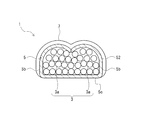
- FIG. 2 is a longitudinal sectional view taken along line AA in FIG.
- the anticorrosive according to the present invention is a composition comprising a viscous substance (A) composed of a lubricating base oil and an amide compound, a specific phosphorus compound and a metal. (B) and azoles (C) are contained.
- any mineral oil, wax isomerized oil, or a mixture of two or more kinds used as a base oil for ordinary lubricating oils can be used.
- specific examples of mineral oils include, for example, a lubricating oil fraction obtained by subjecting crude oil to atmospheric distillation and vacuum distillation, solvent dewaxing, solvent extraction, hydrocracking, solvent dewaxing, catalytic dewaxing, hydrogen Oils such as paraffinic and naphthenic oils, normal paraffins, and the like that are purified by appropriately combining purification treatments such as chemical purification, sulfuric acid washing, and clay treatment can be used.
- wax isomerate oil natural wax such as petroleum slack wax obtained by dewaxing hydrocarbon oil or a mixture of carbon monoxide and hydrogen is contacted with a synthesis catalyst applicable at high temperature and high pressure, so-called Fischer Tropsch synthesis. Those prepared by hydroisomerizing a wax raw material such as synthetic wax produced by the method can be used.
- slack wax is used as a wax raw material, slack wax contains a large amount of sulfur and nitrogen, and these are not necessary for lubricating base oils. It is desirable to use a wax having a reduced content as a raw material.
- the synthetic oil is not particularly limited, but is a poly ⁇ -olefin such as 1-octene oligomer, 1-decene oligomer, ethylene-propylene oligomer or the hydride thereof, isobutene oligomer or the hydride thereof, isoparaffin, alkylbenzene, alkylnaphthalene, Diesters (ditridecyl glutarate, di-2-ethylhexyl adipate, diisodecyl adipate, ditridecyl adipate, di-2-ethylhexyl sebacate, etc.), polyol esters (trimethylolpropane caprylate, trimethylolpropane pelargonate, pentaerythritol-2) -Ethylhexanoate, pentaerythritol pelargonate, etc.), polyoxyalkylene glycol, dialkyl diphenyl
- the kinematic viscosity of the lubricating base oil is not particularly limited, but it is usually preferably in the range of 1 to 150 mm 2 / s at 100 ° C.
- the kinematic viscosity at 100 ° C. is more preferably in the range of 2 to 130 mm 2 / s because of excellent volatility and ease of handling during production.
- the kinematic viscosity is measured according to JIS K2283.
- the amide compound forms a network structure by hydrogen bonds in the lubricating base oil.
- viscosity is provided to lubricating base oil and it becomes a grease-like viscous substance. That is, by using it together with the lubricating base oil, a gel-like material is formed at room temperature. That is, the amide compound gels (semi-solidifies) a liquid lubricating base oil at room temperature.
- the viscous substance is held on the coated surface of the material to be coated at room temperature or under heating due to its viscosity.
- the amide compound is a compound having one or more amide groups (—NH—CO—), and a monoamide compound having one amide group or a bisamide compound having two amide groups can be preferably used.
- amide compound for example, compounds represented by the following general formulas (3) to (5) can be preferably used. These may be used individually by 1 type and may be used in combination of 2 or more type. (Chemical formula 3) R 21 —CO—NH—R 22 (3) (Chemical formula 4) R 23 —CO—NH—Y 31 —NH—CO—R 24 (4) (Chemical formula 5) R 25 —NH—CO—Y 32 —CO—NH—R 26 (5)
- R 21 to R 26 each independently represents a saturated or unsaturated chain hydrocarbon group having 5 to 25 carbon atoms, and R 22 may be hydrogen.
- Y 31 and Y 32 represent a divalent hydrocarbon group having 1 to 10 carbon atoms selected from the group consisting of an alkylene group having 1 to 10 carbon atoms, a phenylene group, or an alkylphenylene group having 7 to 10 carbon atoms.
- a part of hydrogen of the hydrocarbon group constituting R 21 to R 26 may be substituted with a hydroxyl group (—OH).
- amide compound represented by the general formula (3) examples include lauric acid amide, palmitic acid amide, stearic acid amide, behenic acid amide, hydroxy stearic acid amide, saturated fatty acid amides, oleic acid amides, Elca Examples include unsaturated fatty acid amides such as acid amides, stearyl stearic acid amides, oleyl oleic acid amides, oleyl stearic acid amides, stearyl oleic acid amides and the like, substituted amides with saturated or unsaturated long chain fatty acids and long chain amines, and the like.
- an amide compound in which R 21 is a saturated chain hydrocarbon group having 12 to 20 carbon atoms and R 22 is a hydrogen group in the general formula (3) R 21 and R 22 in the general formula (3)
- amide compound represented by the general formula (4) examples include ethylene bis stearic acid amide, ethylene bis isostearic acid amide, ethylene bis oleic acid amide, methylene bis lauric acid amide, hexamethylene bis oleic acid amide, Examples include hexamethylene bishydroxystearic acid amide and m-xylylene bisstearic acid amide.
- Compounds are preferred. More specifically, ethylene bis stearamide is preferable.
- amide compound represented by the general formula (5) examples include N, N′-distearyl sebacic acid amide.
- Amide in which at least one of R 25 and R 26 is a saturated chain hydrocarbon group having 12 to 20 carbon atoms in the general formula (5) such as an amide compound in which each is a saturated chain hydrocarbon group having 12 to 20 carbon atoms Compounds are preferred.
- the amide compound has a melting point of 20 ° C. or higher from the viewpoint of easily maintaining a gel (semi-solid) at room temperature when mixed with a lubricating base oil, and easily maintaining a gel (semi-solid) at normal temperature. It is preferable that More preferably, it is 50 degreeC or more, More preferably, it is 80 degreeC or more, Most preferably, it is 120 degreeC or more. Moreover, it is preferable that melting
- the molecular weight of the amide compound is preferably in the range of 100 to 1000. More preferably, it is in the range of 150 to 800.
- the content of the amide compound is a lubricating oil that is easy to maintain a gel (semi-solid) at room temperature when mixed with a lubricant base oil, and is easy to maintain a gel (semi-solid) at normal temperature. It is preferable that it is 1 mass part or more with respect to 100 mass parts of base oil. More preferably, it is 2 mass parts or more, More preferably, it is 5 mass parts or more. Moreover, it is preferable that it is 70 mass parts or less with respect to 100 mass parts of lubricating base oil. More preferably, it is 60 mass parts or less, More preferably, it is 50 mass parts or less.
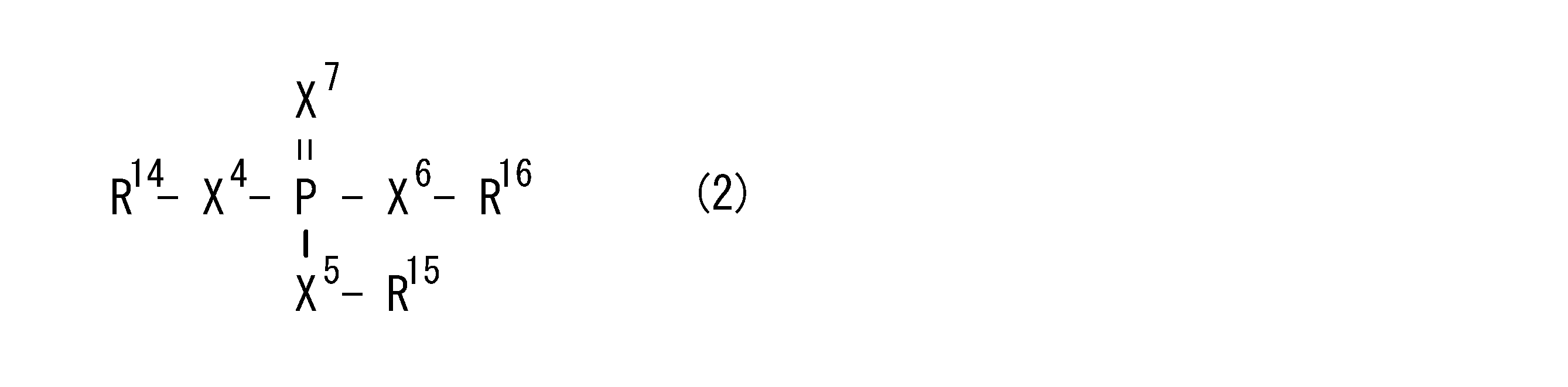
- the specific phosphorus compound is composed of one or more compounds represented by the following general formulas (1) and (2).
- X 1 to X 7 each independently represents an oxygen atom or a sulfur atom
- R 11 to R 13 each independently represents a hydrogen group or a hydrocarbon group having 1 to 30 carbon atoms, and of these, At least one is a hydrocarbon group having 1 to 30 carbon atoms
- R 14 to R 16 each independently represents a hydrogen group or a hydrocarbon group having 1 to 30 carbon atoms, and at least one of these is It is a hydrocarbon group having 1 to 30 carbon atoms.
- hydrocarbon group examples include an alkyl group, a cycloalkyl group, an alkyl-substituted cycloalkyl group, an alkenyl group, an aryl group, an alkyl-substituted aryl group, and an arylalkyl group.
- alkyl group methyl group, ethyl group, propyl group, butyl group, pentyl group, hexyl group, heptyl group, octyl group, nonyl group, decyl group, undecyl group, dodecyl group, tridecyl group, tetradecyl group, pentadecyl group , Hexadecyl group, heptadecyl group, octadecyl group and the like. These may be linear or branched.
- Examples of the cycloalkyl group include a cyclopentyl group, a cyclohexyl group, and a cycloheptyl group.
- Examples of the alkyl-substituted cycloalkyl group include methylcyclopentyl group, dimethylcyclopentyl group, methylethylcyclopentyl group, diethylcyclopentyl group, methylcyclohexyl group, dimethylcyclohexyl group, methylethylcyclohexyl group, diethylcyclohexyl group, methylcycloheptyl group, dimethylcyclohexyl group.
- Examples thereof include a butyl group, a methylethylcycloheptyl group, and a diethylcycloheptyl group.
- the substitution position of the alkyl-substituted cycloalkyl group is not particularly limited.
- the alkyl group may be linear or branched.
- Alkenyl groups include butenyl, pentenyl, hexenyl, heptenyl, octenyl, nonenyl, decenyl, undecenyl, dodecenyl, tridecenyl, tetradecenyl, pentadecenyl, hexadecenyl, heptadecenyl, octadecenyl Etc. These may be linear or branched.
- Examples of the aryl group include a phenyl group and a naphthyl group.
- Examples of the alkyl-substituted aryl group include tolyl group, xylyl group, ethylphenyl group, propylphenyl group, butylphenyl group, pentylphenyl group, hexylphenyl group, heptylphenyl group, octylphenyl group, nonylphenyl group, decylphenyl group, An undecylphenyl group, a dodecylphenyl group, etc. are mentioned.
- the substitution position of the alkyl-substituted aryl group is not particularly limited.
- the alkyl group may be linear or branched.
- Examples of the arylalkyl group include a benzyl group, a phenylethyl group, a phenylpropyl group, a phenylbutyl group, a phenylpentyl group, and a phenylhexyl group.
- the alkyl group may be linear or branched.
- X 1 to X 7 are preferably all oxygen atoms.
- the hydrocarbon group having 1 to 30 carbon atoms of R 11 to R 16 is preferably a hydrocarbon group having 4 to 30 carbon atoms, and more preferably a hydrocarbon group having 8 to 30 carbon atoms.
- X 1 to X 7 are preferably all oxygen atoms. It is preferable that at least one of R 11 to R 13 is a hydrogen group and at least one is a hydrocarbon group having 1 to 30 carbon atoms. In addition, it is preferable that at least one of R 14 to R 16 is a hydrogen group and at least one is a hydrocarbon group having 1 to 30 carbon atoms.
- Examples of the phosphorus compound represented by the general formula (1) include phosphorous acid, monothiophosphorous acid, dithiophosphorous acid, phosphorous acid monoester, monothiophosphorous acid monoester, dithiophosphorous acid monoester, phosphorous acid Acid diesters, monothiophosphite diesters, dithiophosphite diesters, phosphite triesters, monothiophosphite triesters, dithiophosphite triesters and the like. These may be used individually by 1 type as a phosphorus compound represented by General formula (1), and may be used in combination of 2 or more type.
- Examples of the phosphorus compound represented by the general formula (2) include phosphoric acid, monothiophosphoric acid, dithiophosphoric acid, phosphoric monoester, monothiophosphoric monoester, dithiophosphoric monoester, phosphoric diester, monothiophosphoric diester, dithiophosphoric diester, Examples thereof include phosphoric acid triesters, monothiophosphoric acid triesters, and dithiophosphoric acid triesters. These may be used individually by 1 type as a phosphorus compound represented by General formula (2), and may be used in combination of 2 or more type.
- the phosphorus compound represented by General formula (2) is more preferable from a viewpoint of being excellent in the following compatibility improvement effect, adhesive improvement effect, and adhesive improvement effect.
- an acidic phosphate ester represented by the following general formula (6) or the general formula (7) is particularly preferable.
- phosphate groups (P-O - group) is also ionically bound to the coated surface of the coated material, and viscous substances, specific phosphorus compound and a metal And a viscous film containing the composition, which contributes to tight adhesion to the coated surface.
- the composition of the metal phosphate base - to enhance the ionic binding of the (P-O groups) to promote ionic binding.
- the composition with a specific phosphorus compound and a metal is made sticky by using a composition with a metal.
- the acidity of a specific phosphorus compound is lowered (pH is increased), and corrosion due to the specific phosphorus compound on the surface of the metal to be applied is suppressed.
- the metal forming the composition with the specific phosphorus compound preferably has a valence of 2 or more from the viewpoint of heat resistance.
- Examples of the metal that forms a composition with a specific phosphorus compound include alkali metals such as Li, Na, and K, alkaline earth metals such as Mg and Ca, aluminum, titanium, and zinc. These may be used alone or in combination of two or more. These metal salts can obtain high adsorptivity to the metal surface. Further, for example, since the ionization tendency is higher than that of Sn, the ion binding property to Sn can be improved. Among these, Ca and Mg are more preferable from the viewpoint of water resistance.
- the composition of the specific phosphorus compound and the metal can be formed by mixing the specific phosphorus compound and the metal-containing compound (metal ion supply source).
- the metal-containing compound include metal hydroxides and metal carboxylates.
- the carboxylic acid of the metal salt of carboxylic acid include salicylic acid, benzoic acid, and phthalic acid.
- the metal salt of carboxylic acid is a neutral salt.
- basic salts obtained by heating excess metal, metal oxides, metal hydroxides in the presence of water, carbon dioxide, boric acid, boric acid
- An overbased salt obtained by reacting a metal, a metal oxide, or a metal hydroxide in the presence of a salt may also be used.
- the metal-containing compound (metal ion supply source) overbased salicylic acid and the like are preferable from the viewpoints of solubility during reaction, reactivity of metal ions, and the like.
- the composition of the specific phosphorus compound and the metal may be prepared by previously mixing the specific phosphorus compound and the metal-containing compound (metal ion supply source) into a composition, a lubricating base oil, A specific phosphorus compound and a metal-containing compound (metal ion source) may be mixed together with the amide compound to form a composition during mixing.
- a specific phosphorus compound and a metal-containing compound (metal ion source) are mixed together with a viscous substance composed of a lubricant base oil and an amide compound, which are separately prepared in advance, and mixed into the composition during mixing. You may use what you did.
- the specific phosphorus compound and metal composition is prepared by separately mixing a specific phosphorus compound and a metal-containing compound (metal ion source) in advance. It is preferable to use a composition.
- the hydrocarbon groups of the specific phosphorus compound when at least one of the hydrocarbon groups of the specific phosphorus compound is a hydrocarbon group having 4 to 30 carbon atoms, Contributes to compatibility.
- the hydrocarbon group is an organic group composed of carbon and hydrogen, and does not contain a hetero element such as N, O, or S.
- the hydrocarbon group of the specific phosphorus compound is preferably an aliphatic hydrocarbon group or an alicyclic hydrocarbon group because of compatibility with the lubricating base oil that is a long-chain alkyl compound. More preferably, it is an aliphatic hydrocarbon group.
- Examples of the aliphatic hydrocarbon group include an alkyl group composed of a saturated hydrocarbon and an alkenyl group composed of an unsaturated hydrocarbon, and any of these may be used.
- the alkyl group or alkenyl group which is an aliphatic hydrocarbon group may have a linear or branched structure.
- the alkyl group is a linear alkyl group such as n-butyl group or n-octyl group, the alkyl groups are easily oriented with each other, and the crystallinity of the composition of the specific phosphorus compound and metal is increased. The compatibility with the lubricating base oil tends to decrease.
- an alkenyl group has one or more carbon-carbon double bond structures, so that even if it is linear, the crystallinity is not so high. For this reason, the alkenyl group may be linear or branched.
- the specific phosphorus compound becomes inorganic.
- certain phosphorus compounds have a strong tendency to crystallize. If it does so, compatibility with lubricating base oil will be bad, and it will not mix with base oil.
- the hydrocarbon group has more than 30 carbon atoms, the viscosity of the specific phosphorus compound becomes too high, and the fluidity tends to decrease.
- the number of carbon atoms of the hydrocarbon group is more preferably 5 or more, still more preferably 6 or more, from the viewpoint of compatibility with the lubricating base oil.
- carbon number of a hydrocarbon group from viewpoints of fluidity
- composition of a specific phosphorus compound and metal has both a phosphate group (polar group) and a nonpolar group (hydrocarbon group at the ester site) in the molecule.
- a phosphate group polar group
- a nonpolar group hydrocarbon group at the ester site
- it can be brought into close contact with the metal surface by utilizing physical adsorption by van der Waals force when applied to the metal surface.
- This viscosity is assumed to be obtained by entanglement of chain molecular chains. Therefore, from this viewpoint, it is preferable to design in a direction that does not promote crystallization of a specific phosphorus compound.
- the hydrocarbon group has 4 to 30 carbon atoms
- the hydrocarbon group has one or more branched chain structures or one or more carbon-carbon double bond structures.
- the specific phosphorus compound needs to be a composition with a metal.
- the polarity of the phosphate group portion is small, the association property (cohesiveness) between the phosphate groups that are polar groups is low, and a highly viscous liquid do not become. For this reason, adhesiveness (viscosity) is low.
- the polarity of the phosphate group (amine salt) portion is small, the association property (cohesiveness) between the phosphate groups (amine salts) which are polar groups is low, and high Does not become a viscous liquid. For this reason, adhesiveness (viscosity) is low.
- hydrocarbon group oleyl group, stearyl group, isostearyl group, 2-ethylhexyl group, butyloctyl group, isomyristyl group, isocetyl group, hexyldecyl group, octyldecyl group, octyldecyl group, An isobehenyl group etc. are mentioned.
- Specific acid phosphates include butyl octyl acid phosphate, isomyristyl acid phosphate, isocetyl acid phosphate, hexyl decyl acid phosphate, isostearyl acid phosphate, isobehenyl acid phosphate, octyl decyl Acid Phosphate, Octyl Decyl Acid Phosphate, Isobutyl Acid Phosphate, 2-Ethyl Hexyl Acid Phosphate, Isodecyl Acid Phosphate, Lauryl Acid Phosphate, Tridecyl Acid Phosphate, Stearyl Acid Phosphate, Oleic Acid Phosphate, Myristyl Acid phosphate, palmityl acid phosphate, di-butyl octyl acid phosphate, di- Somyristyl acid phosphate, di-isocetyl acid phosphate, di-he
- the molecular weight of the composition of the specific phosphorus compound and metal is preferably 3000 or less because the compatibility with the viscous material is improved by fine dispersion. More preferably, it is 2500 or less. Moreover, it is preferable that it is 80 or more from viewpoints, such as separation suppression by high concentration of a polar group. More preferably, it is 100 or more.
- the molecular weight can be obtained by calculation. For the following IS-SA-Ca, the molecular weight (weight average molecular weight) is measured by GPC.
- the anticorrosive agent may partially contain a specific phosphorus compound itself that is not a composition with a metal.
- the anticorrosive agent if the proportion of the specific phosphorus compound itself increases, the ion binding property decreases, the adhesiveness (viscosity) decreases, the effect of suppressing corrosion decreases, etc. A smaller ratio is preferred.
- the pH of the present anticorrosive is preferably 4 or more. More preferably, it is 5.5 or more.
- the azoles (C) are hetero five-membered ring compounds containing one or more N.
- Examples of the compound contained in the azoles (C) include azole, diazole, triazole, tetrazole and the like. More specifically, for example, pyrrole, imidazole, pyrazole, 1,2,3-triazole, 1,2,4-triazole, tetrazole, isoindole, benzimidazole, indazole, 1H-benzotriazole, 2H-benzotriazole, Examples include imidazo [4,5-b] pyridine, indole, purine, pyrazolo [3,4-d] pyrimidine, triazolo [4,5-d] pyrimidine, benzothiazole, and derivatives thereof.
- azoles C
- C azoles
- 1- [N, N-bis (2-ethylhexyl) aminomethyl] benzotriazole 1- [N, N—, from the viewpoints of coordination with transition metals and solubility in oil Bis (2-ethylhexyl) aminomethyl] methylbenzotriazole is particularly preferred.
- the anticorrosive agent contains organic solvents, stabilizers, and corrosion inhibitors as long as the functions of the anticorrosive agent are not impaired. Agents, pigments, thickeners, fillers and the like can be added.
- the content of the azoles (C) is 0.5 to 20 parts by mass with respect to a total of 100 parts by mass of (A) and (B).
- the content of the azoles (C) is preferably based on 100 parts by mass of the total of (A) and (B) from the viewpoint of maintaining anticorrosion performance even when exposed to high temperatures. 1.0 to 15 parts by mass, more preferably 3.0 to 10 parts by mass.
- the anticorrosive agent preferably has a softening point of 150 ° C or lower.
- the softening point is more preferably 140 ° C. or lower, and further preferably the softening point is 130 ° C. or lower.
- the anticorrosive agent preferably has a softening point of 100 ° C. or higher from the viewpoint of maintaining anticorrosion performance even when exposed to high temperatures. More preferably, it is 110 degreeC or more, More preferably, it is 120 degreeC or more.
- the softening point of the anticorrosive can be adjusted by the type (melting point) of the amide compound in the viscous substance (A), the content of the viscous substance (A), the content of the amide compound, and the like.
- the present anticorrosive can be obtained by mixing the viscous substance (A), the composition (B), the azoles (C), and components added as necessary. It can also be obtained by mixing a lubricating base oil, an amide compound, a composition (B), an azole (C), and components added as necessary. Due to the viscosity of the viscous material, the viscous film is held on the coated surface after coating. If an amide compound having a higher melting point is used, the same consistency as that at room temperature is maintained at a high temperature below the melting point, and the viscous film is held on the coated surface.
- a composition of a specific phosphorus compound and a metal acts as a metal adsorbing component, and contributes to an improvement in adhesion of the viscous film on the metal surface. Therefore, (A) and (B) stably protect the metal surface even when exposed to high temperatures.
- the azoles (C) contribute to maintaining anticorrosion performance even when exposed to high temperatures.
- the anticorrosive agent can be coated on the surface of the material to be coated by applying the anticorrosive agent on the surface of the material to be coated or immersing the material to be coated in the anticorrosive agent.
- the film thickness of the viscous film to be applied to the surface of the material to be coated is preferably 100 ⁇ m or less from the viewpoint of preventing outflow from the coating site and preventing leakage. More preferably, it is 50 ⁇ m or less. On the other hand, from the viewpoint of the mechanical strength of the viscous film to be applied, the thickness is preferably not less than a predetermined thickness. Examples of the lower limit of the film thickness include 0.5 ⁇ m, 2 ⁇ m, and 5 ⁇ m.
- This anticorrosive can be used for lubrication and anticorrosion applications. As an anticorrosion use, it can be used, for example, as an anticorrosive for a coated electric wire with a terminal.
- the coated electric wire with a terminal includes a viscous substance composed of a lubricant base oil and an amide compound of the present anticorrosive agent and a specific phosphorus in which the terminal fitting is connected to the conductor terminal of the insulated electric wire. It consists of the electrical connection part of a terminal metal fitting and an electric wire conductor covered with the viscous film containing the composition of a compound and a metal. This prevents corrosion at the electrical connection.
- FIG. 1 is a perspective view of a covered electric wire with a terminal according to an embodiment of the present invention
- FIG. 2 is a longitudinal sectional view taken along line AA in FIG.
- the terminal-equipped covered electric wire 1 is configured such that the electric wire conductor 3 of the covered electric wire 2 in which the electric wire conductor 3 is covered with the insulating coating (insulator) 4 and the terminal fitting 5 are electrically connected by the electric connection portion 6. Connected.
- the terminal fitting 5 includes a tab-like connection portion 51 made of an elongated flat plate connected to a counterpart terminal, a wire barrel 52 extending at the end of the connection portion 51, and an electric wire fixing portion made of an insulation barrel 53. 54.
- the terminal fitting 5 can be formed (processed) into a predetermined shape by pressing a metal plate.
- the insulation coating 4 at the end of the covered electric wire 2 is peeled off to expose the electric wire conductor 3, and the exposed electric wire conductor 3 is pressure-bonded to one side of the terminal fitting 5, thereby covering the electric wire 2. And the terminal fitting 5 are connected.
- the wire barrel 52 of the terminal fitting 5 is crimped from above the wire conductor 3 of the covered electric wire 2 so that the wire conductor 3 and the terminal fitting 5 are electrically connected. Further, the insulation barrel 53 of the terminal fitting 5 is crimped from above the insulating coating 4 of the covered electric wire 2.
- the range indicated by the alternate long and short dash line is covered with the viscous film 7 obtained from the present anticorrosive.
- the insulation coating 4 after the rear end of the portion exposed from the insulation coating 4 of the wire conductor 3 from the surface of the terminal fitting 5 ahead of the tip is covered with the viscous film 7. That is, the tip 2 a side of the covered electric wire 2 is covered with the viscous film 7 so as to slightly protrude from the tip of the wire conductor 3 to the connecting portion 51 side of the terminal fitting 5.
- the distal end 5 a side of the terminal fitting 5 is covered with the viscous film 7 so as to slightly protrude from the end of the insulation barrel 53 to the insulating coating 4 side of the covered electric wire 2.
- the side surface 5 b of the terminal fitting 5 is also covered with the viscous film 7.
- the back surface 5c of the terminal metal fitting 5 may not be covered with the viscous film 7, and may be covered.
- the peripheral end of the viscous film 7 includes a portion that contacts the surface of the terminal fitting 5, a portion that contacts the surface of the electric wire conductor 3, and a portion that contacts the surface of the insulating coating 4.
- the electrical connection portion 6 is covered with the viscous film 7 with a predetermined thickness.
- the exposed portion of the wire conductor 3 of the covered wire 2 is completely covered with the viscous film 7 and is not exposed to the outside. Therefore, the electrical connection 6 is completely covered by the viscous film 7. Since the viscous film 7 is excellent in adhesion to all of the electric wire conductor 3, the insulation coating 4, and the terminal fitting 5, moisture or the like enters the electric conductor 3 and the electrical connection portion 6 from the outside by the viscous film 7. Prevent the metal parts from corroding.
- the viscous film 7 and the electric wire conductor 3 are formed at the peripheral edge of the viscous film 7.
- the present anticorrosive forming the viscous film 7 is applied in a predetermined range.
- membrane 7 can use well-known means, such as a dripping method and the apply
- the viscous film 7 is formed in a predetermined range with a predetermined thickness.
- the thickness is preferably in the range of 0.01 to 0.1 mm. If the viscous film 7 becomes too thick, it becomes difficult to insert the terminal fitting 5 into the connector. If the viscous film 7 becomes too thin, the anticorrosion performance tends to be lowered.
- the wire conductor 3 of the covered electric wire 2 is made of a stranded wire formed by twisting a plurality of strands 3a.
- the stranded wire may be composed of one type of metal strand or may be composed of two or more types of metal strand.
- the twisted wire may contain the strand etc. which consist of organic fibers other than a metal strand. Note that “consisting of one type of metal strand” means that all the metal strands constituting the stranded wire are made of the same metal material, and “consisting of two or more types of metal strands” This means that the wire contains metal wires made of different metal materials.
- the stranded wire may include a reinforcing wire (tension member) for reinforcing the covered electric wire 2.
- Examples of the material of the metal wire constituting the wire conductor 3 include copper, a copper alloy, aluminum, an aluminum alloy, or a material obtained by applying various platings to these materials.
- Examples of the material of the metal strand as the reinforcing wire include copper alloy, titanium, tungsten, and stainless steel.
- Examples of the organic fiber as the reinforcing wire include Kevlar.
- Examples of the material for the insulating coating 4 include rubber, polyolefin, PVC, and thermoplastic elastomer. These may be used alone or in combination of two or more.
- Various additives may be appropriately added to the material of the insulating coating 4. Examples of the additive include a flame retardant, a filler, a colorant and the like.
- Examples of the material (base material) of the terminal fitting 5 include various commonly used copper alloys, copper, and the like. A part (for example, a contact) or the entire surface of the terminal fitting 5 may be plated with various metals such as tin, nickel, and gold.
- the terminal metal fitting is crimped and connected to the end of the wire conductor, but other known electrical connection methods such as welding may be used instead of the crimping connection.
- Amide compound ethylenebisstearylamide (melting point 150 ° C., molecular weight 592), Nippon Kasei's “Sripax E”
- the suspension was filtered, and methanol and produced water were distilled off under reduced pressure using a rotary evaporator.
- the product water was distilled off azeotropically by distilling off under reduced pressure in the same manner to obtain a target product which was a clear viscous product.
- the anticorrosive agent heated to 160 ° C. and applied in a liquid form so as to cover the copper terminal of the covered electric wire with terminal and the electrical connection portion of the aluminum electric wire, and then in a 120 ° C. constant temperature bath. Left for hours.
- a neutral salt spray test was performed at 35 ° C. (salt solution concentration: 50 g / L) in accordance with JIS C0024, and rust generation after 120 hours was evaluated. The case where the occurrence of rust was confirmed by visual inspection was indicated as “X”, and the case where the occurrence of rust was not confirmed was indicated as “ ⁇ ”.
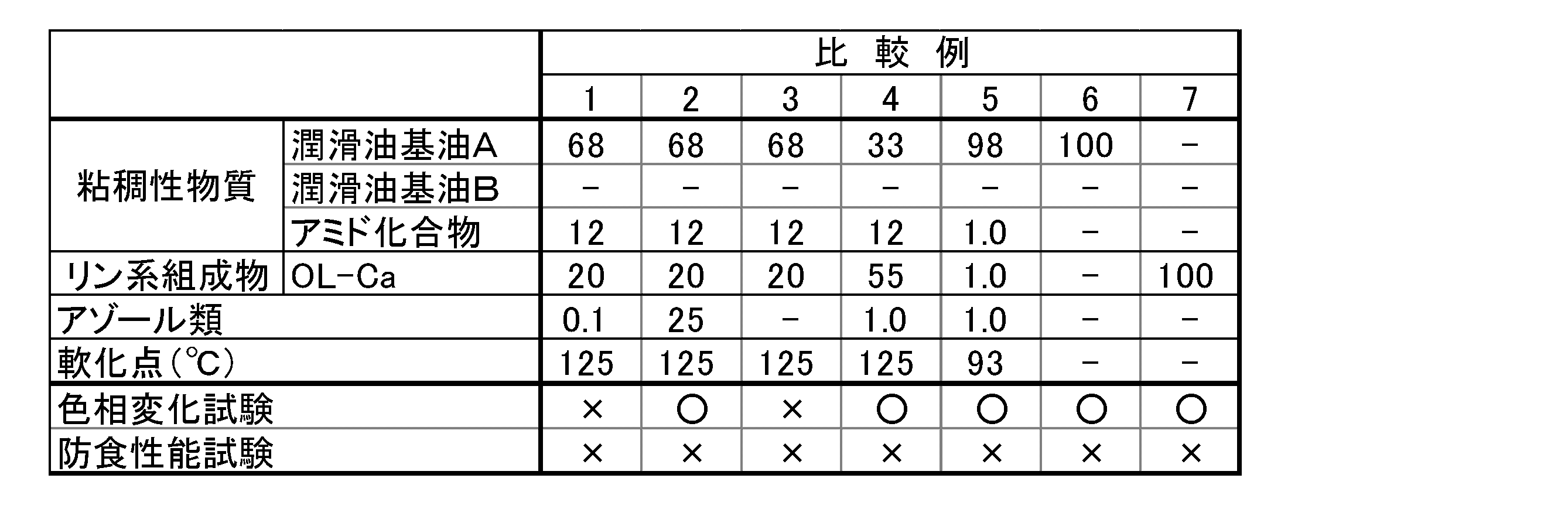
- Comparative Example 4 while there were few viscous substances, there were many compositions of a phosphorus compound and a metal, the thickness as a membrane
- Comparative Example 5 the composition of the phosphorus compound and the metal was small while the viscous substance was large, and the material could not be maintained at a high temperature, and the anticorrosion performance was not maintained when exposed to a high temperature.
- Comparative Example 6 since the anticorrosive agent is composed only of the lubricating base oil, it is not sticky and has poor adhesion to metal, and the material cannot be maintained at high temperatures, and is exposed to high temperatures. The anticorrosion performance of was not maintained.
- Comparative Example 7 since the anticorrosive was constituted only by the composition of the phosphorus compound and the metal, the thickness as the film could not be ensured, and the results satisfying the anticorrosion performance were not obtained.
Landscapes
- Chemical & Material Sciences (AREA)
- Organic Chemistry (AREA)
- Chemical Kinetics & Catalysis (AREA)
- General Chemical & Material Sciences (AREA)
- Oil, Petroleum & Natural Gas (AREA)
- Mechanical Engineering (AREA)
- Engineering & Computer Science (AREA)
- Materials Engineering (AREA)
- Metallurgy (AREA)
- Spectroscopy & Molecular Physics (AREA)
- Physics & Mathematics (AREA)
- Lubricants (AREA)
- Insulated Conductors (AREA)
- Paints Or Removers (AREA)
- Preventing Corrosion Or Incrustation Of Metals (AREA)
Abstract
Description

(化3)
R21-CO-NH-R22 (3)
(化4)
R23-CO-NH-Y31-NH-CO-R24 (4)
(化5)
R25-NH-CO-Y32-CO-NH-R26 (5)
ただし、R21~R26は、それぞれ個別に炭素数5~25の飽和または不飽和の鎖状炭化水素基を示し、R22は水素であってもよい、Y31およびY32は、炭素数1~10のアルキレン基、フェニレン基、または炭素数7~10のアルキルフェニレン基からなる群より選ばれる炭素数1~10の2価の炭化水素基を示す。
(化3)
R21-CO-NH-R22 (3)
(化4)
R23-CO-NH-Y31-NH-CO-R24 (4)
(化5)
R25-NH-CO-Y32-CO-NH-R26 (5)


(化8)
P(=O)(-OR14)(-OH)2 ・・・(6)
(化9)
P(=O)(-OR14)2(-OH) ・・・(7)
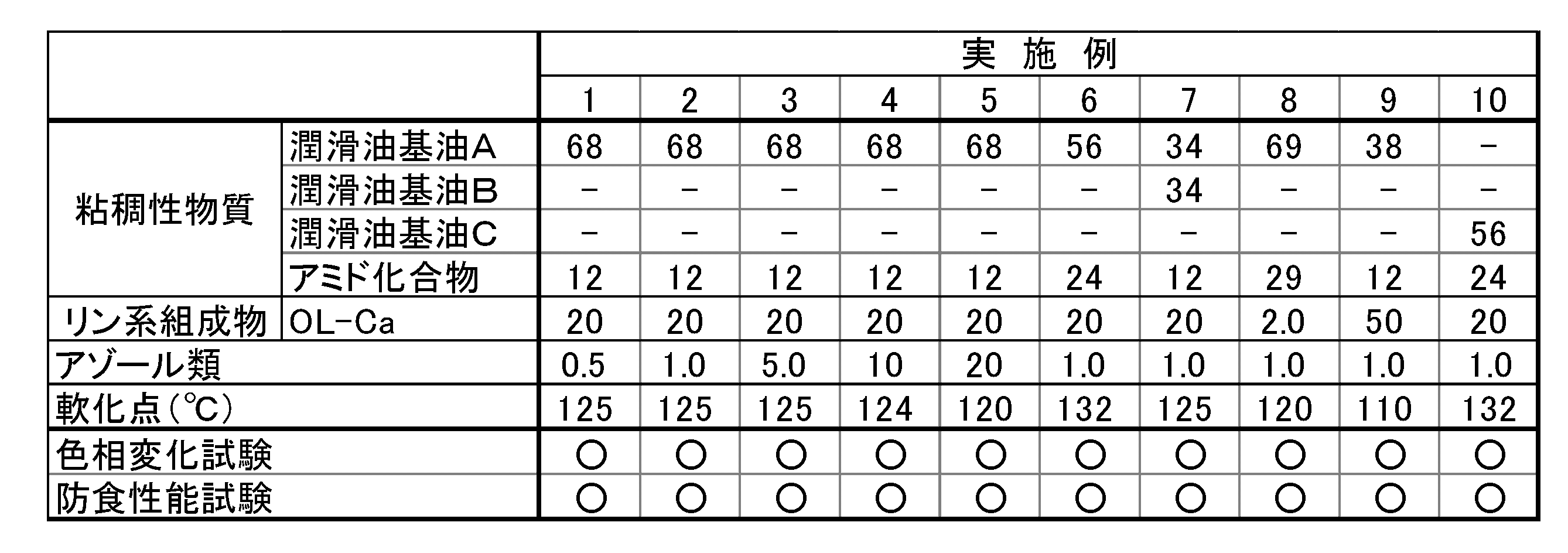
表1、2に示す配合組成(質量部)にて、潤滑油基油とアミド化合物を混合することにより、粘稠性物質を調製した。
・潤滑油基油A:鉱物系基油(動粘度=4.0mm2/s(100℃))
・潤滑油基油B:鉱物系基油(動粘度=11.1mm2/s(100℃))
・潤滑油基油C:合成油基油(動粘度=100.0mm2/s(100℃))
・アミド化合物:エチレンビスステアリルアミド(融点150℃、分子量592)、日本化成製「スリパックスE」
<調製例1> OL-Ca
500mlのフラスコにオレイルアシッドホスフェイト(SC有機化学社製「Phoslex A18D」、分子量467(平均)、酸価183mgKOH/g)を50g(酸価0.163mol)とメタノール50mLを加え、室温で撹拌し、均一溶液とした。そこに、水酸化カルシウム6.04g(0.0815mol)を加えた。懸濁液を室温のまま24時間攪拌し、水酸化カルシウムの沈殿物が無くなったことを確認後、ろ過し、ロータリーエバポレータにて、メタノールと生成水を減圧留去した。次いで、トルエン50mLを加えた後、同様に減圧留去する事で生成水を共沸によって留去し、澄明粘性物である目的物を得た。
調製例1により得られた、各リン化合物と金属との組成物と、粘稠性物質と、アゾール類(1,2,3-ベンゾトリアゾール、城北化学工業製「BT-120」)と、を所定の割合(質量部)で160℃の加温下にて混合することにより、防食剤を調製した。
DSCを用いて測定した(昇温速度10℃/分、空気中)。
160℃に加温して液状とした防食剤に銅板を浸漬し、銅板に防食剤を薄膜コーティングした。次いで、120℃の恒温槽で120時間放置した。試験後、塗布した防食剤に変色が見られた場合を「×」、変色が見られなかった場合を「○」とした。
160℃に加温して液状とした防食剤を、図1に示すように、端子付き被覆電線の銅製端子とアルミ電線の電気接続部を覆うように塗布した後、120℃の恒温槽で120時間放置した。次いで、JIS C0024に準拠して35℃(塩溶液濃度50g/L)にて中性塩水噴霧試験を行い、120時間後のさび発生を評価した。目視にてさび発生が確認された場合を「×」、さび発生が確認されなかった場合を「○」とした。
2 被覆電線
3 電線導体
4 絶縁被覆(絶縁体)
5 端子金具
6 電気接続部
7 粘稠性膜
Claims (8)
- 潤滑油基油およびアミド化合物から構成される粘稠性物質(A)、
下記の一般式(1)および(2)で表される化合物の1種または2種以上からなるリン化合物と金属との組成物(B)、
アゾール類(C)、を含有し、
前記(A)と前記(B)の質量比が、(A):(B)=50:50~98:2の範囲内であり、前記(C)の含有量が、前記(A)および(B)の合計100質量部に対し、0.5~20質量部であることを特徴とする防食剤。


- 軟化点が150℃以下であることを特徴とする請求項1に記載の防食剤。
- 前記アミド化合物は、下記の一般式(3)~(5)で表される化合物の1種または2種以上であることを特徴とする請求項1または2に記載の防食剤。
(化3)
R21-CO-NH-R22 (3)
(化4)
R23-CO-NH-Y31-NH-CO-R24 (4)
(化5)
R25-NH-CO-Y32-CO-NH-R26 (5)
ただし、R21~R26は、それぞれ個別に炭素数5~25の飽和または不飽和の鎖状炭化水素基を示し、R22は水素であってもよい、Y31およびY32は、炭素数1~10のアルキレン基、フェニレン基、または炭素数7~10のアルキルフェニレン基からなる群より選ばれる炭素数1~10の2価の炭化水素基を示す。 - 前記アミド化合物は、融点が20~200℃の範囲内にある脂肪酸アミドであることを特徴とする請求項1から3のいずれか1項に記載の防食剤。
- 前記リン化合物が、その炭素数1~30の炭化水素基の構造中に、1以上の分岐鎖構造または1以上の炭素-炭素二重結合構造を有することを特徴とする請求項1から4のいずれか1項に記載の防食剤。
- 前記リン化合物と組成物を形成する金属が、アルカリ金属、アルカリ土類金属、アルミニウム、チタン、亜鉛から選択される少なくとも1種であることを特徴とする請求項1から5のいずれか1項に記載の防食剤。
- 前記リン化合物と金属との組成物の分子量が、3000以下であることを特徴とする請求項1から6のいずれか1項に記載の防食剤。
- 請求項1から7のいずれか1項に記載の防食剤により端子金具と電線導体との電気接続部が覆われていることを特徴とする端子付き被覆電線。
Priority Applications (4)
| Application Number | Priority Date | Filing Date | Title |
|---|---|---|---|
| DE112016004379.1T DE112016004379T5 (de) | 2015-09-28 | 2016-09-14 | Antikorrosives Mittel und mit Anschlussklemme versehener elektrischer Draht |
| US15/763,708 US20190048283A1 (en) | 2015-09-28 | 2016-09-14 | Anticorrosive agent and terminal fitted electric wire |
| CN201680056100.3A CN108138333B (zh) | 2015-09-28 | 2016-09-14 | 防蚀剂以及带有端子的包覆电线 |
| JP2017543099A JP6527236B2 (ja) | 2015-09-28 | 2016-09-14 | 防食剤および端子付き被覆電線 |
Applications Claiming Priority (2)
| Application Number | Priority Date | Filing Date | Title |
|---|---|---|---|
| JP2015-189628 | 2015-09-28 | ||
| JP2015189628 | 2015-09-28 |
Publications (1)
| Publication Number | Publication Date |
|---|---|
| WO2017056979A1 true WO2017056979A1 (ja) | 2017-04-06 |
Family
ID=58424119
Family Applications (1)
| Application Number | Title | Priority Date | Filing Date |
|---|---|---|---|
| PCT/JP2016/077028 Ceased WO2017056979A1 (ja) | 2015-09-28 | 2016-09-14 | 防食剤および端子付き被覆電線 |
Country Status (5)
| Country | Link |
|---|---|
| US (1) | US20190048283A1 (ja) |
| JP (1) | JP6527236B2 (ja) |
| CN (1) | CN108138333B (ja) |
| DE (1) | DE112016004379T5 (ja) |
| WO (1) | WO2017056979A1 (ja) |
Cited By (1)
| Publication number | Priority date | Publication date | Assignee | Title |
|---|---|---|---|---|
| US11814734B2 (en) | 2019-05-13 | 2023-11-14 | Ecolab Usa Inc. | 1,2,4-triazolo[1,5-a] pyrimidine derivative as copper corrosion inhibitor |
Citations (4)
| Publication number | Priority date | Publication date | Assignee | Title |
|---|---|---|---|---|
| JP2009007504A (ja) * | 2007-06-29 | 2009-01-15 | Japan Energy Corp | 表面処理剤及びそれを用いた処理方法 |
| JP2010209447A (ja) * | 2009-03-12 | 2010-09-24 | Japan Energy Corp | 防食液組成物 |
| WO2015056554A1 (ja) * | 2013-10-17 | 2015-04-23 | 株式会社オートネットワーク技術研究所 | 電気接続構造 |
| WO2015146985A1 (ja) * | 2014-03-24 | 2015-10-01 | Jx日鉱日石エネルギー株式会社 | 表面保護剤組成物及びこれを用いた電気接続構造並びに電気接続構造の製造方法 |
Family Cites Families (13)
| Publication number | Priority date | Publication date | Assignee | Title |
|---|---|---|---|---|
| JPS4811408B1 (ja) | 1969-03-29 | 1973-04-13 | ||
| WO2007116642A1 (ja) * | 2006-03-24 | 2007-10-18 | Japan Energy Corporation | 伝動要素用半固体状潤滑剤組成物およびこれを備えた機械システム |
| JP5344833B2 (ja) * | 2008-03-21 | 2013-11-20 | Jx日鉱日石エネルギー株式会社 | 潤滑油用添加剤組成物 |
| US8247358B2 (en) * | 2008-10-03 | 2012-08-21 | Exxonmobil Research And Engineering Company | HVI-PAO bi-modal lubricant compositions |
| JP5481169B2 (ja) * | 2009-11-16 | 2014-04-23 | Jx日鉱日石エネルギー株式会社 | 極圧潤滑剤組成物 |
| JP5731170B2 (ja) * | 2010-11-19 | 2015-06-10 | Jx日鉱日石エネルギー株式会社 | アルミニウム系材料を備えた摺動部用潤滑油組成物及び潤滑方法 |
| WO2013037456A1 (de) * | 2011-09-15 | 2013-03-21 | Klüber Lubrication München Se & Co. Kg | Hochtemperaturfett |
| EP2809828A1 (en) * | 2012-01-31 | 2014-12-10 | Croda, Inc. | Corrosion inhibitors |
| US20150141305A1 (en) * | 2012-07-20 | 2015-05-21 | Jx Nippon Oil & Energy Corporation | Lubricating oil composition for continuously variable transmission |
| JP5938291B2 (ja) * | 2012-07-31 | 2016-06-22 | シャープ株式会社 | 加熱調理器 |
| JP5843406B2 (ja) * | 2014-02-19 | 2016-01-13 | 株式会社オートネットワーク技術研究所 | 金属表面コーティング用組成物およびこれを用いた端子付き被覆電線 |
| CN104449998A (zh) * | 2014-11-10 | 2015-03-25 | 安徽威萨重工机械有限公司 | 一种具有保护作用的封存用防锈脂及其制备方法 |
| JP6629350B2 (ja) * | 2016-01-07 | 2020-01-15 | 株式会社オートネットワーク技術研究所 | 防食剤および端子付き被覆電線 |
-
2016
- 2016-09-14 JP JP2017543099A patent/JP6527236B2/ja active Active
- 2016-09-14 DE DE112016004379.1T patent/DE112016004379T5/de active Pending
- 2016-09-14 CN CN201680056100.3A patent/CN108138333B/zh active Active
- 2016-09-14 US US15/763,708 patent/US20190048283A1/en not_active Abandoned
- 2016-09-14 WO PCT/JP2016/077028 patent/WO2017056979A1/ja not_active Ceased
Patent Citations (4)
| Publication number | Priority date | Publication date | Assignee | Title |
|---|---|---|---|---|
| JP2009007504A (ja) * | 2007-06-29 | 2009-01-15 | Japan Energy Corp | 表面処理剤及びそれを用いた処理方法 |
| JP2010209447A (ja) * | 2009-03-12 | 2010-09-24 | Japan Energy Corp | 防食液組成物 |
| WO2015056554A1 (ja) * | 2013-10-17 | 2015-04-23 | 株式会社オートネットワーク技術研究所 | 電気接続構造 |
| WO2015146985A1 (ja) * | 2014-03-24 | 2015-10-01 | Jx日鉱日石エネルギー株式会社 | 表面保護剤組成物及びこれを用いた電気接続構造並びに電気接続構造の製造方法 |
Cited By (1)
| Publication number | Priority date | Publication date | Assignee | Title |
|---|---|---|---|---|
| US11814734B2 (en) | 2019-05-13 | 2023-11-14 | Ecolab Usa Inc. | 1,2,4-triazolo[1,5-a] pyrimidine derivative as copper corrosion inhibitor |
Also Published As
| Publication number | Publication date |
|---|---|
| CN108138333A (zh) | 2018-06-08 |
| CN108138333B (zh) | 2020-11-20 |
| US20190048283A1 (en) | 2019-02-14 |
| DE112016004379T5 (de) | 2018-06-07 |
| JP6527236B2 (ja) | 2019-06-05 |
| JPWO2017056979A1 (ja) | 2018-08-30 |
Similar Documents
| Publication | Publication Date | Title |
|---|---|---|
| JP6446383B2 (ja) | 表面保護剤組成物および端子付き被覆電線 | |
| CN107636098B (zh) | 金属表面涂覆用组合物和带端子的包覆电线 | |
| JP6684659B2 (ja) | 金属表面コーティング用組成物および端子付き被覆電線 | |
| JP6629350B2 (ja) | 防食剤および端子付き被覆電線 | |
| JP6902595B2 (ja) | 防食剤および端子付き被覆電線 | |
| JP6527236B2 (ja) | 防食剤および端子付き被覆電線 | |
| JP6657377B2 (ja) | 表面保護剤組成物および端子付き被覆電線 | |
| US11306250B2 (en) | Surface protection composition and terminal fitted electric wire | |
| WO2016199568A1 (ja) | 液状組成物および端子付き被覆電線 |
Legal Events
| Date | Code | Title | Description |
|---|---|---|---|
| 121 | Ep: the epo has been informed by wipo that ep was designated in this application |
Ref document number: 16851153 Country of ref document: EP Kind code of ref document: A1 |
|
| ENP | Entry into the national phase |
Ref document number: 2017543099 Country of ref document: JP Kind code of ref document: A |
|
| WWE | Wipo information: entry into national phase |
Ref document number: 112016004379 Country of ref document: DE |
|
| 122 | Ep: pct application non-entry in european phase |
Ref document number: 16851153 Country of ref document: EP Kind code of ref document: A1 |