WO2017043533A1 - ブロモアルキルアダマンタンの製造方法 - Google Patents
ブロモアルキルアダマンタンの製造方法 Download PDFInfo
- Publication number
- WO2017043533A1 WO2017043533A1 PCT/JP2016/076311 JP2016076311W WO2017043533A1 WO 2017043533 A1 WO2017043533 A1 WO 2017043533A1 JP 2016076311 W JP2016076311 W JP 2016076311W WO 2017043533 A1 WO2017043533 A1 WO 2017043533A1
- Authority
- WO
- WIPO (PCT)
- Prior art keywords
- alkyladamantane
- bromoalkyladamantane
- amount
- producing
- bromine
- Prior art date
- Legal status (The legal status is an assumption and is not a legal conclusion. Google has not performed a legal analysis and makes no representation as to the accuracy of the status listed.)
- Ceased
Links
Classifications
-
- C—CHEMISTRY; METALLURGY
- C07—ORGANIC CHEMISTRY
- C07C—ACYCLIC OR CARBOCYCLIC COMPOUNDS
- C07C17/00—Preparation of halogenated hydrocarbons
- C07C17/093—Preparation of halogenated hydrocarbons by replacement by halogens
- C07C17/10—Preparation of halogenated hydrocarbons by replacement by halogens of hydrogen atoms
-
- C—CHEMISTRY; METALLURGY
- C07—ORGANIC CHEMISTRY
- C07C—ACYCLIC OR CARBOCYCLIC COMPOUNDS
- C07C23/00—Compounds containing at least one halogen atom bound to a ring other than a six-membered aromatic ring
- C07C23/18—Polycyclic halogenated hydrocarbons
- C07C23/20—Polycyclic halogenated hydrocarbons with condensed rings none of which is aromatic
- C07C23/38—Polycyclic halogenated hydrocarbons with condensed rings none of which is aromatic with three condensed rings
-
- C—CHEMISTRY; METALLURGY
- C07—ORGANIC CHEMISTRY
- C07B—GENERAL METHODS OF ORGANIC CHEMISTRY; APPARATUS THEREFOR
- C07B61/00—Other general methods
Definitions
- the present invention relates to a method for producing bromoalkyladamantane that is useful as a raw material for functional materials and electronic materials.
- An adamantane derivative is a compound that is expected to be applied to functional materials such as heat-resistant polymers and electronic materials such as resists for semiconductors because it has excellent heat resistance and high transparency.
- alkyladamantane derivatives are known to be highly useful in the above applications.
- the bridge head position of the adamantane skeleton is a highly reactive site. Bromoalkyladamantanes (especially monobromoalkyladamantanes and dibromoalkyladamantanes) in which bromine atoms are introduced at the bridgehead positions of alkyladamantanes synthesize various alkyladamantane derivatives. It is important as a raw material.
- Patent Document 1 discloses, in a halogenated hydrocarbon solvent such as methylene chloride, adamantane in the presence of anhydrous ferric chloride and / or anhydrous ferric bromide in a reaction time of 15 hours. Describes a process for producing 1,3-dibromoadamantane by reacting with bromine.
- Patent Document 2 in the presence of a Lewis acid such as boron tribromide and aluminum bromide, 2 to 4 times mole of bromine is reacted with 1 mole of 1,3-dimethyladamantane at a reaction temperature of 65 ° C. A process for preparing dibromo-5,7-dimethyladamantane is described.
- a Lewis acid such as boron tribromide and aluminum bromide
- Patent Document 3 describes a method for producing a dihalogenated adamantane by reacting 5 to 15 times moles of halosulfonic acid with respect to adamantane.
- Alkyladamantane isomers (hereinafter referred to as monobromo isomers) and dibromoalkyladamantane isomers (hereinafter referred to as dibromo isomers) were produced in large quantities (hereinafter referred to as “bromo” Also referred to as “isomers”). Moreover, since these isomers are isomers that differ only in the substitution position of the bromine atom with respect to the target product, their properties are close to those of the target product. Therefore, it is not easy to separate the target product and bromo isomers, and it is difficult to obtain the target product bromoalkyladamantane with high purity.
- the method for producing bromoalkyladamantane described in Patent Document 2 requires equipment for removing and recovering excess bromine and boron tribromide remaining after the reaction, which is not preferable in terms of production cost and operability.
- the method for producing a dihalogenated adamantane described in Patent Document 3 requires an excess of 5 to 15-fold moles of halosulfonic acid relative to adamantane, which is not preferable in terms of pot efficiency and waste disposal.
- the present invention is as follows, for example.
- a process for producing a bromoalkyladamantane comprising reacting an alkyladamantane with bromine, The reaction is performed under solvent-free conditions and in the presence of a Lewis acid catalyst, The alkyladamantane has a melting point of 50 ° C. or lower, A method in which the supply amount of alkyladamantane (a mole) and the supply amount of bromine (b mole) to the reactor satisfy the following conditions.
- the Lewis acid catalyst is at least one selected from iron halides and aluminum halides, and the amount of the Lewis acid catalyst used is in a range of 0.01 to 0.20 moles relative to the supply amount of the alkyladamantane.
- a process for producing bromoalkyladamantane comprising reacting alkyladamantane and monobromoalkyladamantane brominated at the bridgehead carbon atom of said alkyladamantane with bromine, The reaction is performed under solvent-free conditions and in the presence of a Lewis acid catalyst, The alkyladamantane has a melting point of 50 ° C. or lower, A method in which the supply amount of alkyladamantane (a mol), the supply amount of monobromoalkyladamantane (c mol), and the supply amount of bromine (b mol) to the reactor satisfy the following conditions.
- the Lewis acid catalyst is at least one selected from iron halide and aluminum halide, and the amount of the Lewis acid catalyst used is based on the total supply amount of the alkyladamantane and the supply amount of the monobromoalkyladamantane.
- [6] The process for producing bromoalkyladamantane according to any one of [1] to [4], wherein the alkyladamantane is a monoalkyladamantane.
- [7] The process for producing bromoalkyladamantane according to any one of [1] to [6], wherein the reaction temperature is in the range from the melting point of the alkyladamantane to 58 ° C.
- [7-1] The method for producing bromoalkyladamantane according to [7], wherein the alkyladamantane is 1,3-dimethyladamantane or 1-ethyladamantane, and the reaction temperature is 0 to 58 ° C.
- [8] The method according to any one of [3] to [7-1], further comprising separating monobromoalkyladamantane from the bromoalkyladamantane obtained in the reaction and recycling the monobromoalkyladamantane to the reactor.
- [8-1] The process for producing bromoalkyladamantane according to any one of [1] to [8], wherein the conversion rate of the alkyladamantane is 90 to 100%.
- a process for producing bromoalkyladamantane which comprises reacting an alkyladamantane having a melting point of 50 ° C. or lower with bromine under solvent-free conditions and in the presence of a Lewis acid catalyst, wherein the amount of alkyladamantane supplied to the reactor (a mol) ) And bromine supply (b mol) satisfy the following conditions. 1 ⁇ b / a ⁇ 2 [10]
- the Lewis acid catalyst is at least one selected from iron halides and aluminum halides, and the amount of the Lewis acid catalyst used is in the range of 0.01 to 0.20 mol per mol of the alkyladamantane supplied.
- [11] comprising reacting an alkyladamantane having a melting point of 50 ° C. or lower and a monobromoalkyladamantane brominated at the bridgehead carbon atom of the alkyladamantane with bromine under solvent-free conditions and in the presence of a Lewis acid catalyst
- a method for producing bromoalkyladamantane, wherein the supply amount of alkyladamantane (a mol), the supply amount of monobromoalkyladamantane (c mol), and the supply amount of bromine (b mol) to the reactor are as follows: How to meet.
- the Lewis acid catalyst is at least one selected from iron halide and aluminum halide, and the amount of the Lewis acid catalyst used is based on the total supply amount of the alkyladamantane and the supply amount of the monobromoalkyladamantane.
- a method for producing a bromoalkyladamantane useful as a raw material for functional materials and electronic materials which is a method for producing bromoisomers that cause impurities when synthesizing a desired bromoalkyladamantane.
- a method capable of reducing the production and obtaining bromoalkyladamantane in which the carbon atom at the bridgehead position is brominated in a high yield It is also possible to provide an industrially advantageous production method that does not use halogenated hydrocarbons that are highly burdened on the human body and the environment.
- the present embodiment a mode for carrying out the present invention (hereinafter simply referred to as “the present embodiment”) will be described in detail.
- the following embodiments are examples for explaining the present invention, and are not intended to limit the present invention to the following contents.
- the present invention can be implemented with appropriate modifications within the scope of the gist thereof.
- bromoalkyladamantane As described above, according to the method for producing bromoalkyladamantane of the present embodiment, by using alkyladamantane having a predetermined melting point and setting the supply ratio of bromine to alkyladamantane within a predetermined range, bromoisomerism that is an impurity is obtained. The desired bromoalkyladamantane can be efficiently produced while suppressing the amount of products produced.
- “bromoalkyladamantane” means alkyladamantane in which only the carbon atom at the bridge head position of the adamantane skeleton is brominated, and in particular, one or two of the carbon atoms at the bridge head position in the adamantane skeleton are brominated.
- bromo isomers means bromoalkyladamantanes in which one or more carbon atoms located other than the bridgehead position of the adamantane skeleton are brominated.
- dibromoalkyladamantanes in which one of the carbon atoms at the bridgehead position of the adamantane skeleton and one of the carbon atoms located at positions other than the bridgehead position are each brominated are classified as bromo isomers.
- the description that “the carbon atom at the bridge head position is brominated” means that only the carbon atom at the bridge head position is brominated, and is bonded to the carbon atom at the bridge head position. It means that a hydrogen atom is replaced with bromine.
- Monobromoalkyladamantane and dibromoalkyladamantane obtained by the method of the present embodiment are used, for example, as raw materials for synthesizing alkyladamantane derivatives that are useful as raw materials for functional materials and electronic materials.
- dibromoalkyladamantanes are useful. High nature. As described above, since it is not easy to separate dibromoalkyladamantane and bromo isomers by structural similarity, it is beneficial to obtain dibromoalkyladamantane with less impurities.
- the monobromoalkyladamantane produced together with the dibromoalkyladamantane in the method of the present embodiment is a liquid and acts as a solvent in the reaction. Therefore, since it is not necessary to use a harmful substance such as halogenated hydrocarbon as a solvent, the method of this embodiment is excellent in safety. Pre-existing monobromoalkyladamantane as a solvent in the reaction system is also preferable from the viewpoint of allowing the reaction to proceed smoothly.
- the monobromoalkyladamantane produced by the reaction or remaining without reacting can be reused as a solvent for the next reaction by separation. Further, in the method of this embodiment, the amount of bromine used is relatively small, and it is not necessary to post-treat excess bromine. Furthermore, there are few reaction processes, and it is not necessary to carry out the reaction under severe conditions such as high temperature and high pressure. Therefore, the method of the present embodiment is simple and excellent from an economical viewpoint.
- an alkyladamantan having a melting point of 50 ° C. or lower, an alkyladamantane having a melting point of 50 ° C. or lower, and a carbon atom at the bridge head position of the alkyladamantane in the presence of a Lewis acid catalyst are bromine It is a method for producing bromoalkyladamantane, characterized by reacting the converted monobromoalkyladamantane with bromine.
- the bromoalkyladamantane obtained by the production method of the present embodiment includes monobromoalkyladamantane in which one of the bridgehead carbon atoms of the adamantane skeleton is brominated, and dibromo in which two of the bridgehead carbon atoms are brominated.
- alkyladamantane having a melting point of 50 ° C. or lower used as a raw material in the present embodiment 1-ethyladamantane (melting point ⁇ 60 ° C.), 1-propyladamantane (melting point ⁇ 1 ° C.), 1-isopropyladamantane (melting point ⁇ 20 ° C.), And monoalkyladamantanes such as 1-butyladamantane (melting point ⁇ 12 ° C.) and dialkyladamantanes such as 1,3-dimethyladamantane (melting point ⁇ 29.96 ° C.).
- the amount of bromine used in the bromination reaction of alkyladamantane is such that the supply amount of alkyladamantane (a mol) to the reactor and the supply amount of bromine (b mol) are 1 ⁇ b /
- An amount satisfying the range of a ⁇ 1.75 is preferable, and an amount satisfying the range of 1.3 ⁇ b / a ⁇ 1.75 is more preferable.
- the supply amount of alkyladamantane (a mol), the supply amount of monobromoalkyladamantane (c mol), and the supply amount of bromine is such that b mol) satisfies a range of 1 ⁇ b / (a + c / 2) ⁇ 1.75, and a range of 1.2 ⁇ b / (a + c / 2) ⁇ 1.75.
- the amount of bromine it is more preferable to set the amount of bromine to satisfy the above condition, and it is particularly preferable to set the amount of bromine to satisfy the range of 1.3 ⁇ b / (a + c / 2) ⁇ 1.70.
- the amount of bromine used is less than the above range, unreacted alkyladamantane and monobromoalkyladamantane remain, and the reaction efficiency is poor.
- the amount is larger than the above range, a large amount of dibromoalkyladamantane is produced, and the amount of monobromoalkyladamantane acting as a solvent is reduced. For this reason, the reaction solution is solidified in the middle of the reaction, and it becomes difficult to produce it stably, such as being unable to stir.
- the bromination reaction of the alkyladamantane of this embodiment is preferably performed in the absence of a solvent.
- a halogenated hydrocarbon is used as a solvent as described in JP-A No. 2002-145809, the amount of by-products of bromo isomers increases significantly, and a large amount of monobromoalkyladamantane remains.
- Bromoalkyladamantanes need to be recovered and recycled.
- the recovery / recycling process can be omitted, but it is necessary to supply an excessive amount of bromine or to significantly increase the reaction time for the conversion, which increases raw material costs. And problems such as deterioration of productivity occur.
- iron halides such as iron (III) chloride anhydride and iron (III) bromide anhydride, or aluminum halides such as anhydrous aluminum chloride and anhydrous aluminum bromide are preferable.
- Iron (III) chloride anhydride and anhydrous aluminum chloride are more preferable.
- the amount (mol) of the Lewis acid catalyst used is preferably 0.01 to 0.20 times mol, more preferably 0.02 to mol with respect to the total amount (mol) of alkyladamantane and monobromoalkyladamantane.
- the amount is 0.10 times mol, particularly preferably 0.03 to 0.10 times mol. If the amount of catalyst used is 0.01 times mol or more of the total amount of alkyladamantane and monobromoalkyladamantane supplied, a sufficient reaction rate can be obtained, and unreacted alkyladamantane or monobromoalkyladamantane can be reduced. can do.
- the amount of the catalyst used is preferably 0.20 mol or less with respect to the total amount of alkyladamantane and monobromoalkyladamantane supplied, so that it is preferable to suppress the generation of surplus catalyst as waste. It is preferable to select the type and amount of the catalyst so that the conversion rate of the raw material alkyladamantane is large, preferably the conversion rate is 90 to 100%, more preferably 95 to 100%, particularly preferably. Is 98 to 100%.
- the conversion rate of alkyladamantane means the ratio (mol%) of the consumption to the charged amount of alkyladamantane.
- the reaction temperature in this embodiment is not particularly limited, and can be set in a wide range from the melting point of alkyladamantane to the boiling point of bromine. However, since the amount of by-products of bromo isomers increases as the temperature increases, the reaction temperature is preferably from the melting point of alkyladamantane to 58 ° C, more preferably from the melting point of alkyladamantane to 50 ° C. When the melting point of the alkyladamantane is 30 ° C.
- the reaction temperature is more preferably from the melting point of the alkyladamantane to 30 ° C., and when the melting point of the alkyladamantane is lower than 0 ° C, the reaction temperature is particularly preferably 0 to 30 ° C.
- the reaction temperature is preferably 0 to 58 ° C.
- the temperature is more preferably 20 to 55 ° C, further preferably 20 to 30 ° C, and particularly preferably 20 to 25 ° C.
- the temperature at which bromine is added can be arbitrarily selected, but it is usually the same as the above reaction temperature.
- the addition time is not particularly limited, but when adding bromine by dropping, the dropping is usually completed in 30 to 60 minutes. If the dropping speed is too high, the temperature will rise too much due to the reaction heat, or bromine dripped with the by-produced hydrogen bromide will come out of the system. On the other hand, if the dropping speed is too slow, the overall reaction time becomes long and it is not efficient.
- the reaction time in the present embodiment depends on the reaction temperature and the like, and thus cannot be determined in general, but usually about 1 to 5 hours is sufficient.
- the reaction method of the present embodiment is not particularly limited and can be performed under pressure, but it is most convenient to perform under normal pressure.
- Examples thereof include a semi-batch type reaction method in which a raw material alkyladamantane and a Lewis acid catalyst are charged into a reactor under normal pressure and bromine is added dropwise at a predetermined reaction temperature to carry out the reaction.
- the content of dibromoalkyladamantane in the product obtained by the reaction of the present embodiment is preferably at least 0.2 times by weight with respect to the total weight of alkyladamantane and monobromoalkyladamantane in the obtained product. 4.0 times or less, more preferably 0.7 times or more and 3.5 times or less, further preferably 1.0 times or more and 3.5 times or less, and particularly preferably 2.0 times or more and 3.5 times or less. Within the above range, the fluidity of the reaction product can be maintained even without a solvent, and bromoalkyladamantane can be produced stably.
- the method according to the present embodiment is excellent in that a desired bromoalkyladamantane can be efficiently produced while suppressing the amount of bromo isomers that are impurities.
- the ratio of bromo isomers to the desired bromoalkyladamantane in the product ⁇ ratio of monobromo isomer in product (mol%) + dibromo isomer in product (mol%) ⁇ / ⁇ Proportion of monobromoalkyladamantane in product (mol%) + proportion of dibromoalkyladamantane in product (mol%) ⁇ ⁇ 100 is preferably 20.0 or less (for example, 1.0 to 20. 0), more preferably 12.0 or less (for example, 1.0 to 12.0), even more preferably 8.0 or less (for example, 1.0 to 8.0), and particularly preferably 4.0 or less (for example, 1.0 to 4.0).
- the product obtained by the reaction of the present embodiment can be purified according to conventional methods such as crystallization, distillation, extraction, column chromatography and the like. Specifically, after adding pure water to the obtained reaction liquid, extraction with normal heptane is performed, neutralization, reduction of a small amount of residual bromine, and washing with water. Next, the normal heptane solvent is distilled off, crystals are precipitated with a poor solvent such as methanol, and solid-liquid separation is performed, whereby dibromoalkyladamantane in which the carbon atom at the target bridgehead position is brominated can be obtained.
- a poor solvent such as methanol
- Monobromoalkyladamantane brominated with one bridgehead carbon atom is recovered from the normal heptane phase or filtrate obtained during solid-liquid separation according to conventional methods such as distillation, extraction, and column chromatography. be able to.
- the recovered monobromoalkyl adamantane can be used again for the reaction as a raw material.
- Example 1 In a 100 ml three-necked flask equipped with a stirrer, a thermometer and a Dimroth condenser, 15.0 g (91.3 mmol) of 1,3-dimethyladamantane (1,3-DMA), anhydrous iron (III) chloride ( FeCl 3 ) 0.59 g (3.6 mmol) was charged and nitrogen substitution was performed. Thereafter, 25 g (156.4 mmol) of bromine was dropped from the dropping funnel while stirring. At this time, while the flask was cooled with a water bath, the internal temperature was adjusted to be kept at 20 to 25 ° C., and bromine was added dropwise over 30 to 60 minutes.
- the mixture was aged at 20 to 25 ° C. for 2 hours, added with water, and then extracted with normal heptane.
- the normal heptane phase obtained by decantation was neutralized, and a trace amount of residual bromine was reduced and washed with water.
- the conversion of 1,3-DMA was 99 mol%.
- the conversion rate of 1,3-DMA was calculated by the formula ⁇ consumption 1,3-DMA (mol) / charged 1,3-DMA (mol) ⁇ ⁇ 100.
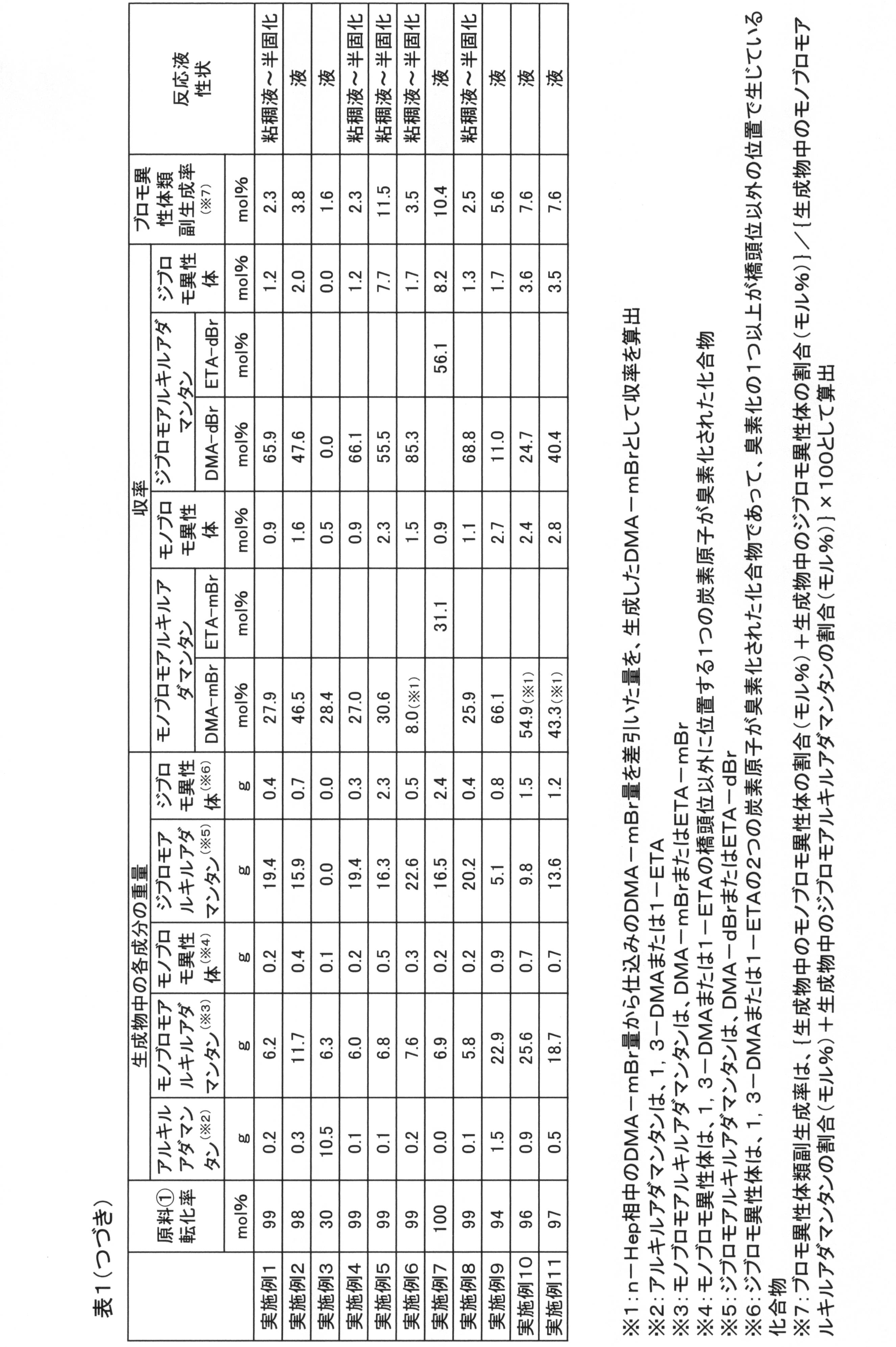
- the yield of 1-bromo-3,5-dimethyladamantane (DMA-mBr) based on 1,3-DMA was 27.9 mol%
- 1,3-dibromo-5,7-dimethyladamantane (DMA-dBr) The yield was 65.9 mol%
- the yield of monobromo isomer in which carbon atoms other than the bridgehead were brominated was 0.9 mol%
- the yield of dibromo isomer was 1.2 mol%.
- the reaction solution became viscous to semi-solid, but could be stirred.
- the yield of DMA-mBr was calculated by the formula [ ⁇ DMA-mBr (mol) in the product-charged DMA-mBr (mol) ⁇ / charged 1,3-DMA (mol)] x 100.
- the yield of other components was calculated by the formula ⁇ DMA-dBr (mol) in product / charged 1,3-DMA (mol) ⁇ ⁇ 100.
- the ETA-mBr yield and ETA-dBr yield in Example 7 and Comparative Example 5 below were also calculated in the same manner as the DMA-dBr yield.
- Example 2 The same as Example 1 except that the amount of 1,3-DMA was changed to 17.0 g (103.5 mmol) and the amount of iron (III) chloride anhydride was changed to 0.67 g (4.1 mmol). The operation was performed. The reaction solution was liquid and could be easily stirred. The results are shown in Table 1.
- Example 3 The same operation as in Example 1 was performed except that the amount of iron (III) chloride anhydride was changed to 0.30 g (1.8 mmol). The reaction solution was liquid and could be easily stirred. The results are shown in Table 1.
- Example 4 The same operation as in Example 1 was performed except that the amount of iron (III) chloride anhydride was changed to 1.48 g (9.1 mmol). The reaction solution became viscous to semi-solid, but could be stirred. The results are shown in Table 1.
- Example 5 The same operation as in Example 1 was performed except that the reaction temperature was changed to 50 to 55 ° C. The reaction solution became viscous to semi-solid, but could be stirred. The results are shown in Table 1.
- Example 6> a mixed raw material containing 13.5 g (82.2 mmol) of 1,3-DMA and 6.0 g (24.7 mmol) of DMA-mBr was used, and anhydrous iron (III) chloride was used. The same operation as in Example 1 was performed except that the amount of anhydride was changed to 0.59 g (3.6 mmol). The reaction solution became viscous to semi-solid, but could be stirred. The results are shown in Table 1.
- Example 7 The same operation as in Example 1 was performed, except that 1,3-DMA was changed to 1-ethyladamantane (1-ETA).
- the conversion rate of 1-ETA was 100%
- the yield of 1-bromo-3-ethyladamantane (ETA-mBr) based on 1-ETA was 31.1%
- the yield was 56.1%
- the yield of monobromo isomer in which carbon atoms other than the bridgehead were brominated was 0.9%
- the yield of dibromo isomer was 8.2%.
- the conversion rate and each yield were calculated in the same manner as in Example 1.
- the reaction solution was liquid and could be easily stirred. The results are shown in Table 1.
- Example 8 The same operation as in Example 1 was performed, except that the iron (III) chloride anhydride was changed to 0.48 g (3.6 mmol) of anhydrous aluminum chloride (AlCl 3 ). The reaction solution became viscous to semi-solid, but could be stirred. The results are shown in Table 1.
- Example 9 The same as Example 1 except that the amount of 1,3-DMA was changed to 23.4 g (142.4 mmol) and the amount of iron (III) chloride anhydride was changed to 0.94 g (5.8 mmol). The operation was performed. The reaction solution was liquid and could be easily stirred. The results are shown in Table 1.
- Example 10> a mixed raw material containing 20.3 g (123.7 mmol) of 1,3-DMA and 9.07 g (37.3 mmol) of DMA-mBr was used. The same operation as in Example 1 was performed except that the amount of the product was changed to 1.06 g (6.5 mmol). The reaction solution was liquid and could be easily stirred. The results are shown in Table 1.
- Example 11> instead of 1,3-DMA, a mixed raw material containing 17.2 g (104.6 mmol) of 1,3-DMA and 7.64 g (31.4 mmol) of DMA-mBr was used, and iron (III) chloride anhydrous The same operation as in Example 1 was performed except that the amount of the product was changed to 0.89 g (5.5 mmol). The reaction solution was liquid and could be easily stirred. The results are shown in Table 1.
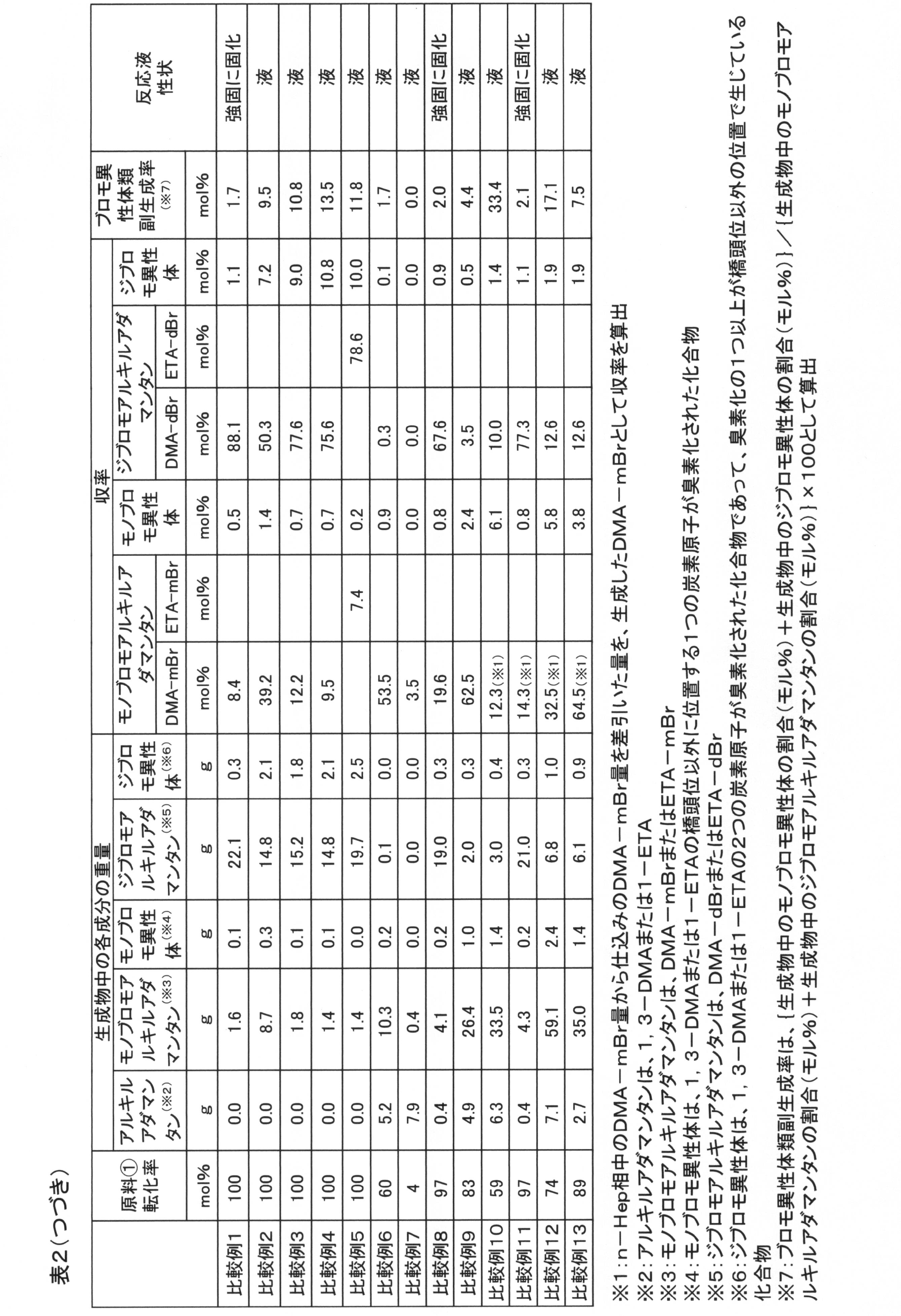
- Example 1 The same as Example 1 except that the amount of 1,3-DMA was changed to 12.8 g (77.9 mmol) and the amount of iron (III) chloride anhydride was changed to 0.51 g (3.1 mmol). The operation was performed. The reaction solution solidified solidly after about 1 hour from the end of dropping of bromine and became unable to stir. The results are shown in Table 2.
- the mixture was aged at 20 to 25 ° C. for 2 hours, and then water was added to neutralize the methylene chloride phase obtained by decantation, and a trace amount of residual bromine was reduced and washed with water.
- the methylene chloride phase was quantified by internal standard gas chromatography.
- the reaction solution was liquid and could be easily stirred. The results are shown in Table 2.
- the conversion rate of the raw material alkyladamantane can be improved and the production rate of bromo isomers can be reduced by the method according to the embodiment. Furthermore, even when compared with the case where a solvent is used (Comparative Examples 2 to 6), the conversion rate of alkyladamantane equal to or higher than that and the generation rate of bromo isomers equal to or lower than that are obtained. Therefore, according to the method according to the embodiment, the target bromoalkyladamantane can be efficiently obtained in a state with few impurities without using a substance harmful to the human body such as a halogenated hydrocarbon as a solvent. Further, since the amount of bromine added is relatively small, it is not necessary to recover excess bromine remaining after the reaction.
Landscapes
- Chemical & Material Sciences (AREA)
- Organic Chemistry (AREA)
- Organic Low-Molecular-Weight Compounds And Preparation Thereof (AREA)
- Low-Molecular Organic Synthesis Reactions Using Catalysts (AREA)
Abstract
一実施形態によると、アルキルアダマンタンを臭素と反応させることを含むブロモアルキルアダマンタンの製造方法であって、 前記反応は、無溶媒条件下およびルイス酸触媒の存在下で行われ、 前記アルキルアダマンタンは融点が50℃以下であり、 反応器へのアルキルアダマンタンの供給量(aモル)および臭素の供給量(bモル)が以下の条件を満たす方法が提供される。 1≦b/a≦1.75
Description
本発明は、機能性材料や電子材料の原料として有用なブロモアルキルアダマンタンの製造方法に関する。
アダマンタン誘導体は耐熱性に優れ透明性が高い特徴を有することから、耐熱性高分子等の機能性材料や半導体用レジスト等の電子材料に応用することが期待されている化合物である。中でも、アルキルアダマンタン誘導体は、上記用途において有用性が高いことが知られている。アダマンタン骨格の橋頭位は反応性が高い部位であり、アルキルアダマンタンの橋頭位に臭素原子が導入されたブロモアルキルアダマンタン(特に、モノブロモアルキルアダマンタンおよびジブロモアルキルアダマンタン)は、種々のアルキルアダマンタン誘導体を合成する原料として重要である。
アダマンタン類を臭素化する方法として、特許文献1に、塩化メチレンなどのハロゲン化炭化水素溶媒中において、無水塩化第二鉄および/または無水臭化第二鉄の存在下、反応時間15時間でアダマンタンに臭素を反応させて、1,3-ジブロモアダマンタンを製造する方法が記載されている。
特許文献2には、三臭化ホウ素および臭化アルミニウムなどのルイス酸存在下、反応温度65℃で1,3-ジメチルアダマンタン1モルに対し臭素2~4倍モルを反応させ、1,3-ジブロモ-5,7-ジメチルアダマンタンを製造する方法が記載されている。
更に、特許文献3には、アダマンタンに対して5~15倍モルのハロスルホン酸を反応させてジハロゲン化アダマンタンを製造する方法が記載されている。
特許文献1に記載されるジブロモアダマンタンの製造方法では、化学物質排出把握管理促進法などで規制されるハロゲン化炭化水素を溶媒として用いる必要があり、人体および環境への負荷の点で好ましくない。また、本発明者らの検討によれば、アダマンタンの代わりに1,3-ジメチルアダマンタンを当該製造方法で臭素化した場合、アダマンタン骨格における橋頭位以外の炭素原子で臭素化が進行した、モノブロモアルキルアダマンタン異性体(以下、モノブロモ異性体と称する)とジブロモアルキルアダマンタン異性体(以下、ジブロモ異性体と称する)が大量に生成した(以下、モノブロモ異性体とジブロモ異性体とを合わせて、「ブロモ異性体類」とも称する)。しかも、これら異性体は、目的生成物に対して臭素原子の置換位置のみが異なる異性体であるため、その性状は目的生成物と近似している。そのため、目的生成物とブロモ異性体類とを分離することは簡単ではなく、目的生成物であるブロモアルキルアダマンタンを高純度で得ることが難しい。
また、特許文献2に記載されるブロモアルキルアダマンタンの製造方法では、反応後に残存する過剰量の臭素および三臭化ホウ素を除去回収する設備が必要であり、製造コスト、操作性の点で好ましくない。
更に、特許文献3に記載されるジハロゲン化アダマンタンの製造方法では、アダマンタンに対して5~15倍モルの過剰のハロスルホン酸が必要であり、釜効率、廃棄物処理の点で好ましくない。
更に、特許文献3に記載されるジハロゲン化アダマンタンの製造方法では、アダマンタンに対して5~15倍モルの過剰のハロスルホン酸が必要であり、釜効率、廃棄物処理の点で好ましくない。
したがって、ブロモ異性体類の生成を低減させ、目的とする橋頭位の炭素原子が臭素化されたブロモアルキルアダマンタンを収率良く製造できる方法が求められている。また、過剰の臭素などを回収する工程および設備を必要とせず、人体および環境への負荷が高いハロゲン化炭化水素を溶媒として使用しない、工業的に有利な製造方法を開発することが求められている。
本発明者らは、上記課題を解決するために鋭意検討を重ねた結果、ブロモアルキルアダマンタンを工業的に有利に製造する方法を見出し、本発明に到達した。
本発明は、かかる知見に基づいて完成したものである。
本発明は、かかる知見に基づいて完成したものである。
すなわち、本発明は、例えば次のとおりである。
[1] アルキルアダマンタンを臭素と反応させることを含むブロモアルキルアダマンタンの製造方法であって、
前記反応は、無溶媒条件下およびルイス酸触媒の存在下で行われ、
前記アルキルアダマンタンは融点が50℃以下であり、
反応器へのアルキルアダマンタンの供給量(aモル)および臭素の供給量(bモル)が以下の条件を満たす方法。
1≦b/a≦1.75
[2] 前記ルイス酸触媒がハロゲン化鉄およびハロゲン化アルミニウムから選ばれる少なくとも一種であり、該ルイス酸触媒の使用量が前記アルキルアダマンタンの供給量に対し0.01~0.20倍モルの範囲である、[1]に記載のブロモアルキルアダマンタンの製造方法。
[3] アルキルアダマンタンおよび該アルキルアダマンタンの橋頭位の炭素原子が臭素化されたモノブロモアルキルアダマンタンを、臭素と反応させることを含むブロモアルキルアダマンタンの製造方法であって、
前記反応は、無溶媒条件下およびルイス酸触媒の存在下で行われ、
前記アルキルアダマンタンは、融点が50℃以下であり、
反応器へのアルキルアダマンタンの供給量(aモル)、モノブロモアルキルアダマンタンの供給量(cモル)、および臭素の供給量(bモル)が以下の条件を満たす方法。
1≦b/(a+c/2)≦1.75
[4] 前記ルイス酸触媒がハロゲン化鉄およびハロゲン化アルミニウムから選ばれる少なくとも一種であり、該ルイス酸触媒の使用量が前記アルキルアダマンタンの供給量と前記モノブロモアルキルアダマンタンの供給量の合計に対し0.01~0.20倍モルの範囲である、[3]に記載のブロモアルキルアダマンタンの製造方法。
[5] 前記アルキルアダマンタンがジアルキルアダマンタンである、[1]~[4]のいずれかに記載のブロモアルキルアダマンタンの製造方法。
[6] 前記アルキルアダマンタンがモノアルキルアダマンタンである、[1]~[4]のいずれかに記載のブロモアルキルアダマンタンの製造方法。
[7] 反応温度が前記アルキルアダマンタンの融点以上58℃以下の範囲である、[1]~[6]のいずれかに記載のブロモアルキルアダマンタンの製造方法。
[7-1] 前記アルキルアダマンタンが1,3-ジメチルアダマンタンまたは1-エチルアダマンタンであり、前記反応温度が0~58℃である、[7]に記載のブロモアルキルアダマンタンの製造方法。
[8] 前記反応で得られたブロモアルキルアダマンタンからモノブロモアルキルアダマンタンを分離し、該モノブロモアルキルアダマンタンを前記反応器に再循環することをさらに含む、[3]~[7-1]のいずれかに記載のブロモアルキルアダマンタンの製造方法。
[8-1] 前記アルキルアダマンタンの転化率が90~100%である、[1]~[8]のいずれかに記載のブロモアルキルアダマンタンの製造方法。
[8-2] 生成物中のジブロモアルキルアダマンタンの含有量が、生成物中のアルキルアダマンタンとモノブロモアルキルアダマンタンの合計重量に対し重量比で、0.2倍以上4.0倍以下である[1]~[8-1]のいずれかに記載のブロモアルキルアダマンタンの製造方法。
[8-3] 生成物中のブロモアルキルアダマンタンに対するブロモ異性体類の比{生成物中のモノブロモ異性体の割合(モル%)+生成物中のジブロモ異性体の割合(モル%)}/{生成物中のモノブロモアルキルアダマンタンの割合(モル%)+生成物中のジブロモアルキルアダマンタンの割合(モル%)}×100が20.0以下である、[1]~[8-2]のいずれかに記載のブロモアルキルアダマンタンの製造方法。
[1] アルキルアダマンタンを臭素と反応させることを含むブロモアルキルアダマンタンの製造方法であって、
前記反応は、無溶媒条件下およびルイス酸触媒の存在下で行われ、
前記アルキルアダマンタンは融点が50℃以下であり、
反応器へのアルキルアダマンタンの供給量(aモル)および臭素の供給量(bモル)が以下の条件を満たす方法。
1≦b/a≦1.75
[2] 前記ルイス酸触媒がハロゲン化鉄およびハロゲン化アルミニウムから選ばれる少なくとも一種であり、該ルイス酸触媒の使用量が前記アルキルアダマンタンの供給量に対し0.01~0.20倍モルの範囲である、[1]に記載のブロモアルキルアダマンタンの製造方法。
[3] アルキルアダマンタンおよび該アルキルアダマンタンの橋頭位の炭素原子が臭素化されたモノブロモアルキルアダマンタンを、臭素と反応させることを含むブロモアルキルアダマンタンの製造方法であって、
前記反応は、無溶媒条件下およびルイス酸触媒の存在下で行われ、
前記アルキルアダマンタンは、融点が50℃以下であり、
反応器へのアルキルアダマンタンの供給量(aモル)、モノブロモアルキルアダマンタンの供給量(cモル)、および臭素の供給量(bモル)が以下の条件を満たす方法。
1≦b/(a+c/2)≦1.75
[4] 前記ルイス酸触媒がハロゲン化鉄およびハロゲン化アルミニウムから選ばれる少なくとも一種であり、該ルイス酸触媒の使用量が前記アルキルアダマンタンの供給量と前記モノブロモアルキルアダマンタンの供給量の合計に対し0.01~0.20倍モルの範囲である、[3]に記載のブロモアルキルアダマンタンの製造方法。
[5] 前記アルキルアダマンタンがジアルキルアダマンタンである、[1]~[4]のいずれかに記載のブロモアルキルアダマンタンの製造方法。
[6] 前記アルキルアダマンタンがモノアルキルアダマンタンである、[1]~[4]のいずれかに記載のブロモアルキルアダマンタンの製造方法。
[7] 反応温度が前記アルキルアダマンタンの融点以上58℃以下の範囲である、[1]~[6]のいずれかに記載のブロモアルキルアダマンタンの製造方法。
[7-1] 前記アルキルアダマンタンが1,3-ジメチルアダマンタンまたは1-エチルアダマンタンであり、前記反応温度が0~58℃である、[7]に記載のブロモアルキルアダマンタンの製造方法。
[8] 前記反応で得られたブロモアルキルアダマンタンからモノブロモアルキルアダマンタンを分離し、該モノブロモアルキルアダマンタンを前記反応器に再循環することをさらに含む、[3]~[7-1]のいずれかに記載のブロモアルキルアダマンタンの製造方法。
[8-1] 前記アルキルアダマンタンの転化率が90~100%である、[1]~[8]のいずれかに記載のブロモアルキルアダマンタンの製造方法。
[8-2] 生成物中のジブロモアルキルアダマンタンの含有量が、生成物中のアルキルアダマンタンとモノブロモアルキルアダマンタンの合計重量に対し重量比で、0.2倍以上4.0倍以下である[1]~[8-1]のいずれかに記載のブロモアルキルアダマンタンの製造方法。
[8-3] 生成物中のブロモアルキルアダマンタンに対するブロモ異性体類の比{生成物中のモノブロモ異性体の割合(モル%)+生成物中のジブロモ異性体の割合(モル%)}/{生成物中のモノブロモアルキルアダマンタンの割合(モル%)+生成物中のジブロモアルキルアダマンタンの割合(モル%)}×100が20.0以下である、[1]~[8-2]のいずれかに記載のブロモアルキルアダマンタンの製造方法。
[9] 無溶媒条件下およびルイス酸触媒の存在下で、融点50℃以下のアルキルアダマンタンを臭素と反応させるブロモアルキルアダマンタンの製造方法であって、反応器へのアルキルアダマンタンの供給量(aモル)および臭素の供給量(bモル)が、以下の条件を満たす方法。
1≦b/a<2
[10] 前記ルイス酸触媒がハロゲン化鉄およびハロゲン化アルミニウムから選ばれる少なくとも一種であり、該ルイス酸触媒の使用量が前記アルキルアダマンタンの供給量に対し0.01~0.20倍モルの範囲である、[9]に記載のブロモアルキルアダマンタンの製造方法。
[11] 無溶媒条件下およびルイス酸触媒の存在下、融点50℃以下のアルキルアダマンタンおよび該アルキルアダマンタンの橋頭位の炭素原子が臭素化されたモノブロモアルキルアダマンタンを、臭素と反応させることを含むブロモアルキルアダマンタンの製造方法であって、反応器へのアルキルアダマンタンの供給量(aモル)、モノブロモアルキルアダマンタンの供給量(cモル)、および臭素の供給量(bモル)が、以下の条件を満たす方法。
0.5≦b/(a+c/2)<2
[12] 前記ルイス酸触媒がハロゲン化鉄およびハロゲン化アルミニウムから選ばれる少なくとも一種であり、該ルイス酸触媒の使用量が前記アルキルアダマンタンの供給量と前記モノブロモアルキルアダマンタンの供給量の合計に対し0.01~0.20倍モルの範囲である、[11]に記載のブロモアルキルアダマンタンの製造方法。
[13] 前記アルキルアダマンタンがジアルキルアダマンタンである、[9]~[12]のいずれかに記載のブロモアルキルアダマンタンの製造方法。
[14] 前記アルキルアダマンタンがモノアルキルアダマンタンである、[9]~[12]のいずれかに記載のブロモアルキルアダマンタンの製造方法。
[15] 反応温度が前記アルキルアダマンタンの融点以上58℃以下の範囲である、[9]~[14]のいずれかに記載のブロモアルキルアダマンタンの製造方法。
[16] 前記反応で得られたブロモアルキルアダマンタンからモノブロモアルキルアダマンタンを分離し、該モノブロモアルキルアダマンタンを前記反応器に再循環することをさらに含む、[11]~[15]のいずれかに記載のブロモアルキルアダマンタンの製造方法。
1≦b/a<2
[10] 前記ルイス酸触媒がハロゲン化鉄およびハロゲン化アルミニウムから選ばれる少なくとも一種であり、該ルイス酸触媒の使用量が前記アルキルアダマンタンの供給量に対し0.01~0.20倍モルの範囲である、[9]に記載のブロモアルキルアダマンタンの製造方法。
[11] 無溶媒条件下およびルイス酸触媒の存在下、融点50℃以下のアルキルアダマンタンおよび該アルキルアダマンタンの橋頭位の炭素原子が臭素化されたモノブロモアルキルアダマンタンを、臭素と反応させることを含むブロモアルキルアダマンタンの製造方法であって、反応器へのアルキルアダマンタンの供給量(aモル)、モノブロモアルキルアダマンタンの供給量(cモル)、および臭素の供給量(bモル)が、以下の条件を満たす方法。
0.5≦b/(a+c/2)<2
[12] 前記ルイス酸触媒がハロゲン化鉄およびハロゲン化アルミニウムから選ばれる少なくとも一種であり、該ルイス酸触媒の使用量が前記アルキルアダマンタンの供給量と前記モノブロモアルキルアダマンタンの供給量の合計に対し0.01~0.20倍モルの範囲である、[11]に記載のブロモアルキルアダマンタンの製造方法。
[13] 前記アルキルアダマンタンがジアルキルアダマンタンである、[9]~[12]のいずれかに記載のブロモアルキルアダマンタンの製造方法。
[14] 前記アルキルアダマンタンがモノアルキルアダマンタンである、[9]~[12]のいずれかに記載のブロモアルキルアダマンタンの製造方法。
[15] 反応温度が前記アルキルアダマンタンの融点以上58℃以下の範囲である、[9]~[14]のいずれかに記載のブロモアルキルアダマンタンの製造方法。
[16] 前記反応で得られたブロモアルキルアダマンタンからモノブロモアルキルアダマンタンを分離し、該モノブロモアルキルアダマンタンを前記反応器に再循環することをさらに含む、[11]~[15]のいずれかに記載のブロモアルキルアダマンタンの製造方法。
本発明の実施形態によると、機能性材料や電子材料の原料として有用なブロモアルキルアダマンタンの製造方法であって、所望するブロモアルキルアダマンタンを合成する際に不純物発生の原因になるブロモ異性体類の生成を低減させ、橋頭位の炭素原子が臭素化されたブロモアルキルアダマンタンを収率良く得ることができる方法が提供される。また、人体および環境への負荷が高いハロゲン化炭化水素を使用しない、工業的に有利な製造方法を提供することもできる。
以下、本発明を実施するための形態(以下、単に「本実施形態」という。)について詳細に説明する。以下の本実施形態は、本発明を説明するための例示であり、本発明を以下の内容に限定する趣旨ではない。本発明は、その要旨の範囲内で適宜に変形して実施できる。
上述したとおり、本実施形態のブロモアルキルアダマンタンの製造方法によると、所定の融点を有するアルキルアダマンタンを使用し、アルキルアダマンタンに対する臭素の供給量比を所定の範囲とすることで、不純物であるブロモ異性体類の生成量を抑えながら、所望のブロモアルキルアダマンタンを効率よく製造することができる。ここで、「ブロモアルキルアダマンタン」とは、アダマンタン骨格の橋頭位の炭素原子のみが臭素化されているアルキルアダマンタンを意味し、特に、アダマンタン骨格の橋頭位の炭素原子の1つまたは2つが臭素化されているモノブロモアルキルアダマンタンおよびジブロモアルキルアダマンタンを意味する。一方、「ブロモ異性体類」とは、アダマンタン骨格の橋頭位以外に位置する炭素原子の1つ以上が臭素化されているブロモアルキルアダマンタンを意味する。したがって、例えば、アダマンタン骨格の橋頭位の炭素原子の1つと橋頭位以外に位置する炭素原子の1つがそれぞれ臭素化されているジブロモアルキルアダマンタンは、ブロモ異性体類に分類される。また、本明細書において、「橋頭位の炭素原子が臭素化された」という記載は、橋頭位の炭素原子のみが臭素化されていることを意味し、橋頭位の炭素原子に結合している水素原子が臭素で置換されることを意味する。
本実施形態の方法によって得られるモノブロモアルキルアダマンタンおよびジブロモアルキルアダマンタンは、例えば、機能性材料や電子材料の原料として有用なアルキルアダマンタン誘導体の合成原料として使用されるが、特に、ジブロモアルキルアダマンタンは有用性が高い。上述したとおり、構造の類似性によりジブロモアルキルアダマンタンとブロモ異性体類とを分離することは簡単ではないため、不純物の少ない状態でジブロモアルキルアダマンタンを得られることは有益である。
また、本実施形態の方法においてジブロモアルキルアダマンタンと共に生成するモノブロモアルキルアダマンタンは液体であり、反応における溶媒としても作用する。したがって、ハロゲン化炭化水素等の人体に有害な物質を溶媒として使用する必要がないため、本実施形態の方法は安全性にも優れる。溶媒としてのモノブロモアルキルアダマンタンを、予め反応系に存在させておくことも、反応をスムーズに進行させるという観点で好ましい。
反応により生成した、または反応せずに残存したモノブロモアルキルアダマンタンは、分離することにより、次の反応の溶媒として再利用することができる。また、本実施形態の方法では使用する臭素量が比較的少なく、過剰量の臭素を後処理する必要もない。さらに、反応工程も少なく、高温や高圧等の厳しい条件下で反応を行う必要もない。したがって、本実施形態の方法は、簡便であり、経済的な観点においても優れている。
以下、本実施形態の製造方法について、具体的に説明する。
本実施形態の製造方法は、無溶媒条件下およびルイス酸触媒の存在下で、融点50℃以下のアルキルアダマンタン、若しくは、融点50℃以下のアルキルアダマンタンおよび該アルキルアダマンタンの橋頭位の炭素原子が臭素化されたモノブロモアルキルアダマンタンを、臭素と反応させることを特徴とするブロモアルキルアダマンタンの製造方法である。
本実施形態の製造方法は、無溶媒条件下およびルイス酸触媒の存在下で、融点50℃以下のアルキルアダマンタン、若しくは、融点50℃以下のアルキルアダマンタンおよび該アルキルアダマンタンの橋頭位の炭素原子が臭素化されたモノブロモアルキルアダマンタンを、臭素と反応させることを特徴とするブロモアルキルアダマンタンの製造方法である。
本実施形態の製造方法で得られるブロモアルキルアダマンタンは、アダマンタン骨格の橋頭位の炭素原子の1個が臭素化されたモノブロモアルキルアダマンタン、および橋頭位の炭素原子の2個が臭素化されたジブロモアルキルアダマンタンであり、より好ましくは橋頭位の炭素原子の2個が臭素化されたジブロモアルキルアダマンタンである。
本実施形態で原料として使用する融点50℃以下のアルキルアダマンタンとして、1-エチルアダマンタン(融点-60℃)、1-プロピルアダマンタン(融点-1℃)、1-イソプロピルアダマンタン(融点-20℃)、1-ブチルアダマンタン(融点-12℃)などのモノアルキルアダマンタン、および1,3-ジメチルアダマンタン(融点-29.96℃)などのジアルキルアダマンタンが挙げられる。
本実施形態の製造方法においてアルキルアダマンタンの臭素化反応で用いる臭素の使用量は、反応器へのアルキルアダマンタンの供給量(aモル)、および臭素の供給量(bモル)が、1≦b/a≦1.75の範囲を満たす量とするのが好ましく、1.3≦b/a≦1.75の範囲を満たす量とするのがより好ましい。また、アルキルアダマンタンとともにモノブロモアルキルアダマンタンを反応器に供給して反応を行う場合は、アルキルアダマンタンの供給量(aモル)、モノブロモアルキルアダマンタンの供給量(cモル)、および臭素の供給量(bモル)が、1≦b/(a+c/2)≦1.75の範囲を満たすような臭素使用量とするのが好ましく、1.2≦b/(a+c/2)≦1.75の範囲を満たすような臭素使用量とするのがより好ましく、1.3≦b/(a+c/2)≦1.70の範囲を満たすような臭素使用量とするのが特に好ましい。臭素使用量が前記範囲より少ないと、未反応のアルキルアダマンタンやモノブロモアルキルアダマンタンが残り、反応の効率が悪い。逆に前記範囲よりも多いと、ジブロモアルキルアダマンタンが多く生成し、溶媒として作用するモノブロモアルキルアダマンタンの生成量が少なくなる。そのため、反応液が反応途中で強固に固化し、撹拌ができないなど安定に製造することが難しくなる。
本実施形態のアルキルアダマンタンの臭素化反応は、無溶媒下で行うのが好ましい。特開2002-145809号公報に記載されるようにハロゲン化炭化水素を溶媒として使用した場合、ブロモ異性体類の副生成量が大幅に増加するとともに、モノブロモアルキルアダマンタンが多く残存するため、モノブロモアルキルアダマンタンを回収およびリサイクルする必要がある。モノブロモアルキルアダマンタンを全てジブロモアルキルアダマンタンへ変換することで、回収/リサイクル工程を省略できるが、変換には臭素を更に過剰量供給するか反応時間を大幅に長くする必要があり、原料コストの増大や生産性の悪化等の問題が生じる。
また、飽和炭化水素を溶媒として使用することも考えられるが、反応速度が遅く、ジブロモアルキルアダマンタンは痕跡程度しか生成しない。
また、飽和炭化水素を溶媒として使用することも考えられるが、反応速度が遅く、ジブロモアルキルアダマンタンは痕跡程度しか生成しない。
本実施形態のルイス酸触媒としては、塩化鉄(III)無水物、臭化鉄(III)無水物などのハロゲン化鉄、または、無水塩化アルミニウム、無水臭化アルミニウムなどのハロゲン化アルミニウムが好ましく、塩化鉄(III)無水物、無水塩化アルミニウムがより好ましい。
ルイス酸触媒の使用量(モル)は、アルキルアダマンタンの供給量とモノブロモアルキルアダマンタンの供給量の合計(モル)に対し好ましくは0.01~0.20倍モル、より好ましくは0.02~0.10倍モル、特に好ましくは0.03~0.10倍モルである。触媒使用量がアルキルアダマンタンの供給量とモノブロモアルキルアダマンタンの供給量の合計に対し0.01倍モル以上であれば十分な反応速度が得られ、未反応のアルキルアダマンタンまたはモノブロモアルキルアダマンタンを低減することができる。触媒使用量をアルキルアダマンタンの供給量とモノブロモアルキルアダマンタンの供給量の合計に対し0.20倍モル以下とすることで、廃棄物となる余剰の触媒の発生量を抑えられ好ましい。原料であるアルキルアダマンタンの転化率が大きくなるように触媒の種類および使用量を選択することが好ましく、好ましくは転化率が90~100%であり、より好ましくは95~100%であり、特に好ましくは98~100%である。ここで、アルキルアダマンタンの転化率とは、アルキルアダマンタンの仕込み量に対する消費量の割合(モル%)を意味する。
本実施形態の反応温度は特に限定されず、アルキルアダマンタンの融点~臭素の沸点まで広い範囲で設定可能である。しかし、高温であるほどブロモ異性体類の副生成量が増加するため、反応温度はアルキルアダマンタンの融点以上58℃以下が好ましく、アルキルアダマンタンの融点以上50℃以下がより好ましい。アルキルアダマンタンの融点が30℃以下の場合は、反応温度はアルキルアダマンタンの融点以上30℃以下が更に好ましく、アルキルアダマンタンの融点が0℃未満の場合は、反応温度は0~30℃が特に好ましい。
例えば、アルキルアダマンタンとして1,3-ジメチルアダマンタン(融点-29.96℃)または1-エチルアダマンタン(融点-60℃)を使用する場合には、反応温度は0~58℃であることが好ましく、20~55℃であることがより好ましく、20~30℃であることがさらに好ましく、20~25℃であることが特に好ましい。
また、臭素を添加する際の温度も任意に選択しうるが、通常は上記反応温度と同じ温度で行う。添加時間も特に制限はないが、臭素添加を滴下により行う場合には、通常は30~60分で滴下を完了させる。滴下速度が速すぎると、反応熱により温度が上がり過ぎたり、副生成する臭化水素に同伴して滴下した臭素が系外へ出たりしてしまう。逆に滴下速度が遅すぎると、全体の反応時間が長くなり効率的でない。
本実施形態の反応時間は、反応温度などに左右されるため、一概に定めることができないが、通常1~5時間程度で充分である。
本実施形態の反応方法は特に限定されず、加圧下で行うことも可能であるが、常圧下で行うのが最も簡便である。常圧下で反応器中に原料のアルキルアダマンタンとルイス酸触媒を仕込み、所定の反応温度で臭素を滴下して反応を行う半回分式の反応方法などが例示される。
本実施形態の反応で得られる生成物中のジブロモアルキルアダマンタンの含有量は、得られた生成物中のアルキルアダマンタンとモノブロモアルキルアダマンタンの合計重量に対し重量比で、好ましくは0.2倍以上4.0倍以下、より好ましくは0.7倍以上3.5倍以下、さらに好ましくは1.0倍以上3.5倍以下、特に好ましくは2.0倍以上3.5倍以下である。上記範囲内であれば、無溶媒下でも反応生成物の流動性を維持することができ、安定してブロモアルキルアダマンタンを製造することができる。
本実施形態の方法は、上述したとおり、不純物であるブロモ異性体類の生成量を抑えながら、所望のブロモアルキルアダマンタンを効率よく製造することができる点において優れている。具体的には、生成物中の所望のブロモアルキルアダマンタンに対するブロモ異性体類の比{生成物中のモノブロモ異性体の割合(モル%)+生成物中のジブロモ異性体の割合(モル%)}/{生成物中のモノブロモアルキルアダマンタンの割合(モル%)+生成物中のジブロモアルキルアダマンタンの割合(モル%)}×100は、好ましくは20.0以下(例えば、1.0~20.0)、より好ましくは12.0以下(例えば、1.0~12.0)、さらに好ましくは8.0以下(例えば、1.0~8.0)、特に好ましくは4.0以下(例えば、1.0~4.0)である。
本実施形態の反応で得られた生成物は、晶析、蒸留、抽出、カラムクロマトグラフィーなどの常法に従い精製することができる。具体的には、得られた反応液に純水を添加した後、ノルマルヘプタンで抽出し、中和、微量の残存臭素の還元、および水洗を行う。次いでノルマルヘプタン溶媒を留去させ、メタノールなどの貧溶媒で結晶を析出させ、固液分離することにより、目的とする橋頭位の炭素原子が臭素化されたジブロモアルキルアダマンタンを得ることができる。
また、橋頭位の炭素原子が1つ臭素化されたモノブロモアルキルアダマンタンは、ノルマルヘプタン相または固液分離の際に得られる濾過液から、蒸留、抽出、カラムクロマトグラフィーなどの常法に従い回収することができる。回収したモノブロモアルキルアダマンタンは、原料として再度反応に使用することができる。
以下に実施例を挙げて、本発明をさらに詳しく説明するが、本発明はこれらの実施例に限定されるものではない。
<実施例1>
撹拌機、温度計、ジムロート冷却管を備えた100mlの三つ口フラスコに1,3-ジメチルアダマンタン(1,3-DMA)15.0g(91.3ミリモル)、塩化鉄(III)無水物(FeCl3)0.59g(3.6ミリモル)を仕込み窒素置換を行った。その後、撹拌しながら、臭素25g(156.4ミリモル)を滴下ロートより滴下した。この際、フラスコを水浴で冷却しながら内温が20~25℃を保つよう調整し、臭素を30~60分かけて滴下した。滴下終了後、20~25℃で2時間熟成した後、水を加え、次いでノルマルヘプタンで抽出した。デカンテーションにより得られたノルマルヘプタン相を中和し、微量残存臭素の還元および水洗処理を行った。ノルマルヘプタン相を内部標準法ガスクロマトグラフィーにて定量したところ、1,3-DMAの転化率は99モル%であった。ここで、1,3-DMAの転化率は、式{消費1,3-DMA(モル)/仕込み1,3-DMA(モル)}×100によって算出した。
撹拌機、温度計、ジムロート冷却管を備えた100mlの三つ口フラスコに1,3-ジメチルアダマンタン(1,3-DMA)15.0g(91.3ミリモル)、塩化鉄(III)無水物(FeCl3)0.59g(3.6ミリモル)を仕込み窒素置換を行った。その後、撹拌しながら、臭素25g(156.4ミリモル)を滴下ロートより滴下した。この際、フラスコを水浴で冷却しながら内温が20~25℃を保つよう調整し、臭素を30~60分かけて滴下した。滴下終了後、20~25℃で2時間熟成した後、水を加え、次いでノルマルヘプタンで抽出した。デカンテーションにより得られたノルマルヘプタン相を中和し、微量残存臭素の還元および水洗処理を行った。ノルマルヘプタン相を内部標準法ガスクロマトグラフィーにて定量したところ、1,3-DMAの転化率は99モル%であった。ここで、1,3-DMAの転化率は、式{消費1,3-DMA(モル)/仕込み1,3-DMA(モル)}×100によって算出した。
また、1,3-DMA基準の1-ブロモ-3,5-ジメチルアダマンタン(DMA-mBr)収率は27.9モル%、1,3-ジブロモ-5,7-ジメチルアダマンタン(DMA-dBr)収率は65.9モル%、橋頭位以外の炭素原子が臭素化されたモノブロモ異性体収率は0.9モル%、ジブロモ異性体収率は1.2モル%であった。反応液は粘稠液~半固化となったが、撹拌可能であった。ここで、DMA-mBr収率は、式[{生成物中のDMA-mBr(モル)-仕込みDMA-mBr(モル)}/仕込み1,3-DMA(モル)]×100によって算出した。その他の成分の収率は、例えばDMA-dBr収率の場合、式{生成物中のDMA-dBr(モル)/仕込み1,3-DMA(モル)}×100によって算出した。以下の実施例7および比較例5におけるETA-mBr収率およびETA-dBr収率も、上記DMA-dBr収率と同様に算出した。
<実施例2>
1,3-DMAの量を17.0g(103.5ミリモル)に、塩化鉄(III)無水物の量を0.67g(4.1ミリモル)に変更した以外は、実施例1と同様な操作を行った。反応液は液状で容易に撹拌可能であった。その結果を表1に示す。
1,3-DMAの量を17.0g(103.5ミリモル)に、塩化鉄(III)無水物の量を0.67g(4.1ミリモル)に変更した以外は、実施例1と同様な操作を行った。反応液は液状で容易に撹拌可能であった。その結果を表1に示す。
<実施例3>
塩化鉄(III)無水物の量を0.30g(1.8ミリモル)に変更した以外は、実施例1と同様な操作を行った。反応液は液状で容易に撹拌可能であった。その結果を表1に示す。
塩化鉄(III)無水物の量を0.30g(1.8ミリモル)に変更した以外は、実施例1と同様な操作を行った。反応液は液状で容易に撹拌可能であった。その結果を表1に示す。
<実施例4>
塩化鉄(III)無水物の量を1.48g(9.1ミリモル)に変更した以外は、実施例1と同様な操作を行った。反応液は粘稠液~半固化となったが、撹拌可能であった。その結果を表1に示す。
塩化鉄(III)無水物の量を1.48g(9.1ミリモル)に変更した以外は、実施例1と同様な操作を行った。反応液は粘稠液~半固化となったが、撹拌可能であった。その結果を表1に示す。
<実施例5>
反応温度を50~55℃に変更した以外は、実施例1と同様な操作を行った。反応液は粘稠液~半固化となったが、撹拌可能であった。その結果を表1に示す。
反応温度を50~55℃に変更した以外は、実施例1と同様な操作を行った。反応液は粘稠液~半固化となったが、撹拌可能であった。その結果を表1に示す。
<実施例6>
1,3-DMAの代わりに、1,3-DMA 13.5g(82.2ミリモル)およびDMA-mBr 6.0g(24.7ミリモル)を含む混合原料を使用し、無水塩化鉄(III)無水物の量を0.59g(3.6ミリモル)とした以外は、実施例1と同様な操作を行った。反応液は粘稠液~半固化となったが、撹拌可能であった。その結果を表1に示す。
1,3-DMAの代わりに、1,3-DMA 13.5g(82.2ミリモル)およびDMA-mBr 6.0g(24.7ミリモル)を含む混合原料を使用し、無水塩化鉄(III)無水物の量を0.59g(3.6ミリモル)とした以外は、実施例1と同様な操作を行った。反応液は粘稠液~半固化となったが、撹拌可能であった。その結果を表1に示す。
<実施例7>
1,3-DMAを1-エチルアダマンタン(1-ETA)に変更した以外は、実施例1と同様な操作を行った。1-ETAの転化率は100%、1-ETA基準の1-ブロモ-3-エチルアダマンタン(ETA-mBr)収率は31.1%、1,3-ジブロモ-5-エチルアダマンタン(ETA-dBr)収率は56.1%、橋頭位以外の炭素原子が臭素化されたモノブロモ異性体収率は0.9%、ジブロモ異性体収率は8.2%であった。ここで、転化率および各収率は、実施例1と同様に算出した。反応液は液状で容易に撹拌可能であった。その結果を表1に示す。
1,3-DMAを1-エチルアダマンタン(1-ETA)に変更した以外は、実施例1と同様な操作を行った。1-ETAの転化率は100%、1-ETA基準の1-ブロモ-3-エチルアダマンタン(ETA-mBr)収率は31.1%、1,3-ジブロモ-5-エチルアダマンタン(ETA-dBr)収率は56.1%、橋頭位以外の炭素原子が臭素化されたモノブロモ異性体収率は0.9%、ジブロモ異性体収率は8.2%であった。ここで、転化率および各収率は、実施例1と同様に算出した。反応液は液状で容易に撹拌可能であった。その結果を表1に示す。
<実施例8>
塩化鉄(III)無水物を無水塩化アルミニウム(AlCl3)0.48g(3.6ミリモル)に変更した以外は、実施例1と同様な操作を行った。反応液は粘稠液~半固化となったが、撹拌可能であった。その結果を表1に示す。
塩化鉄(III)無水物を無水塩化アルミニウム(AlCl3)0.48g(3.6ミリモル)に変更した以外は、実施例1と同様な操作を行った。反応液は粘稠液~半固化となったが、撹拌可能であった。その結果を表1に示す。
<実施例9>
1,3-DMAの量を23.4g(142.4ミリモル)に、塩化鉄(III)無水物の量を0.94g(5.8ミリモル)に変更した以外は、実施例1と同様な操作を行った。反応液は液状で容易に撹拌可能であった。その結果を表1に示す。
1,3-DMAの量を23.4g(142.4ミリモル)に、塩化鉄(III)無水物の量を0.94g(5.8ミリモル)に変更した以外は、実施例1と同様な操作を行った。反応液は液状で容易に撹拌可能であった。その結果を表1に示す。
<実施例10>
1,3-DMAの代わりに、1,3-DMA 20.3g(123.7ミリモル)およびDMA-mBr 9.07g(37.3ミリモル)を含む混合原料を使用し、塩化鉄(III)無水物の量を1.06g(6.5ミリモル)に変更した以外は、実施例1と同様な操作を行った。反応液は液状で容易に撹拌可能であった。その結果を表1に示す。
1,3-DMAの代わりに、1,3-DMA 20.3g(123.7ミリモル)およびDMA-mBr 9.07g(37.3ミリモル)を含む混合原料を使用し、塩化鉄(III)無水物の量を1.06g(6.5ミリモル)に変更した以外は、実施例1と同様な操作を行った。反応液は液状で容易に撹拌可能であった。その結果を表1に示す。
<実施例11>
1,3-DMAの代わりに、1,3-DMA 17.2g(104.6ミリモル)およびDMA-mBr 7.64g(31.4ミリモル)を含む混合原料を使用し、塩化鉄(III)無水物の量を0.89g(5.5ミリモル)に変更した以外は、実施例1と同様な操作を行った。反応液は液状で容易に撹拌可能であった。その結果を表1に示す。

1,3-DMAの代わりに、1,3-DMA 17.2g(104.6ミリモル)およびDMA-mBr 7.64g(31.4ミリモル)を含む混合原料を使用し、塩化鉄(III)無水物の量を0.89g(5.5ミリモル)に変更した以外は、実施例1と同様な操作を行った。反応液は液状で容易に撹拌可能であった。その結果を表1に示す。
<比較例1>
1,3-DMAの量を12.8g(77.9ミリモル)に、塩化鉄(III)無水物の量を0.51g(3.1ミリモル)に変更した以外は、実施例1と同様な操作を行った。反応液は、臭素の滴下終了から1時間経過した辺りから強固に固化し撹拌不能となった。その結果を表2に示す。
1,3-DMAの量を12.8g(77.9ミリモル)に、塩化鉄(III)無水物の量を0.51g(3.1ミリモル)に変更した以外は、実施例1と同様な操作を行った。反応液は、臭素の滴下終了から1時間経過した辺りから強固に固化し撹拌不能となった。その結果を表2に示す。
<比較例2>
撹拌機、温度計、ジムロート冷却管を備えた100mlの三つ口フラスコに1,3-DMAを15.0g(91.3ミリモル)、塩化鉄(III)無水物を0.59g(3.6ミリモル)、塩化メチレン(CH2Cl2)を60.0g仕込み窒素置換を行った。その後、撹拌しながら、臭素25g(156.4ミリモル)を滴下ロートより滴下した。この際、フラスコを水浴で冷却しながら内温が20~25℃を保つよう調整し、臭素を30~60分かけて滴下した。滴下終了後、20~25℃で2時間熟成した後、水を加え、デカンテーションにより得られた塩化メチレン相を中和し、微量残存臭素の還元および水洗処理を行った。塩化メチレン相を内部標準法ガスクロマトグラフィーにて定量した。反応液は液状で容易に撹拌可能であった。その結果を表2に示す。
撹拌機、温度計、ジムロート冷却管を備えた100mlの三つ口フラスコに1,3-DMAを15.0g(91.3ミリモル)、塩化鉄(III)無水物を0.59g(3.6ミリモル)、塩化メチレン(CH2Cl2)を60.0g仕込み窒素置換を行った。その後、撹拌しながら、臭素25g(156.4ミリモル)を滴下ロートより滴下した。この際、フラスコを水浴で冷却しながら内温が20~25℃を保つよう調整し、臭素を30~60分かけて滴下した。滴下終了後、20~25℃で2時間熟成した後、水を加え、デカンテーションにより得られた塩化メチレン相を中和し、微量残存臭素の還元および水洗処理を行った。塩化メチレン相を内部標準法ガスクロマトグラフィーにて定量した。反応液は液状で容易に撹拌可能であった。その結果を表2に示す。
<比較例3>
1,3-DMAの量を10.0g(60.9ミリモル)に、塩化鉄(III)無水物の量を0.79g(4.9ミリモル)に、塩化メチレンの量を40.0gに、反応時間を5時間に変更した以外は、比較例2と同様な操作を行った。反応液は液状で容易に撹拌可能であった。その結果を表2に示す。
1,3-DMAの量を10.0g(60.9ミリモル)に、塩化鉄(III)無水物の量を0.79g(4.9ミリモル)に、塩化メチレンの量を40.0gに、反応時間を5時間に変更した以外は、比較例2と同様な操作を行った。反応液は液状で容易に撹拌可能であった。その結果を表2に示す。
<比較例4>
1,3-DMAの量を10.0g(60.9ミリモル)に、塩化鉄(III)無水物を無水塩化アルミニウム 0.16g(1.2ミリモル)に、塩化メチレンの量を40.0gに、反応時間を5時間に変更した以外は、比較例2と同様な操作を行った。反応液は液状で容易に撹拌可能であった。その結果を表2に示す。
1,3-DMAの量を10.0g(60.9ミリモル)に、塩化鉄(III)無水物を無水塩化アルミニウム 0.16g(1.2ミリモル)に、塩化メチレンの量を40.0gに、反応時間を5時間に変更した以外は、比較例2と同様な操作を行った。反応液は液状で容易に撹拌可能であった。その結果を表2に示す。
<比較例5>
1,3-DMAの代わりに1-ETA 12.8g(77.9ミリモル)を使用し、塩化鉄(III)無水物の量を0.51g(3.1ミリモル)に、塩化メチレンの量を51.2gに変更した以外は、比較例2と同様な操作を行った。反応液は液状で容易に撹拌可能であった。その結果を表2に示す。
1,3-DMAの代わりに1-ETA 12.8g(77.9ミリモル)を使用し、塩化鉄(III)無水物の量を0.51g(3.1ミリモル)に、塩化メチレンの量を51.2gに変更した以外は、比較例2と同様な操作を行った。反応液は液状で容易に撹拌可能であった。その結果を表2に示す。
<比較例6>
1,3-DMAの量を13.0g(79.1ミリモル)に、塩化鉄(III)無水物の量を1.02g(6.3ミリモル)に変更し、塩化メチレンの代わりにノルマルヘプタン(n-Hep)6.5gを使用した以外は、比較例2と同様な操作を行った。反応液は液状で容易に撹拌可能であった。その結果を表2に示す。
1,3-DMAの量を13.0g(79.1ミリモル)に、塩化鉄(III)無水物の量を1.02g(6.3ミリモル)に変更し、塩化メチレンの代わりにノルマルヘプタン(n-Hep)6.5gを使用した以外は、比較例2と同様な操作を行った。反応液は液状で容易に撹拌可能であった。その結果を表2に示す。
<比較例7>
撹拌機、温度計、ジムロート冷却管を備えた100mlの三つ口フラスコに1,3-ジメチルアダマンタン(1,3-DMA)8.3g(50.5ミリモル)を仕込んで窒素置換を行った。その後、三臭化ホウ素(BBr3)3.1g(12.4ミリモル)および臭化アルミニウム(AlBr3)2.5mg(0.01ミリモル)を加えた。臭素の滴下工程以降は、実施例1と同様な操作を行った。反応液は液状で容易に撹拌可能であった。その結果を表2に示す。
撹拌機、温度計、ジムロート冷却管を備えた100mlの三つ口フラスコに1,3-ジメチルアダマンタン(1,3-DMA)8.3g(50.5ミリモル)を仕込んで窒素置換を行った。その後、三臭化ホウ素(BBr3)3.1g(12.4ミリモル)および臭化アルミニウム(AlBr3)2.5mg(0.01ミリモル)を加えた。臭素の滴下工程以降は、実施例1と同様な操作を行った。反応液は液状で容易に撹拌可能であった。その結果を表2に示す。
<比較例8>
1,3-DMAの量を14.3g(87.2ミリモル)に、塩化鉄(III)無水物の量を0.55g(3.4ミリモル)に変更した以外は、実施例1と同様な操作を行った。反応液は、臭素の滴下終了から1時間経過した辺りから強固に固化し撹拌不能となった。その結果を表2に示す。
1,3-DMAの量を14.3g(87.2ミリモル)に、塩化鉄(III)無水物の量を0.55g(3.4ミリモル)に変更した以外は、実施例1と同様な操作を行った。反応液は、臭素の滴下終了から1時間経過した辺りから強固に固化し撹拌不能となった。その結果を表2に示す。
<比較例9>
1,3-DMAの量を28.5g(173.6ミリモル)に、塩化鉄(III)無水物の量を1.13g(7.0ミリモル)に変更した以外は、実施例1と同様な操作を行った。反応液は液状で容易に撹拌可能であった。その結果を表2に示す。
1,3-DMAの量を28.5g(173.6ミリモル)に、塩化鉄(III)無水物の量を1.13g(7.0ミリモル)に変更した以外は、実施例1と同様な操作を行った。反応液は液状で容易に撹拌可能であった。その結果を表2に示す。
<比較例10>
1,3-DMAの代わりに、1,3-DMA 15.4g(93.5ミリモル)およびDMA-mBr 30.7g(126.2ミリモル)を含む混合原料を使用し、塩化鉄(III)無水物の量を1.43g(8.8ミリモル)に、臭素の量を10.2g(64.0ミリモル)に変更した以外は、実施例1と同様な操作を行った。反応液は液状で容易に撹拌可能であった。その結果を表2に示す。
1,3-DMAの代わりに、1,3-DMA 15.4g(93.5ミリモル)およびDMA-mBr 30.7g(126.2ミリモル)を含む混合原料を使用し、塩化鉄(III)無水物の量を1.43g(8.8ミリモル)に、臭素の量を10.2g(64.0ミリモル)に変更した以外は、実施例1と同様な操作を行った。反応液は液状で容易に撹拌可能であった。その結果を表2に示す。
<比較例11>
1,3-DMAの代わりに、1,3-DMA 13.9g(84.5ミリモル)およびDMA-mBr 1.4g(5.7ミリモル)を含む混合原料を使用し、塩化鉄(III)無水物の量を0.60g(3.7ミリモル)に変更した以外は、実施例1と同様な操作を行った。臭素の滴下終了から1時間経過した辺りから強固に固化し撹拌不能となった。その結果を表2に示す。
1,3-DMAの代わりに、1,3-DMA 13.9g(84.5ミリモル)およびDMA-mBr 1.4g(5.7ミリモル)を含む混合原料を使用し、塩化鉄(III)無水物の量を0.60g(3.7ミリモル)に変更した以外は、実施例1と同様な操作を行った。臭素の滴下終了から1時間経過した辺りから強固に固化し撹拌不能となった。その結果を表2に示す。
<比較例12>
1,3-DMAの代わりに、1,3-DMA 27.4g(167.0ミリモル)およびDMA-mBr 45.9g(188.8ミリモル)を含む混合原料を使用し、塩化鉄(III)無水物の量を2.31g(14.2ミリモル)に、臭素の量を23.2g(145.0ミリモル)に変更した以外は、実施例1と同様な操作を行った。反応液は液状で容易に撹拌可能であった。その結果を表2に示す。
1,3-DMAの代わりに、1,3-DMA 27.4g(167.0ミリモル)およびDMA-mBr 45.9g(188.8ミリモル)を含む混合原料を使用し、塩化鉄(III)無水物の量を2.31g(14.2ミリモル)に、臭素の量を23.2g(145.0ミリモル)に変更した以外は、実施例1と同様な操作を行った。反応液は液状で容易に撹拌可能であった。その結果を表2に示す。
<比較例13>
1,3-DMAの代わりに、1,3-DMA 24.8(151.1ミリモル)およびDMA-mBr 11.3g(46.5ミリモル)を含む混合原料を使用し、塩化鉄(III)無水物の量を1.32g(8.1ミリモル)に変更した以外は、実施例1と同様な操作を行った。反応液は液状で容易に撹拌可能であった。その結果を表2に示す。

1,3-DMAの代わりに、1,3-DMA 24.8(151.1ミリモル)およびDMA-mBr 11.3g(46.5ミリモル)を含む混合原料を使用し、塩化鉄(III)無水物の量を1.32g(8.1ミリモル)に変更した以外は、実施例1と同様な操作を行った。反応液は液状で容易に撹拌可能であった。その結果を表2に示す。
上記結果より、実施形態に係る方法によると、原料であるアルキルアダマンタンの転化率を向上させることができ、また、ブロモ異性体類の生成率を低減できることが分かる。さらに、溶媒を使用した場合(比較例2~6)と比較しても、同等以上のアルキルアダマンタンの転化率および同等以下のブロモ異性体類の生成率が得られている。したがって、実施形態に係る方法によると、ハロゲン化炭化水素等の人体に有害な物質を溶媒として使用することなく、目的とするブロモアルキルアダマンタンを、不純物の少ない状態で、効率よく得ることができる。また、臭素の添加量が比較的少なくて済むため、反応後に残存する過剰の臭素を回収する必要もない。
Claims (8)
- アルキルアダマンタンを臭素と反応させることを含むブロモアルキルアダマンタンの製造方法であって、
前記反応は、無溶媒条件下およびルイス酸触媒の存在下で行われ、
前記アルキルアダマンタンは融点が50℃以下であり、
反応器へのアルキルアダマンタンの供給量(aモル)および臭素の供給量(bモル)が以下の条件を満たす方法。
1≦b/a≦1.75 - 前記ルイス酸触媒がハロゲン化鉄およびハロゲン化アルミニウムから選ばれる少なくとも一種であり、該ルイス酸触媒の使用量が前記アルキルアダマンタンの供給量に対し0.01~0.20倍モルの範囲である、請求項1に記載のブロモアルキルアダマンタンの製造方法。
- アルキルアダマンタンおよび該アルキルアダマンタンの橋頭位の炭素原子が臭素化されたモノブロモアルキルアダマンタンを、臭素と反応させることを含むブロモアルキルアダマンタンの製造方法であって、
前記反応は、無溶媒条件下およびルイス酸触媒の存在下で行われ、
前記アルキルアダマンタンは、融点が50℃以下であり、
反応器へのアルキルアダマンタンの供給量(aモル)、モノブロモアルキルアダマンタンの供給量(cモル)、および臭素の供給量(bモル)が以下の条件を満たす方法。
1≦b/(a+c/2)≦1.75 - 前記ルイス酸触媒がハロゲン化鉄およびハロゲン化アルミニウムから選ばれる少なくとも一種であり、該ルイス酸触媒の使用量が前記アルキルアダマンタンの供給量と前記モノブロモアルキルアダマンタンの供給量の合計に対し0.01~0.20倍モルの範囲である、請求項3に記載のブロモアルキルアダマンタンの製造方法。
- 前記アルキルアダマンタンがジアルキルアダマンタンである、請求項1~4のいずれか一項に記載のブロモアルキルアダマンタンの製造方法。
- 前記アルキルアダマンタンがモノアルキルアダマンタンである、請求項1~4のいずれか一項に記載のブロモアルキルアダマンタンの製造方法。
- 反応温度が前記アルキルアダマンタンの融点以上58℃以下の範囲である、請求項1~6のいずれか一項に記載のブロモアルキルアダマンタンの製造方法。
- 前記反応で得られたブロモアルキルアダマンタンからモノブロモアルキルアダマンタンを分離し、該モノブロモアルキルアダマンタンを前記反応器に再循環することをさらに含む、請求項3~7のいずれか一項に記載のブロモアルキルアダマンタンの製造方法。
Applications Claiming Priority (2)
| Application Number | Priority Date | Filing Date | Title |
|---|---|---|---|
| JP2015178297A JP2018172286A (ja) | 2015-09-10 | 2015-09-10 | ブロモアルキルアダマンタンの製造方法 |
| JP2015-178297 | 2015-09-10 |
Publications (1)
| Publication Number | Publication Date |
|---|---|
| WO2017043533A1 true WO2017043533A1 (ja) | 2017-03-16 |
Family
ID=58239762
Family Applications (1)
| Application Number | Title | Priority Date | Filing Date |
|---|---|---|---|
| PCT/JP2016/076311 Ceased WO2017043533A1 (ja) | 2015-09-10 | 2016-09-07 | ブロモアルキルアダマンタンの製造方法 |
Country Status (3)
| Country | Link |
|---|---|
| JP (1) | JP2018172286A (ja) |
| TW (1) | TW201722891A (ja) |
| WO (1) | WO2017043533A1 (ja) |
Cited By (2)
| Publication number | Priority date | Publication date | Assignee | Title |
|---|---|---|---|---|
| CN116715565A (zh) * | 2023-06-06 | 2023-09-08 | 东营坤宝新材料有限公司 | 一种1-溴代金刚烷的制备方法 |
| CN116730796A (zh) * | 2023-06-29 | 2023-09-12 | 东营坤宝新材料有限公司 | 一种1,3-二溴代金刚烷的制备方法 |
Families Citing this family (1)
| Publication number | Priority date | Publication date | Assignee | Title |
|---|---|---|---|---|
| JP7668180B2 (ja) | 2021-08-02 | 2025-04-24 | 東ソー・ファインケム株式会社 | 5-ブロモ-2-アダマンタノンの製造方法 |
Citations (2)
| Publication number | Priority date | Publication date | Assignee | Title |
|---|---|---|---|---|
| US4346112A (en) * | 1981-06-29 | 1982-08-24 | University Patents Inc. | Composition and method for treating patients having Parkinson's Disease |
| CN103420847A (zh) * | 2012-05-25 | 2013-12-04 | 杭州赛利药物研究所有限公司 | 一种盐酸美金刚原料的合成方法 |
-
2015
- 2015-09-10 JP JP2015178297A patent/JP2018172286A/ja active Pending
-
2016
- 2016-09-06 TW TW105128791A patent/TW201722891A/zh unknown
- 2016-09-07 WO PCT/JP2016/076311 patent/WO2017043533A1/ja not_active Ceased
Patent Citations (2)
| Publication number | Priority date | Publication date | Assignee | Title |
|---|---|---|---|---|
| US4346112A (en) * | 1981-06-29 | 1982-08-24 | University Patents Inc. | Composition and method for treating patients having Parkinson's Disease |
| CN103420847A (zh) * | 2012-05-25 | 2013-12-04 | 杭州赛利药物研究所有限公司 | 一种盐酸美金刚原料的合成方法 |
Cited By (2)
| Publication number | Priority date | Publication date | Assignee | Title |
|---|---|---|---|---|
| CN116715565A (zh) * | 2023-06-06 | 2023-09-08 | 东营坤宝新材料有限公司 | 一种1-溴代金刚烷的制备方法 |
| CN116730796A (zh) * | 2023-06-29 | 2023-09-12 | 东营坤宝新材料有限公司 | 一种1,3-二溴代金刚烷的制备方法 |
Also Published As
| Publication number | Publication date |
|---|---|
| TW201722891A (zh) | 2017-07-01 |
| JP2018172286A (ja) | 2018-11-08 |
Similar Documents
| Publication | Publication Date | Title |
|---|---|---|
| CN102770402B (zh) | 制造二苯甲酮衍生物的新方法 | |
| WO2016152226A1 (ja) | ジアルキルアミノシランの製造方法 | |
| JP2018172286A (ja) | ブロモアルキルアダマンタンの製造方法 | |
| CN113773204A (zh) | 一种氟代苯胺的制备方法 | |
| CN113166012A (zh) | 3,3,5-三甲基环己叉基双酚(bp-tmc)的制备方法 | |
| JP5848819B2 (ja) | アダマンチル(メタ)アクリレートの製造方法 | |
| JPH07110827B2 (ja) | テトラブロムビスフエノ−ルaの製造方法 | |
| JP6200417B2 (ja) | ヒドロキシフェニルシクロヘキサノール化合物の製造方法 | |
| CN107641067B (zh) | 一种邻二酮的α位溴化方法 | |
| JP6086163B2 (ja) | 2’−トリフルオロメチル基置換芳香族ケトンの製造方法 | |
| JP5242873B2 (ja) | フッ化アルキルアミン化合物の製造方法 | |
| JP2015042621A (ja) | ビニルベンジル(フルオロアルキル)エーテルの製造方法 | |
| JP2019069922A (ja) | 高純度トリフルオロメチル基置換芳香族ケトンの製造方法 | |
| EP2014636A1 (en) | Ethynylphenylbiadamantane derivatives | |
| JP2022001559A (ja) | 芳香族ケトン化合物およびその製造方法 | |
| JP2004346007A (ja) | 3,3’−ビシクロヘキセニルの製造方法 | |
| CN110002967A (zh) | 卤化物的制造方法、钾盐的制造方法、及钾盐 | |
| JP7820128B2 (ja) | トリアルキルアルミニウムの製造方法 | |
| JP2014111552A (ja) | アリールアミン化合物の製造方法 | |
| JP2002145809A (ja) | 1,3−ジブロモアダマンタンの製造方法 | |
| US8969627B2 (en) | Method for producing 4,4'-diformyldiphenylalkane | |
| JP4665306B2 (ja) | フッ化アルキルアミン化合物の製造方法 | |
| JP2004051621A (ja) | 脂環式カルボン酸化合物の製造方法 | |
| JP4896186B2 (ja) | 1−ブロモ−3−フルオロベンゼンの製造方法 | |
| JP2717689B2 (ja) | p―またはm―ヒドロキシフェニルアルキルアルコールの製造法 |
Legal Events
| Date | Code | Title | Description |
|---|---|---|---|
| 121 | Ep: the epo has been informed by wipo that ep was designated in this application |
Ref document number: 16844394 Country of ref document: EP Kind code of ref document: A1 |
|
| NENP | Non-entry into the national phase |
Ref country code: DE |
|
| 122 | Ep: pct application non-entry in european phase |
Ref document number: 16844394 Country of ref document: EP Kind code of ref document: A1 |
|
| NENP | Non-entry into the national phase |
Ref country code: JP |