WO2017034016A1 - 吸収性物品 - Google Patents
吸収性物品 Download PDFInfo
- Publication number
- WO2017034016A1 WO2017034016A1 PCT/JP2016/074928 JP2016074928W WO2017034016A1 WO 2017034016 A1 WO2017034016 A1 WO 2017034016A1 JP 2016074928 W JP2016074928 W JP 2016074928W WO 2017034016 A1 WO2017034016 A1 WO 2017034016A1
- Authority
- WO
- WIPO (PCT)
- Prior art keywords
- sheet
- polymer
- absorber
- absorbent body
- superabsorbent polymer
- Prior art date
- Legal status (The legal status is an assumption and is not a legal conclusion. Google has not performed a legal analysis and makes no representation as to the accuracy of the status listed.)
- Ceased
Links
Images


Classifications
-
- A—HUMAN NECESSITIES
- A61—MEDICAL OR VETERINARY SCIENCE; HYGIENE
- A61F—FILTERS IMPLANTABLE INTO BLOOD VESSELS; PROSTHESES; DEVICES PROVIDING PATENCY TO, OR PREVENTING COLLAPSING OF, TUBULAR STRUCTURES OF THE BODY, e.g. STENTS; ORTHOPAEDIC, NURSING OR CONTRACEPTIVE DEVICES; FOMENTATION; TREATMENT OR PROTECTION OF EYES OR EARS; BANDAGES, DRESSINGS OR ABSORBENT PADS; FIRST-AID KITS
- A61F13/00—Bandages or dressings; Absorbent pads
- A61F13/15—Absorbent pads, e.g. sanitary towels, swabs or tampons for external or internal application to the body; Supporting or fastening means therefor; Tampon applicators
- A61F13/53—Absorbent pads, e.g. sanitary towels, swabs or tampons for external or internal application to the body; Supporting or fastening means therefor; Tampon applicators characterised by the absorbing medium
- A61F13/534—Absorbent pads, e.g. sanitary towels, swabs or tampons for external or internal application to the body; Supporting or fastening means therefor; Tampon applicators characterised by the absorbing medium having an inhomogeneous composition through the thickness of the pad
-
- A—HUMAN NECESSITIES
- A61—MEDICAL OR VETERINARY SCIENCE; HYGIENE
- A61F—FILTERS IMPLANTABLE INTO BLOOD VESSELS; PROSTHESES; DEVICES PROVIDING PATENCY TO, OR PREVENTING COLLAPSING OF, TUBULAR STRUCTURES OF THE BODY, e.g. STENTS; ORTHOPAEDIC, NURSING OR CONTRACEPTIVE DEVICES; FOMENTATION; TREATMENT OR PROTECTION OF EYES OR EARS; BANDAGES, DRESSINGS OR ABSORBENT PADS; FIRST-AID KITS
- A61F13/00—Bandages or dressings; Absorbent pads
- A61F13/15—Absorbent pads, e.g. sanitary towels, swabs or tampons for external or internal application to the body; Supporting or fastening means therefor; Tampon applicators
- A61F13/53—Absorbent pads, e.g. sanitary towels, swabs or tampons for external or internal application to the body; Supporting or fastening means therefor; Tampon applicators characterised by the absorbing medium
- A61F13/534—Absorbent pads, e.g. sanitary towels, swabs or tampons for external or internal application to the body; Supporting or fastening means therefor; Tampon applicators characterised by the absorbing medium having an inhomogeneous composition through the thickness of the pad
- A61F13/535—Absorbent pads, e.g. sanitary towels, swabs or tampons for external or internal application to the body; Supporting or fastening means therefor; Tampon applicators characterised by the absorbing medium having an inhomogeneous composition through the thickness of the pad inhomogeneous in the plane of the pad, e.g. core absorbent layers being of different sizes
Definitions
- the present invention relates to absorbent articles such as sanitary napkins, panty liners, incontinence pads, and the like, and more particularly, to absorbent articles in which superabsorbent polymers are less likely to flow out by washing after use and are easy to wash.
- the absorber has an absorptive polymer, and the absorptive polymer is present in the lower layer portion on the non-skin contact surface side of the absorber in the thickness direction of the absorber, and in the lower layer portion.
- An absorptive article which is present in the center region in the width direction over the front and rear ends in the longitudinal direction of the absorbent body is disclosed.
- it has an absorber containing a water-absorbing polymer interposed between the top sheet and the back sheet, and is pressed together with the absorber from the top sheet side on both sides in the longitudinal direction of the absorbent article.
- an absorbent article in which a leak-proof groove is formed, the leak-proof groove has a bottom portion and a side wall portion, and a member under the bottom portion is joined to a back sheet.
- an absorbent article including an absorbent laminate formed by laminating an absorbent layer in which a superabsorbent polymer is disposed between nonwoven fabric sheets and a fiber assembly layer is disclosed. .
- a main problem of the present invention is to provide an absorbent article that does not easily cause the superabsorbent polymer to flow out by washing with water after use, facilitates washing with water, and does not reduce the absorption capacity.
- an absorbent article in which an absorber is interposed between a liquid-permeable top sheet and a back sheet,
- the absorbent body does not contain a superabsorbent polymer or has a basis weight of 30 g / m 2 or less, and a superabsorbent polymer is interposed between the upper layer sheet and the lower layer sheet adjacent to the non-skin side of the absorbent body.
- An absorbent article is provided in which the polymer sheet is disposed.
- the absorbent body since the absorbent body does not have a superabsorbent polymer or contains a low basis weight of 30 g / m 2 or less, the absorbent article may be manually squeezed or squeezed during washing.
- the superabsorbent polymer does not flow out from the absorber, or even if it flows out, it does not cause a significant hindrance to the cleaning operation. Therefore, washing with water becomes easy.
- the polymer sheet in which the superabsorbent polymer is interposed between the upper layer sheet and the lower layer sheet is disposed adjacent to the non-skin side of the absorber, the superabsorbent polymer is disposed on the upper layer sheet and the lower layer sheet.
- the absorption layer is comprised by the laminated body of the said absorber and polymer sheet, even if it makes the said absorber thin, an absorption capability comes to be able to be maintained with the said polymer sheet.
- seat along a longitudinal direction is respectively provided in the width direction both ends of the said polymer sheet, and it is width direction from the said right-and-left end junction part.
- the left and right end joints for joining the upper layer sheet and the lower layer sheet along the longitudinal direction are provided at both ends in the width direction of the polymer sheet, and the inner side in the width direction from the left and right end joints. Since the highly water-absorbing polymer is disposed, the highly water-absorbing polymer can be more reliably prevented from flowing out from the left and right ends of the polymer sheet.
- front and rear end joints for joining the upper layer sheet and the lower layer sheet along the width direction are respectively provided at both longitudinal ends of the polymer sheet, and the longitudinal direction from the front and rear end joints.
- the front and rear end joints for joining the upper layer sheet and the lower layer sheet along the longitudinal direction are provided at both longitudinal ends of the polymer sheet, and the longitudinally inner side from the front and rear end joints. Since the highly water-absorbing polymer is disposed, the outflow of the highly water-absorbing polymer from the front and rear ends of the polymer sheet can be more reliably prevented.
- the joints are provided along the periphery of the polymer sheet by the left and right end joints and the front and rear end joints, so that it is possible to more reliably prevent the superabsorbent polymer from flowing out. It becomes like this.
- the polymer sheet is partitioned into a plurality of polymer-encapsulated cells in which the superabsorbent polymer is encapsulated by a joining portion that joins the upper layer sheet and the lower layer sheet.
- An absorbent article according to any one of 1 to 3 is provided.
- the cell partition joint portion that joins the upper layer sheet and the lower layer sheet is partitioned into a plurality of polymer-encapsulated cells in which a highly water-absorbing polymer is sealed, the high-accuracy is more reliably increased. Outflow of the water-absorbing polymer can be prevented.
- an absorbent article according to any one of claims 1 to 4, wherein a second absorbent body is disposed adjacent to the non-skin side of the polymer sheet.
- the polymer sheet is provided between the absorber and the second absorber by disposing the second absorber adjacent to the non-skin side of the polymer sheet. Since an absorption layer having a three-layer structure is provided, it is possible to more reliably prevent the superabsorbent polymer from flowing out of the absorber.
- the polymer sheet is enclosed inside by providing an absorber joint portion that joins the absorber and the second absorber along the periphery of the absorber and the second absorber.
- An absorbent article according to claim 5 is provided.
- liquid-permeable surface sheet is composed mainly of relatively thick fibers, menstrual blood hardly remains on the liquid-permeable surface sheet, and the cleaning efficiency can be improved.
- the liquid-permeable surface may be broken in view of the fact that the liquid-permeable surface sheet may be broken if weak.
- the present invention it is possible to provide an absorbent article in which the superabsorbent polymer is less likely to flow out by washing with water after use, facilitating washing with water, and without reducing the absorption capacity.
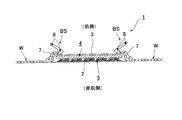
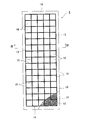
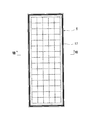
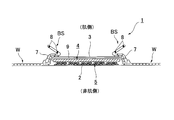
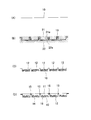
- FIG. 2 It is a partial fracture development view of sanitary napkin 1 concerning the present invention. It is the II-II arrow directional view of FIG. 2 is a partially broken plan view of a polymer sheet 5.
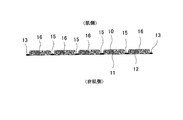
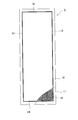
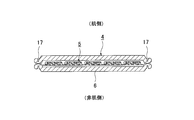
- FIG. FIG. 4 is a view taken along the line IV-IV in FIG. 3. It is a partially broken plan view of the polymer sheet 5 according to another embodiment. 3 is a cross-sectional view showing a laminated body of an absorbent body 4, a polymer sheet 5, and a second absorbent body 6.
- FIG. It is a top view which shows the laminated body of the absorber 4, the polymer sheet 5, and the 2nd absorber 6 which concerns on another form example.
- FIG. 8 is a view taken along line VIII-VIII in FIG. 7.
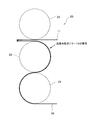
- FIG. (A) to (D) are cross-sectional views showing the procedure for producing the polymer sheet 5.
- the sanitary napkin 1 has a liquid-impervious back sheet 2 made of a polyethylene sheet, a polypropylene sheet, or the like, and a permeate that quickly permeates menstrual blood or a cage.
- a liquid surface sheet 3 an absorbent body 4 made of cotton-like pulp or synthetic pulp interposed between the two sheets 2 and 3, and side nonwoven fabrics 7 respectively disposed along the longitudinal direction on both sides of the surface. 7.
- the outer edge portions of the liquid-impervious back sheet 2 and liquid-permeable surface sheet 3 are adhesive such as hot melt, heat seal, etc.
- the liquid-impervious back sheet 2 and the side nonwoven fabric 7 which are joined by the adhering means and which extend laterally from the side edges of the absorbent body 4 at both side edges thereof are adhesives such as hot melt, Joined by an adhesive means such as heat sealing, an outer peripheral flap portion where the absorber 4 does not exist is formed on the outer periphery.
- the structure of the sanitary napkin 1 will be described in detail.
- a sheet material having at least water shielding properties such as an olefin resin sheet such as polyethylene or polypropylene is used.
- a laminated nonwoven fabric obtained by laminating a nonwoven fabric on a polyethylene sheet or the like, or A nonwoven fabric sheet (in this case, the waterproof film and the nonwoven fabric constitute a liquid-impervious back sheet) can be used after substantially impervious to liquid imperviousness by interposing a waterproof film.
- those having moisture permeability tend to be used from the viewpoint of preventing stuffiness.
- This water- and moisture-permeable sheet material is a microporous sheet obtained by forming a sheet by melting and kneading an inorganic filler in an olefin resin such as polyethylene or polypropylene, and then stretching in a uniaxial or biaxial direction. It is.
- the liquid-permeable surface sheet 3 is preferably a porous or non-porous nonwoven fabric or a porous plastic sheet.
- the material fibers constituting the nonwoven fabric include synthetic fibers such as polyethylene or polypropylene, synthetic fibers such as polyester and polyamide, recycled fibers such as rayon and cupra, and natural fibers such as cotton.
- a nonwoven fabric obtained by an appropriate processing method such as a lace method, a spun bond method, a thermal bond method, a melt blown method, or a needle punch method can be used.
- the spunlace method is excellent in terms of flexibility and the spunbond method is excellent in drapeability
- the thermal bond method and the air-through method are excellent in terms of being bulky and having high compression recovery properties.
- the non-woven fiber may be either a long fiber or a short fiber, but preferably a short fiber is used in order to give a towel texture.
- an olefin fiber such as polyethylene or polypropylene having a relatively low melting point.
- a composite fiber such as a core-sheath fiber, a side-by-side fiber, or a split fiber having a fiber having a high melting point as a core and a fiber having a low melting point as a sheath can be suitably used.
- the absorbent body 4 interposed between the liquid-impervious back sheet 2 and the liquid-permeable top sheet 3 is made of, for example, cotton-like pulp.
- the pulp include chemical fibers obtained from wood, cellulose fibers such as dissolved pulp, and artificial cellulose fibers such as rayon and acetate.
- Softwood pulp having a longer fiber length than hardwood pulp functions and It is preferably used in terms of price.
- the manufacturing method of the absorber 4 is preferably made of piled pulp so as to be rich in flexibility, it may be an airlaid absorber capable of reducing the bulk.
- the absorbent body 4 may be surrounded by an encapsulating sheet (not shown) made of crepe paper, non-woven fabric, or the like for shape retention and diffusibility improvement.
- the absorbent body 4 is composed only of the pulp and does not contain a superabsorbent polymer. Moreover, even when it has a highly water-absorbing polymer, it is preferable to contain with a low basis weight of 30 g / m 2 or less.
- the absorbent body 4 may be dispersed and mixed in the entire absorbent body 4, or may be disposed so as to be present more on the non-skin side (back side) of the absorbent body 4. . Since the absorbent body 4 does not have a highly water-absorbing polymer, the highly water-absorbing polymer does not flow out when the used sanitary napkin 1 is washed with water, and washing with water becomes easy.
- the highly water-absorbing polymer does not easily flow out during washing, and the water-absorbing polymer swollen by absorbing water during washing flows out.
- the amount is not so large as to greatly impair the cleaning operation.
- synthetic fibers may be mixed in the absorber 4.
- synthetic fiber for example, polyolefins such as polyethylene or polypropylene, polyesters such as polyethylene terephthalate and polybutylene terephthalate, polyamides such as nylon, and copolymers thereof can be used. It may be a mixture.
- a composite fiber such as a core-sheath fiber, a side-by-side fiber, or a split fiber having a fiber having a high melting point as a core and a fiber having a low melting point as a sheath can also be used.
- This synthetic fiber is desirably mixed with the absorbent body 4 in order to act as a binder when the absorbent body joint portion 17 described later is provided.
- side nonwoven fabrics 7 and 7 are provided on both side portions on the surface side of the sanitary napkin 1 along the longitudinal direction and over almost the entire length of the napkin 1, respectively.
- Wing-like flaps W and W are formed by a part of the liquid-impervious back sheet 2 that extends laterally and also laterally.
- a water-repellent treated nonwoven fabric or a hydrophilic treated nonwoven fabric can be used from the viewpoint of important functions. For example, if importance is placed on functions such as preventing permeation of menstrual blood or vaginal discharge, or enhancing the touch feeling, water repellent treatment coated with silicon, paraffin or alkylchromic chloride water repellent It is desirable to use a nonwoven fabric.
- a method of polymerizing a compound having a hydrophilic group for example, an oxidation product of polyethylene glycol, in the process of producing a synthetic fiber, ,
- a metal salt such as stannic chloride
- partially dissolving the surface to make it porous and depositing metal hydroxides to swell or make the synthetic fiber porous, applying capillary action to make it hydrophilic
- capillary action to make it hydrophilic It is desirable to use a hydrophilic treated non-woven fabric provided with.
- the inner side of the side nonwoven fabric 7 folds the side nonwoven fabric 7 almost double, and inside the double sheet, in the middle in the height direction, as appropriate at both ends or in the longitudinal direction.
- One or a plurality of, in the illustrated example, two thread-like elastic elastic members 8 and 8 are disposed, and the double sheet portion is erected on the skin side by the contraction force. Is formed.
- the superabsorbent polymer 12 is adjacent to the non-skin side of the absorbent body 4 between the upper layer sheet 10 disposed on the skin side and the lower layer sheet 11 disposed on the non-skin side.
- An intervening polymer sheet 5 is disposed.
- a porous or non-porous nonwoven fabric is used as the upper layer sheet 10 constituting the polymer sheet 5.
- the raw material fibers constituting the nonwoven fabric in the same manner as the liquid-permeable surface sheet 3, for example, synthetic fibers such as olefins such as polyethylene or polypropylene, polyesters, and polyamides, recycled fibers such as rayon and cupra, cotton Natural fibers such as
- the processing method of the said nonwoven fabric is not ask
- a nonwoven fabric processed by the air-through method is preferable because a bulky nonwoven fabric can be obtained, so that the superabsorbent polymer 12 can easily enter between the fibers, and the fixability of the superabsorbent polymer 12 is improved.
- a thermoplastic material when the upper layer sheet 10 is subjected to predetermined unevenness processing, it is preferable to include a thermoplastic material.
- the lower layer sheet 11 it is possible to use a sheet material having water shielding properties in addition to a perforated or non-porous nonwoven fabric.
- the processing method of the nonwoven fabric is not limited. However, in order to prevent the superabsorbent polymer 12 from falling off, the air-through method, the spunbond method, the melt blown method, the needle punch method, etc. are preferable. preferable.
- the water-impervious sheet material the same material as the liquid-impermeable back sheet 2 can be used. However, as will be described later, when the second absorbent body 6 is disposed adjacent to the non-skin side of the polymer sheet 5, it is preferable to use a water-permeable nonwoven fabric as the lower layer sheet 11.
- the superabsorbent polymer 12 examples include a cross-linked polyacrylate, a self-crosslinked polyacrylate, a saponified acrylate-vinyl acetate copolymer cross-linked product, and a cross-linked isobutylene / maleic anhydride copolymer. , A crosslinked polysulfonate, and a partially crosslinked water-swellable polymer such as polyethylene oxide and polyacrylamide. Among these, those based on acrylic acid or acrylate that are excellent in water absorption and water absorption speed are preferred. In the production process of the highly water-absorbing polymer having the water-absorbing performance, the water-absorbing force and the water-absorbing speed can be adjusted by adjusting the crosslinking density and the crosslinking density gradient. As the superabsorbent polymer 12, superabsorbent polymer granular powder (SAP) or superabsorbent polymer fiber (SAF) can be used.
- SAP superabsorbent polymer granular powder
- SAF superab
- the superabsorbent polymer 12 is interposed between the upper layer sheet 10 and the lower layer sheet 11. Therefore, even when the sanitary napkin 1 is manually squeezed or squeezed, the superabsorbent polymer 12 does not easily flow out to the outside, and the cleaning operation is facilitated. . Moreover, since the absorption layer is comprised by the laminated body of the absorber 4 and the polymer sheet 5, a liquid component is mainly absorbed and hold
- the absorber 4 layer it is possible to reduce the thickness of the absorber 4 layer. Therefore, the feeling of wearing improves and it becomes difficult to stuffy. Further, since the polymer sheet 5 is arranged on the non-skin side of the absorbent body 4, menstrual blood diffuses in the plane direction when passing through the absorbent body 4, and the diffused menstrual blood is dispersed by the polymer sheet 5. Thus, it is possible to absorb and hold, and the absorption capacity is improved.
- the polymer sheet 5 is preferably formed with a smaller plane size than the absorber 4 as shown in FIGS. That is, the edge of the absorbent body 4 extends outward from the edge of the polymer sheet 5, and the edge of the polymer sheet 5 is formed by the outer edge portion of the absorbent body 4 that extends outward from the polymer sheet 5. It is preferable to be covered. Thereby, even if the superabsorbent polymer 12 flows out from the edge of the polymer sheet 5, it is possible to prevent the absorbent body 4 from flowing out.
- the polymer sheet 5 has left and right end joint portions 13 that join the upper layer sheet 10 and the lower layer sheet 11 along the longitudinal direction at both ends in the width direction of the polymer sheet 5. It is preferable that the superabsorbent polymer 12 is disposed on the inner side in the width direction than the right and left end joints 13 and 13. By sealing both side edges of the polymer sheet 5 with the left and right end joints 13, it is possible to prevent the superabsorbent polymer 12 from flowing out from both side ends in the width direction when the used sanitary napkin 1 is washed. Become.
- the polymer sheet 5 has front and rear ends that join the upper layer sheet 10 and the lower layer sheet 11 along the width direction at both longitudinal ends of the polymer sheet 5, respectively. It is preferable to provide a joint 14 and dispose the superabsorbent polymer 12 on the inner side in the longitudinal direction from the front and rear joints 14 and 14. Providing the front and rear end joints 14 can prevent the superabsorbent polymer 12 from flowing out from both ends in the longitudinal direction. Further, by providing the front and rear end joint portions 14 and 14 in addition to the left and right end joint portions 13 and 13, the peripheral edge portion of the polymer sheet 5 is sealed by the joint portions 13 and 14 that are closed, and from the peripheral edge of the polymer sheet 5. This is preferable because the superabsorbent polymer 12 can be prevented from flowing out.
- the left and right end joints 13 and the front and rear end joints 14 are linear lines composed of continuous lines or intermittent lines provided slightly along the width direction both side edges or longitudinal direction both end edges of the upper layer sheet 10 and the lower layer sheet 11. It is a junction. Specifically, it is preferable to heat at the time of embossing to make an embossed heat fusion that joins the upper layer sheet 10 and the lower layer sheet 11, but adhesion by an adhesive such as hot melt or ultrasonic sealing It is good also as joining.
- the joint strength of the left and right end joints 13 and the front and rear end joints 14 is preferably 0.25 N or more, preferably about 1.0 to 3.0 N obtained by the following joint strength test.
- this bonding strength test the peripheral portions of the upper layer sheet 10 and the lower layer sheet 11 cut to a size of 60 mm long ⁇ 35 mm wide are bonded by the bonding portions 13, 14 and only a length of 15 mm from one end in the longitudinal direction. It peels, both ends of this peeled part are each clamped with a chuck
- the polymer sheet 5 includes a plurality of polymer-encapsulated cells 16, 16 in which a superabsorbent polymer 12 is encapsulated by a cell partition joint portion 15 that joins the upper layer sheet 10 and the lower layer sheet 11. You may divide into.... By partitioning into a plurality of polymer-encapsulated cells 16 in which the superabsorbent polymer 12 is encapsulated, the superabsorbent polymer 12 can be more reliably prevented from flowing out.
- the cell partition joint 15 is preferably embossed heat fusion that is heated and joined at the time of embossing pressurization, similar to the above-described left and right end joint 13 and front and rear end joint 14. Adhesion or ultrasonic sealing may be used.
- the left and right ends are arranged by the outer portion of the cell partition joint portion 15 located on the outer periphery of the polymer sheet 5 by arranging the square cell partition joint portions 15 in the front, rear, left and right in a regular lattice shape.
- a joint portion 13 and front and rear end joint portions 14 are respectively formed.
- the left and right end joints 13 and the front and rear end joints 14 may be provided separately from the cell partition joints 15 apart from each other.
- the planar shape of the cell partition junction 15 is formed in a square, but can be formed in an arbitrary planar shape such as a rectangle, a circle, an ellipse, a polygon, and a rhombus. .
- the polymer sheet 5 is not partitioned into a plurality of polymer-encapsulated cells, and the region surrounded by the left and right end joints 13 and 13 and the front and rear end joints 14 and 14 as shown in FIG.
- the polymer 12 may be encapsulated.
- the absorbent body 4 As shown in FIG. 6, by arranging the second absorbent body 6 adjacent to the non-skin side of the polymer sheet 5, the absorbent body 4, the polymer sheet 5, and the second absorbent body 6 form a three-layer structure. An absorption layer may be formed.
- the polymer sheet 5 is sandwiched between the absorber 4 and the second absorber 6, even if the superabsorbent polymer 12 falls off from the polymer sheet 5, the polymer sheet 5 flows out to the outside by the absorber 4 and the second absorber 6. Can be prevented.
- the polymer sheet 5 is formed with a smaller plane size than the absorbent body 4 and the second absorbent body 6, and outside the polymer sheet 5.
- the absorbent body 4 and the second absorbent body 6 it is preferable to form a laminated portion of the absorbent body 4 and the second absorbent body 6 where the polymer sheet 5 is not interposed on the outer periphery of the polymer sheet 5.
- the absorbent body 4 and the second absorbent body 4 provided along the peripheral edges of the absorbent body 4 and the second absorbent body 6 are used.
- the polymer sheet 5 may be enclosed inside by the absorber joint portion 17 that joins the absorber 6. That is, the polymer sheet 5 is formed with a smaller plane size than the absorbent body 4 and the second absorbent body 6, and the absorbent body 4 and the second absorbent body 6 are extended outside the polymer sheet 5, thereby the polymer sheet.
- a laminated portion of the absorbent body 4 and the second absorbent body 6 where the polymer sheet 5 is not interposed is formed on the outer periphery of the absorbent body 5, and the absorbent body 4 and the second absorbent body are formed by the absorbent body joint portion 17 in the laminated portion. 6 may be directly joined. Thereby, since the polymer sheet 5 is enclosed between the absorber 4 and the second absorber 6 by the absorber joint portion 17, the highly water-absorbing polymer 12 is more unlikely to flow out.
- the absorber joint portion 17 is an embossed heat-sealed or ultrasonic seal that heats and joins the absorbent body 4 and the second absorbent body 6 with heat-synthetic synthetic fibers and then presses them when embossing is applied. Alternatively, it may be bonded by a hot melt adhesive.
- the liquid-permeable surface sheet 3 is preferably composed mainly of relatively thick fibers having a fineness of 2.0 dtex or more, preferably 3.3 to 10 dtex.
- menstrual blood is less likely to be retained in the liquid-permeable surface sheet 3, and the discharged menstrual blood is easily transmitted to the absorber 4 side, and menstrual blood is less likely to remain in the liquid-permeable surface sheet 3 during cleaning.
- the cleaning effect can be improved.
- the concealment property of the menstrual blood absorbed by the lower absorber 4 becomes high, and menstrual blood becomes difficult to see from the surface.
- detergents are used to clean used sanitary napkins, but by using relatively thick fibers, there are more voids between the fibers, which improves foaming. The cleaning effect can be further improved.
- the fineness is a value measured according to JIS L1095.
- liquid-permeable surface sheet 3 it is preferable to use a non-woven fabric with a relatively high basis weight having a basis weight of 25 g / m 2 or more, preferably 40 to 150 g / m 2 .
- a non-woven fabric with a relatively high basis weight having a basis weight of 25 g / m 2 or more, preferably 40 to 150 g / m 2 .
- a large number of the liquid-permeable surface sheet 3 and the absorbent body 4 are disposed on the non-skin side of the liquid-permeable surface sheet 3.
- seat 9 which consists of a mesh sheet (porous resin film) which has an opening.
- this mesh sheet for example, an olefin-based thermoplastic resin film such as polyethylene or polypropylene is preferably used, but a polyamide-based resin such as polyester or nylon, EVA, or the like can also be used.
- the mesh sheet is provided with a large number of bodily fluid perforations for imparting bodily fluid permeability.
- the diameter of the bodily fluid permeation holes is 0.05 to 2.0 mm, preferably 0.1 to 1.0 mm, and the number of holes is preferably about 200 to 600 holes / cm 2 .
- the synthetic resin sheet is softened near the softening temperature and is positioned on the upper surface of the support having a large number of openings, and is sucked from below the support, There are a method of pressurizing air pressure from the upper surface and a method of stretching and opening the sheet material after impressing a large number of slits on the synthetic resin sheet material, but they can be formed by an appropriate method.
- the sanitary napkin 1 Since the sanitary napkin 1 is manually kneaded or squeezed at the time of washing after use, when the liquid-permeable surface sheet 3 is made of a nonwoven fabric, the fibers are unraveled and broken, and the superabsorbent polymer 12 comes out therefrom. Even if the liquid-permeable surface sheet 3 is torn, it is easy to arrange the second sheet 9 made of a mesh sheet that is not easily torn due to friction at the time of scouring, on the non-skin side of the liquid-permeable surface sheet 3. It can be set as the structure where the water absorbing polymer 12 does not flow out easily.
- the number of apertures in the second sheet 9 is preferably small from the viewpoint of preventing the superabsorbent polymer 12 from flowing out to the outside, and is preferably about 200 to 500 / cm 2 , more preferably about 200 to 300 / cm 2. It is good to do.
- the liquid-permeable surface sheet 3 is composed of a mesh sheet
- the liquid-permeable surface sheet 3 may be composed of a non-woven fabric, and a mesh sheet may be used as the second sheet 9 because the liquid-permeable surface sheet 3 may be attached to the skin and the wearing feeling may deteriorate. Is preferred.
- the weight of the superabsorbent polymer 12 disposed on the polymer sheet 5 is 20 to 300 g / m 2 , preferably 30 to 100 g / m 2 .
- the polymer sheet 5 on which the polymer-encapsulated cell 16 shown in FIG. 3 is formed will be described.
- the polymer-encapsulated cell 16 The first embossing roll 21 in which a large number of convex portions 21a, 21a... Corresponding to the first embossing roll 21 are arranged, and the second embossing roll 22 in which a large number of concave portions 22a, 22a.
- the polymer-encapsulated cell 16 is formed by meshing the convex portion 21a and the concave portion 22a, and by meshing the concave portion 21b and the convex portion 22b. It is preferable to use a manufacturing apparatus 20 that forms the polymer-free region 16.
- the superabsorbent polymer 12 is sprayed on the surface of the second embossing roll 22 on which the upper layer sheet 10 is disposed, and the superabsorbent polymer 12 is accommodated in the concave portion 22a corresponding to the polymer-encapsulated cell 16, and the first 2
- the lower layer sheet 11 conveyed from another path in a stacked state between the embossing roll 22 and the flat roll 23
- the upper layer sheet 10 and the upper layer sheet 10 are separated by the first bonding portion 13 and the second bonding portion 15.
- the lower sheet 11 is joined and integrated.
- joints are performed by applying a hot-melt adhesive or the like on the outer surface of the upper layer sheet 10 corresponding to the convex portion of the second embossing roll 22 and adhering to the lower layer sheet 11 or when meshing with the flat roll 23. This is performed by fusing the upper layer sheet 10 and the lower layer sheet 11 by heating or ultrasonic radiation of the convex portions of the second embossing roll 22.
- the upper layer sheet 10 is easily sucked and embossed at the time of embossing, and at the time of spraying the superabsorbent polymer 12, the polymer is prevented from falling. You may make it do. Further, after the superabsorbent polymer 12 is sprayed, the amount of the superabsorbent polymer 12 accommodated in the polymer-encapsulated cell 16 may be adjusted by leveling the surface with a scraper or the like.
- the polymer sheets 5, 5... Continuous in the longitudinal direction are cut at the joint between the upper layer sheet 10 and the lower layer sheet 11 where the polymer-encapsulated cells 16 are not provided.
- SYMBOLS 1 Sanitary napkin, 2 ... Liquid-impermeable back sheet, 3 ... Liquid-permeable surface sheet, 4 ... Absorber, 5 ... Polymer sheet, 6 ... 2nd absorber, 7 ... Side nonwoven fabric, 8 ... Thread-like elastic expansion and contraction Member: 9 ... Second sheet, 10 ... Upper layer sheet, 11 ... Lower layer sheet, 12 ... Super absorbent polymer, 13 ... Left and right end joint, 14 ... Front and rear end joint, 15 ... Cell partition joint, 16 ... Polymer encapsulated cell , 17 ... absorber joint
Landscapes
- Health & Medical Sciences (AREA)
- Epidemiology (AREA)
- Engineering & Computer Science (AREA)
- Biomedical Technology (AREA)
- Heart & Thoracic Surgery (AREA)
- Vascular Medicine (AREA)
- Life Sciences & Earth Sciences (AREA)
- Animal Behavior & Ethology (AREA)
- General Health & Medical Sciences (AREA)
- Public Health (AREA)
- Veterinary Medicine (AREA)
- Absorbent Articles And Supports Therefor (AREA)
Abstract
使用後の水洗いによって高吸水性ポリマーが流出しにくく、水洗いを容易にするとともに、吸収能力を低下させない吸収性物品を提供する。透液性表面シート(3)と不透液性裏面シート(2)との間に吸収体(4)が介在し、吸収体(4)は高吸水性ポリマーを含有しないか、30g/m2以下の目付で含有し、吸収体(4)の非肌側に隣接して上層シート(10)と下層シート(11)との間に高吸水性ポリマー(12)が介在されたポリマーシート(5)を配設する。前記ポリマーシート(5)の幅方向両端部にそれぞれ長手方向に沿って前記上層シート(10)と下層シート(11)とを接合する左右端接合部(13、13)を設け、前記左右端接合部(13)より幅方向内側に前記高吸水性ポリマー(12)を配設している。
Description
本発明は、生理用ナプキン、パンティライナー、失禁パッド等の吸収性物品に係り、詳しくは使用後の水洗いによって高吸水性ポリマーが流出しにくく、水洗いを容易にした吸収性物品に関する。
従来より、一部の国のイスラム教徒の人々は、月経時の経血は不浄なものとする宗教上の理由から、使用済みの生理用ナプキンを水洗いし、吸収した経血等を綺麗に洗い流してから廃棄する習慣がある。使用済みの生理用ナプキンの洗浄は、水道水をかけながら手で揉んだり絞ったりすることにより行われるため、高吸水性ポリマーを含む吸収性物品の場合、洗浄の際に高吸水性ポリマーが外部に流出して洗浄作業の妨げとなっていた。このため、吸収体に高吸水性ポリマーを含有せず、その分の吸収量を補うためパルプ量を多めにした吸収性物品がこのような習慣がある地域では多く市場に提供されている。
使用済みの生理用ナプキンの水洗いを容易にした技術としては、下記特許文献1、2などを挙げることができる。下記特許文献1においては、吸収体は吸収性ポリマーを有し、該吸収性ポリマーは、吸収体厚み方向では該吸収体の非肌当接面側の下層部分に多く存在し、かつ下層部分における幅方向中央領域に吸収体縦方向前後端に亘り多く存在する吸収性物品が開示されている。また、下記特許文献2においては、表面シートと裏面シートとに介在された吸水性ポリマーを含有する吸収体を有し、吸収性物品の長手方向の両側部に表面シート側から吸収体とともに圧搾された防漏溝が形成され、該防漏溝は底部と側壁部を有し、該底部下の部材が裏面シートに接合されている吸収性物品が開示されている。
また、下記特許文献3においては、不織布シート間に高吸水性ポリマーが配設された吸収層と繊維集合体層とを積層してなる吸収性積層体を備えた吸収性物品が開示されている。
しかしながら、上述した高吸水性ポリマーを含まない吸収性物品の場合には、吸収力が低下する問題があるとともに、パルプ量を増やすことによってその分の吸収量を補っているため、このことが蒸れの発生や装着感を悪化させる原因となっていた。
一方で、吸収体に高吸水性ポリマーが分散混入された一般的な吸収性物品の場合(例えば上記特許文献2)、洗浄時に吸収性物品を揉んだり絞ったりしていると吸収体の上面(肌面)や周面から高吸水性ポリマーが出てきて、洗浄作業がしにくいとともに、散乱すると後処理が面倒であるという問題があった。
また、上記特許文献1に記載の吸収性物品のように、吸収体の非肌当接面側の下層部分に高吸水性ポリマーを多く存在させた場合、洗浄時に吸収体の周面から高吸水性ポリマーが出てくることがあり、洗浄作業に支障をきたしていた。
更に、上記特許文献2に記載の吸収性物品では、吸収性物品の長手方向の両側部に表面シート側から吸収体とともに圧搾された防漏溝が形成されているため、体液が吸収体全体に拡散しにくく、吸収体の吸収量が低下するおそれがあった。
また、上記特許文献3に記載の吸収性物品では、肌当接面側に高吸水性ポリマーを有する上側シート状吸収層が配設されているため、洗浄時に高吸水性ポリマーが出てきやすい構造であった。
そこで本発明の主たる課題は、使用後の水洗いによって高吸水性ポリマーが流出しにくく、水洗いを容易にするとともに、吸収能力を低下させない吸収性物品を提供することにある。
上記課題を解決するために請求項1に係る本発明として、透液性表面シートと裏面シートとの間に吸収体が介在された吸収性物品において、
前記吸収体は高吸水性ポリマーを含有しないか、30g/m2以下の目付で含有し、前記吸収体の非肌側に隣接して上層シートと下層シートとの間に高吸水性ポリマーが介在されたポリマーシートが配設されていることを特徴とする吸収性物品が提供される。
前記吸収体は高吸水性ポリマーを含有しないか、30g/m2以下の目付で含有し、前記吸収体の非肌側に隣接して上層シートと下層シートとの間に高吸水性ポリマーが介在されたポリマーシートが配設されていることを特徴とする吸収性物品が提供される。
上記請求項1記載の発明では、前記吸収体が高吸水性ポリマーを有しないか、30g/m2以下の低目付で含有しているため、洗浄時に吸収性物品を手で揉んだり絞ったりしても、吸収体から高吸水性ポリマーが流出しないか、たとえ流出したとしても洗浄作業に大きな支障を与える程ではない。従って、水洗いが容易になる。また、前記吸収体の非肌側に隣接して上層シートと下層シートとの間に高吸水性ポリマーが介在されたポリマーシートを配設しているため、前記高吸水性ポリマーが上層シートと下層シートとの間に挟まれて、吸収性物品の洗浄時においても外部に流出しにくく、水洗いが容易になる。また、前記吸収体とポリマーシートとの積層体によって吸収層を構成しているため、前記吸収体を薄型化しても前記ポリマーシートによって吸収能力が維持できるようになる。
請求項2に係る本発明として、前記ポリマーシートの幅方向両端部にそれぞれ長手方向に沿って前記上層シートと下層シートとを接合する左右端接合部が設けられ、前記左右端接合部より幅方向内側に前記高吸水性ポリマーが配設されている請求項1記載の吸収性物品が提供される。
上記請求項2記載の発明では、前記ポリマーシートの幅方向両端部にそれぞれ長手方向に沿って上層シートと下層シートとを接合する左右端接合部を設け、この左右端接合部より幅方向内側に高吸水性ポリマーを配設しているため、ポリマーシートの左右端部から高吸水性ポリマーが流出するのがより確実に防止できるようになる。
請求項3に係る本発明として、前記ポリマーシートの長手方向両端部にそれぞれ幅方向に沿って前記上層シートと下層シートとを接合する前後端接合部が設けられ、前記前後端接合部より長手方向内側に前記高吸水性ポリマーが配設されている請求項1、2いずれかに記載の吸収性物品が提供される。
上記請求項3記載の発明では、前記ポリマーシートの長手方向両端部にそれぞれ長手方向に沿って上層シートと下層シートとを接合する前後端接合部を設け、この前後端接合部より長手方向内側に高吸水性ポリマーを配設しているため、ポリマーシートの前後端部からの高吸水性ポリマーの流出がより確実に防止できるようになる。また、上述の左右端接合部と組み合わせることにより、これら左右端接合部及び前後端接合部によってポリマーシートの周縁に沿って接合部が設けられるため、より確実に高吸水性ポリマーの流出が防止できるようになる。
請求項4に係る本発明として、前記ポリマーシートは、前記上層シートと下層シートとを接合する接合部によって内部に前記高吸水性ポリマーが封入された複数のポリマー封入セルに区画されている請求項1~3いずれかに記載の吸収性物品が提供される。
上記請求項4記載の発明では、前記上層シートと下層シートとを接合するセル区画接合部によって内部に高吸水性ポリマーが封入された複数のポリマー封入セルに区画しているため、より確実に高吸水性ポリマーの流出が防止できるようになる。
請求項5に係る本発明として、前記ポリマーシートの非肌側に隣接して第2吸収体が配設されている請求項1~4いずれかに記載の吸収性物品が提供される。
上記請求項5記載の発明では、前記ポリマーシートの非肌側に隣接して第2吸収体を配設することによって、前記吸収体と第2吸収体との間に前記ポリマーシートが設けられた3層構造からなる吸収層が備えられるようになるため、高吸水性ポリマーが吸収体の外側に流出するのがより一層確実に防止できるようになる。
請求項6に係る本発明として、前記吸収体及び第2吸収体の周縁に沿って前記吸収体と第2吸収体とを接合する吸収体接合部を設けることによって、内部に前記ポリマーシートが封入されている請求項5記載の吸収性物品が提供される。
上記請求項6記載の発明では、前記吸収体と第2吸収体との間にポリマーシートが介在された3層構造からなる吸収層を備える場合において、前記吸収体と第2吸収体とを接合する吸収体接合部によって、内部に前記ポリマーシートが封入されているため、高吸水性ポリマーの流出がより確実に防止できるようになる。
請求項7に係る本発明として、前記透液性表面シートは、繊度2.0dtex以上の繊維を主成分として構成されている請求項1~6いずれかに記載の吸収性物品が提供される。
上記請求項7記載の発明では、前記透液性表面シートを比較的太い繊維を主成分として構成しているため、透液性表面シートに経血が残りにくく、洗浄効率を向上させることができる。
請求項8に係る本発明として、前記透液性表面シートの非肌側に、多数の開孔を有するメッシュシートからなるセカンドシートが配設されている請求項1~6いずれかに記載の吸収性物品が提供される。
上記請求項8記載の発明では、洗浄時に吸収性物品を手で揉んだり絞ったりするので、透液性表面シートの強度が弱いと破れてしまうことがあるのに鑑みて、前記透液性表面シートの非肌側に、多数の開孔を有するメッシュシートからなるセカンドシートを配設することによって、前記メッシュシートにより透液性表面シートが破れても高吸水性ポリマーが流出しないようにしている。
以上詳説のとおり本発明によれば、使用後の水洗いによって高吸水性ポリマーが流出しにくく、水洗いが容易になるとともに、吸収能力が低下しない吸収性物品が提供できるようになる。
以下、本発明の実施の形態について図面を参照しながら詳述する。
〔生理用ナプキン1の基本構成〕
本発明に係る生理用ナプキン1は、図1及び図2に示されるように、ポリエチレンシート、ポリプロピレンシートなどからなる不透液性裏面シート2と、経血やおりものなどを速やかに透過させる透液性表面シート3と、これら両シート2,3間に介在された綿状パルプまたは合成パルプなどからなる吸収体4と、表面両側部にそれぞれ長手方向に沿って配設されたサイド不織布7,7とから構成されている。また、前記吸収体4の周囲において、そのナプキン長手方向の前後端縁部では、前記不透液性裏面シート2、透液性表面シート3の外縁部がホットメルトなどの接着剤やヒートシール等の接着手段によって接合され、またその両側縁部では吸収体4の側縁よりも側方に延出している前記不透液性裏面シート2と前記サイド不織布7とがホットメルトなどの接着剤やヒートシール等の接着手段によって接合され、外周に吸収体4の存在しない外周フラップ部が形成されている。
本発明に係る生理用ナプキン1は、図1及び図2に示されるように、ポリエチレンシート、ポリプロピレンシートなどからなる不透液性裏面シート2と、経血やおりものなどを速やかに透過させる透液性表面シート3と、これら両シート2,3間に介在された綿状パルプまたは合成パルプなどからなる吸収体4と、表面両側部にそれぞれ長手方向に沿って配設されたサイド不織布7,7とから構成されている。また、前記吸収体4の周囲において、そのナプキン長手方向の前後端縁部では、前記不透液性裏面シート2、透液性表面シート3の外縁部がホットメルトなどの接着剤やヒートシール等の接着手段によって接合され、またその両側縁部では吸収体4の側縁よりも側方に延出している前記不透液性裏面シート2と前記サイド不織布7とがホットメルトなどの接着剤やヒートシール等の接着手段によって接合され、外周に吸収体4の存在しない外周フラップ部が形成されている。
以下、さらに前記生理用ナプキン1の構造について詳述すると、
前記不透液性裏面シート2は、ポリエチレンやポリプロピレン等のオレフィン系樹脂シートなどの少なくとも遮水性を有するシート材が用いられるが、この他にポリエチレンシート等に不織布を積層したラミネート不織布や、さらには防水フィルムを介在して実質的に不透液性を確保した上で不織布シート(この場合には防水フィルムと不織布とで不透液性裏面シートを構成する。)などを用いることができる。近年はムレ防止の観点から透湿性を有するものが用いられる傾向にある。この遮水・透湿性シート材は、ポリエチレンやポリプロピレン等のオレフィン系樹脂中に無機充填剤を溶融混練してシートを成形した後、一軸または二軸方向に延伸することにより得られる微多孔性シートである。
前記不透液性裏面シート2は、ポリエチレンやポリプロピレン等のオレフィン系樹脂シートなどの少なくとも遮水性を有するシート材が用いられるが、この他にポリエチレンシート等に不織布を積層したラミネート不織布や、さらには防水フィルムを介在して実質的に不透液性を確保した上で不織布シート(この場合には防水フィルムと不織布とで不透液性裏面シートを構成する。)などを用いることができる。近年はムレ防止の観点から透湿性を有するものが用いられる傾向にある。この遮水・透湿性シート材は、ポリエチレンやポリプロピレン等のオレフィン系樹脂中に無機充填剤を溶融混練してシートを成形した後、一軸または二軸方向に延伸することにより得られる微多孔性シートである。
次いで、前記透液性表面シート3は、有孔または無孔の不織布や多孔性プラスチックシートなどが好適に用いられる。不織布を構成する素材繊維としては、たとえばポリエチレンまたはポリプロピレン等のオレフィン系、ポリエステル系、ポリアミド系等の合成繊維の他、レーヨンやキュプラ等の再生繊維、綿等の天然繊維とすることができ、スパンレース法、スパンボンド法、サーマルボンド法、メルトブローン法、ニードルパンチ法等の適宜の加工法によって得られた不織布を用いることができる。これらの加工法の内、スパンレース法は柔軟性、スパンボンド法はドレープ性に富む点で優れ、サーマルボンド法及びエアスルー法は嵩高で圧縮復元性が高い点で優れている。不織布の繊維は、長繊維または短繊維のいずれでもよいが、好ましくはタオル地の風合いを出すため短繊維を使用するのがよい。また、エンボス処理を容易とするために、比較的低融点のポリエチレンまたはポリプロピレン等のオレフィン系繊維のものを用いるのがよい。また、融点の高い繊維を芯とし融点の低い繊維を鞘とした芯鞘型繊維やサイド-バイ-サイド型繊維、分割型繊維等の複合繊維を好適に用いることもできる。
前記不透液性裏面シート2と透液性表面シート3との間に介在される吸収体4は、たとえば綿状パルプにより構成されている。前記パルプとしては、木材から得られる化学パルプ、溶解パルプ等のセルロース繊維や、レーヨン、アセテート等の人工セルロース繊維からなるものが挙げられ、広葉樹パルプよりは繊維長の長い針葉樹パルプの方が機能および価格の面で好適に使用される。吸収体4の製造方法は、柔軟性に富むように積繊パルプとすることが望ましいが、嵩を小さくできるエアレイド吸収体としてもよい。前記吸収体4は、形状保持および拡散性向上のため、クレープ紙や不織布などからなる被包シート(図示せず)で囲繞してもよい。
前記吸収体4は、前記パルプのみによって構成され、高吸水性ポリマーを含有しないのが望ましい。また、高吸水性ポリマーを有する場合でも、30g/m2以下の低い目付で含有するのが好ましい。前記吸収体4に高吸水性ポリマーを含有する場合、吸収体4の全体に分散混入させてもよいし、吸収体4の非肌側(裏面側)に多く存在するように配置してもよい。前記吸収体4が高吸水性ポリマーを有しないことにより、使用済みの生理用ナプキン1を水洗いする際に高吸水性ポリマーが流出することがなく、水洗いが容易になる。また、高吸水性ポリマーを有する場合でも、30g/m2以下の低目付で配合することにより、洗浄時に高吸水性ポリマーが流出しにくいとともに、洗浄時に吸水して膨潤した高吸水性ポリマーが流出しても洗浄作業に大きな支障を与えるほどの量ではないため問題とはならない。
また、前記吸収体4には合成繊維を混合しても良い。前記合成繊維は、例えばポリエチレン又はポリプロピレン等のポリオレフィン系、ポリエチレンテレフタレートやポリブチレンテレフタレート等のポリエステル系、ナイロンなどのポリアミド系、及びこれらの共重合体などを使用することができるし、これら2種を混合したものであってもよい。また、融点の高い繊維を芯とし融点の低い繊維を鞘とした芯鞘型繊維やサイドバイサイド型繊維、分割型繊維などの複合繊維も用いることができる。この合成繊維は、後述する吸収体接合部17を設ける場合には、バインダーとして作用させるため吸収体4に混合するのが望ましい。
一方、本生理用ナプキン1の表面側の両側部にはそれぞれ、長手方向に沿ってかつナプキン1のほぼ全長に亘ってサイド不織布7,7が設けられ、このサイド不織布7,7の一部が側方に延在されるとともに、同じく側方に延在された不透液性裏面シート2の一部とによってウイング状フラップW、Wが形成されている。
前記サイド不織布7としては、重要視する機能の点から撥水処理不織布または親水処理不織布を使用することができる。たとえば、経血やおりもの等が浸透するのを防止する、あるいは肌触り感を高めるなどの機能を重視するならば、シリコン系、パラフィン系、アルキルクロミッククロリド系撥水剤などをコーティングした撥水処理不織布を用いることが望ましい。また、前記ウイング状フラップW、Wにおける経血等の吸収性を重視するならば、合成繊維の製造過程で親水基を持つ化合物、例えばポリエチレングリコールの酸化生成物などを共存させて重合させる方法や、塩化第2スズのような金属塩で処理し、表面を部分溶解し多孔性とし金属の水酸化物を沈着させる方法等により合成繊維を膨潤または多孔性とし、毛細管現象を応用して親水性を与えた親水処理不織布を用いるようにすることが望ましい。
前記サイド不織布7の内方側は、図2に示されるように、前記サイド不織布7をほぼ二重に折り返すとともに、この二重シート内部に、その高さ方向中間部に両端または長手方向の適宜の位置が固定された1または複数の、図示例では2本の糸状弾性伸縮部材8,8が配設され、その収縮力によって前記二重シート部分を肌側に起立させた立体ギャザーBS、BSが形成されている。
〔ポリマーシート5について〕
本生理用ナプキン1では、前記吸収体4の非肌側に隣接して、肌側に配置された上層シート10と非肌側に配置された下層シート11との間に高吸水性ポリマー12が介在されたポリマーシート5が配設されている。このポリマーシート5が吸収体4の直ぐ非肌側に配置されることにより、肌側から吸収体4及びポリマーシート5の順で積層された2層構造の吸収層が構成されるようになっている。
本生理用ナプキン1では、前記吸収体4の非肌側に隣接して、肌側に配置された上層シート10と非肌側に配置された下層シート11との間に高吸水性ポリマー12が介在されたポリマーシート5が配設されている。このポリマーシート5が吸収体4の直ぐ非肌側に配置されることにより、肌側から吸収体4及びポリマーシート5の順で積層された2層構造の吸収層が構成されるようになっている。
前記ポリマーシート5を構成する上層シート10としては、有孔または無孔の不織布が用いられる。不織布を構成する素材繊維としては、前記透液性表面シート3と同様に、たとえばポリエチレンまたはポリプロピレン等のオレフィン系、ポリエステル系、ポリアミド系等の合成繊維の他、レーヨンやキュプラ等の再生繊維、綿等の天然繊維とすることができる。前記不織布の加工法は問わないが、高吸水性ポリマー12の脱落を防止するため、エアスルー法、スパンボンド法、メルトブローン法、ニードルパンチ法などが好ましい。特に、エアスルー法により加工した不織布は、嵩高な不織布が得られるため、繊維間に高吸水性ポリマー12が入り込みやすく、高吸水性ポリマー12の定着性が良好になるので好ましい。また、後段で詳述するように、上層シート10に所定の凹凸加工を施す場合には、熱可塑性を有する素材を含むのが好ましい。
前記下層シート11としては、有孔または無孔の不織布の他に、遮水性を有するシート材を用いることが可能である。前記上層シート10と同様に、不織布の加工法は問わないが、高吸水性ポリマー12の脱落を防止するため、エアスルー法、スパンボンド法、メルトブローン法、ニードルパンチ法などが好ましく、特にエアスルー法が好ましい。前記遮水性のシート材としては、前記不透液性裏面シート2と同様の素材を用いることができる。ただし、後述するようにポリマーシート5の非肌側に隣接して第2吸収体6を配設する場合には、前記下層シート11として透水性の不織布を用いるのが好ましい。
前記高吸水性ポリマー12としては、たとえばポリアクリル酸塩架橋物、自己架橋したポリアクリル酸塩、アクリル酸エステル-酢酸ビニル共重合体架橋物のケン化物、イソブチレン・無水マレイン酸共重合体架橋物、ポリスルホン酸塩架橋物や、ポリエチレンオキシド、ポリアクリルアミドなどの水膨潤性ポリマーを部分架橋したもの等が挙げられる。これらの内、吸水量、吸水速度に優れるアクリル酸またはアクリル酸塩系のものが好適である。前記吸水性能を有する高吸水性ポリマーは製造プロセスにおいて、架橋密度および架橋密度勾配を調整することにより吸水力と吸水速度の調整が可能である。また、前記高吸水性ポリマー12としては、高吸水ポリマー粒状粉(SAP)や高吸水ポリマー繊維(SAF)を用いることができる。
本生理用ナプキン1では、図2~図4に示されるように、吸収体4の非肌側に配置されたポリマーシート5において、高吸水性ポリマー12が上層シート10と下層シート11との間に挟まれているため、使用済みの生理用ナプキン1の洗浄時に、生理用ナプキン1を手で揉んだり絞ったりしても、高吸水性ポリマー12が外部に流出しにくく洗浄作業が容易になる。また、吸収体4とポリマーシート5との積層体によって吸収層が構成されているため、液分が主としてポリマーシート5に吸収保持され、吸収体単独の場合より液分の吸収保持能力が向上するので、吸収体4の層を薄型化することが可能となる。従って、装着感が向上するとともに、蒸れにくくなる。また、前記ポリマーシート5を吸収体4の非肌側に配置してあるため、吸収体4を通過する際に経血が平面方向に拡散するとともに、この拡散した経血をポリマーシート5によって分散して吸収保持することが可能となり、吸収能力が向上するようになる。
前記ポリマーシート5は、図1及び図2に示されるように、吸収体4より小さな平面寸法で形成するのが好ましい。すなわち、ポリマーシート5の端縁より吸収体4の端縁が外側に延在して配設され、ポリマーシート5の端縁が、ポリマーシート5より外側に延在した吸収体4の外縁部分によって覆われるようにするのが好ましい。これにより、ポリマーシート5の端縁から高吸水性ポリマー12が流出しても、吸収体4によって外部に流出するのが防止できるようになる。
前記ポリマーシート5は、図3及び図4に示されるように、ポリマーシート5の幅方向両端部にそれぞれ長手方向に沿って、前記上層シート10と下層シート11とを接合する左右端接合部13を設け、この左右端接合部13、13より幅方向内側に前記高吸水性ポリマー12を配設するのが好ましい。前記左右端接合部13によってポリマーシート5の両側縁を封止することによって、使用済みの生理用ナプキン1の洗浄時に、高吸水性ポリマー12が幅方向両側端から流出するのが防止できるようになる。
また、前記ポリマーシート5は、同図3及び図4に示されるように、ポリマーシート5の長手方向両端部にそれぞれ幅方向に沿って、前記上層シート10と下層シート11とを接合する前後端接合部14を設け、この前後端接合部14、14より長手方向内側に前記高吸水性ポリマー12を配設するのが好ましい。前記前後端接合部14を設けることにより、長手方向両端からの高吸水性ポリマー12の流出が防止できるようになる。また、前記左右端接合部13、13に加えて前後端接合部14、14を設けることにより、ポリマーシート5の周縁部が閉合する接合部13、14によって封止され、ポリマーシート5の周縁から高吸水性ポリマー12が流出するのが防止できるようになるため好ましい。
前記左右端接合部13及び前後端接合部14は、上層シート10及び下層シート11の幅方向両側縁又は長手方向両端縁の若干内側に沿って設けられた連続線又は間欠線からなる線状の接合部である。具体的には、エンボス加圧時に加熱することにより、上層シート10と下層シート11とを接合するエンボス加熱融着とするのが好ましいが、ホットメルトなどの接着剤による接着や、超音波シールによる接合などとしてもよい。
前記左右端接合部13及び前後端接合部14の接合強度は、次に示す接合強度試験によって得られる接合強度が0.25N以上、好ましくは1.0~3.0N程度とするのがよい。この接合強度試験は、縦60mm×横35mmの大きさに切り取った上層シート10及び下層シート11の周縁部を、前記接合部13、14によって接合するとともに、長手方向の一端から15mmの長さだけ剥がして、この剥がした部分の両端をそれぞれチャックで挟持し、300mm/minの速度で引っ張る引張試験を行ったときの最大荷重を接合強度としたものである。
前記ポリマーシート5は、図3に示されるように、上層シート10と下層シート11とを接合するセル区画接合部15によって内部に高吸水性ポリマー12が封入された複数のポリマー封入セル16、16…に区画してもよい。高吸水性ポリマー12が封入された複数のポリマー封入セル16に区画することにより、より確実に高吸水性ポリマー12の流出が防止できるようになる。
前記セル区画接合部15は、上述の左右端接合部13及び前後端接合部14と同様に、エンボス加圧時に加熱して接合するエンボス加熱融着とするのが好ましいが、ホットメルト接着剤による接着や、超音波シールなどとしてもよい。
図3に示される例では、方形状のセル区画接合部15を前後左右に正格子状に配置することにより、ポリマーシート5の外周に位置するセル区画接合部15の外側部分によって、前記左右端接合部13及び前後端接合部14がそれぞれ形成されている。また、図示しないが、セル区画接合部15より外側に離間して、別途、前記左右端接合部13及び前後端接合部14を設けるようにしてもよい。前記セル区画接合部15の平面形状は、図3に示す例では正方形に形成されているが、長方形、円形、楕円形、多角形、菱形など、任意の平面形状で形成することが可能である。
一方、前記ポリマーシート5を複数のポリマー封入セルに区画せず、図5に示されるように、前記左右端接合部13、13及び前後端接合部14、14で囲まれた領域に高吸水性ポリマー12が封入されるようにしてもよい。
図6に示されるように、前記ポリマーシート5の非肌側に隣接して第2吸収体6を配設することにより、前記吸収体4、ポリマーシート5及び第2吸収体6によって3層構造の吸収層が形成されるようにしてもよい。これによって、ポリマーシート5が吸収体4及び第2吸収体6によって挟まれるため、ポリマーシート5から高吸水性ポリマー12が脱落したとしても、吸収体4及び第2吸収体6によって外部にまで流出するのが防止できるようになる。
また、前記3層構造の吸収層からなる場合、図6に示されるように、前記ポリマーシート5を吸収体4及び第2吸収体6より小さな平面寸法で形成し、このポリマーシート5より外側に前記吸収体4及び第2吸収体6を延在させることにより、ポリマーシート5の外周に、ポリマーシート5が介在しない吸収体4と第2吸収体6との積層部分を形成するのが好ましい。これにより、高吸水性ポリマー12が吸収体4及び第2吸収体6より外側に流出するのがより確実に防止できるようになる。
また、前記3層構造の吸収層からなる場合において、図7及び図8に示されるように、前記吸収体4及び第2吸収体6の周縁に沿って設けられた前記吸収体4と第2吸収体6とを接合する吸収体接合部17によって、内部にポリマーシート5が封入されるようにしてもよい。すなわち、前記ポリマーシート5を吸収体4及び第2吸収体6より小さな平面寸法で形成し、このポリマーシート5より外側に前記吸収体4及び第2吸収体6を延在させることにより、ポリマーシート5の外周に、ポリマーシート5が介在しない吸収体4と第2吸収体6との積層部分を形成した上で、この積層部分において前記吸収体接合部17によって前記吸収体4と第2吸収体6とを直接接合してもよい。これにより、ポリマーシート5が前記吸収体接合部17によって吸収体4と第2吸収体6との間に封入されるため、より一層高吸水性ポリマー12が外部に流出しにくくなる。前記吸収体接合部17は、前記吸収体4及び第2吸収体6に熱融着性の合成繊維を混合した上で、エンボス加圧時に加熱して接合するエンボス加熱融着や超音波シールとしてもよいし、ホットメルト接着剤による接着としてもよい。
前記透液性表面シート3は、繊度が2.0dtex以上、好ましくは3.3~10dtexの比較的太い繊維を主成分として構成するのがよい。これにより、透液性表面シート3に経血が保持されにくくなり、排出された経血が吸収体4側に透過しやすくなるとともに、洗浄時に透液性表面シート3に経血が残りにくいので、洗浄効果を向上させることができるようになる。また、比較的太い繊維で構成することにより、下層の吸収体4に吸収された経血の隠蔽性も高くなり、表面から経血が見えにくくなる。更に、一部の地域では、使用済みの生理用ナプキンの洗浄時に洗剤を使用しているが、比較的太い繊維で構成することにより、繊維間の空隙が多くなり、これによって泡立ちが良くなるので、洗浄効果をより一層向上させることができるようになる。前記繊度とは、JIS L1095に準拠して測定される値である。
また、前記透液性表面シート3としては、目付が25g/m2以上、好ましくは40~150g/m2の比較的高目付の不織布を用いるのがよい。高目付の透液性表面シート3を用いることにより、吸収体4に吸収された経血の隠蔽性が高くなるとともに、洗浄時に洗剤を使用する場合には泡立ちが良くなり、洗浄効率を向上させることができる。
本生理用ナプキン1の変形例として、図9に示されるように、前記透液性表面シート3の非肌側であって、透液性表面シート3と吸収体4との間に、多数の開孔を有するメッシュシート(多孔樹脂フィルム)からなるセカンドシート9を配設してもよい。このメッシュシートとしては、たとえばポリエチレンまたはポリプロピレン等のオレフィン系の熱可塑性樹脂フィルムが好適に使用されるが、ポリエステル、ナイロンなどのポリアミド系樹脂、EVAなども使用することができる。前記メッシュシートには、体液透過性を付与するために、多数の体液透過用開孔が形成されている。この体液透過用開孔の径は、0.05~2.0mm、好適には0.1~1.0mmとし、その開孔数は200~600個/cm2程度とするのが望ましい。前記開孔を形成するには、合成樹脂シートを軟化温度付近に軟化させて、多数の開孔を有する支持体の上面に位置させた状態で、支持体の下方から吸引したり、支持体の上面から空気圧を加圧したりする方法や、合成樹脂シート素材に多数のスリットを刻印した後に、シート素材を延伸して開孔させる方法などがあるが、適宜の方法によって形成することができる。
本生理用ナプキン1は使用後の洗浄時に手で揉んだり絞ったりするので、透液性表面シート3が不織布からなる場合、繊維がほぐれて破れが生じ、そこから高吸水性ポリマー12が出てきやすくなるが、揉み洗い時の摩擦による破れが生じにくいメッシュシートからなるセカンドシート9を透液性表面シート3の非肌側に配設することによって、透液性表面シート3が破れても高吸水性ポリマー12が流出しにくい構造とすることができる。前記セカンドシート9の開孔数は、高吸水性ポリマー12を外部に流出させないという観点から小さい方がよく、好ましくは200~500個/cm2、より好ましくは200~300個/cm2程度とするのがよい。また、透液性表面シート3をメッシュシートによって構成すると、肌に貼り付いて装着感が悪くなるおそれがあるので、透液性表面シート3は不織布で構成し、セカンドシート9にメッシュシートを用いるのが好ましい。
ところで、前記ポリマーシート5に配設される高吸水性ポリマー12の重量は、20~300g/m2、好ましくは30~100g/m2とするのがよい。
次に、前記ポリマーシート5の製造方法の一例として、図3に示されるポリマー封入セル16が形成されたポリマーシート5について説明すると、図10及び図11に示されるように、前記ポリマー封入セル16に対応する多数の凸状部21a、21a…が配列された第1エンボスロール21と、前記凸状部21aに対応する多数の凹状部22a、22a…が配列された第2エンボスロール22との間に、上層シート10を通過させることにより、前記凸状部21aと凹状部22aとの噛み合わせによって前記ポリマー封入セル16を形成するとともに、前記凹状部21bと凸状部22bとの噛み合わせによって前記ポリマー非存在領域16を形成する製造装置20を用いるのが好ましい。
その後、前記上層シート10が配置された前記第2エンボスロール22の表面に高吸水性ポリマー12を散布し、ポリマー封入セル16に対応する凹状部22aに高吸水性ポリマー12を収容するとともに、第2エンボスロール22とフラットロール23との間に、別経路から搬送された下層シート11を積層した状態で通過させることにより、前記第1接合部13及び第2接合部15によって前記上層シート10と下層シート11とを接合し一体化させる。これらの接合は、前記第2エンボスロール22の凸部に対応する上層シート10の外面にホットメルト接着剤等を塗布しておき下層シート11と接着するか、前記フラットロール23との噛み合わせ時に前記第2エンボスロール22の凸部を加熱又は超音波放射により、前記上層シート10と下層シート11とを融着させることにより行われる。
前記第2エンボスロール22の凹状部22aの底部に吸引口を設けることによって、エンボス時に上層シート10を吸引しエンボスしやすくするとともに、高吸水性ポリマー12の散布時に吸引してポリマーの落下を防止するようにしてもよい。また、高吸水性ポリマー12の散布後、スクレーパーなどで表面を均すことによって、ポリマー封入セル16に収容される高吸水性ポリマー12の量を調整してもよい。
しかる後、長手方向に連続するポリマーシート5、5…を、前記ポリマー封入セル16が設けられない上層シート10と下層シート11との接合部にて裁断する。
1…生理用ナプキン、2…不透液性裏面シート、3…透液性表面シート、4…吸収体、5…ポリマーシート、6…第2吸収体、7…サイド不織布、8…糸状弾性伸縮部材、9…セカンドシート、10…上層シート、11…下層シート、12…高吸水性ポリマー、13…左右端接合部、14…前後端接合部、15…セル区画接合部、16…ポリマー封入セル、17…吸収体接合部
Claims (8)
- 透液性表面シートと裏面シートとの間に吸収体が介在された吸収性物品において、
前記吸収体は高吸水性ポリマーを含有しないか、30g/m2以下の目付で含有し、前記吸収体の非肌側に隣接して上層シートと下層シートとの間に高吸水性ポリマーが介在されたポリマーシートが配設されていることを特徴とする吸収性物品。 - 前記ポリマーシートの幅方向両端部にそれぞれ長手方向に沿って前記上層シートと下層シートとを接合する左右端接合部が設けられ、前記左右端接合部より幅方向内側に前記高吸水性ポリマーが配設されている請求項1記載の吸収性物品。
- 前記ポリマーシートの長手方向両端部にそれぞれ幅方向に沿って前記上層シートと下層シートとを接合する前後端接合部が設けられ、前記前後端接合部より長手方向内側に前記高吸水性ポリマーが配設されている請求項1、2いずれかに記載の吸収性物品。
- 前記ポリマーシートは、前記上層シートと下層シートとを接合する接合部によって内部に前記高吸水性ポリマーが封入された複数のポリマー封入セルに区画されている請求項1~3いずれかに記載の吸収性物品。
- 前記ポリマーシートの非肌側に隣接して第2吸収体が配設されている請求項1~4いずれかに記載の吸収性物品。
- 前記吸収体及び第2吸収体の周縁に沿って前記吸収体と第2吸収体とを接合する吸収体接合部を設けることによって、内部に前記ポリマーシートが封入されている請求項5記載の吸収性物品。
- 前記透液性表面シートは、繊度2.0dtex以上の繊維を主成分として構成されている請求項1~6いずれかに記載の吸収性物品。
- 前記透液性表面シートの非肌側に、多数の開孔を有するメッシュシートからなるセカンドシートが配設されている請求項1~6いずれかに記載の吸収性物品。
Applications Claiming Priority (2)
| Application Number | Priority Date | Filing Date | Title |
|---|---|---|---|
| JP2015167398A JP6207557B2 (ja) | 2015-08-27 | 2015-08-27 | 吸収性物品 |
| JP2015-167398 | 2015-08-27 |
Publications (1)
| Publication Number | Publication Date |
|---|---|
| WO2017034016A1 true WO2017034016A1 (ja) | 2017-03-02 |
Family
ID=58100395
Family Applications (1)
| Application Number | Title | Priority Date | Filing Date |
|---|---|---|---|
| PCT/JP2016/074928 Ceased WO2017034016A1 (ja) | 2015-08-27 | 2016-08-26 | 吸収性物品 |
Country Status (2)
| Country | Link |
|---|---|
| JP (1) | JP6207557B2 (ja) |
| WO (1) | WO2017034016A1 (ja) |
Cited By (2)
| Publication number | Priority date | Publication date | Assignee | Title |
|---|---|---|---|---|
| WO2021131721A1 (ja) * | 2019-12-23 | 2021-07-01 | 花王株式会社 | 吸収体及びその製造方法 |
| RU2782001C1 (ru) * | 2019-12-23 | 2022-10-21 | Као Корпорейшн | Впитывающий элемент и способ его изготовления |
Families Citing this family (2)
| Publication number | Priority date | Publication date | Assignee | Title |
|---|---|---|---|---|
| CN107693216A (zh) * | 2017-09-30 | 2018-02-16 | 安徽珂力智能电气有限公司 | 用于多种克重的棉芯成型装置和成型方法 |
| JP7436326B2 (ja) * | 2020-08-25 | 2024-02-21 | 花王株式会社 | 吸収性物品 |
Citations (6)
| Publication number | Priority date | Publication date | Assignee | Title |
|---|---|---|---|---|
| JPH08299385A (ja) * | 1995-04-28 | 1996-11-19 | New Oji Paper Co Ltd | 吸収性シート材料 |
| JP2003505267A (ja) * | 1999-05-25 | 2003-02-12 | ビーケイアイ・ホールディング・コーポレーション | 端部シールが改善された多機能繊維物質 |
| WO2005120411A1 (ja) * | 2004-06-10 | 2005-12-22 | Daio Paper Corporation | 吸収性物品 |
| JP2006167196A (ja) * | 2004-12-16 | 2006-06-29 | Hakujuji Co Ltd | 使い捨て吸収性物品 |
| JP2011255023A (ja) * | 2010-06-10 | 2011-12-22 | Kao Corp | 吸収性物品 |
| WO2012108331A1 (ja) * | 2011-02-10 | 2012-08-16 | 株式会社瑞光 | 粒状体の配置方法および装置 |
Family Cites Families (7)
| Publication number | Priority date | Publication date | Assignee | Title |
|---|---|---|---|---|
| FR2869537A1 (fr) * | 2004-05-03 | 2005-11-04 | Dgtec Soc Par Actions Simplifi | Compose pour produit cosmetique |
| JP5175147B2 (ja) * | 2008-08-29 | 2013-04-03 | 花王株式会社 | 吸収性物品 |
| JP5336138B2 (ja) * | 2008-09-26 | 2013-11-06 | 花王株式会社 | 吸収性物品 |
| JP6116942B2 (ja) * | 2013-03-01 | 2017-04-19 | カミ商事株式会社 | 吸収性物品 |
| JP6310718B2 (ja) * | 2014-02-12 | 2018-04-11 | 株式会社リブドゥコーポレーション | 吸収性物品 |
| JP6399304B2 (ja) * | 2015-01-13 | 2018-10-03 | 王子ホールディングス株式会社 | 吸収性物品 |
| JP6399306B2 (ja) * | 2015-02-02 | 2018-10-03 | 王子ホールディングス株式会社 | 吸収性物品 |
-
2015
- 2015-08-27 JP JP2015167398A patent/JP6207557B2/ja not_active Expired - Fee Related
-
2016
- 2016-08-26 WO PCT/JP2016/074928 patent/WO2017034016A1/ja not_active Ceased
Patent Citations (6)
| Publication number | Priority date | Publication date | Assignee | Title |
|---|---|---|---|---|
| JPH08299385A (ja) * | 1995-04-28 | 1996-11-19 | New Oji Paper Co Ltd | 吸収性シート材料 |
| JP2003505267A (ja) * | 1999-05-25 | 2003-02-12 | ビーケイアイ・ホールディング・コーポレーション | 端部シールが改善された多機能繊維物質 |
| WO2005120411A1 (ja) * | 2004-06-10 | 2005-12-22 | Daio Paper Corporation | 吸収性物品 |
| JP2006167196A (ja) * | 2004-12-16 | 2006-06-29 | Hakujuji Co Ltd | 使い捨て吸収性物品 |
| JP2011255023A (ja) * | 2010-06-10 | 2011-12-22 | Kao Corp | 吸収性物品 |
| WO2012108331A1 (ja) * | 2011-02-10 | 2012-08-16 | 株式会社瑞光 | 粒状体の配置方法および装置 |
Cited By (4)
| Publication number | Priority date | Publication date | Assignee | Title |
|---|---|---|---|---|
| WO2021131721A1 (ja) * | 2019-12-23 | 2021-07-01 | 花王株式会社 | 吸収体及びその製造方法 |
| CN114786639A (zh) * | 2019-12-23 | 2022-07-22 | 花王株式会社 | 吸收体及其制造方法 |
| RU2782001C1 (ru) * | 2019-12-23 | 2022-10-21 | Као Корпорейшн | Впитывающий элемент и способ его изготовления |
| CN114786639B (zh) * | 2019-12-23 | 2022-12-02 | 花王株式会社 | 吸收体及其制造方法 |
Also Published As
| Publication number | Publication date |
|---|---|
| JP6207557B2 (ja) | 2017-10-04 |
| JP2017042379A (ja) | 2017-03-02 |
Similar Documents
| Publication | Publication Date | Title |
|---|---|---|
| TWI722139B (zh) | 吸收性物品 | |
| JP6366565B2 (ja) | 吸収性物品 | |
| JP6158992B2 (ja) | 吸収性物品 | |
| JP6001713B2 (ja) | 吸収性物品 | |
| JP2021115383A (ja) | 吸収性物品 | |
| JP5318747B2 (ja) | 吸収性物品 | |
| JP6360540B2 (ja) | 吸収性物品 | |
| JP2017104263A5 (ja) | ||
| JP2017038925A5 (ja) | ||
| JP2017176315A5 (ja) | ||
| CN101282702B (zh) | 吸收性物品及吸收性物品的制造方法 | |
| JP2016174741A (ja) | 吸収性物品 | |
| WO2017030136A1 (ja) | 吸収性物品 | |
| JP7157532B2 (ja) | 吸収性物品 | |
| JP6441621B2 (ja) | 吸収性物品 | |
| JP2018015078A (ja) | 吸収性物品 | |
| JP6507282B1 (ja) | 吸収性物品の製造方法 | |
| JP6207557B2 (ja) | 吸収性物品 | |
| KR102659782B1 (ko) | 흡수성 물품 | |
| JP6158872B2 (ja) | 吸収性物品 | |
| JP2012120707A (ja) | 吸収性物品 | |
| CN108883005A (zh) | 吸收性物品 | |
| JP6169656B2 (ja) | 吸収性物品 | |
| JP2015198798A (ja) | 吸収性物品 | |
| JP7351689B2 (ja) | 吸収性物品 |
Legal Events
| Date | Code | Title | Description |
|---|---|---|---|
| 121 | Ep: the epo has been informed by wipo that ep was designated in this application |
Ref document number: 16839363 Country of ref document: EP Kind code of ref document: A1 |
|
| NENP | Non-entry into the national phase |
Ref country code: DE |
|
| 122 | Ep: pct application non-entry in european phase |
Ref document number: 16839363 Country of ref document: EP Kind code of ref document: A1 |