WO2017018501A1 - 液晶配向剤、液晶配向膜及び液晶表示素子 - Google Patents
液晶配向剤、液晶配向膜及び液晶表示素子 Download PDFInfo
- Publication number
- WO2017018501A1 WO2017018501A1 PCT/JP2016/072279 JP2016072279W WO2017018501A1 WO 2017018501 A1 WO2017018501 A1 WO 2017018501A1 JP 2016072279 W JP2016072279 W JP 2016072279W WO 2017018501 A1 WO2017018501 A1 WO 2017018501A1
- Authority
- WO
- WIPO (PCT)
- Prior art keywords
- group
- liquid crystal
- ring
- carbon atoms
- polymer
- Prior art date
- Legal status (The legal status is an assumption and is not a legal conclusion. Google has not performed a legal analysis and makes no representation as to the accuracy of the status listed.)
- Ceased
Links
Classifications
-
- C—CHEMISTRY; METALLURGY
- C08—ORGANIC MACROMOLECULAR COMPOUNDS; THEIR PREPARATION OR CHEMICAL WORKING-UP; COMPOSITIONS BASED THEREON
- C08L—COMPOSITIONS OF MACROMOLECULAR COMPOUNDS
- C08L101/00—Compositions of unspecified macromolecular compounds
- C08L101/02—Compositions of unspecified macromolecular compounds characterised by the presence of specified groups, e.g. terminal or pendant functional groups
- C08L101/06—Compositions of unspecified macromolecular compounds characterised by the presence of specified groups, e.g. terminal or pendant functional groups containing oxygen atoms
-
- C—CHEMISTRY; METALLURGY
- C08—ORGANIC MACROMOLECULAR COMPOUNDS; THEIR PREPARATION OR CHEMICAL WORKING-UP; COMPOSITIONS BASED THEREON
- C08F—MACROMOLECULAR COMPOUNDS OBTAINED BY REACTIONS ONLY INVOLVING CARBON-TO-CARBON UNSATURATED BONDS
- C08F20/00—Homopolymers and copolymers of compounds having one or more unsaturated aliphatic radicals, each having only one carbon-to-carbon double bond, and only one being terminated by only one carboxyl radical or a salt, anhydride, ester, amide, imide or nitrile thereof
- C08F20/02—Monocarboxylic acids having less than ten carbon atoms, Derivatives thereof
- C08F20/10—Esters
- C08F20/26—Esters containing oxygen in addition to the carboxy oxygen
- C08F20/30—Esters containing oxygen in addition to the carboxy oxygen containing aromatic rings in the alcohol moiety
-
- C—CHEMISTRY; METALLURGY
- C08—ORGANIC MACROMOLECULAR COMPOUNDS; THEIR PREPARATION OR CHEMICAL WORKING-UP; COMPOSITIONS BASED THEREON
- C08F—MACROMOLECULAR COMPOUNDS OBTAINED BY REACTIONS ONLY INVOLVING CARBON-TO-CARBON UNSATURATED BONDS
- C08F216/00—Copolymers of compounds having one or more unsaturated aliphatic radicals, each having only one carbon-to-carbon double bond, and at least one being terminated by an alcohol, ether, aldehydo, ketonic, acetal or ketal radical
- C08F216/36—Copolymers of compounds having one or more unsaturated aliphatic radicals, each having only one carbon-to-carbon double bond, and at least one being terminated by an alcohol, ether, aldehydo, ketonic, acetal or ketal radical by a ketonic radical
-
- C—CHEMISTRY; METALLURGY
- C08—ORGANIC MACROMOLECULAR COMPOUNDS; THEIR PREPARATION OR CHEMICAL WORKING-UP; COMPOSITIONS BASED THEREON
- C08F—MACROMOLECULAR COMPOUNDS OBTAINED BY REACTIONS ONLY INVOLVING CARBON-TO-CARBON UNSATURATED BONDS
- C08F220/00—Copolymers of compounds having one or more unsaturated aliphatic radicals, each having only one carbon-to-carbon double bond, and only one being terminated by only one carboxyl radical or a salt, anhydride ester, amide, imide or nitrile thereof
- C08F220/02—Monocarboxylic acids having less than ten carbon atoms; Derivatives thereof
- C08F220/10—Esters
- C08F220/26—Esters containing oxygen in addition to the carboxy oxygen
- C08F220/30—Esters containing oxygen in addition to the carboxy oxygen containing aromatic rings in the alcohol moiety
-
- C—CHEMISTRY; METALLURGY
- C08—ORGANIC MACROMOLECULAR COMPOUNDS; THEIR PREPARATION OR CHEMICAL WORKING-UP; COMPOSITIONS BASED THEREON
- C08F—MACROMOLECULAR COMPOUNDS OBTAINED BY REACTIONS ONLY INVOLVING CARBON-TO-CARBON UNSATURATED BONDS
- C08F220/00—Copolymers of compounds having one or more unsaturated aliphatic radicals, each having only one carbon-to-carbon double bond, and only one being terminated by only one carboxyl radical or a salt, anhydride ester, amide, imide or nitrile thereof
- C08F220/02—Monocarboxylic acids having less than ten carbon atoms; Derivatives thereof
- C08F220/10—Esters
- C08F220/26—Esters containing oxygen in addition to the carboxy oxygen
- C08F220/30—Esters containing oxygen in addition to the carboxy oxygen containing aromatic rings in the alcohol moiety
- C08F220/303—Esters containing oxygen in addition to the carboxy oxygen containing aromatic rings in the alcohol moiety and one or more carboxylic moieties in the chain
-
- C—CHEMISTRY; METALLURGY
- C08—ORGANIC MACROMOLECULAR COMPOUNDS; THEIR PREPARATION OR CHEMICAL WORKING-UP; COMPOSITIONS BASED THEREON
- C08F—MACROMOLECULAR COMPOUNDS OBTAINED BY REACTIONS ONLY INVOLVING CARBON-TO-CARBON UNSATURATED BONDS
- C08F220/00—Copolymers of compounds having one or more unsaturated aliphatic radicals, each having only one carbon-to-carbon double bond, and only one being terminated by only one carboxyl radical or a salt, anhydride ester, amide, imide or nitrile thereof
- C08F220/02—Monocarboxylic acids having less than ten carbon atoms; Derivatives thereof
- C08F220/10—Esters
- C08F220/26—Esters containing oxygen in addition to the carboxy oxygen
- C08F220/32—Esters containing oxygen in addition to the carboxy oxygen containing epoxy radicals
-
- C—CHEMISTRY; METALLURGY
- C08—ORGANIC MACROMOLECULAR COMPOUNDS; THEIR PREPARATION OR CHEMICAL WORKING-UP; COMPOSITIONS BASED THEREON
- C08F—MACROMOLECULAR COMPOUNDS OBTAINED BY REACTIONS ONLY INVOLVING CARBON-TO-CARBON UNSATURATED BONDS
- C08F220/00—Copolymers of compounds having one or more unsaturated aliphatic radicals, each having only one carbon-to-carbon double bond, and only one being terminated by only one carboxyl radical or a salt, anhydride ester, amide, imide or nitrile thereof
- C08F220/02—Monocarboxylic acids having less than ten carbon atoms; Derivatives thereof
- C08F220/10—Esters
- C08F220/34—Esters containing nitrogen, e.g. N,N-dimethylaminoethyl (meth)acrylate
-
- C—CHEMISTRY; METALLURGY
- C08—ORGANIC MACROMOLECULAR COMPOUNDS; THEIR PREPARATION OR CHEMICAL WORKING-UP; COMPOSITIONS BASED THEREON
- C08F—MACROMOLECULAR COMPOUNDS OBTAINED BY REACTIONS ONLY INVOLVING CARBON-TO-CARBON UNSATURATED BONDS
- C08F232/00—Copolymers of cyclic compounds containing no unsaturated aliphatic radicals in a side chain, and having one or more carbon-to-carbon double bonds in a carbocyclic ring system
- C08F232/08—Copolymers of cyclic compounds containing no unsaturated aliphatic radicals in a side chain, and having one or more carbon-to-carbon double bonds in a carbocyclic ring system having condensed rings
-
- C—CHEMISTRY; METALLURGY
- C08—ORGANIC MACROMOLECULAR COMPOUNDS; THEIR PREPARATION OR CHEMICAL WORKING-UP; COMPOSITIONS BASED THEREON
- C08F—MACROMOLECULAR COMPOUNDS OBTAINED BY REACTIONS ONLY INVOLVING CARBON-TO-CARBON UNSATURATED BONDS
- C08F238/00—Copolymers of compounds having one or more carbon-to-carbon triple bonds
-
- C—CHEMISTRY; METALLURGY
- C08—ORGANIC MACROMOLECULAR COMPOUNDS; THEIR PREPARATION OR CHEMICAL WORKING-UP; COMPOSITIONS BASED THEREON
- C08L—COMPOSITIONS OF MACROMOLECULAR COMPOUNDS
- C08L101/00—Compositions of unspecified macromolecular compounds
- C08L101/02—Compositions of unspecified macromolecular compounds characterised by the presence of specified groups, e.g. terminal or pendant functional groups
-
- C—CHEMISTRY; METALLURGY
- C08—ORGANIC MACROMOLECULAR COMPOUNDS; THEIR PREPARATION OR CHEMICAL WORKING-UP; COMPOSITIONS BASED THEREON
- C08L—COMPOSITIONS OF MACROMOLECULAR COMPOUNDS
- C08L101/00—Compositions of unspecified macromolecular compounds
- C08L101/12—Compositions of unspecified macromolecular compounds characterised by physical features, e.g. anisotropy, viscosity or electrical conductivity
-
- C—CHEMISTRY; METALLURGY
- C09—DYES; PAINTS; POLISHES; NATURAL RESINS; ADHESIVES; COMPOSITIONS NOT OTHERWISE PROVIDED FOR; APPLICATIONS OF MATERIALS NOT OTHERWISE PROVIDED FOR
- C09K—MATERIALS FOR MISCELLANEOUS APPLICATIONS, NOT PROVIDED FOR ELSEWHERE
- C09K19/00—Liquid crystal materials
- C09K19/02—Liquid crystal materials characterised by optical, electrical or physical properties of the components, in general
- C09K19/0208—Twisted Nematic (T.N.); Super Twisted Nematic (S.T.N.); Optical Mode Interference (O.M.I.)
-
- C—CHEMISTRY; METALLURGY
- C09—DYES; PAINTS; POLISHES; NATURAL RESINS; ADHESIVES; COMPOSITIONS NOT OTHERWISE PROVIDED FOR; APPLICATIONS OF MATERIALS NOT OTHERWISE PROVIDED FOR
- C09K—MATERIALS FOR MISCELLANEOUS APPLICATIONS, NOT PROVIDED FOR ELSEWHERE
- C09K19/00—Liquid crystal materials
- C09K19/04—Liquid crystal materials characterised by the chemical structure of the liquid crystal components, e.g. by a specific unit
- C09K19/38—Polymers
- C09K19/3833—Polymers with mesogenic groups in the side chain
-
- C—CHEMISTRY; METALLURGY
- C09—DYES; PAINTS; POLISHES; NATURAL RESINS; ADHESIVES; COMPOSITIONS NOT OTHERWISE PROVIDED FOR; APPLICATIONS OF MATERIALS NOT OTHERWISE PROVIDED FOR
- C09K—MATERIALS FOR MISCELLANEOUS APPLICATIONS, NOT PROVIDED FOR ELSEWHERE
- C09K19/00—Liquid crystal materials
- C09K19/04—Liquid crystal materials characterised by the chemical structure of the liquid crystal components, e.g. by a specific unit
- C09K19/38—Polymers
- C09K19/3833—Polymers with mesogenic groups in the side chain
- C09K19/3842—Polyvinyl derivatives
- C09K19/3852—Poly(meth)acrylate derivatives
-
- C—CHEMISTRY; METALLURGY
- C09—DYES; PAINTS; POLISHES; NATURAL RESINS; ADHESIVES; COMPOSITIONS NOT OTHERWISE PROVIDED FOR; APPLICATIONS OF MATERIALS NOT OTHERWISE PROVIDED FOR
- C09K—MATERIALS FOR MISCELLANEOUS APPLICATIONS, NOT PROVIDED FOR ELSEWHERE
- C09K19/00—Liquid crystal materials
- C09K19/52—Liquid crystal materials characterised by components which are not liquid crystals, e.g. additives with special physical aspect: solvents, solid particles
- C09K19/54—Additives having no specific mesophase characterised by their chemical composition
- C09K19/542—Macromolecular compounds
-
- C—CHEMISTRY; METALLURGY
- C09—DYES; PAINTS; POLISHES; NATURAL RESINS; ADHESIVES; COMPOSITIONS NOT OTHERWISE PROVIDED FOR; APPLICATIONS OF MATERIALS NOT OTHERWISE PROVIDED FOR
- C09K—MATERIALS FOR MISCELLANEOUS APPLICATIONS, NOT PROVIDED FOR ELSEWHERE
- C09K19/00—Liquid crystal materials
- C09K19/52—Liquid crystal materials characterised by components which are not liquid crystals, e.g. additives with special physical aspect: solvents, solid particles
- C09K19/54—Additives having no specific mesophase characterised by their chemical composition
- C09K19/56—Aligning agents
-
- G—PHYSICS
- G02—OPTICS
- G02F—OPTICAL DEVICES OR ARRANGEMENTS FOR THE CONTROL OF LIGHT BY MODIFICATION OF THE OPTICAL PROPERTIES OF THE MEDIA OF THE ELEMENTS INVOLVED THEREIN; NON-LINEAR OPTICS; FREQUENCY-CHANGING OF LIGHT; OPTICAL LOGIC ELEMENTS; OPTICAL ANALOGUE/DIGITAL CONVERTERS
- G02F1/00—Devices or arrangements for the control of the intensity, colour, phase, polarisation or direction of light arriving from an independent light source, e.g. switching, gating or modulating; Non-linear optics
- G02F1/01—Devices or arrangements for the control of the intensity, colour, phase, polarisation or direction of light arriving from an independent light source, e.g. switching, gating or modulating; Non-linear optics for the control of the intensity, phase, polarisation or colour
- G02F1/13—Devices or arrangements for the control of the intensity, colour, phase, polarisation or direction of light arriving from an independent light source, e.g. switching, gating or modulating; Non-linear optics for the control of the intensity, phase, polarisation or colour based on liquid crystals, e.g. single liquid crystal display cells
- G02F1/133—Constructional arrangements; Operation of liquid crystal cells; Circuit arrangements
- G02F1/1333—Constructional arrangements; Manufacturing methods
- G02F1/1337—Surface-induced orientation of the liquid crystal molecules, e.g. by alignment layers
-
- G—PHYSICS
- G02—OPTICS
- G02F—OPTICAL DEVICES OR ARRANGEMENTS FOR THE CONTROL OF LIGHT BY MODIFICATION OF THE OPTICAL PROPERTIES OF THE MEDIA OF THE ELEMENTS INVOLVED THEREIN; NON-LINEAR OPTICS; FREQUENCY-CHANGING OF LIGHT; OPTICAL LOGIC ELEMENTS; OPTICAL ANALOGUE/DIGITAL CONVERTERS
- G02F1/00—Devices or arrangements for the control of the intensity, colour, phase, polarisation or direction of light arriving from an independent light source, e.g. switching, gating or modulating; Non-linear optics
- G02F1/01—Devices or arrangements for the control of the intensity, colour, phase, polarisation or direction of light arriving from an independent light source, e.g. switching, gating or modulating; Non-linear optics for the control of the intensity, phase, polarisation or colour
- G02F1/13—Devices or arrangements for the control of the intensity, colour, phase, polarisation or direction of light arriving from an independent light source, e.g. switching, gating or modulating; Non-linear optics for the control of the intensity, phase, polarisation or colour based on liquid crystals, e.g. single liquid crystal display cells
- G02F1/133—Constructional arrangements; Operation of liquid crystal cells; Circuit arrangements
- G02F1/1333—Constructional arrangements; Manufacturing methods
- G02F1/1337—Surface-induced orientation of the liquid crystal molecules, e.g. by alignment layers
- G02F1/133703—Surface-induced orientation of the liquid crystal molecules, e.g. by alignment layers by introducing organic surfactant additives into the liquid crystal material
-
- G—PHYSICS
- G02—OPTICS
- G02F—OPTICAL DEVICES OR ARRANGEMENTS FOR THE CONTROL OF LIGHT BY MODIFICATION OF THE OPTICAL PROPERTIES OF THE MEDIA OF THE ELEMENTS INVOLVED THEREIN; NON-LINEAR OPTICS; FREQUENCY-CHANGING OF LIGHT; OPTICAL LOGIC ELEMENTS; OPTICAL ANALOGUE/DIGITAL CONVERTERS
- G02F1/00—Devices or arrangements for the control of the intensity, colour, phase, polarisation or direction of light arriving from an independent light source, e.g. switching, gating or modulating; Non-linear optics
- G02F1/01—Devices or arrangements for the control of the intensity, colour, phase, polarisation or direction of light arriving from an independent light source, e.g. switching, gating or modulating; Non-linear optics for the control of the intensity, phase, polarisation or colour
- G02F1/13—Devices or arrangements for the control of the intensity, colour, phase, polarisation or direction of light arriving from an independent light source, e.g. switching, gating or modulating; Non-linear optics for the control of the intensity, phase, polarisation or colour based on liquid crystals, e.g. single liquid crystal display cells
- G02F1/133—Constructional arrangements; Operation of liquid crystal cells; Circuit arrangements
- G02F1/1333—Constructional arrangements; Manufacturing methods
- G02F1/1337—Surface-induced orientation of the liquid crystal molecules, e.g. by alignment layers
- G02F1/133711—Surface-induced orientation of the liquid crystal molecules, e.g. by alignment layers by organic films, e.g. polymeric films
-
- G—PHYSICS
- G02—OPTICS
- G02F—OPTICAL DEVICES OR ARRANGEMENTS FOR THE CONTROL OF LIGHT BY MODIFICATION OF THE OPTICAL PROPERTIES OF THE MEDIA OF THE ELEMENTS INVOLVED THEREIN; NON-LINEAR OPTICS; FREQUENCY-CHANGING OF LIGHT; OPTICAL LOGIC ELEMENTS; OPTICAL ANALOGUE/DIGITAL CONVERTERS
- G02F1/00—Devices or arrangements for the control of the intensity, colour, phase, polarisation or direction of light arriving from an independent light source, e.g. switching, gating or modulating; Non-linear optics
- G02F1/01—Devices or arrangements for the control of the intensity, colour, phase, polarisation or direction of light arriving from an independent light source, e.g. switching, gating or modulating; Non-linear optics for the control of the intensity, phase, polarisation or colour
- G02F1/13—Devices or arrangements for the control of the intensity, colour, phase, polarisation or direction of light arriving from an independent light source, e.g. switching, gating or modulating; Non-linear optics for the control of the intensity, phase, polarisation or colour based on liquid crystals, e.g. single liquid crystal display cells
- G02F1/133—Constructional arrangements; Operation of liquid crystal cells; Circuit arrangements
- G02F1/1333—Constructional arrangements; Manufacturing methods
- G02F1/1337—Surface-induced orientation of the liquid crystal molecules, e.g. by alignment layers
- G02F1/133711—Surface-induced orientation of the liquid crystal molecules, e.g. by alignment layers by organic films, e.g. polymeric films
- G02F1/133726—Surface-induced orientation of the liquid crystal molecules, e.g. by alignment layers by organic films, e.g. polymeric films made of a mesogenic material
-
- G—PHYSICS
- G02—OPTICS
- G02F—OPTICAL DEVICES OR ARRANGEMENTS FOR THE CONTROL OF LIGHT BY MODIFICATION OF THE OPTICAL PROPERTIES OF THE MEDIA OF THE ELEMENTS INVOLVED THEREIN; NON-LINEAR OPTICS; FREQUENCY-CHANGING OF LIGHT; OPTICAL LOGIC ELEMENTS; OPTICAL ANALOGUE/DIGITAL CONVERTERS
- G02F1/00—Devices or arrangements for the control of the intensity, colour, phase, polarisation or direction of light arriving from an independent light source, e.g. switching, gating or modulating; Non-linear optics
- G02F1/01—Devices or arrangements for the control of the intensity, colour, phase, polarisation or direction of light arriving from an independent light source, e.g. switching, gating or modulating; Non-linear optics for the control of the intensity, phase, polarisation or colour
- G02F1/13—Devices or arrangements for the control of the intensity, colour, phase, polarisation or direction of light arriving from an independent light source, e.g. switching, gating or modulating; Non-linear optics for the control of the intensity, phase, polarisation or colour based on liquid crystals, e.g. single liquid crystal display cells
- G02F1/133—Constructional arrangements; Operation of liquid crystal cells; Circuit arrangements
- G02F1/1333—Constructional arrangements; Manufacturing methods
- G02F1/1337—Surface-induced orientation of the liquid crystal molecules, e.g. by alignment layers
- G02F1/133746—Surface-induced orientation of the liquid crystal molecules, e.g. by alignment layers for high pretilt angles, i.e. higher than 15 degrees
-
- G—PHYSICS
- G02—OPTICS
- G02F—OPTICAL DEVICES OR ARRANGEMENTS FOR THE CONTROL OF LIGHT BY MODIFICATION OF THE OPTICAL PROPERTIES OF THE MEDIA OF THE ELEMENTS INVOLVED THEREIN; NON-LINEAR OPTICS; FREQUENCY-CHANGING OF LIGHT; OPTICAL LOGIC ELEMENTS; OPTICAL ANALOGUE/DIGITAL CONVERTERS
- G02F1/00—Devices or arrangements for the control of the intensity, colour, phase, polarisation or direction of light arriving from an independent light source, e.g. switching, gating or modulating; Non-linear optics
- G02F1/01—Devices or arrangements for the control of the intensity, colour, phase, polarisation or direction of light arriving from an independent light source, e.g. switching, gating or modulating; Non-linear optics for the control of the intensity, phase, polarisation or colour
- G02F1/13—Devices or arrangements for the control of the intensity, colour, phase, polarisation or direction of light arriving from an independent light source, e.g. switching, gating or modulating; Non-linear optics for the control of the intensity, phase, polarisation or colour based on liquid crystals, e.g. single liquid crystal display cells
- G02F1/133—Constructional arrangements; Operation of liquid crystal cells; Circuit arrangements
- G02F1/1333—Constructional arrangements; Manufacturing methods
- G02F1/1337—Surface-induced orientation of the liquid crystal molecules, e.g. by alignment layers
- G02F1/133753—Surface-induced orientation of the liquid crystal molecules, e.g. by alignment layers with different alignment orientations or pretilt angles on a same surface, e.g. for grey scale or improved viewing angle
-
- G—PHYSICS
- G02—OPTICS
- G02F—OPTICAL DEVICES OR ARRANGEMENTS FOR THE CONTROL OF LIGHT BY MODIFICATION OF THE OPTICAL PROPERTIES OF THE MEDIA OF THE ELEMENTS INVOLVED THEREIN; NON-LINEAR OPTICS; FREQUENCY-CHANGING OF LIGHT; OPTICAL LOGIC ELEMENTS; OPTICAL ANALOGUE/DIGITAL CONVERTERS
- G02F1/00—Devices or arrangements for the control of the intensity, colour, phase, polarisation or direction of light arriving from an independent light source, e.g. switching, gating or modulating; Non-linear optics
- G02F1/01—Devices or arrangements for the control of the intensity, colour, phase, polarisation or direction of light arriving from an independent light source, e.g. switching, gating or modulating; Non-linear optics for the control of the intensity, phase, polarisation or colour
- G02F1/13—Devices or arrangements for the control of the intensity, colour, phase, polarisation or direction of light arriving from an independent light source, e.g. switching, gating or modulating; Non-linear optics for the control of the intensity, phase, polarisation or colour based on liquid crystals, e.g. single liquid crystal display cells
- G02F1/133—Constructional arrangements; Operation of liquid crystal cells; Circuit arrangements
- G02F1/1333—Constructional arrangements; Manufacturing methods
- G02F1/1337—Surface-induced orientation of the liquid crystal molecules, e.g. by alignment layers
- G02F1/133753—Surface-induced orientation of the liquid crystal molecules, e.g. by alignment layers with different alignment orientations or pretilt angles on a same surface, e.g. for grey scale or improved viewing angle
- G02F1/133757—Surface-induced orientation of the liquid crystal molecules, e.g. by alignment layers with different alignment orientations or pretilt angles on a same surface, e.g. for grey scale or improved viewing angle with different alignment orientations
-
- C—CHEMISTRY; METALLURGY
- C08—ORGANIC MACROMOLECULAR COMPOUNDS; THEIR PREPARATION OR CHEMICAL WORKING-UP; COMPOSITIONS BASED THEREON
- C08F—MACROMOLECULAR COMPOUNDS OBTAINED BY REACTIONS ONLY INVOLVING CARBON-TO-CARBON UNSATURATED BONDS
- C08F220/00—Copolymers of compounds having one or more unsaturated aliphatic radicals, each having only one carbon-to-carbon double bond, and only one being terminated by only one carboxyl radical or a salt, anhydride ester, amide, imide or nitrile thereof
- C08F220/02—Monocarboxylic acids having less than ten carbon atoms; Derivatives thereof
- C08F220/10—Esters
- C08F220/26—Esters containing oxygen in addition to the carboxy oxygen
- C08F220/30—Esters containing oxygen in addition to the carboxy oxygen containing aromatic rings in the alcohol moiety
- C08F220/301—Esters containing oxygen in addition to the carboxy oxygen containing aromatic rings in the alcohol moiety and one oxygen in the alcohol moiety
-
- C—CHEMISTRY; METALLURGY
- C08—ORGANIC MACROMOLECULAR COMPOUNDS; THEIR PREPARATION OR CHEMICAL WORKING-UP; COMPOSITIONS BASED THEREON
- C08F—MACROMOLECULAR COMPOUNDS OBTAINED BY REACTIONS ONLY INVOLVING CARBON-TO-CARBON UNSATURATED BONDS
- C08F220/00—Copolymers of compounds having one or more unsaturated aliphatic radicals, each having only one carbon-to-carbon double bond, and only one being terminated by only one carboxyl radical or a salt, anhydride ester, amide, imide or nitrile thereof
- C08F220/02—Monocarboxylic acids having less than ten carbon atoms; Derivatives thereof
- C08F220/10—Esters
- C08F220/26—Esters containing oxygen in addition to the carboxy oxygen
- C08F220/30—Esters containing oxygen in addition to the carboxy oxygen containing aromatic rings in the alcohol moiety
- C08F220/302—Esters containing oxygen in addition to the carboxy oxygen containing aromatic rings in the alcohol moiety and two or more oxygen atoms in the alcohol moiety
-
- C—CHEMISTRY; METALLURGY
- C08—ORGANIC MACROMOLECULAR COMPOUNDS; THEIR PREPARATION OR CHEMICAL WORKING-UP; COMPOSITIONS BASED THEREON
- C08F—MACROMOLECULAR COMPOUNDS OBTAINED BY REACTIONS ONLY INVOLVING CARBON-TO-CARBON UNSATURATED BONDS
- C08F220/00—Copolymers of compounds having one or more unsaturated aliphatic radicals, each having only one carbon-to-carbon double bond, and only one being terminated by only one carboxyl radical or a salt, anhydride ester, amide, imide or nitrile thereof
- C08F220/02—Monocarboxylic acids having less than ten carbon atoms; Derivatives thereof
- C08F220/10—Esters
- C08F220/34—Esters containing nitrogen, e.g. N,N-dimethylaminoethyl (meth)acrylate
- C08F220/343—Esters containing nitrogen, e.g. N,N-dimethylaminoethyl (meth)acrylate in the form of urethane links
- C08F220/346—Esters containing nitrogen, e.g. N,N-dimethylaminoethyl (meth)acrylate in the form of urethane links and further oxygen
-
- C—CHEMISTRY; METALLURGY
- C09—DYES; PAINTS; POLISHES; NATURAL RESINS; ADHESIVES; COMPOSITIONS NOT OTHERWISE PROVIDED FOR; APPLICATIONS OF MATERIALS NOT OTHERWISE PROVIDED FOR
- C09K—MATERIALS FOR MISCELLANEOUS APPLICATIONS, NOT PROVIDED FOR ELSEWHERE
- C09K19/00—Liquid crystal materials
- C09K19/52—Liquid crystal materials characterised by components which are not liquid crystals, e.g. additives with special physical aspect: solvents, solid particles
- C09K19/54—Additives having no specific mesophase characterised by their chemical composition
- C09K19/542—Macromolecular compounds
- C09K2019/548—Macromolecular compounds stabilizing the alignment; Polymer stabilized alignment
-
- C—CHEMISTRY; METALLURGY
- C09—DYES; PAINTS; POLISHES; NATURAL RESINS; ADHESIVES; COMPOSITIONS NOT OTHERWISE PROVIDED FOR; APPLICATIONS OF MATERIALS NOT OTHERWISE PROVIDED FOR
- C09K—MATERIALS FOR MISCELLANEOUS APPLICATIONS, NOT PROVIDED FOR ELSEWHERE
- C09K2323/00—Functional layers of liquid crystal optical display excluding electroactive liquid crystal layer characterised by chemical composition
-
- C—CHEMISTRY; METALLURGY
- C09—DYES; PAINTS; POLISHES; NATURAL RESINS; ADHESIVES; COMPOSITIONS NOT OTHERWISE PROVIDED FOR; APPLICATIONS OF MATERIALS NOT OTHERWISE PROVIDED FOR
- C09K—MATERIALS FOR MISCELLANEOUS APPLICATIONS, NOT PROVIDED FOR ELSEWHERE
- C09K2323/00—Functional layers of liquid crystal optical display excluding electroactive liquid crystal layer characterised by chemical composition
- C09K2323/02—Alignment layer characterised by chemical composition
-
- G—PHYSICS
- G02—OPTICS
- G02F—OPTICAL DEVICES OR ARRANGEMENTS FOR THE CONTROL OF LIGHT BY MODIFICATION OF THE OPTICAL PROPERTIES OF THE MEDIA OF THE ELEMENTS INVOLVED THEREIN; NON-LINEAR OPTICS; FREQUENCY-CHANGING OF LIGHT; OPTICAL LOGIC ELEMENTS; OPTICAL ANALOGUE/DIGITAL CONVERTERS
- G02F1/00—Devices or arrangements for the control of the intensity, colour, phase, polarisation or direction of light arriving from an independent light source, e.g. switching, gating or modulating; Non-linear optics
- G02F1/01—Devices or arrangements for the control of the intensity, colour, phase, polarisation or direction of light arriving from an independent light source, e.g. switching, gating or modulating; Non-linear optics for the control of the intensity, phase, polarisation or colour
- G02F1/13—Devices or arrangements for the control of the intensity, colour, phase, polarisation or direction of light arriving from an independent light source, e.g. switching, gating or modulating; Non-linear optics for the control of the intensity, phase, polarisation or colour based on liquid crystals, e.g. single liquid crystal display cells
- G02F1/133—Constructional arrangements; Operation of liquid crystal cells; Circuit arrangements
- G02F1/1333—Constructional arrangements; Manufacturing methods
- G02F1/1337—Surface-induced orientation of the liquid crystal molecules, e.g. by alignment layers
- G02F1/13378—Surface-induced orientation of the liquid crystal molecules, e.g. by alignment layers by treatment of the surface, e.g. embossing, rubbing or light irradiation
- G02F1/133788—Surface-induced orientation of the liquid crystal molecules, e.g. by alignment layers by treatment of the surface, e.g. embossing, rubbing or light irradiation by light irradiation, e.g. linearly polarised light photo-polymerisation
-
- G—PHYSICS
- G02—OPTICS
- G02F—OPTICAL DEVICES OR ARRANGEMENTS FOR THE CONTROL OF LIGHT BY MODIFICATION OF THE OPTICAL PROPERTIES OF THE MEDIA OF THE ELEMENTS INVOLVED THEREIN; NON-LINEAR OPTICS; FREQUENCY-CHANGING OF LIGHT; OPTICAL LOGIC ELEMENTS; OPTICAL ANALOGUE/DIGITAL CONVERTERS
- G02F2201/00—Constructional arrangements not provided for in groups G02F1/00 - G02F7/00
- G02F2201/12—Constructional arrangements not provided for in groups G02F1/00 - G02F7/00 electrode
-
- G—PHYSICS
- G02—OPTICS
- G02F—OPTICAL DEVICES OR ARRANGEMENTS FOR THE CONTROL OF LIGHT BY MODIFICATION OF THE OPTICAL PROPERTIES OF THE MEDIA OF THE ELEMENTS INVOLVED THEREIN; NON-LINEAR OPTICS; FREQUENCY-CHANGING OF LIGHT; OPTICAL LOGIC ELEMENTS; OPTICAL ANALOGUE/DIGITAL CONVERTERS
- G02F2202/00—Materials and properties
- G02F2202/02—Materials and properties organic material
- G02F2202/022—Materials and properties organic material polymeric
- G02F2202/023—Materials and properties organic material polymeric curable
Definitions
- the present invention relates to a novel polymer composition, a liquid crystal alignment film using the same, and a method for producing a substrate having the alignment film. Further, the present invention relates to a novel method for manufacturing a liquid crystal display element having excellent tilt angle characteristics.
- the liquid crystal display element is known as a light, thin, and low power consumption display device and has been remarkably developed in recent years.
- the liquid crystal display element is configured, for example, by sandwiching a liquid crystal layer between a pair of transparent substrates provided with electrodes.
- an organic film made of an organic material is used as the liquid crystal alignment film so that the liquid crystal is in a desired alignment state between the substrates.
- the liquid crystal alignment film is a component of the liquid crystal display element, and is formed on the surface of the substrate that holds the liquid crystal in contact with the liquid crystal, and plays a role of aligning the liquid crystal in a certain direction between the substrates.
- the liquid crystal alignment film may be required to play a role of controlling the pretilt angle of the liquid crystal in addition to the role of aligning the liquid crystal in a certain direction such as a direction parallel to the substrate.
- alignment control ability is given by performing an alignment treatment on the organic film constituting the liquid crystal alignment film.
- the rubbing method is a method of rubbing (rubbing) the surface of an organic film such as polyvinyl alcohol, polyamide or polyimide on a substrate with a cloth such as cotton, nylon or polyester in the rubbing direction (rubbing direction).
- This is a method of aligning liquid crystals. Since this rubbing method can easily realize a relatively stable alignment state of liquid crystals, it has been used in the manufacturing process of conventional liquid crystal display elements.
- an organic film used for the liquid crystal alignment film a polyimide-based organic film excellent in reliability such as heat resistance and electrical characteristics has been mainly selected.
- Anisotropy is formed in the organic film constituting the liquid crystal alignment film by linearly polarized light or collimated light, and the liquid crystal is aligned according to the anisotropy.
- a decomposition type photo-alignment method is known as a main photo-alignment method.
- the polyimide film is irradiated with polarized ultraviolet rays, and anisotropic decomposition is caused by utilizing the polarization direction dependence of the ultraviolet absorption of the molecular structure. Then, the liquid crystal is aligned by the polyimide remaining without being decomposed (see, for example, Patent Document 1).
- the liquid crystal alignment film also plays a role of providing a certain tilt angle (pretilt angle) to the liquid crystal, and the provision of the pretilt angle has become an important issue in the development of liquid crystal alignment films (patents). Reference 2-5).
- a photo-alignment method using a photocrosslinking type is also known.
- polyvinyl cinnamate is used and irradiated with polarized ultraviolet rays to cause a dimerization reaction (crosslinking reaction) at the double bond portion of two side chains parallel to the polarized light.
- a pretilt angle appears by irradiating polarized ultraviolet rays in an oblique direction (see, for example, Non-Patent Document 1).
- Patent Document 6 nonpatent literature 2
- the liquid crystal alignment film alignment treatment method by the photo alignment method does not require rubbing, and there is no fear of generation of dust or static electricity.
- An alignment process can be performed even on a substrate of a liquid crystal display element having an uneven surface, which is a method for aligning a liquid crystal alignment film suitable for an industrial production process.
- the alignment direction of the liquid crystal can be controlled by ultraviolet light in the photo-alignment method, it is possible to form a plurality of regions with different alignment directions in the pixel (alignment division) to compensate for viewing angle dependence. It helps to improve the display quality of the display element.
- the photo-alignment method eliminates the rubbing process itself as compared with the rubbing method that has been used industrially as an alignment treatment method for liquid crystal display elements, and thus has a great advantage. And compared with the rubbing method in which the alignment control ability becomes almost constant by rubbing, the photo alignment method can control the alignment control ability by changing the irradiation amount of polarized light.
- the photo-alignment method in order to achieve the same degree of alignment control ability as in the rubbing method, a stable liquid crystal alignment may not be realized, for example, a large amount of polarized light irradiation is required. .
- the present invention relates to a substrate having a liquid crystal alignment film for a liquid crystal display element, which has high efficiency and orientation control ability and excellent tilt angle characteristics, and a twisted nematic liquid crystal display element and vertical electric field type liquid crystal display element having the substrate.
- the purpose is to provide.
- an object of the present invention is to provide a twisted nematic liquid crystal display element and a vertical electric field liquid crystal display element having improved tilt angle characteristics, and a liquid crystal alignment film for the element.
- the vertical alignment group may be represented by the following formula (v).
- Y 1 represents a single bond, or —O—, —CH 2 O—, —COO—, —OCO—, —NHCO—, —NH—CO—O— and —NH—CO—.
- Y 2 represents a single bond, an alkylene group having 1 to 15 carbon atoms or a —CH 2 —CH (OH) —CH 2 — group, or a divalent cyclic group selected from a benzene ring, a cyclohexane ring or a heterocyclic ring.
- Any hydrogen atom on the cyclic group may be substituted with Z;
- Y 3 represents a single bond or an alkylene group having 1 to 15 carbon atoms,
- Y 4 represents a single bond, a divalent cyclic group selected from a benzene ring, a cyclohexane ring or a heterocyclic ring, or a divalent organic group having a steroid skeleton having 17 to 30 carbon atoms, and any hydrogen on the cyclic group
- An atom may be substituted with Z;
- Y 5 represents a divalent cyclic group selected from a benzene ring, a cyclohexane ring, or a heterocyclic ring, and any hydrogen atom on these cyclic groups may be substituted with Z;
- m represents an integer of 0 to 4, and when m is 2 or more, Y 5 may be the same or different from each other;
- Y 6 represents a hydrogen atom, an alkyl group having
- an alkylene group, —CH 2 —CH (OH) —CH 2 — group, a divalent cyclic group, a divalent organic group having a steroid skeleton, an alkyl group, and a fluorinated alkyl group are May be bonded to a group adjacent to the above-described bonding group, However, the total number of carbon atoms of the substituent represented by Y 2 to Y 6 is 1 to 30].
- the component (A) preferably has a photosensitive side chain that causes photocrosslinking, photoisomerization, or photofleece transition.
- the component (A) has one or more photosensitive side chains selected from the group consisting of the following formulas (1) to (6). Good.
- A, B and D are each independently a single bond, —O—, —CH 2 —, —COO—, —OCO—, —CONH—, —NH—CO—, —CH ⁇ CH—CO
- S is an alkylene group having 1 to 12 carbon atoms, and the hydrogen atom bonded thereto may be replaced by a halogen group
- T is a single bond or an alkylene group having 1 to 12 carbon atoms, and a hydrogen atom bonded thereto may be replaced with a halogen group
- Y 1 represents a ring selected from a monovalent benzene ring, naphthalene ring, biphenyl ring, furan ring, pyrrole ring and alicyclic hydrocarbon having 5 to 8 carbon atoms, or the same or selected from those substituents.
- R 0 is a hydrogen atom or a carbon number of 1 to 5 represents an alkyl group
- R 0 is a hydrogen atom or a carbon number of 1 to 5 represents an alkyl group
- Y 2 is a group selected from the group consisting of a divalent benzene ring, naphthalene ring, biphenyl ring, furan ring, pyrrole ring, alicyclic hydrocarbon having 5 to 8 carbon atoms, and combinations thereof
- the hydrogen atom bonded to each independently represents —NO 2 , —CN, —CH ⁇ C (CN) 2 , —CH ⁇ CH—CN, a
- R May be substituted with an alkyloxy group of R represents a hydroxy group, an alkoxy group having 1 to 6 carbon atoms, or the same definition as Y 1 ;
- X is a single bond, —COO—, —OCO—, —N ⁇ N—, —CH ⁇ CH—, —C ⁇ C—, —CH ⁇ CH—CO—O—, or —O—CO—CH ⁇ .
- X may be the same or different;
- Cou represents a coumarin-6-yl group or a coumarin-7-yl group, and the hydrogen atoms bonded thereto are independently —NO 2 , —CN, —CH ⁇ C (CN) 2 , —CH ⁇ CH— May be substituted with CN, a halogen group, an alkyl group having 1 to 5 carbon atoms, or an alkyloxy group having 1 to 5 carbon atoms; one of q1 and q2 is 1 and the other is 0; q3 is 0 or 1; P and Q are each independently selected from the group consisting of a divalent benzene ring, naphthalene ring, biphenyl ring, furan ring, pyrrole ring, alicyclic hydrocarbon having 5 to 8 carbon atoms, and combinations thereof.
- X is —CH ⁇ CH—CO—O— or —O—CO—CH ⁇ CH—
- P or Q on the side to which —CH ⁇ CH— is bonded is an aromatic ring
- l1 is 0 or 1
- l2 is an integer from 0 to 2
- A represents a single bond when T is a single bond
- B represents a single bond when T is a single bond
- H and I are each independently a group selected from a divalent benzene ring, naphthalene ring, biphenyl ring, furan ring, pyrrole ring, and combinations thereof].
- the component (A) has one or more liquid crystalline side chains selected from the group consisting of the following formulas (21) to (33): Good.
- A, B, q1 and q2 have the same definition as above;
- Y 3 is a group selected from the group consisting of a monovalent benzene ring, naphthalene ring, biphenyl ring, furan ring, nitrogen-containing heterocycle, alicyclic hydrocarbon having 5 to 8 carbon atoms, and combinations thereof.
- each hydrogen atom bonded thereto may be independently substituted with —NO 2 , —CN, a halogen group, an alkyl group having 1 to 5 carbon atoms, or an alkyloxy group having 1 to 5 carbon atoms;
- R 3 is a hydrogen atom, —NO 2 , —CN, —CH ⁇ C (CN) 2 , —CH ⁇ CH—CN, halogen group, monovalent benzene ring, naphthalene ring, biphenyl ring, furan ring, nitrogen-containing Represents a heterocyclic ring, an alicyclic hydrocarbon having 5 to 8 carbon atoms, an alkyl group having 1 to 12 carbon atoms, or an alkoxy group having 1 to 12 carbon atoms; l represents an integer of 1 to 12, m represents an integer of 0 to 2, provided that in the formulas (25) to (26), the sum of all m is 2 or more, and the formulas (27) to (28 ), (32) to (33),
- ⁇ 6> A step of applying the polymer composition according to any one of ⁇ 1> to ⁇ 5> above onto a substrate having an electrode for driving a liquid crystal to form a coating film; [II] A step of irradiating the coating film obtained in [I] with polarized ultraviolet rays from an oblique direction; and [III] a step of heating the coating film obtained in [II]; The manufacturing method of the board
- substrate which has the said liquid crystal aligning film which obtains the liquid crystal aligning film to which the alignment control ability was provided by having.
- substrate which has the said liquid crystal aligning film which obtains the liquid crystal aligning film to which the alignment control ability was provided by having.
- substrate A substrate having a liquid crystal alignment film produced by the production method according to the above ⁇ 6>.
- ⁇ 8> A twisted nematic liquid crystal display element and a vertical electric field type liquid
- ⁇ 10> A twisted nematic liquid crystal display element and a vertical electric field type liquid crystal display element manufactured according to the above ⁇ 9>.
- ⁇ 11> A side-chain polymer that is a photosensitive side-chain polymer that exhibits liquid crystallinity in a predetermined temperature range and has a repeating unit containing a vertical alignment group.
- the present invention it is possible to provide a substrate having a liquid crystal alignment film that is provided with high-efficiency alignment control ability and excellent tilt angle characteristics, and a twisted nematic liquid crystal display device and a vertical electric field type liquid crystal display device having the substrate.
- the twisted nematic liquid crystal display element and the vertical electric field type liquid crystal display element manufactured by the method of the present invention are imparted with an alignment control ability with high efficiency, so that display characteristics are not impaired even when continuously driven for a long time. .
- the polymer composition used in the production method of the present invention has a photosensitive side chain polymer that can exhibit liquid crystallinity (hereinafter, also simply referred to as a side chain polymer), and the polymer composition
- the coating film obtained by using the product is a film having a photosensitive side chain polymer that can exhibit liquid crystallinity.
- This coating film is subjected to orientation treatment by irradiation with polarized light from an oblique direction without being rubbed. And after polarized light irradiation, it will become the coating film (henceforth a liquid crystal aligning film) to which the orientation control ability was provided through the process of heating the side chain type polymer film.
- the slight anisotropy developed by the irradiation of polarized light becomes a driving force, and the liquid crystalline side chain polymer itself is efficiently reoriented by self-organization.
- a highly efficient alignment process can be realized as the liquid crystal alignment film, and a liquid crystal alignment film with high alignment control ability can be obtained.
- the manufacturing method of the twisted nematic type liquid crystal display element and the vertical electric field type liquid crystal display element [IV] A step of obtaining a liquid crystal display element by arranging the first and second substrates obtained above so that the liquid crystal alignment films of the first and second substrates face each other with liquid crystal interposed therebetween; Have Thereby, a twist nematic liquid crystal display element and a vertical electric field type liquid crystal display element can be obtained.
- a photosensitive side chain polymer that exhibits liquid crystallinity in a predetermined temperature range on a substrate having an electrode for driving a liquid crystal, and further has a side chain having a vertical alignment group A polymer composition containing a side chain polymer and an organic solvent is applied to form a coating film.
- ⁇ Board> Although it does not specifically limit about a board
- ITO Indium Tin Oxide
- IZO Indium Zinc Oxide
- an opaque material such as a silicon wafer can be used as long as it is only on one side of the substrate.
- a conventionally known method can be used as a method of forming an electrode on the substrate.
- a polymer composition is applied to the side of the substrate on which the electrode is formed.
- the following polymerization composition according to the present invention is used. That is, as described above, the polymer composition according to the present invention is (A) a photosensitive side-chain polymer that exhibits liquid crystallinity in a predetermined temperature range, and includes a repeating unit containing a vertical alignment group. A side chain polymer having (B) an organic solvent.
- the component (A) is a photosensitive side chain polymer that exhibits liquid crystallinity in a predetermined temperature range, and further has a side chain containing a vertical alignment group.
- the (A) side chain polymer preferably reacts with light in the wavelength range of 250 nm to 400 nm and exhibits liquid crystallinity in the temperature range of 100 ° C. to 300 ° C.
- the (A) side chain polymer preferably has a photosensitive side chain that reacts with light in the wavelength range of 250 nm to 400 nm.
- the (A) side chain polymer preferably has a mesogenic group in order to exhibit liquid crystallinity in the temperature range of 100 ° C to 300 ° C.
- the side chain type polymer has a photosensitive side chain bonded to the main chain, and can cause a crosslinking reaction, an isomerization reaction, or a light fleece rearrangement in response to light.
- the structure of the side chain having photosensitivity is not particularly limited, but a structure that undergoes a crosslinking reaction or photofleece rearrangement in response to light is desirable, and a structure that causes a crosslinking reaction is more desirable. In this case, even if exposed to external stress such as heat, the achieved orientation control ability can be stably maintained for a long period of time.
- the structure of the photosensitive side chain polymer film capable of exhibiting liquid crystallinity is not particularly limited as long as it satisfies such characteristics, but it is preferable to have a rigid mesogenic component in the side chain structure. In this case, stable liquid crystal alignment can be obtained when the side chain polymer is used as a liquid crystal alignment film.
- the side chain type polymer has a repeating unit containing a vertical alignment group, thereby giving a liquid crystal alignment film exhibiting a desired tilt angle. This is presumably because when used as a liquid crystal alignment film, the side chain type polymer approaches the vertical alignment group, so that anisotropy appears and a tilt angle can be obtained.
- the polymer structure has, for example, a main chain and a side chain bonded to the main chain, and the side chain includes a mesogenic component such as a biphenyl group, a terphenyl group, a phenylcyclohexyl group, a phenylbenzoate group, and an azobenzene group, and a tip.
- a mesogenic component such as a biphenyl group, a terphenyl group, a phenylcyclohexyl group, a phenylbenzoate group, and an azobenzene group, and a tip.
- the structure of the photosensitive side chain polymer that can exhibit liquid crystallinity include hydrocarbon, (meth) acrylate, itaconate, fumarate, maleate, ⁇ -methylene- ⁇ -butyrolactone, styrene, vinyl It is preferably a structure having a main chain composed of at least one selected from the group consisting of radical polymerizable groups such as maleimide and norbornene and siloxane, a vertical alignment group, and a photosensitive side chain.
- the photosensitive side chain may be a side chain composed of at least one of the following formulas (1) to (6).
- A, B, and D are each independently a single bond, —O—, —CH 2 —, —COO—, —OCO—, —CONH—, —NH—CO—, —CH ⁇ CH—CO—.
- S is an alkylene group having 1 to 12 carbon atoms, and the hydrogen atom bonded thereto may be replaced by a halogen group;
- T is a single bond or an alkylene group having 1 to 12 carbon atoms, and a hydrogen atom bonded thereto may be replaced with a halogen group;
- Y 1 represents a ring selected from a monovalent benzene ring, naphthalene ring, biphenyl ring, furan ring, pyrrole ring and alicyclic hydrocarbon having 5 to 8 carbon atoms, or the same or selected from those substituents.
- R 0 is a hydrogen atom or a carbon number of 1 to 5 represents an alkyl group
- R 0 is a hydrogen atom or a carbon number of 1 to 5 represents an alkyl group
- Y 2 is a group selected from the group consisting of a divalent benzene ring, naphthalene ring, biphenyl ring, furan ring, pyrrole ring, alicyclic hydrocarbon having 5 to 8 carbon atoms, and combinations thereof
- the hydrogen atom bonded to each independently represents —NO 2 , —CN, —CH ⁇ C (CN) 2 , —CH ⁇ CH—CN, a
- R May be substituted with an alkyloxy group of R represents a hydroxy group, an alkoxy group having 1 to 6 carbon atoms, or the same definition as Y 1 ;
- X is a single bond, —COO—, —OCO—, —N ⁇ N—, —CH ⁇ CH—, —C ⁇ C—, —CH ⁇ CH—CO—O—, or —O—CO—CH ⁇ .
- X may be the same or different;
- Cou represents a coumarin-6-yl group or a coumarin-7-yl group, and the hydrogen atoms bonded thereto are independently —NO 2 , —CN, —CH ⁇ C (CN) 2 , —CH ⁇ CH— May be substituted with CN, a halogen group, an alkyl group having 1 to 5 carbon atoms, or an alkyloxy group having 1 to 5 carbon atoms; one of q1 and q2 is 1 and the other is 0; q3 is 0 or 1; P and Q are each independently selected from the group consisting of a divalent benzene ring, naphthalene ring, biphenyl ring, furan ring, pyrrole ring, alicyclic hydrocarbon having 5 to 8 carbon atoms, and combinations thereof.
- X is —CH ⁇ CH—CO—O— or —O—CO—CH ⁇ CH—
- P or Q on the side to which —CH ⁇ CH— is bonded is an aromatic ring
- l1 is 0 or 1
- l2 is an integer from 0 to 2
- A represents a single bond when T is a single bond
- B represents a single bond when T is a single bond
- H and I are each independently a group selected from a divalent benzene ring, naphthalene ring, biphenyl ring, furan ring, pyrrole ring, and combinations thereof.
- the side chain may be one or more photosensitive side chains selected from the group consisting of the following formulas (7) to (10).
- the side chain may be one or more photosensitive side chains selected from the group consisting of the following formulas (11) to (13).
- A, X, l, m and R have the same definition as above.
- the side chain may be a photosensitive side chain represented by the following formula (14) or (15).
- A, Y 1 , X, 1, m1, and m2 have the same definition as above.
- the side chain may be a photosensitive side chain represented by the following formula (16) or (17).
- A, X, l and m have the same definition as above.
- the side chain is preferably a photosensitive side chain represented by the following formula (18) or (19).
- A, B, Y 1 , q1, q2, m1, and m2 have the same definition as above.
- R 1 represents a hydrogen atom, —NO 2 , —CN, —CH ⁇ C (CN) 2 , —CH ⁇ CH—CN, a halogen group, an alkyl group having 1 to 5 carbon atoms, or an alkyl group having 1 to 5 carbon atoms. Represents an oxy group.
- the side chain is preferably a photosensitive side chain represented by the following formula (20).
- A, Y 1 , X, l and m have the same definition as above.
- the total number of the number of naphthalene rings of the benzene ring connected by a single bond from the viewpoint of solubility in a solvent is preferably within three, terminal COOH or CONH 2 are preferred.
- it is a group that develops anisotropy in a direction parallel to the direction of irradiation of polarized ultraviolet rays in that it is easy to impart anisotropy by irradiation of polarized ultraviolet rays from an oblique direction. preferable.
- the vertical alignment group is not particularly limited, but a group containing a hydrocarbon group having 1 to 17 carbon atoms is preferable, and specifically, a group represented by the formula (v) is preferable. is there.
- Y 1 represents a single bond, or —O—, —CH 2 O—, —COO—, —OCO—, —NHCO—, —NH—CO—O— and —NH—CO—NH.
- Y 2 represents a single bond, an alkylene group having 1 to 15 carbon atoms or a —CH 2 —CH (OH) —CH 2 — group, a benzene ring, a cyclohexane ring or a heterocyclic ring.
- Any hydrogen atom on the cyclic group may be substituted with Z, Y 3 represents a single bond or an alkylene group having 1 to 15 carbon atoms, and Y 4 represents , A divalent cyclic group selected from a single bond, a benzene ring, a cyclohexane ring or a heterocyclic ring, or a divalent organic group having a steroid skeleton having 17 to 30 carbon atoms, wherein any hydrogen atom on the cyclic group is Z in may be substituted, Y 5 is a benzene ring Represents a divalent cyclic group selected from a cyclohexane ring or a heterocyclic ring, an arbitrary hydrogen atom on these cyclic groups may be substituted with Z, m represents an integer of 0 to 4, and m is 2 or more Y 5 may be the same as or different from each other, and Y 6 represents a hydrogen atom, an alkyl group having 1 to 17 carbon atoms
- a fluorinated alkoxy group having 1 to 17 carbon atoms wherein Z is an alkyl group having 1 to 3 carbon atoms, an alkoxy group having 1 to 3 carbon atoms, a fluorinated alkyl group having 1 to 3 carbon atoms, or 1 to 3 carbon atoms 3 represents a fluorinated alkoxy group or a fluorine atom, and an alkylene group, an alkyl group, a fluorinated alkyl group, an alkoxy group and a fluorinated alkoxy group have 1 to 3 of the above bonds, unless the linking groups are adjacent to each other.
- Y 2 ⁇ Y 6 May have a group In Y 2 ⁇ Y 6, alkylene group, -CH 2 -CH (OH) -CH 2 - group, a divalent cyclic group, a divalent organic group, an alkyl group and fluorinated alkyl group having a steroid skeleton, they It may be bonded to the group adjacent to each other via the above-mentioned bonding group.
- the total number of carbon atoms of the substituent represented by Y 2 to Y 6 is 1 to 30.
- alkylene group having 1 to 15 carbon atoms examples include a divalent group obtained by removing one hydrogen atom from an alkyl group having 1 to 15 carbon atoms among the alkyl groups having 1 to 17 carbon atoms described below. Specific examples thereof Examples include methylene, ethylene, propylene, trimethylene, tetramethylene, pentamethylene, hexamethylene, heptamethylene, octamethylene group and the like.
- heterocyclic ring examples include pyrrole ring, imidazole ring, oxazole ring, thiazole ring, pyrazole ring, pyridine ring, pyrimidine ring, quinoline ring, pyrazoline ring, isoquinoline ring, carbazole ring, purine ring, thiadiazole ring, pyridazine ring, Pyrazoline ring, triazine ring, pyrazolidine ring, triazole ring, pyrazine ring, benzimidazole ring, cinnoline ring, phenanthroline ring, indole ring, quinoxaline ring, benzothiazole ring, phenothiazine ring, oxadiazole ring, acridine ring, etc.
- pyrrole ring imidazole ring, pyrazole ring, pyridine ring, pyrimidine ring, pyrazoline ring, carbazole ring, pyridazine ring, pyrazoline ring, triazine ring, pyrazolidine ring, triazole ring, pyrazine ring, Lens imidazole ring.
- divalent organic group having a steroid skeleton having 17 to 30 carbon atoms include cholesteryl, androsteryl, ⁇ -cholesteryl, epiandrosteryl, erygosteryl, estryl, 11 ⁇ -hydroxymethylsteryl, 11 ⁇ -progesteryl, lanosteryl
- a divalent organic group having a structure in which two hydrogen atoms are removed from a structure selected from melatonyl, methyltestrosteryl, norethisteryl, pregnenoyl, ⁇ -sitosteryl, stigmasteryl, testosteryl, acetic acid cholesterol ester, and the like Specific examples include divalent organic groups shown below, but are not limited thereto.
- alkyl group having 1 to 17 carbon atoms examples include n-heptyl, 1-methyl-n-hexyl, 2-methyl-n-hexyl, and 3-methyl-n, in addition to the alkyl groups exemplified for the above 1 to 6 carbon atoms.
- Examples of the fluorinated alkyl group having 1 to 17 carbon atoms include groups in which at least one hydrogen atom in the alkyl group having 1 to 17 carbon atoms is substituted with a fluorine atom. Specific examples thereof include fluoromethyl and difluoromethyl.
- Trifluoromethyl pentafluoroethyl, 2,2,2-trifluoroethyl, heptafluoropropyl, 2,2,3,3,3-pentafluoropropyl, 2,2,3,3-tetrafluoropropyl, 2, , 2,2-trifluoro-1- (trifluoromethyl) ethyl, nonafluorobutyl, 4,4,4-trifluorobutyl, undecafluoropentyl, 2,2,3,3,4,4,5, 5,5-nonafluoropentyl, 2,2,3,3,4,4,5,5-octafluoropentyl, tridecafluorohexyl, 2,2,3 3,4,4,5,5,6,6,6-undecafluorohexyl, 2,2,3,3,4,4,5,5,6,6-decafluorohexyl, 3,3 4,4,5,5,6,6,6-nonafluorohexyl and the like.
- fluorinated alkoxy group having 1 to 17 carbon atoms include a group in which an oxygen atom (—O—) is bonded to the above fluorinated alkyl group having 1 to 17 carbon atoms.
- examples of the alkyl group having 1 to 3 carbon atoms in Z include those having 1 to 3 carbon atoms among the groups exemplified for the above 1 to 6 carbon atoms, and examples of the alkoxy group having 1 to 3 carbon atoms include Among the groups exemplified as the alkoxy group having 1 to 6 carbon atoms, those having 1 to 3 carbon atoms can be mentioned.
- examples of the fluorinated alkyl group having 1 to 3 carbon atoms include the fluorinated alkyl groups having 1 to 17 carbon atoms.
- Examples of the group exemplified by the group include those having 1 to 3 carbon atoms, and examples of the fluorinated alkoxy group having 1 to 3 carbon atoms include carbon atoms among the groups exemplified as the fluorinated alkoxy group having 1 to 17 carbon atoms. Examples are those represented by formulas 1 to 3.
- Y 1 is preferably a single bond
- Y 2 is preferably a benzene ring or a cyclohexane ring
- Y 3 is preferably an alkylene group having 1 to 15 carbon atoms
- An alkylene group having 1 to 9 is more preferable
- Y 4 is preferably a benzene ring, a cyclohexane ring or a divalent organic group having a steroid skeleton having 17 to 30 carbon atoms
- Y 5 is a benzene ring or a cyclohexane ring.
- Y 6 is preferably an alkyl group having 1 to 17 carbon atoms, a fluorinated alkyl group having 1 to 10 carbon atoms, an alkoxy group having 1 to 17 carbon atoms or a fluorinated alkoxy group having 1 to 10 carbon atoms.
- An alkyl group having ⁇ 12 or an alkoxy group having 1 to 12 carbon atoms is more preferable, and an alkyl group having 1 to 9 carbon atoms or an alkoxy group having 1 to 9 carbon atoms is still more preferable.
- Y 4 is a divalent organic group having a steroid skeleton
- Y 6 is preferably a hydrogen atom.
- m is preferably from 0 to 3, more preferably from 0 to 2, and even more preferably 0 or 1 from the viewpoint of availability of raw materials and ease of synthesis.
- the alkylene group, the alkyl group, the fluorinated alkyl group, the alkoxy group, and the fluorinated alkoxy group may have 1 to 3 of the above-described linking groups therein unless the linking groups are adjacent to each other.
- Y 2 to Y 6 an alkylene group, —CH 2 —CH (OH) —CH 2 — group, divalent cyclic group, divalent organic group having a steroid skeleton, alkyl group and fluorinated alkyl group are: You may couple
- the total number of carbon atoms of the substituents represented by Y 2 to Y 6 is 1 to 30, but 1 to 20 is preferable.
- the terminal alkyl group is preferably an alkyl group having 1 to 17 carbon atoms.
- Y 1 to Y 4 are a single bond
- m is 2 or 3
- Y 5 is a benzene ring or a cyclohexane ring.
- a vertical alignment group (a-2) in which Y 6 is an alkyl group having 1 to 17 carbon atoms can also be suitably used.
- Specific examples of such a vertical alignment group (a-2) include groups represented by the following (a-2-1) to (a-2-7), but are not limited thereto. Absent.
- Y 1 to Y 3 are single bonds, and Y 4 has a steroid skeleton having 17 to 30 carbon atoms.
- a vertical alignment group (a-3) in which m is 0 and Y 6 is a hydrogen atom can also be suitably used. Examples of such a vertical alignment group (a-3) include, but are not limited to, groups represented by the following (a-3-1) to (a-3-8): .
- the vertical alignment group described above is introduced into the polymer using a monomer having an unsaturated double bond such as a (meth) acrylic monomer, a vinyl monomer, a styrene monomer, a maleimide monomer, or the like.
- a monomer having an unsaturated double bond such as a (meth) acrylic monomer, a vinyl monomer, a styrene monomer, a maleimide monomer, or the like.
- the (A) side chain polymer preferably has one or more liquid crystalline side chains selected from the group consisting of the following formulas (21) to (33).
- A, B, q1 and q2 have the same definition as above;
- Y 3 is a group selected from the group consisting of a monovalent benzene ring, naphthalene ring, biphenyl ring, furan ring, nitrogen-containing heterocycle, alicyclic hydrocarbon having 5 to 8 carbon atoms, and combinations thereof.
- each hydrogen atom bonded thereto may be independently substituted with —NO 2 , —CN, a halogen group, an alkyl group having 1 to 5 carbon atoms, or an alkyloxy group having 1 to 5 carbon atoms;
- R 3 is a hydrogen atom, —NO 2 , —CN, —CH ⁇ C (CN) 2 , —CH ⁇ CH—CN, halogen group, monovalent benzene ring, naphthalene ring, biphenyl ring, furan ring, nitrogen-containing Represents a heterocyclic ring, an alicyclic hydrocarbon having 5 to 8 carbon atoms, an alkyl group having 1 to 12 carbon atoms, or an alkoxy group having 1 to 12 carbon atoms; l represents an integer of 1 to 12, m represents an integer of 0 to 2, provided that in the formulas (25) to (26), the sum of all m is 2 or more, and the formulas (27) to (28 ), (32) to (33),
- the above photosensitive side chain polymer capable of exhibiting liquid crystallinity is obtained by polymerizing the photoreactive side chain monomer having the above photosensitive side chain, the monomer having the vertical alignment group, and the liquid crystalline side chain monomer. Can be obtained by:
- Specific monomers include alkyl esters of (meth) acrylic acid, alkyl vinyl ethers, 2-alkyl styrenes, 3-alkyl styrenes, 4-alkyl styrenes and N-alkyl maleimides, where the alkyl group has 1 to 20 carbon atoms. Things. These monomers can be produced by known methods, and some are available as commercial products.
- a vertical alignment group is introduced into a polymer using a (meth) acrylic monomer containing a vertical alignment group represented by the above formula (v), the vertical alignment side chain is represented by the following formula (v ′ ).
- the photoreactive side chain monomer is a monomer capable of forming a polymer having a photosensitive side chain at the side chain portion of the polymer when the polymer is formed.
- the photoreactive group possessed by the side chain the following structures and derivatives thereof are preferable.
- photoreactive side chain monomer examples include radical polymerizable groups such as hydrocarbon, (meth) acrylate, itaconate, fumarate, maleate, ⁇ -methylene- ⁇ -butyrolactone, styrene, vinyl, maleimide, norbornene, etc.
- a polymerizable side group composed of at least one selected from the group consisting of siloxane and a photosensitive side chain consisting of at least one of the above formulas (1) to (6), preferably, for example, the above formula (7 ) To (10), a photosensitive side chain comprising at least one of the above formulas (11) to (13), and a photosensitivity represented by the above formula (14) or (15).
- a photosensitive side chain a photosensitive side chain represented by the above formula (16) or (17), a photosensitive side chain represented by the above formula (18) or (19), and a photosensitivity represented by the above formula (20).
- Sex side chain It is preferable that it has a structure.
- photoreactive side chain monomers examples include monomers selected from the following formulas M1-1 to M1-7 and M1-17 to M1-20.
- R is OH or NH 2
- M1 is a hydrogen atom or a methyl group
- s1 represents the number of methylene groups is a natural number of 2 to 9.
- Examples of the monomer having a photoalignable group include 4- (6-methacryloxyhexyl-1-oxy) cinnamic acid, 4- (6-acryloxyhexyl-1-oxy) cinnamic acid, and 4- (6- 3-methacryloxypropyl-1-oxy) cinnamic acid, 4- (4- (6-methacryloxyhexyl-1-oxy) benzoyloxy) cinnamic acid, etc., wherein R in formula (1) is OH And 4- (6-methacryloxyhexyl-1-oxy) cinnamamide, 4- (6-acryloxyhexyl-1-oxy) cinnamamide, 4- (3-methacryloxypropyl-1-oxy) cinnamamide, And those in which R in formula (1) is NH 2 .
- the liquid crystalline side chain monomer is a monomer in which a polymer derived from the monomer exhibits liquid crystallinity and the polymer can form a mesogenic group at a side chain site.
- mesogenic group having a side chain even if it is a group having a mesogen structure alone such as biphenyl or phenylbenzoate, or a group having a mesogen structure by hydrogen bonding between side chains such as benzoic acid Good.
- mesogenic group possessed by the side chain the following structure is preferable.
- liquid crystalline side chain monomers include hydrocarbon, (meth) acrylate, itaconate, fumarate, maleate, ⁇ -methylene- ⁇ -butyrolactone, styrene, vinyl, maleimide, norbornene and other radical polymerizable groups
- a structure having a polymerizable group composed of at least one selected from the group consisting of siloxanes and a side chain composed of at least one of the above formulas (21) to (31) is preferable.
- liquid crystal monomers as the monomer having a carboxyl group, a monomer represented by a formula selected from the group consisting of the following formulas M2-0 to M2-9 can also be used.
- R is OH or NH 2
- M1 is a hydrogen atom or a methyl group
- s1 represents the number of methylene groups is a natural number of 2 to 9.
- a monomer represented by a formula selected from the group consisting of the following formulas M2-10 to M2-16 can also be used as a monomer having a substituent that exhibits liquid crystallinity, which is an example of the other monomer.
- M1 is a hydrogen atom or a methyl group
- s1 represents the number of methylene groups, and is a natural number of 2 to 9.
- the (A) side chain polymer of the present invention has the following formula (0) in order to further improve the reliability such as the voltage holding ratio (VHR) of the obtained liquid crystal alignment film.
- a and B are each independently a single bond, —O—, —CH 2 —, —COO—, —OCO—, —CONH—, —NH—CO—, —CH ⁇ CH—CO—O—.
- S is an alkylene group having 1 to 12 carbon atoms, and the hydrogen atom bonded thereto may be replaced by a halogen group;
- T is a single bond or an alkylene group having 1 to 12 carbon atoms, and a hydrogen atom bonded thereto may be replaced with a halogen group;
- X is a single bond, —COO—, —OCO—, —N ⁇ N—, —CH ⁇ CH—, —C ⁇ C—, —CH ⁇ CH—CO—O—, or —O—CO—CH ⁇ .
- X may be the same or different;
- P and Q are each independently selected from the group consisting of a divalent benzene ring, naphthalene ring, biphenyl ring, furan ring, pyrrole ring, alicyclic hydrocarbon having 5 to 8 carbon atoms, and combinations thereof.
- R 50 represents a group selected from a hydrogen atom, a halogen atom, an alkyl group having 1 to 3 carbon atoms, and a phenyl group, and when there are a plurality of R 50, they are the same or different from each other.
- T is an integer of 1 to 7
- J represents O, S, NH or NR 51
- R 51 represents a group selected from an alkyl group having 1 to 3 carbon atoms and a phenyl group.
- the monomer having a side chain represented by the formula (0) examples include hydrocarbon, (meth) acrylate, itaconate, fumarate, maleate, ⁇ -methylene- ⁇ -butyrolactone, styrene, vinyl, and maleimide. It is preferably a structure having a polymerizable group composed of at least one selected from the group consisting of radical polymerizable groups such as norbornene and siloxane, and a side chain represented by the above formula (0).
- monomers having an epoxy group include compounds such as glycidyl (meth) acrylate, (3,4-epoxycyclohexyl) methyl (meth) acrylate, and allyl glycidyl ether.
- the monomer having thiirane include those in which the epoxy structure of the monomer having the epoxy group is replaced with thiirane.
- the monomer having aziridine include those in which the epoxy structure of the monomer having the epoxy group is replaced with aziridine or 1-methylaziridine.
- Examples of the monomer having an oxetane group include (meth) acrylic acid ester having an oxetane group.
- monomers 3- (methacryloyloxymethyl) oxetane, 3- (acryloyloxymethyl) oxetane, 3- (methacryloyloxymethyl) -3-ethyl-oxetane, 3- (acryloyloxymethyl) -3- Ethyl-oxetane, 3- (methacryloyloxymethyl) -2-trifluoromethyloxetane, 3- (acryloyloxymethyl) -2-trifluoromethyloxetane, 3- (methacryloyloxymethyl) -2-phenyl-oxetane, 3- (Acryloyloxymethyl) -2-phenyl-oxetane, 2- (methacryloyloxymethyl) oxetane, 2- (acryloyloxymethyl)
- the monomer having a thietane group for example, a monomer in which the oxetane group of the monomer having an oxetane group is replaced with a thietane group is preferable.
- the monomer having an azetan group for example, a monomer in which an oxetane group of a monomer having an oxetane group is replaced with an azetan group is preferable.
- a monomer having an epoxy group and a monomer having an oxetane group are preferable from the viewpoint of availability and the like, and a monomer having an epoxy group is more preferable.
- glycidyl (meth) acrylate is preferable from the viewpoint of availability.
- the polymer which is the component (A) of the present application has a side chain (a) having a group selected from a nitrogen-containing aromatic heterocyclic group, an amide group and a urethane group. Furthermore, you may have.
- a monomer having a side chain (a) may be copolymerized.
- Examples of the monomer having the side chain (a) include hydrocarbon, (meth) acrylate, itaconate, fumarate, maleate, ⁇ -methylene- ⁇ -butyrolactone, styrene, vinyl, maleimide, norbornene, and other radical polymerizable groups, and siloxane.
- a structure having a polymerizable group composed of at least one selected from the group consisting of a side chain having a nitrogen-containing aromatic heterocyclic group, an amide group and a urethane group is preferred.
- NH in the amide group and urethane group may or may not be substituted.
- Examples of the substituent in the case where it may be substituted include an alkyl group, an amino-protecting group, and a benzyl group.
- the nitrogen-containing aromatic heterocycle is selected from the group consisting of the following formula [20a], formula [20b] and formula [20c] (wherein Z 2 is a linear or branched alkyl group having 1 to 5 carbon atoms). It may be an aromatic cyclic hydrocarbon containing at least one selected structure, preferably 1 to 4 structures.
- a pyridine ring is preferred.
- the monomer having a nitrogen-containing aromatic heterocyclic group examples include 2- (2-pyridylcarbonyloxy) ethyl (meth) acrylate and 2- (3-pyridylcarbonyloxy). And ethyl (meth) acrylate, 2- (4-pyridylcarbonyloxy) ethyl (meth) acrylate, and the like.
- the monomer having an amide group or a urethane group examples include 2- (4-methylpiperidin-1-ylcarbonylamino) ethyl (meth) acrylate and 4- (6-methacryloyloxyhexyloxy) benzoic acid.
- Examples thereof include N- (tertiary butyloxycarbonyl) piperidin-4-yl ester, 4- (6-methacryloyloxyhexyloxy) benzoic acid, 2- (tertiary butyloxycarbonylamino) ethyl ester, and the like.
- the side chain polymer can be obtained by a copolymerization reaction of the above-described photoreactive side chain monomer exhibiting liquid crystallinity and a monomer having a vertical alignment group. Also, copolymerization of a photoreactive side chain monomer that does not exhibit liquid crystallinity, a liquid crystal side chain monomer, and a monomer having a vertical alignment group, or a photoreactive side chain monomer and liquid crystal side chain that exhibit liquid crystallinity. It can be obtained by copolymerization of a monomer and a monomer having a vertical alignment group. Furthermore, it can be copolymerized with other monomers as long as the liquid crystallinity is not impaired. In addition, the other monomer said here may overlap with the monomer which has the said vertical orientation group.
- Examples of other monomers include industrially available monomers capable of radical polymerization reaction. Specific examples of the other monomer include unsaturated carboxylic acid, acrylic ester compound, methacrylic ester compound, maleimide compound, acrylonitrile, maleic anhydride, styrene compound and vinyl compound.
- unsaturated carboxylic acid examples include acrylic acid, methacrylic acid, itaconic acid, maleic acid, fumaric acid and the like.
- acrylic ester compound examples include methyl acrylate, ethyl acrylate, isopropyl acrylate, benzyl acrylate, naphthyl acrylate, anthryl acrylate, anthryl methyl acrylate, phenyl acrylate, 2,2,2-trifluoroethyl acrylate, tert-butyl.
- methacrylic acid ester compound examples include methyl methacrylate, ethyl methacrylate, isopropyl methacrylate, benzyl methacrylate, naphthyl methacrylate, anthryl methacrylate, anthryl methyl methacrylate, phenyl methacrylate, 2,2,2-trifluoroethyl methacrylate, tert-butyl.
- vinyl compound examples include vinyl ether, methyl vinyl ether, benzyl vinyl ether, 2-hydroxyethyl vinyl ether, phenyl vinyl ether, and propyl vinyl ether.
- styrene compound examples include styrene, methyl styrene, chlorostyrene, bromostyrene, and the like.
- maleimide compounds include maleimide, N-methylmaleimide, N-phenylmaleimide, and N-cyclohexylmaleimide. *
- the content of the vertical alignment group in the side chain polymer of the present invention is preferably from 0.1 mol% to 50 mol%, and preferably from 0.5 mol% to 40 mol% from the viewpoint of influence on liquid crystal alignment. More preferably, it is more preferably 1 mol% to 35 mol%.
- the content of the photoreactive side chain in the side chain polymer of the present invention is preferably 20 mol% to 99.9 mol%, more preferably 30 mol% to 95 mol%, from the viewpoint of liquid crystal alignment. More preferred is mol% to 90 mol%.
- the content of the liquid crystalline side chain in the side chain type polymer of the present invention is preferably 80 mol% or less, more preferably 10 mol% to 70 mol%, more preferably 20 mol% to 60 mol% from the viewpoint of liquid crystal alignment. Is more preferable.
- the side chain polymer of the present invention may contain a side chain having a vertical alignment ability, a photoreactive side chain, and other side chains other than the liquid crystalline side chain.
- the content is the remaining portion when the total content of the side chain having the vertical alignment ability, the photoreactive side chain, and the liquid crystalline side chain is less than 100%.
- the production method of the side chain polymer of the present embodiment is not particularly limited, and a general-purpose method that is handled industrially can be used. Specifically, it can be produced by cationic polymerization, radical polymerization, or anionic polymerization using a vinyl group of a liquid crystalline side chain monomer or photoreactive side chain monomer. Among these, radical polymerization is particularly preferable from the viewpoint of ease of reaction control.
- RAFT reversible addition-cleavage chain transfer
- a radical thermal polymerization initiator is a compound that generates radicals when heated to a decomposition temperature or higher.
- radical thermal polymerization initiators include ketone peroxides (methyl ethyl ketone peroxide, cyclohexanone peroxide, etc.), diacyl peroxides (acetyl peroxide, benzoyl peroxide, etc.), hydroperoxides (peroxidation).
- the radical photopolymerization initiator is not particularly limited as long as it is a compound that initiates radical polymerization by light irradiation.
- examples of such radical photopolymerization initiators include benzophenone, Michler's ketone, 4,4′-bis (diethylamino) benzophenone, xanthone, thioxanthone, isopropylxanthone, 2,4-diethylthioxanthone, 2-ethylanthraquinone, acetophenone, 2-hydroxy -2-methylpropiophenone, 2-hydroxy-2-methyl-4'-isopropylpropiophenone, 1-hydroxycyclohexyl phenyl ketone, isopropyl benzoin ether, isobutyl benzoin ether, 2,2-diethoxyacetophenone, 2,2 -Dimethoxy-2-phenylacetophenone, camphorquinone, benzanthrone, 2-methyl-1- [4- (
- the radical polymerization method is not particularly limited, and an emulsion polymerization method, suspension polymerization method, dispersion polymerization method, precipitation polymerization method, bulk polymerization method, solution polymerization method and the like can be used.
- the organic solvent used for the polymerization reaction of the photosensitive side chain polymer capable of exhibiting liquid crystallinity is not particularly limited as long as the generated polymer is soluble. Specific examples are given below.
- organic solvents may be used alone or in combination. Furthermore, even if it is a solvent which does not dissolve the polymer
- the polymerization temperature at the time of radical polymerization can be selected from any temperature of 30 ° C. to 150 ° C., but is preferably in the range of 50 ° C. to 100 ° C.
- the reaction can be carried out at any concentration, but if the concentration is too low, it is difficult to obtain a high molecular weight polymer, and if the concentration is too high, the viscosity of the reaction solution becomes too high and uniform stirring is difficult. Therefore, the monomer concentration is preferably 1% by mass to 50% by mass, more preferably 5% by mass to 30% by mass.
- the initial stage of the reaction is carried out at a high concentration, and then an organic solvent can be added.
- the molecular weight of the obtained polymer is decreased when the ratio of the radical polymerization initiator is large relative to the monomer, and the molecular weight of the obtained polymer is increased when the ratio is small, the ratio of the radical initiator is
- the content is preferably 0.1 mol% to 10 mol% with respect to the monomer to be polymerized. Further, various monomer components, solvents, initiators and the like can be added during the polymerization.
- the polymer deposited in a poor solvent and precipitated can be recovered by filtration and then dried at normal temperature or under reduced pressure at room temperature or by heating.
- impurities in the polymer can be reduced.
- the poor solvent at this time include alcohols, ketones, hydrocarbons and the like, and it is preferable to use three or more kinds of poor solvents selected from these because purification efficiency is further improved.
- the molecular weight of the (A) side chain polymer of the present invention is measured by a GPC (Gel Permeation Chromatography) method in consideration of the strength of the obtained coating film, workability at the time of forming the coating film, and uniformity of the coating film.
- the weight average molecular weight is preferably 2,000 to 1,000,000, more preferably 5,000 to 500,000.
- the polymer composition used in the present invention is preferably prepared as a coating solution so as to be suitable for forming a liquid crystal alignment film. That is, the polymer composition used in the present invention is preferably prepared as a solution in which a resin component for forming a resin film is dissolved in an organic solvent.
- the resin component is a resin component containing a photosensitive side chain polymer capable of exhibiting the liquid crystallinity already described.
- the content of the resin component is preferably 1% by mass to 20% by mass, more preferably 3% by mass to 15% by mass, and particularly preferably 3% by mass to 10% by mass.
- the resin component described above may be a photosensitive side chain polymer that can all exhibit the above-described liquid crystallinity, but does not impair the liquid crystal developing ability and the photosensitive performance.
- Other polymers may be mixed within the range.
- the content of the other polymer in the resin component is 0.5 to 80% by mass, preferably 1 to 50% by mass.
- examples of such other polymers include polymers that are made of poly (meth) acrylate, polyamic acid, polyimide, and the like and are not a photosensitive side chain polymer that can exhibit liquid crystallinity.
- Organic solvent used for the polymer composition used in the present invention is not particularly limited as long as it is an organic solvent that dissolves the resin component. Specific examples are given below. N, N-dimethylformamide, N, N-dimethylacetamide, N-methyl-2-pyrrolidone, N-methylcaprolactam, 2-pyrrolidone, N-ethylpyrrolidone, N-vinylpyrrolidone, dimethylsulfoxide, tetramethylurea, pyridine, Dimethylsulfone, hexamethylsulfoxide, ⁇ -butyrolactone, 3-methoxy-N, N-dimethylpropanamide, 3-ethoxy-N, N-dimethylpropanamide, 3-butoxy-N, N-dimethylpropanamide, 1,3 -Dimethyl-imidazolidinone, ethyl amyl ketone, methyl nonyl ketone, methyl ethyl ketone
- the polymer composition used in the present invention may contain components other than the above components (A) and (B).
- examples include solvents and compounds that improve the film thickness uniformity and surface smoothness when the polymer composition is applied, compounds that improve the adhesion between the liquid crystal alignment film and the substrate, (C) amine compounds, etc.
- solvents and compounds that improve the film thickness uniformity and surface smoothness when the polymer composition is applied compounds that improve the adhesion between the liquid crystal alignment film and the substrate
- C amine compounds
- solvent poor solvent which improves the uniformity of film thickness and surface smoothness.
- solvents may be used alone or in combination.
- it is preferably 5% by mass to 80% by mass of the total solvent, and more preferably so as not to significantly reduce the solubility of the entire solvent contained in the polymer composition. Is 20% by mass to 60% by mass.
- Examples of the compound that improves the uniformity of film thickness and surface smoothness include fluorine-based surfactants, silicone-based surfactants, and nonionic surfactants. More specifically, for example, Ftop (registered trademark) 301, EF303, EF352 (manufactured by Tochem Products), MegaFac (registered trademark) F171, F173, R-30 (manufactured by DIC), Florard FC430, FC431 (Manufactured by Sumitomo 3M), Asahi Guard (registered trademark) AG710 (manufactured by Asahi Glass Company), Surflon (registered trademark) S-382, SC101, SC102, SC103, SC104, SC105, SC106 (manufactured by AGC Seimi Chemical Co., Ltd.) It is done.
- the use ratio of these surfactants is preferably 0.01 to 2 parts by mass, more preferably 0.01 to 1 part by mass with respect to 100 parts by mass of the resin component contained in the
- the compound that improves the adhesion between the liquid crystal alignment film and the substrate include the following functional silane-containing compounds.
- phenoplasts and epoxy group-containing compounds for the purpose of preventing the deterioration of electrical characteristics due to the backlight when the liquid crystal display element is constructed
- An agent may be contained in the polymer composition. Specific phenoplast additives are shown below, but are not limited to this structure.
- Specific epoxy group-containing compounds include ethylene glycol diglycidyl ether, polyethylene glycol diglycidyl ether, propylene glycol diglycidyl ether, tripropylene glycol diglycidyl ether, polypropylene glycol diglycidyl ether, neopentyl glycol diglycidyl ether, 1, 6-hexanediol diglycidyl ether, glycerin diglycidyl ether, 2,2-dibromoneopentyl glycol diglycidyl ether, 1,3,5,6-tetraglycidyl-2,4-hexanediol, N, N, N ′, N ′,-tetraglycidyl-m-xylenediamine, 1,3-bis (N, N-diglycidylaminomethyl) cyclohexane, N, N, N ′, N ′,-tetraglycidyl- , 4'-diaminodip
- the amount used is preferably 0.1 to 30 parts by mass with respect to 100 parts by mass of the resin component contained in the polymer composition. More preferably, it is 1 to 20 parts by mass. If the amount used is less than 0.1 parts by mass, the effect of improving the adhesion cannot be expected, and if it exceeds 30 parts by mass, the orientation of the liquid crystal may deteriorate.
- the polymer composition used in the present invention has a specific amine compound as the component (C), specifically, one primary amino group and a nitrogen-containing aromatic heterocycle in the molecule, It can have an amine compound in which a secondary amino group is bonded to an aliphatic hydrocarbon group or a non-aromatic cyclic hydrocarbon group.
- a compound is described as a component (B) in WO2008 / 013285.
- the specific amine compound is not particularly limited as long as it exhibits the following effects i) and / or ii) when the polymer composition used in the present invention forms a liquid crystal alignment film. i) Adsorbs ionic impurities in the liquid crystal at the liquid crystal alignment film interface and / or ii) exhibits improved voltage holding ratio.
- the amount of the specific amine compound is not particularly limited as long as the above effect is obtained, but is 0.01 to 10 parts by mass, preferably 0.1 to 5 parts by mass in 100 parts by mass of the polymer composition used in the present invention. It is good that it is a mass part.
- a photosensitizer can also be used as an additive. Colorless and triplet sensitizers are preferred.
- photosensitizers aromatic nitro compounds, coumarins (7-diethylamino-4-methylcoumarin, 7-hydroxy4-methylcoumarin), ketocoumarins, carbonyl biscoumarins, aromatic 2-hydroxyketones, and amino-substituted Aromatic 2-hydroxyketones (2-hydroxybenzophenone, mono- or di-p- (dimethylamino) -2-hydroxybenzophenone), acetophenone, anthraquinone, xanthone, thioxanthone, benzanthrone, thiazoline (2-benzoylmethylene-3 -Methyl- ⁇ -naphthothiazoline, 2- ( ⁇ -naphthoylmethylene) -3-methylbenzothiazoline, 2- ( ⁇ -naphthoylmethylene) -3-methylbenzothiazoline, 2- ( ⁇
- Aromatic 2-hydroxy ketone (benzophenone), coumarin, ketocoumarin, carbonyl biscoumarin, acetophenone, anthraquinone, xanthone, thioxanthone, and acetophenone ketal are preferred.
- a dielectric, a conductive substance, or the like for the purpose of changing the electrical properties such as the dielectric constant and conductivity of the liquid crystal alignment film, as long as the effects of the present invention are not impaired.
- a crosslinkable compound may be added for the purpose of increasing the hardness and density of the liquid crystal alignment film.
- the method for applying the polymer composition described above onto a substrate having an electrode for driving a liquid crystal is not particularly limited.
- the application method is generally performed by screen printing, offset printing, flexographic printing, an inkjet method, or the like.
- Other coating methods include a dipping method, a roll coater method, a slit coater method, a spinner method (rotary coating method), or a spray method, and these may be used depending on the purpose.
- the polymer composition After the polymer composition is applied onto a substrate having an electrode for driving a liquid crystal, it is 50 to 230 ° C., preferably 50 to 220 ° C. by a heating means such as a hot plate, a heat circulation type oven or an IR (infrared) type oven.
- the solvent can be evaporated for 0.4 to 60 minutes, preferably 0.5 to 10 minutes to obtain a coating film.
- the drying temperature at this time is preferably lower than the liquid crystal phase expression temperature of the side chain polymer. If the thickness of the coating film is too thick, it will be disadvantageous in terms of power consumption of the liquid crystal display element, and if it is too thin, the reliability of the liquid crystal display element may be lowered.
- it is preferably 5 nm to 300 nm, more preferably 10 nm to 150 nm. It is. In addition, it is also possible to provide the process of cooling the board
- step [II] the coating film obtained in step [I] is irradiated with polarized ultraviolet rays from an oblique direction.
- the substrate is irradiated with polarized ultraviolet rays through a polarizing plate from a certain direction.
- ultraviolet rays to be used ultraviolet rays having a wavelength in the range of 100 nm to 400 nm can be used.
- the optimum wavelength is selected through a filter or the like depending on the type of coating film to be used.
- ultraviolet light having a wavelength in the range of 290 nm to 400 nm can be selected and used so that the photocrosslinking reaction can be selectively induced.
- the ultraviolet light for example, light emitted from a high-pressure mercury lamp can be used.
- the irradiation amount of polarized ultraviolet rays depends on the coating film used.
- the amount of irradiation is polarized ultraviolet light that realizes the maximum value of ⁇ A (hereinafter also referred to as ⁇ Amax), which is the difference between the ultraviolet light absorbance in a direction parallel to the polarization direction of polarized ultraviolet light and the ultraviolet light absorbance in a direction perpendicular to the polarization direction of the polarized ultraviolet light.
- the amount is preferably in the range of 1% to 70%, more preferably in the range of 1% to 50%.
- the direction of irradiation of polarized ultraviolet rays is usually 1 ° to 89 ° with respect to the substrate, preferably 10 ° to 80 °, particularly preferably 20 ° to 70 °.
- this angle is too small, there is a problem that the pretilt angle becomes small, and when it is too large, there is a problem that the pretilt angle becomes high.
- the method of adjusting the irradiation direction to the above angle includes a method of tilting the substrate itself and a method of tilting the light beam, but it is more preferable from the viewpoint of production throughput of the liquid crystal display element to tilt the light beam itself.
- step [III] the ultraviolet-irradiated coating film polarized in step [II] is heated.
- An orientation control ability can be imparted to the coating film by heating.
- a heating means such as a hot plate, a heat circulation type oven, or an IR (infrared) type oven can be used.
- the heating temperature can be determined in consideration of the temperature at which the liquid crystallinity of the coating film used is developed.
- the heating temperature is preferably within the temperature range of the temperature at which the side chain polymer exhibits liquid crystallinity (hereinafter referred to as liquid crystal expression temperature).
- the liquid crystal expression temperature on the coating film surface is expected to be lower than the liquid crystal expression temperature when a photosensitive side chain polymer that can exhibit liquid crystallinity is observed in bulk.
- the heating temperature is more preferably within the temperature range of the liquid crystal expression temperature on the coating film surface. That is, the temperature range of the heating temperature after irradiation with polarized ultraviolet rays is 10 ° C. lower than the lower limit of the temperature range of the liquid crystal expression temperature of the side chain polymer used, and 10 ° C.
- the liquid crystal expression temperature is not less than the glass transition temperature (Tg) at which the side chain polymer or coating film surface undergoes a phase transition from the solid phase to the liquid crystal phase, and from the liquid crystal phase to the isotropic phase (isotropic phase). It means a temperature below the isotropic phase transition temperature (Tiso) that causes a phase transition.
- the thickness of the coating film formed after heating is preferably 5 nm to 300 nm, more preferably 50 nm to 150 nm, for the same reason described in the step [I].
- the production method of the present invention can realize highly efficient introduction of anisotropy into the coating film. And a board
- the process includes two substrates obtained in [III] arranged so that the side on which the liquid crystal alignment film is formed faces each other, a liquid crystal layer provided between the substrates, a substrate and a liquid crystal layer And a liquid crystal cell having the liquid crystal alignment film formed with the liquid crystal aligning agent of the present invention.
- a liquid crystal display element of the present invention a twisted nematic (TN) method, a vertical alignment (VA) method, a horizontal alignment (IPS) method, an OCB alignment (OCB: OCB).
- TN twisted nematic
- VA vertical alignment
- IPS horizontal alignment
- OCB alignment OCB: OCB
- There are various types such as Optically Compensated Bend).
- the first and second substrates described above are prepared, spacers are dispersed on the liquid crystal alignment film of one substrate, and the liquid crystal alignment film surface is on the inside.
- the other substrate is bonded so that the ultraviolet light exposure directions are orthogonal to each other, and the liquid crystal is injected under a reduced pressure, or the substrate is dropped after the liquid crystal is dropped on the liquid crystal alignment film surface on which the spacers are dispersed.
- the method of sticking together and performing sealing etc. can be illustrated.
- the diameter of the spacer at this time is preferably 1 ⁇ m to 30 ⁇ m, more preferably 2 ⁇ m to 10 ⁇ m. This spacer diameter determines the distance between the pair of substrates that sandwich the liquid crystal layer, that is, the thickness of the liquid crystal layer.
- the obtained liquid crystal display element is preferably annealed for further alignment stability.
- the heating temperature is the phase transition temperature of the liquid crystal, preferably 10 to 160 ° C., more preferably 50 to 140 ° C.
- substrate with a coating film of this invention irradiates the polarized ultraviolet rays from the diagonal direction, after apply
- the coating film used in the present invention realizes the introduction of highly efficient anisotropy into the coating film by utilizing the principle of molecular reorientation induced by the side chain photoreaction and liquid crystallinity. .
- the coating film used in the method of the present invention is a liquid crystal alignment film having anisotropy introduced with high efficiency and excellent alignment control ability by sequentially performing irradiation of polarized ultraviolet rays on the coating film and heat treatment. can do.
- the irradiation amount and irradiation direction of polarized ultraviolet rays to the coating film, and the heating temperature in the heat treatment are optimized. Thereby, introduction of anisotropy into the coating film with high efficiency can be realized.
- the optimum irradiation amount of polarized ultraviolet rays for introducing highly efficient anisotropy into the coating film used in the present invention is such that the photosensitive group undergoes photocrosslinking reaction, photoisomerization reaction, or photofries rearrangement reaction in the coating film.
- the photo-crosslinking reaction, photoisomerization reaction, or photo-fleece rearrangement reaction has few photosensitive groups in the side chain, the amount of photoreaction will not be sufficient. . In that case, sufficient self-organization does not proceed even after heating.
- the crosslinking reaction between the side chains is caused when the photosensitive group of the side chain undergoing the crosslinking reaction becomes excessive. Too much progress. In that case, the resulting film may become rigid and hinder the progress of self-assembly by subsequent heating.
- the coating film used in the present invention is irradiated with polarized ultraviolet rays to the structure having the light Fleece rearrangement group, if the photosensitive group of the side chain that undergoes the light Fleece rearrangement reaction becomes excessive, the liquid crystallinity of the coating film Will drop too much.
- the liquid crystallinity of the obtained film is also lowered, which may hinder the progress of self-assembly by subsequent heating. Furthermore, when irradiating polarized ultraviolet light to a structure having a photo-fleece rearrangement group, if the amount of ultraviolet light irradiation is too large, the side-chain polymer is photodegraded, preventing the subsequent self-organization by heating. It may become.
- the optimum amount of the photopolymerization reaction, photoisomerization reaction, or photofleece rearrangement reaction of the side chain photosensitive group by irradiation with polarized ultraviolet rays is the side chain polymer film. It is preferably 0.1 to 40 mol%, more preferably 0.1 to 20 mol% of the photosensitive group possessed by.
- the coating film used in the method of the present invention by optimizing the irradiation amount of polarized ultraviolet rays, photocrosslinking reaction or photoisomerization reaction of photosensitive groups or photofleece rearrangement reaction in the side chain of the side chain polymer film Optimize the amount of. Then, in combination with the subsequent heat treatment, highly efficient introduction of anisotropy into the coating film used in the present invention is realized. In that case, a suitable amount of polarized ultraviolet rays can be determined based on the evaluation of ultraviolet absorption of the coating film used in the present invention.
- the ultraviolet absorption in the direction parallel to the polarization direction of the polarized ultraviolet ray and the ultraviolet absorption in the vertical direction after the irradiation with the polarized ultraviolet ray are measured.
- ⁇ A which is the difference between the ultraviolet absorbance in the direction parallel to the polarization direction of polarized ultraviolet rays and the ultraviolet absorbance in the direction perpendicular to the polarization direction of the polarized ultraviolet rays.
- the maximum value of ⁇ A ( ⁇ Amax) realized in the coating film used in the present invention and the irradiation amount of polarized ultraviolet light that realizes it are obtained.
- a preferable amount of polarized ultraviolet rays to be irradiated in the production of the liquid crystal alignment film can be determined on the basis of the amount of polarized ultraviolet rays to realize this ⁇ Amax.
- the amount of irradiation of polarized ultraviolet rays onto the coating film used in the present invention is preferably in the range of 1% to 70% of the amount of polarized ultraviolet rays that realizes ⁇ Amax. More preferably, it is within the range of 50%.
- the irradiation amount of polarized ultraviolet light within the range of 1% to 50% of the amount of polarized ultraviolet light that realizes ⁇ Amax is 0. 0% of the entire photosensitive group of the side chain polymer film. 1 mol% to 20 mol% corresponds to the amount of polarized ultraviolet light that undergoes a photocrosslinking reaction.
- a suitable heating temperature as described above is set based on the liquid crystal temperature range of the side chain polymer. It is good to decide. Therefore, for example, when the liquid crystal temperature range of the side chain polymer used in the present invention is 100 ° C. to 200 ° C., the heating temperature after irradiation with polarized ultraviolet light is desirably 90 ° C. to 190 ° C. By doing so, greater anisotropy is imparted to the coating film used in the present invention.
- the liquid crystal display element provided by the present invention exhibits high reliability against external stresses such as light and heat.
- the twisted nematic type liquid crystal display element substrate manufactured by the method of the present invention or the vertical electric field drive type liquid crystal display element having the substrate has excellent reliability and alignment stability, and has a large screen. And can be suitably used for high-definition liquid crystal televisions.
- the reaction was traced by HPLC, and after confirming the completion of the reaction, the reaction solution was poured into 6 L of distilled water, 2 L of ethyl acetate was added, and the aqueous layer was removed by a liquid separation operation. Thereafter, the organic layer was washed successively with 5% aqueous potassium hydroxide solution, 1M aqueous hydrochloric acid solution and saturated brine, and the organic layer was dried over magnesium sulfate. Thereafter, filtration and evaporation of the solvent with an evaporator gave a crude product. The obtained crude product was washed with 100 g of 2-propanol, filtered and dried to obtain 127 g of compound [MA1-5] (yield 49%).
- MA2 was synthesized by the synthesis method described in the patent document (Japanese Patent Laid-Open No. 9-118717).
- MA3 was synthesized by a known method using 4-phenylcyclohexanone as a raw material.
- MA4BC manufactured by Midori Chemical Co., Ltd.
- Side 1 2, 3, and 5 were purchased from Tokyo Chemical Industry Co., Ltd. and used.
- Side4 was purchased from Wako Pure Chemical Industries, Ltd. and used.
- Sides 6 and 7 were synthesized by a synthesis method described in a patent document (WO2011-1225876).
- the conditions for measuring the molecular weight of the resin are as follows. Apparatus: Room temperature gel permeation chromatography (GPC) apparatus (SSC-7200) manufactured by Senshu Scientific Co., Ltd. Column: Column manufactured by Shodex (KD-803, KD-805), Column temperature: 50 ° C.
- GPC room temperature gel permeation chromatography
- N N′-dimethylformamide (as additives, lithium bromide-hydrate (LiBr ⁇ H 2 O) 30 mmol / L, phosphoric acid / anhydrous crystal (o-phosphoric acid) 30 mmol / L, tetrahydrofuran ( THF) is 10 ml / L),
- Flow rate 1.0 ml / min
- Standard sample for preparing calibration curve TSK standard polyethylene oxide (molecular weight: about 9,000,150,000, 100,000, 30,000) manufactured by Tosoh Corporation, and polyethylene glycol (molecular weight: about 12,000, 4) manufactured by Polymer Laboratories , 1,000, 1,000).
- methacrylate polymer powder P1 This precipitate was washed with methanol and dried under reduced pressure in an oven at 40 ° C. to obtain methacrylate polymer powder P1.
- the number average molecular weight of the obtained methacrylate polymer was 25000, and the weight average molecular weight was 300000.
- NMP 114.0 g was added to the resulting methacrylic polymer powder (A1) (6.0 g), and dissolved by stirring at room temperature for 5 hours.
- BCS (30.0g) was added to this solution, and liquid crystal aligning agent B1 was obtained by stirring at room temperature for 5 hours.
- This precipitate was washed with methanol and dried under reduced pressure in an oven at 40 ° C. to obtain a methacrylate polymer powder.
- the number average molecular weight of the obtained methacrylate polymer was 27000, and the weight average molecular weight was 310000.
- NMP 114.0 g was added to the obtained methacrylic polymer powder (A2) (6.0 g), and the mixture was dissolved by stirring at room temperature for 5 hours.
- BCS (30.0 g) was added to this solution, and liquid crystal aligning agent B2 was obtained by stirring at room temperature for 5 hours.
- This precipitate was washed with methanol and dried under reduced pressure in an oven at 40 ° C. to obtain a methacrylate polymer powder.
- the number average molecular weight of the obtained methacrylate polymer was 40900, and the weight average molecular weight was 325,000.
- NMP 114.0 g was added to the resulting methacrylic polymer powder (A3) (6.0 g) and dissolved by stirring at room temperature for 5 hours.
- BCS (30.0 g) was added to this solution, and liquid crystal aligning agent B3 was obtained by stirring at room temperature for 5 hours.
- This precipitate was washed with methanol and dried under reduced pressure in an oven at 40 ° C. to obtain a methacrylate polymer powder.
- the number average molecular weight of the obtained methacrylate polymer was 35000, and the weight average molecular weight was 290000.
- NMP 114.0 g was added to the obtained methacrylic polymer powder (A4) (6.0 g) and dissolved by stirring at room temperature for 5 hours.
- BCS (30.0 g) was added to this solution, and the liquid crystal aligning agent B4 was obtained by stirring at room temperature for 5 hours.
- This precipitate was washed with methanol and dried under reduced pressure in an oven at 40 ° C. to obtain a methacrylate polymer powder.
- the number average molecular weight of the obtained methacrylate polymer was 36000, and the weight average molecular weight was 300000.
- NMP 114.0 g was added to the resulting methacrylic polymer powder (A5) (6.0 g) and dissolved by stirring at room temperature for 5 hours.
- BCS (30.0g) was added to this solution, and liquid crystal aligning agent B5 was obtained by stirring at room temperature for 5 hours.
- This precipitate was washed with methanol and dried under reduced pressure in an oven at 40 ° C. to obtain a methacrylate polymer powder.
- the number average molecular weight of the obtained methacrylate polymer was 35000, and the weight average molecular weight was 275000.
- NMP 114.0 g was added to the obtained methacrylic polymer powder (A6) (6.0 g) and dissolved by stirring at room temperature for 5 hours.
- BCS (30.0g) was added to this solution, and liquid crystal aligning agent B6 was obtained by stirring at room temperature for 5 hours.
- This precipitate was washed with methanol and dried under reduced pressure in an oven at 40 ° C. to obtain a methacrylate polymer powder.
- the number average molecular weight of the obtained methacrylate polymer was 35000, and the weight average molecular weight was 275000.
- NMP 114.0 g was added to the resulting methacrylic polymer powder (A7) (6.0 g) and dissolved by stirring at room temperature for 5 hours.
- BCS (30.0g) was added to this solution, and liquid crystal aligning agent B7 was obtained by stirring at room temperature for 5 hours.
- This precipitate was washed with methanol and dried under reduced pressure in an oven at 40 ° C. to obtain a methacrylate polymer powder.
- the number average molecular weight of the obtained methacrylate polymer was 26000, and the weight average molecular weight was 275,000.
- NMP 114.0 g was added to the obtained methacrylic polymer powder (A8) (6.0 g) and dissolved by stirring at room temperature for 5 hours.
- BCS (30.0g) was added to this solution, and liquid crystal aligning agent B8 was obtained by stirring at room temperature for 5 hours.
- This precipitate was washed with methanol and dried under reduced pressure in an oven at 40 ° C. to obtain a methacrylate polymer powder.
- the number average molecular weight of the obtained methacrylate polymer was 25000, and the weight average molecular weight was 350,000.
- NMP 114.0 g was added to the obtained methacrylic polymer powder (A9) (6.0 g) and dissolved by stirring at room temperature for 5 hours.
- BCS (30.0g) was added to this solution, and liquid crystal aligning agent B9 was obtained by stirring at room temperature for 5 hours.
- This precipitate was washed with methanol and dried under reduced pressure in an oven at 40 ° C. to obtain a methacrylate polymer powder.
- the number average molecular weight of the obtained methacrylate polymer was 27,000, and the weight average molecular weight was 300000.
- NMP (114.0 g) was added to the resulting methacrylic polymer powder (A11) (6.0 g), and the mixture was dissolved by stirring at room temperature for 5 hours.
- BCS (30.0g) was added to this solution, and liquid crystal aligning agent B11 was obtained by stirring at room temperature for 5 hours.
- This polymer solution was added dropwise to methanol (5000 ml), and the resulting precipitate was filtered. This precipitate was washed with methanol and dried under reduced pressure in an oven at 40 ° C. to obtain a methacrylate polymer powder.
- the number average molecular weight of the obtained methacrylate polymer was 27,000, and the weight average molecular weight was 300000.
- NMP 114.0 g was added to the resulting methacrylic polymer powder (A12) (6.0 g) and dissolved by stirring at room temperature for 5 hours.
- BCS (30.0g) was added to this solution, and liquid crystal aligning agent B12 was obtained by stirring at room temperature for 5 hours.
- This polymer solution was added dropwise to methanol (5000 ml), and the resulting precipitate was filtered. This precipitate was washed with methanol and dried under reduced pressure in an oven at 40 ° C. to obtain a methacrylate polymer powder.
- the number average molecular weight of the obtained methacrylate polymer was 26000, and the weight average molecular weight was 290000.
- NMP 114.0 g was added to the obtained methacrylic polymer powder (A13) (6.0 g) and dissolved by stirring at room temperature for 5 hours.
- BCS (30.0g) was added to this solution, and liquid crystal aligning agent B13 was obtained by stirring at room temperature for 5 hours.
- ⁇ Methacrylate polymer synthesis example 14> MA1 (20.4 g, 50.0 mmol) and MA2 (15.3 g, 50.0 mmol) were dissolved in NMP (302.5 g), deaerated with a diaphragm pump and purged with nitrogen. .82 g, 5.0 mmol) was added and the mixture was deaerated again and replaced with nitrogen. Thereafter, the mixture was reacted at 60 ° C. for 24 hours to obtain a polymer solution of methacrylate. This polymer solution was added dropwise to methanol (5000 ml), and the resulting precipitate was filtered. This precipitate was washed with methanol and dried under reduced pressure in an oven at 40 ° C.
- methacrylate polymer powder The number average molecular weight of the obtained methacrylate polymer was 18000, and the weight average molecular weight was 100,000.
- NMP 114.0 g was added to the obtained methacrylic polymer powder (A14) (6.0 g), and the mixture was dissolved by stirring at room temperature for 5 hours.
- BCS (30.0 g) was added to this solution, and the liquid crystal aligning agent B14 was obtained by stirring at room temperature for 5 hours.
- This precipitate was washed with methanol and dried under reduced pressure in an oven at 40 ° C. to obtain a methacrylate polymer powder.
- the number average molecular weight of the obtained methacrylate polymer was 21,000, and the weight average molecular weight was 110,000.
- NMP 114.0 g was added to the resulting methacrylic polymer powder (A15) (6.0 g) and dissolved by stirring at room temperature for 5 hours.
- BCS (30.0g) was added to this solution, and liquid crystal aligning agent B15 was obtained by stirring at room temperature for 5 hours.
- Example 1 [Production of liquid crystal cell]
- a twisted nematic liquid crystal cell was prepared using the liquid crystal aligning agent B1 obtained in Methacrylate Polymer Synthesis Example 1 according to the procedure shown below.
- the liquid crystal aligning agent B1 obtained in Example 1 was spin-coated on the ITO surface of the ITO electrode substrate on which the ITO electrode pattern was formed, dried on a hot plate at 70 ° C. for 90 seconds, and then horizontally with respect to the substrate.
- a polarized ultraviolet ray of 313 nm tilted by 40 ° was irradiated by 50 mJ / cm 2 and heated on a hot plate at 200 ° C. for 20 minutes to form a liquid crystal alignment film having a thickness of 100 nm.
- a sealant (solvent type thermosetting epoxy resin) was printed thereon. Subsequently, after bonding with two board
- Example 2 A twisted nematic liquid crystal cell was produced in the same manner as in Example 1 except that the liquid crystal alignment film was changed to B2.
- Example 3 A twisted nematic liquid crystal cell was produced in the same manner as in Example 1 except that the liquid crystal alignment film was changed to B3.
- Example 4 A twisted nematic liquid crystal cell was produced in the same manner as in Example 1 except that the liquid crystal alignment film was changed to B4.
- Example 5 A twisted nematic liquid crystal cell was produced in the same manner as in Example 1 except that the liquid crystal alignment film was changed to B5.
- Example 6 A twisted nematic liquid crystal cell was produced in the same manner as in Example 1 except that the liquid crystal alignment film was changed to B6.
- Example 7 A twisted nematic liquid crystal cell was produced in the same manner as in Example 1 except that the liquid crystal alignment film was changed to B7.
- Example 8 A twisted nematic liquid crystal cell was produced in the same manner as in Example 1 except that the liquid crystal alignment film was changed to B8.
- Example 9 A twisted nematic liquid crystal cell was produced in the same manner as in Example 1 except that the liquid crystal alignment film was B9 and the firing temperature was 220 ° C.
- Example 10 A twisted nematic liquid crystal cell was produced in the same manner as in Example 1 except that the liquid crystal alignment film was changed to B10.
- Example 11 A twisted nematic liquid crystal cell was produced in the same manner as in Example 1 except that the liquid crystal alignment film was changed to B11.
- Example 12 A twisted nematic liquid crystal cell was produced in the same manner as in Example 1 except that the liquid crystal alignment film was changed to B12.
- Example 13 A twisted nematic liquid crystal cell was produced in the same manner as in Example 1 except that the liquid crystal alignment film was changed to B13.
- the pretilt angle (°) of the twisted nematic liquid crystal cell was measured by “Axo Scan” manufactured by Axo Metrix and using the Mueller matrix method. The results were as shown in Table 1 below.
- Example 14 A twisted nematic liquid crystal cell was produced in the same procedure as in Example 4.
- Example 15 A twisted nematic liquid crystal cell was produced in the same procedure as in Example 9.
- the number average molecular weight of the obtained methacrylate polymer was 25000, and the weight average molecular weight was 300000.
- Chloroform (294.0 g) was added to the obtained methacrylic polymer powder (A16) (6.0 g), and stirred at room temperature for 5 hours to dissolve, thereby obtaining a liquid crystal aligning agent B17.
- Example 4 A twisted nematic liquid crystal cell was produced in the same manner as in Example 1 except that the liquid crystal alignment film was B17, the ultraviolet exposure was 300 mJ / cm 2 , and the baking temperature was 220 ° C.
- Comparative Example 3 As shown in Table 2, in the case where the liquid crystal alignment films of Examples 14 to 15 were used, Comparative Example 3 It can be seen that the pretilt change due to stress is smaller than that of the rubbing material, and the alignment stability is excellent. The above factor is presumed to be because the anisotropy was imparted with high efficiency by utilizing the self-organization of the liquid crystal alignment film.
Landscapes
- Chemical & Material Sciences (AREA)
- Physics & Mathematics (AREA)
- Organic Chemistry (AREA)
- Health & Medical Sciences (AREA)
- Polymers & Plastics (AREA)
- Medicinal Chemistry (AREA)
- Chemical Kinetics & Catalysis (AREA)
- Crystallography & Structural Chemistry (AREA)
- Nonlinear Science (AREA)
- Engineering & Computer Science (AREA)
- Materials Engineering (AREA)
- Optics & Photonics (AREA)
- General Physics & Mathematics (AREA)
- Mathematical Physics (AREA)
- Spectroscopy & Molecular Physics (AREA)
- Emergency Medicine (AREA)
- Liquid Crystal (AREA)
- Addition Polymer Or Copolymer, Post-Treatments, Or Chemical Modifications (AREA)
- Compositions Of Macromolecular Compounds (AREA)
- Liquid Crystal Substances (AREA)
Abstract
Description
また、本発明の目的は、上記目的に加えて、向上したチルト角特性を有するツイストネマチック型液晶表示素子及び縦電界型液晶表示素子及び該素子のための液晶配向膜を提供することにある。
<1> (A)所定の温度範囲で液晶性を発現する感光性の側鎖型高分子であって、垂直配向性基を含む繰り返し単位を有する側鎖型高分子、及び
(B)有機溶媒
を含有する重合体組成物。

Y2は、単結合、炭素数1~15のアルキレン基または-CH2-CH(OH)-CH2-基を表すか、ベンゼン環、シクロヘキサン環または複素環から選ばれる2価の環状基を表し、環状基上の任意の水素原子がZで置換されていてもよく、
Y3は、単結合または炭素数1~15のアルキレン基を表し、
Y4は、単結合、ベンゼン環、シクロヘキサン環もしくは複素環から選ばれる2価の環状基、または炭素数17~30のステロイド骨格を有する2価の有機基を表し、環状基上の任意の水素原子がZで置換されていてもよく、
Y5は、ベンゼン環、シクロヘキサン環または複素環から選ばれる2価の環状基を表し、これらの環状基上の任意の水素原子がZで置換されていてもよく、
mは0~4の整数を表し、mが2以上の場合、Y5は互いに同一でも異なっていてもよく、
Y6は、水素原子、炭素数1~17のアルキル基、炭素数1~17のフッ化アルキル基、炭素数1~17のアルコキシ基または炭素数1~17のフッ化アルコキシ基を表し、
Zは、炭素数1~3のアルキル基、炭素数1~3のアルコキシ基、炭素数1~3のフッ化アルキル基、炭素数1~3のフッ化アルコキシ基またはフッ素原子を表し、
ここで、アルキレン基、アルキル基、フッ化アルキル基、アルコキシ基およびフッ化アルコキシ基は、結合基同士が隣り合わない限り、その中に1~3の上記結合基を有していてもよく、Y2~Y6において、アルキレン基、-CH2-CH(OH)-CH2-基、2価の環状基、ステロイド骨格を有する2価の有機基、アルキル基およびフッ化アルキル基は、それらに隣接する基と上記結合基を介して結合していてもよく、
但し、Y2~Y6が表す置換基の総炭素数は、1~30である]。
<3> 上記<1>または<2>において、(A)成分が、光架橋、光異性化、または光フリース転移を起こす感光性側鎖を有するのがよい。
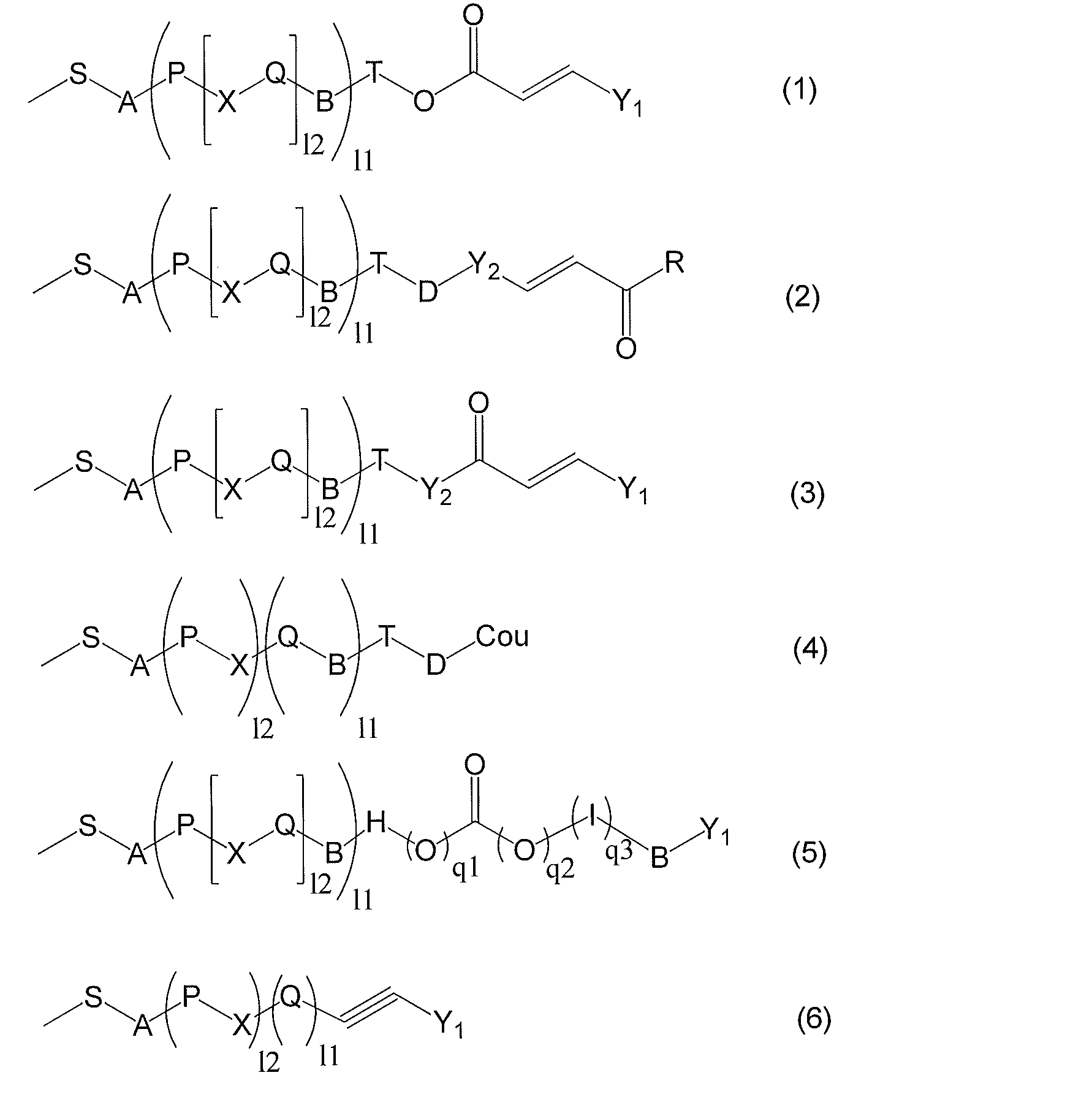
Sは、炭素数1~12のアルキレン基であり、それらに結合する水素原子はハロゲン基に置き換えられていてもよい;
Tは、単結合または炭素数1~12のアルキレン基であり、それらに結合する水素原子はハロゲン基に置き換えられていてもよい;
Y1は、1価のベンゼン環、ナフタレン環、ビフェニル環、フラン環、ピロール環および炭素数5~8の脂環式炭化水素から選ばれる環を表すか、それらの置換基から選ばれる同一又は相異なった2~6の環が結合基Bを介して結合してなる基であり、それらに結合する水素原子はそれぞれ独立に-COOR0(式中、R0は水素原子又は炭素数1~5のアルキル基を表す)、-NO2、-CN、-CH=C(CN)2、-CH=CH-CN、ハロゲン基、炭素数1~5のアルキル基、又は炭素数1~5のアルキルオキシ基で置換されても良い;
Y2は、2価のベンゼン環、ナフタレン環、ビフェニル環、フラン環、ピロール環、炭素数5~8の脂環式炭化水素、および、それらの組み合わせからなる群から選ばれる基であり、それらに結合する水素原子はそれぞれ独立に-NO2、-CN、-CH=C(CN)2、-CH=CH-CN、ハロゲン基、炭素数1~5のアルキル基、又は炭素数1~5のアルキルオキシ基で置換されても良い;
Rは、ヒドロキシ基、炭素数1~6のアルコキシ基を表すか、又はY1と同じ定義を表す;
Xは、単結合、-COO-、-OCO-、-N=N-、-CH=CH-、-C≡C-、-CH=CH-CO-O-、又は-O-CO-CH=CH-を表し、Xの数が2となるときは、X同士は同一でも異なっていてもよい;
Couは、クマリン-6-イル基またはクマリン-7-イル基を表し、それらに結合する水素原子はそれぞれ独立に-NO2、-CN、-CH=C(CN)2、-CH=CH-CN、ハロゲン基、炭素数1~5のアルキル基、又は炭素数1~5のアルキルオキシ基で置換されても良い;
q1とq2は、一方が1で他方が0である;
q3は0または1である;
P及びQは、各々独立に、2価のベンゼン環、ナフタレン環、ビフェニル環、フラン環、ピロール環、炭素数5~8の脂環式炭化水素、および、それらの組み合わせからなる群から選ばれる基である;ただし、Xが-CH=CH-CO-O-、-O-CO-CH=CH-である場合、-CH=CH-が結合する側のP又はQは芳香環である;
l1は0または1である;
l2は0~2の整数である;
l1とl2がともに0であるときは、Tが単結合であるときはAも単結合を表す;
l1が1であるときは、Tが単結合であるときはBも単結合を表す;
H及びIは、各々独立に、2価のベンゼン環、ナフタレン環、ビフェニル環、フラン環、ピロール環、およびそれらの組み合わせから選ばれる基である]。
[式中、A、B、q1及びq2は上記と同じ定義を有する;
Y3は、1価のベンゼン環、ナフタレン環、ビフェニル環、フラン環、窒素含有複素環、及び炭素数5~8の脂環式炭化水素、および、それらの組み合わせからなる群から選ばれる基であり、それらに結合する水素原子はそれぞれ独立に-NO2、-CN、ハロゲン基、炭素数1~5のアルキル基、又は炭素数1~5のアルキルオキシ基で置換されても良い;
R3は、水素原子、-NO2、-CN、-CH=C(CN)2、-CH=CH-CN、ハロゲン基、1価のベンゼン環、ナフタレン環、ビフェニル環、フラン環、窒素含有複素環、炭素数5~8の脂環式炭化水素、炭素数1~12のアルキル基、又は炭素数1~12のアルコキシ基を表す;
lは1~12の整数を表し、mは0から2の整数を表し、但し、式(25)~(26)において、全てのmの合計は2以上であり、式(27)~(28),(32)~(33)において、全てのmの合計は1以上であり、m1、m2およびm3は、それぞれ独立に1~3の整数を表す;
R2は、水素原子、-NO2、-CN、ハロゲン基、1価のベンゼン環、ナフタレン環、ビフェニル環、フラン環、窒素含有複素環、及び炭素数5~8の脂環式炭化水素、および、アルキル基、又はアルキルオキシ基を表す;
Z1、Z2は単結合、-CO-、-CH2O-、-CH=N-、-CF2-を表す]。

[II] [I]で得られた塗膜に偏光した紫外線を斜め方向から照射する工程;及び
[III] [II]で得られた塗膜を加熱する工程;
を有することによって配向制御能が付与された液晶配向膜を得る、前記液晶配向膜を有する基板の製造方法。
<7> 上記<6>記載の製造方法により製造された液晶配向膜を有する基板。
<8> 上記<7>の基板を有するツイストネマチック型液晶表示素子及び縦電界型液晶表示素子。
[I’] 第2の基板上に、上記<1>~<5>のいずれに記載の重合体組成物を、塗布して塗膜を形成する工程;
[II’] [I’]で得られた塗膜に偏光した紫外線を照射する工程;及び
[III’] [II’]で得られた塗膜を加熱する工程;
を有することによって配向制御能が付与された液晶配向膜を得る、該液晶配向膜を有する第2の基板を得る工程;及び
[IV] 液晶を介して第1及び第2の基板の液晶配向膜が相対するように、露光方向が互いに直交するように第1及び第2の基板を対向配置して液晶表示素子を得る工程;
を有することにより、ツイストネマチック型液晶表示素子及び縦電界型液晶表示素子を得る、該液晶表示素子の製造方法。
<10> 上記<9>により製造されたツイストネマチック型液晶表示素子及び縦電界型液晶表示素子。
<11> 所定の温度範囲で液晶性を発現する感光性の側鎖型高分子であって、垂直配向性基を含む繰り返し単位を有する、側鎖型高分子。
本発明の方法によって製造されたツイストネマチック型液晶表示素子及び縦電界型液晶表示素子は、高効率に配向制御能が付与されているため長時間連続駆動しても表示特性が損なわれることがない。
本発明の製造方法において用いられる重合体組成物は、液晶性を発現し得る感光性の側鎖型高分子(以下、単に側鎖型高分子とも呼ぶ)を有しており、前記重合体組成物を用いて得られる塗膜は、液晶性を発現し得る感光性の側鎖型高分子を有する膜である。この塗膜にはラビング処理を行うこと無く、斜め方向からの偏光照射によって配向処理を行う。そして、偏光照射の後、その側鎖型高分子膜を加熱する工程を経て、配向制御能が付与された塗膜(以下、液晶配向膜とも称する)となる。このとき、偏光照射によって発現した僅かな異方性がドライビングフォースとなり、液晶性の側鎖型高分子自体が自己組織化により効率的に再配向する。その結果、液晶配向膜として高効率な配向処理が実現し、高い配向制御能が付与された液晶配向膜を得ることができる。
<液晶配向膜を有する基板の製造方法>及び<液晶表示素子の製造方法>
本発明の液晶配向膜を有する基板の製造方法は、
[I] (A)所定の温度範囲で液晶性を発現する感光性の側鎖型高分子であって、垂直配向性基を含む繰り返し単位を有する側鎖型高分子、及び
(B)有機溶媒
を含有する重合体組成物を、液晶駆動用の電極を有する基板上に塗布して塗膜を形成する工程;
[II] [I]で得られた塗膜に偏光した紫外線を斜め方向から照射する工程;及び
[III] [II]で得られた塗膜を加熱する工程;
を有する。
上記工程により、配向制御能が付与された液晶配向膜を得ることができ、該液晶配向膜を有する基板を得ることができる。
[IV] 上記で得られた第1及び第2の基板を、液晶を介して第1及び第2の基板の液晶配向膜が相対するように、対向配置して液晶表示素子を得る工程;
を有する。これによりツイストネマチック型液晶表示素子及び縦電界型液晶表示素子を得ることができる。
<工程[I]>
工程[I]では、液晶駆動用の電極を有する基板上に、所定の温度範囲で液晶性を発現する感光性の側鎖型高分子であって、垂直配向性基を有する側鎖をさらに有する側鎖型高分子、及び有機溶媒を含有する重合体組成物を塗布して塗膜を形成する。
基板については、特に限定はされないが、製造される液晶表示素子が透過型である場合、透明性の高い基板が用いられることが好ましい。その場合、特に限定はされず、ガラス基板、またはアクリル基板やポリカーボネート基板等のプラスチック基板等を用いることができる。
基板に電極を形成する方法は、従来公知の手法を用いることができる。
上記基板の電極が形成された側に、重合体組成物を塗布する。
本発明の製造方法には、以下の通りの本発明による重合組成物を用いる。すなわち、本発明による重合体組成物は、前記したように、(A)所定の温度範囲で液晶性を発現する感光性の側鎖型高分子であって、垂直配向性基を含む繰り返し単位を有する側鎖型高分子、及び(B)有機溶媒を含有する。
(A)成分は、所定の温度範囲で液晶性を発現する感光性の側鎖型高分子であって、垂直配向性基を含む側鎖をさらに有する。
(A)側鎖型高分子は、250nm~400nmの波長範囲の光で反応し、かつ100℃~300℃の温度範囲で液晶性を示すのがよい。
(A)側鎖型高分子は、250nm~400nmの波長範囲の光に反応する感光性側鎖を有することが好ましい。
(A)側鎖型高分子は、100℃~300℃の温度範囲で液晶性を示すためメソゲン基を有することが好ましい。
ここで、感光性側鎖は、下記式(1)から(6)の少なくとも1種からなる側鎖であるのがよい。

Sは、炭素数1~12のアルキレン基であり、それらに結合する水素原子はハロゲン基に置き換えられていてもよい;
Tは、単結合または炭素数1~12のアルキレン基であり、それらに結合する水素原子はハロゲン基に置き換えられていてもよい;
Y1は、1価のベンゼン環、ナフタレン環、ビフェニル環、フラン環、ピロール環および炭素数5~8の脂環式炭化水素から選ばれる環を表すか、それらの置換基から選ばれる同一又は相異なった2~6の環が結合基Bを介して結合してなる基であり、それらに結合する水素原子はそれぞれ独立に-COOR0(式中、R0は水素原子又は炭素数1~5のアルキル基を表す)、-NO2、-CN、-CH=C(CN)2、-CH=CH-CN、ハロゲン基、炭素数1~5のアルキル基、又は炭素数1~5のアルキルオキシ基で置換されても良い;
Y2は、2価のベンゼン環、ナフタレン環、ビフェニル環、フラン環、ピロール環、炭素数5~8の脂環式炭化水素、および、それらの組み合わせからなる群から選ばれる基であり、それらに結合する水素原子はそれぞれ独立に-NO2、-CN、-CH=C(CN)2、-CH=CH-CN、ハロゲン基、炭素数1~5のアルキル基、又は炭素数1~5のアルキルオキシ基で置換されても良い;
Rは、ヒドロキシ基、炭素数1~6のアルコキシ基を表すか、又はY1と同じ定義を表す;
Xは、単結合、-COO-、-OCO-、-N=N-、-CH=CH-、-C≡C-、-CH=CH-CO-O-、又は-O-CO-CH=CH-を表し、Xの数が2となるときは、X同士は同一でも異なっていてもよい;
Couは、クマリン-6-イル基またはクマリン-7-イル基を表し、それらに結合する水素原子はそれぞれ独立に-NO2、-CN、-CH=C(CN)2、-CH=CH-CN、ハロゲン基、炭素数1~5のアルキル基、又は炭素数1~5のアルキルオキシ基で置換されても良い;
q1とq2は、一方が1で他方が0である;
q3は0または1である;
P及びQは、各々独立に、2価のベンゼン環、ナフタレン環、ビフェニル環、フラン環、ピロール環、炭素数5~8の脂環式炭化水素、および、それらの組み合わせからなる群から選ばれる基である;ただし、Xが-CH=CH-CO-O-、-O-CO-CH=CH-である場合、-CH=CH-が結合する側のP又はQは芳香環である;
l1は0または1である;
l2は0~2の整数である;
l1とl2がともに0であるときは、Tが単結合であるときはAも単結合を表す;
l1が1であるときは、Tが単結合であるときはBも単結合を表す;
H及びIは、各々独立に、2価のベンゼン環、ナフタレン環、ビフェニル環、フラン環、ピロール環、およびそれらの組み合わせから選ばれる基である。
式中、A、B、D、Y1、X、Y2、及びRは、上記と同じ定義を有する;
lは1~12の整数を表す;
mは、0~2の整数を表し、m1、m2は1~3の整数を表す;
nは0~12の整数(ただしn=0のときBは単結合である)を表す。

式中、A、X、l、m及びRは、上記と同じ定義を有する。
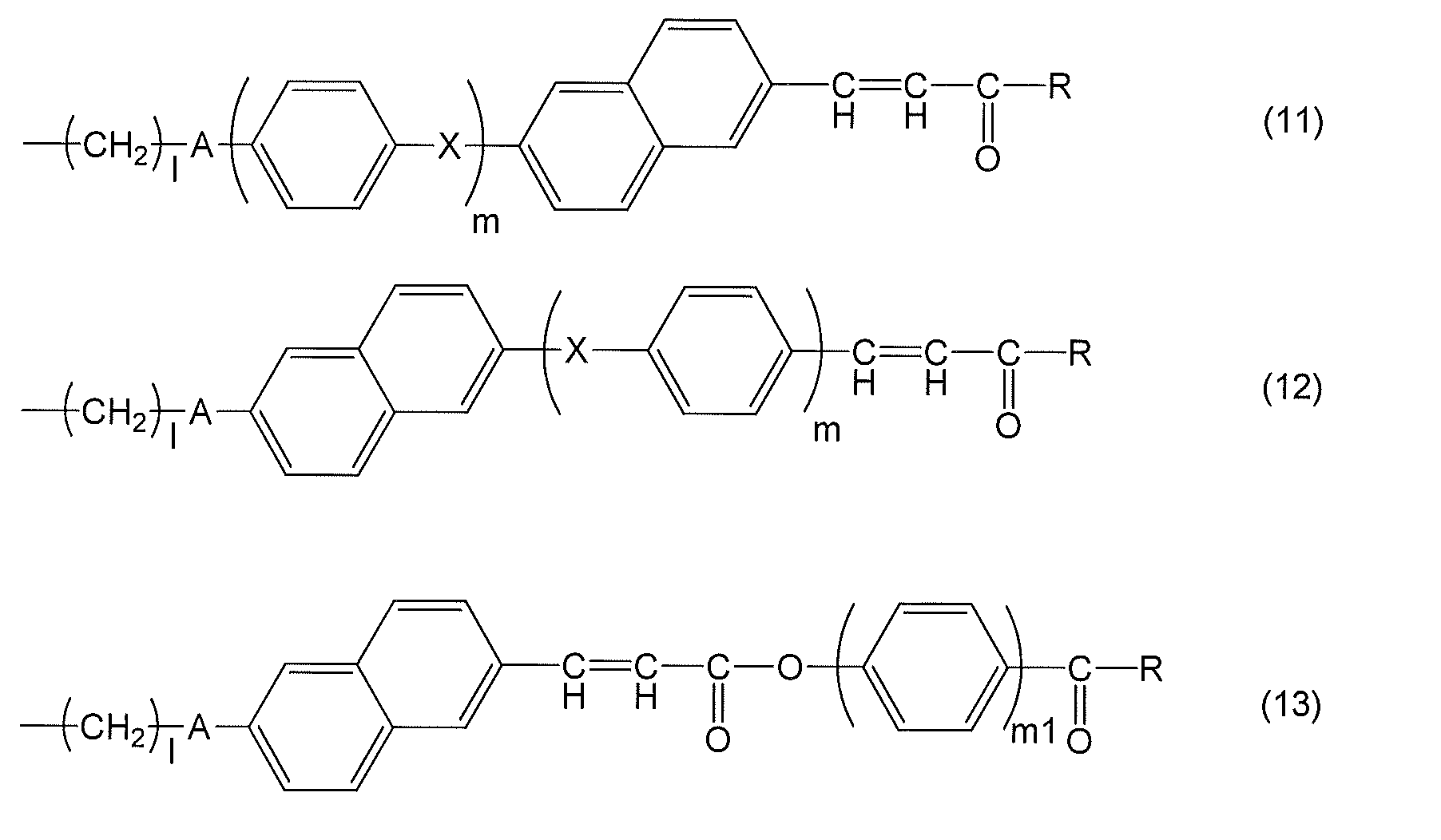
式中、A、Y1、X、l、m1及びm2は上記と同じ定義を有する。

式中、A、X、l及びmは、上記と同じ定義を有する。
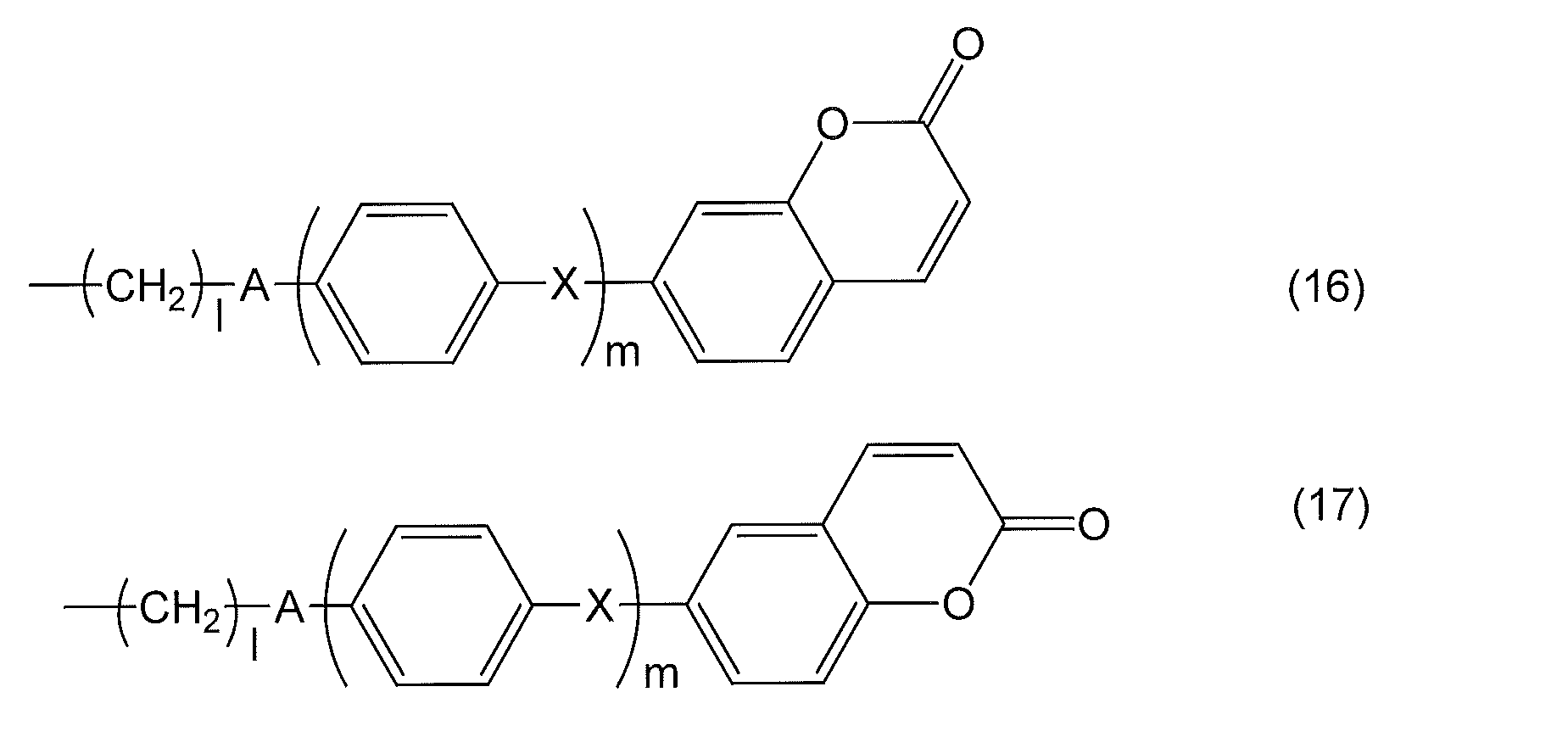
式中、A、B、Y1、q1、q2、m1、及びm2は、上記と同じ定義を有する。
R1は、水素原子、-NO2、-CN、-CH=C(CN)2、-CH=CH-CN、ハロゲン基、炭素数1~5のアルキル基、又は炭素数1~5のアルキルオキシ基を表す。
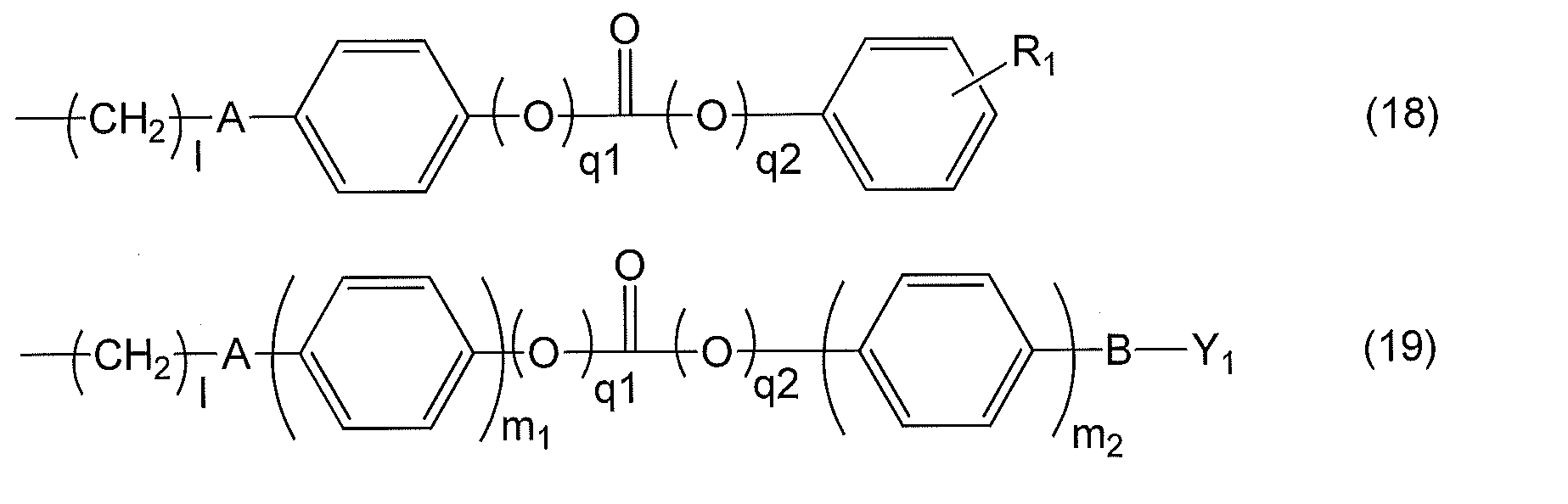
式中、A、Y1、X、l及びmは上記と同じ定義を有する。

また、斜め方向からの偏光紫外線の照射による異方性が付与しやすいという点で、本願記載のプロセスにおいて、偏光紫外線の照射方向に対して平行方向に異方性を発現する基であることが好ましい。
また、垂直配向性基としては、特に限定されるものではないが、炭素数が1~17の炭化水素基を含む基が好ましく、具体的には式(v)で表される基が好適である。


ただし、Y4がステロイド骨格を有する2価の有機基である場合は、Y6は水素原子が好ましい。
また、原料の入手性や合成の容易さ等の点から、mは0~3が好ましく、0~2がより好ましく、0または1がより一層好ましい。
このような垂直配向性基(a-2)の具体例としては、下記(a-2-1)~(a-2-7)で示される基が挙げられるが、これらに限定されるものではない。
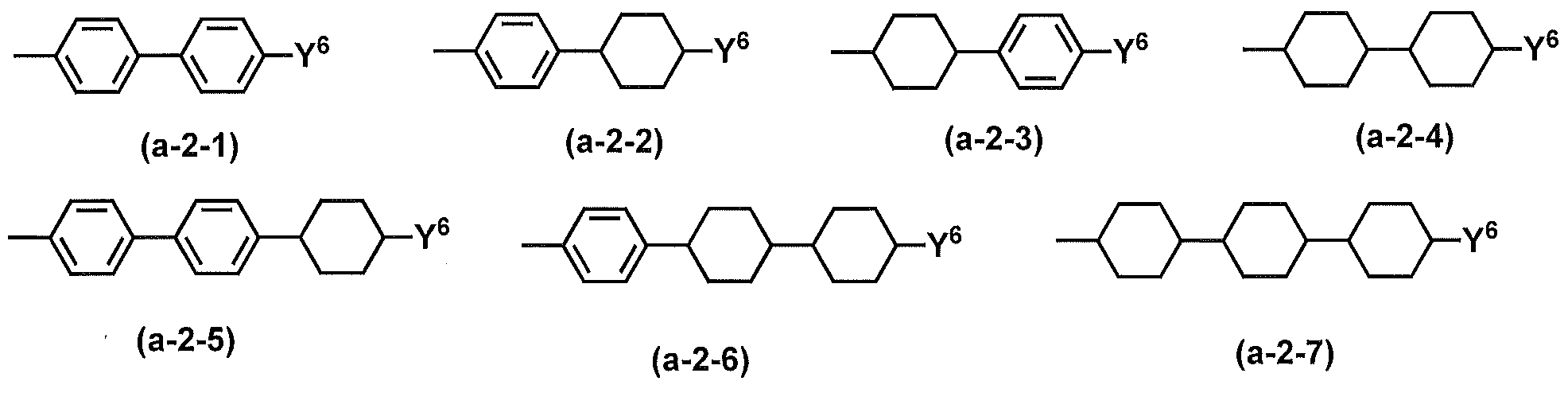
このような垂直配向性基(a-3)としては、例えば、下記(a-3-1)~(a-3-8)で示される基が挙げられるが、これらに限定されるものではない。

また、(A)側鎖型高分子は、下記式(21)~(33)からなる群から選ばれる1種または複数の液晶性側鎖を有するのがよい。
式中、A、B、q1及びq2は上記と同じ定義を有する;
Y3は、1価のベンゼン環、ナフタレン環、ビフェニル環、フラン環、窒素含有複素環、及び炭素数5~8の脂環式炭化水素、および、それらの組み合わせからなる群から選ばれる基であり、それらに結合する水素原子はそれぞれ独立に-NO2、-CN、ハロゲン基、炭素数1~5のアルキル基、又は炭素数1~5のアルキルオキシ基で置換されても良い;
R3は、水素原子、-NO2、-CN、-CH=C(CN)2、-CH=CH-CN、ハロゲン基、1価のベンゼン環、ナフタレン環、ビフェニル環、フラン環、窒素含有複素環、炭素数5~8の脂環式炭化水素、炭素数1~12のアルキル基、又は炭素数1~12のアルコキシ基を表す;
lは1~12の整数を表し、mは0から2の整数を表し、但し、式(25)~(26)において、全てのmの合計は2以上であり、式(27)~(28)、(32)~(33)において、全てのmの合計は1以上であり、m1、m2およびm3は、それぞれ独立に1~3の整数を表す;
R2は、水素原子、-NO2、-CN、ハロゲン基、1価のベンゼン環、ナフタレン環、ビフェニル環、フラン環、窒素含有複素環、及び炭素数5~8の脂環式炭化水素、および、アルキル基、又はアルキルオキシ基を表す;
Z1、Z2は単結合、-CO-、-CH2O-、-CH=N-、-CF2-を表す。

上記の液晶性を発現し得る感光性の側鎖型高分子は、上記の感光性側鎖を有する光反応性側鎖モノマー、垂直配向性基を有するモノマーおよび液晶性側鎖モノマーを重合することによって得ることができる。
具体的なモノマーとしては、(メタ)アクリル酸のアルキルエステル、アルキルビニルエーテル、2-アルキルスチレン、3-アルキルスチレン、4-アルキルスチレン、N-アルキルマレイミドで、当該アルキル基が炭素数1~20のものが挙げられる。
これらのモノマーは、公知の方法により製造することができ、また市販品として入手可能なものもある。
なお、上記式(v)で表される垂直配向性基を含む(メタ)アクリル系モノマーを用いてポリマー中に垂直配向性基を導入する場合、その垂直配向性側鎖は下記式(v’)で示される。

光反応性側鎖モノマーとは、高分子を形成した場合に、高分子の側鎖部位に感光性側鎖を有する高分子を形成することができるモノマーのことである。
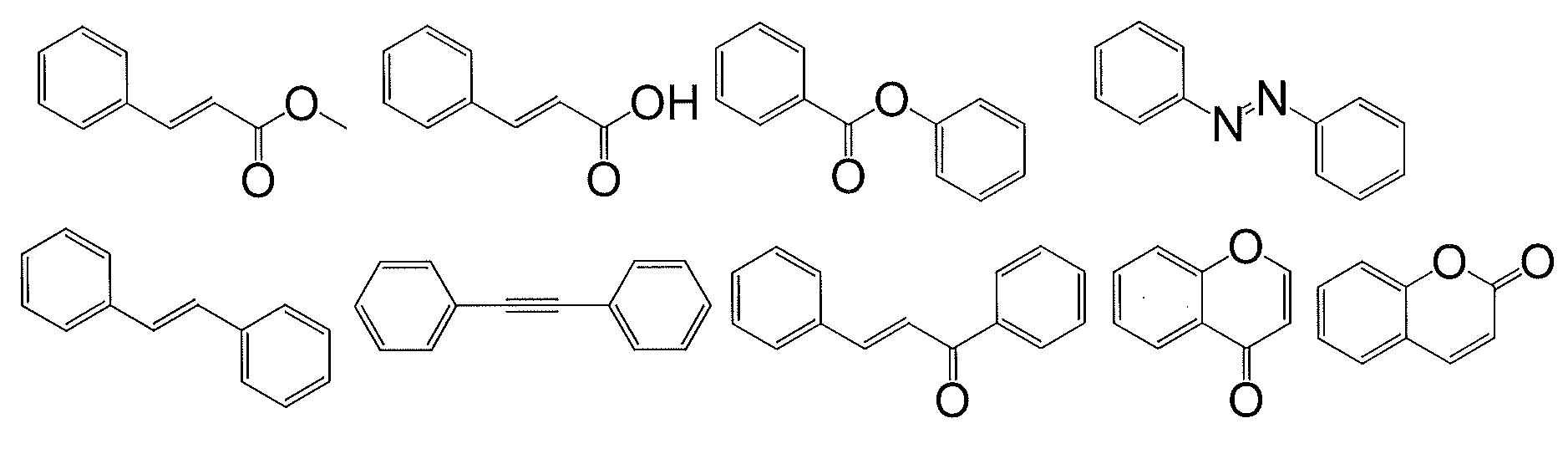
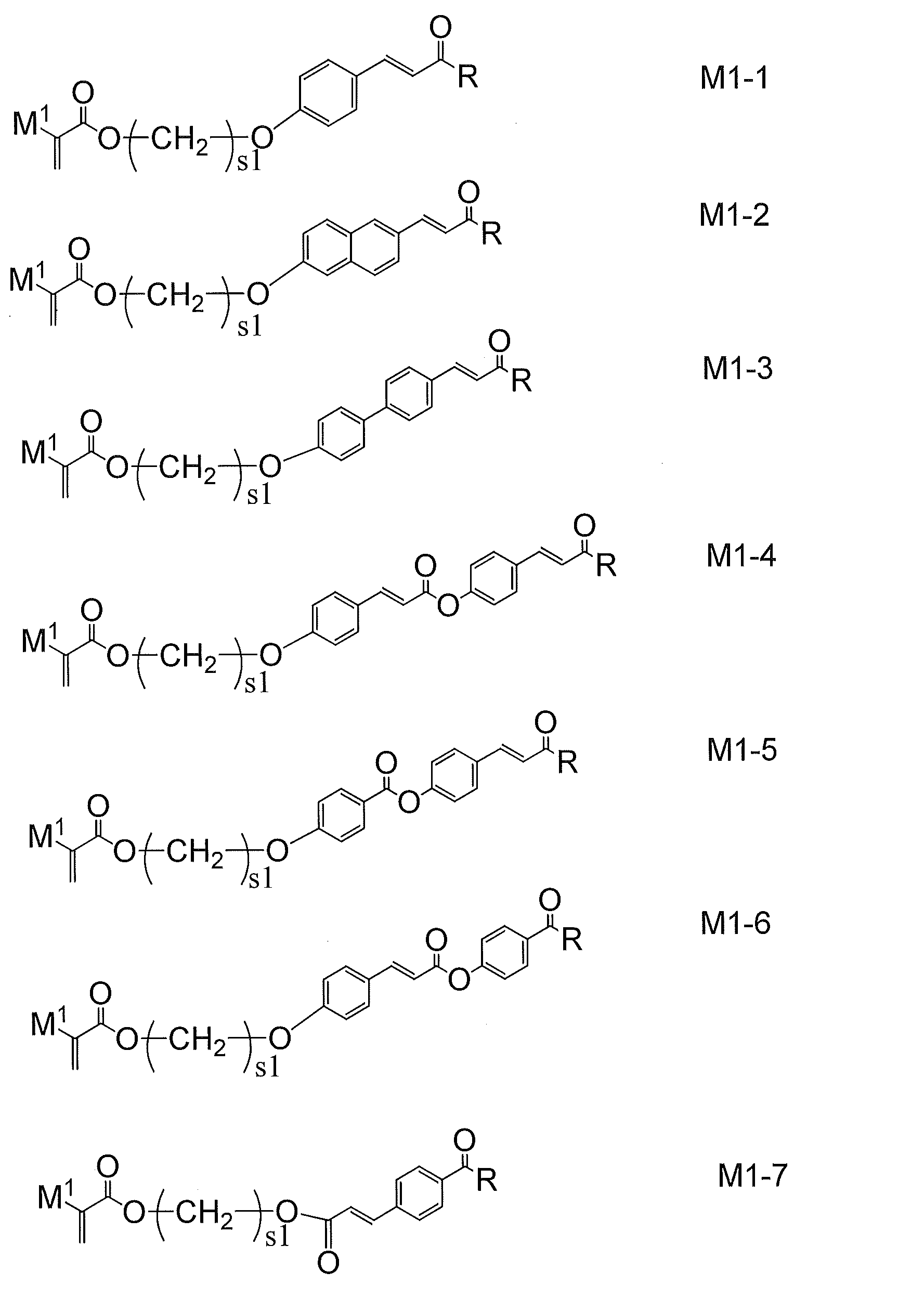

液晶性側鎖モノマーとは、該モノマー由来の高分子が液晶性を発現し、該高分子が側鎖部位にメソゲン基を形成することができるモノマーのことである。
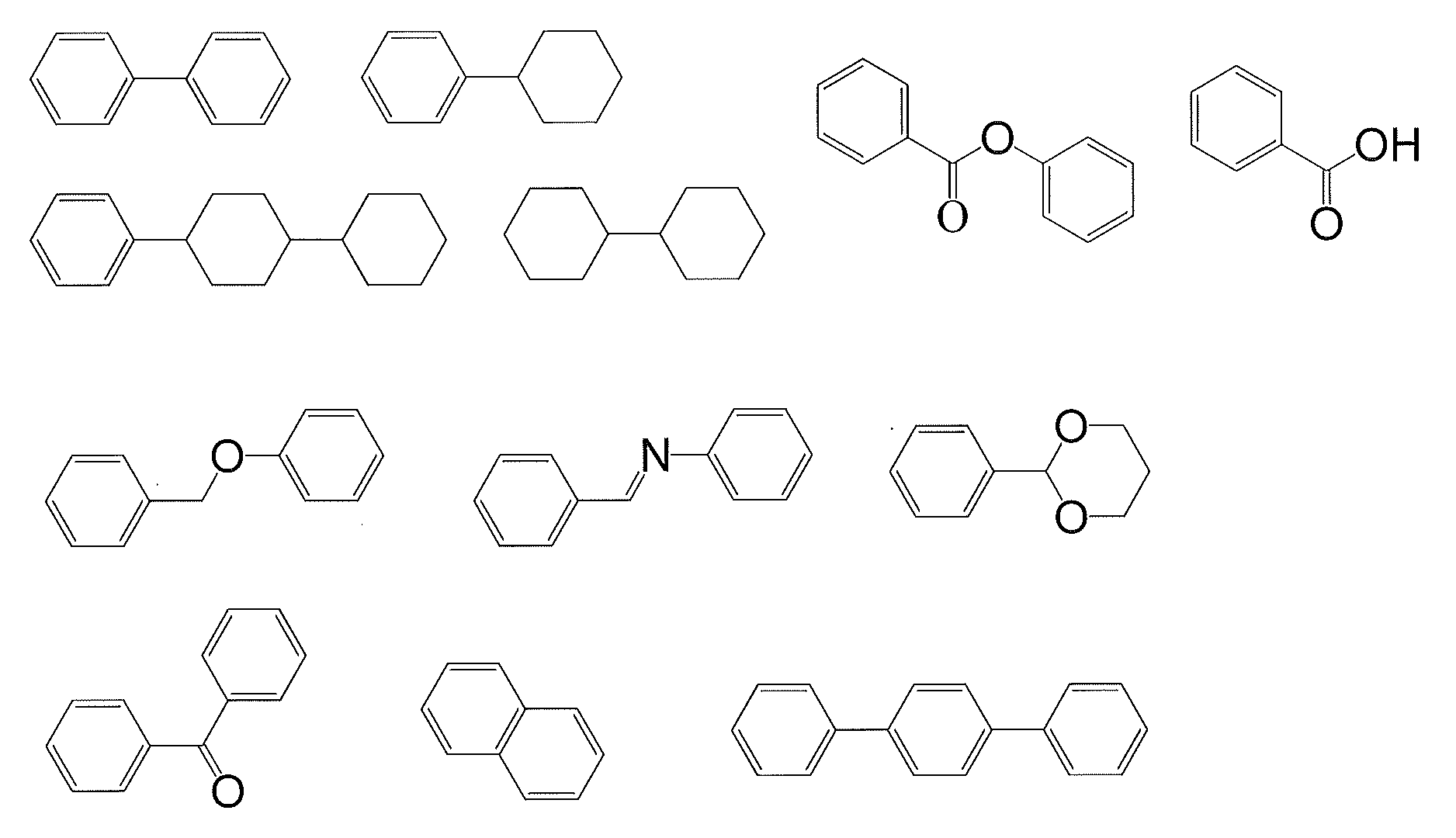

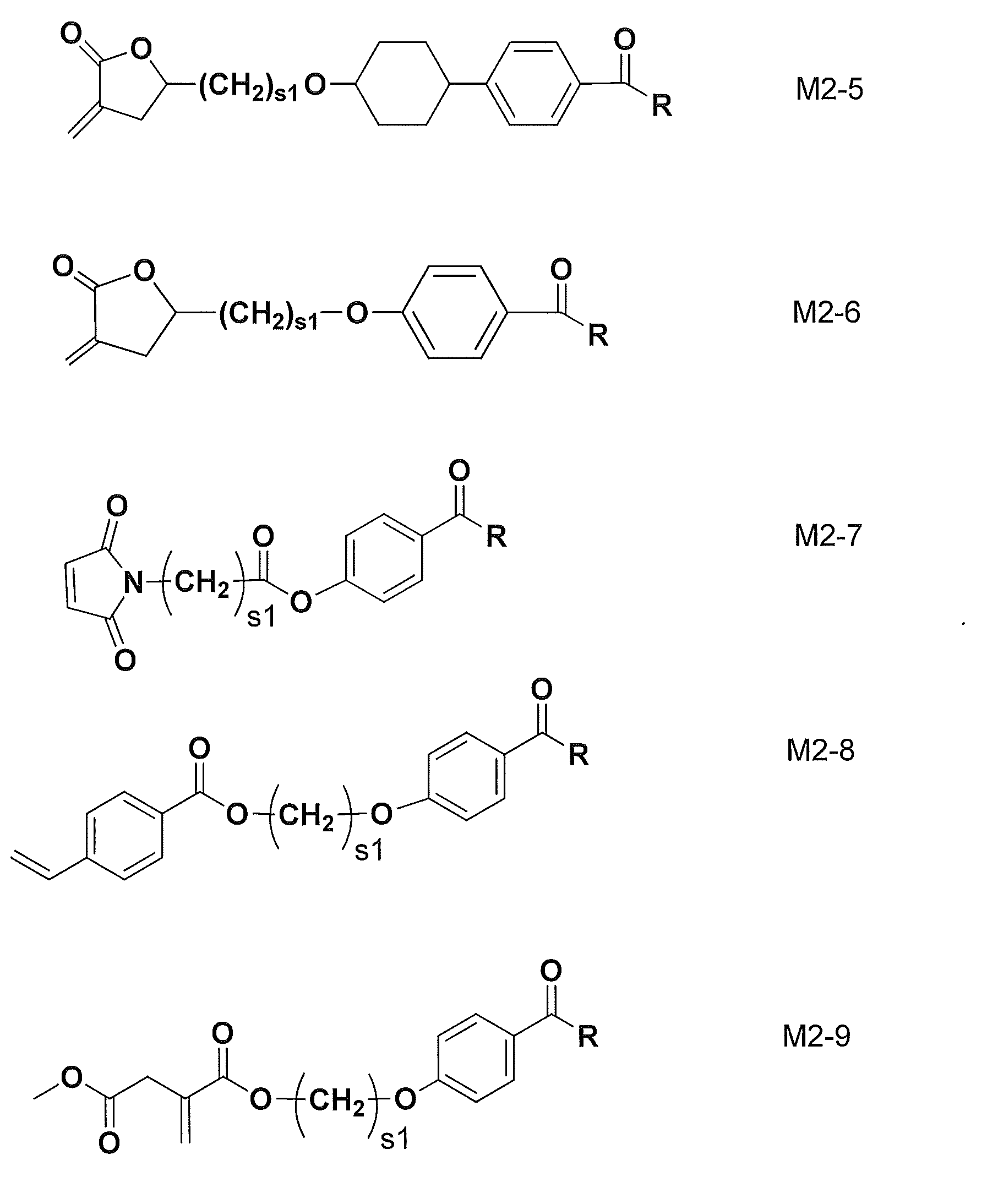

本発明の(A)側鎖型高分子は、得られる液晶配向膜の電圧保持率(VHR)等の信頼性をより高めるために、下記式(0)

Sは、炭素数1~12のアルキレン基であり、それらに結合する水素原子はハロゲン基に置き換えられていてもよい;
Tは、単結合または炭素数1~12のアルキレン基であり、それらに結合する水素原子はハロゲン基に置き換えられていてもよい;
Xは、単結合、-COO-、-OCO-、-N=N-、-CH=CH-、-C≡C-、-CH=CH-CO-O-、又は-O-CO-CH=CH-を表し、Xの数が2となるときは、X同士は同一でも異なっていてもよい;
P及びQは、各々独立に、2価のベンゼン環、ナフタレン環、ビフェニル環、フラン環、ピロール環、炭素数5~8の脂環式炭化水素、および、それらの組み合わせからなる群から選ばれる基である;ただし、Xが-CH=CH-CO-O-、-O-CO-CH=CH-である場合、-CH=CH-が結合する側のP又はQは芳香環である;
l1は0または1である;
l2は0~2の整数である;
l1とl2がともに0であるときは、Tが単結合であるときはAも単結合を表す;
l1が1であるときは、Tが単結合であるときはBも単結合を表す;
Gは、下記式(G-1)、(G-2)、(G-3)及び(G-4)
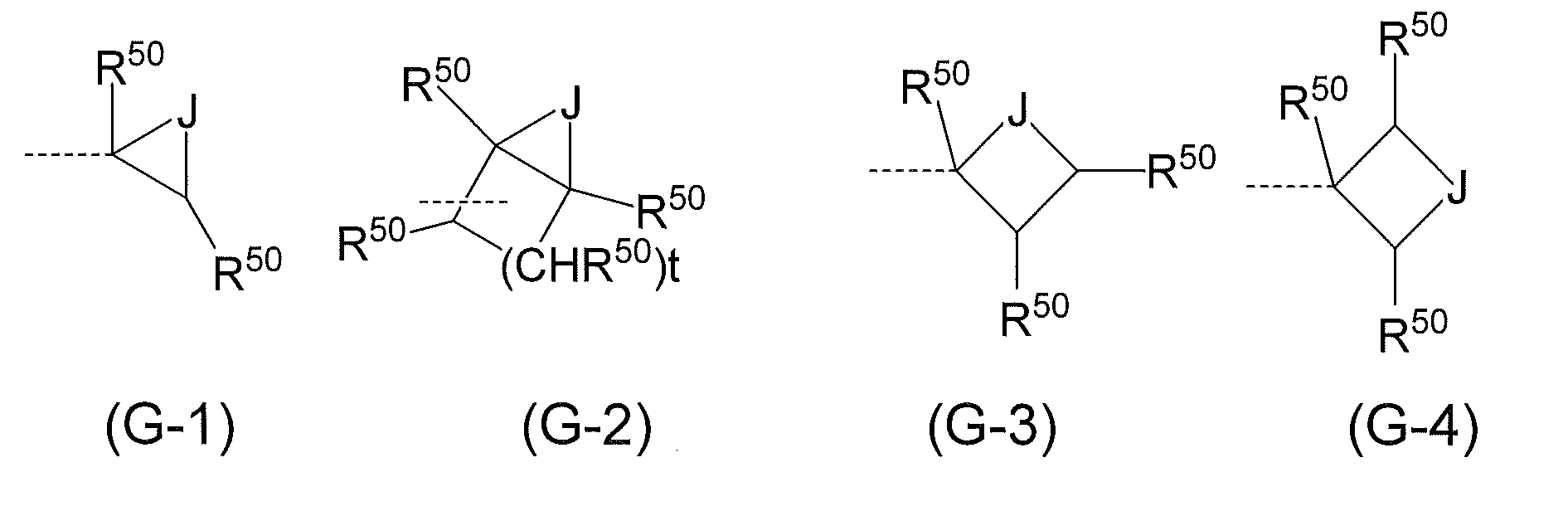
で表される側鎖を有するモノマーを共重合させてもよい。
本願の(A)成分である重合体は、より耐久性の高い液晶配向膜を得るために、窒素含有芳香族複素環基、アミド基及びウレタン基から選ばれる基を有する側鎖(a)をさらに有していてもよい。側鎖(a)を有する重合体を製造するには、側鎖(a)を有するモノマーを共重合させればよい。

その他のモノマーの具体例としては、不飽和カルボン酸、アクリル酸エステル化合物、メタクリル酸エステル化合物、マレイミド化合物、アクリロニトリル、マレイン酸無水物、スチレン化合物及びビニル化合物等が挙げられる。
また、ラジカル重合において有機溶媒中の酸素は重合反応を阻害する原因となるので、有機溶媒は可能な程度に脱気されたものを用いることが好ましい。
上述の反応により得られた、液晶性を発現し得る感光性の側鎖型高分子の反応溶液から、生成した高分子を回収する場合には、反応溶液を貧溶媒に投入して、それら重合体を沈殿させれば良い。沈殿に用いる貧溶媒としては、メタノール、アセトン、ヘキサン、ヘプタン、ブチルセルソルブ、ヘプタン、メチルエチルケトン、メチルイソブチルケトン、エタノール、トルエン、ベンゼン、ジエチルエーテル、メチルエチルエーテル、水等を挙げることができる。貧溶媒に投入して沈殿させた重合体は、濾過して回収した後、常圧あるいは減圧下で、常温あるいは加熱して乾燥することができる。また、沈殿回収した重合体を、有機溶媒に再溶解させ、再沈殿回収する操作を2回~10回繰り返すと、重合体中の不純物を少なくすることができる。この際の貧溶媒として、例えば、アルコール類、ケトン類、炭化水素等が挙げられ、これらの中から選ばれる3種類以上の貧溶媒を用いると、より一層精製の効率が上がるので好ましい。
本発明に用いられる重合体組成物は、液晶配向膜の形成に好適となるように塗布液として調製されることが好ましい。すなわち、本発明に用いられる重合体組成物は、樹脂被膜を形成するための樹脂成分が有機溶媒に溶解した溶液として調製されることが好ましい。ここで、その樹脂成分とは、既に説明した液晶性を発現し得る感光性の側鎖型高分子を含む樹脂成分である。その際、樹脂成分の含有量は、1質量%~20質量%が好ましく、より好ましくは3質量%~15質量%、特に好ましくは3質量%~10質量%である。
そのような他の重合体は、例えば、ポリ(メタ)アクリレートやポリアミック酸やポリイミド等からなり、液晶性を発現し得る感光性の側鎖型高分子ではない重合体等が挙げられる。
本発明に用いられる重合体組成物に用いる有機溶媒は、樹脂成分を溶解させる有機溶媒であれば特に限定されない。その具体例を以下に挙げる。
N,N-ジメチルホルムアミド、N,N-ジメチルアセトアミド、N-メチル-2-ピロリドン、N-メチルカプロラクタム、2-ピロリドン、N-エチルピロリドン、N-ビニルピロリドン、ジメチルスルホキシド、テトラメチル尿素、ピリジン、ジメチルスルホン、ヘキサメチルスルホキシド、γ-ブチロラクトン、3-メトキシ-N,N-ジメチルプロパンアミド、3-エトキシ-N,N-ジメチルプロパンアミド、3-ブトキシ-N,N-ジメチルプロパンアミド、1,3-ジメチル-イミダゾリジノン、エチルアミルケトン、メチルノニルケトン、メチルエチルケトン、メチルイソアミルケトン、メチルイソプロピルケトン、シクロヘキサノン、エチレンカーボネート、プロピレンカーボネート、ジグライム、4-ヒドロキシ-4-メチル-2-ペンタノン、プロピレングリコールモノアセテート、プロピレングリコールモノメチルエーテル、プロピレングリコール-tert-ブチルエーテル、ジプロピレングリコールモノメチルエーテル、ジエチレングリコール、ジエチレングリコールモノアセテート、ジエチレングリコールジメチルエーテル、ジプロピレングリコールモノアセテートモノメチルエーテル、ジプロピレングリコールモノメチルエーテル、ジプロピレングリコールモノエチルエーテル、ジプロピレングリコールモノアセテートモノエチルエーテル、ジプロピレングリコールモノプロピルエーテル、ジプロピレングリコールモノアセテートモノプロピルエーテル、3-メチル-3-メトキシブチルアセテート、トリプロピレングリコールメチルエーテル等が挙げられる。これらは単独で使用しても、混合して使用してもよい。
例えば、イソプロピルアルコール、メトキシメチルペンタノール、メチルセロソルブ、エチルセロソルブ、ブチルセロソルブ、メチルセロソルブアセテート、エチルセロソルブアセテート、ブチルカルビトール、エチルカルビトール、エチルカルビトールアセテート、エチレングリコール、エチレングリコールモノアセテート、エチレングリコールモノイソプロピルエーテル、エチレングリコールモノブチルエーテル、プロピレングリコール、プロピレングリコールモノアセテート、プロピレングリコールモノメチルエーテル、プロピレングリコール-tert-ブチルエーテル、ジプロピレングリコールモノメチルエーテル、ジエチレングリコール、ジエチレングリコールモノアセテート、ジエチレングリコールジメチルエーテル、ジプロピレングリコールモノアセテートモノメチルエーテル、ジプロピレングリコールモノメチルエーテル、ジプロピレングリコールモノエチルエーテル、ジプロピレングリコールモノアセテートモノエチルエーテル、ジプロピレングリコールモノプロピルエーテル、ジプロピレングリコールモノアセテートモノプロピルエーテル、3-メチル-3-メトキシブチルアセテート、トリプロピレングリコールメチルエーテル、3-メチル-3-メトキシブタノール、ジイソプロピルエーテル、エチルイソブチルエーテル、ジイソブチレン、アミルアセテート、ブチルブチレート、ブチルエーテル、ジイソブチルケトン、メチルシクロへキセン、プロピルエーテル、ジヘキシルエーテル、1-ヘキサノール、n-へキサン、n-ペンタン、n-オクタン、ジエチルエーテル、乳酸メチル、乳酸エチル、酢酸メチル、酢酸エチル、酢酸n-ブチル、酢酸プロピレングリコールモノエチルエーテル、ピルビン酸メチル、ピルビン酸エチル、3-メトキシプロピオン酸メチル、3-エトキシプロピオン酸メチルエチル、3-メトキシプロピオン酸エチル、3-エトキシプロピオン酸、3-メトキシプロピオン酸、3-メトキシプロピオン酸プロピル、3-メトキシプロピオン酸ブチル、1-メトキシ-2-プロパノール、1-エトキシ-2-プロパノール、1-ブトキシ-2-プロパノール、1-フェノキシ-2-プロパノール、プロピレングリコールモノアセテート、プロピレングリコールジアセテート、プロピレングリコール-1-モノメチルエーテル-2-アセテート、プロピレングリコール-1-モノエチルエーテル-2-アセテート、ジプロピレングリコール、2-(2-エトキシプロポキシ)プロパノール、乳酸メチルエステル、乳酸エチルエステル、乳酸n-プロピルエステル、乳酸n-ブチルエステル、乳酸イソアミルエステル等の低表面張力を有する溶媒等が挙げられる。
より具体的には、例えば、エフトップ(登録商標)301、EF303、EF352(トーケムプロダクツ社製)、メガファック(登録商標)F171、F173、R-30(DIC社製)、フロラードFC430、FC431(住友スリーエム社製)、アサヒガード(登録商標)AG710(旭硝子社製)、サーフロン(登録商標)S-382、SC101、SC102、SC103、SC104、SC105、SC106(AGCセイミケミカル社製)等が挙げられる。これらの界面活性剤の使用割合は、重合体組成物に含有される樹脂成分の100質量部に対して、好ましくは0.01質量部~2質量部、より好ましくは0.01質量部~1質量部である。
例えば、3-アミノプロピルトリメトキシシラン、3-アミノプロピルトリエトキシシラン、2-アミノプロピルトリメトキシシラン、2-アミノプロピルトリエトキシシラン、N-(2-アミノエチル)-3-アミノプロピルトリメトキシシラン、N-(2-アミノエチル)-3-アミノプロピルメチルジメトキシシラン、3-ウレイドプロピルトリメトキシシラン、3-ウレイドプロピルトリエトキシシラン、N-エトキシカルボニル-3-アミノプロピルトリメトキシシラン、N-エトキシカルボニル-3-アミノプロピルトリエトキシシラン、N-トリエトキシシリルプロピルトリエチレントリアミン、N-トリメトキシシリルプロピルトリエチレントリアミン、10-トリメトキシシリル-1,4,7-トリアザデカン、10-トリエトキシシリル-1,4,7-トリアザデカン、9-トリメトキシシリル-3,6-ジアザノニルアセテート、9-トリエトキシシリル-3,6-ジアザノニルアセテート、N-ベンジル-3-アミノプロピルトリメトキシシラン、N-ベンジル-3-アミノプロピルトリエトキシシラン、N-フェニル-3-アミノプロピルトリメトキシシラン、N-フェニル-3-アミノプロピルトリエトキシシラン、N-ビス(オキシエチレン)-3-アミノプロピルトリメトキシシラン、N-ビス(オキシエチレン)-3-アミノプロピルトリエトキシシラン等が挙げられる。
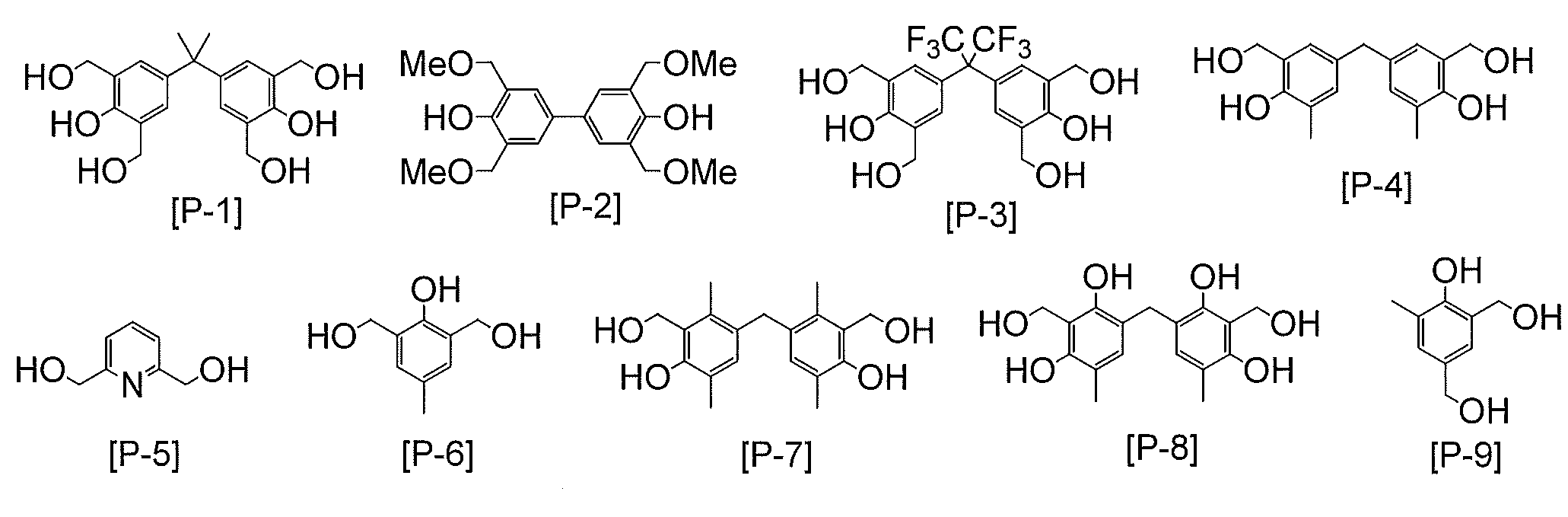
本発明に用いられる重合体組成物は、(C)成分として特定のアミン化合物、具体的には分子内に1級アミノ基を1個と窒素含有芳香族複素環とを有し、かつ前記1級アミノ基が脂肪族炭化水素基又は非芳香族環式炭化水素基に結合しているアミン化合物を有することができる。そのような化合物は、WO2008/013285号公報に(B)成分として記載されているものである。かかるアミン化合物を含有することにより、液晶配向膜としたときに、イオン性不純物の溶出を低減することができる。
特定のアミン化合物は、本発明に用いられる重合体組成物が液晶配向膜を形成した際、次の効果i)及び/又はii)を奏するものであれば、特に限定されない。i)液晶配向膜界面において液晶中のイオン性不純物を吸着するか、及び/又はii)向上した電圧保持率を奏する。
特定のアミン化合物の量は、上記効果を奏するのであれば、特に限定されないが、本発明に用いられる重合体組成物100質量部中、0.01~10質量部、好ましくは0.1~5質量部であるのがよい。
光増感剤としては、芳香族ニトロ化合物、クマリン(7-ジエチルアミノ-4-メチルクマリン、7-ヒドロキシ4-メチルクマリン)、ケトクマリン、カルボニルビスクマリン、芳香族2-ヒドロキシケトン、およびアミノ置換された、芳香族2-ヒドロキシケトン(2-ヒドロキシベンゾフェノン、モノ-もしくはジ-p-(ジメチルアミノ)-2-ヒドロキシベンゾフェノン)、アセトフェノン、アントラキノン、キサントン、チオキサントン、ベンズアントロン、チアゾリン(2-ベンゾイルメチレン-3-メチル-β-ナフトチアゾリン、2-(β-ナフトイルメチレン)-3-メチルベンゾチアゾリン、2-(α-ナフトイルメチレン)-3-メチルベンゾチアゾリン、2-(4-ビフェノイルメチレン)-3-メチルベンゾチアゾリン、2-(β-ナフトイルメチレン)-3-メチル-β-ナフトチアゾリン、2-(4-ビフェノイルメチレン)-3-メチル-β-ナフトチアゾリン、2-(p-フルオロベンゾイルメチレン)-3-メチル-β-ナフトチアゾリン)、オキサゾリン(2-ベンゾイルメチレン-3-メチル-β-ナフトオキサゾリン、2-(β-ナフトイルメチレン)-3-メチルベンゾオキサゾリン、2-(α-ナフトイルメチレン)-3-メチルベンゾオキサゾリン、2-(4-ビフェノイルメチレン)-3-メチルベンゾオキサゾリン、2-(β-ナフトイルメチレン)-3-メチル-β-ナフトオキサゾリン、2-(4-ビフェノイルメチレン)-3-メチル-β-ナフトオキサゾリン、2-(p-フルオロベンゾイルメチレン)-3-メチル-β-ナフトオキサゾリン)、ベンゾチアゾール、ニトロアニリン(m-もしくはp-ニトロアニリン、2,4,6-トリニトロアニリン)またはニトロアセナフテン(5-ニトロアセナフテン)、(2-[(m-ヒドロキシ-p-メトキシ)スチリル]ベンゾチアゾール、ベンゾインアルキルエーテル、N-アルキル化フタロン、アセトフェノンケタール(2,2-ジメトキシフェニルエタノン)、ナフタレン、アントラセン(2-ナフタレンメタノール、2-ナフタレンカルボン酸、9-アントラセンメタノール、および9-アントラセンカルボン酸)、ベンゾピラン、アゾインドリジン、メロクマリン等がある。
好ましくは、芳香族2-ヒドロキシケトン(ベンゾフェノン)、クマリン、ケトクマリン、カルボニルビスクマリン、アセトフェノン、アントラキノン、キサントン、チオキサントン、およびアセトフェノンケタールである。
塗布方法は、工業的には、スクリーン印刷、オフセット印刷、フレキソ印刷またはインクジェット法などで行う方法が一般的である。その他の塗布方法としては、ディップ法、ロールコータ法、スリットコータ法、スピンナ法(回転塗布法)またはスプレー法などがあり、目的に応じてこれらを用いてもよい。
塗膜の厚みは、厚すぎると液晶表示素子の消費電力の面で不利となり、薄すぎると液晶表示素子の信頼性が低下する場合があるので、好ましくは5nm~300nm、より好ましくは10nm~150nmである。
尚、[I]工程の後、続く[II]工程の前に塗膜の形成された基板を室温にまで冷却する工程を設けることも可能である。
工程[II]では、工程[I]で得られた塗膜に、偏光した紫外線を斜め方向から照射する。塗膜の膜面に偏光した紫外線を照射する場合、基板に対して一定の方向から偏光板を介して偏光された紫外線を照射する。使用する紫外線としては、波長100nm~400nmの範囲の紫外線を使用することができる。好ましくは、使用する塗膜の種類によりフィルター等を介して最適な波長を選択する。そして、例えば、選択的に光架橋反応を誘起できるように、波長290nm~400nmの範囲の紫外線を選択して使用することができる。紫外線としては、例えば、高圧水銀灯から放射される光を用いることができる。
工程[III]では、工程[II]で偏光した紫外線の照射された塗膜を加熱する。加熱により、塗膜に配向制御能を付与することができる。
加熱は、ホットプレート、熱循環型オーブンまたはIR(赤外線)型オーブンなどの加熱手段を用いることができる。加熱温度は、使用する塗膜の液晶性を発現させる温度を考慮して決めることができる。
なお、液晶発現温度は、側鎖型高分子または塗膜表面が固体相から液晶相に相転移がおきるガラス転移温度(Tg)以上であって、液晶相からアイソトロピック相(等方相)に相転移を起こすアイソトロピック相転移温度(Tiso)以下の温度をいう。
[IV]工程は、基板の液晶配向膜が形成された側が対向するように配置された2枚の[III]で得られた基板と、基板間に設けられた液晶層と、基板と液晶層との間に設けられ本発明の液晶配向剤により形成された上記液晶配向膜とを有する液晶セルを具備する液晶表示素子である。このような本発明の液晶表示素子としては、ツイストネマティック(TN:Twisted Nematic)方式、垂直配向(VA:Vertical Alignment)方式や、水平配向(IPS:In-Plane Switching)方式、OCB配向(OCB:Optically Compensated Bend)等、種々のものが挙げられる。
本発明に用いる塗膜では、側鎖の光反応と液晶性に基づく自己組織化によって誘起される分子再配向の原理を利用して、塗膜への高効率な異方性の導入を実現する。本発明の製造方法では、側鎖型高分子に光反応性基として光架橋性基を有する構造の場合、側鎖型高分子を用いて基板上に塗膜を形成した後、偏光した紫外線を照射し、次いで、加熱を行った後、液晶表示素子を作成する。
以下、実施例を用いて本発明を説明するが、本発明は、該実施例に限定されるものではない。
(光反応性側鎖モノマー/液晶性側鎖モノマー)
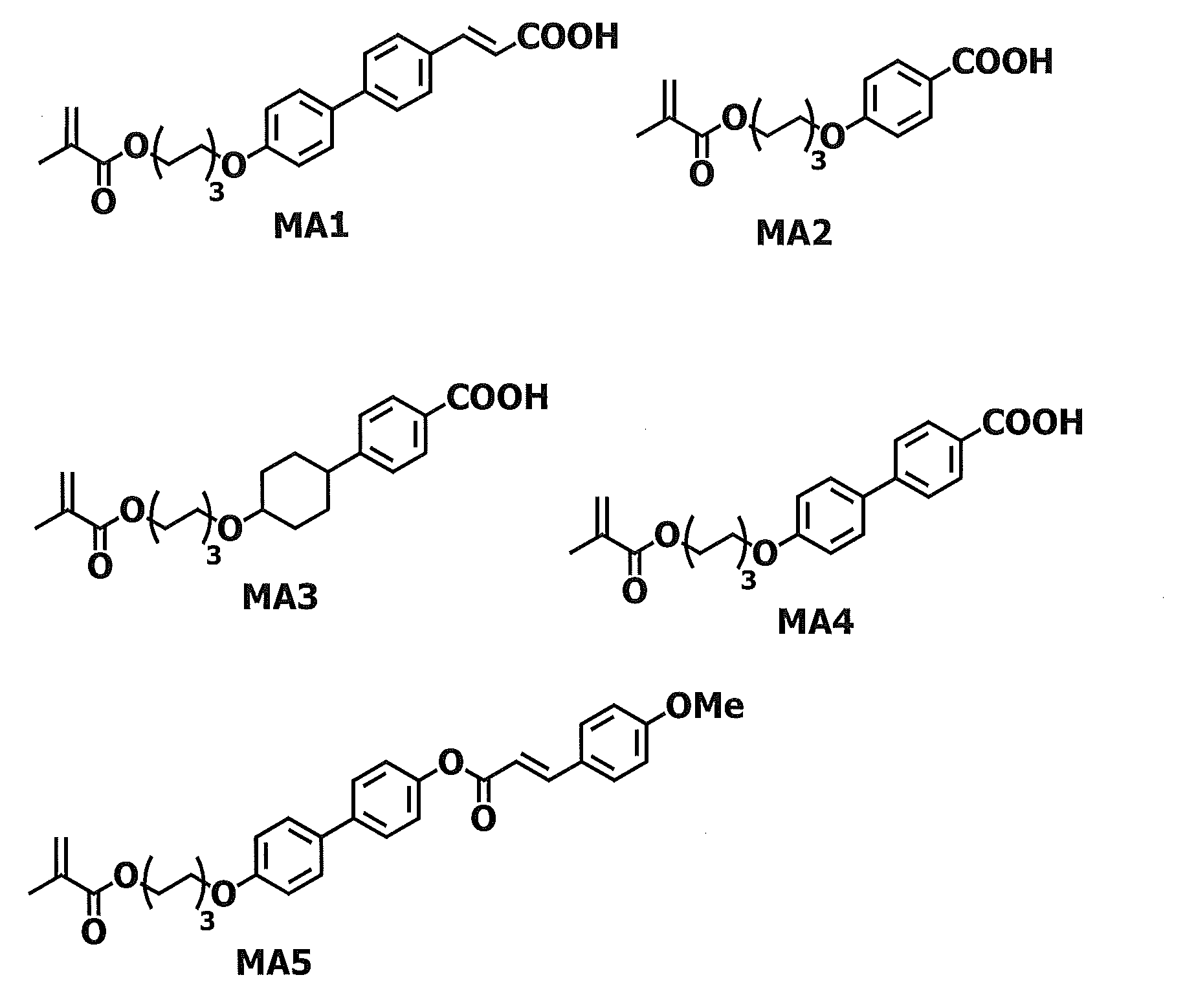
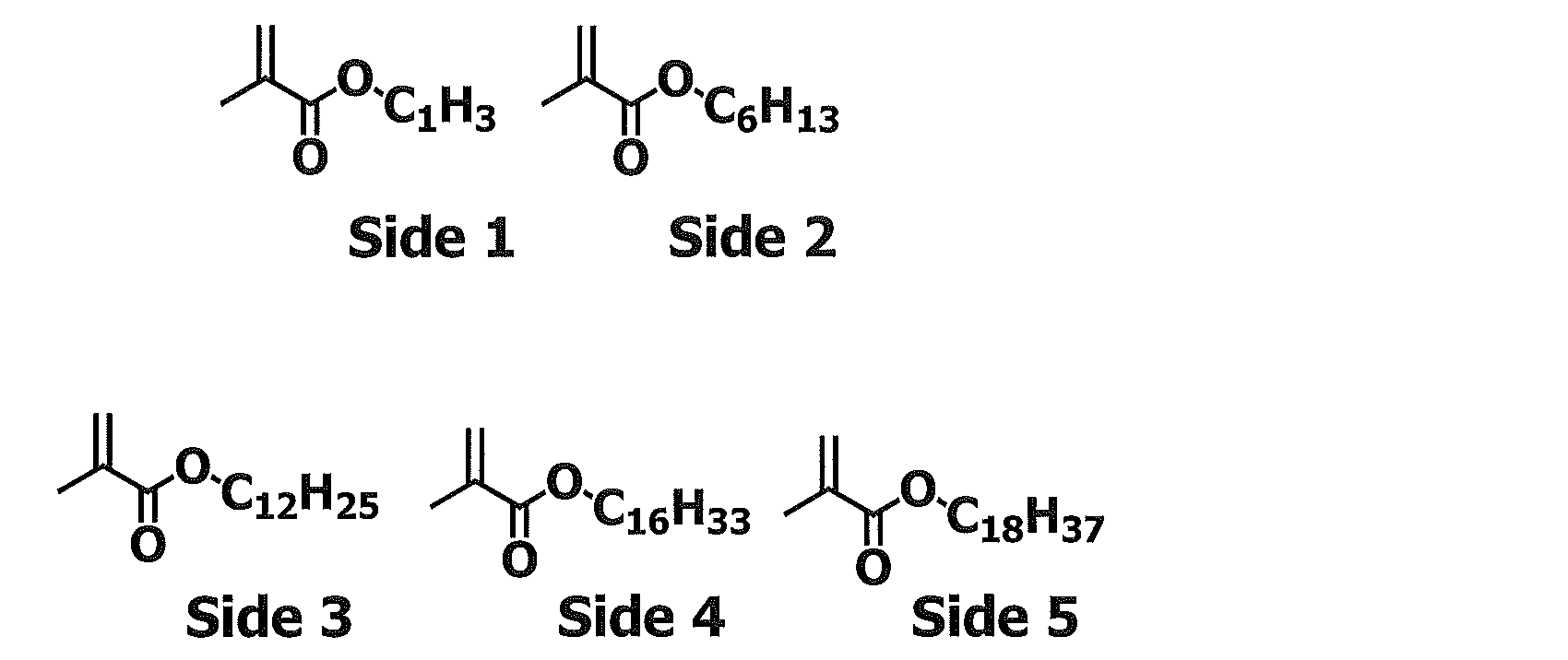

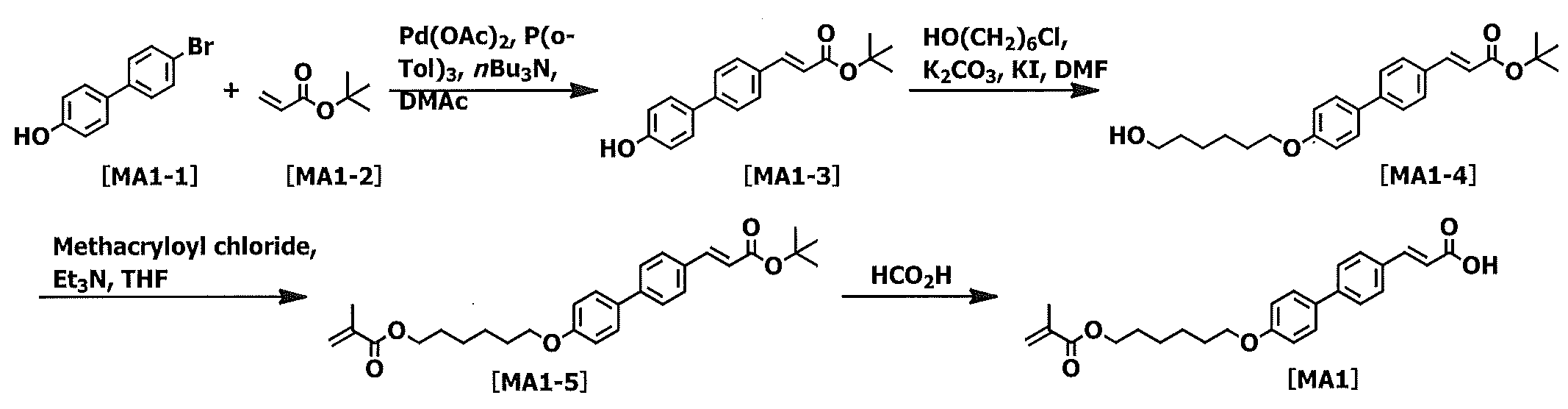
1H-NMR(400MHz, DMSO-d6, δppm):9.68(1H, s), 7.72(2H, d), 7.63(2H, d), 7.59-7.55(9H, m), 6.87-6.85(2H, m), 1.44(9H, s).
1H-NMR(400MHz, CDCl3, δppm):7.61(1H, d), 7.56-7.52(6H, m), 6.98-6.95(2H, m), 6.38(1H, d), 4.02(2H, t), 3.67(2H, t), 1.84-1.44(17H, m).
1H-NMR(400MHz, DMSO-d6, δppm): 7.73(2H, d), 7.70-7.63(4H, m), 7.58(1H, d), 7.02-7.00(2H,m), 6.53(1H, d), 6.03-6.02(1H, m), 5.67-5.66(1H, m), 4.11(2H, t), 4.00(2H, t), 1.88-1.87(3H, m), 1.79-1.25(17H, m).
1H-NMR(400MHz, CDCl3, δppm):7.81(1H, d), 7.60(4H, s), 7.55(2H, d), 6.97(2H, d), 6.47(2H, d), 6.11-6.10(1H, m), 5.56-5.52(1H, m), 4.17(2H, t), 4.00(2H, t), 1.95-1.94(2H, m), 1.85-1.82(3H, m), 1.75-1.71(2H, m), 1.55-1.48(4H, m).
MA3は4-フェニルシクロヘキサノンを原料にして公知の方法で合成した。
MA4は市販購入可能であるM6BC(みどり化学株式会社製)を用いた。
Side4は和光純薬工業株式会社より購入し用いた。
Side6、7は特許文献(WO2011―125876)に記載の合成法にて合成した。
装置: センシュー科学社製 常温ゲル浸透クロマトグラフィー(GPC)装置(SSC-7200)、
カラム: Shodex社製カラム(KD-803、KD-805)、
カラム温度: 50℃、
溶離液: N,N’-ジメチルホルムアミド(添加剤として、臭化リチウム-水和物(LiBr・H2O)が30mmol/L、リン酸・無水結晶(o-リン酸)が30mmol/L、テトラヒドロフラン(THF)が10ml/L)、
流速: 1.0ml/分、
検量線作成用標準サンプル: 東ソー社製 TSK 標準ポリエチレンオキサイド(分子量約9000,000、150,000、100,000、30,000)、および、ポリマーラボラトリー社製 ポリエチレングリコール(分子量 約12,000、4,000、1,000)。
NMP:N-メチル-2-ピロリドン
BCS:ブチルセロソルブ
AIBN:2,2’-アゾビスイソブチロニトリル
MA1(20.4g、50.0mmol)、MA2(15.3g、50.0mmol)、Side1(3.0g、30.0mmol)をNMP(277.0g)中に溶解し、ダイアフラムポンプで脱気し窒素置換を行なった後、AIBNを(0.82g、5.0mmol)を加え再び脱気し窒素置換を行なった。この後60℃で24時間反応させメタクリレートのポリマー溶液を得た。このポリマー溶液をメタノール(5000ml)に滴下し、得られた沈殿物をろ過した。この沈澱物をメタノールで洗浄し、40℃のオーブン中で減圧乾燥しメタクリレートポリマー粉末P1を得た。得られたメタクリレートポリマーの数平均分子量は25000、重量平均分子量は300000であった。
得られたメタクリルポリマー粉末(A1)(6.0g)にNMP(114.0g)を加え、室温にて5時間攪拌して溶解させた。この溶液にBCS(30.0g)を加え、室温で5時間攪拌することにより液晶配向剤B1を得た。
MA1(20.4g、50.0mmol)、MA2(15.3g、50.0mmol)、Side2(1.7g、10.0mmol)をNMP(267.9g)中に溶解し、ダイアフラムポンプで脱気し窒素置換を行なった後、AIBNを(0.82g、5.0mmol)を加え再び脱気し窒素置換を行なった。この後60℃で24時間反応させメタクリレートのポリマー溶液を得た。このポリマー溶液をメタノール(5000ml)に滴下し、得られた沈殿物をろ過した。この沈澱物をメタノールで洗浄し、40℃のオーブン中で減圧乾燥しメタクリレートポリマー粉末を得た。得られたメタクリレートポリマーの数平均分子量は27000、重量平均分子量は310000であった。
得られたメタクリルポリマー粉末(A2)(6.0g)にNMP(114.0g)を加え、室温にて5時間攪拌して溶解させた。この溶液にBCS(30.0g)を加え、室温で5時間攪拌することにより液晶配向剤B2を得た
MA1(20.4g、50.0mmol)、MA2(15.3g、50.0mmol)、Side2(3.4g、20.0mmol)をNMP(279.8g)中に溶解し、ダイアフラムポンプで脱気し窒素置換を行なった後、AIBNを(0.82g、5.0mmol)を加え再び脱気し窒素置換を行なった。この後60℃で24時間反応させメタクリレートのポリマー溶液を得た。このポリマー溶液をメタノール(5000ml)に滴下し、得られた沈殿物をろ過した。この沈澱物をメタノールで洗浄し、40℃のオーブン中で減圧乾燥しメタクリレートポリマー粉末を得た。得られたメタクリレートポリマーの数平均分子量は40900、重量平均分子量は325000であった。
得られたメタクリルポリマー粉末(A3)(6.0g)にNMP(114.0g)を加え、室温にて5時間攪拌して溶解させた。この溶液にBCS(30.0g)を加え、室温で5時間攪拌することにより液晶配向剤B3を得た
MA1(20.4g、50.0mmol)、MA2(15.3g、50.0mmol)、Side3(2.5g、10.0mmol)をNMP(273.8g)中に溶解し、ダイアフラムポンプで脱気し窒素置換を行なった後、AIBNを(0.82g、5.0mmol)を加え再び脱気し窒素置換を行なった。この後60℃で24時間反応させメタクリレートのポリマー溶液を得た。このポリマー溶液をメタノール(5000ml)に滴下し、得られた沈殿物をろ過した。この沈澱物をメタノールで洗浄し、40℃のオーブン中で減圧乾燥しメタクリレートポリマー粉末を得た。得られたメタクリレートポリマーの数平均分子量は35000、重量平均分子量は290000であった。
得られたメタクリルポリマー粉末(A4)(6.0g)にNMP(114.0g)を加え、室温にて5時間攪拌して溶解させた。この溶液にBCS(30.0g)を加え、室温で5時間攪拌することにより液晶配向剤B4得た
MA1(20.4g、50.0mmol)、MA2(15.3g、50.0mmol)、Side3(7.6g、30.0mmol)をNMP(309.4g)中に溶解し、ダイアフラムポンプで脱気し窒素置換を行なった後、AIBNを(0.82g、5.0mmol)を加え再び脱気し窒素置換を行なった。この後60℃で24時間反応させメタクリレートのポリマー溶液を得た。このポリマー溶液をメタノール(5000ml)に滴下し、得られた沈殿物をろ過した。この沈澱物をメタノールで洗浄し、40℃のオーブン中で減圧乾燥しメタクリレートポリマー粉末を得た。得られたメタクリレートポリマーの数平均分子量は36000、重量平均分子量は300000であった。
得られたメタクリルポリマー粉末(A5)(6.0g)にNMP(114.0g)を加え、室温にて5時間攪拌して溶解させた。この溶液にBCS(30.0g)を加え、室温で5時間攪拌することにより液晶配向剤B5を得た。
MA1(20.4g、50.0mmol)、MA2(15.3g、50.0mmol)、Side4(3.1g、10.0mmol)をNMP(277.7g)中に溶解し、ダイアフラムポンプで脱気し窒素置換を行なった後、AIBNを(0.82g、5.0mmol)を加え再び脱気し窒素置換を行なった。この後60℃で24時間反応させメタクリレートのポリマー溶液を得た。このポリマー溶液をメタノール(5000ml)に滴下し、得られた沈殿物をろ過した。この沈澱物をメタノールで洗浄し、40℃のオーブン中で減圧乾燥しメタクリレートポリマー粉末を得た。得られたメタクリレートポリマーの数平均分子量は35000、重量平均分子量は275000であった。
得られたメタクリルポリマー粉末(A6)(6.0g)にNMP(114.0g)を加え、室温にて5時間攪拌して溶解させた。この溶液にBCS(30.0g)を加え、室温で5時間攪拌することにより液晶配向剤B6得た。
MA1(20.4g、50.0mmol)、MA2(15.3g、50.0mmol)、Side6(4.5g、10.0mmol)をNMP(277.7g)中に溶解し、ダイアフラムポンプで脱気し窒素置換を行なった後、AIBNを(0.82g、5.0mmol)を加え再び脱気し窒素置換を行なった。この後60℃で24時間反応させメタクリレートのポリマー溶液を得た。このポリマー溶液をメタノール(5000ml)に滴下し、得られた沈殿物をろ過した。この沈澱物をメタノールで洗浄し、40℃のオーブン中で減圧乾燥しメタクリレートポリマー粉末を得た。得られたメタクリレートポリマーの数平均分子量は35000、重量平均分子量は275000であった。
得られたメタクリルポリマー粉末(A7)(6.0g)にNMP(114.0g)を加え、室温にて5時間攪拌して溶解させた。この溶液にBCS(30.0g)を加え、室温で5時間攪拌することにより液晶配向剤B7得た。
MA1(20.4g、50.0mmol)、MA2(15.3g、50.0mmol)、Side6(13.6g、30.0mmol)をNMP(351.0g)中に溶解し、ダイアフラムポンプで脱気し窒素置換を行なった後、AIBNを(0.82g、5.0mmol)を加え再び脱気し窒素置換を行なった。この後60℃で24時間反応させメタクリレートのポリマー溶液を得た。このポリマー溶液をメタノール(5000ml)に滴下し、得られた沈殿物をろ過した。この沈澱物をメタノールで洗浄し、40℃のオーブン中で減圧乾燥しメタクリレートポリマー粉末を得た。得られたメタクリレートポリマーの数平均分子量は26000、重量平均分子量は275000であった。
得られたメタクリルポリマー粉末(A8)(6.0g)にNMP(114.0g)を加え、室温にて5時間攪拌して溶解させた。この溶液にBCS(30.0g)を加え、室温で5時間攪拌することにより液晶配向剤B8得た。
MA1(20.4g、50.0mmol)、MA2(15.3g、50.0mmol)、Side7(4.4g、10.0mmol)をNMP(286.9g)中に溶解し、ダイアフラムポンプで脱気し窒素置換を行なった後、AIBNを(0.82g、5.0mmol)を加え再び脱気し窒素置換を行なった。この後60℃で24時間反応させメタクリレートのポリマー溶液を得た。このポリマー溶液をメタノール(5000ml)に滴下し、得られた沈殿物をろ過した。この沈澱物をメタノールで洗浄し、40℃のオーブン中で減圧乾燥しメタクリレートポリマー粉末を得た。得られたメタクリレートポリマーの数平均分子量は25000、重量平均分子量は350000であった。
得られたメタクリルポリマー粉末(A9)(6.0g)にNMP(114.0g)を加え、室温にて5時間攪拌して溶解させた。この溶液にBCS(30.0g)を加え、室温で5時間攪拌することにより液晶配向剤B9得た。
MA1(20.4g、50.0mmol)、MA2(15.3g、50.0mmol)、Side7(13.3g、30.0mmol)をNMP(348.9g)中に溶解し、ダイアフラムポンプで脱気し窒素置換を行なった後、AIBNを(0.82g、5.0mmol)を加え再び脱気し窒素置換を行なった。この後60℃で24時間反応させメタクリレートのポリマー溶液を得た。このポリマー溶液をメタノール(5000ml)に滴下し、得られた沈殿物をろ過した。この沈澱物をメタノールで洗浄し、40℃のオーブン中で減圧乾燥しメタクリレートポリマー粉末を得た。得られたメタクリレートポリマーの数平均分子量は25000、重量平均分子量は350000であった。
得られたメタクリルポリマー粉末(A10)(6.0g)にNMP(114.0g)を加え、室温にて5時間攪拌して溶解させた。この溶液にBCS(30.0g)を加え、室温で5時間攪拌することにより液晶配向剤B10得た。
MA1(20.4g、50.0mmol)、MA3(19.4g、50.0mmol)、Side3(2.5g、10.0mmol)をNMP(302.5g)中に溶解し、ダイアフラムポンプで脱気し窒素置換を行なった後、AIBNを(0.82g、5.0mmol)を加え再び脱気し窒素置換を行なった。この後60℃で24時間反応させメタクリレートのポリマー溶液を得た。このポリマー溶液をメタノール(5000ml)に滴下し、得られた沈殿物をろ過した。この沈澱物をメタノールで洗浄し、40℃のオーブン中で減圧乾燥しメタクリレートポリマー粉末を得た。得られたメタクリレートポリマーの数平均分子量は27000、重量平均分子量は300000であった。
得られたメタクリルポリマー粉末(A11)(6.0g)にNMP(114.0g)を加え、室温にて5時間攪拌して溶解させた。この溶液にBCS(30.0g)を加え、室温で5時間攪拌することにより液晶配向剤B11得た。
MA1(20.4g、50.0mmol)、MA2(7.7g、25.0mmol)、MA4(9.6g、25.0mmol)、Side3(2.5g、10.0mmol)をNMP(302.5g)中に溶解し、ダイアフラムポンプで脱気し窒素置換を行なった後、AIBNを(0.82g、5.0mmol)を加え再び脱気し窒素置換を行なった。この後60℃で24時間反応させメタクリレートのポリマー溶液を得た。このポリマー溶液をメタノール(5000ml)に滴下し、得られた沈殿物をろ過した。この沈澱物をメタノールで洗浄し、40℃のオーブン中で減圧乾燥しメタクリレートポリマー粉末を得た。得られたメタクリレートポリマーの数平均分子量は27000、重量平均分子量は300000であった。
得られたメタクリルポリマー粉末(A12)(6.0g)にNMP(114.0g)を加え、室温にて5時間攪拌して溶解させた。この溶液にBCS(30.0g)を加え、室温で5時間攪拌することにより液晶配向剤B12得た。
MA1(20.4g、50.0mmol)、MA3(9.6g、25.0mmol)、MA4(9.6g、25.0mmol)、Side3(2.5g、10.0mmol)をNMP(302.5g)中に溶解し、ダイアフラムポンプで脱気し窒素置換を行なった後、AIBNを(0.82g、5.0mmol)を加え再び脱気し窒素置換を行なった。この後60℃で24時間反応させメタクリレートのポリマー溶液を得た。このポリマー溶液をメタノール(5000ml)に滴下し、得られた沈殿物をろ過した。この沈澱物をメタノールで洗浄し、40℃のオーブン中で減圧乾燥しメタクリレートポリマー粉末を得た。得られたメタクリレートポリマーの数平均分子量は26000、重量平均分子量は290000であった。
得られたメタクリルポリマー粉末(A13)(6.0g)にNMP(114.0g)を加え、室温にて5時間攪拌して溶解させた。この溶液にBCS(30.0g)を加え、室温で5時間攪拌することにより液晶配向剤B13得た。
MA1(20.4g、50.0mmol)、MA2(15.3g、50.0mmol)をNMP(302.5g)中に溶解し、ダイアフラムポンプで脱気し窒素置換を行なった後、AIBNを(0.82g、5.0mmol)を加え再び脱気し窒素置換を行なった。この後60℃で24時間反応させメタクリレートのポリマー溶液を得た。このポリマー溶液をメタノール(5000ml)に滴下し、得られた沈殿物をろ過した。この沈澱物をメタノールで洗浄し、40℃のオーブン中で減圧乾燥しメタクリレートポリマー粉末を得た。得られたメタクリレートポリマーの数平均分子量は18000、重量平均分子量は100000であった。
得られたメタクリルポリマー粉末(A14)(6.0g)にNMP(114.0g)を加え、室温にて5時間攪拌して溶解させた。この溶液にBCS(30.0g)を加え、室温で5時間攪拌することにより液晶配向剤B14得た。
MA1(20.4g、50.0mmol)、MA2(15.3g、50.0mmol)、Side5(3.5g,10.0mmol)をNMP(302.5g)中に溶解し、ダイアフラムポンプで脱気し窒素置換を行なった後、AIBNを(0.82g、5.0mmol)を加え再び脱気し窒素置換を行なった。この後60℃で24時間反応させメタクリレートのポリマー溶液を得た。このポリマー溶液をメタノール(5000ml)に滴下し、得られた沈殿物をろ過した。この沈澱物をメタノールで洗浄し、40℃のオーブン中で減圧乾燥しメタクリレートポリマー粉末を得た。得られたメタクリレートポリマーの数平均分子量は21000、重量平均分子量は110000であった。
得られたメタクリルポリマー粉末(A15)(6.0g)にNMP(114.0g)を加え、室温にて5時間攪拌して溶解させた。この溶液にBCS(30.0g)を加え、室温で5時間攪拌することにより液晶配向剤B15得た。
[液晶セルの作製]
メタクリレートポリマー合成例1で得られた液晶配向剤B1を用いて下記に示すような手順でツイストネマティック液晶セルの作製を行った。
実施例1で得られた液晶配向剤B1を、ITO電極パターンが形成されているITO電極基板のITO面にスピンコートし、70℃のホットプレートで90秒間乾燥した後、基板に対し水平方向から40°傾けた313nmの偏光紫外線を50mJ/cm2照射し、200℃のホットプレートで20分間加熱を行い、膜厚100nmの液晶配向膜を形成した。上記の2枚の基板について一方の基板の液晶配向膜上に6μmのビーズスペーサーを散布した後、その上からシール剤(溶剤型熱硬化タイプのエポキシ樹脂)を印刷した。次いで、配向方向が直行するように2枚の基板と貼り合せた後、シール剤を硬化させて空セルを作製した。この空セルに液晶MLC-2003(C080)(メルク社製商品名)を減圧注入法によって注入し、ツイストネマティック液晶セルを作製した。作製した液晶セルは、その後、120℃の熱風循環式オーブンに1時間入れ、液晶の再配向処理を行った。
上記の液晶配向膜をB2にした以外、実施例1と同様にツイストネマティック液晶セルを作製した。
上記の液晶配向膜をB3にした以外、実施例1と同様にツイストネマティック液晶セルを作製した。
上記の液晶配向膜をB4にした以外、実施例1と同様にツイストネマティック液晶セルを作製した。
上記の液晶配向膜をB5にした以外、実施例1と同様にツイストネマティック液晶セルを作製した。
上記の液晶配向膜をB6にした以外、実施例1と同様にツイストネマティック液晶セルを作製した。
上記の液晶配向膜をB7にした以外、実施例1と同様にツイストネマティック液晶セルを作製した。
上記の液晶配向膜をB8にした以外、実施例1と同様にツイストネマティック液晶セルを作製した。
上記の液晶配向膜をB9、焼成温度を220℃にした以外、実施例1と同様にツイストネマティック液晶セルを作製した。
上記の液晶配向膜をB10にした以外、実施例1と同様にツイストネマティック液晶セルを作製した。
上記の液晶配向膜をB11にした以外、実施例1と同様にツイストネマティック液晶セルを作製した。
上記の液晶配向膜をB12にした以外、実施例1と同様にツイストネマティック液晶セルを作製した。
上記の液晶配向膜をB13にした以外、実施例1と同様にツイストネマティック液晶セルを作製した。
上記の液晶配向膜を比較例1ではB14にした以外、実施例1と同様に、比較例2では液晶配向膜をB15にした以外は実施例1と同様の手順でツイストネマティック液晶セルを作製した。
ツイストネマティック液晶セルのプレチルト角(°)は、Axo Metrix社製の「Axo Scan」にて、ミュラーマトリクス法を用いて測定した。結果は下記表1に示されるとおりであった。
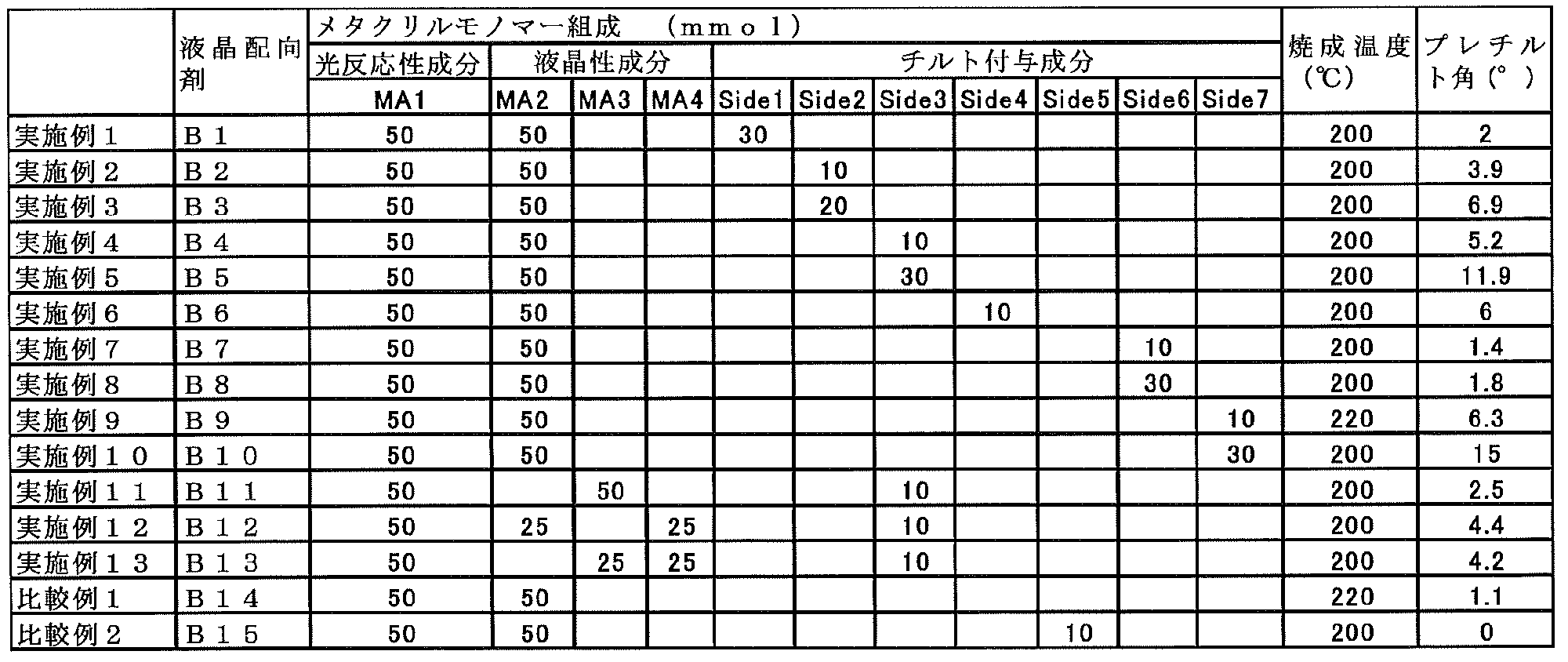
実施例4と同様の手順でツイストネマティック液晶セルを作製した。
実施例9と同様の手順でツイストネマティック液晶セルを作製した。
液晶配向膜として日産化学株式会社製 SE―7492を液晶配向剤B16として用い、80℃のホットプレート上で70秒間乾燥させた後、250℃のホットプレート上で10分間焼成を行い、膜厚100nmの塗膜を形成した。この塗膜面をロール径120mmのラビング装置でレーヨン布を用いて、ロール回転数1000rpm、ロール進行速度50mm/sec、押し込み量0.3mmの条件でラビングし、液晶配向膜付き基板を得た。上記以外は実施例1と同様の手順でツイストネマティック液晶セルを作製した。
MA5(25.7g、50.0mmol)をNMP(233.1g)中に溶解し、ダイアフラムポンプで脱気し窒素置換を行なった後、AIBNを(0.16g、1.0mmol)を加え再び脱気し窒素置換を行なった。この後60℃で24時間反応させメタクリレートのポリマー溶液を得た。このポリマー溶液をジエチルエーテル(5000ml)に滴下し、得られた沈殿物をろ過した。この沈澱物をジエチルエーテルでで洗浄し、40℃のオーブン中で減圧乾燥しメタクリレートポリマー粉末P16を得た。得られたメタクリレートポリマーの数平均分子量は25000、重量平均分子量は300000であった。
得られたメタクリルポリマー粉末(A16)(6.0g)にクロロホルム(294.0g)を加え、室温にて5時間攪拌して溶解させることにより液晶配向剤B17を得た。
上記の液晶配向膜をB17、紫外線露光量を300mJ/cm2、焼成温度を220℃にした以外、実施例1と同様にツイストネマティック液晶セルを作製した。
上記のメタクリルポリマー粉末(A16)(6.0g)にNMP(114g)、BCS(30g)を加え、室温にて12時間撹拌し溶解させることにより液晶配向剤B18を調整した。その後比較例4と同様に液晶セルを作製し、オーブンによる再配向処理を行った後、偏光板に挟んだ液晶セルを観察したところ配向欠陥が観察されプレチルト角を測定できず、液晶配向膜として用いることが出来なかった。
ツイストネマティック液晶セルを192時間の間、60℃環境下でバックライトを照射
しながらAC10Vp-pのストレスを印加し、ストレス前後のプレチルト角の測定を実施した。測定結果を下記の式に基づき計算し、評価した。
ΔTilT (°)=初期プレチルト角 - ストレス後プレチルト角

のラビング材料よりストレスによるプレチルト変化が小さく、配向安定性に優れた材料であることがわかる。上記要因は、液晶配向膜の自己組織化を利用し高効率で異方性を付与したたためであると推考している。
Claims (11)
- (A)所定の温度範囲で液晶性を発現する感光性の側鎖型高分子であって、垂直配向性基を含む繰り返し単位を有する側鎖型高分子、及び
(B)有機溶媒
を含有する重合体組成物。 - 垂直配向性基が下記式(v)で表されるものである、請求項1に記載の重合体組成物。

[式(v)中、Y1は、単結合、または-O-、-CH2O-、-COO-、-OCO-、-NHCO-、-NH-CO-O-および-NH-CO-NH-から選ばれる結合基を表し、
Y2は、単結合、炭素数1~15のアルキレン基または-CH2-CH(OH)-CH2-基を表すか、ベンゼン環、シクロヘキサン環または複素環から選ばれる2価の環状基を表し、環状基上の任意の水素原子がZで置換されていてもよく、
Y3は、単結合または炭素数1~15のアルキレン基を表し、
Y4は、単結合、ベンゼン環、シクロヘキサン環もしくは複素環から選ばれる2価の環状基、または炭素数17~30のステロイド骨格を有する2価の有機基を表し、環状基上の任意の水素原子がZで置換されていてもよく、
Y5は、ベンゼン環、シクロヘキサン環または複素環から選ばれる2価の環状基を表し、これらの環状基上の任意の水素原子がZで置換されていてもよく、
mは0~4の整数を表し、mが2以上の場合、Y5は互いに同一でも異なっていてもよく、
Y6は、水素原子、炭素数1~17のアルキル基、炭素数1~17のフッ化アルキル基、炭素数1~17のアルコキシ基または炭素数1~17のフッ化アルコキシ基を表し、
Zは、炭素数1~3のアルキル基、炭素数1~3のアルコキシ基、炭素数1~3のフッ化アルキル基、炭素数1~3のフッ化アルコキシ基またはフッ素原子を表し、
ここで、アルキレン基、アルキル基、フッ化アルキル基、アルコキシ基およびフッ化アルコキシ基は、結合基同士が隣り合わない限り、その中に1~3の上記結合基を有していてもよく、Y2~Y6において、アルキレン基、-CH2-CH(OH)-CH2-基、2価の環状基、ステロイド骨格を有する2価の有機基、アルキル基およびフッ化アルキル基は、それらに隣接する基と上記結合基を介して結合していてもよく、
但し、Y2~Y6が表す置換基の総炭素数は、1~30である]。 - (A)成分が、光架橋、光異性化、または光フリース転移を起こす感光性側鎖を有する請求項1または2に記載の重合体組成物。
- (A)成分が、下記式(1)~(6)からなる群から選ばれる1種または複数の感光性側鎖を有する、請求項1~3のいずれか一項に記載の重合体組成物。
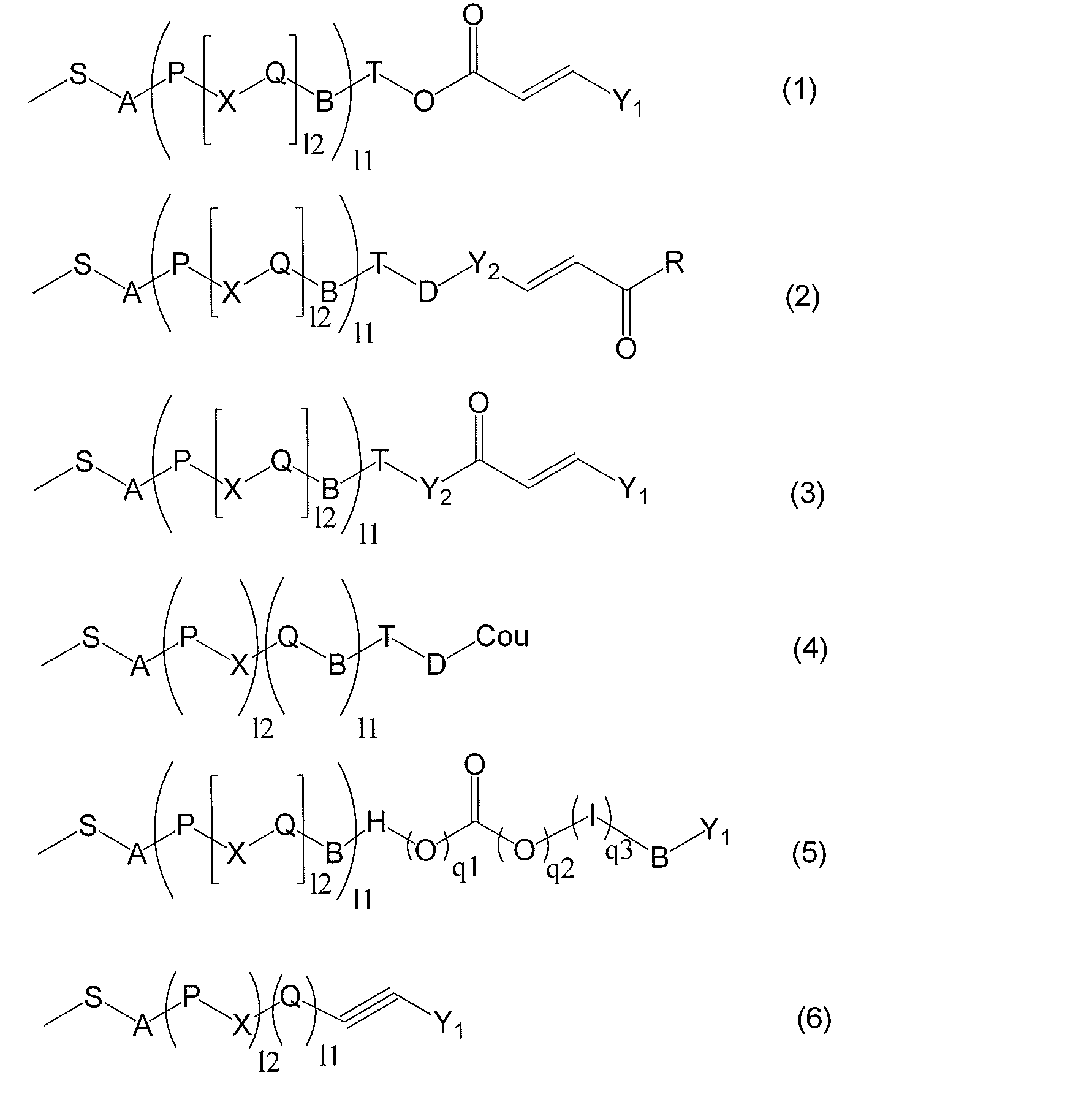
[式中、A、B、Dはそれぞれ独立に、単結合、-O-、-CH2-、-COO-、-OCO-、-CONH-、-NH-CO-、-CH=CH-CO-O-、又は-O-CO-CH=CH-を表す;
Sは、炭素数1~12のアルキレン基であり、それらに結合する水素原子はハロゲン基に置き換えられていてもよい;
Tは、単結合または炭素数1~12のアルキレン基であり、それらに結合する水素原子はハロゲン基に置き換えられていてもよい;
Y1は、1価のベンゼン環、ナフタレン環、ビフェニル環、フラン環、ピロール環および炭素数5~8の脂環式炭化水素から選ばれる環を表すか、それらの置換基から選ばれる同一又は相異なった2~6の環が結合基Bを介して結合してなる基であり、それらに結合する水素原子はそれぞれ独立に-COOR0(式中、R0は水素原子又は炭素数1~5のアルキル基を表す)、-NO2、-CN、-CH=C(CN)2、-CH=CH-CN、ハロゲン基、炭素数1~5のアルキル基、又は炭素数1~5のアルキルオキシ基で置換されても良い;
Y2は、2価のベンゼン環、ナフタレン環、ビフェニル環、フラン環、ピロール環、炭素数5~8の脂環式炭化水素、および、それらの組み合わせからなる群から選ばれる基であり、それらに結合する水素原子はそれぞれ独立に-NO2、-CN、-CH=C(CN)2、-CH=CH-CN、ハロゲン基、炭素数1~5のアルキル基、又は炭素数1~5のアルキルオキシ基で置換されても良い;
Rは、ヒドロキシ基、炭素数1~6のアルコキシ基を表すか、又はY1と同じ定義を表す;
Couは、クマリン-6-イル基またはクマリン-7-イル基を表し、それらに結合する水素原子はそれぞれ独立に-NO2、-CN、-CH=C(CN)2、-CH=CH-CN、ハロゲン基、炭素数1~5のアルキル基、又は炭素数1~5のアルキルオキシ基で置換されても良い;
q1とq2は、一方が1で他方が0である;
q3は0または1である;
Xは、単結合、-COO-、-OCO-、-N=N-、-CH=CH-、-C≡C-、-CH=CH-CO-O-、又は-O-CO-CH=CH-を表し、Xの数が2となるときは、X同士は同一でも異なっていてもよい;
P及びQは、各々独立に、2価のベンゼン環、ナフタレン環、ビフェニル環、フラン環、ピロール環、炭素数5~8の脂環式炭化水素、および、それらの組み合わせからなる群から選ばれる基である;ただし、Xが-CH=CH-CO-O-、-O-CO-CH=CH-である場合、-CH=CH-が結合する側のP又はQは芳香環である;
l1は0または1である;
l2は0~2の整数である;
l1とl2がともに0であるときは、Tが単結合であるときはAも単結合を表す;
l1が1であるときは、Tが単結合であるときはBも単結合を表す;
H及びIは、各々独立に、2価のベンゼン環、ナフタレン環、ビフェニル環、フラン環、ピロール環、およびそれらの組み合わせから選ばれる基である]。 - (A)成分が、下記式(21)~(31)[式中、A及びBは上記と同じ定義を有する;
Y3は、1価のベンゼン環、ナフタレン環、ビフェニル環、フラン環、窒素含有複素環、及び炭素数5~8の脂環式炭化水素、および、それらの組み合わせからなる群から選ばれる基であり、それらに結合する水素原子はそれぞれ独立に-NO2、-CN、ハロゲン基、炭素数1~5のアルキル基、又は炭素数1~5のアルキルオキシ基で置換されても良い;
R3は、水素原子、-NO2、-CN、-CH=C(CN)2、-CH=CH-CN、ハロゲン基、1価のベンゼン環、ナフタレン環、ビフェニル環、フラン環、窒素含有複素環、炭素数5~8の脂環式炭化水素、炭素数1~12のアルキル基、又は炭素数1~12のアルコキシ基を表す;
q1とq2は、一方が1で他方が0である;
lは1~12の整数を表し、mは0から2の整数を表し、但し、式(25)~(26)において、全てのmの合計は2以上であり、式(27)~(28)において、全てのmの合計は1以上であり、m1、m2およびm3は、それぞれ独立に1~3の整数を表す;
R2は、水素原子、-NO2、-CN、ハロゲン基、1価のベンゼン環、ナフタレン環、ビフェニル環、フラン環、窒素含有複素環、及び炭素数5~8の脂環式炭化水素、および、アルキル基、又はアルキルオキシ基を表す;
Z1、Z2は単結合、-CO-、-CH2O-、-CH=N-、-CF2-を表す]からなる群から選ばれる1種または複数の液晶性側鎖を有する、請求項1~3のいずれか一項に記載の重合体組成物。
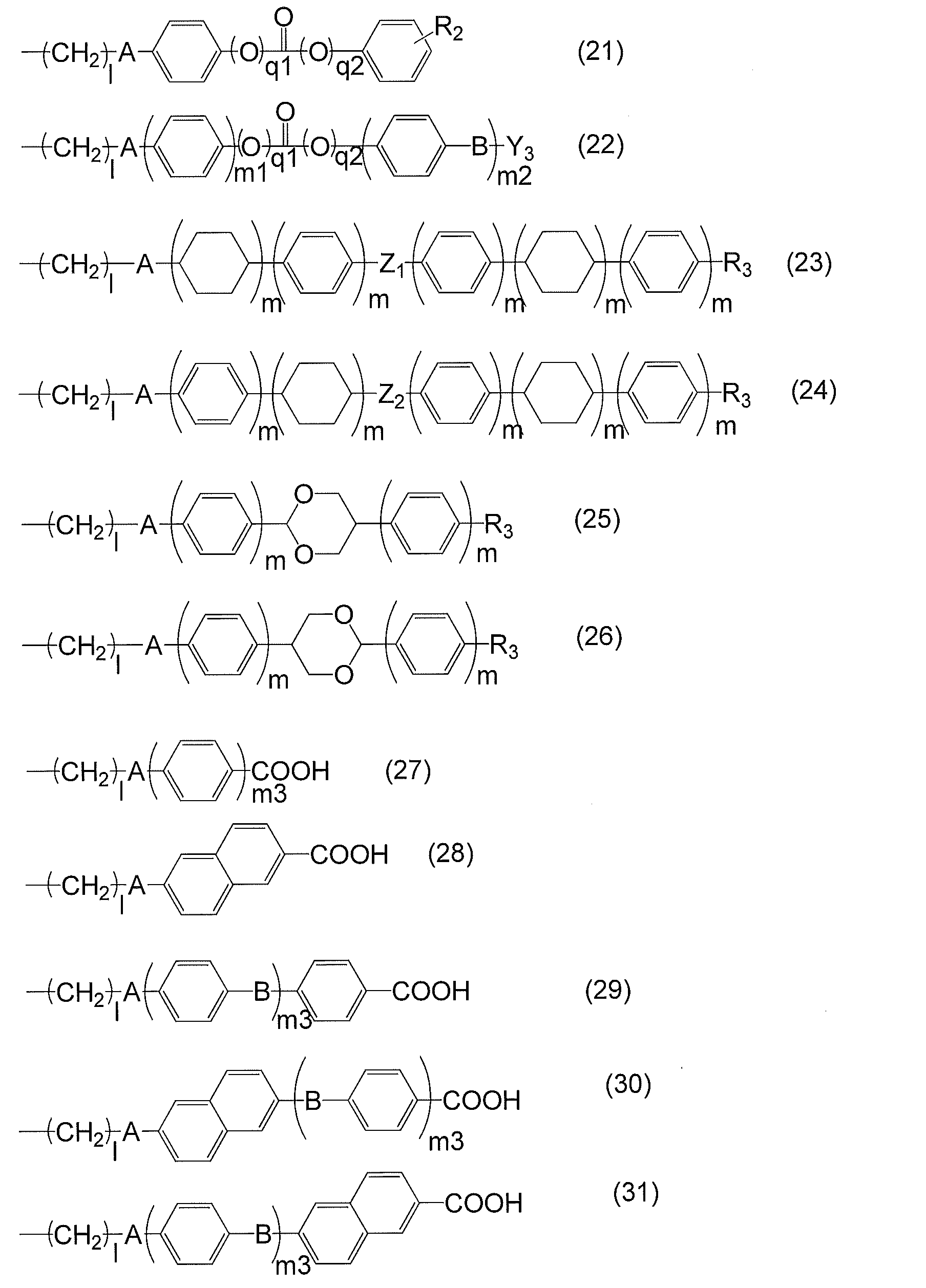
- [I] 請求項1~5のいずれか一項に記載の組成物を、液晶駆動用の電極を有する基板上に塗布して塗膜を形成する工程;
[II] [I]で得られた塗膜に偏光した紫外線を斜め方向から照射する工程;及び
[III] [II]で得られた塗膜を加熱する工程;
を有することによって配向制御能が付与された液晶配向膜を得る、前記液晶配向膜を有する基板の製造方法。 - 請求項6記載の方法により製造された液晶配向膜を有する基板。
- 請求項7記載の基板を有するツイストネマチック型液晶表示素子及び縦電界型液晶表示素子。
- 請求項7記載の基板(第1の基板)を準備する工程;
[I’] 第2の基板上に請求項1~5のいずれか1項に記載の重合体組成物を、塗布して塗膜を形成する工程;
[II’] [I’]で得られた塗膜に偏光した紫外線を照射する工程;及び
[III’] [II’]で得られた塗膜を加熱する工程;
を有することによって配向制御能が付与された液晶配向膜を得る、前記液晶配向膜を有する第2の基板を得る工程;及び
[IV] 液晶を介して前記第1及び第2の基板の液晶配向膜が相対するように、液晶配向方向が互いに直交するように前記第1及び第2の基板を対向配置して液晶表示素子を得る工程;
を有することにより、ツイストネマチック型液晶表示素子を得る、該液晶表示素子の製造方法。 - 請求項9記載の方法により製造されたツイストネマチック型液晶表示素子及び縦電界型液晶表示素子。
- 所定の温度範囲で液晶性を発現する感光性の側鎖型高分子であって、垂直配向性基を含む繰り返し単位を有する側鎖型高分子。
Priority Applications (6)
| Application Number | Priority Date | Filing Date | Title |
|---|---|---|---|
| JP2017530932A JP6858350B2 (ja) | 2015-07-30 | 2016-07-29 | 液晶配向剤、液晶配向膜及び液晶表示素子 |
| CN201680044830.1A CN107849365A (zh) | 2015-07-30 | 2016-07-29 | 液晶取向剂、液晶取向膜和液晶表示元件 |
| US15/748,461 US11111387B2 (en) | 2015-07-30 | 2016-07-29 | Liquid crystal aligning agent, liquid crystal alignment film, and liquid crystal display element |
| CN202310988447.3A CN117186663A (zh) | 2015-07-30 | 2016-07-29 | 液晶取向剂、液晶取向膜和液晶表示元件 |
| KR1020187003925A KR102674352B1 (ko) | 2015-07-30 | 2016-07-29 | 액정 배향제, 액정 배향막 및 액정 표시 소자 |
| US17/393,135 US20210371664A1 (en) | 2015-07-30 | 2021-08-03 | Liquid crystal aligning agent, liquid crystal alignment film, and liquid crystal display element |
Applications Claiming Priority (2)
| Application Number | Priority Date | Filing Date | Title |
|---|---|---|---|
| JP2015151105 | 2015-07-30 | ||
| JP2015-151105 | 2015-07-30 |
Related Child Applications (2)
| Application Number | Title | Priority Date | Filing Date |
|---|---|---|---|
| US15/748,461 A-371-Of-International US11111387B2 (en) | 2015-07-30 | 2016-07-29 | Liquid crystal aligning agent, liquid crystal alignment film, and liquid crystal display element |
| US17/393,135 Division US20210371664A1 (en) | 2015-07-30 | 2021-08-03 | Liquid crystal aligning agent, liquid crystal alignment film, and liquid crystal display element |
Publications (1)
| Publication Number | Publication Date |
|---|---|
| WO2017018501A1 true WO2017018501A1 (ja) | 2017-02-02 |
Family
ID=57884512
Family Applications (1)
| Application Number | Title | Priority Date | Filing Date |
|---|---|---|---|
| PCT/JP2016/072279 Ceased WO2017018501A1 (ja) | 2015-07-30 | 2016-07-29 | 液晶配向剤、液晶配向膜及び液晶表示素子 |
Country Status (6)
| Country | Link |
|---|---|
| US (2) | US11111387B2 (ja) |
| JP (1) | JP6858350B2 (ja) |
| KR (1) | KR102674352B1 (ja) |
| CN (3) | CN107849365A (ja) |
| TW (2) | TWI725981B (ja) |
| WO (1) | WO2017018501A1 (ja) |
Cited By (2)
| Publication number | Priority date | Publication date | Assignee | Title |
|---|---|---|---|---|
| WO2020203631A1 (ja) * | 2019-03-29 | 2020-10-08 | 日産化学株式会社 | 重合体組成物及び単層位相差材 |
| JP7513018B2 (ja) | 2019-03-27 | 2024-07-09 | 日産化学株式会社 | 液晶配向膜を有する基板の製造方法、及び液晶表示素子の製造方法 |
Families Citing this family (8)
| Publication number | Priority date | Publication date | Assignee | Title |
|---|---|---|---|---|
| US11111387B2 (en) * | 2015-07-30 | 2021-09-07 | Nissan Chemical Industries, Ltd. | Liquid crystal aligning agent, liquid crystal alignment film, and liquid crystal display element |
| US11561507B2 (en) | 2018-04-17 | 2023-01-24 | Meta Platforms Technologies, Llc | Methods for three-dimensional arrangement of anisotropic molecules, patterned anisotropic films, and optical elements therewith |
| US12092850B2 (en) | 2018-04-17 | 2024-09-17 | Meta Platforms Technologies, Llc | Patterned anisotropic films and optical elements therewith |
| KR102945879B1 (ko) * | 2019-03-29 | 2026-03-30 | 닛산 가가쿠 가부시키가이샤 | 중합체 조성물 및 단층 위상차재 |
| JP7517328B2 (ja) * | 2019-03-29 | 2024-07-17 | 日産化学株式会社 | 重合体組成物及び単層位相差材 |
| CN112904624B (zh) * | 2021-03-08 | 2023-10-13 | 深圳市华星光电半导体显示技术有限公司 | 液晶显示面板及其制备方法 |
| KR20230067726A (ko) * | 2021-11-08 | 2023-05-17 | 주식회사 클랩 | 광배향 화합물, 이의 제조방법, 이를 이용한 액정 광배향제 및 이를 포함하는 위상차 필름 |
| CN120718663B (zh) * | 2025-08-12 | 2025-11-11 | 石家庄诚志永华显示材料有限公司 | 液晶化合物、包含其的液晶组合物及应用 |
Citations (9)
| Publication number | Priority date | Publication date | Assignee | Title |
|---|---|---|---|---|
| JP2002090540A (ja) * | 2000-09-19 | 2002-03-27 | Hayashi Telempu Co Ltd | 複屈折フィルムおよびその製造方法 |
| JP2002348330A (ja) * | 2001-05-28 | 2002-12-04 | Nitto Denko Corp | 側鎖型液晶ポリマー、液晶性組成物、ホメオトロピック配向液晶フィルムの製造方法およびホメオトロピック配向液晶フィルム |
| JP2003002927A (ja) * | 2001-06-18 | 2003-01-08 | Nitto Denko Corp | 側鎖型液晶ポリマー、液晶性組成物、ホメオトロピック配向液晶フィルムの製造方法およびホメオトロピック配向液晶フィルム |
| JP2004530734A (ja) * | 2000-12-29 | 2004-10-07 | ロリク アーゲー | 光活性共重合体 |
| WO2012002511A1 (ja) * | 2010-06-30 | 2012-01-05 | 日産化学工業株式会社 | 液晶配向剤、液晶配向膜、液晶表示素子及び液晶表示素子の製造方法 |
| JP2012077228A (ja) * | 2010-10-04 | 2012-04-19 | Kumamoto Univ | 新規な液晶高分子およびそれを用いた光学素子 |
| WO2014054785A2 (ja) * | 2012-10-05 | 2014-04-10 | 日産化学工業株式会社 | 横電界駆動型液晶表示素子用液晶配向膜を有する基板の製造方法 |
| JP2014169435A (ja) * | 2013-02-08 | 2014-09-18 | Jnc Corp | 感光性ポリマーおよび光配向性位相差フィルム |
| WO2015012341A1 (ja) * | 2013-07-24 | 2015-01-29 | 日産化学工業株式会社 | 重合体、重合体組成物および横電界駆動型液晶表示素子用液晶配向膜 |
Family Cites Families (15)
| Publication number | Priority date | Publication date | Assignee | Title |
|---|---|---|---|---|
| JPH02262622A (ja) * | 1988-08-01 | 1990-10-25 | Matsushita Electric Ind Co Ltd | 液晶配向膜およびその製造法 |
| JP2780183B2 (ja) | 1989-02-27 | 1998-07-30 | セイコーエプソン株式会社 | 配向膜および液晶装置 |
| JPH0389365A (ja) | 1989-09-01 | 1991-04-15 | Toshiba Corp | 画像形成装置 |
| JP2893671B2 (ja) | 1991-03-11 | 1999-05-24 | ジェイエスアール株式会社 | 液晶配向剤 |
| JP3097702B2 (ja) | 1991-08-13 | 2000-10-10 | 日産化学工業株式会社 | 新規な液晶配向処理剤 |
| JP3893659B2 (ja) | 1996-03-05 | 2007-03-14 | 日産化学工業株式会社 | 液晶配向処理方法 |
| CN1187521A (zh) * | 1996-12-13 | 1998-07-15 | 三星电管株式会社 | 光取向组合物,用该组合物形成的取向层和具有该取向层的lcd |
| JP3840743B2 (ja) | 1997-06-03 | 2006-11-01 | Jsr株式会社 | 液晶配向剤 |
| JP2000212310A (ja) | 1999-01-19 | 2000-08-02 | Hayashi Telempu Co Ltd | 配向膜およびその製造方法、液晶表示装置 |
| AU2003218476A1 (en) * | 2002-05-31 | 2003-12-19 | Elsicon, Inc. | Hybrid polymer materials for liquid crystal alignment layers |
| JP5962512B2 (ja) | 2010-10-28 | 2016-08-03 | 日産化学工業株式会社 | 液晶配向剤、及び液晶配向膜 |
| JP5906570B2 (ja) * | 2011-02-23 | 2016-04-20 | ソニー株式会社 | 液晶表示装置及びその製造方法 |
| TWI575022B (zh) | 2012-02-03 | 2017-03-21 | Nissan Chemical Ind Ltd | Liquid crystal alignment agent, liquid crystal alignment film and liquid crystal display element |
| JPWO2014196590A1 (ja) * | 2013-06-05 | 2017-02-23 | 日産化学工業株式会社 | 横電界駆動型液晶表示素子用液晶配向膜を有する基板の製造方法 |
| US11111387B2 (en) * | 2015-07-30 | 2021-09-07 | Nissan Chemical Industries, Ltd. | Liquid crystal aligning agent, liquid crystal alignment film, and liquid crystal display element |
-
2016
- 2016-07-29 US US15/748,461 patent/US11111387B2/en active Active
- 2016-07-29 CN CN201680044830.1A patent/CN107849365A/zh active Pending
- 2016-07-29 JP JP2017530932A patent/JP6858350B2/ja active Active
- 2016-07-29 KR KR1020187003925A patent/KR102674352B1/ko active Active
- 2016-07-29 CN CN202110622836.5A patent/CN113444376A/zh active Pending
- 2016-07-29 WO PCT/JP2016/072279 patent/WO2017018501A1/ja not_active Ceased
- 2016-07-29 TW TW105124161A patent/TWI725981B/zh active
- 2016-07-29 CN CN202310988447.3A patent/CN117186663A/zh active Pending
- 2016-07-29 TW TW109131380A patent/TWI763035B/zh active
-
2021
- 2021-08-03 US US17/393,135 patent/US20210371664A1/en not_active Abandoned
Patent Citations (9)
| Publication number | Priority date | Publication date | Assignee | Title |
|---|---|---|---|---|
| JP2002090540A (ja) * | 2000-09-19 | 2002-03-27 | Hayashi Telempu Co Ltd | 複屈折フィルムおよびその製造方法 |
| JP2004530734A (ja) * | 2000-12-29 | 2004-10-07 | ロリク アーゲー | 光活性共重合体 |
| JP2002348330A (ja) * | 2001-05-28 | 2002-12-04 | Nitto Denko Corp | 側鎖型液晶ポリマー、液晶性組成物、ホメオトロピック配向液晶フィルムの製造方法およびホメオトロピック配向液晶フィルム |
| JP2003002927A (ja) * | 2001-06-18 | 2003-01-08 | Nitto Denko Corp | 側鎖型液晶ポリマー、液晶性組成物、ホメオトロピック配向液晶フィルムの製造方法およびホメオトロピック配向液晶フィルム |
| WO2012002511A1 (ja) * | 2010-06-30 | 2012-01-05 | 日産化学工業株式会社 | 液晶配向剤、液晶配向膜、液晶表示素子及び液晶表示素子の製造方法 |
| JP2012077228A (ja) * | 2010-10-04 | 2012-04-19 | Kumamoto Univ | 新規な液晶高分子およびそれを用いた光学素子 |
| WO2014054785A2 (ja) * | 2012-10-05 | 2014-04-10 | 日産化学工業株式会社 | 横電界駆動型液晶表示素子用液晶配向膜を有する基板の製造方法 |
| JP2014169435A (ja) * | 2013-02-08 | 2014-09-18 | Jnc Corp | 感光性ポリマーおよび光配向性位相差フィルム |
| WO2015012341A1 (ja) * | 2013-07-24 | 2015-01-29 | 日産化学工業株式会社 | 重合体、重合体組成物および横電界駆動型液晶表示素子用液晶配向膜 |
Cited By (4)
| Publication number | Priority date | Publication date | Assignee | Title |
|---|---|---|---|---|
| JP7513018B2 (ja) | 2019-03-27 | 2024-07-09 | 日産化学株式会社 | 液晶配向膜を有する基板の製造方法、及び液晶表示素子の製造方法 |
| WO2020203631A1 (ja) * | 2019-03-29 | 2020-10-08 | 日産化学株式会社 | 重合体組成物及び単層位相差材 |
| JPWO2020203631A1 (ja) * | 2019-03-29 | 2020-10-08 | ||
| JP7517327B2 (ja) | 2019-03-29 | 2024-07-17 | 日産化学株式会社 | 重合体組成物及び単層位相差材 |
Also Published As
| Publication number | Publication date |
|---|---|
| US20210371664A1 (en) | 2021-12-02 |
| TW202108639A (zh) | 2021-03-01 |
| KR20180037971A (ko) | 2018-04-13 |
| JPWO2017018501A1 (ja) | 2018-05-31 |
| CN107849365A (zh) | 2018-03-27 |
| TWI725981B (zh) | 2021-05-01 |
| KR102674352B1 (ko) | 2024-06-11 |
| TW201726750A (zh) | 2017-08-01 |
| CN113444376A (zh) | 2021-09-28 |
| US11111387B2 (en) | 2021-09-07 |
| US20180244922A1 (en) | 2018-08-30 |
| CN117186663A (zh) | 2023-12-08 |
| JP6858350B2 (ja) | 2021-04-14 |
| TWI763035B (zh) | 2022-05-01 |
Similar Documents
| Publication | Publication Date | Title |
|---|---|---|
| JP6858350B2 (ja) | 液晶配向剤、液晶配向膜及び液晶表示素子 | |
| JP7140336B2 (ja) | 液晶配向剤、液晶配向膜及び液晶表示素子 | |
| WO2015199052A1 (ja) | 重合体組成物および横電界駆動型液晶表示素子用液晶配向膜 | |
| JP6523169B2 (ja) | 重合体、重合体組成物および横電界駆動型液晶表示素子用液晶配向膜 | |
| WO2017199986A1 (ja) | 液晶配向剤、液晶配向膜及び液晶表示素子 | |
| WO2015156314A1 (ja) | 液晶配向剤、液晶配向膜及び液晶表示素子 | |
| JP6510975B2 (ja) | 横電界駆動型液晶表示素子用液晶配向膜を有する基板の製造方法 | |
| WO2014196590A1 (ja) | 横電界駆動型液晶表示素子用液晶配向膜を有する基板の製造方法 | |
| WO2016113931A1 (ja) | 非光反応性の水素結合性高分子液晶を用いた液晶配向剤、及び液晶配向膜 | |
| WO2017135130A1 (ja) | 液晶配向剤、液晶配向膜及び液晶表示素子 | |
| JP6872315B2 (ja) | 重合体組成物および横電界駆動型液晶表示素子用液晶配向膜 | |
| WO2016113930A1 (ja) | 光反応性の水素結合性高分子液晶を用いた液晶配向剤、及び液晶配向膜 | |
| JP6738036B2 (ja) | 液晶配向剤、液晶配向膜及び液晶表示素子 | |
| WO2014196589A1 (ja) | 横電界駆動型液晶表示素子用液晶配向膜を有する基板の製造方法 | |
| JP6794257B2 (ja) | 液晶配向剤、液晶配向膜および液晶表示素子 | |
| WO2017069133A1 (ja) | 液晶配向剤、液晶配向膜および液晶表示素子 | |
| WO2014185413A1 (ja) | 横電界駆動型液晶表示素子用液晶配向膜を有する基板の製造方法 | |
| JP7513018B2 (ja) | 液晶配向膜を有する基板の製造方法、及び液晶表示素子の製造方法 |
Legal Events
| Date | Code | Title | Description |
|---|---|---|---|
| 121 | Ep: the epo has been informed by wipo that ep was designated in this application |
Ref document number: 16830604 Country of ref document: EP Kind code of ref document: A1 |
|
| ENP | Entry into the national phase |
Ref document number: 2017530932 Country of ref document: JP Kind code of ref document: A |
|
| WWE | Wipo information: entry into national phase |
Ref document number: 15748461 Country of ref document: US |
|
| NENP | Non-entry into the national phase |
Ref country code: DE |
|
| ENP | Entry into the national phase |
Ref document number: 20187003925 Country of ref document: KR Kind code of ref document: A |
|
| 122 | Ep: pct application non-entry in european phase |
Ref document number: 16830604 Country of ref document: EP Kind code of ref document: A1 |