WO2017018060A1 - システイン誘導体及びシステインスルホキシド誘導体の製造方法 - Google Patents
システイン誘導体及びシステインスルホキシド誘導体の製造方法 Download PDFInfo
- Publication number
- WO2017018060A1 WO2017018060A1 PCT/JP2016/066974 JP2016066974W WO2017018060A1 WO 2017018060 A1 WO2017018060 A1 WO 2017018060A1 JP 2016066974 W JP2016066974 W JP 2016066974W WO 2017018060 A1 WO2017018060 A1 WO 2017018060A1
- Authority
- WO
- WIPO (PCT)
- Prior art keywords
- cystathionine
- yeast
- synthase
- formula
- group
- Prior art date
- Legal status (The legal status is an assumption and is not a legal conclusion. Google has not performed a legal analysis and makes no representation as to the accuracy of the status listed.)
- Ceased
Links
Images



Classifications
-
- C—CHEMISTRY; METALLURGY
- C12—BIOCHEMISTRY; BEER; SPIRITS; WINE; VINEGAR; MICROBIOLOGY; ENZYMOLOGY; MUTATION OR GENETIC ENGINEERING
- C12N—MICROORGANISMS OR ENZYMES; COMPOSITIONS THEREOF; PROPAGATING, PRESERVING, OR MAINTAINING MICROORGANISMS; MUTATION OR GENETIC ENGINEERING; CULTURE MEDIA
- C12N9/00—Enzymes; Proenzymes; Compositions thereof; Processes for preparing, activating, inhibiting, separating or purifying enzymes
- C12N9/88—Lyases (4.)
-
- C—CHEMISTRY; METALLURGY
- C12—BIOCHEMISTRY; BEER; SPIRITS; WINE; VINEGAR; MICROBIOLOGY; ENZYMOLOGY; MUTATION OR GENETIC ENGINEERING
- C12N—MICROORGANISMS OR ENZYMES; COMPOSITIONS THEREOF; PROPAGATING, PRESERVING, OR MAINTAINING MICROORGANISMS; MUTATION OR GENETIC ENGINEERING; CULTURE MEDIA
- C12N15/00—Mutation or genetic engineering; DNA or RNA concerning genetic engineering, vectors, e.g. plasmids, or their isolation, preparation or purification; Use of hosts therefor
- C12N15/09—Recombinant DNA-technology
-
- C—CHEMISTRY; METALLURGY
- C12—BIOCHEMISTRY; BEER; SPIRITS; WINE; VINEGAR; MICROBIOLOGY; ENZYMOLOGY; MUTATION OR GENETIC ENGINEERING
- C12P—FERMENTATION OR ENZYME-USING PROCESSES TO SYNTHESISE A DESIRED CHEMICAL COMPOUND OR COMPOSITION OR TO SEPARATE OPTICAL ISOMERS FROM A RACEMIC MIXTURE
- C12P13/00—Preparation of nitrogen-containing organic compounds
- C12P13/04—Alpha- or beta- amino acids
- C12P13/12—Methionine; Cysteine; Cystine
Definitions
- the present invention relates to a method for producing a cysteine derivative and a cysteine sulfoxide derivative.
- Cysteine derivatives and cysteine sulfoxide derivatives are expected as raw materials for pharmaceutical intermediates and food additives, and various inexpensive industrial production methods have been studied.
- methods for producing cysteine derivatives there are reports of methods for producing S-alkylcysteine or S-alkenylcysteine using cysteine desulfhydrase (Patent Documents 1 and 2) and tryptophan synthase (Patent Documents 3 and 4). The amount is not enough.
- Non-Patent Documents 1 and 2 Requires removal of the remaining hydrogen peroxide.
- the present invention relates to cysteine derivatives and cysteine sulfoxide derivatives that are expected as raw materials for pharmaceutical intermediates and food additives, in particular, cysteine derivatives such as S-alkylcysteine and S-alkenylcysteine, and S-alkylcysteine sulfoxide and S
- cysteine derivatives such as S-alkylcysteine and S-alkenylcysteine
- An object is to provide a method for producing a cysteine sulfoxide derivative such as alkenyl cysteine sulfoxide in a stable manner on an industrial scale and also in a safe manner when used in foods.
- the present inventors focused on a method for enzymatically producing a cysteine derivative from a thiol compound and L-serine, and as a result of intensive studies, it has been found that cystathionine ⁇ -synthase can be the responsible enzyme. I found it. Furthermore, paying attention to a method for enzymatically converting a cysteine derivative to a cysteine sulfoxide derivative, and as a result of extensive studies, the present inventors have found a method for efficiently converting a cysteine derivative to a cysteine sulfoxide derivative with oxidase. Obtaining these findings, the present invention was completed by successfully obtaining cysteine derivatives and cysteine sulfoxide derivatives more efficiently and stably than in the past.
- the manufacturing method of this cysteine sulfoxide derivative including the process (process 2) of manufacturing the cysteine sulfoxide derivative represented by these.
- the oxidase is at least one selected from the group consisting of glucose oxidase, galactose oxidase, uricase, cholesterol oxidase, choline oxidase and acyl CoA oxidase.
- R is a 1-propenyl group, a propyl group, a methyl group or an allyl group.
- cystathionine ⁇ -synthase is derived from a cystathionine ⁇ -synthase producing microorganism.
- the microorganism is a mutant strain having enhanced cystathionine ⁇ -synthase activity.
- cystathionine ⁇ -synthase is an enzyme encoded by a CYS4 gene.
- the manufacturing method of this cysteine sulfoxide derivative including the process (process 2) of manufacturing the cysteine sulfoxide derivative represented by these.
- the oxidase is at least one selected from the group consisting of glucose oxidase, galactose oxidase, uricase, cholesterol oxidase, choline oxidase and acyl CoA oxidase.
- R is a 1-propenyl group, a propyl group, a methyl group or an allyl group.
- yeast is at least one selected from the group consisting of a CYS4 gene high expression mutant; a CYS3 low expression mutant; and a CYS4 high expression and CYS3 low expression mutant To [26].
- yeast is a Saccharomyces genus yeast.
- Saccharomyces genus yeast is Saccharomyces cerevisiae.
- the cystathionine ⁇ -synthase activity of the yeast extract and / or culture is 2500 U or more, 5000 U or more, 10,000 U or more, 20000 U or more, 30000 U or more, or 40000 U or more per 1 g of the extract and / or culture.
- the cystathionine ⁇ -synthase activity of the yeast extract and / or culture is 1 ⁇ 10 6 U or less, 5 ⁇ 10 5 U or less, 1 ⁇ 10 5 U or less per gram of the extract and / or culture. Or the method according to any one of [22] to [30] above, which is 5 ⁇ 10 4 U or less.
- the cystathionine ⁇ -lyase activity of the yeast extract and / or culture is 100 U or less, 50 U or less, 10 U or less, 1 U or less, or substantially free per gram of the extract and / or culture, or The method according to any one of [22] to [31] above, which is 0 U.
- a cysteine derivative and a cysteine sulfoxide derivative can be produced more efficiently and stably.
- FIG. 3 is a graph showing the results of measuring the amount of S-allylcysteine (ALC) produced in a mutant yeast strain in which genes encoding various enzymes were deleted.
- Wild strains Saccharomyces cerevisiae BY4742, which is a laboratory yeast, ⁇ CYS3: CYS3 gene deletion mutant, ⁇ CYS4: CYS4 gene deletion mutant, ⁇ TRP5: TRP5 gene deletion mutant, ⁇ MET17: MET17 gene deletion mutant.
- the vertical axis indicates the concentration (ppm) of ALC in the reaction solution.
- 3 is a graph showing the results of quantifying the amount of S-allylcysteine (ALC) produced by reacting S-allyl mercaptan with L-serine in the presence of purified cystathionine ⁇ -synthase over time.
- the vertical axis indicates the concentration (ppm) of ALC in the reaction solution.
- the horizontal axis indicates the reaction time (hr).
- 3 is a graph showing the results of quantifying the amount of S-methylcysteine produced over time by reacting S-methyl mercaptan with L-serine in the presence of purified cystathionine ⁇ -synthase.
- the vertical axis represents the concentration (ppm) of S-methylcysteine in the reaction solution.
- the horizontal axis indicates the reaction time (hr).
- 3 is a graph showing the results of quantifying the amount of S-propylcysteine produced by reacting S-propyl mercaptan with L-serine in the presence of purified cystathionine ⁇ -synthase over time.
- the vertical axis represents the concentration (ppm) of S-propylcysteine in the reaction solution.
- the horizontal axis indicates the reaction time (hr).
- 3 is a graph showing the results of quantifying the amount of S-allyl cysteine sulfoxide (ALCSO) produced by reacting glucose with S-allyl cysteine in the presence or absence of glucose oxidase over time.
- ALCSO S-allyl cysteine sulfoxide
- the upper row shows the results for test zone 1, the middle row shows the results for test zone 2, and the lower row shows the results for test zone 3.
- the vertical axis indicates the concentration (ppm) of gluconic acid, ALC, and ALCSO in the reaction solution.
- the horizontal axis indicates the reaction time (hr). It is a chart figure which shows the method of preparing a crude enzyme liquid from a strain. Each reaction condition in the ALC generation test is shown. It is the graph which showed the ALC accumulation
- shaft shows the amount of ALC accumulation
- the “C 1-6 alkyl group” means a linear or branched alkyl group having 1 to 6 carbon atoms, preferably 1 to 3 carbon atoms, and specifically includes methyl, ethyl, n- Examples include propyl, isopropyl, n-butyl, isobutyl, sec-butyl and tert-butyl, pentyl, hexyl and the like. Preferred are methyl and propyl.
- the “C 2-6 alkenyl group” means a straight or branched alkenyl group having 2 to 6 carbon atoms, preferably 2 or 3, and one or more divalent alkenyl groups in the alkyl group. The thing etc.
- cysteine derivative (II) is enzymatically produced.
- the method comprises formula (I) in the presence of cystathionine ⁇ -synthase:
- R is preferably a 1-propenyl group, a propyl group, a methyl group or an allyl group.
- Cystathionine ⁇ -synthase refers to an enzyme that catalyzes a reaction for synthesizing cystathionine from homocysteine and serine, and is classified into EC 4.2.1.22.
- the structural gene is known as, for example, CYS4 gene (GenBank NM_001181284) in Saccharomyces cerevisiae.
- the origin of cystathionine ⁇ -synthase used in the present invention is not particularly limited as long as it can produce cysteine derivative (II) from thiol compound (I) and L-serine. It may be a natural product, chemically or biochemically synthesized, or may be produced by genetic engineering.
- cystathionine ⁇ -synthase producing microorganism is not particularly limited as long as it can accumulate cystathionine ⁇ -synthase in cells.
- Specific examples include yeast, filamentous fungi, basidiomycetes and the like, and yeast is preferred.
- Yeast refers to a unicellular fungus, and examples include spore yeast, basidiomycetous yeast, and incomplete yeast.
- Saccharomyces yeasts include laboratory yeast, sake yeast, shochu yeast, wine yeast, beer yeast, baker's yeast, and the like. More preferred are Saccharomyces cerevisiae and Candida utilis, and most preferred is Saccharomyces cerevisiae. These strains are commercially available or can be obtained and prepared based on known literature.
- the American Type Culture Collection (address 12301 Parklawn Drive, Rockville, Maryland 20852 PO Box 1549, Manassas, VA 20108, United States of America) has a registration number corresponding to each strain. Can be sold (see http://www.atcc.org/). The registration number corresponding to each strain is described in the catalog of American Type Culture Collection. Specific examples of Saccharomyces cerevisiae include BY4742 strain (ATCC204508) and S288C strain (ATCC26108). As Candida utilis, specifically, Candida utilis ATCC22023 strain can be used. Particularly preferred is Saccharomyces cerevisiae.
- the cystathionine ⁇ -synthase-producing microorganism may be a wild strain or a strain that has been modified to have a mutation in an enzyme involved in the synthesis of cysteine derivative (II), that is, a mutant strain.
- the enzyme involved in the synthesis of the cysteine derivative (II) in the cystathionine ⁇ -synthase-producing microorganism the cystathionine ⁇ -synthase is a positively regulated enzyme, as has been clarified by the present inventors in the examples described later.
- cystathionine ⁇ -lyase can be mentioned as an enzyme that is negatively regulated.
- Cystathionine ⁇ -lyase refers to an enzyme that catalyzes a reaction that degrades cystathionine into cysteine and ⁇ -ketobutyric acid, and is classified as EC 4.4.1.1.
- the structural gene is known as, for example, CYS3 gene (GenBank NM_001178157) in Saccharomyces cerevisiae.
- the “mutant strain” refers to a strain in which the enzyme activity is enhanced or reduced (including complete loss of activity) as compared to a wild strain or a strain before modification (parent strain). Means that. Examples of mutant strains preferably used in the present invention include Saccharomyces cerevisiae mutant strains.
- CYS4 high expression mutant strain that highly expresses a gene encoding cystathionine ⁇ -synthase and a cystathionine ⁇ -lyase.
- Examples include “CYS3 gene low expression mutant” in which gene expression is suppressed.
- the expression of the CYS4 gene is significantly enhanced in the “CYS4 gene high expression mutant”, specifically 1.5 times or more, more preferably 2 times. More preferably, it is 3 times or more, particularly preferably 5 times or more, and most preferably 10 times or more.
- the expression of the CYS3 gene is significantly reduced in the “CYS3 gene low expression mutant”, specifically 50% or less, more preferably 30% or less, and further It is preferably reduced to 20% or less, particularly preferably 10% or less, and most preferably 5% or less. Further, it is preferable that the expression of the cystathionine ⁇ -lyase gene is substantially lost (that is, less than the detection limit).
- mutant strains may exist naturally (natural mutation) or may be artificially created. Examples of methods for artificial production include self-cloning methods, conventional breeding methods (for example, drug mutation, hybridization), and the like. Each method for “modification that reduces enzyme activity” or “modification that enhances enzyme activity” described later may be used.
- Enzyme activity is reduced means that the target enzyme activity (in the present invention, cystathionine ⁇ -lyase activity) is reduced compared to an unmodified strain such as a wild strain or a parent strain. Including the case where is completely disappeared.
- the cystathionine ⁇ -lyase activity is preferably 50% or less, more preferably 30% or less, still more preferably 20% or less, particularly preferably 10% or less, and most preferably 5%. % Or less. Further, it is preferable that the cystathionine ⁇ -lyase activity substantially disappears.
- the modification that reduces the enzyme activity can be performed by, for example, a mutation treatment or a gene recombination technique.
- Mutation treatment is usually performed by ultraviolet irradiation or mutation treatment such as N-methyl-N′-nitro-N-nitrosoguanidine (MNNG), ethylmethanesulfonate (EMS), methylmethanesulfonate (MMS), etc. Treatment with the mutagen used is included.
- MNNG N-methyl-N′-nitro-N-nitrosoguanidine
- EMS ethylmethanesulfonate
- MMS methylmethanesulfonate
- Examples of gene recombination techniques include known techniques (FEMS Microbiology Letters 165 (1998) 335-340, JOURNAL OF BACTERIOLOGY, Dec. 1995, p7171-7177, Curr Genet 1986; 10 (8): 573-578, WO 98/14600 etc.) can be used.
- modification that reduces enzyme activity can be performed by, for example, destroying a gene encoding the enzyme.
- Gene disruption can be achieved, for example, by deleting part or all of the coding region of the gene encoding the target enzyme on the chromosome. Furthermore, the entire gene including the sequences before and after the gene on the chromosome may be deleted.
- gene disruption can be performed, for example, by introducing an amino acid substitution (missense mutation) into the coding region of the gene encoding the target enzyme on the chromosome, introducing a stop codon (nonsense mutation), or 1-2 bases. It can also be achieved by introducing a frame shift mutation that adds or deletes.
- gene disruption can be achieved, for example, by inserting another sequence into the coding region of the gene encoding the target enzyme on the chromosome.
- Enzyme activity is enhanced means that the target enzyme activity (in the present invention, cystathionine ⁇ -synthase activity) is enhanced as compared with a non-modified strain such as a wild strain or a parent strain.
- the cystathionine ⁇ -synthase activity is preferably 1.5 times or more, more preferably 2 times or more, still more preferably 3 times or more, particularly preferably 5 times or more, most preferably when compared with the wild type strain (Saccharomyces cerevisiae BY4742). Is enhanced more than 10 times.
- the modification that enhances the enzyme activity can be achieved, for example, by increasing the expression of a gene encoding the target enzyme. Increased gene expression can be achieved, for example, by replacing the promoter of the gene on the chromosome with a stronger promoter. In addition, increase in gene expression can be achieved by increasing the copy number of the gene, for example, by introducing the gene of interest onto the chromosome. Alternatively, a gene may be incorporated into a transposon and transferred to introduce multiple copies of the gene into the chromosome. Furthermore, the increase in the copy number of the gene can also be achieved by introducing a vector containing the target gene into the host. Moreover, the modification that enhances the enzyme activity can be achieved, for example, by increasing the specific activity of the target enzyme.
- Enzyme activity is enhanced means that not only the target enzyme activity is enhanced in a microorganism originally having the target enzyme activity but also the target enzyme activity in a strain not originally having the target enzyme activity. This includes a case where a gene encoding the enzyme is newly introduced so as to be given and the enzyme is expressed.
- the host When the target gene is introduced into the host, the host may be the same or different from the strain from which the target gene is derived.
- Confirmation that the target enzyme activity has been enhanced or decreased can be performed by measuring the activity of the enzyme.
- Examples of the method for measuring the activity of cystathionine ⁇ -synthase include the method of Kraus et al. (Jan P. Kraus, Methods ENZYMOLOGY 143 (1987) 388-394) and the like. More specifically, the activity of cystathionine ⁇ -synthase is determined by reacting with a substrate (3 mM homocysteine, 3 mM serine, 100 ⁇ M pyridoxal phosphate) for 1 hour at 45 ° C. in a buffer solution (50 mM potassium phosphate buffer, pH 9). Can be measured.
- the amount of enzyme required to produce 1 ⁇ mol of cystathionine per minute by the reaction is defined as 1 U.
- Examples of the method for measuring the activity of cystathionine ⁇ -lyase include the method of Yamagata et al. (Journal of Bacteriology, Aug. 1993, p.4800-4808) and a method analogous thereto. More specifically, the activity of cystathionine ⁇ -lyase is determined in the buffer (50 mM potassium phosphate buffer, pH 7.4) by the substrate [3 mM cysteine (when cystathionine is used as a substrate, ⁇ -lyase coexists.
- the amount of enzyme required to produce 1 ⁇ mol of pyruvic acid per minute by the reaction is defined as 1 U.
- Confirming that the target enzyme activity has been enhanced or decreased is to confirm that the amount of transcription of the gene encoding the target enzyme has increased or decreased, and that the amount of target enzyme has been increased or decreased. This can be done by confirming this.
- the transcription amount of the gene encoding the target enzyme has increased or decreased can be confirmed by comparing the amount of mRNA transcribed from the same gene with that of the unmodified strain.
- methods for evaluating the amount of mRNA include Northern hybridization, RT-PCR, and the like (Molecular cloning (Cold spring spring Harbor Laboratory Press, Cold spring Harbor (USA), 2001)).
- the amount of transcription is decreased, the amount of mRNA is, for example, 50% or less, 30% or less, 20% or less, 10% or less, 5% or less, or 0% compared to the unmodified strain. It is preferable that the number is decreased.
- the transcription amount is increased, the amount of mRNA is, for example, 1.5 times or more, 2 times or more, 3 times or more, 5 times or more, or 10 times or more compared to the unmodified strain. It is preferable to increase.
- the amount of the target enzyme is decreased, the amount is, for example, 50% or less, 30% or less, 20% or less, 10% or less, 5% or less, or 0 compared to the unmodified strain. It is preferable to reduce to%.
- the amount of the target enzyme is, for example, 1.5 times or more, 2 times or more, 3 times or more, 5 times or more, or 10 times or more compared to the unmodified strain. It is preferable that the number is increased.
- cystathionine which is a product of the enzymatic reaction of cystathionine ⁇ -synthase, is degraded by cystathionine ⁇ -lyase
- the degree of variation in cystathionine ⁇ -synthase activity according to the above measurement method do not necessarily coincide.
- the cystathionine ⁇ -synthase activity is lower than that in the absence of cystathionine ⁇ -lyase.
- cystathionine ⁇ -synthase activity When measuring cystathionine ⁇ -synthase activity in the presence of cystathionine ⁇ -lyase, it is preferable to calculate and correct the amount of cystathionine consumed by cystathionine ⁇ -lyase activity in advance.
- the cystathionine ⁇ -synthase-producing microorganism preferably used in the present invention includes (A) a mutant strain in which cystathionine ⁇ -synthase activity is enhanced, (B) a mutant strain in which cystathionine ⁇ -lyase activity is reduced, or ( C) a mutant strain having enhanced cystathionine ⁇ -synthase activity and reduced cystathionine ⁇ -lyase activity, more preferably (D) a CYS4 gene high expression mutant strain, (E) a CYS3 gene low expression mutant strain, or (F) CYS4 gene high expression and CYS3 gene low expression mutant yeast.
- a preferred embodiment of the mutant strain (E) includes a CYS3 gene disruption mutant strain (E ′).
- a CYS4 gene high expression and CYS3 gene disruption mutant strain (F ′) can be mentioned.
- the cystathionine ⁇ -synthase used in the present invention is a microorganism obtained by culturing a microorganism that produces it (for example, yeast having cystathionine ⁇ -synthase activity, CYS4 gene high expression and / or CYS3 gene disruption mutant strain of the yeast). From the culture. For example, a method for culturing a cystathionine ⁇ -synthase-producing microorganism is shown below.
- the medium for culturing the cystathionine ⁇ -synthase-producing microorganism is appropriately selected depending on the type of cystathionine ⁇ -synthase-producing microorganism to be used.
- Either a synthetic medium or a natural medium can be used as long as it contains a carbon source, a nitrogen source, an inorganic substance, and if necessary, a small amount of micronutrients. Any kind of carbon source and nitrogen source may be used as long as the microorganism used can be used.
- the carbon source various carbohydrates such as glucose, glycerol, fructose, sucrose, maltose, mannose, starch, starch hydrolyzate and molasses can be used.
- Nitrogen sources include various inorganic and organic ammonium salts such as ammonia, ammonium chloride, ammonium sulfate, ammonium carbonate, and ammonium acetate, or meat extract, yeast extract, corn steep liquor, casein hydrolyzate, fishmeal or its Natural organic nitrogen sources such as digests, defatted soybean meal or digests thereof can be used. Many natural organic nitrogen sources are both nitrogen sources and carbon sources.
- the inorganic substance potassium monohydrogen phosphate, potassium dihydrogen phosphate, potassium chloride, magnesium sulfate, sodium chloride, ferrous sulfate and the like can be used as necessary.
- the YPD medium described in the examples can be suitably used.
- Cultivation is performed under aerobic conditions such as shaking culture or aeration-agitation deep culture.
- the culture temperature is preferably in the range of 20 to 50 ° C, particularly preferably 28 to 37 ° C.
- the pH of the medium during the culture may be appropriately adjusted according to the growth of the microorganism, and examples thereof include pH 5-7.
- the culture time is usually 12 hours to 10 days, more preferably 24 hours to 5 days, still more preferably 36 hours to 3 days.
- the cystathionine ⁇ -synthase is recovered from the culture containing the microorganisms obtained as described above.
- the cystathionine ⁇ -synthase used in the present invention does not necessarily have to be isolated and purified as long as the enzyme activity is maintained. That is, a cystathionine ⁇ -synthase-producing microorganism (preferably a yeast having cystathionine ⁇ -synthase activity) as it is, or a living cell body collected from the microorganism by a method such as centrifugation, or a dried bacterium thereof The body can be used in the method of the present invention.
- an extract (bacteria) obtained by crushing, self-digesting, sonicating, or the like, living cells of cystathionine ⁇ -synthase-producing microorganisms (preferably yeast having cystathionine ⁇ -synthase activity) or dried cells thereof can be used in the method of the present invention.
- a crudely purified product containing cystathionine ⁇ -synthase obtained from the treated bacterial cell can be used in the method of the present invention.
- these immobilized enzymes or immobilized cells can also be used in the production method of the present invention.
- the extract and / or culture of a cystathionine ⁇ -synthase-producing microorganism preferably a yeast having cystathionine ⁇ -synthase activity
- the enzyme activity is usually 2500 U or more per gram, preferably 5000 U or more, 10000 U or more, 20000 U or more, 30000 U or more, or 40000 U or more. If the enzyme activity is too low, a sufficient enzyme reaction cannot be obtained.
- the enzyme activity of the extract and / or culture is usually 1 ⁇ 10 6 U or less per gram, preferably 5 ⁇ 10 5 U or less, preferably 1 ⁇ 10 5 U or less, Or it is 5 ⁇ 10 4 U or less.
- the extract and / or culture Preferably have low cystathionine ⁇ -lyase activity. Accordingly, the cystathionine ⁇ -lyase activity of the extract and / or culture is usually 100 U or less, 50 U or less, 10 U or less, 1 U or less, or substantially 0 U per gram.
- Cysteine derivative (II) can be produced by reacting thiol compound (I) with L-serine in the presence of the above-mentioned cystathionine ⁇ -synthase.
- the raw materials L-serine and thiol compound (I) are both commercially available and can be easily obtained.
- the reaction between the thiol compound (I) and L-serine is usually carried out in an aqueous solvent.
- the aqueous solvent is not particularly limited as long as it does not inhibit the enzyme reaction, but may include physiological saline, potassium phosphate buffer, Tris-hydrochloric acid buffer, glycine-sodium hydroxide buffer, boric acid-sodium hydroxide buffer, and the like. Can be mentioned.
- the concentration of L-serine in the reaction solution is not particularly limited, but is preferably 1 to 20% by weight, particularly preferably 1 to 10% by weight.
- the concentration of the thiol compound (I) in the reaction solution varies depending on the type of compound used and is not particularly limited as long as it does not inhibit the enzyme reaction, but is preferably used at a concentration of 10% by weight or less. In addition, you may add thiol compound (I) sequentially so that it may become the density
- the amount of cystathionine ⁇ -synthase used in the reaction can be appropriately adjusted depending on the substrate concentration, reaction time, and other conditions, but is preferably 0.1 U to 1000 U, preferably 1 U to 500 U, more preferably 10 U to 1 U per gram of reaction solution. Add in the range of 250U.
- the reaction is carried out in the range of pH 7 to 9.5, preferably pH 8 to 9.
- the reaction temperature is usually 4 ° C. to 60 ° C., but is preferably 20 ° C. to 55 ° C., more preferably 35 ° C. to 50 ° C. in terms of enzyme stability and reaction rate.
- the reaction time is appropriately set according to the synthesis amount of the desired cysteine derivative (II), but is usually 0.5 to 24 hours, preferably 1 to 10 hours, particularly preferably 1 to 5 hours, most preferably 1 ⁇ 3 hours.
- Any known method can be used to separate and recover the cysteine derivative (II) from the reaction solution obtained by the above reaction.
- TCA trichloroacetic acid
- ultrafiltration concentration method e.g., ultrafiltration concentration method
- ammonium sulfate precipitation method salting out
- organic solvent eg, acetone, ethanol, propanol, methanol, etc.
- water-soluble polymer e.g, polyethylene) Glycol, dextran, etc.
- Cysteine sulfoxide derivative (III) can also be produced by reacting cysteine derivative (II) with oxidase and its substrate without separating and recovering cysteine derivative (II).
- a method for enzymatically producing a cysteine sulfoxide derivative represented by the formula (hereinafter also simply referred to as cysteine sulfoxide derivative (III)) is provided. This method is characterized in that cysteine derivative (II) is reacted with oxidase and its substrate. Cysteine derivative (II) is converted to cysteine sulfoxide derivative (III) by hydrogen peroxide produced by the reaction of oxidase and its substrate.
- R is preferably a 1-propenyl group, a propyl group, a methyl group or an allyl group.
- the oxidase used in the method is not particularly limited as long as it produces hydrogen peroxide by reacting with a substrate.
- Specific examples include glucose oxidase, galactose oxidase, uricase, cholesterol oxidase, choline oxidase, and acyl CoA oxidase. At least one of these enzymes is used. Glucose oxidase is preferable.
- Glucose oxidase is a dimeric protein and is classified as EC 1.1.3.4.
- Glucose oxidase is an enzyme that catalyzes a reaction that produces gluconolactone (gluconolactone is non-enzymatically hydrolyzed to gluconic acid) and hydrogen peroxide in the presence of oxygen using glucose as a substrate.
- the origin of the glucose oxidase used in the present invention is not particularly limited as long as it has the enzyme action described above. It may be a natural product, chemically or biochemically synthesized, or may be produced by genetic engineering. In the present invention, commercially available products can be suitably used.
- glucose oxidase commercially available from Shin Nippon Chemical Industry Co., Ltd. under the trade name “Sumiteam PGO” can be mentioned.
- the activity of glucose oxidase can be measured using a reaction that produces a quinoneimine dye by allowing peroxidase to act on the produced hydrogen peroxide in the presence of aminoantipyrine and phenol.
- the amount of the produced quinoneimine dye is obtained from a calibration curve, and the enzyme activity is calculated.
- the amount of enzyme required to oxidize 1 ⁇ mol of glucose per minute is defined as 1 U.
- Galactose oxidase is classified into EC 1.1.3.9 and is an enzyme that catalyzes the reaction of producing D-galacto-hexodialdose and hydrogen peroxide in the presence of oxygen using D-galactose as a substrate.
- Uricase is classified as EC 1.7.3.3 and is an enzyme that catalyzes the reaction of producing allantoin and hydrogen peroxide in the presence of oxygen using uric acid as a substrate.
- Cholesterol oxidase is classified as EC 1.1.3.6 and is an enzyme that catalyzes the reaction of producing 3-oxosteroid and hydrogen peroxide in the presence of oxygen using 3 ⁇ -hydroxysteroid as a substrate.
- Choline oxidase is an enzyme classified as EC 1.1.3.17. Choline oxidase is a reaction that produces betaine aldehyde and hydrogen peroxide in the presence of oxygen using choline as a substrate (first reaction), and a reaction that produces betaine and hydrogen peroxide in the presence of oxygen using betaine aldehyde as a substrate (second reaction). Reaction).
- Acyl CoA oxidase is classified as EC 1.3.3.6, and is an enzyme that catalyzes a reaction of producing trans-2,3-dehydroacyl CoA and hydrogen peroxide in the presence of oxygen using acyl CoA as a substrate.
- the origin of the galactose oxidase, uricase, cholesterol oxidase, choline oxidase, and acyl CoA oxidase used in the present invention is not particularly limited as long as they have the above enzyme action. It may be a natural product, chemically or biochemically synthesized, or may be produced by genetic engineering. In the present invention, commercially available products can be suitably used.
- the cysteine derivative (II), which is a raw material, may be prepared by any method. It is a compound prepared by the manufacturing method of a cysteine derivative.
- the reaction between the cysteine derivative (II) and glucose as a substrate is usually carried out in an aqueous solvent in the presence of oxygen. Preferably, it is carried out by circulating air in the reaction vessel.
- the aqueous solvent is not particularly limited as long as it does not inhibit the enzyme reaction, but may include physiological saline, potassium phosphate buffer, Tris-hydrochloric acid buffer, glycine-sodium hydroxide buffer, boric acid-sodium hydroxide buffer, and the like. Can be mentioned.
- the concentration of glucose in the reaction solution is not particularly limited, but is usually 0.1 to 10% by weight, preferably 0.1 to 1% by weight. If desired, glucose can be added during the reaction, and is preferably added.
- the concentration of the cysteine derivative (II) in the reaction solution varies depending on the type of compound used, but is not particularly limited as long as it does not inhibit the enzyme reaction. Usually, it is 0.1 to 10% by weight, preferably 0.1 to 1% by weight.
- the amount of glucose oxidase used in the reaction can be appropriately adjusted depending on the substrate concentration, reaction time, and other conditions, but is preferably 0.001 U to 100 U, preferably 0.01 U to 50 U, more preferably 0.8. Add in the range of 1U to 10U.
- the reaction is carried out at a pH of 5 to 7, preferably 5.5 to 6.5.
- the reaction is preferably carried out at 4 ° C. to 60 ° C., but is particularly preferably carried out at 30 ° C. to 50 ° C., more preferably 35 to 45 ° C. in terms of enzyme stability and reaction rate.
- the reaction time is appropriately set according to the synthesis amount of the desired cysteine sulfoxide derivative (III), but is usually 0.5 to 24 hours, preferably 1 to 10 hours, and more preferably 1 to 5 hours.
- a known method can be used as a method for separating and recovering the cysteine sulfoxide derivative (III) from the reaction solution obtained by the above reaction.
- a known method can be used.
- TCA trichloroacetic acid
- ultrafiltration concentration method e.g., ultrafiltration concentration method
- ammonium sulfate precipitation method salting out
- organic solvent eg, acetone, ethanol, propanol, methanol, etc.
- water-soluble polymer eg, polyethylene) Glycol, dextran, etc.
- Example 1 Identification of Enzyme Involved in S-Allylcysteine (ALC) Production
- AAC S-Allylcysteine
- a 50 mM potassium phosphate buffer (pH 7.4) was used as a reaction buffer, and S-allyl mercaptan and ammonium sulfate / pyruvic acid were used as substrates.
- the produced ALC was precipitated with 10% TCA and quantified by LC / MS.
- (3) Results The results of the amount of ALC produced after the reaction for 2 hours are shown in FIG. No ALC was produced in the ⁇ CYS4 mutant. ALC production was significantly increased in the ⁇ CYS3 mutant. From these results, the CYS4 gene was considered to be a gene encoding an enzyme involved in ALC generation. Furthermore, it was considered that the CYS3 gene is a gene encoding an enzyme involved in ALC degradation, or that CYS4 expression may be negatively affected.
- Example 2 Production of S-allyl cysteine by purified cystathionine ⁇ -synthase
- CYS4 gene was assumed to be a gene encoding an enzyme involved in ALC production, in this example, CYS4 gene was highly expressed. It was verified whether purified cystathionine ⁇ -synthase obtained from the mutant strain produced S-allylcysteine. 1. Preparation of purified cystathionine ⁇ -synthase First, a Saccharomyces cerevisiae strain that highly expresses CYS4 was produced by the following procedure.
- Saccharomyces cerevisiae BY4742 was used, including the CYS3 gene disruption strain BY4742 cys3 ⁇ , obtained from Thermo Scientific, Yeast Knockout Clones and Collections.
- the CYS4 gene was augmented by introducing an integration type plasmid. The method for preparing the integration plasmid was as follows.
- An integration-type plasmid for highly expressing the CYS4 gene is prepared by first preparing a multi-copy plasmid expressing the CYS4 gene from the TDH3 gene (Glyceraldehyde-3-phosphate dehydrogenase) promoter (TDH3p), which is a constitutive high expression promoter.
- TDH3p Glyceraldehyde-3-phosphate dehydrogenase promoter
- the TDH3p-CYS4 fragment amplified using as a template was cloned into the pUC19 plasmid (Invitrogen).
- DH5- ⁇ or JM109 strain (Takara Bio) was used as an E. coli competent cell in the process of plasmid preparation.
- a wild-type Saccharomyces cerevisiae S288C (ATCC 204508) genomic DNA was used as a template using a primer represented by SEQ ID NO: 1 having a Sma I restriction enzyme recognition sequence and a primer represented by SEQ ID NO: 2 having an Xba I restriction enzyme recognition sequence.
- SEQ ID NO: 1 having a Sma I restriction enzyme recognition sequence
- SEQ ID NO: 2 having an Xba I restriction enzyme recognition sequence.
- PCR was performed to obtain a DNA fragment having a TDH3 promoter.
- PCR conditions were denaturation (94 ° C., 10 sec), annealing (60 ° C., 10 sec), extension (72 ° C., 4 min), 25 cycles.
- this DNA fragment was cloned into the Sma I- Xba I site of pYES2 to obtain plasmid pYES2-TDH3p (all restriction enzymes used in this example were obtained from Takara Bio Inc.).
- PCR was performed using the wild-type Saccharomyces cerevisiae S288C (ATCC 204508) genomic DNA as a template, using the primer represented by SEQ ID NO: 3 and the primer represented by SEQ ID NO: 4 to which a base sequence encoding 6 copies of histidine was added.
- a CYS4 DNA fragment having 6 copies of His-tag at the C-terminus of the gene was obtained.
- PCR conditions were denaturation (94 ° C., 10 sec), annealing (60 ° C., 10 sec), extension (72 ° C., 4 min), 25 cycles.
- this DNA fragment was digested with the restriction enzyme Xba I and linearized into pYES2-TDH3p by the in-fusion cloning method (Clontech, In-Fusion (registered trademark) HD Cloning Kit), the plasmid pYES2-TDH3p- CYS4_6xHis was obtained.
- the TDH3p-CYS4_6xHis fragment was amplified using the pYES2-TDH3p-CYS4_6xHis plasmid as a template with the primer shown in SEQ ID NO: 7 and the primer shown in SEQ ID NO: 8.
- Each DNA fragment was introduced into the SphI-EcoRI site of pUC19-URA3 by the in-fusion cloning method to prepare an integration type plasmid, pUC19-TDH3p-CYS4-URA3.
- CYS4 high expression expression type plasmid pUC19-TDH3p-CYS4-URA3 was linearized by digestion with BglII, and BY4742 or BY4742 cys3 ⁇ , which is a uracil-requiring strain, was transformed to produce a CYS4 high expression strain . Transformation was performed using the Frozen-EZ Yeast Transformation II Kit (Zymo Research), and the cells into which the integration plasmid was introduced were selected by growing the cells on a plate medium not containing uracil.
- the amount of ALC produced from S-allyl mercaptan was measured using the obtained purified cystathionine ⁇ -synthase (2.64 mg / mL; 200 ⁇ L). 200 ⁇ L of enzyme solution, serine solution (0.158 g / 10 mL, 1760 ⁇ L), 10 mM pyridoxal phosphate (20 ⁇ L) and S-allyl mercaptan (20 ⁇ L) were reacted at 30 ° C. and 50 rpm. A 50 mM potassium phosphate buffer (pH 7.4) was used as a reaction buffer.
- the cystathionine ⁇ -synthase activity was 109 U per 1 g of the reaction solution.
- Example 3 Production of S-methylcysteine by purified cystathionine ⁇ -synthase Using purified cystathionine ⁇ -synthase (0.23 mg / mL; 100 ⁇ L) obtained in Example 2, S-methylcysteine from S-methyl mercaptan The amount produced was measured. 100 ⁇ L of enzyme solution, serine solution (0.158 g / 10 mL, 1760 ⁇ L), 10 mM pyridoxal phosphate (20 ⁇ L) and 15% methyl mercaptan (120 ⁇ L) were reacted at 30 ° C. and 50 rpm. A 50 mM potassium phosphate buffer (pH 7.4) was used as a reaction buffer.
- the cystathionine ⁇ -synthase activity was 19 U per 1 g of the reaction solution.
- the amount of S-methylcysteine produced was evaluated.
- the produced S-methylcysteine was stopped by adding 10% TCA, and quantified by LC / MS. The results are shown in FIG. It was confirmed that S-methylcysteine was produced from S-methyl mercaptan and L-serine by cystathionine ⁇ -synthase.
- Example 4 Production of S-propylcysteine by purified cystathionine ⁇ -synthase Using purified cystathionine ⁇ -synthase (0.23 mg / mL; 100 ⁇ L) obtained in Example 2, S-propylcysteine from S-propyl mercaptan The amount produced was measured. 100 ⁇ L of enzyme solution, serine solution (0.158 g / 10 mL, 1760 ⁇ L), 10 mM pyridoxal phosphate (20 ⁇ L) and propyl mercaptan (20 ⁇ L) were reacted at 30 ° C. and 50 rpm.
- a 50 mM potassium phosphate buffer (pH 7.4) was used as a reaction buffer.
- the cystathionine ⁇ -synthase activity was 19 U per 1 g of the reaction solution.
- the amount of S-propylcysteine produced was evaluated.
- the produced S-propylcysteine was stopped by adding 10% TCA, and quantified by LC / MS. The results are shown in FIG. It was confirmed that S-propylcysteine was produced from S-propyl mercaptan and L-serine by cystathionine ⁇ -synthase.
- Example 5 Production of S-allyl cysteine sulfoxide (ALCSO) with glucose oxidase (GO)
- ALCSO glucose oxidase
- the reaction for producing ALCSO from glucose and S-allyl cysteine (ALC) was investigated for the three test zones described in Table 2.
- the ALC prepared in Example 1 was used.
- As the GO a food additive “Sumiteam PGO” (Shin Nihon Chemical Co., Ltd.) was used.
- the reaction was carried out at 40 ° C., pH 6.0 (50 mM potassium phosphate buffer), 300 rpm for 5 hours. Further, air was aerated from the nozzle having a nozzle diameter of 10 to 50 ⁇ m at an air flow rate of 1000 mL / min in the reaction vessel.
- Test Zone 1 only aeration was performed without adding GO.
- test group 2 GO was added.
- test group 3 0.23% of GO and 0.16% of glucose were added 1 hour after the reaction. The results are shown in FIG. In test section 1 to which no GO was added, almost no ALCSO was produced. In test group 2 to which GO was added, gluconic acid was produced, but reached a plateau in 1 hour of reaction. A similar trend was seen in ALC consumption and ALCSO production. It was estimated that the decrease in hydrogen peroxide supply due to the decrease in reactivity had an effect. However, by adding GO and glucose 1 hour after the reaction (test group 3), the conversion of ALC to ALCSO proceeded again and could be terminated.
- Example 6 Production of S-allyl cysteine sulfoxide (ALCSO) using a CYS4 gene high-expression yeast mutant strain Using the CYS4 gene high-expression mutant strain prepared in Example 2 in the same manner as in Example 1 (2) Incubate. After culturing, the cells are collected (collected), and the cells are crushed to prepare an extract. Substrates such as L-serine and S-allyl mercaptan are added to this extract (yeast extract: enzyme source) to produce ALC (step I). Glucose oxidase is added to the reaction solution to oxidize glucose, and ALC is converted to ALCSO (step II) to obtain a yeast extract containing ALCSO.
- ALCSO S-allyl cysteine sulfoxide
- Example 7 Generation of S-allyl cysteine sulfoxide (ALCSO) using a mutant strain with reduced CYS3 gene activity
- a wild strain of a cystathionine ⁇ -synthase-producing microorganism was subjected to mutation treatment by irradiation with ultraviolet light.
- a mutant strain with reduced CYS3 gene activity is obtained by screening a cysteine-requiring strain from among the mutant strains.
- the yeast extract containing ALCSO is obtained by implementing the process I and the process II like Example 6 using the obtained mutant strain.
- Example 8 Evaluation of ALC accumulation ability of each gene-disrupted strain and high-expressing strain Using BY4742 as a parent strain, disruption of CYS3 gene (abbreviated as cys3 ⁇ ), high expression of CYS4 gene (abbreviated as CYS4 ⁇ ), disruption of CYS3 gene and The effect of high expression of CYS4 gene (abbreviated as cys3 ⁇ + CYS4 ⁇ ) was verified.
- the parent strain and each mutant strain were obtained from Thermo Scientific, Yeast Knockout Clones and Collections, or prepared in the same manner as in Example 2. A crude enzyme solution was prepared from each strain by the method shown in FIG. 6, and an ALC generation test was performed under the reaction conditions shown in FIG.
- the cystathionine ⁇ -synthase activity (per gram of yeast extract solids) of the crude enzyme solution of each strain is 2500 U or more, particularly 5000 U or more in the CYS4 gene high-expression mutant, and the CYS4 gene is further disrupted.
- cystathionine ⁇ -synthase activity per gram of yeast extract solids
- cystathionine ⁇ -synthase activity was 23312U.
- the mutant strain in which the CYS3 gene was disrupted had 0 U of cystathionine ⁇ -lyase activity (per gram of yeast extract solids).
- the amount of ALC accumulated per dry weight of yeast used was measured.
- the dry weight (abbreviated as DM) is measured as follows. (Measurement method) The empty weight of the weighing bottle (# 6-743-01) was measured with an electronic balance, and the weight after 1 ml of yeast cell suspension was placed in the weighing bottle was measured with an electronic balance. Thereafter, the weight after drying at 105 ° C. for 1 hour in an oven (DN600 YAMATO) was measured. DM (%) is measured from the weight ratio before and after oven drying.
- the ALC accumulation ability of each strain is shown in FIG. Compared with the parent strain, ALC accumulated significantly due to CYS3 gene disruption or CYS4 gene high expression. In addition, the accumulation of ALC significantly increased due to the CYS3 gene disruption and the high expression of the CYS4 gene.
- a cysteine derivative and a cysteine sulfoxide derivative which are expected as raw materials for pharmaceutical intermediates and food additives, can be produced more efficiently and stably.
- SEQ ID NO: 1 PCR primer SEQ ID NO: 2: PCR primer SEQ ID NO: 3: PCR primer SEQ ID NO: 4: PCR primer SEQ ID NO: 5: PCR primer SEQ ID NO: 6: PCR primer SEQ ID NO: 7: PCR primer SEQ ID NO: 8: PCR primer
Landscapes
- Chemical & Material Sciences (AREA)
- Life Sciences & Earth Sciences (AREA)
- Organic Chemistry (AREA)
- Engineering & Computer Science (AREA)
- Health & Medical Sciences (AREA)
- Genetics & Genomics (AREA)
- Wood Science & Technology (AREA)
- Zoology (AREA)
- Bioinformatics & Cheminformatics (AREA)
- Biotechnology (AREA)
- General Engineering & Computer Science (AREA)
- Biomedical Technology (AREA)
- Biochemistry (AREA)
- General Health & Medical Sciences (AREA)
- Microbiology (AREA)
- Molecular Biology (AREA)
- Chemical Kinetics & Catalysis (AREA)
- General Chemical & Material Sciences (AREA)
- Medicinal Chemistry (AREA)
- Physics & Mathematics (AREA)
- Biophysics (AREA)
- Plant Pathology (AREA)
- Preparation Of Compounds By Using Micro-Organisms (AREA)
Abstract
本願発明は、シスタチオニンβ-シンターゼの存在下、式(I): (式中、Rは明細書中に記載の通りである) で表されるチオール化合物とL-セリンとを反応させて式(II): (式中、Rは上述の通りである) で表されるシステイン誘導体を製造する方法、及び 該システイン誘導体と、オキシダーゼ及びその基質とを反応させて式(III): (式中、Rは上述の通りである) で表されるシステインスルホキシド誘導体を製造する方法を提供する。当該方法により、システイン誘導体やシステインスルホキシド誘導体を、工業的規模で安定的に、且つ食品に使用する際にも安全な方法で製造することが可能となる。
Description
本発明は、システイン誘導体及びシステインスルホキシド誘導体の製造方法に関する。
システイン誘導体やシステインスルホキシド誘導体は、医薬品の中間体、食品添加物の原材料として期待されており、安価な工業的製法が種々検討されている。システイン誘導体の製造法として、システインデスルフヒドラーゼ(特許文献1、2)、トリプトファンシンターゼ(特許文献3、4)によるS-アルキルシステイン又はS-アルケニルシステインの製造法の報告があるが、その産生量は十分なものではない。
一方、システインスルホキシド誘導体の製造法として、過酸化水素によるS-アルキルシステインスルホキシド又はS-アルケニルシステインスルホキシドの製造法が複数報告されているが(非特許文献1、2)、食品に使用する際には残存する過酸化水素の除去が必要となる。
Bull. Korean Chem. Soc. (2011) Vol.32, No.1 319
Tetrahedron: Asymmetry 24 (2013) pp.990-94
本発明は、医薬品の中間体、食品添加物の原材料として期待されているシステイン誘導体やシステインスルホキシド誘導体、特に、S-アルキルシステインやS-アルケニルシステイン等のシステイン誘導体、及びS-アルキルシステインスルホキシドやS-アルケニルシステインスルホキシド等のシステインスルホキシド誘導体を、工業的規模で安定的に、且つ食品に使用する際にも安全な方法で製造する方法を提供することを目的とする。
本発明者らは、上記目的を達成すべく、チオール化合物とL-セリンから酵素的にシステイン誘導体を製造する方法に着目し、鋭意検討した結果、シスタチオニンβ-シンターゼがその責任酵素となり得ることを見出した。さらに、システイン誘導体を酵素的にシステインスルホキシド誘導体に変換する方法に着目し、鋭意検討した結果、オキシダーゼによって効率よくシステイン誘導体をシステインスルホキシド誘導体に変換する方法を見出した。これらの知見を得て、従来に比べ、より効率よく、安定的にシステイン誘導体及びシステインスルホキシド誘導体を得ることに成功して本発明を完成するに至った。
即ち、本発明は以下の通りである。
[1]シスタチオニンβ-シンターゼの存在下、式(I):
[1]シスタチオニンβ-シンターゼの存在下、式(I):

(式中、RはC1-6アルキル基又はC2-6アルケニル基を表す)
で表されるチオール化合物とL-セリンとを反応させることを特徴とする、式(II):
で表されるチオール化合物とL-セリンとを反応させることを特徴とする、式(II):
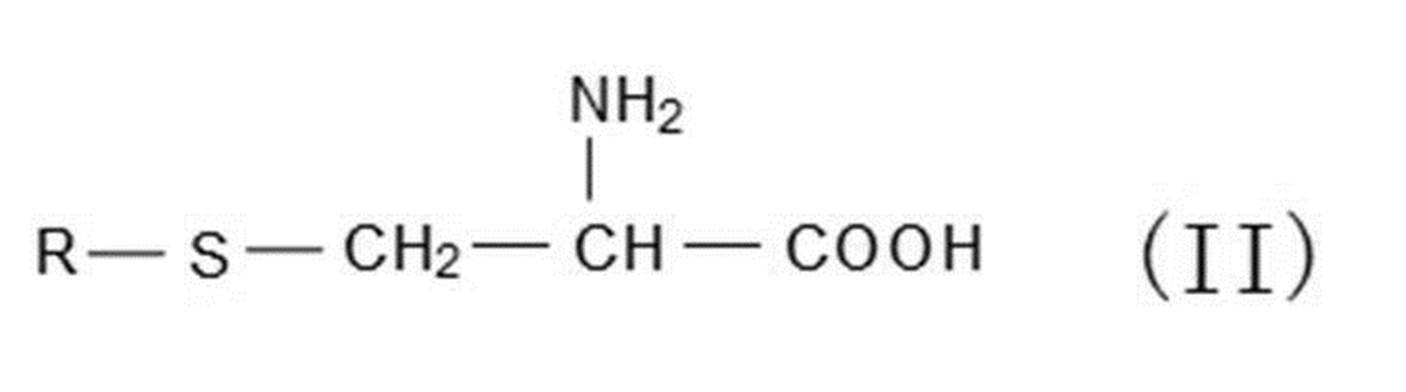
(式中、Rは上述の通りである)
で表されるシステイン誘導体の製造方法。
[2]各式中、Rが1-プロペニル基、プロピル基、メチル基またはアリル基である、上記[1]記載の方法。
[3]前記シスタチオニンβ-シンターゼがシスタチオニンβ-シンターゼ生産性微生物由来である、上記[1]又は[2]記載の方法。
[4]前記微生物が、シスタチオニンβ-シンターゼ活性が増強されている変異株である、上記[3]記載の方法。
[5]前記シスタチオニンβ-シンターゼがCYS4遺伝子によってコードされる酵素である、上記[4]記載の方法。
[6]前記微生物が、シスタチオニンγ-リアーゼ活性が低減されている変異株である、上記[3]~[5]のいずれかに記載の方法。
[7]前記シスタチオニンγ-リアーゼがCYS3遺伝子によってコードされる酵素である、上記[6]記載の方法。
[8]前記微生物が酵母である、上記[3]~[7]のいずれかに記載の方法。
[9]前記酵母がSaccharomyces属酵母である、上記[8]記載の方法。
[10]前記Saccharomyces属酵母がSaccharomyces cerevisiaeである、上記[9]記載の方法。
[11]シスタチオニンβ-シンターゼの存在下、式(I):
で表されるシステイン誘導体の製造方法。
[2]各式中、Rが1-プロペニル基、プロピル基、メチル基またはアリル基である、上記[1]記載の方法。
[3]前記シスタチオニンβ-シンターゼがシスタチオニンβ-シンターゼ生産性微生物由来である、上記[1]又は[2]記載の方法。
[4]前記微生物が、シスタチオニンβ-シンターゼ活性が増強されている変異株である、上記[3]記載の方法。
[5]前記シスタチオニンβ-シンターゼがCYS4遺伝子によってコードされる酵素である、上記[4]記載の方法。
[6]前記微生物が、シスタチオニンγ-リアーゼ活性が低減されている変異株である、上記[3]~[5]のいずれかに記載の方法。
[7]前記シスタチオニンγ-リアーゼがCYS3遺伝子によってコードされる酵素である、上記[6]記載の方法。
[8]前記微生物が酵母である、上記[3]~[7]のいずれかに記載の方法。
[9]前記酵母がSaccharomyces属酵母である、上記[8]記載の方法。
[10]前記Saccharomyces属酵母がSaccharomyces cerevisiaeである、上記[9]記載の方法。
[11]シスタチオニンβ-シンターゼの存在下、式(I):

(式中、RはC1-6アルキル基又はC2-6アルケニル基を表す)
で表されるチオール化合物とL-セリンとを反応させて式(II):
で表されるチオール化合物とL-セリンとを反応させて式(II):
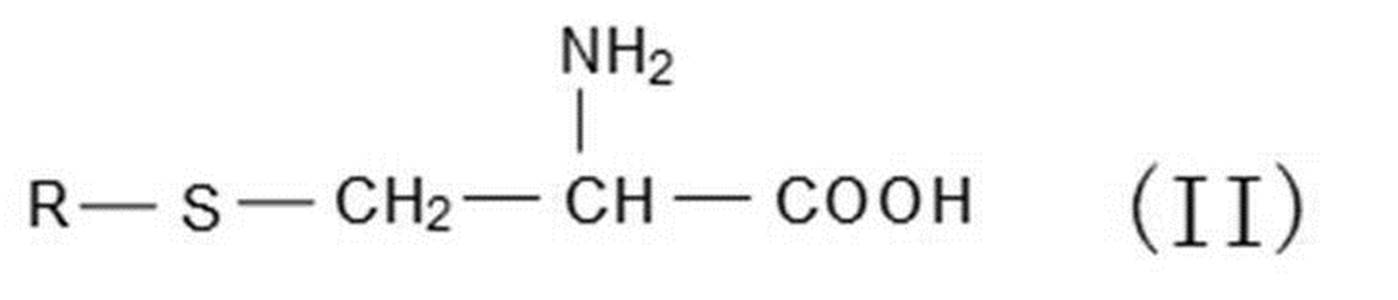
(式中、Rは上述の通りである)
で表されるシステイン誘導体を製造する工程(工程1)、及び
工程1で得られたシステイン誘導体と、オキシダーゼ及びその基質とを反応させて式(III):
で表されるシステイン誘導体を製造する工程(工程1)、及び
工程1で得られたシステイン誘導体と、オキシダーゼ及びその基質とを反応させて式(III):
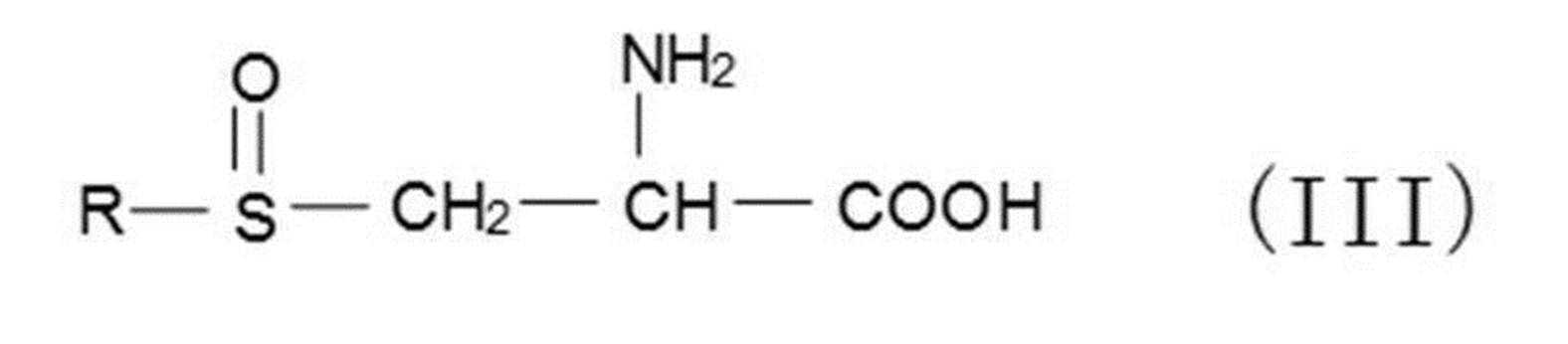
(式中、Rは上述の通りである)
で表されるシステインスルホキシド誘導体を製造する工程(工程2)を含む、該システインスルホキシド誘導体の製造方法。
[12]オキシダーゼがグルコースオキシダーゼ、ガラクトースオキシダーゼ、ウリカーゼ、コレステロールオキシダーゼ、コリンオキシダーゼ及びアシルCoAオキシダーゼからなる群より選択される少なくとも1種である、上記[11]記載の方法。
[13]各式中、Rが1-プロペニル基、プロピル基、メチル基またはアリル基である、上記[11]又は[12]記載の方法。
[14]前記シスタチオニンβ-シンターゼがシスタチオニンβ-シンターゼ生産性微生物由来である、上記[11]~[13]のいずれかに記載の方法。
[15]前記微生物が、シスタチオニンβ-シンターゼ活性が増強されている変異株である、上記[14]記載の方法。
[16]前記シスタチオニンβ-シンターゼがCYS4遺伝子によってコードされる酵素である、上記[15]記載の方法。
[17]前記微生物が、シスタチオニンγ-リアーゼ活性が低減されている変異株である、上記[14]~[16]のいずれかに記載の方法。
[18]前記シスタチオニンγ-リアーゼがCYS3遺伝子によってコードされる酵素である、上記[17]記載の方法。
[19]前記微生物が酵母である、上記[14]~[18]のいずれかに記載の方法。
[20]前記酵母がSaccharomyces属酵母である、上記[19]記載の方法。
[21]前記Saccharomyces属酵母がSaccharomyces cerevisiaeである、上記[20]記載の方法。
[22]シスタチオニンβ-シンターゼ活性を有する酵母を培養し、該酵母の抽出物および/または培養物の存在下、式(I):
で表されるシステインスルホキシド誘導体を製造する工程(工程2)を含む、該システインスルホキシド誘導体の製造方法。
[12]オキシダーゼがグルコースオキシダーゼ、ガラクトースオキシダーゼ、ウリカーゼ、コレステロールオキシダーゼ、コリンオキシダーゼ及びアシルCoAオキシダーゼからなる群より選択される少なくとも1種である、上記[11]記載の方法。
[13]各式中、Rが1-プロペニル基、プロピル基、メチル基またはアリル基である、上記[11]又は[12]記載の方法。
[14]前記シスタチオニンβ-シンターゼがシスタチオニンβ-シンターゼ生産性微生物由来である、上記[11]~[13]のいずれかに記載の方法。
[15]前記微生物が、シスタチオニンβ-シンターゼ活性が増強されている変異株である、上記[14]記載の方法。
[16]前記シスタチオニンβ-シンターゼがCYS4遺伝子によってコードされる酵素である、上記[15]記載の方法。
[17]前記微生物が、シスタチオニンγ-リアーゼ活性が低減されている変異株である、上記[14]~[16]のいずれかに記載の方法。
[18]前記シスタチオニンγ-リアーゼがCYS3遺伝子によってコードされる酵素である、上記[17]記載の方法。
[19]前記微生物が酵母である、上記[14]~[18]のいずれかに記載の方法。
[20]前記酵母がSaccharomyces属酵母である、上記[19]記載の方法。
[21]前記Saccharomyces属酵母がSaccharomyces cerevisiaeである、上記[20]記載の方法。
[22]シスタチオニンβ-シンターゼ活性を有する酵母を培養し、該酵母の抽出物および/または培養物の存在下、式(I):

(式中、RはC1-6アルキル基又はC2-6アルケニル基を表す)
で表されるチオール化合物とL-セリンとを反応させることを特徴とする、式(II):
で表されるチオール化合物とL-セリンとを反応させることを特徴とする、式(II):

(式中、Rは上述の通りである)
で表されるシステイン誘導体の製造方法。
[23]各式中、Rが1-プロペニル基、プロピル基、メチル基またはアリル基である、上記[22]記載の方法。
[24]シスタチオニンβ-シンターゼ活性を有する酵母を培養し、該酵母の抽出物および/または培養物の存在下、式(I):
で表されるシステイン誘導体の製造方法。
[23]各式中、Rが1-プロペニル基、プロピル基、メチル基またはアリル基である、上記[22]記載の方法。
[24]シスタチオニンβ-シンターゼ活性を有する酵母を培養し、該酵母の抽出物および/または培養物の存在下、式(I):
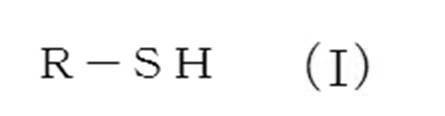
(式中、RはC1-6アルキル基又はC2-6アルケニル基を表す)
で表されるチオール化合物とL-セリンとを反応させて式(II):
で表されるチオール化合物とL-セリンとを反応させて式(II):
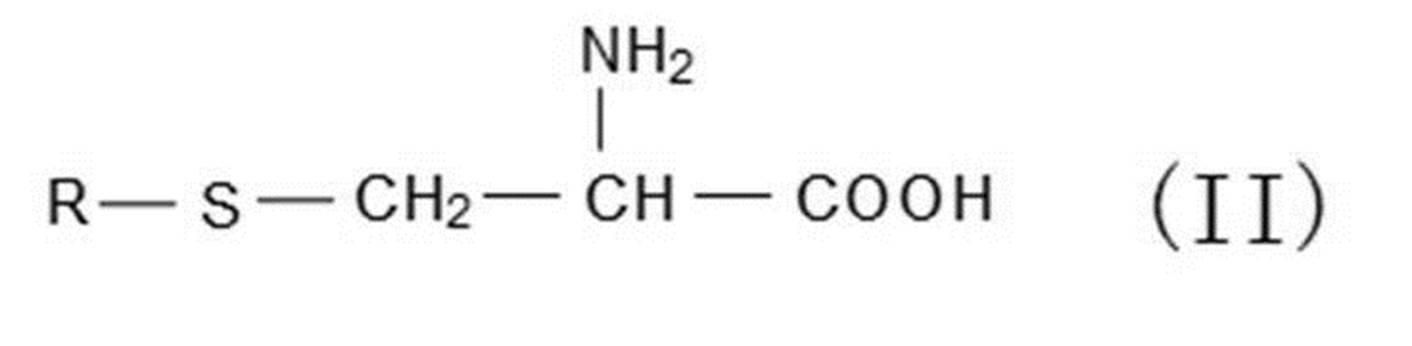
(式中、Rは上述の通りである)
で表されるシステイン誘導体を製造する工程(工程1)、及び
工程1で得られたシステイン誘導体と、オキシダーゼ及びその基質とを反応させて式(III):
で表されるシステイン誘導体を製造する工程(工程1)、及び
工程1で得られたシステイン誘導体と、オキシダーゼ及びその基質とを反応させて式(III):

(式中、Rは上述の通りである)
で表されるシステインスルホキシド誘導体を製造する工程(工程2)を含む、該システインスルホキシド誘導体の製造方法。
[25]オキシダーゼがグルコースオキシダーゼ、ガラクトースオキシダーゼ、ウリカーゼ、コレステロールオキシダーゼ、コリンオキシダーゼ及びアシルCoAオキシダーゼからなる群より選択される少なくとも1種である、上記[24]記載の方法。
[26]各式中、Rが1-プロペニル基、プロピル基、メチル基またはアリル基である、上記[24]又は[25]記載の方法。
[27]前記酵母が、CYS4遺伝子高発現変異株;CYS3遺伝子低発現変異株;及びCYS4遺伝子高発現且つCYS3遺伝子低発現変異株からなる群より選択される少なくとも1種である、上記[22]~[26]のいずれかに記載の方法。
[28]前記酵母がSaccharomyces属酵母である、上記[22]~[27]のいずれかに記載の方法。
[29]前記Saccharomyces属酵母がSaccharomyces cerevisiaeである、上記[28]記載の方法。
[30]該酵母の抽出物および/または培養物のシスタチオニンβ-シンターゼ活性が、抽出物および/または培養物1gあたり2500U以上、5000U以上、10000U以上、20000U以上、30000U以上、又は40000U以上である、上記[22]~[29]のいずれかに記載の方法。
[31]該酵母の抽出物および/または培養物のシスタチオニンβ-シンターゼ活性が、抽出物および/または培養物1gあたり1×106U以下、5×105U以下、1×105U以下、又は5×104U以下である、上記[22]~[30]のいずれかに記載の方法。
[32]該酵母の抽出物および/または培養物のシスタチオニンγ-リアーゼ活性が、抽出物および/または培養物1gあたり100U以下、50U以下、10U以下、1U以下、又は実質的に含まないかあるいは0Uである、上記[22]~[31]のいずれかに記載の方法。
で表されるシステインスルホキシド誘導体を製造する工程(工程2)を含む、該システインスルホキシド誘導体の製造方法。
[25]オキシダーゼがグルコースオキシダーゼ、ガラクトースオキシダーゼ、ウリカーゼ、コレステロールオキシダーゼ、コリンオキシダーゼ及びアシルCoAオキシダーゼからなる群より選択される少なくとも1種である、上記[24]記載の方法。
[26]各式中、Rが1-プロペニル基、プロピル基、メチル基またはアリル基である、上記[24]又は[25]記載の方法。
[27]前記酵母が、CYS4遺伝子高発現変異株;CYS3遺伝子低発現変異株;及びCYS4遺伝子高発現且つCYS3遺伝子低発現変異株からなる群より選択される少なくとも1種である、上記[22]~[26]のいずれかに記載の方法。
[28]前記酵母がSaccharomyces属酵母である、上記[22]~[27]のいずれかに記載の方法。
[29]前記Saccharomyces属酵母がSaccharomyces cerevisiaeである、上記[28]記載の方法。
[30]該酵母の抽出物および/または培養物のシスタチオニンβ-シンターゼ活性が、抽出物および/または培養物1gあたり2500U以上、5000U以上、10000U以上、20000U以上、30000U以上、又は40000U以上である、上記[22]~[29]のいずれかに記載の方法。
[31]該酵母の抽出物および/または培養物のシスタチオニンβ-シンターゼ活性が、抽出物および/または培養物1gあたり1×106U以下、5×105U以下、1×105U以下、又は5×104U以下である、上記[22]~[30]のいずれかに記載の方法。
[32]該酵母の抽出物および/または培養物のシスタチオニンγ-リアーゼ活性が、抽出物および/または培養物1gあたり100U以下、50U以下、10U以下、1U以下、又は実質的に含まないかあるいは0Uである、上記[22]~[31]のいずれかに記載の方法。
本発明によれば、より効率よく、且つ安定的にシステイン誘導体及びシステインスルホキシド誘導体を製造することができる。
本明細書中、「C1-6アルキル基」とは、炭素数1~6、好ましくは1~3の直鎖又は分岐鎖アルキル基を意味し、具体的には、メチル、エチル、n-プロピル、イソプロピル、n-ブチル、イソブチル、sec-ブチルおよびtert-ブチル、ペンチル、ヘキシル等が挙げられる。好ましくは、メチル及びプロピルである。
本明細書中、「C2-6アルケニル基」とは、炭素数2~6、好ましくは2又は3の直鎖又は分岐鎖アルケニル基を意味し、前記アルキル基において、1個又は複数の二重結合を有するもの等が挙げられる。具体的には、ビニル、アリル(2-プロペニル)、1-プロペニル、1-ブテニル、2-ブテニル、3-ブテニル、1,3-ブタジエニル、3-メチル-2-ブテニル等が挙げられる。好ましくは1-プロペニル又はアリルである。
本明細書中、「C2-6アルケニル基」とは、炭素数2~6、好ましくは2又は3の直鎖又は分岐鎖アルケニル基を意味し、前記アルキル基において、1個又は複数の二重結合を有するもの等が挙げられる。具体的には、ビニル、アリル(2-プロペニル)、1-プロペニル、1-ブテニル、2-ブテニル、3-ブテニル、1,3-ブタジエニル、3-メチル-2-ブテニル等が挙げられる。好ましくは1-プロペニル又はアリルである。
1.システイン誘導体の製造方法
本発明は、式(II):
本発明は、式(II):

(式中、RはC1-6アルキル基又はC2-6アルケニル基を表す)
で表されるシステイン誘導体(以下、単にシステイン誘導体(II)とも称する)を酵素的に製造する方法を提供する。
当該方法は、シスタチオニンβ-シンターゼの存在下、式(I):
で表されるシステイン誘導体(以下、単にシステイン誘導体(II)とも称する)を酵素的に製造する方法を提供する。
当該方法は、シスタチオニンβ-シンターゼの存在下、式(I):

(式中、Rの定義は上述の通りである)
で表されるチオール化合物(以下、単にチオール化合物(I)とも称する)とL-セリンとを反応させることを特徴とする。
本発明において、Rとして好ましくは、1-プロペニル基、プロピル基、メチル基及びアリル基である。
で表されるチオール化合物(以下、単にチオール化合物(I)とも称する)とL-セリンとを反応させることを特徴とする。
本発明において、Rとして好ましくは、1-プロペニル基、プロピル基、メチル基及びアリル基である。
シスタチオニンβ-シンターゼは、ホモシステインとセリンからシスタチオニンを合成する反応を触媒する酵素をいい、EC4.2.1.22に分類される。その構造遺伝子は例えばSaccharomyces cerevisiaeではCYS4遺伝子(GenBank NM_001181284)として知られている。本発明で用いられるシスタチオニンβ-シンターゼは、チオール化合物(I)とL-セリンとからシステイン誘導体(II)を製造できるものであればその由来は特に限定されない。天然物であっても、化学的又は生化学的に合成されたものであってもよく、また、遺伝子工学的に生産されたものであってもよい。好ましくはシスタチオニンβ-シンターゼ生産性微生物由来である。シスタチオニンβ-シンターゼ生産性微生物は、シスタチオニンβ-シンターゼを細胞内に蓄積できるものであれば特に限定されない。具体的には、酵母、糸状菌、担子菌などが挙げられ、好ましくは酵母である。酵母とは、単細胞の真菌を示し、有胞子酵母、担子菌酵母、不完全酵母などが挙げられる。この中でも例えば、Saccharomyces属、Candida属、Picha属、Hansenula属、Zygosaccharomyces属など有胞子酵母が好ましく、Saccharomyces属、Candida属がより好ましく、Saccharomyces属が最も好ましい。Saccharomyces属酵母には、実験室酵母、清酒酵母、焼酎酵母、ワイン酵母、ビール酵母、パン酵母なども含まれる。より好ましくはSaccharomyces cerevisiae及びCandida utilisであり、最も好ましくはSaccharomyces cerevisiaeである。これらの菌株は商業的に入手が可能であるか、あるいは既知文献に基づいて入手、調製が可能である。例えばアメリカン・タイプ・カルチャー・コレクション(住所 12301 Parklawn Drive, Rockville, Maryland 20852 P.O. Box 1549, Manassas, VA 20108, United States of America)では、各菌株に対応する登録番号が付与されており、この登録番号を利用して分譲を受けることが出来る(http://www.atcc.org/参照)。各菌株に対応する登録番号は、アメリカン・タイプ・カルチャー・コレクションのカタログに記載されている。Saccharomyces cerevisiaeとしては、具体的には、BY4742株(ATCC204508)やS288C株(ATCC26108)を用いることができる。また、Candida utilisとしては、具体的には、Candida utilis ATCC22023株を用いることができる。特に好ましくはSaccharomyces cerevisiaeである。
シスタチオニンβ-シンターゼ生産性微生物は、野生株であってもよいし、システイン誘導体(II)の合成に関与する酵素に変異を有するよう改変されたもの、即ち変異株であってもよい。
シスタチオニンβ-シンターゼ生産性微生物における、システイン誘導体(II)の合成に関与する酵素としては、後述の実施例で本発明者らが明らかにしているように、正に制御する酵素としてシスタチオニンβ-シンターゼが、負に制御する酵素としてシスタチオニンγ-リアーゼが挙げられる。シスタチオニンγ-リアーゼは、シスタチオニンをシステインとα-ケト酪酸に分解するような反応を触媒する酵素をいい、EC4.4.1.1に分類される。その構造遺伝子は例えばSaccharomyces cerevisiaeではCYS3遺伝子(GenBank NM_001178157)として知られている。
ここで、「変異株」とは、野生株もしくは改変前の株(親株)と比較して、該酵素活性が増強されている、あるいは低減されている(活性の完全な消失も含む)株のことを意味する。本発明において好適に用いられる変異株としては、Saccharomyces cerevisiae変異株が挙げられ、特に、シスタチオニンβ-シンターゼをコードする遺伝子を高発現する「CYS4遺伝子高発現変異株」やシスタチオニンγ-リアーゼをコードする遺伝子の発現が抑制された「CYS3遺伝子低発現変異株」が挙げられる。野生株(Saccharomyces cerevisiae BY4742)と比較した場合、「CYS4遺伝子高発現変異株」では、CYS4遺伝子の発現が有意に増強されており、具体的には、1.5倍以上、より好ましくは2倍以上、さらに好ましくは3倍以上、特に好ましくは5倍以上、最も好ましくは10倍以上増強されている。野生株(Saccharomyces cerevisiae BY4742)と比較した場合、「CYS3遺伝子低発現変異株」では、CYS3遺伝子の発現が有意に低減されており、具体的には50%以下、より好ましくは30%以下、さらに好ましくは20%以下、特に好ましくは10%以下、最も好ましくは5%以下に低減されている。また、シスタチオニンγ-リアーゼ遺伝子の発現が実質的に消失している(即ち、検出限界未満である)のが好ましい。これらの変異株は天然に存在する(自然変異)ものであってもよいし、人為的に作出されたものであってもよい。人為的に作出する方法としては、セルフクローニングによる方法、従来育種法(例えば薬剤変異、交雑)等が挙げられる。後述の「酵素活性が低減されるような改変」あるいは「酵素活性を増強させるような改変」の為の各手法であってもよい。
シスタチオニンβ-シンターゼ生産性微生物における、システイン誘導体(II)の合成に関与する酵素としては、後述の実施例で本発明者らが明らかにしているように、正に制御する酵素としてシスタチオニンβ-シンターゼが、負に制御する酵素としてシスタチオニンγ-リアーゼが挙げられる。シスタチオニンγ-リアーゼは、シスタチオニンをシステインとα-ケト酪酸に分解するような反応を触媒する酵素をいい、EC4.4.1.1に分類される。その構造遺伝子は例えばSaccharomyces cerevisiaeではCYS3遺伝子(GenBank NM_001178157)として知られている。
ここで、「変異株」とは、野生株もしくは改変前の株(親株)と比較して、該酵素活性が増強されている、あるいは低減されている(活性の完全な消失も含む)株のことを意味する。本発明において好適に用いられる変異株としては、Saccharomyces cerevisiae変異株が挙げられ、特に、シスタチオニンβ-シンターゼをコードする遺伝子を高発現する「CYS4遺伝子高発現変異株」やシスタチオニンγ-リアーゼをコードする遺伝子の発現が抑制された「CYS3遺伝子低発現変異株」が挙げられる。野生株(Saccharomyces cerevisiae BY4742)と比較した場合、「CYS4遺伝子高発現変異株」では、CYS4遺伝子の発現が有意に増強されており、具体的には、1.5倍以上、より好ましくは2倍以上、さらに好ましくは3倍以上、特に好ましくは5倍以上、最も好ましくは10倍以上増強されている。野生株(Saccharomyces cerevisiae BY4742)と比較した場合、「CYS3遺伝子低発現変異株」では、CYS3遺伝子の発現が有意に低減されており、具体的には50%以下、より好ましくは30%以下、さらに好ましくは20%以下、特に好ましくは10%以下、最も好ましくは5%以下に低減されている。また、シスタチオニンγ-リアーゼ遺伝子の発現が実質的に消失している(即ち、検出限界未満である)のが好ましい。これらの変異株は天然に存在する(自然変異)ものであってもよいし、人為的に作出されたものであってもよい。人為的に作出する方法としては、セルフクローニングによる方法、従来育種法(例えば薬剤変異、交雑)等が挙げられる。後述の「酵素活性が低減されるような改変」あるいは「酵素活性を増強させるような改変」の為の各手法であってもよい。
「酵素活性が低減されている」とは、目的の酵素活性(本発明ではシスタチオニンγ-リアーゼ活性)が野生株や親株等の非改変株と比較して減少していることを意味し、活性が完全に消失している場合を含む。野生株(Saccharomyces cerevisiae BY4742)と比較した場合、シスタチオニンγ-リアーゼ活性は、好ましくは50%以下、より好ましくは30%以下、さらに好ましくは20%以下、特に好ましくは10%以下、最も好ましくは5%以下に低減されている。また、シスタチオニンγ-リアーゼ活性は実質的に消失しているのが好ましい。
酵素活性が低減されるような改変は、例えば、突然変異処理又は遺伝子組換え技術により実施することができる。
突然変異処理としては、紫外線照射、またはN-メチル-N’-ニトロ-N-ニトロソグアニジン(MNNG)、エチルメタンスルフォネート(EMS)、メチルメタンスルフォネート(MMS)等の変異処理に通常用いられている変異剤による処理が挙げられる。
遺伝子組換え技術としては、例えば、公知の技術(FEMS Microbiology Letters 165 (1998) 335-340、 JOURNAL OF BACTERIOLOGY, Dec. 1995, p7171-7177、Curr Genet 1986; 10(8): 573-578、WO 98/14600等)を利用できる。
また、酵素活性が低減される(酵素活性の完全な消失を含む)ような改変は、例えば、該酵素をコードする遺伝子を破壊することにより実施することができる。遺伝子の破壊は、例えば、染色体上の目的の酵素をコードする遺伝子のコード領域の一部または全部を欠失させることにより達成できる。さらには、染色体上の遺伝子の前後の配列を含めて、遺伝子全体を欠失させてもよい。また、遺伝子の破壊は、例えば、染色体上の目的の酵素をコードする遺伝子のコード領域にアミノ酸置換(ミスセンス変異)を導入すること、終始コドンを導入すること(ナンセンス変異)、あるいは1~2塩基を付加または欠失するフレームシフト変異を導入すること等によっても達成できる。また、遺伝子の破壊は、例えば、染色体上の目的の酵素をコードする遺伝子のコード領域に他の配列を挿入することによっても達成できる。
「酵素活性が増強されている」とは、目的の酵素活性(本発明ではシスタチオニンβ-シンターゼ活性)が野生株や親株等の非改変株と比較して増強されていることを意味する。シスタチオニンβ-シンターゼ活性は、野生株(Saccharomyces cerevisiae BY4742)と比較した場合、好ましくは1.5倍以上、より好ましくは2倍以上、さらに好ましくは3倍以上、特に好ましくは5倍以上、最も好ましくは10倍以上に増強されている。
酵素活性を増強させるような改変は、例えば、目的の酵素をコードする遺伝子の発現を増大させることにより達成できる。遺伝子の発現の増大は、例えば、染色体上の遺伝子のプロモーターをより強力なプロモーターに置換することにより達成できる。また、遺伝子の発現の増大は、例えば、染色体上に目的の遺伝子を導入する等して遺伝子のコピー数を増加させることにより達成できる。また、トランスポゾンに遺伝子を組み込み、それを染色体へ遺伝子の多数のコピーを導入するよう転移させてもよい。さらに遺伝子のコピー数の増加は、目的遺伝子を含むベクターを宿主に導入することによっても達成できる。また、酵素活性が増強されるような改変は、例えば、目的の酵素の比活性を増大させることによっても達成できる。また、「酵素活性が増強されている」とは、もともと目的の酵素活性を有する微生物において目的の酵素活性を増強させるだけでなく、もともと目的の酵素活性を有さない菌株において目的の酵素活性を付与するよう該酵素をコードする遺伝子を新たに導入し、当該酵素を発現するようになる場合を含む。
目的遺伝子を宿主に導入する場合、宿主は目的遺伝子が由来する菌株と同種であっても異種であってもよい。
目的の酵素活性が増強された、あるいは低減されたことの確認は、同酵素の活性を測定することによって行うことができる。シスタチオニンβ-シンターゼの活性を測定する方法としては、例えばKrausらの方法(Jan P. Kraus, Methods in ENZYMOLOGY 143 (1987) 388-394)及びそれに準じた方法が挙げられる。より具体的には、シスタチオニンβ-シンターゼの活性は、緩衝液(50mMリン酸カリウムバッファー、pH9)中、基質(3mMホモシステイン、3mMセリン、100μMピリドキサールリン酸)と45℃で1時間反応させる方法によって測定することができる。本発明及び本明細書では該反応により1分間に1μmolのシスタチオニンを生成するのに必要な酵素量を1Uと定義する。シスタチオニンγ-リアーゼの活性を測定する方法としては、例えばYamagataらの方法(Journal of Bacteriology,Aug.1993,p.4800-4808)及びそれに準じた方法が挙げられる。より具体的には、シスタチオニンγ-リアーゼの活性は、緩衝液(50mMリン酸カリウムバッファー、pH7.4)中、基質[3mMシステイン(シスタチオニンを基質とすると、β-リアーゼが共存している場合、その活性が測定値に影響を与える場合があるのでシステインを基質とする)、100μMピリドキサールリン酸]と30℃で1時間反応させる方法によって測定することができる。本発明及び本明細書では該反応により1分間に1μmolのピルビン酸を生成するのに必要な酵素量を1Uと定義する。
目的の酵素活性が増強された、あるいは低減されたことの確認は、目的の酵素をコードする遺伝子の転写量が増加あるいは減少したことを確認することや、目的の酵素の量が増加あるいは減少したことを確認することにより行うことが出来る。
目的の酵素をコードする遺伝子の転写量が増加あるいは減少したことの確認は、同遺伝子から転写されるmRNAの量を非改変株と比較することによって行うことが出来る。mRNAの量を評価する方法としては、ノーザンハイブリダイゼーション、RT-PCR等が挙げられる(Molecular cloning(Cold spring Harbor Laboratory Press, Cold spring Harbor (USA), 2001))。該転写量が減少している場合には、mRNAの量は、非改変株と比較して、例えば、50%以下、30%以下、20%以下、10%以下、5%以下、または0%に減少していることが好ましい。該転写量が増加している場合には、mRNAの量は、非改変株と比較して、例えば、1.5倍以上、2倍以上、3倍以上、5倍以上、または10倍以上に増加していることが好ましい。
目的の酵素の量が増加あるいは減少したことの確認は、抗体を用いてウェスタンブロットによって行うことが出来る(Molecular cloning(Cold spring Harbor Laboratory Press, Cold spring Harbor (USA), 2001))。目的の酵素の量が減少している場合には、その量は、非改変株と比較して、例えば、50%以下、30%以下、20%以下、10%以下、5%以下、または0%に減少していることが好ましい。目的の酵素の量が増加している場合には、その量は、非改変株と比較して、例えば、1.5倍以上、2倍以上、3倍以上、5倍以上、または10倍以上に増加していることが好ましい。
尚、シスタチオニンβ-シンターゼの酵素反応の生成物であるシスタチオニンはシスタチオニンγ-リアーゼにより分解される為、シスタチオニンγ-リアーゼ共存下では、上記測定法によるシスタチオニンβ-シンターゼ遺伝子の発現量における変動の程度と上記測定法によるシスタチオニンβ-シンターゼ活性における変動の程度とは必ずしも一致しない。シスタチオニンγ-リアーゼ共存下では、シスタチオニンβ-シンターゼ活性はシスタチオニンγ-リアーゼが存在しない場合に比べて低い値となる。シスタチオニンγ-リアーゼ共存下でシスタチオニンβ-シンターゼ活性を測定する場合には予めシスタチオニンγ-リアーゼ活性によるシスタチオニンの消費量を算出し補正しておくことが好ましい。
本発明において好ましく用いられるシスタチオニンβ-シンターゼ生産性微生物としては、(A)シスタチオニンβ-シンターゼ活性が増強されている変異株、(B)シスタチオニンγ-リアーゼ活性が低減されている変異株、あるいは(C)シスタチオニンβ-シンターゼ活性が増強され且つシスタチオニンγ-リアーゼ活性が低減されている変異株であり、より好ましくは(D)CYS4遺伝子高発現変異株、(E)CYS3遺伝子低発現変異株、あるいは(F)CYS4遺伝子高発現且つCYS3遺伝子低発現変異株酵母である。
変異株(E)の好ましい一実施態様としては、CYS3遺伝子破壊変異株(E’)が挙げられる。変異株(F)の好ましい一実施態様としては、CYS4遺伝子高発現且つCYS3遺伝子破壊変異株(F’)が挙げられる。
変異株(E)の好ましい一実施態様としては、CYS3遺伝子破壊変異株(E’)が挙げられる。変異株(F)の好ましい一実施態様としては、CYS4遺伝子高発現且つCYS3遺伝子破壊変異株(F’)が挙げられる。
本発明で用いるシスタチオニンβ-シンターゼは、これを産生する微生物(例えば、シスタチオニンβ-シンターゼ活性を有する酵母、当該酵母のCYS4遺伝子高発現及び/又はCYS3遺伝子破壊変異株)を培養して得られる微生物の培養物から調製することができる。例えば、シスタチオニンβ-シンターゼ生産性微生物の培養方法を以下に示す。
シスタチオニンβ-シンターゼ生産性微生物を培養するための培地としては、使用するシスタチオニンβ-シンターゼ生産性微生物の種類によって適宜選択される。炭素源、窒素源、無機物および必要に応じて少量の微量栄養素を含むものであれば、合成培地または天然培地のいずれも使用可能である。培地に使用する炭素源および窒素源は使用する微生物の利用可能なものならばいずれの種類を用いてもよい。炭素源としては、グルコ-ス、グリセロール、フラクトース、シュクロース、マルトース、マンノース、澱粉、澱粉加水分解物、糖蜜など種々の炭水化物が使用できる。窒素源としては、アンモニア、塩化アンモニウム、硫酸アンモニム、炭酸アンモニウム、酢酸アンモニウムなどの各種の無機および有機アンモニウム塩類、または肉エキス、酵母エキス、コーン・スティープ・リカー、カゼイン加水分解物、フィッシュミールあるいはその消化物、脱脂大豆粕あるいはその消化物などの天然有機窒素源が使用可能である。天然有機窒素源の多くの場合は窒素源であるとともに炭素源にもなり得る。無機物としては、リン酸一水素カリウム、リン酸二水素カリウム、塩化カリウム、硫酸マグネシウム、塩化ナトリウム、硫酸第一鉄などが必要に応じて使用できる。例えば、実施例に記載したYPD培地を好適に利用することができる。
培養は、振とう培養あるいは通気撹拌深部培養などの好気的条件下で行う。培養温度は好ましくは20~50℃、特に好ましくは28~37℃の範囲である。培養中の培地のpHは微生物の生育に応じて適宜調整すればよく、例えばpH5~7が挙げられる。培養時間は通常12時間~10日間、より好ましくは24時間~5日間、さらに好ましくは36時間~3日間である。
前記のようにして得られる微生物等を含む培養物からシスタチオニンβ-シンターゼを回収する。本発明で使用されるシスタチオニンβ-シンターゼはその酵素活性が維持されている限り必ずしも単離精製されている必要はない。すなわち、シスタチオニンβ-シンターゼ生産性微生物(好ましくはシスタチオニンβ-シンターゼ活性を有する酵母)をそのまま、あるいは該微生物の培養物、該培養物から遠心分離などの方法によって採取した生菌体、その乾燥菌体を本発明の方法に用いることができる。あるいはシスタチオニンβ-シンターゼ生産性微生物(好ましくはシスタチオニンβ-シンターゼ活性を有する酵母)の生菌体あるいはその乾燥菌体を破砕、自己消化、超音波などで処理することによって得られる抽出物(菌体処理物とも称する)を本発明の方法に用いることができる。さらに該菌体処理物から得られるシスタチオニンβ-シンターゼを含む粗精製物を本発明の方法に用いることができる。また、これらの固定化酵素または固定化菌体を本発明の製造方法に用いることもできる。
本発明の方法において、シスタチオニンβ-シンターゼ生産性微生物(好ましくはシスタチオニンβ-シンターゼ活性を有する酵母)の抽出物および/または培養物をシスタチオニンβ-シンターゼとして用いる場合、該抽出物および/または培養物の酵素活性は、1gあたり、通常2500U以上であり、好ましくは5000U以上、10000U以上、20000U以上、30000U以上、又は40000U以上である。酵素活性が低すぎると十分な酵素反応が得られない。一方、操作性やコストの観点から、該抽出物および/または培養物の酵素活性は、1gあたり、通常1×106U以下、好ましくは5×105U以下、1×105U以下、又は5×104U以下である。
本発明の方法において、シスタチオニンβ-シンターゼ生産性微生物(好ましくはシスタチオニンβ-シンターゼ活性を有する酵母)の抽出物および/または培養物をシスタチオニンβ-シンターゼとして用いる場合、該抽出物および/または培養物はシスタチオニンγ-リアーゼ活性が低いものであることが好ましい。従って、該抽出物および/または培養物のシスタチオニンγ-リアーゼ活性は、通常1gあたり100U以下、50U以下、10U以下、1U以下、又は実質的に含まないかあるいは0Uである。
本発明の方法において、シスタチオニンβ-シンターゼ生産性微生物(好ましくはシスタチオニンβ-シンターゼ活性を有する酵母)の抽出物および/または培養物をシスタチオニンβ-シンターゼとして用いる場合、該抽出物および/または培養物はシスタチオニンγ-リアーゼ活性が低いものであることが好ましい。従って、該抽出物および/または培養物のシスタチオニンγ-リアーゼ活性は、通常1gあたり100U以下、50U以下、10U以下、1U以下、又は実質的に含まないかあるいは0Uである。
チオール化合物(I)とL-セリンとを前記のシスタチオニンβ-シンターゼの存在下で反応させることにより、システイン誘導体(II)を製造することができる。原料である、L-セリン及びチオール化合物(I)はいずれも市販されており容易に入手可能である。
チオール化合物(I)とL-セリンとの反応は、通常、水性溶媒中で行われる。水性溶媒としては、酵素反応を阻害しない限り特に限定されないが、生理食塩水、リン酸カリウム緩衝液、トリス-塩酸緩衝液、グリシン-水酸化ナトリウム緩衝液、ホウ酸-水酸化ナトリウム緩衝液等を挙げることができる。
反応液中のL-セリンの濃度は特に限定されないが、好ましくは1~20重量%、特に好ましくは1~10重量%である。
反応液中のチオール化合物(I)の濃度は、用いる化合物の種類によっても異なり、酵素反応を阻害しない範囲であれば特に制限されないが、好ましくは10重量%以下の濃度で使用される。なお、反応中に酵素反応を阻害しない濃度範囲になるように、チオール化合物(I)を逐次添加してもよい。また、反応に際して、基質の他に補酵素であるピリドキサールリン酸を0.1~100ppmの範囲で添加することが好ましい。
反応に用いるシスタチオニンβ-シンターゼの量は、基質濃度、反応時間、その他の条件によって適宜調整し得るが、好ましくは反応液1g当たり0.1U~1000U、好ましくは1U~500U、より好ましくは10U~250Uの範囲で添加する。
反応はpH7~9.5、好ましくはpH8~9の範囲で実施される。反応温度は通常、4℃~60℃で実施されるが、酵素の安定性と反応速度の点で、好ましくは20℃~55℃、より好ましくは35℃~50℃で実施される。反応時間は所望のシステイン誘導体(II)の合成量に応じて適宜設定されるが、通常、0.5~24時間、好ましくは1~10時間、特に好ましくは1~5時間、最も好ましくは1~3時間である。
前記の反応で得られる反応液からシステイン誘導体(II)を分離し、回収する方法は、公知のあらゆる方法が使用可能である。一例をあげればトリクロロ酢酸(TCA)沈殿法、限外濾過濃縮法、硫安沈殿法(塩析)、有機溶媒(例、アセトン、エタノール、プロパノール、メタノール等)沈殿法、水溶性ポリマー(例、ポリエチレングリコール、デキストラン等)沈殿法、酸性沈殿法、等電点沈殿法等が挙げられる。
システイン誘導体(II)を分離、回収することなく、該システイン誘導体(II)と、オキシダーゼ及びその基質とを反応させることによってシステインスルホキシド誘導体(III)を製造することもできる。
2.システインスルホキシド誘導体の製造方法
本発明は、式(III)
本発明は、式(III)

(式中、RはC1-6アルキル基又はC2-6アルケニル基を表す)
で表されるシステインスルホキシド誘導体(以下、単にシステインスルホキシド誘導体(III)とも称する)を酵素的に製造する方法を提供する。
当該方法は、システイン誘導体(II)と、オキシダーゼ及びその基質とを反応させることを特徴とする。オキシダーゼとその基質とが反応することにより産生される過酸化水素によりシステイン誘導体(II)がシステインスルホキシド誘導体(III)に変換される。
本発明において、Rとして好ましくは、1-プロペニル基、プロピル基、メチル基及びアリル基である。
で表されるシステインスルホキシド誘導体(以下、単にシステインスルホキシド誘導体(III)とも称する)を酵素的に製造する方法を提供する。
当該方法は、システイン誘導体(II)と、オキシダーゼ及びその基質とを反応させることを特徴とする。オキシダーゼとその基質とが反応することにより産生される過酸化水素によりシステイン誘導体(II)がシステインスルホキシド誘導体(III)に変換される。
本発明において、Rとして好ましくは、1-プロペニル基、プロピル基、メチル基及びアリル基である。
当該方法において使用するオキシダーゼは基質と反応することにより過酸化水素を産生するものであれば特に限定されない。具体的には、グルコースオキシダーゼ、ガラクトースオキシダーゼ、ウリカーゼ、コレステロールオキシダーゼ、コリンオキシダーゼ、アシルCoAオキシダーゼ等が挙げられる。これらの酵素の少なくとも1種が使用される。好ましくはグルコースオキシダーゼである。
グルコースオキシダーゼは、二量体のタンパク質でEC1.1.3.4に分類される。グルコースオキシダーゼは、グルコースを基質として、酸素存在下、グルコノラクトン(グルコノラクトンは、非酵素的にグルコン酸へと加水分解される)と過酸化水素を生成する反応を触媒する酵素である。本発明で用いられるグルコースオキシダーゼは、上記酵素作用を有するものであればその由来は特に限定されない。天然物であっても、化学的又は生化学的に合成されたものであってもよく、また、遺伝子工学的に生産されたものであってもよい。本発明では、商業的に入手可能なものが好適に利用できる。例えば、「スミチームPGO」という商品名で新日本化学工業(株)より市販されている微生物由来のグルコースオキシダーゼが挙げられる。
グルコースオキシダーゼの活性は、生成した過酸化水素にアミノアンチピリン及びフェノール存在下でペルオキシダーゼを作用させることでキノンイミン色素を生成させる反応を用いて測定することができる。生成したキノンイミン色素の量を検量線より求め酵素活性を算出する。本発明及び本明細書では1分間に1μmolのグルコースを酸化するのに必要な酵素量を1Uと定義する。
グルコースオキシダーゼの活性は、生成した過酸化水素にアミノアンチピリン及びフェノール存在下でペルオキシダーゼを作用させることでキノンイミン色素を生成させる反応を用いて測定することができる。生成したキノンイミン色素の量を検量線より求め酵素活性を算出する。本発明及び本明細書では1分間に1μmolのグルコースを酸化するのに必要な酵素量を1Uと定義する。
ガラクトースオキシダーゼは、EC1.1.3.9に分類され、D-ガラクトースを基質として酸素存在下、D-ガラクト-ヘキソジアルドースと過酸化水素を生成する反応を触媒する酵素である。
ウリカーゼは、EC1.7.3.3に分類され、尿酸を基質として酸素存在下、アラントインと過酸化水素を生成する反応を触媒する酵素である。
コレステロールオキシダーゼは、EC1.1.3.6に分類され、3β-ヒドロキシステロイドを基質として酸素存在下、3-オキソステロイドと過酸化水素を生成する反応を触媒する酵素である。
コリンオキシダーゼは、EC1.1.3.17に分類される酵素である。コリンオキシダーゼは、コリンを基質として酸素存在下、ベタインアルデヒドと過酸化水素を生成する反応(第一反応)と、ベタインアルデヒドを基質として酸素存在下、ベタインと過酸化水素を生成する反応(第二反応)とを触媒する酵素である。
アシルCoAオキシダーゼは、EC1.3.3.6に分類され、アシルCoAを基質として酸素存在下、トランス-2、3-デヒドロアシルCoAと過酸化水素を生成する反応を触媒する酵素である。
本発明で用いられるガラクトースオキシダーゼ、ウリカーゼ、コレステロールオキシダーゼ、コリンオキシダーゼ、アシルCoAオキシダーゼは、上記酵素作用を有するものであればその由来は特に限定されない。天然物であっても、化学的又は生化学的に合成されたものであってもよく、また、遺伝子工学的に生産されたものであってもよい。本発明では、商業的に入手可能なものが好適に利用できる。
原料である、システイン誘導体(II)は、いかなる方法によって調製されたものであってもよいが、好ましくは、上記1.のシステイン誘導体の製造方法により調製された化合物である。
以下、オキシダーゼがグルコースオキシダーゼである場合を例に詳述する。
システイン誘導体(II)と基質であるグルコースとの反応は、通常、水性溶媒中、酸素の存在下で実施される。好ましくは反応容器中に空気を流通させて実施される。水性溶媒としては、酵素反応を阻害しない限り特に限定されないが、生理食塩水、リン酸カリウム緩衝液、トリス-塩酸緩衝液、グリシン-水酸化ナトリウム緩衝液、ホウ酸-水酸化ナトリウム緩衝液等を挙げることができる。
システイン誘導体(II)と基質であるグルコースとの反応は、通常、水性溶媒中、酸素の存在下で実施される。好ましくは反応容器中に空気を流通させて実施される。水性溶媒としては、酵素反応を阻害しない限り特に限定されないが、生理食塩水、リン酸カリウム緩衝液、トリス-塩酸緩衝液、グリシン-水酸化ナトリウム緩衝液、ホウ酸-水酸化ナトリウム緩衝液等を挙げることができる。
反応液中のグルコースの濃度は特に限定されないが、通常、0.1~10重量%、好ましくは0.1~1重量%である。所望によりグルコースを反応の途中で追加することもでき、また、追加することが好ましい。
反応液中のシステイン誘導体(II)の濃度は、用いる化合物の種類によって異なるが、酵素反応を阻害しない範囲であれば特に制限されない。通常、0.1~10重量%、好ましくは0.1~1重量%である。
反応に用いるグルコースオキシダーゼの量は、基質濃度、反応時間、その他の条件によって適宜調整し得るが、好ましくは反応液1g当たり0.001U~100U、好ましくは0.01U~50U、より好ましくは0.1U~10Uの範囲で添加する。
反応はpH5~7、好ましくは5.5~6.5で実施される。反応は好ましくは4℃~60℃で行われるが、酵素の安定性と反応速度の点で、特に好ましくは、30℃~50℃、より好ましくは35~45℃で実施される。反応時間は所望のシステインスルホキシド誘導体(III)の合成量に応じて適宜設定されるが、通常、0.5~24時間、好ましくは1~10時間、さらに好ましくは1~5時間である。
前記の反応で得られる反応液からシステインスルホキシド誘導体(III)を分離し、回収する方法は、公知の方法が使用可能である。一例をあげればトリクロロ酢酸(TCA)沈殿法、限外濾過濃縮法、硫安沈殿法(塩析)、有機溶媒(例、アセトン、エタノール、プロパノール、メタノール等)沈殿法、水溶性ポリマー(例、ポリエチレングリコール、デキストラン等)沈殿法、酸性沈殿法、等電点沈殿法等が挙げられる。
以下に実施例を示して、本発明をより詳細に説明するが、これらは本発明の範囲を限定するものではない。
実施例1:S-アリルシステイン(ALC)生成に関与する酵素の同定
表1に示す酵母の各酵素の遺伝子破壊株を用いてS-アリルシステイン生成量を測定し、チオール化合物及びL-セリンからのS-アリルシステインの生成に寄与する酵素を調べた。
表1に示す酵母の各酵素の遺伝子破壊株を用いてS-アリルシステイン生成量を測定し、チオール化合物及びL-セリンからのS-アリルシステインの生成に寄与する酵素を調べた。

(1)菌株作成
野生株として実験室酵母であるSaccharomyces cerevisiae BY4742を用い、CYS3遺伝子、CYS4遺伝子、TRP5遺伝子又はMET17遺伝子を欠失させた変異株(それぞれ、ΔCYS3、ΔCYS4、ΔTRP5、ΔMET17)を用いた。各変異株はThermo Scientific社製の市販品(Yeast Knockout Clones and Collections)を使用した。
(2)培養/反応
野生株(BY4742)及び各変異株(ΔCYS3、ΔCYS4、ΔTRP5、ΔMET17)をそれぞれ1白金耳ずつ、5mLのYPD培地(1%酵母エキス、2%ペプトン、2%グルコース)に接種し、30℃、180rpmで72時間振盪培養した。該培養液の全量を100mLのYPD培地(0.6%酵母エキス、0.5%ペプトン、3%グルコース)に移し、さらに30℃、120rpmで48時間振盪培養した。得られた培養液を10分間遠心分離(4℃、9000rpm)して沈殿物を菌体として回収した。菌体を1mLのプロテアーゼ阻害剤を含有する抽出用バッファー中でビーズ破砕(4600rpm、氷上)し、遠心分離した。
得られた上清を用いてS-アリルメルカプタンからのALCの生成量を測定した。反応バッファーには50mMリン酸カリウム緩衝液(pH7.4)を用い、基質としてはS-アリルメルカプタン及び硫安・ピルビン酸を用いた。生成したALCは10%TCAで沈殿させ、LC/MSにより定量した。
(3)結果
2時間反応後のALC生成量の結果を図1に示す。ΔCYS4変異株ではALCが生成しなかった。ΔCYS3変異株でALC生成量が有意に増加した。これらの結果よりCYS4遺伝子がALC生成に関与する酵素をコードする遺伝子であると考えられた。さらに、CYS3遺伝子がALC分解に関与する酵素をコードする遺伝子であるか、あるいはCYS4発現へ負の影響を及ぼす可能性が考えられた。
野生株として実験室酵母であるSaccharomyces cerevisiae BY4742を用い、CYS3遺伝子、CYS4遺伝子、TRP5遺伝子又はMET17遺伝子を欠失させた変異株(それぞれ、ΔCYS3、ΔCYS4、ΔTRP5、ΔMET17)を用いた。各変異株はThermo Scientific社製の市販品(Yeast Knockout Clones and Collections)を使用した。
(2)培養/反応
野生株(BY4742)及び各変異株(ΔCYS3、ΔCYS4、ΔTRP5、ΔMET17)をそれぞれ1白金耳ずつ、5mLのYPD培地(1%酵母エキス、2%ペプトン、2%グルコース)に接種し、30℃、180rpmで72時間振盪培養した。該培養液の全量を100mLのYPD培地(0.6%酵母エキス、0.5%ペプトン、3%グルコース)に移し、さらに30℃、120rpmで48時間振盪培養した。得られた培養液を10分間遠心分離(4℃、9000rpm)して沈殿物を菌体として回収した。菌体を1mLのプロテアーゼ阻害剤を含有する抽出用バッファー中でビーズ破砕(4600rpm、氷上)し、遠心分離した。
得られた上清を用いてS-アリルメルカプタンからのALCの生成量を測定した。反応バッファーには50mMリン酸カリウム緩衝液(pH7.4)を用い、基質としてはS-アリルメルカプタン及び硫安・ピルビン酸を用いた。生成したALCは10%TCAで沈殿させ、LC/MSにより定量した。
(3)結果
2時間反応後のALC生成量の結果を図1に示す。ΔCYS4変異株ではALCが生成しなかった。ΔCYS3変異株でALC生成量が有意に増加した。これらの結果よりCYS4遺伝子がALC生成に関与する酵素をコードする遺伝子であると考えられた。さらに、CYS3遺伝子がALC分解に関与する酵素をコードする遺伝子であるか、あるいはCYS4発現へ負の影響を及ぼす可能性が考えられた。
実施例2:精製シスタチオニンβ-シンターゼによるS-アリルシステイン生成
実施例1で、CYS4遺伝子がALC生成に関与する酵素をコードする遺伝子であると推定されたので、本実施例では、CYS4遺伝子高発現変異株から得られた精製シスタチオニンβ-シンターゼにより、S-アリルシステインが生成するか検証した。
1.精製シスタチオニンβ-シンターゼの調製
まず、以下に示す手法により、CYS4を高発現するSaccharomyces cerevisiae株を作製した。
菌株作製法
遺伝子発現を増強する親株としてはSaccharomyces cerevisiae BY4742を用い、CYS3遺伝子破壊株BY4742 cys3Δ含め、Thermo Scientific社製、Yeast Knockout Clones and Collectionsより入手した。CYS4遺伝子増強にはインテグレーションタイププラスミドを導入することにより作製した。インテグレーションプラスミドの作成法は以下の方法にて行った。
CYS4遺伝子を高発現させるためのインテグレーションタイププラスミドは、まず構成的高発現プロモーターであるTDH3遺伝子(Glyceraldehyde-3-phosphate dehydrogenase)プロモーター(TDH3p)からCYS4遺伝子を発現するマルチコピープラスミドを作製し、そのプラスミドを鋳型として増幅したTDH3p-CYS4断片をpUC19プラスミド(インビトロジェン)にクローン化することにより作製した。プラスミド作製の過程でE.coliコンピテント細胞としてDH5-αもしくはJM109株(タカラバイオ)を用いた。
(マルチコピープラスミドの作製)
まず、SmaI制限酵素認識配列を有する配列番号1で示されるプライマーおよびXbaI制限酵素認識配列を有する配列番号2で示されるプライマーを用い、野生型Saccharomyces cerevisiae S288C (ATCC 204508)のゲノムDNAを鋳型としてPCRを行い、TDH3プロモーターを有するDNA断片を得た。PCR条件は、変性(94℃, 10 sec)、アニーリング(60℃, 10 sec)、伸長(72℃, 4 min)、25サイクルとした。次に、このDNA断片をpYES2のSmaI-XbaI部位にクローン化し、プラスミドpYES2-TDH3pを得た(本実施例で使用した制限酵素は全てタカラバイオ社より入手した)。
続いて配列番号3で示されるプライマーおよび6コピーのヒスチジンをコードする塩基配列を付加した配列番号4で示されるプライマーを用い、野生型Saccharomyces cerevisiae S288C (ATCC 204508)のゲノムDNAを鋳型にPCRし、遺伝子のC末端に6コピーのHis-tagを有するCYS4 DNA断片を得た。PCR条件は、変性(94℃, 10 sec)、アニーリング(60℃, 10 sec)、伸長(72℃, 4 min)、25サイクルとした。次に、このDNA断片を、制限酵素XbaIで消化し、線状にしたpYES2-TDH3pにin-fusionクローニング法(Clontech社、In-Fusion(登録商標) HD Cloning Kit)によりプラスミドpYES2-TDH3p-CYS4_6xHisを得た。
(インテグレーションタイププラスミドの作製)
SmaI制限酵素認識配列を有する配列番号5で示されるプライマーおよびAatII制限酵素認識配列を有する配列番号6で示されるプライマーを用い、S288CのゲノムDNAを鋳型にPCRし、URA3 DNA断片を得た。続いてpUC19のSmaI-AatII部位にURA3断片をクローン化し、pUC19-URA3プラスミドを作製した。続いて、配列番号7で示されるプライマーおよび配列番号8で示されるプライマーでpYES2-TDH3p-CYS4_6xHisプラスミドを鋳型とし、TDH3p-CYS4_6xHis断片を増幅した。それぞれのDNA断片をpUC19-URA3のSphI-EcoRI部位にin-fusionクローニング法により導入し、インテグレーションタイププラスミド、pUC19-TDH3p-CYS4-URA3を作製した。
(CYS4遺伝子高発現プラスミドを有する株(CYS4遺伝子高発現株)の作製)
CYS4遺伝子高発現用インテグレーションタイププラスミドpUC19-TDH3p-CYS4-URA3をBglIIで消化することにより線状化し、ウラシル要求性株であるBY4742あるいはBY4742 cys3Δを形質転換することによりCYS4遺伝子高発現株を作製した。形質転換はFrozen-EZ Yeast Transformation II Kit(Zymo Research社)を使用して行い、ウラシルを含まない平板培地上で菌体を生育させることによりインテグレーションプラスミドが導入された菌を選択した。
配列番号1
5’ATACCCGGGAATAAAAAACACGCTTTTTCAGTTCGAGT 3’
配列番号2
5’ ATATCTAGATTTGTTTGTTTATGTGTGTTTATTCGAAAC 3’
配列番号3
5’GTTTCGAATAAACACACATAAACAAACAAAATGACTAAATCTGAGCAGC 3’
配列番号4
5’ GCGTGACATAACTAATTACATGATTTAATGATGATGATGATGATGTGCTAAGTAGCTCAG 3’
配列番号5
5’ATACCCGGGGATAAGGAGAATCCATACAAG 3’
配列番号6
5’ATAGACGTCTTAGTTTTGCTGGCCGCATC 3’
配列番号7
5’GACCATGATTACGCCAAGCTTGCTATTTTCGAGGACCTTGTC 3’
配列番号8
5’GATCCATGAGATGATGAACGAATTATGCTAAGTAGCTCAG 3’
得られたCYS4遺伝子高発現株を培養し、培養物からCYS4遺伝子に付されたHisタグによりシスタチオニンβ-シンターゼを精製した。
2.反応
得られた精製シスタチオニンβ-シンターゼ(2.64mg/mL;200μL)を用いてS-アリルメルカプタンからのALCの生成量を測定した。酵素液200μL、セリン溶液(0.158g/10mL、1760μL)、10mMピリドキサールリン酸(20μL)及びS-アリルメルカプタン(20μL)を30℃、50rpmで反応させた。反応バッファーには50mMリン酸カリウム緩衝液(pH7.4)を用いた。ここで、シスタチオニンβ-シンターゼ活性は、反応液1gあたり109Uであった。反応直後(0hr)、1時間後(1hr)、2時間後(2hr)及び3時間後(3hr)のALCの生成量を評価した。生成したALCは10%TCAを添加して反応を止め、LC/MSで定量した。
3.結果
結果を図2に示す。シスタチオニンβ-シンターゼにより、S-アリルメルカプタン及びL-セリンからS-アリルシステインが生成することが確認された。
実施例1で、CYS4遺伝子がALC生成に関与する酵素をコードする遺伝子であると推定されたので、本実施例では、CYS4遺伝子高発現変異株から得られた精製シスタチオニンβ-シンターゼにより、S-アリルシステインが生成するか検証した。
1.精製シスタチオニンβ-シンターゼの調製
まず、以下に示す手法により、CYS4を高発現するSaccharomyces cerevisiae株を作製した。
菌株作製法
遺伝子発現を増強する親株としてはSaccharomyces cerevisiae BY4742を用い、CYS3遺伝子破壊株BY4742 cys3Δ含め、Thermo Scientific社製、Yeast Knockout Clones and Collectionsより入手した。CYS4遺伝子増強にはインテグレーションタイププラスミドを導入することにより作製した。インテグレーションプラスミドの作成法は以下の方法にて行った。
CYS4遺伝子を高発現させるためのインテグレーションタイププラスミドは、まず構成的高発現プロモーターであるTDH3遺伝子(Glyceraldehyde-3-phosphate dehydrogenase)プロモーター(TDH3p)からCYS4遺伝子を発現するマルチコピープラスミドを作製し、そのプラスミドを鋳型として増幅したTDH3p-CYS4断片をpUC19プラスミド(インビトロジェン)にクローン化することにより作製した。プラスミド作製の過程でE.coliコンピテント細胞としてDH5-αもしくはJM109株(タカラバイオ)を用いた。
(マルチコピープラスミドの作製)
まず、SmaI制限酵素認識配列を有する配列番号1で示されるプライマーおよびXbaI制限酵素認識配列を有する配列番号2で示されるプライマーを用い、野生型Saccharomyces cerevisiae S288C (ATCC 204508)のゲノムDNAを鋳型としてPCRを行い、TDH3プロモーターを有するDNA断片を得た。PCR条件は、変性(94℃, 10 sec)、アニーリング(60℃, 10 sec)、伸長(72℃, 4 min)、25サイクルとした。次に、このDNA断片をpYES2のSmaI-XbaI部位にクローン化し、プラスミドpYES2-TDH3pを得た(本実施例で使用した制限酵素は全てタカラバイオ社より入手した)。
続いて配列番号3で示されるプライマーおよび6コピーのヒスチジンをコードする塩基配列を付加した配列番号4で示されるプライマーを用い、野生型Saccharomyces cerevisiae S288C (ATCC 204508)のゲノムDNAを鋳型にPCRし、遺伝子のC末端に6コピーのHis-tagを有するCYS4 DNA断片を得た。PCR条件は、変性(94℃, 10 sec)、アニーリング(60℃, 10 sec)、伸長(72℃, 4 min)、25サイクルとした。次に、このDNA断片を、制限酵素XbaIで消化し、線状にしたpYES2-TDH3pにin-fusionクローニング法(Clontech社、In-Fusion(登録商標) HD Cloning Kit)によりプラスミドpYES2-TDH3p-CYS4_6xHisを得た。
(インテグレーションタイププラスミドの作製)
SmaI制限酵素認識配列を有する配列番号5で示されるプライマーおよびAatII制限酵素認識配列を有する配列番号6で示されるプライマーを用い、S288CのゲノムDNAを鋳型にPCRし、URA3 DNA断片を得た。続いてpUC19のSmaI-AatII部位にURA3断片をクローン化し、pUC19-URA3プラスミドを作製した。続いて、配列番号7で示されるプライマーおよび配列番号8で示されるプライマーでpYES2-TDH3p-CYS4_6xHisプラスミドを鋳型とし、TDH3p-CYS4_6xHis断片を増幅した。それぞれのDNA断片をpUC19-URA3のSphI-EcoRI部位にin-fusionクローニング法により導入し、インテグレーションタイププラスミド、pUC19-TDH3p-CYS4-URA3を作製した。
(CYS4遺伝子高発現プラスミドを有する株(CYS4遺伝子高発現株)の作製)
CYS4遺伝子高発現用インテグレーションタイププラスミドpUC19-TDH3p-CYS4-URA3をBglIIで消化することにより線状化し、ウラシル要求性株であるBY4742あるいはBY4742 cys3Δを形質転換することによりCYS4遺伝子高発現株を作製した。形質転換はFrozen-EZ Yeast Transformation II Kit(Zymo Research社)を使用して行い、ウラシルを含まない平板培地上で菌体を生育させることによりインテグレーションプラスミドが導入された菌を選択した。
配列番号1
5’ATACCCGGGAATAAAAAACACGCTTTTTCAGTTCGAGT 3’
配列番号2
5’ ATATCTAGATTTGTTTGTTTATGTGTGTTTATTCGAAAC 3’
配列番号3
5’GTTTCGAATAAACACACATAAACAAACAAAATGACTAAATCTGAGCAGC 3’
配列番号4
5’ GCGTGACATAACTAATTACATGATTTAATGATGATGATGATGATGTGCTAAGTAGCTCAG 3’
配列番号5
5’ATACCCGGGGATAAGGAGAATCCATACAAG 3’
配列番号6
5’ATAGACGTCTTAGTTTTGCTGGCCGCATC 3’
配列番号7
5’GACCATGATTACGCCAAGCTTGCTATTTTCGAGGACCTTGTC 3’
配列番号8
5’GATCCATGAGATGATGAACGAATTATGCTAAGTAGCTCAG 3’
得られたCYS4遺伝子高発現株を培養し、培養物からCYS4遺伝子に付されたHisタグによりシスタチオニンβ-シンターゼを精製した。
2.反応
得られた精製シスタチオニンβ-シンターゼ(2.64mg/mL;200μL)を用いてS-アリルメルカプタンからのALCの生成量を測定した。酵素液200μL、セリン溶液(0.158g/10mL、1760μL)、10mMピリドキサールリン酸(20μL)及びS-アリルメルカプタン(20μL)を30℃、50rpmで反応させた。反応バッファーには50mMリン酸カリウム緩衝液(pH7.4)を用いた。ここで、シスタチオニンβ-シンターゼ活性は、反応液1gあたり109Uであった。反応直後(0hr)、1時間後(1hr)、2時間後(2hr)及び3時間後(3hr)のALCの生成量を評価した。生成したALCは10%TCAを添加して反応を止め、LC/MSで定量した。
3.結果
結果を図2に示す。シスタチオニンβ-シンターゼにより、S-アリルメルカプタン及びL-セリンからS-アリルシステインが生成することが確認された。
実施例3:精製シスタチオニンβ-シンターゼによるS-メチルシステイン生成
実施例2で得られた精製シスタチオニンβ-シンターゼ(0.23mg/mL;100μL)を用いてS-メチルメルカプタンからのS-メチルシステインの生成量を測定した。酵素液100μL、セリン溶液(0.158g/10mL、1760μL)、10mMピリドキサールリン酸(20μL)及び15%メチルメルカプタン(120μL)を30℃、50rpmで反応させた。反応バッファーには50mMリン酸カリウム緩衝液(pH7.4)を用いた。ここで、シスタチオニンβ-シンターゼ活性は、反応液1gあたり19Uであった。反応直後(0hr)、1時間後(1hr)、2時間後(2hr)及び3時間後(3hr)のS-メチルシステインの生成量を評価した。生成したS-メチルシステインは10%TCAを添加して反応を止め、LC/MSで定量した。
結果を図3に示す。シスタチオニンβ―シンターゼにより、S-メチルメルカプタン及びL-セリンからS-メチルシステインが生成することが確認された。
実施例2で得られた精製シスタチオニンβ-シンターゼ(0.23mg/mL;100μL)を用いてS-メチルメルカプタンからのS-メチルシステインの生成量を測定した。酵素液100μL、セリン溶液(0.158g/10mL、1760μL)、10mMピリドキサールリン酸(20μL)及び15%メチルメルカプタン(120μL)を30℃、50rpmで反応させた。反応バッファーには50mMリン酸カリウム緩衝液(pH7.4)を用いた。ここで、シスタチオニンβ-シンターゼ活性は、反応液1gあたり19Uであった。反応直後(0hr)、1時間後(1hr)、2時間後(2hr)及び3時間後(3hr)のS-メチルシステインの生成量を評価した。生成したS-メチルシステインは10%TCAを添加して反応を止め、LC/MSで定量した。
結果を図3に示す。シスタチオニンβ―シンターゼにより、S-メチルメルカプタン及びL-セリンからS-メチルシステインが生成することが確認された。
実施例4:精製シスタチオニンβ-シンターゼによるS-プロピルシステイン生成
実施例2で得られた精製シスタチオニンβ-シンターゼ(0.23mg/mL;100μL)を用いてS-プロピルメルカプタンからのS-プロピルシステインの生成量を測定した。酵素液100μL、セリン溶液(0.158g/10mL、1760μL)、10mMピリドキサールリン酸(20μL)及びプロピルメルカプタン(20μL)を30℃、50rpmで反応させた。反応バッファーには50mMリン酸カリウム緩衝液(pH7.4)を用いた。ここで、シスタチオニンβ-シンターゼ活性は、反応液1gあたり19Uであった。反応直後(0hr)、1時間後(1hr)、2時間後(2hr)及び3時間後(3hr)のS-プロピルシステインの生成量を評価した。生成したS-プロピルシステインは10%TCAを添加して反応を止め、LC/MSで定量した。
結果を図4に示す。シスタチオニンβ―シンターゼにより、S-プロピルメルカプタン及びL-セリンからS-プロピルシステインが生成することが確認された。
実施例2で得られた精製シスタチオニンβ-シンターゼ(0.23mg/mL;100μL)を用いてS-プロピルメルカプタンからのS-プロピルシステインの生成量を測定した。酵素液100μL、セリン溶液(0.158g/10mL、1760μL)、10mMピリドキサールリン酸(20μL)及びプロピルメルカプタン(20μL)を30℃、50rpmで反応させた。反応バッファーには50mMリン酸カリウム緩衝液(pH7.4)を用いた。ここで、シスタチオニンβ-シンターゼ活性は、反応液1gあたり19Uであった。反応直後(0hr)、1時間後(1hr)、2時間後(2hr)及び3時間後(3hr)のS-プロピルシステインの生成量を評価した。生成したS-プロピルシステインは10%TCAを添加して反応を止め、LC/MSで定量した。
結果を図4に示す。シスタチオニンβ―シンターゼにより、S-プロピルメルカプタン及びL-セリンからS-プロピルシステインが生成することが確認された。
実施例5:グルコースオキシダーゼ(GO)によるS-アリルシステインスルホキシド(ALCSO)の生成
グルコース及びS-アリルシステイン(ALC)からALCSOを生成する反応を、表2に記載の3つの試験区について調べた。ALCとしては実施例1で調製したものを用いた。GOとしては、食品添加物「スミチームPGO」(新日本化学(株))を用いた。
反応は、40℃、pH6.0(50mMリン酸カリウム緩衝液)、300rpmで5時間行った。
さらに反応容器中、空気流量1000mL/分でノズル径10~50μmのノズルから空気を通気(エアレーション)した。
グルコース及びS-アリルシステイン(ALC)からALCSOを生成する反応を、表2に記載の3つの試験区について調べた。ALCとしては実施例1で調製したものを用いた。GOとしては、食品添加物「スミチームPGO」(新日本化学(株))を用いた。
反応は、40℃、pH6.0(50mMリン酸カリウム緩衝液)、300rpmで5時間行った。
さらに反応容器中、空気流量1000mL/分でノズル径10~50μmのノズルから空気を通気(エアレーション)した。

試験区1では、GOを添加せずエアレーションのみ行った。
試験区2では、GOを添加した。
試験区3では、反応1時間後にGOを0.23%、とグルコースを、0.16%追加した。
結果を図5に示す。
GOを添加しなかった試験区1ではほとんどALCSOを生成しなかった。GOを添加した試験区2ではグルコン酸の生成が見られたが、反応1時間でプラトーに達した。同様の傾向がALC消費、ALCSO生成にも見られた。反応性の低下による過酸化水素供給の減少が影響していると推定された。しかしながら、反応1時間後にGO及びグルコースを追加する(試験区3)ことにより、ALCからALCSOの変換は再度進行し、終了させることができた。
試験区2では、GOを添加した。
試験区3では、反応1時間後にGOを0.23%、とグルコースを、0.16%追加した。
結果を図5に示す。
GOを添加しなかった試験区1ではほとんどALCSOを生成しなかった。GOを添加した試験区2ではグルコン酸の生成が見られたが、反応1時間でプラトーに達した。同様の傾向がALC消費、ALCSO生成にも見られた。反応性の低下による過酸化水素供給の減少が影響していると推定された。しかしながら、反応1時間後にGO及びグルコースを追加する(試験区3)ことにより、ALCからALCSOの変換は再度進行し、終了させることができた。
実施例6:CYS4遺伝子高発現酵母変異株を用いたS-アリルシステインスルホキシド
(ALCSO)の生成
実施例2で作成したCYS4遺伝子高発現変異株を用いて、実施例1(2)と同様にして培養する。培養後、菌体を集めて(集菌)、菌体を破砕し抽出液を調製する。この抽出液(酵母エキス:酵素源)にL-セリン及びS-アリルメルカプタン等の基質を添加してALCを生産させる(工程I)。
反応液にグルコースオキシダーゼを添加してグルコースを酸化処理し、ALCをALCSOに変換する(工程II)ことによってALCSOを含む酵母エキスを得る。
(ALCSO)の生成
実施例2で作成したCYS4遺伝子高発現変異株を用いて、実施例1(2)と同様にして培養する。培養後、菌体を集めて(集菌)、菌体を破砕し抽出液を調製する。この抽出液(酵母エキス:酵素源)にL-セリン及びS-アリルメルカプタン等の基質を添加してALCを生産させる(工程I)。
反応液にグルコースオキシダーゼを添加してグルコースを酸化処理し、ALCをALCSOに変換する(工程II)ことによってALCSOを含む酵母エキスを得る。
実施例7:CYS3遺伝子活性が低減した変異株を用いたS-アリルシステインスルホキシド(ALCSO)の生成
シスタチオニンβ-シンターゼ生産性微生物の野生株に紫外線を照射して変異処理をして、得られた変異株の中からシステイン要求性株をスクリーニングすることによりCYS3遺伝子活性が低減した変異株を取得する。得られた変異株を用いて実施例6同様、工程I及び工程IIを実施することによって、ALCSOを含む酵母エキスを得る。
シスタチオニンβ-シンターゼ生産性微生物の野生株に紫外線を照射して変異処理をして、得られた変異株の中からシステイン要求性株をスクリーニングすることによりCYS3遺伝子活性が低減した変異株を取得する。得られた変異株を用いて実施例6同様、工程I及び工程IIを実施することによって、ALCSOを含む酵母エキスを得る。
実施例8:各遺伝子破壊株、高発現株のALC蓄積能の評価
BY4742を親株として、CYS3遺伝子の破壊(cys3Δと略す)、CYS4遺伝子の高発現(CYS4↑と略す)、CYS3遺伝子の破壊かつCYS4遺伝子の高発現(cys3Δ+CYS4↑と略す)の効果を検証した。親株及び各変異株は、それぞれThermo Scientific社製、Yeast Knockout Clones and Collectionsより入手するか、あるいは実施例2と同様にして作製した。
図6に示した方法にて各菌株から粗酵素液を調製し、図7に示した反応条件にてALC生成試験を実施した。各菌株の粗酵素液のシスタチオニンβ-シンターゼ活性(酵母エキス固形分1g当たり)はいずれも2500U以上であり、特にCYS4遺伝子高発現変異株では5000U以上でありさらにCYS3遺伝子が破壊された、CYS4遺伝子高発現且つCYS3遺伝子低発現の変異株では、シスタチオニンβ-シンターゼ活性(酵母エキス固形分1g当たり)は23312Uであった。
また、CYS3遺伝子が破壊された変異株では、シスタチオニンγ-リアーゼ活性(酵母エキス固形分1g当たり)が0Uであることが確認された。
使用した酵母乾燥重量当たりのALC蓄積量を測定した。乾燥重量(DMと略す)の測定法は以下の通り。
(測定法)
秤量瓶(#6-743-01)の空重量を電子天秤にて測定し、酵母菌体懸濁液1mlを秤量瓶に入れた後の重量を電子天秤にて測定。その後オーブン(DN600 YAMATO)にて105℃1時間乾燥後の重量を測定した。オーブン乾燥前後の重量割合からDM(%)を測定する。
各菌株のALC蓄積能を図8に示す。親株と比較して、CYS3遺伝子破壊あるいはCYS4遺伝子高発現によりALCが有意に蓄積した。また、CYS3遺伝子破壊かつCYS4遺伝子高発現によりALCの蓄積が顕著に増加した。
BY4742を親株として、CYS3遺伝子の破壊(cys3Δと略す)、CYS4遺伝子の高発現(CYS4↑と略す)、CYS3遺伝子の破壊かつCYS4遺伝子の高発現(cys3Δ+CYS4↑と略す)の効果を検証した。親株及び各変異株は、それぞれThermo Scientific社製、Yeast Knockout Clones and Collectionsより入手するか、あるいは実施例2と同様にして作製した。
図6に示した方法にて各菌株から粗酵素液を調製し、図7に示した反応条件にてALC生成試験を実施した。各菌株の粗酵素液のシスタチオニンβ-シンターゼ活性(酵母エキス固形分1g当たり)はいずれも2500U以上であり、特にCYS4遺伝子高発現変異株では5000U以上でありさらにCYS3遺伝子が破壊された、CYS4遺伝子高発現且つCYS3遺伝子低発現の変異株では、シスタチオニンβ-シンターゼ活性(酵母エキス固形分1g当たり)は23312Uであった。
また、CYS3遺伝子が破壊された変異株では、シスタチオニンγ-リアーゼ活性(酵母エキス固形分1g当たり)が0Uであることが確認された。
使用した酵母乾燥重量当たりのALC蓄積量を測定した。乾燥重量(DMと略す)の測定法は以下の通り。
(測定法)
秤量瓶(#6-743-01)の空重量を電子天秤にて測定し、酵母菌体懸濁液1mlを秤量瓶に入れた後の重量を電子天秤にて測定。その後オーブン(DN600 YAMATO)にて105℃1時間乾燥後の重量を測定した。オーブン乾燥前後の重量割合からDM(%)を測定する。
各菌株のALC蓄積能を図8に示す。親株と比較して、CYS3遺伝子破壊あるいはCYS4遺伝子高発現によりALCが有意に蓄積した。また、CYS3遺伝子破壊かつCYS4遺伝子高発現によりALCの蓄積が顕著に増加した。
本発明の方法によれば、医薬品の中間体、食品添加物の原材料として期待されているシステイン誘導体及びシステインスルホキシド誘導体を、より効率よく且つ安定的に製造することができる。
本出願は、日本で出願された特願2015-147936(出願日2015年7月27日)を基礎としておりその内容は本明細書に全て包含されるものである。
本出願は、日本で出願された特願2015-147936(出願日2015年7月27日)を基礎としておりその内容は本明細書に全て包含されるものである。
配列番号1:PCRプライマー
配列番号2:PCRプライマー
配列番号3:PCRプライマー
配列番号4:PCRプライマー
配列番号5:PCRプライマー
配列番号6:PCRプライマー
配列番号7:PCRプライマー
配列番号8:PCRプライマー
配列番号2:PCRプライマー
配列番号3:PCRプライマー
配列番号4:PCRプライマー
配列番号5:PCRプライマー
配列番号6:PCRプライマー
配列番号7:PCRプライマー
配列番号8:PCRプライマー
Claims (32)
- シスタチオニンβ-シンターゼの存在下、式(I):

で表されるチオール化合物とL-セリンとを反応させることを特徴とする、式(II):

で表されるシステイン誘導体の製造方法。 - 各式中、Rが1-プロペニル基、プロピル基、メチル基またはアリル基である、請求項1記載の方法。
- 前記シスタチオニンβ-シンターゼがシスタチオニンβ-シンターゼ生産性微生物由来である、請求項1又は2記載の方法。
- 前記微生物が、シスタチオニンβ-シンターゼ活性が増強されている変異株である、請求項3記載の方法。
- 前記シスタチオニンβ-シンターゼがCYS4遺伝子によってコードされる酵素である、請求項4記載の方法。
- 前記微生物が、シスタチオニンγ-リアーゼ活性が低減されている変異株である、請求項3~5のいずれか1項に記載の方法。
- 前記シスタチオニンγ-リアーゼがCYS3遺伝子によってコードされる酵素である、請求項6記載の方法。
- 前記微生物が酵母である、請求項3~7のいずれか1項に記載の方法。
- 前記酵母がSaccharomyces属酵母である、請求項8記載の方法。
- 前記Saccharomyces属酵母がSaccharomyces cerevisiaeである、請求項9記載の方法。
- シスタチオニンβ-シンターゼの存在下、式(I):
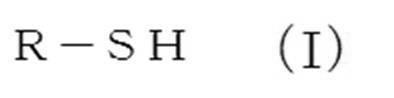
で表されるチオール化合物とL-セリンとを反応させて式(II):
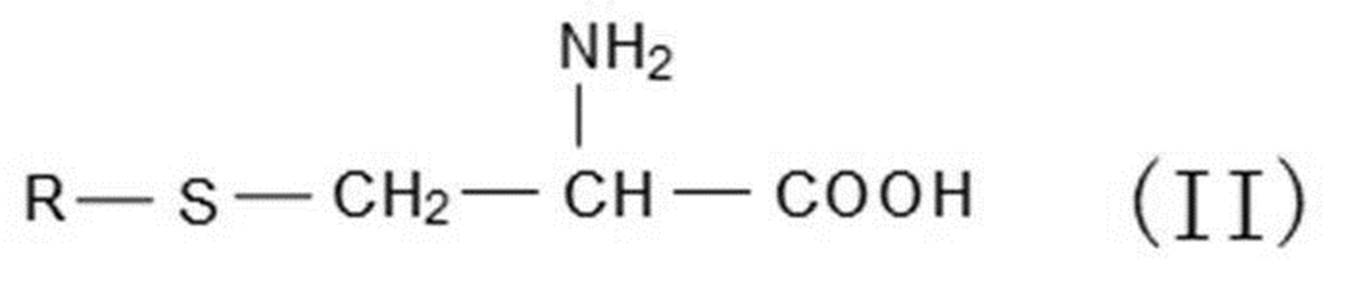
で表されるシステイン誘導体を製造する工程(工程1)、及び
工程1で得られたシステイン誘導体と、オキシダーゼ及びその基質とを反応させて式(III):

で表されるシステインスルホキシド誘導体を製造する工程(工程2)を含む、該システインスルホキシド誘導体の製造方法。 - 前記オキシダーゼがグルコースオキシダーゼ、ガラクトースオキシダーゼ、ウリカーゼ、コレステロールオキシダーゼ、コリンオキシダーゼ及びアシルCoAオキシダーゼからなる群より選択される少なくとも1種である、請求項11記載の方法。
- 各式中、Rが1-プロペニル基、プロピル基、メチル基またはアリル基である、請求項11又は12記載の方法。
- 前記シスタチオニンβ-シンターゼがシスタチオニンβ-シンターゼ生産性微生物由来である、請求項11~13のいずれか1項に記載の方法。
- 前記微生物が、シスタチオニンβ-シンターゼ活性が増強されている変異株である、請求項14記載の方法。
- 前記シスタチオニンβ-シンターゼがCYS4遺伝子によってコードされる酵素である、請求項15記載の方法。
- 前記微生物が、シスタチオニンγ-リアーゼ活性が低減されている変異株である、請求項14~16のいずれか1項に記載の方法。
- 前記シスタチオニンγ-リアーゼがCYS3遺伝子によってコードされる酵素である、請求項17に記載の方法。
- 前記微生物が酵母である、請求項14~18のいずれか1項に記載の方法。
- 前記酵母がSaccharomyces属酵母である、請求項19記載の方法。
- 前記Saccharomyces属酵母がSaccharomyces cerevisiaeである、請求項20記載の方法。
- シスタチオニンβ-シンターゼ活性を有する酵母を培養し、該酵母の抽出物および/または培養物の存在下、式(I):

で表されるチオール化合物とL-セリンとを反応させることを特徴とする、式(II):

で表されるシステイン誘導体の製造方法。 - 各式中、Rが1-プロペニル基、プロピル基、メチル基またはアリル基である、請求項22記載の方法。
- シスタチオニンβ-シンターゼ活性を有する酵母を培養し、該酵母の抽出物および/または培養物の存在下、式(I):

で表されるチオール化合物とL-セリンとを反応させて式(II):

で表されるシステイン誘導体を製造する工程(工程1)、及び
工程1で得られたシステイン誘導体と、オキシダーゼ及びその基質とを反応させて式(III):

で表されるシステインスルホキシド誘導体を製造する工程(工程2)を含む、該システインスルホキシド誘導体の製造方法。 - 前記オキシダーゼがグルコースオキシダーゼ、ガラクトースオキシダーゼ、ウリカーゼ、コレステロールオキシダーゼ、コリンオキシダーゼ及びアシルCoAオキシダーゼからなる群より選択される少なくとも1種である、請求項24記載の方法。
- 各式中、Rが1-プロペニル基、プロピル基、メチル基またはアリル基である、請求項24又は25記載の方法。
- 前記酵母が、CYS4遺伝子高発現変異株;CYS3遺伝子低発現変異株;及びCYS4遺伝子高発現且つCYS3遺伝子低発現の変異株からなる群より選択される少なくとも1種である、請求項22~26のいずれか1項に記載の方法。
- 前記酵母がSaccharomyces属酵母である、請求項22~27のいずれか1項に記載の方法。
- 前記Saccharomyces属酵母がSaccharomyces cerevisiaeである、請求項28記載の方法。
- 該酵母の抽出物および/または培養物のシスタチオニンβ-シンターゼ活性が、抽出物および/または培養物1gあたり2500U以上である、請求項22~29のいずれか1項に記載の方法。
- 該酵母の抽出物および/または培養物のシスタチオニンβ-シンターゼ活性が、抽出物および/または培養物1gあたり1×106U以下である、請求項22~30のいずれか1項に記載の方法。
- 該酵母の抽出物および/または培養物のシスタチオニンγ-リアーゼ活性が、抽出物および/または培養物1gあたり100U以下である、請求項22~31のいずれか1項に記載の方法。
Priority Applications (1)
| Application Number | Priority Date | Filing Date | Title |
|---|---|---|---|
| JP2017531062A JP6798494B2 (ja) | 2015-07-27 | 2016-06-07 | システイン誘導体及びシステインスルホキシド誘導体の製造方法 |
Applications Claiming Priority (2)
| Application Number | Priority Date | Filing Date | Title |
|---|---|---|---|
| JP2015147936 | 2015-07-27 | ||
| JP2015-147936 | 2015-07-27 |
Publications (1)
| Publication Number | Publication Date |
|---|---|
| WO2017018060A1 true WO2017018060A1 (ja) | 2017-02-02 |
Family
ID=57885681
Family Applications (1)
| Application Number | Title | Priority Date | Filing Date |
|---|---|---|---|
| PCT/JP2016/066974 Ceased WO2017018060A1 (ja) | 2015-07-27 | 2016-06-07 | システイン誘導体及びシステインスルホキシド誘導体の製造方法 |
Country Status (2)
| Country | Link |
|---|---|
| JP (1) | JP6798494B2 (ja) |
| WO (1) | WO2017018060A1 (ja) |
Cited By (3)
| Publication number | Priority date | Publication date | Assignee | Title |
|---|---|---|---|---|
| CN110004134A (zh) * | 2019-05-21 | 2019-07-12 | 福州大学 | 一种褐藻胶裂解酶突变体及其应用 |
| CN114916561A (zh) * | 2022-05-27 | 2022-08-19 | 山东大学 | 一种防治作物病原菌的生物农药 |
| CN115725556A (zh) * | 2022-09-20 | 2023-03-03 | 青岛硕景生物科技有限公司 | 一种稳定性提高的突变胱硫醚β裂解酶及其制备方法和应用 |
Citations (3)
| Publication number | Priority date | Publication date | Assignee | Title |
|---|---|---|---|---|
| JPS56115756A (en) * | 1979-12-13 | 1981-09-11 | Lilly Co Eli | Cyclic peptide nucleus derivative |
| JP2001112474A (ja) * | 1999-10-14 | 2001-04-24 | Kansai Tlo Kk | 変異型サッカロミセス・セレビシエ |
| JP2013505252A (ja) * | 2009-09-16 | 2013-02-14 | サイリーン ファーマシューティカルズ インコーポレーティッド | 三環式タンパク質キナーゼ調節剤 |
-
2016
- 2016-06-07 WO PCT/JP2016/066974 patent/WO2017018060A1/ja not_active Ceased
- 2016-06-07 JP JP2017531062A patent/JP6798494B2/ja active Active
Patent Citations (3)
| Publication number | Priority date | Publication date | Assignee | Title |
|---|---|---|---|---|
| JPS56115756A (en) * | 1979-12-13 | 1981-09-11 | Lilly Co Eli | Cyclic peptide nucleus derivative |
| JP2001112474A (ja) * | 1999-10-14 | 2001-04-24 | Kansai Tlo Kk | 変異型サッカロミセス・セレビシエ |
| JP2013505252A (ja) * | 2009-09-16 | 2013-02-14 | サイリーン ファーマシューティカルズ インコーポレーティッド | 三環式タンパク質キナーゼ調節剤 |
Non-Patent Citations (2)
| Title |
|---|
| BRAUNSTEIN, ALEXANDER E. ET AL.: "The beta- replacement-specific pyridoxal-P-dependent lyases", ADV. ENZYMOL. RELAT. AREAS MOL. BIOL., vol. 56, 1984, pages 1 - 89 * |
| NAPOLI, ALESSANDRO ET AL.: "Glucose-oxidase based self-destructing polymeric vesicles", LANGMUIR, vol. 20, 2004, pages 3487 - 3491, XP055350210 * |
Cited By (5)
| Publication number | Priority date | Publication date | Assignee | Title |
|---|---|---|---|---|
| CN110004134A (zh) * | 2019-05-21 | 2019-07-12 | 福州大学 | 一种褐藻胶裂解酶突变体及其应用 |
| CN114916561A (zh) * | 2022-05-27 | 2022-08-19 | 山东大学 | 一种防治作物病原菌的生物农药 |
| CN114916561B (zh) * | 2022-05-27 | 2022-11-18 | 山东大学 | 一种防治作物病原菌的生物农药 |
| CN115725556A (zh) * | 2022-09-20 | 2023-03-03 | 青岛硕景生物科技有限公司 | 一种稳定性提高的突变胱硫醚β裂解酶及其制备方法和应用 |
| CN115725556B (zh) * | 2022-09-20 | 2024-05-03 | 青岛硕景生物科技有限公司 | 一种稳定性提高的突变胱硫醚β裂解酶及其制备方法和应用 |
Also Published As
| Publication number | Publication date |
|---|---|
| JPWO2017018060A1 (ja) | 2018-05-24 |
| JP6798494B2 (ja) | 2020-12-09 |
Similar Documents
| Publication | Publication Date | Title |
|---|---|---|
| CN102016024B (zh) | 突变体酵母及使用其的物质生产方法 | |
| JP2008530994A5 (ja) | ||
| CN101437949A (zh) | 利用辅酶再生进行的羟基羧酸类的生产方法 | |
| JP6799738B2 (ja) | グルタチオンの製造方法 | |
| US12084665B2 (en) | Recombinant acid-resistant yeast in which alcohol production is inhibited and method for producing lactic acid by using same | |
| Zhang et al. | Metabolic engineering of Rhizopus oryzae: effects of overexpressing fumR gene on cell growth and fumaric acid biosynthesis from glucose | |
| EP2674490B1 (en) | Phenylpyruvate reductase and method for manufacturing optically-active phenyllactic acid and 4-hydroxyl-phenyllactic acid using same enzyme | |
| JP2021520836A (ja) | エタノール生産経路が抑制された耐酸性酵母及びこれを用いた乳酸の製造方法 | |
| JP5320692B2 (ja) | 酵母及びl−乳酸の製造方法 | |
| JP6798494B2 (ja) | システイン誘導体及びシステインスルホキシド誘導体の製造方法 | |
| JP5243546B2 (ja) | 植物由来原料から乳酸を生産する方法及び乳酸生産細菌 | |
| CN110234768A (zh) | 用于产生乙醇酸和/或乙醛酸的方法和微生物 | |
| JPWO2010032698A6 (ja) | 植物由来原料から乳酸を生産する方法及び乳酸生産細菌 | |
| JP2020526205A (ja) | メチオニン生産酵母 | |
| WO2005085415A1 (ja) | 新規形質転換体およびそれを用いたポリエステルの製造方法 | |
| CN109477078B (zh) | 使用经遗传修饰的真菌细胞来进行经改善的从半乳糖醛酸的内消旋半乳糖二酸产生 | |
| JP2008283917A (ja) | 乳酸の製造方法 | |
| JP2005102625A (ja) | D−乳酸製造法 | |
| US9340809B2 (en) | Microbial conversion of sugar acids and means therein | |
| JP4729919B2 (ja) | 微生物の培養方法及び光学活性カルボン酸の製造方法 | |
| JP4816103B2 (ja) | グリセロールキナーゼ改変体 | |
| EP3612626B1 (en) | Selected acetyl-coa synthase enzymes for reduction of acetate production in yeast | |
| US9771604B2 (en) | Genetically engineered yeast cell with enhanced EDC activity and capability of producing lactate, method of producing the yeast cell, and method of producing lactate by using the yeast cell | |
| JP5954539B2 (ja) | 1−ベンジル−4−ヒドロキシ−3−ピペリジンカルボン酸アルキルエステルの製造方法 | |
| WO2015064517A1 (ja) | ギ酸脱水素酵素とその利用 |
Legal Events
| Date | Code | Title | Description |
|---|---|---|---|
| 121 | Ep: the epo has been informed by wipo that ep was designated in this application |
Ref document number: 16830165 Country of ref document: EP Kind code of ref document: A1 |
|
| ENP | Entry into the national phase |
Ref document number: 2017531062 Country of ref document: JP Kind code of ref document: A |
|
| NENP | Non-entry into the national phase |
Ref country code: DE |
|
| 122 | Ep: pct application non-entry in european phase |
Ref document number: 16830165 Country of ref document: EP Kind code of ref document: A1 |