WO2016194957A1 - 光硬化型粘着シート、粘着シート及び画像表示装置 - Google Patents
光硬化型粘着シート、粘着シート及び画像表示装置 Download PDFInfo
- Publication number
- WO2016194957A1 WO2016194957A1 PCT/JP2016/066215 JP2016066215W WO2016194957A1 WO 2016194957 A1 WO2016194957 A1 WO 2016194957A1 JP 2016066215 W JP2016066215 W JP 2016066215W WO 2016194957 A1 WO2016194957 A1 WO 2016194957A1
- Authority
- WO
- WIPO (PCT)
- Prior art keywords
- meth
- pressure
- acrylate
- sensitive adhesive
- adhesive sheet
- Prior art date
- Legal status (The legal status is an assumption and is not a legal conclusion. Google has not performed a legal analysis and makes no representation as to the accuracy of the status listed.)
- Ceased
Links
Images


Classifications
-
- C—CHEMISTRY; METALLURGY
- C09—DYES; PAINTS; POLISHES; NATURAL RESINS; ADHESIVES; COMPOSITIONS NOT OTHERWISE PROVIDED FOR; APPLICATIONS OF MATERIALS NOT OTHERWISE PROVIDED FOR
- C09J—ADHESIVES; NON-MECHANICAL ASPECTS OF ADHESIVE PROCESSES IN GENERAL; ADHESIVE PROCESSES NOT PROVIDED FOR ELSEWHERE; USE OF MATERIALS AS ADHESIVES
- C09J7/00—Adhesives in the form of films or foils
- C09J7/10—Adhesives in the form of films or foils without carriers
-
- C—CHEMISTRY; METALLURGY
- C09—DYES; PAINTS; POLISHES; NATURAL RESINS; ADHESIVES; COMPOSITIONS NOT OTHERWISE PROVIDED FOR; APPLICATIONS OF MATERIALS NOT OTHERWISE PROVIDED FOR
- C09J—ADHESIVES; NON-MECHANICAL ASPECTS OF ADHESIVE PROCESSES IN GENERAL; ADHESIVE PROCESSES NOT PROVIDED FOR ELSEWHERE; USE OF MATERIALS AS ADHESIVES
- C09J133/00—Adhesives based on homopolymers or copolymers of compounds having one or more unsaturated aliphatic radicals, each having only one carbon-to-carbon double bond, and at least one being terminated by only one carboxyl radical, or of salts, anhydrides, esters, amides, imides, or nitriles thereof; Adhesives based on derivatives of such polymers
- C09J133/04—Homopolymers or copolymers of esters
-
- C—CHEMISTRY; METALLURGY
- C09—DYES; PAINTS; POLISHES; NATURAL RESINS; ADHESIVES; COMPOSITIONS NOT OTHERWISE PROVIDED FOR; APPLICATIONS OF MATERIALS NOT OTHERWISE PROVIDED FOR
- C09J—ADHESIVES; NON-MECHANICAL ASPECTS OF ADHESIVE PROCESSES IN GENERAL; ADHESIVE PROCESSES NOT PROVIDED FOR ELSEWHERE; USE OF MATERIALS AS ADHESIVES
- C09J11/00—Features of adhesives not provided for in group C09J9/00, e.g. additives
- C09J11/02—Non-macromolecular additives
- C09J11/06—Non-macromolecular additives organic
-
- C—CHEMISTRY; METALLURGY
- C09—DYES; PAINTS; POLISHES; NATURAL RESINS; ADHESIVES; COMPOSITIONS NOT OTHERWISE PROVIDED FOR; APPLICATIONS OF MATERIALS NOT OTHERWISE PROVIDED FOR
- C09J—ADHESIVES; NON-MECHANICAL ASPECTS OF ADHESIVE PROCESSES IN GENERAL; ADHESIVE PROCESSES NOT PROVIDED FOR ELSEWHERE; USE OF MATERIALS AS ADHESIVES
- C09J151/00—Adhesives based on graft polymers in which the grafted component is obtained by reactions only involving carbon-to-carbon unsaturated bonds; Adhesives based on derivatives of such polymers
- C09J151/06—Adhesives based on graft polymers in which the grafted component is obtained by reactions only involving carbon-to-carbon unsaturated bonds; Adhesives based on derivatives of such polymers grafted on to homopolymers or copolymers of aliphatic hydrocarbons containing only one carbon-to-carbon double bond
-
- C—CHEMISTRY; METALLURGY
- C09—DYES; PAINTS; POLISHES; NATURAL RESINS; ADHESIVES; COMPOSITIONS NOT OTHERWISE PROVIDED FOR; APPLICATIONS OF MATERIALS NOT OTHERWISE PROVIDED FOR
- C09J—ADHESIVES; NON-MECHANICAL ASPECTS OF ADHESIVE PROCESSES IN GENERAL; ADHESIVE PROCESSES NOT PROVIDED FOR ELSEWHERE; USE OF MATERIALS AS ADHESIVES
- C09J4/00—Adhesives based on organic non-macromolecular compounds having at least one polymerisable carbon-to-carbon unsaturated bond ; adhesives, based on monomers of macromolecular compounds of groups C09J183/00 - C09J183/16
- C09J4/06—Organic non-macromolecular compounds having at least one polymerisable carbon-to-carbon unsaturated bond in combination with a macromolecular compound other than an unsaturated polymer of groups C09J159/00 - C09J187/00
-
- C—CHEMISTRY; METALLURGY
- C09—DYES; PAINTS; POLISHES; NATURAL RESINS; ADHESIVES; COMPOSITIONS NOT OTHERWISE PROVIDED FOR; APPLICATIONS OF MATERIALS NOT OTHERWISE PROVIDED FOR
- C09J—ADHESIVES; NON-MECHANICAL ASPECTS OF ADHESIVE PROCESSES IN GENERAL; ADHESIVE PROCESSES NOT PROVIDED FOR ELSEWHERE; USE OF MATERIALS AS ADHESIVES
- C09J7/00—Adhesives in the form of films or foils
- C09J7/20—Adhesives in the form of films or foils characterised by their carriers
-
- C—CHEMISTRY; METALLURGY
- C09—DYES; PAINTS; POLISHES; NATURAL RESINS; ADHESIVES; COMPOSITIONS NOT OTHERWISE PROVIDED FOR; APPLICATIONS OF MATERIALS NOT OTHERWISE PROVIDED FOR
- C09J—ADHESIVES; NON-MECHANICAL ASPECTS OF ADHESIVE PROCESSES IN GENERAL; ADHESIVE PROCESSES NOT PROVIDED FOR ELSEWHERE; USE OF MATERIALS AS ADHESIVES
- C09J7/00—Adhesives in the form of films or foils
- C09J7/30—Adhesives in the form of films or foils characterised by the adhesive composition
-
- C—CHEMISTRY; METALLURGY
- C09—DYES; PAINTS; POLISHES; NATURAL RESINS; ADHESIVES; COMPOSITIONS NOT OTHERWISE PROVIDED FOR; APPLICATIONS OF MATERIALS NOT OTHERWISE PROVIDED FOR
- C09J—ADHESIVES; NON-MECHANICAL ASPECTS OF ADHESIVE PROCESSES IN GENERAL; ADHESIVE PROCESSES NOT PROVIDED FOR ELSEWHERE; USE OF MATERIALS AS ADHESIVES
- C09J2203/00—Applications of adhesives in processes or use of adhesives in the form of films or foils
- C09J2203/318—Applications of adhesives in processes or use of adhesives in the form of films or foils for the production of liquid crystal displays
-
- C—CHEMISTRY; METALLURGY
- C09—DYES; PAINTS; POLISHES; NATURAL RESINS; ADHESIVES; COMPOSITIONS NOT OTHERWISE PROVIDED FOR; APPLICATIONS OF MATERIALS NOT OTHERWISE PROVIDED FOR
- C09J—ADHESIVES; NON-MECHANICAL ASPECTS OF ADHESIVE PROCESSES IN GENERAL; ADHESIVE PROCESSES NOT PROVIDED FOR ELSEWHERE; USE OF MATERIALS AS ADHESIVES
- C09J2301/00—Additional features of adhesives in the form of films or foils
- C09J2301/30—Additional features of adhesives in the form of films or foils characterized by the chemical, physicochemical or physical properties of the adhesive or the carrier
- C09J2301/312—Additional features of adhesives in the form of films or foils characterized by the chemical, physicochemical or physical properties of the adhesive or the carrier parameters being the characterizing feature
-
- C—CHEMISTRY; METALLURGY
- C09—DYES; PAINTS; POLISHES; NATURAL RESINS; ADHESIVES; COMPOSITIONS NOT OTHERWISE PROVIDED FOR; APPLICATIONS OF MATERIALS NOT OTHERWISE PROVIDED FOR
- C09J—ADHESIVES; NON-MECHANICAL ASPECTS OF ADHESIVE PROCESSES IN GENERAL; ADHESIVE PROCESSES NOT PROVIDED FOR ELSEWHERE; USE OF MATERIALS AS ADHESIVES
- C09J2433/00—Presence of (meth)acrylic polymer
Definitions
- the present invention relates to a photocurable pressure-sensitive adhesive sheet before photocuring and a pressure-sensitive adhesive sheet obtained by photocuring the same.
- the present invention relates to an image display device such as a personal computer, a mobile terminal (PDA), a game machine, a television (TV), a car navigation system, a touch panel, a pen tablet, and the like, and an adhesive sheet that can be suitably used as a constituent member thereof.
- an image display panel such as a liquid crystal display (LCD), a plasma display (PDP) or an electroluminescence display (ELD), and a protection disposed on the front side (viewing side) thereof.
- LCD liquid crystal display
- PDP plasma display
- ELD electroluminescence display
- a space between the panel and the touch panel member is filled with an adhesive sheet, a liquid adhesive, or the like to suppress reflection of incident light or outgoing light from a display image at the air layer interface.
- Patent Document 1 As a method of filling the gap between the constituent members for an image display device with an adhesive, a method of filling the gap with a liquid adhesive resin composition containing an ultraviolet curable resin and then curing it by irradiating with ultraviolet rays. Is known (Patent Document 1).
- Patent Document 2 discloses an image of a pressure-sensitive adhesive sheet that has been primarily cross-linked with ultraviolet rays as a method for producing a laminate for constituting an image display device having a structure in which image display device constituent members are laminated on at least one side of the pressure-sensitive adhesive sheet.
- a method is disclosed in which, after bonding to a display device constituent member, the pressure-sensitive adhesive sheet is irradiated with ultraviolet rays through the image display device constituent member and subjected to secondary curing.
- Patent Document 3 discloses a sheet using a hot melt type adhesive composition having a loss tangent at 25 ° C. of less than 1 based on urethane (meth) acrylate having a weight average molecular weight of 20,000 to 100,000. Is disclosed.
- Patent Document 4 discloses a touch panel comprising a (meth) acrylic polymer obtained by copolymerizing a monomer containing a (meth) acrylic monomer having a crosslinkable functional group and a specific macromer, and a crosslinking agent.
- a pressure-sensitive adhesive layer suitable for pasting is disclosed.
- a black concealment portion is generally printed in a frame shape on the peripheral edge portion of the surface protection panel. Therefore, the pressure-sensitive adhesive sheet for bonding the constituent members having such a printing unit is required to have a printing level followability that can be filled to every corner following the printing level difference.
- image display devices such as touch panels have come to be used in a wide range, and accordingly, pressure-sensitive adhesive sheets used for image display device configuration laminates are exposed to light such as illumination and sunlight for a long time.
- adhesion reliability that does not degrade the performance.
- the first object of the present invention is to follow the stepped portion of the bonding surface in a state before photocuring and to fill every corner, and in the state after photocuring, even if light irradiation is applied for a long time, it is reliable in adhesion.
- the present invention is to provide a new pressure-sensitive adhesive sheet that does not deteriorate in properties and that can be easily bonded.
- the second object of the present invention is to provide a stepped portion or the like even when a component member for an image display device having a light impermeable portion such as a printing portion and a light transmissive portion in the bonding surface is bonded.
- a component member for an image display device having a light impermeable portion such as a printing portion and a light transmissive portion in the bonding surface is bonded.
- followability and surface flatness can be obtained, distortion and deformation do not occur even in light-impermeable portions, adherends can be firmly bonded with high cohesion, and high temperature and high humidity
- An object of the present invention is to provide a new pressure-sensitive adhesive sheet that can prevent the exposed pressure-sensitive adhesive surface from sticking even under harsh environments such as underneath.
- the third object of the present invention is a pressure-crosslinkable pressure-sensitive adhesive sheet, which has pressure-sensitive adhesive properties even before photocrosslinking, and the pressure-sensitive adhesive material flows too much at the time of bonding, and the pressure-sensitive adhesive resin composition protrudes.
- An object of the present invention is to provide a pressure-sensitive adhesive sheet that does not crush and can obtain sufficient hardness after photocrosslinking.
- the present invention is formed from a resin composition containing the (meth) acrylic copolymer (A), a crosslinking agent (B), and a photopolymerization initiator (C).
- a pressure-sensitive adhesive sheet before photocuring which has photocurability and has the following characteristics (1) and (2), is proposed.
- (1) The shape can be maintained at 0 to 40 ° C. and exhibits self-adhesiveness.
- the viscosity is 100 to 3000 Pa ⁇ s at 70 to 100 ° C.
- the pressure-sensitive adhesive sheet proposed by the present invention to achieve the first object can maintain the sheet shape at room temperature of 0 to 40 ° C., that is, in a normal state, and can exhibit self-adhesion. In addition to being easy to handle, for example, positioning at the time of sticking is easy to perform, so that the bonding work can be performed efficiently. Further, when the temperature is 70 to 100 ° C., the viscosity becomes 100 to 3000 Pa ⁇ s and exhibits hot melt properties, and therefore, for example, the pressure-sensitive adhesive can be filled following uneven portions such as printing steps.
- the photocurable pressure-sensitive adhesive sheet proposed by the present invention is suitably used as a constituent member of an image display device such as a personal computer, a mobile terminal (PDA), a game machine, a television (TV), a car navigation system, a touch panel, and a pen tablet. can do.
- an image display device such as a personal computer, a mobile terminal (PDA), a game machine, a television (TV), a car navigation system, a touch panel, and a pen tablet. can do.
- the present invention is a pressure-sensitive adhesive sheet containing a (meth) acrylic copolymer (A) and having a gel fraction of less than 1%,
- the pressure-sensitive adhesive sheet is characterized by having a sheet portion having a gel fraction of 40% or more.
- the pressure-sensitive adhesive sheet proposed in order to achieve the second object of the present invention is capable of obtaining followability to a stepped portion or the like and surface flatness by a sheet portion having a gel fraction of less than 1%. While the sheet portion having a gel fraction of 40% or more can relieve the distortion and deformation of the adhesive, it can not only make the adhesive surface sticky, but also adheres adherends firmly with high cohesive strength. You can also. Therefore, for example, even when a structural member for an image display device having a light opaque portion and a light transmissive portion such as a printing portion in the bonding surface is bonded, the entire pressure-sensitive adhesive sheet follows the printing step portion.
- the present invention provides 100 parts by weight of a (meth) acrylic copolymer (A), 0.5 to 20 parts by weight of a crosslinking agent (B), a photopolymerization initiator (C)
- a pressure-sensitive adhesive sheet comprising a resin composition containing 0.1 to 5 parts by mass, wherein a ratio (X1 / X2) between a tensile elastic modulus (X1) before photocrosslinking and a tensile elastic modulus (X2) after photocrosslinking ) Is 3 or more, and a pressure-sensitive adhesive sheet is proposed.
- the pressure-sensitive adhesive sheet proposed by the present invention to achieve the third object has a feature that the difference in tensile elastic modulus (X1) before and after photocrosslinking is remarkably large. It has adhesiveness, and the adhesive material does not flow excessively at the time of bonding, so that the adhesive resin composition does not protrude or be crushed, and sufficient hardness can be obtained after photocrosslinking.
- X1 tensile elastic modulus
- An adhesive sheet according to an example of an embodiment of the present invention includes a (meth) acrylic copolymer (1-A), a crosslinking agent (1-B), and photopolymerization initiation.
- a pressure-sensitive adhesive sheet formed from a resin composition containing the agent (1-C) (referred to as “the present pressure-sensitive adhesive composition 1”), having photo-curability, and A pressure-sensitive adhesive sheet having the characteristics (1) and (2).
- the shape can be maintained at 0 to 40 ° C. and exhibits self-adhesiveness.
- the viscosity is 100 to 3000 Pa ⁇ s at 70 to 100 ° C.
- the "pressure-sensitive adhesive sheet before photocuring" is sufficient if it is a pressure-sensitive adhesive sheet, and does not mean only a pressure-sensitive adhesive sheet that has not undergone any photocuring process. That is, for example, any pressure-sensitive adhesive sheet that has undergone a photo-curing process, that can be further photo-cured, and that exhibits the effects of the present invention is included in the present invention.
- this pressure-sensitive adhesive sheet 1 Since this pressure-sensitive adhesive sheet 1 has the above-mentioned properties (1) and (2) before being photocured, it can maintain a sheet shape in a room temperature state of 0 to 40 ° C., in other words, in a normal state. Moreover, it has the property of exhibiting self-adhesiveness, that is, the adhesive strength as it is. Furthermore, it exhibits a hot melt property that melts or flows when heated, exhibits an excellent cohesive force after photocuring, and can exhibit foam resistance after, for example, light irradiation for a long time.
- the pressure-sensitive adhesive sheet 1 has the characteristics that (1) the sheet shape can be maintained at a room temperature of 0 to 40 ° C. in a state before photocuring and exhibits self-adhesion. Thus, if it can hold
- the present pressure-sensitive adhesive sheet 1 may be produced from the pressure-sensitive adhesive composition (1-I) or (1-II) described later. However, the present invention is not limited to this.
- the pressure-sensitive adhesive sheet 1 can have the following feature (6). That is, (6) 180 ° to the glass when the pressure-sensitive adhesive sheet 1 is peeled off from the soda-lime glass at 23 ° C. and 40% RH at a peeling angle of 180 ° and a peeling speed of 60 mm / min. °
- the peeling force can be 3 N / cm or more.
- a 180 ° peeling force at 23 ° C. of 3 N / cm or more is preferable because it has appropriate adhesion to an adherend at room temperature and is excellent in bonding workability. From such a viewpoint, the 180 ° peeling force at 23 ° C.
- the present adhesive sheet 1 is produced from the adhesive composition (1-I) or (1-II) described later. Furthermore, what is necessary is just to adjust the kind and composition ratio of a crosslinking agent and a photoinitiator, and to adjust the heating and pressurization conditions at the time of bonding, and the light irradiation conditions after bonding. However, it is not limited to such a method.
- the pressure-sensitive adhesive sheet 1 is characterized in that (2) when heated to 70 to 100 ° C. before photocuring, the viscosity becomes 100 to 3000 Pa ⁇ s and exhibits fluidity. If the pressure-sensitive adhesive sheet 1 has such a hot melt property, it can be filled with the pressure-sensitive adhesive by following heating and softening or fluidizing to follow uneven portions such as a printing step, and so on. It can be filled without producing. In order to obtain such characteristics, for example, the present pressure-sensitive adhesive sheet 1 may be produced from the pressure-sensitive adhesive composition (1-I) or (1-II) described later. However, the present invention is not limited to this.
- the pressure-sensitive adhesive sheet 1 has a viscosity of 100 to 3000 Pa ⁇ s when heated to 70 to 100 ° C., preferably 150 Pa ⁇ s or more or 2700 Pa ⁇ s or less, and more preferably 200 Pa ⁇ s or more or 2500 Pa ⁇ s or less. .
- the pressure-sensitive adhesive sheet 1 can have the following feature (7). That is, (7) when the pressure-sensitive adhesive sheet 1 is peeled off from the soda lime glass at 80 ° C. and 10% RH at a peeling angle of 180 ° and a peeling speed of 60 mm / min. It is a cohesive failure, and the 180 ° peeling force for glass can be 1 N / cm or less. A 180 ° peeling force at 80 ° C. of 1 N / cm or less is preferable because high wettability to the adherend can be obtained. From this viewpoint, the 180 ° peeling force at 80 ° C.
- the present adhesive sheet 1 is produced from the adhesive composition (1-I) or (1-II) described later. Furthermore, what is necessary is just to adjust the kind and composition ratio of a crosslinking agent and a photoinitiator, and to adjust the heating and pressurization conditions at the time of bonding, and the light irradiation conditions after bonding. However, it is not limited to such a method.
- This pressure-sensitive adhesive sheet 1 can be photocured, and (3) after photocuring, has a characteristic that the viscosity at 70 to 100 ° C. is 3000 to 50000 Pa ⁇ s.
- the pressure-sensitive adhesive sheet 1 preferably has a viscosity at 70 to 100 ° C. of 3000 to 50000 Pa ⁇ s after photocuring from the viewpoint of obtaining a high cohesive force, particularly 3500 Pa ⁇ s or more or 48000 Pa ⁇ s or less, and more preferably 4000 Pa. More preferably, it is s or more or 45000 Pa ⁇ s or less.
- the pressure-sensitive adhesive sheet 1 can have the following feature (4) after photocuring. That is, (4) a pressure-sensitive adhesive sheet that has been pressure-bonded to soda-lime glass and cured by light irradiation at 23 ° C. and 40% RH at a peeling angle of 180 ° and a peeling speed of 60 mm / min.
- the 180 ° peeling force to the glass when the adhesive sheet is peeled off from the glass can be 3 N / cm or more. If the 180 ° peeling force at 23 ° C. after photocuring is 3 N / cm or more, it is preferable because adherends can be firmly bonded to each other.
- the 180 ° peeling force at 23 ° C. after photocuring of the pressure-sensitive adhesive sheet 1 is preferably 3 N / cm or more, more preferably 4 N / cm or more, particularly 5 N / cm or more, or 30 N / cm. It is particularly preferred that
- the pressure-sensitive adhesive sheet 1 can have the following feature (5) after photocuring. That is, (5) a pressure-sensitive adhesive sheet that has been pressure-bonded to soda-lime glass and cured by irradiation with light at 80 ° C. and 10% RH at a peeling angle of 180 ° and a peeling speed of 60 mm / min.
- the 180 ° peeling force with respect to the glass can be 3 N / cm or more. If the 180 ° peel strength at 80 ° C. after photocuring is 3 N / cm or more, it is preferable because the foam resistance in a high temperature environment is excellent.
- the 180 ° peeling force at 80 ° C. after photocuring of the pressure-sensitive adhesive sheet 1 is preferably 3 N / cm or more, especially 4 N / cm or more, and especially 5 N / cm or more or 20 N / cm. It is particularly preferred that
- this pressure-sensitive adhesive sheet 1 In order to adjust the 180 ° peel strength at 23 ° C. or 80 ° C. after photocuring in the present pressure-sensitive adhesive sheet 1, for example, from the pressure-sensitive adhesive composition (1-I) or (1-II) described later, this pressure-sensitive adhesive sheet 1 And the kind and composition ratio of the crosslinking agent and the photopolymerization initiator may be adjusted, or the heating / pressurizing conditions during bonding and the light irradiation conditions after bonding may be adjusted. However, it is not limited to such a method.
- This pressure-sensitive adhesive sheet 1 after photocuring has an outgas generation amount of 40,000 ppm or more in terms of hexadecane after being irradiated for 24 hours with a xenon arc lamp type light resistance tester specified in JIS K7350-2 (ISO 4892-2). Is preferred. If the outgas generation amount is 40000 ppm or more in terms of hexadecane, the tackiness of the pressure-sensitive adhesive sheet and the wettability to the adherend are improved, which is preferable.
- the outgas generation amount in the pressure-sensitive adhesive sheet 1 is preferably 40000 ppm or more in terms of hexadecane, more preferably 45000 ppm or more, and particularly preferably 50000 ppm or more.
- the pressure-sensitive adhesive sheet 1 may be produced from, for example, a pressure-sensitive adhesive composition (1-I) or (1-II) described later.
- the present invention is not limited to this.
- this pressure-sensitive adhesive sheet 1 after photocuring exhibits foam resistance such that the diameter of the bubbles is 5 mm or less in the following foam resistance test.
- Foam resistance test A laminate was prepared by sandwiching an adhesive sheet between two glass plates having a diagonal length of 5 inches or more and a thickness of 1 mm or less, in accordance with JIS K7350-2 (ISO 4822-2). When the light is irradiated for 24 hours with a xenon arc lamp light resistance tester, the diameter of bubbles generated in the pressure-sensitive adhesive sheet is measured.
- the pressure-sensitive adhesive sheet 1 Since the pressure-sensitive adhesive sheet 1 has a feature that the viscosity at 70 to 100 ° C. after photocuring is 3000 to 50000 Pa ⁇ s, it can exhibit such foam resistance after photocuring. Therefore, it exhibits the property that the reliability does not decrease even if it is irradiated for a long time. Obtainable.
- the present pressure-sensitive adhesive sheet 1 may be produced from the pressure-sensitive adhesive composition (1-I) or (1-II) described later. However, the present invention is not limited to this.
- This pressure-sensitive adhesive composition 1 As a preferred example of the present pressure-sensitive adhesive composition 1 used for the production of the present pressure-sensitive adhesive sheet 1, an acrylic copolymer (1-A1) comprising a graft copolymer having a macromonomer as a branch component, and a crosslinking agent (1 An adhesive composition (1-I) containing -B1) and a photopolymerization initiator (1-C1) can be mentioned.
- this pressure-sensitive adhesive sheet 1 is produced from the pressure-sensitive adhesive composition (1-I) or (1-II) prepared by a known method, it can exhibit self-adhesion while maintaining the sheet shape at room temperature, It has a hot melt property that melts or flows when heated in an uncrosslinked state, can be photocured, and exhibits excellent cohesive strength after photocuring.
- the acrylic copolymer (1-A1) as the base polymer may be a graft copolymer having a macromonomer as a branch component.
- the trunk component of the acrylic copolymer (1-A1) is preferably composed of a copolymer component containing a repeating unit derived from (meth) acrylic acid ester.
- the glass transition temperature of the copolymer constituting the trunk component of the acrylic copolymer (1-A1) is preferably ⁇ 70 to 0 ° C.
- the glass transition temperature of the copolymer component constituting the trunk component is the glass transition temperature of the polymer obtained by copolymerizing only the monomer component constituting the trunk component of the acrylic copolymer (1-A1).
- Point. Specifically, it means a value calculated by the Fox formula from the glass transition temperature and the composition ratio of the polymer obtained from the homopolymer of each component of the copolymer.
- the calculation formula of Fox is a calculation value calculated
- the glass transition temperature of the copolymer component constituting the backbone component of the acrylic copolymer (1-A1) is determined depending on the flexibility of the pressure-sensitive adhesive composition (1-I) at room temperature, Since the wettability of the pressure-sensitive adhesive composition (1-I), that is, the adhesiveness is affected, in order for the pressure-sensitive adhesive composition (1-I) to obtain appropriate adhesiveness (tackiness) at room temperature, the glass
- the transition temperature is preferably ⁇ 80 ° C. to 0 ° C., more preferably ⁇ 75 ° C. or higher or ⁇ 5 ° C. or lower, and particularly preferably ⁇ 70 ° C. or higher or ⁇ 10 ° C. or lower.
- the viscoelasticity can be adjusted by adjusting the molecular weight. For example, it can be made more flexible by reducing the molecular weight of the copolymer component.
- Examples of the (meth) acrylic acid ester monomer contained in the main component of the acrylic copolymer (1-A1) include methyl (meth) acrylate, ethyl (meth) acrylate, propyl (meth) acrylate, and isopropyl (meth).
- n-butyl (meth) acrylate isobutyl (meth) acrylate, sec-butyl (meth) acrylate, t-butyl (meth) acrylate, pentyl (meth) acrylate, isopentyl (meth) acrylate, neopentyl (meth) acrylate, Hexyl (meth) acrylate, cyclohexyl (meth) acrylate, heptyl (meth) acrylate, 2-ethylhexyl acrylate, n-octyl acrylate, isooctyl acrylate, nonyl (meth) acrylate, isononyl ( Acrylate), t-butylcyclohexyl (meth) acrylate, decyl (meth) acrylate, isodecyl (meth) acrylate, undecyl (meth) acrylate, lau
- hydroxyl-containing (meth) acrylates such as hydroxyethyl (meth) acrylate, hydroxypropyl (meth) acrylate, hydroxybutyl (meth) acrylate, and glycerol (meth) acrylate having a hydrophilic group or an organic functional group
- ) Acrylic acid 2- (meth) acryloyloxyethyl hexahydrophthalic acid, 2- (meth) acryloyloxypropyl hexahydrophthalic acid, 2- (meth) acryloyloxyethyl phthalic acid, 2- (meth) acryloyloxypropyl phthalate Acid, 2- (meth) acryloyloxyethylmaleic acid, 2- (meth) acryloyloxypropylmaleic acid, 2- (meth) acryloyloxyethylsuccinic acid, 2- (meth) acryloyloxypropylsuccinic acid, 2- (me
- Monomers containing amide groups, vinylpyrrolidone, vinylpyridine, heterocyclic basic monomers such as vinyl carbazole, etc. can also be used.
- styrene, t-butylstyrene, ⁇ -methylstyrene, vinyltoluene, acrylonitrile, methacrylonitrile, vinyl acetate, vinyl propionate, alkyl vinyl ether, hydroxyalkyl vinyl ether, alkyl which can be copolymerized with the above acrylic monomers and methacrylic monomers.
- Various vinyl monomers such as vinyl monomers can also be used as appropriate.
- the trunk component of the acrylic copolymer (1-A1) preferably contains a hydrophobic (meth) acrylate monomer and a hydrophilic (meth) acrylate monomer as constituent units.
- the trunk component of the acrylic copolymer (1-A1) is composed only of a hydrophobic monomer, there is a tendency to wet-heat whitening. Is preferred.
- the hydrophobic (meth) acrylate monomer is preferably an alkyl ester having no polar group (excluding methyl acrylate), such as n-butyl (meth) acrylate, isobutyl (meth) acrylate, sec-butyl (meth) acrylate, t-butyl (meth) acrylate, pentyl (meth) acrylate, isopentyl (meth) acrylate, neopentyl (meth) acrylate, hexyl (meth) acrylate, cyclohexyl (meth) acrylate, heptyl (meth) Acrylate, 2-ethylhexyl acrylate, n-octyl acrylate, isooctyl acrylate, nonyl (meth) acrylate, isononyl (meth) acrylate, t-butylcyclohexyl (meth) acrylate, de
- hydrophilic (meth) acrylate monomer methyl acrylate or an ester having a polar group is preferable.
- the acrylic copolymer (1-A1) preferably contains a macromonomer-derived repeating unit as a branch component of the graft copolymer.
- the macromonomer is a polymer monomer having a terminal polymerizable functional group and a high molecular weight skeleton component.
- the glass transition temperature (Tg) of the macromonomer is preferably higher than the glass transition temperature of the copolymer component constituting the acrylic copolymer (1-A1). Specifically, since the glass transition temperature (Tg) of the macromonomer affects the heating and melting temperature (hot melt temperature) of the pressure-sensitive adhesive composition (1-I), the glass transition temperature (Tg) of the macromonomer is 30.
- the temperature is preferably from 120 ° C. to 120 ° C., more preferably from 40 ° C. to 110 ° C., and particularly preferably from 50 ° C. to 100 ° C.
- the glass transition temperature of a macromonomer refers to the glass transition temperature of the macromonomer itself, and can be measured with a differential scanning calorimeter (DSC) (heating rate: 5 ° C./min, inflection of baseline shift) Tg is measured from the point).
- DSC differential scanning calorimeter
- the branch components are attracted to each other and can maintain a state where they are physically cross-linked as a pressure-sensitive adhesive composition, and the physical cross-linking is released by heating to an appropriate temperature.
- the macromonomer is preferably contained in the acrylic copolymer (1-A1) in a proportion of 5% by mass to 30% by mass, particularly 6% by mass or more and 25% by mass or less. It is preferably at least 20% by mass or less than 20% by mass.
- the number average molecular weight of the macromonomer is preferably 500 or more and less than 8000, more preferably 800 or more and less than 7500, and particularly preferably 1000 or more and less than 7000.
- a generally produced one for example, a macromonomer manufactured by Toa Gosei Co., Ltd.
- the high molecular weight skeleton component of the macromonomer is preferably composed of an acrylic polymer or a vinyl polymer.
- the high molecular weight skeleton component of the macromonomer include methyl (meth) acrylate, ethyl (meth) acrylate, propyl (meth) acrylate, isopropyl (meth) acrylate, n-butyl (meth) acrylate, isobutyl (meth) acrylate, sec-butyl (meth) acrylate, t-butyl (meth) acrylate, pentyl (meth) acrylate, isopentyl (meth) acrylate, neopentyl (meth) acrylate, hexyl (meth) acrylate, cyclohexyl (meth) acrylate, heptyl (meth) Acrylate, 2-ethylhexyl acrylate, n-octyl
- Examples of the terminal polymerizable functional group of the macromonomer include a methacryloyl group, an acryloyl group, and a vinyl group.
- Crosslinking agent (1-B1) for example, a crosslinking agent having two or more crosslinking groups such as an epoxy group, an isocyanate group, an oxetane group, a silanol group, and a (meth) acryloyl group can be appropriately selected.
- a crosslinking agent having two or more crosslinking groups such as an epoxy group, an isocyanate group, an oxetane group, a silanol group, and a (meth) acryloyl group
- the cross-linking agent (1-B1) is cross-linked in the adhesive material, so that the sheet has a high cohesive force in a high temperature environment instead of losing hot melt properties. It can be expressed and excellent foaming reliability can be obtained.
- Examples of such (meth) acrylate include 1,4-butanediol di (meth) acrylate, neopentyl glycol di (meth) acrylate, glycerin di (meth) acrylate, glycerin glycidyl ether di (meth) acrylate, 1, 6-hexanediol di (meth) acrylate, 1,9-nonanediol di (meth) acrylate, tricyclodecane dimethanol di (meth) acrylate, bisphenol A polyethoxydi (meth) acrylate, bisphenol A polyalkoxydi (meth) acrylate , Bisphenol F polyalkoxy di (meth) acrylate, polyalkylene glycol di (meth) acrylate, trimethylolpropane trioxyethyl (meth) acrylate, ⁇ -caprolactone modified tris 2-hydroxyethyl) isocyanurate tri (meth)
- a polyfunctional monomer or oligomer containing a polar functional group such as a hydroxyl group is preferable from the viewpoint of improving the adhesion to the adherend and the effect of suppressing the heat and whitening.
- a polyfunctional (meth) acrylic acid ester having a hydroxyl group or a carboxyl group it is preferable to use a polyfunctional (meth) acrylic acid ester having a hydroxyl group or a carboxyl group. Therefore, from the viewpoint of preventing wet heat whitening, the acrylic copolymer (1-A1), that is, the graft copolymer, contains a hydrophobic acrylate monomer and a hydrophilic acrylate monomer as a trunk component. Furthermore, it is preferable to use a polyfunctional (meth) acrylic acid ester having a hydroxyl group as the crosslinking agent (1-B).
- the content of the crosslinking agent (1-B1) is not particularly limited. As a guideline, 0.5 to 20 parts by mass with respect to 100 parts by mass of the acrylic copolymer (1-A1), especially 1 to 15 parts by mass, and more than 2 to 10 parts by mass. It is preferable that the ratio is By containing the cross-linking agent (1-B1) in the above range, both the shape stability of the present pressure-sensitive adhesive sheet 1 in an uncrosslinked state and the anti-foaming reliability of the pressure-sensitive adhesive material after crosslinking can be achieved. However, this range may be exceeded in balance with other elements.
- the photopolymerization initiator (1-C1) functions as a reaction initiation assistant in the crosslinking reaction of the crosslinking agent (1-B1) described above.
- the photopolymerization initiator those currently known can be used as appropriate.
- a photopolymerization initiator that is sensitive to ultraviolet rays having a wavelength of 380 nm or less is preferable from the viewpoint of easy control of the crosslinking reaction.
- a photopolymerization initiator that is sensitive to light having a wavelength longer than 380 nm is preferable in that the sensitive light can easily reach the deep part of the pressure-sensitive adhesive sheet 1.
- Photopolymerization initiators are roughly classified into two types depending on the radical generation mechanism, a cleavage type photopolymerization initiator that can cleave and decompose a single bond of the photopolymerization initiator itself, and a photoexcited initiator. And a hydrogen donor in the system form an exciplex and can be roughly classified into a hydrogen abstraction type photopolymerization initiator that can transfer hydrogen of the hydrogen donor.
- the cleavage type photopolymerization initiator is decomposed when a radical is generated by light irradiation to be another compound, and once excited, it does not function as a reaction initiator. For this reason, it does not remain as an active species in the pressure-sensitive adhesive after the crosslinking reaction is completed, and it is not likely to cause unexpected light degradation or the like in the pressure-sensitive adhesive, which is preferable.
- a hydrogen abstraction type photopolymerization initiator does not generate a decomposition product such as a cleavage type photopolymerization initiator during radical generation reaction by irradiation of active energy rays such as ultraviolet rays, so that it is difficult to become a volatile component after completion of the reaction. This is useful in that damage to the body can be reduced.
- cleavage type photoinitiator examples include 2,2-dimethoxy-1,2-diphenylethane-1-one, 1-hydroxycyclohexyl phenyl ketone, 2-hydroxy-2-methyl-1-phenyl-propane-1- ON, 1- (4- (2-hydroxyethoxy) phenyl) -2-hydroxy-2-methyl-1-propan-1-one, 2-hydroxy-1- [4- ⁇ 4- (2-hydroxy-2 -Methyl-propionyl) benzyl ⁇ phenyl] -2-methyl-propan-1-one, oligo (2-hydroxy-2-methyl-1- (4- (1-methylvinyl) phenyl) propanone), phenylglyoxylic Methyl acid, 2-benzyl-2-dimethylamino-1- (4-morpholinophenyl) butan-1-one, 2-methyl-1- [4- (methylthio) phenyl] -2-morpholinopropane-1- ON, 2- (dimethylamino
- Examples of the hydrogen abstraction type photoinitiator include benzophenone, 4-methyl-benzophenone, 2,4,6-trimethylbenzophenone, 4-phenylbenzophenone, 3,3′-dimethyl-4-methoxybenzophenone, 4- (meth) Acryloyloxybenzophenone, methyl 2-benzoylbenzoate, methyl benzoylformate, bis (2-phenyl-2-oxoacetic acid) oxybisethylene, 4- (1,3-acryloyl-1,4,7,10,13- Pentaoxotridecyl) benzophenone, thioxanthone, 2-chlorothioxanthone, 3-methylthioxanthone, 2,4-dimethylthioxanthone, 2-methylanthraquinone, 2-ethylanthraquinone, 2-tert-butylanthraquinone, 2-aminoanthraquinone and their derivatives And so on.
- the photopolymerization initiator is not limited to the substances listed above. Any one of the above-mentioned cleavage type photopolymerization initiator and hydrogen abstraction type photopolymerization initiator may be used, or two or more kinds may be used in combination.
- the content of the photopolymerization initiator (1-C1) is not particularly limited. As a guideline, 0.1 to 10 parts by weight, especially 0.5 parts by weight or more and 5 parts by weight or less, and more preferably 1 part by weight or more or 3 parts by weight with respect to 100 parts by weight of the acrylic copolymer (1-A1). It is preferable to contain it in the ratio below the part.
- the pressure-sensitive adhesive composition (1-I) may contain known components blended in a normal pressure-sensitive adhesive composition as components other than those described above. For example, if necessary, tackifier resin, antioxidant, light stabilizer, metal deactivator, anti-aging agent, hygroscopic agent, polymerization inhibitor, ultraviolet absorber, rust inhibitor, silane coupling agent Various additives such as inorganic particles can be appropriately contained. Moreover, you may contain reaction catalyst (A tertiary amine type compound, a quaternary ammonium type compound, a lauric acid tin compound, etc.) suitably as needed.
- reaction catalyst A tertiary amine type compound, a quaternary ammonium type compound, a lauric acid tin compound, etc.
- An agent composition can be mentioned.
- the (meth) acrylic copolymer (1-A2) as the base polymer is preferably a (meth) acrylic acid ester copolymer or a vinyl copolymer.
- the (meth) acrylic acid ester copolymer or vinyl copolymer preferably has a weight average molecular weight of 50,000 to 500,000, particularly 60000 from the viewpoint of achieving both shape retention at room temperature and hot melt properties. It is more preferably 450,000 or less, more preferably 70000 or more and 400000 or less.
- Acrylic acid ester-based copolymers have physical properties such as glass transition temperature (Tg) and molecular weight by appropriately selecting the types, composition ratios, and polymerization conditions of acrylic monomers and methacrylic monomers used to adjust them. Can be adjusted as appropriate.
- examples of the acrylic monomer constituting the acrylic ester copolymer include 2-ethylhexyl acrylate, n-octyl acrylate, isooctyl acrylate, n-butyl acrylate, ethyl acrylate, and the like as main raw materials.
- a (meth) acrylic monomer having various functional groups may be copolymerized with the acrylic monomer according to the purpose of imparting cohesive force or imparting polarity.
- the (meth) acrylic monomer having a functional group include methyl methacrylate, methyl acrylate, hydroxyethyl acrylate, acrylic acid, glycidyl acrylate, N-substituted acrylamide, acrylonitrile, methacrylonitrile, fluorine-containing alkyl acrylate, and organosiloxy group An acrylate etc. can be mentioned.
- examples of the vinyl copolymer include vinyl copolymers obtained by appropriately polymerizing vinyl acetate copolymerizable with the above acrylic monomer and methacrylic monomer, and various vinyl monomers such as alkyl vinyl ether and hydroxyalkyl vinyl ether. .
- the (meth) acrylic copolymer (1-A2) of the pressure-sensitive adhesive sheet 1 includes a monomer a1 having a glass transition temperature (Tg) of less than 0 ° C. and a glass transition temperature (Tg) of from 0 ° C. to less than 80 ° C.
- the glass transition temperatures (Tg) of the monomers a1, a2, and a3 are the meanings of the glass transition temperatures (Tg) when a polymer is produced from the monomer (homogenization).
- the monomer a1 is preferably a (meth) acrylic acid ester monomer having an alkyl group structure having a side chain having 4 or more carbon atoms, for example.
- the side chain having 4 or more carbon atoms may be a straight chain or a branched carbon chain.
- the monomer a1 is a (meth) acrylate monomer having a linear alkyl group structure having 4 to 10 carbon atoms, or a branched alkyl group structure having 6 to 18 carbon atoms ( It is preferably a (meth) acrylic acid ester monomer.
- (meth) acrylic acid ester monomer having a linear alkyl group structure having 4 to 10 carbon atoms includes n-butyl acrylate, n-hexyl acrylate, n-octyl acrylate, n-nonyl acrylate, n- A decyl acrylate etc. can be mentioned.
- examples of the “(meth) acrylic acid ester monomer having a branched alkyl group structure having 6 to 18 carbon atoms” include 2-ethylhexyl acrylate, 2-ethylhexyl methacrylate, 2-methylhexyl acrylate, isooctyl acrylate, isononyl acrylate, Examples include isodecyl acrylate and isodecyl methacrylate.
- the monomer a2 has a (meth) acrylic acid ester monomer having 4 or less carbon atoms, a (meth) acrylic acid ester monomer having a cyclic skeleton in the side chain, a vinyl monomer having 4 or less carbon atoms, or a cyclic skeleton in the side chain.
- a vinyl monomer is preferred.
- the monomer a2 is particularly preferably a vinyl monomer having 4 or less carbon atoms in the side chain.
- the “(meth) acrylic acid ester monomer having 4 or less carbon atoms” includes methyl acrylate, ethyl methacrylate, n-propyl acrylate, n-propyl methacrylate, isopropyl acrylate, isopropyl methacrylate, n-butyl methacrylate, t- Examples thereof include butyl acrylate, isobutyl acrylate, and isobutyl methacrylate.
- “(Meth) acrylic acid ester monomer having a cyclic skeleton in the side chain” includes isobornyl acrylate, cyclohexyl acrylate, cyclohexyl methacrylate, 1,4-cyclohexanedimethanol monoacrylate, tetrahydrofurfuryl methacrylate, benzyl acrylate, benzyl methacrylate , Phenoxyethyl acrylate, phenoxyethyl methacrylate, 2-hydroxy-3-phenoxypropyl acrylate, 3,3,5-trimethylcyclohexanol acrylate, cyclic trimethylolpropane formal acrylate, 4-ethoxylated cumylphenol acrylate, dicyclopentenyl Oxyethyl acrylate, dicyclopentenyloxyethyl methacrylate, dicyclopentenyl acrylate - it can be mentioned, such as theft.
- Examples of the “vinyl monomer having 4 or less carbon atoms” include vinyl acetate, vinyl propionate, vinyl butyrate, n-propyl vinyl ether, isopropyl vinyl ether, n-butyl vinyl ether, isobutyl vinyl ether and the like.
- Examples of the “vinyl monomer having a cyclic skeleton in the side chain” include styrene, cyclohexyl vinyl ether, norbornyl vinyl ether, norbornenyl vinyl ether and the like. Among these, a vinyl monomer having 4 or less carbon atoms in the side chain or an acrylate monomer having 4 or less carbon atoms in the side chain is particularly suitable.
- the monomer a3 is preferably a (meth) acrylic acid ester monomer having a side chain having 1 or less carbon atoms or a (meth) acrylic acid ester monomer having a cyclic skeleton in the side chain.
- examples of the “(meth) acrylic acid ester monomer having a side chain having 1 or less carbon atoms” include methyl methacrylate, acrylic acid, and methacrylic acid.
- Examples of the (meth) acrylate monomer having a cyclic skeleton in the side chain include isobornyl methacrylate, 3,3,5-trimethylcyclohexyl methacrylate, dicyclopentanyl acrylate, dicyclopentanyl methacrylate, And cyclopentenyl methacrylate.
- the monomer a1, the monomer a2, and the monomer a3 in the (meth) acrylic ester copolymer or vinyl copolymer constituting the (meth) acrylic copolymer (1-A2) Is preferably a2>a1> a3.
- Crosslinking agent (1-B2) By crosslinking the crosslinking agent (1-B2) in the pressure-sensitive adhesive sheet 1, the pressure-sensitive adhesive sheet 1 exhibits a high cohesive force in a high-temperature environment and can obtain excellent foaming reliability.
- a crosslinking agent (1-B2) for example, a crosslinking agent having two or more crosslinking groups such as an epoxy group, an isocyanate group, an oxetane group, a silanol group, and a (meth) acryloyl group can be appropriately selected.
- a crosslinking agent having two or more crosslinking groups such as an epoxy group, an isocyanate group, an oxetane group, a silanol group, and a (meth) acryloyl group
- Examples of such (meth) acrylates include 1,4-butanediol di (meth) acrylate, glycerin di (meth) acrylate, 1,6-hexanediol di (meth) acrylate, and 1,9-nonanediol di ( (Meth) acrylate, tricyclodecane dimethanol di (meth) acrylate, bisphenol A polyethoxydi (meth) acrylate, bisphenol A polypropoxy di (meth) acrylate, bisphenol F polyethoxydi (meth) acrylate, ethylene glycol di (meth) acrylate, tri Methylolpropane trioxyethyl (meth) acrylate, ⁇ -caprolactone modified tris (2-hydroxyethyl) isocyanurate tri (meth) acrylate, pentaerythritol tri (meth) acrylate Propoxylated pentaerythritol tri (me
- the content of the crosslinking agent (1-B2) is not particularly limited. As a standard, 0.5 to 20 parts by mass, especially 1 part by mass or more and 15 parts by mass or less, especially 2 parts by mass or more or 10 parts per 100 parts by mass of the (meth) acrylic copolymer (1-A2).
- the ratio is preferably less than or equal to parts by mass.
- the photopolymerization initiator (1-C2) serves as a reaction initiation assistant in the crosslinking reaction of the above-described crosslinking agent (1-B2).
- the photopolymerization initiator (1-C2) Those described can be used as appropriate.
- the content of the photopolymerization initiator (1-C2) is not particularly limited. As a guideline, 0.1 to 10 parts by weight, especially 0.5 parts by weight or more and 5 parts by weight or less, and more preferably 1 part by weight or more with respect to 100 parts by weight of the (meth) acrylic copolymer (1-A2) Or it is preferable to contain in the ratio of 3 mass parts or less.
- the pressure-sensitive adhesive composition (1-II) may contain known components blended in a normal pressure-sensitive adhesive composition as components other than those described above.
- tackifier resin antioxidant, light stabilizer, metal deactivator, anti-aging agent, hygroscopic agent, polymerization inhibitor, ultraviolet absorber, rust inhibitor, silane coupling agent
- reaction catalyst A tertiary amine type compound, a quaternary ammonium type compound, a lauric acid tin compound, etc.
- the pressure-sensitive adhesive sheet 1 may be a single-layer sheet or a multilayer sheet in which two or more layers are laminated.
- the pressure-sensitive adhesive sheet 1 is a multi-layer pressure-sensitive adhesive sheet, it is only necessary to have a pressure-sensitive adhesive layer (referred to as “the present pressure-sensitive adhesive layer 1”) formed from the pressure-sensitive adhesive composition 1, for example, an intermediate layer and an outermost layer.
- the outermost layer is preferably formed from the present pressure-sensitive adhesive composition 1, and among them, the pressure-sensitive adhesive composition (1-I) (1-II). .
- this adhesive sheet 1 may be provided with the structure formed by forming this adhesive layer 1 formed from this adhesive composition 1 on a release film, and, for example, an adherend, for example
- the structure which forms the said this adhesion layer 1 in the structural member for image displays as mentioned later may be provided.
- it may be a pressure-sensitive adhesive sheet with a base material having a configuration in which the main pressure-sensitive adhesive layer 1 is formed on a base material, or a base-less pressure-sensitive adhesive sheet having no base material.
- the double-sided pressure-sensitive adhesive sheet having the main pressure-sensitive adhesive layer 1 on both upper and lower sides may be used, or the single-sided pressure-sensitive adhesive sheet having the main pressure-sensitive adhesive layer 1 only on the upper and lower single-sided sides.
- the thickness of the maximum thickness portion is preferably 250 ⁇ m or less.
- the pressure-sensitive adhesive sheet 1 may be a sheet having a uniform thickness or a non-uniform sheet having a partially different thickness.
- the thickness of the thick part is preferably 250 ⁇ m or less.
- the thickness of the maximum thickness portion is preferably 5 ⁇ m or more, more preferably 10 ⁇ m or more, and further preferably 15 ⁇ m or more.
- the pressure-sensitive adhesive sheet 1 can be used as it is, but can also be used as follows. However, the usage method of this adhesive sheet 1 is not limited.
- the present adhesive sheet 1 can be provided, for example, as an adhesive sheet laminate having a configuration in which a release film is laminated on one or both surfaces of the present adhesive sheet 1.
- an image display device configuration laminate having a configuration in which two image display device components are laminated via the pressure-sensitive adhesive sheet 1 (hereinafter referred to as “the image display device configuration laminate 1”). .) Can be made and provided.
- the image display device constituting laminate 1 is formed by, for example, laminating an image display device constituting member and another image display device constituting member via the present adhesive sheet 1, and the former image display device constituting member. It can be produced by irradiating the pressure-sensitive adhesive sheet 1 via a light and photocuring the pressure-sensitive adhesive sheet.
- the laminate 1 for constituting the present image display device in addition to the laminate comprising the configuration of the protective panel / the present adhesive sheet 1 / polarizing film, for example, the image display panel / the present adhesive sheet 1 / touch panel, the image display panel / the present adhesive.
- a configuration example of a protective panel can be given.
- the protection panel and the image display panel may include a touch panel sensor incorporated in the protection panel or the image display panel itself.
- the pressure-sensitive adhesive sheet 1 is heated and hot-melted, and the image display device component and another image display device component are laminated via the pressure-sensitive adhesive sheet 1.
- the present pressure-sensitive adhesive sheet 1 is moderately soft, it can sufficiently follow the steps while maintaining storage stability.
- light such as ultraviolet rays is irradiated from the outside of the constituent member for an image display device.
- the crosslinking reaction proceeds and can be photocured, and excellent peel resistance and foam resistance can be realized.
- the two image display device components include, for example, personal computers, mobile terminals (PDAs), game machines, televisions (TVs), car navigation systems, touch panels, pen tablets, and other image display devices such as LCDs, PDPs, and ELs.
- PDAs mobile terminals
- TVs televisions
- car navigation systems touch panels
- pen tablets and other image display devices
- LCDs LCDs
- PDPs PDPs
- ELs electrostatic display devices
- any one of a group consisting of a touch panel, an image display panel, a surface protection panel, and a polarizing film, or a laminate composed of a combination of two or more types can be given.
- An adhesive sheet according to an example of another embodiment of the present invention contains a (meth) acrylic copolymer (A) as a base polymer and is partially photocured.
- a sheet part having a gel fraction of less than 1% referred to as “soft part” and a sheet part having a gel fraction of 40% or more (“hard part”).
- the pressure-sensitive adhesive sheet contains a (meth) acrylic copolymer (A) as a base polymer and is partially photocured.
- Examples of the method for measuring the gel fraction include extraction with a solvent. Specifically, when the polymer constituting the pressure-sensitive adhesive sheet is not crosslinked, a solvent (good solvent) that dissolves the polymer is selected, and then the pressure-sensitive adhesive sheet is extracted using the solvent.
- the solvent for extraction include ethyl acetate, acetone, toluene, xylene, lower alcohol, tetrahydrofuran and the like. What is necessary is just to set arbitrarily the temperature and time at the time of extraction. After performing the extraction operation, the component that does not dissolve in the solvent (swelling component) is collected and dried, and then the weight fraction may be measured. Specific examples of the extraction method include Soxhlet extraction and methods described in Examples described later. In addition, when a gel fraction is high, you may crush an adhesive sheet suitably and use for extraction.
- a display screen of a mobile phone employs a configuration in which a polarizing film or the like is laminated on a liquid crystal panel display (LCD), and a plastic protective panel is laminated thereon via an adhesive or sheet.
- a light-impermeable portion such as a printing portion is attached to the peripheral portion of the back surface of the protective panel.
- the pressure-sensitive adhesive sheet is not smooth, the pressure-sensitive adhesive sheet is distorted or deformed when the image display constituent member is bonded, and this causes a decrease in visibility due to display unevenness. Is required. In addition, there is a problem that distortion and deformation easily occur in the pressure-sensitive adhesive sheet due to a printing step or the like. On the other hand, the exposed adhesive surface is required not to be sticky even under harsh environments such as high temperature and high humidity. In addition, the adhesive sheet after the image display device constituent member is bonded via the adhesive sheet is also required to have high cohesive force that does not cause peeling or foaming.
- the present invention is capable of following a stepped portion or the like even when, for example, a component for an image display device having a light impermeable portion such as a printing portion and a light transmissive portion on the bonding surface is bonded. And surface flatness can be obtained without causing distortion or deformation even in the light-impermeable portion, and the adherends can be firmly bonded with high cohesive force.
- the present invention is intended to provide a new pressure-sensitive adhesive sheet 2 that can prevent the exposed pressure-sensitive adhesive surface from becoming sticky even under severe conditions.
- the “base polymer” means a resin constituting the main component of the pressure-sensitive adhesive composition forming each layer.
- the specific content of the base polymer is not specified, but as a guideline, it is 50% by mass or more of the resin contained in the pressure-sensitive adhesive composition forming each layer, particularly 80% by mass or more, of which 90% by mass or more. (Including 100% by mass).
- the total amount thereof corresponds to the content.
- the gel fraction of the soft part is preferably less than 1% from the viewpoint that the followability to the step part, surface flatness, and further distortion and deformation in the sheet can be relaxed, and in particular 0.8 It is particularly preferably less than 0.5%, and more preferably less than 0.5%.
- the gel fraction of the hard part is 40% or more from the viewpoint of exhibiting a high cohesive force to improve the adhesiveness, and the adhesive surface does not become sticky even under severe environments such as high temperature and high humidity. Among them, 45% or more is preferable, and 50% or more is particularly preferable.
- the glass transition temperature (Tg [S]) of the soft part measured using a differential scanning calorimeter (DSC) is ⁇ 70 to ⁇ 10 ° C.
- the Tg of the soft part is preferably ⁇ 70 to ⁇ 10 ° C., more preferably ⁇ 65 ° C. or higher or ⁇ 15 ° C. or lower, and particularly preferably ⁇ 60 ° C. or higher or ⁇ 20 ° C. or lower.
- the glass transition temperature (Tg [H]) of the hard part measured using a differential scanning calorimeter (DSC) is ⁇ 60 to + 10 ° C., a high cohesive force can be obtained.
- Tg is preferably ⁇ 60 to + 20 ° C., more preferably ⁇ 55 ° C. or more and + 15 ° C. or less, and particularly preferably ⁇ 50 ° C. or more and + 10 ° C. or less. Further, if the difference (Tg [H] ⁇ Tg [S]) between the glass transition temperature (Tg [S]) of the soft part and the glass transition temperature (Tg [H]) of the hard part is 3 ° C. or more, the flexibility As a result of satisfying the contradiction quality of the cohesive force at a higher level, it is possible to satisfy both the followability to the adherend surface at the time of bonding and the excellent anti-foaming reliability after forming the laminate.
- the difference (Tg [H] ⁇ Tg [S]) in the glass transition temperature (Tg [H]) of the hard part is preferably 3 ° C. or more, especially 5 ° C. or more, and more preferably 7 ° C. or more. Is particularly preferred.
- the Asker hardness (c) of the soft part in the pressure-sensitive adhesive sheet 2 is 10 or more, it is preferable because appropriate hardness related to cutting workability and ease of handling can be obtained. Further, it is preferable that the Asker hardness (c) is less than 60 because moderate flexibility and adhesion to an adherend can be obtained. From this viewpoint, the Asker hardness (c) of the soft part in the pressure-sensitive adhesive sheet 2 is preferably 10 or more and less than 60, more preferably 15 or more and 55 or less, and particularly preferably 20 or more and 50 or less.
- the Asker hardness (d) of the hard part in the pressure-sensitive adhesive sheet 2 is 40 or more, a high cohesive force can be obtained, and a laminate having excellent shape stability and foam resistance can be obtained. Moreover, when the Asker hardness (d) is less than 90, it is preferable because a laminate having excellent impact resistance can be obtained without becoming too brittle. From this viewpoint, the Asker hardness (d) of the hard part in the pressure-sensitive adhesive sheet 2 is preferably 40 or more and less than 90, particularly 43 or 88 or less, and particularly preferably 45 or 85 or less.
- the difference ((d)-(c)) between the Asker hardness (c) of the soft part and the Asker hardness (d) of the hard part is preferably 20 or more. It is particularly preferably 80 or less, more preferably 25 or more and 75 or less.
- the composition ratio of the crosslinking agent and the photopolymerization initiator is adjusted in the composition and the production method, What is necessary is just to adjust the light irradiation amount to an agent composition.
- it is not limited to such a method.
- the 180 ° peeling force of the soft part in the pressure-sensitive adhesive sheet 2 is 3 N / cm or more, it has an appropriate adhesion to the adherend at normal temperature and is excellent in the bonding workability, which is preferable.
- the 180 ° peeling force of the soft part in the present adhesive sheet 2 is preferably 3 N / cm or more, particularly 20 N / cm or less, particularly 4 N / cm or more or 15 N / cm or less. preferable.
- the 180 ° peeling force of the hard part in this pressure-sensitive adhesive sheet 2 is 5 N / cm or more, excellent foaming resistance and peelability are obtained, which is preferable. From this point of view, the 180 ° peeling force of the hard part in the pressure-sensitive adhesive sheet 2 is preferably 5 N / cm or more, more preferably 25 N / cm or less, and particularly preferably 6 N / cm or more or 20 N / cm or less. .
- this pressure-sensitive adhesive sheet 2 in order to adjust the 180 ° peeling force of the soft part and the hard part, in the composition and the production method, the kind and composition ratio of the crosslinking agent and the photopolymerization initiator are adjusted, What is necessary is just to adjust pressurization conditions and the light irradiation conditions after bonding. However, it is not limited to such a method.
- the holding force at a temperature of 40 ° C. of the soft part in the pressure-sensitive adhesive sheet 2 is less than 10 mm, the excellent processability and storage stability can be obtained. From such a viewpoint, the holding force at a temperature of 40 ° C. of the soft part of the pressure-sensitive adhesive sheet 2 is preferably less than 10 mm, more preferably less than 8 mm, and most preferably less than 5 mm.
- the sticking surface shifts and the weight falls in less than 10 minutes with respect to the holding force at a temperature of 70 ° C. of the soft part in the pressure-sensitive adhesive sheet 2, excellent adhesion to the adherend at the time of bonding. And unevenness absorbability are obtained.
- the holding force at a temperature of 70 ° C. of the soft part in the pressure-sensitive adhesive sheet 2 that the sticking surface shifts in less than 10 minutes and the weight falls, and in particular, the sticking surface shifts in less than 8 minutes. It is more preferable that the weight is dropped, and it is further more preferable that the sticking surface is shifted and the weight is dropped within 6 minutes.
- the holding force at 40 ° C. and 70 ° C. of the hard part of the pressure-sensitive adhesive sheet 2 is preferably such that the deviation length is less than 1 mm, more preferably less than 0.7 mm, and less than 0.5 mm. Is more preferable.
- the holding power at 40 ° C. and 70 ° C. of the hard part in the pressure-sensitive adhesive sheet 2 is in the above range, high cohesive force can be obtained, and shape stability and foaming reliability can be obtained in a humid heat environment. .
- This adhesive sheet 2 can be produced as follows.
- a light-impermeable member that is, a light-impermeable member used for photocuring
- the portion covered with can be made a soft portion, and the portion not covered with the light-impermeable member, that is, the portion irradiated with light can be photocured to be a hard portion.
- the end surface portion of the pressure-sensitive adhesive sheet is made a hard portion and the other portion is made a soft portion.
- light may be irradiated from the vertical direction, horizontal direction, or diagonally up and down direction (assuming that the front and back sides of the sheet are arranged vertically and vertically) to the end surface portion of the adhesive sheet.
- a light-impervious sheet used for photocuring may be laminated on the side or both sides, and light may be irradiated from the vertical direction, the horizontal direction, or the diagonally up and down direction.
- a release sheet having polyethylene terephthalate as a base polymer, a polyethylene terephthalate film or a polyolefin film is kneaded with an ultraviolet absorber, or the surface absorbs ultraviolet rays. It is particularly preferable to use a release sheet that does not transmit light used for photocuring, such as a release sheet using a film coated with an agent.
- an end surface part and its peripheral part may become a hard part.
- a soft part and a hard part can be formed in an adhesive sheet even if it prepares the adhesive sheet which each has a desired gel fraction separately, and makes both integrate.
- the pressure-sensitive adhesive sheet X has a gel fraction (a) before photocuring of less than 1%, particularly less than 0.8%, and more preferably less than 0.5% from the viewpoint that it can exhibit hot melt properties before photocuring. It is particularly preferred that it is less than%.
- the pressure-sensitive adhesive sheet X can obtain a high cohesive force after photocuring, and the gel fraction (b) after photocuring is 40% or more from the viewpoint of obtaining foaming reliability in a wet heat environment. Of these, 45% or more or 95% or less is preferable, and 50% or more or 90% or less is particularly preferable.
- the composition ratio of the crosslinking agent and photopolymerization initiator can be adjusted in the composition and production method.
- the temperature during processing and the amount of light irradiation may be adjusted. However, it is not limited to such a method.
- the present pressure-sensitive adhesive composition 2 A resin composition (hereinafter referred to as “the present pressure-sensitive adhesive composition 2”) that can be suitably used to form the pressure-sensitive adhesive sheet X will be described. However, this is only an example, and the present invention is not limited to this.
- the pressure-sensitive adhesive composition 2 is preferably a photocurable pressure-sensitive adhesive composition.
- a resin composition containing a (meth) acrylic copolymer (2-A), a crosslinking agent (2-B), and a photopolymerization initiator (2-C) is preferable.
- the composition of the pressure-sensitive adhesive composition for forming the pressure-sensitive adhesive sheet 2 is limited as long as the gel fraction after sticking can be varied depending on the site in the pressure-sensitive adhesive sheet. It is not a thing.
- the pressure-sensitive adhesive sheet 2 can normally maintain a sheet shape, has a hot melt property that melts or flows when heated in an uncrosslinked state, and can be photocured. It is particularly preferable that the PSA sheet has If the sheet shape can be maintained in a normal state, it is easy to handle as compared with the liquid adhesive, and the work of filling the liquid can be omitted, so that the productivity is particularly excellent. In addition, if it has a normal stickiness, that is, a property of adhering to an adherend with a light force in a short time (called “tackiness”) in the normal state, that is, near room temperature, positioning is performed when sticking.
- tackiness a property of adhering to an adherend with a light force in a short time
- tackiness in the normal state that is, near room temperature
- it has a hot melt property that melts or flows when heated it can be softened or fluidized by heating so that it can be filled with the adhesive following the uneven portions such as a printing step. It can be filled without causing such as.
- it has photocurability it can adhere
- a pressure-sensitive adhesive sheet that can normally maintain a sheet shape, has a hot melt property that melts or flows when heated in an uncrosslinked state, and can be photocured.
- a single-layer pressure-sensitive adhesive sheet may be prepared from the pressure-sensitive adhesive composition (2-I) or (2-II) described below.
- a multilayer pressure-sensitive adhesive sheet for example, two types 2 in which a pressure-sensitive adhesive layer made of a pressure-sensitive adhesive composition (2-I) or (2-II) and a pressure-sensitive adhesive layer made of another pressure-sensitive adhesive composition are laminated.
- Layer structure two-type three-layer structure in which an adhesive layer made of an adhesive composition (2-I) or (2-II) is arranged on the front and back via an intermediate resin layer, or an adhesive composition (2-I ) Or (2-II), an intermediate layer composed of an intermediate resin composition, and an adhesive layer composed of another pressure-sensitive adhesive composition are laminated in this order.
- the pressure-sensitive adhesive composition for forming the pressure-sensitive adhesive sheet 2 is not limited to the pressure-sensitive adhesive composition (2-I) or (2-II).
- the acrylic copolymer (2-A1) as the base polymer may be a graft copolymer having a macromonomer as a branch component.
- the trunk component of the acrylic copolymer (2-A1) is preferably composed of a copolymer component containing a repeating unit derived from (meth) acrylic acid ester.
- the glass transition temperature of the copolymer constituting the main component of the acrylic copolymer (2-A1) is preferably ⁇ 70 to 0 ° C.
- the glass transition temperature of the copolymer component constituting the trunk component is the glass transition temperature of the polymer obtained by copolymerizing only the monomer component constituting the trunk component of the acrylic copolymer (2-A1).
- Point. Specifically, it means a value calculated by the Fox formula from the glass transition temperature and the composition ratio of the polymer obtained from the homopolymer of each component of the copolymer.
- the calculation formula of Fox is a calculation value calculated
- the glass transition temperature of the copolymer component constituting the backbone component of the acrylic copolymer (2-A1) is determined depending on the flexibility of the pressure-sensitive adhesive composition (2-I) at room temperature, Since the wettability of the pressure-sensitive adhesive composition (2-I), that is, the adhesiveness is affected, in order for the pressure-sensitive adhesive composition (2-I) to obtain appropriate adhesiveness (tackiness) at room temperature, the glass
- the transition temperature is preferably ⁇ 70 ° C. to 0 ° C., more preferably ⁇ 65 ° C. or higher or ⁇ 5 ° C. or lower, and particularly preferably ⁇ 60 ° C. or higher or ⁇ 10 ° C. or lower.
- the viscoelasticity can be adjusted by adjusting the molecular weight. For example, it can be made more flexible by reducing the molecular weight of the copolymer component.
- Examples of the (meth) acrylic acid ester monomer contained in the main component of the acrylic copolymer (2-A1) include methyl (meth) acrylate, ethyl (meth) acrylate, propyl (meth) acrylate, and isopropyl (meth).
- n-butyl (meth) acrylate isobutyl (meth) acrylate, sec-butyl (meth) acrylate, t-butyl (meth) acrylate, pentyl (meth) acrylate, isopentyl (meth) acrylate, neopentyl (meth) acrylate, Hexyl (meth) acrylate, cyclohexyl (meth) acrylate, heptyl (meth) acrylate, 2-ethylhexyl acrylate, n-octyl acrylate, isooctyl acrylate, nonyl (meth) acrylate, isononyl ( Acrylate), t-butylcyclohexyl (meth) acrylate, decyl (meth) acrylate, isodecyl (meth) acrylate, undecyl (meth) acrylate, lau
- hydroxyl-containing (meth) acrylates such as hydroxyethyl (meth) acrylate, hydroxypropyl (meth) acrylate, hydroxybutyl (meth) acrylate, and glycerol (meth) acrylate having a hydrophilic group or an organic functional group
- ) Acrylic acid 2- (meth) acryloyloxyethyl hexahydrophthalic acid, 2- (meth) acryloyloxypropyl hexahydrophthalic acid, 2- (meth) acryloyloxyethyl phthalic acid, 2- (meth) acryloyloxypropyl phthalate Acid, 2- (meth) acryloyloxyethylmaleic acid, 2- (meth) acryloyloxypropylmaleic acid, 2- (meth) acryloyloxyethylsuccinic acid, 2- (meth) acryloyloxypropylsuccinic acid, 2- (me
- Monomers containing amide group, vinyl pyrrolidone, vinyl pyridine can also be used heterocyclic basic monomers such as vinyl carbazole.
- styrene, t-butylstyrene, ⁇ -methylstyrene, vinyltoluene, acrylonitrile, methacrylonitrile, vinyl acetate, vinyl propionate, alkyl vinyl ether, hydroxyalkyl vinyl ether, alkyl which can be copolymerized with the above acrylic monomers and methacrylic monomers.
- Various vinyl monomers such as vinyl monomers can also be used as appropriate.
- the trunk component of the acrylic copolymer (2-A1) preferably contains a hydrophobic (meth) acrylate monomer and a hydrophilic (meth) acrylate monomer as constituent units. If the trunk component of the acrylic copolymer (2-A1) is composed only of a hydrophobic monomer, there is a tendency to wet-heat whitening. Therefore, hydrophilic monomers are also introduced into the trunk component to prevent wet-heat whitening. Is preferred.
- a hydrophobic (meth) acrylate monomer a hydrophilic (meth) acrylate monomer, and a polymerizable functional group at the terminal of the macromonomer
- a copolymer component formed by random copolymerization a hydrophobic (meth) acrylate monomer, a hydrophilic (meth) acrylate monomer, and a polymerizable functional group at the terminal of the macromonomer
- a copolymer component formed by random copolymerization a copolymer component formed by random copolymerization.
- the hydrophobic (meth) acrylate monomer is preferably an alkyl ester having no polar group (excluding methyl acrylate), such as n-butyl (meth) acrylate, isobutyl (meth) acrylate, sec-butyl (meth) acrylate, t-butyl (meth) acrylate, pentyl (meth) acrylate, isopentyl (meth) acrylate, neopentyl (meth) acrylate, hexyl (meth) acrylate, cyclohexyl (meth) acrylate, heptyl (meth) Acrylate, 2-ethylhexyl acrylate, n-octyl acrylate, isooctyl acrylate, nonyl (meth) acrylate, isononyl (meth) acrylate, t-butylcyclohexyl (meth) acrylate, de
- hydrophilic (meth) acrylate monomer methyl acrylate or an ester having a polar group is preferable.
- the acrylic copolymer (2-A1) preferably contains a macromonomer as a branch component of the graft copolymer and contains a repeating unit derived from the macromonomer.
- the macromonomer is a polymer monomer having a terminal polymerizable functional group and a high molecular weight skeleton component.
- the glass transition temperature (Tg) of the macromonomer is preferably higher than the glass transition temperature of the copolymer component constituting the acrylic copolymer (2-A1). Specifically, since the glass transition temperature (Tg) of the macromonomer affects the heating and melting temperature (hot melt temperature) of the pressure-sensitive adhesive composition (2-I), the glass transition temperature (Tg) of the macromonomer is 30.
- the temperature is preferably from 120 ° C. to 120 ° C., more preferably from 40 ° C. to 110 ° C., and particularly preferably from 50 ° C. to 100 ° C.
- the glass transition temperature of the macromonomer refers to the glass transition temperature of the macromonomer itself, and can be measured with a differential scanning calorimeter (DSC). (Temperature increase rate: 5 ° C / min, Tg measured from inflection point of baseline shift)
- the branch components are attracted to each other and can maintain a state where they are physically cross-linked as a pressure-sensitive adhesive composition, and the physical cross-linking is released by heating to an appropriate temperature.
- the macromonomer is preferably contained in the acrylic copolymer (2-A1) at a ratio of 5% by mass to 30% by mass, especially 6% by mass or more and 25% by mass or less. It is preferably at least 20% by mass or less than 20% by mass.
- the number average molecular weight of the macromonomer is preferably 500 or more and less than 8000, more preferably 800 or more and less than 7500, and particularly preferably 1000 or more and less than 7000.
- a generally produced one for example, a macromonomer manufactured by Toa Gosei Co., Ltd.
- the high molecular weight skeleton component of the macromonomer is preferably composed of an acrylic polymer or a vinyl polymer.
- the high molecular weight skeleton component of the macromonomer include methyl (meth) acrylate, ethyl (meth) acrylate, propyl (meth) acrylate, isopropyl (meth) acrylate, n-butyl (meth) acrylate, isobutyl (meth) acrylate, sec-butyl (meth) acrylate, t-butyl (meth) acrylate, pentyl (meth) acrylate, isopentyl (meth) acrylate, neopentyl (meth) acrylate, hexyl (meth) acrylate, cyclohexyl (meth) acrylate, heptyl (meth) Acrylate, 2-ethylhexyl acrylate, n-octyl
- Examples of the terminal polymerizable functional group of the macromonomer include a methacryloyl group, an acryloyl group, and a vinyl group.
- Crosslinking agent (2-B1) for example, a crosslinking agent having two or more crosslinking groups such as an epoxy group, an isocyanate group, an oxetane group, a silanol group, and a (meth) acryloyl group can be appropriately selected. Among them, from the viewpoint of reactivity and the strength of the cured product to be obtained, it has a polyfunctional (meth) acrylate having 2 or more (meth) acryloyl groups, especially 3 or more, an epoxy group, an isocyanate group, or a silanol group (meta ) Acrylate is preferred.
- the cross-linking agent (2-B1) is cross-linked in the adhesive material, so that the sheet has a high cohesive force in a high temperature environment instead of losing hot melt properties. It can be expressed and excellent foaming reliability can be obtained.
- Examples of such (meth) acrylate include 1,4-butanediol di (meth) acrylate, neopentyl glycol di (meth) acrylate, glycerin di (meth) acrylate, glycerin glycidyl ether di (meth) acrylate, 1, 6-hexanediol di (meth) acrylate, 1,9-nonanediol di (meth) acrylate, tricyclodecane dimethanol di (meth) acrylate, bisphenol A polyethoxydi (meth) acrylate, bisphenol A polyalkoxydi (meth) acrylate , Bisphenol F polyalkoxy di (meth) acrylate, polyalkylene glycol di (meth) acrylate, trimethylolpropane trioxyethyl (meth) acrylate, ⁇ -caprolactone modified tris 2-hydroxyethyl) isocyanurate tri (meth)
- a polyfunctional monomer or oligomer containing a polar functional group such as a hydroxyl group is preferable from the viewpoint of improving the adhesion to the adherend and the effect of suppressing the heat and whitening.
- a polyfunctional (meth) acrylic acid ester having a hydroxyl group or a carboxyl group it is preferable to use a polyfunctional (meth) acrylic acid ester having a hydroxyl group or a carboxyl group. Therefore, from the viewpoint of preventing wet heat whitening, the acrylic copolymer (2-A1), that is, the graft copolymer, contains a hydrophobic acrylate monomer and a hydrophilic acrylate monomer as a trunk component. Furthermore, it is preferable to use a polyfunctional (meth) acrylic acid ester having a hydroxyl group as the crosslinking agent (2-B).
- the content of the crosslinking agent (2-B1) is not particularly limited.
- a guideline 0.5 to 20 parts by weight with respect to 100 parts by weight of the acrylic copolymer (2-A1), in particular 1 part to 15 parts by weight, and 2 parts to 10 parts by weight. It is preferable that the ratio is
- the crosslinking agent (2-B1) in the above range both the shape stability of the pressure-sensitive adhesive sheet 2 in an uncrosslinked state and the anti-foaming reliability in the pressure-sensitive adhesive material after crosslinking can be achieved. However, this range may be exceeded in balance with other elements.
- the photopolymerization initiator (2-C1) functions as a reaction initiation assistant in the crosslinking reaction of the aforementioned crosslinking agent (2-B1).
- the photopolymerization initiator those currently known can be used as appropriate.
- a photopolymerization initiator that is sensitive to ultraviolet rays having a wavelength of 380 nm or less is preferable from the viewpoint of easy control of the crosslinking reaction.
- a photopolymerization initiator that is sensitive to light having a wavelength longer than 380 nm is preferable in that the sensitive light easily reaches the deep part of the pressure-sensitive adhesive sheet 2.
- Photopolymerization initiators are roughly classified into two types depending on the radical generation mechanism, a cleavage type photopolymerization initiator that can cleave and decompose a single bond of the photopolymerization initiator itself, and a photoexcited initiator. And a hydrogen donor in the system form an exciplex and can be roughly classified into a hydrogen abstraction type photopolymerization initiator that can transfer hydrogen of the hydrogen donor.
- the cleavage type photopolymerization initiator is decomposed when a radical is generated by light irradiation to be another compound, and once excited, it does not function as a reaction initiator. For this reason, it does not remain as an active species in the pressure-sensitive adhesive after the crosslinking reaction is completed, and it is not likely to cause unexpected light degradation or the like in the pressure-sensitive adhesive, which is preferable.
- a hydrogen abstraction type photopolymerization initiator does not generate a decomposition product such as a cleavage type photopolymerization initiator during radical generation reaction by irradiation of active energy rays such as ultraviolet rays, so that it is difficult to become a volatile component after completion of the reaction. This is useful in that damage to the body can be reduced.
- cleavage type photoinitiator examples include 2,2-dimethoxy-1,2-diphenylethane-1-one, 1-hydroxycyclohexyl phenyl ketone, 2-hydroxy-2-methyl-1-phenyl-propane-1- ON, 1- (4- (2-hydroxyethoxy) phenyl) -2-hydroxy-2-methyl-1-propan-1-one, 2-hydroxy-1- [4- ⁇ 4- (2-hydroxy-2 -Methyl-propionyl) benzyl ⁇ phenyl] -2-methyl-propan-1-one, oligo (2-hydroxy-2-methyl-1- (4- (1-methylvinyl) phenyl) propanone), phenylglyoxylic Methyl acid, 2-benzyl-2-dimethylamino-1- (4-morpholinophenyl) butan-1-one, 2-methyl-1- [4- (methylthio) phenyl] -2-morpholinopropane-1- ON, 2- (dimethylamino
- Examples of the hydrogen abstraction type photoinitiator include benzophenone, 4-methyl-benzophenone, 2,4,6-trimethylbenzophenone, 4-phenylbenzophenone, 3,3′-dimethyl-4-methoxybenzophenone, 4- (meth) Acryloyloxybenzophenone, methyl 2-benzoylbenzoate, methyl benzoylformate, bis (2-phenyl-2-oxoacetic acid) oxybisethylene, 4- (1,3-acryloyl-1,4,7,10,13- Pentaoxotridecyl) benzophenone, thioxanthone, 2-chlorothioxanthone, 3-methylthioxanthone, 2,4-dimethylthioxanthone, 2-methylanthraquinone, 2-ethylanthraquinone, 2-tert-butylanthraquinone, 2-aminoanthraquinone and their derivatives And so on.
- the photopolymerization initiator is not limited to the substances listed above. Any one of the above-mentioned cleavage type photopolymerization initiator and hydrogen abstraction type photopolymerization initiator may be used, or two or more kinds may be used in combination.
- the content of the photopolymerization initiator (2-C1) is not particularly limited. As a guideline, 0.1 to 10 parts by weight, particularly 0.5 parts by weight or more and 5 parts by weight or less, and more preferably 1 part by weight or more or 3 parts by weight, per 100 parts by weight of the acrylic copolymer (2-A1). It is preferable to contain it in the ratio below the part.
- the pressure-sensitive adhesive composition (2-I) may contain known components blended in a normal pressure-sensitive adhesive composition as components other than those described above.
- tackifier resin antioxidant, light stabilizer, metal deactivator, anti-aging agent, hygroscopic agent, polymerization inhibitor, ultraviolet absorber, rust inhibitor, silane coupling agent
- reaction catalyst A tertiary amine type compound, a quaternary ammonium type compound, a lauric acid tin compound, etc.
- the (meth) acrylic copolymer (2-A2) as the base polymer is preferably a (meth) acrylic acid ester copolymer or a vinyl copolymer.
- the above (meth) acrylic acid ester copolymer or vinyl copolymer preferably has a weight average molecular weight of 50,000 to 400,000 from the viewpoint of achieving both shape retention at room temperature and hot melt properties. It is more preferably 350,000 or less, more preferably 70000 or more or 300000 or less.
- Acrylic acid ester-based copolymers have physical properties such as glass transition temperature (Tg) and molecular weight by appropriately selecting the types, composition ratios, and polymerization conditions of acrylic monomers and methacrylic monomers used to adjust them. Can be adjusted as appropriate.
- examples of the acrylic monomer constituting the acrylic ester copolymer include 2-ethylhexyl acrylate, n-octyl acrylate, isooctyl acrylate, n-butyl acrylate, ethyl acrylate, and the like as main raw materials.
- a (meth) acrylic monomer having various functional groups may be copolymerized with the acrylic monomer according to the purpose of imparting cohesive force or imparting polarity.
- the (meth) acrylic monomer having a functional group include methyl methacrylate, methyl acrylate, hydroxyethyl acrylate, acrylic acid, glycidyl acrylate, N-substituted acrylamide, acrylonitrile, methacrylonitrile, fluorine-containing alkyl acrylate, and organosiloxy group An acrylate etc. can be mentioned.
- examples of the vinyl copolymer include vinyl copolymers obtained by appropriately polymerizing vinyl acetate copolymerizable with the above acrylic monomer and methacrylic monomer, and various vinyl monomers such as alkyl vinyl ether and hydroxyalkyl vinyl ether. .
- the (meth) acrylic copolymer (2-A2) of the pressure-sensitive adhesive sheet 2 includes a monomer a having a glass transition temperature (Tg) of less than 0 ° C. and a glass transition temperature (Tg) of from 0 ° C. to less than 80 ° C.
- the glass transition temperatures (Tg) of the monomers a, b and c are the meanings of the glass transition temperatures (Tg) when a polymer is produced from the monomers (homopolymerization).
- the monomer a is preferably a (meth) acrylic acid ester monomer having an alkyl group structure having a side chain having 4 or more carbon atoms, for example.
- the side chain having 4 or more carbon atoms may be a straight chain or a branched carbon chain.
- the monomer a is a (meth) acrylic acid ester monomer having a linear alkyl group structure having 4 to 10 carbon atoms, or a branched alkyl group structure having 6 to 18 carbon atoms ( It is preferably a (meth) acrylic acid ester monomer.
- (meth) acrylic acid ester monomer having a linear alkyl group structure having 4 to 10 carbon atoms includes n-butyl acrylate, n-hexyl acrylate, n-octyl acrylate, n-nonyl acrylate, n- A decyl acrylate etc. can be mentioned.
- examples of the “(meth) acrylic acid ester monomer having a branched alkyl group structure having 6 to 18 carbon atoms” include 2-ethylhexyl acrylate, 2-ethylhexyl methacrylate, 2-methylhexyl acrylate, isooctyl acrylate, isononyl acrylate, Examples include isodecyl acrylate and isodecyl methacrylate.
- the monomer b has a (meth) acrylic acid ester monomer having 4 or less carbon atoms, a (meth) acrylic acid ester monomer having a cyclic skeleton in the side chain, a vinyl monomer having 4 or less carbon atoms, or a cyclic skeleton in the side chain.
- a vinyl monomer is preferred.
- the monomer b is particularly preferably a vinyl monomer having 4 or less carbon atoms in the side chain.
- the “(meth) acrylic acid ester monomer having 4 or less carbon atoms” includes methyl acrylate, ethyl methacrylate, n-propyl acrylate, n-propyl methacrylate, isopropyl acrylate, isopropyl methacrylate, n-butyl methacrylate, t- Examples thereof include butyl acrylate, isobutyl acrylate, and isobutyl methacrylate.
- “(Meth) acrylic acid ester monomer having a cyclic skeleton in the side chain” includes isobornyl acrylate, cyclohexyl acrylate, cyclohexyl methacrylate, 1,4-cyclohexanedimethanol monoacrylate, tetrahydrofurfuryl methacrylate, benzyl acrylate, benzyl methacrylate , Phenoxyethyl acrylate, phenoxyethyl methacrylate, 2-hydroxy-3-phenoxypropyl acrylate, 3,3,5-trimethylcyclohexanol acrylate, cyclic trimethylolpropane formal acrylate, 4-ethoxylated cumylphenol acrylate, dicyclopentenyl Oxyethyl acrylate, dicyclopentenyloxyethyl methacrylate, dicyclopentenyl acrylate - it can be mentioned, such as theft.
- Examples of the “vinyl monomer having 4 or less carbon atoms” include vinyl acetate, vinyl propionate, vinyl butyrate, n-propyl vinyl ether, isopropyl vinyl ether, n-butyl vinyl ether, isobutyl vinyl ether and the like.
- Examples of the “vinyl monomer having a cyclic skeleton in the side chain” include styrene, cyclohexyl vinyl ether, norbornyl vinyl ether, norbornenyl vinyl ether and the like. Among these, a vinyl monomer having 4 or less carbon atoms in the side chain or an acrylate monomer having 4 or less carbon atoms in the side chain is particularly suitable.
- the monomer c is preferably a (meth) acrylic acid ester monomer having a side chain having 1 or less carbon atoms, or a (meth) acrylic acid ester monomer having a cyclic skeleton in the side chain.
- examples of the “(meth) acrylic acid ester monomer having a side chain having 1 or less carbon atoms” include methyl methacrylate, acrylic acid, and methacrylic acid.
- Examples of the (meth) acrylate monomer having a cyclic skeleton in the side chain include isobornyl methacrylate, 3,3,5-trimethylcyclohexyl methacrylate, dicyclopentanyl acrylate, dicyclopentanyl methacrylate, And cyclopentenyl methacrylate.
- the molar ratio is preferably b>a> c.
- Crosslinking agent (2-B2) By cross-linking the crosslinking agent (2-B2) in the pressure-sensitive adhesive sheet 2, the pressure-sensitive adhesive sheet 2 exhibits a high cohesive force in a high-temperature environment and can obtain excellent foaming reliability.
- a crosslinking agent (2-B2) for example, a crosslinking agent having two or more crosslinking groups such as an epoxy group, an isocyanate group, an oxetane group, a silanol group, and a (meth) acryloyl group can be appropriately selected.
- a polyfunctional (meth) acrylate having 2 or more (meth) acryloyl groups, especially 3 or more, an epoxy group, an isocyanate group, or a silanol group (meta ) Acrylate is preferred.
- Examples of such (meth) acrylates include 1,4-butanediol di (meth) acrylate, glycerin di (meth) acrylate, 1,6-hexanediol di (meth) acrylate, and 1,9-nonanediol di ( (Meth) acrylate, tricyclodecane dimethanol di (meth) acrylate, bisphenol A polyethoxydi (meth) acrylate, bisphenol A polypropoxy di (meth) acrylate, bisphenol F polyethoxydi (meth) acrylate, ethylene glycol di (meth) acrylate, tri Methylolpropane trioxyethyl (meth) acrylate, ⁇ -caprolactone modified tris (2-hydroxyethyl) isocyanurate tri (meth) acrylate, pentaerythritol tri (meth) acrylate Propoxylated pentaerythritol tri (me
- a polyfunctional monomer or oligomer containing a polar functional group is preferable from the viewpoint of improving adhesion to the adherend, heat resistance, and wet heat whitening suppression effect.
- polyfunctional (meth) acrylic acid ester having an isocyanuric ring skeleton is preferable to use.
- the content of the crosslinking agent (2-B2) is not particularly limited. As a standard, 0.5 to 20 parts by mass, especially 1 part by mass or more and 15 parts by mass or less, especially 2 parts by mass or more or 10 parts by mass with respect to 100 parts by mass of the (meth) acrylic copolymer (2-A2).
- the ratio is preferably less than or equal to parts by mass.
- the photopolymerization initiator (2-C2) serves as a reaction initiation assistant in the crosslinking reaction of the above-mentioned crosslinking agent (2-B2).
- the photopolymerization initiator (2-C2) Those described can be used as appropriate.
- the content of the photopolymerization initiator (2-C2) is not particularly limited. As a guideline, 0.1 to 10 parts by weight with respect to 100 parts by weight of (meth) acrylic copolymer (2-A2). Or it is preferable to contain in the ratio of 3 mass parts or less. By setting the content of the photopolymerization initiator (2-C2) within the above range, an appropriate reaction sensitivity to active energy rays can be obtained.
- the pressure-sensitive adhesive composition (2-II) may contain known components blended in a normal pressure-sensitive adhesive composition as components other than those described above.
- tackifier resin antioxidant, light stabilizer, metal deactivator, anti-aging agent, hygroscopic agent, polymerization inhibitor, ultraviolet absorber, rust inhibitor, silane coupling agent
- reaction catalyst A tertiary amine type compound, a quaternary ammonium type compound, a lauric acid tin compound, etc.
- the pressure-sensitive adhesive sheet X is prepared by a solution coating method in which the pressure-sensitive adhesive compositions (2-I) and (2-II) prepared by a known method are dissolved in a solvent, or the pressure-sensitive adhesive composition Examples include a hot melt coating method in which coating is performed by heating and melting.
- the target pressure-sensitive adhesive sheet it is not particularly limited and can be prepared by a known method.
- the pressure-sensitive adhesive compositions (2-I) and (2-II) when a thin film product having a thickness of 50 ⁇ m or less is molded, it is preferable to employ a solution coating method from the viewpoint of easy thickness control.
- a hot melt coating method in view of environmental pollution and ease of thick film molding.
- the pressure-sensitive adhesive sheet 2 may be a single-layer sheet or a multilayer sheet in which two or more layers are laminated.
- this adhesive sheet 2 is used as a multilayer transparent double-sided adhesive material, as a laminated structure, specifically, a two-type two-layer structure in which the present adhesive composition 2 and another adhesive resin composition are laminated,
- a two-kind three-layer configuration in which the present pressure-sensitive adhesive composition 2 is arranged on the front and back via the intermediate resin layer, the present pressure-sensitive adhesive composition 2, the intermediate resin composition, and the other pressure-sensitive adhesive resin composition in this order.
- a three-layer three-layer structure formed by laminating can be exemplified.
- the outermost layer is preferably formed from the present pressure-sensitive adhesive composition 2, for example, the above-mentioned pressure-sensitive adhesive composition (2-I) (2-II).
- the present pressure-sensitive adhesive composition 2 and another pressure-sensitive adhesive resin composition are each formed into a sheet shape on different release films or image display device constituent members, and both pressure-sensitive adhesive surfaces are laminated to form the present pressure-sensitive adhesive sheet 2.
- the present pressure-sensitive adhesive composition 2, the intermediate resin composition, and the pressure-sensitive adhesive resin composition are coextruded in this order to obtain a two-kind three-layered pressure-sensitive adhesive sheet 2.
- the pressure-sensitive adhesive sheet 2 may be obtained by laminating the pressure-sensitive adhesive composition 2 or another pressure-sensitive adhesive resin composition on the front and back surfaces of the intermediate resin layer.
- a pressure-sensitive adhesive sheet with a base material provided with a pressure-sensitive adhesive layer (referred to as “the present pressure-sensitive adhesive layer 2”) formed from the pressure-sensitive adhesive composition 2 is a group having no base material.
- a material-less pressure-sensitive adhesive sheet may be used.
- it may be a double-sided pressure-sensitive adhesive sheet having the main pressure-sensitive adhesive layer 2 on both upper and lower sides, or may be a single-sided pressure-sensitive adhesive sheet having the main pressure-sensitive adhesive layer 2 only on the upper and lower sides.
- the thickness of the maximum thickness portion is preferably 250 ⁇ m or less.
- the pressure-sensitive adhesive sheet 2 may be a sheet having a uniform thickness or a non-uniform sheet having a partially different thickness.
- the thickness of the thick part is preferably 250 ⁇ m or less.
- the thickness of the maximum thickness portion is preferably 5 ⁇ m or more, more preferably 10 ⁇ m or more, and further preferably 15 ⁇ m or more.
- the present adhesive sheet 2 can be used as it is, but can also be used as follows. However, the usage method of this adhesive sheet 2 is not limited.
- This adhesive sheet 2 can be provided as the adhesive sheet laminated body 2 provided with the structure which laminates
- the present pressure-sensitive adhesive sheet 2 may have a form having the soft portion and the hard portion in the sheet surface.
- At least one end surface portion of the pressure-sensitive adhesive sheet may have the hard portion.
- the entire end surface portion may be the hard portion, or a part of the end surface portion may be the hard portion.
- FIGS. 4 (A) and 4 (B) if the end surface portion of the pressure-sensitive adhesive sheet 2 is a hard portion, the exposed end surface portion becomes sticky even under a severe environment such as high temperature and high humidity. Therefore, it can be suitably stored.
- this adhesive sheet 2 has the said soft part and the said hard part in a sheet
- An image display device constituting laminate (hereinafter, referred to as “image display device constituting laminate 2”) can be produced and provided.
- the laminated body 2 for constituting an image display device includes, for example, an image display device constituting member having a light non-transmissive portion and a light transmissive portion on a bonding surface, and another image display device constituting member, the pressure-sensitive adhesive sheet.
- the pressure-sensitive adhesive sheet X can be produced by laminating via X, irradiating the pressure-sensitive adhesive sheet X with light through the former image display device constituting member, and partially curing the pressure-sensitive adhesive sheet.
- the laminate 2 for constituting the present image display device in addition to the laminate comprising the configuration of the protective panel / the present adhesive sheet 2 / the polarizing film, for example, the image display panel / the present adhesive sheet 2 / touch panel, the image display panel / the present adhesive.
- the protection panel and the image display panel may include a touch panel sensor incorporated in the protection panel or the image display panel itself.
- An image display device (hereinafter referred to as “the present image display device 2”) can also be configured using the pressure-sensitive adhesive sheet 2 or the laminate for constituting the image display device.
- the image display device 2 includes at least two image display device components facing each other, and at least one of the image display device components includes an image non-transmission portion and a light transmission portion on the bonding surface.
- an image display apparatus having a configuration in which a space between the two structural members for an image display apparatus is filled with an adhesive sheet, wherein the gel fraction at a position in contact with the light transmission portion of the adhesive sheet is 40. %, And the gel fraction at the position in contact with the light-impermeable portion is less than 1%.
- a portion that does not transmit light having a wavelength necessary for photocuring such as a print portion around the screen (referred to as a “light-opaque portion” in the present invention).
- a component for an image display device having a portion that transmits light having a wavelength necessary for photocuring (referred to as a “light transmission portion” in the present invention) on the bonding surface, and another component for an image display device Is bonded to the light non-transparent part with a gel fraction of less than 1%, and the gel fraction of the position in contact with the light transmissive part is set to 40% or more by the light non-transparent part.
- the stress received by being pressed can be relaxed, the strain generated in this portion can be reduced, and the adherends can be firmly bonded to each other with high cohesive force.
- the gel fraction at the position in contact with the light-impermeable portion is particularly preferably less than 1%, and more preferably less than 0.8%.
- the gel fraction at the position in contact with the light transmission part is particularly preferably 40% or more, and more preferably 45% or more.
- the pressure-sensitive adhesive sheet X is heated and melted, and the constituent member 1 for an image display device having the printing unit (1) and the constituent member 3 for an image display device are stacked via the pressure-sensitive adhesive sheet X.
- the pressure-sensitive adhesive sheet X is moderately soft, it can sufficiently follow the steps while maintaining storage stability.
- light such as ultraviolet rays is irradiated from the outside of the image display device component 1.
- the printing unit (1) shields the light, the light does not reach the portion in contact with the printing unit (1) or the reaching light is significantly limited, while the light without the printing unit (1). Light sufficiently reaches the part in contact with the transmission part (3), the crosslinking reaction of this part proceeds and can be photocured, and excellent peel resistance and foam resistance can be realized.
- the two image display device components include, for example, personal computers, mobile terminals (PDAs), game machines, televisions (TVs), car navigation systems, touch panels, pen tablets, and other image display devices such as LCDs, PDPs, and ELs.
- PDAs mobile terminals
- TVs televisions
- car navigation systems touch panels
- pen tablets and other image display devices
- LCDs LCDs
- PDPs PDPs
- ELs electrostatic display devices
- any one of a group consisting of a touch panel, an image display panel, a surface protection panel, and a polarizing film, or a laminate composed of a combination of two or more types can be given.
- the pressure-sensitive adhesive sheet 2 may be wound in a roll shape.
- the pressure-sensitive adhesive sheet X may be produced by irradiating only the end face with light and photocuring, or the pressure-sensitive adhesive sheet 2 obtained by photocuring only the end face is wound into a roll shape. Also good.
- the end surface of the pressure-sensitive adhesive sheet wound in the form of a roll is a photocured portion, the exposed end surface of the roll does not become sticky even under harsh environments such as high temperature and high humidity. Therefore, it can be suitably stored.
- a double-sided pressure-sensitive adhesive sheet (hereinafter referred to as “the pressure-sensitive adhesive sheet 3”) according to another example of the embodiment of the present invention includes 100 parts by weight of a (meth) acrylic copolymer (3-A) and a crosslinking agent (3- B) An adhesive resin composition containing 0.5 to 20 parts by mass and 0.1 to 5 parts by mass of a photopolymerization initiator (3-C) (hereinafter referred to as “the present adhesive resin composition 3”) )), And the tensile modulus is a ratio (X 1 / X 2 ) between the tensile modulus (X 1 ) before photocrosslinking and the tensile modulus (X 2 ) after photocrosslinking.
- the pressure-sensitive adhesive sheet is 3 or more.
- a black concealment portion is generally printed in a frame shape on the peripheral edge portion of the surface protection panel. Therefore, the pressure-sensitive adhesive sheet for bonding the constituent members having such a printing unit is required to have a printing level followability that can be filled to every corner following the printing level difference.
- the present invention is a photocrosslinkable pressure-sensitive adhesive sheet, which has adhesiveness even before photocrosslinking, and the pressure-sensitive adhesive resin composition protrudes or is crushed because the pressure-sensitive adhesive material flows too much at the time of bonding.
- the present pressure-sensitive adhesive sheet 3 that can obtain sufficient hardness after photocrosslinking is provided.
- the present pressure-sensitive adhesive sheet 3 has a feature that the difference in tensile elastic modulus (X 1 ) before and after photocrosslinking is remarkably large, and has adhesiveness even before photocrosslinking, and the adhesive material is bonded at the time of bonding.
- the pressure-sensitive adhesive resin composition does not overflow and does not collapse due to excessive flow, and sufficient hardness can be obtained after photocrosslinking.
- the adhesive resin composition 3 contains the (meth) acrylic copolymer (3-A), the crosslinking agent (3-B), and the photopolymerization initiator (3-C) as described above. It is a resin composition.
- the (meth) acrylic copolymer (3-A) as the base polymer is preferably a graft copolymer (3-A1) having a macromonomer as a branch component.
- base polymer means a resin that forms the main component of the present adhesive resin composition 3.
- the specific content of the base polymer is not specified, but as a guideline, it is 50% by mass or more of the resin contained in the present adhesive resin composition 3, particularly 80% by mass or more, of which 90% by mass or more ( (Including 100% by mass).
- the total amount thereof corresponds to the content.
- the trunk component of the graft copolymer (3-A1) is preferably composed of a copolymer component containing a repeating unit derived from (meth) acrylic acid ester.
- the glass transition temperature of the copolymer constituting the trunk component of the graft copolymer (3-A1) is preferably ⁇ 70 to 0 ° C.
- the glass transition temperature of the copolymer component constituting the trunk component is the glass transition temperature of the polymer obtained by copolymerizing only the monomer component constituting the trunk component of the graft copolymer (3-A1).
- it means a value calculated by the Fox formula from the glass transition temperature and the composition ratio of the polymer obtained from the homopolymer of each component of the copolymer.
- the calculation formula of Fox is a calculation value calculated
- the glass transition temperature of the copolymer component constituting the trunk component of the graft copolymer (3-A1) is such that the flexibility of the pressure-sensitive adhesive resin composition 3 at room temperature and the pressure-sensitive adhesive on the adherend Since the wettability of the resin composition 3, that is, the adhesiveness is affected, in order for the pressure-sensitive adhesive resin composition 3 to obtain appropriate adhesiveness (tackiness) at room temperature, the glass transition temperature is ⁇ 70 ° C. It is preferably ⁇ 0 ° C., more preferably ⁇ 65 ° C. or more and ⁇ 5 ° C. or less, particularly preferably ⁇ 60 ° C. or more or ⁇ 10 ° C. or less.
- the viscoelasticity can be adjusted by adjusting the molecular weight. For example, it can be made more flexible by reducing the molecular weight of the copolymer component.
- Examples of the (meth) acrylic acid ester monomer contained in the trunk component of the graft copolymer (3-A1) include 2-ethylhexyl acrylate, n-octyl acrylate, isooctyl acrylate, n-butyl acrylate, ethyl acrylate, methyl Examples include methacrylate and methyl acrylate.
- Various vinyl monomers such as vinyl acetate, alkyl vinyl ether, and hydroxyalkyl vinyl ether that can be copolymerized with the acrylic monomer or methacryl monomer can also be used as appropriate.
- the trunk component of the graft copolymer (3-A1) preferably contains a hydrophobic (meth) acrylate monomer and a hydrophilic (meth) acrylate monomer as constituent units. If the trunk component of the graft copolymer (3-A1) is composed only of a hydrophobic monomer, a tendency to wet-heat whitening is observed. Therefore, a hydrophilic monomer is also introduced into the trunk component to prevent wet-heat whitening. preferable.
- a hydrophobic (meth) acrylate monomer a hydrophilic (meth) acrylate monomer, a polymerizable functional group at the terminal of the macromonomer, and Can be a copolymer component formed by random copolymerization.
- the hydrophobic (meth) acrylate monomer is preferably an alkyl ester having no polar group (excluding methyl acrylate), such as n-butyl (meth) acrylate, n-hexyl (meth).
- hydrophilic (meth) acrylate monomer methyl acrylate or an ester having a polar group is preferable.
- the macromonomer is a polymer monomer having a terminal polymerizable functional group and a high molecular weight skeleton component.
- the glass transition temperature (Tg) of the macromonomer is preferably higher than the glass transition temperature of the copolymer component constituting the graft copolymer (3-A1). Specifically, since the glass transition temperature (Tg) of the macromonomer affects the heating and melting temperature (hot melt temperature) of the present adhesive resin composition 3, the glass transition temperature (Tg) of the macromonomer is 30 ° C. to It is preferably 120 ° C., more preferably 40 ° C. or more and 110 ° C. or less, and particularly preferably 50 ° C. or more or 100 ° C. or less.
- the glass transition temperature of the macromonomer refers to the glass transition temperature of the macromonomer itself, and can be measured with a differential scanning calorimeter (DSC). (Temperature increase rate: 5 ° C / min, Tg measured from inflection point of baseline shift)
- the branch components are attracted to each other and can maintain a state where the present pressure-sensitive adhesive resin composition 3 is physically cross-linked, and further, the physical cross-linking can be achieved by heating to an appropriate temperature. It is also preferable to adjust the molecular weight and content of the macromonomer so that the fluidity can be obtained by solving the problem.
- the macromonomer is preferably contained in the graft copolymer (3-A1) in a proportion of 5% by mass to 30% by mass, particularly 6% by mass or more and 25% by mass or less, of which 8% by mass. % Or more or 20% by mass or less is preferable.
- the number average molecular weight of the macromonomer is preferably 500 or more and less than 8000, more preferably 800 or more and less than 7500, and particularly preferably 1000 or more and less than 7000.
- a generally produced one for example, a macromonomer manufactured by Toa Gosei Co., Ltd.
- the high molecular weight skeleton component of the macromonomer is preferably composed of an acrylic polymer or a vinyl polymer.
- examples of the high molecular weight skeleton component of the macromonomer include polystyrene, a copolymer of styrene and acrylonitrile, poly (t-butylstyrene), poly ( ⁇ -methylstyrene), polyvinyltoluene, and polymethylmethacrylate. it can.
- Examples of the terminal polymerizable functional group of the macromonomer include a methacryloyl group, an acryloyl group, and a vinyl group.
- the (meth) acrylic copolymer (3-A) preferably has a complex viscosity of 100 to 800 Pa ⁇ s at a temperature of 130 ° C. and a frequency of 0.02 Hz, more preferably 150 to 700 Pa ⁇ s, and more preferably 170 to 600 Pa ⁇ s is more preferable.
- the complex viscosity at a temperature of 130 ° C. of the (meth) acrylic copolymer (3-A) affects the fluidity of the pressure-sensitive adhesive resin composition when the transparent double-sided pressure-sensitive adhesive material is hot-melted. When the complex viscosity is 100 to 800 Pa ⁇ s, excellent hot melt suitability can be obtained.
- the method of adjusting can be mentioned. However, it is not limited to this method.
- crosslinking agent (3-B) for example, a crosslinking agent having two or more crosslinking groups such as an epoxy group, an isocyanate group, an oxetane group, a silanol group, and a (meth) acryloyl group can be appropriately selected. Among them, from the viewpoint of reactivity and the strength of the cured product to be obtained, it has a polyfunctional (meth) acrylate having 2 or more (meth) acryloyl groups, especially 3 or more, an epoxy group, an isocyanate group, or a silanol group (meta ) Acrylate is preferred.
- polyfunctional (meth) acrylates examples include 1,4-butanediol di (meth) acrylate, glycerin di (meth) acrylate, glycerin glycidyl ether di (meth) acrylate, and 1,6-hexanediol di (meth) acrylate.
- a polyfunctional monomer or oligomer containing a polar functional group such as a hydroxyl group is preferable from the viewpoint of improving the adhesion to the adherend and the effect of suppressing the heat and whitening.
- polyfunctional (meth) acrylic acid ester having a hydroxyl group it is preferable to use polyfunctional (meth) acrylic acid ester having a hydroxyl group. Therefore, from the viewpoint of preventing wet heat whitening, it is preferable to contain a hydrophobic acrylate monomer and a hydrophilic acrylate monomer as the trunk component of the graft copolymer (3-A1).
- the agent (3-B) it is preferable to use a polyfunctional (meth) acrylic acid ester having a hydroxyl group.
- the content of the crosslinking agent (3-B) is preferably 0.5 to 20 parts by mass with respect to 100 parts by mass of the (meth) acrylic copolymer (3-A). More preferably, it is a ratio of not less than 15 parts by mass and more preferably not less than 2 parts by mass and not more than 10 parts by mass.
- the photopolymerization initiator (3-C) functions as a reaction initiation assistant in the crosslinking reaction of the aforementioned crosslinking agent (3-B).
- the photopolymerization initiator those currently known can be used as appropriate.
- a photopolymerization initiator that is sensitive to ultraviolet rays having a wavelength of 380 nm or less is preferable from the viewpoint of easy control of the crosslinking reaction.
- a photopolymerization initiator that is sensitive to light having a wavelength longer than 380 nm is preferable in that the sensitive light easily reaches the deep part of the pressure-sensitive adhesive sheet 3.
- Photopolymerization initiators are roughly classified into two types depending on the radical generation mechanism, a cleavage type photopolymerization initiator that can cleave and decompose a single bond of the photopolymerization initiator itself, and a photoexcited initiator. And a hydrogen donor in the system form an exciplex and can be roughly classified into a hydrogen abstraction type photopolymerization initiator that can transfer hydrogen of the hydrogen donor.
- the cleavage type photopolymerization initiator is decomposed when a radical is generated by light irradiation to be another compound, and once excited, it does not function as a reaction initiator. For this reason, it does not remain as an active species in the pressure-sensitive adhesive after the crosslinking reaction is completed, and it is not likely to cause unexpected light degradation or the like in the pressure-sensitive adhesive, which is preferable.
- a hydrogen abstraction type photopolymerization initiator does not generate a decomposition product such as a cleavage type photopolymerization initiator during radical generation reaction by irradiation of active energy rays such as ultraviolet rays, so that it is difficult to become a volatile component after completion of the reaction. This is useful in that damage to the body can be reduced.
- cleavage type photoinitiator examples include 2,2-dimethoxy-1,2-diphenylethane-1-one, 1-hydroxycyclohexyl phenyl ketone, 2-hydroxy-2-methyl-1-phenyl-propane-1- ON, 1- (4- (2-hydroxyethoxy) phenyl) -2-hydroxy-2-methyl-1-propan-1-one, 2-hydroxy-1- [4- ⁇ 4- (2-hydroxy-2 -Methyl-propionyl) benzyl ⁇ phenyl] -2-methyl-propan-1-one, oligo (2-hydroxy-2-methyl-1- (4- (1-methylvinyl) phenyl) propanone), phenylglyoxylic Methyl acid, 2-benzyl-2-dimethylamino-1- (4-morpholinophenyl) butan-1-one, 2-methyl-1- [4- (methylthio) phenyl] -2-morpholinopropane-1- ON, 2- (dimethylamino
- the photopolymerization initiator is not limited to the substances listed above. Any one of the above-mentioned cleavage type photopolymerization initiator and hydrogen abstraction type photopolymerization initiator may be used, or two or more kinds may be used in combination.
- the content of the photopolymerization initiator (3-C) is preferably 0.1 to 5 parts by mass with respect to 100 parts by mass of the (meth) acrylic copolymer (3-A). More preferably, it is contained in an amount of 0.5 parts by mass or more or 3 parts by mass or less, and more preferably 1 part by mass or more.
- This adhesive resin composition 3 may contain the well-known component mix
- reaction catalyst A tertiary amine type compound, a quaternary ammonium type compound, a lauric acid tin compound, etc.
- This pressure-sensitive adhesive sheet 3 can normally maintain a sheet shape, has a hot-melt property that melts or flows when heated in an uncrosslinked state, and has a photo-curing property that can be photo-cured. It can be a sheet. If the sheet shape can be maintained in a normal state, it is easy to handle as compared with the liquid adhesive, and the work of filling the liquid can be omitted, so that the productivity is particularly excellent.
- a single-layer pressure-sensitive adhesive sheet may be prepared from the pressure-sensitive adhesive resin composition 3 described above.
- a multilayer adhesive sheet for example, a two-layer two-layer configuration in which an adhesive layer made of the present adhesive resin composition 3 and an adhesive layer made of another adhesive resin composition are laminated, or an intermediate resin layer A two-layer three-layer configuration in which an adhesive layer made of the present adhesive resin composition 3 is arranged on the front and back, an adhesive layer made of the present adhesive resin composition 3, an intermediate layer made of an intermediate resin composition, Examples thereof include a three-layer three-layer structure in which an adhesive layer made of another adhesive resin composition is laminated in this order.
- the pressure-sensitive adhesive resin composition for forming the pressure-sensitive adhesive sheet 3 is not limited to the pressure-sensitive adhesive resin composition 3.
- a branch component The graft copolymer (A1) provided with a macromonomer may be used, and the composition ratio of the crosslinking agent and the photopolymerization initiator may be adjusted, or the processing temperature and light irradiation amount may be adjusted.
- a branch component The graft copolymer (A1) provided with a macromonomer may be used, and the composition ratio of the crosslinking agent and the photopolymerization initiator may be adjusted, or the processing temperature and light irradiation amount may be adjusted.
- the ratio (X 1 / X 2 ) between the tensile elastic modulus (X 1 ) before photocrosslinking and the tensile elastic modulus (X 2 ) after photocrosslinking of the present pressure-sensitive adhesive sheet 3 is 3 or more, good step absorption And foaming reliability can be obtained.
- the ratio (X 1 / X 2 ) between the tensile elastic modulus (X 1 ) before photocrosslinking and the tensile elastic modulus (X 2 ) after photocrosslinking is preferably 3 or more. 30 or less, more preferably 10 or more and 27 or less.
- the tensile elastic modulus (X 1 ) before photocrosslinking is preferably 0.01 MPa or more and 0.2 MPa or less, and more preferably 0.05 MPa or more or 0.1 MPa or less.
- the tensile elastic modulus (X 2 ) after photocrosslinking is preferably 0.8 MPa or more and 2.0 MPa or less, and more preferably 1.0 MPa or more or 1.8 MPa or less.
- the pressure-sensitive adhesive sheet 3 has a ratio (Y 1 / Y 2 ) between the maximum tensile stress (Y 1 ) before photocrosslinking and the maximum tensile stress (Y 2 ) after photocrosslinking of 5 or more and 20 or less. Of these, 8 or more and 15 or less are more preferable.
- the maximum tensile stress (Y 1 ) before photocrosslinking is preferably 0.5 N or more and 5 N or less, and particularly preferably 0.8 N or more or 2 N or less.
- the tensile maximum stress (Y 2 ) after photocrosslinking is preferably 7N or more and 15N or less, and particularly preferably 9N or more and 12N or less.
- the pressure-sensitive adhesive sheet 3 has a ratio (Z 1 / Z 2 ) between the tensile breaking stress (Z 1 ) before photocrosslinking and the tensile breaking stress (Z 2 ) after photocrosslinking of 10 or more and 50 or less. Of these, it is particularly preferably 15 or more or 40 or less.
- the tensile breaking stress (Z 1 ) before photocrosslinking is preferably 0.1 N or more and 2 N or less, particularly preferably 0.2 N or more or 0.6 N or less.
- the tensile breaking stress (Z 2 ) after photocrosslinking is preferably 7N or more and 16N or less, and particularly preferably 9N or more and 12N or less.
- this pressure-sensitive adhesive sheet 3 in order to adjust the tensile elastic modulus, the maximum tensile stress and the tensile breaking stress within the above ranges, for example, a (meth) acrylic copolymer (3-A) and a macromonomer as a branch component are used.
- the provided graft copolymer (3-A1) may be used and the type and number of parts of the macromonomer may be adjusted. However, it is not limited to this method.
- the graft copolymer (3-A1) having a macromonomer as a branch component is used as the (meth) acrylic copolymer (3-A)
- the sheet shape can be maintained even in a normal state, and heating is performed. By doing so, the fluidity can be exhibited and the step following ability can be satisfied, and the curing reaction can be promoted by UV crosslinking so that excellent adhesion reliability can be obtained.
- the pressure-sensitive adhesive sheet 3 may be a single layer sheet or a multilayer sheet in which two or more layers are laminated.
- the pressure-sensitive adhesive sheet 3 is a multi-layer transparent double-sided pressure-sensitive adhesive material
- the outermost layer has both uneven followability and foam resistance reliability as in the case of the single layer. It is preferable to mold using the pressure-sensitive adhesive resin composition 3.
- the intermediate layer does not contribute to adhesion with the image display device constituent member, it does not impair the transparency, and has a light transmittance that does not hinder the secondary curing reaction of the outermost layer, and has a cutting property. In addition, it preferably has a property of improving handling properties.
- middle layer is transparent resin, it will not specifically limit.
- the base polymer forming the intermediate layer may be the same resin as the base polymer of the outermost layer or a different resin. Among these, it is preferable to use the same acrylic resin as the base polymer of the outermost layer from the viewpoints of ensuring transparency and ease of production, and preventing light refraction at the lamination boundary surface.
- the intermediate layer and other resin layers may or may not have active energy ray curability.
- it may be formed so as to be cured by ultraviolet crosslinking or may be formed so as to be cured by heat. Further, it may be formed so as not to be post-cured.
- it is preferably formed so as to be post-cured, and particularly preferably formed so as to be UV-crosslinked. In that case, since light transmittance will fall, if content of a crosslinking initiator increases, it is preferable to contain a ultraviolet-ray crosslinking agent by the content rate lower than the content rate in the outer layer of the crosslinking initiator in an intermediate
- this pressure-sensitive adhesive sheet 3 is a multilayer transparent double-sided pressure-sensitive adhesive material
- the laminated structure is specifically a two-type two-layer structure in which the present pressure-sensitive adhesive resin composition 3 and another pressure-sensitive adhesive resin composition are laminated.
- a two-layer three-layer configuration in which the present adhesive resin composition 3 is arranged on the front and back through an intermediate resin layer, the present adhesive resin composition 3, an intermediate resin composition, and other adhesive resin compositions Can be listed as a three-layer three-layer structure in which are stacked in this order.
- the pressure-sensitive adhesive resin composition 3 and another pressure-sensitive adhesive resin composition are formed into a sheet shape on different release films or image display device constituent members, and the pressure-sensitive adhesive sheet 3 is formed by laminating both pressure-sensitive adhesive surfaces.
- the pressure-sensitive adhesive resin composition 3, the intermediate resin composition, and the pressure-sensitive adhesive resin composition are coextruded in this order to obtain a two-kind three-layer pressure-sensitive adhesive sheet 3.
- the pressure-sensitive adhesive sheet 3 may be obtained by laminating the pressure-sensitive adhesive resin composition 3 or another pressure-sensitive adhesive resin composition on the front and back surfaces of the intermediate resin layer.
- the pressure-sensitive adhesive sheet with a base material having a configuration in which the main pressure-sensitive adhesive layer 3 is formed on a base material or a base-less pressure-sensitive adhesive sheet having no base material may be used.
- the double-sided pressure-sensitive adhesive sheet having the main pressure-sensitive adhesive layer 3 on both upper and lower sides may be used, or the single-sided pressure-sensitive adhesive sheet having the main pressure-sensitive adhesive layer 3 only on the upper and lower sides.
- the printing thickness of the peripheral concealing layer in the conventional image display device is higher, specifically, from the viewpoint of filling up to a step of about 80 ⁇ m, the total thickness of the pressure-sensitive adhesive sheet 3 is more preferably 75 ⁇ m or more, In particular, the thickness is more preferably 100 ⁇ m or more. On the other hand, from the viewpoint of meeting the demand for thinning, it is preferably 500 ⁇ m or less, more preferably 350 ⁇ m or less. Further, from the viewpoint of not hindering the adhesion strength and impact absorption with the adherend, the thickness of the maximum thickness portion is preferably 5 ⁇ m or more, more preferably 10 ⁇ m or more, and further preferably 15 ⁇ m or more.
- the ratio of the thickness of each outermost layer to the thickness of the intermediate layer is preferably 1: 1 to 1:20, and more preferably 1: 2 to 1:10. If the thickness of the intermediate layer is within the above range, the contribution of the thickness of the pressure-sensitive adhesive layer in the laminate is not too large, and it is preferable that the workability relating to cutting and handling is not deteriorated because it is too flexible. In addition, if the outermost layer is in the above range, it is preferable because the adhesion to the adherend and the wettability can be maintained without being inferior in conformity to unevenness and a bent surface.
- the thickness of the maximum thickness part of this adhesive sheet 3 is 250 micrometers or less.
- the pressure-sensitive adhesive sheet 3 may be a sheet having a uniform thickness or a non-uniform sheet having a partially different thickness.
- the thickness of the thick part is preferably 250 ⁇ m or less.
- the pressure-sensitive adhesive sheet 3 can be provided as a pressure-sensitive adhesive sheet laminate having a configuration in which a release film is laminated on one surface or both surfaces of the pressure-sensitive adhesive sheet 3, for example.
- laminated body 3 for configuring the present image display device As an example of the application of the pressure-sensitive adhesive sheet 3, a laminated body for image display device configuration (hereinafter referred to as “the present image display device” having a configuration in which two structural members for the image display device are laminated via the pressure-sensitive adhesive sheet 3. This will be referred to as “Structural Laminate 3”).
- the image display device configuration laminate 3 includes, for example, at least two image display device components facing each other, and at least one of the image display device configuration members has a light impermeable portion and a light transmissive portion on the bonding surface.
- examples of the constituent member for the image display device include a laminate composed of any one of a group consisting of a touch panel, an image display panel, a surface protection panel, and a polarizing film, or a combination of two or more kinds.
- the laminate 3 for constituting the image display device in addition to the laminate comprising the configuration of the protective panel / the present adhesive sheet 3 / the polarizing film, for example, the image display panel / the present adhesive sheet 3 / touch panel, the image display panel / the present adhesive.
- the protection panel and the image display panel may include a touch panel sensor incorporated in the protection panel or the image display panel itself.
- the laminate 3 for constituting an image display device can be manufactured, for example, through the following steps (1) to (3).
- the manufacturing method of the image display device constituting laminate 3 may include at least the following steps (1) to (3), other steps may be added or other steps may be performed between the steps. It is possible to insert a process.
- a pressure-sensitive adhesive resin composition containing a (meth) acrylic copolymer (3-A), a crosslinking agent (B), and a photopolymerization initiator (C) is prepared, and the pressure-sensitive adhesive resin composition The process which forms this adhesive sheet 3 by shape
- this pressure-sensitive adhesive resin composition 3 is prepared by a known method, and is formed into a single-layer or multi-layer uncrosslinked sheet having a pressure-sensitive adhesive layer made of the pressure-sensitive adhesive resin composition.
- the present adhesive sheet 3 is prepared.
- a method for forming the pressure-sensitive adhesive resin composition 3 into a sheet shape a currently known method can be arbitrarily adopted.
- the pressure-sensitive adhesive resin composition 3 is formed into a single-layer or multilayer sheet on the release film to produce a single-layer or multilayer transparent double-sided pressure-sensitive adhesive material having an adhesive layer. Also good.
- the pressure-sensitive adhesive resin composition 3 is formed into a single-layer or multi-layer sheet on the image display device constituent member, and the single-layer or multi-layer provided with the adhesive layer on the image display device constituent member. You may make it produce a transparent double-sided adhesive material.
- step (2) two image display device constituent members can be adhered and laminated via the pressure-sensitive adhesive sheet 3.
- the graft copolymer (A1) is used as a base polymer of the pressure-sensitive adhesive sheet 3
- the macromonomer aggregates to form a physical cross-linked structure in a normal state, that is, a room temperature state. 3 can be provided with excellent storage stability and cutting processability.
- the (meth) acrylic copolymer (3-A) has a complex viscosity of 100 to 800 Pa ⁇ s at a temperature of 130 ° C. and a frequency of 0.02 Hz, it is excellent when used as a hot melt sheet at the time of bonding. Workability can be enjoyed.
- step (2) two image display device constituent members can be adhered and laminated via the present adhesive sheet 3. If it does in this way, since adhesiveness of the level which can be easily stuck only by pressing this adhesive sheet 3 to a to-be-adhered body can be obtained, it is easy to position to stick an adhesive material, and it is very convenient on operation. . Further, since the present pressure-sensitive adhesive sheet 3 is excellent in shape retention and can be processed into an arbitrary shape in advance, an image display device for laminating the present pressure-sensitive adhesive sheet 3 formed on a release film It can also be cut in advance according to the dimensions of the constituent members.
- the cutting method at this time is generally punched with a Thomson blade, cut with a super cutter or laser, and half-cuts leaving either the front or back release film in a frame shape so that the release film can be easily peeled off. Is more preferable.
- the pressure-sensitive adhesive sheet 3, that is, the transparent double-sided pressure-sensitive adhesive material is in an uncrosslinked state.
- step (3) active energy rays are applied to the adhesive layer of the adhesive sheet 3 from the outside of at least one of the image display apparatus constituent members to crosslink the adhesive layer, and the two image display apparatus constituent members are
- the laminate 3 for constituting the image display device can be manufactured by bonding.
- this pressure-sensitive adhesive sheet 3 contains a crosslinking agent (B) and a photopolymerization initiator (C), the adhesive layer of this pressure-sensitive adhesive sheet 3 is irradiated with active energy rays, and the pressure-sensitive adhesive layer is crosslinked and cured.
- the two image display device constituent members can be firmly attached.
- an energy ray that sensitizes the polymerization initiator such as a heat ray, an X-ray, an electron beam, an ultraviolet ray, or a visible ray, may be irradiated.
- ultraviolet rays particularly ultraviolet rays having a wavelength of 380 nm or less
- the UV irradiation conditions there are no particular restrictions on the UV irradiation conditions.
- the type of energy rays to which the adhesive material is sensitive in accordance with the interposed member is the type of polymerization initiator. It is preferable to adjust as appropriate.
- a step of heating and melting the pressure-sensitive adhesive layer of the transparent double-sided pressure-sensitive adhesive material by heating the laminate obtained in the step (2) may be inserted. That is, the laminate stuck in the step (2) may be heated so that the adhesive layer of the present adhesive sheet 3 is heated and melted (hot melt).
- the adhesive sheet 3 When the pressure-sensitive adhesive sheet 3 is heated, the aggregation of the macromonomers is released, the physical cross-linked structure is eliminated, and high fluidity can be exhibited. Therefore, when there are irregularities such as printing steps on the landing surface, the adhesive sheet 3 is heated to flow (hot melt) when the two image display device constituent members are laminated, thereby producing irregularities on the adhesive material. The followability and wettability to the adherend are increased, and the members can be more firmly integrated without leaving any distortion. At this time, it is preferably heated to 60 to 100 ° C. and hot melted. If it is 60 degreeC or more, the fluidity
- the hot melt temperature is preferably 60 to 100 ° C., more preferably 62 ° C. or more and 95 ° C. or less, and particularly preferably 65 ° C. or more and 90 ° C. or less.
- An image display device (hereinafter referred to as “the present image display device 3”) can also be configured using the pressure-sensitive adhesive sheet 3 or the laminate for constituting the image display device.
- the image display device 3 includes at least two image display device components facing each other, and at least one of the image display device components includes an image non-transmission portion and a light transmission portion on the bonding surface.
- the apparatus include an image display apparatus having a configuration in which a space between the two structural members for the image display apparatus is filled with an adhesive sheet. Under the present circumstances, the gel fraction of the position which touches the said light transmissive part of the said adhesive sheet is 50% or more, and the gel fraction of the position which contact
- a portion that does not transmit light having a wavelength necessary for photocuring such as a printed portion around the screen (referred to as a “light-impermeable portion” in the present invention).
- a component for an image display device having a portion that transmits light having a wavelength necessary for photocuring (referred to as a “light transmission portion” in the present invention) on the bonding surface, and another component for an image display device Is bonded to the light non-transparent part with a gel fraction of less than 1%, and the gel fraction of the position in contact with the light transmissive part is set to 40% or more by the light non-transparent part.
- the stress received by being pressed can be relaxed, the strain generated in this portion can be reduced, and the adherends can be firmly bonded to each other with high cohesive force.
- the pressure-sensitive adhesive sheet 3 is heated and hot-melted, and the image display device constituent member having a printing portion, that is, a light opaque portion, and the image display device constituent member are laminated via the pressure sensitive adhesive sheet 3. .
- the pressure-sensitive adhesive sheet 3 is moderately soft, it can sufficiently follow the steps while maintaining storage stability.
- light such as ultraviolet rays is irradiated from the outside of the constituent member for an image display device.
- the printing unit shields the light, the light does not reach the portion in contact with the printing unit, or the reaching light is remarkably limited, while the light contacts the light transmitting unit without the printing unit. It can be sufficiently reached, the cross-linking reaction of this part proceeds and can be photocured, and excellent peel resistance and foam resistance can be realized.
- the two image display device components include, for example, personal computers, mobile terminals (PDAs), game machines, televisions (TVs), car navigation systems, touch panels, pen tablets, and other image display devices such as LCDs, PDPs, and ELs.
- PDAs mobile terminals
- TVs televisions
- car navigation systems touch panels
- pen tablets and other image display devices
- LCDs LCDs
- PDPs PDPs
- ELs electrostatic display devices
- any one of a group consisting of a touch panel, an image display panel, a surface protection panel, and a polarizing film, or a laminate composed of a combination of two or more types can be given.
- “Sheet” generally refers to a product that is thin by definition in JIS and has a thickness that is small and flat for the length and width.
- “film” is thicker than the length and width.
- JISK6900 Japanese Industrial Standard
- the term “sheet” is included and the term “sheet” is used.
- “film” is included.
- the expression “panel” such as an image display panel and a protection panel includes a plate, a sheet and a film, or a laminate thereof.
- X to Y (X and Y are arbitrary numbers) is described, it means “preferably greater than X” or “preferably,” with the meaning of “X to Y” unless otherwise specified. The meaning of “smaller than Y” is also included. Further, when described as “X or more” (X is an arbitrary number), it means “preferably larger than X” unless otherwise specified, and described as “Y or less” (Y is an arbitrary number). In the case of a case, it means “preferably smaller than Y” unless otherwise specified.
- Example 1-1 As the (meth) acrylic copolymer (1-A), 15 parts by mass (18 mol%) of a polymethyl methacrylate macromonomer (Tg: 105 ° C.) having a number average molecular weight of 2400 and 81 of butyl acrylate (Tg: ⁇ 55 ° C.) Acrylic copolymer (1-A-1) obtained by random copolymerization of 4 parts by mass (7 mol%) with 75 parts by mass (75 mol%) and acrylic acid (Tg: 106 ° C.) (weight average molecular weight: 230,000) 1 kg, 75 g of glycerin dimethacrylate (manufactured by NOF Corporation, product name: GMR) (1-B-1) as a crosslinking agent (1-B), and 2,4 as a photopolymerization initiator (1-C) , 6-Trimethylbenzophenone and 4-methylbenzophenone mixture (manufactured by Lanberti, product name: Ezacure TZT
- composition 1-1 was divided into two release films, ie two peeled polyethylene terephthalate films (“Diafoil MRV-V06” manufactured by Mitsubishi Plastics, Inc., thickness 100 ⁇ m / “Diafoil MRQ manufactured by Mitsubishi Plastics, Inc.). ”, Having a thickness of 75 ⁇ m), and shaped into a sheet shape with a laminator to a thickness of 150 ⁇ m, to produce an adhesive sheet 1-1 (thickness 150 ⁇ m).
- An attached glass plate was prepared.
- One release film of the pressure-sensitive adhesive sheet 1-1 was peeled off and roll-bonded to soda lime glass having a thickness of 150 mm ⁇ 200 mm and a thickness of 1 mm.
- the remaining release film is peeled off, and after press-bonding to the printing surface of the glass plate with printing steps using a vacuum press so that the four sides of the adhesive surface are on the printing steps (absolute pressure 5 kPa, temperature 80 ° C., A press pressure of 0.04 MPa) and an autoclave treatment (80 ° C., gauge pressure of 0.2 MPa, 20 minutes) were applied and finished.
- the pressure-sensitive adhesive sheet 1-1 is cured by irradiating ultraviolet light with a high-pressure mercury lamp so that ultraviolet light having a wavelength of 365 nm reaches 2000 mJ / cm 2 from the printed glass side. 1 was produced.
- Example 1-2 As the (meth) acrylic copolymer (1-A), 2-ethylhexyl acrylate (Tg: ⁇ 70 ° C.) 55 parts by mass (36 mol%) and vinyl acetate (Tg: 32 ° C.) 40 parts by mass (56 mol%) And 1 kg of an acrylic copolymer (1-A-2) (weight average molecular weight: 170,000) obtained by random copolymerization of 5 parts by mass (8 mol%) of acrylic acid (Tg: 106 ° C.) As a crosslinking agent (1-B), ⁇ -caprolactone-modified isocyanuric acid triacrylate (1-B-2) (manufactured by Shin-Nakamura Chemical Co., Ltd., product name: A9300-1CL), and a photopolymerization initiator (1-C) Then, Ezacure KTO46 (1-C-2) (manufactured by Lanberti) was uniformly mixed to prepare an adhesive composition 1-2.
- the composition 1-2
- Example 1-3 As the (meth) acrylic copolymer (1-A), 10 parts by mass (17 mol%) of a polymethyl methacrylate macromonomer having a number average molecular weight of 1400 (Tg: 105 ° C.) and 2-ethylhexyl acrylate (Tg: ⁇ 70 ° C.) ) 90% by mass (83 mol%) of an acrylic copolymer (1-A-3) (weight average molecular weight: 230,000) obtained by random copolymerization and propoxylation as a crosslinking agent (1-B) 50 g of pentaerythritol triacrylate (manufactured by Shin-Nakamura Chemical Co., Ltd., product name: ATM-4PL) (1-B-3) and 4-methylbenzophenone (1-C-3) as a photopolymerization initiator (1-C) 15 g of the mixture was uniformly mixed to prepare an adhesive composition 1-3.
- the composition 1-3 was shaped into a sheet in the same manner as
- Example 1-4 As the (meth) acrylic copolymer (1-A), 12 parts by mass (19 mol%) of a polymethyl methacrylate macromonomer having a number average molecular weight of 2400 (Tg: 105 ° C.) and 2-ethylhexyl acrylate (Tg: ⁇ 70 ° C.) ) Acrylic copolymer (1-A-4) obtained by random copolymerization of 85 parts by mass (74 mol%) and 3 parts by mass (7 mol%) of acrylic acid (Tg: 106 ° C.) (weight average molecular weight: 8) 1 kg, glycerin dimethacrylate (manufactured by NOF Corporation, product name: GMR) (1-B-1) 90 g as a crosslinking agent (1-B), and Ezacure KTO46 as a photopolymerization initiator (1-C) 5 g of (1-C-2) (manufactured by Lanberti) was uniformly mixed to prepare an adhesive composition
- the laminated body 5 was produced as follows so that it might correspond to the Example of international publication 2012/032995 gazette.
- the (meth) acrylic copolymer (1-A) 2-ethylhexyl acrylate (Tg: ⁇ 70 ° C.) 75 parts by mass (57 mol%) and vinyl acetate (Tg: 32 ° C.) 20 parts by mass (33 mol%)
- Trimethylolpropane as a crosslinking agent (1-B) is added to 1 kg of an acrylic copolymer (1-A-5) obtained by random copolymerization with 5 parts by mass (10 mol%) of acrylic acid (Tg: 106 ° C.).
- a resin composition for an intermediate layer was prepared by mixing and adding 200 g of triacrylate (1-B-4) and 10 g of 4-methylbenzophenone (1-C-3) as a photopolymerization initiator (1-C).
- the intermediate layer resin composition is sandwiched between two exfoliated polyethylene terephthalate films (manufactured by Panac, NP75Z01, thickness 75 ⁇ m / manufactured by Toyobo, E7006, thickness 38 ⁇ m) so that the sheet has a thickness of 80 ⁇ m.
- the intermediate layer sheet ( ⁇ ) was produced.
- the adhesive layer resin composition was divided into two release films, that is, two peeled polyethylene terephthalate films (“Diafoil MRA” manufactured by Mitsubishi Plastics Co., Ltd., thickness 75 ⁇ m / “E7006” manufactured by Toyobo Co., Ltd.) 38 ⁇ m) and shaped into a sheet shape to a thickness of 35 ⁇ m to produce a resin sheet ( ⁇ ) for an adhesive layer.
- two peeled polyethylene terephthalate films (“Diafoil MRA” manufactured by Mitsubishi Plastics Co., Ltd., thickness 75 ⁇ m / “E7006” manufactured by Toyobo Co., Ltd.) 38 ⁇ m
- the adhesive layer resin composition was sandwiched between two exfoliated polyethylene terephthalate films (Mitsubishi Resin, Diafoil MRF, thickness 75 ⁇ m / Toyobo, E7006, thickness 38 ⁇ m). In this way, it was shaped into a sheet to produce an adhesive layer resin sheet ( ⁇ ′).
- the PET film on both sides of the intermediate layer sheet ( ⁇ ) is sequentially peeled and removed, and the PET film on one side of the adhesive layer resin sheets ( ⁇ ) and ( ⁇ ′) is peeled off, and the exposed adhesive surface is used for the intermediate layer.
- a three-layer pressure-sensitive adhesive sheet composed of ( ⁇ ) / ( ⁇ ) / ( ⁇ ′) was prepared by sequentially pasting on both surfaces of the sheet ( ⁇ ).
- the composition 1-6 was applied to a release surface of a release film having a thickness of 50 ⁇ m, that is, a release-treated polyethylene terephthalate film (“MRF75” manufactured by Mitsubishi Plastics Co., Ltd .: 75 ⁇ m), and the thickness after drying was 75 ⁇ m. Then, the solvent was dried by heating to prepare an adhesive sheet having a thickness of 75 ⁇ m. Further, the composition 1-6 was applied to the release surface of a release film, that is, a release-treated polyethylene terephthalate film ("Diafoil MRV-V06" manufactured by Mitsubishi Plastics, thickness 100 ⁇ m), and the thickness after drying was 75 ⁇ m. Then, the solvent was dried by heating to produce an adhesive sheet having a thickness of 75 ⁇ m. Adhesive sheets 1-6 (thickness 150 ⁇ m) were prepared by sticking the respective adhesive surfaces to the two prepared adhesive sheets and curing them for one week.
- An attached glass plate was prepared.
- One release film of the pressure-sensitive adhesive sheet 1-6 was peeled off and roll-bonded to soda lime glass having a thickness of 150 mm ⁇ 200 mm and a thickness of 1 mm.
- the remaining release film is peeled off, and after press-bonding to the printing surface of the glass plate with printing steps using a vacuum press so that the four sides of the adhesive surface are on the printing steps (absolute pressure 5 kPa, temperature 80 ° C., A press pressure of 0.04 MPa) and an autoclave treatment (80 ° C., gauge pressure of 0.2 MPa, 20 minutes) were applied and finished and a laminate 1-6 was produced.
- Laminate 1-7 was produced as follows so as to correspond to the example of WO2010038366.
- a crosslinking agent (1-B ) 1 kg of polyurethane acrylate having a carbonate skeleton (1-B-4) manufactured by Negami Kogyo Co., Ltd., UN5500, weight average molecular weight 67,000
- 1-cyclohexyl as a photopolymerization initiator (1-C)
- a pressure-sensitive adhesive composition 1-7 was prepared by uniformly mixing 43 g of phenyl ketone (1-C-4) (Irgacure 184, manufactured by BASF). The composition 1-7 was shaped into a sheet in the same manner as in Example 1-1 to produce an adhesive sheet 1-7 (thickness 150 ⁇ m
- An attached glass plate was prepared.
- One release film of the pressure-sensitive adhesive sheet 1-7 was peeled off, and roll-laminated to 150 mm ⁇ 200 mm 1 mm thick soda lime glass while heating at 80 ° C.
- a laminated body 1-7 is produced by irradiating UV light with a high-pressure mercury lamp from the printed glass side so that ultraviolet light having a wavelength of 365 nm reaches 2000 mJ / cm 2 to the adhesive sheet, and curing the adhesive sheet 1-7. did.
- the pressure-sensitive adhesive sheet is irradiated with ultraviolet rays through a polyethylene terephthalate film so that the integrated light amount at 365 nm is 2000 mJ / cm 2 .
- the adhesive sheet was cured.
- the cured adhesive sheet was laminated so as to have a thickness of 1 mm to 2 mm, and punched into a circle having a diameter of 20 mm.
- adhesive jig ⁇ 25 mm parallel plate, strain: 0.5%, frequency: 1 Hz, heating rate: 3 ° C./min, 70 ° C. to 120 ° C.
- the complex viscosity of the pressure-sensitive adhesive sheet after photocuring was measured.
- Adhesive strength after curing Remove one release film of adhesive sheets 1-1 to 1-7 produced in Examples and Comparative Examples, and bond 50 ⁇ m PET film (Made by Mitsubishi Plastics, Diafoil T100, thickness 50 ⁇ m) as backing film Then, a laminated product was prepared. After the laminated product was cut into a length of 150 mm and a width of 10 mm, the adhesive layer exposed by peeling off the remaining release film was roll-bonded to soda lime glass by reciprocating a 2 kg roll. After the autoclave treatment (80 ° C, gauge pressure 0.2MPa, 20 minutes) is applied to the bonded product, the adhesive sheet is cured by irradiating with ultraviolet light so that the integrated light quantity at 365nm is 2000mJ / cm 2.
- the outgas after light irradiation according to the present invention is detected by the following analysis method.
- the pressure-sensitive adhesive sheets 1-1 to 1-5 and 1-7 produced in the examples and comparative examples were pressure-bonded through a polyethylene terephthalate film using a high-pressure mercury lamp so that the integrated light amount at 365 nm was 2000 mJ / cm 2.
- the sheet was irradiated with ultraviolet rays, and a corresponding pressure-sensitive adhesive sheet was prepared after photocuring.
- the photocured adhesive sheet was cut into 1 cm ⁇ 3 cm and sealed in a 20 ml vial.
- This vial was placed in a xenon UV irradiation apparatus (Suntest CPS: manufactured by Toyo Seiki Co., Ltd.) and subjected to UV irradiation treatment at an illuminance of 765 W / m 2 and a temperature of 60 ° C. for 24 hours.
- the pressure-sensitive adhesive sheet 1-6 of Comparative Example 1-2 was cut into 1 cm ⁇ 3 cm and sealed in a 20 ml vial.
- This vial was placed in a xenon UV irradiation apparatus (Suntest CPS: manufactured by Toyo Seiki Co., Ltd.) and subjected to UV irradiation treatment at an illuminance of 765 W / m 2 and a temperature of 60 ° C. for 24 hours.
- the generated gas from the UV-treated resin composition as described above can be measured by a gas chromatography analysis method (HS-GC) equipped with a headspace sampler.
- HS-GC gas chromatography analysis method
- the laminates 1-1 to 1-7 prepared in Examples and Comparative Examples were put into a xenon UV irradiation apparatus (Suntest CPS: manufactured by Toyo Seiki Co., Ltd.), and irradiated with UV at an illuminance of 765 W / m 2 and a temperature of 60 ° C. for 24 hours. The appearance after applying was observed. “ ⁇ (poor)” indicates that bubbles with a diameter of 5 mm or more are generated on the adhesive sheet, “ ⁇ (usual)” indicates bubbles with a diameter of 5 mm or less, and “ ⁇ (poor)” indicates that there is no foaming and no change in appearance. (Good) ”.
- the pressure-sensitive adhesive sheets prepared in Examples 1-1 to 1-4 have excellent wettability on the adherend surface, as shown by the fact that the peeling mode at a high temperature before photocuring is cohesive failure. In addition to excellent followability, the adhesive strength after photocuring was high. Therefore, using the pressure-sensitive adhesive sheets prepared in Examples 1-1 to 1-4, it does not cause peeling, foaming or deformation even under severe environmental tests such as long-term ultraviolet irradiation at high temperatures, and has high reliability. A laminate with good properties could be obtained. In addition, the pressure-sensitive adhesive sheets produced in Examples 1-1 to 1-4 were able to maintain the shape at 0 to 40 ° C. and exhibited self-adhesiveness.
- the pressure-sensitive adhesive resin composition was partially cross-linked by ultraviolet irradiation, that is, when laminated with glass with a printed step because of the state after photocuring, Unevenness due to residual strain was observed, and the bonded appearance was inferior. Moreover, after photocuring this again, since adhesive force was low and it was inferior to cohesive force, foaming was seen by the ultraviolet irradiation test, and it was also inferior to bonding reliability. In Comparative Example 1-2, since the crosslinking reaction of the pressure-sensitive adhesive resin composition was already completed at the stage before being bonded to the member, changes in the viscosity and adhesive force appeared even when irradiated with ultraviolet rays.
- Comparative Example 1-3 is a hot-melt adhesive sheet using an adhesive resin composition that does not use a (meth) acrylic copolymer as a main component and has a certain degree of rigidity in a room temperature range. .
- the sheet of Comparative Example 1-3 has a very low tack property near room temperature as compared with the pressure-sensitive adhesive sheet of the Example, at 0 to 40 ° C. Self-adhesiveness was insufficient.
- the pressure-sensitive adhesive sheet of Comparative Example 1-3 had to be preheated from the positioning stage when bonding, and there was a problem that the work was complicated compared to a pressure-sensitive adhesive sheet that could be stuck at room temperature only by pressure bonding .
- Example 2-1 As the (meth) acrylic copolymer (2-A), 15 parts by mass (18 mol%) of a macromonomer having a number average molecular weight of 2900 consisting of polymethyl methacrylate (Tg: 105 ° C.) and butyl acrylate (Tg: ⁇ 55) ° C.) acrylic graft copolymer (2-A-1) (weight average) obtained by random copolymerization of 81 parts by mass (75 mol%) and 4 parts by mass (7 mol%) of acrylic acid (Tg: 106 ° C.) 1 kg of molecular weight: 230,000), 90 g of glycerin dimethacrylate (manufactured by NOF Corporation, product name: GMR) (2-B-1) as a crosslinking agent (2-B), and a photopolymerization initiator (2-C) A mixture of 2,4,6-trimethylbenzophenone and 4-methylbenzophenone (product name: Ezacure TZT) (2-C
- a release-treated polyethylene terephthalate film Y (Mitsubishi Resin, Diafoil MRV-V06, thickness 100 ⁇ m, referred to as “release film Y”) and a release-treated polyethylene terephthalate film Z (Mitsubishi Resin, Dia. Foil MRQ, thickness 75 ⁇ m, referred to as “release film Z”), sandwiched the composition 2-1, and shaped into a sheet shape with a laminator to a thickness of 150 ⁇ m, and adhesive sheet X1 (thickness) 150 ⁇ m).
- a black sheet (LSL-8 manufactured by Inoac Co., Ltd., light transmittance 0%), which is a double-sided tape and cut into 50 mm ⁇ 100 mm. Bonding was performed to form a light-impermeable portion, and a pressure-sensitive adhesive sheet laminate having a light-transmitting portion and a light-impermeable portion in the sheet surface was produced.
- Example 2-2 As the (meth) acrylic copolymer (2-A), 55 parts by mass (36 mol%) of 2-ethylhexyl acrylate (Tg: ⁇ 70 ° C.) and 40 parts by mass (56 mol%) of vinyl acetate (Tg: 32 ° C.) And 1 kg of an acrylic copolymer (2-A-2) (weight average molecular weight: 170,000) obtained by random copolymerization of 5 parts by mass (8 mol%) of acrylic acid (Tg: 106 ° C.)
- a cross-linking agent (2-B) 70 g of a mixture of isocyanuric acid EO-modified diacrylate and isocyanuric acid EO-modified triacrylate (2-B-2) (product name: Aronix M313, manufactured by Toagosei Co., Ltd.), photopolymerization started As an agent (2-C), 5 g of Ezacure KTO46 (2-C-2) (manufactured by Lanberti
- the composition 2-2 was sandwiched between the release films Y and Z, and formed into a sheet shape having a thickness of 150 ⁇ m using a laminator to prepare an adhesive sheet X2 (thickness 150 ⁇ m).
- a pressure-sensitive adhesive sheet laminate was produced in the same manner as in Example 2-1, except that the pressure-sensitive adhesive sheet X2 was used. Further, a pressure-sensitive adhesive sheet 2-2 having a soft part and a hard part was produced in the same manner as in Example 2-1. .
- Example 2-3 As the (meth) acrylic copolymer (2-A), 10 parts by mass (17 mol%) of a polymethyl methacrylate macromonomer (Tg: 105 ° C.) having a number average molecular weight of 1400 and 2-ethylhexyl acrylate (Tg: ⁇ 70 ° C.) ) 1 kg of an acrylic graft copolymer (2-A-3) (weight average molecular weight: 230,000) obtained by random copolymerization with 90 parts by mass (83 mol%), and triglyceride as a crosslinking agent (2-B).
- a polymethyl methacrylate macromonomer Tg: 105 ° C.
- 2-ethylhexyl acrylate Tg: ⁇ 70 ° C.
- a pressure-sensitive adhesive sheet laminate was produced in the same manner as in Example 2-1, except that the pressure-sensitive adhesive sheet X3 was used. Further, in the same manner as in Example 2-1, a pressure-sensitive adhesive sheet 2-3 having a soft part and a hard part was produced. did.
- Example 2-4 As the (meth) acrylic copolymer (2-A), 12 parts by mass (19 mol%) of a polymethyl methacrylate macromonomer (Tg: 105 ° C.) having a number average molecular weight of 2400 and 2-ethylhexyl acrylate (Tg: ⁇ 70 ° C.) )
- Acrylic graft copolymer (2-A-4) obtained by random copolymerization of 85 parts by mass (74 mol%) and 3 parts by mass (7 mol%) of acrylic acid (Tg: 106 ° C.) (weight average molecular weight: 1 kg of 80,000), 90 g of glycerin dimethacrylate (manufactured by NOF Corporation, product name: GMR) (2-B-1) as a crosslinking agent (2-B), and a photopolymerization initiator (2-C) A mixture of 2,4,6-trimethylbenzophenone and 4-methylbenzophenone (manufactured by Lanberti, product name
- the composition 2-4 was sandwiched between the release films Y and Z, and formed into a sheet shape having a thickness of 150 ⁇ m using a laminator to prepare an adhesive sheet X4 (thickness 150 ⁇ m).
- a pressure-sensitive adhesive sheet laminate was produced in the same manner as in Example 2-1, except that the pressure-sensitive adhesive sheet X4 was used. Further, in the same manner as in Example 2-1, a pressure-sensitive adhesive sheet 2-4 having a soft part and a hard part was produced. did.
- Example 2-5 1 kg of the acrylic copolymer (2-A-1) (weight average molecular weight: 230,000) used in Example 2-1 and trimethylolpropane triacrylate (2-B—) as a crosslinking agent (2-B) 4) 70 g and a mixture of 2,4,6-trimethylbenzophenone and 4-methylbenzophenone as photopolymerization initiator (2-C) (manufactured by Lanberti, product name: Ezacure TZT) (2-C-1) 8 g Were uniformly mixed to prepare an adhesive resin composition 2-5.
- a pressure-sensitive adhesive sheet laminate was produced in the same manner as in Example 2-1, except that the pressure-sensitive adhesive sheet X5 was used. Further, in the same manner as in Example 2-1, a pressure-sensitive adhesive sheet 2-5 having a soft part and a hard part was produced. did.
- the intermediate layer resin composition is sandwiched between two exfoliated polyethylene terephthalate films (manufactured by Panac, NP75Z01, thickness 75 ⁇ m / manufactured by Toyobo, E7006, thickness 38 ⁇ m) so that the sheet has a thickness of 80 ⁇ m.
- the intermediate layer sheet ( ⁇ ) was prepared.
- the adhesive layer resin composition is sandwiched between two exfoliated polyethylene terephthalate films (Mitsubishi Resin, Diafoil MRF, thickness 75 ⁇ m / Toyobo, E7006, thickness 38 ⁇ m), thickness 35 ⁇ m Then, it was shaped into a sheet shape so that an adhesive layer resin sheet ( ⁇ ′) was produced.
- exfoliated polyethylene terephthalate films Mitsubishi Resin, Diafoil MRF, thickness 75 ⁇ m / Toyobo, E7006, thickness 38 ⁇ m
- the PET film on both sides of the intermediate layer sheet ( ⁇ ) is sequentially peeled and removed, and the PET film on one side of the adhesive layer resin sheets ( ⁇ ) and ( ⁇ ′) is peeled off, and the exposed adhesive surface is used for the intermediate layer.
- a three-layer pressure-sensitive adhesive sheet composed of ( ⁇ ) / ( ⁇ ) / ( ⁇ ′) was prepared by sequentially pasting on both surfaces of the sheet ( ⁇ ).
- the pressure-sensitive adhesive sheet laminate was formed by bonding to the surface of Diafoil MRF) to form light-opaque, and having a light-transmitting part and a light-impermeable part in the sheet surface.
- a high-pressure mercury lamp is used to irradiate ultraviolet rays so that the integrated light quantity at a wavelength of 365 nm is 2000 mJ / cm 2.
- Light was further irradiated to the adhesive material in contact with the transmission part to produce an adhesive sheet 2-6.
- composition 2-7 was sandwiched between two stripped polyethylene terephthalate films (Mitsubishi Resin, Diafoil MLV-V06, thickness 100 ⁇ m / Mitsubishi Resin, Diafoil MRQ, thickness 75 ⁇ m), and a laminator was formed into a sheet shape so as to have a thickness of 150 ⁇ m, and an adhesive sheet X7 (thickness 150 ⁇ m) was produced.
- two stripped polyethylene terephthalate films Mitsubishi Resin, Diafoil MLV-V06, thickness 100 ⁇ m / Mitsubishi Resin, Diafoil MRQ, thickness 75 ⁇ m
- a laminator was formed into a sheet shape so as to have a thickness of 150 ⁇ m, and an adhesive sheet X7 (thickness 150 ⁇ m) was produced.
- a polyethylene terephthalate film obtained by applying a double-sided tape on one side of a black sheet (LSL-8, manufactured by Inoac Co., Ltd.) and cutting it to 50 mm ⁇ 100 mm, which is one of the adhesive sheets X7 is peeled off.
- the pressure-sensitive adhesive sheet laminate was formed by bonding to the surface of Diafoil MRQ) to form light impermeability and having a light transmission part and a light impermeability part in the sheet surface.
- the solvent was dried by heating to produce an adhesive sheet having a thickness of 75 ⁇ m. Further, the composition 2-6 was applied to the release surface of a peeled polyethylene terephthalate film (Mitsubishi Resin, Diafoil MRV-V06, thickness 100 ⁇ m) so that the thickness after drying was 75 ⁇ m. Then, the solvent was dried by heating to produce a pressure-sensitive adhesive sheet having a thickness of 75 ⁇ m. With respect to the two prepared adhesive sheets, the respective adhesive surfaces were stuck and cured for 1 week to react with the curing agent, thereby preparing an adhesive sheet 2-8 (thickness 150 ⁇ m).
- a peeled polyethylene terephthalate film Mitsubishi Resin, Diafoil MRV-V06, thickness 100 ⁇ m
- Glass transition temperature (Tg) Glass transition temperature (Tg)
- DSC-8500 differential scanning calorimeter
- ISO 3146 JIS K-7121
- the portions that are in contact with the light-impermeable portion, that is, the soft portions are peeled off from the release film of the sheet, and the exposed adhesive surfaces are sequentially overlapped to obtain a plurality of sheets.
- the pressure-sensitive adhesive sheet was laminated so that the total thickness was in the range of 5 mm to 7 mm. Thereby, the influence of the hardness of the stage on which the measurement sample is placed can be reduced, and the indentation hardness peculiar to the material can be compared and measured.
- the tip terminal of the Asker C2L hardness meter was pressed vertically downward at a speed of 3 mm / min against the exposed adhesive surface of the laminated adhesive sheet, and the C2 Asker hardness (c) of the soft part was measured.
- the adhesive sheet is laminated so as to be within the range of 5 mm to 7 mm for the portions in contact with the light transmitting portions of the adhesive sheets 2-1 to 2-7 produced in the examples and comparative examples, that is, the hard portions.
- the C2 Asker hardness (d) of the hard part was measured. With respect to the pressure-sensitive adhesive sheet 2-8 produced in Comparative Example 2-3, the same measurement was performed at an arbitrary position.
- the portions in contact with the light-impermeable portions that is, the soft portions were cut out, and then one of the release films was peeled off, and a 50 ⁇ m PET film ( A laminated product was prepared by bonding Mitsubishi Plastics, Diafoil T100, thickness 50 ⁇ m). After the laminated product was cut into a length of 150 mm and a width of 10 mm, the adhesive sheet exposed by peeling off the remaining release film was reciprocated with a 2 kg roll on soda lime glass, and the pressure-sensitive adhesive sheet was roll-bonded. When this adhesive strength measurement sample was peeled off at 23 ° C.
- the adhesive sheet After the autoclave treatment (80 ° C., gauge pressure 0.2 MPa, 20 minutes) is applied to the pasted product, the adhesive sheet is cured by irradiating ultraviolet rays with an integrated light amount of 365 nm of 2000 mJ / cm 2. , And cured for 15 hours to obtain a peel force measurement sample.
- the peeling force (N / cm) to the glass was measured and light transmission was performed. It was set as the 180 degree peeling force of the location which contact
- the pressure-sensitive adhesive sheet 2-8 prepared in Comparative Example 2-3 the pressure-sensitive adhesive sheet was cut out at an arbitrary position, and then measured in the same manner as the procedure for 180 ° C. peeling force of the soft part.
- the adhesive sheet 2-1 to 2-7 produced in the examples and comparative examples were cut at 50 mm ⁇ 100 mm at the part in contact with the light-opaque part, that is, the soft part, and then the release film on one side was peeled off.
- One surface was stuck with a hand roller so as to overlap a polyethylene terephthalate film (38 ⁇ m thick) for backing, and this was cut into a strip of 25 mm width ⁇ 100 mm length to obtain a test piece.
- the remaining release film was peeled off, and a test piece was attached to the SUS plate (thickness 120 mm, 5 mm ⁇ 1.5 mm) erected vertically by a hand roller so as to overlap the length of 20 mm. .
- the sticking area of the transparent double-sided PSA sheet and the SUS plate is 25 mm ⁇ 20 mm.
- a 4.9 N weight was attached to the test piece in the vertical direction and left to stand for 30 minutes. The length (mm) by which the sticking position was shifted downward was measured. For the case where the sticking surface was displaced and the weight was dropped, the time required for the weight to drop was measured. Since the pressure-sensitive adhesive sheet 2-7 of Comparative Example 2-2 does not have self-adhesive properties, the test piece laminated on the SUS plate is preheated at 80 ° C. for 5 minutes, and is held in close contact with the adherend. Measurements were made.
- the part of the adhesive sheet 2-1 to 2-7 produced in the example and the comparative example is in contact with the light transmission part, that is, one of the release films is peeled off from the hard part, and the exposed adhesive surface is covered with two soda lime glasses ( 82 mm ⁇ 53 mm ⁇ 0.5 mm thickness) was roll-bonded, and then autoclaved (80 ° C., gauge pressure 0.2 MPa, 20 minutes) and finished and bonded to prepare a laminate for optical evaluation.
- the pressure-sensitive adhesive sheet 2-8 prepared in Comparative Example 2-3 samples were prepared in the same manner at arbitrary locations.
- the haze value according to JISK7136 and the total light transmittance (%) according to JISK7361-1 were calculated
- a ZEONOR film manufactured by Nippon Zeon Co., Ltd., 100 ⁇ m thickness
- autoclave treatment 80 ° C., gauge pressure 0.2 MPa, 20 minutes
- ultraviolet rays with a wavelength of 365 nm are irradiated with ultraviolet rays with a high-pressure mercury lamp so that the sheet X reaches 2000 mJ / cm 2 , and the unprinted opening, that is, the light transmitting portion is irradiated.
- the sheet at the place of contact was cured to prepare evaluation laminates 2-1 to 2-6.
- an evaluation laminate 2-7 was similarly prepared using a printed soda lime glass having a printing thickness of 15 ⁇ m.
- soda-lime glass and ZEONOR film manufactured by Nippon Zeon Co., Ltd., 100 ⁇ m thickness
- an autoclave treatment 80 ° C., gauge pressure 0.2 MPa, 20 minutes
- a laminate 2-8 for evaluation was obtained.
- the evaluation laminates 2-1 to 2-8 prepared by the unevenness absorption evaluation were placed in a constant temperature and humidity chamber at 85 ° C. and 85% RH, and the appearance after curing for 100 hours was observed. The case where bubbles were generated in the pressure-sensitive adhesive sheet was determined as “ ⁇ ”, and the case where the appearance did not change was determined as “ ⁇ ”.
- the pressure-sensitive adhesive sheets produced in Examples 2-1 to 2-5 exhibit high fluidity by heating because the gel fraction of the soft part is less than 1%. Therefore, by heating and melting at the time of bonding, not only the followability to the uneven surface is excellent, but even if one of the adherends is a low rigidity material such as a film, it does not bend near the step and is smooth. A layered product could be obtained. Furthermore, since the gel fraction of the hard part is 40% or more, it exhibits high cohesive force even under severe environmental tests such as high temperature and high humidity, and does not cause peeling, foaming or deformation, and has high reliability. It was possible to obtain a laminate having
- Comparative Example 2-1 is a hot-melt type pressure-sensitive adhesive sheet that does not use a (meth) acrylic copolymer and uses a pressure-sensitive resin composition having a certain degree of rigidity in a room temperature range.
- the sheet of Comparative Example 2-2 had a very low tack property near room temperature as compared with the adhesive sheet of the example.
- the fluidity during heating is low, so the unevenness due to the printed step is slightly transferred to the sheet side, and the smoothness of the laminate is inferior compared to the adhesive sheet of the example.
- the sheet has high rigidity and does not have self-adhesion during the bonding operation.
- the body has to be preheated, and there is also a problem that the operation is complicated as compared with a pressure-sensitive adhesive sheet that can be attached at room temperature only by pressure bonding.
- the gel fraction of the soft part in an adhesive sheet surface is less than 1%, and it is preferable that the gel fraction of a hard part is 40% or more.
- the glass transition temperature (measured Tg) of the soft part in the surface of the adhesive sheet is preferably ⁇ 70 to ⁇ 10 ° C., and the glass transition temperature (measured Tg) of the hard part is ⁇ 60 to + 20 ° C.
- the difference between the glass transition temperature (Tg [H]) of the part and the glass transition temperature (Tg [S]) of the soft part (Tg [H] ⁇ Tg [S]) is preferably 3 ° C. or more. it can.
- Example 2-6 About the pressure-sensitive adhesive sheet X1 produced in Example 2-1, a long laminated sheet having a width of 150 mm and a length of 100 m was wound around a plastic core having a diameter of 6 inches with an initial winding tension of 70 N and a taper ratio of 20%. An adhesive sheet roll was prepared. A pressure-sensitive adhesive sheet roll having a hard part on the end face part by irradiating the end face part of the manufactured sheet roll with light using a high-pressure mercury lamp so that the integrated light quantity with a wavelength of 365 nm reaches 500 mJ / cm 2. It was.
- Example 2-4 A pressure-sensitive adhesive sheet roll was produced in the same manner as Example 2-6 except that no light irradiation was performed.
- Example 3-1 As the (meth) acrylic copolymer (3-A), polymethyl methacrylate macromonomer (Tg: 105 ° C., number average molecular weight is 2400) 15 parts by mass (18 mol%) and butyl acrylate (Tg: ⁇ 55 ° C.) A graft copolymer (3-A1) obtained by random copolymerization of 81 parts by mass (75 mol%) and 4 parts by mass (7 mol%) of acrylic acid (Tg: 106 ° C.) was used.
- the glass transition temperature of the copolymer constituting the trunk component is ⁇ 60 ° C.
- the content of the macromonomer in the graft copolymer (3-A1) is 15% by mass.
- the complex viscosity at a temperature of 130 ° C. and a frequency of 0.02 Hz was 260 Pa ⁇ s.
- this graft copolymer (3-A1) 1 kg of this graft copolymer (3-A1), 90 g of glycerin dimethacrylate (manufactured by NOF Corporation, product name: GMR) as a crosslinking agent (3-B), and as a photopolymerization initiator (3-C) 15 g of a mixture of 2,4,6-trimethylbenzophenone and 4-methylbenzophenone (manufactured by Lanberti, product name: Ezacure TZT) was uniformly mixed to prepare an adhesive resin composition 3-1.
- GMR glycerin dimethacrylate
- 3-C photopolymerization initiator
- the pressure-sensitive adhesive resin composition 3-1 was prepared by using two release films, that is, two peeled polyethylene terephthalate films (“Diafoil MRV-V06” manufactured by Mitsubishi Plastics, Inc., thickness 100 ⁇ m / manufactured by Mitsubishi Plastics “ Diafoil MRQ ”(thickness 75 ⁇ m) and sandwiched into a sheet shape with a laminator to a thickness of 150 ⁇ m to produce an adhesive sheet 3-1 (thickness 150 ⁇ m).
- two release films that is, two peeled polyethylene terephthalate films (“Diafoil MRV-V06” manufactured by Mitsubishi Plastics, Inc., thickness 100 ⁇ m / manufactured by Mitsubishi Plastics “ Diafoil MRQ ”(thickness 75 ⁇ m) and sandwiched into a sheet shape with a laminator to a thickness of 150 ⁇ m to produce an adhesive sheet 3-1 (thickness 150 ⁇ m).
- Example 3-2 Adhesive as in Example 3-1, except that 90 g of glycerin dimethacrylate (manufactured by Shin-Nakamura Chemical Co., Ltd., product name: NK ester 701) (3-B-1) was used as the crosslinking agent (3-B). Resin composition 3-2 was produced. Using the pressure-sensitive adhesive resin composition 3-2, a pressure-sensitive adhesive sheet 3-2 (thickness 150 ⁇ m) was prepared in the same manner as in Example 3-1.
- Example 3-3 1 kg of the same graft copolymer (3-A1) as in Example 3-1, 90 g of glycerin dimethacrylate (manufactured by NOF Corporation, product name: GMR) as a crosslinking agent (3-B), a photopolymerization initiator ( 3-C) as a mixture of 2,4,6-trimethylbenzophenone and 4-methylbenzophenone (manufactured by Lanberti, product name: Ezacure TZT) and UV stabilizer (product name: TIN123) 50 g was uniformly mixed to prepare an adhesive resin composition 3-3. Then, using this adhesive resin composition 3-3, an adhesive sheet 3-3 (thickness 150 ⁇ m) was prepared in the same manner as in Example 3-1.
- glycerin dimethacrylate manufactured by NOF Corporation, product name: GMR
- 3-C photopolymerization initiator
- 3-C photopolymerization initiator
- UV stabilizer product name: TIN123
- Example 3-4 As the (meth) acrylic copolymer (3-A), polymethyl methacrylate macromonomer (Tg: 105 ° C., number average molecular weight is 2500) 10 parts by mass (12 mol%) and butyl acrylate (Tg: ⁇ 55 ° C.) A graft copolymer (3-A2) obtained by random copolymerization of 88 parts by mass (84 mol%) and 2 parts by mass (7 mol%) of acrylic acid (Tg: 106 ° C.) was used.
- Tg polymethyl methacrylate macromonomer
- Tg number average molecular weight is 2500
- butyl acrylate Tg: ⁇ 55 ° C.
- a graft copolymer (3-A2) obtained by random copolymerization of 88 parts by mass (84 mol%) and 2 parts by mass (7 mol%) of acrylic acid (Tg: 106 ° C.) was used.
- the glass transition temperature of the copolymer constituting the trunk component is ⁇ 60 ° C.
- the content of the macromonomer in the graft copolymer (3-A2) is 10% by mass.
- the complex viscosity at a temperature of 130 ° C. and a frequency of 0.02 Hz was 240 Pa ⁇ s.
- Example 3-5 As the (meth) acrylic copolymer (3-A), polymethyl methacrylate macromonomer (Tg: 105 ° C., number average molecular weight 2500) 8 parts by mass (10 mol%) and butyl acrylate (Tg: ⁇ 55 ° C.) A graft copolymer (3-A3) obtained by random copolymerization of 89 parts by mass (85 mol%) and 3 parts by mass (5 mol%) of acrylic acid (Tg: 106 ° C.) was used.
- the glass transition temperature of the copolymer constituting the trunk component is ⁇ 40 ° C.
- the content of the macromonomer in the graft copolymer (3-A3) is 8% by mass.
- the complex viscosity at a temperature of 130 ° C. and a frequency of 0.02 Hz was 220 Pa ⁇ s.
- a resin composition for an intermediate layer was prepared by mixing and adding 200 g of methylolpropane triacrylate (3-B-4) and 10 g of 4-methylbenzophenone (3-C-3) as a photopolymerization initiator (3-C). .
- the intermediate layer resin composition is sandwiched between two exfoliated polyethylene terephthalate films (Panac, NP75Z01, thickness 75 ⁇ m / Toyobo, E7006, thickness 38 ⁇ m), so that the sheet has a thickness of 80 ⁇ m.
- the intermediate layer sheet ( ⁇ ) was prepared.
- the adhesive layer resin composition was divided into two release films, that is, two peeled polyethylene terephthalate films (“Diafoil MRA” manufactured by Mitsubishi Plastics Co., Ltd., thickness 75 ⁇ m / “E7006” manufactured by Toyobo Co., Ltd.) 38 ⁇ m) and shaped into a sheet shape so as to have a thickness of 35 ⁇ m to produce a resin sheet ( ⁇ ) for an adhesive layer.
- two peeled polyethylene terephthalate films (“Diafoil MRA” manufactured by Mitsubishi Plastics Co., Ltd., thickness 75 ⁇ m / “E7006” manufactured by Toyobo Co., Ltd.) 38 ⁇ m
- the adhesive layer resin composition was sandwiched between two exfoliated polyethylene terephthalate films (Mitsubishi Resin, Diafoil MRF, thickness 75 ⁇ m / Toyobo, E7006, thickness 38 ⁇ m). In this way, it was shaped into a sheet shape to prepare a resin sheet for adhesive layer ( ⁇ ′).
- exfoliated polyethylene terephthalate films Mitsubishi Resin, Diafoil MRF, thickness 75 ⁇ m / Toyobo, E7006, thickness 38 ⁇ m.
- the PET film on both sides of the intermediate layer sheet ( ⁇ ) is sequentially peeled and removed, and the PET film on one side of the adhesive layer resin sheets ( ⁇ ) and ( ⁇ ′) is peeled off, and the exposed adhesive surface is used for the intermediate layer.
- a three-layer pressure-sensitive adhesive sheet composed of ( ⁇ ) / ( ⁇ ) / ( ⁇ ′) was prepared by sequentially pasting on both surfaces of the sheet ( ⁇ ).
- a pressure-sensitive adhesive sheet was produced according to Example 6 of WO2010 / 038366. That is, as an alternative to the (meth) acrylic copolymer (3-A), 650 g of phenoxy resin (InChem, PKHH, weight average molecular weight 52,000) and the crosslinking agent (3-B), 1 kg of polyurethane acrylate having carbonate skeleton (Negami Kogyo Co., Ltd., UN5500, weight average molecular weight 67,000), 43 g of 1-cyclohexyl phenyl ketone (Irgacure 184, BASF) as a photopolymerization initiator (3-C)
- a pressure-sensitive adhesive resin composition 3-7 was prepared by mixing. For the composition 3-7, an adhesive sheet 3-7 (thickness: 150 ⁇ m) was prepared in the same manner as in Example 3-1.
- the pressure-sensitive adhesive sheets 3-1 to 3-7 were cut into a width of 20 mm, and used as tensile test measurement samples before photocrosslinking. After the adhesive sheets 3-1 to 3-7 are cut to a width of 20 mm, the adhesive sheet is irradiated with ultraviolet rays from a release PET side using a high-pressure mercury lamp so that the integrated light quantity at 365 nm is 2000 mJ / cm 2. Cured and cured at 23 ° C. and 50% RH for 15 hours to obtain a tensile test measurement sample after photocrosslinking.
- the tensile test measurement sample was measured for tensile modulus, tensile strength at break, and tensile elongation at tension at a test speed of 300 mm / min in an environment of 23 ° C. and 50% RH.
- the measurement conditions for the tensile modulus were a displacement of 30 to 50 mm.
- Adhesive sheets 3-1 to 3-7 cut to 50 mm ⁇ 50 mm square were sandwiched between two glass plates having a thickness of 100 mm ⁇ 100 mm and a thickness of 2 mm to produce a laminate.
- a weight of 500 g was placed on the laminate, and after standing for 24 hours in an environment at 60 ° C., visual observation was performed to determine whether the adhesive protruded from the laminate. Visual observation of the prepared laminate, "X" indicates that the adhesive protruded as a whole, “ ⁇ ” indicates that the adhesive protruded only at the corner, and “ ⁇ ” indicates that the adhesive did not protrude Judged.
- Step absorbency The pressure-sensitive adhesive sheets 3-1 to 3-6 prepared in Examples 3-1 to 3-5 and Comparative Example 3-1 were cut into 50 mm ⁇ 80 mm, and one release film was peeled off. The exposed adhesive surface is vacuumed so that the four sides of the adhesive material cover the printing step on the printing surface of soda lime glass (82 mm x 53 mm x 0.5 mm thickness) printed with a thickness of 80 ⁇ m on the periphery 3 mm. A press was used for press-bonding (absolute pressure 5 kPa, temperature 80 ° C., press pressure 0.04 MPa).
- a ZEONOR film manufactured by Nippon Zeon Co., Ltd., 100 ⁇ m thickness
- autoclaving 80 ° C., gauge pressure 0.2 MPa, 20 minutes
- ultraviolet rays with a wavelength of 365 nm are irradiated with ultraviolet rays with a high-pressure mercury lamp so that the sheet X reaches 2000 mJ / cm 2 , and an unprinted opening, that is, light
- the sheet at the portion in contact with the transmission portion was cured to prepare evaluation laminates 3-1 to 3-6.
- the pressure-sensitive adhesive sheets produced in Examples 3-1 to 3-5 had greatly changed tensile properties before and after photocuring. Because of these characteristics, the pressure-sensitive adhesive sheets prepared in Examples 3-1 to 3-5 have excellent step absorbability before photocuring, and excellent foam resistance after photocuring. It was confirmed that it could have. On the other hand, in the comparative example, since the change in tensile properties was insufficient before and after photocuring, in Comparative Example 3-1, the change after photocrosslinking was insufficient, so that the sheet was inferior in reliability. In -2, the sheet was inferior in workability (storage property) before photocrosslinking.
Landscapes
- Chemical & Material Sciences (AREA)
- Organic Chemistry (AREA)
- Chemical Kinetics & Catalysis (AREA)
- Adhesives Or Adhesive Processes (AREA)
- Adhesive Tapes (AREA)
Abstract
貼合面の段差部に追従して隅々まで充填することができ、長時間光照射されても接着信頼性が低下せず、貼り合せ作業を容易に行うことができる粘着シートを提供する。そのため、(メタ)アクリル系共重合体(A)、架橋剤(B)及び、光重合開始剤(C)を含有する樹脂組成物から形成された光硬化前の粘着シートであって、光硬化性を有し、且つ、次の(1)及び(2)の特性を備えたものであることを特徴とする粘着シートを提案する。 (1) 0~40℃において、形状保持することができ、且つ自己粘着性を示す。 (2) 70~100℃において、粘度が100~3000Pa・sを示す。
Description
本発明は、光硬化前の光硬化型粘着シート及びこれを光硬化してなる粘着シートに関する。詳しくは、パソコン、モバイル端末(PDA)、ゲーム機、テレビ(TV)、カーナビ、タッチパネル、ペンタブレットなどのような画像表示装置及びその構成部材として好適に使用することができる粘着シートに関する。
近年、画像表示装置の視認性を向上させるために、液晶ディスプレイ(LCD)、プラズマディスプレイ(PDP)又はエレクトロルミネッセンスディスプレイ(ELD)等の画像表示パネルと、その前面側(視認側)に配置する保護パネルやタッチパネル部材との間の空隙を、粘着シートや液状の接着剤等で充填し、入射光や表示画像からの出射光の空気層界面での反射を抑えることが行われている。
このような画像表示装置用構成部材間の空隙に粘着剤を用いて充填する方法として、紫外線硬化性樹脂を含む液状の接着樹脂組成物を該空隙に充填した後、紫外線を照射し硬化せしめる方法が知られている(特許文献1)。
また、画像表示装置用構成部材間の空隙を、粘着シートを用いて充填する方法も知られている。例えば特許文献2には、粘着シートの少なくとも片側に、画像表示装置構成部材が積層してなる構成を備えた画像表示装置構成用積層体の製造方法として、紫外線によって1次架橋した粘着シートを画像表示装置構成部材に貼合後、画像表示装置構成部材を介して粘着シートに紫外線照射し2次硬化させる方法が開示されている。
また、特許文献3には重量平均分子量が2万から10万であるウレタン(メタ)アクリレートを主成分とした、25℃における損失正接が1未満であるホットメルトタイプの接着組成物をもちいたシートが開示されている。
さらに特許文献4には、架橋性官能基を有する(メタ)アクリル系モノマーおよび特定のマクロマーを含むモノマーを共重合させて得られる、(メタ)アクリル系ポリマーと、架橋剤とを含む、タッチパネルの貼合に好適な粘着剤層が開示されている。
携帯電話や携帯端末などを中心に画像表示装置の分野では、薄肉化、高精密化に加えて、デザインの多様化が進んでおり、それに伴って新たな課題が生じてきている。例えば、表面保護パネルの周縁部には、枠状に黒色の隠蔽部を印刷するのが一般的である。よって、このような印刷部を備えた構成部材を貼り合わせるための粘着シートには、印刷段差に追従して隅々まで充填することができる印刷段差追従性が求められる。
また、タッチパネルなどの画像表示装置は広範囲で使用されるようになってきており、それに伴い、画像表示装置構成用積層体に用いる粘着シートには、照明や太陽光などの光に長時間曝されても性能が低下しない接着信頼性が求められている。
本発明の第1の目的は、光硬化前の状態で貼合面の段差部に追従して隅々まで充填することができ、しかも光硬化後の状態では長時間光照射されても接着信頼性が低下しない粘着シートであって、それでいて貼り合せ作業を容易に行うことができる、新たな粘着シートを提供することにある。
本発明の第2の目的は、印刷部などの光不透過部と、光透過部とを貼合面内に有する画像表示装置用構成部材を貼り合せる場合であっても、段差部などへの追従性や表面平坦性を得ることができ、光不透過部においても歪みや変形を生じることなく、しかも、高い凝集力をもって被着物同士を強固に貼り合せることができ、さらには、高温高湿下等の過酷な環境下でも、露出した粘着面が粘々しないようにすることもできる、新たな粘着シートを提供することにある。
本発明の第3の目的は、光架橋可能な粘着シートであって、光架橋前であっても粘着性を有し、貼合時には粘着材が流動し過ぎて粘着剤樹脂組成物がはみだしたり、潰れたりすることがなく、さらに光架橋後は十分な硬度を得ることができる粘着シートを提供することにある。
本発明は、第1の目的を達成するため、上記(メタ)アクリル系共重合体(A)、架橋剤(B)及び、光重合開始剤(C)を含有する樹脂組成物から形成された光硬化前の粘着シートであって、光硬化性を有し、且つ、次の(1)及び(2)の特性を備えたものであることを特徴とする粘着シートを提案する。
(1) 0~40℃において、形状保持することができ、且つ自己粘着性を示す。
(2) 70~100℃において、粘度が100~3000Pa・sを示す。
(1) 0~40℃において、形状保持することができ、且つ自己粘着性を示す。
(2) 70~100℃において、粘度が100~3000Pa・sを示す。
本発明が第1の目的を達成するために提案する上記粘着シートは、0~40℃の室温状態すなわち常態において、シート形状を保持することができ、且つ自着性を示すことができるから、取扱いが容易である上、例えば貼着する際の位置決めが行い易いなど、貼り合せ作業を効率良く行うことができる。また、70~100℃になると、粘度が100~3000Pa・sとなり、ホットメルト性を示すから、例えば印刷段差などの凹凸部に追随して粘着剤を充填することができる。さらに、光硬化後は高い凝集力を発現して、例えば長時間光照射後にも優れた耐発泡性を発揮し、長時間光照射されても接着信頼性が低下することがない。よって、本発明が提案する光硬化型粘着シートは、パソコン、モバイル端末(PDA)、ゲーム機、テレビ(TV)、カーナビ、タッチパネル、ペンタブレットなどのような画像表示装置の構成部材として好適に使用することができる。
本発明は、第2の目的を達成するため、(メタ)アクリル系共重合体(A)を含有し、光硬化されてなる粘着シートであって、ゲル分率が1%未満のシート部と、ゲル分率が40%以上のシート部とを有することを特徴とする粘着シートを提案する。
本発明が第2の目的を達成するために提案する上記粘着シートは、ゲル分率が1%未満のシート部により、段差部などへの追従性や表面平坦性を得ることができ、シート内の歪みや変形を緩和することができる一方、ゲル分率が40%以上のシート部によって、粘着面が粘々しないようにすることができるばかりか、高い凝集力をもって被着物同士を強固に接着させることもできる。
よって、例えば、印刷部などの光不透過部と光透過部とを貼合面内に有する画像表示装置用構成部材を貼り合せる場合であっても、粘着シート全体として、印刷段差部への追従性や表面平坦性を得ることができ、光不透過部においても歪みや変形を生じることなく、さらには、高い凝集力をもって被着物同士を強固に貼り合せることができる。また、露出した粘着面を硬質部とすることにより、高温高湿下等の過酷な環境下でも、露出した粘着面が粘々しないようにすることもできる。
よって、例えば、印刷部などの光不透過部と光透過部とを貼合面内に有する画像表示装置用構成部材を貼り合せる場合であっても、粘着シート全体として、印刷段差部への追従性や表面平坦性を得ることができ、光不透過部においても歪みや変形を生じることなく、さらには、高い凝集力をもって被着物同士を強固に貼り合せることができる。また、露出した粘着面を硬質部とすることにより、高温高湿下等の過酷な環境下でも、露出した粘着面が粘々しないようにすることもできる。
本発明は、第3の目的を達成するため、(メタ)アクリル系共重合体(A)100質量部と、架橋剤(B)0.5~20質量部と、光重合開始剤(C)0.1~5質量部とを含有する樹脂組成物からなる粘着シートであって、光架橋前の引張弾性率(X1)と光架橋後の引張弾性率(X2)との比(X1/X2)が3以上となることを特徴とする粘着シートを提案する。
本発明が第3の目的を達成するために提案する上記粘着シートは、光架橋前後の引張弾性率(X1)の差が顕著に大きいという特徴を有しており、光架橋前であっても粘着性を有し、貼合時には粘着材が流動し過ぎて粘着剤樹脂組成物がはみだしたり、潰れたりすることがなく、さらに光架橋後は十分な硬度を得ることができる。
以下、本発明の実施形態の一例について詳細に説明する。但し、本願発明が、下記実施形態に限定されるものではない。
[本粘着シート1]
本発明の実施形態の一例に係る粘着シート(「本粘着シート1」と称する)は、(メタ)アクリル系共重合体(1-A)と、架橋剤(1-B)と、光重合開始剤(1-C)とを含有する樹脂組成物(「本粘着剤組成物1」と称する)から形成される光硬化前の粘着シートであって、光硬化性を有し、且つ、次の(1)及び(2)の特性を備えたものであることを特徴とする粘着シートである。
(1) 0~40℃において、形状保持することができ、且つ自己粘着性を示す。
(2) 70~100℃において、粘度が100~3000Pa・sを示す。
ここで、「光硬化前の粘着シート」とは、光硬化性を有する粘着シートであれば足り、全く光硬化過程を経ていない粘着シートのみを意味するものではない。すなわち、例えば光硬化工程を経た粘着シートであって、更に光硬化が可能なものであって、本発明の効果を奏するものであれば、本発明に包含される。
本発明の実施形態の一例に係る粘着シート(「本粘着シート1」と称する)は、(メタ)アクリル系共重合体(1-A)と、架橋剤(1-B)と、光重合開始剤(1-C)とを含有する樹脂組成物(「本粘着剤組成物1」と称する)から形成される光硬化前の粘着シートであって、光硬化性を有し、且つ、次の(1)及び(2)の特性を備えたものであることを特徴とする粘着シートである。
(1) 0~40℃において、形状保持することができ、且つ自己粘着性を示す。
(2) 70~100℃において、粘度が100~3000Pa・sを示す。
ここで、「光硬化前の粘着シート」とは、光硬化性を有する粘着シートであれば足り、全く光硬化過程を経ていない粘着シートのみを意味するものではない。すなわち、例えば光硬化工程を経た粘着シートであって、更に光硬化が可能なものであって、本発明の効果を奏するものであれば、本発明に包含される。
本粘着シート1は、光硬化前の状態において、上記(1)及び(2)の特性を備えているから、0~40℃の室温状態、言い換えれば常態においてシート状を保持することができ、しかも自着性すなわちそのままの状態で粘着力を発揮する性質を備えている。さらには、加熱すると溶融乃至流動するホットメルト性を示し、光硬化後は優れた凝集力を発揮して、例えば長時間光照射された後に耐発泡性を示すことができる。
<室温状態での特性>
本粘着シート1は、(1)光硬化前の状態において、0~40℃の室温状態でシート形状を保持することができ、且つ自着性を示すという特徴を有している。
このように室温状態、すなわち常態においてシート状を保持することができれば、取扱いが容易である上、貼合部材の生産性に特に優れている。さらに、常態において、自着性を示せば、例えば貼着する際の位置決めを行いやすく、貼り合わせ作業がとても便利である。
このような特性を得るためには、例えば後述する粘着剤組成物(1-I)又は(1-II)から本粘着シート1を製造すればよい。但し、それに限定するものではない。
本粘着シート1は、(1)光硬化前の状態において、0~40℃の室温状態でシート形状を保持することができ、且つ自着性を示すという特徴を有している。
このように室温状態、すなわち常態においてシート状を保持することができれば、取扱いが容易である上、貼合部材の生産性に特に優れている。さらに、常態において、自着性を示せば、例えば貼着する際の位置決めを行いやすく、貼り合わせ作業がとても便利である。
このような特性を得るためには、例えば後述する粘着剤組成物(1-I)又は(1-II)から本粘着シート1を製造すればよい。但し、それに限定するものではない。
(23℃・40%RHでの180°剥離力)
本粘着シート1は、次の(6)の特徴を有することができる。すなわち(6)ソーダライムガラスに圧着し、23℃・40%RHにて、剥離角180°、剥離速度60mm/分で、前記ソーダライムガラスから本粘着シート1を引き剥がした時のガラスに対する180°剥離力を3N/cm以上とすることができる。23℃での180°剥離力が3N/cm以上であることによって、常温での被着体への適度な付着性をもち、貼合作業性に優れるため好ましい。
かかる観点から、本粘着シート1の23℃・40%RHにおける180°剥離力は、3N/cm以上であるのが好ましく、中でも20N/cm以下、その中でも4N/cm以上或いは15N/cm以下であるのが特に好ましい。
本粘着シート1において、23℃・40%RHでの180°剥離力を調整するには、例えば後述する粘着剤組成物(1-I)又は(1-II)から本粘着シート1を製造し、さらに架橋剤や光重合開始剤の種類や組成比を調整したり、貼合時の加熱・加圧条件や貼合後の光照射条件を調整したりすればよい。但し、このような方法に限定するものではない。
本粘着シート1は、次の(6)の特徴を有することができる。すなわち(6)ソーダライムガラスに圧着し、23℃・40%RHにて、剥離角180°、剥離速度60mm/分で、前記ソーダライムガラスから本粘着シート1を引き剥がした時のガラスに対する180°剥離力を3N/cm以上とすることができる。23℃での180°剥離力が3N/cm以上であることによって、常温での被着体への適度な付着性をもち、貼合作業性に優れるため好ましい。
かかる観点から、本粘着シート1の23℃・40%RHにおける180°剥離力は、3N/cm以上であるのが好ましく、中でも20N/cm以下、その中でも4N/cm以上或いは15N/cm以下であるのが特に好ましい。
本粘着シート1において、23℃・40%RHでの180°剥離力を調整するには、例えば後述する粘着剤組成物(1-I)又は(1-II)から本粘着シート1を製造し、さらに架橋剤や光重合開始剤の種類や組成比を調整したり、貼合時の加熱・加圧条件や貼合後の光照射条件を調整したりすればよい。但し、このような方法に限定するものではない。
<70~100℃加熱時の特性>
本粘着シート1は、(2)光硬化前において、70~100℃に加熱すると、粘度が100~3000Pa・sとなり、流動性を示すという特徴を有している。
本粘着シート1がこのようなホットメルト性を備えていれば、加熱して軟化乃至流動化させることにより、印刷段差などの凹凸部に追随して粘着剤を充填することができるから、発泡などを生じることなく充填することができる。
このような特性を得るためには、例えば後述する粘着剤組成物(1-I)又は(1-II)から本粘着シート1を製造すればよい。但し、それに限定するものではない。
本粘着シート1は、(2)光硬化前において、70~100℃に加熱すると、粘度が100~3000Pa・sとなり、流動性を示すという特徴を有している。
本粘着シート1がこのようなホットメルト性を備えていれば、加熱して軟化乃至流動化させることにより、印刷段差などの凹凸部に追随して粘着剤を充填することができるから、発泡などを生じることなく充填することができる。
このような特性を得るためには、例えば後述する粘着剤組成物(1-I)又は(1-II)から本粘着シート1を製造すればよい。但し、それに限定するものではない。
本粘着シート1は、70~100℃に加熱すると、粘度が100~3000Pa・sとなり、中でも150Pa・s以上或いは2700Pa・s以下、その中でも200Pa・s以上或いは2500Pa・s以下となるのが好ましい。
(80℃・10%RHでの180°剥離力)
本粘着シート1は、次の(7)の特徴を有することができる。すなわち(7)ソーダライムガラスに圧着し、80℃・10%RHにて、剥離角180°、剥離速度60mm/分で、前記ソーダライムガラスから本粘着シート1を引き剥がした時の剥離モードが凝集破壊であって、ガラスに対する180°剥離力を1N/cm以下とすることができる。
80℃での180°剥離力が1N/cm以下であれば、被着体への高い濡れ性が得られるから好ましい。
かかる観点から、本粘着シート1の80℃・10%RHにおける180°剥離力は、1N/cm以下であるのが好ましく、中でも0.8N/cm以下、その中でも0.5N/cm以下であるのが特に好ましい。
本粘着シート1において、80℃・10%RHでの180°剥離力を調整するには、例えば後述する粘着剤組成物(1-I)又は(1-II)から本粘着シート1を製造し、さらに架橋剤や光重合開始剤の種類や組成比を調整したり、貼合時の加熱・加圧条件や貼合後の光照射条件を調整したりすればよい。但し、このような方法に限定するものではない。
本粘着シート1は、次の(7)の特徴を有することができる。すなわち(7)ソーダライムガラスに圧着し、80℃・10%RHにて、剥離角180°、剥離速度60mm/分で、前記ソーダライムガラスから本粘着シート1を引き剥がした時の剥離モードが凝集破壊であって、ガラスに対する180°剥離力を1N/cm以下とすることができる。
80℃での180°剥離力が1N/cm以下であれば、被着体への高い濡れ性が得られるから好ましい。
かかる観点から、本粘着シート1の80℃・10%RHにおける180°剥離力は、1N/cm以下であるのが好ましく、中でも0.8N/cm以下、その中でも0.5N/cm以下であるのが特に好ましい。
本粘着シート1において、80℃・10%RHでの180°剥離力を調整するには、例えば後述する粘着剤組成物(1-I)又は(1-II)から本粘着シート1を製造し、さらに架橋剤や光重合開始剤の種類や組成比を調整したり、貼合時の加熱・加圧条件や貼合後の光照射条件を調整したりすればよい。但し、このような方法に限定するものではない。
<光硬化後の特性>
本粘着シート1は、光硬化させることができ、(3)光硬化後は、70~100℃における粘度が3000~50000Pa・sとなるという特徴を有している。
本粘着シート1は、光硬化させることができ、(3)光硬化後は、70~100℃における粘度が3000~50000Pa・sとなるという特徴を有している。
本粘着シート1は、光硬化後は、高い凝集力を得る観点から70~100℃における粘度が3000~50000Pa・sとなるのが好ましく、中でも3500Pa・s以上或いは48000Pa・s以下、その中でも4000Pa・s以上或いは45000Pa・s以下となるのがさらに好ましい。
(光硬化後の23℃・40%RHでの180°剥離力)
本粘着シート1は、光硬化後に次の(4)の特徴を有することができる。すなわち(4)ソーダライムガラスに圧着し、光照射して硬化させた光硬化後の粘着シートを、23℃・40%RHにて、剥離角180°、剥離速度60mm/分で、前記ソーダライムガラスから粘着シートを引き剥がした時のガラスへの180°剥離力を3N/cm以上とすることができる。
光硬化後の23℃での180°剥離力が3N/cm以上であれば、被着体同士を強固に接着できるから好ましい。
かかる観点から、本粘着シート1の光硬化後の23℃での180°剥離力は、3N/cm以上であるのが好ましく、中でも、4N/cm以上、その中でも5N/cm以上或いは30N/cm以下であるのが特に好ましい。
本粘着シート1は、光硬化後に次の(4)の特徴を有することができる。すなわち(4)ソーダライムガラスに圧着し、光照射して硬化させた光硬化後の粘着シートを、23℃・40%RHにて、剥離角180°、剥離速度60mm/分で、前記ソーダライムガラスから粘着シートを引き剥がした時のガラスへの180°剥離力を3N/cm以上とすることができる。
光硬化後の23℃での180°剥離力が3N/cm以上であれば、被着体同士を強固に接着できるから好ましい。
かかる観点から、本粘着シート1の光硬化後の23℃での180°剥離力は、3N/cm以上であるのが好ましく、中でも、4N/cm以上、その中でも5N/cm以上或いは30N/cm以下であるのが特に好ましい。
(光硬化後の80℃・10%RHでの180°剥離力)
本粘着シート1は、光硬化後に次の(5)の特徴を有することができる。すなわち(5)ソーダライムガラスに圧着し、光照射して硬化させた光硬化後の粘着シートを、80℃・10%RHにて、剥離角180°、剥離速度60mm/分で、前記ソーダライムガラスから粘着シートを引き剥がした時のガラスに対する180°剥離力を3N/cm以上とすることができる。
光硬化後の80℃での180°剥離力が3N/cm以上であれば、高温環境下での耐発泡性に優れることから好ましい。
かかる観点から、本粘着シート1の光硬化後の80℃での180°剥離力は、3N/cm以上であるのが好ましく、中でも、4N/cm以上、その中でも5N/cm以上或いは20N/cm以下であるのが特に好ましい。
本粘着シート1は、光硬化後に次の(5)の特徴を有することができる。すなわち(5)ソーダライムガラスに圧着し、光照射して硬化させた光硬化後の粘着シートを、80℃・10%RHにて、剥離角180°、剥離速度60mm/分で、前記ソーダライムガラスから粘着シートを引き剥がした時のガラスに対する180°剥離力を3N/cm以上とすることができる。
光硬化後の80℃での180°剥離力が3N/cm以上であれば、高温環境下での耐発泡性に優れることから好ましい。
かかる観点から、本粘着シート1の光硬化後の80℃での180°剥離力は、3N/cm以上であるのが好ましく、中でも、4N/cm以上、その中でも5N/cm以上或いは20N/cm以下であるのが特に好ましい。
本粘着シート1において、光硬化後の23℃又は80℃での180°剥離力を調整するには、例えば後述する粘着剤組成物(1-I)又は(1-II)から本粘着シート1を製造し、さらに架橋剤や光重合開始剤の種類や組成比を調整したり、貼合時の加熱・加圧条件や貼合後の光照射条件を調整したりすればよい。但し、このような方法に限定するものではない。
<アウトガス発生量>
光硬化後の本粘着シート1は、JIS K7350-2(ISO4892-2)規定のキセノンアーク灯式耐光性試験機で24時間光照射した後のアウトガス発生量が、ヘキサデカン換算で40000ppm以上であるのが好ましい。
アウトガス発生量が、ヘキサデカン換算で40000ppm以上であれば、粘着シートのタック性や被着体への濡れ性が向上するから、好ましい。
よって、かかる観点から、本粘着シート1において上記アウトガス発生量は、ヘキサデカン換算で40000ppm以上であるのが好ましく、中でも45000ppm以上、その中でも特に50000ppm以上であるのが好ましい。
なお、本粘着シート1において上記アウトガス発生量を上記範囲とするためには、例えば後述する粘着剤組成物(1-I)又は(1-II)から本粘着シート1を製造すればよい。但し、それに限定するものではない。
光硬化後の本粘着シート1は、JIS K7350-2(ISO4892-2)規定のキセノンアーク灯式耐光性試験機で24時間光照射した後のアウトガス発生量が、ヘキサデカン換算で40000ppm以上であるのが好ましい。
アウトガス発生量が、ヘキサデカン換算で40000ppm以上であれば、粘着シートのタック性や被着体への濡れ性が向上するから、好ましい。
よって、かかる観点から、本粘着シート1において上記アウトガス発生量は、ヘキサデカン換算で40000ppm以上であるのが好ましく、中でも45000ppm以上、その中でも特に50000ppm以上であるのが好ましい。
なお、本粘着シート1において上記アウトガス発生量を上記範囲とするためには、例えば後述する粘着剤組成物(1-I)又は(1-II)から本粘着シート1を製造すればよい。但し、それに限定するものではない。
<耐発泡信頼性>
光硬化後の本粘着シート1は、次の耐発泡性試験において、気泡の直径が5mm以下となる耐発泡性を示すのが好ましい。
耐発泡性試験:対角線の長さが5インチ以上で厚さが1mm以下の2枚のガラス板の間に粘着シートを挟持して積層体を作製し、JIS K7350-2(ISO4892-2)に準じて、キセノンアーク灯式耐光性試験機で24時間光照射した際、粘着シート内に発生した気泡の直径を測定する。
光硬化後の本粘着シート1は、次の耐発泡性試験において、気泡の直径が5mm以下となる耐発泡性を示すのが好ましい。
耐発泡性試験:対角線の長さが5インチ以上で厚さが1mm以下の2枚のガラス板の間に粘着シートを挟持して積層体を作製し、JIS K7350-2(ISO4892-2)に準じて、キセノンアーク灯式耐光性試験機で24時間光照射した際、粘着シート内に発生した気泡の直径を測定する。
本粘着シート1は、光硬化後に70~100℃における粘度が3000~50000Pa・sとなるという特徴を有しているため、光硬化後にこのような耐発泡性を示すことができる。よって、長時間光照射されても信頼性が低下しない性質を発揮するから、例えば各種画像表示装置に用いて照明や太陽光などの光に長時間曝されても性能が低下しない接着信頼性を得ることができる。
このような特性を得るためには、例えば後述する粘着剤組成物(1-I)又は(1-II)から本粘着シート1を製造すればよい。但し、それに限定するものではない。
このような特性を得るためには、例えば後述する粘着剤組成物(1-I)又は(1-II)から本粘着シート1を製造すればよい。但し、それに限定するものではない。
<本粘着剤組成物1>
本粘着シート1の作製に用いる本粘着剤組成物1の好適な一例として、枝成分としてマクロモノマーを備えたグラフト共重合体からなるアクリル系共重合体(1-A1)と、架橋剤(1-B1)と、光重合開始剤(1-C1)とを含有する粘着剤組成物(1-I)を挙げることができる。
また、本粘着剤組成物1の別の一例として、ガラス転移温度(Tg)が0℃未満のモノマーa1と、ガラス転移温度(Tg)が0℃以上80℃未満のモノマーa2と、ガラス転移温度(Tg)が80℃以上のモノマーa3とが、a1:a2:a3=10~40:90~35:0~25のモル比率で共重合してなるものであり、かつ、重量平均分子量が50000~400000である(メタ)アクリル系共重合体(1-A2)と、架橋剤(1-B2)と、光重合開始剤(1-C2)とを含有する粘着剤組成物(1-II)を挙げることができる。
但し、本粘着シート1を形成するための粘着剤組成物が、粘着剤組成物(1-I)又は(1-II)に限定されるものではない。
なお、数平均分子量および重量平均分子量は、ゲルパーミエーションクロマトグラフィー(GPC)を使用し、標準物質としてポリスチレンを用いた換算値を採用する。
本粘着シート1の作製に用いる本粘着剤組成物1の好適な一例として、枝成分としてマクロモノマーを備えたグラフト共重合体からなるアクリル系共重合体(1-A1)と、架橋剤(1-B1)と、光重合開始剤(1-C1)とを含有する粘着剤組成物(1-I)を挙げることができる。
また、本粘着剤組成物1の別の一例として、ガラス転移温度(Tg)が0℃未満のモノマーa1と、ガラス転移温度(Tg)が0℃以上80℃未満のモノマーa2と、ガラス転移温度(Tg)が80℃以上のモノマーa3とが、a1:a2:a3=10~40:90~35:0~25のモル比率で共重合してなるものであり、かつ、重量平均分子量が50000~400000である(メタ)アクリル系共重合体(1-A2)と、架橋剤(1-B2)と、光重合開始剤(1-C2)とを含有する粘着剤組成物(1-II)を挙げることができる。
但し、本粘着シート1を形成するための粘着剤組成物が、粘着剤組成物(1-I)又は(1-II)に限定されるものではない。
なお、数平均分子量および重量平均分子量は、ゲルパーミエーションクロマトグラフィー(GPC)を使用し、標準物質としてポリスチレンを用いた換算値を採用する。
公知の方法にて調整した粘着剤組成物(1-I)又は(1-II)から本粘着シート1を作製すれば、室温状態でシート状を保持しつつ自着性を示すことができ、未架橋状態において加熱すると溶融乃至流動するホットメルト性を有し、さらには光硬化することができ、光硬化後は優れた凝集力を発揮する。
<粘着剤組成物(1-I)>
粘着剤組成物(1-I)として、枝成分としてマクロモノマーを備えたグラフト共重合体からなるアクリル系共重合体(1-A1)と、架橋剤(1-B1)と、光重合開始剤(1-C1)とを含有する粘着剤組成物を挙げることができる。
粘着剤組成物(1-I)として、枝成分としてマクロモノマーを備えたグラフト共重合体からなるアクリル系共重合体(1-A1)と、架橋剤(1-B1)と、光重合開始剤(1-C1)とを含有する粘着剤組成物を挙げることができる。
(アクリル系共重合体(1-A1))
ベースポリマーとしてのアクリル系共重合体(1-A1)は、枝成分としてマクロモノマーを備えたグラフト共重合体であればよい。
ベースポリマーとしてのアクリル系共重合体(1-A1)は、枝成分としてマクロモノマーを備えたグラフト共重合体であればよい。
(幹成分)
前記アクリル系共重合体(1-A1)の幹成分は、(メタ)アクリル酸エステル由来の繰り返し単位を含有する共重合体成分から構成されるのが好ましい。
前記アクリル系共重合体(1-A1)の幹成分は、(メタ)アクリル酸エステル由来の繰り返し単位を含有する共重合体成分から構成されるのが好ましい。
前記アクリル系共重合体(1-A1)の幹成分を構成する共重合体のガラス転移温度は-70~0℃であるのが好ましい。
この際、幹成分を構成する共重合体成分のガラス転移温度とは、アクリル系共重合体(1-A1)の幹成分を組成するモノマー成分のみを共重合して得られるポリマーのガラス転移温度をさす。具体的には、当該共重合体各成分のホモポリマーから得られるポリマーのガラス転移温度と構成比率から、Foxの計算式によって算出される値を意味する。
なお、Foxの計算式とは、以下の式により求められる計算値であり、ポリマーハンドブック〔Polymer HandBook,J.Brandrup,Interscience,1989〕に記載されている値を用いて求めることができる。
1/(273+Tg)=Σ(Wi/(273+Tgi))
[式中、Wiはモノマーiの重量分率、TgiはモノマーiのホモポリマーのTg(℃)を示す。]
この際、幹成分を構成する共重合体成分のガラス転移温度とは、アクリル系共重合体(1-A1)の幹成分を組成するモノマー成分のみを共重合して得られるポリマーのガラス転移温度をさす。具体的には、当該共重合体各成分のホモポリマーから得られるポリマーのガラス転移温度と構成比率から、Foxの計算式によって算出される値を意味する。
なお、Foxの計算式とは、以下の式により求められる計算値であり、ポリマーハンドブック〔Polymer HandBook,J.Brandrup,Interscience,1989〕に記載されている値を用いて求めることができる。
1/(273+Tg)=Σ(Wi/(273+Tgi))
[式中、Wiはモノマーiの重量分率、TgiはモノマーiのホモポリマーのTg(℃)を示す。]
前記アクリル系共重合体(1-A1)の幹成分を構成する共重合体成分のガラス転移温度は、室温状態での粘着剤組成物(1-I)の柔軟性や、被着体への粘着剤組成物(1-I)の濡れ性、すなわち接着性に影響するため、粘着剤組成物(1-I)が室温状態で適度な接着性(タック性)を得るためには、当該ガラス転移温度は、-80℃~0℃であるのが好ましく、中でも-75℃以上或いは-5℃以下、その中でも-70℃以上或いは-10℃以下であるのが特に好ましい。
但し、当該共重合体成分のガラス転移温度が同じ温度であったとしても、分子量を調整することにより粘弾性を調整することができる。例えば共重合体成分の分子量を小さくすることにより、より柔軟化させることができる。
但し、当該共重合体成分のガラス転移温度が同じ温度であったとしても、分子量を調整することにより粘弾性を調整することができる。例えば共重合体成分の分子量を小さくすることにより、より柔軟化させることができる。
前記アクリル系共重合体(1-A1)の幹成分が含有する(メタ)アクリル酸エステルモノマーとしては、例えばメチル(メタ)アクリレート、エチル(メタ)アクリレート、プロピル(メタ)アクリレート、イソプロピル(メタ)アクリレート、n-ブチル(メタ)アクリレート、イソブチル(メタ)アクリレート、sec-ブチル(メタ)アクリレート、t-ブチル(メタ)アクリレート、ペンチル(メタ)アクリレート、イソペンチル(メタ)アクリレート、ネオペンチル(メタ)アクリレート、ヘキシル(メタ)アクリレート、シクロヘキシル(メタ)アクリレート、ヘプチル(メタ)アクリレート、2-エチルヘキシルアクリレート、n-オクチルアクリート、イソオクチルアクリレート、ノニル(メタ)アクリレート、イソノニル(メタ)アクリレート、t-ブチルシクロヘキシル(メタ)アクリレート、デシル(メタ)アクリレート、イソデシル(メタ)アクリレート、ウンデシル(メタ)アクリレート、ラウリル(メタ)アクリレート、セチル(メタ)アクリレート、ステアリル(メタ)アクリレート、イソステアリル(メタ)アクリレート、ベヘニル(メタ)アクリレート、イソボルニル(メタ)アクリレート、2-フェノキシエチル(メタ)アクリレート、3,5,5-トリメチルシクロヘキサンアクリレート、p-クミルフェノールEO変性(メタ)アクリレート、ジシクロペンタニル(メタ)アクリレート、ジシクロペンテニル(メタ)アクリレート、ジシクロペンテニルオキシエチル(メタ)アクリレート、ベンジル(メタ)アクリレート等を挙げることができる。これらに、親水基や有機官能基などをもつヒドロキシエチル(メタ)アクリレート、ヒドロキシプロピル(メタ)アクリレート、ヒドロキシブチル(メタ)アクリレート、グリセロール(メタ)アクリレート等の水酸基含有(メタ)アクリレートや、(メタ)アクリル酸、2-(メタ)アクリロイルオキシエチルヘキサヒドロフタル酸、2-(メタ)アクリロイルオキシプロピルヘキサヒドロフタル酸、2-(メタ)アクリロイルオキシエチルフタル酸、2-(メタ)アクリロイルオキシプロピルフタル酸、2-(メタ)アクリロイルオキシエチルマレイン酸、2-(メタ)アクリロイルオキシプロピルマレイン酸、2-(メタ)アクリロイルオキシエチルコハク酸、2-(メタ)アクリロイルオキシプロピルコハク酸、クロトン酸、フマル酸、マレイン酸、イタコン酸、マレイン酸モノメチル、イタコン酸モノメチル等のカルボキシル基含有モノマー、無水マレイン酸、無水イタコン酸等の酸無水物基含有モノマー、(メタ)アクリル酸グリシジル、α-エチルアクリル酸グリシジル、(メタ)アクリル酸3,4-エポキシブチル等のエポキシ基含有モノマー、ジメチルアミノエチル(メタ)アクリレート、ジエチルアミノエチル(メタ)アクリレート等のアミノ基含有(メタ)アクリル酸エステル系モノマー、(メタ)アクリルアミド、N-t-ブチル(メタ)アクリルアミド、N-メチロール(メタ)アクリルアミド、N-メトキシメチル(メタ)アクリルアミド、N-ブトキシメチル(メタ)アクリルアミド、ダイアセトンアクリルアミド、マレイン酸アミド、マレイミド等のアミド基を含有するモノマー、ビニルピロリドン、ビニルピリジン、ビニルカルバゾール等の複素環系塩基性モノマー、等を用いることもできる。
また、上記アクリルモノマーやメタクリルモノマーと共重合可能な、スチレン、t-ブチルスチレン、α-メチルスチレン、ビニルトルエン、アクリロニトリル、メタクリロニトニル、酢酸ビニル、プロピオン酸ビニル、アルキルビニルエーテル、ヒドロキシアルキルビニルエーテル、アルキルビニルモノマー等の各種ビニルモノマーも適宜用いることができる。
また、上記アクリルモノマーやメタクリルモノマーと共重合可能な、スチレン、t-ブチルスチレン、α-メチルスチレン、ビニルトルエン、アクリロニトリル、メタクリロニトニル、酢酸ビニル、プロピオン酸ビニル、アルキルビニルエーテル、ヒドロキシアルキルビニルエーテル、アルキルビニルモノマー等の各種ビニルモノマーも適宜用いることができる。
また、アクリル系共重合体(1-A1)の幹成分は、疎水性の(メタ)アクリレートモノマーと、親水性の(メタ)アクリレートモノマーとを構成単位として含有するのが好ましい。
アクリル系共重合体(1-A1)の幹成分が、疎水性モノマーのみから構成されると、湿熱白化する傾向が認められるため、親水性モノマーも幹成分に導入して湿熱白化を防止するのが好ましい。
具体的には、上記アクリル系共重合体(1-A1)の幹成分として、疎水性の(メタ)アクリレートモノマーと、親水性の(メタ)アクリレートモノマーと、マクロモノマーの末端の重合性官能基とがランダム共重合してなる共重合体成分を挙げることができる。
アクリル系共重合体(1-A1)の幹成分が、疎水性モノマーのみから構成されると、湿熱白化する傾向が認められるため、親水性モノマーも幹成分に導入して湿熱白化を防止するのが好ましい。
具体的には、上記アクリル系共重合体(1-A1)の幹成分として、疎水性の(メタ)アクリレートモノマーと、親水性の(メタ)アクリレートモノマーと、マクロモノマーの末端の重合性官能基とがランダム共重合してなる共重合体成分を挙げることができる。
ここで、上記の疎水性の(メタ)アクリレートモノマーとしては、極性基を有さないアルキルエステル(但し、メチルアクリレートを除く)が好ましく、例えばn-ブチル(メタ)アクリレート、イソブチル(メタ)アクリレート、sec-ブチル(メタ)アクリレート、t-ブチル(メタ)アクリレート、ペンチル(メタ)アクリレート、イソペンチル(メタ)アクリレート、ネオペンチル(メタ)アクリレート、ヘキシル(メタ)アクリレート、シクロヘキシル(メタ)アクリレート、ヘプチル(メタ)アクリレート、2-エチルヘキシルアクリレート、n-オクチルアクリート、イソオクチルアクリレート、ノニル(メタ)アクリレート、イソノニル(メタ)アクリレート、t-ブチルシクロヘキシル(メタ)アクリレート、デシル(メタ)アクリレート、イソデシル(メタ)アクリレート、ウンデシル(メタ)アクリレート、ラウリル(メタ)アクリレート、セチル(メタ)アクリレート、ステアリル(メタ)アクリレート、イソステアリル(メタ)アクリレート、ベヘニル(メタ)アクリレート、イソボルニル(メタ)アクリレート、シクロヘキシル(メタ)アクリレート、ジシクロペンテニルオキシエチル(メタ)アクリレ-ト、メチルメタクリレートを挙げることができる。
また、疎水性のビニルモノマーとしては、例えば酢酸ビニル、スチレン、t-ブチルスチレン、α-メチルスチレン、ビニルトルエン、アルキルビニルモノマーなどを挙げることができる。
また、疎水性のビニルモノマーとしては、例えば酢酸ビニル、スチレン、t-ブチルスチレン、α-メチルスチレン、ビニルトルエン、アルキルビニルモノマーなどを挙げることができる。
上記の親水性の(メタ)アクリレートモノマーとしては、メチルアクリレートや極性基を有するエステルが好ましく、例えばメチルアクリレート、(メタ)アクリル酸、テトラヒドロフルフリル(メタ)アクリレートや、ヒドロキシエチル(メタ)アクリレート、ヒドロキシプロピル(メタ)アクリレート、ヒドロキシブチル(メタ)アクリレート、グリセロール(メタ)アクリレート等の水酸基含有(メタ)アクリレートや、(メタ)アクリル酸、2-(メタ)アクリロイルオキシエチルヘキサヒドロフタル酸、2-(メタ)アクリロイルオキシプロピルヘキサヒドロフタル酸、2-(メタ)アクリロイルオキシエチルフタル酸、2-(メタ)アクリロイルオキシプロピルフタル酸、2-(メタ)アクリロイルオキシエチルマレイン酸、2-(メタ)アクリロイルオキシプロピルマレイン酸、2-(メタ)アクリロイルオキシエチルコハク酸、2-(メタ)アクリロイルオキシプロピルコハク酸、クロトン酸、フマル酸、マレイン酸、イタコン酸、マレイン酸モノメチル、イタコン酸モノメチル等のカルボキシル基含有モノマー、無水マレイン酸、無水イタコン酸等の酸無水物基含有モノマー、(メタ)アクリル酸グリシジル、α-エチルアクリル酸グリシジル、(メタ)アクリル酸3,4-エポキシブチル等のエポキシ基含有モノマー、メトキシポリエチレングリコール(メタ)アクリレート等のアルコキシポリアルキレングリコール(メタ)アクリレート、N,N-ジメチルアクリルアミド、ヒドロキシエチルアクリルアミドなどを挙げることができる。
(枝成分:マクロモノマー)
アクリル系共重合体(1-A1)は、グラフト共重合体の枝成分として、マクロモノマーを導入し、マクロモノマー由来の繰り返し単位を含有することが好ましい。
マクロモノマーとは、末端の重合性官能基と高分子量骨格成分とを有する高分子単量体である。
アクリル系共重合体(1-A1)は、グラフト共重合体の枝成分として、マクロモノマーを導入し、マクロモノマー由来の繰り返し単位を含有することが好ましい。
マクロモノマーとは、末端の重合性官能基と高分子量骨格成分とを有する高分子単量体である。
マクロモノマーのガラス転移温度(Tg)は、上記アクリル系共重合体(1-A1)を構成する共重合体成分のガラス転移温度よりも高いことが好ましい。
具体的には、マクロモノマーのガラス転移温度(Tg)は、粘着剤組成物(1-I)の加熱溶融温度(ホットメルト温度)に影響するため、マクロモノマーのガラス転移温度(Tg)は30℃~120℃であるのが好ましく、中でも40℃以上或いは110℃以下、その中でも50℃以上或いは100℃以下であるのがさらに好ましい。
このようなガラス転移温度(Tg)であれば、分子量を調整することにより、優れた加工性や保管安定性を保持できると共に、80℃付近でホットメルトするように調整することができる。
マクロモノマーのガラス転移温度とは、当該マクロモノマー自体のガラス転移温度をさし、示差走査熱量計(DSC)で測定することができる(昇温速度:5℃/分、ベースラインシフトの変曲点よりTgを測定)。
具体的には、マクロモノマーのガラス転移温度(Tg)は、粘着剤組成物(1-I)の加熱溶融温度(ホットメルト温度)に影響するため、マクロモノマーのガラス転移温度(Tg)は30℃~120℃であるのが好ましく、中でも40℃以上或いは110℃以下、その中でも50℃以上或いは100℃以下であるのがさらに好ましい。
このようなガラス転移温度(Tg)であれば、分子量を調整することにより、優れた加工性や保管安定性を保持できると共に、80℃付近でホットメルトするように調整することができる。
マクロモノマーのガラス転移温度とは、当該マクロモノマー自体のガラス転移温度をさし、示差走査熱量計(DSC)で測定することができる(昇温速度:5℃/分、ベースラインシフトの変曲点よりTgを測定)。
また、室温状態では、枝成分同士が引き寄せ合って粘着剤組成物として物理的架橋をしたような状態を維持することができ、しかも、適度な温度に加熱することで前記物理的架橋が解れて流動性を得ることができるようにするためには、マクロモノマーの分子量や含有量を調整することも好ましいことである。
かかる観点から、マクロモノマーは、アクリル系共重合体(1-A1)中に5質量%~30質量%の割合で含有することが好ましく、中でも6質量%以上或いは25質量%以下、その中でも8質量%以上或いは20質量%以下であるのが好ましい。
また、マクロモノマーの数平均分子量は500以上8000未満であることが好ましく、中でも800以上或いは7500未満、その中でも1000以上或いは7000未満であるのが好ましい。
マクロモノマーは、一般に製造されているもの(例えば、東亜合成社製マクロモノマーなど)を適宜使用することができる。
かかる観点から、マクロモノマーは、アクリル系共重合体(1-A1)中に5質量%~30質量%の割合で含有することが好ましく、中でも6質量%以上或いは25質量%以下、その中でも8質量%以上或いは20質量%以下であるのが好ましい。
また、マクロモノマーの数平均分子量は500以上8000未満であることが好ましく、中でも800以上或いは7500未満、その中でも1000以上或いは7000未満であるのが好ましい。
マクロモノマーは、一般に製造されているもの(例えば、東亜合成社製マクロモノマーなど)を適宜使用することができる。
マクロモノマーの高分子量骨格成分は、アクリル系重合体またはビニル系重合体から構成されるのが好ましい。
前記マクロモノマーの高分子量骨格成分としては、例えばメチル(メタ)アクリレート、エチル(メタ)アクリレート、プロピル(メタ)アクリレート、イソプロピル(メタ)アクリレート、n-ブチル(メタ)アクリレート、イソブチル(メタ)アクリレート、sec-ブチル(メタ)アクリレート、t-ブチル(メタ)アクリレート、ペンチル(メタ)アクリレート、イソペンチル(メタ)アクリレート、ネオペンチル(メタ)アクリレート、ヘキシル(メタ)アクリレート、シクロヘキシル(メタ)アクリレート、ヘプチル(メタ)アクリレート、2-エチルヘキシルアクリレート、n-オクチルアクリート、イソオクチルアクリレート、ノニル(メタ)アクリレート、イソノニル(メタ)アクリレート、t-ブチルシクロヘキシル(メタ)アクリレート、デシル(メタ)アクリレート、イソデシル(メタ)アクリレート、ウンデシル(メタ)アクリレート、ラウリル(メタ)アクリレート、セチル(メタ)アクリレート、ステアリル(メタ)アクリレート、イソステアリル(メタ)アクリレート、ベヘニル(メタ)アクリレート、イソボルニル(メタ)アクリレート、2-フェノキシエチル(メタ)アクリレート、3,5,5-トリメチルシクロヘキサンアクリレート、p-クミルフェノールEO変性(メタ)アクリレート、ジシクロペンタニル(メタ)アクリレート、ジシクロペンテニル(メタ)アクリレート、ジシクロペンテニルオキシエチル(メタ)アクリレート、ベンジル(メタ)アクリレート、ヒドロキシアルキル(メタ)アクリレート、(メタ)アクリル酸、グリシジル(メタ)アクリレート、(メタ)アクリルアミド、N、N-ジメチル(メタ)アクリルアミド、(メタ)アクリルニトリル、アルコキシアルキル(メタ)アクリレート、アルコキシポリアルキレングリコール(メタ)アクリレート等の(メタ)アクリレートモノマーや、スチレン、t-ブチルスチレン、α-メチルスチレン、ビニルトルエン、アルキルビニルモノマー、酢酸ビニル、アルキルビニルエーテル、ヒドロキシアルキルビニルエーテル等の各種ビニルモノマーを挙げることができ、これらを単独で又は2種類以上を組み合わせて使用することができる。
前記マクロモノマーの高分子量骨格成分としては、例えばメチル(メタ)アクリレート、エチル(メタ)アクリレート、プロピル(メタ)アクリレート、イソプロピル(メタ)アクリレート、n-ブチル(メタ)アクリレート、イソブチル(メタ)アクリレート、sec-ブチル(メタ)アクリレート、t-ブチル(メタ)アクリレート、ペンチル(メタ)アクリレート、イソペンチル(メタ)アクリレート、ネオペンチル(メタ)アクリレート、ヘキシル(メタ)アクリレート、シクロヘキシル(メタ)アクリレート、ヘプチル(メタ)アクリレート、2-エチルヘキシルアクリレート、n-オクチルアクリート、イソオクチルアクリレート、ノニル(メタ)アクリレート、イソノニル(メタ)アクリレート、t-ブチルシクロヘキシル(メタ)アクリレート、デシル(メタ)アクリレート、イソデシル(メタ)アクリレート、ウンデシル(メタ)アクリレート、ラウリル(メタ)アクリレート、セチル(メタ)アクリレート、ステアリル(メタ)アクリレート、イソステアリル(メタ)アクリレート、ベヘニル(メタ)アクリレート、イソボルニル(メタ)アクリレート、2-フェノキシエチル(メタ)アクリレート、3,5,5-トリメチルシクロヘキサンアクリレート、p-クミルフェノールEO変性(メタ)アクリレート、ジシクロペンタニル(メタ)アクリレート、ジシクロペンテニル(メタ)アクリレート、ジシクロペンテニルオキシエチル(メタ)アクリレート、ベンジル(メタ)アクリレート、ヒドロキシアルキル(メタ)アクリレート、(メタ)アクリル酸、グリシジル(メタ)アクリレート、(メタ)アクリルアミド、N、N-ジメチル(メタ)アクリルアミド、(メタ)アクリルニトリル、アルコキシアルキル(メタ)アクリレート、アルコキシポリアルキレングリコール(メタ)アクリレート等の(メタ)アクリレートモノマーや、スチレン、t-ブチルスチレン、α-メチルスチレン、ビニルトルエン、アルキルビニルモノマー、酢酸ビニル、アルキルビニルエーテル、ヒドロキシアルキルビニルエーテル等の各種ビニルモノマーを挙げることができ、これらを単独で又は2種類以上を組み合わせて使用することができる。
前記マクロモノマーの末端重合性官能基としては、例えば、メタクリロイル基、アクリロイル基、ビニル基などを挙げることができる。
(架橋剤(1-B1))
架橋剤(1-B1)としては、例えばエポキシ基やイソシアネート基、オキセタン基、シラノール基、(メタ)アクリロイル基などの架橋性基を2個以上有する架橋剤を適宜選択可能である。中でも、反応性や得られる硬化物の強度の点で、(メタ)アクリロイル基を2個以上、中でも3個以上有する多官能(メタ)アクリレートや、エポキシ基やイソシアネート基などを有する(メタ)アクリレートが好ましい。
架橋剤(1-B1)としては、例えばエポキシ基やイソシアネート基、オキセタン基、シラノール基、(メタ)アクリロイル基などの架橋性基を2個以上有する架橋剤を適宜選択可能である。中でも、反応性や得られる硬化物の強度の点で、(メタ)アクリロイル基を2個以上、中でも3個以上有する多官能(メタ)アクリレートや、エポキシ基やイソシアネート基などを有する(メタ)アクリレートが好ましい。
画像表示装置構成部材を貼合一体化させた後、架橋剤(1-B1)を粘着材中で架橋することで、当該シートはホットメルト性を失う代わりに、高温環境下における高い凝集力を発現し、優れた耐発泡信頼性を得ることができる。
このような(メタ)アクリレートとしては、例えば1,4-ブタンジオールジ(メタ)アクリレート、ネオペンチルグリコールジ(メタ)アクリレート、グリセリンジ(メタ)アクリレート、グリセリングリシジルエーテルジ(メタ)アクリレート、1,6-ヘキサンジオールジ(メタ)アクリレート、1,9-ノナンジオールジ(メタ)アクリレート、トリシクロデカンジメタノールジ(メタ)アクリレート、ビスフェノールAポリエトキシジ(メタ)アクリレート、ビスフェノールAポリアルコキシジ(メタ)アクリレート、ビスフェノールFポリアルコキシジ(メタ)アクリレート、ポリアルキレングリコールジ(メタ)アクリレート、トリメチロールプロパントリオキシエチル(メタ)アクリレート、ε-カプロラクトン変性トリス(2-ヒドロキシエチル)イソシアヌレートトリ(メタ)アクリレート、ペンタエリスリトールトリ(メタ)アクリレート、プロポキシ化ペンタエリスリトールトリ(メタ)アクリレート、エトキシ化ペンタエリスリトールトリ(メタ)アクリレート、ペンタエリスリトールテトラ(メタ)アクリレート、プロポキシ化ペンタエリスリトールテトラ(メタ)アクリレート、エトキシ化ペンタエリスリトールテトラ(メタ)アクリレート、ジペンタエリスリトールヘキサ(メタ)アクリレート、ポリエチレングリコールジ(メタ)アクリレート、トリス(アクリロキシエチル)イソシアヌレート、ペンタエリスリトールテトラ(メタ)アクリレート、ジペンタエリスリトールヘキサ(メタ)アクリレート、ジペンタエリスリトールペンタ(メタ)アクリレート、トリペンタエリスリトールヘキサ(メタ)アクリレート、トリペンタエリスリトールペンタ(メタ)アクリレート、ヒドロキシビバリン酸ネオペンチルグリコールジ(メタ)アクリレート、ヒドロキシビバリン酸ネオペングリコールのε-カプロラクトン付加物のジ(メタ)アクリレート、トリメチロールプロパントリ(メタ)アクリレート、アルコキシ化トリメチロールプロパントリ(メタ)アクリレート、ジトリメチロールプロパンテトラ(メタ)アクリレート等の紫外線硬化型の多官能モノマー類のほか、ポリエステル(メタ)アクリレート、エポキシ(メタ)アクリレート、ウレタン(メタ)アクリレート、ポリエーテル(メタ)アクリレート等の多官能アクリルオリゴマー類や、イソシアネート(メタ)アクリレート、1,1-(ビス(メタ)アクリロイルオキシメチル)エチルイソシアネート、2-(2-(メタ)アクリロイルオキシエチルオキシ)エチルイソシアネート、グリシジル(メタ)アクリレート、ヒドロキシエチル(メタ)アクリレートグリシジルエーテル、ヒドロキシプロピル(メタ)アクリレートグリシジルエーテル、ヒドロキシブチル(メタ)アクリレートグリシジルエーテル等を挙げることができる。
上記に挙げた中でも、被着体への密着性や湿熱白化抑制の効果を向上させる観点から、水酸基等の極性官能基を含有する多官能モノマーもしくはオリゴマーが、好ましい。
その中でも、水酸基もしくはカルボキシル基を有する多官能(メタ)アクリル酸エステルを用いるのが好ましい。
よって、湿熱白化を防止する観点からは、前記アクリル系共重合体(1-A1)、すなわちグラフト共重合体の幹成分として、疎水性のアクリレートモノマーと、親水性のアクリレートモノマーとを含有するのが好ましく、さらには、架橋剤(1-B)として、水酸基を有する多官能(メタ)アクリル酸エステルを用いるのが好ましい。
その中でも、水酸基もしくはカルボキシル基を有する多官能(メタ)アクリル酸エステルを用いるのが好ましい。
よって、湿熱白化を防止する観点からは、前記アクリル系共重合体(1-A1)、すなわちグラフト共重合体の幹成分として、疎水性のアクリレートモノマーと、親水性のアクリレートモノマーとを含有するのが好ましく、さらには、架橋剤(1-B)として、水酸基を有する多官能(メタ)アクリル酸エステルを用いるのが好ましい。
架橋剤(1-B1)の含有量は、特に制限されるものではない。目安としては、アクリル系共重合体(1-A1)100質量部に対して0.5~20質量部、中でも1質量部以上或いは15質量部以下、その中でも2質量部以上或いは10質量部以下の割合であるのが好ましい。
架橋剤(1-B1)を上記範囲で含有することで、未架橋状態における本粘着シート1の形状安定性と、架橋後の粘着材における耐発泡信頼性とを両立させることができる。但し、他の要素とのバランスでこの範囲を超えてもよい。
架橋剤(1-B1)を上記範囲で含有することで、未架橋状態における本粘着シート1の形状安定性と、架橋後の粘着材における耐発泡信頼性とを両立させることができる。但し、他の要素とのバランスでこの範囲を超えてもよい。
(光重合開始剤(1-C1))
光重合開始剤(1-C1)は、前述の架橋剤(1-B1)の架橋反応における反応開始助剤としての機能を果たすものである。
光重合開始剤は、現在公知のものを適宜使用することができる。中でも、波長380nm以下の紫外線に感応する光重合開始剤が、架橋反応の制御のしやすさの観点から好ましい。
一方、波長380nmより長波長の光に感応する光重合開始剤は、感応する光が本粘着シート1の深部まで到達しやすい点で好ましい。
光重合開始剤(1-C1)は、前述の架橋剤(1-B1)の架橋反応における反応開始助剤としての機能を果たすものである。
光重合開始剤は、現在公知のものを適宜使用することができる。中でも、波長380nm以下の紫外線に感応する光重合開始剤が、架橋反応の制御のしやすさの観点から好ましい。
一方、波長380nmより長波長の光に感応する光重合開始剤は、感応する光が本粘着シート1の深部まで到達しやすい点で好ましい。
光重合開始剤は、ラジカル発生機構によって大きく2つに分類され、光重合性開始剤自身の単結合を開裂分解してラジカルを発生させることができる開裂型光重合開始剤と、光励起した開始剤と系中の水素供与体とが励起錯体を形成し、水素供与体の水素を転移させることができる水素引抜型光重合開始剤と、に大別される。
これらのうちの開裂型光重合開始剤は、光照射によってラジカルを発生する際に分解して別の化合物となり、一度励起されると反応開始剤としての機能をもたなくなる。このため、架橋反応が終了した後の粘着材中に活性種として残存することがなく、粘着材に予期せぬ光劣化等をもたらす可能性がないため、好ましい。
他方、水素引抜型の光重合開始剤は、紫外線などの活性エネルギー線照射によるラジカル発生反応時に、開裂型光重合開始剤のような分解物を生じないので、反応終了後に揮発成分となりにくく、被着体へのダメージを低減させることができる点で有用である。
他方、水素引抜型の光重合開始剤は、紫外線などの活性エネルギー線照射によるラジカル発生反応時に、開裂型光重合開始剤のような分解物を生じないので、反応終了後に揮発成分となりにくく、被着体へのダメージを低減させることができる点で有用である。
前記開裂型光開始剤としては、例えば2,2-ジメトキシ-1,2-ジフェニルエタン-1-オン、1-ヒドロキシシクロヘキシルフェニルケトン、2-ヒドロキシ-2-メチル-1-フェニル-プロパン-1-オン、1-(4-(2-ヒドロキシエトキシ)フェニル)-2-ヒドロキシ-2-メチル-1-プロパン-1-オン、2-ヒロドキシ-1-[4-{4-(2-ヒドロキシ-2-メチル-プロピオニル)ベンジル}フェニル]-2-メチル-プロパン-1-オン、オリゴ(2-ヒドロキシ-2-メチル-1-(4-(1-メチルビニル)フェニル)プロパノン)、フェニルグリオキシリック酸メチル、2-ベンジル-2-ジメチルアミノ-1-(4-モルフォリノフェニル)ブタン-1-オン、2-メチル-1-[4-(メチルチオ)フェニル]-2-モルフォリノプロパン-1-オン、2-(ジメチルアミノ)-2-[(4-メチルフェニル)メチル]-1-[4-(4-モルホリニル)フェニル]-1-ブタノン、ビス(2,4,6-トリメチルベンゾイル)-フェニルフォスフィンオキサイド、2,4,6-トリメチルベンゾイルジフェニルフォスフィンオキサイドや、それらの誘導体などを挙げることができる。
前記水素引抜型光開始剤としては、例えばベンゾフェノン、4-メチル-ベンゾフェノン、2,4,6-トリメチルベンゾフェノン、4-フェニルベンゾフェノン、3,3‘-ジメチル-4-メトキシベンゾフェノン、4-(メタ)アクリロイルオキシベンゾフェノン、2-ベンゾイル安息香酸メチル、ベンゾイルぎ酸メチル、ビス(2‐フェニル‐2‐オキソ酢酸)オキシビスエチレン、4-(1,3-アクリロイル-1,4,7,10,13-ペンタオキソトリデシル)ベンゾフェノン、チオキサントン、2-クロロチオキサントン、3-メチルチオキサントン、2,4-ジメチルチオキサントン、2-メチルアントラキノン、2-エチルアントラキノン、2-tert-ブチルアントラキノン、2-アミノアントラキノンやその誘導体などを挙げることができる。
但し、光重合開始剤として前記に挙げた物質に限定するものではない。上記に挙げた開裂型光重合開始剤及び水素引抜型光重合開始剤のうちのいずれか一種を使用してもよいし、二種以上を組み合わせて使用してもよい。
但し、光重合開始剤として前記に挙げた物質に限定するものではない。上記に挙げた開裂型光重合開始剤及び水素引抜型光重合開始剤のうちのいずれか一種を使用してもよいし、二種以上を組み合わせて使用してもよい。
光重合開始剤(1-C1)の含有量は特に制限されるものではない。目安としては、アクリル系共重合体(1-A1)100質量部に対して0.1~10質量部、中でも0.5質量部以上或いは5質量部以下、その中でも1質量部以上或いは3質量部以下の割合で含有するのが好ましい。
光重合開始剤(1-C1)の含有量を上記範囲とすることで、活性エネルギー線に対する適度な反応感度を得ることができる。
光重合開始剤(1-C1)の含有量を上記範囲とすることで、活性エネルギー線に対する適度な反応感度を得ることができる。
(その他の成分)
粘着剤組成物(1-I)は、上記以外の成分として、通常の粘着剤組成物に配合されている公知の成分を含有してもよい。例えば、必要に応じて、粘着付与樹脂や、酸化防止剤、光安定化剤、金属不活性化剤、老化防止剤、吸湿剤、重合禁止剤、紫外線吸収剤、防錆剤、シランカップリング剤、無機粒子などの各種の添加剤を適宜含有させることが可能である。
また、必要に応じて反応触媒(三級アミン系化合物、四級アンモニウム系化合物、ラウリル酸スズ化合物など)を適宜含有してもよい。
粘着剤組成物(1-I)は、上記以外の成分として、通常の粘着剤組成物に配合されている公知の成分を含有してもよい。例えば、必要に応じて、粘着付与樹脂や、酸化防止剤、光安定化剤、金属不活性化剤、老化防止剤、吸湿剤、重合禁止剤、紫外線吸収剤、防錆剤、シランカップリング剤、無機粒子などの各種の添加剤を適宜含有させることが可能である。
また、必要に応じて反応触媒(三級アミン系化合物、四級アンモニウム系化合物、ラウリル酸スズ化合物など)を適宜含有してもよい。
<粘着剤組成物(1-II)>
粘着剤組成物(1-II)として、ガラス転移温度(Tg)が0℃未満のモノマーa1と、ガラス転移温度(Tg)が0℃以上80℃未満のモノマーa2と、ガラス転移温度(Tg)が80℃以上のモノマーa3とが、a1:a2:a3=10~40:90~35:0~25のモル比率で共重合してなり、重量平均分子量50000~400000の(メタ)アクリル酸エステル共重合体もしくはビニル共重合体を含有する(メタ)アクリル系共重合体(1-A2)と、架橋剤(1-B2)と、光重合開始剤(1-C2)と、を含有する粘着剤組成物を挙げることができる。
粘着剤組成物(1-II)として、ガラス転移温度(Tg)が0℃未満のモノマーa1と、ガラス転移温度(Tg)が0℃以上80℃未満のモノマーa2と、ガラス転移温度(Tg)が80℃以上のモノマーa3とが、a1:a2:a3=10~40:90~35:0~25のモル比率で共重合してなり、重量平均分子量50000~400000の(メタ)アクリル酸エステル共重合体もしくはビニル共重合体を含有する(メタ)アクリル系共重合体(1-A2)と、架橋剤(1-B2)と、光重合開始剤(1-C2)と、を含有する粘着剤組成物を挙げることができる。
((メタ)アクリル系共重合体(1-A2))
ベースポリマーとしての(メタ)アクリル系共重合体(1-A2)は、(メタ)アクリル酸エステル共重合体もしくはビニル共重合体であるのが好ましい。
ベースポリマーとしての(メタ)アクリル系共重合体(1-A2)は、(メタ)アクリル酸エステル共重合体もしくはビニル共重合体であるのが好ましい。
上記(メタ)アクリル酸エステル共重合体もしくはビニル共重合体は、室温状態での形状保持性とホットメルト性とを両立させる観点から、重量平均分子量は50000~500000であるのが好ましく、中でも60000以上或いは450000以下、その中でも70000以上或いは400000以下であるのがさらに好ましい。
アクリル酸エステル系共重合体は、これを調整するために用いるアクリルモノマーやメタクリルモノマーの種類、組成比率、さらには重合条件等を適宜選択することによって、ガラス転移温度(Tg)や分子量等の物性を適宜調整することが可能である。
この際、アクリル酸エステル共重合体を構成するアクリルモノマーとしては、例えば、2-エチルヘキシルアクリレート、n-オクチルアクリート、イソオクチルアクリレート、n-ブチルアクリレート、エチルアクリレート等を主原料として挙げることができる。
これらの他に、凝集力付与や極性付与等の目的に応じて、さまざまな官能基を有する(メタ)アクリルモノマーを上記アクリルモノマーと共重合させてもよい。
当該官能基を有する(メタ)アクリルモノマーとしては、例えばメチルメタクリレート、メチルアクリレート、ヒドロキシエチルアクリレート、アクリル酸、グリシジルアクリレート、N-置換アクリルアミド、アクリロニトリル、メタクリロニトリル、含フッ素アルキルアクリレート、オルガノシロキシ基含有アクリレートなどを挙げることができる。
この際、アクリル酸エステル共重合体を構成するアクリルモノマーとしては、例えば、2-エチルヘキシルアクリレート、n-オクチルアクリート、イソオクチルアクリレート、n-ブチルアクリレート、エチルアクリレート等を主原料として挙げることができる。
これらの他に、凝集力付与や極性付与等の目的に応じて、さまざまな官能基を有する(メタ)アクリルモノマーを上記アクリルモノマーと共重合させてもよい。
当該官能基を有する(メタ)アクリルモノマーとしては、例えばメチルメタクリレート、メチルアクリレート、ヒドロキシエチルアクリレート、アクリル酸、グリシジルアクリレート、N-置換アクリルアミド、アクリロニトリル、メタクリロニトリル、含フッ素アルキルアクリレート、オルガノシロキシ基含有アクリレートなどを挙げることができる。
他方、ビニル共重合体としては、上記アクリルモノマーやメタクリルモノマーと共重合可能な酢酸ビニルや、アルキルビニルエーテル、ヒドロキシアルキルビニルエーテル等の各種ビニルモノマーも適宜重合してなるビニル共重合体を挙げることができる。
本粘着シート1の(メタ)アクリル系共重合体(1-A2)としては、ガラス転移温度(Tg)が0℃未満のモノマーa1と、ガラス転移温度(Tg)が0℃以上80℃未満のモノマーa2と、ガラス転移温度(Tg)が80℃以上のモノマーa3とが、a1:a2:a3=10~40:90~35:0~25のモル比率で共重合してなる(メタ)アクリル酸エステル共重合体もしくはビニル共重合体であるのが好ましい。
この際、モノマーa1、a2及びa3の各ガラス転移温度(Tg)は、当該モノマーからポリマーを作製した際(ホモポリマー化)の各ガラス転移温度(Tg)の意味である。
この際、モノマーa1、a2及びa3の各ガラス転移温度(Tg)は、当該モノマーからポリマーを作製した際(ホモポリマー化)の各ガラス転移温度(Tg)の意味である。
前記モノマーa1は、例えば炭素数4以上の側鎖を有するアルキル基構造をもつ(メタ)アクリル酸エステルモノマーであるのが好ましい。
この際、炭素数4以上の側鎖は、直鎖からなるものであっても、分岐した炭素鎖からなるものであってもよい。
より具体的には、前記モノマーa1は、炭素数4~10の直鎖アルキル基構造をもつ(メタ)アクリル酸エステルモノマーであるか、或いは、炭素数6~18の分岐アルキル基構造をもつ(メタ)アクリル酸エステルモノマーであるのが好ましい。
この際、炭素数4以上の側鎖は、直鎖からなるものであっても、分岐した炭素鎖からなるものであってもよい。
より具体的には、前記モノマーa1は、炭素数4~10の直鎖アルキル基構造をもつ(メタ)アクリル酸エステルモノマーであるか、或いは、炭素数6~18の分岐アルキル基構造をもつ(メタ)アクリル酸エステルモノマーであるのが好ましい。
ここで、「炭素数4~10の直鎖アルキル基構造をもつ(メタ)アクリル酸エステルモノマー」としては、n-ブチルアクリレート、n-ヘキシルアクリレート、n-オクチルアクリレート、n-ノニルアクリレート、n-デシルアクリレートなどを挙げることができる。
他方、「炭素数6~18の分岐アルキル基構造をもつ(メタ)アクリル酸エステルモノマー」としては、2-エチルヘキシルアクリレート、2-エチルヘキシルメタクリレート、2-メチルヘキシルアクリレート、イソオクチルアクリレート、イソノニルアクリレート、イソデシルアクリレート、イソデシルメタクリレートなどを挙げることができる。
他方、「炭素数6~18の分岐アルキル基構造をもつ(メタ)アクリル酸エステルモノマー」としては、2-エチルヘキシルアクリレート、2-エチルヘキシルメタクリレート、2-メチルヘキシルアクリレート、イソオクチルアクリレート、イソノニルアクリレート、イソデシルアクリレート、イソデシルメタクリレートなどを挙げることができる。
前記モノマーa2は、炭素数4以下の(メタ)アクリル酸エステルモノマー、側鎖に環状骨格を有する(メタ)アクリル酸エステルモノマー、炭素数4以下のビニルモノマー、又は、側鎖に環状骨格を有するビニルモノマーであるのが好ましい。
中でも、上記モノマーa2は、側鎖の炭素数が4以下のビニルモノマーであるのが特に好ましい。
中でも、上記モノマーa2は、側鎖の炭素数が4以下のビニルモノマーであるのが特に好ましい。
ここで、「炭素数4以下の(メタ)アクリル酸エステルモノマー」としては、メチルアクリレート、エチルメタクリレート、n-プロピルアクリレート、n-プロピルメタクリレート、イソプロピルアクリレート、イソプロピルメタクリレート、n-ブチルメタクリート、t-ブチルアクリレート、イソブチルアクリレート、イソブチルメタクリレートなどを挙げることができる。
「側鎖に環状骨格を有する(メタ)アクリル酸エステルモノマー」としては、イソボルニルアクリレート、シクロヘキシルアクリレート、シクロヘキシルメタクリレート、1,4-シクロヘキサンジメタノールモノアクリレート、テトラヒドロフルフリルメタクリレート、ベンジルアクリレート、ベンジルメタクリレート、フェノキシエチルアクリレート、フェノキシエチルメタクリレート、2-ヒドロキシ-3-フェノキシプロピルアクリレート、3,3,5-トリメチルシクロヘキサノールアクリレート、環状トリメチロールプロパンフォルマルアクリレート、4-エトキシ化クミルフェノールアクリレート、ジシクロペンテニルオキシエチルアクリレ-ト、ジシクロペンテニルオキシエチルメタクリレ-ト、ジシクロペンテニルアクリレ-トなどを挙げることができる。
「炭素数4以下のビニルモノマー」としては、酢酸ビニル、プロピオン酸ビニル、酪酸ビニル、n-プロピルビニルエーテル、イソプロピルビニルエーテル、n-ブチルビニルエーテル、イソブチルビニルエーテルなどを挙げることができる。
「側鎖に環状骨格を有するビニルモノマー」としては、スチレン、シクロヘキシルビニルエーテル、ノルボルニルビニルエーテル、ノルボルネニルビニルエーテルなどを挙げることができる。中でも、側鎖の炭素数が4以下であるビニルモノマー、または側鎖の炭素数が4以下であるアクリル酸エステルモノマーが特に好適である。
「側鎖に環状骨格を有する(メタ)アクリル酸エステルモノマー」としては、イソボルニルアクリレート、シクロヘキシルアクリレート、シクロヘキシルメタクリレート、1,4-シクロヘキサンジメタノールモノアクリレート、テトラヒドロフルフリルメタクリレート、ベンジルアクリレート、ベンジルメタクリレート、フェノキシエチルアクリレート、フェノキシエチルメタクリレート、2-ヒドロキシ-3-フェノキシプロピルアクリレート、3,3,5-トリメチルシクロヘキサノールアクリレート、環状トリメチロールプロパンフォルマルアクリレート、4-エトキシ化クミルフェノールアクリレート、ジシクロペンテニルオキシエチルアクリレ-ト、ジシクロペンテニルオキシエチルメタクリレ-ト、ジシクロペンテニルアクリレ-トなどを挙げることができる。
「炭素数4以下のビニルモノマー」としては、酢酸ビニル、プロピオン酸ビニル、酪酸ビニル、n-プロピルビニルエーテル、イソプロピルビニルエーテル、n-ブチルビニルエーテル、イソブチルビニルエーテルなどを挙げることができる。
「側鎖に環状骨格を有するビニルモノマー」としては、スチレン、シクロヘキシルビニルエーテル、ノルボルニルビニルエーテル、ノルボルネニルビニルエーテルなどを挙げることができる。中でも、側鎖の炭素数が4以下であるビニルモノマー、または側鎖の炭素数が4以下であるアクリル酸エステルモノマーが特に好適である。
前記モノマーa3は、側鎖の炭素数が1以下である(メタ)アクリル酸エステルモノマー、又は、側鎖に環状骨格を有する(メタ)アクリル酸エステルモノマーであるのが好ましい。
ここで、「側鎖の炭素数が1以下である(メタ)アクリル酸エステルモノマー」としては、メチルメタクリレート、アクリル酸、メタクリル酸などを挙げることができる。
「側鎖に環状骨格を有する(メタ)アクリル酸エステルモノマー」としては、イソボルニルメタクリレート、3,3,5-トリメチルシクロヘキシルメタクリレート、ジシクロペンタニルアクリレ-ト、ジシクロペンタニルメタクリレート、ジシクロペンテニルメタクリレ-トなどを挙げることができる。
ここで、「側鎖の炭素数が1以下である(メタ)アクリル酸エステルモノマー」としては、メチルメタクリレート、アクリル酸、メタクリル酸などを挙げることができる。
「側鎖に環状骨格を有する(メタ)アクリル酸エステルモノマー」としては、イソボルニルメタクリレート、3,3,5-トリメチルシクロヘキシルメタクリレート、ジシクロペンタニルアクリレ-ト、ジシクロペンタニルメタクリレート、ジシクロペンテニルメタクリレ-トなどを挙げることができる。
(メタ)アクリル系共重合体(1-A2)が、モノマーa1と、モノマーa2と、モノマーa3とが、a1:a2:a3=10~40:90~35:0~25のモル比率で共重合してなる(メタ)アクリル酸エステル共重合体もしくはビニル共重合体を含んでいれば、Tanδのピークを0~20℃に調整することができ、通常状態、すなわち、室温状態において、シート状の形状を保持することができる。しかも、軽い力で短時間に被着体に接着する性質(“タック性”と称する)を発現させることができる。また、ホットメルト可能な温度に加熱すると、流動性を発現するようになり、貼合面の段差部に追従して隅々まで充填することができる。
よって、かかる観点から、(メタ)アクリル系共重合体(1-A2)を構成する(メタ)アクリル酸エステル共重合体もしくはビニル共重合体におけるモノマーa1と、モノマーa2と、モノマーa3とのモル比率は、a1:a2:a3=10~40:90~35:0~25であるのが好ましく、中でも13~40:87~35:0~23、その中でも15~40:85~38:2~20であるのが好ましい。
また、上記と同様の観点から、(メタ)アクリル系共重合体(1-A2)を構成する(メタ)アクリル酸エステル共重合体もしくはビニル共重合体におけるモノマーa1と、モノマーa2と、モノマーa3とのモル比率は、a2>a1>a3であるのが好ましい。
よって、かかる観点から、(メタ)アクリル系共重合体(1-A2)を構成する(メタ)アクリル酸エステル共重合体もしくはビニル共重合体におけるモノマーa1と、モノマーa2と、モノマーa3とのモル比率は、a1:a2:a3=10~40:90~35:0~25であるのが好ましく、中でも13~40:87~35:0~23、その中でも15~40:85~38:2~20であるのが好ましい。
また、上記と同様の観点から、(メタ)アクリル系共重合体(1-A2)を構成する(メタ)アクリル酸エステル共重合体もしくはビニル共重合体におけるモノマーa1と、モノマーa2と、モノマーa3とのモル比率は、a2>a1>a3であるのが好ましい。
(架橋剤(1-B2))
本粘着シート1中で架橋剤(1-B2)が架橋することで、本粘着シート1は、高温環境下における高い凝集力を発現し、優れた耐発泡信頼性を得ることができる。
本粘着シート1中で架橋剤(1-B2)が架橋することで、本粘着シート1は、高温環境下における高い凝集力を発現し、優れた耐発泡信頼性を得ることができる。
このような架橋剤(1-B2)としては、例えばエポキシ基やイソシアネート基、オキセタン基、シラノール基、(メタ)アクリロイル基などの架橋性基を2個以上有する架橋剤を適宜選択可能である。中でも、反応性や得られる硬化物の強度の点で、(メタ)アクリロイル基を2個以上、中でも3個以上有する多官能(メタ)アクリレートや、エポキシ基やイソシアネート基などを有する(メタ)アクリレートが好ましい。
このような(メタ)アクリレートとしては、例えば1,4-ブタンジオールジ(メタ)アクリレート、グリセリンジ(メタ)アクリレート、1,6-ヘキサンジオールジ(メタ)アクリレート、1,9-ノナンジオールジ(メタ)アクリレート、トリシクロデカンジメタノールジ(メタ)アクリレート、ビスフェノールAポリエトキシジ(メタ)アクリレート、ビスフェノールAポリプロポキシジ(メタ)アクリレート、ビスフェノールFポリエトキシジ(メタ)アクリレート、エチレングリコールジ(メタ)アクリレート、トリメチロールプロパントリオキシエチル(メタ)アクリレート、ε-カプロラクトン変性トリス(2-ヒドロキシエチル)イソシアヌレートトリ(メタ)アクリレート、ペンタエリスリトールトリ(メタ)アクリレート、プロポキシ化ペンタエリスリトールトリ(メタ)アクリレート、エトキシ化ペンタエリスリトールトリ(メタ)アクリレート、ペンタエリスリトールテトラ(メタ)アクリレート、プロポキシ化ペンタエリスリトールテトラ(メタ)アクリレート、エトキシ化ペンタエリスリトールテトラ(メタ)アクリレート、ジペンタエリスリトールヘキサ(メタ)アクリレート、ポリエチレングリコールジ(メタ)アクリレート、トリス(アクリロキシエチル)イソシアヌレート、ペンタエリスリトールテトラ(メタ)アクリレート、ジペンタエリスリトールヘキサ(メタ)アクリレート、ジペンタエリスリトールペンタ(メタ)アクリレート、トリペンタエリスリトールヘキサ(メタ)アクリレート、トリペンタエリスリトールペンタ(メタ)アクリレート、ヒドロキシビバリン酸ネオペンチルグリコールジ(メタ)アクリレート、ヒドロキシビバリン酸ネオペングリコールのε-カプロラクトン付加物のジ(メタ)アクリレート、トリメチロールプロパントリ(メタ)アクリレート、トリメチロールプロパンポリエトキシトリ(メタ)アクリレート、ジトリメチロールプロパンテトラ(メタ)アクリレート等の紫外線硬化型の多官能モノマー類のほか、ポリエステル(メタ)アクリレート、エポキシ(メタ)アクリレート、ウレタン(メタ)アクリレート、ポリエーテル(メタ)アクリレート等の多官能アクリルオリゴマー類や、イソシアネート(メタ)アクリレート、1,1-(ビス(メタ)アクリロイルオキシメチル)エチルイソシアネート、2-(2-(メタ)アクリロイルオキシエチルオキシ)エチルイソシアネート、グリシジル(メタ)アクリレート、ヒドロキシエチル(メタ)アクリレートグリシジルエーテル、ヒドロキシプロピル(メタ)アクリレートグリシジルエーテル、ヒドロキシブチル(メタ)アクリレートグリシジルエーテル等を挙げることができる。
上記に挙げた中でも、被着体への密着性や耐熱性、湿熱白化抑制の効果を向上させる観点から、極性官能基を含有する多官能モノマーもしくはオリゴマーが、好ましい。その中でも、イソシアヌル環骨格を有する多官能(メタ)アクリル酸エステルを用いるのが好ましい。
架橋剤(1-B2)の含有量は、特に制限されるものではない。目安としては、(メタ)アクリル系共重合体(1-A2)100質量部に対して0.5~20質量部、中でも1質量部以上或いは15質量部以下、その中でも2質量部以上或いは10質量部以下の割合であるのが好ましい。
架橋剤(1-B2)を上記範囲で含有することで、未架橋状態における本粘着シート1の形状安定性と、架橋後の粘着シートにおける耐発泡信頼性とを両立させることができる。但し、他の要素とのバランスでこの範囲を超えてもよい。
架橋剤(1-B2)を上記範囲で含有することで、未架橋状態における本粘着シート1の形状安定性と、架橋後の粘着シートにおける耐発泡信頼性とを両立させることができる。但し、他の要素とのバランスでこの範囲を超えてもよい。
(光重合開始剤(1-C2))
光重合開始剤(1-C2)は、前述の架橋剤(1-B2)の架橋反応における反応開始助剤としての機能を果たすものであって、前述の光重合開始剤(1-C1)に係る記載のものを適宜使用することができる。
光重合開始剤(1-C2)は、前述の架橋剤(1-B2)の架橋反応における反応開始助剤としての機能を果たすものであって、前述の光重合開始剤(1-C1)に係る記載のものを適宜使用することができる。
光重合開始剤(1-C2)の含有量は特に制限されるものではない。目安としては、(メタ)アクリル系共重合体(1-A2)100質量部に対して0.1~10質量部、中でも0.5質量部以上或いは5質量部以下、その中でも1質量部以上或いは3質量部以下の割合で含有するのが好ましい。
光重合開始剤(1-C2)の含有量を上記範囲とすることで、活性エネルギー線に対する適度な反応感度を得ることができる。
光重合開始剤(1-C2)の含有量を上記範囲とすることで、活性エネルギー線に対する適度な反応感度を得ることができる。
(他の成分)
粘着剤組成物(1-II)は、上記以外の成分として、通常の粘着剤組成物に配合されている公知の成分を含有してもよい。例えば、必要に応じて、粘着付与樹脂や、酸化防止剤、光安定化剤、金属不活性化剤、老化防止剤、吸湿剤、重合禁止剤、紫外線吸収剤、防錆剤、シランカップリング剤、無機粒子などの各種の添加剤を適宜含有させることが可能である。
また、必要に応じて反応触媒(三級アミン系化合物、四級アンモニウム系化合物、ラウリル酸スズ化合物など)を適宜含有してもよい。
粘着剤組成物(1-II)は、上記以外の成分として、通常の粘着剤組成物に配合されている公知の成分を含有してもよい。例えば、必要に応じて、粘着付与樹脂や、酸化防止剤、光安定化剤、金属不活性化剤、老化防止剤、吸湿剤、重合禁止剤、紫外線吸収剤、防錆剤、シランカップリング剤、無機粒子などの各種の添加剤を適宜含有させることが可能である。
また、必要に応じて反応触媒(三級アミン系化合物、四級アンモニウム系化合物、ラウリル酸スズ化合物など)を適宜含有してもよい。
<積層構成>
本粘着シート1は、単一層からなるシートであっても、2層以上が積層してなる多層シートであってもよい。
本粘着シート1を多層の粘着シートとする場合には、本粘着剤組成物1から形成された粘着層(「本粘着層1」と称する)を備えていればよく、例えば中間層と最外層とを備えた積層構成の粘着シートを形成する場合には、その最外層を、本粘着剤組成物1、その中でも粘着剤組成物(1-I)(1-II)から形成することが好ましい。
本粘着シート1は、単一層からなるシートであっても、2層以上が積層してなる多層シートであってもよい。
本粘着シート1を多層の粘着シートとする場合には、本粘着剤組成物1から形成された粘着層(「本粘着層1」と称する)を備えていればよく、例えば中間層と最外層とを備えた積層構成の粘着シートを形成する場合には、その最外層を、本粘着剤組成物1、その中でも粘着剤組成物(1-I)(1-II)から形成することが好ましい。
また、本粘着シート1は、本粘着剤組成物1から形成された本粘着層1を離型フィルム上に形成してなる構成を備えたものであってもよいし、また、被着体例えば後述するような画像表示装置用構成部材に上記本粘着層1を形成してなる構成を備えたものであってもよい。また、例えば、基材に上記本粘着層1を形成してなる構成を備えた基材付粘着シートであっても、基材を有さない基材レス粘着シートであってもよい。さらには、上下両側に本粘着層1を有する両面粘着シートであってもよいし、上下片面側のみに本粘着層1を有する片面粘着シートであってもよい。
<厚み>
本粘着シート1の厚みは、画像表示装置の薄肉化を妨げないという観点から、最大厚み部分の厚みが250μm以下であるのが好ましい。言い換えれば、本粘着シート1は、厚さが均一なシートであっても、部分的に厚さが異なる不均一なシートであってもよく、厚さが不均一なシートの場合には、最も厚さの大きな部分の厚さが250μm以下であるのが好ましい。
また、被着体との密着力や衝撃吸収性を妨げないという観点から、最大厚み部分の厚さは5μm以上であるのが好ましく、10μm以上がより好ましく、15μm以上であるのがさらに好ましい。
本粘着シート1の厚みは、画像表示装置の薄肉化を妨げないという観点から、最大厚み部分の厚みが250μm以下であるのが好ましい。言い換えれば、本粘着シート1は、厚さが均一なシートであっても、部分的に厚さが異なる不均一なシートであってもよく、厚さが不均一なシートの場合には、最も厚さの大きな部分の厚さが250μm以下であるのが好ましい。
また、被着体との密着力や衝撃吸収性を妨げないという観点から、最大厚み部分の厚さは5μm以上であるのが好ましく、10μm以上がより好ましく、15μm以上であるのがさらに好ましい。
<用途>
本粘着シート1は、そのままの形態でも使用可能であるが、次のようにしても使用可能である。但し、本粘着シート1の利用方法を限定するものではない。
本粘着シート1は、そのままの形態でも使用可能であるが、次のようにしても使用可能である。但し、本粘着シート1の利用方法を限定するものではない。
本粘着シート1は、例えば、本粘着シート1の一面又は両面に離型フィルムを積層してなる構成を備えた粘着シート積層体として提供することができる。
<本画像表示装置構成用積層体1>
また、本粘着シート1を介して2つの画像表示装置用構成部材間を積層してなる構成を備えた画像表示装置構成用積層体(以下、「本画像表示装置構成用積層体1」と称する。)を作製し、提供することができる。
また、本粘着シート1を介して2つの画像表示装置用構成部材間を積層してなる構成を備えた画像表示装置構成用積層体(以下、「本画像表示装置構成用積層体1」と称する。)を作製し、提供することができる。
本画像表示装置構成用積層体1は、例えば、画像表示装置用構成部材と、他の画像表示装置用構成部材とを、上記本粘着シート1を介して積層し、前者の画像表示装置構成部材を介して前記本粘着シート1に光照射して、当該粘着シートを光硬化させて作製することができる。
本画像表示装置構成用積層体1の一例として、保護パネル/本粘着シート1/偏光フィルムの構成から成る積層体のほか、例えば画像表示パネル/本粘着シート1/タッチパネル、画像表示パネル/本粘着シート1/保護パネル、画像表示パネル/本粘着シート1/タッチパネル/本粘着シート1/保護パネル、偏光フィルム/本粘着シート1/タッチパネル、偏光フィルム/本粘着シート1/タッチパネル/本粘着シート1/保護パネルなどの構成例を挙げることができる。
保護パネル及び画像表示パネルは、タッチパネルセンサーを保護パネル若しくは画像表示パネル自体に組み込んだものであってもよい。
保護パネル及び画像表示パネルは、タッチパネルセンサーを保護パネル若しくは画像表示パネル自体に組み込んだものであってもよい。
<本画像表示装置1>
本粘着シート1或いは本画像表示装置構成用積層体を用いて画像表示装置(以下、「本画像表示装置1」と称する。)を構成することもできる。
本粘着シート1或いは本画像表示装置構成用積層体を用いて画像表示装置(以下、「本画像表示装置1」と称する。)を構成することもできる。
本画像表示装置1の好ましい製法の一例について説明する。
先ず、上記本粘着シート1を加熱してホットメルトさせ、画像表示装置用構成部材と、別の画像表示装置用構成部材とを、上記本粘着シート1を介して積層する。この段階では、本粘着シート1は適度に柔らかいから、保管安定性を維持しながら段差に十分に追従することができる。
そして次に、画像表示装置用構成部材の外側から紫外線などの光を照射する。すると、架橋反応が進行して光硬化させることができ、優れた耐剥離性及び耐発泡性を実現することができる。
先ず、上記本粘着シート1を加熱してホットメルトさせ、画像表示装置用構成部材と、別の画像表示装置用構成部材とを、上記本粘着シート1を介して積層する。この段階では、本粘着シート1は適度に柔らかいから、保管安定性を維持しながら段差に十分に追従することができる。
そして次に、画像表示装置用構成部材の外側から紫外線などの光を照射する。すると、架橋反応が進行して光硬化させることができ、優れた耐剥離性及び耐発泡性を実現することができる。
前記2つの画像表示装置用構成部材としては、例えばパソコン、モバイル端末(PDA)、ゲーム機、テレビ(TV)、カーナビ、タッチパネル、ペンタブレットなど、LCD、PDP又はELなどの画像表示装置の構成部材を挙げることができる。より具体的には、例えばタッチパネル、画像表示パネル、表面保護パネル及び偏光フィルムからなる群のうちの何れか、或いは2種類以上の組み合わせからなる積層体を挙げることができる。
[本粘着シート2]
本発明の他の実施形態の一例に係る粘着シート(「本粘着シート2」と称する。)は、ベースポリマーとして(メタ)アクリル系共重合体(A)を含有し、部分的に光硬化されてなる粘着シートであって、粘着シートの何れかに、ゲル分率が1%未満のシート部(「軟質部」と称する)と、ゲル分率が40%以上のシート部(「硬質部」と称する)とを有する粘着シートである。
本発明の他の実施形態の一例に係る粘着シート(「本粘着シート2」と称する。)は、ベースポリマーとして(メタ)アクリル系共重合体(A)を含有し、部分的に光硬化されてなる粘着シートであって、粘着シートの何れかに、ゲル分率が1%未満のシート部(「軟質部」と称する)と、ゲル分率が40%以上のシート部(「硬質部」と称する)とを有する粘着シートである。
ゲル分率の測定方法としては、溶媒による抽出が挙げられる。具体的には、粘着シートを構成するポリマーが架橋されていなかった場合には当該ポリマーを溶解する溶媒(良溶媒)を選択し、次いで、粘着シートを当該溶媒を用いて抽出する。抽出する際の溶媒としては、例えば、酢酸エチル、アセトン、トルエン、キシレン、低級アルコール、テトラヒドロフラン等が挙げられる。
抽出する際の温度や時間は任意に設定すればよい。抽出操作を行った後に、当該溶媒に溶解しなかった成分(膨潤成分)を回収し、乾燥した後、この重量分率を測定すればよい。具体的な抽出方法としては、ソックスレー抽出や後述する実施例に記載の方法等が挙げられる。
なお、ゲル分率が高い場合は、粘着シートを適宜破砕して抽出に供してもよい。
抽出する際の温度や時間は任意に設定すればよい。抽出操作を行った後に、当該溶媒に溶解しなかった成分(膨潤成分)を回収し、乾燥した後、この重量分率を測定すればよい。具体的な抽出方法としては、ソックスレー抽出や後述する実施例に記載の方法等が挙げられる。
なお、ゲル分率が高い場合は、粘着シートを適宜破砕して抽出に供してもよい。
例えば携帯電話の表示画面などでは、液晶パネルディスプレイ(LCD)上に偏光フィルム等を積層し、その上に粘着剤乃至シートを介してプラスチック製の保護パネルを積層する構成が採用されており、該保護パネルの裏面の周縁部には、印刷部などの光不透過部が付設されているのが通常である。
このような印刷部が付設された保護パネルを、タッチパネル等他の画像表示装置構成部材と粘着シートを介して貼り合わせる場合、該粘着シートは印刷段差に追従して隅々まで充填することができると共に、粘着シートの表面が平滑にならないと、画像表示構成部材を貼合わせた際に粘着シートに歪や変形が生じ、表示ムラによる視認性低下の原因となるため、当該粘着シートには柔軟性が求められる。しかも、印刷段差などによって粘着シート内に歪や変形が生じ易いという課題を抱えていた。
その一方で、高温高湿下等の過酷な環境下でも、露出した粘着面が粘々しないことが求められる。そればかりか、粘着シートを介して画像表示装置構成部材を貼合後の粘着シートには、剥離や発泡を生じない高い凝集力も求められる。
そこで本発明は、例えば、印刷部などの光不透過部と、光透過部とを貼合面内に有する画像表示装置用構成部材を貼り合せる場合であっても、段差部などへの追従性や表面平坦性を得ることができ、光不透過部においても歪みや変形を生じることなく、しかも、高い凝集力をもって被着物同士を強固に貼り合せることができ、さらには、高温高湿下等の過酷な環境下でも、露出した粘着面が粘々しないようにすることもできる、新たな粘着シート2を提供せんとするものである。
このような印刷部が付設された保護パネルを、タッチパネル等他の画像表示装置構成部材と粘着シートを介して貼り合わせる場合、該粘着シートは印刷段差に追従して隅々まで充填することができると共に、粘着シートの表面が平滑にならないと、画像表示構成部材を貼合わせた際に粘着シートに歪や変形が生じ、表示ムラによる視認性低下の原因となるため、当該粘着シートには柔軟性が求められる。しかも、印刷段差などによって粘着シート内に歪や変形が生じ易いという課題を抱えていた。
その一方で、高温高湿下等の過酷な環境下でも、露出した粘着面が粘々しないことが求められる。そればかりか、粘着シートを介して画像表示装置構成部材を貼合後の粘着シートには、剥離や発泡を生じない高い凝集力も求められる。
そこで本発明は、例えば、印刷部などの光不透過部と、光透過部とを貼合面内に有する画像表示装置用構成部材を貼り合せる場合であっても、段差部などへの追従性や表面平坦性を得ることができ、光不透過部においても歪みや変形を生じることなく、しかも、高い凝集力をもって被着物同士を強固に貼り合せることができ、さらには、高温高湿下等の過酷な環境下でも、露出した粘着面が粘々しないようにすることもできる、新たな粘着シート2を提供せんとするものである。
本粘着シート2は、ゲル分率が1%未満の軟質部により、段差部などへの追従性や表面平坦性を得ることができ、シート内の歪みや変形を緩和することができる一方、ゲル分率が40%以上の硬質部によって、粘着面が粘々しないようにすることができるばかりか、高い凝集力をもって被着物同士を強固に接着させることもできる。
よって、例えば、印刷部などの光不透過部と光透過部とを貼合面内に有する画像表示装置用構成部材を貼り合せる場合であっても、粘着シート全体として、印刷段差部への追従性や表面平坦性を得ることができ、光不透過部においても歪みや変形を生じることなく、さらには、高い凝集力をもって被着物同士を強固に貼り合せることができる。また、露出した粘着面を硬質部とすることにより、高温高湿下等の過酷な環境下でも、露出した粘着面が粘々しないようにすることもできる。
よって、例えば、印刷部などの光不透過部と光透過部とを貼合面内に有する画像表示装置用構成部材を貼り合せる場合であっても、粘着シート全体として、印刷段差部への追従性や表面平坦性を得ることができ、光不透過部においても歪みや変形を生じることなく、さらには、高い凝集力をもって被着物同士を強固に貼り合せることができる。また、露出した粘着面を硬質部とすることにより、高温高湿下等の過酷な環境下でも、露出した粘着面が粘々しないようにすることもできる。
本粘着シート2は、例えば図1又は図2に示すように、粘着シートのシート面内に、前記軟質部と硬質部を有する形態であってもよいし、また、図3(A)(B)又は図5に示すように、粘着シートの少なくとも一側の端面部が前記硬質部を有する形態であってもよい。この際、粘着シートのシート面は軟質部であっても、硬質部であってもよい。また、図5に示すように、ロール状に巻かれた粘着シートの少なくとも一側の端面部が前記硬質部を有する形態であってもよい。
本発明における「ベースポリマー」とは、各層を形成する粘着剤組成物の主成分を為す樹脂の意味である。ベースポリマーの具体的な含有量を規定するものではないが、目安としては、各層を形成する粘着剤組成物に含まれる樹脂の50質量%以上、中でも80質量%以上、その中でも90質量%以上(100質量%を含む)を占める樹脂である。なお、ベースポリマーが2種類以上の場合は、それらの合計量が前記含有量に該当する。
上記軟質部のゲル分率は、段差部への追従性、表面平坦性、さらにはシート内の歪みや変形を緩和することができる観点から、1%未満であるのが好ましく、中でも0.8%未満、その中でも0.5%未満であるのが特に好ましい。
他方、上記硬質部のゲル分率は、高い凝集力を発揮して接着性を高め、高温高湿下等の過酷な環境下でも粘着面が粘々しないという観点から、40%以上であるのが好ましく、中でも45%以上、その中でも50%以上であるのが特に好ましい。
他方、上記硬質部のゲル分率は、高い凝集力を発揮して接着性を高め、高温高湿下等の過酷な環境下でも粘着面が粘々しないという観点から、40%以上であるのが好ましく、中でも45%以上、その中でも50%以上であるのが特に好ましい。
また、示差走査熱量計(DSC)を用いて測定される上記軟質部のガラス転移温度(Tg[S])は-70~-10℃であれば、常温域で適度な柔軟性と自着性をもつことから、軟質部のTgは-70~-10℃であるのが好ましく、中でも-65℃以上或いは-15℃以下、その中でも-60℃以上或いは-20℃以下であるのが特に好ましい。
他方、示差走査熱量計(DSC)を用いて測定される上記硬質部のガラス転移温度(Tg[H])は-60~+10℃であれば、高い凝集力を得られることから、硬質部のTgは-60~+20℃であるのが好ましく、中でも-55℃以上或いは+15℃以下、その中でも-50℃以上或いは+10℃以下であるのが特に好ましい。
また、軟質部のガラス転移温度(Tg[S])と硬質部のガラス転移温度(Tg[H])の差(Tg[H]-Tg[S])は3℃以上であれば、柔軟性と凝集力の背反品質をより高い水準で両立できる結果、貼合時における被着面への追従性と積層体とした後の優れた耐発泡信頼性を両立することができるため好ましい。よって、硬質部のガラス転移温度(Tg[H])の差(Tg[H]-Tg[S])は3℃以上であるのが好ましく、中でも5℃以上、その中でも7℃以上であるのが特に好ましい。
他方、示差走査熱量計(DSC)を用いて測定される上記硬質部のガラス転移温度(Tg[H])は-60~+10℃であれば、高い凝集力を得られることから、硬質部のTgは-60~+20℃であるのが好ましく、中でも-55℃以上或いは+15℃以下、その中でも-50℃以上或いは+10℃以下であるのが特に好ましい。
また、軟質部のガラス転移温度(Tg[S])と硬質部のガラス転移温度(Tg[H])の差(Tg[H]-Tg[S])は3℃以上であれば、柔軟性と凝集力の背反品質をより高い水準で両立できる結果、貼合時における被着面への追従性と積層体とした後の優れた耐発泡信頼性を両立することができるため好ましい。よって、硬質部のガラス転移温度(Tg[H])の差(Tg[H]-Tg[S])は3℃以上であるのが好ましく、中でも5℃以上、その中でも7℃以上であるのが特に好ましい。
(軟質部のアスカー硬度)
本粘着シート2における軟質部のアスカー硬度(c)が10以上であることによって、裁断加工性や取り回しのし易さに係る適度な硬度が得られるため好ましい。また、前記アスカー硬度(c)が60未満であることによって、適度な柔軟性と、被着体への付着性が得られるため好ましい。
かかる観点から、本粘着シート2における軟質部のアスカー硬度(c)は、10以上60未満であるのが好ましく、中でも15以上或いは55以下、その中でも20以上或いは50以下であるのが特に好ましい。
本粘着シート2における軟質部のアスカー硬度(c)が10以上であることによって、裁断加工性や取り回しのし易さに係る適度な硬度が得られるため好ましい。また、前記アスカー硬度(c)が60未満であることによって、適度な柔軟性と、被着体への付着性が得られるため好ましい。
かかる観点から、本粘着シート2における軟質部のアスカー硬度(c)は、10以上60未満であるのが好ましく、中でも15以上或いは55以下、その中でも20以上或いは50以下であるのが特に好ましい。
(硬質部のアスカー硬度)
本粘着シート2における硬質部のアスカー硬度(d)が40以上であることによって、高い凝集力が得られ、形状安定性や耐発泡信頼性に優れた積層体を得ることができる。また、前記アスカー硬度(d)が90未満であることによって、脆くなり過ぎず、耐衝撃性に優れた積層体が得られるため好ましい。
かかる観点から、本粘着シート2における硬質部のアスカー硬度(d)は40以上90未満であるのが好ましく、中でも43以上或いは88以下、その中でも45以上或いは85以下であるのが特に好ましい。
本粘着シート2における硬質部のアスカー硬度(d)が40以上であることによって、高い凝集力が得られ、形状安定性や耐発泡信頼性に優れた積層体を得ることができる。また、前記アスカー硬度(d)が90未満であることによって、脆くなり過ぎず、耐衝撃性に優れた積層体が得られるため好ましい。
かかる観点から、本粘着シート2における硬質部のアスカー硬度(d)は40以上90未満であるのが好ましく、中でも43以上或いは88以下、その中でも45以上或いは85以下であるのが特に好ましい。
さらに本粘着シート2において、前記(d)-(c)が20以上であることによって、貼合時における被着面への追従性と積層体とした後の優れた耐発泡信頼性を両立することができるため好ましい。
かかる観点から、本粘着シート2において、軟質部のアスカー硬度(c)と硬質部のアスカー硬度(d)との差((d)-(c))は20以上であることが好ましく、中でも20以上或いは80以下、その中でも25以上或いは75以下であるのが特に好ましい。
かかる観点から、本粘着シート2において、軟質部のアスカー硬度(c)と硬質部のアスカー硬度(d)との差((d)-(c))は20以上であることが好ましく、中でも20以上或いは80以下、その中でも25以上或いは75以下であるのが特に好ましい。
本粘着シート2において、軟質部のアスカー硬度(c)及び硬質部のアスカー硬度(d)を調整するには、組成や製法において、架橋剤や光重合開始剤の組成比を調整したり、粘着剤組成物への光照射量を調整したりすればよい。但し、このような方法に限定するものではない。
(軟質部の180°剥離力)
本粘着シート2における軟質部の180°剥離力が3N/cm以上であることによって、常温での被着体への適度な付着性をもち、貼合作業性に優れるため好ましい。
かかる観点から、本粘着シート2における軟質部の180°剥離力は、3N/cm以上であるのが好ましく、中でも20N/cm以下、その中でも4N/cm以上或いは15N/cm以下であるのが特に好ましい。
本粘着シート2における軟質部の180°剥離力が3N/cm以上であることによって、常温での被着体への適度な付着性をもち、貼合作業性に優れるため好ましい。
かかる観点から、本粘着シート2における軟質部の180°剥離力は、3N/cm以上であるのが好ましく、中でも20N/cm以下、その中でも4N/cm以上或いは15N/cm以下であるのが特に好ましい。
(硬質部の180°剥離力)
本粘着シート2における硬質部の180°剥離力が5N/cm以上であることによって、優れた耐発泡・剥離性が得られるため好ましい。
かかる観点から、本粘着シート2における硬質部の180°剥離力が5N/cm以上であるのが好ましく、中でも25N/cm以下、その中でも6N/cm以上或いは20N/cm以下であるのが特に好ましい。
本粘着シート2における硬質部の180°剥離力が5N/cm以上であることによって、優れた耐発泡・剥離性が得られるため好ましい。
かかる観点から、本粘着シート2における硬質部の180°剥離力が5N/cm以上であるのが好ましく、中でも25N/cm以下、その中でも6N/cm以上或いは20N/cm以下であるのが特に好ましい。
本粘着シート2において、軟質部及び硬質部の180°剥離力を調整するには、組成や製法において、架橋剤や光重合開始剤の種類や組成比を調整したり、貼合時の加熱・加圧条件や貼合後の光照射条件を調整したりすればよい。但し、このような方法に限定するものではない。
(軟質部の40℃保持力)
本粘着シート2における軟質部の温度40℃における保持力がズレ長さ10mm未満であることによって、優れた加工性や保管安定性を得ることができる。
かかる観点から、本粘着シート2における軟質部の温度40℃における保持力が、ズレ長さが10mm未満であることが好ましく、中でも8mm未満、その中でも5mm未満であるのがさらに好ましい。
本粘着シート2における軟質部の温度40℃における保持力がズレ長さ10mm未満であることによって、優れた加工性や保管安定性を得ることができる。
かかる観点から、本粘着シート2における軟質部の温度40℃における保持力が、ズレ長さが10mm未満であることが好ましく、中でも8mm未満、その中でも5mm未満であるのがさらに好ましい。
(軟質部の70℃保持力)
また、本粘着シート2における軟質部の温度70℃における保持力について、10分未満で貼着面がずれて錘が落下するようであれば、貼合時における被着体への優れた密着性や凹凸吸収性が得られるため好ましい。
かかる観点から、本粘着シート2における軟質部の温度70℃における保持力については、10分未満で貼着面がずれて錘が落下するのが好ましく、中でも8分未満で貼着面がずれて錘が落下するのがさらに好ましく、その中でも6分未満で貼着面がずれて錘が落下するのがさらに好ましい。
また、本粘着シート2における軟質部の温度70℃における保持力について、10分未満で貼着面がずれて錘が落下するようであれば、貼合時における被着体への優れた密着性や凹凸吸収性が得られるため好ましい。
かかる観点から、本粘着シート2における軟質部の温度70℃における保持力については、10分未満で貼着面がずれて錘が落下するのが好ましく、中でも8分未満で貼着面がずれて錘が落下するのがさらに好ましく、その中でも6分未満で貼着面がずれて錘が落下するのがさらに好ましい。
(硬質部の40℃又は70℃保持力)
本粘着シート2における硬質部の温度40℃ならびに70℃における保持力はいずれも、ズレ長さが1mm未満であるのが好ましく、0.7mm未満であるのがより好ましく、0.5mm未満であるのがさらに好ましい。
本粘着シート2における硬質部の温度40℃ならびに70℃における保持力が上記範囲であることによって、高い凝集力が得られ、湿熱環境下での形状安定性や耐発泡信頼性を得ることができる。
本粘着シート2における硬質部の温度40℃ならびに70℃における保持力はいずれも、ズレ長さが1mm未満であるのが好ましく、0.7mm未満であるのがより好ましく、0.5mm未満であるのがさらに好ましい。
本粘着シート2における硬質部の温度40℃ならびに70℃における保持力が上記範囲であることによって、高い凝集力が得られ、湿熱環境下での形状安定性や耐発泡信頼性を得ることができる。
<本粘着シート2の作製方法>
本粘着シート2は、次のように作製することができる。
本粘着シート2は、次のように作製することができる。
(1)光硬化可能な粘着シートに対して、軟質部とする部位を光不透過部材、すなわち光硬化に使用する光を通さない部材で隠蔽しつつ、光を照射すれば、光不透過部材で被覆した部分を軟質部とすることができ、光不透過部材で被覆しなかった部分、すなわち光を照射した部分を光硬化させて硬質部とすることができる。
(2)また、粘着シートの端面部に光を照射し、該端面部以外の部分には光を照射しないようにすれば、該端面部を硬質部とし、他の部分を軟質部とすることができる。
例えば、粘着シートの端面部に対して、(シートの表裏を垂直上下方向に配置したとして)垂直方向または水平方向或いは斜め上下方向から光を照射してもよいし、また、粘着シートの表裏一側若しくは両側に、光硬化に使用する光を通さないシートを積層しておき、垂直方向または水平方向或いは斜め上下方向から光を照射するようにしてもよい。このように光照射すれば、粘着シートの端面部を光硬化させることが可能である。この際、光硬化に使用する光を通さない前記シートとして、ポリエチレンテレナフタレートをベースポリマーとする離型シートや、ポリエチレンテレフタレートフィルムやポリオレフィンフィルムの中に紫外線吸収剤を練り込み、若しくは表面に紫外線吸収剤を塗布したフィルムを用いた離型シートなど、光硬化に使用する光を通さない離型シートを使用するのが特に好適である。
なお、光を照射した際に端面部およびその周辺部が硬質部になってもよい。
例えば、粘着シートの端面部に対して、(シートの表裏を垂直上下方向に配置したとして)垂直方向または水平方向或いは斜め上下方向から光を照射してもよいし、また、粘着シートの表裏一側若しくは両側に、光硬化に使用する光を通さないシートを積層しておき、垂直方向または水平方向或いは斜め上下方向から光を照射するようにしてもよい。このように光照射すれば、粘着シートの端面部を光硬化させることが可能である。この際、光硬化に使用する光を通さない前記シートとして、ポリエチレンテレナフタレートをベースポリマーとする離型シートや、ポリエチレンテレフタレートフィルムやポリオレフィンフィルムの中に紫外線吸収剤を練り込み、若しくは表面に紫外線吸収剤を塗布したフィルムを用いた離型シートなど、光硬化に使用する光を通さない離型シートを使用するのが特に好適である。
なお、光を照射した際に端面部およびその周辺部が硬質部になってもよい。
(3)また、それぞれ所望のゲル分率を有する粘着シートを別々に作製しておき、両者を一体化させるようにしても、粘着シート内に軟質部と硬質部を形成することができる。
<粘着シートX>
本粘着シート2は、次のような粘着シートXを用いて部分的に光硬化させて形成することができる。但し、次の粘着シートXを用いて本粘着シート2を形成することに限定するものではない。
本粘着シート2は、次のような粘着シートXを用いて部分的に光硬化させて形成することができる。但し、次の粘着シートXを用いて本粘着シート2を形成することに限定するものではない。
粘着シートXは、光硬化前の状態ではホットメルト性を発現することができる観点から、光硬化前のゲル分率(a)が1%未満、中でも0.8%未満、その中でも0.5%未満であるのが、特に好ましい。
また、粘着シートXは、光硬化後に高い凝集力を得ることができ、湿熱環境下での耐発泡信頼性が得られる観点から、光硬化後のゲル分率(b)は40%以上であるのが好ましく、中でも45%以上或いは95%以下、その中でも50%以上或いは90%以下であるのが特に好ましい。
また、粘着シートXは、光硬化後に高い凝集力を得ることができ、湿熱環境下での耐発泡信頼性が得られる観点から、光硬化後のゲル分率(b)は40%以上であるのが好ましく、中でも45%以上或いは95%以下、その中でも50%以上或いは90%以下であるのが特に好ましい。
光硬化前のゲル分率(a)及び光硬化後のゲル分率(b)を上記のように調整するには、組成や製法において、架橋剤や光重合開始剤の組成比を調整したり、加工時の温度や光照射量を調整したりすればよい。但し、このような方法に限定するものではない。
<本粘着剤組成物2>
上記粘着シートXを形成するのに好適に用いることができる樹脂組成物(以下、「本粘着剤組成物2」と称する。)について説明する。ただし、あくまでも一例であって、これに限定されるものではない。
上記粘着シートXを形成するのに好適に用いることができる樹脂組成物(以下、「本粘着剤組成物2」と称する。)について説明する。ただし、あくまでも一例であって、これに限定されるものではない。
本粘着剤組成物2としては、光硬化型粘着剤組成物であるのが好ましい。中でも、(メタ)アクリル系共重合体(2-A)と、架橋剤(2-B)と、光重合開始剤(2-C)とを含有する樹脂組成物であるのが好ましい。
但し、上述のように、粘着シート内の部位によって、貼着後におけるゲル分率を異ならせしめることができるものであれば、本粘着シート2を形成するための粘着剤組成物の組成を限定するものではない。
但し、上述のように、粘着シート内の部位によって、貼着後におけるゲル分率を異ならせしめることができるものであれば、本粘着シート2を形成するための粘着剤組成物の組成を限定するものではない。
ここで、本粘着シート2は、常態ではシート状を保持することができ、未架橋状態において加熱すると溶融乃至流動するホットメルト性を有しており、且つ、光硬化することができる光硬化性を有する粘着シートであるのが特に好ましい。
常態においてシート状を保持することができれば、液状の接着剤に比べて、取扱いが容易である上、液を充填する作業を省くことができるから、生産性に特に優れている。
さらに、常態、すなわち室温付近において、適度な粘着性、すなわち軽い力で短時間に被着体に接着する性質(“タック性”と称する)を備えていれば、貼着する際の位置決めを行いやすく、作業性に優れる事から、常態、すなわち室温付近においてタック性を備えていることが好ましく、-5℃から20℃の比較的低温域においてもタック性を備えていればより好ましい。
また、加熱すると、溶融乃至流動するホットメルト性を備えていれば、加熱して軟化乃至流動化させることにより、印刷段差などの凹凸部に追随して粘着剤を充填することができるから、発泡などを生じることなく充填することができる。
さらに光硬化性を有していれば、最終的に光硬化させることで、しっかりと接着することができる。
このように、常態ではシート状を保持することができ、未架橋状態において加熱すると溶融乃至流動するホットメルト性を有しており、且つ、光硬化することができる粘着シートを作製するためには、例えば単層の粘着シートであれば、次に説明する粘着剤組成物(2-I)又は(2-II)から単層の粘着シートを作製すればよい。他方、多層の粘着シートとする場合には、例えば粘着剤組成物(2-I)又は(2-II)からなる粘着層と、他の粘着剤組成物からなる粘着層を積層した2種2層構成や、中間樹脂層を介して表裏に、粘着剤組成物(2-I)又は(2-II)からなる粘着層を配した2種3層構成や、粘着剤組成物(2-I)又は(2-II)からなる粘着層と、中間樹脂組成物からなる中間層と、他の粘着剤組成物からなる粘着層とをこの順に積層してなる3種3層構成などを挙げることができる。
但し、本粘着シート2を形成するための粘着剤組成物が、粘着剤組成物(2-I)又は(2-II)に限定されるものではない。
常態においてシート状を保持することができれば、液状の接着剤に比べて、取扱いが容易である上、液を充填する作業を省くことができるから、生産性に特に優れている。
さらに、常態、すなわち室温付近において、適度な粘着性、すなわち軽い力で短時間に被着体に接着する性質(“タック性”と称する)を備えていれば、貼着する際の位置決めを行いやすく、作業性に優れる事から、常態、すなわち室温付近においてタック性を備えていることが好ましく、-5℃から20℃の比較的低温域においてもタック性を備えていればより好ましい。
また、加熱すると、溶融乃至流動するホットメルト性を備えていれば、加熱して軟化乃至流動化させることにより、印刷段差などの凹凸部に追随して粘着剤を充填することができるから、発泡などを生じることなく充填することができる。
さらに光硬化性を有していれば、最終的に光硬化させることで、しっかりと接着することができる。
このように、常態ではシート状を保持することができ、未架橋状態において加熱すると溶融乃至流動するホットメルト性を有しており、且つ、光硬化することができる粘着シートを作製するためには、例えば単層の粘着シートであれば、次に説明する粘着剤組成物(2-I)又は(2-II)から単層の粘着シートを作製すればよい。他方、多層の粘着シートとする場合には、例えば粘着剤組成物(2-I)又は(2-II)からなる粘着層と、他の粘着剤組成物からなる粘着層を積層した2種2層構成や、中間樹脂層を介して表裏に、粘着剤組成物(2-I)又は(2-II)からなる粘着層を配した2種3層構成や、粘着剤組成物(2-I)又は(2-II)からなる粘着層と、中間樹脂組成物からなる中間層と、他の粘着剤組成物からなる粘着層とをこの順に積層してなる3種3層構成などを挙げることができる。
但し、本粘着シート2を形成するための粘着剤組成物が、粘着剤組成物(2-I)又は(2-II)に限定されるものではない。
<粘着剤組成物(2-I)>
粘着剤組成物(2-I)として、枝成分としてマクロモノマーを備えたグラフト共重合体からなるアクリル系共重合体(2-A1)と、架橋剤(2-B1)と、光重合開始剤(2-C1)とを含有する樹脂組成物を挙げることができる。
粘着剤組成物(2-I)として、枝成分としてマクロモノマーを備えたグラフト共重合体からなるアクリル系共重合体(2-A1)と、架橋剤(2-B1)と、光重合開始剤(2-C1)とを含有する樹脂組成物を挙げることができる。
(アクリル系共重合体(2-A1))
ベースポリマーとしてのアクリル系共重合体(2-A1)は、枝成分としてマクロモノマーを備えたグラフト共重合体であればよい。
ベースポリマーとしてのアクリル系共重合体(2-A1)は、枝成分としてマクロモノマーを備えたグラフト共重合体であればよい。
(幹成分)
前記アクリル系共重合体(2-A1)の幹成分は、(メタ)アクリル酸エステル由来の繰り返し単位を含有する共重合体成分から構成されるのが好ましい。
前記アクリル系共重合体(2-A1)の幹成分は、(メタ)アクリル酸エステル由来の繰り返し単位を含有する共重合体成分から構成されるのが好ましい。
前記アクリル系共重合体(2-A1)の幹成分を構成する共重合体のガラス転移温度は-70~0℃であるのが好ましい。
この際、幹成分を構成する共重合体成分のガラス転移温度とは、アクリル系共重合体(2-A1)の幹成分を組成するモノマー成分のみを共重合して得られるポリマーのガラス転移温度をさす。具体的には、当該共重合体各成分のホモポリマーから得られるポリマーのガラス転移温度と構成比率から、Foxの計算式によって算出される値を意味する。
なお、Foxの計算式とは、以下の式により求められる計算値であり、ポリマーハンドブック〔Polymer HandBook,J.Brandrup,Interscience,1989〕に記載されている値を用いて求めることができる。
1/(273+Tg)=Σ(Wi/(273+Tgi))
[式中、Wiはモノマーiの重量分率、TgiはモノマーiのホモポリマーのTg(℃)を示す。]
この際、幹成分を構成する共重合体成分のガラス転移温度とは、アクリル系共重合体(2-A1)の幹成分を組成するモノマー成分のみを共重合して得られるポリマーのガラス転移温度をさす。具体的には、当該共重合体各成分のホモポリマーから得られるポリマーのガラス転移温度と構成比率から、Foxの計算式によって算出される値を意味する。
なお、Foxの計算式とは、以下の式により求められる計算値であり、ポリマーハンドブック〔Polymer HandBook,J.Brandrup,Interscience,1989〕に記載されている値を用いて求めることができる。
1/(273+Tg)=Σ(Wi/(273+Tgi))
[式中、Wiはモノマーiの重量分率、TgiはモノマーiのホモポリマーのTg(℃)を示す。]
前記アクリル系共重合体(2-A1)の幹成分を構成する共重合体成分のガラス転移温度は、室温状態での粘着剤組成物(2-I)の柔軟性や、被着体への粘着剤組成物(2-I)の濡れ性、すなわち接着性に影響するため、粘着剤組成物(2-I)が室温状態で適度な接着性(タック性)を得るためには、当該ガラス転移温度は、-70℃~0℃であるのが好ましく、中でも-65℃以上或いは-5℃以下、その中でも-60℃以上或いは-10℃以下であるのが特に好ましい。
但し、当該共重合体成分のガラス転移温度が同じ温度であったとしても、分子量を調整することにより粘弾性を調整することができる。例えば共重合体成分の分子量を小さくすることにより、より柔軟化させることができる。
前記アクリル系共重合体(2-A1)の幹成分が含有する(メタ)アクリル酸エステルモノマーとしては、例えばメチル(メタ)アクリレート、エチル(メタ)アクリレート、プロピル(メタ)アクリレート、イソプロピル(メタ)アクリレート、n-ブチル(メタ)アクリレート、イソブチル(メタ)アクリレート、sec-ブチル(メタ)アクリレート、t-ブチル(メタ)アクリレート、ペンチル(メタ)アクリレート、イソペンチル(メタ)アクリレート、ネオペンチル(メタ)アクリレート、ヘキシル(メタ)アクリレート、シクロヘキシル(メタ)アクリレート、ヘプチル(メタ)アクリレート、2-エチルヘキシルアクリレート、n-オクチルアクリート、イソオクチルアクリレート、ノニル(メタ)アクリレート、イソノニル(メタ)アクリレート、t-ブチルシクロヘキシル(メタ)アクリレート、デシル(メタ)アクリレート、イソデシル(メタ)アクリレート、ウンデシル(メタ)アクリレート、ラウリル(メタ)アクリレート、セチル(メタ)アクリレート、ステアリル(メタ)アクリレート、イソステアリル(メタ)アクリレート、ベヘニル(メタ)アクリレート、イソボルニル(メタ)アクリレート、2-フェノキシエチル(メタ)アクリレート、3,5,5-トリメチルシクロヘキサンアクリレート、p-クミルフェノールEO変性(メタ)アクリレート、ジシクロペンタニル(メタ)アクリレート、ジシクロペンテニル(メタ)アクリレート、ジシクロペンテニルオキシエチル(メタ)アクリレート、ベンジル(メタ)アクリレート等を挙げることができる。これらに、親水基や有機官能基などをもつヒドロキシエチル(メタ)アクリレート、ヒドロキシプロピル(メタ)アクリレート、ヒドロキシブチル(メタ)アクリレート、グリセロール(メタ)アクリレート等の水酸基含有(メタ)アクリレートや、(メタ)アクリル酸、2-(メタ)アクリロイルオキシエチルヘキサヒドロフタル酸、2-(メタ)アクリロイルオキシプロピルヘキサヒドロフタル酸、2-(メタ)アクリロイルオキシエチルフタル酸、2-(メタ)アクリロイルオキシプロピルフタル酸、2-(メタ)アクリロイルオキシエチルマレイン酸、2-(メタ)アクリロイルオキシプロピルマレイン酸、2-(メタ)アクリロイルオキシエチルコハク酸、2-(メタ)アクリロイルオキシプロピルコハク酸、クロトン酸、フマル酸、マレイン酸、イタコン酸、マレイン酸モノメチル、イタコン酸モノメチル等のカルボキシル基含有モノマー、無水マレイン酸、無水イタコン酸等の酸無水物基含有モノマー、(メタ)アクリル酸グリシジル、α-エチルアクリル酸グリシジル、(メタ)アクリル酸3,4-エポキシブチル等のエポキシ基含有モノマー、ジメチルアミノエチル(メタ)アクリレート、ジエチルアミノエチル(メタ)アクリレート等のアミノ基含有(メタ)アクリル酸エステル系モノマー、(メタ)アクリルアミド、N-t-ブチル(メタ)アクリルアミド、N-メチロール(メタ)アクリルアミド、N-メトキシメチル(メタ)アクリルアミド、N-ブトキシメチル(メタ)アクリルアミド、ダイアセトンアクリルアミド、マレイン酸アミド、マレイミド等のアミド基を含有するモノマー、ビニルピロリドン、ビニルピリジン、ビニルカルバゾール等の複素環系塩基性モノマー等を用いることもできる。
また、上記アクリルモノマーやメタクリルモノマーと共重合可能な、スチレン、t-ブチルスチレン、α-メチルスチレン、ビニルトルエン、アクリロニトリル、メタクリロニトニル、酢酸ビニル、プロピオン酸ビニル、アルキルビニルエーテル、ヒドロキシアルキルビニルエーテル、アルキルビニルモノマー等の各種ビニルモノマーも適宜用いることができる。
また、上記アクリルモノマーやメタクリルモノマーと共重合可能な、スチレン、t-ブチルスチレン、α-メチルスチレン、ビニルトルエン、アクリロニトリル、メタクリロニトニル、酢酸ビニル、プロピオン酸ビニル、アルキルビニルエーテル、ヒドロキシアルキルビニルエーテル、アルキルビニルモノマー等の各種ビニルモノマーも適宜用いることができる。
また、アクリル系共重合体(2-A1)の幹成分は、疎水性の(メタ)アクリレートモノマーと、親水性の(メタ)アクリレートモノマーとを構成単位として含有するのが好ましい。
アクリル系共重合体(2-A1)の幹成分が、疎水性モノマーのみから構成されると、湿熱白化する傾向が認められるため、親水性モノマーも幹成分に導入して湿熱白化を防止するのが好ましい。
具体的には、上記アクリル系共重合体(2-A1)の幹成分として、疎水性の(メタ)アクリレートモノマーと、親水性の(メタ)アクリレートモノマーと、マクロモノマーの末端の重合性官能基とがランダム共重合してなる共重合体成分を挙げることができる。
アクリル系共重合体(2-A1)の幹成分が、疎水性モノマーのみから構成されると、湿熱白化する傾向が認められるため、親水性モノマーも幹成分に導入して湿熱白化を防止するのが好ましい。
具体的には、上記アクリル系共重合体(2-A1)の幹成分として、疎水性の(メタ)アクリレートモノマーと、親水性の(メタ)アクリレートモノマーと、マクロモノマーの末端の重合性官能基とがランダム共重合してなる共重合体成分を挙げることができる。
ここで、上記の疎水性の(メタ)アクリレートモノマーとしては、極性基を有さないアルキルエステル(但し、メチルアクリレートを除く)が好ましく、例えばn-ブチル(メタ)アクリレート、イソブチル(メタ)アクリレート、sec-ブチル(メタ)アクリレート、t-ブチル(メタ)アクリレート、ペンチル(メタ)アクリレート、イソペンチル(メタ)アクリレート、ネオペンチル(メタ)アクリレート、ヘキシル(メタ)アクリレート、シクロヘキシル(メタ)アクリレート、ヘプチル(メタ)アクリレート、2-エチルヘキシルアクリレート、n-オクチルアクリート、イソオクチルアクリレート、ノニル(メタ)アクリレート、イソノニル(メタ)アクリレート、t-ブチルシクロヘキシル(メタ)アクリレート、デシル(メタ)アクリレート、イソデシル(メタ)アクリレート、ウンデシル(メタ)アクリレート、ラウリル(メタ)アクリレート、セチル(メタ)アクリレート、ステアリル(メタ)アクリレート、イソステアリル(メタ)アクリレート、ベヘニル(メタ)アクリレート、イソボルニル(メタ)アクリレート、シクロヘキシル(メタ)アクリレート、ジシクロペンテニルオキシエチル(メタ)アクリレ-ト、メチルメタクリレートを挙げることができる。
また、疎水性のビニルモノマーとしては、例えば酢酸ビニル、スチレン、t-ブチルスチレン、α-メチルスチレン、ビニルトルエン、アルキルビニルモノマーなどを挙げることができる。
また、疎水性のビニルモノマーとしては、例えば酢酸ビニル、スチレン、t-ブチルスチレン、α-メチルスチレン、ビニルトルエン、アルキルビニルモノマーなどを挙げることができる。
上記の親水性の(メタ)アクリレートモノマーとしては、メチルアクリレートや極性基を有するエステルが好ましく、例えばメチルアクリレート、(メタ)アクリル酸、テトラヒドロフルフリル(メタ)アクリレートや、ヒドロキシエチル(メタ)アクリレート、ヒドロキシプロピル(メタ)アクリレート、ヒドロキシブチル(メタ)アクリレート、グリセロール(メタ)アクリレート等の水酸基含有(メタ)アクリレートや、(メタ)アクリル酸、2-(メタ)アクリロイルオキシエチルヘキサヒドロフタル酸、2-(メタ)アクリロイルオキシプロピルヘキサヒドロフタル酸、2-(メタ)アクリロイルオキシエチルフタル酸、2-(メタ)アクリロイルオキシプロピルフタル酸、2-(メタ)アクリロイルオキシエチルマレイン酸、2-(メタ)アクリロイルオキシプロピルマレイン酸、2-(メタ)アクリロイルオキシエチルコハク酸、2-(メタ)アクリロイルオキシプロピルコハク酸、クロトン酸、フマル酸、マレイン酸、イタコン酸、マレイン酸モノメチル、イタコン酸モノメチル等のカルボキシル基含有モノマー、無水マレイン酸、無水イタコン酸等の酸無水物基含有モノマー、(メタ)アクリル酸グリシジル、α-エチルアクリル酸グリシジル、(メタ)アクリル酸3,4-エポキシブチル等のエポキシ基含有モノマー、メトキシポリエチレングリコール(メタ)アクリレート等のアルコキシポリアルキレングリコール(メタ)アクリレート、N,N-ジメチルアクリルアミド、ヒドロキシエチルアクリルアミド等などを挙げることができる。
(枝成分:マクロモノマー)
アクリル系共重合体(2-A1)は、グラフト共重合体の枝成分として、マクロモノマーを導入し、マクロモノマー由来の繰り返し単位を含有することが好ましい。
マクロモノマーとは、末端の重合性官能基と高分子量骨格成分とを有する高分子単量体である。
アクリル系共重合体(2-A1)は、グラフト共重合体の枝成分として、マクロモノマーを導入し、マクロモノマー由来の繰り返し単位を含有することが好ましい。
マクロモノマーとは、末端の重合性官能基と高分子量骨格成分とを有する高分子単量体である。
マクロモノマーのガラス転移温度(Tg)は、上記アクリル系共重合体(2-A1)を構成する共重合体成分のガラス転移温度よりも高いことが好ましい。
具体的には、マクロモノマーのガラス転移温度(Tg)は、粘着剤組成物(2-I)の加熱溶融温度(ホットメルト温度)に影響するため、マクロモノマーのガラス転移温度(Tg)は30℃~120℃であるのが好ましく、中でも40℃以上或いは110℃以下、その中でも50℃以上或いは100℃以下であるのがさらに好ましい。
このようなガラス転移温度(Tg)であれば、分子量を調整することにより、優れた加工性や保管安定性を保持できると共に、80℃付近でホットメルトするように調整することができる。
マクロモノマーのガラス転移温度とは、当該マクロモノマー自体のガラス転移温度をさし、示差走査熱量計(DSC)で測定することができる。(昇温速度:5℃/分、ベースラインシフトの変曲点よりTgを測定)
具体的には、マクロモノマーのガラス転移温度(Tg)は、粘着剤組成物(2-I)の加熱溶融温度(ホットメルト温度)に影響するため、マクロモノマーのガラス転移温度(Tg)は30℃~120℃であるのが好ましく、中でも40℃以上或いは110℃以下、その中でも50℃以上或いは100℃以下であるのがさらに好ましい。
このようなガラス転移温度(Tg)であれば、分子量を調整することにより、優れた加工性や保管安定性を保持できると共に、80℃付近でホットメルトするように調整することができる。
マクロモノマーのガラス転移温度とは、当該マクロモノマー自体のガラス転移温度をさし、示差走査熱量計(DSC)で測定することができる。(昇温速度:5℃/分、ベースラインシフトの変曲点よりTgを測定)
また、室温状態では、枝成分同士が引き寄せ合って粘着剤組成物として物理的架橋をしたような状態を維持することができ、しかも、適度な温度に加熱することで前記物理的架橋が解れて流動性を得ることができるようにするためには、マクロモノマーの分子量や含有量を調整することも好ましいことである。
かかる観点から、マクロモノマーは、アクリル系共重合体(2-A1)中に5質量%~30質量%の割合で含有することが好ましく、中でも6質量%以上或いは25質量%以下、その中でも8質量%以上或いは20質量%以下であるのが好ましい。
また、マクロモノマーの数平均分子量は500以上8000未満であることが好ましく、中でも800以上或いは7500未満、その中でも1000以上或いは7000未満であるのが好ましい。
マクロモノマーは、一般に製造されているもの(例えば、東亜合成社製マクロモノマーなど)を適宜使用することができる。
かかる観点から、マクロモノマーは、アクリル系共重合体(2-A1)中に5質量%~30質量%の割合で含有することが好ましく、中でも6質量%以上或いは25質量%以下、その中でも8質量%以上或いは20質量%以下であるのが好ましい。
また、マクロモノマーの数平均分子量は500以上8000未満であることが好ましく、中でも800以上或いは7500未満、その中でも1000以上或いは7000未満であるのが好ましい。
マクロモノマーは、一般に製造されているもの(例えば、東亜合成社製マクロモノマーなど)を適宜使用することができる。
マクロモノマーの高分子量骨格成分は、アクリル系重合体またはビニル系重合体から構成されるのが好ましい。
前記マクロモノマーの高分子量骨格成分としては、例えばメチル(メタ)アクリレート、エチル(メタ)アクリレート、プロピル(メタ)アクリレート、イソプロピル(メタ)アクリレート、n-ブチル(メタ)アクリレート、イソブチル(メタ)アクリレート、sec-ブチル(メタ)アクリレート、t-ブチル(メタ)アクリレート、ペンチル(メタ)アクリレート、イソペンチル(メタ)アクリレート、ネオペンチル(メタ)アクリレート、ヘキシル(メタ)アクリレート、シクロヘキシル(メタ)アクリレート、ヘプチル(メタ)アクリレート、2-エチルヘキシルアクリレート、n-オクチルアクリート、イソオクチルアクリレート、ノニル(メタ)アクリレート、イソノニル(メタ)アクリレート、t-ブチルシクロヘキシル(メタ)アクリレート、デシル(メタ)アクリレート、イソデシル(メタ)アクリレート、ウンデシル(メタ)アクリレート、ラウリル(メタ)アクリレート、セチル(メタ)アクリレート、ステアリル(メタ)アクリレート、イソステアリル(メタ)アクリレート、ベヘニル(メタ)アクリレート、イソボルニル(メタ)アクリレート、2-フェノキシエチル(メタ)アクリレート、3,5,5-トリメチルシクロヘキサンアクリレート、p-クミルフェノールEO変性(メタ)アクリレート、ジシクロペンタニル(メタ)アクリレート、ジシクロペンテニル(メタ)アクリレート、ジシクロペンテニルオキシエチル(メタ)アクリレート、ベンジル(メタ)アクリレート、ヒドロキシアルキル(メタ)アクリレート、(メタ)アクリル酸、グリシジル(メタ)アクリレート、(メタ)アクリルアミド、N、N-ジメチル(メタ)アクリルアミド、(メタ)アクリルニトリル、アルコキシアルキル(メタ)アクリレート、アルコキシポリアルキレングリコール(メタ)アクリレート等の(メタ)アクリレートモノマーや、スチレン、t-ブチルスチレン、α-メチルスチレン、ビニルトルエン、アルキルビニルモノマー、酢酸ビニル、アルキルビニルエーテル、ヒドロキシアルキルビニルエーテル等の各種ビニルモノマーなどを挙げることができ、これらは単独で又は2種類以上を組み合わせて使用することができる。
前記マクロモノマーの高分子量骨格成分としては、例えばメチル(メタ)アクリレート、エチル(メタ)アクリレート、プロピル(メタ)アクリレート、イソプロピル(メタ)アクリレート、n-ブチル(メタ)アクリレート、イソブチル(メタ)アクリレート、sec-ブチル(メタ)アクリレート、t-ブチル(メタ)アクリレート、ペンチル(メタ)アクリレート、イソペンチル(メタ)アクリレート、ネオペンチル(メタ)アクリレート、ヘキシル(メタ)アクリレート、シクロヘキシル(メタ)アクリレート、ヘプチル(メタ)アクリレート、2-エチルヘキシルアクリレート、n-オクチルアクリート、イソオクチルアクリレート、ノニル(メタ)アクリレート、イソノニル(メタ)アクリレート、t-ブチルシクロヘキシル(メタ)アクリレート、デシル(メタ)アクリレート、イソデシル(メタ)アクリレート、ウンデシル(メタ)アクリレート、ラウリル(メタ)アクリレート、セチル(メタ)アクリレート、ステアリル(メタ)アクリレート、イソステアリル(メタ)アクリレート、ベヘニル(メタ)アクリレート、イソボルニル(メタ)アクリレート、2-フェノキシエチル(メタ)アクリレート、3,5,5-トリメチルシクロヘキサンアクリレート、p-クミルフェノールEO変性(メタ)アクリレート、ジシクロペンタニル(メタ)アクリレート、ジシクロペンテニル(メタ)アクリレート、ジシクロペンテニルオキシエチル(メタ)アクリレート、ベンジル(メタ)アクリレート、ヒドロキシアルキル(メタ)アクリレート、(メタ)アクリル酸、グリシジル(メタ)アクリレート、(メタ)アクリルアミド、N、N-ジメチル(メタ)アクリルアミド、(メタ)アクリルニトリル、アルコキシアルキル(メタ)アクリレート、アルコキシポリアルキレングリコール(メタ)アクリレート等の(メタ)アクリレートモノマーや、スチレン、t-ブチルスチレン、α-メチルスチレン、ビニルトルエン、アルキルビニルモノマー、酢酸ビニル、アルキルビニルエーテル、ヒドロキシアルキルビニルエーテル等の各種ビニルモノマーなどを挙げることができ、これらは単独で又は2種類以上を組み合わせて使用することができる。
前記マクロモノマーの末端重合性官能基としては、例えば、メタクリロイル基、アクリロイル基、ビニル基などを挙げることができる。
(架橋剤(2-B1))
架橋剤(2-B1)としては、例えばエポキシ基やイソシアネート基、オキセタン基、シラノール基、(メタ)アクリロイル基などの架橋性基を2個以上有する架橋剤を適宜選択可能である。中でも、反応性や得られる硬化物の強度の点で、(メタ)アクリロイル基を2個以上、中でも3個以上有する多官能(メタ)アクリレートや、エポキシ基やイソシアネート基、シラノール基を有する(メタ)アクリレートが好ましい。
架橋剤(2-B1)としては、例えばエポキシ基やイソシアネート基、オキセタン基、シラノール基、(メタ)アクリロイル基などの架橋性基を2個以上有する架橋剤を適宜選択可能である。中でも、反応性や得られる硬化物の強度の点で、(メタ)アクリロイル基を2個以上、中でも3個以上有する多官能(メタ)アクリレートや、エポキシ基やイソシアネート基、シラノール基を有する(メタ)アクリレートが好ましい。
画像表示装置構成部材を貼合一体化させた後、架橋剤(2-B1)を粘着材中で架橋することで、当該シートはホットメルト性を失う代わりに、高温環境下における高い凝集力を発現し、優れた耐発泡信頼性を得ることができる。
このような(メタ)アクリレートとしては、例えば1,4-ブタンジオールジ(メタ)アクリレート、ネオペンチルグリコールジ(メタ)アクリレート、グリセリンジ(メタ)アクリレート、グリセリングリシジルエーテルジ(メタ)アクリレート、1,6-ヘキサンジオールジ(メタ)アクリレート、1,9-ノナンジオールジ(メタ)アクリレート、トリシクロデカンジメタノールジ(メタ)アクリレート、ビスフェノールAポリエトキシジ(メタ)アクリレート、ビスフェノールAポリアルコキシジ(メタ)アクリレート、ビスフェノールFポリアルコキシジ(メタ)アクリレート、ポリアルキレングリコールジ(メタ)アクリレート、トリメチロールプロパントリオキシエチル(メタ)アクリレート、ε-カプロラクトン変性トリス(2-ヒドロキシエチル)イソシアヌレートトリ(メタ)アクリレート、ペンタエリスリトールトリ(メタ)アクリレート、プロポキシ化ペンタエリスリトールトリ(メタ)アクリレート、エトキシ化ペンタエリスリトールトリ(メタ)アクリレート、ペンタエリスリトールテトラ(メタ)アクリレート、プロポキシ化ペンタエリスリトールテトラ(メタ)アクリレート、エトキシ化ペンタエリスリトールテトラ(メタ)アクリレート、ジペンタエリスリトールヘキサ(メタ)アクリレート、ポリエチレングリコールジ(メタ)アクリレート、トリス(アクリロキシエチル)イソシアヌレート、ペンタエリスリトールテトラ(メタ)アクリレート、ジペンタエリスリトールヘキサ(メタ)アクリレート、ジペンタエリスリトールペンタ(メタ)アクリレート、トリペンタエリスリトールヘキサ(メタ)アクリレート、トリペンタエリスリトールペンタ(メタ)アクリレート、ヒドロキシビバリン酸ネオペンチルグリコールジ(メタ)アクリレート、ヒドロキシビバリン酸ネオペングリコールのε-カプロラクトン付加物のジ(メタ)アクリレート、トリメチロールプロパントリ(メタ)アクリレート、アルコキシ化トリメチロールプロパントリ(メタ)アクリレート、ジトリメチロールプロパンテトラ(メタ)アクリレート等の紫外線硬化型の多官能モノマー類のほか、ポリエステル(メタ)アクリレート、エポキシ(メタ)アクリレート、ウレタン(メタ)アクリレート、ポリエーテル(メタ)アクリレート等の多官能アクリルオリゴマー類や、イソシアネート(メタ)アクリレート、1,1-(ビス(メタ)アクリロイルオキシメチル)エチルイソシアネート、2-(2-(メタ)アクリロイルオキシエチルオキシ)エチルイソシアネート、グリシジル(メタ)アクリレート、ヒドロキシエチルアクリレートグリシジルエーテル、ヒドロキシプロピル(メタ)アクリレートグリシジルエーテル、ヒドロキシブチル(メタ)アクリレートグリシジルエーテルなどを挙げることができる。
上記に挙げた中でも、被着体への密着性や湿熱白化抑制の効果を向上させる観点から、水酸基等の極性官能基を含有する多官能モノマーもしくはオリゴマーが、好ましい。
その中でも、水酸基もしくはカルボキシル基を有する多官能(メタ)アクリル酸エステルを用いるのが好ましい。
よって、湿熱白化を防止する観点からは、前記アクリル系共重合体(2-A1)、すなわちグラフト共重合体の幹成分として、疎水性のアクリレートモノマーと、親水性のアクリレートモノマーとを含有するのが好ましく、さらには、架橋剤(2-B)として、水酸基を有する多官能(メタ)アクリル酸エステルを用いるのが好ましい。
その中でも、水酸基もしくはカルボキシル基を有する多官能(メタ)アクリル酸エステルを用いるのが好ましい。
よって、湿熱白化を防止する観点からは、前記アクリル系共重合体(2-A1)、すなわちグラフト共重合体の幹成分として、疎水性のアクリレートモノマーと、親水性のアクリレートモノマーとを含有するのが好ましく、さらには、架橋剤(2-B)として、水酸基を有する多官能(メタ)アクリル酸エステルを用いるのが好ましい。
架橋剤(2-B1)の含有量は、特に制限されるものではない。目安としては、アクリル系共重合体(2-A1)100質量部に対して0.5~20質量部、中でも1質量部以上或いは15質量部以下、その中でも2質量部以上或いは10質量部以下の割合であるのが好ましい。
架橋剤(2-B1)を上記範囲で含有することで、未架橋状態における本粘着シート2の形状安定性と、架橋後の粘着材における耐発泡信頼性とを両立させることができる。但し、他の要素とのバランスでこの範囲を超えてもよい。
架橋剤(2-B1)を上記範囲で含有することで、未架橋状態における本粘着シート2の形状安定性と、架橋後の粘着材における耐発泡信頼性とを両立させることができる。但し、他の要素とのバランスでこの範囲を超えてもよい。
(光重合開始剤(2-C1))
光重合開始剤(2-C1)は、前述の架橋剤(2-B1)の架橋反応における反応開始助剤としての機能を果たすものである。
光重合開始剤は、現在公知のものを適宜使用することができる。中でも、波長380nm以下の紫外線に感応する光重合開始剤が、架橋反応の制御のしやすさの観点から好ましい。
一方、波長380nmより長波長の光に感応する光重合開始剤は、感応する光が本粘着シート2の深部まで到達しやすい点で好ましい。
光重合開始剤(2-C1)は、前述の架橋剤(2-B1)の架橋反応における反応開始助剤としての機能を果たすものである。
光重合開始剤は、現在公知のものを適宜使用することができる。中でも、波長380nm以下の紫外線に感応する光重合開始剤が、架橋反応の制御のしやすさの観点から好ましい。
一方、波長380nmより長波長の光に感応する光重合開始剤は、感応する光が本粘着シート2の深部まで到達しやすい点で好ましい。
光重合開始剤は、ラジカル発生機構によって大きく2つに分類され、光重合性開始剤自身の単結合を開裂分解してラジカルを発生させることができる開裂型光重合開始剤と、光励起した開始剤と系中の水素供与体とが励起錯体を形成し、水素供与体の水素を転移させることができる水素引抜型光重合開始剤と、に大別される。
これらのうちの開裂型光重合開始剤は、光照射によってラジカルを発生する際に分解して別の化合物となり、一度励起されると反応開始剤としての機能をもたなくなる。このため、架橋反応が終了した後の粘着材中に活性種として残存することがなく、粘着材に予期せぬ光劣化等をもたらす可能性がないため、好ましい。
他方、水素引抜型の光重合開始剤は、紫外線などの活性エネルギー線照射によるラジカル発生反応時に、開裂型光重合開始剤のような分解物を生じないので、反応終了後に揮発成分となりにくく、被着体へのダメージを低減させることができる点で有用である。
他方、水素引抜型の光重合開始剤は、紫外線などの活性エネルギー線照射によるラジカル発生反応時に、開裂型光重合開始剤のような分解物を生じないので、反応終了後に揮発成分となりにくく、被着体へのダメージを低減させることができる点で有用である。
前記開裂型光開始剤としては、例えば2,2-ジメトキシ-1,2-ジフェニルエタン-1-オン、1-ヒドロキシシクロヘキシルフェニルケトン、2-ヒドロキシ-2-メチル-1-フェニル-プロパン-1-オン、1-(4-(2-ヒドロキシエトキシ)フェニル)-2-ヒドロキシ-2-メチル-1-プロパン-1-オン、2-ヒロドキシ-1-[4-{4-(2-ヒドロキシ-2-メチル-プロピオニル)ベンジル}フェニル]-2-メチル-プロパン-1-オン、オリゴ(2-ヒドロキシ-2-メチル-1-(4-(1-メチルビニル)フェニル)プロパノン)、フェニルグリオキシリック酸メチル、2-ベンジル-2-ジメチルアミノ-1-(4-モルフォリノフェニル)ブタン-1-オン、2-メチル-1-[4-(メチルチオ)フェニル]-2-モルフォリノプロパン-1-オン、2-(ジメチルアミノ)-2-[(4-メチルフェニル)メチル]-1-[4-(4-モルホリニル)フェニル]-1-ブタノン、ビス(2,4,6-トリメチルベンゾイル)-フェニルフォスフィンオキサイド、2,4,6-トリメチルベンゾイルジフェニルフォスフィンオキサイドや、それらの誘導体などを挙げることができる。
前記水素引抜型光開始剤としては、例えばベンゾフェノン、4-メチル-ベンゾフェノン、2,4,6-トリメチルベンゾフェノン、4-フェニルベンゾフェノン、3,3‘-ジメチル-4-メトキシベンゾフェノン、4-(メタ)アクリロイルオキシベンゾフェノン、2-ベンゾイル安息香酸メチル、ベンゾイルぎ酸メチル、ビス(2‐フェニル‐2‐オキソ酢酸)オキシビスエチレン、4-(1,3-アクリロイル-1,4,7,10,13-ペンタオキソトリデシル)ベンゾフェノン、チオキサントン、2-クロロチオキサントン、3-メチルチオキサントン、2,4-ジメチルチオキサントン、2-メチルアントラキノン、2-エチルアントラキノン、2-tert-ブチルアントラキノン、2-アミノアントラキノンやその誘導体などを挙げることができる。
但し、光重合開始剤として前記に挙げた物質に限定するものではない。上記に挙げた開裂型光重合開始剤及び水素引抜型光重合開始剤のうちのいずれか一種を使用してもよいし、二種以上を組み合わせて使用してもよい。
但し、光重合開始剤として前記に挙げた物質に限定するものではない。上記に挙げた開裂型光重合開始剤及び水素引抜型光重合開始剤のうちのいずれか一種を使用してもよいし、二種以上を組み合わせて使用してもよい。
光重合開始剤(2-C1)の含有量は特に制限されるものではない。目安としては、アクリル系共重合体(2-A1)100質量部に対して0.1~10質量部、中でも0.5質量部以上或いは5質量部以下、その中でも1質量部以上或いは3質量部以下の割合で含有するのが好ましい。
光重合開始剤(2-C1)の含有量を上記範囲とすることで、活性エネルギー線に対する適度な反応感度を得ることができる。
光重合開始剤(2-C1)の含有量を上記範囲とすることで、活性エネルギー線に対する適度な反応感度を得ることができる。
(その他の成分)
粘着剤組成物(2-I)は、上記以外の成分として、通常の粘着剤組成物に配合されている公知の成分を含有してもよい。例えば、必要に応じて、粘着付与樹脂や、酸化防止剤、光安定化剤、金属不活性化剤、老化防止剤、吸湿剤、重合禁止剤、紫外線吸収剤、防錆剤、シランカップリング剤、無機粒子などの各種の添加剤を適宜含有させることが可能である。
また、必要に応じて反応触媒(三級アミン系化合物、四級アンモニウム系化合物、ラウリル酸スズ化合物など)を適宜含有してもよい。
粘着剤組成物(2-I)は、上記以外の成分として、通常の粘着剤組成物に配合されている公知の成分を含有してもよい。例えば、必要に応じて、粘着付与樹脂や、酸化防止剤、光安定化剤、金属不活性化剤、老化防止剤、吸湿剤、重合禁止剤、紫外線吸収剤、防錆剤、シランカップリング剤、無機粒子などの各種の添加剤を適宜含有させることが可能である。
また、必要に応じて反応触媒(三級アミン系化合物、四級アンモニウム系化合物、ラウリル酸スズ化合物など)を適宜含有してもよい。
<粘着剤組成物(2-II)>
粘着剤組成物(2-II)として、ガラス転移温度(Tg)が0℃未満のモノマーaと、ガラス転移温度(Tg)が0℃以上80℃未満のモノマーbと、ガラス転移温度(Tg)が80℃以上のモノマーcとが、a:b:c=10~40:90~35:0~25のモル比率で共重合してなり、重量平均分子量50000~400000の(メタ)アクリル酸エステル共重合体もしくはビニル共重合体を含有する(メタ)アクリル系共重合体(2-A2)と、架橋剤(2-B2)と、光重合開始剤(2-C2)とを含有する樹脂組成物を挙げることができる。
なお、数平均分子量および重量平均分子量は、ゲルパーミエーションクロマトグラフィー(GPC)を使用し、標準物質としてポリスチレンを用いた換算値を採用する。
粘着剤組成物(2-II)として、ガラス転移温度(Tg)が0℃未満のモノマーaと、ガラス転移温度(Tg)が0℃以上80℃未満のモノマーbと、ガラス転移温度(Tg)が80℃以上のモノマーcとが、a:b:c=10~40:90~35:0~25のモル比率で共重合してなり、重量平均分子量50000~400000の(メタ)アクリル酸エステル共重合体もしくはビニル共重合体を含有する(メタ)アクリル系共重合体(2-A2)と、架橋剤(2-B2)と、光重合開始剤(2-C2)とを含有する樹脂組成物を挙げることができる。
なお、数平均分子量および重量平均分子量は、ゲルパーミエーションクロマトグラフィー(GPC)を使用し、標準物質としてポリスチレンを用いた換算値を採用する。
((メタ)アクリル系共重合体(2-A2))
ベースポリマーとしての(メタ)アクリル系共重合体(2-A2)は、(メタ)アクリル酸エステル共重合体もしくはビニル共重合体であるのが好ましい。
ベースポリマーとしての(メタ)アクリル系共重合体(2-A2)は、(メタ)アクリル酸エステル共重合体もしくはビニル共重合体であるのが好ましい。
上記(メタ)アクリル酸エステル共重合体もしくはビニル共重合体は、室温状態での形状保持性とホットメルト性とを両立させる観点から、重量平均分子量は50000~400000であるのが好ましく、中でも60000以上或いは350000以下、その中でも70000以上或いは300000以下であるのがさらに好ましい。
アクリル酸エステル系共重合体は、これを調整するために用いるアクリルモノマーやメタクリルモノマーの種類、組成比率、さらには重合条件等を適宜選択することによって、ガラス転移温度(Tg)や分子量等の物性を適宜調整することが可能である。
この際、アクリル酸エステル共重合体を構成するアクリルモノマーとしては、例えば、2-エチルヘキシルアクリレート、n-オクチルアクリート、イソオクチルアクリレート、n-ブチルアクリレート、エチルアクリレート等を主原料として挙げることができる。
これらの他に、凝集力付与や極性付与等の目的に応じて、さまざまな官能基を有する(メタ)アクリルモノマーを上記アクリルモノマーと共重合させてもよい。
当該官能基を有する(メタ)アクリルモノマーとしては、例えばメチルメタクリレート、メチルアクリレート、ヒドロキシエチルアクリレート、アクリル酸、グリシジルアクリレート、N-置換アクリルアミド、アクリロニトリル、メタクリロニトリル、含フッ素アルキルアクリレート、オルガノシロキシ基含有アクリレートなどを挙げることができる。
この際、アクリル酸エステル共重合体を構成するアクリルモノマーとしては、例えば、2-エチルヘキシルアクリレート、n-オクチルアクリート、イソオクチルアクリレート、n-ブチルアクリレート、エチルアクリレート等を主原料として挙げることができる。
これらの他に、凝集力付与や極性付与等の目的に応じて、さまざまな官能基を有する(メタ)アクリルモノマーを上記アクリルモノマーと共重合させてもよい。
当該官能基を有する(メタ)アクリルモノマーとしては、例えばメチルメタクリレート、メチルアクリレート、ヒドロキシエチルアクリレート、アクリル酸、グリシジルアクリレート、N-置換アクリルアミド、アクリロニトリル、メタクリロニトリル、含フッ素アルキルアクリレート、オルガノシロキシ基含有アクリレートなどを挙げることができる。
他方、ビニル共重合体としては、上記アクリルモノマーやメタクリルモノマーと共重合可能な酢酸ビニルや、アルキルビニルエーテル、ヒドロキシアルキルビニルエーテル等の各種ビニルモノマーも適宜重合してなるビニル共重合体を挙げることができる。
本粘着シート2の(メタ)アクリル系共重合体(2-A2)としては、ガラス転移温度(Tg)が0℃未満のモノマーaと、ガラス転移温度(Tg)が0℃以上80℃未満のモノマーbと、ガラス転移温度(Tg)が80℃以上のモノマーcとが、a:b:c=10~40:90~35:0~25のモル比率で共重合してなる(メタ)アクリル酸エステル共重合体もしくはビニル共重合体であるのが好ましい。
この際、モノマーa、b及びcの各ガラス転移温度(Tg)は、当該モノマーからポリマーを作製した際(ホモポリマー化)の各ガラス転移温度(Tg)の意味である。
この際、モノマーa、b及びcの各ガラス転移温度(Tg)は、当該モノマーからポリマーを作製した際(ホモポリマー化)の各ガラス転移温度(Tg)の意味である。
前記モノマーaは、例えば炭素数4以上の側鎖を有するアルキル基構造をもつ(メタ)アクリル酸エステルモノマーであるのが好ましい。
この際、炭素数4以上の側鎖は、直鎖からなるものであっても、分岐した炭素鎖からなるものであってもよい。
より具体的には、前記モノマーaは、炭素数4~10の直鎖アルキル基構造をもつ(メタ)アクリル酸エステルモノマーであるか、或いは、炭素数6~18の分岐アルキル基構造をもつ(メタ)アクリル酸エステルモノマーであるのが好ましい。
この際、炭素数4以上の側鎖は、直鎖からなるものであっても、分岐した炭素鎖からなるものであってもよい。
より具体的には、前記モノマーaは、炭素数4~10の直鎖アルキル基構造をもつ(メタ)アクリル酸エステルモノマーであるか、或いは、炭素数6~18の分岐アルキル基構造をもつ(メタ)アクリル酸エステルモノマーであるのが好ましい。
ここで、「炭素数4~10の直鎖アルキル基構造をもつ(メタ)アクリル酸エステルモノマー」としては、n-ブチルアクリレート、n-ヘキシルアクリレート、n-オクチルアクリレート、n-ノニルアクリレート、n-デシルアクリレートなどを挙げることができる。
他方、「炭素数6~18の分岐アルキル基構造をもつ(メタ)アクリル酸エステルモノマー」としては、2-エチルヘキシルアクリレート、2-エチルヘキシルメタクリレート、2-メチルヘキシルアクリレート、イソオクチルアクリレート、イソノニルアクリレート、イソデシルアクリレート、イソデシルメタクリレートなどを挙げることができる。
他方、「炭素数6~18の分岐アルキル基構造をもつ(メタ)アクリル酸エステルモノマー」としては、2-エチルヘキシルアクリレート、2-エチルヘキシルメタクリレート、2-メチルヘキシルアクリレート、イソオクチルアクリレート、イソノニルアクリレート、イソデシルアクリレート、イソデシルメタクリレートなどを挙げることができる。
前記モノマーbは、炭素数4以下の(メタ)アクリル酸エステルモノマー、側鎖に環状骨格を有する(メタ)アクリル酸エステルモノマー、炭素数4以下のビニルモノマー、又は、側鎖に環状骨格を有するビニルモノマーであるのが好ましい。
中でも、上記モノマーbは、側鎖の炭素数が4以下のビニルモノマーであるのが特に好ましい。
中でも、上記モノマーbは、側鎖の炭素数が4以下のビニルモノマーであるのが特に好ましい。
ここで、「炭素数4以下の(メタ)アクリル酸エステルモノマー」としては、メチルアクリレート、エチルメタクリレート、n-プロピルアクリレート、n-プロピルメタクリレート、イソプロピルアクリレート、イソプロピルメタクリレート、n-ブチルメタクリート、t-ブチルアクリレート、イソブチルアクリレート、イソブチルメタクリレートなどを挙げることができる。
「側鎖に環状骨格を有する(メタ)アクリル酸エステルモノマー」としては、イソボルニルアクリレート、シクロヘキシルアクリレート、シクロヘキシルメタクリレート、1,4-シクロヘキサンジメタノールモノアクリレート、テトラヒドロフルフリルメタクリレート、ベンジルアクリレート、ベンジルメタクリレート、フェノキシエチルアクリレート、フェノキシエチルメタクリレート、2-ヒドロキシ-3-フェノキシプロピルアクリレート、3,3,5-トリメチルシクロヘキサノールアクリレート、環状トリメチロールプロパンフォルマルアクリレート、4-エトキシ化クミルフェノールアクリレート、ジシクロペンテニルオキシエチルアクリレ-ト、ジシクロペンテニルオキシエチルメタクリレ-ト、ジシクロペンテニルアクリレ-トなどを挙げることができる。
「炭素数4以下のビニルモノマー」としては、酢酸ビニル、プロピオン酸ビニル、酪酸ビニル、n-プロピルビニルエーテル、イソプロピルビニルエーテル、n-ブチルビニルエーテル、イソブチルビニルエーテルなどを挙げることができる。
「側鎖に環状骨格を有するビニルモノマー」としては、スチレン、シクロヘキシルビニルエーテル、ノルボルニルビニルエーテル、ノルボルネニルビニルエーテルなどを挙げることができる。中でも、側鎖の炭素数が4以下であるビニルモノマー、または側鎖の炭素数が4以下であるアクリル酸エステルモノマーが特に好適である。
「側鎖に環状骨格を有する(メタ)アクリル酸エステルモノマー」としては、イソボルニルアクリレート、シクロヘキシルアクリレート、シクロヘキシルメタクリレート、1,4-シクロヘキサンジメタノールモノアクリレート、テトラヒドロフルフリルメタクリレート、ベンジルアクリレート、ベンジルメタクリレート、フェノキシエチルアクリレート、フェノキシエチルメタクリレート、2-ヒドロキシ-3-フェノキシプロピルアクリレート、3,3,5-トリメチルシクロヘキサノールアクリレート、環状トリメチロールプロパンフォルマルアクリレート、4-エトキシ化クミルフェノールアクリレート、ジシクロペンテニルオキシエチルアクリレ-ト、ジシクロペンテニルオキシエチルメタクリレ-ト、ジシクロペンテニルアクリレ-トなどを挙げることができる。
「炭素数4以下のビニルモノマー」としては、酢酸ビニル、プロピオン酸ビニル、酪酸ビニル、n-プロピルビニルエーテル、イソプロピルビニルエーテル、n-ブチルビニルエーテル、イソブチルビニルエーテルなどを挙げることができる。
「側鎖に環状骨格を有するビニルモノマー」としては、スチレン、シクロヘキシルビニルエーテル、ノルボルニルビニルエーテル、ノルボルネニルビニルエーテルなどを挙げることができる。中でも、側鎖の炭素数が4以下であるビニルモノマー、または側鎖の炭素数が4以下であるアクリル酸エステルモノマーが特に好適である。
前記モノマーcは、側鎖の炭素数が1以下である(メタ)アクリル酸エステルモノマー、又は、側鎖に環状骨格を有する(メタ)アクリル酸エステルモノマーであるのが好ましい。
ここで、「側鎖の炭素数が1以下である(メタ)アクリル酸エステルモノマー」としては、メチルメタクリレート、アクリル酸、メタクリル酸などを挙げることができる。
「側鎖に環状骨格を有する(メタ)アクリル酸エステルモノマー」としては、イソボルニルメタクリレート、3,3,5-トリメチルシクロヘキシルメタクリレート、ジシクロペンタニルアクリレ-ト、ジシクロペンタニルメタクリレート、ジシクロペンテニルメタクリレ-トなどを挙げることができる。
ここで、「側鎖の炭素数が1以下である(メタ)アクリル酸エステルモノマー」としては、メチルメタクリレート、アクリル酸、メタクリル酸などを挙げることができる。
「側鎖に環状骨格を有する(メタ)アクリル酸エステルモノマー」としては、イソボルニルメタクリレート、3,3,5-トリメチルシクロヘキシルメタクリレート、ジシクロペンタニルアクリレ-ト、ジシクロペンタニルメタクリレート、ジシクロペンテニルメタクリレ-トなどを挙げることができる。
(メタ)アクリル系共重合体(2-A2)が、モノマーaと、モノマーbと、モノマーcとが、a:b:c=10~40:90~35:0~25のモル比率で共重合してなる(メタ)アクリル酸エステル共重合体もしくはビニル共重合体を含んでいれば、Tanδのピークを0~20℃に調整することができ、通常状態、すなわち、室温状態において、シート状の形状を保持することができる。しかも、剥離可能な程度の接着性(“タック性”と称する)を発現させることができる。また、ホットメルト可能な温度に加熱すると、流動性を発現するようになり、貼合面の段差部に追従して隅々まで充填することができる。
よって、かかる観点から、(メタ)アクリル系共重合体(2-A2)を構成する(メタ)アクリル酸エステル共重合体もしくはビニル共重合体におけるモノマーaと、モノマーbと、モノマーcとのモル比率は、a:b:c=10~40:90~35:0~25であるのが好ましく、中でも13~40:87~35:0~23、その中でも15~40:85~38:2~20であるのが好ましい。
また、上記と同様の観点から、(メタ)アクリル系共重合体(2-A2)を構成する(メタ)アクリル酸エステル共重合体もしくはビニル共重合体におけるモノマーaと、モノマーbと、モノマーcとのモル比率は、b>a>cであるのが好ましい。
よって、かかる観点から、(メタ)アクリル系共重合体(2-A2)を構成する(メタ)アクリル酸エステル共重合体もしくはビニル共重合体におけるモノマーaと、モノマーbと、モノマーcとのモル比率は、a:b:c=10~40:90~35:0~25であるのが好ましく、中でも13~40:87~35:0~23、その中でも15~40:85~38:2~20であるのが好ましい。
また、上記と同様の観点から、(メタ)アクリル系共重合体(2-A2)を構成する(メタ)アクリル酸エステル共重合体もしくはビニル共重合体におけるモノマーaと、モノマーbと、モノマーcとのモル比率は、b>a>cであるのが好ましい。
(架橋剤(2-B2))
本粘着シート2中で架橋剤(2-B2)が架橋することで、本粘着シート2は、高温環境下における高い凝集力を発現し、優れた耐発泡信頼性を得ることができる。
本粘着シート2中で架橋剤(2-B2)が架橋することで、本粘着シート2は、高温環境下における高い凝集力を発現し、優れた耐発泡信頼性を得ることができる。
このような架橋剤(2-B2)としては、例えばエポキシ基やイソシアネート基、オキセタン基、シラノール基、(メタ)アクリロイル基などの架橋性基を2個以上有する架橋剤を適宜選択可能である。中でも、反応性や得られる硬化物の強度の点で、(メタ)アクリロイル基を2個以上、中でも3個以上有する多官能(メタ)アクリレートや、エポキシ基やイソシアネート基、シラノール基を有する(メタ)アクリレートが好ましい。
このような(メタ)アクリレートとしては、例えば1,4-ブタンジオールジ(メタ)アクリレート、グリセリンジ(メタ)アクリレート、1,6-ヘキサンジオールジ(メタ)アクリレート、1,9-ノナンジオールジ(メタ)アクリレート、トリシクロデカンジメタノールジ(メタ)アクリレート、ビスフェノールAポリエトキシジ(メタ)アクリレート、ビスフェノールAポリプロポキシジ(メタ)アクリレート、ビスフェノールFポリエトキシジ(メタ)アクリレート、エチレングリコールジ(メタ)アクリレート、トリメチロールプロパントリオキシエチル(メタ)アクリレート、ε-カプロラクトン変性トリス(2-ヒドロキシエチル)イソシアヌレートトリ(メタ)アクリレート、ペンタエリスリトールトリ(メタ)アクリレート、プロポキシ化ペンタエリスリトールトリ(メタ)アクリレート、エトキシ化ペンタエリスリトールトリ(メタ)アクリレート、ペンタエリスリトールテトラ(メタ)アクリレート、プロポキシ化ペンタエリスリトールテトラ(メタ)アクリレート、エトキシ化ペンタエリスリトールテトラ(メタ)アクリレート、ジペンタエリスリトールヘキサ(メタ)アクリレート、ポリエチレングリコールジ(メタ)アクリレート、トリス(アクリロキシエチル)イソシアヌレート、ペンタエリスリトールテトラ(メタ)アクリレート、ジペンタエリスリトールヘキサ(メタ)アクリレート、ジペンタエリスリトールペンタ(メタ)アクリレート、トリペンタエリスリトールヘキサ(メタ)アクリレート、トリペンタエリスリトールペンタ(メタ)アクリレート、ヒドロキシビバリン酸ネオペンチルグリコールジ(メタ)アクリレート、ヒドロキシビバリン酸ネオペングリコールのε-カプロラクトン付加物のジ(メタ)アクリレート、トリメチロールプロパントリ(メタ)アクリレート、トリメチロールプロパンポリエトキシトリ(メタ)アクリレート、ジトリメチロールプロパンテトラ(メタ)アクリレート等の紫外線硬化型の多官能モノマー類のほか、ポリエステル(メタ)アクリレート、エポキシ(メタ)アクリレート、ウレタン(メタ)アクリレート、ポリエーテル(メタ)アクリレート等の多官能アクリルオリゴマー類や、イソシアネート(メタ)アクリレート、1,1-(ビス(メタ)アクリロイルオキシメチル)エチルイソシアネート、2-(2-(メタ)アクリロイルオキシエチルオキシ)エチルイソシアネート、グリシジル(メタ)アクリレート、ヒドロキシエチルアクリレートグリシジルエーテル、ヒドロキシプロピル(メタ)アクリレートグリシジルエーテル、ヒドロキシブチル(メタ)アクリレートグリシジルエーテルを挙げることができる。
上記に挙げた中でも、被着体への密着性や耐熱性、湿熱白化抑制の効果を向上させる観点から、極性官能基を含有する多官能モノマーもしくはオリゴマーが、好ましい。その中でも、イソシアヌル環骨格を有する多官能(メタ)アクリル酸エステルを用いるのが好ましい。
架橋剤(2-B2)の含有量は、特に制限されるものではない。目安としては、(メタ)アクリル系共重合体(2-A2)100質量部に対して0.5~20質量部、中でも1質量部以上或いは15質量部以下、その中でも2質量部以上或いは10質量部以下の割合であるのが好ましい。
架橋剤(2-B2)を上記範囲で含有することで、未架橋状態における本粘着シート2の形状安定性と、架橋後の粘着シートにおける耐発泡信頼性とを両立させることができる。但し、他の要素とのバランスでこの範囲を超えてもよい。
架橋剤(2-B2)を上記範囲で含有することで、未架橋状態における本粘着シート2の形状安定性と、架橋後の粘着シートにおける耐発泡信頼性とを両立させることができる。但し、他の要素とのバランスでこの範囲を超えてもよい。
(光重合開始剤(2-C2))
光重合開始剤(2-C2)は、前述の架橋剤(2-B2)の架橋反応における反応開始助剤としての機能を果たすものであって、前述の光重合開始剤(2-C1)に係る記載のものを適宜使用することができる。
光重合開始剤(2-C2)は、前述の架橋剤(2-B2)の架橋反応における反応開始助剤としての機能を果たすものであって、前述の光重合開始剤(2-C1)に係る記載のものを適宜使用することができる。
光重合開始剤(2-C2)の含有量は特に制限されるものではない。目安としては、(メタ)アクリル系共重合体(2-A2)100質量部に対して0.1~10質量部、中でも0.5質量部以上或いは5質量部以下、その中でも1質量部以上或いは3質量部以下の割合で含有するのが好ましい。
光重合開始剤(2-C2)の含有量を上記範囲とすることで、活性エネルギー線に対する適度な反応感度を得ることができる。
光重合開始剤(2-C2)の含有量を上記範囲とすることで、活性エネルギー線に対する適度な反応感度を得ることができる。
(他の成分)
粘着剤組成物(2-II)は、上記以外の成分として、通常の粘着剤組成物に配合されている公知の成分を含有してもよい。例えば、必要に応じて、粘着付与樹脂や、酸化防止剤、光安定化剤、金属不活性化剤、老化防止剤、吸湿剤、重合禁止剤、紫外線吸収剤、防錆剤、シランカップリング剤、無機粒子などの各種の添加剤を適宜含有させることが可能である。
また、必要に応じて反応触媒(三級アミン系化合物、四級アンモニウム系化合物、ラウリル酸スズ化合物など)を適宜含有してもよい。
粘着剤組成物(2-II)は、上記以外の成分として、通常の粘着剤組成物に配合されている公知の成分を含有してもよい。例えば、必要に応じて、粘着付与樹脂や、酸化防止剤、光安定化剤、金属不活性化剤、老化防止剤、吸湿剤、重合禁止剤、紫外線吸収剤、防錆剤、シランカップリング剤、無機粒子などの各種の添加剤を適宜含有させることが可能である。
また、必要に応じて反応触媒(三級アミン系化合物、四級アンモニウム系化合物、ラウリル酸スズ化合物など)を適宜含有してもよい。
<粘着シートXの作製方法>
粘着シートXを作成する方法は、公知の方法にて調整した粘着剤組成物(2-I) 、(2-II)を溶媒に溶かして塗工する溶液塗工法や、該粘着剤組成物を加熱溶融させて塗工するホットメルト塗工法等が挙げられる。但し、目的とする粘着シートを得ることができる限り、特に制限されるものではなく、公知の方法で作成することができる。
なお、上述の粘着剤組成物(2-I)、(2-II)において、厚さ50μm以下の薄膜品を成形するときは、厚み制御の容易性から溶液塗工法を採用するのが好ましい。一方、厚さ50μm以上の粘着シートを成形する際は、環境汚染や厚膜成形のしやすさから、ホットメルト塗工法を採用するのが好ましい。
粘着シートXを作成する方法は、公知の方法にて調整した粘着剤組成物(2-I) 、(2-II)を溶媒に溶かして塗工する溶液塗工法や、該粘着剤組成物を加熱溶融させて塗工するホットメルト塗工法等が挙げられる。但し、目的とする粘着シートを得ることができる限り、特に制限されるものではなく、公知の方法で作成することができる。
なお、上述の粘着剤組成物(2-I)、(2-II)において、厚さ50μm以下の薄膜品を成形するときは、厚み制御の容易性から溶液塗工法を採用するのが好ましい。一方、厚さ50μm以上の粘着シートを成形する際は、環境汚染や厚膜成形のしやすさから、ホットメルト塗工法を採用するのが好ましい。
<積層構成>
本粘着シート2は、単一層からなるシートであっても、2層以上が積層してなる多層シートであってもよい。
本粘着シート2は、単一層からなるシートであっても、2層以上が積層してなる多層シートであってもよい。
本粘着シート2を多層の透明両面粘着材とする場合、積層構成としては、具体的には、本粘着剤組成物2と、他の粘着剤樹脂組成物とを積層した2種2層構成や、中間樹脂層を介して表裏に本粘着剤組成物2を配した2種3層構成や、本粘着剤組成物2と、中間樹脂組成物と、他の粘着剤樹脂組成物とをこの順に積層してなる3種3層構成などを挙げることができる。中でも、最外層を本粘着剤組成物2、例えば上述した粘着剤組成物(2-I)(2-II)から形成することが好ましい。
また、本粘着剤組成物2と他の粘着剤樹脂組成物とを、それぞれ異なる離型フィルム乃至画像表示装置構成部材上にシート状に成形し、両粘着面を積層して本粘着シート2を得るようにしてもよいし、また、本粘着剤組成物2と、中間樹脂組成物と、粘着剤樹脂組成物とを、この順に共押出して2種3層の本粘着シート2を得るようにしてもよいし、また、中間樹脂層の表裏面に本粘着剤組成物2又は他の粘着剤樹脂組成物を積層して本粘着シート2を得るようにしてもよい。
また、例えば、本粘着剤組成物2から形成してなる粘着層(「本粘着層2」と称する)を基材に備えた基材付粘着シートであっても、基材を有さない基材レス粘着シートであってもよい。さらには、上下両側に前記本粘着層2を有する両面粘着シートであってもよいし、上下片面側のみに前記本粘着層2を有する片面粘着シートであってもよい。
また、本粘着剤組成物2と他の粘着剤樹脂組成物とを、それぞれ異なる離型フィルム乃至画像表示装置構成部材上にシート状に成形し、両粘着面を積層して本粘着シート2を得るようにしてもよいし、また、本粘着剤組成物2と、中間樹脂組成物と、粘着剤樹脂組成物とを、この順に共押出して2種3層の本粘着シート2を得るようにしてもよいし、また、中間樹脂層の表裏面に本粘着剤組成物2又は他の粘着剤樹脂組成物を積層して本粘着シート2を得るようにしてもよい。
また、例えば、本粘着剤組成物2から形成してなる粘着層(「本粘着層2」と称する)を基材に備えた基材付粘着シートであっても、基材を有さない基材レス粘着シートであってもよい。さらには、上下両側に前記本粘着層2を有する両面粘着シートであってもよいし、上下片面側のみに前記本粘着層2を有する片面粘着シートであってもよい。
<厚み>
本粘着シート2の厚みは、画像表示装置の薄肉化を妨げないという観点から、最大厚み部分の厚みが250μm以下であるのが好ましい。言い換えれば、本粘着シート2は、厚さが均一なシートであっても、部分的に厚さが異なる不均一なシートであってもよく、厚さが不均一なシートの場合には、最も厚さの大きな部分の厚さが250μm以下であるのが好ましい。
また、被着体との密着力や衝撃吸収性を妨げないという観点から、最大厚み部分の厚さは5μm以上であるのが好ましく、10μm以上がより好ましく、15μm以上であるのがさらに好ましい。
本粘着シート2の厚みは、画像表示装置の薄肉化を妨げないという観点から、最大厚み部分の厚みが250μm以下であるのが好ましい。言い換えれば、本粘着シート2は、厚さが均一なシートであっても、部分的に厚さが異なる不均一なシートであってもよく、厚さが不均一なシートの場合には、最も厚さの大きな部分の厚さが250μm以下であるのが好ましい。
また、被着体との密着力や衝撃吸収性を妨げないという観点から、最大厚み部分の厚さは5μm以上であるのが好ましく、10μm以上がより好ましく、15μm以上であるのがさらに好ましい。
<用途>
本粘着シート2は、そのままの形態でも使用可能であるが、次のようにしても使用可能である。但し、本粘着シート2の利用方法を限定するものではない。
本粘着シート2は、そのままの形態でも使用可能であるが、次のようにしても使用可能である。但し、本粘着シート2の利用方法を限定するものではない。
(粘着シート積層体2)
本粘着シート2は、例えば、本粘着シート2の一面又は両面に離型フィルムを積層してなる構成を備えた粘着シート積層体2として提供することができる。
この際、本粘着シート2は、例えば図1又は図2に示すように、シート面内に、前記軟質部と硬質部を有する形態であってもよいし、また、図3(A)(B)に示すように、粘着シートの少なくとも一側の端面部が前記硬質部を有する形態であってもよい。この際、該端面部全面が前記硬質部であってもよいし、該端面部一部が前記硬質部であってもよい。また、端面及び面内に硬質部分があってもよい。
図4(A)(B)に示すように、本粘着シート2の端面部が硬質部である形態であれば、例えば高温高湿下等の過酷な環境下でも、露出した端面部が粘々することがないから、好適に保管することができる。
本粘着シート2は、例えば、本粘着シート2の一面又は両面に離型フィルムを積層してなる構成を備えた粘着シート積層体2として提供することができる。
この際、本粘着シート2は、例えば図1又は図2に示すように、シート面内に、前記軟質部と硬質部を有する形態であってもよいし、また、図3(A)(B)に示すように、粘着シートの少なくとも一側の端面部が前記硬質部を有する形態であってもよい。この際、該端面部全面が前記硬質部であってもよいし、該端面部一部が前記硬質部であってもよい。また、端面及び面内に硬質部分があってもよい。
図4(A)(B)に示すように、本粘着シート2の端面部が硬質部である形態であれば、例えば高温高湿下等の過酷な環境下でも、露出した端面部が粘々することがないから、好適に保管することができる。
(本画像表示装置構成用積層体2)
本粘着シート2が、シート面内に上記軟質部と上記硬質部とを有する場合、例えば、2つの画像表示装置用構成部材間を、当該本粘着シート2を介して積層してなる構成を備えた画像表示装置構成用積層体(以下、「本画像表示装置構成用積層体2」と称する。)を作製し、提供することができる。
本粘着シート2が、シート面内に上記軟質部と上記硬質部とを有する場合、例えば、2つの画像表示装置用構成部材間を、当該本粘着シート2を介して積層してなる構成を備えた画像表示装置構成用積層体(以下、「本画像表示装置構成用積層体2」と称する。)を作製し、提供することができる。
本画像表示装置構成用積層体2は、例えば、光不透過部と光透過部とを貼合面に有する画像表示装置用構成部材と、他の画像表示装置用構成部材とを、上記粘着シートXを介して積層し、前者の画像表示装置構成部材を介して前記粘着シートXに光照射して、当該粘着シートを部分的に光硬化させて作製することができる。
本画像表示装置構成用積層体2の一例として、保護パネル/本粘着シート2/偏光フィルムの構成から成る積層体のほか、例えば画像表示パネル/本粘着シート2/タッチパネル、画像表示パネル/本粘着シート2/保護パネル、画像表示パネル/本粘着シート2/タッチパネル/本粘着シート2/保護パネル、偏光フィルム/本粘着シート2/タッチパネル、偏光フィルム/本粘着シート2/タッチパネル/本粘着シート2/保護パネルなどの構成例を挙げることができる。
保護パネル及び画像表示パネルは、タッチパネルセンサーを保護パネル若しくは画像表示パネル自体に組み込んだものであってもよい。
保護パネル及び画像表示パネルは、タッチパネルセンサーを保護パネル若しくは画像表示パネル自体に組み込んだものであってもよい。
(本画像表示装置2)
本粘着シート2或いは上記画像表示装置構成用積層体を用いて画像表示装置(以下、「本画像表示装置2」と称する。)を構成することもできる。
本粘着シート2或いは上記画像表示装置構成用積層体を用いて画像表示装置(以下、「本画像表示装置2」と称する。)を構成することもできる。
すなわち、本画像表示装置2は、少なくとも対面する2つの画像表示装置用構成部材を備え、少なくとも一方の画像表示装置用構成部材は、貼合面に光不透過部と光透過部を有する画像表示装置において、前記2つの画像表示装置用構成部材の間が粘着シートで充填されてなる構成を備えた画像表示装置であって、前記粘着シートの前記光透過部に接する位置のゲル分率が40%以上であって、かつ、前記光不透過部に接する位置のゲル分率が1%未満であることを特徴とする画像表示装置として構成することができる。
上記本画像表示装置構成用積層体2及び本画像表示装置2において、画面周囲の印刷部分など、光硬化に必要な波長の光を透過しない部分(本発明では「光不透過部」と称する)と、光硬化に必要な波長の光を透過する部分(本発明では「光透過部」と称する)とを、貼合面に有する画像表示装置用構成部材と、他の画像表示装置用構成部材とを貼合する際、前記光不透過部に接する位置のゲル分率を1%未満とし、前記光透過部に接する位置のゲル分率を40%以上とすることにより、光不透過部によって圧迫されて受ける応力を緩和することができ、この部分に生じる歪みを小さくすることができると共に、高い凝集力をもって被着物同士を強固に接着させることもできる。
なお、光不透過部に接する位置のゲル分率は1%未満であるのが特に好ましく、その中でも0.8%未満であるのがさらに好ましい。
他方、光透過部に接する位置のゲル分率は40%以上であるのが特に好ましく、その中でも45%以上であるのがさらに好ましい。
他方、光透過部に接する位置のゲル分率は40%以上であるのが特に好ましく、その中でも45%以上であるのがさらに好ましい。
本画像表示装置2の好ましい製法の一例について説明する。
先ず、上記粘着シートXを加熱してホットメルトさせ、印刷部(1)を有する画像表示装置用構成部材1と、画像表示装置用構成部材3とを、上記粘着シートXを介して積層する。この段階では、粘着シートXは適度に柔らかいから、保管安定性を維持しながら段差に十分に追従することができる。
そして次に、画像表示装置用構成部材1の外側から紫外線などの光を照射する。すると、印刷部(1)が光を遮蔽するため、印刷部(1)に接する部分には光は到達しないか、或いは到達する光が顕著に制限される一方、印刷部(1)のない光透過部(3)に接する部分には光が十分に到達し、この部分の架橋反応が進行して光硬化させることができ、優れた耐剥離性及び耐発泡性を実現することができる。
先ず、上記粘着シートXを加熱してホットメルトさせ、印刷部(1)を有する画像表示装置用構成部材1と、画像表示装置用構成部材3とを、上記粘着シートXを介して積層する。この段階では、粘着シートXは適度に柔らかいから、保管安定性を維持しながら段差に十分に追従することができる。
そして次に、画像表示装置用構成部材1の外側から紫外線などの光を照射する。すると、印刷部(1)が光を遮蔽するため、印刷部(1)に接する部分には光は到達しないか、或いは到達する光が顕著に制限される一方、印刷部(1)のない光透過部(3)に接する部分には光が十分に到達し、この部分の架橋反応が進行して光硬化させることができ、優れた耐剥離性及び耐発泡性を実現することができる。
前記2つの画像表示装置用構成部材としては、例えばパソコン、モバイル端末(PDA)、ゲーム機、テレビ(TV)、カーナビ、タッチパネル、ペンタブレットなど、LCD、PDP又はELなどの画像表示装置の構成部材を挙げることができる。より具体的には、例えばタッチパネル、画像表示パネル、表面保護パネル及び偏光フィルムからなる群のうちの何れか、或いは2種類以上の組み合わせからなる積層体を挙げることができる。
(粘着シートロール)
本粘着シート2は、図5に示すように、ロール状に巻かれた形態であってもよい。例えば粘着シートXをロール状に巻いた後、その端面のみに光照射して光硬化させて作製してもよいし、端面のみ光硬化させた本粘着シート2をロール状に巻いて作製してもよい。いずれにしても、ロール状に巻かれた形態の粘着シートの端面が光硬化部となっていれば、例えば高温高湿下等の過酷な環境下でも、露出したロール端面が粘々することがないから、好適に保管することができる。
本粘着シート2は、図5に示すように、ロール状に巻かれた形態であってもよい。例えば粘着シートXをロール状に巻いた後、その端面のみに光照射して光硬化させて作製してもよいし、端面のみ光硬化させた本粘着シート2をロール状に巻いて作製してもよい。いずれにしても、ロール状に巻かれた形態の粘着シートの端面が光硬化部となっていれば、例えば高温高湿下等の過酷な環境下でも、露出したロール端面が粘々することがないから、好適に保管することができる。
<本粘着シート3>
本発明の実施形態の他の一例に係る両面粘着シート(以下「本粘着シート3」と称する)は、(メタ)アクリル系共重合体(3-A)100質量部と、架橋剤(3-B)0.5~20質量部と、光重合開始剤(3-C)0.1~5質量部とを含有する粘着剤樹脂組成物(以下、「本粘着剤樹脂組成物3」と称する。)からなる両面粘着シートであって、引張弾性率について、光架橋前の引張弾性率(X1)と光架橋後の引張弾性率(X2)との比(X1/X2)が3以上となることを特徴とする粘着シートである。
本発明の実施形態の他の一例に係る両面粘着シート(以下「本粘着シート3」と称する)は、(メタ)アクリル系共重合体(3-A)100質量部と、架橋剤(3-B)0.5~20質量部と、光重合開始剤(3-C)0.1~5質量部とを含有する粘着剤樹脂組成物(以下、「本粘着剤樹脂組成物3」と称する。)からなる両面粘着シートであって、引張弾性率について、光架橋前の引張弾性率(X1)と光架橋後の引張弾性率(X2)との比(X1/X2)が3以上となることを特徴とする粘着シートである。
携帯電話や携帯端末などを中心に画像表示装置の分野では、薄肉化、高精密化に加えて、デザインの多様化が進んでおり、それに伴って新たな課題が生じてきている。例えば、表面保護パネルの周縁部には、枠状に黒色の隠蔽部を印刷するのが一般的である。よって、このような印刷部を備えた構成部材を貼り合わせるための粘着シートには、印刷段差に追従して隅々まで充填することができる印刷段差追従性が求められる。この際、光架橋前の粘着性(タック性)が無い場合には、貼合作業が容易ではなかった、
そこで本発明は、光架橋可能な粘着シートであって、光架橋前であっても粘着性を有し、貼合時には粘着材が流動し過ぎて粘着剤樹脂組成物がはみだしたり、潰れたりすることがなく、さらに光架橋後は十分な硬度を得ることができる本粘着シート3を提供せんとするものである。
本粘着シート3は、光架橋前後の引張弾性率(X1)の差が顕著に大きいという特徴を有しており、光架橋前であっても粘着性を有し、貼合時には粘着材が流動し過ぎて粘着剤樹脂組成物がはみだしたり、潰れたりすることがなく、さらに光架橋後は十分な硬度を得ることができる。
そこで本発明は、光架橋可能な粘着シートであって、光架橋前であっても粘着性を有し、貼合時には粘着材が流動し過ぎて粘着剤樹脂組成物がはみだしたり、潰れたりすることがなく、さらに光架橋後は十分な硬度を得ることができる本粘着シート3を提供せんとするものである。
本粘着シート3は、光架橋前後の引張弾性率(X1)の差が顕著に大きいという特徴を有しており、光架橋前であっても粘着性を有し、貼合時には粘着材が流動し過ぎて粘着剤樹脂組成物がはみだしたり、潰れたりすることがなく、さらに光架橋後は十分な硬度を得ることができる。
<本粘着剤樹脂組成物3>
本粘着剤樹脂組成物3は、上述のように(メタ)アクリル系共重合体(3-A)と、架橋剤(3-B)と、光重合開始剤(3-C)とを含有する樹脂組成物である。
本粘着剤樹脂組成物3は、上述のように(メタ)アクリル系共重合体(3-A)と、架橋剤(3-B)と、光重合開始剤(3-C)とを含有する樹脂組成物である。
<(メタ)アクリル系共重合体(3-A)>
ベースポリマーとしての(メタ)アクリル系共重合体(3-A)は、枝成分としてマクロモノマーを備えたグラフト共重合体(3-A1)であるのが好ましい。
ベースポリマーとしての(メタ)アクリル系共重合体(3-A)は、枝成分としてマクロモノマーを備えたグラフト共重合体(3-A1)であるのが好ましい。
ここで、「ベースポリマー」とは、本粘着剤樹脂組成物3の主成分を為す樹脂の意味である。ベースポリマーの具体的な含有量を規定するものではないが、目安としては、本粘着剤樹脂組成物3に含まれる樹脂の50質量%以上、中でも80質量%以上、その中でも90質量%以上(100質量%を含む)を占める樹脂である。なお、ベースポリマーが2種類以上の場合は、それらの合計量が前記含有量に該当する。
(幹成分)
前記グラフト共重合体(3-A1)の幹成分は、(メタ)アクリル酸エステル由来の繰り返し単位を含有する共重合体成分から構成されるのが好ましい。
前記グラフト共重合体(3-A1)の幹成分は、(メタ)アクリル酸エステル由来の繰り返し単位を含有する共重合体成分から構成されるのが好ましい。
前記グラフト共重合体(3-A1)の幹成分を構成する共重合体のガラス転移温度は-70~0℃であるのが好ましい。
この際、幹成分を構成する共重合体成分のガラス転移温度とは、グラフト共重合体(3-A1)の幹成分を組成するモノマー成分のみを共重合して得られるポリマーのガラス転移温度をさす。具体的には、当該共重合体各成分のホモポリマーから得られるポリマーのガラス転移温度と構成比率から、Foxの計算式によって算出される値を意味する。
なお、Foxの計算式とは、以下の式により求められる計算値であり、ポリマーハンドブック〔Polymer HandBook,J.Brandrup,Interscience,1989〕に記載されている値を用いて求めることができる。
1/(273+Tg)=Σ(Wi/(273+Tgi))
[式中、Wiはモノマーiの重量分率、TgiはモノマーiのホモポリマーのTg(℃)を示す。]
この際、幹成分を構成する共重合体成分のガラス転移温度とは、グラフト共重合体(3-A1)の幹成分を組成するモノマー成分のみを共重合して得られるポリマーのガラス転移温度をさす。具体的には、当該共重合体各成分のホモポリマーから得られるポリマーのガラス転移温度と構成比率から、Foxの計算式によって算出される値を意味する。
なお、Foxの計算式とは、以下の式により求められる計算値であり、ポリマーハンドブック〔Polymer HandBook,J.Brandrup,Interscience,1989〕に記載されている値を用いて求めることができる。
1/(273+Tg)=Σ(Wi/(273+Tgi))
[式中、Wiはモノマーiの重量分率、TgiはモノマーiのホモポリマーのTg(℃)を示す。]
前記グラフト共重合体(3-A1)の幹成分を構成する共重合体成分のガラス転移温度は、室温状態での本粘着剤樹脂組成物3の柔軟性や、被着体への本粘着剤樹脂組成物3の濡れ性、すなわち接着性に影響するため、本粘着剤樹脂組成物3が室温状態で適度な接着性(タック性)を得るためには、当該ガラス転移温度は、-70℃~0℃であるのが好ましく、中でも-65℃以上或いは-5℃以下、その中でも-60℃以上或いは-10℃以下であるのが特に好ましい。
但し、当該共重合体成分のガラス転移温度が同じ温度であったとしても、分子量を調整することにより粘弾性を調整することができる。例えば共重合体成分の分子量を小さくすることにより、より柔軟化させることができる。
前記グラフト共重合体(3-A1)の幹成分が含有する(メタ)アクリル酸エステルモノマーとしては、例えば2-エチルヘキシルアクリレート、n-オクチルアクリート、イソオクチルアクリレート、n-ブチルアクリレート、エチルアクリレート、メチルメタクリレート、メチルアクリレート等を挙げることができる。これらに、親水基や有機官能基などをもつヒドロキシエチルアクリレート、ヒドロキシエチルメタクリレート、ヒドロキシプロピルアクリレート、ヒドロキシプロピルメタクリレート、アクリル酸、メタクリル酸、グリシジルアクリレート、アクリルアミド、N、N-ジメチルアクリルアミド、アクリルニトリル、メタクリロニトリル等を用いることもできる。
また、上記アクリルモノマーやメタクリルモノマーと共重合可能な酢酸ビニルやアルキルビニルエーテル、ヒドロキシアルキルビニルエーテル等の各種ビニルモノマーも適宜用いることができる。
また、上記アクリルモノマーやメタクリルモノマーと共重合可能な酢酸ビニルやアルキルビニルエーテル、ヒドロキシアルキルビニルエーテル等の各種ビニルモノマーも適宜用いることができる。
また、グラフト共重合体(3-A1)の幹成分は、疎水性の(メタ)アクリレートモノマーと、親水性の(メタ)アクリレートモノマーとを構成単位として含有するのが好ましい。
グラフト共重合体(3-A1)の幹成分が、疎水性モノマーのみから構成されると、湿熱白化する傾向が認められるため、親水性モノマーも幹成分に導入して湿熱白化を防止するのが好ましい。
具体的には、上記グラフト共重合体(3-A1)の幹成分として、疎水性の(メタ)アクリレートモノマーと、親水性の(メタ)アクリレートモノマーと、マクロモノマーの末端の重合性官能基とがランダム共重合してなる共重合体成分を挙げることができる。
グラフト共重合体(3-A1)の幹成分が、疎水性モノマーのみから構成されると、湿熱白化する傾向が認められるため、親水性モノマーも幹成分に導入して湿熱白化を防止するのが好ましい。
具体的には、上記グラフト共重合体(3-A1)の幹成分として、疎水性の(メタ)アクリレートモノマーと、親水性の(メタ)アクリレートモノマーと、マクロモノマーの末端の重合性官能基とがランダム共重合してなる共重合体成分を挙げることができる。
ここで、上記の疎水性の(メタ)アクリレートモノマーとしては、極性基を有さないアルキルエステル(但し、メチルアクリレートを除く)が好ましく、例えばn-ブチル(メタ)アクリレート、n-ヘキシル(メタ)アクリレート、n-オクチル(メタ)アクリレート、n-ノニル(メタ)アクリレート、n-デシル(メタ)アクリレート、2-エチルヘキシル(メタ)アクリレート、2-メチルヘキシル(メタ)アクリレート、イソオクチル(メタ)アクリレート、イソノニル(メタ)アクリレート、イソデシル(メタ)アクリレート、エチル(メタ)アクリレート、n-プロピル(メタ)アクリレート、イソプロピル(メタ)アクリレート、t-ブチル(メタ)アクリレート、イソブチル(メタ)アクリレート、イソボルニル(メタ)アクリレート、シクロヘキシル(メタ)アクリレート、ジシクロペンテニルオキシエチル(メタ)アクリレ-ト、メチルメタクリレート、酢酸ビニルなどを挙げることができる。
上記の親水性の(メタ)アクリレートモノマーとしては、メチルアクリレートや極性基を有するエステルが好ましく、例えばメチルアクリレート、(メタ)アクリル酸、テトラヒドロフルフリル(メタ)アクリレート、2-ヒドロキシエチル(メタ)アクリレート、メトキシポリエチレングリコール(メタ)アクリレート、2-(メタ)アクリロイロキシエチルコハク酸、2-(メタ)アクリロイロキシエチルフタル酸、2-(メタ)アクリロイロキシプロピルヘキサヒドロフタル酸、N,N-ジメチルアクリルアミド、ヒドロキシエチルアクリルアミドなどを挙げることができる。
(枝成分:マクロモノマー)
グラフト共重合体(3-A1)の枝成分として、マクロモノマーを導入し、マクロモノマー由来の繰り返し単位を含有することが好ましい。
マクロモノマーとは、末端の重合性官能基と高分子量骨格成分とを有する高分子単量体である。
グラフト共重合体(3-A1)の枝成分として、マクロモノマーを導入し、マクロモノマー由来の繰り返し単位を含有することが好ましい。
マクロモノマーとは、末端の重合性官能基と高分子量骨格成分とを有する高分子単量体である。
マクロモノマーのガラス転移温度(Tg)は、上記グラフト共重合体(3-A1)を構成する共重合体成分のガラス転移温度よりも高いことが好ましい。
具体的には、マクロモノマーのガラス転移温度(Tg)は、本粘着剤樹脂組成物3の加熱溶融温度(ホットメルト温度)に影響するため、マクロモノマーのガラス転移温度(Tg)は30℃~120℃であるのが好ましく、中でも40℃以上或いは110℃以下、その中でも50℃以上或いは100℃以下であるのがさらに好ましい。
このようなガラス転移温度(Tg)であれば、分子量を調整することにより、優れた加工性や保管安定性を保持できると共に、80℃付近でホットメルトするように調整することができる。
マクロモノマーのガラス転移温度とは、当該マクロモノマー自体のガラス転移温度をさし、示差走査熱量計(DSC)で測定することができる。(昇温速度:5℃/分、ベースラインシフトの変曲点よりTgを測定)
具体的には、マクロモノマーのガラス転移温度(Tg)は、本粘着剤樹脂組成物3の加熱溶融温度(ホットメルト温度)に影響するため、マクロモノマーのガラス転移温度(Tg)は30℃~120℃であるのが好ましく、中でも40℃以上或いは110℃以下、その中でも50℃以上或いは100℃以下であるのがさらに好ましい。
このようなガラス転移温度(Tg)であれば、分子量を調整することにより、優れた加工性や保管安定性を保持できると共に、80℃付近でホットメルトするように調整することができる。
マクロモノマーのガラス転移温度とは、当該マクロモノマー自体のガラス転移温度をさし、示差走査熱量計(DSC)で測定することができる。(昇温速度:5℃/分、ベースラインシフトの変曲点よりTgを測定)
また、室温状態では、枝成分同士が引き寄せ合って本粘着剤樹脂組成物3として物理的架橋をしたような状態を維持することができ、しかも、適度な温度に加熱することで前記物理的架橋が解れて流動性を得ることができるようにするためには、マクロモノマーの分子量や含有量を調整することも好ましいことである。
かかる観点から、マクロモノマーは、グラフト共重合体(3-A1)中に5質量%~30質量%の割合で含有することが好ましく、中でも6質量%以上或いは25質量%以下、その中でも8質量%以上或いは20質量%以下であるのが好ましい。
また、マクロモノマーの数平均分子量は500以上8000未満であることが好ましく、中でも800以上或いは7500未満、その中でも1000以上或いは7000未満であるのが好ましい。
マクロモノマーは、一般に製造されているもの(例えば、東亜合成社製マクロモノマーなど)を適宜使用することができる。
マクロモノマーは、一般に製造されているもの(例えば、東亜合成社製マクロモノマーなど)を適宜使用することができる。
マクロモノマーの高分子量骨格成分は、アクリル系重合体またはビニル系重合体から構成されるのが好ましい。
前記マクロモノマーの高分子量骨格成分としては、例えば、ポリスチレン、スチレン及びアクリロニトリルの共重合体、ポリ(t-ブチルスチレン)、ポリ(α-メチルスチレン)、ポリビニルトルエン、ポリメチルメタクリレートなどを挙げることができる。
前記マクロモノマーの高分子量骨格成分としては、例えば、ポリスチレン、スチレン及びアクリロニトリルの共重合体、ポリ(t-ブチルスチレン)、ポリ(α-メチルスチレン)、ポリビニルトルエン、ポリメチルメタクリレートなどを挙げることができる。
前記マクロモノマーの末端重合性官能基としては、例えば、メタクリロイル基、アクリロイル基、ビニル基などを挙げることができる。
((メタ)アクリル系共重合体(3-A)の物性)
前記(メタ)アクリル系共重合体(3-A)は、温度130℃、周波数0.02Hzにおける複素粘度が100~800Pa・sであることが好ましく、150~700Pa・sがより好ましく、170~600Pa・sがさらに好ましい。
前記(メタ)アクリル系共重合体(3-A)の温度130℃における複素粘度は、当該透明両面粘着材をホットメルトさせて使用するときの粘着剤樹脂組成物の流動性に影響するため、かかる複素粘度が100~800Pa・sであれば、優れたホットメルト適性を持たせることができる。
前記(メタ)アクリル系共重合体(3-A)は、温度130℃、周波数0.02Hzにおける複素粘度が100~800Pa・sであることが好ましく、150~700Pa・sがより好ましく、170~600Pa・sがさらに好ましい。
前記(メタ)アクリル系共重合体(3-A)の温度130℃における複素粘度は、当該透明両面粘着材をホットメルトさせて使用するときの粘着剤樹脂組成物の流動性に影響するため、かかる複素粘度が100~800Pa・sであれば、優れたホットメルト適性を持たせることができる。
前記(メタ)アクリル系共重合体(3-A)の複素粘度を前記範囲に調整するには、例えばグラフト共重合体(3-A1)の幹成分を構成する共重合体成分のガラス転移温度を調整することが挙げられる。好ましくは-70℃~0℃、中でも-65℃以上或いは-5℃以下、その中でも特に-60℃以上或いは-10℃以下に調整すると共に、当該共重合体成分の分子量を調整して粘弾性を調整する方法を挙げることができる。但し、この方法に限定するものではない。
<架橋剤(3-B)>
架橋剤(3-B)としては、例えばエポキシ基やイソシアネート基、オキセタン基、シラノール基、(メタ)アクリロイル基などの架橋性基を2個以上有する架橋剤を適宜選択可能である。中でも、反応性や得られる硬化物の強度の点で、(メタ)アクリロイル基を2個以上、中でも3個以上有する多官能(メタ)アクリレートや、エポキシ基やイソシアネート基、シラノール基を有する(メタ)アクリレートが好ましい。
架橋剤(3-B)としては、例えばエポキシ基やイソシアネート基、オキセタン基、シラノール基、(メタ)アクリロイル基などの架橋性基を2個以上有する架橋剤を適宜選択可能である。中でも、反応性や得られる硬化物の強度の点で、(メタ)アクリロイル基を2個以上、中でも3個以上有する多官能(メタ)アクリレートや、エポキシ基やイソシアネート基、シラノール基を有する(メタ)アクリレートが好ましい。
このような多官能(メタ)アクリレートとしては、例えば1,4-ブタンジオールジ(メタ)アクリレート、グリセリンジ(メタ)アクリレート、グリセリングリシジルエーテルジ(メタ)アクリレート、1,6-ヘキサンジオールジ(メタ)アクリレート、1,9-ノナンジオールジ(メタ)アクリレート、トリシクロデカンジメタノールジ(メタ)アクリレート、ビスフェノールAポリエトキシジ(メタ)アクリレート、ビスフェノールAポリプロポキシジ(メタ)アクリレート、ビスフェノールFポリエトキシジ(メタ)アクリレート、エチレングリコールジ(メタ)アクリレート、トリメチロールプロパントリオキシエチル(メタ)アクリレート、ε-カプロラクトン変性トリス(2-ヒドロキシエチル)イソシアヌレートトリ(メタ)アクリレート、ペンタエリスリトールトリ(メタ)アクリレート、プロポキシ化ペンタエリスリトールトリ(メタ)アクリレート、エトキシ化ペンタエリスリトールトリ(メタ)アクリレート、ペンタエリスリトールテトラ(メタ)アクリレート、プロポキシ化ペンタエリスリトールテトラ(メタ)アクリレート、エトキシ化ペンタエリスリトールテトラ(メタ)アクリレート、ジペンタエリスリトールヘキサ(メタ)アクリレート、ポリエチレングリコールジ(メタ)アクリレート、トリス(アクリロキシエチル)イソシアヌレート、ペンタエリスリトールテトラ(メタ)アクリレート、ジペンタエリスリトールヘキサ(メタ)アクリレート、ジペンタエリスリトールペンタ(メタ)アクリレート、トリペンタエリスリトールヘキサ(メタ)アクリレート、トリペンタエリスリトールペンタ(メタ)アクリレート、ヒドロキシビバリン酸ネオペンチルグリコールジ(メタ)アクリレート、ヒドロキシビバリン酸ネオペングリコールのε-カプロラクトン付加物のジ(メタ)アクリレート、トリメチロールプロパントリ(メタ)アクリレート、トリメチロールプロパンポリエトキシトリ(メタ)アクリレート、ジトリメチロールプロパンテトラ(メタ)アクリレート等の紫外線硬化型の多官能モノマー類のほか、ポリエステル(メタ)アクリレート、エポキシ(メタ)アクリレート、ウレタン(メタ)アクリレート、ポリエーテル(メタ)アクリレート等の多官能アクリルオリゴマー類や、イソシアネート(メタ)アクリレート、1,1-(ビス(メタ)アクリロイルオキシメチル)エチルイソシアネート、2-(2-(メタ)アクリロイルオキシエチルオキシ)エチルイソシアネート、グリシジル(メタ)アクリレート、ヒドロキシエチルアクリレートグリシジルエーテル、ヒドロキシプロピル(メタ)アクリレートグリシジルエーテル、ヒドロキシブチル(メタ)アクリレートグリシジルエーテルを挙げることができる。
上記に挙げた中でも、被着体への密着性や湿熱白化抑制の効果を向上させる観点から、水酸基等の極性官能基を含有する多官能モノマーもしくはオリゴマーが、好ましい。
その中でも、水酸基を有する多官能(メタ)アクリル酸エステルを用いるのが好ましい。
よって、湿熱白化を防止する観点からは、前記グラフト共重合体(3-A1)の幹成分として、疎水性のアクリレートモノマーと、親水性のアクリレートモノマーとを含有するのが好ましく、さらには、架橋剤(3-B)として、水酸基を有する多官能(メタ)アクリル酸エステルを用いるのが好ましい。
その中でも、水酸基を有する多官能(メタ)アクリル酸エステルを用いるのが好ましい。
よって、湿熱白化を防止する観点からは、前記グラフト共重合体(3-A1)の幹成分として、疎水性のアクリレートモノマーと、親水性のアクリレートモノマーとを含有するのが好ましく、さらには、架橋剤(3-B)として、水酸基を有する多官能(メタ)アクリル酸エステルを用いるのが好ましい。
架橋剤(3-B)の含有量は、(メタ)アクリル系共重合体(3-A)100質量部に対して0.5~20質量部の割合で含有するのが好ましく、中でも1質量部以上或いは15質量部以下、その中でも2質量部以上或いは10質量部以下の割合であるのがさらに好ましい。
架橋剤(3-B)を上記範囲で含有することで、未架橋状態における本粘着シート3の形状安定性と、架橋後の粘着材における耐発泡信頼性とを両立させることができる。但し、他の要素とのバランスでこの範囲を超えてもよい。
架橋剤(3-B)を上記範囲で含有することで、未架橋状態における本粘着シート3の形状安定性と、架橋後の粘着材における耐発泡信頼性とを両立させることができる。但し、他の要素とのバランスでこの範囲を超えてもよい。
<光重合開始剤(3-C)>
光重合開始剤(3-C)は、前述の架橋剤(3-B)の架橋反応における反応開始助剤としての機能を果たすものである。
光重合開始剤は、現在公知のものを適宜使用することができる。中でも、波長380nm以下の紫外線に感応する光重合開始剤が、架橋反応の制御のしやすさの観点から好ましい。
一方、波長380nmより長波長の光に感応する光重合開始剤は、感応する光が本粘着シート3の深部まで到達しやすい点で好ましい。
光重合開始剤(3-C)は、前述の架橋剤(3-B)の架橋反応における反応開始助剤としての機能を果たすものである。
光重合開始剤は、現在公知のものを適宜使用することができる。中でも、波長380nm以下の紫外線に感応する光重合開始剤が、架橋反応の制御のしやすさの観点から好ましい。
一方、波長380nmより長波長の光に感応する光重合開始剤は、感応する光が本粘着シート3の深部まで到達しやすい点で好ましい。
光重合開始剤は、ラジカル発生機構によって大きく2つに分類され、光重合性開始剤自身の単結合を開裂分解してラジカルを発生させることができる開裂型光重合開始剤と、光励起した開始剤と系中の水素供与体とが励起錯体を形成し、水素供与体の水素を転移させることができる水素引抜型光重合開始剤と、に大別される。
これらのうちの開裂型光重合開始剤は、光照射によってラジカルを発生する際に分解して別の化合物となり、一度励起されると反応開始剤としての機能をもたなくなる。このため、架橋反応が終了した後の粘着材中に活性種として残存することがなく、粘着材に予期せぬ光劣化等をもたらす可能性がないため、好ましい。
他方、水素引抜型の光重合開始剤は、紫外線などの活性エネルギー線照射によるラジカル発生反応時に、開裂型光重合開始剤のような分解物を生じないので、反応終了後に揮発成分となりにくく、被着体へのダメージを低減させることができる点で有用である。
他方、水素引抜型の光重合開始剤は、紫外線などの活性エネルギー線照射によるラジカル発生反応時に、開裂型光重合開始剤のような分解物を生じないので、反応終了後に揮発成分となりにくく、被着体へのダメージを低減させることができる点で有用である。
前記開裂型光開始剤としては、例えば2,2-ジメトキシ-1,2-ジフェニルエタン-1-オン、1-ヒドロキシシクロヘキシルフェニルケトン、2-ヒドロキシ-2-メチル-1-フェニル-プロパン-1-オン、1-(4-(2-ヒドロキシエトキシ)フェニル)-2-ヒドロキシ-2-メチル-1-プロパン-1-オン、2-ヒロドキシ-1-[4-{4-(2-ヒドロキシ-2-メチル-プロピオニル)ベンジル}フェニル]-2-メチル-プロパン-1-オン、オリゴ(2-ヒドロキシ-2-メチル-1-(4-(1-メチルビニル)フェニル)プロパノン)、フェニルグリオキシリック酸メチル、2-ベンジル-2-ジメチルアミノ-1-(4-モルフォリノフェニル)ブタン-1-オン、2-メチル-1-[4-(メチルチオ)フェニル]-2-モルフォリノプロパン-1-オン、2-(ジメチルアミノ)-2-[(4-メチルフェニル)メチル]-1-[4-(4-モルホリニル)フェニル]-1-ブタノン、ビス(2,4,6-トリメチルベンゾイル)-フェニルフォスフィンオキサイド、2,4,6-トリメチルベンゾイルジフェニルフォスフィンオキサイドや、それらの誘導体などを挙げることができる。
前記水素引抜型光開始剤としては、例えばベンゾフェノン、4-メチル-ベンゾフェノン、2,4,6-トリメチルベンゾフェノン、4-フェニルベンゾフェノン、3,3‘-ジメチル-4-メトキシベンゾフェノン、4-(メタ)アクリロイルオキシベンゾフェノン、2-ベンゾイル安息香酸メチル、ベンゾイルぎ酸メチル、ビス(2‐フェニル‐2‐オキソ酢酸)オキシビスエチレン、4-(1,3-アクリロイル-1,4,7,10,13-ペンタオキソトリデシル)ベンゾフェノン、チオキサントン、2-クロロチオキサントン、3-メチルチオキサントン、2,4-ジメチルチオキサントン、2-メチルアントラキノン、2-エチルアントラキノン、2-tert-ブチルアントラキノン、2-アミノアントラキノンやその誘導体などを挙げることができる。
但し、光重合開始剤として前記に挙げた物質に限定するものではない。上記に挙げた開裂型光重合開始剤及び水素引抜型光重合開始剤のうちのいずれか一種を使用してもよいし、二種以上を組み合わせて使用してもよい。
但し、光重合開始剤として前記に挙げた物質に限定するものではない。上記に挙げた開裂型光重合開始剤及び水素引抜型光重合開始剤のうちのいずれか一種を使用してもよいし、二種以上を組み合わせて使用してもよい。
光重合開始剤(3-C)の含有量は、(メタ)アクリル系共重合体(3-A)100質量部に対して0.1~5質量部の割合で含有するのが好ましく、中でも0.5質量部以上或いは3質量部以下、その中でも1質量部以上の割合で含有するのがさらに好ましい。
光重合開始剤(3-C)の含有量を上記範囲とすることで、活性エネルギー線に対する適度な反応感度を得ることができる。
光重合開始剤(3-C)の含有量を上記範囲とすることで、活性エネルギー線に対する適度な反応感度を得ることができる。
<その他の成分>
本粘着剤樹脂組成物3は、上記以外の成分として、通常の粘着剤樹脂組成物に配合されている公知の成分を含有してもよい。例えば、必要に応じて、粘着付与樹脂や、酸化防止剤、光安定化剤、金属不活性化剤、老化防止剤、吸湿剤、重合禁止剤、紫外線吸収剤、防錆剤、シランカップリング剤、無機粒子などの各種の添加剤を適宜含有させることが可能である。
また、必要に応じて反応触媒(三級アミン系化合物、四級アンモニウム系化合物、ラウリル酸スズ化合物など)を適宜含有してもよい。
本粘着剤樹脂組成物3は、上記以外の成分として、通常の粘着剤樹脂組成物に配合されている公知の成分を含有してもよい。例えば、必要に応じて、粘着付与樹脂や、酸化防止剤、光安定化剤、金属不活性化剤、老化防止剤、吸湿剤、重合禁止剤、紫外線吸収剤、防錆剤、シランカップリング剤、無機粒子などの各種の添加剤を適宜含有させることが可能である。
また、必要に応じて反応触媒(三級アミン系化合物、四級アンモニウム系化合物、ラウリル酸スズ化合物など)を適宜含有してもよい。
<本粘着シート3の特徴>
本粘着シート3は、常態ではシート状を保持することができ、未架橋状態において加熱すると溶融乃至流動するホットメルト性を有しており、且つ、光硬化することができる光硬化性を有する粘着シートとすることができる。
常態においてシート状を保持することができれば、液状の接着剤に比べて、取扱いが容易である上、液を充填する作業を省くことができるから、生産性に特に優れている。この際さらに、常態、すなわち室温付近において、適度な粘着性、すなわち軽い力で短時間に被着体に接着する性質(“タック性”と称する)を備えていれば、貼着する際の位置決めを行いやすく、作業性に優れる事から、常態、すなわち室温付近においてタック性を備えていることが好ましく、-5℃から20℃の比較的低温域においてもタック性を備えていればより好ましい。メタ)アクリル系共重合体(3-A)として上記グラフト共重合体(3-A1)を使用することで、このようなタック性を得ることができる。
また、加熱すると、溶融乃至流動するホットメルト性を備えていれば、加熱して軟化乃至流動化させることにより、印刷段差などの凹凸部に追随して粘着剤を充填することができるから、発泡などを生じることなく充填することができる。
さらに光硬化性を有していれば、最終的に光硬化させることで、しっかりと接着することができる。
本粘着シート3は、常態ではシート状を保持することができ、未架橋状態において加熱すると溶融乃至流動するホットメルト性を有しており、且つ、光硬化することができる光硬化性を有する粘着シートとすることができる。
常態においてシート状を保持することができれば、液状の接着剤に比べて、取扱いが容易である上、液を充填する作業を省くことができるから、生産性に特に優れている。この際さらに、常態、すなわち室温付近において、適度な粘着性、すなわち軽い力で短時間に被着体に接着する性質(“タック性”と称する)を備えていれば、貼着する際の位置決めを行いやすく、作業性に優れる事から、常態、すなわち室温付近においてタック性を備えていることが好ましく、-5℃から20℃の比較的低温域においてもタック性を備えていればより好ましい。メタ)アクリル系共重合体(3-A)として上記グラフト共重合体(3-A1)を使用することで、このようなタック性を得ることができる。
また、加熱すると、溶融乃至流動するホットメルト性を備えていれば、加熱して軟化乃至流動化させることにより、印刷段差などの凹凸部に追随して粘着剤を充填することができるから、発泡などを生じることなく充填することができる。
さらに光硬化性を有していれば、最終的に光硬化させることで、しっかりと接着することができる。
上記のように、常態ではシート状を保持することができ、未架橋状態において加熱すると溶融乃至流動するホットメルト性を有しており、且つ、光硬化することができる粘着シートを作製するためには、例えば単層の粘着シートであれば、上記本粘着剤樹脂組成物3から単層の粘着シートを作製すればよい。他方、多層の粘着シートとする場合には、例えば本粘着剤樹脂組成物3からなる粘着層と、他の粘着剤樹脂組成物からなる粘着層を積層した2種2層構成や、中間樹脂層を介して表裏に、本粘着剤樹脂組成物3からなる粘着層を配した2種3層構成や、本粘着剤樹脂組成物3からなる粘着層と、中間樹脂組成物からなる中間層と、他の粘着剤樹脂組成物からなる粘着層とをこの順に積層してなる3種3層構成などを挙げることができる。
但し、本粘着シート3を形成するための粘着剤樹脂組成物が、本粘着剤樹脂組成物3に限定されるものではない。
但し、本粘着シート3を形成するための粘着剤樹脂組成物が、本粘着剤樹脂組成物3に限定されるものではない。
(ゲル分率)
本粘着シート3は、光硬化前の状態ではホットメルト性を発現することができる観点から、光硬化前のゲル分率(a)が5%以下、中でも4%以下、その中でも2%以下であるのが特に好ましい。
また、本粘着シート3は、光硬化後に高い凝集力を得ることができ、湿熱環境下での耐発泡信頼性が得られる観点から、光硬化後のゲル分率(b)は50%以上であるのが好ましく、中でも60%以上或いは90%以下、その中でも65%以上或いは80%以下であるのが特に好ましい。
本粘着シート3は、光硬化前の状態ではホットメルト性を発現することができる観点から、光硬化前のゲル分率(a)が5%以下、中でも4%以下、その中でも2%以下であるのが特に好ましい。
また、本粘着シート3は、光硬化後に高い凝集力を得ることができ、湿熱環境下での耐発泡信頼性が得られる観点から、光硬化後のゲル分率(b)は50%以上であるのが好ましく、中でも60%以上或いは90%以下、その中でも65%以上或いは80%以下であるのが特に好ましい。
光硬化前のゲル分率(a)及び光硬化後のゲル分率(b)を上記のように調整するには、例えば、(メタ)アクリル系共重合体(3-A)として、枝成分としてマクロモノマーを備えたグラフト共重合体(A1)を使用すると共に、架橋剤や光重合開始剤の組成比を調整したり、加工時の温度や光照射量を調整したりすればよい。但し、このような方法に限定するものではない。
(引張弾性率)
本粘着シート3に関して、光架橋前の引張弾性率(X1)と光架橋後の引張弾性率(X2)との比(X1/X2)が3以上になれば、良好な段差吸収性や耐発泡信頼性が得られる。
かかる観点から、光架橋前の引張弾性率(X1)と光架橋後の引張弾性率(X2)との比(X1/X2)は3以上であることが好ましく、中でも5以上或いは30以下、その中でも10以上或いは27以下であることがより一層好ましい。
本粘着シート3に関して、光架橋前の引張弾性率(X1)と光架橋後の引張弾性率(X2)との比(X1/X2)が3以上になれば、良好な段差吸収性や耐発泡信頼性が得られる。
かかる観点から、光架橋前の引張弾性率(X1)と光架橋後の引張弾性率(X2)との比(X1/X2)は3以上であることが好ましく、中でも5以上或いは30以下、その中でも10以上或いは27以下であることがより一層好ましい。
光架橋前の引張弾性率(X1)は、0.01MPa以上0.2MPa以下であるのが好ましく、中でも0.05MPa以上或いは0.1MPa以下であるのがさらに好ましい。
他方、光架橋後の引張弾性率(X2)は、0.8MPa以上2.0MPa以下であるのが好ましく、中でも1.0MPa以上或いは1.8MPa以下であるのがさらに好ましい。
他方、光架橋後の引張弾性率(X2)は、0.8MPa以上2.0MPa以下であるのが好ましく、中でも1.0MPa以上或いは1.8MPa以下であるのがさらに好ましい。
(引張最大応力(Y))
本粘着シート3に関して、光架橋前の引張最大応力(Y1)と光架橋後の引張最大応力(Y2)との比(Y1/Y2)が5以上20以下であれば、良好な段差吸収性や耐発泡信頼性が得られる。
かかる観点から、本粘着シート3は、光架橋前の引張最大応力(Y1)と光架橋後の引張最大応力(Y2)との比(Y1/Y2)が5以上20以下であるのが好ましく、中でも8以上或いは15以下であるのがさらに好ましい。
本粘着シート3に関して、光架橋前の引張最大応力(Y1)と光架橋後の引張最大応力(Y2)との比(Y1/Y2)が5以上20以下であれば、良好な段差吸収性や耐発泡信頼性が得られる。
かかる観点から、本粘着シート3は、光架橋前の引張最大応力(Y1)と光架橋後の引張最大応力(Y2)との比(Y1/Y2)が5以上20以下であるのが好ましく、中でも8以上或いは15以下であるのがさらに好ましい。
光架橋前の引張最大応力(Y1)は、0.5N以上5N以下であるのが好ましく、中でも0.8N以上或いは2N以下であるのが特に好ましい。
他方、光架橋後の引張最大応力(Y2)は、7N以上15N以下であるのが好ましく、中でも9N以上或いは12N以下であるのが特に好ましい。
他方、光架橋後の引張最大応力(Y2)は、7N以上15N以下であるのが好ましく、中でも9N以上或いは12N以下であるのが特に好ましい。
(引張破断応力(Z))
本粘着シート3に関して、光架橋前の引張破断応力(Z1)と光架橋後の引張破断応力(Z2)との比(Z1/Z2)が10以上50以下であれば、良好な段差吸収性や耐発泡信頼性が得られる。
かかる観点から、本粘着シート3は、光架橋前の引張破断応力(Z1)と光架橋後の引張破断応力(Z2)との比(Z1/Z2)が10以上50以下であるのが好ましく、中でも15以上或いは40以下であるのが特に好ましい。
本粘着シート3に関して、光架橋前の引張破断応力(Z1)と光架橋後の引張破断応力(Z2)との比(Z1/Z2)が10以上50以下であれば、良好な段差吸収性や耐発泡信頼性が得られる。
かかる観点から、本粘着シート3は、光架橋前の引張破断応力(Z1)と光架橋後の引張破断応力(Z2)との比(Z1/Z2)が10以上50以下であるのが好ましく、中でも15以上或いは40以下であるのが特に好ましい。
光架橋前の引張破断応力(Z1)は0.1N以上2N以下であるのが好ましく、中でも0.2N以上或いは0.6N以下であるのが特に好ましい。
他方、光架橋後の引張破断応力(Z2)は7N以上16N以下であるのが好ましく、中でも9N以上或いは12N以下であるのが特に好ましい。
他方、光架橋後の引張破断応力(Z2)は7N以上16N以下であるのが好ましく、中でも9N以上或いは12N以下であるのが特に好ましい。
本粘着シート3において、引張弾性率、引張最大応力及び引張破断応力を上記範囲に調整するためには、例えば、(メタ)アクリル系共重合体(3-A)として、枝成分としてマクロモノマーを備えたグラフト共重合体(3-A1)を使用すると共に、該マクロモノマーの種類や部数を調整すればよい。但し、この方法に限定するものではない。
(メタ)アクリル系共重合体(3-A)として、枝成分としてマクロモノマーを備えたグラフト共重合体(3-A1)を使用すると、通常状態においてもシート形状を保持することができ、加熱することで流動性を発揮し段差追従性を満たすことができ、紫外線架橋することで硬化反応が進んで優れた接着信頼性を得ることができる。
(メタ)アクリル系共重合体(3-A)として、枝成分としてマクロモノマーを備えたグラフト共重合体(3-A1)を使用すると、通常状態においてもシート形状を保持することができ、加熱することで流動性を発揮し段差追従性を満たすことができ、紫外線架橋することで硬化反応が進んで優れた接着信頼性を得ることができる。
<積層構成>
本粘着シート3は、単一層からなるシートであっても、2層以上が積層してなる多層シートであってもよい。
本粘着シート3は、単一層からなるシートであっても、2層以上が積層してなる多層シートであってもよい。
本粘着シート3を多層の透明両面粘着材とする場合には、最外層は、上記単層の場合と同様に、凹凸追随性と耐発泡信頼性とを兼ね備えているのが好ましいから、上記の本粘着剤樹脂組成物3を用いて成形するのが好ましい。
他方、中間層は、画像表示装置構成部材との粘着には寄与しないため、透明性を損なわず、かつ最外層の2次硬化反応を阻害しない程度の光透過性を有し、かつ、カット性及びハンドリング性を高める性質を有しているのが好ましい。
中間層を形成するベースポリマーの種類は、透明樹脂であれば、特に限定するものではない。中間層を形成するベースポリマーは、最外層のベースポリマーと同一の樹脂であっても異なる樹脂であってもよい。中でも、透明性の確保や作製し易さ、さらには積層境界面での光の屈折を防ぐ観点から、最外層のベースポリマーと同一のアクリル系樹脂を用いるのが好ましい。
中間層を形成するベースポリマーの種類は、透明樹脂であれば、特に限定するものではない。中間層を形成するベースポリマーは、最外層のベースポリマーと同一の樹脂であっても異なる樹脂であってもよい。中でも、透明性の確保や作製し易さ、さらには積層境界面での光の屈折を防ぐ観点から、最外層のベースポリマーと同一のアクリル系樹脂を用いるのが好ましい。
中間層及び他の樹脂層は、活性エネルギー線硬化性を有していてもいなくてもよい。例えば紫外線架橋によって硬化するように形成してもよいし、熱によって硬化するように形成してもよい。また、特に後硬化しないように形成してもよい。但し、最外層との密着性を考慮すると、後硬化するように形成するのが好ましく、特に紫外線架橋するように形成するのが好ましい。
その際、架橋開始剤の含有量が多くなると光透過率が低下するため、中間層における架橋開始剤の外層における含有率よりも低い含有率で紫外線架橋剤を含むのが好ましい。
その際、架橋開始剤の含有量が多くなると光透過率が低下するため、中間層における架橋開始剤の外層における含有率よりも低い含有率で紫外線架橋剤を含むのが好ましい。
本粘着シート3を多層の透明両面粘着材とする場合、積層構成としては、具体的には、本粘着剤樹脂組成物3と、他の粘着剤樹脂組成物とを積層した2種2層構成や、中間樹脂層を介して表裏に本粘着剤樹脂組成物3を配した2種3層構成や、本粘着剤樹脂組成物3と、中間樹脂組成物と、他の粘着剤樹脂組成物とをこの順に積層してなる3種3層構成などを挙げることができる。
また、本粘着剤樹脂組成物3と他の粘着剤樹脂組成物とを、それぞれ異なる離型フィルム乃至画像表示装置構成部材上にシート状に成形し、両粘着面を積層して本粘着シート3を得るようにしてもよいし、また、本粘着剤樹脂組成物3と、中間樹脂組成物と、粘着剤樹脂組成物とを、この順に共押出して2種3層の本粘着シート3を得るようにしてもよいし、また、中間樹脂層の表裏面に本粘着剤樹脂組成物3又は他の粘着剤樹脂組成物を積層して本粘着シート3を得るようにしてもよい。
また、例えば、基材に上記本粘着層3を形成してなる構成を備えた基材付粘着シートであっても、基材を有さない基材レス粘着シートであってもよい。さらには、上下両側に本粘着層3を有する両面粘着シートであってもよいし、上下片面側のみに本粘着層3を有する片面粘着シートであってもよい。
また、本粘着剤樹脂組成物3と他の粘着剤樹脂組成物とを、それぞれ異なる離型フィルム乃至画像表示装置構成部材上にシート状に成形し、両粘着面を積層して本粘着シート3を得るようにしてもよいし、また、本粘着剤樹脂組成物3と、中間樹脂組成物と、粘着剤樹脂組成物とを、この順に共押出して2種3層の本粘着シート3を得るようにしてもよいし、また、中間樹脂層の表裏面に本粘着剤樹脂組成物3又は他の粘着剤樹脂組成物を積層して本粘着シート3を得るようにしてもよい。
また、例えば、基材に上記本粘着層3を形成してなる構成を備えた基材付粘着シートであっても、基材を有さない基材レス粘着シートであってもよい。さらには、上下両側に本粘着層3を有する両面粘着シートであってもよいし、上下片面側のみに本粘着層3を有する片面粘着シートであってもよい。
<厚み>
本粘着シート3の厚みすなわち総厚さは、画像表示装置の薄肉化を妨げないという観点及び段差吸収性という観点から、50μm~1mmであるのが好ましく、中でも75μm以上或いは500μm以下であるのがさらに好ましい。
本粘着シート3の総厚さが50μm以上であれば、高印刷段差等の凹凸への追従することが可能であり、1mm以下であれば、薄肉化の要求にこたえることができる。
さらに、従来の画像表示装置における周縁の隠蔽層の印刷高さがより高く、具体的には80μm程度の段差までをも埋める観点から、本粘着シート3の総厚さは75μm以上がより好ましく、特に100μm以上であるのがさらに好ましい。他方、薄肉化の要求にこたえる観点からは、500μm以下であるのが好ましく、特に350μm以下であるのがさらに好ましい。
また、被着体との密着力や衝撃吸収性を妨げないという観点から、最大厚み部分の厚さは5μm以上であるのが好ましく、10μm以上がより好ましく、15μm以上であるのがさらに好ましい。
本粘着シート3の厚みすなわち総厚さは、画像表示装置の薄肉化を妨げないという観点及び段差吸収性という観点から、50μm~1mmであるのが好ましく、中でも75μm以上或いは500μm以下であるのがさらに好ましい。
本粘着シート3の総厚さが50μm以上であれば、高印刷段差等の凹凸への追従することが可能であり、1mm以下であれば、薄肉化の要求にこたえることができる。
さらに、従来の画像表示装置における周縁の隠蔽層の印刷高さがより高く、具体的には80μm程度の段差までをも埋める観点から、本粘着シート3の総厚さは75μm以上がより好ましく、特に100μm以上であるのがさらに好ましい。他方、薄肉化の要求にこたえる観点からは、500μm以下であるのが好ましく、特に350μm以下であるのがさらに好ましい。
また、被着体との密着力や衝撃吸収性を妨げないという観点から、最大厚み部分の厚さは5μm以上であるのが好ましく、10μm以上がより好ましく、15μm以上であるのがさらに好ましい。
多層構成とする場合には、各最外層の厚さと中間層の厚さの比率は1:1~1:20であるのが好ましく、中でも1:2~1:10であるのがさらに好ましい。
中間層の厚みが、上記範囲であれば、積層体における粘着材層の厚みの寄与が大きくなりすぎず、柔軟すぎて裁断や取回しに係る作業性が劣るようになることがなく好ましい。
また、最外層が上記範囲であれば、凹凸や屈曲した面への追随性に劣ることがなく、被着体への接着力や濡れ性を維持することができて、好ましい。
中間層の厚みが、上記範囲であれば、積層体における粘着材層の厚みの寄与が大きくなりすぎず、柔軟すぎて裁断や取回しに係る作業性が劣るようになることがなく好ましい。
また、最外層が上記範囲であれば、凹凸や屈曲した面への追随性に劣ることがなく、被着体への接着力や濡れ性を維持することができて、好ましい。
また、本粘着シート3は、最大厚み部分の厚みが250μm以下であるのが好ましい。言い換えれば、本粘着シート3は、厚さが均一なシートであっても、部分的に厚さが異なる不均一なシートであってもよく、厚さが不均一なシートの場合には、最も厚さの大きな部分の厚さが250μm以下であるのが好ましい。
<用途>
本粘着シート3は、そのままの形態でも使用可能であるが、次のようにしても使用可能である。但し、本粘着シート3の利用方法を限定するものではない。
本粘着シート3は、そのままの形態でも使用可能であるが、次のようにしても使用可能である。但し、本粘着シート3の利用方法を限定するものではない。
(粘着シート積層体)
本粘着シート3は、例えば、本粘着シート3の一面又は両面に離型フィルムを積層してなる構成を備えた粘着シート積層体として提供することができる。
本粘着シート3は、例えば、本粘着シート3の一面又は両面に離型フィルムを積層してなる構成を備えた粘着シート積層体として提供することができる。
(本画像表示装置構成用積層体3)
本粘着シート3の用途の一例として、2つの画像表示装置用構成部材間を本粘着シート3を介して積層してなる構成を備えた画像表示装置構成用積層体(以下、「本画像表示装置構成用積層体3」と称する。)を作製することができる。
本粘着シート3の用途の一例として、2つの画像表示装置用構成部材間を本粘着シート3を介して積層してなる構成を備えた画像表示装置構成用積層体(以下、「本画像表示装置構成用積層体3」と称する。)を作製することができる。
本画像表示装置構成用積層体3は、例えば、少なくとも対面する2つの画像表示装置用構成部材を備え、少なくとも一方の画像表示装置用構成部材は、貼合面に光不透過部と光透過部を有する画像表示装置構成用積層体であって、前記2つの画像表示装置用構成部材の間が本粘着シート3で充填されてなる構成を備えた画像表示装置構成用積層体であって、前記画像表示装置用構成部材を介して前記粘着シートに光照射して、当該粘着シートを部分的に光硬化させてなる構成を備えた画像表示装置構成用積層体を挙げることができる。
この際、前記粘着シートの前記光透過部に接する位置のゲル分率が50%以上であって、かつ、前記光不透過部に接する位置のゲル分率が5%未満とすることができる。
この際、前記粘着シートの前記光透過部に接する位置のゲル分率が50%以上であって、かつ、前記光不透過部に接する位置のゲル分率が5%未満とすることができる。
ここで、上記画像表示装置用構成部材としては、タッチパネル、画像表示パネル、表面保護パネル及び偏光フィルムからなる群のうちの何れか或いは2種類以上の組み合わせからなる積層体を挙げることができる。
本画像表示装置構成用積層体3の一例として、保護パネル/本粘着シート3/偏光フィルムの構成から成る積層体のほか、例えば画像表示パネル/本粘着シート3/タッチパネル、画像表示パネル/本粘着シート3/保護パネル、画像表示パネル/本粘着シート3/タッチパネル/本粘着シート3/保護パネル、偏光フィルム/本粘着シート3/タッチパネル、偏光フィルム/本粘着シート3/タッチパネル/本粘着シート3/保護パネルなどの構成例を挙げることができる。
保護パネル及び画像表示パネルは、タッチパネルセンサーを保護パネル若しくは画像表示パネル自体に組み込んだものであってもよい。
保護パネル及び画像表示パネルは、タッチパネルセンサーを保護パネル若しくは画像表示パネル自体に組み込んだものであってもよい。
本画像表示装置構成用積層体3は、例えば次の(1)~(3)の工程を経て製造することができる。
但し、本画像表示装置構成用積層体3の製造方法は、少なくとも次の(1)~(3)の工程を有すればよいから、他の工程を追加したり、各工程の間に他の工程を挿入したりすることは可能である。
但し、本画像表示装置構成用積層体3の製造方法は、少なくとも次の(1)~(3)の工程を有すればよいから、他の工程を追加したり、各工程の間に他の工程を挿入したりすることは可能である。
(1)(メタ)アクリル系共重合体(3-A)と、架橋剤(B)と、光重合開始剤(C)とを含有する粘着剤樹脂組成物を調製し、該粘着剤樹脂組成物を用いて単層又は多層のシート状に成形して、本粘着シート3を作製する工程。
(2)本粘着シート3を介して2つの画像表示装置構成部材を貼着して積層する工程。
(3)少なくとも一方の画像表示装置構成部材の外側から、活性エネルギー線を本粘着シート3に照射し、本粘着シート3を架橋させて、2つの画像表示装置構成部材を接着させる工程。
(2)本粘着シート3を介して2つの画像表示装置構成部材を貼着して積層する工程。
(3)少なくとも一方の画像表示装置構成部材の外側から、活性エネルギー線を本粘着シート3に照射し、本粘着シート3を架橋させて、2つの画像表示装置構成部材を接着させる工程。
(工程(1))
工程(1)では、公知の方法にて本粘着剤樹脂組成物3を調製して、該粘着剤樹脂組成物からなる粘着層を備えた単層又は多層の未架橋状態のシート状に成形して本粘着シート3を作製する。
本粘着剤樹脂組成物3をシート状に成形する方法は、現在公知の方法を任意に採用することができる。
この際、本粘着剤樹脂組成物3を、離型フィルムの上に単層又は多層のシート状に成形して、粘着層を備えた単層又は多層の透明両面粘着材を作製するようにしてもよい。
また、本粘着剤樹脂組成物3を、画像表示装置構成部材の上に単層又は多層のシート状に成形して、当該画像表示装置構成部材上に、粘着層を備えた単層又は多層の透明両面粘着材を作製するようにしてもよい。
工程(1)では、公知の方法にて本粘着剤樹脂組成物3を調製して、該粘着剤樹脂組成物からなる粘着層を備えた単層又は多層の未架橋状態のシート状に成形して本粘着シート3を作製する。
本粘着剤樹脂組成物3をシート状に成形する方法は、現在公知の方法を任意に採用することができる。
この際、本粘着剤樹脂組成物3を、離型フィルムの上に単層又は多層のシート状に成形して、粘着層を備えた単層又は多層の透明両面粘着材を作製するようにしてもよい。
また、本粘着剤樹脂組成物3を、画像表示装置構成部材の上に単層又は多層のシート状に成形して、当該画像表示装置構成部材上に、粘着層を備えた単層又は多層の透明両面粘着材を作製するようにしてもよい。
(工程(2))
工程(2)では、前記本粘着シート3を介して2つの画像表示装置構成部材を貼着して積層することができる。
この際、本粘着シート3のベースポリマーとして上記グラフト共重合体(A1)を用いると、通常状態、すなわち室温状態で、当該マクロモノマー同士が凝集して物理的架橋構造を形成し、本粘着シート3に優れた保管安定性や裁断加工性を付与することができる。
また、(メタ)アクリル系共重合体(3-A)が、温度130℃、周波数0.02Hzにおける複素粘度が100~800Pa・sであれば、貼合時にホットメルトシートとして用いる際、優れた作業性を享受することができる。
工程(2)では、前記本粘着シート3を介して2つの画像表示装置構成部材を貼着して積層することができる。
この際、本粘着シート3のベースポリマーとして上記グラフト共重合体(A1)を用いると、通常状態、すなわち室温状態で、当該マクロモノマー同士が凝集して物理的架橋構造を形成し、本粘着シート3に優れた保管安定性や裁断加工性を付与することができる。
また、(メタ)アクリル系共重合体(3-A)が、温度130℃、周波数0.02Hzにおける複素粘度が100~800Pa・sであれば、貼合時にホットメルトシートとして用いる際、優れた作業性を享受することができる。
このように工程(2)では、本粘着シート3を介して2つの画像表示装置構成部材を貼着して積層することができる。このようにすれば、本粘着シート3を被着体に押し付けるだけで簡単に貼りつく程度の粘着性を得ることができるから、粘着材を貼着する位置決めがしやすく、作業上とても便利である。
また、本粘着シート3は、形状保持性に優れ、事前に任意の形状に加工しておくことが可能であることから、離型フィルム上に成形した本粘着シート3を、積層する画像表示装置構成部材の寸法に合わせて予めカットしておくこともできる。
この際のカット方法は、トムソン刃による打ち抜き、スーパーカッターやレーザーでのカットが一般的であり、離型フィルムを剥がし易いように表裏どちらか一方の離型フィルムを額縁状に残してハーフカットするのがより好ましい。
工程(2)においても、本粘着シート3、すなわち透明両面粘着材は未架橋状態である。
また、本粘着シート3は、形状保持性に優れ、事前に任意の形状に加工しておくことが可能であることから、離型フィルム上に成形した本粘着シート3を、積層する画像表示装置構成部材の寸法に合わせて予めカットしておくこともできる。
この際のカット方法は、トムソン刃による打ち抜き、スーパーカッターやレーザーでのカットが一般的であり、離型フィルムを剥がし易いように表裏どちらか一方の離型フィルムを額縁状に残してハーフカットするのがより好ましい。
工程(2)においても、本粘着シート3、すなわち透明両面粘着材は未架橋状態である。
(工程(3))
工程(3)では、少なくとも一方の画像表示装置構成部材の外側から、活性エネルギー線を本粘着シート3の前記粘着層に照射し、当該粘着層を架橋させて、2つの画像表示装置構成部材を接着させて、本画像表示装置構成用積層体3を製造することができる。
工程(3)では、少なくとも一方の画像表示装置構成部材の外側から、活性エネルギー線を本粘着シート3の前記粘着層に照射し、当該粘着層を架橋させて、2つの画像表示装置構成部材を接着させて、本画像表示装置構成用積層体3を製造することができる。
本粘着シート3は、架橋剤(B)及び光重合開始剤(C)を含有しているから、活性エネルギー線を本粘着シート3の前記粘着層に照射し、当該粘着層を架橋させて硬化させることができ、2つの画像表示装置構成部材をしっかりと貼着することができる。
この際、活性エネルギー線としては、熱線、X線、電子線、紫外線、可視光線等の、重合開始剤を感応せしめるエネルギー線を照射すればよい。中でも、画像表示装置構成部材へのダメージ抑制や、反応制御のしやすさの観点から、紫外線、とくに波長380nm以下の紫外線を照射するのが好ましい。
紫外線照射条件について特に制約はない。例えば、粘着材に到達する紫外線の積算光量が、波長365nmにおいて500~5000mJ/cm2となるよう照射するのが好ましい。作業性を保持しつつ、十分に架橋反応を進行させる観点からである。
但し、紫外線を照射する際に介在する画像表示装置構成部材が、上記波長の光線を遮断する場合は、介在する部材に合わせて、粘着材が感応するエネルギー線の種類を、重合開始剤の種類によって適宜調整するのが好ましい。
この際、活性エネルギー線としては、熱線、X線、電子線、紫外線、可視光線等の、重合開始剤を感応せしめるエネルギー線を照射すればよい。中でも、画像表示装置構成部材へのダメージ抑制や、反応制御のしやすさの観点から、紫外線、とくに波長380nm以下の紫外線を照射するのが好ましい。
紫外線照射条件について特に制約はない。例えば、粘着材に到達する紫外線の積算光量が、波長365nmにおいて500~5000mJ/cm2となるよう照射するのが好ましい。作業性を保持しつつ、十分に架橋反応を進行させる観点からである。
但し、紫外線を照射する際に介在する画像表示装置構成部材が、上記波長の光線を遮断する場合は、介在する部材に合わせて、粘着材が感応するエネルギー線の種類を、重合開始剤の種類によって適宜調整するのが好ましい。
(他の工程)
前記工程(2)と前記工程(3)の間に、前記工程(2)で得られた積層物を加熱して透明両面粘着材の粘着層を加熱溶融させる工程を挿入するようにしてもよい。すなわち、工程(2)で貼着した積層物を加熱して本粘着シート3の粘着層を加熱溶融(ホットメルト)させるようにしてもよい。
前記工程(2)と前記工程(3)の間に、前記工程(2)で得られた積層物を加熱して透明両面粘着材の粘着層を加熱溶融させる工程を挿入するようにしてもよい。すなわち、工程(2)で貼着した積層物を加熱して本粘着シート3の粘着層を加熱溶融(ホットメルト)させるようにしてもよい。
本粘着シート3は、加熱すると、マクロモノマー同士の前記凝集が解れて物理的架橋構造が解消して高い流動性を発現させることができる。よって、着面に印刷段差等の凹凸がある場合には、2つの画像表示装置構成部材を積層する際に、本粘着シート3を加熱して流動(ホットメルト)させることで、粘着材の凹凸追従性や被着体への濡れ性が高まり、歪みを残さず、部材同士をより強固に一体化させることができる。
この際、60~100℃に加熱してホットメルトさせるのが好ましい。60℃以上であれば、粘着材の流動性を十分に付与することができ、凹凸部へ十分に粘着剤樹脂組成物を充填させることができる。他方、100℃以下であれば、被着体たる画像表示装置構成部材に熱ダメージを与えるのを抑えることができるばかりか、粘着材が流動し過ぎて粘着剤樹脂組成物のはみだしや潰れが生じることを防ぐこともできる。
このような観点から、ホットメルト温度は、60~100℃であるのが好ましく、中でも62℃以上或いは95℃以下、その中でも65℃以上或いは90℃以下であるのがさらに好ましい。
この際、60~100℃に加熱してホットメルトさせるのが好ましい。60℃以上であれば、粘着材の流動性を十分に付与することができ、凹凸部へ十分に粘着剤樹脂組成物を充填させることができる。他方、100℃以下であれば、被着体たる画像表示装置構成部材に熱ダメージを与えるのを抑えることができるばかりか、粘着材が流動し過ぎて粘着剤樹脂組成物のはみだしや潰れが生じることを防ぐこともできる。
このような観点から、ホットメルト温度は、60~100℃であるのが好ましく、中でも62℃以上或いは95℃以下、その中でも65℃以上或いは90℃以下であるのがさらに好ましい。
(本画像表示装置3)
本粘着シート3或いは上記画像表示装置構成用積層体を用いて画像表示装置(以下、「本画像表示装置3」と称する。)を構成することもできる。
本粘着シート3或いは上記画像表示装置構成用積層体を用いて画像表示装置(以下、「本画像表示装置3」と称する。)を構成することもできる。
例えば、本画像表示装置3は、少なくとも対面する2つの画像表示装置用構成部材を備え、少なくとも一方の画像表示装置用構成部材は、貼合面に光不透過部と光透過部を有する画像表示装置において、前記2つの画像表示装置用構成部材の間が粘着シートで充填されてなる構成を備えた画像表示装置を挙げることができる。この際、前記粘着シートの前記光透過部に接する位置のゲル分率が50%以上であって、かつ、前記光不透過部に接する位置のゲル分率が5%未満とすることができる。
上記本画像表示装置構成用積層体3及び本画像表示装置3において、画面周囲の印刷部分など、光硬化に必要な波長の光を透過しない部分(本発明では「光不透過部」と称する)と、光硬化に必要な波長の光を透過する部分(本発明では「光透過部」と称する)とを、貼合面に有する画像表示装置用構成部材と、他の画像表示装置用構成部材とを貼合する際、前記光不透過部に接する位置のゲル分率を1%未満とし、前記光透過部に接する位置のゲル分率を40%以上とすることにより、光不透過部によって圧迫されて受ける応力を緩和することができ、この部分に生じる歪みを小さくすることができると共に、高い凝集力をもって被着物同士を強固に接着させることもできる。
本画像表示装置3の好ましい製法の具体例の一例について説明する。
先ず、本粘着シート3を加熱してホットメルトさせ、印刷部すなわち光不透過部を有する画像表示装置用構成部材と、画像表示装置用構成部材とを、上記本粘着シート3を介して積層する。この段階では、本粘着シート3は適度に柔らかいから、保管安定性を維持しながら段差に十分に追従することができる。
そして次に、画像表示装置用構成部材の外側から紫外線などの光を照射する。すると、印刷部が光を遮蔽するため、印刷部に接する部分には光は到達しないか、或いは到達する光が顕著に制限される一方、印刷部のない光透過部に接する部分には光が十分に到達し、この部分の架橋反応が進行して光硬化させることができ、優れた耐剥離性及び耐発泡性を実現することができる。
先ず、本粘着シート3を加熱してホットメルトさせ、印刷部すなわち光不透過部を有する画像表示装置用構成部材と、画像表示装置用構成部材とを、上記本粘着シート3を介して積層する。この段階では、本粘着シート3は適度に柔らかいから、保管安定性を維持しながら段差に十分に追従することができる。
そして次に、画像表示装置用構成部材の外側から紫外線などの光を照射する。すると、印刷部が光を遮蔽するため、印刷部に接する部分には光は到達しないか、或いは到達する光が顕著に制限される一方、印刷部のない光透過部に接する部分には光が十分に到達し、この部分の架橋反応が進行して光硬化させることができ、優れた耐剥離性及び耐発泡性を実現することができる。
前記2つの画像表示装置用構成部材としては、例えばパソコン、モバイル端末(PDA)、ゲーム機、テレビ(TV)、カーナビ、タッチパネル、ペンタブレットなど、LCD、PDP又はELなどの画像表示装置の構成部材を挙げることができる。より具体的には、例えばタッチパネル、画像表示パネル、表面保護パネル及び偏光フィルムからなる群のうちの何れか、或いは2種類以上の組み合わせからなる積層体を挙げることができる。
[語句の説明など]
一般的に「シート」とは、JISにおける定義上、薄く、その厚さが長さと幅のわりには小さく平らな製品をいい、一般的に「フィルム」とは、長さ及び幅に比べて厚さが極めて小さく、最大厚さが任意に限定されている薄い平らな製品で、通常、ロールの形で供給されるものをいう(日本工業規格JISK6900)。しかし、シートとフィルムの境界は定かでなく、本発明において文言上両者を区別する必要がないので、本発明においては、「フィルム」と称する場合でも「シート」を含むものとし、「シート」と称する場合でも「フィルム」を含むものとする。
また、画像表示パネル、保護パネル等のように「パネル」と表現する場合、板体、シートおよびフィルム、又はこれらの積層体を包含するものである。
一般的に「シート」とは、JISにおける定義上、薄く、その厚さが長さと幅のわりには小さく平らな製品をいい、一般的に「フィルム」とは、長さ及び幅に比べて厚さが極めて小さく、最大厚さが任意に限定されている薄い平らな製品で、通常、ロールの形で供給されるものをいう(日本工業規格JISK6900)。しかし、シートとフィルムの境界は定かでなく、本発明において文言上両者を区別する必要がないので、本発明においては、「フィルム」と称する場合でも「シート」を含むものとし、「シート」と称する場合でも「フィルム」を含むものとする。
また、画像表示パネル、保護パネル等のように「パネル」と表現する場合、板体、シートおよびフィルム、又はこれらの積層体を包含するものである。
本明細書において、「X~Y」(X,Yは任意の数字)と記載した場合、特にことわらない限り「X以上Y以下」の意と共に、「好ましくはXより大きい」或いは「好ましくはYより小さい」の意も包含するものである。
また、「X以上」(Xは任意の数字)と記載した場合、特にことわらない限り「好ましくはXより大きい」の意を包含し、「Y以下」(Yは任意の数字)と記載した場場合、特にことわらない限り「好ましくはYより小さい」の意を包含する。
また、「X以上」(Xは任意の数字)と記載した場合、特にことわらない限り「好ましくはXより大きい」の意を包含し、「Y以下」(Yは任意の数字)と記載した場場合、特にことわらない限り「好ましくはYより小さい」の意を包含する。
以下、実施例でさらに詳しく説明する。但し、これらにより本発明は何ら制限を受けるものではない。
[実施例1-1]
(メタ)アクリル系共重合体(1-A)として、数平均分子量2400のポリメタクリル酸メチルマクロモノマー(Tg:105℃)15質量部(18mol%)とブチルアクリレート(Tg:-55℃)81質量部(75mol%)とアクリル酸(Tg:106℃)4質量部(7mol%)とがランダム共重合してなるアクリル系共重合体(1-A-1)(重量平均分子量:23万)1kgと、架橋剤(1-B)として、グリセリンジメタクリレート(日油社製、製品名:GMR)(1-B-1)75gと、光重合開始剤(1-C)としての2,4,6-トリメチルベンゾフェノンと4-メチルベンゾフェノンの混合物(Lanberti社製、製品名:エザキュアTZT)(1-C-1)15gを均一混合し、粘着剤組成物1-1を作製した。
前記組成物1-1を、2枚の離型フィルムすなわち剥離処理された2枚のポリエチレンテレフタレートフィルム(三菱樹脂社製「ダイアホイルMRV-V06」、厚さ100μm/三菱樹脂社製「ダイアホイルMRQ」、厚さ75μm)で挟み、ラミネータを用いて厚さ150μmとなるようシート状に賦形し、粘着シート1-1(厚さ150μm)を作製した。
(メタ)アクリル系共重合体(1-A)として、数平均分子量2400のポリメタクリル酸メチルマクロモノマー(Tg:105℃)15質量部(18mol%)とブチルアクリレート(Tg:-55℃)81質量部(75mol%)とアクリル酸(Tg:106℃)4質量部(7mol%)とがランダム共重合してなるアクリル系共重合体(1-A-1)(重量平均分子量:23万)1kgと、架橋剤(1-B)として、グリセリンジメタクリレート(日油社製、製品名:GMR)(1-B-1)75gと、光重合開始剤(1-C)としての2,4,6-トリメチルベンゾフェノンと4-メチルベンゾフェノンの混合物(Lanberti社製、製品名:エザキュアTZT)(1-C-1)15gを均一混合し、粘着剤組成物1-1を作製した。
前記組成物1-1を、2枚の離型フィルムすなわち剥離処理された2枚のポリエチレンテレフタレートフィルム(三菱樹脂社製「ダイアホイルMRV-V06」、厚さ100μm/三菱樹脂社製「ダイアホイルMRQ」、厚さ75μm)で挟み、ラミネータを用いて厚さ150μmとなるようシート状に賦形し、粘着シート1-1(厚さ150μm)を作製した。
238mm×182mm×厚さ0.8mmのガラスの周縁部(長辺側20mm、短辺側17mm)に厚さ60μmの紫外光を透過しない印刷を施し、非印刷部が198mm×148mmである印刷段差付きガラス板を準備した。
粘着シート1-1の一方の離型フィルムを剥がし、150mm×200mm厚さ1mmのソーダライムガラスにロール貼合した。
次いで、残る離型フィルムを剥がし、印刷段差付きガラス板の印刷面に、粘着面の4辺が印刷段差にかかるようにして真空プレスを用いてプレス圧着した後(絶対圧5kPa、温度80℃、プレス圧0.04MPa)、オートクレーブ処理(80℃、ゲージ圧0.2MPa、20分)を施して仕上げ貼着した。印刷を施したガラス側から、波長365nmの紫外線が粘着シート1-1に2000mJ/cm2到達するよう高圧水銀ランプにて紫外線を照射し、粘着シート1-1を硬化させて、積層体1-1を作製した。
粘着シート1-1の一方の離型フィルムを剥がし、150mm×200mm厚さ1mmのソーダライムガラスにロール貼合した。
次いで、残る離型フィルムを剥がし、印刷段差付きガラス板の印刷面に、粘着面の4辺が印刷段差にかかるようにして真空プレスを用いてプレス圧着した後(絶対圧5kPa、温度80℃、プレス圧0.04MPa)、オートクレーブ処理(80℃、ゲージ圧0.2MPa、20分)を施して仕上げ貼着した。印刷を施したガラス側から、波長365nmの紫外線が粘着シート1-1に2000mJ/cm2到達するよう高圧水銀ランプにて紫外線を照射し、粘着シート1-1を硬化させて、積層体1-1を作製した。
[実施例1-2]
(メタ)アクリル系共重合体(1-A)として、2-エチルヘキシルアクリレート(Tg:-70℃)55質量部(36mol%)と、酢酸ビニル(Tg:32℃)40質量部(56mol%)と、アクリル酸(Tg:106℃)5質量部(8mol%)とがランダム共重合してなるアクリル系共重合体(1-A-2)(重量平均分子量:17万)1kgに対して、架橋剤(1-B)として、εカプロラクトン変性イソシアヌル酸トリアクリレート(1-B-2)(新中村化学社製、製品名:A9300-1CL)75gと、光重合開始剤(1-C)として、エザキュアKTO46(1-C-2)(Lanberti社製)5gとを均一混合し、粘着剤組成物1-2を作製した。
前記組成物1-2を、実施例1-1と同様にしてシート状に賦形し、粘着シート1-2(厚さ150μm)を作製した。
粘着シート1-2を用いた以外は実施例1-1と同様にして、積層体1-2を作製した。
(メタ)アクリル系共重合体(1-A)として、2-エチルヘキシルアクリレート(Tg:-70℃)55質量部(36mol%)と、酢酸ビニル(Tg:32℃)40質量部(56mol%)と、アクリル酸(Tg:106℃)5質量部(8mol%)とがランダム共重合してなるアクリル系共重合体(1-A-2)(重量平均分子量:17万)1kgに対して、架橋剤(1-B)として、εカプロラクトン変性イソシアヌル酸トリアクリレート(1-B-2)(新中村化学社製、製品名:A9300-1CL)75gと、光重合開始剤(1-C)として、エザキュアKTO46(1-C-2)(Lanberti社製)5gとを均一混合し、粘着剤組成物1-2を作製した。
前記組成物1-2を、実施例1-1と同様にしてシート状に賦形し、粘着シート1-2(厚さ150μm)を作製した。
粘着シート1-2を用いた以外は実施例1-1と同様にして、積層体1-2を作製した。
[実施例1-3]
(メタ)アクリル系共重合体(1-A)として、数平均分子量1400のポリメタクリル酸メチルマクロモノマー(Tg:105℃)10質量部(17mol%)と2-エチルヘキシルアクリレート(Tg:-70℃)90質量部(83mol%)とがランダム共重合してなるアクリル系共重合体(1-A-3)(重量平均分子量:23万)1kgと、架橋剤(1-B)として、プロポキシ化ペンタエリスリトールトリアクリレート(新中村化学社製、製品名:ATM-4PL)(1-B-3)50gと、光重合開始剤(1-C)としての4-メチルベンゾフェノン(1-C-3)15gを均一混合し、粘着剤組成物1-3を作製した。
前記組成物1-3を、実施例1-1と同様にしてシート状に賦形し、粘着シート1-3(厚さ150μm)を作製した。
粘着シート1-3を用いた以外は実施例1-1と同様にして、積層体1-3を作製した。
(メタ)アクリル系共重合体(1-A)として、数平均分子量1400のポリメタクリル酸メチルマクロモノマー(Tg:105℃)10質量部(17mol%)と2-エチルヘキシルアクリレート(Tg:-70℃)90質量部(83mol%)とがランダム共重合してなるアクリル系共重合体(1-A-3)(重量平均分子量:23万)1kgと、架橋剤(1-B)として、プロポキシ化ペンタエリスリトールトリアクリレート(新中村化学社製、製品名:ATM-4PL)(1-B-3)50gと、光重合開始剤(1-C)としての4-メチルベンゾフェノン(1-C-3)15gを均一混合し、粘着剤組成物1-3を作製した。
前記組成物1-3を、実施例1-1と同様にしてシート状に賦形し、粘着シート1-3(厚さ150μm)を作製した。
粘着シート1-3を用いた以外は実施例1-1と同様にして、積層体1-3を作製した。
[実施例1-4]
(メタ)アクリル系共重合体(1-A)として、数平均分子量2400のポリメタクリル酸メチルマクロモノマー(Tg:105℃)12質量部(19mol%)と2-エチルヘキシルアクリレート(Tg:-70℃)85質量部(74mol%)とアクリル酸(Tg:106℃)3質量部(7mol%)とがランダム共重合してなるアクリル系共重合体(1-A-4)(重量平均分子量:8万)1kgと、架橋剤(1-B)として、グリセリンジメタクリレート(日油社製、製品名:GMR)(1-B-1)90gと、光重合開始剤(1-C)としてエザキュアKTO46(1-C-2)(Lanberti社製)5gを均一混合し、粘着剤組成物1-4を作製した。
前記組成物1-4を、実施例1-1と同様にしてシート状に賦形し、粘着シート1-4(厚さ150μm)を作製した。
粘着シート1-4を用いた以外は実施例1-1と同様にして、積層体1-4を作製した。
(メタ)アクリル系共重合体(1-A)として、数平均分子量2400のポリメタクリル酸メチルマクロモノマー(Tg:105℃)12質量部(19mol%)と2-エチルヘキシルアクリレート(Tg:-70℃)85質量部(74mol%)とアクリル酸(Tg:106℃)3質量部(7mol%)とがランダム共重合してなるアクリル系共重合体(1-A-4)(重量平均分子量:8万)1kgと、架橋剤(1-B)として、グリセリンジメタクリレート(日油社製、製品名:GMR)(1-B-1)90gと、光重合開始剤(1-C)としてエザキュアKTO46(1-C-2)(Lanberti社製)5gを均一混合し、粘着剤組成物1-4を作製した。
前記組成物1-4を、実施例1-1と同様にしてシート状に賦形し、粘着シート1-4(厚さ150μm)を作製した。
粘着シート1-4を用いた以外は実施例1-1と同様にして、積層体1-4を作製した。
[比較例1-1]
国際公開2012/032995号公報の実施例に相当するように、次のように積層体5を作製した。
(メタ)アクリル系共重合体(1-A)として、2-エチルヘキシルアクリレート(Tg:-70℃)75質量部(57mol%)と酢酸ビニル(Tg:32℃)20質量部(33mol%)とアクリル酸(Tg:106℃)5質量部(10mol%)とをランダム共重合してなるアクリル系共重合体(1-A-5)1kgに、架橋剤(1-B)として、トリメチロールプロパントリアクリレート(1-B-4)200g及び光重合開始剤(1-C)として、4-メチルベンゾフェノン(1-C-3)10gを混合添加して中間層用樹脂組成物を調製した。前記中間層用樹脂組成物を、剥離処理した2枚のポリエチレンテレフタレートフィルム(パナック社製、NP75Z01、厚さ75μm/東洋紡績社製、E7006、厚さ38μm)で挟み、厚さ80μmとなるようシート状に賦形し、中間層用シート(α)を作製した。
国際公開2012/032995号公報の実施例に相当するように、次のように積層体5を作製した。
(メタ)アクリル系共重合体(1-A)として、2-エチルヘキシルアクリレート(Tg:-70℃)75質量部(57mol%)と酢酸ビニル(Tg:32℃)20質量部(33mol%)とアクリル酸(Tg:106℃)5質量部(10mol%)とをランダム共重合してなるアクリル系共重合体(1-A-5)1kgに、架橋剤(1-B)として、トリメチロールプロパントリアクリレート(1-B-4)200g及び光重合開始剤(1-C)として、4-メチルベンゾフェノン(1-C-3)10gを混合添加して中間層用樹脂組成物を調製した。前記中間層用樹脂組成物を、剥離処理した2枚のポリエチレンテレフタレートフィルム(パナック社製、NP75Z01、厚さ75μm/東洋紡績社製、E7006、厚さ38μm)で挟み、厚さ80μmとなるようシート状に賦形し、中間層用シート(α)を作製した。
続いて、前記アクリル系共重合体(1-A-5)1kgに対し、光重合開始剤(1-C)として、4-メチルベンゾフェノン(1-C-3)20gを添加混合し、接着層用樹脂組成物を調整した。
前記接着層用樹脂組成物を、2枚の離型フィルムすなわち剥離処理された2枚のポリエチレンテレフタレートフィルム(三菱樹脂社製「ダイアホイルMRA」、厚さ75μm/東洋紡績社製「E7006」、厚さ38μm)で挟み、厚さ35μmとなるようシート状に賦形し、接着層用樹脂シート(β)を作製した。
さらに接着層用樹脂組成物を、剥離処理した2枚のポリエチレンテレフタレートフィルム(三菱樹脂社製、ダイアホイルMRF、厚さ75μm/東洋紡績社製、E7006、厚さ38μm)で挟み、厚さ35μmとなるようシート状に賦形し、接着層用樹脂シート(β’)を作製した。
前記接着層用樹脂組成物を、2枚の離型フィルムすなわち剥離処理された2枚のポリエチレンテレフタレートフィルム(三菱樹脂社製「ダイアホイルMRA」、厚さ75μm/東洋紡績社製「E7006」、厚さ38μm)で挟み、厚さ35μmとなるようシート状に賦形し、接着層用樹脂シート(β)を作製した。
さらに接着層用樹脂組成物を、剥離処理した2枚のポリエチレンテレフタレートフィルム(三菱樹脂社製、ダイアホイルMRF、厚さ75μm/東洋紡績社製、E7006、厚さ38μm)で挟み、厚さ35μmとなるようシート状に賦形し、接着層用樹脂シート(β’)を作製した。
中間層用シート(α)の両側のPETフィルムを順次剥離除去すると共に、接着層用樹脂シート(β)及び(β’)の一側のPETフィルムを剥がして、露出した粘着面を中間層用シート(α)の両表面に順次貼合し、(β)/(α)/(β’)からなる3層粘着シートを作製した。
(β)及び(β’)の表面に残るPETフィルムを介して、波長365nmの積算光量が1000mJ/cm2となるよう高圧水銀ランプにて紫外線を照射し、(α)、(β)及び(β’)を紫外線架橋させて、粘着シート1-5(厚さ150μm)を作製した。
粘着シート1-5を用いた以外は実施例1-1と同様にして、積層体1-5を作製した。
(β)及び(β’)の表面に残るPETフィルムを介して、波長365nmの積算光量が1000mJ/cm2となるよう高圧水銀ランプにて紫外線を照射し、(α)、(β)及び(β’)を紫外線架橋させて、粘着シート1-5(厚さ150μm)を作製した。
粘着シート1-5を用いた以外は実施例1-1と同様にして、積層体1-5を作製した。
[比較例1-2]
(メタ)アクリル系共重合体(1-A)として、市販のアクリル系粘着剤(1-A-6)(綜研化学社製、商品名「SKダイン1882」)1kgに対して、イソシアネート系硬化剤(綜研化学社製、商品名「L-45」)1.85g及びエポキシ系硬化剤(綜研化学社製、商品名「E-5XM」)0.5gを均一混合して粘着剤組成物1-6を調製した。
前記組成物1-6を、厚さ50μmの離型フィルムすなわち剥離処理されたポリエチレンテレフタレートフィルム(三菱樹脂社製「MRF75」:厚さ75μm)の離型面に、乾燥後の厚さが75μmとなるように塗布し、加熱により溶剤を乾燥させ、厚さ75μmの粘着シートを作製した。
さらに、前記組成物1-6を離型フィルムすなわち剥離処理されたポリエチレンテレフタレートフィルム(三菱樹脂社製「ダイアホイルMRV-V06」、厚さ100μm)の離型面に、乾燥後の厚さが75μmとなるように塗布し、加熱により溶剤を乾燥させ、厚さ75μmの粘着シートを作製した。
作製した2枚の粘着シートは、それぞれの粘着面を貼着して1週間養生させることで、粘着シート1-6(厚さ150μm)を作製した。
(メタ)アクリル系共重合体(1-A)として、市販のアクリル系粘着剤(1-A-6)(綜研化学社製、商品名「SKダイン1882」)1kgに対して、イソシアネート系硬化剤(綜研化学社製、商品名「L-45」)1.85g及びエポキシ系硬化剤(綜研化学社製、商品名「E-5XM」)0.5gを均一混合して粘着剤組成物1-6を調製した。
前記組成物1-6を、厚さ50μmの離型フィルムすなわち剥離処理されたポリエチレンテレフタレートフィルム(三菱樹脂社製「MRF75」:厚さ75μm)の離型面に、乾燥後の厚さが75μmとなるように塗布し、加熱により溶剤を乾燥させ、厚さ75μmの粘着シートを作製した。
さらに、前記組成物1-6を離型フィルムすなわち剥離処理されたポリエチレンテレフタレートフィルム(三菱樹脂社製「ダイアホイルMRV-V06」、厚さ100μm)の離型面に、乾燥後の厚さが75μmとなるように塗布し、加熱により溶剤を乾燥させ、厚さ75μmの粘着シートを作製した。
作製した2枚の粘着シートは、それぞれの粘着面を貼着して1週間養生させることで、粘着シート1-6(厚さ150μm)を作製した。
238mm×182mm×厚さ0.8mmのガラスの周縁部(長辺側20mm、短辺側17mm)に厚さ60μmの紫外光を透過しない印刷を施し、非印刷部が198mm×148mmである印刷段差付きガラス板を準備した。
粘着シート1-6の一方の離型フィルムを剥がし、150mm×200mm厚さ1mmのソーダライムガラスにロール貼合した。
次いで、残る離型フィルムを剥がし、印刷段差付きガラス板の印刷面に、粘着面の4辺が印刷段差にかかるようにして真空プレスを用いてプレス圧着した後(絶対圧5kPa、温度80℃、プレス圧0.04MPa)、オートクレーブ処理(80℃、ゲージ圧0.2MPa、20分)を施して仕上げ貼着し、積層体1-6を作製した。
粘着シート1-6の一方の離型フィルムを剥がし、150mm×200mm厚さ1mmのソーダライムガラスにロール貼合した。
次いで、残る離型フィルムを剥がし、印刷段差付きガラス板の印刷面に、粘着面の4辺が印刷段差にかかるようにして真空プレスを用いてプレス圧着した後(絶対圧5kPa、温度80℃、プレス圧0.04MPa)、オートクレーブ処理(80℃、ゲージ圧0.2MPa、20分)を施して仕上げ貼着し、積層体1-6を作製した。
[比較例1-3]
WO2010038366号の実施例に相当するように、次のように積層体1-7を作製した。
(メタ)アクリル系共重合体(1-A)の代替として、フェノキシ樹脂(1-A-7)(InChem社製、PKHH、重量平均分子量5.2万)650gと、架橋剤(1-B)の代替として、カーボネート骨格を有するポリウレタンアクリレート(1-B-4)(根上工業社製、UN5500、重量平均分子量6.7万)1kg、光重合開始剤(1-C)として、1-シクロヘキシルフェニルケトン(1-C-4)(BASF社製、Irgacure184)43gを均一混合してなる粘着剤組成物1-7を作製した。
前記組成物1-7を、実施例1-1と同様にしてシート状に賦形し、粘着シート1-7(厚さ150μm)を作製した。
WO2010038366号の実施例に相当するように、次のように積層体1-7を作製した。
(メタ)アクリル系共重合体(1-A)の代替として、フェノキシ樹脂(1-A-7)(InChem社製、PKHH、重量平均分子量5.2万)650gと、架橋剤(1-B)の代替として、カーボネート骨格を有するポリウレタンアクリレート(1-B-4)(根上工業社製、UN5500、重量平均分子量6.7万)1kg、光重合開始剤(1-C)として、1-シクロヘキシルフェニルケトン(1-C-4)(BASF社製、Irgacure184)43gを均一混合してなる粘着剤組成物1-7を作製した。
前記組成物1-7を、実施例1-1と同様にしてシート状に賦形し、粘着シート1-7(厚さ150μm)を作製した。
238mm×182mm×厚さ0.8mmのガラスの周縁部(長辺側20mm、短辺側17mm)に厚さ60μmの紫外光を透過しない印刷を施し、非印刷部が198mm×148mmである印刷段差付きガラス板を準備した。
粘着シート1-7の一方の離型フィルムを剥がし、150mm×200mm厚さ1mmのソーダライムガラスに80℃加熱しながらロール貼合した。
次いで、残る離型フィルムを剥がし、印刷段差付きガラス板の印刷面に、粘着面の4辺が印刷段差にかかるようにして真空プレスを用いてプレス圧着した後(絶対圧5kPa、温度80℃、プレス圧0.04MPa)、オートクレーブ処理(80℃、ゲージ圧0.2MPa、20分)を施して仕上げ貼着した。印刷を施したガラス側から、波長365nmの紫外線が粘着シートに2000mJ/cm2到達するよう高圧水銀ランプにて紫外線を照射し、粘着シート1-7を硬化させて、積層体1-7を作製した。
粘着シート1-7の一方の離型フィルムを剥がし、150mm×200mm厚さ1mmのソーダライムガラスに80℃加熱しながらロール貼合した。
次いで、残る離型フィルムを剥がし、印刷段差付きガラス板の印刷面に、粘着面の4辺が印刷段差にかかるようにして真空プレスを用いてプレス圧着した後(絶対圧5kPa、温度80℃、プレス圧0.04MPa)、オートクレーブ処理(80℃、ゲージ圧0.2MPa、20分)を施して仕上げ貼着した。印刷を施したガラス側から、波長365nmの紫外線が粘着シートに2000mJ/cm2到達するよう高圧水銀ランプにて紫外線を照射し、粘着シート1-7を硬化させて、積層体1-7を作製した。
[評価]
実施例及び比較例で作成した粘着シート及び積層体について、次のように評価した。
実施例及び比較例で作成した粘着シート及び積層体について、次のように評価した。
(粘度測定)
実施例及び比較例で作成した粘着シート1-1~1-7をそれぞれ複数枚使用して、1mm~2mmの厚みになるように積層し、直径20mmの円状に打ち抜いたものを作製した。
レオメータ(英弘精機株式会社製「MARS」)を用いて、粘着治具:Φ25mmパラレルプレート、歪み:0.5%、周波数:1Hz、昇温速度:3℃/minにて、70℃から120℃における光硬化前における粘着シートの複素粘度を測定した。
粘着シート1-1~1-5及び1-7については、高圧水銀ランプを用いて、365nmの積算光量が2000mJ/cm2となるよう、ポリエチレンテレフタレートフィルムを介して粘着シートに紫外線を照射し、粘着シートを硬化させた。硬化後の粘着シートを1mm~2mmの厚みになるように積層し、直径20mmの円状に打ち抜いたものを作製した。
レオメータ(英弘精機株式会社製「MARS」)を用いて、粘着治具:Φ25mmパラレルプレート、歪み:0.5%、周波数:1Hz、昇温速度:3℃/minにて、70℃から120℃における光硬化後における粘着シートの複素粘度を測定した。
実施例及び比較例で作成した粘着シート1-1~1-7をそれぞれ複数枚使用して、1mm~2mmの厚みになるように積層し、直径20mmの円状に打ち抜いたものを作製した。
レオメータ(英弘精機株式会社製「MARS」)を用いて、粘着治具:Φ25mmパラレルプレート、歪み:0.5%、周波数:1Hz、昇温速度:3℃/minにて、70℃から120℃における光硬化前における粘着シートの複素粘度を測定した。
粘着シート1-1~1-5及び1-7については、高圧水銀ランプを用いて、365nmの積算光量が2000mJ/cm2となるよう、ポリエチレンテレフタレートフィルムを介して粘着シートに紫外線を照射し、粘着シートを硬化させた。硬化後の粘着シートを1mm~2mmの厚みになるように積層し、直径20mmの円状に打ち抜いたものを作製した。
レオメータ(英弘精機株式会社製「MARS」)を用いて、粘着治具:Φ25mmパラレルプレート、歪み:0.5%、周波数:1Hz、昇温速度:3℃/minにて、70℃から120℃における光硬化後における粘着シートの複素粘度を測定した。
(硬化後接着力)
実施例及び比較例で作製した粘着シート1-1~1-7の一方の離型フィルムを剥がし、裏打ちフィルムとして50μmのPETフィルム(三菱樹脂社製、ダイアホイルT100、厚さ50μm)を貼合して積層品を準備した。
上記積層品を長さ150mm、巾10mmに裁断した後、残る離型フィルムを剥がして露出した粘着面を、2kgのロールを1往復してソーダライムガラスにロール圧着した。貼合品にオートクレーブ処理(80℃,ゲージ圧0.2MPa,20分)を施して仕上げ貼着した後、紫外線を365nmの積算光量が2000mJ/cm2となるよう照射して粘着シートを硬化し、15時間養生して、剥離力測定試料とした。
上記剥離力測定サンプルを、23℃40%RH及び80℃10%RHの環境下にて、剥離角180°、剥離速度60mm/分で引き剥がした時のガラスに対する剥離力(N/cm)を測定し、硬化後の接着力を求めた。
実施例及び比較例で作製した粘着シート1-1~1-7の一方の離型フィルムを剥がし、裏打ちフィルムとして50μmのPETフィルム(三菱樹脂社製、ダイアホイルT100、厚さ50μm)を貼合して積層品を準備した。
上記積層品を長さ150mm、巾10mmに裁断した後、残る離型フィルムを剥がして露出した粘着面を、2kgのロールを1往復してソーダライムガラスにロール圧着した。貼合品にオートクレーブ処理(80℃,ゲージ圧0.2MPa,20分)を施して仕上げ貼着した後、紫外線を365nmの積算光量が2000mJ/cm2となるよう照射して粘着シートを硬化し、15時間養生して、剥離力測定試料とした。
上記剥離力測定サンプルを、23℃40%RH及び80℃10%RHの環境下にて、剥離角180°、剥離速度60mm/分で引き剥がした時のガラスに対する剥離力(N/cm)を測定し、硬化後の接着力を求めた。
(硬化前接着力)
実施例及び比較例で作製した粘着シート1-1~1-7の一方の離型フィルムを剥がし、裏打ちフィルムとして50μmのPETフィルム(三菱樹脂社製、ダイアホイルT100、厚さ50μm)を貼合して積層品を準備した。
上記積層品を長さ150mm、巾10mmに裁断した後、残る離型フィルムを剥がして露出した粘着面を、ソーダライムガラスに2kgのロールを1往復させて前記粘着シートをロール圧着した。
この接着力測定サンプルを、23℃40%RH及び80℃10%RHの環境下にて、剥離角180°、剥離速度60mm/分で引き剥がした時のガラスに対する剥離力(N/cm)を測定し、硬化前の接着力を求めた。
なお、80℃10%RH環境下で剥離した際の剥離モードについて、凝集破壊であったものを「CF」、界面剥離であったものを「AF」と表中に記載した。
実施例及び比較例で作製した粘着シート1-1~1-7の一方の離型フィルムを剥がし、裏打ちフィルムとして50μmのPETフィルム(三菱樹脂社製、ダイアホイルT100、厚さ50μm)を貼合して積層品を準備した。
上記積層品を長さ150mm、巾10mmに裁断した後、残る離型フィルムを剥がして露出した粘着面を、ソーダライムガラスに2kgのロールを1往復させて前記粘着シートをロール圧着した。
この接着力測定サンプルを、23℃40%RH及び80℃10%RHの環境下にて、剥離角180°、剥離速度60mm/分で引き剥がした時のガラスに対する剥離力(N/cm)を測定し、硬化前の接着力を求めた。
なお、80℃10%RH環境下で剥離した際の剥離モードについて、凝集破壊であったものを「CF」、界面剥離であったものを「AF」と表中に記載した。
(透明性)
実施例及び比較例で作製した粘着シート1-1~1-7の一方の離型フィルムを剥がし、露出した粘着面を、2枚のソーダライムガラス(82mm×53mm×0.5mm厚)にロール貼合した後、オートクレーブ処理(80℃、ゲージ圧0.2MPa、20分)を施して仕上げ貼着し、光学評価用積層体を作製した。
前記積層体について、ヘイズメーター(日本電色工業社製、NDH5000)を用いて、JIS K7136に準じたヘイズ値並びにJIS K7361-1に準じた全光線透過率(%)を求めた。
実施例及び比較例で作製した粘着シート1-1~1-7の一方の離型フィルムを剥がし、露出した粘着面を、2枚のソーダライムガラス(82mm×53mm×0.5mm厚)にロール貼合した後、オートクレーブ処理(80℃、ゲージ圧0.2MPa、20分)を施して仕上げ貼着し、光学評価用積層体を作製した。
前記積層体について、ヘイズメーター(日本電色工業社製、NDH5000)を用いて、JIS K7136に準じたヘイズ値並びにJIS K7361-1に準じた全光線透過率(%)を求めた。
(貼合作業性)
上記光学評価用積層体の作成において、ソーダライムガラスに実施例及び比較例で作製したシートを貼合するに際し、23℃40%の環境下でロール貼合してガラス板に密着固定可能であったものを「○(good)」、ガラス板とシートが23℃40%の環境下で密着せず、ロール貼合時に加熱が必要であったものを「×(poor)」と判定した。
上記光学評価用積層体の作成において、ソーダライムガラスに実施例及び比較例で作製したシートを貼合するに際し、23℃40%の環境下でロール貼合してガラス板に密着固定可能であったものを「○(good)」、ガラス板とシートが23℃40%の環境下で密着せず、ロール貼合時に加熱が必要であったものを「×(poor)」と判定した。
(アウトガス分析)
本発明による光照射した後のアウトガスとは、下記の分析方法によって検出されるものである。
本発明による光照射した後のアウトガスとは、下記の分析方法によって検出されるものである。
(アウトガス発生方法)
実施例及び比較例で作製した粘着シート1-1~1-5及び1-7を、高圧水銀ランプを用いて、365nmの積算光量が2000mJ/cm2となるよう、ポリエチレンテレフタレートフィルムを介して粘着シートに紫外線を照射し、光硬化後に相当する粘着シートを作成した。光硬化後の粘着シートを1cm×3cmに裁断し、20mlのバイアル瓶入れて密閉した。このバイアル瓶をキセノンUV照射装置(サンテストCPS:東洋精機製)に入れ、照度765W/m2、温度60℃で24時間UV照射処理を施した。
比較例1-2の粘着シート1-6を1cm×3cmに裁断し、20mlのバイアル瓶入れて密閉した。このバイアル瓶をキセノンUV照射装置(サンテストCPS:東洋精機製)に入れ、照度765W/m2、温度60℃で24時間UV照射処理を施した。
実施例及び比較例で作製した粘着シート1-1~1-5及び1-7を、高圧水銀ランプを用いて、365nmの積算光量が2000mJ/cm2となるよう、ポリエチレンテレフタレートフィルムを介して粘着シートに紫外線を照射し、光硬化後に相当する粘着シートを作成した。光硬化後の粘着シートを1cm×3cmに裁断し、20mlのバイアル瓶入れて密閉した。このバイアル瓶をキセノンUV照射装置(サンテストCPS:東洋精機製)に入れ、照度765W/m2、温度60℃で24時間UV照射処理を施した。
比較例1-2の粘着シート1-6を1cm×3cmに裁断し、20mlのバイアル瓶入れて密閉した。このバイアル瓶をキセノンUV照射装置(サンテストCPS:東洋精機製)に入れ、照度765W/m2、温度60℃で24時間UV照射処理を施した。
(アウトガス分析方法)
上記のようにUV処理した樹脂組成物からの発生ガスは、ヘッドスペースサンプラーを取り付けたガスクロマトグラフィー分析法(HS-GC)で測定することができる。
上記のようにUV処理した樹脂組成物からの発生ガスは、ヘッドスペースサンプラーを取り付けたガスクロマトグラフィー分析法(HS-GC)で測定することができる。
(1)分析ガスの捕集
上記粘着シートの発生ガスを、以下の条件で捕集した。
1.HSサンプラー:TuboMatrix40(Perkin Elmer社製)
2.加熱温度:80℃
3.加熱時間:30分
4.ニードル温度:110℃
5.トランスファー温度:170℃
6.注入時間:0.1分
7.カラム圧力:16.0psi
上記粘着シートの発生ガスを、以下の条件で捕集した。
1.HSサンプラー:TuboMatrix40(Perkin Elmer社製)
2.加熱温度:80℃
3.加熱時間:30分
4.ニードル温度:110℃
5.トランスファー温度:170℃
6.注入時間:0.1分
7.カラム圧力:16.0psi
(2)GC分析
発生させたガスをGC(PerkinElmer社製:Clarus580)にて分析し、検出されたアウトガス発生量を、ヘキサデカン換算にて定量した。
発生させたガスをGC(PerkinElmer社製:Clarus580)にて分析し、検出されたアウトガス発生量を、ヘキサデカン換算にて定量した。
(凹凸吸収性)
実施例及び比較例で作成した積層体1-1~1-7を目視観察し、印刷段差近傍で粘着材が追従せず気泡が残ったものを「×(poor)」、段差近傍で粘着シートの残留歪みに由来するムラが見えたものを「△」、気泡なく平滑に貼合されたものを「○(good)」と判定した。
実施例及び比較例で作成した積層体1-1~1-7を目視観察し、印刷段差近傍で粘着材が追従せず気泡が残ったものを「×(poor)」、段差近傍で粘着シートの残留歪みに由来するムラが見えたものを「△」、気泡なく平滑に貼合されたものを「○(good)」と判定した。
(対発泡信頼性)
実施例及び比較例で作成した積層体1-1~1-7を、キセノンUV照射装置(サンテストCPS:東洋精機製)に入れ、照度765W/m2、温度60℃で24時間UV照射処理を施した後の外観を観察した。
粘着シートに直径5mm以上の気泡が発生したものを「×(poor)」、直径5mm以下の気泡がみられたものを「△(usual)」、発泡なく、外観変化がなかったものを「○(good)」と判定した。
実施例及び比較例で作成した積層体1-1~1-7を、キセノンUV照射装置(サンテストCPS:東洋精機製)に入れ、照度765W/m2、温度60℃で24時間UV照射処理を施した後の外観を観察した。
粘着シートに直径5mm以上の気泡が発生したものを「×(poor)」、直径5mm以下の気泡がみられたものを「△(usual)」、発泡なく、外観変化がなかったものを「○(good)」と判定した。

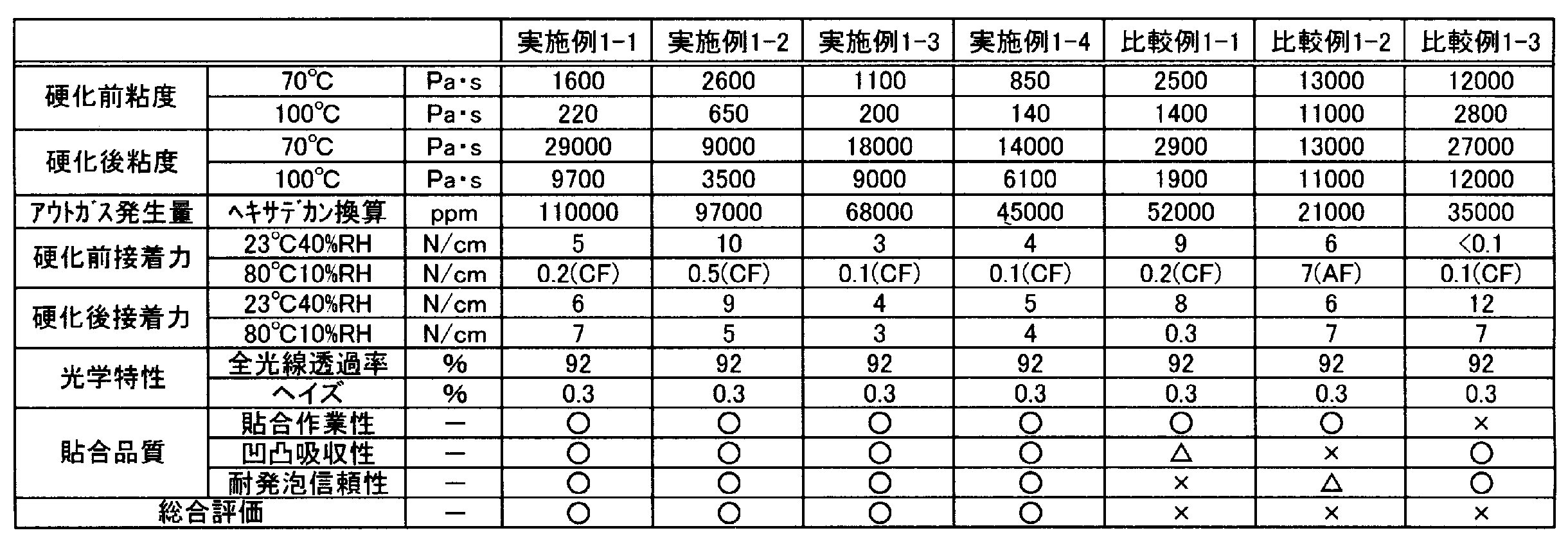
(考察)
実施例1-1~1-4で作製した粘着シートは、光硬化前の高温での剥離モードが凝集破壊であることから分かるように、被着面への濡れ性に優れ、凹凸面への追従性に優れるばかりか、光硬化後の接着力が高いものであった。よって、実施例1-1~1-4で作製した粘着シートを用いて、高温度下での長時間紫外線照射のような苛酷な環境試験下においても剥離や発泡、変形を生じず、高い信頼性をもつ積層体を得ることができた。
また、実施例1-1~1-4で作製した粘着シートは、0~40℃において、形状保持することができ、且つ自己粘着性を示した。
実施例1-1~1-4で作製した粘着シートは、光硬化前の高温での剥離モードが凝集破壊であることから分かるように、被着面への濡れ性に優れ、凹凸面への追従性に優れるばかりか、光硬化後の接着力が高いものであった。よって、実施例1-1~1-4で作製した粘着シートを用いて、高温度下での長時間紫外線照射のような苛酷な環境試験下においても剥離や発泡、変形を生じず、高い信頼性をもつ積層体を得ることができた。
また、実施例1-1~1-4で作製した粘着シートは、0~40℃において、形状保持することができ、且つ自己粘着性を示した。
比較例1-1の粘着シートは、紫外線照射によって粘着剤樹脂組成物が一部架橋している、すなわち光硬化後の状態のため印刷段差付きガラスと積層する際、印刷段差近傍に粘着シートの残留歪みによるムラがみられ、貼合外観に劣るものであった。また、これを再度光硬化させた後は接着力が低く、凝集力に劣ることから、紫外線照射試験で発泡がみられ、貼合信頼性にも劣るものであった。
比較例1-2は、粘着剤樹脂組成物の架橋反応が、部材へ貼合する前段階で既に完了しているため、紫外線を照射しても粘度や接着力に変化は現れなった。また印刷段差付きガラスと積層する際、印刷段差が交差する角部付近では一部粘着剤が充填しきれず気泡が残る結果となった。また、段差近傍の粘着材の歪みをきっかけに、紫外線照射試験において気泡の成長がみられた。
比較例1-3は、主成分として(メタ)アクリル系共重合体を用いておらず、室温域においてある程度の剛性を備えた接着性樹脂組成物を用いた、ホットメルトタイプの接着シートである。
比較例1-3のシートは、光硬化前における接着力が低いことからもうかがえるように、実施例の粘着シートと比較して、室温付近でのタック性が非常に低く、0~40℃における自己粘着性が不十分であった。比較例1-3の粘着シートは貼合する際に位置決めの段階から被着体を予熱する必要があり、圧着のみで常温貼付可能な粘着シートと比べて、作業が煩雑である不具合があった。
比較例1-2は、粘着剤樹脂組成物の架橋反応が、部材へ貼合する前段階で既に完了しているため、紫外線を照射しても粘度や接着力に変化は現れなった。また印刷段差付きガラスと積層する際、印刷段差が交差する角部付近では一部粘着剤が充填しきれず気泡が残る結果となった。また、段差近傍の粘着材の歪みをきっかけに、紫外線照射試験において気泡の成長がみられた。
比較例1-3は、主成分として(メタ)アクリル系共重合体を用いておらず、室温域においてある程度の剛性を備えた接着性樹脂組成物を用いた、ホットメルトタイプの接着シートである。
比較例1-3のシートは、光硬化前における接着力が低いことからもうかがえるように、実施例の粘着シートと比較して、室温付近でのタック性が非常に低く、0~40℃における自己粘着性が不十分であった。比較例1-3の粘着シートは貼合する際に位置決めの段階から被着体を予熱する必要があり、圧着のみで常温貼付可能な粘着シートと比べて、作業が煩雑である不具合があった。
[実施例2-1]
(メタ)アクリル系共重合体(2-A)として、ポリメタクリル酸メチル(Tg:105℃)からなる数平均分子量2900のマクロモノマー15質量部(18mol%)と、ブチルアクリレート(Tg:-55℃)81質量部(75mol%)と、アクリル酸(Tg:106℃)4質量部(7mol%)とがランダム共重合してなるアクリル系グラフト共重合体(2-A-1)(重量平均分子量:23万)1kgと、架橋剤(2-B)としてのグリセリンジメタクリレート(日油社製、製品名:GMR)(2-B-1)90gと、光重合開始剤(2-C)としての2,4,6-トリメチルベンゾフェノンと4-メチルベンゾフェノンの混合物(Lanberti社製、製品名:エザキュアTZT)(2-C-1)15gとを均一混合し、粘着樹脂組成物2-1を作製した。
剥離処理されたポリエチレンテレフタレートフィルムY(三菱樹脂社製、ダイアホイルMRV-V06、厚さ100μm、「離型フィルムY」と称する)と、剥離処理されたポリエチレンテレフタレートフィルムZ(三菱樹脂社製、ダイアホイルMRQ、厚さ75μm、「離型フィルムZ」と称する)とで、前記組成物2-1を挟み、ラミネータを用いて厚さ150μmとなるようシート状に賦形し、粘着シートX1(厚さ150μm)を作製した。
黒色シート(LSL-8 イノアック社製 光線透過率0%)の片面に両面テープを貼って50mm×100mmに裁断したものを、前記粘着シートX1の一側に積層された離型フィルムZの表面に貼合して光不透過部を形成し、シート面内に光透過部と光不透過部を有する粘着シート積層体を作製した。
次に、このように作製した粘着シート積層体の黒色シート側から、高圧水銀ランプを用いて、波長365nmの積算光量が2000mJ/cm2となるように紫外線を照射して粘着シート積層体の光透過部を硬化させ、軟質部と硬質部を有する粘着シート2-1を作製した。(図2参照)
ここで、軟質部とは黒色シートで遮蔽された粘着シートの部位を意味し、硬質部とは、黒色シートで遮蔽されていない粘着シートの部位を意味する。
(メタ)アクリル系共重合体(2-A)として、ポリメタクリル酸メチル(Tg:105℃)からなる数平均分子量2900のマクロモノマー15質量部(18mol%)と、ブチルアクリレート(Tg:-55℃)81質量部(75mol%)と、アクリル酸(Tg:106℃)4質量部(7mol%)とがランダム共重合してなるアクリル系グラフト共重合体(2-A-1)(重量平均分子量:23万)1kgと、架橋剤(2-B)としてのグリセリンジメタクリレート(日油社製、製品名:GMR)(2-B-1)90gと、光重合開始剤(2-C)としての2,4,6-トリメチルベンゾフェノンと4-メチルベンゾフェノンの混合物(Lanberti社製、製品名:エザキュアTZT)(2-C-1)15gとを均一混合し、粘着樹脂組成物2-1を作製した。
剥離処理されたポリエチレンテレフタレートフィルムY(三菱樹脂社製、ダイアホイルMRV-V06、厚さ100μm、「離型フィルムY」と称する)と、剥離処理されたポリエチレンテレフタレートフィルムZ(三菱樹脂社製、ダイアホイルMRQ、厚さ75μm、「離型フィルムZ」と称する)とで、前記組成物2-1を挟み、ラミネータを用いて厚さ150μmとなるようシート状に賦形し、粘着シートX1(厚さ150μm)を作製した。
黒色シート(LSL-8 イノアック社製 光線透過率0%)の片面に両面テープを貼って50mm×100mmに裁断したものを、前記粘着シートX1の一側に積層された離型フィルムZの表面に貼合して光不透過部を形成し、シート面内に光透過部と光不透過部を有する粘着シート積層体を作製した。
次に、このように作製した粘着シート積層体の黒色シート側から、高圧水銀ランプを用いて、波長365nmの積算光量が2000mJ/cm2となるように紫外線を照射して粘着シート積層体の光透過部を硬化させ、軟質部と硬質部を有する粘着シート2-1を作製した。(図2参照)
ここで、軟質部とは黒色シートで遮蔽された粘着シートの部位を意味し、硬質部とは、黒色シートで遮蔽されていない粘着シートの部位を意味する。
[実施例2-2]
(メタ)アクリル系共重合体(2-A)として、2-エチルヘキシルアクリレート(Tg:-70℃)55質量部(36mol%)と、酢酸ビニル(Tg:32℃)40質量部(56mol%)と、アクリル酸(Tg:106℃)5質量部(8mol%)とがランダム共重合してなるアクリル系共重合体(2-A-2)(重量平均分子量:17万)1kgに対して、架橋剤(2-B)として、イソシアヌル酸EO変性ジアクリレートとイソシアヌル酸EO変性トリアクリレートとの混合物(2-B-2)(東亜合成社製、製品名:アロニックスM313)70gと、光重合開始剤(2-C)として、エザキュアKTO46(2-C-2)(Lanberti社製)5gとを均一混合し、粘着樹脂組成物2-2を作製した。
上記離型フィルムY、Zで前記組成物2-2を挟み、ラミネータを用いて厚さ150μmとなるようシート状に賦形し、粘着シートX2(厚さ150μm)を作製した。
粘着シートX2を用いた以外は実施例2-1と同様にして粘着シート積層体を作製し、さらに実施例2-1と同様にして軟質部と硬質部を有する粘着シート2-2を作製した。
(メタ)アクリル系共重合体(2-A)として、2-エチルヘキシルアクリレート(Tg:-70℃)55質量部(36mol%)と、酢酸ビニル(Tg:32℃)40質量部(56mol%)と、アクリル酸(Tg:106℃)5質量部(8mol%)とがランダム共重合してなるアクリル系共重合体(2-A-2)(重量平均分子量:17万)1kgに対して、架橋剤(2-B)として、イソシアヌル酸EO変性ジアクリレートとイソシアヌル酸EO変性トリアクリレートとの混合物(2-B-2)(東亜合成社製、製品名:アロニックスM313)70gと、光重合開始剤(2-C)として、エザキュアKTO46(2-C-2)(Lanberti社製)5gとを均一混合し、粘着樹脂組成物2-2を作製した。
上記離型フィルムY、Zで前記組成物2-2を挟み、ラミネータを用いて厚さ150μmとなるようシート状に賦形し、粘着シートX2(厚さ150μm)を作製した。
粘着シートX2を用いた以外は実施例2-1と同様にして粘着シート積層体を作製し、さらに実施例2-1と同様にして軟質部と硬質部を有する粘着シート2-2を作製した。
[実施例2-3]
(メタ)アクリル系共重合体(2-A)として、数平均分子量1400のポリメタクリル酸メチルマクロモノマー(Tg:105℃)10質量部(17mol%)と2-エチルヘキシルアクリレート(Tg:-70℃)90質量部(83mol%)とがランダム共重合してなるアクリル系グラフト共重合体(2-A-3)(重量平均分子量:23万)1kgと、架橋剤(2-B)として、トリシクロデカンジメタクリレート(新中村化学社製、製品名:DCP)(2-B-3)50gと、光重合開始剤(2-C)としての2,4,6-トリメチルベンゾフェノンと4-メチルベンゾフェノンの混合物(Lanberti社製、製品名:エザキュアTZT)(2-C-1)15gを均一混合し、粘着樹脂組成物2-3を作製した。
上記離型フィルムY、Zで前記組成物2-3を挟み、ラミネータを用いて厚さ150μmとなるようシート状に賦形し、粘着シートX3(厚さ150μm)を作製した。
粘着シートX3を用いた以外は実施例2-1と同様にして粘着シート積層体を作製し、さらに実施例2-1と同様にして、軟質部と硬質部を有する粘着シート2-3を作製した。
(メタ)アクリル系共重合体(2-A)として、数平均分子量1400のポリメタクリル酸メチルマクロモノマー(Tg:105℃)10質量部(17mol%)と2-エチルヘキシルアクリレート(Tg:-70℃)90質量部(83mol%)とがランダム共重合してなるアクリル系グラフト共重合体(2-A-3)(重量平均分子量:23万)1kgと、架橋剤(2-B)として、トリシクロデカンジメタクリレート(新中村化学社製、製品名:DCP)(2-B-3)50gと、光重合開始剤(2-C)としての2,4,6-トリメチルベンゾフェノンと4-メチルベンゾフェノンの混合物(Lanberti社製、製品名:エザキュアTZT)(2-C-1)15gを均一混合し、粘着樹脂組成物2-3を作製した。
上記離型フィルムY、Zで前記組成物2-3を挟み、ラミネータを用いて厚さ150μmとなるようシート状に賦形し、粘着シートX3(厚さ150μm)を作製した。
粘着シートX3を用いた以外は実施例2-1と同様にして粘着シート積層体を作製し、さらに実施例2-1と同様にして、軟質部と硬質部を有する粘着シート2-3を作製した。
[実施例2-4]
(メタ)アクリル系共重合体(2-A)として、数平均分子量2400のポリメタクリル酸メチルマクロモノマー(Tg:105℃)12質量部(19mol%)と2-エチルヘキシルアクリレート(Tg:-70℃)85質量部(74mol%)とアクリル酸(Tg:106℃)3質量部(7mol%)とがランダム共重合してなるアクリル系グラフト共重合体(2-A-4)(重量平均分子量:8万)1kgと、架橋剤(2-B)として、グリセリンジメタクリレート(日油社製、製品名:GMR)(2-B-1)90gと、光重合開始剤(2-C)としての2,4,6-トリメチルベンゾフェノンと4-メチルベンゾフェノンの混合物(Lanberti社製、製品名:エザキュアTZT)(2-C-1)15gを均一混合し、粘着樹脂組成物2-4を作製した。
上記離型フィルムY、Zで前記組成物2-4を挟み、ラミネータを用いて厚さ150μmとなるようシート状に賦形し、粘着シートX4(厚さ150μm)を作製した。
粘着シートX4を用いた以外は実施例2-1と同様にして粘着シート積層体を作製し、さらに実施例2-1と同様にして、軟質部と硬質部を有する粘着シート2-4を作製した。
(メタ)アクリル系共重合体(2-A)として、数平均分子量2400のポリメタクリル酸メチルマクロモノマー(Tg:105℃)12質量部(19mol%)と2-エチルヘキシルアクリレート(Tg:-70℃)85質量部(74mol%)とアクリル酸(Tg:106℃)3質量部(7mol%)とがランダム共重合してなるアクリル系グラフト共重合体(2-A-4)(重量平均分子量:8万)1kgと、架橋剤(2-B)として、グリセリンジメタクリレート(日油社製、製品名:GMR)(2-B-1)90gと、光重合開始剤(2-C)としての2,4,6-トリメチルベンゾフェノンと4-メチルベンゾフェノンの混合物(Lanberti社製、製品名:エザキュアTZT)(2-C-1)15gを均一混合し、粘着樹脂組成物2-4を作製した。
上記離型フィルムY、Zで前記組成物2-4を挟み、ラミネータを用いて厚さ150μmとなるようシート状に賦形し、粘着シートX4(厚さ150μm)を作製した。
粘着シートX4を用いた以外は実施例2-1と同様にして粘着シート積層体を作製し、さらに実施例2-1と同様にして、軟質部と硬質部を有する粘着シート2-4を作製した。
[実施例2-5]
実施例2-1で用いたアクリル系共重合体(2-A-1)(重量平均分子量:23万)1kgと、架橋剤(2-B)としてのトリメチロールプロパントリアクリレート(2-B-4)70gと、光重合開始剤(2-C)としての2,4,6-トリメチルベンゾフェノンと4-メチルベンゾフェノンの混合物(Lanberti社製、製品名:エザキュアTZT)(2-C-1)8gとを均一混合し、粘着樹脂組成物2-5を作製した。
粘着樹脂組成物2-5を酢酸エチルで固形分濃度が40%になるよう希釈した溶液を、剥離処理されたポリエチレンテレフタレートフィルムY(三菱樹脂社製、ダイアホイルMRV-V06、厚さ100μm、「離型フィルムY」と称する)の剥離処理面に、乾燥後の厚みが25μmとなるように塗布、乾燥させた後、塗工した粘着面に、剥離処理されたポリエチレンテレフタレートフィルムZ(三菱樹脂社製、ダイアホイルMRQ、厚さ75μm、「離型フィルムZ」と称する)を被覆し、粘着シートX5(厚さ25μm)を作製した。
粘着シートX5を用いた以外は実施例2-1と同様にして粘着シート積層体を作製し、さらに実施例2-1と同様にして、軟質部と硬質部を有する粘着シート2-5を作製した。
実施例2-1で用いたアクリル系共重合体(2-A-1)(重量平均分子量:23万)1kgと、架橋剤(2-B)としてのトリメチロールプロパントリアクリレート(2-B-4)70gと、光重合開始剤(2-C)としての2,4,6-トリメチルベンゾフェノンと4-メチルベンゾフェノンの混合物(Lanberti社製、製品名:エザキュアTZT)(2-C-1)8gとを均一混合し、粘着樹脂組成物2-5を作製した。
粘着樹脂組成物2-5を酢酸エチルで固形分濃度が40%になるよう希釈した溶液を、剥離処理されたポリエチレンテレフタレートフィルムY(三菱樹脂社製、ダイアホイルMRV-V06、厚さ100μm、「離型フィルムY」と称する)の剥離処理面に、乾燥後の厚みが25μmとなるように塗布、乾燥させた後、塗工した粘着面に、剥離処理されたポリエチレンテレフタレートフィルムZ(三菱樹脂社製、ダイアホイルMRQ、厚さ75μm、「離型フィルムZ」と称する)を被覆し、粘着シートX5(厚さ25μm)を作製した。
粘着シートX5を用いた以外は実施例2-1と同様にして粘着シート積層体を作製し、さらに実施例2-1と同様にして、軟質部と硬質部を有する粘着シート2-5を作製した。
[比較例2-1]
2-エチルヘキシルアクリレート(Tg:-70℃)75質量部(57mol%)と酢酸ビニル(Tg:32℃)20質量部(33mol%)とアクリル酸(Tg:106℃)5質量部(10mol%)とをランダム共重合してなる(メタ)アクリル系共重合体(2-A-5)1kgに、トリメチロールプロパントリアクリレート(2-B-4)200g及び4-メチルベンゾフェノン(2-C-3)10gを混合添加して中間層用樹脂組成物を調製した。
前記中間層用樹脂組成物を、剥離処理した2枚のポリエチレンテレフタレートフィルム(パナック社製、NP75Z01、厚さ75μm/東洋紡績社製、E7006、厚さ38μm)で挟み、厚さ80μmとなるようシート状に賦形し、中間層用シート(α)を作成した。
2-エチルヘキシルアクリレート(Tg:-70℃)75質量部(57mol%)と酢酸ビニル(Tg:32℃)20質量部(33mol%)とアクリル酸(Tg:106℃)5質量部(10mol%)とをランダム共重合してなる(メタ)アクリル系共重合体(2-A-5)1kgに、トリメチロールプロパントリアクリレート(2-B-4)200g及び4-メチルベンゾフェノン(2-C-3)10gを混合添加して中間層用樹脂組成物を調製した。
前記中間層用樹脂組成物を、剥離処理した2枚のポリエチレンテレフタレートフィルム(パナック社製、NP75Z01、厚さ75μm/東洋紡績社製、E7006、厚さ38μm)で挟み、厚さ80μmとなるようシート状に賦形し、中間層用シート(α)を作成した。
続いて、前記アクリル系共重合体(2-A-5)1kgに対し、光重合開始剤(2-C)として、4-メチルベンゾフェノン(2-C-3)20gを添加混合し、粘着層用樹脂組成物を調整した。
前記粘着層用樹脂組成物を、剥離処理した2枚のポリエチレンテレフタレートフィルム(三菱樹脂社製、ダイアホイルMRA、厚さ75μm/東洋紡績社製、E7006、厚さ38μm)で挟み、厚さ35μmとなるようシート状に賦形し、粘着層用樹脂シート(β)を作製した。
他方、粘着層用樹脂組成物を、剥離処理した2枚のポリエチレンテレフタレートフィルム(三菱樹脂社製、ダイアホイルMRF、厚さ75μm/東洋紡績社製、E7006、厚さ38μm)で挟み、厚さ35μmとなるようシート状に賦形し、粘着層用樹脂シート(β’)を作製した。
前記粘着層用樹脂組成物を、剥離処理した2枚のポリエチレンテレフタレートフィルム(三菱樹脂社製、ダイアホイルMRA、厚さ75μm/東洋紡績社製、E7006、厚さ38μm)で挟み、厚さ35μmとなるようシート状に賦形し、粘着層用樹脂シート(β)を作製した。
他方、粘着層用樹脂組成物を、剥離処理した2枚のポリエチレンテレフタレートフィルム(三菱樹脂社製、ダイアホイルMRF、厚さ75μm/東洋紡績社製、E7006、厚さ38μm)で挟み、厚さ35μmとなるようシート状に賦形し、粘着層用樹脂シート(β’)を作製した。
中間層用シート(α)の両側のPETフィルムを順次剥離除去すると共に、粘着層用樹脂シート(β)及び(β’)の一側のPETフィルムを剥がして、露出した粘着面を中間層用シート(α)の両表面に順次貼合し、(β)/(α)/(β’)からなる3層粘着シートを作製した。
(β)及び(β’)の表面に残るPETフィルムを介して、波長365nmの積算光量が1000mJ/cm2となるよう高圧水銀ランプにて紫外線を照射し、(α)、(β)及び(β’)を紫外線架橋させて、粘着シートX6(厚さ150μm)を作製した。
黒色シート(LSL-8 イノアック社製 光線透過率0%)の片面に両面テープを貼り、50mm×100mmに裁断したものを、前記粘着シートX6の一方の剥離処理したポリエチレンテレフタレートフィルム(三菱樹脂社製、ダイアホイルMRF)の表面に貼合して光不透過を形成し、シート面内に光透過部と光不透過部を有する粘着シート積層体を作製した。
次に、このように粘着シート作製した粘着シート積層体の黒色シート側から、高圧水銀ランプを用いて、波長365nmの積算光量が2000mJ/cm2となるように紫外線を照射して積層体の光透過部に接する箇所の粘着材にさらに光照射し、粘着シート2-6を作製した。
(β)及び(β’)の表面に残るPETフィルムを介して、波長365nmの積算光量が1000mJ/cm2となるよう高圧水銀ランプにて紫外線を照射し、(α)、(β)及び(β’)を紫外線架橋させて、粘着シートX6(厚さ150μm)を作製した。
黒色シート(LSL-8 イノアック社製 光線透過率0%)の片面に両面テープを貼り、50mm×100mmに裁断したものを、前記粘着シートX6の一方の剥離処理したポリエチレンテレフタレートフィルム(三菱樹脂社製、ダイアホイルMRF)の表面に貼合して光不透過を形成し、シート面内に光透過部と光不透過部を有する粘着シート積層体を作製した。
次に、このように粘着シート作製した粘着シート積層体の黒色シート側から、高圧水銀ランプを用いて、波長365nmの積算光量が2000mJ/cm2となるように紫外線を照射して積層体の光透過部に接する箇所の粘着材にさらに光照射し、粘着シート2-6を作製した。
[比較例2-2]
フェノキシ樹脂(2-A-6)(InChem社製、PKHH、重量平均分子量5.2万)650gと、架橋剤(2-B)の代替として、カーボネート骨格を有するポリウレタンアクリレート(2-B-4)(根上工業社製、UN5500、重量平均分子量6.7万)1kg、光重合開始剤(2-C)として、1-シクロヘキシルフェニルケトン(2-C-4)(BASF社製、Irgacure184)43gを均一混合してなる粘着樹脂組成物2-7を作製した。
前記組成物2-7を、剥離処理した2枚のポリエチレンテレフタレートフィルム(三菱樹脂社製、ダイアホイルMRV-V06、厚さ100μm/三菱樹脂社製、ダイアホイルMRQ、厚さ75μm)で挟み、ラミネータを用いて厚さ150μmとなるようシート状に賦形し、粘着シートX7(厚さ150μm)を作製した。
黒色シート(LSL-8 イノアック社製 光線透過率0%)の片面に両面テープを貼り、50mm×100mmに裁断したものを、前記粘着シートX7の一方の剥離処理したポリエチレンテレフタレートフィルム(三菱樹脂社製、ダイアホイルMRQ)の表面に貼合して光不透過を形成し、シート面内に光透過部と光不透過部を有する粘着シート積層体を作成した。
次に、このように作製した粘着シート積層体の黒色シート側から、高圧水銀ランプを用いて、波長365nmの積算光量が2000mJ/cm2となるように紫外線を照射して粘着シート積層体の光透過部を硬化させ、粘着シート2-7を作製した。
フェノキシ樹脂(2-A-6)(InChem社製、PKHH、重量平均分子量5.2万)650gと、架橋剤(2-B)の代替として、カーボネート骨格を有するポリウレタンアクリレート(2-B-4)(根上工業社製、UN5500、重量平均分子量6.7万)1kg、光重合開始剤(2-C)として、1-シクロヘキシルフェニルケトン(2-C-4)(BASF社製、Irgacure184)43gを均一混合してなる粘着樹脂組成物2-7を作製した。
前記組成物2-7を、剥離処理した2枚のポリエチレンテレフタレートフィルム(三菱樹脂社製、ダイアホイルMRV-V06、厚さ100μm/三菱樹脂社製、ダイアホイルMRQ、厚さ75μm)で挟み、ラミネータを用いて厚さ150μmとなるようシート状に賦形し、粘着シートX7(厚さ150μm)を作製した。
黒色シート(LSL-8 イノアック社製 光線透過率0%)の片面に両面テープを貼り、50mm×100mmに裁断したものを、前記粘着シートX7の一方の剥離処理したポリエチレンテレフタレートフィルム(三菱樹脂社製、ダイアホイルMRQ)の表面に貼合して光不透過を形成し、シート面内に光透過部と光不透過部を有する粘着シート積層体を作成した。
次に、このように作製した粘着シート積層体の黒色シート側から、高圧水銀ランプを用いて、波長365nmの積算光量が2000mJ/cm2となるように紫外線を照射して粘着シート積層体の光透過部を硬化させ、粘着シート2-7を作製した。
[比較例2-3]
市販のアクリル系粘着剤(2-A-7)(綜研化学社製、商品名「SKダイン1882」)1kgに対して、イソシアネート系硬化剤(綜研化学社製、商品名「L-45」)1.85g及びエポキシ系硬化剤(綜研化学社製、商品名「E-5XM」)0.5gを均一混合して粘着樹脂組成物2-6を調製した。
前記組成物2-6を、厚さ50μmの剥離処理したポリエチレンテレフタレートフィルム(商品名「MRF75」:三菱樹脂社製)の離型面に、乾燥後の厚さが75μmとなるように塗布し、加熱により溶剤を乾燥させ、厚さ75μmの粘着シートを作製した。
さらに、前記組成物2-6を、剥離処理したポリエチレンテレフタレートフィルム(三菱樹脂社製、ダイアホイルMRV-V06、厚さ100μm)の離型面に、乾燥後の厚さが75μmとなるように塗布し、加熱により溶剤を乾燥させ、厚さ75μmの粘着シートを作製した。
作製した2枚の粘着シートについて、それぞれの粘着面を貼着して1週間養生して硬化剤を反応させ、粘着シート2-8(厚さ150μm)を作製した。
市販のアクリル系粘着剤(2-A-7)(綜研化学社製、商品名「SKダイン1882」)1kgに対して、イソシアネート系硬化剤(綜研化学社製、商品名「L-45」)1.85g及びエポキシ系硬化剤(綜研化学社製、商品名「E-5XM」)0.5gを均一混合して粘着樹脂組成物2-6を調製した。
前記組成物2-6を、厚さ50μmの剥離処理したポリエチレンテレフタレートフィルム(商品名「MRF75」:三菱樹脂社製)の離型面に、乾燥後の厚さが75μmとなるように塗布し、加熱により溶剤を乾燥させ、厚さ75μmの粘着シートを作製した。
さらに、前記組成物2-6を、剥離処理したポリエチレンテレフタレートフィルム(三菱樹脂社製、ダイアホイルMRV-V06、厚さ100μm)の離型面に、乾燥後の厚さが75μmとなるように塗布し、加熱により溶剤を乾燥させ、厚さ75μmの粘着シートを作製した。
作製した2枚の粘着シートについて、それぞれの粘着面を貼着して1週間養生して硬化剤を反応させ、粘着シート2-8(厚さ150μm)を作製した。
[評価]
実施例及び比較例で作製した粘着シート2-1~2-8の各種物性値を次のように測定して評価した。
実施例及び比較例で作製した粘着シート2-1~2-8の各種物性値を次のように測定して評価した。
(ゲル分率)
実施例及び比較例で作製した粘着シート2-1~2-7の光透過部に接する箇所、すなわち硬質部と、光不透過部に接する箇所、すなわち軟質部それぞれを取り出したものについて、下記の測定を行った。
比較例2-3の粘着シート2-8については、任意の箇所について下記の測定を行った。
実施例及び比較例で作製した粘着シート2-1~2-7の光透過部に接する箇所、すなわち硬質部と、光不透過部に接する箇所、すなわち軟質部それぞれを取り出したものについて、下記の測定を行った。
比較例2-3の粘着シート2-8については、任意の箇所について下記の測定を行った。
1)粘着剤組成物を秤量し(W1)、予め重さを測った200メッシュのSUSメッシュ(W0)に包む。
2)上記SUSメッシュを100mLの酢酸エチルに24時間浸漬する。
3)SUSメッシュを取り出し、75℃で4時間半乾燥する。
4)乾燥後の重量(W2)を求め、下記式より粘着剤組成物のゲル分率を測定する。
ゲル分率(%)=100×(W2-W0)/W1
2)上記SUSメッシュを100mLの酢酸エチルに24時間浸漬する。
3)SUSメッシュを取り出し、75℃で4時間半乾燥する。
4)乾燥後の重量(W2)を求め、下記式より粘着剤組成物のゲル分率を測定する。
ゲル分率(%)=100×(W2-W0)/W1
(ガラス転移温度(Tg))
パーキンエルマー社製示差走査熱量測定装置(DSC-8500)を用い、JIS K-7121(ISO3146)に基づいて昇温速度5℃/分で昇温測定を行い、得られたサーモグラムより、粘着シート2-1~2-7の光透過部に接する箇所、すなわち硬質部と、光不透過部に接する箇所、すなわち軟質部それぞれについてガラス転移温度(Tg)を求めた。
比較例2-3の粘着シート2-8については、任意の箇所について同様の測定を行った。
パーキンエルマー社製示差走査熱量測定装置(DSC-8500)を用い、JIS K-7121(ISO3146)に基づいて昇温速度5℃/分で昇温測定を行い、得られたサーモグラムより、粘着シート2-1~2-7の光透過部に接する箇所、すなわち硬質部と、光不透過部に接する箇所、すなわち軟質部それぞれについてガラス転移温度(Tg)を求めた。
比較例2-3の粘着シート2-8については、任意の箇所について同様の測定を行った。
(アスカー硬度)
実施例及び比較例で作製した粘着シート2-1~2-7の光不透過部に接する箇所、すなわち軟質部について、シートの剥離フィルムを剥がし、露出した粘着面を順次重ね合せて、複数枚の粘着シートを全厚さが5mm~7mmの範囲内になるように積層した。これにより測定試料を乗せるステージの硬さの影響を低減することができ、材料特有の押込硬度を比較・測定することができる。そして、積層した粘着シートの露出した粘着面に対してアスカーC2L硬度計の先端端子を荷重1kgにて垂直下方に3mm/分の速度で押し付け、軟質部のC2アスカー硬度(c)を測定した。
実施例及び比較例で作製した粘着シート2-1~2-7の光不透過部に接する箇所、すなわち軟質部について、シートの剥離フィルムを剥がし、露出した粘着面を順次重ね合せて、複数枚の粘着シートを全厚さが5mm~7mmの範囲内になるように積層した。これにより測定試料を乗せるステージの硬さの影響を低減することができ、材料特有の押込硬度を比較・測定することができる。そして、積層した粘着シートの露出した粘着面に対してアスカーC2L硬度計の先端端子を荷重1kgにて垂直下方に3mm/分の速度で押し付け、軟質部のC2アスカー硬度(c)を測定した。
実施例及び比較例で作製した粘着シート2-1~2-7の光透過部に接する箇所、すなわち硬質部についても、上記と同様に粘着シートを5mm~7mmの範囲内になるように積層し、硬質部のC2アスカー硬度(d)を測定した。
比較例2-3で作製した粘着シート2-8については、任意の箇所について同測定を行った。
比較例2-3で作製した粘着シート2-8については、任意の箇所について同測定を行った。
(軟質部の180°剥離力)
実施例及び比較例で作製した粘着シート2-1~2-7の光不透過部に接する箇所、すなわち軟質部を切り出した後、一方の離型フィルムを剥がし、裏打ちフィルムとして50μmのPETフィルム(三菱樹脂社製、ダイアホイルT100、厚さ50μm)を貼合して積層品を準備した。
上記積層品を長さ150mm、巾10mmに裁断した後、残る離型フィルムを剥がして露出した粘着面を、ソーダライムガラスに2kgのロールを1往復させて前記粘着シートをロール圧着した。
この粘着力測定サンプルを、23℃40%RHの環境下にて剥離角180°、剥離速度60mm/分で引き剥がしたときのガラスへの剥離力(N/cm)を測定し、光不透過部に接する箇所、すなわち軟質部の180°剥離力を求めた。
実施例及び比較例で作製した粘着シート2-1~2-7の光不透過部に接する箇所、すなわち軟質部を切り出した後、一方の離型フィルムを剥がし、裏打ちフィルムとして50μmのPETフィルム(三菱樹脂社製、ダイアホイルT100、厚さ50μm)を貼合して積層品を準備した。
上記積層品を長さ150mm、巾10mmに裁断した後、残る離型フィルムを剥がして露出した粘着面を、ソーダライムガラスに2kgのロールを1往復させて前記粘着シートをロール圧着した。
この粘着力測定サンプルを、23℃40%RHの環境下にて剥離角180°、剥離速度60mm/分で引き剥がしたときのガラスへの剥離力(N/cm)を測定し、光不透過部に接する箇所、すなわち軟質部の180°剥離力を求めた。
(硬質部の180°剥離力)
実施例2-2-1~4及び比較例2-1、2-2で作製した光照射前の状態の粘着シートX1~7について一方の離型フィルムを剥がし、裏打ちフィルムとして50μmのPETフィルム(三菱樹脂社製、ダイアホイルT100、50μm)を貼合して積層品を準備した。
上記積層品を長さ150mm、巾10mmに裁断した後、残る離型フィルムを剥がして露出した粘着面を、2kgのロールを1往復してソーダライムガラスにロール圧着した。貼合品にオートクレーブ処理(80℃,ゲージ圧0.2MPa,20分)を施して仕上げ貼着した後、紫外線を365nmの積算光量が2000mJ/cm2となるよう照射して粘着シートを硬化し、15時間養生して、剥離力測定試料とした。
上記剥離力測定サンプルを、23℃40%RHの環境下にて、剥離角180°、剥離速度60mm/分で引き剥がしたときのガラスへの剥離力(N/cm)を測定し、光透過部に接する箇所、すなわち硬質部の180°剥離力とした。
比較例2-3で作成した粘着シート2-8については、任意の箇所について粘着シートを切り出した後、軟質部の180℃剥離力の手順と同様に測定を行った。
実施例2-2-1~4及び比較例2-1、2-2で作製した光照射前の状態の粘着シートX1~7について一方の離型フィルムを剥がし、裏打ちフィルムとして50μmのPETフィルム(三菱樹脂社製、ダイアホイルT100、50μm)を貼合して積層品を準備した。
上記積層品を長さ150mm、巾10mmに裁断した後、残る離型フィルムを剥がして露出した粘着面を、2kgのロールを1往復してソーダライムガラスにロール圧着した。貼合品にオートクレーブ処理(80℃,ゲージ圧0.2MPa,20分)を施して仕上げ貼着した後、紫外線を365nmの積算光量が2000mJ/cm2となるよう照射して粘着シートを硬化し、15時間養生して、剥離力測定試料とした。
上記剥離力測定サンプルを、23℃40%RHの環境下にて、剥離角180°、剥離速度60mm/分で引き剥がしたときのガラスへの剥離力(N/cm)を測定し、光透過部に接する箇所、すなわち硬質部の180°剥離力とした。
比較例2-3で作成した粘着シート2-8については、任意の箇所について粘着シートを切り出した後、軟質部の180℃剥離力の手順と同様に測定を行った。
(軟質部の保持力)
実施例及び比較例で作製した粘着シート2-1~2-7の光不透過部に接する箇所、すなわち軟質部を、50mm×100mmに裁断した後、片面の剥離フィルムを剥がし、該粘着シートの片面が、裏打用のポリエチレンテレフタレートフィルム(厚さ38μm)に重なるようにハンドローラで貼着し、これを巾25mm×長さ100mmの短冊状に裁断して試験片とした。
次に、残る剥離フィルムを剥がして、垂直に立設したSUS板(厚さ120mm、5mm×1.5mm)に対して、試験片が20mmの長さだけ重なるようにしてハンドローラで貼着した。この時、透明両面粘着シートとSUS板の貼着面積は25mm×20mmとなる。
その後、試験片を40℃及び70℃の雰囲気下で15分養生させた後、試験片に4.9Nの錘を垂直方向に取り付けて掛けて30分間静置した後、SUSと試験片との貼着位置が下方にズレた長さ(mm)を測定した。貼着面がずれて錘が落下したものについては、錘の落下に要した時間を測定した。
なお、比較例2-2の粘着シート2-7は自着性を持たないことから、SUS板に積層した試験片を80℃で5分予熱し、被着体に密着させた後で保持力測定を行った。
実施例及び比較例で作製した粘着シート2-1~2-7の光不透過部に接する箇所、すなわち軟質部を、50mm×100mmに裁断した後、片面の剥離フィルムを剥がし、該粘着シートの片面が、裏打用のポリエチレンテレフタレートフィルム(厚さ38μm)に重なるようにハンドローラで貼着し、これを巾25mm×長さ100mmの短冊状に裁断して試験片とした。
次に、残る剥離フィルムを剥がして、垂直に立設したSUS板(厚さ120mm、5mm×1.5mm)に対して、試験片が20mmの長さだけ重なるようにしてハンドローラで貼着した。この時、透明両面粘着シートとSUS板の貼着面積は25mm×20mmとなる。
その後、試験片を40℃及び70℃の雰囲気下で15分養生させた後、試験片に4.9Nの錘を垂直方向に取り付けて掛けて30分間静置した後、SUSと試験片との貼着位置が下方にズレた長さ(mm)を測定した。貼着面がずれて錘が落下したものについては、錘の落下に要した時間を測定した。
なお、比較例2-2の粘着シート2-7は自着性を持たないことから、SUS板に積層した試験片を80℃で5分予熱し、被着体に密着させた後で保持力測定を行った。
(硬質部の保持力)
実施例2-2-1~5及び比較例2-1、2-2で作製した光照射前の状態の粘着シートX1~7について、光硬化前の保持力測定と同様にして、SUSと試験片との積層体を作成した後、波長365nmの紫外線が粘着シートに2000mJ/cm2に到達するよう、光量計(ウシオ電機社製、UNIMETER UIT250/センサー:UVD-C365)で積算光量を確認しながら裏打用のポリエチレンテレフタレートフィルム側から高圧水銀ランプを用いて紫外線照射し、光透過部に接する箇所、すなわち硬質部に相当する粘着シートを作製した。
その後、試験片を40℃及び70℃の雰囲気下で15分養生させた後、試験片に4.9Nの錘を垂直方向に取り付けて掛けて30分間静置した後、SUSと試験片との貼着位置が下方にズレた長さ(mm)を測定した。
試験片が殆ど動かず、ズレ長さが0.1mm未満のものについては、表3に「<0.1mm」と表記した。
比較例2-3で作成した粘着シート2-8については、任意の箇所について粘着シートを切り出した後、軟質部の保持力測定手順と同様に測定を行った。
実施例2-2-1~5及び比較例2-1、2-2で作製した光照射前の状態の粘着シートX1~7について、光硬化前の保持力測定と同様にして、SUSと試験片との積層体を作成した後、波長365nmの紫外線が粘着シートに2000mJ/cm2に到達するよう、光量計(ウシオ電機社製、UNIMETER UIT250/センサー:UVD-C365)で積算光量を確認しながら裏打用のポリエチレンテレフタレートフィルム側から高圧水銀ランプを用いて紫外線照射し、光透過部に接する箇所、すなわち硬質部に相当する粘着シートを作製した。
その後、試験片を40℃及び70℃の雰囲気下で15分養生させた後、試験片に4.9Nの錘を垂直方向に取り付けて掛けて30分間静置した後、SUSと試験片との貼着位置が下方にズレた長さ(mm)を測定した。
試験片が殆ど動かず、ズレ長さが0.1mm未満のものについては、表3に「<0.1mm」と表記した。
比較例2-3で作成した粘着シート2-8については、任意の箇所について粘着シートを切り出した後、軟質部の保持力測定手順と同様に測定を行った。
(透明性)
実施例及び比較例で作製した粘着シート2-1~2-7の光透過部に接する箇所、すなわち硬質部について一方の離型フィルムを剥がし、露出した粘着面を、2枚のソーダライムガラス(82mm×53mm×0.5mm厚)をロール貼合した後、オートクレーブ処理(80℃、ゲージ圧0.2MPa、20分)を施して仕上げ貼着し、光学評価用積層体を作製した。
比較例2-3で作成した粘着シート2-8については、任意の箇所について同様にサンプルを作成した。
前記積層体について、ヘイズメーター(日本電色工業社製、NDH5000)を用いて、JIS K7136に準じたヘイズ値並びにJIS K7361-1に準じた全光線透過率(%)を求めた。
実施例及び比較例で作製した粘着シート2-1~2-7の光透過部に接する箇所、すなわち硬質部について一方の離型フィルムを剥がし、露出した粘着面を、2枚のソーダライムガラス(82mm×53mm×0.5mm厚)をロール貼合した後、オートクレーブ処理(80℃、ゲージ圧0.2MPa、20分)を施して仕上げ貼着し、光学評価用積層体を作製した。
比較例2-3で作成した粘着シート2-8については、任意の箇所について同様にサンプルを作成した。
前記積層体について、ヘイズメーター(日本電色工業社製、NDH5000)を用いて、JIS K7136に準じたヘイズ値並びにJIS K7361-1に準じた全光線透過率(%)を求めた。
(凹凸吸収性)
実施例2-1~2-4及び比較例2-1、2-2で作製した光照射前の状態の粘着シートX1~4,6,7を、50mm×80mmに裁断し、一方の離型フィルムを剥がして露出した粘着面を、周縁部3mmに厚さ80μmの印刷を施したソーダライムガラス(82mm×53mm×0.5mm厚)の印刷面に、粘着材の4辺が印刷段差にかかるようにして真空プレスを用いてプレス圧着した(絶対圧5kPa、温度80℃、プレス圧0.04MPa)。次いで残る離型フィルムを剥がし、ゼオノアフィルム(日本ゼオン社製、100μm厚)をプレス貼合した後、オートクレーブ処理(80℃、ゲージ圧0.2MPa、20分)を施して仕上げ貼着した。印刷を施したソーダライムガラス側から、波長365nmの紫外線がシートXに2000mJ/cm2に到達するよう高圧水銀ランプにて紫外線を照射し、印刷の施されていない開口部、すなわち光透過部に接する箇所のシートを硬化させて、評価用積層体2-1~2-6を作成した。
実施例2-5で作成した粘着シートX5については、印刷を施したソーダライムガラスの印刷厚みを15μmとしたものを用いて、同様に評価用積層体2-7を作成した。
比較例2-3で作成した粘着シート2-8については、粘着シート2-7を用いて、前述と同様の手順で印刷を施したソーダライムガラスとゼオノアフィルム(日本ゼオン社製、100μm厚)との積層体を作成した後、オートクレーブ処理(80℃、ゲージ圧0.2MPa、20分)を施して仕上げ貼着し、評価用積層体2-8とした。
実施例2-1~2-4及び比較例2-1、2-2で作製した光照射前の状態の粘着シートX1~4,6,7を、50mm×80mmに裁断し、一方の離型フィルムを剥がして露出した粘着面を、周縁部3mmに厚さ80μmの印刷を施したソーダライムガラス(82mm×53mm×0.5mm厚)の印刷面に、粘着材の4辺が印刷段差にかかるようにして真空プレスを用いてプレス圧着した(絶対圧5kPa、温度80℃、プレス圧0.04MPa)。次いで残る離型フィルムを剥がし、ゼオノアフィルム(日本ゼオン社製、100μm厚)をプレス貼合した後、オートクレーブ処理(80℃、ゲージ圧0.2MPa、20分)を施して仕上げ貼着した。印刷を施したソーダライムガラス側から、波長365nmの紫外線がシートXに2000mJ/cm2に到達するよう高圧水銀ランプにて紫外線を照射し、印刷の施されていない開口部、すなわち光透過部に接する箇所のシートを硬化させて、評価用積層体2-1~2-6を作成した。
実施例2-5で作成した粘着シートX5については、印刷を施したソーダライムガラスの印刷厚みを15μmとしたものを用いて、同様に評価用積層体2-7を作成した。
比較例2-3で作成した粘着シート2-8については、粘着シート2-7を用いて、前述と同様の手順で印刷を施したソーダライムガラスとゼオノアフィルム(日本ゼオン社製、100μm厚)との積層体を作成した後、オートクレーブ処理(80℃、ゲージ圧0.2MPa、20分)を施して仕上げ貼着し、評価用積層体2-8とした。
作製した積層体2-1~2-8を目視観察し、印刷段差近傍で粘着材が追従せず気泡が残ったものを「×」、フィルムが段差近傍で屈曲し、歪むことによる凹凸ムラが見えたものを「△」、気泡なく平滑に貼合されたものを「○」と判定した。
(対発泡信頼性)
凹凸吸収性評価で作成した評価用積層体2-1~2-8を、85℃85%RHの恒温恒湿槽に投入し、100時間養生した後の外観を観察した。粘着シートに気泡が発生したものを「×」、外観変化がなかったものを「○」と判定した。
凹凸吸収性評価で作成した評価用積層体2-1~2-8を、85℃85%RHの恒温恒湿槽に投入し、100時間養生した後の外観を観察した。粘着シートに気泡が発生したものを「×」、外観変化がなかったものを「○」と判定した。
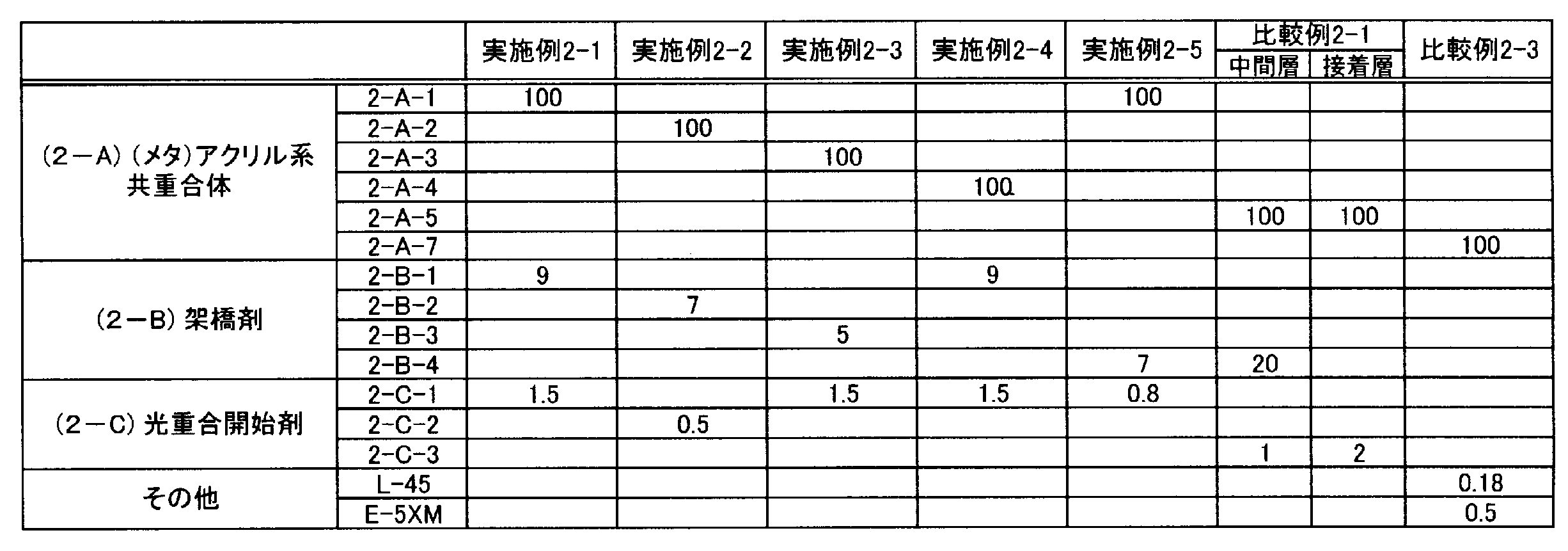
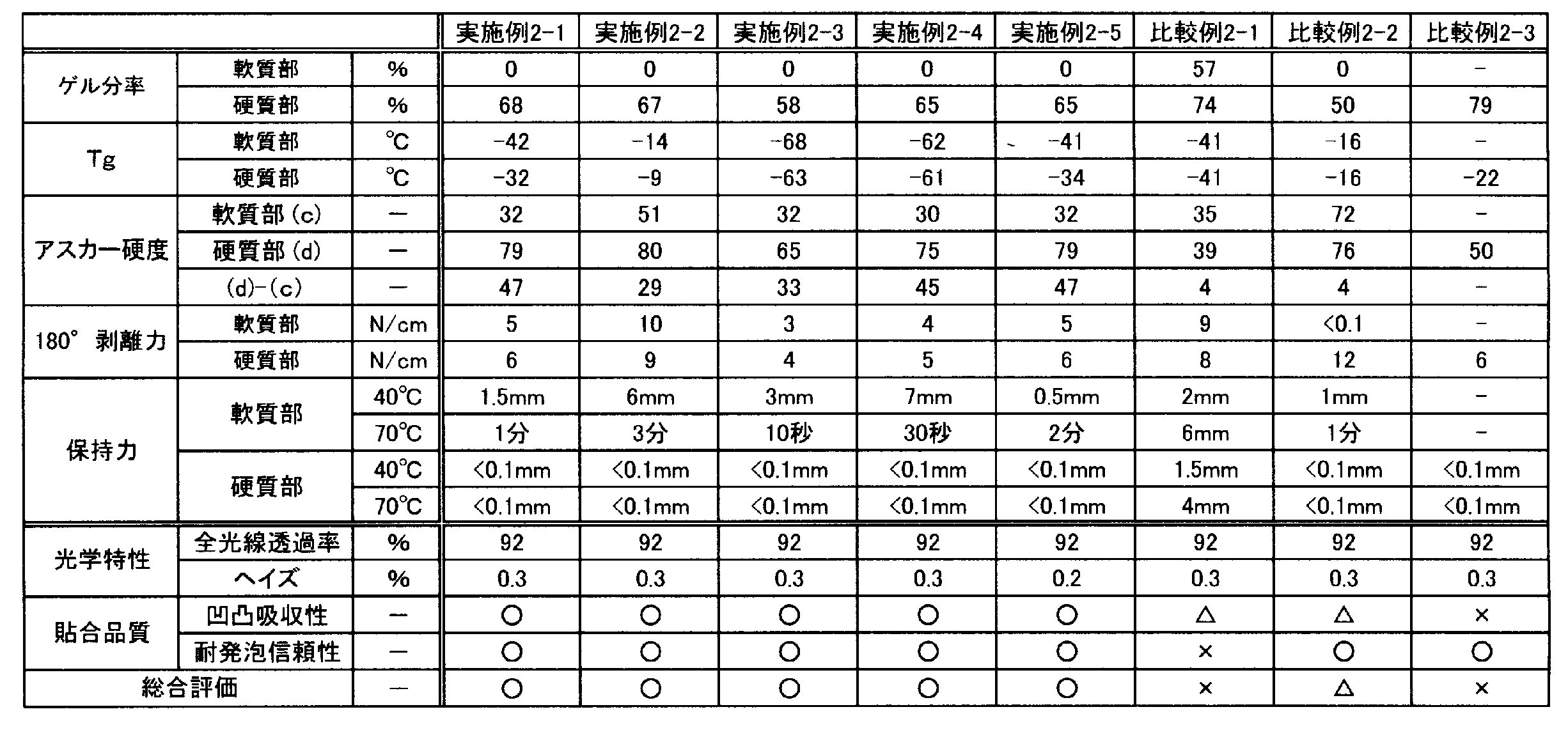
(考察)
実施例2-1~2-5で作製した粘着シートは、軟質部のゲル分率が1%未満であることから、加熱により高い流動性を発現する。したがって、貼合時に加熱し溶融させることで、凹凸面への追従性に優れるばかりか、被着体の一方がフィルムのような剛性の低い素材であっても段差近傍で屈曲を生じず、平滑な積層体を得ることができた。さらには、硬質部のゲル分率が40%以上であることから、高温高湿下等の苛酷な環境試験下においても高い凝集力を発現し、剥離や発泡、変形を生じず、高い信頼性をもつ積層体を得ることができた。
実施例2-1~2-5で作製した粘着シートは、軟質部のゲル分率が1%未満であることから、加熱により高い流動性を発現する。したがって、貼合時に加熱し溶融させることで、凹凸面への追従性に優れるばかりか、被着体の一方がフィルムのような剛性の低い素材であっても段差近傍で屈曲を生じず、平滑な積層体を得ることができた。さらには、硬質部のゲル分率が40%以上であることから、高温高湿下等の苛酷な環境試験下においても高い凝集力を発現し、剥離や発泡、変形を生じず、高い信頼性をもつ積層体を得ることができた。
比較例2-1の粘着シートは、紫外線照射によって粘着剤樹脂組成物が一部架橋しているため印刷段差付きガラスとフィルムとを積層する際、フィルム側に印刷段差による凹凸が転写し平滑な積層体が得られなかった。また、段差近傍の粘着材の歪みをきっかけに高温高湿試験下で発泡がみられ、保管安定性に劣るものであった。
比較例2-2は、(メタ)アクリル系共重合体を用いておらず、室温域においてある程度の剛性を備えた粘着性樹脂組成物を用いた、ホットメルトタイプの粘着シートである。
比較例2-2のシートは実施例の粘着シートと比較して、室温付近でのタック性が非常に低かった。印刷段差付きガラスとシートとを積層する際、加熱時の流動性が低いため、シート側に印刷段差による凹凸がわずかに転写し、実施例の粘着シートと比較して積層体の平滑性に劣る結果となった。また、光不透過箇所におけるアスカー硬度が高いことからもうかがえるように、貼合作業時においてシートの剛性が高く、自着性をもたないことから、貼合せする際に位置決めの段階から被着体を予熱する必要があり、圧着のみで常温貼付可能な粘着シートと比べて、作業が煩雑であるという課題もあった。
比較例2-3は、粘着シート2-7の粘着剤樹脂組成物の架橋反応が、既に完了しているため、粘着シート内にゲル分率が1%以下の軟質部が存在せず、フィルム側に印刷段差による凹凸が転写し平滑な積層体が得られないばかりか、印刷段差が交差する角部付近では一部粘着剤が充填しきれず気泡が残る結果となった。
比較例2-2は、(メタ)アクリル系共重合体を用いておらず、室温域においてある程度の剛性を備えた粘着性樹脂組成物を用いた、ホットメルトタイプの粘着シートである。
比較例2-2のシートは実施例の粘着シートと比較して、室温付近でのタック性が非常に低かった。印刷段差付きガラスとシートとを積層する際、加熱時の流動性が低いため、シート側に印刷段差による凹凸がわずかに転写し、実施例の粘着シートと比較して積層体の平滑性に劣る結果となった。また、光不透過箇所におけるアスカー硬度が高いことからもうかがえるように、貼合作業時においてシートの剛性が高く、自着性をもたないことから、貼合せする際に位置決めの段階から被着体を予熱する必要があり、圧着のみで常温貼付可能な粘着シートと比べて、作業が煩雑であるという課題もあった。
比較例2-3は、粘着シート2-7の粘着剤樹脂組成物の架橋反応が、既に完了しているため、粘着シート内にゲル分率が1%以下の軟質部が存在せず、フィルム側に印刷段差による凹凸が転写し平滑な積層体が得られないばかりか、印刷段差が交差する角部付近では一部粘着剤が充填しきれず気泡が残る結果となった。
以上の実施例の結果並びにこれまで発明者が行ってきた試験結果から、ゲル分率が1%未満の軟質部と、ゲル分率が40%以上の硬質部をもつ、(メタ)アクリル系共重合体を含む光硬化性透明両面粘着シートを用いれば、実施例同様に2つの画像表示装置構成部材を好適に接着させることができるものと考えることができる。
また、粘着シート面内の軟質部のゲル分率は1%未満であるのが好ましく、硬質部のゲル分率は40%以上であるのが好ましいと考えることができる。
また、粘着シート面内の軟質部のガラス転移温度(実測Tg)は-70~-10℃であるのが好ましく、硬質部のガラス転移温度(実測Tg)は-60~+20℃であり、硬質部のガラス転移温度(Tg[H])と軟質部のガラス転移温度(Tg[S])の差(Tg[H]-Tg[S])が3℃以上であるのが好ましいと考えることができる。
また、粘着シート面内の軟質部のガラス転移温度(実測Tg)は-70~-10℃であるのが好ましく、硬質部のガラス転移温度(実測Tg)は-60~+20℃であり、硬質部のガラス転移温度(Tg[H])と軟質部のガラス転移温度(Tg[S])の差(Tg[H]-Tg[S])が3℃以上であるのが好ましいと考えることができる。
[実施例2-6]
実施例2-1で作製した粘着シートX1について、幅150mm、長さ100mの長尺の積層シートを、初期の巻取張力70N、テーパー率20%として直径6インチのプラスチック製巻芯に巻き取り、粘着シートロールを作製した。
作製したシートロールの端面部に、高圧水銀ランプを用いて、波長365nmの積算光量が500mJ/cm2到達するよう光照射して端面部を光硬化させ、端面部に硬質部をもつ粘着シートロールとした。
実施例2-1で作製した粘着シートX1について、幅150mm、長さ100mの長尺の積層シートを、初期の巻取張力70N、テーパー率20%として直径6インチのプラスチック製巻芯に巻き取り、粘着シートロールを作製した。
作製したシートロールの端面部に、高圧水銀ランプを用いて、波長365nmの積算光量が500mJ/cm2到達するよう光照射して端面部を光硬化させ、端面部に硬質部をもつ粘着シートロールとした。
[比較例2-4]
光照射しなかった以外は、実施例2-6と同様にして粘着シートロールを作製した。
光照射しなかった以外は、実施例2-6と同様にして粘着シートロールを作製した。
このようにして作製した、硬質部を有さない軟質部のみの比較例2-4の粘着シートロールと、端面部に硬質部を有する実施例2-6の粘着シートロールについて、40℃90%RHの恒温恒湿槽に2週間保管した後に粘着シートロールの端面部を目視観察した。
端面部に硬質部をもつ実施例2-5の粘着シートロールは、端面部からの糊はみ出しがなく、シートの巻出し作業性が良好であったのに対し、軟質部のみからなる比較例2-4の粘着シートロールの端面部は糊はみ出しにより端面部が粘々し、巻出し作業に支障を来す結果となった。
端面部に硬質部をもつ実施例2-5の粘着シートロールは、端面部からの糊はみ出しがなく、シートの巻出し作業性が良好であったのに対し、軟質部のみからなる比較例2-4の粘着シートロールの端面部は糊はみ出しにより端面部が粘々し、巻出し作業に支障を来す結果となった。
[実施例3-1]
(メタ)アクリル系共重合体(3-A)として、ポリメタクリル酸メチルマクロモノマー(Tg:105℃、数平均分子量は2400)15質量部(18mol%)とブチルアクリレート(Tg:-55℃)81質量部(75mol%)とアクリル酸(Tg:106℃)4質量部(7mol%)とがランダム共重合してなるグラフト共重合体(3-A1)を使用した。
このグラフト共重合体(3-A1)において、幹成分を構成する共重合体のガラス転移温度は-60℃、マクロモノマーのグラフト共重合体(3-A1)中の含有量は15質量%であり、温度130℃、周波数0.02Hzにおける複素粘度が260Pa・sであった。
(メタ)アクリル系共重合体(3-A)として、ポリメタクリル酸メチルマクロモノマー(Tg:105℃、数平均分子量は2400)15質量部(18mol%)とブチルアクリレート(Tg:-55℃)81質量部(75mol%)とアクリル酸(Tg:106℃)4質量部(7mol%)とがランダム共重合してなるグラフト共重合体(3-A1)を使用した。
このグラフト共重合体(3-A1)において、幹成分を構成する共重合体のガラス転移温度は-60℃、マクロモノマーのグラフト共重合体(3-A1)中の含有量は15質量%であり、温度130℃、周波数0.02Hzにおける複素粘度が260Pa・sであった。
このグラフト共重合体(3-A1)1kgと、架橋剤(3-B)としてのグリセリンジメタクリレート(日油社製、製品名:GMR)90gと、光重合開始剤(3-C)としての2,4,6-トリメチルベンゾフェノン及び4-メチルベンゾフェノンの混合物(Lanberti社製、製品名:エザキュアTZT)15gとを均一混合し、粘着剤樹脂組成物3-1を作製した。
前記粘着剤樹脂組成物3-1を、2枚の離型フィルムすなわち剥離処理された2枚のポリエチレンテレフタレートフィルム(三菱樹脂社製「ダイアホイルMRV-V06」、厚さ100μm/三菱樹脂社製「ダイアホイルMRQ」、厚さ75μm)で挟み、ラミネータを用いて厚さ150μmとなるようシート状に賦形し、粘着シート3-1(厚さ150μm)を作成した。
前記粘着剤樹脂組成物3-1を、2枚の離型フィルムすなわち剥離処理された2枚のポリエチレンテレフタレートフィルム(三菱樹脂社製「ダイアホイルMRV-V06」、厚さ100μm/三菱樹脂社製「ダイアホイルMRQ」、厚さ75μm)で挟み、ラミネータを用いて厚さ150μmとなるようシート状に賦形し、粘着シート3-1(厚さ150μm)を作成した。
[実施例3-2]
架橋剤(3-B)として、グリセリンジメタクリレート(新中村化学工業社製、製品名:NKエステル701)(3-B-1)90gを用いた以外は実施例3-1と同様に粘着剤樹脂組成物3-2を作製した。
前記粘着剤樹脂組成物3-2を用いて、実施例3-1と同様に粘着シート3-2(厚さ150μm)を作成した。
架橋剤(3-B)として、グリセリンジメタクリレート(新中村化学工業社製、製品名:NKエステル701)(3-B-1)90gを用いた以外は実施例3-1と同様に粘着剤樹脂組成物3-2を作製した。
前記粘着剤樹脂組成物3-2を用いて、実施例3-1と同様に粘着シート3-2(厚さ150μm)を作成した。
[実施例3-3]
実施例3-1と同じグラフト共重合体(3-A1)1kgと、架橋剤(3-B)として、グリセリンジメタクリレート(日油社製、製品名:GMR)90gと、光重合開始剤(3-C)としての2,4,6-トリメチルベンゾフェノン及び4-メチルベンゾフェノンの混合物(Lanberti社製、製品名:エザキュアTZT)15gと、紫外線安定化剤(チバジャパン社製、製品名:TIN123)50gとを均一混合し、粘着剤樹脂組成物3-3を作製した。
そして、この粘着剤樹脂組成物3-3を用いて実施例3-1と同様に粘着シート3-3(厚さ150μm)を作成した。
実施例3-1と同じグラフト共重合体(3-A1)1kgと、架橋剤(3-B)として、グリセリンジメタクリレート(日油社製、製品名:GMR)90gと、光重合開始剤(3-C)としての2,4,6-トリメチルベンゾフェノン及び4-メチルベンゾフェノンの混合物(Lanberti社製、製品名:エザキュアTZT)15gと、紫外線安定化剤(チバジャパン社製、製品名:TIN123)50gとを均一混合し、粘着剤樹脂組成物3-3を作製した。
そして、この粘着剤樹脂組成物3-3を用いて実施例3-1と同様に粘着シート3-3(厚さ150μm)を作成した。
[実施例3-4]
(メタ)アクリル系共重合体(3-A)として、ポリメタクリル酸メチルマクロモノマー(Tg:105℃、数平均分子量は2500)10質量部(12mol%)とブチルアクリレート(Tg:-55℃)88質量部(84mol%)とアクリル酸(Tg:106℃)2質量部(7mol%)とがランダム共重合してなるグラフト共重合体(3-A2)を使用した。
このグラフト共重合体(3-A2)において、幹成分を構成する共重合体のガラス転移温度は-60℃、マクロモノマーのグラフト共重合体(3-A2)中の含有量は10質量%であり、温度130℃、周波数0.02Hzにおける複素粘度が240Pa・sであった。
(メタ)アクリル系共重合体(3-A)として、ポリメタクリル酸メチルマクロモノマー(Tg:105℃、数平均分子量は2500)10質量部(12mol%)とブチルアクリレート(Tg:-55℃)88質量部(84mol%)とアクリル酸(Tg:106℃)2質量部(7mol%)とがランダム共重合してなるグラフト共重合体(3-A2)を使用した。
このグラフト共重合体(3-A2)において、幹成分を構成する共重合体のガラス転移温度は-60℃、マクロモノマーのグラフト共重合体(3-A2)中の含有量は10質量%であり、温度130℃、周波数0.02Hzにおける複素粘度が240Pa・sであった。
このグラフト共重合体(3-A2)1kgと、架橋剤(3-B)としてのトリメチロールプロパントリアクリレート(新中村化学工業社製、製品名:CLM400)50gと、光重合開始剤(3-C)としての2,4,6-トリメチルベンゾフェノン及び4-メチルベンゾフェノンの混合物(Lanberti社製、製品名:エザキュアTZT)15gとを均一混合し、粘着剤樹脂組成物3-4を作製した。
そして、この粘着剤樹脂組成物3-4を用いて実施例3-1と同様に粘着シート3-4(厚さ150μm)を作成した。
そして、この粘着剤樹脂組成物3-4を用いて実施例3-1と同様に粘着シート3-4(厚さ150μm)を作成した。
[実施例3-5]
(メタ)アクリル系共重合体(3-A)として、ポリメタクリル酸メチルマクロモノマー(Tg:105℃、数平均分子量は2500)8質量部(10mol%)とブチルアクリレート(Tg:-55℃)89質量部(85mol%)とアクリル酸(Tg:106℃)3質量部(5mol%)とがランダム共重合してなるグラフト共重合体(3-A3)を使用した。
このグラフト共重合体(3-A3)において、幹成分を構成する共重合体のガラス転移温度は-40℃、マクロモノマーのグラフト共重合体(3-A3)中の含有量は8質量%であり、温度130℃、周波数0.02Hzにおける複素粘度が220Pa・sであった。
(メタ)アクリル系共重合体(3-A)として、ポリメタクリル酸メチルマクロモノマー(Tg:105℃、数平均分子量は2500)8質量部(10mol%)とブチルアクリレート(Tg:-55℃)89質量部(85mol%)とアクリル酸(Tg:106℃)3質量部(5mol%)とがランダム共重合してなるグラフト共重合体(3-A3)を使用した。
このグラフト共重合体(3-A3)において、幹成分を構成する共重合体のガラス転移温度は-40℃、マクロモノマーのグラフト共重合体(3-A3)中の含有量は8質量%であり、温度130℃、周波数0.02Hzにおける複素粘度が220Pa・sであった。
このグラフト共重合体(3-A3)1kgと、架橋剤(3-B)としてのグリセリンジメタクリレート(日油社製、製品名:GMR)90gと、光重合開始剤(3-C)としての2,4,6-トリメチルベンゾフェノン及び4-メチルベンゾフェノンの混合物(Lanberti社製、製品名:エザキュアTZT)15gとを均一混合し、粘着剤樹脂組成物3-5を作製した。
そして、この粘着剤樹脂組成物3-5を用いて、実施例3-1と同様に粘着シート3-5(厚さ150μm)を作成した。
そして、この粘着剤樹脂組成物3-5を用いて、実施例3-1と同様に粘着シート3-5(厚さ150μm)を作成した。
[比較例3-1]
国際公開2012/032995号公報の実施例に相当するように作製した。
すなわち、(メタ)アクリル系共重合体(3-A)として、2-エチルヘキシルアクリレート(Tg:-70℃)75質量部(57mol%)と酢酸ビニル(Tg:32℃)20質量部(33mol%)とアクリル酸(Tg:106℃)5質量部(10mol%)とをランダム共重合してなるアクリル系共重合体(3-A-5)1kgに、架橋剤(3-B)として、トリメチロールプロパントリアクリレート(3-B-4)200g及び光重合開始剤(3-C)として、4-メチルベンゾフェノン(3-C-3)10gを混合添加して中間層用樹脂組成物を調製した。
この中間層用樹脂組成物を、剥離処理した2枚のポリエチレンテレフタレートフィルム(パナック社製、NP75Z01、厚さ75μm/東洋紡績社製、E7006、厚さ38μm)で挟み、厚さ80μmとなるようシート状に賦形し、中間層用シート(α)を作成した。
国際公開2012/032995号公報の実施例に相当するように作製した。
すなわち、(メタ)アクリル系共重合体(3-A)として、2-エチルヘキシルアクリレート(Tg:-70℃)75質量部(57mol%)と酢酸ビニル(Tg:32℃)20質量部(33mol%)とアクリル酸(Tg:106℃)5質量部(10mol%)とをランダム共重合してなるアクリル系共重合体(3-A-5)1kgに、架橋剤(3-B)として、トリメチロールプロパントリアクリレート(3-B-4)200g及び光重合開始剤(3-C)として、4-メチルベンゾフェノン(3-C-3)10gを混合添加して中間層用樹脂組成物を調製した。
この中間層用樹脂組成物を、剥離処理した2枚のポリエチレンテレフタレートフィルム(パナック社製、NP75Z01、厚さ75μm/東洋紡績社製、E7006、厚さ38μm)で挟み、厚さ80μmとなるようシート状に賦形し、中間層用シート(α)を作成した。
続いて、前記アクリル系共重合体(3-A-5)1kgに対し、光重合開始剤(3-C)として、4-メチルベンゾフェノン(3-C-3)20gを添加混合し、接着層用樹脂組成物を調整した。
前記接着層用樹脂組成物を、2枚の離型フィルムすなわち剥離処理された2枚のポリエチレンテレフタレートフィルム(三菱樹脂社製「ダイアホイルMRA」、厚さ75μm/東洋紡績社製「E7006」、厚さ38μm)で挟み、厚さ35μmとなるようシート状に賦形し、接着層用樹脂シート(β)を作成した。
さらに接着層用樹脂組成物を、剥離処理した2枚のポリエチレンテレフタレートフィルム(三菱樹脂社製、ダイアホイルMRF、厚さ75μm/東洋紡績社製、E7006、厚さ38μm)で挟み、厚さ35μmとなるようシート状に賦形し、接着層用樹脂シート(β’)を作成した。
前記接着層用樹脂組成物を、2枚の離型フィルムすなわち剥離処理された2枚のポリエチレンテレフタレートフィルム(三菱樹脂社製「ダイアホイルMRA」、厚さ75μm/東洋紡績社製「E7006」、厚さ38μm)で挟み、厚さ35μmとなるようシート状に賦形し、接着層用樹脂シート(β)を作成した。
さらに接着層用樹脂組成物を、剥離処理した2枚のポリエチレンテレフタレートフィルム(三菱樹脂社製、ダイアホイルMRF、厚さ75μm/東洋紡績社製、E7006、厚さ38μm)で挟み、厚さ35μmとなるようシート状に賦形し、接着層用樹脂シート(β’)を作成した。
中間層用シート(α)の両側のPETフィルムを順次剥離除去すると共に、接着層用樹脂シート(β)及び(β’)の一側のPETフィルムを剥がして、露出した粘着面を中間層用シート(α)の両表面に順次貼合し、(β)/(α)/(β’)からなる3層粘着シートを作製した。
(β)及び(β’)の表面に残るPETフィルムを介して、波長365nmの積算光量が1000mJ/cm2となるよう高圧水銀ランプにて紫外線を照射し、(α)、(β)及び(β’)を紫外線架橋させて、粘着シート3-6(厚さ150μm)を作成した。
(β)及び(β’)の表面に残るPETフィルムを介して、波長365nmの積算光量が1000mJ/cm2となるよう高圧水銀ランプにて紫外線を照射し、(α)、(β)及び(β’)を紫外線架橋させて、粘着シート3-6(厚さ150μm)を作成した。
[比較例3-2]
WO2010/038366の実施例6に準じて粘着シートを作製した。
すなわち、(メタ)アクリル系共重合体(3-A)の代替として、フェノキシ樹脂(InChem社製、PKHH、重量平均分子量5.2万)650gと、架橋剤(3-B)の代替として、カーボネート骨格を有するポリウレタンアクリレート(根上工業社製、UN5500、重量平均分子量6.7万)1kg、光重合開始剤(3-C)として、1-シクロヘキシルフェニルケトン(BASF社製、Irgacure184)43gを均一混合してなる粘着剤樹脂組成物3-7を作製した。
前記組成物3-7は、実施例3-1と同様の方法にて、粘着シート3-7(厚さ150μm)を作成した。
WO2010/038366の実施例6に準じて粘着シートを作製した。
すなわち、(メタ)アクリル系共重合体(3-A)の代替として、フェノキシ樹脂(InChem社製、PKHH、重量平均分子量5.2万)650gと、架橋剤(3-B)の代替として、カーボネート骨格を有するポリウレタンアクリレート(根上工業社製、UN5500、重量平均分子量6.7万)1kg、光重合開始剤(3-C)として、1-シクロヘキシルフェニルケトン(BASF社製、Irgacure184)43gを均一混合してなる粘着剤樹脂組成物3-7を作製した。
前記組成物3-7は、実施例3-1と同様の方法にて、粘着シート3-7(厚さ150μm)を作成した。
[評価]
実施例及び比較例で作成した粘着シート及び積層体について、次のように評価した。
実施例及び比較例で作成した粘着シート及び積層体について、次のように評価した。
(引張弾性率、破断強度、破断伸び)
粘着シート3-1~3-7を巾20mmに裁断し、光架橋前の引張試験測定試料とした。
粘着シート3-1~3-7を巾20mmに裁断した後、365nmの積算光量が2000mJ/cm2となるように、離形PET側から高圧水銀ランプを用いて紫外線を照射して粘着シートを硬化し、23℃50%RHで15時間養生して、光架橋後の引張試験測定試料とした。
上記引張試験測定試料を23℃50%RHの環境下にて、試験速度300mm/分で引張時の引張弾性率、引張破断強度、引張破断伸びを測定した。
なお、引張弾性率の測定条件は変位が30~50mmとした。
粘着シート3-1~3-7を巾20mmに裁断し、光架橋前の引張試験測定試料とした。
粘着シート3-1~3-7を巾20mmに裁断した後、365nmの積算光量が2000mJ/cm2となるように、離形PET側から高圧水銀ランプを用いて紫外線を照射して粘着シートを硬化し、23℃50%RHで15時間養生して、光架橋後の引張試験測定試料とした。
上記引張試験測定試料を23℃50%RHの環境下にて、試験速度300mm/分で引張時の引張弾性率、引張破断強度、引張破断伸びを測定した。
なお、引張弾性率の測定条件は変位が30~50mmとした。
(ゲル分率)
実施例及び比較例で作製した粘着シート3-1~3-7の光透過部に接する箇所、すなわち硬質部と、光不透過部に接する箇所、すなわち軟質部それぞれを取り出したものについて、下記の測定を行った。
実施例及び比較例で作製した粘着シート3-1~3-7の光透過部に接する箇所、すなわち硬質部と、光不透過部に接する箇所、すなわち軟質部それぞれを取り出したものについて、下記の測定を行った。
1)粘着剤樹脂組成物を秤量し(W1)、予め重さを測った200メッシュのSUSメッシュ(W0)に包む。
2)上記SUSメッシュを100mLの酢酸エチルに24時間浸漬する。
3)SUSメッシュを取り出し、75℃で4時間半乾燥する。
4)乾燥後の重量(W2)を求め、下記式より粘着剤樹脂組成物のゲル分率を測定する。
ゲル分率(%)=100×(W2-W0)/W1
2)上記SUSメッシュを100mLの酢酸エチルに24時間浸漬する。
3)SUSメッシュを取り出し、75℃で4時間半乾燥する。
4)乾燥後の重量(W2)を求め、下記式より粘着剤樹脂組成物のゲル分率を測定する。
ゲル分率(%)=100×(W2-W0)/W1
(作業性(保管性))
50mm×50mm角に裁断した粘着シート3-1~3-7を、100mm×100mm四方で厚さ2mmのガラス板2枚の間に挟んで積層体を作製した。500gのおもりを積層体の上に置き、60℃の環境下にて24時間放置後に積層体から粘着剤がはみ出たか目視観察を行った。
作製した積層体を目視観察して、粘着剤が全体的にはみ出たものを「×」、粘着剤が角部のみはみ出たものを「△」、粘着剤がはみ出なかったものを「○」と判定した。
50mm×50mm角に裁断した粘着シート3-1~3-7を、100mm×100mm四方で厚さ2mmのガラス板2枚の間に挟んで積層体を作製した。500gのおもりを積層体の上に置き、60℃の環境下にて24時間放置後に積層体から粘着剤がはみ出たか目視観察を行った。
作製した積層体を目視観察して、粘着剤が全体的にはみ出たものを「×」、粘着剤が角部のみはみ出たものを「△」、粘着剤がはみ出なかったものを「○」と判定した。
(段差吸収性)
実施例3-1~3-5及び比較例3-1で作製した光照射前の状態の粘着シート3-1~3-6を、50mm×80mmに裁断し、一方の離型フィルムを剥がして露出した粘着面を、周縁部3mmに厚さ80μmの印刷を施したソーダライムガラス(82mm×53mm×0.5mm厚)の印刷面に、粘着材の4辺が印刷段差にかかるようにして真空プレスを用いてプレス圧着した(絶対圧5kPa、温度80℃、プレス圧0.04MPa)。次いで、残る離型フィルムを剥がし、ゼオノアフィルム(日本ゼオン社製、100μm厚)をプレス貼合した後、オートクレーブ処理(80℃、ゲージ圧0.2MPa、20分)を施して仕上げ貼着した。
次に、印刷を施したソーダライムガラス側から、波長365nmの紫外線がシートXに2000mJ/cm2に到達するよう高圧水銀ランプにて紫外線を照射し、印刷の施されていない開口部、すなわち光透過部に接する箇所のシートを硬化させて、評価用積層体3-1~3-6を作成した。
実施例3-1~3-5及び比較例3-1で作製した光照射前の状態の粘着シート3-1~3-6を、50mm×80mmに裁断し、一方の離型フィルムを剥がして露出した粘着面を、周縁部3mmに厚さ80μmの印刷を施したソーダライムガラス(82mm×53mm×0.5mm厚)の印刷面に、粘着材の4辺が印刷段差にかかるようにして真空プレスを用いてプレス圧着した(絶対圧5kPa、温度80℃、プレス圧0.04MPa)。次いで、残る離型フィルムを剥がし、ゼオノアフィルム(日本ゼオン社製、100μm厚)をプレス貼合した後、オートクレーブ処理(80℃、ゲージ圧0.2MPa、20分)を施して仕上げ貼着した。
次に、印刷を施したソーダライムガラス側から、波長365nmの紫外線がシートXに2000mJ/cm2に到達するよう高圧水銀ランプにて紫外線を照射し、印刷の施されていない開口部、すなわち光透過部に接する箇所のシートを硬化させて、評価用積層体3-1~3-6を作成した。
比較例3-2で作成した粘着シート3-7については、粘着シート3-7を用いて、前述と同様の手順で印刷を施したソーダライムガラスとゼオノアフィルム(日本ゼオン社製、100μm厚)との積層体を作成した後、オートクレーブ処理(80℃、ゲージ圧0.2MPa、20分)を施して仕上げ貼着し、評価用積層体3-7とした。
作製した積層体3-1~3-7を目視観察し、印刷段差近傍で粘着材が追従せず気泡が残ったものを「×」、フィルムが段差近傍で屈曲し、歪むことによる凹凸ムラが見えたものを「△」、気泡なく平滑に貼合されたものを「○」と判定した。
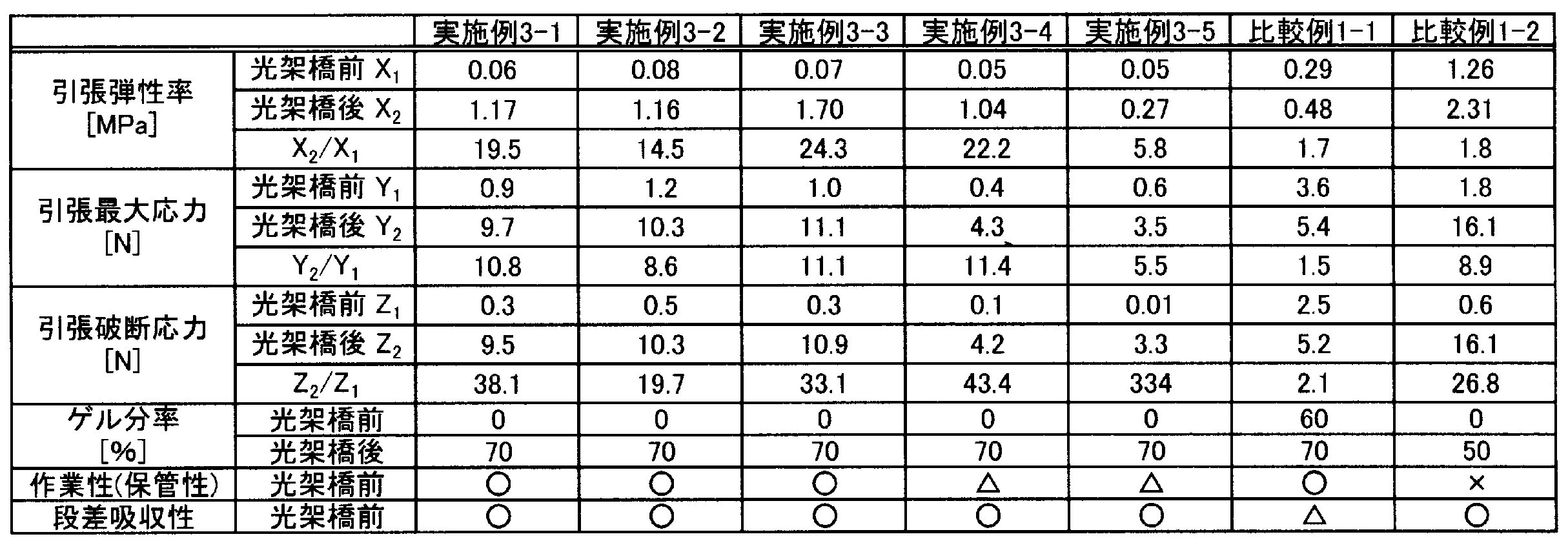
実施例3-1~3-5で作製した粘着シートは、光硬化前後で引張特性が大きく変化するものであった。このような特性を有しているため、実施例3-1~3-5で作製した粘着シートは、光硬化前は優れた段差吸収性を有する一方、光硬化後は優れた耐発泡性を有することができることが確認された。
これに対し、比較例では、光硬化前後で引張特性の変化が不十分であったため、比較例3-1では光架橋後の変化が不十分な為、信頼性の劣るシートとなり、比較例3-2では光架橋前で作業性(保管性)の劣るシートとなった。
これに対し、比較例では、光硬化前後で引張特性の変化が不十分であったため、比較例3-1では光架橋後の変化が不十分な為、信頼性の劣るシートとなり、比較例3-2では光架橋前で作業性(保管性)の劣るシートとなった。
Claims (16)
- (メタ)アクリル系共重合体(A)、架橋剤(B)及び、光重合開始剤(C)を含有する樹脂組成物から形成された光硬化前の粘着シートであって、光硬化性を有し、且つ、次の(1)及び(2)の特性を備えたものであることを特徴とする粘着シート。
(1) 0~40℃において、形状保持することができ、且つ自己粘着性を示す。
(2) 70~100℃において、粘度が100~3000Pa・sを示す。 - 前記(メタ)アクリル系共重合体(A)が、枝成分としてマクロモノマーを備えたグラフト共重合体であることを特徴とする請求項1に記載の粘着シート。
- 前記(メタ)アクリル系共重合体(A)が、ガラス転移温度(Tg)が0℃未満のモノマーa1と、ガラス転移温度(Tg)が0℃以上80℃未満のモノマーa2と、ガラス転移温度(Tg)が80℃以上のモノマーa3とが、a1:a2:a3=10~40:90~35:0~25のモル比率で共重合してなるものであり、かつ、重量平均分子量が50000~400000である(メタ)アクリル系共重合体であることを特徴とする請求項1に記載の粘着シート。
- さらに、光硬化後に下記(3)の特性を有することを特徴とする請求項1~3の何れかに記載の粘着シート。
(3) 70~100℃における粘度が3000~50000Pa・sである。 - (メタ)アクリル系共重合体(A)を含有し、光硬化されてなる粘着シートであって、ゲル分率が1%未満のシート部と、ゲル分率が40%以上のシート部とを有することを特徴とする粘着シート。
- 上記ゲル分率が1%未満のシート部は、示差走査熱量計(DSC)により測定されるガラス転移温度(Tg[H])が-70~-10℃であって、ゲル分率が40%以上のシート部は、示差走査熱量計(DSC)により測定されるガラス転移温度(Tg[S])が-60~+20℃であり、ゲル分率が40%以上のシート部のガラス転移温度とゲル分率が1%未満のシート部のガラス転移温度との差(Tg[H]-Tg[S])が3℃以上である請求項5に記載の粘着シート。
- (メタ)アクリル系共重合体(A)と、架橋剤(B)と、光重合開始剤(C)とを含有する樹脂組成物から形成してなるシートを、部分的に光硬化してなる請求項5又は6に記載の粘着シート。
- 前記(メタ)アクリル系共重合体(A)が、枝成分としてマクロモノマーを備えたグラフト共重合体であることを特徴とする請求項5~7の何れかに記載の粘着シート。
- 前記(メタ)アクリル系共重合体(A)が、ガラス転移温度(Tg)が0℃未満のモノマーa1と、ガラス転移温度(Tg)が0℃以上80℃未満のモノマーa2と、ガラス転移温度(Tg)が80℃以上のモノマーa3とが、a1:a2:a3=10~40:90~35:0~25のモル比率で共重合してなるものであり、かつ、重量平均分子量が50000~400000である(メタ)アクリル系共重合体であることを特徴とする請求項5~8の何れかに記載の粘着シート。
- 粘着シートのシート面内に、ゲル分率が1%未満のシート部と、ゲル分率が40%以上のシート部とを有することを特徴とする請求項5~9の何れかに記載の粘着シート。
- (メタ)アクリル系共重合体(A)100質量部と、架橋剤(B)0.5~20質量部と、光重合開始剤(C)0.1~5質量部とを含有する樹脂組成物からなる粘着シートであって、
光架橋前の引張弾性率(X1)と光架橋後の引張弾性率(X2)との比(X1/X2)が3以上となることを特徴とする粘着シート。 - 前記(メタ)アクリル系共重合体(A)は、枝成分としてマクロモノマーを備えたグラフト共重合体であって、前記マクロモノマーを5~30質量%の割合で含有するものであることを特徴とする請求項11に記載の粘着シート。
- 請求項1~12の何れかに記載の粘着シートと、離型フィルムとを積層してなる構成を備えた粘着シート積層体。
- 2つの画像表示装置用構成部材間を、請求項1~12の何れかに記載の粘着シートを介して積層してなる構成を備えた画像表示装置構成用積層体。
- 前記画像表示装置構成部材が、タッチパネル、画像表示パネル、表面保護パネル及び偏光フィルムからなる群のうちの何れか1種或いは2種類以上の組み合わせからなる積層体であることを特徴とする請求項14に記載の画像表示装置構成用積層体。
- 請求項14又は15に記載の画像表示装置構成用積層体を用いて構成された画像表示装置。
Priority Applications (3)
| Application Number | Priority Date | Filing Date | Title |
|---|---|---|---|
| KR1020187000091A KR102080224B1 (ko) | 2015-06-02 | 2016-06-01 | 광경화형 점착 시트, 점착 시트 및 화상 표시 장치 |
| KR1020207004561A KR20200019792A (ko) | 2015-06-02 | 2016-06-01 | 광경화형 점착 시트, 점착 시트 및 화상 표시 장치 |
| CN201680032296.2A CN107709493B (zh) | 2015-06-02 | 2016-06-01 | 光固化型粘合片、粘合片及图像显示装置 |
Applications Claiming Priority (6)
| Application Number | Priority Date | Filing Date | Title |
|---|---|---|---|
| JP2015111940 | 2015-06-02 | ||
| JP2015111939 | 2015-06-02 | ||
| JP2015-111940 | 2015-06-02 | ||
| JP2015-111939 | 2015-06-02 | ||
| JP2015-111941 | 2015-06-02 | ||
| JP2015111941 | 2015-06-02 |
Publications (1)
| Publication Number | Publication Date |
|---|---|
| WO2016194957A1 true WO2016194957A1 (ja) | 2016-12-08 |
Family
ID=57440473
Family Applications (1)
| Application Number | Title | Priority Date | Filing Date |
|---|---|---|---|
| PCT/JP2016/066215 Ceased WO2016194957A1 (ja) | 2015-06-02 | 2016-06-01 | 光硬化型粘着シート、粘着シート及び画像表示装置 |
Country Status (4)
| Country | Link |
|---|---|
| KR (2) | KR102080224B1 (ja) |
| CN (3) | CN108977113B (ja) |
| TW (5) | TWI792369B (ja) |
| WO (1) | WO2016194957A1 (ja) |
Cited By (8)
| Publication number | Priority date | Publication date | Assignee | Title |
|---|---|---|---|---|
| WO2019031426A1 (ja) * | 2017-08-08 | 2019-02-14 | 三菱ケミカル株式会社 | 光硬化性粘着シート、光硬化性粘着シート積層体、光硬化性粘着シート積層体の製造方法及び画像表示パネル積層体の製造方法 |
| CN109988512A (zh) * | 2018-01-03 | 2019-07-09 | 泰柏斯科技有限公司 | 紫外线可固化光学粘合剂及其制备方法与用于其的组合物 |
| JP2019210445A (ja) * | 2017-08-08 | 2019-12-12 | 三菱ケミカル株式会社 | 光硬化性粘着シート |
| JP2019210446A (ja) * | 2017-08-08 | 2019-12-12 | 三菱ケミカル株式会社 | 光硬化性粘着シート積層体、光硬化性粘着シート積層体の製造方法及び画像表示パネル積層体の製造方法 |
| CN110945581A (zh) * | 2017-06-28 | 2020-03-31 | 迪睿合株式会社 | 图像显示装置的制造方法、光固化性树脂组合物和透光性固化树脂层 |
| CN111511857A (zh) * | 2017-12-18 | 2020-08-07 | 王子控股株式会社 | 粘合片及层叠体的制造方法 |
| WO2022210894A1 (ja) * | 2021-03-31 | 2022-10-06 | 大日本印刷株式会社 | 転写フィルム、ハードコートフィルム、ならびにハードコート成形体およびその製造方法 |
| WO2024204827A1 (ja) | 2023-03-31 | 2024-10-03 | 積水化学工業株式会社 | 発泡体シート、粘着テープ |
Families Citing this family (12)
| Publication number | Priority date | Publication date | Assignee | Title |
|---|---|---|---|---|
| CN108641620A (zh) * | 2018-03-28 | 2018-10-12 | 广州慧谷工程材料有限公司 | 一种用于图像光学构件、接触面板、显示装置的压敏胶及其应用方法 |
| WO2020031991A1 (ja) * | 2018-08-06 | 2020-02-13 | 三菱ケミカル株式会社 | 光硬化性粘着シート、粘着シート積層体、画像表示装置用積層体及び画像表示装置 |
| KR102024081B1 (ko) * | 2018-11-27 | 2019-09-24 | 주식회사 테이팩스 | 광 경화형 광학용 점착제 조성물, 상기 조성물로부터 제조된 점착제, 및 상기 점착제의 제조 방법 |
| KR102352953B1 (ko) * | 2018-12-14 | 2022-01-18 | 삼성에스디아이 주식회사 | 점착 필름, 이를 포함하는 광학 부재 및 이를 포함하는 광학표시장치 |
| KR102473023B1 (ko) * | 2019-11-01 | 2022-12-01 | 코제노벨머티얼리스코리아 주식회사 | 점착 필름 |
| CN114729239B (zh) * | 2019-11-22 | 2024-04-23 | 三菱化学株式会社 | 粘合片、层叠片、柔性图像显示装置构件和柔性图像显示装置 |
| WO2021199571A1 (ja) * | 2020-03-31 | 2021-10-07 | 三菱ケミカル株式会社 | 活性エネルギー線硬化性粘着シート、粘着シート、画像表示装置用積層体、画像表示装置及び画像表示装置構成用積層体の製造方法 |
| CN111518480B (zh) * | 2020-04-28 | 2021-07-16 | 常州百佳年代薄膜科技股份有限公司 | 复合胶膜及制备方法、设备、热熔胶、胶黏剂、光伏组件 |
| KR102983037B1 (ko) * | 2020-06-15 | 2026-06-26 | 닛토덴코 가부시키가이샤 | 플렉시블 화상 표시 장치 내의 적층체에 사용하는 점착 시트, 플렉시블 화상 표시 장치에 사용하는 적층체 및 플렉시블 화상 표시 장치 |
| WO2022158121A1 (ja) * | 2021-01-20 | 2022-07-28 | 三菱ケミカル株式会社 | 活性エネルギー線硬化性粘着シート、離型フィルム付き粘着シート積層体、粘着シート、画像表示装置構成用積層体および画像表示装置 |
| KR20240027704A (ko) * | 2021-06-24 | 2024-03-04 | 미쓰이금속광업주식회사 | 배선 기판의 제조 방법 |
| CN114149388B (zh) * | 2021-11-10 | 2023-05-02 | 广东红墙新材料股份有限公司 | 一种预聚体及其衍生物以及它们的制备方法与应用 |
Citations (2)
| Publication number | Priority date | Publication date | Assignee | Title |
|---|---|---|---|---|
| JP2001049200A (ja) * | 1999-08-11 | 2001-02-20 | Soken Chem & Eng Co Ltd | アクリル系粘着剤組成物、該組成物を用いた粘着テープの製造方法および粘着テープ |
| JP2014088549A (ja) * | 2012-10-05 | 2014-05-15 | Toagosei Co Ltd | 粘着剤組成物およびその用途 |
Family Cites Families (12)
| Publication number | Priority date | Publication date | Assignee | Title |
|---|---|---|---|---|
| DE60134754D1 (de) * | 2001-12-07 | 2008-08-21 | 3M Innovative Properties Co | Acrylischer druckempfindlicher Schmelzklebstoff und seine Verwendung |
| JP4493643B2 (ja) * | 2006-12-06 | 2010-06-30 | 日東電工株式会社 | 再剥離型粘着剤組成物、及び粘着テープ又はシート |
| JP4524320B2 (ja) * | 2008-08-11 | 2010-08-18 | 日東電工株式会社 | 粘着剤組成物、粘着剤層、および粘着剤シート |
| TWI485214B (zh) | 2008-09-05 | 2015-05-21 | Kyoritsu Chemical Co Ltd | And a photohardenable resin composition for bonding an optical functional material |
| JP5716881B2 (ja) | 2008-10-04 | 2015-05-13 | スリーボンドファインケミカル株式会社 | 光硬化性接着剤組成物 |
| JP5586497B2 (ja) * | 2010-04-21 | 2014-09-10 | 日東電工株式会社 | 光学部材用の粘接着剤組成物、粘接着剤層、粘接着剤層が設けられた光学部材、光学部材付画像表示装置、および画像表示装置の製造方法 |
| JP2012007047A (ja) * | 2010-06-23 | 2012-01-12 | Nitto Denko Corp | 再剥離粘着テープおよびその製造方法 |
| WO2012032995A1 (ja) * | 2010-09-06 | 2012-03-15 | 三菱樹脂株式会社 | 画像表示装置構成用積層体の製造方法、及びこの積層体を用いてなる画像表示装置 |
| JP5757809B2 (ja) | 2011-07-13 | 2015-08-05 | 綜研化学株式会社 | 積層体および該積層体を有するタッチパネル |
| JP5971498B2 (ja) * | 2011-08-19 | 2016-08-17 | エルジー・ケム・リミテッド | 偏光板 |
| KR101774211B1 (ko) * | 2012-01-18 | 2017-09-04 | 미쯔비시 케미컬 주식회사 | 화상 표시 장치용 투명 양면 점착 시트 및 이를 사용한 화상 표시 장치 |
| CN104277720B (zh) * | 2013-07-08 | 2017-07-21 | 三星Sdi株式会社 | 粘合剂组合物、粘合剂膜、偏振板及显示装置 |
-
2016
- 2016-06-01 CN CN201810737369.9A patent/CN108977113B/zh active Active
- 2016-06-01 KR KR1020187000091A patent/KR102080224B1/ko active Active
- 2016-06-01 KR KR1020207004561A patent/KR20200019792A/ko not_active Withdrawn
- 2016-06-01 CN CN201680032296.2A patent/CN107709493B/zh active Active
- 2016-06-01 WO PCT/JP2016/066215 patent/WO2016194957A1/ja not_active Ceased
- 2016-06-01 CN CN202010703204.7A patent/CN111732904A/zh active Pending
- 2016-06-02 TW TW110123262A patent/TWI792369B/zh active
- 2016-06-02 TW TW109105323A patent/TW202024273A/zh unknown
- 2016-06-02 TW TW110106505A patent/TWI792195B/zh active
- 2016-06-02 TW TW109105321A patent/TWI728711B/zh active
- 2016-06-02 TW TW105117464A patent/TWI726883B/zh active
Patent Citations (2)
| Publication number | Priority date | Publication date | Assignee | Title |
|---|---|---|---|---|
| JP2001049200A (ja) * | 1999-08-11 | 2001-02-20 | Soken Chem & Eng Co Ltd | アクリル系粘着剤組成物、該組成物を用いた粘着テープの製造方法および粘着テープ |
| JP2014088549A (ja) * | 2012-10-05 | 2014-05-15 | Toagosei Co Ltd | 粘着剤組成物およびその用途 |
Cited By (18)
| Publication number | Priority date | Publication date | Assignee | Title |
|---|---|---|---|---|
| CN110945581B (zh) * | 2017-06-28 | 2022-01-14 | 迪睿合株式会社 | 图像显示装置的制造方法、光固化性树脂组合物和透光性固化树脂层 |
| CN110945581A (zh) * | 2017-06-28 | 2020-03-31 | 迪睿合株式会社 | 图像显示装置的制造方法、光固化性树脂组合物和透光性固化树脂层 |
| CN111876091B (zh) * | 2017-08-08 | 2023-04-14 | 三菱化学株式会社 | 带脱模薄膜的光固化性粘合片 |
| JP2019210445A (ja) * | 2017-08-08 | 2019-12-12 | 三菱ケミカル株式会社 | 光硬化性粘着シート |
| JP2019210446A (ja) * | 2017-08-08 | 2019-12-12 | 三菱ケミカル株式会社 | 光硬化性粘着シート積層体、光硬化性粘着シート積層体の製造方法及び画像表示パネル積層体の製造方法 |
| WO2019031426A1 (ja) * | 2017-08-08 | 2019-02-14 | 三菱ケミカル株式会社 | 光硬化性粘着シート、光硬化性粘着シート積層体、光硬化性粘着シート積層体の製造方法及び画像表示パネル積層体の製造方法 |
| CN111876091A (zh) * | 2017-08-08 | 2020-11-03 | 三菱化学株式会社 | 带脱模薄膜的光固化性粘合片 |
| JP2021004373A (ja) * | 2017-08-08 | 2021-01-14 | 三菱ケミカル株式会社 | 光硬化性粘着シート積層体、光硬化性粘着シート積層体の製造方法及び画像表示パネル積層体の製造方法 |
| CN111511857A (zh) * | 2017-12-18 | 2020-08-07 | 王子控股株式会社 | 粘合片及层叠体的制造方法 |
| CN111511857B (zh) * | 2017-12-18 | 2022-08-16 | 王子控股株式会社 | 粘合片及层叠体的制造方法 |
| CN109988512B (zh) * | 2018-01-03 | 2022-07-26 | 泰柏斯科技有限公司 | 紫外线可固化光学粘合剂及其制备方法与用于其的组合物 |
| CN109988512A (zh) * | 2018-01-03 | 2019-07-09 | 泰柏斯科技有限公司 | 紫外线可固化光学粘合剂及其制备方法与用于其的组合物 |
| WO2022210894A1 (ja) * | 2021-03-31 | 2022-10-06 | 大日本印刷株式会社 | 転写フィルム、ハードコートフィルム、ならびにハードコート成形体およびその製造方法 |
| JPWO2022210894A1 (ja) * | 2021-03-31 | 2022-10-06 | ||
| JP7276730B2 (ja) | 2021-03-31 | 2023-05-18 | 大日本印刷株式会社 | 転写フィルム、ハードコートフィルム、ならびにハードコート成形体およびその製造方法 |
| WO2024204827A1 (ja) | 2023-03-31 | 2024-10-03 | 積水化学工業株式会社 | 発泡体シート、粘着テープ |
| KR20250167585A (ko) | 2023-03-31 | 2025-12-01 | 세키스이가가쿠 고교가부시키가이샤 | 발포체 시트, 점착 테이프 |
| EP4692187A1 (en) | 2023-03-31 | 2026-02-11 | Sekisui Chemical Co., Ltd. | Foam sheet and adhesive tape |
Also Published As
| Publication number | Publication date |
|---|---|
| KR102080224B1 (ko) | 2020-02-21 |
| CN111732904A (zh) | 2020-10-02 |
| CN107709493A (zh) | 2018-02-16 |
| CN108977113A (zh) | 2018-12-11 |
| TW202024272A (zh) | 2020-07-01 |
| CN107709493B (zh) | 2022-08-09 |
| KR20200019792A (ko) | 2020-02-24 |
| TWI792195B (zh) | 2023-02-11 |
| TWI726883B (zh) | 2021-05-11 |
| TWI728711B (zh) | 2021-05-21 |
| TW202136462A (zh) | 2021-10-01 |
| TWI792369B (zh) | 2023-02-11 |
| TW202126775A (zh) | 2021-07-16 |
| CN108977113B (zh) | 2020-03-10 |
| TW201716536A (zh) | 2017-05-16 |
| KR20180015716A (ko) | 2018-02-13 |
| TW202024273A (zh) | 2020-07-01 |
Similar Documents
| Publication | Publication Date | Title |
|---|---|---|
| CN107709493B (zh) | 光固化型粘合片、粘合片及图像显示装置 | |
| JP6904448B2 (ja) | 光硬化型粘着シート、粘着シート及び画像表示装置 | |
| JP6388023B2 (ja) | 画像表示装置構成用積層体の製造方法 | |
| JP6977761B2 (ja) | 粘着シート及びこれを用いた画像表示装置 | |
| JP6361734B2 (ja) | 透明粘着シート | |
| JP6252626B2 (ja) | 粘着シート | |
| CN110997845A (zh) | 光固化性粘合片、光固化性粘合片层叠体、光固化性粘合片层叠体的制造方法和图像显示面板层叠体的制造方法 | |
| WO2020032134A1 (ja) | 光硬化性粘着シート、画像表示装置用積層体及び画像表示装置 | |
| JP2020023695A (ja) | 光硬化性粘着シート、粘着シート積層体、画像表示装置用積層体及び画像表示装置 | |
| JP6256664B6 (ja) | 画像表示装置用積層体の製造方法 | |
| JPWO2016194958A6 (ja) | 画像表示装置用積層体の製造方法 |
Legal Events
| Date | Code | Title | Description |
|---|---|---|---|
| 121 | Ep: the epo has been informed by wipo that ep was designated in this application |
Ref document number: 16803391 Country of ref document: EP Kind code of ref document: A1 |
|
| NENP | Non-entry into the national phase |
Ref country code: DE |
|
| ENP | Entry into the national phase |
Ref document number: 20187000091 Country of ref document: KR Kind code of ref document: A |
|
| 122 | Ep: pct application non-entry in european phase |
Ref document number: 16803391 Country of ref document: EP Kind code of ref document: A1 |