WO2016194658A1 - 塩化コバルト水溶液の浄液方法 - Google Patents
塩化コバルト水溶液の浄液方法 Download PDFInfo
- Publication number
- WO2016194658A1 WO2016194658A1 PCT/JP2016/065045 JP2016065045W WO2016194658A1 WO 2016194658 A1 WO2016194658 A1 WO 2016194658A1 JP 2016065045 W JP2016065045 W JP 2016065045W WO 2016194658 A1 WO2016194658 A1 WO 2016194658A1
- Authority
- WO
- WIPO (PCT)
- Prior art keywords
- cobalt chloride
- aqueous solution
- cobalt
- copper
- nickel
- Prior art date
- Legal status (The legal status is an assumption and is not a legal conclusion. Google has not performed a legal analysis and makes no representation as to the accuracy of the status listed.)
- Ceased
Links
Images

Classifications
-
- C—CHEMISTRY; METALLURGY
- C01—INORGANIC CHEMISTRY
- C01G—COMPOUNDS CONTAINING METALS NOT COVERED BY SUBCLASSES C01D OR C01F
- C01G51/00—Compounds of cobalt
- C01G51/08—Halides; Oxyhalides
- C01G51/085—Chlorides; Oxychlorides
-
- C—CHEMISTRY; METALLURGY
- C22—METALLURGY; FERROUS OR NON-FERROUS ALLOYS; TREATMENT OF ALLOYS OR NON-FERROUS METALS
- C22B—PRODUCTION AND REFINING OF METALS; PRETREATMENT OF RAW MATERIALS
- C22B3/00—Extraction of metal compounds from ores or concentrates by wet processes
- C22B3/20—Treatment or purification of solutions, e.g. obtained by leaching
- C22B3/44—Treatment or purification of solutions, e.g. obtained by leaching by chemical processes
- C22B3/46—Treatment or purification of solutions, e.g. obtained by leaching by chemical processes by substitution, e.g. by cementation
-
- C—CHEMISTRY; METALLURGY
- C22—METALLURGY; FERROUS OR NON-FERROUS ALLOYS; TREATMENT OF ALLOYS OR NON-FERROUS METALS
- C22B—PRODUCTION AND REFINING OF METALS; PRETREATMENT OF RAW MATERIALS
- C22B23/00—Obtaining nickel or cobalt
-
- C—CHEMISTRY; METALLURGY
- C22—METALLURGY; FERROUS OR NON-FERROUS ALLOYS; TREATMENT OF ALLOYS OR NON-FERROUS METALS
- C22B—PRODUCTION AND REFINING OF METALS; PRETREATMENT OF RAW MATERIALS
- C22B23/00—Obtaining nickel or cobalt
- C22B23/04—Obtaining nickel or cobalt by wet processes
- C22B23/0453—Treatment or purification of solutions, e.g. obtained by leaching
- C22B23/0461—Treatment or purification of solutions, e.g. obtained by leaching by chemical methods
- C22B23/0469—Treatment or purification of solutions, e.g. obtained by leaching by chemical methods by chemical substitution, e.g. by cementation
-
- C—CHEMISTRY; METALLURGY
- C22—METALLURGY; FERROUS OR NON-FERROUS ALLOYS; TREATMENT OF ALLOYS OR NON-FERROUS METALS
- C22B—PRODUCTION AND REFINING OF METALS; PRETREATMENT OF RAW MATERIALS
- C22B23/00—Obtaining nickel or cobalt
- C22B23/06—Refining
-
- H—ELECTRICITY
- H01—ELECTRIC ELEMENTS
- H01M—PROCESSES OR MEANS, e.g. BATTERIES, FOR THE DIRECT CONVERSION OF CHEMICAL ENERGY INTO ELECTRICAL ENERGY
- H01M4/00—Electrodes
- H01M4/02—Electrodes composed of, or comprising, active material
- H01M4/36—Selection of substances as active materials, active masses, active liquids
- H01M4/48—Selection of substances as active materials, active masses, active liquids of inorganic oxides or hydroxides
- H01M4/52—Selection of substances as active materials, active masses, active liquids of inorganic oxides or hydroxides of nickel, cobalt or iron
- H01M4/525—Selection of substances as active materials, active masses, active liquids of inorganic oxides or hydroxides of nickel, cobalt or iron of mixed oxides or hydroxides containing iron, cobalt or nickel for inserting or intercalating light metals, e.g. LiNiO2, LiCoO2 or LiCoOxFy
-
- H—ELECTRICITY
- H01—ELECTRIC ELEMENTS
- H01M—PROCESSES OR MEANS, e.g. BATTERIES, FOR THE DIRECT CONVERSION OF CHEMICAL ENERGY INTO ELECTRICAL ENERGY
- H01M4/00—Electrodes
- H01M4/02—Electrodes composed of, or comprising, active material
- H01M2004/026—Electrodes composed of, or comprising, active material characterised by the polarity
- H01M2004/028—Positive electrodes
-
- Y—GENERAL TAGGING OF NEW TECHNOLOGICAL DEVELOPMENTS; GENERAL TAGGING OF CROSS-SECTIONAL TECHNOLOGIES SPANNING OVER SEVERAL SECTIONS OF THE IPC; TECHNICAL SUBJECTS COVERED BY FORMER USPC CROSS-REFERENCE ART COLLECTIONS [XRACs] AND DIGESTS
- Y02—TECHNOLOGIES OR APPLICATIONS FOR MITIGATION OR ADAPTATION AGAINST CLIMATE CHANGE
- Y02E—REDUCTION OF GREENHOUSE GAS [GHG] EMISSIONS, RELATED TO ENERGY GENERATION, TRANSMISSION OR DISTRIBUTION
- Y02E60/00—Enabling technologies; Technologies with a potential or indirect contribution to GHG emissions mitigation
- Y02E60/10—Energy storage using batteries
-
- Y—GENERAL TAGGING OF NEW TECHNOLOGICAL DEVELOPMENTS; GENERAL TAGGING OF CROSS-SECTIONAL TECHNOLOGIES SPANNING OVER SEVERAL SECTIONS OF THE IPC; TECHNICAL SUBJECTS COVERED BY FORMER USPC CROSS-REFERENCE ART COLLECTIONS [XRACs] AND DIGESTS
- Y02—TECHNOLOGIES OR APPLICATIONS FOR MITIGATION OR ADAPTATION AGAINST CLIMATE CHANGE
- Y02P—CLIMATE CHANGE MITIGATION TECHNOLOGIES IN THE PRODUCTION OR PROCESSING OF GOODS
- Y02P10/00—Technologies related to metal processing
- Y02P10/20—Recycling
Definitions
- the present invention relates to a method for purifying an aqueous cobalt chloride solution.
- Cobalt is a rare metal and a valuable metal used as an alloy material. Further, as an application other than the alloy, cobalt is also used as a battery electrode material. For example, cobalt is also used for a positive electrode material of a lithium ion battery, which is a non-aqueous electrolyte secondary battery for vehicle use, which has been developed in recent years.
- salts for example, cobalt salts, such as cobalt sulfate and cobalt chloride
- the cobalt salt described above can be obtained as a by-product of the process of smelting nickel ore and the like. Specifically, wet processing is adopted for purification of impurities, and a cobalt salt is generated from a cobalt salt solution generated at that time.
- nickel ore and the like contain a wide variety of impurities such as manganese, iron, copper, and chromium in addition to nickel and cobalt. If impurities are also contained in the cobalt salt solution, impurities may be mixed into the cobalt salt. And if the cobalt salt containing an impurity is used for manufacture of a positive electrode material, an impurity may mix in a positive electrode material.
- the presence of impurities in the positive electrode material greatly affects the performance of the positive electrode material, that is, the battery characteristics.
- the lithium ion battery as described above has a high capacity and a high voltage, the presence of a trace amount of impurities greatly affects the battery characteristics, so the specifications of impurities of raw materials such as cobalt salts are very strictly controlled.
- the specifications of impurities of raw materials such as cobalt salts are very strictly controlled.
- copper is an important impurity that greatly affects the performance of the battery, it is required to strictly control the amount of copper contained in raw materials such as cobalt salts.
- Methods such as solvent extraction and electrolysis are known as methods for reducing impurities such as copper contained in cobalt salts. That is, if copper is removed from the cobalt salt solution by a solvent extraction method or an electrolytic method, the copper concentration in the cobalt salt solution, that is, the amount of copper contained in the cobalt salt can be reduced. However, these methods cannot reduce the lower limit concentration of copper that can be separated so much. In addition, these methods require a large-scale apparatus such as a solvent extraction apparatus such as a mixer-settler, an electrolytic cell or a power source, and thus have problems such as an increase in capital investment and a high processing cost.
- the precipitation method is a method for separating impurities by adding a neutralizing agent, a sulfurizing agent, or the like, and is widely used for wastewater treatment of heavy metals such as copper.
- the sulfidation method in which copper is precipitated and removed using a sulfiding agent, has very low copper sulfide solubility (water solubility: 18 ° C, 3.4 x 10 -4 g / L), and the concentration of copper in the solution. There is an advantage that can be greatly reduced.
- harmful hydrogen sulfide gas is used as a sulfiding agent, it is necessary to ensure the safety of workers and to take environmental measures.
- Various devices have been devised in order to control hydrogen sulfide (for example, Patent Document 1), but there is a problem that the cost of incidental equipment increases because the device configuration becomes complicated.
- the solubility of copper hydroxide increases at a pH lower than pH 8. For this reason, the concentration of copper in the cobalt salt solution cannot be so low. Specifically, in order to prevent cobalt loss, the solubility of cobalt needs to be 100 g-Co / L or more. Since the solubility product of cobalt is 2.2 ⁇ 10 ⁇ 16 , the pH must be 6 or less. On the other hand, the solubility product of copper is 2.2 ⁇ 10 ⁇ 20 , and at pH 6, the solubility of copper is 14 mg-Cu / L, so that the copper separability is deteriorated.
- the cementation method is a method in which a metal ion to be removed is reduced and removed by an electrically base metal. For this reason, if a base metal is used rather than copper, copper can be removed from a solution. For example, since cobalt is a base metal than copper, if cobalt metal is used, copper in the cobalt chloride solution can be precipitated and removed.
- the base metal used is ionized and dissolved in the solution. Therefore, it is necessary to use a metal that can be dissolved, but the cobalt metal described above becomes a material for the positive electrode material. Even if it remains in the cobalt salt solution, the electrode performance is not affected.
- cobalt metal is usually distributed as a cobalt plate, and it is difficult to obtain it in a reactive powder or briquette form. That is, when copper is separated from a cobalt salt solution using cobalt metal, there is a problem that the efficiency of removing copper is deteriorated because there is no choice but to use a cobalt plate having low reactivity. There is a need for a method of efficiently removing copper from a solution.
- an object of the present invention is to provide a method for purifying an aqueous cobalt chloride solution that can efficiently remove impurities from a cobalt salt solution.
- the method for purifying a cobalt chloride aqueous solution according to the first aspect of the present invention is a method in which metallic nickel is brought into contact with an aqueous solution containing cobalt chloride to remove impurities by a substitution reaction, and the pH of the aqueous solution containing cobalt chloride is set to 1. It is characterized by adjusting to 5 or more and 2.5 or less.
- the method for purifying a cobalt chloride aqueous solution according to the second invention is characterized in that, in the first invention, the temperature of the aqueous solution containing cobalt chloride is maintained at a temperature higher than 50 ° C. and not higher than 80 ° C.
- the method for purifying an aqueous cobalt solution is characterized in that the impurity is copper.
- the method for purifying an aqueous cobalt chloride solution in the fourth invention is based on the first, second or third invention.
- the aqueous solution containing cobalt chloride from which impurities are removed is a solution used as a raw material for a positive electrode material containing nickel and cobalt in the composition of a non-aqueous electrolyte secondary battery.
- the cobalt chloride aqueous solution cleaning method of the fifth invention is characterized in that, in the fourth invention, the aqueous solution containing cobalt chloride is a process liquid of a nickel smelting process.
- the passive film on the surface of the metallic nickel can be effectively removed. If the passive film is removed, the metallic nickel comes into contact with the aqueous solution containing cobalt chloride, so that impurities more precious than the metallic nickel can be precipitated by the substitution reaction. Moreover, since the metallic nickel is simply brought into contact with the aqueous solution containing cobalt chloride, impurities can be easily removed from the aqueous solution containing cobalt chloride. According to the second invention, since the speed of removing the passive film is increased, the substitution reaction can be started quickly. Therefore, impurities can be effectively removed.
- the concentration of copper contained in a cobalt salt produced from an aqueous solution of cobalt chloride can be reduced. Therefore, the purified aqueous solution of cobalt chloride can be used for the production of a cobalt salt suitable for a raw material for producing a substance having an adverse effect on the presence of copper, such as a material for a non-aqueous electrolyte secondary battery.
- the impurity concentration in the aqueous solution of cobalt chloride can be greatly reduced, while the aqueous solution of cobalt chloride contains nickel.
- the refined aqueous solution of cobalt chloride can be used as a raw material for the positive electrode material containing nickel and cobalt in the composition of the non-aqueous electrolyte secondary battery.
- the purified cobalt chloride aqueous solution is used as it is as a raw material for producing a positive electrode material of a non-aqueous electrolyte secondary battery containing nickel and cobalt in its composition. be able to. Therefore, since it is not necessary to produce a cobalt salt from the process liquid of the nickel smelting process, the production of the positive electrode material of the non-aqueous electrolyte secondary battery can be made more efficient.
- the cobalt chloride aqueous solution cleaning method of the present invention is a method for removing impurities contained in an aqueous solution containing cobalt chloride, and is characterized in that the impurity concentration can be reduced efficiently and stably. is doing.
- the aqueous solution (target aqueous solution) from which impurities are removed by the method for purifying an aqueous cobalt chloride solution of the present invention may be an aqueous solution containing cobalt chloride (hereinafter simply referred to as an aqueous cobalt chloride solution).
- aqueous solution intermediate process liquid for nickel smelting
- secondary raw materials such as used batteries
- An aqueous solution or the like generated when wet processing is performed to recover cobalt from sludge or the like generated from the treatment can be a target aqueous solution.
- the use of the aqueous solution (produced aqueous solution) produced by the cobalt chloride aqueous solution purification method of the present invention is not particularly limited.
- the generated aqueous solution can be used as a raw material for producing electric cobalt or a cobalt salt.
- the aqueous solution can be used as a raw material for the positive electrode material containing cobalt in the composition.
- the aqueous solution produced is an aqueous solution containing nickel, it can be used as a raw material for the positive electrode material containing nickel and cobalt in the composition of the non-aqueous electrolyte secondary battery.
- the resulting aqueous solution can be used as a raw material for the positive electrode material of a ternary (NCM) or nickel (NCA) lithium ion battery.
- the non-aqueous electrolyte 2 is used.
- the production of the positive electrode material for the secondary battery can be made more efficient.
- the positive electrode material of the non-aqueous electrolyte secondary battery is manufactured by firing a precursor of a metal hydroxide called a precursor prepared by neutralizing an aqueous solution of a metal salt mixed at a predetermined ratio.
- a precursor of a metal hydroxide called a precursor prepared by neutralizing an aqueous solution of a metal salt mixed at a predetermined ratio.
- the aqueous solution of the metal salt is prepared by dissolving solids (such as nickel salt and cobalt salt).
- the solid is produced from an intermediate process liquid of nickel smelting containing nickel salt, cobalt salt and the like.
- the solution is once converted into a solid, and then dissolved again to prepare an aqueous solution (raw material aqueous solution) of nickel salt or cobalt salt.
- the raw material aqueous solution is considered to have less impurities than the nickel smelting intermediate process liquid, but it can be considered that it takes extra labor and cost to generate solids and dissolve the solids.
- any metal that is nobler than nickel or cobalt can be removed as an impurity.
- copper or silver can be removed from the aqueous solution as an impurity.
- the method for purifying a cobalt chloride aqueous solution of the present invention is used to remove copper from the cobalt chloride aqueous solution, it is possible to remove copper to a low concentration (for example, about 0.5 to 1.0 mg / L).
- the copper concentration of the cobalt salt produced from the aqueous solution of cobalt chloride can be reduced, cobalt suitable for a raw material for producing a substance that adversely affects the presence of copper, such as a material for a non-aqueous electrolyte secondary battery. Salts can be produced.
- the aqueous solution is used as it is as a raw material for the positive electrode material, copper, which is an important impurity that greatly affects the performance of the battery, can be removed to a low concentration. Quality is improved.
- the method for purifying a cobalt chloride aqueous solution of the present invention is a method for removing impurities contained in an aqueous solution containing cobalt chloride (cobalt chloride aqueous solution) by a substitution reaction.
- FIG. 1 shows a schematic flow diagram of the method for purifying a cobalt chloride aqueous solution of the present invention.
- metallic nickel is brought into contact with a cobalt chloride aqueous solution containing copper as the target aqueous solution, and copper is removed by a substitution reaction.
- the chemical formula of this substitution reaction is shown in Formula 1.
- metallic nickel is dissolved to become nickel ions, and copper ions are precipitated as metallic copper.
- the aqueous solution of cobalt chloride comes into contact with the metallic nickel, so that the above-described substitution reaction occurs. That is, since copper can be deposited instead of dissolving nickel in the cobalt chloride aqueous solution, the copper concentration (copper ion concentration) in the cobalt chloride aqueous solution can be reduced.
- the pH of the cobalt chloride aqueous solution is adjusted so that the passive film is removed and the substitution reaction occurs when the cobalt chloride aqueous solution and the nickel metal come into contact with each other. That is, as described above, the cobalt chloride aqueous solution is adjusted to pH 1.5 or more and 2.5 or less. When the pH is higher than 2.5, the effect of removing the passive film is not sufficient, and the concentration of copper cannot be lowered sufficiently. On the other hand, when the pH is lower than 1.5, the nickel metal is dissolved regardless of the substitution reaction, so that the efficiency of depositing copper is deteriorated. In addition, since the amount of hydrogen generated per unit time increases, a separate safety device is required and the equipment cost increases. Accordingly, the pH of the aqueous cobalt chloride solution is preferably from 1.5 to 2.5, and more preferably from 1.7 to 2.3.
- the method for adjusting the pH of the aqueous cobalt chloride solution is not particularly limited.
- the pH in the case of an intermediate process liquid for nickel smelting, since the pH is lower than 1.5, it can be adjusted by increasing the pH by adding sodium hydroxide or the like.
- the pH in the case of an aqueous solution generated when wet processing is performed to recover cobalt from secondary raw materials such as used batteries and sludge generated from wastewater treatment in the nickel smelting process, the pH is higher than 2.5.
- the pH can be adjusted to the above range by adding hydrochloric acid.
- the liquid temperature of the cobalt chloride aqueous solution is higher than 50 ° C.
- the removal of the passive film is delayed, and it takes time to remove copper by the substitution reaction.
- the liquid temperature of cobalt chloride aqueous solution is raised too much, the copper removal effect is not improved as compared with the increase in heating cost.
- the corrosion resistance of reaction equipment will be needed further and it will lead to the increase in equipment cost.
- the liquid temperature of the cobalt chloride aqueous solution higher than 50 ° C., and in order to obtain an effect of removing copper while preventing an increase in equipment cost, it is preferably higher than 50 ° C. and 80 ° C. or lower.
- the temperature is preferably 55 ° C. or higher and 80 ° C. or lower, and more preferably 60 ° C. or higher and 80 ° C. or lower.
- the method in particular of heating the aqueous solution of cobalt chloride is not limited, A well-known method and equipment are employable. For example, steam heating, electric heating, etc. can be employed.
- the metallic nickel to be brought into contact with the cobalt chloride aqueous solution may have any shape.
- metallic nickel such as plate, powder, and briquette pulverized material can be used.
- a powder having a large specific surface area or a pulverized briquette is preferable.
- the method of bringing the cobalt chloride aqueous solution into contact with the metallic nickel is not particularly limited, as long as the two are in contact with each other so that the removal of the nonconductive film and the substitution reaction occur simultaneously at the interface where both are in contact. That is, it is sufficient that the contact time between the cobalt chloride aqueous solution and the metallic nickel can be secured to some extent.
- metallic nickel may be immersed in an aqueous cobalt chloride solution, or an aqueous cobalt chloride solution may be passed through the metallic nickel (in the case of powder or briquette pulverized product).
- Example 1 The pH was adjusted to 1.5 by adding a 2 mol / L sodium hydroxide aqueous solution to 200 mL of a cobalt chloride aqueous solution having a pH of 0.3, a copper concentration of 45 mg / L, and a cobalt concentration of 67 g / L. 1 g of nickel metal powder was added to this cobalt chloride aqueous solution, and the mixture was stirred and mixed for 90 minutes while maintaining the liquid temperature at 80 ° C. Thereafter, solid-liquid separation was performed, and the copper concentration in the filtrate was analyzed using ICP emission spectrometry. The nickel powder was recovered, dried, and weighed to confirm the amount dissolved.
- Example 2 The same operation as in Example 1 was performed except that sodium hydroxide having a concentration of 2 mol / L was added to adjust the pH to 2.0.
- Example 3 The same operation as in Example 1 was performed except that sodium hydroxide having a concentration of 2 mol / L was added to adjust the pH to 2.5.
- Example 1 The same operation as in Example 1 was performed except that sodium hydroxide having a concentration of 2 mol / L was added to adjust the pH to 1.0.
- Example 2 The same operation as in Example 1 was performed except that sodium hydroxide having a concentration of 2 mol / L was added to adjust the pH to 3.0.
- Example 3 The same operation as in Example 5 was performed except that sodium hydroxide having a concentration of 2 mol / L was added to adjust the pH to 3.5.
- the copper concentration increases rapidly when the pH is higher than 2.5. That is, it can be seen that the passive film cannot be dissolved in the region where the pH is higher than 2.5, and the substitution reaction does not proceed.
- the dissolution amount of the metallic nickel powder increases rapidly when the pH is lower than 1.5. This is because nickel is dissolved regardless of the substitution reaction.
- Example 4 The pH was adjusted to 2.0 by adding a 2 mol / L sodium hydroxide aqueous solution to 400 mL of a cobalt chloride aqueous solution having a pH of 0.3, a copper concentration of 45 mg / L, and a cobalt concentration of 67 g / L.
- a cobalt chloride aqueous solution having a pH of 0.3, a copper concentration of 45 mg / L, and a cobalt concentration of 67 g / L.
- 40 g of a nickel briquette pulverized product was added as metallic nickel, and the mixture was stirred and mixed for 3 hours while maintaining at 70 ° C.
- Example 5 The same operation as in Example 4 was performed except that the temperature of the cobalt chloride aqueous solution was maintained at 60 ° C.
- Example 6 The same operation as in Example 4 was performed except that the temperature of the cobalt chloride aqueous solution was maintained at 50 ° C.
- Example 7 The same operation as in Example 4 was performed except that the cobalt chloride aqueous solution was reacted at room temperature of 16 to 18 ° C. without heating.
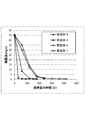
- Example 4 it can be confirmed that the copper concentration is reduced to about 1 mg / L as time passes.
- Example 4 and 5 where the liquid temperature of the cobalt chloride aqueous solution is high, it can be confirmed that the copper separation is faster than in Examples 6 and 7. And when a liquid temperature becomes from 50 degreeC to 60 degreeC, it can confirm that reaction rate increases rapidly.
- the method for purifying an aqueous cobalt chloride solution of the present invention is suitable for a method of removing impurities from an aqueous cobalt chloride solution used as a raw material for a non-aqueous electrolyte secondary battery.
Landscapes
- Chemical & Material Sciences (AREA)
- Engineering & Computer Science (AREA)
- Organic Chemistry (AREA)
- Materials Engineering (AREA)
- Metallurgy (AREA)
- Mechanical Engineering (AREA)
- Manufacturing & Machinery (AREA)
- Chemical Kinetics & Catalysis (AREA)
- General Chemical & Material Sciences (AREA)
- Inorganic Chemistry (AREA)
- General Life Sciences & Earth Sciences (AREA)
- Geology (AREA)
- Geochemistry & Mineralogy (AREA)
- Environmental & Geological Engineering (AREA)
- Life Sciences & Earth Sciences (AREA)
- Electrochemistry (AREA)
- Manufacture And Refinement Of Metals (AREA)
- Inorganic Compounds Of Heavy Metals (AREA)
- Battery Electrode And Active Subsutance (AREA)
- Treatment Of Water By Oxidation Or Reduction (AREA)
Priority Applications (1)
| Application Number | Priority Date | Filing Date | Title |
|---|---|---|---|
| US15/577,507 US10239764B2 (en) | 2015-05-29 | 2016-05-20 | Aqueous cobalt chloride solution purification method |
Applications Claiming Priority (2)
| Application Number | Priority Date | Filing Date | Title |
|---|---|---|---|
| JP2015-110666 | 2015-05-29 | ||
| JP2015110666A JP6201154B2 (ja) | 2015-05-29 | 2015-05-29 | 塩化コバルト水溶液の浄液方法 |
Publications (1)
| Publication Number | Publication Date |
|---|---|
| WO2016194658A1 true WO2016194658A1 (ja) | 2016-12-08 |
Family
ID=57441417
Family Applications (1)
| Application Number | Title | Priority Date | Filing Date |
|---|---|---|---|
| PCT/JP2016/065045 Ceased WO2016194658A1 (ja) | 2015-05-29 | 2016-05-20 | 塩化コバルト水溶液の浄液方法 |
Country Status (3)
| Country | Link |
|---|---|
| US (1) | US10239764B2 (enExample) |
| JP (1) | JP6201154B2 (enExample) |
| WO (1) | WO2016194658A1 (enExample) |
Cited By (2)
| Publication number | Priority date | Publication date | Assignee | Title |
|---|---|---|---|---|
| WO2019121086A1 (en) * | 2017-12-19 | 2019-06-27 | Basf Se | Battery recycling by treatment of the leach with metallic nickel |
| RU2794298C2 (ru) * | 2017-12-19 | 2023-04-14 | Басф Се | Рециклизация батареи посредством обработки выщелачивающим агентом с металлическим никелем |
Families Citing this family (1)
| Publication number | Priority date | Publication date | Assignee | Title |
|---|---|---|---|---|
| KR20240127489A (ko) * | 2021-03-30 | 2024-08-22 | 가부시키가이샤 프로테리아루 | 리튬이온 이차전지용 정극 활물질의 제조방법 |
Citations (4)
| Publication number | Priority date | Publication date | Assignee | Title |
|---|---|---|---|---|
| JPS5743628B2 (enExample) * | 1974-05-22 | 1982-09-16 | ||
| JPH1180986A (ja) * | 1997-09-03 | 1999-03-26 | Sumitomo Metal Mining Co Ltd | 含銅塩化ニッケル溶液からの銅の除去方法 |
| JP2000067862A (ja) * | 1998-08-24 | 2000-03-03 | Sumitomo Metal Mining Co Ltd | 非水系電解質二次電池用正極活物質とその製造方法 |
| JP2013194269A (ja) * | 2012-03-17 | 2013-09-30 | Mitsubishi Materials Corp | コバルト含有液の不純物除去方法 |
Family Cites Families (4)
| Publication number | Priority date | Publication date | Assignee | Title |
|---|---|---|---|---|
| US805969A (en) * | 1904-11-25 | 1905-11-28 | Noak Victor Hybinette | Separation of metals. |
| US3902896A (en) * | 1974-05-22 | 1975-09-02 | Int Nickel Co | Cementation of metals from acid solutions |
| CN1274608C (zh) * | 2001-09-03 | 2006-09-13 | 株式会社阿库泰克 | 使用硫化剂的含有重金属的排水的处理方法和处理装置 |
| JP6218121B2 (ja) * | 2015-05-29 | 2017-10-25 | 住友金属鉱山株式会社 | 塩化コバルト水溶液の精製方法 |
-
2015
- 2015-05-29 JP JP2015110666A patent/JP6201154B2/ja active Active
-
2016
- 2016-05-20 US US15/577,507 patent/US10239764B2/en active Active
- 2016-05-20 WO PCT/JP2016/065045 patent/WO2016194658A1/ja not_active Ceased
Patent Citations (4)
| Publication number | Priority date | Publication date | Assignee | Title |
|---|---|---|---|---|
| JPS5743628B2 (enExample) * | 1974-05-22 | 1982-09-16 | ||
| JPH1180986A (ja) * | 1997-09-03 | 1999-03-26 | Sumitomo Metal Mining Co Ltd | 含銅塩化ニッケル溶液からの銅の除去方法 |
| JP2000067862A (ja) * | 1998-08-24 | 2000-03-03 | Sumitomo Metal Mining Co Ltd | 非水系電解質二次電池用正極活物質とその製造方法 |
| JP2013194269A (ja) * | 2012-03-17 | 2013-09-30 | Mitsubishi Materials Corp | コバルト含有液の不純物除去方法 |
Cited By (7)
| Publication number | Priority date | Publication date | Assignee | Title |
|---|---|---|---|---|
| WO2019121086A1 (en) * | 2017-12-19 | 2019-06-27 | Basf Se | Battery recycling by treatment of the leach with metallic nickel |
| CN111466051A (zh) * | 2017-12-19 | 2020-07-28 | 巴斯夫欧洲公司 | 通过用金属镍处理浸提液的电池组再循环 |
| KR20200096965A (ko) * | 2017-12-19 | 2020-08-14 | 바스프 에스이 | 금속 니켈을 사용한 침출물의 처리에 의한 배터리 재활용 |
| US20220136084A1 (en) * | 2017-12-19 | 2022-05-05 | Basf Se | Battery recycling by treatment of the leach with metallic nickel |
| RU2794298C2 (ru) * | 2017-12-19 | 2023-04-14 | Басф Се | Рециклизация батареи посредством обработки выщелачивающим агентом с металлическим никелем |
| CN111466051B (zh) * | 2017-12-19 | 2024-05-03 | 巴斯夫欧洲公司 | 通过用金属镍处理浸提液的电池组再循环 |
| KR102750561B1 (ko) * | 2017-12-19 | 2025-01-06 | 바스프 에스이 | 금속 니켈을 사용한 침출물의 처리에 의한 배터리 재활용 |
Also Published As
| Publication number | Publication date |
|---|---|
| US10239764B2 (en) | 2019-03-26 |
| US20180148344A1 (en) | 2018-05-31 |
| JP2016222976A (ja) | 2016-12-28 |
| JP6201154B2 (ja) | 2017-09-27 |
Similar Documents
| Publication | Publication Date | Title |
|---|---|---|
| WO2020090690A1 (ja) | リチウムイオン二次電池の正極活物質廃棄物の処理方法 | |
| WO2020212587A1 (en) | Process for the preparation of battery precursors | |
| TWI406954B (zh) | Method for recovering valuable metals from IZO waste | |
| TWI432609B (zh) | Method for recovering valuable metal from indium - zinc oxide waste | |
| JP7356642B2 (ja) | 水酸化ニッケルの精製方法 | |
| JP2016502602A5 (enExample) | ||
| KR101528507B1 (ko) | 리튬계 전지로부터 코발트 및 망간의 동시 회수 방법 | |
| JP6299620B2 (ja) | 硫酸ニッケルの製造方法 | |
| JP7365846B2 (ja) | 高純度硫酸コバルト溶液の製造方法及び、硫酸コバルトの製造方法 | |
| JP2018039682A (ja) | ニッケル、コバルトを含有する溶液の製造方法 | |
| JP6218121B2 (ja) | 塩化コバルト水溶液の精製方法 | |
| JP7383550B2 (ja) | マンガンイオン除去方法 | |
| JP2016222977A5 (enExample) | ||
| JP6201154B2 (ja) | 塩化コバルト水溶液の浄液方法 | |
| JP2019179699A (ja) | 電池用硫酸コバルトの製造方法 | |
| JP2013209267A (ja) | 硫酸マンガンの製造方法 | |
| JP4734603B2 (ja) | インジウムの回収方法 | |
| JP6565591B2 (ja) | カルシウムの分離方法 | |
| JP2016222976A5 (enExample) | ||
| JP7627436B2 (ja) | 金属カドミウムの製造方法 | |
| JP2024145680A (ja) | 塩化ニッケル水溶液からの銀の除去方法 | |
| JP2025002589A (ja) | ニッケル及びコバルトを含有する水酸化物からの浸出液の製造方法 |
Legal Events
| Date | Code | Title | Description |
|---|---|---|---|
| 121 | Ep: the epo has been informed by wipo that ep was designated in this application |
Ref document number: 16803093 Country of ref document: EP Kind code of ref document: A1 |
|
| WWE | Wipo information: entry into national phase |
Ref document number: 15577507 Country of ref document: US |
|
| NENP | Non-entry into the national phase |
Ref country code: DE |
|
| 122 | Ep: pct application non-entry in european phase |
Ref document number: 16803093 Country of ref document: EP Kind code of ref document: A1 |