WO2016186214A1 - ガラス基板の研磨方法、研磨液、ガラス基板の製造方法、磁気ディスク用ガラス基板の製造方法及び磁気ディスクの製造方法 - Google Patents
ガラス基板の研磨方法、研磨液、ガラス基板の製造方法、磁気ディスク用ガラス基板の製造方法及び磁気ディスクの製造方法 Download PDFInfo
- Publication number
- WO2016186214A1 WO2016186214A1 PCT/JP2016/065103 JP2016065103W WO2016186214A1 WO 2016186214 A1 WO2016186214 A1 WO 2016186214A1 JP 2016065103 W JP2016065103 W JP 2016065103W WO 2016186214 A1 WO2016186214 A1 WO 2016186214A1
- Authority
- WO
- WIPO (PCT)
- Prior art keywords
- polishing
- glass substrate
- magnetic disk
- reducing agent
- glass
- Prior art date
- Legal status (The legal status is an assumption and is not a legal conclusion. Google has not performed a legal analysis and makes no representation as to the accuracy of the status listed.)
- Ceased
Links
Images


Classifications
-
- B—PERFORMING OPERATIONS; TRANSPORTING
- B24—GRINDING; POLISHING
- B24B—MACHINES, DEVICES, OR PROCESSES FOR GRINDING OR POLISHING; DRESSING OR CONDITIONING OF ABRADING SURFACES; FEEDING OF GRINDING, POLISHING, OR LAPPING AGENTS
- B24B37/00—Lapping machines or devices; Accessories
-
- G—PHYSICS
- G11—INFORMATION STORAGE
- G11B—INFORMATION STORAGE BASED ON RELATIVE MOVEMENT BETWEEN RECORD CARRIER AND TRANSDUCER
- G11B5/00—Recording by magnetisation or demagnetisation of a record carrier; Reproducing by magnetic means; Record carriers therefor
- G11B5/62—Record carriers characterised by the selection of the material
- G11B5/73—Base layers, i.e. all non-magnetic layers lying under a lowermost magnetic recording layer, e.g. including any non-magnetic layer in between a first magnetic recording layer and either an underlying substrate or a soft magnetic underlayer
- G11B5/739—Magnetic recording media substrates
- G11B5/73911—Inorganic substrates
- G11B5/73921—Glass or ceramic substrates
-
- C—CHEMISTRY; METALLURGY
- C09—DYES; PAINTS; POLISHES; NATURAL RESINS; ADHESIVES; COMPOSITIONS NOT OTHERWISE PROVIDED FOR; APPLICATIONS OF MATERIALS NOT OTHERWISE PROVIDED FOR
- C09G—POLISHING COMPOSITIONS; SKI WAXES
- C09G1/00—Polishing compositions
- C09G1/02—Polishing compositions containing abrasives or grinding agents
-
- C—CHEMISTRY; METALLURGY
- C09—DYES; PAINTS; POLISHES; NATURAL RESINS; ADHESIVES; COMPOSITIONS NOT OTHERWISE PROVIDED FOR; APPLICATIONS OF MATERIALS NOT OTHERWISE PROVIDED FOR
- C09K—MATERIALS FOR MISCELLANEOUS APPLICATIONS, NOT PROVIDED FOR ELSEWHERE
- C09K3/00—Materials not provided for elsewhere
- C09K3/14—Anti-slip materials; Abrasives
-
- G—PHYSICS
- G11—INFORMATION STORAGE
- G11B—INFORMATION STORAGE BASED ON RELATIVE MOVEMENT BETWEEN RECORD CARRIER AND TRANSDUCER
- G11B5/00—Recording by magnetisation or demagnetisation of a record carrier; Reproducing by magnetic means; Record carriers therefor
- G11B5/84—Processes or apparatus specially adapted for manufacturing record carriers
Definitions
- the present invention relates to a method for polishing a glass substrate, a polishing liquid, a method for manufacturing a glass substrate, a method for manufacturing a glass substrate for a magnetic disk, and a magnetism suitable for manufacturing a magnetic disk mounted on a magnetic disk device such as a hard disk drive (HDD).
- the present invention relates to a disc manufacturing method.
- a magnetic disk as one of information recording media mounted on a magnetic disk device such as a hard disk drive (HDD).
- a magnetic disk is configured by forming a thin film such as a magnetic layer on a substrate, and an aluminum alloy substrate or a glass substrate has been used as the substrate.
- the ratio of the glass substrate capable of narrowing the distance between the magnetic head and the magnetic disk as compared with the aluminum alloy substrate is gradually increasing.
- the surface of the magnetic disk substrate is polished with high accuracy so that the flying height of the magnetic head can be lowered as much as possible to achieve high recording density.
- the demand for further increase in recording capacity of HDDs has only increased, and in order to realize this, it has become necessary to further improve the quality of the magnetic disk substrate, which is smoother and cleaner. It is required that the substrate surface be a proper surface.
- high smoothness on the surface of the magnetic disk is indispensable for the low flying height (flying height) necessary for high recording density.
- flying height flying height
- a substrate surface with a high smoothness is required in the end. Therefore, it is necessary to polish the glass substrate surface with high accuracy.
- Patent Document 1 discloses an abrasive slurry containing an abrasive such as aluminum oxide, a water-soluble inorganic aluminum salt, an inorganic salt selected from nickel salts, and a water-soluble chelating agent.
- An invention has been disclosed in which scratches are reduced by removing a sparingly soluble chelate salt generated by reacting with the chelating agent in advance when polishing a magnetic disk substrate such as aluminum.
- Patent Document 2 discloses that a magnetic disk substrate is polished with a polishing liquid containing an organic reducing agent such as phenols or reductones, so that the polishing speed (especially the persistence of the polishing speed) and the surface quality after polishing (cleanness). The invention which improves the property) is disclosed.
- the polishing process of the main surface of the magnetic disk substrate has been performed in a plurality of stages, and usually the first first polishing process has been performed using cerium oxide as the abrasive grains.
- cerium oxide as the abrasive grains.
- the polishing rate is low and the reduction in the polishing rate during the continuous polishing process is large, and this is a large amount of substrates with improved surface quality. It was an obstacle to realizing production.
- the present inventor has tried to apply various conventional polishing techniques including the method disclosed in the above patent document to the polishing process using the cerium oxide abrasive described above. It was difficult to improve. In addition, it is difficult to sufficiently reduce the reduction in the polishing rate during the continuous polishing process. Since the first first polishing process usually has the largest machining allowance among a plurality of polishing processes, the polishing rate is particularly important.
- the present invention has been made to solve such conventional problems, and its purpose is to polish a glass substrate capable of improving the polishing rate in the polishing treatment of the main surface of the glass substrate using cerium oxide as abrasive grains. Is to provide a method. It is another object of the present invention to provide a glass substrate polishing method capable of maintaining such an effect of improving the polishing rate over a long period of time. Another object of the present invention is to provide a polishing method particularly suitable for a glass substrate for a magnetic disk. It is another object of the present invention to provide a polishing liquid suitably used in the method for polishing a glass substrate of the present invention.
- the present inventor includes an inorganic reducing agent in the polishing liquid used for the polishing process using cerium oxide as abrasive grains, and the polishing liquid is alkaline. It has been found that the polishing rate is improved. It has also been found that the effect of improving the polishing rate can be maintained over a long period of time.
- the present inventor has completed the present invention as a result of intensive studies based on the obtained knowledge. That is, the present invention has the following configuration.
- (Configuration 2) The glass according to Configuration 1, wherein the inorganic reducing agent is at least one selected from thiosulfates, phosphinates, dithionites, or sulfites with alkali metals or alkaline earth metals.
- a method for polishing a substrate is at least one selected from thiosulfates, phosphinates, dithionites, or sulfites with alkali metals or alkaline earth metals.
- (Configuration 7) A magnetic disk manufacturing method comprising forming at least a magnetic film on a magnetic disk glass substrate manufactured by the magnetic disk glass substrate manufacturing method according to Configuration 6.
- a polishing liquid used for polishing a surface of a glass substrate wherein the polishing liquid contains cerium oxide as abrasive grains, further contains an inorganic reducing agent, and is alkaline.
- polishing method of the glass substrate which can improve a grinding
- a glass substrate polishing method capable of maintaining the effect of improving the polishing rate over a long period of time.
- the glass substrate polishing method of the present invention is particularly suitable for polishing a glass substrate for a magnetic disk.
- polishing method of such a glass substrate of this invention can be provided.
- the glass substrate for magnetic disk obtained by the present invention has high productivity, and can be suitably used as a next-generation substrate in which the demand for the substrate surface quality is particularly severer than the current one. Is possible. Further, a highly reliable magnetic disk capable of long-term stable operation even when combined with a magnetic head of a low flying height design equipped with a DFH function, for example, using a glass substrate for a magnetic disk obtained by the present invention. Obtainable.
- a glass substrate for a magnetic disk is usually manufactured through glass substrate molding, drilling, chamfering, grinding, end surface polishing, main surface polishing, and the like. Note that the order of processing is not limited to the above.
- a disk-shaped glass substrate (glass disk) is molded from molten glass by direct pressing.
- a glass substrate (glass disk) may be obtained by cutting into a predetermined size from a plate glass manufactured by a downdraw method or a float method.
- a drilling process and a chamfering process are performed as appropriate to obtain a disk-shaped glass substrate (glass disk) having a circular hole in the center.
- the disc-shaped glass substrate (glass disk) is subjected to a grinding process for improving dimensional accuracy and shape accuracy.
- This grinding process usually uses a double-side grinding machine to grind the main surface of the glass substrate. By grinding the main surface of the glass substrate in this way, a predetermined plate thickness and flatness are processed, and a predetermined surface roughness is obtained.
- a main surface polishing process for obtaining a highly accurate main surface (mirror surface) is performed through an end surface polishing process such as brush polishing.
- an end surface polishing process such as brush polishing.
- a polishing pad such as polyurethane while supplying a polishing liquid containing cerium oxide as polishing abrasive grains. is there.
- the present invention provides a glass substrate polishing method in which the surface of a glass substrate is polished with a polishing liquid containing cerium oxide as abrasive grains.
- the polishing liquid contains an inorganic reducing agent and is alkaline. It is characterized by.
- the polishing liquid used for such a polishing treatment is a combination of abrasive grains and water as a solvent.
- an inorganic reducing agent is included, and other additives are included as necessary.
- pure water is used, and an inorganic reducing agent and other additives may be added as necessary to obtain a polishing liquid.
- the cerium oxide abrasive particles contained in the polishing liquid are preferably those having an average particle diameter of about 0.1 to 2.0 ⁇ m from the viewpoint of polishing efficiency. In particular, it is preferable to use those having an average particle size of about 0.8 to 1.3 ⁇ m.
- the average particle size is a point where the cumulative curve is 50% when the cumulative curve is obtained with the total volume of the powder population in the particle size distribution measured by the light scattering method as 100%. (Hereinafter referred to as “cumulative average particle diameter (50% diameter)”). In the present invention, the cumulative average particle diameter (50% diameter) can be specifically measured using a particle diameter / particle size distribution measuring apparatus.
- cerium oxide abrasive grains high-purity cerium oxide that does not contain impurities can be basically used, but in the present invention, it is also preferable to contain lanthanum (La).
- Cerium oxide abrasive grains containing lanthanum (La) have a greater effect of improving the polishing rate.
- the content of lanthanum is expressed as the content of lanthanum oxide (La 2 O 3 ) relative to TREO (total rare-earth oxides).
- the content of lanthanum oxide with respect to TREO is preferably in the range of, for example, 1 to 50% as lanthanum oxide (La 2 O 3 ).
- the content of lanthanum oxide (La 2 O 3 ) is less than 1%, the effect of including lanthanum (La) is not obtained so much.
- the content of lanthanum oxide (La 2 O 3) is greater than 50%, a cerium oxide component is relatively small, the polishing rate may be decreased.
- the content of the cerium oxide abrasive grains in the polishing liquid is not particularly limited and can be appropriately adjusted and used. From the viewpoint of polishing rate and cost, for example, the content is 1 to 20% by weight. It is preferable.
- an inorganic reducing agent is contained in the polishing liquid applied to the polishing treatment.
- examples of the inorganic reducing agent include thiosulfuric acid with an alkali metal (Li, Na, K, Rb, Cs, Fr) or an alkaline earth metal (Be, Mg, Ca, Sr, Ba, Ra). It is preferably at least one selected from a salt, a phosphinate, a dithionite, or a sulfite.
- polishing rate can be improved by including an inorganic reducing agent in the polishing liquid containing cerium oxide as abrasive grains.
- An inorganic reducing agent for example, the above thiosulfate has reducibility and reduces cerium (tetravalent) to trivalent. Since trivalent cerium weakens the bond by giving electrons to Si-O of the glass, the polishing rate is improved.
- the above-mentioned inorganic reducing agents are considered to be stable and resistant to oxidation under alkaline conditions and have a long reducing effect.
- thiosulfate has a very low reactivity with oxygen (a powerful oxidant), and thus hardly causes an oxidation-reduction reaction with dissolved oxygen in the polishing liquid and oxygen in the air. Therefore, even when the polishing treatment is performed for a long time, the reducing property of the inorganic reducing agent in the polishing liquid is not easily impaired. Therefore, by including the inorganic reducing agent of the present invention in the polishing liquid, it is possible to suppress a decrease in the polishing rate during continuous polishing.
- the reduction effect disappears immediately by reacting with dissolved oxygen in the polishing liquid or oxygen in the air, so that the polishing rate is reduced.
- the improvement effect and the effect that the effect lasts long cannot be obtained.
- it may decompose in an alkaline environment.
- thiosulfate is particularly preferable because it hardly reacts with oxygen and has a large effect. More preferred is thiosulfate with Na, K, Mg, or Ca.
- the content (addition amount) of the inorganic reducing agent in the polishing liquid is preferably in the range of 0.5 to 10% by weight. If the content is less than 0.5% by weight, the effects of the present invention may not be sufficiently obtained. On the other hand, when the content is more than 10% by weight, the polishing liquid is easily separated, and the polishing rate may be lowered instead.
- the content of the inorganic reducing agent in the polishing liquid is more preferably in the range of 1% by weight to 5% by weight.
- the polishing liquid containing the cerium oxide abrasive grains and the inorganic reducing agent of the present invention is alkaline.
- the polishing liquid of the present invention in an alkaline state, it is possible to prevent the cerium oxide fine particles, which are polishing abrasive grains, from agglomerating and settling, thereby increasing the polishing rate and reducing polishing scratches.
- the decomposition reaction of the inorganic reducing agent can be suppressed, and it is difficult to be oxidized and stable, and the effect of adding the inorganic reducing agent is further sustained.
- the pH of the polishing liquid is preferably in the range of 8 to 12 from the viewpoint of preventing aggregation and settling of abrasive grains and suppressing the decomposition reaction of the inorganic reducing agent. More preferably, it is in the range of 9-11.
- the polishing liquid containing the inorganic reducing agent often has a pH within the above range, but in some cases, it may be adjusted by appropriately adding an appropriate alkali agent or acid.
- the polishing method in the polishing treatment is not particularly limited.
- the glass substrate and the polishing pad are brought into contact with each other, and the cerium oxide abrasive grains and the inorganic reducing agent are contacted.
- the main surface of the glass substrate may be polished by relatively moving the polishing pad and the glass substrate while supplying the polishing liquid containing.
- FIG. 3 is a longitudinal sectional view showing a schematic configuration of a double-side polishing apparatus of a planetary gear system that can be used for a glass substrate polishing process. The double-side polishing apparatus shown in FIG.
- the polishing pad it is preferable to use a resin polisher (made of urethane foam or polyurethane foam). From the viewpoint of increasing the polishing rate, it is preferable to use a polishing pad having an Asker C hardness of 75 to 90.
- a suede type polishing pad from the viewpoint of suppressing minute scratches due to polishing.
- the load applied to the substrate during polishing is preferably 50 to 200 g / cm 2 from the viewpoint of polishing rate and polishing quality.
- the polishing process of the main surface of the substrate includes a first polishing process for removing scratches and distortions remaining in the grinding process to obtain a predetermined smooth surface, and a mirror surface with a smoother surface roughness of the main surface of the glass substrate.
- it is performed through two stages of the second polishing process that finishes (however, multistage polishing of three or more stages may be performed).
- at least the first polishing process in the previous stage is used in the present invention. Is preferably applied. Since the first polishing process usually has the largest machining allowance among a plurality of polishing processes, the polishing rate is particularly important.
- the surface roughness of the main surface of the glass substrate on which the first polishing treatment is performed is preferably 100 nm or less in terms of Ra.
- the first polishing treatment is preferably performed so that the surface roughness of the main surface is 1.5 nm or less.
- the subsequent finishing (precision) polishing process is preferably performed using, for example, a polishing liquid containing colloidal silica abrasive grains having an average particle diameter of about 10 to 100 nm.
- a polishing liquid adjusted to an acidic range from the viewpoint of improving the polishing rate.
- the pH is preferably 5 or less, more preferably 4 or less.
- the pH is preferably 1 or more, more preferably 2 or more.
- the polishing pad for final polishing is preferably a polishing pad (suede pad) of a soft polisher. The polishing method is the same as described above.
- the polishing method of the present invention can be preferably applied not only to the polishing treatment of the main surface of the glass substrate but also to the polishing treatment of the end face of the glass substrate. Next, the end surface polishing treatment of the glass substrate will be described.
- the outer peripheral end surface 12 (see FIGS. 1 and 2) of the glass substrate 1 is polished with a rotating brush (also referred to as a polishing brush).
- a rotating brush also referred to as a polishing brush.
- the rotating brush has a rotating shaft perpendicular to the main surfaces 11 and 11 of the front and back surfaces of the glass substrate 1 and brush hairs attached to the outer periphery of the rotating shaft.
- the rotating brush polishes the two chamfered surfaces 12b and 12b and the side wall surface 12a of the outer peripheral end surface 12 of the glass substrate 1 with the brush bristles while rotating around the rotation axis.
- the polishing liquid is supplied from the nozzle to the polishing portion of the glass substrate 1 by the rotating brush.
- the polishing liquid contains an abrasive, and when the present invention is applied, cerium oxide abrasive grains are used as the abrasive.
- the polishing liquid contains the inorganic reducing agent and is alkaline.
- a plurality of glass substrates 1 may be laminated and polished together.
- a spacer may be disposed between the glass substrates 1.
- the rotating brush may be swung in the stacking direction of the glass substrate 1 (a direction parallel to the center line of the rotating shaft) while rotating around the rotating shaft.
- the supply amount of the polishing liquid to the part to be polished is, for example, 5 to 20 liters / minute
- the rotation speed of the rotating brush is, for example, 100 to 500 rpm
- the oscillation speed of the rotating brush in the rotation axis direction is, for example, 3 to 10 rpm (for 1 minute)
- the rotational speed of the glass substrate (laminated body) can be appropriately set within a range of 50 to 100 rpm, for example.
- the polishing rate can be improved, and the effect of improving the polishing rate can be maintained over a long period of time. In other words, the effect lasts longer.
- the glass type constituting the glass substrate is preferably aluminosilicate glass.
- Amorphous aluminosilicate glass is more preferable.
- Such a glass substrate can be finished to a smooth mirror surface by mirror polishing the surface, and the strength after processing is good.
- SiO 2 is 58 wt% to 75 wt%
- Al 2 O 3 is 5 wt% to 23 wt%
- Li 2 O is 3 wt% to 10 wt%
- An aluminosilicate glass containing O as a main component of 4 wt% or more and 13 wt% or less can be used.
- SiO 2 is 62 wt% to 75 wt%
- Al 2 O 3 is 5 wt% to 15 wt%
- Li 2 O is 4 wt% to 10 wt%
- Na 2 O is 4 wt%.
- the ZrO 2 5.5 wt% to 15 wt% or less
- the weight ratio of Na 2 O / ZrO 2 is 0.5 to 2.0
- Al 2 O 3 An amorphous aluminosilicate glass having a weight ratio of / ZrO 2 of 0.4 to 2.5 can be obtained.
- heat resistance may be required as a characteristic of next-generation substrates.
- a glass substrate has a high glass transition point (Tg) of, for example, 600 ° C. or higher.
- Tg glass transition point
- the glass composition has a glass composition in which the amount of alumina (Al 2 O 3 ) in the glass component is 8 mol% or less.
- SiO 2 is 50 to 75%
- Al 2 O 3 is 0 to 6%
- BaO is 0 to 2%
- Li 2 O is 0 to 3%
- ZnO is 0 to 5%
- Na 2 O and K 2 O in total 3 to 15%
- MgO, CaO, SrO and BaO in total 14 to 35%
- ZrO 2 , TiO 2 , La 2 O 3 , Y 2 O 3 , Yb 2 O 3 , Ta 2 O 5 , Nb 2 O 5 and HfO 2 are included in a total amount of 2 to 9%
- the molar ratio [(MgO + CaO) / (MgO + CaO + SrO + BaO)] is in the range of 0.85 to 1
- the molar ratio [Al 2 A glass having an O 3 / (MgO + CaO)] range of 0 to 0.30 can be preferably used.
- the present invention is particularly suitable for the polishing treatment of such a heat-resistant glass substrate having a high glass transition temperature (Tg).
- the heat-resistant glass substrate having such a composition has a relatively large number of Si—O bonds, and is particularly subjected to a continuous polishing process by performing a polishing process using a polishing liquid containing the cerium oxide abrasive grains of the present invention and an inorganic reducing agent.
- the effect of suppressing a decrease in the polishing rate is greater than in the case of the above-mentioned aluminosilicate glass.
- the present invention is particularly suitable for polishing a glass substrate for a magnetic disk, but can also be applied to, for example, optical lenses, mask blank substrates, and liquid crystal panels other than those for magnetic disks.
- the surface of the glass substrate after the final polishing treatment preferably has an arithmetic average surface roughness Ra of 0.20 nm or less, particularly 0.15 nm or less, more preferably 0.10 nm or less.
- the maximum roughness Rmax is 2.0 nm or less, particularly 1.5 nm or less, more preferably 1.0 nm or less.
- Ra and Rmax are roughnesses calculated in accordance with Japanese Industrial Standard (JIS) B0601: 1982. Ra is the arithmetic average roughness, and Rmax is the maximum height. These surfaces are preferably mirror surfaces.
- the surface roughness is practically the surface roughness of the surface shape obtained when measuring the range of 1 ⁇ m ⁇ 1 ⁇ m with a resolution of 256 ⁇ 256 pixels using an atomic force microscope (AFM). Above preferred. However, when Ra exceeds 50 nm, it is preferable to measure the surface roughness using a stylus roughness meter.
- the chemical strengthening treatment can be performed before or after the polishing treatment of the main surface of the substrate. Since the chemically strengthened glass substrate is excellent in impact resistance, it is particularly preferable for mounting on a HDD for mobile use, for example.
- the chemical strengthening salt alkali metal nitrates such as potassium nitrate and sodium nitrate can be preferably used.
- both main surfaces 11 and 11 and an outer peripheral side end surface 12 between them are provided.
- a disk-shaped glass substrate 1 having a peripheral end face 13 is obtained.
- the outer peripheral side end surface 12 includes chamfered surfaces 12b and 12b between the side wall surface 12a and the main surfaces on both sides thereof.
- the inner peripheral side end face 13 has the same shape.
- the polishing rate can be improved in the polishing treatment of the surface of the glass substrate using cerium oxide as abrasive grains.
- the effect of improving the polishing rate lasts for a long time, and the reduction of the polishing rate during the continuous polishing process can be effectively suppressed.
- the glass substrate polishing method of the present invention is particularly suitable for polishing a glass substrate for a magnetic disk.
- the glass substrate for magnetic disk obtained by the present invention has high productivity, and can be suitably used as a next-generation substrate in which the demand for the substrate surface quality is particularly severer than the current one. Is possible.
- the present invention also provides a method for manufacturing a magnetic disk using the above glass substrate for a magnetic disk.
- the magnetic disk is manufactured by forming at least a magnetic film on the magnetic disk glass substrate obtained by the present invention.
- a CoCrPt-based or CoPt-based ferromagnetic alloy that is a hexagonal crystal system having a large anisotropic magnetic field can be used.
- a method for forming the magnetic film it is preferable to use a sputtering method, for example, a DC magnetron sputtering method.
- a protective layer and a lubricating layer in this order on the magnetic film.
- the protective layer an amorphous hydrogenated carbon-based protective layer is suitable.
- a lubricant of a perfluoropolyether compound can be used for the lubricating layer.
- Example 1 The following (1) rough grinding process, (2) shape processing process, (3) fine grinding process, (4) end face polishing process, (5) main surface first polishing process, (6) chemical strengthening process, (7) The glass substrate for a magnetic disk of this example was manufactured through the main surface second polishing treatment.
- a glass substrate made of a disc-shaped aluminosilicate glass having a diameter of 66 mm ⁇ and a thickness of 1.0 mm was obtained from molten glass by direct pressing using an upper mold, a lower mold, and a body mold.
- a glass substrate may be obtained by cutting into a predetermined size from a plate glass manufactured by a downdraw method or a float method.
- a chemical containing SiO 2 : 58 to 75 wt%, Al 2 O 3 : 5 to 23 wt%, Li 2 O: 3 to 10 wt%, Na 2 O: 4 to 13 wt% Temperable glass was used. Note that the content of Al 2 O 3 was 8.5 mol% in terms of mol%.
- this glass material is referred to as glass material 1.
- the glass substrate was subjected to a rough grinding process using alumina-based loose abrasive grains. This rough grinding process was performed using a double-side grinding machine.
- the first polishing process for removing scratches and distortions remaining in the above-described grinding process to obtain a predetermined smooth surface is performed using the above-described double-side polishing apparatus shown in FIG. I did it.
- the glass substrate held by the carrier 4 is closely attached between the upper and lower polishing surface plates 5 and 6 to which the polishing pad 7 is attached, and the carrier 4 is engaged with the sun gear 2 and the internal gear 3.
- the glass substrate is sandwiched between upper and lower surface plates 5 and 6.
- a polishing liquid between the polishing pad and the polishing surface of the glass substrate and rotating the gears and the upper and lower surface plates the glass substrate revolves while rotating on the surface plates 5 and 6, and the planets. Both sides are simultaneously polished by a gear mechanism.
- a first polishing process was performed using a suede type polisher (made of polyurethane foam) having an Asker C hardness of 80 as a polisher (polishing pad).
- polishing liquid 10% by weight of cerium oxide (average particle size 1 ⁇ m) was used as abrasive grains, 5% by weight of sodium thiosulfate was used as an inorganic reducing agent, and an alkaline solution having a pH of 10 was used.
- the polishing load was 120 g / cm 2 and the machining allowance was 30 ⁇ m in terms of plate thickness.
- the roughness of the substrate surface after polishing was 1.5 nm or less in terms of Ra.
- 20 batches (100 batches) were processed without changing the polishing liquid. The glass substrate after the first polishing treatment was washed.
- the polisher is a soft polisher (suede type) polishing pad (made of polyurethane foam) with an Asker C hardness of 70 )
- This second polishing process finishes the surface roughness of the glass substrate main surface to a smoother mirror surface, for example, the surface roughness of the glass substrate main surface is finished to a smooth mirror surface with Ra of 0.2 nm or less and Rmax of 2 nm or less. For the mirror polishing.
- polishing liquid a polishing liquid containing 10% by weight of colloidal silica (average particle diameter of 15 nm) as polishing abrasive grains was used.
- the polishing load was 100 g / cm 2 and the machining allowance was 3 ⁇ m in terms of plate thickness.
- the glass substrate after the second polishing process was cleaned (final cleaning process). Specifically, it was immersed in a cleaning tank in which an alkaline detergent was added to pure water, and ultrasonic cleaning was performed. Thereafter, the glass substrate was sufficiently rinsed with pure water and then dried.
- Ra surface roughness of the glass substrate main surface after the said last washing process
- Example 2 to 4 Except that the inorganic reducing agent contained in the polishing liquid used for the first main surface polishing process in Example 1 was replaced with sodium phosphinate, sodium dithionite, and sodium sulfite, respectively. In the same manner as in Example 1, glass substrates of Examples 2 to 4 were produced.
- Comparative Example 1 A glass substrate of Comparative Example 1 was produced in the same manner as in Example 1 except that a polishing liquid containing no inorganic reducing agent was used as the polishing liquid used in the first main surface polishing process in Example 1 above. .
- the polishing rate in the first main surface polishing process of Examples 1 to 4 and Comparative Example 1 was measured in the first batch and the 10th batch, respectively, and the improvement rate of the polishing rate in each Example with respect to the polishing rate in Comparative Example 1 Were determined according to the following criteria, and the results are summarized in Table 1 below.
- the ratio of the polishing rate of the 10th batch to the 1st batch was calculated to be 0.9.
- the polishing rate of the 1st batch and the 10th batch was a comparative example. It was equivalent to 1.
- the polishing liquid containing cerium oxide abrasive grains contains the inorganic reducing agent of the present invention under alkalinity, thereby improving the polishing rate relative to the comparative example not containing the inorganic reducing agent.
- the inorganic reducing agents thiosulfate is particularly preferable because of its great effect of improving the polishing rate.
- such a tendency is maintained not only in the first batch but also in the tenth batch, and even when a large amount of substrates are polished by a continuous polishing process, the tendency is reduced. It can be seen that the effect of improving the polishing rate by adding the agent lasts long. Therefore, it is possible to effectively suppress a decrease in the polishing rate during the continuous polishing process.
- Example 5 to 8 Polishing abrasive grains contained in each of the polishing liquids used in the first main surface polishing process in Examples 1 to 4 were replaced with cerium oxide abrasive grains containing 20% La as a ratio of La 2 O 3 to TREO. Glass substrates of Examples 5 to 8 were produced in the same manner as Examples 1 to 4 except that the liquid was used.
- Comparative Example 2 The polishing liquid contained in the polishing liquid used for the main surface first polishing treatment in Comparative Example 1 was replaced with cerium oxide abrasive containing 20% La as a ratio of La 2 O 3 to TREO. Except for this, a glass substrate of Comparative Example 2 was produced in the same manner as Comparative Example 1.
- the polishing rate in the first main surface polishing process of Examples 5 to 8 and Comparative Example 2 was measured in the first batch and the 10th batch, respectively, and the improvement rate of the polishing rate in each Example with respect to the polishing rate in Comparative Example 2 Were determined according to the same criteria as described above, and the results are summarized in Table 2 below.
- the ratio of the polishing rate of the 10th batch to the first batch was calculated to be 0.9.
- the polishing rate of the 1st batch and the 10th batch was a comparative example. It was equivalent to 2.
- the polishing rate can be improved as compared with the comparative example not containing the inorganic reducing agent by containing the inorganic reducing agent of the present invention in the polishing liquid.
- the inorganic reducing agents thiosulfate is particularly preferable because of its great effect of improving the polishing rate.
- the improvement rate of polishing rate becomes large by using the cerium oxide abrasive grain which added La from the comparison with the result of above-mentioned Table 1. 2.
- such a tendency is maintained not only in the 1st batch but also in the 10th batch, and effectively suppresses a decrease in the polishing rate during the continuous polishing process.
- thiosulfate has a polishing rate equal to or higher than that of the first batch of Comparative Example 2 even in the 10th batch, and shows a particularly high effect.
- Example A In the same manner as in Example 1, (1) rough grinding treatment, (2) shape processing treatment, (3) fine grinding treatment, (4) end surface polishing treatment, and (5) main surface first polishing treatment were sequentially performed. .
- the glass substrate was used the content of Al 2 O 3 in the glass material 1 of the above 10 mol%. This glass material is called glass material A.
- cerium oxide (average particle diameter: 1 ⁇ m) containing 20% La as a ratio of La 2 O 3 to TREO is contained as abrasive grains (content: 10% by weight).
- the other polishing conditions were the same as in Example 1.
- Example B The same processing as in Example A was performed except that the following glass material B was used instead of the glass material A used in Example A.
- Glass material B In terms of mol%, SiO 2 is 50 to 75%, Al 2 O 3 is 0 to 6%, BaO is 0 to 2%, Li 2 O is 0 to 3%, ZnO is 0 to 5%, Na 2 O and K 2 O in total 3 to 15%, MgO, CaO, SrO and BaO in total 14 to 35%, ZrO 2 , TiO 2 , La 2 O 3 , Y 2 O 3 , Yb 2 O 3 , Ta 2 O 5 , Nb 2 O 5 and HfO 2 are included in a total amount of 2 to 9%, the molar ratio [(MgO + CaO) / (MgO + CaO + SrO + BaO)] is in the range of 0.85 to 1, and the molar ratio [Al 2 A heat-resistant glass in which O 3 / (MgO +
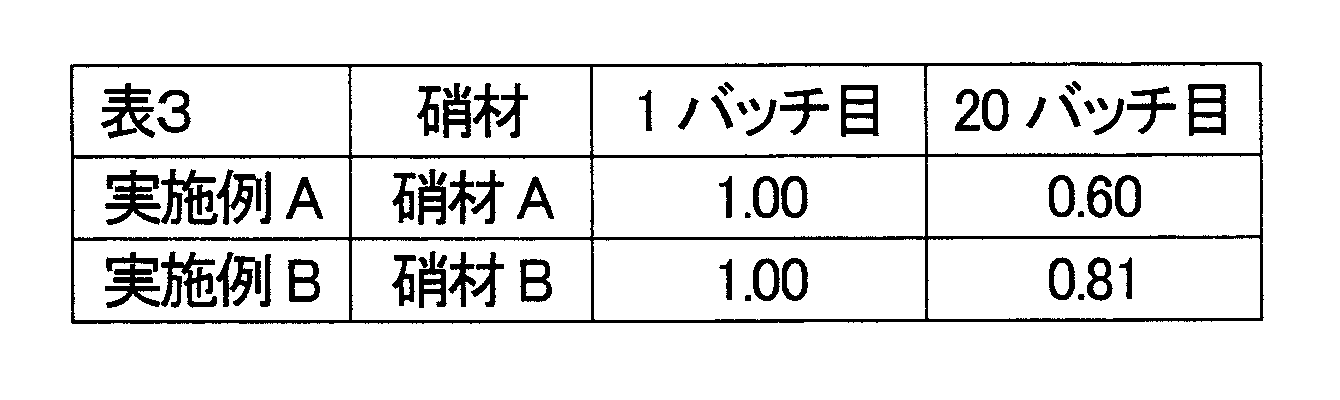
- the results are summarized in Table 3 below.
- the present invention is particularly suitable for polishing treatment of a heat-resistant glass substrate (glass material B) having a high glass transition temperature (Tg).
- the effect of suppressing the decrease in the polishing rate particularly during the continuous polishing treatment is, for example, the above-mentioned aluminosilicate glass (glass material A ) Is greater than
- Examples 9 to 12, Comparative Example 3 In the same manner as in Example 1, (1) rough grinding treatment, (2) shape processing treatment, and (3) fine grinding treatment were sequentially performed, and then the following end face polishing treatment was performed. In addition, the said glass material 1 was used for the glass substrate. The glass substrate after the grinding treatment was laminated using a supporting jig to form a glass substrate laminate. At this time, resin spacers were inserted between the glass substrates and a total of 200 glass plates were stacked to form a glass substrate laminate.
- the glass substrate laminate formed as described above was inserted into an outer peripheral end surface polishing jig, and was clamped and fixed from above and below the glass substrate laminate.
- This glass substrate laminate was placed at a predetermined position of the outer peripheral end surface polishing apparatus.
- a rotating brush for end face polishing was brought into contact with the end face on the outer peripheral side of the glass substrate laminate, and further pressed by a predetermined amount. Polishing liquid was supplied to the outer peripheral end surface portion of the glass substrate laminate, the rotating brush and the glass substrate laminate were rotated in opposite directions, and further, the polishing was performed while the rotating brush was swung in the laminating direction of the glass substrate laminate.
- the polishing liquid supply rate is 10 to 15 liters / minute
- the rotation speed of the rotating brush is 300 rpm
- the swinging speed of the rotating brush in the support shaft direction is 3 to 5 rpm (3 to 3 minutes per minute).
- the rotation speed of the glass substrate laminate was set to 80 to 90 rpm.
- the machining allowance was 40 ⁇ m in terms of plate thickness.
- the polishing liquid was not replaced, and 20 batches were continuously processed while the polishing liquid was collected and circulated.
- polishing rates in the end face polishing treatments of Examples 9 to 12 and Comparative Example 3 were measured in the first batch and the 10th batch, respectively, and the polishing rates in Comparative Example 3 using a polishing liquid containing no inorganic reducing agent were measured.
- the rate of improvement of the polishing rate in the examples was determined based on the same criteria as described above, and the results are summarized in Table 4 below.
- the ratio of the 10th batch polishing rate to the 1st batch (10th polishing rate / 1st polishing rate) was calculated to be 0.80.
- the polishing rate can be improved with respect to the comparative example not containing the inorganic reducing agent by containing the inorganic reducing agent of the present invention in the polishing liquid.
- the inorganic reducing agents thiosulfate is particularly preferable because of its great effect of improving the polishing rate.
- such a tendency is maintained not only in the 1st batch but also in the 10th batch, and effectively suppresses a decrease in the polishing rate during the continuous polishing process. Can do.
- the end surface polishing process is particularly effective because the polishing rate tends to be lower than that of the main surface polishing process.
- Example 13 to 16 Polishing liquid used in Example 5 (containing 20% cerium oxide (average particle diameter: 1 ⁇ m) as La 2 O 3 ratio relative to TREO) 5% by weight sodium thiosulfate as an inorganic reducing agent
- the glass substrates of Examples 13 to 16 were prepared in the same manner as in Example 5 except that the polishing liquids were used in which the pH was changed to 8, 9, 11, and 12, respectively. .
- the polishing rate in the main surface first polishing treatment of Examples 13 to 16 and Example 5 was measured at the 20th batch, and the polishing rate at pH 10 (Example 5) was 1 in each Example.
- the ratios of the polishing rates were determined and the results are summarized in Table 5 below.
- the pH of the polishing liquid is in the range of 9 to 11 in the present invention. It is presumed that at a pH in this range, the decomposition of the inorganic reducing agent is satisfactorily suppressed.
- the following film formation process was performed on the magnetic disk glass substrate obtained in Example 1 to obtain a magnetic disk for perpendicular magnetic recording. That is, on the glass substrate, an adhesion layer made of a CrTi alloy thin film, a soft magnetic layer made of a CoTaZr alloy thin film, a seed layer made of NiW, an underlayer made of a Ru thin film, a perpendicular magnetic recording layer made of a CoCrPt alloy, carbon A protective layer and a lubricating layer were sequentially formed.
- the protective layer is for preventing the magnetic recording layer from deteriorating due to contact with the magnetic head, and is made of hydrogenated carbon, and provides wear resistance.
- the lubricating layer was formed by dipping a liquid lubricant of alcohol-modified perfluoropolyether.
- the obtained magnetic disk was installed in an HDD equipped with a DFH head, and a load / unload durability test was conducted for one month while operating the DFH function in a high temperature and high humidity environment of 80 ° C. and 80% RH. There were no particular obstacles and good results were obtained. Similar results were obtained when the magnetic disk glass substrates obtained in other examples were used.
Landscapes
- Chemical & Material Sciences (AREA)
- Engineering & Computer Science (AREA)
- Ceramic Engineering (AREA)
- Inorganic Chemistry (AREA)
- Mechanical Engineering (AREA)
- Organic Chemistry (AREA)
- Materials Engineering (AREA)
- Manufacturing Of Magnetic Record Carriers (AREA)
- Finish Polishing, Edge Sharpening, And Grinding By Specific Grinding Devices (AREA)
- Surface Treatment Of Glass (AREA)
Abstract
Description
また、特許文献2には、フェノール類やレダクトン類の有機還元剤を含む研磨液で磁気ディスク用基板を研磨することで、研磨速度(特に研磨速度の持続性)及び研磨後の表面品質(清浄性)を向上させる発明が開示されている。
また、このような本発明のガラス基板の研磨方法に好適に用いられる研磨液を提供することも目的とする。
本発明者は、得られた知見に基づき、更に鋭意研究の結果、本発明を完成させた。すなわち、本発明は以下の構成を有する。
酸化セリウムを研磨砥粒として含む研磨液でガラス基板の表面を研磨処理するガラス基板の研磨方法であって、前記研磨液は、無機還元剤を含むとともに、アルカリ性であることを特徴とするガラス基板の研磨方法。
前記無機還元剤は、アルカリ金属又はアルカリ土類金属とのチオ硫酸塩、ホスフィン酸塩、亜ジチオン酸塩、もしくは亜硫酸塩から選ばれる少なくとも1種であることを特徴とする構成1に記載のガラス基板の研磨方法。
前記研磨液のpHは、8~12の範囲内であることを特徴とする構成1又は2に記載のガラス基板の研磨方法。
(構成4)
前記酸化セリウム砥粒はランタン(La)を含むことを特徴とする構成1乃至3のいずれかに記載のガラス基板の研磨方法。
構成1乃至4のいずれかに記載のガラス基板の研磨方法を適用した研磨処理を含むことを特徴とするガラス基板の製造方法。
構成5に記載のガラス基板の製造方法を適用し、前記ガラス基板は、磁気ディスク用ガラス基板であることを特徴とする磁気ディスク用ガラス基板の製造方法。
構成6に記載の磁気ディスク用ガラス基板の製造方法によって製造された磁気ディスク用ガラス基板上に、少なくとも磁性膜を形成することを特徴とする磁気ディスクの製造方法。
ガラス基板の表面の研磨処理に用いる研磨液であって、前記研磨液は、酸化セリウムを研磨砥粒として含み、さらに無機還元剤を含むとともに、アルカリ性であることを特徴とする研磨液。
また、本発明によれば、このような本発明のガラス基板の研磨方法に好適に用いられる研磨液を提供することができる。
本発明においては、ガラス基板の表面(端面および主表面)の研磨方法としては、酸化セリウムを研磨砥粒として含有する研磨液を供給しながら、ポリウレタン等の研磨パッドを用いて行うのが好適である。
酸化セリウム砥粒を含む研磨液を組成するには、例えば純水を用い、さらに無機還元剤、その他の添加剤を必要に応じて添加して研磨液とすればよい。
なお、本発明において、上記平均粒径とは、光散乱法により測定された粒度分布における粉体の集団の全体積を100%として累積カーブを求めたとき、その累積カーブが50%となる点の粒径(以下、「累積平均粒子径(50%径)」と呼ぶ。)を言う。本発明において、累積平均粒子径(50%径)は、具体的には、粒子径・粒度分布測定装置を用いて測定することができる。
本発明において、上記無機還元剤としては、例えば、アルカリ金属(Li,Na,K,Rb,Cs,Fr)又はアルカリ土類金属(Be,Mg,Ca,Sr,Ba,Ra)とのチオ硫酸塩、ホスフィン酸塩、亜ジチオン酸塩、もしくは亜硫酸塩から選ばれる少なくとも1種であることが好ましい。
無機還元剤、例えば上記チオ硫酸塩は還元性をもち、セリウム(4価)を3価に還元する。3価のセリウムはガラスのSi-Oへ電子を与えることでその結合を弱めるため、研磨速度が向上する。
なお、前出の従来の特許文献2に記載されているような有機還元剤では、すぐに研磨液中の溶存酸素や、空気中の酸素と反応して還元効果が消失するため、研磨速度の向上効果や、その効果が長持ちする効果は得られない。また、アルカリ性環境下で分解してしまう場合がある。
例えば図3は、ガラス基板の研磨処理に用いることができる遊星歯車方式の両面研磨装置の概略構成を示す縦断面図である。図3に示す両面研磨装置は、太陽歯車2と、その外方に同心円状に配置される内歯歯車3と、太陽歯車2及び内歯歯車3に噛み合い、太陽歯車2や内歯歯車3の回転に応じて公転及び自転するキャリア4と、このキャリア4に保持された被研磨加工物1を挟持可能な研磨パッド7がそれぞれ貼着された上定盤5及び下定盤6と、上定盤5と下定盤6との間に研磨液を供給する研磨液供給部(図示せず)とを備えている。
また、本発明においては、キャリアに複数の基板を同時に保持させ、遊星歯車運動をさせて、複数の基板の両面を同時に研磨することが好ましい。特に、1回の研磨処理(1バッチ)では50枚以上の基板を同時に研磨処理することが好ましい。
次に、ガラス基板の端面研磨処理について説明する。
また、本発明において上記表面粗さは、原子間力顕微鏡(AFM)を用いて1μm×1μmの範囲を256×256ピクセルの解像度で測定したときに得られる表面形状の表面粗さとすることが実用上好ましい。ただし、Raが50nmを超える場合、触針式粗さ計を用いて表面粗さを測定することが好ましい。
そして、本発明によって得られる例えば磁気ディスク用ガラス基板は、生産性が高く、特に基板表面品質への要求が現行よりもさらに厳しいものとなっている次世代用の基板として好適に使用することが可能である。
磁気ディスクは、本発明により得られる磁気ディスク用ガラス基板の上に少なくとも磁性膜を形成して製造される。磁性膜の材料としては、異方性磁界の大きな六方晶系であるCoCrPt系やCoPt系強磁性合金を用いることができる。磁性膜の形成方法としてはスパッタリング法、例えばDCマグネトロンスパッタリング法を用いることが好適である。
本発明によって得られる磁気ディスク用ガラス基板を用いることにより、たとえばDFH機能を搭載した低浮上量設計の磁気ヘッドと組み合わせた場合においても長期に安定した動作が可能な信頼性の高い磁気ディスクを得ることができる。
以下の(1)粗研削処理、(2)形状加工処理、(3)精研削処理、(4)端面研磨処理、(5)主表面第1研磨処理、(6)化学強化処理、(7)主表面第2研磨処理、を経て本実施例の磁気ディスク用ガラス基板を製造した。
まず、溶融ガラスから上型、下型、胴型を用いたダイレクトプレスにより直径66mmφ、厚さ1.0mmの円板状のアルミノシリゲートガラスからなるガラス基板を得た。なお、このようなダイレクトプレス以外に、ダウンドロー法やフロート法で製造された板ガラスから所定の大きさに切り出してガラス基板を得てもよい。このアルミノシリケートガラスとしては、SiO2:58~75重量%、Al2O3:5~23重量%、Li2O:3~10重量%、Na2O:4~13重量%を含有する化学強化可能なガラスを使用した。なお、Al2O3の含有量は、モル%換算で8.5モル%とした。以下、この硝材を硝材1と呼ぶ。
次に、円筒状の砥石を用いてガラス基板の中央部分に孔を空けると共に、外周端面の研削をして直径を65mmφとした後、外周端面および内周端面に所定の面取り加工を施した。一般に、2.5インチ型HDD(ハードディスクドライブ)では、外径が65mmの磁気ディスクを用いる。
この精研削処理は両面研削装置を用い、ダイヤモンド砥粒を樹脂で固定したペレットが貼り付けられた上下定盤の間にキャリアにより保持したガラス基板を密着させてクーラントを供給しつつ行なった。精研削処理後の基板主表面の粗さは、Raで100nm以下であった。ただし、精研削処理後の表面粗さは、触針式粗さ計を用いて測定した。
上記精研削処理を終えたガラス基板を洗浄した。
次いで、ブラシ研磨により、ガラス基板を回転させながらガラス基板の端面(内周、外周)を研磨した。端面研磨処理後の基板端面の粗さは、Raで100nm以下であった。そして、上記端面研磨を終えたガラス基板を洗浄した。
次に、上述した研削処理で残留した傷や歪みを除去し所定の平滑面にするための第1研磨処理を前述の図3に示す両面研磨装置を用いて行なった。両面研磨装置においては、研磨パッド7が貼り付けられた上下研磨定盤5,6の間にキャリア4により保持したガラス基板を密着させ、このキャリア4を太陽歯車2と内歯歯車3とに噛合させ、上記ガラス基板を上下定盤5,6によって挟圧する。その後、研磨パッドとガラス基板の研磨面との間に研磨液を供給して各歯車と上下定盤をそれぞれ回転させることによって、ガラス基板が定盤5,6上で自転しながら公転して遊星歯車機構により両面を同時に研磨加工するものである。具体的には、ポリシャ(研磨パッド)としてアスカーC硬度が80のスウェードタイプのポリシャ(発泡ポリウレタン製)を用い、第1研磨処理を実施した。
上記第1研磨処理は、研磨液を交換せずに連続20バッチ(1バッチ100枚)を処理した。上記第1研磨処理を終えたガラス基板を洗浄した。
次に、上記洗浄を終えたガラス基板に化学強化を施した。硝酸カリウムと硝酸ナトリウムの混合した溶融塩である化学強化液中に上記洗浄・乾燥済みのガラス基板を浸漬して化学強化処理を行なった。化学強化を終えたガラス基板を洗浄した。
次いで上記の第1研磨処理で使用したものと同様の両面研磨装置を用い、ポリシャをアスカーC硬度が70の軟質ポリシャ(スウェードタイプ)の研磨パッド(発泡ポリウレタン製)に替えて第2研磨処理を実施した。この第2研磨処理は、ガラス基板主表面の表面粗さをより平滑な鏡面に仕上げる、例えばガラス基板主表面の表面粗さをRaで0.2nm以下、Rmaxで2nm以下の平滑な鏡面に仕上げるための鏡面研磨処理である。研磨液としては、10重量%のコロイダルシリカ(平均粒径15nm)を研磨砥粒として含む研磨液を使用した。なお、研磨液のpHは、予め硫酸を添加して酸性(pH=2)に調整した。また、研磨荷重は100g/cm2、取代は板厚換算で3μmとした。
上記実施例1における主表面第1研磨処理に用いる研磨液に含有させた無機還元剤を、ホスフィン酸ナトリウム、亜ジチオン酸ナトリウム、亜硫酸ナトリウムにそれぞれ替えた研磨液を用いたこと以外は、実施例1と同様にして、実施例2~4のガラス基板を作製した。
上記実施例1における主表面第1研磨処理に用いる研磨液に無機還元剤を含有していない研磨液を用いたこと以外は、実施例1と同様にして、比較例1のガラス基板を作製した。
なお、実施例1における無機還元剤を、有機還元剤であるアスコルビン酸に変更した他は実施例1と同様にしてガラス基板を作製したところ、1バッチ目と10バッチ目の研磨速度は比較例1と同等であった。
[判断基準]
同じバッチ目の比較例の研磨速度に対して、
●(レベル5) 115%より大きい
◎(レベル4) 110%より大きく115%以下
○(レベル3) 105%より大きく110%以下
△(レベル2) 100%より大きく105%以下
×(レベル1) 100%以下

1.本発明の実施例によれば、酸化セリウム砥粒を含む研磨液にアルカリ性下で本発明の無機還元剤を含有させることにより、無機還元剤を含まない比較例に対して研磨速度を向上させることができる。
また、無機還元剤の中でも、特にチオ硫酸塩は研磨速度の向上効果が大きく好ましい。
2.また、本発明の実施例によれば、このような傾向は、1バッチ目だけではなく、10バッチ目においても持続しており、連続研磨処理によって大量の基板を研磨処理する場合においても、還元剤の添加による研磨速度向上の効果が長持ちすることがわかる。よって、連続研磨処理時の研磨速度の低下を効果的に抑制することができる。
上記実施例1~4における主表面第1研磨処理に用いる各研磨液に含有させた研磨砥粒を、それぞれLaをTREOに対するLa2O3の割合として20%含む酸化セリウム砥粒に替えた研磨液を用いたこと以外は、実施例1~4と同様にして、実施例5~8のガラス基板を作製した。
上記比較例1における主表面第1研磨処理に用いる研磨液に含有させた研磨砥粒を、LaをTREOに対するLa2O3の割合として20%含む酸化セリウム砥粒に替えた研磨液を用いたこと以外は、比較例1と同様にして、比較例2のガラス基板を作製した。
なお、実施例5における無機還元剤を、有機還元剤であるアスコルビン酸に変更した他は実施例5と同様にしてガラス基板を作製したところ、1バッチ目と10バッチ目の研磨速度は比較例2と同等であった。
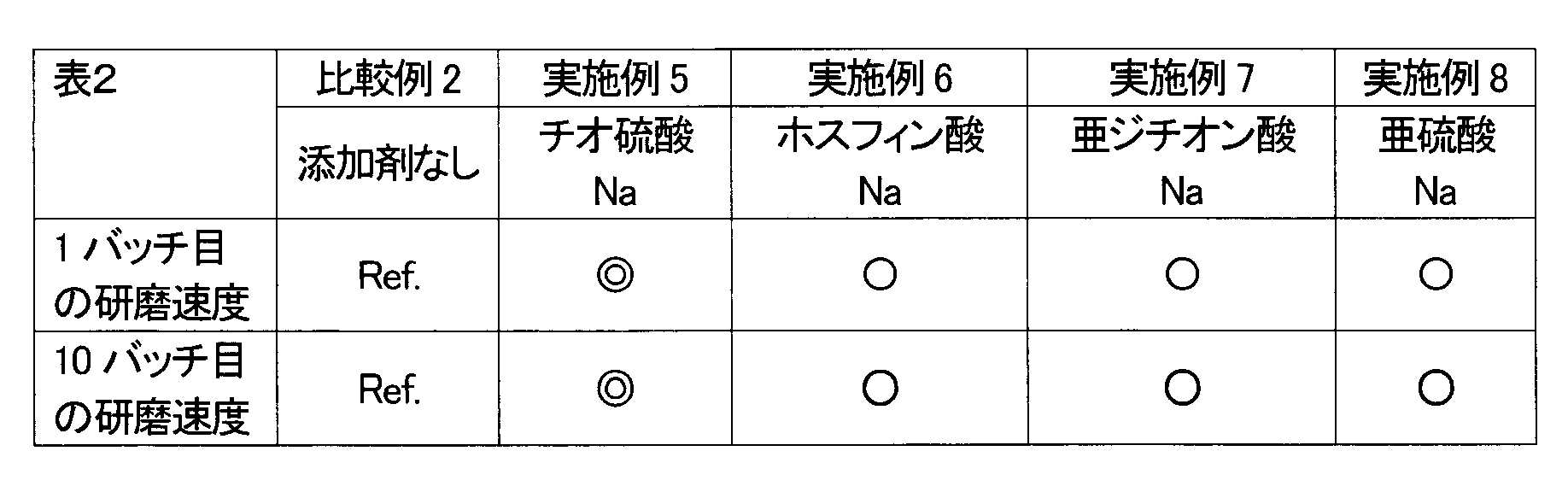
1.Laを添加した酸化セリウム砥粒を用いる場合においても、研磨液に本発明の無機還元剤を含有させることにより、無機還元剤を含まない比較例に対して研磨速度を向上させることができる。
また、無機還元剤の中でも、特にチオ硫酸塩は研磨速度の向上効果が大きく好ましい。また、前出の表1の結果との対比から、Laを添加した酸化セリウム砥粒を用いることにより、研磨速度の向上率が大きくなることがわかる。
2.また、本発明の実施例によれば、このような傾向は、1バッチ目だけではなく、10バッチ目においても持続しており、連続研磨処理時の研磨速度の低下を効果的に抑制することができる。特にチオ硫酸塩は、10バッチ目においても比較例2の1バッチ目と同等以上の研磨速度となり、とりわけ高い効果を示している。
上記実施例1と同様にして、(1)粗研削処理、(2)形状加工処理、(3)精研削処理、(4)端面研磨処理、(5)主表面第1研磨処理を順次行った。
ただし、ガラス基板は、上記の硝材1においてAl2O3の含有量を10モル%としたものを用いた。この硝材を硝材Aと呼ぶ。
上記実施例Aに使用した硝材Aに替えて下記の硝材Bを用いたこと以外は上記実施例Aと同様の加工処理を行った。
硝材B モル%表示にて、SiO2を50~75%、Al2O3を0~6%、BaOを0~2%、Li2Oを0~3%、ZnOを0~5%、Na2OおよびK2Oを合計で3~15%、MgO、CaO、SrOおよびBaOを合計で14~35%、ZrO2、TiO2、La2O3、Y2O3、Yb2O3、Ta2O5、Nb2O5およびHfO2を合計で2~9%、含み、モル比[(MgO+CaO)/(MgO+CaO+SrO+BaO)]が0.85~1の範囲であり、且つモル比[Al2O3/(MgO+CaO)]が0~0.30の範囲である耐熱性ガラス。
上記実施例1と同様にして、(1)粗研削処理、(2)形状加工処理、(3)精研削処理を順次行い、次いで、以下の端面研磨処理を行った。なお、ガラス基板は、上記硝材1を用いた。
上記研削処理後のガラス基板を、支持治具を用いて積層し、ガラス基板積層体を形成した。この時、ガラス基板とガラス基板との間には樹脂製スペーサを挿入し、合計200枚のガラス板を重ね合わせ、ガラス基板積層体とした。
研磨液をガラス基板積層体の外周端面部に供給し、回転ブラシとガラス基板積層体を反対方向に回転させ、さらに、回転ブラシをガラス基板積層体の積層方向に揺動させながら研磨した。
なお、各実施例や比較例においては研磨液の交換は行わず、研磨液を回収して循環させながら連続20バッチ処理した。
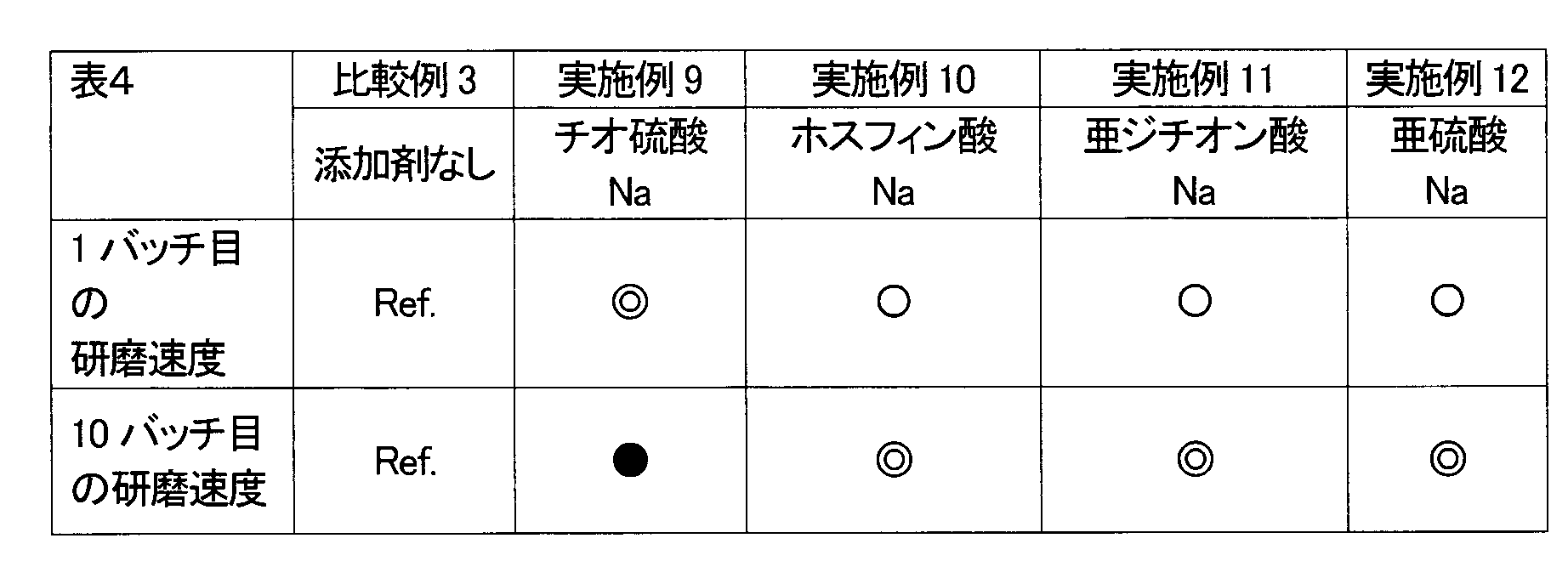
ガラス基板の端面研磨処理においても、研磨液に本発明の無機還元剤を含有させることにより、無機還元剤を含まない比較例に対して研磨速度を向上させることができる。
また、無機還元剤の中でも、特にチオ硫酸塩は研磨速度の向上効果が大きく好ましい。また、本発明の実施例によれば、このような傾向は、1バッチ目だけではなく、10バッチ目においても持続しており、連続研磨処理時の研磨速度の低下を効果的に抑制することができる。しかも、10バッチ目では、比較例の落ち込みが大きいため、相対的に無機還元剤の効果が高まり、研磨速度の向上率が1バッチ目よりも大きくなった。端面研磨処理は、主表面研磨処理よりも研磨速度が低下しやすいので、本発明がとりわけ有効である。
実施例5で使用した研磨液(LaをTREOに対するLa2O3の割合として20%含む酸化セリウム(平均粒径1μm)を研磨砥粒として含み、無機還元剤としてチオ硫酸ナトリウムを5重量%含み、pH=10のアルカリ性)のpHを、8、9、11、12にそれぞれ変更した研磨液を用いたこと以外は、実施例5と同様にして、実施例13~16のガラス基板を作製した。

上記実施例1で得られた磁気ディスク用ガラス基板に以下の成膜工程を施して、垂直磁気記録用磁気ディスクを得た。
すなわち、上記ガラス基板上に、CrTi系合金薄膜からなる付着層、CoTaZr合金薄膜からなる軟磁性層、NiWからなるシード層、Ru薄膜からなる下地層、CoCrPt系合金からなる垂直磁気記録層、カーボン保護層、潤滑層を順次成膜した。保護層は、磁気記録層が磁気ヘッドとの接触によって劣化することを防止するためのもので、水素化カーボンからなり、耐磨耗性が得られる。また、潤滑層は、アルコール変性パーフルオロポリエーテルの液体潤滑剤をディップ法により形成した。
2 太陽歯車
3 内歯歯車
4 キャリア
5 上定盤
6 下定盤
7 研磨パッド
11 基板の主表面
12,13 基板の端面
Claims (8)
- 酸化セリウムを研磨砥粒として含む研磨液でガラス基板の表面を研磨処理するガラス基板の研磨方法であって、
前記研磨液は、無機還元剤を含むとともに、アルカリ性であることを特徴とするガラス基板の研磨方法。 - 前記無機還元剤は、アルカリ金属又はアルカリ土類金属とのチオ硫酸塩、ホスフィン酸塩、亜ジチオン酸塩、もしくは亜硫酸塩から選ばれる少なくとも1種であることを特徴とする請求項1に記載のガラス基板の研磨方法。
- 前記研磨液のpHは、8~12の範囲内であることを特徴とする請求項1又は2に記載のガラス基板の研磨方法。
- 前記酸化セリウム砥粒はランタン(La)を含むことを特徴とする請求項1乃至3のいずれかに記載のガラス基板の研磨方法。
- 請求項1乃至4のいずれかに記載のガラス基板の研磨方法を適用した研磨処理を含むことを特徴とするガラス基板の製造方法。
- 請求項5に記載のガラス基板の製造方法を適用し、前記ガラス基板は、磁気ディスク用ガラス基板であることを特徴とする磁気ディスク用ガラス基板の製造方法。
- 請求項6に記載の磁気ディスク用ガラス基板の製造方法によって製造された磁気ディスク用ガラス基板上に、少なくとも磁性膜を形成することを特徴とする磁気ディスクの製造方法。
- ガラス基板の表面の研磨処理に用いる研磨液であって、
前記研磨液は、酸化セリウムを研磨砥粒として含み、さらに無機還元剤を含むとともに、アルカリ性であることを特徴とする研磨液。
Priority Applications (4)
| Application Number | Priority Date | Filing Date | Title |
|---|---|---|---|
| MYPI2017704080A MY186390A (en) | 2015-05-20 | 2016-05-20 | Method for polishing glass substrate, polishing liquid, method for manufacturing glass substrate, method for manufacturing magnetic-disk glass substrate, and method for manufacturing magnetic disk |
| SG11201708814QA SG11201708814QA (en) | 2015-05-20 | 2016-05-20 | Method for polishing glass substrate, polishing liquid, method for manufacturing glass substrate, method for manufacturing magnetic-disk glass substrate, and method for manufacturing magnetic disk |
| JP2017519424A JP6429354B2 (ja) | 2015-05-20 | 2016-05-20 | ガラス基板の研磨方法、研磨液、ガラス基板の製造方法、磁気ディスク用ガラス基板の製造方法及び磁気ディスクの製造方法 |
| CN201680028231.0A CN107615380B (zh) | 2015-05-20 | 2016-05-20 | 玻璃基板的研磨方法、研磨液、玻璃基板的制造方法、磁盘用玻璃基板的制造方法和磁盘的制造方法 |
Applications Claiming Priority (2)
| Application Number | Priority Date | Filing Date | Title |
|---|---|---|---|
| JP2015-102786 | 2015-05-20 | ||
| JP2015102786 | 2015-05-20 |
Publications (1)
| Publication Number | Publication Date |
|---|---|
| WO2016186214A1 true WO2016186214A1 (ja) | 2016-11-24 |
Family
ID=57320350
Family Applications (1)
| Application Number | Title | Priority Date | Filing Date |
|---|---|---|---|
| PCT/JP2016/065103 Ceased WO2016186214A1 (ja) | 2015-05-20 | 2016-05-20 | ガラス基板の研磨方法、研磨液、ガラス基板の製造方法、磁気ディスク用ガラス基板の製造方法及び磁気ディスクの製造方法 |
Country Status (5)
| Country | Link |
|---|---|
| JP (1) | JP6429354B2 (ja) |
| CN (1) | CN107615380B (ja) |
| MY (1) | MY186390A (ja) |
| SG (1) | SG11201708814QA (ja) |
| WO (1) | WO2016186214A1 (ja) |
Cited By (1)
| Publication number | Priority date | Publication date | Assignee | Title |
|---|---|---|---|---|
| US11161751B2 (en) | 2017-11-15 | 2021-11-02 | Saint-Gobain Ceramics & Plastics, Inc. | Composition for conducting material removal operations and method for forming same |
Citations (5)
| Publication number | Priority date | Publication date | Assignee | Title |
|---|---|---|---|---|
| JPH09137155A (ja) * | 1995-11-16 | 1997-05-27 | Tokyo Ohka Kogyo Co Ltd | 研磨用組成物および研磨方法 |
| JP2013055366A (ja) * | 2006-05-31 | 2013-03-21 | Sumitomo Electric Ind Ltd | GaN結晶の表面処理方法、GaN結晶基板、エピタキシャル層付GaN結晶基板および半導体デバイス、ならびにエピタキシャル層付GaN結晶基板および半導体デバイスの製造方法 |
| WO2014122982A1 (ja) * | 2013-02-05 | 2014-08-14 | コニカミノルタ株式会社 | 研磨材スラリー |
| JP2015008212A (ja) * | 2013-06-25 | 2015-01-15 | 日立化成株式会社 | 研磨液及びこの研磨液を用いた基板の研磨方法 |
| JP2015066656A (ja) * | 2013-09-30 | 2015-04-13 | Hoya株式会社 | 使用済み研磨剤の再生方法、およびガラス基板の製造方法 |
Family Cites Families (6)
| Publication number | Priority date | Publication date | Assignee | Title |
|---|---|---|---|---|
| JP4713064B2 (ja) * | 2002-06-05 | 2011-06-29 | Hoya株式会社 | 情報記録媒体用ガラス基板の製造方法及びその製造方法で製造された情報記録媒体用ガラス基板 |
| US6641630B1 (en) * | 2002-06-06 | 2003-11-04 | Cabot Microelectronics Corp. | CMP compositions containing iodine and an iodine vapor-trapping agent |
| JP2006100570A (ja) * | 2004-09-29 | 2006-04-13 | Fuji Photo Film Co Ltd | 研磨用組成物及びそれを用いた研磨方法 |
| CN101417861A (zh) * | 2007-10-26 | 2009-04-29 | 旭硝子株式会社 | 信息记录媒体基板用玻璃、磁盘用玻璃基板及磁盘 |
| JP5459466B2 (ja) * | 2008-06-05 | 2014-04-02 | Jsr株式会社 | 回路基板の製造に用いる化学機械研磨用水系分散体、回路基板の製造方法、回路基板および多層回路基板 |
| CN104093524A (zh) * | 2012-02-06 | 2014-10-08 | 旭硝子株式会社 | 玻璃制品的制造方法及磁盘的制造方法 |
-
2016
- 2016-05-20 SG SG11201708814QA patent/SG11201708814QA/en unknown
- 2016-05-20 JP JP2017519424A patent/JP6429354B2/ja active Active
- 2016-05-20 CN CN201680028231.0A patent/CN107615380B/zh active Active
- 2016-05-20 WO PCT/JP2016/065103 patent/WO2016186214A1/ja not_active Ceased
- 2016-05-20 MY MYPI2017704080A patent/MY186390A/en unknown
Patent Citations (5)
| Publication number | Priority date | Publication date | Assignee | Title |
|---|---|---|---|---|
| JPH09137155A (ja) * | 1995-11-16 | 1997-05-27 | Tokyo Ohka Kogyo Co Ltd | 研磨用組成物および研磨方法 |
| JP2013055366A (ja) * | 2006-05-31 | 2013-03-21 | Sumitomo Electric Ind Ltd | GaN結晶の表面処理方法、GaN結晶基板、エピタキシャル層付GaN結晶基板および半導体デバイス、ならびにエピタキシャル層付GaN結晶基板および半導体デバイスの製造方法 |
| WO2014122982A1 (ja) * | 2013-02-05 | 2014-08-14 | コニカミノルタ株式会社 | 研磨材スラリー |
| JP2015008212A (ja) * | 2013-06-25 | 2015-01-15 | 日立化成株式会社 | 研磨液及びこの研磨液を用いた基板の研磨方法 |
| JP2015066656A (ja) * | 2013-09-30 | 2015-04-13 | Hoya株式会社 | 使用済み研磨剤の再生方法、およびガラス基板の製造方法 |
Cited By (1)
| Publication number | Priority date | Publication date | Assignee | Title |
|---|---|---|---|---|
| US11161751B2 (en) | 2017-11-15 | 2021-11-02 | Saint-Gobain Ceramics & Plastics, Inc. | Composition for conducting material removal operations and method for forming same |
Also Published As
| Publication number | Publication date |
|---|---|
| CN107615380A (zh) | 2018-01-19 |
| SG11201708814QA (en) | 2017-12-28 |
| JP6429354B2 (ja) | 2018-11-28 |
| JPWO2016186214A1 (ja) | 2018-04-12 |
| MY186390A (en) | 2021-07-22 |
| CN107615380B (zh) | 2020-09-11 |
Similar Documents
| Publication | Publication Date | Title |
|---|---|---|
| CN102473424B (zh) | 磁盘用玻璃基板的制造方法 | |
| CN108447507B (zh) | 磁盘用玻璃基板的制造方法和磁盘的制造方法、以及磨削工具 | |
| JP5744159B2 (ja) | 磁気ディスク用ガラス基板の製造方法及び磁気ディスクの製造方法 | |
| JP6141636B2 (ja) | 基板の製造方法、磁気ディスク用ガラス基板の製造方法、及び磁気ディスクの製造方法 | |
| JP5977520B2 (ja) | 磁気ディスク用ガラス基板の製造方法および磁気ディスク用ガラス基板 | |
| JP6429354B2 (ja) | ガラス基板の研磨方法、研磨液、ガラス基板の製造方法、磁気ディスク用ガラス基板の製造方法及び磁気ディスクの製造方法 | |
| JP6420260B2 (ja) | 磁気ディスク用基板の製造方法及び磁気ディスクの製造方法 | |
| JP2009087483A (ja) | 情報記録媒体用ガラス基板の製造方法、情報記録媒体用ガラス基板及び磁気記録媒体 | |
| CN104641415B (zh) | 磁盘用玻璃基板的制造方法以及磁盘的制造方法 | |
| JP5778165B2 (ja) | 情報記録媒体用ガラス基板の製造方法および情報記録媒体の製造方法 | |
| JP2010073289A (ja) | 磁気ディスク用基板および磁気ディスク | |
| JP6480611B2 (ja) | 磁気ディスク用ガラス基板の製造方法及び磁気ディスクの製造方法 | |
| JP2007213724A (ja) | 磁気ディスク用ガラス基板の製造方法、磁気ディスク用ガラス基板、及び磁気ディスクの製造方法 | |
| JP6034580B2 (ja) | Hdd用ガラス基板の製造方法 | |
| JP5859757B2 (ja) | Hdd用ガラス基板の製造方法 | |
| JP2013012282A (ja) | Hdd用ガラス基板の製造方法 | |
| JP5636243B2 (ja) | 情報記録媒体用ガラス基板の製造方法 | |
| JP2012079365A (ja) | 情報記録媒体用ガラス基板の製造方法 | |
| CN104823240B (zh) | 磁盘用玻璃基板的制造方法以及磁盘的制造方法 | |
| CN111048122B (zh) | 固定磨粒磨石以及基板的制造方法 | |
| JP2013080530A (ja) | 磁気ディスク用ガラス基板の製造方法及び磁気ディスクの製造方法 | |
| JP2013140650A (ja) | 磁気ディスク用ガラス基板の製造方法および磁気ディスク用ガラス基板 | |
| JP2012079369A (ja) | 情報記録媒体用ガラス基板の製造方法 | |
| JP2012079368A (ja) | 情報記録媒体用ガラス基板の製造方法 | |
| JP2012077145A (ja) | ハードディスク用ガラス基板の製造方法 |
Legal Events
| Date | Code | Title | Description |
|---|---|---|---|
| 121 | Ep: the epo has been informed by wipo that ep was designated in this application |
Ref document number: 16796607 Country of ref document: EP Kind code of ref document: A1 |
|
| ENP | Entry into the national phase |
Ref document number: 2017519424 Country of ref document: JP Kind code of ref document: A |
|
| WWE | Wipo information: entry into national phase |
Ref document number: 11201708814Q Country of ref document: SG |
|
| NENP | Non-entry into the national phase |
Ref country code: DE |
|
| 122 | Ep: pct application non-entry in european phase |
Ref document number: 16796607 Country of ref document: EP Kind code of ref document: A1 |